
Road Safety Solutions ACN
|
|
|
- Barnaby Dorsey
- 10 years ago
- Views:
Transcription
1 Road Safety Solutions ACN Waring Avenue Caringbah N.S.W Telephone: Michael Griffiths direct line: Facsimile: THE ROLE OF TYRE PRESSURE IN VEHICLE SAFETY, INJURY and ENVIRONMENT Prepared for Heads of Compulsory Third Party Insurance in Australia and New Zealand 24 April 2007 Prepared by Michael PAINE, Michael GRIFFITHS and Nimmi MAGEDARA

2 CONTENTS 1.0 INTRODUCTION BACKGROUND Sources of data Definition of under-inflated tyres ESTIMATED INFLUENCE OF UNDER-INFLATED TYRES ON ROAD ACCIDENTS Tyre defects Road crashes in Australia Road crashes in New Zealand THE NATURE OF THE POSSIBLE PROBLEMS WITH UNDER- INFLATED TYRES Consequences of incorrect tyre pressures Abnormal tyre wear Over-heating and mechanical damage SURVEYS OF TYRE INFLATION PRESSURES Australia USA United Kingdom SAFETY CONSEQUENCES OF UNDER-INFLATED TYRES Reduced vehicle handling and loss of control NHTSA research Effect of under inflation on crash types Skidding/loss of control in a curve: Skidding/loss of control in a lane change manoeuvre Skidding/loss of control benefits estimate Other relevant research on loss of control Effect of inflation pressure on rollover propensity Summary of handling effects Increased braking distance Effects on whiplash crashes Summary of braking issues Tyre failures and blowouts Australian Data NSW Crashed Vehicles Study

3 6.6 Increased tyre wear Tread depth NHTSA Position on tyre wear Claimed benefits of TPMS Other relevant research Summary for tyre wear ENVIRONMENTAL EFFECTS NHTSA analysis of fuel consumption Greenhouse gas emissions NHTSA analysis of greenhouse emissions Australian greenhouse gas emissions Reduced tyre waste TYRE MAINTENANCE Pressure gauges to check the tyre pressure TYRE PRESSURE MONITORING SYSTEMS US estimates of safety benefits Tyre industry estimates of safety benefits US Regulations Cost of TPMS CONCLUSIONS Safety benefits of correct tyre inflation Surveys of tyre pressures Future research REFERENCES Appendix - Effects of Worn Tyres Disclaimer The views expressed in this report are those of the authors and do not necessarily represent the views or policy of any other organisation 3

4 1.0 INTRODUCTION Maintaining correct inflation pressure in tyres helps to keep vehicle handling and braking at its best, as well as improving fuel efficiency and tyre life. In addition it can prevent such events as tread separations and tyre blowouts which may cause loss of control of a vehicle and severe crashes such as rollovers. The Heads of Compulsory Third Party Insurance in Australia and New Zealand (HCTP) commissioned research to review and attempt to better quantify the role of under-inflated tyres in crash cause, injury cause and environmental costs. The main aim of the review was to locate all the relevant material and attempt to quantify the role of tyre factors in crashes and the possible safety and environmental benefits from improved conformance with recommended tyre inflation pressures. 2.0 BACKGROUND Under-inflation of tyres affects many different types of crashes, often in subtle or indirect ways. Under-inflated tyres can potentially result in:- reduced vehicle handling increased braking distance increased likelihood of blowouts increased tyre wear increased fuel consumption In addition to road safety consequences, under-inflated tyres are associated with environment costs such as increased greenhouse gases associated with lower kilometres per tyre and higher fuel consumption and disposal problems. 2.1 Sources of data In the late 1990s the US National Highway Traffic Safety Administration (NHTSA) was directed to investigate and implement a regulation requiring vehicles to be fitted with tyre pressure monitoring system (TPMS). NHTSA carried out extensive investigation of this issue and prepared a range of technical reports. Relevant findings from the NHTSA research are outlined in the following sections. We review other research findings that either support or refute the NHTSA work. In the United Kingdom a major review of tyre safety issues was undertaken by John Bullas for the AA Foundation. We have been in contact with Mr Bullas and have included his advice and relevant extracts from that study in our report. The Society of Automotive Engineers has published numerous papers on tyre safety. Relevant papers were acquired and reviewed. One paper that was due to be published later in 2007 was titled "Effect of inflation pressure on tire cornering stiffness and vehicle handling characteristics". We contacted the 4

5 author, Dr Dan Metz who advised that the paper had been withdrawn but he was prepared to describe the key findings to us (see a later section). A request for information on this subject was circulated on an informal list - the Road Transport Technology Forum - that reaches about 280 vehicle engineering experts around the world. Mr Bullas was one of the respondents, along with an expert on ABS brakes and electronic stability control. We also contacted Prof Pete Thomas from Loughborough University in the United Kingdom. He provided some advice about his research on Electronic Stability Control (ESC). 2.2 Definition of under-inflated tyres Under the Australian Design Rules vehicle manufacturers must fit a Tyre and Rim Placard in a prominent place. The placard must list, as a minimum, the recommended tyre inflation pressures for a "normal" vehicle load. There is no universal definition of what constitutes an "under-inflated tyre". The US Federal Motor Vehicle Safety Standard 138 requires a warning if tyres are under-inflated by more than 25%. Based on this FMVSS requirement, we regard a severely under-inflated tyres as 50 kilopascals (kpa) or more below the recommended pressure. For reference, 1 psi = 6.9kPa so this equates to 7.2psi. The US FMSS Standard is described in more detail in the following section. We regard moderate under-inflation as in the range 20-49kPa under the recommended pressure. 5

6 3.0 ESTIMATED INFLUENCE OF UNDER-INFLATED TYRES ON ROAD ACCIDENTS In order to evaluate the potential reduction in road accidents from measures to reduce the incidence of under-inflated tyres it is necessary to analyse a breakdown of these accidents by contributing factors and by the injury outcomes of these crashes. Accident statistics reported by State Road Authorities, the Australian Transport Safety Bureau (ATSB) and the Australian Bureau of Statistics (ABS) are generally based on police accident reports. The level, details and quality of coding varies considerably between the states and territories (Hutchinson 2004). There are notable differences between police-reported statistics and those collected by Compulsory Third Party insurance schemes (McColl 2003). Furthermore no consolidated data about the full range of Australian road accidents appears to be available. We have therefore combined road accident information from a wide range of sources. Due to the uncertainties about the quality of the police-reported data and the assumptions made for extrapolating data, the following analysis should be regarded as indicative only. 3.1 Tyre defects In the three years from tyre defects accounted for 50% of light vehicle crashes where a vehicle defect was identified as a likely factor in NSW (Table 1). However, the 755 crashes represent less than 1% of all reported light vehicle crashes in this period. Table 1. Light vehicle crashes where a vehicle defect was a factor Year Total light vehicle accidents Involvement of Equipment/vehicle factor , , , All 226, Tyre failure/fault It is known that police reports under-estimate most types of vehicle factors in crashes (Paine 2000). However the 1% value is consistent with the findings of in-depth studies in NSW during the 1970s and it appears that the police pay greater attention to tyres defects than other types of defect. Most "tyre defects" would likely be tyres with insufficient tread depth or tyre failures. The overall influence of tyre failures directly related to under-inflation is therefore expected to be less than 1%. 3.2 Road crashes in Australia Table 2 summarises data combined from statistics published by ATSB, ABS and state road authorities. The following assumptions were made: 6

7 24% of all injuries are serious (hospital admission) 1.15 fatalities per fatal car accident 1.33 persons injured per injury car accident 55% of all fatal accidents are car accidents 86% of all injury accidents are car accidents 95% of all non-injury accidents are car accidents 91% of all accidents are car accidents 1.43 non-injury car accidents for every injury accident 2.45 reported accidents for every injury accident Table 2. Estimated Australian road accidents in 2002 Parameter Cars only % of all car accidents or casualties All accidents % of all accidents or casualties 1. Fatalities 949 2% % 2. Fatal crashes 825 1% % 3. Serious occ injuries % % 4. Serious crashes % % 5. Minor occ injuries % % 6. Minor injury accidents % % 7. Non-injury accidents % % 8. All reported accidents % % 9. Total casualties There are several contributing factors that might be influenced by tyre inflation pressure. These factors are listed in Table 3, along with estimates of the proportion of all car accidents that are associated with the factor. This table is primarily based on Paine (2002), supplemented by NSW RTA accident data and recent research publications. Table 3. Estimated proportion of car accidents by factor Type of accident Fatal Serious injury Minor injury Noninjury Speed-related 40% 30% 30% 30% 30% Wet weather 18% 21% 21% 26% 24% Poor braking (wet) 9% 11% 11% 13% 12% Poor braking (dry) 25% 24% 24% 22% 23% Loss of directional control 30% 30% 30% 30% 30% All 7

8 Tyre failure 1% 1% 1% 1% 1% Multi-vehicle accidents 70% 75% 75% 75% 75% Single vehicle accidents 30% 25% 25% 25% 25% Single veh. loss of control 25% 15% 15% 15% 15% Preventable with ESC 26% 24% 24% 24% 24% Daytime 64% 79% 79% 79% 79% Night 36% 21% 21% 21% 21% Car frontal crash 60% 60% 60% 60% 60% Hit from rear (sometimes after front) 10% 23% 23% 23% 23% Side impact 20% 20% 20% 20% 20% Lane-change 5% 5% 5% 5% 5% Number of car accidents in Note % are not cumulative As discussed in following sections, there is considerable uncertainty about the role that under-inflated tyres play in various types of road accidents. Subject to this uncertainty, Table 4 shows the estimated savings that could be achieved by ensuring tyres were correctly inflated, for key types of accidents. Table 4. Assumed effectiveness of correct tyre inflation pressure in relevant accidents Factor Fatal Serious injury Minor Injury Noninjury Reduced handling without ESC (90% of all) 5% 5% 5% 5% Reduced handling with ESC (10% of all) 10% 10% 10% 10% Increased stopping distance in dry 0% 0% 0% 0% Increased stopping distance in wet 5% 5% 5% 5% Severe tyre failure 75% 75% 75% 75% Combining Tables 3 and 4 provides an estimate of the overall savings that could be achieved by ensuring tyres were correctly inflated. 8

9 Table 5. Estimated effectiveness of correct tyre inflation pressure for all accidents Factor Fatal Serious injury Minor Injury Noninjury Reduced handling without ESC (90% of all) 1.4% 1.4% 1.4% 1.4% Reduced handling with ESC (10% of all) 0.3% 0.3% 0.3% 0.3% Increased stopping distance in dry 0.0% 0.0% 0.0% 0.0% Increased stopping distance in wet 0.5% 0.5% 0.5% 0.7% Severe tyre failure 0.8% 0.8% 0.8% 0.8% Overall effectiveness 2.9% 2.9% 2.9% 3.1% Overall car accident savings Based on this tentative analysis it is estimated that measures that totally eliminated severely under-inflated tyres would save about 3% of all crashes. This assumes that the measures eliminate all under-inflated tyres (100% effectiveness). The actual effectiveness would be somewhat less than this and would depend on the warning systems that are used and the diligence of drivers. 3.3 Road crashes in New Zealand In a 2001 press release, the New Zealand Land Transport Safety Authority stated that problems with tyres accounted for 40% of fatal crashes where defects were found to be a contributing factor. In 2000 there were 15 fatal crashes and 110 injury crashes where tyres were recorded as a contributing factor. This represents 4% and 1.5% of the fatal and injury crashes in New Zealand during These rates are siimilar to Australia. Tyre-related crashes are more likely to be associated with higher vehicle speeds, typical on non-urban roads. In 2000, the proportion of New Zealand fatal crashes occurring on non-urban roads was 75%, compared with 65% in NSW. The proportion of injury crashes was 40% in New Zealand, compared with 34% in NSW. This suggests that it would be reasonable to apply the above analysis of accident savings to New Zealand. 9

10 4.0 THE NATURE OF THE POSSIBLE PROBLEMS WITH UNDER- INFLATED TYRES 4.1 Consequences of incorrect tyre pressures Abnormal tyre wear Over- or under-inflated tyres traditionally manifested classic wear patterns. Figure 1 illustrates the typical appearance of such tyres. The uneven wear means that the tyres need replacing prematurely. Figure 1 - The typical appearance of over- or under-inflated tyres in terms of classic wear pattern Over-heating and mechanical damage Severely under-inflated tyres will deflect more during each wheel rotation. This causes heat build-up and increased mechanical damage. Both can lead to premature tyre failure. The recommended inflation pressures are for cold tyres. This means tyres that have not been driven on for several hours (ideally overnight). It also means tyres that are at a normal outside temperature of about 20 degrees C. The definition of a cold tyre is when its temperature is equal to the ambient temperature. John Bullas, in his work A report on research carried out for the AA Foundation for Road Safety Research and Country Surveyors Society states that, temperature has to be taken into account in the accurate inflation of tyres. For every 5 degrees C change in ambient temperature, tyre pressure will change by about 3.4 kpa. The European Tyre and Rim Technical Organisation (ETRTO 2001) also suggested hot pressures can be up to 20 % higher than cold and that under no circumstances should hot tyres be pressurised to the specified cold pressures given by the car manufacturers. In equatorial and tropical regions with higher ambient temperatures, when the tyres need to be maintained at appropriate pressures to reduce excessive temperature build up, a 15% under-inflation is (unknowingly) being set into the tyres when uncompensated manufacturer's cold pressure figures are maintained (Tooke 2002). 10

11 A tyre that contains air at 220 kpa at 20 degrees C will have a little over 241 kpa at 38 degrees C even if the vehicle has not been driven. Conversely, when seasons change and temperature drops, tyres lose pressure. The same tyre that held 220 kpa at 20 degrees C will have about 193 kpa at 0 degrees C and when temperatures are in the subzero range, the loss in the tyre pressure will be even greater. These temperature effects need to be taken into account in the design of tyre pressure monitoring devices. 11

12 5.0 SURVEYS OF TYRE INFLATION PRESSURES 5.1 Australia A 1993 NRMA study of tyre conditions found that only 17% of the 3012 tyres surveyed were at the correct pressure and had no other fault. This review did not find any more recent surveys in Australia. Figure 2 illustrates a breakdown of the incidence of over or under inflation relative to vehicle manufacturer recommended pressure. Only 7% of the tyres surveyed had inflation pressures which were identical to the recommended pressure. Figure 2. Results of NRMA tyre pressure survey in 1993 A 2006 RACV vehicle survey Visual tyre check in Victorian Roads' reported 18.3% of the population had at least one unroadworthy or damaged tyre. It commented that a significant proportion of the surveyed drivers knew they were driving on bad tyres. It appears these drivers were aware of this from there own observations. Unfortunately the survey did not cover tyre pressures - a lost opportunity. 5.2 USA In February 2001, NHTSA conducted a tyre pressure study to determine the extent to which passenger vehicle operators are aware of the recommended air pressure for their tyres, if they monitor air pressure, and to what extent the actual tyre pressure differs from that recommended tyre pressure by the vehicle manufacturer on the placard. 12

13 Complete data were collected on 5,967 passenger cars and 3,950 light trucks for a total of 9,917 vehicles. The average placard pressure for passenger cars was about 207 kpa, while the average placard pressure for light trucks was about 240 kpa, although the light trucks have a much wider range of manufacturer recommended placard pressure. Table 6 shows the distribution of tyre pressure when at least one tyre is 25 percent or more below placard in terms of whether one, two, three, or all four tyres were at least 25 percent below placard. At the time the survey was done, there were 207 million vehicles on the road. An estimated 57 million vehicles have at least one tyre 25 percent or more below placard at any time. Table 6 -Distribution of the number of tyres on vehicles that have one or more tyres that is 25% or more below placard. Number of Tyres 25% or more Below Placard Passenger Cars Percent Light Trucks Percent % % Total 1, % 1, % A survey of 766 vehicles conducted in 2000 by Tire Business in the USA found that 72.3% of vehicles were operating with at least one tyre under inflated, with an average under inflation of about 40kPa. 51% of the vehicles had at least one tyre under inflated by 36kPa or more. 40% had all four tyres low by an average of 48kPa (NHTSA 2001). In a 2001 survey of truck tyres, the American Trucking Association's Technology and Maintenance Council (TMC) found that 7% of commercial vehicle tyres were under inflated by 140kPa or worse. Only 11% of tyres were within +/- 35kPa of the pressure specified by the tyre manufacturer. 5.3 United Kingdom Road side surveys by the Tyre Industry Council in the UK have highlighted how little attention is given to tyre pressure. In a UK survey of over 1000 tyres, only 5% were correctly inflated and 72% were under inflated. Fig 3 illustrates the distribution of 1072 cold tyre pressure measured by the Tyre Industry Council for one survey in

14 Figure 3. UK tyre pressure survey 14

15 6.0 SAFETY CONSEQUENCES OF UNDER-INFLATED TYRES 6.1 Reduced vehicle handling and loss of control Tyre pressure affects the handling of a vehicle particularly during an emergency manoeuvre. For loss of control crashes, inappropriate speed is usually the most critical factor. Excessive speed alone can cause a loss of control in a curve or in a lane change manoeuvre. Tread depth, inflation pressure of the tyres, and road surface condition are the most notable of a long list of factors including vehicle steering characteristics and tyre cornering capabilities that affect the vehicle/tyre interface with the road NHTSA research The 1977 Indiana Tri-level study associated low tyre pressure with loss of control, on both wet and dry pavements. That study did not identify low tyre pressure as a "definite" (95 percent certain that the crash would not have occurred without this cause) cause of any crash, but did identify it as a "probable" cause (80 percent confidence level - highly likely that the crash would not have occurred) of the crash in 1.4 percent of the 420 in-depth crash investigations. Under-inflated tyres were a causal factor in 1.2 percent of the probable causes and a severity-increasing factor in 0.2 percent of the probable causes. Thus, under-inflation s part of the total is 1.0 percent (1.4/138.8). Focusing only on the probable cause cases, under-inflation represents 0.86 percent of crashes (1.2/1.4*1.0). Also it is noted that there were particular vehicles that were known to lose traction when their tyres were under-inflated in particular patterns, sometimes the rear tyres, or sometimes a disparity in inflation. It is assumed this factor could reduce the probable cause estimate by 10 percent to 0.77 (0.86*.9) Crash Data Analysis To get an estimate of the target population of the low tyre pressure cases in which skidding and loss of control could be a factor, NHTSA analysed data from "Traffic Safety Facts, 1999" which shows there were about 47,848 passenger vehicles (passenger cars and light trucks) involved in fatal crashes, about 3.6 million passenger vehicles involved in injury crashes and about 6.9 million passenger vehicles involved in property damage only crashes. These crashes resulted in 32,061 passenger vehicle occupants being killed and almost 3 million passenger vehicle occupants being injured. Taking 0.77 percent of these cases, loss of control and skidding due to low tyre pressure would account for an estimated 247 occupants killed, 23,100 occupants injured, and 53,130 property damage only crashes. As a second check on these estimates, the 1999 NASS-GES was examined to identify particular crash scenarios in which loss of control occurred. The following scenarios that could be identified were examined totalling over 413,000 vehicles (3.9 percent of the vehicles in all crashes). Certainly there are other scenarios that couldn t be identified, but this check was made to ensure that 0.77 percent was not impossibly high, which it did. 15

16 - Negotiating a curve: where the vehicle left the roadway, left the travel lane, lost control or skidded 213,759 vehicles, - Changing lanes where the vehicle left the roadway, lost control or skidded 4,890 vehicles, and - Raining/wet road cases where the vehicle lost control and skidded 194,709 vehicles. NHTSA tried to consider this by comparing under-inflation as a percentage of all of the probable causes in crashes. However, it is difficult to determine what the effectiveness of increasing tyre pressure would be on these crashes. 6.2 Effect of under inflation on crash types Skidding/loss of control in a curve: Low tyre pressure generates lower cornering stiffness because of reduced tyre stiffness. When the tyre pressure is low, the vehicle wants to go straight and requires a greater steering angle to generate the same cornering force in a curve. The maximum speed at which an off-ramp can be driven while staying in the lane is reduced by a few mph as tyre inflation pressure is decreased. An example provided by Goodyear shows that when all four tyres are at 30 psi the maximum speed on the ramp was 38 mph, at 27 psi the maximum speed was 37 mph, and at 20 psi the maximum speed was 35 mph while staying in the lane. Having only one front tyre under-inflated by the same amount resulted in about the same impact on maximum speed. But, the influence of having only one rear tyre under-inflated by the same amount was only about one-half of the impact on maximum speed (a 1.5 mph difference from 30 psi to 20 psi). NHTSA has run a series of tests to examine the issue of decreases in tyre pressure on vehicle handling. A 2001 Toyota 4-Runner was run through 50 mph constant speed/decreasing radius circles to see the effects of inflation pressure on lateral road holding. Left-hand turns from 0 to 90 degrees hand wheel angle for tyre inflation pressures varied from 103 kpa to 243kPa. The data indicated that in on-ramps/off ramps, tyre inflation pressure is a critical factor in vehicle handling. The data show how much friction the vehicle can utilize, in terms of lateral acceleration (g s), before it slides off the road. The more lateral g s the vehicle can utilize, the better it stays on the road. So, if you are going around an off-ramp and need to turn the wheel 50 degrees at 50 mph, you can utilize 0.27 g s at 103 kpa, or you can utilize 0.35 g s at 206 kpa Skidding/loss of control in a lane change manoeuvre In a quick lane change manoeuvre, under-inflated tyres result in a loss of tyre sidewall stiffness, causing poor handling. Depending upon whether the low tyre(s) are on the front or rear axle impacts the vehicle s sensitivity to steering inputs, directional stability, and could result in a spin out and/or loss of control of the vehicle. 16

17 6.2.3 Skidding/loss of control benefits estimate NHTSA estimated a target population for skidding and loss of control crashes for under-inflated tyres of 247 fatalities, 23,100 injuries and 53,130 propertydamage-only crashes. The agency assumes that 90 percent of drivers will fill their tyres back to placard pressure. It is difficult to determine the effectiveness estimate, (i.e., what percent of the crashes would be avoided by just improving low tyre pressure). For this analysis, NHTSA assumes 20 percent effectiveness to go from a very low pressure, where a warning would be given, to the steady state condition, although it could potentially be much higher. It is noted that, the benefits are the same for all the Compliance Options. Since they all require warnings at 25 percent below placard pressure. It is assumed that the benefits would come from increasing tyre pressure from a low state to a pressure close to placard pressure Other relevant research on loss of control Thomas J. Wielenga in "Properties Affecting Vehicle Rollover states that severely under-inflated tyres can cause reduced directional control due to reduced cornering stiffness of the tyre. Straight line braking can also be affected (Wielenga 1999). Robinette, Deering and Fay (1997)) investigated the effects of deflated tyres on vehicle handling concluded that the drag caused by a deflated tyre at 72 km/h...could be readily controlled by a fairly minor response from the test driver. There may be greater potential for long term damage from running under inflated because of a lack of driver awareness. However, the increase in the probability of tyre deflation at high speeds, as a result of damage caused by extended running at the wrong pressure, is of greatest concern. Gillespie (1992) discusses the theory of tyre dynamics. He notes that the cornering behaviour of a motor vehicle is an important performance mode often equated with handling. The cornering stiffness is dependent on many variables. Load and inflation pressure are the main variables. Also tyre size and type, number of plies, cord angles, wheel width, and tread are significant variables. Since inflation pressure increases carcass stiffness but reduces contact length, the net influence on cornering stiffness cannot be generalized across all types of tyres. It is generally accepted that increasing inflation pressure results in increasing cornering stiffness for passenger car tyres. Because of the monotonic and rather strong relationship between cornering stiffness and inflation pressure, it was common practice in the past to control the low-g directional behaviour of passenger cars through the specification of difference inflation pressures for front and rear tyres. This practice is no longer common. In theory inflation pressure also has a strong influence on the peak traction level that can be achieved under slip angle conditions. The pressure most influences lateral force production at high loads, and tyres at reduced inflation pressures arrive at lateral force saturation at higher values of slip angle. 17

18 Gillespie's work, while useful, relates to tyres in common use more than twenty years ago. The characteristics of vehicles and tyres have changed substantially since that time. In personal communication Dr Daniel Metz described recent tests and simulations that he performed with SUV tyres. Three types of tyre were tested on a special machine to determine cornering stiffness (in effect, the lateral force generated by the tyre when it is turned from the direction of travel). These tests revealed a 10% reduction in cornering stiffness when the tyres were operated at about half of the recommended pressure. Dr Metz noted that the reduction in cornering stiffness would be substantially less than this at the 25% reduced pressure of the TPMS regulation, particularly since the relationship between pressure and cornering stiffness is non-linear. He also pointed out that vehicles rarely have all four tyres severely under-inflated and that lane-change tests had revealed that a 10% reduction in tyre cornering stiffness had very little influence on the speed at which the vehicle could negotiate the course. There are also concerns about NHTSA's application of tests of a single vehicle to the broad vehicle population. On balance, it appears that the NHTSA estimates of the reduction in handling from under-inflated tyres may be highly optimistic Under-inflated tyres and electronic stability control Many modern cars are fitted with electronic stability control (ESC). These systems detect when the vehicle is departing from the intended path and attempt to take corrective action such as momentary application of the brake of one wheel. The following diagrams are from a IIHS Status Report. Figure 4. ESC Sensors (credit: IIHS) 18

19 Figure 5. Methods of controlling oversteer and understeer An SAE paper by van Zanten (2000) contains a detailed description of ESC components and functions. Van Zanten, from Robert Bosch GmbH (the major supplier of ESC) discusses the abnormal conditions for which ESC must be designed and tested: "Changes in the tyre and car data such as resulting from usual wear and tear or even from small accidents must not reduce the ESP performance or at least must not result in adverse behaviour. Before the system is released, a catalogue of special test manoeuvres must be checked. Flat tyres and trailers should be included in the catalogue. Also the Moose Test has become a part of the catalogue. Particularly at low ambient temperatures where fast active braking is hampered by the increasing viscosity of the brake fluid the interventions must be checked to be fast enough to achieve the required yaw moment on the car in time. " It is possible that under-inflated tyres will reduce the benefits of electronic stability control. However, there appear to be very few reports of investigations into this effect. Based on US research, ESC is clearly a safety features that should be encouraged. A NHTSA study preliminary results show a 35% reduction of single vehicle crashes for passenger cars, and for fatal single vehicle crashes with 30%. Corresponding figures for 4WDs were 67% and 63% respectively. A recent study of the Effectiveness of ESC in reducing real life crashes and injuries in Europe, by Anders Lie shows that the positive and consistent effect of ESC overall and in circumstances where the road has low friction. The overall effectiveness on all injury crash types except rear end crashes was /- 9.3%, while for serious and fatal crashes; the effectiveness was /- 12.8%. ESC is especially helpful in providing an extra measure of control in slippery conditions and accident-avoidance situations. With tall, top heavy vehicles like sport-utilities and pickups, it can also help keep a vehicle from getting into a situation where it could roll over. The same study shows that, for serious and fatal loss-of control type crashes on wet roads the effectiveness 19

20 was 56.2 %. It was estimated that for Sweden, with a total of 500 vehicle related deaths annually, that fatalities could be saved annually if all cars had ESC. Thomas (2006) reported mixed findings from a study of vehicles with ESC in accidents in the United Kingdom. "There are very large reductions in crashes occurring in wet (34%) or icy (53%) conditions. The reduction in side impacts was greater than frontal impacts, although the difference was non-significant. There was a significant variation in effectiveness with class of car with Superminis showing a 47% relative decrease in crash involvement and large off-road cars showing a 24% increase... "This [United Kingdom] assessment of effectiveness has shown different levels compared to studies undertaken in other countries. The overall crash reduction of ESC equipped cars at all levels of injury severity is 3% compared with a 22% effectiveness in Sweden and 45% in Germany using similar methods. Different countries are likely to have a variety of road, driving and weather conditions and these may result in real differences in ESC effectiveness." We contacted Prof Thomas for more information about his research. He advised that an updated analysis has found increased effectiveness of ESC and the results should be available in March. He advised that "if Australia is looking at policy it would be wise to do your own analysis as I think the results are probably dependent on driving conditions and road user behaviour as well as the general levels of dynamic performance of vehicles in the fleet." This advice would also be appropriate for New Zealand. It is evident that ESC holds great potential for reducing accidents but the variations between these studies suggests that the situation should be monitored in Australia. The fitment of ESC as standard on the new (2007) Holden Commodore may create an opportunity for this to be monitored under Australian conditions.. Dr. Falk Hecker, of Knorr-Bremse Systeme fuer Nutzfahrzeuge in Germany (personal communication) is a technical expert on stability control systems for trucks. He advised that under inflated tyres could lead to a change in steering response. If the affected tyre is on the front axle the truck behaves more under steered and less direct in steering response. If it is on the rear axle the truck behaves more over steered with a tendency to instability (a similar behaviour occurs with new off- road tyres including high and free standing tread blocks). Another effect is the reduction of roll-over limit. ESC systems work by comparing the steering input to the minimal vehicle behaviour. It seeks to achieve forward stable travel by applying stabilizing braking on individual wheels where it detects deviations from controlled behaviour if the deviations exceed a preset level. Therefore it also helps a driver who is experiencing control problems from under inflated tyres. ESC is a closed loop control using vehicle dynamics sensors (yaw-rate and lateral acceleration), which means that even if the brake response during a stabilizing intervention is changed due to under inflated tyres this will be compensated for by ESC. 20

21 Several tests done with instantly deflated tyres (instantly deflating an outside tyre with a bullet during cornering at high lateral acceleration) found ESC very effective in assisting the driver to maintain steering control. ESC did this in two ways:- - First the roll-stability function of ESC limits the maximum lateral acceleration level, therefore the potential severity of a critical situation is less than without ESC. This also lowers the probability that the tyre jumps off the rim. The same applies for trailer roll-prevention systems. - Second the yaw control part of ESC helps the driver to control the instability of the truck (or combination) in this situation. In summary, ESC helps to maintain control with under inflated tyres. The effect of reduced tyre inflation on ESC should be quite small, because ESC uses closed loop control for the vehicle dynamics which compensates for changed tyre characteristics. Dr Metz confirmed that ESC is able to compensate for variables such as low tyre pressures, provided that the controlling forces demanded of any tyre do not exceed that tyre's friction limits. Even with a severely under-inflated tyre this was unlikely because ESC tends to apply only light controlling forces Effect of inflation pressure on rollover propensity Under its New Car Assessment Program, NHTSA publishes ratings for rollover propensity. Initial ratings were based primarily of a calculation of static rollover threshold (explained in more detail below). However more recent ratings include the results of dynamic tests due to recognised problems with comparing rollover crash involvement between different models of vehicle (Gillespie 1992). Nevertheless, an indicative analysis of rollover threshold can provide an indication of whether under-inflated tyres significantly increase the risk of rollover. Referring to the figure, rollover threshold is based on the lateral distance (t) between the centre of gravity of the car and the centre of the outboard tyre contact patch divided by the height of the centre of gravity (h). This equates to a cornering limit, at which point the car will tip over. Figure 6. Illustration of roll effects 21
22 According to Gillespie, a typical static roll threshold for cars is about 1.3g. Tests in Australia in 1995 by Wasiowych and Griffiths found rollover thresholds ranging from approximately 0.7g for 4WDs to 1.2g for family sedan cars. This partly explains why 4WDS rollover much more frequently than cars and hence get greater benefits from ESC. The problem with under-inflated tyres is that the vehicle tends to roll more under the same cornering forces. As shown in the diagram, this has the effect of moving the centre of gravity outwards and reducing the static rollover threshold - increasing the risk of a rollover. We had applied some typical values for car components to estimate the magnitude of the reduction in static roll threshold. This is a simplified analysis. Gillespie suggests a typical tyre vertical stiffness of 160N/mm (the tyre will deflect by 1mm if the load is increased by 160 Newtons). Kapsprzak et al (2006) discuss the relationship between tyre vertical stiffness and inflation pressure. They give a value equivalent to 15 N/mm for a 20kPa change in tyre pressure. The static load on a typical car tyre is about 3700N (for a 1500kg vehicle). Under extreme cornering, at the point where the vehicle is about to tip over the load on the outboard tyres is doubled. Correspondingly, the load on the inboard tyres approaches zero (they are about to lift off the ground). With tyres inflated to the recommended pressure the deflection compared with the static situation will be about 23mm - the wheel rim will be 23mm closer to the ground (note that this is under extreme cornering conditions). The table shows the calculated values for other inflation pressures. This assumes a vehicle track (2t) of 1500mm and a C of G height (h) of 560mm Table 7. Effect of under-inflation on rollover threshold Underinflation (kpa) Tyre vertical stiffness (N/mm) Deflection under 3700N load (mm) Difference from correct inflation pressure (mm) Reduction in "t" (mm) Rollover threshold This simplified analysis suggests that moderate to severe under-inflation has negligible effect on rollover threshold. Even extreme under-inflation of 100kPa only results in a 3% reduction in the rollover threshold. Under the dynamic situation the effects of under-inflation on rollover propensity are likely to be more pronounced. This is because manufacturers go to a great deal of effect to tune the suspension characteristics to match the recommended tyres at the recommended pressures. Quite subtle dynamic effects from under-inflated tyres can be magnified by the complex dynamics of vehicle motion. However, this review could not find any quantitative research findings on these dynamic effects. 22
23 6.2.7 Summary of handling effects There are mixed findings regarding the effects of under-inflated tyres on lossof-control accidents. In any case, the estimates developed by NHTSA appear to have possibly significantly overstated the deleterious effects of under inflated tyres. At the time of their analysis they did not foresee the fast uptake of ESC and hence did not take into account the mitigating effects of ESC. Under-inflated tyres appear to have negligible direct effect on rollover propensity. 6.3 Increased braking distance Tyres are designed to maximize their performance capabilities at a specific inflation pressure. When tyres are under-inflated, the shape of the tyre s footprint and the pressure it exerts on the road surface are both altered. This degrades the tyre s ability to transmit braking force to the road surface. The relationship of tyre inflation to stopping distance is influenced by the road conditions (wet versus dry), as well as by the road surface composition. Decreasing stopping distance is beneficial in several ways. First, some crashes can be completely avoided. Second, some crashes will still occur, but they occur at a lower impact speed and so reduce the severity of the crash and the injuries suffered NHTSA work on stopping distances NHTSA examined test results submitted by Goodyear Tyre and Rubber Company as well as tests conducted at its own Vehicle Research Test Centre (VRTC). In tests conducted by Goodyear Tyre and Rubber Company, significant increases were found in the stopping distance of tyres that were under-inflated. By contrast, tests conducted by NHTSA at their VRTC testing ground found only minor differences in stopping distance, and in some cases these distances actually decreased with lower inflation pressure. The NHTSA tests also found only minor differences between wet and dry surface stopping distance. It is possible that some of these differences were due to test track surface characteristics, although it could be speculated that there is scope for less scientific reasons for the differences. The information provided by these sources did not lead to the same conclusions. Goodyear data indicate: Stopping distance generally increases with lower tyre pressure. The only exception was on concrete at 25 mph. With fairly deep water on the road, (0.050 inches is equivalent to 1 inch of rain in an hour) lowering inflation to 17 psi and increasing speed to 45 mph increases the potential for hydroplaning and much longer stopping distances. The Goodyear data also confirmed that tread depth has a significant influence on stopping distance. Test data from NHTSA - VRTC on stopping distance (tests were performed using a MY 2000 Grand Prix with ABS) indicate: 23
24 There is generally an increase in stopping distance as tyre inflation decreases from the 30 psi placard on this vehicle on both wet and dry concrete. On wet and dry asphalt, the opposite generally occurs, stopping distance decreases as tyre inflation decreases from the 30 psi placard. There is very little difference between the wet and dry stopping distance on the concrete pad (about 4 feet at 30 psi), indicating the water depth was not enough to make a noticeable difference on the rough concrete pad. There is a larger difference between the wet and dry stopping distance on the asphalt pad (13 feet at 30 psi). No hydroplaning occurred in the NHTSA tests, even though they were conducted at higher speed (60 mph vs. 45 mph in the Goodyear tests) and at lower tyre pressure (15 psi vs. 17 psi in the Goodyear tests). Again, this suggests that the water depth in the VRTC tests was not nearly as deep as in the Goodyear testing. In general, these data suggest that the road surface and depth of water on the road have a large influence over stopping distance. Given a specific road condition, one can compare the difference in stopping distance when the tyre inflation level is varied. The Goodyear test results imply that tyre inflation can have a significant impact on stopping distance, while the NHTSA testing implies these impacts would be minor or nonexistent on dry surfaces and wet surfaces with very little water depth. In the earlier economic analysis and in a subsequent memo to the docket (Docket No ), NHTSA expressed concern regarding the adequacy of the currently available test data. In response, Goodyear conducted a new and comprehensive series of tests to evaluate the effects of tyre inflation pressure on stopping distance. The Goodyear tests were conducted using two different vehicles (Dodge Caravan and Ford Ranger), two different tyres (P235/75R15 Wrangler and 215/70R15 Integrity), three inflation pressures (35, 28, and 20 psi), two tread depths (full tread and half tread), and three water depths (dry,.02 inches, and.05 inches). In addition, the tests were run with vehicles with ABS and without ABS. The stopping distance was collected from 45 mph to 5 mph. Goodyear found that collecting the data at 5 mph reduced the variability in the results as compared to a full stop to 0 mph. These data indicate that stopping distance is longer with lower psi for every case except for two cases with the full depth tread with ABS on the Dodge Caravan. Full depth tread tyres had shorter stopping distance than!depth tread tyres on wet surfaces, but not dry surfaces, and vehicles with ABS had shorter stopping distances than those vehicles without ABS Preventable Crashes The impact of small reductions in stopping distance will, in most cases, result in a reduction in the impact velocity, and hence the severity, of the crash. However, in some cases, reduced stopping distance will actually prevent the crash from occurring. This would result, for example, if the braking vehicle were able to stop just short of impacting another vehicle instead of sliding several more feet into the area it occupied. 24
25 The benefits that would accrue from preventable crashes would only impact that portion of the fleet that:- a) has low tyre pressure, b) would be notified by the TPMS, and c) is driven by drivers who will respond to the warning Data from NHTSA s tyre pressure survey indicate that 26 percent of passenger cars and have at least one tyre that is 25 percent or more below recommended placard pressure. For these vehicles, notification of this underinflation would not be given until the system is triggered. For example, under the proposed requirements, a direct TPMS will trigger at 25% below placard pressure, or roughly 22.5 psi for passenger cars. The portion of the vehicle fleet that is below these levels will potentially experience some reduction in crash incidence due to improved stopping distance. However, in order to experience this reduction in stopping distance, the driver must respond to the warning. For the March 2002 Final Economic Assessment, NHTSA assumed that 95 percent of drivers would respond to a warning and refill their tyres back to the placard level. This may be somewhat optimistic for Australian drivers. Preliminary results from a recent survey conducted to determine consumer reaction to existing TPMS systems indicated that in 95% of cases where vehicles had direct systems, the drivers responded by taking appropriate action. These preliminary survey results thus validate NHTSA s initial assumption. However, the vehicles that have existing TPMS tend to be more expensive luxury vehicles that are typically purchased by upper income populations. Since these groups are typically more safety conscious than lower income groups, it is likely that the survey results imply a lower level of response for the overall driving public. Based on this, the overall response rate across all income groups will be estimated to be 90%. The portion of crashes that would actually be preventable is unknown. However, an estimate can be derived from relative stopping distance calculations for vehicles that were involved in crashes. The average stopping distance was calculated for the existing crash-involved vehicle fleet and for that fleet if they had correct tyre inflation pressure. The results indicate that the existing passenger car fleet would, on average, experience a stopping distance of 86.5 feet. By contrast, the average stopping distance for passenger cars with correctly inflated tyres would be 85.2 feet Estimated Savings Crash Type In theory, current crashes occur under a variety of stopping distances but if these distances were shortened due to improved inflation pressure then a portion of these crashes would be prevented. Crashes could be prevented over a variety of travel speeds and braking distances. For example, a vehicle might be able to avoid an intersection crash by slowing quickly enough to miss a speeding vehicle running a red light. In an angular head-on crash, better braking could reduce the chance of two vehicles striking their corners, given that crash avoidance manoeuvres are also taking place. An example for rear impacts could involve sudden braking to avoid a vehicle 25
26 swerving to cross lanes on an interstate highway. NHTSA anticipate that a large portion of the fatality and serious injury benefits for crash avoidance would occur in intersection crashes, since both vehicles are moving at high speeds, and a small change in braking efficiency could result in the avoidance of a high-impact crash. NHTSA did not have data that indicate average stopping distance in crashes. Under these circumstances, it is not unreasonable to assume that crashes are equally spread over the full range of stopping distances. Under this assumption, the change in stopping distance under proper inflation conditions can be used as a proxy for the portion of crashes that are preventable. With equal distribution of crashes across all stopping distances, the portion of crashes that occur within the existing stopping distance that exceeds the stopping distance with correct pressure represents the portion of crashes that are preventable. For passenger cars, this portion is ( )/86.5 or 1.38 percent of all current crashes Benefits from preventable crashes The benefits from preventable crashes were assumed to occur over all crash types and severities. This assumption recognizes that there are a variety of crash circumstances for which marginal reductions in stopping distance may prevent the crash from occurring. Crash prevention may be more likely under some circumstances than others. For example, it is possible that a larger portion of side impacts might be prevented than head-on collisions. In side impacts where vehicles are moving perpendicular to each other, improved braking by one vehicle reduces the speed at which it enters the crash zone and potentially allows the second vehicle to move through the crash zone, thus avoiding the impact. In a headon collision, both vehicles are moving toward the crash and a reduction in stopping distance for one vehicle may be less likely to avoid a high-speed crash than in the case discussed above for side impacts. Further, if a separate analysis were conducted for different crash types and severities, the portion of crashes prevented would be greater for crashes at higher speeds. However, NHTSA does not have sufficient information to conduct a separate analysis of each crash circumstance and has used an overall estimate across all crash types instead. 6.4 Other research John Bullas in his work - Tyres, Road Surfaces and Reducing Accidents; A review ( 2004) discussed the effect of tyre pressure on ABS brakes. He reported that work published in 2002 by the SAE, (Marshek, Cuderman and Johnson (2002) observed for the vehicles tested: ABS braking performance is reduced at low and high tyre inflation pressures with optimum performances near the tyre inflation pressure recommended by the vehicle manufacturer. However, the magnitude of the effect of tyre pressure on ABS braking was only slight, it should be noted that a vehicle s ABS system is optimised for the tyre supplied with the new vehicle and with high levels of tread depth. The optimum performance of the ABS system may not be delivered when alternative tyres are used and/or if tread wear is significant. 26
27 There is an issue with ABS brakes that does not seem to be covered in research - the additional of electronic brake distribution (EBD) to most modern ABS. EBD uses many of the sensors as ABS and ESC but uses this information to optimise the front to rear (and sometimes the side to side) distribution of braking forces. It operates like an advanced brake proportioning valve to take account of the dynamic transfer of load from rear to front axles during heavy braking. EBD has the potential to measurably reduce stopping distances. It is reportedly leading to dramatic improvements in truck stopping distances. Cars have less to gain but substantial improvements can be expected. The issue is whether under-inflated tyres negate the improvement. There does not seem to be any reference to EBD in the NHTSA research and we were unable to locate other research findings on this issue. However, it is suspected that, like the ESC handling issue, EBD would tend to mitigate any adverse effects of under-inflated tyres on braking performance (Headley 2005) Effects on whiplash crashes It is possible that crashes associated with whiplash-style injuries (Anderson 2006) are associated with a greater proportion of crashes involving pre-crash braking that the "average" crash used by NHTSA in its analysis. If this is the case then the "whiplash" savings might be slightly higher than the NHTSA estimate for all crashes. However, due to the uncertainty about the NHTSAderived safety benefits from improved stopping distances, it is expected that a 1.38% reduction in whiplash cases would be a very optimistic estimate. There are other developments in Intelligent Transport Systems (ITS) that show far more promise than tyre pressure monitoring in reducing whiplash accidents. Firstly EBD, as discussed above, is likely to have a greater effect on stopping distances than correct tyre inflation pressures. Secondly, Following Distance Warning (FDW) systems, that alert the driver if he/she is travelling too close to the vehicle ahead, have the potential to reduce the incidence of rear end collisions involving the lead-vehicle suddenly braking by 34% (Regan 2006). Intelligent Speed Adaptation (ISA) systems, that encourage compliance with speed limits, would also eliminate many of the crashes that result in whiplash. Based on a Victorian trial of ISA and FDW, Regan estimates that fatal accidents could be reduced by 9% and serious injury crashes by 7%. The potential for minor injury crash reduction was not reported by Regan but is expected to be similar to serious injury crashes. The other opportunity for reduced whiplash injury is improved seat design. The international RCAR consortium (motor vehicle repairers/insurers) has developed static and dynamic test procedures for evaluating head restraint and seat design (IWPG 2006). Initial tests by the US Insurance Institute for Highway Safety (IIHS) show that many vehicles rate poorly for whiplash protection (IIHS 2004). NRMA Insurance now includes the dynamic test in its head restraint ratings of Australian vehicles (see for an example). It is understood that Euro NCAP is considering adding a similar test protocol for whiplash protection to its rating system and Australasian NCAP may follow the Euro NCAP lead. However the test results from Euro NCAP are unlikely to 27
28 be interchangeable with the RCAR protocol. It would be appropriate to investigate whether ANCAP should be supporting and using the NRMA Insurance test program (that also about relevant overseas results) rather than introducing a separate test procedure Summary of braking issues There are mixed results from research concerning under-inflated tyres and braking distance. NHTSA estimates a 1.38% reduction in all passenger vehicle crashes using somewhat optimistic assumptions. Further research is needed on the issue of the combination of electronic brake distribution ABS brakes and under-inflated tyres. 6.5 Tyre failures and blowouts Tyre failures such as blowouts are reported to be the cause of about 0.5% of crashes in New South Wales. There are many factors that influence crashes of these types. For blowouts, there is speed, tyre pressure, and the load on the vehicle. Blowouts to the front tyre can cause a vehicle to leave the road, or can cause a lane change resulting in a head-on crash. Blowouts in a rear tyre can cause spinning out and loss of control. NHTSA estimated a target population for tyre problems, but the agency did not know how many of these crashes are influenced by under-inflation. However, reducing under-inflation will be a real benefit in reducing tyres failures and blowouts. NHTSA s best estimates of these effects are discussed below. Tread separation where the tread peels away form the tyre casing, is less of a direct safety problem, provided that the driver is aware that it has happened. However, discarded tyre tread can be a serious hazard on motorways. NSW RTA commenced a project on the hazards of peeled tyre tread in the 1990s but it was not completed or reported (Griffiths personal communication) NHTSA There is no direct evidence in NHTSA s current crash files (FARS and NASS) that points to low tyre pressure as the cause of a particular crash. The closest data element is "flat tyre or blow-out". Even in these cases, crash investigators cannot tell whether low tyre pressure contributed to the tyre failure. Tyre failures, especially blowouts, are associated with rollover crashes. Low tyre pressure can also lead to loss of control or a skid initially. Skids can lead to tripping and then to a rollover. The National Automotive Sampling System - Crashworthiness Data System (NASS-CDS) contains on its General Vehicle Form a space for the following information (where applicable): a critical pre-crash event, vehicle loss of control due to a blow-out or flat tyre. This category only includes part of the tyre-related problems causing crashes. It does not include cases where there was improper tyre pressure in one or more tyres that did not allow the vehicle to handle as well as it should have in an emergency situation. This coding would only be used when the tyre went flat or there was a blow-out and caused a loss of control of the vehicle, resulting in a crash. NASS-CDS data shows there are an estimated 23,464 tow-away crashes caused per year by blowouts or flat tyres. Thus, about one half of a percent of 28
29 all crashes are caused by these tyre problems. When these cases are broken down by passenger car versus light truck, and compared to the total number of crashes for passenger cars and light trucks individually, it is found that blowouts cause more than three times the rate of crashes in light trucks (0.99 percent) than in passenger cars (0.31 percent). When the data are further divided into rollover versus non-rollover, blowouts cause a much higher proportion of rollover crashes (4.81) than non-rollover crashes (0.28) Table 8. Table 8: Estimated Annual Average Number and Rates of Blowouts or Flat Tyres Causing Tow-away Crashes Tyre Related Cases Percent Tyre Related Passenger Cars Total 10, % Rollover 1,837(18%) 1.87% Non-rollover 8,332(82%) 0.26% Light Trucks Total 13, % Rollover 9,577(72%) 6.88% Non-rollover 3,717(28%) 0.31% Light Vehicles Total 23, % Rollover 11,414(49%) 4.81% Non-rollover 12,049(51%) 0.28% Fatality Analysis Reporting System (FARS) was also examined for evidence of tyre problems involved in fatal crashes. In the FARS system, tyre problems are noted after the crash, if they are noted at all, and are only considered as far as the existence of a condition. In other words, in the FARS file, we don t know whether the tyre problem caused the crash, influenced the severity of the crash, or just occurred during the crash. For example, some crashes may be caused by a tyre blow-out, in another crash, the vehicle might have slid sideways and struck a curb, causing a flat tyre which may or may not have influenced whether the vehicle rolled over. Thus, while an indication of a tyre problem in the FARS file gives some clue as to the potential magnitude of the tyre problem in fatal crashes, it can neither be considered the lowest possible number of cases nor the highest possible number of cases. In 1995 to 1998 FARS, 1.10 percent of all light vehicles were coded with tyre problems. Light trucks had slightly higher rates of tyre problems (1.20 percent) than passenger cars (1.04 percent). The annual average number of vehicles with tyre problems in FARS was 535 (313 in passenger cars and 222 in light trucks). On average, annually there were 647 fatalities in these crashes (369 in passenger cars and 278 in light trucks). Thus, these two sets of estimates 29
30 seem reasonably consistent: 647 fatalities in FARS in crashes in which there was a tyre problem and 414 fatalities from CDS, in which the flat tyre/blow-out was the cause of the crash Benefit of TPMS In the above crashes involving low tyre pressures leading to blow-outs, a Tyre Pressure Monitoring System would provide information of the low tyre pressure before the tyre failed. NHTSA assumes that under-inflation is involved in 20 percent of the cases that caused the crash. It is recognized that the influence that under-inflation has on the chances of a blow-out are influenced by the properties of the tyre. NHTSA reported that better tyres could take care of 50 percent of this problem and assigned this value to the tyre upgrade rulemaking. In conclusion, it is estimated that 41 fatalities (414 x.2 x.5) and 1,028 injuries are caused annually by flat tyres/blowouts, where under-inflation is the cause of the flat tyre/blow-out. Also, there are 41 fatalities and 1,028 injuries in the target population for better tyres brought about by the tyre upgrade rulemaking. The agency assumes that 90 percent of drivers will fill their tyres back to placard pressure when given a warning. For this situation, the agency does not believe that the steady state analysis has any impacts on the benefits. Any tyre above the warning level is not very susceptible to a flat tyre, and it probably doesn t matter whether the tyre is at a placard level of 30 psi or at a steady state level of say 27 psi in terms of its likelihood of failing due to a flat tyre. NHTSA also applied a.99 factor to take into account the one percent of the fleet that already has a direct measurement system. Thus the benefits for flat tyres/blowouts, 37 lives saved (41 x.90 x.99) and 916 injuries reduced (1,028 x.90 x.99) Australian Data The 1993 NRMA survey Are your tyres letting you down? concluded that 9% of 3,012 tyres surveyed were so under inflated that a blow-out was a very real possibility. One fifth of all under-inflated tyres had at least one problem with the tyre wall, which could lead to a blow-out. The specific age of the tyres has not been recorded in this study. In the recent RACV media release on using unroadworthy tyres in Melbourne roads, the State Coroner, Graeme Johnstone states that coroners regularly saw motor-vehicle deaths where worn or unroadworthy tyres contributed to fatalities on the road. Nevertheless, none of these studies appear to have reported blowouts or reduced traction from aged tyres as a significant crash casual factor NSW Crashed Vehicles Study Between May 1995 and June 1998 teams of RTA inspectors conducted inspections of some 4426 vehicles that had been involved in a total of 2705 crashes. Detailed information was collected about the mechanical condition of vehicles, including tyres pressures and tread depths. An assessment was 30
31 made of the likely contribution of any defects to the occurrence and outcome of the crash. Unfortunately the analysis of this unique set of data was never undertaken other than in a broad statistical form so that no useful findings about tyre condition have been published. Although it is now rather dated, the files are still available and it might be possible to arrange for a sub-set of the data to be analysed for tyre-related issues Summary Damage due to increased flexing of the tyre wall and heat build up within a tyre due to severe under-inflation can cause a catastrophic tyre failure - a "blow-out" or tread separation. There are many factors that influence crashes of these types. For blowouts, there is speed, tyre pressure, and the load on the vehicle. There is no direct evidence in NHTSA s current crash files (FARS and NASS) that points to low tyre pressure as the cause of a particular crash but the data show there are an estimated 23,464 tow-away crashes caused per year by blowouts or flat tyres. Annually there were about 647 fatalities in these crashes according to FARS data or 414 fatalities from CDS. NHTSA believed that better attention to tyre pressures could reduce this problem by 50% and assigned this value to the tyre upgrade rulemaking. It estimated that 37 lives could be saved and 916 injuries reduced if TPMS was used. 6.6 Increased tyre wear Both over and under-inflating tyres can greatly reduce the life of a tyre and will contribute to uneven tyre wear. However, it is tyre under-inflation that results in most tyre problems Tread depth Poor tread depth is associated with reduced braking and cornering ability. The appendix discusses the consequences of worn tyres in detail. In summary: It is commonly believed that low tread depth has a significant effect on braking performance but it turns out that research is inconclusive. For example, in tests conducted in the 1970s with wet asphalt roads, there was no significant decrease in braking performance (peak brake force) at 50km/h, right up to a bald tyre (zero tread depth) and only a slight effect at 80km/h (Bullas 2004). The drop off at 1mm tread depth is only pronounced at speeds of 130km/h, which is well above the legal maximum in most parts of Australia. On wet, smooth concrete roads the effects where more pronounced. US tests of vehicles with full and half-worn tread also had mixed results with some half-worn tyres performing better than full-tread tyres (NHTSA 2005). Links between low tread depth and accident rates appear to be inconclusive. A UK study found that 11% of crash-involved vehicles had illegal tread depth but this was identified as the main contributory factor in only 2.9% of the accidents studied. A graph showing a steep increase in crash risk for vehicles with poor tread depth is referred to in several UK 31
32 reports but it turns out that it was from a small scale study of utility pole accidents in Melbourne in Low tread depth may also affect tyre cornering stiffness and therefore vehicle handling. However, as with braking, the effects are likely to be relatively small and, in any case, only come into play when the vehicle is pushed to its limits NHTSA Position on tyre wear Based on data provided by Goodyear (see Docket No. NHTSA ), the average tread life of tyres is 70,000km and the average cost is $100 per tyre (in 2001 dollars). Goodyear provided data estimating that the average tread wear dropped to 68 percent of the original tread wear if tyre pressure dropped from 240 kpa to 120 kpa. Goodyear also assumed that this relationship was linear. Thus, for every 10 kpa drop in inflation pressure, tread wear would increase by 2.6%. These effects would take place over the lifetime of the tyre. In other words, if the tyre remained under-inflated by 10 kpa over its lifetime, the service life would decrease by 2.6% - equivalent to about 2,000 km. The NHTSA from their tyre pressure survey indicated that 1,575 out of 5,967 passenger car tyres (26 percent) had at least one tyre under-inflated by 25 percent or more below the placard level. The average under-inflation of the 4 tyres for these vehicles was 47 kpa - equivalent to reducing tyre life by 12% Claimed benefits of TPMS The data analysis shows that, on average, passenger cars lose an estimated 4,900 km of tread life for each tyre due to the way they are currently underinflated that could be remedied under if everyone filled all their tyres back up to the placard pressure when they were notified by a TPMS. If 90 percent of the people actually inflate their tyres properly, then on average 4,400km of tread life would be saved per tyre. If the average current lifetime of tyres is 70,000 km at current inflation levels, the average lifetime could be km with a TPMS. The agency estimates that the average car would have 3 sets of tyres on their car over its lifetime. This would not change with TPMS but the benefit to consumers is the delay in purchasing those tyres and getting interest on that money. The weighted tread life savings for passenger cars and light trucks is $5.65 to $8.04. There are other potential non-quantified benefits of increasing tread wear including savings in disposal of worn tyres Other relevant research The research done by Edward Kasperzak on Inflation Pressure Effects in the Nondimentional tyre model revealed that, inflation pressure affects every aspects of tyre performance. The paper discusses the effects of tyre pressure on tyre force and moment outputs. Effects on lateral force and aligning torque, the effects of inflation pressure on tyre spring rate and loaded radius were also investigated. It was noted that, increasing inflation pressure typically increases lateral force capability but reduces longitudinal force capability. 32
33 Changing inflation pressure affects tyre force and moment characteristics. This is because changes in inflation pressure alter the size, shape and contact pressure distribution in the footprint of the tyre. In general, increasing inflation pressure will cause the size of the footprint to shrink, raised the contact pressure near the centre of the footprint and allow less tyre distortion (less footprint shape change). Cheryl L Greenly in his work of Concerns related to FMVSS No 138 Tyre pressure monitoring systems and potential implementation of a similar standard on commercial vehicles analysed the issue broadly. He states that, the study done by the Federal Motor Carrier Safety Administration and the American Trucking Associations Technology and Maintenance Council (TMC)) revealed that constant 20% under inflation or overload in tyre pressure decreases the life of a tyre by 30%. He points out that a, 35kPa pressure difference between adjacent dual tyres creates a 8mm difference in the circumference of the tyre, causing the smaller tyre to be dragged 2.4 meters per kilometre. This dragging effect increases tread wear in both tyres. He further states 7.08% of commercial vehicle tyres measured as were under inflated by 140 kpa or more. Only 11.15% of tyres were within +/- 35 kpa of the pressure specified by the tyre manufacturer Summary for tyre wear Driving at lower inflation pressure impacts the rate of tread wear on tyres. Lower inflation pressure causes tyres to wear out earlier than necessary and decreased tread life. If a tyre remains under-inflated by 10 kpa over its lifetime, the tread wear would increase by 2.6% - equivalent to about 2,000 km reduced travel. Low tread depth might not have as great an effect on braking and handling as is commonly reported. Research in this field tends to be dated and inconclusive 33
34 7.0 ENVIRONMENTAL EFFECTS Correct tyre pressure will improve vehicle fuel economy. Recent data provided by Goodyear to NHTSA indicates that fuel efficiency is reduced by one percent for every 20 kpa of under-inflation. It is assumed that this is for all four tyres on the vehicle. 7.1 NHTSA analysis of fuel consumption For this analysis, NHTSA assumed that there was no effect of tyre overinflation, and that savings only started once the warning went on. In other words, if the placard pressure were 207 kpa, and a warning were given at 155 kpa (25 percent below placard), no benefits are assumed for those vehicles that have tyres with pressure above 155 kpa. Data from the tyre pressure survey was used to estimate the average underinflation of all 4 tyres for those vehicles for which a warning would be given. The average of all four tyres on a passenger car that would be warned based on NHTSA survey would be 47 kpa lower than placard. The incremental steady state improvement of the TPMS is estimated to be 26 kpa. The average passenger car with a warning would therefore get 1.28% better fuel economy when correctly inflated. Note that the NHTSA analysis appears to have typing error at this point (the report states " percent"). Based on assumptions about average fleet fuel consumption and vehicle lifetimes, NHTSA estimates that the average motorist would save about US$67 over the lifetime of the vehicle. In summary, correct tyre pressure will improve a vehicles fuel economy. Fuel efficiency is reduced by one percent for every 20 kpa of under-inflation. 7.2 Greenhouse gas emissions Since there are fuel economy improvements, there are comparable savings in fuel usage and corresponding reduced emissions of greenhouse gases and other pollutants. Correctly inflated tyres should last longer and hence require replacement less frequently. In turn, this means that less greenhouse gases are generated in maintaining supply of tyres to the vehicle fleet (EPHC 2002) NHTSA analysis of greenhouse emissions NHTSA analysis shows the lifetime litres of petrol saved per passenger car with TPMS is 72 litres. Although this does not appear to be a significant reduction on a per-vehicle basis it makes a substantial difference across the entire vehicle fleet. These per vehicle estimates are multiplied by the 17 million vehicles that would reduce fuel consumption through use of TPMS. Assuming constant vehicle sales from year to year, once all vehicles in the fleet meet the standard, the annual fuel savings are equal to the lifetime savings of fuel of one vehicle in one year. 34
35 NHTSA estimates that between 1.7 and 2 billion litres of fuel could be saved each year. This equates to 0.9 to 1.1 million tonnes of carbon equivalent per year Australian greenhouse gas emissions An approximate estimate of the effect on Australian greenhouse gas emissions can be made by taking 5% of the NHTSA estimates (based on a broad comparison of US and Australian car fleets). In other words, in Australia measures that eliminated most severely under-inflated tyres could be expected to save around 100 million litres of fuel per year - equivalent to 50,000 tonnes of carbon equivalent per year 7.3 Reduced tyre waste Correct inflation pressures will reduce tyre wear and premature tyre failures. According to NHTSA, tyre life can be improved by 7%. The rate of premature tyre failures has not been quantified (only a small proportion would be associated with reportable accidents) but it is likely to be equivalent to a few percent improvements in tyre life. The overall improvement to tyre life is therefore estimated to be about 10%. It is estimated that approximately 170,000 tonnes of waste tyres are generated in Australia each year. About 30% is recycled and the remaining 70% goes into landfill or is illegally dumped (EPHC 2002). Assuming that the recycling quantity remains at 51,000 tonnes, then a 10% improvement to tyre life would save 17,000 tonnes per year from landfill/dumping. This is a 14% decrease. About 30% to 50% of rubber content is released to the environment before a tyre wears sufficiently to require replacement. This rubber "dust" has a range of adverse environmental and health impacts but they do not appear to have been quantified (EPHC 2002). 35
36 8.0 TYRE MAINTENANCE 8.1 Pressure gauges to check the tyre pressure In 1993 the NRMA surveyed tyre pressure gauges at service stations in Sydney and Wollongong. It was noted that the condition of tyre pressure gauges had improved considerably since a 1987 survey. The majority of gauges were in a satisfactory condition and were reasonably accurate. Of the gauges examined, 69% gave readings that were accurate to plus or minus 10kpa (Fig 4). 15% were inaccurate by more than 20 kpa. NRMA speculated that it was possible that most gauges were in good condition because motorists were not using them regularly. Also the survey found the majority of tyre pressure gauges (95%) were conveniently located for ease of use by motorists. However most service stations (87%) provided only one pressure gauge for motorists to check their tyres. This is compared to anecdotal evidence that tyre pressure gauges used to be located within reach of each set of bowsers. There have been no recent surveys of service station tyre pressure gauges. However, it is notable that some service stations now have automated gauges where the driver simply sets the desired pressure on a control panel and the device beeps when that pressure is reached. Some motorists may find this easier to use and more reliable than previous methods. On the other hand, it appears increasingly more difficult to find and/or use an air outlet at service stations, particularly with the trend away from the provision of mechanical workshops at these businesses. 36
37 9.0 TYRE PRESSURE MONITORING SYSTEMS Tyre pressure monitoring systems (TPMS) are designed to detect a relatively slow loss of tyre pressure so that the driver can seek the necessary tyre maintenance and prevent a major tyre failure or avoid loss of control. There are two types of TPMS currently available, direct TPMS and indirect TPMS. Direct TPMSs have a pressure sensor in each wheel that transmits pressure information to a receiver. Indirect TPMS do not have tyre pressure sensors, but instead rely on the wheel speed sensors, typically a component of an anti-lock braking system (ABS), to detect and compare differences in the rotational speed of a vehicle s wheels, which correlate to differences in tyre pressure. Through its testing, NHTSA found that systems that use sensors to directly measure tyre pressure (pressure-sensor based systems) were better able to detect under-inflation, had more consistent warning thresholds, and were quicker to provide under-inflation warnings than the systems that infer tyre pressure from monitoring wheel speeds (wheel-speed based systems). However, wheel-speed based systems were found to be easier to maintain since there are no battery life concerns and the sensors are not exposed very harsh conditions. A review by NHTSA of driver interfaces for existing TPMS showed significant variation in methods of visual warning presentation. Visual displays were frequently difficult to see or comprehend. The variation in visual warning presentation demonstrated the need for standardization of the visual warnings of tyre under-inflation to avoid driver confusion. 9.1 US estimates of safety benefits In assessing the impact of the TPMS regulation on relevant crashes, NHTSA assumes that 90 percent of drivers will respond to a low tyre pressure warning by re-inflating their tyres to the placard pressure. Based upon this assumption and depending upon the specific technology chosen for compliance, the agency estimates that the total quantified safety benefits from reductions in crashes due to skidding/loss of control, stopping distance, and flat tyres and blowouts will be fatalities prevented and 8,373-8,568 injuries prevented or reduced in severity each year, if all light vehicles met the TPMS requirement. This represents just 0.4% of annual US occupant s fatalities and 0.3% of annual occupant injuries respectively and so is substantially less than the estimate for Australia derived above. Note however that NHTSA assumed that the devices and driver diligence are not 100% effective. 9.2 Tyre industry estimates of safety benefits According to the Rubber Manufacturers Association, in USA there were 647 fatalities in 1999 that involved tyre related factors. This represents about 1.6% of US road fatalities. They further state that the leading cause of tyre failure is under inflation (which reduces tread life and generates excessive 37
38 heat due to increased flexing) Similarly, an article in ATZ Worldwide estimates that 85% of tyre failures are due to under inflation that results from gradual pressure loss. According to these organisations, a major contributing factor to this high rate of tyre failures is that many people do not know whether or not their vehicle s tyres are properly inflated. As a result, many vehicles are operated with under inflated tyres. 9.3 US Regulations In 2005 the National Highway Traffic Safety Administration (NHTSA) released the final rulemaking for the tyre pressure warning requirement of the Trade Act. The new Federal Motor Vehicle Safety Standard (FMVSS) No. 138 requires a tyre pressure monitoring system to "illuminate a low tyre pressure warning telltale not more than 20 minutes after the inflation pressure in one or more of the vehicle s tyres, up to a total of four tyres, is equal to or less than the pressure 25 % below the vehicle manufacturer s recommended cold inflation pressure." The wording of this Standard effectively eliminated the use of the sensors associated with antilock brake systems (ABS) as a method of detecting underinflated tyres (by detecting differences in wheel rotation speeds). The Standard resulted from earlier research by NHTSA's Vehicle Research and Test Center (VRTC) into light vehicle Tyre Pressure Monitoring Systems (TPMS). NHTSA s VRTC examined and tested each system to determine and document how it worked, how accurate it was, when it warned of tyre under inflation, and how it warned drivers of the condition of under inflation. VRTC noted that, although tyre over-inflation leads to accelerated tyre wear (in the centre of the tread pattern), it was not shown to be a significant safety issue. However low tyre pressure may have an influence on skidding and loss of control crashes, crashes resulting from flat tyres and blowouts, and may influence any crash that involves braking, since low tyre pressure might result in increased stopping distance. The validity of these assumptions is discussed in following sections but our overall impression is that many of NHTSA's assumed links between under-inflated tyres and accidents are possibly tenuous, that is not well substantiated by in-depth research FMVSS Final Rule Highlights The US Standard is performance orientated and is intended to not be design restrictive. This allows any TPMS design that complies with the performance requirements. Specifically, it requires passenger cars, multipurpose passenger vehicles, trucks, and buses with a GVWR of 4,536 kg (10,000 pounds) or less, except those with dual wheels on an axle, to be equipped with a TPMS to alert the driver when one or more of the vehicle s tyres, up to all four of its tyres, are significantly under-inflated. The system requires a TPMS telltale warning lamp to activate within 20 min. of when the pressure in 1-4 tyres is 25% or more below the manufacturer s 38
39 recommended cold inflation pressure, or a minimum level of pressure specified, whichever is higher. Form September 2007 a Malfunction Indication Lamp (MIL) is required for all vehicles. Vehicle manufacturers are required to certify vehicle compliance under the standard with the tyres installed on the vehicle at the time of initial vehicle sale. Procedures for conducting system calibration, low pressure and malfunction testing are specified. 9.4 Cost of TPMS The road safety and environmental benefits of TPMS have been discussed in earlier section of this report. This section reviews the estimated cost of TPMS. NHTSA examined three types of technology that manufacturers could use to meet the proposed TPMS requirement. Assuming that manufacturers will seek to minimize compliance costs, the agency expects that manufacturers would install hybrid TPMS on the 67 percent of vehicles which are currently equipped with an ABS and direct TPMS on the 33 percent of vehicles that are not so equipped. The highest costs for compliance would result if manufacturer installed direct TPMS with an interactive readout of individual tyre pressures that included sensors on all vehicle wheels. Thus, the agency estimated that the average incremental cost for all vehicles to meet the proposed requirement would range from $65 to $93 per vehicle, depending upon the specific technology chosen for compliance. The agency estimates that the net cost per vehicle would be $35 to $134, assuming a one-percent TPMS malfunction rate for replacement tyres and variable maintenance costs depending mainly upon whether the TPMS has batteries. The agency estimates the total annual net cost would be about $604 to $2270 million. NHTSA estimates that the net cost per equivalent life saved would be approximately $3.2 - $12.1 million, depending upon the specific technology chosen for compliance. Placing 90% confidence bounds around the cost per equivalent life saved results in a range of $2 to $19 million. 39
40 10.0 CONCLUSIONS As indicated at the outset of this report, maintaining correct inflation pressure in tyres helps to keep vehicle handling and braking at its best, as well as improving fuel efficiency and tyre life. In addition it can prevent such events as tread separations and tyre blowouts which may cause loss of control of a vehicle and severe crashes such as rollovers. In terms of the environment, correctly inflated tyres result in lower vehicle rolling resistance, which leads to reduced fuel consumption and less greenhouse gases Safety benefits of correct tyre inflation The evidence for the safety benefits generally comes from research conducted at test facilities, not from comprehensive studies of real world crashes. This means that when considering the potential role of under-inflated tyres as a crash causal factor it is important to be aware that:- - no definitive study has ever been analysed and reported in Australia of the crash causal effects of tyre under-inflation (NSW RTA conducted a comprehensive study of defects in vehicles involved in crashes in the mid 1990s. Tyre pressures were recorded for each vehicle where possible, however the data was not analysed and reported), - the United States (NHTSA) estimates of the role of tyre under-inflation as a crash causal factor comes from a database where it was reported that a vehicle had a flat tyre or a blow-out after the event, however tyre pressures and under inflation were not recorded. Further whether the flat tyre or blow-out were pre-crash causal factors or an outcome of the crash were not recorded on the database, - as a generalisation, the United States (NHTSA) reviews appear to have erred on the side of overstating the role of tyre under-inflation as a crash causal factor, - when the United States (NHTSA) reviews were conducted they did not foresee the rapid uptake of electronic stability control on new vehicles, so that they did not allow for the beneficial role that ESC can have in mitigating any adverse vehicle handling effects resulting from underinflated tyres. Considering that the NHTSA review generally erred on the side of overstating the possible role of tyre under inflation as a crash causal factor, then in the final analysis, it is more likely that the real cost of tyre pressure monitoring systems per life saved is in excess of A$20,000,000. Research by Pete Thomas, on the effectiveness of ESC in preventing crashes in the United Kingdom, has not found the same remarkable benefits reported in the United States and Sweden. However in subsequent correspondence Prof Thomas advised that an updated analysis shows increased ESC effectiveness in the UK. 40
41 By April 2007 it appears likely the UK will come out in strong support of ESC. It appears that the only real question is whether they will assess the overall benefit as high or very high. Pete Thomas cautions that the differences between countries may be due to differences in the road systems, driving styles or even differences in the types of ESC fitted to vehicles. He suggests that an analysis specific to Australia s driving conditions might find some differences to overseas research; however the real question will be is the potential benefit high or very high. As yet there are no overseas industry or government standards that define and/or mandate the minimum performance effectiveness of an ESC system. At recent international conferences both industry and government sources have reported that this has resulted in a wide variety of what are called ESC systems on vehicles. This indicates that it may be important to establish a study of the effectiveness of ESC on Australian and New Zealand roads. In terms of the possible role of under inflated tyres on braking distance, the US studies conducted so far are conflicting. NHTSA tests did not find any significant results, whereas Goodyear (well known tyre manufacturer) found some improvements from correctly inflated tyres. The tests were conducted for vehicles with and without ABS. Another comment about the NHTSA work in regard to braking distances is that it did not appear to take into account the recent trend to inclusion of electronic brake distribution (EBD) with antilock braking systems. EBD optimises braking forces at each wheel to maximise overall braking performance. Like ESC, it is likely that EBD will help to mitigate the effects of under-inflated tyres but there appears to be no research to support this conclusion. It may be useful to conduct research to assess whether tyre under inflation can negate the potential benefits of EBD. Further research is also justified into the potential benefits of Intelligent Speed Adaptation (ISA) and Following Distance Warning (FDW) systems, as trialled in the TAC SafeCars in Victoria - particularly their effectiveness at preventing rear-end collisions associated with whiplash injuries. New methods of rating seat/head restraint systems for whiplash prevention also deserve attention in Australasia Surveys of tyre pressures It appears that the last Australian survey of tyre pressures on non crash involved vehicles was conducted by the NRMA in 1993, that is 14 years ago. Over the last 20 plus years, the motor vehicle fuel industry in Australia has rationalised its outlets. It has been observed that this has resulted in a massive reduction of the number of petrol stations. Petrol stations used to be smaller with tyre inflation facilities within easy reach of most bowsers. Petrol stations are now much larger and generally have only one tyre inflation outlet (if any), with the outcome that it now requires considerably more effort for a driver to inflate his tyres. In a large petrol station it is not uncommon to find the only tyre inflation outlet not operational. Anecdotally, it has been observed that the development of more reliable tyres has resulted in tyres maintaining their pressure better so that the perceived need for frequent tyre checks has declined. Unfortunately, all the above observations are generally 41
42 anecdotal, with no quantification, and hence no sound evidence to make a case for better tyre inflation facilities for motorists Future research Penultimately, we of find ourselves in a situation where, whilst laboratory test facility based studies show some disbenefits from under-inflated tyres, there is no up-to-date Australian real world measure of the extent of under-inflated tyres in the general vehicle population, nor is there any robust measure of the role of tyre under inflation as a crash causal factor. All of this leads us to conclude that the most efficient and effective way forward would be to:- - conduct an extensive survey of tyre pressures and tread depths in non crash involved vehicles. (Such as survey could be conducted in office and shopping centre car parks where there are large numbers of vehicles with cold tyres), and compare the results with NHTSA and similar surveys to establish whether the situation in Australia is similar to the USA and UK. - conduct a comprehensive survey of the availability and ease-of-use of tyre inflation facilities at petrol stations, including interviews with customers about this issue, and develop strategies to address any (likely) shortcomings. - depending on the above findings, develop strategies to increase awareness amongst motorists of the importance of correct tyre inflation pressures and tread depths - explore the possibility of getting access to, and analysing the New South Wales RTA's files from their Defects in Crashed Vehicles Study conducted in the early 1990s in order to determine the possible role of under-inflated and bald tyres in these accidents. Whatever the quantification of the crash causal role of under inflated tyres, it appears that ESC can compensate for some of the dynamic stability issues, therefore the sooner the uptake of ESC in vehicles in Australia, the more quickly some of these potential disbenefits will be addressed. In the US the Insurance Institute for Highway Safety (an organisation entirely funded from motor vehicle insurers) is the main driving force for rapid uptake of ESC. There does not appear to be any equivalent body driving the issue here in Australia. In Australia compulsory third party insurers have much to gain from accelerated introduction of ESC. In that context the Heads of Compulsory Third Party Insurers may be well placed to take a lead role in driving a rapid uptake of ESC and other promising ITS technologies in Australia. We therefore also recommend that: - a review be undertaken into the application of overseas findings on the effectiveness of ESC to the Australian and New Zealand situations (this should also cover electronic brake distribution) - if, as expected, the ESC benefits are very clear then a strategy be developed for fast-tracking the uptake of ESC in new Australian/New Zealand vehicles. 42
43 - a review be undertaken into ISA and FDW technologies, their potential for reducing whiplash injuries and ways of fast-tracking their introduction in Australasia - a review be undertaken into seat/head restraint ratings and the potential for using NRMA Insurance ratings as part of the Australasian New Car Assessment Program 43
44 11.0 REFERENCES AA Motoring Trust, 2003, Country Surveyors Society, Get a Grip: Tyres, Road Surfaces and Traffic Accidents Anderson R, 2006, 'Whiplash associated disorders: a comprehensive review", CASR REPORT SERIES CASR016 April 2006 Auto Safety Week, 2006, Media Release June 2006, Badly Worn or Unroadworthy Tyres can be Killers. Barbantu G, Pellicciari M and Andrisano A, 2004, 'On the tire monitoring systems temperature compensation', SAE Paper Blythe W and Day T, 2002, Single Vehicle Wet Road Loss of Control: Effects of Tire Tread Depth and Placement SAE Paper Bullas J, 2004, "Tyres, road surfaces and reducing accidents - a review". Report prepared for AA Foundation, United Kingdom. Cairney P & Styles E, 2005, A Pilot Study of the Relationship between Macrotexture & Crash Occurrence ATSB Road Safety Research Report CR Dixon F, 1993, Are Your Tyres Letting you Down? NRMA Survey. EPHC, 2002, "A National Approach to Waste Tyres: Policy Discussion Paper", Environment Protection and Heritage Council of Australia, October Finneran J, 2006, FMVSS No 138 Tyre Pressure Monitoring System Compliance test Program 2006 SAE Government /Industry Meeting presentation. Greenly C & Beverly J, 2005, Concerns Related to FMVSS No 138: Tyre Pressure Monitering System and Potential Implementation of a Similar Standard on Commercial Vehicles SAE Grygier P & Garrot R, 2001, An Evaluation of Existing Tyre Pressure Monitoring Systems, US Department of Transport NHTSA. Headley P, 2005, 'ESC as a baseline for active safety'. Proceedings of 19th ESV, NHTSA Washington. Hutchinson T, Anderson R, McLean A, Kloeden C, 2004, 'Trends in traffic casualties in South Australia, CASR REPORT SERIES CASR008 December 2004 Insurance Institute for Highway Safety (IIHS), 2004, "Seat/Head Restraint Need More than Good Geometry to Earn Good Ratings: They Need Good Dynamic Performance", IIHS Status Report Vol. 39, No. 10, November International Whiplash Prevention Group (IWPG), (2006) "RCAR-IIWPG Seat/Head Restrain Evaluation Protocol", Research Council for Automotive Repair (RCAR). Kasprzak E & Lewis K, 2006, Inflation Pressure Effects in the Nondimensional Tyre Model SAE
45 Klempau, F 2001, Development of a friction prediction system 2nd International Colloquium on Vehicle Tyre Road Interaction, Florence Lie A, Tingvall C, 2006, The Effectiveness of Electronic Stability Control (ESC) in Reducing Real Life Crashes, Traffic Injury Prevention Maclsaac D, 2000, Preliminary Findings of Effect of Tyre Inflation Pressure on the Peak and Slide Coefficient of Friction NHTSA, DOT Marshek K & Cuderman J, 2002, "Performance of Anti-Lock Braking System Equipped Passenger Vehicles Part 111: Braking as a Function of Tyre Inflation Pressure SAE McColl R, 2003, 'Differences between CTP Insurance Statistics and Crash Statistics", Proceedings Australasian Road Safety Research, Policing and Education Conference NHTSA, 2001, 'An Evaluation of Existing Tire Pressure Monitoring Systems', DOT , July NHTSA, 2004, Federal Motor Vehicle Safety Standards: Tyre Pressure Monitoring Systems; Controls & Displays, (DOCKET No NHTSA ). NHTSA, 2005,, Federal Motor Vehicle Safety Standards - Tyre Pressure Monitoring Systems FMVSS-No 138, Final Regulatory Impact Analysis, 2005 NHTSA, 2006, Preliminary Impact Analysis, Proposed FMVSS NO. 126 Electronic Stability Control Systems 2006 Paine M, 2000, 'Vehicle Roadworthiness and Accidents", submission to Victorian Parliament Road Safety Committee, 19 April 2000 ( ) Paine M, 2002, 'Encouraging the Purchase of Safer Vehicles Benefits and Costs of Safety Features', Research report prepared for Department for Planning and Infrastructure, Western Australia ( ) Persson N & Gustafsson F, 2002, Indirect Tyre Pressure Monitering Using Sensor Fusion SAE RACV, 2006, Treacherous Tyre Trend on our Streets, RACV Media Release, July Regan M, Tiggs T, Young K, Tomasevic N, Mitrsopoulos E, Stephan K and Tingvall C, (2006) 'On-road Evaluation of Intelligent Speed Adaptation, Following Distance Warning and Seat Belt Reminder Systems: Final Results of the TAC SafeCar Project', Monash University Accident Research Unit, Report 253, September Thiries K & Ferguson E. 2005, 12&15 Passenger Vans Tyre Pressure Study Preliminary Results NHTSA- Traffic Safety Facts Research Note Thomas, P. (2006) "Crash involvement risks of cars with electronic stability control systems in Great Britain", Int. J. Vehicle Safety, Vol. 1, No. 4, pp
46 UAE, 2007, Press Release Tyre Pressure Monitoring Technology Can Save Your Life United Arab Emirates 2007 Wielenga T,1999, Tyre properties Affecting Vehicle Rollover SAE paper
47 Appendix - Effects of Worn Tyres This appendix looks at the safety effects of worn tyres - particularly those with inadequate tread depth Bullas (2004) reports that the significant effect that low tread depth can have on braking and handling has been understood for many years. Published TRL work (Staughton and Williams 1970) indicated a sudden loss in tyre traction below 1mm tread. This led to the introduction of a 1mm minimum tread depth requirement in British regulations. However, there may be reason to question the application of this work to Australia. Key graphs from Staughton and Williams is presented below. The first graph shows braking in the wet on smooth concrete. This indicates a sudden decrease in brake performance at 50km/h for tread depths of 1mm of less but a gradual decrease at speeds of 80km/h and 130km/h. The second graph shows the results for a "high texture" asphalt road. Here there is no significant decrease in braking performance at 50km/h, right up to a bald tyre (zero tread depth) and only a slight effect at 80km/h. The drop off at 1mm tread depth is only pronounced at speeds of 130km/h, which is well above the legal maximum in most parts of Australia. 47
48 There may be a link between risk-taking by drivers and worn tyres on their vehicles. Vehicles of drivers found to be at fault in high speed accidents were found to be six times more likely to have worn tyres than those of the other drivers involved. Many studies from the 1970s have shown how tyre grip is greatly reduced as tread depth decreases, but there is a general lack of research in the UK linking accident risk directly to insufficient tread depth. Work carried out by TRL identified 221 instances of illegal tread or combinations in 2042 accidents. However this was identified as a main contributory factor in only 2.9% of the accidents studied. In comparison, all mechanical defects (including tyres) were contributory in around 8.5% of 2042 accidents studied by TRL. The following graph shows that below 3mm tread depth, relative crash risk increases steeply in the wet road accidents but there is also a noticeable rise for dry roads (Fox, Good & Joubert quoted by Bullas 2004) Note that this was limited to a study of single vehicle into utility pole impacts in urban areas (Melbourne). It had a small sample size and might not represent the current Australian situation. 48
49 Relative crash risk and tread depth for urban pole impacts (Fox 1969) Bullas states that, though often feared by the driver, hydroplaning is not a common occurrence, it requires a combination of tyre tread depth, roadsurface texture depth and vehicle speed to introduce a significant degree of penetration of a wedge of water between the tyre and the road surface. The loss of traction experienced in the wet is often incorrectly described as hydroplaning. However, real hydroplaning requires complete water cover on the road surface and occurs when a wedge of water in front of the tyre lifts the tyre off the road in the same manner that a boat planes (hydroplanes) on water when it reaches a sufficient speed and has a flattish underwater shape. True hydroplaning of a road tyre has been defined as when the tyre is rotating at only one-tenth of the vehicles forward speed. A different kind of tyre/road friction loss occurs with tread wear at highway speeds on wet roads well before hydroplaning occurs. This is the most common cause of tyre traction loss on wet roads and is almost certainly a more significant safety issue than hydroplaning. Blythe and Day (2002) review research (mostly from 1960s and 70s) into factors affecting wet road loss of control. It was noted that significant reductions in tyre-road longitudinal and lateral friction occur due to variations in speed, tread depth and water depth, well before hydroplaning occurs. Reductions in brake coefficients (a measure of peak braking force) ranged from 44% to 60% for a tyre with a 1.5 mm tread, compared with a new tyre, over a range of speeds and water depths. 49
50 A key conclusion was that the large reduction of braking friction with tread wear, at highway speeds on wet roads, can be expected to develop well before full hydroplaning develops. NHTSA analysis of TPMS included some data on the effects of tyre tread depth and pressure, as set out below. The data were provided by the Goodyear tyre company as part of a submission on the effects on inflation pressure. The vehicle tested were a 2001 Dodge Caravan people mover with tyres that had 8mm (full) and 4mm and a 1997 Ford Ranger pickup with tyres that had tread depths of 10mm (full) and 5mm. The vehicles were braked from 72km/h and the distance to drop to 8km/h was measured. These data show a slight trend towards increased stopping distance with under-inflated tyres. On dry roads the stopping distance tended to be less with the worn tyres and the reason for this is not clear. On wet roads the results were mostly an increase in stopping distance with the half worn tyres but there was one exception. Referring to the Staughton graph, it is not that surprising that tyres with 4mm tread depth gave mixed results. 50
Four-wheel drive vehicle crash involvement patterns
 Four-wheel drive vehicle crash involvement patterns August 2006 Report Summary 06/05 Introduction This document is a summary of a larger research report prepared by the Monash University Accident Research
Tyre Awareness Training
 Tyre Awareness Training Tyre Law Tread depth Tyres on cars, light vans (not exceeding 3,500kg gross weight) and light trailers must have a tread depth of at least 1.6mm across the central three-quarters
Longitudinal and lateral dynamics
 Longitudinal and lateral dynamics Lecturer dr. Arunas Tautkus Kaunas University of technology Powering the Future With Zero Emission and Human Powered Vehicles Terrassa 2011 1 Content of lecture Basic
Influence of stability control for fatal car accidents in Finland
 F2008-SC-038 Influence of stability control for fatal car accidents in Finland 1 Lahti, Otto *, 1 Tuononen, Ari, 1 Sainio, Panu 1 Helsinki University of Technology, Finland KEYWORDS ESC, Active safety,
general, accidents caused by misjudging
 Unit 3: The Effect of Natural Forces on your Vehicle Page 1 of 11 Purpose: Acquaint the student with some of the natural forces acting on a vehicle while stopping, maneuvering, and during a crash. Explain
THE ACCIDENT REDUCTION EFFECTIVENESS OF ESC EQUIPPED CARS IN GREAT BRITAIN.
 THE ACCIDENT REDUCTION EFFECTIVENESS OF ESC EQUIPPED CARS IN GREAT BRITAIN. ABSTRACT Pete Thomas, Vehicle Safety Research Centre, Loughborough University, UK Ph: +44 509 22693, [email protected] This
Tire Basics: What Drivers Should Know About Tires
 Tire Basics: What Drivers Should Know About Tires 1. The Function of Tires Today s passenger-vehicle and light-truck tires contain over 200 separate materials and are engineered to deliver a varying combination
Tire Safety for Passenger Vehicles and Light Trucks
 Hanover Risk Solutions Tire Safety for Passenger Vehicles and Light Trucks Properly maintained tires improve the steering, stopping, traction, and load-carrying capability of vehicles. Underinflated and
SmartTrac Stability Control Systems
 Innovation That Delivers SmartTrac Stability Control Systems safety SmartTrac brings stability to your vehicles and your bottom line. Meritor WABCO is a recognized pioneer in delivering advanced stability
15-Passenger Van Safety Awareness Program. Environmental Health & Safety Department 570-662-4906
 15-Passenger Van Safety Awareness Program Environmental Health & Safety Department 570-662-4906 Course Objective The objective of this presentation is to increase the safety awareness of passenger van
GENERAL KNOWLEDGE PRACTICE TEST
 GENERAL KNOWLEDGE PRACTICE TEST 1. Driving under the influence of any drug that makes you drive unsafely is: a. Permitted if it is prescribed by a doctor b. Against the law c. Permitted if it is a diet
Chapter 4 DEFENSIVE DRIVING
 Chapter 4 DEFENSIVE DRIVING Chapter 4 Table of Contents Chapter 4 DEFENSIVE DRIVING... 4-1 DEFENSIVE DRIVING... 4-3 Positioning The Bus... 4-3 When Making a Turn at an Intersection... 4-3 Making the perfect
Characteristics of High Injury Severity Crashes on 80 110 km/h Rural Roads in South Australia
 Characteristics of High Injury Crashes on 80 110 km/h Rural Roads in South Australia, J. R. R. Centre for Automotive Safety Research, University of Adelaide, SOUTH AUSTRALIA, 5005 email: [email protected]
The Increasing Role of SUVs in Crash Involvement in Germany
 Gesamtverband der Deutschen Versicherungswirtschaft e. V. The Increasing Role of SUVs in Crash Involvement in Germany Dr. Axel Malczyk German Insurers Accident Research ICROBI Dublin, 12.09.2012 Gesamtverband
Parameter identification of a linear single track vehicle model
 Parameter identification of a linear single track vehicle model Edouard Davin D&C 2011.004 Traineeship report Coach: dr. Ir. I.J.M. Besselink Supervisors: prof. dr. H. Nijmeijer Eindhoven University of
Atlanta, Georgia Road Test
 1. When driving your car Into traffic from a parked position, you should: A. Sound your horn and pull Into the other lane. B. Signal and proceed when safe. C. Signal other traffic and pull directly into
E/ECE/324/Rev.2/Add.116/Rev.2/Amend.2 E/ECE/TRANS/505/Rev.2/Add.116/Rev.2/Amend.2
 6 August 2013 Agreement Concerning the Adoption of Uniform Technical Prescriptions for Wheeled Vehicles, Equipment and Parts which can be Fitted and/or be Used on Wheeled Vehicles and the Conditions for
 Think Before You Drive is a global road safety initiative of the FIA Foundation, Bridgestone Corporation and motoring clubs worldwide. FIA Foundation for the Automobile and Society www.fiafoundation.com
The Effects of Wheelbase and Track on Vehicle Dynamics. Automotive vehicles move by delivering rotational forces from the engine to
 The Effects of Wheelbase and Track on Vehicle Dynamics Automotive vehicles move by delivering rotational forces from the engine to wheels. The wheels push in the opposite direction of the motion of the
1. SYSTEM OVERVIEW. 1) Basic Theory of ABS Function 10-3 4891-01
 10-3 1. SYSTEM OVERVIEW When braking suddenly or braking on slippery roads, the vehicle keeps moving forward but the wheels are locking and not rotating. If these happen, the vehicle may lose stability
the Ministry of Transport is attributed as the source of the material
 Disclaimer All reasonable endeavours are made to ensure the accuracy of the information in this report. However, the information is provided without warranties of any kind including accuracy, completeness,
12 & 15 Passenger Vans Tire Pressure Study: Preliminary Results
 Traffic Safety Facts Research Note May 2005 DOT HS 809 846 12 & 15 Vans Tire Pressure Study: Preliminary Results Kristin K. Thiriez, Eric Ferguson, Rajesh Subramanian* Summary The National Highway Traffi
20 Tips for Safe Driving
 20 Tips for Safe Driving www.libertymutualinsurance.com Liberty Mutual 20 Tips What s Your Driving Skill Level? As you can see, this national survey 1 found that drivers rated themselves highly. The tendency
20 Tips for Safe Driving
 Helping People Live Safer, More Secure Lives Since 1912 Thank you for considering Liberty Mutual for your insurance needs. As one of the leading providers of auto, home and life insurance in the United
Rick Galdos, Forensic Engineering 1
 Impact and Damage Analyses of Motor Vehicle Accidents Commonly Asked Questions P.O. Box 10635 Tampa, Florida 33679 [email protected] General Overview Basic Terms in accident reconstruction and injury
Speeding. Probability of death at different impact speeds
 Speeding CRASH FACTSHEET 2012 CRASH STATISTICS FOR THE YEAR ENDED 31 DECEMBER 2011 Prepared by the Ministry of Transport In this fact sheet speeding is defined as driving too fast for the conditions. The
TIRE BASICS TIRE MOUNTING AND DEMOUNTING
 Tire mounting and demounting can be dangerous and should only be performed by a trained tire specialist using proper tools and procedures. Be sure to review your training manual and refer to the RMA wall
ACTIVE SAFETY OF TRUCKS AND ROAD TRAINS WITH WIDE BASE SINGLE TYRES INSTEAD OF TWIN TYRES
 ACTIVE SAFETY OF TRUCKS AND ROAD TRAINS WITH WIDE BASE SINGLE TYRES INSTEAD OF TWIN TYRES Dr.-Ing. Klaus-Peter Glaeser Federal Highway Research Institute, BASt Germany Paper No. 497 1 ABSTRACT The development
DEPARTMENT OF TRANSPORTATION. National Highway Traffic Safety Administration. 49 CFR Part 571. [Docket No. NHTSA 2000-8572] RIN 2127-AI33
![DEPARTMENT OF TRANSPORTATION. National Highway Traffic Safety Administration. 49 CFR Part 571. [Docket No. NHTSA 2000-8572] RIN 2127-AI33](/thumbs/25/6204217.jpg "DEPARTMENT OF TRANSPORTATION. National Highway Traffic Safety Administration. 49 CFR Part 571. [Docket No. NHTSA 2000-8572] RIN 2127-AI33") DEPARTMENT OF TRANSPORTATION National Highway Traffic Safety Administration 49 CFR Part 571 [Docket No. NHTSA 2000-8572] RIN 2127-AI33 Federal Motor Vehicle Safety Standards; Tire Pressure Monitoring Systems;
DEPARTMENT OF TRANSPORTATION National Highway Traffic Safety Administration 49 CFR Part 571 [Docket No. NHTSA 2000-8572] RIN 2127-AI33 Federal Motor Vehicle Safety Standards; Tire Pressure Monitoring Systems;
Resistance in the Mechanical System. Overview
 Overview 1. What is resistance? A force that opposes motion 2. In the mechanical system, what are two common forms of resistance? friction and drag 3. What is friction? resistance that is produced when
Developed by the Technology & Maintenance Council s (TMC)
 Tire Pressure Monitoring and Inflation Maintenance Issued: June 2010 S.2 Tire & Wheel Study Group Information Report: 2010-2 Developed by the Technology & Maintenance Council s (TMC) S.2 Tire & Wheel Study
15-Passenger Van Safety Frequently Asked Questions & Recommendations for Safe Operation
 15-Passenger Van Safety Frequently Asked Questions & Recommendations for Safe Operation Mississippi Institutions of Higher Learning Safety and Loss Control FY 20 0 6 Page 1 of 7 15-Passenger Van Safety
Make the right choice. Vehicle safety advice for older drivers
 Make the right choice Vehicle safety advice for older drivers Why is it important to buy a safe car? Older drivers are the most likely of all driver age groups to sustain serious or life threatening injuries
Physics: Principles and Applications, 6e Giancoli Chapter 4 Dynamics: Newton's Laws of Motion
 Physics: Principles and Applications, 6e Giancoli Chapter 4 Dynamics: Newton's Laws of Motion Conceptual Questions 1) Which of Newton's laws best explains why motorists should buckle-up? A) the first law
How To Know If A Motorcyclist Is Safe
 Motorcyclists CRASH FACTSHEET November 2013 CRASH STATISTICS FOR THE YEAR ENDED 31 DECEMBER 2012 Prepared by the Ministry of Transport In 2012, 50 motorcyclists 1 died and a further 1,138 were injured
FORENSIC COLLISION INVESTIGATION REPORT
 FORENSIC COLLISION INVESTIGATION REPORT Prepared by: Martin Lowe Prepared For: Solicitors for the XXXXXXXXXX Table of Contents 1. Brief.....1 Instructing Solicitors Instructions Location of the collision
Characteristics of Motorcycle Crashes in the U.S.
 Characteristics of Motorcycle Crashes in the U.S. Jeya Padmanaban, M.S. JP Research Inc., USA. 7 West El Camino Real, Suite 2 Mountain View, CA, 944 [email protected] Vitaly Eyges, PhD., JP Research,
Tips for Safer Driving
 Fleet Management Fleet Management Introduction Improvements in technology will continue to help bring auto accident numbers down, but the bottom line remains that most car accidents are the result of human
Tire User Guides. ALL ABOUT TIRE'S SIZE. Tire Size Designation For:
 Tire User Guides Pirelli Tire Knowledge Over one hundred years' experience of tire technology has enabled Pirelli to combine in their products maximum levels of security, longevity, comfort and attention
20XX. Car safety rating 2015 by Folksam
 20XX Car safety rating 2015 by Folksam Preface Folksam has a long tradition in the area of traffic safety research. We have been collecting and analyzing information about road traffic crashes and injuries
HIGH PERFORMANCE TIRES PERFORMANCE RADIALS
 HIGH PERFORMANCE TIRES PERFORMANCE RADIALS POSSIBLY THE MOST CAPABLE RUBBER EVER TO MEET THE ROAD. For years, Yohohama has been synonymous with the pinnacle of high performance engineering. We are continuously
Heavy vehicle stability guide
 Heavy vehicle stability guide Version 1.0 Land Transport Safety Authority PO Box 2840 Wellington New Zealand Background New Zealand has a high incidence of rollover and loss-of-control crashes compared
A Scientific Study "ETAC" European Truck Accident Causation
 A Scientific Study "ETAC" European Truck Accident Causation Executive Summary and Recommendations 1 Introduction 1.1 The project and its objectives Currently, only limited statistics are available regarding
Motorcycle Accident In-Depth Study (MAIDS)
 The Motorcycle In-Depth Study Jacques Compagne Secretary General of ACEM Vehicle population Vehicle population Time to decide What is commonly available In 99 ACEM confirmed that: Improvements in MC safety
Crash Problem Definition and Safety Benefits Methodology for Stability Control for Single-Unit Medium and Heavy Trucks and Large-Platform Buses
 DOT HS 811 099 October 2009 Crash Problem Definition and Safety Benefits Methodology for Stability Control for Single-Unit Medium and Heavy Trucks and Large-Platform Buses This document is available to
Talking Points. About Roadway Users
 General facts regarding the driver: Talking Points About Roadway Users Motor vehicle crashes are the leading cause of death in the U.S. for people ages 6-33. They annually account for more than 1 million
WINTER TIRES AND TIRE SAFETY
 WINTER TIRES AND TIRE SAFETY Presented by: Phil Maloney Corporate Account Manager #2, 43850 Progress Way Chilliwack, BC V2R 0C3 c: 604-809-2150 [email protected] KalTire.com AGENDA Winter Tire Usage
Accidents with Pedestrians and Cyclists in Germany Findings and Measures
 Accidents with Pedestrians and Cyclists in Germany Findings and Measures Siegfried Brockmann Unfallforschung der Versicherer (UDV) May 7th, Geneva 2 Content 2 Accident situation in Germany based on National
Testimony of Ann Wilson House Energy & Commerce Committee Subcommittee on Commerce, Manufacturing and Trade, October 21, 2015
 House Energy & Commerce Committee Subcommittee on Commerce, Manufacturing and Trade, October 21, 2015 Introduction Chairman Burgess, Ranking Member Schakowsky, members of the subcommittee: Thank you for
How To Know If A Cyclist Is Safe
 ATSB ROAD SAFETY REPORT July 2006 Deaths of cyclists due to road crashes ATSB ROAD SAFETY REPORT July 2006 Deaths of cyclists due to road crashes Published by: Australian Transport Safety Bureau Postal
Volvo Trucks view on Truck Rollover Accidents
 Volvo Trucks view on Truck Rollover Accidents Mario Ligovic, Volvo Truck Corporation, Göteborg, Sweden INTRODUCTION Rollover is the most common heavy truck accident type. Experiencing a rollover is like
UNDERSTANDING YOUR VEHICLE S. What every driver and passenger should know
 UNDERSTANDING YOUR VEHICLE S What every driver and passenger should know This booklet was prepared to answer questions about seat belts, airbags, and other safety equipment in newer Honda and Acura vehicles.
How To Understand The Safety Of A Motorcycle
 Disclaimer All reasonable endeavours are made to ensure the accuracy of the information in this report. However, the information is provided without warranties of any kind including accuracy, completeness,
A Road Crash Reconstruction Technique
 A Road Crash Reconstruction Technique Mukherjee S, non-member Chawla A 1, member Lalaram Patel, non-member Abstract The purpose of reconstruction is to identify the critical factors involved in a road
BRAKE SYSTEMS 101. Energy Conversion Management. Presented by Paul S. Gritt
 Energy Conversion Management Presented by Paul S. Gritt Topics To Be Presented The Basic Concepts Hydraulic layouts Component functions Brake Balance Stopping Distance and Fade Formula SAE vs. Mini Baja
1. When the roads are slippery, you should make turns as gentle as possible.
 GENERAL KNOWLEDGE KEY FACTS CDL 1. When the roads are slippery, you should make turns as gentle as possible. 2. The heavier a vehicle or the faster it is moving, the more heat the brakes have to absorb
ITARDAInstitute for Traffic Accident
 ITARDAInstitute for Traffic Accident Research and Data Analysis ( 財 ) 交 通 事 故 総 合 分 析 センター ITARDA INFORMATION No. 2011 88APRIL Fatality rate (%) 0 2 4 6 Head-on 0.70% Rear-end 4.7% Rear-end 0.70% Crossing
DEFENSIVE DRIVING. It s an Attitude
 DEFENSIVE DRIVING It s an Attitude RLI Design Professionals Design Professionals Learning Event DPLE 155 July 15, 2015 RLI Design Professionals RLI Design Professionals is a Registered Provider with The
Defensive Driving While Towing a Trailer By Elizabeth Koncki, Maryland Department of Agriculture
 Defensive Driving While Towing a Trailer By Elizabeth Koncki, Maryland Department of Agriculture Many of you have heard the term defensive driving, but maybe you may have not been taught the method or
Deaths/injuries in motor vehicle crashes per million hours spent travelling, July 2008 June 2012 (All ages) Mode of travel
 Cyclists CRASH STATISTICS FOR THE YEAR ENDED 31 DECEMBER 212 Prepared by the Ministry of Transport CRASH FACTSHEET November 213 Cyclists have a number of risk factors that do not affect car drivers. The
Safety-conscious Drivers Prevent Crashes. Defensive Driving: Managing Visibility, Time and Space. Improve Your Defensive Driving Skills
 Defensive Driving: Managing Visibility, Time and Space Motor vehicle travel is the primary means of travel in the United States. With all the benefits that come along with mobility, there are thousands
What is Camber, Castor and Toe?
 What is Camber, Castor and Toe? Camber is probably the most familiar suspension term to owners. It is the angle of the wheels relative to the surface of the road, looking at the car from the front or rear.
Document Name: Driving Skills. Purpose: To outline necessary driving skills required to maximize driving safety.
 Document Name: Driving Skills Date Created: 8 October 2013 Date Reviewed: 4 February 2014 Date Approved: 29 July 2015 Purpose: To outline necessary driving skills required to maximize driving safety. Overview:
USING THE MOBILE PHONE WHILE DRIVING. Using a mobile phone while driving can significantly impair a driver s:
 USING THE MOBILE PHONE WHILE DRIVING Is it dangerous to use the phone while driving? Driving is a complex task, requiring drivers to use and coordinate a number of skills. Any lapse in concentration increases
TIRE MAINTENANCE, SAFETY and WARRANTY MANUAL
 TIRE MAINTENANCE, SAFETY and WARRANTY MANUAL ORIGINAL EQUIPMENT PASSENGER and LIGHT TRUCK TIRES Including Tires with Run-Flat Technology Congratulations! Your new vehicle comes equipped with quality BRIDGESTONE
Scientific Issues in Motor Vehicle Cases
 Organized by Larry Coben and Jim Ronca, lawyers at Anapol Schwartz. 2011 All Rights Reserved. Scientific Issues in Motor Vehicle Cases Reconstruction and Crashworthiness The attorneys who call on accident
JCB Fastrac in Heavy Goods Vehicle Applications
 JCB Fastrac in Heavy Goods Vehicle Applications Agricultural or General Haulage? Alan Mendelson JCB Consultant Introduction The JCB Fastrac is an instantly recognisable modern agricultural tractor. It
Title: A Day in the Life of John Henry, Traffic Cop. Keywords: car accident, conservation of momentum, forces, friction
 https://chico.nss.udel.edu/pbl/viewindex.jsp?id=33142400882 Problem Detail Title: A Day in the Life of John Henry, Traffic Cop Author: Barbara J. Duch 105 Pearson Hall Newark, DE 19716 [email protected]
1. What data might a car leave behind at the scene of an accident?
 Bellwork 2-10-15 It takes 8,460 bolts to assemble an automobile, and one nut to scatter it all over the road. Author Unknown 1. What data might a car leave behind at the scene of an accident? 1 5 9 ACCIDENT
The dynamic equation for the angular motion of the wheel is R w F t R w F w ]/ J w
![The dynamic equation for the angular motion of the wheel is R w F t R w F w ]/ J w](/thumbs/25/5134815.jpg "The dynamic equation for the angular motion of the wheel is R w F t R w F w ]/ J w") Chapter 4 Vehicle Dynamics 4.. Introduction In order to design a controller, a good representative model of the system is needed. A vehicle mathematical model, which is appropriate for both acceleration
Chapter 4 Vehicle Dynamics 4.. Introduction In order to design a controller, a good representative model of the system is needed. A vehicle mathematical model, which is appropriate for both acceleration
GOODYEAR EAGLE NCT5 GOODYEAR EAGLE RS-A EXTENDED MOBILITY TIRES. OWNER S MANUAL And LIMITED WARRANTY
 GOODYEAR EAGLE NCT5 GOODYEAR EAGLE RS-A EXTENDED MOBILITY TIRES Original Equipment Tires OWNER S MANUAL And LIMITED WARRANTY THE GOODYEAR TIRE & RUBBER COMPANY 1144 E. MARKET ST. AKRON, OHIO 44316 Goodyear
The Speed Triangle (Momentum, Energy, PCM) Article by: Charlie Greear, David Thornburg, and Lee DeChant
 The Speed Triangle (Momentum, Energy, PCM) Article by: Charlie Greear, David Thornburg, and Lee DeChant Police officers and accident reconstruction practitioners often use digital photography as a means
How valid are Motorcycle Safety Data?
 How valid are Motorcycle Safety Data? Narelle Haworth 1 (Presenter) 1 Monash University Accident Research Centre Biography Dr Narelle Haworth began working at the Monash University Accident Research Centre
The momentum of a moving object has a magnitude, in kg m/s, and a... (1)
 Q. (a) Complete the following sentence. The momentum of a moving object has a magnitude, in kg m/s, and a.... () (b) A car being driven at 9.0 m/s collides with the back of a stationary lorry. The car
E/ECE/324/Rev.1/Add.12/Rev.7/Amend.4 E/ECE/TRANS/505/Rev.1/Add.12/Rev.7/Amend.4
 6 December 2012 Agreement Concerning the adoption of uniform technical prescriptions for wheeled vehicles, equipment and parts which can be fitted and/or be used on wheeled vehicles and the conditions
A Review of Serious Casualty Motorcycle Crashes in Tasmania
 A Review of Serious Casualty Motorcycle Crashes in Tasmania D epart ment of Infrastructure, Energy and Resources A Review of Serious Casualty Motorcycle Crashes in Tasmania Traffic and Infrastructure Branch
OREGON TRAFFIC ACCIDENT AND INSURANCE REPORT
 DMV OREGON TRAFFIC ACCIDENT AND INSURANCE REPORT Tear this sheet off your report, read and carefully follow the directions. ONLY drivers involved in an accident resulting in any of the following MUST file
Two Car Collision at City Intersection
 Two Car Collision at City Intersection by Frank Owen, Alpha Omega Engineering, Inc. (www.aoengr.com), all rights reserved August 2012 This example is taken from the book Technische Analyse von Verkehrsunfällen
Owner/ Operator Hauling Asphalt Flux Dies After Driving into a Ravine and Striking Trees
 Owner/ Operator Hauling Asphalt Flux Dies After Driving into a Ravine and Striking Trees Incident Number: 11KY072 Photograph of semi involved in this incident. Property of KY FACE. Kentucky Fatality Assessment
Motor Vehicle Fatalities Accepted by the Workers Compensation Board
 Motor Vehicle Fatalities Accepted by the Workers Compensation Board Year to date, numbers as of January 1, 2008 to December 31, 2008 The fatalities listed represent motor vehicle fatalities that have been
Investigating the Aggravated Vehicular Homicide Case
 Investigating the Aggravated Vehicular Homicide Case A Guide for Wyoming Prosecutors Presented by: John Daily Teton County Sheriff s Office Jackson Hole Scientific Investigations, Inc Box 2206 Jackson,
Safety and utilisation advice
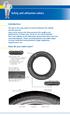 1 Safety and utilisation advice Introduction The tyre is the only point of contact between the vehicle and the ground. Users must ensure that they preserve the quality and performance of their tyres. To
Research Report. Impact of Vehicle Weight Reduction on Fuel Economy for Various Vehicle Architectures
 Impact of Vehicle Weight Reduction on Fuel Economy for Various Vehicle Architectures Research Report Conducted by Ricardo Inc. for The Aluminum Association 2008-04 Impact of Vehicle Weight Reduction on
WHITE PAPER. Winter Driving
 WHITE PAPER Winter Driving WHITE PAPER Introduction According to the National Weather Service, 70% of motor accidents in the U.S. occur from ice related conditions. In Canada, when it comes to winter driving,
rarecorvettes.com, [email protected], (831) 475-4442 Pacific Time Zone
 INTRODUCTION TO WHEEL ALIGNMENT A SHORT COURSE ON WHEEL ALIGNMENT, FRONT AND REAR PREPARED FOR THE N.C.R.S. NATIONAL CONVENTION JUNE 29 TO JULY 5, 2012 by: JOE CALCAGNO, RARE CORVETTES rarecorvettes.com,
RV TIRE MAINTENANCE AND INFLATION TIPS
 RV TIRE MAINTENANCE AND INFLATION TIPS PROTECTING YOUR INVESTMENT ON THE ROAD Maintaining proper air pressure in RV tires is the best way to enhance tread life and overall performance. Improper tire inflation
Fleet Services Full-size Cargo Van Training
 Fleet Services Full-size argo Van Training Module Overview ll Fleet Services customers must first complete Fleet Services asic river Training, review Program Policy Manual for rivers, and Fleet Services
Code of Conduct for Commercial Drivers
 Code of Conduct for Commercial Drivers RoadDriver 2011 Safe Use of Vehicles Watch your Speed Drive within the speed limit at all times. You should drive at speeds that are safe for the conditions, recognising
NEW CAR SAFETY INNOVATIONS ANCAP RATINGS. Michael Paine - ANCAP Technical Manager
 NEW CAR SAFETY INNOVATIONS ANCAP RATINGS Michael Paine - ANCAP Technical Manager Outline Background on crash testing by ANCAP Improvements in vehicle occupant protection Technologies to avoid serious crashes
the Ministry of Transport is attributed as the source of the material
 Disclaimer All reasonable endeavours are made to ensure the accuracy of the information in this report. However, the information is provided without warranties of any kind including accuracy, completeness,
What You Should Know About 15-Passenger Vans
 What You Should Know About s Why should I read this guide? This document provides licensing, registration, and other safety information for owners and operators of 15-passenger vans in the Northwest Territories.
DMV. OREGON TRAFFIC ACCIDENT AND INSURANCE REPORT Tear this sheet off your report, read and carefully follow the directions.
 OREGON TRAFFIC ACCIDENT AND INSURANCE REPORT Tear this sheet off your report, read and carefully follow the directions. ONLY drivers involved in an accident resulting in any of the following MUST file
Does the Federal government require them? No, the Federal government does not require manufacturers to install EDRs.
 EDR Q&As THE BASICS What is an EDR? What is its purpose? An Event Data Recorder (EDR) is a function or device installed in a motor vehicle to record technical vehicle and occupant information for a brief
Protect your people and profits through driver safety
 SPIREON FLEET & ASSET INTELLIGENCE Protect your people and profits through driver safety Accidents happen. This is especially true for companies operating fleets and employing mobile workforces. In 2013,
Head on collisions between passenger cars and heavy goods vehicles: Injury risk functions and benefits of Autonomous Emergency Braking.
 Head on collisions between passenger cars and heavy goods vehicles: Injury risk functions and benefits of Autonomous Emergency Braking. Johan Strandroth, Matteo Rizzi, Anders Kullgren, Claes Tingvall Abstract
SECTION 2B WHEEL ALIGNMENT TABLE OF CONTENTS
 SECTION 2B WHEEL ALIGNMENT TABLE OF CONTENTS Description and Operation... 2B2 Four Wheel Alignment... 2B2 Toein... 2B2 Caster... 2B2 Camber... 2B2 Diagnostic Information and Procedures... 2B3 Tire Diagnosis...
3. Bead OVERHEATING FROM EXCESSIVE BRAKING... 82 CHAFER DAMAGE... 83 HEAT BURST... 84
 Index for each Part of Tires 1. Tread NORMAL TREAD WEAR.................................................... 57 UNEVEN TREAD WEAR (SHOULDER)........................................ 58 UNEVEN TREAD WEAR
Put the Brakes on Speeding
 Put the Brakes on Speeding The risks of driving too fast The costs and consequences Tips to maintain a safe speed Speed kills There s no doubt about it driving over the speed limit is dangerous. It puts