
Taxable Income on Group Term Life Insurance Plans
|
|
|
- Willa Shields
- 10 years ago
- Views:
Transcription
1 Many employers include Group Term Life Insurance as part of their employee benefit package. The Internal Revenue Code provides regulations to be followed in computing taxable income for employees and dependents covered under a Group Term Life Insurance Plan. This Compliance Bulletin discusses: Internal Revenue Code (IRC) Section 79 and its accompanying Treasury Regulations, in general Nondiscriminatory Plans: What are they and what are the steps to calculate imputed income for employees and retirees with group term life benefits exceeding $50,000. Discriminatory Plans: What are the procedures to determine whether a group term life plan is discriminatory and what are the steps to calculate imputed income for employees or retirees in a discriminatory plan? The application of group term taxation rules to Retired employees, Employee-paid and Dependent life insurance plans, FICA and FUTA taxes, and IRC Section 125 Cafeteria Plans. IRC Section 79 and its accompanying Treasury Regulations, In General Internal Revenue Code Section 79 and its accompanying Treasury Regulations establish standards of eligibility and benefits for group term life insurance plans. The value of employer-provided group term life insurance up to $50,000 is tax exempt under IRC Section 79(a). The value of amounts exceeding $50,000 is taxable to the employee or retiree. For the purposes of the exclusion, employee is defined as a person who performs services in the legal relationship of employer and employee. Therefore, a partner or a sole proprietor would not be eligible for the $50,000 exclusion. A retiree is a former employee who has satisfied the retirement provisions of the plan. The taxable cost of the coverage is determined from Table I in the regulations, Section (d)(2). Any employee contributions made on an after-tax basis are subtracted from the cost of the coverage over $50,000. When is Group-Term Life Carried Directly or Indirectly by the Employer? An important step in determining if a benefit is group-term life insurance under Section 79 is whether it is carried directly or indirectly by the employer. Group-term life insurance is carried directly or indirectly by an employer if (1) the employer pays any part of the cost of the insurance directly, or (2) the employer arranges for payment of the cost of the insurance by the employees, and at least one employee pays under the cost as determined by Table I and one pays over the Table I cost. Note: If employees pay with after-tax dollars and all the rates are either above or below the Table I rates, the insurance is not carried directly or indirectly by the employer and there is no imputed income. This applies only for the payment of a separate policy where there is no cross-subsidization with employer provided group-term life insurance. Nondiscriminatory Plans A Nondiscriminatory Plan provides each employee an amount of Group Term Life coverage which is either a constant multiple of salary or the same flat amount. Additionally, a Nondiscriminatory Plan applies a common eligibility requirement and contribution level to all employees. If the cost of life insurance is paid entirely by the employer, or if the employee contributes to the cost on a pretax basis through a Section 125 Plan, employers are required to report the cost of coverage in excess of $50,000 as other compensation on the employee s Form W-2. Page 1 of 7
2 The steps necessary to calculate the amount to be charged as income to an employee in a Nondiscriminatory Plan follow: 1. Determine the total amount of group term life benefit currently provided. From this total life benefit, subtract the $50,000 exclusion. 2. Multiply the result of Step 1 by the monthly uniform premium amount for the insured s current age at year end. (See Table I) 3. Multiply the result of Step 2 by the number of months for which coverage was in force during the current year. 4. Subtract any amount contributed by the employee on an after-tax basis. Sample Calculation Non Contributory Plan The employer pays the entire premium. Assumptions: Employee age 55 with $125,000 coverage Spouse age 42 with $55,000 coverage Employee: Total insurance amount $125,000 Less $50,000 exemption* - 50,000 $ 75,000 Annual cost of employee insurance/table I [$.43 x 75 (# of thousands) x 12 (months)] = $ Dependent: Annual cost of dependent insurance/table I [$.10 x 55 (# of thousands) x 12 (months)] = Total amount included in employee s gross income (and subject to FICA tax - if employee s income is less than $106,800 for Social Security; unlimited for Medicare) $ * Key employees lose the $50,000 exemption under discriminatory plans. Discriminatory Plans The discussion of discriminatory plans centers on answers to three questions: 1.What is a key employee? 2. What is a discriminatory plan? 3. How is the value computed for key employees in a discriminatory plan? Page 2 of 7

3 1. What is a key employee? IRC Sections 79(d)(6) and 416(i) define a key employee as any employee who, at any time during the plan year, is one of the following: a. An officer having an annual compensation in excess of 165,000 in No more than 50 employees (or, if less, the greater of three employees or 10% of employees) shall be treated as officers; b. A more than 5% owner of the employer; or c. A more than 1% owner of the employer having an annual compensation of more than $150,000 (determined without considering those employers who are not counted in testing for discriminatory eligibility). Note: The term key employee also includes any former employee who was a key employer when he/she retired or separated from services (IRC Section 79(d)(6). If the employer is part of a controlled group of corporations (IRC Section 414(b)), businesses under common control (IRC Section 414(c)), or an affiliated service group (IRC Section 414(m)), its employees are aggregated with employees of the other organizations in the group for purposes of the discrimination review. 2. What is a discriminatory plan? The second step is to determine whether the plan satisfies the eligibility and benefit requirements of IRC Section 79. Nondiscriminatory Eligibility Requirements A plan will satisfy the eligibility requirements established under IRC Section 79(d)(3)(A) if the plan meets any one of the following: a. The plan benefits 70% or more of all employees of the employer. b. The plan benefits a group of employees of which at least 85% are not key employees. c. The plan benefits employees who qualify under a classification set up by the employer and found by the Secretary of the Treasury not to discriminate in favor of key employees. d. The plan is part of, and meets the requirements of, a cafeteria plan as determined by IRC Section 125. The following groups of employees may be excluded for purposes of the eligibility review: a. Employees with less than three years of service. b. Part-time or seasonal employees. c. Employees covered under a collective bargaining agreement. d. Nonresident aliens who receive no U.S. source of income. Nondiscriminatory Eligibility Example An employer with 100 employees covers 40 employees under the plan. Of the 40 employees covered, 8 are key employees. The plan fails the eligibility test because it does not benefit 70% of all employees, nor are 85% of the plan participants non-key employees. Page 3 of 7
4 Nondiscriminatory Benefit Requirements If the plan provides a fixed amount of insurance which is the same for all covered employees, the plan will automatically satisfy IRC Section 79 nondiscriminatory benefit requirements. In all other situations, except one, the plan will satisfy the benefit requirements only if benefits available to participating key employees are also available to all other participating employees. The one exception is for plans which offer a uniform percentage of earnings benefit to both key and non-key employees. Plans will not be considered discriminatory merely because the amount of life insurance provided to employees bears a uniform relationship to compensation (e.g., all employees are provided an amount of life insurance equal to 100% of their earnings). Guidelines for the nondiscriminatory benefit requirements are outlined in Question & Answer 9 of Treasury regulation, T. These are reviewed below: a. Once key employees are identified, separate plan participants into one or more groups consisting of at least one key employee and all other participants (including other key employees) who receive an amount of insurance (as a multiple compensation) equal to or greater than the amount of insurance received by such key employees. b. Each of these groups will then be tested separately under the requirements of IRC Section 79(d)(3)(A) as described previously, with respect to the eligibility requirements. c. If any of the groups fail to satisfy the requirements, as outlined in Step b above, the plan does not satisfy the nondiscriminatory benefit requirements. Nondiscriminatory Benefit Example Example 1: An employer s plan has 500 participants. Of the participants, 400 are non-key employees who receive an amount of insurance equal to one times compensation. Also participating are 90 non-key employees and 10 key employees who receive an amount of insurance equal to two times compensation. The plan satisfies the benefits test because the group of participants receiving an amount of insurance equal to or greater than two times compensation (the only group that must be separately tested in this example) satisfies the requirement that at least 85% of the employees in the two times group are non-key employees. Example 2: Using the same fact situation as above, except that one of the key employees receives an amount of insurance equal to three times compensation, the plan fails the benefits test because, when tested separately, the group consisting of the single key employee receiving three times compensation cannot satisfy the nondiscriminatory eligibility requirements of IRC Section 79(d)(3)(A). 3. How is the actual cost computed for key employees in discriminatory plans? Key employees in discriminatory group term life insurance plans must, under IRC Section 79(d)(1)(B), include in gross income the greater of actual cost or Table I cost for such coverage. The $50,000 exclusion does not apply. However, this amount may be offset by the employee s after-tax contribution, if any. The discriminatory status of the plan does not affect the employer s tax deduction. Even if the plan is discriminatory, the employer will not lose its tax deduction under IRC Section 162(a). Actual cost does not mean the typical blended rate charged by the insurance company; it means the age-rated term costs (i.e., tabular premiums) as actuarially calculated to the insurer. The formula is described in Question & Answer #6 of Treasury Regulation T. This Section is not shown here due to the length of the 1960 Basic Group Rate Tables. Page 4 of 7
5 The steps necessary to calculate the amount to be charged as income to a key employee in a discriminatory plan are: 1. Calculate the Actual Cost according to Question & Answer #6 of Treasury Regulations Section T. 2. Compare the actual cost calculated in Step 1 to the Table I cost for the key employee. The key employee must then include as taxable gross income the value of the coverages as determined by the greater of actual cost or Table I. 3. Multiply the result of Step 2 by the number of months the key employee s coverage was in force during the year. Sample Calculation Contributory/Discriminatory Plan The employer pays a portion of the premium and the Key employee pays a portion with after-tax contributions. Assumptions: Key employee age 60 with $200,000 coverage (Of the total monthly insured rate, the employee pays $.15 on an after-tax basis). Actual cost is $1.05/$1,000. Dependents are not covered. Key Employee: Actual Cost $2,520 [$1.05 x 200 (# of thousands) x 12 (months)] Table I Cost [$0.66 x 200 (# of thousands) x 12 (months)] 1,584 Greater of Actual or Table I Cost $2,520 Less: Cost of Key employee insurance attributable to employee s after-tax contribution [$.15 x 200 (# of thousands) x 12] -360 Total amount included in employee s gross income and subject to FICA tax (if employee s income is less than $106,800) $2,160 Other Issues: Retirees, Employee-paid Basic Life Insurance, Dependent Life Insurance, FICA and Cafeteria Plans Retiree Coverage Retirees receiving group term life insurance must be taxed on the value of coverage in the same manner as are active employees. Retirees also receive the $50,000 exclusion unless the plan is discriminatory. In determining if a plan is discriminatory, retiree coverage should be tested separately from active employee coverage. For purposes of the discrimination requirements, a retiree is considered a key employee if he was a key employee at the time of his retirement. Page 5 of 7
6 An exception to the taxable income rules applies to those who satisfy any one of the following: Retirees who retired prior to January 1, Retirees who had attained age 55 on or before January 1, 1984, if the retiree plan is currently discriminatory. Retirees who attained age 55 on or before January 1, 1984, even if the plan is discriminatory, if they actually retired prior to January 1, Employee-Paid Basic, Supplemental or Optional Life Insurance IRC Section 79 states that there will be no tax implications for employees who pay the entire cost of the group term life insurance if there is no direct or indirect subsidy of the cost of the insurance by the employer. No subsidy exists if the cost of the insurance, for all employees, is either above or equal to Table I rates, or below or equal to Table I rates. If the cost of insurance for some employees is above Table I rates and below Table I rates for other employees, a subsidy exists. If a subsidy exists, an employee whose cost exceeds Table I cost will have no imputed income, while an employee whose cost is less than Table I cost will have imputed income. Dependent Life Dependent group term life insurance is considered by the IRS to be a nontaxable benefit if the insurance amount does not exceed $2,000 per dependent. If the benefit is greater than $2,000, the employees must include as income the cost of the entire employer-provided coverage. The rules outlined in this Bulletin relative to employee group term life insurance also apply to the calculation of taxable amounts for dependent life coverage. To calculate imputed income, Table I rates are used based on the dependent s age in the same manner used for employee group term life coverage. The entire employer-provided amount is taxable if the benefit amount exceeds $2,000. Unlike the first $50,000 of employee coverage, the first $2,000 of dependent coverage is not an exclusion. As with employee-only coverage, however, the after-tax contributions by the employee toward the cost of dependent coverage can be used to offset the taxable amounts computed under these rules. If, after deducting the employee s after-tax contribution, the excess amount is equal to or less than Table I cost for a face amount of $2,000 of insurance, then the benefit will be treated as nontaxable. The IRS has stated that there will be no imputed income only if the employee pays the entire Table I cost of employer-provided dependent life coverage for each dependent. Therefore, it will still be necessary for employers with noncontributory flat rate plans to make calculations of imputed income for employees with multiple dependents. Federal Insurance Contributions Act (FICA) Taxes In addition to the income tax assessed on amounts of group term life insurance in excess of $50,000, it also requires that FICA (Social Security and Medicare Hospital Insurance) taxes be applied to amounts of group term life in excess of $50,000. Page 6 of 7

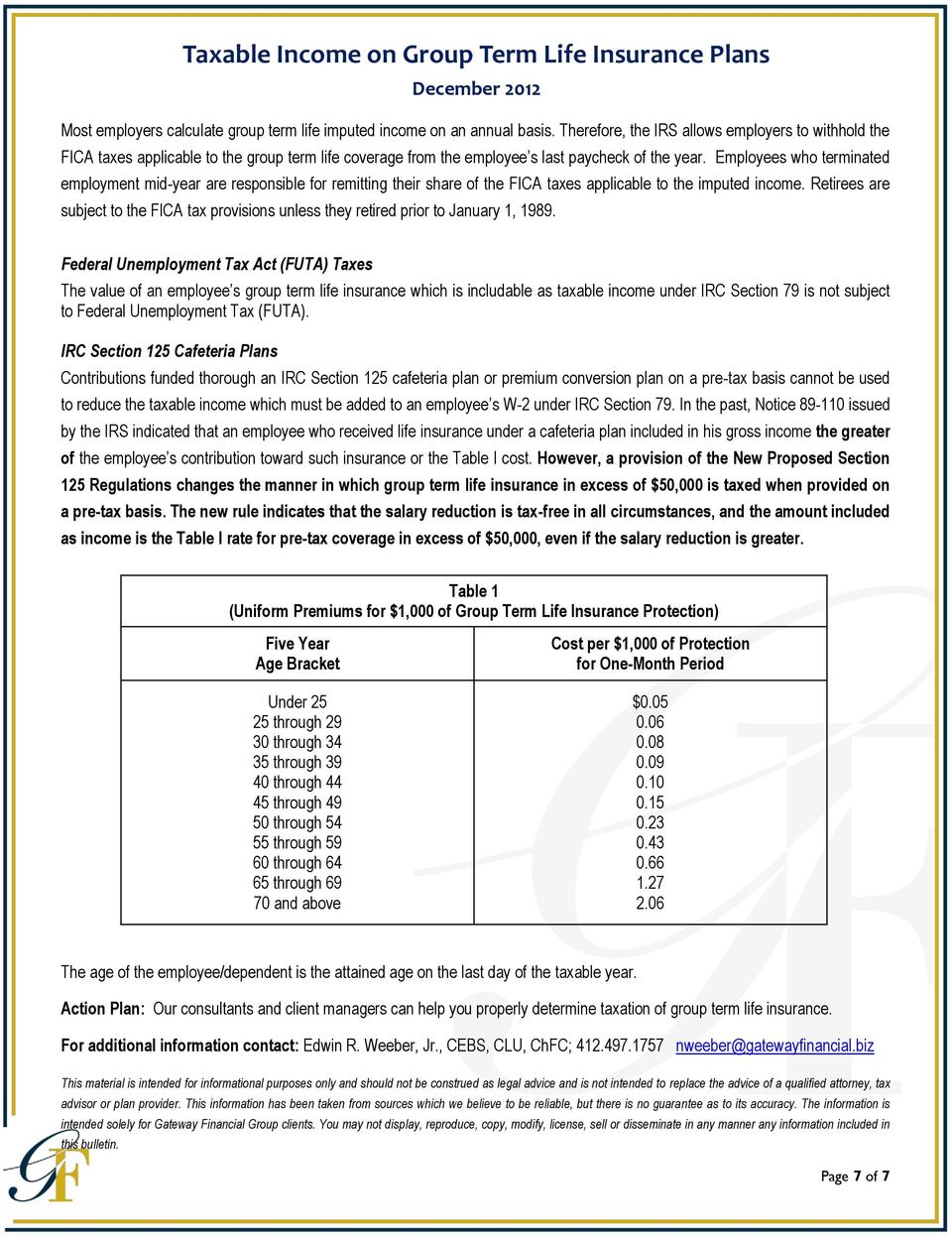
7 Most employers calculate group term life imputed income on an annual basis. Therefore, the IRS allows employers to withhold the FICA taxes applicable to the group term life coverage from the employee s last paycheck of the year. Employees who terminated employment mid-year are responsible for remitting their share of the FICA taxes applicable to the imputed income. Retirees are subject to the FICA tax provisions unless they retired prior to January 1, Federal Unemployment Tax Act (FUTA) Taxes The value of an employee s group term life insurance which is includable as taxable income under IRC Section 79 is not subject to Federal Unemployment Tax (FUTA). IRC Section 125 Cafeteria Plans Contributions funded thorough an IRC Section 125 cafeteria plan or premium conversion plan on a pre-tax basis cannot be used to reduce the taxable income which must be added to an employee s W-2 under IRC Section 79. In the past, Notice issued by the IRS indicated that an employee who received life insurance under a cafeteria plan included in his gross income the greater of the employee s contribution toward such insurance or the Table I cost. However, a provision of the New Proposed Section 125 Regulations changes the manner in which group term life insurance in excess of $50,000 is taxed when provided on a pre-tax basis. The new rule indicates that the salary reduction is tax-free in all circumstances, and the amount included as income is the Table I rate for pre-tax coverage in excess of $50,000, even if the salary reduction is greater. Table 1 (Uniform Premiums for $1,000 of Group Term Life Insurance Protection) Five Year Age Bracket Under through through through through through through through through through and above Cost per $1,000 of Protection for One-Month Period $ The age of the employee/dependent is the attained age on the last day of the taxable year. Action Plan: Our consultants and client managers can help you properly determine taxation of group term life insurance. For additional information contact: Edwin R. Weeber, Jr., CEBS, CLU, ChFC; [email protected] This material is intended for informational purposes only and should not be construed as legal advice and is not intended to replace the advice of a qualified attorney, tax advisor or plan provider. This information has been taken from sources which we believe to be reliable, but there is no guarantee as to its accuracy. The information is intended solely for Gateway Financial Group clients. You may not display, reproduce, copy, modify, license, sell or disseminate in any manner any information included in this bulletin. Page 7 of 7
Section 79 Permanent Benefit Plans. Producer Guide. Your future. Made easier. LIFE INSURANCE
 Section 79 Permanent Benefit Plans Producer Guide These materials are not intended to and cannot be used to avoid tax penalties and they were prepared to support the promotion or marketing of the matters
Group Term Life Insurance and Imputed Income: Do You Have It Right?
 Group Term Life Insurance and Imputed Income: Do You Have It Right? Many, if not most, employers make group term life insurance available to their employees on their own lives and, often, on the lives
Internal Revenue Code Section 79 Imputed Income and the Straddle Rule
 Internal Revenue Code Section 79 Imputed Income and the Straddle Rule InsurancePoint.com Phone: 801-478-1700 Fax: 801-478-1710 181 East 5600 South, Suite 240 Salt Lake City, UT 84107 Table of Contents
Overview. Calculating The Cost Of Group Term Life Insurance UNIFORM PREMIUM TABLE ( TABLE 1 )
 Technical Bulletin for Employers Internal Revenue Code: Section 79 Tax Consequences of Group Term Life Insurance November 2005 Overview As an employer, you can provide up to $50,000 of group-term life
Taxable Income on Group Life Insurance in Excess of $50,000
 December 8, 2005 on Group Life Insurance in Excess of $50,000 Section 79 of the Internal Revenue Service Code provides that, generally, the cost of the first $50,000 of Group Term Life Insurance is not
Nondiscrimination Tests for Cafeteria Plans
 Brought to you by Sullivan Benefits Nondiscrimination Tests for Cafeteria Plans A Section 125 plan, or a cafeteria plan, allows employers to provide their employees with a choice between cash and certain
Section 79 Employee Benefit Plans
 Course Objective This course was created to teach advisors (CPAs, EAs, accountants, attorneys, financial planners, and insurance advisors) about a very unique type of employee benefit plan which is covered
http://www.iwpubs.com/articlemanagement/articlemanagementarticlepreview.asp?isarc...
 Page 1 of 6 7 Things To Know About Employer-Provided Health Insurance October, 2013 Benefits Pro No one agrees on the exact numbers, but it s a safe bet to say that over the next few years millions of
FICA WITHHOLDING & TAXATION OF DISABILITY BENEFITS. Information for Policyholders
 FICA WITHHOLDING & TAXATION OF DISABILITY BENEFITS Information for Policyholders Step One As claim payments are made: Calculates and withholds the EMPLOYEE S portion of FICA liability based on information
Flexible Benefits Employer Guide
 Flexible Benefits Employer Guide Save thousands on FICA contributions every year! A Flexible Benefits Plan through Discovery Benefits will: - Increase employee retention and satisfaction - Save matching
Discovery Benefits Non-Discrimination Testing Guide
 Discovery Benefits Non-Discrimination Testing Guide 1 Discovery Benefits Non-Discrimination Testing Guide Table of Contents When to Perform Testing...3 Controlled and Affiliated Service Groups...3 Cafeteria
SUMMARY OF GUIDE CONTENTS... 1 HIGHLIGHTS OF TAX-ADVANTAGED PLANS... 2 EMPLOYEE SALARY REDUCTION PLANS... 5
 This Guide is for informational and educational purposes only. It does not constitute legal advice or a comprehensive guide to issues to be considered by employers in establishing tax-advantaged benefits
NONDISCRIMINATION TESTING GUIDE
 NONDISCRIMINATION TESTING GUIDE NONDISCRIMINATION TESTING GUIDE Table of Contents When to Perform Testing... 3 Controlled and Affiliated Service Groups... 3 Cafeteria Plan.... 3 Cafeteria Plan Eligibility
Health Savings Accounts
 Health Savings Accounts I. What Are HSAs and Who Can Have Them? What is an HSA? An HSA is a tax-exempt trust or custodial account established exclusively for the purpose of paying qualified medical expenses
Section 79 Permanent Life Insurance
 Section 79 Permanent Life Insurance Your business success depends on the expertise of a few key employees How can you provide life insurance as a benefit to business owners and their employees in a tax
Non-Qualifi ed Fringe Benefi t Planning
 Employee benefi t packages are increasingly viewed as an important form of compensation. The right mix of salary and other benefits can attract, and keep, top-quality employees. Non-Qualifi ed Fringe Benefi
Cafeteria Plans, Employee Fringe Benefits And COBRA
 chapter 14 Cafeteria Plans, Employee Fringe Benefits And COBRA chapter 14 Cafeteria Plans, Employee Fringe Benefits And COBRA Table of Contents I. IRC 125 CAFETERIA PLANS... 14.1 A. Introduction.... 14.1
Tax Treatment of Health Care Benefits Provided With Respect to Children Under Age 27
 Part III Administrative, Procedural, and Miscellaneous Section 105 - Amounts Received Under Accident and Health Plans (Also Sections 106-Contributions by Employers to Accident and Health Plans, 162(l)-
Four Areas Employers Must Review
 Four Areas Employers Must Review Page 1 Imputed Income Issues for Employers The Issue Executive Summary: This Whitepaper produced by Crawford Advisors, LLC provides information about four imputed income
Business Owner s Bonus Plan. Producer Guide. For agent/registered representative use only. Not for public distribution.
 Business Owner s Bonus Plan Producer Guide For agent/registered representative use only. Not for public distribution. Business Owner s Bonus Plan Producer Guide The Business Owner s Bonus Plan is a personally
Small Employer Health Care Tax Credit: Questions & Answers (Q&A)
 Brought to you by Seubert & Associates Small Employer Health Care Tax Credit: Questions & Answers (Q&A) The Patient Protection and Affordable Care Act (ACA) provides a tax credit to certain small employers
Medical Spending Accounts and the Loss of Tax Benefits
 Flexible Spending Accounts POLICY GUIDE Flexible spending accounts are arrangements that allow employees to pay for qualified health care or dependent care expenses on a pre-tax basis. Employers may offer
INTERNAL REVENUE SERVICE NATIONAL OFFICE TECHNICAL ADVICE MEMORANDUM
 INTERNAL REVENUE SERVICE NATIONAL OFFICE TECHNICAL ADVICE MEMORANDUM Number: 200502040 Release Date: 01/14/2005 Index (UIL) No.: 61.53-00, 79.03-00, 83.05-00 CASE-MIS No.: TAM-144621-03 -------------------------------------
Health FSA-HRA-HSA Comparison Chart
 Revised December 2014 Health FSA-HRA-HSA Comparison Chart Health Flexible Spending Internal Revenue Code source Section 125 (cafeteria plans) applies to an arrangement where employees have a choice among
Health Reimbursement Arrangements (HRA) As a Tax Free Employee Benefit
 CHILDCARE SOLUTIONS 2101 Richmond Road Beachwood, Ohio 44122 216-831-7333 [email protected] Health Reimbursement Arrangements (HRA) As a Tax Free Employee Benefit Internal Revenue Service Department
Understanding your Forms W-2 and 1042-S
 Understanding your Forms W-2 and 1042-S Each year, employees will receive a Form W-2 that provides details of prior year earnings, taxes withheld and other miscellaneous data (such as cost of employer
SIMPLIFIED EMPLOYEE PLAN
 SIMPLIFIED EMPLOYEE PLAN SIMPLIFIED EMPLOYEE PENSION PLAN AGREEMENT ARTICLE I Adoption and Purpose of Plan 1.01 Adoption of Plan: By completing and signing the Adoption Agreement, the Employer adopts the
INTRODUCTION TO CAFETERIA PLANS
 INTRODUCTION TO CAFETERIA PLANS Internal Revenue Service Office of Chief Counsel Cafeteria Plans Plan Requirements Employee Deferred compensation Qualified Benefits Cash Requirement Salary Reduction Election
PROTOTYPE SIMPLIFIED EMPLOYEE PROTOTYPE PLAN
 PROTOTYPE SIMPLIFIED EMPLOYEE PROTOTYPE PLAN PROTOTYPE SIMPLIFIED EMPLOYEE PENSION PLAN AGREEMENT ARTICLE I Adoption and Purpose of Plan 1.01 Adoption of Plan: By completing and signing the Adoption Agreement,
Small Business Health Care Tax Credit: Presented by Maureen O Gara-Adford, CPA & David Fox, Senior Accountant
 Small Business Health Care Tax Credit: Presented by Maureen O Gara-Adford, CPA & David Fox, Senior Accountant Today s Speakers Maureen O Gara-Adford, CPA Practicing CPA since 1989 Managing partner since
Internal Revenue Service
 Internal Revenue Service Number: 201350032 Release Date: 12/13/2013 Index Numbers: 61.53-00, 79.00-00 ----------------------- --------------------------- ---------------- Department of the Treasury Washington,
GALLAGHER, FLYNN & COMPANY, LLP Tax Alert Issue #39 ~ December 3, 2014. Fringe Benefit Reporting
 GALLAGHER, FLYNN & COMPANY, LLP Tax Alert Issue #39 ~ December 3, 2014 Fringe Benefit Reporting As the year draws to a close, we want to remind you about including taxable fringe benefits in all applicable
SIMPLE IRA. Savings Incentive Match Plan for Employees
 SIMPLE IRA Savings Incentive Match Plan for Employees Introducing the SIMPLE IRA Plan A comfortable retirement is an important financial goal for many American workers. Some financial professionals estimate
Guide to Taxation of Employee Disability Benefits
 Guide to Taxation of Employee Disability Benefits STANDARD INSURANCE COMPANY Guide to Taxation of Employee Disability Benefits Standard Insurance Company (The Standard) developed this guide to help you
Cafeteria ( 125) Plans and Cash-in-Lieu Of
 SLIDE 1 If you would like to be added to our distribution list for notifications of future presentation, please send an email to [email protected] with your request to be added. Page 1 of 27 SLIDE
ZaneHRA Frequently Asked Questions
 ZaneHRA Frequently Asked Questions As you evaluate whether using ZaneHRA makes sense for your company, you will likely have questions about how ZaneHRA works. This document addresses common questions employers
Health Law Update: Health Savings Account Provisions in the Medicare Prescription Drug Improvement and Modernization Act of 2003
 Health Law Update: Health Savings Account Provisions in the Medicare Prescription Drug Improvement and Modernization Act of 2003 This Update summarizes the provisions of the Medicare Prescription Drug,
The 2012-2013 Payroll Benefits Tax Guide is a publication by the Entrepreneurial Services Group of RubinBrown. For more information please contact:
 Dear RubinBrown Client: With the arrival of the New Year, there are changes in payroll and benefit tax requirements. Included in the 2012-2013 Payroll & Benefits Tax Guide is information regarding 2012
Health Savings Accounts
 HSAs Health Savings Accounts 2014 and 2015 Limits Questions & Answers What is a Health Savings Account (HSA)? An HSA is a tax-exempt trust or custodial account established for the purpose of paying medical
Health savings accounts (HSAs) are individual accounts. HSA Programs for Groups: Employer Versus Employee Responsibilities.
 Health Care HSA Programs for Groups: Employer Versus Employee Responsibilities Employers implementing a health savings account (HSA) program face a shared compliance burden with their employees. The law
Life Insurance in Qualified Plans. Producer Guide. For agent use only. Not for public distribution.
 Life Insurance in Qualified Plans Producer Guide For agent use only. Not for public distribution. Life Insurance In Qualified Plans While qualified plans are a tremendous retirement savings vehicle, they
Health Reimbursement Arrangement Frequently Asked Questions
 Health Reimbursement Arrangement Frequently Asked Questions What is a Health Reimbursement Arrangement (HRA)? The HRA is an employer-funded health care reimbursement account. The employee incurs eligible
The single source for all your executive benefit needs. A Primer on. Nonqualified Deferred
 M Benefit Solutions The single source for all your executive benefit needs A Primer on Nonqualified Deferred Compensation Plans DISCLOSURE INFORMATION This material is intended for informational purposes
Trust Arrangements Purporting to Provide Nondiscriminatory Post- Retirement Medical and Life Insurance Benefits
 Part III -- Administrative, Procedural, and Miscellaneous Trust Arrangements Purporting to Provide Nondiscriminatory Post- Retirement Medical and Life Insurance Benefits Notice 2007-84 Sections 419 and
SEP and SEP PLUS SIMPLIFIED EMPLOYEE PENSION PROGRAMS
 SEP and SEP PLUS SIMPLIFIED EMPLOYEE PENSION PROGRAMS PLAN DOCUMENTS, DISCLOSURE STATEMENTS AND EMPLOYER S ADOPTION AGREEMENTS CONTENTS SEP PROGRAM SEP PLUS PROGRAM is for use on or after January 1, 2002
A Lesson in Qualified Retirement Plans
 A Lesson in Qualified Retirement Plans Since salary alone is often not enough to attract and retain valued employees, how can your business use a qualified retirement plan to enhance its employee benefits
FAQs: Health Savings Accounts (HSA)
 FAQs: Health Savings Accounts (HSA) Thank you for choosing NTA Life Business Servicess Group, Inc. to be your HSA provider. We want to make it easy for you to manage and maintain your Health Savings Account,
Health Reform in a Nutshell: What Small Businesses Need to Know Now.
 Health Reform in a Nutshell: What Small Businesses Need to Know Now. With the passage of the most significant reform of America s modern-day health care system, many small business owners and human resources
The nondiscrimination tests can be complicated but boil down to three basic themes:
 SECTION 125 CAFETERIA PLANS NONDISCRIMINATION TESTING GUIDE AND FAQs 2016 Why Do We Have To Test Our Section 125 Plan? Because Code Section 125 cafeteria plans (and the component benefits within the 125
YEAR END PAYROLL NEWSLETTER
 December 2015 YEAR END PAYROLL NEWSLETTER Year-end is once again rapidly approaching and the time to properly account for all taxable and non-taxable income which may affect your payroll is here. Fortunately
Benefits Handbook Date July 1, 2009. Basic Life Insurance Plan MMC
 Date July 1, 2009 MMC This is a Company-paid group-term life insurance plan that helps you provide for your family s financial security. The Plan pays money to someone you name as your BENEFICIARY if you
SARSEP Salary Reduction Simplified Employee Pension
 Internal Revenue Service Tax Exempt and Government Entities Employee Plans SARSEP Salary Reduction Simplified Employee Pension for Small Businesses Table of Contents What is a SARSEP?...1 Choosing a SARSEP....1
Sample. Table of Contents. Introduction... 1. What are Roth deferrals and how do they differ from regular deferrals (pre-tax) to a 401(k) plan?...
 Table of Contents Introduction... 1 What are Roth deferrals and how do they differ from regular deferrals (pre-tax) to a 401(k) plan?... 2 Is it better for a plan participant to make Roth deferrals or
Health Savings Account HSA Summary
 Health Savings Account HSA Summary Effective January 1, 2016 TABLE OF CONTENTS INTRODUCTION... 3 WHO IS ELIGIBLE... 3 IRS REQUIREMENTS... 3 WHEN IS ELIGIBILITY DETERMINED?... 3 DO MY SPOUSE & I ESTABLISH
409A non-qualified. Executive Privilege. deferred compensation plans. A turnkey retirement planning supplement for select employees
 Executive Privilege 409A non-qualified deferred compensation plans A turnkey retirement planning supplement for select employees Products and financial services provided by American United Life Insurance
AMERIFLEX. www.flex125.com. Your Key to Savings. Explore and understand the tax-saving advantages offered in your Premium Only Plan (POP)!
 www.flex125.com P O P I M P L E M E N T A T I O N G U I D E Your Key to Savings Explore and understand the tax-saving advantages offered in your Premium Only Plan (POP)! 2 POP IM PLE MENTAT ION GUIDE Table
Tuition Remission -- A Tax Free Fringe Benefit Debra P. Wilson, Legal Counsel NAIS
 Tuition Remission -- A Tax Free Fringe Benefit Debra P. Wilson, Legal Counsel NAIS Schools are looking high and low for ways to hire and retain potential teachers. Fringe benefits have long been used to
Salary Reduction Simplified Employee Pension (SAR-SEP) Plan Employer Adoption Agreement For Use with the Traditional IRA Application
 december 2011 Salary Reduction Simplified Employee Pension (SAR-SEP) Plan Employer Adoption Agreement For Use with the Traditional IRA Application Employer s Guide to the SAR-SEP Plan Salary Reduction
Transamerica Financial Life Insurance Company. Facts for Agents and Producers 2014 Edition
 Transamerica Life Insurance Company Transamerica Financial Life Insurance Company Frequently Asked Tax uestions for Long Term Care Insurance Facts for Agents and Producers 2014 Edition ICC13 TLC3 A TG
Educational Series. Supplemental Executive Retirement Plan (SERP)
 Supplemental Executive Retirement Plan (SERP) Supplemental Executive Retirement Plans (SERP) Guide What is a Supplemental Executive Retirement Plan (SERP)? A supplemental executive retirement plan is a
2015 Relief for Reimbursing Employees for Health Insurance Information is current as of May 29, 2015
 1 Q: I understand there is an exception for one employee/participant. If I'm the employee, can a 105 be used to reimburse for my spouse or dependents as well? A: Yes. Pursuant to 105, a plan can reimburse
Health Care Reform Act: Who s Paying the Bill?
 Health Care Reform Act: Who s Paying the Bill? Walter Miller Schwabe, Williamson & Wyatt P.C. 800 Willamette Street, Suite 600 Eugene, OR 97401 (541) 686-3299 [email protected] TABLE OF CONTENTS Page
Post-Employment Medical Benefits for Executives After Health Care Reform
 EXECUTIVE COMPENSATION & EMPLOYEE BENEFITS CLIENT PUBLICATION December 2010... Post-Employment Medical Benefits for Executives After Health Care Reform... How the discrimination rules under 105(h)(2) of
DRAKE UNIVERSITY SECTION 125 PRE-TAX SALARY REDUCTION PREMIUM PAYMENT PLAN
 SUMMARY PLAN DESCRIPTION under the DRAKE UNIVERSITY SECTION 125 PRE-TAX SALARY REDUCTION PREMIUM PAYMENT PLAN Dated August 2012 TABLE OF CONTENTS Q-1. What is the purpose of the Plan?.... Page 1 Q-2. What
Benefits Handbook Date January 1, 2016. Basic Life Insurance Plan Marsh & McLennan Companies
 Date January 1, 2016 Marsh & McLennan Companies This is a Company-paid group-term life insurance plan that helps you provide for your family s financial security. The Plan pays money to someone you name
summary plan description
 summary plan description University of California Tax Savings on Insurance Premiums (TIP) february 2007 Plan Summary of TIP What Is TIP? The Tax Savings on Insurance Premiums (TIP) program, established
DELUXE CORPORATION 401(k) AND PROFIT SHARING PLAN SUMMARY PLAN DESCRIPTION
 DELUXE CORPORATION 401(k) AND PROFIT SHARING PLAN SUMMARY PLAN DESCRIPTION October 1, 2015 151027:0918 INFORMATION IN THIS SUMMARY INTRODUCTION... 1 WHY CONTRIBUTE TO THE PLAN?... 2 ELIGIBILITY... 2 Eligibility
W-2 Reporting to include Imputed Income Reporting
 W-2 Reporting to include Imputed Income Reporting 2 3 Patrick C. Haynes, Jr. Today s presenter As counsel for Crawford Advisors Employee Benefits and Executive Compensation Group, Mr. Haynes advises employers
The Fundamentals of Health Savings Accounts 2013
 The Fundamentals of Health Savings Accounts 2013 (revised) VSCPA Benefit Advisors P.O. Box 6505 Glen Allen, Virginia 23058-6505 Tel: 877-998-7272 Fax: 800-317-7337 www.digitalbenefitadvisors.com/vscpa
Health Care Reform New Restrictions on Tax-Favored Health Coverage for HRAs, FSAs, Premium Payment or Reimbursement Plans, and Cafeteria Plans
 Caring For Those Who Serve 1901 Chestnut Avenue Glenview, Illinois 60025-1604 1-800-851-2201 www.gbophb.org November 21, 2013 [updated July 29, 2015] Health Care Reform New Restrictions on Tax-Favored
FAQs about Employees and Employee Benefits. Pamela Perun
 FAQs about Employees and Employee Benefits Pamela Perun TABLE OF CONTENTS 1. Introduction........................................................... 4 2. Employee Benefits Basics................................................
Payroll 101: An Introduction to Payroll and Taxes for Household Employers Redlig Financial Services LLC
 In order to understand the role we play in handling and managing the payroll process for you, it is helpful to understand what s involved with payroll to begin with, from withholdings to remittances. As
Savings Incentive Match Plan for Employees (SIMPLE) For Use with a Non-DFI IRS Model Form 5304-SIMPLE
 Savings Incentive Match Plan for Employees (SIMPLE) For Use with a Non-DFI IRS Model Form 5304-SIMPLE Form 5304-SIMPLE (Rev. August 2005) Department of the Treasury Internal Revenue Service Savings Incentive
Health Reimbursement Arrangements
 Health Reimbursement Arrangements Health Reimbursement Arrangements (HRAs) are plans designed to help employers and employees lower health care costs. Allowed under sections 105 and 106 of the Internal
Important Information Morgan Stanley SIMPLE IRA Summary
 SIMPLE IRA Summary September 2013 Important Information Morgan Stanley SIMPLE IRA Summary The following is intended to provide you with basic information on the roles and services that Morgan Stanley Smith
ROBERT MORRIS UNIVERSITY SECTION 125 FLEXIBLE BENEFITS PLAN SUMMARY PLAN DESCRIPTION TABLE OF CONTENTS
 ROBERT MORRIS UNIVERSITY SECTION 125 FLEXIBLE BENEFITS PLAN SUMMARY PLAN DESCRIPTION TABLE OF CONTENTS Page Introduction...1 Q-1. What is the purpose of the Plan? 1 Q-2. What benefits are provided by the
How To Convert An Ira To A Roth Ira
 Roth Conversion Frequently Asked Questions Brian Dobbis QPA, QKA, QPFC Retirement Analyst, Private Wealth Group 888-522-2388 A Roth individual retirement account (IRA) is a tax-deferred and potentially
Choosing the Right Entity for Maximum Tax Benefits for Your Construction Company
 Choosing the Right Entity for Maximum Tax Benefits for Your Construction Company Timely re-evaluation of choice of entity will enhance the shareholder value of your contractor client By Theran J. Welsh