
IMPROVING URBAN PUBLIC SCHOOLS: SUGGESTIONS FOR TEACHER UNION LEADERS
|
|
|
- Theresa Dorsey
- 10 years ago
- Views:
Transcription
1 Panel Discussion IMPROVING URBAN PUBLIC SCHOOLS: SUGGESTIONS FOR TEACHER UNION LEADERS RichardJ. Murnane* For three related reasons, I focus my comments on the challenge of improving the quality of education that urban public schools provide. First, the quantity and quality of education American children receive today has a much larger impact on their earnings prospects than was the case for American children 40 years ago. Second, minority children and children from low-income families have both lower cognitive skills and lower educational attainments than do white children and children from middle-class families. Third, 42 percent of individuals living in poverty in the United States live in central cities, and 40 percent of minority children attend school in one of the nation s largest 50 school districts. In an earlier session of this conference, one participant asked the panelists what advice they would give to an audience of union leaders representing teachers from urban public schools. In response to that question, I offer seven suggestions. Following my explanations of those suggestions, I conclude with slightly different versions that I believe serve as relevant advice to local and state educational policymakers. Suggestion One: Improve Student Outcomes or See the End of Public Schools as We Have Known Them Since the passage of the first charter school legislation in Minnesota in 1991, the number of charter schools in the United States has increased to 2,400, enrolling more than 500,000 students. In June 2002, the U.S. Supreme Court ruled that allocating public funds to pay for educational * Thompson Professor of Education, Graduate School of Education, Harvard University. The author thanks Simone Sangster for first-rate research assistance.
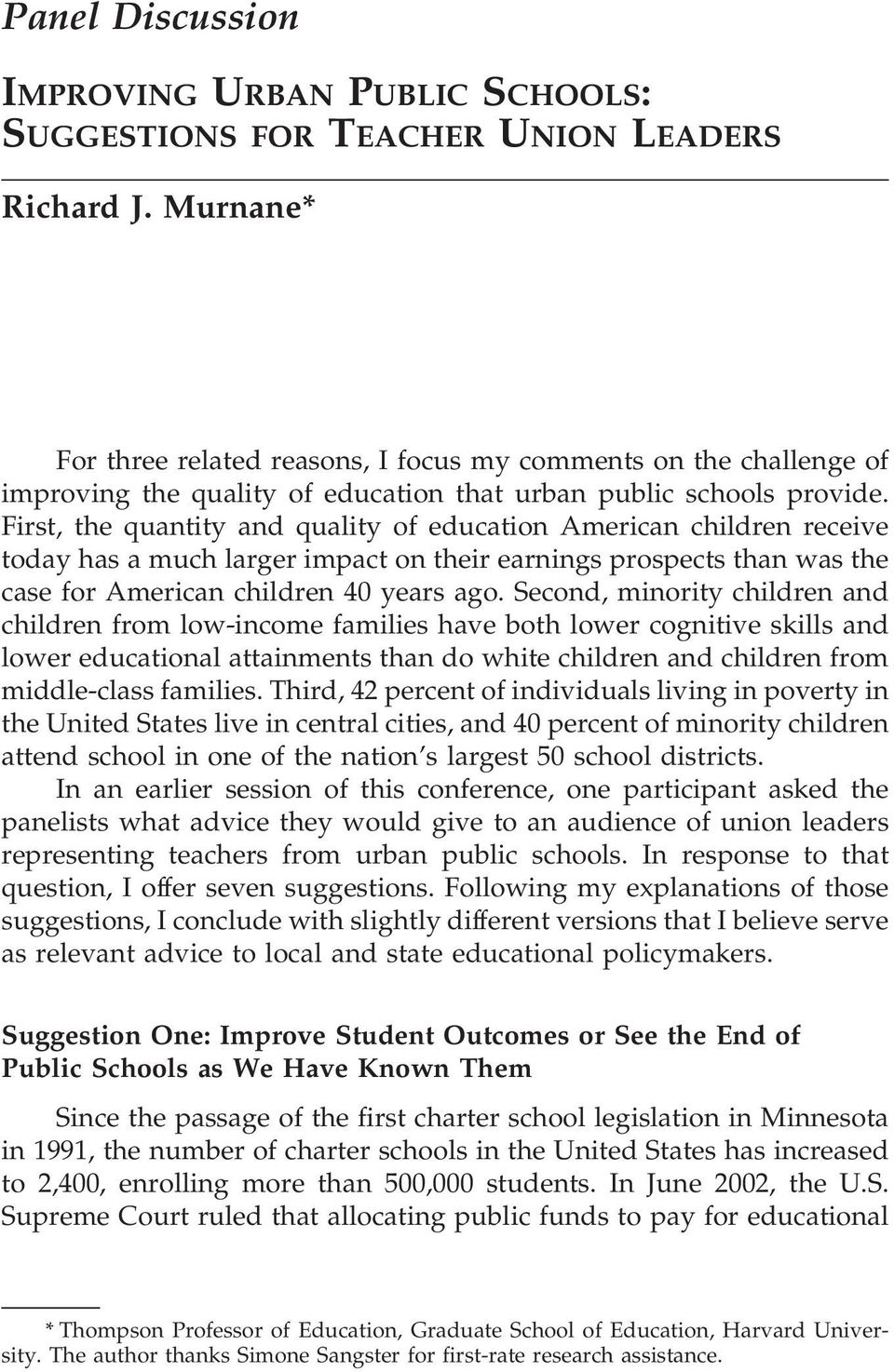
2 298 Richard J. Murnane vouchers that low-income students in Cleveland use to pay for education in Catholic schools does not violate the U.S. Constitution. These are just two indications of changes in the political climate of the country in regard to publicly funded education. Unless urban public schools become more effective in educating children, the number of charter schools and voucher programs will increase, drawing students, money, and political power away from conventional public schools, and ending the promise of public schools as we have known it. As representatives of the people who do the teaching in American public schools, teacher unions need to be involved in the design and implementation of improvement strategies. This is a necessary condition for the improvement of urban schools. At the same time, even the Herculean efforts of teachers cannot by themselves improve urban schools. Teachers must have the resources to do their jobs within an organizational structure that supports and demands excellence. Suggestion Two: Insist on Meaningful Measures of Student Outcomes Changes in the American economy over the last 30 years have dramatically altered the type of work Americans do and the skills they need to earn a decent living. As illustrated in Figure 1, there has been a

3 IMPROVING URBAN PUBLIC SCHOOLS 299 dramatic decline in the proportion of the workforce engaged in routine cognitive tasks (for example, filing, bookkeeping) and an increase in the proportions engaged in activities that MIT economists David Autor and Frank Levy and I call expert thinking and complex communications. These changes are relevant to the design of the tests used to measure the skills of American students. If tests measure solely reading comprehension and the ability to do computations, these are the skills that will be emphasized in instruction. They are not the skills Americans need to earn a good living. Good teachers know this. A consequence is that the nation s ability to attract and retain effective teachers will require, among other things, that the tests used to measure student outcomes are worth teaching to. The following writing prompt was part of the Massachusetts Comprehensive Assessment System (MCAS) exam, which was administered to 10th graders in April 2002 (the test high school students in the state must pass in order to receive a high school diploma): In literature as in life, people struggle with principles or beliefs they hold. From a work of literature you have read in or out of school, select a character who struggles with his or her own principles or beliefs. In a well-developed composition, identify that character and explain how that character s inner struggle is important to the work of literature. In my view, the state s investment in a rich, open-ended assessment system for measuring student skills is a step in the right direction toward the goal of improving education in the state. Suggestion Three: Demanda Level Playing Fieldwith Charter and Voucher Schools Increasingly, public schools are being judged against the performances of charter schools and voucher-supported private schools in educating students. For this to be a fair competition, the different types of schools should play by the same rules. Critical rules concern obligations to serve students with disabilities, students whose first language is not English, disruptive students, and mobile students. These students are relatively expensive to serve, and schools will volunteer to serve their share of such students only if they receive adequate compensation for doing so. If schools are unwilling to serve these groups of students, this is per se evidence that relative student funding levels are not set appropriately. It is important to keep in mind that there is extraordinary uncertainty about the effectiveness of today s non-public schools, especially in educating urban children. More than 99 percent of the quantitative evidence documenting the relative effectiveness of private schools con-
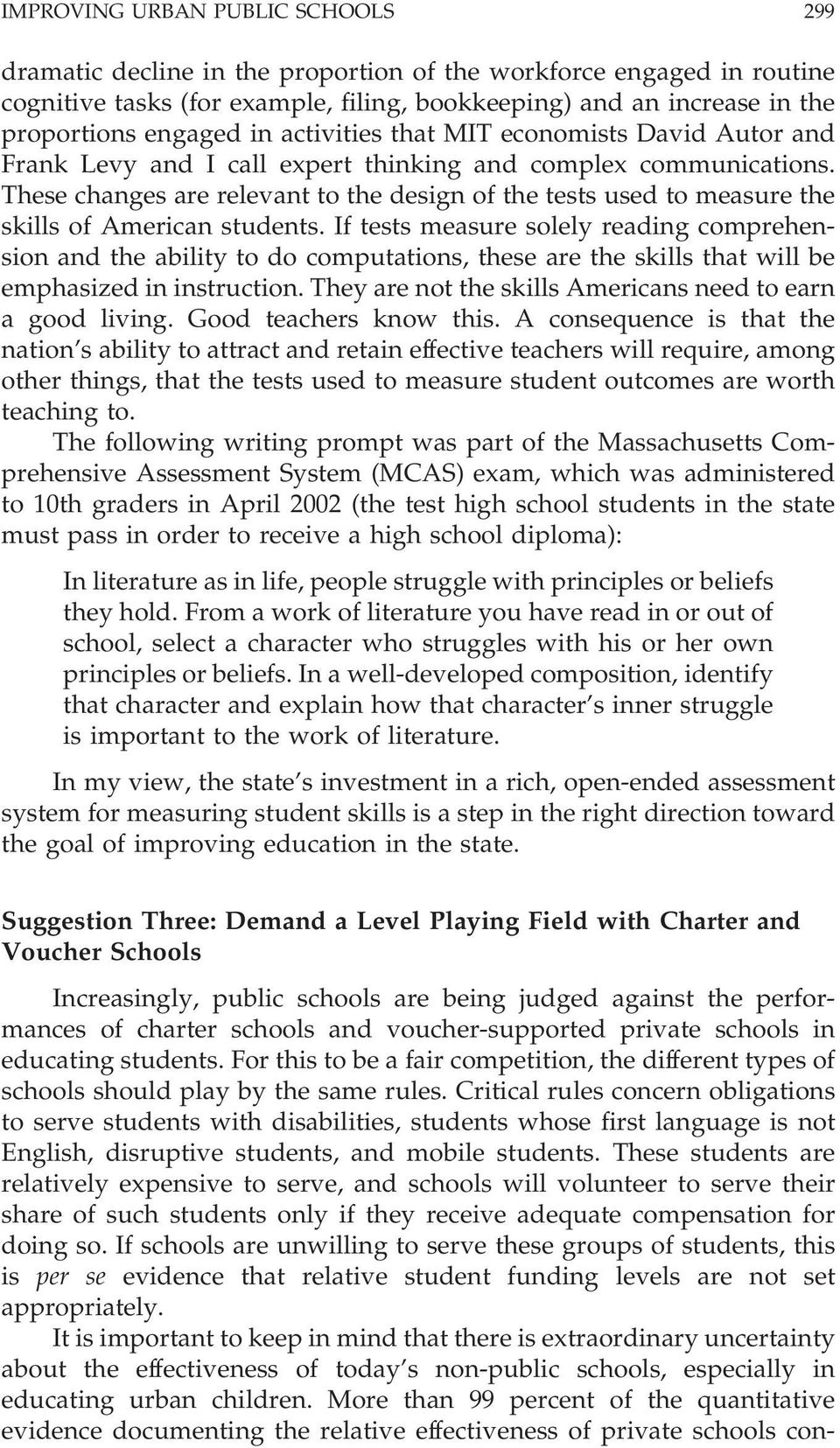
4 300 Richard J. Murnane cerns solely Catholic schools. The reason this matters is that Catholic schools serve a declining proportion of American students attending non-public schools. In 1960, Catholic schools served more than 90 percent of the students in non-public schools. The comparable percentage today is less than 45 percent (see Figure 2). Suggestion Four: Learn from Pilot Schools about How to Obtain Resources andflexibility Following the passage of the 1993 educational reform legislation that authorized the first charter schools in Massachusetts, the Boston Teachers Union (BTU) negotiated the creation of pilot schools in Boston. The teachers in these interesting public schools are BTU members who have agreed to waive certain elements of their contract regarding work rules. Currently Boston has 12 pilot schools. These schools receive lump-sum payments from the school district based on their student enrollments and have considerable flexibility in using their resources to design and carry out instructional programs. While they may use resources to buy services from the school district, they are not obligated to do so. The success of the pilot schools in attracting talented teachers and in developing interesting instructional programs suggests a promising strategy for developing schools staffed by teacher union members that can create innovative programs for educating urban children.

5 IMPROVING URBAN PUBLIC SCHOOLS 301 Suggestion Five: Demandthe Tools andthe Time to Learn from Student Assessments One of the strengths of the MCAS is that all questions that affect student scores are made public shortly after the tests are administered. Moreover, school faculties receive information on the performance of every child on every test score item. This creates the potential to learn a great deal from the assessment results about the skill deficiencies of individual students, about the weaknesses of instruction in particular schools and classrooms, and about how well schools are working in general. In fact, I would argue that the opportunities for learning about how well schools are working are at least as great as the strategies W. Edwards Deming advocated businesses adopt to learn about the effectiveness of their production processes. Unfortunately, relatively few schools learn much from MCAS results. One reason is the delay in providing results to schools; a second is a lack of tools for analyzing the results efficiently; a third is a lack of training on how to do potentially powerful analyses; and a fourth is a lack of time in the school day to learn from the assessment results. If teachers are to be responsible for improving student achievement, their representatives should demand the tools and the time in the work schedule to learn from these potentially valuable assessment results. Suggestion Six: Make Professional Development Work Success in preparing urban students to pass demanding high-stakes exit exams like the MCAS requires changes in how teachers teach. Professional development is the term used among educators for the training aimed at improving how teachers teach and what students learn. Unfortunately, most professional development has little or no impact on how teachers teach. In recent years, our understanding of which components of professional development improve instruction has increased. We now know that effective professional development must focus on teaching particular curriculums, must include opportunities for teachers to increase subject matter mastery, must include teachers observing and commenting on each others teaching, and must be an ongoing part of teachers work. Recent evidence from Texas shows that professional development that includes these components can lead to better instruction and improved student achievement (Holcombe 2002). As documented in a well-designed evaluation and shown in Figure 3, participation in a state-sponsored Algebra Institute led to improved student achievement. A related finding demonstrates that the more teachers in a school participated in the training, the greater the impact on students achieve-
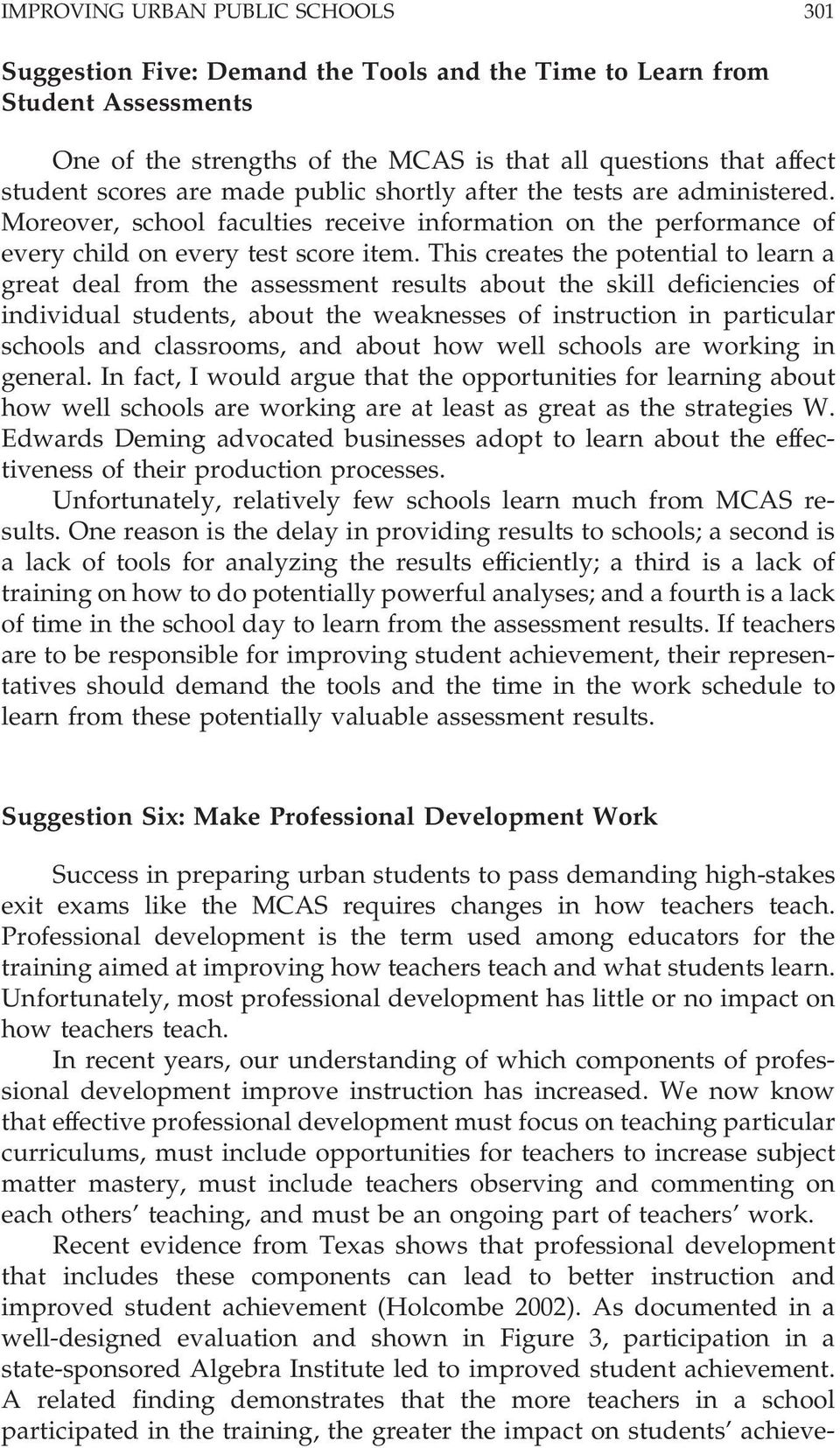
6 302 Richard J. Murnane ment. This evidence is important because it documents that professional development can make a difference to student achievement. Suggestion Seven: Show the Way on Summer Learning Recent evidence documents a pattern that many educators have suspected for a long time namely, that the cognitive skills of lowincome children fall compared to those of middle-class children over the summer months. This suggests that developing rich summer learning opportunities may be a powerful way to increase the cognitive skills of low-income children. It may make sense for teacher unions to lead the way (perhaps in conjunction with local foundations) in designing summer programs and in funding independent evaluations of their effectiveness. Policy Advice for Improving Urban Schools While the above comments are aimed at teacher union leaders, they have direct implications for advice to local and state policymakers. In particular, for these policymakers, the seven points listed above can be recast as follows: 1. Retain a single-minded focus on improving student achievement; build constituencies among business groups and community groups supporting this unwavering focus.
7 IMPROVING URBAN PUBLIC SCHOOLS Invest in developing well-defined content standards and in developing student assessments that are tightly aligned with standards. 3. Create a level playing field on which public schools compete with charter and voucher schools. 4. Provide every school with the resources and flexibility needed to succeed (schools serving difficult-to-educate children need significantly more resources). 5. Provide all schools with tools, training, and time to learn from student assessments. 6. Create conditions that facilitate improvements in instruction; monitor progress in student achievement closely and intervene when progress is not forthcoming. 7. Develop, implement, and evaluate programs to provide summer learning to low-income children. References Autor, David H., Frank Levy, and Richard J. Murnane The Skill Content of Recent Technological Change: An Empirical Exploration. NBER Working Paper No (June). Holcombe, Lee Teacher Professional Development and Student Learning of Algebra: Evidence from Texas. Harvard Graduate School of Education, doctoral thesis (June). U.S. Census Bureau Historical Statistics of the United States: Colonial Times to Part 1. White Plains, NY: Kraus International Publications. U.S. Department of Education, National Center for Education Statistics Condition of Education, Washington, DC Private School Universe Survey, NCES , by S. P. Broughman and L. A. Colaciello. Washington, DC Digest of Education Statistics, NCES , by T. D. Snyder. Washington, DC.
Progress and Promise A report on the Boston Pilot Schools Executive Summary January 2006
 Progress and Promise A report on the Boston Pilot Schools Executive Summary January 2006 Center for Collaborative Education Boston, Massachusetts New research conducted by Boston s Center for Collaborative
JUST THE FACTS. Birmingham, Alabama
 JUST THE FACTS Birmingham, Alabama The Institute for a Competitive Workforce (ICW) is a nonprofit, nonpartisan, 501(c)(3) affiliate of the U.S. Chamber of Commerce. ICW promotes the rigorous educational
TEACH PLUS AGENDA FOR TEACHER PREPARATION REFORM
 TEACH PLUS AGENDA FOR TEACHER PREPARATION REFORM This agenda for teacher preparation reform was developed by a group of current and former Teach Plus Policy Fellows. We are public schools teachers in six
Oklahoma Profile of State High School Exit Exam Policies 2012
 OK PROFILE 1 Oklahoma Profile of State High School Exit Exam Policies 2012 State exit exam policy Beginning with students entering the 9 th grade in the 2008-09 school year, every student will be required
The Mystery of Good Teaching by DAN GOLDHABER
 Page: 1 The Mystery of Good Teaching by DAN GOLDHABER Who should be recruited to fill the two to three million K 12 teaching positions projected to come open during the next decade? What kinds of knowledge
 Testimony of Danielle Ewen Director, Child Care and Early Education Center for Law and Social Policy Washington, DC Before the Committee on Appropriations Subcommittee on Labor, Health and Human Services,
college & CAREER READY DIPLOMA AUTHORIZED
 Education Reform in Washington State: Step-By-Step Education reform in Washington state has taken significant steps forward the past two decades. Starting with the landmark education reform act of 1993
TEACHERS HELP KIDS LEARN.
 TEACHERS HELP KIDS LEARN. BUT TEACHERS ALSO NEED HELP TO DO A GOOD JOB. THIS IS THE STORY OF A TEACHER WHO TRIES HARD BUT DOESN T GET THE HELP SHE NEEDS, AND HOW THAT HURTS HER KIDS. TEACHER QUALITY: WHAT
JUST THE FACTS. Phoenix, Arizona
 JUST THE FACTS Phoenix, Arizona The Institute for a Competitive Workforce (ICW) is a nonprofit, nonpartisan, 501(c)(3) affiliate of the U.S. Chamber of Commerce. ICW promotes the rigorous educational standards
October 2008 Research Brief: What does it take to prepare students academically for college?
 October 2008 Research Brief: What does it take to prepare students academically for college? The research is clear on the connection between high school coursework and success in college. The more academically
Planning Guide for Minnesota Students Entering Postsecondary Education Programs
 Planning Guide for Minnesota Students Entering Postsecondary Education Programs This pamphlet contains information for you and your family on postsecondary education. Postsecondary education includes many
College and Career Readiness in New York State 1
 College and Career Readiness in New York State 1 New York's Regents Reform Agenda is grounded in the belief that all students should graduate from high school ready for success in postsecondary education
THE EDUCATIONAL PROGRESS OF BLACK STUDENTS
 NATIONAL CENTER FOR EDUCATION STATISTICS Findings from THE CONDITION OF EDUCATION 1994 NO. 2 THE EDUCATIONAL PROGRESS OF BLACK STUDENTS U.S. Department of Education Office of Educational Research and Improvement
Testimony before the Basic Education Funding Commission October 21, 2014
 Testimony before the Basic Education Funding Commission October 21, 2014 Good morning. My name is Patrick Dowd and I am the executive director of Allies for Children, a nonpartisan, child advocacy nonprofit
Louisiana Profile of State High School Exit Exam Policies 2012
 LA PROFILE 1 Louisiana Profile of State High School Exit Exam Policies 2012 State exit exam policy Type of test Students must pass English language arts and mathematics and either science or social studies
Frequently Asked Questions (FAQ): Nonpublic Schools, Including Homeschools Unaccredited by a Minnesota-Recognized Accrediting Agency
 Frequently Asked Questions (FAQ): Nonpublic Schools, Including Homeschools Unaccredited by a Minnesota-Recognized Accrediting Agency Revised July 2013 Decision to Homeschool 1. What might parents/guardians
Louisiana Special Education Guidance
 Louisiana Special Education Guidance This document outlines how special education policies impact students with disabilities and serves as a reference guide for LEA administrators and high school staff
MEIGS COUNTY S 2003 ESL / OCR COMPLIANCE REPORT. Descriptive Report on Services to English Language Learners (ELL)
 MEIGS COUNTY S 2003 ESL / OCR COMPLIANCE REPORT Descriptive Report on Services to English Language Learners (ELL) Student Identification Student Language Assessment ESL Program Participation Student Placement
How To Understand The Facts Of Education In The United States
 Myths and Realities in Public Education All too often, public schools have been defined by a few narrow measures, cherrypicked data that neither puts public schools in the most positive light nor provides
h i hi g h e r ed in s i g h t
 h i hi g h e r ed in s i g h t Making a College Degree Convenient, Accessible and Low-Cost Stakeholder Perspectives on Adult College Completion Efforts In order to reach the various goals for postsecondary
feature fill the two to three million K 12 teaching recruits have? These are the questions confronting policymakers as a generation
 feature The evidence shows that good teachers make a clear difference in student achievement. The problem is that we don t really know what makes A GOOD TEACHER WHO SHOULD BE RECRUITED TO traditional,
TEST-DRIVEN accountability is now the
 Ten Big Effects of the No Child Left Behind Act on Public Schools The Center on Education Policy has been carefully monitoring the implementation of NCLB for four years. Now Mr. Jennings and Ms. Rentner
Oh, that explains it. Michigan Merit Curriculum High School Graduation Requirements
 Oh, that explains it Michigan Merit Curriculum High School Graduation Requirements Updated September 2007 Introduction On April 20, 2006, Governor Jennifer M. Granholm signed into law one of the most comprehensive
THE EDUCATIONAL PROGRESS OF WOMEN
 NATIONAL CENTER FOR EDUCATION STATISTICS Findings from THE CONDITION OF EDUCATION 1995 NO. 5 THE EDUCATIONAL PROGRESS OF WOMEN U.S. Department of Education Office of Educational Research and Improvement
Community College Student Success. Developmental Education Placement Annotated Bibliography
 The Completion Arch: Measuring Community College Student Success Developmental Education Placement Annotated Bibliography Adelman, C. (2005). Moving into town and moving on: The community college in the
The Virginia Reading Assessment: A Case Study in Review
 The Virginia Reading Assessment: A Case Study in Review Thomas A. Elliott When you attend a conference organized around the theme of alignment, you begin to realize how complex this seemingly simple concept
Characteristics of Public and Private Elementary and Secondary School Teachers in the United States:
 NCES 2013-314 U.S. DEPARTMENT OF EDUCATION Characteristics of Public and Private Elementary and Secondary School Teachers in the United States: Results From the 2011 12 Schools and Staffing Survey First
OVERVIEW OF CURRENT SCHOOL ADMINISTRATORS
 Chapter Three OVERVIEW OF CURRENT SCHOOL ADMINISTRATORS The first step in understanding the careers of school administrators is to describe the numbers and characteristics of those currently filling these
HAMPTON UNIVERSITY ONLINE College of Education and Continuing Studies PhD in Educational Management
 Program Overview The accelerated program provides candidates with an opportunity to develop the critical leadership skills and knowledge that are required in today s increasingly complex, diverse, and
Implementing RTI Using Title I, Title III, and CEIS Funds
 Implementing RTI Using Title I, Title III, and CEIS Funds Key Issues for Decision-makers U.S. Department of Education 1 As Response to Intervention, or RTI expands across the country, the question we at
2015 Legislative Positions Adopted by the Delegate Assembly In Savannah, Georgia, on June 13, 2014
 2015 Legislative Positions Adopted by the Delegate Assembly In Savannah, Georgia, on June 13, 2014 GSBA represents the collective resolve of our members, the 180 elected boards of education. These legislative
Enabling & Supportive Legislation
 Enabling & Supportive Legislation Guidance for Early College High Schools Page 1 Origins of Early College High School...3 Enabling Legislation...6 Commissioner s Rules...6 Supportive Legislation...7 ECHS
Frequently Asked Questions (FAQ): Homeschooling in Minnesota
 Frequently Asked Questions (FAQ): Homeschooling in Minnesota Decision to Homeschool 1. What might parents/guardians want to think about when considering whether homeschooling is the best option for their
CLAIRE DONOHUE CURRICULUM VITAE
 CLAIRE DONOHUE CURRICULUM VITAE Practitioner in Residence Director, Domestic Violence Clinic The Washington College of Law at American University [email protected] EDUCATION THE GEORGE WASHINGTON
The National Board on Educational Testing and Public Policy. The Gap between Testing and Technology in Schools
 The National Board on Educational Testing and Public Policy statements Volume 1 Number 2 January 2000 The Gap between Testing and Technology in Schools Michael Russell and Walter Haney The National Board
Assessments in Alabama
 Parents Guide to NEW Assessments in Alabama In November 2010, Alabama adopted the Common Core State Standards (CCSS) along with selected Alabama standards. The combined standards are known as the College-
Transform Remediation: The Co-Requisite Course Model
 Transform Remediation: The Co-Requisite Course Model For far too many students, postsecondary remedial education is a dead end. About 40 percent of all students entering postsecondary education in recent
UNITED STATES DEPARTMENT OF EDUCATION OFFICE OF INSPECTOR GENERAL BACKGROUND
 UNITED STATES DEPARTMENT OF EDUCATION OFFICE OF INSPECTOR GENERAL July 23, 2013 AUDIT SERVICES Control Number ED-OIG/A09L0001 James W. Runcie Chief Operating Officer Federal Student Aid U.S. Department
June 2003. Suggested Citation
 U.S. Department of Education Rod Paige Secretary Institute of Education Sciences Grover J. Whitehurst Director National Center for Education Statistics Val Plisko Associate Commissioner The National Center
NExT Common Metrics TTS Last updated January 27, 2014
 2014 Transition to Teaching Survey Which communication method most prompted you to complete this survey today? (Select one only.) Email message(s) from Hezel Associates Mailed letter from Hezel Associates
SUCCESSFUL SCHOOL RESTRUCTURING
 SUCCESSFUL SCHOOL RESTRUCTURING A Report to the Public and Educators by the Center on Organization and Restructuring of Schools Fred M. Newmann and Gary G. Wehlage Distributed jointly by the American Federation
Role and Special Education in. A Principal s
 1 Role and Special Massachusetts Education in A Principal s Goal of This Presentation To provide information regarding general and special education laws and regulations to assist you in integrating the
Pennsylvania s Statewide System of School Support
 Pennsylvania s Statewide System of School Support The Pennsylvania Department of Education s (PDE) mission is to lead and serve the educational community to enable each individual to grow into an inspired,
Competency-Based Learning: Definitions, Policies, and Implementation
 Competency-Based Learning: Definitions, Policies, and Implementation Aubrey Scheopner Torres, Education Development Center Jessica Brett, Education Development Center Joshua Cox, Education Development
Tulsa Public Schools Teacher Observation and Evaluation System: Its Research Base and Validation Studies
 Tulsa Public Schools Teacher Observation and Evaluation System: Its Research Base and Validation Studies Summary The Tulsa teacher evaluation model was developed with teachers, for teachers. It is based
A Guide to Curriculum Development: Purposes, Practices, Procedures
 A Guide to Curriculum Development: Purposes, Practices, Procedures The purpose of this guide is to provide some general instructions to school districts as staff begin to develop or revise their curriculum
Introduction and Executive Summary. Alex Molnar. Arizona State University
 Introduction and Executive Summary Alex Molnar Arizona State University Education Policy Research Unit (EPRU) Education Policy Studies Laboratory College of Education Division of Educational Leadership
Jennifer Durham, Ph.D.
 Jennifer Durham, Ph.D. 2318 North Quantico Street Arlington, VA 22205 703.869.2140 [email protected] EDUCATION Ph.D. Education 2010 George Mason University Fairfax, Virginia Major: Special Education, Minor:
74% 68% 47% 54% 33% Staying on Target. ACT Research and Policy. The Importance of Monitoring Student Progress toward College and Career Readiness
 Staying on Target ACT Research and Policy The Importance of Monitoring Student Progress toward Research Brief 74% Percentage of ACT-tested 11 high school graduates took a core curriculum in high school
Portfolio Strategy Job Descriptions:
 Portfolio Strategy Job Descriptions: Chief Executive Officer Chief Portfolio Officer Chief Transition Officer Chief Academic Officer Chief Communications Officer Chief Financial Officer Chief of Data and
Research over the past twenty
 Human Capital Management: A New Approach for Districts David Sigler and Marla Ucelli Kashyap Developing human capital strengthening the talent level of the teaching workforce will require districts to
JUST THE FACTS. Memphis, Tennessee
 JUST THE FACTS Memphis, Tennessee The Institute for a Competitive Workforce (ICW) is a nonprofit, nonpartisan, 501(c)(3) affiliate of the U.S. Chamber of Commerce. ICW promotes the rigorous educational
Pathways in Technology Early College High School (P-TECH) STEM Pathways to College & Careers
 Pathways in Technology Early College High School (P-TECH) STEM Pathways to College & Careers United States and China CTE Meeting Washington, DC August 8-9, 2012 The context for our work: Why P-TECH matters
QUESTIONS AND ANSWERS MassCore Updated October 16, 2015
 GENERAL QUESTIONS 1. What is? is a recommended, rigorous course of study based on standards in Massachusetts s curriculum frameworks that aligns high school coursework with college and career expectations.
Getting prepared: A. 2010 report. on recent high school. graduates who took. developmental/remedial. courses
 Getting prepared: A 2010 report on recent high school graduates who took developmental/remedial courses Minnesota State Colleges & Universities University of Minnesota State-Level Summary and High School
Besides funding basic and special education, government has provided
 MINNESOTA OFFICE OF THE LEGISLATIVE AUDITOR Remedial Education SUMMARY Besides funding basic and special education, government has provided revenue to help students whose academic achievement is below
GRADUATE DEGREE REGULATIONS
 Graduate Regulations-Spring 2014 1 GRADUATE DEGREE REGULATIONS DEPARTMENT OF PSYCHOLOGY UNIVERSITY OF FLORIDA GRADUATE DEGREE REGULATIONS 1 I. GENERAL INFORMATION 2 A. Graduate Advisor/Supervisory Committee.
Assessments in Florida
 Parents Guide to new Assessments in Florida In 2010, Florida adopted the new world-class Common Core State Standards (CCSS), which Florida customized to meet the state s needs and which now inform the
Ready. Eligible. for College. The Four Dimensions Readiness includes four major components: development of key cognitive strategies, mastery of key
 David T. Conley & Eligible Ready for College M any students who are eligible for college are not ready for college. Readiness is much more complex and multidimensional than eligibility. Students become
California State University, Stanislaus Doctor of Education (Ed.D.), Educational Leadership Assessment Plan
 California State University, Stanislaus Doctor of Education (Ed.D.), Educational Leadership Assessment Plan (excerpt of the WASC Substantive Change Proposal submitted to WASC August 25, 2007) A. Annual
CCSS-Aligned Assessments
 Parents Guide to New Assessments IN New Jersey In June 2010, New Jersey adopted the Common Core State Standards (CCSS). The CCSS provide a consistent, clear understanding of what students are expected
Developing the STEM Education Pipeline
 Developing the STEM Education Pipeline Developing the STEM Education Pipeline For almost 50 years, ACT has played a pivotal role in promoting student access into and success in science, technology, engineering,
Master of Arts in Teaching/Science Education Master of Arts in Teaching/Mathematics Education
 Master of Arts in Teaching/Science Education Master of Arts in Teaching/Mathematics Education Assessment F12-S13 FOR ACADEMIC YEAR: 2012-2013 PROGRAM: MAT/Science and Mathematics Education SCHOOL: NS&M
Effective Schools. assessment report ... David J. Kirk Terry L. Jones
 assessment report........ David J. Kirk Terry L. Jones July 2004 Introduction Why do some public schools that educate students from disadvantaged backgrounds make a difference while others fail? A group
ANNUAL REPORT ON CURRICULUM, INSTRUCTION AND STUDENT ACHIEVEMENT
 The mission of the Greenbush-Middle River School is to provide a quality education which will prepare all students to meet success by developing self-directed thinkers and communicators who are responsible,
Community Unit School District 303 s EIGHT STEPS College Readiness A Parent s Resource
 Community Unit School District 303 s EIGHT STEPS to College Readiness A Parent s Resource Do you want your child to graduate from college? D303 s EIGHT STEPS to A Parent s Resource The Eight Steps to
Evaluating the Impact of Remedial Education in Florida Community Colleges: A Quasi-Experimental Regression Discontinuity Design
 NATIONAL CENTER FOR POSTSECONDARY RESEARCH NCPR BRIEF BRIEF AUGUST 2009 Evaluating the Impact of Remedial Education in Florida Community Colleges: A Quasi-Experimental Regression Discontinuity Design Juan
EDUCATIONAL SPECIALIST (Ed.S.) Superintendent Curriculum Leadership Online www.hsu.edu
 EDUCATIONAL SPECIALIST (Ed.S.) Superintendent Curriculum Leadership Online www.hsu.edu To ensure that graduate candidates preparing for senior level educational administration positions or superintendency