
Personal Management Merit Badge Worksheet Requirements Were Completely Revised 01/01/98
|
|
|
- Angel Carson
- 10 years ago
- Views:
Transcription
1 Personal Management Merit Badge Worksheet Requirements Were Completely Revised 01/01/98 1. Do the following: a) Lead a discussion with your family to identify one family financial goal that must be saved for out of family income. Choose a goal that has strong personal interest for both you and your family (a family trip or vacation, a new VCR, or a family car, for instance). b) Discuss the goal in detail (where to go on vacation, for example, or what kind of car to buy), the cost of the goal, and when you want to reach the goal. c) Discuss how your family could accumulate funds to reach this goal, how the goal will affect the rest of the family budget, and how you could help your family achieve the goal

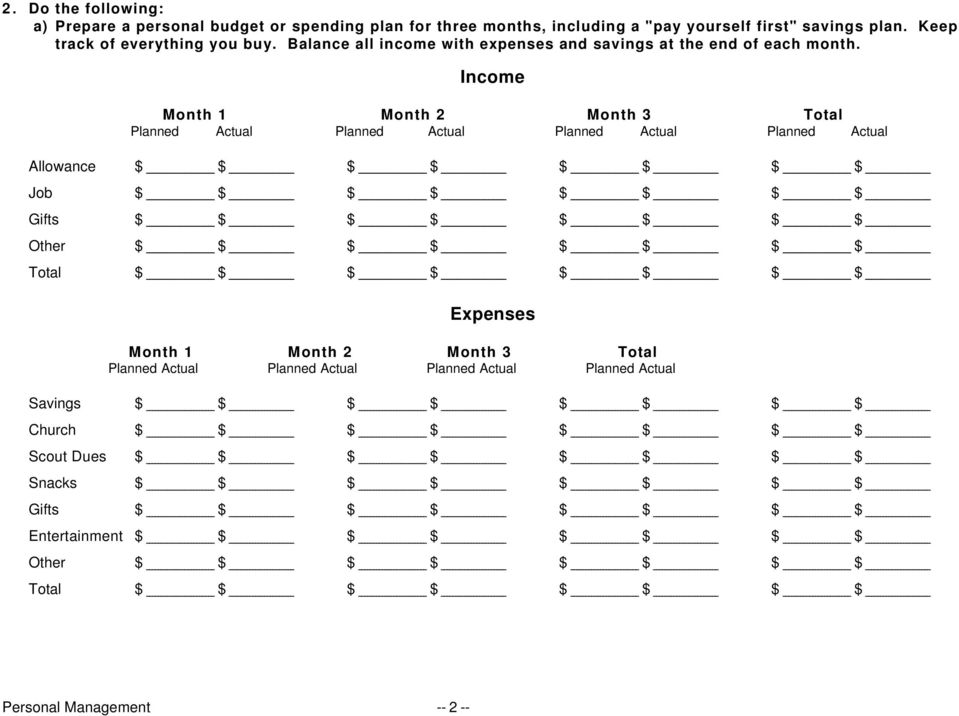
2 2. Do the following: a) Prepare a personal budget or spending plan for three months, including a "pay yourself first" savings plan. Keep track of everything you buy. Balance all income with expenses and savings at the end of each month. Income Month 1 Month 2 Month 3 Total Planned Actual Planned Actual Planned Actual Planned Actual Allowance $ $ $ $ $ $ $ $ Job $ $ $ $ $ $ $ $ Gifts $ $ $ $ $ $ $ $ Other $ $ $ $ $ $ $ $ Total $ $ $ $ $ $ $ $ Expenses Month 1 Month 2 Month 3 Total Planned Actual Planned Actual Planned Actual Planned Actual Savings $ $ $ $ $ $ $ $ Church $ $ $ $ $ $ $ $ Scout Dues $ $ $ $ $ $ $ $ Snacks $ $ $ $ $ $ $ $ Gifts $ $ $ $ $ $ $ $ Entertainment $ $ $ $ $ $ $ $ Other $ $ $ $ $ $ $ $ Total $ $ $ $ $ $ $ $ Personal Management
3 b) Share your three month budget with your merit badge counselor. Explain how you determined discretionary income (income not spent to meet fixed expenses), how much you saved, and what you spent money on. Did you spend more or less than you budgeted? 3. Do ONE of the following: a) Identify a personal financial goal and make a plan to achieve that goal. 1) Write down the goal you want to achieve. (This may be a small, short term goal such as buying clothes, or it may be a major, long-term goal such as saving for college.) 2) Develop a financial plan to accomplish the goal. Determine how much the goal will cost, how much time you have to reach the goal, how you will earn money to pay for the goal, and what adjustments you could make if you cannot reach the goal in the desired time with the income you can earn. Cost: $ How I will earn the money: Time to Reach Goal: Adjustments: 3) Discuss your plan with your counselor. OR: b) Determine a spending/savings plan for living on your own. 1) Choose a realistic job based on your age, skills, education, and experience (working at a fast-food restaurant, movie theater, or college library, for example). Determine how much you would probably make per hour and how many hours you would work each week. Determine your spendable income (after taxes and other deductions are taken out) for a month. Job: Personal Management

4 Full Time Employee: Wage: $ x Hours/week: = Gross Income: $ Minus Taxes & Deductions: $ Minus Expenses: $ Total Income/week: $ Total Income/month: $ Part Time Employee (working while going to school): Wage: $ x Hours/week: = Gross Income: $ Minus Taxes & Deductions: $ Minus Expenses: $ Total Income/week: $ Total Income/month: $ Personal Management MB Worksheet

5 2) Make a list of all basic monthly living expenses: rent, food, transportation, clothing, telephone, etc. Ask family or friends, or call sources to help you determine costs. Expense Basic Living Expenses Savings $ Rent $ Groceries $ Eating Out $ Utilities $ Telephone $ Personal Grooming $ Car/Transportation (gas, license, parking, bus fare) $ Clothing/laundry $ Insurance $ Medical care $ Church/charities $ Entertainment (cab le TV, movies, dating) $ CDs, DVDs, tapes, etc. $ Recreation $ Sports/hobbies $ Vacations $ Books, magazines $ Gifts $ Miscellaneous (items not covered in other categories) $ Amount Total monthly expenses $ Personal Management MB Worksheet

6 3) Compare projected income with projected expenses. Would you have enough income to live on? Would any be left over for fun? For savings? Projected Income after Taxes and Deductions $ Projected Expenses $ Difference $ Would you have enough income to live on? Would any be left over for fun? For savings? For savings? 4) If expenses exceed income, determine what options you would have for bringing the two into balance. Could you reduce or eliminate expenses? Work more hours a week? Get a higher-paying job? 5) Discuss your final plan with your counselor. 4. Do the following: a) Choose an item you would like to buy. Be specific. (For example, identify the brand name of a pair of shoes you want, or the title of a CD.) Item: b) Comparison shop for the item. Find out where you can buy the item for the best price. Call around; study ads. Look for a sale or a discount coupon. Calls: Advertisements: Internet Coupons: c) Consider alternatives. Could you buy the item used? Should you wait for a sale? Personal Management MB Worksheet

7 d) Discuss your shopping strategy with your counselor. 5. Do ONE of the following: a) Visit a bank. Ask a bank representative to explain checking accounts, savings accounts, loans, and automated teller machines (ATMs). Explain to your counselor the difference between a checking account and a savings account. Discuss with your counselor the minimum requirements to open and maintain the accounts or to take out a loan. Checking Account: Minimum Requirements to Open: Savings Account: Minimum Requirements to Open: OR: b) Visit another type of financial institution, such as a stock brokerage firm or an insurance company. Ask a representative what the firm does and how it works with consumers. Explain to your counselor the differences in services offered by the following types of financial professionals: financial planner, stockbroker, insurance agent, accountant, tax preparer, banker, estate planning attorney. Financial Planner Stockbroker Insurance Agent Accountant Tax Preparer Banker Estate Planning Attorney Personal Management MB Worksheet

8 6. Do the following: a) Explain the difference between saving for a goal and investing for a goal. Saving for a Goal: Investing for a Goal: b) Explain the two basic methods of investing: loaned and owned. Loaned Investing: Owned Investing: c) Explain the concepts of simple and compound interest and how compound interest can be used to increase your savings and investments more rapidly. Simple Interest: Compound Interest: d) Explain the concepts of yield, profit, and total return, and how they are used to evaluate investment performance. Yield: Profit: Total Return: Investment Performance: Personal Management MB Worksheet

9 e) Explain the basic features of the following types of investments, including risks and rewards and whether they involve lending or owning: bank savings accounts, certificates of deposit, U.S. Savings Bonds, shares of stock, shares in a mutual fund, real estate. Bank Savings Accounts: Certificates of Deposit: US Savings Bonds: Shares of Stock: Shares of a Mutual Fund: Real Estate: 7. Do the following: a) Explain what a loan is, what interest is, and how the "annual percentage rate" measures the true cost of a loan. A Loan is: Interest is: The Annual Percentage Rate is: Personal Management MB Worksheet

10 b) Choose something you want to buy or do, but currently cannot afford. Set up an imaginary loan so you can "achieve" that goal. Identify the "principal" amount, interest rate, and repayment schedule. Determine the total cost of the loan (principal plus interest). Determine how it would affect your total cost if you paid back the same amount every two weeks, instead of once a month. Item to Buy: Cost: $ Principle Amount: $ Interest Rate: % Repayment Schedule: If Paid Back Every Two Weeks: Total Cost: Total Cost: c) Explain the differences between a charge card, a debit card, and a credit card. Charge Card: Debit Card: Credit Card: d) Identify the factors that affect the costs of credit. Tell which factors can be controlled. e) Explain credit reports and how personal responsibility can affect your credit record. f) Describe ways to reduce or eliminate debt. Personal Management MB Worksheet

11 8. Do the following: a) Explain the five ways to manage risk. 1). 2). 3). 4). 5). b) Explain the six basic types of insurance and why someday you might need one or more of them. 1). 2). 3). 4). 5). 6). Why might you need one or more of these? c) Define the two major types of life insurance (term and permanent) and compare their advantages and disadvantages. Term Life Insurance: Advantages and Disadvantages: Permanent Life Insurance: Advantages and Disadvantages: Personal Management MB Worksheet

12 9. Do the following: a) Identify a job or career that interests you and do basic research about it at your library or through other information sources. Make a presentation to your troop or counselor about the job or career. Your report should include: 1) An explanation of your interest in the job or career (how you learned of it, what about it that interests you, what its job prospects are, and how you think the job or career will change in the future) 2) Any qualifications required (education, skills, experiences) and how you might become qualified for the job 3) The job's functions and responsibilities (the duties of the job or career) 4) The organizations, trade associations, professional associations, governmental regulations, or licenses involved in the career field Personal Management MB Worksheet

13 b) Do ONE of the following: 1) Prepare a personal resume for the job [from the description in a) above] and. OR: 2) Interview someone in the job or career field [from the description in a) above] and prepare a summary of the interview. c) Discuss with your counselor your personal goals and ambitions in life. Relate these to your intellectual, physical, spiritual, and moral development. How has Scouting helped you in accomplishing your goals and ambitions? Share your thoughts with your family. Personal Management MB Worksheet

Personal Management Merit Badge Workbook
 Merit Badge Workbook This workbook can help you but you still need to read the merit badge pamphlet. This Workbook can help you organize your thoughts as you prepare to meet with your merit badge counselor.
Personal Management Merit Badge Workbook
 Merit Badge Workbook This workbook can help you but you still need to read the merit badge pamphlet. The work space provided for each requirement should be used by the Scout to make notes for discussing
Creating Your Financial Plan
 Chapter 3 Creating Your Financial Plan Chapter 3 helps you create a spending and savings plan. In Chapter 2 you set your goal and estimated how much you need to save each month and for how long to achieve
THE ABC S OF VEHICLE FINANCING CURRICULUM. Counting Your Money
 Counting Your Money Section Objectives Counting your money and managing your money wisely is the most important part of your trip on the road to personal financial success. It is a critical step in achieving
Make a Smart Start Toward Financial Success SUNY ORANGE STUDENTS
 Make a Smart Start Toward Financial Success SUNY ORANGE STUDENTS A College Education is a Smart Investment High School Graduate $25,000 Some College $30,000 Associate s Degree $32,000 Bachelor s Degree
Budget Busters: Who s Breaking the Bank?
 Time Required: 15 minutes Budget Busters: Where does all your money go? No matter how much money you earn, a careful budget lets you know exactly what happens to your cash. Below are three different cash
Dimes to Riches Money Management for Teens in Grades 7-12
 Dimes to Riches Money Management for Teens in Grades 7-12 s e e r t n o row g t n s e o yd e n o M t a! h k t n a w b o n a k t u n By now yo Your parents are & Life is getting busy and you need cash for
Your Money Matters! Financial Literacy Teacher Guide. Thanks to TD for helping us bring this resource to schools for free.
 Your Money Matters! Financial Literacy Teacher Guide 2 Table of Contents: Introduction...3 Toronto Star epaper...4 Financial Awareness Inventory...5 SPENDING To Spend or Not to Spend Activity...6 I Need
EDUCATIONAL BENEFITS GROUP Providing solutions to make college an affordable reality. Cash Flow Planning for College & Retirement
 EDUCATIONAL BENEFITS GROUP Providing solutions to make college an affordable reality Cash Flow Planning for College & Retirement Table of Contents Cash Flow Planning for College & Retirement Introduction
Loan. Application. Money Smarts for Kids. Money Skills for Life. Member FDIC. What to Know About Loans. Completing a Loan Application
 Loan Application What to Know About Loans What do I need to know about applying for a loan? A loan is used to help you pay for something that you want to buy, like a car, college tuition, school trip or
A financial statement captures a person s overall wealth at a specific point in time. In this lesson, students will:
 PROJECT 3 CASH FLOW AND BALANCE SHEETS INSTRUCTOR OVERVIEW Financial statements are compilations of personal financial data that describe an individual s current financial condition. Financial statements
A financial statement captures a person s overall wealth at a specific point in time. In this lesson, students will:
 PROJECT 3 CASH FLOW AND BALANC E SHEETS INSTRUCTOR OVERVIEW Financial statements are compilations of personal financial data that describe an individual s current financial condition. Financial statements
HOW TO SAVE FOR YOUR FUTURE. a guide for financial security
 HOW TO SAVE FOR YOUR FUTURE a guide for financial security Save for your future. Choose to Save is designed to encourage Americans to take four basic steps to secure their financial future: 1 Calculate
Pacemaker Practical Mathematics. South Carolina Curriculum Standards
 Pacemaker Practical Mathematics Correlated To South Carolina Curriculum Standards For More Information Contact Marc Callahan, Sales Support 800-435-3499 ext: 7719 Practical Mathematics Unit One On Your
Pay Yourself First. Identify Steps You Can Take to Save The following tips will help you to save your flexible income.
 Pay Yourself First Use this tip sheet to help you in the process of setting and reaching your personal savings goals. This tip sheet covers the following topics: Identifying steps you can take to save
Creating a Personal Financial Plan
 Creating a Personal Financial Plan Overview Setting goals are important and often used to measure success. However, simply setting goals does not ensure you will someday accomplish them. Achieving goals
Vocabulary Financial Institutions Student Worksheet
 Vocabulary Student Worksheet Page 1 Name Period Primary 1. Bounced Check: Vocabulary Financial Institutions Student Worksheet 2. ATM Charge: 3. Stop Payment Fee: 4. Travelers Checks: 5. ATM: 6. FDIC: 7.
Grade 11 Essential Mathematics. Unit 2: Managing Your Money
 Name: Grade 11 Essential Mathematics Unit 2: Page 1 of 16 Types of Accounts Banks offer several types of accounts for their customers. The following are the three most popular accounts used for everyday
Money Management THEME
 THEME 3 Introduction Money Management Do you know people who handle money carelessly? Lots of seemingly smart people are clueless about where they stand financially. There is Beverly, a professional woman,
Budgeting: Managing Your Money with a Spending Plan
 Budgeting: Managing Your Money with a Spending Plan Budgeting: Managing Your Money with a Spending Plan Are you making the best use of your money? Do you have a handle on how much comes in each month and
MAKING YOUR MONEY WORK. Diploma
 MAKING YOUR MONEY WORK Diploma MAKING YOUR MONEY WORK YOU CAN MAKE YOUR MONEY WORK A Literacy Partners of Manitoba publication Money is important to everyone. Money has value and is used to get the things
Money Management Questionnaire
 Money Management Questionnaire Welcome to LA Financial Federal Credit Union. Please complete the following information and the checklist below: Name: Checking Account #: Savings Account #: Today s Date:
Money Management Test - MoneyPower
 Money Management Test - MoneyPower Multiple Choice Identify the choice that best completes the statement or answers the question. 1. A person s debt ratio shows the relationship between debt and net worth.
C.A.L.M. 20 Unscheduled. Unit 5
 C.A.L.M. 20 Unscheduled Unit 5 Independent Living Name: Unit 5 Independent Living Complete all parts of this unit on the assignment sheets provided. Assignment 1 Values and guiding principles for independent
Money Management Planner - Financial Worksheets For Debt Relief
 Money Management Planner - Financial Worksheets For Debt Relief http://www.debtsteps.com These worksheets are only part of what you need to succeed with debt relief. Your commitment to manage your money,
COLLEGE. Going from high school to college. Getting Ready for College CHAPTER 1. Getting organized
 CHAPTER 1 COLLEGE Getting Ready for College Going from high school to college means taking more difficult classes, meeting new people, and setting your own hours. But it also means taking charge of your
Eight Simple Steps for Balancing your Checkbook
 If Transactions Don t Match Check for one of three errors: 1. The item was recorded incorrectly in your checkbook register, 2. The item paid or was credited to your account for the wrong amount, or 3.
Setting Your Financial Goals
 Lesson 1: Setting Your Financial Goals Lesson Overview: This lesson will help students to understand why it is important to set financial goals as well as to develop a plan to achieve those goals by saving
Budgeting Made Easy Simple Step-by-Step Instructions to Help You Build an Accurate Household Budget
 Budgeting Made Easy Simple Step-by-Step Instructions to Help You Build an Accurate Household Budget Why Budget? Staying in control of your finances is tough, but it s even harder when you try to keep everything
GFCU_FusionBookofMoney.qxd 4/15/11 9:47 PM Page 1. Give Yourself Some Credit! A Greylock Federal Credit Union Financial Literacy Guide
 GFCU_FusionBookofMoney.qxd 4/15/11 9:47 PM Page 1 Give Yourself Some Credit! A Greylock Federal Credit Union Financial Literacy Guide GFCU_FusionBookofMoney.qxd 4/15/11 9:47 PM Page 2 Contents How Does
Income, Expenses and Budget module
 Income, Expenses and Budget module Trainer s introduction The skills to control your personal income, expenses and budget are the most basic tools that people need in their financial toolkit. But many
CHECKING ACCOUNTS and ATM TRANSACTIONS
 Grades 6-8 Lesson 1 CHECKING ACCOUNTS and ATM TRANSACTIONS Key concepts: Checking accounts, ATMs, debit cards, credit cards, bank fees and regulation, safeguarding personal information Summary: This lesson
For more help on saving and paying off debt, please visit www.norwaysavingsbank.com/resources_center/calculators/
 For more help on saving and paying off debt, please visit www.norwaysavingsbank.com/resources_center/calculators/ Practical Savings Tips for Every Day Saving Try take-out once a month instead of dining
how much would you spend?
 name: date: how much would you spend? scenario 1 Manuel wants to buy a car. But before he goes shopping, he wants to know exactly how much he can afford to spend each month on owning, operating, and maintaining
lesson six banking services overheads
 lesson six banking services overheads beware of these high-cost financial services pawn shops charge very high interest for loans based on the value of tangible assets (such as jewelry or other valuable
A CONVERSATION ABOUT MONEY. Q. What is a spending plan? 1. Where am I now? 2. Where do I want to be? 3. How will I get there?
 You and Your Money This publication is intended to provide general information only and is not a substitute for legal advice. WHAT S INSIDE SO HOW DO YOU SPEND YOUR MONEY?...2 WHERE AM I NOW?...3 HOW WILL
List any past due bills provide account balance and status, i.e., in collections, charged off, etc.
 Dear Workshop Participant (s): Welcome to the Increasing Your Cash Flow workshop! I am looking forward to working with you as we explore ways to improve your current financial situation and secure your
Economics Unit 6 Let s Make It Personal
 The following instructional plan is part of a GaDOE collection of Unit Frameworks, Performance Tasks, examples of Student Work, and Teacher Commentary for the Economics course. Economics Unit 6 Let s Make
account statement a record of transactions in an account at a financial institution, usually provided each month
 GLOSSARY GLOSSARY Following are definitions for key words as they are used in the financial life skills resource. They may have different or additional meanings in other contexts. A account an arrangement
how much would you spend? answer key
 scenario 1 Manuel wants to buy a car. But before he goes shopping, he wants to know exactly how much he can afford to spend each month on owning, operating, and maintaining a car. Manuel s net monthly
516-294 Portage Ave Winnipeg, MB R3C 0B9 Phone #: (204) 989-1900 Fax #: (204) 989-1908 Toll Free #: 1-888-573-2383 E-mail: [email protected].
 516-294 Portage Ave Winnipeg, MB R3C 0B9 Phone #: (204) 989-1900 Fax #: (204) 989-1908 Toll Free #: 1-888-573-2383 E-mail: [email protected] debthelpmanitoba.com Todays Session Overview of Services Banking
Financial Goal Setting Worksheet
 Financial Goal Setting Worksheet SMART goals are.. Specific states exactly what is to be achieved. Measurable the dollar amount needed is included in the goal. Attainable determine how a goal can be reached.
Option 1 Teacher Information Page 1 Teacher Information
 Option 1 Teacher Information Page 1 Teacher Information FINANCIAL INSTITUTIONS 1. Ask students where they keep their money. Discuss with them the three most common financial institutions in which the majority
INITIAL CLIENT QUESTIONNAIRE Financial. Name: SSN: DOB: Spouse: SSN: DOB: Address: City: State: Zip: Length of Residence:
 FOR OFFICE USE ONLY Chapter 7 13 Individual Joint Attorney s Fee: Filing Fee: INITIAL CLIENT QUESTIONNAIRE Financial Date: Name: SSN: DOB: Spouse: SSN: DOB: Address: City: State: Zip: County: Length of
Personal Financial Literacy 2014
 A Correlation of Table of Contents Standard 1: Income... 3 Standard 2: Money Management... 5 Standard 3: Spending & Credit... 7 Standard 4: Saving & Investing... 11 2 Course Description is a course designed
Financial Planning. Introduction. Learning Objectives
 Financial Planning Introduction Financial Planning Learning Objectives Lesson 1 Budgeting: How to Live on Your Own and Not Move Home in a Week Prepare a budget and determine disposable income. Identify
BEAN BUDGET: A budgeting exercise
 BEAN BUDGET: A budgeting exercise Objective: Help students think about how to make budgeting choices and how to determine spending priorities. Time: 0 minutes Materials: Bean Budget Handout (2-page) Cut
budgeting Budgeting Money planning to meet your financial goals Inside... What is a budget? Making a budget Getting help
 budgeting Budgeting Money planning to meet your financial goals Inside... What is a budget? Making a budget Getting help What is a budget? A budget is a plan for the money you expect to receive and how
PERSONAL FINANCIAL ORGANIZER
 PERSONAL FINANCIAL ORGANIZER SENIOR SOLUTIONS OF AMERICA, INC. www.todaysseniors.com COPYRIGHT 2007 SENIOR SOLUTIONS OF AMERICA, INC. ALL RIGHTS RESERVED. ORGANIZING YOUR PERSONAL FINANCES Are your financial
What is a business plan?
 What is a business plan? A business plan is the presentation of an idea for a new business. When a person (or group) is planning to open a business, there is a great deal of research that must be done
Dealing with debt Top Tips
 Dealing with debt Top Tips Don t ignore the problem it won t go away. The longer you leave it, the worse it will get. Get advice from the Student Advice Centre, Citizens Advice Bureau or other independent
Tax Impact of Job Loss
 Tax Impact of Job Loss Facts JOB LOSS CREATES TAX ISSUES The Internal Revenue Service recognizes that the loss of a job may create new tax issues. The IRS provides the following information to assist displaced
In debt Feel bad Deal with problem I'm in control Feel better
 Budgeting Worrying about money, or lack of it, can be very stressful. Having to get by with not much money coming in, or having a regular but just not being able to keep up with the outgoings. Getting
Teacher's Guide. Lesson Six. Banking Services 04/09
 Teacher's Guide $ Lesson Six Banking Services 04/09 banking services websites Students will make wise choices about their banking services once they understand such fundamentals as: selecting and managing
1 Tools for Financial Planning
 PART 1 Tools for Financial Planning Chapter 2 Planning with Personal Financial Statements How to increase net cash flows in the near future How to increase net cash flows in the distant future Chapter
lesson twelve saving and investing overheads
 lesson twelve saving and investing overheads pay yourself first (a little can add up) example 1: Save this each week At % Interest In 10 years you ll have $7.00 5% $4,720 14.00 5% 9,440 21.00 5% 14,160
Lesson Description. Texas Essential Knowledge and Skills (Target standards) Skills (Prerequisite standards) National Standards (Supporting standards)
 Lesson Description This lesson builds on Grade 7, Lesson 1. Students will calculate net income and categorize expenses to create a budget. Percentages for each category will be calculated and analyzed.
Effective Strategies for Personal Money Management
 Effective Strategies for Personal Money Management The key to successful money management is developing and following a personal financial plan. Research has shown that people with a financial plan tend
Account a service provided by a bank allowing a customer s money to be handled and tracks money coming in and going out of the account.
 Account a service provided by a bank allowing a customer s money to be handled and tracks money coming in and going out of the account. Account fee the amount charged by a financial institution for the
Creating Your Budget. Budgeting. How to Determine Income & Expenses. w w w. qcholdings. com
 Budgeting 101 Budgeting 101 Budgeting Budgeting 101 Budgeting 101 Budgeting Budgeting 101 Budgeting Budgeting 101 Budgeting 101 Budgeting Creating Your Budget How to Determine Income & Expenses Committed
The game when played by pairs students allow them to help each other with the terms.
 Biz Term Bingo Directions: Hand out a copy of the blank bingo board to each student (or pair of students). Give a list of the Biz Terms to each student. They can choose any of the terms from the list and
Contents. Why budget? Do I need to budget? Why budget? 3. Do I need a budget? 3. Some budgeting ideas 4. Talking with a budgeting advisor 5
 Managing your money Contents Why budget? Why budget? 3 Do I need a budget? 3 Some budgeting ideas 4 Talking with a budgeting advisor 5 Extra help with costs 6 Budget worksheet to help you get started 7
Banking & Budgeting Basics: Making the most of your money
 Growing Dollars and $ense Workshops Banking & Budgeting Basics: Making the most of your money Presented by The Coalition for Debtor Education www.debtoreducati0n.org This program is made possible by a
Kelli A. Adams, EA, CFP Counselor [email protected] Meg Welborn, JD Associate Counselor [email protected]
 Kelli A. Adams, EA, CFP Counselor [email protected] Meg Welborn, JD Associate Counselor [email protected] GW & Wade provides a comprehensive array of financial services to address your unique financial
It s Your Paycheck! Glossary of Terms
 Annual percentage rate The percentage cost of credit on an annual basis and the total cost of credit to the consumer. APR combines the interest paid over the life of the loan and all fees that are paid
NEFE High School Financial Planning Program Unit Two Budgeting: Making the Most of Your Money. Unit 2 - Budgeting: Making the Most of Your Money
 Unit 2 - Budgeting: Making the Most of Your Money What is a Spending Plan A Spending Plan is an outline of your financial values and priorities. It is your Income Expenses = Savings A Spending Plan shows
Real Estate Investing 101
 Real Estate Investing 101 A Realistic Strategy for the Average Joe! Teresa Brooks, MRA, ABR, CRS National Speaker & Trainer President REO Connection 757.406.1396 [email protected] www.teresabrooks.com
Business Studies, Grades 9/10, Information and Communication Technology in Business, BTT1O/BTT2O
 FINANCIAL LITERACY Overview Students develop an understanding of concepts and skills related to financial literacy as they learn to use productivity software to record and communicate spending decisions
How much money do you spend every week?
 Learning Objectives 1. Explain the concept of personal financial planning; 2. Understand the importance of personal financial planning in controlling personal finance; 3. Apply the basic principles and
CHECKING ACCOUNTS AND ALTERNATIVE BANKING METHODS
 Grades 2-3 Lesson 3 CHECKING ACCOUNTS AND ALTERNATIVE BANKING METHODS Key concepts: Types of payment, checking accounts, interest, ATM transactions, credit cards, purposes of saving Summary: This lesson
18. Interest on savings is calculated by multiplying the money amount times the opportunity cost times the annual interest rate. True False 19.
 1 Student: 1. Financial planning has specific techniques that will be effective for every individual and household. 2. Personal financial planning is the process of managing one's money to achieve personal
Managing Your Liquidity
 2P A R T Managing Your Liquidity Chapter 5 Banking and Interest Rates What bank services are most important to you? Which financial institution will provide the best bank services for you? Chapter 6 Managing
Decrease Your Expenses.
 Decrease Your Expenses. Do you find yourself running short on cash month-to-month? The solution is easy to identify but may be challenging to execute: increase your income and/or decrease your expenses.
AGS Publishing-Consumer Mathematics. Reinforcement activities. Extra practice problems. Group explorations. AGS Publishing-Consumer Mathematics
 SUBJECTS: CONSUMER MATH GRADE LEVEL(S): 12 REVISED: JULY 2007 PHILOSOPHY : This course is designed as a full year course, which will focus on real world methodology and application and will provide students
Student Take Home Guide. Money Smart. Pay Yourself First
 Student Take Home Guide Money Smart Table of Contents Table of Contents...1 Money Smart...2...3 Worksheet...4 Plan...5 Savings Tips...6 Compound Dividends Exercise...8 Compound Dividends...9 Savings $1
3Budgeting: Keeping Track of Your Money
 This sample chapter is for review purposes only. Copyright The Goodheart-Willcox Co., Inc. All rights reserved. 3Budgeting: Keeping Track of Your Money Chapter 3 Budgeting: Keeping Track of Your Money
Reach for Your Dreams: Start Saving Now
 Reach for Your Dreams: Start Saving Now This workbook will help you create a spending and savings plan to achieve your financial goals. Prepared by adult learners at Project Read, San Francisco Public
Money Basics: Spending, Borrowing and Saving It
 Money Basics: Spending, Borrowing and Saving It Training Program Participant Packet Presented by CLC Incorporated 4170 Douglas Blvd. Granite Bay CA 95746 (800) 541-9701 1 CLC Incorporated Presents Money
Basics of Budgeting. Ten Steps To Create A Budget. Reviewing:
 Basics of Budgeting Reviewing: Ten Steps to creating a budget How to find where your money is going Tips to stay on course Budget format included Ten Steps To Create A Budget Basics of Budgeting A budget
Standard 3: The student will describe the functions and uses of banks and other financial service providers.
 TEACHER GUIDE 3.1 FINANCIAL SERVICE PROVIDERS PAGE 1 Standard 3: The student will describe the functions and uses of banks and other financial service providers. Finding Financial Services Priority Academic
PERSONAL WEALTH DEVELOPMENT QUESTIONNAIRE
 PERSONAL WEALTH DEVELOPMENT QUESTIONNAIRE Canby Financial Advisors, LLC 161 Worcester Road, Suite 408 Framingham, MA 01701 Phone 508-598-1082 Fax 508-598-1087 www.canbyfinancial.com Securities and some
PERSONAL FINANCIAL WORKSHEET
 PERSONAL FINANCIAL WORKSHEET This is NOT the Personal Financial Statement required for DBE certification and cannot be substituted for the mandatory Personal Financial Statement. This document is intended
lesson thirteen in trouble overheads
 lesson thirteen in trouble overheads why consumers don t pay loss of income (48%) Unemployment (24%) Illness (16%) Other (divorce, death) (8%) overextension (25%) Poor money management Emergencies Materialism
Standard 1: The student will describe the importance of earning an income and explain how to manage personal income using a budget.
 STUDENT MODULE 1.4 EARNING AN INCOME PAGE 1 Standard 1: The student will describe the importance of earning an income and explain how to manage personal income using a budget. Managing Your Income Mickey
Credit Cards, Loans, and Debt
 Credit Cards, Loans, and Debt 1 CREDIT CARDS, LOANS, AND DEBT PRE-READING QUESTIONS 1. Do you have any credit cards? Which ones? 2. How often do you use your credit cards? What do you buy with them? 3.
What You Need To Know. Trent s Student Guide to Financial Literacy 2012-13
 What You Need To Know Trent s Student Guide to Financial Literacy 2012-13 Welcome to Trent University. In addition to the academic challenges students encounter in university, there are financial challenges