
Ministry of Education. Special Education. A Guide for Educators
|
|
|
- Nathan Fox
- 10 years ago
- Views:
Transcription
1 Ministry of Education Special Education A Guide for Educators 2001

2

3 CONTENTS Preface and Acknowledgements Introduction v vi PART A. LEGISLATION AND POLICY Detailed Contents A1 Legislation and Policy Memoranda Pertaining to Special Education A3 Roles and Responsibilities in Special Education A7 Requirements of School Boards Under the Education Act..... A11 Requirements of School Boards Under the Regulations A14 Categories and Definitions of Exceptionalities A18 Program and Diploma Requirements in Ontario Schools A21 Advisory Committees on Special Education A26 Related Legislation A30 PART B. FUNDING FOR SPECIAL EDUCATION Detailed Contents B1 Introduction B2 The Special Education Per Pupil Amount (SEPPA) B3 The Intensive Support Amount (ISA) B4 The Special Incidence Portion (SIP) B6 Portability B7 PART C. PROGRAM PLANNING Cette publication est également offerte en français sous le titre suivant : Éducation de l enfance en difficulté : Guide pour les éducatrices et éducateurs. This publication is available on the Ministry of Education website at Detailed Contents C1 Introduction C2 Preschool Identification C3 Enrolling a Child With Special Needs C4 Early and Ongoing Identification C5 The In-School Team and Other Support Measures C6 School Board Supports C11 Assessing a Student s Strengths and Needs C16 Program Planning for Students With Special Needs C21 Reporting Achievement C24 Transitions: Ideas for Successful Practice C27 i

4 PART D. THE IDENTIFICATION, PLACEMENT, AND REVIEW PROCESS Detailed Contents D1 Introduction D3 The Identification and Placement of Exceptional Pupils D4 The IPRC Timeline D15 The IPRC Review D16 The IPRC Appeal D19 The IPRC Appeal Timeline D27 Mediation D31 A Tribunal Hearing D37 PART E. THE INDIVIDUAL EDUCATION PLAN (IEP) Detailed Contents E1 Introduction E2 What Is an IEP? E4 The IEP Process E6 Phase 1: Gather Information E8 Phase 2: Set the Direction E12 Phase 3: Develop the IEP E17 Phase 4: Implement the IEP E22 Phase 5: Review and Update the IEP E24 PART F. PROGRAMS AND SERVICES Detailed Contents F1 School Health Support Services F2 Educational Programs in Government-Approved Facilities for Care, Treatment, Custodial, or Correctional Purposes... F4 Children s Treatment Centre School Authorities F6 Provincial Schools and Provincial Demonstration Schools..... F9 Teacher Education F13 PART G. RELATED MINISTRIES: ROLES AND RESOURCES Detailed Contents G1 Introduction G2 Ministry of Health and Long-Term Care (MOHLTC) G3 Ministry of Community and Social Services (MCSS) G15 Ministry of Tourism, Culture and Recreation (MTCR) G19 ii

5 PART H. APPENDICES Detailed Contents H1 Appendix 1: Minister s Advisory Council on Special Education: Representation H3 Appendix 2: Organizations Involved With Special Education... H5 Appendix 3: Ministry of Education District Offices H11 Appendix 4: Sample Agenda for an In-School Team Meeting... H13 Appendix 5: Parent-Teacher Meetings H15 Appendix 6: Examples of School Board Consent Forms H17 Appendix 7: A Sample Parents Guide to Special Education.... H21 Appendix 8: Synopsis of Statutory Powers Procedure Act..... H29 Appendix 9: Elements of an Agreement Between a Facility and a District School Board H31 Appendix 10: Regulation 181/98 and Regulation 464/ H33 iii

6

7 PREFACE AND ACKNOWLEDGEMENTS This publication replaces the Special Education Information Handbook, It reflects the many changes that have taken place in legislation, regulations, policy, and educational practice since publication of the earlier document. The present document has benefited from the suggestions of a wide variety of organizations and individuals. The Ministry of Education is grateful to the Minister s Advisory Council on Special Education, to special education coordinators from across the province, and to a variety of associations for their advice, feedback, and significant contributions to the materials in this guide. The ministry also acknowledges the contribution of Alberta Education. Material from the binder Programming for Students With Special Needs, Individualized Program Plans, 1995 is used by permission of Alberta Education, as represented by the Minister of Education and the Special Education Branch. Material in this guide may be periodically superseded by new legislation or information, or as a result of evolving research and practice. The guide will be updated as required. Readers may also read and download information from the Ministry of Education website at v

8 INTRODUCTION The Ministry of Education in Ontario is committed to ensuring that all students have the knowledge, skills, and confidence they need to succeed in a rapidly changing society and that they are provided with the learning opportunities and supports they require. In order to do this, the ministry establishes legislation, regulations, and policies regarding the governance, funding, and delivery of education. The context of special education and the provision of special education programs and services for exceptional pupils in Ontario are constantly evolving. Provisions included in the Canadian Charter of Rights and Freedoms and the Ontario Human Rights Code have driven some of these changes. Others have resulted from the evolution and sharing of best practices related to the teaching and assessment of exceptional pupils. The provision of special education programs and services for the youth of this province rests within a legal framework. The Education Act and the regulations related to it set out the legal responsibilities pertaining to special education. They provide comprehensive procedures for the identification of exceptional pupils, for the placement of those pupils in educational settings where the special education programs and services appropriate to their needs can be delivered, and for the review of the identification of exceptional pupils and their placement. To assist school boards and schools in delivering educational programs to exceptional pupils in accordance with its policies, the ministry has prepared this revised and updated version of its guide to special education. The guide provides comprehensive information about legislation, regulations, policies, program planning, and resources pertaining to the education of exceptional pupils in Ontario. It is intended primarily for the use of administrators, special education professionals, teachers, and special education advisory committees (SEACs). Parents 1 of special needs students may also find this document useful. The guide is divided into the following eight sections: Part A. Legislation and Policy describes the legislative and policy framework for special education programs and services. Part B. Funding for Special Education describes funding for special education. Part C. Program Planning describes a process of problem solving that focuses on the needs of the student, on programming, and on referral for identification. 1. Hereafter, throughout this document, parent or parents is used to refer to both parent(s) and guardian(s). vi Special Education: A Guide for Educators October 2001

9 Part D. The Identification, Placement, and Review Process describes the IPRC and appeals processes as set out in Regulation 181/98. Part E. The Individual Education Plan (IEP) provides a guide to the development of an IEP. Part F. Programs and Services describes specialized programs and services that are available to assist school boards and schools in meeting the needs of the exceptional pupil. Part G. Related Ministries: Roles and Resources provides information about the roles and resources of related ministries. Part H. Appendices includes copies of policies related to special education as well as support materials. This guide will be updated as needed. For that reason, it is in loose-leaf format with replacements or additional sections to be released as new legislation or policies are issued. October 2001 Introduction vii

10

11 Part A. Legislation and Policy

12

13 DETAILED CONTENTS PART A. LEGISLATION AND POLICY Legislation and Policy Memoranda Pertaining to Special Education A3 The Education Act A3 Regulations A4 Policy/Program Memoranda A5 Roles and Responsibilities in Special Education A7 The Ministry of Education A7 The District School Board or School Authority A7 The Special Education Advisory Committee A8 The School Principal A8 The Teacher A9 The Special Education Teacher A9 The Parent/Guardian A10 The Student A10 Requirements of School Boards Under the Education Act..... A11 Enrol All Pupils Who Have the Right to Attend A11 Implement Procedures for Early and Ongoing Identification (Education Act, Clause 8[3][a]) A12 Provide Special Education Programs and Services A12 Provide a Mechanism for Appeal A12 Establish a Special Education Advisory Committee (Education Act, Section 57.1) A13 Requirements of School Boards Under the Regulations A14 Establish Special Education Plans A14 Provide for a Shortened School Day A15 Employ Teachers With Appropriate Qualifications A15 Follow Maximum Enrolments Set Out for Self-Contained Classes.... A15 Establish Identification, Placement and Review Committees (IPRCs).. A16 Provide Individual Education Plans (IEPs) for Pupils Identified as Exceptional A16 Categories and Definitions of Exceptionalities A18 Behaviour A18 Communication A18 Intellectual A20 Physical A20 Multiple A20 Program and Diploma Requirements in Ontario Schools A21 Ministry Documents Related to Program and Diploma Requirements for Elementary and Secondary Schools A21 Ontario Secondary Schools, Grades 9 to 12: Program and Diploma Requirements, A21 A1

14 Community Involvement A22 The Provincial Secondary School Literacy Test A22 The Ontario Secondary School Certificate A22 The Certificate of Accomplishment A22 Full Disclosure A22 The Annual Education Plan (AEP) A23 Prior Learning Assessment and Recognition (PLAR) A24 Locally Developed Courses A24 The Ontario Curriculum, Grades 9 to 12: Program Planning and Assessment, A24 Choices Into Action: Guidance and Career Education Program Policy for Ontario Elementary and Secondary Schools, A25 Advisory Committees on Special Education A26 The Minister s Advisory Council on Special Education A26 Special Education Advisory Committees (Regulation 464/97) A27 Provincial Parent Association Advisory Committee on Special Education Advisory Committees (PAAC on SEAC) A29 Related Legislation A30 The Ontario College of Teachers Act, A30 Freedom of Information Legislation A30 The Regulated Health Professions Act, A31 The Psychology Act, A32 The Audiology and Speech-Language Pathology Act, A32 A2 Special Education: A Guide for Educators October 2001

15 LEGISLATION AND POLICY MEMORANDA PERTAINING TO SPECIAL EDUCATION The Education Act The Education Act 1 and the regulations made under it constitute the core of the legislation governing the operation of schools and school boards 2 in Ontario. Subsection 8(3) of the Act requires the Minister of Education to ensure that appropriate special education programs and special education services are provided in accordance with the Act and regulations. It states that: The Minister shall ensure that all exceptional children in Ontario have available to them, in accordance with this Act and the regulations, appropriate special education programs and special education services without payment of fees by parents or guardians resident in Ontario, and shall provide for the parents or guardians to appeal the appropriateness of the special education placement... The current legal framework for the education of exceptional pupils originated with the Education Amendment Act, 1980 (frequently referred to as Bill 82), which made it mandatory for all school boards to provide, or purchase from another school board, special education programs and services for their exceptional pupils. This requirement is now found in paragraph 170(1)7 of the Education Act, which states that: Every board shall... provide or enter into an agreement with another board to provide in accordance with the regulations special education programs and special education services for its exceptional pupils. Subsection 1(1) of the Education Act includes the following definitions of exceptional pupil, special education program, and special education services. An exceptional pupil is defined as: a pupil whose behavioural, communicational, intellectual, physical or multiple exceptionalities are such that he or she is considered to need placement in a special education program by a committee, established under subparagraph iii of paragraph 5 of subsection 11 (1), of the board, (a) of which the pupil is a resident pupil, (b) that admits or enrols the pupil other than pursuant to an agreement with another board for the provision of education, or (c) to which the cost of education in respect of the pupil is payable by the Minister. 1. The Education Act, R.S.O. 1990, C.E.2, as amended, referred to hereafter as the Education Act, or the Act. 2. The terms school board and board are used in this document to refer to district school boards and school authorities. October 2001 Part A. Legislation and Policy A3

16 A special education program is defined as: in respect of an exceptional pupil, an educational program that is based on and modified by the results of continuous assessment and evaluation and that includes a plan containing specific objectives and an outline of educational services that meets the needs of the exceptional pupil. Special education services are defined as: facilities and resources, including support personnel and equipment, necessary for developing and implementing a special education program. Regulations A number of regulations made under the Education Act contain specific references to the education of exceptional pupils. The content of these regulations is quoted at appropriate points throughout this guide. The following table provides an overview only. Regulation Name of Regulation 296 Ontario Schools for the Blind and the Deaf This regulation relates to the operation of the Ontario Schools for the Blind and the Deaf. 298 Operation of Schools General Subsection 3(3) permits a reduction in the length of the instructional program for exceptional pupils below the required 5 hours per day. Section 11 sets out the duties of principals, in addition to those in the Act. Section 19 sets out qualifications teachers must hold to be placed in charge of or to teach in a special education program. Section 26 sets out the relationship between principals and professional support staff, including psychiatrists, psychologists, and social workers. Section 30 provides for special education programs for preschool children who are deaf or hard of hearing. Section 31 sets out maximum enrolment for special education classes. A4 Special Education: A Guide for Educators October 2001

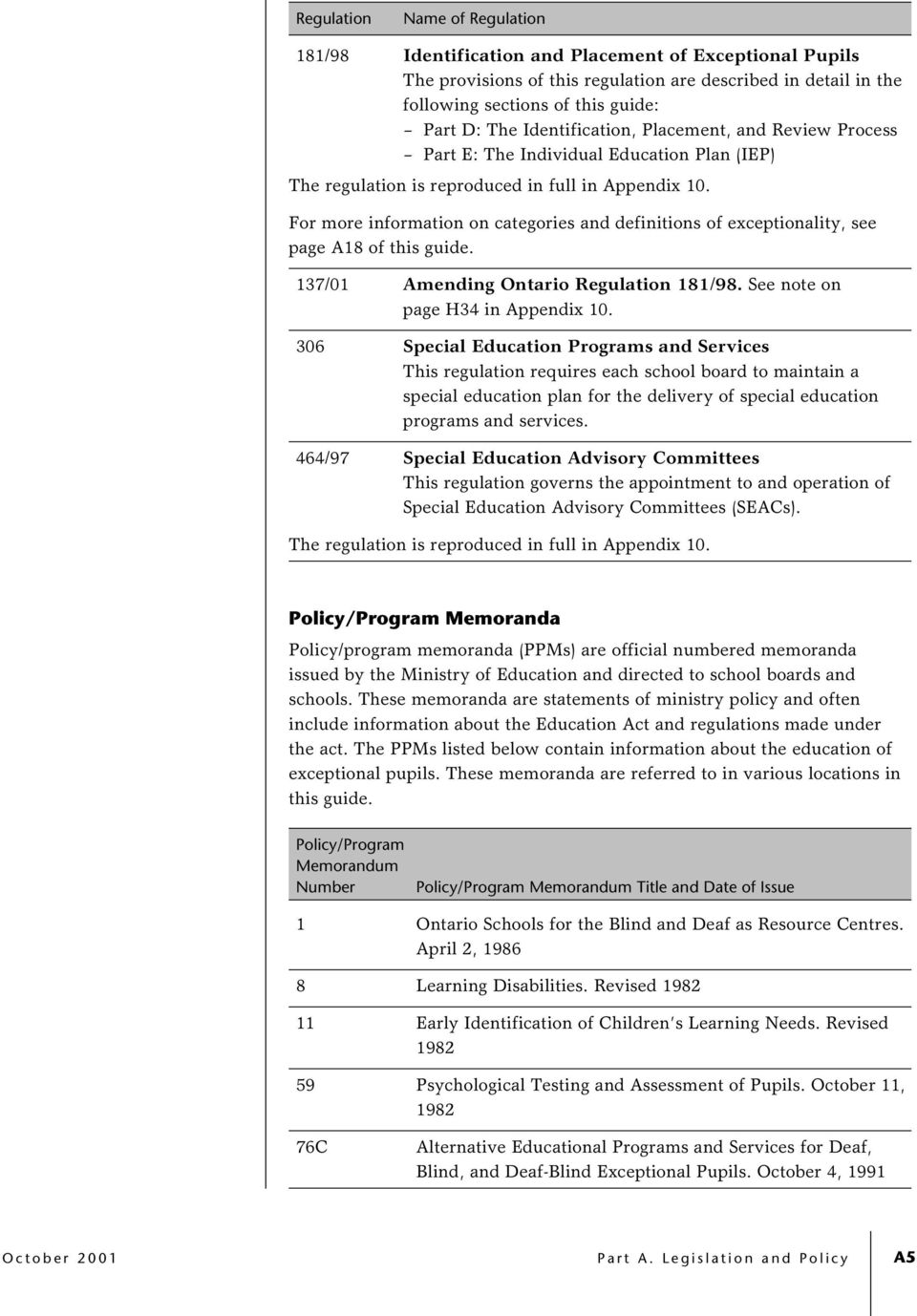
17 Regulation Name of Regulation 181/98 Identification and Placement of Exceptional Pupils The provisions of this regulation are described in detail in the following sections of this guide: Part D: The Identification, Placement, and Review Process Part E: The Individual Education Plan (IEP) The regulation is reproduced in full in Appendix 10. For more information on categories and definitions of exceptionality, see page A18 of this guide. 137/01 Amending Ontario Regulation 181/98. See note on page H34 in Appendix Special Education Programs and Services This regulation requires each school board to maintain a special education plan for the delivery of special education programs and services. 464/97 Special Education Advisory Committees This regulation governs the appointment to and operation of Special Education Advisory Committees (SEACs). The regulation is reproduced in full in Appendix 10. Policy/Program Memoranda Policy/program memoranda (PPMs) are official numbered memoranda issued by the Ministry of Education and directed to school boards and schools. These memoranda are statements of ministry policy and often include information about the Education Act and regulations made under the act. The PPMs listed below contain information about the education of exceptional pupils. These memoranda are referred to in various locations in this guide. Policy/Program Memorandum Number Policy/Program Memorandum Title and Date of Issue 1 Ontario Schools for the Blind and Deaf as Resource Centres. April 2, Learning Disabilities. Revised Early Identification of Children s Learning Needs. Revised Psychological Testing and Assessment of Pupils. October 11, C Alternative Educational Programs and Services for Deaf, Blind, and Deaf-Blind Exceptional Pupils. October 4, 1991 October 2001 Part A. Legislation and Policy A5
18 Policy/Program Memorandum Number Policy/Program Memorandum Title and Date of Issue 81* Provision of Health Support Services in School Settings. July 19, Educational Programs for Pupils in Government-Approved Care and/or Treatment Facilities. January 20, The Residential Demonstration Schools for Students With Learning Disabilities: General Information and Details of the Referral Process. February 6, Provincial Secondary School Literacy Test in English- Language Secondary Schools Accommodations, Deferrals, and Exemptions. September 15, 2000 * This PPM is supported by the Interministerial Guidelines for the Provision of Speech and Language Services, September 1988, and by the August 14, 1989, assistant deputy minister s memorandum clarifying interministerial responsibility regarding suctioning and catheterization. A6 Special Education: A Guide for Educators October 2001

19 ROLES AND RESPONSIBILITIES IN SPECIAL EDUCATION Clearly defined roles and responsibilities are an essential part of delivering special education programs and services. The roles and responsibilities within special education are outlined below. The Ministry of Education The Ministry of Education: sets out, through the Education Act, regulations, and policy documents, including policy/program memoranda, the legal obligations of school boards regarding the provision of special education programs and services; prescribes the categories and definitions of exceptionality; requires that school boards provide appropriate special education programs and services for their exceptional pupils; establishes the funding for special education through the structure of the funding model. The model consists of the Foundation Grant, the Special Education Grant, and other special purpose grants; requires school boards to report on their expenditures for special education; sets province-wide standards for curriculum and reporting of achievement; requires school boards to maintain special education plans, review them annually, and submit amendments to the ministry; requires school boards to establish Special Education Advisory Committees (SEACs); establishes Special Education Tribunals to hear disputes between parents and school boards regarding the identification and placement of exceptional pupils; establishes a provincial Advisory Council on Special Education to advise the Minister of Education on matters related to special education programs and services; operates Provincial and Demonstration Schools for students who are deaf, blind, or deaf-blind, or who have severe learning disabilities. The District School Board or School Authority The district school board or school authority: establishes school board policy and practices that comply with the Education Act, regulations, and policy documents, including policy/program memoranda; October 2001 Part A. Legislation and Policy A7

20 monitors school compliance with the Education Act, regulations, and policy documents, including policy/program memoranda; requires staff to comply with the Education Act, regulations, and policy documents, including policy/ program memoranda; provides appropriately qualified staff to provide programs and services for the exceptional pupils of the board; reports on the expenditures for special education; develops and maintains a special education plan that is amended from time to time to meet the current needs of the exceptional pupils of the board; reviews the plan annually and submits amendments to the Minister of Education; provides statistical reports to the ministry as required; prepares a parent guide to provide parents with information about special education programs, services, and procedures; establishes one or more IPRCs to identify exceptional pupils and determine appropriate placements for them; establishes a Special Education Advisory Committee; provides professional development to staff on special education. The Special Education Advisory Committee The Special Education Advisory Committee: makes recommendations to the board with respect to any matter affecting the establishment, development, and delivery of special education programs and services for exceptional pupils of the board; participates in the board s annual review of its special education plan; participates in the board s annual budget process as it relates to special education; reviews the financial statements of the board as they relate to special education; provides information to parents, as requested. The School Principal The school principal: carries out duties as outlined in the Education Act, regulations, and policy documents, including policy/program memoranda, and through board policies; communicates Ministry of Education and school board expectations to staff; ensures that appropriately qualified staff are assigned to teach special education classes; A8 Special Education: A Guide for Educators October 2001

21 communicates board policies and procedures about special education to staff, students, and parents; ensures that the identification and placement of exceptional pupils, through an IPRC, is done according to the procedures outlined in the Education Act, regulations, and board policies; consults with school board staff to determine the most appropriate program for exceptional pupils; ensures the development, implementation, and review of a student s Individual Education Plan (IEP), including a transition plan, according to provincial requirements; ensures that parents are consulted in the development of their child s IEP and that they are provided with a copy of the IEP; ensures the delivery of the program as set out in the IEP; ensures that appropriate assessments are requested and that, if necessary, consent is obtained. The Teacher The teacher: carries out duties as outlined in the Education Act, regulations, and policy documents, including policy/program memoranda; follows board policies and procedures regarding special education; works with the special education teacher to acquire and maintain up-to-date knowledge of special education practices; where appropriate, works with special education staff and parents to develop the IEP for an exceptional pupil; provides the program for the exceptional pupil in the regular class, as outlined in the IEP; communicates the student s progress to parents; works with other school board staff to review and update the student s IEP. The Special Education Teacher The special education teacher, in addition to the responsibilities listed above under The Teacher : holds qualifications, in accordance with the regulations under the Education Act, to teach special education; monitors the student s progress with reference to the IEP and modifies the program as necessary; assists in providing educational assessments for exceptional pupils. October 2001 Part A. Legislation and Policy A9
22 The Parent/Guardian The parent/guardian: becomes familiar with and informed about board policies and procedures in areas that affect the child; participates in IPRCs, parent-teacher conferences, and other relevant school activities; participates in the development of the IEP; becomes acquainted with the school staff working with the student; supports the student at home; works with the school principal and teachers to solve problems; is responsible for the student s attendance at school. The Student The student: complies with the requirements as outlined in the Education Act, regulations, and policy documents, including policy/program memoranda; complies with board policies and procedures; participates in IPRCs, parent-teacher conferences, and other activities, as appropriate. A10 Special Education: A Guide for Educators October 2001
23 REQUIREMENTS OF SCHOOL BOARDS UNDER THE EDUCATION ACT Under the Education Act and its regulations, school boards are required to do the following. Enrol All Pupils Who Have the Right to Attend The general rules governing the right to attend school are briefly outlined below. A person who is qualified to be a resident pupil of a board has the right to attend a school of the board. At the elementary level, to be qualified to be a resident pupil of the board, the person and the person s parent or guardian must live within the area of jurisdiction of the board (section 33). In order to have the right to attend school at a separate school board or at a French language school board, a person must reside within the area of the board where the person s parent is a school supporter. In order to support a Roman Catholic board, the parent must be Roman Catholic;* in order to support a French-language district school board, the parent must be a French-language rights holder.* However, there is no obligation on Roman Catholics or French-language rights holders to support their respective boards: these parents may send their children to the public or English-language board, as the case may be. Once the pupil is enrolled in school, he or she becomes a resident pupil of the board (subsections 33[6] and 36[5]). A person is qualified to be a resident pupil of a board for elementary school purposes from the ages specified in the Education Act (sections 33 and 34) until the age of 21. At the secondary level, to be qualified to be a resident pupil of a board, the person and the person s parent must live within the area of jurisdiction of the board; or the person must reside in the secondary school district and be the owner or tenant of residential property in the area that is separately assessed; or the person must be at least 18 years old and have lived in the area for at least a year (section 36). The rules outlined in the preceding paragraph with respect to school support at the elementary level apply at the secondary level as well (section 36). In addition to these rules, there is open access at the secondary level between public and separate boards that operate in the same area (section 42). Open access means that a person who is qualified to attend a secondary school of a public board is also eligible to attend a secondary school of a separate board that operates wholly or partly in the same area, and vice versa. To attend a school of a French-language board, the pupil must be the child of a French-language rights holder. These are the general rules regarding enrolment rights. For circumstances not covered by these rules, the student and/or the student s parent or guardian are advised to check with the superintendent of the board that the student wishes to attend. * Note: Asterisked terms are defined in section 1 of the Education Act. October 2001 Part A. Legislation and Policy A11
24 In order to be admitted to secondary school, the person must be promoted to secondary school or the secondary school principal must be satisfied that the person is capable of doing the work of the secondary school (section 41). School boards have the legal ability to direct secondary day school students to continuing education programs under certain circumstances (section 49.2). Students may be directed to a continuing education course or class operated by a board if: they have already attended secondary school for 7 or more years; they have been out of school for 4 years since the age of 16; they are funded at the continuing education level of grant (because they will have turned or will be turning 21 by December 31 of that year). The appropriate school board supervisory officer should be contacted for answers to specific questions about whether a particular child has the right to attend a certain board or school. Note: The fact that a person has the right to attend school within a particular school board jurisdiction does not mean that the person can attend whichever school he or she wishes. School boards may have attendance areas, and permission is required from the board (paragraph 171[1]7) for a person to attend school outside of his or her attendance area. Implement Procedures for Early and Ongoing Identification (Education Act, Clause 8[3][a]) School boards are required to implement procedures for early and ongoing identification of the learning abilities and needs of students, as detailed in Policy/Program Memorandum No. 11. Provide Special Education Programs and Services Under paragraph 170(1)7 of the Education Act, each board is required to provide or enter into an agreement with another board to provide in accordance with the regulations special education programs and special education services for its exceptional pupils. Provide a Mechanism for Appeal Regulation 181/98, dealing with the identification and placement of exceptional pupils, provides a mechanism for parents to appeal the identification and placement decisions of an Identification, Placement and Review Committee (IPRC) to an appeal board. Under the regulation a parent may request an appeal of an IPRC decision to a school board appeal board. It is up to the school board to administer the procedures related to the holding of the appeal board meeting. Part D of this guide contains a detailed discussion of these procedures. A12 Special Education: A Guide for Educators October 2001
25 Establish a Special Education Advisory Committee (Education Act, Section 57.1) Under the Education Act, every district school board must establish a Special Education Advisory Committee (SEAC). In addition, the Lieutenant- Governor-in-Council has the authority to make regulations: requiring that school authorities establish SEACs; governing: the establishment and composition of SEACs; practices and procedures relating to SEACs; the powers and duties of SEACs; the duties of district school boards or school authorities in relation to SEACs. This authority is exercised under Regulation 464/97. (For further information, refer to pages A27 28.) October 2001 Part A. Legislation and Policy A13
26 REQUIREMENTS OF SCHOOL BOARDS UNDER THE REGULATIONS One of the purposes of a school board s special education plan is to inform the Ministry of Education and the public about special education programs and services that are provided by the board in accordance with legislation and ministry policy on special education. Under the regulations, school boards are required to do the following. Establish Special Education Plans Regulation 306 requires that all school boards establish and maintain special education plans. In its special education plan each board is required to outline how it intends to meet the needs of its exceptional pupils. The board must maintain the plan and ensure that it is amended from time to time to meet the current needs of the exceptional pupils of the board. Individual students are not identified in the plan, but the system-wide method of providing programs and services is set out. Each school board must: review the plan once a year and send any amendments of the plan to the minister; every two years, prepare and approve a report on the special education programs and services it provides; have its Special Education Advisory Committee (SEAC) participate in the annual review of board plans (see pages A27 28 for further information about SEACs). Traditionally, the ministry has sent instructions to boards in the winter about how to submit their amendments/reports and what type of information to include. The reports and amendments must be submitted by July 31 of every year. The minister has the right to require a board to amend its plan in a manner that the minister considers necessary so as to ensure that the board provides special education programs and special education services that meet the current needs of the exceptional pupils of the board. School board special education plans should be available at the school board office (or at individual schools) for parents to see. The ministry has issued a policy document, Standards for School Boards Special Education Plans, 2000, which describes the new province-wide standards that school boards must meet when developing their special education plans. A14 Special Education: A Guide for Educators October 2001
27 Provide for a Shortened School Day Regulation 298, subsection 3(3), permits a school board to shorten the length of the instructional program on each school day to less than 5 hours for an exceptional pupil in a special education program. A board should not use this section for its own benefit, for example, because of a shortage of staff. This subsection applies in situations where it is for the benefit of the child that the instructional program be shortened. This might occur, for example, if the exceptional pupil does not have sufficient stamina to attend for a full school day, or is medically unable to attend for the full day. Employ Teachers With Appropriate Qualifications According to Regulation 298, subsection 19(14), no teacher shall be placed in charge of special education or be assigned or appointed to teach in a special education class, in a class for deaf, hard-of-hearing, blind, or low-vision students, or as a resource or withdrawal teacher in special education programs unless the teacher s Certificate of Qualifications indicates qualifications in special education. Follow Maximum Enrolments Set Out for Self-Contained Classes According to Regulation 298, section 31, the maximum class sizes for special education classes for various types of exceptional pupils are as follows: 8 in a class for pupils who are emotionally disturbed or socially maladjusted (behaviour),* have severe learning disabilities, or are below compulsory school age and have impaired hearing (who are deaf or hard-of-hearing);* 10 in a class for pupils who are blind, deaf, trainable retarded (have developmental disabilities),* or have speech and language disorders; 12 in a class for pupils who are hard-of-hearing, have low vision,* or have orthopaedic or other physical disabilities;* 12 in a class for pupils in the Primary Division who are educable retarded (mildly intellectually disabled);* and 16 in a class for pupils in the Junior and Intermediate Divisions who are educable retarded (mildly intellectually disabled);* 25 in a class for elementary pupils who are gifted;* 6 in a class for aphasic or autistic* pupils, or for pupils with multiple disabilities* for whom no one disability is dominant; 16 in a class for exceptional pupils consisting of pupils with different exceptionalities. * Note: The asterisked terms have been clarified in a memo to school boards, dated January 15, 1999, regarding the categories and definitions of exceptionality. (See pages A18 20.) October 2001 Part A. Legislation and Policy A15
28 Establish Identification, Placement and Review Committees (IPRCs) An IPRC is composed of at least three persons, one of whom must be a principal or supervisory officer of the board. The process for school boards to follow when identifying and placing exceptional pupils is set out in Regulation 181/98. A detailed discussion of the process is provided in Part D of this guide. The regulation deals with the following matters: the referral to an IPRC the setting up of an IPRC meeting the composition of the IPRC the material presented to an IPRC the role of parents/students at an IPRC IPRC decision-making power follow-up IPRC meetings Individual Education Plans and transition plans IPRC reviews the appeal of an IPRC decision the composition and powers of an appeal board the Parents Guide Provide Individual Education Plans (IEPs) for Pupils Identified as Exceptional An Individual Education Plan (IEP) is a written plan. It is a working document that describes the strengths and needs of an individual exceptional student or of a student with special needs, the special education program and services established to meet a student s needs, and sets out how the program and services will be delivered. It also describes the student s progress. In Regulation 181/98, Identification and Placement of Exceptional Pupils, sections 6 and 7 set out the requirements for creating and reviewing an IEP for any student identified as exceptional. The regulation states that principals are required to ensure that an IEP is developed for each student who has been identified as exceptional by an IPRC within 30 school days 3 of the student s placement in a special education program. The IEP must include: specific educational expectations for the student; an outline of the special education program and services to be received by the student; a statement of the methods by which the student s progress will be reviewed; 3. As amended by Ontario Regulation 137/01. See note on page H34 in Appendix 10. A16 Special Education: A Guide for Educators October 2001
29 for students 14 years of age or older, a plan for transition to appropriate postsecondary school activities, such as work, further education, and community living, unless the student is identified as exceptional solely on the basis of giftedness. In developing the IEP, the principal shall: consult with the parent and, where the student is 16 years of age or older, the student; take into consideration any recommendations made by the IPRC or the Special Education Tribunal, as the case may be, regarding special education programs or special education services; when developing the transition plan, consult with such community agencies and postsecondary educational institutions as he or she considers appropriate. The principal shall ensure that the IEP for a student is included in the student s Ontario Student Record (OSR), unless a parent has objected in writing to its inclusion. Standards for the IEP are outlined by the Ministry of Education in a document entitled Individual Education Plans: Standards for Development, Program Planning, and Implementation, A detailed discussion of the IEP is provided in Part E of this guide. October 2001 Part A. Legislation and Policy A17
30 CATEGORIES AND DEFINITIONS OF EXCEPTIONALITIES The following five categories of exceptionalities have been identified in the Education Act definition of exceptional pupil: behaviour communication intellectual physical multiple These broad categories include the following definitions, as clarified in the memo to school boards of January 15, 1999: Behaviour A learning disorder characterized by specific behaviour problems over such a period of time, and to such a marked degree, and of such a nature, as to adversely affect educational performance, and that may be accompanied by one or more of the following: a) an inability to build or to maintain interpersonal relationships; b) excessive fears or anxieties; c) a tendency to compulsive reaction; d) an inability to learn that cannot be traced to intellectual, sensory, or other health factors, or any combination thereof. Communication Autism A severe learning disorder that is characterized by: a) disturbances in: rate of educational development; ability to relate to the environment; mobility; perception, speech, and language; b) lack of the representational symbolic behaviour that precedes language. Deaf and Hard-of-Hearing An impairment characterized by deficits in language and speech development because of a diminished or non-existent auditory response to sound. A18 Special Education: A Guide for Educators October 2001
31 Language Impairment A learning disorder characterized by an impairment in comprehension and/or the use of verbal communication or the written or other symbol system of communication, which may be associated with neurological, psychological, physical, or sensory factors, and which may: a) involve one or more of the form, content, and function of language in communication; and b) include one or more of: language delay; dysfluency; voice and articulation development, which may or may not be organically or functionally based. Speech Impairment A disorder in language formulation that may be associated with neurological, psychological, physical, or sensory factors; that involves perceptual motor aspects of transmitting oral messages; and that may be characterized by impairment in articulation, rhythm, and stress. Learning Disability A learning disorder evident in both academic and social situations that involves one or more of the processes necessary for the proper use of spoken language or the symbols of communication, and that is characterized by a condition that: a) is not primarily the result of: impairment of vision; impairment of hearing; physical disability; developmental disability; primary emotional disturbance; cultural difference; b) results in a significant discrepancy between academic achievement and assessed intellectual ability, with deficits in one or more of the following: receptive language (listening, reading); language processing (thinking, conceptualizing, integrating); expressive language (talking, spelling, writing); mathematical computations; and c) may be associated with one or more conditions diagnosed as: a perceptual handicap; a brain injury; minimal brain dysfunction; dyslexia; developmental aphasia. October 2001 Part A. Legislation and Policy A19
32 Intellectual Giftedness An unusually advanced degree of general intellectual ability that requires differentiated learning experiences of a depth and breadth beyond those normally provided in the regular school program to satisfy the level of educational potential indicated. Mild Intellectual Disability A learning disorder characterized by: a) an ability to profit educationally within a regular class with the aid of considerable curriculum modification and supportive service; b) an inability to profit educationally within a regular class because of slow intellectual development; c) a potential for academic learning, independent social adjustment, and economic self-support. Developmental Disability A severe learning disorder characterized by: a) an inability to profit from a special education program for students with mild intellectual disabilities because of slow intellectual development; b) an ability to profit from a special education program that is designed to accommodate slow intellectual development; c) a limited potential for academic learning, independent social adjustment, and economic self-support. Physical Physical Disability A condition of such severe physical limitation or deficiency as to require special assistance in learning situations to provide the opportunity for educational achievement equivalent to that of pupils without exceptionalities who are of the same age or development level. Blind and Low Vision A condition of partial or total impairment of sight or vision that even with correction affects educational performance adversely. Multiple Multiple Exceptionalities A combination of learning or other disorders, impairments, or physical disabilities that is of such a nature as to require, for educational achievement, the services of one or more teachers holding qualifications in special education and the provision of support services appropriate for such disorders, impairments, or disabilities. A20 Special Education: A Guide for Educators October 2001
33 PROGRAM AND DIPLOMA REQUIREMENTS IN ONTARIO SCHOOLS Ministry Documents Related to Program and Diploma Requirements for Elementary and Secondary Schools Curriculum policy applies to all students in Ontario schools, including students who have special needs, and is outlined in the following documents: The Ontario Curriculum policy documents describe grade-by-grade expectations by subject for students in elementary and secondary schools in Ontario. Programs based on these documents are designed to provide the greatest possible opportunity for every student to develop, as completely as possible, his or her abilities and interests while addressing each student s special needs. Ontario Secondary Schools, Grades 9 to 12: Program and Diploma Requirements, 1999 (OSS) sets out the policies and requirements that govern the program in English-language secondary schools in Ontario. It outlines the policies of the Ministry of Education for programs in Grades 9 to 12, including the requirements for the awarding of the Ontario Secondary School Diploma (OSSD). Programs based on these requirements are designed to equip students with the knowledge and skills they will need to lead satisfying and productive lives in the twenty-first century. Some key policy directions outlined in this document and which affect students with special needs are described below. Ontario Secondary Schools, Grades 9 to 12: Program and Diploma Requirements, 1999 The high school program is based on a credit system. In order to earn an Ontario Secondary School Diploma (OSSD), a student who entered Grade 9 in the school year, or who enters in subsequent years, must earn a minimum of 30 credits, including 18 compulsory credits and 12 optional credits. Starting in the school year, students must also complete 40 hours of community involvement activities, and starting in , they must pass the provincial secondary school literacy test. To ensure that all students, including those identified as exceptional, are able to qualify for the OSSD, principals may substitute up to 3 compulsory course credits from the remaining courses offered by the school that meet the requirements for compulsory credits. Where there is a need to substitute a compulsory credit course for an exceptional pupil, the substitution: should be in keeping with the student s strengths, needs, learning expectations, and accommodations as set out in the student s Individual Education Plan (IEP); must be approved in writing by the student s parents, if the student is not an adult; will be noted on the student s Ontario Student Transcript. October 2001 Part A. Legislation and Policy A21
34 Community Involvement As part of the diploma requirements, students must complete a minimum of 40 hours of unpaid community involvement activities before graduating from secondary school. This requirement is in addition to the 30 credits needed for a secondary school diploma. Students will be able to choose their own community involvement activities, within guidelines that will be provided by the school and school board. Students will be responsible for fulfilling this requirement on their own time and for keeping a record of their activities on a form supplied by the school. (See Policy/Program Memorandum No. 124A, Ontario Secondary School Diploma Requirement: Community Involvement Activities in English-Language Schools.) The Provincial Secondary School Literacy Test Beginning with students who enter Grade 9 in the school year, all students, including those identified as exceptional pupils, must successfully complete the provincial secondary school literacy test in order to graduate with an OSSD. The test evaluates students reading and writing skills based on provincial curriculum expectations in language and communications up to and including Grade 9. Accommodations, deferrals, or exemptions are available as appropriate to meet the individual needs of students who are receiving special education programs and services and who have an IEP. (See Policy/Program Memorandum No. 127.) The Ontario Secondary School Certificate The Ontario Secondary School Certificate will be granted on request to students who leave school before earning the OSSD, provided that they have earned a minimum of 14 credits (7 compulsory credits and 7 optional credits). The Certificate of Accomplishment Students who leave school before fulfilling the requirements for the Ontario Secondary School Diploma or the Ontario Secondary School Certificate may be granted a Certificate of Accomplishment, which will be accompanied by the student s Ontario Student Transcript. For students who have an IEP, a copy of the IEP may also be included. Full Disclosure Under the terms of the full disclosure policy, all Grade 11 and 12 courses taken or attempted by students, including students who are identified as exceptional pupils, will be recorded on the Ontario Student Transcript, with the percentage grades earned and the credits gained. The transcript may include an indication of any extraordinary circumstances affecting a student s achievement in Grade 11 or 12 courses. A22 Special Education: A Guide for Educators October 2001
35 A student s parents or a student who is an adult (18 years of age or over) may request that the principal identify, by using a special indicator, any Grade 11 and 12 courses in which the student s performance was affected by extraordinary circumstances. If the principal agrees with the student s or parents claim, the special indicator S is entered in the Note 4 column of the transcript for these courses. However, the student s percentage grades are also recorded. The special indicator may also be used for courses from which the student has withdrawn because of extraordinary circumstances. If the principal does not agree with the parents or student s claim that extraordinary circumstances have had a significant effect on the student s achievement, the parents or the student may request that the appropriate supervisory officer review the matter. (See OSS, section ) Full details may be found in The Ontario Student Transcript (OST): Manual, 1999 and in OSS. The Annual Education Plan (AEP) All students in Grades 7 to 12 will prepare an annual education plan with assistance from their parents, guidance counsellors, and teacher-advisers. (The program is now in place for all students in Grades 7 to 12.) The planning process will help students set goals and review and assess their achievements and progress along the way. The plan identifies: the student s goals for academic achievement; the student s course selections for the following year; the extracurricular activities, cooperative education programs, and work experience opportunities in which the student will be participating, both in and outside school; a range of possible postsecondary goals. Beginning in Grade 10, students should consider and research the requirements for continued study at a college or university or private vocational school, apprenticeships or internships, or direct entry into the work force. Exceptional pupils, their parents, and teachers should take the student s IEP and transition plan into consideration when developing an annual education plan. 4. The following notations may also appear in the Note column: M modified curriculum expectations that do not lead to a credit I interdisciplinary studies F French Immersion C cooperative education A alternative expectations, which do not lead to a credit October 2001 Part A. Legislation and Policy A23
36 Prior Learning Assessment and Recognition (PLAR) Beginning in the school year, students may receive a credit without taking a course if they can demonstrate that they have the skills and knowledge from prior learning to meet the expectations for the course set out in the provincial curriculum. To receive a credit through the PLAR process, students are assessed through formal tests and other methods of evaluation appropriate to the subject. Students may obtain a maximum of four credits through the PLAR process, but no more than two in one subject area. The PLAR process applies only to courses in Grades 10 to 12. PLAR will be implemented in a phased-in approach: Grade 10 in , Grade 11 in , and Grade 12 in PLAR procedures must also be available to exceptional students. Assessment strategies must be adapted for this group in keeping with their special needs; for example, extra time might be allowed for the completion of work or a quiet environment provided for activities. While PLAR may be of benefit to some gifted students, it is not intended to be used as a replacement for or as an alternative to enriched programs or special education programs for gifted students. Locally Developed Courses School boards may develop two kinds of courses locally in Grades 9 to 12: compulsory credit courses and optional credit courses. School boards may develop locally one compulsory credit course in English, one in mathematics, and/or one in science. All locally developed courses, with the exception of religious education courses developed by Roman Catholic district school boards, must be approved by the Ministry of Education. (Note: You may wish to refer to the Guide to Locally Developed Courses, Grades 9 to 12: Approval Requirements and Procedures, 2000 for approval requirements.) The Ontario Curriculum, Grades 9 to 12: Program Planning and Assessment, 2000 The Ontario Curriculum, Grades 9 to 12: Program Planning and Assessment, 2000 provides essential information on aspects of policy relating to program planning and the assessment, evaluation, and reporting of student achievement that pertain to all disciplines in the Ontario secondary school curriculum. It is a companion document to the curriculum policy documents for the individual disciplines, which identify the knowledge and skills students are expected to acquire in their secondary school courses. It provides teachers and others interested in secondary education in Ontario with a summary and discussion of relevant policies set out in Ontario Secondary Schools, Grades 9 to 12: Program and Diploma Requirements, A24 Special Education: A Guide for Educators October 2001
37 Choices Into Action: Guidance and Career Education Program Policy for Ontario Elementary and Secondary Schools, 1999 Choices Into Action describes the purpose and importance of Ontario s guidance and career education program, its content, and its unique approach to teaching and learning. It describes the approaches that principals and teachers are expected to take when teaching students how to develop their learning skills, interpersonal skills, and knowledge and skills in the area of career planning. It also outlines program-planning strategies, accountability measures, and the roles and responsibilities of all involved principals, teachers, students, parents, and community partners. The policies outlined in this document complement related provincial policies outlined in Ontario Secondary Schools, Grades 9 to 12: Program and Diploma Requirements, 1999 and in the elementary and secondary school curriculum policy documents. October 2001 Part A. Legislation and Policy A25
38 ADVISORY COMMITTEES ON SPECIAL EDUCATION The Minister s Advisory Council on Special Education This council, established by Order-in-Council, advises the Minister of Education on any matter related to the establishment and provision of special education programs and special education services for exceptional pupils, including the identification and provision of early intervention programs for students with special needs. In particular, the council: responds to proposals or positions of the Ministry of Education or other ministries, as submitted to the council from time to time; identifies concerns in the delivery of special education programs and services for exceptional pupils and provides information, advice, and recommendations for ministry consideration. The council meets up to three times a year for a maximum of four and a half days and submits an annual report that includes the following: the council s priorities and a plan for achieving them; an analysis of the achievement of the previous year s priorities; recommendations to the minister. The council consists of the following members: a) a minimum of 9 and a maximum of 12 voting members representing exceptionalities recognized by the Ministry of Education (autism, developmental disability, low vision, giftedness, physical disability) and the support professions (medical practitioners, psychologists, social workers, speechlanguage pathologists); b) 9 voting members representing educator groups (supervisory officers, principals, teachers, educational assistants, 5 trustees); c) one voting member representing students/youth; d) one voting member representing Native persons. The council has positions for up to 24 voting members plus one non-voting member from each of: the Ministry of Health and Long-Term Care; the Ministry of Community and Social Services; the Ministry of Training, Colleges and Universities; and the Integrated Services for Children Division. Roman Catholic and Franco-Ontarian representation are also mandated. These representatives are selected from the existing members. The chair and vicechair are appointed by the minister from among the voting members. All members are appointed by the minister. 5. In this guide, the terms educational assistant, teaching assistant, and teacher assistant are used interchangeably. A26 Special Education: A Guide for Educators October 2001
39 The full council meets three times annually. The council also establishes ad hoc committees as required and has a number of active subcommittees that explore and respond to specific issues throughout the year. These committees bring recommendations to the council at its regular meetings. The chair of the council meets regularly with ministry staff. Further information about the Advisory Council (e.g., membership, annual report) is available on the Ministry of Education website ( and in Appendix 1 of this document. Special Education Advisory Committees (Regulation 464/97) Subsection 57.1(1) of the Education Act requires every district school board to establish a Special Education Advisory Committee (SEAC). Regulation 464/97 requires that each school authority establish a SEAC. The composition and duties of this committee at both district school boards and school authorities are set out in Regulation 464/97, as are most of the procedural matters related to its operation. (This regulation is provided in Appendix 10.) The members of the committee include representatives of local associations (defined in the regulation), members of the school board, and Native representatives, and may include additional members who do not belong to any of these groups. The SEAC s responsibilities are: to make recommendations to the board in respect of any matter affecting the establishment, development, and delivery of special education programs and services for exceptional pupils of the board; to participate in the board s annual review of its special education plan; to participate in the board s annual budget process as it relates to special education; to review the financial statements of the board as they relate to special education. The following are some guidelines (not in the regulation) that school boards may find useful. 1) The SEAC seats for representatives of local associations should be used to bring to the committee the perspective of parents of children with a wide range of exceptionalities. Note that the ministry provides school boards with definitions of exceptionalities for use in the identification, placement, and review process. As many as possible of these exceptionalities should be represented on the SEAC. 2) Representatives of local associations should be persons who can express the concerns of the parents of the exceptional pupils of the board. 3) Representatives of local associations should bring the perspective and resources of a provincial or a national association that is incorporated and that operates throughout Ontario to further the interests of one or more groups of exceptional pupils. October 2001 Part A. Legislation and Policy A27
40 4) The representative of the local association nominated by the association is normally the person appointed by the board. As long as the association selects as its representative a member who lives within the jurisdiction of the board, the actual address of the branch of the association should not be significant. SEAC members (except those appointed to represent Native pupils) must be qualified to vote for members of the board and must be resident within the area of jurisdiction of the board. To be qualified to vote for school board members, a person must be: a Canadian citizen; at least eighteen years old; in the case of a public school board, a public school elector; in the case of a separate school board, a separate school elector; in the case of a French-language district school board, a person with section 23 Charter rights. Employees of a school board are not eligible for membership on the SEAC of the board that employs them. However, employees of one school board may be members of the SEAC of another school board, subject to their eligibility to vote for members of the school board that appoints them. In order to assist the SEACs in making informed recommendations, boards should provide orientation sessions and may arrange for knowledgeable persons to provide in-service training sessions for members during regular SEAC meetings. These in-service training sessions might focus on: sections of the Education Act relating to special education; regulations regarding special education; Ministry of Education memoranda; Special Education: A Guide for Educators; the board policies regarding special education; the board special education plan; the roles and responsibilities of the SEAC; the funding of special education. A sample agenda for such a training session is provided in the Handbook for Members of Special Education Advisory Committees mentioned in the following section. Information about membership on the SEAC, procedures to be followed in the event of vacancies, and other matters relating to SEACs are outlined in Regulation 464/97. A28 Special Education: A Guide for Educators October 2001
41 Provincial Parent Association Advisory Committee on Special Education Advisory Committees (PAAC on SEAC) The Provincial Parent Association Advisory Committee on Special Education Advisory Committees (PAAC on SEAC) was established in 1983 to provide a forum for sharing ideas and strategies and addressing common concerns related to SEACs throughout the province. It may include any association/ organization that is provincial and has SEAC representation. (A list of organizations involved with special education is provided in Appendix 2.) The mission statement of the PAAC on SEAC is to provide support to and sharing of opportunities among the parent associations and to promote successful practices for Special Education Advisory Committees. An extremely valuable resource for SEAC members is the Handbook for Members of Special Education Advisory Committees, developed by the PAAC on SEAC. Its purpose is to assist and guide members of SEACs to fulfil their roles effectively. The handbook provides: models of successful practices in many areas; procedures for appointing alternative SEAC representatives (prepared prior to the requirements for appointing alternative members set out in Regulation 464/97); details of the annual review of special education plans; a sample SEAC agenda; a sample parent association report; parliamentary procedures at a glance; a preparation checklist for SEAC meetings; a list of skills that will improve the effectiveness of SEAC members; an index of reference and resource materials. Additional information about the PAAC on SEAC and the handbook may be obtained by contacting the chair of the PAAC on SEAC. Contact information is available from the local district office of the Ministry of Education (see Appendix 3). October 2001 Part A. Legislation and Policy A29
42 RELATED LEGISLATION In addition to the Education Act, there is other legislation that affects school boards. Acts that are directly relevant to the education of students with special needs are discussed briefly below. The Ontario College of Teachers Act, 1996 The Ontario College of Teachers is a professional body responsible for governing the teaching profession in Ontario and was established under the Ontario College of Teachers Act in The mandate of the college includes: regulating the profession of teaching and governing its members; establishing teaching qualifications, setting membership criteria, and creating a provincial register of teachers; establishing professional standards and ethical standards for the teaching profession; accrediting pre-service and in-service teacher-education programs; receiving and investigating complaints against members of the college and dealing with issues of discipline and fitness to practise. Membership in the college is mandatory for anyone employed in English- or French-language publicly funded schools whose job requires teaching qualifications. Regulation 184/97 Teachers Qualifications, which is made under the Ontario College of Teachers Act, states the requirements for becoming certified as a teacher in Ontario, including those for teaching exceptional pupils. This regulation specifies the process for obtaining teaching qualifications for teaching the deaf and those with developmental disabilities. It identifies the additional qualifications that can be acquired for teaching special education, the blind, the deaf, the deaf-blind, and children with language difficulties/aphasia. Freedom of Information Legislation The Freedom of Information and Protection of Privacy Act (FIPPA) governs the collection, use, and disclosure of personal information at the Provincial Schools for the deaf, blind, and deaf-blind and the Demonstration Schools for children who have severe learning disabilities. The Municipal Freedom of Information and Protection of Privacy Act (MFIPPA) governs the collection, use, and disclosure of personal information at publicly funded school boards and schools. A30 Special Education: A Guide for Educators October 2001
43 The Education Act and the Municipal Freedom of Information and Protection of Privacy Act in the case of school boards (the Freedom of Information and Protection of Privacy Act in the case of Provincial and Demonstration Schools) contain requirements related to the collection, use, and release of personal information. Principals and teachers should consult with their board s freedom-of-information coordinators about the steps required to obtain access to personal information about the student that is not contained in the student s OSR (for example, from other professionals who work with the student) and about providing information contained in the student s OSR to other professionals. Under both acts, any personal information received by an institution (as defined in the legislation) is considered to be a collection of information for the purposes of the act. The information collected may be either oral or written. When personal information is collected from an individual, the individual must be informed, by means of a collection statement printed on the form on which the personal information is to be provided, of: the legal authority for the collection; the principal purposes for which it is intended to be used; the title, business address, and business telephone number of an officer or employee of the institution who can answer the person s questions about the collection. This type of collection statement is generally included on forms such as application forms or registration forms and is found on several of the Ontario Student Record (OSR) documents. The collection statement is an important part of compliance with the legislation, because it indicates to the individuals from whom personal information is collected the uses to which the information will be put. If the personal information collected is written, it becomes a record under both acts. The acts do not dictate to school boards how many or what types of files to keep or what to include in them. This is up to the board/school. Most boards will have policies about records retention as well as policies about various other types of files (e.g., discipline files, guidance files) kept by schools. The acts do outline requirements related to the use and disclosure of personal information by school boards. The Regulated Health Professions Act, 1991 Many health professionals work with students. Some of them train and minimally supervise school staff to carry out certain health-related tasks. Such activities are regulated by the Regulated Health Professions Act (RHPA), proclaimed in The act provides for the regulation of twenty-one health care professions in Ontario. It specifies thirteen controlled acts in health care that may be performed by a member authorized by the act, or by a person delegated by such a member. One such controlled act is : Communicating to the individual or his or her personal representative a diagnosis identifying a disease or disorder as the cause of symptoms of an individual in circumstances in which it is reasonably foreseeable that the individual or his or her personal representative will rely on the diagnosis. The Regulated Health Professions Act is a law that describes what members of specific professions do. It sets up colleges for the various professions that govern the activities of members of those professions and adjudicate any complaints made about members. October 2001 Part A. Legislation and Policy A31
44 The Psychology Act, 1991 The Psychology Act established the College of Psychologists of Ontario to regulate the practice of psychology in the province. The college sets the standards of practice for the profession and is responsible to the public and the profession for maintaining the quality of practice, for regulating the qualifications for registration, and for investigating complaints involving members. There are two levels of college membership: a psychologist is a practitioner with doctoral-level training and registration with the college, and a psychological associate is a practitioner with master s-level training and registration with the college. According to the Psychology Act: In the course of engaging in the practice of psychology, a member is authorized, subject to the terms, conditions and limitations imposed on his or her certificate of registration, to communicate a diagnosis identifying, as the cause of a person s symptoms, a neuropsychological disorder or a psychologically based psychotic, neurotic or personality disorder. The Audiology and Speech-Language Pathology Act, 1991 The Audiology and Speech-Language Pathology Act authorizes a regulation which: includes the requirement that informed consent must be obtained before service is initiated; includes the stipulation that only certified members of the college can call themselves speech-language pathologists or therapists; and deals with the availability of records and reports. A32 Special Education: A Guide for Educators October 2001
45 Part B. Funding for Special Education
46
47 DETAILED CONTENTS PART B. FUNDING FOR SPECIAL EDUCATION Introduction B2 The Special Education Per Pupil Amount (SEPPA) B3 The Intensive Support Amount (ISA) B4 The Special Incidence Portion (SIP) B6 Portability B7 October 2001 Part B. Funding for Special Education B1
48 INTRODUCTION Funding for special education is provided in layers. School boards receive a Foundation Grant for every student enrolled, whether or not the student is an exceptional pupil. This is the base, which is intended to cover the basic costs of providing a classroom education for all students. It includes such things as the cost of teachers, teaching assistants, paraprofessionals, and learning materials. The next layer is the Special Education Grant, a two-part grant and one of the nine special-purpose grants that recognize the different circumstances of students and boards. This funding is provided in addition to the Foundation Grant. One component of the Special Education Grant is the Special Education Per Pupil Amount (SEPPA), which is based on a school board s enrolment (counting all students, not just students who have been identified as requiring a special education program). This funding is used for special education programs and services that address the full range of exceptionalities. The other component is the Intensive Support Amount (ISA), which is related to the number of high-needs exceptional pupils in a board (that is, students who require specialized high-cost assistance for intensive staffing supports). While boards receive ISA funding in proportion to their incidence of highneeds students, they have the flexibility to use their ISA funding across the special education system. Therefore, the ISA submission process is not related to the determination of individual students programs and services. Boards are expected to use this flexibility to provide all of their exceptional pupils with the special education programs and services they need, in accordance with the Education Act and as outlined in students IEPs. B2 Special Education: A Guide for Educators October 2001
49 THE SPECIAL EDUCATION PER PUPIL AMOUNT (SEPPA) The SEPPA is the first layer provided, in addition to the Foundation Grant, to support students with special needs. It is generated on the basis of total student enrolment that is, it is determined on the basis of how many students are enrolled by the board. The per-pupil allocation of the SEPPA funding provides boards with the flexibility to respond to local needs using a range of special education programs and services. SEPPA funds support the costs of student assessments and services prior to any formal designation of exceptionality. SEPPA funds assist boards in hiring most of the support personnel needed by exceptional pupils, including psychologists, social workers, occupational and physical therapists, speechlanguage pathologists, teaching assistants, and behavioural support staff, as well as other types of staff. SEPPA funds also support smaller class sizes for some exceptional pupils. Funds for most special education teachers are provided through a combination of the SEPPA and the Foundation Grant. October 2001 Part B. Funding for Special Education B3
50 THE INTENSIVE SUPPORT AMOUNT (ISA) It is important to remember that Intensive Support Amount (ISA) funding is for school boards to support the needs of students who require high-cost specialized equipment, programs, and classroom supports; it is not funding for individual students. Boards receive funding in proportion to their incidence of high-needs students, and have the flexibility to use their ISA funding across the special education system. School boards are responsible for meeting the needs of all of their students. Decisions about providing particular student supports, such as teaching assistants, are made by the school board. A number of factors may affect such decisions, including the size and composition of the class, the range of supports already assigned, and other local considerations. The needs of each student are documented in the student s Individual Education Plan (IEP), which should be developed in consultation with parents as well as with other education professionals, as appropriate. There are five levels of ISA funding: ISA 1, 1 based on special individualized equipment needs; ISA 2 and ISA 3, based on the incidence of students with high needs; ISA 4, based on the number of educational programs offered in care, treatment, custodial, or correctional facilities (see Part F, pages F4 5). Because ISA 4 programs are funded through a program-approval process administered by Ministry of Education district offices, in cooperation with other ministries, school boards apply for these funds through a separate process; the Special Incidence Portion (SIP), for students with extraordinarily high health and safety needs. In addition to the Special Education Grant, other grants may also be used to support special education students, as appropriate. For example, the Language Grant supports language programming for all students; the Learning Opportunities Grant provides funding for students who are at risk of experiencing academic difficulties; the Pupil Accommodation Grant supports building-related expenses, such as wheelchair ramps; the Transportation Grant supports the cost of transportation for students to their special education programs; and the School Board Administration and Governance Grant supports some costs of administering special education programs and services. See Figure B.1 for a visual representation of special education funding. 1. ISA Level 1 functions as an additional layer for equipment needs. It may be used for students whose special needs are supported through any combination of grants Foundation + SEPPA, or ISA Levels 2 or 3. B4 Special Education: A Guide for Educators October 2001
51 Figure B.1: Overview of Layered Funding Special Incidence Portion Refer to the current Resource Manual for the Special Education Grant Intensive Support Amount (ISA): Guidelines for School Boards. ISA Level 3 Refer to the current Resource Manual for the Special Education Grant Intensive Support Amount (ISA): Guidelines for School Boards. ISA Level 2 Refer to the current Resource Manual for the Special Education Grant Intensive Support Amount (ISA): Guidelines for School Boards. ISA Level 1 For costs over $800 for pupil s assistive devices and/or technology required for classroom instruction. SEPPA For: costs of curriculum modification not funded through ISA; costs of educational assistants and other staff not funded through ISA; up to $800 for assistive devices (after ADP and insurance contributions); assessment costs (educational assessments as well as psychological and other professional assessments); professional and paraprofessional supports such as psychologists, therapists, speech-language pathologists, and social workers; the cost of producing audio/audiovisual instructional materials and alternative formats; smaller class sizes for some pupils (e.g., to achieve the pupil/teacher ratio stated in Regulation 298). Foundation Grant + Pupil s portion of all other applicable grants, that is: the Geographic and School Authorities Grant the Learning Opportunities Grant the Language Grant the Transportation Grant the School Board Administration and Governance Grant the Teacher Compensation Grant the Pupil Accommodation Grant the Early Learning Grant the Adult and Continuing Education Grant October 2001 Part B. Funding for Special Education B5
52 THE SPECIAL INCIDENCE PORTION (SIP) School boards may apply to their district office for a Special Incidence Portion (SIP) in addition to other grants provided on behalf of students. To qualify, boards will typically require more than two full-time staff on a per-student basis in order to ensure the student s health and safety and/or the safety of others. B6 Special Education: A Guide for Educators October 2001
53 PORTABILITY When high-needs exceptional students move from one school board to another, adjustments will be made in ISA funding to accommodate the resulting change in a board s funding needs.* Boards receive adjustments in ISA funding according to the net increase or decrease in their number of ISA claimants. This measure is designed to assist boards that experience an overall increase in the number of highneeds students who move into the board during the school year. Where a board has a net increase or decrease of students, appropriate adjustments will be made in the board s ISA claim funding. For the school year, school boards are required to report the number of students (for whom an ISA claim was made) who either moved into or transferred out of their board as of October 31, The ministry will provide a standard form for boards to complete. (In the event of a delay in issuing the forms, boards are normally granted additional time to gather the necessary information.) Details regarding special education funding are provided by the Ministry of Education in the annual Resource Manual for the Special Education Grant Intensive Support Amount (ISA): Guidelines for School Boards, which is available on the ministry s website, at *Note that personalized special education equipment purchased for a student is considered portable. Therefore, it moves with the student, unless the equipment can be used by another child in the school board. In such cases, the equipment will not be moved and new equipment will be purchased for the student who is moving. October 2001 Part B. Funding for Special Education B7
54
55 Part C. Program Planning
56
57 DETAILED CONTENTS PART C. PROGRAM PLANNING Introduction C2 Preschool Identification C3 Enrolling a Child With Special Needs C4 Early and Ongoing Identification C5 The In-School Team and Other Support Measures C6 The In-School Team C6 Stages in the In-School Team Process C7 School Board Supports C11 Educational Services C11 Other Professional Services C13 Paraprofessional Services C14 Volunteers C14 Parents C15 Assessing a Student s Strengths and Needs C16 Teacher Observation and Data Gathering C16 Assessing Students for Whom English Is a Second Language C17 Educational Assessment C17 Speech and Language Assessment C18 Health Assessment C19 Psychological Assessment C19 Health Care Consent C19 Assessment Information and Confidentiality C20 Release of Confidential Information C20 Program Planning for Students With Special Needs C21 Reporting Achievement C24 The Assessment and Evaluation of Student Achievement C24 The Reporting of Student Achievement C24 Provincial Assessment C26 Transitions: Ideas for Successful Practice C27 Introduction C27 Preschool-to-School Transitions C27 School-to-School Transitions C28 Transition to School From Care and Treatment Facilities and Correctional Facilities C28 Transition to School Following Prolonged Medical Absence C29 Transition From Elementary to Secondary School C29 Transition From Secondary to Postsecondary Education C29 Transition From Secondary School to the World of Work C31 October 2001 Part C. Program Planning C1
58 INTRODUCTION All students, including exceptional pupils, in schools across Ontario require consistent, challenging programs that will capture their interest and prepare them for a lifetime of learning. They require knowledge and skills that will help them compete in a global economy and allow them to lead lives of integrity and satisfaction, both as citizens and as individuals. 1 This section of the guide outlines the steps normally taken to ensure effective program planning for students who require special education programs and services. 1. Ontario, Ministry of Education and Training, The Ontario Curriculum, Grades 1 8: Language (Toronto: Ministry of Education and Training, Ontario, 1997), p. 3. C2 Special Education: A Guide for Educators October 2001
59 PRESCHOOL IDENTIFICATION Often, early identification of children with special needs is done by agencies of other ministries perhaps through a daycare program or a public health or medical clinic before the child enters school. A number of current initiatives are designed to facilitate such early identification and the provision of appropriate services. These include: the program Healthy Babies, Healthy Children, a prevention/early intervention initiative designed to encourage healthy baby and child development. A joint project of the Ministry of Health and Long-Term Care and the Ministry of Community and Social Services under the direction of the Integrated Services for Children Division, Healthy Babies, Healthy Children is intended to augment and strengthen existing community services for families and children; the Preschool Speech and Language Initiative, which began in 1996 and is administered by the Ministry of Health and Long-Term Care. Thirty-two regional service delivery programs exist for providers of speech and language services for children, from birth to entry into Senior Kindergarten. Services include public awareness/prevention, early identification, assessment, and a full range of treatment options, from parent training to one-on-one or group therapy with a speech-language pathologist. A transition-to-school plan is provided for every child who has been receiving speech and language services and will require ongoing support once in school; the Intensive Early Intervention Program for Children with Autism, which is administered by the Ministry of Community and Social Services and provides intensive behavioural intervention services to children aged 5 and under and their families, and assistance in accessing the range of other services that may also be needed. Children who are not identified until they are 5 or 6 years old are eligible for twelve months in the program if, based on an assessment, these services would help their transition to school. Each child will have his or her own transition-to-school plan. Where early identification of a child with special needs has been made and preschool services are being provided, services may need to continue when the child is enrolled in a school to ensure a smooth transition to school. For example, providers of speech and language services to a preschool child may need to continue their involvement with the child when he or she enters school. To ensure that this step is successful, schools should have in place a good transition protocol. The question of the continuation of existing support may be considered when the parents first discuss their child s enrolment with the principal. 2 Parents and community resource persons should be encouraged to contact the principal at an early stage prior to enrolment, in order to give him or her time to consult with appropriate board personnel about resources and programming. 2. See Ministry of Education and Training, Ontario, Interministerial Guidelines for the Provision of Speech and Language Services (Toronto: Ministry of Education and Training, Ontario, 1988), p. 1. October 2001 Part C. Program Planning C3
60 ENROLLING A CHILD WITH SPECIAL NEEDS All children, including those with special needs, have the right to attend school at the beginning of the school year following registration. (For further information, refer to Part A, page A11 of this guide, Enrol All Pupils Who Have the Right to Attend.) Parents and school board personnel should work together to ensure that the necessary supports are in place to provide a successful school-entry experience for the child. Through the early identification process there should be a planned transition. This planned transition to school will help to prepare for the child s future success. Such a process might include: identifying persons who have worked with the child in the past and those who will play a role in supporting the child in the new school environment; identifying the support staff who will continue to work with school board staff to ensure a successful transition to school (e.g., Community Care Access Centre staff); establishing the appropriate program, supports, and services to meet the student s needs once in school. Once a child with special needs has been registered, the school and parents should continue the process of collecting and reviewing information related to the child s needs and should maintain regular communication about the student s progress. Early documentation will be useful in establishing records against which to measure future achievement. Education is the shared responsibility of the principal, classroom and special education teachers, support staff, parents, and student. Ongoing communication and close cooperation among these partners is particularly important for success in helping the student to achieve. Some children may need individualized or modified programs or assessment methods to achieve the Kindergarten expectations to the best of their ability. It is the responsibility of the teachers and other school board staff to meet the needs of children in the Kindergarten years, making modifications where necessary for children who are having difficulty as well as for those who need more challenging learning experiences. In addition to their own observations and the information provided by parents, teachers can use the information available through the early identification process to determine individual children s level of development, learning abilities, and needs. This identification procedure is part of an ongoing assessment process that boards are required to initiate when a child first enters school. C4 Special Education: A Guide for Educators October 2001
61 EARLY AND ONGOING IDENTIFICATION The early identification of the learning abilities and needs of students has been a long-time priority in Ontario schools. See the Education Act, clause 8(3)(a) and Policy/Program Memorandum No. 11, 1982, Early Identification of Children s Learning Needs. Policy/Program Memorandum No. 11 requires school boards to identify all students strengths and needs when they are first enrolled and to reassess them on a regular basis. Although these procedures are not strictly considered to be part of special education, children identified may receive a variety of support services. Documentation of these support services and monitoring of ongoing school progress should be an integral part of any later recommendations for special education assistance, since the identification of a student s needs is crucial to the provision of special education programs and special education services. Early identification may serve to: establish a clear understanding of any visual, hearing, or other medical conditions that may affect learning; identify students who may face academic, cognitive, motor, or social challenges, so that interventions or more in-depth assessments can be initiated; identify students who are not developing speech and language skills within normal ranges, so that remediation or treatment can be initiated; enable school teams to plan proactively to provide experiences and programs that will maximize students strengths and meet any special needs they may have from the time they enter school. A learning problem may be suspected on the basis of observable behaviours, health or medical issues, and current development levels. It is the combined responsibility of school personnel, other professionals, and parents to gather this information and share it so that appropriate programming and monitoring can be put in place at the school. October 2001 Part C. Program Planning C5
62 THE IN-SCHOOL TEAM AND OTHER SUPPORT MEASURES The In-School Team Establishing a student support team is an important first step in creating conditions that will enable a student who is experiencing difficulty to succeed in the learning environment. Many school boards have school-based teams that suggest teaching strategies to classroom teachers who have students with special needs and that recommend formal and informal assessments. School teams play a significant role in helping classroom teachers address difficulties that a student may be experiencing in the classroom prior to, and after, formal assessment and identification. The school team is made up of people with various types of expertise who work together to: support the student, the parent, and each other; collaborate, consult, and share information and knowledge to identify strategies that may increase the student s learning success. School boards do not have a legislated responsibility to establish an in-school team, but many boards find that such teams can provide interventions and support that effectively meet the student s needs. There are no formal rules about the composition of the student support team. Teams are designed to suit the specific needs within the school, using the individual resources and skills of the school staff responding to local conditions. Formal guidelines for the team s membership, meeting times, and procedures for recording and reporting on its activities may be established. In most schools, the core members of the team would include: the principal or vice-principal; the school special education resource teacher (if available); a guidance teacher-counsellor (especially at the secondary level), and possibly the teacher-adviser; the student s current teacher and/or the referring teacher. The team may also include board staff and professionals in the community who have expertise with the various exceptionalities and in such areas as speech and language development, psychology, physical and occupational therapy, social work, curriculum modification, and ESL/ELD. As circumstances require, the team may also seek assistance from outside resource people such as: parents and other family members; community associations/agencies; C6 Special Education: A Guide for Educators October 2001
63 service providers from the Ministry of Health and Long-Term Care (e.g., Community Care Access Centres, which coordinate service providers such as occupational therapists and hospital personnel); service providers from the Ministry of Community and Social Services (e.g., representatives from treatment centres). The collection, use, and disclosure of personal information must comply with the requirements of freedom of information legislation. The active involvement of parents enhances the effectiveness of the school team. Parents and students have important information to share with members of the school team and should be invited to meet with the team when necessary and appropriate. The support of parents has positive and pervasive effects on the child s success in school, and parents should be encouraged to feel that their contribution is a valuable part of the school-team process. Stages in the In-School Team Process Stage 1. Classroom Screening and Intervention Apart from the parent, the classroom teacher is usually the first person to recognize that a student is experiencing difficulty in learning. Generally, the teacher initiates the problem-solving process at the classroom level. The teacher should discuss the concerns with a previous teacher, review information in the student s Ontario Student Record (OSR), and make some initial program adjustments. The teacher should also contact the student s parents to discuss the matter and the planned program adjustments. During this process, the teacher is able to form his or her own judgements about the student s strengths and needs. The teacher and principal then determine what resources, support personnel, and strategies are available to meet those needs. If the student continues to have difficulty, a referral is usually made to the in-school team. Ongoing communication with the parents can elicit valuable information about the student and is encouraged. Stage 2. Referral to the In-School Team At the request of the student s teacher or the principal, the in-school team will allocate time at a regularly scheduled team meeting for discussion of the student s problems with learning. Some school boards have a practice of notifying the parents prior to the meeting about the issues to be discussed. Problems may be academic (either underachievement or the need for enrichment), behavioural, social, or a combination of these, or may involve such things as poor attendance, medical issues, or a variety of other circumstances that are adversely affecting the student s learning. In addition to regular members of the team and at the invitation of the team leader/chair, the team may include additional persons who have information or expertise to share. The selection of additional members depends on the needs of the student and the personnel resources available to the school team. Team members may include the teacher-adviser, teachers who work with the student, paraprofessionals who work with the student, and service providers from community agencies who may have relevant information to October 2001 Part C. Program Planning C7
64 share. Where a number of teachers are involved (as in secondary school), some information may be presented through reports collected from teachers. However, it is important for those most closely involved with the student to be present. The meeting should be structured to establish a welcoming atmosphere and to ensure that all participants feel that their opinions are valued and respected. Attention to details such as choice of room, seating arrangements, and introductions can contribute to a productive meeting. (Refer to Appendix 4 for a sample agenda checklist.) The referral to the in-school team may result in one or a combination of the following actions: a determination of the interventions or accommodations needed; program interventions in the regular class; the addition of specific supports in the classroom or the withdrawal of the student from the classroom for limited periods of time (e.g., for remediation or enrichment); referral to other specialized services, including itinerant hearing, vision, and/or speech and language services, psychological services, and social services or medical support; referral for assessment, which may or may not lead to an IPRC referral; ongoing monitoring leading to review after several weeks. The overall goal of the program-planning process is to enable the student to learn successfully. Decisions about interventions and accommodations to the learning environment are best made at the in-school team meeting. The needs of the individual student, the resources available, and parent and student preferences must all be considered in determining the nature and extent of the interventions and accommodations recommended and provided. The in-school team uses the expertise of its members to make decisions about how to assist the student to achieve to the best of his or her ability. Follow-up monitoring permits the team to build on the student s success and to change the interventions that are not effective. Stage 3. Follow-Up Meetings of the In-School Team A student s case may be discussed once or over several meetings of the inschool team, depending upon the student s ongoing or changing needs, the success of school-based problem-solving efforts, and the need for additional information from specialized services. Usually, a referral is made to an IPRC only after the actions agreed to at the in-school team meeting(s) have been tried and found insufficient. (For further information regarding the school-team support process refer to Figure C.1.) In some cases, however, it may be obvious at the outset that the needs of a child will be best met through an IPRC. C8 Special Education: A Guide for Educators October 2001
65 Figure C.1: Stages of the In-School Team Process Teacher/Parent Concern for Student s Learning STAGE 1: Classroom Screening and Interventions Teacher confers with parents and other teachers collects information (medical information, observations, achievement information) Has Enough Information plans and implements interventions finds interventions effective no further intervention required OR Needs Additional Support STAGE 2: Referral to In-School Team In-School Team e.g.: teacher(s) administrator support services staff others (e.g., parent, student advocate) Reviews background information classroom screening results effectiveness of interventions OR Defines the Problem Has Enough Information brainstorms interventions for regular class selects interventions plans implementation plans monitoring and follow-up may begin IEP OR Requires Additional Information identifies information needed identifies personnel requests parental permission for assessments, if necessary STAGE 3: Follow-Up Meetings In-School Team Reviews effectiveness of interventions if effective, continues to monitor if ineffective, returns to options in Stage 2 OR Reviews assessment results and recommends interventions Reviews assessment results and recommends IPRC STAGE 4: Referral to an Identification, Placement and Review Committee (IPRC) Principal Acts on in-school team s recommendation to request an IPRC meeting based on: results of ongoing program interventions results of educational assessment results of other assessments (as requested and/or presented) Refers based on parent s written request October 2001 Part C. Program Planning C9
66 Stage 4. Referral to an Identification, Placement and Review Committee (IPRC) Referral to an IPRC is made by the school principal, usually following a recommendation from the in-school team. A principal must also make a referral on receipt of a written request by a parent. The in-school team s recommendation is based on: the results of ongoing and continuous program interventions; an educational assessment; additional assessments as requested by the team. (For further information on assessment, refer to pages C16 20 of this guide.) If a parent submits a written request for referral to an IPRC, the principal must arrange for an IPRC meeting to be set up. (For further information about the IPRC process, refer to Part D of this guide.) C10 Special Education: A Guide for Educators October 2001
67 SCHOOL BOARD SUPPORTS The following types of services may be provided by school board staff: educational services; other professional services (e.g., speech-language pathologist, psychologist, social worker); paraprofessional services (e.g., child/youth worker, developmental assistant). Educational Services Educational services may be provided by resource teachers (including special education resource teachers, special education department heads, and itinerant teachers); guidance counsellors; teacher-advisers; school board resource teachers and consultants; and administrators. School Special Education Resource Teachers A teacher who has concerns about the results of classroom observations and formal and informal assessments of a student may raise those concerns with the school resource teacher or through the in-school team. Many boards include a special education resource teacher in their staffing model for individual schools. When school boards do provide this support service, special education resource teachers have varied responsibilities, which may include: providing support in the regular classroom; coordinating referrals to the in-school team; assisting the regular classroom teacher in modifying the expectations and providing appropriate accommodations to meet the needs of students; conducting educational assessments and observations to identify students strengths and needs; collaborating in the development, implementation, and review of the IEP; providing academic support on a withdrawal basis; assisting the regular classroom teacher in reporting achievement; acting as a liaison with parents and community resources; planning additional support with educational (instructional) assistants. Guidance Counsellors The ministry document Choices Into Action: Guidance and Career Education Program Policy for Ontario Elementary and Secondary Schools, 1999 outlines what schools in Ontario are expected to do to help students in Grades 1 to 12 prepare for their adult and working life. It describes some issues exceptional pupils may encounter and the role of the guidance counsellor in helping to meet students needs. October 2001 Part C. Program Planning C11
68 The guidance counsellor: helps to correlate the Individual Education Plan (IEP) (including the transition plan) and the annual education plan (starting in Grade 7) for exceptional students; works collaboratively with regular classroom teachers and special education teachers to plan ways of meeting the needs of exceptional pupils; establishes and maintains links between elementary and secondary schools and with community partners to coordinate their involvement with the guidance and career education program; assists students with the transition to postsecondary education, training, and the workplace. Teacher-Advisers The teacher-adviser s role is to help students, including exceptional pupils, to make the transition from elementary to secondary school and to assist them and their parents in making decisions about secondary school courses and future goals. The teacher-adviser program is provided for all students in Grades 7 to 12. The teacher-adviser: helps students to complete and review their annual education plans (AEPs); monitors students academic progress and their progress towards achieving their goals, as outlined in their AEPs; helps students to consider their Individual Education Plans in developing their annual education plans; encourages students to develop the skills they need to set goals, investigate educational and career opportunities, and monitor their own progress. If a student needs additional assistance in order to succeed in secondary school or in developing short-term or long-term goals, the teacher-adviser will refer him or her to a guidance counsellor and/or other appropriate staff. School Board Resource Teachers and Consultants Some school boards have centrally assigned resource teachers, including itinerant teachers and/or consultants, who are available to assist teachers with assessment and program development and with putting appropriate accommodations in place. Itinerant resource teachers who provide service to students who are deaf or hard of hearing or blind or who have low vision may also assist classroom teachers with program and classroom accommodations, such as preferential seating and lighting arrangements, and with assessments of students with special needs. C12 Special Education: A Guide for Educators October 2001
69 Resource personnel at the Provincial Schools and Demonstration Schools may be a valuable source of information about assessment and programming for teachers with students in their classrooms who are blind, deaf, or deafblind, or who have severe learning disabilities. (For further information, refer to Part F, pages F9 12.) Other Professional Services The school may sometimes request the assistance of other professionals, such as psychologists, psychological associates, behavioural consultants, social workers, occupational therapists or physiotherapists, speech-language pathologists, and auditory-verbal therapists. These professionals may assist the teacher and in-school team with: observing and interpreting student classroom behaviour; assessing students strengths and needs; understanding assessment data and developing appropriate programs; providing ongoing direct intervention in the classroom for students in regular or special education settings; referring students to outside specialists and agencies when appropriate; recommending appropriate medical and community resources to families; recommending augmentative communication systems when appropriate. Such professionals may also provide additional specific information to help identify a student s learning strengths and needs for an Identification, Placement and Review Committee. Specially trained support services personnel for students who are blind, deaf, or deaf-blind include interpreters, interveners, orientation and mobility instructors, and transcribers. These personnel work with students who require support to develop their communication, academic, and/or vocational skills as fully as possible. Interpreters Interpreters are graduates of a college or university interpreter-training program, or the equivalent, who hold, or will obtain within three years, certification by the Association of Visual Language Interpreters of Canada. They are assigned to one or more deaf students for a portion of the time that the students are not receiving direct instruction from a specialist teacher of the deaf. The interpreter may be either an oral interpreter or a sign-language interpreter. Interveners Interveners are trained by a specialist teacher of the deaf-blind to communicate with deaf-blind students. They work with a deaf-blind student for the whole of the student s school day to deliver a program designed to meet the individual student s needs. The program is developed by the W. Ross Macdonald School or the Centre Jules-Léger, or by a specialist teacher October 2001 Part C. Program Planning C13
70 employed by the school board who designs the program in consultation with one or both of these schools. Interveners address the implications of combined vision and hearing loss when delivering the student s educational program and support the classroom teacher in delivering the education program. Orientation and Mobility Instructors Orientation and mobility instructors hold certification to provide instruction in orientation and mobility to students who are legally blind and can benefit from this type of training. The instructor: assesses the needs, skill level, level of conceptual understanding, and competencies of the student; prepares an individualized program to meet the student s identified orientation and mobility needs; helps the student to develop basic pre-cane skills and sensory skills; helps the student to develop safe-travel skills, including: cane techniques; environmental awareness; techniques for using specialized aids; problem-solving skills. Transcribers Transcribers may be hired by a school board to transcribe assignments from the classroom teacher and/or specialist teacher of the blind into Braille for the day-to-day educational use of the student. Paraprofessional Services Some school boards hire paraprofessionals to work under the supervision of qualified professionals. Paraprofessionals may be hired as teaching assistants, child and youth workers, health care assistants, and so on, to provide a variety of services under the direction and supervision of the teacher and school principal. These services may include: assisting the student with personal care; providing behaviour-management support; providing support for instructional programming. Volunteers With appropriate training and effective supervision, volunteers can also make an important contribution in supporting students with special needs. Volunteers take their instructions from, and are responsible to, the principal of the school. C14 Special Education: A Guide for Educators October 2001
71 Parents Responsibility for student learning is shared among the student, the parents, and the teacher. The interest and participation of parents can significantly enhance the student s motivation and ability to succeed. Parents are encouraged to request a meeting with school staff to discuss their child s progress. The insights and observations of the parents may help the teacher to assess the student s educational skills and identify his or her interests. The student s insights into his or her own strengths and needs are often helpful, as well. Parents may already have had assessments completed by other professionals. Parents are encouraged to share such information with the inschool team, as it may be relevant to discussions about possible educational interventions to help the student. October 2001 Part C. Program Planning C15
72 ASSESSING A STUDENT S STRENGTHS AND NEEDS Teacher Observation and Data Gathering Teachers observe the children in their classes every day. They often know when a child is learning or achieving differently from the rest of the class, even in the earliest grades. As soon as a teacher or a parent has a concern regarding a particular student s progress or behaviour, it is important to begin a data-gathering process. This information will be important should the teacher require the assistance of the in-school team. All information gathered about a pupil must be carefully documented and stored in a secure place to ensure that confidentiality is maintained. School board policies regarding the implications of the Municipal Freedom of Information and Protection of Privacy Act must be followed. Assessment is a continuous, complex process that is an integral part of teaching. It is something the teacher does every day, in a variety of informal and formal ways. An assessment provides information about: a student s achievement; the level of the student s understanding; the effectiveness of a particular teaching technique. Data from this type of assessment are collected primarily for use in program planning. These data help teachers to improve student learning and develop programs appropriate to each student s strengths, interests, needs, and level of functioning. It is as important to identify a student s strengths as it is to determine needs. A teacher can use a student s interest in sports, or love of music, or visual memory to help the student overcome weaknesses or insecurities. For example, a student who loves baseball may find it easier to understand some mathematical concepts if they are presented as examples from baseball (e.g., batting averages). When teachers observe students, they record many different aspects of a student s behaviour and achievement. In observing the student, teachers may watch for such things as: how the student responds to text and non-print alternatives, approaches new tasks, persists with tasks, interacts with others, organizes time and materials, uses language, performs individually and in group activities, and responds to cues (including auditory, visual, and direct and indirect verbal cues); how the student responds to the number of people in the immediate area and the behaviour of teachers and support staff, interacts with peers, and responds to authority; how the student s learning is affected by environmental variables such as lighting, sound, temperature, the physical arrangement of the classroom, the time of day, and routines and schedules. Teachers can gain valuable additional information from parents and others who have worked with the student. C16 Special Education: A Guide for Educators October 2001
73 If the teacher requires assistance in programming to meet the student s needs, he or she may make a referral to the in-school team or request the support of other professionals. Referring a student for further assessment does not necessarily mean that the student has a special need but may simply indicate that there are areas in which the student might benefit from short-term assistance or in which the teacher might need further programming ideas. Assessing Students for Whom English Is a Second Language Because so much depends on a student s fluency in the language of instruction, students who do not speak standard English at home may have difficulty with their work, routines, and social interaction at school. Caution is needed in determining the cause of the student s difficulty. Many school boards employ teachers who provide extra help in English as a second language (ESL) and English literacy development (ELD). Rates of language acquisition vary; for some students it can take considerably longer than for others. Students who are not fluent in standard English should be given English-language experience and support before they can be considered able to manage their schoolwork, routines, and social interaction on their own. In assessing students for whom English is not a first language and who have possible exceptional needs, such as learning difficulties or gifted abilities, teachers should take the following factors into consideration: educational background (e.g., previous school experiences, attendance patterns, languages spoken); medical history (e.g., need for hearing or vision testing). After taking these factors into account, observers may conclude that a student s problems are not due to lack of language fluency and that special education intervention is required. Educational Assessment An educational assessment may consist of formal and informal testing. The assessment may include diagnostic and achievement tests that focus on specific areas of academic achievement. Where school staff are concerned about a student s achievement, the teacher should inform the student s parent before such assessments are undertaken. (Depending on the type of assessment, parental consent in writing may be required.) An educational assessment is required by an IPRC in order to make a decision about identification of a pupil as exceptional or placement of a pupil in a special education program. Achievement tests provide information about: a student s skills; a student s skills in comparison to his or her peers; the need for a change in the student s program. October 2001 Part C. Program Planning C17
74 Diagnostic tests give information about: a student s skills; a student s strengths and needs; specific areas in the student s program that require adjustment. After an educational assessment has been completed, the information can be used to make an evaluation, which is a judgement based on the assessment data. Results from province-wide testing alone should not be used as the basis for a referral to an IPRC. Other types of assessments may also be requested by and/or presented to the IPRC in order to assist with decision making. These may include speech and language, health, and psychological assessments. These are described in greater detail below. When such assessments are requested, informed consent must be obtained before the assessments can be done. Speech and Language Assessment A speech and language assessment, also known as a communication assessment, is conducted by a speech-language pathologist and may be included as a part of the assessment package for a referral to an IPRC. A speech and language assessment will: provide a professional opinion about the student s communicative ability; determine the existence and severity of a communication difficulty and how the difficulty interferes with the educational process; determine if communication programming would be appropriate; assist in determining an appropriate placement; provide screening for referral to an outside agency; determine whether a more in-depth assessment is necessary. The person doing the assessment may: administer standardized tests; use non-standardized tests (e.g., informal measures such as observation); use curriculum/classroom-based procedures; confer with parents, outside agencies, and resource teams; review materials in the OSR; provide and/or obtain professional opinions; engage in preventive intervention, when appropriate; analyse, interpret, and synthesize information; prepare oral and written reports; communicate the results to parents and the in-school team. C18 Special Education: A Guide for Educators October 2001
75 Health Assessment A health assessment must be administered by a legally qualified medical practitioner (such as a family doctor) or a medical specialist (such as an audiologist or ophthalmologist). Consent must be obtained before an assessment is carried out. Psychological Assessment Under the Regulated Health Professions Act, 1991, and the Psychology Act, 1991, psychological assessments must be conducted by a member of the College of Psychologists (a psychologist or a psychological associate). Most boards employ or have access to psychological services staff who can provide or supervise psychological assessments. When a psychological assessment is requested by either the IPRC or the principal, consent must be obtained before the assessment can be done. A psychological assessment could include information from a number of sources, including the school staff, the student, and the student s parents, in order to understand the student s characteristics as a learner. Other information that may assist in the analysis includes the results from interviews, consultations, and individual psychological tests. A psychological assessment typically evaluates the student s functioning in the following areas: thinking and reasoning; perception; memory; attention; social/emotional development; and sometimes academic achievement. A profile of learning strengths and needs is developed from this information and can then be used to guide the formulation of appropriate program adjustments for the learner. A diagnosis is provided where applicable. Only a registered psychologist or registered psychological associate can provide a diagnosis. When the IPRC identifies the student as exceptional and applies the ministry s definition to describe the exceptionality, it is not diagnosing a condition but merely indicating an educational category. The IPRC identification should not be interpreted as a diagnosis. Health Care Consent The Health Care Consent Act (HCCA), 1996, sets out the elements of a valid consent to treatment. These include the following: Consent must relate to the treatment. Consent must be informed. Consent must be given voluntarily. Consent must not be obtained through misrepresentation or fraud. October 2001 Part C. Program Planning C19
76 Assessment Information and Confidentiality School personnel involved in administering specialized assessments must do so in accordance with requirements for protecting confidentiality. For a discussion of legislation regarding confidentiality of information, see Part A, pages A30 32 of this guide. In the case of certain specialized assessment information that is required to assist in the understanding of the student s profile, the raw data may be determined to be confidential information with restricted access. Several pieces of legislation, including the Copyright Act, the Regulated Health Professions Act (RHPA), and the Municipal Freedom of Information and Protection of Privacy Act (MFIPPA), may limit access to test protocols from educational and psychological tests. Release of Confidential Information When a parent obtains a psychological or health or speech and language assessment from an outside institution, agency, or practitioner, he or she may wish to provide this information to the school board. In order for the school board to obtain this information directly from the institution, agency, or practitioner, the parent must sign a consent permitting the institution to release the confidential information to the school. Different institutions may have their own specific forms regarding consent to release information. When information is sought from an outside agency that falls within the definition of a psychiatric facility under the Mental Health Act, a Form 14 may be required to release this information. Parents need to be aware that the Form 14 will allow disclosure to the school board of the clinical record compiled in such a facility. Because Form 14 was devised for this very specific purpose, it should not be used as a school board consent form for the release of a student s personal/educational information from the student s OSR. School boards are often asked to release personal information about students, and the expectation is that they should design a form or forms suitable for their purposes. School board forms for consent to release personal information should specify the type of information to be released, to whom it will be released, and the length of time for which the consent is valid. (For examples of such forms, see Appendix 6.) C20 Special Education: A Guide for Educators October 2001
77 PROGRAM PLANNING FOR STUDENTS WITH SPECIAL NEEDS Recognizing the special needs of students and providing programs for them are important aspects of implementing the curriculum. For some students, the appropriate choice of instructional methods and settings will allow them to achieve the expectations. For others, some or all of the expectations will need to be modified. To achieve at their highest possible level, some exceptional pupils may need to participate in special programs. Curriculum implementation for these students requires: careful and perceptive adaptation of courses and programs developed from curriculum guidelines; a constant awareness of standards and expectations; flexible organizational structures; selection of the strategies, resources, activities, and assessment procedures most appropriate to the student s needs; accommodation for individual differences; an Individual Education Plan (IEP). For most exceptional pupils, the learning expectations will be the same as or similar to the expectations outlined in the relevant curriculum policy documents. Accommodations such as specialized supports and services may be provided to help the student achieve the expectations. For some exceptional pupils, the curriculum expectations will be modified to meet the student s needs, and a small number of students may require alternative expectations that are not derived from the curriculum expectations. In either case, accommodations to facilitate learning may also be provided. The assessment of student achievement of modified and alternative expectations is discussed in Ontario Secondary Schools, Grades 9 to 12: Program and Diploma Requirements, 1999 and in Individual Education Plans: Standards for Development, Program Planning, and Implementation, Steps should be taken by the special education staff to ensure that teachers know where to find information on meeting the needs of exceptional pupils in specific subject areas. In planning instruction and activities and developing course materials, teachers must take into account the strengths, needs, learning expectations, and accommodations identified in the student s IEP. Teachers may find it necessary to make changes in their style of presentation, their methods of organization, the amount and type of material covered, their use of technology and multimedia, and their assessment and evaluation strategies (for example, some students may need to be given additional time to complete tests or the opportunity to take tests orally or in other forms). The assistance of professional and paraprofessional staff and the use of specialized equipment may also be required to accommodate the exceptional pupil s needs. October 2001 Part C. Program Planning C21
78 For students who are receiving special education programs and services and who have an IEP: The IEP must identify the student s learning expectations. (Regulation 181/98, subsection 6[3]; Ontario Secondary Schools, Grades 9 to 12 [OSS]; Ontario curriculum policy documents; and the IEP standards document) The IEP will outline how the school will address the student s learning expectations through an appropriate special education program and services and will identify the methods by which the student s progress will be reviewed. The IEPs of students with disabilities who are 14 years of age or older will also contain a plan to help them make the transition to postsecondary education, the workplace, or community living. (Regulation 181/98, subsection 6[4]; OSS; Ontario curriculum policy documents; and the IEP standards document) In developing the student s IEP, consideration shall be given to any recommendations made by the IPRC concerning special education programs and services for meeting the student s needs. Also, there shall be consultation with the parents and with the student who is 16 years of age or older. Once the IEP is developed, the parents and the student who is 16 years of age or older must be provided with a copy. (Regulation 181/98, subsections 6[6] [8]; OSS; Ontario curriculum policy documents; and the IEP standards document) Exceptional pupils and students not identified as exceptional but who have an IEP and who are receiving special education programs and services should be given every opportunity to achieve the curriculum expectations set out in the Ontario curriculum policy documents. For most students with an IEP, the curriculum expectations for a course or subject will be the same as the course expectations outlined in the appropriate provincial curriculum document, except that accommodations such as supports or services will be provided to help the student achieve the expectations. Student achievement of these curriculum expectations will be assessed in accordance with the provincial achievement levels and with course-specific assessment information, as described in provincial curriculum policy documents. (OSS) For some students with an IEP, curriculum expectations may be modified that is, they may be derived from the expectations outlined in the curriculum policy document for a grade level, or levels, above or below the student s age-appropriate grade level. At the secondary school level, the principal will determine whether achievement of the modified expectations will indicate successful completion of the course and will decide whether the student is eligible to receive a credit for the course. The principal will communicate this determination to the parents and the student. (OSS) A few students may require alternative expectations that are not derived from provincial curriculum policy documents. Student achievement of these alternative expectations is assessed not according to the levels of C22 Special Education: A Guide for Educators October 2001
79 achievement in the provincial curriculum policy documents but in relation to the expectations set out in the student s IEP. At the secondary school level, the student will not be granted a credit for the successful completion of a course that consists of alternative expectations. (OSS) Assignments and activities must take into account the strengths, needs, goals, learning expectations, and accommodations identified in the student s IEP. Exceptional pupils may require an individual program that differs in content, process, and evaluation strategies from the program of most other students. Accommodations may include reducing the workload, simplifying tasks and materials, and providing more time for learning and the completion of activities. The assistance of professional and paraprofessional staff and the use of personalized equipment may also be required to accommodate the student s needs. October 2001 Part C. Program Planning C23
80 REPORTING ACHIEVEMENT The Assessment and Evaluation of Student Achievement The assessment and evaluation of student achievement is intended to improve learning for each student. Teachers should ensure that their assessment and evaluation strategies and procedures are designed to measure how and what students learn, that they are varied in nature and administered over a period of time, and that they are communicated clearly to students and parents. Teachers should also provide accommodations to assessment and evaluation strategies to meet the needs of exceptional pupils. The Individual Education Plan (IEP) of a student with special needs must include a statement of the student s learning expectations and the methods by which the student s progress will be reviewed. Classroom assessments are designed to gather information related to the student s learning expectations and other goals set out in their IEP. Where the expectations are the same as or modified from those in the curriculum policy documents (e.g., are those of a lower grade or are modified in some other way from the regular expectations), the student s achievement is assessed in accordance with the assessment policies given in the curriculum policy documents. When the learning expectations are not derived from the curriculum documents, the student s achievement is measured in relation to the expectations in the IEP. Both qualitative and quantitative approaches should be used in assessing student achievement. Teachers may use such strategies as oral questioning, tests, and examinations and may review student products, performances, work samples, audiotapes, videotapes, and portfolios to determine how well an individual student is doing. Assessment and evaluation of student achievement provide teachers with an opportunity to think critically about their methods of instruction and the overall effectiveness of their program. Teachers will report on student achievement based on the data collected in the process of assessment. The Reporting of Student Achievement The Provincial Report Card is only one among several means used by teachers for reporting student achievement to parents. Communication with parents about the student s progress should be continuous throughout the school year and may include, in addition to the report card, parent-student-teacher conferences, interviews, phone calls, and informal reports. Samples of student work can be used as the basis for discussions with parents about student progress. The student s achievement of the goals and expectations identified in the IEP must be reflected in his or her report card. Reporting progress for students who are identified as exceptional or who have special needs and are receiving special education programs and services will be done in accordance with the procedures outlined in the Guide to the Provincial Report Card, Grades 1 8, 1998 and the Guide to the Provincial Report Card, Grades 9 12, C24 Special Education: A Guide for Educators November 2002
81 Guide to the Provincial Report Card, Grades 1 8, 1998 For students in Grades 1 to 8, if the student has an IEP that applies to a particular strand/subject, teachers should check the IEP box for that subject. If the expectations in the IEP are based on The Ontario Curriculum, Grades 1 8 but vary from the expectations of the regular program for the grade, teachers must include the following statement in the Strengths/Weaknesses/Next Steps section: The (grade/mark) for (strand/subject) is based on achievement of the expectations in the IEP, which vary from the Grade expectations. Teachers are not required to check the IEP boxes for students requiring only accommodations. In very few instances, where none of the expectations in The Ontario Curriculum, Grades 1 8 form the basis of the student s program, an alternative format may be used to report achievement (e.g., the evaluation section of the IEP). Teachers should indicate the student s achievement relative to the expectations identified in the IEP and should comment on strengths, weaknesses, and next steps. Page 3 of the report card is recommended for student use wherever possible. Guide to the Provincial Report Card, Grades 9 12, 1999 For students in Grades 9 to 12, if the student has an IEP, teachers should check the IEP box for every course to which the plan applies. Teachers are not required to check the IEP boxes for students requiring only accommodations. If some of the student s learning expectations for a course are modified from the curriculum expectations but the student is working towards a credit for the course, it is sufficient simply to check the IEP box. If, however, the student s learning expectations are modified to such an extent that the principal deems that a credit will not be granted for the course (see section 7.12 of Ontario Secondary Schools, Grades 9 to 12: Program and Diploma Requirements, 1999) or if the expectations are alternatives to the curriculum expectations, teachers must include the following statement in the Comments section (along with comments about the student s achievement): This percentage grade is based on achievement of the expectations specified in the IEP, which differ significantly from the curriculum expectations for the course. If the student is not working towards a credit in the course, teachers should enter a zero (0) in the Credit Earned column. In the very few instances where none of the student s learning expectations are derived from the curriculum expectations, an alternative format may be used to record achievement (e.g., the evaluation section of the IEP). When using such a format, teachers should indicate the student s achievement relative to the expectations set out in the IEP and comment on strengths, areas for improvement, and next steps. Wherever possible, students should be encouraged to complete the Response Form. (See Guide to the Provincial Report Card, Grades 9 12, 1999.) November 2002 Part C. Program Planning C25
82 Parents of students who have an IEP should have a clear understanding of the learning expectations that make up the student s program. Although parents must receive a copy of the IEP when it is first developed and should receive copies of modified versions, boards may also choose to attach a copy to the student s report card. Provincial Assessment The Education Quality and Accountability Office (EQAO) expects all students in publicly funded schools to participate in provincial assessments of reading, writing, and mathematics in Grades 3, 6, and 9. Students who entered Grade 9 in or subsequent years and who are working towards an Ontario Secondary School Diploma (OSSD) under Ontario Secondary Schools, Grades 9 to12: Program and Diploma Requirements, 1999 (OSS) must successfully complete the Ontario Secondary School Literacy Test (OSSLT) in order to earn the OSSD. Students working towards the OSSD will normally take the literacy test in Grade 10. Students who do not take the test in the year following the year in which they entered Grade 9 will require a deferral or an exemption, in accordance with Ministry of Education Policy/Program Memorandum (PPM) No For more information on the tests and on possible accommodations, deferrals, and exemptions, see PPM No. 127 and visit the EQAO website, at Accommodating Students With Special Needs An underlying principle in education in Ontario is that students with special needs are to be accommodated. Teachers and principals must make every effort to enable students with special needs to participate with their peers in all aspects of a provincial assessment in order to demonstrate the full extent of their learning. In rare cases, a student may require an exemption from a specific portion of the assessment or from the entire assessment unit. A student who has been identified through an Identification, Placement and Review Committee (IPRC) process or even one who has not been formally identified but who is receiving special education programs and services may be considered for accommodations. The accommodations permitted are, with some exceptions, generally the same as those set out in the student s IEP. Deferrals from the Secondary School Literacy Test At the secondary level, the principal, in consultation with the parents, adult student, and appropriate school staff, may decide to have the student defer writing the provincial secondary school literacy test. Exempting Students With Special Needs An exemption may be considered if the full range of permitted accommodations has been considered and it is determined that the student still would not be able to provide evidence of learning under these conditions. The decision about any exemption must always be made on an individual basis. Please see the annual EQAO instructions regarding the exemption policy. C26 Special Education: A Guide for Educators November 2002
83 TRANSITIONS: IDEAS FOR SUCCESSFUL PRACTICE Introduction Transitions from home to school, from one grade or level of schooling to another, from one school to another, and from school to work can be difficult and confusing for exceptional pupils and their families. A coordinated plan that forms part of the student s IEP and is implemented well before any anticipated move can ensure that the student has supports in place to lessen apprehension about the transition. The key transition periods in a student s schooling are: entry to school; a change from one division or school to another; the move from elementary to secondary school; the transition from secondary school to postsecondary activities. Information about planning for a child s initial entry to school may be found on pages C3 4. Information about the transition to secondary school and from secondary school to postsecondary education or work forms part of the student s annual education plan (see Choices Into Action). Preschool-to-School Transitions Because children arrive at school with different backgrounds and experiences and at different stages of development, planning for transition to school should begin early to ensure that each child can make as smooth a transition as possible. As part of the transition process, the learning needs of all children should be identified initially through the board s early identification procedures. These procedures, which are part of a continuous assessment and program planning process, ensure that educational programs are designed to accommodate each child s learning needs and to facilitate his or her growth and development. A successful transition to school depends on the ability of all those involved to communicate effectively and to share information about the child. Teachers, early childhood educators, members of the community, and families must work together to provide constructive and consistent learning experiences that will build students confidence, encourage them to continue to see learning as both enjoyable and useful, and provide a strong foundation for their future intellectual, physical, and social development. Any exchange of information must be in accordance with freedom of information legislation and appropriate regard for confidentiality. October 2001 Part C. Program Planning C27
84 School-to-School Transitions Because of program considerations or relocation of the family, many students change schools. Whether the move is within the same school board or to another board, the transition can be made smoother with advance planning. Planning for a smooth transition is particularly important with exceptional pupils. To the extent allowed under the Municipal Freedom of Information and Protection of Privacy Act and The Ontario Student Record (OSR): Guideline, 2000, all pertinent information about the student should be shared with the receiving school prior to the student s arrival so that appropriate supports are in place. Boards should use any assessments available from the originating board. Doing so may make it easier to achieve consistency of programming across the province. The IEP should be stored in the OSR for transfer to the new school. In this way, any relevant medical information and details of special education services and of the student s strengths, needs, and specific learning expectations are immediately available at the new school for use in planning the student s program. Transition to School From Care and Treatment Facilities and Correctional Facilities Where the staff in the facility agree and ongoing assessment indicates the readiness of the child/youth, admission to a school of a board may be appropriate. The facility and the school board providing the educational program are strongly encouraged to work together with community agencies and the receiving school to create a plan for the successful transition of the student. Until the end of the transition period (usually a few weeks to a few months), the child/youth should remain on the facility register. A child/youth must not be included on the register of a facility and the register of a day school at the same time. Various educational alternatives may need to be considered to facilitate the integration of a student into a new educational setting. The plan may provide for: gradual integration; sharing of documentation and records and regular communication with parents; adjustment of the education program and, in the case of secondary students, opportunities to gain partial credits. Suggested procedures for transfer from a facility to a local school should be specified as part of the agreement between the school board and the facility. C28 Special Education: A Guide for Educators October 2001
85 Upon the student s enrolment in the school, especially if a referral is made to an IPRC, the facility staff should participate in discussions about placement. (For further information, see Guidelines for Regional Office Approval of Educational Programs Provided in Government-Approved Care, Treatment, Custodial and Correctional Facilities, 1995 and the accompanying [2000] memorandum, COGA97-4.) Transition to School Following Prolonged Medical Absence Depending on the medical condition, advance preparation with staff and students could be helpful in terms of awareness and sensitivity to the student s needs. It will be essential to discuss the transition with parents and, after proper consent is obtained, with medical personnel who have been involved with the child/youth. Organizations that support persons with the particular medical condition may be able to provide useful in-service training for teachers and other school staff. The focus should be on meeting the needs of the student. The following strategies may be helpful: arranging for remedial sessions for the student after initial assessments of level of functioning are completed; setting up a buddy system to ease the student s adjustment to school life; shortening the school day, at least initially, for the benefit of the student. In some cases where endurance is a problem, and if the student has been identified as exceptional, this may be helpful. Shortening the instructional day for an exceptional pupil is authorized by R.R.O. 1990, Regulation 298, subsection 3(3). This option should be exercised only when it is in the student s best interest to do so. Transition From Elementary to Secondary School It is expected that, as a general rule, exceptional pupils will proceed to secondary school within two years of the average age for entering secondary school. However, it is recognized that there may be some exceptional pupils who will need additional time at the elementary school level to prepare for secondary school. There may also be some school boards that do not yet have secondary school programs that are suitably modified to meet the needs of all exceptional pupils. School boards should have plans to develop appropriate secondary school programs that will meet the needs of their exceptional pupils. (See Ontario Secondary Schools, Grades 9 to 12: Program and Diploma Requirements, 1999.) Transition From Secondary to Postsecondary Education In accordance with Regulation 181/98, where the exceptional pupil is 14 years of age or older (except for gifted students, unless they have other exceptionalities), the IEP must include a plan for transition to appropriate postsecondary activities, such as work, further education, and/or community October 2001 Part C. Program Planning C29
86 living. In developing a transition plan, the principal must consult with the parent or the student, if the student is age 16 or older, and with such community agencies as the principal considers appropriate. The plan should reflect the student s needs and goals for the future. It should assist the student to obtain the support(s) necessary to achieve educational and vocational goals by ensuring the coordination and sharing of information between the school and postsecondary educational institutions. The transition plan may also identify additional successful instructional strategies and appropriate resources and settings that should be provided for the student. A carefully developed transition plan will specify the supports and services necessary to enable the student to be successful. Once the student is 14 years of age, his or her annual education plan should be coordinated with the transition plan. While boards may develop transition plans for gifted students, it is expected that the career planning needs of these students will be sufficiently addressed through the development of their annual education plans. Guidance counsellors in secondary schools are knowledgeable about postsecondary institutions and the services they offer to exceptional pupils. The student and his or her parents should work with the secondary school guidance office to ensure that the most appropriate choices are made. Valuable links can be established with the college or university before the student arrives at the institution. In fact, with the consent of the student, many guidance offices telephone ahead about particular students to inform the postsecondary institution about special needs, in order to ensure as smooth a start as possible. In disclosing such information, guidance counsellors must be aware of legal requirements with respect to consent. Some students may prefer not to disclose information about their special needs. The secondary school guidance office staff can play a role in modelling behaviours the student will find useful. For instance, when contact is made with the postsecondary institution, the guidance counsellor might make the calls with the student present, after having drawn up a list of required information in collaboration with the student. The student will also find it useful to do research on the skills that are necessary for particular courses. It is important to establish a link for the student with someone who can provide help with a variety of settling in activities. For instance, in the early stages, the student may need assistance in dealing with the Ontario Student Assistance Program (OSAP) or performing a variety of necessary tasks (such as buying texts, finding living accommodation, and sorting out a new timetable) within a short period of time. It is at this stage that the student s skills in self-advocacy are especially important. Often at the intake interviews, questions are asked about previous special education assistance and/or special assessments that have been done. If the student has collected a profile of information, this would be a good time to share it. An example of such a profile, the Learning and C30 Special Education: A Guide for Educators October 2001
87 Employment Assessment Profile (LEAP), is available for use with groups, through the Learning Disabilities Association. A facilitators manual is also available. Community colleges offer special programs for exceptional pupils. For instance, the Toronto area has an AIMS (Academic Improvement and Monitoring Service) program through which students can receive early assistance. The program is primarily for at-risk students, but is open to all. Transition From Secondary School to the World of Work In many cases, strategies used to smooth transitions from secondary school to other destinations are also effective for the transition to work. The new employer may use strategies suggested by a teacher or guidance office staff to assist the new employee in making a good transition. In particular, the assignment of another employee to act as a buddy/orientation guide can ease the adjustment. The student services department/guidance office of the secondary school should provide students with information about job search and job application strategies, interview skills, and post-interview follow-up procedures. The student should accept responsibility for acquiring the knowledge and skills required in the new setting and adapting his or her skills to the requirements of the job. If some skills are underdeveloped and the student is still interested in the position, he or she should have a plan for gaining the missing knowledge or skills through such things as additional courses, reading, or job-shadowing. A good mentor can be a valuable asset to a student making the adjustment to a work setting. Self-advocacy is very important, as well. The student should be able to suggest strategies that will address potential problems, perhaps indicating accommodations that have been effective in the past. October 2001 Part C. Program Planning C31
88
89 Part D. The Identification, Placement, and Review Process
90
91 DETAILED CONTENTS PART D. THE IDENTIFICATION, PLACEMENT, AND REVIEW PROCESS Introduction D3 The Identification and Placement of Exceptional Pupils D4 The IPRC D4 The Role of the IPRC D4 Requesting an IPRC Meeting D5 Notice of the IPRC Meeting D5 The Parents Guide D6 A Delayed IPRC Meeting D7 Attending the IPRC Meeting D7 Recording the IPRC Meeting D8 Prior to the IPRC Meeting D8 The IPRC Meeting D8 The IPRC Placement Decision D10 The IPRC Statement of Decision D11 Parental Consent D12 After the IPRC Decision D13 Agreement With the IPRC Decision D13 Disagreement With the IPRC Decision D14 Students Moving From a Provincial Demonstration School to a School of a Board D14 The IPRC Timeline D15 The IPRC Review D16 Request for a Review D16 Timelines for the IPRC Review D16 Attendance at the IPRC Review D17 The IPRC Review Decision D17 After the IPRC Review Decision D17 The IPRC Appeal D19 The IPRC Appeal Process D19 Appeal Timelines D19 The School Board Response to Receiving a Notice of Appeal D20 Selection of Appeal Board Members D20 Before the Meeting of the Appeal Board D21 The Appeal Board Meeting D23 After the Appeal Board Meeting D24 After the Appeal Board Decision D25 The IPRC Appeal Timeline D27 D1
92 Mediation D31 Introduction D31 Definition D31 Initiating the Mediation Process D31 Mediation Versus a Tribunal Hearing D32 Participants D33 Selection of a Mediator D33 Who Pays? D34 Preparation for Mediation D34 The Mediation Session D35 If Mediation Fails D36 A Tribunal Hearing D37 Written Request for a Tribunal Hearing D37 Preliminary Discussion With Tribunal Secretary D38 Exchange or Disclosure of Information D39 The Hearing Panel D40 The Hearing Procedure D40 D2 Special Education: A Guide for Educators October 2001
93 INTRODUCTION This part of the guide outlines the steps taken by an Identification, Placement and Review Committee (IPRC) during the process of identifying a student as exceptional and deciding the student s placement. It also outlines the procedures for appealing decisions, sets out the regulatory requirements for the IPRC, and provides advice that is intended to help school board personnel and parents during the IPRC process. Where applicable, the relevant sections of Regulation 181/98 have been reproduced in the lefthand margin of this part. The regulation is reproduced in its entirety in Appendix 10 of this guide. October 2001 Part D. The Identification, Placement, and Review Process D3
94 THE IDENTIFICATION AND PLACEMENT OF EXCEPTIONAL PUPILS Regulation 181/98,* section 10 and subsections 11 (1) and (2) 10. Each board shall, in accordance with section 11, establish one or more committees for the identification and placement of exceptional pupils, determine the jurisdiction of each committee and establish the manner of selecting the chair of each committee. 11. (1) A board shall appoint three or more persons to each committee that it establishes. (2) The board shall appoint, as one of the members of each committee, (a) a principal employed by the board; (b) a supervisory officer employed by the board under Part XI of the Act; or (c) a supervisory officer whose services are used by the board under Part XI of the Act. * Unless otherwise noted, all sections, subsections, and clauses printed in the margins of this part of the guide are from Regulation 181/98 and, where indicated, Regulation 137/01. The IPRC Regulation 181/98 requires that all school boards establish one or more Identification, Placement and Review Committees (IPRCs). The IPRC meets and decides if a student should be identified as an exceptional pupil and, if so, the placement that will best meet the student s needs. An IPRC is composed of at least three persons, one of whom must be a principal or supervisory officer of the board. A school board trustee may not be on the IPRC. All the details pertaining to the IPRC must be contained in the school board s special education plan (see pages A8 and A14 of this guide). The Role of the IPRC The IPRC will: invite the parents and the student (if 16 years of age or older) to attend the meeting; review relevant information about the student; describe the student s strengths and needs; decide whether or not the student should be identified as an exceptional pupil; identify the area(s) of the student s exceptionality(ies), according to the categories and definitions of exceptionality provided by the Ministry of Education; decide an appropriate placement for the student; provide reasons for placement if deciding for placement in a special class; discuss proposals for special education programs and services if the parent or the student age 16 or over requests it; review the identification and placement at least once in each school year, unless the parent gives written notice dispensing with the review. Any student enrolled at a school has the right to an IPRC, irrespective of the grade the child is in (including Junior Kindergarten and Kindergarten). Once the child is enrolled, the parents have the right to request a meeting with the IPRC. D4 Special Education: A Guide for Educators October 2001
95 Subsection 14(1) 14. (1) The principal of the school at which a pupil is enrolled, (a) may on written notice to a parent of the pupil; and (b) shall at the written request of a parent of the pupil, refer the pupil to a committee established by the board, for a decision as to whether the pupil should be identified as an exceptional pupil and, if so, what the placement of the pupil should be. Requesting an IPRC Meeting The principal of the student s school: must refer the student to an IPRC, upon receiving a written request from the parent; may, with written notice to the parent, refer the student to an IPRC (for example, if the principal and the student s teacher[s] believe that the student may have needs that require the provision of a special education program and/or services). This means that, if a parent makes a written request for an IPRC, the principal must follow the board procedure in arranging for the IPRC meeting. Neither the board nor the principal can deny this request. The regulation states that within 15 days of receiving a written request, or giving the parent notice, the principal must provide to the parent: an acknowledgement of the parent s request (if the IPRC is being convened at parental request); a copy of the board s Parents Guide (see pages D6 7) to special education; a written statement indicating approximately when the IPRC will meet. Section 4 4. A person or body required by this Regulation to communicate in writing to a parent or pupil shall, at the request of the parent or pupil, use a braille, large print or audiocassette format for the communication. Subsection 5(5) 5. (5) At least 10 days in advance of a meeting of a committee or special education appeal board, the chair of the committee or board shall give written notice of the time and place of the meeting to a parent of the pupil and, where the pupil is 16 years of age or older, the pupil. Communication with the parent or student about the IPRC meeting and its results must be provided through Braille, large print, or audio-cassette formats upon request. Notice of the IPRC Meeting Each school board has its own procedures for inviting parents to attend the IPRC meeting. Many boards find it helpful to contact parents by telephone and follow up with a letter of invitation. At least 10 days before the meeting, the chair of the IPRC must send the parent written notification of the meeting. This letter will provide information about the date, time, and place of the meeting, and should ask the parent to indicate whether he or she will attend. Parents should be encouraged to attend. They should also be informed that they have the right to: be present at and participate in all committee discussions about the pupil; be present when the committee makes its decision about identification and placement; have a representative present to speak on their behalf or otherwise support them. October 2001 Part D. The Identification, Placement, and Review Process D5
96 Subsection 15 (8) 15. (8) As soon as possible after the chair of the committee obtains any information relating to the pupil, the chair shall provide the information to, (a) a parent of the pupil; and (b) the pupil, where the pupil is 16 years of age or older. Every effort should be made to accommodate the parents schedule. If no reply to the notice of the meeting is received by two or three days before the established date, the principal should contact the parents directly by telephone. At this time, the principal may also wish to verify whether the parents have received, read, and understood the Parents Guide (see Appendix 7). The parent (or student 16 years or older) must receive the same information about the student that the chair of the IPRC has received. This is to be sent out as soon as possible after the chair has received it. Subsections 13 (1) and (2) 13. (1) Each board shall prepare a guide for the use and information of parents and pupils that, (a) explains the function of a committee on a referral under Part IV and on a review under Part V; (b) outlines the procedures set out in this Regulation or established under section 12 that a committee must follow in identifying a pupil as exceptional and in deciding the pupil s placement; (c) explains the committee s duty to describe the pupil s strengths and needs and to include, in its statement of decision, the categories and definitions of any exceptionalities it identifies; (d) explains the function of a special education appeal board under Part VI and the right of parents to appeal committee decisions to it; (e) lists the parent organizations that are, to the best of the board s knowledge, local associations of the board, within the meaning of Ontario Regulation 464/97; (f) includes the names, addresses and telephone numbers of the provincial and demonstration schools in Ontario; (g) indicates the extent to which the board provides special education programs and special education services and the extent to which it purchases those programs and services from another board; The Parents Guide Once an IPRC has been requested, parents must be provided with a Parents Guide so that they are informed about the IPRC and the decision-making process. Regulation 181/98 requires each school board to prepare a Parents Guide to special education. This guide will provide information concerning: the function of the IPRC and the IPRC review; the procedure for identifying a student as exceptional and for deciding the student s placement; the IPRC s duty to describe the student s strengths and needs; the IPRC s duty to include the student s exceptionality and the category and definition of that exceptionality in its statement of decision; the function of a special education appeal board and the parent s right to appeal the decision of the IPRC to such a board; the names, addresses, and telephone numbers of the Provincial and Demonstration Schools; whether and to what extent the school board purchases special education programs from another school board; a list of local parents organizations eligible to be on a Special Education Advisory Committee (SEAC); the information that an IPRC placement decision cannot be implemented unless a parent has consented to the decision or has not filed a notice of appeal within the required time limit. All parents should be informed by means of an item in the school newsletter, or by other appropriate means, at least once each year, of the availability of the school board s Par- D6 Special Education: A Guide for Educators October 2001
97 (h) explains that no committee placement decision can be implemented unless, (i) a parent has consented to the decision, or (ii) the time limit for filing a notice of appeal in respect of the decision has expired and no such notice has been filed. (2) The board shall ensure that copies of the guide are available at each school in the board s jurisdiction and at the board s head office and shall provide a copy to the appropriate district office of the Ministry. Section 9 9. (1) In accordance with requirements under the Education Act, no pupil is to be denied an education program pending a meeting or decision under this Regulation. (2) Where an education program is provided to a pupil pending a meeting or decision under this Regulation, (a) the program must be appropriate to the pupil s apparent strengths and needs; (b) the placement for the program must be consistent with the principles underlying section 17; and (c) appropriate education services must be provided to meet the pupil s apparent needs. ents Guide to the IPRC process. At the same time, parents should also be informed of their right to request that their child be referred to an IPRC. The Parents Guide must be made available in Braille, large print, or audio-cassette format upon request of the parent or student. Copies of the Parents Guide must be available at every school, head office of the school board, and local district office of the ministry. A sample Parents Guide is provided in Appendix 7. A Delayed IPRC Meeting No student is to be denied any special education program pending an IPRC meeting or decision. If there is a delay in holding the IPRC meeting or in determining identification and placement, a special education program and special education services appropriate to the student s apparent strengths and needs must be provided for the student in the interim. For example, where a parent registers a child in the spring for first-time attendance at school in the fall, the IPRC would be held after the student has started school in the fall. Where the parents and board staff agree that the student could benefit from a special education program and/or services, a case conference with the appropriate people present could be held in the spring to discuss the child s programming and service needs. These can be provided to the child in September prior to an IPRC meeting. Subsection 5(1) 5. (1) A parent of a pupil and, where the pupil is 16 years of age or older, the pupil, are entitled, (a) to be present at and participate in all committee discussions about the pupil; and (b) to be present when the committee s identification and placement decisions are made. Subsections 5 (3) and (4) 5. (3) A person who has a right under subsection (1) or (2) to participate in a discussion also has the right to have a representative present at the discussion, to speak on behalf of the person or otherwise support the person. Attending the IPRC Meeting Regulation 181/98 entitles parents and students 16 years of age or older to be present at and participate in all committee discussions about the student and to be present when the committee s identification and placement decision is made. In addition to the three people that constitute an IPRC, other people may attend the IPRC meeting, including: the principal of the student s school (if not already a member of the IPRC); resource people such as the student s teacher, special education staff, board support staff, or other professionals who may be needed to provide further information or clarification; a representative of the parent or the student 16 years of age or older that is, a person who may provide support for or speak on behalf of the parent or student; October 2001 Part D. The Identification, Placement, and Review Process D7
98 (4) A person who has a right under clause (1) (b) to be present also has the right to have a representative present to support the person. an interpreter (including a sign-language interpreter), if one is required; other individuals whose presence is requested by either the parent or the principal of the student s school (subject to the agreement of the IPRC chair). Recording the IPRC Meeting The IPRC chair, members, parents, and the student may make notes during the IPRC meeting. The board may want to keep a formal record of the meeting for possible future use at an appeal. There is no requirement in Regulation 181/98 for a transcript or any other record of an IPRC meeting to be prepared. If anyone wishes to arrange for some form of record of the meeting, this should be discussed at the earliest opportunity with the IPRC chair and the other people attending the meeting. Prior to the IPRC Meeting Some time prior to the IPRC meeting, it is advisable that a staff member arrange to meet with the parents for a preliminary discussion in order to: make sure parents understand their rights concerning the IPRC, as explained in the Parents Guide; review the results of educational and other assessments that were conducted with the student; outline the agenda for the IPRC meeting; explain the recommendations that will be made by the school staff; discuss the possible decisions the IPRC might make; answer any questions. Subsections 15 (1) to (7) 15. (1) A committee that has received a referral under section 14 shall obtain and consider an educational assessment of the pupil. (2) Subject to the Health Care Consent Act, 1996, the committee shall also obtain and consider a health assessment of the pupil by a qualified medical practitioner if the committee determines that the assessment is required to enable it to make a correct identification or placement decision. The IPRC Meeting It is the responsibility of IPRC members to set an informal and welcoming tone for the meeting. It is good practice for the IPRC chair to: introduce all those attending the meeting and explain their reason for being present; explain the purpose of the meeting; ensure that all participants feel that their contributions are valued. Teachers are likely to be asked questions about the student s achievement, progress, behaviour, assessment results, and potential response to a change in placement. D8 Special Education: A Guide for Educators October 2001
99 (3) Subject to the Health Care Consent Act, 1996, the committee shall also obtain and consider a psychological assessment of the pupil if the committee determines that the assessment is required to enable it to make a correct identification or placement decision. (4) Where the committee determines that it would be useful to do so and the pupil is less than 16 years of age, the committee shall, with the consent of a parent, interview the pupil. (5) A parent of the pupil has a right to be present at the interview. (6) The committee shall also consider any information about the pupil submitted to it by a parent of the pupil and, where the pupil is 16 years of age or older, the pupil. (7) In addition to complying with this section, the committee shall consider any information submitted to it that it considers relevant. Subsections 16 (1) and (2) 16. (1) The committee may discuss any proposal for special education services or special education programs and shall do so at the request of a parent or a pupil who is 16 years of age or older. (2) The committee may make recommendations regarding special education programs and special education services. Parents, and students aged 16 or over, must be given the opportunity to have a representative with them if they wish, and to offer information and ask questions. The IPRC will review all available information about the student. The committee will: consider an educational assessment; obtain, subject to the provisions of the Health Care Consent Act, 1996, and consider a health or psychological assessment, if it is believed that such an assessment is required to make a correct identification or placement decision; interview the student, with the parent s permission, if the child is less than 16 years of age and the committee members feel it would be useful to do so; consider any information about the student submitted by the parent, or by the student where he or she is 16 years of age or older. The committee may discuss and make recommendations regarding special education programs and services for the student. Committee members will discuss any such proposal at the parent s request, or at the request of a student who is 16 years of age or older. Parents and students should be encouraged to ask questions and participate in the discussion. October 2001 Part D. The Identification, Placement, and Review Process D9
100 Section (1) When making a placement decision on a referral under section 14, the committee shall, before considering the option of placement in a special education class, consider whether placement in a regular class, with appropriate special education services, (a) would meet the pupil s needs; and (b) is consistent with parental preferences. (2) If, after considering all of the information obtained by it or submitted to it under section 15 that it considers relevant, the committee is satisfied that placement in a regular class would meet the pupil s needs and is consistent with parental preferences, the committee shall decide in favour of placement in a regular class. The IPRC Placement Decision Before the IPRC considers placement of the student in a special education class, Regulation 181/98 requires it to consider placement in a regular class with appropriate special education services. If, after considering all of the information presented to it, the IPRC is satisfied that placement in a regular class would meet the student s needs and is consistent with parental preferences, the committee will decide in favour of placement in a regular class with appropriate special education services. In the Supreme Court of Canada decision Eaton v Brant County Board of Education (Oct. 9, 1996), the court concluded as follows: Integration is to be considered the norm. The existing IPRC process is confirmed. There is to be no presumption of integration. The test to be used to decide placement is whether the placement is in the best interests of the child. The child s individual needs must be examined. The child s needs must be accommodated. Other factors to be considered are: the child s views the parents views Clause 18(2)(c) 18. (2) (c) where the committee has decided that the pupil should be placed in a special education class, [it must] state the reasons for that decision. If the committee decides that the student should be placed in a special education class, it must give reasons in its written statement of decision. In a memorandum dated June 9, 1994, to directors of education, superintendents of special education, and principals, the ministry stated that: The Ministry of Education and Training remains committed to the principle that the integration of exceptional pupils should be the normal practice in Ontario, when such a placement meets the pupil s needs and is in accordance with parental wishes. A range of options including placement in a special class or Provincial or Demonstration School will continue to be available for pupils whose needs cannot be met within the regular classroom. In making its placement decision, the IPRC may consider a range of options, such as: A regular class with indirect support. The student is placed in a regular class for the entire day, and the teacher receives specialized consultative services. A regular class with resource assistance. The student is placed in the regular class for most or all of the day and receives specialized instruction, individually or in a small group, within the regular classroom from a qualified special education teacher. D10 Special Education: A Guide for Educators October 2001
101 A regular class with withdrawal assistance. The student is placed in the regular class and receives instruction outside of the classroom for less than 50 per cent of the school day, from a qualified special education teacher. A special education class with partial integration. The student is placed by the IPRC in a special education class where the student-teacher ratio conforms to Regulation 298, section 31, for at least 50 per cent of the school day, but is integrated with a regular class for at least one instructional period daily. A special education class full time. The student is placed by the IPRC in a special education class, where the student-teacher ratio conforms to Regulation 298, section 31, for the entire school day. Other options than these exist to meet the student s needs, and parents and board staff are encouraged to explore them. For example, there may be a need to apply for admission to: a Provincial School for students who are blind, deaf, or deaf-blind or a provincial Demonstration School for students who have severe learning disabilities; a facility that provides the necessary care or treatment appropriate to the student s condition. Applications to Provincial Schools and provincial Demonstration Schools are coordinated and submitted by the school board. Applications to care and treatment facilities are made by the parent directly to the facility, although school board staff may be able to assist in gathering the appropriate documentation. The IPRC Statement of Decision After all the information has been presented, considered, and discussed, the committee will make its decision about identification and placement. The committee need not make its determination at the IPRC meeting. It may reserve its decision (for example, pending the receipt of further information). However, parents (and students aged 16 or over) are entitled to be present whenever the IPRC makes its decision. October 2001 Part D. The Identification, Placement, and Review Process D11
102 Subsection 18(2) 18. (2) In the case of a referral by a principal under subsection 14 (1), the statement of decision shall, (a) state whether the committee has identified the pupil as an exceptional pupil; (b) where the committee has identified the pupil as an exceptional pupil, include, (i) the committee s description of the pupil s strengths and needs, (ii) the categories and definitions of any exceptionalities identified by the committee, (iii) the committee s placement decision, and (iv) the committee s recommendation under subsection 16 (2), if any; and (c) where the committee has decided that the pupil should be placed in a special education class, state the reasons for that decision. The IPRC s written statement of decision will: state whether the IPRC has identified the student as exceptional; where the IPRC has identified the student as exceptional, include: the categories and definitions of any exceptionalities identified; the IPRC s description of the student s strengths and needs; the IPRC s placement decision; the IPRC s recommendations regarding a special education program and special education services, if any; and give reasons for placing the student in a special education class, where that is the IPRC s decision. Many boards find it helpful to develop a form to record the decision of the meeting. This form may become the statement of decision, as long as it contains the information listed above. It also usually lists: the names of the committee members present; the names of other persons present; the titles of the documents considered; the process available to parents if they do not agree with the IPRC s decision. Section (1) A board shall implement a placement decision made by a committee under this Part when one of the following two events occurs: 1. A parent of the pupil consents in writing to the placement. 2. The time period provided in subsection 26 (2) for filing a notice of appeal from the decision expires without a notice of appeal being filed. (2) The board shall implement a placement decision made by a committee under this Part as soon as possible after an event described in paragraph 1 or 2 of subsection (1) occurs. (3) A board that, without the written consent of a parent of the pupil, implements a placement decision made by a committee under this Part shall give written notice of the implementation to a parent of the pupil. Parental Consent The board will implement the placement decision either after the parent consents to it or, if the parent does not consent but does not wish to appeal the decision, after the time limit for an appeal has expired. Although the regulation requires that the consent be written, it does not specify the form of consent. Many school boards have a policy of asking the parent to sign his or her name to the statement of decision to indicate agreement with the committee s identification and placement decision. The statement of decision may be signed at the IPRC meeting or taken home and returned. Parents should be encouraged to give serious consideration to their child s identification and placement prior to signing the IPRC form. D12 Special Education: A Guide for Educators October 2001
103 Subsection 18(1) 18. (1) As soon as possible after making its decisions on a referral under section 14, the chair of the committee shall send a written statement of decision to, (a) a parent of the pupil; (b) the pupil, where the pupil is 16 years of age or older; (c) the principal who made the referral, where the referral was made by a principal; and (d) the designated representative of the board that established the committee. In any case, the chair of the IPRC must send a copy of the decision to: the parent; the student, if over the age of 16; the school principal; the director of the school board. If the student s parent did not attend the IPRC meeting, the statement of decision and a consent form should be mailed to the home to be signed and returned to the school principal. If the parent does not sign the consent form and does not appeal the decision within the time limit, the board will implement the IPRC decision and give written notice to the parent. Section (1) A parent who receives a statement of decision under section 18 may, by written notice delivered to the person specified in subsection (2) within 15 days of receipt of the statement of decision, request a meeting with the committee. (2) The notice under subsection (1) shall be delivered to the principal in the case of a referral under subsection 14 (1) and to the designated representative in the case of a referral under subsection 14 (3). (3) On receiving the request, the principal or designated representative, as the case may be, shall arrange for the committee to meet as soon as possible with the parent and, where the pupil is 16 years of age or older and wishes to attend, the pupil, to discuss the statement of decision. (4) As soon as possible following a meeting under this section, the chair of the committee shall send a written notice to each of the persons described in subsection 18 (1), stating whether any changes in its decisions were made as a result of the meeting. (5) If changes in the committee s decisions were made as a result of the meeting, the notice under subsection (4) shall be accompanied by a revised statement of decision, together with written reasons for the changes. After the IPRC Decision A follow-up meeting of the IPRC may be held at the parent s request whether or not the parent agrees with the IPRC decision. The parent has 15 days after receiving the statement of decision to make a written request to the student s current school principal for a follow-up meeting with the IPRC. The principal will arrange for the meeting to be held as soon as possible. As soon as possible after the meeting, the IPRC chair will inform the necessary people if any changes were made to the IPRC decision and, if so, will provide a revised statement of decision and written reasons for the changes. The parent will be asked to consent to the revised identification or placement decision. October 2001 Part D. The Identification, Placement, and Review Process D13
104 Subsection 6(2) 6. (2) The board shall promptly notify the principal of the school at which the special education program is to be provided of the need to develop an individual education plan for the pupil in consultation with the parent and, where the pupil is 16 years of age or older, the pupil. Agreement With the IPRC Decision Once the IPRC has identified the student as an exceptional pupil and the parent has agreed with the IPRC identification and placement decision, the board will promptly notify the principal of the school at which the special education program is to be provided of the need to develop an IEP for the student. See Part E of this guide for more information about the IEP. Disagreement With the IPRC Decision If the parent disagrees with the revised decision, he or she may: within 30 days of receipt of the initial IPRC decision, file a notice of appeal with the secretary of the board; within 15 days of the receipt of the decision of the second meeting, file a notice of appeal with the secretary of the board. (See The IPRC Appeal, page D19, for more information.) Note that if the parent does not supply written consent to the IPRC decision and also does not appeal the decision within the time limit for appealing, the board will instruct the principal to implement the IPRC decision. Subsections 14 (2), (3), and (4) 14. (2) Where a decision is made that a pupil is to leave a demonstration school and enter a school of a board, the superintendent of the demonstration school shall so notify the designated representative of the board. (3) On receiving the notice under subsection (2), the designated representative of the board shall ensure that the pupil is referred to a committee established by the board, for a decision as to what the placement of the pupil should be. (4) The superintendent of the demonstration school acting under subsection (2) and the designated representative of the board acting under subsection (3) shall use their best efforts to ensure that the committee meets as soon as possible after the decision is made to move the pupil from the demonstration school to the school of the board. Students Moving From a Provincial Demonstration School to a School of a Board The superintendent of the Demonstration School must notify the school board that the student is leaving the Demonstration School and coming to a school in the school board. The IPRC should meet as soon as possible after the decision is made to move the student from the Demonstration School to a school of the board. D14 Special Education: A Guide for Educators October 2001
105 THE IPRC TIMELINE IPRC MEETING REQUESTED (within 15 days of request) principal sends parent: acknowledgement of request (if appropriate) Parents Guide approximate date for IPRC meeting (at least 10 days before meeting) IPRC chair sends parent (and student if 16 or over): notification of IPRC meeting details of the meeting (date, time, place) (before the meeting and as soon as IPRC chair sends parent (and student if 16 or over) information possible after receipt of information) about student received by IPRC IPRC MEETING student s strengths and needs documented decision about identification and placement made categories and definitions of exceptionalities identified recommendations made about program and services as soon as possible after decision, statement of decision sent to relevant parties AFTER IPRC DECISION Parent may: agree and sign consent form make no response request further discussion, or disagree and file appeal with special education appeal board If parent agrees or makes no response: (within 30 school days of placement school completes IEP; parents get copy being implemented) If parent wishes further discussion: (within 15 days of receipt of decision) request for second meeting If parent disagrees: (within 30 days of receipt of initial parent files notice of appeal with secretary of board IPRC decision) SECOND IPRC MEETING as soon as possible after the meeting, notice of results sent to relevant persons, along with reasons for changes if there is a revised decision AFTER SECOND IPRC MEETING Parent may: sign consent form, or make no response (board then implements placement; develops IEP) If parent disagrees: (within 15 days of receipt of decision parent files notice of appeal with secretary of board of second meeting) October 2001 Part D. The Identification, Placement, and Review Process D15
106 THE IPRC REVIEW Regulation 181/98, Section (1) The principal of the school at which a pupil s special education program is being provided, (a) may on written notice to a parent of the pupil; (b) shall at the written request of a parent of the pupil; and (c) shall, at the written request of the designated representative of the board that is providing the special education program to the pupil, refer the pupil to a committee established by the board that is providing the special education program to the pupil, for a review of the identification or placement of the pupil. Request for a Review At any time after a placement has been in effect for three months, a request for an IPRC review may be made by: the school principal with written notice to the parent; the parent in a written request to the principal; or the director of education of the educating board (in purchase-of-service situations). A request by a person for an IPRC review cannot be made more often than once in every three-month period. An IPRC review meeting must be held once within each school year, unless the principal of the school at which the special education program is being provided receives written notice from the parent dispensing with the annual review. (2) A request by a parent under clause (1) (b) may be made at any time after a placement has been in effect for three months but may not be made more often than once in every three month period. (3) Subject to subsection (4), the designated representative shall make a request under clause (1) (c) when in his or her opinion it is necessary to do so in order to ensure that a review in respect of the pupil is held under this Part at least once in each school year. (4) Subsection (3) does not apply where, (a) a committee proceeding with respect to the pupil was held under Part IV during the school year; or (b) a parent of the pupil gives a written notice dispensing with the annual review to the principal of the school at which the special education program is being provided. (5) Within 15 days of giving a notice under clause (1) (a) or receiving a request under clause (1) (b) or (c), the principal shall provide the parent with a written statement of the approximate time when the review meeting will take place. Timelines for the IPRC Review The IPRC review operates under the same timelines as the original IPRC process. Within 15 days of notice of the parent s request for a review, the school principal must let the parent know, in writing, approximately when the IPRC review will take place. D16 Special Education: A Guide for Educators October 2001
107 Attendance at the IPRC Review The same people may attend the IPRC review as attended the original IPRC. If a special education program and/or service has been purchased from another school board, a representative of the purchasing board may be present. Subsections 23 (2) and (3) 23. (2) With the written permission of a parent of the pupil, a committee conducting a review under this Part shall consider the pupil s progress with reference to the pupil s individual education plan.. (3) As soon as possible after a committee engaged in a review under this Part decides that it is satisfied with the identification and placement of a pupil, the chair of the committee shall send a written statement of decision confirming the identification and placement to, (a) a parent of the pupil; (b) the pupil, where the pupil is 16 years of age or older; (c) the principal of the school at which the pupil s special education program is being provided; (d) the designated representative of the board that is providing the special education program to the pupil; and (e) in the circumstances described in subsection 22 (2), the designated representative of the board that is purchasing the special education program. The IPRC Review Decision The IPRC will review the placement and identification decisions and decide whether they should be continued or whether a different decision should now be made. The IPRC review considers the same type of information that was originally considered at the initial IPRC. With the parent s written permission, the IPRC conducting the review will consider the progress the student has made in relation to the IEP. After the IPRC Review Decision As soon as possible after the review, a written statement confirming or changing the student s placement should be sent by the chair of the committee to: the parent; the student, where the student is 16 years of age or older; the school principal; the director of the school board; the representative of the purchasing board (if appropriate). October 2001 Part D. The Identification, Placement, and Review Process D17
108 Subsections 23 (4) and (5) 23. (4) As soon as possible after a committee engaged in a review under this Part decides that the identification or placement or both should be changed, the chair of the committee shall send a written statement of decision to the persons described in subsection (3). (5) A statement of decision under subsection (4) shall state, (a) the reasons for the committee s decision that the pupil s identification or placement or both should be changed; (b) whether the committee considers that the pupil should continue to be identified as an exceptional pupil; (c) where the committee considers that the pupil should continue to be identified as an exceptional pupil, (i) the committee s placement decision, (ii) the committee s description of the pupil s strengths and needs, and (iii) the categories and definitions of any exceptionalities identified by the committee; and (d) where the committee considers that the pupil should be placed in a special education class, the reasons for that decision. This written statement will be similar to the written statement of the original IPRC, but will note any changes that have been made to the identification or placement. As in an initial IPRC, the committee must consider placement in a regular class with appropriate special education services before it considers placement in a special education class. If the committee decides that the student should be placed, or should continue to be placed, in a special education class, it must provide the reason(s) for that decision in its statement of decision. After receiving the statement of decision resulting from a review, the parent may request a follow-up meeting, as discussed on page D13. If the parent disagrees with the decision, he or she may: within 30 days of receipt of the IPRC decision, file a notice of appeal with the secretary of the board; within 15 days of the receipt of decision of the second meeting, file a notice of appeal with the secretary of the board. If the parent does not supply written consent to the identification or placement, but also does not appeal, the school board may implement the placement decision. In this case, the school board notifies the parent of the action taken and the school principal is notified to review the IEP and to add a transition plan, if necessary. Section (1) A board shall implement a change in placement as a result of a decision made by a committee under this Part when one of the following two events occurs: 1. A parent of the pupil consents in writing to the placement. 2. The time period provided in subsection 26 (3) for filing a notice of appeal from the decision expires without a notice of appeal being filed. (2) The board shall implement a change in placement as a result of a decision made by a committee under this Part as soon as possible after an event described in paragraph 1 or 2 of subsection (1) occurs. (3) A board that, without the written consent of a parent of the pupil, implements a change in placement as a result of a decision made by a committee under this Part shall give written notice of the implementation to a parent of the pupil. D18 Special Education: A Guide for Educators October 2001
109 THE IPRC APPEAL Regulation 181/98, subsections 26 (1) and (4) 26. (1) A parent of a pupil may, by filing a notice of appeal in accordance with subsection (2) or (3), require a hearing by a special education appeal board in respect of, (a) a committee decision under Part IV or V that the pupil is an exceptional pupil; (b) a committee decision under Part IV or V that the pupil is not an exceptional pupil; or (c) a committee decision under Part IV or V on placement of the pupil. (4) A notice of appeal shall indicate which of the decisions referred to in subsection (1) the parent disagrees with and shall include a statement that sets out the nature of the disagreement. Subsection 26(5) 26. (5) The special education appeal board shall not reject or refuse to deal with an appeal by reason of any actual or alleged deficiency in the statement referred to in subsection (4) or by reason of the failure of the parent, in the opinion of the special education appeal board, to accurately indicate in the notice of appeal the subject of the disagreement. The IPRC Appeal Process A parent who disagrees with the original or the review IPRC decision may appeal: the decision that the student is an exceptional pupil; the decision that the student is not an exceptional pupil; and/or the placement decision. The notice of appeal must be sent to the secretary of the board (who is usually the director of education) and must: indicate the decision with which the parent disagrees; include a statement that sets out the nature of the disagreement. No parent will lose the right to appeal an IPRC or review decision because the notice of appeal is incorrectly written or does not accurately describe the area of disagreement. In most cases, it will likely be sufficient for parents to indicate their reasons for disagreeing and the result they would prefer. Appeal Timelines The request for an appeal must be filed with the secretary of the board within the following specific time limits: within 30 days of receiving the IPRC s statement of decision; or within 15 days of receiving the IPRC s statement of decision arising out of a follow-up meeting with the IPRC. The same timelines apply to appeals from an IPRC review. October 2001 Part D. The Identification, Placement, and Review Process D19
110 Subsections 26 (2) and (3) 26. (2) A notice of appeal in respect of a committee decision under Part IV shall be filed with the secretary of the board, (a) if no meeting is held under section 19, within 30 days of receipt of the statement of decision under section 18 by the parent who is seeking to appeal; or (b) if a meeting is held under section 19, within 15 days of receipt of the notice under subsection 19 (4) by the parent who is seeking to appeal. (3) A notice of appeal in respect of a committee decision under Part V shall be filed with the secretary of the board, (a) if no meeting is held under section 24, within 30 days of receipt of the confirmation under subsection 23 (3) or the statement of decision under subsection 23 (4) by the parent who is seeking to appeal; or (b) if a meeting is held under section 24, within 15 days of receipt of the notice under subsection 24 (3) by the parent who is seeking to appeal. Subsections 27 (1), (4), and (5) 27. (1) The special education appeal board shall be composed of, (a) one member selected by the board in which the pupil is placed; (b) one member selected by a parent of the pupil; and (c) a chair, selected jointly by the members selected under clauses (a) and (b) or, where those members cannot agree, by the appropriate district manager of the Ministry. (4) No member or employee of the board providing or purchasing the special education program and no employee of the Ministry may be selected under subsection (1). (5) No person who has had any prior involvement with the matter under appeal may be selected under subsection (1). Where a parent files a notice of appeal, the IPRC placement being appealed is not implemented, pending the results of the appeal. However, there is nothing to prevent the parents and the board from agreeing to the terms of a temporary placement pending the results of the appeal. The School Board Response to Receiving a Notice of Appeal After receiving the request for an appeal, the school board sets the appeal process in motion. It is suggested that the board assign one or more staff members who are not involved in the appeal to handle the arrangements for setting up the appeal board. Selection of Appeal Board Members Within 15 days of the board s receiving the notice of appeal: the board selects one person to be a member of the appeal board; and the parent selects one person to be a member of the appeal board. Though parents will often request that a local association recommend one of its members as their selection for the appeal board, they are not limited to this choice. Where the parent is unfamiliar with the local associations operating within the jurisdiction of the board, the school board should be prepared to provide the parent with the list of SEAC members and/or the list of local associations eligible for membership on SEAC. Within 15 days of the selections of the parent and school board representatives, the two appeal board members will select a chair. It may be helpful for a school board, in advance of any requests for appeal board meetings, to compile a list of people who they believe are suitable and willing to act as chair. The list may include people from other boards, retired educators, or SEAC members from other boards. A prepared list, with résumés, may help the two members to select the chair. If the appeal board members cannot agree on an appeal board chair, the manager of the district office of the ministry may be asked to select the chair. No appeal board member should have had any prior involvement with the matter under appeal, and should not be a member or employee of the school board or an employee of the Ministry of Education. D20 Special Education: A Guide for Educators October 2001
111 Subsection 27(7) 27. (7) The board shall provide the special education appeal board with the secretarial and administrative services it requires and shall, in accordance with the rules and policies that apply to members of the board under section of the Act, pay the travelling and other expenses incurred by the members of the special education appeal board while engaged in their duties. Before the Meeting of the Appeal Board The school board will: provide the appeal board with secretarial and administrative services for such activities as making telephone calls, typing correspondence, photocopying and distributing material, and typing the appeal board s recommendations; in accordance with board policy with respect to board members, pay the travelling and other expenses of the members of the appeal board while they are engaged in their duties. The school board contact person should, as soon as possible after receiving the request for the appeal, contact the parties to identify when they will be available for the appeal board meeting and whom they have selected as their appeal board member. In addition, the contact person should: inform all parties to the appeal how he or she may be contacted. Questions or concerns about the process should be directed to the contact person rather than to the appeal board members; make preparations for the meeting, including finding a facility in which to hold the meeting. The meeting should be held in a neutral location, preferably reasonably close to the parent s home, such as a school that is not involved in the matter, a government office, or a hotel; inform both the parent and the board that any information regarding the student s needs and strengths that was brought up at the IPRC meeting(s) may be submitted to the appeal board for consideration. Although the regulation does not indicate when this information should be sent to the appeal board members, it would be a good idea to ensure that it is submitted in sufficient time to permit the members and the other party to read it carefully. Good practice suggests that the parties be asked to send their information to the school board contact person 10 calendar days prior to the appeal board meeting. The contact person should have copies made of the information for the appeal board members and the other party and distribute them at least 5 calendar days before the meeting; ensure that the parent is aware of his/her right, and the student s right if the student is 16 years of age or older, to have a representative present at the meeting; send a notice to the parent, the student who is 16 years of age or older, the board, and presenters within a reasonable period of time (but at least 10 days before the meeting) to inform them of the date, time, and location of the appeal board meeting. These factors should have been worked out in consultation with both October 2001 Part D. The Identification, Placement, and Review Process D21
112 parties and the appeal board members. Although appeal boards tend to be scheduled for one day, there may be circumstances in which everyone agrees that more time is necessary; request that the parent and board each submit a list of the persons whom they wish to bring to the meeting, with an approximate indication of how long they expect these persons to speak. If time permits, this list should be distributed to the parties. If the lists are extensive or the appeal board members believe that certain persons are missing and should be invited, then the chair may convene a conference call with the parties to try to work out any difficulties. There may be a need for flexibility in scheduling to accommodate the schedules of the persons invited to provide information to the appeal board. If the appeal board members intend to request material that has not already been submitted by either of the parties, then a request to this effect should be made in writing by the school board contact person. Subsection 27(6) 27. (6) The chair of the committee the decision of which is being appealed shall provide the special education appeal board with the record of the committee proceedings, including the statement of decision and any reports, assessments or other documents considered by the committee. Subsections 28 (1), (2), and (3) 28. (1) The chair of the special education appeal board shall arrange for a meeting of the members of the special education appeal board to discuss the matters under appeal and shall give notice of the meeting, in accordance with subsection 5 (5), to a parent of the pupil and, where the pupil is 16 years of age or older, the pupil. (2) The meeting shall be arranged to take place at a convenient place and at a time that is no more than 30 days after the day on which the chair is selected and shall be conducted in an informal manner. (3) Despite subsection (2), with the written consent of the parents of the pupil and the designated representative of the board, the meeting may be scheduled for a time that is more than 30 days after the day on which the chair is selected. The school board provides the appeal board with the record of the IPRC proceedings, including the statement of decision and any reports, assessments, or other documents considered by the IPRC. The chair of the appeal board will arrange a meeting to take place at a convenient time and place, but no later than 30 days after he or she has been selected, unless the parent and the board both provide written consent to a later date. D22 Special Education: A Guide for Educators October 2001
113 Subsection 5(3) 5. (3) A person who has the right under subsection (1) or (2) to participate in a discussion also has the right to have a representative present at the discussion, to speak on behalf of the person or otherwise support the person. Subsection 28(4) 28. (4) Any person who in the opinion of the chair of the special education appeal board may be able to contribute information with respect to the matters under appeal shall be invited to attend the meeting. The Appeal Board Meeting In addition to the committee members, the following people are entitled to be present: the parent, and student, where the student is 16 years of age or older, are entitled to be present at, and to participate in, all discussions; the parent and student are permitted to have representatives present to speak on their behalf or otherwise support them. If the parent and/or the board representative wish to have additional persons with them to assist with note taking, they should raise the matter with the chair of the appeal board either at or in advance of the meeting; any person who in the opinion of the appeal board chair may be able to contribute information with respect to the matters under appeal may be invited to attend; the parent and the board may, with the agreement of the appeal board, bring other persons to the meeting to speak about various matters relevant to the appeal; if a special education program and/or service has been purchased from another school board, the representative of the board offering the service may be present. The appeal board chair may prepare an agenda for the meeting that provides an overview of the scheduled proceedings. If possible, this agenda should be mailed to the parties in advance of the meeting. The agenda might include: 1. A call to order; 2. An introductory statement by the chair of the appeal board, including: introduction of the appeal board members; introduction of the participants; a statement of the purpose of the meeting; a description of the procedures to be followed (e.g., order of presentations); 3. The presentations, including: an opening statement by the parent; an opening statement by the school board; presentation of information by persons invited by the parent; presentation of information by persons invited by the school board; presentation of written information, if any, by parent and school board; a summary by the parent; a summary by the school board; October 2001 Part D. The Identification, Placement, and Review Process D23
114 4. A closing statement by the appeal board chair. This statement should provide information about: the decision date; the powers of the appeal board; the role of the school board following the decision. The appeal board meeting is to be conducted in an informal manner. The goal of the meeting is to provide the appeal board members with the information they require in order to make their recommendations. Subsection 28(6) 28. (6) Where the special education appeal board is satisfied that the opinions, views, and information that bear on the appeal have been sufficiently presented to it, the special education appeal board shall end the meeting and, within three days of ending the meeting, shall, (a) agree with the committee and recommend that its decisions be implemented; or (b) disagree with the committee and make a recommendation to the board about the student s identification or placement or both. Section (1) The special education appeal board shall send a written statement of its recommendations under section 28 to, (a) a parent of the pupil; (b) where the pupil is 16 years of age or older, the pupil; (c) the chair of the committee; (d) the principal of the school in which the pupil is placed; (e) the designated representative of the board in which the pupil is placed; and (f) in the circumstances described in subsection 28 (5), the designated representative of the board that is purchasing the special education program. (2) The written statement shall be accompanied by written reasons for recommendations. After the Appeal Board Meeting The appeal board must make its recommendations to the school board within 3 days of the end of the meeting. The appeal board recommendations may: agree with the IPRC and recommend that its decisions be implemented; or disagree with the IPRC and make a recommendation to the board regarding the student s identification or placement or both. The appeal board will report its recommendations in writing, providing the reasons for its recommendations. This written statement will be sent to: the parent; the student, if 16 years of age or older; the chair of the IPRC being appealed; the principal of the school; the director of the school board; the representative of the purchasing board, if appropriate. The appeal board may report its decision in whatever written form it finds appropriate. The following elements might be included: identifying personal information (e.g., the student s name and age; the parent s name and address; the name and address of the school); the date, time, and place of the meeting; the issue and purpose of the meeting; the names of the parties and the guests whom they brought; a summary of the facts of the case; D24 Special Education: A Guide for Educators October 2001
115 a summary of the positions of the parties; a list of the factors that played a role in the formulation of the recommendations; the recommendation of the appeal board on the issue. Although the regulation does not require it, it is good practice for the board contact person to prepare an official file including: the written communications between the appeal board and the parties; the information submitted to the appeal board, including documents, assessments, videos, or other material (unless the parent requests that some of these be returned); the appeal board recommendations; the school board decision. The record of the Appeal Board is in the custody or under the control of the board, and therefore it is subject to the privacy and access requirements of the Municipal Freedom of Information and Protection of Privacy Act. Section (1) Within 30 days of receiving the special education appeal board s written statement, the board shall consider the special education appeal board s recommendations, shall decide what action to take with respect to the pupil and shall give notice in writing of the decision to each of the persons described in subsection 29 (1). (2) In deciding what action to take with respect to a pupil, the board is not limited to the action that the special education appeal board recommended or could have recommended. (3) Notice to a parent under subsection (1) shall include an explanation of the further right of appeal provided by section 57 of the Act. This record should be preserved for future reference, and for forwarding to a tribunal if required. After the Appeal Board Decision Within 30 days of receiving the appeal board s written statement, the school board will: consider the appeal board s recommendations; decide what action it will take with respect to the student; send a written statement of decision to everyone who received the written recommendations from the appeal board and include an explanation of the parent s right to appeal to a Special Education Tribunal (SET). In deciding what action to take, the school board is not limited to the actions recommended by the appeal board. If the parent is not satisfied with the school board decision, the parent has a further right to appeal to a Special Education Tribunal (SET) (see page D37). October 2001 Part D. The Identification, Placement, and Review Process D25
116 Section (1) The board shall implement a decision under subsection 30 (1) when one of the following events occurs: 1. A parent of the pupil consents in writing to the decision. 2. Thirty days have elapsed from receipt of the notice under subsection 30 (1) by a parent of the pupil and no appeal has been commenced in respect of the decision under section 57 of the Act. 3. An appeal under section 57 of the Act from the decision is dismissed or abandoned. (2) In accordance with an agreement between the board and a parent of the pupil, the board may change a decision made by it under section 30, (a) while an appeal under section 57 of the Act is pending; or (b) before the end of the period referred to in paragraph 2 of subsection (1). (3) Where the board changes a decision under subsection (2), the board shall give notice in writing of the change in decision to each of the persons described in subsection 29 (1). (4) Subsections 30 (2) and (3) apply with necessary modifications in respect of a change in decision under subsection (2). The board decision may be implemented when: the parent consents in writing; there is no appeal to the SET within 30 days of the parent s receiving notice of the decision; or the appeal to the SET has been dismissed or abandoned. Nothing prevents the school board and the parent from coming to an agreement that differs from the original school board decision. If so, the school board must give notice of the new decision to the same people to whom it sent the original statement of decision. D26 Special Education: A Guide for Educators October 2001
117 THE IPRC APPEAL TIMELINE NOTICE OF APPEAL (within 15 days of notice being received by secretary of board) (within 15 days of the selections being made) (within 30 days of selection of chair) school board and parent each select one member of appeal board the two members select a chair appeal board meeting (unless parents and board consent in writing to a later date) MEETING (within 3 days) (within 30 days of receipt of recommendations) appeal board recommendations sent to relevant parties school board considers recommendations; sends statement of decision to relevant parties BOARD S DECISION (within 30 days of receipt) parents appeal to Special Education Tribunal OR (after 30 days and without an appeal by parents) board implements its decision October 2001 Part D. The Identification, Placement, and Review Process D27
118 Figure D.1: The Identification, Placement, and Review Process STEPS IN IPRC PROCESS IMPLICATIONS FOR PARENTS AND STUDENTS Principal refers student to IPRC, either at the request of parent or on own initiative. Parent may request in writing to principal that student be referred to IPRC. Parent may request communication in Braille, large print, or audio-cassette format. Within 15 days of making the referral, principal notifies parent that student has been referred to IPRC. Parent receives: written notification of referral; estimate of when IPRC is likely to meet; Parents Guide in appropriate format. Parent may be requested to give permission for a psychological and/or health assessment in accordance with the Health Care Consent Act, At least 10 days in advance of IPRC meeting, principal must notify parent and student (if 16 years of age or over), in writing, of the date of IPRC. Parent and student (if 16 years of age or over) are entitled to receive all information which is provided to members of IPRC. The IPRC meets and: considers assessment reports (educational, psychological, and/or health); may interview student; may discuss and make recommendations (not decisions) for special education programs and services; may include these recommendations in the decision. Parent and student (16+) are entitled to have a representative present who may speak on their behalf. Parental consent is required before interview with student may take place if student is under 16. Parent is entitled to be present for the interview. IMPLICATIONS FOR SCHOOL PRINCIPAL The school principal: ensures parental request is honoured provides communication in alternative format, if requested ensures all timelines are met sends out required information and Parents Guide ensures completion of educational assessment obtains consent for psychological and/or health assessment, if needed where an intelligence or personality test is to be administered, informs the student and parent and secures appropriate consents informs parent and student (16+) of student s entitlement to participate ensures parent and (16+) student receive all information provided to members of IPRC understands the role of the parent representative and, where appropriate, clarifies the role for parent, student, and representative explains role of IPRC to parent and representative prior to IPRC meeting D28 Special Education: A Guide for Educators October 2001
119 STEPS IN IPRC PROCESS The IPRC: decides whether student is exceptional or not; applies, for exceptional pupils, the category and definition of the identified exceptionalities in accordance with the ministry list of categories and definitions of exceptionality; describes the strengths and needs of student; decides the placement of student and must recommend placement in a regular class if satisfied that such a placement meets student s needs and is consistent with parental preferences. If recommending placement in a special education class, IPRC must set out the reasons for this recommendation in its decision. A second meeting of IPRC is convened as soon as possible if parent so requests. Following the second meeting of IPRC, IPRC may: uphold its original decision and notify all relevant parties of this decision; or change its original decision and notify all relevant parties of this decision and the reasons for the revised decision. IMPLICATIONS FOR PARENTS AND STUDENTS Parent or student (16+) may request a discussion about special education programs and services and be present for and participate in the discussion. Chair of IPRC sends a written statement of decision to: parent; student (if 16+); principal who made the referral; director. Parents may, within 15 days of receiving the statement of decision, request a second meeting with IPRC to discuss the decision further; or, within 30 days of receiving the statement of decision, file a notice of appeal with the board. Parent who does not agree with the upheld or revised decisions of the follow-up meeting may request to have the matter referred to a special education appeal board within 15 days of receipt of the statement of decision of the second meeting of IPRC. IMPLICATIONS FOR SCHOOL PRINCIPAL The school principal: understands the elements of the statement of decision appreciates the difference between recommendations and decisions made by IPRC may begin work on IEP may review decision with parent and student (16+) arranges for a follow-up meeting with IPRC as soon as possible, on request (continued) October 2001 Part D. The Identification, Placement, and Review Process D29
120 Figure D.1 (continued) STEPS IN IPRC PROCESS School board will implement IPRC decision as soon as possible and notify school principal of the decision. Student is placed in accordance with IPRC decision if: parent consents; or parent has not consented but has not begun an appeal before end of appeal period. Within 30 school days of the placement starting, an IEP must be developed for student and provided to parent and student (if 16+). For students who are age 14 or over, the IEP must include a transition plan for postsecondary activities (except for gifted students). At least once every school year, IPRC is reconvened to review student s identification and/or placement. IMPLICATIONS FOR PARENTS AND STUDENTS When parent receives IPRC final decision in writing, he/she should provide written consent for the placement, or file a notice of appeal with the board. If parent neither consents nor appeals, the board may implement the IPRC decision. If parent doesn t consent to placement and doesn t appeal, parent is notified in writing that student has been placed. Parent and student (16+) will be consulted on the contents of the IEP. Parent may request a review three months after the placement has begun. A review cannot be requested more than once every three months. Parent may agree in writing to dispense with the annual review. IMPLICATIONS FOR SCHOOL PRINCIPAL The school principal: ensures parent and student understand process for appealing ensures that parent and student (16+) are consulted on development of IEP and that IEP is completed and copy given to parent and student (if 16+) may initiate IPRC review with notice to parent if review is held, follows procedure similar to that for IPRC initial meeting D30 Special Education: A Guide for Educators October 2001
121 MEDIATION The Education Act, subsection 57(3) 57. (3) Right of appeal. Where a parent or guardian of a pupil has exhausted all rights of appeal under the regulations in respect of the identification or placement of the pupil as an exceptional pupil and is dissatisfied with the decision in respect of the identification or placement, the parent or guardian may appeal to a Special Education Tribunal for a hearing in respect of the identification or placement. Introduction Under subsection 57(3) of the Education Act, a parent who has exhausted all rights of appeal under the regulations with respect to the identification or placement of the pupil may appeal to a Special Education Tribunal for a hearing. However, prior to a hearing before the Ontario Special Education Tribunal, mediation may be used as an alternative means of resolving disputes between parents and a school board about the identification and/or placement of a student. The process described here has evolved over a number of years and is now current practice in Ontario. Note: While mediation is discussed here in a very specific context, it is by no means limited to resolving identification/placement disputes at the tribunal stage. Parents and school boards may use mediation at any time to help resolve disputes about any issue, as long as both the parent and the board wish it and can agree on a person who will serve as mediator. Where such agreement is difficult, a third party such as a parent association, community agency, or another school board may be able to assist the parent and school board in selecting a mediator and initiating the mediation process. Usually, the board agrees to pay the mediator s expenses and any fees charged by the mediator. Definition Mediation is a cooperative dispute resolution process in which an impartial third party (the mediator) assists parents and school board personnel to achieve a solution that they jointly believe best meets the needs of the student. Initiating the Mediation Process Parents who disagree with the decision about the identification and/or placement of their child by the school board following a hearing before an Identification, Placement and Review Committee (IPRC) and a subsequent meeting with an appeal board have the right to request a hearing by the Ontario Special Education Tribunal. A request for a tribunal hearing is made in writing to the secretary of the tribunal at the Ministry of Education (see address, page D37). Before a tribunal hearing is requested, parents and school board officials may wish to discuss the possibility of mediation as an alternative method of dispute resolution. Alternatively, when a parent writes to the ministry to request a hearing before the Ontario Special Education Tribunal, the secretary to the tribunal will ask the parent and school board officials if they have considered mediation. The secretary will explain the mediation process and, if requested, will send the parent and the board a copy of this explanation of the procedure. October 2001 Part D. The Identification, Placement, and Review Process D31
122 If both parties agree to mediation, the secretary may be able to assist them in identifying possible mediators. The parent and school board may agree on any person to act as mediator. Once the parent and school board have identified a mediator acceptable to both parties, the secretary of the tribunal may (at their request) contact the mediator to ask that he or she participate and to make arrangements for a mediation session. Alternatively, these arrangements may be made by the school board and/or the parent. Mediation is not mandatory. If either the parent or the school board rejects mediation, the secretary will proceed to arrange a tribunal hearing. Furthermore, if the mediation is unsuccessful at resolving the dispute, the parent retains the right to proceed with the tribunal hearing. In addition, in cases in which both parties agree to mediation, the secretary will make every effort to ensure that the tribunal hearing is not unduly delayed by a mediation session. Mediation Versus a Tribunal Hearing In considering whether to attempt mediation or to proceed directly to a tribunal hearing, parents and school board officials may wish to consider the following comparison of the two processes. MEDIATION A cooperative method designed to encourage mutual problem solving. The structure and conditions of the process are agreed between the parties and the mediator before mediation starts, and the parties may or may not be represented by a lawyer or advocate. A private process. A mutually agreed-upon resolution. Usually proceeds more quickly than a tribunal. The board pays the cost of the mediator (fee plus expenses). TRIBUNAL An adversarial method where an impartial panel makes the decision. A formal legal process, governed by the Statutory Powers Procedure Act (see Appendix 8). In such a process: the parties are often represented by a lawyer or advocate; rules of evidence are followed; evidence is given under oath; witnesses are called and cross-examined; a court transcript is kept; the tribunal has the power to subpoena witnesses. Normally a public process. The decision of the tribunal is final and binding on the parties. Depending upon the complexity of the issues, the full process may take from three months to a year. The province pays the cost of tribunal members, secretary, and their expenses. The board and parents pay their own expenses, including the cost of a lawyer or advocate, the expenses of witnesses, and the cost of copies of documents submitted in evidence. D32 Special Education: A Guide for Educators October 2001
123 The tribunal secretary will advise parents and school board officials that he or she can assist them with arranging for mediation or with preparation for a tribunal hearing but not with both tasks at the same time. Choosing mediation will likely cause a delay of a few weeks to a month in the scheduling of a tribunal hearing. However, the delay may be worthwhile because of the potential benefits of resolving the dispute. Even if the dispute is not resolved, the mediation may assist the parties to clarify the issues in dispute. Participants The parent or guardian participates on behalf of the child. Board staff participate on behalf of the school board. The participants must have the authority to make decisions on behalf of the people they represent. Although children rarely attend the mediation, where a parent believes that it would be in the child s interest to be present, such a request may be discussed with the mediator. The parties and the mediator may agree to have other persons present as well. For example, each party may have someone to assist or represent him or her. No witnesses are examined, however, and, in the interests of comfort and openness, the number of additional individuals present is normally kept to a minimum. Selection of a Mediator Either the parent or the school board or both may suggest persons who could mediate the dispute, or they may seek names from someone else. The mediator should be knowledgeable in the field of special education and acceptable to both sides. A nominee s prior involvement on one side or the other of the dispute would usually (though not necessarily) eliminate him or her from consideration. Any such involvement should be disclosed to the parties before they make a final decision on the choice of mediator. In deciding on the suitability of a person as mediator, parents and school board officials may wish to speak with the person by telephone and to obtain and contact references provided by the potential mediator. There is no single standard approach or style for mediation. Individual mediators have individual approaches. If parents or the school board have concerns about the mediation process or some particular requirements (for example, relating to the structure of the mediation session or the number of persons who will be present), it would be appropriate to raise these with the potential mediators before making a final selection. October 2001 Part D. The Identification, Placement, and Review Process D33
124 Who Pays? In past mediations organized by the secretary of the tribunal, the school board has paid for the mediation. The fact that the mediator is selected by both parties guards against the possibility of a bias in favour of the board. Preparation for Mediation The amount and type of material that the mediator wishes to receive prior to the hearing will depend upon the mediator. Submission of materials will be subject to agreement among the mediator and the parties. In some cases, the mediator may ask the parties to enter into a written contract with him or her before the start of mediation. This agreement may contain the parties statements of the issues. The agreement may also require the parties not to use the results of the mediation in any future litigation, and not to call the mediator as a witness in any future litigation. The following suggestions are offered as a guide to help parents and school board officials to prepare for the mediation session: Recognize that mediation is not a win/lose situation. Its success requires both parties to attempt in good faith to reach a mutually satisfactory conclusion. A willingness to consider other points of view, to compromise, and to focus on the critical issues are the hallmarks of successful mediation. Even if the mediation does not achieve agreement on the critical issues, it may have succeeded in clarifying the outstanding problems and the parties positions on those problems. Focus on the child s needs, not on finding fault, blaming, making accusations, or dwelling on past conflicts. Clearly outline your position or view of the issues in dispute. Where possible, try to isolate the various issues and determine which of those issues are most important to you and in which areas you can be somewhat flexible. Determine what you want to propose to the other party. Develop a list of alternatives or options that could be offered to settle the dispute. Decide the order of importance of these alternatives or options. Be willing to consider both short-term and long-term solutions. Some matters may be addressed on a short-term or even experimental basis. An agreement to meet at a later date to evaluate and modify the results may be necessary. Prepare for the mediation by asking others to review your position, objectives, and possible solutions. Consider whether it would be easier for you to undertake mediation if you have an adviser or representative with you. D34 Special Education: A Guide for Educators October 2001
125 The Mediation Session The parties, together with the mediator, work out the process. However, in general, a session will proceed as follows: The parties meet the mediator at a designated time and place. After the brief introduction and statement about the purpose of the mediation, the mediator gives each party the opportunity to explain, without interruption, his or her position and desired outcome. When both parties have finished, the mediator usually meets with each party separately, engaging in a form of shuttle diplomacy between the parties. When appropriate, the mediator will bring the parties together again. If the parties reach an agreement, they meet and the mediator writes up an account of their agreement. The wording of the agreement should be sufficiently clear and unambiguous to ensure that both sides have similar perceptions of the nature of the agreement. However, there should also be sufficient flexibility to accommodate the types of changes that normally occur over time in the operation of schools (e.g., changes in personnel, student enrolment, and facilities). Both parties will be asked to sign the agreement, and both will either be given copies of it, with the mediator keeping the original, or everyone will receive originals. It is suggested that the school board approve the result of the mediation so that the agreement becomes the school board s decision. There is no recorder at the mediation and no transcript is made. The mediator may take notes but will keep the substance and results of the mediation confidential. Normally, the mediation process described above will take place in a single day. For some complex matters, a second day may be necessary. In circumstances where critical information is missing or where the involvement or agreement of other parties is discovered to be necessary to the successful implementation of the mediation agreement, it may be necessary to schedule a second follow-up meeting to ensure that all pieces of the agreement come together successfully. There is nothing to prevent the parties from agreeing to a temporary solution to be reviewed at a later date, with or without the mediator. If mediation is successful, written confirmation of this fact will be requested by the secretary, and the parent s request for a hearing will be considered to have been withdrawn. October 2001 Part D. The Identification, Placement, and Review Process D35
126 If Mediation Fails If mediation fails to resolve the dispute, the tribunal hearing may still go ahead. In this case the tribunal secretary should be notified as soon as possible. It should be remembered that, even though no mutually acceptable resolution has been reached, the process is not necessarily a complete failure. Certain issues may have been resolved so that the tribunal hearing is more focused. In fact, some mediations are held for the purpose of resolving only some of the outstanding issues, while leaving the remainder for litigation. In addition, there might have been some trust built between the parties if the lines of communication were re-established and the parties could both focus on the needs of the child. D36 Special Education: A Guide for Educators October 2001
127 A TRIBUNAL HEARING The Education Act, subsections 57 (3), (4), and (5) 57. (3) Right of appeal. Where a parent or guardian of a pupil has exhausted all rights of appeal under the regulations in respect of the identification or placement of the pupil as an exceptional pupil and is dissatisfied with the decision in respect of the identification or placement, the parent or guardian may appeal to a Special Education Tribunal for a hearing in respect of the identification or placement. (4) Hearing by Special Education Tribunal. The Special Education Tribunal shall hear the appeal and may, (a) dismiss the appeal; or (b) grant the appeal and make such order as it considers necessary with respect to the identification or placement. (5) Decision final. The decision of the Special Education Tribunal is final and binding on the parties to the decision. Regulation 181/98, section 31(1) 31. (1) The board shall implement a decision under subsection 30 (1) when one of the following events occurs: 1. A parent of the pupil consents in writing to the decision. 2. Thirty days have elapsed from receipt of the notice under subsection 30 (1) by a parent of the pupil and no appeal has been commenced in respect of the decision under section 57 of the Act. 3. An appeal under section 57 of the Act from the decision is dismissed or abandoned. Written Request for a Tribunal Hearing Parents who disagree with the identification and/or placement decision made by the school board following a meeting of an Identification, Placement and Review Committee (IPRC), and a subsequent meeting with an appeal board, have the right to request a hearing by the Ontario Special Education Tribunal. A request for a tribunal hearing is made in writing to the secretary of the tribunal at the Ministry of Education. The request should include the name of the parent and the name and age of the child, the child s school board, and a very brief description of the nature of the appeal (e.g., appeal of an identification that a child is or is not exceptional; appeal of a placement). The letter should include information about the parent s mailing address, telephone numbers (day and evening), and fax number and/or address, if available. In addition, the letter may name an advocate, agent, or lawyer who will act on behalf of the parent. In this case, the tribunal secretary will communicate with this person rather than with the parent. The letter should also give information on how the agent, advocate, or lawyer may be contacted. There is no obligation to have a lawyer or advocate, and in many tribunals, parents have acted on their own behalf. Correspondence should be addressed to: Secretary, Ontario Special Education Tribunal Ministry of Education Special Education Policy and Program Unit 2 Carlton Street, Suite 710 Toronto, Ontario M5B 1J3 October 2001 Part D. The Identification, Placement, and Review Process D37
128 Preliminary Discussion With Tribunal Secretary Upon receipt of a written request from the parent, the tribunal secretary will forward a copy of it to the school board, informing the board of the request for the tribunal and requesting the name of a contact person. The secretary will contact both the parent and the designated school board official by telephone or in writing to determine whether they have considered and/or attempted any alternative means, such as mediation, for resolving the dispute. If either the parent or the board is interested in pursuing mediation, the secretary may provide information about the mediation process and/or assistance in initiating mediation. If the parent and school board agree to mediation, the tribunal preparations are suspended by the secretary, pending the outcome of the mediation. If mediation fails, the tribunal request will be reactivated. The mediation process is described in the preceding section. Once it is determined that the parties will be proceeding to a tribunal hearing, the secretary will contact the tribunal members to determine a number of possible dates. The parent and the school board will then be contacted to determine which dates are most convenient. For the convenience of the participants, the hearing is usually held within the geographic jurisdiction of the school board. Generally, a site that is not on school board property is selected for example, a government office or a hotel. Depending on the complexity of the case, two, three, or more days are reserved for the hearing. At least one month s advance notice is required to allow for the preparation and exchange of documents, as described below. Preparation time of more than one month may be required if there are difficulties in finding suitable dates or the parent and/or the school board require extra time to prepare their cases. Both the parent and the school board may decide to present the case themselves or to be represented by an agent, advocate, or lawyer. Because a tribunal hearing is a quasi-judicial process in which the formal rules of evidence apply and in which witnesses are called and cross-examined, representation by a lawyer or by an experienced agent or advocate can be of assistance to the parties. Also, experience has shown that professional representation at the hearing increases the likelihood that all material aspects of the case will be presented clearly to the tribunal and helps the hearing to proceed in an orderly fashion. On the other hand, the cost of a lawyer or advocate can be a deterrent to a parent or a school board. Parent associations (many of which are represented on the school board s SEAC) may be able to provide some assistance for their members and for parents whose children s disabilities fall within their mandate. They may also be able to recommend lawyers or advocates to assist parents in preparing for the hearing. D38 Special Education: A Guide for Educators October 2001
129 Exchange or Disclosure of Information In order to ensure an effective and efficient hearing, both parent and school board are requested to disclose certain information concerning their cases in advance of the hearing. To ensure the impartiality of the tribunal members, all communication in preparation for the tribunal hearing must be through the tribunal secretary. Once the dates and place for the hearing have been set, the secretary will advise both the parent (or his or her representative) and the board (or its representative), at the same time and in writing, of the times, dates, and place of the hearing. The following information will be requested from the parent: a statement of the grounds for the appeal (i.e., What aspects of the school board s decision on identification and/or placement is the parent objecting to?); a statement of the remedy sought (i.e., What does the parent want the tribunal to order the school board to do?); notice of whether the parent intends to call witnesses and, if so, how many; an estimate of how long it will take to present the parent s case; a list of any preliminary issues the parent intends to raise at the start of the hearing. The tribunal secretary s letter will also give the parent a date (not later than two weeks before the commencement of the hearing) by which this information should be received by the tribunal secretary. Upon receipt of the requested information from the parent, the tribunal secretary will forward copies to the school board or its representative and to the tribunal members. The covering letter to the school board will request the following material in response to the parent s disclosure information: a response to the parent s statement of grounds; a response to the parent s remedy sought and the remedy offered by the board; notice of whether the board intends to call witnesses and, if so, how many; an estimate of how long it will take to present the board s case; a list of any preliminary issues the board intends to raise at the start of the hearing. The letter will also give the board a date (not later than one week before the commencement of the hearing) by which this information should be received by the tribunal secretary. On receipt of this information from the board, the secretary will forward a copy to the parent or his/her representative, and to the tribunal members. October 2001 Part D. The Identification, Placement, and Review Process D39
130 If a party has reason to believe that a chosen witness might not appear, he or she may ask the chair of the tribunal (preferably before the hearing, through the tribunal secretary) to summon the person to appear as a witness, and/or to produce documents or other materials needed in evidence. The Hearing Panel Each tribunal panel is made up of three members. Usually, the chair of the tribunal selects two other members to sit with him or her to hear the dispute. All tribunal members are appointed by Order-in-Council and generally serve three-year terms. The composition of the panels may vary, as the chair may select different tribunal members for each hearing. The Hearing Procedure The following briefly outlines the order of business at a tribunal hearing. The tribunal follows the rules of the Statutory Powers Procedure Act (SPPA), a copy of which is sent to each party. In addition, the tribunal has discretion to alter the process somewhat to meet the needs of the parties. 1) Introductory Statement by Chair of Tribunal Call to order. Introduction of tribunal members, secretary, and court reporter. Introduction of participants. Procedural matters. The chair of the tribunal reviews the times scheduled for recesses and adjournment. The chair briefly outlines the procedures to be used to present evidence and testimony, and the role of the tribunal members. 2) Preliminary Issues The chair will ask whether there are any preliminary matters to be dealt with before the hearing begins. Examples of preliminary issues are: request for disclosure of additional material; request that the hearing be closed to the public. If a preliminary issue is raised, the tribunal will hear the party raising the issue, the response of the other party, and the requester s reply to the response, if any. The chair may then call a recess for the tribunal members to confer and come to a decision regarding the preliminary matter. 3) Participants Opening Statements The chair asks the parent and the school board for opening statements to summarize the issues as each sees them. After the opening statement, the parties begin the process of introducing evidence to support their arguments. Generally, the evidence is introduced through witnesses whose testimony supports the position of the D40 Special Education: A Guide for Educators October 2001
131 Figure D.2: Special Education Tribunal Process Parent applies to the Special Education Tribunal for a hearing (subsect. 57[1])* Tribunal secretary determines whether parent and school board will consider mediation One or both parties do not agree to mediation Both parties agree to mediation Tribunal secretary or the parties arrange for mediation to occur Special Education Tribunal hears the parent s appeal (subsect. 57[4]) Mediation does not resolve the issue Mediation resolves the issue Parties are informed of the tribunal s decision, which is final and binding on both parties (subsect. 57[5]) Student is placed as agreed to and as directed. An Individual Education Plan (IEP) is prepared, if required * Legal references are to the Education Act. October 2001 Part D. The Identification, Placement, and Review Process D41
132 party presenting the witness. There is no set number of witnesses that a party must bring to the hearing. However, if the number is large, and the other party objects, the tribunal may limit the number of witnesses. 4) Testimony of Witnesses The parent begins. a) Testimony by witnesses for the parent. As each witness is called, the chair indicates where the witness is to sit and the witness is sworn in. The chair asks the witness to state his or her name and occupation. (i) The chair then requests the parent or his or her representative to proceed with the examination (i.e., questioning) of the witness. (ii) At the completion of questioning, the chair asks if the school board representative wishes to cross-examine the witness. (iii) The chair asks the parent if he or she wishes to re-examine the witness in light of the cross-examination. (iv) The members of the tribunal may ask the witness questions for clarification. b) Testimony by witnesses for the board. Steps (i) to (iv) under (a) above are repeated, with the roles of parent and board reversed. 5) Documentary (Written) Evidence Documents and other items submitted in evidence are usually introduced through the testimony of a witness who establishes the authenticity of the document or item and who may be asked questions about it. If parties wish to introduce documentary evidence directly, without a witness, it is up to the tribunal to decide whether such evidence should be included. Copies of documents should be provided to the other party, the tribunal members, the secretary, and the court reporter. When accepted in evidence, a document is given an exhibit number by the secretary, who keeps a list of all the exhibits submitted by each party. The exhibits become part of the permanent tribunal record. 6) Summary Statements The chair asks the parents and the school board to summarize their positions. The parent may reply to the board s summary. (Note that no new evidence or testimony may be introduced at this time.) 7) Closing Statement by the Chair The chair will indicate whether additional written information is to be submitted and, if so, when. The chair will also inform the parties when the decision is likely to be released. D42 Special Education: A Guide for Educators October 2001
133 Part E. The Individual Education Plan (IEP)
134
135 DETAILED CONTENTS PART E. THE INDIVIDUAL EDUCATION PLAN (IEP) Introduction E2 Regulation 181/98, Sections 6(2) (8) and E2 What Is an IEP? E4 The IEP Process E6 Phase 1: Gather Information E8 Review the Student s Records E8 Consult With the Student, Parent, School Staff, and Other Professionals E9 Observe the Student E10 Review the Student s Current Work E10 Conduct Further Assessments, If Necessary E10 Consolidate and Record Information E11 Phase 2: Set the Direction E12 Establish a Collaborative Approach E12 Establish Roles and Responsibilities E13 Phase 3: Develop the IEP E17 Identify and Record the Student s Strengths and Needs E17 Identify Goals and Expectations E18 Determine Strategies and Resources E20 Develop a Transition Plan E20 Establish a Monitoring Cycle E21 Phase 4: Implement the IEP E22 Share the IEP With the Student, Parent, School Staff, and Other Professionals E22 Put the IEP Into Practice E22 Continuously Evaluate the Student s Progress E22 Adjust Goals, Expectations, and Strategies as Necessary E23 Phase 5: Review and Update the IEP E24 Update the IEP Periodically E24 Review and Update the IEP at the End of Each Reporting Period and When the Student Transfers to Another School E26 Store the IEP in the Ontario Student Record E27 E1
136 INTRODUCTION In Regulation 181/98, Identification and Placement of Exceptional Pupils, principals are required to ensure that an Individual Education Plan (IEP) is developed for each student who has been identified as exceptional by an Identification, Placement and Review Committee (IPRC) within 30 school days, as amended by Ontario Regulation 137/01, of the student s placement in a special education program. For the convenience of those using this guide, several key sections of Regulation 181/98 are cited below and repeated at relevant points throughout the text. However, principals and others who work with exceptional pupils are advised to refer to the regulation for a full description of responsibilities related to IEPs. Regulation 181/98, Sections 6 (2) (8) and 8 6. (2) The board shall promptly notify the principal of the school at which the special education program is to be provided of the need to develop an individual education plan for the pupil in consultation with the parent and, where the pupil is 16 years of age or older, the pupil. (3) The individual education plan must include, (a) specific educational expectations for the pupil; (b) an outline of the special education program and services to be received by the pupil; and (c) a statement of the methods by which the pupil s progress will be reviewed. (4) Where the pupil is 14 years of age or older, the individual education plan must also include a plan for transition to appropriate postsecondary school activities, such as work, further education, and community living. (5) Subsection (4) does not apply in respect of a pupil identified as exceptional solely on the basis of giftedness. (6) In developing the individual education plan, the principal shall, (a) consult with the parent and, where the pupil is 16 years of age or older, the pupil; and (b) take into consideration any recommendations made by the committee [IPRC] or the Special Education Tribunal, as the case may be, regarding special education programs or special education services. (7) In developing a transition plan under subsection (4), the principal shall consult with such community agencies and post-secondary educational institutions as he or she considers appropriate. (8) Within 30 school days* after placement of the pupil in the program, the principal shall ensure that the plan is completed and a copy of it sent to a parent of the pupil and, where the pupil is 16 years of age or older, the pupil. 8. The principal shall ensure that the individual education plan for a pupil is included in the record kept in respect of the pupil under clause 265(d) of the Act, unless a parent of the pupil has objected in writing. *As amended by Ontario Regulation 137/01. See note on page H34 in Appendix 10. E2 Special Education: A Guide for Educators October 2001
137 IEPs may also be prepared for students who are receiving special education programs and services but who have not been formally identified as exceptional. Parents must be consulted in the development of the IEP and must receive a copy on its completion. Patents must also be consulted about any significant revisions that may be necessary and receive a copy of the revised IEP. In the policy document Individual Education Plans: Standards for Development, Program Planning, and Implementation, 2000, the ministry has outlined requirements for the development and review of IEPs to ensure that this work is carried out in a manner that is consistent with Regulation 181/98. This part of the guide is provided as a resource and contains advice and tips intended to help teachers and others working with exceptional pupils to develop, implement, and monitor high-quality IEPs. A five-step process, based on a team approach, is recommended. Suggestions and sample forms are provided, but teachers may adapt them to suit individual circumstances. October 2001 Part E. The Individual Education Plan (IEP) E3
138 WHAT IS AN IEP? An IEP is a written plan. It is a working document that describes the strengths and needs of an individual exceptional pupil, the special education program and services established to meet that student s needs, and how the program and services will be delivered. It also describes the student s progress. An IEP should be based on a thorough assessment of the student s strengths, interests, and needs. It should identify specific goals and expectations for the student, and should explain how the special education program will help the student achieve the goals and expectations set out in the plan. The special education program and services the IEP describes should be modified as necessary by the results of continuous assessment and evaluation. A student s IEP should be developed, implemented, and monitored in a collaborative manner. The educational growth of a student is best accomplished through the mutual efforts of, and close communication among, the student, the student s parent, the school, the community, and other professionals involved with the student. The IEP provides an opportunity for all those involved with the student to work together to provide a program that will foster student achievement and success. An IEP is... a summary of the student s strengths, interests, and needs and of the expectations for a student s learning during a school year that differ from the expectations defined in the appropriate grade level of the Ontario curriculum; a written plan of action prepared for a student who requires modifications of the regular school program or accommodations; a tool to help teachers monitor and communicate the student s growth; a plan developed, implemented, and monitored by school staff; a flexible, working document that can be adjusted as necessary; an accountability tool for the student, his or her parents, and everyone who has responsibilities under the plan for helping the student meet his or her goals and expectations; an ongoing record that ensures continuity in programming; a document to be used in conjunction with the provincial report card. E4 Special Education: A Guide for Educators October 2001
139 An IEP is not... a description of everything that will be taught to the student; an educational program or set of expectations for all students; a means to monitor the effectiveness of teachers; a daily plan. Figure E.1 is a sample checklist, listing the information that should be included in an IEP. Figure E.1: Sample Checklist Important Information to Be Included in an IEP Student s strengths and needs as recorded on the statement of decision received from the IPRC Relevant medical/health information Relevant formal (standardized) assessment data Student s current level of educational achievement in each program area Goals and specific expectations for the student Program modifications (changes to the grade-level expectations in the Ontario curriculum) Accommodations required (supports or services that will help the student gain access to the curriculum and demonstrate learning) Special education and related services provided to the student Assessment strategies for reviewing the student s achievements and progress Regular updates, showing dates, results, and recommendations Transition plan (if required) October 2001 Part E. The Individual Education Plan (IEP) E5
140 THE IEP PROCESS Regulation 181/98, subsection 6(8), as amended by Ontario Regulation 137/01, requires the principal, within 30 school days after placement of the pupil in the program, to ensure that the plan is completed and a copy of it sent to a parent of the pupil and, where the pupil is 16 years of age or older, the pupil. Under Regulation 181/98, the principal is responsible for ensuring that an IEP is developed for each exceptional pupil. However, although the principal is responsible for ensuring the development of the IEP, he or she may delegate many tasks related to the IEP to teachers. Once a student has been identified as exceptional and placed in a special education program, the principal should assign to one teacher the primary responsibility for coordinating the development, implementation, and monitoring of the student s IEP. A team approach should underlie the IEP process, and the process should be goal-oriented; that is, it should always keep the goals and expectations for the student in mind. The IEP process involves the following five phases: 1. Gather information 2. Set the direction 3. Develop the IEP 4. Implement the IEP 5. Review and update the IEP Figure E.2 presents an overview of the five phases. Members of the student s IEP team may vary the emphasis to meet the student s individual needs, and they may work on more than one phase simultaneously. The circular pattern shown in the figure indicates that the IEP process is continuous, involving ongoing review, evaluation, and adjustments. The arrows extending from the review and update box indicate that the review phase involves references back to all earlier phases. Each phase in the process is discussed in detail in the pages that follow Figure E.2. E6 Special Education: A Guide for Educators October 2001
141 Figure E.2: Overview of the IEP Process The IEP Process The principal assigns to one teacher primary responsibility for coordinating the development, implementation, and monitoring of the student s IEP. 1. Gather information 5. Review and update the IEP Update the IEP periodically (at least once per reporting period) Review and update the IEP at the end of each reporting period and when the student transfers to another school Store the IEP in the Ontario Student Record Review the student s records (including the previous IEP and the IPRC statement of decision) Consult with the student, parent, school staff, and other professionals Observe the student Review the student s current work Conduct further assessments, if necessary Consolidate and record information 2. Set the direction Establish a collaborative approach (including the student and parent) Establish roles and responsibilities 4. Implement the IEP Share the IEP with the student, parent, school staff, and other professionals (providing a copy to the parent and to the student, if 16 or older) Put the IEP into practice Continuously evaluate the student s progress Adjust goals, expectations, and strategies as necessary 3. Develop the IEP Identify and record the student s strengths and needs Identify goals and expectations Determine strategies and resources Develop a transition plan Establish a monitoring cycle October 2001 Part E. The Individual Education Plan (IEP) E7
142 PHASE 1: GATHER INFORMATION Much of the information described below may be in the student s previous IEP, which should be located in the student s Ontario Student Record (OSR). To save time and effort, the OSR should be checked first. Information may be gathered about the student s academic achievements, attendance, school behaviour, communication skills, likes, dislikes, talents, problem-solving skills, social skills, learning style, self-concept, mobility, and personalized equipment requirements. This kind of information will help those working with the student to refine their understanding of the student, and will provide a sound basis for developing an appropriate IEP. Sources of information include the following: the IPRC s statement of the student s strengths and needs and its recommendations for a program and services (from either an initial or a review IPRC); the student s OSR and previous IEP; the student s current work; consultations with the parent, teachers, and others who know the student; observations of the student; and, for students in Grade 7 and beyond, the student s annual education plan. Several of these sources are discussed in detail below. Regulation 181/98, clause 6(6)(b), requires the principal, in developing the individual education plan, to take into consideration any recommendations made by the committee (IPRC) or the Special Education Tribunal, as the case may be, regarding special education programs or services. Review the Student s Records The student s OSR should be examined for the following information: the student s registration form (languages spoken, last school attended, enrolment history); relevant medical information; the IPRC s decision, including its statement of the student s strengths and needs and any recommendations it may have made respecting programs and services for the student; assessment reports from staff consultants and outside agencies, summaries of tests, and interpretive reports; the student s previous IEP; the student s previous report cards. E8 Special Education: A Guide for Educators October 2001
143 Consult With the Student, Parent, School Staff, and Other Professionals Information should be obtained from a variety of sources and shared among team members so that the planning team can develop a comprehensive view of the student s learning profile and programming needs. Consultation should be a continuous process, involving the student and his or her parent, in-school staff, support personnel, and representatives of outside agencies or services. Some sources who should be consulted are discussed below. Regulation 181/98, clause 6(6)(a), requires the principal, in developing the individual education plan, to consult with the parent and, where the pupil is age 16 or older, the pupil. The Education Act and the Municipal Freedom of Information and Protection of Privacy Act in the case of school boards (the Freedom of Information and Protection of Privacy Act in the case of Provincial Schools) contain requirements related to the collection, use, and release of personal information. Principals and teachers should consult with their board s freedom-of-information coordinators about the steps required to obtain access to personal information about the student that is not contained in the student s OSR (for example, from other professionals who work with the student), and about providing information contained in the student s OSR to other professionals. Parents Parents can provide an invaluable perspective on their child s personality, development, and learning. Open communication and cooperation between home and school will also ensure that the approach and expectations of both are consistent. Students As far as possible, all students for whom an IEP is developed should be involved in the IEP process. At the information-gathering phase, they should be encouraged to share their perceptions of their learning strengths, needs, talents, and interests. This information may be gathered through interviews, discussions, and interest inventories. Previous Teachers Previous teachers can provide information about a student s strengths and needs and about programs, services, resources, and strategies that have worked well in the past. Other Professionals The following people should be consulted for information as necessary and appropriate: school administrators counsellors teacher-advisers educational assistants resource teachers consultants occupational therapists physiotherapists other medical professionals social workers speech-language pathologists psychologists and psycho-educational consultants service providers from appropriate community agencies October 2001 Part E. The Individual Education Plan (IEP) E9
144 Observe the Student By observing the student, teachers may learn: how the student responds to text and non-print alternatives, approaches new tasks, persists with tasks, interacts with others, organizes time and materials, uses language, performs individually and in group activities, and responds to cues (including auditory, visual, and direct and indirect verbal cues); how the student responds to the number of people in the immediate area and the behaviour of teachers and support staff, interacts with peers, and responds to authority; how the student s learning is affected by environmental variables such as lighting, sound, temperature, the physical arrangement of the classroom, the time of day, and routines and schedules. Teachers may wish to record their observations of students in a variety of ways for example, notes made about classroom events; checklists; frequency data on specific behaviours; audio and video recordings; interview transcripts; notes reflecting formal and informal observations made by the student s family members, school staff, and support personnel (keeping in mind the privacy requirements cited above); and notes reflecting the student s self-evaluations. Review the Student s Current Work Samples of the student s work are good sources of information. They may include journals, selected pages from notebooks, writing samples, art samples and portfolios, audio and video recordings, assignments, unit tests, diagnostic tests, and peer evaluations. Conduct Further Assessments, If Necessary Once information has been gathered from the above sources, it should be reviewed to determine if it is sufficient to enable the teacher to plan and implement a program. If it is sufficient, no further assessments may be necessary. If the information is insufficient, additional assessments should be conducted to fill in the gaps. Additional assessments may include the following: additional observations and work samples; diagnostic tests; teacher-created tests; developmental assessments; medical assessments; psychological assessments; communication assessments; educational assessments; living/vocational skills assessments; and observations of the student in the context of daily routines. The decision to conduct further assessments should be made in consultation with the student s parent. It is important to inform parents about assessments and help them to understand the nature of the assessments the E10 Special Education: A Guide for Educators October 2001
145 process their child will go through as well as the benefits and possible outcomes. This will ensure that they can make informed decisions about whether to consent to the assessments. See also the earlier note about privacy requirements. Consolidate and Record Information The information gathered should be consolidated and examined for details about the student s strengths, interests, and needs, and for indications of consistent patterns. Assessments should be checked against information gathered from other sources to determine whether the other information supports the patterns revealed by the assessments. Discrepancies should also be examined. Information about the student s current level of achievement, strengths, and interests, as well as the results of standardized tests, should be recorded in the IEP. The information recorded about the student s current level of achievement should reflect as closely as possible the grade level, range, or performance level for each program area being developed, so that it can serve as a baseline against which the student s progress and achievements in each area can be monitored and evaluated. October 2001 Part E. The Individual Education Plan (IEP) E11
146 PHASE 2: SET THE DIRECTION Establish a Collaborative Approach The IEP should be developed collaboratively by those who know the student best and those who will be working directly with the student. Where many individuals are involved in contributing to the development of the IEP and monitoring the effectiveness of selected strategies and resources, a team approach is recommended. Part C of this guide contains information about in-school teams. This model would be ideal for IEP teams and is recommended wherever feasible. But even where a school is unable to follow the student-support-team model, collaboration among those involved with the exceptional pupil is vital. The membership of an IEP team can and should vary according to the needs of the individual student. Members may include the student, the student s parents, the student s teachers and teacher-adviser, the guidance counsellor, the principal, and appropriate special education staff and support personnel. If the IEP is subject-specific as at the secondary level the team s membership should be modified to reflect this situation. Collaboration is important to ensure that each member of the team has a common understanding of the student s strengths, interests, and needs. Each team member understands the student in a different way and can lend a different perspective. By bringing these perspectives together, the team can develop a common understanding of the student and a successful strategy for meeting the student s needs. A team approach enables all those who have an interest in and responsibility for meeting the student s needs to: develop a thorough understanding of the student s strengths, interests, and needs; share information and observations about the student s behaviour and learning in a variety of settings; reach consensus about educational expectations for the student s learning at school, at home, and in the community, with the support of the student s family; reach consensus about the type and level of support required from related support services personnel; suggest appropriate educational methods and interventions; contribute to decisions about integrating support services into the classroom. E12 Special Education: A Guide for Educators October 2001
147 Establish Roles and Responsibilities Although the principal should assign to one teacher the primary responsibility for coordinating the development of the IEP, all team members have important roles and responsibilities in the IEP process. The roles and responsibilities of various team members in the development, implementation, and monitoring of IEPs are outlined below. The lists attempt to cover all aspects of an IEP, but responsibilities and tasks will vary with the individual student. They may not all be required in each situation. Responsibilities that are mandated by Regulation 181/98 are marked with an asterisk (*). The Principal assigns to one teacher the primary responsibility for the student s IEP; facilitates collaborative planning, evaluating, and updating; ensures that IEPs are completed within 30 school days 1 of a student s placement in the program;* ensures that IEPs are implemented, evaluated, and updated at least once per reporting period; ensures that all school personnel who work with the student understand their responsibilities regarding the implementation of the IEP; ensures that the recommendations of the IPRC (with respect to a special education program and services such as support personnel, resources, and equipment) are taken into account in developing the IEP;* ensures that parents and the student, if age 16 or older, are consulted in the development of the IEP;* in preparing a transition plan, consults with such community agencies and postsecondary institutions as he or she considers appropriate;* ensures that a copy of the IEP is provided to the parents and to the student, if age 16 or older;* ensures that the updated IEP is stored in the OSR, unless a parent of the student objects in writing.* The Classroom Teacher collaborates in the IEP process; contributes to the information-gathering stage (background information, assessment information, work samples, observations, etc.); demonstrates awareness of the parents expectations for their child s program; plans and carries out instructional programs for the student; modifies or differentiates the expectations for the student s learning as required by the IEP; implements accommodations required by the student to achieve the learning expectations; 1. As amended by Ontario Regulation 137/01. See note on page H34 in Appendix 10. October 2001 Part E. The Individual Education Plan (IEP) E13
148 develops strategies for assessing and communicating the student s progress; maintains ongoing communication with the student s parents, other teachers, and other professionals involved with the student. The Special Education Teacher collaborates in the IEP process; provides diagnostic assessments as appropriate to determine the student s strengths and needs, if required; generates ideas and suggestions for program modification or differentiation or accommodations; provides advice about materials and resources; provides support to the student s classroom teachers as appropriate; plans and carries out instructional programs for the student; develops strategies for assessing and communicating the student s progress; maintains ongoing communication with the student s parents and other teachers. The Educational Assistant collaborates in the IEP process; helps the student with learning activities under the direction of the teacher; assists with appropriate modifications and accommodations as described in the IEP; monitors and records the student s achievements and progress relative to the expectations described in the IEP, under the direction of the teacher; maintains ongoing communication with the student s teachers. As noted earlier, principals and teachers should consult with their board s freedom-ofinformation coordinators about the steps required to obtain access to personal information about the student that is not contained in the student s OSR (for example, from other professionals who work with the student) and about providing information contained in the student s OSR to other professionals. Support Services Personnel participate in the IEP process and serve on the IEP team, if requested; help determine the student s learning strengths and needs; develop strategies for incorporating into classroom routines the learning and therapy that meet the student s needs; train staff to implement strategies; provide advice about materials and resources; provide technical assistance; act as a resource for and support to the student s family; maintain ongoing communication with the student s teacher and the IEP team; conduct assessments as necessary, with informed consent. E14 Special Education: A Guide for Educators October 2001
149 The Student identifies and explains his or her goals, priorities, and preferences; demonstrates an understanding of the IEP and works actively to achieve goals and expectations; monitors progress towards goals; considers his or her IEP when developing and reviewing an annual education plan (students in Grade 7 and beyond). Regulation 181/98, clause 6(6)(a), requires the principal, in developing the Individual Education Plan, to consult with the parent and the pupil, if age 16 or older. Subsection 6(8), as amended by Ontario Regulation 137/01, requires the principal, within 30 school days after placement of the pupil in the program, to ensure that the plan is completed and a copy of it sent to a parent of the pupil and the pupil, if age 16 or older. The nature and degree of a student s involvement in the IEP process will vary. However, members of the IEP team should ensure that students understand the purpose of their IEP and how the goals and expectations in the plan are individually tailored, evaluated, reviewed, and updated. They should also ensure that students know that they can participate in the IEP process and how: that is, by becoming, where appropriate, members of the team and attending team meetings; by revealing their learning priorities and preferences; by helping to set their own learning goals and expectations; and by monitoring their own progress. Students should understand how important it is for them to take an active role in their own learning. As part of the self-assessment process, students should, where possible, fill in page 3 of the provincial report card. The Parents collaborate in the IEP process; advocate for their child s best interest; provide up-to-date medical information and any relevant assessments they may have about their child; provide important information about their child s likes, dislikes, learning styles, interests, and reactions to situations, and about the talents and skills their child demonstrates in the home and community; reinforce and extend the educational efforts of the teacher by providing opportunities to practise and maintain skills in the home; provide feedback on the transfer of skills to the home and community environments; maintain open communications with the school. Members of the IEP team should involve parents in the collaborative process as early as possible. The educational priorities identified by family members are important to the student s overall learning experience. In addition to the responsibilities outlined above, parents play an important role in the IEP process by communicating to the IEP team a picture of the life of their child thus far, suggesting ways to avoid potential problems, and helping the team achieve continuity of programming for the student. October 2001 Part E. The Individual Education Plan (IEP) E15
150 Principals and teachers can support parental involvement by: communicating openly and regularly with parents in language that is clear and free of jargon; clarifying how parents can participate in the IEP process; giving parents the opportunity to specify how, and to what degree, they wish to become involved in their child s educational program; checking regularly with parents to share effective strategies and gather feedback; contacting parents by telephone as well as in writing to notify them of meetings of the IEP team; advising parents of the topics that will be discussed at the IEP meeting and who will attend; staying alert to possible parental concern or confusion (asking questions, if necessary); clarifying information where necessary to ensure that parents understand their child s IEP and the IEP process; ensuring that, as required by Regulation 181/98, parents are sent a copy of the IEP. E16 Special Education: A Guide for Educators October 2001
151 PHASE 3: DEVELOP THE IEP Identify and Record the Student s Strengths and Needs Many factors physical, intellectual, educational, cultural, emotional, and social influence a student s ability to learn. Understanding these factors can help the IEP team to develop statements of strengths and needs. The student s strengths can be used to address his or her weaknesses. Identifying these strengths is essential for appropriate program development. Statements of the student s strengths and needs should be recorded in the IEP form. The basis of these statements should be the description, contained in the IPRC s statement of decision, of the student s strengths and needs and any recommendations the IPRC may have made about programs and services. The IEP s statements of the student s strengths and needs should describe observable factors that influence the student s learning and areas in which the student demonstrates significant strengths or the need for significant support. They should not describe the programs, services, or strategies that will address needs. It is the cluster of the needs described in these statements that should provide a clear understanding of the type of program required by the student. For example, statements of strengths and needs might complete the following sentences: This student demonstrates a significant strength in... This student requires significant instruction/support to... Examples of needs statements include the following: This student requires significant instruction/support to... communicate with others (using communication aids such as Braille, sign language, alternative/augmentative systems, etc.); develop and maintain motor skills (fine motor skills, gross motor skills, etc.); orient himself or herself and move from place to place independently; develop independence in daily living (skills and routines involved in using a toilet, dressing, eating, etc.); control self-abusive behaviour; demonstrate organizational skills; demonstrate decision-making and problem-solving skills; solve multi-step problems requiring numerical answers; develop reading skills (phonemic awareness, reading comprehension, Braille skills). October 2001 Part E. The Individual Education Plan (IEP) E17
152 Identify Goals and Expectations Writing goals and expectations is part of the IEP process. Written goals and expectations: provide the student with a focus and motivation for his or her learning; help teachers develop learning activities that are specifically related to the strengths, interests, and needs of the student; enhance accountability by providing everyone with a point of reference against which to measure achievement; facilitate communication between the team and the parent/student; facilitate collaboration. Goals The goals set out in the IEP should be based on the strengths and needs of the student. They constitute the best prediction of what the student should be able to accomplish in a program area by the end of the school year. Goals are targets, not promises. They may reflect the overall expectations in Ontario s curriculum policy documents or a modified version of the overall expectations, or they may be alternatives developed to reflect the student s individual strengths and needs. Although goals should indicate the level of performance to be achieved by the end of the school year, some goals may be achieved sooner and some may take more than a year. Because some students may show extraordinary progress and some may experience a delay in progress at certain times, goals may require modification as the year goes on. Goals must be written for each subject, course, or skill area to which the student s IEP applies. They are written to address specific subject areas, such as language arts, mathematics, science, social studies, and fine arts, or skill areas, such as vocational skills, gross motor development, perceptual motor skills, and social skills. Goals may also address the depth and breadth of the program and the pace of learning. Examples of goal statements include the following: This student will... display appropriate on-task behaviour during independent work periods; use correctly the conventions of spelling, grammar, and punctuation with the support of print and electronic resources; develop reading comprehension skills at a Grade [specify grade] level; demonstrate coherent organization of ideas in final drafts of written work; identify and be able to use [specify number] PIC-symbols; dress himself or herself independently; compose stories at a Grade [specify grade] level; apply critical-thinking skills to comprehend, describe, and solve problems; improve basic work skills through on-site work experience; demonstrate knowledge of how his or her hearing aid works and assume responsibility for the care of it; E18 Special Education: A Guide for Educators October 2001
153 develop his or her ability to use figurative language through the use of idioms, similes, metaphors, and proverbs; gain independence in simple routines. Expectations Expectations are statements that identify the knowledge and skills the student should develop or be able to demonstrate. They represent the learning a student requires to move from his or her current level of achievement to his or her learning goal. The achievements reported on the provincial report card are directly related to these expectations. Expectations can be written to cover an approximately six- to eight-week or standard reporting period in the school calendar, but they should be reviewed and updated as necessary. When expectations are changed or added, they should be dated. Exceptional pupils should be given every opportunity to achieve the learning expectations set out in the Ontario curriculum policy documents. In fact, the expectations for most exceptional pupils will be the same as, or similar to, those in the Ontario curriculum. However, as with the goals discussed above, they may be modified from those in curriculum policy documents or they may be alternatives developed to reflect the individual student s strengths and needs. Expectations could be: the same as the appropriate grade expectations in the Ontario curriculum, but with accommodations (supports or services that help the student gain access to the curriculum and demonstrate learning); differentiated, as in gifted programs; selected from the Ontario curriculum, but with modifications (changes to the grade-level expectations) or accommodations; or alternative expectations, modified so extensively from those in the Ontario curriculum that, in effect, the curriculum s expectations do not form the basis for the program area. Examples of statements of expectations include the following: This student will... identify the main idea and supporting details in a story; read and write numerals from 1 to 10; complete a two-piece puzzle; manage zippers, snaps, and Velcro fasteners; write coherently, organizing ideas logically and creatively; use strategies to proofread, edit, and correct work; use communication skills in social settings with peers. October 2001 Part E. The Individual Education Plan (IEP) E19
154 Regulation 181/98, clause 6(6)(b), requires the principal, in developing the individual education plan, to take into consideration any recommendations made by the committee (IPRC) or the Special Education Tribunal, as the case may be, regarding special education programs or services. Determine Strategies and Resources Strategies and resources for helping the student achieve his or her goals and expectations should be based on the information gathered and recorded in the IEP. When this section is being developed, the IPRC s statement of decision should be reviewed to ensure that any recommendations the committee made about special education programs or services are taken into consideration. However, the areas addressed in the IEP should not be limited to the suggested items in the IPRC s statement of decision. The strategies and resources section of the IEP should identify the specific accommodations, human and material resources, and teaching methodologies and strategies required to facilitate the student s ability to acquire, store, and retrieve knowledge and skills. It should also indicate the intensity of the support required, and who is responsible. Regulation 181/98, subsection 6(4), requires that, where the pupil is 14 years of age or older, the individual education plan must also include a plan for transition to appropriate postsecondary school activities, such as work, further education, and community living. Subsection 6(5) states that subsection 6(4) does not apply in respect of a pupil identified as exceptional solely on the basis of giftedness. Regulation 181/98, subsection 6(7), requires the principal, in developing a transition plan, to consult with such community agencies and postsecondary educational institutions as he or she considers appropriate. Develop a Transition Plan Some exceptional pupils may experience difficulty in making transitions from one grade level or course to another, from one school or school board to another, and from secondary school to postsecondary education, work, or community living. A detailed and coordinated transition plan, implemented well before the anticipated move, will help to prepare these students and assist them in making a smoother transition. A good transition plan includes modifications to orientation and exit programs and links to postsecondary institutions, outside agencies, and community partners, to help students gain access to postsecondary options and the supports that will help them to take advantage of these options. While transition plans are not required for students who are identified as exceptional solely on the basis of giftedness, gifted students and students younger than 14 may also benefit from such plans. In addition to consulting with community agencies and postsecondary institutions, those developing the transition plan should take account of any recommendations made by the IPRC about special education programs and services and should coordinate the transition plan with the student s annual education plan. The following are some elements that a transition plan may cover. It is important to note that, as the transition plan is an integral part of the IEP, there may be relevant elements appearing elsewhere in the IEP. The transition plan itself must specify: specific goals for the student s transition to postsecondary activities. The goals must be realistic and must reflect the strengths, needs, and interests of the student; the actions required, now and in the future, to achieve the stated goals. The actions identified must build on the student s identified strengths, needs, and interests; E20 Special Education: A Guide for Educators October 2001
155 the person or agency (the student, parents, educators, providers of specialized support and services, community agencies) responsible for or involved in completing or providing assistance in the completion of each of the identified actions; timelines for the implementation of each of the identified actions. In the event that a student is receiving support from a service provider funded by the Ministry of Community and Social Services (MCSS), IEP planning needs to be linked to the MCSS planning process outlined in the January 1998 MCSS document Individual Support Agreement for People With Developmental Disabilities. With the parents permission, the IEP may constitute the educational component of the agreement. It should be noted that, with the establishment of Making Services Work for People, a new framework for children and people with developmental disabilities introduced by MCSS, families and individuals seeking support and services are able to obtain accurate information from one source. MCSS area offices can provide school board personnel with more information regarding this initiative, and with local contacts. Establish a Monitoring Cycle Monitoring of the student s progress in meeting the expectations and achieving the goals will be most effective if it occurs on a regular, cyclic basis. All those involved in providing programming for the student have an important role to play in reflecting on the student s achievement and the appropriateness of the modifications, accommodations, strategies, and resources being used. The teacher responsible for monitoring the student s progress and updating the IEP, in collaboration with other team members as appropriate, should: identify the criteria for evaluating the program developed for the student (for example, the criteria could include collection of data from a variety of sources to enable the team members to determine the student s level of achievement and make judgements, recommendations, and decisions about future programming); establish times to monitor and assess the student s achievements and progress relative to the expectations and goals set out in the plan; summarize and record, with dates, at least once per reporting period, the student s progress towards meeting the expectations; record and document changes in the IEP, noting the dates of the changes; make the necessary adjustments to the student s IEP and in the student s programming. See the section entitled Phase 5: Review and Update the IEP, page E24, for additional recommendations about monitoring procedures, including meetings to review and update the student s plan. October 2001 Part E. The Individual Education Plan (IEP) E21
156 PHASE 4: IMPLEMENT THE IEP Regulation 181/98, subsection 6(8), as amended by Ontario Regulation 137/01, requires the principal, within 30 school days after placement of the pupil in the program, to ensure that the plan is completed and a copy of it sent to a parent of the pupil and, where the pupil is age 16 or older, the pupil. Share the IEP With the Student, Parent, School Staff, and Other Professionals Once the IEP is developed, the IEP team should ensure that everyone involved with the student is aware of its contents. The team should: review the IEP with the principal; meet with all appropriate staff to discuss how the activities described in the IEP will be implemented, the responsibilities associated with the plan, and how the plan will be monitored; meet with the parents and the student to explain and discuss the contents of the IEP and the monitoring plan and to discuss parental involvement in support of the plan. Put the IEP Into Practice Appropriate members of the team should implement the IEP by: translating the IEP into daily plans for learning, based on the student s individual interests, strengths, needs, and achievement levels; determining the individual timetables of educational assistants and support staff involved with the student on a daily basis; using organizational groupings, learning strategies, and resources that will help the student to achieve the goals and expectations specified in the plan; following the monitoring plan to evaluate the student s achievements and progress towards meeting the goals and expectations specified. Continuously Evaluate the Student s Progress As noted in the earlier section on the monitoring cycle, a formal review and update of the IEP should take place at least once every reporting period. However, team members should continuously monitor, assess, and evaluate the student s progress to determine if program and teaching adjustments are necessary. They should: view the IEP as a working document; use a variety of techniques to assess the student s progress, selecting assessment strategies that can be used naturally in the context of classroom learning; develop and implement a system for recording the student s demonstrations of learning. E22 Special Education: A Guide for Educators October 2001
157 Adjust Goals, Expectations, and Strategies as Necessary If the student is not meeting the expectations and goals, the plan may need to be adjusted by: developing new expectations, if learning is proceeding at a faster rate than had been anticipated by the plan; breaking expectations into smaller steps, if learning is proceeding at a slower rate than had been anticipated by the plan; altering the strategies, resources, or level of support. See the next section, Phase 5: Review and Update the IEP, for more recommendations about reviewing and updating procedures. October 2001 Part E. The Individual Education Plan (IEP) E23
158 PHASE 5: REVIEW AND UPDATE THE IEP Update the IEP Periodically Those who are involved in monitoring the student s achievements and progress and reviewing and updating the IEP may wish to consider the questions in Figure E.3 in determining whether program and teaching adjustments are necessary and, if so, what they should be. They may also want to refer to all the previous phases of the IEP process and reconsider the activities involved in them, in order to ensure that every factor has been taken into account and every step followed. (See Figure E.2, Overview of the IEP Process, on page E7.) In the course of monitoring a student s progress, members of the team may wish to hold a meeting to review and update the student s IEP. Figure E.4 is a sample form for recording an IEP update meeting. Teachers may modify or adapt the sample for their own use. Figure E.3: Sample Questions for an IEP Review Questions to Consider in Reviewing a Student s Achievements and Progress Is the IEP still an accurate reflection of the student s programming needs? How effective are the strategies and resources selected to support the student s learning? Should changes be made? How much progress has the student made towards achieving the goals and meeting the expectations set out in the plan? Is the assignment of responsibility effective for achieving the goals? If not, what changes should be made? Is there any new information that suggests changes should be made in the student s programming? Should additional information be gathered? Should new goals be selected and new expectations created to reflect more accurately the student s changing strengths, needs, and interests? Is the student demonstrating a sense of responsibility for his or her learning? Does the student s family have the necessary information and other supports to assist the student in meeting goals and expectations as set out in the IEP? E24 Special Education: A Guide for Educators October 2001
159 Figure E.4: Sample Form for Recording an IEP Update Meeting Student s Name: Date of Meeting: In Attendance: IEP UPDATE MEETING Review goals and expectations (clarify goals and expectations, determine changes and adjustments needed): Develop new expectations (based on the rate at which the student is learning and new circumstances that may have arisen): Review and evaluate the programming, strategies, resources, and services used to date: Comments: Responsibilities: October 2001 Part E. The Individual Education Plan (IEP) E25
160 Regulation 181/98, section 8, requires the principal to ensure that the Individual Education Plan for a pupil is included in the pupil s Ontario Student Record, unless a parent of the pupil has objected in writing. Review and Update the IEP at the End of Each Reporting Period and When the Student Transfers to Another School A student s IEP must be included in his or her OSR unless the parent has objected in writing. The requirement to store a student s IEP in his or her OSR ensures that the student s relevant medical information, details of the student s strengths, needs, and specific learning expectations, and information about the special education programs, services, strategies, and resources used to help the student learn are immediately available to teachers new to working with the student for example, when the student moves to a higher grade or transfers to another school. To ensure that the IEP stored in the OSR is up to date, at the end of each reporting period and when the student transfers to another school, the IEP team should meet to update the IEP (including the student s transition plan) and to add written recommendations. Providing recommendations about proven methodologies and materials, equipment, and strategies that were particularly effective will help to ensure continuity in programming for the student. Information that might be summarized in the IEP at the end of a school year includes the following: successes and growth that occurred in the year under review; instructional strategies and materials that worked particularly well; support services (personnel, equipment, materials) and level of intensity that continue to be required; challenges that arose and that may continue to require attention; goals that continue to require focus. If the expectations set out in the plan have been met and the goals achieved, the following questions might be asked: What level of special education support or related services is now required? What does the student need to learn next? An effective way to provide continuity in programming is through communication between the student s current teacher and the receiving teacher. When students move from the elementary panel to the secondary panel, guidance and special education staff should also be included in the discussions. E26 Special Education: A Guide for Educators October 2001
161 The following procedures are recommended for the sending and receiving teachers: Sending teachers should: ensure that all current and relevant information is in the student s OSR (updated IEP, most recent progress reports, and assessment reports); meet with other members of the student s IEP team (guidance staff, special education staff, appropriate teachers, support staff) before transition periods (e.g., the beginning of each semester in secondary schools; when the student changes schools) to summarize recommendations; share the IEP with the receiving teacher (keeping in mind the privacy requirements mentioned earlier); learn as much as possible about the new program to help prepare the student for the move; encourage the student and his or her parents to visit the new setting in advance and, in the case of transition to a secondary school, to meet with the special education department head and guidance staff at the secondary school. Receiving teachers should: check the documents in the student s OSR, especially the IEP and the IPRC s statement of decision; review with the student his or her annual education plan; invite the student to visit the new setting in advance. The sending and receiving teachers should arrange for the student to tour the new site and spend some time in the classroom or with special education or guidance staff. At the secondary school level, special education and/or guidance staff can facilitate this process. Store the IEP in the Ontario Student Record As noted above, the up-to-date IEP, with recommendations, must be stored in the student s OSR, unless a parent of the student objects in writing. Figure E.5 is a sample checklist for the IEP process. October 2001 Part E. The Individual Education Plan (IEP) E27
162 Figure E.5: Sample IEP Process Checklist IEP Process Checklist Assign primary responsibility for the IEP Gather Information Review the student s records (including the previous IEP and the IPRC statement of decision) Consult with the student, parent, school staff, and other professionals Observe the student Review the student s current work Conduct further assessments, if necessary Consolidate and record information Set the Direction Establish a collaborative approach (including the student and parent) Establish roles and responsibilities Develop the IEP Identify and record the student s strengths and needs Identify goals and expectations Determine strategies and resources Develop a transition plan Establish a monitoring cycle Implement the IEP Share the IEP with the student, parent, school staff, and other professionals (providing a copy to the parent and to the student, if age 16 or older) Put the IEP into practice Continuously evaluate the student s progress Adjust goals, expectations, and strategies as necessary Review and Update the IEP Update the IEP periodically (at least once per reporting period) Review and update the IEP at year end and when the student transfers to another school Store the IEP in the Ontario Student Record E28 Special Education: A Guide for Educators October 2001
163 Part F. Programs and Services
164
165 DETAILED CONTENTS PART F. PROGRAMS AND SERVICES School Health Support Services F2 Ministry of Education (School Board) F2 Ministry of Health and Long-Term Care F3 Ministry of Community and Social Services F3 Educational Programs in Government-Approved Facilities for Care, Treatment, Custodial, or Correctional Purposes... F4 Programs for Children/Youth in Facilities F4 Children s Treatment Centre School Authorities F6 Programs and Services Provided F6 Contacts for Children s Treatment Centre School Authorities F7 Provincial Schools and Provincial Demonstration Schools..... F9 W. Ross Macdonald School and Centre Jules-Léger: Schools for the Blind and Deaf-Blind F9 Provincial Schools for the Deaf F10 Provincial Schools Contacts F11 Provincial Demonstration Schools F11 Teacher Education F13 Faculties of Education F14 Teaching Students Who Are Blind or Have Low Vision F15 Teaching Students Who Are Deaf-Blind F15 Teaching Students Who Are Deaf F16 F1
166 SCHOOL HEALTH SUPPORT SERVICES School board staff are increasingly aware of the importance of working collaboratively with agencies of other ministries in order to meet the special needs of students, whether or not they are identified as exceptional. Policy/Program Memorandum (PPM) No. 81, Provision of Health Support Services in School Settings, issued in July 1984, outlines the respective responsibilities of the school boards and Ministries of Health and Long-Term Care (MOHLTC) and of Community and Social Services (MCSS) for ensuring that students with special needs receive the health support services they require in order to benefit from an educational program. PPM No. 81 was intended to introduce a joint approach to the provision of health support services in schools. It describes in detail the role of school boards, with particular emphasis on their role in the administration of oral medication. It also describes, in broad terms, the roles of school boards and health and social service agencies in a variety of other areas. From 1984 to the present, the School Health Support Services Program of the Ministry of Health and Long-Term Care has provided services through Home Care Centres (now Community Care Access Centres [CCACs]) to facilitate the integration of children with special health needs into the regular school system. (See Part G of this document for information about the more recent role of Community Care Access Centres.) The role of the Ministry of Community and Social Services, as indicated in PPM No. 81, is limited to the provision of services in care and treatment facilities. PPM No. 81 differentiates the responsibilities of the three ministries for services such as administering oral and injected medication, catheterization and suctioning, mobility assistance, physiotherapy and occupational therapy, and speech therapy. These responsibilities may be summarized as follows: Ministry of Education (School Board) administering oral medication physical assistance (lifting, positioning, feeding, toiletting) physio/occupational therapy (general maintenance exercises) speech and language services (Articulation/speech sound production problems, fluency disorders, and non-speech communication are shared responsibilities with the Ministry of Health and Long-Term Care. Language disorders are the responsibility of school boards.) F2 Special Education: A Guide for Educators October 2001
167 Ministry of Health and Long-Term Care injection of medication catheterization manual expression of bladder/stoma postural drainage/suctioning tube feeding physio/occupational therapy (intensive clinical treatment) speech therapy (treatment) and assessment (Articulation/speech sound production problems, fluency disorders, and non-speech communication are shared responsibilities with the Ministry of Education. Voice disorders and resonance problems are the responsibility of the Ministry of Health and Long-Term Care.) Ministry of Community and Social Services all services in children s residential care/treatment facilities Two companion documents developed in 1988 and 1989 provide information to assist boards in the coordination and delivery of such specialized services. These documents are: the Interministerial Guidelines for the Provision of Speech and Language Services, 1988 (these guidelines were developed to reduce the variation in service levels across the province and to provide much more detail than PPM No. 81 in the area of speech and language services); a 1989 assistant deputy minister s memorandum clarifying interministerial responsibilities regarding catheterization and suctioning procedures. October 2001 Part F. Programs and Services F3
168 EDUCATIONAL PROGRAMS IN GOVERNMENT-APPROVED FACILITIES FOR CARE, TREATMENT, CUSTODIAL, OR CORRECTIONAL PURPOSES The needs of most school-age children/youth can be effectively met within their family environments and through regular attendance in local schools. There are, however, conditions where a child/youth s social and/or medical needs require admission to a care or treatment facility. In other instances, children may be admitted to residence in a custodial or correctional facility. In either case, special arrangements may be required to address the student s educational needs. Ministry of Education PPM No. 85, Educational Programs for Pupils in Government-Approved Care and/or Treatment Facilities, 1986, outlines ministry policy for the development of educational programs that recognize the primacy of the care and/or treatment needs of the children/youth who have been admitted to government-approved facilities. The Grants Regulation, issued annually, provides the regulatory basis for funding educational programs provided by district school boards for such children. When a child/youth s need for treatment is so severe that a regular day school or special education classroom program cannot serve his or her needs, the child may be admitted to a care and treatment facility. In such cases, the facilities may ask school boards to enter into written agreements with them in order to provide the children/youth with educational programs. The board would provide the teachers and, if necessary, educational assistants in the child s setting as part of a multidisciplinary team. The educational program will be provided in support of the treatment and will become part of a plan of service. The same is true for youth in custodial or correctional facilities. A child in a care, treatment, custodial, or correctional facility receiving an educational program in the facility must not be recorded as a student of a school board and is not eligible for funding, on either a full-time or a parttime basis, as a resident pupil of a district school board. (See also Part C, Transition to School From Care and Treatment Facilities and Correctional Facilities, page C28.) Programs for Children/Youth in Facilities The care, treatment, custody, correction, and education of these students involve the direct and indirect services of several kinds of trained professionals, such as child care workers, social workers, nurses, psychologists, medical doctors, psychiatrists, and teachers. Supervision, guidance, and learning can best be accomplished through cooperative development of individual plans for each child. In the preparation and implementation of these plans, education programs often become intertwined with social and medical programs. F4 Special Education: A Guide for Educators October 2001
169 Since every staff function must be carried out within the context of both the facility s total program and each child s individual program, full and frank discussions must take place between facilities and district school boards about philosophies, policies (e.g., child-abuse protocols), staffing arrangements, and care, treatment, custody, or correctional programs. These discussions should include such topics as staff roles and functions, staff qualifications, arrangements for mutual support, instructional time and schedules, holiday and illness arrangements, professional development days, participation in program planning, case conferences, transmittal of information, and contact with the parent/guardian. (Any or all of these may be included in the agreement between the facility and the district school board. See Appendix 9 for an example.) October 2001 Part F. Programs and Services F5
170 CHILDREN S TREATMENT CENTRE SCHOOL AUTHORITIES The Ministry of Education makes provision for the establishment of school authorities on tax-exempt land under the Education Act, subsection 68(1): Where, in the opinion of the Minister, it is desirable to establish and maintain a public school authority for elementary school purposes on lands held by the Crown in right of Canada or Ontario, or by an agency thereof, or on other lands that are exempt from taxation for school purposes, the Minister may by order designate any portion of such lands as a school section and may appoint as members of the board such persons as the Minister considers proper, and the board so appointed is a corporation by the name indicated in the order establishing the school section and has all the powers and duties of a public district school board for elementary school purposes. The following children s treatment centres operate as school authorities: The Bloorview MacMillan School Authority, Toronto Campbell Children s School Authority, Oshawa Essex County Children s Rehabilitation Centre School Authority, Windsor Niagara Peninsula Children s Centre School Authority, St. Catharines Ottawa Children s Treatment Centre, Ottawa Rotary Children s Centre School Authority, Waterloo These school authorities provide special educational programs and services for the children referred from their respective children s treatment centre. The school authorities may serve students from Junior Kindergarten through to the end of secondary school. They may have residential or day treatment programs. In addition, these children s treatment centre school authorities may serve as a resource to school boards for students who have physical, communication, and multiple exceptionalities. Programs and Services Provided Special Education Programs These programs are developed and provided in conjunction with the children s treatment centre staff in an educational/therapeutic milieu. Following the Ontario curriculum, the programs are modified to provide for the student s individual academic, physical, communication, and social/emotional needs. Programs are designed to help the student make a smooth and successful transition from the treatment centre to his or her receiving school. F6 Special Education: A Guide for Educators October 2001
171 Liaison and Consultation Services The school authorities, upon request from the district school boards and other school authorities, provide liaison and consultation for students who are clients of the children s treatment centres. The staff of these centres may: facilitate the transition and integration of children into their receiving school (see also Part C, Transition to School From Care and Treatment Facilities and Correctional Facilities, page C28); provide information to assist in the identification and placement of students; assist with writing Individual Education Plans; assist in identifying and providing for special accommodations; provide ongoing advice as requested by the teacher, board consultant, and/or principal. In-Service Programs The school authorities provide specialized in-service programs and workshops for educators, school support professionals, and educational assistants who are involved in the development and delivery of educational programs and services to students with physical, communication, and multiple exceptionalities. Research and Development The school authorities, in conjunction with the staff of the children s treatment centres, the Ministry of Education, and other community partners, are actively involved in research and development related to their specialized programs and services for the population served. Contacts for Children s Treatment Centre School Authorities The Bloorview MacMillan School BE a) MacMillan Site 350 Rumsey Road Toronto, Ontario M4G 1R8 Tel.: (416) Fax: (416) b) Bloorview Site 25 Buchan Court Willowdale, Ontario M2J 4S9 Tel.: (416) Fax: (416) Campbell Children s School Authority 600 Townline Road South Oshawa, Ontario L1H 7K6 Tel.: (905) Fax: (905) Essex County Children s Rehabilitation Centre School Authority 3945 Matchette Road Windsor, Ontario N9C 4C2 Tel.: (519) Fax: (519) October 2001 Part F. Programs and Services F7
172 Niagara Peninsula Children s Centre School Authority 567 Glenridge Avenue St. Catharines, Ontario L2T 4C2 Tel.: (905) Fax: (905) Rotary Children s Centre School Authority 500 Hallmark Drive Waterloo, Ontario N2K 3P5 Tel.: (519) Fax: (519) Ottawa Children s Treatment Centre 395 Smyth Road Ottawa, Ontario K1H 8L2 Tel.: (613) Fax: (613) F8 Special Education: A Guide for Educators October 2001
173 PROVINCIAL SCHOOLS AND PROVINCIAL DEMONSTRATION SCHOOLS Provincial Schools and provincial Demonstration Schools: are operated by the Ministry of Education; provide education for students who are deaf or blind, or who have severe learning disabilities; provide an alternative education option; serve as regional resource centres for students who are deaf, blind, or deaf-blind; provide preschool home visiting services for students who are deaf or deaf-blind; develop and provide learning materials and media for students who are deaf, blind, or deaf-blind; provide school board teachers with resource services; play a valuable role in teacher training. W. Ross Macdonald School and Centre Jules-Léger: Schools for the Blind and Deaf-Blind W. Ross Macdonald School in Brantford and Centre Jules-Léger in Ottawa provide education for students who are blind, visually impaired, or deafblind. The schools, which are provincial resource centres for the visually impaired and deaf-blind, provide: support to local school boards through consultation and the provision of special learning materials, such as Braille materials, audiotapes, and large-print textbooks; professional services and guidance to ministries of education on an interprovincial, cooperative basis. Programs are tailored to the needs of the individual student and: are designed to help these students learn to live independently in a nonsheltered environment; are delivered by specially trained teachers; follow the Ontario curriculum developed for all students in the province; offer a full range of courses at the secondary level; offer courses in special subject areas such as music, broad-based technology, family studies, physical education, and mobility training; are individualized, to offer a comprehensive life skills program; provide through home visiting for parents and families of preschool deafblind children to assist in preparing these children for future education. October 2001 Part F. Programs and Services F9
174 Provincial Schools for the Deaf The following Provincial Schools offer services for deaf and hard-of-hearing students: Sir James Whitney School for the Deaf in Belleville (serving eastern Ontario); Ernest C. Drury School for the Deaf in Milton (serving central and northern Ontario); Robarts School for the Deaf in London (serving western Ontario); Centre Jules-Léger in Ottawa (serving francophone students and families throughout Ontario). (For contact information, see page F11.) Admittance to a Provincial School is determined by the Provincial Schools Admission Committee in accordance with the requirements set out in Regulation 296. These schools provide elementary and secondary school programs for deaf students from preschool level to high school graduation. These programs follow the Ontario curriculum and parallel courses and programs provided in school boards. Each student has his or her special needs met as set out in his or her Individual Education Plan (IEP). Schools for the deaf: provide rich and supportive bilingual/bicultural educational environments that facilitate students language acquisition, learning, and social development through American Sign Language (ASL) and English and through Langue des Signes Québécois (LSQ) and French; operate primarily as day schools; provide residential facilities five days per week for those students who do not live within reasonable commuting distance from the school. Transportation to Provincial Schools for students is provided by school boards. Each school has a Resource Services Department that provides: consultation and educational advice to parents of deaf and hard-of-hearing children and school board personnel; information brochures; a wide variety of workshops for parents, school boards, and other agencies; an extensive home-visiting program delivered to parents of deaf and hardof-hearing preschool children by teachers trained in preschool and deaf education. F10 Special Education: A Guide for Educators October 2001
175 Provincial Schools Contacts Teachers may obtain additional information from the Resource Services departments of the Provincial Schools and the groups listed below. Provincial Schools Branch, Ministry of Education Provincial Schools Branch 255 Ontario Street South Milton, Ontario L9T 2M5 Tel.: (905) TTY:(905) Fax : (905) Schools for the Deaf The Ernest C. Drury School for the Deaf 255 Ontario Street South Milton, Ontario L9T 2M5 Tel.: (905) TTY:(905) Fax: (905) The Robarts School for the Deaf 1090 Highbury Avenue London, Ontario N5Y 4V9 Tel.: (519) TTY:(519) Fax: (519) The Sir James Whitney School for the Deaf 350 Dundas Street West Belleville, Ontario K8P lb2 Tel.: (613) TTY:(613) Fax: (613) School for the Blind and Deaf-Blind W. Ross Macdonald School 350 Brant Avenue Brantford, Ontario N3T 3J9 Tel.: (519) Fax: (519) School for the Deaf, Deaf-Blind, and Blind Centre Jules-Léger 281, rue Lanark Ottawa, Ontario K1Z 6R8 Tel.: (613) TTY:(613) (613) Fax: (613) Provincial Demonstration Schools The Ministry of Education provides the services of four provincial Demonstration Schools for Ontario children with severe learning disabilities. These schools are: Amethyst School 1090 Highbury Avenue London, Ontario N5Y 4V9 Tel.: (519) Fax: (519) Centre Jules-Léger 281, rue Lanark Ottawa, Ontario K1Z 6R8 Tel.: (613) Fax: (613) TTY: (613) and October 2001 Part F. Programs and Services F11
176 Sagonaska School 350 Dundas Street West Belleville, Ontario K8P 1B2 Tel.: (613) Fax: (613) Trillium School 347 Ontario Street South Milton, Ontario L9T 3X9 Tel.: (905) Fax: (905) Each provincial Demonstration School has an enrolment of forty students. The language of instruction at the Amethyst, Sagonaska, and Trillium Schools is English; at Centre Jules-Léger, instruction is in French. Application for admission to a provincial Demonstration School is made on behalf of students by the school board, with parental consent. The Provincial Committee on Learning Disabilities (PCLD) determines whether a student is eligible for admission. Although the primary responsibility to provide appropriate educational programs for students with learning disabilities remains with school boards, the ministry recognizes that some students require a residential school setting for a period of time. The Demonstration Schools were established to: provide special residential education programs for students between the ages of 5 and 21 years; enhance the development of each student s academic and social skills; develop the abilities of the students enrolled to a level that will enable them to return to programs operated by a local school board within two years. In addition to providing residential schooling for students with severe learning disabilities, the provincial Demonstration Schools have special programs for students with severe learning disabilities in association with attentiondeficit/hyperactivity disorder (ADD/ADHD). These are highly intensive, one-year progams. The Trillium School also operates Learning for Emotional and Academic Development (LEAD), a special program for students with severe learning disabilities who require an additional level of social/emotional support. Further information about the academic, residential, LEAD, and LD/ADHD programs is available from the Demonstration Schools through the Special Needs Opportunity Window (SNOW) website at An in-service teacher education program is provided at each Demonstration School. This program is designed to share methodologies and materials with teachers of Ontario school boards. Information about the programs offered should be obtained from the schools themselves. F12 Special Education: A Guide for Educators October 2001
177 TEACHER EDUCATION The qualifications teachers require to teach special education students are outlined in Regulation 298, Operations of Schools General. Qualifications are obtained in two stages: a) Pre-service teacher education programs are offered by faculties of education across the province. b) Additional qualifications in special education are obtained through a three-part qualifications program offered by faculties of education in various locations across the province. These courses prepare teachers to work with exceptional pupils. Upon successful completion of each part (Part 1, Part 2, and the Specialist qualification), the appropriate entry is made on the teacher s Certificate of Qualification. Teachers wishing to teach special education programs are required by Regulation 298 to hold the necessary qualifications. The three-session qualifications program in special education for Frenchspeaking teachers is offered at the University of Ottawa and Laurentian University. Applicants should contact: 1) Université d Ottawa Secrétariat scolaire Faculté d éducation 145, rue Jean-Jacques Lussier C.P. 450, succursale A Ottawa, Ontario K1N 6N5 Tel.: (613) , poste 4124 Fax: (613) [email protected] Website: or 2) Le directeur École des sciences de l éducation Université Laurentienne Chemin du Lac Ramsey Sudbury, Ontario P3E 2C6 Tel.: (705) , poste 5004 Fax: (705) [email protected] Further information about teacher education programs and special education qualifications can be obtained from a faculty of education (see list below) or the Ontario College of Teachers at (416) or October 2001 Part F. Programs and Services F13
178 Faculties of Education Brock University Admissions Faculty of Education Brock University St. Catharines, Ontario L2S 3A1 Tel.: (905) , ext Fax: (905) Lakehead University The Registrar Faculty of Education Lakehead University Thunder Bay, Ontario P7B 5E1 Tel.: (807) Fax: (807) Laurentian University The Registrar Faculty of Education Laurentian University Ramsey Lake Road Sudbury, Ontario P3E 2C6 Tel.: (705) , ext Fax: (705) laurentian.ca Nipissing University Office of the Registrar Faculty of Education Nipissing University 100 College Drive Box 5002 North Bay, Ontario P1B 8L7 Tel.: (705) , ext or , ext. 1 Fax: (705) [email protected] Website: University of Ottawa The Academic Secretariat Faculty of Education University of Ottawa 145 Jean-Jacques Lussier Street P.O. 450, Station A Ottawa, Ontario K1N 6N5 Tel.: (613) , ext Fax: (613) [email protected] Website: education Queen s University The Registrar Faculty of Education Duncan McArthur Hall Queen s University Kingston, Ontario K7L 3N6 Tel.: (613) Fax: (613) University of Toronto The Registrar Ontario Institute for Studies in Education of the University of Toronto 371 Bloor Street West, Room 132C Toronto, Ontario M5S 2R7 Tel.: (416) Fax: (416) aq_regofficeetednet.oise. utoronto.ca University of Western Ontario Faculty of Education University of Western Ontario 1137 Western Road London, Ontario N6G 1G7 Tel.: (519) Fax: (519) [email protected] F14 Special Education: A Guide for Educators October 2001
179 University of Windsor Faculty of Education University of Windsor 401 Sunset Avenue Windsor, Ontario N9B 3P4 Tel.: (519) , ext Fax: (519) York University Faculty of Education York University 4700 Keele Street North York, Ontario M3J 1P3 Tel.: (416) Fax: (416) Teaching Students Who Are Blind or Have Low Vision The program to train teachers of the blind is offered in English through the Faculty of Education, University of Western Ontario, at the W. Ross Macdonald School in Brantford, and in French through the Faculté d éducation, University of Ottawa. Teachers who wish to take additional courses leading to specialist qualifications as teachers of the blind should contact: Educational Services Faculty of Education University of Western Ontario 1137 Western Road London, Ontario N6G lg7 Tel.: (519) Université d Ottawa Secrétariat scolaire Faculté d éducation 145, rue Jean-Jacques Lussier C.P. 450, succursale A Ottawa, Ontario K1N 6N5 Tel.: (613) , poste 4124 Fax: (613) Teaching Students Who Are Deaf-Blind A three-year in-service program to train as teachers of the deaf-blind is offered through the University of Western Ontario at the W. Ross Macdonald School in Brantford. Teachers who wish to take additional courses leading to a specialist qualification as a teacher of the deaf-blind should contact: The Superintendent W. Ross Macdonald School 350 Brant Avenue Brantford, Ontario N3T 3J9 Tel.: (519) Fax: (519) October 2001 Part F. Programs and Services F15
180 Teaching Students Who Are Deaf The program to train teachers of the deaf is offered in English through the Faculty of Education, York University, and in French through the Faculté d éducation, University of Ottawa. Teachers wishing to take courses leading to qualifications as teachers of the deaf and hard-of-hearing should contact: Faculty of Education York University 4700 Keele Street North York, Ontario M3J 1P3 Tel.: (416) Fax: (416) Université d Ottawa Secrétariat scolaire Faculté d éducation 145, rue Jean-Jacques Lussier C.P. 450, succursale A Ottawa, Ontario K1N 6N5 Tel.: (613) , poste 4124 Fax: (613) F16 Special Education: A Guide for Educators October 2001
181 Part G. Related Ministries: Roles and Resources
182
183 DETAILED CONTENTS PART G. RELATED MINISTRIES: ROLES AND RESOURCES Introduction G2 Ministry of Health and Long-Term Care (MOHLTC) G3 Assistive Devices Program and Home Oxygen Program G3 Children s Treatment Centres G4 Community Care Access Centres: School Health Support Services... G5 Public Health G10 Ministry of Community and Social Services (MCSS) G15 Ontario Disability Support Program (ODSP) G15 Developmental Services G15 Making Services Work for People G15 Children s Services G15 The Integrated Services for Children Division G16 The Office of Child and Family Service Advocacy (Advocacy Office).. G17 Area Offices of the Ministry of Community and Social Services..... G18 Ministry of Tourism, Culture and Recreation (MTCR) G19 Sports G19 Recreation G19 Regional Services Branch G20 G1
184 INTRODUCTION This section lists programs and resources related to schools and special education that are provided by other ministries. Locations of relevant offices and contact information are also provided. The Ministry of Education maintains contact and shares information with other government ministries and provincial organizations with specific interest in the well-being of exceptional pupils in order to: assess needs and formulate proposals for changes in policies with respect to special education; prepare appropriate educational policies that will assist in the development of programs for exceptional pupils in Ontario; manage the application and assist with the implementation of provincial policies relating to special education; address the needs of exceptional pupils in circulars and guidelines; develop support documents and materials for programs for exceptional pupils. Information is included in this section on the following ministries: Ministry of Health and Long-Term Care Ministry of Community and Social Services Ministry of Tourism, Culture and Recreation The Ontario Government website, at provides information on all government ministries. Additional information is available through websites of the individual ministries or by contacting the ministries directly. G2 Special Education: A Guide for Educators October 2001
185 MINISTRY OF HEALTH AND LONG-TERM CARE (MOHLTC) A number of Ministry of Health and Long-Term Care programs relate to the needs of exceptional pupils. These include: Assistive Devices Program and Home Oxygen Program The Assistive Devices Program (ADP) and the Home Oxygen Program (HOP) are administered by the Assistive Devices Branch (ADB) of the Ontario Ministry of Health and Long-Term Care. The objective of both the ADP and the HOP is to provide financial assistance to Ontario residents with long-term physical disabilities to help them obtain basic, competitively priced, personalized assistive devices appropriate for their individual needs to facilitate independent living at home. Devices covered by the programs are intended to give people increased independence and control over their lives, allowing them to avoid costly institutional settings and remain in a community living arrangement. Equipment Funded by the ADP and the HOP The ADP covers more than separate pieces of equipment or supplies in the following categories: prostheses; wheelchairs/mobility aids and specialized seating systems; ostomy supplies and enteral feeding supplies; monitors and test strips for insulin-dependent diabetics (through agreement with the Canadian Diabetes Association); hearing aids; respiratory equipment; orthoses (braces, garments, and pumps); visual and communication aids. The HOP pays for oxygen and oxygen delivery equipment such as concentrators, cylinders, and liquid systems, and for related supplies such as masks and tubing. Initial access is often through a medical specialist or general practitioner who provides a diagnosis. In most device categories, an authorizer assesses the specific needs of the person and prescribes appropriate equipment or supplies. Most devices must be authorized by a qualified health care professional registered with the programs. There are currently more than 5000 registered authorizers working in hospitals, home care agencies, or private practice. The programs will help pay only for equipment that is purchased from vendors registered with the Assistive Devices Branch. October 2001 Part G. Related Ministries: Roles and Resources G3
186 For more information contact: Assistive Devices Program 5700 Yonge Street, 7th Floor North York, Ontario M2M 4K5 Tel.: (416) Fax: (416) Toll Free: Toll Free TTY: Children s Treatment Centres The nineteen Children s Treatment Centres (CTCs) across the province of Ontario are locally developed, community-based organizations. The centres, which are funded by the Ministry of Health and Long-Term Care, provide services for children and youth who are up to 19 years of age and who have physical disabilities, communication disorders, or multiple special needs. The range and scope of the services provided by the CTCs vary. For example, only some CTCs offer psychological therapy, audiology, or augmentative communication services. Cleft lip and palate dental services are provided by the Hamilton, Windsor, Kingston, London, Ottawa, Peterborough, and the two Toronto centres, but not by the others. Generally, though, physiotherapy, occupational therapy, and treatment for speech and language disorders are available at all centres. In addition to providing services similar to those offered by most of the other CTCs, the Bloorview MacMillan Centre also operates as a provincewide information resource centre. Children s Treatment Centres Belleville General Hospital Children s Treatment Centre Brantford: Lansdowne Children s Centre Chatham-Kent County Children s Treatment Centre Halton: Erinoak Serving Young People With Physical Disabilities Hamilton: Children s Developmental Rehabilitation Program Kingston: Child Development Centre London: Thames Valley Children s Centre Oshawa: Grandview Children s Centre The Ottawa Children s Treatment Centre Peterborough: Five Counties Children s Centre St. Catharines: Niagara Peninsula Children s Centre Sarnia and District Children s Treatment Centre Sault Ste. Marie: Children s Rehabilitation Centre Sudbury: Laurentian Hospital Children s Treatment Centre G4 Special Education: A Guide for Educators October 2001
187 Thunder Bay: George Jeffrey Children s Treatment Centre Timmins: Cochrane-Timiskaming Children s Treatment Centre Toronto: Bloorview MacMillan Centre Waterloo: Rotary Centre Windsor: Children s Rehabilitation Centre Community Care Access Centres: School Health Support Services There are forty-three Community Care Access Centres (CCACs) provincewide. These community organizations provide a single point of access for home care and school health support services. The CCACs provide services: to children of any age and their families in their homes, including nursing, physiotherapy, occupational therapy, speech and language therapy, social work, dietetic services, personal support/homemaking, and medical supplies and equipment; to children across the province who have an acute or a chronic physical problem and require direct intervention or support in order to be maintained in the home. Intervention ranges from post-surgical therapy to palliative care for children; to children in the school setting, including nursing, physiotherapy, occupational therapy, speech and language therapy, and dietetic services to enable children with special health needs to attend publicly funded schools. School boards provide support and educational services, while CCACs arrange for the necessary professional health services as specified in PPM No. 81. For information on any of these programs and community contacts call: Ministry of Health and Long-Term Care INFOLINE: Tel.: (416) Toll Free: TTY: Regional Community Care Access Centres (* Designated to offer services in French) Algoma Community Care Access Centre* 390 Bay Street, 2nd Floor Sault Ste. Marie, Ontario P6A 1X2 Tel.: (705) Toll Free: Fax: (705) Brant Community Care Access Centre 274 Colborne Street Brantford, Ontario N3T 2H5 Tel.: (519) Fax: (519) October 2001 Part G. Related Ministries: Roles and Resources G5
188 Chatham-Kent Community Care Access Centre* 220 Riverview Drive P.O. Box 306 Chatham, Ontario N7M 5K4 Tel.: (519) Fax: (519) Cochrane District Community Care Access Centre* 60 Wilson Avenue, 3rd Floor Timmins, Ontario P4N 2S7 Tel.: (705) Toll Free: Fax: (705) Durham Access to Care 605 Brock Street North Whitby, Ontario L1N 4J3 Tel.: (905) Fax: (905) Community Care Access Centre for Eastern Counties* 709 Cotton Mill Street Cornwall, Ontario K6H 7K7 Tel.: (613) Toll Free: Fax: (613) East York Access Centre for Community Services* 1 Leaside Park Drive, Unit 1 Toronto, Ontario M4H 1R1 Tel.: (416) Fax: (416) Elgin Community Care Access Centre 99 Edward Street St. Thomas, Ontario N5P 1Y8 Tel.: (519) , ext. 112 Fax: (519) Etobicoke Community Care Access Centre* 401 The West Mall, Suite 101 Etobicoke, Ontario M9C 5J5 Tel.: (416) Fax: (416) or Grey-Bruce Community Care Access Centre th Street West Owen Sound, Ontario N4K 6Y1 Tel.: (519) Toll Free: Fax: (519) Haldimand-Norfolk Community Care Access Centre 76 Victoria Street Simcoe, Ontario N3Y 1L5 Tel.: (519) Fax: (519) Haliburton, Northumberland and Victoria LTC Access Centre 108 Angeline Street South Lindsay, Ontario K9V 3L5 Tel.: (705) Fax: (705) Community Care Access Centre of Halton 440 Elizabeth Street, 4th Floor Burlington, Ontario L7R 2M1 Tel.: (905) Toll Free: (within area codes 905 and 519) Fax: (905) Hamilton-Wentworth Community Care Access Centre* 310 Limeridge Road West Hamilton, Ontario L9C 2V2 Tel.: (905) Fax: (905) G6 Special Education: A Guide for Educators October 2001
189 Access Centre for Hastings and Prince Edward Counties Belleville General Hospital 245 Dundas Street East P.O. Box 428 Belleville, Ontario K8N 5K5 Tel.: (613) Fax: (613) Community Care Access Centre for Huron c/o Health and Library Complex R.R. #5 Clinton, Ontario N0M 1L0 Tel.: (519) Toll Free: (area code 519 only) Fax: (519) Community Care Access Centre for Kenora and Rainy River Districts* 21 Wolsley Street Kenora, Ontario P9N 3W7 Tel.: (807) Fax: (807) Kingston, Frontenac, Lennox and Addington Community Care Access Centre 471 Counter Street, Suite 101 Kingston, Ontario K7M 8S8 Tel.: (613) Fax: (613) The Access Centre for Community Care in Lanark, Leeds and Grenville 555 California Ave Bag Service 7000 Brockville, Ontario K6V 7K6 Tel.: (613) Toll Free: Fax: (613) Community Care Access Centre of London and Middlesex* 50 King Street London, Ontario N6A 5L7 Tel.: (519) Voice Mail Tel.: (519) Fax: (519) Manitoulin-Sudbury Community Care Access Centre* 1760 Regent Street Sudbury, Ontario P3E 3Z8 Tel.: (705) Toll Free: Fax: (705) Muskoka-East Parry Sound Community Care Access Centre (and Division of Algonquin Health Services) 354 Muskoka Road, #3 North Huntsville, Ontario P1H 1H7 Tel.: (705) or (705) Fax: (705) or (705) Near North Community Care Access Centre (Nipissing)* 101 McIntyre St. West, 2nd Floor North Bay, Ontario P1B 2Y5 Tel.: (705) Toll Free: Fax: (705) Community Care Access Centre Niagara* P.O. Box 215 St. Catharines, Ontario L2R 6S4 Tel.: (905) or (905) Fax: (905) or (905) October 2001 Part G. Related Ministries: Roles and Resources G7
190 North York Community Care Access Centre* 45 Sheppard Avenue East, 7th Floor Willowdale, Ontario M2N 5W9 Tel.: (416) Fax: (416) Ottawa-Carleton Community Care Access Centre* 1223 Michael Street North, Suite 410 Gloucester, Ontario K1J 7T2 Tel.: (613) or (613) Fax: (613) Community Care Access Centre Oxford 1147 Dundas Street Woodstock, Ontario N4S 8W3 Tel.: (519) Fax: (519) Community Care Access Centre of Peel* 199 County Court Blvd Brampton, Ontario L6W 4P3 Tel.: (905) Toll Free: Fax: (905) Community Care Access Centre Perth County 65 Lorne Avenue East Stratford, Ontario N5A 6S4 Tel.: (519) Toll Free: Fax: (519) Peterborough Community Care Access Centre 700 Clonsilla Avenue, Suite 202 Peterborough, Ontario K9J 5Y3 Tel.: (705) Toll Free: Fax: (705) Renfrew County Community Care Access Centre* 7 International Drive, Suite B Pembroke, Ontario K8A 6W5 Tel.: (613) Toll Free: Fax: (613) Sarnia-Lambton Community Care Access Centre 1433 London Road P.O. Box 185 Sarnia, Ontario N7T 7H9 Tel.: (519) Toll Free: Fax: (519) Scarborough Community Care Access Centre* 1940 Eglinton Avenue East, 3rd Floor Scarborough, Ontario M1L 4R1 Tel.: (416) Fax: (416) Community Care Access Centre Simcoe County* 15 Sperling Drive, Suite 100 Barrie, Ontario L4M 6K9 Tel.: (705) Toll Free: Fax: (705) Community Care Access Centre of the District of Thunder Bay* 1159 Alloy Drive, Suite 200 Thunder Bay, Ontario P7B 6M8 Tel.: (807) Toll Free: Fax: (807) Timiskaming Community Care Access Centre* 111 Burnside Drive Kirkland Lake, Ontario P2N 3P9 Tel.: (705) Fax: (705) G8 Special Education: A Guide for Educators October 2001
191 Toronto Community Care Access Centre* 250 Dundas Street West, 2nd Floor Toronto, Ontario M5T 2Z5 Tel.: (416) Fax: (416) Community Care Access Centre of Waterloo Region 99 Regina Street South, 4th Floor P.O. Box 1612 Waterloo, Ontario N2J 4G6 Tel.: (519) Fax: (519) Community Care Access Centre of Wellington-Dufferin 450 Speedvale Avenue West, Suite 201 Guelph, Ontario N1H 7G7 Tel.: (519) Fax: (519) West Parry Sound Health Centre Community Care Access Centre 10 James Street Parry Sound, Ontario P2A 1T3 Tel.: (705) Fax: (705) Windsor/Essex Community Care Access Centre* 339 Crawford Avenue, 5th Floor Windsor, Ontario N9A 5C6 Tel.: (519) or (519) (Intake) Fax: (519) York Community Care Access Centre* 1400 Castlefield Avenue Toronto, Ontario M6B 4C4 Tel.: (416) Fax: (416) Community Care Access Centre of York Region 1100 Gorham Street, Unit 1 Newmarket, Ontario L3Y 7V1 Tel.: (905) or (416) Toll Free: (area codes 905, 416, 705, 519 only) Fax: (905) October 2001 Part G. Related Ministries: Roles and Resources G9
192 Public Health Organizations and Services General There are forty-two public health units in Ontario. Health units administer health-promotion and disease-prevention programs to inform the public about healthy lifestyles, control of communicable diseases (including education in STDs/AIDS), immunization, food premises inspection, healthy growth and development (including parenting education), health education for all age groups, and selected screening services. The Public Health Branch of the Ministry of Health and Long-Term Care has the mandate to provide: disease-prevention and health-promotion leadership; support to government, local boards of health, and the people of Ontario through the use and promotion of population health strategies and communicable-disease control activities; implementation management and monitoring of the Preschool Speech and Language Initiative; public health units to work with school boards, schools, and other education facilities. Public Health Units Algoma Health Unit Civic Centre, 6th Floor 99 Foster Drive Sault Ste. Marie, Ontario P6A 5X6 Tel.: (705) Brant County Health Unit 194 Terrace Hill Street Brantford, Ontario N3R 1G7 Tel.: (519) Bruce-Grey-Owen Sound Health Unit 920 First Avenue West Owen Sound, Ontario N4K 4K5 Tel.: (519) Chatham-Kent Health Unit 435 Grand Avenue West Chatham, Ontario N7M 5L8 Tel.: (519) Durham Regional Health Unit Lang Tower, Suite Dundas Street East Whitby, Ontario L1N 2L1 Tel.: (905) East York Health Unit 850 Coxwell Avenue East York, Ontario M4C 5R1 Tel.: (416) Eastern Ontario Health Unit 1000 Pitt Street Cornwall, Ontario K6J 5T1 Tel.: (613) Elgin-St. Thomas Health Unit 99 Edward Street St. Thomas, Ontario N5P 1Y8 Tel.: (519) G10 Special Education: A Guide for Educators October 2001
193 Etobicoke Health Unit Etobicoke City Hall 399 The West Mall Etobicoke, Ontario M9C 2Y2 Tel.: (416) Haldimand-Norfolk Regional Health Unit 365 West Street Simcoe, Ontario N3Y 4L1 Tel.: (519) Haliburton, Kawartha, Pine Ridge District Health Unit 200 Rose Glen Road Port Hope, Ontario L1A 2V9 Tel.: (905) Halton Regional Health Unit 1151 Bronte Road Oakville, Ontario L6M 3L1 Tel.: (905) Hamilton-Wentworth Regional Health Unit 25 Main Street West, 4th Floor Hamilton, Ontario L8N 3P6 Tel.: (905) Hastings and Prince Edward Counties Health Unit 179 North Park Street Belleville, Ontario K8P 4P1 Tel.: (613) Huron County Health Unit Huronview Building Highway 4 South, P.O. Box 1120 Clinton, Ontario N0M 1L0 Tel.: (519) Kingston, Frontenac and Lennox and Addington Health Unit 221 Portsmouth Avenue Kingston, Ontario K7M 1V5 Tel.: (613) Lambton Health Unit 160 Exmouth Street Point Edward Sarnia, Ontario N7T 7Z6 Tel.: (519) Leeds, Grenville and Lanark District Health Unit 458 Laurier Blvd. Brockville, Ontario K6V 7A3 Tel.: (613) Middlesex-London Health Unit 50 King Street London, Ontario N6A 5L7 Tel.: (519) Muskoka-Parry Sound Health Unit 70 Pine Street Bracebridge, Ontario P1L 1N3 Tel.: (705) Niagara Regional Area Health Unit 573 Glenridge Avenue St. Catharines, Ontario L2R 7E3 Tel.: (905) North Bay and District Health Unit 101 McIntyre Street West North Bay, Ontario P1B 8J1 Tel.: (705) October 2001 Part G. Related Ministries: Roles and Resources G11
194 Northwestern Health Unit 21 Wolsley Street Kenora, Ontario P9N 3W7 Tel.: (807) North York Health Unit 5100 Yonge Street North York, Ontario M2N 5V7 Tel.: (416) Ottawa-Carleton Regional Health Unit 495 Richmond Road Ottawa, Ontario K2A 4A4 Tel.: (613) Oxford County Health Unit 410 Buller Street Woodstock, Ontario N4S 4N2 Tel.: (519) Peel Regional Health Unit 199 County Court Blvd. Brampton, Ontario L6W 4P3 Tel.: (905) Perth District Health Unit 653 West Gore Street Stratford, Ontario N5A 1L4 Tel.: (519) Peterborough County-City Health Unit 10 Hospital Drive Peterborough, Ontario K9J 8M7 Tel.: (705) Porcupine Health Unit 169 Pine Street South P.O. Bag 2012 Timmins, Ontario P4N 8B7 Tel.: (705) Renfrew County and District Health Unit 7 International Drive Pembroke, Ontario K8A 6W5 Tel.: (613) Scarborough Health Unit Scarborough Civic Centre 160 Borough Drive Scarborough, Ontario M1P 4N8 Tel.: (416) Simcoe County District Health Unit 15 Sperling Drive Barrie, Ontario L4M 6K9 Tel.: (705) Sudbury and District Health Unit 1300 Paris Crescent Sudbury, Ontario P3E 3A3 Tel.: (705) Thunder Bay District Health Unit 999 Balmoral Street Thunder Bay, Ontario P7B 6E7 Tel.: (807) Timiskaming Health Unit 221 Whitewood Avenue New Liskeard, Ontario P0J 1P0 Tel.: (705) Toronto Health Unit 277 Victoria Street, 5th Floor Toronto, Ontario M5B 1W1 Tel.: (416) Toronto Public Health, York Office 524 Oakwood Avenue City of York, Ontario M6E 2X1 Tel.: (416) Fax: (416) G12 Special Education: A Guide for Educators October 2001
195 Waterloo Regional Health Unit 99 Regina Street South Waterloo, Ontario N2J 4V3 Tel.: (519) Wellington-Dufferin-Guelph Health Unit 205 Queen Street East Fergus, Ontario N1M 1T2 Tel.: (519) Windsor-Essex County Health Unit 1005 Ouellette Avenue Windsor, Ontario N9A 4J8 Tel.: (519) York Regional Health Unit Yonge Street, P.O. Box 147 Newmarket, Ontario L3Y 6Z1 Tel.: (905) District Health Councils (DHCs) in Ontario (Regions are identified in parentheses) (* Designated French-language) Algoma, Cochrane, Manitoulin and Sudbury DHC (NE)* 36 Pine Street Sudbury, Ontario P3C 1X8 Tel.: (705) Fax: (705) Champlain DHC (E)* 955 Green Valley Crescent, Suite 350 Ottawa, Ontario K2C 3V4 Tel.: (613) Fax: (613) Durham, Haliburton, Kawartha and Pine Ridge DHC (CE) 159 King Street East, Suite 300 Peterborough, Ontario K9J 2R8 Tel.: (705) Fax: (705) Essex, Kent and Lambton DHC (SW)* 4510 Rhodes Drive, Unit 720 Windsor, Ontario N8W 5K5 Tel.: (519) Fax: (519) Grand River DHC (CW) 233 Colborne Street, Suite 304 Brantford, Ontario N3T 2H4 Tel.: (519) Fax: (519) Grey-Bruce Huron-Perth DHC (SW) 235 St. George Street P.O. Box 610 Mitchell, Ontario N0K 1N0 Tel.: (519) Fax: (519) Halton-Peel DHC (CE)* 6711 Mississauga Road, Suite 600 Mississauga, Ontario L5N 2W3 Tel.: (905) Fax: (905) Hamilton-Wentworth DHC (CW)* 10 George Street, Suite 301 Hamilton, Ontario L8P 1C8 Tel.: (905) Fax: (905) October 2001 Part G. Related Ministries: Roles and Resources G13
196 Muskoka, Nipissing, Parry Sound and Timiskaming DHC (NE)* 310 Algonquin Avenue North Bay, Ontario P1B 4W2 Tel.: (705) Fax: (705) Niagara DHC (CW)* 1428 Pelham Street South Box 1220 Fonthill, Ontario L0S 1E0 Tel.: (905) Fax: (905) Northwestern Ontario DHC (NW)* 1093 Barton Street Thunder Bay, Ontario P7B 5N3 Tel.: (807) Fax: (807) Quinte Kingston Rideau DHC (E) 471 Counter Street, Suite 400 Kingston, Ontario K7M 8S8 Tel.: (613) Fax: (613) Thames Valley DHC (SW)* The Gordon J. Morgenson Building 100 Collip Circle, Suite 105 London, Ontario N6G 4X8 Tel.: (519) Fax: (519) Toronto DHC (CE)* 4141 Yonge Street, Suite 200 Willowdale, Ontario M2P 2A8 Tel.: (416) Fax: (416) Waterloo Region-Wellington- Dufferin DHC (CW) 251 Woodlawn Road West Woodlawn Square, Units 217 and 218 Guelph, Ontario N1H 8J1 Tel.: (519) Fax: (519) Simcoe York DHC* (CE) 1091 Gorham Street, Suite 300 Newmarket, Ontario L3Y 7V1 Tel.: (905) Fax: (905) G14 Special Education: A Guide for Educators October 2001
197 MINISTRY OF COMMUNITY AND SOCIAL SERVICES (MCSS) Services are provided to Ontarians who are vulnerable and in need, including adults, children and youth, and people with physical and developmental disabilities. The ministry provides: income and employment supports (e.g., through the Ontario Disability Support Program and Ontario Works); social and community services (e.g., children s services, child care, and developmental services). Ontario Disability Support Program (ODSP) The Ontario Disability Support Program provides income support for people with disabilities and ongoing supports to employment for people who want to work. Developmental Services The ministry provides funding for support to children and adults with developmental disabilities. Services are delivered largely through community-based agencies which provide supports to assist adults to live independently, help families to care for adults and children at home, and enable people to contribute to and participate in their communities. Provincially operated facilities provide supervised-living and day programs for adults with developmental disabilities who require specialized care. Making Services Work for People Making Services Work for People is a multi-year initiative to restructure social services to improve the system s abilities to meet people s needs. The goal of this project is to create services that are coordinated, easy to find, effective, and available in a timely fashion. Children s Services The ministry provides funding for children s mental health, child welfare, young offender rehabilitation, and community support. Children s mental health provides prevention and early intervention supports and treatment for children with mental or psychiatric disorders. MCSS is the lead ministry for the coordination of children s mental health services. Children s Aid Societies protect children from abuse or neglect, provide temporary or permanent guardianship for children separated from their families, and place children (Crown wards) for adoption. Young offender rehabilitation is promoted through custodial services and alternative measures for low-risk October 2001 Part G. Related Ministries: Roles and Resources G15
198 offenders. Community support services provide prevention and early intervention programs to support high-risk families. MCSS, Children s Services Branch Hepburn Block, 4th Floor 80 Grosvenor Street Toronto, Ontario M7A 1E9 Tel.: (416) Fax: (416) The Integrated Services for Children Division The Integrated Services for Children Division coordinates the work of the Ministries of Community and Social Services and of Health and Long-Term Care in the development and delivery of children s policies and programs. It also serves as a liaison to other ministries that provide services to children. The division consists of four subdivisions: the Integration Strategies for Children s Services Branch, which provides guidance to other jurisdictions on the theory and practice of integrating children s services; the Early Years Secretariat, which is made up of three branches. The Early Years and Healthy Child Development Branch provides integrated policy direction and program planning for programs and services that invest in and support children on physical, social, educational, and emotional bases. The Early Years Challenge Fund Branch promotes the healthy growth and development of children by supporting and fostering cross-sectional partnerships in order to provide community-based early years and parenting programs. The Early Years Task Group Branch builds understanding and awareness of the importance of children s early years and promotes appropriate action; the Children With Special Needs Branch, which focuses on increasing communities capacity to respond to the special needs of children and youth by integrating policy and program development functions within the Ministries of Health and Long-Term Care and of Community and Social Services; the Child Welfare and Young Offenders Branch, which provides policy and program design for the children and families served by children s aid societies and by the young offenders system. Further information may be obtained from: Integrated Services for Children Division 56 Wellesley Street West, 15th Floor Toronto, Ontario M7A 2B7 Tel.: (416) Fax: (416) G16 Special Education: A Guide for Educators October 2001
199 The Office of Child and Family Service Advocacy (Advocacy Office) The mandate of the Office of Child and Family Service Advocacy is to hear complaints, assist with problem solving, mediate disputes, negotiate with service providers or government officials, maintain liaison with the community, and intercede on behalf of children, youth, or young adults when they cannot speak for themselves. The Advocacy Office has been in operation since Under the Child and Family Services Act, it is authorized to protect the rights and interests of children and families who are receiving or seeking services, through the Ministry of Community and Social Services, anywhere in Ontario. It advises the minister on matters that concern children and families. Any student in a residential or demonstration school (Ministry of Education) and any youth in a young offender program or facility (Ministry of the Solicitor General and Correctional Services) is also entitled to call the Advocacy Office for help. Clients include: children and families; young offenders; children/youth living in child welfare and children s mental health settings, group homes, and so on; children/youth/young adults who have special needs (e.g., are deaf or blind, have a learning disability, or are physically or developmentally challenged). Every child/youth in care has rights defined in the Child and Family Services Act (CFSA) and the Young Offenders Act (YOA). The Advocacy Office makes sure that children/youth in care know and understand their rights and that the laws that protect them from abuse or harsh treatment are enforced. Advocates from this office: empower children and families who wish to make complaints about unacceptable treatment; intercede and speak for children and their families who might not be able to get needed services or solutions to problems without help; investigate to identify changes in the system that are needed to resolve broader problems affecting groups of children/youth; help communities with complex, hard-to-serve cases where more than one government or community agency needs to be involved. In addition to consulting on cases, the Advocacy Office monitors complaints and concerns that affect young people and their families. It alerts the minister to gaps in service delivery and proposes solutions. The Advocacy Office makes every effort to offer advocacy services that are respectful and appropriate to the cultural backgrounds and lifestyles of its clients. October 2001 Part G. Related Ministries: Roles and Resources G17
200 Further information may be obtained from: The Office of Child and Family Service Advocacy 2195 Yonge Street, 2nd Floor Toronto, Ontario M7A 1G2 Tel.: (416) Toll free: TTY: (416) Fax: (416) Area Offices of the Ministry of Community and Social Services Barrie Area Office 34 Simcoe Street Barrie, Ontario L4N 6T4 Tel.: (705) Fax: (705) Northern Area Office 199 Larch Street, 10th Floor Sudbury, Ontario P3E 5P9 Tel.: (705) Fax: (705) Hamilton Area Office 119 King Street West, 6th Floor Hamilton, Ontario L8N 3Z9 Tel.: (905) Fax: (905) Kingston Area Office 11 Beechgrove Lane Kingston, Ontario K7M 9A6 Tel.: (613) Fax: (613) London Area Office 217 York Street, 2 East P.O. Box 5217 London, Ontario N6A 5R1 Tel.: (519) , ext. 134 Fax: (519) Mississauga Area Office 1140 Burnhamthorpe Road West, Suite 212 Mississauga, Ontario L5C 4E9 Tel.: (905) Fax: (905) North Bay Area Office 621 Main Street West North Bay, Ontario P1B 2V6 Tel.: (705) , ext. 200 Fax: (705) Ottawa Area Office 10 Rideau Street, 7th Floor Ottawa, Ontario K1N 9J1 Tel.: (613) Fax: (613) Peterborough Area Office 178 Charlotte Street Peterborough, Ontario K9J 2T8 Tel.: (705) , ext. 400 Fax: (705) Toronto Area Office 2195 Yonge Street, 8th Floor Toronto, Ontario M7A 1G1 Tel.: (416) Fax: (416) Waterloo Area Office 75 King Street South, 5th Floor Waterloo, Ontario N2J 1P2 Tel.: (519) Fax: (519) Windsor Area Office 250 Windsor Avenue, 1st Floor Windsor, Ontario N9A 6V9 Tel.: (519) Fax: (519) G18 Special Education: A Guide for Educators October 2001
201 MINISTRY OF TOURISM, CULTURE AND RECREATION (MTCR) The Ministry of Tourism, Culture and Recreation includes in its mandate the promotion of sports, recreation, and physical activity. Sports The ministry recognizes eighty-two provincial sports organizations (PSOs), among which are several that work with athletes with disabilities. PSOs are responsible for: training and certifying coaches; selecting teams for the Ontario and Canada Games; scheduling sports competitions and coordinating athlete development programs; coordinating or delivering broad-based participation programs; supporting local sports organizations, including voluntary and administrative activities. School boards interested in designing sports programs for children with special needs may obtain further information from: Sport for Disabled Ontario 1185 Eglinton Avenue East, Suite 107 Toronto, Ontario M3C 3C6 Tel: (416) Fax: (416) Sport for Disabled Ontario represents four PSOs (the Ontario Amputee Sports Association, the Ontario Blind Sports Association, the Ontario Cerebral Palsy Sports Association, and the Ontario Wheelchair Sports Association). Recreation At the provincial level, the ministry works in partnership with provincial recreation organizations (PROs). October 2001 Part G. Related Ministries: Roles and Resources G19
202 Key PROs that may assist school boards in developing comprehensive recreation and active-living programs for students with special needs include: Parks and Recreation Ontario 1185 Eglinton Avenue East, Suite 406 Toronto, Ontario M3C 3C6 Tel: (416) Fax: (416) Ontario Physical and Health Education Association 1185 Eglinton Avenue East, Suite 501 Toronto, Ontario M3C 3C6 Tel.: (416) Fax: (416) Regional Services Branch Community-focused priorities are developed and implemented through the ministry s Regional Services Branch, which has offices across Ontario. Branch staff work with communities and community organizations to develop strategies to address the need for high-quality programs for children and youth at the regional and local level. The local organizations deliver programs and promote participation in recreation at the community level. Regional Services Branch Offices Regional Services Branch 77 Bloor Street West, 8th Floor Toronto, Ontario M7A 2R9 Tel.: (416) Fax: (416) CENTRAL AREA Hamilton District Office 119 King Street West, 14th Floor Hamilton, Ontario L8P 4Y7 Tel.: (905) Fax: (905) Midhurst District Office (formerly Barrie District Office) 2284 Nursery Road Midhurst, Ontario L0L 1X0 Toll Free: Fax: (705) St. Catharines District Office 301 St. Paul Street, 9th Floor St. Catharines, Ontario L2R 7R4 Tel.: (905) Toll Free: Fax: (905) Toronto District Office 1201 Wilson Avenue, 2nd Floor West Building Downsview, Ontario M3M 1J8 Tel.: (416) Fax: (416) G20 Special Education: A Guide for Educators October 2001
203 NORTHERN AREA Dryden District Office Ontario Government Building P.O. Box Government Road Dryden, Ontario P8N 3B3 Tel.: (807) Toll Free: Fax: (807) Kenora District Office 227 Second Street South, 2nd Floor Kenora, Ontario P8N 1G1 Tel.: (807) Toll Free: Fax: (807) North Bay District Office 147 McIntyre Street West, 1st Floor North Bay, Ontario P1B 2Y5 Tel.: (705) Fax: (705) Sault Ste. Marie District Office Roberta Bondar Place 70 Foster Drive, Suite 200 Sault Ste. Marie, Ontario P6A 6V8 Tel.: (705) Toll Free: Fax: (705) Sioux Lookout District Office 62 Queen Street P.O. Box 267 Sioux Lookout, Ontario P8T 1A3 Tel.: (807) Toll Free: Fax: (807) Sudbury District Office Ontario Government Building, Suite Larch Street Sudbury, Ontario P3E 5P9 Tel.: (705) Toll Free: Fax: (705) Thunder Bay District Office 435 James Street South, Suite 334 Thunder Bay, Ontario P7E 6E3 Tel.: (807) Toll Free: Fax: (807) Timmins District Office Ontario Government Complex Highway # 101 East P.O. Bag 3085 South Porcupine, Ontario P0N 1H0 Tel.: (705) Toll Free: Fax: (705) SOUTHEAST AREA Huntsville District Office 42 King William Street Huntsville, Ontario P1H 1G3 Tel.: (705) Fax: (705) Kingston District Office Ontario Government Building Beechgrove Complex 51 Heakes Lane Kingston, Ontario K7M 9B1 Tel.: (613) Toll Free: Fax: (613) Ottawa District Office 530 Tremblay Road, 1st Floor Ottawa, Ontario K1G 6B7 Tel.: (613) Toll Free: Fax: (613) Peterborough District Office 300 Water Street South Tower, 2nd Floor Peterborough, Ontario K9J 8M5 Tel.: (705) Toll Free: Fax: (705) October 2001 Part G. Related Ministries: Roles and Resources G21
204 SOUTHWEST AREA Kitchener District Office 30 Duke Street West, Suite 405 Kitchener, Ontario N2H 3W5 Toll Free: Fax: (519) London District Office 659 Exeter Road, 2nd Floor London, Ontario N6A 1L3 Toll Free: Fax: (519) Markdale District Office 181 Toronto Street South P.O. Box 496 Markdale, Ontario N0C 1H0 Toll Free: Fax: (519) Windsor District Office 221 Mill Street Windsor, Ontario N9C 2R1 Toll Free: Fax: (519) G22 Special Education: A Guide for Educators October 2001
205 Part H. Appendices
206
207 DETAILED CONTENTS PART H. APPENDICES Appendix 1: Minister s Advisory Council on Special Education: Representation H3 Appendix 2: Organizations Involved With Special Education... H5 Appendix 3: Ministry of Education District Offices H11 Appendix 4: Sample Agenda for an In-School Team Meeting... H13 Appendix 5: Parent-Teacher Meetings H15 Appendix 6: Examples of School Board Consent Forms H17 Appendix 7: A Sample Parents Guide to Special Education.... H21 Appendix 8: Synopsis of Statutory Powers Procedure Act..... H29 Appendix 9: Elements of an Agreement Between a Facility and a District School Board H31 Appendix 10: Regulation 181/98 and Regulation 464/ H33 H1
208
209 APPENDIX 1: MINISTER S ADVISORY COUNCIL ON SPECIAL EDUCATION: REPRESENTATION Exceptionality/Community of Interest Represented Exceptionalities Emotional/behaviour disorder Pervasive developmental disorder Deaf and hard of hearing Learning disabilities, all exceptionalities (Chair) Gifted Developmental disability Blind and low vision Physical disability Multiple disabilities Students/Youth Native persons Educator Groups Trustees Supervisory officers (Vice-chair) Principals Teachers Educational assistants Professional Support Medical Psychologists Social workers Speech-language pathologists Non-voting Ministry of Community and Social Services Ministry of Health and Long-Term Care Ministry of Training, Colleges and Universities Integrated Services for Children Division Two of the voting members are representatives of the Roman Catholic Community. Two of the voting members (one of whom is from the educator group) are representatives of the Franco-Ontarian community. October 2001 Part H. Appendices H3
210
211 APPENDIX 2: ORGANIZATIONS INVOLVED WITH SPECIAL EDUCATION Emotional/Behavioural Disorders Ontario Association of Children s Mental Health Centres 40 St. Clair Avenue East, Suite 309 Toronto, Ontario M4T 1M9 Tel.: (416) Fax: (416) Ontario Council for Children with Behaviour Disorders R.R. #1 Sunderland, Ontario L0C 1H0 Tel.: (905) , ext. 157 (Bus.); (905) (Res.) Ontario Mental Health Foundation 365 Bloor Street East, Suite 1708 Toronto, Ontario M4W 3L4 Tel.: (416) Fax: (416) Tourette Syndrome Foundation of Canada c/o 194 Jarvis Street, Suite 206 Toronto, Ontario M5B 2B7 Tel.: (416) or Fax: (416) Pervasive Developmental Disorders Autism Society Ontario 1 Greensboro Drive, Suite 306 Etobicoke, Ontario M9W 1C8 Tel.: (416) Fax: (416) Geneva Centre for Autism 250 Davisville Avenue, Suite 200 Toronto, Ontario M4S 1H2 Tel.: (416) Fax: (416) Learning Disabilities ADDO Toronto 66 Rykert Crescent Toronto, Ontario M4G 2S9 Tel.: (416) Fax: (416) Canadian Association of Independent Living Centres 350 Sparks Street, Suite 1004 Ottawa, Ontario K1R 7S8 Tel.: (613) Fax: (613) Council for Exceptional Children Ontario Subdivision for Children s Communication Development c/o Huron-Superior District Catholic School Board Special Education Department 90 Ontario Avenue Sault Ste. Marie, Ontario P6B 6G7 Tel.: (705) Fax: (705) Council for Exceptional Children Ontario Subdivision for Learning Disabilities 1 Norma Crescent Toronto, Ontario M6P 3G9 Tel.: (416) (Res.) Learning Disabilities Association of Ontario 365 Bloor Street East, Suite 1004 P.O. Box 39 Toronto, Ontario M4W 3L4 Tel.: (416) Fax: (416) Ontario Association for Families of Children with Communication Disorders 13 Segal Drive Tillsonburg, Ontario N4G 4P4 Tel.: (519) Fax: (519) Regroupement des groupes francophones d alphabétisation populaire de l Ontario 20 Nelson Street West, Suite 303 Brampton, Ontario L6X 2M5 Tel.: (905) Fax: (905) Spina Bifida and Hydrocephalus Association of Ontario 69 Yonge Street, Suite 500 Toronto, Ontario M5E 1K3 Tel.: (416) or Fax: (416) Training Coordinating Group for Linkup Employment Services for Persons with Disabilities 1075 Bay Street, Suite 801 Toronto, Ontario M5S 2B1 Tel.: (416) TTY: (416) Fax: (416) October 2001 Part H. Appendices H5
212 Deaf/Hard of Hearing Bob Rumball Centre for the Deaf 2395 Bayview Avenue North York, Ontario M2L 1A2 Tel.: (416) TTY: (416) Fax: (416) Canadian Association of the Deaf 251 Bank Street, Suite 203 Ottawa, Ontario K2P 1X3 Tel.: (613) TTY: (613) Fax: (613) Canadian Hard of Hearing Association 2435 Holly Lane, Suite 205 Ottawa, Ontario K1V 7P2 Tel.: (613) (Voice mail) TTY: (613) Toll-free: Canadian Hearing Society 271 Spadina Road Toronto, Ontario M5R 2V3 Tel.: (416) TTY: (416) Fax: (416) Ontario Association of the Deaf c/o 489 College Street, Suite 407 Toronto, Ontario M6G 1A5 Tel.: (416) TTY: (416) or (416) Fax: (416) Coordonnateur Programme de la surdicécité Ministère de l Éducation Centre Jules-Léger 281, rue Lanark Ottawa, Ontario K1Z 6R8 Tel.: (613) TTY: (613) Fax: (613) Association ontarienne des sourdes et des sourds francophones 20, chemin Sainte Anne, Local 219 Sudbury, Ontario P3C 5N4 Tel.: (705) TTY: Fax: (705) VOICE for Hearing Impaired Children 161 Eglinton Avenue East, Suite 701 Toronto, Ontario M4P 1G5 Tel.: (416) Fax: (416) Gifted Association for Bright Children c/o 2 Bloor Street West, P.O. Box 156, Suite 100 Toronto, Ontario M4W 2G7 Tel.: (416) (Voice mail) Douance-Ontario Université d Ottawa Pavillon Lamoureux c/o Gilles Clouthier 145, rue Jean-Jacques Lussier Ottawa, Ontario K1N 6N5 Tel.: (613) , poste 4148 Developmental Disabilities Council for Exceptional Children Ontario Subdivision for Individuals with Developmental Challenges 52 Barr Crescent Brampton, Ontario L6X 2L2 Tel.: (905) (Bus.); (905) (Res.) Fax: (905) Down Syndrome Association of Ontario P.O. Box 215 Freelton, Ontario L0R 1K0 Tel.: (905) Fax: (905) Star 51 Ontario Association for Community Living 240 Duncan Mill Road, Suite 403 Toronto, Ontario M3B 1Z4 Tel.: (416) Fax: (416) Ontario Association for Developmental Education (OADE) P.O. Box 32 8 Wilson Street Tottenham, Ontario L0G 1W0 Tel.: (905) Ontario Coalition for Inclusive Education 13 Birchcliffe Crescent R.R. # 4 Orillia, Ontario L3V 6H4 Tel.: (705) Fax: (705) People First of Ontario 75 The Donway West, Suite 140 Toronto, Ontario M3C 2E9 Tel.: (416) Fax: (416) The Roeher Institute York University Kinsmen Building 4700 Keele Street North York, Ontario M3J 1P3 Tel.: (416) Fax: (416) Blind/Low Vision Blind Adults Learning About Normal Community Environments (BALANCE) 4920 Dundas Street West, Suite 302 Etobicoke, Ontario M9A 1B7 Tel.: (416) Fax: (416) H6 Special Education: A Guide for Educators November 2002
213 BOOST Niagara (Blind of Ontario Organized with Self-help Tactics) 29 Eastwood Drive Welland, Ontario L3C 6W3 Tel.: (905) Fax: (905) Canadian Council of the Blind, Ontario Division 207 North Christina Street P.O. Box 2323 Sarnia, Ontario N7T 5V1 Tel.: (519) or Fax: (519) Star 51 Canadian National Institute for the Blind, Ontario Division Director, Rehabilitation 1929 Bayview Avenue Toronto, Ontario M4G 3E8 Tel.: (416) Fax: (416) John Milton Society for the Blind in Canada 40 St. Clair Avenue East, Suite 202 Toronto, Ontario M4T 1M9 Tel.: (416) Fax: (416) Low Vision Association of Ontario 180 St. Clair Avenue East Toronto, Ontario M4T 1N8 Tel.: (416) Fax: (416) Ontario Foundation for Visually Impaired Children Incorporated P.O. Box 1116, Station D Toronto, Ontario M6P 3K2 Tel.: (416) Fax: (416) VIEWS for Visually Impaired 95 Wareside Road Etobicoke, Ontario M9C 3B5 Tel.: (416) Fax: (416) Physical Disabilities Bloorview MacMillan Centre 350 Rumsey Road Toronto, Ontario M4G 1R8 Tel.: (416) Fax: (416) Bloorview School 25 Buchan Court Willowdale, Ontario M2J 4S9 Tel.: (416) Fax: (416) Canadian Paraplegic Association Ontario Division 520 Sutherland Drive Toronto, Ontario M4G 3V9 Tel.: (416) Fax: (416) Easter Seal Society 1185 Eglinton Avenue East, Suite 800 Toronto, Ontario M3C 3C6 Tel.: (416) Fax: (416) Handicapped Action Group Incorporated 1201 Jasper Drive, Suite A Thunder Bay, Ontario P7B 6R2 Tel.: (807) Fax: (807) Hugh MacMillan School 25 Buchan Court Willowdale, Ontario M2J 4S9 Tel.: (416) Fax: (416) Muscular Dystrophy Association of Canada 2345 Yonge Street, Suite 900 Toronto, Ontario M4P 2E5 Tel.: (416) Fax: (416) Ontario Association of Children s Rehabilitation Services 350 Rumsey Road Toronto, Ontario M4G 1R8 Tel.: (416) Fax: (416) Ontario Brain Injury Association Executive Director P.O. Box 2338 St. Catharines, Ontario L2R 7R9 Tel.: (905) or Fax: (905) Ontario Division for Physical and Health Disabilities President c/o Bloorview MacMillan Centre 25 Buchan Court Toronto, Ontario M2J 4S9 Tel.: (416) Fax: (416) Ontario Federation for Cerebral Palsy 1630 Lawrence Avenue West, Suite 104 Toronto, Ontario M6L 1C5 Tel.: (416) Fax: (416) Ontario March of Dimes 10 Overlea Boulevard Toronto, Ontario M4H 1A4 Tel.: (416) Fax: (416) October 2001 Part H. Appendices H7
214 Spina Bifida and Hydrocephalus Association of Ontario 69 Yonge Street, Suite 500 Toronto, Ontario M5E 1K3 Tel.: (416) or Fax: (416) Multiple Disabilities Easter Seal Society 1185 Eglinton Avenue East, Suite 800 Toronto, Ontario M3C 3C6 Tel.: (416) Fax: (416) Ontario Association of Children s Rehabilitation Services 350 Rumsey Road Toronto, Ontario M4G 1R8 Tel.: (416) Fax: (416) Ontario Brain Injury Association Executive Director P.O. Box 2338 St. Catharines, Ontario L2R 7R9 Tel.: (905) or Fax: (905) Spina Bifida and Hydrocephalus Association of Ontario 69 Yonge Street, Suite 500 Toronto, Ontario M5E 1K3 Tel.: (416) or Fax: (416) Students/Youth Council for Exceptional Children Ontario Federation of Chapters President 480 Mary Street Pembroke, Ontario K8A 5W9 Tel: (613) (Bus.); (613) (Res.) Fax: (613) Fédération de la jeunesse francoontarienne 839, rue Quinlan Ottawa, Ontario K1G 1R8 Tel: (613) Fax: (613) National Educational Association of Disabled Students Unicentre, Room 426 Carleton University Ottawa, Ontario K1S 5B6 Tel.: (613) Fax: (613) Ontario Catholic Student Council Federation 4001 Don Mills Road, Unit 139 North York, Ontario M2H 3J8 Tel.: (416) Ontario Secondary School Students Association 507 Gibson Street P.O. Box 1979 Walkerton, Ontario N0G 2V0 Tel.: (519) Medical The College of Family Physicians of Canada 2630 Skymark Avenue Mississauga, Ontario L4W 5A4 Tel.: (905) Fax: (905) Psychology Ontario Psychological Association 730 Yonge Street, Suite 221 Toronto, Ontario M4Y 2B7 Tel.: (416) Fax: (416) Social Work Ontario Association of Social Workers 410 Jarvis Street Toronto, Ontario M4Y 2G6 Tel.: (416) Fax: (416) Speech and Language Pathology Ontario Association of Speech- Language Pathologists and Audiologists (OASLA) 410 Jarvis Street Toronto, Ontario M4Y 2G6 Tel.: (416) Fax: (416) Educational Assistants Canadian Union of Public Employees, Ontario Division 305 Milner Avenue, Suite 902 Scarborough, Ontario M1B 3V4 Tel.: (416) Fax: (416) Dufferin-Peel Educational Resource Workers Association 5805 Whittle Road, Suite 106 Mississauga, Ontario L4Z 2J1 Tel.: (905) Fax: (905) Ontario Teachers Federation 1300 Yonge Street, Suite 200 Toronto, Ontario M4T 1X3 Tel.: (416) Fax: (416) H8 Special Education: A Guide for Educators October 2001
215 Franco-Ontarian Organizations Association des agentes et agents de supervision franco-ontariens 290, rue Dupuis Vanier, Ontario K1L 1A2 Tel.: (613) Fax: (613) Association des conseillères et des conseillers des écoles publiques de l Ontario (ACEPO) 140, rue Genest, pièce 009 Vanier, Ontario K1L 7Y9 Tel.: (613) Fax: (613) Association des enseignantes et des enseignants francoontariens 681, chemin Belfast Ottawa, Ontario K1G 0Z4 Tel.: (613) Fax: (613) Association franco-ontarienne des conseils scolaires catholiques (AFOCSC) 110 Drewry Avenue North York, Ontario M2M 1C8 Tel.: (416) Fax: (416) Association ontarienne des sourdes et des sourds francophones 20, chemin Sainte Anne, Local 219 Sudbury, Ontario P3C 5N4 Tel.: (705) TTY: Fax: (705) Centre de leadership en éducation 290, rue Dupuis Vanier, Ontario K1L 1A2 Tel.: (613) Fax: (613) Direction-Jeunesse 497, rue St. Phillippe Alfred, Ontario K0B 1A0 Tel.: (613) Fax: (613) Douance-Ontario c/o Gilles Clouthier Université d Ottawa Pavillon Lamoureux 145, rue Jean-Jacques Lussier Ottawa, Ontario K1N 6N5 Tel.: (613) , poste 4148 Fédération des enseignantes/ enseignants des écoles secondaires de l Ontario 60 Mobile Drive Toronto, Ontario M4A 2P3 Tel.: (416) Fax: (416) Parents partenaires en éducation 1173, chemin Cyrville, pièce 302 Gloucester, Ontario K1J 7S6 Tel.: (613) Fax: (613) Regroupement des parents d enfants sourds et de leurs amis C.P. 250 Clarence Creek, Ontario K0A 1N0 Tel.: (613) Fax: (613) Roman Catholic Association des directions et des directions adjointes francoontariennes 1493, rue Maxime Ottawa, Ontario K1B 4E7 Tel.: (613) Fax: (613) Catholic Principals Council of Ontario 110 Eglinton Avenue East, Suite 603 Toronto, Ontario M4R 2Y1 Tel.: (416) or Fax: (416) Ontario Association of Parents in Catholic Education 2275 Wellesley Avenue Windsor, Ontario N8W 2G1 Tel.: (519) Fax: (519) Ontario Catholic School Trustees Association 20 Eglinton Avenue West, Suite 1804 P.O. Box 2064 Toronto, Ontario M4R 1K8 Tel.: (416) Fax: (416) Ontario Catholic Student Council Federation 4001 Don Mills Road, Unit 139 North York, Ontario M3H 3J8 Tel.: (416) Ontario Catholic Supervisory Officers Association 40 Matheson Boulevard West Mississauga, Ontario L5R 1C5 Tel.: (905) , ext Fax: (905) October 2001 Part H. Appendices H9
216 Ontario English Catholic Teachers Association 65 St. Clair Avenue East, Suite 400 Toronto, Ontario M4T 2Y8 Tel.: (416) Fax: (416) General The Canadian Council for Exceptional Children P.O. Box 56012, Fiesta Mall Stoney Creek, Ontario L8G 5C9 Tel.: (905) Fax: (905) Centre for Integrated Education and Community 24 Thome Crescent Toronto, Ontario M6H 2S5 Tel.: (416) Fax: (416) Council for Exceptional Children, Ontario Federation 9 Elston Court Richmond Hill, Ontario L4C 8A6 Tel.: (905) (Bus.) Fax: (905) Ethno Racial People with Disabilities Coalition of Ontario 2 Carlton Street, Suite 64 Toronto, Ontario M5B 1J3 Tel.: (416) or Ontarians with Disabilities Issues 700 Bay Street, 10th Floor Toronto, Ontario M4G 2K1 Tel.: (416) Fax: (416) Ontario Federation of Home and School Associations 240 Bay Street, Suite 206 Toronto, Ontario M5R 2A7 Tel.: (416) Fax: (416) Provincial Parent Association Advisory Committee on Special Education Advisory Committees 12 Courtwood Place Willowdale, Ontario M2K 1Z9 Tel.: (905) Fax: (905) H10 Special Education: A Guide for Educators October 2001
217 APPENDIX 3: MINISTRY OF EDUCATION DISTRICT OFFICES Field Services Branch, Ministry of Education Director s Office Mowat Block, 12th Floor 900 Bay Street Toronto, Ontario M7A 1L2 Tel.: (416) Fax: (416) Barrie District Office, Ministry of Education 20 Rose Street, 2nd Floor Barrie, Ontario L4M 2T2 Tel.: (705) ; Fax: (705) ; London District Office, Ministry of Education 217 York Street, Suite 207 London, Ontario N6A 5P9 Tel.: (519) ; Fax: (519) Ottawa District Office, Ministry of Education 1580 Merivale Road, Suite 504 Nepean, Ontario K2G 4B5 Tel.: (613) ; Fax: (613) Thunder Bay District Office, Ministry of Education 435 James Street South, Suite 336 Thunder Bay, Ontario P7E 6S9 Tel.: (807) ; Fax: (807) Toronto and Area District Office, Ministry of Education 880 Bay Street, 2nd Floor Toronto, Ontario M7A 1N3 Tel.: Fax: (416) /4153 North Bay/Sudbury District Office, Ministry of Education North Bay Site 447 McKeown Avenue, Suite 211 North Bay, Ontario P1B 9S9 Tel.: (705) ; Fax: (705) ; Sudbury Site 199 Larch Street, 2nd Floor, Suite 203 Sudbury, Ontario P3E 5P9 Tel.: (705) Fax: (705) October 2001 Part H. Appendices H11
218
219 APPENDIX 4: SAMPLE AGENDA FOR AN IN-SCHOOL TEAM MEETING An in-school team meeting usually proceeds in an informal yet orderly manner, with a prepared agenda. Team members: welcome the referring teacher to the team, ask the teacher to describe the issue or concern, and review the current level of support; ask the resource teacher or other support personnel to contribute additional information from informal observation and assessment; ask clarifying questions and decide if there is enough information to begin problem solving; ensure that there is consensus on the nature of the problem; discuss, evaluate, and refine suggestions and possible interventions; ask the referring teacher to choose interventions for an initial trial; determine the support needed to implement the chosen interventions; define the criteria for evaluating the success of the action plan; decide what additional input is needed, if any; set the date for follow-up to assess the effectiveness of the outlined interventions for this pupil. October 2001 Part H. Appendices H13
220
221 APPENDIX 5: PARENT-TEACHER MEETINGS To achieve a successful outcome in meetings between teachers and parents of students with special needs, all participants should: focus on the best interests of the pupil; respect others perceptions of the pupil s strengths and needs; commit the time and energy required to understand the views of the other participants, and ask for clarification when necessary; identify ways in which they can contribute to the development of an educational plan for the pupil; openly express appreciation for the efforts of other participants; focus on determining a positive course of action rather than on assigning blame; develop an action plan that sets out the responsibilities of parents and teachers; decide how to monitor the implementation of the action plan; use information from monitoring as the basis for the next parent-teacher meeting. Teachers should be aware that parents of pupils encountering difficulties in school may feel shock, anger, denial, or frustration about the situation. Teachers should always be sensitive to parents emotions. The following guidelines should be observed: begin the conference with a positive comment about the pupil; avoid the use of jargon and help parents understand what their child is experiencing; try to avoid comparing the pupil to siblings or classmates; focus on the pupil s strengths and needs; give adequate notice to participants about the time, location, and purpose of the meeting; prepare necessary documents in advance and share them with parents; make sure that all those participating in the meeting have been introduced and that their roles have been defined; become informed about the educational history of the pupil; provide support and do not assign blame; describe the pupil s achievement in positive, specific terms; concentrate on one or two issues of concern or interest; avoid a focus on policy and funding issues; recognize and respect the parents role as advocates for their child; ask for and listen to the parents ideas and opinions; October 2001 Part H. Appendices H15
222 find out how the pupil interacts at home and in the community in order to gain a better understanding of him or her; identify and build on the effective strategies used by parents; explain to families their rights and responsibilities; present a variety of educational suggestions and options for consideration; provide suggestions for community resources the family may wish to avail themselves of; keep a record in the action plan of parent and teacher responsibilities; follow up on the plan. H16 Special Education: A Guide for Educators October 2001
223 APPENDIX 6: EXAMPLES OF SCHOOL BOARD CONSENT FORMS The following forms are examples only. It is up to school boards to determine the types of consent forms needed for various situations. Please note that Form 14 is not an appropriate form to use for the release of personal information from an Ontario Student Record. Form 14 is a form for the release of clinical records from facilities designated under the Mental Health Act. School boards should devise their own consent forms for the release of student information. October 2001 Part H. Appendices H17
224 Example (a) Consent for Individual Academic Assessment Student s Name Grade School Gender F M I/We understand that school personnel recommend that our child be given an individual academic assessment to obtain more information for developing a program to meet his/her needs. I/We understand the reason(s) for this recommendation. I/We are in agreement that it will involve the special education teacher and may involve Program Consultant (Special Education) Multilingual Services It is understood that: the initial assessment may take place in the classroom and/or on a withdrawal basis an interpretation of the progress of the academic assessment will be provided to me/us within three months and on a regular basis until the assessment report is written the written academic assessment report will be shared with me/us within one year from the date of consent and will be filed in the documentation section of the Ontario Student Record Folder this consent remains in effect for one year from date of completion I/We therefore agree that an individual academic assessment will be given to our child. Date Parent Guardian Principal Classroom Teacher Special Education Teacher I/We do not wish an individual academic assessment. Date Parent Guardian File in Ontario Student Record Folder Documentation File H18 Special Education: A Guide for Educators October 2001
225 Example (b) I(We) of Consent to the Release of Confidential Information * (Print full name: First Name, Last Name) (Address) hereby consent to the release of the following information: Psychiatric information, Psychological information, Social Work information, Speech-Language information and/or Other: (Specify) (cross out those that do not apply) compiled or prepared by (Name of institution, agency, or person) (Address) with respect to (Name of student) (Date of Birth: yyyy/mm/dd) (Student ID#) (School) to (Name of institution, agency, or person, e.g., DSB) (Address) for the purpose of Educational Planning, Co-ordination of Services, and/or Other: Special Instructions: (Specify) (cross out those that do not apply). Signature Witness (Relationship to student) Dated this day of,. This consent remains valid until ** : (yyyy/mm/dd) (maximum one year from date of signature) * Please refer to the accompanying Instructions for Ensuring Informed Consent for the Release of Confidential Information when filling out this form. ** Authorizing person(s) may cancel or change the above authorization in writing at any time prior to the expiry date, unless action has already been taken on the basis of the authorization. October 2001 Part H. Appendices H19
226 Example (b) (continued) Instructions for Ensuring Informed Consent for the Release of Confidential Information These instructions accompany the Consent to the Release of Confidential Information form. To complete this consent, a parent, guardian, or student (aged 16 or over) must be fully informed. This means that the parent, guardian, or student (aged 16 or over) understands the following: what specific information is to be disclosed. Specific pieces of information should be indicated: Attendance Services information, Psychiatric information, Psychological information, Physiotherapy information, Occupational Therapy information, Social Work information and/or Speech-Language information. Parents, guardians, or students (aged 16 or over) have the right to determine which information is to be released and need to be informed about which information is relevant for the purpose specified (see below). They also need to be aware that limiting access to pertinent information can make it difficult to meet the student s needs appropriately. to whom the information will be disclosed. The institution, agency, or person to receive the information should be specified on this line (e.g., District School Board). The address should also be indicated (e.g., Student and Community Services, at the appropriate district office of the Ministry of Education). for what purpose it is to be disclosed. The information may be used for educational planning and/or the co-ordination of services. Other purposes can also be specified. When releasing information to an outside agency or institution, the information may be used for the provision of their services. Under Special Instructions, the parent, guardian, or student (aged 16 or over) may wish to indicate other specific instructions about the disposition of the confidential information. For example, they may wish to have a copy of the confidential information placed in the student s Ontario Student Record. They may wish the information to remain in confidential psychological files (i.e., files supervised by a registered Psychologist). They may wish a copy of the information to be placed in both locations. They may wish to indicate that the confidential information must be destroyed after a specified time period (bearing in mind that legislation may stipulate a period of time during which the information must be retained). Any of these conditions should be noted on the line as a special instruction. The signed consent is time-limited. The consent to release the information is valid for no more than one year and may be specified to be less than a year. The consent includes a statement indicating that it may be rescinded or amended at any time. This request must be made in writing and would rescind or amend the consent except where action has already been taken in reliance on the original authorization. The authorizing signature on the consent indicates the parent s, guardian s, or student s (aged 16 or over) agreement to the disclosure of the specified confidential information, to the specified institution/agency/person, for the specified purpose, and under a specific set of conditions. Finally, parents, guardians, or students (aged 16 or over) should be given a copy of the original signed consent form to keep for their own records. H20 Special Education: A Guide for Educators October 2001
227 APPENDIX 7: A SAMPLE PARENTS GUIDE TO SPECIAL EDUCATION District School Board Name Mission Statement of the Board [optional] Philosophy of the Board [optional] Notes: 1. If you wish to receive this parents guide in Braille, large print, or audio-cassette format, please contact the board at the address or telephone number shown on the last page of this guide. 2. When used in this guide, the word parent includes guardian. The Education Act requires that school boards provide, or purchase from another board, special education programs and services for their exceptional pupils. The purpose of this parents guide is to provide you with information about the Identification, Placement and Review Committee (IPRC), and to set out for you the procedures involved in identifying a pupil as exceptional, deciding the pupil s placement, or appealing such decisions if you do not agree with the IPRC. If, after reading this guide, you require more information, please see the board s list of contacts at the end of the document. What is an IPRC? Regulation 181/98 requires that all school boards set up IPRCs. An IPRC is composed of at least 3 people, one of whom must be a principal or a supervisory officer of the board. [School boards may list the members, identifying the member who is a principal or a supervisory officer.] Parents are invited and encouraged to attend the meeting. October 2001 Part H. Appendices H21
228 What is the role of the IPRC? The IPRC will: decide whether or not your child should be identified as exceptional; identify the areas of your child s exceptionality, according to the categories and definitions of exceptionalities provided by the Ministry of Education; decide an appropriate placement for your child [here the board should list the full range of placement options offered by the board]; and review the identification and placement at least once in each school year. Who is identified as an exceptional pupil? The Education Act defines an exceptional pupil as a pupil whose behavioural, communicational, intellectual, physical or multiple exceptionalities are such that he or she is considered to need placement in a special education program... Students are identified according to the categories and definitions of exceptionalities provided by the Ministry of Education. What is a special education program? A special education program is defined in the Education Act as an educational program that: is based on and modified by the results of continuous assessment and evaluation; and includes a plan (called an Individual Education Plan or IEP) containing specific objectives and an outline of special education services that meet the needs of the exceptional pupil. What are special education services? Special education services are defined in the Education Act as the facilities and resources, including support personnel and equipment, necessary for developing and implementing a special education program. What is an IEP? The IEP must be developed for your child if he or she has been identified as an exceptional student in consultation with you. It must include: specific educational expectations; an outline of the special education program and services that will be received; a statement about the methods by which your child s progress will be reviewed; and for students 14 years and older (except those identified as exceptional solely on the basis of giftedness), a plan for transition to appropriate postsecondary school activities, such as work, further education, and community living. The IEP must be completed within 30 days after your child has been placed in the program, and the principal must ensure that you receive a copy of it. H22 Special Education: A Guide for Educators October 2001
229 How is an IPRC meeting requested? The principal of your child s school: must request an IPRC meeting for your child, upon receiving your written request; may, with written notice to you, refer your child to an IPRC when the principal and the child s teacher or teachers believe that your child may benefit from a special education program. Within 15 days of receiving your request, or giving you notice, the principal must provide you with a copy of this guide and a written statement of approximately when the IPRC will meet. May parents attend the IPRC meeting? Regulation 181/98 entitles parents and pupils 16 years of age or older: to be present at and participate in all committee discussions about your child; and to be present when the committee s identification and placement decision is made. Who else may attend an IPRC meeting? the principal of your child s school; other resource people such as your child s teacher, special education staff, board support staff, or other professionals, who may provide further information or clarification; your representative that is, a person who may support you or speak on behalf of you or your child; and an interpreter, if one is required. (You may request the services of an interpreter through the principal of your child s school.) [Boards may wish to list the types of interpreters available, e.g., sign language, oral, specific language.] Who may request that they attend? Either you or the principal of your child s school may make a request for the attendance of others at the IPRC meeting. What information will parents receive about the IPRC meeting? At least 10 days in advance of the meeting, the chair of the IPRC will provide you with written notification of the meeting and an invitation to attend as an important partner in considering your child s placement. This letter will notify you of the date, time, and place of the meeting, and it will ask you to indicate whether you will attend. Before the IPRC meeting occurs, you will receive a written copy of any information about your child that the chair of the IPRC has received. This may include the results of assessments or a summary of information. October 2001 Part H. Appendices H23
230 What if parents are unable to make the scheduled meeting? If you are unable to make the scheduled meeting, you may: contact the school principal to arrange an alternative date or time; or let the school principal know you will not be attending. As soon as possible after the meeting, the principal will forward to you, for your consideration and signature, the IPRC s written statement of decision noting the decision about identification and placement and any recommendations regarding special education programs and services. What happens at an IPRC meeting? The chair introduces everyone and explains the purpose of the meeting. The IPRC will review all available information about your child. The members will: consider an educational assessment of your child; consider, subject to the provisions of the Health Care Consent Act, 1996, a health or psychological assessment of your child conducted by a qualified practitioner, if they feel that such an assessment is required to make a correct identification or placement decision; interview your child, with your consent if your child is less than 16 years of age, if they feel it would be useful to do so; and consider any information that you submit about your child or that your child submits if he or she is 16 years of age or older. The committee may discuss any proposal that has been made about a special education program or special education services for the child. Committee members will discuss any such proposal at your request or at the request of your child, if the child is 16 years of age or older. You are encouraged to ask questions and join in the discussion. Following the discussion, after all the information has been presented and considered, the committee will make its decision. What will the IPRC consider in making its placement decision? Before the IPRC can consider placing your child in a special education class, it must consider whether placement in a regular class with appropriate special education services will: meet your child s needs; and be consistent with your preferences. If, after considering all of the information presented to it, the IPRC is satisfied that placement in a regular class will meet your child s needs and that such a decision is consistent with your preferences, the committee will decide in favour of placement in a regular class with appropriate special education services. If the committee decides that your child should be placed in a special education class, it must state the reasons for that decision in its written statement of decision. H24 Special Education: A Guide for Educators October 2001
231 What will the IPRC s written statement of decision include? The IPRC s written statement of decision will state: whether the IPRC has identified your child as exceptional; where the IPRC has identified your child as exceptional, the categories and definitions of any exceptionalities identified, as they are defined by the Ministry of Education; the IPRC s description of your child s strengths and needs; the IPRC s placement decision; and the IPRC s recommendations regarding a special education program and special education services; where the IPRC has decided that your child should be placed in a special education class, the reasons for that decision. What happens after the IPRC has made its decision? If you agree with the IPRC decision, you will be asked to indicate, by signing your name, that you agree with the identification and placement decisions made by the IPRC. If the IPRC has identified your child as an exceptional pupil and if you agree with the IPRC identification and placement decisions, the board will promptly notify the principal of the school at which the special education program is to be provided of the need to develop an Individual Education Plan (IEP) for your child. Once a child has been placed in a special education program, can the placement be reviewed? A review IPRC meeting will be held at least once in each school year, unless the principal of the school at which the special education program is being provided receives written notice from you, the parent, dispensing with the annual review. You may request a review IPRC meeting any time after your child has been in a special education program for 3 months. What does a review IPRC consider and decide? With your written permission, the IPRC conducting the review will consider the progress your child has made in relation to the IEP. It will consider the same type of information that was originally considered by the IPRC, as well as any new information. The IPRC will review the placement and identification decisions and decide whether they should be continued or whether a different decision should now be made. October 2001 Part H. Appendices H25
232 What can parents do if they disagree with the IPRC decision? If you do not agree with either the identification or the placement decision made by the IPRC, you may: within 15 days of receipt of the decision, request that the IPRC hold a second meeting to discuss your concerns; or within 30 days of receipt of the decision, file a notice of appeal with [boards should fill in the name and address of the secretary of the board]. If you do not agree with the decision after the second meeting, you may file a notice of appeal within 15 days of your receipt of the decision. If you do not consent to the IPRC decision but you do not appeal it, the board will instruct the principal to implement the IPRC decision. How do I appeal an IPRC decision? If you disagree with the IPRC s identification of your child as exceptional or with the placement decision of the IPRC, you may, within 30 days of receipt of the original decision or within 15 days of receipt of the decision from the second meeting described above, give written notification of your intention to appeal the decision to [boards should fill in the name and address of the secretary of the board]. The notice of appeal must: indicate the decision with which you disagree; and include a statement that sets out your reasons for disagreeing. What happens in the appeal process? The appeal process involves the following steps: The board will establish a special education appeal board to hear your appeal. The appeal board will be composed of three persons who have no prior knowledge of the matter under appeal, one of whom is to be selected by you, the parent. The chair of the appeal board will arrange a meeting to take place at a convenient time and place, but no later than 30 days after he or she has been selected (unless parents and board provide written consent to a later date). The appeal board will receive the material reviewed by the IPRC and may interview any persons who may be able to contribute information about the matter under appeal. You, the parent, and your child, if he or she is 16 years old or over, are entitled to be present at, and to participate in, all discussions. The appeal board must make its recommendations within 3 days of the meeting s ending. It may: agree with the IPRC and recommend that the decision be implemented; or disagree with the IPRC and make a recommendation to the board about your child s identification or placement or both. H26 Special Education: A Guide for Educators October 2001
233 The appeal board will report its recommendations in writing, to you and to the school board, providing the reasons for its recommendations. Within 30 days of receiving the appeal board s written statement, the school board will decide what action it will take with respect to the recommendations (boards are not required to follow the appeal board recommendations). You may accept the decision of the school board or you may appeal to a Special Education Tribunal. You may request a hearing by writing to the secretary of the Special Education Tribunal. Information about making an application to the tribunal will be included with the school board s decision. What special education programs and services are provided by the board? [This section should indicate the extent to which the board provides special education programs and services and the extent to which it purchases them from another board or boards.] What organizations are available to assist parents? Many parent organizations are available to provide information and support to parents of exceptional children. [Boards should list here the local associations eligible for membership on their SEAC. Some boards may need to include the provincial office of a major exceptionality group if there is no local association for that group in the community.] What are the ministry s Provincial and Demonstration Schools? The ministry operates Provincial and Demonstration Schools throughout Ontario for deaf, blind, deaf-blind, and severely learning-disabled students, including those whose learning disabilities are associated with attention deficit hyperactivity disorder (ADHD). Residential programs are offered at the schools from Monday to Friday, for students who live too far from school to travel daily. Demonstration Schools for English-speaking students with severe learning disabilities, including learning disabilities associated with ADHD Amethyst School 1090 Highbury Avenue London ON N5Y 4V9 Telephone: (519) Sagonaska School 350 Dundas Street West Belleville ON K8P 1B2 Telephone: (613) Trillium School 347 Ontario Street South Milton ON L9T 3X9 Telephone: (905) October 2001 Part H. Appendices H27
234 Schools for the deaf Ernest C. Drury School 255 Ontario Street South Milton ON L9T 2M5 Telephone: (905) TTY: (905) Robarts School 1090 Highbury Avenue P.O. Box 7360, Station E London ON N5Y 4V9 Telephone and TTY: (519) Sir James Whitney School 350 Dundas Street West Belleville ON K8P 1B2 Telephone and TTY: (613) School for the blind and deaf-blind W. Ross Macdonald School 350 Brant Avenue Brantford ON N3T 3J9 Telephone: (519) French-language school for the deaf, blind, and deaf-blind, and Demonstration School for French-speaking students with severe learning disabilities, including learning disabilities associated with ADHD Centre Jules-Léger 281, rue Lanark Ottawa ON K1Z 6R8 Telephone: (613) TTY: (613) and Where can parents obtain additional information? Additional information can be obtained from: the school principal [provide name, school address, and school telephone number]; or [provide the name, address, and telephone number of a contact at the district school board]. H28 Special Education: A Guide for Educators October 2001
235 APPENDIX 8: SYNOPSIS OF STATUTORY POWERS PROCEDURE ACT The following synopsis is intended to give parents and school board officials a quick overview of the principal provisions of the Statutory Powers Procedure Act, under which the Ontario Special Education Tribunal operates. This synopsis has no official status and should not be cited as an authority. Readers are advised to refer to the act itself for original wording. The bracketed numbers in the text refer to the sections and subsections of the Statutory Powers Procedure Act, consolidated as of May 4, This synopsis is limited to those sections that relate directly to the two parties preparation and presentation of their respective cases to the tribunal. Note: The two parties in a hearing before the Ontario Special Education Tribunal are the parent(s) and the school board. The parties may represent themselves at a tribunal hearing or may be represented by an agent (or advocate) or by a lawyer (10). However, to ensure order and prevent abuse of its processes, a tribunal may exclude from the hearing any agent whom it considers to be not competent properly to represent or advise his or her client, or who, in the opinion of the tribunal, does not properly understand his or her role as agent (23[3]). This subsection does not apply to lawyers qualified to practise in Ontario. If either party intends to raise allegations as to the good character, propriety of conduct, or competence of the other party, the other party is entitled to receive reasonable information about these allegations prior to the hearing (8). At a tribunal hearing, the parties may call witnesses and present evidence and submissions (10.1[a]). They may also cross-examine witnesses reasonably required for a full and fair disclosure of all matters relevant to the issues in the proceeding. The tribunal may limit further examination or cross-examination when it is satisfied that the examination or cross-examination has been sufficient to disclose fully and fairly all matters relevant to the issues in the proceeding (23[2]). A tribunal may require any person, including a party, by summons, (a) to give evidence on oath or affirmation at an oral or electronic hearing; and (b) to produce in evidence at an oral or electronic hearing documents and things specified by the tribunal relevant to the subject matter of the proceeding and admissible at a hearing (12[1]). A witness who refuses to appear before the tribunal or refuses to testify may be tried in an Ontario Divisional Court and (if found guilty) punished as if he or she had been guilty of contempt of court (13). Witnesses normally give evidence to the Ontario Special Education Tribunal under oath. The tribunal has the power to administer oaths (22). October 2001 Part H. Appendices H29
236 Witnesses are entitled to advice from their own lawyer or advocate but must speak for themselves (i.e., the lawyer or advocate may not speak for them at the hearing), unless otherwise permitted by the tribunal (11[1]). Nothing that would be inadmissible in a court by reason of privilege under the laws of evidence is admissible in evidence at the tribunal [15(2)]. Evidence given by a witness before the tribunal cannot subsequently be used to incriminate the witness (except in the case of perjury) (14[1]). If one of the parties does not attend the hearing, the hearing may proceed in the party s absence and the non-attending party is not entitled to further notice in the proceeding (7). Either party may request an adjournment of a hearing. The tribunal decides whether or not to adjourn and for how long (21). Hearings are open to the public unless the tribunal is of the opinion that it deals with matters of public security or intimate financial or personal matters, in which case the tribunal may order the hearing to be closed to the public (9[1]). The decision of the tribunal is binding on both parties (Education Act, subsection 57[5]). Either party or the tribunal itself may file the tribunal s decision with the Ontario Court (General Division). The tribunal decision shall consequently be deemed to be a court order and is enforceable as such (19[1]). An application for judicial review does not operate as a stay of the tribunal decision (25[2]). H30 Special Education: A Guide for Educators October 2001
237 APPENDIX 9: ELEMENTS OF AN AGREEMENT BETWEEN A FACILITY AND A DISTRICT SCHOOL BOARD District school boards and facilities should consult with their own legal counsel when preparing their agreements. However, the following may serve as a guide to components of an agreement: Heading and Introduction a. names of facility or agency and local district school board; b. name of act under which facility/agency is licensed; c. type of clientele, referral sources, catchment area, location of program (address), number of pupils per teacher, total number of children/youth; d. duration of agreement and timelines for review or termination of agreement; e. philosophy of care, treatment, custodial, or correctional facility program in conjunction with the district school board s educational program; f. geographic area serviced by facility. Responsibilities of the Facility/Agency a. admitting children/youth to care, treatment, custodial, or correctional facility; b. providing appropriate accommodation for the educational program (identify location); c. providing care, treatment, or therapeutic support services during school hours (nature and frequency of services should be specified); d. assigning professionals to address the care/treatment needs of the children/youth (number and type of professionals should be specified); e. supervising the care and/or treatment program (name and title of person responsible should be given); f. providing a care and/or treatment program for the children/youth (description of program should be given); g. developing a treatment or care plan for each pupil; h. providing a copy of site plan (physical location); i. developing a timetable for educational program (to be kept on file at the facility); j. providing security. October 2001 Part H. Appendices H31
238 Responsibilities of the District School Board a. hiring teachers, under the terms of the district school board s teachers collective agreement, for the provision of an educational program in the care, treatment, custodial, or correctional facility; b. supervising the educational program and teacher; c. providing furniture, equipment, and instructional supplies; d. developing a schedule for operating the educational program within the facility/agency; e. providing professional development for educational staff; f. assessing and evaluating students educational achievement; g. maintaining the daily attendance record; h. providing a detailed description of the educational program; i. developing procedures for selecting educational staff. Shared Responsibilities a. ensuring a multidisciplinary cooperative approach to planning of child/youth s program; b. maintaining confidentiality; c. developing a process for conflict resolution; d. defining the roles of educational and facility supervisory personnel; e. providing and maintaining equipment; f. outlining the process for the student s transition from the facility s educational program to a community school; g. interpreting the Occupational Health and Safety Act and determining each party s role in carrying out its provisions; h. designing, reviewing, and evaluating individual programs; i. adapting programs to specific local conditions; j. developing a violence-prevention policy, as required. Signatures a. signatures of signing officials of each party. For further information, school board officials are advised to contact an official in the appropriate district office of the Ministry of Education. H32 Special Education: A Guide for Educators October 2001
239 APPENDIX 10: REGULATION 181/98 AND REGULATION 464/97 Ontario Regulation 181/98 as amended by Ontario Regulation 137/01 made under the Education Act O. Reg. 181/98 filed: April 30, 1998 O. Reg. 137/01 filed: May 2, 2001 Identification and Placement of Exceptional Pupils Part I. General 1. (1) In this Regulation, committee means a special education identification, placement and review committee established under Part II and includes a committee established under Regulation 305 of the Revised Regulations of Ontario, 1990; designated representative means, (a) in relation to a board that has a director of education, the director of education of the board, and (b) in relation to a board that does not have a director of education, the secretary or equivalent of the board; parent includes a guardian; special education appeal board means a special education appeal board established under Part VI. (2) In this Regulation, a reference to the category and definition of an exceptionality is a reference to the category and definition of the exceptionality as established under subsection 8 (3) of the Act. 2. Where the time limited by this Regulation for doing anything expires or falls on a school holiday within the meaning of Regulation 304 of the Revised Regulations of Ontario, 1990, the time so limited extends to and the thing may be done on the next day following that is not a school holiday. 3. (1) Subject to subsection (2), mail shall be deemed to have been received by the person to whom it was sent on the fifth day after the day on which it was mailed. (2) If the fifth day is a school holiday within the meaning of Regulation 304 of the Revised Regulations of Ontario, 1990, the mail shall be deemed to have been received by the person to whom it was sent on the first day after the fifth day that is not a school holiday. 4. A person or body required by this Regulation to communicate in writing to a parent or pupil shall, at the request of the parent or pupil, use a braille, large print or audio-cassette format for the communication. 5. (1) A parent of a pupil and, where the pupil is 16 years of age or older, the pupil, are entitled, (a) to be present at and participate in all committee discussions about the pupil; and (b) to be present when the committee s identification and placement decisions are made. (2) A parent of a pupil and, where the pupil is 16 years of age or older, the pupil, are entitled to be present at and participate in all discussions about the pupil at the meeting held by the special education appeal board under section 28. (3) A person who has a right under subsection (1) or (2) to participate in a discussion also has the right to have a representative present at the discussion, to speak on behalf of the person or otherwise support the person. (4) A person who has a right under clause (1) (b) to be present also has the right to have a representative present to support the person. (5) At least 10 days in advance of a meeting of a committee or special education appeal board, the chair of the committee or board shall give written notice of the time and place of the meeting to a parent of the pupil and, where the pupil is 16 years of age or older, the pupil. 6. (1) Subsection (2) applies when, (a) a board implements a placement decision under section 20; (b) a board implements a placement decision under section 31 following an appeal to a special education appeal board in respect of a committee decision under Part IV; or (c) a board implements a placement decision following an appeal to the Special Education Tribunal in respect of a committee decision under Part IV. October 2001 Part H. Appendices H33
240 (2) The board shall promptly notify the principal of the school at which the special education program is to be provided of the need to develop an individual education plan for the pupil in consultation with the parent and, where the pupil is 16 years of age or older, the pupil. (3) The individual education plan must include, (a) specific educational expectations for the pupil; (b) an outline of the special education program and services to be received by the pupil; and (c) a statement of the methods by which the pupil s progress will be reviewed. (4) Where the pupil is 14 years of age or older, the individual education plan must also include a plan for transition to appropriate post-secondary school activities, such as work, further education and community living. (5) Subsection (4) does not apply in respect of a pupil identified as exceptional solely on the basis of giftedness. (6) In developing the individual education plan, the principal shall, (a) consult with the parent and, where the pupil is 16 years of age or older, the pupil; and (b) take into consideration any recommendations made by the committee or the Special Education Tribunal, as the case may be, regarding special education programs or special education services. (7) In developing a transition plan under subsection (4), the principal shall consult with such community agencies and post-secondary educational institutions as he or she considers appropriate. (8) Within 30 school days* after placement of the pupil in the program, the principal shall ensure that the plan is completed and a copy of it sent to a parent of the pupil and, where the pupil is 16 years of age or older, the pupil. 7. (1) Subsection (2) applies when, (a) a board implements a change in placement under section 25; (b) a board implements a change in placement under section 31 following an appeal to a special education appeal board in respect of a committee decision under Part V; * Ontario Regulation 137/01, which was filed on May 2, 2001, amends the phrase within 30 days, which appears in subsections 6(8) and 7(7) of Ontario Regulation 181/98, to within 30 school days. (There are no other amendments to Regulation 181/98.) (c) a board implements a change in placement in accordance with a decision of the Special Education Tribunal following an appeal to the Special Education Tribunal in respect of a committee decision under Part V; (d) an existing placement is confirmed in a statement of decision under Part V and a parent of the pupil consents in writing to the decision or the time period provided in section 31 for filing a notice of appeal from the decision expires without a notice of appeal being filed; (e) an existing placement is confirmed in a decision under subsection 30 (1) and a parent consents in writing to the decision or the time period provided in section 31 expires without an appeal being commenced; (f) an existing placement is confirmed in a decision under subsection 30 (1), an appeal from the decision is made under section 57 of the Act to the Special Education Tribunal and the appeal is dismissed or abandoned; or (g) an existing placement is confirmed in an order of the Special Education Tribunal granting an appeal under section 57 of the Act. (2) The board shall promptly notify the principal of the school at which the special education program is to be provided of the need to review the pupil s individual education plan to determine whether it needs to be updated. (3) In reviewing the plan, the principal shall, (a) consult with the parent and, where the pupil is 16 years of age or older, the pupil; and (b) take into consideration any recommendations of the committee or the Special Education Tribunal, as the case may be, regarding special education programs or special education services. (4) Where an individual education plan does not include a plan for transition to appropriate postsecondary school activities and the pupil has attained the age of 14 or will attain the age of 14 within the school year, the principal shall ensure that a transition plan is developed and included in the individual education plan. (5) Subsection (4) does not apply in respect of a pupil identified as exceptional solely on the basis of giftedness. (6) In reviewing an individual education plan that includes a transition plan or in developing a transition plan under subsection (4), the principal shall consult with such community agencies and postsecondary educational institutions as he or she considers appropriate. H34 Special Education: A Guide for Educators October 2001
241 (7) Within 30 school days* of an implementation of a change in placement or, where the placement is confirmed, within 30 school days* of receiving the notice under subsection (1), the principal shall ensure that, (a) the plan has been reviewed and updated as appropriate; (b) a transition plan has been added to the individual education plan where required by subsection (4); and (c) a copy of the individual education plan has been sent to a parent of the pupil and, where the pupil is 16 years of age or older, the pupil. 8. The principal shall ensure that the individual education plan for a pupil is included in the record kept in respect of the pupil under clause 265 (d) of the Act, unless a parent of the pupil has objected in writing. 9. (1) In accordance with requirements under the Education Act, no pupil is to be denied an education program pending a meeting or decision under this Regulation. (2) Where an education program is provided to a pupil pending a meeting or decision under this Regulation, (a) the program must be appropriate to the pupil s apparent strengths and needs; (b) the placement for the program must be consistent with the principles underlying section 17; and (c) appropriate education services must be provided to meet the pupil s apparent needs. Part II. Establishment of Committees and Committee Procedures 10. Each board shall, in accordance with section 11, establish one or more committees for the identification and placement of exceptional pupils, determine the jurisdiction of each committee and establish the manner of selecting the chair of each committee. 11. (1) A board shall appoint three or more persons to each committee that it establishes. (2) The board shall appoint, as one of the members of each committee, (a) a principal employed by the board; * Ontario Regulation 137/01, which was filed on May 2, 2001, amends the phrase within 30 days, which appears in sub sections 6(8) and 7(7) of Ontario Regulation 181/98, to within 30 school days. (There are no other amendments to Regula tion 181/98.) (b) a supervisory officer employed by the board under Part XI of the Act; or (c) a supervisory officer whose services are used by the board under Part XI of the Act. (3) A principal or supervisory officer appointed under subsection (2) may designate a person to act in his or her place as a member of the committee without the approval of the board. (4) Only a person who is eligible to be appointed to the committee under subsection (2) may be designated to act on the committee under subsection (3). (5) No member of the board may be appointed to a committee under subsection (2) or designated to act on the committee under subsection (3). 12. (1) A board may establish procedures for committees in addition to those set out in this Regulation. (2) Committee decisions made under this Regulation must be consistent with the board s special education plan. Part III. Parents Guide 13. (1) Each board shall prepare a guide for the use and information of parents and pupils that, (a) explains the function of a committee on a referral under Part IV and on a review under Part V; (b) outlines the procedures set out in this Regulation or established under section 12 that a committee must follow in identifying a pupil as exceptional and in deciding the pupil s placement; (c) explains the committee s duty to describe pupils strengths and needs and to include, in its statements of decision, the categories and definitions of any exceptionalities it identifies; (d) explains the function of a special education appeal board under Part VI and the right of parents to appeal committee decisions to it; (e) lists the parent organizations that are, to the best of the board s knowledge, local associations of the board, within the meaning of Ontario Regulation 464/97; (f) includes the names, addresses and telephone numbers of the provincial and demonstration schools in Ontario; (g) indicates the extent to which the board provides special education programs and special education services and the extent to which it purchases those programs and services from another board; October 2001 Part H. Appendices H35
242 (h) explains that no committee placement decision can be implemented unless, (i) a parent has consented to the decision, or (ii) the time limit for filing a notice of appeal in respect of the decision has expired and no such notice has been filed. (2) The board shall ensure that copies of the guide are available at each school in the board s jurisdiction and at the board s head office and shall provide a copy to the appropriate district office of the Ministry. (3) The board shall, at the request of a parent or pupil, provide the parent or pupil with a guide in a braille, large print or audio-cassette format. Part IV. Referral of Pupils to Committees 14. (1) The principal of the school at which a pupil is enrolled, (a) may on written notice to a parent of the pupil; and (b) shall at the written request of a parent of the pupil, refer the pupil to a committee established by the board, for a decision as to whether the pupil should be identified as an exceptional pupil and, if so, what the placement of the pupil should be. (2) Where a decision is made that a pupil is to leave a demonstration school and enter a school of a board, the superintendent of the demonstration school shall so notify the designated representative of the board. (3) On receiving the notice under subsection (2), the designated representative of the board shall ensure that the pupil is referred to a committee established by the board, for a decision as to what the placement of the pupil should be. (4) The superintendent of the demonstration school acting under subsection (2) and the designated representative of the board acting under subsection (3) shall use their best efforts to ensure that the committee meets as soon as possible after the decision is made to move the pupil from the demonstration school to the school of the board. (5) Where more than one committee has been established by the board, the referral under subsection (1) or (3) shall be to the committee that the principal or the designated representative, as the case may be, considers to be the most appropriate for the pupil, having regard to the jurisdiction of the committees. (6) Within 15 days of giving a notice under clause (1) (a) or receiving a request under clause (1) (b), the principal shall provide the parent with, (a) a copy of the guide prepared under section 13; (b) a written statement of approximately when the principal expects that a committee will meet for the first time to discuss the pupil; and (c) in the case of a request under clause (1) (b), a written acknowledgement of the request. (7) Within 15 days of receiving a notification under subsection (2), the designated representative shall provide the parent with, (a) a copy of the notification under subsection (2); (b) a copy of the guide prepared under section 13; and (c) a written statement of approximately when the designated representative expects that a committee will meet for the first time to discuss the pupil. 15. (1) A committee that has received a referral under section 14 shall obtain and consider an educational assessment of the pupil. (2) Subject to the Health Care Consent Act, 1996, the committee shall also obtain and consider a health assessment of the pupil by a qualified medical practitioner if the committee determines that the assessment is required to enable it to make a correct identification or placement decision. (3) Subject to the Health Care Consent Act, 1996, the committee shall also obtain and consider a psychological assessment of the pupil if the committee determines that the assessment is required to enable it to make a correct identification or placement decision. (4) Where the committee determines that it would be useful to do so and the pupil is less than 16 years of age, the committee shall, with the consent of a parent, interview the pupil. (5) A parent of the pupil has a right to be present at the interview. (6) The committee shall also consider any information about the pupil submitted to it by a parent of the pupil and, where the pupil is 16 years of age or older, the pupil. (7) In addition to complying with this section, the committee shall consider any information submitted to it that it considers relevant. H36 Special Education: A Guide for Educators October 2001
243 (8) As soon as possible after the chair of the committee obtains any information relating to the pupil, the chair shall provide the information to, (a) a parent of the pupil; and (b) the pupil, where the pupil is 16 years of age or older. (9) Subsection (8) does not apply to oral information submitted at a meeting that the committee holds in respect of the pupil in accordance with this Regulation. 16. (1) The committee may discuss any proposal for special education services or special education programs and shall do so at the request of a parent or a pupil who is 16 years of age or older. (2) The committee may make recommendations regarding special education programs and special education services. (3) The committee may recommend that an exceptional pupil who is 21 years of age or older remain in a secondary day school program. (4) Despite subsections (1) to (3), the committee shall not make decisions about special education services or special education programs. (5) Despite subsection (4), a recommendation of a committee under subsection (3) is effective for the purposes of subsection 49.2 (7) of the Act. (6) A recommendation under this section is not a decision for the purposes of subsection 26 (1). 17. (1) When making a placement decision on a referral under section 14, the committee shall, before considering the option of placement in a special education class, consider whether placement in a regular class, with appropriate special education services, (a) would meet the pupil s needs; and (b) is consistent with parental preferences. (2) If, after considering all of the information obtained by it or submitted to it under section 15 that it considers relevant, the committee is satisfied that placement in a regular class would meet the pupil s needs and is consistent with parental preferences, the committee shall decide in favour of placement in a regular class. 18. (1) As soon as possible after making its decisions on a referral under section 14, the chair of the committee shall send a written statement of decision to, (a) a parent of the pupil; (b) the pupil, where the pupil is 16 years of age or older; (c) the principal who made the referral, where the referral was made by a principal; and (d) the designated representative of the board that established the committee. (2) In the case of a referral by a principal under subsection 14 (1), the statement of decision shall, (a) state whether the committee has identified the pupil as an exceptional pupil; (b) where the committee has identified the pupil as an exceptional pupil, include, (i) the committee s description of the pupil s strengths and needs, (ii) the categories and definitions of any exceptionalities identified by the committee, (iii) the committee s placement decision, and (iv) the committee s recommendation under subsection 16 (2), if any; and (c) where the committee has decided that the pupil should be placed in a special education class, state the reasons for that decision. (3) In the case of a referral by a designated representative under subsection 14 (3), the statement of decision shall, (a) include, (i) the committee s description of the pupil s strengths and needs, (ii) the categories and definitions of any exceptionalities identified by the committee, (iii) the committee s placement decision, and (iv) the committee s recommendation under subsection 16 (2), if any; and (b) where the committee has decided that the pupil should be placed in a special education class, state the reasons for that decision. 19. (1) A parent who receives a statement of decision under section 18 may, by written notice delivered to the person specified in subsection (2) within 15 days of receipt of the statement of decision, request a meeting with the committee. (2) The notice under subsection (1) shall be delivered to the principal in the case of a referral under subsection 14 (1) and to the designated representative in the case of a referral under subsection 14 (3). (3) On receiving the request, the principal or designated representative, as the case may be, shall arrange for the committee to meet as soon as possible with the parent and, where the pupil is 16 years of age or older and wishes to attend, the pupil, to discuss the statement of decision. October 2001 Part H. Appendices H37
244 (4) As soon as possible following a meeting under this section, the chair of the committee shall send a written notice to each of the persons described in subsection 18 (1), stating whether any changes in its decisions were made as a result of the meeting. (5) If changes in the committee s decisions were made as a result of the meeting, the notice under subsection (4) shall be accompanied by a revised statement of decision, together with written reasons for the changes. 20. (1) A board shall implement a placement decision made by a committee under this Part when one of the following two events occurs: 1. A parent of the pupil consents in writing to the placement. 2. The time period provided in subsection 26 (2) for filing a notice of appeal from the decision expires without a notice of appeal being filed. (2) The board shall implement a placement decision made by a committee under this Part as soon as possible after an event described in paragraph 1 or 2 of subsection (1) occurs. (3) A board that, without the written consent of a parent of the pupil, implements a placement decision made by a committee under this Part shall give written notice of the implementation to a parent of the pupil. Part V. Committee Reviews 21. (1) The principal of the school at which a pupil s special education program is being provided, (a) may on written notice to a parent of the pupil; (b) shall at the written request of a parent of the pupil; and (c) shall, at the written request of the designated representative of the board that is providing the special education program to the pupil, refer the pupil to a committee established by the board that is providing the special education program to the pupil, for a review of the identification or placement of the pupil. (2) A request by a parent under clause (1) (b) may be made at any time after a placement has been in effect for three months but may not be made more often than once in every three month period. (3) Subject to subsection (4), the designated representative shall make a request under clause (1) (c) when in his or her opinion it is necessary to do so in order to ensure that a review in respect of the pupil is held under this Part at least once in each school year. (4) Subsection (3) does not apply where, (a) a committee proceeding with respect to the pupil was held under Part IV during the school year; or (b) a parent of the pupil gives a written notice dispensing with the annual review to the principal of the school at which the special education program is being provided. (5) Within 15 days of giving a notice under clause (1) (a) or receiving a request under clause (1) (b) or (c), the principal shall provide the parent with a written statement of the approximate time when the review meeting will take place. 22. (1) Where more than one committee has been established by a board, the principal of the school at which the special education program is provided shall determine which of the committees is most appropriate for the pupil, having regard to the jurisdiction of the committees. (2) Where one board purchases a special education program from another board, the board that is providing the special education program to the pupil shall invite the purchasing board to select a representative who may, (a) be present at and participate in all committee discussions about the pupil; and (b) be present when the committee s identification and placement decisions are made. 23. (1) Sections 15 and 16 apply with necessary modifications to a committee engaged in a review under this Part. (2) With the written permission of a parent of the pupil, a committee conducting a review under this Part shall consider the pupil s progress with reference to the pupil s individual education plan. (3) As soon as possible after a committee engaged in a review under this Part decides that it is satisfied with the identification and placement of a pupil, the chair of the committee shall send a written statement of decision confirming the identification and placement to, (a) a parent of the pupil; (b) the pupil, where the pupil is 16 years of age or older; (c) the principal of the school at which the pupil s special education program is being provided; H38 Special Education: A Guide for Educators October 2001
245 (d) the designated representative of the board that is providing the special education program to the pupil; and (e) in the circumstances described in subsection 22 (2), the designated representative of the board that is purchasing the special education program. (4) As soon as possible after a committee engaged in a review under this Part decides that the identification or placement or both should be changed, the chair of the committee shall send a written statement of decision to the persons described in subsection (3). (5) A statement of decision under subsection (4) shall state, (a) the reasons for the committee s decision that the pupil s identification or placement or both should be changed; (b) whether the committee considers that the pupil should continue to be identified as an exceptional pupil; (c) where the committee considers that the pupil should continue to be identified as an exceptional pupil, (i) the committee s placement decision, (ii) the committee s description of the pupil s strengths and needs, and (iii) the categories and definitions of any exceptionalities identified by the committee; and (d) where the committee considers that the pupil should be placed in a special education class, the reasons for that decision. (6) Section 17 applies with necessary modifications where a committee is considering the option of placing a pupil in a special education class and the pupil is not already in such a placement. 24. (1) A parent who receives a confirmation under subsection 23 (3) or a statement of decision under subsection 23 (4) may request a meeting with the committee by written notice, delivered within 15 days of receiving the confirmation or statement of decision, to the principal of the school at which the pupil s special education program is being provided. (2) On receiving the request for a meeting, the principal shall arrange for the committee to meet as soon as possible with the parent and, where the pupil is 16 years of age or older and wishes to attend, the pupil, to discuss the statement of decision. (3) As soon as possible following a meeting under this section, the chair of the committee shall send a written notice to each of the persons described in subsection 23 (3), stating whether any changes in its decisions were made as a result of the meeting. (4) If changes in the committee s decisions were made as a result of the meeting, the notice under subsection (3) shall be accompanied by a revised statement of decision, together with written reasons for the changes. 25. (1) A board shall implement a change in placement as a result of a decision made by a committee under this Part when one of the following two events occurs: 1. A parent of the pupil consents in writing to the placement. 2. The time period provided in subsection 26 (3) for filing a notice of appeal from the decision expires without a notice of appeal being filed. (2) The board shall implement a change in placement as a result of a decision made by a committee under this Part as soon as possible after an event described in paragraph 1 or 2 of subsection (1) occurs. (3) A board that, without the written consent of a parent of the pupil, implements a change in placement as a result of a decision made by a committee under this Part shall give written notice of the implementation to a parent of the pupil. Part VI. Appeals from Committee Decisions 26. (1) A parent of a pupil may, by filing a notice of appeal in accordance with subsection (2) or (3), require a hearing by a special education appeal board in respect of, (a) a committee decision under Part IV or V that the pupil is an exceptional pupil; (b) a committee decision under Part IV or V that the pupil is not an exceptional pupil; or (c) a committee decision under Part IV or V on placement of the pupil. (2) A notice of appeal in respect of a committee decision under Part IV shall be filed with the secretary of the board, (a) if no meeting is held under section 19, within 30 days of receipt of the statement of decision under section 18 by the parent who is seeking to appeal; or (b) if a meeting is held under section 19, within 15 days of receipt of the notice under subsection 19 (4) by the parent who is seeking to appeal. October 2001 Part H. Appendices H39
246 (3) A notice of appeal in respect of a committee decision under Part V shall be filed with the secretary of the board, (a) if no meeting is held under section 24, within 30 days of receipt of the confirmation under subsection 23 (3) or the statement of decision under subsection 23 (4) by the parent who is seeking to appeal; or (b) if a meeting is held under section 24, within 15 days of receipt of the notice under subsection 24 (3) by the parent who is seeking to appeal. (4) A notice of appeal shall indicate which of the decisions referred to in subsection (1) the parent disagrees with and shall include a statement that sets out the nature of the disagreement. (5) The special education appeal board shall not reject or refuse to deal with an appeal by reason of any actual or alleged deficiency in the statement referred to in subsection (4) or by reason of the failure of the parent, in the opinion of the special education appeal board, to accurately indicate in the notice of appeal the subject of the disagreement. 27. (1) The special education appeal board shall be composed of, (a) one member selected by the board in which the pupil is placed; (b) one member selected by a parent of the pupil; and (c) a chair, selected jointly by the members selected under clauses (a) and (b) or, where those members cannot agree, by the appropriate district manager of the Ministry. (2) Selections under clauses (1) (a) and (b) shall be made within 15 days of receipt of the notice of appeal by the secretary of the board. (3) The selection of a chair under clause (1) (c) shall be made within 15 days of the last selection under clauses (1) (a) and (b). (4) No member or employee of the board providing or purchasing the special education program and no employee of the Ministry may be selected under subsection (1). (5) No person who has had any prior involvement with the matter under appeal may be selected under subsection (1). (6) The chair of the committee the decision of which is being appealed shall provide the special education appeal board with the record of the committee proceeding, including the statement of decision and any reports, assessments or other documents considered by the committee. (7) The board shall provide the special education appeal board with the secretarial and administrative services it requires and shall, in accordance with the rules and policies that apply to members of the board under section of the Act, pay the travelling and other expenses incurred by the members of the special education appeal board while engaged in their duties. 28. (1) The chair of the special education appeal board shall arrange for a meeting of the members of the special education appeal board to discuss the matters under appeal and shall give notice of the meeting, in accordance with subsection 5 (5), to a parent of the pupil and, where the pupil is 16 years of age or older, the pupil. (2) The meeting shall be arranged to take place at a convenient place and at a time that is no more than 30 days after the day on which the chair is selected and shall be conducted in an informal manner. (3) Despite subsection (2), with the written consent of the parents of the pupil and the designated representative of the board, the meeting may be scheduled for a time that is more than 30 days after the day on which the chair is selected. (4) Any person who in the opinion of the chair of the special education appeal board may be able to contribute information with respect to the matters under appeal shall be invited to attend the meeting. (5) Where the pupil s special education program is being purchased by one board from another board, the chair shall invite the purchasing board to select a representative who may be present at and participate in all discussions about the pupil at the meeting held by the special education appeal board under section 28. (6) Where the special education appeal board is satisfied that the opinions, views and information that bear on the appeal have been sufficiently presented to it, the special education appeal board shall end the meeting and, within three days of ending the meeting, shall, (a) agree with the committee and recommend that its decisions be implemented; or (b) disagree with the committee and make a recommendation to the board about the pupil s identification, placement or both. 29. (1) The special education appeal board shall send a written statement of its recommendations under section 28 to, (a) a parent of the pupil; (b) where the pupil is 16 years of age or older, the pupil; H40 Special Education: A Guide for Educators October 2001
247 (c) the chair of the committee; (d) the principal of the school in which the pupil is placed; (e) the designated representative of the board in which the pupil is placed; and (f) in the circumstances described in subsection 28 (5), the designated representative of the board that is purchasing the special education program. (2) The written statement shall be accompanied by written reasons for the recommendations. 30. (1) Within 30 days of receiving the special education appeal board s written statement, the board shall consider the special education appeal board s recommendations, shall decide what action to take with respect to the pupil and shall give notice in writing of the decision to each of the persons described in subsection 29 (1). (2) In deciding what action to take with respect to a pupil, the board is not limited to the actions that the special education appeal board recommended or could have recommended. (3) Notice to a parent under subsection (1) shall include an explanation of the further right of appeal provided by section 57 of the Act. 31. (1) The board shall implement a decision under subsection 30 (1) when one of the following events occurs: 1. A parent of the pupil consents in writing to the decision. 2. Thirty days have elapsed from receipt of the notice under subsection 30 (1) by a parent of the pupil and no appeal has been commenced in respect of the decision under section 57 of the Act. 3. An appeal under section 57 of the Act from the decision is dismissed or abandoned. (2) In accordance with an agreement between the board and a parent of the pupil, the board may change a decision made by it under section 30, (a) while an appeal under section 57 of the Act is pending; or (b) before the end of the period referred to in paragraph 2 of subsection (1). (3) Where the board changes a decision under subsection (2), the board shall give notice in writing of the change in decision to each of the persons described in subsection 29 (1). (4) Subsections 30 (2) and (3) apply with necessary modifications in respect of a change in decision under subsection (2). Part VII. Transitional Provisions Interpretation 32. In this Part, old regulation means Regulation 305 of the Revised Regulation of Ontario, Committees Established Before September 1, (1) Where a matter was referred to a committee under section 2 of the old Regulation, the matter shall be dealt with on and after September 1, 1998 as if it had been referred to a committee under Part IV of this Regulation and, for the purpose, the provisions of this Regulation apply to the committee proceeding and to all related proceedings, including appeals, with appropriate modifications. (2) Where a matter was referred to a committee under section 8 of the old Regulation, the matter shall be dealt with on and after September 1, 1998 as if it had been referred to a committee under Part V of this Regulation and, for the purpose, the provisions of this Regulation apply to the committee proceeding and to all related proceedings, including appeals, with appropriate modifications. (3) The modifications required by subsections (1) and (2) are such modifications as the person or body exercising a power or meeting a requirement under this Regulation considers appropriate having regard to the stage to which the matter has proceeded. Parents Guide 34. Until December 31, 1998, a board may meet the requirements of subsection 13 (2) and clauses 14 (6) (a) and 14 (7) (b) using copies of a guide prepared under section 2 of the old regulation. Individual Education Plans 35. Subsections 7 (2) to (7) apply with necessary modifications if, as a result of a decision of a committee, a special education appeal board or the Special Education Tribunal, (a) an existing placement of an exceptional pupil who does not yet have an individual education plan is confirmed; or (b) a board implements a change in placement of an exceptional pupil who does not yet have an individual education plan. Appeals Filed Before September 1, (1) This section applies if a notice of appeal is given under section 4 of the old regulation before September 1, 1998 but the appeal is not finally determined before that date. October 2001 Part H. Appendices H41
248 (2) If three people are appointed before September 1, 1998 under section 7 of the old regulation to form an appeal board to hear the appeal, the appeal shall be held in accordance with the old regulation as it read immediately before it was revoked. (3) If three people are not appointed before September 1, 1998 under section 7 of the old regulation to form an appeal board to hear the appeal, the appeal shall be held in accordance with this Regulation. (4) For the purposes of subsection (3), (a) the notice given under section 4 of the old regulation shall be deemed to be a notice properly given under section 26 of this Regulation; and (b) selections under clauses 27 (1) (a) and (b) shall be made on or before September 15, 1998 rather than within the times specified in subsections 27 (2) and (3). (3) If the board does not receive the report of the appeal decision under subsection 7 (10) of the old regulation before September 1, 1998, sections 30 and 31 of this Regulation apply as if the report of the appeal decision given under subsection 7 (10) of the old regulation were a statement given under section 29 of this Regulation. Part VIII. Revocation 38. Regulation 305 of the Revised Regulations of Ontario, 1990 and Ontario Regulation 663/91 are revoked. Part IX. Commencement 39. (1) This Regulation, except subsection 13 (3), comes into force on September 1, (2) Subsection 13 (3) comes into force on January 1, (1) This section applies where an appeal is held in accordance with the old regulation as a result of the application of subsection 36 (2) of this Regulation. (2) If the board receives the report of the appeal decision under subsection 7 (10) of the old regulation before September 1, 1998, subsection 7 (11) of the old regulation applies as it read immediately before it was revoked. H42 Special Education: A Guide for Educators October 2001
249 Ontario Regulation 464/97 made under the Education Act Filed: December 11, 1997 Special Education Advisory Committees 1. In this Regulation, local association means an association or organization of parents that operates locally within the area of jurisdiction of a board and that is affiliated with an association or organization that is not an association or organization of professional educators but that is incorporated and operates throughout Ontario to further the interests and well-being of one or more groups of exceptional children or adults. 2. (1) Every district school board shall establish a special education advisory committee that shall consist of, (a) subject to subsections (2) and (3), one representative from each of the local associations that operates locally within the area of jurisdiction of the board, as nominated by the local association and appointed by the board; (b) one alternate for each representative appointed under clause (a), as nominated by the local association and appointed by the board; (c) such number of members from among the board s own members as is determined under subsection (4), as appointed by the board; (d) where the number of members appointed under clause (c) is less than three, one alternate, as appointed by the board from among its own members, for each member appointed under clause (c); (e) one or two persons to represent the interests of Indian pupils, as provided by section 4; and (f) one or more additional members appointed under subsection (5). (2) The board shall not appoint more than 12 representatives under clause (1) (a). (3) Where there are more than 12 local associations within the area of jurisdiction of the board, the board shall select the 12 local associations that shall be represented. (4) The number to be appointed by the board under clause (1) (c) shall be the lesser of, (a) three; and (b) 25 per cent of the total number of members of the board, rounded down to the nearest whole number. (5) For the purposes of clause (1) (f), the board may appoint one or more additional members who are neither representatives of a local association nor members of the board or another committee of the board. 3. (1) Every school authority, other than a board established under section 68 of the Act, shall establish a special education advisory committee that shall consist of, (a) two representatives from the local associations that operate locally within the area of jurisdiction of the board, as nominated by the local associations and appointed by the board; (b) one alternate for each representative appointed under clause (a), as nominated by the local associations and appointed by the board; (c) one member from among the board s own members, as appointed by the board; (d) one alternate, as appointed by the board from among its own members, for the member appointed under clause (c); and (e) one or two persons to represent the interests of Indian pupils, as provided by section 4. (2) Where no local association or associations have been established, instead of the members and alternates required by clauses (1) (a) and (b), the board shall appoint two members and two alternates who are not members of the board. 4. (1) Where a board has one member appointed in accordance with a regulation made under section 188 of the Act, the special education advisory committee shall include one person appointed to represent the interests of Indian pupils. (2) Where a board has more than one member appointed in accordance with a regulation made under section 188 of the Act, the special education advisory committee shall include two persons appointed to represent the interests of Indian pupils. (3) One alternate shall be appointed for each person appointed in accordance with subsection (1) or (2). (4) The representatives and alternates shall be nominated by the councils of the bands with October 2001 Part H. Appendices H43
250 which the board has entered into agreements under section 188 of the Act. (5) The board shall appoint the persons nominated under subsection (4). 5. (1) A person is not qualified to be nominated or appointed under section 2 or 3 to a special education advisory committee of a board unless the person is qualified to vote for members of that board and is resident in its area of jurisdiction. (2) Subsection (1) does not apply in respect of persons appointed under section 4. (3) A person is not qualified to be nominated or appointed under section 2, 3 or 4 if the person is employed by the board. 6. Subject to section 7, each of the persons appointed to a special education advisory committee of a board shall hold office during the term of office of the members of the board and until a new board is organized. 7. (1) A member of a special education advisory committee vacates his or her seat if he or she, (a) is convicted of an indictable offence; (b) absents himself or herself without being authorized by resolution entered in the minutes from three consecutive regular meetings of the committee; or (c) ceases to hold the qualifications to be appointed to the committee. (2) An alternate for a member of a special education advisory committee vacates his or her position if he or she, (a) is convicted of an indictable offence; (b) absents himself or herself without being authorized by resolution entered in the minutes from three consecutive regular meetings of the committee in respect of which the alternate received a notice under subsection 9 (9); or (c) ceases to hold the qualifications to be appointed as an alternate. (3) Where a seat or position becomes vacant under this section, section 8 applies with respect to filling the vacancy. (4) Despite subsection (3), where a member of the committee or an alternate for a member of a committee is convicted of an indictable offence, the vacancy or position shall not be filled until the time for taking any appeal that may be taken from the conviction has elapsed, or until the final determination of any appeal so taken, and in the event of the quashing of the conviction the seat or position shall be deemed not to have been vacated. 8. (1) If a seat or position on a special education advisory committee becomes vacant, the board that appointed the person whose seat or position has become vacant shall appoint a qualified person to fill the vacancy for the remainder of the term of the person whose seat or position has become vacant. (2) The nomination requirements of sections 2, 3 and 4 apply with respect to appointments under this section. (3) Where a seat of a member of the committee is vacant and has not yet been filled, the alternate for the member, if there is an alternate, shall act in the member s place for all purposes of this Regulation. 9. (1) A majority of the members of a special education advisory committee is a quorum, and a vote of a majority of the members present at a meeting is necessary to bind the committee. (2) Every member present at a meeting, or his or her alternate when attending the meeting in his or her place, is entitled to one vote. (3) The members of the committee shall, at their first meeting, elect one of their members as chair and one of their members as vice-chair. (4) The vice-chair shall assist the chair and shall act for the chair at meetings in his or her absence. (5) The chair or, in the absence of the chair, the vice-chair, shall preside at meetings. (6) If at any meeting the chair and vice-chair are not present, the members present may elect a chair for that meeting. (7) The chair may vote with the other members of the committee and any motion on which there is an equality of votes is lost. (8) The committee shall meet at least 10 times in each school year. (9) Where a member for whom an alternate has been appointed cannot attend a meeting of the committee, the member shall so notify the alternate. (10) Where an alternate receives a notice under subsection (9), he or she shall attend the meeting and act at the meeting in the member s place. 10. (1) The board shall make available to its special education advisory committee the personnel and facilities that the board considers necessary for the proper functioning of the committee, including the personnel and facilities that the board considers necessary to permit the use of electronic H44 Special Education: A Guide for Educators October 2001
251 means for the holding of meetings of the committee in accordance with the regulations made under section of the Act. (2) Within a reasonable time after a special education advisory committee is appointed, the board shall provide the members of the committee and their alternates with information and orientation respecting, (a) the role of the committee and of the board in relation to special education; and (b) Ministry and board policies relating to special education. 11. (1) A special education advisory committee of a board may make recommendations to the board in respect of any matter affecting the establishment, development and delivery of special education programs and services for exceptional pupils of the board. (2) Before making a decision on a recommendation of the committee, the board shall provide an opportunity for the committee to be heard before the board and before any other committee of the board to which the recommendation is referred. 12. (1) The board shall ensure that its special education advisory committee is provided with the opportunity to participate in the board s annual review, under Regulation 306 of the Revised Regulations of Ontario, 1990, of its special education plan. (2) The board shall ensure that its special education advisory committee is provided with the opportunity to participate in the board s annual budget process under section 231 of the Act, as that process relates to special education. (3) The board shall ensure that its special education advisory committee is provided with the opportunity to review the financial statements of the board, prepared under section 252 of the Act, as those statements relate to special education. October 2001 Part H. Appendices H45
Categories of Exceptionality and Definitions
 7. CATEGORIES and DEFINITIONS of EXCEPTIONALITIES Purpose of the standard To provide the ministry with details of the categories and definitions of exceptionalities available to the public, including parents
Ministry of Education. Standards for School Boards Special Education Plans
 Ministry of Education Standards for School Boards Special Education Plans 2000 CONTENTS Introduction................................................ 3 The Board s Consultation Process................................
Legislation and Policy Framework
 PUT Special TITLE HERE Education Module # 1 Legislation and Policy Framework Special Education Policy and Programs Branch (SEPPB) 2010 1 Roots of Ontario Special Education Legislation and Policy Bill 82
7. SPECIAL EDUCATION PLACEMENTS, EXCEPTIONALITIES: CATEGORIES AND DEFINITIONS
 7. SPECIAL EDUCATION PLACEMENTS, EXCEPTIONALITIES: CATEGORIES AND DEFINITIONS SPECIAL EDUCATION PLACEMENTS PROVIDED BY THE BOARD The plan encourages the inclusion of exceptional students in regular classrooms
SERT/Principal. Special Education Quick Guide 2008/2009
 SERT/Principal Special Education Quick Guide 2008/2009 TO EMPOWER ALL STUDENTS TO DREAM OF THE POSSIBILITIES, TO BELIEVE IN THEMSELVES AND TO ACHIEVE. Quick Guide Contents CONTENTS PAGE Special Education
To provide the public with information on roles and responsibilities in the area of special education
 2. ROLES and RESPONSIBILITIES in SPECIAL EDUCATION Purpose of the Standard To provide the public with information on roles and responsibilities in the area of special education The Ministry of Education
SPECIAL EDUCATION PLAN
 THE BOARD S GENERAL MODEL OF SPECIAL EDUCATION TLDSB believes that all children can learn and that fairness is not sameness. The Board accepts and supports the belief that every child is an individual
Ministry of Education. The Individual Education Plan (IEP) A RESOURCE GUIDE IEP
 Ministry of Education The Individual Education Plan (IEP) A RESOURCE GUIDE 2004 IEP CONTENTS Introduction.......................................... 4 What Is an IEP?.........................................
SPECIAL EDUCATION. you actively participate in the decisions made about your child s education; and
 SPECIAL EDUCATION Meeting the needs of students with disabilities and behaviour problems is one of the most difficult challenges facing the public education system in Ontario. The laws governing public
Helping Students Grow. Special Education Procedures. A Guide for Parents, Guardians and Students
 ducat E l a i c io e p n S Our schools work in partnership with students, family and community, programming for individual educational strengths and needs to facilitate growth. Helping Students Grow d
Parent s Guide to SPECIAL EDUCATION
 Parent s Guide to SPECIAL EDUCATION Dufferin-Peel Catholic District School Board Special Education 1 MESSAGE TO PARENTS The Mission of the Dufferin-Peel Catholic District School Board, in partnership with
SECTION 9: SPECIAL EDUCATION PROGRAMS AND SERVICES SPECIAL EDUCATION PLACEMENTS PROVIDED BY THE BOARD
 SECTION 9: SPECIAL EDUCATION PROGRAMS AND SERVICES SPECIAL EDUCATION PLACEMENTS PROVIDED BY THE BOARD The RCDSB continuously reviews its Special Education programs and services. Input is received from
PROGRAM AND DIPLOMA REQUIREMENTS
 PROGRAM AND DIPLOMA REQUIREMENTS 1999 Ministry of Education and Training Contents 1 Preface 5 2 Introduction 6 3 Diploma Requirements and Related Procedures 8 3.1 The Requirements for the Ontario Secondary
SPECIAL EDUCATION PLAN 2015
 SPECIAL EDUCATION PLAN 2015 Also available at www.wcdsb.ca Page 1 Table of Contents Introduction... 3 Section 1: The Board s Consultation Process... 4 Section 2: The Board s General Model for Special Education...
HAMILTON-WENTWORTH CATHOLIC DISTRICT SCHOOL BOARD SPECIAL EDUCATION PROGRAMS AND SERVICES 2015-2016
 HAMILTON-WENTWORTH CATHOLIC DISTRICT SCHOOL BOARD SPECIAL EDUCATION PROGRAMS AND SERVICES 2015-2016 MAY 2015 TABLE OF CONTENTS MISSION AND VISION... iii 1.0 INTRODUCTION...1 2.0 CONSULTATION PROCESS.....2
GRAND ERIE DISTRICT SCHOOL BOARD
 GRAND ERIE DISTRICT SCHOOL BOARD ANNUAL REVIEW OF SPECIAL EDUCATION PLAN July 31, 2015 Reflecting the 2014-2015 School Year TABLE OF CONTENTS Section 1. The Board s Consultation Process... 1 Section 2.
Parents Guide to SPECIAL EDUCATION
 Parents Guide to SPECIAL EDUCATION DISTRICT SCHOOL BOARD OF NIAGARA Education Centre 905-641-1550 Fax: 905-685-8511 SCHOOL SUPPORT SERVICES SPECIAL EDUCATION SERVICES DEPARTMENT Don Reilly Resource Centre
Comprehensive Special Education Plan. Programs and Services for Students with Disabilities
 Comprehensive Special Education Plan Programs and Services for Students with Disabilities The Pupil Personnel Services of the Corning-Painted Post Area School District is dedicated to work collaboratively
Section 2.8: Special Education Placements Provided by the Board
 Section 2.8: Special Education Placements Provided by the Board Table of Contents Section 2.8: Special Education Placements Provided by the Board... 1 Special Education Philosophy... 2 Ways in Which SEAC
Guidelines For Educational Programs for Students In Government Approved Care and/or Treatment, Custody and Correctional (CTCC) Facilities 2014 15
 Guidelines For Educational Programs for Students In Government Approved Care and/or Treatment, Custody and Correctional (CTCC) Facilities 2014 15 Une publication équivalente est disponible en français
3030. Eligibility Criteria.
 3030. Eligibility Criteria. 5 CA ADC 3030BARCLAYS OFFICIAL CALIFORNIA CODE OF REGULATIONS Barclays Official California Code of Regulations Currentness Title 5. Education Division 1. California Department
2011-2012 Special Education Report
 2011-2012 Special Education Report P.O. Box 2558, Hamilton, Ontario L8N 3L1 Tel: 905-527-5092 Fax: 905-521-2544 www.hwdsb.on.ca All Students Achieving Their Full Potential! Table of Contents Special Education
PRESCHOOL PLACEMENT CATEGORIES
 PRESCHOOL PLACEMENT CATEGORIES CASEMIS 20 EARLY CHILDHOOD SPECIAL EDUCATION SETTING Early Childhood Special Education Setting: This is a placement setting where children receive all of their special education
Understanding Special Education in the OCDSB
 Understanding Special Education in the OCDSB Individual Education Plan Parent Guide Learning Support Services Understanding Special Education in the OCDSB Individual Education Plan Parent Guide Table
SPECIAL EDUCATION Parent s Guide
 SPECIAL EDUCATION Parent s Guide DURHAM DISTRICT SCHOOL BOARD 400 Taunton Road East Whitby, Ontario, L1R 2K6 1-800-265-3968 or (905) 666-5500 TTY: (905) 666-6943 Parent s Guide What is Durham s Approach
Special Education Programs, Services, and Personnel
 NIAGARA CATHOLIC DISTRICT SCHOOL BOARD Special Education Programs, Services, and Personnel Inclusion is the students' feeling of belonging in a community of learning that honours equality, student diversity
Administrative Procedures Memorandum A7660
 Page 1 of 13 Date of Issue October 15, 2015 Original Date of Issue January 7, 1985 Subject HOME SCHOOLING References Education Act, Policy/Program Memorandum No. 131 Links Policy/Program Memorandum No.131
Catholic Conference of Ohio
 Catholic Conference of Ohio Q&A DOCUMENT TO ASSIST PARENTS OF SPECIAL NEEDS CHILDREN AND SERVE AS A RESOURCE FOR CATHOLIC SCHOOLS ENROLLING CHILDREN WITH DISABILITIES 1. What is the Individual Disability
Special Educaton Staff
 Special Educaton Staff The following consultant/support personnel provide service in addition to regular and special subject consultants, coordinators and guidance counselors. Please refer to Appendix
Toronto District School Board
 Toronto District School Board Title: HOME SCHOOLING Adopted: June 5, 2000 Revised: January 24, 2001, January 16, 2003, June 17, 2008 Authorization: EPP Operational Procedure PR.553 1.0 OBJECTIVE To provide
CDUAL CREDIT PROGRAMS. Policy and Program Requirements
 CDUAL CREDIT PROGRAMS Policy and Program Requirements 2013 Contents Preface 3 1 Policy Overview 5 1.1 The Focus of Dual Credit Programs 5 1.2 Guiding Principles for Dual Credit Programs 6 1.3 Two Broad
T each er. Revised Edition
 T each er Assi g n m en t i n O n ta ri o Sch o o l s A R e s o u r c e G u i d e Revised Edition M a rch 2011 Contents 1 Introduction 4 1.1 About This Resource Guide 4 2 Rules and Requirements 6 2.1
Policy/Program Memorandum No. 8
 Ministry of Education Policy/Program Date of Issue: August 26, 2014 Effective: Until revoked or modified Subject: Application: Reference: IDENTIFICATION OF AND PROGRAM PLANNING FOR STUDENTS WITH LEARNING
Annual Public Notice of Special Education Services and Programs for Students with Disabilities
 1 Annual Public Notice of Special Education Services and Programs for Students with Disabilities Mastery Charter School publishes the following Annual Notice in the school s Parent-Student Handbook and
APPENDIX A GLOSSARY OF TERMS AND ABBREVIATIONS
 APPENDIX A GLOSSARY OF TERMS AND ABBREVIATIONS GLOSSARY OF TERMS AND ABBREVIATIONS Special Education Terms/Legal Terms Annual Goals Educational performance to be achieved by a student within one year.
SPECIAL EDUCATION PLAN
 SPECIAL EDUCATION STAFF People in several roles support the delivery of Services in TLDSB. These roles are filled by employees of the board, and by persons contracted to provide service in some areas.
PUT TITLE Special HEREducation Funding. Overview. May 2010
 PUT TITLE Special HEREducation Funding Overview May 2010 1 Continuing the Transformation of Special Education Funding The Special Education Grant (SEG) is part of the Grants for Student Needs (GSN). The
Special Education Advocacy for Children in Oregon. Brian V. Baker, Juvenile Rights Project, Inc. & Joel Greenberg, Oregon Advocacy Center, Inc.
 Special Education Advocacy for Children in Oregon Brian V. Baker, Juvenile Rights Project, Inc. & Joel Greenberg, Oregon Advocacy Center, Inc. Goals Understand eligibility for special education and Section
CHILD FIND POLICY and ANNUAL PUBLIC NOTICE OF SPECIAL EDUCATION STUDENTS AND PROGRAMS FOR STUDENTS WITH DISABILITIES
 CHILD FIND POLICY and ANNUAL PUBLIC NOTICE OF SPECIAL EDUCATION STUDENTS AND PROGRAMS FOR STUDENTS WITH DISABILITIES It is the policy of YouthBuild Philadelphia Charter School that all students with disabilities,
Special Education Annual Plan 2014
 Special Education Annual Plan 2014 Prepared by: Tina Corness, Coordinator of Special Education Thunder Bay Catholic District School Board Educating for Christian Values and Academic Excellence CONTENTS
Chapter 4: Eligibility Categories
 23 Chapter 4: Eligibility Categories In this chapter you will: learn the different special education categories 24 IDEA lists different disability categories under which children may be eligible for services.
43 243.1. Criteria for Entry into Programs of Special Education for Students with Disabilities
 Document No. STATE BOARD OF EDUCATION CHAPTER 43 Statutory Authority: Individuals with Disabilities Education Improvement Act of 2004, 20 U.S.C. 1400 et seq. (2004) 43 243.1. Criteria for Entry into Programs
Policy/Program Memorandum No. 142
 Date of Issue: December 5, 2012 Effective: Until revoked or modified Subject: Application: SCHOOL BOARD PROGRAMS FOR EXPELLED STUDENTS Directors of Education Supervisory Officers and Secretary-Treasurers
SPECIAL EDUCATION PLAN 2014-2015
 SPECIAL EDUCATION PLAN 2014-2015 Dr. Martha Rogers Director of Education Upper Grand District School Board Special Education Plan 2014-2015 Page 1 Upper Grand District School Board Vision Statement Students
Staffing Requirements 1. and retain such personnel. All special education teachers K-12 must be highly qualified by
 Staffing Requirements 1 Newport News Public Schools understands the need to retain highly qualified and appropriately and adequately trained personnel with the knowledge and skills to provide special education
2013-2014 Special Education Report & Next Steps for 2014-2015
 2013-2014 Special Education Report & Next Steps for 2014-2015 P.O. Box 2558, Hamilton, Ontario L8N 3L1 Tel: 905-527-5092 Fax: 905-521-2544 www.hwdsb.on.ca All Students Achieving Their Full Potential! 1
http://www.bls.gov/oco/ocos070.htm Teachers Special Education
 http://www.bls.gov/oco/ocos070.htm Teachers Special Education * Nature of the Work * Training, Other Qualifications, and Advancement * Employment * Job Outlook * Projections Data * Earnings * OES Data
SPECIFIC LEARNING DISABILITIES (SLD)
 Together, We Can Make A Difference Office 770-577-7771 Toll Free1-800-322-7065 www.peppinc.org SPECIFIC LEARNING DISABILITIES (SLD) Definition (1) Specific learning disability is defined as a disorder
CALIFORNIA SPECIAL EDUCATION MANAGEMENT INFORMATION SYSTEM (CASEMIS) SERVICE DESCRIPTIONS. San Diego Unified SELPA
 210 Family training, counseling, and home visits(ages 0-2 only): This service includes: services provided by social workers, psychologists, or other qualified personnel to assist the family in understanding
Frequently Asked Questions about Making Specific Learning Disability (SLD) Eligibility Decisions
 Frequently Asked Questions about Making Specific Learning Disability (SLD) Eligibility Decisions This document is part of the department s guidance on implementing Wisconsin SLD criteria. It provides answers
PREAMBLE POLICY GOVERNING THE ORGANIZATION OF EDUCATIONAL SERVICES FOR STUDENTS WITH HANDICAPS, SOCIAL MALADJUSTMENTS OR LEARNING DISABILITIES
 POLICY: POLICY GOVERNING THE ORGANIZATION OF EDUCATIONAL SERVICES FOR STUDENTS WITH HANDICAPS, SOCIAL MALADJUSTMENTS OR LEARNING DISABILITIES CODE: SS-7 Origin: Student Services Authority: Resolution #
How To Help A Child With Autism
 105 f YORK CATHOLIC DISTRICT SCHOOL BOARD SPECIAL EDUCATION PLAN Established: June, 2001 Revised: June 2002 June 2003 June 2004 June 2005 June 2006 June 2007 June 2008 June 2009 June 2010 June 2011 June
Standards for the Provision of Early Childhood Special Education
 Standards for the Provision of Early Childhood Special Education September 2006 ACCESS APPROPRIATENESS ACCOUNTABILITY APPEALS ALBERTA EDUCATION CATALOGUING IN PUBLICATION DATA Alberta. Alberta Education.
NEW MEXICO PRIMER ON SPECIAL EDUCATION IN CHARTER SCHOOLS: BACKGROUND SECTION
 NEW MEXICO PRIMER ON SPECIAL EDUCATION IN CHARTER SCHOOLS: BACKGROUND SECTION This section is divided into two parts: a discussion of the legal status of charter schools and their linkage to other local
OCR Levels 2 and 3 in Supporting Teaching and Learning in Schools. Unit 39 Support pupils with communication and interaction needs
 OCR Levels 2 and 3 in Supporting Teaching and Learning in Schools Unit 39 Support pupils with communication and interaction needs UNIT SUMMARY Who is this unit for? This unit is for those who provide support
A R e s o u r c e G u i d e
 T each er Assi g n m en t i n O n ta ri o Sch o o l s A R e s o u r c e G u i d e M ay 2010 Contents 1 Introduction 4 1.1 About This Resource Guide 4 2 Rules and Requirements 6 2.1 Basic Requirements
PART 226 SPECIAL EDUCATION SUBPART A: GENERAL
 ISBE 23 ILLINOIS ADMINISTRATIVE CODE 226 TITLE 23: EDUCATION AND CULTURAL RESOURCES : EDUCATION CHAPTER I: STATE BOARD OF EDUCATION : INSTRUCTION FOR SPECIFIC STUDENT POPULATIONS PART 226 SPECIAL EDUCATION
Special Education Programs & Services
 Special Education Programs & Services Parent Guide Mark D. Mullan Chairperson Julian Hanlon Director of Education Statement of Philosophy The Ottawa Catholic School Board s approach to the provision of
SPECIAL EDUCATION SERVICES. A Manual of Policies, Procedures and Guidelines
 SPECIAL EDUCATION SERVICES A Manual of Policies, Procedures and Guidelines September 2013 BRITISH COLUMBIA MINISTRY OF EDUCATION Special Education Services: A Manual of Policies, Procedures and Guidelines
Section Eleven. Provincial and Demonstration Schools in Ontario
 Section Eleven Provincial and Demonstration Schools in Ontario Section 11 PROVINCIAL SCHOOLS AND DEMONSTRATION SCHOOLS IN ONTARIO Program and Services offered by Provincial and Demonstration Schools The
Special Education Process
 Special Education Process Special education is intended to provide services to students who have disabilities, and who, because of those disabilities, need help to make progress in the general education
SPECIAL EDUCATION PLAN
 SPECIAL EDUCATION PLAN ACHIEVING SUCCESS TOGETHER 2014-2015 TABLE OF CONTENTS SPECIAL EDUCATION PROGRAMS AND SERVICES Section 1 Model for Special Education 1 Section 2 Identification, Placement, and Review
Guide to Locally Developed Courses, Grades 9 to 12
 Ministry of Education Guide to Locally Developed Courses, Grades 9 to 12 DEVELOPMENT AND APPROVAL PROCEDURES 2004 Contents Introduction 2 Considerations Before Developing a Credit Course Locally 3 Requirements
on Special Education a publication of the Education Directorate/Student Services Branch 4040 North Fairfax Drive Arlington, VA 22203-1635
 Parent Handbook on Special Education a publication of the Education Directorate/Student Services Branch 4040 North Fairfax Drive Arlington, VA 22203-1635 Parent Handbook on Special Education Table of Contents
FAIRFAX COUNTY PUBLIC SCHOOLS PROCEDURES REQUIRED FOR IMPLEMENTATION OF SPECIAL EDUCATION REGULATIONS IN VIRGINIA S PUBLIC SCHOOLS
 FAIRFAX COUNTY PUBLIC SCHOOLS PROCEDURES REQUIRED FOR IMPLEMENTATION OF SPECIAL EDUCATION REGULATIONS IN VIRGINIA S PUBLIC SCHOOLS Table of Contents Child Find... 2 Screening... 3 General Screening Procedures...
Additional Qualification Course Guideline Special Education, Specialist
 Additional Qualification Course Guideline Special Education, Specialist Schedule D Teachers Qualifications Regulation April 2014 Ce document est disponible en français sous le titre Ligne directrice du
Financing Special Education in New Jersey New Jersey School Boards Association September 2007. History of Special Education in New Jersey
 Financing Special Education in New Jersey New Jersey School Boards Association September 2007 History of Special Education in New Jersey Establishment. By an act of the legislature in 1911, New Jersey
The Thirteen Special Education Classifications. Part 200 Regulations of the Commissioner of Education, Section 4401(1)
 The Thirteen Special Education Classifications Part 200 Regulations of the Commissioner of Education, Section 4401(1) Student With a Disability: A student as defined in section 4401(1), who has not attained
ARLINGTON PUBLIC SCHOOLS SPECIAL EDUCATION PROGRAMS AND SERVICES
 ARLINGTON PUBLIC SCHOOLS SPECIAL EDUCATION PROGRAMS AND SERVICES Introduction The Arlington Public Schools provides a comprehensive array of programs and services from pre-school through grades 12 designed
EDUCATION RELATED EDUCATIONAL INTERVENTION: EVALUATION, EDUCATION AND THE LAW
 National(Association(of(Pediatric(Nurse(Practitioners,(April(2013 EDUCATION RELATED EDUCATIONAL INTERVENTION: EVALUATION, EDUCATION AND THE LAW Once a pediatric healthcare provider recommends that a child
SUPERVISORY OFFICERS. Certification, Appointment and Notice of Suspension / Dismissal. A Guide to Legislative Requirements and Ministry Procedures
 SUPERVISORY OFFICERS Certification, Appointment and Notice of Suspension / Dismissal A Guide to Legislative Requirements and Ministry Procedures Ministry of Education Leadership Development Branch December
Additional Qualification Course Guideline. Primary Education Specialist
 Additional Qualification Course Guideline Primary Education Specialist Schedule D Regulation 184/97 Teachers Qualifications Standards of Practice and Education April 2003 Ce document est disponible en
Parent s Guide to Special Education
 Revised 2010 Parent s Guide to Special Education Virginia Department of Education Division of Special Education and Student Services Table of Contents Introduction....3 Understanding Special Education
SPECIAL EDUCATION ELIGIBILITY CRITERIA AND IEP PLANNING GUIDELINES
 SPECIAL EDUCATION ELIGIBILITY CRITERIA AND IEP PLANNING GUIDELINES CHAPTER 6 INDEX 6.1 PURPOSE AND SCOPE...6 1 6.2 PRIOR TO REFERRAL FOR SPECIAL EDUCATION.. 6 1 6.3 REFFERRAL...6 2 6.4 ASSESMENT.....6
Special Education Programs and Services Benchmarking Review
 Appendix 1 Upper Canada District School Board Special Education Programs and Services Benchmarking Review with 2 Demographically Similar School Boards Provincial, National and International Trends Final
Documents Eligible to Earn Added Authorizations in Special Education (AASE) UPDATED 6/2012
 Documents Eligible to Earn Added Authorizations in Special Education (AASE) UPDATED 6/2012 Credential Held Autism Spectrum Disorders (ASD) Deaf- Blind Emotional Disturbance Orthopedic Impairment Other
Lock in Your Team: The Role of the School Nurse in Special Education
 Lock in Your Team: The Role of the School Nurse in Special Education 2009 National Alliance for Medicaid in Education Thursday, October 15, 10:45 AM 12:15 PM Derby Janet Lowe, LSN, CPN, MA Lock In : To
Mississippi Department of Education Office of Special Education
 Questions and Answers about State Policies Regarding Children with Disabilities under the Individuals with Disabilities Education Act Amendments of 2004 State Board Policy 7219 (referred to hereafter as
A Guide to Ontario Legislation Covering the Release of Students
 A Guide to Ontario Legislation Covering the Release of Students Personal Information Revised: June 2011 Ann Cavoukian, Ph.D. Information and Privacy Commissioner, Ontario, Canada Commissioner, Ontario,
Annual Public Notice of Special Education & Early Intervention Services and Programs
 Annual Public Notice of Special Education & Early Intervention Services and Programs It is the responsibility of the Pennsylvania Department of Education to ensure that all children with disabilities residing
HOME SCHOOLING. Policy Framework
 Policy Framework Gouvernement du Québec Ministère de l Éducation, du Loisir et du Sport, 2010 ISBN 978-2-550-57805-5 (PDF) Legal deposit Bibliothèque et Archives nationales du Québec, 2010 Table of contents
SPECIFIC LEARNING DISABILITY
 SPECIFIC LEARNING DISABILITY 24:05:24.01:18. Specific learning disability defined. Specific learning disability is a disorder in one or more of the basic psychological processes involved in understanding
Dental Assisting (Levels I and II) Program Standard
 Dental Assisting (Levels I and II) Program Standard The approved program standard for all Dental Assisting (Levels I and II) programs of instruction leading to an Ontario College Certificate delivered
ALGOMA DISTRICT SCHOOL BOARD SPECIAL EDUCATION PLAN
 ALGOMA DISTRICT SCHOOL BOARD SPECIAL EDUCATION PLAN 213-214 June 213 June 213 1 of 61 Algoma District School Board Special Education Report 212-213 INDEX 1. Board Consultation Process Page 4 2. General
Special Education For Preschoolers
 C A L I F O R N I A E A R L Y S T A R T Special Education For Preschoolers A G U I D E F O R P A R E N T S Early Intervention services system encouraging partnerships between families and professionals,
IDENTIFICATION AND ASSESSMENT OF ENGLISH LANGUAGE LEARNERS
 IDENTIFICATION AND ASSESSMENT OF ENGLISH LANGUAGE LEARNERS CHAPTER 3 INDEX 3.1 PURPOSE AND SCOPE... 3 1 3.2 IDENTIFICATION AND REFERRAL OF ENGLISH LEARNERS SUSPECTED OF HAING A DISABILITY... 3 1 3.3 SPECIAL
Policy, Guidelines, and Procedures for Alternative Education Programs
 Policy, Guidelines, and Procedures for Alternative Education Programs Alternative Grade 10, 11, and 12 Recycled Paper September 2006 Table of Contents Preface... 1 Section I Introduction... 2 Section
Special Education Rights. A Handbook for Maryland Families and Professionals
 Special Education Rights A Handbook for Maryland Families and Professionals i MARYLAND DISABILITY LAW CENTER The Maryland Disability Law Center (MDLC) is a private, non-profit law firm. MDLC is designated
Special Education: Understanding Federal and State Statutory Requirements
 From Policy to Practice Brief Special Education: Understanding Federal and State Statutory Requirements PURPOSE OF THIS BRIEF This brief provides local leaders and educators with an overview of the state
North West Office Etobicoke (416) 394-7406 PARENTS' GUIDE TO SPECIAL EDUCATION SPECIAL EDUCATION PLAN
 South East Office Scarborough (416) 396-7968 North West Office Etobicoke (416) 394-7406 South West Office Etobicoke (416) 394-3763 North East Office Scarborough (416) 396-9003 Serving our Students, Schools
EVALUATION AND ELIGIBILITY. Processes and Procedures From Referral to Determination of Eligibility
 AZ-TAS EVALUATION AND ELIGIBILITY Processes and Procedures From Referral to Determination of Eligibility Exceptional Student Services January 2012 Table of Contents Introduction.. 3 Child Find...3 Response
A Legislative History of Florida s Exceptional Student Education Program
 A Legislative History of Florida s Exceptional Student Education Program 2011 Access requirements to postsecondary education for individuals with intellectual disabilities changed with the amendment of
Glossary of Common Terminology used in Special Education Programming
 Glossary of Common Terminology used in Special Education Programming State Rule: 160-4-7-.21 Definitions Accommodation Changes in instruction that enable children to demonstrate their abilities in the
Accommodating Students with LDs in Postsecondary Studies
 Accommodating Students with LDs in Postsecondary Studies June 2012 Students with learning disabilities (LDs) form the majority of students seeking services from offices for students with disabilities at
Transition Planning for the Individual Education Plan
 Transition Planning for the Individual Education Plan October 2014 Background Information Regulation 181/98 requires that a transition plan be developed as part of the IEP for exceptional students who