
Statistical Bulletin. National Life Tables, United Kingdom, Key Points. Summary. Introduction
|
|
|
- Adele Gordon
- 9 years ago
- Views:
Transcription
1 Statistical Bulletin National Life Tables, United Kingdom, Coverage: UK Date: 25 September 2014 Geographical Area: Country Theme: Population Key Points A newborn baby boy could expect to live 78.9 years and a newborn baby girl 82.7 years if mortality rates remain the same as they were in the United Kingdom (UK) in throughout their lives. birth has increased by 6.3 hours per day since for males, and by 4.6 hours per day for females in the UK. The most common age at death was 86 for men and 89 for women in In a man in the UK aged 65 had an average further 18.3 years of life remaining and a woman 20.8 years. Summary ONS has released today the national life tables for the United Kingdom (UK) and each of the constituent countries. These tables provide period life expectancy for males and females by single year of age (0 to 100), for three-year rolling periods. Also available in this release are the life tables for the years to ; this provides a continuous time series in a single publication. These were last published on 21st March Introduction ONS produces national life tables which are for the UK and constituent countries and give statistics on period life expectancy by age and sex. National life tables are produced annually and are based on three consecutive years worth of data to reduce the effect of annual fluctuations in the number of deaths caused by seasonal events such as flu. Fully graduated (smoothed) life tables have been Office for National Statistics 1
2 prepared every ten years (decennial life tables), based on the three years of data around a census year. National life tables are period life tables and therefore all figures referred to in this bulletin are period life expectancies. Period life expectancy is the average number of additional years a person would live if he or she experienced the age-specific mortality rates of the given area and time period for the rest of their life. Therefore it is not the number of years someone in the area in that time period is actually likely to live, because the death rates of the area are likely to change over time. The national life tables provide annual figures allowing up-to-date analysis of mortality and life expectancy. Key uses for these data can be found in the section 'Uses of life tables'. This statistical bulletin will focus on the UK as a whole and the constituent countries. The figures in this release have been calculated using the latest available mid-year estimates. Methods The life table is a purely hypothetical calculation. The basic assumption is that the given number of births, an arbitrary number called the radix (ONS uses 100,000), are subject as survivors pass through each year of age, to the mortality rates prevailing for each age. The national life tables are produced annually for the UK and its constituent countries. The tables in this release were previously known as the Interim Life Tables, but no changes have been made to the way the tables are calculated. Each table is based on the population estimates and birth and death registration data for a period of three consecutive years. Period life tables are calculated using age-specific mortality rates for a given period, with no allowance for any actual or projected future changes in mortality. The notation required to calculate life tables is available in the guide to calculating national life tables. Life expectancy is the average number of years a person has before death. This is conventionally calculated from birth, but can also be calculated from any specified age. This gives the remaining further number of years a person on average can expect to live given the age they have attained. This means that period life expectancy at birth for a given time period and area is an estimate of the average number of years a newborn baby would survive if he/she experienced the particular area s age-specific mortality rates for that time period throughout his/her life. Life expectancies that allow for actual or projected changes in mortality during a person s lifetime are known as cohort life expectancies. ONS also produces historic and projected period and cohort life expectancy tables that are consistent with the national population projections. This release relates to the to national life tables for the UK and constituent countries. Life Expectancy at birth United Kingdom Office for National Statistics 2

3 A newborn baby boy in the UK could expect to live 78.9 years and a newborn baby girl 82.7 years if mortality rates remain the same as they were in throughout their lives. Figure 1: birth, United Kingdom, to Source: Office for National Statistics Download chart (21 Kb) Figure 1 shows how life expectancy at birth in the UK has changed over time. It has consistently increased, from 70.8 years for males and 76.8 years for females in to 78.9 years for males and to 82.7 years in These are increases of about 6.3 hours per day for males and 4.6 hours per day for females. Women continue to live longer than men, but the gap has been closing. Although both sexes have shown annual improvements in life expectancy at birth, over the past 31 years the gap has narrowed from 6.0 years to 3.8 years, with males demonstrating faster improvements in mortality compared to females. Comparing the UK constituent countries Life expectancy in all four countries has risen since In England life expectancy at birth has risen to 79.2 years for males and 83.0 years for females, the highest of all constituent countries in Life expectancy for in Wales has reached 78.2 years for males and 82.2 years for females while in Northern Ireland it has reached 78.0 years for males and 82.3 years for females. Males in Scotland have a life expectancy at birth of 76.8 years and for females it is 80.9 years, the lowest of all constituent countries in Office for National Statistics 3

4 In Scotland and in Wales the increases in life expectancy at birth since have just under eight years for males and six years for females. In England there has been a gain of eight years for males and six years for females. The greatest gains have been seen in Northern Ireland where male life expectancy has increased by 8.8 years and female life expectancy by 6.8 years since The gains in life expectancy at birth over the 31 year period since have been higher for males than females in all four countries. Figure 2: birth, England, Wales, Scotland and Northern Ireland to Source: Office for National Statistics Download chart (24 Kb) Figure 2 shows that life expectancy at birth in England has been consistently higher than life expectancy at birth in Wales, Scotland and Northern Ireland for both males and females throughout the time period to For both males and females life expectancy at birth in Northern Ireland was lower than in Wales until the mid 1990s, after which they have converged with each other. Both countries have seen some divergence from England in recent years. For females, those in Scotland have experienced the lowest life expectancy at birth throughout the time period, with increasing divergence from the other constituent countries. Throughout the 1980s and 1990s the difference between life expectancy at birth in England and Scotland was less than two years, but since it has been more than two years. For males the story is broadly similar. Scottish males had the lowest life expectancy at birth of all the constituent countries throughout the 31 year period, while England had the highest. Male life Office for National Statistics 4
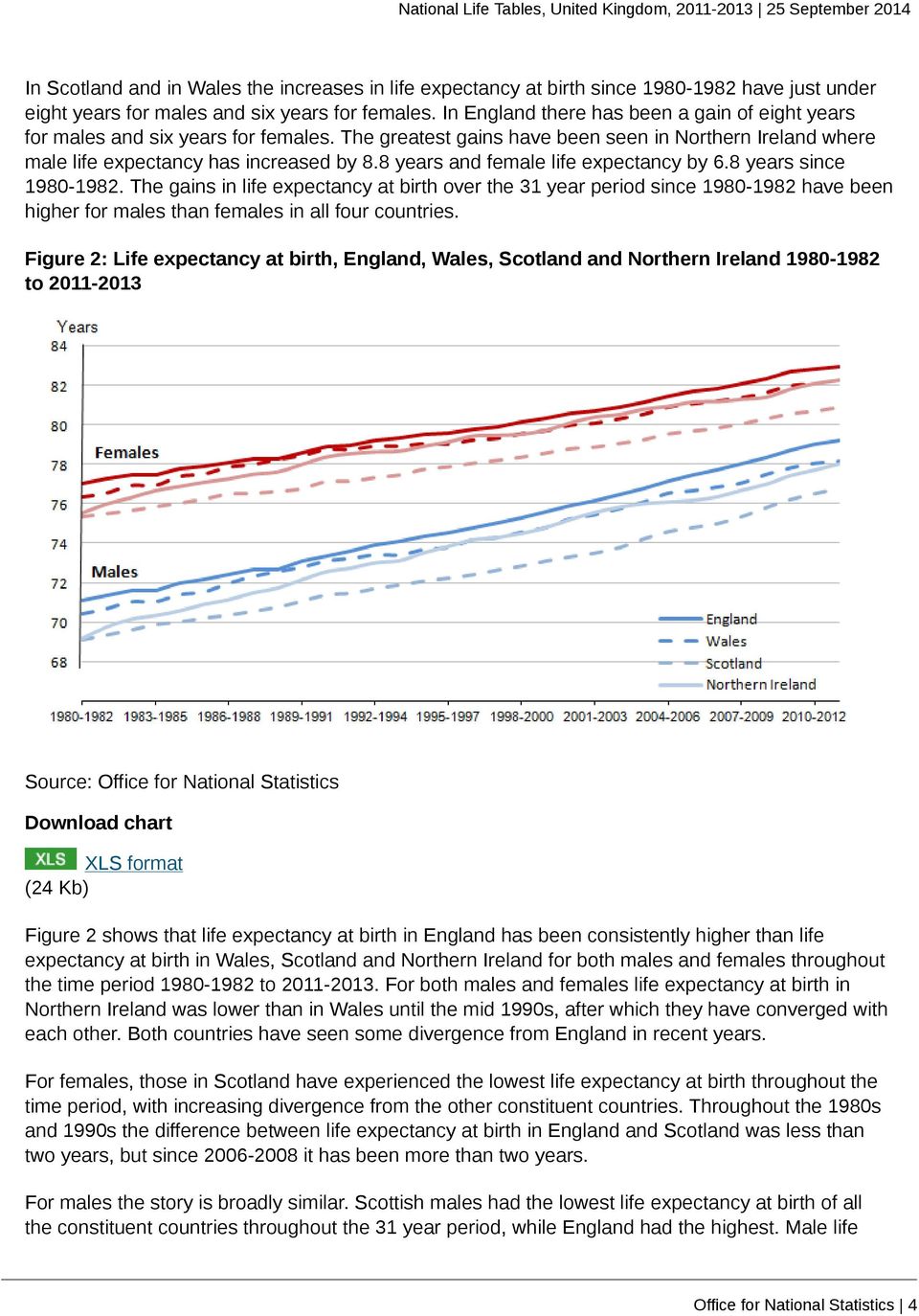
5 expectancy at birth in Northern Ireland converged with Welsh life expectancy at birth in ; they remain broadly similar in The largest difference between male life expectancy in Scotland and England was observed in at just under three years. In male life expectancy at birth was 2.4 years lower for Scotland than for England. The continued increases in life expectancy seen since the 1980s for both males and females in all of the UK constituent countries are due to the improvements in mortality at older ages. As mortality improves at older ages, larger numbers of people survive to the oldest ages and this contributes to the ageing populations of England, Wales, Scotland and Northern Ireland. Scotland continues to have the lowest life expectancy at birth of all the constituent countries for both males and females. This could be associated with higher levels of alcohol consumption, a greater smoking prevalence and higher levels of cardio-vascular diseases in Scotland compared to the other constituent countries of the UK 1. Notes for Life Expectancy at birth 1. Scottish health survey - UK comparisons: The Scottish Government, Life Expectancy at older ages age 65 age 65 for men in the UK has reached 18.3 years and for women it has reached 20.8 years in Table 1 shows how life expectancy at age 65 in the UK has improved over time. For men it has risen by 5.4 years since when it was 13.0 years. Women have seen a smaller increase of 3.9 years since when it was 16.9 years. The difference between male and female life expectancy at age 65 has decreased over the last 31 years from 4.0 years in to 2.5 years in Male life expectancy at age 65 has improved at a faster rate compared to females, but males have not yet reached the life expectancy we observe for females at age 65. Male life expectancy at age 65 in is similar to female life expectancy at age 65 in Office for National Statistics 5
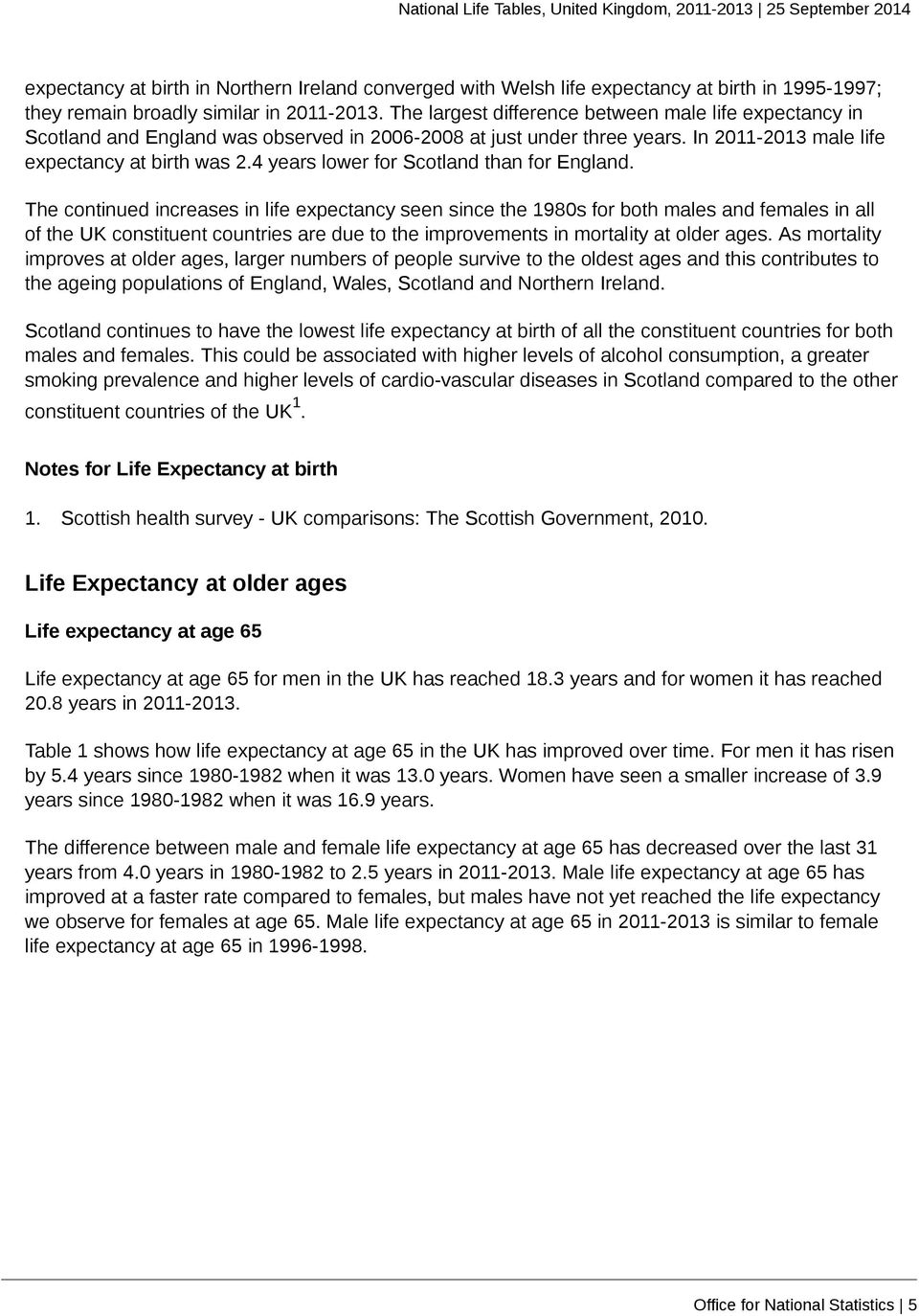
6 Table 1: age 65, United Kingdom and constituent countries, , and United Kingdom Males Females Males Females Males Females England Wales Scotland Northern Ireland Table source: Office for National Statistics Download table (25.5 Kb) In life expectancy at age 65 in England reached 18.5 years for men and 21.0 years for women, the highest of all the constituent countries. England has had the highest life expectancy at age 65 throughout the time period to Men and women in Wales and Northern Ireland have experienced similar life expectancy at age 65 to each other throughout the time period. Table 1 shows that Scotland has the lowest life expectancy at age 65 for both men and women in at 17.1 years and 19.5 years respectively. Scottish life expectancy has been consistently lower throughout the time period and has diverged away from the other constituent countries. In female life expectancy at age 65 in Scotland was 0.3 years lower than the next lowest country (Northern Ireland). In , this gap increased to one year lower than the next lowest countries of female life expectancy (Northern Ireland and Wales). age 85 A man in the UK aged 85 had a life expectancy of 5.8 years in For women the equivalent figure was 6.8 years. Office for National Statistics 6
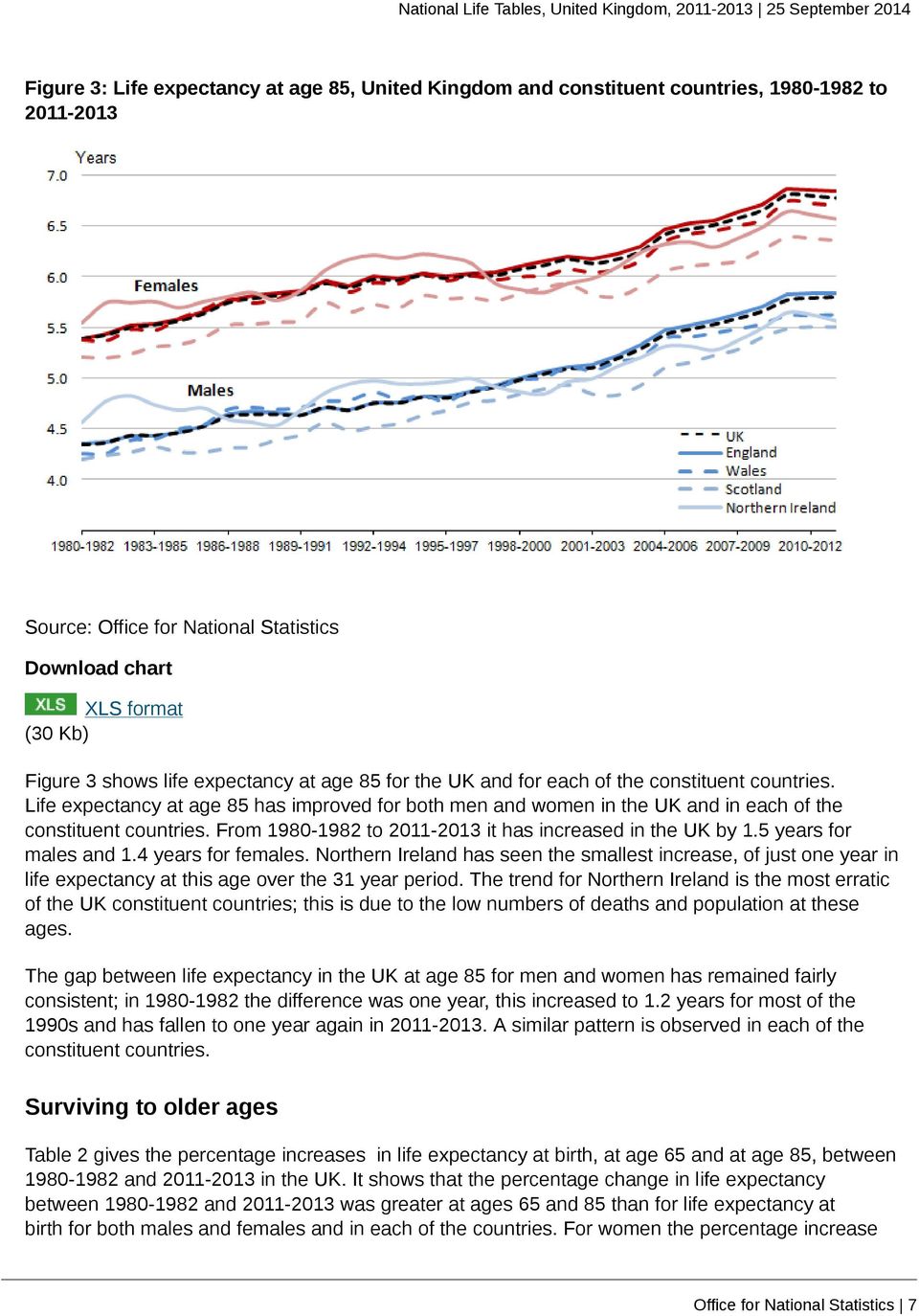
7 Figure 3: age 85, United Kingdom and constituent countries, to Source: Office for National Statistics Download chart (30 Kb) Figure 3 shows life expectancy at age 85 for the UK and for each of the constituent countries. age 85 has improved for both men and women in the UK and in each of the constituent countries. From to it has increased in the UK by 1.5 years for males and 1.4 years for females. Northern Ireland has seen the smallest increase, of just one year in life expectancy at this age over the 31 year period. The trend for Northern Ireland is the most erratic of the UK constituent countries; this is due to the low numbers of deaths and population at these ages. The gap between life expectancy in the UK at age 85 for men and women has remained fairly consistent; in the difference was one year, this increased to 1.2 years for most of the 1990s and has fallen to one year again in A similar pattern is observed in each of the constituent countries. Surviving to older ages Table 2 gives the percentage increases in life expectancy at birth, at age 65 and at age 85, between and in the UK. It shows that the percentage change in life expectancy between and was greater at ages 65 and 85 than for life expectancy at birth for both males and females and in each of the countries. For women the percentage increase Office for National Statistics 7
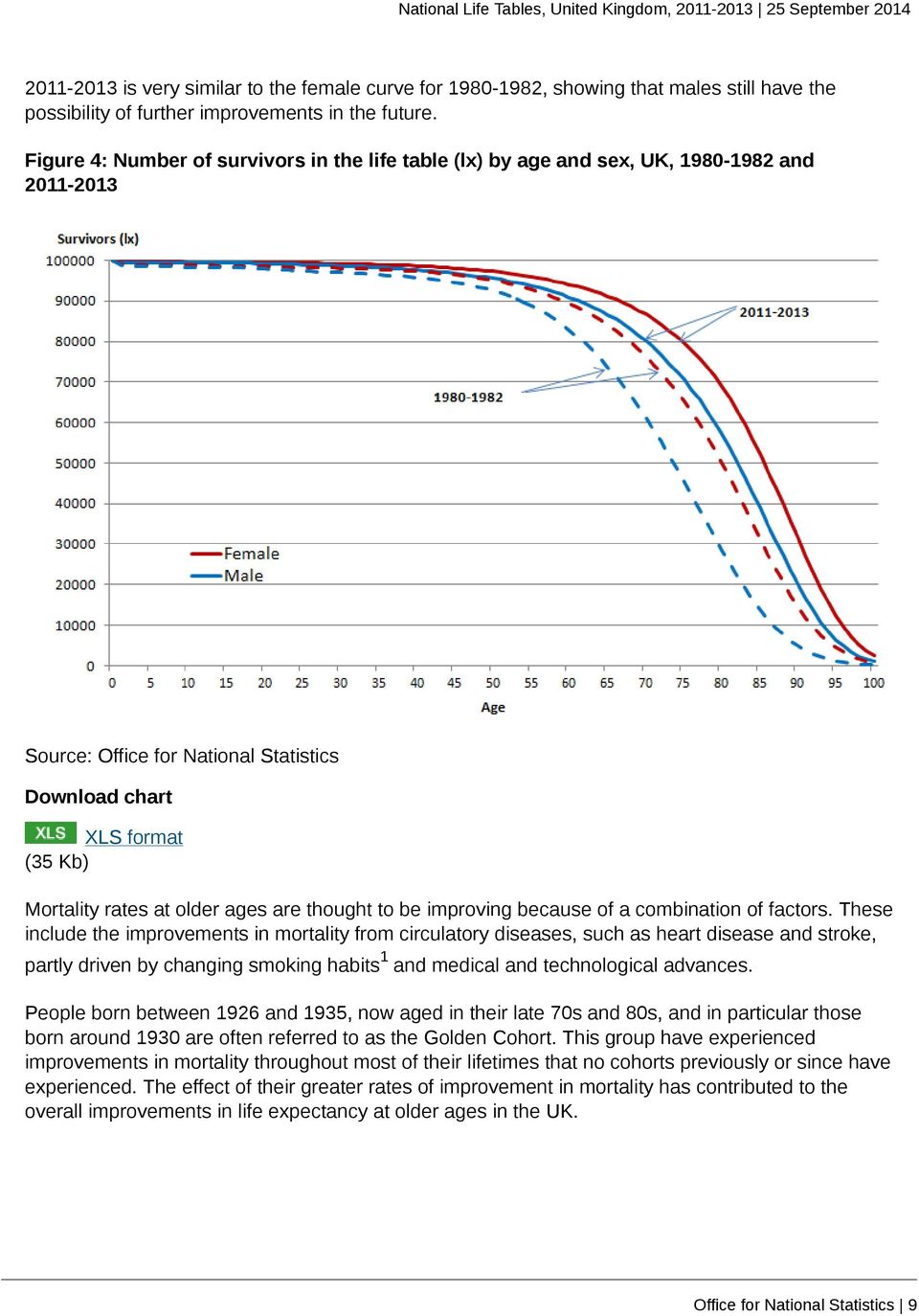
8 in life expectancy at age 85 was greater than or similar to age 65 and at birth in all but Northern Ireland, where the larger increase is at age 65 (26%). For men the greatest percentage increase in life expectancy was at age 65 (around 41% for the UK) with Wales showing the largest increase at 44%. Although life expectancy is lower for males than females, males have experienced larger improvements at all ages. The greater increases at older ages add to evidence that increasing life expectancy over the last few decades is mostly due to the improving mortality rates at older ages. Table 2: Percentage increase in life expectancy, United Kingdom and constituent countries, to United Kingdom birth age 65 age 85 Males Females Males Females Males Females 11% 8% 41% 23% 34% 26% England 11% 8% 41% 24% 34% 27% Wales 11% 8% 44% 23% 32% 25% Scotland 11% 7% 39% 22% 31% 22% Northern Ireland 13% 9% 43% 26% 22% 19% Table source: Office for National Statistics Download table (19 Kb) As life expectancy improvements are happening at older ages, the proportion of deaths occurring at older ages is also increasing and we see increases in the age where the most deaths occur. In the most common age at death (in the life table) was at age 77 for men and 84 for women, while in this had increased to 86 and 89. The gap between the most common age at death for men and women has therefore decreased from seven years to just three years over the 31 year period. In more than a third (39%) of male deaths occurred at ages 85 and above. In this was just 14%, demonstrating that males in the UK are surviving to and dying at older ages in more recent years. In female deaths at age 85 and above accounted for 52% of all female deaths; up from 31% in demonstrating a similar trend. Figure 4 shows the survival curves for males and females in the UK for and The proportions surviving to older ages (in the life table) have improved for both males and females. For example, the age at which the proportion of the life table population falls below 90% has risen by eight years for males, from age 54 in to 62 in ; females have experienced a similar increase from age 60 in to 67 in The male survival curve for Office for National Statistics 8

9 is very similar to the female curve for , showing that males still have the possibility of further improvements in the future. Figure 4: Number of survivors in the life table (lx) by age and sex, UK, and Source: Office for National Statistics Download chart (35 Kb) Mortality rates at older ages are thought to be improving because of a combination of factors. These include the improvements in mortality from circulatory diseases, such as heart disease and stroke, partly driven by changing smoking habits 1 and medical and technological advances. People born between 1926 and 1935, now aged in their late 70s and 80s, and in particular those born around 1930 are often referred to as the Golden Cohort. This group have experienced improvements in mortality throughout most of their lifetimes that no cohorts previously or since have experienced. The effect of their greater rates of improvement in mortality has contributed to the overall improvements in life expectancy at older ages in the UK. Office for National Statistics 9
10 As the chance of surviving to older ages has improved over time, this has led to increases in the population aged 90 and over. See ONS estimates of the very old (including centenarians) which are also published today. Notes for Surviving to older ages 1. Murphy M, Di Cesare M, (2012) Use of an age-period-cohort model to reveal the impact of cigarette smoking in trends in twentieth century adult cohort mortality in England and Wales, Population Studies, Vol 66, issue 3. International comparison Comparison of life expectancy in the United Kingdom s constituent countries with other selected countries Tables 3 and 4 show period life expectancy at birth, at age 65 and at age 85 for males and females respectively, for a selection of countries, selected by the availability of the relevant data. The countries are ordered by life expectancy at birth. Table 3: Life expectancy in selected countries, Males, birth age 65 age 85 Iceland (2013) Switzerland (2012) Sweden (2013) Japan (2012) Australia ( ) Norway (2013) Italy (2012) Spain (2012) Canada ( ) New Zealand ( ) England ( ) Netherlands (2012) France (2012) Wales ( ) Denmark ( ) Office for National Statistics 10
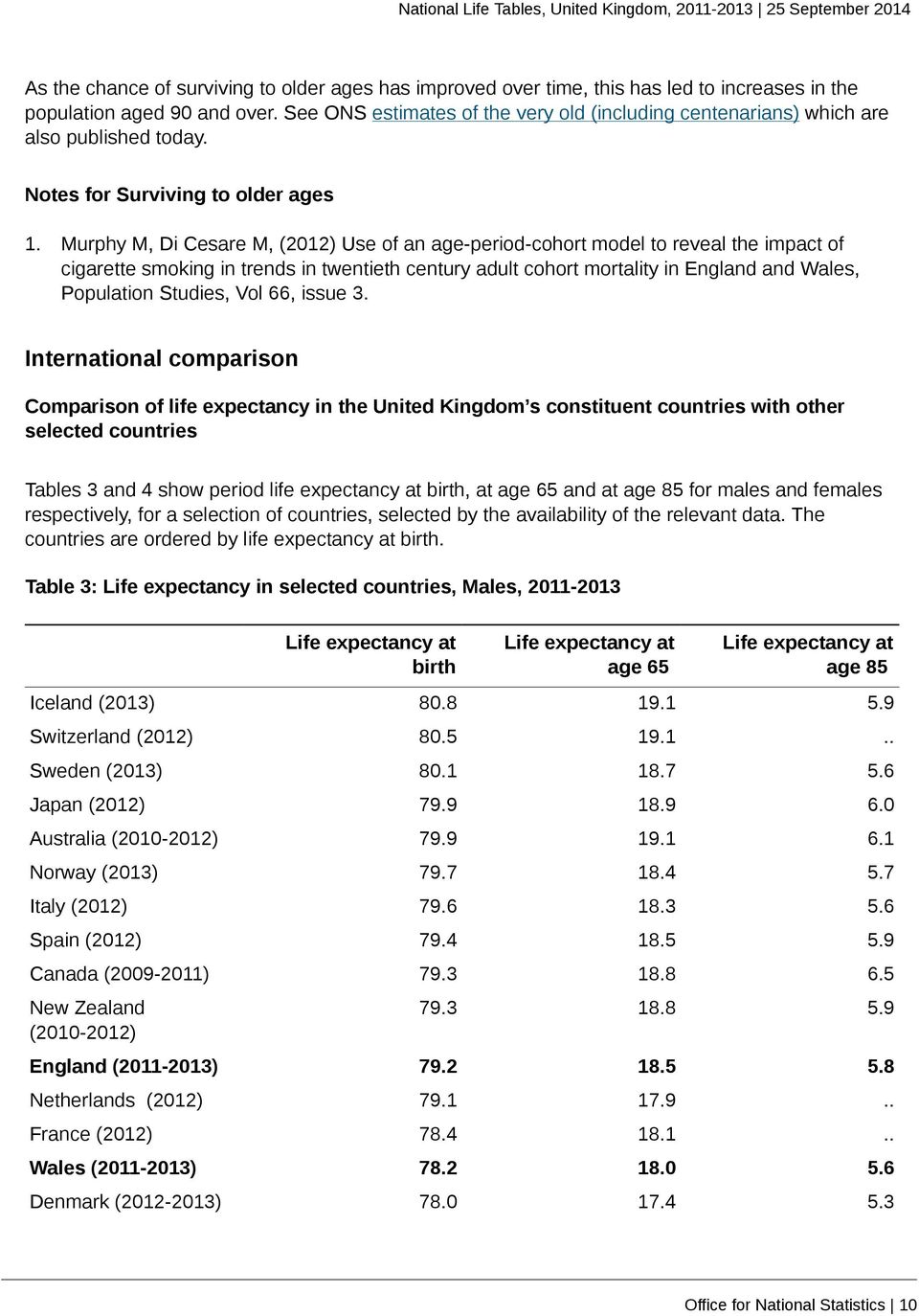
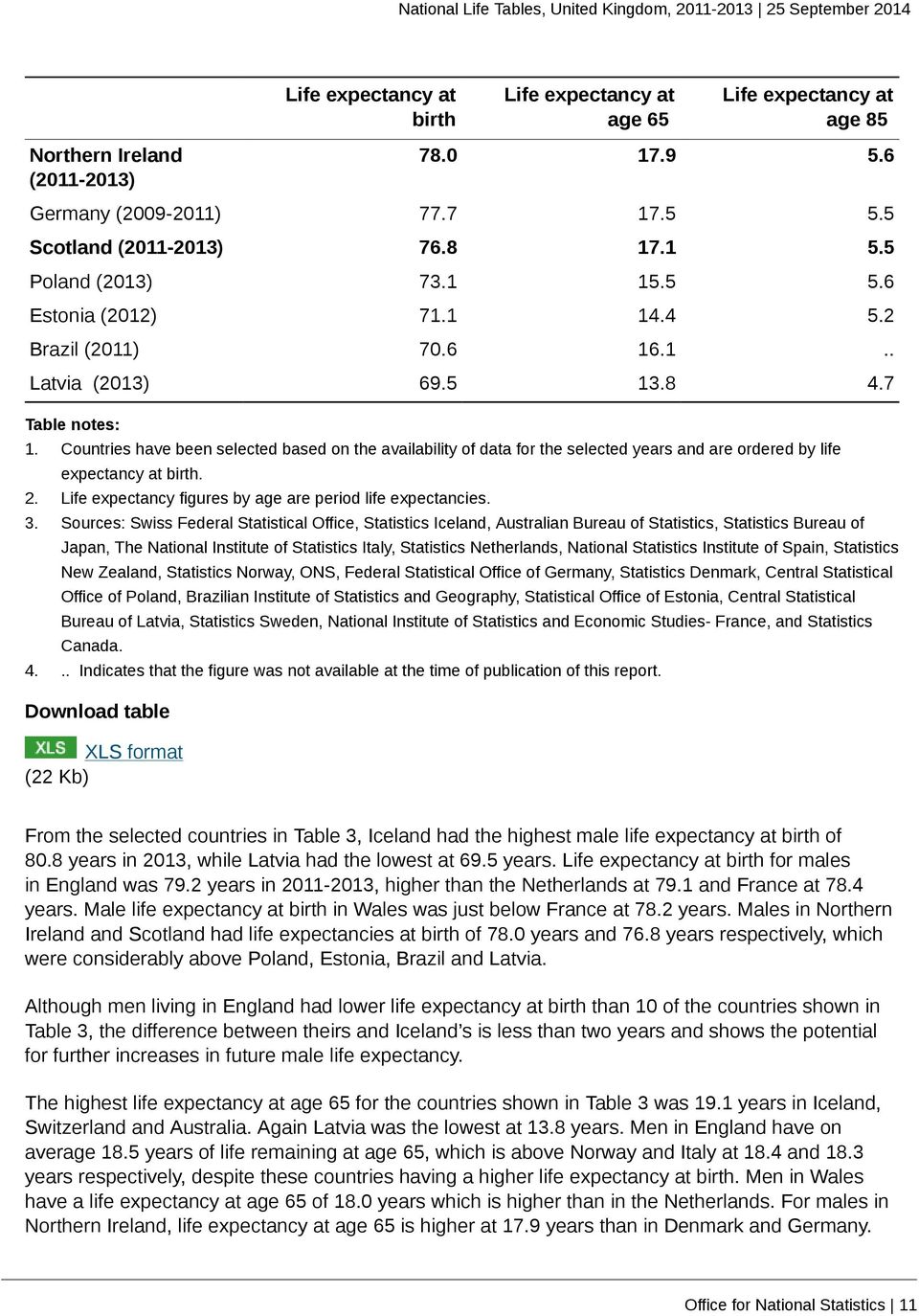
11 birth age 65 age 85 Northern Ireland ( ) Germany ( ) Scotland ( ) Poland (2013) Estonia (2012) Brazil (2011) Latvia (2013) Table notes: 1. Countries have been selected based on the availability of data for the selected years and are ordered by life expectancy at birth. 2. Life expectancy figures by age are period life expectancies. 3. Sources: Swiss Federal Statistical Office, Statistics Iceland, Australian Bureau of Statistics, Statistics Bureau of Japan, The National Institute of Statistics Italy, Statistics Netherlands, National Statistics Institute of Spain, Statistics New Zealand, Statistics Norway, ONS, Federal Statistical Office of Germany, Statistics Denmark, Central Statistical Office of Poland, Brazilian Institute of Statistics and Geography, Statistical Office of Estonia, Central Statistical Bureau of Latvia, Statistics Sweden, National Institute of Statistics and Economic Studies- France, and Statistics Canada Indicates that the figure was not available at the time of publication of this report. Download table (22 Kb) From the selected countries in Table 3, Iceland had the highest male life expectancy at birth of 80.8 years in 2013, while Latvia had the lowest at 69.5 years. birth for males in England was 79.2 years in , higher than the Netherlands at 79.1 and France at 78.4 years. Male life expectancy at birth in Wales was just below France at 78.2 years. Males in Northern Ireland and Scotland had life expectancies at birth of 78.0 years and 76.8 years respectively, which were considerably above Poland, Estonia, Brazil and Latvia. Although men living in England had lower life expectancy at birth than 10 of the countries shown in Table 3, the difference between theirs and Iceland s is less than two years and shows the potential for further increases in future male life expectancy. The highest life expectancy at age 65 for the countries shown in Table 3 was 19.1 years in Iceland, Switzerland and Australia. Again Latvia was the lowest at 13.8 years. Men in England have on average 18.5 years of life remaining at age 65, which is above Norway and Italy at 18.4 and 18.3 years respectively, despite these countries having a higher life expectancy at birth. Men in Wales have a life expectancy at age 65 of 18.0 years which is higher than in the Netherlands. For males in Northern Ireland, life expectancy at age 65 is higher at 17.9 years than in Denmark and Germany. Office for National Statistics 11
12 age 65 in Scotland is around one year higher than Brazil at 17.1 years, although Scotland has a much higher life expectancy at birth compared to males in Brazil. The figure for England at age 65 has a difference of less than one year from the highest shown in Table 3. At age 85 men in Canada had the highest life expectancy of 6.5 years. Men in England having reached aged 85 could expect, on average, to live a further 5.8 years. The remaining UK constituent countries all have similar male life expectancy at age 85 to Germany and Poland. Table 4: Life expectancy in selected countries, females, birth age 65 age 85 Japan (2012) Spain (2012) France (2012) Switzerland (2012) Italy (2012) Australia ( ) Sweden (2013) Iceland (2013) Norway (2013) Canada ( ) New Zealand ( ) England ( ) Netherlands (2012) Germany ( ) Northern Ireland ( ) Wales ( ) Denmark ( ) Poland (2013) Estonia (2012) Scotland ( ) Latvia (2013) Office for National Statistics 12

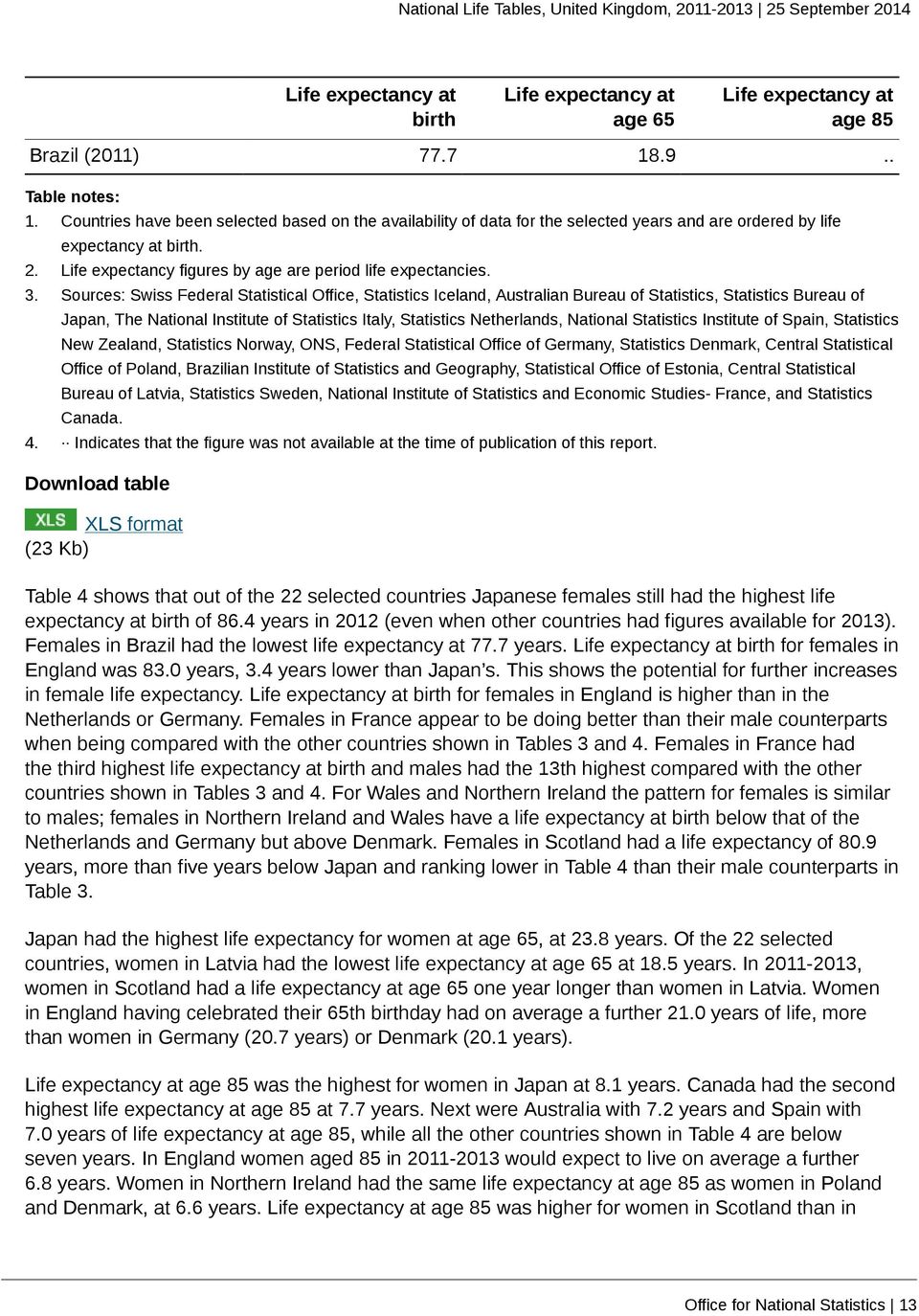
13 birth age 65 age 85 Brazil (2011) Table notes: 1. Countries have been selected based on the availability of data for the selected years and are ordered by life expectancy at birth. 2. Life expectancy figures by age are period life expectancies. 3. Sources: Swiss Federal Statistical Office, Statistics Iceland, Australian Bureau of Statistics, Statistics Bureau of Japan, The National Institute of Statistics Italy, Statistics Netherlands, National Statistics Institute of Spain, Statistics New Zealand, Statistics Norway, ONS, Federal Statistical Office of Germany, Statistics Denmark, Central Statistical Office of Poland, Brazilian Institute of Statistics and Geography, Statistical Office of Estonia, Central Statistical Bureau of Latvia, Statistics Sweden, National Institute of Statistics and Economic Studies- France, and Statistics Canada. 4. Indicates that the figure was not available at the time of publication of this report. Download table (23 Kb) Table 4 shows that out of the 22 selected countries Japanese females still had the highest life expectancy at birth of 86.4 years in 2012 (even when other countries had figures available for 2013). Females in Brazil had the lowest life expectancy at 77.7 years. birth for females in England was 83.0 years, 3.4 years lower than Japan s. This shows the potential for further increases in female life expectancy. birth for females in England is higher than in the Netherlands or Germany. Females in France appear to be doing better than their male counterparts when being compared with the other countries shown in Tables 3 and 4. Females in France had the third highest life expectancy at birth and males had the 13th highest compared with the other countries shown in Tables 3 and 4. For Wales and Northern Ireland the pattern for females is similar to males; females in Northern Ireland and Wales have a life expectancy at birth below that of the Netherlands and Germany but above Denmark. Females in Scotland had a life expectancy of 80.9 years, more than five years below Japan and ranking lower in Table 4 than their male counterparts in Table 3. Japan had the highest life expectancy for women at age 65, at 23.8 years. Of the 22 selected countries, women in Latvia had the lowest life expectancy at age 65 at 18.5 years. In , women in Scotland had a life expectancy at age 65 one year longer than women in Latvia. Women in England having celebrated their 65th birthday had on average a further 21.0 years of life, more than women in Germany (20.7 years) or Denmark (20.1 years). age 85 was the highest for women in Japan at 8.1 years. Canada had the second highest life expectancy at age 85 at 7.7 years. Next were Australia with 7.2 years and Spain with 7.0 years of life expectancy at age 85, while all the other countries shown in Table 4 are below seven years. In England women aged 85 in would expect to live on average a further 6.8 years. Women in Northern Ireland had the same life expectancy at age 85 as women in Poland and Denmark, at 6.6 years. age 85 was higher for women in Scotland than in Office for National Statistics 13
14 Germany at 6.4 years and 6.3 years respectively. The lowest life expectancy at age 85 for females was in Latvia at 5.4 years in Uses of life tables The national life tables provide annual figures allowing up-to-date analysis of mortality and life expectancy. Key uses: to study the course of mortality throughout the life cycle, as an indicator of the health of the nation, to inform policy regarding state pension age, or to assess risk for life assurance and pension liability. Within ONS, national life tables are used in the methodologies used to calculate 'health expectancies' and duration of working life. They are also used to inform the assumptions of future mortality for the National Population Projections. Other organisations that use life tables include: Other government departments: Government Actuary s Department, Department of Work and Pensions, Department of Health and Health Authorities, National Records of Scotland, Northern Ireland Statistics and Research Agency, and Welsh Assembly, and HM Treasury. Non-government organisations: universities academics and students, news media, financial advisors/consultants, insurance companies and actuarial professions, and the general public. Background notes 1. Figures in the tables in this bulletin and commentary are rounded to one decimal place. Calculations in this bulletin use unrounded figures. 2. The national life tables for the years to take into account the rebased population estimates following the 2011 Census. Office for National Statistics 14

15 3. These tables were formerly known as interim life tables as fully graduated life tables have been prepared every ten years (decennial life tables), based on the three years data around a census year. However as this product has been produced annually for more than 30 years, it has now become an established annual output rather than an interim measure. 4. Details of the policy governing the release of new data are available by visiting or from the Media Relations Office [email protected] These National Statistics are produced to high professional standards and released according to the arrangements approved by the UK Statistics Authority. Copyright Crown copyright 2014 You may use or re-use this information (not including logos) free of charge in any format or medium, under the terms of the Open Government Licence. To view this licence, visit or write to the Information Policy Team, The National Archives, Kew, London TW9 4DU, or [email protected]. This document is also available on our website at Statistical contacts Name Phone Department Julie Mills +44 (0) Demographic [email protected] Analysis Unit Rebecca Wright +44 (0) Demographic Analysis Unit [email protected] Issuing Body: Office for National Statistics Media Contact Details: Telephone: (8.30am-5.30pm Weekdays) Emergency out of hours (limited service): [email protected] Office for National Statistics 15
National Life Tables, United Kingdom: 2012 2014
 Statistical bulletin National Life Tables, United Kingdom: 2012 2014 Trends for the UK and constituent countries in the average number of years people will live beyond their current age measured by "period
Full report - Women in the labour market
 Full report - Women in the labour market Coverage: UK Date: 25 September 2013 Geographical Area: UK Theme: Labour Market Key points The key points are: Rising employment for women and falling employment
CO1.2: Life expectancy at birth
 Definitions and methodology CO1.2: at birth at birth is the average number of years a newborn can expect to live if he or she experienced the age-specific mortality rates prevalent in a particular year.
Statistical Bulletin. Business Demography, 2010. Headlines figures. Summary
 Statistical Bulletin Business Demography, 2010 Coverage: UK Date: 06 December 2011 Geographical Area: Local Authority and County Theme: Business and Energy Headlines figures Number of business deaths rose
Statistical Bulletin. The Effects of Taxes and Benefits on Household Income, 2011/12. Key points
 Statistical Bulletin The Effects of Taxes and Benefits on Household Income, 2011/12 Coverage: UK Date: 10 July 2013 Geographical Area: UK and GB Theme: Economy Theme: People and Places Key points There
The Burden of Financial and Property Debt, Great Britain, 2010 to 2012
 The Burden of Financial and Property Debt, Great Britain, 2010 to 2012 Coverage: GB Date: 27 July 2015 Geographical Area: Region Theme: Economy Theme: People and Places Foreword Using the Wealth and Assets
How To Track Life Expectancy In England
 Recent Trends in Life Expectancy at Older Ages February 2015 About Public Health England Public Health England exists to protect and improve the nation's health and wellbeing, and reduce health inequalities.
Statistical Bulletin. Annual Survey of Hours and Earnings, 2014 Provisional Results. Key points
 Statistical Bulletin Annual Survey of Hours and Earnings, 2014 Provisional Results Coverage: UK Date: 19 November 2014 Geographical Areas: Country, European (NUTS), Local Authority and County, Parliamentary
International comparisons of obesity prevalence
 International comparisons of obesity prevalence June 2009 International Comparisons of Obesity Prevalence Executive Summary Obesity prevalence among adults and children has been increasing in most developed
Young People in the Labour Market, 2014
 Young People in the Labour Market, 2014 Coverage: UK Date: 05 March 2014 Geographical Area: Local Authority and County Theme: Labour Market Young People in the Labour Market The number of people aged 16
POPULATION AND MIGRATION ESTIMATES NORTHERN IRELAND (2013) STATISTICAL REPORT
 POPULATION AND MIGRATION ESTIMATES NORTHERN IRELAND (2013) STATISTICAL REPORT 9.30am Thursday 26 June 2014 Key Points Northern Ireland population at 30 June 2013 is estimated to be 1.830 million people.
Self-employed workers in the UK - 2014
 Self-employed workers in the UK - 2014 Coverage: UK Date: 20 August 2014 Geographical Area: Local Authority Theme: Economy Theme: Labour Market Key Points Self-employment higher than at any point over
Low Carbon and Renewable Energy Economy 2014, First Estimates
 Low Carbon and Renewable Energy Economy 2014, First Estimates Coverage: UK Date: 09 December 2015 Geographical Area: UK Theme: Agriculture and Environment Main points This bulletin presents first estimates
Main Report: The Burden of Property Debt in Great Britain, 2006/08 & 2008/10
 Main Report: The Burden of Property Debt in Great Britain, 2006/08 & 2008/10 Coverage: England and Wales Date: 13 May 2013 Geographical Area: Region Theme: Economy Key Points This release focuses on the
1. Introduction. 1.1 Objective
 Second International Comparative Study of Mortality Tables for Pension Fund Retirees T.Z.Sithole (Kingston University London), S.Haberman (Cass Business School, City University London) and R.J.Verrall
Births in Northern Ireland 2012
 STATISTICAL BULLETIN Coverage: Northern Ireland Date: 8 May 2013 Geography: NI & Local Government District Theme: Population Summary Births in Northern Ireland 2012 This bulletin presents statistics on
Life Expectancy for areas within Northern Ireland 2011-2013. Published 2 nd October 2015
 Life Expectancy for areas within Northern Ireland 2011-2013 Published 2 nd October 2015. Contents Page Key Points 1 Background 3 Life expectancy at birth 5 11 Local Government Districts 6 Health and Social
Population Aging in Developed Countries: Emerging Trends and Dynamics Wan He, Ph.D. Population Division U.S. Census Bureau
 Population Aging in Developed Countries: Emerging Trends and Dynamics Wan He, Ph.D. Population Division U.S. Census Bureau This presentation is released to inform interested parties of population aging
Ageing OECD Societies
 ISBN 978-92-64-04661-0 Trends Shaping Education OECD 2008 Chapter 1 Ageing OECD Societies FEWER CHILDREN LIVING LONGER CHANGING AGE STRUCTURES The notion of ageing societies covers a major set of trends
Age, Demographics and Employment
 Key Facts Age, Demographics and Employment This document summarises key facts about demographic change, age, employment, training, retirement, pensions and savings. 1 Demographic change The population
How To Calculate Tertiary Type A Graduation Rate
 Indicator How Many Students Finish Tertiary Education? Based on current patterns of graduation, it is estimated that an average of 46% of today s women and 31% of today s men in OECD countries will complete
SF3.1: Marriage and divorce rates
 Marriage rates Definitions and methodology SF3.1: Marriage and divorce rates The crude marriage rate is the number of marriages formed each year as a ratio to 1 000 people. This measure disregards other
Second International Comparative Study of Mortality Tables for Pension Fund Retirees
 Second International Comparative Study of Mortality Tables for Pension Fund Retirees T.Z.Sithole (Kingston University), S.Haberman (Cass Business School, City University London) and R.J.Verrall (Cass Business
Scottish Independence. Charting the implications of demographic change. Ben Franklin. I May 2014 I. www.ilc.org.uk
 Scottish Independence Charting the implications of demographic change Ben Franklin I May 2014 I www.ilc.org.uk Summary By 2037 Scotland s working age population is expected to be 3.5% than it was in 2013
Analysis of Employee Contracts that do not Guarantee a Minimum Number of Hours
 Analysis of Employee Contracts that do not Guarantee a Minimum Number of Hours Coverage: GB Date: 30 April 2014 Geographical Area: GB Theme: Labour Market 1. Summary There is no legal definition of zero-hours
Beyond 2011: Population Coverage Survey Field Test 2013 December 2013
 Beyond 2011 Beyond 2011: Population Coverage Survey Field Test 2013 December 2013 Background The Beyond 2011 Programme in the Office for National Statistics (ONS) is currently reviewing options for taking
Who are the Other ethnic groups?
 Article Who are the Other ethnic groups? Social and Welfare David Gardener Helen Connolly October 2005 Crown copyright Office for National Statistics 1 Drummond Gate London SW1V 2QQ Tel: 020 7533 9233
Funeral Benefit from the DSS
 Funeral Benefit from the DSS The state offers a specific benefit towards the cost of a funeral, for those people that it deems most need it. The qualification is strict but a successful application can
RR887. Changes in shift work patterns over the last ten years (1999 to 2009)
 Health and Safety Executive Changes in shift work patterns over the last ten years (999 to 009) Prepared by Office for National Statistics for the Health and Safety Executive 0 RR887 Research Report Crown
relating to household s disposable income. A Gini Coefficient of zero indicates
 Gini Coefficient The Gini Coefficient is a measure of income inequality which is based on data relating to household s disposable income. A Gini Coefficient of zero indicates perfect income equality, whereas
UK application rates by country, region, sex, age and background. (2014 cycle, January deadline)
 UK application rates by country, region, sex, age and background (2014 cycle, January deadline) UCAS Analysis and Research 31 January 2014 Key findings Application rates for 18 year olds in England, Wales
Expenditure and Outputs in the Irish Health System: A Cross Country Comparison
 Expenditure and Outputs in the Irish Health System: A Cross Country Comparison Paul Redmond Overview This document analyzes expenditure and outputs in the Irish health system and compares Ireland to other
Replacement Migration
 Population Division Department of Economic and Social Affairs United Nations Secretariat Replacement Migration United Nations ST/ESA/SER.A/206 Population Division Department of Economic and Social Affairs
Article: Main results from the Wealth and Assets Survey: July 2012 to June 2014
 Article: Main results from the Wealth and Assets Survey: July 2012 to June 2014 Coverage: GB Date: 18 December 2015 Geographical Area: Region Theme: Economy Main points In July 2012 to June 2014: aggregate
THE DEMOGRAPHY OF POPULATION AGEING
 THE DEMOGRAPHY OF POPULATION AGEING Barry Mirkin and Mary Beth Weinberger* An inevitable consequence of the demographic transition and the shift to lower fertility and mortality has been the evolution
Chapter 4: Mass Marketing Fraud
 Chapter 4: Mass Marketing Fraud Coverage: England and Wales Date: 09 May 2013 Geographical Area: Local Authority and County Theme: Crime and Justice Summary Mass marketing fraud describes activities where
ACP-NEP Co-ord (Smith, Lyn C2) Military Goods: A400M Collaborative Programme OPEN GENERAL EXPORT LICENCE APRIL 2014
 ACP-NEP Co-ord (Smith, Lyn C2) OPEN GENERAL EXPORT LICENCE Military Goods: A400M Collaborative Programme APRIL 2014 - This page has been left intentionally blank - - 2 - April 2014 Open General Export
(Only available if you have applied for a Decreasing Mortgage Cover Plan or a Level Protection Plan).
 Mortgage protection Free cover (Only available if you have applied for a Decreasing Mortgage Cover Plan or a Level Protection Plan). At Zurich, we understand the importance of financial protection when
Child Benefit if you are coming from abroad or going abroad
 Child Benefit if you are coming from abroad or going abroad Please keep these notes for future reference CH5 Notes Contents Introduction 3 Definitions 3 How to contact us for help 4 Coming to the United
Short Analytical Web Note 3/2015
 Short Analytical Web Note 3/2015 This analytical web-note contains an extensive update of the main demographic trends for the EU and a labour-market supplement which outlines the potential consequences
Basis for setting the discount rate for calculating cash equivalent transfer values payable by public service pension schemes
 Basis for setting the discount rate for calculating cash equivalent transfer values payable by public service pension schemes updated guidance issued by HM Treasury March 2011 Official versions of this
The UK Tourism Satellite Account (UK- TSA) for 2012. Tourism Direct Gross Value Added (GVA) was 57.3 billion in 2012.
 Statistical Bulletin The UK Tourism Satellite Account (UK- TSA) for 2012 Coverage: UK Date: 26 June 2015 Geographical Area: UK Theme: People and Places Theme: Economy Main Figures Tourism Direct Gross
PORTABILITY OF SOCIAL SECURITY AND HEALTH CARE BENEFITS IN ITALY
 PORTABILITY OF SOCIAL SECURITY AND HEALTH CARE BENEFITS IN ITALY Johanna Avato Human Development Network Social Protection and Labor The World Bank Background study March 2008 The Italian Social Security
BUSINESS POPULATION ESTIMATES FOR THE UK AND REGIONS
 STATISTICAL RELEASE BUSINESS POPULATION ESTIMATES FOR THE UK AND REGIONS 2013 Summary There were an estimated 4.9 million private sector businesses in the UK at the start of 2013, an increase of 102,000
Statistics fact sheet
 Statistics fact sheet Fact sheet last updated January 2015 EXTERNAL VERSION Macmillan Cancer Support Page 1 of 10 Macmillan and statistics Statistics are important to Macmillan because they help us represent
Full Report - Graduates in the UK Labour Market 2013
 Full Report - Graduates in the UK Labour Market 2013 Coverage: UK Date: 19 November 2013 Geographical Area: UK and GB Theme: Labour Market Theme: Children, Education and Skills Key points In 2013 there
Women s Earnings and Income
 Earnings and Income of U.S. Women and Men The median annual earnings for full-time, year-round women workers in 2010 was $36,931 compared to men s $47,715. 1 In 2011, the median weekly earnings for full-time
Health Care Systems: Efficiency and Policy Settings
 Health Care Systems: Efficiency and Policy Settings Summary in English People in OECD countries are healthier than ever before, as shown by longer life expectancy and lower mortality for diseases such
Foreword. End of Cycle Report 2014. Applicants
 Foreword The End of Cycle Report is our most comprehensive analysis to date of recruitment to full time undergraduate courses in the UK. It provides a rich picture of demand and outcomes for higher education
What Are the Incentives to Invest in Education?
 Indicator What Are the Incentives to Invest in Education? On average across 25 OECD countries, the total return (net present value), both private and public, to a man who successfully completes upper secondary
International Institute of Business Analysis. Salary Survey Report
 International Institute of Business Analysis Salary Survey Report December 15, 2013 Introduction International Institute of Business Analysis (IIBA) is the independent, nonprofit, professional association
Fire Death Rate Trends: An International Perspective
 Topical Fire report SerieS Fire Death Rate Trends: An International Perspective Volume 12, Issue 8 / July 2011 These topical reports are designed to explore facets of the U.S. fire problem as depicted
Chapter 3: Property Wealth, Wealth in Great Britain 2010-12
 Chapter 3: Property Wealth, Wealth in Great Britain 2010-12 Coverage: GB Date: 15 May 2014 Geographical Area: GB Theme: Economy Key Points Aggregate net property wealth for all private households in Great
Longevity Risk in the United Kingdom
 Institut für Finanz- und Aktuarwissenschaften, Universität Ulm Longevity Risk in the United Kingdom Stephen Richards 20 th July 2005 Copyright c Stephen Richards. All rights reserved. Electronic versions
Canada Pension Plan Retirement, Survivor and Disability Beneficiaries Mortality Study
 f Canada Pension Plan Retirement, Survivor and Disability Beneficiaries Mortality Study Actuarial Study No. 16 June 2015 Office of the Chief Actuary Office of the Chief Actuary Office of the Superintendent
Crystal Clear Contract Services Limited Application Form CIS/Sole Trader
 CIS/Sole Trader Please sign and complete this form as soon as possible. Until we have processed your application, we cannot pay you. Complete the whole form if you can, BUT YOU MUST COMPLETE ALL AREAS
EUROPE 2020 TARGET: TERTIARY EDUCATION ATTAINMENT
 EUROPE 2020 TARGET: TERTIARY EDUCATION ATTAINMENT Low tertiary or equivalent education attainment levels create skills bottlenecks in knowledgeintensive economic sectors and hamper productivity, innovation
EUROPEAN. Geographic Trend Report for GMAT Examinees
 2011 EUROPEAN Geographic Trend Report for GMAT Examinees EUROPEAN Geographic Trend Report for GMAT Examinees The European Geographic Trend Report for GMAT Examinees identifies mobility trends among GMAT
UK application rates by country, region, constituency, sex, age and background. (2015 cycle, January deadline)
 UK application rates by country, region, constituency, sex, age and background () UCAS Analysis and Research 30 January 2015 Key findings JANUARY DEADLINE APPLICATION RATES PROVIDE THE FIRST RELIABLE INDICATION
SWECARE FOUNDATION. Uniting the Swedish health care sector for increased international competitiveness
 SWECARE FOUNDATION Uniting the Swedish health care sector for increased international competitiveness SWEDEN IN BRIEF Population: approx. 9 800 000 (2015) GDP/capita: approx. EUR 43 300 (2015) Unemployment
I. DEMOGRAPHIC DETERMINANTS OF POPULATION AGEING
 World Population Ageing 9- I. DEMOGRAPHIC DETERMINANTS OF POPULATION AGEING Underlying global population ageing is a process known as the demographic transition in which mortality and then fertility decline
- 2 - Chart 2. Annual percent change in hourly compensation costs in manufacturing and exchange rates, 2010-2011
 For release 10:00 a.m. (EST) Wednesday, December 19, 2012 USDL-12-2460 Technical Information: (202) 691-5654 [email protected] www.bls.gov/ilc Media Contact: (202) 691-5902 [email protected] INTERNATIONAL
E-commerce and ICT Activity, 2013. While 22% of businesses generated e-commerce sales, 51% of businesses made e-commerce purchases in 2013.
 Statistical Bulletin E-commerce and ICT Activity, 2013 Coverage: UK Date: 28 November 2014 Geographical Area: UK Theme: Business and Energy Key Points E-commerce sales represented 20% of business turnover
Revised Methodology for Unit Wage Costs and Unit Labour Costs - Explanation and Impact
 Revised Methodology for Unit Wage Costs and Unit Labour Costs - Explanation and Impact Author Name(s): John Appleton, ONS Abstract A revised methodology for whole economy unit labour costs and unit wage
Friends Life Protection Account Key features of Mortgage Income Protection Cover
 Protection Friends Life Protection Account Key features of Mortgage Income Protection Cover Why is this document important? The Financial Services Authority is the independent financial services regulator.
Foreword. Dr Gerry FitzGerald Chief Health Officer
 1 Foreword This State of Health report is the third in a series, expanding on its predecessor State of Health 21 which was produced to support the Health 22 agenda. It provides an overview of trends in
Steven Allender, Peter Scarborough, Viv Peto and Mike Rayner
 2008 edition Steven Allender, Peter Scarborough, Viv Peto and Mike Rayner British Heart Foundation Health Promotion Research Group Department of Public Health, University of Oxford Jose Leal, Ramon Luengo-Fernandez
Health and Longevity. Global Trends. Which factors account for most of the health improvements in the 20th century?
 8 Health and Longevity The health of a country s population is often monitored using two statistical indicators: life expectancy at birth and the under-5 mortality rate. These indicators are also often
Births and deaths in Kent - 2014
 Business Intelligence Statistical Bulletin July and deaths in - Related information The Population and Census web page contains more information which you may find useful. Population data presents the
THE LOW INTEREST RATE ENVIRONMENT AND ITS IMPACT ON INSURANCE MARKETS. Mamiko Yokoi-Arai
 THE LOW INTEREST RATE ENVIRONMENT AND ITS IMPACT ON INSURANCE MARKETS Mamiko Yokoi-Arai Current macro economic environment is of Low interest rate Low inflation and nominal wage growth Slow growth Demographic
Full Report: Sickness Absence in the Labour Market, February 2014
 Full Report: Sickness Absence in the Labour Market, February 2014 Coverage: UK Date: 25 February 2014 Geographical Area: Region Theme: Labour Market Key points The key points are: 131 million days were
Friends Life Protection Account Key features of Income Protection Cover
 Protection Friends Life Protection Account Key features of Income Protection Cover Why is this document important? The Financial Services Authority is the independent financial services regulator. It requires
Mesothelioma in Australia: Incidence (1982 to 2013) and Mortality (1997 to 2012)
 Mesothelioma in Australia: Incidence (1982 to 213) and Mortality (1997 to 212) 215 Disclaimer The information provided in this document can only assist you in the most general way. This document does not
Reporting practices for domestic and total debt securities
 Last updated: 4 September 2015 Reporting practices for domestic and total debt securities While the BIS debt securities statistics are in principle harmonised with the recommendations in the Handbook on
Education at a Glance 2008. OECD Technical Note For Spain
 Education at a Glance 2008 NO MEDIA OR WIRE TRANSMISSION BEFORE 9 SEPTEMBER 2008, 11:00 PARIS TIME OECD Technical Note For Spain Governments are paying increasing attention to international comparisons
Abortion Statistics: Year ended December 2012
 Abortion Statistics: Year ended December 2012 Embargoed until 10:45am 19 June 2013 Key facts In the year ended December 2012: 14,745 abortions were performed in New Zealand, the lowest number since 1995
Reported Road Accident Statistics
 Reported Road Accident Statistics Standard Note: SN/SG/2198 Last updated: 24 October 2013 Author: Matthew Keep & Tom Rutherford Social and General Statistics Section This Note provides a range of data
Statistical First Release
 Statistical First Release Special Educational Needs in England: January 2014 Reference SFR 26/2014 Date 4 September 2014 Coverage England Theme Children, Education and Skills Issued by Department for Education,
The Path Forward. International Women s Day 2012 Global Research Results
 The Path Forward International Women s Day 2012 Global Research Results Research objectives Accenture conducted its global research study, The Path Forward for release on International Women s Day to gain
E-Commerce and ICT Activity, 2012. 95% of businesses had broadband Internet and 82% had a website.
 Statistical Bulletin E-Commerce and ICT Activity, 2012 Coverage: UK Date: 04 December 2013 Geographical Area: UK Theme: Business and Energy Key points E-commerce sales represented 18% of business turnover
INTERNATIONAL COMPARISONS OF HOURLY COMPENSATION COSTS
 For release 10:00 a.m. (EST) Tuesday, March 8, 2011 USDL-11-0303 Technical Information: (202) 691-5654 [email protected] www.bls.gov/ilc Media Contact: (202) 691-5902 [email protected] INTERNATIONAL COMPARISONS
10. European Union. (a) Past trends
 . European Union (a) Past trends The total fertility rate in the 15 countries that presently constitute the European Union was on a rising curve until 196-65, when it attained 2.69 births per woman. Since
Differences in patterns of drug use between women and men
 Differences in patterns of drug use between women and men Differences in patterns of drug use between women and men Key findings Introduction Cannabis Ecstasy Tranquillisers and sedatives Alcohol and drug
Office of the Regulator of Community Interest Companies: Introduction and guidance notes. Chapter 3: Limited Companies NOVEMBER 2012
 Office of the Regulator of Community Interest Companies: Introduction and guidance notes Chapter 3: Limited Companies NOVEMBER 2012 Contents 3.1. Community interest companies - limited liability companies...
ECDC SURVEILLANCE REPORT
 ECDC SURVEILLANCE REPORT Pandemic (H1N1) 2009 Weekly report: Individual case reports EU/EEA countries 31 July 2009 Summary The pandemic A(H1N1) 2009 is still spreading despite the fact that the regular