
Registered and Accredited Individual Non-government Schools (NSW) Manual
|
|
|
- Lynn Glenn
- 10 years ago
- Views:
Transcription
1 Registered and Accredited Individual Non-government Schools (NSW) Manual October 2014 (incorporating changes from 2004 to 2014) Please note: Amendments to the Manual are noted, as they take effect, in the Official Notices of the BOSTES Bulletin. The most up-to-date manual at any time is available on the BOSTES website <

2 Original published version updated: July 2005 Board Bulletin/Official Notices Vol 14 No 4 (BOS 29/05) November 2005 Board Bulletin/Official Notices Vol 14 No 6 (BOS 44/05) September 2006 Board Bulletin/Official Notices Vol 15 No 5 (BOS 42/06) July 2007 Board Bulletin/Official Notices Vol 16 No 3 (BOS 42/07) October 2007 Board Bulletin/Official Notices Vol 16 No 4 (BOS 56/07) February 2008 Board Bulletin/Official Notices Vol 17 No 1 (BOS 14/08) November 2008 Official Notice BOS 53/08 February 2010 Official Notice BOS 05/10 May 2011 Official Notice BOS 13/11 May 2012 Official Notice BOS 15/12 August 2012 Official Notice BOS 21/12 May 2013 Official Notice BOS 20/13 May 2014 Official Notice BOSTES 18/14 October 2014 Official Notice BOSTES 24/14 The Board of Studies, Teaching and Educational Standards NSW reserves the right to make amendments to the Manual at any time where additional information/clarification regarding policies or procedures is required. The current version of the Manual will be maintained on the BOSTES website. Schools will be advised of significant changes when they occur. Board of Studies, Teaching and Educational Standards NSW 2014 Staff in schools, colleges and tertiary institutions may reproduce this publication for bona fide purposes free of remuneration. Published by Board of Studies, Teaching and Educational Standards NSW GPO Box 5300 Sydney NSW 2001 Australia Tel: (02) Fax: (02) Internet: First published June 2004 Reprinted December 2006 Updated July 2007 Updated October 2007 Updated February 2008 Updated November 2008 Updated February 2010 Updated May 2011 Updated May 2012 Updated August 2012 Updated May 2013 Updated May 2014 Updated October 2014 October

3 Contents 1 Introduction Responsibilities of the Minister for Education in relation to the registration of non-government schools Responsibilities of the BOSTES in relation to the registration and accreditation of non-government schools Legislative Basis for the Registration and Accreditation of Non-government Schools Definition of a registered non-government school Objects for the administration of the Education Act The role of the BOSTES in the registration and accreditation process The registration process Conducting an unregistered school The accreditation process Conducting a school that is not accredited Requirements for Registered Non-government Schools Proprietor and principal of the school Staff Curriculum Premises and buildings Facilities Safe and supportive environment Discipline Attendance Management and operation of the school Educational and financial reporting Schools with boarding facilities Provisional Registration including Initial Registration Initial registration Concern about compliance with the requirements for registration Requirements for Accredited Non-government Schools Curriculum for the Record of School Achievement Curriculum for the Higher School Certificate Quality of the educational program Provisional Accreditation including Initial Accreditation Initial accreditation Concern about compliance with the requirements for accreditation Registration and Accreditation Procedures Submission of applications and documentation... 73

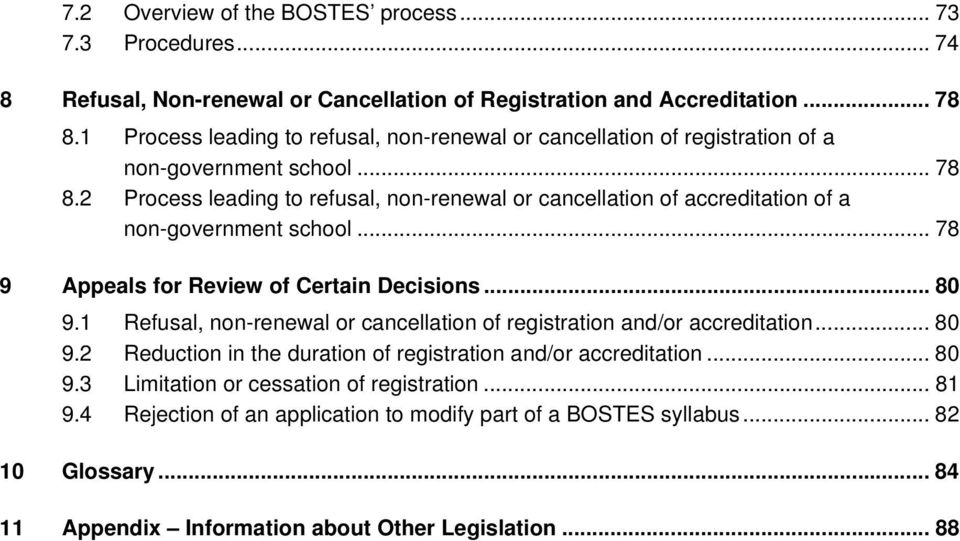
4 7.2 Overview of the BOSTES process Procedures Refusal, Non-renewal or Cancellation of Registration and Accreditation Process leading to refusal, non-renewal or cancellation of registration of a non-government school Process leading to refusal, non-renewal or cancellation of accreditation of a non-government school Appeals for Review of Certain Decisions Refusal, non-renewal or cancellation of registration and/or accreditation Reduction in the duration of registration and/or accreditation Limitation or cessation of registration Rejection of an application to modify part of a BOSTES syllabus Glossary Appendix Information about Other Legislation... 88
5 1 Introduction The Registered and Accredited Individual Non-government Schools (NSW) Manual provides information about the requirements for registered and accredited non-government schools under the Education Act 1990 (NSW) ( the Education Act ). Registration is a non-government school s licence to operate. The main purpose of registration is to ensure that the requirements of the Education Act are being, or will be, met. Accreditation authorises a non-government school to nominate candidates for the award of the Record of School Achievement and/or the Higher School Certificate. The main purpose of accreditation is to ensure that the requirements for the Record of School Achievement and/or the Higher School Certificate are being, or will be, met. This Manual provides details about: the responsibilities of the Minister for Education in relation to the registration of nongovernment schools the responsibilities of the Board of Studies, Teaching and Educational Standards NSW (the BOSTES) in relation to the registration and accreditation of non-government schools the legislative basis for the registration and accreditation of non-government schools requirements for registered schools and evidence of compliance with the requirements requirements for accredited schools and evidence of compliance with the requirements procedures for applying for registration and/or accreditation procedures for refusal, non-renewal or cancellation of a school s registration and accreditation making an appeal against a decision or recommendation application forms other relevant information and a glossary. The Manual should be read in conjunction with the Education Act and, as applicable, the BOSTES syllabuses, the BOSTES Assessment Certification Examination (ACE) website ( the ACE website ), and the BOSTES Official Notices. The Education Act is amended from time to time and registered and accredited schools need to be aware that they must abide by the current Education Act and all its amendments. 1.1 Responsibilities of the Minister for Education in relation to the registration of non-government schools Under the Education Act, the Minister for Education has the authority to: approve the registration of an individual non-government school or proposed individual non-government school approve the formation of a system of non-government or proposed non-government schools, and approve the registration of non-government schools within an approved registration system provided that, in each case, the relevant requirements of the Education Act are met. The Minister approves the registration of a non-government school for specific Years of schooling for a specific period of time. 5

6 1.2 Responsibilities of the BOSTES in relation to the registration and accreditation of non-government schools The BOSTES is responsible for making recommendations to the Minister about the registration of individual non-government schools, the approval of a registration system of schools and the registration of non-government schools within approved registration systems. The BOSTES is also responsible for accrediting registered non-government schools if the requirements of the Education Act relating to courses of study to be undertaken by candidates for the Record of School Achievement and/or Higher School Certificate are being, or will be, met. The BOSTES usually accredits a non-government school in Years of schooling for a period of time corresponding to the period of registration of the school. The BOSTES activities, therefore, involve both setting the regulatory and accountability requirements of the Education Act for non-government schools and oversight of compliance with these requirements. The regulatory and accountability requirements of the Education Act are detailed in this Manual. They represent the minimum standards to be met for a school to be granted a licence to operate. The requirements focus not only on the curriculum and its delivery but also on policies and procedures that foster the provision of a safe and supportive environment in which students can develop their educational potential. In addition, these requirements assist schools by stating the range of policies and procedures that need to be in place to demonstrate compliance with the Education Act. The requirements for registered non-government schools relate to: Corporate governance schools must be constituted as or conducted by legal entities that are accountable for their contractual obligations. Proprietors, members of governing bodies and principals are required to demonstrate accountability in terms similar to those applying to members of other public or corporate bodies. Teaching standards schools should have the capacity to deliver the courses of study for which they are registered and accredited with a high standard of quality teaching. The Teacher Accreditation Act 2004 has set professional teaching standards. Teacher accreditation processes against these standards are administered by the BOSTES. Student welfare schools are required to demonstrate that they have in place policies and procedures to provide for the mental, physical and emotional wellbeing of students. Educational programs schools are required to base their courses of study on the outcomes of the BOSTES syllabuses, address the developmental needs of students and assist students to achieve their educational potential. Boarding facilities schools that operate boarding facilities are required to demonstrate that they have in place policies for the safety and welfare of boarders. Public reporting schools are required to participate in annual reporting to their communities against core educational and financial measures. As the regulatory body, the BOSTES needs to be assured that a non-government school meets the requirements of the Education Act. To assist in making recommendations to the Minister as to whether a school meets the requirements of the Education Act, the BOSTES has developed explanatory text and an outline of the evidence of compliance in relation to each requirement. 6
7 In considering the evidence of compliance provided by a school the BOSTES recognises that non-government schools vary in their philosophy, ethos and practice. While the requirements of the Education Act need to be met, it is anticipated that the range of policies and procedures that a school has in place will vary and the content will reflect the context and philosophy of the school. The registration and accreditation process involves dialogue between schools and personnel at the BOSTES including Board Inspectors. Board Inspectors have a statutory role in assessing whether a school complies with the requirements for registration and accreditation. The Board of Studies, Teaching and Educational Standards Act 2013 ( the BOSTES Act ) requires that an Inspector appointed under the BOSTES Act be issued with a means of identification in the form approved by the BOSTES. The requisite approved form is a letter on BOSTES letterhead naming the bearer as an Inspector signed by the BOSTES Chief Executive or delegate. In carrying out its responsibilities in relation to registration and accreditation of nongovernment schools, the BOSTES is committed to complying with the Privacy and Personal Information Protection Act 1998 (NSW). It is also mindful of confidential matters related to the business affairs of schools. The Information Protection Principles detailed in Sections 8 and 9 of the Privacy and Personal Information Protection Act set the privacy standards that the BOSTES is required to follow when dealing with personal information. The BOSTES Privacy Management Plan describes how the BOSTES complies with the Information Protection Principles in relation to personal information supplied by proposed schools and by registered and accredited schools in complying with the requirements of the Education Act. The Privacy Management Plan is available on the BOSTES website General information about the registration and accreditation process is available on the BOSTES registration and accreditation website rego.boardofstudies.nsw.edu.au. For specific inquiries about applications for initial registration and/or accreditation or for renewal of registration and/or accreditation of individual non-government schools the BOSTES may be contacted on (02) or [email protected]. 7

8 2 Legislative Basis for the Registration and Accreditation of Non-government Schools The Education Act provides for the registration and accreditation of government schools, individual non-government schools and non-government schools within a registration system. An updated version of the Education Act can be found on Definition of a registered non-government school The Education Act defines a registered non-government school as a school, other than a government school, registered under Part 7 of the Education Act. In undertaking its responsibilities under the Education Act, the BOSTES requires a registered non-government school to: have as its major activity the provision of education, either primary or secondary (or both) or of a kind, or for children of a kind, prescribed by the Regulation be responsible for an educational program based on the BOSTES syllabuses if registered only, or the BOSTES curriculum and assessment requirements if registered and accredited have a principal (or equivalent) responsible for its day-to-day operation. The term school includes institutions registered for the compulsory years of schooling, institutions granted exemption from registration under Section 75 of the Education Act, and those institutions registered for post-compulsory years, or granted exemption from registration under Section 75 of the Education Act, provided that the institution is accredited to offer courses that lead to the award of the Higher School Certificate. The term school does not include preschools, long day-care centres, pre-primary classes in or attached to schools, referral centres for short-term remediation, senior technical colleges, evening colleges, continuation classes and institutions such as business or coaching colleges and community languages schools. This does not preclude locating such facilities on school premises. The Education Act requires that schools be registered or meet the requirements for registration if a Certificate of Exemption from registration is granted under Section Objects for the administration of the Education Act As described in the Objects for administration of the Education Act, it is the intention of Parliament that every person concerned in the administration of the Education Act or of education for children of school age in New South Wales have regard (as far as is practicable or appropriate) to the following objects: assisting each child to achieve his or her educational potential encouraging innovation and diversity within and among schools provision of an education for children that gives them access to opportunities for further study, work or training mitigating educational disadvantages arising from the child s gender or from geographic, economic, social, cultural, linguistic or other causes provision of an education for Aboriginal children that has regard to their special needs development of an understanding of Aboriginal history and culture by all children provision of an education for children from non-english speaking backgrounds that has regard to their special needs 8
9 recognition of the special problems of rural communities, particularly small and isolated communities provision of opportunities to children with special abilities provision of special educational assistance to children with disabilities development of a teaching staff that is skilled, dedicated and professional provision of opportunities for parents to participate in the education of their children provision of an education for children that promotes family and community values. Further, the Objects for administration of the Education Act also provides for courses of study required by this Act for the Higher School Certificate with regard to the following objects: to provide a curriculum structure that encourages students to complete secondary education to foster the intellectual, social and moral development of students, in particular by developing their knowledge, skills, understanding and attitudes in the fields of study they choose their capacity to manage their own learning their desire to continue learning in formal or informal settings after school their capacity to work with others their respect for the cultural diversity of Australian society to provide a flexible structure within which students can prepare for further education and training employment full and active participation as members of the community to provide formal assessment and certification of students achievements to provide a context within which schools also have the opportunity to foster the physical and spiritual development of students. 2.3 The role of the BOSTES in the registration and accreditation process The BOSTES Act establishes the BOSTES as a corporation and confers numerous powers on the BOSTES. The functions of the BOSTES include providing advice and making recommendations to the Minister about the registration of non-government schools and making decisions about the accreditation of non-government schools under Parts 7 and 8 of the Education Act respectively. The BOSTES Act allows the BOSTES to create committees to assist in exercising its functions. The BOSTES Act allows the BOSTES to delegate its powers under the Education Act to a person or a body, such as a committee. The Registration Committee of the BOSTES is one such committee. The BOSTES has delegated to this committee its functions concerning the registration and accreditation of non-government schools. The Registration Committee exercises its delegation from the BOSTES within the BOSTES policies. Note: All references in this Manual to the Registration Committee making recommendations to the Minister concerning registration or decisions concerning accreditation are based on the Registration Committee exercising the BOSTES delegation on registration and accreditation matters within prevailing BOSTES policies. The process of review by the 9

10 BOSTES of decisions or recommendations made by the Registration Committee is described at section 9 of this Manual. The BOSTES Act makes provision for the BOSTES to arrange for a registered nongovernment school to be inspected by a Board Inspector at random or if the BOSTES has reason to believe that the school is not complying with the requirements for registration. Section 69 of the Education Act makes provision for the proprietor or principal of a nongovernment school to provide returns to the BOSTES concerning the requirements for registration in a form and at the times determined by the BOSTES. The BOSTES Act confers on the BOSTES the power to make rules that include guidelines with respect to the requirements for registration and accreditation as set out in Parts 7 and 8 of this Act respectively. The BOSTES Act requires the BOSTES to publish its rules, and publication of the BOSTES rules is via the Official Notices of the BOSTES Bulletin and this Manual, which are published on the BOSTES website The registration process Classes of registration Section 53 of the Education Act states that the Certificate of Registration for a nongovernment school certifies the school as efficient for any one or more of the following three classes of registration: primary education for any specified Years secondary education for any specified Years education of a kind, or for children of a kind, prescribed by the Regulation. Section 47 of the Education Act sets out the registration requirements for schools. Section 66 of the Education Act requires that the current Certificate of Registration be displayed in the entrance to the main school building or in some other conspicuous place at the school Primary education Registered primary schools provide education for students in Kindergarten to Year 6. Under Section 47 of the Education Act schools providing primary education need to comply with the requirements set out in Part 3 that relate to the minimum curriculum for primary education. Typically: Kindergarten Year 2 covers Early Stage 1 and Stage 1 of the curriculum Years 3 4 covers Stage 2 of the curriculum Years 5 6 covers Stage 3 of the curriculum Secondary education Registered secondary schools provide education for students in Years 7 to 12. Under Section 47 of the Education Act schools providing secondary education for Years 7 10 need to comply with the requirements set out in Part 3 that relate to the minimum curriculum for secondary education. Section 47 also specifies that schools providing secondary education for Years need to comply with the requirements set out in Part 3 that relate to the curriculum for students who are candidates for the Higher School Certificate. Typically: Years 7 8 covers Stage 4 of the curriculum Years 9 10 covers Stage 5 of the curriculum Years covers Stage 6 of the curriculum. 10
11 A secondary school that is registered but not accredited is not eligible to enter candidates for the award of the Record of School Achievement or the award of the Higher School Certificate. Section 93 of the Education Act requires a school that is not accredited to enter candidates for the Record of School Achievement or Higher School Certificate to notify parents of students in writing that students who complete their courses at that school will not be eligible for a Record of School Achievement or Higher School Certificate. Schools should refer to the relevant sections of the ACE website for eligibility for the award of the Record of School Achievement or Higher School Certificate for students transferring from one school to another Schools providing education of a kind, or for children of a kind, prescribed by the Regulation Children of a kind are prescribed by the Regulation as: children who need special instruction because of sensory, physical, intellectual or emotional disabilities children who are, or are the children of, foreign nationals. Schools registered as providing education of a kind only, must establish to the satisfaction of the BOSTES that they should be registered as offering education of a kind rather than as a primary and/or a secondary school. As it is the responsibility of the school to provide a curriculum appropriate to the needs of its students, a school that has any students able to undertake the curriculum for primary education for any specified Years, and/or the curriculum for secondary education for any specified Years, must also seek such registration. Conversely, a school that is only registered for education of a kind, or for children of a kind, prescribed by the Regulation must only have students enrolled at that school that meet those criteria Initial registration Section 49 of the Education Act requires that a proprietor intending to establish a nongovernment school that is not part of an approved system of non-government schools make application for initial registration not later than 31 March preceding the calendar year in which the proposed proprietor intends to commence operating. The information that a proposed proprietor must provide in order to demonstrate that the school will have the capacity to comply with the requirements for initial registration are detailed in section 4.1 of the Manual. Applications for initial registration are referred to Board Inspectors who, after considering the information provided by the applicant and a visit to the proposed school site, prepare a report with a recommendation as to whether or not the proposed school should be registered. Procedures followed in processing such applications are set out in section 7 of the Manual. The Inspector s report and recommendation are considered by the Registration Committee of the BOSTES who make a recommendation to the Minister under Section 50 as to whether the proposed school should be registered. The recommendation is then dealt with in accordance with Section 51 of the Education Act. Section 52 of the Education Act requires that the initial registration of a non-government school be provisional. Under this section of the Education Act the maximum period for which initial registration may be granted is twelve (12) months. Section 52 of the Education Act also makes provision for the Registration Committee, under delegation from the BOSTES, to recommend to the Minister that the initial registration period of the school be extended at any time before the expiry of the period of initial registration of 11
12 the school if the Registration Committee is not satisfied that the school is complying with the requirements for registration Renewal of registration Section 54A of the Education Act requires applications for renewal of registration to be made at least nine (9) months before the existing school s registration is due to expire, or at a later date decided by the BOSTES and communicated to the proprietor in writing. This section of the Education Act also requires a non-government school applying for renewal of registration to demonstrate: whether or not the school continues to satisfy the requirements for registration under Section 47 of the Education Act and whether or not, since the school s registration was granted or last renewed, the school has complied with the terms of the registration. Under Section 57 of the Education Act the maximum period for which registration may be renewed is five (5) years. The requirements that registered non-government schools must meet are detailed in section 3 of the Manual. Section 57A of the Education Act makes provision for the Registration Committee of the BOSTES, under delegation, to recommend to the Minister that the registration period of a school be reduced and the school be placed on provisional registration at any time before the expiry of the period of registration of the school if the Registration Committee is not satisfied that the school is complying with the requirements for registration. If the school is placed on provisional registration, parents of students at the school must be notified in writing by the school of the provisional registration status of the school and the consequences of the registration status. 12
13 2.4.4 Exemption from registration on religious grounds Section 75 of the Education Act makes provision for a school to conscientiously object to registration on religious grounds. Schools that have a conscientious objection to registration on religious grounds must give notice to the Minister in writing. An objection to registration under the Education Act may be accepted if the Minister is satisfied that the school would meet the requirements for registration under the Education Act if an application had been made for such registration. Schools that have been granted exemption from registration must meet the requirements detailed in section 3 of the Manual. Schools granted exemption from registration under Section 75 of the Education Act receive a Certificate of Exemption. The Education Act states that such exemption may be granted for up to five (5) years. Section 83 of the Education Act requires the current Certificate of Exemption from registration to be displayed in the entrance to the main school building or in some other conspicuous place at the school Failure to meet the requirements of registration In cases where the Minister is not satisfied that the requirements for registration are being met, the Minister may, on the recommendation of the Registration Committee of the BOSTES, under delegation from the BOSTES, reduce a school s period of registration in accordance with Section 57A of the Education Act. This process is detailed in section 4.2 of the Manual. However, where the Minister is satisfied that the registration requirements are not being met, there is a power to cancel the registration of a non-government school under Section 59 of the Education Act. This process is detailed in section 8.1 of the Manual Extension of registration Section 55 of the Education Act provides for the BOSTES, if it is not satisfied that the requirements for registration are being complied with at a non-government school, to issue a notice to the school stating that renewal of registration of the school will not be recommended until the matters of concern stated in the notice have been addressed. The notice may specify the time within which any such matters must be addressed. Under Section 55 of the Education Act, the Minister may, on the advice of the BOSTES and by written notice to the school, extend the period for which the school is registered in order to enable the concerns specified in the notice to be addressed. Under the provisions of Section 55 of the Education Act, the registration or initial registration may be extended more than once Cancellation of registration Under Section 59 of the Education Act, the Minister may, on the recommendation of the BOSTES, cancel the registration of a non-government school by written notice given to the proprietor or principal (or equivalent) of the school. The Minister may not do so unless the Minister is satisfied that the requirements for registration are not being complied with at the non-government school. The Minister may not cancel the registration of a non-government school under this section unless written notice of the BOSTES recommendation has been given to the proprietor or principal (or equivalent) of the school and: 13

14 (a) thirty (30) days have elapsed since the giving of that notice, during which time no application has been made to the NSW Civil and Administrative Tribunal (the Tribunal) for a review of the BOSTES recommendation, or (b) the Tribunal has determined an application for a review (made within thirty (30) days) of the recommendation and the Minister has considered any contrary recommendation of the Tribunal and the reasons for it, or (c) any such application for a review of the recommendation has been withdrawn Limitation or cessation of registration Under the Education Regulation 2012 ( the Regulation ), a non-government school is required to notify the BOSTES when it closes or ceases to operate as soon as possible but not later than one (1) month after such a change has occurred (see section of this Manual). For the purposes of the Regulation, a school ceases to operate when: there are no courses of study being taught at the school, that is, there are no courses that are based on and being taught in accordance with the BOSTES syllabuses relevant to the Years of schooling for which the school is registered, or there are no students enrolled at the school, that is, enrolled at the school in the Years of schooling for which the school is registered. Under the Regulation, when a non-government school ceases to operate for one (1) year, the registration of the school is limited to the period ending one (1) year after the end of the first twelve (12) months during which the school did not operate. When a non-government school ceases to operate for two (2) years or it closes, its registration ceases. If the registration of a non-government school is limited or ceases, the Minister for Education will give written notice of that limitation or cessation to the proprietor or principal of the school. The limitation or cessation of registration under the Regulation applies to parts of a school such as a non-government school s campus or specific Years of schooling that cease to operate or close. Should the registration of a non-government school, or part of a non-government school, be limited or cease under this Regulation, any corresponding accreditation for courses leading to the award of the Record of School Achievement and/or Higher School Certificate is also limited or ceases. 2.5 Conducting an unregistered school It is an offence under Section 65 of the Education Act to conduct or knowingly permit or assist in the conduct of an unregistered school for the education of children of compulsory school age. Penalties apply to persons who conduct unregistered schools. 2.6 The accreditation process Types of accreditation Section 85 of the Education Act provides for registered non-government schools to be accredited for the purpose of presenting candidates for the Record of School Achievement 14

15 and/or the Higher School Certificate provided they meet the requirements of Part 8 of the Education Act Accreditation of registered secondary schools Secondary schools that obtain accreditation in addition to registration must provide courses of study developed or endorsed by the BOSTES for the award of the Record of School Achievement and/or the Higher School Certificate in the appropriate Years of schooling. Section 94 of the Education Act makes provision for the BOSTES to prescribe requirements for the granting of the Record of School Achievement to students. Section 95 makes provision for the BOSTES to prescribe requirements for the granting of the Higher School Certificate to students. Schools should refer to the relevant sections of the ACE website for the requirements prescribed by the BOSTES and for eligibility for the award of the Record of School Achievement and the Higher School Certificate. The current Certificate of Accreditation must be displayed in the entrance to the main school building or in some other conspicuous place at the school Accreditation of schools providing education of a kind, or for children of a kind, prescribed by the Regulation Schools that offer education of a kind for children with sensory, physical, intellectual or emotional disabilities/impairments who require individualised curriculum may also be accredited. For accreditation a school must provide teaching/learning programs developed from the BOSTES syllabuses including BOSTES Developed courses, Content Endorsed courses and/or BOSTES Endorsed courses Accreditation of secondary schools that have been granted exemption from registration Section 80 of the Education Act requires that a school granted exemption under Section 75 of the Education Act be regarded as registered. Such schools can be accredited. Where accredited, they must provide courses of study developed or endorsed by the BOSTES for the award of the Record of School Achievement and/or the Higher School Certificate in the appropriate Years of schooling. Schools should refer to the relevant sections of the ACE website for eligibility for the award of the Record of School Achievement and the Higher School Certificate. The current Certificate of Accreditation must be displayed in the entrance to the main school building or in some other conspicuous place at the school. 15
16 2.6.2 Initial accreditation The BOSTES requires that a person intending to establish an individual registered nongovernment school for the purpose of presenting candidates for the Record of School Achievement and/or Higher School Certificate make an application for initial accreditation not later than 31 March preceding the calendar year in which the proposed proprietor intends to commence operating. A similar requirement applies to an established registered nongovernment school applying for initial accreditation. In considering whether the requirements of the Education Act relating to the courses of study for the recognised certificate will be complied with, Section 92 of the Education Act requires that the BOSTES have regard to: the record (if any) of achievement of the students at the school in the courses, and the standard of teaching of the courses at the school, and the facilities to be provided at the school for the courses. The information that a proposed school must provide in order to demonstrate that it has the capacity to comply with the requirements for accreditation are detailed in section 6.1 of the Manual. Under Section 86 of the Education Act applications for initial accreditation are referred to Board Inspectors who, after considering the information provided by the applicant and a visit to the proposed site, prepare a report with a recommendation as to whether or not the proposed school should be accredited. The Registration Committee, under delegation from the BOSTES, in accordance with this section of the Education Act then deals with the recommendation. Procedures followed in processing such applications are set out in Part 8 of the Manual. Initial accreditation of a registered non-government school is provisional. The maximum period for which initial accreditation is granted is twelve (12) months Renewal of accreditation The BOSTES requires applications for renewal of accreditation to be made at least nine (9) months before the existing school s accreditation is due to expire, or, at a later date decided by the BOSTES and communicated to the proprietor in writing. The BOSTES also requires applications for renewal of accreditation to include information demonstrating: whether or not the school continues to satisfy the requirements for accreditation under Part 8, and whether or not the school has complied with the terms of the accreditation since it was granted or last renewed. Under Section 87 of the Education Act, the maximum period for which accreditation may be renewed is five (5) years. Section 87 also provides for the period of accreditation to correspond to the period of registration of a school, unless the BOSTES considers it not appropriate. In considering whether the requirements of the Education Act relating to the courses of study for the recognised certificate are being complied with, Section 92 of the Education Act requires that the BOSTES have regard to: 16
17 the record (if any) of achievement of the students at the school in the courses, the standard of teaching of the courses at the school, and the facilities provided at the school. The requirements that registered non-government schools must meet for accreditation are detailed in section 5 of the Manual. Section 87A of the Education Act makes provision for the Registration Committee, under delegation from the BOSTES, to reduce the accreditation period of the school and for the school to be placed on provisional accreditation at any time before the expiry of the period of accreditation of the school if the Registration Committee is not satisfied that the school is complying with the requirements for accreditation. If the school is placed on provisional accreditation, parents of students at the school must be notified in writing by the school of the provisional accreditation status of the school and the consequences of the accreditation status Failure to meet the requirements of accreditation In cases where the Registration Committee of the BOSTES is not satisfied that the requirements for accreditation are being met, the Registration Committee may reduce a school s period of accreditation in accordance with Section 87A of the Education Act. This process is detailed in section 6.2 of the Manual. However, where the Registration Committee is satisfied that the accreditation requirements are not being met, there is a power to cancel the accreditation of a non-government school under Section 91 of the Education Act. This process is detailed in section 8.2 of the Manual Cancellation of accreditation Under Section 91 of the Education Act, the BOSTES may cancel the accreditation of a nongovernment school by written notice given to the proprietor or principal (or equivalent) of the school. The BOSTES may not do so unless the BOSTES is satisfied that the requirements relating to accreditation are not being complied with at the non-government school. Any such notice to cancel the accreditation of a non-government school has no effect: (a) until thirty (30) days have elapsed since the giving of the notice, or (b) an application for a review of the decision has been made to the Tribunal within those thirty (30) days, unless (and until such time as) the Tribunal has confirmed the decision or the application has been withdrawn. 17

18 2.7 Conducting a school that is not accredited It is an offence under Section 93 of the Education Act to conduct or knowingly permit or assist in the conduct of a school for the education of candidates for the Record of School Achievement or the Higher School Certificate if the school is not accredited. The Education Act requires that a secondary school that is not accredited to enter candidates for the award of the Record of School Achievement notify parents of students in writing each year that students who complete their Year 10 course at that school will not be eligible for a Record of School Achievement. Penalties apply to persons who conduct schools for the education of students who are candidates for one of the above certificates where the school is not accredited. 18

19 3 Requirements for Registered Non-government Schools Registered non-government schools must meet the requirements of the Education Act. This section of the Manual details the requirements that all registered non-government schools and non-government schools approved as exempt from registration must meet. It also states the evidence of compliance that schools must maintain during any period of registration. The requirements and evidence of compliance relate to: the proprietor and principal of the school staff curriculum premises and buildings facilities safe and supportive environment discipline attendance management and operation of the school educational and financial reporting. Additional requirements apply to schools with boarding facilities. These are detailed in section 3.11 of the Manual. The maximum period for which registration may be renewed is five (5) years. 3.1 Proprietor and principal of the school The proprietor of an individual registered non-government school must be a corporation or other form of legal entity approved by the Minister to be the proprietor of a non-government school. A legal entity is an individual or organisation that is legally permitted to enter into a contract and be accountable for its contractual obligations. Forms of legal entities, other than a corporation, approved by the Minister to be the proprietor of an individual registered nongovernment school are registered companies and trusts including religious bodies. While an individual person has legal status as a natural person, an individual is not a legal entity approved by the Minister to be the proprietor of an individual registered non-government school. In relation to registration/accreditation procedures, the Education Act defines the proprietor as the legal entity designated in the school s certificate of registration. The Education Act defines the principal as including an acting principal of the school. The BOSTES distinguishes between the roles and responsibilities of the proprietor and the principal (or equivalent) as follows: The proprietor is the legal entity that owns the school. The role of the proprietor is primarily concerned with the governance of the school, including such matters as longterm financial planning, administrative policies and accountability. The role of the principal is as delegated by the proprietor or governing body. Usually, the principal is responsible for the management, day-to-day functioning and routine operations of the school. The principal s responsibilities also often include such aspects as the school s operation, curriculum implementation, teaching and learning programs, assessment, health and safety, student welfare, staff selection, supervision and professional development, registers of enrolment and daily attendance, maintenance of buildings, and management of facilities, resources and equipment. The roles of proprietor and principal may be carried out by one or more people. 19
20 3.2 Staff Where a school has no principal, Section 129 of the Education Act provides that: any notice required or permitted to be given by or under this Education Act to the principal of the school, if given to any of the teachers at the school, is to be taken to have been given to every teacher at the school, and an obligation imposed by or under the Education Act on the principal is to be taken to be an obligation imposed on every teacher at the school, but which may be discharged by any one of them on behalf of them all. Evidence of compliance A registered individual non-government school must maintain documentary evidence that the school s proprietor is one of the types of legal entity approved by the Minister to operate an individual registered non-government school: for example, a memorandum, a constitution or other articles of association that establish the entity, a trust deed or incorporation documents Teaching staff of a registered non-government school must have the necessary experience and qualifications (having regard to accreditation under the Teacher Accreditation Act 2004 but without limiting such other matters as may be relevant). The Teacher Accreditation Act 2004 provides a system of accreditation and recognition of teachers professional capacity against professional standards. Information about professional standards and teacher accreditation can be viewed on the BOSTES website The teaching staff of a non-government school must have the necessary experience and qualifications having regard to accreditation under the Teacher Accreditation Act In assessing a school s compliance with this registration requirement the holistic capacity of a school s teaching staff to deliver the curriculum for which the school is registered will also be considered by the BOSTES. Relevantly to the BOSTES requirements, Section 3A of the Teacher Accreditation Act 2004 defines teach and teacher as follows: (1) teach means to undertake duties in a school that include (but are not limited to): (a) the direct delivery of courses of study that are designed to implement the curriculum and the responsibility for assessing student participation, performance and progress in those courses, (2) a reference in this section to undertaking duties in a school is a reference to undertaking duties on the premises of a school in the course of providing services conducted by the school, (3) teacher means a person who is, or is to be, employed to undertake any duties referred to in subsection (1) (whether or not the person undertakes any other duties). Section 3 of the Teacher Accreditation Act 2004 defines curriculum as the curriculum for primary or secondary schools determined by the BOSTES in accordance with the Education Act To meet the requirements of the Teacher Accreditation Act 2004, teachers (as defined by the Teacher Accreditation Act 2004) employed by registered non-government schools must fall into one of the following two categories: 20

21 (i) having teacher education qualifications from a higher education institution within Australia or as recognised within the National Office of Overseas Skills Recognition (AEI-NOOSR) guidelines, or (ii) having a bachelor degree from a higher education institution within Australia or one recognised within the AEI-NOOSR guidelines but lacking formal teacher education qualifications. Evidence of compliance A registered non-government school must document: copies of qualifications used to determine the suitability of each teacher it has employed and, where relevant, copies of teacher accreditation documentation details, including the qualifications and teaching experience, of all part-time and full-time teaching staff the school s documented plan for providing alternate qualified teaching staff in the event that regular teaching staff are unavailable For students approved by the school to study individual courses through an outside tutor, the principal must have taken all reasonable steps to ensure that each tutor has the capacity to teach the course and is a suitable person to work with children. Registered schools may access outside tutors to deliver courses of study to students enrolled at the school. An outside tutor is any person, other than a teaching staff member of the school, whom the school has approved to deliver a specified course of study that is part of the curriculum as described by Parts 1, 3, 7 and 8 of the Education Act to a student or students enrolled in the school. The delivery of such a course may take place on school premises or at premises other than the school s premises. The outside tutor may deliver the course to students during or outside school hours. Persons employed by the school as casual teachers, or persons who provide specialist expertise for part of a course that is under the supervision of a teaching staff member who has responsibility for teaching the course at the school, are not considered outside tutors. Registered and accredited schools providing courses of study that are delivered by an outside tutor for the Record of School Achievement and/or Higher School Certificate should refer to section of the Manual. Evidence of compliance A registered non-government school must have guidelines that outline the process used by the school to: verify an outside tutor s capacity to teach a course ensure that in accessing any outside tutor the school continues to comply with the requirements under the Child Protection (Working with Children) Act 2012 ensure that the school, if accredited, continues to comply with the requirements of the ACE website for approved study with an outside tutor. For each outside tutor approved by a school to conduct individual courses of study with students, the school must maintain documentation that records: evidence that originals of the outside tutor s qualifications and/or evidence of relevant experience and/or expertise have been seen by the principal or the principal s (or equivalent s) authorised delegate 21
22 evidence that the school has sought and obtained satisfactory reports from referees concerning the outside tutor s suitability as an outside tutor details of the process undertaken by the school to verify the outside tutor s capacity to teach the course and the outcome of that process a signed and dated declaration by the principal (or equivalent) or an appropriate person with the principal s (or equivalent s) delegated authority that a working with children check clearance has been obtained under the Child Protection (Working with Children) Act 2012 in relation to the outside tutor and the outcome of that process the procedures in place to ensure that curriculum requirements are being met and will continue to be met for the course(s) of study delivered by the outside tutor. The use of an outside tutor does not abrogate the school s obligation to ensure that all of the registration requirements that are relevant to that mode of delivery are met A registered non-government school s educational program may include outsourcing of particular courses/subjects to one or more external providers, provided that: the school remains primarily responsible for the student the courses outsourced comprise a minority of each student s overall pattern of study (except with the BOSTES approval). An external provider is any organisation that the school has arranged to deliver a specified course of study that is part of the curriculum as described by Parts 1, 3, 7 and 8 of the Education Act to a student or students enrolled at the school. The delivery of such a course may take place on school premises or elsewhere. Registered schools may access external providers to deliver courses of study to students enrolled at the school. For registered non-government primary schools and secondary schools and non-government schools approved as exempt from registration, external providers may include: another registered school a government school including the Open High School Distance Education Centres Open Training and Education Network (OTEN) Saturday School of Community Languages TAFE Colleges Registered Training Organisations (RTOs) other external providers with appropriate scope of registration, qualifications and expertise. The registered school needs to ensure that the courses outsourced comprise a minority of each student s overall pattern of study for each Stage of learning (except with the BOSTES approval to outsource more than a minority of courses for a student or group of students). In exceptional circumstances, as determined by the BOSTES, the BOSTES may approve of a non-government school outsourcing more than a minority of courses from an overall pattern of study for an individual student or a group of students where the school considers it necessary to provide an appropriate educational program. In seeking the BOSTES approval, the school would need to provide to the BOSTES documentation to: describe the exceptional circumstances explain the educational program and how it meets the needs of the student(s) 22
23 identify the external provider identify the courses that are intended to be outsourced provide assurance that all other requirements for registration would be met including the school maintaining primary responsibility for the student(s). Registered and accredited secondary schools providing outsourced courses of study for the Record of School Achievement and/or Higher School Certificate through external providers should refer to section of the Manual. Evidence of compliance A registered non-government school must maintain documentation that records: that the school has documented processes for being assured that any external provider accessed by the school complies with the Child Protection (Working with Children) Act 2012 in relation to each person in child-related work as defined by the Child Protection (Working with Children) Act 2012 the student(s) undertaking the course(s) the suitability of the external provider(s) accessed by the school to deliver the course(s), including, where relevant, evidence of certification of the provider(s) by appropriate agencies the agreement with each external provider including identification of the respective responsibilities of the school and the provider the procedures in place to ensure that the requirements are being met and will continue to be met for the course(s) of study delivered by each external provider. For each student undertaking one or more courses that have been outsourced to an external provider accessed by the school, the school must maintain records to demonstrate that the outsourced courses comprise a minority of each student s overall pattern of study for each Stage of learning, unless the BOSTES approval has been obtained to outsource more than a minority of each student s overall pattern of study. The use of an external provider does not abrogate the school s obligation to ensure that all of the registration requirements that are relevant to that mode of delivery are met. 3.3 Curriculum The curriculum, including curriculum outcomes, provided by a registered non-government school must comply with the requirements set out in Part 3 of the Education Act relating to: (i) in the case of a school providing primary education the minimum curriculum for a school providing primary education, or (ii) in the case of a school providing secondary education for children during Year 7 to Year 10 the minimum curriculum for a school providing any such secondary education, or (iii) in the case of a school providing secondary education for children during Year 11 and Year 12 the curriculum for students who are candidates for the Higher School Certificate Primary schools Registered non-government primary schools will have: an educational program based on, and taught in accordance with, the outcomes of the BOSTES syllabuses for the six key learning areas (KLAs) of primary education: 23
24 English Mathematics Science and Technology Human Society and Its Environment Creative Arts Personal Development, Health and Physical Education courses of study in each of the KLAs for each child during each Year courses of study that are appropriate for the children concerned having regard to their level of achievement and needs courses of study in accordance with any relevant guidelines developed by the BOSTES and approved by the Minister. Evidence of compliance A registered non-government primary school must maintain documentation for each calendar year of the current registration period that includes: timetables for each Year/class showing the allocation of time and teachers for each KLA an overview of the school s educational program indicating the scope and sequence of learning/units of work in relation to outcomes of the BOSTES syllabus for each KLA for each Year resources and equipment available for each KLA an assessment plan indicating how students performance in each KLA is assessed, monitored and recorded an overview of the process for reporting student achievement. For each calendar year, the school must maintain for each Year/class, until the end of that calendar year: teaching programs for each unit of work that correspond to those identified in the scope and sequence of learning/units of work samples of student work that relate to the teaching program for that year Secondary schools providing education for children during Year 7 to Year 10 Registered non-government secondary schools will have: an educational program based on, and taught in accordance with, the outcomes of the BOSTES syllabuses for Years 7 10 courses of study for each child in at least six of the eight key learning areas (KLAs) of secondary education English Mathematics Science Human Society and Its Environment Languages Technological and Applied Studies Creative Arts Personal Development, Health and Physical Education courses of study for each child during each Year in English Mathematics Science Human Society and Its Environment 24
25 courses of study that are appropriate for the children concerned having regard to their level of achievement and needs courses of study in accordance with any relevant guidelines developed by the BOSTES and approved by the Minister. The syllabuses on which the education program of a registered school must be based in order to meet the above requirements are specified on the BOSTES website A secondary school that is registered but not accredited to enter candidates for the Record of School Achievement must notify parents of students in writing each year that students who complete their Year 10 course at that school will not be eligible for a Record of School Achievement. It must also inform parents of the consequences for potential candidates for that credential of the school not being accredited. Registered non-government schools seeking accreditation must meet the additional curriculum requirements outlined in section 5 of this Manual. Evidence of compliance A registered non-government secondary school must maintain documentation for each calendar year of the current registration period that includes: timetables for each Year/class showing the allocation of time and teachers for each KLA an overview of the school s educational program indicating the scope and sequence of learning/units of work in relation to the outcomes of the BOSTES syllabuses for each KLA for each Year resources and equipment available for each KLA an assessment plan indicating how students performance in each KLA is assessed, monitored and recorded an overview of the process for reporting student achievement evidence that the school, if registered or exempt from registration only, informs parents of students in writing each year that the school is not eligible to enter candidates for the Record of School Achievement and indicates the consequences for potential candidates for that credential of the school not being accredited. For each calendar year, the school must maintain for each Year/class, until the end of that calendar year: teaching programs for each unit of work that correspond to those identified in the scope and sequence of learning/units of work samples of student work that relate to the teaching program for that year Secondary schools providing education for children during Year 11 to Year 12 Schools that provide secondary education for Years 11 and 12 must comply with the curriculum requirements set out in Section 12 of the Education Act that relate to the curriculum for students who are candidates for the Higher School Certificate. Schools registered for Years 11 and 12 must deliver: an educational program based on, and taught in accordance with, the outcomes of the BOSTES syllabuses for Stage 6 courses of study that include a course of study in English 25
26 courses of study for each student each year that comply with a pattern of study for Year 11 and Year 12 as described on the ACE website for candidates for the Higher School Certificate (ACE 8005). A secondary school that is registered for Years 11 and 12 but not accredited to enter candidates for the Higher School Certificate must notify parents of students in writing each year: that the school is not accredited to present candidates for the Higher School Certificate as a consequence, that students who complete their Year 12 course at the school will not be eligible for a Higher School Certificate. Schools that are registered and also accredited for courses leading to the award of the Higher School Certificate, must also comply with the curriculum requirements set out in Part 8 of the Education Act that relate to the curriculum for students who are candidates for the Higher School Certificate (refer to section 5.2 of the Manual). Evidence of compliance A non-government secondary school registered for Years 11 and 12 must maintain documentation for each calendar year of the current registration period that includes: timetables for each Year/class showing the allocation of time and teachers for each course an overview of the school s educational program indicating the scope and sequence of learning/units of work in relation to the outcomes of the BOSTES syllabuses for each course for each Year resources and equipment available for each course of study an assessment plan indicating how students performance in each course is assessed, monitored and recorded courses of study for each student each year that comply with a pattern of study for Year 11 and Year 12 as described on the ACE website for candidates for the Higher School Certificate (ACE 8005) an overview of the process for reporting student achievement evidence that the school, if registered or exempt from registration only, informs parents of students in writing each year that the school is not eligible to enter candidates for the Higher School Certificate and indicates the consequences for potential candidates for that credential of the school not being accredited. For each calendar year, the school must maintain for each Year/class, until the end of that calendar year: teaching programs for each unit of work that correspond to those identified in the scope and sequence of learning/units of work samples of student work that relate to the teaching program for that year The BOSTES may approve modifications to part of a BOSTES syllabus for use in a particular school as it considers necessary to enable any part of a key learning area, that appears to the BOSTES to be incompatible with the educational philosophy or religious outlook of a registered non-government school, to be based on and taught compatibly with that educational philosophy or religious outlook. Where a school considers that one or more of the outcomes of a BOSTES syllabus are incompatible with the school s educational philosophy or religious outlook for part of the school s curriculum, the Education Act makes provision for the school to apply to the 26
27 BOSTES to use modified outcomes for that part of the syllabus. In these instances, the BOSTES may grant approval for the use of modified outcomes for part of a syllabus by that school if the BOSTES is satisfied that: the identified BOSTES outcome(s) are incompatible with the educational philosophy and/or religious outlook of the school the proposed modified outcome(s) are compatible with the educational philosophy and/or religious outlook of the school the proposed modified outcome(s) comply with the curriculum guidelines developed by the BOSTES and approved by the Minister. Modifications approved under this provision of the Education Act are not permitted to the curriculum for the Record of School Achievement or Higher School Certificate. In the event that the BOSTES is unable to approve a modification because of an inconsistency between the modification sought and the curriculum guidelines, the school may request a review of that aspect of the curriculum guidelines. A registered non-government school seeking approval to use modified outcomes for part of a BOSTES syllabus must apply to the BOSTES nine (9) months prior to the projected implementation date (see section of this Manual). Evidence of compliance Where the BOSTES has approved the modification of an outcome(s) of a BOSTES syllabus for a particular school, the registered non-government school must maintain documentation that records: the specific BOSTES syllabus outcome(s) that have been modified the philosophical or religious reasons for modifying the BOSTES syllabus outcome(s) the modified educational outcome(s) as approved by the BOSTES how the modified outcome(s) approved by the BOSTES comply with the curriculum guidelines developed by the BOSTES and approved by the Minister. In addition to the evidence of compliance required for section and/or section above, the school must also maintain documentation for each calendar year of the current registration period that includes: how the modified outcome(s) approved by the BOSTES are appropriate to the level of achievement and needs of the students timetables for each Year/class showing the allocation of time for the modified outcome(s) approved by the BOSTES the overview of the school s educational program indicating where the modified outcome(s) approved by the BOSTES occur in relation to the scope and sequence of learning/units of work referred to in section and/or section above resources and equipment allocated to the BOSTES-approved modified outcome(s) an assessment plan indicating how student achievement of any modified outcome(s) approved by the BOSTES are assessed, monitored and recorded A registered non-government school that has students undertaking all or a significant part of their courses of study by means of distance education must provide a curriculum, including curriculum outcomes, that accord with the requirements of Part 3 of the Education Act. The Education Act makes provision for a school to deliver to its enrolled students all or a significant part of courses in distance education mode. 27
28 Distance education means the delivery of courses of study during which teachers and students enrolled in the school are not regularly in the presence of each other but communicate with each other in writing, by print or by electronic or other means. This excludes situations where a school that does not normally deliver courses by means of distance education provides, either in writing, by print or by electronic means: units of work/activities for a student who has been granted leave by the principal courses of study that its students access through an outside tutor or external provider. Many schools use electronic means to enhance the courses of study provided by the school. This can include video-conferencing, online lessons hosted by another school and/or online interactions between cohorts in other schools to share data, debate or exchange views. A school would not be considered to be delivering distance education to its students if the teacher with prime responsibility for delivering the course of study was regularly in the presence of students and supplemented the teaching with a range of audiovisual aids. Under the distance education provision, a school may deliver all or a significant part of courses from Kindergarten to Year 12 by means of distance education. When a registered non-government school delivers distance education to its students, the school must have in place policies and procedures that are appropriate to ensure the personal and social development of its students. These policies and procedures must include the provision of a minimum of fifteen (15) school days of residential school sessions for all students undertaking a full-time distance education program (pro-rata for students undertaking a parttime program). Residential school sessions are times when students and teachers are in the presence of each other at the same physical location undertaking learning activities related to the school s education programs. Residential school sessions are also used to supplement those aspects of the program that develop students personal and social skills. Additionally, students undertaking courses with practical components must be provided with additional residential school sessions to ensure that they have opportunities to achieve the course outcomes for practical work. If a registered non-government school intends to deliver all or a significant part of its students courses of study by means of distance education, the school must notify the BOSTES nine (9) months prior to the implementation of such a change (refer to sections and of the Manual). Evidence of compliance In addition to the evidence of compliance required for section and/or section above, a registered non-government school delivering all or a significant part of the courses of study to its students by means of distance education must maintain documentation for each calendar year of the current registration period that includes: policies and procedures for authenticating student work guidelines for people such as family or community members who act as on-site supervisors of a student s distance education work policies and procedures in relation to providing a minimum of fifteen (15) days of residential school sessions each school year for each student undertaking all of their courses of study by distance education. The number of days of residential school sessions provided for students undertaking less than a full program of study by means of distance education is to be calculated on a pro-rata basis policies and procedures in relation to providing additional residential school sessions for students undertaking courses that include practical components 28
29 policies and procedures in relation to teacher visits to students teaching programs, including specific details of all teaching and learning activities provided to students, for each distance education course offered the annual schedule for teaching programs and activities undertaken at residential school sessions the annual schedule for additional residential school sessions for courses that include practical components. For each of its students undertaking all or a significant part of their courses by means of distance education the school must maintain documentation that records: learning progress in relation to syllabus outcomes attendance at residential school sessions the mechanisms by which each student is able to interact with relevant teachers each week the dates of teacher visits to the student procedures for the formal supervision of students undertaking external examinations/tests A registered non-government school that provides education of a kind, or for children of a kind, must provide a curriculum to cater to the needs of its students. Where a school is registered as providing education of a kind, or for children of a kind, the Education Act makes provision for the school to provide a specific curriculum to cater to the needs of its students. A secondary school that is registered but not accredited to enter candidates for the Record of School Achievement must notify parents of students in writing each year that students who compete their Year 10 course at that school will not be eligible for a Record of School Achievement. It must also inform parents of the consequences for potential candidates for that credential of the school not being accredited. Evidence of compliance Where the Minister has approved the registration of a non-government school as providing education of a kind, or for children of a kind, the non-government school must maintain documentation for each calendar year of its registration that includes: documentation to certify that each student undertaking such education is a foreign national or a child of a foreign national, or, a child of a kind as prescribed by the Regulation how the curriculum delivered by the school meets the needs of the students timetables for each Year/class showing the allocation of time and teachers for each learning area/course an overview of the school s educational program indicating the scope and sequence of learning/units of work in relation to the outcomes for each learning area/course for each Year/class resources and equipment available for each learning area/course an assessment plan indicating how students performance in each learning area/course is assessed, monitored and recorded an overview of the process for reporting student achievement evidence that, if the school is a secondary school that is registered or exempt from registration only, the school informs parents of students in writing each year that the school is not eligible to enter candidates for the Record of School Achievement and 29
30 indicates the consequences for potential candidates for that credential of the school not being accredited. For each calendar year, the school must maintain for each Year/class, until the end of that calendar year: teaching programs for each unit of work that correspond to those identified in the scope and sequence of learning/units of work samples of student work that relate to the teaching program for that year. Where a non-government school is registered to provide education for children who are, or are the children of, foreign nationals, the teaching staff must hold qualifications that are deemed appropriate by the relevant education authority (or equivalent) to teach the curriculum being delivered. 3.4 Premises and buildings A registered non-government school s premises and buildings must be satisfactory. The premises and buildings of a registered non-government school must comply with: relevant council and government requirements work health and safety legislation and subordinate legislation environmental and land use guidelines. In NSW, buildings need to meet the building standards operational at the time of the approval to build. In 1997, all states and territories gave the Building Code of Australia (BCA) the status of building regulations. The BCA contains technical provisions for the design and construction of buildings and other structures and covers such matters as fire resistance, access and egress, services and equipment and aspects of health and amenity. While the BCA applies to new buildings, proprietors and principals (or equivalent) of schools have a common law responsibility to ensure that older buildings are safe for educational purposes. In a dispute regarding safety or the appropriateness of a building, guidance is often sought by referring to the BCA. For older buildings, it is therefore advisable for the proprietor and principal (or equivalent) of a school to refer to local government requirements with respect to compliance with the relevant sections of the BCA. Registered schools must be able to provide assurance that the premises and buildings are satisfactory throughout any registration period. Evidence of compliance A registered non-government school must: maintain written evidence that all school premises and/or buildings comply with all relevant legislation have policies to assess and monitor the current standard and state of repair of the school s premises and buildings, making reference to current building requirements maintain details of annual fire safety assessments which comply with Part 9 Division 5 of the Environmental Planning and Assessment Regulation 2000 confirm that it has policies and procedures to meet the requirements of the Disability Discrimination Act 1992 in terms of the school s buildings and premises. 30
31 3.5 Facilities A registered non-government school must have educational facilities that are adequate for the courses of study provided by the school. Typically school facilities include: general classrooms classrooms with facilities to support the delivery of particular courses computers with internet and other digital access a designated library area indoor open space indoor or outdoor recreational space. Registered schools need to have processes in place that can assist them provide assurance throughout their registration period that the educational facilities are adequate for the courses of study and the number of students in each course. Evidence of compliance A registered non-government school must: identify the range of educational facilities required for each of the courses of study offered, taking into account the number of students undertaking each course, whether the facilities are provided on-site or off-site and the frequency of access to off-site facilities assess and monitor the current standard and state of repair of facilities, taking into account the requirements of relevant legislation including the Explosives Act 2003 Work Health and Safety Act Safe and supportive environment A registered non-government school must have in place policies and procedures to ensure that it meets its legislative obligations in relation to child protection. A number of Acts relate to child protection in New South Wales: the Ombudsman Amendment (Child Protection and Community Services) Act 1998 which added Part 3A to the Ombudsman Act 1974 < the Child Protection (Working with Children) Act 2012 relating to working with children check clearances for all persons at the school engaged in child-related work the Children and Young Persons (Care and Protection) Act 1998 which sets out the responsibilities of Community Services with regard to child protection < A registered non-government school is responsible for knowing and complying with its obligations under each of these Acts. Evidence of compliance A registered non-government school must have in place and implement policies and procedures to: ensure that staff who have direct contact with students are informed of the legal responsibilities related to child protection, mandatory reporting and other relevant school expectations 31
32 ensure that requirements to notify and investigate allegations of reportable conduct in compliance with the Ombudsman Act 1974 are made known to staff ensure that all persons engaged in child-related work at the school, as defined by the Child Protection (Working with Children) Act 2012, have a working with children check clearance from the Office of the Children s Guardian, as required ensure that evidence of working with children check clearances is maintained by the school for all persons in child-related work at the school as required under the Child Protection (Working with Children) Act 2012 respond to reportable matters in accordance with legislative requirements ensure that all staff who are mandatory reporters under the Children and Young Persons (Care and Protection) Act 1998 are informed of their obligations and the process that the school has in place in relation to mandatory reporting A registered non-government school must provide a safe and supportive environment by: having in place policies and procedures that provide for student welfare maintaining a student enrolment and attendance register. Safe environment A safe environment for students is one where the risk of harm is minimised and students feel secure. Harm relates not only to dangers in the built environment, involving such matters as architecture and construction, lighting, space, facilities and safety plans, but also refers to violence, physical threats, verbal abuse, threatening gestures, sexual harassment and racial vilification. Supportive environment A supportive environment fosters the social, academic, physical and emotional development of students. A supportive environment can be described as one in which: students are treated with respect and fairness by teachers, other staff and other students members of the school community feel valued effective teaching and learning takes place positive support and encouragement are provided by members of staff and students non-discriminatory language and behavioural practices are defined, modelled and reinforced by members of the school community consultation takes place on matters relating to students education and welfare. Student welfare Student welfare encompasses the mental, physical and emotional wellbeing of the student. Provisions for student attendance are integral to providing for student welfare. Student welfare policies and programs are essential for developing a sense of self-worth and fostering personal development. Student welfare could include: programs that the school provides to meet the personal, social and learning needs of the students effective discipline monitoring student attendance and strategies for improving unsatisfactory attendance early intervention programs for students at risk student, family and community support networks opportunities that the school provides for students to enjoy success and recognition 32
33 make a useful contribution to the life of the school derive enjoyment from their learning. Evidence of compliance A registered non-government school must have in place and implement policies and procedures in relation to: security, with specific reference to students buildings and facilities evacuation procedures supervision, with specific reference to protocols and guidelines, including risk management, for students undertaking on-site and off-site activities codes of conduct for members of the school community, with specific reference to rights and responsibilities of students and staff within the school community behaviour management anti-bullying including contact information for School Liaison Police and/or Youth Liaison Officers and other support services available to the school community the role of any student leadership system (or equivalent) in the school and the monitoring of the system management and reporting of serious incidents and emergencies complaints or grievances, with specific reference to processes for raising and responding to matters of concern identified by students and/or parents pastoral care, with specific reference to personnel responsible for pastoral care including access to counselling identification of and provision of support for students with special needs health and the distribution and monitoring of medication response to serious incidents and emergencies homework maintaining a student enrolment and attendance register student attendance, with specific reference to processes for monitoring attendance and strategies to improve unsatisfactory attendance communication, with specific reference to formal and informal mechanisms available between stakeholders interested in a student s education and wellbeing. While the title and scope of policies and procedures that a school has in place in relation to the above areas will vary depending on the school s philosophy, ethos and practice, each of the above areas must be addressed within the totality of the school s policies and procedures. Where students are approved to study with an outside tutor or are undertaking courses/subjects with an external provider, the registered non-government school must have policies and procedures in place that are appropriate to ensure the safety and welfare of such students and to promote their personal and social development A registered non-government school must have policies and procedures that are appropriate to ensure the personal and social development of students who are undertaking all or a significant part of their courses of study by means of distance education. The Education Act makes provision for students to undertake all or a significant part of their courses of study by means of distance education where the school has in place policies and 33
34 procedures that are appropriate to ensure the personal and social development of its students. Evidence of compliance A registered non-government school must have in place and implement policies and procedures that are appropriate to ensure the personal and social development of students undertaking all or a significant part of their courses of study by means of distance education. The school must maintain documentation for each calendar year of the current registration period that includes: evidence that it has made available to stakeholders in a student s education and welfare the school s guiding principles and general organisation including statements about school aims enrolment policies student welfare policies staff roles and responsibilities communication mechanisms and processes for handling complaints learning and social support services provided for students assessment policies and procedures procedures to monitor students personal and social development policies and procedures that are appropriate to ensure the safety and welfare of students undertaking residential school sessions. Where accommodation for a residential school is provided by the school itself or by contractual arrangement (excluding brief school excursions and home stay accommodation), such policies and procedures must meet the standards for the safety and welfare of boarders (refer to sections to of the Manual) details of the school s programs that focus on personal and social development structured experiences that focus on personal and social development at the residential school sessions details of school support personnel, such as a counsellor, who assist with issues related to personal and social development as needed. The use of distance education as a mode of delivery by a school does not abrogate the school s obligation to ensure that all of the registration requirements that are relevant to that mode of delivery are met. 3.7 Discipline A registered non-government school must have policies relating to discipline of students attending the school that are based on principles of procedural fairness. The Education Act requires that policies related to the discipline of students be based on procedural fairness. It is the responsibility of the school to determine incidents that may require disciplinary action and the nature of any penalties that may apply. The process that leads to the imposition of such penalties, particularly but not exclusively in relation to suspension, expulsion and exclusion, must be procedurally fair. Suspension is a temporary removal of a student from all of the classes that a student would normally attend at a school for a set period of time. Expulsion is the permanent removal of a student from one particular school. 34
35 Exclusion is the act of preventing a student s admission to a number of schools. In extreme circumstances, the principal of a school may make a submission to an appropriate authority, or to other schools, recommending the permanent exclusion of a student from the registration system of which the school is a member, or from other schools. Procedural fairness is a basic right of all when dealing with authorities. Procedural fairness refers to what are sometimes described as the hearing rule and the right to an unbiased decision. The hearing rule includes the right of the person against whom an allegation has been made to: know the allegations related to a specific matter and any other information which will be taken into account in considering the matter know the process by which the matter will be considered respond to the allegations know how to seek a review of the decision made in response to the allegations. The right to an unbiased decision includes the right to: impartiality in an investigation and decision-making an absence of bias by a decision-maker. Procedural fairness includes making available to students and parents or caregivers the policies and procedures under which disciplinary action is taken. It also includes providing details of an allegation relating to a specific matter or incident. This will usually involve providing an outline of the allegations made in witness statements and consideration of witness protection. As part of ensuring the right to be heard, schools could establish any need for parents/caregivers to be provided with interpreter services and, if required, make arrangements for such services to be available. While it is generally preferable that different people carry out the investigation and decisionmaking, in the school setting this may not always be possible. If the principal is conducting both the investigative and decision-making stages, he or she must be reasonable and objective. To be procedurally fair, the principal must act justly and be seen to act justly. While it is difficult to combine the roles of investigator and adjudicator, it is acceptable to do so given the nature of the principal s responsibilities. Nevertheless, it may be preferable to have another appropriate officer, such as an assistant principal or independent person, carry out the investigation where possible. The review mechanism adds to the fairness of the process. In matters where a long suspension, expulsion or exclusion is contemplated, the gravity of the circumstances requires particular emphasis to be given to procedural fairness. This includes the offer of having a support person/observer attend formal interviews. The key points of the interview/discussion should be recorded in writing. Evidence of compliance A registered non-government school will have in place and implement policies related to the discipline of students, including but not limited to the suspension, expulsion and exclusion of students, that are based on procedural fairness. 35
36 3.7.2 A registered non-government school must have policies related to discipline of students attending the school that do not permit corporal punishment of students. Evidence of compliance A registered non-government school will have in place and implement policies related to the discipline of students that: either expressly prohibit corporal punishment or clearly and exhaustively list the school s discipline methods so as to plainly exclude corporal punishment do not explicitly or implicitly sanction the administering of corporal punishment by nonschool persons, including parents, to enforce discipline at the school. 3.8 Attendance The principal of a registered non-government school must keep a register, in a form approved by the Minister, of the enrolments and daily attendances of all children at the school. The attendance registers must be in a form approved by the Minister for Education. In 2010 the Minister approved a common code for the attendance registers of all New South Wales schools. The codes must be used from the start of the 2012 school year. The codes for use in either manual attendance registers or electronic attendance registers are published on the websites of the NSW Association of Independent Schools (AIS) and the NSW Catholic Education Commission (CEC). The register of enrolments and/or the register of daily attendances may be maintained in print or electronic form. Copies of the information in the register of enrolment and the register of daily attendance should be stored off-site at regular intervals. In 2010 the Minister under Section 25 of the Education Act delegated the power to the principal of a non-government school to grant and cancel a certificate of exemption from being enrolled and attending school in certain prescribed circumstances. 36
37 Evidence of compliance The principal of a registered non-government school must: maintain a register of enrolments that includes the following information for each student name, age and address the name and contact telephone number of parent(s)/guardian(s) date of enrolment and, where appropriate, the date of leaving the school and the student s destination for students older than six (6) years, previous school or pre-enrolment situation where the destination of a student below seventeen (17) years of age is unknown, evidence that a Department of Education and Communities officer with home school liaison responsibilities has been notified of the student s full name, date of birth, last known address, last date of attendance, parents names and contact details, an indication of possible destination, other information that may assist officers to locate the student, and any known work health and safety risks associated with contacting the parents or student have in place and implement policies and procedures to monitor the daily attendance/absence of students identify absences from school and/or class(es) follow up unexplained absences notify parent(s) and/or guardian(s) regarding poor school and/or class attendance transfer unsatisfactory attendance information to student files maintain a register of daily attendance that includes the following information for each student daily attendance, which may be recorded by noting daily absences absences reason for absence documentation to substantiate reason for absence. Note: The common code approved by the Minister must be used. have in place and implement policies and procedures for exercising the Minister s delegation under Section 25 of the Education Act maintain records of the exercise of the above delegation including copies of all certificates issued under the delegation. The register of enrolments must be retained for a minimum period of five (5) years before archiving. The register of daily attendances must be retained for a period of seven (7) years after the last entry was made. 37
38 3.9 Management and operation of the school Each person defined under the Education Act as a responsible person, and any other person or body exercising similar functions in relation to the school as those of a responsible person, is of good character. Section 47(b) of the Education Act contains a good character requirement for responsible persons. The Education Act defines a responsible person as: the proprietor of the school and, if the proprietor is a corporation, each director or person concerned in the management of the school, or a member of the governing body of the school, or the principal of the school. Where the proprietor of a school is a corporation, persons concerned in the management of the school may include trustees. In considering whether a person defined as a responsible person under the Education Act, or any other person or body exercising similar functions, is of good character, the BOSTES will consider a number of relevant factors. In considering these factors, the BOSTES will have regard to the principles of procedural fairness. Whether someone is of good character is a question of fact to be determined by considering that person s enduring moral qualities. While good character in this sense is separate from reputation, a person s reputation may throw light on their character. Accordingly, a person s reputation may be taken into account in determining whether someone is a person of good character. However, a person s reputation may only be taken into account as an adjunct to the central purpose of identifying their enduring moral qualities. In assessing a person s enduring moral qualities, the BOSTES may take into account all of the circumstances of each person, and, in particular: (a) whether the person or entity has ever been convicted of an offence; (b) whether the person or entity has ever been bankrupt or wound up; (c) whether the person has engaged in deliberate conduct, whilst not criminal, suggests a deliberate pattern of immoral, unethical or sharp behaviour. So far as (a) is concerned, the fact that a person may, at some time, have been convicted of an offence does not necessarily mean that their enduring moral qualities are such that they should not be regarded as being of good character. For example, the conviction may have been trivial or very distant in time, and may have been followed by years of exemplary conduct. Consequently, where a person has been convicted of an offence, it will be necessary to consider the nature of the offence, how long ago it was that the conviction was recorded, and the person s conduct since the time of the conviction. With regard to (b), where a person has been bankrupted or an entity has been wound up, the circumstances and distance in time of the bankruptcy or winding up must be considered. 38
39 Paragraph (c) above involves more complex considerations. Breaches of federal or state laws that fall short of constituting criminal offences may be trivial and unintentional. On that basis, they may not provide evidence of an absence of good character. However, there will be occasions when non-criminal breaches of law may indicate the presence of moral turpitude such as where there is evidence of: a pattern of non-criminal offences without sufficient remorse or a reasonable attempt at rectifying subsequent conduct; the frequent and deliberate setting up of multiple corporate ventures which then fail may justify drawing the inference that those responsible are engaged in sharp practice. As sharp practice is a judgement about a person s moral quality, such conduct could be taken into account in determining an absence of good character. The conduct at (c) may involve offences or breaches of the statutes listed in section 11 of this Manual Appendix 1 Information about other legislation. In such cases: (i) the commission of an offence under any of them could form the basis for a bad character conclusion; (ii) the breach of the legislation without the concomitant commission of a criminal offence, by itself would not generally impact upon a person s good character unless the breaches were deliberate and could reasonably be seen as impacting upon the moral qualities of the person in question. The BOSTES may also take into account whether there is adverse information as to the person's mental health. Where a person becomes mentally incapacitated and becomes a patient at an institution because of that incapacity or a protected person under the NSW Trustee and Guardian Act 2009, the specific circumstances of the incapacity must be considered. These matters are not definitive but are used as an insight into the character of the person. In the event that any of the above matters are established, the BOSTES will also have regard to any explanations for that state of affairs and the person s current character. Evidence of compliance The BOSTES will consider any notification made as described in section of the Manual having regard to the requirements provided above. A registered non-government school must have in place processes of notification and disclosure by which it can provide assurance to the BOSTES that each person defined under the Education Act as a responsible person, and any other person or body having similar functions in relation to the management or operation of the school as those of a responsible person, is of good character. The school proprietor will be required to provide certification at the time of making an application for initial or renewed registration that the school s own processes are conformable with these requirements. 39
40 3.9.2 Any refusal to register, or cancellation of registration, of the school or any other school under Sections 56 or 59 occurring during the period of five (5) years immediately before the application for registration is made, has not been largely attributable to the actions of: a responsible person for the school or proposed responsible person, or any other person or body exercising similar functions in relation to the management or operation of the school to those of a responsible person. Evidence of compliance A registered non-government school must have in place processes of notification and disclosure by which it can provide assurance to the BOSTES that any refusal to register, or cancellation of registration, of the school or any other school under Section 56 or 59 of the Education Act occurring during the period of five (5) years immediately before an application for registration is made, has not been largely attributable to the actions of: a responsible person for the school, or any other person or body exercising similar functions in relation to the management or operation of the school to those of a responsible person A registered non-government school must have policies and procedures for the proper governance of the school in place. This requirement provides for policies and procedures for the proper governance of the school to be in place. The responsible persons for a non-government school, as defined by the Education Act, are accountable for proper governance of the school and for meeting this requirement. A school s proprietor and, if the proprietor is a corporation, each director or person concerned in the management of the school, members of the school s governing body, the school s principal and any other person or body exercising a function in relation to the management of the school are considered under the Education Act to be responsible persons for the school. Proper governance requires the responsible persons for a school to have in place structures, policies and procedures for governance, leadership, authority, decision-making, accountability and transparency. In general terms, the requisite policies and procedures for proper governance must be consistent with properly accepted community norms for school governance. A number of widely accepted standards and authorities exist in this regard, such as the Australian Securities and Investments Commission (ASIC) and the Australian Securities Exchange. The operate for profit provisions of the Education Act may also be relevant as will, for the vast majority of schools not operating for profit, the requirements of the Australian Charities and Not-for-profits Commission ( ACNC ). While there are commonly accepted features of proper governance, the specific governance structures, policies and procedures a particular non-government school has in place for proper governance will vary according to the context and philosophy of the school. The policies and procedures will also vary according to the governance structure of the school and the authority, delegated by the school s proprietor to governing bodies or positions within 40
41 the school, for example the authority delegated to a school council, school principal and/or school executive. In assessing a school s compliance with this requirement, the BOSTES will have regard to whether, within the totality of the school s policies and procedures, there are provisions for the matters specified as minimum requirements in sections to of the Manual Policies and procedures The responsible persons for a non-government school, are responsible for developing and implementing policies and procedures to govern and operate the school in order to satisfy its legal obligations, manage risk, provide strategic guidance and monitor performance. Evidence of compliance The responsible persons for a registered non-government school must have in place and implement policies and procedures in relation to, but not limited to, the following: a school charter or document identifying the governance structure of the school and the respective authority, role and responsibilities of each of the school s responsible persons and any other person or body concerned in the management of the school a delegations schedule to - identify the respective authority within the governance structure - describe the process for withdrawing a delegated authority a document to set out supervisory arrangements and reporting requirements for the school s responsible persons including any governing body and school executive a code of conduct for the school s responsible persons maintenance of records of governance decisions and actions made by the school s responsible persons, including minutes of formal meetings of the school s responsible persons, on and from 1 September 2014 and retain such records for a minimum period of seven (7) years before archiving a document describing the school s legal compliance process to facilitate the school s compliance with all relevant legislation and reduce any risk of non-compliance a document describing the school s risk management framework or plan for developing, implementing and reviewing risk management strategies in relation to strategic direction, governance, operation and finance and the associated risk register Conflict of interest Each responsible person for a non-government school must avoid situations in which his or her personal interests or the interests of a relative or close associate may conflict either directly or indirectly with decisions made by the governing body, whether the conflict is actual, perceived or potential. Such conflicts of interests include but are not limited to related party transactions described at section below. Evidence of compliance The responsible persons for a registered non-government school must have in place and implement policies and procedures in relation to dealing with conflict of interest with specific reference to: an overarching statement defining conflict of interest within the context of the school s governance structure documented processes for - an annual declaration by each responsible person for the school in relation to any actual, perceived or potential conflict 41
42 - maintaining records of the annual declaration of each responsible person for the school on and from 1 September 2014 and retain such records for a period of seven (7) years before archiving or disposing - requiring each responsible person at formal meetings of the school s responsible persons to raise any actual, perceived or potential conflict with regard to items on the agenda for the meeting and for recording in the minutes of the meeting any conflict that is raised - each responsible person with a conflict of interest (including but not limited to a pecuniary interest or a related party transaction) mitigating the ensuing risk in a way that is acceptable to the other responsible persons involved (for example, by absenting themselves from participating in any associated decision-making or advisory role) Related party transactions register In the context of a non-government school, a related party transaction includes any transaction through which a responsible person for the school acting on behalf of the school provides a financial or other tangible benefit to a related party (such as themselves or another responsible person for the school or their spouse, other relatives or close associates and other related organisations). As related party transactions involve conflicts of interest or material personal interests, a non-government school must have policies and procedures for financial management including a register of all related party transactions which is validated by an external independent auditor. Evidence of compliance The responsible persons for a registered non-government school must have in place and implement policies and procedures related to related party transactions: requiring each responsible person for the school to disclose any related party transactions made on behalf of the school s proprietor or governing body maintaining a register of all related party transactions on and from 1 September 2014 and retain such records for a period of seven (7) years before archiving or disposing. The degree of materiality of the transaction will determine the degree of detail required to be included in the register arranging for an external audit of the school s register of all related party transactions on an annual basis retaining a record of each external audit report of the register of all related party transactions on and from 1 September 2014 and retain such records for a period of seven (7) years before archiving notifying the BOSTES if the contract or arrangement with an external auditor is terminated by the school or external auditor prior to the expiry of the term of the contract or arrangement and the reason(s) for that termination Professional learning for responsible persons Proper governance of a non-government school requires policies and procedures for the ongoing professional development of responsible persons for the school to ensure that the school s responsible persons have relevant qualifications, skills and experience for governing the school properly. 42
43 Evidence of compliance The responsible persons for a registered non-government school must have in place and implement policies and procedures for the ongoing professional learning of the school s responsible persons with specific reference to: the mandatory completion of a minimum four hours of professional learning with regard to governance issues for all responsible persons for the school each year delivered by a BOSTES approved training provider 1 relevant professional learning for responsible persons with responsibilities for areas of governance requiring particular qualifications, skills or expertise, for example in relation to finance, compliance, risk management and/or education, delivered by a BOSTES approved training provider 2 maintaining a register of professional learning and training undertaken by each responsible person for the school including the following details for each year: - name of responsible person - role or position of responsibility - professional learning (date, nature, provider and hours) retaining the register of professional learning on and from 1 September 2014 and retain such records for a minimum period of seven (7) years before archiving or disposing Induction process for new responsible persons Proper governance of a non-government school requires policies and procedures for the induction of new responsible persons for the school. Evidence of compliance The responsible persons for a registered non-government school must have in place and implement policies and procedures for the induction of new responsible persons with specific reference to: an induction process for new responsible persons including, at a minimum, the mandatory successful completion of a BOSTES approved training program by a BOSTES approved training provider 3 in relation to proper governance prior to taking up the role of responsible person or within three months of becoming a responsible person for the school a school-based induction program to provide each new responsible person with a copy of the following documents - a copy of all the school s documents, policies and procedures specified at of the Manual and any other key policy document for the school - the school s most recent audited financial statements - recent minutes of meetings of the school s responsible persons a record by the new responsible person of receiving a copy of all of the documents specified above maintaining a register of the induction process identifying the following details for each new responsible person - name - date of becoming a responsible person for the school 1 Approved providers of governance training programs will be approved and published on the BOSTES website from time to time and include the Association of Independent Schools of NSW, the Governance Institute of Australia and the Australian Institute of Company Directors. 2 Refer to Footnote 1. 3 Refer to Footnote 1. 43
44 - position of responsibility - details of any qualifications and/or experience relevant to the particular position of responsibility - details of the successful completion of a BOSTES approved training program in relation to proper governance (date(s), provider, nature of training) retaining the register of induction on and from 1 September 2014 and retain such records for a minimum period of seven (7) years before archiving or disposing External independent attestation audit of annual financial statements The school s annual financial statements are to be audited and certified by an external independent auditor. Evidence of compliance The school s proprietor is to certify or is to provide other evidence that the audit and accompanying certificate: have been completed by an auditor recognised by CPA Australia, the Institute of Chartered Accountants in Australia, the Institute of Public Accountants or another recognised accounting body approved by the BOSTES comply with any other requirements imposed by Commonwealth or NSW Government agencies providing funding to the school have not been completed by a person or body with whom the school has another business relationship in addition to audit services or with whom any of the responsible persons of the school has a conflict of interest. The school s audited and certified annual financial statements in relation to any period on and from 1 September 2014 are to be available for inspection and are to be retained for a minimum period of seven (7) years after the end of the period to which the annual financial statements refer before archiving or disposing The BOSTES must be notified of certain matters. 1 The Education Act requires that any person defined as a responsible person under the Education Act (and any other person or body exercising similar functions in relation to the management and operation of the school) be of good character and be able to carry out their responsibilities in relation to the operation of the school. Specifically, the Education Act requires that the BOSTES be notified if a person defined as a responsible person under the Education Act: is convicted of an offence that is punishable by imprisonment for twelve (12) months or more or becomes bankrupt, applies to take the benefit of any law for the relief of bankrupt or insolvency debtors, compounds with his or her creditors or makes an assignment of his or her remuneration for their benefit or if the person is a corporation is the subject of a winding up order or has had a controller or administrator appointed. In the above circumstances the Education Act requires that a responsible person for the school notify the BOSTES and at least one other responsible person of the circumstances surrounding the conviction, bankruptcy, insolvency, winding up order or appointment of the 44
45 controller or administrator as soon as practicable after it occurs. Notifications in relation to (1) are subject to the BOSTES Privacy Management Plan. There is no notification requirement for the above if the person concerned ceases to be a responsible person. 2 The Education Act also requires the BOSTES and at least one other responsible person to be notified if a responsible person becomes a mentally incapacitated person and becomes a patient at an institution because of that incapacity or a protected person under the NSW Trustee and Guardian Act Notifications in relation to (2) are subject to the BOSTES Privacy Management Plan. There is no notification requirement for the above if the person concerned takes leave from the position or ceases to hold the position. 3 The Education Act requires that the Minister be notified if the school moves or is sold. To comply with this requirement the proprietor and/or principal must notify the BOSTES. Specifically: (a) if a registered non-government school or part of a school proposes to move to new premises, written notice is to be given by the proprietor and/or the principal of the school to the BOSTES at least three (3) months before relocation. This particularly relates to moving premises and buildings connected with the teaching of courses of study, the amenities for teachers and students participating in those courses of study and boarding facilities provided for students by the school (b) if the legal entity that owns a registered non-government school is sold, written notice of the sale is to be given by the purchaser to the BOSTES within seven (7) days of the completion of the sale. For the purposes of this section of the Education Act, relocation or new premises means any site where the street address of that site is different to, or in addition to, the street address at which the school is currently registered on the Certificate of Registration. 4 The Education Act also makes provision for schools to provide returns to the BOSTES. Specifically, the proprietor or the principal of a registered non-government school must provide returns to the BOSTES concerning the requirements for registration in relation to the school in a form, and at the times, approved by the BOSTES for that purpose. To comply with the requirements detailed in (1), (2), (3) and (4) above, such notification should be forwarded to the BOSTES. 45
46 Evidence of compliance A registered non-government school must demonstrate that processes are in place by which: the proprietor of the school, and, if the proprietor is a corporation, each director, trustee or person concerned in the management of the school each member of the governing body of the school, and the principal are informed of their responsibilities under the Education Act, any Regulations under the Education Act and the BOSTES requirements, including any duties of disclosure or notification. A registered non-government school must provide, and document its process for providing, a return to the BOSTES if, following an investigation by a relevant agency or authority, the school is formally notified in writing by that agency or authority of an alleged breach by the school of any of the following legislation: Ombudsman Act 1974 Child Protection (Working with Children) Act 2012 Teacher Accreditation Act 2004 Disability Discrimination Act 1992 Work Health and Safety Act 2011 Environmental Planning and Assessment Act 1979 Food Act 2003 Explosives Act 2003 Building Code of Australia. Such notification must be provided to the BOSTES within fourteen (14) working days of the formal notification of an alleged breach. A registered non-government school must provide, and document its process for providing, a return to the BOSTES when changes occur to the: management and operation of the school where a notification in relation to a responsible person is required (see sections (1) and (2) of this Manual) where there has been an appointment of a new principal (or equivalent) the BOSTES must be notified within one (1) month of such change(s) occurring where the school has been sold, written notice is to be given by the purchaser to the BOSTES within seven (7) days of completion of the sale where the school s proprietor changes for any other reason, written notice is to be given by the new proprietor to the BOSTES within seven (7) days of the change where the school intends to change its name, written notice is to be given one (1) month prior to such change taking effect where the school closes or ceases to operate (see section of this Manual), written notice is to be given within one (1) month of the change staffing of the school where there is a turnover of half or more of the teaching staff during any twelve (12) month period, the BOSTES must be notified at the commencement of the next new term 46
47 curriculum where the school increases the scope of its curriculum by teaching one or more courses in a KLA from which it has not previously taught any courses, the BOSTES must be notified within one (1) month of such a change being implemented intends to deliver all or a significant part of students courses of study by means of distance education, the BOSTES must be notified at least nine (9) months prior to the implementation of such a change. This excludes situations where a school that does not normally deliver courses by means of distance education provides units of work/activities for a student who has been granted leave by the principal and/or courses of study that its students access through outside tutors or external providers premises and buildings where the school intends to add another campus, the BOSTES must be notified at least three (3) months prior to the implementation of such a change move to a new site, written notice must be given to the BOSTES by the principal (or equivalent) and/or proprietor of the school three (3) months prior to the relocation close or cease operating a campus (see section of this Manual), the BOSTES must be notified within one (1) month of such a change schools with or intending to provide boarding facilities relocate the boarding facilities on the school site or move the facilities to a new site, written notice must be given to the BOSTES by the principal (or equivalent) and/or proprietor of the school three (3) months prior to the relocation where there is a turnover of half or more of the full-time staff with supervisory responsibilities for boarders during any twelve (12) month period, the BOSTES must be notified at the commencement of the new term where the school intends to provide regular overnight accommodation for students at the school, either itself or by contractual arrangement, the BOSTES must be notified at least nine (9) months prior to the intended date of initial provision of such facilities Educational and financial reporting A registered non-government school must have policies and procedures that ensure its participation in annual reporting to publicly disclose the educational and financial performance measures and policies of the school. The Education Act requires each registered non-government school to prepare an annual report of a kind determined by the Minister on the school s performance measures and policies as identified by the Minister. Accordingly, the Minister has determined that the performance measures and policies that must be included in the annual report relate to: a message from key school bodies contextual information about the school student outcomes in standardised national literacy and numeracy testing the granting of Records of School Achievement results of the Higher School Certificate professional learning and teacher standards workforce composition senior secondary outcomes student attendance and management of non-attendance 47
48 retention of Year 10 to Year 12 (where relevant) post-school destinations enrolment policies and characteristics of the student body school policies school determined improvement targets initiatives promoting respect and responsibility parent, student and teacher satisfaction summary financial information. Each registered non-government school s annual report must include the following information: a message from key school bodies contextual information about the school student outcomes in standardised national literacy and numeracy testing the granting of Records of School Achievement results of the Higher School Certificate including comparison of student performance to statewide performance and trends in student performance. Where it does not contravene privacy and personal information policies, graphical and/or tabulated presentation of this information is required and should show: comparative performance over time, comparisons with statewide performance, and comparative information in relation to similar schools where appropriate. Interpretive comments for the graphical/tabulated information presented must be provided. Publication of performance data must be consistent with the requirements of all relevant State and national legislation. senior secondary outcomes including: percentage of students in Year 12 undertaking vocational or trade training, and percentage of students in Year 12 attaining a Year 12 certificate or equivalent VET qualification a summary of professional learning undertaken by teachers (as defined by the Teacher Accreditation Act 2004) during the year details of all teaching staff (as defined by the Teacher Accreditation Act 2004) who are responsible for delivering the curriculum in terms of the numbers in the following categories: (i) having teacher education qualifications from a higher education institution within Australia or as recognised within the National Office of Overseas Skills Recognition (AEI-NOOSR) guidelines, or (ii) having a bachelor degree from a higher education institution within Australia or one recognised within the AEI-NOOSR guidelines but lack formal teacher education qualifications workforce composition, including indigenous (as known and with regard to consideration of privacy issues) student attendance rates for each Year level and the whole school a description of how the school manages student non-attendance retention of Year 10 to Year 12 (where relevant) post-school destinations (secondary schools only). For students beyond the compulsory years of schooling these can be represented in broad terms (eg workforce, further study, unknown) and in the most appropriate way according to each school s circumstances 48
49 the full text of the school s enrolment policies, including all prerequisites for continuing enrolment characteristics of the student body school policies. A summary of policies for student welfare, anti-bullying, discipline and complaints and grievances, with information on: changes made to these policies during the reporting year how these policies are disclosed publicly (Note: the policies may be discrete or integrated according to school context) priority areas for improvement as selected by the school including comments on the achievement of priorities for the previous year. The areas selected for improvement by the school may or may not include targets for student achievement actions undertaken by the school to promote respect and responsibility. These may relate to respectful behaviour, involvement in community service activities, and specific class-based activities a description in plain language of parent, student and teacher satisfaction. This can be represented in the most appropriate way according to each school s circumstances summary financial information which includes: income from all sources, including Commonwealth and State grants and subsidies and all private income, including fees and donations expenditure on all purposes, including teaching and learning, administration and financing (ie borrowing costs, depreciation, etc). Financial information is to be based on and reported in a form consistent with the detailed information provided to the Commonwealth Government each year in the Commonwealth Financial Questionnaire. The presentation of financial information may be in graphical forms such as pie charts, provided that each segment of the graphic represents specific dollar amounts aggregated from the financial information that each school provides annually to the Commonwealth. Where schools use a graphical representation, the overall financial position of the school must be organised according to the areas covered by the Commonwealth Questionnaire as follows: Graphic one recurrent/capital income, with segments detailing percentages derived from - fees and private income - State recurrent grants - Commonwealth recurrent grants - government capital grants - other capital income Graphic two recurrent/capital expenditure, showing percentages spent on - salaries, allowances and related expenses - non-salary expenses - capital expenditure. 49
50 Evidence of compliance A registered non-government school must have policies and procedures that ensure its participation in annual reporting to publicly disclose the educational and financial performance measures and policies of the school as identified by the Minister. Schools may include the information covered by these requirements within their existing reporting documentation, or produce a separate report. If information addressing these requirements is incorporated in existing documentation, it must be by way of a clearly identified, separate section. The Education Act requires that this information be publicly disclosed. Ideally, this information will be published or its availability advertised online if the school has a website. The school's annual report must be provided in an online or appropriate electronic form to the BOSTES unless otherwise agreed by the BOSTES. Reports are to relate to each school year. Each non-government school is to produce a report by no later than 30 June in the year following the reporting year A registered non-government school must have policies and procedures that ensure it can provide data to the Minister that is relevant to the Minister s annual report to Parliament on the effectiveness of schooling in the State. The Minister may report annually to Parliament on a range of issues including the results of the Higher School Certificate examinations and other information. The Education Act makes provision for the extent to which examination results can be made public. From time to time the Minister may require additional information for a report to Parliament. Schools will be notified if any additional information is required. Such notification will be provided at least three (3) months prior to the information being required. Evidence of compliance A registered non-government school must have policies and procedures that ensure it can provide data to the Minister that is relevant to any ministerial report to Parliament on the effectiveness of schooling in the State. Such data from non-government schools will be provided to the BOSTES in an online or appropriate electronic form unless otherwise agreed by the BOSTES. 50
51 3.11 Schools with boarding facilities If a registered non-government school provides boarding facilities, whether itself or by contractual arrangement, the school must have policies and procedures that are satisfactory to ensure the safety and welfare of boarders. A school that provides boarding facilities is one that regularly provides overnight accommodation for students enrolled at the school, either itself or by contractual arrangement. Boarding facilities exclude accommodation provided away from school premises for day students during a brief school trip and home stay accommodation. The requirements that are appropriate to ensure the safety and welfare of boarders are contained in a set of minimum standards for the safety and welfare of boarders as described in requirements While the title and scope of policies and procedures that a school will have in place in relation to requirements will vary from school to school depending on the school s philosophy, ethos and practice, each requirement must be addressed within the totality of the school s policies and procedures A registered non-government school s aims and guiding principles in relation to boarding are available to stakeholders in a student s education and welfare. Stakeholders in a student s education include parents, guardians and the BOSTES. Evidence of compliance A registered non-government school must have in place and implement, and make available to stakeholders in a student s education, policies and procedures that include: the aims and organisation of boarding at the school the enrolment policy, if different from the day school enrolment policy any special aspects of the school s boarding facilities, for example co-educational, weekday-only boarding a description of the facilities and support services provided for boarders how the school s policies for boarding relate to day school policies communication mechanisms Boarders are provided with accommodation that complies with legislative requirements. Evidence of compliance A registered non-government school must: assess and monitor the standard and state of repair of boarding premises, buildings and facilities, taking into account the requirements of relevant legislation including the Explosives Act 2003 Work Health and Safety Act 2011 undertake and maintain details of annual fire safety assessments that comply with Part 9 Division 5 of the Environmental Planning and Assessment Regulation 2000 maintain written evidence that any school premises and/or buildings first occupied after 2003 comply with all legislation relevant at the time of occupation maintain written evidence that any school premises and/or buildings that are the subject of a development application after 2003 comply with all legislation relevant at the time of occupation 51
52 confirm that it has policies and procedures to meet the requirements of the Disability Discrimination Act 1992 in terms of the school's boarding buildings and premises. For buildings that are the subject of a development consent or erected since 1997, the school will have a Certificate of Compliance with Class 3 (Boarding and Hostel Zone) of the Building Code of Australia (BCA) The rights and responsibilities of boarders are defined and respected. For schools with boarding facilities: Suspension is a temporary removal of a student from the boarding facilities that a student would normally use for a set period of time. Expulsion is the permanent removal of a student from the boarding facilities of one particular school. Exclusion is the act of preventing a student s admission to a number of schools. In extreme circumstances, the principal of a school may make a submission to an appropriate authority, or to other schools, recommending the permanent exclusion of a student from the registration system that the school is a member of, or from other schools. Evidence of compliance A registered non-government school must have in place and implement policies and procedures that include: codes of conduct for members of the boarding community describing the rights and responsibilities of boarders role of any student leadership system (or equivalent) in the boarding school organisation and how the system is monitored management of student behaviour including but not limited to processes for suspension, expulsion and exclusion that are based on procedural fairness a process for handling complaints that describes how matters of concern can be raised and a process for responding to those concerns Staff are trained and the school meets legislative requirements in relation to child protection. Evidence of compliance A registered non-government school must have in place and implement policies and procedures to: ensure that all staff directly involved with the supervision of boarders are informed of the legal responsibilities related to child protection, mandatory reporting and other relevant school expectations ensure that requirements to notify and investigate allegations of reportable conduct in compliance with the Ombudsman Act 1974 are made known to staff ensure that the school meets the requirements of the Child Protection (Working with Children) Act 2012 in relation to working with children check clearances for all persons in child-related work, as required ensure that all staff, volunteers, outside tutors and outsourced providers are informed of their obligations under the Child Protection (Working with Children) Act 2012 respond to reportable matters in accordance with legislative requirements 52
53 ensure that all staff who are mandatory reporters under the Children and Young Persons (Care and Protection) Act 1998 are informed of their obligations and the manner in which the school expects them to comply ensure that all staff have up-to-date staff handbooks and undertake professional development as determined by the principal Risk of harm as defined in the Children and Young Persons (Care and Protection) Act 1998 is minimised for boarders. Evidence of compliance A registered non-government school must have in place and implement policies and procedures to minimise the risk of harm that include supervision with specific reference to: identification of staff with allocated responsibility for students over a twenty-four (24) hour period procedures for monitoring the whereabouts of students over a twenty-four (24) hour period protocols and guidelines, including risk management, for boarders undertaking on-site and off-site activities protocols for leave and travel arrangements Boarders physical wellbeing and development are provided for and monitored. Evidence of compliance A registered non-government school must have in place and implement policies and procedures to provide for and monitor boarders physical wellbeing and development that include: supplying food that meets the Australian Dietary Guidelines catering that complies with the requirements of the NSW Food Act 2003 facilities, personnel and programs for physical activity. The school must also have in place and implement policies and procedures for health care including: twenty-four (24) hour access to emergency medical assistance training of all staff directly involved in the supervision of boarders to the equivalent of Level 2 Senior First Aid Certificate monitoring the physical health of boarders consent from and notification of parents/guardians regarding the administering of first aid and medical care managing communicable and infectious diseases managing immunisation and screening distribution and monitoring of medication care of ill boarders ancillary health services, including facilities and personnel available on-site and off-site and how to access these services. 53
54 Boarders personal development and emotional wellbeing are provided for and monitored. Evidence of compliance A registered non-government school must have in place and implement policies and procedures to provide for and monitor boarders personal development and emotional wellbeing that include: personnel responsible for pastoral care identification of and support for students with special needs homework and access to assistance with homework access to counselling where required provision for parent/guardian student communication Day-to-day management of the boarding accommodation and facilities protects boarders and meets legislative requirements. Evidence of compliance A registered non-government school must have in place and implement policies and procedures to protect boarders that include: security of the boarding school and its students, buildings and facilities for twenty-four (24) hour each day response to serious incidents and emergencies. 54
55 4 Provisional Registration including Initial Registration Provisional registration applies to new schools and new Year(s) of schooling in their first year of registration. This first period of registration is initial registration. Provisional registration also applies as a sanction to established schools where the BOSTES is satisfied that there are concerns about compliance with the registration requirements. 4.1 Initial registration Newly registered non-government schools must meet the requirements of the Education Act upon commencement of operation. It may not be possible for a proposed new school to provide evidence of compliance with all sections of the Education Act prior to commencement. It is expected, however, that the applicant will provide evidence of policies and procedures that will ensure compliance of the school with the requirements of the Education Act should the application be successful. If the application for initial registration is successful, the new school is required to meet all the requirements detailed in section 3 of this Manual and must, throughout its period of initial registration, maintain evidence of compliance with those requirements. Based on the requirements described in section 3 of this Manual, the following evidence of capacity to comply is required for proposed new schools to be considered for initial registration. Any difference in the description of initial registration requirements in this section and those described in section 3 is only intended to take account of the fact that compliance with some requirements cannot be demonstrated until the school begins operation. On commencing operation, the requirements in section 3 apply Legal entity Evidence of capacity to comply The proposed individual non-government school must provide evidence that the proposed proprietor is one of the types of legal entity approved by the Minister to operate an individual registered non-government school Staff Evidence of capacity to comply The proposed non-government school must: have in place a feasible workforce plan based on projected enrolment provide an assurance that all teaching staff who will be responsible for delivering the curriculum as described by Parts 1, 3, 7 and 8 of the Education Act will have qualifications from a recognised teacher education institution within Australia or as recognised within the National Office of Overseas Skills Recognition (NOOSR) guidelines identify any course(s) that it intends to offer through study with outside tutor(s) in its first year of operation. Where this is the intention, documented guidelines must be in place that outline the process to be used to verify each outside tutor s capacity to teach a course 55
56 ensure that in accessing an outside tutor the proposed school would continue to comply with the requirements of the Child Protection (Working with Children) Act 2012 in relation to working with children check clearances for all persons in childrelated work as required ensure that the BOSTES curriculum and, where relevant, assessment requirements will be met by each outside tutor identify any course(s) that it intends to outsource to external provider(s) in its first year of operation. Where this is the intention, documentation must be provided that includes an outline of the processes that would be used to determine the suitability of the provider(s) to deliver the course(s) an outline of the processes to be used to ensure that the outsourced courses comprise a minority of each student s overall pattern of study for each Stage of learning procedures to ensure that each outsourced provider complies with the Child Protection (Working with Children) Act 2012 in relation to working with children check clearances for all persons in child-related work as required the respective responsibilities of the proposed school and possible external provider(s) including procedures that will be put in place to ensure that course(s) of study and, where relevant, assessment requirements will be met Curriculum Evidence of capacity to comply The proposed non-government school must: provide a summary of the proposed total number of teaching hours per Year/class and KLA/course provide an overview of the school s educational program indicating the scope and sequence of proposed learning/units of work in relation to outcomes of the BOSTES syllabus for each KLA/course for each Year resources and equipment available for each KLA/course an assessment plan indicating how students performance in each KLA/course is to be assessed, monitored and recorded the proposed process for reporting student achievement describe how the proposed school, if secondary and applying for registration only, will inform parents of students in writing each year that the proposed school will not be eligible to enter candidates for the Record of School Achievement and/or Higher School Certificate and will indicate the consequences for potential candidates for that credential of the proposed school not being accredited If the proposed non-government school intends to apply to the BOSTES to modify an outcome(s) of a BOSTES syllabus due to incompatibility with the proposed school s educational philosophy or religious outlook, additional documentation must be provided that includes: the specific BOSTES syllabus outcome(s) that are proposed to be modified the philosophical or religious reasons for proposing to modify the identified BOSTES syllabus outcome(s) the proposed modified educational outcome(s) how the identified BOSTES outcome(s) would be incompatible with the educational philosophy and/or religious outlook of the proposed school 56
57 how the proposed modified outcome(s) are compatible with the educational philosophy and/or religious outlook of the proposed school how the proposed modified outcome(s) will be appropriate for potential students with respect to their level of achievement and needs how the proposed modified outcome(s) comply with the curriculum guidelines developed by the BOSTES and approved by the Minister. an overview of the proposed school s educational program indicating where the modified outcome(s) approved by the BOSTES would occur in relation to the scope and sequence of learning/units of work referred to in section above an assessment plan indicating how student achievement of any proposed modified outcome(s) would be assessed, monitored and recorded. Modifications approved under this provision are not permitted to the curriculum for the Record of School Achievement or Higher School Certificate. In the event that the BOSTES is unable to approve a modification because of an inconsistency between the modification sought and the curriculum guidelines, a review of that aspect of the curriculum guidelines may be requested If the proposed non-government school intends to deliver all or a significant part of the curriculum to its enrolled students in distance education mode, additional documentation must be provided which includes: the courses that it proposes to deliver on-site and by means of distance education policies and procedures for authenticating potential student work guidelines for people such as family or community members who may act as on-site supervisors of a student s distance education work policies and procedures in relation to providing a minimum of fifteen (15) days of residential school sessions each school year for each potential distance education student undertaking all of their courses of study by distance education. The minimum number of days of residential school sessions that the proposed school intends to provide for students undertaking less than a full program of study by means of distance education is to be calculated on a pro-rata basis policies and procedures in relation to providing additional residential school sessions for students undertaking courses that include practical components policies and procedures in relation to teacher visits to students samples of the teaching programs for each course to be delivered by means of distance education, including teaching and learning activities that would be provided to students the proposed annual schedule for teaching programs and activities to be undertaken on the days of residential school sessions the proposed annual schedule for additional residential school sessions for courses that have a practical component If the proposed non-government school is applying for registration as a school providing education of a kind, or for children of a kind, documentation must be provided which: describes the children of a kind for whom it is proposed the school would provide an education explains how the proposed curriculum meets the needs of potential students 57
58 outlines the proposed total number of teaching hours per Year/class for each course/learning area provides an overview of the proposed school s educational program indicating the scope and sequence of learning/units of work in relation to the outcomes for each course/learning area for each Year resources and equipment available for each course/learning area an assessment plan indicating how students performance in each proposed course will be assessed, monitored and recorded the proposed process for reporting student achievement describe how the proposed school, if secondary and applying for registration only, will inform parents of students in writing each year that the proposed school will not be eligible to enter candidates for the Record of School Achievement and will indicate the consequences for potential candidates for that credential of the proposed school not being accredited. Where a non-government school is applying for initial registration to provide education for children of foreign nationals, the teaching staff must hold qualifications that are deemed appropriate by the relevant education authority (or equivalent) to teach the curriculum being delivered Premises and buildings Evidence of capacity to comply The proposed non-government school must: provide written evidence that the proposed premises and buildings comply with all legislation relevant at the time of occupation provide written evidence that the proposed premises have approval from the local Council to be used for their intended purpose have documented policies to assess and monitor the standard and state of repair of proposed premises and buildings, making reference to current building requirements provide details of a fire safety assessment of the proposed premises which demonstrates compliance with Part 9 Division 5 of the Environmental Planning and Assessment Regulation 2000 confirm that it has policies and procedures to meet the requirements of the Disability Discrimination Act 1992 in terms of the school's buildings and premises Facilities Evidence of capacity to comply The proposed non-government school must: identify the range of educational facilities that will be available for each of the courses of study it proposes to deliver, the potential number of students for each course, whether the facilities will be provided on-site and the frequency of access to off-site facilities provide written evidence that the proposed facilities will comply with all relevant local council and government legislation have policies to assess and monitor the current standard and state of repair of proposed facilities, when established, taking into account the requirements of relevant legislation including the Explosives Act 2003 Work Health and Safety Act
59 4.1.6 Safe and supportive environment Evidence of capacity to comply The proposed non-government school will have in place documented policies and procedures to: ensure that staff who will have direct contact with students will be informed of the legal responsibilities related to child protection, mandatory reporting and other relevant school expectations ensure that requirements to notify and investigate allegations of reportable conduct in compliance with the Ombudsman Act 1974 will be made known to the staff ensure that the school will comply with the requirements of the Child Protection (Working with Children) Act 2012 in relation to working with children check clearances for all persons in child-related work at the school as required ensure that evidence of working with children check clearances is maintained by the school for all persons in child-related work at the school as required under the Child Protection (Working with Children) Act 2012 respond to reportable matters in accordance with legislative requirements ensure that all staff who are mandatory reporters under the Children and Young Persons (Care and Protection) Act 1998 will be informed of their obligations and the process that the school will have in place in relation to mandatory reporting Within the totality of the proposed school s policies and procedures the proposed non-government school must have in place policies and procedures in relation to: security, with specific reference to students proposed buildings and facilities evacuation procedures supervision, with specific reference to protocols and guidelines, including risk management, for students undertaking onsite and offsite activities codes of conduct for members of the proposed school community, with specific reference to rights and responsibilities of students and staff within the proposed school s community management of student behaviour anti-bullying including contact information for School Liaison Police and/or Youth Liaison Officers and other support services available to the school community the role of any student leadership system (or equivalent) in the school and the monitoring of the system management and reporting of serious incidents and emergencies complaints or grievances, with specific reference to processes for raising and responding to matters of concern identified by parents and/or students pastoral care, with specific reference to proposed structures and personnel responsible for pastoral care including access to counselling proposed provision for the identification of and provision of support for students with special needs 59
60 health and the distribution and monitoring of medication response to serious incidents and emergencies homework maintaining a student enrolment and attendance register student attendance, with specific reference to processes for monitoring attendance and strategies to improve unsatisfactory attendance communication, with specific reference to proposed formal and informal mechanisms that will be available between the proposed school and stakeholders interested in the student s education and wellbeing. Where the proposed school intends to allow students to study with an outside tutor or undertake outsourced courses/subjects, policies and procedures must be in place and be appropriate to ensure the personal safety and welfare of such students and their personal and social development If the proposed school intends to deliver all or a significant part of the curriculum by means of distance education to its students, the proposed school must provide additional documentation that includes: evidence that it will make available to stakeholders in a student s education and welfare the school s guiding principles and general organisation including statements about school aims enrolment policies student welfare policies staff roles and responsibilities communication mechanisms and processes for handling complaints learning and social support services provided for students assessment policies and procedures procedures to monitor students personal and social development policies and procedures that will be appropriate to ensure the safety and welfare of students undertaking residential school sessions where the students will be required to be accommodated away from home and the facilities/accommodation for such sessions will be provided by the proposed school itself or by contractual arrangement (excluding brief school trips and home stay accommodation). Such policies and procedures must meet the standards for the safety and welfare of boarders (refer to sections to ) details of the proposed school s programs that focus on personal and social development structured experiences that focus on personal and social development at the residential school sessions details of the proposed school s support personnel, such as a counsellor, who will assist with issues related to personal and social development as needed. 60
61 4.1.7 Discipline Evidence of capacity to comply The proposed non-government school will have in place policies and procedures related to the discipline of students, including but not limited to the suspension, expulsion and exclusion of students, that are based on procedural fairness The proposed non-government school will have in place policies related to the discipline of students which: either expressly prohibit corporal punishment or clearly and exhaustively list the proposed school s discipline methods so as to plainly exclude corporal punishment do not explicitly or implicitly sanction the administering of corporal punishment by non-school persons, including parents, to enforce discipline at the proposed school Attendance Evidence of capacity to comply The principal of the proposed school must: describe the method it will use to maintain a register of enrolments that will include the following information for each student name, age and address the name and contact telephone number of parent(s)/guardian(s) date of enrolment and, where appropriate, the date of leaving the school and the student s destination for students older than six (6) years, previous school or pre-enrolment situation where the destination of a student below seventeen (17) years of age is unknown, evidence that a Department of Education and Communities officer with home school liaison responsibilities has been notified of the student s full name, date of birth, last known address, last date of attendance, parents names and contact details, an indication of possible destination, other information that may assist officers to locate the student, and any known work health and safety risks associated with contacting the parents or student have in place policies and procedures to monitor the daily attendance/absence of students identify absences from school and/or class(es) follow up unexplained absences notify parent(s) and/or guardian(s) regarding poor school and/or class attendance transfer information about unsatisfactory attendance to student files describe the method it will use to maintain a register of daily attendance that will include the following information for each student daily attendance, which may be recorded by noting daily absences absences reason for absence documentation to substantiate reason for absence. Note: The common code approved by the Minister must be used. have in place policies and procedures for exercising the Minister s delegation under Section 25 of the Education Act describe the method it will use to maintain records of the exercise of the above delegation including copies of all certificates issued under the delegation. 61
62 describe the process it will use to retain the register of enrolments for a minimum of five (5) years before archiving describe the process it will use to retain the register of daily attendance for a minimum of seven (7) years after the last entry was made Management and operation of the school Evidence of capacity to comply The proposed non-government school must: provide assurance to the BOSTES that each person defined under the Education Act as a responsible person, and any other person or body exercising similar functions, will be of good character provide assurance to the BOSTES that any refusal to register, or cancellation of registration, under Section 56 or 59, within five (5) years immediately prior to the lodgement of the application for registration has not been largely attributable to the actions of a responsible person for the school or proposed responsible person, or any other person or body exercising similar functions in relation to the management or operation of the school policies and procedures to ensure the proper governance of the school are in place have in place documented processes by which the proprietor of the proposed school or, if the proprietor is a corporation, each director concerned in the management of the proposed school each member of the governing body of the proposed school, and the principal will be informed of their responsibilities under the Education Act and any amendments to the Education Act, BOSTES requirements and any Regulations under the Education Act have in place processes by which the BOSTES will be notified if the school moves or is sold have in place processes by which returns are made to the BOSTES when changes occur to the school (refer to section of the Manual) Educational and financial reporting Evidence of capacity to comply The proposed non-government school must have policies and procedures that can ensure: its participation in annual reporting to publicly disclose the educational and financial performance measures and policies of the school as identified by the Minister (refer to section of the Manual). The school's annual report must be provided in an online or appropriate electronic form to the BOSTES unless otherwise agreed by the BOSTES it will provide data to the Minister that is relevant to the Minister s annual report to Parliament on the effectiveness of schooling in the State (refer to section of the Manual). Such data from schools will be provided to the BOSTES in an online or appropriate electronic form unless otherwise agreed by the BOSTES Schools with boarding facilities If the proposed non-government school intends to provide boarding facilities, whether itself or by contractual arrangement, the proposed school must provide policies and procedures 62
63 that indicate it can meet the standards for the safety and welfare of boarders (refer to sections to of the Manual). 4.2 Concern about compliance with the requirements for registration Board Inspectors consider any documentation provided by a school and observations from an inspection visit in order to form opinions about compliance with the requirements of the Education Act in relation to registration. When it is an Inspector s judgement that there are concerns that the school may not comply with the requirements, the Inspector will discuss these concerns with the principal (or equivalent) and provide an opportunity for the school to provide further evidence of compliance. If, following consideration of any further evidence of compliance the school provides, the Inspector continues to have concerns that the school may not comply with the requirements of the Education Act in relation to registration, the Inspector will prepare a report that includes advice that the school be placed on provisional registration. Where advice is provided to place an existing non-government school on provisional registration, the proprietor and the principal (or equivalent) of the school will be given written notice detailing those registration requirements with which, in the opinion of the Inspector, there are concerns that the school may not comply. The proprietor and the principal (or equivalent) will be provided with the opportunity to make written comment to the Registration Committee of the BOSTES regarding the advice of the Inspector. Following consideration of the Inspector s advice and any written comment from the proprietor and/or principal (or equivalent) of the school, the Registration Committee, under delegation from the BOSTES, will determine whether it intends to make a recommendation to the Minister that the school should be placed on provisional registration until such time as the situation is resolved. The proprietor and the principal (or equivalent) will be informed in writing of the Registration Committee s intention to recommend to the Minister that the school be placed on provisional registration and may seek a review of the decision (refer to section 9.2 of the Manual). If the Registration Committee or, following an internal review, the BOSTES, is satisfied that there are concerns as to whether the school is complying with the requirements of the Education Act in relation to registration, the Registration Committee or, following an internal review, the BOSTES, may recommend to the Minister that the school be placed on provisional registration. In these circumstances, under the Education Act, the Minister may issue a certificate of provisional registration for the school that specifies the period of provisional registration. This may mean that the period of registration of the school is reduced. If the school is placed on provisional registration, parents of students at the school must be notified in writing by the school of the provisional registration status of the school and the consequences of the registration status. If, at any time, the requirements of the Education Act in relation to registration are found not to be complied with, the Registration Committee, under delegation from the BOSTES, or, following an internal review, the BOSTES, will recommend to the Minister that the registration of a non-government school be cancelled (refer to section 8 of the Manual). 63
64 5 Requirements for Accredited Non-government Schools Registered non-government schools that are accredited must meet curriculum requirements that are additional to those detailed in section 3 of this Manual. Accreditation for Years 7 to 10 enables a school to enter candidates for the Record of School Achievement. Accreditation for Years 11 to 12 enables a school to enter candidates for the Higher School Certificate. This section of the Manual details the requirements that all accredited schools must meet and the evidence of compliance that schools must maintain for the period of their accreditation. The requirements and the evidence of compliance relate to: the curriculum for the Record of School Achievement the curriculum for the Higher School Certificate the quality of the education program. The Education Act makes provision for requirements for the Record of School Achievement and the Higher School Certificate to be prescribed by Regulations and developed by the BOSTES. These requirements are outlined on the ACE website. The maximum period for which accreditation may be renewed is five (5) years. 5.1 Curriculum for the Record of School Achievement The curriculum for the Record of School Achievement provided by a registered and accredited non-government school must meet the requirements of the Education Act. The curriculum from Year 7 to Year 10 for students who are candidates for the Record of School Achievement must: meet the study requirements for each key learning area as detailed on the ACE website, and be taught in accordance with a syllabus developed by the BOSTES and approved by the Minister. The requirements for the Record of School Achievement are detailed on the ACE website. The ACE website also states the rules and procedures for the Record of School Achievement. Schools must refer to these requirements to ensure the eligibility of students for the Record of School Achievement. Schools must refer to the ACE website for details of their responsibilities in relation to the requirements for the award of the Record of School Achievement, the Record of School Achievement curriculum, satisfactory completion of a course and rules concerning attendance and appeals. The BOSTES mandatory curriculum requirements for the award of a Record of School Achievement are detailed on the ACE website. This core curriculum for the Record of School Achievement is mandatory for all accredited non-government schools. 64
65 Evidence of compliance A registered and accredited non-government school must have in place and implement policies and procedures to monitor the compliance of each student with the requirements for eligibility for the award of the Record of School Achievement. A registered and accredited non-government school must maintain documentation for each calendar year of the current accreditation period that provides evidence of: timetables showing the allocation of time and teachers for each Year/class the total number of hours allocated to each course an overview of the educational program indicating the scope and sequence of learning units/units of work mapped against the content and outcomes of the relevant BOSTES syllabus for each course resources and equipment available for each KLA assessment policies and procedures which comply with the requirements documented on the ACE website and in BOSTES Official Notices. These policies should include statements of school procedures and records relating to the allocation of grades in each Year 10 course confirmation that the school has policies for disability provisions in accordance with the ACE website an overview of the process for reporting student achievement. For each calendar year the school must maintain, until the end of that calendar year, documentation that includes: teaching programs for each unit of work for each course for each Year/class. The units of work should correspond to those identified in the scope and sequence for that year samples of student work that relate to the teaching program for that year. 5.2 Curriculum for the Higher School Certificate The curriculum for the Higher School Certificate provided by a registered and accredited non-government school must meet the requirements of the Education Act. The requirements, rules and procedures for the Higher School Certificate are detailed on the ACE website and BOSTES Official Notices. Schools must refer to these rules and procedures to ensure the eligibility of students for the Higher School Certificate credential. Schools must refer to the ACE website and BOSTES Official Notices for details of their responsibilities in relation to the requirements for the award of the Higher School Certificate, including satisfactory completion of a course and appeals. Evidence of compliance A registered and accredited non-government school must have in place and implement policies and procedures to monitor the compliance of each student with the requirements for eligibility for the award of the Higher School Certificate. 65
66 A registered and accredited non-government school must maintain documentation for each calendar year of the current accreditation period that provides evidence of: timetables showing the allocation of time and teachers for each Year/class the total number of hours allocated to each Preliminary and HSC course courses of study for each student each year that comply with a pattern of study for Year 11 and Year 12 as described on the ACE website for candidates for the Higher School Certificate (ACE 8005) an overview of the educational program indicating the scope and sequence of learning units/units of work mapped against the content and outcomes of the relevant BOSTES syllabus for each course resources and equipment available for each KLA assessment policies and procedures which comply with the requirements documented on the ACE website and BOSTES Official Notices. These policies should include statements of school procedures relating to the allocation of grades in each Preliminary course confirmation that the school has policies for disability provisions in accordance with the ACE website an overview of the process for reporting student achievement. The assessment policies must include statements of school procedures relating to: organisational details of the school s assessment program for each course, giving the number and types of assessment tasks, components and weightings, and scheduling of the tasks marking, recording and reporting student achievement in assessment tasks administrative arrangements associated with absence from an assessment task, late submission of tasks due to illness or misadventure, malpractice and invalid or unreliable tasks student appeals against assessment rankings N determinations providing students with written advice about the school s requirements for assessment in each course. For each calendar year the school must maintain, until the end of that calendar year, documentation that includes: teaching programs for each unit of work for each course for each Year/class. The units of work should correspond to those identified in the scope and sequence for that year samples of student work that relate to the teaching program for that year Conditional accreditation of non-government schools for the Record of School Achievement that are registered for Years 11 and 12 only and accredited for the Higher School Certificate. A number of non-government schools are registered for Years 11 and 12 only and are accredited for the Higher School Certificate. These schools were not accredited for and, therefore, did not present candidates for the Record of School Achievement. 66
67 The abolition of the School Certificate in 2011 and the introduction of the Record of School Achievement as a cumulative credential that may be awarded to school leavers who complete Year 10 from 2012 or subsequently during Years 11 and 12 means that nongovernment schools registered for Years 11 and 12 only and accredited for the Higher School Certificate must also be accredited for the Record of School Achievement under certain conditions. These conditions are that: (a) such accreditation is for the strictly limited purpose of entering students as candidates for the Record of School Achievement who have met all the requirements for the award of a Record of School Achievement except for the BOSTES requirement that the student has left school (b) any student entered as a candidate for the Record of School Achievement during Years 11 and 12 at the school must have met all the BOSTES requirements for the award of a Record of School Achievement except for the BOSTES requirement that the student has left school. A non-government school not otherwise accredited for the Record of School Achievement that does not meet these conditions is not eligible to present candidates for the Record of School Achievement for students enrolled in Years 11 and 12 and must publicly disclose this ineligibility to parents of children intending to be enrolled or currently enrolled at the school. Evidence of compliance Evidence of compliance with these conditions is certification from the principal of the school previously attended by the student(s) concerned in Year 10 that the student(s) have met all the BOSTES requirements for the award of a Record of School Achievement except for the BOSTES requirement that the student has left school. This certification will take the form of the BOSTES records being updated by the school previously attended by the student(s) concerned. Only principals of government secondary schools or non-government schools registered for Year 10 and accredited for the Record of School Achievement are authorised to make such certification. A non-government school that does not meet these conditions for eligibility to enter candidates for the Record of School Achievement must publicly disclose this ineligibility to parents of children intending to be enrolled or currently enrolled at the school in the school s prospectus, on the school s website or other reasonable equivalent. 5.3 Quality of the educational program In deciding whether the requirements of the Education Act relating to the courses of study for the Record of School Achievement and/or Higher School Certificate are being complied with at a registered and accredited non-government school, the Education Act requires that the BOSTES assess the quality of the educational program. The main matters that the BOSTES will have regard to when assessing the quality of the educational program are: the record (if any) of achievement of students the standard of teaching of courses at the school, and the facilities provided at the school for the courses Registered and accredited non-government schools will have in place processes by which they can record achievement of students. Students achievement may be demonstrated by a number of indicators. These indicators may include: 67
68 results of external examinations such as the Higher School Certificate and NAPLAN qualitative and/or quantitative internal and/or external assessment results that can be used to assess a cohort s improvement over time samples of student work. Evidence of compliance A registered and accredited non-government school will have in place and implement documented processes for maintaining records over the period of accreditation to demonstrate student achievement Registered and accredited non-government schools will have in place processes by which they can demonstrate the standard of teaching of courses at the school. Registered and accredited secondary schools may provide courses of study themselves or by accessing outside tutors and/or external providers. Where a registered and accredited school accesses an outside tutor and/or external provider for a Record of School Achievement and/or Higher School Certificate course, the school must refer to the ACE website and BOSTES Official Notices which outline the requirements that the school must meet for the purpose of each of the credentials. The standard of teaching of courses provided by the school can be demonstrated by: the consistency between syllabus/course outcomes scope and sequence of teaching program teaching and learning activities, and samples of student work student evaluation and teacher reflection/evaluation of teaching and learning activities progressive achievement of students over time. Evidence of compliance A registered and accredited non-government school will have in place and implement documented processes for maintaining records over the period of accreditation to demonstrate the standard of teaching of courses at the school. For each student undertaking one or more courses that have been outsourced through an outside tutor and/or external provider, the school will have in place and implement documented processes to maintain records: to demonstrate that each student s overall pattern of study meets the eligibility requirements for the Record of School Achievement or Higher School Certificate of a written statement from the outside tutor/external provider that the course will be taught in accordance with the BOSTES syllabuses for each Record of School Achievement and Higher School Certificate course, a written statement that the assessment program for the course delivered by the outside tutor/external provider will meet the requirements of the ACE website and BOSTES Official Notices Registered and accredited non-government schools will have in place processes by which they can demonstrate that the facilities provided at the school are adequate for the courses taught at the school. In addition to the requirements detailed in section 3.5 of the Manual, registered and accredited non-government schools need to provide assurance that the educational facilities 68
69 are adequate to meet all mandatory requirements for the courses of study throughout their registration period. Evidence of compliance A registered non-government school must identify the range of educational facilities required to meet all of the mandatory requirements for each of the courses of study offered for the Record of School Achievement and/or Higher School Certificate relative to the number of students in each course, whether the facilities are provided on-site or off-site and the frequency of access to off-site facilities. 69
70 6 Provisional Accreditation including Initial Accreditation Provisional accreditation applies to new schools and established schools who are newly approved for accreditation in their first year of accreditation. The first period of accreditation is initial accreditation. Provisional accreditation also applies to established schools where the BOSTES is satisfied that there are concerns about compliance with the requirements of the Education Act relating to the Record of School Achievement and/or Higher School Certificate. 6.1 Initial accreditation Newly accredited non-government schools must meet the requirements of the Education Act upon commencement of operation. It may not be possible for a proposed new school to provide evidence of compliance with all sections of the Education Act relating to the Record of School Achievement and/or Higher School Certificate prior to commencement. It is expected, however, that the applicant will provide evidence of policies and procedures that will ensure compliance of the school with the requirements of the Education Act should the application be successful. If the application for initial accreditation is successful, the school is required to meet all the requirements detailed in section 5 of this Manual and must, throughout its period of initial accreditation, maintain evidence of compliance with those requirements. Based on the requirements described in section 5 of this Manual, the following evidence of capacity to comply is required for proposed new schools or established registered schools to be considered for initial accreditation. Any difference in the description of initial accreditation requirements in this section and those described in section 5 is only intended to take account of the fact that compliance with some requirements cannot be demonstrated until the school begins to operate as an accredited school. On commencing operation, the requirements in section 5 apply Record of School Achievement Evidence of capacity to comply A proposed non-government school must have in place policies and procedures to monitor the compliance of each student with the requirements for eligibility for the award of the Record of School Achievement. A proposed non-government school must provide evidence of: the total number of hours it intends to allocate to each course the scope and sequence of proposed learning units mapped against the content and outcomes of the relevant BOSTES syllabus for each course resources and equipment that will be available for each KLA 70
71 assessment policies and procedures which comply with the requirements of the ACE website. The assessment policies should include statements of the proposed procedures relating to the allocation of grades based on Course Performance Descriptors in each Record of School Achievement course confirmation that the school will have policies for disability provisions in accordance with the ACE website overview of the proposed process for reporting student achievement Higher School Certificate Evidence of capacity to comply A proposed non-government school must have in place policies and procedures to monitor the compliance of each student with the requirements for eligibility for the award of the Higher School Certificate. A proposed non-government school must provide evidence of: the total number of hours to be allocated to each Preliminary and HSC course the scope and sequence of proposed learning units mapped against the content and outcomes of the relevant BOSTES syllabus for each course resources and equipment that will be available for each KLA assessment policies and procedures which comply with the requirements of the ACE website. The assessment policies should include statements of the proposed procedures relating to: organisational details of the proposed assessment program for each course, giving the number and types of assessment tasks, components and weightings, and the scheduling of the tasks marking, recording and reporting student achievement in assessment tasks administrative arrangements associated with absence from an assessment task, late submission of tasks due to illness or misadventure, malpractice and invalid or unreliable tasks student appeals against assessment rankings N determinations providing students with written advice about the school s requirements for the assessment in each course. confirmation that the school will have policies for disability provisions in accordance with the ACE website overview of the proposed process for reporting student achievement Quality of the educational program Evidence of capacity to comply A proposed non-government school must provide evidence of: a documented process for maintaining records to demonstrate student achievement a documented process for maintaining records to demonstrate the standard of teaching of courses at the school such as evidence of: the consistency between syllabus/course outcomes, the scope and sequence of the teaching program, teaching and learning activities and samples of student work student evaluation and teacher reflection/evaluation of teaching and learning activities progressive achievement of students over time 71
72 the range of educational facilities it will have in place for each of the courses it intends to offer taking into account potential student numbers, whether the facilities will be on-site or off-site and the frequency of access to off-site facilities. 6.2 Concern about compliance with the requirements for accreditation Board Inspectors consider any documentation provided by the school and observations from an inspection visit in order to form opinions about compliance with the requirements of the Education Act relating to the accreditation of the Record of School Achievement and/or Higher School Certificate. When it is an Inspector s judgement that there are concerns as to whether the school may comply with the requirements, the Inspector will discuss these concerns with the principal (or equivalent) and provide an opportunity for the school to provide further evidence of compliance. If, following consideration of any further evidence of compliance the school provides, the Inspector continues to have concerns that the school may not comply with the requirements of the Education Act in relation to accreditation for the Record of School Achievement and/or Higher School Certificate, the Inspector will prepare a report that includes advice that the school be placed on provisional accreditation. Where advice is provided to place an existing non-government school on provisional accreditation, the proprietor and principal (or equivalent) of the school will be given written notice detailing those accreditation requirements with which, in the opinion of the Inspector, there are concerns regarding compliance of the school with the requirements of the Education Act. The proprietor and the principal (or equivalent) will be provided with the opportunity to make written comment to the Registration Committee of the BOSTES regarding the advice of the Inspector. Following consideration of the Inspector s advice and any written comment from the proprietor and/or principal (or equivalent) of the school, the Registration Committee, under delegation from the BOSTES, will determine whether it intends to make a recommendation to the BOSTES that the school should be placed on provisional accreditation until such time as the situation is resolved. The proprietor and the principal (or equivalent) will be informed of the Registration Committee s intention to recommend to the BOSTES that the school be placed on provisional accreditation and may seek a review of the decision (refer to section 9.2 of the Manual). If the Registration Committee or, following an internal review, the BOSTES, is satisfied that there are concerns as to whether the school is complying with the requirements in relation to accreditation for the Record of School Achievement and/or Higher School Certificate, under the Education Act, the Registration Committee or, following an internal review, the BOSTES, may issue a certificate of provisional accreditation for the school that specifies the period of provisional accreditation. This may mean that the period of accreditation of a school has been reduced. If the school is placed on provisional accreditation, parents of students at the school must be notified in writing by the school of the provisional accreditation status of the school and the consequences of the accreditation status. If, at any time, the requirements of the Education Act in relation to accreditation are found not to be complied with, the Registration Committee, under delegation from the BOSTES, or, following an internal review, the BOSTES, will cancel the accreditation of a non-government school by giving written notice to the proprietor or principal of the school (refer to section 8 of the Manual). 72
73 7 Registration and Accreditation Procedures The following information provides details about the procedures involved in: applying for initial registration/initial accreditation of a proposed new school applying for renewal of registration/accreditation applying for initial registration/initial accreditation of proposed new Year(s) of schooling providing a return to the BOSTES applying for BOSTES approval to modify a BOSTES syllabus. 7.1 Submission of applications and documentation All schools applying for registration/accreditation need to submit the appropriate application form(s) via the BOSTES online facility RANGS Online located at rego.boardofstudies.nsw.edu.au. Applications consist of the appropriate electronic form (eform) and attached documentation relevant to the application. Schools may prefer to provide some or all of the relevant documentation supporting the application by housing the documents electronically on the school s intranet and granting access to BOSTES for the purpose of assessing this documentation. In this case, the eform application still needs to be submitted via RANGS Online and arrangements made with the BOSTES School Registration and Accreditation Directorate for accessing the supporting documentation. For support in accessing and using RANGS Online, schools can contact the School Registration and Accreditation Directorate on telephone Overview of the BOSTES process The registration/accreditation process includes: consideration of the written application and supporting documentation a site inspection and inspection visit by at least one Board Inspector compilation of a report and advice based on the application, submitted documentation and visit submission of the report, advice and recommendation to the Registration Committee of the BOSTES in the case of registration, submission of recommendations to the Minister for Education for approval in the case of accreditation, a decision by the Registration Committee of the BOSTES notification of the outcome of the application to the school and, where the application is successful, issuing of relevant certificate(s). (NB All references in this Manual to the Registration Committee making recommendations to the Minister concerning registration or decisions concerning accreditation are based on the Registration Committee exercising the BOSTES delegation on registration and accreditation matters within prevailing BOSTES policies. The process of review by the BOSTES of decisions or recommendations made by the Registration Committee is described at section 9 of this Manual.) 73
74 7.3 Procedures Application for initial registration/accreditation of a proposed new nongovernment school The following procedure applies to applications for: proposed new individual non-government schools applying for initial registration/accreditation proposed new individual non-government schools applying for initial exemption from registration existing non-government schools which propose to amalgamate to form a proposed new individual school an existing school which proposes to separate to form two or more new schools. New proposed schools and amalgamated schools may not commence operating until they receive a Certificate of Registration or a Certificate of Exemption from Registration from the Minister and, if appropriate, a Certificate of Accreditation from the President of the BOSTES. Under the Education Act, the maximum period for initial registration/accreditation or initial exemption from registration that may be granted to a new school is twelve (12) months. A proposed new non-government school applying for initial registration/accreditation or initial exemption from registration, or existing non-government schools that propose to amalgamate to form a new school, must submit to the BOSTES, via RANGS Online, Form 1: Application for initial registration/accreditation of a proposed new non-government school not later than 31 March preceding the calendar year in which the proposed proprietor wishes to commence operation of the school. The BOSTES will: acknowledge receipt of the application arrange for a Board Inspector to examine the submitted application and documentation stipulated in the application form contact the proprietor of the proposed new school to identify the evidence of compliance that the proposed school will need to make available during the visit visit the proposed site and examine any evidence of compliance requested by the Inspector write an inspection report and make recommendations forward the inspection report to the proposed proprietor and principal elect (if appointed) for comment submit the inspection report, advice and recommendation and the comments from the proposed proprietor and principal elect (if appointed) to the Registration Committee of the BOSTES. This final process may take up to six (6) weeks submit endorsed recommendations to the Minister forward the relevant certificate(s) if the application is successful Application for renewal of registration/accreditation The following procedure applies to: individual registered or provisionally registered non-government schools applying for renewal of registration individual non-government schools with exemption from registration or exemption from provisional registration applying for renewal of exemption from registration 74
75 individual accredited or provisionally accredited non-government schools applying for renewal of accreditation. The maximum period an existing registered/accredited non-government school can be granted registration/accreditation is five (5) years. An existing non-government school applying for renewal of its registration, renewal of its exemption from registration and/or renewal of accreditation must submit to the BOSTES, via RANGS Online, Form 2: Application for renewal of registration/accreditation not later than 31 March in the calendar year in which the current registration/exemption from registration/accreditation is due to expire. The BOSTES will: acknowledge receipt of the application arrange for a Board Inspector to examine the submitted application and documentation stipulated in the application form contact the principal (or equivalent) of the non-government school to identify the evidence of compliance that the school will need to make available during the visit visit the school and examine any evidence of compliance requested by the Inspector write an inspection report and make recommendations forward the inspection report to the proprietor and principal (or equivalent) for comment submit the inspection report, advice and recommendation and the comments from the proprietor and principal (or equivalent) to the Registration Committee of the BOSTES. This final process may take up to six (6) weeks submit endorsed recommendations to the Minister forward the relevant certificate(s) if the application is successful Application for initial registration/accreditation of proposed new Year(s) of schooling or initial accreditation of a school with registration only The following procedure applies to applications for: existing individual registered or initially registered non-government schools applying for initial registration of new Year(s) of schooling existing individual non-government schools that have been granted exemption from registration or exemption from provisional registration applying for initial exemption from registration of new Year(s) of schooling existing individual accredited or initially accredited non-government schools applying for initial accreditation of new Year(s) of schooling initial accreditation of an existing school that has registration only. The maximum period for initial registration/accreditation of new Year(s) of schooling that can be granted for a non-government school is up to twelve (12) months. An existing registered/accredited non-government school applying for initial registration, initial exemption from registration and/or initial accreditation for new Year(s) or for existing Year(s) that are currently registered only must submit to the BOSTES, via RANGS Online, Form 3: Application for initial registration/ accreditation for proposed new Year(s) of schooling or initial accreditation of a school with registration only not later than 31 March 75
76 preceding the calendar year in which the proprietor wishes to commence operation of the new Year(s). The BOSTES will: acknowledge receipt of the application arrange for a Board Inspector to examine the submitted application and documentation stipulated in the application form contact the principal (or equivalent) of the non-government school to identify the evidence of compliance that the school will need to make available during the visit visit the school and examine any evidence of compliance requested by the Inspector write an inspection report and make recommendations forward the inspection report to the proprietor and principal (or equivalent) for comment submit the inspection report, advice and recommendation and the comments from the proprietor and principal (or equivalent) to the Registration Committee of the BOSTES. This final process may take up to six (6) weeks submit endorsed recommendations to the Minister forward the relevant certificate(s) if the application is successful Returns to the BOSTES The following procedure applies to returns to the BOSTES in relation to the requirements for registration and/or accreditation as described in section of the Manual. The school must submit to the BOSTES, via RANGS Online, Form 4: Returns to the Board of Studies, Teaching and Educational Standards. The time frame for submitting Form 4 varies in relation to the type of return to be made to the BOSTES. Section of the Manual and Form 4 detail the required times for submission. The BOSTES will: acknowledge receipt of the relevant form arrange for a BOSTES Officer to examine the submitted return and any other submitted documentation contact the school to identify whether further evidence of compliance is required and whether a visit to the school will be undertaken examine any evidence of compliance and, where applicable, visit the school and examine any further evidence of compliance where applicable, write an inspection report and make recommendations, forward the inspection report to proprietor and principal for feedback, submit the inspection report to the Registration Committee of the BOSTES. This final process may take up to six (6) weeks where applicable, submit recommendations to the Minister where applicable, forward the relevant certificate(s) to the school Application for BOSTES approval to modify part of a BOSTES syllabus The following procedure applies to a school or a proposed school seeking BOSTES approval to modify the outcomes of part of a BOSTES syllabus. Approval must be sought nine (9) months prior to the intended implementation date: 76
77 Where a registered school or proposed school is seeking BOSTES approval to modify part of a BOSTES syllabus at the time of applying for initial registration/initial exemption from registration or for renewal of its registration/exemption from registration, the registered school/proposed school should complete the appropriate section of the relevant form, that is, either Form 1, 2 or 3. Each of these application forms includes a section for applicants seeking approval to modify part of a BOSTES syllabus. Where a registered school is seeking BOSTES approval during a period of registration/exemption from registration/initial registration/initial exemption from registration the school must submit Form 5, via RANGS Online, Application for BOSTES approval to modify part of a BOSTES syllabus to the BOSTES nine (9) months prior to the intended date for implementing the modified outcomes. For applications to modify part of a BOSTES syllabus the BOSTES will: acknowledge to the school receipt of the form arrange for a Board Inspector to examine the submitted application and any other submitted documentation contact the school to identify whether further information is required and whether a visit to the school will be undertaken examine the application and, where applicable, visit the school and examine any further information write a report and make a recommendation forward the report and recommendation to the proprietor and principal for feedback, submit the report and recommendation to the Registration Committee of the BOSTES. This final process may take up to six (6) weeks forward the BOSTES decision to the school. 77
78 8 Refusal, Non-renewal or Cancellation of Registration and Accreditation The Education Act makes provision for the registration and accreditation of a new school to be refused or for the registration and/or accreditation of an established non-government school not to be renewed or to be cancelled. 8.1 Process leading to refusal, non-renewal or cancellation of registration of a non-government school Board Inspectors consider any documentation provided by the school and observations at an inspection visit in order to form opinions about compliance with the requirements of the Education Act relating to registration. When it is an Inspector s judgement that a new or established school has been unable to demonstrate compliance with the requirements, the Inspector will discuss these concerns with the proprietor and principal (or equivalent) and provide an opportunity for the school to provide further evidence of compliance. If, following consideration of any further evidence of compliance the school provides, the Inspector has formed the judgement that the school does not comply with requirements of the Education Act in relation to registration, the Inspector will prepare a report that includes advice that the application for initial registration or renewal of registration of the school be refused or the registration of the school be cancelled. If the Inspector advises refusal or cancellation of the registration of the school, the proprietor and principal (or equivalent) of the school will be given written notice detailing those registration requirements with which, in the opinion of the Inspector, the school does not comply. The proprietor and principal (or equivalent) will be given the opportunity to make written comment to the Registration Committee regarding the Inspector s advice. If, following consideration of the Inspector s report and advice and the comments of the school s proprietor and principal (or equivalent), the Registration Committee is satisfied that the requirements of the Education Act in relation to registration are not being complied with, the Committee will notify the proprietor and principal (or equivalent) of the school that it intends to recommend the refusal of the application for initial, or renewal of, registration of the school or to recommend registration be cancelled. The proprietor and principal (or equivalent) of the school may make an appeal against the recommendation of the Registration Committee (refer to section 9.1 of the Manual). If the appeal is unsuccessful, under Section 59 of the Education Act the Minister may cancel the registration of a non-government school by giving written notice to the proprietor and principal (or equivalent) of the school. If the registration of a school is cancelled or the renewal of registration is refused, parents of students at the school must be notified in writing that the school is not registered and is no longer able to operate. 8.2 Process leading to refusal, non-renewal or cancellation of accreditation of a non-government school Board Inspectors consider any documentation provided by the school and observations at an inspection visit in order to form opinions about compliance with the requirements of the Education Act relating to accreditation for the Record of School Achievement and/or Higher School Certificate. When it is an Inspector s judgement that a new or established school has 78
79 been unable to demonstrate compliance with the requirements, the Inspector will discuss these concerns with the proprietor and principal (or equivalent) and provide an opportunity for the school to provide further evidence of compliance. If, following consideration of any further evidence of compliance the school provides, the Inspector has formed the judgement that the school does not comply with requirements of the Education Act in relation to accreditation for the Record of School Achievement and/or Higher School Certificate, the Inspector will prepare a report that includes advice that the application for initial accreditation or renewal of accreditation of the school be refused or the accreditation of the school be cancelled. If the Inspector advises refusal or cancellation of accreditation of the school, the proprietor and principal (or equivalent) of the school will be given written notice detailing those accreditation requirements with which, in the opinion of the Inspector, the school does not comply. The proprietor and principal (or equivalent) will be given the opportunity to make written comment to the Registration Committee regarding the Inspector s advice. If, following consideration of the Inspector s report and advice and the comments on the advice by the school s proprietor and principal (or equivalent), the Registration Committee is satisfied that the requirements of the Education Act in relation to accreditation are not being complied with, the Committee will notify the proprietor and principal (or equivalent) of the school that it intends to recommend the refusal of the application for initial, or renewal of, accreditation of the school or to recommend accreditation be cancelled. The proprietor and principal (or equivalent) of the school may make an appeal against the decision of the Registration Committee (refer to section 9.1 of the Manual). If the accreditation of a school is cancelled or the renewal of accreditation is refused, parents of students at the school must be notified in writing that the school is not accredited. Parents must also be informed of the consequences of the school not being accredited for students currently enrolled at the school. 79
80 9 Appeals for Review of Certain Decisions 9.1 Refusal, non-renewal or cancellation of registration and/or accreditation An applicant may request an internal review of a Registration Committee recommendation or decision under the following circumstances: where the Registration Committee, under delegation from the BOSTES, has decided to recommend to the Minister that the registration of a non-government school be refused, not be renewed or be cancelled or where the Registration Committee, under delegation from the BOSTES, has decided not to accredit a school, not to renew the accreditation of a school or to cancel a school s accreditation. The outcome of an internal review is determined by the full BOSTES. The review process is undertaken by BOSTES officers not involved in the initial assessment of the school s application for registration or accreditation. The documentation considered by the review includes that submitted by the school proprietor and/or principal (or equivalent) previously and any additional documentation that the applicant wishes to have considered, the Registration Committee decision and reasons for the decision and the internal review report prepared by another Board Inspector not associated with the original inspection report. If the internal review supports the Registration Committee's original recommendation and/or decision, the school may appeal to the Tribunal against the recommendation and/or decision. The appeal process involves the following steps: The BOSTES gives the school proprietor and/or principal (or equivalent) written notice of a decision to make such a recommendation or decision. The school or applicant has twenty-eight (28) days in which to lodge an appeal in writing with the Tribunal. The Tribunal contacts the school proprietor and/or principal (or equivalent) to arrange a date on which the appeal will be heard. The Tribunal considers the appeal and makes a recommendation to the Minister. The Minister considers the recommendation of the Tribunal and makes a decision as to whether the school should be registered/accredited. Under the Education Act, there is no appeal against the Minister s decision. 9.2 Reduction in the duration of registration and/or accreditation An applicant may request an internal review of a Registration Committee recommendation or decision under the following circumstances: where the Registration Committee, under delegation from the BOSTES, has decided to recommend to the Minister that the duration of registration be reduced or where the Registration Committee, under delegation from the BOSTES, has decided to recommend that the duration of accreditation be reduced or to reduce it in so far as it relates to one of the recognised certificates. An internal review is undertaken by the full BOSTES. The review process is undertaken by BOSTES officers not involved in the initial assessment of the school s application for 80
81 registration or accreditation. The documentation considered by the review includes that submitted by the applicant previously and any additional documentation that the applicant wishes to have considered, the Inspector s advice, the Registration Committee s intended recommendation and the reasons for that recommendation. In dealing with an internal review of a recommendation by the Committee to the Minister to place a school on provisional registration, the full BOSTES will consider the Inspector s advice, any written comments from the proprietor and principal (or equivalent) in relation to the Inspector s advice, the Registration Committee s recommendation and reasons for the recommendation, and the internal review report prepared by another Board Inspector not associated with the original inspection report. In dealing with an internal review of a recommendation by the Committee to the BOSTES to place a school on provisional accreditation, the full BOSTES will consider the Inspector s advice, any written comments from the proprietor and principal (or equivalent) in relation to the Inspector s advice, the Registration Committee s recommendation and the reasons for the recommendation and the internal review report prepared by another Board Inspector not associated with the original inspection report. There is no recourse to the Tribunal against recommendations to reduce the period of registration or decisions to reduce the period of accreditation. 9.3 Limitation or cessation of registration Under the Education Regulation 2012 a non-government school is required to notify the BOSTES when it ceases to operate or closes as soon as possible but not later than one (1) month after such a change has occurred (see sections and of this Manual). In the event that a non-government school notifies the BOSTES that the school is to close or cease operating or has closed or ceased operating, the BOSTES will recommend to the Minister that a written notice be sent to the school confirming the relevant date of the cessation of the school s registration. In the event that the BOSTES is advised that a non-government school has closed or ceased operation, and that advice is not the result of a notification by the school, the BOSTES will appoint a Board Inspector to investigate. Where the Inspector forms the opinion that the school has ceased operating or has closed, the Inspector will prepare a report that includes a recommendation that the school s registration be limited, in the case of ceasing operation for less than one (1) year. In the case of the school ceasing operation for at least two (2) years, or closing, the Inspector s recommendation will be that the school s registration cease. The proprietor and/or principal (or equivalent) of the school will be provided with the opportunity to make written comment to the BOSTES Registration Committee regarding the advice of the Inspector. In considering the Inspector s report and any written comment from the proprietor and/or principal (or equivalent) of the school, the Registration Committee, under delegation from the BOSTES, will determine whether it intends to recommend to the Minister that the school s registration be limited or cease. Should the Committee make such a determination, the proprietor and/or principal (or equivalent) of the school will be informed in writing. Under these circumstances, the proprietor and/or principal (or equivalent) of the school may seek a review of the Committee s decision. The outcome of an internal review is determined by the full BOSTES. The review process is undertaken by a Board Inspector not involved in the initial assessment of the school s circumstances. The documentation considered by the review includes that submitted 81
82 previously by the school s proprietor and/or principal (or equivalent), any additional documentation that the proprietor and/or principal (or equivalent) wishes to have considered, the original Inspector s advice, the Registration Committee s intended recommendation and the reasons for that recommendation. In dealing with an internal review of a recommendation by the Committee to the Minister to limit or cease the registration of a school, the full BOSTES will consider the original Inspector s advice, any written comments from the proprietor and principal (or equivalent) in relation to the Inspector s advice, the Registration Committee s recommendation and reasons for the recommendation, and the internal review report prepared by another Board Inspector not associated with the original report. There is no recourse to the Tribunal against a recommendation to limit or cease the registration of a school. 9.4 Rejection of an application to modify part of a BOSTES syllabus When it is an Inspector s judgement that there are concerns that the proposed modifications do not meet the requirements of the Education Act, the Inspector will discuss these concerns with the principal (or equivalent) and provide opportunity for the school to provide further information. If, following consideration of any further information the school provides, the Inspector continues to have concerns that the modifications may not comply with the requirements of the Education Act in relation to modifying part of a BOSTES syllabus, the Inspector will prepare a report that includes a recommendation that the application be rejected. Where a recommendation is made to reject an application to modify part of a BOSTES syllabus, the proprietor and principal (or equivalent) of the school will be given written notice detailing those requirements of the Education Act with which, in the opinion of the Inspector, the proposed modifications may not comply. The proprietor and principal (or equivalent) will be provided with the opportunity to make written comment to the Registration Committee of the BOSTES regarding the recommendation of the Inspector. Following consideration of the Inspector s advice and any written comment from the proprietor and/or principal (or equivalent) of the school, the Registration Committee will determine whether it intends to make a recommendation to the BOSTES that the application to modify part of a BOSTES syllabus be rejected. The proprietor and principal (or equivalent) will be informed in writing of the Registration Committee s intention to recommend to the BOSTES that the application to modify part of a BOSTES syllabus be rejected. The proprietor and principal (or equivalent) may seek a review of the decision. An internal review is undertaken by the full BOSTES. The review process is undertaken by BOSTES Officers not involved in the initial assessment of the school s application for approval to modify part of a BOSTES syllabus. The documentation considered by the review includes that submitted by the applicant previously and any additional documentation that the applicant wishes to have considered, the Inspector s advice, the Registration Committee s intended recommendation and the reasons for that recommendation. In dealing with an internal review of a recommendation by the Committee to the BOSTES to reject an application to modify part of a BOSTES syllabus, the full BOSTES will consider the Inspector s advice, any written comments from the proprietor and principal (or equivalent) in 82
83 relation to the Inspector s advice, the Registration Committee s recommendation and reasons for the recommendation, and the internal review report prepared by another Board Inspector not associated with the original inspection report. If the Registration Committee or, following an internal review, the BOSTES, is satisfied that the proposed modifications do not meet the requirements of the Education Act, the Registration Committee or, following an internal review, the BOSTES will recommend that the application to modify part of a BOSTES syllabus be rejected. There is no recourse to the Tribunal against decisions to reject an application to modify part of a BOSTES syllabus. In the event that the BOSTES is unable to approve a modification because of an inconsistency between the modification sought and the curriculum guidelines, the school may request a review of that aspect of the curriculum guidelines. 83
84 10 Glossary This glossary is provided to assist schools. Where there is any conflict between these definitions and the definitions in the Education Act or any other legislation, the statutory definitions prevail. accreditation ACE website AEI-NOOSR guidelines Australian Dietary Guidelines BOSTES boarding facilities Board Inspector campus Community Services complaint compulsory years of schooling Compliance with Part 8 of the Education Act 1990 (NSW) including Section 94, for the Record of School Achievement, or Section 95 for the Higher School Certificate, allowing entry of candidates for the award of these credentials. The BOSTES Assessment Certification Examination website. National Office of Overseas Skills Recognition guidelines relating to recognition in Australia of qualifications from overseas teacher education institutions: see the website at Guidelines that provide advice to the general population about healthy food choices, so that their usual diet contributes to a healthy lifestyle and is consistent with minimal risk for the development of diet-related disorders. The Board of Studies, Teaching and Educational Standards NSW. Facilities, including overnight accommodation, provided by the school itself or under contractual arrangement for students enrolled at the school. This excludes accommodation provided for day pupils away from school premises during a brief school trip and home stay accommodation. An officer of the BOSTES, employed or appointed under Section 104 of the Education Act 1990 (NSW) to enable the BOSTES to exercise its functions under Section 102 of the Education Act 1990 (NSW). A campus is part of a registered non-government school where that part is located at a different site and used for the delivery of courses as described by Parts 1, 3, 7 and 8 of the Education Act 1990 (NSW) or for the provision of amenities for teachers and students participating in those courses or for the provision of boarding facilities. Government agency responsible for community services (formerly Department of Community Services (DoCS)). A grievance, expression of dissatisfaction or formal allegation. From the age of six (6) years to the age at which a child completes Year 10 of secondary education (subject to the participation requirements of Section 21B(3) of the Education Act) or the age of seventeen (17) years, whichever occurs first. 84
85 corporal punishment curriculum guidelines DEC direct on-site supervision distance education Education Act exclusion expulsion external provider legal entity approved by the Minister to operate an individual nongovernment school Manual The application of physical force to punish or correct the student, but not including the application of force to prevent personal injury to, or damage to or the destruction of property of, any person (including the student). Guidelines developed by the BOSTES and approved by the Minister. NSW Department of Education and Communities. Direct on-site supervision occurs when a qualified teacher acts as a supervisor and provides advice on the quality and appropriateness of pedagogy and student behaviour management strategies to a member of staff who is working towards the standard of professional teacher competence. The supervisor is on the same school site but does not need to be present for every lesson of the teacher being supervised. The delivery of courses of study by a school to students enrolled in the school during which the students and teachers are not regularly in the presence of each other but communicate with each other in writing, by print or by electronic or other means. The Education Act 1990 (NSW): legislation enacted in the New South Wales Parliament in 1990 see The act of preventing a student s admission to a number of schools. The permanent removal of a student from one particular school. Any organisation that the school has entered into an arrangement with to deliver a specific course of study that is part of the curriculum as described by Parts 1, 3, 7 and 8 of the Education Act to a student or students enrolled at the school. A registered company or a trust including religious organisations. Registered and Accredited Individual Non-government Schools (NSW) Manual, Board of Studies, Teaching and Educational Standards NSW. mentally incapacitated A person who is a temporary patient, a continued treatment patient or a person forensic patient within the meaning of the Mental Health Act 2007 (NSW), or a protected person within the meaning of the NSW Trustee and Guardian Act minimum curriculum For primary schools, Section 8 and for secondary schools, Section 10 of the Education Act 1990 (NSW). Not applicable to schools providing education of a kind, or for children of a kind, as prescribed by the Regulation. 85
86 Minister non-government school on-site supervisor outside tutor policy principal procedural fairness proprietor recognised teacher institution Minister for Education, New South Wales. An institution that is not owned by the State Government, is registered by the Minister or granted exemption from registration by the Minister, and whose major activity is the provision of education, either primary or secondary (or both) or of a kind, or for children of a kind, prescribed by the Regulation. Person who supervises a distance-education student s tests, examinations and/or assessment tasks. On-site supervisors may be family or community members who have not had any teacher training. A person other than a teaching staff member of the school, whom the school has approved to deliver a specified course that is part of the curriculum as described by Parts 1, 3, 7 and 8 of the Education Act to students enrolled in the school. An official statement of the school s goals or objectives in an area of school governance which outlines the associated procedures, activities or other key elements in a way that demonstrates how these goals or objectives are to be achieved. This Manual specifies those areas of school governance where it is a registration/accreditation requirement for a school to have a policy. The most senior member of the teaching staff of a school, with responsibility for the effective and efficient day-to-day operations of the school, including compliance with the Education Act. Application of the hearing rule and the right to an unbiased decision when implementing policies and procedures where decisions are to be made which affect the rights of others. The legal entity that owns the school or schools. Any accredited tertiary institution that offers courses in teacher education. registration Compliance with Part 7 of the Education Act including Section 47, relating to approval to operate as a school, but does not include entering candidates for the Record of School Achievement and the Higher School Certificate Examination. Registration Committee of the Board of Studies, Teaching and Educational Standards registration system A standing committee of the BOSTES which has the delegation under the BOSTES Act to exercise the BOSTES powers relating to registration and accreditation. A grouping of 20 or more schools (or, with the Minister s approval, 11 to 19 schools) which has been approved by the Minister to ensure compliance with the requirements for registration and, if appropriate, accreditation for the schools within that registration system. 86
87 reportable conduct residential school sessions responsible person for a school risk management safe environment serious incident signatory for the proprietor supportive environment suspension system Tribunal Vocational Education and Training (VET) course Conduct or behaviour which must be reported to the Ombudsman pursuant to the Ombudsman Act 1974 including child sexual assault and sexual misconduct. Periods of time when students and teachers are in the presence -of each other at the same physical location to undertake learning activities related to the educational program provided by the school including a specific focus on the personal and social development of students. (a) the proprietor of the school and, if the proprietor is a corporation, each director or person concerned in the management of the school, or (b) a member of the governing body of the school, or (c) the principal of the school. A management plan for assessing the potential for harm and taking action towards minimising the risk of harm. This may include a plan for responding to serious incidents and emergencies. One where the risk of harm is minimised and students are secure. Harm relates not only to dangers in the built environment but also refers to violence, physical threats, verbal abuse, threatening gestures, sexual harassment and racial vilification. An event which: (a) causes disruption to a school, or (b) creates significant danger or risk that could traumatically affect individuals within the school, or (c) impacts on the effective operation of the school. Person nominated by the proprietor to sign for and act on behalf of the proprietor, for example, the chairperson of a governing body. An environment that facilitates and enhances the social, academic, physical and emotional development of students. A temporary debarment of a student from all of the classes that a student would normally attend at a school. See registration system. The NSW Civil and Administrative Tribunal to which a school proprietor can lodge an appeal against certain recommendations or decisions of the BOSTES under the Education Act. A course that has been approved by both the BOSTES and Australian Skills Quality Authority (ASQA) for teaching in schools. Students receive credit towards both their HSC and an industry training qualification. See the ACE website for more details. 87
88 11 Appendix Information about Other Legislation The BOSTES responsibilities in relation to the registration and accreditation of nongovernment schools and the monitoring of registration systems derive from the Education Act Over and above this Act, however, schools and registration systems must be cognisant of a range of Commonwealth and State legislative requirements with which they may need to comply. It is the responsibility of schools and registration systems to ensure that the requirements of relevant legislation are understood and met, as appropriate. At the time of publishing this Manual, the following Acts and regulations were considered relevant points of reference for schools and registration systems. This list of Acts is not exhaustive and the information should be checked with the appropriate source to ensure accuracy, relevance and currency. Disability Discrimination Act 1992 (Cth) and Disability Standards for Education 2005 (Cth) < Privacy Act 1988 (Cth) < Privacy and Personal Information Protection Act 1998 (Cth) < Work Health and Safety Act 2011 (NSW) and the Work Health and Safety Regulations 2011 (NSW) < Animal Research Act 1985 (NSW) < Environmental Planning and Assessment Act 1979 (NSW) < Explosives Act 2003 (NSW) < Poisons and Therapeutic Goods Act 1966 (NSW) and the Poisons and Therapeutic Goods Regulation 2008 (NSW) < 88
Registration for Home Schooling in NSW Information Package
 Registration for Home Schooling in NSW Information Package August 2013 2013 Copyright Board of Studies NSW for and on behalf of the Crown in right of the State of New South Wales. This document contains
Registration Process for the NSW Government Schooling System Manual
 Registration Process for the NSW Government Schooling System Manual Please note: Amendments to the Manual are noted, as they take effect, in the Official Notices of the BOSTES Bulletin. The most up-to-date
Teaching Qualifications - Full, Provisional and Non-Practising Registration
 TRBWA Teaching Qualifications - Full, Provisional and Non-Practising Registration 1. Purpose This policy outlines the teaching qualification requirements for registration in the categories of Full, Provisional
TRBWA. Professional Standards Policy. 1. Purpose
 TRBWA Professional Standards Policy 1. Purpose This policy outlines the requirements for Professional Standards that are required to be demonstrated by teachers to be registered by the Teacher Registration
NATIONAL PROTOCOLS FOR HIGHER EDUCATION APPROVAL PROCESSES
 NATIONAL PROTOCOLS FOR HIGHER EDUCATION APPROVAL PROCESSES The following National Protocols for Higher Education Approval Processes were recommended by the Joint Committee on Higher Education and approved
Business Services Curriculum Framework
 Business Services Curriculum Framework Stage 6 Syllabus Part A for implementation from 2002 Business Services (120 indicative hours) Business Services (240 indicative hours) Business Services Extension
GUIDELINES ISSUED UNDER PART 5A OF THE EDUCATION ACT 1990 FOR THE MANAGEMENT OF HEALTH AND SAFETY RISKS POSED TO SCHOOLS BY A STUDENT S VIOLENT
 GUIDELINES ISSUED UNDER PART 5A OF THE EDUCATION ACT 1990 FOR THE MANAGEMENT OF HEALTH AND SAFETY RISKS POSED TO SCHOOLS BY A STUDENT S VIOLENT BEHAVIOUR CONTENTS PAGE PART A INTRODUCTION AND STATEMENT
How To Get A Job In A Police Station
 Queensland Working with Children (Risk Management and Screening) Act 2000 Current as at 2 January 2015 Information about this reprint This reprint shows the legislation current as at the date on the cover
Queensland NURSING ACT 1992
 Queensland NURSING ACT 1992 Act No. 55 of 1992 Queensland NURSING ACT 1992 TABLE OF PROVISIONS Section Page PART 1 PRELIMINARY 1 Short title..................................................... 10 2 Commencement................................................
Architects Accreditation Council of Australia. Regulation of the Architect Profession within Australia An Overview
 Architects Accreditation Council of Australia Regulation of the Architect Profession within Australia An Overview February 2015 Table of Contents 1. Introduction... 3 2. Registration Requirements for Individuals...
Business Services (Administration) Curriculum Framework
 Business Services (Administration) Curriculum Framework Stage 6 Syllabus Part A for implementation from 2000 Business Services Office Administration (120 indicative hours) Business Services Office Administration
Vocational Education and Training (Commonwealth Powers) Bill 2012
 Vocational Education and Training (Commonwealth Powers) Bill 2012 Explanatory Notes Short title The Short title of the Bill is the Vocational Education and Training (Commonwealth Powers) Bill 2012. Policy
Guide to the Education and Care Services National Law and the Education and Care Services National Regulations 2011
 2 Guide to the Education and Care Services National Law and the Education and Care Services National Regulations 2011 November 2011 Copyright The details of the relevant licence conditions are available
Children s Services Regulation 2004
 New South Wales Children s Services Regulation 2004 under the Children and Young Persons (Care and Protection) Act 1998 Her Excellency the Governor, with the advice of the Executive Council, has made the
APPLICATION TRANSITION FROM PROVISIONAL TO (FULL) REGISTRATION
 Member of the Australasian Teacher Regulatory Authorities Inc. PO Box 3649, Rundle Mall SA 5000 Phone: (08) 8226 2666 Fax: (08) 8226 2667 Website: www.trb.sa.edu.au Email: [email protected] APPLICATION
Community Housing Providers (Adoption of National Law) Bill 2012
 Passed by both Houses [] New South Wales Community Housing Providers (Adoption of National Law) Bill 2012 Contents Part 1 Part 2 Preliminary Page 1 Name of Act 2 2 Commencement 2 3 Objects of Act 2 4 Definitions
ACCReDITATION COuNCIL OF TRINIDAD AND TOBAGO ACT
 ACCReDITATION COuNCIL OF TRINIDAD AND TOBAGO ACT ChAPTeR 39:06 Act 16 of 2004 Amended by 16 of 2007 10 of 2008 Current Authorised Pages Pages Authorised (inclusive) by 1 8.. 9 16.. 17 19.. 2 Chap. 39:06
Education programme standards for the registered nurse scope of practice
 Education programme standards for the registered nurse scope of practice July 2010 2 Introduction Under the Health Practitioners Competence Assurance Act 2003 ( the Act ) the Nursing Council of New Zealand
RTO Delegations Guidelines
 RTO Delegations Guidelines ISBN 0 7594 0389 9 Victorian Qualifications Authority 2004 Published by the Victorian Qualifications Authority This publication is copyright. Apart from any use permitted under
Education programme standards for the registered nurse scope of practice Approved by the Council: June 2005
 Education programme standards for the registered nurse scope of practice Approved by the Council: June 2005 1 Introduction The Nursing Council of New Zealand ( the Council ) governs the practice of nurses,
Training and Skills Development Act 2008
 Version: 1.7.2015 South Australia Training and Skills Development Act 2008 An Act relating to higher education, vocational education and training, adult community education, and education services for
The New Regulations. the really simple guide to. For NSW centre-based early education and care services. NOVEMBER 2011
 the really simple guide to NOVEMBER 2011 The New Regulations (The Education and Care Services National Regulations) For NSW centre-based early education and care services. The Education and Care Services
Disability Act 2006 A guide for disability service providers
 Disability Act 2006 A guide for disability service providers ii Disabilty Act 2006 A guide for disability service providers Published by the Victorian Government Department of Human Services, Melbourne,
Re-entry to practice policy
 Re-entry to practice policy Re-entry to practice overview Summary This policy sets out the re-entry requirements for people who previously held registration as a nurse and/or a midwife in Australia, including
NSW INSTITUTE OF TEACHERS
 NSW INSTITUTE OF TEACHERS THE UNDERGRADUATE STUDIES AND POSTGRADUATE STUDIES POLICY SUPPORTING THE MAINTENANCE OF ACCREDITATION AT PROFESSIONAL COMPETENCE 1 Contents 1. Purpose..3 2. Legislation... 3 3.
Professional Indemnity Insurance Application Form for Eligible Midwives
 Professional Indemnity Insurance Application Form for Eligible Midwives This Form will be used by MIGA to consider your application for Professional Indemnity Insurance with MIGA and for your automatic
Information Technology Curriculum Framework
 Information Technology Curriculum Framework Stage 6 Syllabus Part A for implementation from 2000 Information Technology (120 indicative hours) Information Technology (180 indicative hours) Information
Guide to the Education and Care Services National Law and the Education and Care Services National Regulations 2011
 2 Guide to the Education and Care Services National Law and the Education and Care Services National Regulations 2011 September 2013 Amendments to the Education and Care Services National Regulations affecting
Guidelines on endorsement as a nurse practitioner
 Guidelines on endorsement as a nurse practitioner 7160 Introduction The National Registration and Accreditation Scheme (the National Scheme) for health professionals in Australia commenced on 1 July 2010
Regulations for Degrees, Diplomas and Certificates Awarded Jointly by the University of Sussex and the University of Brighton
 Regulations for Degrees, Diplomas and Certificates Awarded Jointly by the University of Sussex and the University of Brighton General 1. These Regulations shall apply to every student who is taking a programme
National Code of Practice for Registration Authorities and Providers of Education and Training to Overseas Students 2007
 National Code of Practice for Registration Authorities and Providers of Education and Training to Overseas Students 2007 The National Code 2007 Effective 1 July 2007 National Code of Practice for Registration
REGULATION 18: DEGREES, DIPLOMAS AND CERTIFICATES AWARDED JOINTLY BY THE UNIVERSITY OF SUSSEX AND THE UNIVERSITY OF BRIGHTON
 82 REGULATION 18: DEGREES, DIPLOMAS AND CERTIFICATES AWARDED JOINTLY BY THE UNIVERSITY OF SUSSEX AND THE UNIVERSITY OF BRIGHTON General 1. This Regulation applies to every student who is taking a course
Monash University (Vice-Chancellor) Regulations
 Monash University (Vice-Chancellor) Regulations Made by the Vice-Chancellor & President Incorporating amendments as at 28 May 2014 Contents PART 1 PRELIMINARY... 3 1 SHORT TITLE... 3 2 AUTHORISING PROVISION...
Mental Health Act 2009
 Version: 29.3.2015 South Australia Mental Health Act 2009 An Act to make provision for the treatment, care and rehabilitation of persons with serious mental illness with the goal of bringing about their
Education and Care Services Update
 Education and Care Services Update Issue 1 March 2012 Welcome to Issue 1 of the new Education and Care Services Update The introduction of the National Quality Framework on 1 January 2012 resulted in changes
TEACHERS' (NSW HEALTH EARLY CHILDHOOD SERVICE CENTRES) SALARIES AND MISCELLANEOUS CONDITIONS AWARD
 IRC784 of 2015 Commissioner Tabbaa - New Award effective 1 September 2015 TEACHERS' (NSW HEALTH EARLY CHILDHOOD SERVICE CENTRES) SALARIES AND MISCELLANEOUS CONDITIONS AWARD INDUSTRIAL RELATIONS COMMISSION
Health Professionals Amendment Regulation 2006 (No 1)
 Australian Capital Territory Health Professionals Amendment Regulation 2006 (No 1) Subordinate Law SL2006-1 The Australian Capital Territory Executive makes the following regulation under the Health Professionals
PAPER 1 THE SCHOOL COUNSELLING WORKFORCE IN NSW GOVERNMENT SCHOOLS
 PAPER 1 THE SCHOOL COUNSELLING WORKFORCE IN NSW GOVERNMENT SCHOOLS Introduction This paper describes the current school counselling service within the Department of Education and Communities (the Department)
School Teacher Registration Guidance for Employers. (Local Authorities, Schools and Private Supply Teaching Agencies)
 School Teacher Registration Guidance for Employers (Local Authorities, Schools and Private Supply Teaching Agencies) Contents April 2015 1.0 Introduction 2.0 Who needs to be registered with EWC and how
How To Become A Doctor Of Philosophy (Clinical Psychology)
 Doctor of Philosophy (Clinical Psychology) Working Rules THE AUSTRALIAN NATIONAL UNIVERSITY COLLEGE OF MEDICINE, BIOLOGY & ENVIRONMENT DOCTOR OF PHILOSOPHY (CLINICAL PSYCHOLOGY) Definitions WORKING RULES
National Guidelines for Higher Education Approval Processes
 National Guidelines for Higher Education Approval Processes Guidelines for the registration of non self-accrediting higher education institutions and the accreditation of their course/s As approved by
WESTERN AUSTRALIA HEAVY VEHICLE ACCREDITATION SCHEME (WAHVAS) BUSINESS RULES (DRAFT)
 WESTERN AUSTRALIA HEAVY VEHICLE ACCREDITATION SCHEME (WAHVAS) BUSINESS RULES (DRAFT) June 2015 DRAFT v1.3 Remove on final Contents 1. BUSINESS RULES OVERVIEW 3 1.1 Purpose 3 1.2 Legal Status of the Business
Standards for dealing with information obtained about a person s criminal history as part of a relevant history assessment
 Child Safe Environments Standards for dealing with information obtained about a person s criminal history as part of a relevant history assessment Issued by the Chief Executive, Department for Education
APPLICATION GUIDELINES Teacher registration
 APPLICATION GUIDELINES Teacher registration July 2013 GUIDELINES to completing the Application for Teacher Registration It is a legal requirement under the Education (Queensland College of Teachers) Act
The Preschool Act. No. 90, 12 June 2008. CHAPTER I Scope and Objective
 1 The Preschool Act No. 90, 12 June 2008 CHAPTER I Scope and Objective Article 1 Scope This Act covers preschool activities. The preschool constitutes the first level of education in the school system
REQUIREMENT FOR PROVISION OF PROFESSIONAL SERVICES
 REQUIREMENT FOR PROVISION OF PROFESSIONAL SERVICES ENGINEERING SERVICES REPUBLIC OF SINGAPORE ACPECC SECRETARIAT 2012 Questionnaire on the Requirements for Provision of Professional Services Notes: Services
Property, Stock and Business Agents Act 2002. Director General s Guidelines for Continuing Professional Development.
 Property, Stock and Business Agents Act 2002 Director General s Guidelines for Continuing Professional Development 14 October 2013 NSW Fair Trading NSW Office of Finance & Services 13 22 20 www.fairtrading.nsw.gov.au
Standards for Registered Training Organisations (RTOs) 2015
 Standards for Registered Training Organisations (RTOs) 2015 I, Ian Elgin Macfarlane, Minister for Industry, make this legislative instrument under subsection 185(1) and subsection 186(1) of the National
Memorandum of Understanding between the NSW Ministry of Health and Sydney Water Corporation
 Page 1 of 11 Memorandum of Understanding between the NSW Ministry of Health and Sydney Water Corporation This work is copyright. It may be reproduced in whole or in part for study or training purposes
ARTICLES OF MANAGEMENT FOR CATHOLIC SECONDARY SCHOOLS
 ARTICLES OF MANAGEMENT FOR CATHOLIC SECONDARY SCHOOLS BOM Manual Amended 2011 1 FOR CATHOLIC SECONDARY SCHOOLS 1. In these articles, unless the context otherwise requires, the following words or expressions
AUDITING PROFESSION AMENDMENT BILL
 REPUBLIC OF SOUTH AFRICA AUDITING PROFESSION AMENDMENT BILL (As introduced in the National Assembly (proposed section 75); explanatory summary of Bill published in Government Gazette No. 38119 of 24 October
New Scheme Teacher Accreditation Policy
 New Scheme Teacher Accreditation Policy This policy addresses issues in relation to: Staff Teaching Staff Responsible for Delivering the Curriculum 3.2.1 Safe and Supportive Environment Student Welfare
REGULATION 5.1 HIGHER DOCTORATES, THE DOCTORAL DEGREE (RESEARCH), THE DOCTORAL DEGREE (PROFESSIONAL) AND THE MASTERS DEGREE (RESEARCH)
 REGULATION 5.1 HIGHER DOCTORATES, THE DOCTORAL DEGREE (RESEARCH), THE DOCTORAL DEGREE (PROFESSIONAL) AND THE MASTERS DEGREE (RESEARCH) PART A GENERAL PART B HIGHER DOCTORATES PART B THE SCHEDULE PART C
PRIVATE HIGHER EDUCATIONAL INSTITUTIONS ACT
 LAWS OF MALAYSIA ONLINE VERSION OF UPDATED TEXT OF REPRINT Act 555 PRIVATE HIGHER EDUCATIONAL INSTITUTIONS ACT 1996 As at 1 November 2012 2 PRIVATE HIGHER EDUCATIONAL INSTITUTIONS ACT 1996 Date of Royal
Nursing Agencies. Minimum Standards
 Nursing Agencies Minimum Standards 1 Contents Page Introduction 3 Values underpinning the standards 6 SECTION 1 - MINIMUM STANDARDS Management of the nursing agency 1. Management and control of operations
Casino, Liquor and Gaming Control Authority Act 2007 No 91
 New South Wales Casino, Liquor and Gaming Control Authority Act 2007 No 91 Contents Part 1 Part 2 Preliminary Page 1 Name of Act 2 2 Commencement 2 3 Definitions 2 4 Meaning of gaming and liquor legislation
The Independent Schools Regulations
 1 The Independent Schools Regulations being Chapter E-0.1 Reg 11 (consult the Table of Saskatchewan Regulations for effective date) as amended by Saskatchewan Regulations 78/2003 and 49/2012; and by the
Higher Degrees by Research Admissions Policy
 Higher Degrees by Research Admissions Policy Responsible Officer Deputy Vice-Chancellor (Research) Approved by Vice-Chancellor Approved and commenced January, 2015 Review by January, 2016 Relevant Legislation,
Guide to Form A Application for initial registration to become a registered training organisation (RTO)
 Guide to Form A Application for initial registration to become a registered training organisation (RTO) About this guide This guide is designed to be read in conjunction with Form A: Application for initial
Education and Care Services National Regulations 2011 EXPLANATORY STATEMENT
 Education and Care Services National Regulations 2011 EXPLANATORY STATEMENT Background National Quality Framework 1. The Council of Australian Governments (COAG) released a consultation Regulation Impact
1.2 School teacher qualifications are required for employment in all school teacher (classroom teacher and school leader) positions in the
 Policy Title: School Teacher Qualifications Published: 2009 Identifier: STQ200908 Legislation: Public Sector Management Act 1994 Public Sector Management Standards Education Act 2004 1. POLICY STATEMENT
Chiropractic Boards response 15 December 2008
 NATIONAL REGISTRATION AND ACCREDITATION SCHEME FOR THE HEALTH PROFESSIONS Chiropractic Boards response 15 December 2008 CONSULTATION PAPER Proposed arrangements for accreditation Issued by the Practitioner
Calendar 2011-12 DEGREES AWARDED IN CONJUNCTION WITH THE FREE CHURCH OF SCOTLAND COLLEGE
 Calendar 2011-12 DEGREES AWARDED IN CONJUNCTION WITH THE FREE CHURCH OF SCOTLAND COLLEGE CONTENTS LIST Page Appeals... 4 Introduction... 4 Undergraduate Degree of Bachelor of Theology... 4 Postgraduate
Note that the following document is copyright, details of which are provided on the next page.
 Please note that the following document was created by the former Australian Council for Safety and Quality in Health Care. The former Council ceased its activities on 31 December 2005 and the Australian
EDUCATION ACT 2001 Chapter 33
 Copyright Treasury of the Isle of Man Crown Copyright reserved See introductory page for restrictions on copying and reproduction EDUCATION ACT 2001 Chapter 33 Arrangement of sections PART 1 GENERAL DUTIES
COAG National Legal Profession Reform Discussion Paper: Trust money and trust accounting
 COAG National Legal Profession Reform Discussion Paper: Trust money and trust accounting Purpose The purpose of this Paper is to outline the Taskforce s preferred approach to regulation of trust money
EARLY CHILDHOOD CARE AND EDUCATION AUTHORITY ACT 2007. Government Gazette of Mauritius No. 119 of 22 December 2007. I assent ARRANGEMENT OF SECTIONS
 EARLY CHILDHOOD CARE AND EDUCATION AUTHORITY ACT 2007 Act No. 21 of 2007 Proclaimed by [Proclamation No. 6 of 2008] w.e.f. 16 th June 2008 Government Gazette of Mauritius No. 119 of 22 December 2007 I
NORTHERN TERRITORY OF AUSTRALIA HEALTH SERVICES ACT 2014. As in force at 1 July 2014. Table of provisions
 NORTHERN TERRITORY OF AUSTRALIA HEALTH SERVICES ACT 2014 As in force at 1 July 2014 Table of provisions Part 1 Preliminary matters 1 Short title... 1 2 Commencement... 1 3 Principles and objectives of
REGULATIONS: SCHOOL OF NURSING AND MIDWIFERY FREMANTLE AND BROOME
 REGULATIONS: SCHOOL OF NURSING AND MIDWIFERY FREMANTLE AND BROOME Purpose: These School Regulations apply to all students in the courses and units offered by the Schools of Nursing and Midwifery at the
Introduction. Thank you for your interest in working with the Queensland Ambulance Service.
 Introduction Thank you for your interest in working with the Queensland Ambulance Service. This information package has been developed to inform potential applicants about the recruitment and selection
Description of the Regulation/Section
 SELECTED NATIONAL REGULATIONS & SECTIONS OF THE NATIONAL LAW Topic Public liability insurance Classes of persons granted supervisor certificate without application Responsible persons required to be present
Form 20 Application for additional/change of qualified person for a contractor licence
 Department of Justice and Attorney-General Electrical Safety Office Form 20 Application for additional/change of qualified person for a contractor licence V12.06-2014 Electrical Safety Act 2002 INSTRUCTIONS:
Witness Protection Act 1995 No 87
 New South Wales Witness Protection Act 1995 No 87 Status information Currency of version Current version for 5 October 2012 to date (generated 10 October 2012 at 19:15). Legislation on the NSW legislation
COMMONWEALTH CONSTRUCTION INDUCTION TRAINING CARDS. Guidance material
 COMMONWEALTH CONSTRUCTION INDUCTION TRAINING CARDS Guidance material CONTENTS INTRODUCTION 3 WHAT IS GENERAL CONSTRUCTION INDUCTION TRAINING? 3 WHO CAN PROVIDE GENERAL CONSTRUCTION INDUCTION TRAINING?
New South Wales. 1 Name of Act 2 Commencement 3 Definitions 4 Who is a witness?
 New South Wales Page 1 Name of Act 2 Commencement 3 Definitions 4 Who is a witness? 5 Witness protection program 5 6 Inclusion in the witness protection program 5 7 Assessing witness for inclusion in witness
Number 51 of 1998 EDUCATION ACT, 1998 ARRANGEMENT OF SECTIONS PART I. Preliminary and General. Section 1. Short title and commencement.
 Number 51 of 1998 EDUCATION ACT, 1998 ARRANGEMENT OF SECTIONS PART I Preliminary and General Section 1. Short title and commencement. 2. Interpretation. 3. Expenses. 4. Service of notices. 5. Laying of
REGULATIONS FOR THE DEGREES OF MPHIL, PHD AND DRPH
 REGULATIONS FOR THE DEGREES OF MPHIL, PHD AND DRPH 1. QUALIFICATIONS FOR ADMISSION 1.1 The normal minimum entrance qualification for registration is: (e) an Upper Second-Class Honours degree of a UK university,
Education and Early Childhood Development Legislation Reform
 Education and Early Childhood Development Legislation Reform Discussion Paper No 3 General Provisions for Education and Early Childhood Development Discussion Paper No 3 State of South Australia, 2008.
PLEASE NOTE. For more information concerning the history of this Act, please see the Table of Public Acts.
 PLEASE NOTE This document, prepared by the Legislative Counsel Office, is an office consolidation of this Act, current to March 5, 2011. It is intended for information and reference purposes only. This
Procedures for Assessment and Accreditation of Medical Schools by the Australian Medical Council 2011
 Australian Medical Council Limited Procedures for Assessment and Accreditation of Medical Schools by the Australian Medical Council 2011 Medical School Accreditation Committee These procedures were approved
PLEASE NOTE. For more information concerning the history of this Act, please see the Table of Public Acts.
 PLEASE NOTE This document, prepared by the Legislative Counsel Office, is an office consolidation of this Act, current to May 19, 2010. It is intended for information and reference purposes only. This
PARALEGAL PRACTITIONERS RULES 2015
 PARALEGAL PRACTITIONERS RULES 2015 Rule 1. Citation, Commencement and Interpretation 1.1 These Rules may be cited as the Paralegal Practitioners Rules 2015 and come into force on 20th April 2015. These
TEACHERS ACT [SBC 2011] Chapter 19. Contents PART 1 - DEFINITIONS
![TEACHERS ACT [SBC 2011] Chapter 19. Contents PART 1 - DEFINITIONS](/thumbs/32/15435472.jpg "TEACHERS ACT [SBC 2011] Chapter 19. Contents PART 1 - DEFINITIONS") [SBC 2011] Chapter 19 Contents 1 Definitions PART 1 - DEFINITIONS PART 2 COMMISSIONER AND DIRECTOR OF CERTIFICATION 2 Appointment of commissioner 3 Commissioner s power to delegate 4 Recommendations about
[SBC 2011] Chapter 19 Contents 1 Definitions PART 1 - DEFINITIONS PART 2 COMMISSIONER AND DIRECTOR OF CERTIFICATION 2 Appointment of commissioner 3 Commissioner s power to delegate 4 Recommendations about
International Transfer of Prisoners (South Australia) Act 1998
 Version: 2.4.2000 South Australia International Transfer of Prisoners (South Australia) Act 1998 An Act relating to the transfer of prisoners to and from Australia. Contents Part 1 Preliminary 1 Short
Calendar 2014-15 DEGREES AWARDED IN CONJUNCTION WITH EDINBURGH THEOLOGICAL SEMINARY
 Calendar 2014-15 DEGREES AWARDED IN CONJUNCTION WITH EDINBURGH THEOLOGICAL SEMINARY CONTENTS LIST Page Appeals... 4 Introduction... 4 Undergraduate Degree of Bachelor of Theology... 4 Postgraduate Degree
DRAFT. Business Services. BSB20115 Certificate II in Business. based on the BSB Business Services Training Package. Effective from Date published
 DRAFT Business Services BSB20115 based on the BSB Business Services Training Package Effective from Date published xxx xxx 2015 Copyright Board of Studies, Teaching and Educational Standards NSW for and
Teaching and teaching qualifications
 Information Date of issue: Audience Overview Action required Further information Additional copies Related documents Digital ISBN 978 0 7504 7982 0 Crown copyright 2013 WG16641 All bodies concerned with
NATIONAL ACCREDITATION AND EQUIVALENCY COUNCIL CHAPTER 47A NATIONAL ACCREDITATION AND EQUIVALENCY COUNCIL ARRANGEMENT OF SECTIONS PART I - PRELIMINARY
 [CH.47A 1 CHAPTER 47A LIST OF AUTHORISED PAGES 1-15 SECTION ARRANGEMENT OF SECTIONS PART I - PRELIMINARY 1. Short title. 2. Interpretation and application of Act. PART II - THE NATIONAL ACCREDITATION COUNCIL
CONTINUING PROFESSIONAL DEVELOPMENT POLICY - SUPPORTING THE MAINTENANCE OF ACCREDITATION AT PROFICIENT TEACHER/ PROFESSIONAL COMPETENCE
 NSW INSTITUTE OF TEACHERS CONTINUING PROFESSIONAL DEVELOPMENT POLICY - SUPPORTING THE MAINTENANCE OF ACCREDITATION AT PROFICIENT TEACHER/ PROFESSIONAL COMPETENCE Updated 21 June 2012 CONTENTS PART 1: INTRODUCTION:...
SELECTION PANEL PROCEDURES FOR SCHOOL TEACHERS 2013
 SELECTION PANEL PROCEDURES FOR SCHOOL TEACHERS 2013 Selection Panel Procedures for School Teachers 2013, which is located on the Department s website at http://www.teach.nsw.edu.au/documents/sel_panelproc.pdf,
Compulsory Drug Treatment Correctional Centre Act 2004 No 42
 New South Wales Compulsory Drug Treatment Correctional Centre Act 2004 No 42 Contents Page 1 Name of Act 2 2 Commencement 2 3 Amendment of Drug Court Act 1998 No 150 2 4 Amendment of Crimes (Sentencing
Independent Schools NSW. (Teachers) Multi-Enterprise Agreement 2015-2017
 AGREEMENT ISSUED WITH UNDERTAKINGS Independent Schools NSW (Teachers) Multi-Enterprise Agreement 2015-2017 page 1 PART A Application and Operation 1. Title This Agreement shall be known as the Independent
INSURANCE BROKERS CODE OF PRACTICE
 INSURANCE BROKERS CODE OF PRACTICE INSURANCE BROKERS CODE OF PRACTICE OVERVIEW 4-5 IMPORTANT BACKGROUND INFORMATION What does the Code do for you? (Code Objectives) How to navigate the Code How up to date
The Degree Authorization Regulations
 DEGREE AUTHORIZATION D-2.1 REG 1 1 The Degree Authorization Regulations being Chapter D-2.1 Reg 1 (effective October 29, 2012) as amended by Saskatchewan Regulations 93/2015; and the Statutes of Saskatchewan,
Licence Application Guidelines
 Licence Application Guidelines Conveyancers Licensing Act 2003 Table of Contents Disclaimer... 1 Definition of conveyancing business... 2 What is conveyancing work?... 2 Licensing requirements... 2 Disqualified
Disability Standards for Education 2005 plus Guidance Notes
 Disability Standards for Education 2005 plus Guidance Notes ISBN 0 642 77630 X 0 642 77631 8 (online) Commonwealth of Australia 2006 This work is copyright. It may be reproduced in whole or in part for
Early childhood registration frequently asked questions
 Early childhood registration frequently asked questions 1. What is the purpose of teacher regulation and registration? The Victorian Institute of Teaching is a public protection agency. Registration ensures