
Corporate Bond Markets in Emerging Countries. ICSA Emerging Markets Committee
|
|
|
- Elaine Smith
- 10 years ago
- Views:
Transcription
1 Corporate Bond Markets in Emerging Countries ICSA Emerging Markets Committee June 2011
2 CORPORATE BOND MARKETS IN EMERGING COUNTRIES During the Interim Meeting of ICSA on January 31, 2011, ICSA members approved the establishment of the Emerging Markets Committee (ICSA EMC). The ICSA EMC is composed of the following members. 1. Association of Capital Market Intermediary Institutions of Turkey (TSPAKB) 2. Korea Financial Investment Association (KOFIA) 3. Bulgarian Association of Licensed Investment Intermediaries (BALII) 4. Chinese Taiwan Securities Association (CTSA) 5. Brazilian Financial and Capital Markets Association (ANBIMA) In February 2011, the ICSA EMC discussed the potential topics of common interest and decided to work on the development of the corporate bond markets in emerging countries. The global financial crisis that started in 2008 had an adverse impact on the emerging markets as well. Banks were reluctant to extend loans to companies, capital became scarce and costly. Since private sector financing mainly relied on bank loans, especially in these countries, credit contraction led to a decline in economic activity. Hence, the need for financing through capital markets became more evident. To mitigate the effects of similar risks, if they occur again in the future, one of the solutions offered was developing the corporate bond markets. Corporate bonds offer several advantages to the issuers, investors and the financial system as a whole. 1. First of all, corporate bonds are an alternative source of financing for companies and financial institutions. 2. They may help to manage the financial risks of issuers and may offer lower borrowing costs. 3. They are an alternative instrument for investors, helping them better manage their investment risks through diversification. 4. It is argued that corporate bond markets price credit risk of companies better than the banking system, because of the disclosure requirements, which gives a wider range of market participants the opportunity to evaluate the credibility of the issuer. 5. Bond financing may improve financial stability, especially during crisis periods, and facilitate better allocation of economic resources, because some of the credit risk would be taken off the banking system. 6. Corporate bond issuers may better comply with corporate governance principles because of the market discipline and transparency requirements. On the other hand, there are some risks associated with corporate bonds or obstacles for the development of the market. 1. Generally, corporate bonds are not very liquid instruments. 2. They are deemed to be more suitable for non-retail investors because of the need to assess the credit risk properly. 3. Primary market costs might deter companies to issue debt securities. 4. Taxation inequalities may create market inefficiencies. 5. In case of default or bankruptcy, regulatory process might be ineffective or slow for proper compensation of bondholders. ICSA Emerging Markets Committee 2

3 EXECUTIVE SUMMARY This report focuses on the structure and characteristics of the corporate bond markets in Brazil, Bulgaria, Korea and Turkey. Major findings and policy recommendations are summarized in this section, while individual country reports are presented in the following pages. Regulatory Framework The regulatory structure in these four countries is broadly similar, although differences exist in details. Generally speaking, the main regulator of the capital markets is in charge of the primary market, secondary market and disclosure requirements. Central banks might have a role in the settlement of OTC trades. The bankruptcy and liquidation processes are defined by the commercial code. SROs, on the other hand, have various roles but mainly concentrate on pre-trade and post-trade transparency of the OTC market. Legally, there are no restrictions on the types of bonds (fixed or floating rate, convertible, exchangeable, mortgage, asset backed etc.) that may be issued. However, in some countries, there are restrictions on the issue of bonds denominated in foreign currency. On the other hand, bond issues by foreign companies in the domestic market and issues by domestic companies in foreign markets are allowed in three of the four countries analyzed in this report. Size of the Corporate Bond Markets The size of the corporate bond markets, relative to the size of the government bonds, is fairly small. In 2010, the value of the outstanding bonds declined in Bulgaria, whereas the market has grown in Brazil, Turkey and Korea. Issue of Corporate Bonds The issue procedures are similar in these countries, in line with their regulatory framework. Roughly speaking, the bonds should be registered with the main regulator (or the SRO in some countries) and dematerialized at the central depository. Issue procedures may differ, depending on whether the issue would be offered to public or privately placed. In Bulgaria and Brazil, there are no limitations on the issue size, whereas in Korea and Turkey, issue sizes are limited up to a multiple of the issuer s equity. Generally, best effort method is preferred during offerings, rather than firm underwriting, except in Brazil where the majority of the issues are underwritten. Issue Costs Issuers bear the following issuance costs; 1. Registration fees paid to the main regulator or the SRO. 2. Safekeeping and dematerialization fees paid to the central depository. 3. If listed, listing and annual fees paid to the exchange. 4. Underwriting or sales fees paid to the broker. 5. Independent audit fees paid to audit companies. 6. Due diligence fees paid to legal consultants. 7. Credit rating fees paid to rating agencies. 8. Marketing expenses. ICSA Emerging Markets Committee 3

4 The first three cost items can be considered as compulsory legal fees which are generally charged as a percentage of the issue size, but are generally capped. The rest of the cost items depend on the nature of the issue and all of them are negotiable between parties. Trading of Corporate Bonds Corporate bonds can be traded on the organized exchanges or the OTC markets, while the bulk of the trading takes place in the OTC markets. In Korea and Brazil, the SROs have taken initiatives to streamline OTC trading and improve liquidity of the corporate bonds. In organized exchanges, continuous trading is generally preferred rather than market making. Major investors of corporate bonds are institutional rather than retail. Settlement and Custody Generally, the central depositary is involved in the settlement of trades done on the exchange. However, central banks may have a role in the payment and settlement of OTC trades. Disclosure Requirements Disclosure requirements are less restrictive for privately placed issues, as compared to public offerings. Generally, issuers are exempt from issuing prospectuses or circulars for private placements and ongoing disclosure requirements are relatively relax. Ratings Rating is not compulsory for issuers in Brazil, Bulgaria and Turkey, but in Korea, the issuer should be assessed by at least two credit rating agencies. On the investors side, pension funds are required to invest in investment grade bonds in Bulgaria. In Brazil, Korea and Turkey, there are no rating restrictions for investors, however the market participants may demand the issuer to be rated. Taxation In Bulgaria, corporate bonds are tax exempt, whereas in Brazil, Korea and Turkey capital gains and interest earnings are subject to taxation. In Brazil, corporate bonds with longer maturities and related to infrastructure investments are subject to a special tax regime. Apart from the above mentioned, there is no difference in taxation of government bonds and corporate bonds in these four countries. Other Issues Corporate bonds can be subject to repo transactions or can be pledged as collateral, but with certain conditions, which may include rating, liquidity or haircut restrictions. In case of bankruptcy, bond holders are placed before the shareholders, but are inferior to other creditors. ICSA Emerging Markets Committee 4
5 Role of SROs SROs might have various roles in the corporate bond market. First of all, SROs are supervising their members compliance with the code of conduct and ethical rules, including their activities in the corporate bond market. Second, they are involved in improving the pre-trade and post-trade transparency of the OTC bond markets. Korea and Brazil have more developed OTC bond markets, thanks to the efforts of the SROs to improve transparency and efficiency in the trading systems. In Brazil, the SRO also takes part in the authorization of public offerings according to a MoU signed with the securities regulator. POLICY RECOMMENDATIONS The following measures are recommended for the development of corporate bond markets, especially in emerging countries. 1. There should be no limitation on the type of the corporate bonds to be issued. 2. Regulators in some jurisdictions restrict the amount that individual firms can borrow via the fixed income market, for example, by limiting such borrowing to a multiple of the firm s equity or placing an absolute limit on such borrowing. While these limits are prudent as a way to ensure that firms do not become overly indebted and thereby threaten the stability of the domestic financial market, it may be appropriate to introduce different limits for financial firms, since they have a greater expertise in risk management and are generally subject to capital adequacy requirements which indirectly limit their borrowing levels. 3. To encourage the issuance of corporate bonds, the offering process should be simplified and expedited to the greatest extent possible. The issuance process should be further simplified for firms that have an already established track record in the corporate bond market. 4. Regulatory costs associated with corporate bond offerings should be reviewed on a periodic basis and reduced to the greatest extent possible, as these may act as a barrier for new issuance. In particular, placing a cap on the maximum amount of fees appears to be an efficient tool to limit compulsory regulatory costs. 5. Book building may be encouraged at the time of a new offering to better predict the demand for new issues. 6. Disclosure requirements for public offerings should continue to be stricter than those for private placements. At the same time, disclosure requirements for regular issuers should be simplified. 7. Credit ratings should not be mandatory for issuers. However, rating requirements may be mandatory for specific types of investors, such as pension funds. 8. Since institutional investors are the major source of demand for corporate bonds, restrictions on corporate bond investments by institutional investors should be relaxed if possible. 9. The level of taxation on corporate bonds should be no greater than the level of taxation charges for government bonds, since differing tax levels between the two types of bonds could result in market distortions. Indeed, it may be useful to introduce specific, tax advantages for corporate bonds in order to encourage longterm investments in those instruments. 10. Hedging tools, such as derivatives, should be developed and improved to manage the risks associated with issuing and/or investing in corporate bonds. ICSA Emerging Markets Committee 5
6 11. Market-making systems may be encouraged for exchange traded bonds in order to improve liquidity. 12. Regulatory adjustments should be made, if necessary, in order to allow repo transactions on corporate bonds. 13. Criteria determining which corporate bonds may be pledged as collateral should be well defined, specifically taking into account market liquidity and/or rating criteria. 14. Regulations should be strengthened to protect bondholders in the case of default or bankruptcy by the issuer. To the greatest extent possible, regulators should ensure that the resolution process in their markets is well defined, so that failed firms are liquidated in an expedited manner and bondholders repaid promptly. In addition to these general recommendations, we observed that liquidity in the corporate bond market is higher in those emerging market economies that have active SROs that oversee the OTC market, where most corporate bonds are traded. This may be because SROs have a responsibility to improve pre-trade and post-trade transparency in the OTC markets. In addition, SROs often offer training programs on the corporate bond market for market professionals, which may help to increase investors understanding and awareness of fixed income investments. Therefore, we recommend that for those emerging market economies that have SROs, the role of those organizations should be strengthened in order to improve market transparency and increase investor awareness. ICSA Emerging Markets Committee 6

7 CORPORATE BOND MARKETS IN BRAZIL I. REGULATORY FRAMEWORK Main regulator for the corporate bonds market Capital Market and Securities public offers in Brazil are ruled by the CVM the Brazilian Securities and Exchange Commission. Except government bonds and conditions applied to bonds issued by banks, securities are ruled by the CVM. Capital markets, the CVM functions, definition of securities and general rules for public offerings and securities trading is brought by Law n of 1976, amended by Law. n of 2001, that updated definitions and functions of the regulator. Public offerings, as well as simplified and shelf offerings, are ruled by CVM Instruction n. 400, 471 and 480, all subject to registry with the CVM, for the issuer and the issue. CVM Instruction n. 476 establishes conditions for public offers with restricted efforts, a type of placement that is restricted to qualified investors and to a maximum number of potential (50) and effective (20) buyers, lockup rules and limited information requirements, but registry with the CVM is dismissed. CVM Instruction n. 471 rules a simplified offering process that allows a fast track based on the pre analyses conducted by an SRO, role accomplished by ANBIMA, according to its Regulation and Best Practices Code for the Public Offerings and for Agreement Activities. Types of corporate bonds defined in the legislation, such as fixed/floating rate, indexed, convertible, exchangeable, Islamic etc. The Main Corporate Bonds in Brazil (debentures) are ruled by Law n /76, as well as Law and by combined CVM and BCB (Brazilian Central Bank) Rule n. 13 that sets possible yields and conditions applied to these bonds. According to its legislation, debentures can be convertible and/or collateralized (or not), and yields accepted include price index, floating rates (currently available are short term, 3m or 6m floating rates), fixed rate and zero coupon. Commercial papers are ruled by CVM Instruction 134 of 1990, and represent the short term modality for corporate issues (closed companies are subject to 180 days maximum term, and open companies to 360 days term limitation). Can foreign companies issue bonds in your jurisdiction? In Brazil, public offerings and/or distribution of securities requires issuer and issuance registry with the CVM. Companies that are not registered with the CVM are not allowed to issue or offer securities in the country. Similarly, foreign companies are not allowed to sell securities in the country unless through specific mechanisms, such as BDR (Brazilian Depository Receipts) in the case of equities. Residents invest abroad through legal alternatives ruled by the CVM or through Foreign Exchange Market transactions ruled by the BCB. Are there any restrictions on domestic companies to issue bonds abroad? Domestic companies may issue bonds abroad, considering information requirements in its financial statements, when applicable, and FX market rules under the jurisdiction of Brazilian Central Bank. When the issuance is also happening in the domestic market, registry with the CVM of the domestic offering is required as usual. ICSA Emerging Markets Committee 7

8 II. SIZE OF THE CORPORATE BONDS MARKET Types of corporate bonds available/issued in the market. The main private fixed income segment in Brazil is represented by bank Certificates of Deposit (see table below). Financial institutions are not allowed to issue debentures, but some financing activities through this market are partly fulfilled by leasing companies issues, that represent a relevant part of stock and trading. Financial institutions still lack a funding instrument with longer term conditions as the possibility of daily redemption is usually applied for Bank Certificates. Recently, Bank Notes (LF) were created by Law , subject to a minimum maturity of 2 years. Besides the funding, the initiative intends to improve secondary market liquidity and price discovery for this segment. In this report we will consider the debentures market as the representative corporate market for Brazil. Private Bonds Corporate Bonds Bank Notes Credit Related Debentures Commercial Bank Deposits Bank Securities (bn. US$) incl.leasing excl. leasing Paper Certificates Notes Debentures are securities, according to the CVM definition, but also credit obligations, subject to commercial act, public register of its issuance indenture and pledged collateral, when applicable. According to its legislation, debentures can be convertible and/or collateralized (or not), and yields accepted include price index, floating rates (short term, 3m or 6m), fixed rate or zero coupon (see table below for detailed information). Available data shows that more than 90% of the outstanding debentures are still represented by securities linked to the DI (Interfinancial Deposits) rate, an overnight interbank interest rate, and thus representing bonds with very short duration. Tax advantages recently approved and recent issuance may have an impact on the debenture s yield rates. Credit Related Securities Securities (mn. US$) Agribusiness Commercial Export Real Estate Total Source: ANBIMA Credit related securities are becoming more popular in recent years, and may assume different types, from Bank Credit Notes (like CCB) to mortgage backed securities (called CRI) and agribusiness banks, producers, SPE, trade companies and other participants issues. Development of these segments reflects market diversification and, in some cases, securitization instruments, and will probably improve in the next years, due to lower interest rates. Real estate securities are the fastest growing segment among these new markets. ICSA Emerging Markets Committee 8
9 Debentures Definition Issuers Debenture Indenture Types of Issuance Term Form Types (in terms of guarantees) Remuneration Other conditions Trustee Securities representing medium and long term debt that guarantee their owners (debenture holders) the right of credit against the issuing company. Public or private companies. The document that describes the conditions under which the debenture will be issued. - Public: targeting the general public by a company registered with the Brazilian Securities and Exchange Commission (CVM); - Private: targets a restricted group of investors. The company does not have to be registered with the CVM. It must be defined in the indenture, but the company may issue debentures without maturity (perpetual debentures). - Nominative: registration and control of transfers are made by the issuing company in the Register of Nominative Debentures; - Book-entry: custody and book keeping services are provided by the financial institution - With real guarantee: guaranteed by the assets of the issuing company or of third parties (mortgage, pledge or antichresis - possession and enjoyment of mortgaged property by mortgage in lieu of interest payments); - With floating guarantee: ensures general rights over the assets of the issuer, but does not hinder the sale of assets; - Unsecured or non-preferential: does not offer any rights against the assets of the company; - Subordinate: offers preference only over shareholder dues. I - interest (fixed or variable rates): a) fixed rate; b) the following rates, increased or decreased by a fixed percentage: - Reference Rate (TR) or Long-term Interest Rate (TJLP), with a minimum period of 1 month for maturity or repricing; - Basic Financial Rate (TBF), with a minimum period of 2 months for maturity or repricing; - Floating Rate; c) based on the coefficients of monetary adjustments on government bonds, foreign exchange variation or the price index (1 year), increased or decreased by a fixed percentage. II - reimbursement premium Based on the variation in the revenues or profits of the issuing company. III - share of company s profits - Convertibility: convertible debentures may be transformed into shares of the issuing company as defined in the indenture; - Exchangeability: the debenture deed indenture contain clauses that establish the exchange of debentures for other assets or shares issued by third parties; - Repricing: the debenture indenture may envisage this mechanism, allowing for the debenture s conditions to be adapted to those of the market. Legal representative of the common interests of debenture holders, protecting their rights vis-à-vis the issuer. Compulsory in public issues. Information for investors In public issues, the issue prospectus must compulsorily be prepared. This document consolidates all the relevant information about the issuer and the general conditions of issue. Information about the Brazilian debentures market is available at ICSA Emerging Markets Committee 9

10 Historical, annual statistics of the last 5 years, if possible, about the size of the corporate bond markets. Number of outstanding bonds, value of outstanding bonds, trading volume, number and size of issues (in US$, if possible) Number of outstanding bonds Debentures (ex-leasing) Commercial Paper Total (Corporate) Gov. Bonds Value of outstanding bonds (US$ million) Debentures (ex-leasing) 67,855 43,516 24,679 30,507 22,521 Commercial Paper 6,001 8,194 7,891 1, Total (Corporate) 73,856 51,710 32,571 31,889 23,126 Gov. Bonds 962, , , , ,457 Trading Volume (US$ million) Debentures (ex-leasing) 9,370 9,495 12,258 9,867 4,490 Commercial Paper 934 2,846 12, Total (Corporate) 10,304 12,341 24,285 10,361 4,870 Gov. Bonds 1,143, , , , ,773 Number of Issues Debentures (ex-leasing) Commercial Paper Total (Corporate) Volume Issued (US$ million) Debentures (ex-leasing) 31,064 15,446 5,039 7,703 10,304 Commercial Paper 10,650 11,358 13,846 4,990 2,425 Total (Corporate) 41,715 26,804 18,885 12,693 12,728 Gov. Bonds 329, , , , ,954 Source: ANBIMA Comparative statistics with the government bonds. Government Bonds is the largest bond market in Brazil. Primary issuance are more frequent and organized and, although liquidity is limited in both markets, the Government Bonds segment is relatively more liquid. In 1999, the Brazilian National Treasury and BCB announced a set of measures for expanding liquidity in this particular segment. Some of the measures had impacts on the market, considering term and yield composition, such as; withholding tax exemption for non-residents that broadened the participation of these investors, from 4% to 15% of the debt in the last years, usually representing acquisitions of the longest duration bonds, considering yields and term; concentration of expiring dates, that concentrated liquidity in certain issuances and paved the way for the construction of a yield curve; disclosure initiatives, including the editing of a public document with the annual planning for the debt composition and projected figures for year ending; of a monthly schedule for the auctions; and of a commented press note, also monthly, assessing the public debt and liquidity management. ICSA Emerging Markets Committee 10

11 reorganization of the dealers system for government bonds, considering objective and subjective criteria for the Treasury dealers choice, regarding trading volumes and proactive at secondary market; determination for ANBIMA to disclose indicative prices for these bonds, contributing to improve transparency and price discovery for the segments, and making it possible to mark-to-market portfolios. Although the measures were effective for changes in the composition and term structure of the public debt, secondary market liquidity is still low, compared to primary market figures and other jurisdictions. Like the corporate bond markets, predominant investors are still institutional investors, banks, corporations, but non-residents and individuals are improving their shares in recent years. Considering the macroeconomic stability and a possible tendency of lower interest rates, projections indicate that this movement tends to improve corporate bonds attractiveness compared to government bonds, with the credit risk spread becoming an important reason for accepting more corporate bonds in investment and pension funds portfolios. This process has started in recent years, slowed down after the crises mostly because of liquidity concerns, but tends to become strong again in near future, also supported by long term investment needs and its recently approved special tax regime. III. ISSUING CORPORATE BONDS Are there any restrictions on the issuers, like defining the companies who are eligible for issuing bonds? According to Law 4.595, that rules the Financial System, financial institutions that take deposits from clients are not allowed to issue debentures. Those that do not take deposits from the public must be previously authorized by BCB in each case, for issuing debentures. Are there any limits on the issue size, maturity etc. of the bond? The total value of unsecured debentures issuances was limited by the company s Equity (Capital) and/or according to the types of collateral, but this year this limit was suppressed, and, like subordinate debentures, it does not apply for new issuances. Issuers have to observe that new debentures issuance can only occur when all the series of a previous issuance have been distributed or canceled, the same restriction applying to the trading of a new series of the same issuance that the previous series have not been completely distributed or had the outstanding difference canceled. Are there problems or delays in the issue process of corporate bonds, like regulatory approvals, registration, listing etc.? Recent legislation approved by the CVM brought dynamism to registry processes and recognized situations of registry dismissal, with effective improvements in the prediction of time and procedures required for issuances. This is the case for simplified offerings (ICVM 471) that through an agreement with ANBIMA produced a fast track alternative for debentures, reducing the average registry time, increasing the number of specialized staff and technical orientation available for issuers and financial institutions. Another improvement was about the restricted offer (ICVM 476) that simplified procedures and reduced costs of offering to fewer qualified investors, although it applies a lockup of 3 months for the first trading. New rules, effective from 2011, made relevant changes in the documentation and procedures applicable for regular issuers. ICVM 480 adopted a single consolidated document for issuers information, that will have to be currently updated, but will simplify the process of registering the offerings, that will only need, besides this document, a simplified prospectus. The new rules also create the concept of frequent issuer, which will be subject to a simplified automated offering analysis by the regulator. ICSA Emerging Markets Committee 11

12 What are the requirements for public offering and private placement? What are the major sales methods; underwriting or best effort? Public offering requirements are ruled by Instruction n. 400 and besides the registry of the Issuers and its financial statements, it includes the presentation of documents like the issue indenture, the prospectus (preliminary and definitive), announcements and communication reports about the issuer s resolution and documents that provide basis for the decision; contracts, if any, related to the placement and distribution of the debentures; material for presenting the operation to the public; drafts of notices to the market and of the announcement of initiation and termination of the distribution and term sheet; analysis report and risk classification report, if any, among other information. There are periods stipulated for the simplified process by the SRO, and by the regulator, subject to eventual additional requirements. Besides special conditions, there is also a limit period of 90 days for initiating the announcement and prospectus disclosure after the registry is obtained, as well as a 6 month time limit applicable, from the announcement, for the complete subscription of the securities offered. Under the restricted type of public offering, documentation and requirements are much less, regarding only financial information about the issuer and dates related to the initial and closing of the offering, besides the legal documentation. Private placements take place although are not frequent, compared to public offerings, and usually restricted to few and previously known buyers. In 2010, there were 26 outstanding series of debentures privately placed at the Cetip, compared to 452 publicly offered debentures. Documents used in private placement certainly include the issue indenture. Regarding major sales method, underwriting and best efforts are present at the market, although considering the figures for 2009 and 2010, the underwriting was the method adopted in 73% and 80,4% of the offerings, while the best efforts accounted for 27% and 19,6% in the same two years. Two points must be observed about this: we are considering that the underwriting method mentioned here refers to a full guarantee by the institutions in charge of the offering regarding the securities placement. The second is that the share of underwriting in restricted offers is predominant (96,4% and 83,4%), while in traditional public offerings this occurrence have a tendency to be relatively less frequent. IV. COSTS OF CORPORATE BOND ISSUES Are there problems with the costs of issuing corporate bonds? Mainly regulatory costs, such as fees paid to the regulator, exchanges or other authorities and institutions. Main regulatory costs of issuing corporate bonds in traditional public offerings are represented by legal documentation required announcements, minutes, statutes legal diligence and contracts, independent auditing and trustee services. Other costs are represented by registry fees, with the CVM and, when it is the case, with ANBIMA. Registry fees at CVM are 0,10% of total issuance value for Commercial Papers and 0,30% for debentures, subject to a maximum value of R$ 82,000. Registry with ANBIMA accounts for 0,007% (from R$ 20,000 to a maximum R$ 140,000). In restricted offerings, these expenses are lower as registry is not necessary, as well as a relevant part of the offering legal documentation. Registry at the OTC system is anyway required and represents 0,005% (min. R$ 10,000 and max. R$ 67,000). There are also periodic expenses represented by rating, registry system, trustee and bank services. ICSA Emerging Markets Committee 12
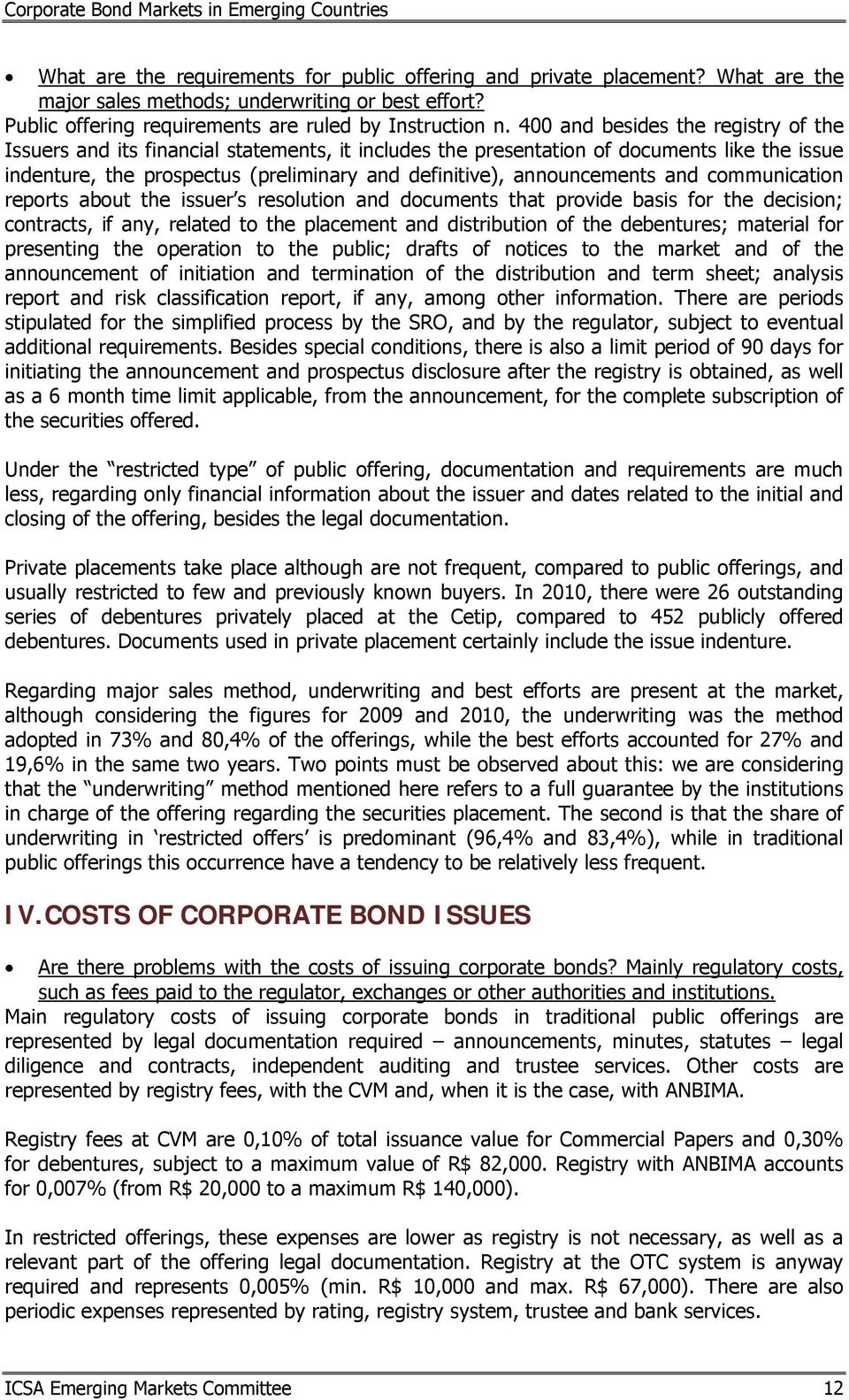
13 As an example, in a $100 million issuance, costs of traditional offering would represent: general expenses of $ 500,000 documentation, diligence and contracts, auditing and trustee: $ 400,000 rating and roadshow $ 100,000 registry expenses of $ 100,000 periodic expenses of $ 110,000 Total of $ 710,000 For the restricted offerings, expenses would account for: general expenses of $ 250,000 legal requirements: $ 200,000 rating (if any): $ 50,000 registry at Cetip of $ 10,000 periodic expenses of $ 110,000 Total of $ 370,000 V. TRADING OF CORPORATE BONDS Where does trading take place; exchanges or OTC? In Brazil, financial institutions and institutional investors portfolios must be registered at depository systems. At the same time, all trades of securities or bonds conducted by these participants must be recorded at the authorized Exchange or OTC registry systems, depending on where or how they occur. At the OTC registry system of CETIP, transactions made among the agents by telephone and those made at CetipNet, an electronic trading system, are recorded. BM&FBovespa exchange offers two electronic trading systems for bond trading, an OTC (Somafix), and an Exchange system (BovespaFIx). Taking the trades distribution in the last three years (2008 to 2010), trades made by telephone or in platforms and registered at CETIP represent 95% of the total, while CetipNet accounts for 4% and BM&FBovespa systems for 1%. How are corporate bonds traded? Market making or continuous trading? Debentures secondary markets in Brazil are very illiquid. Most of the trades occur on a bilateral basis, with specialized brokerage institutions acting as intermediaries. Market makers exist, but their activities are restricted by low liquidity, a restricted investors base and absence of effective prices. CetipNet and Exchange systems display quotation from market makers (when this service is contracted), and requested or effective prices within the systems, but trades are scarce and irregular, and concentrated in few series/issuers. Because of the predominance of high short term yields concentration and restricted markets, main investors tend to hold debentures to maturity. Debentures (excl. Leasing) Volume Volume Trading/ Years Outstanding Traded Outstanding ,521 4,490 20% ,507 9,867 32% ,679 12,258 50% ,516 9,495 22% ,855 9,370 14% Source: ANBIMA ICSA Emerging Markets Committee 13
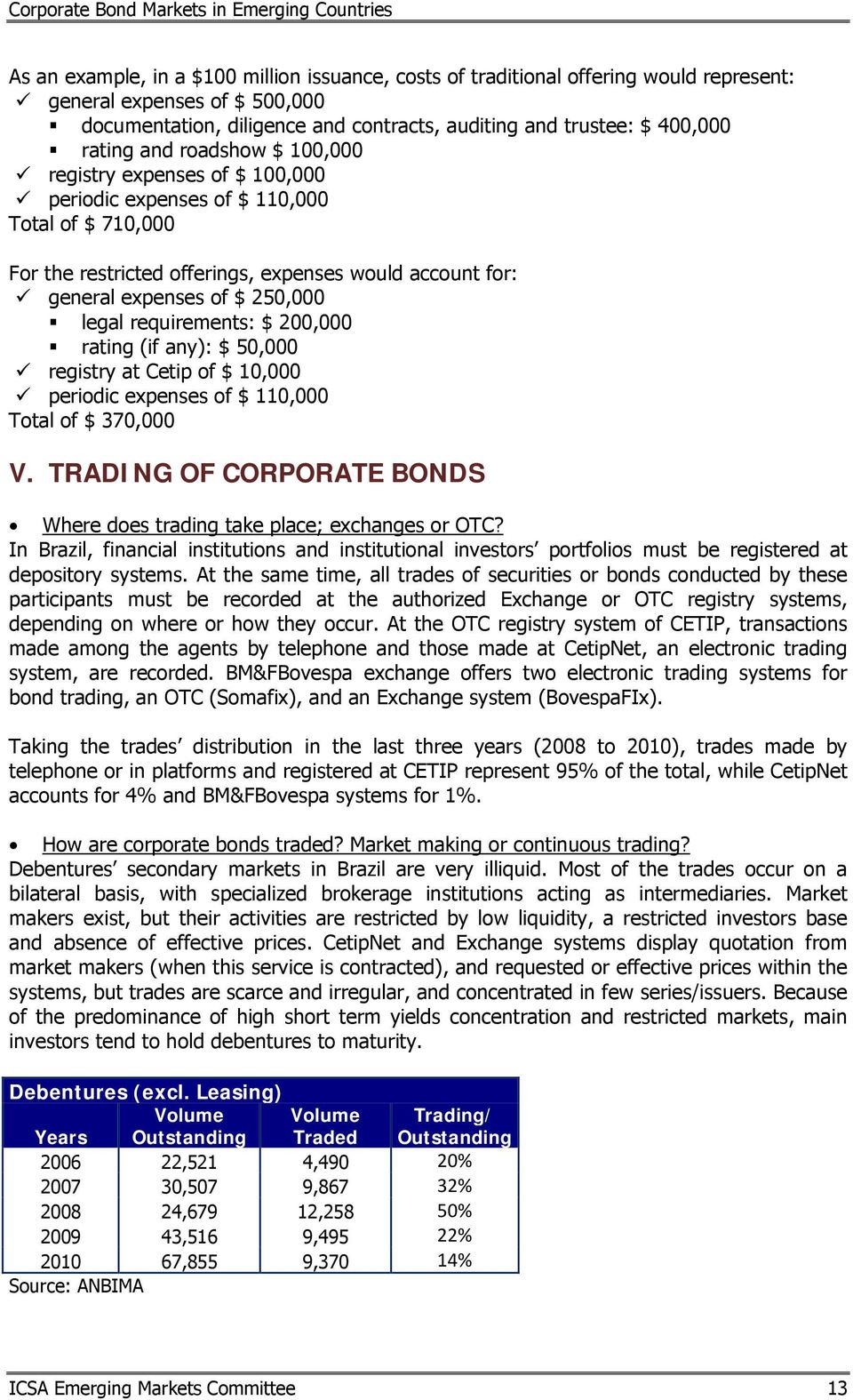
14 Who are investing in or trading corporate bonds? Domestic retail, institutional or foreign investors? Institutional investors are the main investors in the segment, mainly represented by Investment Funds and Pension Funds. Domestic retail and foreign investors represent a small share, but recent tax advantages may affect this situation. Investment banks are also an important player in this market. VI. SETTLEMENT AND CUSTODY OF CORPORATE BONDS How are corporate bonds settled? Settlement dates, settlement institutions etc.. Cetip offers settlement for transactions registered therein in T+0, on a DVP basis. Final settlement occurs at settlement funds system managed by the Central Bank, and is final and irrevocable according to the payment system legislation. At BM&FBovespa, settlement will be carried on by CBLC in two modalities: on a T+1 or T+0 basis, with central counterparty, or with T+0 on a DVP basis, without CCP intervenience. Are there differences between government bonds and corporate bonds, in terms of settlement and custody? Government bonds final settlement occurs at SELIC, representing traditional OTC trades or electronic systems that are not STP, or those occurring through electronic platforms available at Cetip and BM&FBovespa. OTC trading is also predominant, and on a T+0 basis. T+1 transactions are quite frequent but registered in distinct modalities available at the Selic system. The same legal structure applies, regarding DVP method and final and irrevocable settlement at accounts held at the Central Bank. OTC is also predominant, although the participation of trading carried on through electronic platforms has been increasing in the last years. Are there settlement differences according to the trading venue? (i.e. are settlement of corporate bonds traded at the organized market different than the ones traded in the OTC market?) As explained, settlement alternatives may vary according to the trading venue. It is necessary to note that CVM rules entities that administer organized markets, admitting Exchange and OTC organized markets, that are authorized according to the compliance to transparency, self-regulation and monitoring structures availability of their systems. In this sense, OTC trades registered at CETIP registry system are considered organized market trades by the regulator. CVM requires non-residents, institutional investors and financial institutions trades to be registered at organized systems. OTC Cetip market is considered as an organized market and is subject to information, pre and post trade transparency and CVM and BCB reporting requirements defined by the legislation. They are also required to implement self-regulation. Settlement of corporate bonds traded at BovespaFix are settled with CCP from the CBLC, the settlement system and depository of BM&FBovespa. DVP principles apply to RTGS at CBLC, when it is the case, and at Cetip, that also offers DNS settlement for debentures, in some situations (when only issuer risk is involved). VII. DISCLOSURE REQUIREMENTS What are the disclosure requirements for corporate bond issuers? Corporate bond issues that are registered at the CVM are required to comply with standard Financial Information requirements, recently consolidated at ICVM 480. Restricted offerings ICSA Emerging Markets Committee 14
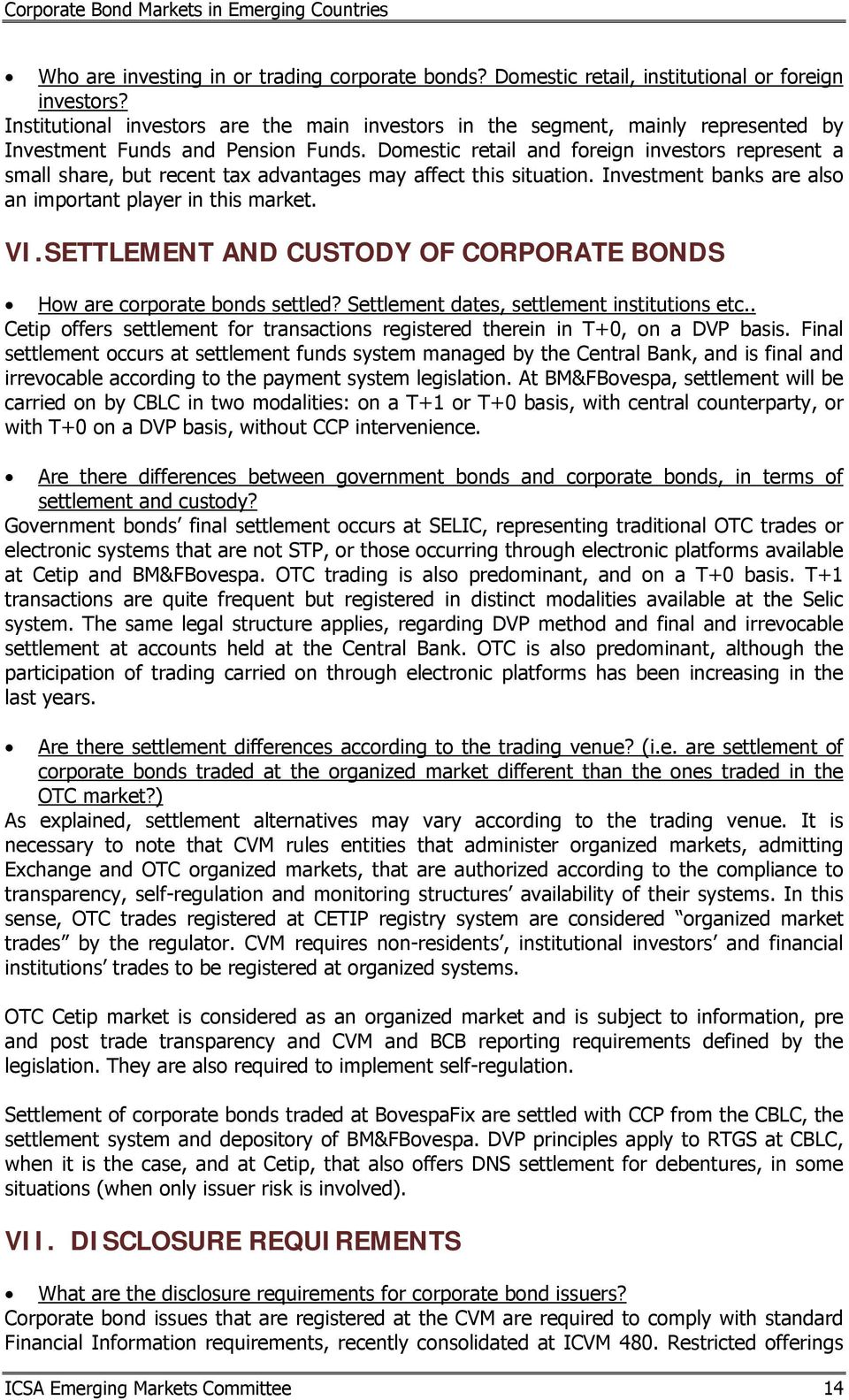
15 have reduced disclosure requirements for the offering of corporate bonds, although audited financial statements and relevant facts (material news) that affect the company are included among those minimum required. Are there differences between the disclosure requirements of publicly offered and privately placed issues or between exchange-traded and OTC-traded bonds? Disclosure requirements for public offering of corporate bonds include those related to the issuer and to the issuance and are both established on CVM rules for traditional or restricted public offerings. Rules for issuance of debentures are established in Law, and apply to both private placement or public offering, like the issue indenture requirement, the public register of indenture and collateral, when is the case, and registry with the depository systems. VIII. RATINGS Are there rating requirements for issues or issuers? Ratings are not required by legislation applied to debentures, but the vast majority of traditional publicly offered debentures have credit rating. In restricted offerings, this condition is not so predominant, although is frequent. Self-regulation does not require rating, but establishes duties of updating and disclosing if it does. Are there rating requirements for certain investor groups? (for example, are there requirements for institutional investors to buy investment grade bonds only?) Pension funds are required to assess credit risk of securities and bonds (with some exceptions) although this requirement can be achieved either through an agency credit risk rating or a Credit Risk Committee assessment. Investment funds will only be subject to this kind if it is a requirement by the specific Investment Policy established in its own rules/bylaws. IX. TAXATION How are capital gains and interest on corporate bonds taxed? Yields from fixed income bonds or securities are subject to income withholding tax that is applied according to the time the investor holds the securities; 22.5% for maturities less than 180 days, 20% for maturities between 181 and 360 days, 17.5% for maturities between 361 and 720 days, 15% for maturities more than 2 years. Yields are understood as the difference between buying and selling prices, and periodic coupon payments. Recently, provisional measure 517 approved distinct tax treatment for debentures issued by Special Purposed Entities (SPE) with more than 4 years average maturity (and other duration requirements) related to investment on infrastructure projects. In this case, individuals are exempt from withholding tax, and companies are subject to a 15% rate. In the both cases, residents and non-residents investors are, similarly, exempt from withholding tax when investing in Investment Funds which the portfolio is represented by a minimum share of those kind of long term, investment related, corporate bonds. Non-residents are subject to 15% withholding taxes for fixed bonds yields, but are also exempt in case of private bonds with similar features to the above mentioned. Foreign ICSA Emerging Markets Committee 15
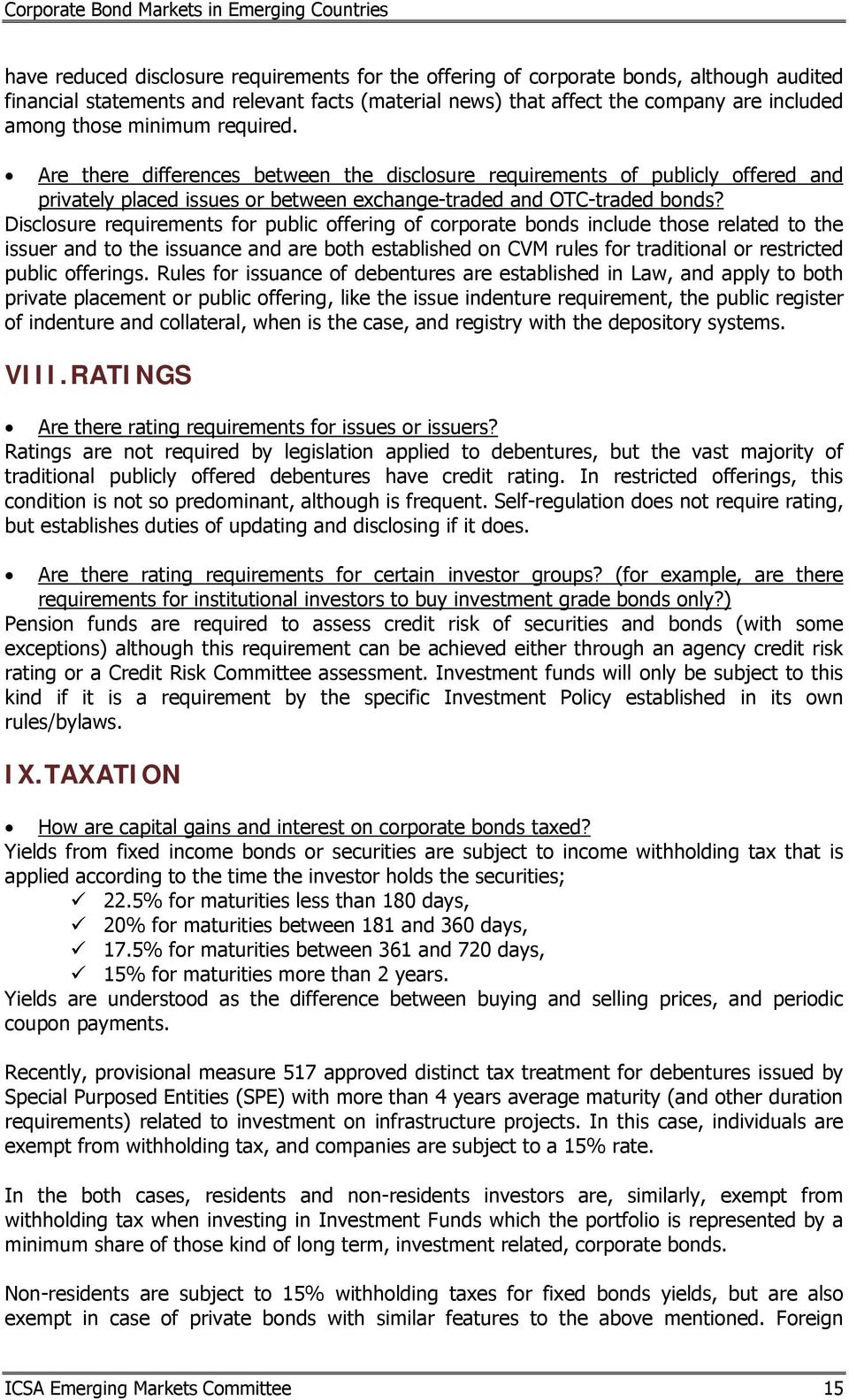
16 Exchange transaction on the inflow of funds to acquire fixed income bonds are also subject to a 6% IOF rate. Non-residents resources from countries considered as Tax Heavens (tax rate less than 20%) have the same tax treatment applied to residents on their financial market transactions. Is there a tax burden on the issuing company? No. Is there a difference between taxation of corporate and government bonds? Government bonds are subject to the same tax treatment as corporate bonds, except for the recent distinct treatment of long investment financing bonds only applicable to private bonds. Non-residents are exempt from income tax on government bonds yields since X. OTHER ISSUES Can corporate bonds be subject to repo transactions? Debentures and commercial papers can be object of repo transactions according to Monetary Council Resolution Transactions that imply the selling of the security during the repo transaction (short selling) are only allowed when in a CCP venue. Are corporate bonds accepted as collateral in the markets or by market institutions such as exchanges, clearing or settlement institutions? Private bonds are accepted by the BM&FBovespa Exchanges as collateral, but only selected securities that may change from time to time according to the issuer s entity; Bank CDs are accepted but, currently, debentures are not. In the OTC registry and settlement system, Cetip, participants may establish collateral agreements for their transactions based on debentures registered in the system, but according to totally private and voluntary contractual basis among the counterparties. The system announced this year its intention to implement an improved collateral management system for its participants. What are the rights of bondholders in case the issuer defaults or goes bankrupt? Debentures may be executed outside courts, in the case of default, and is entitled to distinct treatment in special situations according to indenture terms and collateral types. XI. ROLE OF SROs IN THE CORPORATE BONDS MARKET Are SROs involved in any aspect of the corporate bond market, such as regulating the OTC trading, disclosure requirements, data publication, etc.? As an SRO, ANBIMA have many roles for the corporate bond market regulation and best market practices, besides transparency functions. As mentioned before, the main one is the Agreement with the CVM that established the possibility of previous analysis by ANBIMA Market Supervision of corporate bonds (traditional) public offerings. The procedure brought efficiency and fastened the processes, also contributing to improvement of coordination among regulator and self-regulator regarding further improvements in this area. Data about the processes carried by ANBIMA is also publicly available, complementing the vast universe of information available to investors about securities offerings. The second self-regulatory task performed by ANBIMA in the Brazilian Corporate Market is the ruling, supervision and enforcement of institutions that provide services for issuers, ICSA Emerging Markets Committee 16
17 mainly referring to the rules consolidated at the Regulation and Best Practices Code for Public Offerings. The Code dates back to 1998 and meant in these 13 years a great advance in the rules applied to public offering process and to the conduct expected from the institutions that are participants of those processes. Apart from the analyses of Issuers Information and securities documentation, ANBIMA Supervision also monitors publicity and prospectus of the debentures, that are mandatorily registered at the Association by institutions that are adherent to the Code, participating on the offering. Securities offering registered at ANBIMA are eligible for a quality seal or stamp provided by the Association, that states they are compliant with the rules and principles consolidated in the Code. Penalties for those institutions that do not attend to the rules vary from fines to suspension of the seal, according to the situation. The third relevant task of ANBIMA, related to the debentures and corporate bonds market, regards activities of price provider, indices release and standard setting for the calculation of secondary market trading Unit Prices. As price provider, ANBIMA, following the previous experience in government debt market, developed a robust methodology for disclosing Indicative Prices for Debentures. Currently, ANBIMA discloses daily indicative prices for 118 series of debentures that help mark-to-market of portfolios for institutions and institutional investors. ANBIMA is also developing a Debentures Index and improving its methodology for building Credit Risk curves and for the pricing of more illiquid private bonds. The Association also contributes to the establishment and to the disclosure of standard criteria applicable to secondary market trading, like procedures for incorporating yields and coupons, standards for calculation (number of days to be considered, decimals to use etc.), and make available tools to improve the consensus about these standards. One example is the electronic calculator (CONFERE) that is available for participants to check trading prices calculation according to those standards, avoiding conflicts about the criteria to be considered. The site is also under the responsibility of the Association, bringing objective and qualitative information about offerings, bonds, secondary market activities, participants and relevant events for the market. XII. RECOMMENDATIONS FOR THE DEVELOPMENT OF THE CORPORATE BOND MARKET Recommendations for the development of the corporate bond markets in your jurisdiction and, if possible, for the emerging markets in general. The main concern nowadays in Brazil for the development of the corporate bond market is to make the long term capital market perform its role as a relevant agent for the financing of projects, considering growing projections for the country in the next years and infrastructure investment needs. As previously mentioned, Brazilian corporate bond market is still very concentrated in short term issuances, and short duration rates, limited investor base and less diversified issuers. Triple A issuers access international markets for relevant funding, so the markets tend not to become profound, although it is possible to predict credit risk as a new benchmark to be pursued by portfolio managers, in the context of macroeconomic stabilization. Longer maturities and diversification of investors, with improvement of the liquidity in the secondary markets are understood as relevant challenges to be achieved. Following several initiatives for stimulating bond markets by the National Development Bank (BNDES) and the announcement of tax incentives by the Government in the end of 2010, ANBIMA launched the project of the New Fixed Income Market in April The project consolidates a set of initiatives discussed and built among market representatives (issuers, intermediaries and investors) to help improve the liquidity of the fixed income market and the launching of a strong long term capital market. ICSA Emerging Markets Committee 17
18 The approach chosen by the Association was, on the one hand, the identification of mechanisms to change the behavior of agents and, on the other hand, the conditions that should be required as an adequate framework for this new long term capital market. Therefore the project brings together the creation of an Institutional Environment for issuances and trading of corporate bonds, self-regulated, safe and transparent, together with liquidity mechanisms aimed to ensure the adequate incentive for participants to join in and improve market depth. Primary Market requirements for the New Fixed Income Market are as follows: Securities admitted: debentures (at first step) Issuance: Minimum 10 investors; Max holding 20% for each; Unit Value of R$ 1,000 Term: 4 years minimum average term; call options not allowed in the first 2 years; Rates admitted: Nominal, Price Index, Brazilian Floating Rate for 6 months Standards: according to the type of issuance Rating: annually updated rating required Research and Market Maker: ensured for 12 months after issuance Price Range: for secondary market trades reference In the secondary market, conditions include: Trading exclusively on exchange or OTC (so-called) organized markets; Trading criteria that ensure transparency and competitiveness Pre and post trade transparency (prices and volumes) Issuances in compliance with these conditions, consolidated in a Regulation Code, will be eligible to the Fixed Income New Market Seal. The seal s use will be authorized and monitored by ANBIMA Supervision. Mechanisms to improve liquidity include: Liquidity Improvement Fund: An investment fund with public and private resources that will be managed by private agents chosen according to trade and return performance criteria. It will act as a market maker, currently buying and selling New Market bonds; Liquidity Guarantee Fund: An investment fund, privately owned and managed, performing a lender task for agents holding New Market bonds that have a provisional liquidity problem that could be solved by a sale of the bonds against a haircut. Partnerships with the BNDES: Set of possible partnerships, including lending transactions for New Market bonds, joint project financing and specific markets conditions for segments, according to document to be jointly developed. Tax Incentives: Following the measures announced in December 2010, other complementary measures focusing on long term infrastructure financing, non-residents participation and simplification are under discussion with authorities. Further information available (in Portuguese) at ICSA Emerging Markets Committee 18
19 CORPORATE BOND MARKETS IN BULGARIA XIII. REGULATORY FRAMEWORK Main regulator for the corporate bonds market. The main regulator of the corporate bond market insofar as the public offering of such financial instruments is concerned is the Financial Supervision Commission (FSC). Major regulations (not the details, names of relevant regulations might suffice) The main regulatory act related to the public offering of corporate bonds is the Law on Public offering of Securities (LPOS) Chapter 6, Section V. The general act regulating all issues of bonds, including private offerings, is the Commercial Act. The Law on Mortgage Bonds contains the requirements vis-à-vis banks issuing mortgage bonds. The regulatory requirements applicable to the content and form of the prospectuses for public offering of corporate bonds is Ordinance No. 2 of the Financial Supervision Commission dated on the prospectuses for public offering and listing for trade on a regulated market of securities and the disclosure of information by public companies and the other issuers of securities. Types of corporate bonds defined in the legislation, such as fixed/floating rate, indexed, convertible, exchangeable, Islamic etc.. The types of bonds are not exhaustively defined in the legislation with the exception of mortgage bonds that are issued by banks and which are thus regulated by a special legislative act (a special variety of corporate bonds issued by banks the collateral being a pool of mortgages). Certain texts applicable to convertible bonds are included in the Commercial Act which stipulates the rights of the holders of such bonds and the conditions and procedure for conversion of such bonds into shares (e.g. Section VIII, Art of the Commercial Act treats the conversion of convertible bonds into shares of stock). LPOS further sets out certain requirements relative to convertible bonds in connection with the increase of the capital of public companies. Can foreign companies issue bonds in your jurisdiction? Foreign companies may issue bonds in Bulgaria subject to compliance with the requirements of LPOS and Ordinance No. 2. Issuers whose prospectus for public offering of bonds has been confirmed (approved) by a regulator in a EU member state and the FSC has been notified by such regulator that the prospectus has been drawn up in accordance with the requirements of Directive 2003/71/EC amending Directive 2001/34/EC, then such issuer can publicly offer its securities in Bulgaria. The rules regarding the European passport for prospectuses would apply. There are special provisions for the confirmation by the FSC of prospectuses of foreign issuers from third countries (Art of Chapter 10 of LPOS). After the prospectus of such issuer has been confirmed by the FSC, it can start the offering of its securities on the territory of the Republic of Bulgaria. Where provided for in an international or bilateral treaty the FSC may not engage in a procedure for confirmation of a prospectus of an issuer from a third country but recognize its prospectus already confirmed by the regulator in its home country. In the latter case the provisions of the Currency Act would also apply. ICSA Emerging Markets Committee 19
20 Are there any restrictions on domestic companies to issue bonds abroad? There are no restrictions imposed on domestic companies to issue bonds abroad. If they want to market their bonds in a EU member state, they should on the basis of a prospectus confirmed by the FSC, seek notification of the regulator in the host member state where the bonds would be offered through the FSC with whom the notification and a copy of the prospectus are filed to be further transmitted to the regulator in the host member state. In the case of offering bonds in a third country, the issuer should notify the FSC about its intention to offer its securities (bonds) abroad and file with it a draft prospectus (which would be the one the issuer would file with the regulator in the third country for confirmation) as well as a statement that such issuer would submit all documents published or delivered in that third country. XIV. SIZE OF THE CORPORATE BONDS MARKET Types of corporate bonds available/issued in the market. The following types of corporate bonds are available at the Bulgarian Stock Exchange-Sofia: debentures; convertible bonds; mortgage bonds; floating and fixed rate bonds; callable and putable bonds. Historical, annual statistics of the last 5 years, if possible, about the size of the corporate bond markets. Number of outstanding bonds, value of outstanding bonds, trading volume, number and size of issues (in US$, if possible) Number of outstanding bonds 682, , ,201 1,000,515 6,033,600 Value of outstanding bonds (EUR) 417,655, ,413, ,470, ,558, ,484,907 Turnover (EUR) 63,555,152 85,968, ,609, ,407, ,086,899 Number of transactions 781 1,102 1,468 1,220 1,237 Volume (lots) 65,387 89, , , ,046 It should be noted that the statistics has been provided by the Bulgarian Stock Exchange Sofia JSC and it applies to exchange traded bonds while there are corporate bond issues that are traded OTC. Comparative statistics with the government bonds. Government bonds are not currently traded at the Bulgarian Stock Exchange-Sofia. Two government bond issues were listed at the Exchange till June 2008 but there was no trading with them Number of outstanding bonds , ,000 Value of outstanding bonds (EUR) ,558, ,484,907 Turnover (EUR) Number of transactions Volume (lots) ICSA Emerging Markets Committee 20

21 XV. ISSUING CORPORATE BONDS Are there any restrictions on the issuers, like defining the companies who are eligible for issuing bonds? Only joint-stock companies (JSC) may issue bonds (Art. 204 of the Commercial Act). The public offering of bonds by a JSC may be affected subject to 2 years having elapsed after the incorporation of the JSC and publication of two annual financial statements. The latter type of restriction doesn t apply to private issues of bonds (bonds sold in the course of private placement with limited number of investors up to 100). Special investment purpose companies which are a type of real estate investment trusts incorporated as JSC from legal point of view may offer publicly bonds immediately after their licensing as such by the FSC, without being subject to such waiting period. Collective investment schemes which are UCITS according to Bulgarian legislation are under prohibition to issue bonds and debt instruments in general. The bonds may be issued only in a dematerialized form, the book entry system requiring that the bonds be registered with the CDS. Are there any limits on the issue size, maturity etc. of the bond? There are no specific limitations as to the issue size, maturity etc. of the bonds. The structuring of the bond issue depends on issuer s investment strategy and financial position. On the contrary, for issues of bonds whose face value exceeds certain amount of BGN/EUR, there is certain regulatory relief such as exemption from the obligation to publish a prospectus for the issue (e.g. the face value of a single bond is EUR ). Are there problems or delays in the issue process of corporate bonds, like regulatory approvals, registration, listing etc.? The public offering of bonds is a process which involves a regulatory approval of the prospectus for the issue. The FSC should confirm the prospectus either for initial public offering or for listing at a regulated market. The issuer should obtain and ISIN code (regulated by ISO 6166) for the bond issue from the Central Depositary of Securities (formerly the issuance of such ISIN code was within the jurisdiction of the Bulgarian National Bank). Then the issue should be registered with the Central Depositary of Securities (CDS). CDS keeps the register of the bondholders and communicates with the trustee of the bond issue (or debenture issue the appointment of a trustee in case of debenture issue is predicated on the resolution of the General Meeting of the shareholders to appoint one but such appointment is otherwise not obligatory and depends on the discretion of the General Meeting) on any matters related to the payment of the principal and interest, extinguishment of the obligations of the issuer, the status of the collateral and of the issuer in general etc. Following that the issue should be listed on a regulated market where it can be traded on the Bond segment of the official and the unofficial market. The listing of the issue should be approved by the Board of Directors of the Bulgarian Stock Exchange Sofia (BSE). ICSA Emerging Markets Committee 21
22 What are the requirements for public offering and private placement? What are the major sales methods; underwriting or best effort? The public offering of bonds may be affected subject to publishing a prospectus confirmed by the FSC. There is no requirement for publishing a prospectus in the case of private placements. Certain issues may be offered publicly without a prospectus the exemptions are set out in Art. 79 LPOS. Private placements do not involve generally an obligation of the issuer to make disclosure of regulated information to the public as opposed to the case of public offerings. The issuer in case of public offering of bonds should comply with all requirements related to the application and enforcement of the Law on the Measures against Market Abuse with Financial Instruments. The choice of a method for marketing the issue depends on the terms and conditions of the underwriting contract concluded with an investment intermediary. Usually bonds are sold on a best efforts basis, since firm underwriting might have an impact on the investment intermediary s capital adequacy and liquidity which should be compliant at all times with the regulatory requirements. XVI. COSTS OF CORPORATE BOND ISSUES Are there problems with the costs of issuing corporate bonds? Mainly regulatory costs, such as fees paid to the regulator, exchanges or other authorities and institutions. Costs are incurred due to numerous payments of fees and charges the issuer should make in the process of issuing the bonds. First of all a fee should be paid to the FSC for the confirmation of the prospectus. The fee is calculated as percentage of the total value of the issue, with a cap on the overall amount of the fee after certain quantitative limits have been exceeded. The issuer should pay fee to the CDS for the registration of the issue and for keeping the accounts as well as in case of issuing a register of the bondholders (in case of corporate events such as meetings of bondholders). A fee is paid for the listing of the issue on the regulated market. The issuer also pays an annual fee to the FSC for supervision. That supervisory fee is a lump sum charged which is of modest nature. XVII. TRADING OF CORPORATE BONDS Where does trading take place; exchanges or OTC? Corporate bonds can be traded both at the Exchange and OTC in Bulgaria. How are corporate bonds traded? Market making or continuous trading? Corporate bond issues listed at the Bulgarian Stock Exchange-Sofia are traded using continuous trading method. Who are investing in or trading corporate bonds? Domestic retail, institutional or foreign investors? Investments in bonds are made predominantly by institutional investors such as banks, insurance companies, pension funds and collective investment schemes. Retail investors might also invest in bonds issues although it is also possible that they do it indirectly though ICSA Emerging Markets Committee 22
23 collective investment schemes (conservative and balanced ones). Currently investments in bonds are made predominantly by domestic investors. XVIII. SETTLEMENT AND CUSTODY OF CORPORATE BONDS How are corporate bonds settled? Settlement dates, settlement institutions etc.. All publicly issued bonds are of the dematerialized variety and they should be registered with the CDS which is the institution which performs the settlement of all transactions involving securities traded on the stock exchange and it also acts as a registrar of all instruments issued in a book-entry form regardless of other they are traded on the stock exchange or OTC. The settlement cycle of transactions settled through the DVP method is T+2 days. The settlement cycle for transactions processed by way of the DFP method of settlement is T+0. Are there differences between government bonds and corporate bonds, in terms of settlement and custody? Government securities and corporate bonds are settled through two different institutions the Bulgarian National Bank is the custodian for all government securities and it settles the transactions performed by all dealers in government bonds. CDS acts as custodian for all corporate bonds which are issued in a dematerialized form. All bonds kept with the CDS are kept in individual subaccounts of the client opened by the client s investment intermediary (securities broker/dealer) on behalf of the client. Are there settlement differences according to the trading venue? (i.e. are settlement of corporate bonds traded at the organized market different than the ones traded in the OTC market?) The CDS settles all transactions in corporate bonds issued in a dematerialized form regardless of whether they are traded on the stock exchange or OTC. The CDS is the operator of the settlement system for financial instruments. The methods of settlement may vary from DVP Model 2 (which is obligatory for all transactions on the regulated market as well as in the case of OTC transactions where the parties have explicitly instructed the CDS to settle the transaction using the DVP method) to DFP (for OTC transactions). All publicly offered bonds should be issued by operation of law only in a dematerialized form. Privately traded issues of bonds may be in a certificated form and then the CDS would not be involved in their settlement. The funds required for making payment in relation to transactions are transferred on a net basis and the bonds that are the subject-matter of the transactions are transferred on a gross basis. The communication in the settlement process between the CDS and the market participants takes place by means of standardized messages pertaining to Group 5 of ISO The settlement is performed by means of funds in commercial banks. i.e. the settlement accounts of the investment intermediaries are opened with the commercial banks and not with the Bulgarian National Bank. The commercial banks respectively debit and credit the relevant accounts. XIX. DISCLOSURE REQUIREMENTS What are the disclosure requirements for corporate bond issuers? The disclosure requirements regarding corporate bond issuers are set out in LPOS and Ordinance No. 2. They should disclose periodic and ad hoc information (regulated information). Bond issuers should publish quarterly and annual financial statements as well as file them with the regulator, The FSC keeps a register of all public companies and other issuers including bond issuers and issuers of other debt instruments where data is stored ICSA Emerging Markets Committee 23
24 and access is provided to the financial statements of such entities. Periodic and ad hoc information is disclosed through an information agency or other media and should be made available simultaneously to the public and the regulator. Measures should be undertaken that such information be disseminated to the public in all EU member states. There are also specific requirements in LPOS (Chapter 6a, Section III) regarding the disclosure of information by the issuer to the bondholders. Are there differences between the disclosure requirements of publicly offered and privately placed issues or between exchange-traded and OTC-traded bonds? The regime of disclosure for privately placed issues is considerably less restrictive and comprehensive as compared to public bond issues. The requirements for disclosure of information with regard to private issues of bonds are set out in the Commercial Act. LPOS and Ordinance No. 2 are not applicable to privately placed issues. Disclosure according to the Commercial Act takes place through the entry and declaration of circumstances in the Commercial register or at meetings of bondholders who are entitled to receive information on matters of interest. Bondholders or their representatives may also participate in the general meetings of shareholders. The terms and conditions of the issue or the Articles of Association or By-Laws of the JSC may provide for other types of disclosure, in addition to the general requirements of the law. XX. RATINGS Are there rating requirements for issues or issuers? There are no rating requirements for bond issues. The issuer might appoint a credit rating agency to award a credit rating to an issue on a contractual basis. Are there rating requirements for certain investor groups? (for example, are there requirements for institutional investors to buy investment grade bonds only?) There are certain requirements for investment in investment grade bonds by pension funds which may invest in a variety of qualified debt instruments. According to the Social Insurance Code qualified debt instruments are debt securities which have credit rating awarded by an internationally recognized rating agency. Insurers may also invest in qualified debt securities for the purpose of formation of their technical reserves. The so called Silver Fund which is a sovereign fund established for the purpose of stabilization of the public pension system is an entity which may invest in investment grade debt securities. All of the above entities have little other options to invest in debt securities, the exceptions generally being sovereign or municipal debt or bonds issued by banks and international monetary institutions. The Silver Fund cannot invest in any other type of debt securities but debt securities with an investment grade. XXI. TAXATION How are capital gains and interest on corporate bonds taxed? Capital gains on corporate bonds are generally tax exempt even though the Law on the Income Tax of Natural Persons does not explicitly provide for tax exemption as in the case of shares of public companies traded on a regulated market and in the case of redemption of units of collective investment schemes of the UCITS type; on the other hand income from sale of movable property and chattels is also tax exempt, bonds not being included in the exceptions to this rule. The Law on the Income Tax of Natural Persons however explicitly stipulates that interest from bonds, debentures and other debt instruments is tax exempt, interest accrued being one of the forms of generating capital gains. ICSA Emerging Markets Committee 24
25 As for the Law on the Corporate Income Tax, the interest and capital gains as well as losses from trade in bonds participate in the calculation of the taxable base, from which the profit from the sale of financial instruments is deducted and the losses from sale of financial instruments are added as a negative value. Is there a tax burden on the issuing company? The issuing company is not subject to any specific tax burden related to the issuance of bonds. Is there a difference between taxation of corporate and government bonds? The tax regimes of corporate and government bonds do not differ. XXII. OTHER ISSUES Can corporate bonds be subject to repo transactions? Corporate bonds may be the subjects of REPO transactions. Are corporate bonds accepted as collateral in the markets or by market institutions such as exchanges, clearing or settlement institutions? Corporate bonds may be accepted as collateral in the markets in the activity of investment intermediaries and they can also be eligible instruments as subject of particular pledges under the Particular Pledges Act. What are the rights of bondholders in case the issuer defaults or goes bankrupt? The rights of bondholders are exercised in accordance with the general law treating default and bankruptcy procedures of commercial companies or that is the Commercial Act. In case of bonds secured with collateral, the bondholders will have priority of their claims before the claims of other creditors over the collateral upon winding up. In case of debentures their holders will have priority over the shareholders of the issuer upon winding up but their claims will be satisfied up to the amount of the undistributed proceeds from the sale of the issuer s property remaining after the claims of the secured creditors or competing creditors with priority over the issuer s property have been satisfied. XXIII. ROLE OF SROs IN THE CORPORATE BONDS MARKET Are SROs involved in any aspect of the corporate bond market, such as regulating the OTC trading, disclosure requirements, data publication, etc.? BALII as a SRO of investment intermediaries operating on the capital market does not have any powers to regulate directly the corporate bond market. Its Ethical Commission and the Management Board however may undertake measures provided for in the Code of Ethics of BALII against members that have violated the Code of Ethics or engage in conduct which is detrimental to investors and may affect the image of the business. XXIV. RECOMMENDATIONS FOR THE DEVELOPMENT OF THE CORPORATE BOND MARKET Recommendations for the development of the corporate bond markets in your jurisdiction and, if possible, for the emerging markets in general. The Bulgarian Association of Licensed Investment Intermediaries together with the associations of banks, pension funds and management companies have made proposals for ICSA Emerging Markets Committee 25
26 streamlining the regime of the public offering of bonds and including explicit provisions in LPOS to the effect of empowering the trustee of the bond issue to obtain a writ of immediate execution against the issuer and its property, more specifically the collateral securing the bonds issue as well as to obtain all relevant information with regard to the issue from the database of the Central Depositary of Securities, including transferred payments of principal and interest, extracts from the register of bondholders et al. Certain amendments to LPOS are needed also with regard to defining reasonable quorums and majorities to vote resolutions for rescheduling of the payment plan of the bond issues. The regulations of the emerging markets should contain strong remedies for bondholders in case of issuer s default that could be put to use within short span of time. ICSA Emerging Markets Committee 26
27 CORPORATE BOND MARKETS IN KOREA I. REGULATORY FRAMEWORK Main regulator for the corporate bonds market Financial Services Commission (FSC), Financial Supervisory Service (FSS), Korea Financial Investment Association (KOFIA) Major regulations (not the details, names of relevant regulations might suffice) Acts: Commercial Act, Financial Investment Services and Capital Markets Act, National Bonds Act, Registration of Bonds and Debentures Act, Bank of Korea Monetary Stabilization Bond Act, Secured Bond Trust Act, Asset-Backed Securitization Act, Special Purpose Companies for Mortgage-Backed Bonds Act Regulations on financial supervision: Regulations on Financial Investment Business, Regulations on Securities Issuance and Disclosure, Regulations on Asset-Backed Securitization KOFIA regulations: Standard Unguaranteed Bonds Trust Contracts, Regulations on Credit Rating, Regulations on Businesses and Operations of Financial Investment Companies, Regulations on Securities Underwriting, Regulations on Articles of Financial Investment Companies Types of corporate bonds defined in the legislation, such as fixed/floating rate, indexed, convertible, exchangeable, Islamic etc. Straight Bonds (SB), Floating Rate Notes (FRN), Convertible Bonds (CB), Bonds with Warrants (BW), Exchangeable Bonds (EB), Asset-backed Securities (ABS), etc. Can foreign companies issue bonds in your jurisdiction? Yes, they are allowed to issue KRW- (ex. Arirang bonds) and USD-denominated (ex. Kimchi bonds) bonds in Korea. In January 2007, Indonesia s Salim Group and Ciputra Group issued 3-year Arirang bonds through Samsung Securities to finance a development project in Hanoi, selling KRW 50 billion worth of Arirang bonds. Cyprus, LS Cable s U.S. corporation, issued USD 290 million of 3-year Kimchi bonds at LIBOR plus 2.7% through the Korea Development Bank and E*Trade Korea. Are there any restrictions on domestic companies to issue bonds abroad? No specific restrictions (no registration requirements), however domestic companies are subject to foreign regulations on bond issuance. II. SIZE OF THE CORPORATE BONDS MARKET Types of corporate bonds available/issued in the market Straight Bonds (SB), Floating Rate Notes (FRN), Convertible Bonds (CB), Bonds with Warrants (BW), Exchangeable Bonds (EB), Asset-backed Securities (ABS), etc. Historical, annual statistics of the last 5 years, if possible, about the size of the corporate bond markets. Number of outstanding bonds, value of outstanding bonds, trading volume, number and size of issues (in US$, if possible) Please refer to the table below. ICSA Emerging Markets Committee 27
28 Comparative statistics with the government bonds: Please refer to the table below. Statistics on Corporate Bond Issuance and Distribution (Unit: KRW trillion) Category Outstanding Corporate (34.8) (35.6) (46.7) (76.2) (69.3) (Annual Issuance) Government (76.0) (56.8) (60.5) (94.5) (86.7) Trading Corporate Volume Government 1, , , , ,703.4 No. of Corporate bond types 1,239 1,128 1,182 1,512 1,567 Note 1: Outstanding amount and trading volume refer to the total including ABS. (Source: KOFIA) Note 2: No. of corporate bond types refers to bonds rated above BBB-. (Source: KIS Pricing) III. ISSUING CORPORATE BONDS Are there any restrictions on the issuers, like defining the companies who are eligible for issuing bonds? No specific restrictions on issuers, however credit ratings from two or more credit rating agencies is required. Article 470(1) of the Commercial Act: The total amount of bonds shall not exceed four times the amount of net assets of the company stated in the latest balance sheet. Article 470(3), Commercial Act: If the offering of bonds is made for the purpose of redeeming old bonds, the amount of the old bonds shall not be included in calculation of the total amount of the bonds. In this case, the old bonds shall be redeemed within six months from the payment date of new bonds or from the first payment date if such payment is to be made in installments. Article , FSCMA: The issue amount of convertible bonds or bonds with warrants issued by a stock-listed corporation shall not be added to the total amount of corporate bonds under Article 470 of the Commercial Act. Are there any limits on the issue size, maturity etc. of the bond? Maturity: There are no legal limits; however in cases where maturity is less than one year, CP is preferred due to the simplified issuance process and lower costs. Therefore, the maturity of corporate bonds is generally more than one year. Issue Size: Article 470 of the Commercial Act stipulates that the total amount of corporate bonds shall not exceed four times the equity capital. Article 472(1) of the Commercial Act stipulates that the unit size shall not be less than KRW 10,000, while Article 472(2) stipulates that the face value of each bond shall either be equal, or an integral multiple of the minimum amount of a bond of the same class. Are there problems or delays in the issue process of corporate bonds, like regulatory approvals, registration, listing etc.? Approval delays might occur during the issuance process. ICSA Emerging Markets Committee 28
29 Issuance of Corporate Bonds D-Day Business Relevant Agency Prior to Determine Issuer D-Day underwriting conditions Prior to Issue credit Credit rating D-Day rating agency Prior to Decision by D-Day BOD Prior to D-Day Prepare registration statement D-1 Sign agreement D-Day Submit registration statement D+1 Apply for bond listing Details Negotiate underwriting conditions Relevant Regulation Article 12 of the Regulations on Securities Underwriting Credit assessment and evaluation Article 11 of the Regulations on Securities Underwriting Issuer BOD Minutes Article 469 of the Commercial Act Issuer Write registration - (managing statement and agreements company) Issuer (underwriting syndicate, trustee, agency, managing company) Issuer (managing company) Issuer (managing company) D+7 Take effect Issuer (managing company) D+8 Issuance and payment D+8 Issuance reporting Issue Date T/N Pay commissions Issuer (managing company) Issuer (managing company) Issuer Firm commitment and sales agreement, subscription and trustee agreement, principal and interest payment agency agreement special relationship paper Submit registration statement and preliminary prospectus, pay registration fees Apply for bond listing (exchange), pay listing fees and annual dues Submit firm interest rate Submit prospectus, pay underwriting commitment, issue and register bonds (with Korea Securities Depository), announce bond issues, pay registration fees Submit issuance report Pay underwriting and brokerage commissions (managing company) Article 2-6(6) of the Regulations on Securities Issuance and Disclosure, article 11 of the Regulations on Securities Underwriting, article 13 of the Regulations on Securities Underwriting Article 119 of the Financial Investment Services and Capital Markets Act (FSCMA) - Article 2-3 of the Regulations on Securities Issuance and Disclosure Article 123 of FSCMA, article 4 of the Registration of Bonds and Debentures Act Article 128 of FSCMA, article 2-19 of the Regulations on Securities Issuance and Disclosure - What are the requirements for public offering and private placement? What are the major sales methods; underwriting or best effort? In the case of public offerings, disclosure requirements for investor protection are in place, including the submission of registration statements and credit ratings from credit agencies. In contrast, there are no such requirements in private placements where securities are directly issued to certain demand-side parties. ICSA Emerging Markets Committee 29
30 In principle, Korean securities companies use firm commitment. In practice, however, driven by limited capital size, Korean companies often resort to best effort basis. For example, securities companies decide upon buyers in advance through prior reviews, and directly sell the securities after underwriting the publicly offered securities with borrowed capital. IV. COSTS OF CORPORATE BOND ISSUES Are there problems with the costs of issuing corporate bonds? Mainly regulatory costs, such as fees paid to the regulator, exchanges or other authorities and institutions. 1) Issuance Fees (payable to the Financial Supervisory Service) Maturity Issuance Fees Rate Less than 1 year 0.05% More than 1 year but less than 2 years 0.07% More than 2 years 0.09% 2) Listing Fees (Payable to the exchanges) Amount Listed Fees (KRW) Less than 1 bil. 100,000 1 bil or more and less than 2 bil. 150,000 2 bil or more and less than 5 bil. 300,000 5 bil or more and less than 10 bil. 700, bil or more and less than 15 bil. 1,000, bil or more and less than 25 bil. 1,200, bil or more and less than 50 bil. 1,300, bil or more and less than 100 bil. 1,400, bil or more and less than 200 bil. 1,500, bil or more and less than 500 bil. 1,600, bil or more 1,700,000 3) Annual Dues (Payable to the exchanges) Maturity Annual Dues Less than 1 year years KRW 100,000 per year Above 5 years KRW 500,000 4) Registration fees (payable to the Korea Securities Depository): issuance price/krw 100,000 (min. KRW 100,000, max. KRW 500,000) V. TRADING OF CORPORATE BONDS Where does trading take place; exchanges or OTC? The OTC market accounts for the majority of the market. (As of 2010, the OTC market represented 97.4% of the corporate bond market.) How are corporate bonds traded? Market making or continuous trading? Corporate bonds are mainly traded on the OTC market with securities companies acting as brokers. At present, dealers are not performing market-making functions due to their limited ICSA Emerging Markets Committee 30
31 capital size and lack of a dealer-supporting system. However, brokers execute trades among institutions, playing a dominant role in the corporate bond trade. The absence of dealers results in a less liquid corporate bond market, which is why more corporate bonds are traded on the issue date. Corporate Bond Trade Investor Institutional investor, corporation, retail investor (bond (fund) Securities firm trade execution Management (proprietary) sale (brokerage) Settlement Bond: Securities Management Team Fund: Fund Team (bond (fund) Seller Institutional investor, corporation, retail investor To address liquidity issues and enhance the transparency of the market, KOFIA operates the FreeBond and BondMall markets. 1) FreeBond - Background Similar to developed nations, the bond market in Korea has traditionally used voice trading over the telephone as the primary negotiated sales method. With advances in IT, private instant messenger has recently became an important trading method, particularly among young brokers, as the advantages of speed and storage its function became widely known. This new sales method has sped up the way trading is executed and enabled market participants to overcome limitations, contributing to the development of the Korean bond market. However, private instant messenger also undermined price discovery, and can potentially paralyze the entire the bond market when the system crashes or slows down. In addition, there are structural problems since it is difficult to adapt IM services to the needs of market participants. Against this backdrop, in March 2009, the government created a taskforce and announced a plan to reform the bond trading market, through the establishment of a specialized bond trading system. Based on this, KOFIA established the FreeBond online bond market. Since the late 1990s, several major developed nations have successfully introduced electronic bond trading systems using advances in IT technology. However, legal restrictions have hindered the introduction of such alternative trading systems (ATS) in Korea. - Definition and Composition of FreeBond Operated by KOFIA, FreeBond enables financial investment firms and market participants to discover quotes, and supports negotiations among the participants. As the Korean financial industry s sole SRO, KOFIA is in constant communication with market participants, and is therefore able to reflect the participants needs in the operation of the FreeBond market. Here, participants refer to bond trading brokers, dealers, managers, and traders approved by KOFIA to use FreeBond pursuant to the regulations on the registration of financial investment companies. ICSA Emerging Markets Committee 31
32 FreeBond contains the following features: 1. Allows market participants discover the bid/ask price on FreeBond and execute orders. 2. Transmits quote information to the Bond Quotation System (BQS). 3. Discloses concentrated information to the market through KOFIA s Bond Information System (BIS) and information vendors. As seen in the diagram, FreeBond has two main components: instant messenger and T- Board. Unlike with private messenger systems, chat rooms are included in the FreeBond system. The T-Board offers trading functions such as bid/ask prices discovery, orders, negotiation and trade confirmation, and analysis and reference. Instant messenger, a replacement of the current private messenger system, provides specialized functions for bond trading including 1:N chatting and the automatic storage of chatting data, as well as the general functions of a private messenger system. FreeBond System 2) BondMall (launched in Feb. 2010) - Background With Korea s aging population and low interest rates, high interest bonds such as corporate bonds have become popular with individuals and small investors. However, the Korean retail bond market was dominated by small markets centered on securities firms and categorized according to the types of bonds, issuing entities, and credit ratings. Consequently, in 2009, the government and industry began discussions on ways to reduce the excessive costs borne by investors searching for bonds (i.e. through visits, telephone calls, internet usage), and opportunity costs arising from the failure to discover appropriate investments. The result was the launch of a specialized website ( in February 2010, where information on retail bonds is collected, compared and disclosed. - Main Content BondMall is an information concentration system for baby bonds. Its purpose is to reduce investors' market discovery costs by collecting the information on baby bond sales held by the various securities firms, and to improve investors convenience by encouraging competition among the firms. 1. Name of the System: BondMall 2. Domain: 3. Structure: Bond sales information is offered in real-time. (Transactions conducted by securities firm) ICSA Emerging Markets Committee 32
33 BondMall System Who are investing in or trading corporate bonds? Domestic retail, institutional or foreign investors? Institutional investors such as pension funds, life insurers, banks and asset managers are the major investors in corporate bonds. Retail investors mainly invest in baby bonds through securities companies. VI. SETTLEMENT AND CUSTODY OF CORPORATE BONDS How are corporate bonds settled? Settlement dates, settlement institutions etc. (based on OTC bonds). OTC bond settlement process Collective Investment manager (by Trust company) Management details (CCF, Web, Diskette UP-Load) (by Collective Investment Manager) Management details(ccf) Trust company Trading conclusion (by Securities Company) Trading details(ccf) Securities company atrading conclusion Load) dtrade Matching and Settlement Data,eDelivery versus Payment KSD (by Trust company) Confirmation of management details (CCF, Web, Diskette UP-Load),b(by Collective Investment Manager) Trading details(ccf, Web, Diskette UP- Institutional Investors ctrading details(web) BOK (Data: KSD) ICSA Emerging Markets Committee 33
34 1) The OTC bond settlement system is operated on a real time gross settlement (RTGS) basis to eliminate principal risks in OTC securities transactions such as bonds, CDs and notes. To assure the finality of the transaction, the Korea Securities Depository (KSD) has linked its securities settlement system to the Bank of Korea s (BOK) payment and settlement system. To this end, the BOK s Working Rules on the Operation and Management of Payment Systems stipulate that settlements of securities and funds are made simultaneously via the KSD account at the BOK. 2) Characteristics of the Settlement Trade-for-trade principle: delivery versus payment (DvP) where settlements of securities and funds are made simultaneously between the seller and buyer in OTC bond transactions. Though a collective investment manager enters single trade data, the trade is settled based on a fund s management. Thus, trade data is transmitted between a collective investment manager and a securities company on a fund basis and settlement is made between a trust company and a securities company on a trust company basis. Trade matching: to utilize the Institutional Bond Investor Settlement System at KSD, both the seller and buyer in an OTC bond transaction transmit the trade data to KSD and verify the result of the trade through the KSD electronic system. After confirming that trade and settlement match, KSD determines that trade is subject to the Institutional Bond Investor Settlement System. Chained settlement: the institution that submits data on the purchase, sale and transaction of the same bond is designated as the party subject to chained settlement. Delivery versus payment (DvP): the settlement cycle for the OTC bond market is T+1 ~ T+30 as agreed between buyer and seller (with MMFs settled at T). If KSD verifies the settlement requirements of a seller during the business hours of the settlement date and finds the requirements insufficient, KSD classifies the transaction as pending. However, once KSD finds that the seller fulfills the settlement requirements, it notifies the BOK of the settlement through the BOK s wire service (BOK-Wire). The buyer then settles the trade, and the BOK immediately informs KSD of the settlement. Finally, KSD completes DvP of the settled securities. 3) Legislation related to settlement Regarding settlement validity, Article 311 (Effect of Statement in an Account Book) of FSCMA stipulates that where a transfer between accounts is stated for the purpose of a transfer of securities, the securities shall be considered to have been delivered. Regarding compulsory delivery versus payment, Article 5-4 (Method of Settlement of Payments) of the Regulations on Financial Investment Business stipulates that payments for over-the-counter trading bonds shall be settled within 30 business days from the day immediately after the date on which a seller and a buyer enter into a trading contract under agreement through the DvP system at KSD. As for the BOK payment systems, Article 52 (Eligible Transactions) of Working Rules on the Operation and Management of Payment Systems stipulates that the Bank shall settle the transactions on a delivery versus payment (DvP) basis by linking BOK-Wire with the securities settlement systems of KSD and the financial network of Shinhan ICSA Emerging Markets Committee 34
35 Bank. The BOK shall also settle the funds for OTC bond transactions using the current account of KSD held with the Bank pursuant to Article 53 (Settlement Account) of the Rules. Are there differences between government bonds and corporate bonds, in terms of settlement and custody? The same settlement process applies to government bonds, corporate bonds and other types of bonds. Are there settlement differences according to the trading venue? (I.e. is settlement of corporate bonds traded at the organized market different than the ones traded in the OTC market?) Comparison of bonds traded on the exchange market and OTC OTC Exchange market Broker IDB Ordinary bond IDM market Trading party No restrictions Dealers, Regular members PD institutional investors, etc. KRX Trading broker Securities companies IDB KRX KRX Main trading instrument All bonds All bonds Small amount government and public bonds, equity- linked corporate bonds Negotiated Negotiated Competitive trading trading auction Trading method Competitive auction Quotation method Yield quotation Yield quotation Price quotation Price quotation Trading hours Settlement date Minimum trading unit (Data: KOFIA, KRX) No restrictions, but usually 09:00-15:30 Next day (T+1-30) However, BW, MMF-included bond transactions and retail bond transactions are same day (T+0) No restrictions, but usually KRW 10bn No restrictions, but usually 9:00-15:30 Next day (T+1-30) No restrictions, but usually KRW 10 bn KTB 9:00-15:00 9:00-15:00 Same day (T+0) Retail/small amount bonds: KRW 1,000 Others: KRW 100,000 Next day (T+1) KRW 1bn KRX bonds are traded through electronic trading platforms such as KTS, and settled at T+1 for government bonds and at T for RP and small bonds through multilateral netting on a delivery versus payment (DvP) basis. Settlements are made by transferring funds through a designated bank and are guaranteed by KRX. OTC bonds are traded through internet messenger and settled on an RTGS basis by linking the securities settlement system of KSD and the wire service of the BOK (BOK-Wire) based on a delivery versus payment (DvP) basis for each transaction. ICSA Emerging Markets Committee 35
36 VII. DISCLOSURE REQUIREMENTS What are the disclosure requirements for corporate bond issuers? The issuers should disclose information regarding the bond s ratings from credit rating agencies and due diligence reports from an underwriter. Are there differences between the disclosure requirements of publicly offered and privately placed issues or between exchange-traded and OTC-traded bonds? Publicly offered bonds are assessed by credit rating agencies and by underwriters, via the underwriter s opinion clause in the securities registration statement. There is no such requirement for privately placed issues. VIII. RATINGS Are there rating requirements for issues or issuers? Pursuant to Article 11 (Underwriting of NonGuaranteed Bonds) and Article 14 (Underwriting of Won Denominated Bonds) of the Regulations on Securities Underwriting Business, bonds should be assessed by more than two credit rating agencies 1. As they assess bonds for approximately three weeks, issuers should request their evaluation in advance. Are there rating requirements for certain investor groups? (For example, are there requirements for institutional investors to buy investment grade bonds only?) Institutional investors that account for an absolute majority of a bond investment may establish certain restrictions on investing in corporate bond funds and corporate bonds according to their own internal guidelines. In particular, most institutions prohibit speculative bonds (graded BB or lower) in their portfolios. Therefore, the bond market is led by bluechip companies rated A or higher (91.9% of the total outstanding amount as the end of 2010). Outstanding amount of corporate bonds by grade Classification AAA AA A BBB BB or lower Total Outstanding amount (Trn. Won) Proportion (%) Based on unsecured corporate bonds as of late 2010 (Data: KIS PRICING) IX. TAXATION How are capital gains and interest on corporate bonds taxed? Capital gains on bonds are not taxed; however, combined interest on bonds is taxed at a 15.4% interest income (14%) and resident income (1.4%). Is there a tax burden on the issuing company? All listing costs paid to the Korea Exchange, Korea Securities Depository and the Financial Supervisory Service are detailed in Section 4 Cost of Corporate Bond Issuance. 1 For reference, the three major Korean credit rating agencies are Korea Ratings (Tel ), Korea Investors Service (Tel ), and NICE Investors Service (Tel ). ICSA Emerging Markets Committee 36
37 Is there a difference between taxation of corporate and government bonds? There is no difference. However, measures are being taken to exempt or apply a different taxation rate to certain government bonds (two types of housing bonds: coupon rate 0%) and corporate bonds of SMEs (interest income: 14% per annum). X. OTHER ISSUES Can corporate bonds be subject to repo transactions? Pursuant to Article 181 (Repurchase Agreement) of the Financial Investment Services and Capital Market Act and Article 5-18 of Regulations on Financial Investment Business, there are no restrictions on OTC RP transactions among institutional investors. However, the following restrictions apply to Repurchase agreements: 1) RPs should be marketable and marked-to-market on a daily basis by bond rating agencies. 2) RPs should be rated BBB or higher by credit rating agencies. In the case of RPs whose funds are automatically invested under a contract between an investor and a broker, the bonds should be rated A or higher. (In the case of repo transactions on the organized market, the outstanding amount should exceed KRW 200 billion with an AA grade or higher). Are corporate bonds accepted as collateral in the markets or by market institutions such as exchanges, clearing or settlement institutions? Loan transactions with corporate bonds as collateral are possible among securities companies. The Korea Securities Finance Corporation only deals with corporate bonds rated AA- or above while KSD evaluates corporate bonds rated BBB or above and decides whether to invest and based on their own guidelines. What are the rights of bondholders in case the issuer defaults or goes bankrupt? In cases where the issuer defaults or declares bankruptcy, bondholders have priority ahead of shareholders over the remaining assets. After the issuer files for bankruptcy or workout, the bondholders may organize a creditor s committee, request an investigation into the management of the company, and ask for pertinent information from the company pursuant to Articles 20~22 of Rehabilitation and Bankruptcy of Debtors (Unified Insolvency Act). XI. ROLE OF SROs IN THE CORPORATE BONDS MARKET Are SROs involved in any aspect of the corporate bond market, such as regulating the OTC trading, disclosure requirements, data publication, etc.? Based on FSCMA, FSC Regulations under FSCMA, and FSC Enforcement Rules under FSCMA, KOFIA has been empowered to manage information relating to the transactions of bonds and their disclosure. Through these actions, KOFIA enhances price discovery and increases price transparency in the OTC bond market. In addition, KOFIA is working toward developing a wide variety of policies in order promote the development of the Korean bond market. DISCLOSURE OF OTC TRADE EXECUTION DETAILS After a brokerage house sells a bond in the OTC market, it must report the details of the transaction, categorized by the nature of transaction, to KOFIA within 15 minutes. KOFIA will then disclose this information. This disclosure mandate was introduced in 2000 to enhance market transparency and increase credibility in trade prices. ICSA Emerging Markets Committee 37
38 DISCLOSURE OF OTC QUOTATION INFORMATION Besides the 15-minute rule, it was also necessary to introduce a service for enhancing pretrade transparency so that market transparency and liquidity could be enhanced. Therefore, KOFIA introduced the Bond Quotation System (BQS) in At the time, most OTC bond transactions occurred with private messenger services, such as Yahoo and MSN, as the negotiating method. Compared with telephone negotiations, private messenger services contributed to a reduction in bid/ask spreads and increased liquidity. However, as it also comprised of multiple messenger groups, it thereby dispersed liquidity and made it difficult to access market quotation information in real-time. In fact, private messenger acted as an entry barrier for new participants such as retail and foreign investors. Therefore, the government announced measures for the disclosure of OTC quotation information in line with the Reformation of Bond Trading Market (December 12, 2006). Under this regime, KOFIA requires financial investment firms (including banks and merchant banks) and IDBs to report in real-time all information on the quotes and exercise prices of bonds traded in the OTC market through the Bond Quotation System (BQS). Through this system, all OTC quotes are collected and disclosed, enhancing price discovery and increasing transparency and liquidity in the OTC market. DISCLOSURE OF FINAL QUOTATION YIELDS, ETC. When the market closes, KOFIA posts the yields of each bond representing the Korean bond market on its Bond Information Service. As such, these bonds can be used as major indices for economic policies, financial institutions asset management, and the appraisal of investment performance. The yields are tallied at 11:30 and 15:30 and disclosed at 12:00 and 15:30 each working day. The final quotation yield disclosed by KOFIA comprises of final quotation yields for particular yields to maturity (8 types, 15 yields) and final quotation yields by yield to maturity (5 types, 47 yields). In addition, to help energize the OTC bond market, KOFIA discloses base yields that are used for daily closings, and derives the final settlement price for government bonds (3-yr and 5-yr) and MSB (364 days), as well as market-making quotation yields for bondspecialized dealers. KOFIA also discloses CP issuance information management, yields and indices, CD yields and transaction status, customer RP transaction status, and intermediary transactions of RPs among institutions. Moreover, since December 1999, KOFIA has announced on a daily basis the KOFIA-Bloomberg Bond Index, an indicator of changes in the bond value of certain groups over time. From February 27, 2009, KOFIA has also disclosed default rates and recovery rates to enhance price discovery in the high-yield bond market and for use as raw data for risk management, as well as to promote the development of new bond-related products. Since June 2009, KOFIA has provided real-time bond indices, enabling real-time assessment of the bond market and the development of new index-linked bond products including ETFs. Related to this, on July 2009, the first Korean KTB ETF was listed on the KRX. ANNOUNCEMENT OF BOND MARKET INDICES KOFIA developed various bond market indices in January 2006, and announces them every month. The indices serve as method to detect potential risks in the bond market, enabling bond market participants to systematically forecast market movements, credit risks and fund concentration levels. The indices involve the Bond Market Survey Index (BMSI), Herfindahl Hirschman Index (HHI), and the Market Credit Risk Index (MCRI). ICSA Emerging Markets Committee 38
39 OPERATION OF BOND INFORMATION SERVICE, ETC. The Bond Information Service (BIS: operates to provide information regarding issuance, as well as other information related to the circulation of bonds. KOFIA uses BIS to balance the availability of information in the bond market and increase access to information, thereby serving as a comprehensive portal site for bond market information. In addition, by operating an English website, KOFIA provides foreign investors with easy access to Korean bond-related information. KOFIA also contributes to the protection of bond investors through standardized debenture entrustment contracts, which sets forth the roles and responsibilities of the trustees and monitors whether they are maintaining their ability to repay the principal and interest on their loans. In an event of default, one of the major details of an entrustment contract, the trustee must disclose the information to the trust and BIS, which enables notification to all investors. XII. RECOMMENDATIONS FOR THE DEVELOPMENT OF THE CORPORATE BOND MARKET Recommendations for the development of the corporate bond market in your jurisdiction and, if possible, for the emerging markets in general. 1) Issuance-side perspectives In cases where corporate bonds are issued, the heavy reliance on credit rating agencies should be reduced and due diligence strengthened by underwriters. Strengthening book-building procedure will enable better demand prediction on corporate bonds. 2) Demand-side perspectives Nurture a market maker in order to promote a secondary corporate bond market. Develop and improve tools used to hedge investment in corporate bonds. Encourage large corporate bond-type funds. Foster credit analysts able to analyze corporate bonds. Diversify market participants by improving market transparency and developing the baby bond market ICSA Emerging Markets Committee 39
40 CORPORATE BOND MARKETS IN TURKEY I. REGULATORY FRAMEWORK Main regulator for the corporate bonds market The main regulator of the corporate bond markets in Turkey is the Capital Markets Board (CMB). Additionally, Banking Regulation and Supervision Agency (BRSA) determines the general principles concerning banks bond and bill issues. Until October 2010, only development and investment banks, which cannot accept deposits, could issue TL denominated bond and bills. According to the new amendments, BRSA gave permission to commercial banks to issue TL denominated bonds and bills. Noting that, neither banks nor other corporations are authorized to issue FX denominated bonds in Turkey. Major regulations (not the details, names of relevant regulations might suffice) Communiqué Serial:II No:22 on Principles Regarding Registration with the Capital Markets Board and Sale of Debt Instruments lays down the main principles and procedures. Types of corporate bonds defined in the legislation, such as fixed/floating rate, indexed, convertible, exchangeable, Islamic etc. The relevant regulations classifies corporate bonds as follows: Corporate Bonds (floating rate, fixed rate, zero-coupon), Commercial Papers, Bank Bills, Convertible Bonds, Exchangeable Bonds, Indexed Bonds (Gold, Silver, Platinum), Asset Backed Securities, Mortgage Backed Securities, Islamic Bonds. Can foreign companies issue bonds in your jurisdiction? Foreign companies are allowed to issue bonds in Turkey. Communiqué Serial:III No:44 on Principles Regarding Registration with the Board and Sale of Foreign Capital Market Instruments lays down the main principles regarding this issue. However, the company which issues foreign bonds and other debt instruments, must be assigned an investment grade rating. Are there any restrictions on domestic companies to issue bonds abroad? There is no restriction on domestic companies to issue bonds abroad. Moreover, there are tax incentives, such as eurobond issues with 5 years or higher maturities are subject to 0% withholding tax. Issues with shorter terms are subject to incremental withholding tax. II. SIZE OF THE CORPORATE BONDS MARKET Types of corporate bonds available/issued in the market. Floating rate, fixed rate, zero-coupon corporate bonds, bank bills and commercial papers are traded in the market. Although indexed bonds, asset backed securities, Islamic bonds, mortgage backed securities are defined in the legislation, they haven t been issued in the local market. On the other hand, there is an international issuance of Islamic securities. Kuveyt Turk Participation Bank issued a three-year sukuk murabaha in the London Stock Exchange. It is the first issuance of Islamic securities by a Turkish corporation. ICSA Emerging Markets Committee 40
41 Historical, annual statistics of the last 5 years, if possible, about the size of the corporate bond markets. Number of outstanding bonds, value of outstanding bonds, trading volume, number and size of issues (in US$, if possible). CMB discloses statistics for corporate bonds issues. In 2010, corporate bonds market has grown substantially as a result of historically low levels of benchmark interest rates and reductions in the issuance costs. As of end 2010, 35 corporate bonds, amounting to US$ 3.7 billion were issued. Number of Corporate Bonds Issued Corporate Bonds Commercial Papers Bank Bills Total Source: CMB Size of Corporate Bonds Issued (Mn. $) Corporate Bonds Commercial Papers Bank Bills Total , ,510 3,707 Source: CMB Trading volume of corporate bonds is very low. In 2010, while OTC trading volume has been US$ 155 million, trading volume of the listed corporate bonds in the Istanbul Stock Exchange has been US$ 102 million. Trading Volume of Corporate Bonds Istanbul Stock Exchange (Mn. $) OTC Source: ISE Comparative statistics with the government bonds. Outstanding Domestic Debt Securities (Mn. $) Government Bonds Corporate Bonds Government Treasury Corporate Commercial Bonds Bills Bonds Papers Bank Bills ,081 6, ,937 5, ,408 9, ,445 9, ,281 6,194 2, ,496 Source: CMB ICSA Emerging Markets Committee 41
42 III. ISSUING CORPORATE BONDS Are there any restrictions on the issuers, like defining the companies who are eligible for issuing bonds? Registration of Corporate Bonds: Corporate bonds to be offered to public are required to be registered with the CMB. According to the regulation, bond issuers are required to submit their shareholder structure, articles of incorporation, last two years financial statements, prospectus, circulars, etc. to the CMB during registration. CMB assesses the compliance of relevant documents to the public disclosure requirements. The CMB registration has to be made within one year, starting from the date of the decision of the issuer. Listing: Government bonds, Treasury bills, corporate bonds, revenue-sharing certificates and liquidity bonds of the Central Bank of the Republic Turkey, etc. can be traded in the Bonds and Bills Market of the ISE. Listing Requirements: The following conditions are required for listing bonds on the ISE; 1. At least three calendar years must have passed since the establishment of the company (if the company is already listed with a free-float of at least 25%, minimum two calendar years must have elapsed since establishment), 2. The company must have made a profit-before-tax in the last two years (if the company is already listed with a free-float of at least 25%, only the previous years profitability is required), 3. The shareholders equity of the company must be at least TL 1.76 million (US$ 1.2 million), 4. The nominal value of the offered bonds must be at least TL 1.1 million (US$ 726,500), 5. The entire amount of the issue must be offered to public. Are there any limits on the issue size, maturity etc. of the bond? The current limits for issuing debt instruments are as follows: 1. For listed companies, the total amount of outstanding bonds cannot exceed ten times the shareholders equity. If the issue is done through public offering, the total amount of bonds cannot exceed five times the shareholders equity. 2. For unlisted companies, the total amount of outstanding bonds cannot exceed six times the shareholders equity. If the issue is done through public offering, the total amount of bonds cannot exceed three times the shareholders equity. Are there problems or delays in the issue process of corporate bonds, like regulatory approvals, registration, listing etc.? Issue Process of Corporate Bonds Board of directors decides to issue debt securities. Issuer applies to CMB to register the debt securities. The registration to the CMB has to be made within a year starting from the date of the decision of the issuer. CMB reviews the applications according to the public disclosure requirements and registers the corporate bonds. The assessment approximately takes three weeks. If the debt securities will be sold through public offering, issuer also submits the prospectus to the CMB. The approved prospectus should be registered to Trade Registry and published in Turkish Trade Registry Gazette within 15 days. The prospectus should be announced on the web site of the issuer and in the Public ICSA Emerging Markets Committee 42
43 Disclosure Platform. Public Disclosure Platform is a centralized information hub for listed companies and other capital market institutions. Issuers also apply to Central Registry Agency (CRA) to dematerialize the debt securities, no later than the end of next business day following the registration of the prospectus. Circular for investors shall be announced on the web site of the issuer and on the Public Disclosure Platform, at least one and at most five days prior to the date of the sale. The duration of the offering should not be less than two days and not more than five days. The sale of the debt securities offered to public, as well as principal and interest payments should be carried out by financial intermediaries. The issuer or the financial intermediary sends the offering results to the CMB within six business days. There is a slight concern about the listing requirements for corporate bonds. The information and documents requested by ISE is mainly designed for real sector firms. Without considering the issuers business scope, information is requested by the ISE in the same format. If these requirements are customized according to the issuers field of activity, information disclosure would be more effective, especially for financial companies. What are the requirements for public offering and private placement? What are the major sales methods; underwriting or best effort? Bonds are issued in two ways: public offering and private placement. In private placements, the total number of individual and institutional investors cannot exceed 100. Although underwriting could be used for the IPOs, in practice, best effort is the most common sales method. IV. COSTS OF CORPORATE BOND ISSUES Are there problems with the costs of issuing corporate bonds? Mainly regulatory costs, such as fees paid to the regulator, exchanges or other authorities and institutions. CMB Registration Fee Main Costs for Corporate Bonds According to the maturity of the bonds ISE Listing Fee 0.1% CRA Registration & Custody Fee Annual custody fee: 0.015% of the nominal value of the bond + Registration Fee (according to the maturity of the 0.05% of the nominal value of the bonds with 180 days to maturity, 0.07% of the nominal value of the bonds with maturities between 181 days and 1 year -including 1 year, 0.1% of the nominal value of the bonds with maturities between 1 and 2 years-including 2 years, 0.2% of the nominal value of the bonds with more than 2 years to maturity. The registration/initial listing fee of the ISE is 0.1% of the nominal value of the bonds to be listed. This fee should not be less than TL 1,000 or more than TL 10, % of the nominal value of the bonds with 30 days to maturity or less, % of the nominal value of the bonds with maturities between 31 days and 90 days to maturity or less, 0.005% of the nominal value of the bonds with ICSA Emerging Markets Committee 43
44 Brokerage Expenses Independent Audit Expenses Due Diligence Marketing Expenses Credit Rating Expenses corporate bonds) Last two years' financial statements are required to be disclosed maturities between 91 days and 180 days to maturity or less, % of the nominal value of the bonds with maturities between 181 days and 360 days to maturity or less, 0.015% of the nominal value of the bonds with maturities more than 361 days to maturity. Freely negotiable between parties Freely negotiable between parties Freely negotiable between parties Freely negotiable between parties Freely negotiable between parties Recent examples of issue costs are presented below. Issuer Akbank Bank Pozitif Akfen Nominal Value of the Issue TL 1,000,000,000 TL 100,000,000 TL 50,000,000 Maturity 178 Days 3 Years 2 Years Brokerage Expenses TL 1,500,000 TL 630,000 TL 315,000 CMB Fee TL 500,000 TL 200,000 TL 50,000 CRA Fee TL 52,500 TL 15,750 TL 7,500 ISE Fee TL 10,000 TL 10,000 TL 10,000 Settlement and Custody Bank ISIN Code Fee TL 300 TL 300 TL 300 Due Diligence TL 7,000 TL 10,000 Other (Marketing, advertisement) TL 100,000 TL 5,000 TL 50,000 Total TL 2,162,800 TL 868,050 TL 442,800 Cost of the Issue 0.22% 0.87% 0.89% V. TRADING OF CORPORATE BONDS Where does trading take place; exchanges or OTC? Trading takes place in the OTC and the regulated Istanbul Stock Exchange markets. There are five sub-markets within the Bonds & Bills Market of Istanbul Stock Exchange. 1. Purchases & Sales, 2. Repo/Reverse Repo, 3. Repo Market for Specified Securities, 4. Interbank Repo/Reverse Repo, 5. Offering Market for Qualified Investors. Government bonds, Treasury bills, corporate bonds, revenue-sharing certificates and liquidity bonds of the CBRT are traded in these markets. Banks and brokerage firms are allowed to operate in the Bonds & Bills Market. All transactions in the OTC Market, which may take place among banks, brokerage firms, individual and institutional investors, are agreed upon on the telephone or through systems such as Reuters Dealing. Transactions are settled through banks accounts at the Central Bank or brokerage firms accounts at Takasbank (Settlement and Custody Bank). Unless otherwise agreed by the parties, the settlement date is the trade day. OTC market transactions must be reported to the Istanbul Stock Exchange. ICSA Emerging Markets Committee 44
45 How are corporate bonds traded? Market making or continuous trading? The Central Bank, banks and brokerage firms that have the necessary licenses may trade in the bonds and bills market. A computerized order matching and reporting system is in place in the ISE. Members may enter their orders via terminals in their own offices. Orders are matched according to price/rate and time priorities. All markets of the ISE are operating on a multiple price-continuous auction system. Who are investing in or trading corporate bonds? Domestic retail, institutional or foreign investors? Central Registry Agency publishes statistics about corporate bond investors. While corporate investors indicate banks, brokerage firms and other institutions, other investors mainly represent mutual funds. Mutual funds are holding 52% of corporate bonds as of end Number of Investor Accounts Investor Category Foreign Corporate Individual Other Domestic ,427 Corporate Individual ,768 Other Total ,467 Source: CRA Breakdown of Corporate Bond Holdings Investor Category Foreign 17% 0% 0% 9% Corporate 17% 0% 0% 8% Individual 0% 0% 0% 0% Other 0% 0% - 0% Domestic 83% 100% 100% 91% Corporate 57% 57% 66% 25% Individual 13% 14% 15% 14% Other 12% 29% 20% 52% Total 100% 100% 100% 100% Source: CRA VI. SETTLEMENT AND CUSTODY OF CORPORATE BONDS How are corporate bonds settled? Settlement dates, settlement institutions etc.. Clearing and settlement is handled by Takasbank. The settlement date for transactions is T+0, unless otherwise agreed between the parties. On the other hand, for the foreign currency denominated securities, settlement date is T+3. After a trade, the ISE issues confirmations to both parties and to Takasbank. Takasbank multilaterally nets all trades for each ISE member for each security traded and for cash. Netting results are reported to the members electronically on trade day. Only trades done before 14:00 hrs can be settled on the same day. Trading members are expected to fulfill their obligations until 16:30 hrs. ICSA Emerging Markets Committee 45
46 Are there differences between government bonds and corporate bonds, in terms of settlement and custody? The settlement of government debt securities traded in the organized and OTC markets are done through the Electronic Securities Transfer System operated by the Central Bank. Takasbank has a securities account with the CBRT (Central Bank of the Republic of Turkey) in order to facilitate the settlement of government debt securities. Are there settlement differences according to the trading venue? (i.e. are settlement of corporate bonds traded at the organized market different than the ones traded in the OTC market?) Settlement procedures and value date in the OTC market are determined between parties. DVP settlement is not used for over the counter market. Thus, settlement risk exists for OTC trading of corporate bonds. VII. DISCLOSURE REQUIREMENTS What are the disclosure requirements for corporate bond issuers? Communiqué Serial:VIII No:54 on Principles Regarding the Public Disclosure of Material Events lays down the main procedures for public disclosure requirements. According to the relevant legislation, corporations, which offered debt securities to the public by drawing up a prospectus and traded in an exchange, are required to disclose to the public the details regarding, Interest payments, Conversion rates and conditions, Exchange rates and conditions, Settlement, Issue of new debt securities, Redemption, Ratings and changes in ratings. Additionally, the details regarding the date, place and agenda of the bond holders meeting, and how the bond holders may attend the meeting should be disclosed. Corporations, whose debt securities are traded in an exchange, are required to disclose the new issues of debt instruments and in particular the guarantees and collaterals concerning such issues. After debt securities are listed on the stock exchange, the issuers should disclose changes in terms and conditions (i.e. payment of capital or interest) which may have a potential impact on the price of the bond. Are there differences between the disclosure requirements of publicly offered and privately placed issues or between exchange-traded and OTC-traded bonds? Exchange-traded and OTC-traded bonds are subject to different set of disclosure requirements. While Communiqué Serial:VIII No:54 lays down the public disclosure principles for listed companies, Communiqué Serial:VII No:57 determines the disclosure requirements for unlisted companies. Prospectus or circulars may not be prepared for the sale of debt securities through private placement or sale to qualified investors. For the sale of debt securities through private ICSA Emerging Markets Committee 46
47 placement or sale to qualified investors, these investors are required to sign a declaration form prior to the sale, stating that they are aware of and accept the risks of this investment. VIII. RATINGS Are there rating requirements for issues or issuers? According to the current legislation, issuers are not subject to mandatory rating. Are there rating requirements for certain investor groups? (for example, are there requirements for institutional investors to buy investment grade bonds only?) Corporate bonds can be bought by mutual or pension funds assets. According to the current legislation, there are no mandatory rating requirements for investors. Pension funds can invest up to 10% of the funds assets in unlisted corporate bonds. However, they are required to sign an agreement with a corporation or an intermediary institution, guaranteeing to buy the unlisted corporate bonds when the pension fund decides to liquidate its investment. IX. TAXATION How are capital gains and interest on corporate bonds taxed? While individual investors are subject to 10% withholding tax, corporations are subject to corporate tax of 20%. Banks and insurance companies are exempt from VAT, but are subject to Banking and Insurance Transactions Tax (BITT) of 1%. Taxation of Corporate Bonds Individuals Corporations Investment Residents Non-residents Residents Non-residents Capital Gains and Interest on G. Bonds, Corporate Bonds 10% withholding tax. 10% withholding tax. 0% withholding tax. 0% withholding tax. Apart from that, eurobond issues are subject to withholding tax rates according to their maturities: Maturity up to 1 year: 10% Maturity between 1-3 years: 7% Maturity between 3-5 years: 3% Maturity exceeding 5 years: 0% (Tax-exempt) Is there a tax burden on the issuing company? There is no tax burden for the issuing company. Is there a difference between taxation of corporate and government bonds? Corporate and government bonds are subject to equal rates of withholding tax. ICSA Emerging Markets Committee 47
48 X. OTHER ISSUES Can corporate bonds be subject to repo transactions? According to Communiqué Serial:V No:7 on Repurchase and Reverse Purchase Agreement, corporate bonds can be subject to repo transactions, but haircuts are applied over the nominal value of the corporate bond: The haircut on an ISE-listed corporate bond is 30%, The haircut on an unlisted corporate bond is 40%, If the ISE-listed corporate bond is assigned a long term investment grade rating, the haircut is 20%, If an unlisted corporate bond is assigned a long term investment grade rating, the haircut is 30%. Are corporate bonds accepted as collateral in the markets or by market institutions such as exchanges, clearing or settlement institutions? Members (banks and brokerage firms) are required to keep collateral in order to trade in the Bonds & Bills Market of the ISE. Cash (TL, US$, and gold deposits), government bonds, Treasury bills, revenue sharing certificates, corporate bonds, bank letters of credit are accepted as collateral by the ISE. However, the total value of the pledged corporate bonds cannot be more than 10% of the total amount of the collateral. Haircuts are applied at varying rates for these assets and the haircuts on corporate bonds are higher than most of the securities. Takasbank, which is the main clearing and settlement center, operates the money market and the securities lending & borrowing market. Corporate bonds are not accepted as collateral for the money market and securities lending & borrowing transactions. What are the rights of bondholders in case the issuer defaults or goes bankrupt? According to the Article 206 of Enforcement and Bankruptcy Law, in case of a default, corporate bonds have the same ranking with ordinary receivables, before the shareholders. XI. ROLE OF SROs IN THE CORPORATE BONDS MARKET Are SROs involved in any aspect of the corporate bond market, such as regulating the OTC trading, disclosure requirements, data publication, etc.? According to Communiqué Serial:II No:22, if financial intermediaries trade listed debt securities in the OTC market, they have to disclose this information through a data vendor determined by the TSPAKB. Additionally, financial intermediaries are required to disclose bid-ask quotations on the unlisted debt securities on their own web sites. And they also disclose this information through a data vendor determined by the TSPAKB. XII. RECOMMENDATIONS FOR THE DEVELOPMENT OF THE CORPORATE BOND MARKET Recommendations for the development of the corporate bond markets in your jurisdiction and, if possible, for the emerging markets in general. In Turkey corporate bond market is still in its development stage. In this respect, several measures are recommended to develop the market. ICSA Emerging Markets Committee 48
49 ISE may introduce market making system for corporate bonds in order to increase the liquidity. Currently, market making system is in place only for government bonds. Investment grade corporate bonds should be accepted as collateral for Takasbank s money market and securities lending & borrowing market. The haircuts on corporate bonds can be determined according to the liquidity and rating of the corporate bonds. Currently, all corporate bonds are subject to same rates of haircuts, regardless of their quality. FX denominated corporate bond issues should be allowed. Investor education programs may help to expand the investor base. References: Capital Markets Board: Banking Regulation and Supervision Agency: Istanbul Stock Exchange: Central Registry Agency: Takasbank (Settlement & Custody Bank): ICSA Emerging Markets Committee 49
L A W ОN FOREIGN EXCHANGE OPERATIONS
 L A W ОN FOREIGN EXCHANGE OPERATIONS This Law shall govern: I GENERAL PROVISIONS Article 1 1) payments, collections and transfers between residents and nonresidents in foreign means of payment and dinars;
Daily Income Fund Retail Class Shares ( Retail Shares )
 Daily Income Fund Retail Class Shares ( Retail Shares ) Money Market Portfolio Ticker Symbol: DRTXX U.S. Treasury Portfolio No Ticker Symbol U.S. Government Portfolio Ticker Symbol: DREXX Municipal Portfolio
The Options Clearing Corporation
 PROSPECTUS M The Options Clearing Corporation PUT AND CALL OPTIONS This prospectus pertains to put and call security options ( Options ) issued by The Options Clearing Corporation ( OCC ). Certain types
I. Introduction. II. Financial Markets (Direct Finance) A. How the Financial Market Works. B. The Debt Market (Bond Market)
 University of California, Merced EC 121-Money and Banking Chapter 2 Lecture otes Professor Jason Lee I. Introduction In economics, investment is defined as an increase in the capital stock. This is important
Lecture Notes on MONEY, BANKING, AND FINANCIAL MARKETS. Peter N. Ireland Department of Economics Boston College. [email protected]
 Lecture Notes on MONEY, BANKING, AND FINANCIAL MARKETS Peter N. Ireland Department of Economics Boston College [email protected] http://www2.bc.edu/~irelandp/ec261.html Chapter 2: An Overview of the Financial
LAW ON FOREIGN EXCHANGE OPERATIONS
 LAW ON FOREIGN EXCHANGE OPERATIONS This Law shall govern: (Consolidated) 1 I. BASIC PROVISIONS Article 1 1) payments, collections and transfers between residents and non-residents in foreign means of payment
The Warsaw Stock Exchange Rules
 The Warsaw Stock Exchange Rules (text according to legal condition at 1 June 2015)* *The Warsaw Stock Exchange Rules adopted in Resolution No. 1/1110/2006 of the Exchange Supervisory Board dated 4 January
THE LAW OF THE KYRGYZ REPUBLIC. On securities market
 Bishkek July 21, 1998, # 95 THE LAW OF THE KYRGYZ REPUBLIC On securities market Chapter 1. General Provisions Chapter 2. State Regulation of Securities Market Chapter 3. Professional Securities Market
Daily Income Fund Retail Class Shares ( Retail Shares )
 Daily Income Fund Retail Class Shares ( Retail Shares ) Money Market Portfolio Ticker Symbol: DRTXX U.S. Treasury Portfolio No Ticker Symbol U.S. Government Portfolio Ticker Symbol: DREXX Municipal Portfolio
Rules of Alternative Trading System organised by the BondSpot S.A.
 Rules of Alternative Trading System organised by the BondSpot S.A. The Rules adopted by the Management Board by Resolution No. 103/2009 dated 4 November 2009, as amended by the Management Board: by Resolution
The Bermuda Stock Exchange
 The Bermuda Stock Exchange Foreword This Memorandum has been prepared for the assistance of anyone who requires information about the Bermuda Stock Exchange. It deals in broad terms with the Bermuda Stock
TAKASBANK Compliance to Securities Settlement Systems and CPSS-IOSCO Recommendations for Securities Settlement Systems-2008
 TAKASBANK Compliance to Securities Settlement Systems and CPSS-IOSCO Recommendations for Securities Settlement Systems-2008 This questionnaire addresses each of the joint CPSS-IOSCO recommendations relating
Importance of Credit Rating
 Importance of Credit Rating A credit rating estimates ability to repay debt. A credit rating is a formal assessment of a corporation, autonomous governments, individuals, conglomerates or even a country.
RBC Money Market Funds Prospectus
 RBC Money Market Funds Prospectus November 25, 2015 Prime Money Market Fund RBC Institutional Class 1: RBC Institutional Class 2: RBC Select Class: RBC Reserve Class: RBC Investor Class: TPNXX TKIXX TKSXX
Assurance and accounting A Guide to Financial Instruments for Private
 june 2011 www.bdo.ca Assurance and accounting A Guide to Financial Instruments for Private Enterprises and Private Sector t-for-profit Organizations For many entities adopting the Accounting Standards
Debt Policy. I. Purpose of the Debt Policy
 Debt Policy I. Purpose of the Debt Policy In support of its mission, (University) maintains a long term strategic plan. The strategic plan establishes University wide priorities as well as divisional programmatic
Public debt management and open market operations in Brazil
 Public debt management and open market operations in Brazil Luiz Fernando Figueiredo, Pedro Fachada and Sérgio Goldenstein 1 1. Public debt management An inflation targeting regime was introduced in Brazil
BMO Mutual Funds 2015
 BMO Mutual Funds 2015 SEMI-ANNUAL FINANCIAL STATEMENTS BMO Select Trust Conservative Portfolio NOTICE OF NO AUDITOR REVIEW OF THE SEMI-ANNUAL FINANCIAL STATEMENTS BMO Investments Inc., the Manager of the
DECISION NO (94/R) OF 2005 CONCERNING THE LISTING OF DEBT SECURITIES
 DECISION NO (94/R) OF 2005 CONCERNING THE LISTING OF DEBT SECURITIES The Chairman of the Board of Directors of the Stocks and Commodities Authority has, After pursuing the provisions of Federal Law No.
Chapter 9 Bonds and Their Valuation ANSWERS TO SELECTED END-OF-CHAPTER QUESTIONS
 Chapter 9 Bonds and Their Valuation ANSWERS TO SELECTED END-OF-CHAPTER QUESTIONS 9-1 a. A bond is a promissory note issued by a business or a governmental unit. Treasury bonds, sometimes referred to as
2010 Portfolio Management Guidelines
 2010 Portfolio Management Guidelines Preamble The Board of Directors of the Swiss Bankers Association has adopted these Guidelines in order to maintain and enhance the reputation and high quality of Swiss
List of Insider Information of Gazprombank (Open Joint-Stock Company) 1. General Provisions
 Approved by Order No.79 issued by Gazprombank (Open Joint-Stock Company) on July 28, 2011 List of Insider Information of Gazprombank (Open Joint-Stock Company) 1. General Provisions 1.1. The list of insider
How To Understand The Risks Of Financial Instruments
 NATURE AND SPECIFIC RISKS OF THE MAIN FINANCIAL INSTRUMENTS The present section is intended to communicate to you, in accordance with the Directive, general information on the characteristics of the main
Russia Regulation. 2.1 Type of funds. Joint stock investment funds. Mutual funds
 Russia Regulation FUNDS AND FUND MANAGEMENT 2010 2.1 Type of funds Current Russian legislation establishes the following investment vehicles for the Russian securities market. Joint stock investment funds
Rules of Alternative Trading System organised by the BondSpot S.A.
 Rules of Alternative Trading System organised by the BondSpot S.A. text according to legal condition at 1 January 2013 Only the Polish version of these documents is legally binding. This translation is
INFORMATION NOTE. The development of government bond market in Singapore
 INFORMATION NOTE The development of government bond market in Singapore 1. Background 1.1 Announced in the 2009-2010 budget speech by the Financial Secretary, the Government intends to implement a programme
Catalyst/Princeton Floating Rate Income Fund Class A: CFRAX Class C: CFRCX Class I: CFRIX SUMMARY PROSPECTUS NOVEMBER 1, 2015
 Catalyst/Princeton Floating Rate Income Fund Class A: CFRAX Class C: CFRCX Class I: CFRIX SUMMARY PROSPECTUS NOVEMBER 1, 2015 Before you invest, you may want to review the Fund s complete prospectus, which
Good Practice Checklist
 Investment Governance Good Practice Checklist Governance Structure 1. Existence of critical decision-making bodies e.g. Board of Directors, Investment Committee, In-House Investment Team, External Investment
SPDR Wells Fargo Preferred Stock ETF
 SPDR Wells Fargo Preferred Stock ETF Summary Prospectus-October 31, 2015 PSK (NYSE Ticker) Before you invest in the SPDR Wells Fargo Preferred Stock ETF (the Fund ), you may want to review the Fund's prospectus
LAW ON FOREIGN CURRENCY TRANSACTIONS. ( Official Herald of the Republic of Serbia, Nos. 62/2006 and 31/2011) I GENERAL PROVISIONS
 LAW ON FOREIGN CURRENCY TRANSACTIONS ( Official Herald of the Republic of Serbia, Nos. 62/2006 and 31/2011) The present Law shall govern: I GENERAL PROVISIONS Article 1 1) payments, collections and transfers
Assessment of Monte Titoli s observance of the ESCB-CESR Recommendations for Securities Settlement Systems
 Assessment of Monte Titoli s observance of the ESCB-CESR Recommendations for Securities Settlement Systems Premise Monte Titoli is Italy s central securities depository (CSD). It manages the securities
RISK DISCLOSURE STATEMENT
 RISK DISCLOSURE STATEMENT You should note that there are significant risks inherent in investing in certain financial instruments and in certain markets. Investment in derivatives, futures, options and
Statement of Investment Policies and Goals. Saskatchewan Pension Plan Annuity Fund. As of January 1, 2015. APPROVED on this 9 th day of December, 2014
 Statement of Investment Policies and Goals Saskatchewan Pension Plan Annuity Fund As of January 1, 2015 APPROVED on this 9 th day of December, 2014 Tim Calibaba Chair on behalf of the Board of Trustees
INFORMATION CIRCULAR: ALPS ETF TRUST
 INFORMATION CIRCULAR: ALPS ETF TRUST TO: FROM: Head Traders, Technical Contacts, Compliance Officers, Heads of ETF Trading, Structured Products Traders Nasdaq / BX / PHLX Listing Qualifications Department
Chapter 3 - Selecting Investments in a Global Market
 Chapter 3 - Selecting Investments in a Global Market Questions to be answered: Why should investors have a global perspective regarding their investments? What has happened to the relative size of U.S.
Code of Conduct for Securities Dealers. governing securities transactions
 Code of Conduct for Securities Dealers 008 governing securities transactions Contents Preamble... 3 A General guidelines to the Code of Conduct... 4 Art. Legal basis... 4 Art. Scope... 5 B Duty of disclosure...
Risk Explanation for Exchange-Traded Derivatives
 Risk Explanation for Exchange-Traded Derivatives The below risk explanation is provided pursuant to Hong Kong regulatory requirements relating to trading in exchange-traded derivatives by those of our
1 October 2015. Statement of Policy Governing the Acquisition and Management of Financial Assets for the Bank of Canada s Balance Sheet
 1 October 2015 Statement of Policy Governing the Acquisition and Management of Financial Assets for the Bank of Canada s Balance Sheet Table of Contents 1. Purpose of Policy 2. Objectives of Holding Financial
FRIEDLAND CAPITAL INC. GUIDE TO AMERICAN DEPOSITARY RECEIPTS
 FRIEDLAND CAPITAL INC. GUIDE TO AMERICAN DEPOSITARY RECEIPTS With global economies increasingly intertwined, it shouldn t come as a surprise that large numbers of non-us corporations have sought access
Terms of Business. 03 March 2014. Authorised and regulated by the Financial Conduct Authority
 Terms of Business 03 March 2014 Authorised and regulated by the Financial Conduct Authority Our Particulars The full name of our firm is Winterflood Securities Limited ( Wins ) The address of our registered
Web. Chapter FINANCIAL INSTITUTIONS AND MARKETS
 FINANCIAL INSTITUTIONS AND MARKETS T Chapter Summary Chapter Web he Web Chapter provides an overview of the various financial institutions and markets that serve managers of firms and investors who invest
INTERNATIONAL DISCLOSURE PRINCIPLES FOR CROSS-BORDER OFFERINGS AND LISTINGS OF DEBT SECURITIES BY FOREIGN ISSUERS FINAL REPORT
 INTERNATIONAL DISCLOSURE PRINCIPLES FOR CROSS-BORDER OFFERINGS AND LISTINGS OF DEBT SECURITIES BY FOREIGN ISSUERS FINAL REPORT TECHNICAL COMMITTEE OF THE INTERNATIONAL ORGANIZATION OF SECURITIES COMMISSIONS
RISK MANAGEMENT IN NETTING SCHEMES FOR SETTLEMENT OF SECURITIES TRANSACTIONS
 RISK MANAGEMENT IN NETTING SCHEMES FOR SETTLEMENT OF SECURITIES TRANSACTIONS A background paper for the 4th OECD/World Bank Bond Market Workshop 7-8 March 02 by Jan Woltjer 1 1 Introduction Settlement
EXCHANGE Traded Funds
 EXCHANGE TRADED FUNDS EXCHANGE Traded Funds Guide to listing on the Cayman Islands Stock Exchange Contents Introduction... 3 What CSX has to offer... 4 The listing process... 6 Conditions for listing...
LAW ON FOREIGN EXCHANGE OPERATIONS
 LAW ON FOREIGN EXCHANGE OPERATIONS This Law shall govern: (CONSOLIDATED) 1 I. BASIC PROVISIONS Article 1 1) payments, collections and transfers between residents and non-residents in foreign means of payment
Term Sheet ISIN: NO 0010672827. FRN Marine Harvest ASA Senior Unsecured Open Bond Issue 2013/2018 (the Bonds or the Loan )
 Term Sheet ISIN: NO 0010672827 FRN Marine Harvest ASA Senior Unsecured Open Bond Issue 2013/2018 (the Bonds or the Loan ) Settlement date: Expected to be 12 March 2013 Issuer: Currency: Loan Amount / First
Facilitating debt raising
 REGULATORY GUIDE 213 Facilitating debt raising May 2012 About this guide This guide is for listed entities, their advisers and investors involved in offers of quoted corporate bonds or convertible notes.
SECURITIES AND FUTURES ACT (CAP. 289)
 Monetary Authority of Singapore SECURITIES AND FUTURES ACT (CAP. 289) NOTICE ON RISK BASED CAPITAL ADEQUACY REQUIREMENTS FOR HOLDERS OF CAPITAL MARKETS SERVICES LICENCES Monetary Authority of Singapore
i T-bill (dy) = $10,000 - $9,765 360 = 6.768% $10,000 125
 Answers to Chapter 5 Questions 1. First, money market instruments are generally sold in large denominations (often in units of $1 million to $10 million). Most money market participants want or need to
GUARDIAN CAPITAL FUNDS
 GUARDIAN CAPITAL FUNDS SIMPLIFIED PROSPECTUS DATED APRIL 20, 2015 Offering Series W and Series I units Guardian Balanced Fund Guardian Balanced Income Fund Guardian Canadian Bond Fund Guardian Canadian
Chapter 6 Interest rates and Bond Valuation. 2012 Pearson Prentice Hall. All rights reserved. 4-1
 Chapter 6 Interest rates and Bond Valuation 2012 Pearson Prentice Hall. All rights reserved. 4-1 Interest Rates and Required Returns: Interest Rate Fundamentals The interest rate is usually applied to
2014 Amendment of Financial Instruments and Exchange Act, etc. (Act No.44 of 2014)
 2014 Amendment of Financial Instruments and Exchange Act, etc. (Act No.44 of 2014) [Briefing Materials] May 2014 Financial Services Agency, Japan Table of Contents I. Outline of 2014 Amendment of Financial
ADVISORSHARES TRUST. AdvisorShares Pacific Asset Enhanced Floating Rate ETF NYSE Arca Ticker: FLRT
 ADVISORSHARES TRUST AdvisorShares Pacific Asset Enhanced Floating Rate ETF NYSE Arca Ticker: FLRT Supplement dated February 26, 2016 to the Summary Prospectus, Prospectus, and Statement of Additional Information
INVESTMENT POLICY. The Committee will meet regularly to review performance, policy, procedures and legislation.
 INVESTMENT POLICY I. AUTHORITY The Constitution and Laws of the State of Missouri authorize the Missouri State Treasurer to have custody of all state monies and to invest said monies not needed for the
Industrial and Commercial Bank of China Limited Dealing frequency: Daily on each business day *
 APRIL 2016 This statement provides you with key information about Income Partners RMB Bond Fund (the Sub-Fund ). This statement is a part of the offering document and must be read in conjunction with the
ACT ON COLLECTIVE INVESTMENT
 ACT ON COLLECTIVE INVESTMENT The full wording of Act No. 594/2003 Coll. on collective investment, as amended by Act No. 635/2003 Coll., Act No. 747/2004 Coll., Act No. 213/2006 Coll., Act No. 209/2007
T he restrictions of Sections 23A and Regulation W
 BNA s Banking Report Reproduced with permission from BNA s Banking Report, 100 BBR 109, 1/15/13, 01/15/2013. Copyright 2013 by The Bureau of National Affairs, Inc. (800-372-1033) http://www.bna.com REGULATION
Client Asset Requirements. Under S.I No.60 of 2007 European Communities (Markets in Financial Instruments) Regulations 2007
 Client Asset Requirements Under S.I No.60 of 2007 European Communities (Markets in Financial Instruments) Regulations 2007 Instructions Paper November 2007 1 Contents 1 Contents 2 Introduction 1 2.1 Scope
The Warsaw Stock Exchange Rules
 (text consolidated at 20 June 2012)* * 1) The Rules adopted by the Supervisory Board by Resolution No. 1/1110/2006 dated 4 January 2006, as amended by the Exchange Supervisory Board: - by Resolution No.
CANADIAN TIRE BANK. BASEL PILLAR 3 DISCLOSURES December 31, 2014 (unaudited)
 (unaudited) 1. SCOPE OF APPLICATION Basis of preparation This document represents the Basel Pillar 3 disclosures for Canadian Tire Bank ( the Bank ) and is unaudited. The Basel Pillar 3 disclosures included
2. Definitions of Terms
 PUBLIC DEBT LAW I. GENERAL PROVISIONS 1. Subject of the Law Article 1 This Law regulates conditions, manner and procedure under which the Republic of Serbia (hereinafter referred to as: the Republic) may
Providing Trading Opportunities in a Sound Marketplace
 Providing Trading Opportunities in a Sound Marketplace Dec/2013 Classification of the Information Public USD Billion Million Active Market with Liquid Products Equities Market Market Cap of USD 1 trillion
F R E Q U E N T L Y A S K E D Q U E S T I O N S A B O U T P I P E S
 F R E Q U E N T L Y A S K E D Q U E S T I O N S A B O U T P I P E S Understanding PIPEs What are PIPEs? A PIPE (Private Investment in Public Equity) refers to any private placement of securities of an
Best Practices. for Treasury, Agency Debt, and Agency Mortgage- Backed Securities Markets. Revised November 2012
 Revised November 2012 Best Practices for Treasury, Agency Debt, and Agency Mortgage- Backed Securities Markets Introduction The Treasury Market Practices Group (TMPG) recognizes the importance of maintaining
Financial-Institutions Management. Solutions 6
 Solutions 6 Chapter 25: Loan Sales 2. A bank has made a three-year $10 million loan that pays annual interest of 8 percent. The principal is due at the end of the third year. a. The bank is willing to
CERTIFICATE COURSE ON FINANCIAL MARKETS AND SECURITIES LAWS. MODULE 1: Introduction to Financial Market & Money Market
 CERTIFICATE COURSE ON FINANCIAL MARKETS AND SECURITIES LAWS MODULE 1: Introduction to Financial Market & Money Market Introduction to Financial Market Financial Market Structure o Money Market o Debt Market
International Accounting Standard 32 Financial Instruments: Presentation
 EC staff consolidated version as of 21 June 2012, EN EU IAS 32 FOR INFORMATION PURPOSES ONLY International Accounting Standard 32 Financial Instruments: Presentation Objective 1 [Deleted] 2 The objective
Introduction to Fixed Income (IFI) Course Syllabus
 Introduction to Fixed Income (IFI) Course Syllabus 1. Fixed income markets 1.1 Understand the function of fixed income markets 1.2 Know the main fixed income market products: Loans Bonds Money market instruments
ADVISORSHARES YIELDPRO ETF (NASDAQ Ticker: YPRO) SUMMARY PROSPECTUS November 1, 2015
 ADVISORSHARES YIELDPRO ETF (NASDAQ Ticker: YPRO) SUMMARY PROSPECTUS November 1, 2015 Before you invest in the AdvisorShares Fund, you may want to review the Fund s prospectus and statement of additional
DEFINITIONS AND INTERPRETATION
 DEFINITIONS AND INTERPRETATION Term covered warrants structured Meaning equity securities carrying rights: (a) to purchase from, or sell to, the person issuing them (not being the listed issuer) the underlying
OPERATING RULES OF THE CENTRAL SECURITIES DEPOSITORY AND CLEARING HOUSE. (Consolidated text reflecting amendments entered into force Jan, 19, 2015)
 OPERATING RULES OF THE CENTRAL SECURITIES DEPOSITORY AND CLEARING HOUSE (Consolidated text reflecting amendments entered into force Jan, 19, 2015) Page 1 I. BASIC PROVISIONS 1. [1] The Central Securities
Ordinance on Collective Investment Schemes
 English is not an official language of the Swiss Confederation. This translation is provided for information purposes only and has no legal force. Ordinance on Collective Investment Schemes (Collective
STELLENBOSCH MUNICIPALITY
 STELLENBOSCH MUNICIPALITY APPENDIX 9 BORROWING POLICY 203/204 TABLE OF CONTENTS. PURPOSE... 3 2. OBJECTIVES... 3 3. DEFINITIONS... 3 4. SCOPE OF THE POLICY... 4 5. LEGISLATIVE FRAMEWORK AND DELEGATION
City National Rochdale High Yield Bond Fund a series of City National Rochdale Funds
 City National Rochdale High Yield Bond Fund a series of City National Rochdale Funds SUMMARY PROSPECTUS DATED JANUARY 31, 2015, AS SUPPLEMENTED MAY 1, 2015 Class: Institutional Class Servicing Class Class
INFORMATION ON RISKS IN SECURITIES TRADING
 INFORMATION ON RISKS IN SECURITIES TRADING Introduction This notice does not disclose all of the risks and other significant aspects of trading in financial instruments. In light of the risks, Investor
The Scottish Investment Trust PLC
 The Scottish Investment Trust PLC INVESTOR DISCLOSURE DOCUMENT This document is issued by SIT Savings Limited (the Manager ) as alternative investment fund manager for The Scottish Investment Trust PLC
Highlands Ranch Metropolitan District. Investment Policy
 Highlands Ranch Metropolitan District Investment Policy Highlands Ranch Metropolitan District ( the District ) is a governmental subdivision of the State of Colorado and a body corporate with those powers
Trading in Treasury Bond Futures Contracts and Bonds in Australia
 Trading in Treasury Bond Futures Contracts and Bonds in Australia Belinda Cheung* Treasury bond futures are a key financial product in Australia, with turnover in Treasury bond futures contracts significantly
F R E Q U E N T L Y A S K E D Q U E S T I O N S A B O U T M E D I U M - T E R M N O T E P R O G R A M S
 F R E Q U E N T L Y A S K E D Q U E S T I O N S A B O U T M E D I U M - T E R M N O T E P R O G R A M S Understanding Medium-Term Note Programs What are medium-term note programs? Medium-term note ( MTN
ALMONTY INDUSTRIES INC. INSIDER TRADING POLICY
 1. Introduction and Purpose ALMONTY INDUSTRIES INC. INSIDER TRADING POLICY Almonty Industries Inc. (the Corporation ) is a Canadian company, it is a reporting issuer in Canada and its securities are listed
STANDARD LIFE INVESTMENTS PROPERTY INCOME TRUST LIMITED
 This document is issued by Standard Life Investments Property Income Trust Limited (the "Company") and is made available by Standard Life Investments (Corporate Funds) Limited (the AIFM ) solely in order
Commercial paper collateralized by a pool of loans, leases, receivables, or structured credit products. Asset-backed commercial paper (ABCP)
 GLOSSARY Asset-backed commercial paper (ABCP) Asset-backed security (ABS) Asset-backed securities index (ABX) Basel II Call (put) option Carry trade Collateralized debt obligation (CDO) Collateralized
GENWORTH MI CANADA INC.
 Condensed Consolidated Interim Financial Statements (In Canadian dollars) GENWORTH MI CANADA INC. Three and six months ended June 30, 2015 and 2014 Condensed Consolidated Interim Statements of Financial
Evergreen INSTITUTIONAL MONEY MARKET FUNDS. Prospectus July 1, 2009
 Evergreen INSTITUTIONAL MONEY MARKET FUNDS Prospectus July 1, 2009 Evergreen Institutional 100% Treasury Money Market Fund Evergreen Institutional Money Market Fund Evergreen Institutional Municipal Money
Regulations Governing Securities Investment Trust Funds
 Regulations Governing Securities Investment Trust Funds ( 93.10.30 Announced ) ( Amended 2006. 09.01 ) Chapter 1: General Principles Article 1 These Regulations are adopted pursuant to Article 11, paragraph
PRINCIPLES FOR PERIODIC DISCLOSURE BY LISTED ENTITIES
 PRINCIPLES FOR PERIODIC DISCLOSURE BY LISTED ENTITIES Final Report TECHNICAL COMMITTEE OF THE INTERNATIONAL ORGANIZATION OF SECURITIES COMMISSIONS FEBRUARY 2010 CONTENTS Chapter Page 1 Introduction 3 Uses
SECTION ONE PURPOSE, SCOPE, LEGAL BASIS AND DEFINITIONS
 COMMUNIQUÉ REGARDING THE PRINCIPLES ABOUT VENTURE CAPITAL INVESTMENT COMPANIES 1) (Communiqué on Amending the Communiqué Regarding The Principles About Venture Capital Investment Companies Serial: VI,
Response to European Commission Consultation Document on Undertakings for Collective Investment in Transferable Securities ( UCITS )
 Association for Financial Markets in Europe Response to European Commission Consultation Document on Undertakings for Collective Investment in Transferable Securities ( UCITS ) 24 October 2012 The Association
SUMMARY PROSPECTUS. BlackRock Liquidity Funds Select Shares California Money Fund Select: BCBXX FEBRUARY 29, 2016
 FEBRUARY 29, 2016 SUMMARY PROSPECTUS BlackRock Liquidity Funds Select Shares California Money Fund Select: BCBXX Before you invest, you may want to review the Fund s prospectus, which contains more information
Debt Markets Syndication Practices
 Debt Markets Syndication Practices August 2014 Table of Contents 1. Forward... 1 2. Part I: Provincial Government Finance... 2 2.1. Provincial Government Debt Offerings... 2 2.1.1. Appointment of the Syndicate...
Maturity The date where the issuer must return the principal or the face value to the investor.
 PRODUCT INFORMATION SHEET - BONDS 1. WHAT ARE BONDS? A bond is a debt instrument issued by a borrowing entity (issuer) to investors (lenders) in return for lending their money to the issuer. The issuer
Statement of Investment Policies and Procedures
 Effective July 1, 2015 Canadian Cancer Society Statement of Investment Policies and Procedures Background The Society wishes to invest funds in a prudent manner, with appropriate consideration given to