
Treasury, IRS Release Final Rules on Employer Information Reporting Requirements Under Health Care Law
|
|
|
- Adele King
- 10 years ago
- Views:
Transcription
1 March 6, 2014 Treasury, IRS Release Final Rules on Employer Information Reporting Requirements Under Health Care Law The Department of the Treasury and the IRS late yesterday (March 6, 2014) released long awaited final regulations on the Affordable Care Act s information reporting requirements for employers under Internal Revenue Code sections 6055 and Under section 6056, large employers subject to the ACA s employer mandate must file a return with the IRS and provide a statement to each full-time employee with information regarding the offer of employersponsored health care coverage. Under section 6055, employers who offer self-funded plans and insurers generally must file a return with the IRS and provide a statement to each individual who is covered by plans that constitute minimum essential coverage. Information reported to the IRS is intended to facilitate administration of the employer mandate under section 4980H, the individual mandate under section 5000A, and premium assistance tax credits under section 36B. Large employers and insurers generally must begin collecting information on January 1, 2015, to report to employees and the IRS beginning in January 2016, reflecting the transition period for 2014 granted in Notice in July The final rules are scheduled for publication in the March 10, 2014, Federal Register. Highlights of the final regulations are provided below, and a side-by-side chart of the reporting requirements for each of the reporting provisions is provided in an appendix. ACA Reporting Provisions The ACA enacted three separate information reporting provisions requiring employers and health insurance issuers to report to the IRS and furnish statements to individuals with information regarding health care coverage. Section 6051 requires employers to report on an annual basis all wages and wagerelated information on the Form W-2. Beginning for 2012 (the Form W-2 provided to employees in January 2013), employers who file 250 or more Forms W-2 are required to report the aggregate cost of employer-sponsored health care coverage. This provision of section 6051 was enacted to provide employees a transparent view of the value of the employer-sponsored health care coverage that is provided on a pre-tax basis. Section 6055 requires employers sponsoring self-insured group health plans, insurance issuers, and governmental units to report to the IRS and provide a 1

2 statement to individuals with information regarding minimum essential coverage. Employers and health insurance issuers report the information only if the individual is actually enrolled in coverage. This annual filing reports the individual s health care coverage information on a monthly basis. Section 6055 was enacted to provide the IRS and individuals with the requisite information to administer the individual mandate. Section 6056 requires large employers (those employers with 50 or more full-time equivalent employees, including governmental units) to report to the IRS and provide a statement to all full-time employees with information about the applicable offer of employer-provided coverage, whether or not the offer of coverage was accepted). This annual filing reports the offer of health care coverage on a monthly basis. Section 6056 was enacted to provide the IRS with information necessary to administer the employer mandate. It also provides the IRS and individuals with information necessary to administer the premium tax credit under section 36B. Combined Reporting. In an effort to streamline information reporting for large employers who offer self-insured plans, the final regulations provide for a single combined form for reporting the information required to be reported under both sections 6055 and Under the general reporting method (see below), the final regulations provide that the section 6056 return may be made by filing Form 1094-C (a transmittal to the IRS) and form 1095-C (an employee statement). Employers who offer self-insured plans will report using form 1095-C, completing both sections to report information required under both sections 6055 and Employers who offer insured coverage also will report on Form 1095-C, but such employers will complete only the section of Form 1095-C that reports information required under section Section 6055 reporting by entities who are not applicable large employers or are not reporting in their capacity as employers will report under Section 6055 on Form 1095-B. The preamble to the final regulations state that Forms 1094-C, 1095-B and 1095-C will be made available in draft form in the near future. Section 6056: Information reporting by applicable large employers on health insurance coverage offered under employer-sponsored plans The final regulations generally codify the general reporting method for employers under section 6056 as outlined in proposed rules published in the Federal Register on September 9, The final regulations provide limited options for streamlined reporting for large employers only in very specific circumstances; the final regulations generally do not incorporate alternative reporting methods that were outlined in the proposed regulations. General method of reporting. The default, general method of reporting requires large employers to report all information required by the statute with some limited changes where Treasury and the IRS concluded that the information reported should be modified or was not needed. (See the appendix for a full list of information required to be reported under the general method). This information includes: 2
3 The number of the employer s full-time employees for each month during the calendar year For each full-time employee, the months during the calendar year for which minimum essential coverage under the plan was available For each full-time employee, the employee s share of the lowest-cost monthly premium for self-only coverage providing minimum value that the large employer offered to that full-time employee, by calendar month In addition to all of the required statutory information that must be reported, Treasury and IRS will require additional information that the IRS believes is necessary to administer premium assistance tax credits under section 36B and the employer mandate under section 4980H. In some cases the additional information will be reported through the use of indicator codes as part of the information return. Included in the list of additional information to be reported is whether the employee had the opportunity to enroll his or her spouse in coverage that meets the minimum value standard and whether coverage was offered to employees who are not full time. (See the appendix for a full list of the additional information to be reported.) Statements to full-time employees. Every employer required to file a section 6056 transmittal form with the IRS must also furnish a section 6056 statement to each of its fulltime employees. This statement will include the name, address, and employer identification number (EIN) of the employer and the information required to be shown on the return with respect to the full-time employee. The section 6056 statement to employees will be made on Form 1095-C. Alternatively, the final regulations permit employers to comply with this section 6056 requirement by providing employees a substitute statement, provided the substitute statement includes all required information and complies with applicable revenue procedures or other published guidance related to substitute statements. The final regulations provide for the section 6056 employee statements to use an IRS truncated taxpayer identification number or other identifying number of the employee shown on the corresponding information return filed with the IRS. The final regulations permit employers to provide the section 6056 employee statement, the section 6055 employee statement and the Form W-2 in the same mailing. The final regulations also provide for such statements to be provided electronically if consent is received from the employee to receive each specific notice electronically. Time for filing. The final regulations apply the same filing schedule used for Forms W-2 and 1099 to the section 6056 reporting. The rules provide that section 6056 returns must be filed annually with the IRS by March 31 if filing electronically (or by February 28 otherwise) of the year immediately following the calendar year to which the return relates. Statements to employees must be provided annually by January 31. Taking into account the transition relief for 2014, the first mandatory section 6056 reporting will be for the 2015 calendar year and will be due to the IRS by March 31, 2016, if filed electronically. (If filed otherwise, the reporting will be due by March 1, 2016, because February 28, 2016, is a Sunday.) The first section 6056 employee statements must be furnished no later than February 1, 2016 (January 31, 2016, is a Sunday). 3

4 Section 6056 alternative reporting options The final regulations generally provide for alternative section 6056 reporting methods for specific groups of employees. The final regulations recognize that [i]n many situations, not every full-time employee of an employer fits into the groups of employees for which an alternative reporting method is available and that, in such cases, employers will have to use the general reporting method for those employees. The final regulations permit employers to use combinations of alternative reporting methods for different employees. Reporting based on certification of qualifying offers. The proposed regulations provide for a simplified employee statement to be provided in lieu of Form 1095-C for certain employees. However, to be eligible to use this reporting method, employers must certify that certain conditions are met with respect to the coverage offered to full-time employees in order to be considered a qualifying offer. First, a large employer must certify that they offer coverage that meets the ACA s minimum value standard and for which the cost of self-only coverage does not exceed 9.5% of the federal poverty guideline for one person in the 48-contiguous states. Such coverage must be available to full-time employees for all 12 months of a year to use this reporting option. For 2015, an employee s monthly premium share based on 9.5% of the federal poverty guideline would be $92. In addition, the employer must offer minimum essential coverage to an employee s spouse and dependents in order to use this reporting method. Importantly, this requirement applies only for purposes of utilizing this reporting method. Large employers will not face excise taxes under section 4980H if they do not offer coverage to the spouses of full-time employees; the final regulations under section 4980H requires employers to offer coverage only to full-time employees and their dependents, excluding spouses. The preamble to the final regulation explains that using the federal poverty guideline as the basis of the qualifying offer criteria is intended to ensure that either the employer s coverage will be affordable for purposes of the premium tax credit or the employee s household income will be less than 100% of the federal poverty guideline and therefore the employee would not be eligible for a premium assistance tax credit under section 36B. The final regulations provide for employers to comply with section 6056 under this option by providing the name, Social Security number and address of an employee receiving a qualifying offer on transmittal form to the IRS and indicating on the transmittal form that a qualifying offer was made for all 12 months of the calendar year. To satisfy section 6056 s requirements to provide individual statements to employees, the final regulations provide that employers either could provide employees a copy of the transmittal form submitted to the IRS or provide employees a general statement (in a format prescribed by the IRS) informing the employee that the employee and his/her spouse and dependents received a qualifying offer for all 12 months of the calendar year and generally are ineligible for premium assistance tax credits for Exchange coverage for those 12 months. 4

5 For employees who received a qualifying offer for less than 12 months, employers would have to report using the general method under section For each employee who received a qualifying offer for fewer than 12 months of the calendar year, for example because the fulltime employee was an employee for fewer than 12 months of the calendar year (for example, because the employee was hired or terminated employment during the calendar year or was in a permissible waiting period under section 4980H or look-back measurement period under section 4980H for one or more months), the ALE member will file and furnish section 6056 returns and statements under the general reporting method. Option to report without separate identification of full-time employees. The final regulations provide for a reporting option that would not require employers to identify full-time employees. The reporting option could be of use to employers who offer coverage to non-fulltime employees. The final regulations provide that under this option employers would not have to specify on their transmittal form to the IRS which employees are full-time employees and would not have to calculate the total number of full-time employees for each calendar month. However, it is important to note that large employers would remain subject to all other information reporting requirements under section To utilize the reporting option, a large employer would have to certify on its transmittal form to the IRS that it offered to at least 98% of employees listed on the transmittal form coverage that meets the ACA s minimum value standard and satisfies an employer affordability safe harbor provided for under regulations implementing section 4980H (i.e., safe harbors based on W-2 wages, employee s rate of pay or the federal poverty guideline). The preamble to the final regulations states that the Administration uses 98% as the required level for this reporting option to help ensure that the employer has offered coverage to at least 95% of its full-time employees and therefore is not subject to an assessable payment under the section 4980H final regulations. Reporting for Applicable Large Employers With Fewer Than 100 FTEs Eligible for Transition Relief Under Section 4980H. Generally, employers with 50 or more employees will be subject to the provisions of 4980H. Under transition relief provided in the preamble to the section 4980H final rules, employers with at least 50 full-time employees (including full-time equivalents) but fewer than 100 full-time employees (including full-time equivalents) will not face excise taxes under sections 4980H(a) or (b) in An employer utilizing this transition relief must file section 6056 transmittal forms to the IRS certifying that it meets the eligibility requirements set out in the preamble to the section 4980H final rules, i.e. that the employer generally has maintained its workforce, the aggregate hours of service and previously offered health coverage. Section 6055: Information reporting of minimum essential coverage For employers who sponsor self-insured plans and health insurance issuers who provide individuals with minimum essential coverage, the section 6055 proposed regulations provide accommodations for reporting to the IRS and furnishing statements to covered individuals. However, the proposed regulations do not address all of the concerns raised by employers 5

6 and insurers about the information filings required to be made to primary insureds and all covered dependents. Persons subject to reporting requirements. The final regulations address a number of issues regarding which persons are responsible for the section 6055 reporting. Some of the rules to be highlighted include: Insurers of qualified health plans on an Exchange. The final regulations state the insurers of qualified health plans on an Exchange are not required to submit section 6055 returns because the Exchanges already must report information to individuals and IRS that is needed to comply with or administer the individual mandate. Insurers are still required to report on qualified health plans enrolled in through a SHOP Exchange because annual reporting by Exchanges does not include these plans. Employers sponsoring self-insured plans. Similar to the section 6056 final regulations requiring separate reporting by each employer in a controlled group, the section 6055 final regulations provide that the employer, determined without application to the controlled group rules, is responsible for the filing. The final regulations also state that reporting entities may use third parties to facilitate filing returns and furnishing statements to comply with section 6055 reporting. These arrangements do not transfer the potential liability for failure of the reporting entity to report and furnish under the regulations. Supplemental coverage arrangements. The final regulations clarify that minimum essential coverage that supplements a primary plan of the same plan sponsor or that supplements a government-sponsored plan (such as Medicare) are supplemental coverage and are not subject to reporting. Multiemployer self-insured plans. The association, committee, joint board of trustees, or other representatives of the parties who establish or maintain the multiemployer plan is responsible for the section 6055 filing. Governmental entity sponsor of a self-insured plan. The governmental entity may designate a person to make the section 6055 filing on behalf of the governmental employer. Information required to be reported based on Taxpayer Identification Numbers (TINs). The section 6055 information return must include the name, address, and TIN of the primary insured and each individual covered under the policy and the months that the individuals were covered. (See the appendix for a list of all of the information required to be reported.) The final regulation states that because many individuals have the same name, the name and TIN combination enable the IRS to identify that a particular individual has minimum essential coverage. Without a TIN to enable the IRS to match coverage reported on the Form 1040 with coverage reported on a section 6055 return, individuals will receive correspondence from the IRS asking them to verify coverage. 6

7 Although TIN reporting is required, reporting entities will not be subject to penalties if they make a reasonable effort to collect the TIN but were unable to do so. As a backstop to TIN reporting, the final regulations allow the reporting entities to report the enrollee s date of birth after making a reasonable effort to obtain the TIN. To illustrate the reasonable effort standard, the final regulation provides the following example: For example, a reporting entity that makes an unsuccessful initial solicitation for a TIN in December 2014 must make a second solicitation by December 31, Assuming that request is also unsuccessful, the reporting entity would not be penalized if its section 6055 reporting submitted in early 2016 reported a date of birth in place of TIN for the individual in question. One additional solicitation must be made by December 31, 2016, to have acted in a responsible manner. To help protect against theft of social security numbers and other TINs, IRS rules permit reporting entities required to furnish certain statements to partially mask the TIN of statement recipients and others reported on an information statement by using a truncated TIN. Statement to individuals. The final regulations codify that electronic delivery of the statement to individuals who consent to such delivery is permitted and that only one statement per address is required to be provided. Time for filing. The final regulations codify that sections 6055 returns must be filed annually with the IRS by March 31 if filing electronically (or by February 28 otherwise) of the year immediately following the calendar year to which the return relates. Statements to individuals must be furnished annually by January 31. The proposed rules state that reporting entities who file at least 250 returns must report the information under section 6055 to the IRS electronically. 7

8 Applicability of Information Return Penalties and Penalty Relief Large employers and insurers who do not comply with the requirements for filing and furnishing statements under sections 6055 and 6056 may be subject to penalties for failure to file a correct information return under section 6721 ($100 per return, up to $1.5 million) and failure to furnish correct payee statements under section 6722 ($100 per return, up to $1.5 million). Penalties under both sections 6721 and 6722 can be reduced if the failure is corrected within 30 days of the due date or by August 1 of the calendar year due. In addition, section 6724 permits such penalties to be waived if the failure is due to reasonable cause and not to willful neglect. For returns and statements filed in 2016 on coverage offered or provided in 2015, the final regulations provide that the IRS will not impose penalties under sections 6721 or 6722 for large employers and insurers who make a good faith effort to comply. The relief from penalties is provided for incorrect or incomplete information reported on the return or statement, including Social Security numbers. The final regulations do not provide relief from penalties for large employers or insurers who do not make a good faith effort to comply or who fail to timely file an information return or statement. However, the final regulations state that large employers and insurers may be eligible for penalty relief if the IRS determines that the standards for reasonable cause under section 6724 are satisfied. More information For more information, please contact any of the following: Anne Phelps Principal, Washington Council Ernst & Young, Ernst & Young LLP Sarah Egge Senior Manager, Washington Council Ernst & Young, Ernst & Young LLP Heather Meade Senior Manager, Washington Council Ernst & Young, Ernst & Young LLP Daniel Esquibel Senior Manager, Washington Council Ernst & Young, Ernst & Young LLP 8
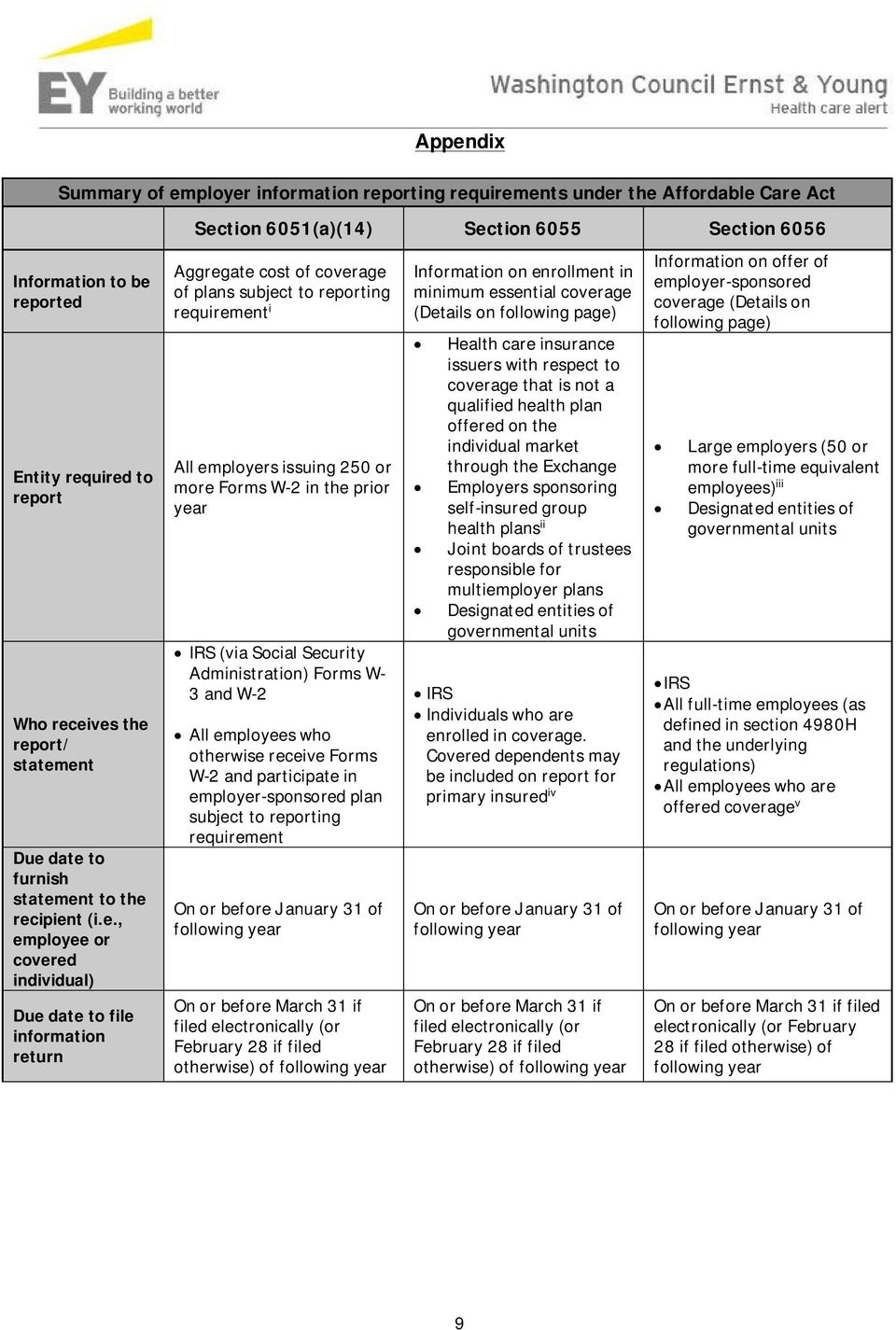
9 Appendix Summary of employer information reporting requirements under the Affordable Care Act Information to be reported Entity required to report Who receives the report/ statement Due date to furnish statement to the recipient (i.e., employee or covered individual) Due date to file information return Section 6051(a)(14) Section 6055 Section 6056 Aggregate cost of coverage of plans subject to reporting requirement i All employers issuing 250 or more Forms W-2 in the prior year IRS (via Social Security Administration) Forms W- 3 and W-2 All employees who otherwise receive Forms W-2 and participate in employer-sponsored plan subject to reporting requirement On or before January 31 of following year On or before March 31 if filed electronically (or February 28 if filed otherwise) of following year Information on enrollment in minimum essential coverage (Details on following page) Health care insurance issuers with respect to coverage that is not a qualified health plan offered on the individual market through the Exchange Employers sponsoring self-insured group health plans ii Joint boards of trustees responsible for multiemployer plans Designated entities of governmental units IRS Individuals who are enrolled in coverage. Covered dependents may be included on report for primary insured iv On or before January 31 of following year On or before March 31 if filed electronically (or February 28 if filed otherwise) of following year Information on offer of employer-sponsored coverage (Details on following page) Large employers (50 or more full-time equivalent employees) iii Designated entities of governmental units IRS All full-time employees (as defined in section 4980H and the underlying regulations) All employees who are offered coverage v On or before January 31 of following year On or before March 31 if filed electronically (or February 28 if filed otherwise) of following year 9
10 Section 6055 Information to be reported on the IRS information return The following information is to be reported on an information return to IRS under section 6055: 1. The name and tax payer identification number (TIN) of each individual enrolled in minimum essential coverage; 2. The name and address of the primary insured or other related person (e.g., a parent or spouse) who submits the application for coverage (referred to in the proposed regulations as the responsible individual); and 3. Months during which the individual is treated as having minimum essential coverage (in place of dates of coverage). Section 6056 Information to be reported on the IRS information return The following information is to be reported under section 6056: 1. The name, address, and employer identification number (EIN) of the large employer, and the calendar year for which the information is reported 2. The name and telephone number of the large employer s contact person 3. A certification as to whether the large employer offered to its full-time employees (and their dependents) the opportunity to enroll in minimum essential coverage under an eligible employer-sponsored plan, by calendar month 4. The number of full-time employees for each month during the calendar year, by calendar month 5. For each full-time employee, the months during the calendar year for which minimum essential coverage under the plan was available 6. For each full-time employee, the employee s share of the lowest-cost monthly premium for self-only coverage providing minimum value that the large employer offered to that full-time employee, by calendar month 7. The name, address, and taxpayer identification number of each full-time employee during the calendar year and the months, if any, during which the employee was covered under an eligible employer-sponsored plan The proposed regulations anticipate that the following additional information will be required to be reported, some of which may be provided by indicator codes: 1. Information as to whether the coverage offered to employees and their dependents under the employer-sponsored plan meets minimum value and whether the employee had the opportunity to enroll his or her spouse in the coverage 2. The total number of employees, by calendar month 3. Whether an employee s effective date of coverage was affected by a waiting period 4. Whether the large employer had no employees or otherwise credited any hours of service during any particular month, by calendar month 5. Information regarding whether the large employer is a member of a controlled group, determined under sections 414(b), 414(c), 414(m), or 414(o), and, if applicable, the 10

11 name and EIN of each employer member of the controlled group constituting the applicable large employer on any day of the calendar year for which the information is reported 6. If an appropriately designated entity is reporting on behalf of a large employer that is a governmental unit or any agency or instrumentality thereof for purposes of section 6056, the name, address, and identification number of the appropriately designated person 7. If an applicable large employer member is a contributing employer to a multiemployer plan, whether a full-time employee is treated as eligible to participate in a multiemployer plan due to the employer s contributions to the multiemployer plan 8. If a third party is reporting on behalf of the large employer with respect to the large employer s full-time employees, the name, address, and identification number of the third party (in addition to the name, address, and EIN of the large employer already required under the proposed regulations). The proposed regulations anticipate that the following information will be reported for each full-time employee for each calendar month using an indicator code: 1. Minimum essential coverage meeting the ACA s minimum value standard was offered to: a. The employee only b. The employee and the employee s dependents only c. The employee and the employee s spouse only d. The employee, the employee s spouse and the employee s dependents 2. Coverage was not offered to the employee, and: a. Any failure to offer coverage will not result in a payment under section 4980H(a) or (b), for example because the employee was in a limited nonassessment period for certain employers, as defined in the section 4980H final regulations ( H-1(a)(26) b. The employee was not a full-time employee c. The employee was not employed by the ALE member during that month d. No other code or exception applies 3. Coverage was offered to the employee for the month although the employee was not a full-time employee during that month 4. The employee was covered under the plan 5. The ALE member met one of the affordability safe harbors under section 4980H final regulations ( H-5(e)(2)) with respect to the employee The Administration anticipates that the reporting format will accommodate the necessary codes in the event that multiple codes apply with respect to a full-time employee for a particular calendar month. Treasury and the IRS also anticipate that additional indicator codes will be available on the section 6056 return to indicate that an employer is using transition relief provided under section 4980H final regulations. 11
12 i With limited exceptions, group health plans are generally subject to the reporting requirement. Certain other plans (such as FSAs, employee assistance plans, wellness programs, on-site medical clinic, or integrated dental or vision coverage) are also subject to section 6051 reporting in some cases. ii The final regulations provide that for arrangements covering employees of related corporations, each employer participating in a plan covering multiple entities is treated as the plan sponsor responsible for reporting with respect to its employees. iii The final regulations provide that the section 6056 IRS filing and employee statement requirements are applied separately to each employer in the large employer controlled group. iv Final regulations permit multiple covered individuals to be included on one return filed with the IRS. v The final regulations indicate that an offer of coverage will be reportable for an employee for the month even if the employee was not a full-time employee during that month. 12

Employer Reporting of Health Coverage Code Sections 6055 & 6056
 Brought to you by Hickok & Boardman HR Intelligence Employer Reporting of Health Coverage Code Sections 6055 & 6056 The Affordable Care Act (ACA) created new reporting requirements under Internal Revenue
Two New Reporting Requirements Beginning in 2016 But Are Important Now
 Two New Reporting Requirements Beginning in 2016 But Are Important Now Recently, the IRS published final regulations implementing two new information reporting requirements under ACA that are first due
To enforce these penalties and properly administer the premium tax credits, ACA imposes two annual reporting requirements on employers.
 Employer Health Coverage Reporting Requirements for 2015 Summary The Affordable Care Act (ACA) includes reporting requirements for health care coverage in 2015. The reports will give information to the
IRS Releases 2015 Forms and Instructions for 6055/6056 Reporting
 IRS Releases 2015 Forms and Instructions for 6055/6056 Reporting Background Under the Patient Protection and Affordable Care Act (ACA), individuals are required to have health insurance while applicable
IRS Issues Drafts of Individual Responsibility Reporting Forms
 IRS Issues Drafts of Individual Responsibility Reporting Forms The following is a summary of draft forms. Some of this information may change when final forms, and the instructions, are released. In order
Employer-Sponsored Coverage Reporting Requirements
 Under ACA rules, all employers that offer self-insured health plans must report new, detailed information on every individual covered under their health plan. There are reporting requirements for self-insured
IRS Form 1095-C: Indicator Codes for Lines 14, 15, and 16
 IRS Form 1095-C: Indicator Codes for Lines 14, 15, and 16 Form 1095-C, Part II, Line 14: Indicator Code Series 1 for Offer of Coverage 1A. Qualifying Offer: Minimum essential coverage providing minimum
Employer-Shared Responsibility
 Affordable Care Act Planning to Deal with the Pay-or-Play Penalties Effective January 1, 2015 Anne Hydorn Hanson Bridgett LLP Telephone: (415) 995-5893 Email: [email protected] Judy Boyette Hanson
Affordable Care Act (ACA) Violations Penalties and Excise Taxes
 Brought to you by The Insurance Exchange Affordable Care Act (ACA) Violations Penalties and Excise Taxes The Affordable Care Act (ACA) includes numerous reforms for group health plans and creates new compliance
Federal Register / Vol. 79, No. 46 / Monday, March 10, 2014 / Rules and Regulations
 Federal Register / Vol. 79, No. 46 / Monday, March 10, 2014 / Rules and Regulations 13231 a Federal, State, or local income tax return. (4) Format. The electronic version of the statement must contain
HEALTH & WELFARE PLAN LUNCH GROUP
 HEALTH & WELFARE PLAN LUNCH GROUP October 1, 2015 ALSTON & BIRD LLP One Atlantic Center 1201 W. Peachtree Street Atlanta, GA 30309-3424 (404) 881-7885 E-mail: [email protected] 2015 All Rights Reserved
Patient Protection and Affordable Care Act Compliance Checklist for Employers
 October, 2014 Patient Protection and Affordable Care Act Compliance Checklist for Employers Under the Employer Mandate in the Affordable Care Act, effective January 1, 2015, employers with 50 or more full-time
Instructions for Forms 1094-C and 1095-C
 2015 Instructions for Forms 1094-C and 1095-C Department of the Treasury Internal Revenue Service Section references are to the Internal Revenue Code unless otherwise noted. Future Developments For the
AFFORDABLE CARE ACT REPORTING
 AFFORDABLE CARE ACT REPORTING Introduction The Affordable Care Act (ACA) requires the State of Missouri to offer health insurance to full time equivalent employees. The ACA also generally requires individual
Wells Insurance. 2015 ACA Compliance Update
 Wells Insurance 2015 ACA Compliance Update Wells Insurance Today s Agenda Cost-Saving Strategies Deadlines & Implications for you Plan Design Changes Reinsurance Fees Employer Penalty Rules Reporting of
How To Report Health Insurance To The Irs
 ACA REPORTING WEBINAR QUESTIONS AND ANSWERS The following questions on ACA reporting requirements to the IRS were collected at a series of webinars offered by ThinkHR. Introduction The Affordable Care
This notice advises taxpayers that the Treasury Department and the Internal
 Information Reporting on Minimum Essential Coverage Notice 2015-68 PURPOSE This notice advises taxpayers that the Treasury Department and the Internal Revenue Service intend to propose regulations under
IRS Issues Guidance on Mandatory Form W-2 Informational Reporting of Employer-Sponsored Health Coverage
 IRS Issues Guidance on Mandatory Form W-2 Informational Reporting of Employer-Sponsored Health Coverage By Seth Perretta, Joel Wood and Matthew Fornataro of Crowell & Moring LLP On March 29, 2011, the
Weyrich, Cronin & Sorra, Chartered
 Weyrich, Cronin & Sorra, Chartered Health Insurance Reporting Requirements Date: 9/17/2014 The Affordable Care Act (ACA) brought many changes into the law, taking effect over a period of years. Among these
Legislative Brief: 2015 COMPLIANCE CHECKLIST. Laurus Strategies
 Laurus Strategies Legislative Brief: 2015 COMPLIANCE CHECKLIST The Affordable Care Act (ACA) has made a number of significant changes to group health plans since the law was enacted over four years ago.
The Affordable Care Act: Summary of Employer Requirements
 The Affordable Care Act: Summary of Employer Requirements February 2013 Disclaimer Any US tax advice contained herein was not intended or written to be used, and cannot be used, for the purpose of avoiding
ACA Instruction Manual
 ACA Instruction Manual Index SECTION 1- INTRODUCTION TO THE AFFORDABLE CARE ACT SECTION 2- THE 1095-C SECTION 3- THE 1094-C SECTIONS 4- OUTLINE OF STEPS FOR ACA COMPLIANCE WITH PAYDATA SECTIONS 5- EVOLUTION
Treasury Department Proposes Rule Implementing Premium Tax Credits Under the Affordable Care Act
 AUGUST 17 2011 Treasury Department Proposes Rule Implementing Premium Tax Credits Under the Affordable Care Act BY ALDEN J. BIANCHI, MINTZ LEVIN The Patient Protection and Affordable Care Act 1 (the Act)
PENALTIES Employer Shared Responsibility under the Affordable Care Act (ACA)
 PENALTIES Employer Shared Responsibility under the Affordable Care Act (ACA) What employers need to know to make informed decisions about ACA compliance. Employer Shared Responsibility Under the employer
Employer s Guide To Health Care Reform
 Employer s Guide To Health Care Reform A nonprofit independent licensee of the Blue Cross Blue Shield Association National strength. Local focus. Individual care. SM As part of our commitment to being
Health Care Law Implementation: What Nonprofits Need to Know WELCOME!
 Health Care Law Implementation: What Nonprofits Need to Know WELCOME! Health Care Law Implementation: What Nonprofits Need to Know (PPACA) Health Care Law Implementation: What Nonprofits Need to Know Heather
Health Care Reform: What to Expect in 2013 2014. Employee Benefits Series. Health Care Reform 2015 COMPLIANCE CHECKLIST
 Health Care Reform: What to Expect in 2013 2014 Employee Benefits Series Health Care Reform 2015 COMPLIANCE CHECKLIST This checklist is designed to help employers who sponsor group health plans review
Advantage Payroll Services Presents. March 24, 2015 Presenter: Jessica Stelfox, MBA, PHR
 (c )A dv an ta ge Pa yr ol l Se rv ic es 20 15 Advantage Payroll Services Presents March 24, 2015 Presenter: Jessica Stelfox, MBA, PHR We encourage you to benefit from resources and information provided
ACA Employer Mandate: The Ultimate Guide
 ACA Employer Mandate: The Ultimate Guide Table of Contents Are you ready? WHO needs to comply? WHAT forms do you need to file to comply? WHEN do you need to file the forms? WHERE do you get the forms?
ACA Employer Reporting Guide. A practical guide to understanding the ACA 6055 and 6056 employer reporting requirements
 ACA Employer Reporting Guide A practical guide to understanding the ACA 6055 and 6056 employer reporting requirements Table of Contents INTRODUCTION TO ACA EMPLOYER REPORTING... 3 HOW TO USE THIS GUIDE...
IRS NOTICE 2015-87: ADDITIONAL GUIDANCE ON HRAS, ACA REPORTING, HEALTH FSA CARRYOVERS AND MORE
 Attorneys at Law Friday, January 29, 2016 IRS NOTICE 2015-87: ADDITIONAL GUIDANCE ON HRAS, ACA REPORTING, HEALTH FSA CARRYOVERS AND MORE By: Gabriel S. Marinaro, Esq. In December of 2015, the IRS issued
COMMENTARY. The Affordable Care Act: Considerations for Employers with Unionized Workers JONES DAY
 March 2014 JONES DAY COMMENTARY The Affordable Care Act: Considerations for Employers with Unionized Workers The Affordable Care Act ( ACA ) infuses new complexities into collective bargaining negotiations
Employer Tax Penalties Linked to Employees Receiving Tax Credits. Calculation of Non-deductible Excise Taxes Under IRC 4380H
 Washington Council Employer Tax Penalties Linked to Employees Receiving Tax Credits Employers will face taxes under IRC 4980H if they do not offer minimum essential coverage or if the coverage they offer
IRS gives first glimpse of rules on ACA excise tax on high cost health plans and asks for input
 from Human Resource Services IRS gives first glimpse of rules on ACA excise tax on high cost health plans and asks for input February 27, 2015 In brief The IRS has issued a Notice laying out some initial
The Affordable Care Act: What s next for employers?
 The Affordable Care Act: What s next for employers? Prepared by: Jill Harris, Director, Washington National Tax, McGladrey LLP 507.226.0482, [email protected] Bill O Malley, Director, Washington
Q&A from Assurex Global Webinar. Employer ACA Reporting Requirements. Q: Where will these forms come from? will the IRS provide them?
 Q&A from Assurex Global Webinar Employer ACA Reporting Requirements Questions Q: Where will these forms come from? will the IRS provide them? A: IRS has provided draft Forms 1094 and 1095 along with draft
Summary of Provisions Affecting Employer-Sponsored Insurance
 JULY 2014 AFFORDABLE CARE ACT Summary of Provisions Affecting Employer-Sponsored Insurance Much of the public discussion about the Affordable Care Act (ACA) has focused on the expansion of coverage to
American employers need prompt action on these six significant challenges. We urge Congress and the administration to address them now.
 In June 2014, the Board of Directors of the American Benefits Council (the Council) approved a long-term public policy strategic plan, A 2020 Vision: Flexibility and the Future of Employee Benefits. It
Health Reform. Employer Penalty Delay: What are the Consequences? Impact of the Delay on Employers
 Health Reform Employer Penalty Delay: What are the Consequences? Martin Haitz (484) 270-2575 [email protected] Issued date: 07/29/13 The employer penalty provisions and two reporting requirements
Health care reform for large businesses
 FOR PRODUCERS AND EMPLOYERS Health care reform for large businesses A guide to what you need to know now DECEMBER 2013 CONTENTS 2 Introduction Since 2010 when the Affordable Care Act (ACA) was signed into
Your guide to health care reform provisions
 Your guide to health care reform provisions February 2014 edition Since the Patient Protection and Affordable Care Act (PPACA) was enacted in March 2010, businesses have been impacted by federal health
Potential Penalties for Employers under the Pay or Play Rules
 The Affordable Care Act (ACA) brings many changes to employers and health plans. One such change essentially amounts to a requirement for some employers to offer a certain level health care to their employees
1095 FREQUENTLY ASKED QUESTIONS
 1095 FREQUENTLY ASKED QUESTIONS What is Form 1095? The IRS uses information on Form 1095 to determine whether you or your employer may have to pay a fine for failing to comply with the Affordable Care
Heffernan Benefit Advisors Presents Health Care Reform: What Non-Profits Need to Know. The session will begin shortly
 Heffernan Benefit Advisors Presents Health Care Reform: What Non-Profits Need to Know The session will begin shortly Sound should come through your speakers when the session begins Verify that the volume
Interim Guidance on Informational Reporting to Employees of the Cost of Their Group Health Insurance Coverage
 Part III Administrative, Procedural, and Miscellaneous Interim Guidance on Informational Reporting to Employees of the Cost of Their Group Health Insurance Coverage Notice 2011-28 I. PURPOSE This notice
What Employers Need to Know about the Final ACA Reporting Forms
 What Employers Need to Know about the Final ACA Reporting Forms We highly recommend that you download the slides prior to the webinar at http://ow.ly/lccoh (case sensitive) Laura Kerekes, SPHR, SHRM-SCP
ACA Penalties Individual Shared Responsibility Provision. Kristy Maitre Tax Specialist Center for Agricultural Law and Taxation October 9, 2014
 ACA Penalties Individual Shared Responsibility Provision Kristy Maitre Tax Specialist Center for Agricultural Law and Taxation October 9, 2014 Enrollment period You can generally buy Marketplace health
IRS Guidance on Employer Shared Responsibility Penalty
 Brought to you by Hammitt Benefits Group IRS Guidance on Employer Shared Responsibility Penalty Beginning in 2014, the Affordable Care Act (ACA) imposes pay or play requirements on large employers to help
The Insurance Mandates of the Affordable Care Act
 1 A. Affordable Care Act Individual Mandate The Insurance Mandates of the Affordable Care Act 1. All citizens of the United States are subject to the individual mandate as are all permanent residents and
Introduction. Affordable Care Act Overview of Changes
 Introduction Affordable Care Act Overview of Changes Presented by: Tim Dillingham, CLU Benefit Resource Group, Inc. 201 E Broad Street, Suite 1 Linden, MI 48451 810-735-6500 810-735-6610 (fax) [email protected]
Health Reform Update
 Health Reform Update ACA Employer Reporting Requirements for 2015, and Then Some Sponsored by: The Massachusetts Health Connector Springfield Marriott Springfield, MA April 7, 2015 Beechwood Hotel Worcester,
The Affordable Care Act: What Public Employers Need to be Doing Now
 The Affordable Care Act: What Public Employers Need to be Doing Now April 30, 2014 J. Richard Johnson IPMA-HR Webinar Copyright 2014 by The Segal Group, Inc. All rights reserved. 1 ACA Update Discussion
Shared Responsibility: What It Means for Your Business
 Shared Responsibility: What It Means for Your Business The provisions of the Affordable Care Act (ACA) apply to nearly all companies in the United States. The ways they apply, however, can be different
Affordable Care Act FAQ
 Affordable Care Act FAQ Based on regulatory guidance issued as of March 2014 and subject to change. Contents General ACA Questions... 1 ACA Marketplace... 1 ACA Employer Shared Responsibility... 2 ACA
What s Ahead for 2015: Preparing Your Group Health Plan for the Employer Mandate
 What s Ahead for 2015: Preparing Your Group Health Plan for the Employer Mandate May 14, 2014 1 Speakers Moderator: Lisa A. Tavares, Partner Speakers: Thora A. Johnson, Partner Harry I. Atlas, Partner
THE AFFORDABLE CARE ACT ( ACT ), NEW EMPLOYER MANDATES, AND IMPACTS ON EMPLOYER- SPONSORED HEALTH INSURANCE PLANS
 Community THE AFFORDABLE CARE ACT ( ACT ), NEW EMPLOYER MANDATES, AND IMPACTS ON EMPLOYER- SPONSORED HEALTH INSURANCE PLANS Prepared for the 2014 Massachusetts Municipal Association Annual Meeting On March
FREQUENTLY-ASKED-QUESTIONS FROM EMPLOYERS REGARDING AUTOMATIC ENROLLMENT, EMPLOYER SHARED RESPONSIBILITY, AND WAITING PERIODS.
 FREQUENTLY-ASKED-QUESTIONS FROM EMPLOYERS REGARDING AUTOMATIC ENROLLMENT, EMPLOYER SHARED RESPONSIBILITY, AND WAITING PERIODS Notice 2012-17 INTRODUCTION Many provisions of the Patient Protection and Affordable
HEALTH CARE REFORM: FREQUENTLY ASKED QUESTIONS (Group, Individual, Seasonal)
 Group Health Insurance Q & A HEALTH CARE REFORM: FREQUENTLY ASKED QUESTIONS (Group, Individual, Seasonal) 1. Will small employers continue to have 12 month rates as they exist today? a. Yes. Employer groups
Agencies Issue Final Regulations Implementing Employer Shared Responsibility and Waiting Period Rules
 February 25, 2014 Authors: Kathryn Bjornstad Amin, Jon W. Breyfogle, Lisa Christensen, Christine L. Keller, Tamara S. Killion, Emily C. Lechner and Brigen L. Winters If you have questions, please contact