
Florida s Sexual Health Education Community Outreach Tool Kit
|
|
|
- Myrtle Kelley
- 10 years ago
- Views:
Transcription
1 Florida s Sexual Health Education Community Outreach Tool Kit
2 i Florida s Sexual Health Education Community Outreach Tool Kit aims to provide communities with information that will assist them with reducing the number of teen pregnancies and STDs and improve the health and academic success of students. This publication is a product of the HIV/AIDS Prevention Education Program, USF Healthy Schools Project. Its production is supported by Cooperative Agreement Number 1U87DP from the Centers for Disease Control and Prevention. Its contents do not necessarily represent the official views of the Centers for Disease Control and Prevention. For information concerning this publication contact the HIV/AIDS Prevention Education Program at (850) Visit our website at:

3

4 Table of Contents iii Table of Contents Introduction...1 SECTION ONE: ACTION STEPS Action Step 1: Engage the Community to Build a Coalition...3 Action Step 2: Conduct Community Assessment and Gather Data...8 Action Step 3: Develop a Plan of Action...22 Action Step 4: Evaluate the Community-based Initiative...23 SECTION TWO: ADDITIONAL INFORMATION & RESOURCES Additional Information & Resources for Action Step Additional Information & Resources for Action Step Additional Information & Resources for Action Steps 3 and ENDNOTES AND ACKNOWLEDGEMENTS Endnotes Acknowledgments ADDITIONAL RESOURCES INCLUDED ON THE CD IN THE POCKET OF THE TOOL KIT BINDER: Each time material on the CD is referenced in the Tool Kit, this icon will be displayed. Resources are arranged alphabetically by title on the CD: 40 Developmental Assets for Youth Characteristics of an Effective Health Education Curriculum Collier County Florida Health Education Policy Essential Tips for Successful Collaboration Fostering School Connectedness Guidelines for Effective School Health Education to Prevent the Spread of AIDS Healthy School District Self-Assessment Tool How Schools Work and How to Work with Schools Parents as Partners in Sexual Health Education Promoting Health and Academic Success through Collaboration and Partnership Sexual Health Education: Definition, Requirements, Need, State and Local Policies Sexual Risk and Protective Factors Sexual Risk Behaviors and Academic Achievement Ten Tips for Parents to Help Their Children Avoid Teen Pregnancy Tool to Assess the Characteristics of Effective Sex and STD/HIV Education Programs What Works 2010 Why It Matters

5

6 Action Step s 1 Florida s Sexual Health Education Community Outreach Tool Kit INTRODUCTION Overview of the Tool Kit The overall goals of (Tool Kit) are to: 1. Provide community members with information, ideas, and strategies that will assist them with reducing the number of teen pregnancies and sexually transmitted diseases (STDs) and improve the health and academic success of students. 2. Educate community members about the need for effective sexual education policies and evidence-based education programs. 3. Inform readers about communities that have created coalitions to address sexual health issues of youth, and have changed policies and adopted a curriculum to meet the needs of their youth. Section One contains four action steps that will guide concerned community members to engage community partners; assess school and community needs, values, resources, and policies; develop a plan of action, and measure the results of the community initiative. Tools are provided throughout the text in the form of lists, charts, and samples. Sidebars provide statements from reports and references to helpful materials, including those provided on the accompanying CD. Section Two contains additional information and resources that can be used for each action step. In this section, more references are made to resources provided on the accompanying CD. The CD provided with the Tool Kit contains many items that are referred to throughout the document. These include: PowerPoint presentations for use with parent and community groups, important studies and reports, assessment tools, instructional guidelines, a brochure and a recently adopted policy from a Florida school district. Each time material on the CD is referenced, this icon Why is sexual health education important? will be displayed. According to the 2009 Florida Youth Risk Behavior Survey (YRBS), approximately 365,700 high school students in grades 9 through 12 (51%) reported having sexual intercourse at least once. 1 By the time students are seniors in high school, 63% reported they had sexual intercourse at least once. The data show a significant number of high school students in Florida are at risk of experiencing a teen pregnancy or contracting an STD. SECTION ONE Why should policy makers, educators, and parents be co n ce r n ed? W h e n compared to other states, Florida ranks: First in the nation for the number of AIDS cases reported to have been transmitted through heterosexual contact. Second for reported pediatric cases of AIDS (13 years old and younger). Second in the nation in terms of overall HIV incidence. T h i r d f o r the number of cumulative AIDS cases for all age groups. Concerns and stress caused by teen pregnancies or STDs can be a barrier to learning. A study conducted by the National Campaign to Prevent Teen Pregnancy found that parenthood is the leading cause of school dropout for teen girls.

7 2 Action Ste p s 80% 60% 40% 20% Table 1 Percentages of Florida Students Who Ever Had Sexual Intercourse (by high school grade level) Florida Youth Risk Behavior Survey 2009 The Guttmacher Institute data for 2010 indicates that Florida ranks 12th in the nation in the number of teen pregnancies. Florida Department of Health data for 2010 indicates that approximately 66% of STD cases occured among individuals between the ages of T h e N a t i o n a l Campaign to Prevent Te e n P r e g n a n c y document Why It Matters: Linking Teen Pregnancy Prevention to Other Critical Social Issues and Preventing Teen Pregnancy: An Update in 2009 is available on the CD provided with this Tool Kit. 0% Grade 9 Grade 10 Grade 11 Grade 12 Teen pregnancies and STDs are preventable. Families, county health departments, faith-based organizations, and schools can all play a role in preventing teen pregnancies and STDs. The United States Centers for Disease Control and Prevention (CDC) recognizes the essential role of school-based programs and the positive impact comprehensive health education can have on educational outcomes and in reducing health-risk behaviors. Implementing a community approach to improve sexual health outcomes of youth has been successful. Denmark, South Carolina implemented such an approach and the result was a decline in teen pregnancy rates (refer to page 6 of the Tool Kit for the full Denmark, South Carolina story). A program planning model used by CDC suggests the following action steps to bring together concerned community members in order to assess health needs, and to create a plan of action for improving health outcomes: 1. Engage the community to build a coalition. 2. Conduct community assessment and gather data. 3. Develop and implement a plan of action. 4. Evaluate the community-based initiative.

8 Action Step s 3 ACTION STEP 1: ENGAGE THE COMMUNITy TO BUILD A COALITION When communities work collaboratively it can take the pressure off of any one entity, and resources can be pooled to effectively serve the population in need. Building community coalitions that bring youth, parents, educators, and community organizations together to work toward impacting youth sexual health, are a key strategy to helping youth become healthy adults. Here are some suggestions and examples for engaging the community: A. How do we engage community groups to support the community coalition s initiative? The key to engaging the community in coalition building is to identify and involve individuals and staff from agencies and organizations who are willing to work together. There are many ways to spread the word about the need for a coalition to address the issues of teen pregnancies and STDs among youth in a community and begin the process of bringing a coalition together. Some of these include: Presentations and announcements at Parent Teacher Association Meetings and local churches. Flyers containing local data can be developed and distributed at local sporting events and gathering places. An invitation to attend a coalition meeting could be printed in the local newspaper (see Additional Information & Resources for Action Step 1, page 26). Effective communication is essential to the success of a collaborative effort. Strategies that are useful throughout the coalition building process include: Face-to-face contact during the early phases of planning. The formation of a group to encourage and maintain involvement. The use of an contact list (listserv) of coalition members. The involvement of a professional facilitator in strategic planning, as well as conference calls and meetings. B. Who should be included as members of the community coalition? It is important to continually welcome new collaborating partners to the table as the community coalition initiative moves forward. For more information regarding community collaboration and coalition building see Essential Tips for Successful Collaboration which is available on the CD provided with this Tool Kit. There should be an appropriate representation of groups from all segments of the community. When students and young adults are included, they can provide authentic adolescent life experiences to help the coalition members set appropriate goals and objectives. The recommended representatives for an effective community coalition include the following: Youth representatives Parents Educators Health care professionals PTA members School board members

9 4 Action Ste p s District coordinator of school curriculum for health School staff/nurses Local health department administration and staff Community based organization members Concerned citizens Political leaders/elected officials Faith-based organization members Community activists Pediatricians/physicians Collaborative Efforts pose challenges because: Organizations and individuals may have their own agenda. Intra-agency trust may be difficult to develop. Decision-making processes may become complicated. Stakeholders have to collaborate and take responsibility for program objectives, methods, and outcomes. The group may lack a clear sense of leadership and direction. The group may lack a clear sense of its tasks and responsibilities. It is very important to maintain transparency and openness between coalition members through public forums, panel presentations, and communication with public officials and community leaders. It is important for potential members to have frank and honest discussions about their goals and intentions. The group must develop a sense of mutual respect, trust, purpose, and understanding. C. This section contains success stories from communities that used a community-based approach to influence policies and programs to improve the health outcomes of youth. St. Lucie County, Florida St. Lucie County, in south central Florida on the Atlantic coast, has one of the highest numbers of blacks living with human immunodeficiency virus (HIV) or acquired immune deficiency syndrome (AIDS) in the state 1 in 35. When this information was released through the Silence is Death Report by the Florida Department of Health in 2006, community leaders in St. Lucie County mobilized in an effort to reduce the HIV/AIDS rate. Community members and the St. Lucie County Health Department approached the Executive Round Table (ERT), a group of 27 policymakers, state and local government agency officials, business and nonprofit organization leaders, and faith community representatives. These community members formally presented information about the scope and gravity of the HIV/ AIDS situation in the county, asking for help to mobilize the community in a comprehensive effort to reduce the HIV infection rate. The ERT responded in two ways. First, it passed a resolution that contained three recommendations:

10 Action Step s 5 1. Encourage community agencies to integrate prevention-message curricula in their programs. 2. Coordinate community outreach that would include public forums to educate the public on the problem. 3. Identify a best practice HIV curriculum for use in the schools and create a forum to educate parents on the disease and how to prevent it. Second, the ERT appointed an HIV/AIDS Subcommittee. The HIV/AIDS Subcommittee invited school district administrators and principals, community, civic, and faith-based organizations to address the problem through panel presentations about the critical need to educate about HIV/AIDS. After the presentations and open discussion of the issues, these organizations were asked to become partners with the HIV/AIDS Subcommittee. The HIV/AIDS Subcommittee partnered with the Indian River Community College Kight Center for Emerging Technologies to produce an educational DVD that could be used for community outreach in a variety of settings to increase awareness about HIV and open up opportunities for dialogue with potential partners. The DVD became a key part of the HIV/AIDS Subcommittee s panel presentations. To address the ERT s recommendation for a best practice curriculum, the HIV/ AIDS Subcommittee wanted the curriculum to reflect the community s values and opinions regarding sexual health education. A survey was conducted by the University of North Florida s Public Opinion Research Laboratory, using a national survey instrument. Results from this survey showed 87% of adults preferred a comprehensive sex education curriculum. To begin the curriculum selection process, the HIV/AIDS Subcommittee formed a curriculum subcommittee to identify a best practice HIV curriculum for use in the schools. The curriculum subcommittee consisted of teachers and administrators from the school district, professionals who work in the field of HIV/AIDS prevention, and curriculum specialists in local universities. The group reviewed curriculum research and developed criteria it would use to identify which curricula to consider. The next step was to develop curriculum evaluation tools. The HIV/AIDS Subcommittee used curriculum evaluation guidelines from the CDC, Florida Department of Education and the St. Lucie County School District. High school principals were asked to identify health education certified teachers to evaluate two of the curricula selected. Through this teacher evaluation process, the unanimously selected curriculum was Get Real About AIDS. Subsequently, the school board voted to implement Get Real About AIDS in the schools. The St. Lucie County curriculum subcommittee emphasized that they were not looking for an abstinencebased curriculum or an abstinenceonly curriculum. Instead, the goal was to identify an HIV/ AIDS curriculum with evidence in reducing the incidence of behaviors that lead to HIV infection. The final step was to provide professional development to teachers who would implement the curriculum in the classroom. During the 2008 school year, 1,500 teachers (60% of their total teaching staff) were trained to deliver the Get Real About AIDS curriculum to students in grades K through 12. The lessons are presented by classroom teachers in the elementary schools, science teachers in the middle schools, and health teachers in the high schools. To find out more about the St. Lucie County initiative contact Janice Karst, Director of Communications, St. Lucie County School District, [email protected].

11 6 Action Ste p s Washington County, Florida Washington County is a rural county in the Panhandle region of Florida with a population of approximately 21,000. During and , a prevention education program was in place there and involved the following collaborators: A district intervention specialist (DIS) from the State Health Agency (SHA). A school nurse from the county health department (CHD). Staff from Teens Above the Influence (Teens ATI), a program funded through the State Department of Health. This collaborative effort has been successful in providing a program that meets the various needs of students. The members of this collaborative effort agreed to the statements below: 1. Abstinence education in schools may be most effective when it is offered in a caring environment that supports students and encourages abstaining from other risky behaviors such as drug and alcohol use that are often linked to unsafe sexual practices. 2. A multi-faceted approach to HIV prevention education in which abstinence education is one of several options available to students and may be more effective than approaches that focus solely on abstinence. 3. A cooperative model with close working relationships among school administrators, health educators, school nurses and abstinence educators regardless of each one s preferred prevention method may be effective in meeting the needs of students. This community initiative combines abstinence education, primarily in middle schools, but also in community venues, with a broader approach that includes health services and comprehensive health education. The abstinence education component of the program is offered by the Teens ATI. Teens ATI educates students on the benefits of pre-marital abstinence, including the prevention of sexually transmitted diseases. The Teens ATI program takes a holistic approach to student well-being. Education about HIV is provided by a SHA DIS, while routine health services are provided by school nurses from the Washington CHD. Both the DIS and school nurses help link students concerned about HIV with appropriate medical and counseling services. Out of the 67 Florida counties, Washington County ranked 56th and 64th respectfully in chlamydia rates for 10 to 14 and 15 to 19 year olds in For additional information regarding this initiative contact Sharron Hobbs at the Washington County Health Department, [email protected]. Denmark, South Carolina This small community located in Denmark, South Carolina, is an example of how collaborative initiatives can be successful in reducing teen pregnancy rates. Parents, religious leaders, school representatives, the media and other community organizations collaborated with the goal being to reduce the teen pregnancy rate in the county. The initiative involved six components:

12 Action Step s 7 The school district implemented a skill-based, K through 12 sexual health education curriculum. Teachers and school administrators received graduate-level training in human sexuality education. Parents, clergy, and community leaders attended workshops. Regular meetings were held involving school administrative staff, parent advisory groups, and health councils. Peer counselors were trained. Linkages were developed with health care providers to increase access to services. In the second year of implementation, the pregnancy rate for girls ages 14 through 17 dropped from 66.9 to 24.0 per 1,000. Three demographically similar counties, without programs, showed an increase in the teen pregnancy rate during the same time period. The community-wide effort in Denmark, South Carolina, is widely recognized for its success in its efforts to educate youth and promote sexual responsibility. 2 For additional information regarding the success story contact Aaron Bryan, HIV/ AIDS Prevention Education Coordinator with the South Carolina Department of Education, [email protected]. See Additional Information and Resources for Action Step 1 in Section Two of this Tool Kit (pages 25 26). Here you will find more information related to engaging the community and building collaborations, and also a sample press release.

13 8 Action Ste p s ACTION STEP 2: CONDUCT COMMUNITy ASSESSMENT AND GATHER DATA One type of data you will find on the Florida CHARTS site is Births to mothers ages Between the years , there were 25,095 births to girls in that age group in Florida. The rate was 42.5% births per 1000 girls ages During the assessment stage, the community coalition should gather and evaluate evidence to support the creation of a sexual health education plan for the community s youth. An assessment serves as the basis for the development of the plan s goals and objectives. It is a critical tool for identifying the current status of health outcomes in the county, the availability of existing services, and the teaching tools and educational strategies that are currently being used. It will also assist the community coalition to answer the questions: Where are we now? Where do we want to be three years from now? A needs assessment is useful in pinpointing specific areas of concern within the community and possible challenges to attaining the desired outcomes. Once an assessment has been completed and data gathered, sharing the results with the school board is very important. A sample script for a school board presentation can be found on page 38 of the Additional Information and Resources for Action Step 2 in Section Two of this Tool Kit. Answering questions A through J (pages 8-19) will guide you through the process of conducting a needs assessment. A. How do we collect data that documents the need for sexual health education for our youth? The information found in the following website will be helpful as you seek to answer this question. Community Health Assessment Resources Tool Set (CHARTS) The CHARTS database can be accessed from the Florida Department of Health (FLDOH) website to collect county level health outcomes and health indicators data which can be compared to state level statistics. This website is user friendly, making it easy to collect relevant statistics for determining health goals for the community. Go to the following website to access Florida CHARTS:
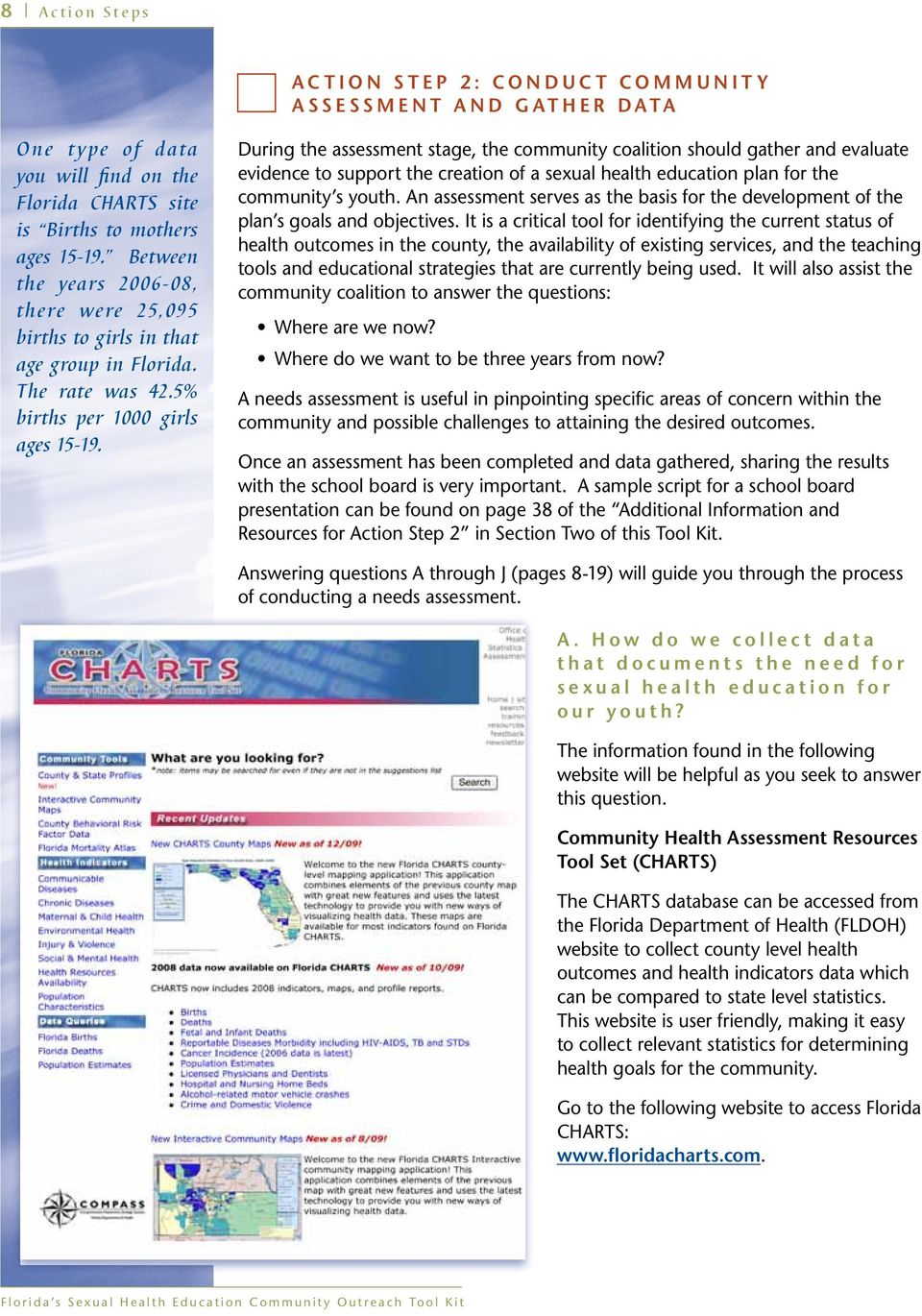
14 Florida CHARTS Page 1 of 2 Action Step s 9 At right is a snap shot of the CHARTS page you ll see when you link to the website address. On the CHARTS website, the left side bar lists various health indicator reports; click Maternal and Child Health. The snap shot on the following page shows you the various types of information that can be accessed there. Arrows on this snap shot of the Maternal and Child Health page indicate two reports of particular interest, School-aged Child and Adolescent Profile and the youth Risk Behavior Survey. School-aged Child and Adolescent Profile The snap shot below shows page two of the Child and Adolescent Profile report for a sample Florida county. By entering the name of your county you can see extensive countylevel data including socio-demographic information and high-risk behaviors of youth. Specific types of data include the number of FloridaCHARTS.com teen births, number of Report repeat births to teens, reported new HIV cases ages 13-19, and reported STD cases ages County & State Profiles New! Interactive Community Maps County Behavioral Risk Factor Data Florida Mortality Atlas Communicable Diseases Chronic Diseases Maternal & Child Health Environmental Health Injury & Violence Social & Mental Health Health Resources Availability Population Characteristics Florida Births Florida Deaths Population Estimates Maternal & Child Health Home > Maternal & Child Health --Make selection-- School-aged Child and Adolescent Profile Includes a county-level view of the well-being of children of school age. This profile is especially useful for community groups doing local assessments, grant writing and evaluation of programs for this population. Florida Birth Query System This system provides access to such data as low birth weight infants, prenatal care status and pre-term births. Additionally, this system allows users to filter this data by variables such as race, age, marital status and ethnicity of the mother. Youth Behavior Risk Survey This site provides information about the prevalence of obesity and asthma among youth and young adults and youth health-risk behaviors that contribute substantially to the leading causes of premature death, disability, and social problems. Does not include county-level data. Broward, Hillsborough, Miami- Dade, Orange, and Palm Beach county data can be found on the CDC's website. Pregnancy Risk Assessment Monitoring System (PRAMS) These reports provide local/regional data about women during pregnancy and the perinatal period, including health behaviors and access to care. County Birth Data Comparison Report This FloridaCHARTS.com report allows the user to display key birth indicators for up to four Florida counties. Interactive Florida Vital Statistics Annual Report This new application makes it easier than ever to access Florida Vital Statistics data. This report includes data on births, deaths, population, and life expectancy. Data Resource Center for Child and Adolescent Health This site provides data, tips and tools to use with data for states and families to help guide improvements in community-based systems of care for children and youth with special health care needs. Page 1 of 1 Florida Birth Defects Registry The Florida Birth Defects Registry (FBDR) is a statewide system that identifies birth defects in children born in Florida. 7/29/ / 6 100% School-aged Child and Adolescent Profile Leon County Sample County Measure Year* County Quartile** 1=most favorable 4=least favorable County Number*** Rate**** State Comparison High Risk Behaviors Sexual Activity Births to teenage mothers per 1,000 females (3-year rate) Per 1, Per 1, Per 1, Percent of repeat births to teenage mothers (3-year rate) Percent % 24.1% Percent % 19.7% Percent % 25.2% Reported new HIV cases ages (3-Year Rate) Per 100, N/A 13.6 Reported STD cases ages (3-Year Rate) Per 100, , ,231.5 Substance Abuse Percent of students who used alcohol in past 30 days Middle school Percent % 17.3% High school Percent % 39.5% Percent of students reporting binge drinking Middle school Percent % 6.2% High school Percent % 21.5% Percent of students using marijuana/hashish in past 30 days Middle school Percent % 4.5% High school Percent % 16.2%
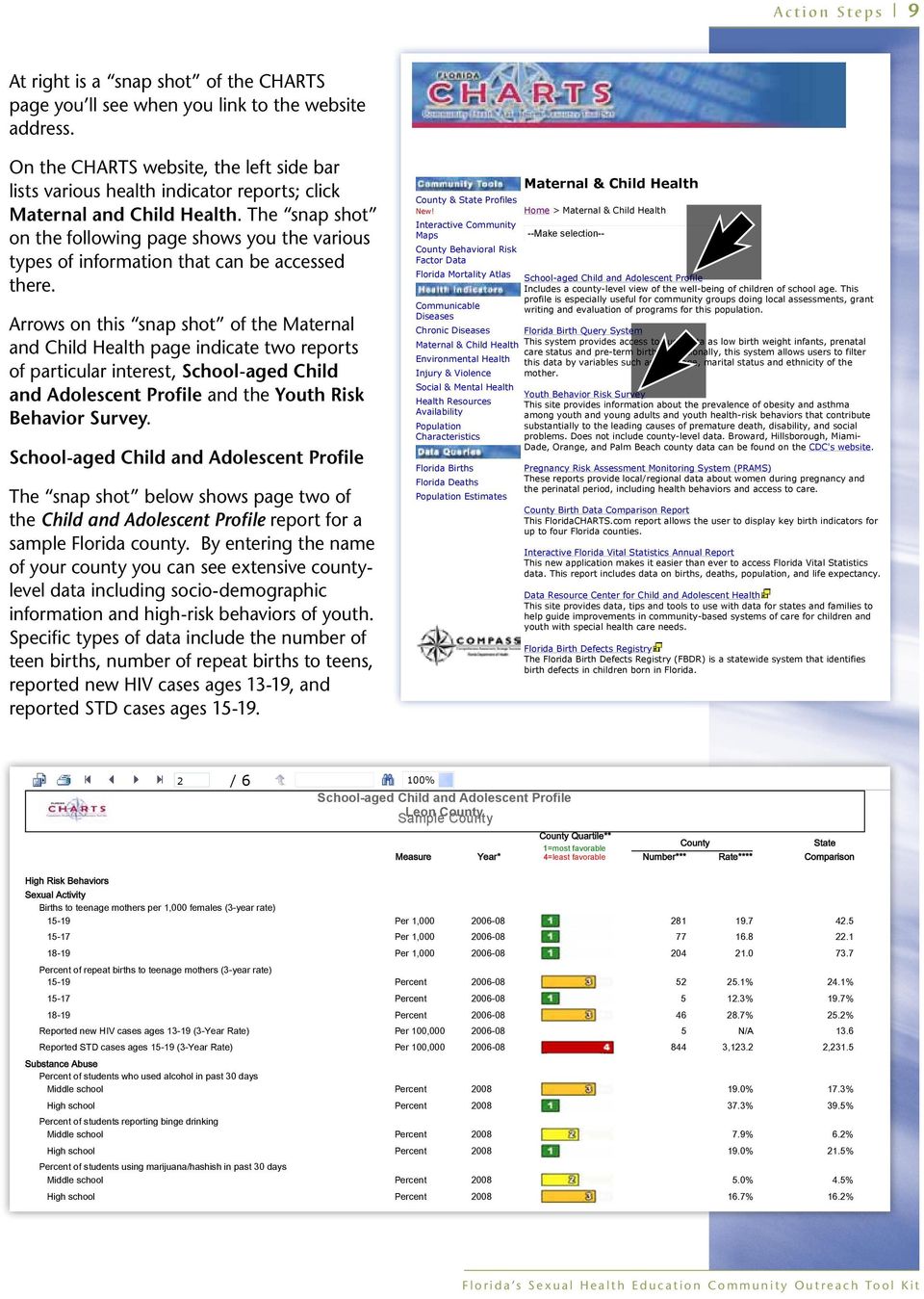
15 10 Action Ste p s HIV/AIDS Cases in Regions of the State The Florida Department of Health, Bureau of HIV/AIDS has developed a set of PowerPoint slides which indicate areas of high concentration of people living with HIV/AIDS in the state. The information included on the slides shows the number of HIV/AIDS cases by mode of exposure, age, race and sex. This is important information in determining areas of your county where an emphasis on prevention education efforts would be very useful. To access the PowerPoint slides, go to the following website: Scroll down to the table at the bottom of the page, click Trends and Statistics, and then click Partnership Slide Sets. Click the various regions until you find the set that includes your county. B. What are the unique characteristics of the youth population in our community? According to the U.S. Census, Florida s population includes nearly 4 million youth under the age of 18, approximately 15% of the total population. Florida is a culturally diverse state, with nearly 44% of its residents representing minority groups as shown in the pie chart below. Consideration should be given to the unique demographics of the youth population in your school district to find or develop a sexual health education curriculum that reflects the cultural, linguistic, economic, and religious influences in the community. Given the diversity in Florida s population, it is vital to identify the demographics of the youth population and implement interventions that are acceptable to parents and youth from all racial, ethnic and economic groups. Florida s Demographics 2008 by Race/Ethnicity Other Hispanic 2% 19% White (non-hispanic) 57% Black (non-hispanic) 22% Source: Florida EDP, 2009 All students, regardless of their race or socio-economic level, benefit from a curriculum that contains the characteristics of an effective health education curriculum. These characteristics are included in CDC s list of school health education resources entitled Characteristics of an Effective Health Education Curriculum. For detailed demographic information at the district level, go to and look for Data and Statistics in the left-hand column, then enter Florida School Indicators Report in the search box. This report provides extensive data at the district and school level.
16 Action Step s 1 1 C. What are the local beliefs and values of the adults and youth in our community regarding sexual health education? The coalition can collect information about what the community will support. Surveys, interviews, or focus groups are three different types of needs assessment tools that can be used to determine the local beliefs and values in the community. Using scientific methods, data should be collected from both the adult and teen population. This data will reflect the opinions about the type of sexual health education program members of the community will support. Community resources for conducting this type of research include the following: University or community college programs or departments of public health, evaluation, or education. Local media (newspaper, television, magazines). Local professional research companies. Surveys can be done economically, if the number of questions is kept to a minimum. Also, a cost effective method for gathering survey data is to use questions from an existing professional survey. (These questions have been tested and give the survey results credibility). A formal needs assessment may include the following steps to conduct a survey. 1. Identify questions that need to be answered. 2. Determine how the information will be collected and from whom. 3. Identify existing sources of data, e.g., school data, public health records, state data. 4. Collect the data. Following are two types of informal surveys you may find useful. Sample of Adult Survey Questions for Sexual Health Education Developed by Connect to Protect Tampa Bay 1. Would you allow your child to participate in grade-level appropriate human sexuality education at his or her school? Yes No Not sure 2. Which kind of human sexuality education or prevention would you be most likely to support in your child or children s school? a. Abstinence-Based (Plus): emphasizes the benefits of abstinence; includes information about non-coital sexual behavior, contraception, and disease prevention methods; also referred to as abstinence-plus or abstinence-centered. b. Abstinence-Only: emphasizes abstinence from all sexual behaviors; may not include information regarding contraception, except in terms of failure rates, or disease prevention methods. c. Abstinence-Only Until Marriage: emphasizes abstinence from all sexual behaviors outside of marriage; may not include any information about contraception, except in terms of failure rates, or disease-prevention methods; typically presents marriage as the only morally correct context for all sexual activity.

17 12 Action Ste p s d. Comprehensive Sexuality Education: K-12 sexuality education programs view sexuality education as a lifelong process and address sexual development, reproductive health, interpersonal relationships, affection, intimacy, body image, gender roles, abstinence, and contraceptive options. 3. What specific topic(s) would you be in favor of your child(ren) learning from a human sexuality class in school and what grade level should they be presented? (For elementary, middle and high school levels) Communication skills Human anatomy and developmental changes of puberty HIV and sexually transmitted infections information Abstinence from sexual activity Gender and sexual orientation issues (For middle and high school levels) Birth control methods (middle, high school or both) Condom use (middle, high school or both) Sample Needs Assessment Questions for Adults in the Community Developed by Broward County Public Schools, Health Education Services Please rate your concerns related to the following issues: (1= no problem, 2= minor problem, 3= moderate problem, 4= serious problem) Age of onset of adolescent sexual behavior Lack of knowledge among teens regarding HIV/AIDS/STDs Lack of knowledge among teens regarding preventing pregnancy Teen sexual assault/intimidation Teen pregnancy rates Teen suicide and suicidal ideas Teen alcohol use Teen drug use Teen emotional behavior and/or emotional issues Lack of support for teens regarding sexual health and/or sexual behavior 1. What do you believe are the three most important issues related to adolescent sexual behavior in our community? 2. What do you believe may be preventing our community from educating adolescents about sexual health and sexual behavior issues? 3. What is our community currently doing to educate adolescents about sexual health and sexual behavior issues? 4. What actions, policy or priorities do you support related to adolescent sexual health and sexual behavior issues? 5. From your experience, what methods may be used to involve youth, parents, organizations, schools and the faith community in discussions of adolescent sexual health and sexual behavior issues?
18 Action Step s 1 3 Have youth been surveyed in the district to provide feedback regarding how well current sexual health education programs are meeting their needs? Conducting a youth survey or a youth focus group is valuable in receiving input from the group most affected by the sexual health education programs offered in the schools. If you are trying to determine if the program in place in your district is effective, asking the students is an important place to start. The Florida Youth Risk Behavior Survey (YRBS) is conducted every other year and provides information concerning the types of risk behaviors many of our students are involved in. While the Youth Risk Behavior Survey results for Florida are representative of all youth, some districts have decided to conduct a survey using the same or similar questions from the YRBS to determine the extent to which youth in their district are sexually active or engaging in sex risk behaviors. 1. Have you ever had sexual intercourse? youth Risk Behavior Survey Questions 2. How old were you when you had sexual intercourse for the first time? 3. During your life, with how many people have you had sexual intercourse? 4. During the past three months, with how many people did you have sexual intercourse? 5. Did you drink alcohol or use drugs before you had sexual intercourse the last time? 6. The last time you had sexual intercourse, did you or your partner use a condom? 7. The last time you had sexual intercourse, what one method did you or your partner use to prevent pregnancy? 8. Have you ever been physically forced to have sexual intercourse when you did not want to?
19 14 Action Ste p s D. What types of programs and services are available for youth through the school district, local health department, faith-based organizations, and other civic organizations. The coalition should identify the resources available in the community to meet the needs of youth and their families. This work may also help identify a funding source to support the community coalition s initiative. Finding a funding source will assist with conducting meetings to educate adults in the community or to conduct a survey to determine local opinions and values concerning sexual health education. A worksheet for listing funding sources for your community coalition is included in the Additional Information & Resources for Action Step 2 (page 39). T h e H e alt hy Sch o o l D i s t r i ct Self-Assessment is available on the CD provided with this Tool Kit. Resources, or community assets, are people, agencies and organizations that can be used to improve the health outcomes of youth. By conducting a community needs assessment to identify resources, the coalition becomes aware of what resources are available and can identify existing gaps. Special emphasis should be placed on identifying community resources to assist sexually active teens and teen parents. For example, in some districts, high schools have child care centers located at the school to assist teen parents with their return to high school to complete their coursework and graduate with a high school diploma. Sexually active teens may have concerns about the possibility of having an STD. Those teens could be directed by the school nurse to facilities in the community where they can receive medical tests and follow up. Florida s Healthy School District (HSD) Self-Assessment Tool is a good first step in identifying how the school district contributes to community resources and assets to help improve health outcomes of youth. This self-assessment tool is designed to evaluate the district s infrastructure, policy, programs, and practices identified from national and state guidelines, best practices, and Florida statutes. Community coalition members can suggest their district complete the self-assessment tool, if an assessment has not been previously conducted. The tool will help guide them toward achieving the highest standards that will have a positive impact on the health of students and staff. Districts are encouraged to include school superintendents, school boards, school administrators, component area experts, parents, and the School Health Advisory Committee in the assessment process. This HSD Self-Assessment Tool was developed by experts from each of the eight component areas of the Coordinated School Health Model. These experts from state agencies, school districts, and community partner organizations worked together as members of the Florida Coordinated School Health Partnership. By utilizing this tool to measure existing policies and practices, a district can compare its current status to the highest standards for each component area. It s important to assess how well the eight component areas of a Coordinated School Health Model are being implemented in a district. Five component areas of the assessment tool are closely related to measuring a district s ability to reduce teen pregnancy and STDs. They are in bold print in the list of the eight components below. Comprehensive Health Education Student Health Services

20 Action Step s 1 5 Physical Education Health Promotion for Staff Nutrition Services Counseling, Psychology, and Social Services Healthy School Environment Family and Community Involvement E. What groups in our community serve youth? When identifying community resources for youth, it is important to look beyond the programs that directly serve youth. The needs assessment should include a variety of sectors of the community. The ACT Youth Center of Excellence, a partnership of organizations brought together by the New York State Department of Health, recommends that coalitions, Think broadly about sectors in the community that might have resources and assets to share with you to develop an effective prevention initiative. Some sectors might have been unlikely partners in the past. Coalitions can start by concretely naming groups and organization members you are familiar with in each of the following sectors: Youth development programs such as the YMCA, Urban League, Healthy Start Coalitions, and 4H Human services Law enforcement Workforce development Education Faith-based community Neighborhood associations Business Health and clinical services geared specifically toward teens F. What groups in our community are concerned about the sexual health of youth? In many communities the public health agencies are working harder than ever to deal with the magnitude of challenges that our young people are facing. When various agencies with common goals work together, their efforts are maximized because resources can be shared. The public health issues of unintended pregnancy, STDs, and HIV often have overlapping causes, and it is essential that young people receive consistent and appropriate prevention education messages. These issues are major public health concerns, and involving the local county health department is critical. The county health department can provide data on health outcomes and much of the needed leadership for the community coalition. The agencies involved with the community coalition and the county health department need to work together with the school district to provide a network of services and support for young people.

21 16 Action Ste p s Every school district in Florida is required to establish a School Health Advisory Committee (SHAC), according to Florida Statute Each SHAC must, at a minimum, include members who represent the eight component areas of the Coordinated School Health approach. The SHAC should also have members who represent the school and community including businesses, medical professionals, civic leaders, policy and lawmakers, parents and students. There may already be health and safety councils or committees created who would welcome the opportunity to partner with the SHAC. Some of these include: A good resource for establishing School Health Advisory Committees is Promoting Health and Academic Success through Collaboration and Partnership: A Guide for Florida s School Health Advisory Committees Utilizing a Coordinated School Health Approach. It is available on the CD provided with this Tool Kit. Safe and Drug Free Schools Advisory Committee School Wellness Committees Juvenile Justice Task Force Shared Services Council Team Nutrition Parent Teacher Associations Healthy Start Coalitions Domestic and Sexual Violence Task Force Community and Schools Councils Each SHAC develops its own plan and creates an infrastructure that reflects the culture of the community it serves. Successful SHACs work closely with the staff of the local county health department and the school district. The purpose of this advisory group of individuals is to provide advice and support to the local school district on issues critical to the health of young people. The role of the local SHAC often includes the following: program planning, advocacy, fiscal planning, liaison, direct intervention, evaluation, accountability and quality control. The local SHAC can serve as a valuable partner to promote policies and programs in schools and the community that will improve the health of students. Locate the SHAC in your district by contacting your Local Health Department and asking for the School Health Services Department. Contact information for each Local Health Department in Florida can be accessed at In the search block at the top of the Florida Department of Health (DOH) webpage type in Florida County Health Department Listing of Addresses and Telephone Numbers. If you need additional assistance in accessing your local SHAC call the Florida Department of Health, Bureau of Chronic Disease Prevention and Health Promotion at (850) G. What role can parents/guardians play in improving health outcomes for youth? Parents and guardians play an important role in improving health outcomes for youth because they are teachers too. Contrary to popular opinions, parents are more influential than peers, the media, teachers, religious leaders or siblings when it comes to making decisions about sex. 3 School districts can involve parents by ensuring access to information about programs, services, and support available in schools and community agencies. Offering parent trainings to help parents learn the most current information about HIV/AIDS and other STDs is valuable. Parents need to know how to initiate
22 Action Step s 1 7 conversations with their children regarding the topics of preventing teen pregnancy or becoming infected with an STD. The majority of parents (82%) and teens (66%) agree that when it comes to talking about sex, parents often don t know what to say, how to say it, or when to start the conversation. 4 The following Ten Tips for Parents (from the National Campaign to Prevent Teen Pregnancy) gives guidance to parents in developing a strong relationship with their children, a vital key in preventing risky behaviors. Ten Tips for Parents To Help Their Children Avoid Teen Pregnancy 1. Be clear about your own sexual values and attitudes. 2. Talk with your children early and often about sex, and be specific. 3. Supervise and monitor your children and adolescents. 4. Know your children s friends and their families. 5. Discourage early, frequent, and steady dating. 6. Take a strong stand against your daughter dating a boy significantly older than she is. And don t allow your son to develop an intense relationship with a girl much younger than he is. 7. Help your teenagers to have options for the future that are more attractive than early pregnancy and parenthood. 8. Let your kids know that you value education highly. 9. Know what your kids are watching, reading, and listening to. 10. These first nine tips for helping your children avoid teen pregnancy work best when they occur as part of strong, close relationships with your children that are built from an early age. You can read the Ten Tips in full on the CD provided in this Tool Kit. Parent training programs provide parents with current, medically accurate information and help them improve their communication skills to discuss puberty, sexuality, alcohol and drug use, peer pressure, and their own values and expectations for their child. These programs have been shown to reduce sexual risk behaviors and promote sexual responsibility among youth. Parent training programs can reinforce what is taught in the classroom. Effective parent training programs help parents overcome common parent-child communication barriers. These trainings also improve parenting skills needed to monitor their child s behavior, provide positive reinforcement, and keep the lines of communication between them and their child open for encouraging discussions about sexual health issues. A parent training entitled Beyond the Birds and the Bees has been developed as a companion to this Tool Kit. If parents in your community are interested in this training, please contact the Office of Healthy Schools at the Florida Department of Education ( , or in-state toll free at ). This Tool Kit binder contains a CD with the PowerPoint presentation entitled Parents as Partners in Sexual Health Education for use with parent groups. The Ten Tips for Parents to Help Their Children Avoid Teen Pregnancy is available on the CD provided in this Tool Kit.
23 18 Action Ste p s H. What is our school district policy regarding sexual health education? District policies that support evidence-based, medically accurate curriculum have been shown to be effective in changing the attitudes and behaviors of teens, leading to a reduction in teen pregnancy rates and HIV/AIDS and other STDs. Sexual health education policies are determined at the local level by the school board and superintendent. Contacting the district curriculum supervisor/ coordinator for health education is a good first step in determining what is included in the current district policy, when the policy was developed, and when it was last reviewed. A list of contacts in your school district office can be found at in the search block type in district schools contact list and click on Florida School Districts. If you need additional assistance in contacting your local school district office contact the Florida Department of Education, Office of Curriculum and Instruction at (850) The following list of questions provides guidance for evaluating district policies. I. Does our school district policy meet these guidelines? 1. Does the policy support a K-12, age-appropriate curriculum for sexual health education? 2. Does the policy require professional development training for teachers and other school personnel responsible for providing sexual health education? 3. Does the district review the policy periodically to determine if it reflects current theory, knowledge, and practice? 4. Does the policy require a medically accurate curriculum? 5. Does the policy require an evidence-based curriculum? 6. Does the policy specifically provide for HIV/AIDS prevention education? 7. Does the policy provide parents with an opportunity to preview the curriculum content prior to instruction and opt their child out of the sexual health class if they do not want him/her to take it? Some Florida school districts have a specific policy regarding HIV/AIDS prevention education as well as policies concerning school attendance of students infected with communicable diseases such as HIV. If your district needs to update or create such a policy, a helpful source of information is the book Someone at School has AIDS developed and sold by the National Association of State Boards of Education (NASBE). This book can be purchased online from the NASBE website, The following page contains a sample HIV/AIDS prevention education policy from Someone at School has AIDS.
24 Action Step s 1 9 Sample District Policy The goals of HIV prevention education are to promote healthful living and discourage the behaviors that put people at risk of acquiring HIV. The educational program will: 1. Be taught at every level, kindergarten through grade Use methods demonstrated by sound research to be effective. 3. Be consistent with community standards. 4. Follow content guidelines prepared by the Centers for Disease Control and Prevention (CDC). 5. Be appropriate to students developmental levels, behaviors, and cultural backgrounds. 6. Build knowledge and skills from year to year. 7. Stress the benefits of abstinence from sexual activity, alcohol, and other drug use. 8. Include accurate information on reducing risk of HIV infection. 9. Address students own concerns. 10. Include means for evaluation. 11. Be an integral part of a coordinated school health program. 12. Be taught by well-prepared instructors with adequate support. 13. Involve parents and families as partners in education. Source: National Association of State Boards of Education - Someone At School Has AIDS J. What type of curriculum-based sexual health education program is used in the school district? The method used to deliver the curriculum to students is determined at the school district level and will vary across districts. At the elementary level, health education is usually integrated into instructional time by the classroom teacher, physical education teacher, school nurse, or guidance counselor. At the middle and high school levels, some districts require health education courses for their students while others integrate health education into physical education, science or consumer science courses. In some school districts health educators from the county health department or community-based organizations deliver sexual health education instruction for students. Determining what types of curricula are used in your district begins by contacting the curriculum coordinator. You may find the district uses evidence-based or science-based curricula; this type of curriculum has been evaluated, and the research shows the programs were effective in changing at least one of the behaviors that contribute to teen pregnancy, STD or HIV infection. The CDC encourages schools to adopt an HIV/AIDS prevention education curriculum as part of a planned, sequential health education component within a comprehensive school health program. The National Campaign to Prevent Teen Pregnancy s list of curriculum -based programs What Works 2010 is available on the CD provided with this Tool Kit. CDC s Guidelines for Effective School Health Education to Prevent the Spread of AIDS can be found on the CD provided with this Tool Kit. If the curriculum has not been formally evaluated or the district developed its own curriculum, it could be considered a promising program if it has many of the characteristics of an evidence-based program. In some districts, a communitybased organization or the health department provides this type of instruction in classrooms, and those programs may or may not be evidence-based. The National Campaign to Prevent Teen Pregnancy has a list of curriculum-based education programs, entitled What Works, on their website. Check to see if your district uses one of these programs or allows a community based organization to deliver the program in district schools.
25 20 Action Ste p s If the district s curriculum is not listed as effective, there are steps to determine if the curriculum already in use contains the 17 Characteristics of Effective Programs developed by Douglas Kirby and Associates. These 17 characteristics are included in the Tool to Assess the Characteristics of Effective Sex and STD/HIV Education Programs. The 17 Characteristics at a Glance The Process of Developing The Contents of the The Implementation of the Curriculum Curriculum Itself the Curriculum 1. Involved multiple people Curriculum Goals and Objectives 14. Secured at least minimal with different backgrounds in support from appropriate theory, research, and sex and 6. Focused on clear health goals authorities such as ministries STD/HIV education to develop the prevention of STD, HIV, of health, school districts, or the curriculum. and/or pregnancy. community organizations. The Tool to Assess the Characteristics of Effective Sex and STD/HIV Education Programs is available on the CD provided with this Tool Kit. 2. Assessed relevant needs and 7. Focused narrowly on specific 15. Selected educators with assets of target group. behaviors leading to these desired characteristics health goals (e.g., abstaining (whenever possible), 3. Used a logic model approach from sex or using condoms trained them, and provided to develop the curriculum that or other contraceptives), gave monitoring, supervision and specified the health goals, clear messages about these support. the behaviors affecting those behaviors, and addressed health goals, the risk and situations that might lead to 16. If needed, implemented protective factors affecting them and how to avoid them. activities to recruit and retain those behaviors, and the youth and overcome barriers activities addressing those risk 8. Addressed multiple sexual to their involvement (e.g., and protective factors. psychological risk and publicized the program, protective factors affecting offered food or obtained 4. Designed activities consistent sexual behaviors (e.g., consent). with community values and knowledge, perceived risks, available resources (e.g., staff valued, attitudes, perceived 17. Implemented virtually all time, staff skills, facility space norms and self-efficacy). activities with reasonable and supplies). fidelity. Activities and Teaching 5. Pilot-tested the program. Methodologies 9. Created a safe social environment for youth to participate. 10. Include multiple activities to change each of the targeted risk and protective factors. 11. Employed instructionally sound teaching methods that actively involved the participants, that helped participants personalize the information, and that were designed to change each group of risk and protective factors. 12. Employed activities instructional methods and behavioral messages that were appropriate to the youths culture, developmental age and sexual experience. 13. Covered topics in a logical sequence.
26 Action Step s 2 1 When recommending or selecting a sexual health education curriculum, consider the following important questions: 5 1. Is the curriculum research based? 2. Is the content scientifically accurate, i.e., does the research support statements offered as facts? 3. What are the credentials of the curriculum developers? 4. Is there provision for adequate staff training, including accurate information, self-examination of personal attitudes, and skill building? 5. Does the curriculum address only sexual intercourse or the broad spectrum of sexuality, including relationships, communication, and respect? 6. Does the curriculum help students acquire skills to abstain from sexual activity and receive accurate, comprehensive information about contraception? 7. Is the curriculum age-appropriate and does it avoid stereotypes and biases? 8. Does the curriculum include parents and guardians as partners with the schools? More information regarding the assessment of community needs and resources can be found on pages 27 39, Additional Information and Resources for Action Step 2 in Section Two of this Tool Kit. These pages contain valuable national and state data regarding youth sexual behavior, the Florida statutes concerning health education, details about what is currently occurring in Florida schools related to sexual health education, definitions of the types of sexual health education programs being implemented in the state, and information about effective programs. Also included are a sample script for a school board presentation and a sample chart for listing funding sources.
27 22 Action Ste p s ACTION STEP 3: DEVELOP A PLAN OF ACTION Building a firm foundation for a community coalition begins with planning and determining goals and leads to the development of a plan of action for the coalition. Well laid plans are important; however, changes in policy or programs due to the work of coalitions take time. Partners in St. Lucie County Florida worked together for approximately three years before seeing the results of their efforts, which was an adoption of an effective HIV/AIDS prevention education curriculum in the school district. Front-end planning and assessment will establish a foundation for collaborative efforts, and it can sustain the group as it moves forward. By including all participants in the establishment of clearly articulated goals and objectives, the coalition will ensure broad-based support. The mission of the coalition should be broadly worded in a statement that reflects the philosophy of the group. Clearly defined goals and objectives will help the coalition maintain its focus and achieve the overall mission of the initiative. The difference between where we are now and where we want to be (our goal) is what we do (objectives and action steps). Goals should reflect the outcomes the community coalition hopes to achieve, and the target population (youth) should be included in the goal statement. The goal should also be realistic considering the challenges and barriers to reducing teen pregnancy and STD rates. What is a goal and how do we get there? A goal is a broad, general, and descriptive statement. It does not say how to do something, but rather what the results will be in the future. After you set your goal or goals, the next step is to determine your objectives or in other words, decide what we will do to get there. Before objectives can be determined, it is highly recommended that a community needs assessment be conducted and data be gathered. Objectives are written based on results of needs assessments and also on what critical issues are revealed by the data. Refer to Action Step 2 for information in conducting needs assessment and gathering data. Goals define what the community coalition is trying to accomplish. Objectives are more specific, quantifiable, and more verifiable than the goal. Determining the goals and objectives provides the coalition with an action plan. The action plan will give direction and help to measure progress and the success of the initiative. Below is an example of a goal and objectives based on the data gathered from the 2009 Florida Youth Risk Behavior Survey and the Florida School Health Profiles Survey. Five year Goal 1: Reduce the number of students grades 9-12 who report involvement in risky sexual behaviors, as measured by the Florida Youth Risk Behavior Survey. Objective 1: By 2013 increase the number of Florida schools from 28% to 38% that report providing parents and families with health information designed to increase parent and family knowledge in HIV/STD and teen pregnancy prevention. Objective 2: By 2013 Increase the number of Florida schools from 27% to 37% that report requiring staff to receive professional development on HIV, STD or pregnancy prevention issues and resources. See Additional Information and Resources for Action Steps 3 and 4 in Section Two of this Tool Kit for a sample plan of action with goals and objectives for a community coalition (pages 41 52), and also a community coalition action plan worksheet (page 53).
28 Action Step s 2 3 ACTION STEP 4: EVALUATE THE COMMUNITy-BASED INITIATIVE The evaluation of goals and objectives of any initiative is vital. What will the coalition use to measure the results of community efforts? The example goal and objectives offered in Action Step 3 (page 22) will be measured using data from the Florida Youth Risk Behavior Survey and the Florida School Health Profiles Survey. The Florida Department of Health provides county specific STD and Teen Pregnancy Prevention data (pages 8 9). What do the data indicate at the beginning of your initiative? How many births occurred to young women in the and year old age groups the year before the initiative began? How many cases of chlamydia were reported in females and males in the and year old age groups? (Since chlamydia is the most common reportable STD, it is used as the marker for STD rates.) At the end of the initiative, what do the birth to teen mothers and STD rates among teens in your community indicate? A report published by the CDC entitled, Little (PSBA) GTO: 10 Steps to Promoting Science-based Approaches (PSBA) to Teen Pregnancy Prevention Using Getting to Outcomes (GTO) shows communities how to use a science-based approach to set goals, plan for a prevention program, develop and conduct process and outcome program evaluation, and learn how to improve and sustain the program. The chart below illustrates how communities move through the steps leading from goalsetting to evaluating and improving programs. The Ten Steps from Little (PSBA) GTO Used with permission from the RAND Corporation 3 4 Find existing programs and Modify the program best practices or best practices worth copying. to fit your needs. 2 Identify goals, target population, and desired outcomes. Steps 1-6 PLANNING 5 Assess capacity (staff, financing, etc.) to implement the program. 1 Choose which problem(s) to focus on. DELIVERING PROGRAMS 6 Make a plan for getting started: who, what, when, where, and how. 10 Consider how to keep the program going if it is successful. Steps 7-10 EVALUATING AND IMPROVING 9 Make a plan for Continuous Quality Improvement. 8 Evaluate program s success in achieving desired results. 7 Evaluate planning and implementation. How did it go?
29 24 Action Ste p s On pages 50 52, Additional Information and Resources for Action Steps 3 and 4, is a sample goal with objectives regarding monitoring and evaluating a community-based initiative.
30 Additional Information & Resources 2 5 Additional Information & Resources SECTION TWO ACTION STEP 1: ENGAGE THE COMMUNITy TO BUILD A COALITION Essential Tips for Successful Collaboration was developed by the Centers for Disease Control and Prevention, Division of Adolescent and School Health. It presents a synthesis of key lessons learned throughout a five-year collaborative initiative called the Joint Work Group on School-Based Teen Pregnancy Prevention (JWG). The JWG was comprised of eight national organizations representing a diverse group of policymakers and practitioners. Throughout the five-year initiative, the JWG learned a great deal about collaborative processes. Essential Tips for Successful Collaboration is an 8-page booklet providing helpful tips to groups and individuals who intend to become part of a collaborative, and can also be used by those already involved in collaborative efforts. Even though activities of the JWG were on national and state levels, lessons learned may be applied to local coalition-building as well. The booklet presents the tips in sequential order, corresponding to the three phases of project planning and evaluation: formative, process, and summative. The outline below shows how the tips are organized. Formative Phase 1. Involve a diverse group of stakeholders. 2. Allow for sufficient front-end time to build a strong foundation / prepare to face challenges. 3. Establish a shared vision. 4. Conduct a needs assessment. 5. Articulate a data-driven plan of action. Process Phase 6. Develop a shared approach to meeting responsibilities. 7. Maintain consistent and effective channels of communication. 8. Monitor progress frequently: reassess, revise, and recommit. Summative Phase 9. Assess the collaborative s efforts. 10. Share lessons learned. With a steadfast commitment to a common goal, members of a c o l l a b o r a t i v e can develop an effective network of responsibility by sharing time, funding, and accountability, and engaging the strengths of individual members. Essential Tips for Successful Collaboration, CDC, Division of Adolescent and School Health. A PowerPoint presentation summarizing How Schools Work and How to Work with Schools is available on the accompanying CD. How Schools Work and How to Work With Schools: A Primer for Professionals Who Serve Children and Youth, by James Bogden is another resource that can be used to help those who want the education, health, and social services sectors to work more closely together at the local and state levels to improve the health and wellbeing of young people.
31 26 Additional Information & Resources Contact Name: Phone: SAMPLE PRESS RELEASE Community Meeting to Address Sexual Health Among youth A meeting will be held on (date) at (location) to discuss the formation of a community coalition to make plans for addressing the issues of teen pregnancies and STDs among the youth in our county. The main goal of the coalition will be to determine how the community can work together to support programs that have been shown to be effective in the prevention of sexual risk behaviors among youth. The future prosperity of any community depends on its ability to provide for the health and well-being of the next generation. Working together, parents and schools can play an important role in helping youth become healthy, active and responsible adults. The success of a community depends on its youth becoming productive members that contribute to its prosperity. Two public health challenges, teen pregnancy and sexually transmitted diseases, like HIV/AIDS among youth put a strain on a schools resources and community. Only 40% of teen mothers graduate from high school and their children begin kindergarten with lower levels of school readiness, rely more on public health care, and are more likely to be incarcerated. The National Campaign to Prevent Teen Pregnancy estimated that teen childbearing in the U.S. costs taxpayers $9.1 billion a year. For some youth in Florida, sexual activity begins at a young age. In 2009, 66% of high school seniors reported having sexual intercourse at least one time. In Florida, almost 8,000 babies were born to mothers 17 years old or younger and nearly another 17,000 were born to women who were years old in In 2009, 6% or 46,650 Florida high school students in grades 9-12 reported getting pregnant or getting someone pregnant during their high school years. The Centers for Disease Control and Prevention reports that one in four teenage girls, who are sexually active, has a sexually transmitted disease. In Florida, 70% of the people living with HIV/AIDS are in the year old age group, meaning many of them contracted the disease during their teen years. Florida now ranks number 1 for the number of AIDS cases reported to have been transmitted through heterosexual contact, and HIV/AIDS cases have been reported in every Florida County. Through proven effective health education programs in schools and positive youth development programs in the community, we can begin to reduce teen pregnancy and STDs among youth. Strong partnerships between community organizations, schools and families working to address these issues can assist with the goal of helping young people develop responsible and healthy attitudes about sexuality and improve their decision-making skills. This can lead to positive life choices.
32 Additional Information & Resources 2 7 ACTION STEP 2: CONDUCT COMMUNITy ASSESSMENT AND GATHER DATA FLORIDA STATISTICS ON youth SEXUAL BEHAVIOR Sexual activity starts at a young age for some Florida teenagers, and the data shows sexual activity increases with each grade level in high school. Not only are teens initiating sexual activity at young ages, they also report having multiple partners, thus increasing their chances of an unintended pregnancy or becoming infected with an STD. Results from the 2009 Florida Youth Risk Behavior Survey (YRBS) show: 51% of students in grades 9 through 12 (approximately 365,700) reported having sexual intercourse at least once. 12% of males and 4% of females (approximately 42,800 and 15,250 students respectively) had intercourse for the first time before age % of 9th graders (approximately 73,800) have had sexual intercourse at least once. 63% of 12th graders (approximately 96,200) have had sexual intercourse at least once. 56% of 12th graders (approximately 88,100) have engaged in oral sex at least once. 22% of 12th graders (approximately 33,100) have had sex with multiple partners (four or more during their lifetime). 6 Students with higher grades are less likely to engage in sexual risk behaviors than their classmates with lower grades. The negative impact of teen sexual activity on academic achievement is demonstrated in Table 1 based on data from the 2009 National YRBS. The report Sexual R i s k B e h a v i o rs a n d Ac a d e mic Achi e ve m e nt i s available on the CD provided with this Tool Kit. Table 1 Sexual Risk Behaviors and Academic Achievement SEXUAL RISK BEHAVIORS Percentage of U.S. high school students who engaged in each risk behavior, by type of grades mostly earned A s B s C s D/F s Ever had sexual intercourse * Had sexual intercourse for the first time before age 13 years * Had sexual intercourse with four or more persons during their life * Currently sexually active (had sexual intercourse with at least one person during the 3 months before the survey) * Drank alcohol or used drugs before last sexual intercourse* Did not use a condom (during last sexual intercourse) * p<.0001 based on logistic regression analysis controlling for sex, race/ethnicity, and grade level. Among students who were currently sexually active. p<.001 based on logistic regression analysis controlling for sex, race/ethnicity, and grade level.
33 28 Additional Information & Resources NATIONAL AND STATE STATISTICS ON TEEN PREGNANCy The U.S. ranks first in teen births when compared to other industrialized nations. The U.S. teen birth rate is 52.1, which means 52 out of 1,000 teen girls gave birth to a baby. This birth rate is nearly 10 times greater than other nations such as Japan (4.6) and Switzerland (5.5). 7 While the U.S. teen birth rate is high, there has been a 14 year decline in teenage pregnancy. However, in 2006 the positive trend was reversed, showing a 3.4% increase over the teen pregnancy rate in A report from the CDC, Fostering School Connectedness: Improving Student Health and Academic Achievement is available on the CD provided with this Tool Kit. The report, Sexual Risk and Protective Factors: Factors Affecting Teen Sexual Behavior, Pregnancy, Childbearing and Sexually Transmitted Disease. Which Are Important? Which Can You Change? is available on the CD provided with this Tool Kit. At the national level: After declining steadily from 1991 to 2005, birth rates for 15 to 19 year olds increased significantly between 2005 and 2006 in 26 states from all regions of the country. 9 In 2007, the number of births to teenagers aged 15 to 19 in the U.S. totaled 445, At the state level: Teen births in Florida increased 7% from 2005 to 2006, while nationally the teen birth rate increased 3.4%. 11 In 2008, the number of births to teens in Florida totaled 16,270, with 356 teens, 14 years old or younger giving birth and 14,252 teens between the ages of 15 and % of births to 15 to 19 year olds were repeat births. 13 Repeat pregnancies in the teen years are an additional challenge for young mothers, their families, and the community. Teen pregnancies (either first or repeat) are usually unintended, and as many as two-thirds of them are associated with abusive dating relationships. Adolescents who experience forced or coerced sex are often blocked from using protection from pregnancy. 14 ECONOMIC AND SOCIAL COSTS OF TEEN PREGNANCy The social and economic burden on communities to provide care for teen mothers is significant. Preventing teen pregnancies could save $9.1 billion per year, according to the National Campaign to Prevent Teen Pregnancy. 15 These costs include public sector health care costs, increased child welfare costs, increased costs for state prison systems, and lost revenue due to lower taxes paid by the children of teen mothers over their own adult lifetimes. 16 In 2004, the average annual cost to Florida taxpayers associated with teen pregnancy was $481 million. 17 Between 1991 and 2004, with approximately 354,000 teen births, the cost to Florida taxpayers was $8.1 billion. 18 Beyond the economic costs, there are social costs and health risks to the mother and child. Teen mothers face higher rates of preterm birth, and their infants have higher rates of low birth weight and infant death. 19 Fewer than four in 10 teen mothers who have a child before they turn 18 have a high school diploma. 20 Children born to teen mothers are less likely to be successful academically and they tend to score lower on math and reading standardized tests. 21
34 Additional Information & Resources 2 9 Compared to women who delay childbearing until the age of 20 to 21 years, teenage mothers aged 19 and younger are more likely to be and remain single parents. 22 The children of teenage mothers are more likely to: have lower levels of school readiness entering kindergarten exhibit behavior problems have chronic medical conditions rely more heavily on publicly provided health care be incarcerated during adolescence until their early 30s drop out of high school, give birth as a teenager, and be unemployed or underemployed as a young adult 23 These effects remain for the teen mother and her child even after adjusting for those factors that increased the teenager s risk for pregnancy such as growing up in poverty, having parents with low levels of education, growing up in a single-parent family, and having low attachment to and performance in school. 24 Florida s rate of infant mortality, and low and very low birth weights for babies are higher than the national rates. These statistics are partially due to Florida s higher rate of teen pregnancies. Teen mothers are at a higher risk of developing prenatal and neonatal problems. These problems can lead to loss of infant lives and a lifetime of developmental problems. NATIONAL AND STATE STATISTICS ON SEXUALLy TRANSMITTED DISEASES Youth are particularly vulnerable to STDs for several reasons. One reason is their lack of knowledge on how to prevent the spread of STDs. Another reason is the lack of access to appropriate follow-up medical care. The prevalence of STDs among youth raises concern due to the fact that STDs can lead to other health issues such as infertility, cervical and other cancers, chronic hepatitis, pelvic inflammatory disease, and other complications. STDs during pregnancy can be transmitted to the baby before, during, or after the birth. The economic impact of STDs is also a major concern. The CDC estimates STDs cost the U.S. healthcare system as much as $15.3 billion annually (in 2007 dollars). 25 Data at the national level indicates the following: In 2007, an estimated 6,650 young people aged 13 to 24 in the 34 states reporting to the CDC were diagnosed with HIV/AIDS, representing approximately 14% of the persons diagnosed that year. 26 Each year, approximately 19 million new STD infections are diagnosed, and almost half of them are among youth aged 15 to One in four young women between the ages of 14 and 19 in the United States (3.2 million teenage girls who are sexually active) are infected with at least one of the most common sexually transmitted diseases. 28 At the state level, 2008 STD data shows even more grave statistics: 15% of new HIV infections are among persons under age
35 30 Additional Information & Resources 30% of the 3,331 people living with HIV/AIDS in Florida in the 13- to 24- yearold age group are teens (ages 13 to 19) STD cases are reported every day in Florida. Approximately 68% of the cases of infectious syphilis, early latent syphilis, Chlamydia, and gonorrhea were reported in age groups (total cases: ). As a comparison, California s 2008 report indicated that approximately 62% of the cases of the same categories of STDs were reported in age groups Florida s population is disproportionately affected by the AIDS epidemic when compared nationwide to other cities and states. From the time AIDS was first diagnosed in Florida through 2008, 114,057 AIDS cases have been reported in the state. 32 An estimated 95,000 Floridians are currently living with HIV infection. 33 Table 3 shows the ranking of major Florida cities, compared with 25 states, in the number of cumulative AIDS cases for all age groups. Table 3 Cumulative AIDS Cases for 25 States and Florida s Major Cities Reported through December 2007* RANK STATE (EMA) TOTAL 1 New York 179,116 2 California 148,274 3 Florida 107,980 4 Texas 72,434 5 New Jersey 49,907 6 Pennsylvania 35,120 7 Illinois 34,783 8 Georgia 33,607 9 Maryland 31,611 Miami, FL 30, Massachusetts 19, Louisiana 18, Virginia 17,431 Ft. Lauderdale, FL 17, North Carolina 17, Ohio 15, Michigan 15, Connecticut 15, South Carolina 14, Tennessee 13, Washington 12,202 Tampa - St. Petersburg, FL 11, Missouri 11, Arizona 10,929 West Palm Beach, FL 9, Colorado 9,098 Orlando, FL 9, Alabama 9, Indiana 8, Mississippi 6,976 Jacksonville, FL 6,316 *Source: CDC HIV/AIDS Surveillance Report, Vol. 19 (2008 data not available)
36 Additional Information & Resources 3 1 Most programs and curricula provide students with the knowledge to understand the consequences of risk behaviors and teach them the skills they need to avoid health-risk behaviors. Recent studies are showing the benefits of also increasing protective factors. In the report Sexual Risk and Protective Factors: Factors Affecting Teen Sexual Behavior, Pregnancy, Childbearing and Sexually Transmitted Disease: Which Are Important? Which Can You Change?, Douglas Kirby presents more than 100 antecedents, or risk and protective factors, related to early teen sexual activity and pregnancy based on over 250 studies. 34 Kirby describes the protective factors as those that do just the opposite of risk factors they discourage one or more behaviors that might lead to pregnancy or STD or encourage behaviors that might prevent them. 35 The most effective programs in changing teens sexual-risk behaviors focus on these antecedents. 36 FLORIDA POLICy FOR HEALTH AND SEXUAL HEALTH EDUCATION: REQUIREMENTS, DEFINITIONS, AND NEEDS Understanding Florida s requirements for health education and the definitions of sexual health education policies and curricula is essential for community members to be effective advocates. Florida s laws and health education content standards support comprehensive health education; however, curriculum and programs are selected at the local level. The need for standards-based, medically accurate health education is critical for improving the health of our youth. FLORIDA STATUTORy REQUIREMENTS Health Education Comprehensive health education is required instruction for students in grades K through 12 as indicated in Section (2)(n), Florida Statutes, Required Instruction: (n) Comprehensive health education that addresses concepts of community health; consumer health; environmental health; family life, including an awareness of the benefits of sexual abstinence as the expected standard and the consequences of teenage pregnancy; mental and emotional health; injury prevention and safety; nutrition; personal health; prevention and control of disease; and substance use and abuse. The health education curriculum for students in grades 7 through 12 shall include a teen dating violence and abuse component that includes, but is not limited to, the definition of dating violence and abuse, the warning signs of dating violence and abusive behavior, the characteristics of healthy relationships, measures to prevent and stop dating violence and abuse, and community resources available to victims of dating violence and abuse. AIDS instruction is included in the Prevention and Control of Disease component of Comprehensive Health Education. Florida law provides guidance regarding what should be included in AIDS instruction according to Section , Florida Statutes.
37 32 Additional Information & Resources While Florida Statute (2)(a) requires abstinence from sexual activity be taught as a component of health education courses, it does not prohibit abstinence-plus or comprehensive sexual health curricula from being implemented. Access the Next Generation Sunshine State Standards at: curriculum/ Sexual health education is a lifelong process and is important for developing healthy behaviors. Section , Florida Statutes, Health Education; Instruction in Acquired Immune Deficiency Syndrome: (1) Each district school board may provide instruction in acquired immune deficiency syndrome education as a specific area of health education. Such instruction may include, but is not limited to, the known modes of transmission, signs and symptoms, risk factors associated with acquired immune deficiency syndrome, and means used to control the spread of acquired immune deficiency syndrome. The instruction shall be appropriate for the grade and age of the student and shall reflect current theory, knowledge, and practice regarding acquired immune deficiency syndrome and its prevention. (2) Throughout instruction in acquired immune deficiency syndrome, sexually transmitted diseases, or health education, when such instruction and course material contains instruction in human sexuality, a school shall: (a) Teach abstinence from sexual activity outside of marriage as the expected standard for all school-age students while teaching the benefits of monogamous heterosexual marriage. (b) Emphasize that abstinence from sexual activity is a certain way to avoid outof-wedlock pregnancy, sexually transmitted diseases, including acquired immune deficiency syndrome, and other associated health problems. (c) Teach that each student has the power to control personal behavior and encourage students to base actions on reasoning, self-esteem, and respect for others. (d) Provide instruction and material that is appropriate for the grade and age of the student. Next Generation Sunshine State Standards Section , Florida Statutes, Sunshine State Standards: Public K-12 educational instruction in Florida is based on the Next Generation Sunshine State Standards (NGSSS). These standards have been adopted by the State Board of Education and specify the criteria for instruction in all grade levels in the subjects of language arts, mathematics, science, social studies, the arts, health and physical education, and world languages. The core content knowledge and skills that students are expected to acquire in a health education curriculum are specified in the NGSSS, the statewide expectations of achievements for public school education. Classroom health education instruction based on the NGSSS helps students gain knowledge and skills to reduce sexual risk behaviors. According to the NGSSS, students will be able to understand concepts related to health promotion and disease prevention. When reviewing sexual health education policies and curricula in a district, aligning them to Florida s education standards (NGSSS) is important. BASIC DEFINITIONS FOR SEXUAL HEALTH EDUCATION Sexual health education policy and curricula vary in content, but in general can be divided into four different categories which have been adopted in Florida districts. The following definitions of programs were developed based on the National Guidelines Task Force, 1996, and input from Health Education experts Elissa
38 Additional Information & Resources 3 3 Howard-Barr (University of North Florida College of Health) and Douglas Kirby (Education-Training-Research and Associates). Comprehensive K-12 sexuality education programs address sexual development, reproductive health, interpersonal relationships, affection, intimacy, body image, gender roles, abstinence, and contraceptive options. Abstinence-Based Emphasizes the benefits of abstinence and includes information about contraception and disease prevention methods. This type of program is also referred to as abstinence-plus or abstinence-centered. Abstinence-Only Emphasizes abstinence from all sexual behaviors and may not include information regarding contraception (except in terms of failure rates) or disease prevention methods. Abstinence-Only Until Marriage Emphasizes abstinence from all sexual behaviors outside of marriage. It may not include information regarding contraception (except in terms of failure rates) or disease prevention methods, and typically presents marriage as the only morally correct context for all sexual activity. Identifying the district s policy is an important first step in determining if it reflects the community s values and concerns. THE IMPORTANCE OF EVIDENCE-BASED PROGRAMS Evidence-based programs provide youth the knowledge and skills they need to avoid unintended pregnancy and to reduce the spread of HIV/AIDS and STDs. Results from a national study conducted by Dr. Douglas Kirby through the National Campaign to Prevent Teen Pregnancy, revealed that approximately two-thirds of the comprehensive sexual health education programs studied were shown to have a positive effect on teen sexual behavior, and almost all showed improved sexual protective factors. 37 In addition to being evidence-based, sexual health education programs should be medically-accurate and age-appropriate. Medically-accurate is defined by Dr. John Santelli in the American Journal of Public Health: Information relevant to informed decision making based on the weight of scientific evidence, consistent with generally recognized scientific theory, conducted under accepted scientific methods, published in peer reviewed journals, and recognized as accurate, objective, and complete by main-stream professional organizations such as American Medical Association, American College Obstetricians and Gynecologists, American Pharmaceutical Association, and American Association of Pediatrics; government agencies such as Centers for Disease Control and Prevention, Food and Drug Administration, and National Institute of Health; and scientific advisory groups such as the Institute of Medicine and the Advisory Committee on Immunization Practices. 38
39 34 Additional Information & Resources SCHOOL DISTRICT DETERMINATION OF HEALTH EDUCATION CURRICULUM In Florida, the specific content of curriculum and instruction is determined by local school district policy and aligned with the Next Generation Sunshine State Standards. Florida school districts determine the specific content of courses for sexual health education (Family Life) based on policies designed to reflect local values and concerns. This practice is supported in Section (3), Florida Statutes: Course descriptions for comprehensive health education shall not interfere with the local determination of the appropriate curriculum which reflects local values and concerns. A recently adopted health education policy from Collier County Florida is available on the CD provided with this Tool Kit. Many Florida districts have a district-specific written policy regarding comprehensive health education, which includes sexual health education (Family Life) topics. Districts that have not created a district-specific policy use state policy (see pages for Florida policies). The CDC recommends that school districts should obtain broad community participation to ensure school health education policies and programs to prevent the spread of HIV/AIDS and STDs are locally determined and are consistent with community values and curricula are well planned and sequential. Gathering input from the community is an important part of developing the health education policy and choosing programs that reflect those policies. The method used to measure values in the community varies across school districts. In some districts, scientific surveys have been used to support policy and curriculum change as well as select the sexuality education curriculum. A scientifically developed and implemented survey provides clear community direction regarding what district policy should be. St. Lucie County, Florida, used a scientific survey process to determine community values. A survey on the attitudes and beliefs about sexuality education was commissioned with the University of North Florida s Public Opinion Research Laboratory, using a national survey instrument. District decisions regarding change in policy and curriculum were based on the results of this survey and the need for the schools to partner in HIV prevention in the county. It is important for school districts to adopt policies and curricula regarding sexual health education that not only reflect community values, but are based on medically accurate information. Teachers, nurses, guidance counselors and others providing this type of instruction should be kept up-to-date with the most current scientific and medically accurate knowledge regarding the topics included in the Family Life component of health education. Professional development for instructors to acquire the knowledge and skills to effectively deliver medically accurate information regarding the sexual health of students is determined by local school district policy. CURRENT STATUS OF SEXUAL HEALTH EDUCATION IN FLORIDA In a recent study conducted by University of Florida researchers noted the levels of STDs and unintended teen pregnancies continue to rise in Florida. This study
40 Additional Information & Resources 3 5 reviewed sexual health education programs in Florida s public schools, and showed that instruction varies widely in content, is afforded little class time, and does not reach all students. 39 A variety of subject area teachers provide sexual health education in Florida. In some school districts, certified health educators provide this instruction. In a majority of Florida school districts, this instruction is provided by physical education or science teachers. At all grade levels, these topics may also be taught by school nurses, guidance counselors, or by county health department HIV educators, depending on the district s policy and availability of personnel. In some districts, community-based organizations teach or supplement health education, which includes sexual health education. At the high school level, school districts can choose from two different types of courses to offer students. 1. Students take ½ credit in physical education and ½ credit in Personal Fitness. 2. Students take one credit in a course entitled Health Opportunities through Physical Education (H.O.P.E.). These courses vary in curriculum and instruction depending on the teacher s certification. A H.O.P.E. Core Course is taught by a teacher who is dual certified in health and physical education or is team taught by a health education certified teacher and a physical education certified teacher. A H.O.P.E. Physical Education Variation is taught by a teacher who is certified in physical education alone. Students in those districts that offer the ½ credit in a physical education elective and ½ credit of Personal Fitness receive health-specific instruction as it relates to fitness and may or may not receive health education in the Family Life component of comprehensive health education including some sexual health. A few school districts require a health education course as a graduation requirement. All districts offer an elective course that includes the Family Life component. Because of the high degree of variability in curriculum and instruction from district to district, and in some cases, from school to school, many parents must go to the school administration directly with specific questions about course content to determine exactly what sexual health information is provided and how. SCHOOL HEALTH PROFILES SURVEy The CDC conducts the School Health Profiles Survey nationwide during evennumbered years. Data is collected from school principals and lead health teachers from a sample of high schools, middle schools, and junior/senior high schools. Weighted data from the 2008 Florida survey revealed the following information regarding health education instruction in Florida schools: 28% of schools required students to take two or more health education courses. 9% met the needs of ethnic/racial minority youth at high risk by providing curricula and resources designed to reflect the life experiences of minority youth. 28% provided parents and families with health information to increase parent and family knowledge of HIV prevention, STD prevention, or teen pregnancy prevention.
41 36 Additional Information & Resources In 27% of schools, the lead health teacher (or person responsible for teaching this subject matter) received professional development during the past two years on all of the following topics: HIV and STD infection rates, consequences of these infections, modes of transmission, effective prevention strategies, youth at high risk, and implementing effective health education strategies. This data indicates a need for improvement in health education instruction among all sectors. PARENT AND youth OPINIONS 31% of teens say their parents most influence their decisions about sex. With One Voice, , N a t i o n a l Campaign to Prevent Teen Pregnancy 88% of Florida high school students think it is important or very important for schools to help students address current issues of concern such as drug abuse, violence, HIV/ AIDS, teen pregnancy, abuse and suicide YRBS Parents are the students first teachers, and play a critical role in influencing their children s values and behaviors. Many parents do not feel knowledgeable, comfortable, or skilled enough to teach their children about sexuality and preventing HIV/AIDS or STDs. Only 1 to 3 percent of parents choose to take their children out of these classes when they are offered at school. 40 Research shows when students receive sexual health education they communicate more with their parents about sexual matters, and this communication is correlated with more responsible sexual behaviors. 41 Research also shows when students receive comprehensive sexual health education, they delay sexual activity and increase the likelihood of using contraception. 42 According to data from the 2002 National Survey of Family Growth, 25% of teens aged 15 to 17 did not have any discussions with a parent or guardian regarding refusal skills (e.g., how to say no to sex), birth control, condoms, or STDs. However, 91% of teens surveyed also said it would be much easier for them to delay sex and avoid teen pregnancy if they were able to have more open and honest conversations about these topics with their parent(s) or guardian(s). A majority of adults (74%) and teens (56%) say young people need more information about abstinence and contraception. Below are examples of questions submitted by 6th grade boys and girls from the Hillsborough County school district. These questions demonstrate the need for parents to discuss sexual health topics at home and the need for sexual health education programs in our schools. Questions from 6th Graders During a Sexual Health Education Lesson 1. Is sex always bad? 2. What are sexual relations? 3. What is oral sex? 4. What if it is your first kiss and you get pregnant, that is not sexual activity? 5. How do females get pregnant? 6. Do boys get pregnant/why can t boys get pregnant? 7. Your parents have sex, why don t they get HIV or other diseases? 8. How do you know if the boy/girl you like has an STD? The Florida Child Health Callback Survey of parents was conducted by the Florida Department of Health to gather information about various health topics that parents would support being taught in schools. Some of the survey questions included sexual health education programs and topics. The data collected from this survey was weighted data meaning it represents the entire state.
42 Additional Information & Resources 3 7 The 2008 Florida Child Health Callback Survey shows: 76% of parents would allow their child to participate in grade-level appropriate sexuality education. 74% of parents said they want abstinence-plus or comprehensive sexuality education taught in their children s schools. Parents said they want sexual health education to include HIV and STD information (61% in elementary schools, 94% in middle schools, 98% in high schools). Parents said they want sexual health education to include birth control information (77% in middle schools and 94% in high schools). Contact Melissa Murray, Chronic Disease Surveillance Administrator & BRFSS Coordinator at Florida Department of Health at [email protected], for additional information regarding the results of the 2008 Florida Child Health Callback Survey. Florida State policies demonstrate that our lawmakers support sexual health education being offered through our schools. The various surveys listed in this resource section also indicate that students, families and community members support the provision of sexual health education as well. Questions you may want to consider as you work with a coalition to address the sexual health education needs of the students in your district are: What type of sexual health curriculum is being offered in my district? Does the program being offered through our schools seem to be affecting the sexual health outcomes of students? Are the desires of parents being met by the type of program being offered? EFFECTIVENESS STUDIES OF SEXUAL -HEALTH APPROACHES Abstinence-only programs, along with abstinence-based (or abstinence-plus) were studied by Douglas Kirby in 2007, and the results were published in the National Campaign to Prevent Teen and Unplanned Pregnancy s report, Emerging Answers 2007: Research Findings on Programs to Reduce Teen Pregnancy and Sexually Transmitted Disease. In this report, research results from various programs were examined to determine factors or characteristics that have reduced teen sexual risk-taking and teen pregnancy or STD. Kirby s review showed that there is no evidence that abstinence-only programs delay the initiation of sexual intercourse, hasten the return to abstinence, or reduce the number of sexual partners. 43 However, Kirby s research also showed that two-thirds of the programs that supported both abstinence and provided youth with information regarding the means to prevent pregnancy or the spread of STDs for sexually active teens, had positive behavioral effects.
43 38 Additional Information & Resources SAMPLE SCRIPT FOR A SCHOOL BOARD PRESENTATION We appreciate your placing this item on this evening s agenda. The proposal we are bringing to the board today recommends that the district expand the curriculum at the (elementary, middle, high) school to address a growing concern about adolescent risk for pregnancy, HIV, and other STDs. The name of the curriculum/program we are suggesting is. In keeping with this district s policies, the program s major focus is abstinence and the practice of communication skills to prevent pregnancy and the transmission of STDs. The program is based upon research and has been evaluated in communities similar to ours. Evaluation results demonstrated positive behavior changes among students participating in the program. School counselors, nurses, and teachers who work directly with students overwhelmingly feel that pregnancy and sexually transmitted disease prevention among the youth of our community needs to be addressed by the schools. Teen parenthood is the leading cause of high school dropout for young women. Because it threatens the academic achievement of students, teen pregnancy is an issue we cannot ignore. This proposal is based on the combined research of members of the (ex. School Health Advisory Committee) and. (Provide and review handouts with data that demonstrates the numbers or percentages of teens with STDs, AIDS cases, and live births to teens in the country; a description of the proposed program; endorsements from members of the community; and a proposed timeline for implementation.) We conducted a survey in (month) on local students attitudes and behaviors and compared the findings with youth nationally and at the state level. Students were asked whether they had ever had sexual intercourse, and if so, whether they were protecting themselves with a condom. % of graders reported having had intercourse at least once. Of those students, % reported always using contraceptives. You will note that the percentage of sexually active students is higher than the national norm and that our county ranks among the highest in the state. This information provided by professionals working directly with the students, by the local department of health, and by the students themselves strongly indicates the importance of addressing the subject of pregnancy and disease prevention. The handouts we have given you include summaries of these findings, a description of the proposed program, letters of support from members of the community, a proposed timeline for implementation, and an estimate of resources required. Please note that among our first activities will be a parent and community awareness meeting at which we will describe the program, invite questions, and respond to concerns. Do you have any questions for us? Thank you for your time. We hope that you will support the introduction of this program. Source: Promoting Sexual Responsibility: A Teen Pregnancy Prevention Resource for School Employees, Eva Marx, Vicki Harrison and Kandra Strauss Riggs Washington D.C.: National Education Association. Reprinted by permission of the NEA Professional Library
44 Additional Information & Resources 3 9 FUNDING SOURCES FOR COMMUNITy COALITION Current Funding for Community Initiative to Prevent Teen Pregnancy and STDs FUNDING SOURCE Federal Sources (Grants) $ Amount State Sources (Grants) Local Sources (Grants) Other Sources Total Funding Available for Teen Pregnancy Activities:
45
46 Additional Information & Resources 4 1 ACTION STEPS 3 & 4 Action Step 3: Develop a Plan of Action Action Step 4: Evaluate the Community-based Initiative (See Goal 5) SAMPLE PLAN OF ACTION: GOALS AND OBJECTIVES FOR A COMMUNITy-BASED INITIATIVE Educating and Advocating in the Community Goal 1: Educate the community about the need for evidence-based sexual health education programs and advocate for a district policy to support the program. Advocacy involves efforts to affect the public awareness with a goal to influence policy and funding decisions. A comprehensive advocacy campaign focused on educating community members about the need for effective sexual health programs can build the support needed to influence school district policy. A community-wide approach to advocacy is effective because the entire community will have the opportunity to be part of the process for change. The staff of agencies that serve youth, health care professionals, and teachers can be clear and convincing advocates for teen health programs. Their hands-on experiences in assisting young people build their knowledge and skills to make responsible decisions is convincing to policymakers. Representatives from the medical community, such as school nurses, community health care providers, and doctors are essential in providing expert information to educate the community. Providing a forum for religious leaders, business leaders, senior citizens, parents and youth to come together and offer their perspectives enhances the opportunity for various view points to be expressed. All of these stakeholders can speak to the need for effective sexual health education. Engaging parents from the community is essential because they have an interest in the health and academic success of their children. Parents understand their children are directly impacted by district policies regarding sexual health education and many are willing to work with district leadership in efforts to improve programs. Parental involvement during the beginning phases of an initiative strengthens the community s effort in the future. Involving students as partners in the process is valuable because the adults in the community need to know what the youth opinions are regarding sexual health education. Providing local health statistics and local survey results (rather than statewide statistics or national opinion data), will have a greater impact on policymakers, especially for districts with unique demographics. Policymakers in small rural counties or large metropolitan districts may think their youth are quite different from each other, and may not feel that statewide statistics for sexual behavior, birth rates, STD rates, or cases of HIV/AIDS adequately describe their local youth. A successful strategy for the community-based initiative should include educational events targeting three distinct groups. These groups are very different, but influence one another: policymakers, the public and the media. Policymakers need Involving parents as partners in the process for change or improvement ensures school connectedness and may mean that they reinforce messages delivered in schools to their children at home.
47 42 Additional Information & Resources to know they have public support for the decisions they make regarding programs and the media can play an important role in informing the public of the need for effective programs. Objective 1.1: Coalition members will develop promotional materials to be distributed for educational purposes by (date). Suggested Action Steps for Developing and Delivering Promotional Materials: 1. Collect local and state statistics. 2. Create promotional messages for brochures or flyers. 3. Develop PowerPoint presentation to be used at meetings. A sample presentation Sexual Health Education: Definition, Requirements, Need, State and Local Policies, is included on the CD. 4. Schedule and provide presentations to civic groups, faith-based organizations, and community-based organizations that serve youth. After the community coalition has met several times and the members are well educated on the subject of youth sexual-risk behaviors, protective factors and the need for proven effective programs, the next step is to create one to two page materials describing the problem the coalition is concerned about and developing a clear and concise message to announce the initiative to the community. Consideration should be given to developing different materials for specific audiences. For example, school district administrators, parents, the media, policymakers, business leaders and teens will be interested in and concerned by different aspects of the problem at hand and the coalition s suggested solutions. The County Health Department may be able to provide statistical health data in a professional format for the coalition to use in presentations. The promotional materials could be provided on the local County Health Department s website (or any another appropriate coalition member s website). Educational pieces should be short, easy to read and to the point. They should explain the need for the program as well as describe the goals and objectives of the initiative. Educational materials are an appropriate place to respond to questions, concerns, and misinformation about sexual health education. Content Suggestions for Promotional Materials Information about the coalition, list of members, statement of purpose and goals. National, state and local statistics on adolescent sexual behaviors and sexual health outcomes (sexual activity from YRBS, teen birth rates, reported cases of HIV/AIDS and STD cases). Information (data) describing the local situation that explains why the proposed pro gram or policy change is necessary. Information on programs implemented in similar communities. Research and other facts that address concerns from the opposition. PowerPoint presentation describing the initiative s goals and objectives
48 Additional Information & Resources 4 3 Objective 1.2: Coalition members will develop a media campaign strategy to build community awareness about the issue of teen pregnancy, HIV/AIDS and other STDs by (date). Suggested Action Steps for Involving Media: 1. Form a media task group and select a media spokesperson. 2. Create a list of media contacts for the local newspaper, radio and television stations. 3. Contact the media to request assistance in building community awareness. 4. Keep the media contacts informed and invite them to events and meetings. 5. Provide the media with press releases on a regular basis and use electronic communica tion opportunities to reach community members. 6. Prepare talking points for coalition members. The media is an important tool for raising community awareness of the need for sexual health education in schools. Involving the media helps to reach as many segments of the community as possible and can help to build a broad network of community support. One of the most important messages media can portray is that the goal of effective sexual health education and a community-based initiative to reduce teen pregnancy and STDs is to improve health outcomes for youth and discourage risk behaviors. Involving the media at the beginning of the advocacy process is vital to building broad community support. The topic of sexual health education has the potential to become controversial. When the local media understands the overall goals and objectives of the initiative, it can serve the community by providing facts and helping to build consensus in the community, rather than fueling the debate. The media serves three important roles: Provides a forum for the community to express opinions and concerns. Disseminates information and educates the public. Informs the public of events related to the initiative. The coalition members should agree on a process for handling media requests and opportunities. Initially, the coalition members should form a media advisory task group and designate a media spokesperson to represent the advocacy group. This person should be respected in the community, have experience in interacting with the media and be an effective communicator. This Tool Kit contains a CD with a sample PowerPoint presentation to educate community members and build awareness of the state and local requirements, definitions and need for sexual health education. The presentation, entitled Sexual Health Education: Definition, Requirements, Need, State and Local Policies, can be modified to include local health data. The task group should then begin to identify media contacts for the local newspaper, radio, and television stations. You may find that you have a local reporter who will be consistently helpful in your efforts to educate the community. Invite local journalists and broadcasters to a meeting to explain the goals of the initiative. Provide them with local statistics and personal stories to create interest and convince them to cover the progress of the initiative. On a regular basis, the task group should provide the media with press releases and use electronic communication opportunities to reach community members. A media campaign involving public service announcements is an excellent method of educating the public about the issues of teen pregnancy and STD rates in the community.
49 44 Additional Information & Resources Coalition members should always be prepared to explain the goals of the initiative. Having talking points prepared for coalition members, such as those shown below, helps members stay focused on the overall goal. Problem, Solution and Call to Action Community coalition members should become familiar with a clear, concise message to quickly be able to answer the question, what s this all about? Problem: Although we promote abstinence and encourage youth to postpone sexual involvement, over half of our high school students are sexually active, teen pregnancy rates are high and half of all new HIV cases occur among youth who are years of age. Solution: We need to continue to promote abstinence, while encouraging youth who are sexually active to act responsibly to protect themselves from pregnancy and STDs. Call to Action: Coalition members will promote the positive effects of evidence-based medically accurate sexual health education programs. Encourage other community members to get involved in the coalition s initiative. Developing sample letters to the editor for the local newspaper is also a good idea. Local media may be a partner in conducting a community survey, and could effectively disseminate the results of surveys. Objective 1.3: From (date) to (date) coalition members will provide (number of) educational meetings/events to community members. Suggested Action Steps for Conducting Meetings: 1. Create PowerPoint or other type of presentation to educate members of the community and advocate for a school district policy. 2. Identify groups in the community who will need to support the initiative. 3. Schedule and meet with the school superintendent, school district administrators and school board members. 4. Schedule and provide presentation to the School Health Advisory Committee Meetings present opportunities to reach the public with detailed information about the initiative to improve youth health outcomes. Meetings also provide opportunities to answer questions, respond to concerns or questions, and encourage broader participation in the group working to promote the proposed program/curriculum change. Meeting with the superintendent, school principals, and curriculum coordinator for health and physical education at the beginning of the process is very important. Others in the community will want to know what the opinions are from school district administrators. Meetings with school board members the School Health Advisory Committee, the school PTAs, and any other organizations in the county are also helpful in building a broad base of support. Education on the issues and solutions can be done as a PowerPoint presentation during meetings. A few members of the coalition could be trained to present the data with the recommendation of instituting an age-appropriate, medically accurate, evidence-based, sexual health education as policy and practice in your
50 Additional Information & Resources 4 5 school district. Be sure to include the link between student health and academic achievement. The PowerPoint should evolve to add the organizations and policy makers that support the community coalition s initiative as the campaign progresses. The PowerPoint presentation could be posted on community coalition s website or the local newspaper s website. This information can later be posted on the school district site, after school board approval. Community Groups to Approach for Meetings: Civic and professional groups, such as the Rotary Club or Junior League. School Parent Teacher Associations (PTAs) or Parent Teacher Organizations (PTOs). School Health Advisory Committee and/or school wellness committees. Neighborhood associations. Faith-based organizations. City or county government (councils or commissions). Health care providers. Discussions about sexual health education can provoke controversy between those who support it and those who don t. Most agree on the goal to reduce teen pregnancy and STDs, but people don t always agree on how to achieve this goal. Proponents for sexual health education should demonstrate a willingness to hear the concerns of opponents. Present data and the link between health and academic achievement. Keep the meetings focused on the shared goal of reducing teen pregnancy and STDs among the youth in the community. RECOMMENDING A SEXUAL HEALTH CURRICULUM Goal 2: Review and recommend a program that has been proven effective in improving sexual health behaviors and that reflects the community s values and beliefs. The adoption of medically-accurate, age-appropriate, evidenced-based sexual health curricula cannot succeed without the support of school administrators and school board members. The school board in every Florida district is responsible for setting education policy and determining the curricula used for instruction in schools. All Florida districts currently have policies and curricula regarding sexual health education, as required by law. However, the policy and curricula may not have been reviewed recently. Some school districts in Florida have developed their own curricula, while others adopt or purchase curricula developed by other groups or textbook companies. The role of a community coalition advocating for change to the policy or curricula should first determine what is currently being used in the district, and then evaluate what changes could be recommended to ensure the policy supports a medically accurate, age-appropriate evidenced-based curricula being used in schools. However, the adoption of new curricula is the school district s responsibility.
51 46 Additional Information & Resources Objective 2.1: School district administrators will select committee members for the purpose of selecting or developing sexual health curricula for students by (date). Suggested Action Steps for Selecting Sexual Health Curricula: 1. Identify curriculum committee members with the help of school district coordinator. 2. Meet with curriculum committee members and establish a timeline for adopting a sexual health curriculum. Selecting sexual health curricula to be used in schools is the role of school district administration. Staff will select or appoint representatives to a committee for the purpose of determining the criteria for selecting the curricula. Curriculum committee members will then decide to review and revise current curriculum, develop a curriculum for their district, or use an evidenced-based program that is already developed. Suggested representation on the sub-committee includes the following: Superintendent s office School board District curriculum supervisor for health education and physical education School principals Certified health education teachers Local department of health staff Experts who work in the field of HIV/AIDS prevention Physicians and/or pediatricians Curriculum specialists from local universities Community coalition member Objective 2.2: Community coalition meets with curriculum committee members and identifies sexual health curricula that best meets the needs of students in their district by (date). Action Steps for Selecting or Developing Sexual Health Curricula Committee members determine criteria for selecting or developing sexual health curricula. Committee members review curricula. Committee members select curricula and make recommendation to school board.. The committee should review current curriculum research and then select or develop the criteria it will use to identify which curricula to consider. To do this, the subcommittee can review the guidelines developed by the CDC and their own school district guidelines. Involving school principals and certified health teachers is critical to selecting a curriculum. Examples of Curricula Evaluation Tools District guidelines
52 Additional Information & Resources 4 7 CDC Guidelines for Effective School Health Education to Prevent the Spread of AIDS Tool to Assess the Characteristics of Effective Sex and STD/HIV Education Programs PROFESSIONAL DEVELOPMENT FOR EDUCATORS TEACHING SEXUAL HEALTH Goal 3: Provide high quality professional development opportunities for educators teaching sexual health in our school district. The CDC recognizes and promotes the vital role of well-trained teachers in providing effective school-based prevention programs. In Florida, school districts are responsible for determining professional development policy for staff and teachers in their own district. As part of a community-based initiative when policy and curriculum change occurs, the curriculum committee is an appropriate group to also recommend professional development for staff and teachers. Districts determine the frequency and number of hours required for each subject area, and also identify and schedule professional development opportunities for staff and teachers. District policy needs to address professional development requirements for new teachers joining the district staff. Objective 3.1: Curriculum committee will review and revise, if necessary, the current district policy or guidelines regarding professional development requirements for educators teaching sexual health by (date). Suggested Action Steps for Reviewing or Revising Professional Development Requirements: 1. Curriculum committee will meet to review and discuss the current district policy or guidelines. 2. Curriculum committee will determine the requirements (number of training hours and frequency of training) for professional development. With training, teachers become more comfortable and confident in their ability to teach students the required information and skills needed to reduce sexual risk behaviors. An important component of teacher training is instruction in district policy regarding sexual health education, which provides guidance for instruction in the classroom. Staff and teachers need frequent and comprehensive professional development to be knowledgeable regarding the most current and medically accurate information concerning HIV/AIDS, STDs and teen pregnancy. Objective 3.2: Curriculum committee will identify high quality professional development opportunities with medically accurate, current information for educators. Suggested Action Steps for Identifying Professional Development Opportunities: 1. Curriculum committee will develop professional development workshops or online training tools for educators, or will identify existing training opportunities. 2. Curriculum committee will identify which educators in the district are responsible for teaching sexual health education. 3. Curriculum committee will schedule professional development opportunities.
53 48 Additional Information & Resources The benefit of district-wide professional development opportunities for those staff and teachers who are responsible for teaching sexual health education is that all students will receive a consistent message and staff will know how to respond to questions from students according to district policy. The professional development training should include helping teachers be aware of resources in the schools and community where students can go for help. According to the Tool to Assess the Characteristics of Effective Sex and STD/HIV Education Programs developed by Douglas Kirby, one of the characteristics of an effective program includes professional development. Qualitative evaluations of multiple programs have found the most important thing to young people is whether the educator can relate to them, not the age, race/ethnicity or gender of the educator. 43 These teachers should be trained and provided monitoring, supervision and support. The four questions related to professional development in the assessment tool are as follows. Are the educators you selected to implement this curriculum comfortable talking about sexuality with youth? Do the educators have a background in health education, sexual health education or HIV education? Have the educators been trained to implement this curriculum or similar curricula? Do you have procedures in place to monitor, supervise, and support the educators? Several options for quality professional development are available for Florida school districts. The Florida Department of Health s Bureau of HIV/AIDS and Office of Positive Youth Development and the Florida Department of Education (in partnership with the University of South Florida) offer training to districts. These courses include options for online training and for staff providing training in person to teachers in districts. In some Florida districts, the district office develops and trains its own teachers, with some experts from the community included. Listed below are the learning objectives for Implementing Effective Sexual Health Education, an online training course which is offered by the HIV/AIDS Prevention Education Program, University of South Florida Healthy Schools Project, Florida Department of Education Office of Healthy Schools. Learning Objectives for Implementing Effective Sexual Health Education to Reduce Teen Pregnancy and STDs/HIV Training 1. Describe the current state of teen sexual behavior in Florida compared to the U.S. 2. Define the types of sexual health education policies and curricula used in Florida school districts. 3. Discuss the value of evidence-based sexual health education for youth. 4. Discuss the issue in withholding risk reduction information from youth. 5. Facilitate two activities used to teach sexual health education skill building with youth. For more information about the training listed above contact the HIV/AIDS Prevention Education Coordinator at (850)
54 Additional Information & Resources 4 9 SELECT PARENT TRAINING AND POSITIVE youth DEVELOPMENT (PyD) PROGRAMS Goal 4: Provide effective parent training programs and implement PyD programs in our district. Objective 4.1: Coalition members will work with school district administrators to identify and select effective parent training programs to be offered to parents in the district by (date). Suggested Action Steps for Selecting Parent Training Programs: 1. Community coalition members volunteer to meet with school district administrators to identify parent training programs. 2. Community coalition members volunteer to meet with school district administrators to review programs and select a parent training program for implementation. 3. Locations are chosen throughout the district and the parent training programs are scheduled. Parent training programs provide parents with current, medically accurate information and help them improve their communication skills to discuss puberty, sexuality, alcohol and drug use, peer pressure, and their own values and expectations for their child. These programs have been shown to reduce sexual risk behaviors and promote sexual responsibility among youth. Parent training programs can reinforce what is taught in the classroom. Effective parent training programs help parents overcome common parent-child communication barriers. These trainings also improve parenting skills needed to monitor their child s behavior, provide positive reinforcement, and keep the lines of communication between them and their child open for encouraging discussions about sexual health issues. The Search Institute s 40 Developmental Assets for Youth is included on the CD available in the Tool Kit. Objective 4.2: Coalition members will work with school district administrators to identify and select Positive youth Development (PyD) programs to be offered to youth in the district by (date). Suggested Action Steps for Selecting PyD Programs: 1. Community coalition members volunteer to meet with school district administrators to identify PYD programs. 2. Community coalition members volunteer to meet with school district administrators to review PYD programs and establish plan for implementing PYD programs. 3. Locations are chosen throughout the district and the PYD programs are implemented Many communities find common ground to reduce teen pregnancy and STDs by agreeing to focus on positive youth development programs. These types of programs provide opportunities for youth to strengthen their self-esteem, improve communication and decision-making skills, and develop positive relationships with adults. When youth believe they can be successful and acquire skills to help them feel confident about their futures, they are more likely to become responsible adults and less likely to become a teen parent or engage in sexual-risk behaviors. Schools, families, and communities can all influence youth behaviors in positive ways. The Search Institute has developed a framework of 40 external and internal Developmental Assets that are critical for positive youth development.
55 50 Additional Information & Resources These assets establish benchmarks for families, schools, faith-based organizations, congregations, businesses, and community organizations to work toward creating an environment for youth to be successful and less likely to engage in health risk behaviors. According to the Search Institute, Studies of more than 2.2 million young people in the United States consistently show that the more assets young people have, the less likely they are to engage in a wide range of high-risk behaviors and the more likely they are to thrive. Assets have power for all young people, regardless of their gender, economic status, family, or race/ethnicity. Furthermore, levels of assets are better predictors of high-risk involvement and thriving than poverty or being from a single-parent family. MONITOR AND EVALUATE COMMUNITy-BASED INITIATIVE Evaluation activities to monitor progress are essent ial to the success of the initiative and should be ongoing. Goal 5: Establish a plan for monitoring and evaluating goals and objectives of the community-based approach to improving the sexual health outcomes of youth. Monitoring and evaluating the progress of the community coalition will provide information that can help to build collaboration for the initiative, establish a broadbase of supporters, and provide important data needed to apply for grants and other funding. Determining how to measure the goals and objectives is part of developing an evaluation plan. The evaluation plan starts with the coalition s action plan and then indicators are added to measure progress toward the goals. Examples of indicators or benchmarks for success that coincide with this example action plan include: 1. The community has been educated concerning the levels of STDs and teen pregnancy in the youth of our community. 2. A medically accurate sexual health curriculum that meets the needs of our community has been chosen or developed. 3. Professional development has been provided for all science and physical education teachers. 4. A parent training program has been chosen and is being implemented in the district. 5. Positive youth development programs are being implemented in the district. 6. The goals and objectives of the action plan are actively monitored. Objective 5.1: Coalition members will develop an evaluation plan to monitor and evaluate each goal and objective of the community-based initiative. Suggested Action Steps for Evaluation: 1. Designate Coalition members to develop an evaluation plan. 2. Select a person to be responsible for recording and reporting results. An evaluation plan should be created as the goals and objectives are being developed by the community coalition. For each objective, the evaluation plan should identify how it will be measured and what data source could be used as a measurement tool.
56 Additional Information & Resources 5 1 For example, refer to Objective 1.3 (page 44) listed in this section. From (date) to (date) coalition members will provide (number of) educational meetings events to community members. An indicator of success for this objective would be the dates of meetings and the data source would be a sign-in sheet. For another example, refer to Objective 4.1 listed in this section. Coalition members will work with school district administrators to identify and select effective parent training programs to be offered to parents in the district by (date). An indicator of success for this objective are the dates of the meetings with school district administrators and the data source is the parent training program(s) selected by the district. Ideally, the evaluation plan will include assigning members to the different action steps to accomplish objectives and setting a timeline with target dates for completing the action steps. Selecting a person to be responsible for keeping the community coalition focused on the action steps can help to ensure progress is made toward the goals and that progress is documented and measured. (See the sample community coalition action plan worksheet on page 53). Local colleges or universities may have departments or degree programs that train students to become evaluators. If so, the professors or graduate students may be willing to assist with establishing an evaluation plan or for monitoring progress as part of their graduate program. The community coalition may also find an independent evaluator willing to volunteer time to support the initiative or to do the work for a reduced fee. Another opportunity for assistance and expertise from the local colleges and universities may be found in a public health department or degree program. Objective 5.2: Coalition members will document and record their activities for the purposes of reporting progress toward goals and objectives. Suggested Action Steps for Reporting Progress: 1. Develop methods and the means for recording coalition activities. 2. Discuss and develop plans for collecting and reporting progress toward meeting goals and objectives. Coalition members should develop a method for recording all coalition activities. Recording progress as objectives are met may assist with fundraising efforts. Early success in the efforts of an initiative is motivating to current and potential members. Reaching goals everyone supports will generate additional support for future activities. Documenting barriers to success and lessons learned is valuable. Effective parent training programs help parents overcome common parent-child communication barriers and improve their parenting skills to monitor their child s behavior, provide positive reinforcement, and keep the lines of communication between them and their child open for discussions about sexual health issues.
57 52 Additional Information & Resources Objective 5.3 Coalition members will present results from evaluation plan to school district administrators, program sponsors and potential grantors in a final evaluation report by (date). Suggested Action Steps for Final Evaluation Report: 1. Progress reports and data from coalition activities are collected and analyzed, and a final evaluation report is written. 2. Report is published and presentations of results are scheduled. As the community coalition reaches the goals of the initiative, the progress reports can be gathered and analyzed for a final evaluation report. The benefit of completing a final report demonstrates to members and other communities how an initiative to reduce teen pregnancy and STDs among youth can be successful.
58 Additional Information & Resources 5 3 SAMPLE COMMUNITy COALITION ACTION PLAN WORKSHEET GOAL: OBJECTIVE: RESOURCES NEEDED ACTION STEP PERSON(S) RESPONSIBLE TARGET DATE (FUNDING, DONATIONS, VOLUNTEERS)
59
60 Endnotes 5 5 Endnotes 1 Florida Department of Health, Sexual Behaviors Among Florida Public High School Students: Results from the 2009 Florida Youth Risk Behavior Survey, 2009, disease_ctrl/epi/chronic_disease/yr BS/2009/Fact_Sheet_4_Sexual_Behavior.pdf 2 Evonne Hedgepeth and Joan Helmich, Teaching About Sexuality and HIV (New York: New York University Press, 1996) Bill Alpert, With One Voice 2007: America s Adults and Teens Sound Off About Teen Pregnancy (Washington, D.C.: National Campaign to Prevent Teen Pregnancy, 2007), 3. 4 Ibid. 5 David Wiley and Beverly Terlosky, Evaluating Sexuality Education Curriculums, Educational Leadership 58, no. 2: Florida Department of Health, 2007 YRBS Youth Risk Behavior Survey: Changes and Trends from 2001 to (December, 2008), Disease/yRBS/2007/2007_yRBS.html, (accessed April 13, 2010). 7 United Nations Children s Fund (UNICEF), A League Table of Teenage Births in Rich Nations, Innocenti Report Card 3 (2001): 4. 8 Centers for Disease Control and Prevention (CDC), Teen Birth Rates Up Slightly in 2007 for Second Consecutive Year (Press release, March 18, 2009), pressrel/2009/r htm?s_cd=mediarel_r (accessed on February 9, 2010). 9 Centers for Disease Control and Prevention, Preventing Teen Pregnancy: An Update in 2009 (Atlanta: U.S. Department of Health and Human Services, 2009). 10 Centers for Disease Control and Prevention (CDC), Births: Preliminary Data for 2007, National Vital Statistics Reports, 57, 12 (2009): Centers for Disease Control and Prevention (CDC), Table B: Birth Rates for Teenagers Years by State, 1991, 2005, and 2006, National Vital Statistics Reports, 57, 7 (2009): Florida Department of Health, Office of Vital Statistics, Florida Vital Statistics Annual Report 2009, Florida Department of Health, Pregnancy and Young Child Profile. floridacharts.com/charts/specreport.aspx?repid= Teens having babies: the unexplored role of domestic violence. The Prevention Researcher. 2005;12: Center for Impact Research. Domestic Violence and Birth Control Sabotage: a Report from the Teen Parent Project. Chicago, Ill: Center for Impact Research; 2000.) 15 Saul D. Hoffman, By the Numbers: The Public Costs of Adolescent Childbearing (Washington, D.C. The National Campaign To Prevent Teen and Unplanned Pregnancy, 2006): Ibid. 17 Ibid., Ibid., Elizabeth Terry-Humen, et. Al., Playing Catch-Up: How Children Born to Teen Mothers Fare, (Washington, D.C.: The National Campaign to Prevent Teen and Unplanned Pregnancy, 2006): National Campaign to Prevent Teen Pregnancy, Why it Matters: Teen Pregnancy and Education (accessed on April 30, 2010). 21 Elizabeth Terry-Humen, et. Al., Playing Catch-Up: How Children Born to Teen Mothers Fare, (Washington, D.C.: The National Campaign to Prevent Teen and Unplanned Pregnancy, 2006): National Campaign to Prevent Teen Pregnancy, Why It Matters: One in Three: The Case for Wanted and Welcomed Pregnancy. default.aspx 23 Centers for Disease Control and Prevention, Preventing Teen Pregnancy: An Update in 2009 (Atlanta: U.S. Department of Health and Human Services) 24 Ibid. 25 Centers for Disease Control and Prevention, Sexually Transmitted Disease Surveillance, 2007:
61 56 Endnotes Trends in Reportable Sexually Transmitted Diseases in the United States (Atlanta: U.S. Department of Health and Human Services, 2007), Centers for Disease Control and Prevention, HIV/AIDS Fact Sheet: HIV/AIDS Among Youth (Atlanta: U.S. Department of Health and Human Services, August 2008). 27 Hillard Weinstock, Stuart Berman, and Willard Cates, Jr. Sexually Transmitted Diseases Among American Youth: Incidence and Prevalence Estimates, 2000 Perspectives on Sexual and Reproductive Health 36, no. 1 (2004): Centers for Disease Control and Prevention (CDC), Prevalence of Sexually Transmitted Infections and Bacterial Vaginosis Among Female Adolescents in the United States: Data from the National Health and Nutritional Examination Survey (NHANES) , press/summaries-11march2008.htm#tues1, (accessed on January 29, 2010). 29 Florida Department of Health, Bureau of HIV/AIDS, HIV/AIDS in Young People, Ages 13-24, 2008 Fact Sheet, Sheet.pdf (accessed on January 28, 2010). 30 Ibid. 31 Florida Department of Health, Bureau of STD Prevention and Control, The Florida Department of Health Reminds Floridians to Discuss STD Prevention with a Health Care Provider, (Press release, April 1, 2009)< (accessed on January 29, 2010). 32 Florida Department of Health, Bureau of HIV/AIDS, HIV/AIDS: United States vs. Florida Fact Sheet, 2008, (accessed on January 28, 2010). 33 Florida Department of Health, Bureau of HIV/AIDS, HIV Prevalence Estimates, Florida 2002, (accessed on January 28, 2010). 34 Douglas Kirby, Emerging Answers: Research Findings on Programs to Reduce Teen Pregnancy and Sexually Transmitted Diseases (Washington, D.C.: The National Campaign to Prevent Teen and Unplanned Pregnancy, 2007). 35 Douglas Kirby, Gina Lepore, and Jennifer Ryan, Sexual Risk and Protective Factors: Factors Affecting Teen Sexual Behavior, Pregnancy, Childbearing and Sexually Transmitted Disease: Which Are Important? Which Can You Change? (Washington, D.C.: The National Campaign to Prevent Teen Pregnancy, 2005). 36 Ibid. 37 Douglas Kirby, Emerging Answers 2007: Research Findings on Programs to Reduce Teen Pregnancy and Sexually Transmitted Diseases (Washington, DC: National Campaign to Prevent Teen and Unplanned Pregnancy, 2007) John S. Santelli, Medical Accuracy in Sexuality Education: Ideology and the Scientific Process, American Journal of Public Health, Oct 2008; 98: Brian Dodge et al., Sexuality Education in Florida: Content, Context, and Controversy, American Journal of Sexuality Education 3, 2 (2008): Evonne Hedgepeth and Joan Helmich, Teaching About Sexuality and HIV (New York: New York University Press, 1996) Ibid., Ibid., Douglas Kirby, Research on Effectiveness of Sex Education Programs, Theory into Practice 28, no. 3 (Summer 1989):
62 Acknowledgements 5 7 Acknowledgements The Florida HIV/AIDS Prevention Education Program recognizes each AIDS Education Advisory Council work group member for the time and dedication devoted to the development of the. Ms. Sondra Jones Anderson Director of Programs Investing In Our Youth, Inc. Ms. Kathy Bowman Health Education Resource Teacher Orange County Public Schools Ms. Brenda Christopher-Muench Dr. Heather Green, Ed. D. CDC HIV Cooperative Agreement Health /P.E. Instructor Project Coordinator Miami-Dade County Public Schools Orange County Public Schools Mr. Michael Panella, M. Ed., AASECT Senior Community Educator Planned Parenthood of South Florida and the Treasure Coast Ms. Karen Simons Special Projects Coordinator Prevention Section, Bureau of HIV/AIDS Florida Department of Health Mr. William A. Sydnor Student Support Program Specialist School Board of Broward County Mr. Norman Powell HIV/AIDS Prevention Educator ComServ, Inc. Mr. W. Pete Stewart, Jr., MPH Specialist, Health Education School District of Palm Beach County Department of K-12 Curriculum /CDC Ms. Jacquelyn White, MPH, Ed.S. District Supervisor, Miami-Dade Public Schools AIDS Education Advisory Council Members who served as reviewers include: Dr. Elissa Barr, Ph.D., CHES Associate Professor & Director of Community Health University of North Florida Dr. Angela Massey Hill, Pharm. D., BCPP Professor of Pharmacy and Division Director FAMU College of Pharmacy Ms. Cynthia Seaborn, MPA Florida Department of Health Office of Minority Health Ms. Tracey Dannemiller HIV/AIDS Educator Straight from the Heart Ms. Dawn Johnson Healthy and Safe Children Chairperson Florida PTA Ms. Debbie Stasiw, M. Ed. National Board Certified Teacher Science Department Driftwood Middle School Broward County District Schools
63 58 Acknowledgements Florida Department of Health, Bureau of Epidemiology staff member who reviewed and updated the YRBS data: Ms. Jamie Forest Florida Youth Survey Coordinator Florida Department of Health Bureau of Epidemiology 4052 Bald Cypress Way, Bin #A Merchants Row Blvd. Tallahassee, FL Office of Healthy Schools staff members who devoted time to the development of this Tool Kit include: Ms. Eileen Smith Resource Center Director USF Healthy Schools Project/ Florida Department of Education Office of Healthy Schools Ms. Shannon Starace Evaluation Coordinator USF Healthy Schools Project/ Florida Department of Education Office of Healthy Schools Ms. Ksena Zipperer HIV/AIDS Prevention Education Coordinator USF Healthy Schools Project Florida Department of Education Office of Healthy Schools Individuals who helped bring the Tool Kit to publishing: Myrna Thomas Principal, Graphic Designer On Queue Creative, LLC Design and Layout Teresa Youngblood Editor and Proofreader For more information or assistance in updating or developing policies to support evidence-based, medically accurate programs that reflect the local values and concerns of your community, contact the HIV/AIDS Prevention Education Program staff located at the Florida Department of Education s Office of Healthy Schools at (850) The HIV/AIDS Prevention Education Program website contains a wealth of information regarding HIV/AIDS, STDs, teen pregnancy prevention, and sexual health education. The webpage address is:
Comprehensive Sex Education
 Comprehensive Sex Education Planned Parenthood s Nevada Parent Activist Packet Our school system needs to provide age appropriate information about human sexuality as early as second grade - kids have
The Washington State Department of Health & The Office of Superintendent of Public Instruction. January 13, 2005
 Guidelines for Sexual Health Information and Disease Prevention The Washington State Department of Health & The Office of Superintendent of Public Instruction January 13, 2005 Page Contents 1 Foreword
Be it enacted by the People of the State of Illinois,
 AN ACT concerning education. Be it enacted by the People of the State of Illinois, represented in the General Assembly: Section 5. The School Code is amended by changing Section 27-9.1 as follows: (105
MISSISSIPPI LEGISLATURE REGULAR SESSION 2011
 MISSISSIPPI LEGISLATURE REGULAR SESSION 2011 By: Representatives Clarke, Mayo, Hines, Broomfield, Brown, Burnett, Calhoun, Clark, Coleman (29th), Coleman (65th), Dedeaux, Evans (70th), Flaggs, Fredericks,
Becoming Teenwise 101
 Becoming Teenwise 101 May 2, 2013 Teenwise Minnesota 22 nd Annual Conference Presentation Overview Pregnancy, birth and STI statistics and trends Adolescent sexual behavior trends Health disparities Evidence-based
How To Prevent An Std
 As is true of other racial health disparities, the disproportional prevalence of STDs among American Indians does not reflect any biological difference in infection susceptibility, but rather inequalities
Teen Pregnancy in Greenville County. An Assessment of Local Teen Pregnancy Status, Causes and Prevention Efforts
 Teen Pregnancy in Greenville County An Assessment of Local Teen Pregnancy Status, Causes and Prevention Efforts Acknowledgements Study Partners United Way of Greenville County The Children s Hospital of
Ladies by Design Junior Debutante Course COORDINATOR CERTIFICATION Touching Tomorrow s Women Today
 Ladies by Design Junior Debutante Course COORDINATOR CERTIFICATION Touching Tomorrow s Women Today Module 2: All About Girls: Statistics and Facts African American girls and teens statistics National Girls
POLICY ON COMPREHENSIVE SCHOOL HEALTH EDUCATION
 MICHIGAN STATE BOARD OF EDUCATION POLICY ON COMPREHENSIVE SCHOOL HEALTH EDUCATION The Michigan State Board of Education promotes school success through coordinated school health programs. 1 Schools cannot
Health Education School Questionnaire
 Form Approved OMB No: 0920-0445 Expiration Date: 08/31/2016 Health Education School Questionnaire School Health Policies and Practices Study 2014 Attn: Alice Roberts, Project Director 530 Gaither Road,
School Based Family Services Centers
 School Based Family Services Centers A Model to Support Academic & Economic Outcomes for Philadelphia Students & Families Page 1 School-Based Family Services Centers: An Overview School-Based Family Services
SB 71 Question and Answer Guide, page 1
 Questions and Answers about SB 71: The California Comprehensive Sexual Health and HIV/AIDS Prevention Act A Guide for Parents, Students and Community members On January 1, 2004, California replaced 11
Saginaw Township Community Schools HIV/AIDS & Human Sexuality Curriculum MIDDLE SCHOOL
 Introduction: Michigan Schools are required to teach about dangerous communicable diseases, including, but not limited to, HIV/AIDS. Instruction regarding dangerous communicable diseases, including, but
Health Profile for St. Louis City
 Health Profile for St. Louis City The health indicators of St. Louis City show that the city has many health problems. To highlight a few, the city s rates of sexually transmitted diseases (i.e., HIV/AIDS,
The National Survey of Children s Health 2011-2012 The Child
 The National Survey of Children s 11-12 The Child The National Survey of Children s measures children s health status, their health care, and their activities in and outside of school. Taken together,
Statement by Dr. Sugiri Syarief, MPA
 Check against delivery_ Commission on Population and Development 45th Session Economic and Social Council Statement by Dr. Sugiri Syarief, MPA Chairperson of the National Population and Family Planning
How effective are Abstinence Programs in counties with. High pregnancy rates among teenagers 13-16. (Research Proposal)
 How effective are Abstinence Programs in counties with High pregnancy rates among teenagers 13-16 (Research Proposal) Introduction Douglas County, like many other counties in Georgia, is experiencing a
Chapter 3: Healthy Start Risk Screening
 Introduction Healthy Start legislation requires that all pregnant women and infants be offered screening for risk factors that may affect their pregnancy, health, or development. The prenatal and infant
youth ALcohol& HIV/AIDS
 information for young people youth ALcohol& HIV/AIDS Introduction Alcohol abuse is a wide spread problem among young people in Botswana. Alcohol abuse increases the risk of young people contracting HIV
Common Grant Application User Guide
 Common Grant Application User Guide Welcome to the Washington Regional Association of Grantmakers Common Grant Application (CGA). This user guide was revised in 2012 to reflect the changes in the CGA that
Promoting the Sexual and Reproductive Rights and Health of Adolescents and Youth:
 August 2011 About the Youth Health and Rights Coalition The Youth Health and Rights Coalition (YHRC) is comprised of advocates and implementers who, in collaboration with young people and adult allies,
Frequently asked questions
 Frequently asked questions 1. What is the Integrated School Health Programme (ISHP)? Government is strengthening school health services in the country in support of children s health throughout their school
Release of the revised curriculum for Health and Physical Education, Grades 1 to 12
 Myth vs. Fact February 23, 2015 Release of the revised curriculum for Health and Physical Education, Grades 1 to 12 Myth: Students will be learning about having sex in Grade 1. Fact: In Grade 1, students
Reducing Teen Pregnancy in Utah:
 An Evidence-Based Approach to Reducing Teen Pregnancy in Utah 1 Reducing Teen Pregnancy in Utah: An Evidence-Based Approach NURS 3110 An Evidence-Based Approach to Reducing Teen Pregnancy in Utah 2 At
Comprehensive Sexual Health Lesson Plan
 This sequence of 24 lessons from the HealthSmart high school program provides a comprehensive sexual health education unit aligned with both the HECAT Knowledge and Skills Expectations and the National
THE MIAMI COALITION 2014 RESOURCE NEEDS ASSESSMENT BRIEF ENVIRONMENTAL SCAN OF PREVENTION FUNDING IN MIAMI-DADE COUNTY
 INTRODUCTION: There is a robust array of public and private funding resources that impact child wellbeing and positive outcomes for children in Miami-Dade County. Together these resources represent a complex
Meena Abraham, DrPH, MPH Director of Epidemiology Services Baltimore City Health Department
 Meena Abraham, DrPH, MPH Director of Epidemiology Services Baltimore City Health Department 271 Neighborhood Statistical Areas 55 Community Statistical Areas 26 Zip Codes Characteristic Baltimore City
Question & Answer Guide On California s Parental Opt-Out Statutes:
 Question & Answer Guide On California s Parental Opt-Out Statutes: Parents and Schools Legal Rights And Responsibilities Regarding Public School Curricula A publication of the California Safe Schools Coalition
6.63.2.1 ISSUING AGENCY:
 TITLE 6 PRIMARY AND SECONDARY EDUCATION CHAPTER 63 SCHOOL PERSONNEL - LICENSURE REQUIREMENTS FOR ANCILLARY AND SUPPORT PERSONNEL PART 2 LICENSURE FOR SCHOOL NURSES, GRADES PRE K-12 6.63.2.1 ISSUING AGENCY:
Teen Pregnancy Prevention
 Adolescents Need Comprehensive Youth Development and Approaches ON THE Issues POLICY RECOMMENDATIONS The Children s Aid Society www.childrensaidsociety.org i Executive Summary Teens need information and
2014-16. Orange County Health Improvement Plan. 2014 Annual Report. www.ochealthiertogether.org
 2014-16 Orange County Health Improvement Plan 2014 Annual Report www.ochealthiertogether.org The Orange County Health Improvement Plan (OCHIP) was published in May 2014 for the time period January 2014-December
Reynolds School District K 12 GUIDANCE AND COUNSELING PROGRAM OVERVIEW
 Reynolds School District K 12 GUIDANCE AND COUNSELING PROGRAM OVERVIEW Developed 2006 MISSION STATEMENT The mission of the Reynolds School District School Counseling and Guidance Program is to provide
POLICY BOARD OF EDUCATION FRANKLIN BOROUGH. PROGRAM 2422/Page 1 of 5 Health and Physical Education Jun 02 Mar 16
 2422/Page 1 of 5 The Board of Education requires all students to participate in a comprehensive, sequential, health and physical education program aligned with the New Jersey Department of Education Core
State Health Assessment Health Priority Status Report Update. June 29, 2015 Presented by UIC SPH and IDPH
 State Health Assessment Health Priority Status Report Update June 29, 2015 Presented by UIC SPH and IDPH 1 Health Priority Presentation Objectives 1. Explain context of how this discussion fits into our
Public Health - Seattle & King County
 - Seattle & King County Mission Statement Alonzo Plough, Director The mission of Public Health - Seattle & King County (Public Health) is to provide public health services that promote health and prevent
Take Care New York 2016: An Agenda for Healthier New York City
 Take Care New York 2016: An Agenda for Healthier New York City Presentation to the Health Committee of Community Board 6 Camellia Mortezazadeh, MPH, Executive Director, Take Care New York and Ewel Napier,
Preconception Health Strategic Plan
 NORTH CAROLINA Preconception Health Strategic Plan S U P P L E M E N T 2014-2019 Contributing Partners: Special thanks to Christie Adams in the Graphics Arts Unit with the N.C. Department of Health and
Public Health - Seattle & King County
 - Seattle & King County Mission Statement Alonzo Plough, Director The mission of Public Health - Seattle & King County is to provide public health services that promote health and prevent disease among
PREVENTING TEEN PREGNANCY IN URBAN SCHOOL-BASED HEALTH CENTERS
 PREVENTING TEEN PREGNANCY IN URBAN SCHOOL-BASED HEALTH CENTERS Mark Hathaway, MD, MPH Medical Director, Family Planning Program Unity Health Care, Inc. Washington DC Disclosures Consultant for Afaxys,
Community and Social Services
 Developing a path to employment for New Yorkers with disabilities Community and Social Services Mental Health and Substance Abuse Social Workers... 1 Health Educators... 4 Substance Abuse and Behavioral
 Form Approved OMB No: 0920-0445 Expiration Date: 11/30/2008 Mental Health and Social Services State Questionnaire School Health Policies and Programs Study 2006 Attn: Beth Reed, Project Manager 126 College
Workforce Development Online Workshop Descriptions
 Workforce Development Online Workshop Descriptions Behavioral Health Service Delivery Workshops: The Effects of Violence Exposure on Children (1.5 hours) Regretfully, violence against children and youth
School Health Connection Comprehensive Sexual Health Education Request for Application 2014
 School Health Connection Comprehensive Sexual Health Education Request for Application 2014 Release Date: August 13, 2014 Due Date: September 3, 2014 1515 Poydras Street, Suite 1200, New Orleans, Louisiana
Sexual Risk and Protective Factors
 Sexual Risk and Protective Factors Factors Affecting Teen Sexual Behavior, Pregnancy, Childbearing And Sexually Transmitted Disease: Which Are Important? Which Can You Change? By Douglas Kirby, Ph.D.,
College of Agriculture, School of Human Environmental Sciences
 251 PERSONAL AND ILY FINANCE. (3) Management of personal and family financial resources throughout the lifespan. A study of individual and family finances as related to planning, credit, savings, investment,
Teen mothers are less likely to complete the education necessary to qualify for a well-paying job.
 Teen Pregnancy is a complex issue that requires a community-wide solution Teen mothers are less likely to complete the education necessary to qualify for a well-paying job. BIRTH RATE* FOR FEMALES AGED
Adolescent Pregnancy and Parenting
 1 2 3 4 5 6 7 8 9 10 11 12 13 14 15 Adolescent Pregnancy and Parenting Policy Hearing Panel Second Round Revision BACKGROUND The social work profession is in a distinctive position to respond to the issues
Minor Rights: Access and Consent to Health Care
 Minor Rights: Access and Consent to Health Care A resource for providers, parents and educators Not a legal document. This resource is intended to provide basic information about minors ability to consent
 Form Approved OMB No: 0920-0445 Expiration Date: 11/30/2008 Mental Health and Social Services School Questionnaire Mental Health and Social Services School Questionnaire Public Use Version Mental Health
Morbidity and Mortality among Adolescents and Young Adults in the United States
 Morbidity and Mortality among Adolescents and Young Adults in the United States AstraZeneca Fact Sheet 2011 Authors Robert Wm. Blum MD, MPH, PhD William H. Gates, Sr. Professor and Chair Farah Qureshi,
State of Delaware Suicide Prevention Plan. July 2013 - July 2018. A Five-Year Strategy
 State of Delaware Suicide Prevention Plan July 2013 - July 2018 A Five-Year Strategy Approved by Delaware Suicide Prevention Coalition on Monday, June 17, 2013 Goal 1 : Integrate and coordinate suicide
Adolescent Substance Abuse Prevention. Four Evidence-Based Models. For Community Response
 Adolescent Substance Abuse Prevention Four Evidence-Based Models For Community Response Adolescent Substance Abuse Prevention Four Evidence-Based Models For Community Response Prepared for The Central
A Strategic Plan for Improving Preconception Health and Health Care: Recommendations from the CDC Select Panel on Preconception Care
 1 A Strategic Plan for Improving Preconception Health and Health Care: Recommendations from the CDC Select Panel on Preconception Care Presentation by Kay A. Johnson, MPH, EdM Research Assistant Professor,
Inquiry into teenage pregnancy. Lanarkshire Sexual Health Strategy Group
 Inquiry into teenage pregnancy Lanarkshire Sexual Health Strategy Group A. Do you have any views on the current policy direction being taken at the national level in Scotland to reduce rates of teenage
NEW YORK STATE TEACHER CERTIFICATION EXAMINATIONS
 NEW YORK STATE TEACHER CERTIFICATION EXAMINATIONS TEST DESIGN AND FRAMEWORK September 2014 Authorized for Distribution by the New York State Education Department This test design and framework document
Maternal and Child Health Issue Brief
 Maternal and Child Health Issue Brief Why is substance abuse an issue among youth? December 14 8 Substance Abuse among Youth in Colorado Substance abuse among youth is defined as using alcohol, tobacco,
Iowa s Maternal Health, Child Health and Family Planning Business Plan
 Iowa s Maternal Health, Child Health and Family Planning Business Plan CHILD HEALTH Who we are... A public-private partnership that... Promotes access to regular preventive health care services for children
HEALTHY CPS. Rahm Emanuel Mayor. Bechara Choucair, M.D. Commissioner. Barbara Byrd-Bennett Chief Executive Officer
 HEALTHY CPS An Agenda for student Wellness Rahm Emanuel Mayor Barbara Byrd-Bennett Chief Executive Officer Bechara Choucair, M.D. Commissioner A Message from the CEO of Chicago Public Schools and the Commissioner
Public Health s Approach to Youth Marijuana Prevention
 February 2016 Public Health s Approach to Youth Marijuana Prevention HB 3400 Legislative Report PUBLIC HEALTH DIVISION Executive Summary In November 2014, Oregon voters legalized retail marijuana sales.
Logic Model for SECCS Grant Program: The New Jersey State Maternal and Child Health Early Childhood Systems (SECCS) Grant Program
 GRANTEE/ PROJECT CHARACTERISTICS (i.e., TOTAL FUNDS REQUESTED: $140,000 goals and description of the project, (for the first year of the project) environment, description of population/case TOTAL PROJECT
Public Health Services
 Public Health Services FUNCTION The functions of the Public Health Services programs are to protect and promote the health and safety of County residents. This is accomplished by monitoring health status
Flagship Priority: Mental Health and Substance Abuse
 10 Colorado s winnable battles Flagship Priority: Mental Health and Substance Abuse ELEVATING HEALTH AND ENVIRONMENT Mental and emotional well-being is essential to shaping a state of health for Coloradans.
Health Education Core ESSENTIAL QUESTIONS. It is health that is real wealth, and not pieces of gold and silver. Gandhi.
 Health Education Core ESSENTIAL QUESTIONS It is health that is real wealth, and not pieces of gold and silver. Gandhi Increased Focus Classroom Real Life Connection Student Reflection Student Assessment
Make a Difference at Your School!
 Make a Difference at Your School! CDC Resources Can Help You Implement Strategies to Prevent Obesity Among Children and Adolescents U.S. Department of Health and Human Services Centers for Disease Control
The St James and Emmanuel Academy Trust
 The St James and Emmanuel Academy Trust Sex and Relationships Education Policy Didsbury CE/West Didsbury CE Sex and Relationship Education (SRE) Policy Guidance, Sept 2015 1. Introduction context Our school
KANSAS DEPARTMENT OF HEALTH AND ENVIRONMENT DIVISION OF PUBLIC HEALTH BUREAU OF FAMILY HEALTH
 KANSAS DEPARTMENT OF HEALTH AND ENVIRONMENT DIVISION OF PUBLIC HEALTH BUREAU OF FAMILY HEALTH Teen Pregnancy Targeted Case Management Manual January 2016 1 TEEN PREGNANCY TARGETED CASE MANAGEMENT MANUAL
FOCUSING RESOURCES ON EFFECTIVE SCHOOL HEALTH:
 FOCUSING RESOURCES ON EFFECTIVE SCHOOL HEALTH: a FRESH Start to Enhancing the Quality and Equity of Education. World Education Forum 2000, Final Report To achieve our goal of Education For All, we the
LOUISIANA DEPARTMENT OF HEALTH AND HOSPITALS MATERNAL AND CHILD HEALTH (MCH) BLOCK GRANT*
 LOUISIANA DEPARTMENT OF HEALTH AND HOSPITALS MATERNAL AND CHILD HEALTH (MCH) BLOCK GRANT* What is the MCH Block Grant? It is a grant from the U.S. government to State governments. The state must supply
ROLE OF HEALTH SERVICES STAFF
 ROLE OF HEALTH SERVICES STAFF IN SCHOOLS MARYLAND STATE SCHOOL HEALTH SERVICES GUIDELINE JANUARY 2006 Maryland State Department of Education Maryland Department of Health and Student Services and Alternative
Hood River County School District K-12 Guidance and Counseling Program Overview
 Hood River County School District K-12 Guidance and Counseling Program Overview Serving the Students of Hood River County 1 June 2015 Comprehensive Guidance and Counseling Framework Mission The Guidance
By end of 8 th Grade STRAND 1: ANATOMY & PHYSIOLOGY. Being a Sex Ed Sleuth STRAND 2: PUBERTY & ADOLESCENT DEVELOPMENT
 Curriculum Mapping Tool Alignment with National Sexuality Education Standards Grades 6-8 Note: The complete National Sexuality Education Standards are available online at www.futureofsexeducation.org Curriculum
SMART Objectives & Logic Modeling. HIV Prevention Section Bureau of HIV/AIDS
 SMART Objectives & Logic Modeling HIV Prevention Section Bureau of HIV/AIDS Typing a Question in the Chat Box Type question in here Completing the Webinar Evaluation (opened at end of webinar) SMART Objectives
Maternal/Child Health Report Card Update
 Maternal/Child Health Report Card Update Executive Summary February 2011 Prepared by the Monroe County Department of Public Health on behalf of HEALTH ACTION For more information contact the Community
Working Together to Ensure Healthier Families. Nurse-Family Partnership Overview
 Working Together to Ensure Healthier Families Nurse-Family Partnership Overview 2 "There is a magic window during pregnancy it s a time when the desire to be a good mother and raise a healthy, happy child
South Australian Women s Health Policy
 South Australian Women s Health Policy 1 2 South Australian Women s Health Policy To order copies of this publication, please contact: Department of Health PO Box 287 Rundle Mall Adelaide SA 5000 Telephone:
EXECUTIVE SUMMARY: INTEGRATED EPIDEMIOLOGIC PROFILE FOR HIV/AIDS PREVENTION AND CARE ELIGIBLE METROPOLITAN AREA PLANNING, PHILADELPHIA
 EXECUTIVE SUMMARY: INTEGRATED EPIDEMIOLOGIC PROFILE FOR HIV/AIDS PREVENTION AND CARE PLANNING, PHILADELPHIA ELIGIBLE METROPOLITAN AREA 2015 Prepared for the Philadelphia Eligible Metropolitan Area Ryan
Standards for the School Nurse [23.120]
![Standards for the School Nurse [23.120]](/thumbs/25/4559478.jpg "Standards for the School Nurse [23.120]") Standards for the School Nurse [23.120] STANDARD 1 Content Knowledge The certificated school nurse understands and practices within a framework of professional nursing and education to provide a coordinated
Standards for the School Nurse [23.120] STANDARD 1 Content Knowledge The certificated school nurse understands and practices within a framework of professional nursing and education to provide a coordinated
Chapter 13: Transition and Interagency Agreements
 Healthy Start Standards & Guidelines 2007 Chapter 13: Transition and Interagency Agreements Introduction Transition is movement or change from one environment to another. Transition activities are a critical
CURRICULUM VITA Janina Washington-Birdwell, M.A., LSSP, Psy.D. [email protected]
 CURRICULUM VITA Janina Washington-Birdwell, M.A., LSSP, Psy.D. [email protected] EDUCATION: Psy.D. 2005 Alliant International University (CSPP),Alhambra, California Clinical Psychology - Multicultural
Oklahoma county. Community Health Status Assessment
 Oklahoma county Wellness Score 2014 Community Health Status Assessment Mental and Social Health Overall Mental Health score The World Health Organization defines mental health as a state of well-being
Durham County Community Health. Assessment? What Is a Community Health
 Durham County Community Health Assessment This document presents key findings from the 2011 Durham County Community Health Assessment. The goal of the assessment was to provide a compilation of valid and
Report of Results and Analysis of Parent Survey Data Collected in Southern West Virginia
 Partners in Community Outreach Education Begins at Home Partners in Community Outreach In-Home Family Education Programs Report of Results and Analysis of Parent Survey Data Collected in Southern West
POPULATION 15,223,680 MILLION. Maternal Mortality: 110 deaths per 100,000 live births.
 OVERVIEW OF Ecuador Overview of Ecuador YEAR OF 1830 INDEPENDENCE POPULATION 15,223,680 MILLION Languages Spanish, indigenous (Quechua, Shuar) Under-five Mortality Rate: 23 per 1,000 live births. Ecuador
On behalf of the Association of Maternal and Child Health Programs (AMCHP), I am
 Christopher Kus, M.D., M.P.H. Association of Maternal and Child Health Programs, Public Witness Testimony House Labor, Health and Human Services and Education Appropriations Subcommittee March 13, 2013
Mental Health and Social Services District Questionnaire
 Form Approved OMB No: 0920-0445 Expiration Date: 09/30/2012 Mental Health and Social Services District Questionnaire School Health Policies and Practices Study 2012 Attn: Tonja Kyle/Alice Roberts, Project
PROGRAM TITLE: Youth Health and Wellness Clinic. Michigan. Name of Health Department: Grand Traverse County Health Department,
 PROGRAM TITLE: Youth Health and Wellness Clinic Name of Health Department: Grand Traverse County Health Department, Michigan Short Description: The Grand Traverse County Health Department s Youth Health