
TABLE OF CONTENTS. Welcome Message... 4 Accreditation and Memberships... 5
|
|
|
- Stephany Mills
- 10 years ago
- Views:
Transcription
1 Nursing Department Student Handbook RN to BSN Completion Program Revised Fall 2013

2 TABLE OF CONTENTS Welcome Message... 4 Accreditation and Memberships... 5 INTRODUCTION Full-Time Faculty and Staff Contact Information... 7 Nursing Program Organizational Chart... 8 Mission, Vision, and Goals... 9 Philosophy ANA Code of Ethics National Student Nurses Association, Inc PRE-PROGRAM POLICIES AND PROCEDURES Academic Advising Academic Information Technology Proficiency Background Checks Drug Screening Policy Acceptance Policy and Application Process PROGRAM POLICIES AND PROCEDURES Program Completion Requirements Writing Assessment Technical Standards Guidelines Technical Standards for Admission, Progression, and Graduation Physical and Sensory Requirements Reasonable Accommodation Academic Status and Progression Policy Academic Conduct Student Honor and Conduct Code Ethics Classroom and Clinical Policies Attendance Behavior Communication Grading Clinical Experience / Dress Code Clinical Requirements Physical Exam, Immunizations, CPR, & Liability Insurance Revised Fall

3 Confidentiality Course Evaluations Excused Absence Notification Policy Military Leave Policy Substance Abuse Policy Institutional Policies Unusual Occurrence Policy and Procedure Readmission Policy Formal Complaint Policy and Procedure APPENDICES Handbook Agreement Academic Honesty Agreement Substance Abuse Agreement Confidentiality Agreement Performance Improvement Contract Failure to Meet Course or Program Requirements Report Readmission Application Formal Complaint Statement Physical Assessment Form Immunization Form Revised Fall

4 Welcome Message Dear RN to BSN Nursing Student, Welcome to the online RN to BSN Completion Program. We are delighted you have chosen Adams State for your educational program and look forward to working with you as you progress through the BSN completion curriculum. Our nursing program is accredited through the Commission on Collegiate Nursing Education (CCNE). CCNE ensures the quality and integrity of nursing programs across the nation. We believe our program is of the highest quality with student success in mind. Our curriculum is based on the 2008 Essentials of Baccalaureate Education for Professional Nursing Practice published by the American Association of Colleges of Nursing and we are governed by the Colorado State Board of Nursing regulations. It builds upon the Associate Degree curriculum of the Colorado Community College System based upon the Colorado Nursing Articulation Model. This model was developed by the Colorado Council on Nursing Education in 1991 to enable nurses to more easily advance their education. The emphasis of our program is on professional nursing standards, evidence-based practice, cultural diversity, community service, and rural healthcare. The atmosphere of the ASU online RN to BSN completion program is student focused. Students receive personal advisement and instruction from faculty members. The ASU online RN to BSN Nursing Program provides a highly interactive and engaging classroom where all the interaction with instructors and students, educational content, learning activities, assessments and support services are integrated and delivered in the institution s supported electronic course management system. Highly qualified nursing faculty from a variety of nursing backgrounds provides students with a well-rounded nursing education. The faculty offers individual attention to ensure student success. Respectfully, Shawn Elliott, DNP, RN, PNP-PC Director of Nursing Revised Fall

5 Accreditation and Memberships Adams State University is recognized by all major accrediting agencies and is accredited by the North Central Association of Colleges and Secondary Schools and the Higher Learning Commission. The Nursing Department is accredited by: Commission on Collegiate Nursing Education One Dupont Circle, NW, Suite 530 Washington, DC The Nursing Department maintains the following memberships: American Association of Colleges of Nursing; Colorado Association of Colleges of Nursing; Colorado Council on Nursing Education; and National Student Nurses Association. The Nursing Department is also home to the ASU Sigma Theta Tau Honor Society of Nursing. Revised Fall

6 Revised Fall Introduction

7 Assistant Professor Victoria Kretche, MSNEd, RN, CEN, CFRN, SANE-A O: F: Assistant Professor Karen Adamson, MSN, RN, WHNP-C O: F: Nursing Simulation Laboratory Coordinator Michael Geiger O: F: RN to BSN Program Coordinator Jackie Bennett, BSN, RN O: F: Full-Time Faculty & Staff 208 Edgemont Blvd. Suite 2250 Alamosa, CO Director of Nursing / Assistant Professor Dr. Shawn Elliott, DNP, RN, CPNP-PC O: / F: [email protected] Administrative Assistant II Carol Otto O: / F: [email protected] Assistant Professor Candice Allen, MSN, RN O: F: [email protected] Assistant Professor Melissa Milner, MSN, RN O: F: [email protected] Clinical Placement Coordinator Yvette Lujan O: F: [email protected] Revised Fall

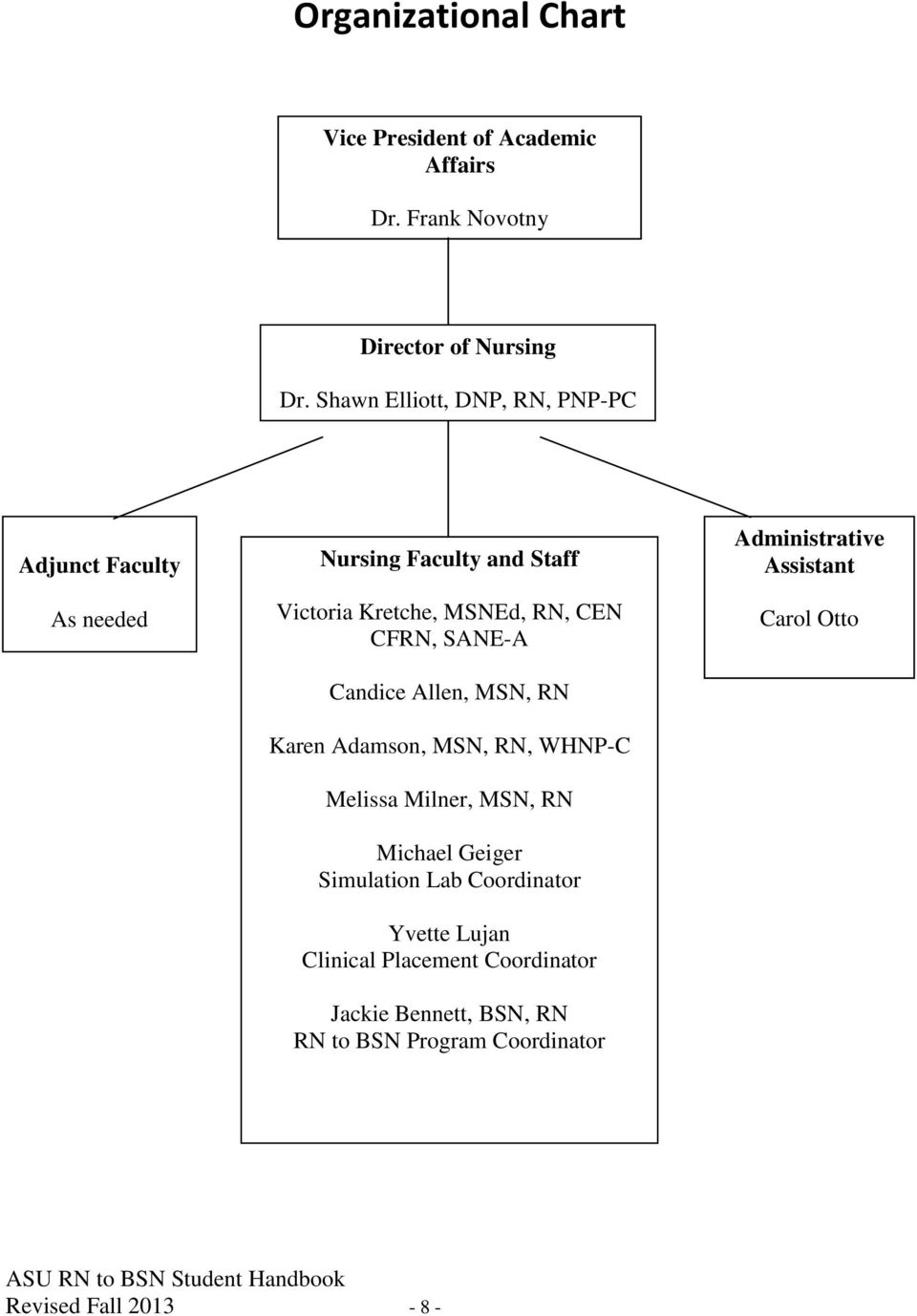
8 Organizational Chart Vice President of Academic Affairs Dr. Frank Novotny Director of Nursing Dr. Shawn Elliott, DNP, RN, PNP-PC Adjunct Faculty As needed Nursing Faculty and Staff Victoria Kretche, MSNEd, RN, CEN CFRN, SANE-A Candice Allen, MSN, RN Karen Adamson, MSN, RN, WHNP-C Melissa Milner, MSN, RN Michael Geiger Simulation Lab Coordinator Yvette Lujan Clinical Placement Coordinator Jackie Bennett, BSN, RN RN to BSN Program Coordinator Administrative Assistant Carol Otto Revised Fall
9 Mission, Vision & Goals Mission The Nursing Department shares the mission of Adams State. In addition, the mission of the Nursing Department is to prepare individuals for successful integration into the profession of nursing by providing students of nursing with an excellent theory-lead, evidence-based educational program with a focus on professional nursing standards, cultural diversity, community service, and rural healthcare. Vision Statement We envision each and every student who graduates from Adams State Bachelor of Nursing Program will be highly successful in their chosen area of expertise within the profession of nursing; that each of these graduates will still find themselves happily employed in the profession of nursing when they are ready to retire; and that Adams State will be recognized as the premier baccalaureate nursing program in rural Colorado. Goals and Outcomes Based upon The Essentials of Baccalaureate Education for Professional Nursing Practice, published by the American Association of Colleges of Nursing (2008), the Department of Nursing at Adams State University strives to provide the Baccalaureate Nursing (BSN) student: 1. With a well-rounded liberal education, that cultivates diverse knowledge of the sciences, arts, & culture. We also strive to provide a multifaceted nursing education that promotes the development of nursing knowledge, nursing skills, critical thinking and clinical decisionmaking skills. Students will be able to use their acquired knowledge and skills to effectively and safely care for diverse populations within their nursing practice. 2. With an education that prepares them to practice in leadership roles at the micro-system level within the national and global healthcare systems. Students will be able use their leadership knowledge and skills to address practice issues related to quality care and patient safety within an interprofessional team. 3. With an evidence-based education to prepare students to: 1) read, understand and apply Nursing research data; 2) share current best practices with the interdisciplinary team; 3) advocate for human subjects; and 4) collaborate in the collection of evidence. Students will understand the importance of staying current with health care literature and integrating new knowledge into their practice to promote better patient outcomes. Revised Fall
10 4. With exposure to health care related technology. Students will be able to utilize technology to evaluate data to provide safe, quality care and document this care in a variety of healthcare settings. 5. With an education, that provides a solid interpretation of healthcare policy, finance, and state & national regulatory agencies. Students will be able to fully understand their nursing scope of practice; understand how these concepts affect patient quality care; and understand the advocacy role within the professional nursing practice. 6. With simulation and clinical experiences to practice effective communication skills within an interdisciplinary healthcare team to collaboratively, deliver evidence-based, patientcentered care. Students will be able to effectively communicate and contribute to interprofessional teams to optimize patient outcomes. 7. With an education that allows students to gain nursing experience addressing the promotion of health and the prevention of injuries and illness across diverse populations of individuals, families, groups, communities with an emphasis on rural health care. Students will be able to utilize knowledge gained to use behavioral change techniques to promote health and manage illness. 8. With an education which prepares them to be practice nursing with Professionalisms. Students will demonstrate values altruism, excellence, caring, ethics, respect, communication, and accountability. 9. With a generalist nursing practice education that integrate all the knowledge, skills, and attitudes delineated in the BSN essentials into nursing care. Students will be able to implement compassionate, holistic, evidence-based, patient-centered care utilizing all the knowledge they have gained during the liberal education across the lifespan and in all healthcare settings. A hoped for student outcome would be first-time pass on the NCLEX exam. Reference: AACN. (2008). The essentials of baccalaureate education for professional nursing practice. Washington, D. C.: AACN Revised Fall

11 Philosophy The philosophy of ASU s Nursing Department is centered on the success of the student. It is our belief that students learn best in a supportive environment, thus caring is an integral element in the educational program. Caring by the faculty role model assists the student to assimilate caring into nursing practice. The essence of nursing is the caring relationship between client and nurse, designed to preserve and enhance the integrity, dignity and worth of the individual. Ethical, moral, legal and humanistic principles are upheld within this relationship. These principles are incorporated into the education of the ASU nursing student. The nurse is a professional member of an interdisciplinary team who practices the art and science of nursing from a holistic perspective. The nurse collaborates with patients and the health care team for the design, provision, management and coordination of care. Communication, leadership and critical thinking skills are mandatory for the assessment and provision of nursing care. The nurse s clients include individuals, families, groups and communities. Health promotion, risk reduction and disease prevention are essential ingredients of nursing care. The nursing process and information technologies enable the nurse to practice within an evidenced based model. The professional nurse advocates for quality care that respects human diversity within a global environment. Involvement in professional organizations, as well as in the political and regulatory processes, demonstrates the nurse s commitment to the profession of nursing. Revised Fall

12 ANA Code of Ethics The nurse, in all professional relationships, practices with compassion and respect for the inherent dignity, worth, and uniqueness of every individual, unrestricted by considerations of social or economic status, personal attributes, or the nature of health problems. The nurse s primary commitment is to the patient, whether an individual, family, group or community. The nurse promotes, advocates for and strives to protect the health, safety and rights of the patient. The nurse is responsible and accountable for individual nursing practice and determines the appropriate delegation of tasks consistent with the nurse s obligation to provide optimum patient care. The nurse owes the same duties to self as to others, including the responsibility to preserve integrity and safety, to maintain competence and to continue personal and professional growth. The nurse participates in establishing, maintaining and improving health care environments and conditions of employment conducive to the provision of quality health care and consistent with the values of the profession through individual and collective action. The nurse participates in the advancement of the profession through contributions to practice, education, administration and knowledge development. The nurse collaborates with other health professionals and the public in promoting community, national and international efforts to meet health needs. The profession of nursing, as represented by associations and their members, is responsible for articulating nursing values for maintaining the integrity of the profession and its practice, and for shaping social policy. Reference: ANA. (2001). Code of ethics for nurses, Washington, D.C., American Nurses Publishing. Revised Fall

13 National Student Nurses Association, Inc. Code of Academic and Clinical Conduct Preamble: Students of nursing have a responsibility to society in learning the academic theory and clinical skills needed to provide nursing care. The clinical setting presents unique challenges and responsibilities while caring for human beings in a variety of healthcare environments. The Code of Academic and Clinical Conduct is based on an understanding that to practice nursing as a student is an agreement to uphold the trust which society has placed in us. The statements of the Code provide guidance for the nursing student in the personal development of an ethical foundation and need not be limited strictly to the academic or clinical environments but can assist in the holistic development of the person. A Code for Nursing Students: As students are involved in the clinical and academic environments we believe that ethical principles are a necessary guide to professional development. Therefore within these environments we: 1. Advocate for the rights of all clients. 2. Maintain client confidentiality. 3. Take appropriate action to ensure the safety of clients, self and others. 4. Provide care for the client in a timely, compassionate and professional manner. 5. Communicate client care in a truthful, timely and accurate manner. 6. Actively promote the highest level of moral and ethical principles and accept responsibility for our actions. 7. Promote excellence in nursing by encouraging lifelong learning and professional development. 8. Treat others with respect and promote an environment that respects human rights, values and choice of cultural and spiritual beliefs. 9. Collaborate in every reasonable manner with the academic faculty and clinical staff to ensure the highest quality of care. 10. Use every opportunity to improve faculty and clinical staff understanding of the learning needs of nursing students. 11. Encourage faculty, clinical staff and peers to mentor nursing students. 12. Refrain from performing any technique or procedure for which the student has not been adequately trained. 13. Refrain from any deliberate action or omission of care in the academic of clinical setting that creates unnecessary risk of injury to the clients, self or others. 14. Assist the staff nurse or preceptor in ensuring that there is full disclosure and that proper authorization is obtained from clients regarding any form of treatment or research. 15. Abstain from the use of alcoholic beverages or any substances in the academic and clinical setting that impair judgment. 16. Strive to achieve and maintain an optimal level of personal health. Revised Fall
14 17. Support access to treatment and rehabilitation for students who are experiencing impairments related to substance abuse and mental or physical health issues. 18. Uphold school policies and regulations related to academic and clinical performance, reserving the right to challenge and critique rules and regulations as per school grievance policy. Adopted by the NSNA House of Delegates, Nashville, TN on April 6, Revised Fall

15 Pre-Program Policies & Procedures Revised Fall

16 Academic Advising The One Stop and Academic Advising Center is where students initially go to declare a major. Once Pre-Nursing / Nursing major is declared the Academic Advising Center will assign a nursing faculty advisor. It is recommended that the student contact the nursing advisor before the first week of classes or sooner. The Nursing Program s degree plan differs slightly from the general education requirements. It is important for the student to work closely with their advisor in planning a course schedule. The student is responsible for knowing the requirements for graduation from the nursing program. During registration, the student is expected to follow the procedures as outlined by the Records Office. Students are assigned a PIN number each semester to ensure the student has met with their advisor prior to enrolling in courses. The student cannot enroll without a PIN number for fall and spring semesters. For further information regarding advisement and registration, please refer to: Student Role and Responsibility Advisors are available to assist students as they progress through the program, but each student is ultimately responsible for his/her own education and contacting their advisor as needed. Students are responsible for knowing and completing all the curriculum requirements and assuming the following responsibilities: 1. Knowing the degree requirements. 2. Making initial contact with the advisor through or phone. 3. Meeting with the advisor for program degree plan review and advice if the student is failing a course or encountering difficulties that might affect progression. 4. Meeting school deadlines; such as application for graduation. 5. Managing financial aid and scholarships. 6. Contacting the advisor regarding a possible leave of absence from the program, situations that may require medical clearance, or other situations that may affect progression. 7. Contacting the advisor regarding clinical placement issues or performance in the clinical area that may arise throughout the program. Advisors have a wide array of clinical and academic resources readily available to students, as well as expertise in their own area or nursing practice. Students are encouraged to periodically contact their advisor for guidance regarding career planning placement options. Revised Fall

17 RN to BSN Completion Program Curriculum Academic Information The following table lists the required prerequisites and core courses of the nursing program. Transfer credit is granted per ASU policies and departmental approval processes. Credit for work experience may be granted for some courses with the submission of a portfolio which indicates substantial experience related to the course description. This is only a guide and will be individualized according to student s needs. Select pre-requisite courses are available online through Extended Studies. Communication Arts I (3) Communication Arts II (3) General Psychology (3) Human Growth & Development (3) Sociology (3) History (3) Arts & Humanities (6) Math (3) NURS 301: Pharmacology (3) NURS 305: Pathophysiology (4) NURS 320: Health Care Ethics (2) NURS 325: Geriatrics (3) NURS 330: Nursing Management (3) NURS 330L: Nursing Mgt Clinical (3) Prerequisites Intro to Statistics (4) Nutrition (2) Anatomy & Physiology I (4) Anatomy & Physiology II (4) Microbiology (4) Chemistry (5) Business Computer Applications I (3) * Core Courses NURS 360: Service Learning Clinical (2) NURS 410: Nursing Research (3) NURS 430: Health Assessment (3) NURS 440: Professional Practice (3) ** NURS 460: Rural / Community Health (4) NURS 470: Rural / Community Health Clinical (3) * See Pre-Admit Requirements ** Writing Proficiency for ASU graduation requirement will be assessed in this course. Revised Fall

18 Pre-Admission Requirements Technology Proficiency All BSN candidates must demonstrate baseline technological proficiency prior to admission into the Nursing Program. The requirement may be met by scoring 70% or higher on the Technology Proficiency Examination or by passing an approved course with a grade of C or better. Courses meeting this proficiency are BUS 120 (Business Computer Applications) and CSCI 100 (Introduction to Computers). Background Checks Students will undergo a criminal background check prior to admission to the Nursing Department. Official background checks will be conducted by a contracted agency. Students are responsible for all fees associated with background checks. Any conviction, plea of guilty or no contest, or deferred adjudication of felony or misdemeanor offenses may jeopardize clinical agency acceptance and may disqualify applicant for admission into the Nursing Program. Students who have successfully completed the terms of their deferred adjudication agreement will not be disqualified. Offenses older than seven years will not necessarily disqualify you from the Program. In the event that an offense appears on a student s background check, the student will be given the opportunity to discuss the circumstances of the offense with the Felony Review Committee. If the investigation reveals information that could be relevant to the application, The Felony Review Committee may request additional information from the applicant. Offenses shall be reviewed on a case by case basis. Judgments are based on the severity, timing, frequency, and nature of the offense. The accuracy of the students disclosure is also taken into consideration. Based upon this discussion, the nursing administration will take one of the following actions: Disquality the student s application for admission into the nursing department. Share the background check with clinical agencies and allow the clinical agencies to determine whether the student will be allowed to complete the required clinical/field experience in their institution. If the clinical agency denies the student access to clinical experiences in their institution, the student will be disqualified for admission into the nursing program. Students will be asked to sign a waiver, allowing the Nursing Department to share the results of the background checks with the supervisor of clinical agencies being used for clinical courses. They will only be shared with clinical agencies upon request; otherwise, the results are securely locked and kept confidential in the Nursing Department. Revised Fall
19 Drug Screening Policy The Adams State Nursing Department requires, as a matter of routine, all matriculating students (participating in a clinical program of study) to submit to a drug screen. The student will comply with directions given regarding the designated vendor and any appropriate followup that may be required. All associated fees are the sole responsibility of the student. The drug screen may consist of the following: marijuana, benzodiazepines, cocaine, amphetamines, opiates and PCP. This may also include a breathalyzer exam. The Nursing Department reserves the right to require additional drug screenings from individual students on a random or for-cause basis. All associated fees are the sole responsibility of the student, as assessed in program fees. Applicability: This policy applies to all applicants and currently enrolled nursing students in the Nursing Department. Supporting Background Information for Drug Screening: Safety and Well-Being of Patients. Health care providers are entrusted with the health, safety and welfare of patients; have access to controlled substances and confidential information, and operate in settings that require the exercise of good judgment and ethical behavior. Thus, an assessment of a student s possible impairment that diminishes his/her capacity to function in such a setting is imperative to promote the highest level of integrity in health care services. Accreditation Standards. Clinical facilities are increasingly interpreting standards by accreditation agencies, such as The Joint Commission or CMS, to require drug screening for security purposes on individuals who provide services within the facility and especially those who supervise care and render treatment including controlled substances. To facilitate this requirement the Department of Nursing has agreed to conduct drug screenings for students who participate in clinical training programs. Licensure Issues. Clinical rotations and early experiential rotations are an essential element in certain health science curricula. Students who cannot participate in clinical rotations due to revealed illegal use of controlled or illegal substances will be unable to fulfill the requirements of the program for advancement or graduation. Additionally, many healthcare licensing agencies require individuals to pass a drug screen panel as a condition of licensure or employment. Therefore it is important to resolve these issues, prior to a commitment of resources by the Department of Nursing or the student. Contractual Obligations. The Department of Nursing is obligated to meet the contractual requirements contained in affiliation agreements between the Department of Nursing and the Revised Fall

20 various healthcare facilities. Many of the healthcare facilities that provided clinical learning experiences for our students require drug screening of all employees, volunteers, and trainees. Liability Issues. Given the current medical liability environment, Adams State University health care facilities are appropriately attentive to those factors that may adversely affect the security of the clinical environment and thus increase their liability exposure. As a result, schools and health care facilities, both independently and, at times, through legislative mandate, have appropriately sought to enhance their scrutiny of professional and non-professional students involved in patient care activities. Drug Screening Procedure for Applicants to the Nursing Department: 1. Nursing program applicant receives information about the requirement for drug screening, results, reporting, and associated fees in the Admissions packet. 2. Drug screen kit is supplied by the Nursing Department Office. 3. Applicant MUST register with vendor online before proceeding with collection process. 4. Applicant is to complete the drug screening process within 90 days prior to application due dates to the program. This process can take weeks to complete so plan accordingly. 5. Applicant receives instructions (Drug Screening Instructions) in the Admissions packet regarding location of designated vendor drug screen sites and a Drug Screen Authorization document to bring to designated vendor drug screen site: a. Applicant completes the Drug Screen Authorization document b. Applicant selects designated vendor screening site from list provided. c. Drug Screen Authorization document brought to screening site by student along with a government-issued photo ID. d. Applicant maintains designated vendor receipt of drug screen issued at time of screening. e. Applicant is responsible for all associated fees. 6. Results of applicant drug screen are electronically reported directly to the Nursing Department from the designated vendor. Review of drug screen results occurs with the Medical Director of the designated vendor and the Nursing Department. 7. Applicant may review the information reported by the designated vendor for accuracy and completeness and to request that the designated vendor verify that the results of the drug screen provided are correct. Prior to making a final determination, that may adversely affect the applicant, the Nursing Department will inform applicant of his/her rights, how to contact the designated vendor to challenge the accuracy of the report, and that the designated vendor was not involved in any decisions made by the Nursing Department. A student or applicant who does not pass or refuses to submit a drug screen may be refused admission into the nursing the program. 8. Applicant/student drug screen results are recorded in an internal database by the Nursing Department. 9. Negative student drug screen results are reported to clinical agency, for clinical placement purpose only, as affirmative in meeting affiliation agreement requirements. 10. The Nursing Department reserves the right to require any individual student to submit to Revised Fall

21 immediate drug screening at any time, on a for cause basis. Any student with a failed drug screen may result in a minimum of an immediate administrative withdrawal from all nursing courses, placement on a leave of absence and/or a referral to Peer Assistance Services, Inc. Additional Policy/Procedure Information: Medical Marijuana: The Nursing Department takes patient safety very seriously. The Technical Standards for students require that all students be able to meet the physical and cognitive demands of the clinical setting as well as exhibit sound judgment (including but not limited to Medical Marijuana) may not be able to meet the Technical Standards, and therefore, may not be suitable for the clinical environment where patient safety is the utmost concern. Students who take Medical Marijuana should consider deferring entry into the Nursing Department while they explore other avenues of treatment, which would allow them to meet the Technical Standards and pass a drug screen. Rural or Out of State Applicants: The Nursing Department contracts with Quest Diagnostics for the collection of specimens for the drug screening process. If there is not a Quest Diagnostics in your area, you may go elsewhere but you may be subject to increase cost for the drug screening process. Revised Fall
22 Acceptance Policy and Application Process All students wishing to obtain a Bachelor of Science Degree in Nursing from Adams State University must first be accepted into Adams State University, then with a separate application process, into the Nursing Department. This handbook is for the RN to BSN students. Admission to the Nursing Program Prospective students must be accepted into Adams State before applying to the Nursing Program. Completion of the general education requirements and pre-requisites does not guarantee admission into the Nursing Program. Prospective nursing students should request an application packet for the online RN to BSN completion program during the advisement period of the semester before the general education and/or pre-requisites requirements will be fulfilled. Application packets are due by February 1 for the summer and fall semesters, September 1 for the spring semester. Late applications will be considered on an individual basis. Students will receive notification of admission status within 30 days after due date. Selective Criteria GPA = 10 points = 8 points = 6 points = 4 points = 2 points Previous College Degree Master s degree = 3 points Bachelor s degree = 2 points Associate degree = 1 point Work History Currently working as a RN with license in good standing? Yes = 4 points No = 2 points Residency * max of 3 points San Luis Valley resident = 3 points Majority of pre-requisites acquired at Adams State = 2 points Colorado or New Mexico Resident = 1 point Autobiographical Essay and CV Work history = 1 point Community Service/Volunteer Work = 2 points Achievements = 1 point Passion/drive/spirit = 1 point Writing proficiency = 2 points Points Earned Revised Fall
23 Selective Criteria Points Earned Background Check = unacceptable or acceptable Interview (candidates may be contacted for an interview) Prerequisites complete Yes / No Total Points Admission Process: 1. Acceptance into ASU 2. Official transcripts (unopened) from all other institutions attended other than ASU (Request these to be sent directly to the nursing department) 3. Minimum of 2.5 GPA required after completion of all general education courses and nursing pre-requisites. 4. Minimum grade of C in all Biology and Chemistry courses (if needed and post ADN degree) and Psychology Successful completion of technical proficiency test or course (CSCI 100 or BUS 120) 6. A 500-word autobiographical essay 7. Curriculum Vitae to include current RN license information (State/license Number/Expiration Date) 8. Two letters of recommendation. 9. Background check including drug screen and fingerprinting. 10. A non-refundable application fee to the nursing program for application. Conditional Admission: With the approval of the Program Director, a student may be allowed to take up to 9 credit hours of nursing coursework prior to full admission into the program. A final letter of Admission will be sent to the student once all conditions for admission are met. Admission Requirements: The following needs to be completed within 30 days of admission to the program to allow participation in clinical settings. See clinical requirements section of handbook for more information. 1. Current physical exam. 2. Documentation of updated immunizations. 3. Current American Heart Association CPR certification 4. Proof of malpractice insurance Revised Fall
24 Program Policies & Procedures Revised Fall
25 Program Completion Requirements To be eligible for graduation from the Nursing Department, a student must achieve a minimum of a C or better in each course in the nursing curriculum and maintain a 2.5 cumulative GPA. If these minimum achievements are not met, the student will be placed on academic probation according to the Academic Status and Progression Policy. The total amount of credit hours needed for graduation is 126. Hours in the major 36 Hours in supporting courses/general education 50 Credits Granted by Colorado Articulation Model 34 Total credits to graduate 126 Upper Division Hours 36 Writing Assessment The Nursing Department faculty member will assess papers submitted during NURS 440 for writing proficiency per Adams State policy. Students whose writing does not meet proficient standards will be given guidance and resources to improve; and will be reassessed. Revised Fall
26 Technical Standards Guidelines The Nursing Department has put into place a process for addressing the issue of compromised Technical Standards for Admission, Progression and Graduation requirements. If Nursing students are observed by qualified nursing or other health care professionals to be unsafe in the clinical environment due to an inability to meet the Technical Standards, the Nursing Department will take action to ensure a safe environment for students, patients and other personnel. Technical Standards exist in the areas of: Observation, Communication, and Motor Abilities; Intellectual, Conceptual, Integrative and Quantitative Abilities; Behavioral and Social Abilities, Health and Related Requirements, and Physical and Sensory Requirements. If any student is observed to be unsafe due to a temporary or permanent inability to meet any one or more of the Technical Standards, the nursing faculty or other health care personnel will report these observations to the nursing program director. The Director of the Nursing Program will research the question and determine if conditions warrant a professional evaluation. Professional evaluations can include the assessment of the student in question by a variety of professionals capable of assessing the situation. These professionals may include but are not limited to health care providers, mental health care providers, drug and alcohol counselors (currently through Peer Assistance Services), English as a Second Language instructors (currently an ACTFL certified ESL instructor), Physical Therapy providers, campus ADA accommodations evaluators (through the Office of Disability Resources and Services), and Nursing Department faculty members. The Director of the Nursing will ask the Diversity/ADA Officer to arrange for the respective evaluation(s) as deemed necessary. The Director of the Nursing Department will then respond to the evaluation report from the qualified professional. Responses may range from taking no action (if supported by the findings of the evaluation), mandatory changes in student behavior, requiring the student to take a Leave of Absence (LOA) from the program in order to address specific concerns, or mandatory student withdrawal or administrative withdrawal of the student from the program; in accordance to the reasonable accommodation process. The nursing program director will develop a reentry plan for the student in question including the management of the LOA process if necessary. This plan will address any additional work that may be recommended in order to remedy the specific set of conditions that have led to the LOA or withdrawal from the program. For a LOA that extends for a period of time beyond one semester; any reentering student must be tested by the nursing faculty to ensure that an understanding of clinical competencies is current and adequate for the safe practice upon the student s return. Revised Fall
27 Technical Standards for Admission, Progression, and Graduation I. Introduction Candidates for the BSN degree must be able to meet these minimum standards for successful completion of degree requirements. The following technical standards explain attributes necessary to complete the educational program in nursing. The Nursing Department will consider any applicant who demonstrates the ability to perform, or to learn to perform, the skills listed here. An applicant with concerns about these technical standards is strongly encouraged to discuss the issue with the director of the program. An applicant is not required to disclose the nature of any disability. If appropriate, per the ASU disability policy, reasonable accommodations will be provided. I. Standards a. Observation i. The student must be able to observe and participate in lectures, demonstrations, and research and practice situations in nursing. ii. She/he must be able to observe health assessments and interventions, diagnostic procedures and waveform readings to determine a client s condition and the effect of therapy. iii. Observation necessitates the functional use of vision, hearing, tactile and somatic senses. b. Communication i. A student must be able to communicate clearly and effectively with clients, teachers and all members of the health care team. Written and oral communication must use standard, professional medical terminology. ii. He/she must communicate with clients clearly and effectively to elicit information regarding history, emotional status and activity, and to perceive nonverbal communications. iii. Communication includes speech, hearing, reading, writing and computer literacy. iv. A student must be able to clearly and effectively report to members of the health care team. Additionally, students must be able to relay appropriate information to clients, as well as teach, explain, direct and counsel a wide variety of individuals. v. In some instances, the student will be required to provide clear, direct communication during highly stressful, crisis and must have the ability to promptly interpret pertinent patient data. Revised Fall
28 vi. Students must be able to communicate online in a timely, professional manner, e.g., enter an electronic medical record immediately after the patient visit. c. Violation of the Communications Standard For all students at the College, patient safety is of paramount concern. Despite admission policies, safety concerns are occasionally raised by clinical or other instructors regarding students communication skills and concerns of potential risks to student and patient safety; consequently all students who are observed to be unsafe in a clinical or simulation environment by qualified nursing or other health care personnel, are to be identified and reported to the program director and may be removed from clinical settings. The program director will ask the Diversity/ADA Officer to arrange for the respective evaluation(s) as deemed necessary. The Diversity/ADA Officer will arrange for the appropriate evaluation or ongoing evaluations and forward the evaluation reports to the program director as appropriate. d. Motor Abilities i. A student must have sufficient gross and fine motor skills, physical endurance, physical strength, mobility, vision, tactile abilities and sense of smell to carry out nursing procedures and to operate equipment safely. ii. He/she must have sufficient motor function to elicit information from patients by: tactile palpation, auscultation using a stethoscope, direct hand percussion, indirect percussion using a percussion hammer, and other diagnostic maneuvers. iii. A student must possess sufficient fine motor skills to be able to perform basic laboratory tests (e.g. using a glucometer, slide preparation) and perform basic patient care procedures (e.g. tracheostomy care, urinary catheterization, insertion of intravenous catheters, giving intramuscular and subcutaneous injections and using oxygen/respiratory equipment). iv. He/she must be able to execute motor movements reasonably required in a prompt, timely fashion in order to provide routine and emergency care to patients. 1. Examples of emergency treatments required of student nurses to be done in a prompt, timely fashion include but are not limited to: cardiopulmonary resuscitation, administration of intravenous medications, application of pressure to stop bleeding, obtainment & interpretation of vital signs, opening of obstructed airways, notification of a change in patient status to the appropriate provider. 2. Examples of routine treatments required of student nurses to be done in a reasonable, timely fashion include but are not limited Revised Fall
29 to: administration of scheduled and as needed medications, obtaining of vital signs, performing a basic head-to-toe assessment, performing and assisting with activities of daily living. e. Intellectual, Conceptual, Integrative and Quantitative Abilities i. The student must be able to read and understand written documents in English and to solve problems involving measurement, calculation, reasoning, memory, analysis and synthesis. ii. He/she must be able to synthesize knowledge, integrate and prioritize all aspects of patient care in a prompt, timely fashion. This includes synthesis of objective and subjective findings and diagnostic studies in order to formulate and initiate a plan of care integrating the gender, age, religious, physical and patient preferences. iii. The student must be able to integrate concepts of pathophysiology, pharmacology and fundamentals of nursing care in order to formulate a cohesive, multidisciplinary plan of care for desired patient outcomes appropriate to each clinical setting. iv. The student must be able to use this information to identify and develop a diagnosis, establish priorities and monitor treatment plans and care modalities. v. The student must be able to comprehend three dimensional and spatial relationships. vi. The student must be able to incorporate data from multiple patient sources (e.g. physical assessment, vital signs, lab values, interdisciplinary documentation) in a prompt manner in order to provide appropriate, safe patient care. vii. He/she must be able to recognize and respond rapidly and safely to changes in a patient s status based on a variety of sources such as physical assessment and pertinent laboratory findings. The student must be able to revise care to promote appropriate patient outcomes. f. Behavioral and Social Abilities i. A student must have the capacity to demonstrate full utilization of his/her intellectual abilities, emotional stability, exercise good judgment under stressful, crisis and non- crisis situations and promptly complete all responsibilities pertinent to the diagnosis and care of clients in a variety of settings. ii. The student must have the capacity to develop mature, sensitive and effective therapeutic relationships with clients in a variety of settings and from different cultures. Individual patient care must be performed regardless of the patient s race, ethnic group, age, gender, religious or political preference, ability to pay, gender or sexual orientation. iii. The student will be required to perform nursing care in many settings including acute care inpatient settings (e.g. medical surgical, obstetrics, psychiatric, pediatric) as well as outpatient settings (e.g. public health, outpatient clinics, long term care facilities, schools and homes). The Revised Fall
30 student must have the ability to perform nursing care that may be outside their own personal level of comfort in these settings so that the patient s needs are a top priority. iv. He/she must be able to tolerate physically and mentally taxing workloads and function effectively under stress. v. The student must be able to exhibit a level of consciousness and attentiveness that guarantees patient safety. Examples of unacceptable compromise include excessive somnolence, memory impairment, or an inability to retain pertinent details of a patient s situation. vi. As a component of nursing education, a student must demonstrate ethical behavior, including adherence to the American Nurses Association Code of Ethics for Nurses and Adams State student honor codes. vii. Students are not required to be involved with medical procedures that are in disagreement with individual attitudes and values. Nevertheless, students are required to learn about these procedures and participate in the professional care of the patient before and after such procedures. viii. Although student safety is of utmost importance, students will be exposed to a variety of communicable pathogens and are expected to care for patients with communicable diseases using appropriate standard precautions and/or guidelines. g. Health and Related Requirements i. Students are required, according to agency and ASU policy, to provide current proof of having met all health related requirements prior to participating in any clinical activities. Students are responsible for maintaining all personal health records including current immunizations, CPR (American Heart Association BLS for Health Care Providers), OSHA and HIPPAA documentation. ii. All entering students are required to complete a background check, including a drug screen, prior to entering the Department of Nursing. iii. Students are required to complete a physical exam prior to entering the Department of Nursing. iv. Students must have evidence of an unencumbered Colorado nursing license (this includes evidence of having an unencumbered license form a compact state. v. Certain chronic or recurrent illnesses and problems that could interfere with patient care or safety may be incompatible with nursing education or practice. Some illnesses may lead to a higher likelihood of student absences and should carefully be considered. Deficiencies in knowledge, judgment, integrity or professional attitude may jeopardize patient care, and as a result could become grounds for course failure and possible dismissal from a nursing program. Revised Fall
31 Physical & Sensory Requirements Physical Capabilities Activity Frequency Activity Frequency Activity Frequency N O F C N O F C N O F C Lift/Carry Push/Pull Walk X 10 lbs or less X 15 lbs or less X Sit X lbs X lbs X Stand X Fine motor lbs X lbs X manipulation X lbs X lbs X Grip X 100+ lbs X Squat/Kneel X Bend X Drive Computer Twist/Turn X Manual X Data Entry X Crawl X Use of Automatic X Mouse X Climb X Reach above chest X Reach outward X KEY: N = Never O = Occasional: 1 33% of time F = Frequent: 34 75% of time C = Constant: % of time Sensory Capabilities Activity Able to see clearly at both near and far distances Able to identify and distinguish colors Able to judge distances and spatial relationships Able to communicate verbally and in writing Able to distinguish between sounds such as a telephone vs. fire alarm, tone of voice, varied decibels Able to perceive attributes of objects such as size, shape, temperature, texture through touch Frequency N O F C X X X X X X Revised Fall
32 Reasonable Accommodation It is the policy of the Nursing Department and Adams State to provide reasonable accommodation to qualified students with a disability so they can meet the required technical standards for successful completion of degree requirements. Whether a requested accommodation is reasonable will be determined on an individual basis by the Office of Equal Opportunity. Initial accommodations may include, for example, assistance in identifying volunteer note-takers; alternative testing (extra time, scribe, reader); textbooks in alternate format (i.e. enlarged, digital-audio); priority registration and/or interpreter services. Initial accommodations only apply to the didactic environment. Initial accommodations do not apply in a clinical setting or in the determination of a clinical assignment. Should a student request accommodations in the clinical setting, an additional review is conducted. This additional review includes determination regarding whether or not there is an appropriate, reasonable accommodation needed for the student to demonstrate the ability to meet technical standards in the clinical setting. In addition, this review includes considerations of both patient and student safety. Institutional Policies For more information on disability services; please see the Disability Services Handbook found on ASU website under ADA - Disability Services. For Institutional policies on items such as The Americans with Disabilities Act, Academic Integrity, Student Rights and Responsibilities and The Family Educational Rights and Privacy Act of 1974 (FERPA), discrimination, and sexual harassment; please see the ASU Student Handbook. Implementation of Accommodations for Students with Disabilities Once accommodations have been approved, the ASU OFFICE OF DISABILITY SERVICES / DIVERSITY will notify the involved faculty that the student is qualified and the student needs to provide a copy of the Academic Accommodations Letter to all faculty of current courses. Revised Fall
33 Academic Status and Progression Policy Adams State charges the nursing faculty with the responsibility for the quality of education of each individual student. Inherent in this responsibility is the assessment of individual progression based on both academic and professional standards. Any student may be subject to immediate suspension or dismissal when in the judgment of the faculty in consultation with the Director of the Nursing Program and other appropriate College officials, the good of the College, public and/or safety and welfare of patients warrant such action. No student shall be suspended or dismissed except for cause and the student will have an opportunity for one appeal. The grounds for suspension or dismissal include but are not limited to demonstrable behavior contrary to generally accepted ethical and professional nursing standards, neglect of clinical responsibilities, impairment in classroom and clinical settings due to illegal drug and/or alcohol use, or violation of the standards of conduct established by Adams State. 1. Regular Admission Status: All admission requirements must be completed by the application deadline to be eligible for Regular Admission Status. 2. Good Academic Standing: Students are required to maintain a cumulative GPA of 2.0 or better, no incomplete grades while failing, and passing grade of C or better in all nursing courses. 3. Academic Progression: Academic progression is the continuation of the academic program based upon an approved sequenced plan. 4. Leave of Absence: Continuous registration according to the approved, sequenced academic program plan is a requirement for active status in the Nursing Department. If a student needs to interrupt her/his progression in school, the student may request a Leave of Absence (LOA) for not more than one academic year, provided s/he is in good academic standing and intends to return to school. A letter addressing the LOA must be submitted to the Director of the Nursing Department. A student may be granted a LOA for up to one academic year. It is the student s responsibility to ensure that s/he is not registered for any courses during the terms for which a leave has been granted. If a student petitions for a LOA after the designated drop/add period he/she will be subject to full payment of tuition. If the student is receiving financial aid they also must provide the Office of Student Financial Aid notice of the LOA. 5. Academic Probation: When a matriculated BSN student fails to maintain good academic standing, the student is placed on academic probation by the Program Director. Academic Probation occurs upon either of the following: The student earns a grade of less than a C in one nursing course, OR the student s cumulative grade point average in the Nursing Program courses falls below a 2.0. Academic Probation indicates that the student is in academic jeopardy and should seek frequent communication with their academic advisor and utilize other campus resources. Duration of Academic Probation varies by the reason student is placed on probation. Duration is dependent on the reason for probation: 1) one semester for GPA < 2.0, 2) until a course is retaken, after course failure, or 3) time specified in contract with the instructor (up to one year) Revised Fall
34 for an incomplete. A student on Academic Probation for a GPA < 2.0, will have one (1) semester to raise the cumulative grade point average to a minimum of 2.0. The status of a student who fails to achieve the minimum cumulative grade-point average in the one semester will be dismissed from the nursing program. A student on Academic Probation for courser failure, may repeat a course only once and on a spaceavailable basis. The student will be required to pay tuition and fees associated with the repeated course. Both course grades will appear on the transcript only the higher of the two will be included in the Nursing Department s calculation of the grade-point average. The status of a student, who fails the same course two times or fails any two courses, at any time in the program, will be dismissed from the Nursing Program. A student must successfully complete prerequisite courses prior to progression to subsequent courses. The student must successfully complete any failed clinical course before proceeding to another clinical course. The student must successfully complete any didactic course before proceeding to the associated clinical course. If the clinical course is failed, the student must audit the associated didactic course immediately prior to repeating the clinical course. 6. Dismissal: Dismissal is administrative withdrawal from the nursing program. Reasons for dismissal include, but are not limited to the following: Students with a GPA below 2.0 at the end of the Academic Probation period, with 2 or more incomplete grades, or who have failed a course for the second time, or who have failed two courses in the program, are subject to dismissal. The Director of the Nursing Department will make a decision for dismissal and will notify the student in writing of the decision and their right to appeal. The dismissal letter will indicate whether the student is eligible to reapply. To continue working toward the degree, the dismissed student must apply for readmission to the program no earlier than two academic years after Dismissal. Reapplication may not guarantee admittance into the program. Revised Fall
35 Academic Conduct In addition to the Adams State Code of Academic Conduct, the Nursing Department requires students to adhere to the NSNA Code of Academic and Clinical Conduct as outlined in the beginning of the student handbook. Violation of the either of these Codes should be immediately reported to a faculty member and the Director of the Nursing Department. Self-reporting of a violation demonstrates accountability and will be considered in the disciplinary process. The identity of the reporting party will be protected in the investigation process. Violations of the Adams State Academic Conduct Code will be handled through the Office of Student Affairs. Violations of the NSNA Code of Academic and Clinical Conduct will be handled within the Nursing Department. The Director of the Nursing Department will develop a performance improvement plan that includes disciplinary sanctions that address the specific NSNA Code violation. Violation of the NSNA Code of Academic and Clinical Conduct may lead to administrative withdrawal from the Nursing Program. Student Honor & Conduct Code The health professions are based on a high degree of trust by the individuals they serve. Students entering the health professions have a particular obligation, therefore, to conduct themselves at all times in a manner that reflects honesty, integrity and respect for others. The Nursing Department adheres to the Adams State University Code of Conduct Policy as described in the Adams State Student Handbook. We also uphold professional behavior on internet based social media websites including but not limited to and Facebook. Any sharing of patient information or defamation of clinical sites, preceptors, faculty, other students, etc. would be considered unprofessional and in violation of the student conduct code warranted of disciplinary action. Revised Fall
36 Ethics Nursing students will be held accountable for demonstrating ethical behavior, as defined by the ANA Code of Ethics as noted earlier in the handbook. Concerns about unethical behavior by a student nurse should be immediately reported to a faculty member and/or the Director of the Nursing Department. Self-Reporting of unethical behavior demonstrates accountability and will be considered in the disciplinary process. The identity of the reporter will be protected in the investigation process. The Director of the Nursing Department will develop a performance improvement plan that includes disciplinary sanctions that addresses the specific violation. A recurrent pattern of unethical behavior by a student may lead to administrative withdrawal from nursing program. Revised Fall
37 Competencies Needed for Online Success Classroom and Clinical Policies Computer-Based Skills The student will utilize a course management system (Blackboard), Web-based synchronous and asynchronous communication tools, World Wide Web resources, and word processing software. Communication Skills The student will demonstrate written communication skills using the Internet to participate in course activities. Interpersonal Skills The student will discuss ideas, current events and opinions regarding the Web-based instruction presented in this course. Problem Solving (Critical Thinking) The student will use conceptual thinking and problem solving skills to discuss subject principles and implement Web-based instructional material for producing class assignments. Ethical Issues in Decision Making and Behavior The student will develop an appreciation for maintaining integrity in work content, assignments, and participation of Web-based instruction. Personal Accountability for Achievement The student will complete the assignments and will participate in class discussions as assigned. Attendance Although there is no formal classroom for the online courses, students are expected to log into the course in the first couple of days of the semester, following the Academic Calendar of the Nursing Department and the University, and begin to get familiar with the course expectations. Students may receive equitable accommodations for serious life event and disability if ADA approval is received. Arrangements for an extenuating situation such as a death in the family or a serious illness of the student will be considered individually. It is possible that a decelerated program plan may be required, with subsequent re-entry into the program courses. Behavior It is also the responsibility of new student to familiarize themselves with the technology required to participate in an online course. The key to successful completion of an online course is organization. Discussion is a major portion of online courses. Following paragraph outlines discussion etiquette: Please be courteous. Don't flame (i.e., post insults, invective, or other personally disrespectful comments) or post flamebait (i.e., deliberately provocative or manipulative Revised Fall
38 material intended or likely to elicit flames). Please be careful in the use of sarcasm and irony. Online communication lacks the subtle nonverbal cues that help us interpret such rhetorical flourishes in face-to-face settings, so that it is easy to miss the point or misunderstand. More importantly, it is easy to give or take offense where none is intended. Accordingly, give people the benefit of the doubt, and if you are misunderstood, don't get defensive. You might also consider using such rhetorical devices somewhat less in this medium than you would in ordinary conversation, since they are generally less effective here. Remember that multiple shoot-from-the-hip posts are much less effective than fewer carefully-thought-out ones, and that some patience in responding will encourage more contributors with a wider variety of ideas and perspectives to participate. Please be tolerant of those who are still learning how to use the Web and this forum (e.g., people who accidentally send multiple copies of the same message, PEOPLE WHO FORGET AND LEAVE THEIR CAPS LOCK KEY ON WHEN TYPING). (Some Guidelines Adapted from online discussion guidelines). For additional tips and hints on using a Discussion Forum visit Netiquette. Students are expected to be respectful of their colleagues. Disruptive behavior will not be tolerated. Prior notification to faculty in the event of absence from the course is expected. Violation may result in failure of, or expulsion from, the course at the discretion of the instructor. Communication Blackboard is the Nursing Department s official means of faculty communication with students. You are responsible for all communication sent to you via Blackboard. Students need to check Blackboard , announcements and learning modules three times per week or as noted by faculty in individual course syllabus. The office administrative assistant will send communication via the grizzlies account. Students are responsible for all communication sent via the grizzlies account. Grading The process for grading is as consistent as possible among the entire nursing faculty. The syllabus for each course will clearly state all of the requirements in order to successfully complete each nursing course. Grading rubrics are utilized for individual assignments to help with clarity and consistency. Each course will utilize a 1,000 point scale. Individual assignments may be assigned a different total point value as determined by the faculty of record; based upon the value of the assignment within the course. Extra Credit will not be utilized in any nursing courses. Revised Fall
39 The following scale will be used: A pts C pts F 641 pts or less A pts C pts B pts C pts B pts D pts B pts D pts Note: All courses MUST be passed with a minimum score of 750 in order to progress according to the progression policy. Clinical Experience Clinical courses are designed as precepted field experiences where theory is applied in the clinical setting. It involves a mutual collaboration and commitment among the university, teaching facilities, students, faculty, and preceptor. A clinical manual will be provided to students in the clinical courses. The preceptorship concept pairs a student with an experienced, competent registered nurse preceptor who functions as a role model for the student. The nursing student has an active role in choosing their own preceptor for the course. The clinical work schedule will be the same as that of the clinical preceptor. This may include weekends as well as evening and night shifts. The amount of clinical hours is dependant upon the credit hours of the course. The hours required will be posted in the individual syllabus. Clinical Dress Code Students must dress consistent with reasonable professional nursing expectations. The dress code is dependent on clinical agency requirements. The student must wear their ASU campus identification as an identification tag. Revised Fall
40 Clinical Requirements Students must have a current physical exam, immunizations, CPR certification, and liability insurance before beginning a clinical course and must remain current throughout the remainder of the program or you will not be allowed into the clinical setting. For record keeping purposes, this requirement needs to be completed within 30 days of being admitted to the program. Requirements will be evaluated prior to each clinical. Physical Exam Once accepted into the nursing program and prior to any clinical activities, students are required to obtain a physical examination by a primary healthcare provider. This may a Nurse Practitioner, a Physician Assistant, a Doctor of Osteopathy, or a Medical Doctor. The form is included in the appendices of this handbook. It is the responsibility of the student to return the completed form to the Nursing Department Office. The student is responsible for all associated fees. Immunizations: See immunization form included in appendices. CPR: The student must attend, successfully complete, and obtain a validation card for a basic CPR course approved by the American Heart Association: Basic Cardiac Life Support Provider. Liability Insurance: The policy must be comprehensive medical professional liability insurance with minimum coverage limits of $ 1,000,000 per claim and $ 3,000,000 annual aggregate. Each student shall be required to provide Certificate of Insurance as evidence of such insurance coverage prior to participation in any clinical experience within the program. Students are required to obtain this at their own expense and maintain throughout the program. Mot policies are renewed annually. Revised Fall
41 Confidentiality A confidential communication is one that contains information given by one person to another under circumstances of trust and confidence with the understanding that such information must not be disclosed. Clearly, information about a patient gathered by examination, observation, conversation, or treatment is the type of confidential information the law has always protected. Nurses are legally and morally obligated to keep secret any information about a patient s illness or treatment that is obtained in the normal course of their professional duties. The observance of confidentiality is one of the fundamental tenets of the Code for Professional Nurses adopted by the American Nurses Association and is also addressed in the NSNA Code of Academic and Clinical Conduct. Students will receive initial and ongoing education about confidentiality and patient privacy during their nursing education. In the academic setting, a patient may be extended to include a guest speaker or individual whose knowledge or experience is used to assist with the students learning. Faculty may also ask the students to maintain confidentiality during other learning experiences in which confidential or sensitive information is shared. All members of the healthcare team are duty bound to treat patients with decency, respect, and the greatest degree of privacy possible. At the very least, this means that the patient should be seen, examined, and handled only by those persons directly involved in his or her care and treatment. Unnecessary exposure of the patient s body or unwarranted discussion of his or her care with third parties may give rise to legal cause of action for invasion of privacy, with appropriate damages assessed against the offending party. Only those individuals directly involved in care of a patient may have access to patient records or information, whether in electronic or paper format. Students may not access patient records of themselves, other students, family members, or patients unless they are directly involved in their care as a student. Students may not photocopy or print off patient records in part or in their entirety for any reason. Students may discuss patient information with their instructor and preceptor or other involved in assisting with care of the patient. Students may discuss their patient with other students to assist with the students learning process in the classroom or post-clinical conference. No discussion (direct conversations, cell phones, text messages, etc.) can occur outside of the confidential settings. Revised Fall
42 Students must protect the privacy of those they care for and not reveal patient names or identities on assignments, journals, or any other written or electronic means. Students may use patient s initials on assignments. Students may not take photographs of patients. Student nurses will be held liable for their own acts of negligence committed in the course of clinical experiences. If they are performing duties that are within the scope of professional nursing, they will be held to the same standard of skill and competence as registered professional nurses. A lower standard of care will not be applied to the actions of student nurses. Breach of confidentiality or patient privacy will result in disciplinary action up to and including immediate expulsion of the student(s) involved. The Director of the Nursing Department will meet with the student(s) to discuss the breach and develop a disciplinary contract that will be in effect for the remainder of the student s nursing degree program. Any subsequent breach will result in immediate administrative withdrawal from the nursing program. The Director of the Nursing Department will also notify the Chief Nursing Officer of the facility where the breach has occurred, to provide information to assist the facility in their investigation and the reporting of the breach. Revised Fall
43 Course Evaluations To assist the faculty in strengthening course offerings and improving the quality of teaching in the nursing program, students are very strongly encouraged to complete course evaluations for each nursing course. Students evaluate the course in relation to whether course objectives have been met, and whether the teaching methodologies were effective in fostering their learning. Students are requested to identify, strengthen and to make realistic suggestions for course improvement. The student evaluator need not sign course evaluations. Course evaluations are provided to the students through a University mechanism. The course evaluations are analyzed by the Director of the Nursing Department to determine student perceptions of course strengths and weaknesses. The results of the analysis are shared with the baccalaureate nursing faculty at the close of each semester. The faculty consider student suggestions to strengthen course offerings in revising and updating courses. Students are encouraged to provide constructive feedback in relation to areas for improvement and to identify strengths of the faculty member. Revised Fall
44 Excused Absence Notification Policy: All excused absence verification (except for regularly scheduled athletic travel), shall be processed by the Office of Student Affairs (excuses must be verified within 30 days of the absence). Upon verification of the excused absence, the Office of Student Affairs will notify each of the student s instructors via . The student must make up any missed assignments or examinations. Military Leave Policy Occasionally the Department of Nursing has students that serve in the U.S. Military, Reserves or National Guard. Adams State University supports its students who are serving the country in this way. A student who receives orders calling him/her to report for active military duty should work through the University s Veterans Affairs Office in preparation for leaving and guidance on procedures to follow. Information can be found at Substance Abuse Policy Substance abuse can profoundly affect one s ability to provide safe and effective care for others; let alone one s ability to learn and understand the enormous amount of information that nursing students are required to learn. The Nursing Department adheres to the Adams State Drug and Alcohol Policy as described in the ASU student handbook. Any student or faculty member has the moral and ethical obligation to report suspicion of substance abuse in any other student or faculty member; without fear of retaliation. Process for reporting: 1. Notify the Director of the Nursing Program, immediately. 2. Write out the date and time of the concerns and list any other witnesses, as necessary. 3. If the suspicion of substance abuse pertains to the Director of the Nursing Program, or the Director of the Nursing Program is immediately unavailable, notify the Vice President of Academic Affairs. 4. Maintain professionalism and confidentiality; do not share this information with any other students, faculty, etc. Revised Fall
45 The Director of the Nursing Program will then implement the process of ensuring the safety of any patients who might be affected, identifying the substance(s) of abuse and initiating the Adams State Drug and Alcohol policy. The individual under the influence may be removed from the classroom or the clinical assignment immediately and only allowed to return when deemed safe to do so. Institutional Policies For Institutional policies on items such as Sexual Harassment, Anti-Discrimination and Grievance Procedure, or Campus Sexual Assault Bill of Rights; please see the ASU Student Handbook. Unusual Occurrence Policy & Procedure An unusual occurrence is any event that has potential to result in harm to a student or to others while in a nursing classroom or at a clinical site where the student is functioning in the capacity of a student nurse. Procedure: Follow the steps outlined below when an unusual occurrence happens. 1. The student needs to go to the Emergency Department or the closest Emergent/Urgent care clinic. The student is responsible for all health care costs for her/himself incurred in treatment of an injury. The student s health care costs include both immediate care and any necessary follow-up care. The Department is not financially responsible for any costs incurred by the student. 2. The student then needs to contact the Nursing Department and report the injury. The student needs to obtain and fill out the Workers Comp form from 4. Pinnacol, the carrier for ASU, will then contact the injured student to advise them wher eto receive continuing care. Revised Fall
46 Readmission Policy Occasionally a student must withdraw or be administratively withdrawn from the nursing program for reasons such as course failures, concerns regarding safety, their personal health, financial financial exigencies, or for other reasons. A student in these circumstances does have the right to reapply to the nursing program at a later time although readmission is not guaranteed. For all students that choose to reapply, the student must submit an entirely new set of credentials and an application, and must pay any fees associated with the degree program. The student must meet all admission criteria in effect at the time that she or he reapplies. In addition to this process, former nursing program students that are reapplying for admission under these circumstances must be interviewed by the admissions committee. The results of this interview will be used in conjunction with the standard admissions materials to determine if the student may be readmitted to her/his degree program. Readmission is not guaranteed. Formal Complaint Policy and Procedure The Adams State College Department of Nursing recognizes the value of information provided by students and will, therefore, address any student complaints in the following manner: Step 1: The student should confer with the faculty or staff member against whom the complaint exists in order to reach an informal resolution within twenty (20) business days of the situation or circumstance which gave rise to the complaint. Step 2: If no satisfactory resolution can be reached through informal discussion with the faculty or staff member against whom the complaint exists, the complainant should place the complaint in writing and submit the formal complaint to the Director of Nursing (see Formal Complaint Form in appendices). This process must take place within ten (10) business days of informal discussion with faculty or staff member against whom the complaint exists. The Director of Nursing will then set up an appointment to discuss complaint with student. Step 3: If no satisfactory resolution can be reached through discussion with the Director of Nursing or if the complaint is against the Director of Nursing and no satisfactory resolution was reached with informal discussion, then all parties will be directed to the Vice President of Student Affairs and should follow the ASC Student Complaint Procedure as outlined in the ASC Student Handbook. The handbook can be found at the following link: Revised Fall
47 Revised Fall Appendices
48 Handbook Agreement I have read, and agree to comply with the policies in the RN to BSN Completion Program Nursing Student Handbook. Print Student Name Student Signature Student ID # Date Revised Fall
49 Academic Honesty Agreement Any evidence of plagiarism, any form of cheating or knowingly furnishing false information will result in disciplinary action up to and including immediate expulsion of the student(s) involved. Print Student Name Student Signature Student ID # Date Revised Fall
50 Substance Abuse Agreement I have read the Substance Abuse Policy. By signing this agreement, I understand and agree to comply with the stipulations of the policy. Print Student name Student Signature Student ID # Date Revised Fall
51 Confidentiality Agreement I understand and agree to comply with the confidentiality requirements as set forth by the Nursing Department at Adams State. If I should break patient confidentiality, I understand that I may be removed from the Nursing Program. Print Student name Student Signature Student ID # Date Revised Fall
52 Performance Improvement Contract Purpose: To provide written agreement between student and Director of the Nursing Department to satisfy areas of needed growth. Student Name: Date: Area in Need of Improvement: Ethics Confidentiality NSNA Code of Academic and Clinical Conduct Other: Plan for Improvement: Resources: Date for Completion: Outcome: Student Director of the Nursing Program Faculty Revised Fall
53 FAILURE TO MEET COURSE OR PROGRAM REQUIREMENTS REPORT Purpose: 1) To inform a student who has failed to meet the course competencies. 2) To advise the student on future course of actions required. Student s Last Name:, First: Please check one: Failure to meet program requirements Course Failure The standing of this student is a final grade of in this course: Course Number Title Section: Circle appropriate program: BSN RN-BSN Substantiating Documentation/Rationale: (Add attachment if needed) Recommended Course of Action: (Add attachment if needed) A Time-Specific contract needs to be drawn up and agreed upon by Faculty, Program Director, Student, and Academic Advisor. Faculty: Date: This form must be completed and distributed as indicated below, and sent to the appropriate individuals at the time the final grades are computed for each course. Revised Fall
54 Distributed by the office of the Department of Nursing Program Director: Date of Action: 1. Student (Certified Mail) 2. Student s Faculty Advisor: 4. Program Director 5. VP for Academic Affairs 6. Return receipt should be stapled to this form (Director s Office) This notice will be removed from all files upon successful completion of the program. Revised Fall
55 Readmission Application This form must be completed by any student who deviates from the standard progression of the BSN program. This form is to be turned in to the Director of the Nursing Department prior to enrolling in any nursing classes. If the student has not been enrolled for > 2 years, they must reapply to Adams State and be accepted prior to reapplying to the Nursing Program. Name: ASC Student ID #: Address: Cell Phone: Date: Semester last attended nursing courses: Year: Reason for being off-track from the standard progression in the nursing program: Corrective actions taken to correct the situation causing the deviation: Semester you wish to return: Year: Nursing courses you wish to enroll in upon returning (If you have failed a course, you must retake that course): Approved Denied Signed: Date: Revised Fall
56 Formal Complaint Statement Name (Print): ID # Date: Address: Home Phone: Cell Phone Current Student Status (if applicable): Enrolled Graduated Probation Withdrawn Terminated Briefly describe the details of the complaint in the clearest possible language. Please indicate the time frame in which the problem referenced in the complaint occurred. Materials and documentation to support a complainant s allegations may be submitted with this form but it should be limited to and directly related to the complaint. (May use back of form if more room is needed) This complaint will not be processed unless all the boxes below are checked and you signed and dated the complaint. I have read and understand the Adams State College Nursing Department Formal Complaint Procedure. I have read and understand the Adams State College Student Complaint Procedure. I hereby certify that all the information I have given above is true and complete to the best of my knowledge. Signature Date Revised Fall
57 Adams State University Nursing Department Physical Assessment Form To be completed and submitted before the Junior fall semester begins. Name Date GENERAL MEDICAL EXAM Observation Vision: Hearing: Tactile & somatic senses: Motor Gross motor movement: Fine motor movement: Physical Endurance: Physical Strength: Mobility: Behavioral & Social Able to tolerate physically and mentally taxing workloads: Able to function effectively under stress: Recommendations/Restrictions Physician (Please Print): Physician Signature: Medical Clinic Address and Phone Number
58 ASU Nursing Department Physical Assessment Form Physical & Sensory Requirements Physical Capabilities Activity Frequency Activity Frequency Activity Frequency N O F C N O F C N O F C Lift/Carry Push/Pull Walk X 10 lbs or less X 15 lbs or less X Sit X lbs X lbs X Stand X Fine motor lbs X lbs X manipulation X lbs X lbs X Grip X 100+ lbs X Squat/Kneel X Bend X Drive Computer Twist/Turn X Manual X Data Entry X Crawl X Use of Automatic X Mouse X Climb X Reach above chest X Reach outward X KEY: N = Never O = Occasional: 1 33% of time F = Frequent: 34 75% of time C = Constant: % of time Sensory Capabilities Activity Able to see clearly at both near and far distances Able to identify and distinguish colors Able to judge distances and spatial relationships Able to communicate verbally and in writing Able to distinguish between sounds such as a telephone vs. fire alarm, tone of voice, varied decibels Able to perceive attributes of objects such as size, shape, temperature, texture through touch Frequency N O F C X X X X X X
59 DEADLINE FOR THIS FORM TO BE COMPLETED: Contingent on the dates and instructions listed in the admission letter, this form MUST be submitted in the fall semester during the Fundamentals of Nursing class Adams State University Department of Nursing STUDENT IMMUNIZATION CERTIFICATION Please mail completed form signed by both the student and the health care certifying official to: Carol Otto, Adams State University, Department of Nursing, 208 Edgemont Boulevard, Alamosa, Colorado RN-BSN Student s Name: Date of Birth: 4-year BSN The following immunizations are required of all entering ASU Nursing Students. ASU follows the Center for Disease Control (CDC). Guidelines are listed with each immunization. The certifying official must list the dates and immunizations or titers received for the following: MEASLES, MUMPS, RUBELLA (MMR): Documentation of two shots or serologies is required. Measles, mumps, and rubella require individual titers. List either the two dates of the MMRs received or the individual titer dates and results. The first MMR must have been received on or after your first birthday and there must be at least 28 days between the first and second MMR. If received prior to your first birthday or there is less than 28 days between the two MMRs received, you are required to have another MMR or show proof of positive titers. MEASLES, MUMPS, AND RUBELLA (MMR): 1 ST Measles Vaccine: / / 2 nd Measles Vaccine: / / OR Date of Titer: / / Titer Result: 1 st Mumps Vaccine: / / 2 nd Mumps Vaccine: / / OR Date of Titer: / / Titer Result: 1 st Rubella Vaccine: / / 2 nd Rubella Vaccine: / / OR Date of Titer: / / Titer Result: HEPATITIS B: You are required to have the three shot series and provide the date and result of a positive HBSAB titer 1-2 months after the third dose. Please provide the date vaccines were received or the titer and result. There must be at least four weeks between the first and second vaccine and 4-5 months between the second and third vaccine (given at 0, 1, and 6-month intervals. If there is less than 4 weeks between vaccines 1 and 2 or less than 4 months between vaccines 2 and 3 or more than one year between vaccine 1 and 3, you are required to show proof of a positive HBSAB titer. If you have a negative titer, you are required to complete the three dose series, if the second titer is still negative after 6 doses of vaccine the patient is a non-responder. HEPATITIS B: 1 st : / / 2 nd : / / 3 rd / / OR Date of Titer: / / Titer Result: POLIO: List the dates of the four shot childhood series. Adults, who had 1 or 2 IPV doses, and no documentation of childhood series, will need to complete a total of three injections. Therefore, if they had one, they would need an additional two adult catch-up injections; if they had two, they would need one additional catchup injection. POLIO: 1 st : / / 2 nd : / / 3 rd : / / 4 th : / / VARICELLA (CHICKEN POX): Please list the date (year) you had varicella (chicken pox), or the titer date and result or dates vaccine was received. A negative titer requires two vaccines placed one month apart. VARICELLA (Chicken Pox): Date of Disease (Year): OR Titer Date: / / Titer Result: OR 1 st Vaccine: / / 2 nd Vaccine: / / TETNUS: After primary vaccination, a tetanus-diphtheria (Td) booster is required for all healthcare workers every 10 years. For international students: Three documented doses of Td are required, 4-6 weeks should separate the 1 st and 2 nd, 6-12 months should separate the 2 nd and 3rd. TETANUS (Td/Tdap): (must be within the last ten years) Date current tetanus shot received: / /
60 TUBERCULIN SKIN TEST (REQUIRED MANTOUX PPD): Two PPDs are required. If you have never had a PPD or your current PPD is more than one year old, you are required to have the two-step method of testing done. The two-step method requires placement of two separate PPD skin tests 7-14 days apart. All skin tests need to be read within hours or another test is required. A single TB skin test administered after the initial exposure may elicit a negative response. The immune reaction wanes over time. Giving a second test stimulates the immune system to respond and may respond positively, indicating that the person was previously infected or exposed. It is important to differentiate between old and new infection. Please list the dates and results for BOTH PPDs received. TUBERCULIN SKIN TEST (Required Mantoux PPD) Date of 1 st PPD: / / Result: Date of 2 nd PPD: / / Result: *Must be NO MORE than 1 year prior to date of 2 nd PPD or two-step is required. If the PPD is positive (10mm and above), a chest x-ray is required including the x-ray date along with a copy of the physician s report to x-ray s older than one year will be accepted as long as you have completed the full INH treatment and have been symptom free for one year. If you did not complete the full treatment or have had symptoms in the last year you will need an annual x-ray. TO BE COMPLETED BY CERTIFYING OFFICIAL. The certifying official does NOT certify that they have given all immunizations listed, but that they have seen written documentation the immunizations were received. Print Name (MD, DO, NP, PA, RN): Title: Signature of person listed above: Contact Number: Date signed: Medical Exemption: The physical condition of the above-named person is such that immunization would endanger life or health, or is medically contraindicated due to medical conditions. Physician s Name (please print): Physician s Signature: Date signed: Contact Number: Address: Religious Exemption: Parent or guardian of the above-named person or the person himself/herself is an adherent to a religious belief opposed to immunizations. Relationship and printed name of person signing this form: Date signed: Signature of Person signing this form: Contact Number: Personal Exemption: Parent or guardian of the above-named person or the person himself/herself is an adherent to a personal belief opposed to immunizations. Relationship and printed name of person signing this form: Date signed: Signature of Person signing this form: Contact Number: IN THE EVENT OF AN OUTBREAK, EXEMPTED PERSONS WILL BE SUBJECT TO EXCLUSION FROM SCHOOL AND QUARANTINE. Please be advised, by signing an exemption students will be subject to academic restrictions regarding lab and/or clinical placement and will be unable to complete their program/degree requirements. TO BE COMPLETED BY STUDENT- I understand that if my immunizations are not current or are in progress while in attendance at ASU, I may be subject to academic restrictions and may not be able to complete program/degree requirements. I authorize ASU to disclose this form and/or other information related to my immunization records to any clinical agency or other such entity only in connection with my placement or participation in clinical internships, practica, affiliations, and other programs related to my course of study. Student Signature: Contact Number: Date Signed: FOR ASU USE ONLY: By signing below, I certify this student has completed all necessary immunization requirements for admission into the Nursing program. Signature of ASU Official reviewing form: Date reviewed:
61
UNIVERSITY OF COLORADO DENVER COLLEGE OF NURSING. Technical Standards
 UNIVERSITY OF COLORADO DENVER COLLEGE OF NURSING Technical Standards I. Introduction In Spring 2008, the University of Colorado Denver College of Nursing adopted the following technical standards for admission,
TECHNICAL STANDARDS FOR ADMISSION, PROGRESSION, AND GRADUATION
 TECHNICAL STANDARDS FOR ADMISSION, PROGRESSION, AND GRADUATION I. Introduction In spring 2008, the University of Colorado, College of Nursing adopted the following technical standards for admission, progression
National Student Nurses Association, Inc. Code of Ethics: Part II Code of Academic and Clinical Conduct and Interpretive Statements
 National Student Nurses Association, Inc. Code of Ethics: Part II Code of Academic and Clinical Conduct and Interpretive Statements Adopted by the NSNA Board of Directors, October 27, 2009 in Phoenix,
CHECKLIST FOR APPLICATION TO LPN-BSN PROGRAM AT ASU
 CHECKLIST FOR APPLICATION TO LPN-BSN PROGRAM AT ASU PLEASE BE SURE THAT YOU HAVE COMPLETED EVERY STEP BELOW, AND THAT YOU HAVE ENCLOSED ALL DOCUMENTS BEFORE SUBMITTING YOUR APPLICATION. Deadline: June
University of Central Arkansas Department of Nursing. APPLICATION INFORMATION FOR BSN PROGRAM (Pre-licensure and LPN to BSN)
 APPLICATION PROCESS University of Central Arkansas Department of Nursing APPLICATION INFORMATION FOR BSN PROGRAM (Pre-licensure and LPN to BSN) 1. Apply to UCA (if not a current UCA student). http://uca.edu/admissions/
The College at Brockport Department of Nursing Application for Consideration for Admission for Fall 2015 Traditional BSN Program
 Dear Applicant: The College at Brockport Department of Nursing Application for Consideration for Admission for Fall 2015 Traditional BSN Program Thank you for considering application to the nursing program
CHECKLIST FOR APPLICATION SECOND DEGREE ACCELERATED BACHELOR OF SCIENCE IN NURSING
 CHECKLIST FOR APPLICATION SECOND DEGREE ACCELERATED BACHELOR OF SCIENCE IN NURSING PLEASE BE SURE THAT YOU HAVE COMPLETED EVERY STEP BELOW, AND THAT YOU HAVE ENCLOSED ALL DOCUMENTS BEFORE SUBMITTING YOUR
How To Apply To The Nursing Program At The University Of South Dakota
 RN-BSN IN NURSING APPLICATION PROCEDURE Admission to The University of South Dakota Nursing Program is a two-step process. The following checklist will assist you in this process. All items must be completed
Table of Contents. School of Nursing... 2 Nursing - MSN... 5 Curriculum in Nursing - Traditional... 7 Index... 10
 Table of Contents School of Nursing... 2 Nursing - MSN... 5 Curriculum in Nursing - Traditional... 7 Index... 10 2 School of Nursing School of Nursing GREGG E. NEWSCHWANDER, Dean JENNIFER SCHUESSLER, Associate
College of the Redwoods
 College of the Redwoods Health Occupations (707) 476-4214 Revised November 2003 7351 Tompkins Hill Road (707) 476-4419 (Fax) Eureka, CA 95501-9300 www.redwoods.edu/departments/ho/index.htm LVN to RN Career
Sterile Processing Technician
 BAKER COLLEGE Waiver Form - Office Copy Sterile Processing Technician Certificate Acknowledgment Form - Open Enrollment Programs I have received the Health Sciences Program Information and understand each/all
Adapted with permission from the University of Texas at Austin School of Social Work Standards for Social Work Education. Revised 10/12/2013.
 STANDARDS FOR SOCIAL WORK EDUCATION Adapted with permission from the University of Texas at Austin School of Social Work Standards for Social Work Education. Revised 10/12/2013. Criteria for Evaluating
NORTHEAST ALABAMA COMMUNITY COLLEGE EVALUATION OF NURSING APPLICANT - ADN PROGRAM
 Northeast NORTHEAST ALABAMA COMMUNITY COLLEGE EVALUATION OF NURSING APPLICANT - ADN PROGRAM SELECTION OF APPLICANTS: After meeting all minimum requirements, applicants are rank-ordered using a point system
Bradley University Department of Nursing Graduate Student Handbook
 Bradley University Department of Nursing Graduate Student Handbook Welcome Graduate Nursing Students! The Graduate Student Handbook has been developed to provide guidelines to foster your success. Throughout
MEDEX Northwest Physician Assistant Program: School of Medicine, University of Washington
 MEDEX Northwest Physician Assistant Program School of Medicine, University of Washington Technical Standards and Essential Requirements of Medical Education in the MEDEX Northwest Physician Assistant Program:
NORTH CAROLINA PIEDMONT REGIONALLY INCREASING BACCALAUREATE NURSES NCP RIBN
 NORTH CAROLINA PIEDMONT REGIONALLY INCREASING BACCALAUREATE NURSES NCP RIBN North Carolina A & T State University and Guilford Technical Community College Limited Enrollment Admission and Progression Criteria
LEHMAN COLLEGE The City University of New York DEPARTMENT OF NURSING
 LEHMAN COLLEGE The City University of New York DEPARTMENT OF NURSING The upper division nursing program, which leads to a B.S. degree, is designed to prepare students for a career as a professional nurse
ALABAMA SOUTHERN COMMUNITY COLLEGE Nursing Programs Checklist for Admission
 ALABAMA SOUTHERN COMMUNITY COLLEGE Nursing Programs Checklist for Admission The following items are required for admission consideration and must be completed and turned in by the following dates: FALL
COLLEGE OF HEALTH SCIENCES
 COLLEGE OF HEALTH SCIENCES Dr. Katherine Pasour, Dean Dr. Kerry Thompson, Chair SCHOOL OF NURSING NURSING FACULTY: Professors Judith Hilton, Kerry Thompson Associate Professors Sylvia Bradshaw, Kathryn
College of Nursing Catalog 2015-2016
 College of Nursing Catalog 2015-2016 Graduate The College of Nursing at the University of Toledo offers several graduate-level degree and certificate programs. Doctor of Nursing Practice (DNP) and Master
ACCESS EVENING / WEEKEND BSN Program Admission & Progression Policy
 ACCESS has combined the strengths of the DeSales nursing education with an accelerated format that enables busy adult learners to earn a BSN degree while continuing to work, care for a family, and handle
NORTHLAND PIONEER COLLEGE LICENSED PRACTICAL NURSE TO REGISTERED NURSE PROGRAM APPLICATION PACKET DEADLINE: OCTOBER 1
 LICENSED PRACTICAL NURSE TO REGISTERED NURSE PROGRAM APPLICATION PACKET DEADLINE: OCTOBER 1 All 8 prerequisites must be completed with a grade of C or better prior to Fall Admission into the Nursing Program.
MASTER OF SCIENCE IN NURSING Director: Jennifer Twaddell
 Nursing MASTER OF SCIENCE IN NURSING Director: Jennifer Twaddell Department of Nursing Mission and Purposes The Department of Nursing is dedicated to carrying out the mission of the College of Arts and
LEHMAN COLLEGE The City University of New York DEPARTMENT OF NURSING
 LEHMAN COLLEGE The City University of New York DEPARTMENT OF NURSING The upper division nursing program, which leads to a B.S. degree, is designed to prepare students for a career as a professional nurse
Master of Science in Occupational Therapy
 Master of Science in Occupational Therapy Applicant Handbook (entering 202-20) Occupational Therapy: Living Life to Its Fullest Philadelphia University 420 Henry Avenue Philadelphia, PA 944-5497 25.95.29
Progression to the second year of the nursing program is based upon an average passing grade in nursing courses.
 General Information Treasure Valley Community College offers a nursing curriculum which is accredited by the Oregon State Board of Nursing and the nursing education program is a candidate for accreditation
Computer competency that includes word processing skills and the ability to communicate electronically.
 College of Nursing Graduate Programs The College of Nursing at the University of Toledo offers several graduate-level degree and certificate programs. DNP and MS degrees and academic certificates are offered.
RN- BSN Program Admission and Curriculum. Accreditation Statement. Admission Criteria RN- BSN Program
 RN- BSN Program Admission and Curriculum Accreditation Statement The University of Pikeville RN- BSN program is accredited by the Accreditation Commission for Education in Nursing (ACEN), 4 Peachtree Road
THIS POLICY APPLIES TO THE STUDENTS ENROLLED IN UNDERGRADUATE AND GRADUATE SOCIAL WORK PROGRAMS AT SALISBURY UNIVERSITY
 POLICY AND PROCEDURES CONCERNING TECHNICAL STANDARDS FOR ADMISSION, ACADEMIC MATRICULATION, AND GRADUATION IN THE SALISBURY UNIVERSITY SOCIAL WORK PROGRAM THIS POLICY APPLIES TO THE STUDENTS ENROLLED IN
UNIVERSITY OF NORTH DAKOTA COLLEGE OF NURSING INFORMATION AND APPLICATION TO THE COLLEGE OF NURSING DISTANCE DELIVERY RN TO BSN PROGRAM
 UNIVERSITY OF NORTH DAKOTA COLLEGE OF NURSING INFORMATION AND APPLICATION TO THE COLLEGE OF NURSING DISTANCE DELIVERY RN TO BSN PROGRAM INTRODUCTION The RN/BSN Option is an upper division completion program
Students Transferring Into Nursing Programs at Central Alabama Community College From Another School of Nursing Program
 Students Transferring Into Nursing Programs at From Another School of Nursing Program What are the minimum requirements to Transfer from another School of Nursing Into CACC s PN or ADN Program? 1. Completed
HANDBOOK FOR GRADUATE NURSING STUDENTS Supplement to the Ferris State University Code of Student Community Standards
 FERRIS STATE UNIVERSITY COLLEGE OF HEALTH PROFESSIONS SCHOOL OF NURSING HANDBOOK FOR GRADUATE NURSING STUDENTS Supplement to the Ferris State University Code of Student Community Standards JULY 2015 TABLE
Computer competency includes word processing skills and the ability to communicate electronically.
 College of Nursing Graduate Programs The College of Nursing at the University of Toledo offers several graduate-level degree and certificate programs. DNP and MS degrees and academic certificates are offered.
LICENSED PRACTICAL NURSE TO REGISTERED NURSE PROGRAM APPLICATION PACKET DEADLINE: OCTOBER 15, 2015
 Name: LICENSED PRACTICAL NURSE TO REGISTERED NURSE PROGRAM APPLICATION PACKET DEADLINE: OCTOBER 15, 2015 Date: Thank you for your interest in the Northland Pioneer College, Associate of Applied Science
University of Pikeville Division of Nursing RN- to- BSN Program. Accreditation Statement. Admission Criteria* RN to BSN Program
 University of Pikeville Division of Nursing RN- to- BSN Program Accreditation Statement The University of Pikeville RN- BSN program is a candidate for accreditation by the National League for Nursing Accrediting
Department of Nursing. Registered Nursing. RN-to-BSN Program Track
 Department of Nursing Registered Nursing Diann Williams, MSN, RN, CNE Chairperson Instructors Terica Woods, MSN, RN Carolyn Hood, MSN, RN Shawna Hughey, DNP, MSN, RN UAPB offers two (2) program tracks
Nursing, Generic Track
 2012-13 PROGRAM GUIDE See your Career Program Advisor to help you get into the right classes. Nursing, Generic Track Articulated A.S. to B.S. Degree Set Yourself Up for a Great Career There is no career
MASTER OF SCIENCE IN NURSING Director: Jennifer Twaddell
 Graduate Studies and Research 476 The University of North Carolina at Pembroke 2014-2015 Academic Catalog MASTER OF SCIENCE IN NURSING Director: Jennifer Twaddell Department of Nursing Mission and Purposes
Crystal M. Lange College of Health and Human Services. Nursing Program Application Instructions
 Dear SVSU Nursing Program Applicant: Crystal M. Lange College of Health and Human Services Nursing Program Application Instructions In providing this application to you, the nursing faculty and I share
College of the Redwoods Health Occupations (707) 476-4214
 College of the Redwoods Health Occupations (707) 476-4214 Revised November 2003 7351 Tompkins Hill Road (707) 476-4419 (Fax) Eureka, CA 95501-9300 www.redwoods.edu.main/dept/ho/index.htm Licensed Vocational
Chipola College. The RN to BSN Online Nursing Program Handbook 2013-2014. A Higher Degree Of Success
 Chipola College The RN to BSN Online Nursing Program Handbook 2013-2014 A Higher Degree Of Success January, 2014 Welcome The Health Sciences faculty welcomes you to the online Bachelor of Science in Nursing
Nursing, Generic Track
 2011-12 See your Career Program Advisor to help you get in the right classes. Nursing, Generic Track Articulated A.S. to B.S. Degree Set Yourself Up for a Great Career There is no career path hotter right
PLEASE NOTE UPCOMING APPLICATION PERIOD: Effective March 2015, there will be only one application period per year.
 ALLIED HEALTH DIVISION LVN TO ASSOCIATE DEGREE NURSING PROGRAM INTRODUCTION The study of nursing is the application of knowledge from the arts and sciences. The purpose of the Bakersfield College Associate
Clinical Practicum From the second semester of the sophomore year, students will engage in clinical practice in various clinical settings.
 School of Nursing Elizabeth Simon, RN, PhD, CCRN, CEN, ANP, Director Nursing Major - B.S. Primary Faculty, Rockland: Inseon Hwang, DNSc, NP-C, RN, Assistant Professor Maureen Kroning, EdD, RN, Associate
Stephen F. Austin State University Department of Human Services. Clinical Mental Health Counselor Education Program
 Stephen F. Austin State University Department of Human Services Clinical Mental Health Counselor Education Program Information Packet Revised January 2016 THE DEPARTMENT OF HUMAN SERVICES Stephen F. Austin
El Camino College ADN Nursing Program
 El Camino College ADN Nursing Program Upward Mobility Program (LVN-RN and Transfer Applicants) FILING PERIOD: The El Camino College Nursing Program accepts applications twice a year beginning the third
HANDBOOK FOR GRADUATE NURSING STUDENTS Supplement to the Ferris State University Code of Student Community Standards
 FERRIS STATE UNIVERSITY COLLEGE OF HEALTH PROFESSIONS SCHOOL OF NURSING HANDBOOK FOR GRADUATE NURSING STUDENTS Supplement to the Ferris State University Code of Student Community Standards JULY 2012 TABLE
ASSOCIATE OF SCIENCE IN NURSING PROGRAM
 A LEADING AMERICAN UNIVERSITY WITH INTERNATIONAL REACH ASSOCIATE OF SCIENCE IN NURSING PROGRAM Dear Preceptor, The faculty members of the Associate of Science in Nursing Program of Western Kentucky University
Respiratory Care Associate in Science Degree
 2011-12 See your Career Program Advisor to help you get in the right classes. Respiratory Care Associate in Science Degree Set Yourself Up for a Great Career Respiratory therapists are an integral member
PORTERVILLE COLLEGE HEALTH CAREERS DIVISION LVN TO RN 30-UNIT OPTION CERTIFICATE
 PORTERVILLE COLLEGE HEALTH CAREERS DIVISION LVN TO RN 30-UNIT OPTION CERTIFICATE MISSION The mission of the Porterville College LVN to RN 30-Unit Option Certificate is to prepare entry-level registered
Department of Teacher Education
 Department of Teacher Education Graduate Program Handbook This handbook provides information about graduate programs leading to a Masters of Arts in Education, Master of Arts in Special Education, and
LPN to RN ADMISSION REQUIREMENTS
 LPN to RN ADMISSION REQUIREMENTS Students must turn in a complete application packet in a plain manila envelope to a Nursing Program Advisor, Room 191-D, prior to the listed application deadlines. Incomplete
RN - BSN Student Handbook
 Department of Nursing RN - BSN Student Handbook August 2015 Dear R.N. Student: Your enrollment in the nursing program at Wheeling Jesuit University Department of Nursing affirms your choice to participate
MS in Occupational Therapy Applicant Handbook. Occupational Therapy: Living Life To Its Fullest
 Sage Graduate School Office of Admission 65 First Street Troy, NY 12180 518/ 244-2217 http://www.sage.edu/academics/health_sciences/programs/occupational_therapy/ MS in Occupational Therapy Applicant Handbook
Citrus College Registered Nursing ENROLLMENT PROCESS PLACEMENT OPTIONS REGARDING LICENSURE
 Citrus College Registered Nursing The Citrus College Associate Degree Nursing (ADN) Program, leading to an Associate in Science Degree with a major in Nursing, is approved by the California Board of Registered
DNP STUDENT HANDBOOK 2013-2014 Academic Year
 Touro University Nevada DNP Policies DNP STUDENT HANDBOOK 2013-2014 Academic Year INTRODUCTION This handbook is a reference intended to provide accurate information to students and others regarding the
Stephen F. Austin State University
 Stephen F. Austin State University Department of Human Services School Counselor Education Program Information Packet Revised January 2016 1 THE DEPARTMENT OF HUMAN SERVICES Stephen F. Austin State University,
Practical Nursing Program (Fall 2015)
 Return this form to: Admissions and Enrollment Services, Wynn Center, room 1200 Durham Technical Community College For Admissions use only. A10300 Date Practical Nursing Program (Fall 2015) First Name
LICENSED PRACTICAL NURSE TO REGISTERED NURSE PROGRAM OPTION CLASS SELECTION CRITERIA
 LICENSED PRACTICAL NURSE TO REGISTERED NURSE PROGRAM OPTION CLASS SELECTION CRITERIA *Criteria effective for the March 2016 application deadline* The Licensed Practical Nurse to Registered Nurse (LPN to
Department of Health Sciences Moss School of Nursing. Master of Science Degree in Nursing (MSN)
 Department of Health Sciences Moss School of Nursing Master of Science Degree in Nursing (MSN) MSN Program Information Packet The Master of Science in Nursing degree will provide graduates with a foundation
OREGON HEALTH & SCIENCE UNIVERSITY Physician Assistant Program 2013-14 Supplemental Application Form Must Be Submitted Online
 OREGON HEALTH & SCIENCE UNIVERSITY Physician Assistant Program 2013-14 Supplemental Application Form Must Be Submitted Online This document is provided as a guide for completing the online supplemental
RADFORD UNIVERSITY SCHOOL OF NURSING APPLICATION PROCESS: ADMISSION TO UPPER DIVISION NURSING MAJOR
 RADFORD UNIVERSITY SCHOOL OF NURSING APPLICATION PROCESS: ADMISSION TO UPPER DIVISION NURSING MAJOR A. Requirements for admission into the School of Nursing are based on requirements in place at the time
ASSOCIATE DEGREE NURSING PROGRAM
 ASSOCIATE DEGREE NURSING PROGRAM Revised Summer 2010 Nursing is a service to individuals, to families and to the community of man. The individual nurse has scientifically based competencies and skills
ASSOCIATE DEGREE NURSING PROGRAM
 Revised 11/23 Revised for Fall 2005 ASSOCIATE DEGREE NURSING PROGRAM The Galveston College Associate Degree Nursing program is offered by Galveston College in Galveston, Texas. The first year of the program
*Note: Meeting the minimum requirements, as listed above, does not guarantee admission into a nursing program.
 INFORMATION APPLICABLE TO ALL NURSING PROGRAMS Individuals expressing interest in studying nursing at National University will be provided with objective counseling regarding all of the options available
How To Get A Nursing Degree
 MASTER OF SCIENCE IN NURSING Program Director Judith L. Papenhausen, Ph.D., RN Graduate Coordinator and Chairperson Denise M. Boren, Ph.D., RN The mission of the graduate program in nursing at California
Connecticut Community College Nursing Program (CT-CCNP) Gateway Community College
 Connecticut Community College Nursing Program (CT-CCNP) Capital Community College Capital Community College is one of five colleges offering The Connecticut Community College Nursing Program (CT-CCNP),
NORTHERN MICHIGAN UNIVERSITY SCHOOL OF NURSING
 NORTHERN MICHIGAN UNIVERSITY SCHOOL OF NURSING Information Packet for the Baccalaureate Nursing Program Traditional Track www.nmu.edu/nursing/ Updated May 2014 Getting Information about the University
NORTHERN MICHIGAN UNIVERSITY SCHOOL OF NURSING
 NORTHERN MICHIGAN UNIVERSITY SCHOOL OF NURSING Information Packet for the Baccalaureate Nursing Program RN to BSN Track www.nmu.edu/nursing/ Revised may 2014 km/tv University & Nursing Program Information
University of Houston Communication Sciences & Disorders Speech-Language Pathology Assistant Certificate Program Application Packet
 PLEASE NOTE: You must be accepted into the SLPA Program through the UH Dept. of Communication Sciences and Disorders (ComD) before you apply to the University. If you are not accepted into the Department
Pearl River Community College Practical Nursing Full-Time Program Applications Accepted October 1 till March 1
 Pearl River Community College Practical Nursing Full-Time Program Applications Accepted October 1 till March 1 We are pleased that you have shown an interest in the Practical Nursing Program at Pearl River
RESPIRATORY THERAPY PROGRAM
 TEXAS SOUTHERN UNIVERSITY COLLEGE OF PHARMACY & HEALTH SCIENCES DEPARTMENT OF HEALTH SCIENCES RESPIRATORY THERAPY PROGRAM Application for Spring 2016 Admission - Deadline NOVEMBER 30, 2015 (Applications
ASSOCIATE DEGREE NURSING
 ASSOCIATE DEGREE NURSING (Wallace Campus) The two-year Associate Degree Nursing (ADN) program is designed to provide knowledge in general education courses and nursing. On successful completion of the
College of Nursing. Admission to Graduate Programs. Graduate Programs. Admission Requirements (DNP): 2011-2012 Catalog Revision 9/28/11 Page 1
 College of Nursing Graduate Programs The College of Nursing at the University of Toledo offers several graduate-level degree and certificate programs. DNP and MS degrees and academic certificates are offered.
UNIVERSITY OF NORTH DAKOTA COLLEGE OF NURSING AND PROFESSIONAL DISCIPLINES
 UNIVERSITY OF NORTH DAKOTA COLLEGE OF NURSING AND PROFESSIONAL DISCIPLINES ADULT-GERONTOLOGY PRIMARY CARE NURSE PRACTITIONER TRACK PRECEPTOR CLINICAL HANDBOOK 2014-2015 Welcome! Thank you so much for agreeing
Concordia COLLEGE Department of Nursing
 Concordia COLLEGE Department of Nursing Dear Accelerated Nursing Program Applicant, Thank you for your interest in the accelerated nursing major at. As Chair of the Department of Nursing, I want to congratulate
Master of Science in Occupational Therapy
 Master of Science in Occupational Therapy Applicant Handbook (entering 205-206) Occupational Therapy: Living Life to Its Fullest Philadelphia University 420 Henry Avenue Philadelphia, PA 944-5497 25.95.29
RN PROGRAM PURPOSE INFORMATION
 RN PROGRAM We are pleased to hear of your interest in the field of Nursing and it is our pleasure to send you information about our R.N. Program. It is strongly recommended that you review the college
PRACTICAL NURSING PROGRAM
 PRACTICAL NURSING PROGRAM 0 Santa Barbara Blvd. North 3800 Michigan Avenue Cape Coral, FL 33993 Fort Myers, FL 33916 239-574-4440 239-334-4544 www.capecoraltech.edu www.fortmyerstech.edu PROGRAM INFORMATION
WICHITA STATE UNIVERSITY College of Health Professions School of Nursing RN to BSN Program PROCEDURE FOR ADMISSION
 College of Health Professions School of Nursing RN to BSN Program PROCEDURE FOR ADMISSION To be considered for admission, ALL Step 1 Application materials MUST be completed and submitted to the School
MT. SAN JACINTO COLLEGE. Nursing and Allied Health Unit www.msjc.edu/alliedhealth
 MT. SAN JACINTO COLLEGE Menifee Valley Campus 28237 La Piedra Road Menifee, CA 92584 (951) 639-5577 Nursing and Allied Health Unit www.msjc.edu/alliedhealth Associate of Science Degree Diagnostic Medical
NORTHERN MICHIGAN UNIVERSITY SCHOOL OF NURSING
 NORTHERN MICHIGAN UNIVERSITY SCHOOL OF NURSING Information Packet for the Baccalaureate Nursing Program RN to BSN Track www.nmu.edu/nursing/ Revised may 2015 MC/AS University & Nursing Program Information
Doctor of Nursing Practice (DNP)
 2014-2015 Creighton University Catalog 1 Doctor of Nursing Practice (DNP) Creighton University College of Nursing offers a program of study in nursing leading to the degree of Doctor of Nursing Practice
Baccalaureate Nursing Program
 Baccalaureate Nursing Program APPLICATION PROCEDURE Complete the enclosed forms and return them along with other required information to the Department of Nursing. Completed applications, as noted below,