
San Diego Regional PLUG-IN ELECTRIC VEHICLE (PEV) READINESS PLAN
|
|
|
- Ada Washington
- 10 years ago
- Views:
Transcription
1 San Diego Regional PLUG-IN ELECTRIC VEHICLE (PEV) READINESS PLAN Phase One Regional PEV Assessment California Center for Sustainable Energy
2 Acknowledgements The California Center for Sustainable Energy gratefully appreciates the feedback and guidance of the many stakeholders throughout the San Diego Region who contributed to this Assessment. Government Agencies/Regional Partners: Bay Area Air Quality Management District California Department of Transportation California Energy Commission IBEW Local 569 Miramar College, Advanced Transportation Technology and Energy Program National Electrical Contractors Association Office of Governor Jerry Brown, Planning & Research Sacramento Area Council of Governments San Diego Association of Governments San Diego County Air Pollution Control District San Diego County Regional Airport Authority San Diego Metropolitan Transit System San Diego Regional Clean Cities Coalition San Diego Unified Port District San Joaquin Valley Air Pollution Control District South Coast Air Quality Management District United States Department of Energy United States Marine Corps United States Navy University of California, Davis Plug-In Hybrid & Electric Vehicle Research Center University of California, San Diego Nonprofits: Ameri-Skills California Employment Training Panel Community Environmental Council EV Infrastructure Training Program Plug In America Plug-in Electric Vehicle Collaborative San Diego Regional Jurisdictions: City of Carlsbad City of National City City of Chula Vista City of Oceanside City of Coronado City of Poway City of Del Mar City of San Diego City of El Cajon City of San Marcos City of Encinitas City of Santee City of Escondido City of Solana Beach City of Imperial Beach City of Vista City of La Mesa County of San Diego City of Lemon Grove Private Industry: AeroVironment General Electric Allied Energy car2go ECOtality Ford General Motors Hedges Electric Jimmie Johnson s Kearny Mesa Chevrolet Kearny Mesa Toyota Kearny Pearson Ford Marvin K Brown Auto Center Meissner Jacquét Investment Management Services Mossy Nissan Mossy Toyota Nissan NRG Energy Qualcomm Saturn Electric Solid Property Services The participants who contributed to this report represent numerous and diverse stakeholder entities. No participant should be deemed to endorse or support all of the conclusions or recommendations contained in this report. Utility Service Providers: Los Angeles Department of Water and Power Pacific Gas and Electric San Diego Gas & Electric Sacramento Municipal Utility District Southern California Edison Disclaimer This report was prepared as a result of work sponsored, paid for, in whole or in part, by a U.S. Department of Energy (DOE) Award to the South Coast Air Quality Management District (AQMD). The opinions, findings, conclusions and recommendations are those of the author and do not necessarily represent the views of AQMD or the DOE. The AQMD and DOE, their officers, employees, contractors and subcontractors make no warranty, expressed or implied, and assume no legal liability for the information in this report. The AQMD and DOE have not approved or disapproved this report, nor have the AQMD or DOE passed upon the accuracy or adequacy of the information contained herein.

3 HOW TO USE THIS DOCUMENT TABLE OF CONTENTS The San Diego regional PEV readiness assessment is designed to enhance local PEV planning efforts by evaluating the current state of PEV readiness and identifying potential areas of improvement as well as tangible best practices developed throughout the San Diego region, California and abroad. This document was designed for local government staff including planners, code officials, and building inspectors. The primary focus of this assessment is on the installation of PEV charging infrastructure, also called electric vehicle supply equipment (EVSE). The first three sections of this document provide a brief overview of PEV and EVSE technology as well as the deployment of PEVs and EVSE across the San Diego region. Subsequently, the assessment focuses on the following five core actions critical to preparing municipalities for PEVs. SECTION 4: ZONING AND PARKING (pp ) SECTION 5: STREAMLINING PERMITTING AND INSPECTION (pp ) SECTION 6: BUILDING CODES (pp ) SECTION 7: TRAINING AND EDUCATION (pp ) SECTION 8: OUTREACH TO LOCAL BUSINESSES AND RESIDENTS (pp ) Each of these sections identifies potential gaps and areas for improvement and includes a summary of regional actions taken to date as well as recommendations based on regional and external best practices. Each section is designed to stand on its own, allowing municipal staff to focus only on areas that are relevant to their work. For example, agency staff involved in municipal codes are encouraged to refer directly to Section 6: Building Codes. However, we encourage municipal staff in the San Diego region to utilize all sections in this assessment. EXECUTIVE SUMMARY... 3 SECTION 1: INTRODUCTION... 5 SECTION 2: PEV What is a PEV and are there different types? Are there different types of charging stations? How long does it take to charge a vehicle? Where are public charging stations? SECTION 3: PEV OWNERSHIP AND EVSE DEPLOYMENT... 9 San Diego PEV Adoption California PEV Deployment National PEV Deployment San Diego Regional PEV Owner Demographics Business and Regional Public Agency Motivations to Provide Charging Infrastructure Motivation to Install EVSE Perceived Benefits of Installing EVSE SECTION 4: ZONING AND PARKING...17 Policy Gaps and Areas for Improvement Addressing Policy Gaps and Areas for Improvement Recommendations for Regional Next Steps SECTION 5: STREAMLINING PERMITTING AND INSPECTION...23 Policy Gaps and Areas for Improvement Addressing Policy Gaps and Areas for Improvement Recommendations for Regional Next Steps SECTION 6: BUILDING CODES...31 Policy Gaps and Areas of Improvement Addressing Policy Gaps and Areas of Improvement Recommendations for Regional Next Steps SECTION 7: TRAINING AND EDUCATION...35 Policy Gaps and Areas for Improvement Addressing Policy Gaps and Areas of Improvement Recommendations for Regional Next Steps SECTION 8: OUTREACH TO LOCAL BUSINESSES AND RESIDENTS Policy Gaps and Areas for Improvement Addressing Policy Gaps and Areas of Improvement Recommendations for Regional Next Steps SAN DIEGO 1
4 2 REGIONAL PEV READINESS PLAN PHASE ONE

5 EXECUTIVE SUMMARY Introduction The San Diego region is at the leading edge of plug-in electric vehicle (PEV) adoption and support. In addition to about 20% of California PEV sales in the region, San Diego hosts the nation s largest all-electric car-sharing program. However, there remain challenges to greater PEV deployment in the San Diego region. During 2012, the California Center for Sustainable Energy (CCSE) received Department of Energy (DOE) funding to leverage the work of regional stakeholders in further preparing the region for accelerated PEV adoption PEV. This report is the project s first phase and contains an evaluation of how prepared jurisdictions in the region are for PEV deployment. This assessment concentrates on the installation of PEV charging infrastructure, or electric vehicle supply equipment (EVSE). The first two sections provide a brief overview of PEV and EVSE technology as well as the deployment of PEVs and EVSE across the San Diego region. Subsequently, the focus is on five critical core areas: Updating zoning and parking policies Streamlining permitting and inspection processes Updating building codes for electric vehicle supply equipment (EVSE) Training and education programs for municipalities and EVSE installers Municipal PEV outreach and education programs for local residents and businesses Key PEV Readiness Recommendations For each core area, we identified recommendations based on regional and external best practices. Recommendations address policy gaps and are intended to assist municipalities in becoming more PEV ready. Each recommendation builds off extensive research and interaction with municipalities throughout the region. Core Area #1: Updating Zoning and Parking Policies (pp ) Utilize City of San Diego Technical Policy 11B-1 as policy for installing charging equipment serving accessible EVSE Implement consistent general service and regulatory signage for PEVs throughout the San Diego region Update municipal zoning language for dedicated PEV parking, ensure that parking set-asides are based on regional PEV adoption Establish a regional parking enforcement policy for PEVs tied to PEV market adoption Core Area #2: Streamlining Permitting and Inspection Processes (pp ) Establish and adopt regional EVSE permitting guidelines for nonresidential EVSE installations Develop EVSE permit municipality-utility communication channel, increasing utility knowledge of additional electricity load of PEVs in the San Diego region Develop online express permitting for simple residential EVSE installations, waive plan check requirement for permits Assess viability of regionally adopting EVSE electrical contractor self-inspection/permitting process for residential installations Core Area #3: Updating Building Codes for EVSE Deployment (pp ) Expand understanding of building code revision timelines and processes Modify existing use/discretionary permitting processes to include EVSE prewiring language Adopt/update prewiring for EVSE in residential and nonresidential new construction Core Area #4: Training and Education Programs for Municipalities and EVSE Installers (pp ) Implement at least two PEV readiness trainings for regional municipal staff Coordinate and expand DOE-funded safety training for emergency first responders in the San Diego region Core Area #5: Municipal PEV Outreach to Local Residents and Businesses (pp ) Develop PEV resources page on regional municipal websites Support/coordinate with existing consumer education Create and distribute regionally focused EVSE installation consumer education materials Regional Next Steps The second phase of this project, funded by the California Energy Commission, was awarded to the San Diego Association of Governments (SANDAG) and CCSE. Through this grant, SANDAG and CCSE established the San Diego Regional Electric Vehicle Infrastructure (REVI) Working Group. REVI is comprised of representatives from local governments, public agencies, utilities, industry and the nonprofit sector. REVI will leverage the recommendations in this assessment to develop a San Diego regional PEV readiness plan that identifies, reduces and resolves barriers to the widespread deployment of private and public PEV charging stations. SAN DIEGO 3
6 4 REGIONAL PEV READINESS PLAN PHASE ONE

7 SECTION 1: INTRODUCTION In 2009, the San Diego region was chosen to participate in the EV Project, the largest electric vehicle infrastructure initiative in the nation s history. Because of robust incentives and coordination with several regional stakeholders, the region now has about 2,000 plugin electric vehicles 1 (PEVs) driving on San Diego roads supported by approximately 300 public and 700 residential changing stations 2 fueling these vehicles each day. Participation in the project was essential in kickstarting regional PEV planning efforts, but barriers to PEV deployment remain. Recognizing these challenges and that the EV Project is ending, underscores the need for continued, coordinated regional planning for PEVs and PEV infrastructure. During the past year, the San Diego region has received additional funding from the Department of Energy (DOE) and the California Energy Commission (CEC) to continue the planning efforts started with the EV Project. The first phase of these efforts, funded from the DOE, includes a San Diego regional PEV readiness assessment (Assessment) that evaluates how prepared municipalities are for the deployment of PEVs focusing on the following five core elements: 1 Updating zoning and parking policies 2 Streamlining permitting and inspection processes 3 Updating building codes for electric vehicle supply equipment (EVSE) 4 Training and education programs for municipalities and EVSE installers 5 Municipal PEV outreach and education programs for local residents and businesses The California Center for Sustainable Energy (CCSE) has led the first phase of this project, with broad interaction with stakeholders throughout the region. In preparing this assessment, CCSE has implemented surveys to jurisdictions throughout the region and conducted extensive research regarding policies and strategies focused on expanding PEV deployment. It is important to note that the assessment is part of larger efforts to prepare municipalities throughout the San Diego Region for the deployment of PEVs. The second phase of this project, funded from the CEC, was awarded to the San Diego Association of Governments (SANDAG) and CCSE. Through this grant, SANDAG and CCSE established the San Diego Regional Electric Vehicle Infrastructure Working Group (REVI). REVI is comprised of representatives from local governments, public agencies, utilities, industry and the nonprofit sector. The primary focus of the group is to develop a San Diego regional PEV readiness plan that identifies, reduces and resolves barriers to the widespread deployment of private and public PEV charging stations, also known as electric vehicle supply equipment (EVSE). This assessment will assist REVI in developing this regional plan, including the five core areas highlighted previously as well as the following: 6 Challenges to EVSE installation at multiunit dwellings (MUDs) 7 Regional planning for EVSE siting 8 Working with utilities to manage grid impacts 9 Encouraging workplace charging with local employers 10 Expanding EVSE installations on public agency-owned property 11 Promotion of PEVs in government fleets 12 Leveraging renewable energy in PEV charging It is also important to emphasize that these efforts are tied to larger national and state goals. On the federal level, 1 This number was derived from vehicles rebated under the Clean Vehicle Rebate Project (CVRP) and an assumption of Chevy Volt sales prior to the vehicles eligibility in the CVRP. 2 Charging station data obtained from ECOtality. SAN DIEGO 5
8 President Obama has made it clear that the United States is dedicated to developing and deploying PEVs on a large scale. In his 2011 State of the Union address, President Obama called for putting one million electric vehicles on the road by 2015 affirming and highlighting a goal aimed at building U.S. leadership in technologies that reduce our dependence on oil. 3 The state of California is also rising up to the challenge. In March 2012, Governor Brown issued Executive Order B that directs the state government to help in significantly expanding the market for zero-emission vehicles (ZEVs) in California, which includes PEVs and fuel cell vehicles. This executive order established several milestones, with the ultimate target of reaching 1.5 million ZEVs in California by the year In addition, the governor executed Executive Order B that directs state agencies to identify and pursue opportunities to provide electric vehicle charging stations, and accommodate future charging infrastructure demand, at employee parking facilities in new and existing buildings. 5 Undoubtedly, local governments will play a critical role in reaching these ambitious goals set by the president and the governor. However, local governments are not expected to establish policies and processes necessary to meet these targets in isolation. This document was developed to assist local governments in the San Diego region by giving them tools they need to become PEV ready. In addition, on-going regional efforts will offer more resources to help jurisdictions throughout the San Diego region continue to provide their residents and local businesses excellent services in a time when municipal budgets are tight. 3 Department of Energy. One Million Electric Vehicles by 2015: February 2011 Status Report. Feb vehiclesandfuels/pdfs/1_million_electric_vehicles_rpt.pdf 4 Executive Order B , 5 Executive Order B , 6 REGIONAL PEV READINESS PLAN PHASE ONE

9 SECTION 2: PEV 101 What is a PEV and are there different types? A plug-in electric vehicle (PEV) is a general term for cars that can operate, at least partially, on battery power and that are recharged from the electricity grid. There are two main types of PEVs: battery electric vehicles and plug-in hybrid electric vehicles. Battery electric vehicle (BEV) Vehicles that are entirely powered by an electric motor. These vehicles are also known as zero emission vehicles (ZEV) or allelectric vehicles (AEV). Some examples of BEVs on the market include the Nissan LEAF, CODA, Mitsubishi i-miev, Honda Fit EV, Ford Focus Electric, BMW ActiveE, smart ED and Tesla Model S. Plug-in hybrid electric vehicle (PHEV) PHEVs can plug into the grid so they can operate on electricity as well as an internal combustion engine. engine electric motor electric motor battery battery gas Some examples of PHEVs on the market include the Chevrolet Volt, Toyota Plug-in Prius and the Ford CMAX Energi. For more information on available BEVs and PHEVs, visit the PEV Resource Center at electricity gasoline gas electricity Are there different types of charging stations? Different types of chargers are available for plug-in electric vehicles, which generally have a range of miles on a single charge. Charging overnight at home should suffice for day-to-day driving, and expanding public infrastructure will provide charging on the road. Level 1 (120 volt) PEVs come with a 120-volt charging cord that enables PEV owners to charge their PEV with any conventional 120-volt three-pronged outlet. While it takes longer to charge, Level 1 allows PEV drivers to plug in without the installation of a dedicated charging station. Level 2 (240 volt) This level of charging requires a charging station, also known as electric vehicle service equipment (EVSE), be purchased and installed and generally involves the installation of a dedicated circuit at either the PEV owner s home or where a public charging station is installed. Currently, Level 2 EVSE makes up the majority of public charging stations across California. DC Fast Charger (480 volt) DC fast charging stations deliver the fastest EV charging rate currently available. Though relatively few are installed in California, there are plans to increase significantly the number of these stations by For more information on PEV charging stations currently available on the market, visit How long does it take to charge a vehicle? PEV charging time depends on two primary factors, the size of the battery as well as the onboard charger. As a rule of thumb, BEVs have a larger battery compared to PHEVs. The onboard charger is located in the vehicle and determines the amount of power that can enter the vehicle from the grid. 6 SAN DIEGO 7
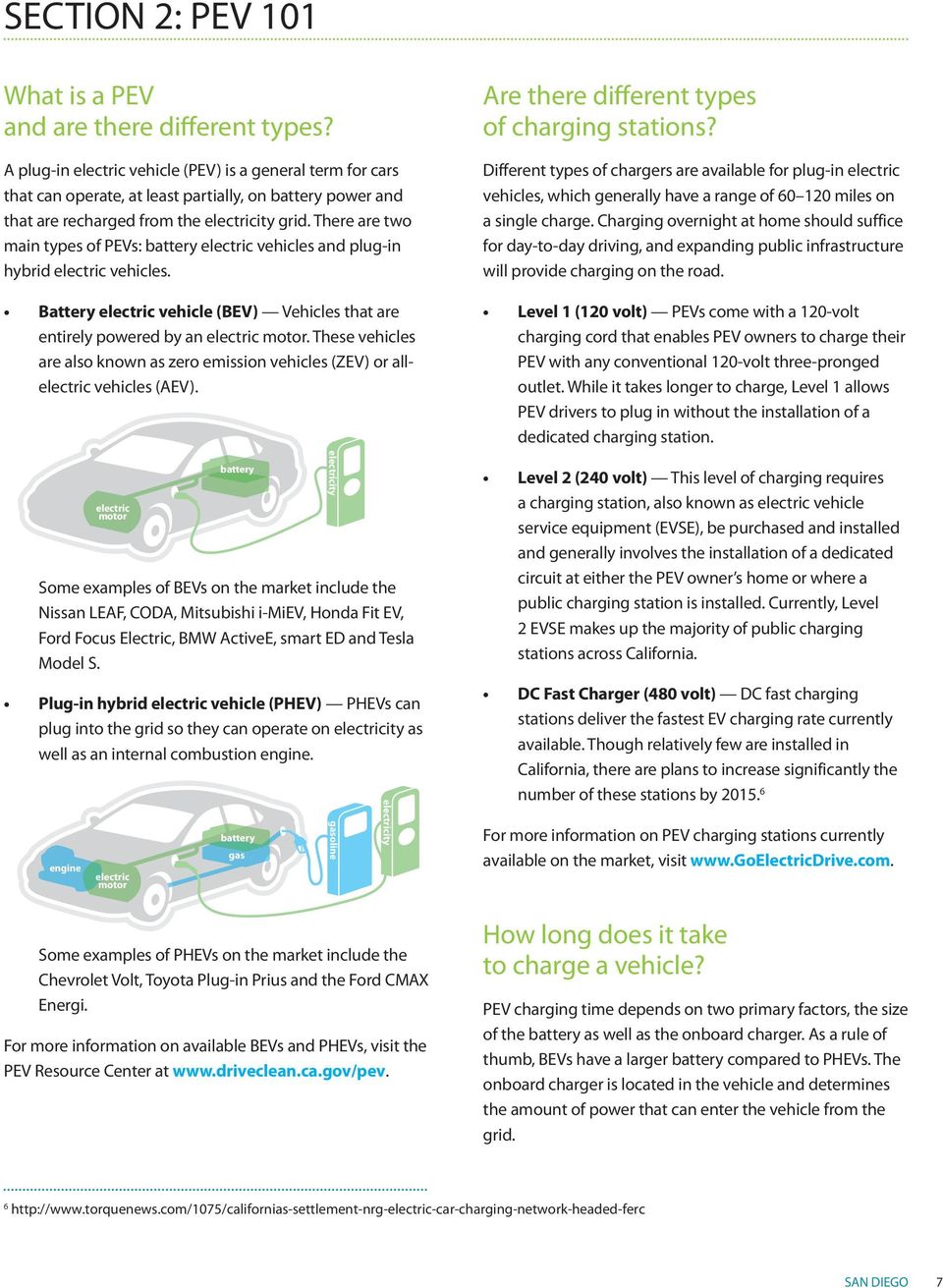
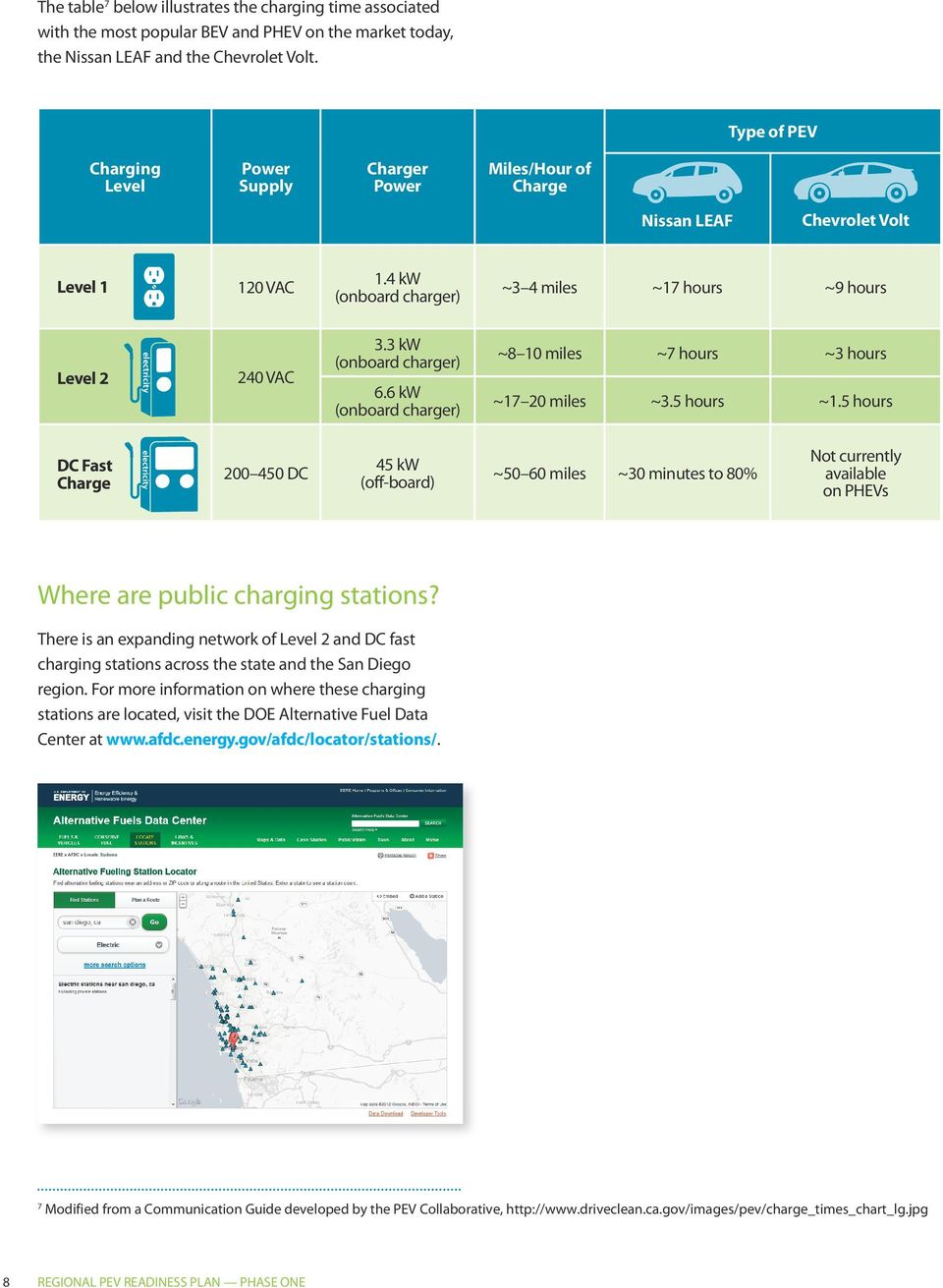
10 The table 7 below illustrates the charging time associated with the most popular BEV and PHEV on the market today, the Nissan LEAF and the Chevrolet Volt. Type of PEV Charging Level Power Supply Charger Power Miles/Hour of Charge Nissan LEAF Chevrolet Volt Level VAC 1.4 kw (onboard charger) ~3 4 miles ~17 hours ~9 hours Level 2 electricity 240 VAC 3.3 kw (onboard charger) 6.6 kw (onboard charger) ~8 10 miles ~7 hours ~3 hours ~17 20 miles ~3.5 hours ~1.5 hours DC Fast Charge electricity DC 45 kw (off-board) ~50 60 miles ~30 minutes to 80% Not currently available on PHEVs Where are public charging stations? There is an expanding network of Level 2 and DC fast charging stations across the state and the San Diego region. For more information on where these charging stations are located, visit the DOE Alternative Fuel Data Center at 7 Modified from a Communication Guide developed by the PEV Collaborative, 8 REGIONAL PEV READINESS PLAN PHASE ONE
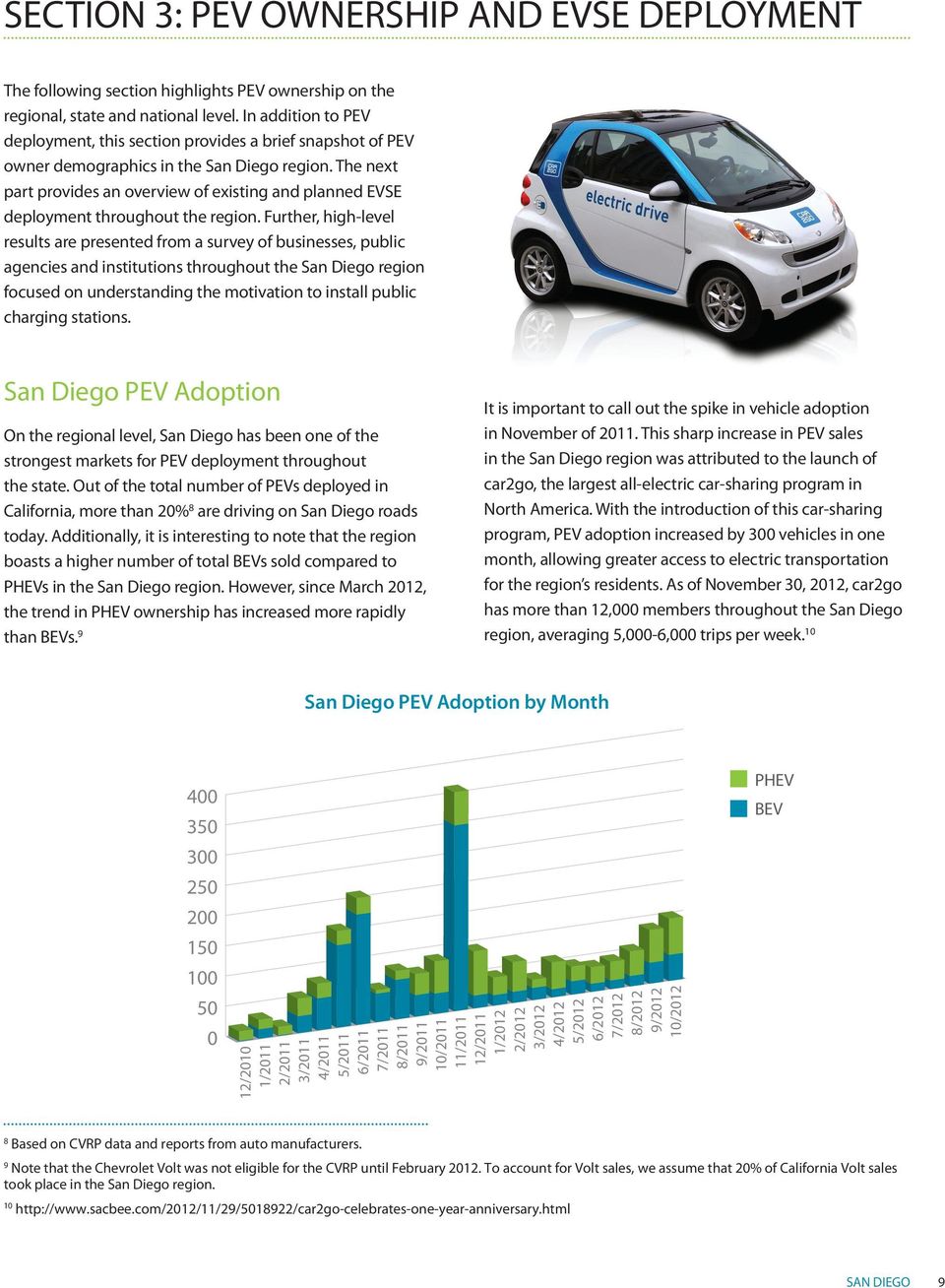
11 SECTION 3: PEV OWNERSHIP AND EVSE DEPLOYMENT The following section highlights PEV ownership on the regional, state and national level. In addition to PEV deployment, this section provides a brief snapshot of PEV owner demographics in the San Diego region. The next part provides an overview of existing and planned EVSE deployment throughout the region. Further, high-level results are presented from a survey of businesses, public agencies and institutions throughout the San Diego region focused on understanding the motivation to install public charging stations. San Diego PEV Adoption On the regional level, San Diego has been one of the strongest markets for PEV deployment throughout the state. Out of the total number of PEVs deployed in California, more than 20% 8 are driving on San Diego roads today. Additionally, it is interesting to note that the region boasts a higher number of total BEVs sold compared to PHEVs in the San Diego region. However, since March 2012, the trend in PHEV ownership has increased more rapidly than BEVs. 9 It is important to call out the spike in vehicle adoption in November of This sharp increase in PEV sales in the San Diego region was attributed to the launch of car2go, the largest all-electric car-sharing program in North America. With the introduction of this car-sharing program, PEV adoption increased by 300 vehicles in one month, allowing greater access to electric transportation for the region s residents. As of November 30, 2012, car2go has more than 12,000 members throughout the San Diego region, averaging 5,000-6,000 trips per week. 10 San Diego PEV Adoption by Month /2010 1/2011 2/2011 3/2011 4/2011 5/2011 6/2011 7/2011 8/2011 9/ / / /2011 1/2012 2/2012 3/2012 4/2012 5/2012 6/2012 7/2012 8/2012 9/ /2012 PHEV BEV 8 Based on CVRP data and reports from auto manufacturers. 9 Note that the Chevrolet Volt was not eligible for the CVRP until February To account for Volt sales, we assume that 20% of California Volt sales took place in the San Diego region SAN DIEGO 9
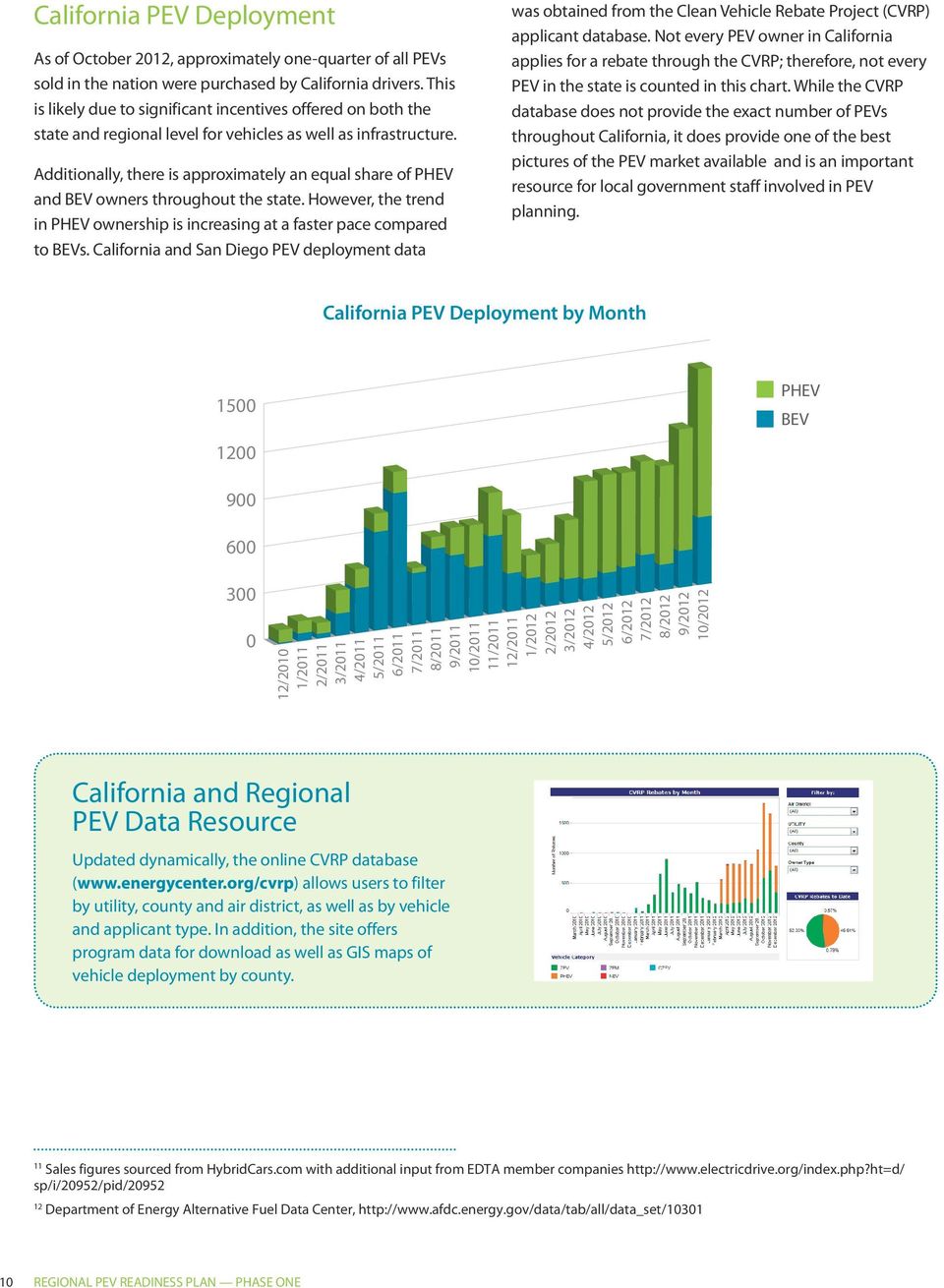
12 California PEV Deployment As of October 2012, approximately one-quarter of all PEVs sold in the nation were purchased by California drivers. This is likely due to significant incentives offered on both the state and regional level for vehicles as well as infrastructure. Additionally, there is approximately an equal share of PHEV and BEV owners throughout the state. However, the trend in PHEV ownership is increasing at a faster pace compared to BEVs. California and San Diego PEV deployment data was obtained from the Clean Vehicle Rebate Project (CVRP) applicant database. Not every PEV owner in California applies for a rebate through the CVRP; therefore, not every PEV in the state is counted in this chart. While the CVRP database does not provide the exact number of PEVs throughout California, it does provide one of the best pictures of the PEV market available and is an important resource for local government staff involved in PEV planning. California PEV Deployment by Month PHEV BEV /2010 1/2011 2/2011 3/2011 4/2011 5/2011 6/2011 7/2011 8/2011 9/ / / /2011 1/2012 2/2012 3/2012 4/2012 5/2012 6/2012 7/2012 8/2012 9/ /2012 California and Regional PEV Data Resource Updated dynamically, the online CVRP database ( allows users to filter by utility, county and air district, as well as by vehicle and applicant type. In addition, the site offers program data for download as well as GIS maps of vehicle deployment by county. 11 Sales figures sourced from HybridCars.com with additional input from EDTA member companies sp/i/20952/pid/ Department of Energy Alternative Fuel Data Center, 10 REGIONAL PEV READINESS PLAN PHASE ONE
13 National PEV Deployment In less than two years, PEV deployment across the nation has risen to more than 56,000 vehicles, 11 marking a significant achievement in the PEV market. For example, when hybrid electric vehicles (HEV) hit the market, it took close to four years before HEV sales reached the number that PEVs have in less than two years. 12 It is important to note that HEVs and PEVs are not a direct comparison. There are no added changes to a person s daily routine when purchasing a HEV. Consumers essentially purchase a more efficient gasoline-powered vehicle. However, with the decision to drive a PEV, consumers shift their fuel from gasoline to electricity. Recognizing this more complex relationship, it is even more significant that PEVs have achieved such success in a relatively short period of time. As the chart indicates, PHEV deployment across the nation has increased at a faster pace compared to BEV deployment. While there are many reasons for this trend, vehicle range, charging station cost and the lack of public infrastructure are likely important aspects. This underscores the need to expand public charging as well as streamline installation processes thereby reducing the overall costs to consumers. Cumulative National PEV Deployment 60,000 50,000 PHEV BEV 40,000 30,000 20,000 10, /2010 1/2011 2/2011 3/2011 4/2011 5/2011 6/2011 7/2011 8/2011 9/ / / /2011 1/2012 2/2012 3/2012 4/2012 5/2012 6/2012 7/2012 8/2012 9/ /2012 San Diego Regional PEV Owner Demographics PEV owner demographic data presented in this section comes directly from surveys conducted by the California Air Resources Board (ARB) and CCSE to CVRP participants throughout California. 13 In partnership with ARB, CCSE has received responses from more than 2,000 California PEV owners. This survey is critical in achieving a greater understanding of who these drivers are and their charging and driving behavior. Out of the total number of respondents, 328 are located in the San Diego region. Some of the key demographics and summary statistics of San Diego PEV owners are included on the following pages: 13 CCSE and ARB survey CVRP applicants in six-month intervals, after these drivers have owned their vehicle for at least six months or longer. This structure allows CCSE to track the change in PEV owner behavior over time as well as compare the behavior of one group of drivers (e.g. early adopters) to another (e.g. mid-adopters). To read a report on the results of the first cohort, visit SAN DIEGO 11

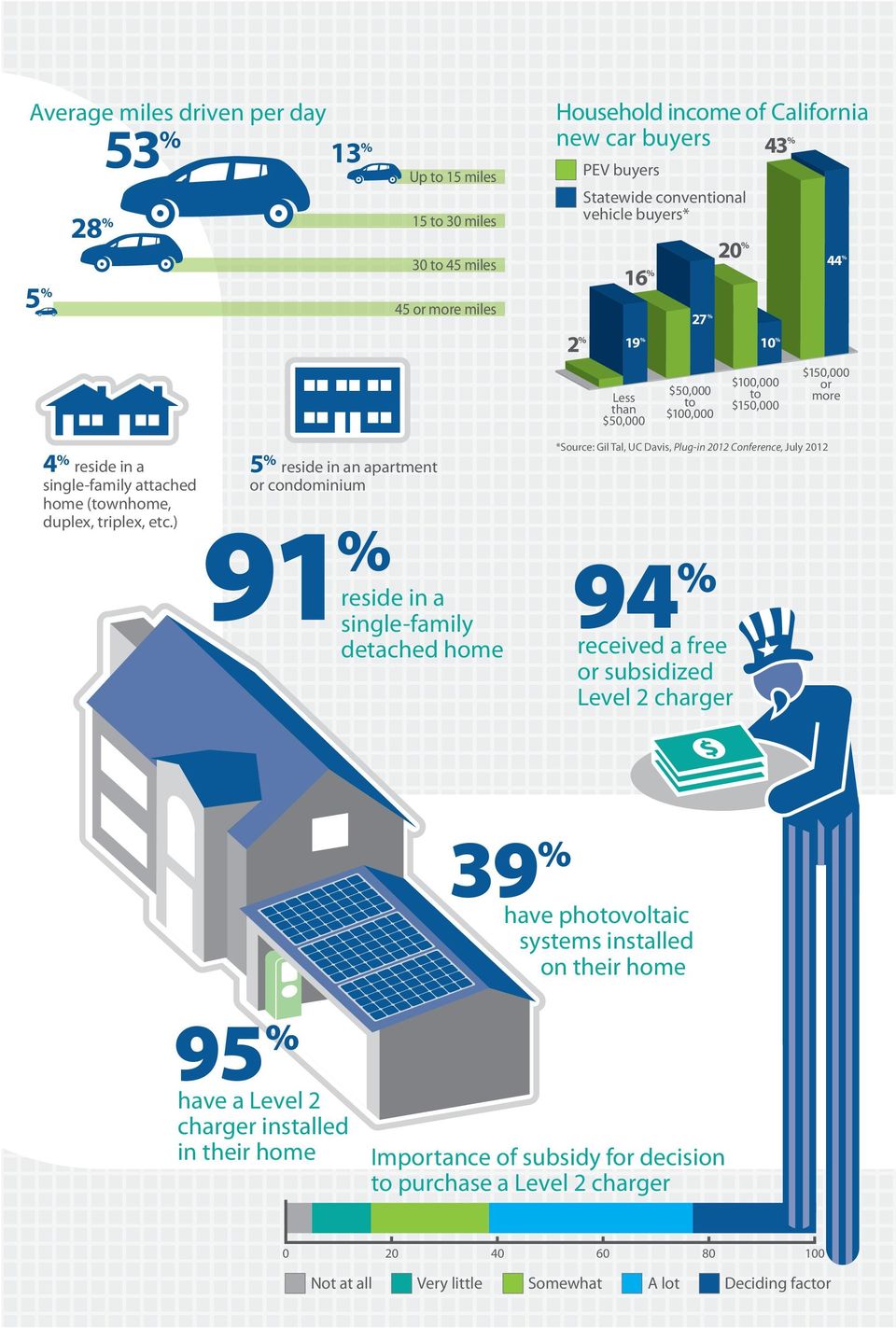
14 SAN DIEGO REGIONAL PEV OWNER DEMOGRAPHICS Attitude towards public charging infrastructure 82 % expressed varying levels of dissatisfaction with public charging infrastructure Very Satisfied 0% Satisfied 17% Unsatisfied 56% Very Unsatisfied 26% 72 % of primary PEV drivers are male 99 % Percentage of survey respondents who are Nissan Leaf owners Level 2 Charger electricity PEV vs. conventional vehicle use by activity 47 % Percentage of survey respondents who have access to workplace charging 100% 90% 80% 70% 60% 50% 40% 30% 20% 10% 0% Work commute Vacation Leisure Business travel Shopping travel Personal errands Conventional vehicle PEV Educational level of respondents 1 % 7 % 3 % 38 % High School or less Some Associate college, degree no degree Bachelor s degree 49 % Postgraduate degree

15 Average miles driven per day 5 % 28 % 53 % 13 % Up to 15 miles 15 to 30 miles 30 to 45 miles 45 or more miles Household income of California new car buyers 43 % PEV buyers Statewide conventional vehicle buyers* 2 % 16 % 20 % Less than $50, % 27% $50,000 to $100, % $100,000 to $150, % $150,000 or more 4 % reside in a single-family attached home (townhome, duplex, triplex, etc.) 5 % reside in an apartment or condominium 91 % reside in a single-family detached home *Source: Gil Tal, UC Davis, Plug-in 2012 Conference, July % received a free or subsidized Level 2 charger 39 % have photovoltaic systems installed on their home 95 % have a Level 2 charger installed in their home Importance of subsidy for decision to purchase a Level 2 charger Not at all Very little Somewhat A lot Deciding factor
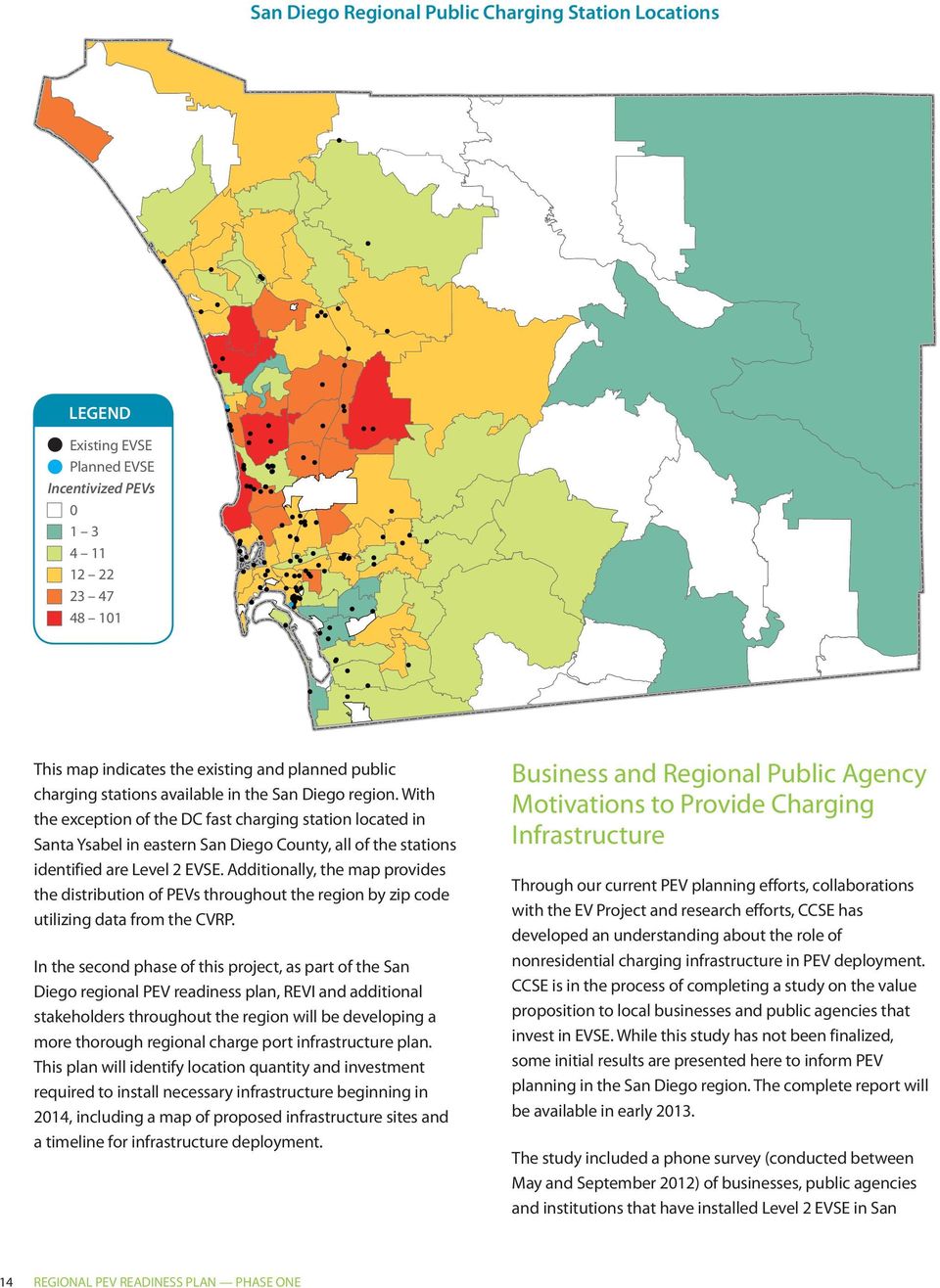
16 San Diego Regional Public Charging Station Locations LEGEND Existing EVSE Planned EVSE Incentivized PEVs This map indicates the existing and planned public charging stations available in the San Diego region. With the exception of the DC fast charging station located in Santa Ysabel in eastern San Diego County, all of the stations identified are Level 2 EVSE. Additionally, the map provides the distribution of PEVs throughout the region by zip code utilizing data from the CVRP. In the second phase of this project, as part of the San Diego regional PEV readiness plan, REVI and additional stakeholders throughout the region will be developing a more thorough regional charge port infrastructure plan. This plan will identify location quantity and investment required to install necessary infrastructure beginning in 2014, including a map of proposed infrastructure sites and a timeline for infrastructure deployment. Business and Regional Public Agency Motivations to Provide Charging Infrastructure Through our current PEV planning efforts, collaborations with the EV Project and research efforts, CCSE has developed an understanding about the role of nonresidential charging infrastructure in PEV deployment. CCSE is in the process of completing a study on the value proposition to local businesses and public agencies that invest in EVSE. While this study has not been finalized, some initial results are presented here to inform PEV planning in the San Diego region. The complete report will be available in early The study included a phone survey (conducted between May and September 2012) of businesses, public agencies and institutions that have installed Level 2 EVSE in San 14 REGIONAL PEV READINESS PLAN PHASE ONE
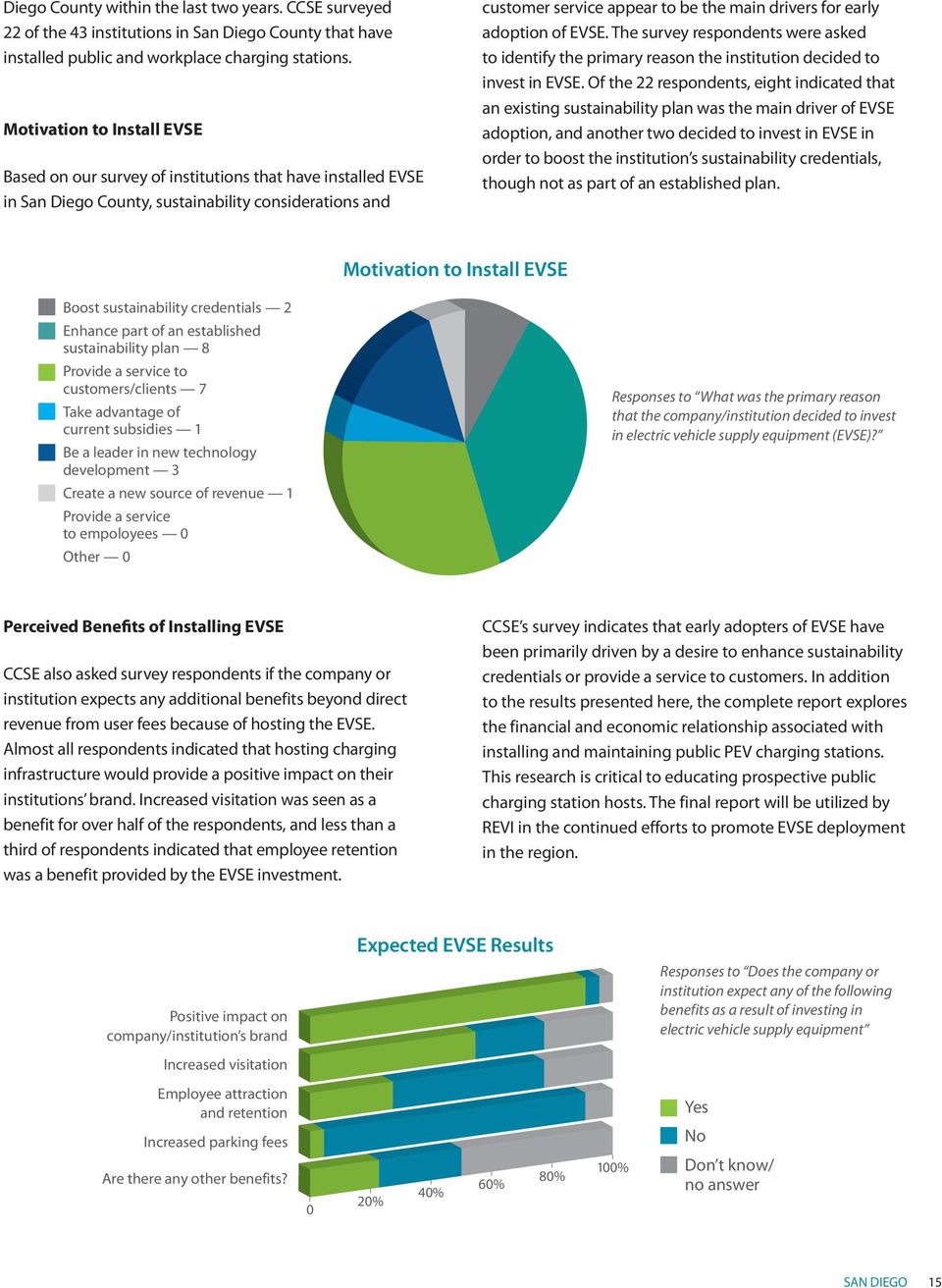
17 Diego County within the last two years. CCSE surveyed 22 of the 43 institutions in San Diego County that have installed public and workplace charging stations. Motivation to Install EVSE Based on our survey of institutions that have installed EVSE in San Diego County, sustainability considerations and customer service appear to be the main drivers for early adoption of EVSE. The survey respondents were asked to identify the primary reason the institution decided to invest in EVSE. Of the 22 respondents, eight indicated that an existing sustainability plan was the main driver of EVSE adoption, and another two decided to invest in EVSE in order to boost the institution s sustainability credentials, though not as part of an established plan. Motivation to Install EVSE Boost sustainability credentials 2 Enhance part of an established sustainability plan 8 Provide a service to customers/clients 7 Take advantage of current subsidies 1 Be a leader in new technology development 3 Create a new source of revenue 1 Provide a service to empoloyees 0 Other 0 Responses to What was the primary reason that the company/institution decided to invest in electric vehicle supply equipment (EVSE)? Perceived Benefits of Installing EVSE CCSE also asked survey respondents if the company or institution expects any additional benefits beyond direct revenue from user fees because of hosting the EVSE. Almost all respondents indicated that hosting charging infrastructure would provide a positive impact on their institutions brand. Increased visitation was seen as a benefit for over half of the respondents, and less than a third of respondents indicated that employee retention was a benefit provided by the EVSE investment. CCSE s survey indicates that early adopters of EVSE have been primarily driven by a desire to enhance sustainability credentials or provide a service to customers. In addition to the results presented here, the complete report explores the financial and economic relationship associated with installing and maintaining public PEV charging stations. This research is critical to educating prospective public charging station hosts. The final report will be utilized by REVI in the continued efforts to promote EVSE deployment in the region. Positive impact on company/institution s brand Increased visitation Expected EVSE Results Responses to Does the company or institution expect any of the following benefits as a result of investing in electric vehicle supply equipment Employee attraction and retention Yes No Don t know/ no answer Increased parking fees Are there any other benefits? 0 20% 40% 60% 80% 100% SAN DIEGO 15
18 16 REGIONAL PEV READINESS PLAN PHASE ONE
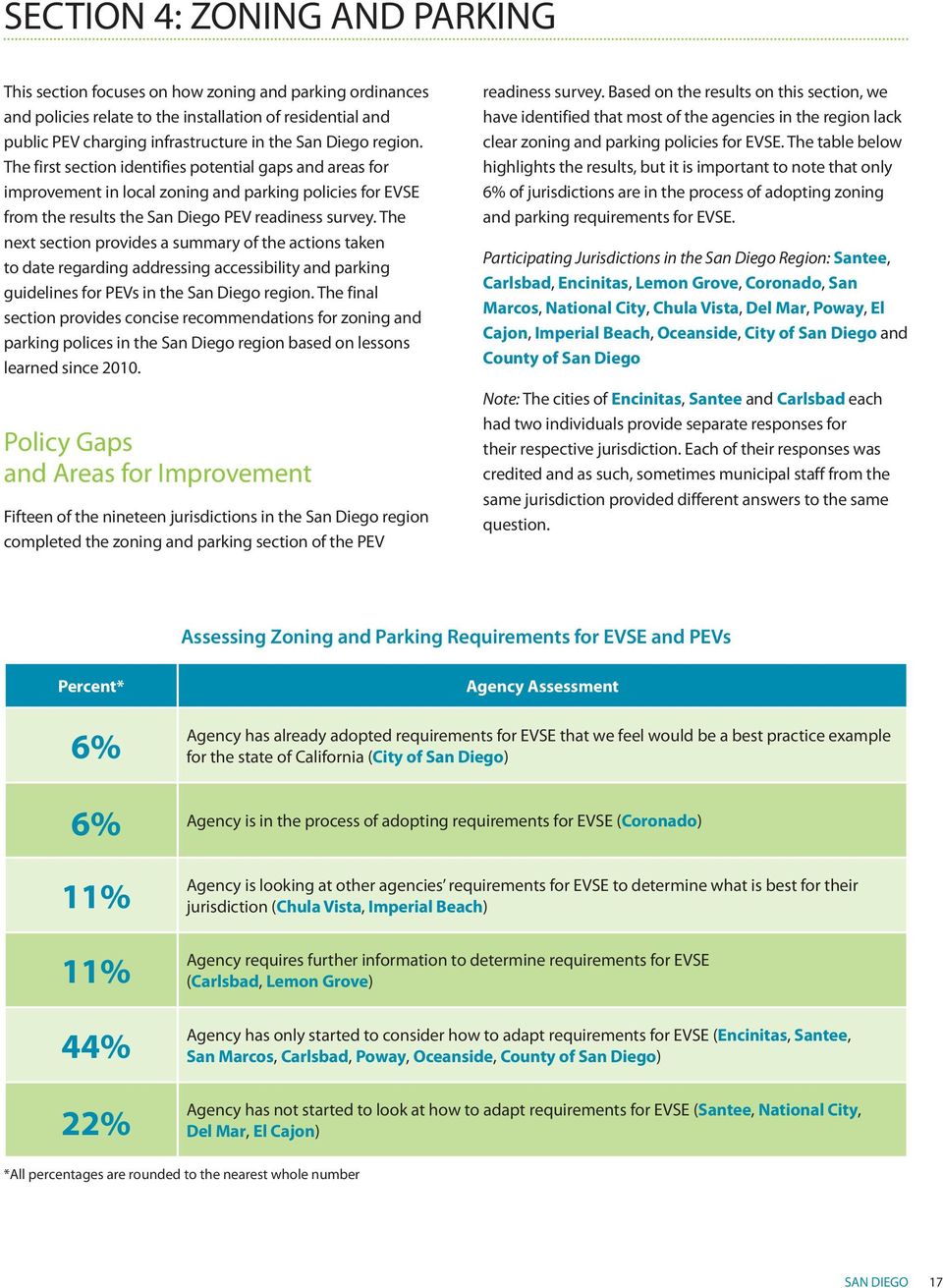
19 SECTION 4: ZONING AND PARKING This section focuses on how zoning and parking ordinances and policies relate to the installation of residential and public PEV charging infrastructure in the San Diego region. The first section identifies potential gaps and areas for improvement in local zoning and parking policies for EVSE from the results the San Diego PEV readiness survey. The next section provides a summary of the actions taken to date regarding addressing accessibility and parking guidelines for PEVs in the San Diego region. The final section provides concise recommendations for zoning and parking polices in the San Diego region based on lessons learned since Policy Gaps and Areas for Improvement Fifteen of the nineteen jurisdictions in the San Diego region completed the zoning and parking section of the PEV readiness survey. Based on the results on this section, we have identified that most of the agencies in the region lack clear zoning and parking policies for EVSE. The table below highlights the results, but it is important to note that only 6% of jurisdictions are in the process of adopting zoning and parking requirements for EVSE. Participating Jurisdictions in the San Diego Region: Santee, Carlsbad, Encinitas, Lemon Grove, Coronado, San Marcos, National City, Chula Vista, Del Mar, Poway, El Cajon, Imperial Beach, Oceanside, City of San Diego and County of San Diego Note: The cities of Encinitas, Santee and Carlsbad each had two individuals provide separate responses for their respective jurisdiction. Each of their responses was credited and as such, sometimes municipal staff from the same jurisdiction provided different answers to the same question. Assessing Zoning and Parking Requirements for EVSE and PEVs Percent* 6% Agency Assessment Agency has already adopted requirements for EVSE that we feel would be a best practice example for the state of California (City of San Diego) 6% Agency is in the process of adopting requirements for EVSE (Coronado) 11% 11% 44% 22% Agency is looking at other agencies requirements for EVSE to determine what is best for their jurisdiction (Chula Vista, Imperial Beach) Agency requires further information to determine requirements for EVSE (Carlsbad, Lemon Grove) Agency has only started to consider how to adapt requirements for EVSE (Encinitas, Santee, San Marcos, Carlsbad, Poway, Oceanside, County of San Diego) Agency has not started to look at how to adapt requirements for EVSE (Santee, National City, Del Mar, El Cajon) *All percentages are rounded to the nearest whole number SAN DIEGO 17
20 In addition, it is important to note that most (72%) of the jurisdictions surveyed indicated that current zoning and parking ordinances for EVSE installations do not consider ADA compliance issues. The City of San Diego, Lemon Grove and separate responses for the cities of Encinitas and Santee stated that they are considering ADA compliance in current zoning and parking ordinances. Overwhelmingly (89%), jurisdictions said that it would be helpful to have other best practice zoning and parking ordinances available for reference. The City of Imperial Beach expressed that a best practice wouldn t be useful because of the lack of public demand for PEV infrastructure to warrant inclusion of zoning and parking requirements for EVSE in the city s municipal code. Again, while none of the jurisdictions responding to the survey have developed zoning and parking ordinances for EVSE installation, the City of Santee s planning department responded that EVSE installations are accommodated by existing ordinances. In addition, the City of San Marcos is in the process of conducting a comprehensive zoning ordinance update by the end of 2012 in which zoning and parking ordinances will be amended for EVSE. The City of Chula Vista indicated that they were three months from adopting revised zoning and parking ordinances for EVSE, while the City of Poway is six months away from implementation. Further, the City of San Diego indicated a preference to modify existing zoning and parking ordinances over developing new ordinances specifically for EVSE installations. As a result, they are in the process of updating existing ordinances to reflect any changes that will assist in the deployment of EVSE. The City of Imperial Beach cited that there are too few staff currently employed to include new zoning and parking ordinance for EVSE, but responded that any adopted zoning and parking ordinance for EVSE would likely take one year. Likewise, the City of Oceanside stated that any ordinance adoption would take six months to a year. This timeline is highly dependent, however, in that any installation would be contingent on the type of environmental review the project requires. If the public installation is deemed to cause any environmental issues based on the review, the process generally takes up to a year. Otherwise, the typical process will be for the planning commission to submit a proposal to city council that requires approval, which is approximately two months. Addressing Policy Gaps and Areas for Improvement While the region lacks consistent PEV zoning and parking policies, there have been two jurisdictions working on developing internal policies. The section below describes the City of San Diego s work to address accessibility at PEV charging stations as well as parking guidelines currently under development by the County of San Diego. Additionally, this section describes efforts on the state level to develop consistent directional and regulatory signage for PEVs and EVSE. Addressing Accessibility On April 19, 2012, the City of San Diego released Technical Policy 11B-1: Accessibility to EV charging stations, which provides accessibility guidelines for EVSE installations in the city. The guidelines originated with a previous document prepared by the Division of the State Architect developed in 1997 titled Interim Disabled Access Guidelines for Electrical Vehicle Charging Stations (see Appendix). Technical Policy 11B-1 was developed to ensure uniform and consistent enforcement by review and inspection staff. This policy applies to the installation of EVSE in both new and existing construction within the City of San Diego. According to the policy, EVSE in nonpublic areas, such as rental car agencies, car dealerships with EVSE, etc., are not required to be accessible. The results of the San Diego regional PEV readiness survey showed that 89% of jurisdictions polled indicated it would be helpful to have other city or agency PEV infrastructure requirements available for reference. As a result, this policy was distributed to regional PEV stakeholders, including all 19 jurisdictions within the San Diego region. In May 2012, CCSE contacted each jurisdiction with a call to action to implement the EVSE accessibility guidelines. The overarching goal of distributing these guidelines was to reduce duplicative efforts and catalyze the development of policies that reduce barriers to PEV infrastructure deployment. That said, CCSE personally shared the San Diego Technical Policy 11B-1 with the following municipalities and PEV stakeholders: the City of Long Beach, City of Santa Monica, City of Riverside, PEV Collaborative and the Colorado Clean Cities organization. Additionally, the National Clean Cities Coordinator 18 REGIONAL PEV READINESS PLAN PHASE ONE
21 distributed the San Diego Technical Policy 11B-1, along with CCSE s recommendations for municipality implementation to Clean Cities groups across the country. Parking Guidelines The County of San Diego is in the process of updating their parking design guidelines to the county planning commission. A subsection of the document speaks to the Clean Air Vehicle Parking standard for new nonresidential uses as it complies with the California Green Building Standards Code (CGBSC). The ordinance strictly refers to the CGBSC for guidance. In addition, the PEVC toolkit, developed through collaboration between the California PEV Collaborative and six regions across the state, also references the CGBSC code as a best practice that jurisdictions should follow. Specifically, the CGBSC states that new construction should provide designated parking for any combination of low-emitting, fuel-efficient and carpool/van pool vehicles, including PEVs for up to 10% of total designated parking spaces. Regulatory Signs PEV Tow-Away Symbol: This sign indicates that vehicles will be towed if not utilizing the available charging station (per CVC 21511). This sign will include the tow-away symbol with the following language UNAUTHORIZED VEHICLES NOT CONNECTED FOR ELECTRIC CHARGING PURPOSES WILL BE TOWED AWAY AT THE OWNER S EXPENSE... with red text on a white background and be 24 x 24. UNAUTHORIZED VEHICLES NOT CONNECTED FOR ELECTRIC CHARGING PURPOSES WILL BE TOWED AWAY AT THE OWNER S EXPENSE TOWED VEHICLES MAY BE RECLAIMED AT (Insert Address) OR BY TELEPHONING (Insert Telephone Number) EVSE Signage While not regional, it is important to recognize an effort on the state level to develop more consistent signage for PEVs. In an effort to accomplish this goal, the California Department of Transportation, Sonoma County Department of General Services and the California PEV Collaborative have developed a proposal to add five signs, one plaque and an optional pavement marking to the 2012 edition of the California Manual on Uniform Traffic Control Devices (CA MUTCD). This effort is tied directly to Governor Brown s Zero Emission Vehicle Executive Order, which has a goal of reaching 1.5 million PEVs and fuel cell vehicles by These signs are categorized into regulatory and general service signs. Examples of the new signs and are included to the right. No Parking Symbol: This sign indicates no parking unless for charging a PEV. This will include the following language EXCEPT FOR ELECTRIC VEHICLE CHARGING with red text on a white background and be 12 x 18. P EXCEPT FOR ELECTRIC VEHICLE CHARGING SAN DIEGO 19
22 Permissive Charging Symbol: This sign indicates the time that charging will be available and will include the following language [Electric Vehicle] HOUR CHARGING - AM TO PM with green text on a white background and be 12 x 18. # HOUR CHARGING 7AM TO 6 PM FAST Electric Vehicle Charging Station: This plaque indicates the charging station is capable of a charge in less than one hour (faster charge compared to a Level 2 station). The sign will include the language FAST in white text on a blue background and be 24 x 6 or 30 x 8. This plaque is for use only with the Electric Vehicle Charging station symbol and word message. FAST General Directional Signs Electric Vehicle Charging Station Symbol and Word Message Signs: These signs will assist in directing PEV drivers to charging stations from the freeway, local streets and at charging locations. The sign includes the EV charging station symbol (shown) or the following text ELECTRIC VEHICLE CHARGING STATION with white text on blue background. Sign sizes should be 30 x 30 for freeway or major arterial highway application, 24 x 24 for local streets, and 18 x 18 off-street parking application. Optional EV charging Pavement Marking: This pavement marking will indicate a parking space is for EV charging only for on- and off-street electric vehicle charging station stalls. The pavement marking will include the following language EV CHARGING ONLY in white text. ELECTRIC VEHICLE CHARGING STATION 20 REGIONAL PEV READINESS PLAN PHASE ONE
23 Recommendations for Regional Next Steps Based on feedback from the PEV readiness survey, we have identified that there is a lack of clear policies focused on zoning and parking for EVSE. Further, jurisdictions across the region are interested in receiving information on how other agencies have developed these policies. During the past year, regional stakeholders have begun to address some of the issues that are highlighted in the previous section. However, there are additional areas where clear guidance is needed. Through the lessons learned in San Diego and a review of national and state best practices, we have identified a concise list of zoning and parking policies for jurisdictions to implement throughout the San Diego region. These recommendations are focused on parking accessibility, signage and enforcement. Please note that a complete list of best practices reviewed in preparation of this plan is included in the zoning and parking section of the Appendix. EVSE Parking Accessibility Recommendation: Utilize the City of San Diego Technical Policy 11B-1 as policy for installing accessible charging equipment. Benefits: Provides a simple template for adopting accessible zoning and parking guidelines for PEVs and EVSE. This makes available three options that will ultimately lower the cost of installation for installers and EVSE hosts. This policy also leverages guidelines developed by the Division of the State Architect and 2010 California Building Code (CBC) that requires accommodations and services to be made accessible to persons with disabilities. As mentioned previously, a complete description of City of San Diego Technical Policy 11B-1 specifications for disabled accessible EV charging stations and requirements can be found in the Appendix. Consistent General Service and Regulatory Signage Recommendation: Collectively adopt across the San Diego region, the general service and regulatory PEV signage recommended by the California Department of Transportation, the California Plug-in Electric Vehicle Collaborative and the County of Sonoma amendments to the 2012 edition of the California Manual on Uniform Traffic Control Devices. Benefits: Standardizing signs for PEV parking across the San Diego region will decrease costs, create uniformity and align the region. This signage was based on signage currently endorsed by the state and the U.S. Department of Transportation Federal Highway Administration (FHWA). Aligning regional signage policy with state and federal efforts, allows for more consistent signage and less confusion for PEV drivers. Update Municipal Zoning Language for Dedicated PEV Parking Recommendation: Incorporate PEV parking requirements in public, private and government facilities based on market growth of PEVs in the region. Further, municipalities should leverage Hawaii State Plug-in Electric Vehicle Parking Requirement and update their zoning ordinances to reflect the following language. Updated zoning language to be adopted: All public, private and government parking facilities that are available for use by the general public and that include at least 100 parking spaces must designate at least the number of parking spaces outlined in the table below specifically for the use of PEVs. The spaces designated for PEVs will continue to increase by 1% for each additional 5,000 registered PEVs until the percentage reaches 10%. 14 Total Number of Parking Spaces Number of Required PEV Spaces and over 4 14 Alternative Fuels & Advanced Vehicles Data Center. (2011 June 15). Hawaii Incentives and Laws for EVs. Retrieved from afdc/laws/laws/hi/tech/3270 SAN DIEGO 21
24 Benefits: Provides certainty in the marketplace that there will be dedicated parking spaces for PEVs. The addition of the market threshold provision ensures that enforcement policies are enacted when there is sufficient demand for public charging in the region. Regional Parking Enforcement Policy for PEVs Recommendation: Leverage the City of Santa Monica s parking enforcement policy as amended in 2002 to develop a PEV parking enforcement policy in all PEVdesignated spots for jurisdictions in the San Diego region. However, enforcement of PEV charging should begin once the number of registered PEVs reaches 5,000 throughout the San Diego region. Code language to be adopted: No person shall park or leave standing any nonelectric vehicle in any parking space equipped with an electric vehicle charger. (Based on City of Santa Monica Electric vehicle parking: Amended by Ordinance 2037CCS 1, adopted 2/26/02.) Benefits: Provides certainty in the marketplace that PEV charging stations will be reserved for PEV drivers. The addition of the market threshold provision ensures that enforcement policies are enacted when there is sufficient demand for public charging in the region. 22 REGIONAL PEV READINESS PLAN PHASE ONE
25 SECTION 5: STREAMLINING PERMITTING AND INSPECTION This section focuses on the permitting and inspection processes for the installation of residential and nonresidential EVSE in the San Diego region. The first section recognizes the barriers and potential policy gaps toward creating local permitting and inspection requirements for EVSE from results of the San Diego PEV readiness study. The next section provides a summary of the actions taken to date regarding addressing permitting requirements for PEVs in the San Diego region. The final section will provide concise recommendations to streamline the EVSE permitting and inspection processes for jurisdictions in the San Diego region. Policy Gaps and Areas for Improvement: Permitting and Inspection the results in this section, we have identified jurisdictions require further information to determine permitting and inspection requirements for EVSE. Despite this need for further information, however, only 15% of jurisdictions are looking at other agency s requirements for EVSE to determine what is best for their city. The table below displays the results. Participating Cities in the San Diego Region: El Cajon, San Marcos, Chula Vista, Lemon Grove, Carlsbad, Encinitas, Poway, Coronado, La Mesa, Imperial Beach, Oceanside and the City of San Diego. Note: The City of Encinitas had two individuals provide separate responses for their jurisdiction. Each of their responses was credited. From the PEV readiness survey, 12 of the 19 jurisdictions in the San Diego region completed the streamlining permitting and inspection section of the survey. Based on Assessing Permitting and Inspection of EVSE in the San Diego Region Percent* 8% 15% 15% 23% 23% 15% Agency Assessment Agency has already adopted requirements for EVSE that we feel would be a best practice example for the state of California (City of San Diego) Agency is in the process of adopting requirements for EVSE (Carlsbad, Oceanside) Agency is looking at other agencies requirements for EVSE to determine what is best for their jurisdiction (El Cajon, Encinitas) Agency requires further information to determine requirements for EVSE (San Marcos, Chula Vista, Lemon Grove) Agency has only started to consider how to adapt requirements for EVSE (Poway, Coronado, Imperial Beach) Agency has not started to look at how to adapt requirements for EVSE (Encinitas, La Mesa) *All percentages are rounded to the nearest whole number SAN DIEGO 23
26 Only the City of Carlsbad 15 and the City of Encinitas 16 reported that there is a unique PEV infrastructure permit (as compared to an electrical service permit for 240V circuit), whereas 84% of agencies do not have a unique permit dedicated for EVSE installation. It is also important to note that less than half of the respondents (31%) stated that additional permits for trenching or replacing concrete are required, while 15% of jurisdictions were not sure. The City of Encinitas and the City of Poway each require an additional permit for trenching and concrete work. The cities of Coronado and Imperial Beach each responded that a permit for trenching or concrete work is only required for public installations and is not required for private installations. Responses varied when jurisdictions answered if a permit is required for ADA compliance, with 15% of jurisdictions not sure and 31% requiring a permit. The cities that require a permit for ADA compliance are the cities of El Cajon, San Marcos, Poway and Oceanside. Lack of Jurisdictional Knowledge of EVSE Permitting and Inspection Best Practices While only 15% of regional agencies are in the process of adopting requirements for EVSE, the majority of agencies surveyed (85%) indicated that it would be helpful to have other city or agency permitting and inspection EVSE requirements available to reference that had been identified as an example of best practices in the state of California. This highlights the need for permitting and inspection best practices to be distributed throughout the region. The City of Oceanside was the only jurisdiction that consulted other agencies in developing EVSE permitting and inspection requirements. Of the agencies that have developed or are in the process of developing permitting and inspection requirements for EVSE, approximately half (46%) replied they are working on this with their own staff. The same percentage of these agencies (46%) stated that they would be willing to share their own permitting and inspection requirements with regional partners if they felt these documents would be helpful to share as a best practice. This again underscores the need for permitting and inspection best practices for EVSE to be shared throughout the region. Regional Variation of Permit Costs for EVSE For the majority of installations, the cost of the permits varies widely throughout the San Diego region. Each of these variables is dependent on the various types of EVSE installations, which are listed as single-family residence, commercial or multifamily units, open parking lot or onstreet parking. The table below shows the permitting cost by the type of EVSE installation. Costs of Permits by Type of EVSE Installation* Permit Cost Type of Installation <$100 $101 $250 $251 $500 >$501 Single-Family Residence 23% 62% 15% 0% Commercial/Multifamily Unit 23% 38% 38% 0% Open Parking Lot 15% 54% 23% 0% On-street Parking 15% 38% 8% 8% *All percentages are rounded to the nearest whole number and some jurisdictions did not provide answers; as a result, the total percentage may not equal 100%. Please note that a complete jurisdiction list and their corresponding inspection requirements are included in the Permitting and Inspection section of the Appendix. 15 Processing, fees and inspections for EVSE mirror the City of Carlsbad s typical Electrical Permit; however, the city uses a different name in their computer system for tracking purposes. 16 While not a specific EVSE permit, the City of Encinitas has waived permit fees for EVSE installations. 24 REGIONAL PEV READINESS PLAN PHASE ONE
27 It is important to point out that the City of San Marcos and the City of Imperial Beach are the only cities in the San Diego region that offer an electrical permit below $100 for every type of EVSE installation. On the higher end, the City of Oceanside reported the cost of electrical permits for on-street installations in excess of $500. In addition, the City of Poway indicated that permits for on-street EVSE installations are not allowed. The City of San Diego did not specify a permit cost for on-street parking EVSE installations. Lengthy Permitting Delays for Commercial, Multifamily and Other Public Installations Prior to the installation of EVSE, all jurisdictions surveyed stated that applicants could apply for an electrical permit for an EVSE installation over the counter, while 38% allow applicants to mail in a hard-copy application. This process would likely be streamlined if online services were available; however, only 15% of jurisdictions surveyed (Chula Vista and City of San Diego) allow their applicants to apply for a permit online. When reporting the number of business days it takes a permit to be issued after it is requested for the majority of installations, almost 77% of jurisdictions provide sameday service for single-family home EVSE installations. This is not surprising since the majority of single-family home installations take place in a garage, which tend to be less complex and require less application materials compared to commercial or multifamily unit installations. Type of Installation Time to Issue Permits by Type of EVSE Installation* Time to Issue Permit Same Day 2 5 Days 6 10 Days 3 5 Weeks >5 Weeks Single-Family Residence 77% 8% 15% 0% 0% Commercial/Multifamily Unit 23% 8% 54% 8% 0% Open Parking Lot 23% 8% 54% 8% 0% On-street Parking 15% 0% 46% 8% 0% *All percentages are rounded to the nearest whole number and some jurisdictions did not provide answers; as a result, the total percentage may not equal 100%. Please note that a complete jurisdiction list and their corresponding permit issuance times are included in the Permitting and Inspection section of the Appendix. It is important to note that the City of San Diego, where the majority of electrical permits for EVSE installations are pulled in the region, takes 2 to 5 days for a permit to be issued for EVSE installation in a single-family home. However, permitting time for commercial/multifamily and open parking lot EVSE installations are significantly longer in the City of San Diego, between 3 to 5 weeks. Lack of Jurisdictional Knowledge of EVSE Installation Checklist Best Practices Close to two-thirds (61%) of survey respondents identified that their jurisdiction does not have an exclusive inspector checklist for EVSE installations. Despite the lack of permits specifically for EVSE throughout the region, all respondents identified that their jurisdiction offers over-the-counter permits for EVSE installations. Again, online permitting services are limited in the San Diego region, as only 15% of jurisdictions allow applicants to check the status of their permit online. The majority of jurisdictions (85%) require plans or blueprints in a permit application, while 62% require load calculations and over half (54%) require the applicant to notify San Diego Gas & Electric that a permit for EVSE installation has been pulled. Certain jurisdictions listed other requirements, such as the City of Encinitas, which requires utility notification to check if a panel upgrade SAN DIEGO 25
28 is needed to complete the EVSE installation. A complete list of items required in a permit application for an EVSE installation by jurisdiction is located in the table below. Items Required in a Permit Application for an EVSE Installation by Jurisdiction Items Required in Permit Application Jurisdiction Plan/Blueprints Load Calculations El Cajon, San Marcos, Chula Vista, Lemon Grove, Encinitas, Poway, Coronado, La Mesa, Imperial Beach, Oceanside, City of San Diego San Marcos, Chula Vista, Poway, Coronado, La Mesa, Imperial Beach, Oceanside, City of San Diego Utility Notification by Applicant El Cajon, Chula Vista, Encinitas, Carlsbad, Poway, La Mesa, Oceanside Majority of San Diego Cities Require Electrical Permits for EVSE Installations The majority of jurisdictions in the San Diego area require simply an electrical permit for an EVSE installation. For example, 62% of jurisdictions require an electrical permit for EVSE installations only in single-family residences, whereas 69% of jurisdictions require an electrical permit for commercial and multifamily installations. While a lower percentage, some jurisdictions throughout the region require multiple types of permits for EVSE installations (e.g. building and planning and entitlement). A full list of these cities is included in the Appendix. Permitting Inspection Requirements After the EVSE is installed, all jurisdictions surveyed identified that applicants can call the office to request an inspection date and time for the EVSE installation, while 62% allow applicants to request an inspection by visiting the office. Approximately 69% of the agencies polled indicated it took 2-5 days for an inspection, with 15% of agencies stating they provide same-day inspection services. Less than a quarter of the agencies surveyed (15%) stated that the EVSE inspections are based on a number of factors, and time ranges could not be determined. Type of Installation Inspections Required for EVSE Installations* Plan Check Only Pre- Inspection Inspections Required Post- Inspection Pre- & Post- Inspection 1+ Pre- & Post- Inspection Intermediate & Post- Inspection Single-Family Residence 0% 0% 62% 8% 0% 23% Commercial/Multifamily Unit 0% 0% 46% 8% 0% 31% Open Parking Lot 0% 0% 46% 8% 0% 23% On-street Parking 0% 0% 38% 8% 0% 23% *All percentages are rounded to the nearest whole number and some jurisdictions did not provide answers; as a result, the total percentage may not equal 100%. Please note that a complete jurisdiction list and their corresponding permit issuance times are included in the Appendix. 26 REGIONAL PEV READINESS PLAN PHASE ONE
29 Addressing Policy Gaps and Areas for Improvement The following section describes the City of San Diego s and the City of Oceanside s work to streamline the permitting and inspection process for the installation of PEV charging stations. Additionally, the section discusses ongoing efforts by the National Electrical Contractors Association to address the high cost associated with electrical permits for EVSE in multiunit dwellings. Standardizing the EVSE Permitting and Inspection Process City of San Diego In March 2012, the City of San Diego released Information Bulletin (IB) 187: How to Obtain a Permit for Electric Vehicle Charging Systems. This document is the result of many months of work and collaboration among city officials, installers and other stakeholders. The outcome has been overwhelmingly positive for the public, EVSE installers and city staff as this policy has increased permitting efficiency and reduced confusion among the City of San Diego s permitting and inspection staff. IB 187 describes the permitting and inspection process for the installation of an EVSE on an existing site or building in the City of San Diego. IB 187 includes a detailed description of the documents and plans required during submittal, such as site, floor and electrical plans and load calculations. The document also includes a link for online permitting and instructions for over-the-counter services, along with a breakdown of the total fees for residential private garage installations. The bulletin also defines submetering procedures, which state the requirements associated for a customer who decides to install a submeter to take advantage of special PEV rates 17 offered by SDG&E. Based on feedback from the San Diego PEV readiness survey, CCSE showed that all jurisdictions polled identified that it would be helpful to have other city or agency PEV infrastructure requirements available to reference. Furthermore, because this is a nascent market, CCSE has taken an active role to reduce duplicative work throughout the region by sharing these best practices. In a call to action, CCSE disseminated IB 187 to all 19 jurisdictions with specific implementation guidelines for regional municipal staff. In addition, CCSE staff has shared this document, along with the same set of recommendations, with other municipalities in the Southern California region, such as the City of Santa Monica, City of Long Beach, City of Riverside, as well as DOE Clean Cities groups across the country. City of Oceanside At the time this report was written, CCSE learned that staff from the City of Oceanside s Building Division, in conjunction with regional electrical inspectors, were in the process of producing a residential EVSE installation guide for residents and contractors. The guidelines identify the information needed to obtain a permit, a template for load calculations, recommended conduit and a general site plan for residential EVSE installations. According to city staff, these guidelines should be adopted and available to the public by the end of November A copy of this draft document is located in the permitting and inspection section of the Appendix. National Electrical Contractors Association and City of San Diego Working to Reduce Multifamily EVSE Permit Cost In the City of San Diego, all EVSE installations in multiunit developments (MUDs) are currently identified as a commercial installation. This is problematic in that the permit cost for a commercial EVSE installation is significantly higher than a permit for residential garage installations. The permit costs range from $560 for commercial installations (due to required additional documentation for commercial installations) compared to approximately $150 for residential EVSE installations. This is viewed as a major obstacle for PEV infrastructure deployment by the industry. To address this challenge, the National Electrical Contractors Association (NECA) has been working with the City of San Diego s Division of Building and Safety to modify the existing policy. The amendments will include new language and permit pricing for only multifamily buildings where there is a 17 While not described in this document, SDG&E offers residential utility customers access to special time-of-use rates for PEV owners that provide significant discounts for charging during off peak hours (12:00AM-5:00AM). SAN DIEGO 27
30 designated panel and an owner assigned parking space in a carport or garage. This would also carve out special conditions for smaller unit condominiums. 18 Because of this proposed language, the permit fees for EVSE installations at MUDs in the City of San Diego will be reduced to approximately $360 according to regional NECA representatives. The new permit price is still higher than the rest of the region and may still result in a barrier to the deployment of EVSE at MUDs. Recommendations for Regional Next Steps Based on the feedback from the PEV readiness survey we have identified there is a substantial need for jurisdictions requiring further information to determine permitting and inspection requirements for EVSE. Further, jurisdictions across the region are interested in receiving information on how other agencies have developed these requirements. As mentioned previously, regional stakeholders have begun to address some of these issues over the past year. However, there are additional areas where clear guidance is needed. Through the lessons learned in San Diego and a review of national and state best practices, we have identified a concise list of EVSE permitting and inspection policies for jurisdictions to implement throughout the San Diego region. Please note that a complete list of best practices reviewed in preparation of this plan is included in the permitting and inspection section of the Appendix. Regional Adoption of EVSE Permitting Guidelines for Nonresidential EVSE Installations Recommendation: That each jurisdiction in the San Diego region publish a guideline on the requirements for obtaining an EVSE permit for commercial installations. Benefits: Taking a proactive approach to streamline the EVSE permitting and inspection process to prevent future delays and problems before commercial and workplace EVSE installations begin to increase. The number of EVSE installed on commercial properties is minimal compared to residential installations in the San Diego region. As the demand for public infrastructure increases, commercial installations will become more prevalent. Develop EVSE Permit Municipality-Utility Communication Channel Recommendation: Create a utility-jurisdiction EVSE communication channel in each jurisdiction in the San Diego region. Whereby, the permitting office or responsible party in each jurisdiction will establish a protocol to contact SDG&E when a residential permit for EVSE installations is pulled in any jurisdiction. 19 Identify direct contacts at the utility and the jurisdiction to facilitate this communication. Benefits: SDG&E will be able to accurately track the number of PEV charging stations and properly plan for the increased electricity demand due to PEV charging. Allows the utility to provide greater access to residents regarding SDG&E PEV time-of-use rates (EV TOU) and advise customers on meter installation options that are in line with the EV rate the customer prefers. Develop Online Express Permitting for Simple Residential EVSE Installations, Waive Plan Check Requirement for These Permits Recommendation: Leverage the online permitting processes for simple residential EVSE installations developed in the cities of Los Angeles and San Francisco. In addition, waive the plan check requirement for these installations. Municipalities are encouraged to utilize the Los Angeles definition of a simple residential EVSE installation: Electrical installation for electric vehicle charging in singlefamily dwellings with up to 400 amps of service. (Including any needed charging equipment, service upgrade, receptacle and associated wiring.) 20 Benefits: Online processes reduce the application time as well as the up-front paperwork. Waiving plan check 18 WEVSE installations in larger condominium buildings will still be treated as a commercial installation thus requiring a structural and electrical review by municipal staff in the City of San Diego. 19 According to SDG&E, communication channels are generally well-established between commercial entities and SDG&E during most workplace and commercial EVSE installations, thus these groups were excluded from this recommendation. 20 Los Angeles Express Online Permits, 28 REGIONAL PEV READINESS PLAN PHASE ONE
31 requirements reduces delays and costs associated with EVSE installations. Feedback from EVSE installers in the region indicate that the length of time for a formal review can take a few hours to a few weeks, which adds a significant cost to the installation. EVSE Electrical Contractor Self Inspection/Permitting for Residential Installations Recommendation: Leverage REVI and other stakeholders to assess the viability of regionally adopting a contractor selfpermitting and inspection program based on the Oregon Minor Label program. In this program, electrical contractors are issued minor labels, which are inexpensive permits for minor residential and commercial electrical and plumbing installations. Only licensed electrical and plumbing contractors can buy and use minor labels. As part of this review, develop the guidelines for a program that includes a qualifying and audit process that would give jurisdictions oversight to ensure safe and efficient EVSE installations. Benefits: A properly constructed program can allow both city control and serve as an efficiency upgrade that would likely keep more residents from nonpermitted EVSE installations. This program would need to be funded by municipalities, but it would significantly reduce the permit prices and inspection times for a residential EVSE installation. Contractors would likely follow this program because not being a certified minor label contractor would require addition costs and time, putting them at a disadvantage compared to a certified contractor. SAN DIEGO 29
32 30 REGIONAL PEV READINESS PLAN PHASE ONE
33 SECTION 6: BUILDING CODES This section focuses on the building code requirements for the installation of residential and nonresidential electric vehicle supply equipment (EVSE) in the San Diego region. The first section leverages results of the San Diego regional PEV readiness survey focusing on building code requirements to identify policy gaps and areas of improvement. The next section provides a summary of the actions taken to date to address barriers to PEV deployment with respect to building codes in the San Diego region. The final section provides suggested recommendations regarding PEV-friendly building code policies for jurisdictions throughout the San Diego region. Policy Gaps and Areas of Improvement: Building Codes From the PEV readiness survey of jurisdictions, 12 of the 19 jurisdictions in the San Diego region completed the building codes section of the survey. Based on feedback from the survey, none of the jurisdictions responding have adopted building code requirements for EVSE installations, nor does any jurisdiction have unique building code requirements specific for EVSE that apply for new construction and pre-existing buildings. That said, only 38% of the jurisdictions in the San Diego area responded that their planning agency requires further information to create building code requirements for EVSE. See the table below for more detail. Participating Cities in the San Diego Region: El Cajon, San Marcos, Chula Vista, Carlsbad, National City, Lemon Grove, Encinitas, Coronado, La Mesa, Imperial Beach, Oceanside, City of San Diego Note: The City of Encinitas had two individuals provide separate responses for their jurisdiction. Each of their responses was credited. Assessing Building Code Requirements for EVSE Percent* 0% Agency Assessment Agency has already adopted requirements for EVSE that we feel would be a best practice example for the state of California 8% Agency is in the process of adopting requirements for EVSE (Oceanside) 8% 38% 15% 31% Agency is looking at other agencies requirements for EVSE to determine what is best for their jurisdiction (El Cajon) Agency requires further information to determine requirements for EVSE (San Marcos, Chula Vista, Carlsbad, Lemon Grove, Encinitas) Agency has only started to consider how to adapt requirements for EVSE (Coronado, Imperial Beach) Agency has not started to look at how to adapt requirements for EVSE (National City, Encinitas, City of San Diego, La Mesa) *All percentages are rounded to the nearest whole number; as a result, the total percentage may not equal 100%. SAN DIEGO 31
34 Addressing Policy Gaps and Areas of Improvement As reported in the survey results, none of the responding municipalities in San Diego has adopted unique building code requirements specifically written for electric vehicle infrastructure. In this regard, information on best practices, such as the Green Building Codes adopted by the City of Los Angeles, has been introduced to municipal staff attending the San Diego PEV readiness workshop in June 2012, and other resources and examples of EVSE-friendly building codes have been made available on the Plug-in & Get Ready ( website. The majority of jurisdictions (92%) in the survey stated that it would be helpful to have other city or agency building code best practices available to reference. The City of San Marcos, however, stated that they are developing requirements using internal staff. In addition, over half of the agencies (54%) responded they would be willing to share best practice documents with regional partners, if they felt their building code requirements were identified as a best practice example in the state. Regional Variation in Timeline and Administrative Process for Adopting New Building Code Requirements The formal decision-making process for adopting EVSEfriendly building codes into local municipal codes and associated timelines needs to be clearly understood for each jurisdiction. This is evident in the survey results where the majority of agencies were uncertain how long it would take their jurisdiction to adopt new building code requirements. However there were three municipalities that identified the timelines and process necessary for updating these codes. The City of Lemon Grove stated that updated building codes could be adopted within six months at the time of the survey. The City of Oceanside indicated that any building code requirements can be quickly adopted, but will have to be developed as a policy beforehand. The process for municipal code adoption for the City of Oceanside is 60 days, starting with policy development by internal staff. Once developed, the policy is vetted through the city attorney, formal city council meetings and then, eventually, voted on for approval. The City of San Diego specified that any formal code adoption would likely take one year because of the legislative process, which includes public hearings and outreach to relevant stakeholders. The City of San Diego also indicated a preference to work within current codes or updating the existing language rather than adopting new codes, citing that the process of proposing and approving new ordinances is very lengthy in general compared to updating existing codes and ordinances. While not specific to EVSE, the City of Chula Vista has adopted requirements for PV system requirements 21 in all new residential units (Ordinance Photovoltaic pre-wiring requirements). These systems include electrical conduit specifically designed to allow the later installation of a PV system that utilizes solar energy as a means to provide electricity. Building permits will not be issued unless these requirements are incorporated into the building plans. Adoption of CALGreen Building Codes Many jurisdictions have adopted only the basic CALGreen building codes requirements that designate 10% of parking be set aside for all alternative fuel and low emission vehicles, in public spaces. These include the cities of Chula Vista, National City, Encinitas, Coronado, La Mesa, Imperial Beach, Oceanside and San Diego. However, none of the cities in the San Diego region has adopted the voluntary measures for EVSE included in CALGreen that specifically recommend prewiring for EVSE in residential and nonresidential new buildings. Two of the survey respondents indicated that they feel there is not enough demand for PEV infrastructure in their city to focus on updating codes at this time (cities of La Mesa and Imperial Beach). Recommendations for Regional Next Steps Based on the feedback from the PEV readiness survey, we have identified that jurisdictions in the region do not have specific building codes for EVSE. However, jurisdictions across the region are interested in receiving information on REGIONAL PEV READINESS PLAN PHASE ONE
35 how other agencies have developed building codes. In addition, there is also uncertainty regarding the process each jurisdiction has to update building codes. Through the lessons learned in San Diego and a review of national and state best practices, we have identified the following recommendations for the San Diego region. These recommendations are focused on understanding building code processes and potential barriers as well as prewiring for new construction. Furthermore, the recommendations in this section are organized into actions jurisdictions should take in the near to long term. Please reference the building code section in the Appendix for a complete list of best practices reviewed in preparation for this document. Understanding Building Code Timelines and Processes Recommendation: Leverage REVI members and additional local government stakeholders to prepare a building code review to better understand potential barriers to PEV deployment. As part of this review, develop a clear outline of the processes, decision-makers and timelines associated with updating building codes in each of the 19 jurisdictions across the San Diego region. Benefits: Having a better understanding regarding building code processes and potential barriers will help in developing proposed solutions via building code updates. Modify Existing Use/Discretionary Permitting Processes to Include EVSE Recommendation: As a near-term goal, incorporate standardized project condition language that defines where or how to incorporate EVSE in project design and planning processes. Installation of EVSE should be identified as a greenhouse gas mitigation strategy per the California Environmental Quality Act (CEQA). Leverage existing major use and discretionary permitting processes in the region to accomplish this by utilizing the recommended language below: For NONRESIDENTIAL AND RESIDENTIAL PROJECTS, include a space dedicated in the electrical panel for a circuit for plug-in electric vehicle charging; and a label stating PEV CAPABLE shall be posted in a conspicuous place at the service panel or subpanel and next to the raceway termination point. 22 For NONRESIDENTIAL PROJECTS, ensure each parking space required in the table below, provide panel capacity and dedicated conduit for one 208/240 V 40 amp circuit terminating within 5 feet of the midline of each parking space. 23 Total Number of Parking Spaces For RESIDENTIAL PROJECTS (e.g. planned subdivisions), provide a minimum number of 208/240 V 40 amp, grounded AC outlet(s), in both single-family and multifamily unit dwellings. The outlet(s) shall be located in the parking area and have a minimum of the following: Single-Family Dwellings: 1 per unit Number of Required PEV Spaces and over 4 Multifamily Unit Dwellings: 5% of parking capacity Benefits: Incorporating this language into the conditions associated with the use/discretionary permitting processes allows municipalities to promote EVSE through existing methods. In addition, this language provides another option for developers to meet the requirements under CEQA. Further, prewiring during the construction of a building significantly reduces the cost associated with the installation of EVSE. Adopt/Update Prewiring for EVSE in Residential and Nonresidential New Construction Recommendation: As a long-term goal, update current building codes in each jurisdiction across the San Diego 22 Language adapted from County of San Diego and CALGreen Voluntary Building Code A Language adapted from CALGreen Voluntary Building Code A Language adapted from County of San Diego and CALGreen Voluntary Building Code A SAN DIEGO 33
36 region with the following language modified from the current voluntary CALGreen building code language (A ) as mandatory in ALL new nonresidential and residential construction. Note: This is the same language as the previous recommendation but would update the building code and apply to all new construction, thus is a longer term goal for the region. For NONRESIDENTIAL AND RESIDENTIAL PROJECTS, include a space dedicated in the electrical panel for a circuit for plugin electric vehicle charging; and a label stating PEV CAPABLE shall be posted in a conspicuous place at the service panel or subpanel and next to the raceway termination point. Total Number of Parking Spaces Number of Required PEV Spaces and over 4 For NONRESIDENTIAL PROJECTS, ensure each parking space required in the table below, provide panel capacity and dedicated conduit for one 208/240 V 40 amp circuit terminating within 5 feet of the midline of each parking space. 25 For RESIDENTIAL PROJECTS (e.g. planned subdivisions), provide a minimum number of 208/240 V 40 amp, grounded AC outlet(s), in both single-family and multifamily unit dwellings. The outlet(s) shall be located in the parking area and have a minimum of the following. Single-Family Dwellings: 1 per unit Multifamily Unit Dwellings: 5% of parking capacity Benefits: Uses an existing policy mechanism already endorsed by the State of California and the City of Los Angeles. Prewiring during the construction of a building significantly reduces the cost associated with the installation of EVSE. 25 Language adapted from CALGreen Voluntary Building Code A REGIONAL PEV READINESS PLAN PHASE ONE
37 SECTION 7: TRAINING AND EDUCATION This section focuses on training and education programs and efforts related to the installation of residential and nonresidential EVSE in the San Diego region. The first section recognizes the barriers and potential policy gaps towards providing training and education opportunities for PEV stakeholders in the San Diego area. The next section provides a summary of the actions taken to date regarding PEV and EVSE training opportunities in the San Diego region. The final section will provide suggested recommendations to increase training and education opportunities for PEV stakeholders in the San Diego region. Policy Gaps and Areas for Improvement: Training and Education Overall, the response rate for the training and education section of the PEV readiness survey was particularly low. Only four of the 19 jurisdictions in the San Diego region responded. Of these jurisdictions, three responded that their agency requires further information toward offering education and outreach programs for EVSE, and one (Caltrans) replied that it has not considered offering education or training programs for EVSE. It is important to note that each of the jurisdictions polled indicated a demand for greater training and education programs in the region. Furthermore, none of the agencies stated that they have developed policy tools to become more PEV ready; however, all agencies were interested in receiving education materials if they were available. Addressing Policy Gaps and Areas of Improvement This section will provide a brief summary of PEV and EVSE training and education programs that have been offered in the area. It is important to note that this section specifically focuses on training and education programs targeting municipal staff and EVSE installers. Education and outreach for PEV consumers is addressed in the next section: Outreach to Local Residents and Businesses. PEV Readiness Toolkit for Municipalities Since the survey was initially distributed, the PEV Collaborative, working with CCSE and five additional regions across the state, has developed a PEV Readiness Toolkit. The toolkit provides a quick reference guide to developing policies promoting PEVs in each of the five core areas addressed in this document (e.g., zoning and parking). This toolkit has been distributed to municipalities in the San Diego region and published on CCSE s Plug-in & Get Ready website ( Training for Municipalities PEV Readiness Workshop in San Diego for City & Municipal Staff On June 14, 2012, CCSE partnered with the PEV Collaborative to host a PEV Community Readiness Workshop for city and local government staff. Experts from municipalities in the San Diego region, as well as on the state level, shared best practices regarding policies to promote PEV infrastructure. Specifically, the workshop focused on EVSE zoning and parking policies, the need for updated building codes to accommodate EVSE, permitting and inspection processes, PEV/EVSE training and education programs available and methods to improve outreach to local residents and businesses. In addition, leading employers in the region shared their experiences installing EVSE and developing workplace charging programs. The workshop also provided an opportunity to distribute a draft version of the PEV Readiness Toolkit to all participants. The toolkit, developed by the PEV SAN DIEGO 35
38 Collaborative and regions across the state, provides a quick reference guide to develop PEV-friendly policies. Postworkshop surveys indicated more than 80% of participants felt better equipped to discuss PEV readiness and are more able to engage with policy processes concerning PEV readiness. However, 53% of participants taking the survey indicated that their community would not be PEV ready by the end of Further, respondents highlighted that the cost of infrastructure and planning as well as the lack of formulated policies as the primary reasons they will not be ready by the end of National Electrical Contractors Association Seminar on EVSE Installation in San Diego In July, the San Diego Area Chapter of the International Code Council and the San Diego Chapter of the National Electrical Contractors Association (NECA) hosted a seminar on EVSE installations for over 60 San Diego-area building code inspectors, local government staff and industry professionals. The seminar covered NECA requirements for Level 1, Level 2 and DC fast charging EVSE installations. It focused on the process of implementing an effective site (electrical system) assessment prior to EVSE installation and applying the appropriate National Electrical Contractors (NEC) rules, installation, quality and performance standards and installation requirements contained in product safety standards. Additionally, the training included guidelines for determining the applicable permit and inspection processes as well as viable utility interconnection options and methods to address demand response issues related to expanding PEV infrastructure. A complete copy of an EVSE Inspection Checklist is included in the Appendix. This checklist includes key concerns for EVSE inspections, including a list of relevant NEC regulations. Training for EVSE Installers Electric Vehicle Training Program for Electrical Contractors Since October 2010, the San Diego Electrical Training Center (ETC), a partnership between the International Brotherhood of Electrical Workers (IBEW) local 569 and NECA, has trained electrical contractors throughout the San Diego region on the processes of installing PEV infrastructure. The San Diego ETC leverages the nationally recognized Electric Vehicle Infrastructure Training Program (EVITP) developed through a collaboration of stakeholders from industry and government sectors. This training teaches industry best practices in electric vehicle infrastructure installation, commissioning and maintenance. To date, the San Diego ETC has trained a total of 50 statecertified electricians and more than 40 city inspectors, contractors and additional personnel (e.g. project managers). Beginning in fall 2012, the San Diego ETC implemented EVITP training for all apprentices in their last semester (once they have passed the California certification exam). EVITP training will continue for the near future, training approximately 100 state-certified electricians per year. Training for Emergency First Responders Statewide Assessment and Training for Emergency First Responders In November of 2012, the Department of Energy awarded funding to Clean Cities organizations throughout California to perform an assessment and subsequent training for emergency first responders. The first phase of the project includes an assessment of the regional needs related to training for emergency first responders on alternative fuels, including PEVs. The assessment will prioritize what trainings are needed throughout the state and identify what should be conducted on a region-byregion basis. Advanced Transportation Technology and Energy (ATTE) Centers in San Francisco, Long Beach and San Diego will either conduct the trainings or coordinate with community colleges to implement first responder training. It is anticipated that the assessment will be conducted by the end of summer 2013 with trainings implemented in fall Recommendations for Regional Next Steps During the past two years, there have been efforts to expand the understanding regarding PEVs and PEV infrastructure for both municipalities and EVSE installers. Training programs for EVSE installers are currently available and will continue to be implemented 36 REGIONAL PEV READINESS PLAN PHASE ONE
39 throughout However, it is unclear if there will be future PEV training opportunities for municipal staff in the San Diego region. The results from the PEV readiness assessment and the feedback from the PEV readiness workshop on June 14 indicate a demand for greater municipal training regarding PEV infrastructure planning. While limited training is available for municipal staff (e.g., planners), it is unclear if there has been sufficient training for emergency responders. The following recommendations are focused on maximizing current resources and expanding training and education opportunities in the San Diego region. PEV Readiness Trainings for Municipal Staff Recommendation: Implement additional PEV trainings targeting the needs of municipal staff. A further recommendation is that the region leverages the Electric Vehicle Infrastructure Codes and Standards curriculum developed by a coalition of industry and government stakeholders specifically designed for government officials, planers, managers and inspectors. police, firefighters and emergency personnel throughout the San Diego region. REVI and regional stakeholders should then coordinate with SDRCC and San Diego ATTE to implement comprehensive trainings to first responders in the San Diego region based on the results of the needs assessment. This process should leverage nationally recognized training developed by the National Alternative Fuel Training Consortium (NAFTC) to educate emergency personnel. Benefits: NAFTC training will better equip emergency first responders to safely and efficiently address an accident involving a PEV. Furthermore, the training will also cover vehicle history, operations, battery technologies, infrastructure and first responder procedures, such as vehicle identification, personal protective equipment and extrication. Leveraging DOE funding for training will help to deliver training at no cost to municipalities. The region should hold at least two of these trainings. The first should be scheduled in the beginning of 2013 and subsequent trainings held in the second or third quarters. The second training should build on the information covered in the first. In addition, it is recommended that workshop assessments from the first training be leveraged to help identify gaps in knowledge and assist in refining the curriculum for the second training. Benefits: This program is nationally recognized and has been specifically developed for a one-day training to educate municipal staff on several aspects related to EVSE installation. In addition, holding two trainings that leverage each other will ensure relevant information is covered. Safety Training for Emergency First Responders Recommendation: REVI and other relevant stakeholders should leverage the funding from DOE to conduct a regional needs assessment and subsequent alternative fuel training for emergency first responders. This will include working with the San Diego Regional Clean Cities (SDRCC) to provide information regarding the need to implement first responder training for PEVs to SAN DIEGO 37
40 38 REGIONAL PEV READINESS PLAN PHASE ONE
41 SECTION 8: OUTREACH TO LOCAL BUSINESSES AND RESIDENTS This section focuses on municipal PEV outreach to residents and businesses in the San Diego region. The first section recognizes the barriers and potential policy gaps toward implementing municipal-led PEV education and outreach programs. The next section provides a summary of the actions taken to date regarding PEV outreach in the San Diego region. The final section will provide suggested recommendations to assist municipalities in PEV outreach to businesses and local residents. Policy Gaps and Areas for Improvement: Outreach to Local Businesses and Residents The existence of a steep learning curve in the adoption of PEVs, from the changes in fueling habits to consumers interactions with electricity providers, underscores the importance of supporting education and outreach across the PEV market spectrum. While supporting education is critical to progress in the PEV market, it is also important to recognize that municipal resources are limited. In addition, it is not clear that municipalities should be tasked with leading PEV-related education and outreach efforts in the San Diego region. During the past few years, municipalities and public agencies across the San Diego region have experienced significant budget shortfalls. Increasingly, these agencies are looking for ways to do more with less. This limitation in public agency resources is a significant barrier to implementing PEV education and outreach programs. In addition to resource constraints, many municipalities also have a limited knowledge regarding PEV and EVSE technology. Many municipal staff we contacted and polled indicated that they are learning about this new market along with residents and businesses located in their respective jurisdictions. This lack of knowledge, coupled with limited resources, creates a significant barrier to developing municipal PEV education and outreach programs targeting local residents and businesses. According to our research, none of the municipalities in the San Diego region have implemented a coordinated and focused PEV education and outreach program for residents and businesses. That said, a small number of municipalities have coordinated with PEV stakeholders in the region to educate businesses and consumers. For example, the City of San Diego has collaborated with ECOtality and SDG&E to help promote incentives for PEV infrastructure through the federally funded EV Project to businesses throughout the city. Clearly, there are limitations to implementing PEV education and outreach programs, as well as a shortage of these programs led by municipalities. However, it is not clear that there is a need for municipalities to lead these efforts. However, there may be a need to improve coordination with existing efforts and therefore expand PEV education to larger numbers of residents and local businesses. Addressing Policy Gaps and Areas of Improvement Across the San Diego region, there are several organizations and private sector institutions that have developed a host of PEV-related outreach materials and implemented a number of consumer-focused events. The section below provides a brief description of some these events and resources made available in the San Diego region. Regional PEV Websites SDG&E PEV Website San Diego Gas & Electric (SDG&E) has developed a comprehensive website for consumers and businesses interested in PEVs. The website ( addresses multiple aspects of PEV ownership and infrastructure deployment, including the benefits of purchasing a PEV, information on PEV-specific rates and information on charging options for their residential and business customers. In addition, a series of videos provide concise information on choosing the appropriate electricity rate for a PEV as well as installing charging stations at businesses in the San Diego region. SAN DIEGO 39
42 Plug-in and Get Ready Website In early 2011, CCSE developed the Plug-in and Get Ready website ( as a resource to homeowners, businesses, EVSE installers and government agencies in the San Diego region. The website provides a one-stop experience for answers about community readiness and planning for PEVs, charging infrastructure and electric vehicle supply equipment (EVSE). The majority of the content links go to partner websites, which helps ensure that the diversity of information in this dynamic market is updated regularly. In addition to special sections for residents, businesses, EVSE installers and government entities, the website also includes the Plug-in & Get Ready Blog. This blog is regularly updated with the latest industry news and announcements. The blog also houses resources and information for stakeholders interested in available PEV incentives, workshops, industry reports and PEV readiness best practices and lessons learned. The website also provides REVI agendas, as well as updates to meeting dates and locations. PEV Consumers Outreach EVSE Installations in Multiunit Dwellings Between 2010 and 2012, SDG&E has held nine quarterly seminars focused on issues involved with vehicle charging at multiunit dwellings (MUD). The MUD workshops have educated property managers, owners, HOAs, residents and contractors on the spectrum of available vehicles and EVSE technology and methods and strategies to work with the multiple stakeholders involved in the installation of EVSE at MUDs. In addition, these trainings also highlight some of the key challenges to installing EVSE in this complex environment and some ways to overcome these challenges. To date, SDG&E has educated approximately 380 participants throughout the region. In the next year, SDG&E plans on continuing these seminars on a quarterly basis. Understanding Workplace Charging SDG&E also has offered seminars focused on educating employers throughout the region regarding workplace charging. In addition to discussing available technologies, these workshops provide more details regarding utility rates, such as time-of-use rates and demand charges, and how these rates affect an employer s electricity bill. The workshops also discuss employee equity issues, parking management and pay-for-use options. To date, SDG&E has held two seminars, educating 80 residents throughout the region. SDG&E plans to hold two more seminars by the end of 2013 and additional seminars throughout Outreach to Businesses-EV Project Forums In 2010, ECOtality began working with a host of stakeholders across the San Diego region to educate potential residential, business and government sector purchasers of PEV charging stations about EVSE technology and installation processes as well as the incentives offered through the federally funded EV Project. From 2010 to 2011, ECOtality held several workshops in the region, separately targeting these consumers as well as partnering with stakeholders across the region to leverage additional PEV-related events (e.g. vehicle ride and drive events). Outreach to businesses throughout the San Diego region increased in 2011 in response to lower than expected public EVSE adoption. Since 2011, ECOtality has held several EV Project Forums for interested businesses throughout the region. These forums bring in businesses and agencies that have installed EVSE to discuss the benefits and motivations to install EVSE. In addition to collaborating with local businesses, ECOtality has also worked closely with SDG&E, local jurisdictions and CCSE. PEV Consumer Workshops Beginning in 2010, there have been several opportunities for residents in San Diego to learn more about PEVs. This includes direct outreach and education from vehicle manufacturers such as Nissan and Chevrolet at ride-anddrive events throughout the region. While these events have been largely focused on marketing specific vehicles, they also have focused on basic education regarding PEV technology. Collectively, Nissan and Chevrolet s events drew some 9,000 potential PEV consumers. In addition to training from vehicle manufacturers, CCSE also has implemented several PEV-focused workshops for consumers throughout the San Diego region. In each case, these workshops provided a venue for San Diego residents to not only learn about state and local incentives, but also facilitate a connection with infrastructure and utility providers elements that are critical to plug-in vehicle market deployment. Further, CCSE has worked 40 REGIONAL PEV READINESS PLAN PHASE ONE
43 with various vehicle manufacturers to showcase different vehicle technologies and provide an opportunity for San Diego residents to experience these vehicles before they hit the market. CCSE also has implemented a workshop discussing the benefit of installing solar and performing energy efficiency upgrades for existing PEV owners in the region. To date, CCSE workshops and events have trained approximately 600 San Diego residents. Recommendations for Regional Next Steps Several organizations throughout the San Diego region have played an important role in the education of local residents and businesses about several aspects of PEVs. These efforts range from learning about consumer benefits to understanding the complexities surrounding installing charging infrastructure in multiunit dwellings. In addition to these events, there also are several resources available on the regional and national level specifically designed to educate a host of different players. Municipalities in the San Diego region should take advantage of each of these resources to implement lowand no-cost methods to increase outreach to consumers. Working with local organizations active in this arena and leveraging existing outreach materials, will enable municipalities to expand their individual efforts to achieve mutual goals and greater regional benefits. Develop PEV Resources Page on Municipal Websites Recommendation: Create and publish a PEV resources page on each municipal website. Each of these web pages would provide links to helpful regional online resources as well as links to state and federal resources. Suggested links to include on PEV resources web page: PEV charging station locator DOE Alternative Fuel Data Center, stations/ Benefits: Provide relevant information to residents and business at a minimal cost to municipalities. Support and Coordinate with Existing PEV Consumer Education Recommendation: Include links to CCSE and SDG&E consumer training and education efforts promoting and educating PEV consumers in the region on municipal websites. Promote these trainings through additional outreach channels to residents (e.g., newsletters). Benefits: Leveraging existing funded training and education programs in the region assists municipalities in increasing education opportunities at a minimal cost. Create and Distribute Regionally Focused EVSE Installation Consumer Education Materials Recommendation: Deploy regionally focused consumer education materials leveraging existing materials, such as the EVSE consumer decision flow chart produced by the Capital Area PEV Coordinating Council (PEVCC) in the Sacramento region. CCSE has updated the flow chart from the Capital Area PEVCC with information from the San Diego region (provided on the next page). Municipalities are encouraged to provide this user-friendly material on municipal websites as well as at relevant consumer-facing municipal offices (e.g., permitting desks). Work with SDG&E and CCSE to expand these materials to dealerships and other relevant PEV stakeholder groups. Benefits: Provide relevant and easy-to-use resources for residents and business at a minimal cost to municipalities. General PEV readiness CCSE s Plug-in and Get Ready, Utility specific San Diego Gas & Electric PEV Information, General PEV information PEV Resource Center, SAN DIEGO 41
44 Your Guide to Plug-In and Get Ready* There are many different ways to charge your PEV. You can charge at public charging stations near your work or home, use the existing electrical outlets in your home (Level 1), or install a Level 2 charging station in your home. Use this guide to help you decide if installing a Level 2 charging station in your home is the right choice for you and learn about the steps needed for Residential Electric Vehicle Supply Equipment (EVSE) installations. At this time, this guide is intended for use by single-famiy residences only. If you rent your home, be sure to discuss any home modifications with the property owner first and visit SDGE s website for more information. Level 1 (120 volt) PEVs come with a 120-volt charging cord that enables PEV owners to charge their PEV with any conventional 120-volt three-pronged outlet. While it takes longer to charge, Level 1 (L1) allows PEV drivers to plug in without the installation of a dedicated charging station. Level 2 (208 to 240 volt) This level of charging requires a charging station, also known as electric vehicle service equipment (EVSE), be purchased and installed and generally involves the installation of a dedicated circuit at either the PEV owner s home or where a public charging station is installed. Currently, Level 2 (L2) EVSE makes up the majority of public charging stations across California. YES YES YES Will you be charging your PEV at home? Do you have a designated parking place for your PEV, like a garage or parking space with access to an electrical outlet? Do you want to take advantage of reduced rates from your utility provider (if available) or Level 2 charging? A typical process to install Level 2 EVSE in your home would include these steps: Have a contractor check the electricity panel capacity and load balance NO NO NO Contact your local utility provider to check rates and requirements ( Get a permit from the City or County Visit the AFDC website for a list of public charging locations where you can chargte your PEV. Available at afdc.energy.gov/ Significant improvements may be needed in order to charge your PEV at home. Start by contacting a qualified electrical contractor to discuss your needs. You can use an existing electrical outlet (120 VAC, 15/20 A) to charge your PEV. Install the EVSE and submeters Complete a building inspection Visit org/pluginready to learn more. PLUG-IN & GET READY! PLUG-IN & GET READY! PLUG-IN & GET READY! *Adapted from Take Charge I: A First Step to PEV Readiness in the Sacramento Region, a report from SACOG and the Capital Area PEV Coordinating Council on preparing the region for Plug-In Electric Vehicles. 42 REGIONAL PEV READINESS PLAN PHASE ONE
45
46 California Center for Sustainable Energy 9325 Sky Park Court, Suite 100 San Diego, CA Phone:
California Plug-in Electric Vehicle Owner Survey
 California Plug-in Electric Vehicle Owner Survey 9325 Sky Park Court, Suite 100 San Diego, CA 92123 (866) 733-6374 www.energycenter.org TABLE OF CONTENTS OVERVIEW... 3 PLUG-IN ELECTRIC VEHICLE (PEV) OWNER
Drive Electric Northern Colorado. Creating a Model Deployment Community
 Drive Electric Northern Colorado Creating a Model Deployment Community The Deployment Community Concept: To facilitate nationwide commercialization of plug-in electric vehicle (PEV) technology, the engagement
Electric Vehicle Charging Station Installation Guidelines: Residential and Commercial Locations
 Electric Vehicle Charging Station Installation Guidelines: Residential and Commercial Locations Streamlining Permitting and Inspection of Residential and Commercial Electric Vehicle Charging Station Installations
San Diego Regional PLUG-IN ELECTRIC VEHICLE (PEV) READINESS PLAN. Preparing the San Diego Region for Plug-in Electric Vehicles
 San Diego Regional PLUG-IN ELECTRIC VEHICLE (PEV) READINESS PLAN Preparing the San Diego Region for Plug-in Electric Vehicles January 2014 Acknowledgements Many individuals aided in the preparation of
Who Is Buying Electric Cars in California? Exploring Household and Vehicle Fleet Characteristics of New Plug-In Vehicle Owners
 Research Report UCD-ITS-RR-13-02 Who Is Buying Electric Cars in California? Exploring Household and Vehicle Fleet Characteristics of New Plug-In Vehicle Owners February 2013 Gil Tal Michael A. Nicholas
Plug-in Electric Vehicles: An Economic and Business View
 September 29, 2014 Plug-in Electric Vehicles: An Economic and Business View Nick Nigro and Dan Welch Quarterly Webinar for the U.S. Department of Energy Clean Cities Program About Center for Climate and
Incentives for Plug-in Electric Vehicle Users or Consumers
 National Programs VEHICLES Qualified Plug-In Electric Drive Motor Vehicle Tax Credit - Internal Revenue Service Tax credits range from $2,500 to $7,500 For qualified electric drive vehicles acquired after
Electric Vehicles in Oregon Plug-in Electric Vehicle Adoption. John Gartner Research Director
 Electric Vehicles in Oregon Plug-in Electric Vehicle Adoption John Gartner Research Director Introduction Pike Research is a market research and consulting firm that provides in-depth analysis of global
Infrastructure Overview. Joseph Thompson Principal Engineer Zero Emission Technology Planning Nissan Technical Center North America
 Infrastructure Overview Joseph Thompson Principal Engineer Zero Emission Technology Planning Nissan Technical Center North America Nissan LEAF Charge Ports Level 1 & 2 DC Fast Charge Charging Levels Type
Plug-in Electric Vehicles and Charging Infrastructure: Alternative Financing to Develop a Mature Market
 March 25, 2015 Plug-in Electric Vehicles and Charging Infrastructure: Alternative Financing to Develop a Mature Market Nick Nigro and Dan Welch Quarterly Webinar for the U.S. Department of Energy Clean
State of the States Plug-in Electric Vehicle Policies
 State of the States Plug-in Electric Vehicle Policies J.R. DeShazo CC Song Michael Sin Thomas Gariffo March 2015 State of the States Plug-in Electric Vehicle Policies ABSTRACT Plug-in electric vehicles
Southern California Plug-in Electric Vehicle Readiness Plan. Prepared for the Southern California Association of Governments
 Southern California Plug-in Electric Vehicle Readiness Plan Prepared for the Southern California Association of Governments December 2012 14 Utility Policies 14.1 Introduction Electrical utilities currently
ELECTRIC VEHICLES: THE PORTLAND WAY
 ELECTRIC VEHICLES: THE PORTLAND WAY THE PORTLAND STRATEGY AT A GLANCE 1. Adopt and update policies to facilitate the transition to the use of electric vehicles (EVs) in Portland: a. Streamline electrical
PV Meets EV. David Katz AEE SOLAR FOUNDER AND CTO
 David Katz AEE SOLAR FOUNDER AND CTO TYPES OF ELECTRIC VEHICLES Hybrid Electric Vehicles HEV s HEV s have been on the market for over 10 years. They have a battery powered electric motor coupled with a
Results of Electric Vehicle Market Research Study City of Guelph February 2011
 Results of Electric Vehicle Market Research Study City of Guelph February 2011 Sandy Manners Director, Corporate Communications Guelph Hydro Electric Systems Inc. Email: [email protected] Tel: 519-837-4703
Ozone Precursor and GHG Emissions from Light Duty Vehicles Comparing Electricity and Natural Gas as Transportation Fuels
 Ozone Precursor and GHG Emissions from Light Duty s Comparing Electricity and Natural Gas as Transportation Fuels Robert E. Yuhnke Director, Transportation Program and Mike Salisbury Energy Analyst and
Plugging In: A Consumer s Guide to the Electric Vehicle
 Plugging In: A Consumer s Guide to the Electric Vehicle Today s Choices in Cars Late in 2010 the first mass-produced electric vehicles hit dealer showrooms, bringing car buyers a new, electric option.
Fuel Infrastructure Costs: electricity vs. hydrogen
 Electricity outlet fuel infrastructure. Type I 120 V conventional home outlets would not be sufficient to charge most BEVs or PHEVs. As summarized in Table 1, it will take between 10 to 28 hours 1 to charge
Business Electric Vehicle Charger Program. Driving Electric Across Georgia
 Business Electric Vehicle Charger Program Driving Electric Across Georgia Did You Know Driving Electric Across Georgia Electric vehicle (EV) ownership is on the rise. Whether consumers are inspired by
MENU OF PLUG-IN ELECTRIC VEHICLE INCENTIVES. Funded by the U.S. Department of Energy
 MENU OF PLUG-IN ELECTRIC VEHICLE INCENTIVES Funded by the U.S. Department of Energy May 2013 Notice This material is based upon work supported by the Department of Energy under Award Number #DE- EE0005586.
Monterey Bay Plugin Electric Vehicle (PEV) Fleet Plan
 Monterey Bay Plugin Electric Vehicle (PEV) Fleet Plan To accelerate adoption of PEVs into local fleets Project Leads: Monterey Bay Plug- in Electric Vehicle Coordinating Council (MB- PEVCC) in partnership
One Million Electric Vehicles By 2015. February 2011 Status Report
 One Million Electric Vehicles By 2015 February 2011 Status Report 1 Executive Summary President Obama s goal of putting one million electric vehicles on the road by 2015 represents a key milestone toward
Electric Vehicle Survey Methodology and Assumptions American Driving Habits, Vehicle Needs, and Attitudes toward Electric Vehicles
 Electric Vehicle Survey Methodology and Assumptions American Driving Habits, Vehicle Needs, and Attitudes toward Electric Vehicles December 2013 2013 Union of Concerned Scientists All Rights Reserved The
Electric Vehicle Charging Stations for Commercial Properties
 Electric Vehicle Charging Stations for Commercial Properties Eric Smith NorthWest/Hawaii/BC Regional Manager (425)-429-3343 [email protected] www.semaconnect.com Eric Smith NorthWest/Hawaii/BC
We drive electric. You can, too. Tom Saxton, Director ( Copyright 2011 Plug In America. All rights reserved.
 We drive electric. You can, too. Tom Saxton, Director ( Copyright 2011 Plug In America. All rights reserved. Level 1 Charging When Slow but Cheap is the best choice. NEMA 5-15 The standard household outlet
How do Residential Level 2 Charging Installation Costs Vary by Geographic Location?
 How do Residential Level 2 Charging Installation Costs Vary by Geographic Location? April 2015 Key Conclusions During the EV Project, the average (mean) cost for installation of a residential Level 2 charging
Electric Vehicle Community Readiness Seminar Agenda
 Electric Vehicle Community Readiness Seminar Agenda EV Codes EV Standards Site Assessment Load Calculations Permits and EVSE Installation SDG&E Presentation SD PEV Readiness Assessment City PEV Projects
How To Value Vehicle Power
 i Vehicle-to-Grid Power: Battery, Hybrid, and Fuel Cell Vehicles as Resources for Distributed Electric Power in California by Willett Kempton (Principal Investigator) and Jasna Tomić, University of Delaware
What is the Impact of Utility Demand Charges on a DCFC Host?
 What is the Impact of Utility Demand Charges on a DCFC Host? June 2015 Key Conclusions Demand charges associated with 50 to 60-kW high power charging of a direct current (DC) fast charger (DCFC) can have
Thinking of switching to an electric vehicle?
 What is Travel SMART? Travel SMART is an initiative from Surrey County Council that aims to help Surrey residents and businesses reduce carbon, calories and cost. The Travel SMART team want to encourage
HomeDex Key Points January 2015 Data
 PLEASE READ The name HomeDex and its contents are protected under a trademark and copyright held by the North San Diego County Association of Realtors (NSDCAR). Permission is granted to NSDCAR members
ZEV Action Plan. A roadmap toward 1.5 million zero-emission vehicles on California roadways by 2025
 2013 ZEV Action Plan A roadmap toward 1.5 million zero-emission vehicles on California roadways by 2025 Interagency Working Group on Zero-emission Vehicles Governor Edmund G. Brown Jr. February 2013 2013
Testimony of Russell T. Keene Plug-In Texas
 Testimony of Russell T. Keene Plug-In Texas (Statewide Electric Vehicle Coalition) Before the Texas Senate Committee on Business and Commerce August 24, 2010 Thank you Mr. Chairman and Members -- and Governor
EV CASE STUDY The City of Houston Forward Thinking on Electrification. The City of Houston on Integrating Electric Vehicles into Fleet Operations
 EV CASE STUDY The City of Houston Forward Thinking on Electrification The City of Houston on Integrating Electric Vehicles into Fleet Operations Introduction To most people in the energy space, Houston
Frequently Asked Questions
 Frequently Asked Questions About us... 2 Why is ZCW donating charging stations?... 2 How are you funded?... 2 What marketing will you do to help promote my business?... 2 What is OCM?... 2 What is ZeroNet?...
CPUC California Solar Initiative 2010 Impact Evaluation
 CPUC California Solar Initiative 2010 Impact Evaluation Final Report Executive Summary Submitted to: Southern California Edison and California Public Utilities Commission Energy Division Prepared by: Itron,
HYDGROGEN INFRASTRUCTURE DEVELOPMENT
 JULY 2014 HYDGROGEN INFRASTRUCTURE DEVELOPMENT ALTERNATIVE FUELS & ADVANCED TRANSPORTATION TECHNOLOGIES introduction The advanced transportation sector plays a vital role in California s economy and in
Cleantech in China The road to increasing electric vehicle adoption
 www.pwc.com/cleantech Cleantech in China The road to increasing electric vehicle adoption March 2013 China has held the title of world s largest auto market since 2009, when it surpassed the U.S. with
Project Lead Location Amount Project Description. American Lung Association in Minnesota
 Project Lead Location Amount Project Description American Lung Association in Minnesota St. Paul, MN $248,788 The Accelerating Alternatives for Minnesota Drivers project will provide safety and technical
Lessons Learned: The Early Adoption of Electric Vehicle Charging Stations from the Perspective of Oahu s Commercial Properties
 Lessons Learned: The Early Adoption of Electric Vehicle Charging Stations from the Perspective of Oahu s Commercial Properties October 2012 Table of Contents Executive Summary... 4 1.0 Introduction...
Electric Vehicle Supply Infrastructure (EVSE) Electric Vehicles will be in Central Florida in 7 months here s how to prepare for them
 Electric Vehicle Supply Infrastructure (EVSE) Electric Vehicles will be in Central Florida in 7 months here s how to prepare for them Mark Thomason Business Development Director - EVSE, EE, Solar [email protected]
Nissan Hypermini Urban Electric Vehicle Testing
 INL/EXT-06-01072 U.S. Department of Energy FreedomCAR & Vehicle Technologies Program Nissan Hypermini Urban Electric Vehicle Testing TECHNICAL REPORT Roberta Brayer James Francfort January 2006 Idaho National
Charging Plug- in Electric Vehicles at Mul4- unit Dwellings
 Charging Plug- in Electric Vehicles at Mul4- unit Dwellings Josh D. Boone Sr. Manager, Business Development and Programs EV Roadmap 7 Drive Oregon Portland, Oregon July 25, 2014 Mission The California
Advancing Electric Vehicles in New Mexico
 Advancing Electric Vehicles in New Mexico Why should NM support electric vehicles? Economic benefits Reduced fuel costs Clean Air Plug-in Electric Vehicle Models Ford, Chevy, Toyota, Nissan, Tesla, Honda,
LA: THE DREAM STARTS HERE BUILDING LOS ANGELES INTO A GLOBAL CAPITAL OF CLEAN TECHNOLOGY
 LA: THE DREAM STARTS HERE BUILDING LOS ANGELES INTO A GLOBAL CAPITAL OF CLEAN TECHNOLOGY Mayor s Office of Economic Development Mayor s Office of Energy & Environment Office of Mayor Antonio R. Villaraigosa
SDG&E s - Sustainable Communities Program
 SDG&E s - Sustainable Communities Program February 21, 2014 Pete Pavao 2013 San Diego Gas & Electric Company. All copyright and trademark rights reserved. Overview SDG&E Sustainable Communities Program
car2go San Diego Parking Rules and FAQs
 car2go San Diego Parking Rules and FAQs 1. WHERE CAN I END MY TRIP? ONLY END YOUR TRIP IN AUTHORIZED PARKING LOCATIONS When finished, you may leave your car2go in any Authorized Parking Location within
Electric Vehicles: Driving EVolution
 Electric Vehicles: Driving EVolution November 2014 Executive Summary Electric Vehicles (EVs) have the potential to provide a significant benefit to consumers and utilities, however as demonstrated in Ergon
A Funny Thing Happened On The Way To My Electric Car
 The Green Miner A Funny Thing Happened On The Way To My Electric Car August 12, 2013 I finally purchased an electric car. Well, leased it, actually. I got a Nissan Leaf. When I picked it up last week,
Long-Range EV Charging Infrastructure Plan for the Greater San Diego Area
 Long-Range EV Charging Infrastructure Plan for the Greater San Diego Area October 2010 Version 4.1 2010 by Electric Transportation Engineering Corporation. All rights reserved. No part of the contents
Plug-In Electric Vehicle Handbook. for Electrical Contractors
 Plug-In Electric Vehicle Handbook for Electrical Contractors 2 Plug-In Electric Vehicle Handbook for Electrical Contractors Photo from George Beard, Portland State University, NREL/PIX 18564 Clean Cities
San Joaquin Valley Plug In Electric Vehicle Coordinating Council
 California Energy Commission San Joaquin Valley Air Pollution Control District San Joaquin Valley Plug In Electric Vehicle Coordinating Council Date: Thursday, May 2, 2013 Time: 10:00 a.m. 12:00 p.m. Location:
ELECTRIC VEHICLE CHARGING SOLUTIONS FOR FLEETS
 ELECTRIC VEHICLE CHARGING SOLUTIONS FOR FLEETS Plug-in electric vehicles or EVs are ideal for fleet managers for numerous reasons: they are more energy efficient; they are less costly to operate and require
Executive Summary: Electric Vehicle Market Forecasts
 RESEARCH REPORT Executive Summary: Electric Vehicle Market Forecasts Global Forecasts for Light Duty Hybrid, Plug-in Hybrid, and Battery Electric Vehicles: 2013-2020 NOTE: This document is a free excerpt
Plugged In: How Americans Charge Their Electric Vehicles
 Plugged In: How Americans Charge Their Electric Vehicles Findings from the largest plug-in electric vehicle infrastructure demonstration in the world Building the Laboratory Widespread adoption of plug-in
Vision Fleet: Fleet Assessment Overview Alternative fuel vehicles for fleets: Low Cost, Low Carbon, Low Hassle
 Vision Fleet: Fleet Assessment Overview Alternative fuel vehicles for fleets: Low Cost, Low Carbon, Low Hassle Overview: A Vision Fleet Opportunity Assessment is both quantitative and qualitative and will
GREEN FLEET STRATEGY AND PURE ELECTRIC VEHICLE FEASIBILITY PROGRAM
 COMMITTEE OF THE WHOLE OCTOBER 25, 2011 GREEN FLEET STRATEGY AND PURE ELECTRIC VEHICLE FEASIBILITY PROGRAM Recommendation The Manager of Environmental Sustainability and the Commissioner of Community Services,
Appendix J Santa Monica Travel Demand Forecasting Model Trip Generation Rates
 Appendix J Santa Monica Travel Demand Forecasting Model Trip Generation Rates SANTA MONICA TRAVEL DEMAND FORECASTING MODEL TRIP GENERATION RATES SUBMITTED BY: 201 Santa Monica Blvd., Suite 500 Santa Monica,
Semester Abroad IN CALIFORNIA S FINEST CITY. ali.sdsu.edu
 University Credit Over 80 Academic Fields Certificate Programs Full-time Study Work Authorization Semester Abroad IN CALIFORNIA S FINEST CITY ali.sdsu.edu SDSU Research Foundation Program America s Best
Hybrid Electric Vehicles for Fleet Markets Commercial Hybrid, Plug-in Hybrid, and Battery Electric Vehicles: Light-Duty Cars and Trucks
 Hybrid Electric Vehicles for Fleet Markets Commercial Hybrid, Plug-in Hybrid, and Battery Electric Vehicles: Light-Duty Cars and Trucks Many commercial and government fleet managers are increasingly relying
Fuel-Efficient and Alternative-Fuel Vehicles Community Stories and Snapshots
 CALIFORNIA CLIMATE ACTION NETWORK Fuel-Efficient and Alternative-Fuel Vehicles Community Stories and Snapshots These community stories and snapshots were compiled in May and June 2010. They were prepared
Local Solar. bikeriderlondon / Shutterstock.com. Local Solar Power
 bikeriderlondon / Shutterstock.com Local Solar Power Production of electricity from fossil fuels creates pollution, including smog and green house gas emissions. Combining the abundance of sunshine our
FACE Veterinary Hospital Partners
 FACE Veterinary Hospital Partners Our veterinary partners help FACE achieve our mission by generously discounting their services for qualified FACE cases by at least 25% - thank you to the hospitals listed
Air Quality. DavidPinoPhotography / Shutterstock.com. Air Quality
 DavidPinoPhotography / Shutterstock.com Air Quality Los Angeles has made great strides in improving its air quality since the 1970 s, yet more work is required to protect public health and improve our
California Energy Commission 2015 Accomplishments
 California Energy Commission 2015 Accomplishments Responding to California s Drought Responded to the state's historic drought and Governor Edmund G. Brown Jr. s Executive Order B-29-15 by approving new
FREE-FLOATING ALL-ELECTRIC CITY CARS
 FREE-FLOATING ALL-ELECTRIC CITY CARS The combination of a free-floating carsharing service and all-electric cars is attractive to both society and users. Free-floating carsharing services offer city dwellers
DRIVE THE DREAM 2015 CEO ROUNDTABLE ON WORKPLACE CHARGING AND PLUG-IN ELECTRIC VEHICLES
 DRIVE THE DREAM 2015 CEO ROUNDTABLE ON WORKPLACE CHARGING AND PLUG-IN ELECTRIC VEHICLES Request for Proposal September 26, 2014 1. PEV COLLABORATIVE BACKGROUND The California Plug-In Electric Vehicle Collaborative
Environmental Impact
 Environmental Impact A Hymotion plug-in charged from grid electricity of the average national blend results in a 70% or greater reduction in CO 2 emissions compared to a traditional gas-powered vehicle.
Electric Vehicle Readiness Plan for Ventura, Santa Barbara, and San Luis Obispo Counties (Central Coast)
 A l t e r n a t i v e a n d R e n e w a b l e F u e l a n d V e h i c l e T e c h n o l o g y P r o g r a m F I N A L P R O J E C T R E P O R T Electric Vehicle Readiness Plan for Ventura, Santa Barbara,
GRIDbot Electric Vehicle Service Equipment Installation. Final Report. for: New Technology Research and Development Program 582-11-11141-3264
 GRIDbot Electric Vehicle Service Equipment Installation Final Report for: New Technology Research and Development Program 582-11-11141-3264 Submitted by: GRIDbot, LLC Principal Investigators: Richard Donnelly,
Thank you for joining today s webinar: Electric Vehicles and Automated Demand Response
 Welcome! Thank you for joining today s webinar: Electric Vehicles and Automated Demand Response If you have a question please use the question box located on the right side of your screen. Questions for
ECCN Exclusive Product Webinar Electric Vehicle Supply Equipment. Agenda. Presenter Introduction
 This is a photographic template your photograph should fit precisely within this rectangle. ECCN Exclusive Product Webinar Electric Vehicle Supply Equipment 2008 Eaton Corporation. All rights reserved.
FOR SALE SINGLE TENANT NET-LEASED PROPERTY
 FOR SALE SINGLE TENANT NET-LEASED PROPERTY Property Features: Brand New 7-Year Net Lease Rare Annual Rental Increases Net Lease - Minimal Landlord Responsibilities Hard Corner Signalized Intersection with