
User Manual. Configuration Industrial ETHERNET Firewall EAGLE 20. EAGLE Configuration Release /2011. Technical Support
|
|
|
- Buck Sims
- 10 years ago
- Views:
Transcription
1 User Manual Configuration Industrial ETHERNET Firewall EAGLE 20 Technical Support

2 The naming of copyrighted trademarks in this manual, even when not specially indicated, should not be taken to mean that these names may be considered as free in the sense of the trademark and tradename protection law and hence that they may be freely used by anyone Hirschmann Automation and Control GmbH Manuals and software are protected by copyright. All rights reserved. The copying, reproduction, translation, conversion into any electronic medium or machine scannable form is not permitted, either in whole or in part. An exception is the preparation of a backup copy of the software for your own use. For devices with embedded software, the end-user license agreement on the enclosed CD applies. The performance features described here are binding only if they have been expressly agreed when the contract was made. This document was produced by Hirschmann Automation and Control GmbH according to the best of the company's knowledge. Hirschmann reserves the right to change the contents of this document without prior notice. Hirschmann can give no guarantee in respect of the correctness or accuracy of the information in this document. Hirschmann can accept no responsibility for damages, resulting from the use of the network components or the associated operating software. In addition, we refer to the conditions of use specified in the license contract. You can get the latest version of this manual on the Internet at the Hirschmann product site ( Printed in Germany Hirschmann Automation and Control GmbH Stuttgarter Str Neckartenzlingen Germany Tel.:
3 Contents Contents About this Manual 7 Key 9 1 Introduction Security Concept Typical applications Configuring the application Configuration steps in the transparent mode Configurations steps in router mode Configurations steps in PPPoE mode 21 2 Access to the user interfaces System Monitor Command Line Interface Web-based Interface 29 3 Entering the IP Parameters IP Parameter Basics IP address (version 4) Private IP addresses Netmask Classless Inter-Domain Routing Entering IP parameters via CLI IP parameters in Transparent Mode IP Parameters in Router Mode Connection parameters in PPPoE Mode Entering the IP Parameters via HiDiscovery Loading the System Configuration from the ACA System Configuration via DHCP Web-based IP Configuration IP configuration in Transparent Mode IP configuration in Router Mode IP configuration in PPPoE Mode 62 3
4 Contents 3.7 Faulty Device Replacement 64 4 Basic Settings Editing and managing Configurations Activating a Configuration Saving the Configuration Resetting the Configuration to the State on Delivery Loading the active Configuration Copying Configuration Files Displaying a Configuration File Deleting a Configuration File SFTP Access to Device Files Cancelling a Configuration Change Loading Software Updates Checking the installed Software Release Loading the Software Loading the Software from the ACA Loading the Software via File Selection Configuring the Ports Synchronizing the System Time in the Network Entering the Time SNTP NTP 89 5 Protection from Unauthorized Access Web-based Interface Access Description of Web-based Interface Access Configuring the Web-based Interface Access CLI Access Description of CLI Access Configuring CLI the Access Network Management Access HiDiscovery Access Description of the HiDiscovery Protocol Enabling/disabling the HiDiscovery Function External Authentication Description of the external Authentication Application example for external Authentication 111 4
5 Contents 6 Controlling the Data Traffic Packet Filter Description of the Packet Filter Function Application Example for Packet Filter Application Example for the Firewall Learn Mode (FLM) NAT - Network Address Translation IP Masquerading :1 NAT Port Forwarding NAT Application Examples User Firewall Description of the User Firewall Function Application example for the User Firewall Function Service Request Limitation Description of Denial of Service VPN - Virtual Private Network IPsec - Internet Protocol Security IKE - Internet Key Exchange Application Examples Setting up the Redundancy Transparent Redundancy Description of the Transparent Redundancy function Application Example for the Transparent Redundancy Router Redundancy Description of the Router Redundancy Function Application Example for the Router Redundancy Operation Diagnosis Reachability Test (Ping) Sending Traps SNMP trap listing SNMP Traps during Boot Configuring Traps Monitoring the Device Status Configuring the Device Status 211 5

6 Contents Displaying the Device Status Out-of-band Signaling Controlling the Signal Contact Monitoring Correct Operation via the Signal Contact Monitoring the Device Status via the Signal Contact Port Status Indication Network Load and Event Counter at Port Level Network Load Port Statistics Topology Discovery Description of Topology Discovery Displaying the Topology Discovery Results Configuration Check Reports 227 A Setting up the Configuration Environment 229 A.1 Setting up the DHCP Server 230 A.2 Access via SSH 236 B General Information 239 B.1 Abbreviations used 240 B.2 Management Information Base (MIB) 242 C Readers Comments 245 D Index 247 E Further Support 251 6

7 About this Manual About this Manual The Configuration user manual contains all the information you need to start operating the Industrial ETHERNET Firewall EAGLE. It takes you step by step from the first startup operation through to the basic settings for operation in your environment. The following steps should be performed to install and configure a switch: Select operating mode depending on area of application, Transparent - Bridging Router - Different subnets PPPoE - Internet access via DSL Configure the operating mode selected, Create firewall rules / set up VPN. The Installation user manual contains a device description, safety instructions, a description of the display, and the other information that you need to install the device. The Command Line Interface Reference Manual contains detailed information on using the Command Line Interface to operate the individual functions of the device. The Web-based Interface reference manual contains detailed information on using the Web interface to operate the individual functions of the device. 7

8 About this Manual The HiVision Network Management Software provides you with additional options for smooth configuration and monitoring: Simultaneous configuration of multiple devices Graphic interface with network layout Auto-topology recognition Event log Event handling Client/server structure Browser interface ActiveX control for SCADA integration SNMP/OPC gateway. 8
9 Key Key The designations used in this manual have the following meanings: List Work step Subheading Link Cross-reference with link Note: A note emphasizes an important fact or draws your attention to a dependency. Courier ASCII representation in user interface Execution in the Web-based Interface user interface Execution in the Command Line Interface user interface Symbols used: WLAN access point Router with firewall Switch with firewall Router Switch 9
10 Key Bridge Hub A random computer Configuration Computer Server PLC - Programmable logic controller I/O - Robot 10

11 Introduction 1 Introduction Today, machines and production units such as printing machines or robotic lines require the real-time transfer of production information. This absolutely necessitates the option to access the machine directly from the office level, and exposes the production plant to the risk of deliberate or accidental manipulation. With the Hirschmann Industrial ETHERNET Firewall EAGLE, you have chosen the secure option for anywhere that process and production data flows into cross-area data recording systems, or where systems are aligned. The segmentation of individual production cells and the securing of remote maintenance accessing prevents manipulation and provides the required data security and the smooth operation of the plant. These times in which ETHERNET is being used beyond office applications, and increasingly on the machine level, are seeing an increase in the security requirements: protection of sensitive subareas of production long-term integration of office IT and industrial IT networks as a comprehensive solution. In addition, the Hirschmann Industrial ETHERNET Firewall EAGLE provides you with three access options for remote maintenance: modem access with firewall rules Internet access with firewall rules access via a virtual private network (VPN). To increase availability, the Hirschmann Industrial ETHERNET Firewall EAGLE provides you with two redundancy mechanisms: virtual router redundancy layer 2 redundancy for redundant ring/network coupling. 11

12 Introduction 1.1 Security Concept 1.1 Security Concept The primary function of a Firewall is to provide security for a closed local network. A number of factors affect this security: Access within the local network The risks within a local network are often underestimated. Usually unintentionally, virulent programs are introduced into the internal local network by the company's own employees or service providers, who connect to the network with their own computers. USB sticks or other memory media can also contain virulent programs. Once they make the connection to a computer within the network, they can do their damage from there. Access to the Firewall Protect the access to the management of the Firewall yourself. Because whoever has access to the Firewall determines which data can pass through the Firewall and which cannot. Firewall settings The quintessential task of a Firewall is to protect the internal network from unpermitted data traffic across the dividing line of internal/external network. You use the Firewall rules to define which data is permitted to cross this dividing line. Protection from viruses The best way to protect your network from viruses is to prevent communication with unsafe devices. This is the most effective type of virus protection, because it removes the need for the work-intensive checking of data package contents. Another advantage of this method is that you define exactly who may communicate with whom. 12

13 Introduction 1.2 Typical applications 1.2 Typical applications The Industrial ETHERNET Firewall is used everywhere that securitysensitive network cells require a connection out from the cell in a harsh environment. The Industrial ETHERNET Firewall is the link between the secure network cells and the unsecured outside world. In its function as a link, the Industrial ETHERNET Firewall protects the security-sensitive cell from undesired data traffic along the connection to the outside world. Typical uses are: Protecting individual production cells in a flat company network Protecting individual production cells in a routed company network Coupling identical production cells to a company network Connecting a production cell with the office network via a public network Providing protected service access Separation of machine common parts 13

14 Introduction 1.2 Typical applications Protecting individual production cells in a flat company network Individual production cells exchange information with devices in the company network. The company network and the production cells are located in the same layer 2 network. The EAGLE works like a switch with an integrated firewall / / /8 14

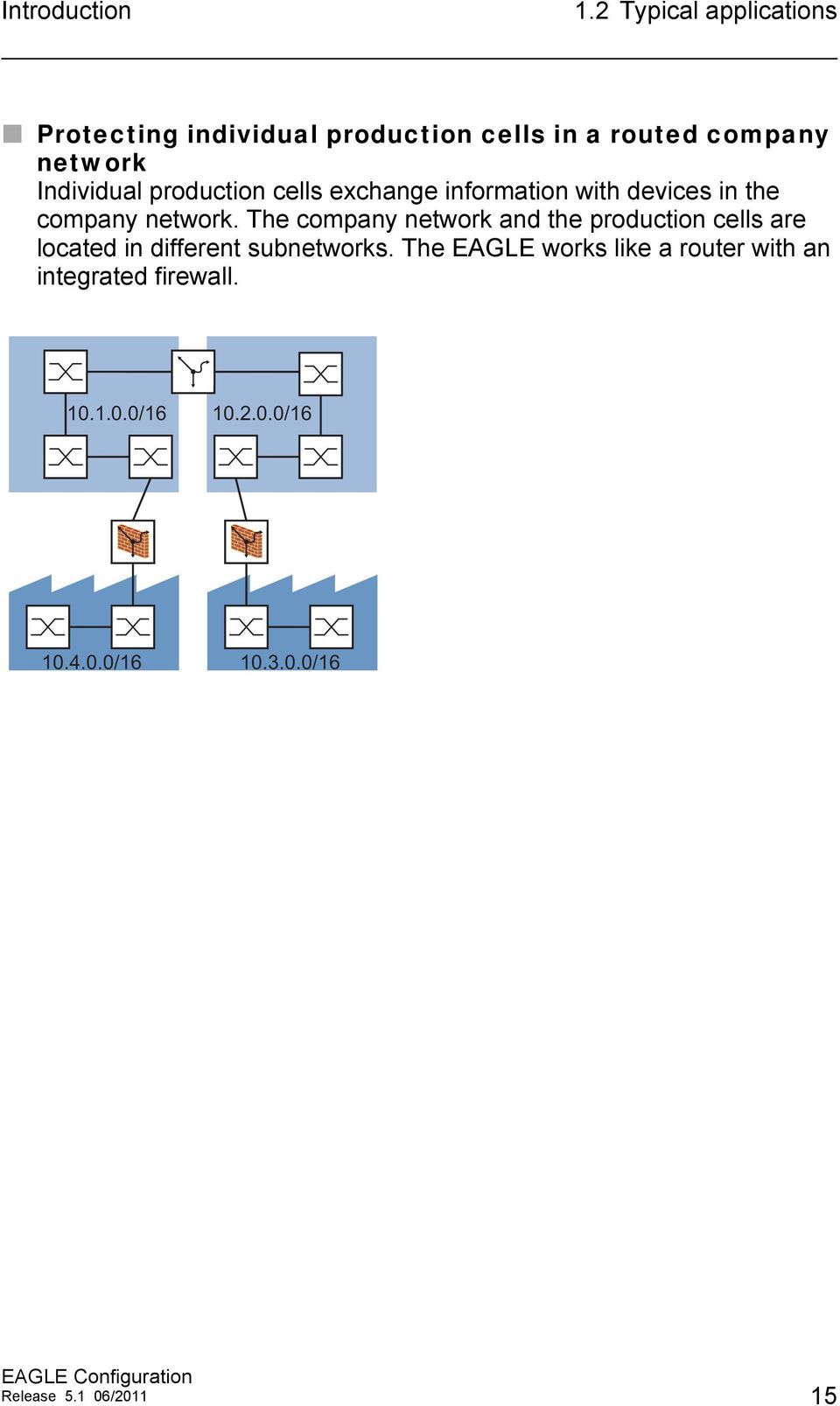
15 Introduction 1.2 Typical applications Protecting individual production cells in a routed company network Individual production cells exchange information with devices in the company network. The company network and the production cells are located in different subnetworks. The EAGLE works like a router with an integrated firewall / / / /16 15
16 Introduction 1.2 Typical applications Coupling identical production cells to a company network Individual, identically structured production cells exchange information with devices in the company network. The company network and the production cells are located in different subnetworks. The EAGLE works like a router with an integrated firewall. The NAT function enables the identically structured production cells to communicate with the company network, even though the devices have the same IP address in the different production cells / /16 NAT NAT NAT / / /30 Connecting a production cell with the office network via a public network A production cell exchanges information with devices in the company network via the public Internet. A virtual information tunnel (virtual private network, VPN) through the public Internet protects the communication / /8 16

17 Introduction 1.2 Typical applications Providing protected service access A service technician exchanges information with devices in the production cell via the public Internet. A virtual information tunnel (virtual private network, VPN) through the public Internet protects the communication /8 Modem 17

18 Introduction 1.3 Configuring the application 1.3 Configuring the application The Industrial ETHERNET Firewall has 3 operating modes: Transparent mode Router mode PPPoE mode Your choice of operating mode depends on your application case. The table below helps you when choosing the operating mode. Application Characteristic Operating mode Protecting individual Transmission on level 2 of the ISO/OSI layer Transparent production cells in a flat model. The IP address ranges before and after company network the Firewall are located in the same subnetwork. Protecting individual production cells in a routed company network Coupling identical production cells to a company network Connecting a production cell with the office network via a public network Providing protected service access Table 1: Choosing the operating mode Transmission on level 3 of the ISO/OSI layer model. The IP address ranges before and after the Firewall are located in different subnetworks. Transmission on level 3 of the ISO/OSI layer model. The IP address ranges before and after the Firewall are located in different subnetworks. The Nat function is used to map IP addresses onto a different IP address range. Transmission on level 3 of the ISO/OSI layer model. The IP address ranges before and after the Firewall are located in different subnetworks. Data transfer in a protected tunnel through the public Internet (VPN). Service access via the public telephone network. Router Router Router PPPoE Depending on the operating mode you choose, there are different procedures for the further configuration of the Industrial ETHERNET Firewall. 18

19 Introduction 1.3 Configuring the application Configuration steps in the transparent mode In the state on delivery, the Industrial ETHERNET Firewall is in the transparent mode. The default settings enable you to start operating the Industrial ETHERNET Firewall immediately. In the state on delivery, the Industrial ETHERNET Firewall prevents a communication link from being set up if it is initiated externally. Internal devices can set up a communication link to the outside. To protect the access to the Industrial ETHERNET Firewall and make further settings, you proceed as follows: Make connection to Firewall(see on page 23 Access to the user interfaces ) Select the transparent operating mode (see on page 44 IP parameters in Transparent Mode ) Enter IP parameters for the device (see on page 44 IP parameters in Transparent Mode ) Protect Industrial ETHERNET Firewall from unauthorized access (see on page 91 Protection from Unauthorized Access ) Create rules for unauthorized and forbidden data traffic (see on page 115 Controlling the Data Traffic ) 19
20 Introduction 1.3 Configuring the application Configurations steps in router mode In the state on delivery, the Industrial ETHERNET Firewall is in the transparent mode. To protect the access to the Industrial ETHERNET Firewall and make further settings, you proceed as follows: Make connection to Firewall(see on page 23 Access to the user interfaces ) Select the router operating mode (see on page 45 IP Parameters in Router Mode ) Enter IP parameter for the internal port (see on page 45 Internal interface ) Enter IP parameter for the external port (see on page 46 External Interface ) Protect Industrial ETHERNET Firewall from unauthorized access (see on page 91 Protection from Unauthorized Access ) Create rules for unauthorized and forbidden data traffic (see on page 115 Controlling the Data Traffic ) Make NAT settings (see on page 136 NAT - Network Address Translation ) Set up VPN connection (see on page 154 VPN - Virtual Private Network ) 20
21 Introduction 1.3 Configuring the application Configurations steps in PPPoE mode In the state on delivery, the Industrial ETHERNET Firewall is in the transparent mode. To protect the access to the Industrial ETHERNET Firewall and make further settings, you proceed as follows: Make connection to Firewall(see on page 23 Access to the user interfaces ) Select the PPPoE operating mode (see on page 47 Connection parameters in PPPoE Mode ) Enter IP parameter for the internal port (see on page 47 Internal interface ) Enter connection parameters for the external port (see on page 48 External Interface ) Switch the automatic interruption of the PPPoE connection on or off (see page 48 External Interface ) Protect Industrial ETHERNET Firewall from unauthorized access (see on page 91 Protection from Unauthorized Access ) Create rules for unauthorized and forbidden data traffic (see on page 115 Controlling the Data Traffic ) Make NAT settings (see on page 136 NAT - Network Address Translation ) Set up VPN connection (see on page 154 VPN - Virtual Private Network ) 21
22 Introduction 1.3 Configuring the application 22
23 Access to the user interfaces 2 Access to the user interfaces The device has three user interfaces, which you can access via different interfaces: System monitor via the V.24 interface (out-of-band) Command Line Interface (CLI) via the V.24 connection (out-of-band) via SSH (in-band) Web-based interface via Ethernet (SNMPv3, in-band) 23
24 Access to the user interfaces 2.1 System Monitor 2.1 System Monitor The system monitor enables you to select the software to be loaded perform a software update start the selected software shut down the system monitor delete the configuration saved and display the boot code information. Opening the system monitor Use the terminal cable (see accessories) to connect the V.24 socket (RJ11) to a terminal or a COM port of a PC with terminal emulation based on VT100 (for the physical connection, see the "Installation" user manual). Speed Data Parity Stopbit Handshake 9,600 Baud 8 bit None 1 bit Off Table 2: Data transfer parameters Start the terminal program on the PC and set up a connection with the device. When you boot the device, the message "Press <1> to enter System Monitor 1" appears on the terminal. 24
25 Access to the user interfaces 2.1 System Monitor < Eagle (Boot) Release: Build: :09 HW: 1.00 > Press <1> to enter System Monitor Figure 1: Screen display during the boot process Press the <1> key within one second to start system monitor 1. System Monitor 1 (Selected OS: SDV ( :09)) 1 Select Boot Operating System 2 Update Operating System 3 Start Selected Operating System 4 End (reset and reboot) 5 Erase main configuration file 6 Show Bootcode information sysmon1> Figure 2: System monitor 1 screen display Select a menu item by entering the number. To leave a submenu and return to the main menu of system monitor 1, press the <ESC> key. 25
26 Access to the user interfaces 2.2 Command Line Interface 2.2 Command Line Interface The Command Line Interface enables you to use all the functions of the device via a local or remote connection. The Command Line Interface provides IT specialists with a familiar environment for configuring IT devices. You will find a detailed description of the Command Line Interface in the Command Line Interface reference manual. Note: To facilitate making entries, CLI gives you the option of abbreviating keywords. Type in the beginning of a keyword. If the characters entered identify a keyword, CLI will complete the keyword when you press the tab key or the space key. Note: You can configure the V.24 interface either as a modem interface or a terminal/cli interface. However, to be able have at least limited access to the CLI interface in modem mode, you connect your terminal (setting on terminal: 9,600 baud) to the V.24 interface. Press any key on your terminal keyboard a number of times until the login screen indicates the CLI mode. Opening the Command Line Interface Connect the device to a terminal or to a COM port of a PC using terminal emulation based on VT100, and press any key (see on page 24 Opening the system monitor ) or call up the Command Line Interface via SSH. A window for entering the user name appears on the screen. Up to five users can access the Command Line Interface. The EAGLE is a Security Device with VPN function (SDV). 26
27 Access to the user interfaces 2.2 Command Line Interface Copyright (c) Hirschmann Automation and Control GmbH All rights reserved Eagle Release SDV (Build date :08) System Name: EAGLE Netw. Mode : transparent Mgmt-IP : a.b.c.d Base-MAC : 00:11:22:33:44:55 System Time: SUN AUG 08 08:08: (Hirschmann Eagle) User: Figure 3: Logging in to the Command Line Interface program Enter a user name. The default setting for the user name is admin. Press the Enter key. Enter the password. The default setting for the password is private. Press the Enter key. You can change the user name and the password later in the Command Line Interface. Please note that these entries are case-sensitive. The start screen appears. 27
28 Access to the user interfaces 2.2 Command Line Interface NOTE: Enter '?' for Command Help. Command help displays all options that are valid for the particular mode. For the syntax of a particular command form, please consult the documentation. (Hirschmann Eagle) > Figure 4: CLI screen after login 28
29 Access to the user interfaces 2.3 Web-based Interface 2.3 Web-based Interface The user-friendly Web-based interface gives you the option of operating the device from any location in the network via a standard browser such as Mozilla Firefox or Microsoft Internet Explorer. As a universal access tool, the Web browser uses an applet which communicates with the device via the Simple Network Management Protocol (SNMP). The Web-based interface allows you to graphically configure the device. In the state on delivery, the firewall setting allows Web access via the internal interface. the firewall setting prevents Web access via the external interface, for security reasons. Opening the Web-based Interface via the internal port To open the Web-based interface, you need a Web browser (a program that can read hypertext), for example Mozilla Firefox version 1 or later, or Microsoft Internet Explorer version 6 or later. Note: The Web-based interface uses the Java software version 6 (Java Runtime Environment Version 1.6.x). Install the software from the enclosed CD-ROM. To do this, you go to Additional Software, select Java Runtime Environment and click Installation. 29
30 Access to the user interfaces 2.3 Web-based Interface Figure 5: Installing Java Start your Web browser. Make sure that you have activated JavaScript and Java in the security settings of your browser. Establish the connection by entering the IP address of the device which you want to administer via the Web-based management in the address field of the Web browser. Enter the address in the following form: On delivery, the device has the IP address The login window appears on the screen. The EAGLE is a Security Device with VPN function (SDV). 30
31 Access to the user interfaces 2.3 Web-based Interface Figure 6: Login window Select the desired language. In the Login drop-down menu, select user to have read access to the device admin to have read/write access to the device. The password public, with which you have read access, appears in the password field. If you wish to have write access to the device, then highlight the contents of the password field and overwrite it with the password private (default setting). In the Login Type drop-down menu, select Administration if you want to manage the device, or User Firewall if you want to login for the user firewall function (prerequisite: the user selected in the Login drop-down menu has already been created in the user firewall). Click on OK. The website of the device appears on the screen. Note: For security reasons, change the factory setting password to prevent the device from being accessed with this password. If the password is the factory setting password, the device displays the message Default Password in every dialog s header line. 31
32 Access to the user interfaces 2.3 Web-based Interface Note: The changes you make in the dialogs are copied to the volatile memory of the device when you click on Write. Click on Load to update the display. Opening the Web-based Interface via the external port In the state on delivery, the firewall setting prevents Web access via the external port, for security reasons. You can access the device via the external port if you create and activate for your PC a rule for the Web access and the SNMP access. First open the Web-based Interface via the internal port (see on page 29 Opening the Web-based Interface via the internal port ). After creating the access rules at the external port, you can open the Web-based interface via the external port in the same way as via the internal port. In the Security:Web Access menu, create a new entry with the IP address of your PC as the source address. Select Accept in the Action column and activate the table entry. In the Security:SNMP Access menu, create a new entry with the IP address of your PC as the source address. Select Accept in the Action column and activate the table entry. Proceed in the same way as for opening the internal port. 32
33 Entering the IP Parameters 3 Entering the IP Parameters Choosing the operating mode The entries for the IP parameters depend on the operating mode selected. In Transparent Mode, the local IP address is also the IP address of the management of the Industrial ETHERNET Firewall. In Router/PPPoE Mode, the IP address of the internal interface is also the IP address of the management of the Industrial ETHERNET Firewall. Depending on the firewall settings, you can also access the management via the IP address of the external interface. Choose an operating mode that meets your requirements. In the state on delivery, the Transparent Mode is active. Options for entering the IP parameters for the management of the Industrial ETHERNET Firewall The IP parameters must be entered when the device is installed for the first time so that you can access the device management for further configuration. During the first installation, the device provides you with 5 options for entering the local IP parameters in Transparent Mode, or the IP parameters of the internal interface in the Router/PPPoE mode: Entry using the Command Line Interface (CLI). You choose this out of band method if you preconfigure your device outside its operating environment you do not have network access ( in-band ) to the device (see page 42 Entering IP parameters via CLI ). Entry using the HiDiscovery protocol. You choose this in-band method if the device is already installed in the network or if you have another Ethernet connection between your PC and the device (see page 50 Entering the IP Parameters via HiDiscovery ). 33
34 Entering the IP Parameters Configuration using the AutoConfiguration Adapter (ACA). You choose this method if you are replacing a device with a device of the same type and have already saved the configuration on an ACA(see page 53 Loading the System Configuration from the ACA ). Configuration via DHCP. You choose this in-band method if you want to configure the installed device using DHCP. You need a DHCP server for this. The DHCP server assigns the IP parameters to the device using its MAC address or its system name (see page 55 System Configuration via DHCP ). Configuration via the Web-based interface. If the device already has an IP address and can be reached via the network, then the Web-based interface provides you with another option for configuring the IP parameters. 34
35 Entering the IP Parameters 3.1 IP Parameter Basics 3.1 IP Parameter Basics IP address (version 4) The IP addresses consist of 4 bytes. These 4 bytes are written in decimal notation, separated by a decimal point. Since 1992, five classes of IP address have been defined in the RFC Class Network Host address Address range address A 1 byte 3 bytes to B 2 bytes 2 bytes to C 3 bytes 1 byte to D to E to Table 3: IP address classes The network address is the fixed part of the IP address. The worldwide leading regulatory board for assigning network addresses is the IANA (Internet Assigned Numbers Authority). If you require an IP address block, contact your Internet service provider. Internet service providers should contact their local higher-level organization: APNIC (Asia Pacific Network Information Center) - Asia/Pacific Region ARIN (American Registry for Internet Numbers) - Americas and Sub- Sahara Africa LACNIC (Regional Latin-American and Caribbean IP Address Registry) Latin America and some Caribbean Islands RIPE NCC (Réseaux IP Européens) - Europe and Surrounding Regions 35
36 Entering the IP Parameters 3.1 IP Parameter Basics 0 Net ID - 7 bits Host ID - 24 bits Class A I 0 Net ID - 14 bits Host ID - 16 bits Class B I I 0 Net ID - 21 bits Host ID - 8 bit s Class C I I I 0 Multicast Group ID - 28 bits Class D I I I I reserved for future use - 28 b its Class E Figure 7: Bit representation of the IP address All IP addresses belong to class A when their first bit is a zero, i.e. the first decimal number is less than 128. The IP address belongs to class B if the first bit is a one and the second bit is a zero, i.e. the first decimal number is between 128 and 191. The IP address belongs to class C if the first two bits are a one, i.e. the first decimal number is higher than 191. Assigning the host address (host id) is the responsibility of the network operator. He alone is responsible for the uniqueness of the IP addresses he assigns Private IP addresses If the IP address range assigned to you is not large enough for your requirements, or for whatever other reason, you can use the IP addresses of the private IP address range. IANA has defined three private IP address ranges in RFC Each of the three ranges is located in a different class. Internet routers block data packets with private IP addresses. Thus, the private addresses are only intended for use in internal networks. The Network Address Translation Protocol (see on page 136 NAT - Network Address Translation ) enables you to allow devices with a private IP address in an internal network with devices in other networks. 36
37 Entering the IP Parameters 3.1 IP Parameter Basics IP address range CIDR notation Network class /8 A /12 B /16 C Table 4: Private address ranges Netmask Routers and gateways subdivide large networks into subnetworks. The netmask assigns the IP addresses of the individual devices to a particular subnetwork. The division into subnetworks with the aid of the netmask is performed in much the same way as the division of the network addresses (net id) into classes A to C. The bits of the host address (host id) that represent the mask are set to one. The remaining bits of the host address in the netmask are set to zero (see the following examples). Example of a netmask: Decimal notation Binary notation Subnetwork mask bits Class B 37
38 Entering the IP Parameters 3.1 IP Parameter Basics Example of IP addresses with subnetwork assignment when the above subnet mask is applied: Decimal notation < Class B Binary notation Subnetwork 1 Network address Decimal notation < Class B Binary notation Subnetwork 2 Network address 38
39 Entering the IP Parameters 3.1 IP Parameter Basics Example of how the network mask is used In a large network it is possible that gateways and routers separate the management agent from its management station. How does addressing work in such a case? Romeo Juliet Lorenzo LAN 1 LAN 2 Figure 8: Management agent that is separated from its management station by a router The management station "Romeo" wants to send data to the management agent "Juliet". Romeo knows Juliet's IP address and also knows that the router "Lorenzo" knows the way to Juliet. Romeo therefore puts his message in an envelope and writes Juliet's IP address as the destination address. For the source address he writes his own IP address on the envelope. Romeo then places this envelope in a second one with Lorenzo's MAC address as the destination and his own MAC address as the source. This process is comparable to going from layer 3 to layer 2 of the ISO/OSI base reference model. Finally, Romeo puts the entire data packet into the mailbox. This is comparable to going from layer 2 to layer 1, i.e. to sending the data packet over the Ethernet. 39
40 Entering the IP Parameters 3.1 IP Parameter Basics Lorenzo receives the letter and removes the outer envelope. From the inner envelope he recognizes that the letter is meant for Juliet. He places the inner envelope in a new outer envelope and searches his address list (the ARP table) for Juliet's MAC address. He writes her MAC address on the outer envelope as the destination address and his own MAC address as the source address. He then places the entire data packet in the mail box. Juliet receives the letter and removes the outer envelope. She finds the inner envelope with Romeo's IP address. Opening the inner envelope and reading its contents corresponds to transferring the message to the higher protocol layers of the SO/OSI layer model. Juliet would now like to send a reply to Romeo. She places her reply in an envelope with Romeo's IP address as destination and her own IP address as source. But where is she to send the answer? For she did not receive Romeo's MAC address. It was lost when Lorenzo replaced the outer envelope. In the MIB, Juliet finds Lorenzo listed under the variable hmnetgatewayipaddr as a means of communicating with Romeo. She therefore puts the envelope with the IP addresses in a further envelope with Lorenzo's MAC destination address. The letter now travels back to Romeo via Lorenzo, the same way the first letter traveled from Romeo to Juliet Classless Inter-Domain Routing Class C with a maximum of 254 addresses was too small, and class B with a maximum of 65,534 addresses was too large for most users. This resulted in ineffective usage of the class B addresses available. Class D contains reserved multicast addresses. Class E is reserved for experimental purposes. A gateway not participating in these experiments ignores datagrams with these destination addresses. 40
41 Entering the IP Parameters 3.1 IP Parameter Basics Since 1993, RFC 1519 has been using Classless Inter-Domain Routing (CIDR) to provide a solution. CIDR overcomes these class boundaries and supports classless address ranges. With CIDR, you enter the number of bits that designate the IP address range. You represent the IP address range in binary form and count the mask bits that designate the netmask. The netmask indicates the number of bits that are identical to the network part for all IP addresses in a given address range. Example: IP address, decimal Network mask, decimal CIDR notation: /25 Mask bits IP address, hexadecimal mask bits The combination of a number of class C address ranges is known as supernetting. This enables you to subdivide class B address ranges to a very fine degree. 41
42 Entering the IP Parameters 3.2 Entering IP parameters via CLI 3.2 Entering IP parameters via CLI If you do not configure the system via DHCP, the HiDiscovery protocol or the ACA AutoConfiguration Adapter, then you perform the configuration via the V.24 interface using the CLI. Entering IP address Connect the PC with terminal program started to the RJ11 socket Command Line Interface starts after key press Log in and change to the Privileged EXEC Mode Select the operating mode (Transparent, Router/PPPoE) Enter and save IP parameter End of entering IP address Figure 9: Flow chart for entering IP addresses 42
43 Entering the IP Parameters 3.2 Entering IP parameters via CLI Note: If there is no terminal or PC with terminal emulation available in the vicinity of the installation location, you can configure the device at your own workstation, then take it to its final installation location. Set up a connection to the device (see on page 26 Opening the Command Line Interface ). The start screen appears. NOTE: Enter '?' for Command Help. Command help displays all options that are valid for the particular mode. For the syntax of a particular command form, please consult the documentation. (Hirschmann Eagle) > 43
44 Entering the IP Parameters 3.2 Entering IP parameters via CLI IP parameters in Transparent Mode Activate the transparent mode (state on delivery: transparent mode). If DCHP is switched on, switch it off (state on delivery: DHCP is switched off). Enter the IP parameters. Local IP Address On delivery, the device has the local IP address Netmask If your network has been divided up into subnetworks, and if these are identified with a netmask, then the netmask is to be entered here. The default setting of the netmask is IP address of the gateway This entry is required if the device and the management station or the DHCP server are located in different subnetworks (see page 39 Example of how the network mask is used ). Enter the IP address of the gateway that connects the local subnet with the management station s subnet. The default setting of the IP address is Save the configuration entered. enable network mode transparent network transparent proto none network transparent ip-address network transparent netmask network transparent gateway copy config running-config nv Switch to the Privileged EXEC mode. Select the Transparent Mode (state of delivery: Transparent Mode). Deactivate DHCP (state on delivery: disabled). Allocate the IP address to the device in transparent mode. Allocate the netmask to the device in transparent mode. Allocate the gateway address to the device in transparent mode. Save the current configuration to the non-volatile memory. 44
45 Entering the IP Parameters 3.2 Entering IP parameters via CLI After entering the IP parameters, you can easily configure the device via the Web-based interface (see the Web-based Interface reference manual) IP Parameters in Router Mode Internal interface Activate the router mode (state on delivery: transparent mode). If DCHP is switched on, switch it off (state on delivery: DHCP is switched off). Enter the IP parameters. Internal IP address On delivery, the device has the local IP address Netmask If your network has been divided up into subnetworks, and if these are identified with a netmask, then the netmask is to be entered here. The default setting of the netmask is Save the configuration entered with copy config running-config nv or save. 45
46 Entering the IP Parameters 3.2 Entering IP parameters via CLI enable network mode router network router proto int none network router param int ip-address network router param int netmask copy config running-config nv Switch to the Privileged EXEC mode. Select the Router Mode (state of delivery: Transparent Mode). Deactivate the DHCP on the internal router interface (state on delivery: disabled). Allocate the IP address to the internal router interface. Allocate the netmask to the internal router interface. Save the current configuration to the non-volatile memory. After entering the IP parameters, you can easily configure the device via the Web-based interface (see the Web-based Interface reference manual). External Interface If DCHP is switched on, switch it off (state on delivery: DHCP is switched off). Enter the IP parameters. External IP Address On delivery, the device has the local IP address Netmask If your network has been divided up into subnetworks, and if these are identified with a netmask, then the netmask is to be entered here. The default setting of the netmask is IP address of the gateway This entry is required if the device and the management station or the DHCP server are located in different subnetworks (see page 39 Example of how the network mask is used ). Enter the IP address of the gateway that connects the local subnet with the management station s subnet. The default setting of the IP address is Save the configuration entered with copy config running-config nv or save. 46
47 Entering the IP Parameters 3.2 Entering IP parameters via CLI enable network router proto ext none network router param ext ip-address network router param ext netmask network router gateway copy config running-config nv Switch to the Privileged EXEC mode. Deactivate the DHCP on the external router interface (state on delivery: disabled). Allocate the IP address to the external router interface. Allocate the netmask to the external router interface. Allocate the gateway address to the device. The gateway must be located in the network of one of the router interfaces. Save the current configuration to the non-volatile memory Connection parameters in PPPoE Mode Internal interface Activate the PPPoE mode (state on delivery: transparent mode). If DCHP is switched on, switch it off (state on delivery: DHCP is switched off). Enter the IP parameters. Internal IP address On delivery, the device has the local IP address Netmask If your network has been divided up into subnetworks, and if these are identified with a netmask, then the netmask is to be entered here. The default setting of the netmask is Save the configuration entered with copy config running-config nv or save. 47
48 Entering the IP Parameters 3.2 Entering IP parameters via CLI enable network mode pppoe network router proto int none network router param int ipaddress network router param int netmask copy config running-config nv Switch to the Privileged EXEC mode. Select the PPPoE Mode (state on delivery: Transparent Mode). Deactivate DHCP (state on delivery: disabled). Allocate the IP address to the internal interface. Allocate the netmask to the device in transparent mode. Save the current configuration to the non-volatile memory. After entering the IP parameters, you can easily configure the device via the Web-based interface (see the Web-based Interface reference manual). External Interface Enter the connection parameters that you got from your provider for the connection. Username Password MTU (Maximum Transmission Unit). The MTU specifies the maximum frame size that this connection can transmit. If larger data packets are to be transmitted, the Firewall fragments the larger data packet into multiple small data packets. Save the configuration entered with copy config running-config nv or save. enable Switch to the Privileged EXEC mode. network pppoe username Peter Enter the user name Peter. network pppoe password Enter the password Holidays. Holidays network pppoe mtu-size 1492 Enter the maximum frame size as copy config running-config nv Save the current configuration to the non-volatile memory. 48
49 Entering the IP Parameters 3.2 Entering IP parameters via CLI Note: Normally, you can skip the setting of the maximum frame size. Set the maximum frame size if you know that your Internet Service Provider uses a different value. The external interface gets its IP address from the connection provider via PPPoE. The EAGLE device allows you to automatically interrupt the PPPoE connection every day. To activate this function, you proceed as follows: enable network pppoe disconnect admin-state enable network pppoe disconnect hour 2 copy config running-config nv Switch to the Privileged EXEC mode. Specify that the device automatically interrupts the PPPoE connection at the specified time every day. Set the time (hour) at which the device automatically interrupts the PPPoE connection every day. Value range: 0 to 23. Save the current configuration to the non-volatile memory. 49
50 Entering the IP Parameters 3.3 Entering the IP Parameters via HiDiscovery 3.3 Entering the IP Parameters via HiDiscovery The HiDiscovery protocol enables you to assign IP parameters to the device via the Ethernet. You can easily configure other parameters via the Web-based interface (see the "Web-based Interface" reference manual). In the state on delivery, the HiDiscovery function of the device is activated at the internal port, deactivated at the external port. Note: The device offers the configuration with HiDiscovery exclusively in and for transparent mode. The transparent mode is activated in the as-delivered condition. Install the HiDiscovery software on your PC. The software is on the CD supplied with the device. To install it, you start the installation program on the CD. 50
51 Entering the IP Parameters 3.3 Entering the IP Parameters via HiDiscovery Start the HiDiscovery program. Figure 10: HiDiscovery When HiDiscovery is started, HiDiscovery automatically searches the network for those devices which support the HiDiscovery protocol. HiDiscovery uses the first network interface found for the PC. If your computer has several network cards, you can select the one you desire in the HiDiscovery toolbar. HiDiscovery displays a line for every device that reacts to the HiDiscovery protocol. Note: When the IP address is entered, the device copies the local configuration settings (see on page 66 Editing and managing Configurations ). 51
52 Entering the IP Parameters 3.3 Entering the IP Parameters via HiDiscovery Note: For security reasons, switch off the HiDiscovery function for the device in the Web-based interface, after you have assigned the IP parameters to the device (see on page 59 Web-based IP Configuration ). Note: Save the settings so that you will still have the entries after a restart (see on page 66 Editing and managing Configurations ). HiDiscovery enables you to identify the devices displayed. Select a device line. Click on the signal symbol in the tool bar to set the LEDs for the selected device flashing. To switch off the flashing, click on the symbol again. By double-clicking a line, you open a window in which you can enter the device name and the IP parameters. Figure 11: HiDiscovery - assigning IP parameters 52
53 Entering the IP Parameters 3.4 Loading the System Configuration from the ACA 3.4 Loading the System Configuration from the ACA The AutoConfiguration Adapter (ACA) is a device for storing the configuration data of a device and storing the device software. In the case of a device becoming inoperative, the ACA makes it possible to easily transfer the configuration data by means of a substitute device of the same type. When you start the device, it checks for an ACA. If it finds an ACA with a valid password and valid software, the device loads the configuration data from the ACA. The password is valid if the password in the device matches the password in the ACA or the preset password is entered in the device. To save the configuration data in the ACA(see on page 68 Saving the Configuration ). 53
54 Entering the IP Parameters 3.4 Loading the System Configuration from the ACA a a 5 Figure 12: Flow chart of loading configuration dats from the ACA 1 Device start-up 2 ACA plugged-in? 3 Password in device and ACA identical? 3a Default password in device? 4 Load configuration from ACA, ACA LEDs flashing synchronously 4a Load configuration from local memory, ACA LEDs flashing alternately 5 Configuration data loaded 54
55 Entering the IP Parameters 3.5 System Configuration via DHCP 3.5 System Configuration via DHCP When it is started up via DHCP (dynamic host configuration protocol), a device receives its configuration data in accordance with the flow chart. DHCP enables the configuration of the device (DHCP Client) via a name. For the DHCP, this name is known as the client identifier in accordance with RFC The device uses the name entered under sysname in the system group of the MIB II as the client identifier. You can enter this system name directly via SNMP, the Web-based management (see system dialog), or the Command Line Interface. During startup operation, a device receives its IP parameters according to the DHCP process flowchart (see fig. 13). 55
56 Entering the IP Parameters 3.5 System Configuration via DHCP Start-up Load default configuration Device in initalization Device runs with settings from local flash No DHCP? Yes Send DHCP Requests No Reply from DHCP server? Yes Save IP parameters locally initialize IP stack with IP parameters Device is manageable Figure 13: Flow chart for the DHCP process The device sends its system name to the DHCP server. The DHCP servercan then use the system name to allocate an IP address as an alternative tothe MAC address. The device accepts this data as configuration parameters (see on page 59 Web-based IP Configuration ). If an IP address was assigned by a DHCP server, it will be permanently saved locally 56
57 Entering the IP Parameters 3.5 System Configuration via DHCP Option Meaning 1 Subnet Mask 2 Time Offset 3 Router 4 Time server 12 Host Name 61 Client Identifier 66 TFTP Server Name 67 Bootfile Name Table 5: DHCP Options requested by the device The DHCP server provides ( leases ) the configuration parameters for a specific time period. To avoid this, most DHCP servers provide the explicit configuration option of always assigning a specific client the same IP address based on a unique hardware ID (known as static address allocation). On delivery, DHCP is inactive. If DHCP is activated, the device attempts to obtain an IP address. If it cannot find a DHCP server after restarting, it will not have an IP address. To activate/ deactivate DHCP (see on page 59 Web-based IP Configuration ). Note: When using HiVision network management, ensure that DHCP always allocates the original IP address to each device. In the appendix, you will find an example for the configuration of a BOOTP/ DHCP server (see on page 230 Setting up the DHCP Server ). Example of a DHCP configuration file: # /etc/dhcpd.conf for DHCP Daemon # subnet netmask { option subnet-mask ; option routers ; 57
58 Entering the IP Parameters 3.5 System Configuration via DHCP } # # Host berta requests IP configuration # with her MAC address # host berta { hardware ethernet 00:80:63:08:65:42; fixed-address ; } # # Host hugo requests IP configuration # with his client identifier. # host hugo { # option dhcp-client-identifier "hugo"; option dhcp-client-identifier 00:68:75:67:6f; fixed-address ; server-name " "; filename "/agent/config.dat"; } Lines that start with a '#' character are comment lines. The lines preceding the individually listed devices refer to settings that apply to all the following devices. The fixed-address line assigns a permanent IP address to the device. For further information, please refer to the DHCP server manual. 58
59 Entering the IP Parameters 3.6 Web-based IP Configuration 3.6 Web-based IP Configuration With the Basic Settings:Network dialog you define the source from which the device gets its IP parameters after starting, and you assign the IP parameters, define the handling of the VLAN ID and configure the HiDiscovery access. Choose the operating mode (see on page 18 Configuring the application ) IP configuration in Transparent Mode In the Protocol frame, you enter where the device is to obtain its IP parameters: Select DHCP if the configuration is to be performed by a DHCP server on the basis of the MAC address or the name of the device (see page 55 System Configuration via DHCP ). If DHCP is not selected, the device uses the network parameters in its local memory. Select Use VLAN Tag if you want the device to evaluate the VLAN tag of the data packets received. If this function is active, you can only access the management of the device VLAN entered in Management VLAN ID (see below). The Management VLAN ID line enables you to assign a VLAN to the interface for the management of the device (see Use VLAN Tag above). Entering local IP parameters Enter the IP address of the device in the IP Address field. 59
60 Entering the IP Parameters 3.6 Web-based IP Configuration In the Gateway IP Address field, enter the IP address of the gateway to which the device is to forward data packets whose destination address is outside its own subnetwork. Enter the netmask in the Netmask field. Getting IP Parameters via DHCP You enter the name applicable to the DHCP protocol in the Name line in the system dialog of the Web-based interface. Configuring the HiDiscovery protocol The HiDiscovery protocol allows you to allocate an IP address to the device on the basis of its MAC address. Activate the HiDiscovery protocol if you want to transfer an IP address to the device from your PC with the enclosed HiDiscovery software (setting on delivery: active). Save IP configuration Save the settings so that you will still have the entries after a restart (see page 66 Editing and managing Configurations ) IP configuration in Router Mode In Router Mode, the device requires the IP parameters to be entered on the internal and external interfaces. In the Protocol frame, you enter where the device is to obtain its IP parameters: 60
61 Entering the IP Parameters 3.6 Web-based IP Configuration Select DHCP if the configuration is to be performed by a DHCP server on the basis of the MAC address or the name of the device (see page 55 System Configuration via DHCP ). If DHCP is not selected, the device uses the network parameters in its local memory. Select Use VLAN Tag if you want the device to evaluate the VLAN tag of the data packets received. When this function is active, the device drops all data packets received whose VLAN tag contains a VLAN ID different to the one entered in this dialog. The VLAN ID line enables you to allocate a VLAN to the interface. Entering local IP parameters Enter the IP address of the device in the IP Address field. Enter the netmask in the Netmask field. In the Gateway IP Address field, enter the IP address of the gateway to which the device is to forward data packets whose destination address is outside its own subnetwork. If you want to allocate more than one IP address to an interface, you can press Create to enter additional IP parameters in the table below. You require multiple IP addresses on an interface if you want to connect large flat networks with different subnetworks at one port. Getting IP Parameters via DHCP You enter the name applicable to the DHCP protocol in the Name line in the system dialog of the Web-based interface. Save IP configuration Save the settings so that you will still have the entries after a restart (see page 66 Editing and managing Configurations ). 61
62 Entering the IP Parameters 3.6 Web-based IP Configuration IP configuration in PPPoE Mode In Router Mode, the device requires the IP parameters to be entered on the internal interface. The device gets the IP parameters for the external interface from the connection provider. In the Protocol frame, you enter where the device is to obtain its IP parameters: Select DHCP if the configuration is to be performed by a DHCP server on the basis of the MAC address or the name of the device (see page 55 System Configuration via DHCP ). If DHCP is not selected, the device uses the network parameters in its local memory. Select Use VLAN Tag if you want the device to evaluate the VLAN tag of the data packets received. When this function is active, the device drops all data packets received whose VLAN tag contains a VLAN ID different to the one entered in this dialog. The VLAN ID line enables you to allocate a VLAN to the interface. Entering local IP parameters Enter the IP address of the device in the IP Address field. Enter the netmask in the Netmask field. In the Gateway IP Address field, enter the IP address of the gateway to which the device is to forward data packets whose destination address is outside its own subnetwork. If you want to allocate more than one IP address to an interface, you can press Create to enter additional IP parameters in the table below. You require multiple IP addresses on an interface if you want to connect large flat networks with different subnetworks at one port. Getting IP Parameters via DHCP You enter the name applicable to the DHCP protocol in the Name line in the system dialog of the Web-based interface. 62
63 Entering the IP Parameters 3.6 Web-based IP Configuration Entering PPPoE connection parameters Enter the connection parameters that you got from your provider for the connection. Username Password MTU (Maximum Transmission Unit). The MTU specifies the maximum frame size that this connection can transmit. If larger data packets are to be transmitted, the Firewall fragments the larger data packet into multiple small data packets. Save IP configuration Save the settings so that you will still have the entries after a restart (see page 66 Editing and managing Configurations ). 63
64 Entering the IP Parameters 3.7 Faulty Device Replacement 3.7 Faulty Device Replacement The device provides a plug-and-play solution for replacing a faulty device with a device of the same type (faulty device replacement): Configuring the new device using an AutoConfiguration Adapter (see on page 53 Loading the System Configuration from the ACA ). When the new device is started, it is given the same configuration data that the faulty device had. 64
65 Basic Settings 4 Basic Settings The basic settings of the device include: Editing and managing configurations (device settings) Loading the latest device software Configuring the ports of the device Synchronizing the system time in the network 65
66 Basic Settings 4.1 Editing and managing Configurations 4.1 Editing and managing Configurations When it is restarted, the device loads its configuration (settings) from its nonvolatile memory, once you have not activated DHCP and no ACA is connected to the device. During operation, the device allows you to load configurations (settings) from the following sources: from its non-volatile memory (NVM), from the AutoConfiguration Adapter. If an ACA is connected to the device, the device loads its configuration from the ACA if the configuration saved on the ACA differs from the configuration saved locally. The device saves configurations (settings) such as the IP parameters and the port configuration in the temporary memory. These settings are lost when you switch off or reboot the device. The device allows you to do the following with configurations (settings): activate them, save them, reset them to the state on delivery, load them from the non-volatile memory (NVM), copy them, display them, delete them. If you change the current configuration (for example, by switching a port off), the Web-based interface changes the load/save symbol in the navigation tree from a disk symbol to a yellow triangle. After saving the configuration, the Web-based interface displays the load/save symbol as a disk again. 66
67 Basic Settings 4.1 Editing and managing Configurations Figure 14: Load/Save dialog Activating a Configuration The device allows you to activate a stored configuration from the table Configuration in the non-volatile memory (NVM). Select the dialog Basic Settings:Load/Save. Select a non-active configuration file in the NVM configuration table. Click on Activate. In the Active column, the device shows you the active configuration. If an ACA with the same configuration file is connected, the device activates the configuration file on the ACA and grays out the display of the activation in the NVM table. 67
68 Basic Settings 4.1 Editing and managing Configurations enable show config profiles nv copy config nv profile <name> running-config Switch to the privileged EXEC mode. Display the configurations stored in the NVM. The device loads configuration data Name from the local non-volatile memory. Note: If you mark a configuration as active using the alternative CLI command profile activate nv <id>, it will only take effect after you issue the CLI command copy config nv running-config. Note: When loading (activating) a configuration, do not access the device until it has loaded the configuration file and has made the new configuration settings. Depending on the complexity of the configuration settings, this procedure can take several seconds. Wait until the device selects the new configuration in the Active column Saving the Configuration The device allows you to do the following with the current configuration (setting) on the device and the ACA: save it in a new configuration file, Saving a configuration in a new configuration file Select the Basics: Load/Save dialog. Click on Create to open a window for entering a new row in the table. Enter a name in Configuration name in the file window. Click on OK. 68
69 Basic Settings 4.1 Editing and managing Configurations The device saves the configuration in a new file in the NVM and on the ACA. Note: File names must not contain space characters and the maximum length is 32 characters. Saving a configuration in an active configuration file The device allows you to replace the active configuration with the current configuration. Note than you overwrite the active configuration file when you save the current configuration in it. Select the dialog Basic Settings:Load/Save. Click on Save to NVM + ACA when you want to replace the active configuration with the current configuration in the non-volatile memory and on the ACA. Note: If you want to load the active configuration file from the local nonvolatile memory, click on Restore from NVM. enable copy config running-config nv Switch to the privileged EXEC mode. The device saves the current configuration data in the local non-volatile memory and, if an ACA is connected, also on the ACA. 69
70 Basic Settings 4.1 Editing and managing Configurations Resetting the Configuration to the State on Delivery The device allows you to reset the configuration to the state on delivery. Select the Basic Settings:Restart dialog. Click on Reset to factory. enable clear factory clear config Switch to the privileged EXEC mode. Reset NVM and ACA to the factory settings. Delete the current configuration, including the IP parameters. Setting in the system monitor: Select 5 Erase main configuration file This menu item allows you to reset the configuration of the device to its state on delivery. Press the Enter key to restore the configuration of the state on delivery. Note: The device deletes all tables, settings and files on the device and on a connected ACA. Note: The command clear config does not clear the name of the active configuration profile. Use the command save profile to store the cleared configuration under a new name. 70
71 Basic Settings 4.1 Editing and managing Configurations Loading the active Configuration The device allows you to load the active configuration. Select the dialog Basic Settings:Load/Save. Click on Restore from NVM if you want to load the active configuration file from the non-volatile memory. enable copy config nv running-config Switch to the privileged EXEC mode. Load the active configuration Copying Configuration Files Copying from a PC to the device The device allows you to copy a configuration file from a PC to the device. Select the Basics: Load/Save dialog. Click on Copy from PC beside the NVM configuration table. In the file selection frame, click on.... In the file selection window, select the configuration file (*.cfg) and click on Set. In the file selection frame, click on Copy from PC. The end of the upload is indicated by one of the following messages: Update completed successfully. File not found. Reason: File name not found or does not exist. 71
72 Basic Settings 4.1 Editing and managing Configurations Copying from a PC to the ACA The device allows you to copy a configuration file from a PC to the ACA. Select the Basics: Load/Save dialog. Click on Copy from PC beside the ACA configuration table. In the file selection frame, click on.... In the file selection window, select the configuration file (*.cfg) and click on Set. In the file selection frame, click on Copy from PC. The end of the upload is indicated by one of the following messages: Update completed successfully. File not found. Reason: File name not found or does not exist. When you restart, the device adopts the configuration data of the ACA and saves it permanently in the flash memory. If the connected ACA does not contain any valid data, for example, if it is in the delivery state, the device loads the data from the flash memory. Before loading the configuration data from the ACA, the device compares the password in the device with the password in the ACA configuration data. The device loads the configuration data if the admin password matches or there is no password stored locally or the local password is the delivery state password or no configuration is saved locally. Copying from the device or the ACA to a PC The device allows you to save a configuration file of the device or the ACA on a PC. Select the Basics: Load/Save dialog. Select a table entry of the device (configuration in the non-volatile memory (NVM)) or of the ACA (configuration on the AutoConfig Adapter (ACA)) Click on Copy to PC. In the file selection window, select the desired directory and click on Set. 72
73 Basic Settings 4.1 Editing and managing Configurations Copying from the ACA to the device The device allows you to store a configuration file from the ACA on the device. Select the Basics: Load/Save dialog. Select a table entry of the ACA (configuration on the AutoConfig Adapter (ACA)). Click on Copy to NVM. enable copy config aca profile <name> nv Switch to the privileged EXEC mode. Load configuration Name onto the device Displaying a Configuration File The device allows you to display a configuration file on the device and on the ACA. Select the Basics: Load/Save dialog. Select a table entry of the device (configuration in the non-volatile memory (NVM)) or of the ACA (configuration on the AutoConfig Adapter (ACA)) Click on Show. 73
74 Basic Settings 4.1 Editing and managing Configurations Deleting a Configuration File The device allows you to delete a non-active configuration file on the device and on the ACA. Select the Basics: Load/Save dialog. Select a non-active table entry of the device (configuration in the non-volatile memory (NVM)) or of the ACA (configuration on the AutoConfig Adapter (ACA)) Click on Delete. enable show config profiles nv profile delete nv <index> show config profiles aca profile delete aca <index> Switch to the privileged EXEC mode. Display the configurations stored in the NVM. Delete the configuration with the specified index in the NVM. Display the configurations stored in the ACA. Delete the configuration with the specified index in the ACA SFTP Access to Device Files The device allows you to use SFTP to access device files such as configuration files or the ACA, or to load a firmware update or VPN certificates onto the device. To do this, use an SFTP client, such as WinSCP. For the SFTP access, you must have SSH access to the device. To do this, enable the SSH access to the device (see on page 101 Configuring CLI the Access ). 74
75 Basic Settings 4.1 Editing and managing Configurations Cancelling a Configuration Change The device allows you to automatically cancel a configuration change if the device loses its network connection with the management station from which you configure the device. An example is the inadvertent changing of the device's IP address. You can use this function during remote maintenance. When the function is active, the device constantly checks if it is periodically accessed from the management station s IP address. If these accesses are not received within a certain time, the device replaces its current configuration with the most recently saved configuration. This function is useful for administrators when the device is far removed or difficult to access. State on delivery: Operation: Off, Waiting time: 600 s. Note: Deactivate the function after you have successfully saved the configuration. In this way you prevent the device from reloading the configuration after you close the web interface. Select the Basics: Load/Save dialog. To activate the function, select Function in the Configuration change frame. Enter the waiting time at Period until cancellation when connection is interrupted. Click Set to temporarily save the entry in the configuration. Click Load to display the IP address of your management station in the Watchdog IP address field. To deactivate the function, deselect Function in the Configuration change frame. Click Set to temporarily save the entry in the configuration. Then click on Load. The Watchdog IP address field now shows
76 Basic Settings 4.1 Editing and managing Configurations enable show config-watchdog configure config-watchdog admin-state enable config-watchdog admin-state disable config-watchdog timeout 300 Switch to the privileged EXEC mode. Display of settings for the automatic cancellation of a configuration change during a connection interruption. Switch to the Configuration mode. Activation of the automatic cancellation of a configuration change during a connection interruption. Deactivation of the automatic cancellation of a configuration change during a connection interruption. Timeout settings for automatic cancellation of a configuration change during a connection interruption at 300 s. 76
77 Basic Settings 4.2 Loading Software Updates 4.2 Loading Software Updates Hirschmann never stops working on improving the performance of its products. So it is possible that you may find a more up to date release of the device software on the Hirschmann Internet site ( than the release saved on your device Checking the installed Software Release Select the Basics:Software dialog. This dialog shows you the variant, the release number and the date of the software saved on the device. Stored Version : the software in the non-volatile memory Running Version : the software currently being used Backup Version : the backup software in the non-volatile memory enable show system info Switch to the privileged EXEC mode. Display the system information. 77
78 Basic Settings 4.2 Loading Software Updates System information System Description... Hirschmann EAGLE Security Device System Name... EAGLE-574C67 System Location... Hirschmann EAGLE System Contact... Hirschmann Automation and Control GmbH System Uptime... 0 days 5 hours 0 minutes 0 seconds System Date and Time (local time zone)... SUN AUG 08 09:09: OS Software Release... SDV :08 OOS Software Release (ROM)... SDV :08 Software Release (BAK)... SDV :09 Device Hardware Revision Device Hardware Description... EAGLE 20 TX/TX Serial Number Network Operation Mode... Transparent Mode IP address (management) MAC address (management)... 00:80:63:57:4c:67 Configuration state (running to NV)... ok Configuration state (NV to ACA)... In sync. Auto Configuration Adapter, Serial Num Power Supply P1, State... ok Power Supply P2, State... ok Temperature ( C) Loading the Software Note: You can install the EAGLE firmware from software release onwards on EAGLE devices with 64 MB hardware. Earlier EAGLE devices with 32 MB hardware support firmware up to release To check which hardware your EAGLE device has, proceed as follows: enable show system info Switch to the privileged EXEC mode. Display the system information. 78
79 Basic Settings 4.2 Loading Software Updates In the Serial Number row, the CLI displays the serial number of your EAGLE device. Compare this serial number with the serial number of your EAGLE device type displayed in the following table. EAGLE devices with the following serial numbers have 64 MB RAM: EAGLE device type Serial number EAGLE TX/TX EAGLE TX/MM SC EAGLE MM SC/TX EAGLE TX/TX FW EAGLE TX/MM SC FW EAGLE MM SC/TX FW EAGLE MM SC/MM SC FW EAGLE devices with smaller serial numbers have 32 MB RAM. The device gives you two options for loading the software: from the ACA 21 USB (out-of-band) via a file selection dialog from your PC. Note: The existing configuration of the device is kept after the new software is installed Loading the Software from the ACA You can connect the ACA 21-USB to a USB port of your PC like a conventional USB stick and copy the device software into the main directory of the ACA 21-USB. Connect the ACA 21-USB with the device software to the device s USB port. 79
80 Basic Settings 4.2 Loading Software Updates Loading with the system monitor Open the system monitor (see page 24 Opening the system monitor ). Select 2 and press the Enter key to copy the software from the ACA 21-USB into the local memory of the device. Enter the file name of the firmware and confirm your entry with the Enter key. Press the Enter key to start the loading procedure. At the end of the loading procedure, the system monitor asks you to press any key to continue. Select 3 to start the new software on the device. The system monitor offers you additional options in connection with the software on your device: Select the software to be loaded Start the software Perform a cold start Loading with the Command Line Interface Open the Command Line Interface (see on page 26 Opening the Command Line Interface ). enable copy firmware aca filename eaglesdv.bin nv Are you sure (Y/N)? Y Switch to the privileged EXEC mode. Load the firmware with the file name eaglesdv.bin in the non-volatile memory. Confirm the operation with Y. Performing a cold start enable reboot Switch to the privileged EXEC mode. Perform a cold start. In the System Monitor: The End (reset and reboot) menu item of the system monitor allows you to reset the hardware of the device and perform a restart. 80
81 Basic Settings 4.2 Loading Software Updates Loading the Software via File Selection For an https software update (via a file selection window), the device software must be on a data carrier that you can access from your workstation. Select the Basics:Software dialog. In the file selection frame, click on.... In the file selection window, select the device software (eaglesdv.bin) and click on Open. Click on HTTPS Update to transfer the software to the device. The end of the update is indicated by one of the following messages: Update completed successfully. Update failed. Reason: incorrect file. Update failed. Reason: error when saving. After successfully loading it, you activate the new software: Select the Basic Settings:Restart dialog and perform a cold start. In a cold start, the device reloads the software from the non-volatile memory, restarts, and performs a self-test. In your browser, click on Reload so that you can access the device again after it is booted. 81
82 Basic Settings 4.3 Configuring the Ports 4.3 Configuring the Ports The port configuration consists of: Entering the port name Switching the port on and off Selecting the operating mode Activating the display of connection error messages Entering the port name The Name table column allows you to give the port any name you want. Switching the port on and off In the state on delivery, all the ports are switched on. Select the Basics:Port Configuration dialog. In the "Port on" column, select the ports that are connected to another device. Selecting the operating mode In the state on delivery, all the ports are set to the Automatic configuration operating mode. Note: The active automatic configuration has priority over the manual configuration. Select the Basics:Port Configuration dialog. If the device connected to this port requires a fixed setting select the operating mode (transmission rate, duplex mode) in the "Manual configuration" column and deactivate the port in the "Automatic configuration" column. 82
83 Basic Settings 4.3 Configuring the Ports Displaying connection error messages In the state on delivery, the device displays connection errors via the signal contact and the LED display. The device allows you to suppress this display, because you do not want to interpret a switched off device as an interrupted connection, for example. Select the Basics:Port Configuration dialog. In the "Propagate connection error" column, select the ports for which you want to have link monitoring. 83
84 Basic Settings 4.4 Synchronizing the System Time in the Network 4.4 Synchronizing the System Time in the Network The device allows you to synchronize the time in your network. The actual meaning of the term real time depends on the time requirements of the application. By using NTP, the device is able to determine the time more precisely than by using SNTP. Therefore, as an NTP server it is also able to offer a more precise time. Examples of application areas include: log entries time stamping of production data production control, etc Entering the Time If no reference clock is available, you have the option of adopting the system time from the PC. The device resets the time during a restart. Note: When setting the time in zones with summer and winter times, make an adjustment for the local offset, if applicable. The SNTP client can also get the SNTP server IP address and the local offset from a DHCP server. The NTP client gets its NTP server IP address exclusively from the configuration that you set. 84
85 Basic Settings 4.4 Synchronizing the System Time in the Network Select the Time:Basic Settings dialog. With this dialog you can enter time-related settings. The System time (UTC) displays the time with reference to the coordinated world time scale UTC (Universal Time Coordinated). The display is the same worldwide. Local time differences are not taken into account. Possible sources of the system time (UTC) are: local, sntp and ntp, see Time source. The devices calculates the system time from the system time (UTC) and the local offset (the local time difference from UTC). System time = System time (UTC) + Local offset. Time Source displays the source of the system time (UTC). The device automatically selects the available source with the greatest accuracy. Possible sources are: local, sntp and ntp. The source is initially local. This is the system clock of the device. If you have activated the SNTP client and if the device receives a valid SNTP packet, the device sets its time source to sntp. If you have activated the NTP client and if the client has synchronized itself, the device sets its time source to ntp. With Set time from PC, the device takes the PC time as the system time and calculates the IEEE 1588 / SNTP time using the local time difference. IEEE 1588 / SNTP time = System time - Local offset The local offset is for displaying/entering the time difference between the local time and the System Time (UTC). With Set offset from PC, the device determines the time zone on your PC and uses it to calculate the local time difference. enable configure sntp time <YYYY-MM-DD HH:MM:SS> sntp client offset <-1000 to 1000> Switch to the privileged EXEC mode. Switch to the Configuration mode. Set the system time of the device. Enter the time difference between the local time and the SNTP time. 85
86 Basic Settings 4.4 Synchronizing the System Time in the Network SNTP Description of SNTP The Simple Network Time Protocol (SNTP) enables you to synchronize the system time in your network. The device supports the SNTP client and the SNTP server function. The SNTP server makes the UTC (Universal Time Coordinated) available. UTC is the time relating to the coordinated world time measurement. The time displayed is the same worldwide. Local time differences are not taken into account. SNTP uses the same packet format as NTP. In this way, an SNTP client can receive the time from an SNTP server as well as from an NTP server. GPS NTP- Server PLC Client Switch Switch Switch Client Server Client Server Client Server Client Figure 15: SNTP cascade Preparing the SNTP Configuration To get an overview of how the time is passed on, draw a network plan with all the devices participating in SNTP. When planning, bear in mind that the accuracy of the time depends on the signal runtime. 86
87 Basic Settings 4.4 Synchronizing the System Time in the Network GPS NTP Server PLC Client Switch Switch Switch Client Server Client Server Client Server Client Figure 16: Example of SNTP cascade Enable the SNTP function on all devices whose time you want to set using SNTP. The SNTP server of the device responds to Unicast requests as soon as it is enabled. If no reference clock is available, specify a device as the reference clock and set its system time as accurately as possible. Note: For accurate system time distribution with cascaded SNTP servers and clients, use only network components (routers, switches, hubs) in the signal path between the SNTP server and the SNTP client which forward SNTP packets with a minimized delay. Configuring SNTP Select the Time:SNTP dialog. Operation In this frame you switch the SNTP function on/off globally. Note: If you switch SNTP on when NTP is already active on the device, the device reports an error. To switch SNTP on, first deactivate NTP. On delivery, NTP is switched off. 87
88 Basic Settings 4.4 Synchronizing the System Time in the Network SNTP Status The Status message displays statuses of the SNTP client as one or more test messages, e.g. Server 2 not responding. Configuration SNTP Client In External server address you enter the IP address of the SNTP server from which the device periodically requests the system time. In Redundant server address you enter the IP address of an additional SNTP server. The device periodically requests from this server the system time if it does not receive a response from the server to a request from the External server address within 1 second. Note: If you are receiving the system time from an external/ redundant server address, you do not accept any SNTP Broadcast packets (see below). You thus ensure that the device uses the time of the server entered. In Server request interval you specify the interval at which the device requests SNTP packets (valid entries: 1 s to 3,600 s, on delivery: 30 s). With Accept SNTP Broadcasts the device takes the system time from SNTP Broadcast/Multicast packets that it receives. Configuration SNTP Server In Anycast destination address you enter the IP address to which the SNTP server of the device sends its SNTP packets (see table 6). In Anycast send interval you specify the interval at which the device sends SNTP packets (valid entries: 1 s to 3,600 s, on delivery: 120 s). With Disable Server at local time source the device disables the SNTP server function if the source of the time is local (see Time:Basic Settings dialog). 88
89 Basic Settings 4.4 Synchronizing the System Time in the Network IP destination address Send SNTP packet to Nobody Unicast address ( ) Unicast address Multicast address ( ), Multicast address especially (NTP address) Broadcast address Table 6: Destination address classes for SNTP and NTP packets Device Operation On On On Server destination address Server VLAN ID Send interval Client external server address Request interval Accept Broadcasts No No No Table 7: Settings for the example (see fig. 16) NTP The Network Time Protocol (NTP) enables you to synchronize the system time in your network. The device supports the NTP client and the NTP server function. With NTP, the device can determine the time more accurately than with SNTP. Thus, as an NTP server it can also provide a more accurate time. The NTP and SNTP packet formats are identical. In contrast to the SNTP client, the NTP client uses multiple NTP servers and a more complex algorithm for the synchronization. It can thus determine the time more accurately. Therefore, the synchronization of the NTP client can take longer than an SNTP client. Only use NTP if you are sure that require this increased accuracy. 89
90 Basic Settings 4.4 Synchronizing the System Time in the Network The NTP server makes the UTC (Universal Time Coordinated) available. UTC is the time relating to the coordinated world time measurement. The time displayed is the same worldwide. Local time differences are not taken into account. The NTP client obtains the UTC from one or more external NTP servers. Note: To obtain as accurate a system time distribution as possible, use multiple NTP servers for an NTP client. Note: If you switch NTP on (set any value other than off) when SNTP is already active on the device, the device reports an error. To switch NTP on, first deactivate SNTP. On delivery, SNTP is switched off. 90
91 Protection from Unauthorized Access 5 Protection from Unauthorized Access Protect your device from unauthorized access. The device provides you with the following functions for protecting against unauthorized access. Password-protected Web access, can be disabled Password-protected CLI access, can be disabled Password-protected network management access, can be disabled HiDiscovery function, can be disabled User authentication Note: For security reasons, change the factory setting password to prevent the device from being accessed with this password. If the password is the factory setting password, the device displays the message Default Password in every dialog s header line. Note: Choose your password so that you can also remember it. To have a secure password, avoid short words and character sequences, words and character sequences that have a meaning (e.g. names, years, birthdays), quotations, sequences of simple words. To have a secure password, use long words and character sequences, words and character sequences that do not seem to have a meaning (e.g. first letters of the words in a sentence), unusual words, invented words, combinations of letters, numbers and special characters. (When selecting special characters, note that these may not be available on foreign keyboards.), altered and corrupted spelling (e.g. plue PiRD instead of Blue bird ). 91
92 Protection from Unauthorized Access Note: In the state on delivery, SNMPv1 and SNMPv2 access is deactivated. As SNMPv1 and SNMPv2 transfer data unencrypted, using SNMPv1 and SNMPv2 creates a security risk. Only allow SNMPv1 or SNMPv2 access if you want to use an application that requires this. Note: In the state on delivery, the device allows SSH, SNMPv3 and HTTPS access. 92
93 Protection from Unauthorized Access 5.1 Web-based Interface Access 5.1 Web-based Interface Access You access the Web-based interface with the Hypertext Transfer Protocol Secure (HTTPS). HTTPS contains an authentication and an encryption of the data to be transmitted. Both are based on a certificate. In the state on delivery, the device provides a Hirschmann certificate. When you start the Web-based interface via the browser, your browser will ask you whether you trust the certificate, no matter what the browser's default settings are. In the Security:Web Access dialog, you can load a different certificate from your PC onto the device. 93
94 Protection from Unauthorized Access 5.1 Web-based Interface Access Description of Web-based Interface Access The device allows you to protect the access to the Web-based interface in a number of ways: Password Selection of the SNMP port To access the Web-based interface, your browser uses a Java application that it downloads from the device. This Java application communicates with the device via SNMPv3. Applications use the standard port 161 for an SNMP connection. The device allows you to use a different port Activate/deactivate Selection of the HTTPS port To access the Web-based interface, your browser sets up an HTTPS connection to the device. Applications use the standard port 443 for an HTTPS connection. The device allows you to use a different port Restrictions for IP addresses permitted access for each port In the state on delivery, you can access the device with every IP address via the internal port. The device allows you to specify for each port from which IP address the device allows or denies access. Automatic logout after inactivity 94
95 Protection from Unauthorized Access 5.1 Web-based Interface Access Configuring the Web-based Interface Access To optimize the access protection, use all the options the device provides you with. The figure shows a typical example for accessing the internal port of the Firewall. The following table contains examples of all the parameters for the subsequent configuration example. Parameter Value Read password Heinrich5 Write/read password Ludwig14 SNMP port 9223 SNMP source address of internal port /24 Web server active Yes HTTPS port 9027 HTTPS source address of internal port / int Figure 17: Application example of Web-based interface access 95
96 Protection from Unauthorized Access 5.1 Web-based Interface Access Enter new passwords. Select the Security:Password dialog. Select Modify Read-Only Password (User) to enter the read password. Enter the new read password in the New Password line and repeat your entry in the Please retype line. Select Modify Read-Write Password (Admin) to enter the read/ write password. Enter the read/write password and repeat your entry. Important: If you do not know a password with read/write access, you will have no write access to the device. Note: For security reasons, the dialog shows the passwords as asterisks. Make a note of every change. You cannot access the device without a valid password. Note: In SNMP version 3, use between 5 and 32 characters for the password, because many applications do not accept shorter passwords. 96
97 Protection from Unauthorized Access 5.1 Web-based Interface Access Figure 18: Password Dialog Click Set to temporarily save the entry in the configuration. 97
98 Protection from Unauthorized Access 5.1 Web-based Interface Access Configure the SNMP access. Select the Security:SNMP Access dialog. Change the SNMP port to 9223, for example. Restrict the IP address which are permitted access via SNMP: Click on Create Entry. In the Port cell of the new entry in the table, select int. Double-click in the Source IP (CIDR) cell and enter the source address, e.g If this is the only active entry in this table, then only the PC with this IP address can access via this protocol. Click on the Active field of this entry to activate the entry. Click Set to temporarily save the entry in the configuration. Figure 19: SNMP Access dialog 98
99 Protection from Unauthorized Access 5.1 Web-based Interface Access Configure the Web access. Select the Security:Web Access dialog. Change the HTTPS port to 9027, for example. Restrict the IP address which are permitted access via HTTPS: Click on Create Entry. In the Port cell of the new entry in the table, select int. Double-click in the Source IP (CIDR) cell and enter the source address, e.g If this is the only active entry in this table, then only the PC with this IP address can access via this protocol. Click on the Active field of this entry to activate the entry. Click Set to temporarily save the entry in the configuration. Figure 20: Web Access dialog 99
100 Protection from Unauthorized Access 5.1 Web-based Interface Access Configure the automatic logout. Select the Logout dialog. In the Automatically line in the Web-based Interface frame, click On. In the After [min] line, enter the number of minutes of inactivity after which the device automatically terminates the HTTPS connection. Click Set to temporarily save the entry in the configuration. Figure 21: Logout dialog Save the settings in the non-volatile memory. Select the dialog Basic Settings:Load/Save. Click on Save to NVM +ACA to permanently save the configuration in the active configuration. 100
101 Protection from Unauthorized Access 5.2 CLI Access 5.2 CLI Access To access the Command Line Interface (CLI), you need a direct connection from your PC to the serial port or a Secure Shell (SSH) connection to your device (see on page 236 Access via SSH ) Description of CLI Access The device allows you to protect the access to the CLI in a number of ways: Password Activate/deactivate After the SSH server has been deactivated, the device prevents renewed access via a new SSH connection. If an SSH connection already exists, it is kept. Selection of the SSH port Applications use the standard port 22 for an SSH connection. The device allows you to use a different port Restrictions for IP addresses permitted access for each port In the state on delivery, you can access the device with every IP address via the internal port. The device allows you to specify for each port from which IP address the device allows or denies access. Automatic logout after inactivity Configuring CLI the Access To optimize the access protection, use all the options the device provides you with. 101
102 Protection from Unauthorized Access 5.2 CLI Access The figure shows a typical example for accessing the internal port of the Firewall. The following table contains examples of all the parameters for the subsequent configuration example. Parameter Value Read password Heinrich5 Write/read password Ludwig14 SSH access active Yes SSH Port 9234 SSH source address of internal port / int Figure 22: Application example of Command Line Interface access 102
103 Protection from Unauthorized Access 5.2 CLI Access Enter new passwords. Select the Security:Password dialog. Select Modify Read-Only Password (User) to enter the read password. Enter the new read password in the New Password line and repeat your entry in the Please retype line. Select Modify Read-Write Password (Admin) to enter the read/ write password. Enter the read/write password and repeat your entry. Important: If you do not know a password with read/write access, you will have no write access to the device. Note: For security reasons, the dialog shows the passwords as asterisks. Make a note of every change. You cannot access the device without a valid password. Note: In SNMP version 3, use between 5 and 32 characters for the password, because many applications do not accept shorter passwords. 103
104 Protection from Unauthorized Access 5.2 CLI Access Figure 23: Password Dialog Click Set to temporarily save the entry in the configuration. 104
105 Protection from Unauthorized Access 5.2 CLI Access Configure the SSH access. Select the Security:SSH Access dialog. Change the SSH port to 9243, for example. Restrict the IP address which are permitted access via SSH: Click on Create Entry. In the Port cell of the new entry in the table, select int. Double-click in the Source IP (CIDR) cell and enter the source address, e.g If this is the only active entry in this table, then only the PC with this IP address can access via this protocol. Click on the Active field of this entry to activate the entry. Click Set to temporarily save the entry in the configuration. Note: The device allows you to use SFTP to access device files such as configuration files or the ACA, or to load a firmware update or VPN certificates onto the device. To do this, use an SFTP client, such as WinSCP. For the SFTP access, you must have SSH access to the device. Figure 24: SSH Access dialog 105
106 Protection from Unauthorized Access 5.2 CLI Access Configure the automatic logout. Select the Logout dialog. In the SSH connection frame, in the After [min] line, enter the number of minutes of inactivity after which the device automatically terminates the SSH connection. In the Automatic line in the Command Line Interface frame, click On. In the After [min] line, enter the number of minutes of inactivity after which the device automatically terminates the HTTPS connection. Click Set to temporarily save the entry in the configuration. Figure 25: Logout dialog 106
107 Protection from Unauthorized Access 5.2 CLI Access Save the settings in the non-volatile memory. Select the dialog Basic Settings:Load/Save. Click on Save to NVM +ACA to permanently save the configuration in the active configuration. 107
108 Protection from Unauthorized Access 5.3 Network Management Access 5.3 Network Management Access A network management station communicates with the device via the Simple Network Management Protocol (SNMP). Every SNMP packet contains the IP address of the sending computer and the password with which the sender of the packet wants to access the MIB of the device. The device receives the SNMP packet and compares the IP address of the sending computer and the password with the entries in the MIB of the device. If the password has the appropriate access right, and if the IP address of the sending computer has been entered, then the device will allow access. In the delivery state, the device is accessible via the password public (read only) and private (read and write) from every computer. To protect your device from unwanted access: First define a new password with which you can access from your computer with all rights. Treat this password as confidential. Because everyone who knows the password can access the MIB of the device with the IP address of your computer. Check which SNMP version your Network Management software communicates with. If necessary, activate SNMPv1 or SNMPv2. Enter the SNMP access rules. 108
109 Protection from Unauthorized Access 5.4 HiDiscovery Access 5.4 HiDiscovery Access Description of the HiDiscovery Protocol The HiDiscovery protocol allows you to allocate an IP address to the device in transparent mode on the basis of its MAC address (see on page 50 Entering the IP Parameters via HiDiscovery ). HiDiscovery is a layer 2 protocol. Note: For security reasons, restrict the HiDiscovery function for the device or disable it after you have assigned the IP parameters to the device. 109
110 Protection from Unauthorized Access 5.4 HiDiscovery Access Enabling/disabling the HiDiscovery Function Select the Basic Settings:Network:Transparent Mode dialog. Disable the HiDiscovery function in the HiDiscovery Protocol frame or limit the access to read-only. enable network protocol hidiscovery off network protocol hidiscovery read-only network protocol hidiscovery read-write Switch to the privileged EXEC mode. Disable HiDiscovery function. Enable HiDiscovery function with read-only access Enable HiDiscovery function with read-write access 110
111 Protection from Unauthorized Access 5.5 External Authentication 5.5 External Authentication Description of the external Authentication External Authentication of the device allows you to create user firewall accounts with corresponding passwords in order to authenticate a user. For each account you can select an authentication list to define three authentication methods that the device uses in sequence for access via this account name. The device allows authentication by means of its user database (local) or via a RADIUS server. You must create accounts (users) in order to use the user firewall function (see on page 148 User Firewall ) Application example for external Authentication In a typical case, a service technician wants to login to the Firewall in the login window of the Web-based interface, under the user firewall login type. After he successfully logs in, the user firewall function (see page 148) provides him with access to the internal and external networks, for a limited time and defined by additional rules, so that he can, for example, download a software update from a server to maintain a robot. Parameter for the application example for the user firewall function (see page 148): 111
112 Protection from Unauthorized Access 5.5 External Authentication Parameter Account Name Authentication List Value Service userfirewalllogindefaultlist Server Service RADIUS-Server Figure 26: Application example for external authentication Authentication procedure: The user logs in to the device in the login window of the Web-based interface, under the user firewall login type, with a user name and password. The device checks whether there is an entry under External Authentication:User Firewall Accounts for this user with this password. If there is an entry, and if this entry is active, the device uses the authentication method in accordance with the authentication list for this entry. If there is no entry, and if an authentication list is entered in Authentication list for unknown users, the device uses the authentication method in accordance with the authentication list for this entry. If there is no entry, and if there is no authentication list entered in Authentication list for unknown users, the device denies the authentication. If one of the authentication methods on the authentication lists leads to authentication, the user is logged in and can thus use the user firewall function. 112
113 Protection from Unauthorized Access 5.5 External Authentication Configure the user firewall account. Select the dialog Security:External Authentication:User Firewall Accounts. Click on Create Entry. You thus open a dialog for entering the name for this user firewall account. Enter the name for this account, e.g. Service. Click on OK. You thus add a new entry to the table. Double-click on the cell Password for local authentication for this entry and enter the password. Click on the Active field of this entry to activate the entry. Click Set to temporarily save the entry in the configuration. Save the settings in the non-volatile memory. Select the dialog Basic Settings:Load/Save. Click on Save to NVM +ACA to permanently save the configuration in the active configuration. On delivery, the authentication lists contain the list userfirewalldefaultlist. The example has been selected so that you can keep the parameters of this list. 113
114 Protection from Unauthorized Access 5.5 External Authentication 114
115 Controlling the Data Traffic 6 Controlling the Data Traffic This chapter describes the main task of a firewall. A firewall checks the data to be forwarded in accordance with defined rules. Data to which the rules apply is either forwarded by a firewall or blocked. For data to which no rules apply, the Firewall is an insurmountable obstacle. The EAGLE provides the following functions for controlling the data traffic: Packet content-related data traffic control (packet filter) NAT - Network Address Translation User-related data traffic control (user firewall) Service request control (Denial of Service, DoS) VPN - Virtual Private Network The firewall observes and monitors the data traffic. The firewall takes the results of the observation and the monitoring and combines them with the rules for the network security to create what are known as status tables. Based on these status tables, the firewall decides whether to accept, drop or reject data. 115
116 Controlling the Data Traffic 6.1 Packet Filter 6.1 Packet Filter Description of the Packet Filter Function With the packet content-related data traffic control, the firewall checks the content of the data packets to be transmitted. Here, the firewall provides various packet groups which define the checking criteria: Incoming IP packets This group gives you the option to filter incoming IP packets at the external port based on their IP addressing information and protocol information. Outgoing IP packets This group gives you the option to filter incoming IP packets at the internal port based on their IP addressing information and protocol information. Incoming MAC packets This group gives you the option to filter incoming MAC packets at the external port based on their MAC addressing information. In router mode, the Firewall only transmits IP packets. Outgoing MAC packets This group gives you the option to filter incoming MAC packets at the internal port based on their MAC addressing information. In router mode, the Firewall only transmits IP packets. Incoming PPP packets This group gives you the option to filter incoming PPP packets at the external port based on their IP addressing information. You can define filter rules which, when they apply, cause the firewall to either drop, reject or accept the packets. 116
117 Controlling the Data Traffic 6.1 Packet Filter Action Drop Reject Accept Meaning Delete data packet Delete data packet and inform the sender Forward data packet in accordance with the address information. Table 8: Handling filtered data packets The firewall checks each data packet, starting with the first rule. The first rule that applies determines how the firewall handles the data packet. To ensure that the Firewall really is an insurmountable obstacle for undesired data packets, the last rule is: Drop everything. Note: If you insert packet filter entries that deny traffic or edit existing ones to deny traffic, note that the status tables may contain entries that nevertheless allow the traffic until they expire. If you delete a packet filter entry, the device clears the entire status table. Address Templates You can use address templates to create and modify IP packet filter entries quickly and more easily. If you use the same IP address ranges for the source or destination addresses in multiple rules, you have the option to define these addresses as an address template. An address template consists of 1 or more address entries with the same name. Optionally, you can enter an individual address with the address mask /32. You can activate or deactivate the individual addresses of the address template separately. In your packet filter entries, use an address template in the form of a variable. You indicate a variable by putting a dollar sign ( $ ) before its name. You can use variables for source and destination addresses. The device automatically creates the suitable packet filter entries from a packet filter entry with variables. If you change the address template for a variable, the device automatically modifies the packet filter entries created. 117
118 Controlling the Data Traffic 6.1 Packet Filter For example, you can create an address template for the addresses in your internal network and use it as a variable in your packet filter entries. When you add an additional device to your internal network which is to have the same packet filters as the existing devices, you can update the corresponding packet filter entries by changing a single address template. Note: The number of packet filter entries created through variables together with the number of other packet filter entries is limited to In the state on delivery, no address templates are defined. Firewall Learning Mode (FLM) The Firewall learn mode is an innovative set-up assistant. It helps you analyze the traffic and create suitable rules for permitting the traffic you desire. The assistant for the Firewall learn mode allows you to automatically determine in an easy way the traffic which your existing rules do not permit yet (actual learn mode) analyze this traffic based on various criteria automatically create new rule defaults from the desired traffic modify these rules if required and automatically visualize their traffic coverage, and test the new rules for the desired coverage. Note: However, the assistant for the Firewall learn mode still requires specialized knowledge of data networks, as the user is responsible for the rules created. The FLM only applies to packets that want to pass through the device (the Firewall). It does not apply to packets that are sent to the device itself, and those that the device itself creates. Perform the following steps to create the rules supported by FLM: Implement the Firewall at the desired position in your network. Activate the FLM assistant on the desired interfaces of the Firewall (typically on both interfaces). Start the actual learn mode. Operate the devices in your network for a while, so that the Firewall learns the desired traffic. 118
119 Controlling the Data Traffic 6.1 Packet Filter Start the learn mode. Display the learned traffic on the selected interface: If the Firewall has learned too little traffic, continue with the learn mode in order to learn more traffic. When the Firewall has learned enough traffic, inspect the captured data. Select desired entries from the captured data and add them to the temporary rule set. If necessary, modify the added rules. Ignore undesired entries in the captured data, i.e. do not create any rules for them. Thus, the Firewall blocks this traffic after the learn and test mode has ended. Release the desired rules for testing. Start the test mode: If the devices in your network are working as desired, write the temporary rules to your rule base. If the devices in your network are not working as desired, modify the rules released for testing. Alternatively, restart the learn mode in order to learn more traffic. End the assistant for the Firewall learn mode. Permanently save the rules in the configuration. 119
120 Controlling the Data Traffic 6.1 Packet Filter Application Example for Packet Filter The figure shows a typical application case: A production controller want to request data from a production robot. The production robot is located in a production cell which a Firewall keeps separate from the company network. The Firewall is to prevent all data traffic between the production cell and the rest of the company network. Only the data traffic between the robot and the production controller s PC is allowed to flow freely. The following is known: Parameter Robot Firewall PC IP address of internal port IP address of external port IP address Gateway Prerequisites for further configuration: The Firewall is in router mode. The IP parameters of the Firewall router interface are configured. The devices in the internal network have the IP address of the internal interface (port 1) of the Firewall as their gateway. The gateway and the IP address of the PC and the robot are configured / / int ext Figure 27: Application example for packet filter 120
121 Controlling the Data Traffic 6.1 Packet Filter Enter the filter data for incoming IP packets. Select the dialog Network Security:Packet Filter:Incoming IP Packets. In the state on delivery, the EAGLE already has an invisible entry that prevents all data traffic from the external network to the internal network. Click on Create Entry. You thus add a new entry to the table. Enter the filter data for free access for PC : Description : free access for PC Source address (CIDR) : /32 Source Port : any Destination address (CIDR) : /32 Destination port : any Protocol : any Action : accept Log : disable Click on the Active field of this entry to activate the entry. Click Set to temporarily save the entry in the configuration. The device allows you to selectively check incoming IP packets for specific ICMP traffic criteria. To activate this function for an existing or new packet filter, you proceed as follows: 121
122 Controlling the Data Traffic 6.1 Packet Filter Select the dialog Network Security:Packet Filter:Incoming IP Packets. As required, add a new entry to the table and enter the filter data as described in the previous table (see chapter Application Example for Packet Filter ). In the Protocol selection field, choose the entry icmp. In the Source port input field, enter the ICMP type and code: type 3 code 1 means: Destination Unreachable (ICMP type 3) Host Unreachable (ICMP code 1) The values behind type and code are 1- to 3-digit decimal values. Entering an ICMP code is optional. You will find the possible values for the ICMP types and codes in the ICMP types and codes table in the Web-based Interface Industrial ETHERNET Firewall EAGLE 20 reference manual. Click on Write to temporarily save the entry in the configuration. 122
123 Controlling the Data Traffic 6.1 Packet Filter Enter the filter data for outgoing IP packets. Select the dialog Network Security:Packet Filter:Outgoing IP Packets. In the state on delivery, the EAGLE already has an entry that allows all data traffic from the internal network to the external network. Select the entry. Enter the filter data for drop everything : Description : drop everything Source address (CIDR) : any Source port : any Destination address (CIDR) : any Destination port : any Protocol : any Action : drop Log : disable Click on the Active field of this entry to activate the entry. Select the entry. Click on. Repeat the operation until the entry represents the first row of the table. Click on Create Entry. You thus add a new entry to the table. Select the entry. Enter the filter data for free access for robot : Description : free access for robot Source address (CIDR) : /32 Source Port : any Destination address (CIDR) : /32 Destination port : any Protocol : any Action : accept Log : disable Click on the Active field of this entry to activate the entry. 123
124 Controlling the Data Traffic 6.1 Packet Filter Select the entry. Click on. Repeat the operation until the entry represents the first row of the table. Click Set to temporarily save the entry in the configuration. Save the settings in the non-volatile memory. Select the dialog Basic Settings:Load/Save. Click on Save to NVM +ACA to permanently save the configuration in the active configuration. 124
125 Controlling the Data Traffic 6.1 Packet Filter Application Example for Address Templates A production controller want to request data from a second production robot. As additional robots will be added, he decides to create the addresses of the robots in an address template and use the template as a variable in the existing packet filter entries. The following is known: Parameter Robot 1 Robot 2 Firewall PC IP address of internal port IP address of external port IP address Gateway Prerequisites for further configuration: The previous Application Example for Packet Filter is already configured / / int ext Figure 28: Packet filter with address template; application example 125
126 Controlling the Data Traffic 6.1 Packet Filter Create the address template for the robots in the production cell. Select the dialog Network Security:Packet Filters:Address Templates. Click on Create Entry. Enter the first address of the address template in the dialog. Optionally, you can enter an individual address with the address mask /32: List Name : robo_cell_1 IP address (CIDR) : /32 Click on OK to create the entry in the address template table. Click on the Active field of this entry to activate the entry. Click on Create Entry again. Enter the second address of the address template in the dialog. Use the same name again: List Name : robo_cell_1 IP address (CIDR) : /32 Click on OK to create the entry in the address template table. Click on the Active field of this entry to activate the entry. Click on Write to temporarily save the entries in the configuration. Transfer the variables to the filter data for incoming IP packets. Select the dialog Network Security:Packet Filter:Incoming IP Packets. Select the entry free access for PC. Replace the destination address in the entry free access for PC with the variable. Put a dollar sign ( $ ) in front of the variable name to indicate that it is a variable: Description : free access for PC Source address (CIDR) : /32 Source port : any Destination address (CIDR) : $robo_cell_1 (instead of /32) Destination port : any Protocol : any Action : accept Log : disable Click Set to temporarily save the entry in the configuration. 126
127 Controlling the Data Traffic 6.1 Packet Filter Transfer the variables to the filter data for outgoing IP packets. Select the dialog Network Security:Packet Filter:Outgoing IP Packets. Select the entry free access for robot. Replace the source address in the entry free access for PC with the variable: Description : free access for robot Source address (CIDR) : $robo_cell_1 (instead of / 32) Source port : any Destination address (CIDR) : /32 Destination port : any Protocol : any Action : accept Log : disable Click Set to temporarily save the entry in the configuration. Save the settings in the non-volatile memory. Select the dialog Basic Settings:Load/Save. Click on Save to NVM +ACA to permanently save the configuration in the active configuration. 127
128 Controlling the Data Traffic 6.1 Packet Filter Application Example for the Firewall Learn Mode (FLM) The figure shows a typical application case: A production controller sets up a new production cell. A Firewall is to separate the production cell from the company network. It is to permit only the desired traffic from the configuration computer in the company network to the devices in the production cell, and to drop the other traffic, especially the traffic from the transfer network. In the opposite direction, from the production cell to the company network, the data traffic is to flow freely. To begin with, the user wants to access the switch in the production cell from his configuration computer in the company network and configure this switch / / int ext / Figure 29: Firewall Learn Mode (FLM), application example 128
129 Controlling the Data Traffic 6.1 Packet Filter The following IP addresses are known: Parameter Robot Switch Firewall Configuration computer IP address of internal port IP address of external port IP address Default gateway In the state on delivery, the Firewall permits all traffic from the internal to the external interface. The user wants to keep this configuration. the Firewall drops all traffic from the external to the internal interface. The user wants to change this configuration. Prerequisites for further configuration: The Firewall is in router mode. The IP parameters of the Firewall router interface are configured. The packet filter rules at the external interface of the Firewall are in the state on delivery. The devices in the internal network have the IP address of the internal interface (port 1) of the Firewall as their gateway. The IP parameters of the configuration computer and the router in the company network are configured. Special features of the learn mode: In the learn mode, the device only learns the traffic that is not covered by the current rules. This is the traffic for which you have configured neither specific discard rules (drop, reject) nor accept rules (accept). Thus, during the learning phase the device ignores the traffic for which you have already configured explicit drop or accept rules. The assistant for the firewall learn mode only creates accept rules. During operation, the stateful Firewall permits the traffic that it has captured with an accept rule for this communication relationship afterwards. 129
130 Controlling the Data Traffic 6.1 Packet Filter Opening the assistant for the firewall learn mode: Select the dialog Network Security:Packet Filters:Firewall Learn Mode. In the Operation frame, click On. To activate the assistant for the firewall learn mode, click on Write. The Web-based interface informs you that the firewall learn mode has started, and it asks you whether you want to save the current configuration of the device. Click on Yes. The Web-based interface asks you to enter a file name. The default file name has the format nnnnnnnnnnnnn_beforeflm. Enter Example01_before_FLM and click on OK. The device saves the current configuration permanently in the NVRAM under the specified name and sets it to the status active. The Web-based interface then activates the control elements for the firewall learn mode. The learning starts: Select the external interface for the learning. To start the actual learning process on the Firewall, click on Start learn mode. On your configuration computer, load the Web-based interface of the switch in the production cell in another browser window. The Web-based interface accesses the switch via http and snmp. This data traffic is desired by you to configure the switch. Go back to the assistant for the firewall learn mode and click on Load. The device refreshes its display in the Information frame and displays the number of learned IP connections. To stop the learn mode, click on Stop learn mode. The Web-based interface activates the External interface tab page. 130
131 Controlling the Data Traffic 6.1 Packet Filter Inspect traffic data and use the assistant to derive rules for desired traffic: Select the External interface tab page. In the Captured Data frame, sort the table in ascending order based on the Source IP column. Search for the first row with the IP address of the configuration computer. From this row onwards, search for the http traffic data between the configuration computer and the switch (tcp port 80). This is the first row with: the destination address of the switch, destination port 80 and the tcp protocol. Select this row. Click on Add to Rule Set. The device transfers the learned data of the selected row into a new rule. In the Captured Data frame, the Web-based interface displays the row that the new rule covers in dark green. To permit the random source ports of the http requests, change the source port of the rule to any. In the Captured Data frame, the Web-based interface now displays the rows that the new rule covers in dark green. In the Captured Data frame, search again for the first row with the IP address of the configuration computer. From this row onwards, search for the snmp traffic data between the configuration computer and the switch (udp port 161). This is the first row with: the destination address of the switch, destination port 161 and the udp protocol. Select this row. Click on Add to Rule Set. The device transfers the learned data of the selected row into a new rule. 131
132 Controlling the Data Traffic 6.1 Packet Filter The Web-based interface displays the row that the new rule covers in dark green. The Web-based interface displays the rows covered by the rule previously created in light green. To permit the random source ports of the snmp requests, change the source port of the rule to any. In the Captured Data frame, the Web-based interface now displays the rows that the new rule covers in dark green. From the desired traffic you have now created new rules, which the Firewall will use to permit this traffic after you have closed the assistant for the firewall learn mode. The Firewall shall drop the other learned traffic during operation. Therefore you ignore this traffic when creating the rules. In the Captured Data frame, the Web-based interface displays these rows unmarked (with a white background). Figure 30: Firewall Learn Mode dialog, External interface tab page 132
133 Controlling the Data Traffic 6.1 Packet Filter Testing the newly created packet filter rules: Click on Release for Test. Select the FLM Control tab page. Click on Start test mode. The Web-based interface sets the number of IP entries learned in the test mode up to now to 0. On your configuration computer, once again load the Web-based interface of the switch in the production cell in another browser window. To test the new packet filter rules, access dialog pages and HTML pages again. You thus create the desired snmp and http traffic. Go back again to the assistant for the firewall learn mode. Click on Stop test mode. The Web-based interface refreshes its display and displays the number of new IP entries that the device has learned in the test mode. Select the External interface tab page. During the learning, the device has now ignored the http and snmp traffic that you previously permitted. If you discover in the learned data additional traffic that you want you permit, you have the option to derive additional rules from this traffic. Afterwards, repeat the test. 133
134 Controlling the Data Traffic 6.1 Packet Filter Closing the assistant for the firewall learn mode and saving the new packet filter rules: Select the FLM Control tab page. In the Operation frame, click Off. To close the assistant for the firewall learn mode, click on Write. The Web-based interface informs you that you are leaving the firewall learn mode, and it asks you whether you want to save the current configuration of the device or restore the previous configuration. Click on Write. The Web-based interface asks you to enter a file name. The default file name has the format nnnnnnnnnnnnn_afterflm. Enter Example01_after_FLM and click on OK. The device saves the current configuration with the new packet filter rules permanently in the NVRAM under the specified name and sets it to the status active. The Web-based interface then deactivates the control elements for the firewall learn mode and the External interface tab page. Additional options: If you are adding new devices to the production cell, or also want to manage the devices in the production cell from other configuration computers, you have the option: to execute the assistant for the firewall learn mode again and create additional rules for new desired traffic, e.g. for controlling a robot. to change existing rules manually in the Incoming IP Packets dialog, e.g. To permit the entire production cell as a destination for desired http and snmp data traffic, change the entries for Destination address (CIDR) to /24. To permit the entire production cell as a destination for desired http and snmp data traffic, change the entries for Destination address (CIDR) to /24. To quickly hide the Web servers of all the devices in the production cell, change the action to drop for the entry with destination port 80 and protocol tcp. The Firewall still allows the management of the devices via snmp. 134
135 Controlling the Data Traffic 6.1 Packet Filter To access a robot for test purposes using a currently unknown, proprietary, TCP-based protocol, temporarily change the entry for Destination port from 80 to any and set the action to accept. You also have the option to manually add new rules in the Incoming IP packets dialog: for desired traffic, e.g. for controlling a robot that uses a proprietary protocol with the Layer 4 protocol No. 141: Description: Robot, IP/141 active: on Source address: /24 Source port: any Destination address (CIDR): /32 Destination port: any Protocol: 141 Action: accept if applicable, also for undesired traffic, e.g. to explicitly ignore NetBIOS traffic to the network Broadcast address of the company network during the learning: Description: Drop NetBIOS Broadcasts active: on Source address: /19 Source port: any Destination address (CIDR): any Destination port: 136><140 Protocol: any Action: drop Note: When you are learning traffic at an interface for which you have configured an active drop rule, the firewall ignores the traffic to which the rule applies during the learning. To learn and inspect this traffic, deactivate the drop rule before the learning. 135
136 Controlling the Data Traffic 6.2 NAT - Network Address Translation 6.2 NAT - Network Address Translation The Network Address Translation (NAT) protocol describes a procedure for automatically and transparently changing IP address information in data packets while still transmitting the data packets to their precise destination. NAT is used when you do not want IP addresses of an internal network to be visible from outside. The reasons for this can include, for example: Keeping the structure of the internal network hidden from the outside world. Keeping private IP addresses hidden (see on page 36 Private IP addresses ). Using IP addresses multiple times - for example, by forming identical production cells. Depending on your reason for using NAT, it offers you various procedures for using the IP address information. Properties IP Masquerading 1:1 NAT Port Forwarding Initialization of a Yes Yes No connection from within Initialization of a connection from outside No Yes Yes Table 9: Comparison of the individual NAT procedures 136
137 Controlling the Data Traffic 6.2 NAT - Network Address Translation IP Masquerading You use IP Masquerading to hide the internal network structure from outside, concealing it behind a mask, so to speak. With IP Masquerading, the Firewall replaces the source IP address of a data packet from the internal network with the external IP address of the Firewall. To identify the different internal IP addresses, NAT adds the logical port number of the connection to the address information. Adding the port information also gave the IP Masquerading the name Network Address Port Translation (NAPT). By converting the IP addresses using port information, devices can set up communication connections to the outside from the internal network. However, as devices in the external network only know the external IP address of the Firewall, they are unable to set up a communication connection to a device in the internal network. Figure 31: Setting up a communication connection with IP Masquerading 137
138 Controlling the Data Traffic 6.2 NAT - Network Address Translation :1 NAT You use 1:1 NAT when you are setting up identical production cells with the same IP addresses and want to connect them with the external network. The Firewall then allocates to the devices in the internal network a different IP address in the external network. With 1:1 NAT, the Firewall replaces the source IP address of a data packet from the internal network with an IP address of the external network. Through the 1:1 conversion of the IP addresses, devices can set up communication connections to the outside from the internal network, and devices in the external network can set up communication connections to a device in the internal network. This is why 1:1 NAT is also called bi-directional NAT. You have the option to combine 1:1 NAT with the router redundancy. In the process, 2 physical devices form a virtual, high-availability 1:1 NAT router (see on page 199 Router Redundancy ). Figure 32: Setting up a communication connection with 1:1 NAT Note: 1:1 NAT only changes IP addresses in the IP header of the packets. For FTP, the device provides an Application Layer Gateway. Note: With 1:1 NAT the Firewall responds to ARP requests from the external network to addresses which it maps from the internal network. This is also the case when no device with the IP address exists in the internal network. Therefore, in the external network, only allocate to devices IP addresses located outside the area which 1:1 NAT maps from the internal network to the external network. 138
139 Controlling the Data Traffic 6.2 NAT - Network Address Translation Inverse 1:1 NAT You use inverse 1:1 NAT if you want the devices in the internal network to communicate with the devices in the external network as if the devices in the external network were in the internal network. The Firewall then allocates to the devices in the external network a different IP address in the internal network. With inverse 1:1 NAT, the Firewall replaces the destination IP address of a data packet from the internal network with an IP address of the external network. To do this, you create an inverse 1:1 NAT entry for the devices in the external network. Note: With inverse 1:1 NAT the Firewall responds to ARP requests from the internal network to addresses which it maps from the external network. This is also the case when no device with the IP address exists in the external network. Therefore, in the internal network, only allocate to devices IP addresses located outside the area which the inverse 1:1 NAT entry maps from the external network to the internal network. 139
140 Controlling the Data Traffic 6.2 NAT - Network Address Translation Double NAT You use Double NAT, also known as Twice NAT, if you want the devices in the internal network to communicate with the devices in the external network as if the devices in the external network were in the internal network, and vice versa. In the process, the Firewall allocates to the devices in the internal network a different IP address in the external network (1:1 NAT function) and to the devices in the external network a different IP address in the internal network (inverse 1:1 NAT function). With double NAT, for a data packet from the internal network, the Firewall replaces the source IP address with an IP address from the external network and the destination IP address with an IP address from the external network. To do this, you create a 1:1 NAT entry for the devices in the internal network, and also an inverse 1:1 NAT entry for the devices in the external network. 140
141 Controlling the Data Traffic 6.2 NAT - Network Address Translation Port Forwarding You use port forwarding when you want to hide the internal network structure from the outside, but want to allow a communication connection to be set up from the outside in. With port forwarding, one or more external devices sets up a communication connection to the internal network. In doing so, an external device addresses data packets to a specific port with the external IP address of the Firewall. Data packets with a permitted source IP address that the Firewall receives at this port are forwarded by the firewall to the port of the internal device entered in the NAT table. Hence the name Port Forwarding. As a dedicated destination is addressed in this case, this procedure is also known as Destination NAT. By converting the IP addresses and the port information using the incoming port addressing, devices can set up network communication connections to the inside from the external network. Figure 33: Setting up a communication connection with Port Forwarding A typical application in the industrial sector is port 5631 for the remote maintenance of a PC in a production cell. 141
142 Controlling the Data Traffic 6.2 NAT - Network Address Translation NAT Application Examples Connecting a production cell with the company network via 1:1 NAT You have multiple identical production cells and want to connect them with your company network. As even the IP addresses used in the production cells are identical, you convert the IP addresses using the 1:1 NAT function. The following is known: Parameter Firewall Number 1 Firewall Number 2 Internal Network / /28 External Network / /28 Prerequisites for further configuration: The Firewall is in router mode. The IP parameters of the router interface are configured. The gateway and the IP address of the devices in production cells are configured. The devices in the production cells have the IP address of the internal interface (port 1) of the Firewall as their gateway / / int ext / int ext Figure 34: Connecting one of multiple identical production cells with the company network via 1:1 NAT 142
143 Controlling the Data Traffic 6.2 NAT - Network Address Translation First you configure firewall number 1. Enter the parameters for converting the IP addresses. Select the dialog Network Security:NAT:1:1 NAT. Click on Create Entry. You thus add a new entry to the table. Enter the parameters for converting the IP addresses: Description : Production hall 1 Internal network : External network : Netmask : 28 Click on the Active field of this entry to activate the entry. Click Set to temporarily save the entry in the configuration. Save the settings in the non-volatile memory. Select the dialog Basic Settings:Load/Save. Click on Save to NVM +ACA to permanently save the configuration in the active configuration. Configure firewall number 2 in the same way. Use the values for firewall number 2 from the table on the previous page. Connecting 2 Devices via Double NAT For test purposes, you want to connect a work station in your company network with a robot in a production cell. As the test set-up requires the two devices to be logically located in the same network, you convert the IP addresses using the double NAT function. 143
144 Controlling the Data Traffic 6.2 NAT - Network Address Translation The following is known: Parameter Robot Work station IP address in the production network a (internal) IP address in the company network (external) a Table 10: the IP addresses of the test devices a: This IP address is created using NAT Prerequisites for further configuration: The Firewall is in router mode. The IP parameters of the router interface are configured. The IP addresses of the devices are configured / / int ext Figure 35: Connecting 2 Devices via Double NAT 144
145 Controlling the Data Traffic 6.2 NAT - Network Address Translation Enter the parameters for converting the IP addresses. Select the dialog Network Security:NAT:1:1 NAT. Click on Create Entry. You thus add a new entry to the table. Enter the parameters for converting the IP address of the robot: Description : Robot production hall (test) Internal network : External network : Netmask : 32 Click on the Output (double NAT) field of this entry to activate double NAT for the entry. Click on the Active field of this entry to activate the entry. Click on Create Entry. You thus add a new entry to the table. Enter the parameters for converting the IP address of the work station: Description : Work station company network (test) Internal network : External network : Netmask : 32 Click on the Output (double NAT) field of this entry to activate double NAT for the entry. Click on the Inverted field of this entry to select the entry as an inverted 1:1 NAT entry. Click on the Active field of this entry to activate the entry. Click on Write to temporarily save the entries in the configuration. Save the settings in the non-volatile memory. Select the dialog Basic Settings:Load/Save. Click on Save to NVM +ACA to permanently save the configuration in the active configuration. 145
146 Controlling the Data Traffic 6.2 NAT - Network Address Translation Managing a switch in a production cell from a PC outside the production cell (Port Forwarding) You have used a Firewall to connect with your company network a production cell with its own IP addresses which should not be visible in the company network. You configure the port forwarding function so that an administrator in the company network can manage a switch within the production cell. The following is known: Parameter Switch Firewall PC IP address of internal port IP address of external port IP address Gateway Prerequisites for further configuration: The Firewall is in router mode. The IP parameters of the router interface are configured. The gateway and the IP address of the devices in production cells are configured. The devices in the production cells have the IP address of the internal interface (port 1) of the Firewall as their gateway / / int ext Figure 36: Managing a switch within the production cell from outside 146
147 Controlling the Data Traffic 6.2 NAT - Network Address Translation Configure the firewall. Enter the parameters for converting the IP addresses. Select the dialog Network Security:NAT:Port Forwarding. Click on Create Entry. You thus add a new entry to the table. Enter the parameters for the http transmission: Source Address (CIDR) : /24 Source Port : any Incoming Address : Incoming Port : 8080 You can freely allocate port numbers higher than Forwarding address : Forwarding port : http, Web server of the switch. Protocol : tcp. Click on the Active field of this entry to activate the entry. Click on Create Entry. You thus add a new entry to the table. Enter the parameters for the SNMP transmission: Source Address (CIDR) : /24 Source Port : any Incoming Address : Incoming Port : 8081 You can freely allocate port numbers higher than Forwarding address : Forwarding port : snmp, for the communication of the applet with the website of the switch. Protocol : udp. Click on the Active field of this entry to activate the entry. Click on Write to temporarily save the entries in the configuration. Save the settings in the non-volatile memory. Select the dialog Basic Settings:Load/Save. Click on Save to NVM +ACA to permanently save the configuration in the active configuration. 147
148 Controlling the Data Traffic 6.3 User Firewall 6.3 User Firewall Description of the User Firewall Function With the user-related data traffic control, the firewall checks the data of a user previously defined by you (see on page 111 Description of the external Authentication ). The firewall allows you to define multiple users. For every user defined, you can create different rules, on the basis of which the firewall handles data packets for the user defined. After a user has registered for the user firewall on the firewall's website (see fig. 6), the firewall checks all data packets for this user on the basis of these rules defined for him. If none of these rules apply, the firewall checks these data packets on the basis of the general packet filters (see on page 116 Packet Filter ). Figure 37: IP firewall list 148
149 Controlling the Data Traffic 6.3 User Firewall You use the user firewall function if you want to provide certain users with access to the internal or external network for a limited period of time, whereby this access is extended on the basis of rules. 149
150 Controlling the Data Traffic 6.3 User Firewall Application example for the User Firewall Function The figure shows a typical application case: A service technician wants to download a software update from a server for the maintenance of a robot. The following is known: Parameter Firewall Service PC Server IP address of internal port External port PPPoE IP address Gateway Prerequisites for further configuration: The Firewall is in router mode. The IP parameters of the Firewall router interface are configured. The devices in the internal network have the IP address of the internal interface (port 1) of the Firewall as their gateway. The gateway and the IP address of the PC are configured. The packet filters are configured according to the example (see on page 120 Application Example for Packet Filter ). The external authentication for the service is configured (see on page 111 Description of the external Authentication ). Server Service Figure 38: User firewall application example 150
151 Controlling the Data Traffic 6.3 User Firewall Create a user firewall entry. Select the dialog Network Security:User Firewall Entries. Click on Create Entry. You thus add a new entry to the table. Select the entry. Click on Edit. Select the tab page Basic Settings. Enter the data: Name, Service User This is the name for this user firewall entry. Timeout, 7200 Maximal duration of access in seconds. Timeout Type, static The countdown of the timeout begins when the user logs on. Source Address, This is the IP address of the service PC. Description, Open the access to the production cell for the service operation. Select the Accounts tab page. Click on Create Entry. A dialog gives you the option to select an existing account, e.g. Service(see on page 111 Description of the external Authentication ). Select an account. Click on OK. 151
152 Controlling the Data Traffic 6.3 User Firewall Select the Rules tab page. Click on Create Entry. You thus add a new entry to the table. Select the entry. Click on Edit. Enter the data: Source port, any Since the port through which the browser of the notebook is normally not a fixed port, the setting any is required. Destination network, /32 IP address of the server on which the software for the robot is located. Destination port, http With the http setting, the service technician downloads the software via his browser. Description, Software Download Meaningful description of the rule. Protocol, tcp. Log, if you want to log the accesses, you select this function. Click Set to temporarily save the entry in the configuration. Click on Back. This returns you to the Rules tab page. Click on the Active field of this entry to activate the entry. Click on Back. This returns you to the table view. Click on the Active field of this entry to activate the entry. Click Set to temporarily save the entry in the configuration. Save the settings in the non-volatile memory. Select the dialog Basic Settings:Load/Save. Click on Save to NVM +ACA to permanently save the configuration in the active configuration. 152
153 Controlling the Data Traffic 6.4 Service Request Limitation 6.4 Service Request Limitation Description of Denial of Service With the Denial of Service function you protect your network from being excessively flooded with service requests to subscribers in the protected network. The EAGLE supports the monitoring of the following service requests: Incoming TCP connections Outgoing TCP connections Incoming ping packets Outgoing ping packets Incoming ARP connections Outgoing ARP connections The values set in the state on delivery for the maximum number of connections/packets are sufficient for normal data traffic. However, attacks easily exceed this maximum permitted number. Thus the Firewall provides you with comprehensive protection from excessive flooding of your network and overloading of your devices through requests for countless services. 153
154 Controlling the Data Traffic 6.5 VPN - Virtual Private Network 6.5 VPN - Virtual Private Network A virtual private network (VPN) refers to the part of a public network that someone uses for their private purposes. The special feature of a VPN, as the name private suggests, is that it is closed off from the public network. Different measures protect the data of the virtual private network from spying, data falsification and other attacks from external subscribers. In the industrial environment, for example, a VPN serves to connect two plant sections with each other via the public Internet / /8 Figure 39: VPN for connecting two plant sections IPsec - Internet Protocol Security IPsec (Internet Protocol Security) is the most commonly used VPN protocol. IPsec regulates the setting up of a VPN connection and the measures for secure data transmission in the virtual private network. Secure data transmission in a VPN involves: 154
155 Controlling the Data Traffic 6.5 VPN - Virtual Private Network Integrity protection Integrity protection ensures that the data transmitted is genuine, i.e. that it comes from a trustworthy sender (is authentic) and that the recipient receives the data in an unfalsified form. Encryption Encryption ensures that nobody without authorization can view the data. Encryption procedures code the data to be transmitted using a code (key) that is exclusively available to the authorized communication subscribers. Traffic flow confidentiality The traffic flow confidentiality ensures that no unauthorized person can gain knowledge of the actual recipient and sender of a data packet. IPsec performs this in the tunnel mode by encrypting the complete IP packet. For the mediation of the security parameters to be used between the two endpoints of a VPN connection, IPsec provides two modes (transport mode and tunnel mode): Transport mode: In the transport mode, two terminal devices authenticate themselves to each other, then they set up the parameters required for the signing and the encryption. As the communication taking place between two defined terminal devices, the recipient and sender addresses remain visible. Tunnel mode: In the tunnel mode, two routers/gateways authenticate themselves to each other, then they set up the parameters required for the signing and the encryption. With the two routers/gateways, the VPN connection has two addressable endpoints, but the communication takes place between the subscribers of the network connected to the routers/gateways. This enables the encryption of all the communication data to be transmitted, including the recipient and sender addresses. The addresses of the routers/gateways are used to address the endpoints of the VPN connection. The tunnel mode can also be used for the VPN connection between a terminal device and a router/gateway. Thus the address data within the network connected to the router/gateway remains hidden. 155
156 Controlling the Data Traffic 6.5 VPN - Virtual Private Network IKE - Internet Key Exchange IPsec uses the Internet Key Exchange protocol for authentication, for exchanging keys and for agreeing on further parameters for the security arrangement of a VPN connection. Authentication Authentication is an important part of the security arrangement. During authentication, the connection partners show each other their ID cards, so to speak. This ID card can consist of what is known as a pre-shared key, which is a character string previously exchanged via a different communication channel. a digital certificate, which was issued by a certification authority (CA). Certificates based on the X.509 standard contain, for example information on the certification authority itself, validity period of the certificate, information on the permitted usage, the identity of the person to whom the certificate is assigned (X.500 DN), the public key belonging to this identity, the digital signature for verifying the connection between this identity and this related public key. Larger companies and authorities usually have their own certification authority. You can also obtain certificates from the Hirschmann Automation and Control GmbH company. A commonly used file name extension for a certificate based on the PKCS#12 standard is.p12. You can also find the information contained in a PKCS#12 file separately in individual files with the file name extension.pem. Encryption To protect the data, IKE uses various cryptographic algorithms to encrypt the data. The endpoints of the VPN connection require the key to code and decode the data. In a first step to set up the IKE security arrangement between the endpoints of the VPN connection 156
157 Controlling the Data Traffic 6.5 VPN - Virtual Private Network they agree on a cryptographic algorithm which will subsequently use the key for coding and decoding the IKE protocol messages they specify the time periods during which the key exchange takes place and they communicate the endpoints at which the coding and decoding takes place. The administrator defines the endpoints beforehand in the settings of the endpoints of the VPN connection. In the second step, the endpoints of the VPN connection agree on the key to code and decode the data. 157
158 Controlling the Data Traffic 6.5 VPN - Virtual Private Network Application Examples The following examples consider the special features of frequently occurring application cases, including the connection of an EAGLE with an earlier version of an EAGLE. Connecting two subnetworks In a large company network, all the subnetworks are connected to each other via a transfer network. Two of these subnetworks, e.g. the production control and the production hall, are to be connected via a VPN. As the internal IP addresses are to remain hidden, the VPN is to be operated in tunnel mode. The following is known: Parameter Firewall Number 1 Firewall Number 2 IP address of internal port IP address of external port Pre-shared key abcdef abcdef Start IKE mode as Initiator Responder IP parameters of the networks to be connected / /24 Prerequisites for further configuration: Both Firewalls are in router mode. The IP parameters of the Firewall router interface are configured. The devices in the internal network have the IP address of the internal interface (port 1) of the Firewall as their gateway /24 1 transfer network / /24 internal external external internal Figure 40: Connecting two subnetworks via a transfer network 158
159 Controlling the Data Traffic 6.5 VPN - Virtual Private Network Create a new VPN connection. Select the dialog Virtual Private Network:Connections. Click on Create Entry. In the Basic Settings tab page, the dialog for editing the entries gives you the option to give this connection any name you want. Give the connection a name, e.g. Production Control - Production Hall 1. The Firewall allows you to activate/deactivate a connection remotely. In the command for activating/deactivating remotely, you enter the name of the connection as a parameter. The command is: down) Example: Depending on your browser, you can alternatively select the syntax without vpn-user:passwort@ and enter the VPN user with the password in the dialog. Enter the authentication parameters. Select the Authentication tab page. In the Key Information frame, you enter: Method psk Pre-shared key, e.g abcdef In the Identities frame, you enter: Local type ipaddr With this, you specify that the entry in Local ID is an IP address. Local ID, e.g Value for identification (within the authentication) on the opposite side Remote type ipaddr With this, you specify that the remote IP address is part of the identification. Remote ID, e.g
160 Controlling the Data Traffic 6.5 VPN - Virtual Private Network Enter the IKE key exchange parameters. Select the IKE - Key Exchange tab page. In the Mode frame, you enter: Protocol auto With this, the Firewall selects the protocol version automatically, depending on the VPN remote terminal. Startup as, initiator With this, this Firewall initiates the VPN connection to the remote terminal. DPD Timeout, 120 With this, the Firewall terminates the VPN connection if it does not receive a sign of life from the remote terminal within 120 seconds. Lifetime After this lifetime has elapsed, the two participating Firewalls agree on new keys for the IKE security arrangement (IKE SA). The lifetime is there to effect a periodic key change for the IKE SA. Compatibility Mode, Off In the Algorithmen frame, enter the encryption procedures you wish to use for the various applications: Key Agreement modp1024 Hash, e.g. md5 Integrity hmacsha1 Encryption aes128 In the Peers (Endpoints) frame, you enter: Local IP Address Remote IP Address In the current example, the external ports of the two Firewalls are the endpoints of the VPN connection. 160
161 Controlling the Data Traffic 6.5 VPN - Virtual Private Network Enter the IPsec data exchange parameters. Select the IPsec - Data Exchange tab page. In the Mode frame, you enter: Encapsulation tunnel With this, the Firewall encrypts the entire data packet, including the IP addresses of the communication partners. Force NAT-T No. Lifetime In the Algorithms frame, you enter: Key Agreement modp1024 Integrity hmacsha1 Encryption aes128 Enter the parameters for the IP networks whose data is to be transmitted via the VPN connection. Select the IP Networks tab page. Click on Create entry. After you double-click on a cell of the entry, you can edit the cell: Source address /24 Source port any Destination address /24 Destination port any Protocol any Description Free data traffic between the two networks Production Control and Production Hall Active On Click Set to temporarily save the entry in the configuration. Activate the connection. Click on Back to return to the connection overview. Select Active in the entry for the connection to activate the connection. Click Set to temporarily save the entry in the configuration. 161
162 Controlling the Data Traffic 6.5 VPN - Virtual Private Network Save the settings in the non-volatile memory. Select the dialog Basic Settings:Load/Save. Click on Save to NVM +ACA to permanently save the configuration in the active configuration. Make exactly the same settings on both Firewalls. For the second Firewall, in the settings for the authentication, the IKE key exchange and the IP networks, you merely swap the IP addresses for the endpoints or networks. 162
163 Controlling the Data Traffic 6.5 VPN - Virtual Private Network Connecting two subnetworks with another subnetwork Increasing sales require the doubling of the production capacity in the previous example. For this reason, the company management decides to set up a second production hall. As the administrator has found another EAGLE version 4.2 in stock, he wants to use this now. The following is known: Parameter Firewall Number 1 Firewall Number 3 IP address of internal port IP address of external port Pre-shared key defghi defghi Start IKE mode as Initiator Responder IP parameters of the networks to be connected / /24 Prerequisites for further configuration: The EAGLE version 4.2 is also in router mode. The IP parameters of the Firewall router interface are configured. The devices in the internal network have the IP address of the internal interface (port 1) of the Firewall as their gateway. external 2 internal /24 1 external transfer network / /24 internal external /24 external internal Figure 41: Connecting two identical subnetworks with another subnetwork via a transfer network 163
164 Controlling the Data Traffic 6.5 VPN - Virtual Private Network On EAGLE No. 1, you create a new VPN connection to EAGLE No.3, version 4.2. Select the dialog Virtual Private Network:Connections. Click on Create Entry. In the Basic Settings tab page, the dialog for editing the entries gives you the option to give this connection any name you want. Give the connection a name, e.g. Production Control - Production Hall 2. Enter the authentication parameters. Select the Authentication tab page. In the Key Information frame, you enter: Method psk Pre-shared key, e.g defghi In the Identities frame, you enter: Local type ipaddr With this, you specify that the local IP address is part of the identification. Local ID, e.g Remote type ipaddr With this, you specify that the remote IP address is part of the identification. Remote ID, e.g
165 Controlling the Data Traffic 6.5 VPN - Virtual Private Network Enter the IKE key exchange parameters. Select the IKE - Key Exchange tab page. In the Mode frame, you enter: Protocol auto With this, the Firewall selects the protocol version automatically, depending on the VPN remote terminal. Startup as, initiator With this, this Firewall initiates the VPN connection to the remote terminal. DPD Timeout, 120 With this, the Firewall terminates the VPN connection if it does not receive a sign of life from the remote terminal within 120 seconds. Lifetime, With this, the Firewall terminates the VPN connection seconds after the VPN connection starts. Compatibility Mode, On In the Algorithmen frame, enter the encryption procedures you wish to use for the various applications: Key Agreement modp1024 Hash, e.g. md5 Integrity hmacsha1 Encryption aes128 In the Peers (Endpoints) frame, you enter: Local IP Address Remote IP Address In the current example, the external ports of the two Firewalls are the endpoints of the VPN connection. 165
166 Controlling the Data Traffic 6.5 VPN - Virtual Private Network Enter the IPsec data exchange parameters. Select the IKE - Key Exchange tab page. In the Mode frame, you enter: Encapsulation tunnel With this, the Firewall encrypts the entire data packet, including the IP addresses of the communication partners. Force NAT-T No. Lifetime In the Algorithms frame, you enter: Key Agreement modp1024 Integrity hmasha1 Encryption aes128 Enter the parameters for the IP networks whose data is to be transmitted via the VPN connection. Select the IP Networks tab page. Click on Create entry. After you double-click on a cell of the entry, you can edit the cell: Source address /24 Source port any Destination address /24 Destination port any Protocol any Description Free data traffic between the two networks Production Control and Production Hall Active On Click Set to temporarily save the entry in the configuration. Activate the connection. Click on Back to return to the connection overview. Select Active in the entry for the connection to activate the connection. Click Set to temporarily save the entry in the configuration. 166
167 Controlling the Data Traffic 6.5 VPN - Virtual Private Network Save the settings in the non-volatile memory. Select the dialog Basic Settings:Load/Save. Click on Save to NVM +ACA to permanently save the configuration in the active configuration. On EAGLE No. 3, version 4.2, you create a new VPN connection to EAGLE No.1. Select the dialog IPsec VPN:Connections. Give the connection a name, e.g. Production Control - Production Hall number 2. Click on Edit. Enter the VPN connection parameters. Select the General tab page. In the Options frame, you enter: Active Yes Address of the VPN gateway of the remote terminal Connection Initialization Wait In the Tunnel Settings frame, you enter: Connection Type Tunnel. Local Network /24. 1-to-1 NAT No. Opposite Network /24. 1-to-1 NAT No. 167
168 Controlling the Data Traffic 6.5 VPN - Virtual Private Network Enter the authentication parameters. Select the Authentication tab page. In the Authentication frame, you enter: Authentication Procedure PSK Pre-shared secret key, e.g defghi In the VPN Identifier frame, you enter: Remote Terminal With this, you specify that the IP address of the remote terminal is part of the identification. Local VPN identifier, e.g Enter the IKE key and data exchange parameters. Select the IKE Options tab page. In the ISAKMP SA (Key Exchange) frame, you enter: Encryption Algorithm 3DES Checksum Algorithm MD5 In the IPsec SA (Data Exchange) frame, you enter which encryption procedures you want to use for the different applications: Encryption Algorithm 3DES Checksum Algorithm/Hash, e.g. MD5 PFS Yes In the SA Lifetime frame, you enter: ISAKMP SA Lifetime IPsec SA Lifetime 3600 Rekey Margin 540 Rekey Fuzz 100 Rekey Attempts 0 Rekey Yes In the Dead Peer Detection frame, you enter: Action Hold Delay 30 Timeout
169 Controlling the Data Traffic 6.5 VPN - Virtual Private Network Enter the parameters for the firewall rules for the data to be transmitted via the VPN connection. In the default setting, the EAGLE Rel. 4.2 has rules that allow all data to be transmitted. Activate the connection. Save the settings in the non-volatile memory. Click on Accept to activate the entry and save it permanently in the configuration. 169
170 Controlling the Data Traffic 6.5 VPN - Virtual Private Network Connecting multiple subnetworks via a public network (hub and spoke architecture) A newly formed department in the 2nd production hall carries out maintenance work not only locally, but also for the 1st production hall. The devices also access the 1st production network via the existing VPN connection. To implement this, the administrator selects the Hub and Spoke architecture, since this is easy to set up and does not require any additional hardware. The Firewall 1 in the production control thereby assumes the function of the central node ( Hub ). The VPN connections perform the function of the spokes. If the Firewall is working as a hub, it sends out the routed packets at the same interface at which it received them. This is also called hub and spoke routing. external internal Spoke /24 1 external transfer network / /24 internal external 3 Hub Spoke /24 external internal Figure 42: Connecting several subnetworks via a public network (hub-and-spoke routing) 170
171 Controlling the Data Traffic 6.5 VPN - Virtual Private Network The following is known: Parameter Firewall 1 Firewall 2 Firewall 3 IP address of internal port IP address of external port Pre-shared key defghi defghi defghi Start IKE mode as Initiator Responder Responder IP parameters of the networks to be connected / / /24 Table 11: Interface settings for hub and spoke on the participating firewalls For the routing of the firewall 1 set the IP networks for every VPN connection in the dialog VPN:Connections and in the tab page IP Networks according to the following table: VPN name Production control production hall 1 Production control production hall 2 Index Source Address (CIDR) Destination Address (CIDR) Description / /24 FW 1 to FW / /24 FW 3 to FW / /24 FW 1 to FW / /24 FW 2 to FW 3 Table 12: VPN routing settings for hub and spoke on the firewall Note: The lines with the index 1 allow the communication of the subnetwork of the production control ( /24) directly with subnetworks of the production halls 1 and 2 ( /24 or /24). For the routing of firewalls 2 and 3, set the IP networks for the VPN connection in the dialog VPN:Connections and in the tab page IP Networks according to the following table: Firewall No.: Index Source Address Destination Description (CIDR) Address (CIDR) / /24 FW 2 to FW / /24 FW 2 to FW / /24 FW 3 to FW / /24 FW 3 to FW 2 Table 13: VPN routing settings for hub and spoke on the spoke firewall 171
172 Controlling the Data Traffic 6.5 VPN - Virtual Private Network Prerequisites for further configuration: The VPN parameters are configured on all 3 devices. The IP parameters of the Firewall router interface are configured. The devices in the internal network have the IP address of the internal interface (port 1) of the respective Firewall as their gateway. All Firewalls run software version 4.4 or higher. Create the routing for Firewall 2 on Firewall 1. Select the dialog Virtual Private Network:Connections. Select the connection with the name Production control production hall 1 and click on Edit. Select the IP Networks tab page. The device shows an empty table. Click on Create entry to create a new line. In the 1st line, enter: Source address (CIDR), /24 Destination address (CIDR), /24 Description, FW 1 to FW 2 Click on Create entry to create a new line. In the 2nd line, enter: Source address (CIDR), /24 Destination address (CIDR), /24 Description, FW 3 to FW 2 Click on Write to temporarily save the data. Click on Back to return to the Virtual Private Network Connections dialog. 172
173 Controlling the Data Traffic 6.5 VPN - Virtual Private Network Create the routing for Firewall 3 on Firewall 1. Select the connection with the name Production control production hall 2 and click on Edit. Select the IP Networks tab page. The device shows an empty table. Click on Create entry to create a new line. In the 1st line, enter: Source address (CIDR), /24 Destination address (CIDR), /24 Description, FW 1 to FW 3 Click on Create entry to create a new line. In the 2nd line, enter: Source address (CIDR), /24 Destination address (CIDR), /24 Description, FW 2 to FW 3 Click on Write to temporarily save the data. Click on Back to return to the Virtual Private Network Connections dialog. Save your settings. Click on Write to temporarily save the data. Select the dialog Basic Settings:Load/Save to save the example configuration permanently. Click on Save to NVM +ACA to temporarily save the data in the non-volatile memory. 173
174 Controlling the Data Traffic 6.5 VPN - Virtual Private Network Create the routing on Firewall 2. Select the dialog Virtual Private Network:Connections. Select the connection with the name Production control production hall 1 and click on Edit. Select the IP Networks tab page. The device shows an empty table. Click on Create entry to create a new line. In the 1st line, enter: Source address (CIDR), /24 Destination address (CIDR), /24 Description, FW 2 to FW 1 Click on Create entry to create a new line. In the 2nd line, enter: Source address (CIDR), /24 Destination address (CIDR), /24 Description, FW 2 to FW 3 Click on Write to temporarily save the routing and mapping data. Click on Back to return to the Virtual Private Network Connections dialog. Click on Write to temporarily save the data. Select the dialog Basic Settings:Load/Save to save the example configuration permanently. Click on Save to NVM +ACA to temporarily save the data in the non-volatile memory. 174
175 Controlling the Data Traffic 6.5 VPN - Virtual Private Network Create the routing on Firewall 3. Select the dialog Virtual Private Network:Connections. Select the connection with the name Production control production hall 2 and click on Edit. Select the IP Networks tab page. The device shows an empty table. Click on Create entry to create a new line. In the 1st line, enter: Source address (CIDR), /24 Destination address (CIDR), /24 Description, FW 3 to FW 1 Click on Create entry to create a new line. In the 2nd line, enter: Source address (CIDR), /24 Destination address (CIDR), /24 Description, FW 3 to FW 2 Click on Write to temporarily save the routing and mapping data. Click on Back to return to the Virtual Private Network Connections dialog. Click on Write to temporarily save the data. Select the dialog Basic Settings:Load/Save to save the example configuration permanently. Click on Save to NVM +ACA to temporarily save the data in the non-volatile memory. 175
176 Controlling the Data Traffic 6.5 VPN - Virtual Private Network Hirschmann Address Mapping Hirschmann Address Mapping allows you to establish an unlimited number of networks with identical IP address ranges which are connected via VPN with a public network and clearly distinguishable from the public network. The individual networks identical address ranges simplify the porting of their configuration. Their distinguishability from the common network facilitates the unambiguous administration. You can use the Hirschmann Address Mapping, for example, to centrally administer multiple production cells. The Firewall with Hirschmann Address Mapping allows you to replace the internal IP addresses with external valid and distinct IP addresses for the VPN connection. Hirschmann Address Mapping works like a 1:1 NAT router integrated in the VPN connection. The Firewall provides outgoing data packets from a definable address range with a new return address - the Firewall thus maps the internal return address to an valid external address. The Firewall automatically supplies incoming data packets with the valid internal destination address. This assignment is reversibly unique. external 2 internal /24 1 external transfer network / /24 internal external /24 external internal Figure 43: Addressing several identical subnetworks from a public network (Hirschmann Address Mapping) 176
177 Controlling the Data Traffic 6.5 VPN - Virtual Private Network The following is known: Parameter Firewall 1 Firewall 2 Firewall 3 IP address of internal port IP address of external port Pre-shared key defghi defghi defghi Start IKE mode as Initiator Responder Responder IP parameters of the networks to be / / /24 connected Mapped IP parameter from the network / /24 Table 14: Interface settings for Hirschmann Address Mapping on the participating firewalls For the routing of the firewall 1 set the IP networks for every VPN connection in the dialog VPN:Connections and in the tab page IP Networks according to the following table: VPN name Production control production hall 1 Production control production hall 2 Index Source Address (CIDR) Destination Address (CIDR) Description / /24 FW 1 to FW / /24 FW 1 to FW 3 Table 15: VPN routing settings for Hirschmann Address Mapping on the firewall of the production control For the address mapping of firewalls 2 and 3, set the IP networks in the dialog VPN:Connections and in the tab page IP Networks according to the following table: Firewall Index Source Address (CIDR) Destination Address (CIDR) Mapped source address (CIDR) Description / / /24 FW 2 to FW / / /24 FW 3 to FW 1 Table 16: VPN routing settings for Hirschmann Address Mapping on the firewall of the production networks Note: In the Mapping destination address (CIDR) column, no entry is required. 177
178 Controlling the Data Traffic 6.5 VPN - Virtual Private Network Prerequisites for further configuration: The VPN parameters are configured on all 3 devices. The IP parameters of the Firewall router interface are configured. The devices in the internal network have the IP address of the internal interface (port 1) of the respective Firewall as their gateway. All Firewalls run software version 4.4 or higher. Create the routing for Firewall 2 on Firewall 1. Select the dialog Virtual Private Network:Connections. Select the connection with the name Production control production hall 1 and click on Edit. Select the IP Networks tab page. The device shows an empty table. Click on Create entry to create a new line. In the 1st line, enter: Source address (CIDR), /24 Destination address (CIDR), /24 (mapped network) Description, FW 1 to FW 2 Click on Write to temporarily save the data. Click on Back to return to the Virtual Private Network Connections dialog. Create the routing for Firewall 3 on Firewall 1. Select the connection with the name Production control production hall 2 and click on Edit. Select the IP Networks tab page. The device shows an empty table. Click on Create entry to create a new line. In the 1st line, enter: Source address (CIDR), /24 Destination address (CIDR), /24 (mapped network) Description, FW 1 to FW 3 Click on Write to temporarily save the data. Click on Back to return to the Virtual Private Network Connections dialog. 178
179 Controlling the Data Traffic 6.5 VPN - Virtual Private Network Save your settings. Click on Write to temporarily save the data. Select the dialog Basic Settings:Load/Save to save the example configuration permanently. Click on Save to NVM +ACA to temporarily save the data in the non-volatile memory. Create the address mapping for the Firewall 2. Select the dialog Virtual Private Network:Connections. Select the connection with the name Production control production hall 1 and click on Edit. Select the IP Networks tab page. The device shows an empty table. Click on Create entry to create a new line. In the 2nd line, enter: Source address (CIDR), /24 Destination address (CIDR), /24 Mapping source address (CIDR), /24 Description, FW 2 to FW 1 Click on Write to temporarily save the data. Click on Back to return to the Virtual Private Network Connections dialog. Click on Write to temporarily save the data. Select the dialog Basic Settings:Load/Save to save the example configuration permanently. Click on Save to NVM +ACA to temporarily save the data in the non-volatile memory. 179
180 Controlling the Data Traffic 6.5 VPN - Virtual Private Network Create the routing for Firewall 3. Select the dialog Virtual Private Network:Connections. Select the connection with the name Production control production hall 2 and click on Edit. Select the IP Networks tab page. The device shows an empty table. Click on Create entry to create a new line. In the 2nd line, enter: Source address (CIDR), /24 Destination address (CIDR), /24 Mapping source address (CIDR), /24 Description, FW 3 to FW 1 Click on Write to temporarily save the data. Click on Back to return to the Virtual Private Network Connections dialog. Click on Write to temporarily save the data. Select the dialog Basic Settings:Load/Save to save the example configuration permanently. Click on Save to NVM +ACA to temporarily save the data in the non-volatile memory. 180
181 Controlling the Data Traffic 6.5 VPN - Virtual Private Network Connecting a PC with a subnetwork The production manager wants to be able to view the current production data from home. For this purpose, he sets up a VPN connection via a DSL port. As his DSL connection does not have a fixed IP address, he uses DynDNS to determine his IP address. Increased security requirements make it a good idea to use X.509 key information. Parameter Firewall Number 5 Firewall Number 6 IP address of internal port IP address of external port DynDNS Key information PKCS#12 file PKCS#12 file Start IKE mode as Initiator Responder IP parameters of the networks to be connected / /32 Prerequisites for further configuration: Both Firewalls are in PPPoE mode. The logon data for the DSL provider is configured. The IP parameters of the internal interface are configured. The devices in the internal network have the IP address of the internal interface (port 1) of the Firewall as their gateway. You have an account at The PKS#12 files/machine certificates with the key information are provided by the same certification authority. Router ext. PPPoE ext / /32 Figure 44: Connecting a PC with a subnetwork via a public network Configure the DynDNS client on EAGLE No. 6. To configure the DynDNS, you require: the name of the DynDNS server. At DynDNS.org, the host name of the HTTP server for the DynDNS service is members.dyndns.org. the user name, from the logon at DynDNS.org, e.g. hugo the password, from the logon at DynDNS.org, e.g. oguh 181
182 Controlling the Data Traffic 6.5 VPN - Virtual Private Network the host name registered at DynDNS.org, from the logon at DynDNS.org, e.g. gerhardsfw.dyndns.org Select the Enhanced:DNS:DynDNS dialog. Activate Register so that EAGLE No. 6 passes its current IP address to the DynDNS server as soon as it changes. Enter the name of the DynDNS server: member.dyndns.org. In Login, you enter your DynDNS user name: hugo. In Password, you enter your DynDNS password: oguh. In Host name, you enter your DynDNS host name: gerhardsfw.dyndns.org. Configure the DNS server on EAGLE No. 5. To configure the DynDNS, you require: the name of the DynDNS server. At DynDNS.org, the host name of the HTTP server for the DynDNS service is members.dyndns.org. the user name, from the logon at DynDNS.org, e.g. hugo the password, from the logon at DynDNS.org, e.g. oguh the host name registered at DynDNS.org, from the logon at DynDNS.org, e.g. gerhardsfw.dyndns.org Select the Enhanced:DNS:DynDNS dialog. Activate Register so that EAGLE No. 5 passes its current IP address to the DynDNS server as soon as it changes. Enter the name of the DynDNS server: member.dyndns.org. In Login, you enter your DynDNS user name: hugo. In Password, you enter your DynDNS password: oguh. In Host name, you enter your DynDNS host name: gerhardsfw.dyndns.org. 182
183 Controlling the Data Traffic 6.5 VPN - Virtual Private Network On EAGLE No. 5, you create a new VPN connection to EAGLE No.6. Select the dialog Virtual Private Network:Connections. Click on Create Entry. In the Basic Settings tab page, the dialog for editing the entries gives you the option to give this connection any name you want. Give the connection a name, e.g. Home - Production Hall number 3. Enter the authentication parameters. Select the Authentication tab page. In the Key Information frame, you enter: Method x509rsa In the Identities frame, you enter: Local type asn1dn With this, you specify that the local Firewall identifies itself with the Distinguished Name from the certificate. Remote type asn1dn With this, you specify that the remote Firewall identifies itself with the Distinguished Name from the certificate. Enter the certificate parameters. Select the Certificates tab page. Click on Load PKCS#12 file from PC. The Copy from PC dialog enables you to select the PKCS#12 file, enter the password belonging to the certificate and load the PKCS#12 file onto the Firewall by clicking on Copy from PC. After loading the PKCS#12 file, you can see the individual certificate shares in the dialog. 183
184 Controlling the Data Traffic 6.5 VPN - Virtual Private Network Enter the IKE key exchange parameters. Select the IKE - Key Exchange tab page. In the Mode frame, you enter: Protocol auto With this, the Firewall selects the protocol version automatically, depending on the VPN remote terminal. Startup as, initiator With this, this Firewall initiates the VPN connection to the remote terminal. DPD Timeout, 120 With this, the Firewall terminates the VPN connection if it does not receive a sign of life from the remote terminal within 120 seconds. Lifetime After this lifetime has elapsed, the two participating Firewalls agree on new keys for the IKE security arrangement (IKE SA). The lifetime is there to effect a periodic key change for the IKE SA. Compatibility Mode, Off In the Algorithmen frame, enter the encryption procedures you wish to use for the various applications: Key Agreement modp1024 Hash, e.g. md5 Integrity hmacsha1 Encryption aes128 In the Peers (Endpoints) frame, you enter: Local IP address Remote IP Address gerhardsfw.dyndns.org In the current example, the external ports of the two Firewalls are the endpoints of the VPN connection. While the local IP address is known, the remote IP address is subject to being changed by the DSL provider. In this case, the Firewall determines the remote IP address using DynDNS. 184
185 Controlling the Data Traffic 6.5 VPN - Virtual Private Network Enter the parameters for the IP networks whose data is to be transmitted via the VPN connection. Select the IP Networks tab page. Click on Create entry. After you double-click on a cell of the entry, you can edit the cell: Source address /24 Source port any Destination address gerhardsfw.dyndns.org Destination port any Protocol any Description Free data traffic between Home and Production Hall Active On Click Set to temporarily save the entry in the configuration. Save the settings in the non-volatile memory. Select the dialog Basic Settings:Load/Save. Click on Save to NVM +ACA to permanently save the configuration in the active configuration. Make exactly the same settings on both Firewalls. For the second Firewall, in the settings for the authentication, the IKE key exchange and the IP networks, you merely swap the IP addresses for the endpoints or networks. 185
186 Controlling the Data Traffic 6.5 VPN - Virtual Private Network Connecting a LANCOM Advanced VPN Client with a private network In this case, a production manager wants to access his production data from any location within the company via a VPN connection. To do so, he uses a notebook with installed LANCOM Client software. He can thus set up the VPN connection directly between his notebook and the EAGLE. Parameter Firewall LANCOM Client IP address of internal port IP address of external port Pre-shared key abcdef abcdef Start IKE mode as Responder Initiator IP parameters of the networks to be connected / /32 Prerequisites for further configuration: The Firewall is in router mode. The IP parameters of the Firewall router interface are configured. The devices in the internal network have the IP address of the internal interface (port 1) of the Firewall as their gateway. transfer network /24 LANCOM Client external Figure 45: Connecting a LANCOM Client with a private network via a public network Settings on the EAGLE: Create a new VPN connection. Select the dialog Virtual Private Network:Connections. Click on Create Entry. In the Basic Settings tab page, the dialog for editing the entries gives you the option to give this connection any name you want. Give the connection a name, e.g. Production Manager - Production Hall. 186
187 Controlling the Data Traffic 6.5 VPN - Virtual Private Network Enter the authentication parameters. Select the Authentication tab page. In the Key Information frame, you enter: Method psk Pre-shared key, e.g abcdef In the Identities frame, you enter: Local Type default Remote type fqdn With this, you specify that the remote key identification is part of the identification. Remote ID, e.g
188 Controlling the Data Traffic 6.5 VPN - Virtual Private Network Enter the IKE key exchange parameters. Select the IKE - Key Exchange tab page. In the Mode frame, you enter: Protocol auto With this, the Firewall selects the protocol version automatically, depending on the VPN remote terminal. Startup as, responder With this, this Firewall responds to the request to set up a VPN connection to the remote terminal. DPD Timeout, 120 With this, the Firewall terminates the VPN connection if it does not receive a sign of life from the remote terminal within 120 seconds. Lifetime After this lifetime has elapsed, the two participating Firewalls agree on new keys for the IKE security arrangement (IKE SA). The lifetime is there to effect a periodic key change for the IKE SA. Compatibility Mode, Off In the Algorithms frame, you enter which encryption procedures you want to use for the different applications: Key Agreement modp1024 Hash, e.g. md5 Integrity hmacmd5 Encryption aes128 In the Peers (Endpoints) frame, you enter: Local IP Address Remote IP Address In the current example, the external port of the Firewall and the Ethernet interface of the LANCOM Client are the endpoints of the VPN connection. 188
189 Controlling the Data Traffic 6.5 VPN - Virtual Private Network Enter the IPsec data exchange parameters. Select the IPsec - Data Exchange tab page. In the Mode frame, you enter: Encapsulation tunnel With this, the Firewall encrypts the entire data packet, including the IP addresses of the communication partners. Force NAT-T No. Lifetime In the Algorithms frame, you enter: Key Agreement modp1024 Integrity hmacmd5 Encryption aes128 Enter the parameters for the IP networks whose data is to be transmitted via the VPN connection. Select the IP Networks tab page. Click on Create entry. After you double-click on a cell of the entry, you can edit the cell: Source address /24 Source port any Destination address /32 Destination port any Protocol any Description Free data traffic between Production Manager and Production Hall Active On Click Set to temporarily save the entry in the configuration. Save the settings in the non-volatile memory. Select the dialog Basic Settings:Load/Save. Click on Save to NVM +ACA to permanently save the configuration in the active configuration. Settings on the notebook with the LANCOM Advanced VPN Client: Requirement: The LANCOM Advanced VPN Client Software is installed on the notebook. Start the LANCOM Client software on your PC. 189
190 Controlling the Data Traffic 6.5 VPN - Virtual Private Network Create a new profile with Configuration:Profile Settings. Click on New Entry. An assistant takes you through the configuration of the new profile. Select the connection type Connection to company network via IPsec. Click on Continue. Enter a name for the profile. Click on Continue. Select the connection medium LAN (over IP). Click on Continue. For the gateway address, you enter the IP address of the external interface of the Firewall, e.g Click on Continue. Select the exchange mode Main Mode. Select the PFS group DH group 2 (1024 Bit). Click on Continue. Under Shared Secret, you enter the pre-shared key abcdef. Repeat the entry for the pre-shared key. Select the local identity type Fully Qualified Domain Name. Enter the local identity ID Click on Continue. For the IP address assignment, select the manual assignment Use local IP address. Click on Continue. To select the IP network for the communication, click on New. Enter the IP address and the network mask of the network in the production hall, e.g and Click on OK. Click on Finish. You thus quit the assistant for the configuration of the profile. Select the new profile and click on Configure. Click on IPsec settings in the left field. Under Guideline you enter: IKE guideline : Pre-shared Key. IPsec guideline : ESP-AES128-MD5. Click on Validity. In the IPsec guideline frame, under Duration, you enter 000:01:00:00. This value is the same as the Lifetime in the EAGLE settings under IPsec - Data Exchange. Click on OK to close the input window. 190
191 Controlling the Data Traffic 6.5 VPN - Virtual Private Network Click on OK to finish the profile setting. On the LANCOM client main screen, select the profile created and click on Connect to set up the VPN connection to the EAGLE. If the LANCOM Client cannot set up the connection, then restart the PC with the LANCOM Client. After the restart, click on Connect to set up the VPN connection to the EAGLE. Activating VPN connection automatically and displaying activation via STATUS LED The EAGLE device provides you with a service mode function. In service mode, the device automatically activates one or more VPN connections that you have pre-configured if the redundant power supply (PS2) of the EAGLE device fails if you switch off the redundant power supply (PS2) of the EAGLE device for this purpose, in order to automatically activate one or more VPN connections. Create a new VPN connection and configure the connection. Select the dialog Virtual Private Network:Connections. Click on Create Entry. Enter a name for the connection in the Name field, for example EAGLE_PS2. Select the Service Mode field to activate the service mode for this connection. Select the Active field. In the Exchange Mode field, choose the entry mainaggressive. Click on Write to temporarily save the entry in the configuration. Repeat these steps for additional VPN connections. The Status field shows you the status for each VPN connection. If the service mode is activated, the entry is servicemode-up. The EAGLE device allows you to use the STATUS LED to display active VPN connections. To activate this function, you proceed as follows: 191
192 Controlling the Data Traffic 6.5 VPN - Virtual Private Network Select the dialog Virtual Private Network:Connections. Select the Status LED Indication field. Click on Write to temporarily save the entry in the configuration. The STATUS LED of the EAGLE device blinks once a second, alternatively in yellow and green, if one or more VPN connections are active. Note: Displaying flash and ACA access has a higher priority than displaying active VPN connections. If the EAGLE device performs a flash or ACA access and an active VPN connection at the same time, the LED indicates the flash/aca access by blinking green. 192
193 Setting up the Redundancy 7 Setting up the Redundancy The Redundancy function of the Firewall allows you to operate the Firewall and its supply lines redundantly. If a Firewall or a supply line to the Firewall fails, the other Firewall and its supply lines take over the function of the first Firewall. For this purpose, the two Firewalls continuously synchronize the state of the stateful firewall. Thus, when there is a switch from one Firewall to the other, the existing connections are maintained. Figure 46: Redundant Firewall connection 193
194 Setting up the Redundancy 7.1 Transparent Redundancy 7.1 Transparent Redundancy Description of the Transparent Redundancy function In the Network Transparent mode, the Firewall allows you to incorporate one Firewall each into the paths of two redundantly coupled networks (see the user manual for the redundancy configuration of your Hirschmann device that supports redundant coupling). If the main connection fails, the substitute Firewall completely takes over the tasks of the main Firewall / /16 I STAND-BY 0 I 0 Figure 47: Transparent Redundancy 194
195 Setting up the Redundancy 7.1 Transparent Redundancy Application Example for the Transparent Redundancy You are using Transparent Redundancy in a flat network. For availability reasons, you have connected a production cell that continuously requires current production data to the company network via redundant coupling. To make the production cell secure, you install a Firewall in every path to the company network. The following is known: Parameter Firewall 1 Firewall 2 Own IP Address / /16 Redundancy Partner IP Address / /16 Prerequisites for further configuration: The Firewall is in transparent mode. The IP parameters in transparent mode are configured /16 Redundancy Manager on Company network external external Main line 1 2 Redundant line /16 I STAND-BY 0 I 0 Production cell Figure 48: Transparent Redundancy application example 195
196 Setting up the Redundancy 7.1 Transparent Redundancy First you configure firewall number 1. Enter the parameters for the Transparent Redundancy and activate the function. Select the dialog Redundancy:Transparent. In the Function line in the Configuration frame, click On to activate the function. In the Transparent Mode frame, select the Master or Slave Port: internal (main line). In the Firewall state table synchronization frame, enter the IP address of the redundancy partner. In this case, this is the IP address of firewall number 2: Click Set to temporarily save the entry in the configuration. Save the settings in the non-volatile memory. Select the dialog Basic Settings:Load/Save. Click on Save to NVM +ACA to permanently save the configuration in the active configuration. 196
197 Setting up the Redundancy 7.1 Transparent Redundancy Now you configure firewall number 2. Enter the parameters for the Transparent Redundancy and activate the function. Select the dialog Redundancy:Transparent. In the Function line in the Configuration frame, click On to activate the function. In the Transparent Mode frame, select the Master or Slave Port: internal (redundant line). In the Firewall state table synchronization frame, enter the IP address of the redundancy partner. In this case, this is the IP address of firewall number 1: Click Set to temporarily save the entry in the configuration. Save the settings in the non-volatile memory. Select the dialog Basic Settings:Load/Save. Click on Save to NVM +ACA to permanently save the configuration in the active configuration. Note: In the display field behind Communication in the Redundancy:Transparent dialog window, the Web-based interface shows you the Layer 2 status of your redundancy connection: Behind the Communication parameter, the Active display field is checkmarked: The communication via the main line of your redundancy configuration is active. Behind the Communication parameter, the Inactive display field is checkmarked: There is currently no communication via the main line of your redundancy configuration. 197
198 Setting up the Redundancy 7.1 Transparent Redundancy Check whether a data line or a network component in your redundancy configuration may have failed. Check the redundancy status using the switches in the path of the redundant ring/network coupling in which you have incorporated the firewall (see the user manual for the redundancy configuration of your Hirschmann device that supports redundant coupling). 198
199 Setting up the Redundancy 7.2 Router Redundancy 7.2 Router Redundancy Description of the Router Redundancy Function In the Router mode, the Firewall allows you to use a Firewall to install a substitute line and a substitute Firewall for an existing connection between two networks. Terminal devices usually give you the option of entering a default gateway for transmitting data packets in external subnetworks. Here the term Gateway applies to a router by means of which the terminal device can communicate in other subnetworks. If this router fails, the terminal device cannot send any more data to external subnetworks. In this case, the Router Redundancy function helps the Firewall with the virtual IP address. This function provides a type of gateway redundancy. It describes a process that groups two routers into one virtual router. Terminal devices always address the virtual router, and the Router Redundancy function ensures that a physical router belonging to the virtual router takes over the data transmission. The two Firewalls continuously exchange information via the internal interface and also via the external interface. Thus they also check the accessibility at the same time. If the firewall, which temporarily assumes the virtual router function, discovers a line interruption on one of its ports, it informs its partner firewall, which then takes over the virtual router function. The Firewall also offers you the ICMP host check function for monitoring lines in the connected network. As soon as one Firewall loses the connection to the other Firewall at one port, both Firewalls send ping requests to the IP addresses entered in the ICMP Host Check table. After the evaluation of the ping responses, the two Firewalls decide which 199
200 Setting up the Redundancy 7.2 Router Redundancy Firewall takes over the active transmission function. By entering important IP addresses, such as those of servers, routers, controllers/plc, in the ICMP Host Check table, you ensure the high availability of the connection to these devices in the internal and external networks. If the main connection fails, the substitute Firewall completely takes over the tasks of the main Firewall. You can combine 1:1 NAT with the router redundancy. You thus obtain a high-availability 1:1-NAT router (see on page 138 1:1 NAT ). Note: With 1:1 NAT the Firewall responds to ARP requests from the external network to addresses which it maps from the internal network. This is also the case when no device with the IP address exists in the internal network. Therefore, in the external network, only allocate to devices IP addresses located outside the area which 1:1 NAT maps from the internal network to the external network / /24 Figure 49: Router Redundancy 200
201 Setting up the Redundancy 7.2 Router Redundancy Application Example for the Router Redundancy You use Router Redundancy when you are operating the Firewall in Router mode. For availability reasons, you have connected a production cell that continuously requires current production data to the company network via a substitute line with a substitute Firewall. The following is known: Parameter Firewall 1 Firewall 2 Priority Internal IP Address / /24 Virtual IP Address (VR-IP) of the / /24 internal interface Virtual Router ID (VRID) of the 1 1 internal interface Redundancy Partner IP Address / /24 (internal interface) External IP Address / /24 Virtual IP Address (VR-IP) of the / /24 external interface Virtual Router ID (VRID) of the 2 2 internal interface Redundancy Partner IP Address (external interface) / /24 Prerequisites for further configuration: The Firewall is in router mode. The IP parameters in Router mode are configured. The devices in the internal network (production cell) have the VR IP address of the internal interface as their gateway. The devices in the external network (company network) have the VR IP address of the external interface as their gateway. 201
202 Setting up the Redundancy 7.2 Router Redundancy Note: When using multiple redundant routers in your network, make sure the VRIDs used are unique. You thus prevent these virtual router applications that use VRRP from having a negative influence on each other. Company network /24 VRIP (external) = Virtual router Main line VRIP (internal) = Redundant line /24 IP = GW = Production cell IP = GW = Figure 50: Router Redundancy application example 202
203 Setting up the Redundancy 7.2 Router Redundancy First you configure firewall number 1. Enter the parameters for the Router Redundancy and activate the function. Select the dialog Redundancy:Router. Select the tab page Basic Settings. In the Function line in the Configuration frame, click On to activate the function. Enter the parameters in accordance with the above table. Click Set to temporarily save the entry in the configuration. Save the settings in the non-volatile memory. Select the dialog Basic Settings:Load/Save. Click on Save to NVM +ACA to permanently save the configuration in the active configuration. Now you configure firewall number 2. Enter the parameters for the Router Redundancy and activate the function. Save the settings in the non-volatile memory. 203
204 Setting up the Redundancy 7.2 Router Redundancy 204
205 Operation Diagnosis 8 Operation Diagnosis The device provides you with the following diagnostic tools for the operation diagnosis: Reachability Test (Ping) Sending traps Monitoring the device status Out-of-band signaling via signal contact Port status indication Topology Discovery Configuration Check Reports MAC Firewall List IP Firewall List 205
206 Operation Diagnosis 8.1 Reachability Test (Ping) 8.1 Reachability Test (Ping) The Firewall allows you to test the reachability of any network node directly from the device, including through a VPN tunnel. Thus, in the case of problems with the network you quickly receive information from the device about the accessibility of a particular network node (e.g. a server). The Reachability Test sends out a series of ICMP echo requests and checks if the responses arrive within a set time limit. You can see the test result a few seconds later in the same dialog window. Note: The Reachability Test requires that the network node that you want to test supports ICMP and that the existing firewalls in the path allow through ICMP echo requests and responses. State on delivery: deactivated, source address: When the source address is , the EAGLE uses the IP address of the interface at which the pings are sent. The Firewall determines the interface from the destination address and the routing table. 206
207 Operation Diagnosis 8.2 Sending Traps 8.2 Sending Traps If unusual events occur during normal operation of the device, they are reported immediately to the management station. This is done by means of what are called traps - alarm messages - that bypass the polling procedure ("Polling" means querying the data stations at regular intervals). Traps make it possible to react quickly to critical situations. Examples of such events are: a hardware reset changes to the configuration segmentation of a port Traps can be sent to various hosts to increase the transmission reliability for the messages. A trap message consists of a packet that is not acknowledged. The device sends traps to those hosts that are entered in the trap destination table. The trap destination table can be configured with the management station via SNMP. 207
208 Operation Diagnosis 8.2 Sending Traps SNMP trap listing You can find a list of the traps the device can send in the Web-based Interface reference manual SNMP Traps during Boot The device sends the ColdStart trap every time it boots. 208
209 Operation Diagnosis 8.2 Sending Traps Configuring Traps Select the Diagnostics:Alarms (Traps) dialog. This dialog allows you to determine which events trigger an alarm (trap) and where these alarms should be sent. Click Create entry to create a new table entry. In the Name column, enter a name for the recipient to whom the traps should be sent. In the IP Address column, enter the IP address of the recipient to whom the traps should be sent. Click on OK. In the Active column, you select the entries which should be taken into account when traps are being sent. In the Selection frame, select the trap categories from which you want to send traps. Figure 51: Alarms dialog 209
210 Operation Diagnosis 8.3 Monitoring the Device Status 8.3 Monitoring the Device Status The device status provides an overview of the overall condition of the device. Many process visualization systems record the device status for a device in order to present its condition in graphic form. The device displays its current status as Error or OK in the Device Status frame. The device determines this status from the individual monitoring results. The device enables you to signal the device status out-of-band via a signal contact (see on page 216 Monitoring the Device Status via the Signal Contact ) signal the device status by sending a trap when the device status changes detect the device status in the Web-based interface on the system side. query the device status in the Command Line Interface. The device status of the device includes: Incorrect supply voltage, the failure of at least one of the two supply voltages, a permanent fault in the device (internal supply voltage). The temperature threshold has been exceeded or has not been reached. The removal of the ACA. The defective link status of at least one port. With the device, the indication of link status can be masked via the management for each port (see on page 83 Displaying connection error messages ). On delivery, there is no link monitoring. The management setting specifies which events determine the device status. Note: With a non-redundant voltage supply, the device reports the absence of a supply voltage. If you do not want this message to be displayed, feed the supply voltage over both inputs or switch off the monitoring (see on page 216 Monitoring the Device Status via the Signal Contact ). 210
211 Operation Diagnosis 8.3 Monitoring the Device Status Configuring the Device Status Select the Diagnostics:Device Status dialog. In the Monitoring field, you select the events you want to monitor. To monitor the temperature, you also set the temperature thresholds in the Basic settings:system dialog at the end of the system data. enable configure device-status monitor all enable device-status trap enable Switch to the privileged EXEC mode. Switch to the Configuration mode. Includes all the possible events in the device status determination. Enable a trap to be sent if the device status changes. 211
212 Operation Diagnosis 8.3 Monitoring the Device Status Displaying the Device Status Select the Basics:System dialog Figure 52: Device status and display of detected alarms 1 - Symbol indicates the Device Status 2 - Cause of the oldest existing alarm detected 3 - Time of the oldest existing alarm detected show device-status Display the device status and the setting for the device status determination. 212
213 Operation Diagnosis 8.4 Out-of-band Signaling 8.4 Out-of-band Signaling The signal contact is used to control external devices and monitor the operation of the device, thus enabling remote diagnostics. A break in contact is reported by the device via the potential-free signal contact (relay contact, closed circuit): Incorrect supply voltage, the failure of at least one of the two supply voltages, a permanent fault in the device (internal supply voltage). The temperature threshold has been exceeded or has not been reached. The removal of the ACA. The defective link status of at least one port. With the device, the indication of link status can be masked via the management for each port (see on page 83 Displaying connection error messages ). On delivery, there is no link monitoring. The management setting specifies which events switch a contact. Note: With a non-redundant voltage supply, the device reports the absence of a supply voltage. If you do not want this message to be displayed, feed the supply voltage over both inputs or switch off the monitoring (see on page 216 Monitoring the Device Status via the Signal Contact ) Controlling the Signal Contact With this mode you can remotely control every signal contact individually. Application options: 213
214 Operation Diagnosis 8.4 Out-of-band Signaling Simulation of an error as an input for process control monitoring equipment. Remote control of a device via SNMP, such as switching on a camera. Select the Diagnostics:Signal Contact dialog. In the Mode Signal contact frame, you select the Manual setting mode to switch the contact manually. Select Opened in the Manual setting frame to open the contact. Select Closed in the Manual setting frame to close the contact. enable configure signal-contact mode manual signal-contact state open signal-contact state closed Switch to the privileged EXEC mode. Switch to the Configuration mode. Select the manual setting mode for the signal contact. Open the signal contact. Close the signal contact. 214
215 Operation Diagnosis 8.4 Out-of-band Signaling Monitoring Correct Operation via the Signal Contact Configuring the operation monitoring Select the Diagnostics:Signal Contact dialog. Select "Monitoring correct operation" in the "Mode signal contact" frame to use the contact for operation monitoring. In the "Monitoring correct operation" frame, you select the events you want to monitor. To monitor the temperature, you set the temperature thresholds in the Basics:System dialog at the end of the system data. enable configure signal-contact monitor temperature enable signal-contact trap enable Switch to the privileged EXEC mode. Switch to the Configuration mode. Includes the temperature for the operation monitoring. Enables a trap to be sent if the status of the operation monitoring changes. Displaying the signal contact s status The device gives you 3 additional options for displaying the status of the signal contact: LED display on device, display in the Web-based interface, query in the Command Line Interface. 215
216 Operation Diagnosis 8.4 Out-of-band Signaling Figure 53: Signal contact dialog show signal-contact Displays the status of the operation monitoring and the setting for the status determination Monitoring the Device Status via the Signal Contact The "Device Status" option enables you, like in the operation monitoring, to monitor the device state (see on page 210 Monitoring the Device Status ) via the signal contact. 216
217 Operation Diagnosis 8.5 Port Status Indication 8.5 Port Status Indication Select the Basics:System dialog. The device view shows the device. Symbols on the ports represent the status of the individual ports. Figure 54: Device View Meaning of the symbols: The port (10, 100 Mbit/s) is enabled and the link has been established. The port is disabled by the management and it has a link. The port is disabled by the management and it has no link. The port is in autonegotiation mode. The port is in HDX mode. 217
218 Operation Diagnosis 8.6 Network Load and Event Counter at Port Level 8.6 Network Load and Event Counter at Port Level Network Load The network load indicates what percentage of the actual data transmission rate available in your network is currently being used. You can use the network load as a simple indicator for the dimensioning of your network. If the average network load is very high for a long period, you should re-dimension the network and, for example, ensure that the network has a higher data transmission rate, or that the network load is split up (see the Basic Configuration User Manual for your Hirschmann switch). To display the network load for each port, you proceed as follows: Select the Diagnostics:Ports:Network Load dialog. enable show interfaces utilization Switch to the privileged EXEC mode. Display the network load as a percentage for port 1 (internal) and port 2 (external). 218
219 Operation Diagnosis 8.6 Network Load and Event Counter at Port Level Port Statistics The port statistics table enables experienced network administrators to identify possible detected problems in the network. This table shows you the contents of various event counters. In the Restart menu item, you can reset all the event counters to zero using "Warm start", "Cold start" or "Reset port counter". The packet counters add up the events sent and the events received. Select the Diagnostics:Ports:Statistics dialog. To reset the counters, click on Reset port counters in the Basic Settings:Restart dialog. Figure 55: Displaying port statistics enable show interfaces counters Switch to the privileged EXEC mode. Display the statistic counters for port 1 (internal) and port 2 (external). 219
220 Operation Diagnosis 8.6 Network Load and Event Counter at Port Level The device uses the Address Resolution Protocol (ARP) to determine the MAC address relating to the IP address of a device, and it saves this allocation in the ARP table. Select the Diagnostics:Ports:ARP dialog. To reset the counters, click on Reset ARP table in the Basic Settings:Restart dialog. Figure 56: Example of ARP entries. enable show network statistics Switch to the privileged EXEC mode. Display the network statistics for port 1 (internal) and port 2 (external), including the ARP entries. 220
221 Operation Diagnosis 8.7 Topology Discovery 8.7 Topology Discovery Description of Topology Discovery IEEE 802.1AB describes the Link Layer Discovery Protocol (LLDP). LLDP enables the user to have automatic topology recognition for his LAN. A device with active LLDP sends its own connection and management information to neighboring devices of the shared LAN. This can be evaluated there once these devices have also activated LLDP. receives connection and management information from neighboring devices of the shared LAN, once these devices have also activated LLDP. sets up a management information schema and object definition for saving information of neighboring devices with active LLDP. A central element of the connection information is the exact, unique ID of a connection point: MSAP (MAC Service Access Point). This is made up of a device ID unique within the network and a port ID unique for this device. Content of the connection and management information: Chassis ID (its MAC address) Port ID (its port MAC address) Description of the port System Name System description Supported system capabilities Currently activated system capabilities Interface ID of the management address Status of the autonegotiation at the port Medium, half and full duplex settings and speed setting of the port Information about the VLANs which are set up in the switch (VLAN ID and VLAN name, regardless of whether the port is a VLAN member). 221
222 Operation Diagnosis 8.7 Topology Discovery A network management station can call up this information from a device with LLDP activated. This information enables the network management station to map the topology of the network. To exchange information, LLDP uses an IEEE MAC address which devices do not usually send. For this reason, devices without LLDP support discard LLDP packets. Thus a non-lldp-capable device between 2 LLDP-capable devices prevents LLDP information exchange between these two devices. To get around this, Hirschmann devices send and receive additional LLDP packets with the Hirschmann Multicast MAC address 01:80:63:2F:FF:0B. Hirschmann devices with the LLDP function are thus also able to exchange LLDP information with each other via devices that are not LLDP-capable. The Management Information Base (MIB) of an LLDP-capable Hirschmann device holds the LLDP information in the LLDP MIB and in the private hmlldp. 222
223 Operation Diagnosis 8.7 Topology Discovery Displaying the Topology Discovery Results Select the Diagnostics:Topology Discovery dialog. 223
224 Operation Diagnosis 8.7 Topology Discovery This dialog allows you to switch on/off the topology discovery function (LLDP). The topology table shows you the collected information for neighboring devices. This information enables the network management station to map the structure of your network. Figure 57: Topology Discovery 224
225 Operation Diagnosis 8.7 Topology Discovery If several devices are connected to one port, for example via a hub, the table will contain one line for each connected device. If devices with active topology discovery function and devices without active topology discovery function are connected to a port, the topology table hides the devices without active topology discovery. If only devices without active topology discovery are connected to a port, the table will contain one line for this port to represent all devices. This line contains the number of connected devices. IP addresses of devices that the topology table hides for the sake of clarity, are located in the configuration check table (see on page 226 Configuration Check ). 225
226 Operation Diagnosis 8.8 Configuration Check 8.8 Configuration Check This function allows you to check your configuration after the installation and the configuration. The configuration check also includes the configuration of the neighboring device for the check. By clicking on a line, you will find details of the result of a check on a port, in the lower part of the dialog. 226
227 Operation Diagnosis 8.9 Reports 8.9 Reports The following reports are available for the diagnostics: System information. The system information is an HTML file containing all system-relevant data. Select the Diagnostics:Report dialog. Click System Information to open the HTML file in the Web-based interface. 227
228 Operation Diagnosis 8.9 Reports 228
229 Setting up the Configuration Environment A Setting up the Configuration Environment 229
230 Setting up the Configuration Environment A.1 Setting up the DHCP Server A.1 Setting up the DHCP Server On the product CD supplied with the device you will find the software for a DHCP server from the software development company IT-Consulting Dr. Herbert Hanewinkel. You can test the software for 30 calendar days from the date of the first installation, and then decide whether you want to purchase a license. To install the DHCP servers on your PC put the product CD in the CD drive of your PC and under Additional Software select hanewin DHCP-Server. To carry out the installation, follow the installation assistant. Start the DHCP Server program. Figure 58: Start window of the DHCP server Note: The installation procedure includes a service that is automatically started in the basic configuration when Windows is activated. This service is also active if the program itself has not been started. When started, the service responds to DHCP queries. Open the window for the program settings in the menu bar: Options:Preferences and select the DHCP tab page. Enter the settings shown in the illustration and click OK. 230
231 Setting up the Configuration Environment A.1 Setting up the DHCP Server Figure 59: DHCP setting To enter the configuration profiles, select Options:Configuration Profiles in the menu bar. Enter the name of the new configuration profile and click Add. Figure 60: Adding configuration profiles Enter the netmask and click Apply. 231
232 Setting up the Configuration Environment A.1 Setting up the DHCP Server Figure 61: Netmask in the configuration profile Select the Boot tab page. Enter the IP address of your tftp server. Enter the path and the file name for the configuration file. Click Apply and then OK. Figure 62: Configuration file on the tftp server 232
233 Setting up the Configuration Environment A.1 Setting up the DHCP Server Add a profile for each device type. If devices of the same type have different configurations, then you add a profile for each configuration. To complete the addition of the configuration profiles, click OK. Figure 63: Managing configuration profiles To enter the static addresses, click Static in the main window. Figure 64: Static address input Click New. 233
234 Setting up the Configuration Environment A.1 Setting up the DHCP Server Figure 65: Adding static addresses Enter the MAC address of the device. Enter the IP address of the device. Select the configuration profile of the device. Click Apply and then OK. Figure 66: Entries for static addresses Add an entry for each device that will get its parameters from the DHCP server. 234
235 Setting up the Configuration Environment A.1 Setting up the DHCP Server Figure 67: DHCP server with entries 235
236 Setting up the Configuration Environment A.2 Access via SSH A.2 Access via SSH The program PuTTY enables you to access your device via SSH. This program is located on the product CD. Start the program by double-clicking on it. Enter the IP address of your device. Select SSH. Click Open to set up the connection to your device. Depending on the device and the time at which SSH was configured, it can take up to a minute to set up the connection. Shortly before the connection is set up, PuTTY displays a security alert message and gives you the option of checking the fingerprint of the key. Figure 68: Security alert prompt for the fingerprint Check the fingerprint to protect yourself from unwelcome guests. If the fingerprint matches that of the device key, click Yes. Note: Hirschmann delivers the device with a unique, permanently stored SSH-RSA/DSA device key. This unique key allows you to identify the device in the case of SSH access. 236
237 Setting up the Configuration Environment A.2 Access via SSH The OpenSSH Suite offers experienced network administrators a further option to access your device via SSH. To set up the connection, enter the following command: ssh admin@ admin represents the user name is the IP address of your device. 237
238 Setting up the Configuration Environment A.2 Access via SSH 238
239 General Information B General Information 239
240 General Information B.1 Abbreviations used B.1 Abbreviations used ACA AutoConfiguration Adapter ACL Access Control List AES Advanced Encryption Standard BOOTP Bootstrap Protocol CIDR Classless Inter-Domain Routing CLI Command Line Interface DHCP Dynamic Host Configuration Protocol) DES Data Encryption Standard DN Distinguished Name GARP General Attribute Registration Protocol FDB Forwarding Database FQDN Fully Qualified Domain Name GMRP GARP Multicast Registration Protocol HMAC Hashed Message Authentication Code http Hypertext Transfer Protocol ICMP Internet Control Message Protocol IGMP Internet Group Management Protocol IKE Internet Key Exchange IP Internet Protocol IPsec IP Security LED Light Emitting Diode LLDP Link Layer Discovery Protocoll MAC Media Access Control MD5 Message Digest 5 MODP Modular Exponentiation NTP Network Time Protocol PC Personal Computer PTP Precision Time Protocol QoS Quality of Service RFC Request For Comment RM Redundancy Manager RS Rail Switch RSTP Rapid Spanning Tree Protocol SA Security Association SFP Small Form-factor Pluggable SHA Secure Hash Algorithm SNMP Simple Network Management Protocol SNTP Simple Network Time Protocol 240
241 General Information B.1 Abbreviations used TCP TFTP TP UDP URL UTC VLAN Transfer Control Protocol Trivial File Transfer Protocol Twisted Pair User Datagramm Protocol Uniform Resource Locator Coordinated Universal Time Virtual Local Area Network 241
242 General Information B.2 Management Information Base (MIB) B.2 Management Information Base (MIB) The Management Information Base (MIB) is designed in the form of an abstract tree structure. The branching points are the object classes. The "leaves" of the MIB are called generic object classes. If this is required for unique identification, the generic object classes are instantiated, i.e. the abstract structure is mapped onto reality, by specifying the port or the source address. Values (integers, time ticks, counters or octet strings) are assigned to these instances; these values can be read and, in some cases, modified. The object description or object ID (OID) identifies the object class. The subidentifier (SID) is used to instantiate them. Example: The generic object class hmpsstate (OID = ) is the description of the abstract information "power supply status". However, it is not possible to read any information from this, as the system does not know which power supply is meant. Specifying the subidentifier (2) maps this abstract information onto reality (instantiates it), thus indicating the operating status of power supply 2. A value is assigned to this instance and can then be read. The instance "get " returns the response "1", which means that the power supply is ready for operation. 242
243 General Information B.2 Management Information Base (MIB) The following abbreviations are used in the MIB: Comm Group access rights con Configuration Descr Description Fan Fan ID Identifier Lwr Lower (e.g. threshold value) PS Power supply Pwr Power supply sys System UI User interface Upr Upper (e.g. threshold value) ven Vendor = manufacturer (Hirschmann) Definition of the syntax terms used: Integer An integer in the range IP Address xxx.xxx.xxx.xxx (xxx = integer in the range 0-255) MAC Address 12-digit hexadecimal number in accordance with ISO/IEC Object identifier x.x.x.x (e.g ) Octet string ASCII character string PSID Power supply identifier (number of the power supply unit) TimeTicks Stopwatch, Elapsed time (in seconds) = numerical value / 100 Numerical value = integer in range Timeout Time value in hundredths of a second Time value = integer in range Type field 4-digit hexadecimal number in accordance with ISO/IEC Counter Integer ( ), whose value is increased by 1 when certain events occur. 243
244 General Information B.2 Management Information Base (MIB) 1 iso 3 org 6 dod 1 internet 2 mgmt 1 mib-2 4 private 1 enterprises 6 snmp V2 3 modules 1 system 2 interfaces 3 at 4 ip 5 icmp 6 tcp 7 udp 248 hirschmann 14 hmconfiguration 15 hmplatform4 52 hmsecurity2 10 Framework 11 mpd 12 Target 13 Notification 15 usm 16 vacm 11 snmp 16 rmon 17 dot1dbridge 26 snmpdot3maumgt Figure 69: Tree structure of the Hirschmann MIB A complete description of the MIB can be found on the CD-ROM included with the device. 244
245 Readers Comments C Readers Comments What is your opinion of this manual? We are always striving to provide as comprehensive a description of our product as possible, as well as important information that will ensure trouble-free operation. Your comments and suggestions help us to further improve the quality of our documentation. Your assessment of this manual: Very good Good Satisfactory Mediocre Poor Precise description O O O O O Readability O O O O O Understandability O O O O O Examples O O O O O Structure O O O O O Completeness O O O O O Graphics O O O O O Drawings O O O O O Tables O O O O O Did you discover any errors in this manual? If so, on what page? 245
246 Readers Comments Suggestions for improvement and additional information: General comments: Sender: Company / Department: Name / Telephone number: Street: Zip code / City: Date / Signature: Dear User, Please fill out and return this page as a fax to the number +49 (0)7127/ or by mail to Hirschmann Automation and Control GmbH Department AED Stuttgarter Str Neckartenzlingen 246
247 Index B.2 Management Information Base (MIB) D Index 1 1 to 1 NAT 138 A ACA 53, 66, 68, 79 ACA 21-USB 79 APNIC 35 ARIN 35 ARP 40, 153 Accept SNTP Broadcasts 88 Access rights 108 Accessibility 199 Address templates 117 Administration (login type) 31 Alarm 209 Alarm messages 207 Authentication 93, 156 AutoConfiguration Adapter 53 Automatic configuration 82 Automatic logout 94, 101 B BOOTP 57, 66 Bi-directional NAT 138 Booting 24 Browser 29 C CA 156 CD-ROM 230 CIDR 41 CLI 23 Certificate 93, 156 Certification authority 156, 156 Classless Inter-Domain Routing 40, 41 Closed circuit 213 Cold start 80 Command Line Interface 23, 26 Confidentiality 155 Configuration 18 Configuration Check 226 Configuration changes 207 Configuration data 71, 72 Connection error 83 D DHCP 34, 55, 55, 55, 66 DHCP Client 55, 55 DHCP Option DHCP server 230 Data transfer parameters 24 Default gateway 199 Denial of Service 115, 153 Denial of service 153 Destination NAT 141 Destination table 207 Device Status 210, 210, 210 DoS 115, 153 Double NAT 140 E Encryption 93 F FAQ 251 FLM 118 Faulty device replacement 64 Firewall Learn Mode 118 First installation 33 Frame size 48, 63 G Gateway 37, 44, 46, 199 Generic object classes 242 H HDX mode 217 HTTPS 93, 94 HaneWin 230 Hardware reset 207 HiDiscovery 50, 109, 110 HiVision 8, 57 Hirschmann Address Mapping 176 Host address 36 Hub and Spoke routing 170 I IANA 35, 36 ICMP Echo Request 206 IEEE MAC address 222 IKE Internet Key Exchange 156 IP Address 35, 44, 45, 46, 47, 56 IP Masquerading 137, 137 IP Parameter 33 IP address 35 IP address templates 117 IPsec 154, 154, 156 ISO/OSI layer model
248 Index B.2 Management Information Base (MIB) Instantiation 242 Integrity 155 Internet Assigned Numbers Authority 35 Internet Key Exchange protocol 156 Internet Protocol Security 154 Internet Protocol Security (IPsec) 154 Internet Router 36 Internet service provider 35 Inverse 1:1 NAT 139 J Java Runtime Environment 29 JavaScript 30 L LACNIC 35 LLDP 224 Learn mode 118 Link monitoring 210, 213 Login 30 Login Type 31 M MAC destination address 40 MTU 48, 63 Management VLAN ID 59 Maximum Transmission Unit 48, 63 Message 207 Message URL , 251 Message URL 251, 251 N NAPT 137 NAT 115, 136, 136 NTP 86, 89 NTP client 89 NTP server 89 Netmask 37, 44, 45, 46, 47, 48, 63 Network Address Translation 115, 136, 136 Network Address Translation Protocol 36 Network Management 57 Network address 35 Non-volatile memory 67 O Object ID 242 Object classes 242 Object description 242 OpenSSH Suite 237 Operating mode 33, 82 Operation monitoring 213 P PPPoE Mode 33, 47, 62 PPPoE mode 21 Packet Filter 116 Packet filter 115, 116 Password 27, 31, 94, 101 Ping 153, 206 Polling 207 Port Configuration 82 Port Forwarding 141, 141 Pre-shared key 156 Private IP address 36 Private IP addresses 36 R RIPE NCC 35 Reachability Test 206 Read access 31 Real time 84 Reboot 80 Redundancy 193, 199 Reference clock 84, 87 Relay contact 213 Release 77 Remote diagnostics 213 Report 227 Request interval (SNTP) 88 Reset 80 Restart 80 Router 37 Router Mode 33, 60, 199 Router Redundancy 199, 199 Router mode 20 S SFTP access 74, 105 SNMP 29, 108, 207 SNMP Port 94, 101 SNMPv3 94 SNTP 86, 87 SNTP client 86 SNTP server 86 SSH 23 Security Concept 12 Segmentation 207 Service provider 35 Service request limitation 153 Service requests 153 Set Time from PC 85 Signal contact 83, 213 Signal runtime 86 Software release 77 State on delivery 70, 108 Stateful firewall
249 Index B.2 Management Information Base (MIB) Subidentifier 242 Subnetwork 44, 45, 46, 47 Switching the port on and off 82 Symbol 9 System Monitor 23, 24, 24 System Name 55, 55 System time 87 System time (taken from an SNTP server) 88 d data traffic 115 T TCP 153 Technical questions 251 Templates (IP addresses) 117, 117 Topology 224 Traffic flow confidentiality 155 Training courses 251 Transmission reliability 207 Transparent Mode 19, 33, 44, 59 Transparent Redundancy 194 Trap 207, 209 Trap Destination Table 207 Tunnel mode 155 Twice NAT 140 U USB stick 79 UTC 90 Universal Time Coordinated 90 Update 24 User Firewall 148, 149 User Firewall (login type) 31 User firewall 115 User name 27 V V V.24 connection 23 V.24 interface 23 VLAN ID 59 VLAN Tag 59 VPN 115, 154 Virtual Private Network 115 W Web-based Interface 23, 29 Web-based Interface access 94 Web-based Management 30 Web-based interface 29 Website 31 Write access 31 X X.509 rsa
250 Index B.2 Management Information Base (MIB) 250
251 Further Support E Further Support Technical Questions and Training Courses In the event of technical queries, please contact your local Hirschmann distributor or Hirschmann office. You can find the addresses of our distributors on the Internet: Our support line is also at your disposal: Tel Fax Answers to Frequently Asked Questions can be found on the Hirschmann internet site ( at the end of the product sites in the FAQ category. The current training courses to technology and products can be found under Hirschmann Competence Center In the long term, excellent products alone do not guarantee a successful customer relationship. Only comprehensive service makes a difference worldwide. In the current global competition scenario, the Hirschmann Competence Center is ahead of its competitors on three counts with its complete range of innovative services: Consulting incorporates comprehensive technical advice, from system evaluation through network planning to project planing. Training offers you an introduction to the basics, product briefing and user training with certification. Support ranges from the first installation through the standby service to maintenance concepts. With the Hirschmann Competence Center, you have decided against making any compromises. Our client-customized package leaves you free to choose the service components you want to use. Internet: 251
252
How To Set Up A Network Device With A Network Adapter On A Pc Or Mac Or Mac (For A Mac)
 User Manual Configuration Industrial ETHERNET Firewall EAGLE 20 Technische Unterstützung [email protected] The naming of copyrighted trademarks in this manual, even when not specially indicated,
User Manual. UM Basic Configuration L2P Release 7.1 12/2011. Technical Support [email protected]
 User Manual Basic Configuration Industrial ETHERNET (Gigabit) Switch RS20/RS30/RS40, MS20/MS30, OCTOPUS, PowerMICE, RSR20/RSR30, MACH 100, MACH 1000, MACH 4000 Technical Support [email protected]
Management Software. Web Browser User s Guide AT-S106. For the AT-GS950/48 Gigabit Ethernet Smart Switch. Version 1.0.0. 613-001339 Rev.
 Management Software AT-S106 Web Browser User s Guide For the AT-GS950/48 Gigabit Ethernet Smart Switch Version 1.0.0 613-001339 Rev. A Copyright 2010 Allied Telesis, Inc. All rights reserved. No part of
50-Port 10/100/1000Mbps with 4 Shared SFP. Managed Gigabit Switch WGSW-50040. Quick Installation Guide
 50-Port 10/100/1000Mbps with 4 Shared SFP Managed Gigabit Switch WGSW-50040 Quick Installation Guide Table of Contents 1. Package Content... 3 2. Switch Management... 4 3. Requirements... 5 4. Terminal
DSL-2600U. User Manual V 1.0
 DSL-2600U User Manual V 1.0 CONTENTS 1. OVERVIEW...3 1.1 ABOUT ADSL...3 1.2 ABOUT ADSL2/2+...3 1.3 FEATURES...3 2 SPECIFICATION...4 2.1 INDICATOR AND INTERFACE...4 2.2 HARDWARE CONNECTION...4 2.3 LED STATUS
PREFACE http://www.okiprintingsolutions.com 07108001 iss.01 -
 Network Guide PREFACE Every effort has been made to ensure that the information in this document is complete, accurate, and up-to-date. The manufacturer assumes no responsibility for the results of errors
Management Software. User s Guide AT-S84. For the AT-9000/24 Layer 2 Gigabit Ethernet Switch. Version 1.1. 613-000368 Rev. B
 Management Software AT-S84 User s Guide For the AT-9000/24 Layer 2 Gigabit Ethernet Switch Version 1.1 613-000368 Rev. B Copyright 2006 Allied Telesyn, Inc. All rights reserved. No part of this publication
Chapter 7 Troubleshooting
 Chapter 7 Troubleshooting This chapter provides troubleshooting tips and information for your ProSafe VPN Firewall 200. After each problem description, instructions are provided to help you diagnose and
ADSL MODEM. User Manual V1.0
 ADSL MODEM User Manual V1.0 CONTENTS 1.OVERVIEW... 3 1.1 ABOUT ADSL... 3 1.2 ABOUT ADSL2/2+... 3 1.3 FEATURES... 3 2 SPECIFICATION... 4 2.1 INTERFACE INTRODUCTION... 4 2.1.1 INDICATOR AND INTERFACE...
Innominate mguard Version 6
 Innominate mguard Version 6 Configuration Examples mguard smart mguard PCI mguard blade mguard industrial RS EAGLE mguard mguard delta Innominate Security Technologies AG Albert-Einstein-Str. 14 12489
UIP1868P User Interface Guide
 UIP1868P User Interface Guide (Firmware version 0.13.4 and later) V1.1 Monday, July 8, 2005 Table of Contents Opening the UIP1868P's Configuration Utility... 3 Connecting to Your Broadband Modem... 4 Setting
Quick Installation Guide DSL-2750U/NRU. 3G/ADSL/Ethernet Router with Wi-Fi and Built-in Switch
 DSL-2750U/NRU 3G/ADSL/Ethernet Router with Wi-Fi and Built-in Switch BEFORE YOU BEGIN Delivery Package Router DSL-2750U/NRU Power adapter RJ-11 telephone cable Straight-through Ethernet cable (CAT 5E)
Hirschmann. Simply a good Connection. White paper: Security concepts. based on EAGLE system. Security-concepts Frank Seufert White Paper Rev. 1.
 Hirschmann. Simply a good Connection. White paper: Security concepts based on EAGLE system Security-concepts Frank Seufert White Paper Rev. 1.1 Contents Security concepts based on EAGLE system 1 Introduction
IP Addressing A Simplified Tutorial
 Application Note IP Addressing A Simplified Tutorial July 2002 COMPAS ID 92962 Avaya Labs 1 All information in this document is subject to change without notice. Although the information is believed to
Firewall VPN Router. Quick Installation Guide M73-APO09-380
 Firewall VPN Router Quick Installation Guide M73-APO09-380 Firewall VPN Router Overview The Firewall VPN Router provides three 10/100Mbit Ethernet network interface ports which are the Internal/LAN, External/WAN,
Chapter 6 Configuring the SSL VPN Tunnel Client and Port Forwarding
 Chapter 6 Configuring the SSL VPN Tunnel Client and Port Forwarding This chapter describes the configuration for the SSL VPN Tunnel Client and for Port Forwarding. When a remote user accesses the SSL VPN
ZyWALL 5. Internet Security Appliance. Quick Start Guide Version 3.62 (XD.0) May 2004
 ZyWALL 5 Internet Security Appliance Quick Start Guide Version 3.62 (XD.0) May 2004 Introducing the ZyWALL The ZyWALL 5 is the ideal secure gateway for all data passing between the Internet and the LAN.
Chapter 8 Router and Network Management
 Chapter 8 Router and Network Management This chapter describes how to use the network management features of your ProSafe Dual WAN Gigabit Firewall with SSL & IPsec VPN. These features can be found by
USER GUIDE. Ethernet Configuration Guide (Lantronix) P/N: 2900-300321 Rev 6
 KRAMER ELECTRONICS LTD. USER GUIDE Ethernet Configuration Guide (Lantronix) P/N: 2900-300321 Rev 6 Contents 1 Connecting to the Kramer Device via the Ethernet Port 1 1.1 Connecting the Ethernet Port Directly
Connect the Host to attach to Fast Ethernet switch port Fa0/2. Configure the host as shown in the topology diagram above.
 Lab 1.2.2 Capturing and Analyzing Network Traffic Host Name IP Address Fa0/0 Subnet Mask IP Address S0/0/0 Subnet Mask Default Gateway RouterA 172.17.0.1 255.255.0.0 192.168.1.1 (DCE) 255.255.255.0 N/A
Connecting the DG-102S VoIP Gateway to your network
 Contents of Package: DG-102S VoIP Station Gateway Power adapter CD-ROM, including User s Manual Quick Install Guide Requirements: RS-232 Console Cable Two RJ-45 CAT-5 Straight-Through Cables For more information
Configuring PA Firewalls for a Layer 3 Deployment
 Configuring PA Firewalls for a Layer 3 Deployment Configuring PAN Firewalls for a Layer 3 Deployment Configuration Guide January 2009 Introduction The following document provides detailed step-by-step
Quick Installation Guide DAP-1360. Wireless N 300 Access Point & Router
 DAP-1360 Wireless N 300 Access Point & Router BEFORE YOU BEGIN Delivery Package Access point DAP-1360 Power adapter DC 12V Ethernet cable (CAT 5E) (brochure). If any of the items are missing, please contact
Network Management Card. User Manual
 User Manual 1 Contents Contents 2 Chapter 1 Overview 3 1.1 NMC package contents 4 1.2 NMC CD Resources 4 1.3 Features 4 1.4 NMC Applications 5 Chapter 2 NMC parameters setting via serial COM port 6 2.1
Chapter 10 Troubleshooting
 Chapter 10 Troubleshooting This chapter provides troubleshooting tips and information for your ProSafe Dual WAN Gigabit Firewall with SSL & IPsec VPN. After each problem description, instructions are provided
LevelOne. User Manual. FBR-1430 VPN Broadband Router, 1W 4L V1.0
 LevelOne FBR-1430 VPN Broadband Router, 1W 4L User Manual V1.0 Table of Contents CHAPTER 1 INTRODUCTION... 1 VPN BROADBAND ROUTER FEATURES... 1 Internet Access Features... 1 Advanced Internet Functions...
Packet Capture. Document Scope. SonicOS Enhanced Packet Capture
 Packet Capture Document Scope This solutions document describes how to configure and use the packet capture feature in SonicOS Enhanced. This document contains the following sections: Feature Overview
Initial Access and Basic IPv4 Internet Configuration
 Initial Access and Basic IPv4 Internet Configuration This quick start guide provides initial and basic Internet (WAN) configuration information for the ProSafe Wireless-N 8-Port Gigabit VPN Firewall FVS318N
Gigabyte Management Console User s Guide (For ASPEED AST 2400 Chipset)
 Gigabyte Management Console User s Guide (For ASPEED AST 2400 Chipset) Version: 1.4 Table of Contents Using Your Gigabyte Management Console... 3 Gigabyte Management Console Key Features and Functions...
TW100-BRV204 VPN Firewall Router
 TW100-BRV204 VPN Firewall Router Cable/DSL Internet Access 4-Port Switching Hub User's Guide Table of Contents CHAPTER 1 INTRODUCTION... 1 TW100-BRV204 Features... 1 Package Contents... 3 Physical Details...
Chapter 2 Connecting the FVX538 to the Internet
 Chapter 2 Connecting the FVX538 to the Internet Typically, six steps are required to complete the basic connection of your firewall. Setting up VPN tunnels are covered in Chapter 5, Virtual Private Networking.
JOB READY ASSESSMENT BLUEPRINT COMPUTER NETWORKING FUNDAMENTALS - PILOT. Test Code: 4514 Version: 01
 JOB READY ASSESSMENT BLUEPRINT COMPUTER NETWORKING FUNDAMENTALS - PILOT Test Code: 4514 Version: 01 Specific Competencies and Skills Tested in this Assessment: PC Principles Identify physical and equipment
Dominion KX II-101-V2
 Dominion KX II-101-V2 Quick Setup Guide Thank you for your purchase of the Dominion KX II-101-V2, the economical, full-featured, single-port digital KVM-over-IP device. For details on using the KX II-101-V2,
Lab 8.4.2 Configuring Access Policies and DMZ Settings
 Lab 8.4.2 Configuring Access Policies and DMZ Settings Objectives Log in to a multi-function device and view security settings. Set up Internet access policies based on IP address and application. Set
Multi-Homing Dual WAN Firewall Router
 Multi-Homing Dual WAN Firewall Router Quick Installation Guide M73-APO09-400 Multi-Homing Dual WAN Firewall Router Overview The Multi-Homing Dual WAN Firewall Router provides three 10/100Mbit Ethernet
Managed Switch Quick Start Guide
 Managed Switch Quick Start Guide Note: The purpose of this guide is to help you get your Hirschmann managed switch up & running as quickly as possible and recommend switch settings that are suitable for
Broadband Router ESG-103. User s Guide
 Broadband Router ESG-103 User s Guide FCC Warning This equipment has been tested and found to comply with the limits for Class A & Class B digital device, pursuant to Part 15 of the FCC rules. These limits
your Gateway Windows network installationguide 802.11b wireless series Router model WBR-100 Configuring Installing
 your Gateway Windows network installationguide 802.11b wireless series Router model WBR-100 Installing Configuring Contents 1 Introduction...................................................... 1 Features...........................................................
Starting a Management Session
 Management Software AT-S63 Starting a Management Session AT-S63 Version 2.2.0 for the AT-9400 Layer 2+ Switches AT-S63 Version 3.0.0 for the AT-9400 Basic Layer 3 Switches 613-000817 Rev. A Copyright 2007
Guideline for setting up a functional VPN
 Guideline for setting up a functional VPN Why do I want a VPN? VPN by definition creates a private, trusted network across an untrusted medium. It allows you to connect offices and people from around the
Ethernet Port Quick Start Manual
 Ethernet Port Quick Start Manual THIS MANUAL CONTAINS TECHNICAL INFORMATION FOR THE ETHERNET PORT OF EDI SIGNAL MONITORS with Ethernet Version 1.5 firmware. DETAILS OF THE ECCOM OPERATION ARE DESCRIBED
GV-Data Capture V3 Series User's Manual
 GV-Data Capture V3 Series User's Manual Before attempting to connect or operate this product, please read these instructions carefully and save this manual for future use. 2006 GeoVision, Inc. All rights
3.1 RS-232/422/485 Pinout:PORT1-4(RJ-45) RJ-45 RS-232 RS-422 RS-485 PIN1 TXD PIN2 RXD PIN3 GND PIN4 PIN5 T+ 485+ PIN6 T- 485- PIN7 R+ PIN8 R-
 MODEL ATC-2004 TCP/IP TO RS-232/422/485 CONVERTER User s Manual 1.1 Introduction The ATC-2004 is a 4 Port RS232/RS485 to TCP/IP converter integrated with a robust system and network management features
Load Balancing Router. User s Guide
 Load Balancing Router User s Guide TABLE OF CONTENTS 1: INTRODUCTION... 1 Internet Features... 1 Other Features... 3 Package Contents... 4 Physical Details... 4 2: BASIC SETUP... 8 Overview... 8 Procedure...
OSBRiDGE 5XLi. Configuration Manual. Firmware 3.10R
 OSBRiDGE 5XLi Configuration Manual Firmware 3.10R 1. Initial setup and configuration. OSBRiDGE 5XLi devices are configurable via WWW interface. Each device uses following default settings: IP Address:
Chapter 4 Managing Your Network
 Chapter 4 Managing Your Network This chapter describes how to perform network management tasks with your ADSL2+ Modem Wireless Router. Backing Up, Restoring, or Erasing Your Settings The configuration
TSX ETY 110 Module 8
 Module 8 Introduction Subject of this chapter What s in this Chapter? This chapter describes the implementation of a TSX ETY 110 module. This chapter contains the following sections: Section Topic Page
Broadband Router ALL1294B
 Broadband Router ALL1294B Broadband Internet Access 4-Port Switching Hub User's Guide Table of Contents CHAPTER 1 INTRODUCTION... 1 Broadband Router Features... 1 Package Contents... 3 Physical Details...
Pharos Control User Guide
 Outdoor Wireless Solution Pharos Control User Guide REV1.0.0 1910011083 Contents Contents... I Chapter 1 Quick Start Guide... 1 1.1 Introduction... 1 1.2 Installation... 1 1.3 Before Login... 8 Chapter
Wireless G Broadband quick install
 Wireless G Broadband Router quick install guide Model 503693 INT-503693-QIG-0608-02 Thank you for purchasing the INTELLINET NETWORK SOLUTIONS Wireless G Broadband Router, Model 503693. This quick install
Basic ViPNet VPN Deployment Schemes. Supplement to ViPNet Documentation
 Basic ViPNet VPN Deployment Schemes Supplement to ViPNet Documentation 1991 2015 Infotecs Americas. All rights reserved. Version: 00121-04 90 01 ENU This document is included in the software distribution
Ref: A. Leon Garcia and I. Widjaja, Communication Networks, 2 nd Ed. McGraw Hill, 2006 Latest update of this lecture was on 16 10 2010
 IPv4 Addressing There are several non-profit organizations in the world that have the authority for assigning IP addresses to institutions that need access to the Internet. These organizations are (for
User Manual. Onsight Management Suite Version 5.1. Another Innovation by Librestream
 User Manual Onsight Management Suite Version 5.1 Another Innovation by Librestream Doc #: 400075-06 May 2012 Information in this document is subject to change without notice. Reproduction in any manner
Prestige 202H Plus. Quick Start Guide. ISDN Internet Access Router. Version 3.40 12/2004
 Prestige 202H Plus ISDN Internet Access Router Quick Start Guide Version 3.40 12/2004 Table of Contents 1 Introducing the Prestige...3 2 Hardware Installation...4 2.1 Rear Panel...4 2.2 The Front Panel
Chapter 2 Preparing Your Network
 Chapter 2 Preparing Your Network This document describes how to prepare your network to connect to the Internet through a router and how to verify the readiness of your broadband Internet service from
Applicazioni Telematiche
 Angelo Coiro Laboratorio Applicazioni Telematiche L emulatore Packet Tracer Packet Tracer Cisco Packet Tracer is an academic software that allows to emulate Cisco devices Packet Tracer can be used for
Unified Access Point Administrator's Guide
 Unified Access Point Administrator's Guide Product Model: DWL-3600AP DWL-6600AP DWL-8600AP Unified Wired & Wireless Access System Release 2.0 November 2011 Copyright 2011. All rights reserved. November
Technical Notes TN 1 - ETG 3000. FactoryCast Gateway TSX ETG 3021 / 3022 modules. How to Setup a GPRS Connection?
 FactoryCast Gateway TSX ETG 3021 / 3022 modules How to Setup a GPRS Connection? 1 2 Table of Contents 1- GPRS Overview... 4 Introduction... 4 GPRS overview... 4 GPRS communications... 4 GPRS connections...
Broadband Phone Gateway BPG510 Technical Users Guide
 Broadband Phone Gateway BPG510 Technical Users Guide (Firmware version 0.14.1 and later) Revision 1.0 2006, 8x8 Inc. Table of Contents About your Broadband Phone Gateway (BPG510)... 4 Opening the BPG510's
Note: This case study utilizes Packet Tracer. Please see the Chapter 5 Packet Tracer file located in Supplemental Materials.
 Note: This case study utilizes Packet Tracer. Please see the Chapter 5 Packet Tracer file located in Supplemental Materials. CHAPTER 5 OBJECTIVES Configure a router with an initial configuration. Use the
Broadband Firewall Router with 4-Port Switch/VPN Endpoint
 USER GUIDE Broadband Firewall Router with 4-Port Switch/VPN Endpoint Model: BEFSX41 About This Guide About This Guide Icon Descriptions While reading through the User Guide you may see various icons that
Multifunctional Broadband Router User Guide. Copyright Statement
 Copyright Statement is the registered trademark of Shenzhen Tenda Technology Co., Ltd. Other trademark or trade name mentioned herein are the trademark or registered trademark of above company. Copyright
Prestige 650R-31/33 Read Me First
 Prestige 650R-31/33 Read Me First Prestige Rear Panel Connections PORT DSL CONSOLE LAN 10/100M POWER Connect to a telephone jack using a telephone wire. CONNECTION Connect to a serial port (COM port) on
Load Balancing. Outlook Web Access. Web Mail Using Equalizer
 Load Balancing Outlook Web Access Web Mail Using Equalizer Copyright 2009 Coyote Point Systems, Inc. Printed in the USA. Publication Date: January 2009 Equalizer is a trademark of Coyote Point Systems
Linksys E2500 Wireless-N Router Configuration Guide
 Linksys E2500 Wireless-N Router Configuration Guide Revision 1.0 Copyright 2012 Maretron, LLP All Rights Reserved Maretron, LLP 9014 N. 23 rd Ave #10 Phoenix, AZ 85021-7850 http://www.maretron.com Maretron
Lab 8.4.2 Configuring Access Policies and DMZ Settings
 Lab 8.4.2 Configuring Access Policies and DMZ Settings Objectives Log in to a multi-function device and view security settings. Set up Internet access policies based on IP address and application. Set
Router configuration manual for I3 Micro Vood 322
 Router configuration manual for I3 Micro Vood 322 v1.0 1 (25) Table of contents 1 LED BEHAVIOUR... 4 1.1 POWER... 4 1.2 STATUS... 4 1.3 WAN... 4 1.4 LAN... 4 1.5 PHONE 1 VOIP... 4 1.6 PHONE 1 HOOK... 4
CREATING AN IKE IPSEC TUNNEL BETWEEN AN INTERNET SECURITY ROUTER AND A WINDOWS 2000/XP PC
 CREATING AN IKE IPSEC TUNNEL BETWEEN AN INTERNET SECURITY ROUTER AND A WINDOWS 2000/XP PC 1 Introduction Release date: 11/12/2003 This application note details the steps for creating an IKE IPSec VPN tunnel
Quick Installation Guide DIR-620. Multifunction Wireless Router Supporting GSM, CDMA, WiMAX with Built-in 4-port Switch
 DIR-620 Multifunction Wireless Router Supporting GSM, CDMA, WiMAX with Built-in 4-port Switch BEFORE YOU BEGIN Delivery Package Multifunction wireless router DIR-620 Power adapter DC 5V/2.5A Ethernet cable
Multi-Homing Gateway. User s Manual
 Multi-Homing Gateway User s Manual Contents System 5 Admin Setting Date/Time Multiple Subnet Hack Alert Route Table DHCP DNS Proxy Dynamic DNS Language Permitted IPs Logout Software Update 8 12 21 22 33
"Charting the Course...
 Description "Charting the Course... Course Summary Interconnecting Cisco Networking Devices: Accelerated (CCNAX), is a course consisting of ICND1 and ICND2 content in its entirety, but with the content
Interconnecting Cisco Network Devices 1 Course, Class Outline
 www.etidaho.com (208) 327-0768 Interconnecting Cisco Network Devices 1 Course, Class Outline 5 Days Interconnecting Cisco Networking Devices, Part 1 (ICND1) v2.0 is a five-day, instructorled training course
User s Manual TCP/IP TO RS-232/422/485 CONVERTER. 1.1 Introduction. 1.2 Main features. Dynamic DNS
 MODEL ATC-2000 TCP/IP TO RS-232/422/485 CONVERTER User s Manual 1.1 Introduction The ATC-2000 is a RS232/RS485 to TCP/IP converter integrated with a robust system and network management features designed
Preparing the Computers for TCP/IP Networking
 Configuration Preparing the Computers for TCP/IP Networking Configuring Windows 98, and ME for TCP/IP Networking Verifying TCP/IP Properties Configuring Windows 2000 or XP for IP Networking Install or
Load Balancer LB-2. User s Guide
 Load Balancer LB-2 User s Guide TABLE OF CONTENTS 1: INTRODUCTION...1 Internet Features...1 Other Features...3 Package Contents...4 Physical Details...4 2: BASIC SETUP...8 Overview...8 Procedure...8 3:
Prestige 623R-T. Quick Start Guide. ADSL Dual-link Router. Version 3.40
 Prestige 623R-T ADSL Dual-link Router Quick Start Guide Version 3.40 February 2004 Introducing the Prestige The Prestige 623R-T ADSL Dual-link Router is the ideal all-in-one device for small networks connecting
XMS Quick Start Guide
 812-0055-002D XMS Quick Start Guide Overview of Quick Start Steps This guide will quickly get you up and running with the Xirrus Management System (XMS). It includes instructions for setting up the XMS
Protecting the Home Network (Firewall)
 Protecting the Home Network (Firewall) Basic Tab Setup Tab DHCP Tab Advanced Tab Options Tab Port Forwarding Tab Port Triggers Tab DMZ Host Tab Firewall Tab Event Log Tab Status Tab Software Tab Connection
Gigabyte Content Management System Console User s Guide. Version: 0.1
 Gigabyte Content Management System Console User s Guide Version: 0.1 Table of Contents Using Your Gigabyte Content Management System Console... 2 Gigabyte Content Management System Key Features and Functions...
Technical Support Information Belkin internal use only
 The fundamentals of TCP/IP networking TCP/IP (Transmission Control Protocol / Internet Protocols) is a set of networking protocols that is used for communication on the Internet and on many other networks.
Barracuda Link Balancer Administrator s Guide
 Barracuda Link Balancer Administrator s Guide Version 1.0 Barracuda Networks Inc. 3175 S. Winchester Blvd. Campbell, CA 95008 http://www.barracuda.com Copyright Notice Copyright 2008, Barracuda Networks
First Installation Guide
 Getting started with gateprotect First Installation Guide Installation and First Configuration of Next Generation UTM and Firewall Appliances May 2013 Thank you for choosing a gateprotect Next Generation
A Division of Cisco Systems, Inc. Broadband Router. with 2 Phone Ports. Voice Installation and Troubleshooting Guide RTP300. Model No.
 A Division of Cisco Systems, Inc. Broadband Router with 2 Phone Ports Voice Installation and Troubleshooting Guide Model No. RTP300 Copyright and Trademarks Specifications are subject to change without
How To Learn Cisco Cisco Ios And Cisco Vlan
 Interconnecting Cisco Networking Devices: Accelerated Course CCNAX v2.0; 5 Days, Instructor-led Course Description Interconnecting Cisco Networking Devices: Accelerated (CCNAX) v2.0 is a 60-hour instructor-led
Chapter 1 Configuring Basic Connectivity
 Chapter 1 Configuring Basic Connectivity This chapter describes the settings for your Internet connection and your wireless local area network (LAN) connection. When you perform the initial configuration
Computer Networks. Lecture 3: IP Protocol. Marcin Bieńkowski. Institute of Computer Science University of Wrocław
 Computer Networks Lecture 3: IP Protocol Marcin Bieńkowski Institute of Computer Science University of Wrocław Computer networks (II UWr) Lecture 3 1 / 24 In previous lectures We learned about layer 1
FortiGate High Availability Overview Technical Note
 FortiGate High Availability Overview Technical Note FortiGate High Availability Overview Technical Note Document Version: 2 Publication Date: 21 October, 2005 Description: This document provides an overview
Prestige 314 Read Me First
 Prestige 314 Read Me First Console WAN 10M PORT Prestige Rear Panel Connections CONNECTION Use an RS-232 console cable. Use the cable that came with your broadband modem. LAN 10/100M Port Number COMPUTER
SuperLumin Nemesis. Administration Guide. February 2011
 SuperLumin Nemesis Administration Guide February 2011 SuperLumin Nemesis Legal Notices Information contained in this document is believed to be accurate and reliable. However, SuperLumin assumes no responsibility
Quick Installation Guide DSL-2750U. 3G/ADSL/Ethernet Router with Wi-Fi and Built-in Switch
 DSL-2750U 3G/ADSL/Ethernet Router with Wi-Fi and Built-in Switch BEFORE YOU BEGIN Delivery Package Router DSL-2750U Power adapter DC 12V/1A RJ-11 telephone cable Ethernet cable (CAT 5E) Splitter (brochure).
Configuring Switch Ports and VLAN Interfaces for the Cisco ASA 5505 Adaptive Security Appliance
 CHAPTER 5 Configuring Switch Ports and VLAN Interfaces for the Cisco ASA 5505 Adaptive Security Appliance This chapter describes how to configure the switch ports and VLAN interfaces of the ASA 5505 adaptive
Setting up D-Link VPN Client to VPN Routers
 Setting up D-Link VPN Client to VPN Routers Office Unit: DI-804HV (firmware 1.41) LAN IP: 192.168.100.22 Subnet Mask: 255.255.255.0 WAN IP: 202.129.109.82 Subnet Mask: 255.255.255.224 Default Gateway:
Chapter 9 Monitoring System Performance
 Chapter 9 Monitoring System Performance This chapter describes the full set of system monitoring features of your ProSafe Dual WAN Gigabit Firewall with SSL & IPsec VPN. You can be alerted to important
Unified Threat Management
 Unified Threat Management QUICK START GUIDE CR35iNG Appliance Document Version: PL QSG 35iNG/96000-10.04.5.0.007/250121014 DEFAULTS Default IP addresses Ethernet Port IP Address Zone A 172.16.16.16/255.255.255.0
TL-R402M Cable/DSL Router
 Cable/DSL Router Rev: 3.0.2 1910010053 COPYRIGHT & TRADEMARKS Specifications are subject to change without notice. is a registered trademark of TP-LINK TECHNOLOGIES CO., LTD. Other brands and product names
WEB CONFIGURATION. Configuring and monitoring your VIP-101T from web browser. PLANET VIP-101T Web Configuration Guide
 WEB CONFIGURATION Configuring and monitoring your VIP-101T from web browser The VIP-101T integrates a web-based graphical user interface that can cover most configurations and machine status monitoring.
Network Security. Tampere Seminar 23rd October 2008. Overview Switch Security Firewalls Conclusion
 Network Security Tampere Seminar 23rd October 2008 1 Copyright 2008 Hirschmann 2008 Hirschmann Automation and and Control GmbH. Contents Overview Switch Security Firewalls Conclusion 2 Copyright 2008 Hirschmann
Sweex Wireless BroadBand Router + 4 port switch + print server
 Sweex Wireless BroadBand Router + 4 port switch + print server Advantages Internet Sharing - A broadband internet connection makes it possible for several PCs to use the internet simultaneously. Wireless
SonicOS Enhanced 5.7.0.2 Release Notes
 SonicOS Contents Platform Compatibility... 1 Key Features... 2 Known Issues... 3 Resolved Issues... 4 Upgrading SonicOS Enhanced Image Procedures... 6 Related Technical Documentation... 11 Platform Compatibility