
- The PIX OS Command-Line Interface -
|
|
|
- Lorena Garrett
- 10 years ago
- Views:
Transcription
1 1 PIX OS Versions - The PIX OS Command-Line Interface - The operating system for Cisco PIX/ASA firewalls is known as the PIX OS. Because the PIX product line was acquired and not originally developed by Cisco, PIX OS versions up to 6.0 featured a command-line interface that was similar to, but not exactly like, the Cisco IOS. Cisco blended features from the Cisco IOS and PIX OS to form PIX OS 7.0. While PIX OS 6.0 (and prior) and PIX OS 7.0 are similar, there are key differences, which will be reflected in this guide. Cisco ASA firewalls support PIX OS 7.0 exclusively. Basics of the PIX OS CLI As with the Cisco Router IOS, there are various modes in the PIX OS CLI, each of which contains a set of commands specific to the function of that mode. By default, the first mode you enter when logging into the PIX OS is User mode. User mode appends a > after the device hostname: pixfirewall> No configuration can be changed or viewed from User mode. Only basic status information can be viewed from this mode, and thus user mode is mostly used to authenticate to higher privileged modes. Privileged mode allows all configuration files, settings, and status information to be viewed. Privileged mode appends a # after the device hostname: pixfirewall> enable PASSWORD pixfirewall# Very little configuration can be changed directly from Privileged mode. Instead, to actually configure the Cisco device, one must enter Global Configuration mode: pixfirewall# config terminal pixfirewall(config)#

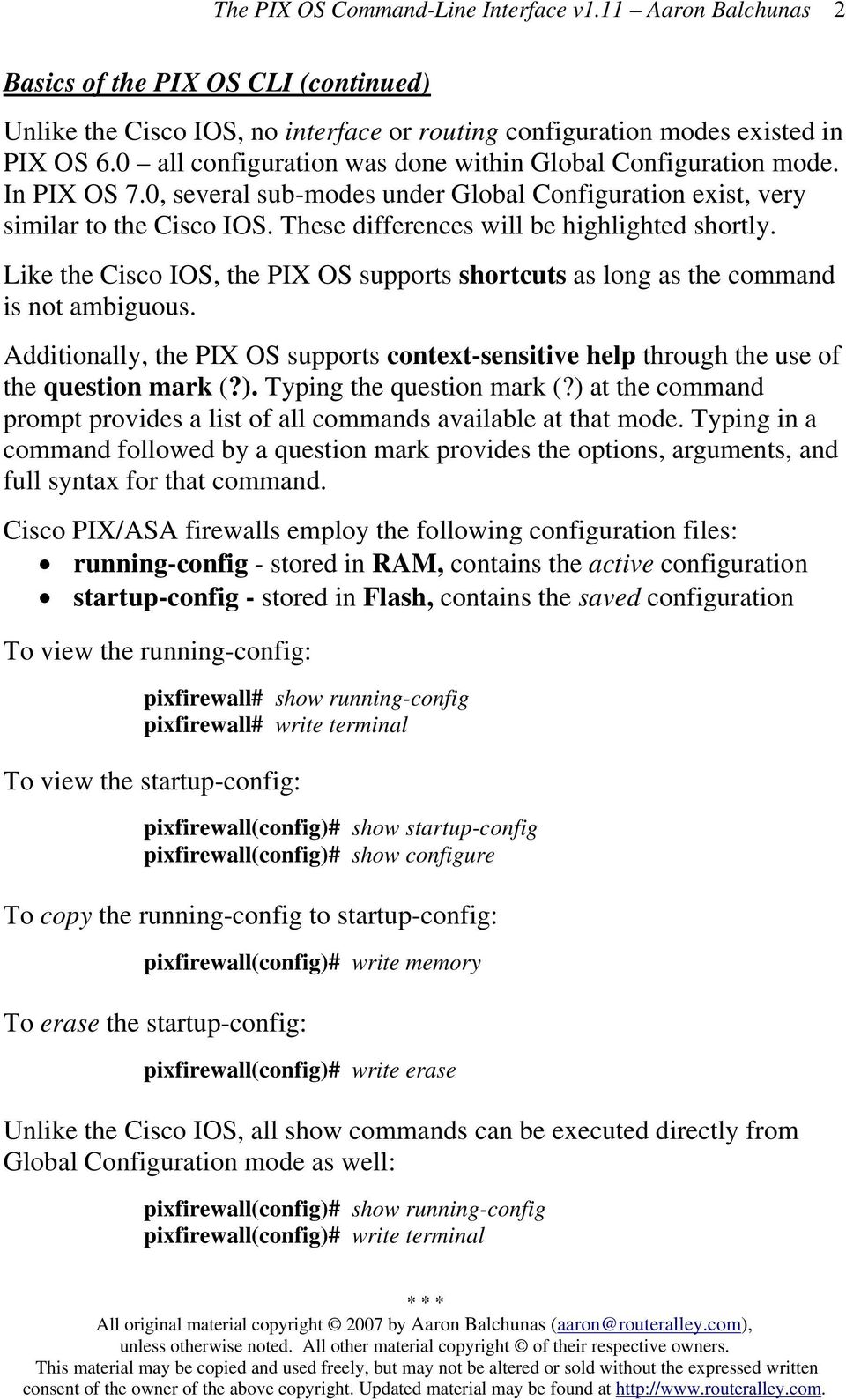
2 2 Basics of the PIX OS CLI (continued) Unlike the Cisco IOS, no interface or routing configuration modes existed in PIX OS 6.0 all configuration was done within Global Configuration mode. In PIX OS 7.0, several sub-modes under Global Configuration exist, very similar to the Cisco IOS. These differences will be highlighted shortly. Like the Cisco IOS, the PIX OS supports shortcuts as long as the command is not ambiguous. Additionally, the PIX OS supports context-sensitive help through the use of the question mark (?). Typing the question mark (?) at the command prompt provides a list of all commands available at that mode. Typing in a command followed by a question mark provides the options, arguments, and full syntax for that command. Cisco PIX/ASA firewalls employ the following configuration files: running-config - stored in RAM, contains the active configuration startup-config - stored in Flash, contains the saved configuration To view the running-config: pixfirewall# show running-config pixfirewall# write terminal To view the startup-config: pixfirewall(config)# show startup-config pixfirewall(config)# show configure To copy the running-config to startup-config: pixfirewall(config)# write memory To erase the startup-config: pixfirewall(config)# write erase Unlike the Cisco IOS, all show commands can be executed directly from Global Configuration mode as well: pixfirewall(config)# show running-config pixfirewall(config)# write terminal
3 3 Basics of the PIX OS CLI (continued) The enable password protects the PIX/ASA s Privileged mode. To set this encrypted password: pixfirewall(config)# enable password PASSWORD To set the firewall hostname: To restart the firewall: pixfirewall(config)# hostname MYFIREWALL MYFIREWALL(config)# pixfirewall(config)# reload pixfirewall(config)# reload noconfirm PIX OS show Commands To view version and licensing information: pixfirewall(config)# show version To view physical and data-link information about interfaces: pixfirewall(config)# show interface To view IP addresses configured on interfaces: pixfirewall(config)# show ip address To view memory and CPU information: pixfirewall(config)# show memory pixfirewall(config)# show cpu usage To troubleshoot connectivity issues using ping: pixfirewall(config)# ping

4 4 PIX OS and Time To set the system time on a PIX/ASA firewall: To set the timezone: To view the time: pixfirewall(config)# clock set 11:02:14 jan pixfirewall(config)# clock timezone EST -5 pixfirewall(config)# show clock To securely point to a centralized Network Time Protocol (NTP) server: pixfirewall(config)# ntp authenticate pixfirewall(config)# ntp authentication-key 1 md5 MYKEY pixfirewall(config)# ntp server key 1 source inside PIX Firewall Interfaces Cisco security appliances protect trusted zones from untrusted zones. Like most firewalls, a Cisco PIX/ASA will permit traffic from the trusted interface to the untrusted interface, without any explicit configuration. However, traffic from the untrusted interface to the trusted interface must be explicitly permitted. Thus, any traffic that is not explicitly permitted from the untrusted to trusted interface will be implicitly denied. To control the trust value of each interface, each firewall interface is assigned a security level, which is represented as a numerical value between on the Cisco PIX/ASA. A higher security level is more trusted, whereas a lower security level is less trusted. To explicitly allow a less trusted interface to communicate with a more trusted interface, an access control list (ACL) must be used.

5 5 Configuring Firewall Interfaces PIX OS 6.0 PIX OS 6.0 (and prior) does not support an Interface Configuration Mode all interface-related configuration is accomplished directly from Global Configuration mode. To name an interface, and assign it a security level of 75: pixfirewall(config)# nameif ethernet1 OUTSIDE security75 To change the duplex and speed of an interface: pixfirewall(config)# interface ethernet1 100full To administratively shutdown an interface: pixfirewall(config)# interface ethernet1 100full shutdown To assign an IP address to an interface: pixfirewall(config)# ip address OUTSIDE Notice when applying Layer-3 configuration, the interface name is referenced. Configuring Firewall Interfaces PIX OS 7.0 PIX OS 7.0 was redesigned and functions very similarly to the Cisco IOS. It provides an Interface Configuration Mode for all related configuration. To configure an interface on a PIX OS 7.0 device: asafirewall(config)# interface GigabitEthernet0/0 asafirewall(config-if)# no shutdown asafirewall(config-if)# nameif OUTSIDE asafirewall(config-if)# security-level 75 asafirewall(config-if)# ip address The above GigabitEthernet0/0 interface was taken out of a shutdown state, assigned a name of OUTSIDE, assigned a security-level of 75, and an ip address of

6 6 Configuring the PIX DHCP Server Cisco PIX/ASA Firewalls support a built-in DHCP server to delegate addresses to hosts. DHCP servers lease out IP addresses to DHCP clients, for a specific period of time. There are four steps to this DHCP process: When a DHCP client first boots up, it broadcasts a DHCPDiscover message, searching for a DHCP server. If a DHCP server exists on the local segment, it will respond with a DHCPOffer, containing the offered IP address, subnet mask, etc. Once the client receives the offer, it will respond with a DHCPRequest, indicating that it will accept the offered protocol information. Finally, the server responds with a DHCPACK, acknowledging the clients acceptance of offered protocol information. To specify the DHCP Pool: pixfirewall(config)# dhcpd address inside To configure DHCP options: pixfirewall(config)# dhcpd dns pixfirewall(config)# dhcpd wins pixfirewall(config)# dhcpd domain helpme.please To specify the DHCP lease length (in seconds, default is 3600): pixfirewall(config)# dhcpd lease Finally, the DHCP server must be enabled on the necessary interface: pixfirewall(config)# dhcpd enable inside

7 7 Enabling SSH Access SSH (Secure Shell) is the preferred method of remoting into a Cisco PIX/ASA device. The traditional method of telnet is inherently insecure, as it sends all passwords/traffic in clear-text. SSH requires a local username and password configured on the device: pixfirewall(config)# username CHARLIE password BROWN Next, the authentication policy for SSH must be configured to use the local database: pixfirewall(config)# aaa authentication ssh console LOCAL The above command creates an aaa authentication policy for ssh, to provide console access if the user successfully authenticates with the LOCAL username/password database. SSH must then be enabled on one or more interfaces: pixfirewall(config)# ssh inside pixfirewall(config)# ssh outside An SSH timeout can then be specified (value is in minutes): pixfirewall(config)# ssh timeout 10 Finally, the SSH key must be generated. To accomplish this on a PIX OS 6.0 device: pixfirewall(config)# ca generate rsa key 2048 To generate the SSH key on a PIX OS 7.0 device: asafirewall(config)# crypto key generate rsa general-keys modulus 2048 The larger the specified modulus size, the stronger the key. However, a stronger key will take longer to generate.

Lab 8.3.1.2 Configure Basic AP Security through IOS CLI
 Lab 8.3.1.2 Configure Basic AP Security through IOS CLI Estimated Time: 30 minutes Number of Team Members: Students will work in teams of two. Objective In this lab, the student will learn the following
HOW TO CONFIGURE CISCO FIREWALL PART I
 HOW TO CONFIGURE CISCO FIREWALL PART I Cisco Abstract: Please find below a step by step process to configure the PIX Firewall from scratch. A simple scenario is given here where you have a corporate network
642 523 Securing Networks with PIX and ASA
 642 523 Securing Networks with PIX and ASA Course Number: 642 523 Length: 1 Day(s) Course Overview This course is part of the training for the Cisco Certified Security Professional and the Cisco Firewall
Connecting to the Firewall Services Module and Managing the Configuration
 CHAPTER 3 Connecting to the Firewall Services Module and This chapter describes how to access the command-line interface and work with the configuration. This chapter includes the following sections: Connecting
PT Activity: Configure Cisco Routers for Syslog, NTP, and SSH Operations
 PT Activity: Configure Cisco Routers for Syslog, NTP, and SSH Operations Instructor Version Topology Diagram Addressing Table Device Interface IP Address Subnet Mask Default Gateway Switch Port R1 FA0/1
Note: This case study utilizes Packet Tracer. Please see the Chapter 5 Packet Tracer file located in Supplemental Materials.
 Note: This case study utilizes Packet Tracer. Please see the Chapter 5 Packet Tracer file located in Supplemental Materials. CHAPTER 5 OBJECTIVES Configure a router with an initial configuration. Use the
- Introduction to PIX/ASA Firewalls -
 1 Cisco Security Appliances - Introduction to PIX/ASA Firewalls - Both Cisco routers and multilayer switches support the IOS firewall set, which provides security functionality. Additionally, Cisco offers
Configuring Role-Based Access Control
 5 CHAPTER This chapter describes how to configure role-based access control (RBAC) on the Cisco Application Control Engine (ACE) module. This chapter contains the following sections: Information About
Cisco ISE Command-Line Interface
 This chapter provides information on the Cisco Identity Services Engine (Cisco ISE) command-line interface (CLI) that you can use to configure and maintain Cisco ISE. Cisco ISE Administration and Configuration
Lab 8.5.3 Configuring the PIX Firewall as a DHCP Server
 Lab 8.5.3 Configuring the PIX Firewall as a DHCP Server Objective Scenario Estimated Time: 15 minutes Number of Team Members: Two teams with four students per team. In this lab, students will learn the
- Basic Router Security -
 1 Enable Passwords - Basic Router Security - The enable password protects a router s Privileged mode. This password can be set or changed from Global Configuration mode: Router(config)# enable password
Configuring Basic Settings
 CHAPTER 10 This chapter describes how to configure basic settings on your ASA that are typically required for a functioning configuration. This chapter includes the following sections: Configuring the
CCNA Security. Chapter Two Securing Network Devices. 2009 Cisco Learning Institute.
 CCNA Security Chapter Two Securing Network Devices 1 The Edge Router What is the edge router? - The last router between the internal network and an untrusted network such as the Internet - Functions as
Skills Assessment Student Training Exam
 Skills Assessment Student Training Exam Topology Assessment Objectives Part 1: Initialize Devices (8 points, 5 minutes) Part 2: Configure Device Basic Settings (28 points, 30 minutes) Part 3: Configure
Cisco ASA Configuration Guidance
 Cisco ASA Configuration Guidance Abstract The modern network perimeter is more complicated than ever. The number of applications, protocols, and attacks that a firewall is expected to support and protect
Configuring the Cisco PIX Firewall for SSH by Brian Ford ([email protected])
 SSH Overview SSH is a client program that allows a user to establish a secure terminal session with a remote host that is running the SSH server (or daemon) program. Other programs, like the telnet utility
Deploying Secure Internet Connectivity
 C H A P T E R 5 Deploying Secure Internet Connectivity This chapter is a step-by-step procedure explaining how to use the ASDM Startup Wizard to set up the initial configuration for your ASA/PIX Security
Enabling Remote Access to the ACE
 CHAPTER 2 This chapter describes how to configure remote access to the Cisco Application Control Engine (ACE) module by establishing a remote connection by using the Secure Shell (SSH) or Telnet protocols.
Configuring the Cisco Secure PIX Firewall with a Single Intern
 Configuring the Cisco Secure PIX Firewall with a Single Intern Table of Contents Configuring the Cisco Secure PIX Firewall with a Single Internal Network...1 Interactive: This document offers customized
Lab 4.2.4 Advanced Telnet Operations
 Lab 4.2.4 Advanced Telnet Operations Objective Use the telnet command to remotely access other routers. Verify that the application layer between the source and the destination is working properly. Suspend
Troubleshooting the Firewall Services Module
 25 CHAPTER This chapter describes how to troubleshoot the FWSM, and includes the following sections: Testing Your Configuration, page 25-1 Reloading the FWSM, page 25-6 Performing Password Recovery, page
Applicazioni Telematiche
 Angelo Coiro Laboratorio Applicazioni Telematiche L emulatore Packet Tracer Packet Tracer Cisco Packet Tracer is an academic software that allows to emulate Cisco devices Packet Tracer can be used for
PIX/ASA 7.x and above: Mail (SMTP) Server Access on the DMZ Configuration Example
 PIX/ASA 7.x and above: Mail (SMTP) Server Access on the DMZ Configuration Example Document ID: 69374 Contents Introduction Prerequisites Requirements Components Used Conventions Configure Network Diagram
DHCP Server. Heng Sovannarith [email protected]
 DHCP Server Heng Sovannarith [email protected] Introduction Dynamic Host Configuration Protocol (DHCP) automatically assigns IP addresses and other network configuration information to computers
Lab 7.2.9 Load Balancing Across Multiple Paths
 Lab 7.2.9 Load Balancing Across Multiple Paths Objective Configure Load balance across multiple paths. Observe the load balancing process. Background/Preparation Cable a network similar to the one in the
3.1 Connecting to a Router and Basic Configuration
 3.1 Connecting to a Router and Basic Configuration Objective This lab will focus on the ability to connect a PC to a router in order to establish a console session and observe the user interface. A console
Brocade to Cisco Comparisons
 1 2 3 Console cables - The console cables are not interchangeable between Brocade and Cisco. Each vendor provides their console cable with each manageable unit it sells. Passwords - Neither Cisco or Brocade
CCT vs. CCENT Skill Set Comparison
 Operation of IP Data Networks Recognize the purpose and functions of various network devices such as Routers, Switches, Bridges and Hubs Select the components required to meet a given network specification
1 Basic Configuration of Cisco 2600 Router. Basic Configuration Cisco 2600 Router
 1 Basic Configuration of Cisco 2600 Router Basic Configuration Cisco 2600 Router I decided to incorporate the Cisco 2600 into my previously designed network. This would give me two seperate broadcast domains
Configuring the Firewall Management Interface
 Configuring the Firewall Management Interface The firewall management interface can be configured under each firewall context to provide a virtualized management interface (see Figure 7). The management
Netgear ProSafe VPN firewall (FVS318 or FVM318) to Cisco PIX firewall
 Netgear ProSafe VPN firewall (FVS318 or FVM318) to Cisco PIX firewall This document is a step-by-step instruction for setting up VPN between Netgear ProSafe VPN firewall (FVS318 or FVM318) and Cisco PIX
Configuring Basic Settings
 CHAPTER 12 This chapter describes how to configure basic settings on your ASASM that are typically required for a functioning configuration. This chapter includes the following sections: Configuring the
Savvius Insight Initial Configuration
 The configuration utility on Savvius Insight lets you configure device, network, and time settings. Additionally, if you are forwarding your data from Savvius Insight to a Splunk server, You can configure
Configuring Basic Settings
 CHAPTER 9 This chapter describes how to configure basic settings on your ASASM that are typically required for a functioning configuration. This chapter includes the following sections: Configuring the
ASA 8.X: Routing SSL VPN Traffic through Tunneled Default Gateway Configuration Example
 ASA 8.X: Routing SSL VPN Traffic through Tunneled Default Gateway Configuration Example Document ID: 112182 Contents Introduction Prerequisites Requirements Components Used Conventions Background Information
Procedure: You can find the problem sheet on Drive D: of the lab PCs. Part 1: Router & Switch
 University of Jordan Faculty of Engineering & Technology Computer Engineering Department Computer Networks Laboratory 907528 Lab. 2 Network Devices & Packet Tracer Objectives 1. To become familiar with
Cisco ASA. Administrators
 Cisco ASA for Accidental Administrators Version 1.1 Corrected Table of Contents i Contents PRELUDE CHAPTER 1: Understanding Firewall Fundamentals What Do Firewalls Do? 5 Types of Firewalls 6 Classification
ISE TACACS+ Configuration Guide for Cisco NX-OS Based Network Devices. Secure Access How-to User Series
 ISE TACACS+ Configuration Guide for Cisco NX-OS Based Network Devices Secure Access How-to User Series Author: Technical Marketing, Policy and Access, Security Business Group, Cisco Systems Date: January
ACS 5.x and later: Integration with Microsoft Active Directory Configuration Example
 ACS 5.x and later: Integration with Microsoft Active Directory Configuration Example Document ID: 113571 Contents Introduction Prerequisites Requirements Components Used Conventions Background Information
Lab Configuring Syslog and NTP (Instructor Version)
 (Instructor Version) Instructor Note: Red font color or Gray highlights indicate text that appears in the instructor copy only. Topology Addressing Table Objectives Device Interface IP Address Subnet Mask
Chapter 8 Lab B: Configuring a Remote Access VPN Server and Client
 Chapter 8 Lab B: Configuring a Remote Access VPN Server and Client Topology Note: ISR G2 devices have Gigabit Ethernet interfaces instead of FastEthernet Interfaces. All contents are Copyright 1992 2012
ICND1-100-101 IOS CLI Study Guide (CCENT)
 ICND1-100-101 IOS CLI Study Guide (CCENT) Hostname: 2. hostname SW1 SWITCH CONFIGURATION Mgmt IP: 2. interface vlan 1 3. ip address 10.0.0.2 4. no shut Gateway: 2. ip default-gateway 10.0.0.1 Local User/Pwd:
Table of Contents. Cisco Using the Cisco IOS Firewall to Allow Java Applets From Known Sites while Denying Others
 Cisco IOS Firewall to Allow Java Applets From Known Sites w Table of Contents Using the Cisco IOS Firewall to Allow Java Applets From Known Sites while Denying Others...1 Introduction...1 To Deny Java
LAB Configuring NAT. Objective. Background/Preparation
 LAB Configuring NAT Objective Configure a router to use network address translation (NAT) to convert internal IP addresses, typically private addresses, into outside public addresses. Configure static
Configuring Remote Access IPSec VPNs
 CHAPTER 34 Remote access VPNs let single users connect to a central site through a secure connection over a TCP/IP network such as the Internet. This chapter describes how to build a remote access VPN
Objectives. Background. Required Resources. CCNA Security
 Chapter 8 Lab B, Configuring a Remote Access VPN Server and Client Topology IP Addressing Table Device Interface IP Address Subnet Mask Default Gateway Switch Port R1 FA0/1 192.168.1.1 255.255.255.0 N/A
Connect the Host to attach to Fast Ethernet switch port Fa0/2. Configure the host as shown in the topology diagram above.
 Lab 1.2.2 Capturing and Analyzing Network Traffic Host Name IP Address Fa0/0 Subnet Mask IP Address S0/0/0 Subnet Mask Default Gateway RouterA 172.17.0.1 255.255.0.0 192.168.1.1 (DCE) 255.255.255.0 N/A
Encrypted Preshared Key
 Encrypted Preshared Key The Encrypted Preshared Key feature allows you to securely store plain text passwords in type 6 (encrypted) format in NVRAM. Feature History for Encrypted Preshared Key Release
PIX/ASA 7.x and above : Mail (SMTP) Server Access on Inside Network Configuration Example
 PIX/ASA 7.x and above : Mail (SMTP) Server Access on Inside Network Configuration Example Document ID: 70031 Contents Introduction Prerequisites Requirements Components Used Conventions Related Products
Expert Reference Series of White Papers. Integrating Active Directory Users with Remote VPN Clients on a Cisco ASA
 Expert Reference Series of White Papers Integrating Active Directory Users with Remote VPN Clients on a Cisco ASA 1-800-COURSES www.globalknowledge.com Integrating Active Directory Users with Remote VPN
Configuring System Message Logging
 CHAPTER 1 This chapter describes how to configure system message logging on the Cisco 4700 Series Application Control Engine (ACE) appliance. Each ACE contains a number of log files that retain records
Troubleshooting the Firewall Services Module
 CHAPTER 25 This chapter describes how to troubleshoot the FWSM, and includes the following sections: Testing Your Configuration, page 25-1 Reloading the FWSM, page 25-6 Performing Password Recovery, page
Lab 1.2.3 Review of Basic Router Configuration with RIP. Objective. Background / Preparation. General Configuration Tips
 Lab 1.2.3 Review of Basic Router Configuration with RIP Objective Cable and configure workstations and routers Setup IP addressing scheme using Class B networks Configure Routing Information Protocol (RIP)
Basic Software Configuration Using the Cisco IOS Command-Line Interface
 Basic Software Configuration Using the Cisco IOS Command-Line Interface This document describes how to use the Cisco IOS command-line interface (CLI) to perform a basic software configuration for your
PIX/ASA: Allow Remote Desktop Protocol Connection through the Security Appliance Configuration Example
 PIX/ASA: Allow Remote Desktop Protocol Connection through the Security Appliance Configuration Example Document ID: 77869 Contents Introduction Prerequisites Requirements Components Used Related Products
Evaluation guide. Vyatta Quick Evaluation Guide
 VYATTA, INC. Evaluation guide Vyatta Quick Evaluation Guide A simple step-by-step guide to configuring network services with Vyatta Open Source Networking http://www.vyatta.com Overview...1 Booting Up
P and FTP Proxy caching Using a Cisco Cache Engine 550 an
 P and FTP Proxy caching Using a Cisco Cache Engine 550 an Table of Contents HTTP and FTP Proxy caching Using a Cisco Cache Engine 550 and a PIX Firewall...1 Introduction...1 Before You Begin...1 Conventions...1
Lab 5.5.3 Developing ACLs to Implement Firewall Rule Sets
 Lab 5.5.3 Developing ACLs to Implement Firewall Rule Sets All contents are Copyright 1992 2007 Cisco Systems, Inc. All rights reserved. This document is Cisco Public Information. Page 1 of 8 Device Interface
1 Data information is sent onto the network cable using which of the following? A Communication protocol B Data packet
 Review questions 1 Data information is sent onto the network cable using which of the following? A Communication protocol B Data packet C Media access method D Packages 2 To which TCP/IP architecture layer
Common Services Platform Collector 2.5 Quick Start Guide
 Common Services Platform Collector 2.5 Quick Start Guide September 18, 2015 Corporate Headquarters Cisco Systems, Inc. 170 West Tasman Drive San Jose, CA 95134-1706 USA http://www.cisco.com CSP-C Quick
Configuring a Router
 CHAPTER 3 Configuring a Router This chapter provides information and commands concerning the following topics: Configuring a router, specifically: Names Passwords Interfaces MOTD banners IP host tables
Lab 2 - Basic Router Configuration
 CS326 Fall 2001 Room: PAI 5.48 Name: Lab 2 - Basic Router Configuration In this lab you will learn: the various configuration modes of Cisco 2621 routers how to set up IP addresses for such routers how
crypto key generate rsa
 , page 2 1 To generate Rivest, Shamir, and Adelman (RSA) key pairs, use the commandinglobal configuration mode. [general-keys usage-keys signature encryption] [label key-label] [exportable] [modulus modulus-size]
Encrypted Preshared Key
 The feature allows you to securely store plain text passwords in type 6 (encrypted) format in NVRAM. Feature History for Release Modification 12.3(2)T This feature was introduced. Finding Support Information
shortcut Tap into learning NOW! Visit www.informit.com/shortcuts for a complete list of Short Cuts. Your Short Cut to Knowledge
 shortcut Your Short Cut to Knowledge The following is an excerpt from a Short Cut published by one of the Pearson Education imprints. Short Cuts are short, concise, PDF documents designed specifically
Configuring the Switch IP Address and Default Gateway
 CHAPTER 3 Configuring the Switch IP Address and Default Gateway This chapter describes how to configure the IP address, subnet mask, and default gateway on the Catalyst enterprise LAN switches. Note For
Using PIX Firewall in SOHO Networks
 CHAPTER 4 This chapter describes features provided by the PIX Firewall that are used in the small office, home office (SOHO) environment. It includes the following sections: Using PIX Firewall as an Easy
Router Lab Reference Guide
 Router Lab Reference Guide 1 PURPOSE AND GOALS The routing lab allows testing different IP-related protocols and solutions in a close to live environment. You can learn how to configure Cisco routers and
Apache CloudStack 4.x (incubating) Network Setup: excerpt from Installation Guide. Revised February 28, 2013 2:32 pm Pacific
 Apache CloudStack 4.x (incubating) Network Setup: excerpt from Installation Guide Revised February 28, 2013 2:32 pm Pacific Apache CloudStack 4.x (incubating) Network Setup: excerpt from Installation Guide
Lab 5.3.5 Configuring Basic Router Settings with the Cisco IOS CLI
 Lab 5.3.5 Configuring Basic Router Settings with the Cisco IOS CLI Device Host Name Interface IP address Subnet mask R1 R1 Serial 0/0/0 (DCE) 172.17.0.1 255.255.0.0 FastEthernet 0/0 172.16.0.1 255.255.0.0
Lab 5-5 Configuring the Cisco IOS DHCP Server
 Lab 5-5 Configuring the Cisco IOS DHCP Server Learning Objectives Configure and verify the operation of the Cisco IOS DHCP server Configure an IP Helper address Review the EIGRP configuration Topology
Transferring Files Using HTTP or HTTPS
 Transferring Files Using HTTP or HTTPS First Published: May 5, 2005 Last Updated: May 14, 2009 Cisco IOS Release 12.4 provides the ability to transfer files between your Cisco IOS software-based device
HOMEROOM SERVER INSTALLATION & NETWORK CONFIGURATION GUIDE
 HOMEROOM SERVER INSTALLATION & NETWORK CONFIGURATION GUIDE Level 1, 61 Davey St Hobart, TAS 7000 T (03) 6165 1555 www.getbusi.com Table of Contents ABOUT THIS MANUAL! 1 SYSTEM REQUIREMENTS! 2 Hardware
Managing Software and Configurations
 55 CHAPTER This chapter describes how to manage the ASASM software and configurations and includes the following sections: Saving the Running Configuration to a TFTP Server, page 55-1 Managing Files, page
Lab 3 Routing Information Protocol (RIPv1) on a Cisco Router Network
 Lab 3 Routing Information Protocol (RIPv1) on a Cisco Router Network CMPE 150 Fall 2005 Introduction Today you are going to be thrown into using Cisco s Internetwork Operating System (IOS) to configure
Configuring Access Service Security
 CHAPTER 3 Configuring Access Service Security The access service security paradigm presented in this guide uses the authentication, authorization, and accounting (AAA) facility. Authentication requires
Comware versus Cisco IOS Command Guide
 Technical Marketing Engineering Routing and Switching Technology Routing and Switching Comware versus Cisco IOS Command Guide Technical Marketing Brief Revision v5 March 23, 2009 http://www.3com.com 3Com
Barracuda Link Balancer Administrator s Guide
 Barracuda Link Balancer Administrator s Guide Version 1.0 Barracuda Networks Inc. 3175 S. Winchester Blvd. Campbell, CA 95008 http://www.barracuda.com Copyright Notice Copyright 2008, Barracuda Networks
APNIC Members Training Course Security workshop. 2-4 July, 2008. Port Vila Vanuatu. In conjunction with PACNOG 4
 APNIC Members Training Course Security workshop 2-4 July, 2008 Port Vila Vanuatu In conjunction with PACNOG 4 Router device security lab 1. APNIC s remote lab In these exercises you will be remotely accessing
Table of Contents. Configuring IP Access Lists
 Table of Contents...1 Introduction...1 Prerequisites...2 Hardware and Software Versions...2 Understanding ACL Concepts...2 Using Masks...2 Summarizing ACLs...3 Processing ACLs...4 Defining Ports and Message
Lab 1.4.1 Introductory Lab 1 - Getting Started and Building Start.txt
 Lab 1.4.1 Introductory Lab 1 - Getting Started and Building Start.txt Objective This lab may introduce new CCNP lab equipment and certain IOS features. This introductory activity also describes how to
PIX/ASA 7.x with Syslog Configuration Example
 PIX/ASA 7.x with Syslog Configuration Example Document ID: 63884 Introduction Prerequisites Requirements Components Used Conventions Basic Syslog Configure Basic Syslog using ASDM Send Syslog Messages
Configuring DHCP Snooping
 CHAPTER 19 This chapter describes how to configure Dynamic Host Configuration Protocol (DHCP) snooping on Catalyst 4500 series switches. It provides guidelines, procedures, and configuration examples.
Using the X-Series Command Line Interface (CLI)
 Using the X-Series Command Line Interface (CLI) CLI Guide Websense X-Series Appliances v8.0.x Websense X-Series appliances are configured and maintained through a command line interface (CLI). The CLI:
Reboot the ExtraHop System and Test Hardware with the Rescue USB Flash Drive
 Reboot the ExtraHop System and Test Hardware with the Rescue USB Flash Drive This guide explains how to create and use a Rescue USB flash drive to reinstall and recover the ExtraHop system. When booting
Configuring the Content Routing Software
 CHAPTER 2 This chapter describes the basic steps for configuring the Content Router software. Performing a Basic Startup Configuration After you physically install the Content Router hardware, configure
C H A P T E R Management Cisco SAFE Reference Guide OL-19523-01 9-1
 CHAPTER 9 The primary goal of the management module is to facilitate the secure management of all devices and hosts within the enterprise network architecture. The management module is key for any network
Configuring DHCP. DHCP Server Overview
 Configuring DHCP This chapter describes how to configure Dynamic Host Configuration Protocol (DHCP). For a complete description of the DHCP commands listed in this chapter, refer to the DHCP s chapter
CISCO IOS NETWORK SECURITY (IINS)
 CISCO IOS NETWORK SECURITY (IINS) SEVENMENTOR TRAINING PVT.LTD [Type text] Exam Description The 640-553 Implementing Cisco IOS Network Security (IINS) exam is associated with the CCNA Security certification.
Implementing Secure Shell
 Secure Shell (SSH) is an application and a protocol that provides a secure replacement to the Berkeley r-tools. The protocol secures sessions using standard cryptographic mechanisms, and the application
Objectives. Router as a Computer. Router components and their functions. Router components and their functions
 2007 Cisco Systems, Inc. All rights reserved. Cisco Public Objectives Introduction to Routing and Packet Forwarding Routing Protocols and Concepts Chapter 1 Identify a router as a computer with an OS and
Chapter 2 Reading Organizer
 Chapter 2 Reading Organizer After completion of this chapter, you should be able to: Explain the advantages and disadvantages of static routing Configure initial settings on a Cisco switch Configure switch
Cisco Certified Network Associate Exam. Operation of IP Data Networks. LAN Switching Technologies. IP addressing (IPv4 / IPv6)
 Cisco Certified Network Associate Exam Exam Number 200-120 CCNA Associated Certifications CCNA Routing and Switching Operation of IP Data Networks Operation of IP Data Networks Recognize the purpose and
Configuring the PIX Firewall with PDM
 Configuring the PIX Firewall with PDM Objectives In this lab exercise you will complete the following tasks: Install PDM Configure inside to outside access through your PIX Firewall using PDM Configure
Telnet, Console and AUX Port Passwords on Cisco Routers Configuration Example
 Telnet, Console and AUX Port Passwords on Cisco Routers Configuration Example Document ID: 45843 Introduction Prerequisites Requirements Components Used Conventions Background Information Configure Passwords
Cisco Configuration Professional Quick Start Guide
 Cisco Configuration Professional Quick Start Guide April 29, 2011 This document explains how to start using Cisco Configuration Professional Express (Cisco CP Express) and Cisco Configuration Professional
Enhanced Password Security - Phase I
 Enhanced Password Security - Phase I Feature History 120(18)S This feature was introduced This document describes the Enhanced Password Security feature in It includes the following sections: Feature Overview,