
Risk Factors for Death or Life-Threatening Injury for Abused Women in Chicago*
|
|
|
- Godfrey Bennett
- 10 years ago
- Views:
Transcription
1 Risk Factors for Death or Life-Threatening Injury for Abused Women in Chicago* By Carolyn Rebecca Block 2004 NCJ

2 Carolyn Rebecca Block, Ph.D., is with the Illinois Criminal Justice Information Authority. Findings and conclusions of the research reported here are those of the author and do not reflect the official position or policies of the U.S. Department of Justice. The Chicago Women s Health Risk Study was supported by award 96 IJ CX 0020 from the National Institute of Justice, Office of Justice Programs, U.S. Department of Justice.

3 Purpose The Chicago Women s Health Risk Study (Block, Devitt, Fugate et al., 2000) was designed to give nurses, patrol officers, and other primary support people the information they need to help women who are experiencing violence at the hands of an intimate partner lower their risk of lifethreatening injury or death. Previous research did not provide this practical information. The purpose of the study was to identify risk factors for life-threatening injury or death in situations in which an intimate partner is physically abusing a woman. Although previous research focused on who in the general population was most likely to be abused, it did not tell practitioners about risk patterns for women who were experiencing violence. Previous research also tended to measure only one or two factors and did not consider the interaction of events and circumstances as they change over time. Practitioners need to know how changing factors, such as attempting to leave, pregnancy, having children at home, or firearm availability, may affect the risk of a lethal outcome. Field practitioners also need to know whether risk patterns differ for different racial or ethnic groups, for women in same-sex relationships, or for pregnant women, and they need to be able to respond to women who may be in high-risk situations but have not sought help from helping agencies or support networks. Prior to the study, information about the needs and best interventions for these groups was very limited. The Study Methodology The Chicago Women s Health Risk Study compared longitudinal data on abused women with similar data on women who had been killed by or who killed their intimate partners. The study design had a homicide sample of all intimate partner homicides involving a woman that occurred in Chicago over a 2-year period, and a clinic/hospital sample of detailed, longitudinal interviews with women sampled as they came into hospitals and clinics in Chicago neighborhoods where the risk for intimate partner violence was high. Clinic/Hospital Sample The study conducted domestic violence screening for 2,616 women as they came into a hospital or health care clinic for any kind of treatment. The screening, given as part of the clinic or hospital routine, included three short questions regarding current violence, current sexual abuse, and whether the woman was afraid to go home. Women aged 18 or older who were in a relationship and who answered yes to at least one question screened positive and those who answered no to all questions screened negative. An attempt was made to interview all women who screened positive and about 30 percent of the women who screened negative. In addition, about 66 percent of the abused women who were interviewed were reinterviewed at least once during the following 12 months. The staff of each study site (two health clinics and a public hospital) worked hand in hand with the interviewers and project staff to ensure that safety and privacy standards were upheld. To ensure that high-risk but understudied groups, such as women who were at high risk but who II 4 3

4 were not known to be at risk by any helping agency, would not be excluded from the sample, instruments and procedures were designed to minimize selection bias. Homicide Sample The homicide sample included all of the 87 intimate partner homicides in 1995 or 1996 that had a woman victim or offender age 18 or older. Up to three people who knew about the relationship (friends, family, the woman herself) were interviewed (Block, McFarlane et al., 1999), using the same questionnaires as for the clinic/hospital sample (to the extent possible). Information was also gathered from the Chicago Homicide Dataset, medical examiner s office records, court records, newspapers, and other sources. Questionnaires Members of the collaborating team developed study instruments over many months of intense work. Advocates, activists, community members, academics, and researchers all took an active role in finding, evaluating, and devising scales for the various dimensions researchers hoped to capture, including household composition, mental and physical health, substance use, firearm availability, social support network, power and control, harassment or stalking, and help-seeking. Women who had experienced violence in the past year developed a calendar history of every violent incident and other important events that had happened in the year. The followup interview included a calendar history for the period from the first interview. The study covered highly sensitive topics, and there was a possibility that women from different cultural backgrounds could have different perceptions of these sensitive issues. The collaborators invested a great deal of effort to word questions carefully and to provide a context that would encourage women to disclose their sensitive experiences. They tried to keep the questionnaire short enough so that the women would not be fatigued, and to build in enough flexibility to encourage a natural flow of talk. The study design and the dedication of the collaborators who made the design a reality produced a rich dataset with the necessary detail and accuracy to answer the questions practitioners ask. Findings Findings revealed the combinations of factors that indicate that a woman in an abusive situation is at high risk for serious injury or death. Although practitioners working with women will not be surprised by most of the study s results, the data provide measurable confirmation of knowledge gained in the field. Other results, however, may challenge commonly held beliefs. Past Violence as a Risk Factor for Homicide The conventional wisdom that violence in the past predicts violence in the future was borne out by the Chicago Women s Health Risk Study. The majority of women who were killed or who killed their partners had experienced violence at the hands of their partners in the previous year (85 percent of homicide victims and 80 percent of offenders). Of the abused clinic/hospital women who were reinterviewed, 29 percent experienced an incident in the followup period that the study defined as severe or life threatening (permanent injury; being completely beaten up, being choked or burned; or suffering an internal injury, a head injury, broken bones, or a II 4 4

5 threat or attack with a weapon), and another 25 percent experienced other physical violence. However, the study results go beyond conventional wisdom to reveal three specific aspects of past violence that make some women s situations more risky than others: Type of past violence (threat or use of a weapon, having been choked or strangled). Recency (number of days since the last incident). Frequency or an increase in frequency. In addition to weapon use, attempted strangulation or choking were also important risk factors. In 20 percent of the homicides committed against a woman intimate partner, the man strangled his partner, and in an additional 4 percent, he smothered her. Of all the women killed by a male partner, those who had been choked or grabbed around the neck in the previous year were more likely to have been strangled or smothered in the fatal incident than those who had not (40 percent compared to 20 percent). In addition, when a partner had tried to choke or strangle clinic/hospital women, followup incidents were more likely to be severe or life threatening (63 percent compared to 40 percent). Regardless of the severity of the last incident, the more recently it had happened, the higher the woman s risk. Half of the women homicide victims and 75 percent of the women offenders had experienced violence within 30 days of the homicide, some within a day or two beforehand. Frequency was important for all women, but especially for abused women who killed their partners. For 71 percent of women offenders, the violence had been increasing in frequency, compared to 44 percent of abused women homicide victims and 38 percent of abused clinic/hospital women. The First Incident Can Be Fatal For a substantial minority of study participants, a fatal or life-threatening incident was the first physical violence they had experienced from their partners. For 27 percent of the 143 clinic/hospital women who experienced only one incident in the previous year, that incident was life threatening. In 15 percent of the 74 homicides for which the study had good information, the fatal incident was the first incident. The important risk factors for these women were Their partner s controlling behavior (especially jealousy). Their partner s drug use. Their partner s violence outside the home. In 40 percent of female homicides by a man where there was no prior violence, the fatal incident was sparked by his extreme jealousy (compared to 28 percent with prior violence). Almost a quarter (24 percent) of clinic/hospital women with one incident that was very severe answered yes to all five power and control questions, but only 9 percent of other women with one incident did so. More than half (56 percent) of clinic/hospital women who had experienced one incident that was very severe said their abusers used drugs, compared to 20 percent of other women; 41 percent compared to 21 percent said that the abuser was violent outside the home. II 4 5

6 Leaving or Trying to End the Relationship The connection between serious violence and the woman leaving or trying to end the relationship will be familiar to field-level workers. The potential gain from leaving is substantial, because a woman s risk of being seriously injured or killed by an intimate partner declines if the partner has no more contact with her. The potential risk is also substantial because the partner may use increased violence to keep her from leaving. Women do try to escape abusive relationships. When people hear about a severely abused woman, many ask, Why doesn t she leave? Women do try to leave abusive partners. Most clinic/hospital women in this study (85 percent) who had experienced severe violence in the previous year had left or tried to end the relationship in the previous year, and most women homicide victims (75 percent) had left or tried to end the relationship in the previous year. In contrast, 66 percent of clinic/hospital women who had experienced less severe incidents and only 25 percent who had not experienced violence in the previous year had left or tried to leave. Leaving can be related to a lower chance of future violence. In reinterviews over a period of 1 year, only 47 percent of women who had experienced less severe violent incidents and had tried to leave in the previous year told of any additional violent incident, compared with 67 percent of women who also had experienced less serious violence but had not tried to leave. Leaving can be fatal. In 45 percent of the homicides in which a man killed a woman, an immediate precipitating factor of the fatal incident was the woman leaving or trying to end the relationship. For clinic/hospital women who were abused on followup, 69 percent of those who had left or tried to leave an abuser in the previous year but whose abuse continued despite their attempted departure experienced severe incidents compared to 44 percent of women who had not left or tried to leave. Risk Factors for the Fatal Incident Many study participants were in high-risk situations but did not experience a fatal or life- threatening incident. Sometimes the only difference between women who were killed and women who were not lay in aspects of the specific incident. Someone was more likely to die when one of the following factors was present in the violent situation: The partner threatened to use or used a knife or gun. The woman was being choked, grabbed around the neck, or strangled. The woman, the partner, or both were drunk. Risk Factors for Abused Women Becoming Homicide Offenders Abused women who killed their partners differed from abused women who were killed and from abused clinic/hospital women in the following ways (Block, Devitt, Donoghue et al., 2000): Abused women who killed their partners had experienced more severe and increasing violence in the previous year. They had fewer resources, such as employment or high school education. II 4 6

7 They had a more traditional relationship (e.g., they were married, had children, or were in a long-term relationship). Seeking Help Even when they had experienced severe violence, clinic/hospital women were less likely to consult a counselor or agency (24 percent) than to seek medical help (41 percent) or to contact the police (53 percent). However, 34 percent of severely abused Latina/Hispanic women had consulted a counselor or agency in the past year, while 29 percent had sought medical help and 43 percent had contacted the police. In contrast, none of the 11 women who were severely abused by a woman had contacted the police, although 45 percent sought medical care, and 18 percent talked to a counselor. More than 30 percent of the clinic/hospital women who had experienced severe or lifethreatening violence in the previous year had not sought any kind of formal help (medical, counseling, or contacting the police). Ten percent of severely abused clinic/hospital women and abused homicide women had sought neither formal nor informal help (talking to someone) in the previous year. Implications for Researchers Study researchers offer three suggestions: 1. Recognize the complexity of women s lives. The study asked women to discuss the real circumstances of their lives, provided many opportunities for them to describe their relationships, and avoided constraining language and predetermined categories. This interview style was comfortable and appropriate for women from a wide variety of cultural and racial/ethnic backgrounds and for women in nontraditional intimate relationships. 2. Add a separate category for strangulation as a method of attack or cause of death to law enforcement and public health datasets to improve preventive policies and interventions for intimate partner homicides. Currently, these cases are scattered under various weapon categories (e.g., belt or scarf) or as hands, fists, and feet. 3. Develop a collaborative culture. A collaborative culture is a climate characterized by shared standards for research and practice, equalized power, permeable roles, group decisionmaking, and the assumption of good will (Block, Engel et al., 1999a; 1999b). This was the foundation of the high quality of study data. Implications for Practitioners Clinic/hospital women who had experienced severe violence were more likely to have sought help than other abused women. Women who were killed or who killed their partners were even more likely to have sought help. Seeking help, by itself, indicates that a woman s situation may be serious. II 4 7

8 Study researchers found the following questions to be important to ask a woman to assess her risk for lethal or life-threatening violence. (Most of these questions are part of the Campbell [1986; 1995] Danger Assessment.) When a woman is being physically abused by an intimate partner, ask her When did the last incident happen? Did your partner ever threaten you with a gun or knife or try to strangle or choke you? Has the violence been increasing in frequency? When a woman is not experiencing physical violence, ask her Is your partner violent outside the home? Does your partner use drugs? Does your partner control all or most of your daily activities? Is your partner violently and constantly jealous of you? Abused women often consult medical staff or call the police before they go to a counselor or agency for help. Medical staff and the police should recognize their pivotal gatekeeping role. They may be able to refer abused women to counseling or other resources. When a woman is being physically abused, both partners are at risk for homicide. Women who kill a partner tend to be severely abused, to be in a marital or other long-term relationship, and to have few material resources. They are much more likely than women who are killed or than clinic/hospital women to contact the police after an incident. Law enforcement agencies need to develop a protocol for linking women in this situation to places where they can get help. Note *Although most of the collaborators of the Chicago Women s Health Risk Study were silent partners in writing this report, they were equal partners in the project. They include Olga Becker, Nanette Benbow, Jacquelyn Campbell, Debra Clemons, James Coldren, Alicia Contreras, Eugene Craig, Roy J. Dames, Alice J. Dan, Christine Devitt, Edmund R. Donoghue, Barbara Engel, Dickelle Fonda, Charmaine Hamer, Kris Hamilton, Eva Hernandez, Tracy Irwin, Mary V. Jensen, Holly Johnson, Teresa Johnson, Candice Kane, Debra Kirby, Katherine Klimisch, Christine Kosmos, Leslie Landis, Susan Lloyd, Gloria Lewis, Christine Martin, Rosa Martinez, Judith McFarlane, Sara Naureckas, Iliana Oliveros, Angela Moore Parmley, Stephanie Riger, Kim Riordan, Roxanne Roberts, Martine Sagan, Daniel Sheridan, Wendy Taylor, Richard Tolman, Gail Walker, Carole Warshaw, and Steven Whitman. Collaborating agencies in the study were the Mayor s Office on Domestic Violence; the Chicago Police Department Domestic Violence Unit; the Erie Family Health Center; the Chicago Department of Public Health; the Cook County Medical Examiner s Office; the Cook County Hospital; the Chicago Abused Women Coalition; and the Illinois Criminal Justice Information Authority. II 4 8

9 References Block, C.R., with C.O. Devitt, M. Fugate, C. Martin, T. Pasold, D. Fonda, B. Engel, S.M. Naureckas, K.A. Riordan, J. McFarlane, and G.R. Walker (2000). The Chicago Women s Health Risk Study, Risk of Serious Injury or Death in Intimate Violence: A Collaborative Research Project. Final Report to the National Institute of Justice, NCJ Block, C.R., Devitt, C.O., Donoghue, E.R., and Dames, R.J. (2000). Who Becomes the Victim and Who the Offender in Chicago Intimate Partner Homicide? Paper presented at the American Society of Criminology meeting, San Francisco, CA. Block, C.R., Engel, B., Naureckas, S.M., and Riordan, K.A. (1999a). The Chicago Women s Health Risk Study: Lessons in Collaboration. Violence Against Women, 5, (1999b). Collaboration in the Chicago Women s Health Risk Study. Research Brief: May Chicago: Illinois Criminal Justice Information Authority. Block, C.R., McFarlane, J.M., Walker, G.R., and Devitt, C.O. (1999). Beyond Public Records Databases: Field Strategies for Locating and Interviewing Proxy Respondents in Homicide Research. Homicide Studies, 3, Campbell, J.C. (1995). Prediction of Homicide of and by Battered Women. In J.C. Campbell (ed.), Assessing Dangerousness: Violence by Sexual Offenders, Batterers, and Child Abusers (pp ). Thousand Oaks, CA: Sage Publications.. (1986). Nursing Assessment for Risk of Homicide With Battered Women. Advances in Nursing Science, 8, II 4 9

APPENDIX B. ASSESSMENT OF RISK POSED TO CHILDREN BY DOMESTIC VIOLENCE Anne L. Ganley, Ph.D.
 APPENDIX B ASSESSMENT OF RISK POSED TO CHILDREN BY DOMESTIC VIOLENCE Anne L. Ganley, Ph.D. Assessment of Domestic Violence for Child Protective Services (CPS) Decision Making Guidelines for Interviewing
What is Domestic Violence?
 Reentry in the State of Connecticut: Partners in Progress February 24-26, 2009 Rachelle Giguere and Becki Ney What is Domestic Violence? The Centers for Disease Control (CDC) defines intimate partner violence
Intimate Partner Homicide JOURNAL. National Institute of Justice ISSUE NO. 250
 ISSUE NO. 250 U.S. Department of Justice Office of Justice Programs National Institute of Justice National Institute of Justice JOURNAL Intimate Partner Homicide Intimate Partner Homicide: An Overview
What is DOMESTIC VIOLENCE?
 What is DOMESTIC VIOLENCE? Domestic violence is a pattern of control used by one person to exert power over another. Verbal abuse, threats, physical, and sexual abuse are the methods used to maintain power
HIGH RISK ASSESSMENT TRAINING
 WOMAN ABUSE COUNCIL OF TORONTO HIGH RISK ASSESSMENT TRAINING 1652 Keele Street, Suite 129 Toronto, ON, M6M 3W3 Tel: 416-944-9242 [email protected] Website: www.womanabuse.ca TABLE OF CONTENTS Background
Practice Tool 2 Common risk assessment tool
 Practice Tool 2 Common risk assessment tool Family and Domestic Violence Risk Assessment Tool Service providers that have a role in responding to family and domestic violence are required to conduct a
Christobel Deliwe Chakwana
 DOMESTIC VIOLENCE 5 5. INTRODUCTION Christobel Deliwe Chakwana The 2004 survey represents the first time the Malawi Demographic and Health Survey (MDHS) collected information on domestic. The inclusion
INTIMATE PARTNER VIOLENCE
 INTIMATE PARTNER VIOLENCE 28 Injury Prevention Plan of Alabama INTIMATE PARTNER VIOLENCE THE PROBLEM: In a national survey, 25% of female participants reported being raped or physically assaulted by an
RISK ASSESSMENTS (ODARA) IN SPOUSAL / PARTNER VIOLENCE CASES FIRST ISSUED: DECEMBER 11, 2006 LAST SUBSTANTIVE REVISION: MARCH 19, 2009
 DOCUMENT TITLE: RISK ASSESSMENTS (ODARA) IN SPOUSAL / PARTNER VIOLENCE CASES NATURE OF DOCUMENT: PRACTICE NOTE FIRST ISSUED: DECEMBER 11, 2006 LAST SUBSTANTIVE REVISION: MARCH 19, 2009 EDITED / DISTRIBUTED
Violent Victimization of College Students, 1995-2002
 U.S. Department of Justice Office of Justice Programs Bureau of Justice Statistics Special Report National Crime Victimization Survey January 25, NCJ 26836 Violent Victimization of College Students, By
QUICK REFERENCE GUIDE. Workplace Violence. What You Need to Know to Protect Yourself and Your Employees
 QUICK REFERENCE GUIDE Workplace Violence What You Need to Know to Protect Yourself and Your Employees Types of Workplace Violence: 2 Workplace Violence While the motivation and circumstances of each incident
The rate of hospitalizations due to assaultive injuries by spouse or partner (E976.3) per 100,000 females (13 and over)
 Domestic Violence DOMESTIC VIOLENCE TEMPLATE INDICATOR: Hospitalizations of Females Ages 13 and Over Due to Assaultive Injuries by Spouse or Partner DEFINITION: The rate of hospitalizations due to assaultive
For the 10-year aggregate period 2003 12, domestic violence
 U.S. Department of Justice Office of Justice Programs Bureau of Justice Statistics Special Report APRIL 2014 NCJ 244697 Nonfatal Domestic Violence, 2003 2012 Jennifer L. Truman, Ph.D., and Rachel E. Morgan,
Intimate Partner Violence and Firearms
 Intimate Partner Violence and Firearms According to the Centers for Disease Control and Prevention (CDC), intimate partner violence (IPV) is actual or threatened physical or sexual violence or psychological
What Employers Need to Know to Help
 Occupational Health & Safety Council of Ontario (OHSCO) WORKPLACE VIOLENCE PREVENTION SERIES Domestic Violence Doesn t Stop When Your Worker Arrives at Work: What Employers Need to Know to Help What is
http://www.bjs.gov/content/pub/ascii/fvsv9410.txt[3/15/2013 2:30:57 PM]
![http://www.bjs.gov/content/pub/ascii/fvsv9410.txt[3/15/2013 2:30:57 PM]](/thumbs/24/2871300.jpg "http://www.bjs.gov/content/pub/ascii/fvsv9410.txt[3/15/2013 2:30:57 PM]") U.S. Department of Justice Office of Justice Programs Bureau of Justice Statistics ----------------------------------------------------- This file is text only without graphics and many of the tables.
U.S. Department of Justice Office of Justice Programs Bureau of Justice Statistics ----------------------------------------------------- This file is text only without graphics and many of the tables.
Departmental Policy for Handling of Domestic Violence Incidents Involving Law Enforcement Officers 1
 Departmental Policy for Handling of Domestic Violence Incidents Involving Law Enforcement Officers 1 This Policy, prepared by the Division of Criminal Justice, is intended to serve as a model for the law
SOCIAL WORK PRACTICE AND DOMESTIC VIOLENCE
 SOCIAL WORK PRACTICE AND DOMESTIC VIOLENCE Working with Children and Families Mary Kate Barry, IASW 2015 How are you? Grand Ask me In the hospital Please ask me In the clinic In the church Ask me, ask
Violence against women: key statistics
 Violence against women: key statistics Research from the 2012 ABS Personal Safety Survey and Australian Institute of Criminology shows that both men and women in Australia experience substantial levels
In 2009, approximately 572,000 nonfatal violent crimes
 U.S. Department of Justice Office of Justice Programs Bureau of Justice Statistics Special Report March 2011 ncj 233231 Workplace Violence, 1993-2009 National Crime Victimization Survey and the Census
Introduction to Domestic Violence
 Introduction to Domestic Violence Contents Defining domestic violence Prevalence Examples of power and control Why victims stay How you can help WHAT IS DOMESTIC VIOLENCE? Defining Domestic Violence Domestic
Supervised Visitation
 Best practices A Public/Private Partnership with the New York State Unified Court System Supervised Visitation What Courts Should Know When Working with Supervised Visitation Programs Written by Samantha
The Second Responders Program: A Coordinated Police and Social Service Response to Domestic Violence
 The Second Responders Program: A Coordinated Police and Social Service Response to Domestic Violence By Erin Lane, Rosann Greenspan, and David Weisburd 2004 NCJ 199717 Erin Lane, M.P.H., is with the Police
California s Domestic Violence & Mandatory Reporting Law: Requirements for Health Care Practitioners
 California s Domestic Violence & Mandatory Reporting Law: Requirements for Health Care Practitioners TABLE OF CONTENTS 1) Most Common Questions and Answers on Mandatory Reporting Requirements for Health
Voir Dire in Domestic Violence Cases
 Voir Dire in Domestic Violence Cases By Sarah M. Buel, Co-Director, University of Texas School of Law Domestic Violence Clinic Voir dire provides the opportunity to educate jurors while probing for bias,
NORTH CAROLINA ADMINISTRATIVE CODE TITLE ONE - ADMINISTRATION CHAPTER 17 - COUNCIL ON THE STATUS OF WOMEN SECTION.0700 - ABUSER TREATMENT PROGRAMS
 01 NCAC 17.0701 PURPOSE NORTH CAROLINA ADMINISTRATIVE CODE TITLE ONE - ADMINISTRATION CHAPTER 17 - COUNCIL ON THE STATUS OF WOMEN SECTION.0700 - ABUSER TREATMENT PROGRAMS The purpose of the rules in this
Intimate Partner Violence
 U.S. Department of Justice Office of Justice Programs Revised // th Bureau of Justice Statistics Special Report Intimate Partner Violence May, NCJ 787 By Callie Marie Rennison, Ph.D. and Sarah Welchans
DOMESTIC VIOLENCE IN FLORIDA
 DOMESTIC VIOLENCE IN FLORIDA The Petitioner may go to court on his/her own (without an attorney) to petition for an injunction to protect him/her against domestic violence (assault or battery by your spouse
HOSPITAL POLICY AND INFORMATION MANUAL Date Issued: Date Last Revised: Next Review Date: Approved By:
 Page 1 of 12 Policy Applies to: All Mercy Hospital staff. Compliance by Credentialed Specialists or Allied Health Professionals, contractors, visitors and patients will be facilitated by Mercy Hospital
Keywords: domestic violence offenders; police attitudes; justice system; victim safety
 Police Attitudes Toward Domestic Violence Offenders TK Logan Lisa Shannon Robert Walker University of Kentucky Journal of Interpersonal Violence Volume 21 Number 10 October 2006 1365-1374 2006 Sage Publications
ANSWERS TO COMMON LEGAL QUESTIONS AND RESOURCES FOR VICTIMS OF DOMESTIC VIOLENCE
 ANSWERS TO COMMON LEGAL QUESTIONS AND RESOURCES FOR VICTIMS OF DOMESTIC VIOLENCE WHAT IS DOMESTIC VIOLENCE? Domestic Violence or family violence is the abuse of power or control. It is behavior used by
DOMESTIC VIOLENCE IN NEW JERSEY
 2009 DOMESTIC VIOLENCE IN NEW JERSEY FOR THE YEAR ENDING DECEMBER 31, 2009 New Jersey State Police Uniform Crime Reporting Unit TWENTY-SEVENTH ANNUAL DOMESTIC VIOLENCE OFFENSE REPORT 2009 Honorable Paula
Violence in the Workplace, 1993-99 Detis T. Duhart, Ph.D. BJS Statistician
 U.S. Department of Justice Office of Justice Programs Bureau of Justice Statistics Special Report National Crime Victimization Survey December 2001, NCJ 190076 Violence in the Workplace, Detis T. Duhart,
Abuse in Same-Sex Relationships
 1 Abuse in Same-Sex Relationships Abuse in relationships is any behavior or pattern of behavior used to coerce, dominate or isolate the other partner. It is the use of any form of power that is imposed
Indiana Report. 2011 Action Plan Domestic Violence and Sexual Assault Services
 Indiana Report 2011 Action Plan Domestic Violence and Sexual Assault Services Introduction Every five years a committee of domestic and sexual violence victim service providers, coalitions, and vested
DOMESTIC VIOLENCE. in New Jersey. New Jersey State Police Uniform Crime Reporting Unit. For the year ending December 31, 2008
 2008 DOMESTIC VIOLENCE in New Jersey For the year ending December 31, 2008 New Jersey State Police Uniform Crime Reporting Unit NEW JERSEY STATE POLICE 1921 TWENTY-SIXTH ANNUAL DOMESTIC VIOLENCE OFFENSE
Domestic Abuse, Stalking and Harassment and Honour Based Violence (DASH, 2009) Risk Identification and Assessment and Management Model
 Domestic Abuse, Stalking and Harassment and Honour Based Violence (DASH, 2009) Risk Identification and Assessment and Management Model Risk identification and assessment is not a predictive process and
Domestic Violence. La violencia doméstica KNOW YOUR RIGHTS
 KNOW YOUR RIGHTS Domestic Violence CONOZCA SUS DERECHOS La violencia doméstica For immediate help call National Domestic Violence Hotline 1-800-799-SAFE or 1-800-787-3224 TTD You CAN do something about
Illinois Family Violence Coordinating Councils
 Illinois Family Violence Coordinating Councils Domestic Violence Court System Self-Assessment July 2006 The purpose of the self-assessment is to empower local domestic violence court systems by providing
Understanding Nebraska's Protection Orders
 Understanding Nebraska's Protection Orders A guide for victims, law enforcement and service providers. What is a Protection Order? A protection order is a special type of order issued by a Judge which
Stearns County, MN Repeat Felony Domestic Violence Court
 Stearns County, MN Repeat Felony Domestic Violence Court Planning and Implementation Best Practice Guide How can a community come together to change its response to domestic violence crimes? Can a court
Quick Reference Guide: Working with Domestic Violence
 Quick Reference Guide: Working with Domestic Violence Excerpt from Child Welfare Practices for Cases with Domestic Violence Oregon DHS Created by PSU, Child Welfare Partnership for Training Purposes Only
It is a court order against someone who has abused or harassed you. That person is ordered either not to abuse you or not to have contact with you.
 WHAT IS A RESTRAINING ORDER? WILL IT PROTECT ME? It is a court order against someone who has abused or harassed you. That person is ordered either not to abuse you or not to have contact with you. A restraining
Table A. Characteristics of Respondents that completed the survey
 Table A. Characteristics of Respondents that completed the survey Characteristic Category Weighted Un- weighted Number % Number % Age 18 years old 4,111 8.8 700 8.4 19 years old 8,605 18.3 1,421 17.0 20
Domestic Violence: Can the Legal System Help Protect Me?
 Domestic Violence: Can the Legal System Help Protect Me? What is domestic violence? Domestic violence is a pattern of physically and/or emotionally abusive behavior used to control another person with
How To Get Help In Alaska
 Information For Victims of Domestic Violence If you are a victim of domestic violence, and the police respond to assist you, they are required by law to read certain portions of this "booklet to you. An
Model Domestic Violence Hospital Policy
 Model Domestic Violence Hospital Policy A public health approach to providing optimal care to patients who are or may be victims of domestic violence Project Coordinator: Mary Stuart Saint Francis Hospital
The Nuts & Bolts of Orders of Protection and other relief for Victims of Domestic Violence
 The Nuts & Bolts of Orders of Protection and other relief for Victims of Domestic Violence Training for Victim Advocates Sponsored by South Carolina Legal Services Orders of Protection: The Basics What?
During 2010, U.S. residents age 12 or
 U.S. Department of Justice Office of Justice Programs Bureau of Justice Statistics National Crime Victimization Survey Criminal Victimization, 2010 Jennifer l. truman, Ph.D., BJS Statistician During 2010,
HELP AVAILABLE TO VICTIMS OF CRIME IN PENNSYLVANIA
 HELP AVAILABLE TO VICTIMS OF CRIME IN PENNSYLVANIA Police Department Telephone Number Police Incident Number Contact Person Agency This form was created by the Office of Victims Services in the Pennsylvania
Workplace Violence Against Government Employees, 1994-2011
 U.S. Department of Justice Office of Justice Programs Bureau of Justice Statistics Special Report APRIL 2013 NCJ 241349 Workplace Violence Against Employees, 1994-2011 Erika Harrell, Ph.D., BJS Statistician
Domestic-related homicide and domestic violence risk assessment tools Kiah Rollings - AIC Shellee Wakefield Queensland Police Service Insp.
 Domestic-related homicide and domestic violence risk assessment tools Kiah Rollings - AIC Shellee Wakefield Queensland Police Service Insp. Paul Fogg Queensland Police Service Overview of presentation
New Domestic Violence Policies: Implications for Social Work Practice
 New Domestic Violence Policies: Implications for Social Work Practice P R E S E N T E R S : T RICIA BENT-GOODLEY, PH.D., LICSW, M SW P R O F E S S O R, H O W A R D U N I V E R S I T Y C H A I R, N A S
Know Your Rights NEW YORK STATE: WELFARE TO-WORK
 Know Your Rights NEW YORK STATE: WELFARE TO-WORK 395 Hudson Street New York, NY 10014-3684 t: 212.925.6635 f: 212.226.1066 www.legalmomentum.org Under federal welfare law, New York State receives a block
TALKING POINTS ON DOMESTIC AND YOUTH VIOLENCE ATTORNEY GENERAL'S IOWA TELECONFERENCE OCTOBER 25, 1995 11:30 P.M. STARC ARMORY-DES MOINES, IOWA
 TALKING POINTS ON DOMESTIC AND YOUTH VIOLENCE ATTORNEY GENERAL'S IOWA TELECONFERENCE OCTOBER 25, 1995 11:30 P.M. STARC ARMORY-DES MOINES, IOWA I. INTRODUCTORY REMARKS * * * It is wonderful to be back here
During the period from 2006 to 2010, 52% of all
 U.S. Department of Justice Office of Justice Programs Bureau of Justice Statistics Special Report August 2012 ncj 238536 National Crime Victimization Survey Victimizations Not Reported to the Police, 2006-2010
Domestic Violence: How to Get Help
 f a m i l y v i o l e n c e a n d c h i l d a b u s e b u r e a u new york county district attorney s office Domestic Violence: How to Get Help cyrus r. vance, jr. district attorney questions and answers
SCREENING FOR INTIMATE PARTNER VIOLENCE IN THE PRIMARY CARE SETTING
 SCREENING FOR INTIMATE PARTNER VIOLENCE IN THE PRIMARY CARE SETTING Partner violence can affect one third of the patients cared for in the primary care setting. The primary care setting offers an opportunity
A Service Provider s Guide for Working with GBT Victims and Survivors of Domestic Abuse
 Page 1 of 6 A Service Provider s Guide for Working with GBT Victims and Survivors of Domestic Abuse Partner abuse is one of the most serious health issues for gay, bisexual, and transgender (GBT) men.
FAQ s for Defense Attorneys Community-Based Domestic Violence Advocates: A Resource for Battered Women Charged with Crimes
 FAQ s for Defense Attorneys Community-Based Domestic Violence Advocates: A Resource for Battered Women Charged with Crimes The content for this article was developed by a group of attorneys and community-based
This protocol is focused on identifying victims of domestic violence, not necessarily perpetrators
 CLIENT SCREENING TO IDENTIFY DOMESTIC VIOLENCE VICTIMIZATION The Domestic Abuse Committee of the Family Law Section of the Minnesota State Bar Association created the following domestic violence screening
Ohio Victims of Crime Compensation Program
 Ohio Victims of Crime Compensation Program Application for Compensation If you or your family members are innocent victims of a violent crime, financial assistance may be available. The Ohio Victims of
Women and the Criminal Justice System
 SECOND EDITION Women and the Criminal Justice System Katherine Stuart van Wormer University of Northern Iowa Clemens Bartollas University of Northern Iowa Boston New York San Francisco Mexico City Montreal
CRIMINAL LAW AND VICTIMS RIGHTS
 Chapter Five CRIMINAL LAW AND VICTIMS RIGHTS In a criminal case, a prosecuting attorney (working for the city, state, or federal government) decides if charges should be brought against the perpetrator.
Violent Crime in Ohio s Primary and Secondary Schools
 State of Ohio Office of Criminal Justice Services Violent Crime in Ohio s Primary and Secondary Schools Ohio Office of Criminal Justice Services 1970 W. Broad Street, 4th Floor Columbus, Ohio 43223 Toll-Free:
Is someone you know being abused? Do you know the warning signs?
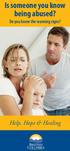 Is someone you know being abused? Do you know the warning signs? Help, Hope & Healing Are you concerned that someone is being abused, but don t know what to do? You may suspect abuse is happening to a
Protective Orders. What if the other person and I live together or have children together? What is a protective order?
 Protective Orders What is a protective order? It is a court order that protects you from someone who has been violent or threatened to be violent. How can a protective order help me? It can order the other
Because Fear Makes No Class Distinctions Abuse Support Group Helps Affluent Women End Silent Suffering
 11:42 PM CDT on Saturday, April 9, 2005 Because Fear Makes No Class Distinctions Abuse Support Group Helps Affluent Women End Silent Suffering By Kim Horner, The Dallas Morning News Dallas lawyer Julianne
Domestic Violence Laws and the Illinois Domestic Violence Act
 CHAPTER 8 Domestic Violence Laws and the Illinois Domestic Violence Act Although clergy and other spiritual leaders may not be directly involved in the legal procedures described below, it is important
Stalking 101: Understanding the lethality of stalking in today s world
 Stalking 101: Understanding the lethality of stalking in today s world Objectives Participants will be able to recognize the dynamics of stalking and the its impact on victims Participants will understand
P. O. Box 1520 Columbia, South Carolina 29202. Effective date of implementation: January 1, 2005. Domestic Violence
 SOUTH CAROLINA DEPARTMENT OF SOCIAL SERVICES P. O. Box 1520 Columbia, South Carolina 29202 STANDARDS OF CARE FOR BATTERERS TREATMENT Effective date of implementation: January 1, 2005 Domestic Violence
University of Illinois at Chicago Student Sexual Misconduct and Sexual Violence Interim Policy
 University of Illinois at Chicago Student Sexual Misconduct and Sexual Violence Interim Policy Introduction The University of Illinois at Chicago is committed to creating a safe and secure community for
DOMESTIC VIOLENCE STATISTICS
 DOMESTIC VIOLENCE STATISTICS Domestic Violence Fatalities in Washington State Between January 1, 1997 and June 30, 2006, at least 359 people were killed by domestic violence abusers in Washington state.
INSTRUCTIONS FOR FLORIDA SUPREME COURT APPROVED FAMILY LAW FORM 12.980(a), PETITION FOR INJUNCTION FOR PROTECTION AGAINST DOMESTIC VIOLENCE (06/12)
 INSTRUCTIONS FOR FLORIDA SUPREME COURT APPROVED FAMILY LAW FORM 12.980(a), PETITION FOR INJUNCTION FOR PROTECTION AGAINST DOMESTIC VIOLENCE (06/12) When should this form be used? If you are a victim of
A Guide for Larimer County Parents
 Services Child Protection A Guide for Larimer County Parents This booklet was prepared by the Program Committee of the Larimer County Child Advocacy Center in consultation with the Larimer County Department
Protective Orders Including: Order of Protection and Injunction Against Harassment
 Things You Should Know About Protective Orders Including: Order of Protection and Injunction Against Harassment This booklet is designed to provide general information about protective orders for domestic
Child Protective Services: Guidance for Mandated Reporters
 Child Protective Services: Guidance for Mandated Reporters 2012 Mandatory Reporting Laws Mandated Reporters must report suspected child abuse or neglect (or cause a report to be made) to law enforcement
FEDE DOMESTIC VIOLENCE STATUTES AND ELEMENTS FOR FEDERAL PROSECUTION
 FEDE DERAL DOMESTIC VIOLENCE STATUTES AND ELEMENTS FOR FEDERAL PROSECUTION OFFICE OF THE UNITED STATES ATTORNEY DISTRICT OF MAINE SEPTEMBER 2010 INDEX Introduction.. The Violence Against Women Act.. Firearm
Domestic Violence. What you need to know
 Domestic Violence What you need to know Domestic Violence A pattern of controlling and/or assaultive behavior that one person inflicts on another. Includes adults, children, teens, elderly and vulnerable
Child Protection Good Practice Guide. Domestic violence or abuse
 Child Protection Good Practice Guide Domestic violence or abuse West Sussex Social and Caring Services 1 Domestic violence is defined as Any incident of threatening behaviour, violence or abuse which can
Compensation for Crime Victims
 Compensation for Crime Victims Compensation for Crime Victims Every state in the country operates a program to help pay for some of the expenses resulting from crimes involving violence or abuse. Victims
CAMPUS SECURITY INFORMATION ANNUAL CAMPUS SECURITY REPORT-TULSA
 CAMPUS SECURITY INFORMATION ANNUAL CAMPUS SECURITY REPORT-TULSA The following statistics are provided as part of the requirement under the Student Right- To Know and Campus Security Act, Public Law 101-542,
NOBODY KNOWS WHAT S HAPPENING IN MY HOUSE. I M THE ONLY ONE WHO CAN FEEL MY PAIN. (quotation from a Mazocruz woman from Puno, Peru)
 Legal rights and help for those who are subjected to criminal acts in Norway If you have been subjected to criminal acts in the form of physical and/or psychological violence, sexual abuse, forced marriage,
Abuse of elderly victims age 65 or older can take
 U.S. Department of Justice Office of Justice Programs Bureau of Justice Statistics Special Report JUNE 2012, NCJ 238546 National Incident-Based Reporting System Violent Crime against the Elderly Reported
Ohio Victims of Crime Compensation Program Application for Crime Victim Compensation
 Ohio Victims of Crime Compensation Program Application for Crime Victim Compensation Please type or print using blue or black ink After an application has been filed, the law may provide for payment of
TESTIFYING ABOUT SELF-DEFENSE AND PREDOMINANT AGGRESSORS 1
 TESTIFYING ABOUT SELF-DEFENSE AND PREDOMINANT AGGRESSORS 1 Materials by James G. White, Hallie Bongar White, & Jane Larrington I. Introduction A domestic violence advocate may be called upon to testify
Crime Hurts Everyone We Can Help
 Crime Hurts Everyone We Can Help California Victim Compensation Program Providing Financial Assistance to Crime Victims Since 1965 table of contents Introduction to CalVCP 3 Covered Expenses 4 Application
GOVERNOR S CRIME COMMISSION FUNDAMENTAL SERVICE ELEMENTS
 GOVERNOR S CRIME COMMISSION FUNDAMENTAL SERVICE ELEMENTS The Fundamental Service Elements (FSEs) are the minimum standards to which all domestic violence and sexual assault programs shall adhere in order
An Analysis of the Domestic Violence Lethality Assessment. in Johnson County, Kansas. Presented by United Community Services of Johnson County
 An Analysis of the Domestic Violence Lethality Assessment in Johnson County, Kansas Presented by United Community Services of Johnson County January 17, 2014 Process Assessment of the Domestic Violence
PART THREE: TEMPLATE POLICY ON GENDER-BASED VIOLENCE AND THE WORKPLACE
 PART THREE: TEMPLATE POLICY ON GENDER-BASED VIOLENCE AND THE WORKPLACE Draft Organization s Bulletin The Secretary-General, for the purpose of preventing and addressing cases of Genderbased Violence (as
Guide For Advocates Working With Immigrant Victims of Domestic Violence
 Guide For Advocates Working With Immigrant Victims of Domestic Violence Created by the Domestic Violence Coordinating Council October 2009 This guide is intended to provide information to advocates working
*****THIS FORM IS NOT A PROTECTIVE ORDER APPLICATION OR A PROTECTIVE ORDER*****
 SHAREN WILSON CRIMINAL DISTRICT ATTORNEY OF TARRANT COUNTY, TEXAS PROTECTIVE ORDER UNIT Family Law Center Phone Number 817-884-1623 200 East Weatherford Street # 3040 Fax Number 817-212-7393 Fort Worth,
DOMESTIC VIOLENCE AND FIREARMS
 DOMESTIC VIOLENCE AND FIREARMS This brief examines the relationship between domestic violence and firearms in Maine. Domestic violence is considered by law enforcement officials to be the number one crime