
SCHOOL PSYCHOLOGY HANDBOOK
|
|
|
- Regina Alberta Pearson
- 10 years ago
- Views:
Transcription
1 SCHOOL PSYCHOLOGY HANDBOOK 2014 EDITION Rev 5/16/14 [1]

2 Contents SECTION 1. PROGRAM DESCRIPTION... 4 Training Philosophy... 5 School of Education and Health Science Professions Outcome Goals... 6 National Association of School Psychologists Domains of Professional Practice... 6 Integrated Goals and Domains... 8 School Psychology Program Level 1 Assessment: Admission Process Level 2 Assessment: Formative Assessment Level Assessment: Summative Evaluation for Master of Science Degree Level 4 Assessment: Summative Evaluation for Educational Specialist Degree Full Time Schedule... 1 Part Time Schedule... 1 Course Completion Checklist Matrix of Courses by NASP Domain Highlighted Strands Faculty Specialty Areas Timeline for Application Procedures Documents for Application Procedures School Psychology Program Notes Experience in Schools Transfer Credits Respecialization Residency Internship Tuition and Fees Financial Aid Job Market Interrupted Matriculation Investigation of Criminal Record Thesis Program and Candidate Accountability Policy for Addressing Concerns about Student Performance or Functioning Program Advisory on Ethical Community Engagement Due Process Guidelines... 2 [2]

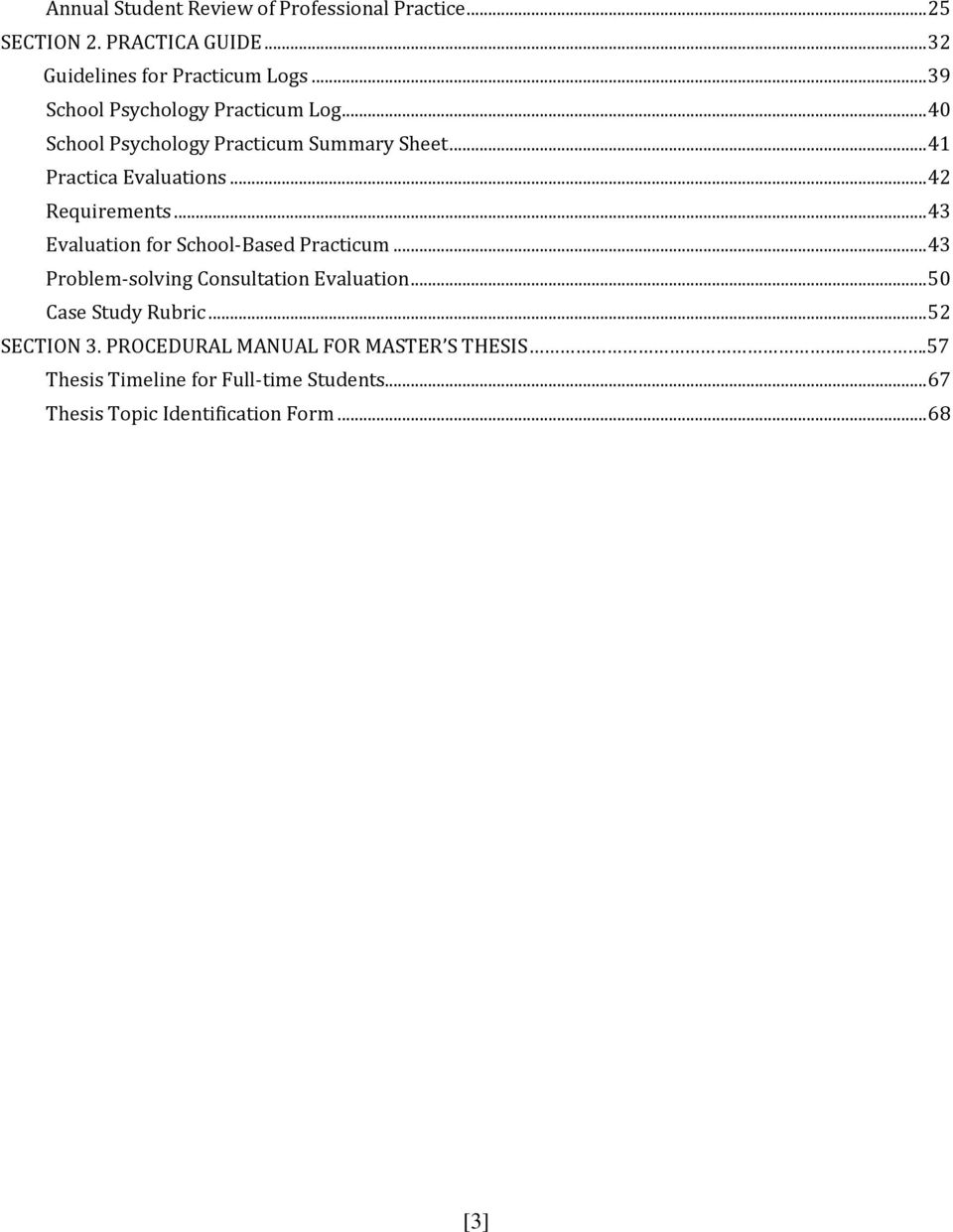
3 Annual Student Review of Professional Practice SECTION 2. PRACTICA GUIDE... 2 Guidelines for Practicum Logs... 9 School Psychology Practicum Log School Psychology Practicum Summary Sheet Practica Evaluations Requirements... 4 Evaluation for School-Based Practicum... 4 Problem-solving Consultation Evaluation Case Study Rubric SECTION. PROCEDURAL MANUAL FOR MASTER S THESIS..57 Thesis Timeline for Full-time Students Thesis Topic Identification Form []
4 SECTION 1. PROGRAM DESCRIPTION [4]

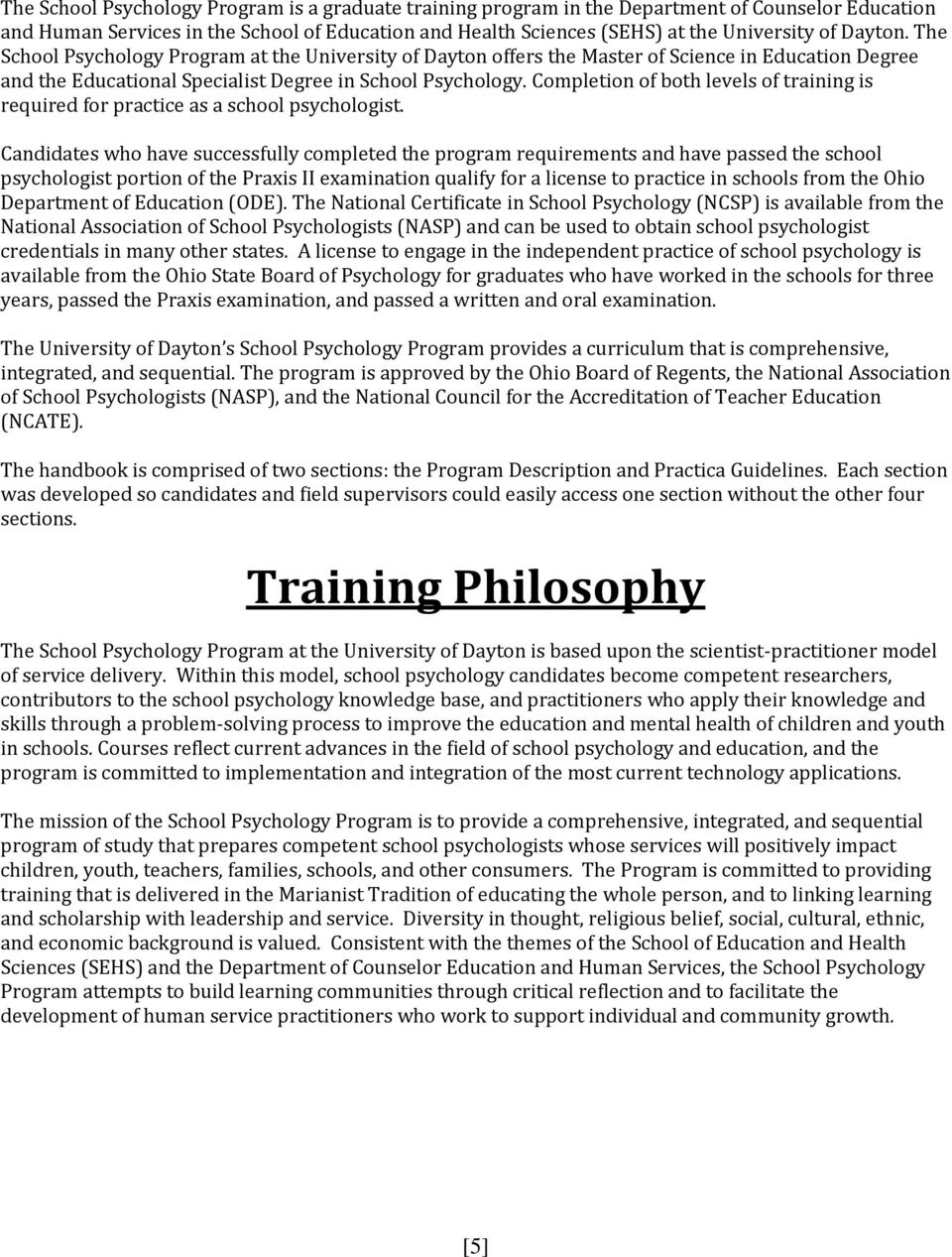
5 The School Psychology Program is a graduate training program in the Department of Counselor Education and Human Services in the School of Education and Health Sciences (SEHS) at the University of Dayton. The School Psychology Program at the University of Dayton offers the Master of Science in Education Degree and the Educational Specialist Degree in School Psychology. Completion of both levels of training is required for practice as a school psychologist. Candidates who have successfully completed the program requirements and have passed the school psychologist portion of the Praxis II examination qualify for a license to practice in schools from the Ohio Department of Education (ODE). The National Certificate in School Psychology (NCSP) is available from the National Association of School Psychologists (NASP) and can be used to obtain school psychologist credentials in many other states. A license to engage in the independent practice of school psychology is available from the Ohio State Board of Psychology for graduates who have worked in the schools for three years, passed the Praxis examination, and passed a written and oral examination. The University of Dayton s School Psychology Program provides a curriculum that is comprehensive, integrated, and sequential. The program is approved by the Ohio Board of Regents, the National Association of School Psychologists (NASP), and the National Council for the Accreditation of Teacher Education (NCATE). The handbook is comprised of two sections: the Program Description and Practica Guidelines. Each section was developed so candidates and field supervisors could easily access one section without the other four sections. Training Philosophy The School Psychology Program at the University of Dayton is based upon the scientist-practitioner model of service delivery. Within this model, school psychology candidates become competent researchers, contributors to the school psychology knowledge base, and practitioners who apply their knowledge and skills through a problem-solving process to improve the education and mental health of children and youth in schools. Courses reflect current advances in the field of school psychology and education, and the program is committed to implementation and integration of the most current technology applications. The mission of the School Psychology Program is to provide a comprehensive, integrated, and sequential program of study that prepares competent school psychologists whose services will positively impact children, youth, teachers, families, schools, and other consumers. The Program is committed to providing training that is delivered in the Marianist Tradition of educating the whole person, and to linking learning and scholarship with leadership and service. Diversity in thought, religious belief, social, cultural, ethnic, and economic background is valued. Consistent with the themes of the School of Education and Health Sciences (SEHS) and the Department of Counselor Education and Human Services, the School Psychology Program attempts to build learning communities through critical reflection and to facilitate the development of human service practitioners who work to support individual and community growth. [5]
6 School of Education and Health Sciences Outcome Goals The University of Dayton s School of Education and Health Sciences (SEHS) has established four primary goals for all program graduates. These goals are based on the institution s Marianist Tradition which values learning that produces graduates who: (1) embrace diversity for the promotion of social justice; (2) are scholar practitioners; () use critical reflection in their daily professional decision-making; and (4) work to build community. National Association of School Psychologists Domains of Professional Practice The School Psychology Program at the University of Dayton integrates the following Standards for Training and Field Placement Programs in School Psychology set forth by the National Association of School Psychologists into courses, practica, and internship. The program is designed to ensure that graduates demonstrate entry-level competency in each of the following domains of professional practice. Competency requires both knowledge and applied skills. It is intended that graduates possess a foundation in the knowledge base for psychology and education, including theories, models, empirical findings, and techniques in each domain. Graduates should be able to demonstrate the professional skills necessary to deliver effective services that result in positive outcomes in each domain. The domains below are not mutually exclusive, and are fully integrated into graduate level curricula, practica, and internship. 2.1 Data-Based Decision Making and Accountability School psychologists have knowledge of varied methods of assessment and data collection methods for identifying strengths and needs, developing effective services and programs, and measuring progress and outcomes. As part of a systematic and comprehensive process of effective decision making and problem solving that permeates all aspects of service delivery, school psychologists demonstrate skills to use psychological and educational assessment, data collection strategies, and technology resources, and apply results to design, implement, and evaluate response to services and programs. 2.2 Consultation and Collaboration School psychologists have knowledge of varied methods of consultation, collaboration, and communication applicable to individuals, families, groups, and systems, and used to promote effective implementation of services. As part of a systematic and comprehensive process of effective decision making and problem solving that permeates all aspects of service delivery, school psychologists demonstrate skills to consult, collaborate, and communicate with others during design, implementation, and evaluation of services and programs. 2. Interventions and Instructional Support to Develop Academic Skills School psychologists have knowledge of biological, cultural, and social influences on academic skills; human learning, cognitive, and developmental processes; and evidence-based curriculum [6]

7 and instructional strategies. School psychologists, in collaboration with others, demonstrate skills to use assessment and data collection methods and to implement and evaluate services that support cognitive and academic skills. 2.4 Interventions and Mental Health Services to Develop Social and Life Skills School psychologists have knowledge of biological, cultural, developmental, and social influences on behavior and mental health; behavioral and emotional impacts on learning and life skills; and evidence-based strategies to promote social emotional functioning and mental health. School psychologists, in collaboration with others, demonstrate skills to use assessment and data collection methods and to implement and evaluate services that support socialization, learning, and mental health. 2.5 School-Wide Practices to Promote Learning School psychologists have knowledge of school and systems structure, organization, and theory; general and special education; technology resources; and evidence-based school practices that promote academic outcomes, learning, social development, and mental health. School psychologists, in collaboration with others, demonstrate skills to develop and implement practices and strategies to create and maintain effective and supportive learning environments for children and others. 2.6 Preventive and Responsive Services School psychologists have knowledge of principles and research related to resilience and risk factors in learning and mental health; services in schools and communities to support multi-tiered prevention; and evidence-based strategies for effective crisis response. School psychologists, in collaboration with others, demonstrate skills to promote services that enhance learning, mental health, safety, and physical well-being through protective and adaptive factors and to implement effective crisis preparation, response, and recovery. 2.7 Family School Collaboration Services School psychologists have knowledge of principles and research related to family systems, strengths, needs, and culture; evidence-based strategies to support family influences on children s learning, socialization, and mental health; and methods to develop collaboration between families and schools. School psychologists, in collaboration with others, demonstrate skills to design, implement, and evaluate services that respond to culture and context and facilitate family and school partnership/ interactions with community agencies for enhancement of academic and social-behavioral outcomes for children. 2.8 Diversity in Development and Learning School psychologists have knowledge of individual differences, abilities, disabilities, and other diverse characteristics; principles and research related to diversity factors for children, families, and schools, including factors related to culture, context, and individual and role differences; and evidence-based strategies to enhance services and address potential influences related to diversity. School psychologists demonstrate skills to provide professional services that promote effective functioning for individuals, families, and schools with diverse characteristics, cultures, and [7]
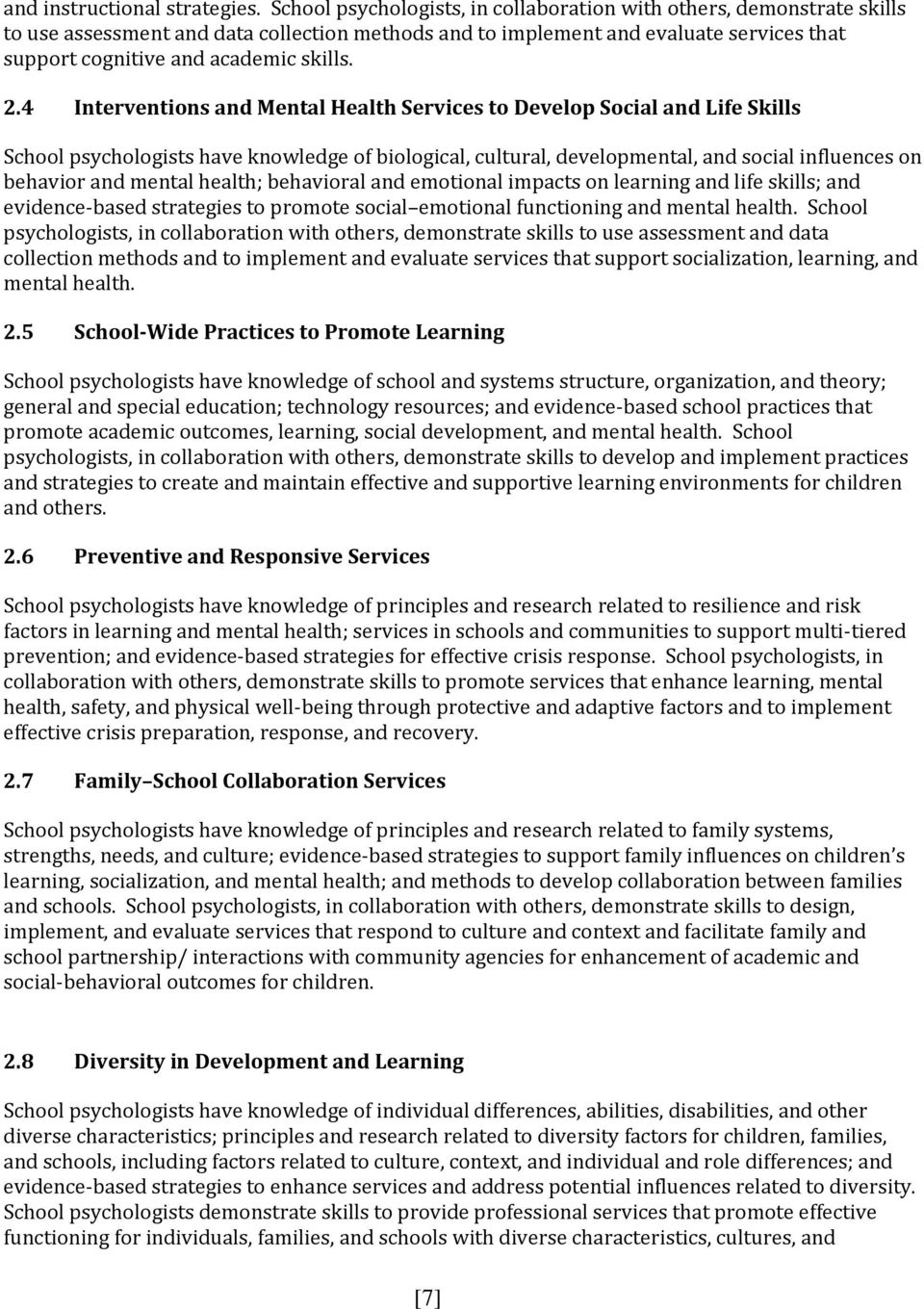
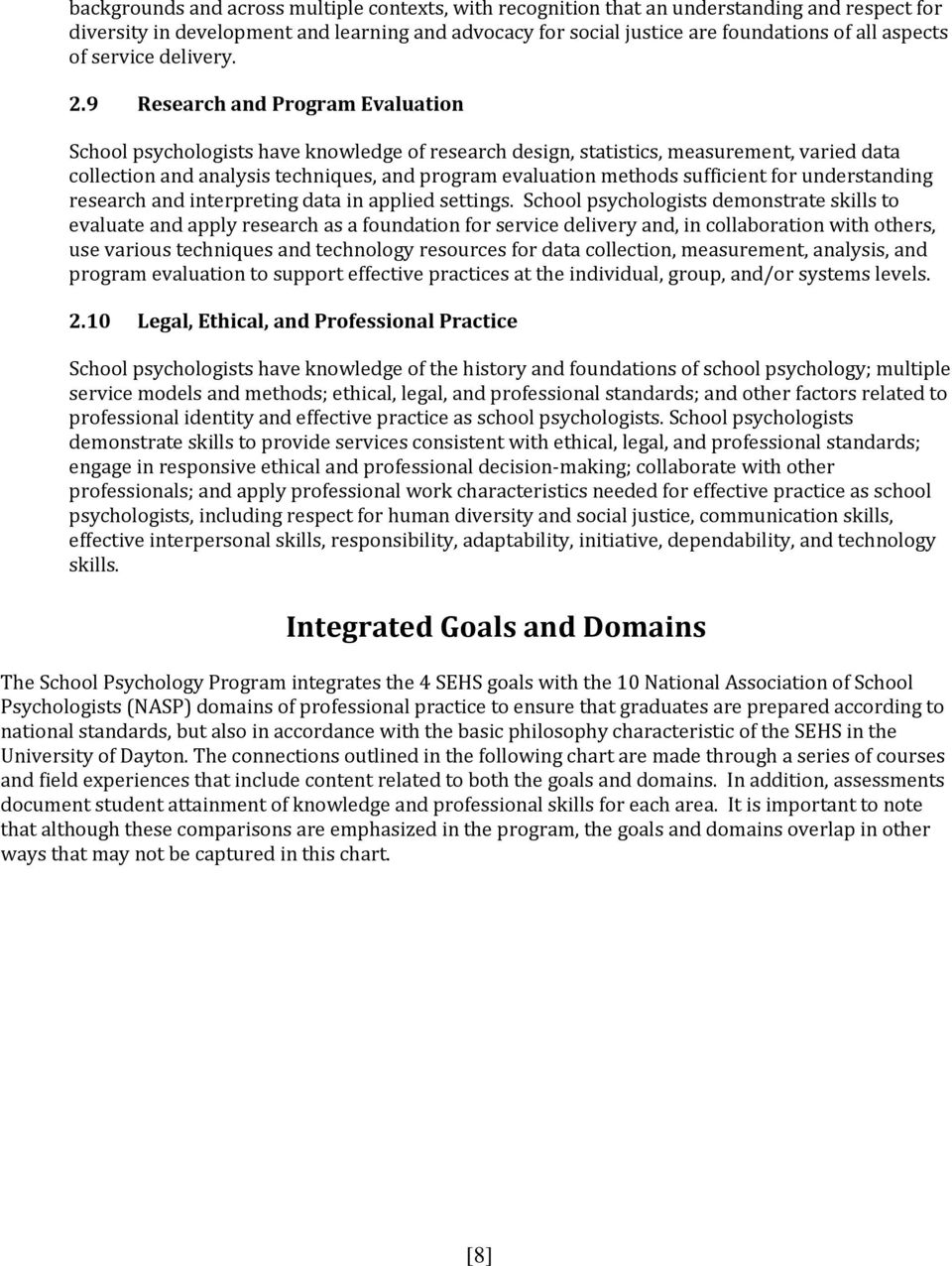
8 backgrounds and across multiple contexts, with recognition that an understanding and respect for diversity in development and learning and advocacy for social justice are foundations of all aspects of service delivery. 2.9 Research and Program Evaluation School psychologists have knowledge of research design, statistics, measurement, varied data collection and analysis techniques, and program evaluation methods sufficient for understanding research and interpreting data in applied settings. School psychologists demonstrate skills to evaluate and apply research as a foundation for service delivery and, in collaboration with others, use various techniques and technology resources for data collection, measurement, analysis, and program evaluation to support effective practices at the individual, group, and/or systems levels Legal, Ethical, and Professional Practice School psychologists have knowledge of the history and foundations of school psychology; multiple service models and methods; ethical, legal, and professional standards; and other factors related to professional identity and effective practice as school psychologists. School psychologists demonstrate skills to provide services consistent with ethical, legal, and professional standards; engage in responsive ethical and professional decision-making; collaborate with other professionals; and apply professional work characteristics needed for effective practice as school psychologists, including respect for human diversity and social justice, communication skills, effective interpersonal skills, responsibility, adaptability, initiative, dependability, and technology skills. Integrated Goals and Domains The School Psychology Program integrates the 4 SEHS goals with the 10 National Association of School Psychologists (NASP) domains of professional practice to ensure that graduates are prepared according to national standards, but also in accordance with the basic philosophy characteristic of the SEHS in the University of Dayton. The connections outlined in the following chart are made through a series of courses and field experiences that include content related to both the goals and domains. In addition, assessments document student attainment of knowledge and professional skills for each area. It is important to note that although these comparisons are emphasized in the program, the goals and domains overlap in other ways that may not be captured in this chart. [8]
9 SEHS Goals NASP Domains Consultation and Collaboration Embrace Diversity for the Promotion of Social Justice Diversity in Development and Learning Preventive and Responsive Services Interventions and Mental Health Services to Develop Social and Life Skills Family and School Collaboration Services Legal, Ethical, and Professional Practice Data-Based Decision Making and Accountability Critical Reflection Consultation and Collaboration Research and Program Evaluation Legal, Ethical, and Professional Practice Data-Based Decision Making and Accountability Scholar Practitioner Interventions and Instructional Support to Develop Academic Skills Interventions and Mental Health Services to Develop Social and Life Skills School-Wide Practices to Promote Learning Research and Program Evaluation Legal, Ethical, and Professional Practice Consultation and Collaboration School-Wide Practices to Promote Learning Building Community Preventive and Responsive Services Family and School Collaboration Services [9]

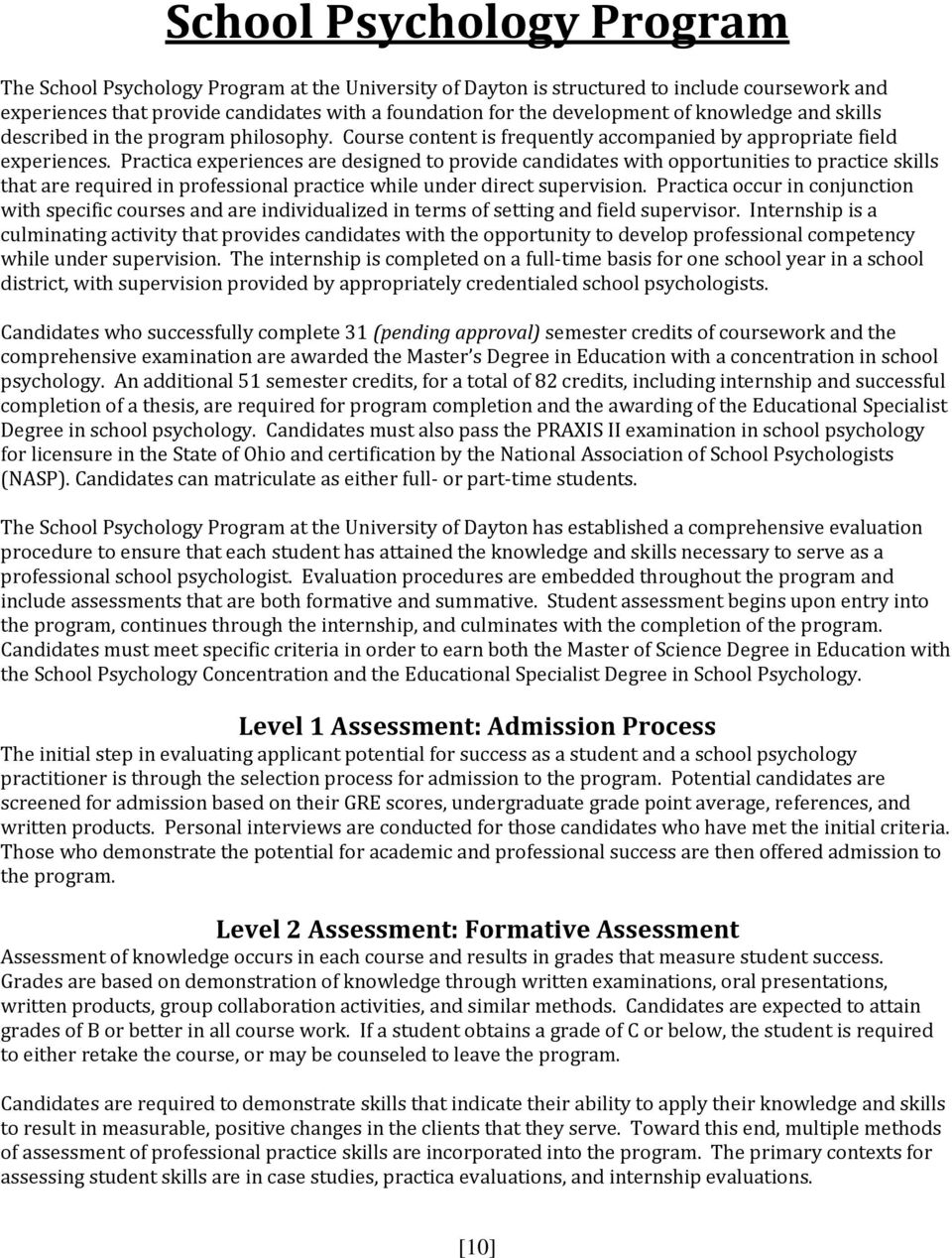
10 School Psychology Program The School Psychology Program at the University of Dayton is structured to include coursework and experiences that provide candidates with a foundation for the development of knowledge and skills described in the program philosophy. Course content is frequently accompanied by appropriate field experiences. Practica experiences are designed to provide candidates with opportunities to practice skills that are required in professional practice while under direct supervision. Practica occur in conjunction with specific courses and are individualized in terms of setting and field supervisor. Internship is a culminating activity that provides candidates with the opportunity to develop professional competency while under supervision. The internship is completed on a full-time basis for one school year in a school district, with supervision provided by appropriately credentialed school psychologists. Candidates who successfully complete 1 (pending approval) semester credits of coursework and the comprehensive examination are awarded the Master s Degree in Education with a concentration in school psychology. An additional 51 semester credits, for a total of 82 credits, including internship and successful completion of a thesis, are required for program completion and the awarding of the Educational Specialist Degree in school psychology. Candidates must also pass the PRAXIS II examination in school psychology for licensure in the State of Ohio and certification by the National Association of School Psychologists (NASP). Candidates can matriculate as either full- or part-time students. The School Psychology Program at the University of Dayton has established a comprehensive evaluation procedure to ensure that each student has attained the knowledge and skills necessary to serve as a professional school psychologist. Evaluation procedures are embedded throughout the program and include assessments that are both formative and summative. Student assessment begins upon entry into the program, continues through the internship, and culminates with the completion of the program. Candidates must meet specific criteria in order to earn both the Master of Science Degree in Education with the School Psychology Concentration and the Educational Specialist Degree in School Psychology. Level 1 Assessment: Admission Process The initial step in evaluating applicant potential for success as a student and a school psychology practitioner is through the selection process for admission to the program. Potential candidates are screened for admission based on their GRE scores, undergraduate grade point average, references, and written products. Personal interviews are conducted for those candidates who have met the initial criteria. Those who demonstrate the potential for academic and professional success are then offered admission to the program. Level 2 Assessment: Formative Assessment Assessment of knowledge occurs in each course and results in grades that measure student success. Grades are based on demonstration of knowledge through written examinations, oral presentations, written products, group collaboration activities, and similar methods. Candidates are expected to attain grades of B or better in all course work. If a student obtains a grade of C or below, the student is required to either retake the course, or may be counseled to leave the program. Candidates are required to demonstrate skills that indicate their ability to apply their knowledge and skills to result in measurable, positive changes in the clients that they serve. Toward this end, multiple methods of assessment of professional practice skills are incorporated into the program. The primary contexts for assessing student skills are in case studies, practica evaluations, and internship evaluations. [10]
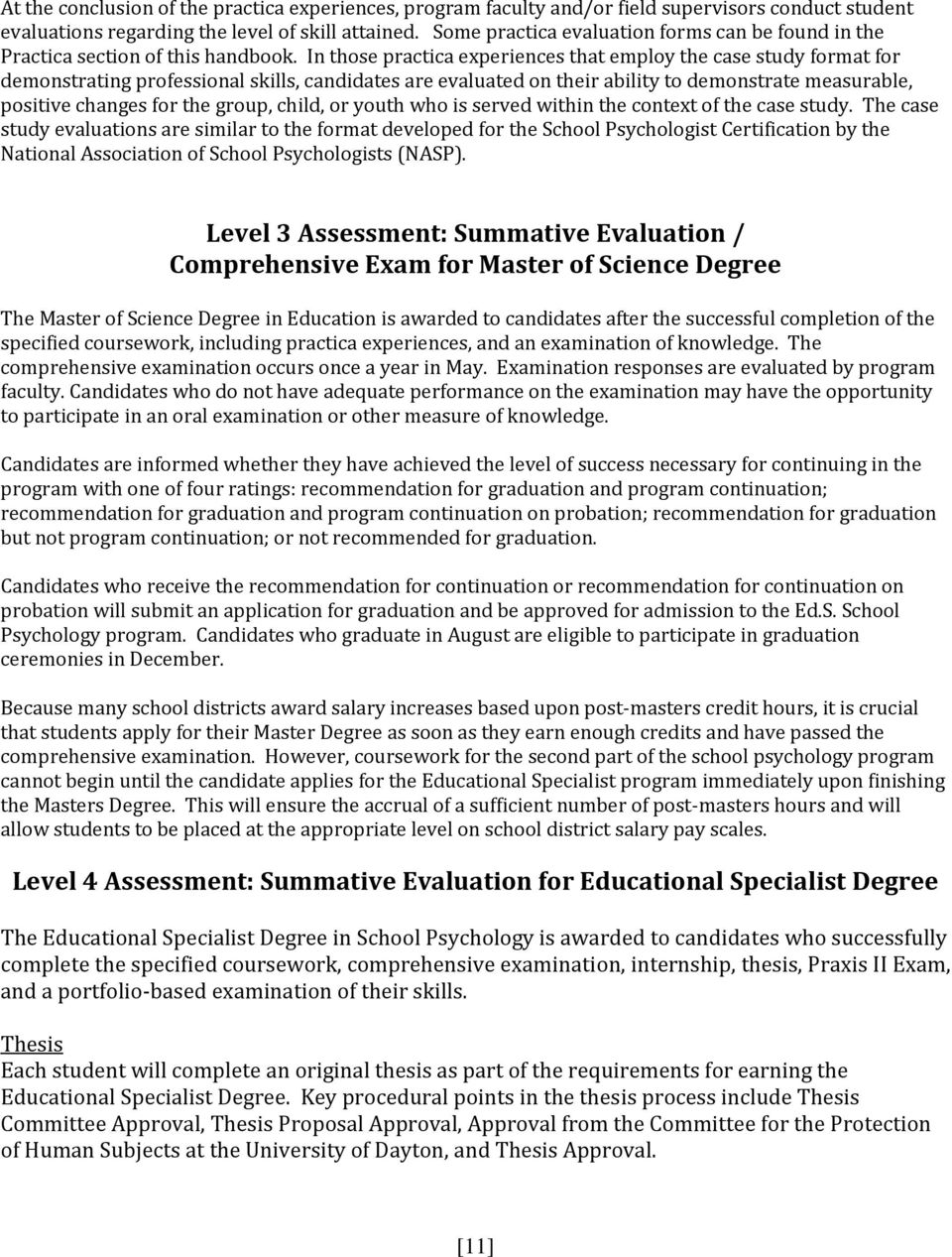
11 At the conclusion of the practica experiences, program faculty and/or field supervisors conduct student evaluations regarding the level of skill attained. Some practica evaluation forms can be found in the Practica section of this handbook. In those practica experiences that employ the case study format for demonstrating professional skills, candidates are evaluated on their ability to demonstrate measurable, positive changes for the group, child, or youth who is served within the context of the case study. The case study evaluations are similar to the format developed for the School Psychologist Certification by the National Association of School Psychologists (NASP). Level Assessment: Summative Evaluation / Comprehensive Exam for Master of Science Degree The Master of Science Degree in Education is awarded to candidates after the successful completion of the specified coursework, including practica experiences, and an examination of knowledge. The comprehensive examination occurs once a year in May. Examination responses are evaluated by program faculty. Candidates who do not have adequate performance on the examination may have the opportunity to participate in an oral examination or other measure of knowledge. Candidates are informed whether they have achieved the level of success necessary for continuing in the program with one of four ratings: recommendation for graduation and program continuation; recommendation for graduation and program continuation on probation; recommendation for graduation but not program continuation; or not recommended for graduation. Candidates who receive the recommendation for continuation or recommendation for continuation on probation will submit an application for graduation and be approved for admission to the Ed.S. School Psychology program. Candidates who graduate in August are eligible to participate in graduation ceremonies in December. Because many school districts award salary increases based upon post-masters credit hours, it is crucial that students apply for their Master Degree as soon as they earn enough credits and have passed the comprehensive examination. However, coursework for the second part of the school psychology program cannot begin until the candidate applies for the Educational Specialist program immediately upon finishing the Masters Degree. This will ensure the accrual of a sufficient number of post-masters hours and will allow students to be placed at the appropriate level on school district salary pay scales. Level 4 Assessment: Summative Evaluation for Educational Specialist Degree The Educational Specialist Degree in School Psychology is awarded to candidates who successfully complete the specified coursework, comprehensive examination, internship, thesis, Praxis II Exam, and a portfolio-based examination of their skills. Thesis Each student will complete an original thesis as part of the requirements for earning the Educational Specialist Degree. Key procedural points in the thesis process include Thesis Committee Approval, Thesis Proposal Approval, Approval from the Committee for the Protection of Human Subjects at the University of Dayton, and Thesis Approval. [11]
12 Praxis II Candidates are required to take and pass the School Psychology component of the Praxis II Examination at a level consistent with Ohio s passing score for licensure by the State Department of Education (161). Candidates are expected to achieve the national certification passing score of 165, as determined by the National Association of School Psychologists (NASP). Portfolio The portfolio is the last component to be completed prior to the awarding of the Ed.S. degree. A formal presentation of the portfolio to faculty by candidates takes place at the conclusion of the internship. Candidates must successfully complete coursework, the comprehensive examination, internship, thesis, and Praxis II prior to submission of the portfolio. The school psychology faculty will evaluate the contents of the portfolio, and make recommendations for improvement. At the conclusion of the formal presentation the school psychology faculty will make one of the following recommendations: recommended for graduation and licensure; recommended for licensure but not graduation; or not recommended for graduation and licensure. The following schedules ensure that candidates will follow the sequential plan and be fully integrated within the program. [12]

13 Schedule for Students Entering 2014 Full Time Schedule YEAR FALL SPRING SUMMER 1 SUMMER 2 1 EDC 510 EDC 511 EDC 517 EDC 572 EDC EDC 514 EDC 515 EDC 516 EDC 58/571 (hybrid) EDC 57 (online) 1 1 EDC 512 (Z) EDC 51 (Z) EDC 548 (Z) EDC 508 (Z, online) 1 2 EDC 58 (MASTER S DEGREE after comprehensive exam and 0+ hours) EDC 610 EDC 611 EDC 568 EDC 57 1 EDC 612 EDC 61 EDC 58/571 (hybrid) EDC 541 (hybrid) EDC EDC 615 (Z) EDC 542 (hybrid) EDC 59 (Z) 2 EDC EDC EDC EDC (EDUCATIONAL SPECIALIST DEGREE after internship, thesis, & portfolio presentation) = 82 Part Time Schedule YEAR FALL SPRING SUMMER 1 SUMMER 2 1 EDC 510 EDC 511 EDC 517 EDC EDC 514 EDC 515 EDC 58/571 (hybrid) EDC 57 (online) 1 1 EDC 512 (Z) EDC 51 (Z) EDC 508 (Z, online) EDC 610 EDC 611 EDC 54 1 EDC 516 EDC 58/571 (hybrd) EDC 548 (Z) EDC EDC 575 (MASTER S DEGREE after comprehensive exam and 0+ hours) EDC 57 EDC 568 EDC 612 EDC 61 EDC 541 (hybrid) EDC EDC 615 (Z) EDC 59 (Z) EDC EDC EDC EDC (EDUCATIONAL SPECIALIST DEGREE after internship, thesis, and portfolio) = 82 [1]
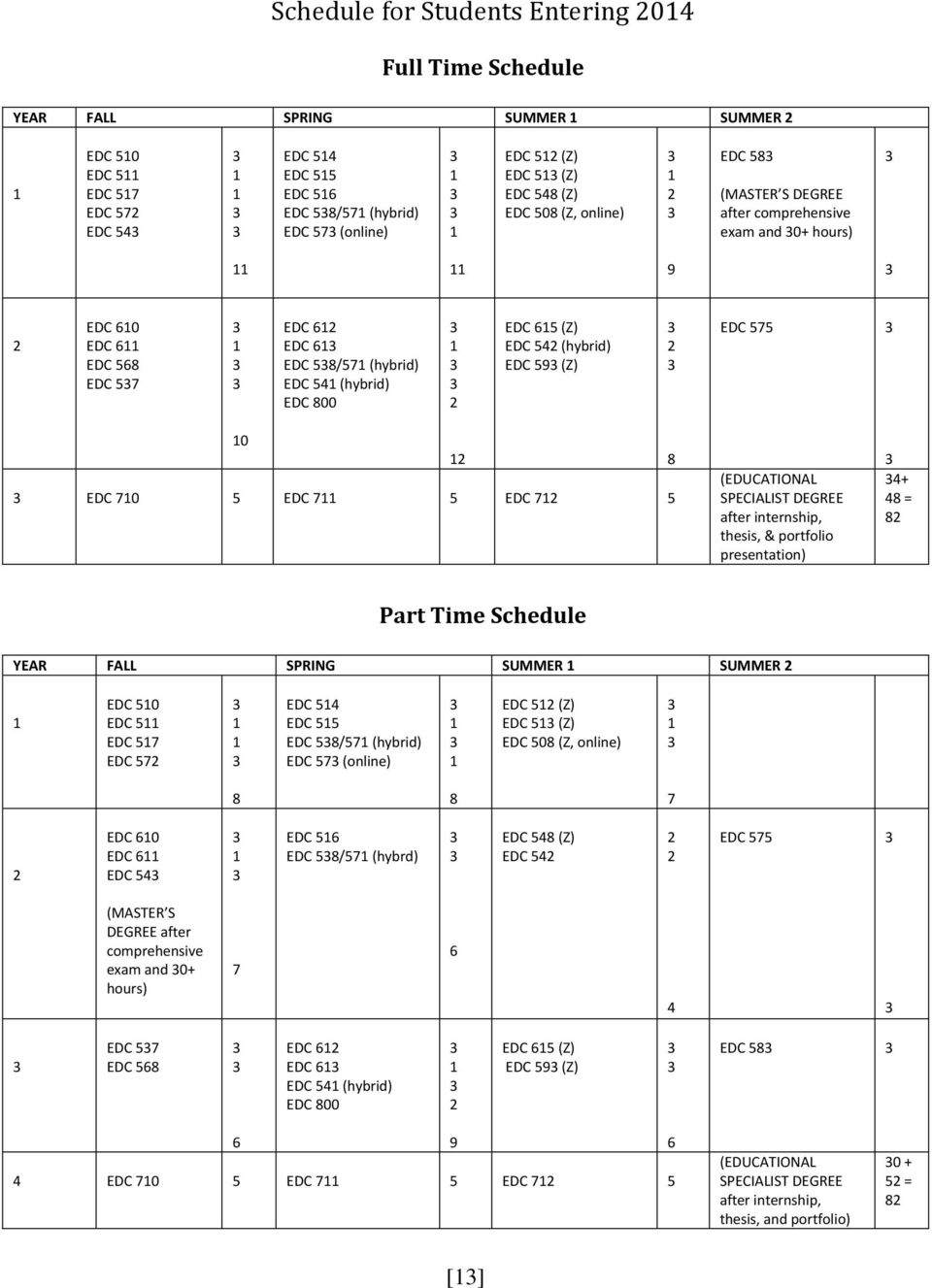
14 Course Completion Checklist NAME Master of Science Degree in Education Concentration: School Psychology Successful completion of 0+ credit hours Successful completion of comprehensive examination Educational Specialist Degree in School Psychology Successful completion of 52 credit hours for a total of 82 credit hours Successful completion of internship Approval of professional portfolio Successful completion of thesis COURSE EDC CREDIT HOURS COURSE TITLE 508 Theories of Learning & Human Development 510 Consultation in the Schools Consultation in the Schools Practicum 512 Cognitive Assessment 51 1 Cognitive Assessment Practicum 514 Academic Assessment for Intervention Academic Assessment for Intervention Practicum 516 Academic and Behavioral Assessment Instruments School Psychology Practicum: Shadowing 57 Statistics 58 Child & Adolescent Psychopathology 541 Curriculum & Instruction for Diverse Learners Crisis Intervention and Prevention in Educational Settings 54 Theories & Tech of Counseling Counseling Children and Adolescents 568 Research & Evaluation in Human Services 571 Biological Basis of Behavior 572 Role & Function of the School Psychologist 57 1 Orientation to the School Process 575 Counseling Diverse Populations 58 Theory and Techniques of Group Counseling 59 Early Childhood Development and Assessment 610 Social and Behavioral Assessment for Intervention Social and Behavioral Assessment for Intervention Practicum 612 Assessment for Intervention & Accountability 61 1 Assessment for Inter & Accountability Practicum 615 Culminating Seminar Internship in School Psych Internship in School Psych Internship in School Psych Thesis COMPLETED [14]
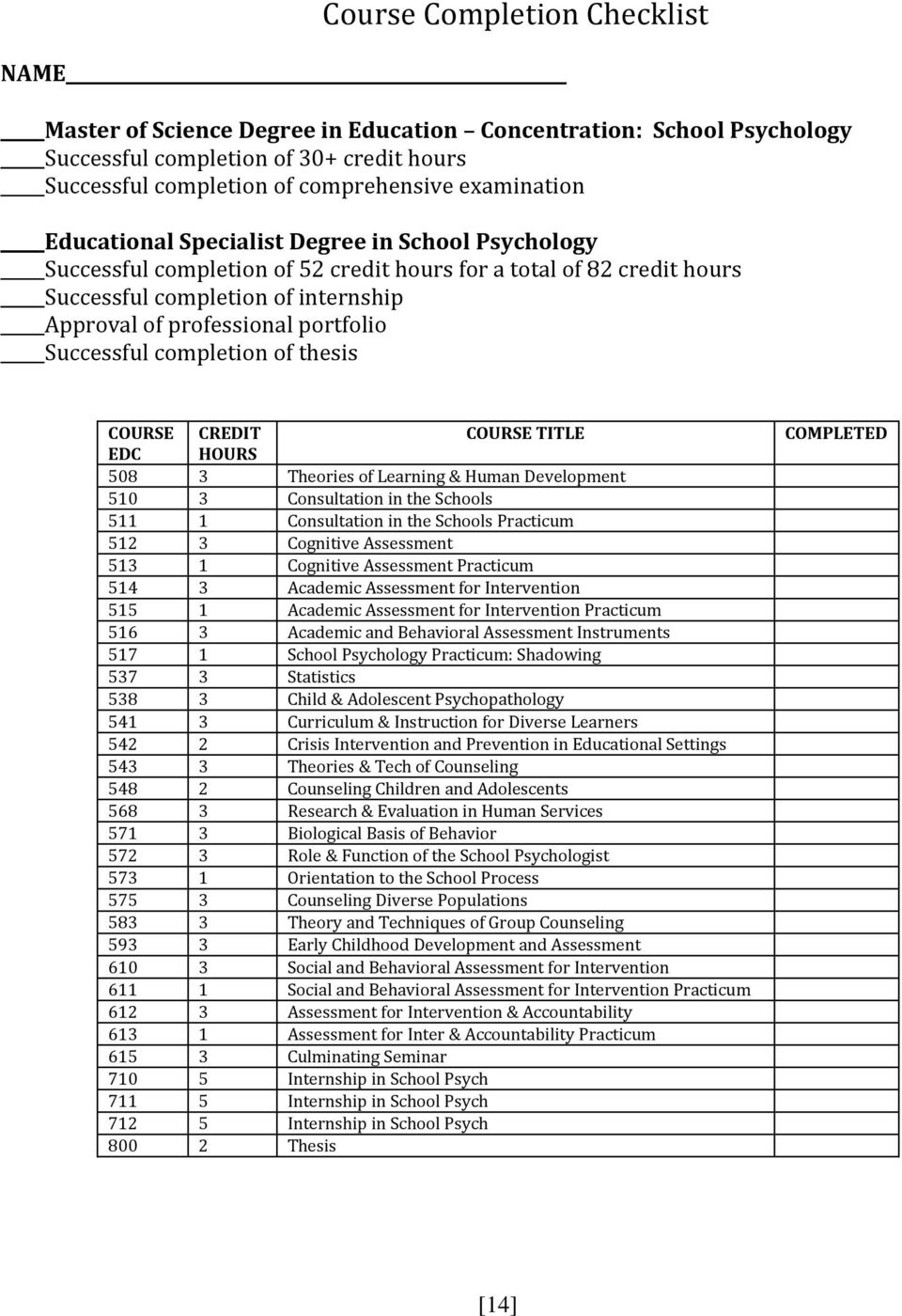
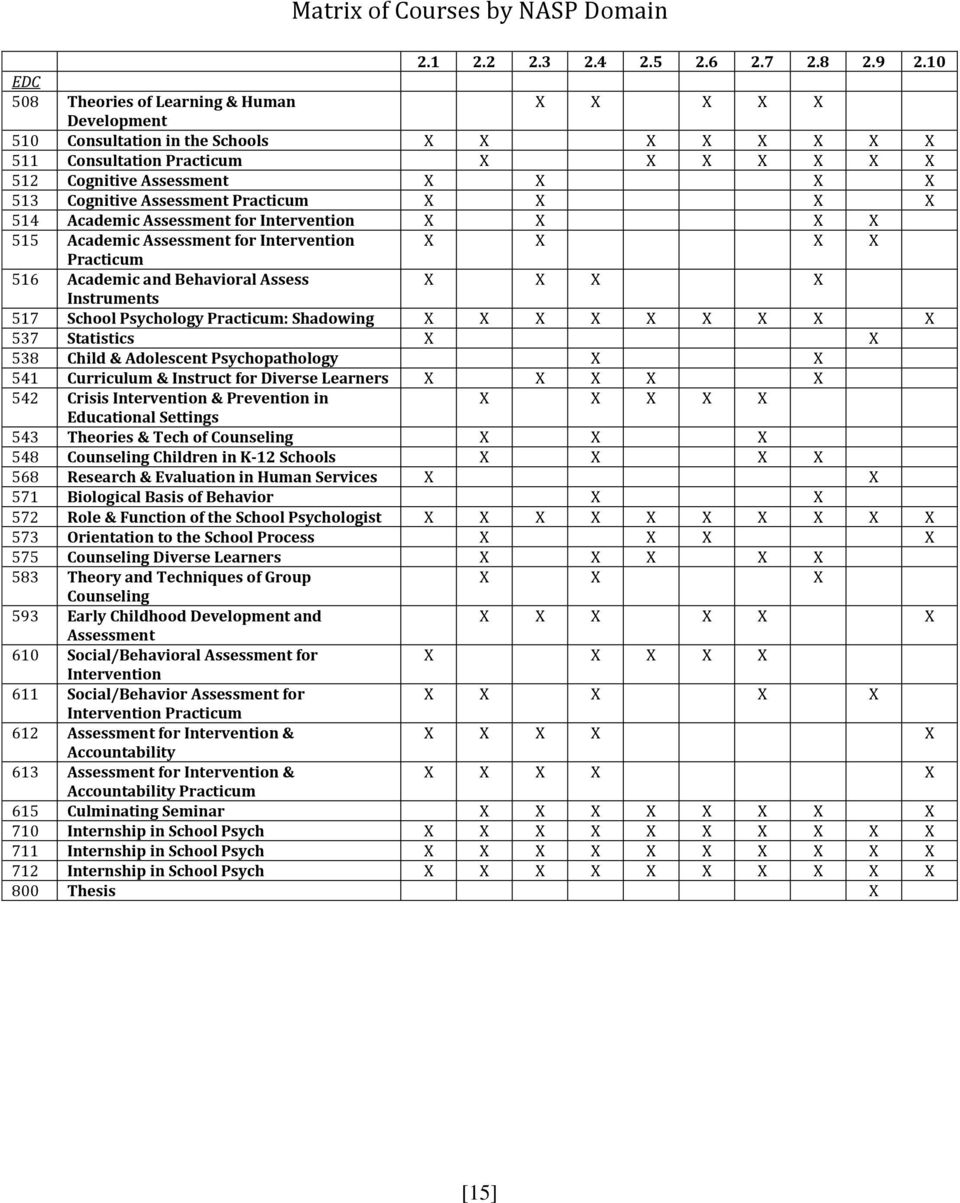
15 Matrix of Courses by NASP Domain EDC 508 Theories of Learning & Human X X X X X Development 510 Consultation in the Schools X X X X X X X X 511 Consultation Practicum X X X X X X X 512 Cognitive Assessment X X X X 51 Cognitive Assessment Practicum X X X X 514 Academic Assessment for Intervention X X X X 515 Academic Assessment for Intervention X X X X Practicum 516 Academic and Behavioral Assess X X X X Instruments 517 School Psychology Practicum: Shadowing X X X X X X X X X 57 Statistics X X 58 Child & Adolescent Psychopathology X X 541 Curriculum & Instruct for Diverse Learners X X X X X 542 Crisis Intervention & Prevention in X X X X X Educational Settings 54 Theories & Tech of Counseling X X X 548 Counseling Children in K-12 Schools X X X X 568 Research & Evaluation in Human Services X X 571 Biological Basis of Behavior X X 572 Role & Function of the School Psychologist X X X X X X X X X X 57 Orientation to the School Process X X X X 575 Counseling Diverse Learners X X X X X 58 Theory and Techniques of Group X X X Counseling 59 Early Childhood Development and X X X X X X Assessment 610 Social/Behavioral Assessment for X X X X X Intervention 611 Social/Behavior Assessment for X X X X X Intervention Practicum 612 Assessment for Intervention & X X X X X Accountability 61 Assessment for Intervention & X X X X X Accountability Practicum 615 Culminating Seminar X X X X X X X X 710 Internship in School Psych X X X X X X X X X X 711 Internship in School Psych X X X X X X X X X X 712 Internship in School Psych X X X X X X X X X X 800 Thesis X [15]
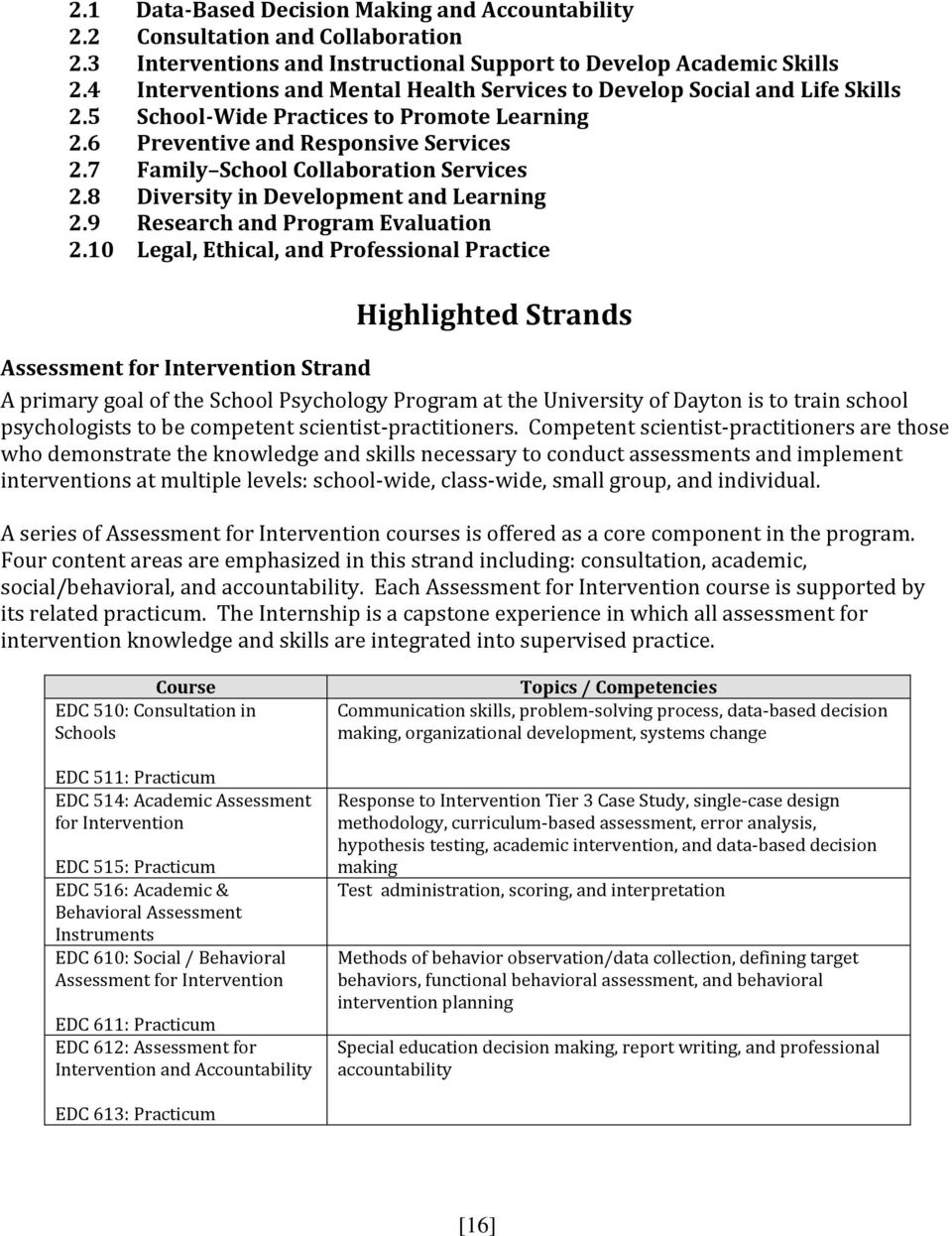
16 2.1 Data-Based Decision Making and Accountability 2.2 Consultation and Collaboration 2. Interventions and Instructional Support to Develop Academic Skills 2.4 Interventions and Mental Health Services to Develop Social and Life Skills 2.5 School-Wide Practices to Promote Learning 2.6 Preventive and Responsive Services 2.7 Family School Collaboration Services 2.8 Diversity in Development and Learning 2.9 Research and Program Evaluation 2.10 Legal, Ethical, and Professional Practice Highlighted Strands Assessment for Intervention Strand A primary goal of the School Psychology Program at the University of Dayton is to train school psychologists to be competent scientist-practitioners. Competent scientist-practitioners are those who demonstrate the knowledge and skills necessary to conduct assessments and implement interventions at multiple levels: school-wide, class-wide, small group, and individual. A series of Assessment for Intervention courses is offered as a core component in the program. Four content areas are emphasized in this strand including: consultation, academic, social/behavioral, and accountability. Each Assessment for Intervention course is supported by its related practicum. The Internship is a capstone experience in which all assessment for intervention knowledge and skills are integrated into supervised practice. Course EDC 510: Consultation in Schools EDC 511: Practicum EDC 514: Academic Assessment for Intervention EDC 515: Practicum EDC 516: Academic & Behavioral Assessment Instruments EDC 610: Social / Behavioral Assessment for Intervention EDC 611: Practicum EDC 612: Assessment for Intervention and Accountability Topics / Competencies Communication skills, problem-solving process, data-based decision making, organizational development, systems change Response to Intervention Tier Case Study, single-case design methodology, curriculum-based assessment, error analysis, hypothesis testing, academic intervention, and data-based decision making Test administration, scoring, and interpretation Methods of behavior observation/data collection, defining target behaviors, functional behavioral assessment, and behavioral intervention planning Special education decision making, report writing, and professional accountability EDC 61: Practicum [16]
17 Research and Program Evaluation Strand The School Psychology Program at the University of Dayton values research as a critical component in the development of scientist-practitioner school psychologists. Training in research and program evaluation is accomplished through a comprehensive, systematic approach that is integrated throughout the School Psychology Program. The purpose of this learning strand is to prepare candidates to be competent consumers and producers of research and to be collaborative members of research and program evaluation teams. Empirical support for intervention selection is emphasized. A thesis is completed as one of the culminating experiences at the end of the Educational Specialist degree. A faculty advisor, chosen by the student, provides support and guidance for the thesis from inception to completion. Course EDC 572: Role & Function of the School Psychologist EDC 517: Practicum EDC 57: Statistics EDC 568:Research and Evaluation in Human Services EDC 514: Academic Assessment for Intervention EDC 515: Practicum EDC 610: Social / Behavioral Assessment for Intervention EDC 611: Practicum EDC 612: Assessment for Intervention and Accountability EDC 61: Practicum EDC 800: Thesis Topics / Competencies Introduction to research, conducting literature reviews, and using APA format Applied Statistics for single case, parametric, and nonparametric procedures Qualitative and quantitative methods for conducting research and program evaluation Response to Intervention applications to group and case studies Response to Intervention applications to group and case studies Special education decision making, and professional accountability Thesis Although the program emphasizes these 2 strands, there is recognition that candidates must be prepared to enter the field under a variety of conditions. Candidates are prepared to fill traditional as well as innovative school psychologist positions. Training is grounded by the NASP domains so that students can be effective as change agents with individual students, in small groups, in classrooms, and at the system-wide level. The Matrix of Courses by Domain provides a synopsis of the integration of courses with the NASP requirements. Faculty Specialty Areas In addition to the highlighted strands, there are specialty areas that are the focus of the research interests of the primary faculty. Dr. Sawyer Hunley, Ph.D., NCSP, investigates Response to Intervention with an emphasis on Tier, program evaluation, and the connection between learning and physical space. Dr. Susan Davies, Ed.D., NCSP, studies the efficacy of specific [17]

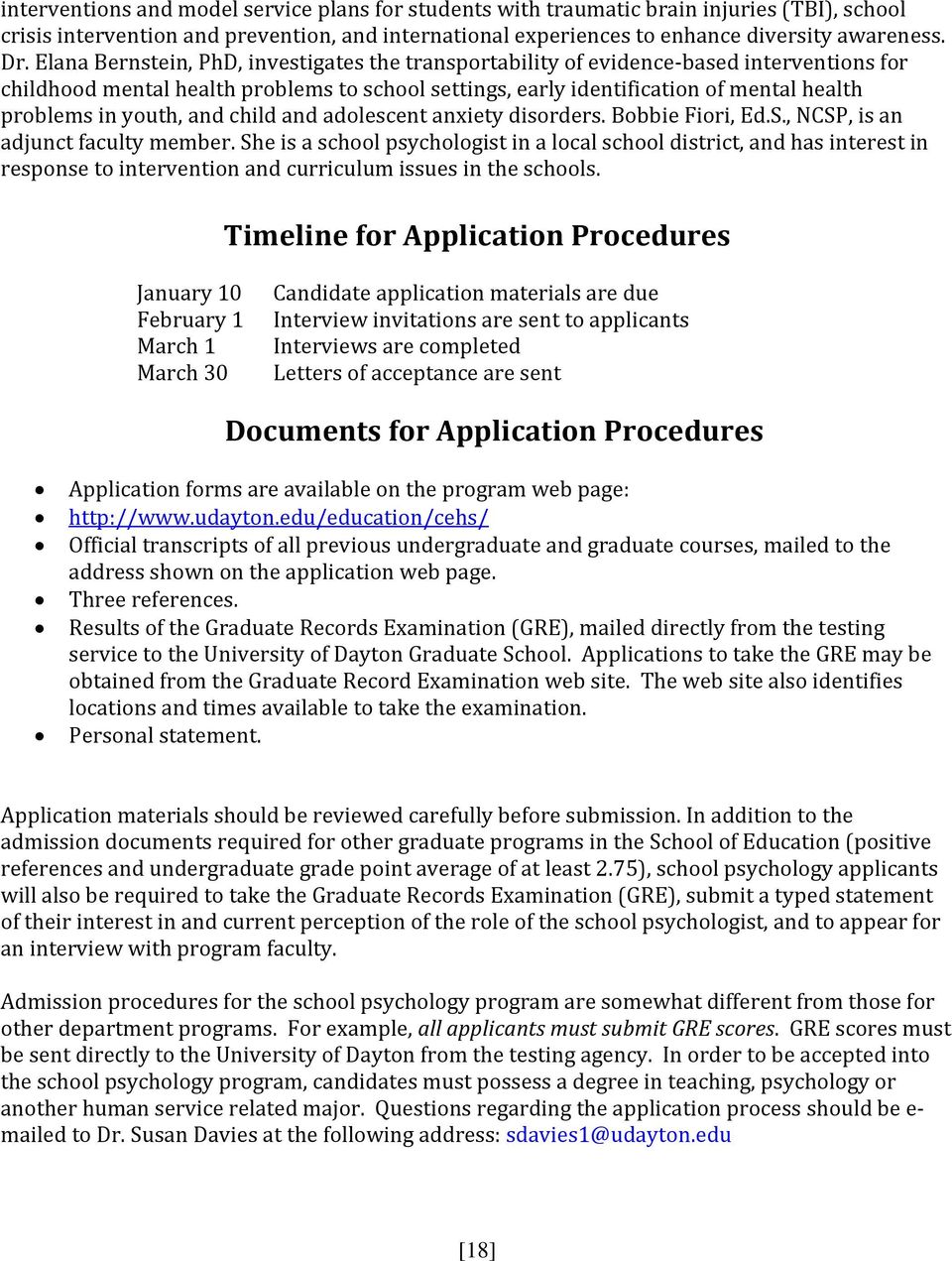
18 interventions and model service plans for students with traumatic brain injuries (TBI), school crisis intervention and prevention, and international experiences to enhance diversity awareness. Dr. Elana Bernstein, PhD, investigates the transportability of evidence-based interventions for childhood mental health problems to school settings, early identification of mental health problems in youth, and child and adolescent anxiety disorders. Bobbie Fiori, Ed.S., NCSP, is an adjunct faculty member. She is a school psychologist in a local school district, and has interest in response to intervention and curriculum issues in the schools. Timeline for Application Procedures January 10 February 1 March 1 March 0 Candidate application materials are due Interview invitations are sent to applicants Interviews are completed Letters of acceptance are sent Documents for Application Procedures Application forms are available on the program web page: Official transcripts of all previous undergraduate and graduate courses, mailed to the address shown on the application web page. Three references. Results of the Graduate Records Examination (GRE), mailed directly from the testing service to the University of Dayton Graduate School. Applications to take the GRE may be obtained from the Graduate Record Examination web site. The web site also identifies locations and times available to take the examination. Personal statement. Application materials should be reviewed carefully before submission. In addition to the admission documents required for other graduate programs in the School of Education (positive references and undergraduate grade point average of at least 2.75), school psychology applicants will also be required to take the Graduate Records Examination (GRE), submit a typed statement of their interest in and current perception of the role of the school psychologist, and to appear for an interview with program faculty. Admission procedures for the school psychology program are somewhat different from those for other department programs. For example, all applicants must submit GRE scores. GRE scores must be sent directly to the University of Dayton from the testing agency. In order to be accepted into the school psychology program, candidates must possess a degree in teaching, psychology or another human service related major. Questions regarding the application process should be e- mailed to Dr. Susan Davies at the following address: [email protected] [18]
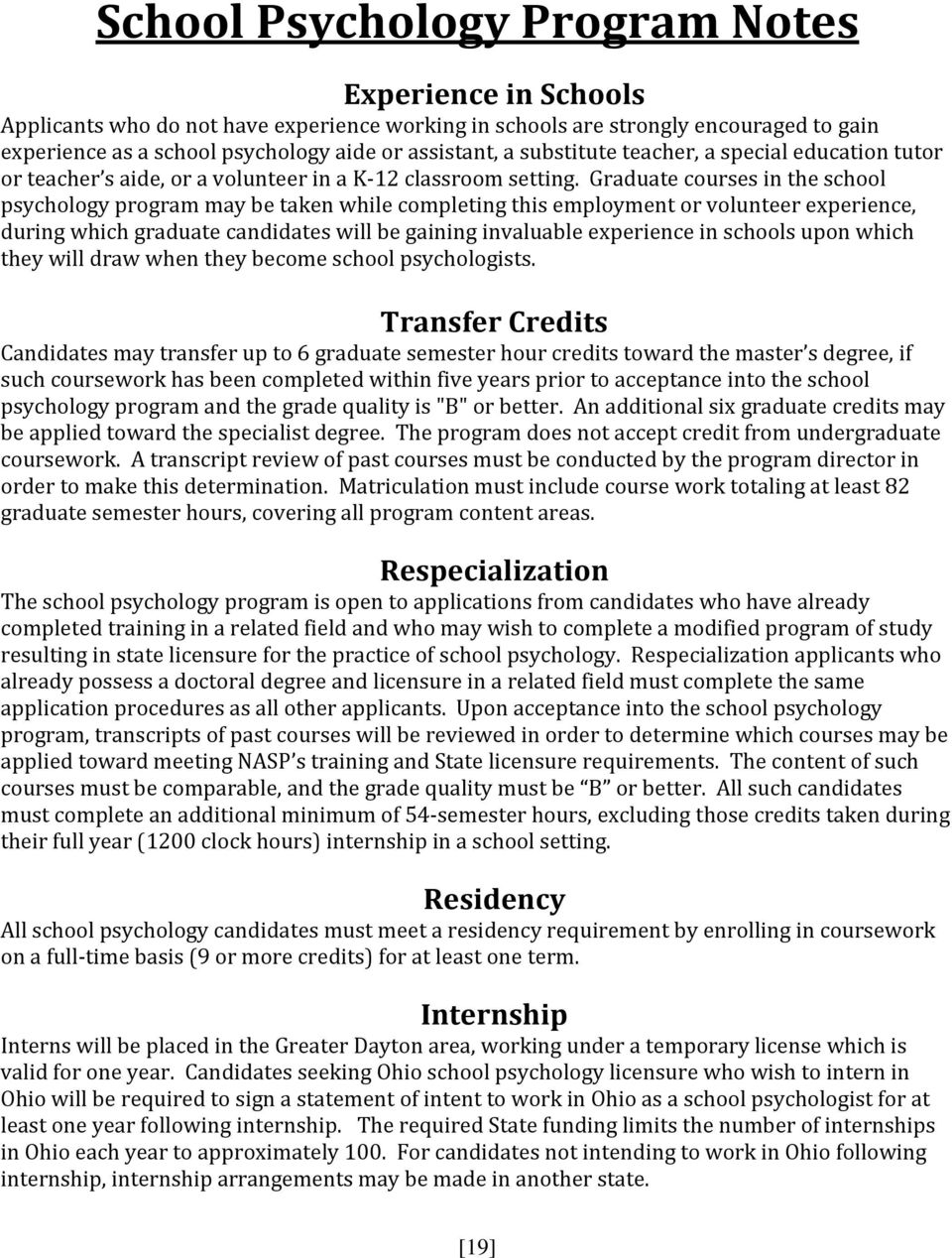
19 School Psychology Program Notes Experience in Schools Applicants who do not have experience working in schools are strongly encouraged to gain experience as a school psychology aide or assistant, a substitute teacher, a special education tutor or teacher s aide, or a volunteer in a K-12 classroom setting. Graduate courses in the school psychology program may be taken while completing this employment or volunteer experience, during which graduate candidates will be gaining invaluable experience in schools upon which they will draw when they become school psychologists. Transfer Credits Candidates may transfer up to 6 graduate semester hour credits toward the master s degree, if such coursework has been completed within five years prior to acceptance into the school psychology program and the grade quality is "B" or better. An additional six graduate credits may be applied toward the specialist degree. The program does not accept credit from undergraduate coursework. A transcript review of past courses must be conducted by the program director in order to make this determination. Matriculation must include course work totaling at least 82 graduate semester hours, covering all program content areas. Respecialization The school psychology program is open to applications from candidates who have already completed training in a related field and who may wish to complete a modified program of study resulting in state licensure for the practice of school psychology. Respecialization applicants who already possess a doctoral degree and licensure in a related field must complete the same application procedures as all other applicants. Upon acceptance into the school psychology program, transcripts of past courses will be reviewed in order to determine which courses may be applied toward meeting NASP s training and State licensure requirements. The content of such courses must be comparable, and the grade quality must be B or better. All such candidates must complete an additional minimum of 54-semester hours, excluding those credits taken during their full year (1200 clock hours) internship in a school setting. Residency All school psychology candidates must meet a residency requirement by enrolling in coursework on a full-time basis (9 or more credits) for at least one term. Internship Interns will be placed in the Greater Dayton area, working under a temporary license which is valid for one year. Candidates seeking Ohio school psychology licensure who wish to intern in Ohio will be required to sign a statement of intent to work in Ohio as a school psychologist for at least one year following internship. The required State funding limits the number of internships in Ohio each year to approximately 100. For candidates not intending to work in Ohio following internship, internship arrangements may be made in another state. [19]
20 Tuition and Fees All graduate education courses are offered on a semester credit system. Most courses are three semester credits. Updated information on specific graduate tuition and fees can be found at: Financial Aid Financial aid from university sources is available to a limited number of full-time candidates. (Full time status requires registration for a minimum of 9 credits per term.) Guaranteed student loans are available to candidates who register for at least three credit hours per term, if the student's financial ability meets eligibility criteria. The granting of financial aid requires that the student first be admitted into a graduate program. A financial aid information package may be obtained from the University s Financial Aid Office ( ). Loan forgiveness programs are available to school psychologists to provide relief to people who have a qualifying loan by forgiving payments on that loan after a period of time in which the person pays faithfully on the loan and works in a desired position or setting. For more information about the College Cost Reduction and Access Act, and the Public Service Employee Program, interested persons should contact the U.S. Department of Education s call center at Callers to the automated system should select the option that permits them to speak directly to an operator or a call center representative. A limited number of graduate assistantships are available. Each pays some tuition costs plus a monthly stipend, and typically requires 20 hours of work per week. A number of educational agencies hire special education tutors, teacher aides, and substitute teachers, at hourly, daily, or yearly rates. Such employment offers financial support for living expenses and tuition payments, as well as excellent experience in preparation for the role of a school psychologist. Job Market Both national and state surveys reveal a shortage of school psychologists and an excellent job market, especially for persons who are able to move to locations where the job shortages are greatest. However, during these economic times, job hunting may be more uncertain for persons who are unable to move. Interrupted Matriculation Candidates are required to maintain sequential and uninterrupted matriculation through the pattern of courses outlined at the beginning of their programs. Uninterrupted matriculation occurs when candidates complete at least one course per semester, including fall, spring and summer terms. If this pattern is altered, it may become necessary for candidates to complete additional requirements in order to insure their readiness to resume or to complete the program. Candidates should alter their program pattern only through consultation with program faculty. [20]
21 Investigation of Criminal Record School psychology candidates should be aware that a fingerprint check is required to determine if they have a criminal record. Fingerprinting will be conducted in the summer prior to beginning the program, so that students may begin school based practicum experiences their first semester of the program. Any conviction occurring during the program must be reported by the student to the program director. In order to be granted the one-year temporary child study license required for internship, such check(s) will be conducted again during the summer prior to the internship year by the Ohio Bureau of Criminal Investigation (BCI), and the FBI (for persons who have not been Ohio residents for the past five years). Thesis Each student will complete a thesis as part of the requirements for earning the Educational Specialist Degree. Key procedural points in the thesis process include Proposal Approval, UD Internal Review Board Approval, and Thesis Approval. Documentation of a completed thesis is required for the Ed.S. and School Psychology Candidates are expected to present their theses in the editorial style prescribed in the most recent edition of the Publication Manual of the American Psychological Association. In addition, all graduate candidates writing theses at the University of Dayton should follow the procedures described by the University of Dayton Graduate School at: and the Roesch Library at: Students who do not complete the thesis by the end of internship (EDC 712) are required to enroll in one credit hour per semester (beginning in the fall term following the internship year) until the final thesis has been successfully defended. Grades for thesis will be assigned as IP (in progress) until thesis completion, at which time the grade will be changed to CR (credit). See the thesis completion timeline and corresponding forms on pages 70 and 71. Program and Candidate Accountability The School Psychology Program at the University of Dayton is dedicated to providing high quality training for its candidates. The program subscribes to the philosophy of the National Association of School Psychologists (NASP) in its belief statement that: Systematic evaluation of coursework, practica, internship experiences, faculty, supervisors, and institutional resources is essential for monitoring and improving program quality. It is essential that programs also demonstrate accountability with regard to the overall effectiveness of the total curriculum. That accountability is demonstrated through the ability of the program s graduates to provide school psychological services that effectively respond to the educational and mental health needs of children and youth, their families and the educational and mental health agencies that serve them. Toward this end, the School Psychology Program has developed a performance-based program evaluation procedure that is a comprehensive system of assessment, accountability, and program development. Program evaluation information comes from both external and internal sources and are analyzed and evaluated periodically. External sources provide information that is summative in nature and serves to review the quality of the program and student competencies. These external sources include but are not limited to: [21]
22 1. National Association of School Psychologists (NASP) 2. National Council for Accreditation of Teacher Education (NCATE). North Central Association 4. PRAXIS II Examination 5. Ohio Department of Education 6. Surveys of alumni Internal sources of program evaluation are both summative and formative in nature and provide evaluative feedback from and about student competencies and specific program components. These internal sources include but are not limited to: 1. Student evaluations of courses 2. Student theses. Case study results 4. Student Practica and Internship logs 5. Student performance evaluations (Practica and Internship) 6. Student transcripts 7. Student portfolio reviews 8. Student evaluation of internship 9. Comprehensive examination (Master s level) Formal documentation of the analysis is completed on an annual basis and accompanied by an action plan for improvement. Evaluation of the results of the action plan is conducted periodically and annually on a formal basis. Policy for Addressing Concerns about Student Performance or Functioning Graduate programs that prepare professional school psychologists have an obligation to protect the public and the profession. This obligation requires the UD school psychology training program to (a) establish criteria and methods through which aspects of competence other than, and in addition to, a student-trainee s knowledge or skills may be assessed including, but not limited to, emotional stability and well-being, interpersonal skills, professional development, and personal fitness for practice; and (b) ensure insofar as possible that the student-trainees who complete their programs are competent to manage future relationships (e.g., client, collegial, professional, public, scholarly, supervisory, teaching) in an effective and appropriate manner. Because of this commitment, the UD school psychology training program strives to prohibit advancement, or recommendation, of graduate students or trainees with demonstrable problems (e.g., cognitive, emotional, psychological, interpersonal, technical, and ethical) that may interfere with professional competence to other programs, the profession, employers, or the public at large. Because graduate students make significant developmental transitions during their graduate training and may need special assistance during this time, it is the responsibility of the program to provide recommendations, activities, procedures, and opportunities that can facilitate growth and minimize stress. Such measures include, but are not limited to: orientation meetings, [22]
23 individualized programs, clear and realistic expectations, clear and timely evaluations and feedback that may result in suggestions for positive change, and contact with support individuals (e.g., supervisors) and/or groups (e.g., other graduate trainees, former students). At times, a student may need to take an I (incomplete) for a class. It is the student s responsibility to secure a written agreement with the instructor regarding the timeline and expectation for work completion. Any I grades will turn into F s after one academic year. Students will complete an Annual Student Review of Professional Development during each year (November) and prior to internship. The Annual Review requires students to examine evidence they have accumulated through coursework, thesis, practicum, etc. to support their professional development in three of the NASP training domains associated with SEHS Outcome Goals: Consultation and Collaboration (SEHS: Critical Reflection), Diversity in Development and Learning (SEHS: Embrace Diversity for Social Justice), and Legal, Ethical, and Professional Practice (SEHS: Scholar Practitioner). Students will also complete the course completion checklist, identify 2 personal goals for the upcoming year as part of this review, and indicate any concerns/questions to be addressed by faculty. Program faculty will review students self-completed Annual Review and provide oral and/or written feedback on student s professional growth on an annual basis (December). See a copy of the Annual Student Review of Professional Practice on page 25. Program Advisory on Ethical Community Engagement 1) Conduct in the Community Candidates are encouraged to be mindful that while they lead private lives, they are engaged in public professions. Candidates must monitor the appropriateness of their conduct at all times, and exercise discerning judgment in both professional and leisure pursuits. 2) Use of Social Media Candidates should be aware of potential repercussions stemming from careless use of social media outlets. It is the responsibility of candidates to ensure that any social media profiles, wherein personal information is shared, remain private. Similarly, candidates should closely monitor those who have access to personal information shared privately via social media outlets (e.g., who they friend and how their personal information may be shared without their knowledge). Candidates will be held responsible for their online conduct. ) Electronic Communications Candidates must seek to create and use usernames and addresses that are dignified and professional in nature. The dissemination of , text, or other forms of correspondence (including photos) that are considered lewd will not be tolerated. Due Process Guidelines Due process ensures that decisions made by program faculty about graduate students are not arbitrary or personally biased; requires that the program identify specific evaluative procedures, which are applied to all trainees; and have appropriate appeal procedures available to the student so he/she may challenge the program s action. General due process guidelines include: [2]
24 1) Written provision of the program s expectations related to professional functioning; 2) Stipulation of the procedures for evaluation and related decisions; ) Creation of a remediation plan for identified inadequacies, which includes a time frame for expected remediation and consequences of not rectifying the inadequacies; 4) Appeal procedures a. first to faculty of record b. second to department chair c. third to dean of the SEHS; 5) Written documentation provided to all relevant parties regarding the action taken by the program and its rationale. [24]
25 ANNUAL STUDENT REVIEW of PROFESSIONAL PRACTICE IN SCHOOL PSYCHOLOGY School Psychology Program Department of Counselor Education & Human Services University of Dayton Name: Part Time/Full Time: Dates Completed and Corresponding Year in the Program: Expected Year of Internship Have you taken the Comprehensive Exam? Directions: This is a self-assessment of your legal, ethical, and professional competencies developed in the School Psychology program to be evaluated annually. The purpose for completing this form is for you to identify areas of strength in your professional growth along with areas in need of development in the upcoming semesters. Program faculty will review your selfassessed progress, as well as solicit feedback from course instructors, practicum supervisors, and other relevant professionals involved in your training in order to provide you with annual feedback regarding your professional development in school psychology. You are asked to provide a brief statement for each domain listed below indicating how you have made progress in each area to date. Evidence of progress may be drawn from multiple sources, including, but not limited to: courses, practica/internship, assistantships/work, study abroad, committee work (i.e., SPUD), research, and any other relevant areas of training. You are encouraged to consult the Program Handbook and sample completed form (under Program Files on the program Isidore site) to assist in your completion of this document. Prior to completing this form, please update the following documents in your online portfolio on the program Isidore site under Practicum, Coursework, & Professional Documents. Blank versions of the documents below can also be found under the Program Files tab on the program Isidore site. NOTE: When saving and uploading files to your online portfolio, please save the document in the following format: Last Name_Document Name_Academic Year For Example: Bernstein_Annual Review_14_15 or Bernstein_Practicum Summary_14_15 1. Please look over the Course Completion Checklist (p. 14 of the program handbook) and continually update it by checking off the courses you have completed to date. Note: This form does not need to be submitted with your annual review, but it is your responsibility to ensure that you are meeting program course requirements prior to eligibility for internship. 2. Please update the School Psychology Practicum Summary Sheet (p. 42 of the program handbook) by recording the practica you have completed and the total number of hours for each to date. This form should be updated and uploaded to your Isidore portfolio. [25]
26 NASP s Ten Domains of Professional Practice, which correspond to your course requirements and the School of Education and Health Sciences (SEHS) Outcome Goals include: - Domain 1: Data-based decision making and accountability (SEHS: Scholar Practitioner) - Domain 2: Consultation and Collaboration (SEHS: Critical Reflection) - Domain : Interventions and Instructional Support to Develop Academic Skills (SEHS: Scholar Pract.) - Domain 4: Interventions and Mental Health Services to Develop Social & Life Skills (SEHS: Scholar Pract.) - Domain 5: School-Wide Practices to Promote Learning (SEHS: Building Community) - Domain 6: Preventive & Responsive Services (SEHS: Embrace Diversity for Social Justice) - Domain 7: Family-School Collaboration (SEHS: Build Community) - Domain 8: Diversity in Development and Learning (SEHS: Embrace Diversity for Social Justice) - Domain 9: Research & Program Evaluation (SEHS: Scholar Practitioner) - Domain 10: Legal, Ethical, and Professional Practice (SEHS: Scholar Practitioner) Directions for completing this section: Many of the domains above are addressed more specifically in coursework and reflected in your earned grades. For the purpose of the Annual Student Review of Professional Practice, your self-assessment will focus primarily on Domains 2, 8, & 10. This self-assessment is a way for you to communicate concerns with faculty and for faculty to communicate concerns regarding your professional development with you on an annual basis. You will be asked to set specific goals on the final page of this document. Domain 2: School psychologists have knowledge of varied methods of consultation, collaboration, and communication applicable to individuals, families, groups, and systems, and used to promote effective implementation of services. As part of a systematic and comprehensive process of effective decision making and problem solving that permeates all aspects of service delivery, school psychologists demonstrate skills to consult, collaborate, and communicate with others during design, implementation, and evaluation of services and programs. Domain 8: School psychologists have knowledge of individual differences, abilities, disabilities, and other diverse characteristics; principles and research related to diversity factors for children, families, and schools, including factors related to culture, context, and individual and role differences; and evidence-based strategies to enhance services and address potential influences related to diversity. School psychologists demonstrate skills to provide professional services that promote effective functioning for individuals, families, and schools with diverse characteristics, cultures, and backgrounds and across multiple contexts, with recognition that an understanding and respect for diversity in development and learning and advocacy for social justice are foundations of all aspects of service delivery. Domain 10: School psychologists have knowledge of the history and foundations of school psychology; multiple service models and methods; ethical, legal, and professional standards; and other factors related to professional identity and effective practice as school psychologists. School psychologists demonstrate skills to provide services consistent with ethical, legal, and professional standards; engage in responsive ethical and professional decision-making; collaborate with other professionals; and apply professional work characteristics needed for effective practice as school psychologists, including respect for human diversity and social justice, communication skills, effective interpersonal skills, responsibility, adaptability, initiative, dependability, and technology skills. [26]
27 Please provide a brief statement of evidence obtained toward developing competencies in the following skills: Domain 2: Consultation and Collaboration (SEHS: Critical Reflection) A. Displays appropriate interpersonal communication skills (i.e., Listens attentively to others; displays appropriate empathy and positive regard; participates in group discussions, etc.) Evidence: B. Writes clearly, coherently, and effectively. Evidence: C. Speaks clearly, coherently, and effectively. Evidence: D. Works collaboratively with others (i.e., Solicits and considers the viewpoints of others; establishes trust in relationships; is reliable). Evidence: [27]
28 Domain 8: Diversity in Development and Learning (SEHS: Embrace Diversity for Social Justice) A. Possesses knowledge base regarding age, race, ethnicity, gender, disability, sexual orientation, and culture-related issues. Evidence: B. Demonstrates respect for diversity and awareness of own biases and their impact on one s behavior. Evidence: Domain 10: Legal, Ethical, and Professional Practice (SEHS: Scholar Practitioner) A. Student is familiar with law and regulations governing special education identification (e.g., IDEA). Evidence: B. Student is familiar with (and observes) the codes of ethics of state and national professional associations. Evidence: C. Participates in appropriate professional development activities (local/state/national organizations and conferences; engages in continuous learning reading, class participation, seminars, etc.) Evidence: [28]
29 D. Displays appropriate attitudes and behavior related to the profession (and employment, if applicable), including: Identifies own strengths/weaknesses List 2 areas of strength regarding your attitudes/behavior related to the profession: 1) 2) List 2 areas of weakness (in need of development) regarding your attitudes/behavior related to the profession: 1) 2) Shows respect for the expertise/contributions of other professionals Accepts responsibility for own behavior (acknowledges errors; works toward improvement) Accepts and responds constructively to criticism and suggestions Cooperates with directives from faculty, practicum supervisors, etc. Persists in completing assigned tasks with minimal oversight (locates and obtains needed information and materials; follows through on tasks/needs without reminders; etc.) [29]
30 Employs effective organizational strategies (calendar, prioritizing, time management) Is flexible in altering routines to meet novel demands Returns telephone calls and messages, and responds to communication promptly Recognizes own limitations; seeks advice and information as circumstances dictate Demonstrates professional behavior including: attendance and punctuality; dress and personal hygiene; program-related policies/procedures) PERSONAL GOALS Please identify two goals for yourself for the upcoming year semester (this may include professional- or program-based goals [i.e., defend thesis proposal; improve punctuality, etc.]) Finally, please use the space below to indicate any concerns/questions for program faculty that you would like to communicate at this time: [0]
31 SECTION 2. PRACTICA GUIDE [1]
32 This section of the handbook describes the practica experiences, provides letters, guidelines, and some evaluation forms for use during these experiences. Refer to this document for resources needed during practica courses. Practica experiences are designed to provide students with opportunities to use professional practice skills while under the direct supervision of a licensed school psychologist. Experiences focus on the development and evaluation of specific skills. Integration and application of the full range of school psychology competencies and domains is expected to occur in the final year of training during internship after completing all practica. Practica experiences are individualized with regard to setting and field supervisor. Students complete a minimum of 240 clock hours in school settings across all practica courses. There are six practica courses in the school psychology program. The series of courses begins with an introduction to school psychology and requires the student to follow or shadow a practicing school psychologist in a school and gain other school experiences in diverse school settings. One practicum experience occurs in conjunction with the consultation course and prepares students for working with others in the school settings. Four practica experiences occur in conjunction with courses that focus on the development of skills necessary for conducting assessments, program evaluations, and developing interventions for children and adolescents in school. Each of the practica courses generates approximately 40 clock hours, to accumulate a minimum of 240 clock hours. [2]
33 Dear Practicum Supervisor: The faculty of the Department of Counselor Education and Human Services wish to thank you for participating in the school psychology field experience for this student. Practica experiences are distinct from the internship experience and are designated as field-based introductions to the practice of school psychology. Practica experiences are unique opportunities for school psychology students to practice their skills under the supervision of field- and university-based supervisors. We hope that the following information will help to clarify any questions that you might have about expectations for the students and for you as the field-supervisor. The practica experiences for the School Psychology Program at the University of Dayton are designed to provide students with opportunities to develop specific skills. Practica lead to integration and application of the full range of school psychology competencies and knowledge in the final year of training in the context of the internship. General training objectives are described in the course syllabus and should be provided for you by the student whom you are supervising. However, each student has unique strengths and needs. It would be helpful to have an initial meeting to discuss both of your expectations and plan accordingly, and then to have regularly scheduled meetings to review the student s progress, provide field supervision, and to problem-solve any issues that might come up. An average of one hour per week of supervision from you is needed. Students are not required to set a weekly schedule, but are expected to complete their assignments by the due dates listed on the syllabus. It will be important that sufficient time is allotted for the completion of the assigned tasks. This will require some planning. Assessment results obtained by practicum students are to be used only for practice or intervention development. Students are required to keep a log of their practicum experiences. You will be asked to verify and sign the activity log. The log is an excellent way to discuss your student s experience, and will aid both you and the university faculty in evaluating the scope of the experiences. In addition, you will be asked to complete an evaluation of your practicum student. If at any time you have questions or concerns, please feel free to contact the faculty at the University of Dayton. Again, thank you for your willingness to participate in the training of a future school psychologist. []
34 Your signature on this form indicates your willingness to participate as a field supervisor for a school psychology practicum student from the University of Dayton. Please keep a copy and have the practicum student submit a copy to the university supervisor for this course. Thank you, Dr. Susan Davies University of Dayton [email protected] Dr. Elana Bernstein University of Dayton [email protected] University of Dayton School Psychology Practicum Student School-based School Psychology Supervisor Are you a licensed/certified school psychologist in the State of Ohio? YES NO School District School Telephone [4]
35 To the parent(s) of Date The faculty members of the Department of Counselor Education and Human Services of the University of Dayton request your help in the training of a school psychologist. An important part of this preparation requires the graduate student to work with students in schools. With your permission,, a graduate student in the School Psychology program at the University of Dayton will work with your child and the classroom teacher, under the supervision of the school s school psychologist, to identify a specific academic or behavioral area with which your child may need support. As a result of this assessment, the graduate student will provide recommendations and in some cases carry out these recommendations with your child. Assessment may include the administration of tests, records review, classroom observations, rating scales, and interviews with you, the classroom teacher, and/or your child. Feel free to ask the graduate student any questions you may have about these procedures. You can be assured that the test results will remain confidential. Should you wish to be informed of the outcomes of the assessment, the graduate student will provide you with a general description of the results after the field supervisor and the course instructor have reviewed them. Keep in mind that the results of assessment conducted during graduate training are not considered valid or reliable for use in making any educational decisions. Please sign this consent form, which indicates your agreement to participate in this training. If you have any questions about these procedures, you may contact the faculty in the School Psychology program at the University of Dayton at the contact information provided below. Thank you for your willingness to support our efforts. Sincerely, Dr. Susan Davies University of Dayton [email protected] Dr. Elana Bernstein University of Dayton [email protected] I give my permission for the school psychology student to work with my child as described above. Parent Signature Date 5
36 Dear Practicum Supervisor (EDC 61): The faculty of the Department of Counselor Education and Human Services wish to thank you for participating in the school psychology field experience for this student. Practica experiences are distinct from the internship experience and are designated as field-based introductions to the practice of school psychology. Practica experiences are unique opportunities for school psychology students to practice their skills under the supervision of field- and university-based supervisors. We hope that the following information will help to clarify any questions that you might have about expectations for the students and for you as the field-supervisor. The practica experiences for the School Psychology Program at the University of Dayton are designed to provide students with opportunities to develop specific skills. Practica lead to integration and application of the full range of school psychology competencies and knowledge in the final year of training in the context of the internship. General training objectives are described in the course syllabus and should be provided for you by the student whom you are supervising. However, each student has unique strengths and needs. It would be helpful to have an initial meeting to discuss both of your expectations and plan accordingly, and then to have regularly scheduled meetings to review the student s progress, provide field supervision, and to problem-solve any issues that might come up. An average of one hour per week of supervision from you is needed. Students are not required to set a weekly schedule, but are expected to complete their assignments by the due dates listed on the syllabus. It will be important that sufficient time is allotted for the completion of the assigned tasks. This will require some planning. Assessment results obtained by practicum students are to be used only for practice or intervention development with the exception of the EDC 61 (Accountability) course in which the practicum student will partake in an ETR under the close supervision of a UD intern and/or licensed school psychologist site supervisor. Students are required to keep a log of their practicum experiences. You will be asked to verify and sign the activity log. The log is an excellent way to discuss your student s experience, and will aid both you and the university faculty in evaluating the scope of the experiences. In addition, you will be asked to complete an evaluation of your practicum student. If at any time you have questions or concerns, please feel free to contact the faculty at the University of Dayton. Again, thank you for your willingness to participate in the training of a future school psychologist. Your signature on this form indicates your willingness to participate as a field supervisor for a school psychology practicum student from the University of Dayton. Please keep a copy and have the practicum student submit a copy to the university supervisor for this course. 6
37 Thank you, Dr. Susan Davies Dr. Elana Bernstein University of Dayton University of Dayton (97) (97) Practicum (Course #/Name) Course Instructor University of Dayton School Psychology Practicum Student University of Dayton School Psychology Intern (for EDC 61 experience) School-based School Psychology Supervisor Are you a licensed/certified school psychologist in the State of Ohio? YES NO School District School Telephone 7
38 To the parent(s) of Date The faculty members of the Department of Counselor Education and Human Services of the University of Dayton request your help in the training of a school psychologist. An important part of this preparation requires the graduate student to work with students in schools. With your permission,, a graduate student in the School Psychology program at the University of Dayton will work with your child (and possibly his/her classroom teacher), under the supervision of the school s school psychologist and school psychology intern, to observe the process of reevaluation for your child. For this practicum, the graduate student will support the school psychology intern in the completion of a reevaluation for your child. This may include the administration of tests, records review, classroom observations, rating scales, and interviews with you, the classroom teacher, and/or your child as determined by the IEP team on the planning form completed. The graduate student will shadow the intern throughout the evaluation process to aid in their training. Feel free to ask the school psychology intern any questions you may have about these procedures. To assist the graduate student in understanding the reevaluation process to determine eligibility for special education, s/he will attend the evaluation meeting for your child, and possibly share results of the assessment s/he completed for your child. Please sign this consent form, which indicates your agreement to allow your child to work with the University of Dayton graduate student during this training experience. If you have any questions about these procedures, you may contact the faculty in the School Psychology program at the University of Dayton at the contact information provided below. Thank you for your willingness to support our efforts. Sincerely, Dr. Susan Davies Dr. Elana Bernstein University of Dayton University of Dayton [email protected] [email protected] (97) (97) I give my permission for the school psychology student to work with my child as described above. Parent Signature Date 8
39 Guidelines for Practicum Logs Practicum logs serve to demonstrate the amount and diversity of your practicum experience. They act as verification of your experience for your credentialing as a school psychologist. They are an important part of your field experience. Logs should be completed from the very first day of your practicum, including those times when the university is not in session. In general, record all of your professional activity on site, except for lunch, breaks, within district travel, etc. However, whenever you talk with a staff member about a student, record it under the appropriate category. Time spent at home writing reports can be counted, within reason. Discuss your weekly log summary with your field supervisor during supervision visits. This will provide an excellent opportunity to evaluate the nature of your practicum experience. Logs should be tabulated with a running summary of your time by activity and should total approximately 40 clock hours per practicum course. You are required to complete a minimum of 240 clock hours across all 6 practica courses in the school psychology program. All 6 logs are to be signed by the school- or university-based supervisor and are to be included in your portfolio. The number of accumulated clock hours should be totaled and indicated. 9
40 School Psychology Practicum Log Student s Name: School District: Field Supervisor(s) Signature(s): Practicum (Course #)/Term: Field Supervisor(s): Date Location Activity Number of Hours Total Hours Cumulative Hours Activities may include, but are not limited to assessment and information gathering; intervention; monitoring, measuring, and evaluating student behavior; report writing; case consultation; supervision; other. Record all activities to the nearest quarter hour using decimals: 15 min. =.25; 45 min. =.75. Identify student by first name or initials only. Use a 1 or two word description of activity (e.g., WJ- III, observation, record review, parent interview, etc.). Be sure rows and columns are totaled before handing in logs. [40]
41 Student s Name: School Psychology Practicum Summary Sheet Course Instructor Supervisor/School District Total Hours EDC 517: Shadowing N/A Practicum EDC 511: Consultation Practicum EDC 515: Academic Assessment for Intervention Practicum EDC 51: Cognitive Assessment Practicum EDC 611: Social / Behavioral Assessment for Intervention Practicum EDC 61: Assessment for Intervention and Accountability Practicum CUMULATIVE TOTAL* *Cumulative total hours must meet or exceed 240 [41]
42 Practica Evaluations Students will be evaluated at the conclusion of each of the practicum experiences. The General Student Practicum Evaluation should be completed by the field (school-based or university-based for EDC 511) supervisor in collaboration with the student. If the practicum experience does not occur in the context of a school, the course instructor will complete the evaluation in collaboration with the student. Some of the required practica evaluations are included in this handbook. Practica courses may have additional specific evaluations that will be completed as evidence that the student has developed the knowledge and skills related to that content area. Successful completion of all practica evaluations are required to pass the course. The signed evaluations also must be included in the final portfolio that is presented at the conclusion of the school psychology program, prior to awarding of the Ed.S degree. Practica Evaluation Requirements EDC 511: School Psychology Practicum: Consultation EDC 51: School Psychology Practicum: Cognitive Assess. EDC 515: Academic Assessment for Intervention Practicum EDC 517: School Psychology Practicum: Shadowing EDC 611: Social/Behavioral AFI Practicum EDC 61: AFI & Accountability Practicum Problem-solving Consultation Evaluation Cognitive Evaluation Checklist Evaluation for School-Based Practicum Case Study Evaluation Rubric Shadowing Log Evaluation for School-Based Practicum Case Study Evaluation Rubric: Individual Case Study Evaluation Rubric: Class-wide Accountability Evaluation [42]
43 Student s Name: Practicum Site: Supervising Psychologist: General Evaluation for School-Based Practicum Please rate the student in the following areas: Cooperates and collaborates well with others at the individual, group and systems level Makes appropriate efforts to maintain schedules, routines, policies, and procedures of the practicum setting Listens well Unsatisfactory Needs Improvement Satisfactory Competent Not Observed Participates effectively in discussions Conveys information clearly Understands the roles and functions of the school psychologist Demonstrates sensitivity, knowledge, and skills needed to work with diverse individuals and groups Establishes rapport with students and staff and fosters positive interactions through verbal and nonverbal communication Meets difficult situations with self control Demonstrates good professional judgment and common sense Displays initiative and resourcefulness Accepts and utilizes supervisory feedback Completes course assignments as required Professional Goals: Given the above ratings of the student s current professional skills, please list the three most important goals which should be established as professional training continues Evaluator s Signature: Student s Signature: Date: Date: [4]
44 Evaluation for Cognitive Assessment Practicum Student s Name: Professor: Please rate the student in the following areas: Overview/Administration Unsatisfactory Needs Improvement Satisfactory Competent Not Observed Understands the purposes of cognitive assessments Understands and applies basal (reverse rule) and ceiling (discontinue rule) to cognitive assessments Uses standardized test administration procedures (directions read verbatim, praise given only when stated in directions, timing rules, etc.) Converts and applies chronological ages for cognitive assessments Scoring Converts raw scores to scaled scores accurately Converts scaled scores to standard scores accurately Calculates significant differences among composite scores Determine percentile ranks, confidence intervals, and classification ranges for standard scores Interpretation/Report Writing Test Description - describes test and statistics reported in table Test Observations - describes behavior, language, social, etc. observations throughout the test session - facts only or give specific examples Test Table - report all statistics included and discussed in report Composite/Index Error Analysis - describes each area and what the child was asked to do and how they did. Test Summary - summarize overall ability and significant/relative strengths and weaknesses Needs -wrote a need statement related to overall ability or weaknesses if applicable Implications - include all 4 parts -1=impact, 2=interventions/strategies, = accommodations/ modifications, 4=Progress monitoring (what tool, how often) [44]
45 Professional Goals: Given the above ratings of the student s current professional skills, please list the three most important goals which should be established as professional training continues Evaluator s Signature: Student s Signature: Date: Date: [45]
46 OPTIONAL University of Dayton School Psychology Program School/University Practicum Supervisor Communication Form Practicum: Instructor: School-Based Practicum Supervisor: Date Completed: 1. Student demonstrated professionalism during the practicum. Yes No 2. Student followed through on tasks. Yes No. Student arrived for scheduled visits on time. Yes No 4. Student dressed appropriately/professionally on visits. Yes No 5. Student collaborated well with teachers and other school staff. Yes No Examples: approached teachers well, did not interrupt instruction, respected teachers busy schedules, demonstrated empathy, maintained confidentiality, etc. 6. Student returned s promptly and appropriately. Yes No 7. Student sought your help when needed. Yes No 8. Student demonstrated effective organizational skills. Yes No Examples: Showed up when expected, maintained documents, good time management, etc. 9. Student accepted criticism/suggestions well. Yes No 10. Student demonstrated an understanding of schools/schooling. Yes No 11. Please indicate any particular strengths demonstrated by the student: [46]
47 12. Please indicate any areas of concern/weakness with the student: Finally, please feel free to use the space below to communicate anything else regarding the student and his/her practicum, in general: Thank you so much for your continued support of our students training and the School Psychology Program at the University of Dayton! [47]
48 Practicum Student s Name: Practicum Site: Supervising Intern (for EDC 61): Supervising School Psychologist: Evaluation for School-Based Practicum (EDC 61 Accountability) Please rate the practicum student in the following areas: Cooperates and collaborates well with others at the individual, group and systems level. Makes appropriate efforts to maintain schedules, routines, policies, and procedures of the practicum setting (demonstrated effective organizational skills, arrived on time, respected teachers schedules, etc.). Listens to instruction and applied feedback. Unsatisfactory Needs Improvement Satisfactory Competent Not Observed Participates effectively in discussions. Conveys information clearly to parents, teachers, and students (reads audience well when speaking to a group). Understands the roles and functions of the school psychologist. Demonstrates sensitivity, knowledge, and skills needed to work with diverse individuals and groups. Establishes rapport with students and staff and fosters positive interactions through verbal and nonverbal communication. Meets difficult situations with self-control (refrains from demonstrating verbal or nonverbal bias). Demonstrates good professional judgment and common sense. Displays initiative and resourcefulness; followed through on tasks. Returned s promptly and appropriately. Dressed appropriately/professionally on visits. Accepts and utilizes supervisory feedback; Sought help when needed. Completes course assignments as required. EVALUTATION TEAM REPORTS 1. Planning form matched ETR; included planning form in ETR 2. Utilized operating standards to complete part 4 Eligibility. Determined and located missing ETR [48]
49 information 4. Completing all ETR forms (front, Part 1, 2,, 4, 5) accurately and completely 5. Completed PR-01 and PR-04 completely and accurately Please indicate any particular strengths demonstrated by the student: Please indicate any areas of concern/weakness with the student: Professional Goals: Given the above ratings of the student s current professional skills, please list the three most important goals which should be established as the student s professional training continues Evaluator s Signature: Student s Signature: Date: Date: [49]
50 Problem-solving Consultation Evaluation Consultant Evaluator Type of Consultation: Face-to-face Computer-mediated Consultation Components I. Opening An opening salutation was given. The consultee introduced and described the problem. II. Problem identification Objectives were established in observable, measurable terms. Performance measures were selected. Data were collected and reported. The discrepancy between current and desired performance was determined. III. Analysis Analysis procedures were clarified. The analysis was conducted. Results of the analysis were collected and reported. IV. Intervention An intervention plan was developed. Procedures to monitor and evaluate intervention success were described. V. Consultation conclusion Date and time for the next consultation were established. A closing salutation was given. Overall Rating of Consultation Content Consultation Content Observed or Not Comments Observed (Circle one) O N/O O N/O O N/O O N/O O N/O O N/O O N/O O N/O O N/O O N/O O N/O O N/O O N/O Ratings (circle one) C: Competent B: Basic N: Novice C B N C B N C B N C B N C B N C B N Message Process and Communication Skills Observed Consultation Components or Not Observed Comments [50] Ratings (circle one) C: Competent B: Basic
51 I. Interpersonal Relationship The conversation was collaborative and demonstrated an attitude of equality. The consultee did not give advice as an "expert". The consultee talked more than the consultant, and the consultant served mainly as a facilitator for the consultee. There appeared to be a sense of trust. Confidentiality was addressed. Both the consultant and consultee actively participated in the consultation and both were expected to take some responsibility for problem-solving. (Circle one) O N/O O N/O O N/O O N/O O N/O II. Problem Identification and Analysis The consultant asked more open-ended questions than closed (e.g., yes/no) questions. The consultant used information gathering questions and clarification questions appropriately. The problem was clearly identified and defined. III. Intervention Intervention alternatives were generated by both consultant and consultee. Intervention alternatives were evaluated by both consultant and consultee and resulted in a strategy selection. Responsibilities for implementing the strategy were specified. Responsibilities for gathering data, monitoring, and evaluating the results of the intervention were specified. IV. Communication Skills The consultant listened more than talked. Questioning was effective. The consultant kept track of the comments made by the consultee, and efficiently integrated, paraphrased, and summarized the consultee's thoughts and concerns. Appropriate affect was displayed by the consultant through empathy and validation. Overall Rating of Message Process and Communication Skills O N/O O N/O O N/O O N/O O N/O O N/O O N/O O N/O O N/O O N/O O N/O N: Novice C B N C B N C B N C B N C B N [51]
52 Case Study Rubric Consultant Student Stage 1. Local Norms: Local norms and outcome goals are established for class. Outstanding Competent Needs Development 1.1 Teacher consultation provided class-wide behavioral and/or academic goals and a target date to accomplish the class-wide goals 1.2 The class goal statement(s) was written in observable, measurable terms, and was based on the all of the following: Review of curriculum for academic goals, Task analysis for academic and/or behavioral target goals, Description of classwide instructional methods to address the academic and/or behavioral target goals Local norms were established (Classes that do not have established local norms need to have at least administrations of each measure conducted over a several week period to determine average rate of change per week, level, or variability/stability for class.) Data from Tier One were used to identify Tier Two students; AND Tier Two students received more intensive intervention Teacher consultation provided class-wide behavioral and/or academic goals The class goal statement(s) was written in observable, measurable terms Local norms were available and used Data from Tier One were used to identify Tier Two students Teacher consultation did not occur The class goal statement(s) was NOT written in observable, measurable terms Local norms were underdeveloped Data from Tier One were Not used to identify Tier Two students Rating for 1.0 Outstanding: All components in the outstanding category are checked Substantially Developed: Components in the competent and outstanding categories are checked Competent: All components in the competent category are checked Threshold Development: Some components in the competent category are checked Needs Development: Multiple components in the needs development category are checked [52]
53 Stage 2. Problem Identification: The at-risk student and academic/behavioral concern(s) are investigated Outstanding Competent Needs Development 2.1 The at-risk student's academic and/or behavioral concern(s) was identified AND operationally defined using class goals AND local norms 2.2 A baseline for the at-risk student was established for the concern(s), and included 7 or more data points 2. Skill analysis was conducted and included all of the following: Error analysis, Direct observation of skill, Criteria-based assessment, OR curriculum-based assessment 2.4 Performance analysis was conducted and included all of the following: Record review, Student interview, Ecological or situational analysis (e.g., routines, expectation-skill match, relationships, classroom environment, adult/teacher support, cultural issues) Direct observation (e.g., on-task) Parent interview The at-risk student's academic and/or behavioral concern(s) was identified AND operationally defined using class goals OR local norms A baseline for the at-risk student was established for the concern(s) Skill analysis was conducted and included one or more of the following: Error analysis, Direct observation of skill, Criteria-based assessment, OR curriculum-based Assessment Performance analysis was conducted and included one or more of the following: Record review, Student interview, Ecological or situational analysis (e.g., routines, expectation-skill match, relationships, classroom environment, adult/teacher support, cultural issues) Direct observation (e.g., on-task) Parent interview The at-risk student's academic and/or behavioral concern(s) was identified but NOT operationally defined A baseline for the at-risk student was NOT established or was inappropriate No skill analysis was conducted, or analysis was inappropriate for the identified concern(s) No performance analysis was conducted, or analysis was inappropriate for the identified concern(s) Rating for 2.0 Outstanding: All components in the outstanding category are checked Substantially Developed: Components in the competent and outstanding categories are checked Competent: All components in the competent category are checked Threshold Development: Some components in the competent category are checked Needs Development: Multiple components in the needs development category are checked [5]
54 Stage. Problem Analysis: Hypotheses are developed and tested Outstanding Competent Needs Development.1 Hypotheses were generated through team collaboration with teacher, parent, and other relevant parties Hypotheses were generated through collaboration with teacher and/or parent Collaboration was not apparent for hypothesis generation.2 Multiple hypotheses were developed to identify the cause or source of each problem A hypothesis was developed to identify the cause or source of each problem No hypotheses were developed..4.5 Each of the multiple hypotheses was tested and data were used to confirm the cause or source of the problem using one or more of the following methods: Direct observation, Analogue assessment, Functional assessment, Self-monitoring assessment, Other The hypothesis reflected awareness of individual differences (e.g., biological, social, linguistic, cultural), and the intervention acceptability for hypothesis was verified for acceptability Support was provided to justify the use of the intervention as evidence-based practice (research literature) that linked to the targeted problem One hypothesis was tested to confirm the cause or source of the problem using one or more of the following methods: Direct observation, Analogue assessment, Functional assessment, Self-monitoring assessment, Other The hypothesis reflected awareness of individual differences (e.g., biological, social, linguistic, cultural) Hypothesis testing linked the academic and/or behavioral problem(s) with the intervention Hypothesis testing did not occur The hypothesis did NOT reflect awareness of individual differences (e.g., biological, social, linguistic, cultural) Hypothesis testing did NOT link the academic and/or behavioral problem(s) with the intervention Rating for.0 Outstanding: All components in the outstanding category are checked Substantially Developed: Components in the competent and outstanding categories are checked Competent: All components in the competent category are checked Threshold Development: Some components in the competent category are checked Needs Development: Multiple components in the needs development category are checked [54]
55 Stage 4. Intervention: Intervention is implemented and monitored Outstanding Competent Needs Development 4.1 Goal Attainment Scale was developed prior to intervention implementation using appropriate methods 4.2 Intervention(s) was developed through team collaboration with teacher, parent, and other relevant parties 4. Intervention(s) logically linked to all of the following: referral question accepted hypothesis goal statement 4.4 Treatment integrity checklist was developed prior to intervention implementation 4.5 Intervention(s) was implemented and monitored 4.6 Acceptability of intervention by teacher, parent and child was verified 4.7 Intervention was monitored and data were used to determine implementation integrity Goal statement(s) was written in observable, measurable terms Intervention(s) was developed through collaboration with teacher or parent Intervention(s) logically linked to one or more of the following: referral question accepted hypothesis goal statement Logistics of setting, time, resources and personnel required for intervention and data gathering were defined and implemented Intervention(s) was implemented Intervention reflected sensitivity to individual differences, resources, classroom practices, and other system issues Intervention(s) implementation was monitored Goal statement was NOT written in observable, measurable terms Intervention(s) was NOT developed collaboratively Intervention(s) did NOT logically link to any of the following: referral question accepted hypothesis goal statement Intervention(s) was NOT described in enough detail to ensure appropriate implementation Intervention(s) was limited to determination of eligibility for special education services or referral for services external to the school and/or the home Intervention did NOT reflect sensitivity to individual differences, resources, classroom practices, and other system issues Intervention(s) implementation was NOT monitored for integrity Rating for 4.0 Outstanding: All components in the outstanding category are checked Substantially Developed: Components in the competent and outstanding categories are checked Competent: All components in the competent category are checked Threshold Development: Some components in the competent category are checked Needs Development: Multiple components in the needs development category are checked [55]
56 Stage 5, Evaluation: Data were gathered, documented and evaluated Outstanding Competent Needs Development 5.1 Graphed data indicated measurable, positive impact toward stated goal 5.2 Single-case design was specified (e.g., changing criterion, withdrawal, multiple baseline, alternating treatments) to support efficacy of intervention Progress monitoring data were plotted on a graph or chart Single-case design was implied by graphed data (e.g., changing criterion, withdrawal, multiple baseline, alternating treatments) to support efficacy of intervention Progress monitoring data were NOT plotted on a graph or chart Single-case design was NOT apparent 5. Data were evaluated through all appropriate methods and were presented in support of student's progress: Visual analysis Magnitude of change statistic(s) Goal Attainment Scaling Intervention integrity Other 5.4 Effectiveness of intervention, case study fidelity and intervention integrity were examined collaboratively 5.5 Strategies for changes in intervention and/or follow-up were implemented and data were provided. Intervention limitations or side effects were described. Data were evaluated through one or more methods and were presented in support of student's progress: Visual analysis Magnitude of change statistic(s) Goal Attainment Scaling Intervention integrity Other Effectiveness of intervention was examined collaboratively Suggestions for changes in intervention and/or follow-up were provided No evidence was provided in support of student's progress or methods were inappropriate Effectiveness of intervention was not examined collaboratively Suggestions for changes in intervention and/or follow-up were NOT provided Rating for 5.0 Outstanding: All components in the outstanding category are checked Substantially Developed: Components in the competent and outstanding categories are checked Competent: All components in the competent category are checked Threshold Development: Some components in the competent category are checked Needs Development: Multiple components in the needs development category are checked Overall Rating for Case Study Outstanding Substantially Developed Competent Threshold Development Needs Development [56]
57 SECTION. PROCEDURAL GUIDE FOR MASTER S THESIS [57]
58 PROCEDURAL MANUAL FOR MASTER S THESES School Psychology Program Department of Counselor Education & Human Services University of Dayton The Master's thesis requires you to demonstrate your ability to conduct and report scientific research aimed at making a contribution to the field of school psychology. The thesis involves selecting a topic, planning a study, gathering and analyzing the data, and interpreting and communicating the results in an appropriate form. The thesis is completed under the guidance and approval of a thesis committee, which includes a chairperson and at least two other members (discussed in more detail below). Because the members of your thesis committee judge when your thesis is suitable for approval, communication with your committee, especially the chairperson, is extremely important. Consequently, you are advised to select your chairperson as early as possible in the development of your thesis. The steps and corresponding (estimated) timeline in executing a Master's thesis in the School Psychology Program follow: I. Developing a Research Idea (2 nd semester of the 1 st year) Many strategies exist for developing a potential thesis topic. Students typically pursue a research topic that a) is of personal/professional interest, b) extends a previous student s thesis work, c) is a collaboration with a faculty member with whom the student shares a research interest, and/or d) evolves naturally out of his/her work in a graduate assistantship, practicum, and/or internship site. An important note: As your thesis topic begins to take shape, be certain that the study is feasible and is achievable within a reasonable length of time. II. Preliminary Review of the Literature (summer following the 1 st year) Once you have a basic research idea, the next step is to review the relevant literature. This step will probably involve the use of the electronic databases available online through the Roesch Library. PsycINFO is a good starting point, but be sure to expand your search to include ERIC, SocIndex, and other relevant databases. A recommended strategy is to work backward from the most recent studies or review articles, using their reference lists to further expand your review (i.e., look at the reference lists in the articles you find). You may consider contacting prominent authors in the subject area if additional information is difficult to locate. Be especially attentive to the methodology utilized in these studies since this information can be very helpful in constructing your own research design. Keep track of your references; create a file system (either electronic or hard copy) and organize and label articles according to the heading under which they fall in your literature review. RefWorks, available through Roesch Library, is a good tool for managing your references. It will also produce your reference list in APA format. [58]
59 III. Selecting your Thesis Chairperson (summer following 1 st year) and Committee Members (fall of 2 nd year) If you have not already approached the program faculty about chairing your thesis committee, now is the time to do so. A Master s thesis committee must consist of a minimum of three members. Your chair and at least one other member of your committee must have Graduate Faculty status if you are to have a valid thesis committee. Currently in the school psychology program Dr. Davies and Dr. Bernstein will serve on ALL thesis committees, with one or the other serving as the chair (both have Graduate Faculty status). In general, you should ask the faculty member whose research interests are most closely aligned with yours to chair your thesis committee. The third committee member may be selected by you, and may or may not be a faculty member at UD (i.e., you may select someone from outside of the university to serve as the rd committee member). The third member should be selected given his/her contribution to your proposed study. For example, you may select someone who has expertise in the topic you are researching or who has a particular skill set in the methods or statistics you plan to use. You should also determine the faculty member s availability during the period when you will be working on your thesis. His/her commitment would involve attendance at the proposal and defense meetings (approximately 1 hour each) and contributing feedback, suggestions, and edits to ongoing drafts. IV. Working with your Chair (and Committee) (throughout the process) Based on your preliminary literature survey, discuss your thesis idea with your chairperson in an effort to evaluate and appropriately modify aspects of the project. This step may involve meeting with the chair (either Dr. Davies or Dr. Bernstein) and the reading of additional literature. Remember that although major modifications of your study may be necessary, such changes are far less disruptive if they are made earlier than later in the development of the thesis. Depending upon the committee member s interest and expertise, you may choose to consult with your additional committee members as you begin writing and developing your proposal. This may help you clarify the precise nature of your study, including the specific variables you plan to investigate. An important note: Be respectful of faculty workloads and requests you make of them. It is customary to give faculty 2 weeks to turn around a draft to you, which you must consider with regard to your personal timeline. This includes your chair. Sometimes faculty members send edits sooner than 2 weeks, but this varies and should not be expected. In addition, students will not be permitted to schedule thesis proposals or defenses between the end of Summer 1 term and the beginning of fall term (typically between the rd week of June through the rd week of Aug). V. Completion of EDC 568: Research & Evaluation Methods (fall of the 2 nd year, rd if parttime) & EDC 800: Thesis (spring of the 2 nd year, rd if part-time) In EDC 568 students will learn various research and evaluation methods and correspondingly develop their thesis proposal over the course of the semester. In EDC 800 students may begin submitting IRB proposals (once the thesis proposal meeting takes place), collecting data, and writing up results, etc., all of which will depend on their individual timeline. These two courses comprise 5 total credit hours to be dedicated toward developing and executing the Master s thesis. [59]
60 VI. Submit the Thesis Topic Identification form (2 nd week of EDC 568, fall of 2 nd year) Students must complete and submit this form (attached below) following brief consultation with your identified thesis committee chairperson. This form must be signed by your chair before submitting it to the course instructor in the second week of EDC 568. VII. Writing the Thesis Proposal: Chapters I-III (Introduction, Lit Review, & Methods) (fall of 2 nd year) The thesis proposal will consist of the following chapters: Introduction. Chapter I of the thesis consists of a 1-2 page introduction section which introduces your reader to the topic, briefly summarizes what the literature says about it, and concludes with a statement of the problem. It is often helpful to first draft your literature review and then go back and write your introduction section. Literature Review. Chapter II of the thesis consists of a page literature review based on recent (within the past 5 years) literature in both school psychology and related fields. If there are critical pieces of literature related to your study from further back you should cite these original sources. In addition, if a thesis, dissertation, and/or book chapter is the only source to support a particular piece of your study you should not leave it out; however, these sources should not make up the bulk of your references. Students should expand their literature review as appropriate to education journals, psychology journals, etc., but must not leave out relevant school psychology journals (i.e., Journal of School Psychology, School Psychology Review, etc.). The literature review process will coincide with related content/skill instruction in EDC 568. You will first want to develop an outline that should correspond to the headings in your literature review. Your literature review should begin broadly, continue to narrow in scope, and eventually lead to the problem statement and subsequent proposed study. Students are advised, right from the start, to begin storing material on your computer to make later writing and editing easier (see suggestions above). Remember to routinely backup your files! Also be cognizant of version control; date your drafts, and be sure you are working from the most recent version, as many drafts will be passed back and forth with your chair and eventually other committee members. Additional consultation with your chairperson and/or committee members may be necessary if questions arise with regard to the specific formulation of your research design and appropriate statistical analyses. Methods. Chapter III of the thesis consists of a ~5 page description of your methods, including the following headings: 1. Research questions and corresponding hypotheses (if appropriate) limit this to 2, at maximum 2. Research design. Participants and setting 4. Materials, including measures, intervention materials, etc. as applicable 5. Procedures (step by step description of procedures from IRB approval through data [60]
61 collection) 6. Data analysis (a description of the statistics to be run for each research question) 7. Timeline (proposed timeline for completion of the project with corresponding months/year) Your thesis proposal must also include: 1. A reference list (cited in APA 6 th ed.) 2. Any surveys, interviews, measures (non-copyrighted only) to be used in your research as appendices at the end of the document.. A draft of your IRB materials (application and applicable consent letters) VIII. Formatting: Using the thesis template It is highly recommended that you use the thesis template (provided on the School Psychology Program Isidore site) as soon as you begin writing your thesis proposal. This template will aid in formatting your thesis according to APA style and the Graduate School requirements. Important Note: Your thesis proposal methods section should be written in future tense (e.g., teachers will be interviewed ); when you write up the final results you will need to change it to past tense throughout (e.g., teachers were interviewed ). Your proposal should demonstrate to the committee that your project is well-conceived in terms of scientific methodology, appropriate in terms of the hypotheses or questions posed, and feasible in terms of time and available resources. Remember that your first written proposal will probably not be your final proposal. The critical comments and suggestions of your chairperson (or other committee members) may need to be incorporated into multiple revised drafts. Some students find the process of moving from the thesis idea to a well-written, well-defined proposal to be the most difficult part of the entire thesis process. Additional support for formatting the thesis document can be found here: IX. Arranging the Thesis Proposal Meeting (late fall/winter of 2 nd year) Once you have received your final round of edits from your chair and s/he tells you that it is ready to send out to the committee, you will make these edits. Send the edited version to the ENTIRE committee 1 month in advance of when you would like to propose. Indicate that you would appreciate edits/feedback within 2 weeks so that you can make the necessary changes prior to the proposal meeting and provide an edited version for everyone to look over prior to the meeting if possible. Provide a short list of days/times 1 month out to schedule the meeting. Remember, finding a convenient time for 4 individuals (you, the chair, and 2 committee members) can be challenging, so be flexible and plan ahead! Be sure to consider faculty workload/availability when you schedule your proposal meeting. Faculty are particularly busy at the beginning and end of the semester. See additional note about scheduling meetings in V above. [61]
62 X. The Thesis Proposal Meeting (winter/early spring of 2 nd year) The proposal meeting must include the student and all the members of the thesis committee. At the beginning of this meeting your chair will ask you to briefly summarize your proposal (beginning with what the literature says, what gap you identified, and how you plan to conduct your study). The purpose of the meeting is not to evaluate you as a student, but to evaluate your research proposal within an interactive situation. Thus, the discussion may reveal possible difficulties that were not apparent in the individual conversations with your chairperson or other committee members. Be prepared for the possibility of methodological changes and additions to your literature review. You should bring the following to your thesis proposal meeting: 1. 2 printed copies of the department (informal) signature page to be signed by committee (attached below) 2. Your thesis proposal (electronically or printed) for you to take notes on. In order to save paper, you DO NOT need to bring a printed copy for all committee members to the proposal as long as you send a revised version a day or two prior to your defense and let committee members know to work from that document during the meeting.. Your drafted IRB application & consent letters (either electronically or printed). At the conclusion of the proposal meeting, you will be asked to leave the room, so that faculty members may consult among themselves. Please remain in the Department area, so you can be recalled to learn of their decision. The committee will decide whether to (a) approve the proposal as submitted, (b) conditionally approve the proposal, contingent upon the written submission of minor modifications (another proposal meeting will not be necessary), or (c) not approve the proposal due to the necessity of a major revision (another proposal meeting will be necessary). When your proposal is approved, be sure to obtain the signatures of your committee members on the Thesis Proposal Approval Form (attached below). One copy will be maintained by your chair. You should also keep a personal copy. XI. Obtaining the Approval of the Research Review and Ethics Committee (spring/summer of 2 nd year) Following the formal approval of your thesis proposal, your study must be approved by the University s Institutional Review Board (IRB). Your chair will need to send an in your behalf indicating approval of your project at the departmental level. The process for applying to IRB is described here: XII. Collecting the Data (spring of 2 nd year fall of internship) You may or may not need to run a pilot of the instruments (i.e., survey) you plan to use and make changes accordingly before your actual data collection begins. If your subjects are a vulnerable population (i.e., children) you cannot run your pilot test of any instruments before obtaining IRB approval. You should collect your data in the manner described in the thesis proposal. If any difficulties arise during data collection, consult with your chairperson as soon as possible. Under [62]
63 ordinary circumstances, you will not need to contact your other committee members during this phase. However, if substantial problems are encountered and major methodological changes are required, another committee meeting and/or resubmission of IRB materials may be necessary. Stay in contact with your chair throughout the data collection process. XIII. Analyzing and Interpreting the Data (summer following 2 nd year fall/winter of internship) Upon completion of the data collection, you should begin your data analysis as soon as possible, using the analyses described in your proposal as well as any additional analyses that are deemed appropriate. If you encounter any difficulty in performing statistical analyses, you should seek the advice of faculty members whose expertise lies in this area. When the major statistical analyses are completed, you should work with the chairperson in the interpretation of the results. Given your analyses, your job is to assess the meaning and significance of the data in relation to the purpose of your study and your hypotheses. Again, you may consult with the other members of your committee. Since all the appropriate statistical analyses cannot be anticipated prior to the collection, inspection, and attempted interpretation of the data, analyses beyond those agreed upon at the proposal meeting may be expected. Further statistical analyses may be necessary to support a particular interpretation. XIV. The Final Thesis Document (summer following 2 nd year fall/winter of internship) Upon completion of the data analyses and interpretation you should begin to write the final thesis document in the appropriate style and format. Again, you will be working primarily with your chairperson at this point in the process. The four major sections of the final thesis defense include: Chapter I: Introduction, Chapter II: Literature Review, Chapter III: Methods, and: Chapter IV: Results. This chapter should begin with the data analyses section initially found at the end of your methods section in your thesis proposal. You will then describe the results clearly with NO interpretation using a combination of text, tables and figures (in APA 6 th ed. style) for each of your original research questions. Only report information in tables that is not reported in text and vice versa. Be clear in your description of findings, add no personal judgment at this point, and label all information completely. Chapter V: Discussion. This chapter will be approximately 5-8 pages, and roughly follow the following headings: 1. Review of Purpose and Major Findings 2. Interpretation of Findings Relative to Hypotheses. Limitations 4. Implications for Future Research (and practice, if applicable) 5. Conclusion [6]
64 REMEMBER: Although you have already written an introduction, lit review, and method section as part of your thesis proposal, revisions of these sections will be necessary. For example, you should review the literature for any new studies that were published since your proposal. The lit review and/or method sections may have to be reworded to reflect changes suggested by your committee at the proposal meeting as well as any adjustments made in the experimental design or procedure during the data collection process. Since you have not submitted the results and discussion sections for critical review, you may need to make several revisions of these sections. The process of writing the final thesis document is more involved and time-consuming than most students anticipate. Writing, editing, rewriting, and proofreading can be a lengthy process. In addition, as discussed above, you must allow a reasonable amount of time for your chairperson and committee members to read and comment on your submitted drafts. XV. Arranging the Thesis Defense Meeting (fall/winter of internship) Once you have received your final round of edits from your chair and s/he tells you that it is ready to send out to the committee, you will make these edits. You may then send the edited version to the ENTIRE committee 1 month in advance of when you would like to defend. Indicate that you would appreciate edits/feedback within 2 weeks so that you can make the necessary changes prior to the defense meeting and provide an edited version for everyone to look over. Provide a short list of days/times 1 month out to schedule the meeting. Remember, finding a convenient time for 4 individuals (you, the chair, and 2 committee members) can be challenging, so be flexible and plan ahead! XVI. The Thesis Defense Meeting (fall/winter of internship) The final defense meeting must include the student and all the members of the thesis committee. At the beginning of this meeting your chair will ask you to briefly summarize your project again (beginning with what the literature said, what gap you identified, how you conducted your study, and an overview of the results you found). To your final defense meeting you should bring: 1. printed copies of the signature page (that is already a page in your document) to be signed by committee. 2. printed copies of your thesis defense. This is important for the final defense because committee members can catch formatting errors more easily with a paper copy in front of them.. Something to take notes on for yourself (regarding any changes needed). At the conclusion of the final defense meeting, you will be asked to leave the room, so that faculty members may consult among themselves. Please remain in the Department area, so you can be recalled to learn of their decision. The thesis defense will likely result in a number of corrections and/or suggestions by the committee. Some of these may need to be incorporated into the thesis before final approval is given. In general, if your thesis is approved, the committee members will sign the approval pages, required by the Graduate School. You will receive a copy for your own records (to be uploaded to [64]
65 your electronic Isidore portfolio). If your thesis is not approved, you will be expected to make the necessary corrections or revisions before the committee members give their formal approval by signing the approval page and thesis approval form. In this latter case, an additional thesis defense meeting may or may not be required depending upon the extent of the necessary revisions. XVII. The Final Thesis Manuscript (spring of internship year) - What do I do AFTER my Thesis DEFENSE? Once your officially approved thesis is in its final form (including the correction of typing errors, spelling errors, etc.), you should follow the following procedures for submitting and distributing the final thesis: 1. Submit the approved thesis electronically to the Graduate School for a format check. a. Please note that while the thesis template is updated regularly and available as a helpful tool for you, the program faculty cannot be aware of all possible formatting requests made by the graduate school. Inevitably you will have edits to make from the Graduate School s review of the document. Be prepared for this. 2. Submit the original signed hard copy of the approval page to the Graduate School.. Request bound copies of your thesis: one for you, one for your chair, and one for the curriculum materials center (CMC). 4. Complete the UD Graduate School Thesis and Dissertation Submittal Form (attached below) and upload your document through OhioLINK following the instructions found here: your EDC 800 course instructor with the Graduate School approval documentation so s/he can submit a change of grade for the course. In your include the year/term you took EDC 800 and your student ID #. 6. Apply for graduation (Ed.S.) You should also know that: The Department does not have funds for supporting thesis research. The cost of equipment, supplies (i.e., assessment measures), participant honorariums, and expendable materials as well as the cost of printing proposals and theses are a student expense. These costs are not covered by graduate assistant contracts. Thesis support funding is available on a competitive basis from the Graduate School during the summer. Note that applications for the Summer Research Fellowships are usually due in mid-february, Details are available at Many students underestimate the time required to complete a thesis. They particularly underestimate the amount of writing and rewriting required. Our experience has taught us that students who complete the bulk of their thesis work while on campus (including internship year), are much more likely to succeed than students who attempt to complete [65]
66 their thesis from afar following internship. Therefore, you are strongly encouraged to begin the development of your thesis as early in your graduate career as possible and complete the bulk of the work while directly connected to the University and your faculty support. Once people accept job offers, move, and begin working, it is very uncommon for them to return to complete the thesis project. Students who do not complete the thesis by the end of internship (EDC 712) are required to enroll in one credit hour per semester (beginning in the fall term following the internship year) until the final thesis has been successfully defended. Grades for thesis will be assigned as IP (in progress) until thesis completion, at which time the grade will be changed to CR (credit). See the thesis completion timeline and corresponding forms in the Program Handbook and included below. Time Limit: All requirements for a master's degree must be satisfied within seven calendar years from the date that you entered the program. [66]
67 Thesis Timeline for Full Time Students: Summer, First Year Fall, Second Year Spring, Second Year January February March April/May Summer, Second Year Sept-Dec, Internship Year Jan-Feb, Internship Year March, Internship Year April/May, Internship Year June 1 st, Internship Year Develop topic ideas Review literature Select chair, fine tune topic Take EDC 568 (research) and EDC 59 (stats) Write Ch. 1- (proposal) Intro, Lit Review, Methods Select committee members Take EDC 800 (thesis) Revise proposal Review UD thesis guidelines Submit proposal to chair Develop consent forms Draft IRB proposal Submit proposal to committee Defend proposal Submit to IRB Pilot test measures Collect data, depending on nature of project Collect data Analyze data Draft final thesis (Ch. 4-5) Results, Discussion Submit draft of complete thesis to chair Submit revised thesis to committee members Defend final thesis (remember to bring copies of signature page) -Submit approved thesis electronically to the Graduate School for format check -Submit original signed paper copy of approval page to the Graduate School -Request bound copies of thesis: one for you, one for your chair, and one for the curriculum materials center (CMC) - EDC 800 course instructor with Graduate School approval documentation for grade change. [67]
68 Thesis Topic Identification Form Student Name: Thesis Chair: Working Title: Briefly describe the problem you will be examining (one paragraph, with 1-2 citations of core literature support): Statement of purpose of the project (one sentence): Signatures Student Date Chair Date * This form must be signed and submitted to Dr. Davies and Dr. Bernstein prior to the student beginning EDC 568 (Research). The student is to submit the signed form to his/her EDC 568 instructor on the first night of class. [68]
69 School Psychology Program Department of Counselor Education and Human Services School of Education and Health Sciences Thesis Proposal Approval Form The Proposal for Thesis Research Submitted By: Entitled: Has Been Approved By Chair Date Member Date Member Date [69]
70 TITLE Name: (Last Name, First Name Middle Initial) APPROVED BY: (Name) Advisory Committee Chair (Title) Department (Name) Committee Member (Title) Department (Name) Committee Member (Title) Department [70]
SCHOOL PSYCHOLOGY HANDBOOK 2010 EDITION [1]
![SCHOOL PSYCHOLOGY HANDBOOK 2010 EDITION [1]](/thumbs/24/3961952.jpg "SCHOOL PSYCHOLOGY HANDBOOK 2010 EDITION [1]") SCHOOL PSYCHOLOGY HANDBOOK 2010 EDITION [1] Contents SECTION 1. PROGRAM DESCRIPTION... 4 Training Philosophy... 5 School of Education and Allied Professions Outcome Goals... 6 National Association of School
SCHOOL PSYCHOLOGY HANDBOOK 2010 EDITION [1] Contents SECTION 1. PROGRAM DESCRIPTION... 4 Training Philosophy... 5 School of Education and Allied Professions Outcome Goals... 6 National Association of School
SCHOOL PSYCHOLOGY HANDBOOK 2008 EDITION [1]
![SCHOOL PSYCHOLOGY HANDBOOK 2008 EDITION [1]](/thumbs/27/10257671.jpg "SCHOOL PSYCHOLOGY HANDBOOK 2008 EDITION [1]") SCHOOL PSYCHOLOGY HANDBOOK 2008 EDITION [1] Contents SECTION 1. PROGRAM DESCRIPTION... 4 Training Philosophy... 5 School of Education and Allied Professions Outcome Goals... 6 National Association of School
SCHOOL PSYCHOLOGY HANDBOOK 2008 EDITION [1] Contents SECTION 1. PROGRAM DESCRIPTION... 4 Training Philosophy... 5 School of Education and Allied Professions Outcome Goals... 6 National Association of School
SCHOOL PSYCHOLOGY mse ed.s.
 SCHOOL PSYCHOLOGY mse ed.s. ABOUT UD GRADUATE PROGRAMS The University of Dayton is recognized as a doctoral and research-intensive university, offering more than 50 disciplinary and crossdisciplinary advanced
How To Teach School Psychology
 Standards for Graduate Preparation of School Psychologists 2010 INTRODUCTION The mission of the National Association of School Psychologists (NASP) is to represent school psychology and support school
INFORMATION PACKET FOR PROSPECTIVE STUDENTS
 SPECIALIST-LEVEL PROGRAM IN SCHOOL PSYCHOLOGY INFORMATION PACKET FOR PROSPECTIVE STUDENTS Updated: October 2013 College of Social Justice and Human Service Department of School Psychology, Higher Education
Standards for the Credentialing of School Psychologists
 Standards for the Credentialing of School Psychologists 2010 INTRODUCTION The mission of the National Association of School Psychologists (NASP) is to represent school psychology and support school psychologists
Proposal for Education Specialist Degree (Ed.S.) in School Psychology. Department of Education and Allied Studies John Carroll University
 Proposal for Education Specialist Degree (Ed.S.) in School Psychology Department of Education and Allied Studies John Carroll University I. Purpose of the Proposed Educational Specialist (Ed.S.) Degree
NATIONAL RECOGNITION REPORT Preparation of School Psychologists
 NATIONAL RECOGNITION REPORT Preparation of School Psychologists Note: NCATE recognition of this program is dependent on the review of the program by representatives of the National Association of School
Education Specialist (Ed.S.) Program. School Psychology CECH. Primary Faculty: Renee Hawkins 556-3342 [email protected]
 + Education Specialist (Ed.S.) Program School Psychology CECH 2014 Primary Faculty: Renee Hawkins 556-3342 [email protected] I. Program Overview The Specialist-Level (Ed.S.) School Psychology Program
Outcomes Data School Psychology EdS Program
 Outcomes Data School Psychology EdS Program Programs goals and their associated objectives of the program were designed to be consistent with our philosophy and the 2010 approved National Association of
DEPARTMENT OF EDUCATION SCHOOL PSYCHOLOGY PROGRAM
 DEPARTMENT OF EDUCATION SCHOOL PSYCHOLOGY PROGRAM PRACTICUM 2015-2016 The Practicum To the Student: This handbook is intended to address some initial questions you may have regarding field placements.
Wichita State University School Psychologist, Narrative Describing the Operation of the Program Assessment Plan Approved 11-15-05
 School Psychologist, Narrative Describing the Operation of the Program Assessment Plan Approved 11-15-05 Program evaluation in the Program occurs both (a) to make decisions about individual candidates
School Psychology Area Requirements
 School Psychology Area Requirements Graduate study in the School Psychology Program at the University of Wisconsin-Madison is a degree program leading to a Doctor of Philosophy (PhD) in Educational Psychology.
Counseling, Educational Psychology, and Foundations
 Mississippi State University 1 Counseling, Educational Psychology, and Foundations Department Head: Dr. David Morse Graduate Coordinator (COE): Dr. Charles Palmer Graduate Coordinator (EPY): Dr. Carlen
Portfolio Guidelines: Practicum Year Northeastern University's CAGS Program in School Psychology* Revised May 2014
 Portfolio Guidelines: Practicum Year Northeastern University's CAGS Program in School Psychology* Revised May 2014 Introduction: Definition and Purposes of the Portfolio All students are required to create
School Psychology Program
 School Psychology Program Program Handbook This handbook provides information about the Specialist program in School Psychology at the University of Houston-Clear Lake. It is intended for use by potential
Standards for School Psychologists
 Standards for School Psychologists School Psychology in Education Psychology provides an important knowledge and disciplinary base for educational procedures. School psychologists are a primary source
Objective 2.4.: Students will demonstrate knowledge of, and the ability to practice, behavioral consultation with teachers and parents.
 Goals and Objectives of the School Psychology Program Graduates of the school psychology program are expected to develop a variety of critical, causal, interpretive, and reflective thinking skills during
Seattle University College of Education SCHOOL PSYCHOLOGY INTERNSHIP HANDBOOK
 Seattle University College of Education SCHOOL PSYCHOLOGY INTERNSHIP HANDBOOK 2013 2014 Table of Contents Page 3 Section Introduction 4 I NATIONAL STANDARDS AND PROGRAM POLICIES AND PRACTICES 8 II INTERNSHIP
Ph.D. in School Psychology Academic Assessment Plan 2013-14
 Office of the Provost Ph.D. in School Psychology Academic Assessment Plan 2013-14 College of Education John Kranzler [email protected] University of Florida Institutional Assessment Continuous Quality
Western Carolina University Program Assessment Plan Program: School Psychology College of Education and Allied Professions
 Western Carolina University Program Assessment Plan Program: School Psychology College of Education and Allied Professions Assessment Plan for 2006-2007 Primary Contact: Candace H. Boan, Ph.D. Associate
School Psychology Re-specialization. Loyola University Chicago
 Re-specialization Loyola University Chicago Loyola University Re-specialization in Loyola University Chicago receives numerous requests from Doctoral Level Licensed Clinical Psychologists about obtaining
School Psychology Graduate Program Handbook
 School Psychology Graduate Program Handbook Revised 09/2013 1 School Psychology Program Student Handbook Table of Contents Section I About the Program School Psychology Program Description Definition of
School Psychologist Graduate Program: Frequently Asked Questions by Applicants
 Brooklyn College of the City University of New York Department of School Psychology, Counseling and Leadership School Psychologist Graduate Program Room 1107 James Hall 2900 Bedford Avenue Brooklyn, New
Master of Library and Information Science (MLIS)
 St. Catherine University 1 Master of Library and Information Science (MLIS) Mission The Master of Library and Information Science (MLIS) program at St. Catherine educates students in the principles, practices
Educational Psychology Program
 Educational Psychology Program School Psychology Specialization 2015 2016 DOCTORAL STUDENT HANDBOOK 1 Texas Tech University Table of Contents School Psychology in Texas... 3 Vision Statement and Specialization
Graduate Programs in Education and Human Development
 Graduate Programs in Education and Human Development Department of Curriculum and Instruction Two master s degree options and a doctorate degree are offered in Curriculum and Instruction. The Master of
DEPARTMENT OF PSYCHOLOGY Ph.D. in Clinical Psychology 90 SEMESTER HOURS
 DEPARTMENT OF PSYCHOLOGY Ph.D. in Clinical Psychology 90 SEMESTER HOURS Program Coordinator: Ellen Koch, Ph.D. 301G Science Complex Ypsilanti, MI 48197 Ph: 734-487-0189 [email protected] Objectives The
UAF-UAA Joint PhD Program in Clinical-Community Psychology with Rural, Indigenous Emphasis Outcomes Assessment Goals, Objectives, and Benchmarks
 Page 1 of 16 UAF-UAA Joint PhD Program in Clinical-Community Psychology with Rural, Indigenous Emphasis Outcomes Assessment Goals,, and Benchmarks Mission The PhD Program in Clinical-Community Psychology
OKLAHOMA STATE UNIVERSITY. School of Applied Health and Educational Psychology. Ed.S. in Education Specialist in School Psychology Program
 OKLAHOMA STATE UNIVERSITY School of Applied Health and Educational Psychology Ed.S. in Education Specialist in School Psychology Program Introduction Thank you for your interest in the School Psychology
GRADUATE SCHOOL OF EDUCATION AND HUMAN DEVELOPMENT
 GRADUATE SCHOOL OF EDUCATION AND HUMAN DEVELOPMENT Dean M.J. Feuer Senior Associate Dean C.A. Kochhar-Bryant Associate Dean for Research and External Relations M.B. Freund Administrative Dean and Chief
OVERVIEW AND ADMISSION REQUIREMENTS
 PH.D. PROGRAM IN SPECIAL EDUCATION EMPHASIS IN APPLIED BEHAVIOR ANALYSIS AND POSITIVE BEHAVIORAL SUPPORT (ABA/PBS; INCLUDING BCBA) (THIS IS A SPECIAL FEDERALLY FUNDED PROJECT) OVERVIEW AND ADMISSION REQUIREMENTS
School Psychology PsyD Program Information for Applicants
 School Psychology PsyD Program Information for Applicants PROGRAM OVERVIEW William James College offers a doctoral degree (PsyD) in school psychology that prepares practitioners to assume leadership roles
How To Teach School Psychology
 Educational Psychology Program School Psychology Specialization 2014 2015 DOCTORAL STUDENT HANDBOOK 1 Texas Tech University Table of Contents School Psychology in Texas... 3 Vision Statement and Specialization
GRADUATE DEGREE REGULATIONS
 Graduate Regulations-Spring 2014 1 GRADUATE DEGREE REGULATIONS DEPARTMENT OF PSYCHOLOGY UNIVERSITY OF FLORIDA GRADUATE DEGREE REGULATIONS 1 I. GENERAL INFORMATION 2 A. Graduate Advisor/Supervisory Committee.
M.Ed. COUNSELING AND GUIDANCE School Counseling and Community Counseling
 College of Education M.Ed. COUNSELING AND GUIDANCE School Counseling and Community Counseling The Counseling and Guidance Program prepares qualified counselors who can work with diverse populations and
American International College PSYCHOLOGY. Doctor of Education in Educational
 American International College 1 PSYCHOLOGY Doctor of Education in Educational cognition Doctor of Education in Educational Psychology The Doctor of Education in Educational Psychology (EdD) program provides
Millersville University School Psychology Student Portfolio. This is most current information. Please check with faculty for updates.
 1 Millersville University School Psychology Student Portfolio This is most current information. Please check with faculty for updates. 1 2 Portfolio Process The School Psychology Certification Program
Doctor of Education in Educational Practice Degree
 SENATE PROGRAM PROPOSAL FORM for: CHECK ONE: Add, Change, Combine, Drop, Archive CHECK ONE: Degree program, Minor, Certificate, Emphasis area From: N.A. Approved By: Date: Department Department Chair From:
Psychology. Program: Major: Psychology - Counseling. College: Education and Professional Studies
 Psychology Psychology - Counseling Major Code: 3710 Degree: Master of Arts (M.A.) Department Psychology College Education & Professional Studies Program Coordinator/Advisor: Dr. Lorry Youll [email protected]
Eastern Washington University Cheney, Washington. Educational Specialist (Ed.S.) - School Psychology Program Handbook. Updated (Fall 2011)
 Eastern Washington University Cheney, Washington Educational Specialist (Ed.S.) - School Psychology Program Handbook Updated (Fall 2011) Program Faculty Susan Ruby, Ph.D. NCSP Associate Professor, Psychology
Overview. Program Outcomes. Azusa Pacific University 1. Program Director: Pedro Olvera, Psy.D. (626) 815-6000, Ext. 5124, polvera@apu.
 Azusa Pacific University 1 Master of Arts in Education: Educational Psychology (M.A.Ed.) and Educational Specialist (Ed.S.) Degree in School Psychology with Embedded Pupil Personnel Services Credential
First-Time Licensure. SECONDARY EDUCATION Master s Degree Program M.Ed.
 SECONDARY EDUCATION Master s Degree Program M.Ed. First-Time Licensure College of Education Secondary Ed. Program University of Nevada, Reno 1664 N. Virginia St. Mailstop 280 Reno, NV 89557 The M.Ed. program
CTC-School Psychology and National Association of School Psychologists (NASP) Standards Crosswalk Professional Services Division April 2014
 CTC-School Psychology and National Association of School Psychologists (NASP) Standards Crosswalk Professional Services Division April 2014 Overview of this Report This agenda item reports on an alignment
M.A. in School Counseling / 2015 2016
 M.A. in School Counseling / 2015 2016 Course of Study for the Master of Arts in School Counseling Initial License (Pre K 8 or 5 12) Candidates for the degree of Master of Arts in School Counseling are
JACKSON STATE UNIVERSITY DEPARTMENT OF SCHOOL, COMMUNITY AND REHABILITATION REHABILITATION COUNSELING PROGRAM
 JACKSON STATE UNIVERSITY DEPARTMENT OF SCHOOL, COMMUNITY AND REHABILITATION REHABILITATION COUNSELING PROGRAM NATURE AND SCOPE Jackson State University in cooperation with the U.S. Department of Education,
Psychology. Forensic Psychology Master of Science (M.S.)
 University of North Dakota 1 Psychology http://www.und.edu/dept/psych/ Bradley, Derenne, De Young, Ferraro, Grabe, Holm, Kehn, Kelly, King, Legerski, Looby, McDonald, Miller, Peters, Petros, Plumm, Poltavski,
Ed.S. School Psychology 2015-16 Program Guidebook
 Ed.S. School Psychology 2015-16 Program Guidebook NOTE: 1) This guidebook is subject to change. If it does, students will be notified via email and will be provided with the revised version. 2) Policies
Ed.S. PROGRAM SCHOOL PSYCHOLOGY. Manual of Policies and Procedures. College of Education. Department of Education and Human Services
 1 Ed.S. PROGRAM IN SCHOOL PSYCHOLOGY Manual of Policies and Procedures College of Education Department of Education and Human Services Lehigh University http://www.lehigh.edu/education/sp/eds_sp.html Approved:
School Psychology Program Department of Educational Psychology 2014-2015. Description of Internship in School Psychology
 EPSY 5491 - School Psychology Internship EPSY 6491 - Doctoral Internship in School Psychology Credit Hours - 3 to 6 Director of Internship - Thomas J. Kehle, Ph.D. School Psychology Program Department
College of Social Justice and Human Service
 College of Social Justice and Human Service Graduate Programs The College of Social Justice and Human Service offers flexible programs leading to a range of master s, educational specialist, and doctoral
NATIONAL ASSOCIATION OF SCHOOL PSYCHOLOGISTS STANDARDS FOR TRAINING AND FIELD PLACEMENT PROGRAMS IN SCHOOL PSYCHOLOGY
 NATIONAL ASSOCIATION OF SCHOOL PSYCHOLOGISTS STANDARDS FOR TRAINING AND FIELD PLACEMENT PROGRAMS IN SCHOOL PSYCHOLOGY The mission of the National Association of School Psychologists (NASP) is to promote
This program is offered entirely ONLINE throughout the United States and in approved international locations.
 West Virginia University 1 Special Education Degrees Offered Master of Arts in Special Education Doctor of Education with a major in Special Education MASTER OF ARTS IN SPECIAL EDUCATION OVERVIEW The graduate
Rider University School Psychology Program Handbook Class of 2015. Rev. 1-17-13
 Rider University School Psychology Program Handbook Class of 2015 Rev. 1-17-13 1 Table of Contents Page Numbers School of Education Conceptual Framework 3-4 School Psychology Program Philosophy & Goals
Advanced Program Decision Points. Table of Contents
 Advanced Program Decision Points Table of Contents Adaptive Special Education 2 Building Leader Master s Degree 4 Building Leader Nondegree 5 Curriculum & Instruction 6 District Leader 7 Instructional
Counselor Education COLLEGE OF EDUCATION AND HUMAN SERVICES. Master of Science in Education. 136 / Graduate Catalog 2015-2016 Chapter 2
 136 / Graduate Catalog 2015-2016 Chapter 2 Counselor Education http://epse.ehs.siu.edu/ COLLEGE OF EDUCATION AND HUMAN SERVICES Graduate Faculty: Asner-Self, Kimberly K., Associate Professor, Ed.D., George
Applied Behavior Analysis, M.S.Ed.
 Applied Behavior Analysis, M.S.Ed. 1 Applied Behavior Analysis, M.S.Ed. COLLEGE OF EDUCATION (http://education.temple.edu) About the Program The mission of the Master of Science in Education program in
Stephen F. Austin State University
 Stephen F. Austin State University Department of Human Services School Counselor Education Program Information Packet Revised January 2016 1 THE DEPARTMENT OF HUMAN SERVICES Stephen F. Austin State University,
Oak Park School District. School Psychologist Evaluation
 Oak Park School District School Psychologist Evaluation School Psychologist Evaluation Instrument Domain I: Databased Decision Making and Accountability School psychologists have knowledge of varied models
Georgia Regents University M.Ed. Counselor Education Program
 Georgia Regents University M.Ed. Counselor Education Program Information for Prospective Students The Counselor Education Master of Education (M.Ed.) degree graduate program at Georgia Regents University
DOCTOR OF PROFESSIONAL COUNSELING OF PROFESSIONAL COUNSELING
 DOCTOR OF PROFESSIONAL COUNSELING OF PROFESSIONAL COUNSELING DOCTOR Introduction The Doctor of Professional Counseling (DPC) is a clinical doctorate designed to meet the career advancement goals of professional
Ph.D. Counselor Education and Supervision 2014 2015 Program Guidebook
 Ph.D. Counselor Education and Supervision 2014 2015 Program Guidebook NOTE: 1) This guidebook is subject to change. If it does, students will be notified via email and will be provided with the revised
Vision, Mission, and Process
 The Counselor Education and School Psychology Department regularly and systematically evaluates its programs for the purposes of ensuring student success, alignment with licensure and certification standards,
The Doctoral Program In School Psychology
 The Doctoral Program In School Psychology An APA-Accredited and NASP-Approved Program Program Handbook College and Graduate School of Education, Health, and Human Services School of Lifespan Development
SCHOOL PSYCHOLOGY PROGRAM DESCRIPTION
 Wichita State University COUNSELING, EDUCATIONAL LEADERSHIP, EDUCATIONAL AND SCHOOL PSYCHOLOGY SCHOOL PSYCHOLOGY PROGRAM DESCRIPTION DESCRIPTION The Department of Counseling, Educational Leadership, Educational
SCHOOL PSYCHOLOGY 95. DIRECTOR, SCHOOL PSYCHOLOGY PROGRAM William Robelee, Psy.D. (845) 575-3000, ext. 6016 bill.robelee@marist.
 SCHOOL PSYCHOLOGY 95 DIRECTOR, SCHOOL PSYCHOLOGY PROGRAM William Robelee, Psy.D. (845) 575-3000, ext. 6016 [email protected] MISSION AND OBJECTIVES Today s school psychologists must function as effective
Master of Science in Education Counseling
 Program Director Matthew Paylo 3312 Beeghly Hall (330) 941-3264 [email protected] Program Description Master of Science in Education Counseling The counseling program prepares individuals as professional
School Psychology Program Goals, Objectives, & Competencies
 RUTGERS SCHOOL PSYCHOLOGY PROGRAM PRACTICUM HANDBOOK Introduction School Psychology is a general practice and health service provider specialty of professional psychology that is concerned with the science
Internship in School Psychology (PSY 790) Spring 2015 3 credits
 Internship in School Psychology (PSY 790) Spring 2015 3 credits Instructor: Jennifer L. Schroeder, PhD Email: [email protected] (best way to contact me) Phone: 903-886-5200 Course description:
University of Miami Bulletin, 2003-2004 Graduate, School of Nursing
 SCHOOL OF NURSING - GRADUATE NURSING - Dept. Code: NUR The School of Nursing offers two degrees: the Master of Science in Nursing and the Doctor of Philosophy with a major in Nursing. Admission to graduate
M.A. Counseling Psychology 2015 2016 Program Guidebook
 M.A. Counseling Psychology 2015 2016 Program Guidebook NOTE: 1) This guidebook is subject to change. If it does, students will be notified via email and will be provided with the revised version. 2) Policies
Academic Program: Doctoral Program in Clinical Psychology. Graduate or Undergraduate: Graduate Date: October 10, 2003
 Academic Program: Doctoral Program in Clinical Psychology Graduate or Undergraduate: Graduate Date: October 10, 2003 Coordinator of the Program: Kenneth W. Sewell Person completing this form: Kenneth W.
JACKSON STATE UNIVERSITY DEPARTMENT OF SCHOOL, COMMUNITY AND REHABILITATION REHABILITATION COUNSELING PROGRAM
 JACKSON STATE UNIVERSITY DEPARTMENT OF SCHOOL, COMMUNITY AND REHABILITATION REHABILITATION COUNSELING PROGRAM NATURE AND SCOPE Jackson State University in cooperation with the U.S. Department of Education,
NEW PROGRAM PROPOSAL (FAST TRACK) EDUCATION SPECIALIST DEGREE: SCHOOL PSYCHOLOGY
 NEW PROGRAM PROPOSAL (FAST TRACK) EDUCATION SPECIALIST DEGREE: SCHOOL PSYCHOLOGY Form B attached State the purpose of the program. Introduction The challenges faced by schools and school children, particularly
Psychology. Forensic Psychology Master of Science (M.S.)
 University of North Dakota 1 Psychology http://www.und.edu/dept/psych/ Bradley, Derenne, De Young, Ferraro, Grabe, Holm, Kehn, Kelly, King, Legerski, Looby, McDonald, Miller, Peters, Petros, Plumm, Poltavski,
School Psychology Program Handbook
 School Psychology Program Handbook 2014-2015 Department of Psychology 6001 Dodge Street Omaha, NE 68182-0274 Phone: 402-554-2592 Fax: 402-554-2556 http://www.unomaha.edu/schoolpsych/ Table of Contents
Doctorate of Education (Ed.D.) in Counselor Education and Supervision. Admission to the Program
 Minnesota State University, Mankato Department of Counseling and Student Personnel Doctorate of Education (Ed.D.) in Counselor Education and Supervision ADMISSIONS INFORMATION AND FORMS The Doctorate of
MASTER S IN PROFESSIONAL COUNSELING 2007-2008
 MASTER S IN PROFESSIONAL COUNSELING 2007-2008 THE COUNSELING PROFESSION Professional mental health counselors facilitate the growth and development of individuals, families, and groups. The helping relationship
SCHOOL PSYCHOLOGY PROGRAM
 SCHOOL PSYCHOLOGY PROGRAM THE UNIVERSITY OF ALABAMA Handbook of General Program Policies and Procedures ON-CAMPUS PROGRAM ONLY * For new students entering the on-campus program in 2015 School Psychology
LEHMAN COLLEGE Department of Counseling, Leadership, Literacy, and Special Education CURRICULUM CHANGE
 1 LEHMAN COLLEGE Department of Counseling, Leadership, Literacy, and Special Education CURRICULUM CHANGE Type of Change: Revision of Bilingual School Counseling Extension From: M.S.ED. Program in Counselor
M.S./Ed.S. School Psychology Candidate Requirements
 M.S./Ed.S. School Psychology Candidate Requirements Fall 1 Courses Hours MHS 5400 Introduction to Counseling Theories and Techniques 4 *SPS 5055 Foundations of School Psychology 3 *SPS 5191 Assessment
HAWAII PACIFIC UNIVERSITY
 HAWAII PACIFIC UNIVERSITY PROGRAM OVERVIEW DEPARTMENT OF PSYCHOLOGY MASTER OF ARTS IN CLINICAL MENTAL HEALTH COUNSELING The Clinical Mental Health Counseling Master s Degree Program (CMHC-MA) is a post-baccalaureate
Program Overview. General Training Approach and Specialization: Both MA and Ph.D programs have four broad training objectives:
 Program Overview The M.A. and Ph.D. programs in Clinical Psychology at The University of Tulsa train students to do what psychologists actually do in today s society: ethically apply knowledge of psychological
Master of Arts in Higher Education (both concentrations)
 Higher Education Dickinson Hall, Room 419 (501) 569-3267 Master of Arts and Doctor of Education The Master of Arts in Higher Education is designed for those individuals who are interested in entering or
Stephen F. Austin State University Department of Human Services. Clinical Mental Health Counselor Education Program
 Stephen F. Austin State University Department of Human Services Clinical Mental Health Counselor Education Program Information Packet Revised January 2016 THE DEPARTMENT OF HUMAN SERVICES Stephen F. Austin
Advanced Seminar in School Psychology PSYC 625
 Advanced Seminar in School Psychology PSYC 625 Instructors: Dr. Joe Prus ([email protected]) 803-323-2630 Dr. Gary Alderman ([email protected]) 803-323-2630 Spring 2015 Tuesday 5:00-7:45 PM 016 Kinard
SCHOOL PSYCHOLOGY SPECIALIST PROGRAM HANDBOOK
 SCHOOL PSYCHOLOGY SPECIALIST PROGRAM HANDBOOK Policies and Procedures of the MA/CAS School Psychology Program Prepared by the School Psychology Faculty Department of Psychology East Carolina University
MASTER OF SOCIAL WORK
 MASTER OF SCHOOL OF Program Delivery The MSW Program accepts students as full-time or part-time students to begin in fall or spring semesters. Students entering with a degree other than the BSW must complete
Master of Arts in Psychology
 Master of Arts in Psychology Administrative Unit This program is administered by the Office of Graduate Studies and Research through the faculty of Psychology, Department of Psychology, College of Arts
M.S. & Ed.S. in School Psychology Assessment in the Major Report 2013-14. By Dr. Christine Peterson, Program Director Submitted: October 2014
 M.S. & Ed.S. in School Psychology Assessment in the Major Report 2013-14 By Dr. Christine Peterson, Program Director Submitted: October 2014 Table of Contents Description of Methods... 2 Program Disposition
Graduate Student HANDBOOK. Rehabilitation Counseling Program
 Graduate Student HANDBOOK Rehabilitation Counseling Program 2014-2015 Dear Rehabilitation Counseling Students, On behalf of the Rehabilitation Counseling faculty, staff, and second year students, I would