
SCHOOL TECHNOLOGY SERVICES Self-Evaluation Guide
|
|
|
- Dennis Shaw
- 10 years ago
- Views:
Transcription
1 SCHOOL TECHNOLOGY SERVICES Self-Evaluation Guide June 2011

2 Copyright 2011 Crown in Right of the Province of Alberta, as represented by the Minister of Education. Permission is hereby given by the copyright holder to use, reproduce, store or transmit this material for educational purposes and on a non-profi t basis. However, Crown copyright is to be acknowledged. If this material is to be used, reproduced, stored or transmitted for commercial purposes, fi rst arrange for consent by contacting: School Technology Sector Alberta Education 10th Floor, 44 Capital Boulevard Street Edmonton, AB T5J 5E6 Telephone: (780) or toll-free in Alberta by dialing Fax: (780) ALBERTA EDUCATION CATALOGUING IN PUBLICATION DATA Alberta. Alberta Education. School Technology Sector. School technology services self-evaluation guide. ISBN (print) ISBN (online) Available online: 1. Educational technology Alberta. 2. Information technology Study and teaching Alberta. 3. Computer-assisted instruction Alberta. I. Title. LB A School Technology Services Self-Evaluation Guide

3 Table of Contents Introduction 5 School Technology Services Self-Evaluation Guide 5 Understanding the Format of the School Technology Services Self-Evaluation Guide 6 Using the School Technology Services Self-Evaluation Guide 9 Acknowledgements 10 IT Governance 12 Create and Maintain an IT Strategic Plan 12 Determine Technology Direction 20 Define IT Relationship, Organization and Processes 28 Manage IT Investments 37 Communicate Management Aims and Direction 45 Manage IT Human Resources 53 Assess and Manage IT Risk 61 Monitor and Evaluate IT Performance 69 Monitor and Evaluate Internal Processes 77 Manage Compliance with External Requirements 85 IT Service Management 94 Manage Service Levels 94 Manage Incidents 102 Manage Problems 110 Manage Changes 118 Manage IT Service Continuity and Availability 126 Information Security Management 177 Govern Information Security 177 Protect Information 186 Monitor and Report on Information Security 194 Ensure End User Security 202 Manage System Vulnerabilities 210 Manage End User Identity and Access 218 Protect Networks 226 School Technology Services Self-Evaluation Guide 3
4 INTRODUCTION 4 School Technology Services Self-Evaluation Guide

5 Introduction School Technology Services Self-Evaluation Guide Background Technology is playing an increasingly important role in the K-12 education system in Alberta. Together, Alberta Education and school jurisdictions have made signifi cant investments in Information Technology (IT) to support learning and teaching. Additionally, IT is increasingly used to support collaboration, sharing, and the effective and effi cient administration of education. As schools incorporate more technology into learning and teaching, and as technology continues to advance, decisions about technology become increasingly important and more complex. School jurisdiction leaders not only have to consider the technology itself, but also how they will support it, what value it provides, and what risks are associated with it. These decisions can have long-term effects on a school jurisdiction. Jurisdiction IT departments are expected to ensure that: IT decisions support the educational goals of the jurisdiction; Financial investments in IT provide the value that users expect; The IT department is able to support the chosen directions; IT assets, information, and people operate in a safe and secure educational environment; Critical information is communicated within the jurisdiction; IT risks are understood and managed; and The IT department is continuously improving to support education. School jurisdiction leaders can benefi t from a set of processes that support and guide the implementation of policies, plans, procedures and organizational structures that are suited to the individual IT needs of the jurisdiction. The School Technology Self-Evaluation Guide was developed to help provide guidance to jurisdiction leaders. Description The School Technology Services Self-Evaluation Guide is a tool for jurisdictions to self-assess and develop their own improvement initiatives in three domains of IT : IT Governance - A set of processes centred on ensuring that the expectations of IT are met and that the risks associated with IT directions are understood and accepted or mitigated. IT Service Management - A set of processes centred on the effective and effi cient provision of IT services that focus on the objectives of the organization. Information Security - A set of processes used to ensure information and systems are safe from unauthorized access, use, disclosure, disruption, modifi cation or destruction. The guide presents a number of high-level processes that will assist jurisdictions in determining the current state of maturity in each of these three domains, as it has been developed in a maturity model format. The maturity model can be thought of in much the same way as an educational rubric, as it provides jurisdiction leadership with a clear set of criteria with which to measure their current IT practices and provides the opportunity for refl ection and improvement. When using the maturity model, it is not always required or desirable to achieve the highest level of maturity. Each jurisdiction must decide what level of maturity is most appropriate in any particular process based on local circumstances and resources. School Technology Services Self-Evaluation Guide 5

6 During the development of this guide, several internationally-recognized frameworks of best practice were referenced, including Control Objectives for Information and related Technologies (COBIT) 4.1 and IT Infrastructure Library (ITIL) v3. Permission to reproduce content from ISO/IEC 27001:2005 and ISO/IEC 27002:2005 is provided by Standards Council of Canada. No further reproduction is permitted without prior written approval from Standards Council of Canada. Target Audiences The School Technology Services Self-Evaluation Guide is intended for senior leadership and IT leaders. Other school jurisdiction personnel may need to be consulted to understand the current level of maturity depending on the process being discussed. The guide refers to the following roles: 1. Senior leadership (e.g., Superintendent, Deputy/Associate/Assistant Superintendent, Secretary-Treasurer) 2. IT leadership (e.g., Associate Superintendent of IT, IT Director, IT Manager) 3. IT staff (e.g., Technician, Help Desk Analyst, Programmer, Network Analyst) 4. School administrators (e.g., Principal, Assistant/Vice Principal) 5. Trustees (e.g., elected member of the school board) 6. End users (e.g., school jurisdiction personnel, teachers, students and school staff) Understanding the Format of the School Technology Services Self- Evaluation Guide The School Technology Services Self-Evaluation Guide is divided into three distinct but interconnected sections: 1. IT Governance (Green); 2. IT Service Management (Blue) 3. Information Security (Pink) Each of the three sections follows the same format and includes: Name of the process - (e.g. Create and Maintain an IT Strategic Plan) Description - A general description of what the process is. Value - Describes what the value of the process is to the jurisdiction. Goals - Describes the intended outcome of the process. Audience - Describes who should be involved in defi ning the maturity level of the process. Key Activities - Describes activities that are performed to achieve the goals and to realize the value of the process. RACI chart - Outlines the key activities to be performed as part of the process and indicates who is Responsible, Accountable, Consulted and Informed during each activity. Responsible the person or group who is responsible for performing a task Accountable the person who is held accountable for the task being complete (Ideally, accountability is assigned to only one role for each process.) Consulted the person or group communicated with prior to a task being performed Informed the parties who are notifi ed about an activity before, during or after it is performed. Each school jurisdiction will have unique job roles to represent the individuals who are responsible, 6 School Technology Services Self-Evaluation Guide

7 accountable, consulted or informed about the activities outlined in each RACI chart. For this reason, the roles section of the RACI chart in each of the processes has been left blank. The Process Maturity Model The left side of the maturity model describes the objectives of the process grouped by areas of focus. The three areas of focus are: People People are critical to the implementation, support, maintenance and effective of IT in school jurisdictions. The objectives of this area are: awareness, understanding and communication skills and expertise responsibility and accountability. Process Process is a particular course of action formalized in documentation and may include measures used to inform decision making and continuous improvement. The objectives of this area are: process, plans and procedures goal setting and measurement. Tools Tools describe what techniques are being used to automate and standardize a process within a jurisdiction. The objective of this area is: Tools and automation. The top row of each maturity model describes the levels of maturity. Each maturity level is the foundation for the next level. The desired or required level of maturity will vary between jurisdictions, based on their size, needs, resources, capability and the alignment of the process with the jurisdiction s strategic plan. It is not necessary to assume that a jurisdiction should be at a Level 5 in all or any Level 1 Initial At this level, processes and specifi c activities are typically informal or ad hoc. They are generally reactive in nature and undocumented. Success largely depends upon the capabilities and efforts of individuals. Processes are not suffi ciently defi ned or understood to allow them to be performed in a repeatable way. Senior leadership or IT leadership recognizes that issues exist and should be addressed, but may not communicate this requirement consistently. Level 2 Repeatable At this level, there is awareness among senior leadership and IT leadership that formalized processes are required and this requirement is communicated consistently. Some processes and activities are repeatable, but may not be consistently performed. Exceptions to the way of doing things generally are not noticed and, when they are, corrective action is generally not taken. Level 3 Defined At this level, all critical processes have been defi ned and documented. Stakeholders understand and accept the need for formal approaches to IT governance, service and information security. IT leadership and IT staff have a solid understanding of the processes, activities and documentation required. Continuous improvement methods are emerging. School Technology Services Self-Evaluation Guide 7

8 Level 4 Managed At this level, all activities are defi ned, documented and communicated for a given process and are supported by training. Variations in performance of processes are noticed, but corrective action is not consistently taken. Level 5 Optimized At this level, processes and activities are often automated. There is a focus on improving process performance through incremental and innovative technological or process changes. Exceptions to how a process is performed are noticed and analyzed. Corrective action is consistently taken. Attributes Awareness, Understanding and Communication IT leadership is aware of the need for strategic planning. Senior leadership discusses IT strategic planning at senior leadership meetings when issues emerge. IT strategic planning is performed on a regular basis, is formalized and involves a range of stakeholders. Senior leadership and IT leadership understand the full requirements for IT strategic planning. Senior leadership and IT leadership have a detailed and forwardlooking understanding of IT strategic planning, tactical planning and IT portfolio. PEOPLE PROCESS Skills and Expertise Responsibility and Accountability Policies, Plans and Procedures Goal Setting and Measurement Note: Sample model is deliberately incomplete. 8 School Technology Services Self-Evaluation Guide

9 Using the School Technology Services Self-Evaluation Guide The School Technology Services Self-Evaluation Guide describes the attributes of mature IT Governance, IT Services Management and Information Security Management It does not describe how these are implemented, or provide specifi c guidance for the development of policies and procedures. Instead it is intended to serve as a shared reference to support collaborative work to improve these School authority senior leadership and IT leaders can use this guide as the basis for dialogue about how technology is governed, managed and secured in their school jurisdiction. It can be used to support target setting, self-assessment, and ongoing monitoring and reporting of improvements. School authority IT leadership and IT staff can use the guide to engage in process improvement activities. It can be used to identify capability gaps, and support improvement planning and monitoring. The guide can also be used to support collaboration across school authorities. Using the guide as a common point of reference, school authority personnel can collaboratively develop policies and processes for use across school authority boundaries. The guide can be used alongside more detailed standards, such as: IT Infrastructure Library (ITIL) v3 Control Objectives for Information and related Technologies (COBIT) 4.1 Val IT Framework 2.0 Risk IT ISO/IEC 27001:2005 Information technology - Security techniques - Information security systems requirements ISO/IEC 27002:2005 Information technology - Security techniques - Code of practice for information security Questions or Comments? IF you have any questions or comments, please contact the School Technology Sector, Alberta Education at (780) , toll-free within Alberta by calling fi rst. School Technology Services Self-Evaluation Guide 9

10 Acknowledgements Alberta Education, in partnership with education stakeholders developed the School Technology Services Self Assessment Guide in 2009/2010. We gratefully acknowledge the contributions of the following individuals and school boards to the creation of this guide. 2009/2010 Development Team Peter Balding Black Gold Regional Division No. 18 Robert Barrett Fort Vermilion School Division No. 52 Dr. Jim Brandon College of Alberta School Superintendents Darcy Bromling Peace Wapiti School Division No. 76 Clint Carrell Grande Prairie Roman Catholic Separate School District No. 28 Brian Celli Wild Rose School Division No. 66 Daniel Chamczuk Elk Island Public Schools Regional Division No. 14 Joseph De Almeida Red Deer Catholic Regional Division No. 39 Todd Diakow Palliser Regional Division No. 26 Daniel Durand Edmonton Catholic Separate School District No. 7 Daryl Hoey Buffalo Trail Public Schools Regional Division No. 28 Danny Houssian Edmonton Catholic Separate School District No. 7 Donna Holloway St. Paul Education Regional Division No. 1 Dean Jarvey Calgary Roman Catholic Separate School District No. 1 Todd Kennedy Pembina Hills Regional Division No. 7 Shawn LeBleu Holy Spirit Roman Catholic Separate Regional Division No. 4 Jaymon Lefebvre Wild Rose School Division No. 66 Jim Malenczak Edmonton School District No. 7 Mike Rinkel Calgary School District No. 19 Ken Robitaille Battle River School Division No. 31 Kurt Scobie Grande Yellowhead Public School Division No. 77 Cindy Seibel Calgary School District No. 19 Gary Spence Wolf Creek School Division No. 72 Rolf Traichel Medicine Hat Catholic Separate Regional Division No. 20 Loralei Turner Calgary School District No. 19 Norman Yanitski Alberta Education Learning Supports Alberta Education Staff Angie Tarasoff Qin Chang Dave Hauschildt Jeff Rawlings Consultants Lesli Flaman Peter Lijnse Mark Linton Rhys Morgan Dejan Slokar Editor Darlene Cann School Technology Services Program Manager Project Manager Information Security Project Manager IT Service Management Project Manager IT Governance 10 School Technology Services Self-Evaluation Guide

11 IT Governance

12 IT Governance Create and Maintain an IT Strategic Plan Description An IT Strategic Plan helps jurisdictions ensure that IT resources and investments as well as jurisdiction strategic goals are coherent and cohesive. This document helps answer the question, is IT doing the right things? IT tactical plans are derived from the IT Strategic Plan and describe how the strategy will be carried out in greater detail. Tactical planning partially addresses the question, is IT doing the things right? This process area includes the development and maintenance of the IT Strategic Plan and the tactical plans that support it. Value Builds common understanding among stakeholders about how investments in technology will be used to support the work of the school jurisdiction. Ensures that IT operations and initiatives are correctly aligned to jurisdiction strategy. Supports informed decision making, with respect to IT resource allocation and investment. Goals Align IT investments, resources and activities with jurisdiction strategic goals and priorities. Ensure that suffi cient resources are available to achieve the outcomes stated in the IT Strategic Plan. Audience Primary Senior Leadership IT Leadership Secondary School Administrators IT Staff 12 School Technology Services Self-Evaluation Guide: IT Governance

13 Key Activities Ensure there is a clear and direct link between IT goals and jurisdiction objectives. Implement a process to enable regular communication and stakeholder involvement in IT strategic planning. Assess current capabilities and performance of IT solutions and service delivery to establish a baseline against which future requirements can be compared. Implement a process to measure current performance of IT services in terms of their contribution to jurisdiction goals. Implement a process to measure IT service functionality, stability, complexity, costs, strengths and weaknesses. Communicate results to inform development and maintenance of the IT Strategic Plan. Create a long-term IT Strategic Plan, in cooperation with stakeholders, that defi nes how IT will contribute to the jurisdiction s objectives and that outlines related costs and risks. Implement a process to regularly review and update the IT Strategic Plan. Create IT tactical plans to achieve objectives outlined in the IT Strategic Plan. Implement a process to ensure that each IT tactical plan identifi es an owner and includes resource requirements, costs, timelines, activities, project plans and performance measurements. RACI Chart Create and Maintain an IT Strategic Plan Roles Activities Ensure there is a clear and direct link between IT goals and jurisdiction objectives. Assess current capabilities and performance of IT solutions and service delivery. Create a long-term IT Strategic Plan. Create IT tactical plans. RACI Responsibilities Responsible the person or group who is responsible for performing a task Accountable the person who is held accountable for the task being complete (Ideally, accountability is assigned to only one role for each process.) Consulted the person or group communicated with prior to a task being performed Informed the parties who are notifi ed about an activity before, during or after it is performed. School Technology Services Self-Evaluation Guide: IT Governance 13
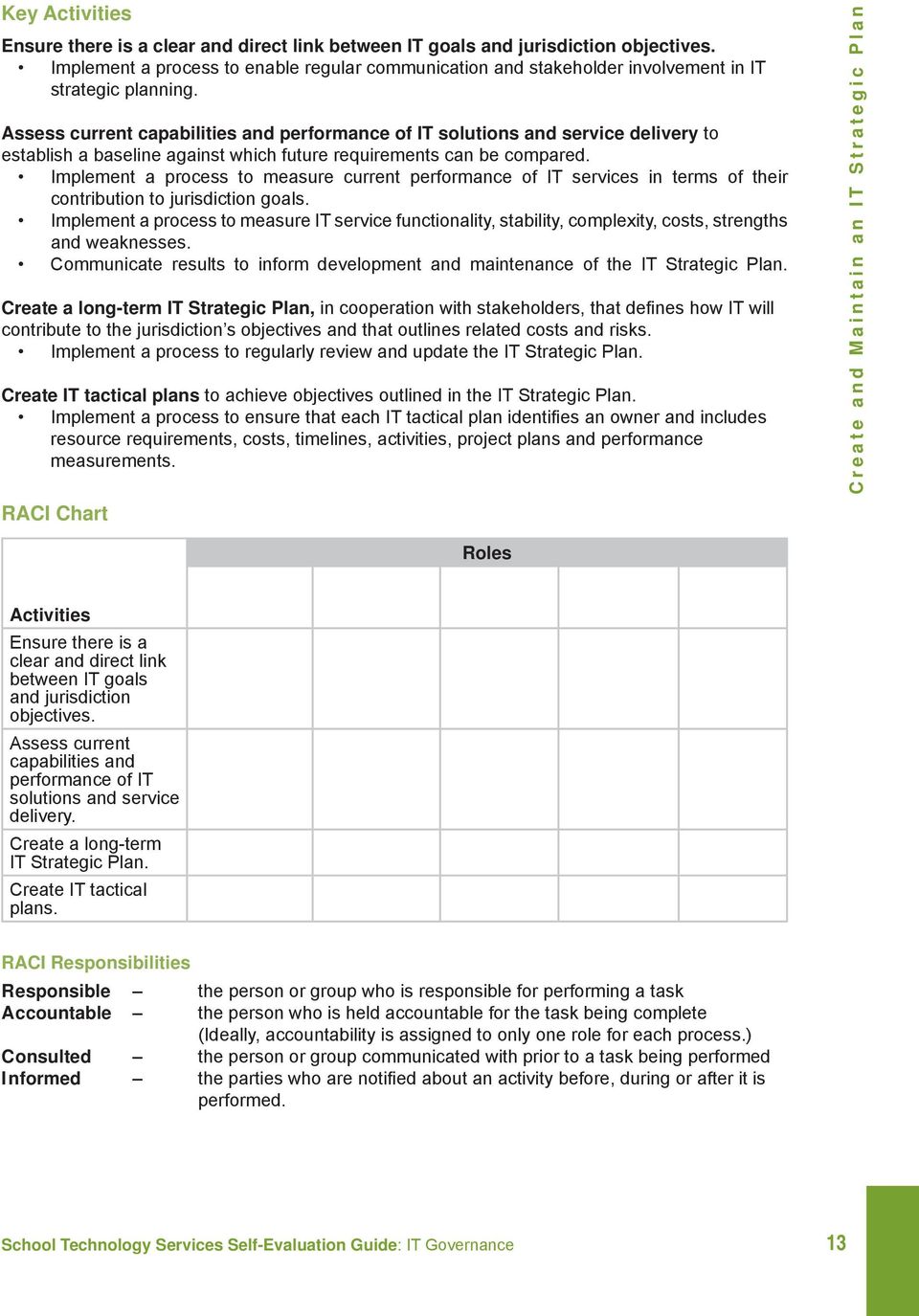
14 Maturity Model Create and Maintain an IT Strategic Plan Note: The required or desired level of maturity will vary between jurisdictions, based on the size, needs, costs, capability and alignment with the jurisdiction s strategic plan. It is not necessary to assume that any jurisdiction should be at a Level 5 in all or any of these activities. Attributes IT leadership is aware of the need for IT strategic planning. The need for IT strategic planning is communicated inconsistently. IT strategic planning is discussed in response to issues or requests for information from senior leadership. Communication to stakeholders about IT strategy is sporadic and usually in response to issues. Senior leadership is aware of the need for IT strategic planning. IT leadership understands the requirements of an effective IT strategic planning process. The need for IT strategic and tactical planning is communicated consistently. IT strategic planning is discussed periodically. Communication to stakeholders about IT strategy occurs periodically. Senior leadership is aware of the requirements of an effective IT strategic planning process. Senior leadership commits resources to the development of a sound IT strategic planning process. IT leadership and IT staff discuss IT strategic and tactical planning on a regular basis. Communication to stakeholders about the IT Strategic Plan occurs on a regular basis and in a formal way. Senior leadership discusses the IT Strategic Plan on a regular basis and in a formal way. The IT Strategic Plan is developed in collaboration with senior leadership, IT leadership and jurisdiction stakeholders. Communication to stakeholders about IT strategic planning is regular, formal and includes a report of results. Senior leadership and IT leadership and have an advanced and forward-looking understanding of IT strategic and tactical planning. Understanding of IT strategic goals is widespread throughout the jurisdiction. PEOPLE Awareness, Understanding and Communication 14 School Technology Services Self-Evaluation Guide: IT Governance
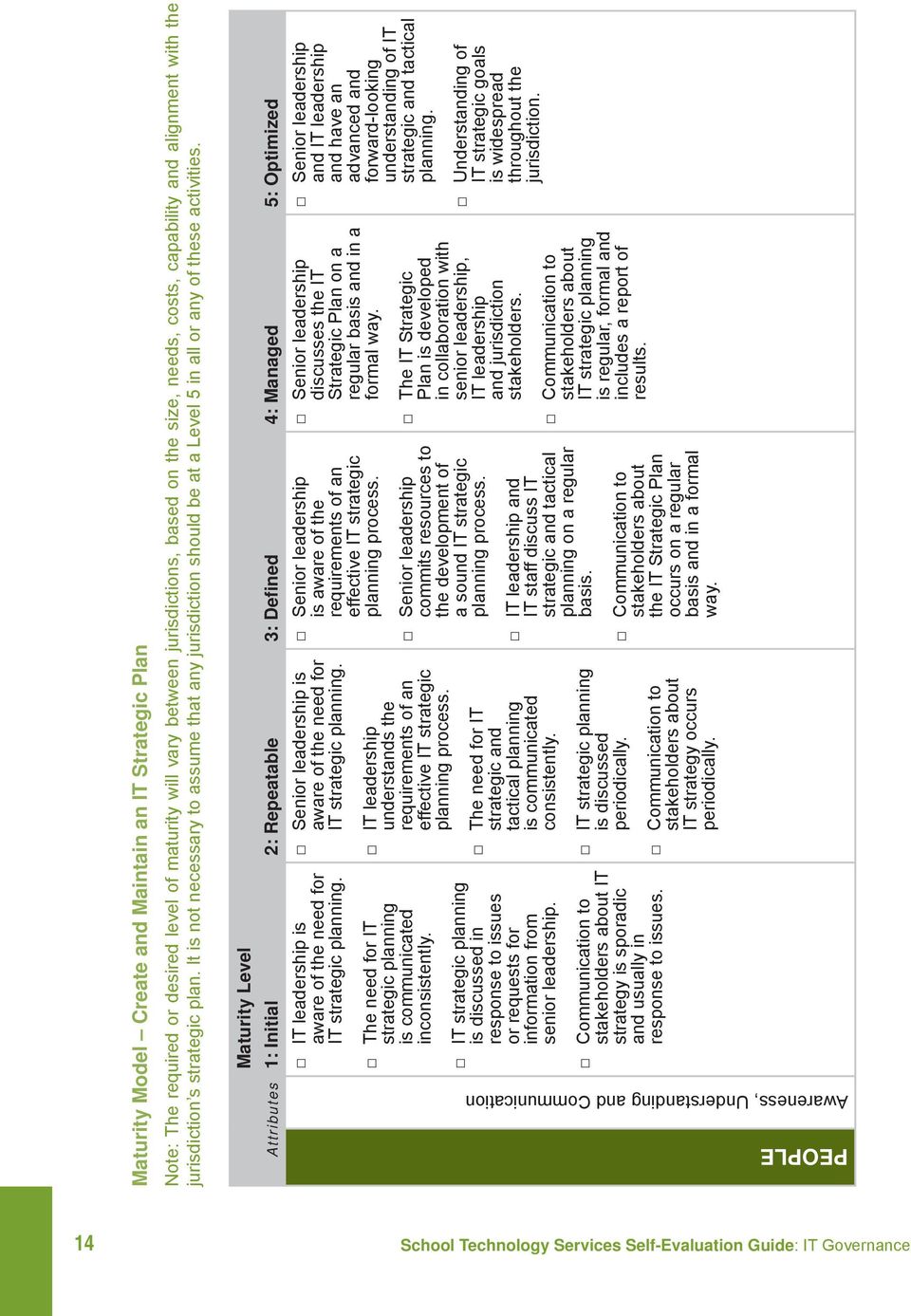
15 Some knowledge of IT strategic and tactical planning exists in isolation. Minimum skills required to perform IT strategic and tactical planning have not been identifi ed. Training needs for IT strategic and tactical planning have not been identifi ed. IT leadership has the skills and expertise to perform basic IT strategic and tactical planning. Minimum skill requirements to perform basic IT infrastructure planning have been identifi ed. Training in IT strategic planning is provided in response to emerging needs or requests from individuals. IT leadership has the skills and expertise to perform all key IT strategic and tactical planning Skill requirements for all aspects of IT strategic and tactical planning have been defi ned and documented. A formal training plan for IT strategic and tactical planning has been developed. Formal training in IT strategic and tactical planning is available. IT leadership and IT staff have the expertise to perform all IT strategic and tactical planning Profi ciency in critical aspects of IT strategic and tactical planning is ensured for individuals who perform these A formal training plan for IT strategic and tactical planning is implemented. Skill requirements for IT infrastructure planning are reviewed and updated on a regular basis. Profi ciency in all aspects of IT strategic and tactical planning is ensured for individuals who perform these The jurisdiction encourages formal training in IT strategic and tactical planning, based upon personal and jurisdiction goals. External experts and industry leaders are engaged to provide guidance and input into the IT Strategic Plan and tactical plans. Formal training for IT strategic and tactical planning is required for individuals who perform these Certifi cation in IT strategic and tactical planning is encouraged for individuals who perform these Create and Maintain an IT Strategic Plan PEOPLE (continued) Skills and Expertise School Technology Services Self-Evaluation Guide: IT Governance 15
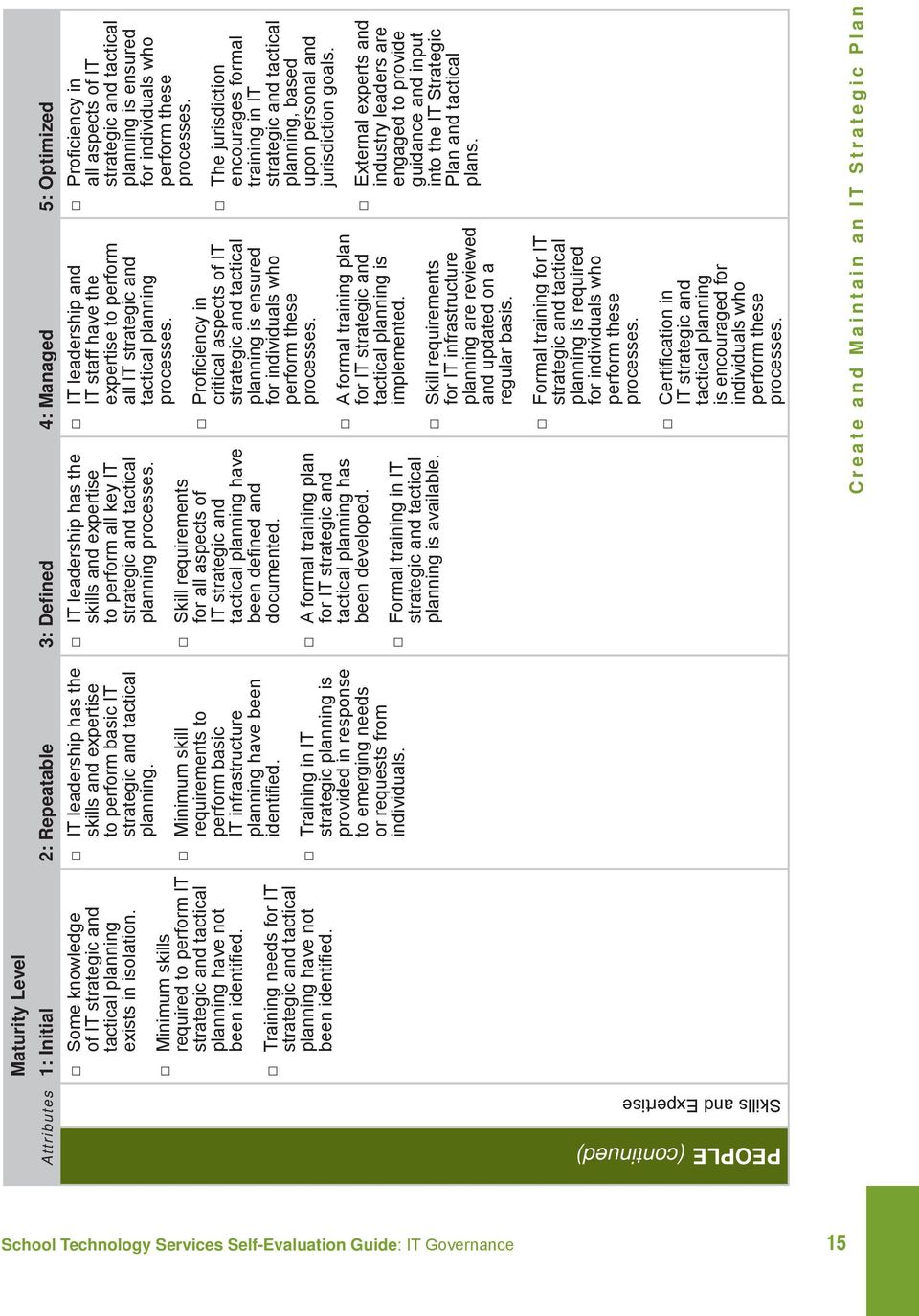
16 Allocation of responsibility for IT strategic and tactical planning is assumed or done in an ad hoc way. Allocation of responsibility and accountability for IT strategic and tactical planning is done informally. Accountability and responsibility for IT strategic and tactical planning have been formally assigned and documented. IT strategic and tactical planning process owners have the level of authority required to fulfi ll their responsibilities. IT strategic and tactical planning process owners are empowered to make decisions and to take action. Individuals assume responsibility for IT strategic and tactical planning. There is confusion about who is responsible and accountable for IT strategic and tactical planning when issues arise. IT strategic and tactical planning process owners are identifi ed, but may not have suffi cient authority to fulfi ll their responsibilities. Ownership of the IT Strategic Plan is viewed as resting with senior leadership. IT strategic and tactical planning process owners escalate issues, according to a defi ned escalation process. Ownership of the IT Strategic Plan is viewed as resting with the IT department. PEOPLE (continued) Responsibility and Accountability 16 School Technology Services Self-Evaluation Guide: IT Governance

17 IT strategic and tactical planning activities occur in isolation and are based upon individual IT staff practices. Alignment of jurisdiction objectives and IT strategic goals is performed reactively and informally. Strategic planning practices are emerging, but are performed inconsistently. IT tactical planning practices are emerging, but are performed inconsistently. Technology investment decisions are made on a project-by-project basis. Common and informal policies and procedures for basic IT strategic and tactical planning activities are defi ned, but not documented. Compliance with IT strategic and tactical planning policies and procedures is left to the individual s discretion. IT tactical planning is performed consistently. Alignment of IT initiatives with IT strategic goals is performed reactively and informally. Formal policies and procedures for key IT strategic and tactical processes have been defi ned, documented and communicated. Policies and procedures are based upon generally accepted good practices. IT initiatives are consistently aligned with IT strategic goals and jurisdiction objectives during the initial planning stages. Technology investment decisions are made in the context of the IT Strategic Plan. Formal policies and procedures for all IT strategic and tactical planning processes are developed, documented and regularly reviewed. Senior leadership approves policies and procedures for IT strategic and tactical planning. The IT strategy includes a consistent defi nition of the expected benefi ts and risks of technology investments. IT strategic planning is formally and fully integrated with jurisdiction strategic planning Generally accepted best practices and standards for IT strategic and tactical planning are used to inform policy and procedure development. Exceptions to IT strategic and tactical planning policies and procedures are noticed and corrective action is taken. IT strategic and tactical planning policies and procedures are regularly reviewed and improved. Create and Maintain an IT Strategic Plan PROCESS Policies, Plans and Procedures School Technology Services Self-Evaluation Guide: IT Governance 17

18 Some IT strategic and tactical planning goals are set and monitored inconsistently. IT strategic goals are unclear or vaguely defi ned. The performance of IT strategic and tactical planning is monitored informally. The link between IT strategic goals and jurisdiction objectives is indirect. Measures refl ected in IT strategic and tactical plans are stated almost exclusively as objectives or fi nancial measures. Measures used to assess IT strategic and tactical planning are derived from the defaults available in software-based tools. IT leadership provides basic reports about the status of strategic and tactical plans. The performance of IT strategic and tactical planning is monitored regularly. The link between IT strategic goals and jurisdiction objectives is clear and direct. Measures in the IT Strategic Plan and tactical plans refl ect a mixture of fi nancial, non-fi nancial and educational objectives, as appropriate. IT leadership regularly reports to senior leadership about the status of the IT Strategic Plan and tactical plans. Measures refl ected in the IT Strategic Plan and tactical plans refl ect a mixture of leading and lagging indicators. Performance measures in the IT Strategic Plan are used to inform decision making and continuous improvement. Senior leadership is provided with regular and formalized reports of the status of the IT Strategic Plan and tactical plans. Risks and benefi ts of major strategic decisions are formally recognized, monitored and measured. Performance is integrated into IT strategic planning, linking IT performance to jurisdiction objectives. Peer- and sectorbased benchmarking for IT strategic and tactical planning is performed. IT strategic and tactical planning processes are monitored and measured. PROCESS (continued) Goal Setting and Measurement 18 School Technology Services Self-Evaluation Guide: IT Governance

19 Tools may exist to support IT strategic and tactical planning; they are generally based upon standard desktop tools. There is no formal approach to using tools to support IT strategic and tactical planning. Basic tools and templates, specifi c to IT strategic and tactical planning, have been developed and implemented. Common approaches to the use of tools to support IT strategic and tactical planning are emerging. A formal plan to acquire and implement tools to support IT strategic and tactical planning has been developed. The basic level of functionality in tools and templates for IT strategic and tactical planning is used. Tools in use are not fully integrated. Tools have been implemented. Integration of tools to support IT strategic and tactical planning is emerging. There is a formal and structured approach to tool use. Tools are used in key areas to automate and formalize IT strategic and tactical planning. A standardized and integrated set of tools and formalized techniques is used, jurisdiction wide, to support IT strategic and tactical planning. IT strategic and tactical planning tools are integrated with other jurisdiction planning tools. Create and Maintain an IT Strategic Plan TOOLS Tools and Automation School Technology Services Self-Evaluation Guide: IT Governance 19

20 Determine Technology Direction Description The jurisdiction s technology direction, combined with technical standards and guidelines, strike a balance between provision of effi cient support for IT services and ensuring that the jurisdiction s strategic and operational goals are met. Technology standards and guidelines minimize the complexity of the technology environment. Effective processes for handling exceptions ensure that jurisdiction operational and strategic objectives are not a consideration secondary to standards. This process area includes setting a technological direction, creating an IT Infrastructure Plan, and creating and maintaining technology standards and guidelines. Value Sets and manages clear and realistic expectations of what IT can offer, in terms of services, given the degree of variation in the technology environment. Creates transparency around the process used to make decisions about IT standards and guidelines. Supports purposeful decision making about what technology standards should be implemented and how exceptions will be handled. Goals Balance effi ciency of IT operations and effectiveness of IT services to support the jurisdiction s strategic and operational goals and objectives. Target Audience Primary Senior Leadership IT Leadership Secondary School Administrators IT Staff Key Activities Plan the technological direction. Implement a process to create and maintain a plan for the technological direction of the jurisdiction that addresses systems architecture, migration strategies, technology acquisition and contingency arrangements. Create and maintain an IT Infrastructure Plan that supports the IT Strategic Plan. Ensure that changes in the educational environment, staffi ng, technology investments and the interoperability of technology platforms and applications are considered when developing or maintaining the IT Infrastructure Plan. Analyze and monitor trends, including existing and emerging technologies, best practices in other school jurisdictions, and legal and regulatory requirements. Implement a process to monitor technology trends, emerging educational practices and regulations that may contribute to or impact the jurisdiction s technological direction. 20 School Technology Services Self-Evaluation Guide: IT Governance

21 Create and maintain technology standards and guidelines. Implement a process to seek input from relevant stakeholders into technology standards and guidelines for the jurisdiction. Implement a process to evaluate, formally decide upon and monitor exceptions to standards and guidelines. Document, communicate and gain commitment to standards and guidelines. Review and revise standards and guidelines on a regular basis. RACI Chart Activities Plan the technological direction. Create and maintain an IT Infrastructure Plan. Analyze and monitor trends. Create and maintain technology standards and guidelines. Roles Determine Technology Direction RACI Responsibilities Responsible the person or group who is responsible for performing a task Accountable the person who is held accountable for the task being complete (Ideally, accountability is assigned to only one role for each process.) Consulted the person or group communicated with prior to a task being performed Informed the parties who are notifi ed about an activity before, during or after it is performed. School Technology Services Self-Evaluation Guide: IT Governance 21
22 Maturity Model Determine Technology Direction Note: The required or desired level of maturity will vary between jurisdictions, based on the size, needs, costs, capability and alignment with the jurisdiction s strategic plan. It is not necessary to assume that any jurisdiction should be at a Level 5 in all or any of these activities. Attributes IT leadership is aware of the need to set a technological direction and to plan infrastructure. The need to set a technological direction and to plan infrastructure is communicated inconsistently. Technological direction and IT infrastructure planning are discussed at IT leadership meetings in response to issues or requests for information. Communication to stakeholders about IT standards, guidelines and technology trends is sporadic. Senior leadership is aware of the need to set a technological direction. IT leadership understands the requirements to set a technological direction and to develop an IT Infrastructure Plan. The need to set a technological direction and to plan the infrastructure is communicated consistently. Technological direction and IT infrastructure planning are discussed periodically. Communication to stakeholders about the technological direction, the IT Infrastructure Plan, standards and guidelines occurs periodically. Senior leadership communicates commitment to the jurisdiction s technological direction. IT leadership and IT staff discuss technological direction and the IT Infrastructure Plan on a regular basis. IT leadership and IT staff discuss the impact of the technological direction and the IT Infrastructure Plan on the process of education. Communication to stakeholders about the technological direction, the IT Infrastructure Plan, standards and guidelines occurs on a regular basis and in a formal way. Senior leadership, IT leadership and school administrators discuss and review the potential educational impact of technological change. Communication to stakeholders about the technological direction, standards and guidelines occurs on a regular basis and in a formal way. Senior leadership and IT leadership have an advanced and forward-looking understanding of the requirements for the jurisdiction s technological direction and IT Infrastructure Plan. Communication of emerging trends and issues occurs in a formal and proactive way. PEOPLE Awareness, Understanding and Communication 22 School Technology Services Self-Evaluation Guide: IT Governance
23 Some knowledge of IT infrastructure planning exists in isolation. Minimum skills required to perform IT infrastructure planning have not been identifi ed. Training needs for IT infrastructure planning have not been identifi ed. IT leadership and IT staff have the expertise to perform basic IT infrastructure planning. Minimum skill requirements to perform basic IT infrastructure planning have been identifi ed. Training in IT infrastructure planning is provided in response to emerging needs or requests from individuals. IT leadership and IT staff have the skills and expertise to perform all key IT infrastructure planning Skill requirements for IT infrastructure planning processes have been defi ned and documented. A formal training plan for IT infrastructure planning has been developed. Formal training for IT infrastructure planning is available. IT leadership and IT staff have the expertise to perform all IT infrastructure planning Profi ciency in critical aspects of IT infrastructure planning is ensured for individuals who perform these A formal training plan for IT infrastructure planning is implemented. Skill requirements for IT infrastructure planning are reviewed and updated on a regular basis. Profi ciency in all aspects of IT infrastructure planning is ensured for individuals who perform these The jurisdiction encourages formal training in IT infrastructure planning, based upon personal and jurisdiction goals. External experts and industry leaders are engaged to provide guidance and input into the IT Infrastructure Plan. Formal training for IT infrastructure planning is required for individuals who perform these Certifi cation in IT infrastructure planning is encouraged for individuals who perform these Determine Technology Direction PEOPLE (continued) Skills and Expertise School Technology Services Self-Evaluation Guide: IT Governance 23
24 Allocation of responsibility for IT infrastructure planning is assumed or done in an ad hoc way. Allocation of responsibility and accountability for IT infrastructure planning is done informally. Accountability and responsibility for IT infrastructure planning have been formally assigned and documented. IT infrastructure planning process owners have the level of authority required to fulfi ll their responsibilities. IT infrastructure planning process owners are empowered to make decisions and to take action. Individuals assume responsibility for IT infrastructure planning. There is confusion about who is responsible and accountable for IT infrastructure planning when issues arise. IT infrastructure planning process owners are identifi ed, but may not have suffi cient authority to fulfi ll their responsibilities. IT infrastructure planning process owners escalate issues, according to a defi ned escalation process. PEOPLE (continued) Responsibility and Accountability 24 School Technology Services Self-Evaluation Guide: IT Governance
25 IT infrastructure planning activities are based upon individual IT staff practices. Development of the technological direction and IT infrastructure planning occur in isolation from IT strategic planning. Evaluation of emerging technologies, trends and best practices occurs in an unplanned, ad hoc way. Technology standards and guidelines are developed in response to issues and in an ad hoc way. Common and informal policies and procedures for IT infrastructure planning are defi ned, but not documented. Compliance with IT infrastructure planning policies and procedures is left to the individual s discretion. Compliance with IT infrastructure standards and guidelines is left to the individual s discretion. A consistent approach to planning infrastructure and developing standards and guidelines is followed. Decisions related to technological direction and the IT Infrastructure Plan are made on a project-by-project basis. Formal policies and procedures for all key IT infrastructure planning activities are defi ned, documented and communicated. Policies and procedures are based upon generally accepted good practices. IT leadership develops infrastructure plans, standards and guidelines with input from IT staff. There is a process in place to regularly review and update the IT Infrastructure Plan and existing standards and guidelines. There is a process in place to assess, decide upon and monitor exceptions to standards and guidelines. Formal policies and procedures for all IT infrastructure planning activities are defi ned, documented and regularly reviewed. Senior leadership approves policies and procedures for IT infrastructure planning. Senior leadership and school jurisdiction stakeholders are involved in setting the jurisdiction s technological direction and technology standards and guidelines. Migration plans to introduce new technologies are developed when planning the technological direction. A process is implemented to regularly evaluate evolving and emerging technologies. IT infrastructure planning is coordinated with IT strategic planning. Generally accepted best practices and standards for IT infrastructure planning are used to inform policy and procedure development. Exceptions to IT infrastructure planning policies and procedures are noticed and corrective action is taken. IT infrastructure planning policies and procedures are regularly reviewed and improved. Determine Technology Direction PROCESS Policies, Plans and Procedures School Technology Services Self-Evaluation Guide: IT Governance 25
26 Some IT infrastructure planning goals are set and monitored inconsistently. The performance of IT infrastructure planning and standards development is monitored informally. IT leadership provides basic reports about the state of IT infrastructure and the outcomes of the planning process for IT infrastructure. The effectiveness of IT infrastructure planning, and standards and guidelines development is monitored regularly. There is a clear link between the IT Infrastructure Plan and the IT Strategic Plan. Measurement of cost and value of the technology infrastructure is emerging. Senior leadership is provided with regular reports about the status and effectiveness of the IT infrastructure. IT infrastructure planning, and standards and guidelines development performance metrics are formally defi ned and approved, and align to the IT Strategic Plan. Measures of the effectiveness of the IT Infrastructure Plan and related standards and guidelines are used to inform decision making and continuous improvement. There is a process in place to address deviations from technology standards. Peer- and sectorbased benchmarking for IT infrastructure planning is performed. The processes used to develop the technological direction, IT Infrastructure Plan, and standards and guidelines are monitored and measured. PROCESS (continued) Goal Setting and Measurement 26 School Technology Services Self-Evaluation Guide: IT Governance
27 Tools may exist to support IT infrastructure planning; they are generally based upon standard desktop tools. There is a formal approach to using tools to support the development of the technological direction, IT Infrastructure Plan, standards or guidelines. Basic tools and templates, specifi c to IT infrastructure planning and the development of standards and guidelines, have been developed and implemented. Common approaches to the use of tools to support IT infrastructure planning and the development of standards and guidelines are emerging. A formal plan to acquire and implement tools to support IT infrastructure planning and the development of standards and guidelines has been developed. The basic level of functionality in tools and templates to support IT infrastructure planning and the development of standards and guidelines is used. Tools in use are not fully integrated. Tools to support IT infrastructure planning and the development of standards and guidelines have been implemented. Integration of tools to support IT infrastructure planning and the development of standards and guidelines is emerging. There is a formal and structured approach to using tools to support IT infrastructure planning and the development of standards and guidelines. A standardized and integrated set of tools and formalized techniques is used to support the development of the technological direction, IT infrastructure planning and the development of standards and guidelines. Tools are used in key areas to automate and formalize IT infrastructure planning and the development of standards and guidelines. Determine Technology Direction TOOLS Tools and Automation School Technology Services Self-Evaluation Guide: IT Governance 27
28 Define IT Relationship, Organization and Processes Description There is no one right way to position IT within an organization. Nor is there a one-size-fi ts-all design for the organization of the IT department itself. Both are driven by how the IT department is seen as contributing to the strategic objectives of the jurisdiction. The relationship required for an IT department that is seen as strictly functional (i.e., providing effi cient support for technology needs) is vastly different than that required when IT is viewed as supporting transformation in the jurisdiction. Functional Differentiating Contributing Differentiating Transformational IT manages and operates technology systems and resources effi ciently. IT builds and operates systems defi ned by the jurisdiction. IT uses technology proactively to enhance operations and to raise jurisdiction performance. IT helps the jurisdiction leverage technology resources to provide new services for stakeholders. Adapted from Organizing for Success, Gartner, Inc. March IT operates at the cutting edge of transformation and technology to support transformation of educational practice. The capability level of the IT organization is a critical factor in determining its position within the organization. An IT department with functional capabilities is not ready to fi ll a transformational role. This process area includes evaluation of the current and the desired state of operations for the IT department, in the context of jurisdiction IT strategy, and evaluation of the capabilities, organizational structures and processes required to reach the desired state. During this process, specifi c attention must be paid to risk, delegation of information and systems ownership, and quality assurance. Value Provides clear and appropriate direction to the IT department. Supports oversight by senior leadership. Goals Establish a clear reporting relationship and delegation of authority between senior leadership and the IT department. Provide a means to clearly communicate IT leadership expectations. Target Audience Primary Senior Leadership IT Leadership Secondary School Administrators IT Staff 28 School Technology Services Self-Evaluation Guide: IT Governance
29 Key Activities Position the IT department in the jurisdiction s organizational structure in consideration of how IT is viewed as contributing to strategic objectives and the overall capability level of the IT department. Establish an IT department organizational structure that best supports the jurisdiction s objectives. Implement a process to periodically review the IT organizational structure to adjust resource requirements to meet the jurisdiction s objectives and changing circumstances. Establish IT governance committees, engaging stakeholders, where appropriate, to provide oversight and direction to the IT department. Provide a forum to receive advice and feedback relating to strategic direction, IT priorities and initiatives, technological direction, information security and service levels and to ensure that IT governance is addressed. Implement an IT process framework that supports execution of IT strategic and tactical plans. Articulate an IT process structure and the relationships between processes to address gaps and overlaps. Define and implement IT roles and responsibilities, including supervision and segregation of duties. Communicate the roles of IT staff and end users, in relation to authority, responsibilities and accountability for meeting the jurisdiction s needs. Implement adequate supervisory practices in the IT function to ensure that roles and responsibilities are properly exercised, to assess whether staff have suffi cient authority and resources to execute their roles and responsibilities, and to provide oversight. Implement a division of roles and responsibilities to reduce the possibility of a single individual compromising a critical process. Ensure that IT staff perform only the duties authorized and relevant to their position. Define IT Relationship, Organization and Processes Identify system and data owners and empower them to address their responsibilities. Assign responsibility for risk, security and compliance. Ensure that responsibility for IT-related risks is delegated explicitly and appropriately. School Technology Services Self-Evaluation Guide: IT Governance 29
30 RACI Chart Roles Activities Position the IT department in the jurisdiction s organizational structure. Establish an organizational structure for the IT department. Establish IT governance committees. Implement an IT process framework. Defi ne and implement IT roles and responsibilities. Identify system and data owners. Assign responsibility for risk, security and compliance. RACI Responsibilities Responsible the person or group who is responsible for performing a task Accountable the person who is held accountable for the task being complete (Ideally, accountability is assigned to only one role for each process.) Consulted the person or group communicated with prior to a task being performed Informed the parties who are notifi ed about an activity before, during or after it is performed. 30 School Technology Services Self-Evaluation Guide: IT Governance
31 Maturity Model Define IT Relationships, Organization and Processes Note: The required or desired level of maturity will vary between jurisdictions, based on the size, needs, costs, capability and alignment with the jurisdiction s strategic plan. It is not necessary to assume that any jurisdiction should be at a Level 5 in all or any of these activities. Attributes IT leadership is aware of the need to position the IT department within the jurisdiction, in accordance with the strategic and operational importance of IT. IT leadership is aware of the need for an IT governance committee and an IT process framework. The need for appropriate positioning of the IT department within the jurisdiction, an IT governance committee and an IT process framework is communicated inconsistently. Communication channels within the IT department are unclear to end users and stakeholders. Senior leadership is aware of the need to position the IT department within the jurisdiction, in accordance with the strategic and operational importance of IT. IT leadership understands the requirements to implement basic IT structures, processes and procedures. The IT structure, processes, procedures and regulations are communicated to stakeholders periodically. Senior leadership is aware of IT relationships, organization and IT leadership is aware of the requirements to implement IT structures, processes and procedures. Communication to stakeholders about IT structure, processes, procedures and regulations occurs on a regular basis and in a formal way. IT staff are aware of their roles and responsibilities for information systems and data. End users understand their responsibilities for information security. Senior leadership has a full understanding of the IT relationships, organization and IT leadership informs senior leadership of the effectiveness of IT relationships, organization and processes on a regular basis. Communication to stakeholders about IT relationships, organization and processes occurs on a regular basis and in a formal way. End users understand their responsibilities and accountabilities for data and data ownership. Relationships with external third parties are formalized. IT leadership has an advanced and forward-looking understanding of IT relationships, organization and processes, and how they support jurisdiction objectives. End users understand the roles and responsibilities of the IT department and understand the relationship of IT to senior leadership and rest of the organization. Senior leadership understands the relationship of external third parties to the jurisdiction in general and to the IT department specifi cally. PEOPLE Awareness, Understanding and Communication Define IT Relationship, Organization and Processes School Technology Services Self-Evaluation Guide: IT Governance 31
32 Some knowledge of IT process frameworks and how to implement them exists in isolation. Minimum skills required to implement an IT process framework have not been identifi ed. Training needs for implementing an IT process framework have not been identifi ed. IT leadership has the skills and expertise to implement basic IT structures, processes and procedures. Minimum skill requirements for basic aspects of implementing IT structures, processes and procedures have been identifi ed. Training in the implementation of IT structures, processes and procedures is provided in response to emerging needs or requests from individuals. IT leadership has the skills and expertise to perform all key processes related to defi ning IT organization and IT staff have the skills and expertise to perform all key aspects of defi ning IT Skill requirements for defi ning IT organization and processes have been defi ned and documented. A formal training plan for defi ning IT organization and processes has been developed. Formal training for defi ning IT organization and processes is available. IT leadership has the skills and expertise to perform all processes related to defi ning IT organization and IT staff have the skills and expertise to perform all aspects of defi ning IT Profi ciency in critical aspects of defi ning IT organization and processes is ensured for individuals who perform these Skill requirements for defi ning IT organization and processes are reviewed and updated on a regular basis. Formal training for defi ning IT organization and processes is required for individuals who perform these IT staff have the skills and expertise to implement and monitor IT Profi ciency in all aspects of defi ning IT organization and processes is ensured for individuals who perform these The jurisdiction encourages formal training in defi ning IT organization and processes, based on personal and jurisdictional goals. External experts are engaged to provide advice and input into the jurisdiction s IT organization and Certifi cation in defi ning IT organization and processes is encouraged for individuals who perform these PEOPLE (continued) Skills and Expertise 32 School Technology Services Self-Evaluation Guide: IT Governance
33 Allocation of responsibility for implementing an IT process framework is done in an ad hoc way. System and data ownership is not clearly assigned. Responsibility and accountability for risk, security and compliance are not clearly assigned. Roles and responsibilities for defi ning IT organization and processes are not clearly defi ned. Allocation of responsibility and accountability for the implementation of IT structures, processes and procedures is done informally. Individuals assume responsibility for implementing IT structures, processes and procedures. There is confusion about who is responsible and accountable for IT structures, processes and procedures when issues arise. Ad hoc committees are convened to provide input into IT strategic planning or IT operations. Accountability and responsibility for defi ning IT organization and processes have been formally assigned and documented. IT organization and process design process owners are identifi ed, but may not have suffi cient authority to fulfi ll their responsibilities. Duties that relate to information security are segregated, when required. Formal IT governance committees are in place and serve in an advisory capacity. IT organization and process design process owners have the level of authority required to fulfi ll their responsibilities. Ownership of information and systems is clearly articulated and authority to act has been delegated. System owners are held accountable for systems and data ownership. Formal governance committees provide guidance and oversight. Senior leadership is engaged in defi ning the IT organizational structure. Roles and responsibilities of IT governance committee members are defi ned, documented and communicated. End users are accountable for their use of information systems and data. Define IT Relationship, Organization and Processes PEOPLE (continued) Responsibility and Accountability School Technology Services Self-Evaluation Guide: IT Governance 33
34 Implementation of portions of an IT process framework occurs in isolation and is based upon individual IT staff practices. Defi nition of the IT department s relationship to the jurisdiction is performed reactively and informally. Common and informal policies and procedures for the implementation of IT structures, processes and procedures are defi ned, but not documented. Compliance with policies for the implementation of IT structures, processes and procedures is left to the individual s discretion. Basic IT processes and procedures have been defi ned, but not documented. Organization of the IT department is defi ned, documented and communicated. Key activities related to IT operations and have been defi ned and documented in the IT process framework. Policies and procedures in the process framework are based upon generally accepted good practices. The organization of the IT department appropriately refl ects educational needs and objectives, and contains capabilities required to meet those objectives. Most activities related to IT operations have been defi ned and documented in the IT process framework; activities are formally approved and regularly reviewed and updated. Standard processes to defi ne IT organization and processes are consistently followed. Generally accepted best practices and standards for procedure and policy development are used. Policies and procedures are standardized and integrated. The IT department adapts to the jurisdiction s changing needs and objectives. PROCESS Policies, Plans and Procedures 34 School Technology Services Self-Evaluation Guide: IT Governance
35 Some goals for the implementation of an IT process framework are set and monitored inconsistently. Implementation of IT structures, processes and procedures is monitored informally. Measures for implementation of IT structures, processes and procedures emphasize achievement of objectives. IT leadership provides basic status reports about the implementation of IT structures, processes and procedures. The effectiveness of IT processes and relationships is monitored regularly. Senior leadership and IT governance committee members seek input related to the effectiveness and effi ciency of the IT governance committee. Performance goals are formally defi ned and approved, and align to the IT Strategic Plan. Measures of the effectiveness of the IT organization and process framework are used to inform decision making and continuous improvement. Performance goals are monitored. Peer- and sectorbased benchmarking of the IT organization and processes is performed. IT organization and processes are monitored and measured. Define IT Relationship, Organization and Processes PROCESS (continued) Goal Setting and Measurement School Technology Services Self-Evaluation Guide: IT Governance 35
36 Tools may exist to support implementation of the IT process framework; they are generally based upon standard desktop tools. There is no consistent approach to using tools to support implementation of the IT process framework. Basic tools and templates, specifi c to implementing IT structures, processes and procedures, have been developed and implemented. Common approaches to the use of tools to support implementation of IT structures, processes and procedures are emerging. A formal plan to acquire and implement tools to support the development and maintenance of the IT process framework, and to design, monitor and manage the IT organization has been developed. The basic level of functionality in tools and templates to support development and maintenance of the IT process framework, and to design, monitor and manage the IT organization is used. Tools in use are not fully integrated. Tools to support the development and maintenance of the IT process framework and to design, monitor and manage the IT organization have been implemented. Integration of tools to support the development and maintenance of the IT process framework and to design, monitor and manage the IT organization is emerging. There is a formal and structured approach to using tools to support the development and maintenance of the IT process framework and to design, monitor and manage the IT organization. A standardized and integrated set of tools and formalized techniques is used to support the development and maintenance of the IT process framework. Tools are used in key areas to formalize the development and maintenance of the IT process framework and to design, monitor and manage the IT organization. TOOLS Tools and Automation 36 School Technology Services Self-Evaluation Guide: IT Governance
37 Manage IT Investments Description There is no single right answer for how much investment in technology is enough in the K-12 education sector. School jurisdictions determine the appropriate levels of investment in technology by evaluating the costs, risks and expected benefi ts of initiatives. IT investments are defi ned in this context as capital investment in technology. They include required (operational) and discretionary (initiatives) spending. IT spending can be further categorized into three areas: run (keep the lights on), grow (devise new services for stakeholders) and transform (support transformation of teaching and learning practices). Mature IT investment processes ensure that individual investments are considered in the context of a larger portfolio. For example, investment in maintaining a school jurisdiction s student information system should be balanced against investments in classroom technologies that support student learning, rather than evaluated in isolation. Manage IT Investments This process area includes identifying and analyzing opportunities, based upon cost, benefi t and risk, prioritization and ongoing monitoring. Value Ensures that IT investments are managed to maximize value realized and minimize risks and costs and that investments are aligned to jurisdiction strategic and operational goals. Enables senior leadership to sustain a comprehensive understanding of the jurisdiction s IT investments. Provides insight for senior leadership into the expected and actual value to be realized by implementing technology. Goals Ensure effective and effi cient use of jurisdiction resources. Promote transparency and accountability for IT investment, from selection to reporting benefi ts realization. Target Audience Primary Senior Leadership IT Leadership Secondary School Administrators IT Staff Key Activities Establish and maintain a financial framework for IT to manage the overall investment and cost of IT resources and services. Evaluate, prioritize and select services to receive IT funding. Establish and maintain IT budgeting processes to support preparation of a budget that refl ects established IT priorities, upcoming projects, ongoing costs of operation and maintenance of existing services. Monitor and manage IT expenditures, comparing actual costs to budgets. Implement a process to monitor and report IT expenditures. Identify, assess, address and report budget variances in a timely manner. School Technology Services Self-Evaluation Guide: IT Governance 37
38 Monitor and report on IT benefits and value realization delivered by the current IT portfolio of services. Implement a process to regularly identify and communicate the value realization of IT investments that further jurisdiction objectives. Ensure that the performance of the portfolio of IT investments is regularly reviewed and optimized. Manage the portfolio of IT enabled investments required to achieve jurisdiction goals. Implement a process to defi ne, evaluate, prioritize, select and initiate the required IT services. Implement a process to regularly review and adjust the IT portfolio. RACI Chart Roles Activities Establish and maintain a fi nancial framework for IT. Evaluate prioritize and select services. Establish and maintain IT budgeting Monitor and manage IT expenditures. Monitor IT benefi ts and value realization. Manage the portfolio of IT-enabled investments. RACI Responsibilities Responsible the person or group who is responsible for performing a task Accountable the person who is held accountable for the task being complete (Ideally, accountability is assigned to only one role for each process.) Consulted the person or group communicated with prior to a task being performed Informed the parties who are notifi ed about an activity before, during or after it is performed. 38 School Technology Services Self-Evaluation Guide: IT Governance
39 Maturity Model Manage IT Investments Note: The required or desired level of maturity will vary between jurisdictions, based on the size, needs, costs, capability and alignment with the jurisdiction s strategic plan. It is not necessary to assume that any jurisdiction should be at a Level 5 in all or any of these activities. Attributes IT leadership is aware of the need to manage IT investments. The need to manage IT investments is communicated inconsistently. IT investment is discussed in response to issues or requests for information from senior leadership. Communication to stakeholders about the value of IT and the performance of IT investments is sporadic and usually in response to issues. Senior leadership is aware of the need to manage IT investments. IT leadership understands the requirements of an effective IT investment process. The need for an IT investment process is communicated consistently. IT investment is discussed periodically. Communication to stakeholders about IT investment value and benefi ts realization occurs periodically. Senior leadership understands the requirements of an effective IT investment process. Senior leadership commits resources to the development of a sound IT investment process. Senior leadership and IT leadership discuss IT investments on a regular basis. Communication to stakeholders about IT investment plans occurs on a regular basis and in a formal way. Senior leadership actively participates in managing IT investments. Communication to stakeholders about IT investment performance occurs on a regular basis and in a formal way. Senior leadership and IT leadership have an advanced and forward-looking understanding of IT investments. The IT governance committee governs and manages IT investments. The IT governance committee is regularly briefed on the performance of IT investments. PEOPLE Awareness, Understanding and Communication Manage IT Investments School Technology Services Self-Evaluation Guide: IT Governance 39
40 Some knowledge of IT investment exists in isolation. Minimum skills required to manage IT investments have not been identifi ed. Training needs for IT investment have not been identifi ed. IT leadership has the skills and expertise to perform basic IT investment planning. Minimum skill requirements to perform basic IT investment planning have been identifi ed. Training in IT investment planning is provided in response to emerging needs or requests from individuals. IT leadership and IT staff have the skills and expertise to perform all key IT investment Skill requirements are defi ned for all areas of IT investment. A formal training plan has been developed for IT investment. Formal training for IT investment is available. IT leadership and IT staff have the skills and expertise to perform all IT investment Profi ciency in critical aspects of IT investment is ensured for individuals who perform these A formal training plan for IT investment is implemented. Skill requirements for IT investment are reviewed and updated on a regular basis. Profi ciency in all aspects of IT investment is ensured for individuals who perform these The jurisdiction encourages formal training in IT investment, based upon personal and jurisdiction goals. External experts and industry leaders are engaged to provide guidance and input into IT investment selection. Formal training for IT investment is required for individuals who perform these Certifi cation in IT investment is encouraged for individuals who perform these PEOPLE (continued) Skills and Expertise 40 School Technology Services Self-Evaluation Guide: IT Governance
41 Allocation of responsibility for IT investment is assumed or done in an ad hoc way. Allocation of responsibility and accountability for IT investment is done informally. Individuals assume responsibility for IT investment. There is confusion about who is responsible and accountable for IT investment when issues arise. Accountability and responsibility for IT investment have been formally assigned and documented. IT investment process owners are identifi ed, but may not have suffi cient authority to fulfi ll their responsibilities. IT investment process owners have the level of authority required to fulfi ll their responsibilities. IT investment process owners are empowered to make decisions and to take action. IT investment process owners escalate issues, according to a defi ned escalation process. Ownership of IT investments is viewed as resting with the IT department. Manage IT Investments PEOPLE (continued) Responsibility and Accountability School Technology Services Self-Evaluation Guide: IT Governance 41
42 IT investment activities occur in isolation and are based upon individual IT staff practices. A process to evaluate, prioritize and select services to receive IT funding does not exist. IT investments are justifi ed, on an as-needed basis, usually in response to requests. Technology investment decisions are made on a project-by-project basis. A process to monitor and report on IT benefi ts and value realization does not exist. Common and informal policies and procedures for IT investment are defi ned, but not documented. Compliance with IT investment policies and procedures is left to the individual s discretion. Reactive, tactical and cost-focused budgeting decisions occur. A process to monitor and report on IT benefi ts realization is emerging. Formal policies and procedures for key IT investment and budgeting processes are defi ned, documented and communicated. Policies and procedures are based upon generally accepted good practices. Investment decisions are evaluated within the context of the entire IT investment portfolio. IT budgeting and investment selection decisions are aligned with the IT Strategic Plan. Formal approval of IT investment decisions occurs. Formal policies and procedures for all IT investment activities are defi ned, documented and regularly reviewed. Senior leadership approves policies and procedures for IT investment. A formalized process for IT investment selection and budgeting is consistently followed. Formal costing analysis that includes calculation of direct and indirect costs, over the entire life cycle of proposed and operational services, is consistently performed. IT investment is coordinated and integrated into the jurisdiction s fi nancial practices. IT investment benefi ts realization plans are documented and implemented. IT projects are cancelled when they do not realize expected benefi ts. Exceptions to IT investment processes are noticed and corrective action is taken. IT investment policies and procedures are regularly reviewed and improved. PROCESS Policies, Plans and Procedures 42 School Technology Services Self-Evaluation Guide: IT Governance
43 Some IT investment performance goals are set and monitored inconsistently. IT investment goals are unclear or vaguely defi ned. Performance of IT investments is measured primarily on the basis of cost. Performance of the IT investment process is monitored informally. Metrics for the performance of the IT investment process are informally defi ned. Informal monitoring of the benefi ts and value realized by IT investments occurs inconsistently. Metrics for the benefi ts and value of IT investments are defi ned informally. Performance of IT investments is monitored regularly. The link between IT investment goals and the IT Strategic Plan is clear and direct. Measures of IT investment performance refl ect a mix of fi nancial, non-fi nancial and educational objectives, as appropriate. Benefi ts are tracked and reported, using measures of fi nancial value, strategic alignment and risk. IT investment metrics are formally defi ned and approved, and align to the IT Strategic Plan. IT investment metrics refl ect a mixture of leading and lagging indicators. Measures of the effectiveness of IT investment is used to inform decision making and continuous improvement and to ensure that planned benefi ts are achieved, sustained and optimized. Peer- and sectorbased benchmarking for IT investment performance and is used to identify areas for improvement. IT investment processes are monitored and measured. Basic reporting on the performance of IT investments is defi ned and used inconsistently. IT leadership provides senior leadership and the IT governance committee with regular reports about the performance of IT investments. Manage IT Investments PROCESS (continued) Goal Setting and Measurement School Technology Services Self-Evaluation Guide: IT Governance 43
44 Tools may exist to support IT investment ; they are generally based upon standard desktop tools. There is no formal approach to using tools to support IT investment. Basic tools and templates, specifi c to IT investment, have been developed and implemented. Common approaches to the use of tools to support IT investment are emerging. A formal plan to acquire and implement tools to support IT investment has been developed. The basic level of functionality in tools and templates for IT investment is used. Tools in use are not fully integrated. Tools to support IT investment have been implemented. Integration of tools to support IT investment is emerging. There is a formal and structured approach to using tools to support IT investment. A standardized and integrated set of tools and formalized techniques is used to support IT investment. IT investment tools are integrated with other jurisdiction fi nancial tools. Tools are used in key areas to automate and formalize IT investment. TOOLS Tools and Automation 44 School Technology Services Self-Evaluation Guide: IT Governance
45 Communicate Management Aims and Direction Description The overall vision and strategic direction for the use of technology in school jurisdictions must be communicated clearly and effectively to all staff. Through ongoing communication and clearly defi ned policies and procedures, staff have a clearer understanding of what is expected of them and senior leadership has a greater degree of assurance that staff understand what is expected. This process area includes directional communications that describe how technology should be used in the classroom and operational communications that set standards for behaviour, such as security policies and procedures, and guidelines for acceptable use. This process area supports the development of the policies, procedures, standards and guidelines for every other process area described in the School Technology Services Framework. It addresses: authorization to create a new policy, procedure, guideline, standard or strategy identifi cation of and consultation with stakeholders development, review and revision of documents to communicate the new policy, procedure, guideline, standard or strategy approval and communication of the new policy, procedure, guideline, standard or strategy. Value Provides assurance to senior leadership that policies, strategic direction and expectations are communicated clearly and consistently. Ensures that leadership and stakeholders understand and are aware of the aims and direction for IT and the expectations for its use in the school jurisdiction. Reduces the time required to develop policies, procedures, guidelines, standards and so forth by outlining a consistent process to be followed. Communicate Management Aims and Direction Goals Ensure awareness and understanding of policies, procedures and regulations related to the support and use of technology. Mitigate IT risks. Target Audience Primary Senior Leadership IT Leadership Secondary School Administrators IT Staff School Technology Services Self-Evaluation Guide: IT Governance 45
46 Key Activities Establish and maintain IT policies that are consistent with jurisdiction philosophy, objectives and operating style. Implement a framework of policies that addresses expectations and requirements regarding delivery of value from IT investments, approach to risk, integrity, ethical use and IT staff and end user accountability and responsibility. Implement and maintain an IT process framework that supports the jurisdiction in meeting its objectives while managing risk, cost and value. Implement a process to regularly review and update IT procedures. Communicate the IT policy and process framework, IT strategy, objectives and direction to appropriate stakeholders in a timely way. RACI Chart Roles Activities Establish and maintain IT policies. Implement and maintain an IT process framework. Communicate the IT policy and process framework. RACI Responsibilities Responsible the person or group who is responsible for performing a task Accountable the person who is held accountable for the task being complete (Ideally, accountability is assigned to only one role for each process.) Consulted the person or group communicated with prior to a task being performed Informed the parties who are notifi ed about an activity before, during or after it is performed. 46 School Technology Services Self-Evaluation Guide: IT Governance
47 Maturity Model Communicate Management Aims and Direction Note: The required or desired level of maturity will vary between jurisdictions, based on the size, needs, costs, capability and alignment with the jurisdiction s strategic plan. It is not necessary to assume that any jurisdiction should be at a Level 5 in all or any of these activities. Attributes IT leadership is aware of the need for an IT policy and process framework. The need for an IT policy and process framework is communicated inconsistently. IT policies and processes are discussed in response to issues or requests for information from senior leadership. Communication to stakeholders about IT policies, processes and procedures is sporadic and usually in response to issues. Senior leadership is aware of the need for an IT policy and process framework. IT leadership understands the requirements of an effective IT policy and process framework. The need for an IT policy and process framework is communicated consistently. IT policies and processes are discussed periodically. Communication to stakeholders about IT policies and processes occurs periodically. Senior leadership is aware of the requirements for an effective IT process framework. Senior leadership commits resources to the development and implementation of a sound IT process framework. Critical IT processes are documented and communicated. Senior leadership and IT leadership communicate the importance of IT security awareness on a regular basis and in a formal way. Senior leadership and IT leadership assume responsibility for communicating IT policies and procedures. End users understand the objectives of the IT department and IT policies and processes that affect them. IT leadership has an advanced and forward-looking understanding of the requirements for the IT process framework. Communication of issues that may affect compliance with policies and procedures is proactive. End users are aware of emerging issues that may affect compliance with policies and procedures. PEOPLE Awareness, Understanding and Communication Communicate Management Aims and Direction School Technology Services Self-Evaluation Guide: IT Governance 47
48 Some knowledge of IT policy and process framework development and implementation exists in isolation. Minimum skills required to develop and implement an IT policy and process framework have not been identifi ed. Training needs for IT policy and process framework development and implementation have not been identifi ed. IT leadership and IT staff have the skills and expertise to perform basic IT policy and process development. Minimum skill requirements to perform basic IT policy and process development have been identifi ed. Training in IT policy and process framework development is provided in response to emerging needs or requests from individuals. IT leadership and IT staff have the skills and expertise to perform all key IT process framework development Skill requirements for all IT process framework development processes have been defi ned and documented. A formal training plan for IT process framework development has been developed. Formal training in IT process framework development is available. IT leadership and IT staff have the skills and expertise to perform all IT process framework development and Profi ciency in critical aspects of IT process framework development and is ensured for individuals who perform these A formal training plan for IT process framework development and is implemented. Formal training for IT process framework development and is required for individuals who perform these Profi ciency in all aspects of IT process framework development and is ensured for individuals who perform these The jurisdiction encourages formal training in IT process development and, based upon personal and jurisdiction goals. External experts and industry leaders are engaged to provide guidance and input into the IT process framework. Certifi cation in IT process framework development and is encouraged for individuals who perform these PEOPLE (continued) Skills and Expertise 48 School Technology Services Self-Evaluation Guide: IT Governance
49 Allocation of responsibility for IT policy and process framework development and implementation is assumed or done in an ad hoc way. Allocation of responsibility and accountability for developing, maintaining and managing the IT policy process framework is done informally. Individuals assume responsibility for developing, maintaining and managing parts of the IT policy and process framework. There is confusion about who is responsible and accountable for developing, maintaining and managing IT policies and procedures when issues arise. Accountability and responsibility for IT process framework development, and communication have been formally assigned and documented. IT process framework development process owners are identifi ed, but may not have suffi cient authority to fulfi ll their responsibilities. IT process framework development and process owners have the level of authority required to fulfi ll their responsibilities. IT process framework development and process owners are empowered to make decisions and to take action. IT process framework development and process owners escalate issues, according to a defi ned escalation process. Ownership of IT policies is viewed as resting with the IT department. Communicate Management Aims and Direction PEOPLE (continued) Responsibility and Accountability School Technology Services Self-Evaluation Guide: IT Governance 49
50 Development of IT policies, processes and procedures occurs in isolation and is based upon individual IT staff practices. Policies and procedures are developed and documented on an ad hoc basis. Common and informal policies and procedures for basic development, maintenance and of the IT policy and process framework are defi ned, but not documented. Compliance with policies and procedures for the development, maintenance and of the IT policy and process framework is left to the individual s discretion. Development of IT policies, processes and procedures considers cost, risk or value, but not all three. A common, formal process for the development and approval of IT policies and procedures has been developed, documented and implemented. Formal requirements of an effective information control environment for the jurisdiction are documented. Formal policies and procedures for the development and approval of IT policies and procedures are defi ned, documented and regularly reviewed. IT leadership approves policies and procedures for IT process framework development and. Jurisdiction stakeholders, including end users, are involved in defi ning and reviewing IT policies and procedures. The IT process framework supports the IT Strategic Plan and is regularly reviewed, updated and improved. Generally accepted best practices and standards are incorporated into the IT process framework. IT process framework development procedures are regularly reviewed and improved. PROCESS Policies, Plans and Procedures 50 School Technology Services Self-Evaluation Guide: IT Governance
51 Some goals for IT policy process framework development and implementation are set and monitored inconsistently. Development, maintenance, and implementation of the IT policy and process framework are monitored informally. Metrics for the development, maintenance, and implementation of the IT policy and process framework are defi ned informally. Compliance with critical processes included in the IT process framework is monitored regularly. Basic measures are based upon lagging indicators, such as rate of noncompliance. Compliance monitoring is consistent for all areas of the IT process framework. IT process framework development and metrics are formally defi ned and approved, and align to the IT Strategic Plan. Measures of the effectiveness of the IT process framework are used to inform decision making and continuous improvement. There is a process in place to address incidences of noncompliance. Performance is incorporated into the IT process framework. Peer- and sectorbased benchmarking for the IT process framework is used to identify areas for improvement. IT policy and procedure monitoring, selfassessment and compliance checking occurs consistently. IT process framework development, and implementation processes are monitored and measured. Effectiveness of the communication of the IT process framework is measured and monitored. Communicate Management Aims and Direction PROCESS (continued) Goal Setting and Measurement School Technology Services Self-Evaluation Guide: IT Governance 51
52 Tools may exist to support the development and implementation of an IT policy and process framework; they are generally based upon standard desktop tools. There is no consistent approach to using tools to support the development and implementation of an IT policy and process framework. Basic tools and templates, specifi c to the development, and implementation of the IT policy and process framework, have been developed and implemented. Common approaches to the use of tools to support the development, and implementation of IT policies and procedures are emerging. A formal plan to acquire and implement tools to support the development, and implementation of the IT policy and process framework has been developed. The basic level of functionality in tools and templates to support the development, maintenance, and implementation of the IT policy and process framework is used. Tools in use are not fully integrated. Tools to support the development, and implementation of the IT policy and process framework have been implemented. Integration of tools to support the development, and implementation of the IT policy and process framework is emerging. There is a formal and structured approach to using tools to support the development, and implementation of the IT policy and process framework. A standardized and integrated set of tools and formalized techniques is used to support the development and communication of IT policies and procedures. Tools for IT process framework development and communication are integrated with tools used to develop and communicate other jurisdiction policies, procedures and regulations. Tools are used in key areas to automate the development, and implementation of the IT policy and process framework. TOOLS Tools and Automation 52 School Technology Services Self-Evaluation Guide: IT Governance
53 Manage IT Human Resources Description Effective, effi cient and well-managed IT services are delivered by skilled IT staff. Ensuring that the jurisdiction has an appropriate complement of IT staff available to meet operational and strategic objectives is critical. In the K-12 education sector, the ideal is to have IT staff that possess skills in the technical, and education sectors. The depth of expertise required in each of these domains varies by job role. This process area includes identifying the skills required to meet strategic and operational needs and then ensuring that those skills are available, when needed, through training, hiring and/or contracting. The process of managing IT human resources supports increasing maturity in skills and expertise in all other process areas. Manage IT Human Resources Value Ensures that high quality, responsive IT services that meet current and future jurisdiction objectives are available, when required. Goals Ensure that appropriately skilled staff are available, when required, to meet the strategic and operational requirements of the jurisdiction. Target Audience Primary IT Leadership Secondary Senior Leadership School Administrators IT Staff Key Activities Identify IT skills, expertise and core competencies needed to realize jurisdiction objectives. Develop and maintain position descriptions for IT staff. Regularly verify that IT staff have the required competencies to fulfi ll their responsibilities, considering their education, training, certifi cations and experience. Develop and maintain an IT human resource recruitment plan. Implement a process for IT staff recruitment and retention that aligns with the overall jurisdiction personnel policies and procedures. Implement a process to review IT staff responsibilities. Develop and implement a compensation framework for IT staff. Provide training for IT staff. Implement an IT staff orientation process for new hires. Ensure that IT staff receive ongoing training to maintain and enhance their knowledge, skills and abilities to levels required to meet current and future jurisdiction requirements. Minimize key IT staff dependencies through documentation, knowledge sharing, cross training, succession planning and IT staff backup. Identify key IT staff roles and implement procedures to minimize risk exposure. School Technology Services Self-Evaluation Guide: IT Governance 53
54 Monitor, supervise and evaluate IT staff, based on their position description and responsibilities. Perform regular and timely IT staff evaluations, based upon individual objectives, established standards, specifi c job responsibilities and professional expectations. Implement an IT job change and termination process to ensure that service continuity, knowledge transfer, reassigned responsibilities and removal of access rights are addressed. RACI Chart Roles Activities Implement a process for IT staff recruitment and retention. Identify IT skills, expertise and core competencies. Provide training for IT staff. Minimize key IT staff dependencies. Monitor, supervise and evaluate IT staff. Implement an IT job change and termination process. RACI Responsibilities Responsible the person or group who is responsible for performing a task Accountable the person who is held accountable for the task being complete (Ideally, accountability is assigned to only one role for each process.) Consulted the person or group communicated with prior to a task being performed Informed the parties who are notifi ed about an activity before, during or after it is performed. 54 School Technology Services Self-Evaluation Guide: IT Governance
55 Maturity Model Manage IT Human Resources Note: The required or desired level of maturity will vary between jurisdictions, based on the size, needs, costs, capability and alignment with the jurisdiction s strategic plan. It is not necessary to assume that any jurisdiction should be at a Level 5 in all or any of these activities. Attributes IT leadership is aware of the need to manage IT human resources and of the impact that rapid technology changes and increasing technological complexity have on IT staff s need for new skills and competencies. The need for a consistent approach to manage IT human resources is communicated inconsistently. IT human resources is discussed in response to issues or requests for information from senior leadership. Communication to stakeholders about IT human resources is sporadic and usually in response to issues. Senior leadership is aware of the need to manage IT human resources. IT leadership understands the requirements for developing an effective IT human resources process. The need to establish an IT human resources process is communicated consistently. IT human resources is discussed periodically. Communication to stakeholders about IT human resources issues occurs periodically. IT leadership understands the full requirements for IT human resources. IT leadership and IT staff discuss IT human resources on a regular basis. The IT Strategic Plan includes IT human resources. IT staff are aware of IT human resources policies and procedures. Communication to IT staff about IT human resources processes occurs on a regular basis and in a formal way. Senior leadership and IT staff understand the requirements for human resources. IT human resources processes are developed with input from IT staff. Senior leadership and IT leadership have an advanced and forward-looking understanding of requirements for IT human resources. IT staff and other jurisdiction stakeholders are engaged in developing IT human resources strategy, policies and procedures. PEOPLE Awareness, Understanding and Communication Manage IT Human Resources School Technology Services Self-Evaluation Guide: IT Governance 55
56 Some knowledge of IT human resources exists in isolation. Minimum skills required to perform IT human resources have not been identifi ed. Minimum skill requirements for IT staff have not been identifi ed. Training needs for IT human resources have not been identifi ed. Minimum skills required for IT staff have not been identifi ed. Training requirements for IT staff have not been fully identifi ed. IT leadership has the skills and expertise to perform basic IT human resources. Minimum skill requirements to perform basic IT human resources have been identifi ed. Training in IT human resources is provided in response to emerging needs or requests from individuals. Minimum skill requirements for IT staff have been identifi ed and incorporated into job descriptions. Informal training for new IT staff occurs. IT leadership has the expertise to perform all key activities related to IT human resources. Skill requirements for all IT human resources processes have been defi ned and documented. Formal training in IT human resources is available. Skill requirements have been identifi ed for all IT roles. A formal IT training plan, designed to meet the needs of IT human resources, has been defi ned and implemented. Cross training between IT staff is encouraged. IT leadership has the skills and expertise to perform all IT human resources Profi ciency in critical aspects of IT human resources is ensured for individuals who perform these Formal training in IT human resources is required for individuals who perform these Certifi cation in IT human resources is encouraged for individuals who perform these A formal training program to increase technical, leadership and capacity among IT staff has been implemented. Profi ciency in all aspects of IT human resources is ensured for individuals who perform these The jurisdiction encourages formal training in IT human resources, based upon personal and jurisdiction goals. External experts and industry leaders are engaged to provide guidance and input into the jurisdiction s IT human resources plan. IT staff are required to possess certifi cation to perform processes identifi ed as critical. PEOPLE (continued) Skills and Expertise 56 School Technology Services Self-Evaluation Guide: IT Governance
57 Allocation of responsibility for IT human resources is assumed or done in an ad hoc way. Allocation of responsibility and accountability for IT human resources is done informally. Individuals assume responsibility for IT human resources. There is confusion about who is responsible and accountable for IT human resources when issues arise. Accountability and responsibility for IT human resources have been formally assigned and documented. IT human resources process owners are identifi ed, but may not have suffi cient authority to fulfi ll their responsibilities. IT human resources process owners have the level of authority required to fulfi ll their responsibilities. IT human resources process owners are empowered to make decisions and to take action. IT human resources process owners escalate issues, according to a defi ned escalation process. Manage IT Human Resources PEOPLE (continued) Responsibility and Accountability School Technology Services Self-Evaluation Guide: IT Governance 57
58 IT human resources activities are based upon individual IT leadership and IT staff practices. The process of managing IT human resources is reactive and informal. The IT human resources process is focused on the shortterm operational requirement of hiring and supervising IT staff. Common and informal policies and procedures for IT human resources are defi ned, but not documented. Compliance with IT human resources policies and procedures is left to the individual s discretion. A consistent approach to IT human resources is followed. Hiring and managing IT staff are driven by tactical, projectspecifi c needs. Formal policies and procedures for key IT human resources processes have been developed and documented. IT human resources processes are based upon generally accepted good practices. An IT human resources plan exists. A formal orientation of new IT staff is defi ned and implemented. Formal policies and procedures for all IT human resources processes are developed, documented and regularly reviewed. Senior leadership approves policies and procedures for IT human resources. The IT human resources plan ensures that operational and strategic capabilities are available, when required. IT human resources processes are integrated into the overall human resources framework. The IT human resources plan supports the IT Strategic Plan. The IT human resources plan is regularly reviewed and revised. A formal IT staff succession plan for the jurisdiction s critical IT processes is defi ned and implemented. Generally accepted best practices and standards for IT human resources are used to inform policy and procedure development. Exceptions to IT human resources policies and procedures are noticed and corrective action is taken. IT human resources policies and procedures are regularly reviewed and improved. PROCESS Policies, Plans and Procedures 58 School Technology Services Self-Evaluation Guide: IT Governance
59 Some IT human resources goals are set and monitored inconsistently. IT staff performance is performed sporadically and responsively. Performance of IT human resources processes is monitored informally. IT leadership provides basic reports about the state of IT human resources. IT staff performance is evaluated inconsistently. Performance of IT human resources is monitored regularly. The link between IT human resources goals and IT strategic goals is clear and direct. IT human resource metrics are based upon measures of cost. IT staff performance is evaluated on a regular basis. Measures of IT staff performance are linked to operational requirements. IT human resources metrics are formally defi ned and approved, and align to the IT Strategic Plan. Measures of the effectiveness of IT human resources are used to inform decision making and continuous improvement. IT staff performance is performed on an ongoing basis to support continuous improvement. Measures for IT staff performance evaluation are linked to the IT Strategic Plan. Performance is incorporated into IT human resources Peer- and sector-based benchmarking for IT human resources, IT staff performance and IT staff compensation is performed. IT human resources processes are monitored and measured. Manage IT Human Resources PROCESS (continued) Goal Setting and Measurement School Technology Services Self-Evaluation Guide: IT Governance 59
60 Tools may exist to support IT human resource ; they are generally based upon standard desktop tools. There is no consistent approach to using tools to support IT human resources. Basic tools and templates, specifi c to IT human resources, have been developed and implemented. Common approaches to the use of tools to support IT human resources are emerging. A formal plan to acquire and implement tools to support IT human resources has been developed. The basic level of functionality in these tools is used. Tools in use are not fully integrated. Tools to support IT human resources have been implemented. Integration of tools to support IT human resources is emerging. There is a formal and structured approach to using tools to support IT human resources. A standardized and integrated set of tools and formalized techniques is used to support IT human resources. IT human resources tools are integrated with other jurisdiction human resources tools. Tools are used in key areas to automate and formalize IT human resources. TOOLS Tools and Automation 60 School Technology Services Self-Evaluation Guide: IT Governance
61 Assess and Manage IT Risk Description Protection of the jurisdiction s reputation and fi nancial, technological and information assets is a critical activity. Every investment in technology, regardless of size, should be assessed, based upon cost, benefi t and risk. Even minor changes to the technological environment that cost little can pose signifi cant risks. For example, a software update to a server operating system may create a security hole or result in a loss of service if it fails. Even routine activities, such as taking a laptop home from work, expose the jurisdiction to risk. Therefore, IT risk is a process area that should be embedded throughout the jurisdiction and incorporated into the normal way of doing things. This is achieved by developing a consistent understanding of the jurisdiction s appetite for risk, evaluating IT services, operations and assets to determine their associated risk exposure, and then mitigating those risks. It is supported through consistent and well-defi ned programs of communication intended to help all jurisdiction stakeholders understand and manage IT risks. Assess and Manage IT Risk Value Protects the jurisdiction s reputation and fi nancial, technological and information assets. Goals Ensure stakeholder awareness of IT-related risks. Manage risks to an acceptable level, balancing cost, benefi ts and jurisdiction objectives. Target Audience Primary Senior Leadership IT Leadership Secondary School Administrators IT Staff Key Activities Develop an IT risk framework that is aligned with the jurisdiction s risk framework. Provide guidance related to the context in which the risk framework is applied in realize appropriate outcomes. Implement a process to determine the internal and external context for each risk assessment, the goal of the assessment and the criteria used to evaluate and prioritize risks. Identify IT risks. Implement processes to identify IT-related threats or events that may have a negative impact on jurisdiction objectives, legal or regulatory compliance, reputation or operations. Implement a process to determine, document and communicate the nature of the threat. Assess the impact of identified risks on a regular basis. Implement a process to assess the probability and impact of identifi ed risks, using qualitative and quantitative methods. School Technology Services Self-Evaluation Guide: IT Governance 61
62 Respond to risks. Implement a process to formulate a cost-effective approach to mitigate exposure by accepting, avoiding, mitigating or transferring risks. Maintain and monitor a risk action plan. Prioritize and plan control activities to ensure that risk responses are implemented appropriately. Ensure that costs, benefi ts and responsibilities for each risk response are identifi ed. Monitor and report on the execution of the risk action plan to senior leadership. RACI Chart Roles Activities Develop an IT risk framework. Identify IT risks. Assess the impact of identifi ed risks. Respond to risks. Maintain and monitor a risk action plan. RACI Responsibilities Responsible the person or group who is responsible for performing a task Accountable the person who is held accountable for the task being complete (Ideally, accountability is assigned to only one role for each process.) Consulted the person or group communicated with prior to a task being performed Informed the parties who are notifi ed about an activity before, during or after it is performed. 62 School Technology Services Self-Evaluation Guide: IT Governance
63 Maturity Model Assess and Manage IT Risk Note: The required or desired level of maturity will vary between jurisdictions, based on the size, needs, costs, capability and alignment with the jurisdiction s strategic plan. It is not necessary to assume that any jurisdiction should be at a Level 5 in all or any of these activities. Attributes IT leadership is aware of the need for and importance of IT risk. The need to manage IT risks is communicated inconsistently. IT risk is discussed in response to issues or requests for information from senior leadership. Communication to stakeholders about IT risk is sporadic and usually in response to issues. Senior leadership is aware of the need to manage IT risks. IT leadership understands the requirements for managing IT risks. The need for IT risk processes is communicated consistently. IT leadership has a general understanding of IT risks and their potential impact on the jurisdiction. Obvious or signifi cant IT-related risks are periodically discussed at IT leadership team meetings. Communication to stakeholders about IT risks occurs periodically. Senior leadership is aware of the requirements of an effective IT risk process. Senior leadership commits resources to the development of a sound IT risk process. Senior leadership, IT leadership and IT staff discuss IT risk on a regular basis. Communication to stakeholders about IT risk and IT risk occurs on a regular basis and in a formal way. Senior leadership is engaged in IT risk and is advised of changes in the jurisdiction and IT environment that could signifi cantly impact IT risk scenarios. IT leadership has a full understanding of IT risks and their potential impact on the jurisdiction. Senior leadership and IT leadership have an advanced and forward-looking understanding of requirements for IT risk. Formal committees exist to govern IT risk; they are regularly briefed on IT-related risk. IT risk is integrated into jurisdiction and IT operations. The potential impact of all IT risks are analyzed, documented and communicated to stakeholders. PEOPLE Awareness, Understanding and Communication Assess and Manage IT Risk School Technology Services Self-Evaluation Guide: IT Governance 63
64 Some knowledge of IT risk exists in isolation. Minimum skills required to perform IT risk have not been identifi ed. Training needs for IT risk have not been identifi ed. IT leadership and IT staff have the skills and expertise to perform basic IT risk. Minimum skill requirements to perform basic IT risk have been identifi ed. Informal training in IT risk is provided in response to emerging needs or requests from individuals. IT leadership and IT staff have the expertise to perform all key IT risk Skill requirements for all aspects of IT risk have been defi ned and documented. A formal training plan for IT risk has been developed. Formal training in IT risk is available. IT leadership and IT staff have the skills and expertise to perform all IT risk Profi ciency in critical aspects of IT risk is ensured for individuals who perform these A formal training plan for IT risk is implemented. Skill requirements for IT risk are reviewed and updated on a regular basis. Profi ciency in all aspects of IT risk is ensured for individuals who perform these The jurisdiction encourages formal training in IT risk, based upon personal and jurisdiction goals. External experts and industry leaders are engaged to provide guidance and input into IT risk. Formal training in IT risk is required for individuals who perform these Certifi cation in IT risk is encouraged for individuals who perform these PEOPLE (continued) Skills and Expertise 64 School Technology Services Self-Evaluation Guide: IT Governance
65 Allocation of responsibility for IT risk is assumed or done in an ad hoc way. Management of operational and project-based IT risks are sporadically assigned to specifi c personnel. Allocation of responsibility and accountability for IT risk is done informally. Individuals assume responsibility for IT risk. There is confusion about who is responsible and accountable for IT risk when issues arise. Accountability and responsibility for IT risk have been formally assigned and documented. IT risk process owners are identifi ed, but may not have suffi cient authority to fulfi ll their responsibilities. IT risk process owners have the level of authority required to fulfi ll their responsibilities. Senior leadership sets the levels of risk that the jurisdiction will tolerate. IT risks have an identifi ed owner. IT risk owners have the level of authority required to manage the risk. Job descriptions include IT risk responsibilities, where appropriate. IT risk process owners and risk owners are empowered to make decisions and to take action. IT risk process owners and risk owners escalate issues, according to a defi ned escalation process. End users understand their responsibilities for managing IT and information risks. Assess and Manage IT Risk PEOPLE (continued) Responsibility and Accountability School Technology Services Self-Evaluation Guide: IT Governance 65
66 IT risk activities occur in isolation and are based upon individual IT staff practices. Identifi cation, assessment and treatment of operational or project-based IT risks are performed sporadically and informally. Common and informal policies and procedures for IT risk are defi ned, but not documented. Risk activities are high level and are applied to major projects or in response to issues. Risk mitigation processes are emerging for identifi ed risks. Compliance with IT risk policies and procedures is left to the individual s discretion. Formal policies and procedures for key IT risk processes are defi ned, documented and communicated. Policies and procedures are based upon generally accepted good practices. A jurisdiction-wide risk policy defi nes the frequency and type of risk assessment to be performed. Key risks to the jurisdiction are identifi ed and addressed in the risk framework. Formal policies and procedures for all IT risk processes are defi ned, documented and regularly reviewed. An IT risk response plan is created for identifi ed risks. Risk is assessed and mitigated at the IT operational level and at the project level. A process to evaluate emerging and operational IT risks, on a regular basis, has been implemented. IT risk is formally and fully integrated into the jurisdiction s risk practices. IT leadership continually assesses IT risk and mitigation strategies. Generally accepted best practices and standards for IT risk are used to inform policy and procedure development. Exceptions to IT risk processes are noticed and corrective action is taken. IT risk policies and procedures are regularly reviewed and improved. PROCESS Policies, Plans and Procedures 66 School Technology Services Self-Evaluation Guide: IT Governance
67 Some IT risk goals are set and monitored inconsistently. Performance of IT risk processes is monitored informally. IT leadership provides basic reports about the state of and planning for IT risk. Informal and irregular checks to identify and assess risk events are performed. Performance of IT risk is monitored regularly. IT risk targets and thresholds have been defi ned and documented. IT leadership provides senior leadership with regular reports about the status of IT risk. Metrics for IT risk are defi ned, documented and approved. Measures of the effectiveness of IT risk are used to inform decision making and continuous improvement. Standard measures for assessing risk and determining risk/ return ratios have been defi ned and documented. Performance is incorporated into IT risk Peer- and sector-based benchmarking for IT risk and mitigation performance is performed. IT risk processes are monitored and measured. Measurement of the IT risk environment is based on current and anticipated risks. There is a process in place to address deviations from IT risk standards, targets and thresholds. Assess and Manage IT Risk PROCESS (continued) Goal Setting and Measurement School Technology Services Self-Evaluation Guide: IT Governance 67
68 Tools may exist to support IT risk ; they are generally based upon standard desktop tools. There is no consistent approach to using tools to support IT risk. Basic tools and templates, specifi c to IT risk, have been developed and implemented. Common approaches to the use of tools to support IT risk are emerging. IT risk technology solutions are beginning to be implemented. A formal plan to acquire and implement tools to support IT risk has been developed. The basic level of functionality in tools and templates for IT risk is used. Tools in use are not fully integrated. Tools to support IT risk have been implemented. Integration of tools to support IT risk is emerging. There is a formal and structured approach to using tools to support IT risk. Tools are used in key areas to automate and formalize IT risk. A standardized and integrated set of tools and formalized techniques is used to support IT risk. IT risk tools are integrated with other jurisdiction risk tools. Capture, analysis and reporting risk information are automated TOOLS Tools and Automation 68 School Technology Services Self-Evaluation Guide: IT Governance
69 Monitor and Evaluate IT Performance Description One challenge faced by senior leadership in school jurisdictions is that they are responsible for providing oversight to IT an area in which they are not likely to have deep expertise. From the perspective of senior leadership, funding goes in and work is done, but the value of that work is ambiguous. Monitoring and evaluating IT performance provides stakeholders particularly senior leadership with assurance that the right things are being done and that they are being done in line with jurisdiction goals, policies and expectations. This process area includes defi ning appropriate performance indicators, systematic and timely reporting of performance, and taking prompt action to address deviations. Value Provides assurance to stakeholders that the activities of the IT department are in line with jurisdiction goals, policies and procedures, and that appropriate work is undertaken. Goals Provide transparency and insight into IT costs, benefi ts, strategy, policies, and service levels. Support continuous improvement of IT services. Monitor and Evaluate IT Performance Target Audience Primary Senior Leadership IT Leadership Secondary School Administrators IT Staff Key Activities Establish a framework to monitor IT. Defi ne the scope and process for monitoring IT services and measuring the contribution of IT to achieving jurisdiction objectives. Define and collect measurement data. Implement a process to defi ne a balanced set of performance targets and have them approved by senior leadership. Defi ne benchmarks against which performance can be assessed. Identify data to be collected to measure IT performance. Implement processes to collect timely and accurate data that supports the measurement and monitoring of IT performance. Implement an IT performance monitoring method. Implement a process to monitor IT performance that records targets, captures measurements and provides a succinct view into IT performance. Ensure that the IT performance monitoring method fi ts within the jurisdiction s performance monitoring system. Assess and improve performance, review performance against targets, analyze the cause of deviations and take action to address the underlying causes. School Technology Services Self-Evaluation Guide: IT Governance 69
70 Identify and initiate remedial actions or improvement efforts, based upon performance monitoring, assessment and reporting. Review, negotiate and implement responses. Assign responsibility for implementing remedial actions. Monitor implementation of remedial actions to ensure timely resolution. Report IT performance about IT s contribution to the achievement of the jurisdiction s goals to senior leadership and stakeholders. Implement a process to report on the performance of the portfolio of IT investments and services. Include updates about achievement of planned objectives, budgeted resources used, performance targets met and risks mitigated. Implement a process to gather feedback from senior leadership. RACI Chart Roles Activities Establish a framework to monitor IT. Defi ne and collect measurement data. Implement a performance monitoring method. Assess and improve performance. Report IT performance. RACI Responsibilities Responsible the person or group who is responsible for performing a task Accountable the person who is held accountable for the task being complete (Ideally, accountability is assigned to only one role for each process.) Consulted the person or group communicated with prior to a task being performed Informed the parties who are notifi ed about an activity before, during or after it is performed. 70 School Technology Services Self-Evaluation Guide: IT Governance
71 Maturity Model Monitor and Evaluate IT Performance Note: The required or desired level of maturity will vary between jurisdictions, based on the size, needs, costs, capability and alignment with the jurisdiction s strategic plan. It is not necessary to assume that any jurisdiction should be at a Level 5 in all or any of these activities. Attributes IT leadership is aware of the need to monitor and evaluate IT performance. The need to monitor and evaluate IT performance is communicated inconsistently. IT performance monitoring and evaluation is discussed in response to issues or requests for information from senior leadership. Communication to stakeholders about IT performance is sporadic and usually in response to issues. Senior leadership is aware of the need to monitor and evaluate IT performance. IT leadership understands the requirements for monitoring and evaluating IT performance. The need to monitor and evaluate IT performance is communicated consistently. The need to evaluate and monitor IT performance is discussed periodically. Communication to stakeholders about IT performance occurs periodically. IT leadership commits resources to the development of an effective process to monitor and evaluate IT performance. IT performance is regularly reported to senior leadership and IT leadership. Communication to stakeholders about IT performance occurs on a regular basis and in a formal way. The IT performance monitoring framework is communicated to senior leadership. Senior leadership understands the impact of IT performance on the processes of teaching and learning, and educational. Senior leadership and stakeholders are engaged in developing IT performance metrics. Senior leadership and IT leadership have an advanced and forward-looking understanding of requirements for IT performance monitoring. IT leadership reports IT performance metrics that demonstrate the value of IT and its contribution to the jurisdiction s strategic goals. PEOPLE Awareness, Understanding and Communication Monitor and Evaluate IT Performance School Technology Services Self-Evaluation Guide: IT Governance 71
72 Some knowledge of IT performance monitoring and evaluation exists in isolation. Minimum skills required to monitor and evaluate IT performance have not been identifi ed. Training needs for IT performance monitoring and evaluation have not been identifi ed. IT leadership and IT staff have the skills and expertise to perform basic IT performance monitoring and evaluation. Minimum skill requirements to monitor and evaluate IT performance, on a basic level, have been identifi ed. Training in IT performance monitoring and evaluation is provided in response to emerging needs or requests from individuals. IT leadership and IT staff have the skills and expertise to perform all key IT performance monitoring and evaluation Skill requirements for all areas of IT performance monitoring and evaluation have been defi ned and documented. A formal training plan for IT performance monitoring and evaluation has been developed. Formal training in IT performance monitoring and evaluation is available. IT leadership and IT staff have the expertise to perform all IT performance monitoring and evaluation Profi ciency in critical aspects of IT performance monitoring and evaluation is ensured for individuals who perform these A formal plan for IT performance monitoring and evaluation is implemented. Skill requirements for IT performance monitoring and evaluation are reviewed and updated on a regular basis. Profi ciency in all aspects of IT performance monitoring and evaluation is ensured for individuals who perform these The jurisdiction encourages formal training in IT performance monitoring and evaluation, based upon personal and jurisdiction goals. External experts and industry leaders are engaged to provide guidance and input into IT performance monitoring. Formal training in IT performance monitoring and evaluation is required for individuals who perform these Certifi cation in IT performance monitoring and evaluation is encouraged for individuals who perform these PEOPLE (continued) Skills and Expertise 72 School Technology Services Self-Evaluation Guide: IT Governance
73 Allocation of responsibility for IT performance monitoring and evaluation is assumed or done in an ad hoc way. Monitoring and evaluation of the fi nancial performance of IT may be assigned to the jurisdiction s fi nance department. Allocation of responsibility and accountability for IT performance monitoring and evaluation is done informally. Individuals assume responsibility for IT performance monitoring and evaluation. There is confusion about who is responsible and accountable for IT performance monitoring and evaluation when issues arise. Accountability and responsibility for IT performance monitoring and evaluation have been formally assigned and documented. IT performance monitoring and evaluation process owners are identifi ed, but may not have suffi cient authority to fulfi ll their responsibilities. IT performance monitoring and evaluation process owners have the level of authority required to fulfi ll their responsibilities. IT performance monitoring process owners are empowered to make decisions and to take action. IT performance monitoring process owners escalate issues, according to a defi ned escalation process. Monitor and Evaluate IT Performance PEOPLE (continued) Responsibility and Accountability School Technology Services Self-Evaluation Guide: IT Governance 73
74 IT performance monitoring and evaluation activities occur in isolation and are based upon individual IT staff practices. IT performance monitoring for some IT processes or projects is implemented inconsistently. IT performance monitoring is implemented in response to issues. Common and informal policies and procedures for IT performance monitoring and evaluation are defi ned, but not documented. Compliance with IT performance monitoring and evaluation policies and procedures is left to the individual s discretion. Interpretation of monitoring and evaluation results is performed inconsistently. A planned approach to gathering information for IT performance monitoring and evaluation does not exist. Formal policies and procedures for key IT performance monitoring and evaluation processes are defi ned, documented and communicated. Policies and procedures for IT performance monitoring and evaluation are based upon generally accepted good practices. A framework for measuring IT performance is defi ned. Formal policies and procedures for all IT performance monitoring and evaluation processes are defi ned, documented and regularly reviewed. Senior leadership approves policies and procedures for IT performance monitoring and evaluation. Senior leadership and IT leadership evaluate IT performance, based on mutually agreed-upon criteria, operating targets, thresholds and metrics. IT performance monitoring is formally and fully integrated into all IT Generally accepted best practices and standards for IT performance monitoring are used to inform policy and procedure development. Exceptions to IT performance monitoring and evaluation processes are noticed and corrective action is taken. IT performance monitoring and evaluation policies and procedures are regularly reviewed and improved. PROCESS Policies, Plans and Procedures 74 School Technology Services Self-Evaluation Guide: IT Governance
75 Some IT performance goals are set and monitored inconsistently. Performance of IT monitoring and evaluation reporting processes is monitored informally. IT leadership provides basic reports about the performance of IT. Performance metrics are defi ned informally and are primarily fi nancial. The monitoring and evaluation of IT performance is monitored regularly. IT performance metrics refl ect a mixture of fi nancial, non-fi nancial and educational objectives, as appropriate. IT leadership provides senior leadership with regular reports about IT performance. IT performance metrics are formally defi ned and approved, and align to the IT Strategic Plan. Measures of the effectiveness of IT performance are used to inform decision making and continuous improvement. There is a process in place to address deviations from IT performance targets and thresholds. Peer- and sectorbased benchmarking for IT performance monitoring is performed. IT performance metrics are integrated across all IT processes and projects. Monitor and Evaluate IT Performance PROCESS (continued) Goal Setting and Measurement School Technology Services Self-Evaluation Guide: IT Governance 75
76 Tools may exist to support IT performance monitoring and evaluation; they are generally based upon standard desktop tools. There is no formal approach to using tools to support IT performance monitoring and evaluation. Basic tools ad templates, specifi c to IT performance monitoring and evaluation, have been developed and implemented. Common approaches to the use of tools to support IT performance monitoring and evaluation are emerging. Tools specifi cally applicable to IT performance monitoring and evaluation are beginning to be implemented. A formal plan is developed to acquire and implement tools to support IT performance monitoring and evaluation. The basic level of functionality in tools and templates for IT performance monitoring and evaluation is used. Tools in use are not fully integrated. Historical IT performance information is collected and maintained. Tools to support IT performance monitoring and evaluation have been implemented. Integration of tools to support IT performance monitoring and evaluation is emerging. There is a formal and structured approach to using tools to support IT performance monitoring and evaluation. Tools are used in key areas to automate and formalize IT performance monitoring and evaluation. A standardized and integrated set of tools and formalized techniques is used to support IT performance monitoring and evaluation. IT performance tools are integrated with other jurisdiction performance tools. TOOLS Tools and Automation 76 School Technology Services Self-Evaluation Guide: IT Governance
77 Monitor and Evaluate Internal Processes Description Process improvements that are measured and monitored are more likely to be incorporated into the normal way of doing things. When there is no incentive or accountability to carry out defi ned processes, it is less likely that they will be effective or lasting. At the same time, monitoring and measurement can be used to drive continuous improvement of Measurement and monitoring can help IT leadership and IT staff identify frequently occurring issues or events, and enable preventative action. An effective program of monitoring and evaluating internal processes includes monitoring, evaluating and reporting on IT processes and process exceptions, self-assessments and third-party reviews. Value Supports continuous improvement. Provides assurance that IT operations are effective, effi cient and compliant with applicable laws and regulations. Goals Establish a culture of continuous improvement. Ensure that internal policies, procedures and processes comply with laws, regulations and contracts. Monitor and Evaluate Internal Processes Target Audience Primary IT Leadership Secondary Senior Leadership School Administrators IT Staff Key Activities Monitor, benchmark and improve the IT process environment, on a continuous basis, to meet jurisdiction objectives and to obtain assurance of the completeness and effectiveness of established Implement a process to evaluate internal IT services and processes as well as those performed by third parties. Perform self-assessment to ensure appropriate levels of control are exercised over IT processes, policies and contracts. Perform third-party assessments to provide further assurance of the completeness and effectiveness of IT process control. Identify and assess IT process exceptions to identify their underlying root causes. Implement a process to escalate process exceptions to senior leadership or IT leadership, as required. Implement corrective action to address process exceptions. School Technology Services Self-Evaluation Guide: IT Governance 77
78 RACI Chart Roles Activities Monitor, benchmark and improve the IT process environment. Identify and assess IT process exceptions. Implement corrective action. RACI Responsibilities Responsible the person or group who is responsible for performing a task Accountable the person who is held accountable for the task being complete (Ideally, accountability is assigned to only one role for each process.) Consulted the person or group communicated with prior to a task being performed Informed the parties who are notifi ed about an activity before, during or after it is performed. 78 School Technology Services Self-Evaluation Guide: IT Governance
79 Maturity Model Monitor and Evaluate Internal Processes Note: The required or desired level of maturity will vary between jurisdictions, based on the size, needs, costs, capability and alignment with the jurisdiction s strategic plan. It is not necessary to assume that any jurisdiction should be at a Level 5 in all or any of these activities. Attributes IT leadership is aware of the need to monitor and evaluate internal IT The need to monitor and evaluate the effectiveness of internal IT processes is communicated inconsistently. Internal IT process monitoring is discussed in response to issues or requests for information from senior leadership. Communication to stakeholders about the effectiveness of internal IT processes is sporadic and usually in response to issues. Senior leadership is aware of the need to monitor and evaluate internal IT IT leadership understands the requirements for monitoring and evaluating internal IT The need to monitor and evaluate internal IT processes is communicated consistently. Exceptions are reported to IT leadership periodically. Communication to stakeholders about the performance of internal IT processes occurs periodically. IT leadership and IT staff understand the requirements for monitoring and evaluating internal IT IT leadership and IT staff discuss internal IT process monitoring and evaluation on a regular basis. Communication to senior leadership about internal IT process exceptions and the corrective action taken occurs on an as-needed basis and in a formal way. IT staff and end users are aware of their role in supporting or implementing effective internal IT IT leadership has an advanced and forward-looking understanding of requirements for monitoring and evaluating internal IT Stakeholders are informed of the results of external assurance reviews related to internal IT process monitoring. PEOPLE Awareness, Understanding and Communication Monitor and Evaluate Internal Processes School Technology Services Self-Evaluation Guide: IT Governance 79
80 Some knowledge of internal IT process monitoring and evaluation exists in isolation. Minimum skills required to perform monitoring and evaluation of internal IT processes have not been identifi ed. Training needs for monitoring and evaluating internal IT processes have not been identifi ed. IT leadership and IT staff have the skills and expertise to monitor and evaluate internal IT processes at a basic level. Minimum skill requirements to perform basic monitoring and evaluation of internal IT processes have been identifi ed. Training in monitoring and evaluating internal IT processes is provided in response to emerging needs or requests from individuals. IT leadership and IT staff have the skills and expertise to perform all key internal IT process monitoring and evaluation activities. Skill requirements for all aspects of monitoring and evaluating internal IT processes have been defi ned and documented. A formal training plan for monitoring and evaluating internal IT processes has been developed. Formal training in monitoring and evaluating internal IT processes is available. IT leadership and IT staff have the skills and expertise to perform all internal IT process monitoring and evaluation Profi ciency in critical aspects of internal IT process monitoring and evaluation is ensured for individuals who perform these tasks. A formal training plan for monitoring and evaluating internal IT processes is implemented. Skill requirements for monitoring and evaluating internal IT processes are regularly reviewed and updated. Profi ciency in all aspects of monitoring and evaluating internal IT processes is ensured for individuals who perform these The jurisdiction encourages formal training in monitoring and evaluating internal IT processes, based upon personal and jurisdiction goals. External experts and industry leaders are engaged to provide guidance and input into monitoring and evaluating internal IT Formal training for internal IT process monitoring and evaluation is required for individuals who perform these tasks. Certifi cation in internal IT process monitoring and evaluation is encouraged for individuals who perform these tasks. PEOPLE (continued) Skills and Expertise 80 School Technology Services Self-Evaluation Guide: IT Governance
81 Allocation of responsibility for monitoring and evaluating internal IT processes is assumed or done in an ad hoc way. Allocation of responsibility and accountability for monitoring and evaluating internal IT processes is done informally. Accountability and responsibility for monitoring and evaluating internal IT processes have been formally assigned and documented. Internal IT process monitoring and evaluation process owners have the level of authority required to fulfi ll their responsibilities. Internal IT process monitoring and evaluation process owners are empowered to make decisions and to take action. Individuals assume responsibility for monitoring and evaluating internal IT There is confusion about who is responsible and accountable for monitoring and evaluating internal IT processes when issues arise. Internal IT process monitoring and evaluation process owners are identifi ed, but may not have suffi cient authority to fulfi ll their responsibilities. Internal IT process monitoring and evaluation process owners escalate issues, according to a defi ned escalation process. Monitor and Evaluate Internal Processes PEOPLE (continued) Responsibility and Accountability School Technology Services Self-Evaluation Guide: IT Governance 81
82 Internal IT process monitoring and evaluation activities occur in isolation and are based upon individual IT staff practices. Internal IT process monitoring is implemented in response to issues or incidents. Internal IT process evaluation is performed sporadically as a part of a larger annual fi nancial and control audit. Common and informal policies and procedures for monitoring and evaluating internal IT processes are defi ned, but not documented. Compliance with monitoring and evaluating internal IT policies and procedures is left to the individual s discretion. Critical internal IT processes are monitored and evaluated. Informal reporting is used to initiate corrective action for internal IT Formal policies and procedures for key internal IT process monitoring and evaluation processes have been defi ned, documented and communicated. Policies and procedures are based upon generally accepted good practices. Formal policies and procedures for all internal IT process monitoring and evaluation processes are defi ned, documented and regularly reviewed. Senior leadership approves policies and procedures for internal IT process monitoring and evaluation. Senior leadership and IT leadership evaluate the effectiveness of internal IT processes, based on mutually agreed-upon criteria. Risk assessment procedures are used to determine the level of monitoring and evaluation required for internal IT A framework for monitoring and evaluating internal IT processes is implemented and integrated. Regular assessment of IT processes is performed. Exceptions to monitoring and evaluation of internal IT processes are noticed and corrective action is taken. Procedures and policies for monitoring and evaluating internal IT processes are regularly reviewed and improved. PROCESS Policies, Plans and Procedures 82 School Technology Services Self-Evaluation Guide: IT Governance
83 Some goals for the effectiveness of internal IT processes are set and monitored inconsistently. Performance of internal IT processes is monitored informally. IT leadership provides basic reports about the performance of internal IT Metrics for the performance of internal IT processes are defi ned informally. Internal IT processes are monitored and evaluated regularly. Targets and thresholds for internal IT processes have been defi ned, documented and communicated. IT staff inform IT leadership when thresholds are exceeded. Internal IT process metrics are formally defi ned and approved. Measures of the effectiveness of internal IT processes are used to inform decision making and continuous improvement. Use of external reviews and benchmarking of internal IT processes is emerging. Peer- and sector-based benchmarking for internal IT process performance is used to identify areas for improvement. Results of internal IT process evaluations are used to support continuous improvement. Third parties regularly monitor and evaluate internal IT Monitor and Evaluate Internal Processes PROCESS (continued) Goal Setting and Measurement School Technology Services Self-Evaluation Guide: IT Governance 83
84 Tools may exist to support the monitoring and evaluation of internal IT processes; they are generally based upon standard desktop tools. There is no formal approach to using tools to support the monitoring and evaluation of internal IT Basic tools and templates, specifi c to monitoring and evaluating internal IT processes, have been developed and implemented. Common approaches to the use of tools to support the monitoring and evaluation of internal IT processes are emerging. Tools specifi cally applicable to the monitoring and evaluation of internal IT processes are beginning to be implemented. A formal plan is developed to acquire and implement tools to support internal IT process monitoring and evaluation. The basic level of functionality in tools and templates for internal IT process monitoring and evaluation is used. Tools in use are not fully integrated. Historical information related to internal IT processes is collected and maintained. Tools to support monitoring and evaluating internal IT processes have been implemented. Integration of tools to support the monitoring and evaluation of internal IT processes is emerging. There is a formal and structured approach to using tools to support the monitoring and evaluation of internal IT Tools are used in key areas to automate the monitoring and evaluation of internal IT processes and to detect exceptions. A standardized and integrated set of tools and formalized techniques is used to support internal IT process monitoring. Internal IT process monitoring tools are integrated with other jurisdiction process monitoring tools. TOOLS Tools and Automation 84 School Technology Services Self-Evaluation Guide: IT Governance
85 Manage Compliance with External Requirements Description IT is subject to legal, regulatory and contractual requirements that are highly complex and constantly changing. The school jurisdiction s senior leadership is ultimately accountable for compliance with these requirements, but must delegate responsibility to IT leadership and IT staff. In order to minimize the risks associated with being non-compliant with legal, regulatory or contractual requirements, it is necessary to identify and analyze requirements, implement a response and obtain assurance that requirements have been met. Value Provides assurance to senior leadership that IT operations are in compliance with legal, regulatory and contractual requirements. Goals Ensure compliance with laws, regulations and contractual requirements. Target Audience Primary IT Leadership Key Activities Secondary Senior Leadership School Administrators IT Staff Identify compliance requirements. Implement a process to continuously review local and international laws, regulations and other external compliance requirements. Identify and maintain documentation related to the regulatory requirements applicable to each information system planned or in use. Manage Compliance with External Requirements Evaluate IT policies, plans and procedures to confirm compliance. Evaluate methods of deterring users from performing acts of non-compliance. Adjust policies, plans and procedures to ensure that legal, regulatory and contractual requirements are addressed and communicated. Report positive assurance of compliance. Implement a process to obtain and report on compliance of IT policies, plans and procedures with legal, regulatory or contractual agreements. Ensure that any corrective actions taken to address compliance gaps have been taken in a timely manner by the responsible process owner. School Technology Services Self-Evaluation Guide: IT Governance 85
86 RACI Chart Roles Activities Identify compliance requirements. Evaluate IT policies, plans and procedures to confi rm compliance. Report positive assurance of compliance. RACI Responsibilities Responsible the person or group who is responsible for performing a task Accountable the person who is held accountable for the task being complete (Ideally, accountability is assigned to only one role for each process.) Consulted the person or group communicated with prior to a task being performed Informed the parties who are notifi ed about an activity before, during or after it is performed. 86 School Technology Services Self-Evaluation Guide IT Governance
87 Maturity Model Manage Compliance Note: The required or desired level of maturity will vary between jurisdictions, based on the size, needs, costs, capability and alignment with the jurisdiction s strategic plan. It is not necessary to assume that any jurisdiction should be at a Level 5 in all or any of these activities. Attributes IT leadership is aware of compliance requirements that impact the jurisdiction. Compliance issues that impact the jurisdiction are discussed in response to issues or requests for information from senior leadership. Communication to stakeholders about regulatory, contractual and legal compliance requirements that impact the jurisdiction is sporadic and usually in response to issues. Senior leadership is aware of the need for compliance. IT leadership understands the requirements for complying with critical legal, regulatory and contractual requirements. Regulatory, contractual and legal compliance requirements impacting the jurisdiction are frequently communicated to stakeholders. IT leadership informally communicates compliance issues to senior leadership. Senior leadership is aware of the requirements of an effective IT compliance process. Senior leadership commits resources to the development of a sound IT compliance process. Communication to stakeholders about regulatory, legal and contractual compliance requirements, policies and procedures occurs on a regular basis and in a formal way. IT leadership informs senior leadership of incidences of noncompliance and of the corrective actions taken. IT leadership and IT staff have a comprehensive understanding of the requirements for contractual, legal and regulatory compliance. The need to ensure compliance with relevant legislation, regulations and contracts is understood throughout the jurisdiction. IT leadership has extensive knowledge of applicable external requirements, including future trends, anticipated changes and the need for new solutions. Compliance assurance reports are regularly discussed at the senior leadership level. Understanding of the jurisdiction s external compliance obligations is widespread throughout the jurisdiction. PEOPLE Awareness, Understanding and Communication Manage Compliance with External Requirements School Technology Services Self-Evaluation Guide: IT Governance 87
88 Some knowledge of compliance exists in isolation. Minimum skills required to perform compliance have not been identifi ed. Training needs for compliance have not been identifi ed. IT leadership and IT staff have the skills and expertise to manage compliance at a basic level. Minimum skill requirements to manage compliance have been identifi ed. Training in managing compliance is provided in response to emerging needs or requests from individuals. IT leadership and IT staff have the skills and expertise to perform all key compliance Skill requirements for all areas of compliance have been defi ned and documented. A formal training plan for compliance has been developed. Training for compliance is available. IT leadership and IT staff have the skills and expertise to perform all compliance activities. Profi ciency in critical aspects of compliance is ensured for individuals who perform these tasks. Skill requirements for compliance are reviewed and updated on a regular basis. Formal training for compliance is required for individuals who perform these tasks. Certifi cation in compliance is encouraged for individuals who perform these tasks. Profi ciency in all aspects of compliance is ensured for individuals who perform these tasks. The jurisdiction encourages formal training in compliance, based upon personal and jurisdiction goals. External experts and industry leaders are engaged to provide guidance and input into compliance. Ongoing training is provided to ensure that end users understand legal, regulatory or contractual changes that affect them. PEOPLE (continued) Skills and Expertise 88 School Technology Services Self-Evaluation Guide IT Governance
89 Allocation of responsibility for compliance is assumed or done in an ad hoc way. Allocation of responsibility and accountability for compliance is done informally. Individuals assume responsibility for compliance. There is confusion about who is responsible and accountable for compliance when issues arise. Accountability and responsibility for compliance have been formally assigned and documented. Compliance process owners are identifi ed, but may not have suffi cient authority to fulfi ll their responsibilities. Compliance process owners have the level of authority required to fulfi ll their responsibilities. Compliance process owners are empowered to make decisions and to take action to ensure compliance with legal, regulatory and contractual requirements. Compliance process owners escalate issues, according to a defi ned escalation process. Manage Compliance with External Requirements PEOPLE (continued) Responsibility and Accountability School Technology Services Self-Evaluation Guide: IT Governance 89
90 Activities to ensure legal, regulatory and contractual compliance occur in isolation and are based upon individual IT staff practices. Monitoring of processes to ensure compliance with legal, regulatory and contractual requirements is implemented in response to issues. Common and informal policies and procedures that ensure compliance with legal, regulatory and contractual requirements are defi ned, but not documented. Compliance with policies that ensure compliance with legal, regulatory and contractual requirements is left to the individual s discretion. Where compliance is a recurring requirement, individual compliance procedures have been developed and are followed on a year-to-year basis. Formal policies and procedures for key compliance processes have been defi ned, documented and communicated. Policies and procedures are based upon generally accepted good practices. Formal policies and procedures for all compliance activities are defi ned, documented and regularly reviewed. Senior leadership approves policies and procedures for compliance. A process to regularly review the environment to identify external requirements and ongoing changes has been implemented. Standardized internal good practices are used for specifi c needs, such as standing regulations and recurring service contracts. A framework for compliance is implemented and integrated. Generally accepted best practices and standards for compliance are used to inform policy and procedure development. Exceptions to compliance policies and procedures are noticed and corrective action is taken. The framework includes a selfassessment process for compliance. Compliance policies and procedures are regularly reviewed and updated. PROCESS Policies, Plans and Procedures 90 School Technology Services Self-Evaluation Guide IT Governance
91 Some legal, regulatory and contractual compliance goals are set and monitored inconsistently. Compliance with legal, regulatory and contractual requirements is monitored informally. IT leadership informally reports to senior leadership about legal, regulatory and contractual compliance. Compliance is monitored regularly. Targets and thresholds for compliance have been defi ned and documented. IT leadership informs senior leadership about compliance in a formal way. Compliance metrics are formally defi ned and approved. Measures of the effectiveness of compliance policies and procedures are used to inform decision making and continuous improvement. There is a process in place to monitor incidences of noncompliance, identify root causes and implement corrective action. Compliance is integrated into appropriate IT policies and procedures. Compliance processes are monitored and measured. Manage Compliance with External Requirements PROCESS (continued) Goal Setting and Measurement School Technology Services Self-Evaluation Guide: IT Governance 91
92 Tools may exist to support legal, regulatory and contractual compliance activities; they are generally based upon standard desktop tools. There is no formal approach to using tools to support legal, regulatory and contractual compliance activities. Basic tools and templates, specifi c to maintaining compliance with legal, regulatory and contractual requirements, have been developed and implemented. Common approaches to the use of tools to support compliance with legal, regulatory and contractual requirements are emerging. Tools specifi cally applicable to compliance are beginning to be implemented. A formal plan is developed to acquire and implement tools to support compliance activities. The basic level of functionality in tools and templates for compliance is used. Tools in use are not fully integrated. Standard pro forma contracts and legal processes are used to minimize risks associated with contractual liability. Tools to support compliance have been implemented. Integration of tools to support IT compliance is emerging. There is a formal and structured approach to using tools to support compliance. Tools are used in key areas to automate and formalize compliance. A standardized and integrated set of automated tools and formalized techniques is used, jurisdiction wide, to support compliance. TOOLS Tools and Automation 92 School Technology Services Self-Evaluation Guide IT Governance
93 Manage Service Levels IT Service Management School Technology Services Self-Evaluation Guide: IT Service Management 93
94 IT Service Management Manage Service Levels Description Managing service levels is about understanding the importance of a service and ensuring that resources are available to meet agreed-upon performance expectations. This process area includes communicating what a service is, negotiating with senior leadership to determine appropriate levels of service, keeping records of those services in a service catalogue, and monitoring and reporting to senior leadership on actual service levels. Value Ensures that services are provided to the jurisdiction at an appropriate level and cost. Enables effective communication about IT services between senior leadership, IT leadership and end users. Goals Facilitate agreement between senior leadership and end users about IT service target levels. Maintain a single, consistent source of information about available IT services. Target Audience Primary Senior Leadership School Administrators IT Leadership Secondary IT Staff Key Activities Implement service level agreement structures. Develop and implement a policy for creating and maintaining Service Level Agreements. Implement a policy to create, review and monitor underpinning agreements, such as Operating Level Agreements, with internal departments and contracts with external parties. Develop and document Service Level Agreements. Implement a process to defi ne, in consultation with stakeholders, service level requirements for new services. Agree upon and document service defi nitions in a Service Catalogue. Ensure that the Service Catalogue is accessible to end users. Document underpinning agreements related to the service. Monitor and revise Service Level Agreements. Monitor service performance against metrics, based upon the Service Level Agreement, and provide regular service reports. Implement a process to assess end user satisfaction with service levels. Implement a process to regularly review and identify possible improvements and to revise Service Level Agreements, as necessary. 94 School Technology Services Self-Evaluation Guide: IT Service Management
95 RACI Chart Activities Implement Service Level Agreement structures. Develop and document Service Level Agreements. Maintain a Service Catalogue. Monitor and revise Service Level Agreements. Roles Manage Service Levels RACI Responsibilities Responsible the person or group who is responsible for performing a task Accountable the person who is held accountable for the task being complete (Ideally, accountability is assigned to only one role for each process.) Consulted the person or group communicated with prior to a task being performed Informed the parties who are notifi ed about an activity before, during or after it is performed. School Technology Services Self-Evaluation Guide: IT Service Management 95
96 Maturity Model Manage Service Levels Note: The required or desired level of maturity will vary between jurisdictions, based on the size, needs, costs, capability and alignment with the jurisdiction s strategic plan. It is not necessary to assume that any jurisdiction should be at a Level 5 in all or any of these activities. Attributes IT leadership is aware of the need for service level and service catalogue. The need for service level and service catalogue is communicated inconsistently. Communication to stakeholders about service levels and the Service Catalogue is sporadic and usually in response to issues. Senior leadership is aware of the need for service level. IT leadership understands the requirements for service level and service catalogue. The need to establish Service Level Agreements and service defi nitions is communicated consistently. Service levels are discussed periodically. Communication to stakeholders about service levels occurs periodically. The relationship between service levels and education processes is communicated to and understood by IT staff. IT staff understand the requirements for service level and service catalog. IT leadership and IT staff discuss Service Level Agreements and the Service Catalog on a regular basis. Communication to stakeholders about the Service Catalogue and Service Level Agreements occurs on a regular basis and in a formal way. IT leadership and IT staff have a comprehensive understanding of service level and service catalog. IT leadership and IT staff understand the importance of meeting Service Level Agreements. Senior leadership and IT leadership understand the interrelationship between service levels and resources, and manage supply and demand accordingly. The Service Catalog is defi ned, documented and communicated to stakeholders. IT leadership has an advanced and forward-looking understanding of service level requirements. Understanding of service level and service catalog items is widespread throughout the jurisdiction. Communication to stakeholders about service level and service catalog issues is formal and proactive, when possible. PEOPLE Awareness, Understanding and Communication 96 School Technology Services Self-Evaluation Guide: IT Service Management
97 Some knowledge of service level and service catalogue exists in isolation. Minimum skills required to perform service level and service catalogue have not been identifi ed. Training needs for service level and service catalogue have not been identifi ed. IT leadership and IT staff have the skills and expertise to perform basic service level and service catalogue. Minimum skill requirements to perform basic service level and service catalogue have been identifi ed. Training in service level and service catalogue is provided in response to emerging needs or requests from individuals. IT leadership and IT staff have the skills and expertise to perform all key service level and service catalogue Skill requirements for all aspects of service level and service catalogue has been defi ned and documented. A formal training plan for service level and service catalogue has been developed. Formal training in service level and service catalogue is available. IT leadership and IT staff have the skills and expertise to perform all service level and service catalogue Profi ciency in critical aspects of service level and service catalogue is ensured for individuals who perform these Skill requirements for service level and service catalogue are reviewed and updated on a regular basis. Formal training for service level and service catalogue is required for individuals who perform these Profi ciency in all aspects of service level and service catalogue is ensured for individuals who perform these The jurisdiction encourages formal training in service level and service catalogue, based on personal and jurisdiction goals. External experts and industry leaders are engaged to provide guidance and input into service level and service catalogue processes and outputs. Certifi cation in service level and service catalogue is encouraged for individuals who perform these Manage Service Levels PEOPLE (continued) Skills and Expertise School Technology Services Self-Evaluation Guide: IT Service Management 97
98 Allocation of responsibility for service level and service catalogue is assumed or done in an ad hoc way. Allocation of responsibility and accountability for service level and service catalogue is done informally. Individuals assume responsibility for service level and service catalogue. There is confusion about who is responsible and accountable for service level and service catalogue when issues arise. Accountability and responsibility for service level and service catalogue have been formally assigned and documented. Service level and service catalogue process owners are identifi ed, but may not have suffi cient authority to fulfi ll their responsibilities. Service level and service catalogue process owners have the level of authority required to fulfi ll their responsibilities. Service level and service catalogue process owners are empowered to make decisions and to take action. Service level and service catalogue process owners escalate issues, according to a defi ned escalation process. PEOPLE (continued) Responsibility and Accountability 98 School Technology Services Self-Evaluation Guide: IT Service Management
99 Service defi nition and negotiation of Service Level Agreements occur in isolation and are based upon individual IT staff practices. Policies and procedures for creating and maintaining Service Level Agreements do not exist. Common and informal policies and procedures for service level and service catalogue are defi ned, but not documented. Compliance with service level and service catalogue policies and procedures is left to the individual s discretion. Rudimentary Service Level Agreements and service defi nitions have been developed. Service Level Agreements are operationally and technically focused, with limited emphasis on strategic and educational requirements. Formal policies and procedures for key service level and service catalogue processes have been defi ned, documented and communicated. Policies and procedures are based upon generally accepted good practices. Service level and service catalogue procedures ensure that educational requirements are captured and met, when appropriate. Formal policies and procedures for all service level and service catalogue activities are defi ned, documented and regularly reviewed. IT leadership approves policies and procedures for service level and service catalogue. Service level and service catalogue processes are linked with change processes to enable continuous improvement. Service defi nitions and Service Level Agreements are used in other Service Level Agreements and Operating Level Agreements are defi ned for most IT services. Service level and service catalogue processes and outputs support the implementation of the IT Strategic Plan. Generally accepted best practices and standards for service level and service catalogue are used to inform policy and procedure development. Exceptions to service level and service catalogue policies and procedures are noticed and corrective action is taken. Service level and service catalogue policies and procedures are regularly reviewed and improved. Manage Service Levels PROCESS Policies, Plans and Procedures School Technology Services Self-Evaluation Guide: IT Service Management 99
100 Some service level goals are set and monitored inconsistently. Service level goals are unclear or vaguely defi ned. Performance of service level and service catalogue is monitored informally. IT leadership provides senior leadership with basic reports about the state of service levels. The response to issues identifi ed in reports is inconsistent and reactive. Initial goals for service level and service catalogue are defi ned, but are not clearly linked to educational requirements or jurisdiction goals. Service Level Agreements are monitored regularly. Targets and thresholds for IT services have been defi ned and documented in Service Level Agreements. IT leadership provides senior leadership with regular reports about service levels. Service level and service catalog metrics are formally defi ned and approved. Measures of the effectiveness of service level and service catalog policies and procedures are used to inform decision making and continuous improvement. Performance is integrated into service level and service catalog. Peer- and sectorbased benchmarking for service level and service catalog is performed. Service level and service catalog processes are monitored and measured. PROCESS (continued) Goal Setting and Measurement 100 School Technology Services Self-Evaluation Guide: IT Service Management
101 Tools may exist to support service level ; they are generally based upon standard desktop tools. There is no formal approach to using tools to support service level. Basic tools and templates, specifi c to service level and service catalogue, have been developed and implemented. Common approaches to the use of tools to support service level and service catalogue are emerging. A formal plan is developed to acquire and implement tools to support service level and service catalogue. The basic level of functionality in tools and templates for service level and service catalogue is used. Tools in use are not fully integrated. Tools to support service level and service catalogue have been implemented. Integration of tools to support service level and service catalogue is emerging. There is a formal and structured approach to using tools to support service level and service catalogue. A standardized and integrated set of tools and formalized techniques is used to support service level and service catalogue. Tools are used in key areas to automate and formalize service level and service catalogue. Manage Service Levels TOOLS Tools and Automation School Technology Services Self-Evaluation Guide: IT Service Management 101
102 Manage Incidents Description Incidents will occur despite all best efforts. Having a defi ned process to manage incidents, from reporting to closure, minimizes service disruptions. The incident process includes setting up a single point of contact (often called the service desk or help desk) for end users. It is here that calls are recorded, escalated to the correct group, resolved and closed. By managing incidents, all end user queries, issues and requests are managed through their life cycle. Value Increases productivity and improved end user satisfaction through quick resolution to queries and effi cient handling of service requests. Goals Ensure timely and effective response to end user queries, issues and requests. Restore normal service operation effi ciently and effectively. Target Audience Primary IT Leadership IT Staff Secondary School Administrators Key Activities Identify, record and classify incidents. Record and track incidents and service requests (referred to as incidents). Classify incidents by service categories and priorities. Inform end users of the status of incidents they report. Perform initial diagnosis of incidents and escalate. Defi ne and implement an incident escalation process that includes agreed-upon levels of escalation and response times and that takes Service Level Agreement (SLA) targets into account. Identify solutions or workarounds for reported incidents and escalate the incident, as appropriate. Inform end users of escalation and update the incident record. Investigate and address incidents. Implement a process to investigate and diagnose incidents to determine the root cause and resolution. Implement a process to document investigations undertaken and the steps taken to resolve the incident. Resolve incidents and recover data. Defi ne and establish a process to implement resolutions to incidents. Follow change processes, as applicable. Ensure data is recovered. Close the incident record. 102 School Technology Services Self-Evaluation Guide: IT Service Management
103 Close incidents. Defi ne and implement a process to verify that the incident is resolved and that end users are satisfi ed. Monitor and report on incidents. Defi ne incident metrics, and report and review them regularly. RACI Chart Manage Incidents Roles Activities Identify, classify and record incidents. Diagnose and escalate incidents. Perform initial diagnosis and escalation. Investigate and address incidents. Resolve incidents and recover data. Close incidents. Monitor and report on incidents. RACI Responsibilities Responsible the person or group who is responsible for performing a task Accountable the person who is held accountable for the task being complete (Ideally, accountability is assigned to only one role for each process.) Consulted the person or group communicated with prior to a task being performed Informed the parties who are notifi ed about an activity before, during or after it is performed. School Technology Services Self-Evaluation Guide: IT Service Management 103
104 Maturity Model Manage Incidents Note: The required or desired level of maturity will vary between jurisdictions, based on the size, needs, costs, capability and alignment with the jurisdiction s strategic plan. It is not necessary to assume that any jurisdiction should be at a Level 5 in all or any of these activities. Attributes IT leadership is aware of the need for a formal approach to manage incidents and service requests. The need for a formal approach to manage incidents and service requests is communicated inconsistently. Incident and service request is discussed in response to issues or requests for information from senior leadership. Communication to stakeholders about incident and service is sporadic and usually in response to issues. Senior leadership is aware of the need to manage incidents and service requests. IT leadership understands the requirements for managing incidents and service requests. The need for a formal approach to manage incidents and service requests is communicated consistently. A fi rst point of contact (i.e., service desk, help desk) is introduced in the organization to handle incidents and service requests. Communication to stakeholders about incident and service request occurs periodically. End users begin to use the services of the fi rst point of contact. IT staff understand the requirements for incident and service request. IT leadership commits resources to the development of a sound incident and service request process. The service desk or help desk is the formal and fi rst point of contact for all IT incident reports and service requests. Communication to stakeholders about incident and service occurs on a regular basis and in a formal way. IT leadership and IT staff have a comprehensive understanding of incident and service request. Communication to stakeholders about the value of using incident and service request occurs on a regular basis and in a formal way. IT leadership has an advanced and forward-looking understanding of incident and service request. Understanding of incident and service request processes is widespread throughout the jurisdiction. Communication to stakeholders about incident and service request is formal and proactive. PEOPLE Awareness, Understanding and Communication 104 School Technology Services Self-Evaluation Guide: IT Service Management
105 Some knowledge of formal incident and service request practices exists in isolation. Minimum skills required to perform incident and service request have not been identifi ed. Training needs for incident and service request have not been identifi ed. IT leadership and IT staff have the skills and expertise to perform basic incident and service request. Minimum skill requirements to perform basic incident and service request have been identifi ed. Training in incident and service request is provided in response to emerging needs or requests from individuals. IT staff have the skills and expertise to perform all key incident and service request Skill requirements for all aspects of incident and service request have been defi ned and documented. A formal training plan for incident and service requests has been developed. Formal training in incident and service request is available. IT leadership and IT staff have the skills and expertise to perform all incident and service request Profi ciency in critical aspects of incident and service request is ensured for individuals who perform these Skill requirements for incident and service request are reviewed and updated on a regular basis. Formal training for incident and service request is required for individuals who perform these Profi ciency in all aspects of incident and service request is ensured for individuals who perform these The jurisdiction encourages formal training in incident and service request, based on personal and jurisdiction goals. External experts and industry leaders are engaged to provide guidance and input into incident and service request. Certifi cation in incident and service request is encouraged for individuals who perform these Manage Incidents PEOPLE (continued) Skills and Expertise School Technology Services Self-Evaluation Guide: IT Service Management 105
106 Allocation of responsibility for incident and service request is assumed or done in an ad hoc way. Allocation of responsibility for incident is done informally. Individuals assume responsibility for incident. There is confusion about who is responsible and accountable for incident when issues arise. Accountability and responsibility for incident and service request have been formally assigned and documented. Incident and service request process owners are identifi ed, but may not have suffi cient authority to fulfi ll their responsibilities. Incident and service request process owners have the level of authority required to fulfi ll their responsibilities. Incident and service request process owners are empowered to make decisions and to take action. Incident and service request process owners escalate issues, according to a defi ned escalation process. PEOPLE (continued) Responsibility and Accountability 106 School Technology Services Self-Evaluation Guide: IT Service Management
107 Incident and service request occurs informally and is based upon individual IT staff practices. Policies and procedures for incident and service request are undefi ned. Common and informal policies and procedures for incident are defi ned, but not documented. Compliance with incident policies and procedures is left to the individual s discretion. The need for approvals on some service requests is not fully understood; as a result, approvals are not consistently required. Incidents are recorded and tracked inconsistently. Formal policies and procedures for all key incident and service request processes have been defi ned, documented and communicated. Policies and procedures are based upon generally accepted good practices. A formal procedure for managing major incidents has been defi ned, documented and communicated. Procedures include steps to record, prioritize, identify impact, classify, update, escalate and formally close incidents. Formal policies and procedures for all incident and service request activities are defi ned, documented and regularly reviewed. IT leadership approves policies and procedures for incident and service request. There are clear and documented links between change, incident and problem End users are informed of the progress of reported incidents or service requests and are alerted, in advance, if service levels cannot be met. IT staff share incident resolutions and workarounds consistently. Generally accepted best practices and standards for incident and service request are used to inform policy and procedure development. Incident and service request models are defi ned in automated workfl ows. Exceptions to incident and service request policies and procedures are noticed and corrective action is taken. Incident and service request policies and procedures are regularly reviewed and improved. Manage Incidents PROCESS Policies, Plans and Procedures School Technology Services Self-Evaluation Guide: IT Service Management 107
108 Some incident and service request goals are set and monitored inconsistently. The performance of incident is monitored informally. IT leadership provides basic reports to senior leadership about the state of incident. IT staff have basic operational targets for solving incidents and implementing service requests. Initial goals are set for incident, but they are not clearly linked to educational requirements or jurisdiction goals. Incident and service request is monitored regularly. Targets and thresholds for incident and service request are defi ned, documented and communicated. IT leadership provides regular reports to senior leadership about the status of incident and service request. Incident and service request metrics are formally defi ned and approved. Measures of the effectiveness of incident and service request policies and procedures are used to inform decision making and continuous improvement. Performance is integrated into incident and service request. Peer- and sectorbased benchmarking for incident and service request is performed. Incident and service request processes are monitored and measured. PROCESS (continued) Goal Setting and Measurement 108 School Technology Services Self-Evaluation Guide: IT Service Management
109 Tools may exist to support incident and service request ; they are generally based upon standard desktop tools. There is no formal approach to using tools to support incident and service request. Basic tools and templates, specifi c to incident, have been developed and implemented. Common approaches to the use of tools to support incident are emerging. A call-tracking tool is implemented for the fi rst point of contact (i.e., service desk, help desk). A formal plan to acquire and implement tools to support incident and service request has been developed. The basic level of functionality in tools for incident and service request is used. Tools in use are not fully integrated. Incidents and service requests are consistently captured, tracked and reported in the incident and service request tool. Tools to support incident and service request have been implemented. Integration of tools to support incident and service request is emerging. There is a formal and structured approach to using tools to support incident and service request. Tools are used in key areas to automate and formalize incident and service request. A standardized and integrated set of tools and formalized techniques is used to support incident and service request. Incident reports and service requests are consistently recorded in incident and service request tools. Manage Incidents TOOLS Tools and Automation School Technology Services Self-Evaluation Guide: IT Service Management 109
110 Manage Problems Description Incidents that reoccur not only cause disruptions for end users, but they also erode stakeholder confi dence in the quality of IT service provided. Identifying the underlying cause of incidents and treating that cause can prevent incident reoccurrence. Problem comprises the activities needed to diagnose the underlying root cause of reoccurring incidents and to fi nd a solution for the resulting problem. The process must ensure that the solution is implemented by applying the correct change and release procedures. Value Improves reliability of IT services and minimizes service disruptions. Sustains stakeholder confi dence in IT services. Goals Prevent problems and resulting incidents from occurring or recurring. Minimize the impact of non-preventable incidents. Target Audience Primary IT Leadership IT Staff Secondary Key Activities Identify and classify problems. Implement a process to detect, record and classify problems. Investigate and address problems. Implement a process to diagnose the root cause of problems. Develop workarounds or solutions for problems. Create a record of the problem. Resolve problems. Implement resolutions to problems, using the processes outlined in Manage Change. Review and close problems. 110 School Technology Services Self-Evaluation Guide: IT Service Management
111 RACI Chart Activities Identify and classify problems. Investigate and address problems. Resolve problems. Roles Manage Problems RACI Responsibilities Responsible the person or group who is responsible for performing a task Accountable the person who is held accountable for the task being complete (Ideally, accountability is assigned to only one role for each process.) Consulted the person or group communicated with prior to a task being performed Informed the parties who are notifi ed about an activity before, during or after it is performed. School Technology Services Self-Evaluation Guide: IT Service Management 111
112 Maturity Model Manage Problems Note: The required or desired level of maturity will vary between jurisdictions, based on the size, needs, costs, capability and alignment with the jurisdiction s strategic plan. It is not necessary to assume that any jurisdiction should be at a Level 5 in all or any of these activities. Attributes IT leadership is aware of the need for a formal approach to manage problems. The need for a formal approach to manage problems is communicated inconsistently. Formal approaches to problem are discussed in response to issues. Communication to stakeholders about problem is sporadic and usually in response to issues. IT leadership understands the requirements for managing problems. The need for problem is communicated consistently. Known errors and workarounds are communicated among IT staff. IT staff can differentiate between incidents and problems, and address each accordingly. IT leadership and IT staff understand the requirements of an effective problem process. IT leadership commits resources to the development of a sound problem process. IT leadership and IT staff discuss problem on a regular basis. IT leadership and IT staff have a comprehensive understanding of problem. Communication to stakeholders about the value of using problem occurs on a regular basis and in a formal way. IT leadership has an advanced and forward-looking understanding of the requirements for problem. Understanding of problem processes is widespread throughout the jurisdiction. Communication to stakeholders about problem issues is formal and proactive, when possible. PEOPLE Awareness, Understanding and Communication 112 School Technology Services Self-Evaluation Guide: IT Service Management
113 Some knowledge of formal approaches to problem exists in isolation. Minimum skills required to perform problem have not been identifi ed. Training needs for problem have not been identifi ed. IT leadership and IT staff have the skills and expertise to perform basic problem. Minimum skill requirements to perform basic problem have been identifi ed. Training in problem is provided in response to emerging needs or requests from individuals. IT leadership and IT staff have the skills and expertise to perform all key problem Skill requirements for all problem processes have been defi ned and documented. A formal training plan for problem has been developed. Formal training in problem is available. IT leadership and IT staff have the skills and expertise to perform all problem Profi ciency in critical aspects of problem is ensured for individuals who perform these Skill requirements for problem are reviewed and updated on a regular basis. Formal training for problem is required for individuals who perform these Profi ciency in all aspects of problem is ensured for individuals who perform these The jurisdiction encourages formal training in problem, based upon personal and jurisdiction goals. External experts and industry leaders are engaged to provide advice and input into problem Certifi cation in problem is encouraged for individuals who perform these Manage Problems PEOPLE (continued) Skills and Expertise School Technology Services Self-Evaluation Guide: IT Service Management 113
114 Allocation of responsibility for problem is assumed or done in an ad hoc way. Allocation of responsibility and accountability for problem is done informally. Accountability and responsibility for problem have been formally assigned and documented. Problem process owners have the level of authority required to fulfi ll their responsibilities. Problem process owners are empowered to make decisions and to take action. Individuals assume responsibility for problem. There is confusion about who is responsible and accountable for problem when issues arise. Problem process owners are identifi ed, but may not have suffi cient authority to fulfi ll their responsibilities. Problem processes owners escalate issues, according to a defi ned escalation process. PEOPLE (continued) Responsibility and Accountability 114 School Technology Services Self-Evaluation Guide: IT Service Management
115 Problem activities occur in isolation and are based upon individual IT staff practices. Policies and processes for managing problems are undefi ned. Common and informal policies and procedures for problem are defi ned, but not documented. Compliance with problem policies and procedures is left to the individual s discretion. Most problems are solved without using the change process. Formal policies and procedures for key problem processes have been defi ned, documented and communicated. Problem processes are linked with change processes to enable continuous improvement. A formal procedure for managing major problems has been defi ned, documented and communicated. Procedures include steps to record, prioritize, identify impact, classify, update, escalate and formally close problems. Formal policies and procedures for all problem activities are defi ned, documented and regularly reviewed. IT leadership approves policies and procedures for problem. There are clear and documented links between change, incident processes and problem End users are informed of the progress of reported problems and known errors and are alerted, in advance, if service levels cannot be met. IT staff consistently share problem resolutions, known errors and workarounds. Generally accepted best practices and standards for problem are used to inform policy and procedure development. Exceptions to problem policies and procedures are noticed and corrective action is taken. Problem processes have been defi ned in automated workfl ows. Problem policies and procedures are regularly reviewed and improved. Manage Problems PROCESS Policies, Plans and Procedures School Technology Services Self-Evaluation Guide: IT Service Management 115
116 Some problem goals are set and monitored inconsistently. Problem goals are unclear or vaguely defi ned. Performance of problem is monitored informally. IT leadership receives basic problem reports. Basic operational targets are set to solve problems and apply workarounds. Initial problem goals are defi ned, but they are not clearly linked to educational objectives or jurisdiction goals. Problem is monitored regularly. Targets and thresholds for problem have been defi ned and documented. IT staff provide regular reports to IT leadership about problem. Problem metrics are formally defi ned and approved. Measures of the effectiveness of problem policies and procedures are used to inform decision making and continuous improvement. Performance is integrated into problem policies and procedures. Peer- and sectorbased benchmarking for problem is performed. Problem processes are monitored and measured. PROCESS (continued) Goal Setting and Measurement 116 School Technology Services Self-Evaluation Guide: IT Service Management
117 Tools may exist to support problem ; they are generally based upon standard desktop tools. There is no formal approach to using tools to support problem. Basic tools and templates, specifi c to problem, have been developed and implemented. Common approaches to the use of tools to support problem are emerging. Problem tools are implemented and used in a limited way. A formal plan is developed to acquire and implement tools to support problem. The basic level of functionality in tools and templates for problem is used. Tools in use are not fully integrated. Use of automation for problem models is emerging. Tools to support problem have been implemented. Integration of tools to support problem is emerging. There is a formal and structured approach to using tools to support incident and service request. Tools are used in key areas to automate and formalize problem. A standardized and integrated set of tools is used to support problem. Problem reports and known errors are consistently recorded in problem tools. Manage Problems TOOLS Tools and Automation School Technology Services Self-Evaluation Guide: IT Service Management 117
118 Manage Changes Description The jurisdiction is dependent on the reliability and continuity of IT services. Service and infrastructure changes have an impact on jurisdiction IT services and must be controlled so that exposure to risks and service disruptions is minimized and changes are implemented successfully. This process area includes initiating, planning, implementing and validating changes to the IT environment. Value Reduces the number of service disruptions and the amount of re-work caused by failed changes. Goals Respond to evolving requirements and maximize value while reducing incidents, disruption and re-work. Ensure that changes are managed in a controlled manner. Target Audience Primary IT Leadership Secondary Senior Leadership School Administrators IT Staff Key Activities Initiate requests for change in a controlled manner. Implement a process to record, assess and authorize all changes prior to implementation, including changes to procedures, processes, systems and service parameters. Evaluate the overall risk, complexity, priority and remediation plans prior to implementing the change. Have changes of significant complexity, risk or cost evaluated by a Change Advisory Board. Determine thresholds for escalation of changes to the Change Advisory Board. Implement changes in a controlled manner. Implement a process to schedule, test and implement changes. Develop risk mitigation strategies for changes. Implement a process to review and close requests for change. Implement a process to collect and fi le all appropriate change documentation. Review all changes against planned outcomes after implementation. Manage emergency changes. Implement a process to evaluate the impact, risk and benefi t of performing emergency changes. Implement a process to test emergency changes, when feasible. Authorize, perform and close emergency changes, ensuring that the change is adequately documented. 118 School Technology Services Self-Evaluation Guide: IT Service Management
119 Monitor and report on change metrics. Measure and report on the effi ciency, effectiveness and frequency of planned and emergency changes. RACI Chart Roles Manage Changes Activities Initiate requests for change in a controlled manner. Have changes of signifi cant complexity, risk or cost evaluated by a Change Advisory Board. Implement changes in a controlled manner. Manage emergency changes. Monitor and report change metrics. RACI Responsibilities Responsible the person or group who is responsible for performing a task Accountable the person who is held accountable for the task being complete (Ideally, accountability is assigned to only one role for each process.) Consulted the person or group communicated with prior to a task being performed Informed the parties who are notifi ed about an activity before, during or after it is performed. School Technology Services Self-Evaluation Guide: IT Service Management 119
120 Maturity Model Manage Changes Note: The required or desired level of maturity will vary between jurisdictions, based on the size, needs, costs, capability and alignment with the jurisdiction s strategic plan. It is not necessary to assume that any jurisdiction should be at a Level 5 in all or any of these activities. Attributes IT leadership is aware of the need for a formal approach to manage changes. The need for a formal approach to manage changes is communicated inconsistently. Change is discussed in response to issues. Communication to stakeholders about changes to the IT environment and their impact is sporadic and usually in response to issues. Senior leadership is aware of the need to manage changes. IT leadership understands the requirements for managing changes. The need to manage changes, in a controlled way, is communicated consistently. Change is discussed periodically. Communication to stakeholders about change occurs periodically. Senior leadership understands the requirements for managing changes. IT leadership commits resources to the development of a sound change process. IT leadership and IT staff discuss change on a regular basis. Communication to stakeholders about change occurs on a regular basis and in a formal way. IT leadership and IT staff have a comprehensive understanding of change. Communication to stakeholders about the value of following change processes occurs on a regular basis and in a formal way. Communication to stakeholders about planned and unplanned changes occurs in a formal way. IT leadership conducts change meetings and change review meetings with stakeholders, as appropriate. IT leadership has an advanced and forward-looking understanding of change requirements. Understanding of change processes is widespread throughout the jurisdiction. All stakeholders in the process are aware of the need for formal change. PEOPLE Awareness, Understanding and Communication 120 School Technology Services Self-Evaluation Guide: IT Service Management
121 Some knowledge of formal change processes exists in isolation. Minimum skills required to formally perform change have not been identifi ed. Training needs for a formal approach to change have not been identifi ed. IT leadership and IT staff have the skills and expertise to perform basic change. Minimum skill requirements to perform basic change have been identifi ed. Training in change is provided in response to emerging needs or requests from individuals. IT leadership and IT staff have the skills and expertise to perform all key change Skill requirements for all aspects of change have been defi ned and documented. A formal training plan for change has been developed. Formal training in change is available. IT leadership and IT staff have the skills and expertise to perform all change Profi ciency in critical aspects of change is ensured for individuals who perform these Skill requirements for change are reviewed and updated on a regular basis. Formal training for change is required for individuals who perform these Profi ciency in all aspects of change is ensured for individuals who perform these The jurisdiction encourages formal training in change, based on personal and jurisdiction goals. External experts and industry leaders are engaged to provide guidance and input into change Certifi cation in change is encouraged for individuals who perform these Manage Changes PEOPLE (continued) Skills and Expertise School Technology Services Self-Evaluation Guide: IT Service Management 121
122 Allocation of responsibility for change is assumed or done in an ad hoc way. Allocation of responsibility and accountability for change is done informally. Individuals assume responsibility for change. There is confusion about who is responsible and accountable for change when issues arise. Accountability and responsibility for change have been formally assigned and documented. Change process owners are identifi ed, but may not have suffi cient authority to fulfi ll their responsibilities. Change process owners have the level of authority required to fulfi ll their responsibilities. Change process owners are empowered to make decisions and to take action. Change process owners escalate issues, according to a defi ned escalation process. PEOPLE (continued) Responsibility and Accountability 122 School Technology Services Self-Evaluation Guide: IT Service Management
123 Change activities occur in isolation and are based upon individual IT staff practices. Policies and procedures for change are undefi ned. Common and informal policies and procedures for change are defi ned, but not documented. Compliance with change policies and procedures is left to the individual s discretion. The need for approvals of certain changes is not consistently understood; as a result, approvals are not consistently obtained for changes. Impact assessment sometimes occurs before the change is implemented. Formal policies and procedures for key change processes have been defi ned, documented and communicated. Policies and procedures are based upon generally accepted good practices. A formal procedure for managing emergency changes has been defi ned, documented and communicated. Procedures include steps to record, prioritize, identify impact, classify, authorize, implement and review changes. Formal policies and procedures for all change activities are defi ned, documented and regularly reviewed. There are clear and documented links between change, incident and problem There are clear and documented links between change processes and capacity End users are informed of the progress of changes and are alerted, in advance, if service levels cannot be met. Generally accepted best practices and standards for change are used to inform policy and procedure development. Exceptions to change policies and procedures are noticed and corrective action is taken. Change policies and procedures are regularly reviewed and improved. A process for planning changes is emerging. Manage Changes PROCESS Policies, Plans and Procedures School Technology Services Self-Evaluation Guide: IT Service Management 123
124 Some change goals are set and monitored inconsistently. Change goals are unclear or vaguely defi ned. Performance of change is monitored informally. IT leadership receives basic reports about the status of the change process. Initial change goals have been defi ned. Change is monitored regularly. Targets and thresholds for change have been defi ned and documented. IT staff provide IT leadership with regular reports about change. IT leadership provides senior leadership with regular reports about change. Change metrics are formally defi ned and approved. Measures of the effectiveness of change policies and procedures are used to inform decision making and continuous improvement. Performance is integrated into change. Peer- and sectorbased benchmarking for change is performed. Change processes and procedures are monitored and measured. PROCESS (continued) Goal Setting and Measurement 124 School Technology Services Self-Evaluation Guide: IT Service Management
125 Tools may exist to support change ; they are generally based upon standard desktop tools. There is no formal approach to using tools to support change. Basic tools and templates, specifi c to change, have been developed and implemented. Common approaches to the use of tools to support change are emerging. A formal plan is developed to acquire and implement tools to support change. The basic level of functionality in tools and templates for change is used. Tools in use are not fully integrated. Changes are consistently captured, tracked and reported in the change tool. Tools to support change have been implemented. Integration of tools to support change is emerging. There is a formal and structured approach to using tools to support change. Tools are used in key areas to automate and formalize change. A standardized and integrated set of tools and formalized techniques is used to support change. Tools to detect unauthorized and unlicensed software are used. Tools are used to enable change auditing. Changes are consistently recorded in the change tool. Manage Changes TOOLS Tools and Automation School Technology Services Self-Evaluation Guide: IT Service Management 125
126 Manage IT Service Continuity and Availability Description School jurisdictions are increasingly dependent upon IT services to support day-to-day activities. The process of managing IT service continuity and availability ensures that IT services are available and that IT services are restored in a timely and appropriate way when major events, such as a fi re or fl ood, occur. Provision of continuous IT services requires a reliable infrastructure and the development, maintenance and testing of IT continuity plans. This process area includes handling continuity issues, where normal service operation is no longer possible, and ensuring that services are available, when required, during normal operations. Value Minimizes the likelihood and impact of a major IT service interruption to key jurisdiction functions and Ensures the IT department delivers the required level of service by making services available at agreed-upon levels. Goals Ensure the required IT technical and service facilities can be restored within agreed-upon timelines. Ensure the level of service availability delivered is cost effective and meets or exceeds the jurisdiction s current and future agreed-upon needs. Target Audience Primary IT Leadership School Administrators Secondary Senior Leadership IT Staff Key Activities Define and implement a policy for service continuity. Defi ne senior leadership s intention and objectives for service continuity. Specify the scope of the service continuity policy. Implement an IT service continuity process. Implement a process to determine service continuity requirements, including business impact analysis and risk analysis. Implement a process to regularly review, test and update the IT Continuity Plan. Ensure end users and IT staff receive training in service continuity and recovery procedures. Implement an availability process to ensure that services are available, when needed, and as defi ned in Service Level Agreements. Implement a process to identify vital services in the jurisdiction. Perform component failure impact analysis, in addition to risk analysis and. Design services to meet availability requirements. Test for availability. 126 School Technology Services Self-Evaluation Guide IT Service Management
127 Plan preventative maintenance to comply with availability requirements. Implement a process to monitor, measure, analyze and report on the availability of services. Evaluate service failures and periods of unavailability to determine root causes and to address issues. RACI Chart Activities Defi ne and implement a policy for service continuity. Implement an IT service continuity process. Implement an availability process. Roles RACI Responsibilities Responsible the person or group who is responsible for performing a task Accountable the person who is held accountable for the task being complete (Ideally, accountability is assigned to only one role for each process.) Consulted the person or group communicated with prior to a task being performed Informed the parties who are notifi ed about an activity before, during or after it is performed. Manage IT Service Continuity and Availability School Technology Services Self-Evaluation Guide: IT Service Management 127
128 Maturity Model Manage IT Service Continuity and Availability Note: The required or desired level of maturity will vary between jurisdictions, based on the size, needs, costs, capability and alignment with the jurisdiction s strategic plan. It is not necessary to assume that any jurisdiction should be at a Level 5 in all or any of these activities. Attributes IT leadership is aware of the need for a formal approach to IT service continuity and availability. The need for a formal approach to IT service continuity and availability is communicated inconsistently. Service continuity and availability is discussed in response to issues or requests for information from senior leadership. Communication to stakeholders about service continuity and availability is sporadic and usually in response to issues. Senior leadership is aware of the need for IT service continuity and availability. IT leadership understands the requirements for IT service continuity and availability. The need for IT service continuity and availability is communicated consistently. IT service continuity and availability is discussed periodically. Communication to stakeholders about IT service continuity and availability occurs periodically. Senior leadership is aware of the requirements for service continuity. IT leadership commits resources to the development of a sound service continuity process. IT staff understand the importance of service continuity. Communication to stakeholders about service continuity occurs on a regular basis and in a formal way. IT leadership and IT staff have a comprehensive understanding of IT service continuity and availability. Communication to stakeholders about the value of IT service continuity and availability occurs on a regular basis and in a formal way. IT leadership has an advanced and forward-looking understanding of the requirements for IT service continuity and availability. Senior leadership and key stakeholders understand critical IT service continuity and availability Communication to stakeholders about IT service continuity and availability issues is formal and proactive, when possible. PEOPLE Awareness, Understanding and Communication 128 School Technology Services Self-Evaluation Guide IT Service Management
129 Some knowledge of service continuity and availability exists in isolation. Minimum skills required to perform service continuity and availability have not been identifi ed. Training needs for service continuity and availability have not been identifi ed. IT leadership and IT staff have the skills and expertise to perform basic IT service continuity and availability. Minimum skill requirements to perform basic IT service continuity and availability have been identifi ed. Training in IT service continuity and availability is provided in response to emerging needs or requests from individuals. IT leadership and IT staff have the skills and expertise to perform all key service continuity Skill requirements for all aspects of service continuity have been defi ned and documented. A formal training plan for service continuity has been developed. Formal training in service continuity is available. IT leadership and IT staff have the skills and expertise to perform all IT service continuity and availability Profi ciency in critical aspects of IT service continuity and availability is ensured for individuals who perform these Skill requirements for IT service continuity and availability are reviewed and updated on a regular basis. Formal training for IT service continuity and availability is required for individuals who perform these Profi ciency in all aspects of IT service continuity and availability is ensured for individuals who perform these The jurisdiction encourages formal training in IT service continuity and availability, based on personal and jurisdiction goals. External experts and industry leaders are engaged to provide guidance and input into IT service continuity and availability Certifi cation in IT service continuity and availability is encouraged for individuals who perform these Manage IT Service Continuity and Availability PEOPLE (continued) Skills and Expertise School Technology Services Self-Evaluation Guide: IT Service Management 129
130 Allocation of responsibility for IT service continuity and availability is assumed or done in an ad hoc way. Allocation of responsibility and accountability for IT service continuity and availability is done informally. Accountability and responsibility for service continuity have been formally assigned and documented. IT service continuity and availability process owners have the level of authority required to fulfi ll their responsibilities. IT service continuity and availability process owners are empowered to make decisions and to take action. Individuals assume responsibility for IT service continuity and availability. There is confusion about who is responsible and accountable for IT service continuity and availability when issues arise. Service continuity process owners are identifi ed, but may not have suffi cient authority to fulfi ll their responsibilities. IT service continuity and availability process owners escalate issues, according to a defi ned escalation process. PEOPLE (continued) Responsibility and Accountability 130 School Technology Services Self-Evaluation Guide IT Service Management
131 IT service continuity and availability activities occur in isolation and are generally based upon individual IT staff practices. Policies and procedures for IT service continuity and availability are undefi ned. Processes to restore service following major outages are inconsistent. Common and informal policies and procedures for IT service continuity and availability are defi ned, but not documented. Compliance with IT service continuity and availability policies and procedures is left to the individual s discretion. Most continuity issues are solved without using change Formal policies and procedures for key service continuity processes have been defi ned, documented and communicated. Policies and procedures are based upon generally accepted good practices. A formal procedure for managing availability has been defi ned, documented and communicated. Service continuity processes are linked with the change process to enable continuous improvement. Procedures include steps to develop and maintain the IT Service Continuity Plan and the availability plan. Formal policies and procedures for all IT service continuity and availability activities are defi ned, documented and regularly reviewed. Senior leadership approves policies and procedures for service continuity and availability. The IT Service Continuity Plan is defi ned, documented and tested on a regular basis. IT service continuity and availability are included in the design of new services. IT service continuity processes are linked with change processes to enable continuous improvement. IT service continuity and availability plans support the jurisdiction s business continuity plan. Generally accepted best practices for IT service continuity and availability are used to inform policy and procedure development. Exceptions to IT service continuity and availability policies and procedures are noticed and corrective action is taken. IT service continuity and availability are regularly reviewed and updated. Manage IT Service Continuity and Availability PROCESS Policies, Plans and Procedures School Technology Services Self-Evaluation Guide: IT Service Management 131
132 Some IT service continuity and availability goals are set and monitored inconsistently. IT service continuity and availability goals are unclear or vaguely defi ned. Performance of IT service continuity and availability is monitored informally. IT leadership receives basic reports about IT service continuity and availability. Initial goals for IT service continuity and availability are defi ned, but not clearly linked to educational requirements or jurisdiction goals. IT service continuity is monitored regularly. Targets and thresholds for IT service continuity have been defi ned and documented. IT staff provide regular reports to IT leadership about IT service continuity. IT leadership provides regular reports to senior leadership about IT service continuity. IT service continuity and availability metrics have been formally defi ned and approved. Measures of the effectiveness of IT service continuity and availability are used to inform decision making and continuous improvement. Performance is integrated into IT service continuity and availability. Peer- and sector-based benchmarking for IT service continuity and availability is performed. IT service continuity and availability are monitored and measured. PROCESS (continued) Goal Setting and Measurement 132 School Technology Services Self-Evaluation Guide IT Service Management
133 Tools may exist to support IT service continuity and availability ; they are generally based upon standard desktop tools. There is no formal approach to using tools to support IT service continuity and availability. Basic tools and templates, specifi c to IT service continuity and availability, have been developed and implemented. Common approaches to the use of tools to support IT service continuity and availability are emerging. Basic availability monitoring tools have been implemented and are used. A formal plan to acquire and implement tools to support IT service availability has been developed. The basic level of functionality in tools and templates for IT service continuity is used. Tools in use are not fully integrated. Tools to support IT service continuity have been implemented. Integration of tools to support IT service continuity and availability is emerging. There is a formal and structured approach to using tools to support IT service continuity and availability. Tools are used in key areas to automate and formalize IT service continuity and availability. A standardized and integrated set of tools and formalized techniques is used to support IT service continuity and availability. Tools to automate recovery of information and restoration of service have been implemented, where feasible. Manage IT Service Continuity and Availability TOOLS Tools and Automation School Technology Services Self-Evaluation Guide: IT Service Management 133
134 Manage Capacity Description Availability of adequate IT capacity prevents incidents and service disruptions. Capacity provides assurance that information resources that support business requirements are continually available. This process area includes reviewing the current performance and capacity of IT resources periodically and forecasting future needs, based on workload, storage and contingency requirements. Value Ensures that the IT services that support the jurisdiction s business objectives have adequate capacity, when needed, but limit costs related to excess capacity. Goals Ensure that IT capacity is matched to the current and future agreed-upon needs of the jurisdiction, in a timely manner and at an appropriate cost. Target Audience Primary IT Leadership Secondary School Administrators IT Staff Key Activities To achieve the goal of capacity for IT resources, the jurisdiction should document key activities, with clear roles and responsibilities assigned. Manage business capacity to ensure that the demand for IT services is considered and understood. Translate educational requirements and plans into requirements for services and IT infrastructure. Estimate future requirements for IT service capacity by using data on current resource usage and by developing trends, forecasts or models to predict changes, based on anticipated business events and growth. Manage service capacity to ensure that each service meets the agreed-upon capacity service targets. Manage, control and predict the end-to-end performance and capacity of operational IT services use and workloads. Ensure that the performance of all services, as detailed in service targets within Service Level Agreements (SLAs) and Service Level Requirements (SLRs), is monitored and measured, and that the collected data is recorded, analyzed and reported. Respond to changing demands to ensure that the performance of all services meets agreedupon educational requirements. Manage resource capacity to ensure that discrete service components, including infrastructure hardware and software, meet existing and future needs. Ensure that all components within the IT infrastructure that have fi nite resources are monitored and measured, and that the collected data is recorded, analyzed and reported. 134 School Technology Services Self-Evaluation Guide: IT Service Management
135 RACI Chart Activities Manage business capacity. Manage service capacity. Manage resource capacity. Roles Manage Capacity RACI Responsibilities Responsible the person or group who is responsible for performing a task Accountable the person who is held accountable for the task being complete (Ideally, accountability is assigned to only one role for each process.) Consulted the person or group communicated with prior to a task being performed Informed the parties who are notifi ed about an activity before, during or after it is performed. School Technology Services Self-Evaluation Guide: IT Service Management 135
136 Maturity Model Manage Capacity Note: The required or desired level of maturity will vary between jurisdictions, based on the size, needs, costs, capability and alignment with the jurisdiction s strategic plan. It is not necessary to assume that any jurisdiction should be at a Level 5 in all or any of these activities. Attributes IT leadership is aware of the need for a formal approach to IT capacity. The need for a formal approach to IT capacity is communicated inconsistently. IT capacity is discussed in response to issues or requests for information from senior leadership. Communication to stakeholders about IT capacity is sporadic and usually in response to issues. Senior leadership is aware of the need for IT capacity. IT leadership understands the requirements for IT capacity. The need for IT capacity is communicated consistently. IT capacity is discussed periodically. Communication to stakeholders about IT capacity occurs periodically. IT staff understand the requirements for IT capacity. IT leadership commits resources to the development of a sound IT capacity process. Communication to stakeholders about IT capacity occurs on a regular basis and in a formal way. IT leadership and IT staff have a comprehensive understanding of IT capacity. Communication to stakeholders about the value of using IT capacity occurs on a regular basis and in a formal way. IT leadership has an advanced and forward-looking understanding of IT capacity requirements. Communication to stakeholders about IT capacity issues is formal and proactive, when possible. PEOPLE Awareness, Understanding and Communication 136 School Technology Services Self-Evaluation Guide: IT Service Management
137 Some knowledge of IT capacity exists in isolation. Minimum skills required to perform IT capacity have not been identifi ed. Training needs for IT capacity have not been identifi ed. IT leadership and IT staff have the skills and expertise to perform basic IT capacity. Minimum skill requirements to perform basic IT capacity have been identifi ed. Training in IT capacity is provided in response to emerging issues or requests from individuals. Skill requirements for IT capacity emphasize capacity at the component level. IT leadership and IT staff have the skills and expertise to perform all key IT capacity Skill requirements for all aspects of IT capacity have been defi ned and documented. Skill requirements are differentiated for business, service and component capacity. A formal training plan for IT capacity has been developed. Formal training in IT capacity is available. IT leadership and IT staff have the skills and expertise to perform all IT capacity Profi ciency in critical aspects of IT capacity is ensured for individuals who perform these Skill requirements for IT capacity are reviewed and updated on a regular basis. Formal training for IT capacity is required for individuals who perform these Certifi cation in IT capacity is encouraged for individuals who perform these Profi ciency in all aspects of IT capacity is ensured for individuals who perform these The jurisdiction encourages formal training in IT capacity, based upon personal and jurisdiction goals. External experts and industry leaders are engaged to provide guidance and input into IT capacity. Manage Capacity PEOPLE (continued) Skills and Expertise School Technology Services Self-Evaluation Guide: IT Service Management 137
138 Allocation of responsibility for IT capacity is assumed or done in an ad hoc way. Allocation of responsibility and accountability for IT capacity is done informally. Accountability and responsibility for IT capacity have been formally assigned and documented. IT capacity process owners have the level of authority required to fulfi ll their responsibilities. IT capacity process owners are empowered to make decisions and to take action. Individuals assume responsibility for IT capacity. There is confusion about who is responsible and accountable for IT capacity when issues arise. There is no delineation in responsibilities between business, service and component capacity. Responsibilities are differentiated between business, service and component capacity. IT capacity process owners are identifi ed, but may not have suffi cient authority to fulfi ll their responsibilities. IT capacity process owners escalate issues, according to a defi ned escalation process. PEOPLE (continued) Responsibility and Accountability 138 School Technology Services Self-Evaluation Guide IT Service Management
139 IT capacity activities occur in isolation and are based upon individual IT staff practices. IT capacity activities are undertaken after capacity-related incidents occur. Polices and procedures for IT capacity are undefi ned. Common and informal policies and procedures for IT capacity are defi ned, but not documented. Compliance with IT capacity policies and procedures is left to the individual s discretion. Policies and procedures emphasize component capacity. Few policies and procedures are developed for business and service capacity. Formal policies and procedures for key IT capacity processes have been defi ned, documented and communicated. Policies and procedures are based upon generally accepted good practices. IT capacity processes are linked with change IT capacity processes ensure that education requirements are captured and met, as appropriate. Formal policies and procedures for all IT capacity activities are defi ned, documented and regularly reviewed. IT leadership approves policies and procedures for IT capacity. IT capacity processes are linked with change processes to enable continuous improvement. The Capacity Plan is used to support other IT service There are clear and documented links between change and capacity The Capacity Plan supports the implementation of the IT Strategic Plan. Generally accepted best practices and standards for capacity are used to inform policy and procedure development. Exceptions to IT capacity policies and procedures are noticed and corrective action is taken. IT capacity policies and procedures are regularly reviewed and improved. The Capacity Plan is regularly reviewed and updated. Manage Capacity PROCESS Policies, Plans and Procedures School Technology Services Self-Evaluation Guide: IT Service Management 139
140 Some IT capacity goals are set and monitored inconsistently. IT capacity goals are unclear or vaguely defi ned. Performance of IT capacity is monitored informally. IT leadership provides basic reports to senior leadership about the state of IT component capacity. IT leadership receives basic operational capacity reports. Initial goals for IT capacity are defi ned, but not clearly linked to educational requirements or jurisdiction goals. IT capacity and IT capacity are monitored regularly. Targets and thresholds for IT capacity have been defi ned and documented. IT staff provide regular reports to IT leadership about IT capacity. IT leadership provides regular reports to senior leadership about IT capacity. IT capacity metrics are formally defi ned and approved. Measures of the effectiveness of IT capacity policies and procedures are formally defi ned and approved. Performance is integrated into IT capacity. Peer- and sectorbased benchmarking for IT capacity is performed. IT capacity processes are monitored and measured. PROCESS (continued) Goal Setting and Measurement 140 School Technology Services Self-Evaluation Guide: IT Service Management
141 Tools may exist to support IT capacity planning; they are generally based upon standard desktop tools. There is no formal approach to using tools to support IT capacity planning. Basic tools and templates, specifi c to IT capacity, have been developed and implemented. Common approaches to the use of tools to support IT capacity are emerging. A formal plan to acquire and implement tools to support IT capacity has been developed. The basic level of functionality in tools and templates for IT capacity is used. Tools in use are not fully integrated. Tools to support IT capacity have been implemented. Integration of tools to support IT capacity is emerging. There is a formal and structured approach to using tools to support IT capacity. A standardized and integrated set of tools and formalized techniques is used to support IT capacity. A capacity plan template is developed and implemented. Tools are used in key areas to automate and formalize IT capacity Manage Capacity TOOLS Tools and Automation School Technology Services Self-Evaluation Guide: IT Service Management 141
142 Manage Release and Deployment Description Once development is complete, new and enhanced services need to be made operational. Effective deployment requires planning, scheduling and controlling the implementation of releases, fi rst into a test environment, and then into the production environment. This includes: testing in an environment designed to minimize the impact of incidents that may occur during testing testing with relevant test data preparing rollout and migration instructions, including a back-out plan deploying the release reviewing the implementation to ensure that changes meet agreed-upon expectations. Value Reduces the frequency of end user and service disruptions. Minimizes risks associated with implementing new services. Goals Ensure that the integrity of the operational environment is protected, that the correct components are released and that end users are properly informed of changes before they are made. Target Audience Primary IT Leadership IT Staff Secondary Key Activities Plan IT service deployment before a new or changed service is put into production the rigour of such planning will depend upon the size and complexity of the environment and the new or changed services. Implement a process to evaluate the complexity of a new or changed service to determine how much planning is required. Develop pass/fail criteria, build and test plans, release package compilation and build plans, deployment plans or fi nancial plans, as appropriate. Verify the new or changed IT service against specifi cations before starting the build, test and deployment process. Manage common services and infrastructure components to minimize any impact on the build and test of the new or changed service. Locate and review available release documentation. Acquire, implement and test all release components. Compile the release information. Coordinate IT service testing and pilot efforts. Ensure that the test environment is stable. Ensure that sensitive data in the test environment is protected. 142 School Technology Services Self-Evaluation Guide: IT Service Management
143 Release the service to the test environment. Run tests and pilot efforts. Prepare for IT service deployment. Prepare the release package for implementation. Review implementation risks and plan appropriate mitigating steps. Train end users and IT staff on the new IT service. Make any approved last minute changes. Transfer and deploy the IT service release. Review service performance by testing. Complete performance tests. Verify the confi guration of service assets. Update the Service Catalogue. Inform end users of any activities underway that relate to the service and the status of deployment. Deliver or distribute service components, according to the Service Deployment Plan. Transfer fi nancial assets. Publish documentation. Transfer capability. Transfer the service to operations. Manage Release and Deployment Verify the IT service deployment to ensure that end users are able to use the new service. Provide early IT service support for incidents and problems that arise from the new service or change. Update documentation, known errors and FAQs. Review and close the IT service release. Verify the quality of knowledge transfer activities, training and documentation. School Technology Services Self-Evaluation Guide: IT Service Management 143
144 RACI Chart Roles Activities Plan IT service deployment. Verify the new or changed IT service. Coordinate IT service testing and pilot efforts. Prepare for IT service deployment. Transfer and deploy the IT service release. Verify the IT service deployment. Provide early IT service support. Review and close the IT service release. RACI Responsibilities Responsible the person or group who is responsible for performing a task Accountable the person who is held accountable for the task being complete (Ideally, accountability is assigned to only one role for each process.) Consulted the person or group communicated with prior to a task being performed Informed the parties who are notifi ed about an activity before, during or after it is performed. 144 School Technology Services Self-Evaluation Guide: IT Service Management
145 Maturity Model Manage Release and Deployment Note: The required or desired level of maturity will vary between jurisdictions, based on the size, needs, costs, capability and alignment with the jurisdiction s strategic plan. It is not necessary to assume that any jurisdiction should be at a Level 5 in all or any of these activities. Attributes IT leadership is aware of the need for a formal approach to release. The need for a formal approach to release is communicated inconsistently. Release is discussed in response to issues. Communication to stakeholders about release is sporadic and usually in response to issues. Senior leadership understands the need for a methodical approach to release and deployment. IT leadership understands the requirements for release and deployment. The need for a methodical approach to release and deployment is communicated consistently. Communication to stakeholders about release and deployment occurs periodically. IT staff understand the requirements for release and deployment. IT leadership commits resources to the development of a sound release and deployment process. Communication to stakeholders about release and deployment occurs on a regular basis and in a formal way. IT leadership and IT staff have a comprehensive understanding of release and deployment. Communication to stakeholders about the value of using release and deployment occurs on a regular basis and in a formal way. IT leadership has an advanced and forward-looking understanding of release and deployment requirements. Communication to stakeholders about release and deployment issues is formal and proactive, when possible. PEOPLE Awareness, Understanding and Communication Manage Release and Deployment School Technology Services Self-Evaluation Guide: IT Service Management 145
146 Some knowledge of release practices exists in isolation. Minimum skills required to perform release, in a formal way, have not been identifi ed. Training needs for release have not been identifi ed. IT leadership and IT staff have the skills and expertise to perform basic release and deployment. Minimum skill requirements to perform basic release and deployment have been identifi ed. Training in release and deployment is provided in response to emerging needs or requests from individuals. IT leadership and IT staff have the skills and expertise to perform all key release and deployment Skill requirements for all aspects of release and deployment have been defi ned and documented. A formal training plan for release and deployment has been developed. Formal training in release and deployment is available. IT leadership and IT staff have the skills and expertise to perform all release and deployment Profi ciency in critical aspects of release and deployment is ensured for individuals who perform these Skill requirements for release and deployment are reviewed and updated on a regular basis. Formal training in release and deployment is required for individuals who perform these Profi ciency in all aspects of release and deployment is ensured for individuals who perform these The jurisdiction encourages formal training in release and deployment, based on personal and jurisdiction goals. External experts and industry leaders are engaged to provide guidance and input into release and deployment. Certifi cation in release and deployment is encouraged for individuals who perform these PEOPLE (continued) Skills and Expertise 146 School Technology Services Self-Evaluation Guide: IT Service Management
147 Allocation of responsibility for capacity is assumed or done in an ad hoc way. Allocation of responsibility and accountability for release and deployment is done informally. Individuals assume responsibility for release and deployment. There is confusion about who is responsible and accountable for release and deployment when issues arise. Accountability and responsibility for release and deployment have been formally assigned and documented. Release and deployment process owners are identifi ed, but may not have suffi cient authority to fulfi ll their responsibilities. Release and deployment process owners have the level of authority required to fulfi ll their responsibilities. Release and deployment process owners are empowered to make decisions and to take action. Release and deployment process owners escalate issues, according to a defi ned escalation process. Manage Release and Deployment PEOPLE (continued) Responsibility and Accountability School Technology Services Self-Evaluation Guide: IT Service Management 147
148 Release activities occur and are based upon individual IT staff practices. Policies and procedures for release are undefi ned. Common and informal release and deployment policies and procedures have been defi ned, but not documented. Compliance with release and deployment policies and procedures is left to the individual s discretion. Approval for releases and deployments is not consistently obtained. Formal policies and procedures for all key release and deployment processes have been defi ned, documented and communicated. A formal procedure for testing releases has been defi ned, documented and communicated. A formal procedure for managing major releases has been defi ned, documented and communicated. Policies and procedures are based upon generally accepted good practices. Procedures include steps to plan, build, test, deploy and formally close releases. Formal policies and procedures for all release and deployment activities are defi ned, documented and regularly reviewed. IT leadership approves policies and procedures for release and deployment. End users are informed about the progress of releases and are alerted, in advance, if service levels cannot be met. Generally accepted best practices and standards for release and deployment are used to inform policy and procedure development. Exceptions to release and deployment policies and procedures are noticed and corrective action is taken. Release and deployment policies and procedures are regularly reviewed and improved. Release strategies are automated, when feasible. PROCESS Policies, Plans and Procedures 148 School Technology Services Self-Evaluation Guide: IT Service Management
149 Some release goals are set and monitored inconsistently. Goals for release are unclear or vaguely defi ned. Performance of release and deployment is monitored informally. IT leadership receives basic reports about the status of releases and release testing. Initial goals for release and deployment are defi ned, but not clearly linked to educational requirements or jurisdiction goals. Release and deployment is monitored regularly. Targets and thresholds for release have been defi ned and documented. IT staff provide regular reports to IT leadership about release and deployment. IT leadership provides regular reports to senior leadership about release and deployment. Release and deployment metrics are formally defi ned and approved. Measures of the effectiveness of release and deployment policies and procedures are used to inform decision making and continuous improvement. Performance is integrated into release and deployment. Peer- and sectorbased benchmarking for release and deployment is performed. Release and deployment processes are monitored and measured. Manage Release and Deployment PROCESS (continued) Goal Setting and Measurement School Technology Services Self-Evaluation Guide: IT Service Management 149
150 Tools may exist to support release ; they are generally based upon standard desktop tools. Basic release implementation tools exist. Release control is tool-driven. There is no formal approach to using tools to support release, implementation and control. Basic tools and templates, specifi c to release and deployment, have been developed and implemented. Common approaches to the use of tools to support release and deployment are emerging. A formal plan to acquire and implement tools to support release and deployment has been developed. The basic level of functionality in tools and templates for release and deployment is used. Tools in use are not fully integrated. Use of push or pull technology to automate release and deployment is emerging. Tools to support release and deployment have been implemented. Integration of tools to support release and deployment is emerging. There is a formal and structured approach to using tools to support release and deployment. Tools are used in key areas to automate and formalize release and deployment. A standardized and integrated set of tools and formalized techniques is used to support release and deployment. A standardized set of tools is used to automate release and deployment. Releases and test results are consistently recorded in release and deployment tools. TOOLS Tools and Automation 150 School Technology Services Self-Evaluation Guide: IT Service Management
151 Manage Operations Description IT operations enables the ongoing and maintenance of the jurisdiction s IT infrastructure to ensure delivery of the agreed-upon level of services to the jurisdiction. IT processing requires effective of processing procedures and diligent maintenance of hardware. This process area includes defi ning operating policies and procedures for effective of scheduled processing, protecting sensitive output, monitoring infrastructure performance and ensuring preventive maintenance of hardware. Manage Operations Value Reduces the risk of downtime caused by infrastructure failure. Goals Achieve consistency in the jurisdiction s day-to-day IT processes and activities. Maintain stability through regular examination of, and improvements to, operational IT components. Apply operational skills to diagnose and resolve any IT operations failures. Target Audience Primary IT Leadership IT Staff Secondary Key Activities Define, implement and maintain operating procedures and instructions for IT operations, ensuring that IT staff are familiar with all operations tasks relevant to them. Operational procedures cover shift hand-over (i.e., formal hand-over of activity, status updates, operational problems, escalation procedures and reports on current responsibilities) to support agreed-upon service levels and to ensure continuous operations. Define and implement IT infrastructure monitoring procedures to monitor the IT infrastructure and related events. Ensure that suffi cient chronological information is stored in operations logs to enable the reconstruction, review and examination of the time sequences of operations and other activities that surround or support operations. Define and implement preventive maintenance for hardware procedures to ensure timely maintenance of infrastructure and to reduce the frequency and impact of failures or performance degradation. Develop central observation and monitoring capability through console. Use the consoles to monitor and control operations. Segregate duties and facilities to ensure key operational roles are appropriately separated from each other. Develop and implement policies for segregation of duties and facilities. School Technology Services Self-Evaluation Guide: IT Service Management 151
152 Implement compensating controls to review the operational activities of these roles when segregation is not possible. Separate test and production processing facilities to reduce the risks of unauthorized or unintentional changes or access to the jurisdiction s production data and systems. Maintain a media library system of stored and archived media to ensure their accessibility, usability and integrity. Define and implement policies and procedures for disposal of IT assets to ensure that business requirements for the protection of sensitive data and software are met when data or hardware are disposed of or transferred. Define and implement policies and procedures for backup and restoration of systems, applications, data and documentation that is in line with jurisdictional requirements as well as the Continuity Plan. 152 School Technology Services Self-Evaluation Guide: IT Service Management
153 RACI Chart Activities Defi ne, implement and maintain operating procedures and instructions. Defi ne and implement IT infrastructure monitoring procedures. Defi ne and implement preventive maintenance for hardware procedures. Develop central observation and monitoring capability. Segregate duties and facilities. Maintain a media library system. Defi ne and implement policies and procedures for the disposal of IT assets. Defi ne and implement policies and procedures for the backup and restoration of systems, applications, data and documentation. Roles Manage Operations RACI Responsibilities Responsible the person or group who is responsible for performing a task Accountable the person who is held accountable for the task being complete (Ideally, accountability is assigned to only one role for each process.) Consulted the person or group communicated with prior to a task being performed Informed the parties who are notifi ed about an activity before, during or after it is performed. School Technology Services Self-Evaluation Guide: IT Service Management 153
154 Maturity Model Manage Operations Note: The required or desired level of maturity will vary between jurisdictions, based on the size, needs, costs, capability and alignment with the jurisdiction s strategic plan. It is not necessary to assume that any jurisdiction should be at a Level 5 in all or any of these activities. Attributes IT leadership is aware of the need for a formal approach to IT operations. The need for a formal approach to IT operations is communicated inconsistently. IT operations is discussed in response to issues or requests for information from senior leadership. Communication to stakeholders about IT operations is sporadic and usually in response to issues. Senior leadership is aware of the need for IT operations. IT leadership understands the requirements for IT operations. The need for a methodical approach to IT operations is communicated consistently. IT operations is discussed periodically. Communication to stakeholders about IT operations occurs periodically. IT staff understand the requirements for IT operations. IT leadership commits resources to the development of a sound IT operations process. IT leadership and IT staff discuss IT operations on a regular basis. Communication to stakeholders about IT operations occurs on a regular basis and in a formal way. IT leadership and IT staff have a comprehensive understanding of IT operations. Communication to stakeholders about the value of IT operations occurs on a regular basis and in a formal way. IT leadership has an advanced and forward-looking understanding of IT operations requirements. Communication to stakeholders about IT operations issues is formal and proactive, when possible. PEOPLE Awareness, Understanding and Communication 154 School Technology Services Self-Evaluation Guide: IT Service Management
155 Some knowledge of IT operations exists in isolation. Minimum skills required to perform IT operations have not been identifi ed. Training needs for IT operations have not been identifi ed. IT leadership and IT staff have the skills and expertise to perform basic IT operations. Minimum skill requirements for IT operations have been identifi ed. Training in IT operations is provided in response to emerging needs or requests from individuals. IT leadership and IT staff have the skills and expertise to perform all key IT operations Skill requirements have been defi ned and documented for all aspects of IT operations. A formal training plan for IT operations has been developed. Formal training in IT operations is available. IT leadership and IT staff have the skills and expertise to perform all IT operations Profi ciency in critical aspects of IT operations is ensured for individuals who perform these Skill requirements for IT operations are reviewed and updated on a regular basis. Formal training for IT operations is required for individuals who perform these Profi ciency in all aspects of IT operations is ensured for individuals who perform these The jurisdiction encourages formal training in IT operations, based on personal and jurisdiction goals. External experts and industry leaders are engaged to provide guidance and input into IT operations. Certifi cation in IT operations is encouraged for individuals who perform these Manage Operations PEOPLE (continued) Skills and Expertise School Technology Services Self-Evaluation Guide: IT Service Management 155
156 Allocation of responsibility for IT operations is assumed or done in an ad hoc way. Allocation of responsibility and accountability for IT operations is done informally. Individuals assume responsibility for IT operations. There is confusion about who is responsible and accountable for IT operations when issues arise. Accountability and responsibility for IT operations have been formally assigned and documented. IT operations process owners are identifi ed, but may not have suffi cient authority to fulfi ll their responsibilities. IT operations process owners have the level of authority required to fulfi ll their responsibilities. IT operations process owners are empowered to make decisions and to take action. IT operations process owners escalate issues, according to a defi ned escalation process. PEOPLE (continued) Responsibility and Accountability 156 School Technology Services Self-Evaluation Guide: IT Service Management
157 IT operations activities occur in isolation and are based upon individual IT staff practices. IT operating procedures and instructions are undefi ned and undocumented. Common and informal policies and procedures for IT operations are defi ned, but not documented. Compliance with IT operations policies and procedures is left to the individual s discretion. Formal policies and procedures for key IT operations processes have been defi ned, documented and communicated. Policies and procedures are based upon generally accepted good practices. Procedures include steps to schedule jobs, backup and restore data, monitor operations, perform console, and manage print and output. Formal policies and procedures for all IT operations activities are defi ned, documented and regularly reviewed. IT leadership approves policies and procedures for IT operations. End users are informed about the progress of their jobs or prints and are alerted, in advance, if service levels cannot be met. Operations incidents are managed according to the incident process. Generally accepted best practices and standards for IT operations are used to inform policy and procedure development. Exceptions to IT operations policies and procedures are noticed and corrective action is taken. IT operations policies and procedures are regularly reviewed and improved. All IT operations jobs are defi ned in automated workfl ows. Manage Operations PROCESS Policies, Plans and Procedures School Technology Services Self-Evaluation Guide: IT Service Management 157
158 Some IT operations goals are set and monitored inconsistently. IT operations goals are unclear or vaguely defi ned. Performance of IT operations is monitored informally. IT leadership provides basic reports to senior leadership about IT operations. IT leadership receives basic operation reports. Basic targets for IT operations are set. IT operations are monitored regularly. Targets and thresholds for IT operations have been defi ned and documented. IT staff provide regular reports to IT leadership about IT operations. IT leadership provides regular reports to senior leadership about IT operations. IT operations metrics are formally defi ned and approved. Measures of the effectiveness of IT operations are used to inform decision making and continuous improvement. Performance is integrated into IT operations. Peer- and sectorbased benchmarking for IT operations is performed. IT operations are monitored and measured. Initial goals for IT operations are defi ned, but are not clearly linked to educational requirements or jurisdiction goals. PROCESS (continued) Goal Setting and Measurement 158 School Technology Services Self-Evaluation Guide: IT Service Management
159 Tools may exist to support IT operations ; they are generally based upon standard desktop tools. Basic monitoring tools exist and are used inconsistently. There is no formal approach to using tools to support IT operations. Basic tools and templates, specifi c to IT operations, have been developed and implemented. Common approaches to the use of tools to support IT operations are emerging. A formal plan to acquire and implement tools to support IT operations has been developed. The basic level of functionality in tools and templates for IT operations is used. The use of tools to automate IT operations is emerging. Tools to support IT operations have been implemented. Integration of tools to support IT operations is emerging. There is a formal and structured approach to using tools to support IT operations. Tools are used in key areas to automate and formalize IT operations. A standardized and integrated set of tools and formalized techniques is used to support IT operations. Manage Operations TOOLS Tools and Automation School Technology Services Self-Evaluation Guide: IT Service Management 159
160 Manage Facilities Description Protection for computer equipment requires well-designed and well-managed physical facilities 1. The process of managing the physical environment includes defi ning the physical site requirements, selecting appropriate facilities and designing effective processes to monitor environmental factors and manage physical access. Value Protects the confi dentiality, reliability and availability of the jurisdiction s IT systems and information. Goals Maintain IT-related facilities to achieve stability in day-to-day IT processes and activities in the jurisdiction. Target Audience Primary IT Leadership Secondary School Administrators IT Staff Key Activities Evaluate candidate sites and layouts. Implement a process to evaluate risks, such as natural and man-made disasters, and to assess relevant laws and regulations, such as occupational health and safety regulations, when selecting and laying out sites for IT facilities. Implement physical security measures that are in line with the jurisdiction s requirements to secure the physical location and assets. Evaluate physical security measures to effectively prevent, detect and mitigate risks, such as: theft temperature fi re smoke water vibration acts of terror or vandalism power outages chemicals explosives. Design and implement measures to protect against environmental factors. Install specialized equipment and devices to monitor and control the environment, as appropriate. 1 The term facilities is being used, in this document, in its widest sense. This process area includes any place where shared equipment is located in the jurisdiction. 160 School Technology Services Self-Evaluation Guide: IT Service Management
161 Secure IT facilities. Implement policies and processes to grant, limit or revoke access to the premises, buildings and areas, according to the jurisdiction s needs. Ensure that the policies and processes apply to all persons entering the premises, including staff, temporary staff, clients, vendors, visitors or other third parties. Implement policies related to equipment security to ensure equipment is not removed from the jurisdiction s premises, unless authorized, and to ensure that equipment is secure after removal. Defi ne and implement processes to ensure that sensitive data is removed from equipment prior to disposal. Manage Facilities Manage physical facilities, including power and communications equipment, in compliance with laws and regulations, technical and jurisdiction requirements, vendor specifi cations, and health and safety guidelines. Defi ne and implement equipment maintenance policies. RACI Chart The position titles used in this process are for illustration purposes only. The actual titles for the various roles will be unique to each school jurisdiction and should be specifi ed in the RACI chart. Roles Activities Select site and layout. Implement physical security measures. Design physical access. Protect against environmental factors. Manage physical facilities. RACI Responsibilities Responsible the person or group who is responsible for performing a task Accountable the person who is held accountable for the task being complete (Ideally, accountability is assigned to only one role for each process.) Consulted the person or group communicated with prior to a task being performed Informed the parties who are notifi ed about an activity before, during or after it is performed. School Technology Services Self-Evaluation Guide: IT Service Management 161
162 Maturity Model Manage Facilities Note: The required or desired level of maturity will vary between jurisdictions, based on the size, needs, costs, capability and alignment with the jurisdiction s strategic plan. It is not necessary to assume that any jurisdiction should be at a Level 5 in all or any of these activities. Attributes IT leadership is aware of the need for a formal approach to facilities. The need for a formal approach to facilities is communicated inconsistently. Facilities is discussed in response to issues or requests for information from senior leadership. Communication to stakeholders about facilities is sporadic and usually in response to issues. Senior leadership is aware of the need for IT facilities. IT leadership understands the requirements for IT facilities. The need for IT facilities is communicated consistently. IT facilities is discussed periodically. Communication to stakeholders about IT facilities occurs periodically. IT staff understand the requirements for IT facilities. IT leadership and IT staff discuss IT facilities on a regular basis. Communication to stakeholders about IT facilities occurs on a regular basis and in a formal way. IT leadership and IT staff have a comprehensive understanding of IT facilities. Communication to stakeholders about the value of IT facilities occurs on a regular basis and in a formal way. IT leadership has an advanced and forward-looking understanding of IT facilities requirements. Communication to stakeholders about IT facilities issues is formal and proactive, where possible. PEOPLE Awareness, Understanding and Communication 162 School Technology Services Self-Evaluation Guide: IT Service Management
163 Some knowledge of facilities practices exists in isolation. Minimum skills required to perform facilities have not been identifi ed. Training needs for facilities have not been identifi ed. IT leadership and IT staff have the skills and expertise to perform basic IT facilities. Minimum skill requirements to perform IT facilities have been identifi ed. Training in IT facilities is provided in response to emerging needs or requests from individuals. IT leadership and IT staff have the skills and expertise to perform all key IT facilities Skill requirements for all aspects of IT facilities have been defi ned and documented. A formal training plan for IT facilities has been developed. Formal training in IT facilities is available. IT leadership and IT staff have the skills and expertise to perform all IT facilities Profi ciency in critical aspects of IT facilities is ensured for individuals who perform these tasks. Skill requirements for IT facilities are reviewed and updated on a regular basis. Formal training for IT facilities is required for individuals who perform these tasks. Profi ciency in all aspects of IT facilities is ensured for individuals who perform these tasks. The jurisdiction encourages formal training in IT facilities, based on personal and jurisdiction goals. External experts and industry leaders are engaged to provide guidance and input into IT facilities. Certifi cation in IT facilities is encouraged for individuals who perform these tasks. Manage Facilities PEOPLE (continued) Skills and Expertise School Technology Services Self-Evaluation Guide: IT Service Management 163
164 Allocation of responsibility for facilities is assumed or done in an ad hoc way. Allocation of responsibility and accountability for IT facilities is done informally. Individuals assume responsibility for IT facilities. There is confusion about who is responsible and accountable for IT facilities when issues arise. Accountability and responsibility for IT facilities have been formally assigned and documented. IT facilities process owners are identifi ed, but may not have suffi cient authority to fulfi ll their responsibilities. IT facilities process owners have the level of authority required to fulfi ll their responsibilities. IT facilities process owners are empowered to make decisions and to take action. IT facilities process owners escalate issues, according to a defi ned escalation process. PEOPLE (continued) Responsibility and Accountability 164 School Technology Services Self-Evaluation Guide: IT Service Management
165 Facilities activities occur in isolation and are based upon individual IT staff practices. Policies and procedures for facilities are undefi ned. Common and informal policies and procedures for IT facilities are defi ned, but not documented. Compliance with IT facilities policies and procedures is left to the individual s discretion. A consistent approach to IT facilities is followed. Formal policies and procedures for key IT facilities processes have been defi ned, documented and communicated. Policies and procedures are based upon generally accepted good practices. Procedures include steps to take physical security measures, design site layout, manage facilities and protect against environmental issues. Policies and procedures for all IT facilities activities are defi ned, documented and regularly reviewed. IT leadership approves policies and procedures for IT facilities. Facilities incidents are managed according to the incident process. Facilities changes are managed according to the change or service request process. IT facilities plans support the implementation of the IT Strategic Plan. Generally accepted best practices and standards for IT facilities are used to inform policy and procedure development. Exceptions to IT facilities policies and procedures are noticed and corrective action is taken. IT facilities policies and procedures are regularly reviewed and improved. Manage Facilities PROCESS Policies, Plans and Procedures School Technology Services Self-Evaluation Guide: IT Service Management 165
166 Some facilities goals are set and monitored inconsistently. Facilities goals are unclear or vaguely defi ned. Performance of IT facilities is monitored informally. IT leadership provides basic reports to senior leadership about the state of IT facilities and facilities. Initial goals for IT facilities are defi ned, but not clearly linked to educational requirements or jurisdiction goals. Basic operational targets for IT facilities have been set. IT facilities is monitored regularly. Targets and thresholds for IT facilities have been defi ned and documented. IT staff provide regular reports to IT leadership about IT facilities. IT leadership provides regular reports to senior leadership about IT facilities. IT facilities metrics are formally defi ned and approved. Measures of the effectiveness of IT facilities policies and procedures are used to inform decision making and continuous improvement. Performance is integrated into IT facilities. Peer- and sectorbased benchmarking for IT facilities is performed. IT facilities is monitored and measured. PROCESS (continued) Goal Setting and Measurement 166 School Technology Services Self-Evaluation Guide: IT Service Management
167 Tools may exist to support facilities ; they are generally based upon standard desktop tools. There is no formal approach to using tools to support facilities. Basic tools and templates, specifi c to IT facilities, have been developed and implemented. Common approaches to the use of tools to support IT facilities are emerging. A formal plan to acquire and implement tools to support IT facilities has been developed. The basic level of functionality in tools and templates for IT facilities is used. Tools in use are not fully integrated. Tools to support IT facilities have been implemented. Integration of tools to support IT facilities is emerging. There is a formal and structured approach to using tools to support IT facilities. A standardized and integrated set of tools and automated techniques is used to support IT facilities. Use of tools to automate IT facilities tasks is emerging. Tools are used in key areas to automate and formalize IT facilities. Manage Facilities TOOLS Tools and Automation School Technology Services Self-Evaluation Guide: IT Service Management 167
168 Train End Users Description This section focuses on planning for and providing training about how to operate, support and use technology, within the context of jurisdiction IT policies and procedures. This section is not about planning for or providing professional development related to the integration of technology into the instructional process. Value Increases effective, effi cient use of technology within the context of jurisdiction IT policies and procedures. Reduces end user errors, incidents of non-compliance with security controls and frequency of support requests. Goals Design and implement a jurisdiction IT training strategy for end users that addresses existing IT services and the release of new IT services. Target Audience Primary IT Leadership School Administrators Secondary IT Staff Key Activities Develop a comprehensive end user training program. Implement a process to identify training needs for each group of jurisdiction employees, considering proposed, new and existing IT services, changes to technology policies and procedures, and commonly recurring, preventable incidents. Develop a set of course offerings that meets identifi ed training needs. Deliver training to end users. Monitor, evaluate and improve end user training. Evaluate each course offering for relevance, quality, cost and value. Evaluate training outcomes to determine the effectiveness of the training program. Report effectiveness of the training program. Regularly review and adjust the end user training program to ensure that it continues to meet jurisdiction goals. 168 School Technology Services Self-Evaluation Guide: IT Service Management
169 RACI Chart The position titles used in this process are for illustration purposes only. The actual titles for the various roles will be unique to each school jurisdiction and should be specifi ed in the RACI chart. Activities Develop a comprehensive end user training program. Deliver training to end users. Monitor, evaluate and improve end user training. Roles Train End Users RACI Responsibilities Responsible the person or group who is responsible for performing a task Accountable the person who is held accountable for the task being complete (Ideally, accountability is assigned to only one role for each process.) Consulted the person or group communicated with prior to a task being performed Informed the parties who are notifi ed about an activity before, during or after it is performed. School Technology Services Self-Evaluation Guide: IT Service Management 169
170 Maturity Model Train End Users Note: The required or desired level of maturity will vary between jurisdictions, based on the size, needs, costs, capability and alignment with the jurisdiction s strategic plan. It is not necessary to assume that any jurisdiction should be at a Level 5 in all or any of these activities. Attributes IT leadership is aware of the need for a formal approach to end user training. The need for a formal approach to end user training is communicated inconsistently. End user training is discussed in response to issues, requests for information from senior leadership or project requirements. Communication to stakeholders about end user training is sporadic and usually in response to issues or project requirements. Senior leadership is aware of the need for a formal approach to end user training. IT leadership understands the requirements to establish a formal approach to end user training. The need for a formal approach to end user training is communicated consistently. Communication to stakeholders about end user training (including training opportunities) occurs periodically and in an uncoordinated way. IT staff understand the requirements for a formal approach to end user training. IT leadership commits resources to the development of a formal approach to end user training. IT leadership and IT staff discuss end user training on a regular basis. Communication to stakeholders about end user training occurs on a regular basis and in a formal way. IT leadership and IT staff have a comprehensive understanding of formal approaches to train end users. Communication to stakeholders about the value of end user training occurs on a regular basis and in a formal way. IT leadership has an advanced and forward-looking understanding of end user training requirements. PEOPLE Awareness, Understanding and Communication 170 School Technology Services Self-Evaluation Guide: IT Service Management
171 Some knowledge of end user training practices exists in isolation. Minimum skills required to train end users have not been identifi ed. Training needs for IT staff to provide end user training have not been identifi ed. IT staff have the skills and expertise to perform basic training for end users on some applications. Minimum skill requirements to perform basic end user training have been identifi ed. IT staff are provided training to develop their skills as trainers in response to emerging needs or requests from individuals. Informal end user training is provided in response to emerging needs or projectbased needs. IT leadership and IT staff have the skills and expertise to perform all key end user training Skill requirements for all aspects of end user training have been defi ned and documented. A formal training plan for end user training has been developed. (Note: These requirements cover train-thetrainer and not the skill requirements of end users.) Formal training in methods to train end users is available. IT leadership and IT staff have the skills and expertise to perform all end user training Profi ciency in critical aspects of end user training is ensured for individuals who perform these tasks. Skill requirements for end user training are reviewed and updated on a regular basis. (Note: These requirements cover train-the-trainer and not the skill requirements of end users.) Formal training to train end users is required for individuals who perform these tasks. Profi ciency in all aspects of end user training is ensured for individuals who perform these The jurisdiction encourages formal training in end user training techniques, based on personal and jurisdiction goals. External experts and industry leaders are engaged to provide guidance and input into end user training. Certifi cation in end user training is encouraged for individuals who perform these tasks. Train End Users PEOPLE (continued) Skills and Expertise School Technology Services Self-Evaluation Guide: IT Service Management 171
172 Allocation of responsibility for end user training is assumed or done in an ad hoc way. Allocation of responsibility and accountability for end user training is done informally. Individuals assume responsibility for end user training. There is confusion about who is responsible and accountable for end user training when issues arise. Accountability and responsibility for end user training have been formally assigned and documented. End user training process owners are identifi ed, but may not have suffi cient authority to fulfi ll their responsibilities. End user training process owners have the level of authority required to fulfi ll their responsibilities. End user training process owners are empowered to make decisions and to take action. End user training process owners escalate issues, according to a defi ned escalation process. PEOPLE (continued) Responsibility and Accountability 172 School Technology Services Self-Evaluation Guide: IT Service Management
173 End user training activities occur in isolation and are based upon individual IT staff practices. Policies and procedures for end user training have not been defi ned. Common and informal policies and procedures for end user training are defi ned, but not documented. Compliance with end user training policies and procedures is left to the individual s discretion. Formal policies and procedures for key end user training processes have been defi ned, documented and communicated. Policies and procedures are based upon generally accepted good practices. End user training procedures include steps to develop the training plan, deliver training and evaluate the training. Formal policies and procedures for all end user training processes are defi ned, documented and regularly reviewed. Senior leadership approves policies and procedures for end user training. End user training plans are consistently reviewed before, during and after implementation. The end user training plan supports implementation of the IT Strategic Plan. Generally accepted best practices and standards for end user training are used to inform policy and procedure development. Exceptions to end user training policies and procedures are noticed and corrective action is taken. End user training policies and procedures are regularly reviewed and improved. Train End Users PROCESS Policies, Plans and Procedures School Technology Services Self-Evaluation Guide: IT Service Management 173
174 Some end user training goals are set and monitored inconsistently. End user training goals are unclear or vaguely defi ned. Performance of end user training is monitored informally. IT leadership provides basic reports to senior leadership about the state of end user training. Initial goals for end user training are defi ned, but not clearly linked to educational requirements or jurisdiction goals. End user training is monitored regularly. Targets and thresholds for end user training have been defi ned and documented. IT staff provide regular reports to IT leadership about end user training. IT leadership provides regular reports to senior leadership about end user training. End user training metrics are formally defi ned and approved. Measures of the effectiveness of end user training are used to inform decision making and continuous improvement. Performance is integrated into end user training. Peer- and sectorbased benchmarking for end user training is performed. End user training processes are measured and monitored. PROCESS (continued) Goal Setting and Measurement 174 School Technology Services Self-Evaluation Guide: IT Service Management
175 Tools may exist to support end user training; they are generally based upon standard desktop tools. There is no formal approach to using tools to support end user training. Simple tools and templates, specifi c to end user training, have been developed and implemented. Common approaches to the use of tools to support end user training are emerging. More robust tools to directly enable end user training are implemented and used by key individuals. A formal plan to acquire and implement tools to support end user training has been developed. The basic level of functionality in tools and templates to support end user training is used. Tools in use are not fully integrated. Tools to support end user training have been implemented. Integration of tools to support end user training is emerging. There is a formal and structured approach to using tools to support end user training. Tools are used in key areas to automate and formalize end user training. A standardized and integrated set of tools and formalized techniques is used to support end user training. End user training requests are consistently recorded in end user training tools. Train End Users TOOLS Tools and Automation School Technology Services Self-Evaluation Guide: IT Service Management 175
176 Information Security Management 176 School Technology Services Self-Evaluation Guide: Information Security Management
177 Information Security Management Govern Information Security Description Information security governance helps jurisdictions strike an effective balance between educational goals, risk and security implementation costs. Outcomes of an effective information security process include: alignment of information security with jurisdiction strategic and educational goals effective risk, monitoring and mitigation effective and effi cient use of security knowledge and infrastructure regular measurement, monitoring and reporting of security governance metrics to provide assurance that jurisdiction objectives are met. Information security governance includes establishing a framework that defi nes structures, processes, leadership, roles and responsibilities for governing information security in the jurisdiction. Govern Information Security Value Provides reasonable assurance to jurisdiction leadership and stakeholders that information risks are appropriately managed. Goals Enable the jurisdiction to balance the potential benefi ts of accepting information security risks against the costs of managing those risks. Establish an effective process that can be used to identify and address information risks. Target Audience Primary IT Leadership Senior Leadership Secondary Trustees Key Activities Establish organizational structures for information security by defi ning structures, processes and mechanisms to control the implementation of information security within the jurisdiction. Assign security roles and responsibilities to coordinate and review the implementation of security across the jurisdiction. Assign accountability and responsibility to monitor information security trends, issues and risks on an ongoing basis. Establish responsibility for information assets by identifying information assets, assigning owners to those assets and empowering them to make decisions about controls to be implemented. School Technology Services Self-Evaluation Guide: Information Security Management 177
178 Develop information security policy, in accordance with jurisdiction requirements and applicable legal and regulatory requirements. Issue, communicate and maintain an information security policy to demonstrate support for, and commitment to, information security. Assess information risk by identifying, quantifying and prioritizing information risks against a set of criteria for risk acceptance, including an estimation of probability and impact. Treat information risk by making and documenting treatment decisions, using the jurisdiction s risk acceptance criteria. Select and implement appropriate controls to ensure that risks are reduced to an acceptable level, where appropriate. Govern information security with third parties by performing a risk assessment to determine security implications and any control requirements. Describe the controls to be used in an agreement between the jurisdiction and the external party. 178 School Technology Services Self-Evaluation Guide: Information Security Management
179 RACI Chart The position titles used in this process are for illustration purposes only. The actual titles for the various roles will be unique to each school jurisdiction and should be specifi ed in the RACI chart. Activities Establish organizational structures for information security. Establish responsibility for information assets. Develop information security policy. Assess information security risk. Treat information security risk. Govern information security with third parties. Roles Govern Information Security RACI Responsibilities Responsible the person or group who is responsible for performing a task Accountable the person who is held accountable for the task being complete (Ideally, accountability is assigned to only one role for each process.) Consulted the person or group communicated with prior to a task being performed Informed the parties who are notifi ed about an activity before, during or after it is performed. School Technology Services Self-Evaluation Guide: Information Security Management 179
180 Maturity Model Govern Information Security Note: The required or desired level of maturity will vary between jurisdictions, based on the size, needs, costs, capability and alignment with the jurisdiction s strategic plan. It is not necessary to assume that any jurisdiction should be at a Level 5 in all or any of these activities. Attributes Senior leadership is aware of the need for information security governance. The need for information security governance is communicated inconsistently. Information security governance is discussed in response to issues or requests for information from senior leadership. Communication to stakeholders about information security governance is sporadic and usually in response to issues. Senior leadership is aware of the need for information security governance and risk. Senior leadership and IT leadership understand the requirements for information security governance and risk. The need for information security governance and risk is communicated consistently. Information security policies are communicated periodically to stakeholders. Information risks are communicated informally. Information security governance and risk requirements are communicated informally to third parties. IT staff understand the requirements for information security governance and risk. Senior leadership commits resources to the development of sound information security governance and risk Senior leadership, IT leadership and IT staff discuss information security governance and risk on a regular basis. Communication to stakeholders and end users about information security governance and risk occurs on a regular basis and in a formal way. Senior leadership, IT leadership and IT staff have a comprehensive understanding of information security governance and risk. Communication to stakeholders about information risks and information security policies occurs on a regular basis and in a formal way. Communication to third parties about their responsibilities for information security governance and risk for jurisdiction information occurs on a regular basis and in a formal way. Senior leadership and IT leadership have an advanced and forward-looking understanding of information security governance and risk requirements. Understanding of information risks and risk is widespread throughout the jurisdiction. Communication to stakeholders about information risk and risk issues is formal and proactive, when possible. PEOPLE Awareness, Understanding and Communication 180 School Technology Services Self-Evaluation Guide: Information Security Management
181 Some knowledge of information security governance practices exists in isolation. Minimum skills required to provide information security governance have not been identifi ed. Training needs for information security governance have not been identifi ed. IT leadership and IT staff have the skills and expertise to perform basic information risk and security policy. Senior leadership has the skills and expertise to perform basic information risk assessment. IT staff have the skills and expertise to perform basic risk treatment. Minimum skill requirements to perform information risk and security policy have been identifi ed. Training in information risk and security policy is provided in response to emerging needs or requests from individuals. External advice is sought when gaps in expertise are evident. Senior leadership has the skills and expertise to make informed information risk decisions. IT leadership and IT staff have the skills and expertise to perform all key information security governance and risk Skill requirements for all aspects of information security governance and risk have been defi ned and documented. Information asset owners have the skills and expertise to perform information risk assessments. A formal training plan for information security governance and risk is developed. Formal training in information security governance and risk is available. IT leadership and IT staff have the skills and expertise to perform all information security governance and risk Profi ciency in critical aspects of information security governance and risk is ensured for individuals who perform these Skill requirements for information security governance and risk are reviewed and updated on a regular basis. Formal training for information security governance and risk is required for individuals who perform these Certifi cation in information security governance and risk is encouraged for individuals who perform these Profi ciency in all aspects of information security governance and risk is ensured for individuals who perform these The jurisdiction encourages formal training in information security governance and risk, based on personal and jurisdiction goals. Certifi cation in information security governance and risk is required for individuals who perform these External experts and industry leaders are engaged to provide guidance and input into information security governance and risk processes and outputs. Govern Information Security PEOPLE (continued) Skills and Expertise School Technology Services Self-Evaluation Guide: Information Security Management 181
182 Allocation of responsibility for information security governance is assumed or done in an ad hoc way. Allocation of responsibility and accountability for information security governance and risk is done informally. Individuals assume responsibility for information security governance and risk. There is confusion about who is responsible and accountable for information security governance and risk when issues arise. Information asset ownership is informally assigned to functional areas of the organization. Accountability and responsibility for information security governance and risk have been formally assigned and documented. Information asset ownership is formally assigned to appropriate jurisdiction staff. Accountability and responsibility for conducting information risk activities are formally assigned to information asset owners. Information security governance and risk process owners are identifi ed, but may not have suffi cient authority to fulfi ll their responsibilities. Information security governance and risk process owners have the level of authority required to fulfi ll their responsibilities. Information security governance and risk process owners are empowered to make decisions and to take action. Information security governance and risk process owners and information asset owners escalate issues, according to a defi ned escalation process. Third parties have formally accepted accountability and responsibility for information security governance and risk. PEOPLE (continued) Responsibility and Accountability 182 School Technology Services Self-Evaluation Guide: Information Security Management
183 Information security governance and risk activities occur in isolation and are based upon individual IT staff practices. Policies and procedures for information security governance and risk have not been defi ned. Information risks are identifi ed and treated informally. Common and informal policies and procedures for information security governance and risk are defi ned, but not documented. Compliance with information security governance and risk policies and procedures is left to the individual s discretion. Information risk assessment and procedures are informal, but can be used to identify signifi cant risks. Third-party information security governance and risk requirements are managed informally. Formal policies and procedures for key information security governance and risk processes have been defi ned, documented and communicated. Policies and procedures are based upon generally accepted good practices. Procedures include steps to identify signifi cant risks and the security controls needed to mitigate them. Third-party security governance requirements are managed using contract procedures. Formal policies and procedures for all information security governance and risk activities are defi ned, documented and regularly reviewed. Senior leadership approves policies and procedures for information security governance and risk. Information security governance and risk policies and procedures are integrated with other IT and jurisdiction governance and risk policies and procedures. Procedures to identify, implement and operate security controls are integrated with other jurisdiction compliance procedures. Generally accepted best practices and standards for information security governance and risk are used to inform policy and procedure development. Exceptions to information security governance and risk are noticed and corrective action is taken. Information security governance and risk policies and procedures are regularly reviewed and improved. Govern Information Security PROCESS Policies, Plans and Procedures School Technology Services Self-Evaluation Guide: Information Security Management 183
184 Information security governance and risk goals are set and monitored inconsistently. Information security governance and risk goals are unclear or vaguely defi ned. Performance of information security governance and risk is monitored informally. IT leadership provides basic reports to senior leadership about the state of information security governance and risk. Initial goals for information security governance and risk are defi ned, but not clearly linked to educational requirements or jurisdiction goals. Information security governance and risk is monitored regularly. Targets and thresholds for information security governance and risk have been defi ned and documented. IT staff and information asset owners provide reports to IT leadership about the number and types of information risks being managed. IT leadership provides senior leadership with regular reports about information security governance and risk. Information security governance and risk metrics are formally defi ned and approved. Measures of the effectiveness of information security governance and risk are used to inform decision making and continuous improvement. Measures include indicators of the effectiveness of security controls relative to cost and jurisdiction risk tolerance levels. Performance is integrated into information security governance and risk. Peer- and sector-based benchmarking for information security governance and risk is performed. Information security governance and risk processes are monitored and measured. PROCESS (continued) Goal Setting and Measurement 184 School Technology Services Self-Evaluation Guide: Information Security Management
185 Tools may exist to support information security governance and risk activities; they are generally based upon standard desktop tools. There is no formal approach to using tools to support information security governance and risk. Basic tools and templates, specifi c to information security governance and risk, have been developed and implemented. Common approaches to the use of tools to support information security governance and risk are emerging. Third-party security responsibilities and requirements are included in contract documentation. A formal plan to acquire and implement tools to support information security governance and risk has been developed. The basic level of functionality in tools and templates for information security governance and risk is used. Tools in use are not fully integrated. Risks are consistently captured, tracked and reported in the risk tool. Tools to support information security governance and risk have been implemented. Integration of tools to support information security governance and risk is emerging. There is a formal and structured approach to using tools to support information security governance and risk. Tools are used in key areas to automate and formalize information security governance and risk. A standardized and integrated set of tools and formalized techniques is used to support information security governance and risk. Information security risks, mitigation strategies and issues are consistently recorded in information security governance and risk tools. Govern Information Security TOOLS Tools and Automation School Technology Services Self-Evaluation Guide: Information Security Management 185
186 Protect Information Description Information protection provides assurance to jurisdiction stakeholders that sensitive information is adequately protected as it is collected, stored, used and shared by jurisdiction staff and partners. This process area includes the mechanisms and infrastructure used to support the collection, storage and processing of information as well as the information required to understand the threats and common conditions that lead to incidents and losses. Value Provides reasonable assurance to jurisdiction leadership and stakeholders that sensitive information is appropriately protected. Goals Address potential threats to jurisdiction information and reduce the risk of loss, unauthorized disclosure or unauthorized alteration of information. Target Audience Primary Senior Leadership IT Leadership Secondary IT Staff Key Activities Classify information by defi ning and applying a policy and model to classify data, in terms of its sensitivity, seriousness and value to the jurisdiction, and assign ownership of that data appropriately. Protect against malicious code by implementing procedures and tools to detect, prevent and remove malicious code within the appropriate layers of IT infrastructure. Manage media used to store sensitive information to prevent unauthorized disclosures and losses; implement controls to protect all storage and archived media that contain sensitive information, including physical media, such as paper-based print-outs. Protect information during exchange by implementing controls to minimize the risk that sensitive information may be lost or misused. 186 School Technology Services Self-Evaluation Guide: Information Security Management
187 RACI Chart The position titles used in this process are for illustration purposes only. The actual titles for the various roles will be unique to each school jurisdiction and should be specifi ed in the RACI chart. Activities Classify information. Protect against malicious code. Manage media. Protect information during exchange. Roles Protect Information RACI Responsibilities Responsible the person or group who is responsible for performing a task Accountable the person who is held accountable for the task being complete (Ideally, accountability is assigned to only one role for each process.) Consulted the person or group communicated with prior to a task being performed Informed the parties who are notifi ed about an activity before, during or after it is performed. School Technology Services Self-Evaluation Guide: Information Security Management 187
188 Maturity Model Protect Information Note: The required or desired level of maturity will vary between jurisdictions, based on the size, needs, costs, capability and alignment with the jurisdiction s strategic plan. It is not necessary to assume that any jurisdiction should be at a Level 5 in all or any of these activities. Attributes IT leadership is aware of the need to protect information. The need to protect information is communicated inconsistently. Information protection is discussed in response to issues or requests for information from senior leadership. Senior leadership is aware of the need to protect sensitive information. IT leadership understands the requirements for protecting sensitive information. The need to protect sensitive information is communicated consistently. Information protection policies and processes are communicated periodically and informally. Information protection requirements are informally communicated to third parties. IT staff understand the requirements to protect sensitive information. Senior leadership commits resources to the development of a sound information protection process. Senior leadership, IT leadership and IT staff discuss information protection on a regular basis. Communication to stakeholders about information protection occurs on a regular basis and in a formal way. IT leadership and IT staff have a comprehensive understanding of information protection. Communication to stakeholders about the value of information protection occurs on a regular basis and in a formal way. A structured awareness program about information protection is implemented for IT staff and end users. IT leadership has an advanced and forward-looking understanding of information protection requirements. Understanding of information protection is widespread throughout the jurisdiction. Communication to stakeholders about information protection is formal and proactive, when possible. PEOPLE Awareness, Understanding and Communication 188 School Technology Services Self-Evaluation Guide: Information Security Management
189 Some knowledge of information protection practices exists in isolation. Minimum skills required to protect information have not been identifi ed. Training needs for protection of information have not been identifi ed. IT leadership and IT staff have the skills and expertise to perform basic information protection. Minimum skill requirements to perform information protection have been identifi ed. Training in information protection is provided in response to emerging needs or requests from individuals. External advice is sought when gaps in expertise are evident. IT leadership and IT staff have the skills and expertise to perform all key information protection Skill requirements for all aspects of information protection have been defi ned and documented. A formal training plan for information protection has been developed. Formal training in information protection is available. IT leadership and IT staff have the skills and expertise to perform all information protection Profi ciency in critical aspects of information protection is ensured for individuals who perform these Skill requirements for information protection are reviewed and updated on a regular basis. Formal training for information protection is required for individuals who perform these Certifi cation in information protection is encouraged for individuals who perform these Profi ciency in all aspects of information protection is ensured for individuals who perform these The jurisdiction encourages formal training in information protection, based on personal and jurisdiction goals. Certifi cation in information protection is required for individuals who perform these External experts and industry leaders are engaged to provide guidance and input into information protection Protect Information PEOPLE (continued) Skills and Expertise School Technology Services Self-Evaluation Guide: Information Security Management 189
190 Allocation of responsibility for the protection of information and ownership of information is assumed or done in an ad hoc way. Allocation of responsibility and accountability for information protection is done informally. Individuals assume responsibility for protecting information. There is confusion about who is responsible and accountable for information protection when issues arise. Accountability and responsibility for information protection have been formally assigned and documented. Information owners have been formally assigned and documented. Information owners are identifi ed, but may not have suffi cient authority to fulfi ll their responsibilities. Information protection process owners have the level of authority required to fulfi ll their responsibilities. IT staff have the level of authority required to implement, operate and enforce policies and procedures related to information protection. Information protection process owners are empowered to make decisions and to take action. Information protection process owners escalate issues, according to a defi ned escalation process. PEOPLE (continued) Responsibility and Accountability 190 School Technology Services Self-Evaluation Guide: Information Security Management
191 Information protection activities occur in isolation and are based upon individual IT staff practices. Policies and procedures for information protection have not been defi ned. Instances of virus infections and loss of information, through loss of storage media and exchange, are identifi ed only when brought to the attention of IT staff. Common and informal policies and procedures for information protection are defi ned, but not documented. Compliance with information protection policies and procedures is left to the individual s discretion. Repeatable processes for managing virus protection, information storage media and exchanges of information exist. Basic requirements for information protection controls are documented at a basic level. Formal policies and procedures for key information protection processes have been defi ned, documented and communicated. Policies and procedures are based upon generally accepted good practices. Procedures cover antivirus controls and mechanisms to protect information media and information exchanges. Formal policies and procedures for all information protection processes are defi ned, documented and regularly reviewed. IT leadership approves policies and procedures for information protection. Procedures include provisions to ensure that virus, media protection and information exchange controls are implemented according to policies and procedures. Antivirus protection and information media controls are automated, when possible, to ensure controls are current. Generally accepted best practices and standards for information protection are used to inform policy and procedure development. Exceptions to information protection policies and procedures are noticed and corrective action is taken. Information protection policies and procedures are regularly reviewed and improved. Protect Information PROCESS Policies, Plans and Procedures School Technology Services Self-Evaluation Guide: Information Security Management 191
192 Some information protection goals are set and monitored inconsistently. Information protection goals are unclear or vaguely defi ned. Investigations into control failures are inconclusive. Performance of information protection is monitored informally. IT leadership provides basic reports to senior leadership about the state of information protection. Initial goals for information protection are defi ned, but not clearly linked to educational requirements or jurisdiction goals. Information protection is monitored regularly. Targets and thresholds for information protection have been defi ned and documented. IT leadership provides regular reports to senior leadership about information protection. Antivirus controls are examined regularly to ensure they are current. An inventory of information storage media is available and current. Information protection metrics are formally defi ned and approved. Measures of the effectiveness of information protection policies and procedures are used to inform decision making and continuous improvement. Information protection controls are tested to ensure that they comply with policies and procedures. Performance is integrated into information protection. Peer- and sectorbased benchmarking for information protection is performed. Information protection processes are monitored and measured. A current list of electronic commerce and sensitive information exchanges is available. PROCESS (continued) Goal Setting and Measurement 192 School Technology Services Self-Evaluation Guide: Information Security Management
193 Tools may exist to support protection of information; they are based upon standard desktop tools. There is no formal approach to using tools to support information protection. Desktop and server operating systems have a variety of antivirus and malware controls installed that utilize basic confi guration settings. Information exchanges include unprotected protocols and techniques, such as FTP, TELNET and HTTP. Most desktop and server operating systems have antivirus and malware controls installed. Confi gurations of antivirus and malware software are known and used, but not documented. Standardization of information storage media devices is emerging. Tools are available to purge media of sensitive information. Information exchanges use protected protocols and techniques, such as SFTP, SCP and HTTPS. All desktop and server operating systems have antivirus and malware controls implemented and updated regularly. Standards exist and are regularly reviewed and updated for information storage devices. Controls may be used to prevent unauthorized storage media from being used. Information exchanges are only enabled using standardized protection methods. Confi gurations of all information protection controls are formally defi ned. Tools to support information protection have been implemented. Integration of tools to support information protection is emerging. There is a formal and structured approach to using tools to support information protection. Tools are used in key areas to automate and formalize information protection. All desktop and server operating systems are required to have antivirus and malware controls implemented that are updated automatically. A standardized and integrated set of tools and formalized techniques is used to support information protection. Automated antivirus and malware tools are integrated across all platforms and with other security tools. Tools to automate the preparation, use and destruction of information media are used consistently. Tools to automate the deployment of information exchange protections are integrated with other security tools. Tools to detect noncompliant information storage devices are used. Information exchange mechanisms are monitored to ensure compliance. Protect Information TOOLS Tools and Automation School Technology Services Self-Evaluation Guide: Information Security Management 193
194 Monitor and Report on Information Security Description Security monitoring and reporting enable jurisdictions to identify and respond to information security issues. They encompass: security monitoring across the jurisdiction s IT platforms a process to ensure all staff and third parties can identify and report issues the procedures used to investigate and follow up on reported security incidents. Value Provides reasonable assurance to jurisdiction leadership and stakeholders that the jurisdiction s information and technology assets are adequately protected. Goals Ensure information regarding potential security issues is collected, analyzed and reported in a timely manner. Proactively identify potential and actual security incidents in order to prevent or detect and address the cause of these incidents. Target Audience Primary IT Leadership IT Staff Secondary Senior Leadership Key Activities Monitor security by recording and archiving information security events to detect unauthorized information processing activities and to verify the effectiveness of security controls. Identify and comply with legal requirements applicable to IT s information security monitoring and logging activities. Report information security events and weaknesses in a timely and effective way to ensure they are dealt with promptly. Inform all staff and stakeholders of the procedures to report security events that impact the security of jurisdiction information systems. Manage and improve procedures related to information security incidents in order to respond to reports of security events and weaknesses in a timely and effective manner. 194 School Technology Services Self-Evaluation Guide: Information Security Management
195 RACI Chart The position titles used in this process are for illustration purposes only. The actual titles for the various roles will be unique to each school jurisdiction and should be specifi ed in the RACI chart. Activities Monitor security. Report information security events and weaknesses. Manage and improve procedures. Roles RACI Responsibilities Responsible the person or group who is responsible for performing a task Accountable the person who is held accountable for the task being complete (Ideally, accountability is assigned to only one role for each process.) Consulted the person or group communicated with prior to a task being performed Informed the parties who are notifi ed about an activity before, during or after it is performed. Monitor and Report on Information Security School Technology Services Self-Evaluation Guide: Information Security Management 195
196 Maturity Model Monitor and Report on Information Security Note: The required or desired level of maturity will vary between jurisdictions, based on the size, needs, costs, capability and alignment with the jurisdiction s strategic plan. It is not necessary to assume that any jurisdiction should be at a Level 5 in all or any of these activities. Attributes IT leadership is aware of the need for a formal approach to monitor, report and respond to security issues. The need for a formal approach to monitor, report and respond to security issues is communicated inconsistently. Monitoring, reporting and responding to security issues are discussed in response to issues or requests from senior leadership. Communication to stakeholders about monitoring, reporting and responding to security issues is sporadic and usually in response to issues. Senior leadership is aware of the need to identify, report and respond to security issues. IT leadership understands the requirements for security monitoring. The need for security monitoring and reporting is communicated consistently. Information security monitoring and reporting policies are communicated to end users and third parties periodically and informally. IT staff understand the requirements for security monitoring. Senior leadership commits resources to the development of a sound security monitoring process. Formal communication channels for reporting and responding to information security issues have been implemented. Senior leadership, IT leadership and IT staff discuss security monitoring and reporting on a regular basis. Communication to stakeholders about responsibilities and expected actions related to identifying and reporting security issues occurs on a regular basis and in a formal way. IT leadership and IT staff have a comprehensive understanding of security monitoring and reporting. Communication to stakeholders about the value of security monitoring and reporting occurs on a regular basis and in a formal way. Security incident reports are collected and shared with stakeholders to raise awareness of issues, resolutions and good practices. Security incident reports are collected from third parties to raise awareness of issues, resolutions and good practices. IT leadership has an advanced and forward-looking understanding of security monitoring and reporting requirements. Communication to stakeholders about security monitoring and reporting is formal and proactive, when possible. Security incident reports are shared with external third parties to increase community awareness of issues, resolutions and good practices. PEOPLE Awareness, Understanding and Communication 196 School Technology Services Self-Evaluation Guide: Information Security Management
197 Some knowledge of security monitoring and reporting practices exists in isolation. Minimum skills required to monitor, report and respond to security issues have not been identifi ed. Training needs to support monitoring, reporting and responding to security issues have not been identifi ed. IT leadership and IT staff have the skills and expertise to perform basic security monitoring and reporting. IT staff have the expertise to perform system security logging and reporting. Minimum skill requirements to perform security monitoring and reporting have been identifi ed. Training in security monitoring and reporting is provided in response to emerging needs or requests from individuals. External advice is sought when gaps in expertise are evident. IT staff understand the basic security logging and reporting capabilities of signifi cant systems. IT leadership and IT staff have the skills and expertise to perform all key security monitoring and reporting Skill requirements for all aspects of security monitoring and reporting have been defi ned and documented. A formal training plan for security monitoring and reporting has been developed. Formal training in security monitoring is available. IT leadership and IT staff have the skills and expertise to perform all security monitoring and reporting Profi ciency in critical aspects of security monitoring and reporting is ensured for individuals who perform these Skill requirements for security monitoring and reporting are reviewed and updated on a regular basis. Formal training for security monitoring and reporting is required for individuals who perform these Certifi cation in security monitoring and reporting is encouraged for individuals who perform these Profi ciency in all aspects of security monitoring and reporting is ensured for individuals who perform these The jurisdiction encourages formal training in security monitoring and reporting, based on personal and jurisdiction goals. Certifi cation in security monitoring and reporting is required for individuals who perform these External experts and industry leaders are engaged to provide guidance and input into security monitoring and reporting Monitor and Report on Information Security PEOPLE (continued) Skills and Expertise School Technology Services Self-Evaluation Guide: Information Security Management 197
198 Allocation of responsibility for monitoring, reporting and responding to security issues is assumed or done in an ad hoc way. Allocation of responsibility and accountability for security monitoring and reporting is done informally. Individuals assume responsibility for security monitoring and reporting. There is confusion about who is responsible and accountable for security monitoring and reporting when issues arise. Accountability and responsibility for security monitoring and reporting have been formally assigned and documented. Security monitoring and reporting process owners are identifi ed, but may not have suffi cient authority to fulfi ll their responsibilities. Security monitoring and reporting process owners have the level of authority required to fulfi ll their responsibilities. Measures are in place to encourage security incident reporting. Security monitoring and reporting process owners are empowered to make decisions and to take action. Security monitoring and reporting process owners escalate issues, according to a defi ned escalation process. PEOPLE (continued) Responsibility and Accountability 198 School Technology Services Self-Evaluation Guide: Information Security Management
199 Activities related to monitoring, reporting and responding to security issues occur in isolation and are based upon individual IT staff practices. Security issues are identifi ed only when brought to the attention of IT staff. Policies and procedures for monitoring, reporting and responding to security issues have not been defi ned. Common and informal policies and procedures for security monitoring and reporting are defi ned, but not documented. Compliance with security monitoring and reporting policies and procedures is left to the individual s discretion. Requirements for information systems include basic documentation about security monitoring and reporting. Formal policies and procedures for key security monitoring and reporting processes have been defi ned, documented and communicated. Policies and procedures are based upon generally accepted good practices. Procedures outline monitoring, identifying, reporting and responding to information security events and incidents. Formal policies and procedures for all security monitoring and reporting processes are defi ned, documented and regularly reviewed. Senior leadership approves policies and procedures for security monitoring and reporting. Generally accepted best practices for security monitoring and reporting are used to inform policy and procedure development. Exceptions to security monitoring and reporting are noticed and corrective action is taken. Security monitoring and reporting procedures are regularly reviewed and improved. Third-party security monitoring and reporting requirements are managed informally. Monitor and Report on Information Security PROCESS Policies, Plans and Procedures School Technology Services Self-Evaluation Guide: Information Security Management 199
200 Some goals for monitoring, reporting and responding to security issues are set and monitored inconsistently. Goals for monitoring, reporting and responding to security issues are unclear or vaguely defi ned. Investigations into security incidents, if performed, are inconclusive. Performance of security monitoring and reporting is monitored informally. IT leadership provides basic reports to senior leadership about security monitoring and reporting. Logging and other system monitoring is periodically reviewed to ensure they are operational. Initial goals for security monitoring and reporting are defi ned, but not clearly linked to educational requirements or jurisdiction goals. Security monitoring and reporting are monitored regularly. Targets and thresholds for security monitoring and reporting have been defi ned and documented. The number of security events and incidents is reported. The number and severity of security incidents that result in a response are reported. Security logs are analyzed to identify trends. IT staff provide IT leadership with regular reports about security monitoring. Security monitoring and reporting metrics are formally defi ned and approved. Measures of the effectiveness of security monitoring and reporting are used to inform decision making and continuous improvement. Security monitoring and reporting processes are assessed, on a regular basis, to ensure compliance with policies and procedures. Performance is integrated into security monitoring and reporting. Peer- and sector-based benchmarking for security monitoring and reporting is performed. Security monitoring and reporting processes are monitored and measured. IT leadership provides senior leadership with regular reports about security monitoring. PROCESS (continued) Goal Setting and Measurement 200 School Technology Services Self-Evaluation Guide: Information Security Management
201 Tools may exist to support monitoring, reporting and responding to security issues; they are generally based on standard desktop tools. There is no formal approach to using tools to monitor, report and respond to security issues. IT staff manually review security logs of information systems, if available, on an occasional basis. Security logging and reporting capability within systems may be in use if a vendor enables this functionality by default. Basic tools and templates for security monitoring and reporting have been developed and implemented. Common approaches to the use of tools to support security monitoring and reporting are emerging. Security logging is locally enabled in signifi cant IT systems and components; IT staff review the security events in these systems periodically. A formal plan is developed to acquire and implement tools to support security monitoring and reporting. The basic level of functionality in tools and templates for security monitoring is used. Tools in use are not fully integrated. Systems are deployed with security logging capability. Consolidation of security monitoring of multiple systems, using automated tools, is emerging. Use of automated log analysis to identify security events is emerging. Tools to support security monitoring and reporting have been implemented. Integration of tools to support security monitoring and reporting is emerging. There is a formal and structured approach to using tools to support security monitoring and reporting. All new systems comply with security logging and monitoring standards. A standardized and integrated set of tools and formalized techniques is used to support security monitoring and reporting. Security event logging and monitoring for all platforms is consolidated. Normalization, correlation and advanced automated analytics are used to identify security issues. Automated responses to security events are enabled through integration between security controls. Security events are consistently captured, tracked and reported, using automated tools. Monitor and Report on Information Security TOOLS Tools and Automation School Technology Services Self-Evaluation Guide: Information Security Management 201
202 Ensure End User Security Description School jurisdictions rely on end users to ensure the security of information and IT assets. End users must be aware of their responsibilities for information and IT asset security and knowledgeable about applicable legislation and jurisdiction policies and procedures. This process area includes establishing and managing expected behaviours of individuals who access and interact with the jurisdiction s IT services. Value Provides reasonable assurance to jurisdiction leadership and stakeholders that end user security is appropriately managed. Goals Ensure that all jurisdiction staff members, including IT staff, understand their responsibilities and interact with, use, enable and support IT services in an ethical and appropriate manner. Target Audience Primary Senior Leadership IT Leadership Secondary School Administrators IT Staff Key Activities Identify and address security responsibilities in job descriptions, confi dentiality, nondisclosure or acceptable use agreements prior to employment or provision of access to IT services. Identify and regularly review requirements for Confidentiality Agreements, Non-disclosure Agreements or Acceptable Use Agreements. Implement a process to ensure that information security responsibilities are described appropriately and are regularly maintained in job descriptions. Ensure that end users of jurisdiction IT services understand their responsibilities for protecting sensitive information. Require end user commitment to meet assigned information security roles and responsibilities while using the jurisdiction s IT services. Raise awareness of security threats, responsibilities and liabilities among end users, including contractors and third party users of jurisdiction IT services. Provide end users, including contractors and other third parties, with appropriate, relevant and ongoing education and training for security procedures and the correct use of IT services. Establish and maintain a formal disciplinary process to handle information security breaches. Define and assign responsibilities to manage end user access during new hire, employment or contract termination, change of employment or student transfer out of the jurisdiction. Adequately screen end users of jurisdiction IT services, including staff, contractors and other third-party users, prior to providing access to jurisdiction IT services. Implement a process to ensure that all changes, including termination, to end users ability to use IT services are performed in a timely and controlled manner. 202 School Technology Services Self-Evaluation Guide: Information Security Management
203 Implement a process to ensure that all jurisdiction and school information and IT assets are returned upon termination or change of employment. RACI Chart The position titles used in this process are for illustration purposes only. The actual titles for the various roles will be unique to each school jurisdiction and should be specifi ed in the RACI chart. Activities Identify and address security responsibilities. Adequately screen end users. Ensure that all end users of jurisdiction IT services understand their responsibilities for protecting sensitive information. Defi ne and assign responsibilities for end user access. Roles Ensure End User Security RACI Responsibilities Responsible the person or group who is responsible for performing a task Accountable the person who is held accountable for the task being complete (Ideally, accountability is assigned to only one role for each process.) Consulted the person or group communicated with prior to a task being performed Informed the parties who are notifi ed about an activity before, during or after it is performed. School Technology Services Self-Evaluation Guide: Information Security Management 203
204 Maturity Model Ensure End User Security Note: The required or desired level of maturity will vary between jurisdictions, based on the size, needs, costs, capability and alignment with the jurisdiction s strategic plan. It is not necessary to assume that any jurisdiction should be at a Level 5 in all or any of these activities. Attributes IT leadership is aware of the need for end user security. The need for end user security is communicated inconsistently. End user security is discussed in response to issues. Communication to stakeholders about end user security is sporadic and usually in response to issues. Jurisdiction end users, contractors and other third parties have limited awareness of their responsibilities that relate to security. Senior leadership is aware of the need to ensure end user security. IT leadership understands the requirements for ensuring end user security. The need to ensure end user security is communicated consistently. End user security policies and procedures are informally communicated to end users. IT staff understand the requirements for ensuring end user security. IT leadership commits resources to the development of a sound end user security process. Formal communication channels for reporting and responding to end user security issues have been implemented. End users formally accept their information security responsibilities. Third party arrangements and contracts include standard security responsibility acceptance criteria. IT leadership and IT staff have a comprehensive understanding of ensuring end user security. Communication to stakeholders about end user security occurs on a regular basis and in a formal way. A structured awareness program about security is implemented for end users. IT leadership has an advanced and forward-looking understanding of the requirements for ensuring end user security. Understanding of end user security requirements and responsibilities is widespread throughout the jurisdiction and beyond to external parties. Communication to stakeholders about ensuring end user security is formal and proactive, when possible. PEOPLE Awareness, Understanding and Communication 204 School Technology Services Self-Evaluation Guide: Information Security Management
205 Some knowledge of end user security requirements and practices exists in isolation. Minimum skills required to support end user security have not been identifi ed. Training needs for end user security have not been identifi ed. IT leadership, IT staff and HR staff have the skills and expertise to ensure basic end user security. Minimum skill requirements to ensure end user security have been identifi ed. Training in specifi c processes required to ensure end user security, such as adding accounts, terminating accounts and migrating users to new roles, is provided in response to emerging needs or requests from individuals. IT leadership and IT staff have the skills and expertise to perform all key security monitoring and reporting Jurisdiction staff have the skills and expertise to perform employee screening and background checks. Skill requirements for all aspects of managing end user security have been defi ned and documented. A formal training plan for managing end user security has been developed. Formal training in managing end user security is available. IT leadership and IT staff have the skills and expertise to perform all end user security Profi ciency in critical aspects of end user security is ensured for individuals who perform these Skill requirements for end user security are reviewed and updated on a regular basis. Formal training for end user security is required for individuals who perform these Certifi cation in end user security is encouraged for individuals who perform these Profi ciency in all aspects of ensuring end user security is ensured for individuals who perform these The jurisdiction encourages formal training in ensuring end user security, based on personal and jurisdiction goals. Certifi cation in ensuring end user security is required for individuals who perform these External experts and industry leaders are engaged to provide guidance and input into processes to ensure end user security. Ensure End User Security PEOPLE (continued) Skills and Expertise School Technology Services Self-Evaluation Guide: Information Security Management 205
206 Allocation of responsibility for end user security is assumed or done in an ad hoc way. Allocation of responsibility and accountability for ensuring end user security and enforcing end user security policies is done informally. Individuals assume responsibility for ensuring end user security. Accountability and responsibility for end user security have been formally assigned and documented. End user security process owners are identifi ed, but may not have suffi cient authority to fulfi ll their responsibilities. End user security process owners have the level of authority required to fulfi ll their responsibilities. IT staff have the level of authority to implement, operate and enforce policies and procedures related to end user security. End user security process owners are empowered to make decisions and to take action. End user security process owners escalate issues, according to a defi ned escalation process. There is confusion about who is responsible and accountable for ensuring end user security when issues arise. PEOPLE (continued) Responsibility and Accountability 206 School Technology Services Self-Evaluation Guide: Information Security Management
207 End user security activities occur in isolation and are based upon individual IT staff and end user practices. Policies and procedures for end user security are undefi ned. Instances of end user security issues are identifi ed only when brought to the attention of IT staff. Common and informal policies and procedures for ensuring end user security are defi ned, but not documented. Compliance with policies and procedures for ensuring end user security is left to the individual s discretion. Agreements, such as Acceptable Use Agreements, Confi dentiality Agreements and Non-disclosure Agreements, are reviewed and revised periodically. IT staff and HR staff collaborate informally to ensure that end user security issues are managed appropriately. Formal policies, procedures and processes that defi ne acceptable controls for end user security have been documented. IT and HR procedures for end user security are cross referenced to ensure consistency. Procedures cover the creation of new end user accounts, migration of end users to new roles and termination of accounts as well as regular review and revision of agreements, such as Acceptable Use Agreements, Confi dentiality Agreements and Non-disclosure Agreements. Formal policies and procedures for all end user security processes are defi ned, documented and regularly reviewed. Senior leadership approves policies and procedures for end user security. Generally accepted best practices and standards for ensuring end user security are used to inform policy and procedure development. Exceptions to ensuring end user security are noticed and corrective action is taken. End user security policies and procedures are regularly reviewed and improved. Ensure End User Security PROCESS Policies, Plans and Procedures School Technology Services Self-Evaluation Guide: Information Security Management 207
208 Some end user security goals are set and monitored inconsistently. End user security goals are unclear or vaguely defi ned. Investigations into end user security incidents are inconclusive, if performed. Processes to ensure end user security are monitored informally. End user accounts are periodically checked to ensure they are properly managed and confi gured. Issues related to inappropriate use of school authority technology resources are documented and archived occasionally. End user security is monitored regularly. Targets and thresholds for end user security have been defi ned and documented. The number and severity of end user security incidents and related security events and incidents are reported to senior leadership and IT leadership. End user security metrics are formally defi ned and approved. Measures of the effectiveness of end user security policies are used to inform decision making and continuous improvement. End user security controls are tested to ensure that they comply with policies and procedures. Performance is integrated into ensuring end user security. Peer- and sectorbased benchmarking for ensuring end user security is performed. End user security processes are monitored and measured. Investigations and evidence of end user security policy breaches are consistently tracked and reported. PROCESS (continued) Goal Setting and Measurement 208 School Technology Services Self-Evaluation Guide: Information Security Management
209 Tools may exist to support end user security processes; they are generally based upon standard desktop tools. There is no formal approach to using tools to support end user security Basic tools and templates to ensure end user security have been developed and implemented. Common approaches to the use of tools to ensure end user security are emerging. End user permissions and access are managed, using profi les defi ned by end user responsibility. End user security incidents are investigated manually. A formal plan is developed to acquire and implement tools to support end user security The basic level of functionality in tools and templates for end user security is used. Tools in use are not fully integrated. Use of automated tools to support end user monitoring and investigations is emerging. Tools to support end user security have been implemented. Integration of tools to support end user security is emerging. There is a formal and structured approach to using tools to support end user security. Tools are used in key areas to automate and formalize end user security. End user security incidents are consistently tracked and investigated, using automated tools. A standardized and integrated set of tools and formalized techniques is used to help ensure end user security. Normalization, correlation and advanced automated analytics are used to identify end user security issues. Automated responses to end user security events are enabled through integration with other security tools. Ensure End User Security TOOLS Tools and Automation School Technology Services Self-Evaluation Guide: Information Security Management 209
210 Manage System Vulnerabilities Description Threats to information security are constantly evolving and changing. A proactive approach to monitoring the environment for threats and responding accordingly is necessary to limit system downtime and to prevent loss of information confi dentiality, integrity or availability. The implementation of system and vulnerability controls supports this proactive approach. This process area includes monitoring the environment for new and emerging threats to information security, and implementing and managing measures to address threats. Value Provides reasonable assurance to jurisdiction leadership and stakeholders that risks associated with system vulnerabilities are appropriately managed. Goals Ensure that jurisdiction information systems remain secure and free of vulnerabilities, at a cost that is proportionate to the identifi ed risks. Reduce technical issues that could result in losses due to inadvertent or intentional exploitation of information system weaknesses. Target Audience Primary IT Leadership Secondary Senior Leadership IT Staff Key Activities Manage technical vulnerabilities by obtaining timely information about system vulnerabilities and responding in an effective, systematic and repeatable way. Implement a process to obtain timely information about technical vulnerabilities, evaluate the jurisdiction s exposure to such vulnerabilities and take appropriate measures to address the associated risk. Monitor, measure and report on this objective to provide assurance that it is being effectively managed. Manage cryptographic controls by implementing a policy for the use of cryptographic controls within the jurisdiction to maximize benefi ts and to prevent inappropriate or incorrect use of controls. Implement a process to manage cryptographic keys and mechanisms, and to protect against modifi cation, loss, destruction or unauthorized disclosure. Ensure security of system fi les and source codes by implementing a process to control the installation of software on operational systems. Implement a process to monitor and supervise outsourced software development. Protect sensitive data in test environments by selecting test data carefully and by using it in a controlled manner. 210 School Technology Services Self-Evaluation Guide: Information Security Management
211 RACI Chart The position titles used in this process are for illustration purposes only. The actual titles for the various roles will be unique to each school jurisdiction and should be specifi ed in the RACI chart. Activities Ensure security of system fi les. Protect sensitive data. Manage technical vulnerabilities. Manage cryptographic controls. Roles Manage System Vulnerabilities RACI Responsibilities Responsible the person or group who is responsible for performing a task Accountable the person who is held accountable for the task being complete (Ideally, accountability is assigned to only one role for each process.) Consulted the person or group communicated with prior to a task being performed Informed the parties who are notifi ed about an activity before, during or after it is performed. School Technology Services Self-Evaluation Guide: Information Security Management 211
212 Maturity Model Manage System Vulnerabilities Note: The required or desired level of maturity will vary between jurisdictions, based on the size, needs, costs, capability and alignment with the jurisdiction s strategic plan. It is not necessary to assume that any jurisdiction should be at a Level 5 in all or any of these activities. Attributes IT leadership is aware of the need for a formal approach to managing systems and vulnerabilities. The need for a formal approach to managing systems and vulnerabilities is communicated inconsistently. System vulnerability is discussed in response to issues. Communication to stakeholders about system vulnerability is sporadic and usually in response to issues. Senior leadership is aware of the need to manage system vulnerabilities. IT leadership understands the requirements for managing system vulnerabilities. The need to manage system vulnerabilities is communicated consistently. Policies and procedures for managing system vulnerabilities are communicated to stakeholders periodically. IT leadership commits resources to the implementation of a sound system vulnerability process. IT leadership and IT staff discuss system vulnerability. Communication to stakeholders about system vulnerabilities that affect them occurs on a regular basis and in a formal way. IT leadership and IT staff have a comprehensive understanding of system vulnerability. Communication to stakeholders about the value of system vulnerability occurs on a regular basis and in a formal way. A structured awareness program about system and vulnerability is implemented for IT staff and end users. IT leadership has an advanced and forward-looking understanding of system vulnerability requirements. Understanding of system vulnerability is widespread throughout the jurisdiction. Communication to stakeholders about system vulnerability is formal and proactive, when possible. PEOPLE Awareness, Understanding and Communication 212 School Technology Services Self-Evaluation Guide: Information Security Management
213 Some knowledge of system vulnerability practices exists in isolation. Minimum skills required to perform system vulnerability have not been identifi ed. Training needs for system vulnerability have not been identifi ed. IT leadership and IT staff have the skills and expertise to perform basic of system vulnerabilities. Minimum skill requirements to manage system vulnerabilities have been identifi ed. Training in the of system vulnerabilities is provided in response to emerging needs or requests from individuals. External advice is sought when gaps in expertise are evident. IT leadership and IT staff have the skills and expertise to perform all key system vulnerability Skill requirements for all aspects of system vulnerability have been defi ned and documented. A formal training plan for system vulnerability has been developed. Formal training in system vulnerability is available. IT leadership and IT staff have the skills and expertise to perform all system vulnerability Profi ciency in critical aspects of system vulnerability is ensured for individuals who perform these Skill requirements for system vulnerability are reviewed and updated on a regular basis. Formal training for system vulnerability is required for individuals who perform these Certifi cation in system vulnerability is encouraged for individuals who perform these Profi ciency in all aspects of system vulnerability is ensured for individuals who perform these The jurisdiction encourages formal training in system vulnerability, based on personal and jurisdiction goals. Certifi cation in system vulnerability is required for individuals who perform these External experts and industry leaders are engaged to provide guidance and input into system vulnerability Manage System Vulnerabilities PEOPLE (continued) Skills and Expertise School Technology Services Self-Evaluation Guide: Information Security Management 213
214 Allocation of responsibility for system vulnerability is assumed or done in an ad hoc way. Allocation of responsibility and accountability for system vulnerability is done informally. Individuals assume responsibility for system vulnerability. There is confusion about who is responsible and accountable for information security governance when issues arise. Accountability and responsibility for system vulnerability have been formally assigned and documented. System vulnerability process owners are identifi ed, but may not have suffi cient authority to fulfi ll their responsibilities. System vulnerability process owners have the level of authority required to fulfi ll their responsibilities. IT staff have the level of authority to implement, operate and enforce policies and procedures related to system vulnerability. System vulnerability process owners are empowered to make decisions and to take action. System vulnerability process owners escalate issues, according to a defi ned escalation process. PEOPLE (continued) Responsibility and Accountability 214 School Technology Services Self-Evaluation Guide: Information Security Management
215 System vulnerability activities occur in isolation and are based upon individual IT staff practices. Policies and procedures for system vulnerability have not been defi ned. Instances of system issues, technical vulnerabilities and inappropriate or inadequate use of cryptography are identifi ed only when brought to the attention of IT staff. Common and informal policies and procedures for managing and administering systems, identifying and addressing system vulnerabilities and managing applicable cryptographic controls are defi ned, but not documented. Compliance with policies and procedures for system and vulnerability is left to the individual s discretion. Requirements for system and vulnerability controls are documented at a basic level. Formal policies and procedures for system vulnerability have been defi ned, documented and communicated. Policies and procedures are based upon generally accepted good practices. Procedures cover managing and administering systems, identifying and addressing system vulnerabilities and managing applicable cryptographic controls. Formal policies and procedures for all system vulnerability processes are defi ned, documented and regularly reviewed. IT leadership approves policies and procedures for system vulnerability. Procedures include provisions to ensure appropriate system, identifi cation and of vulnerabilities, and and operation of cryptographic controls. Generally accepted best practices and standards for system vulnerability are used to inform policy and procedure development. Exceptions to system vulnerability are noticed and corrective action is taken. System vulnerability policies and procedures are regularly reviewed and improved. The security of signifi cant IT systems and components, and the identifi cation of vulnerabilities in these systems are reviewed periodically. Manage System Vulnerabilities PROCESS Policies, Plans and Procedures School Technology Services Self-Evaluation Guide: Information Security Management 215
216 Goals for system vulnerability are set and monitored inconsistently. Goals for system vulnerability are unclear or vaguely defi ned. Investigations into control failures, if performed, are inconclusive. Performance of system vulnerability is monitored informally. Cryptographic controls are periodically reviewed to ensure they function correctly. System vulnerabilities are monitored regularly. Targets and thresholds for system vulnerability have been defi ned and documented. A current inventory of cryptographic controls and processes is available. System vulnerability metrics are formally defi ned and approved. Measures of the effectiveness of system vulnerability policies and procedures are used to inform decision making and continuous improvement. System vulnerability controls are tested to ensure they comply with policies and procedures. Performance is integrated into system vulnerability. Peer- and sector-based benchmarking for system vulnerability is performed. System vulnerability processes are monitored and measured. PROCESS (continued) Goal Setting and Measurement 216 School Technology Services Self-Evaluation Guide: Information Security Management
217 Tools may exist to support system vulnerability ; they are generally based upon standard desktop tools. There is no formal approach to using tools to support system vulnerability. Cryptographic controls included by product and software vendors (by default) may be implemented. Basic tools and templates for system vulnerability have been developed and implemented. Common approaches to the use of tools to support system vulnerability are emerging. Cryptographic controls have been implemented in signifi cant IT systems. A formal plan is developed to acquire and implement tools to support system vulnerability. The basic level of functionality in tools and templates for system vulnerability is used. Tools in use are not fully integrated. System administration tasks are consistently recorded in system vulnerability tools. Use of automated tools to identify system vulnerabilities is emerging. Cryptographic controls are consistently used and standardized. Tools to support system vulnerability have been implemented. Integration of tools to support system vulnerability is emerging. There is a formal and structured approach to using tools to support system vulnerability. Tools are used in key areas to automate and formalize system vulnerability. Auditable records of system administration are maintained, using tools to support system vulnerability. A standardized and integrated set of tools and formalized techniques is used to support system vulnerability. System vulnerability tools are integrated to enable proactive and automatic responses to threats. Strong vulnerability prevention techniques, such as white-listing, are used on critical systems. Cryptographic tools are integrated and tested for technical compliance with recognized industry standards. Manage System Vulnerabilities TOOLS Tools and Automation School Technology Services Self-Evaluation Guide: Information Security Management 217
218 Manage End User Identity and Access Description School jurisdictions implement policies to balance access to information with the need for security and privacy. These policies are supported through effective end user identity and access This process area includes controlling access to the jurisdiction s information and to the jurisdiction s physical IT assets and facilities. Value Ensures that authorized end users have timely and appropriate access to information systems. Reduces the risk of loss of confi dentiality, integrity or availability of jurisdiction information. Goals Manage the allocation and use of access rights to the jurisdiction s IT services and physical assets. Target Audience Primary IT Leadership Secondary Senior Leadership School Administrators IT Staff Key Activities For a school jurisdiction to achieve these benefi ts, there are some key activities that should be considered and documented, with clear roles and responsibilities assigned. Control access to jurisdiction information and information-processing facilities by implementing a policy, based upon administration and education requirements, security requirements and jurisdiction policies for information dissemination and authorization. Manage end user access to jurisdictional information systems and services by implementing a process to control the allocation of access rights, from the initial registration of new end users to the fi nal de-registration of end users who no longer require access. Manage end user passwords by controlling allocation of passwords through implementation of a formal process. 218 School Technology Services Self-Evaluation Guide: Information Security Management
219 RACI Chart The position titles used in this process are for illustration purposes only. The actual titles for the various roles will be unique to each school jurisdiction and should be specifi ed in the RACI chart. Activities Control access to jurisdiction information and informationprocessing facilities. Manage end user access. Manage end user passwords Roles Manage System Vulnerabilities RACI Responsibilities Responsible the person or group who is responsible for performing a task Accountable the person who is held accountable for the task being complete (Ideally, accountability is assigned to only one role for each process.) Consulted the person or group communicated with prior to a task being performed Informed the parties who are notifi ed about an activity before, during or after it is performed. School Technology Services Self-Evaluation Guide: Information Security Management 219
220 Maturity Model Manage End User Identity and Access Note: The required or desired level of maturity will vary between jurisdictions, based on the size, needs, costs, capability and alignment with the jurisdiction s strategic plan. It is not necessary to assume that any jurisdiction should be at a Level 5 in all or any of these activities. Attributes IT leadership is aware of the need for a formal approach to identity and access. The need for a formal approach to identity and access is communicated inconsistently. Identity and access is discussed in response to issues or requests for information from senior leadership. Communication to stakeholders about identity and access is sporadic and usually in response to issues. Senior leadership is aware of the need to manage end user identity and access. IT leadership understands the requirements for managing end user identity and access. The need for identity and access is communicated consistently. Policies and procedures for identity and access are periodically communicated to stakeholders. Senior leadership is aware of access control policies and the rationale behind them. IT staff understand the requirements for identity and access. IT leadership and IT staff discuss identity and access on a regular basis. Communication to stakeholders about identity and access occurs on a regular basis and in a formal way. IT leadership and IT staff have a comprehensive understanding of identity and access. Communication to stakeholders about the value of identity and access occurs on a regular basis and in a formal way. IT leadership has an advanced and forward-looking understanding of identity and access requirements. Communication to stakeholders about identity and access issues is formal and proactive, when possible. PEOPLE Awareness, Understanding and Communication 220 School Technology Services Self-Evaluation Guide: Information Security Management
221 Some knowledge of best practices for identity and access exists in isolation. Minimum skills required to perform identity and access have not been identifi ed. Training needs for end user identity and access have not been identifi ed. IT leadership and IT staff have the skills and expertise to perform basic identity and access. IT staff understand the confi guration requirements for operating system and application access controls and have the expertise to confi gure these systems, as required. Minimum skill requirements to perform identity and access have been identifi ed. Training in identity and access is provided in response to emerging needs or requests from individuals. External advise is sought when gaps in expertise are evident. IT leadership and IT staff have the skills and expertise to perform all key identity and access Skill requirements for all aspects of identity and access have been defi ned and documented. A formal training plan for identity and access has been developed. Formal training in identity and access is available. IT leadership and IT staff have the skills and expertise to perform all identity and access Profi ciency in critical aspects of identity and access is ensured for individuals who perform these Skill requirements for identity and access are reviewed and updated on a regular basis. Formal training for identity and access is required for individuals who perform these Certifi cation in identity and access is encouraged for individuals who perform these Profi ciency in all aspects of identity and access is ensured for individuals who perform these The jurisdiction encourages formal training in identity and access, based on personal and jurisdiction goals. Certifi cation in identity and access is required for individuals who perform these External experts and industry leaders are engaged to provide guidance and input into identity and access Manage End User Identity and Access PEOPLE (continued) Skills and Expertise School Technology Services Self-Evaluation Guide: Information Security Management 221
222 Allocation of responsibility for identity and access is assumed or done in an ad hoc way. Allocation of responsibility and accountability for identity and access is done informally. Individuals assume responsibility for identity and access. There is confusion about who is responsible and accountable for identity and access when issues arise. Accountability and responsibility for identity and access have been formally assigned and documented. Identity and access process owners are identifi ed, but may not have suffi cient authority to fulfi ll their responsibilities. Identity and access process owners have the level of authority required to fulfi ll their responsibilities. IT staff have the level of authority required to implement, operate and enforce policies and procedures for identity and access. Identity and access process owners are empowered to make decisions and to take action. Identity and access process owners escalate issues, according to a defi ned escalation process. PEOPLE (continued) Responsibility and Accountability 222 School Technology Services Self-Evaluation Guide: Information Security Management
223 Identity and access activities occur in isolation and are based upon individual IT staff practices. Policies and procedures to manage end user identity and access are not defi ned. Instances of inappropriate access control are identifi ed only when brought to the attention of IT staff. Common and informal policies and procedures for identity and access are defi ned, but not documented. Compliance with identity and access policies and procedures is left to the individual s discretion. Requirements for access control for information systems and applications during the development process are documented to a basic level. Formal policies and procedures for key identity and access processes have been defi ned, documented and communicated. Policies and procedures are based upon generally accepted good practices. Procedures include managing end user accounts. Formal policies and procedures for all identity and access processes are defi ned, documented and regularly reviewed. Senior leadership approves policies and procedures for identity and access. Compliance with identity and access control policy requirements and procedures is integrated in the service life cycle. Generally accepted best practices and standards for identity and access are used to inform policy and procedure development. Exceptions to identity and access are noticed and corrective action is taken. Identity and access policies and procedures are regularly reviewed and improved. Manage End User Identity and Access PROCESS Policies, Plans and Procedures School Technology Services Self-Evaluation Guide: Information Security Management 223
224 Some identity and access goals are set and monitored inconsistently. Identity and access goals are unclear or vaguely defi ned. Performance of identity and access is monitored informally. Dormant end user accounts and accesses exist; they are deactivated as they are discovered. Information systems and applications are informally checked for access control before they are used. Identity and access is monitored regularly. Targets and thresholds for identity and access have been defi ned and documented. IT staff provide reports to IT leadership about identity and access. Identity and access metrics are formally defi ned and approved. Measures of the effectiveness of identity and access policies and procedures are used to inform decision making and continuous improvement. Identity and access controls are tested to ensure they comply with policies and procedures. Performance is integrated into identity and access. Peer- and sectorbased benchmarking for identity and access is performed. Identity and access are monitored and measured. PROCESS (continued) Goal Setting and Measurement 224 School Technology Services Self-Evaluation Guide: Information Security Management
225 Tools may exist to support identity and access ; they are generally based upon standard desktop tools. There is no formal approach to using tools for identity and access. Operating systems and applications may have basic access control capabilities. Access controls use basic confi guration settings and vary from platform to platform. Tools for end user registration and are not used. Information is not available to support investigations into failures of access control or failures of identity controls. Basic tools and templates to support identity and access have been developed and implemented. Common approaches to the use of tools to support identity and access are emerging. Most operating systems and applications in use have access control capabilities. Common access control confi guration settings are used on most platforms. Use of automated tools to support end registration and is emerging. A formal plan is developed to acquire and implement tools to support identity and access. The basic level of functionality in tools and templates for identity and access is used. Tools in use are not fully integrated. Operating systems and applications are used to defi ne access control capabilities. Common access control confi guration settings have been documented and implemented on all platforms. Tools for end user registration and have been implemented. Tools to support identity and access have been implemented. Integration of tools to support identity and access is emerging. There is a formal and structured approach to using tools to support identity and access. Tools are used in key areas to automate and formalize identity and access. Tools to automate end user registration and are integrated across platforms. A standardized and integrated set of tools and formalized techniques is used to support identity and access. End user access provisioning and processes are automated, when possible. Automated tools are used to support investigation and resolution of identity and access issues. Identity and access tools are optimized to alert IT staff about potential issues. Manage End User Identity and Access TOOLS Tools and Automation School Technology Services Self-Evaluation Guide: Information Security Management 225
226 Protect Networks Description End users connect to computer networks to access information and applications, and to communicate with others. Network connections are vulnerable to weaknesses in their design and deployment, particularly when they are available for remote and mobile users. This process area includes identifi cation and of network vulnerabilities. Value Provides reasonable assurance to jurisdiction leadership and stakeholders that networkrelated risks are appropriately managed. Goals Ensure that authorized end users have timely and appropriate network access to information systems while reducing the potential for loss of information confi dentiality, integrity or availability. Target Audience Primary IT Leadership Secondary Senior Leadership IT Staff Key Activities Manage and control network security by implementing a policy that balances security risks and jurisdiction requirements with appropriate end user access to jurisdiction networks and network services. Control network access by implementing controls to prevent unauthorized access to the jurisdiction s networked services. RACI Chart 226 School Technology Services Self-Evaluation Guide: Information Security Management
227 The position titles used in this process are for illustration purposes only. The actual titles for the various roles will be unique to each school jurisdiction and should be specifi ed in the RACI chart. Activities Manage and control network security. Control network access. Implement a process to authenticate remote and mobile end users. Implement a process to identify and remove equipment not permitted to connect to the network. Implement a process to ensure that ports, services and similar facilities are accessible only as required. Implement a process to segregate information services, end users and information systems on networks. Roles Protect Networks RACI Responsibilities Responsible the person or group who is responsible for performing a task Accountable the person who is held accountable for the task being complete (Ideally, accountability is assigned to only one role for each process.) Consulted the person or group communicated with prior to a task being performed Informed the parties who are notifi ed about an activity before, during or after it is performed. School Technology Services Self-Evaluation Guide: Information Security Management 227
228 Maturity Model Protect Networks Note: The required or desired level of maturity will vary between jurisdictions, based on the size, needs, costs, capability and alignment with the jurisdiction s strategic plan. It is not necessary to assume that any jurisdiction should be at a Level 5 in all or any of these activities. Attributes IT leadership is aware of the need for a formal approach to network protection. The need for a formal approach to network protection is communicated inconsistently. Network protection is discussed in response to issues. Communication to stakeholders about network protection is sporadic and usually in response to issues. Senior leadership is aware of the need for network protection. IT leadership understands the requirements for implementing network protection. The need for network protection is communicated consistently. Network protection issues are periodically communicated to stakeholders. IT staff understand the requirements for network protection. IT leadership commits resources to the implementation of a sound network protection process. IT leadership and IT staff discuss network protection on a regular basis. IT leadership and IT staff have a comprehensive understanding of network protection. Communication to stakeholders about the value of network protection occurs on a regular basis and in a formal way. IT leadership has an advanced and forward-looking understanding of network protection requirements. Understanding of network protection is widespread throughout the jurisdiction. Communication to stakeholders about network protection is formal and proactive, when possible. PEOPLE Awareness, Understanding and Communication 228 School Technology Services Self-Evaluation Guide: Information Security Management
229 Some knowledge of formal network protection approaches exists in isolation. Minimum skills required to perform network protection have not been identifi ed. Training needs for network protection have not been identifi ed. IT leadership and IT staff have the skills and expertise to perform basic network protection. Minimum skill requirements to perform network protection have been identifi ed. Training in network protection is provided in response to emerging needs or requests from individuals. IT leadership and IT staff have the skills and expertise to perform all key network protection Skill requirements for all aspects of network protection have been defi ned and documented. A formal training plan for network protection has been developed. Formal training in network protection is available. IT leadership and IT staff have the skills and expertise to perform all network protection Profi ciency in critical aspects of network protection is ensured for individuals who perform these tasks. Skill requirements for network protection are reviewed and updated on a regular basis. Formal training for network protection is required for individuals who perform these tasks. Certifi cation in network protection is encouraged for individuals who perform these tasks. Profi ciency in all aspects of network protection is ensured for individuals who perform these The jurisdiction encourages formal training in network protection, based on personal and jurisdiction goals. Certifi cation in network protection is required for individuals who perform these tasks. External experts and industry leaders are engaged to provide guidance and input into network protection Protect Networks PEOPLE (continued) Skills and Expertise School Technology Services Self-Evaluation Guide: Information Security Management 229
230 Allocation of responsibility for network protection is assumed or done in an ad hoc way. Allocation of responsibility and accountability for network protection is done informally. Individuals assume responsibility for network protection. There is confusion about who is responsible and accountable for network protection when issues arise. Accountability and responsibility for network protection have been formally assigned and documented. Network protection process owners are identifi ed, but may not have suffi cient authority to fulfi ll their responsibilities. Network protection process owners have the level of authority required to fulfi ll their responsibilities. IT staff have the level of authority required to implement, operate and enforce policies and procedures related to network protection. Network protection process owners are empowered to make decisions and to take action. Network protection process owners escalate issues, according to a defi ned escalation process. PEOPLE (continued) Responsibility and Accountability 230 School Technology Services Self-Evaluation Guide: Information Security Management
231 Network protection activities occur in isolation and are based upon individual IT staff practices. Policies and procedures for network protection are undefi ned. Common and informal policies and procedures for network protection are defi ned, but not documented. Compliance with network protection policies and procedures is left to the individual s discretion. Formal policies and procedures for key network protection processes have been defi ned, documented and communicated. Policies and procedures are based upon generally accepted best practices. Procedures cover network security, network access control and remote access. Formal policies and procedures for all network protection processes are defi ned, documented and regularly reviewed. IT leadership approves policies and procedures for network protection. Compliance with network protection policy requirements and procedures is integrated into the service life cycle. Generally accepted best practices and standards for network protection are used to inform policy and procedure development. Exceptions to network protection policies and procedures are noticed and corrective action is taken. Network protection policies and procedures are regularly reviewed and improved. Protect Networks PROCESS Policies, Plans and Procedures School Technology Services Self-Evaluation Guide: Information Security Management 231
232 Some network protection goals are set and monitored inconsistently. Network protection goals are unclear or vaguely defi ned. Network protection is monitored informally. Dormant end user accounts and accesses exist; they are deactivated as they are discovered. Information systems access control confi guration and policies are checked informally before they are used. Network protection is monitored regularly. Targets and thresholds for network protection have been defi ned and documented. Network protection metrics are formally defi ned and approved. Measures of the effectiveness of network protection policies and procedures are used to inform decision making and continuous improvement. Network protection controls are tested to ensure they comply with policies and procedures. Performance is integrated into network protection. Peer- and sectorbased benchmarking for network protection is performed. Network protection processes are monitored and measured. PROCESS (continued) Goal Setting and Measurement 232 School Technology Services Self-Evaluation Guide: Information Security Management
233 Tools may exist to support network protection; they are generally based on standard desktop tools. There is no formal approach to using tools to support network protection. Tools specifi cally designed for network protection are not used. Basic tools and templates to support network protection have been developed and implemented. Common approaches to the use of tools to support network protection are emerging. Most operating systems and applications in use have access control confi gured to a basic level. Common but undocumented access control confi guration settings are used on most platforms. Use of automated tools to support end registration and is emerging. A formal plan is developed to acquire and implement tools to support network protection. The basic level of functionality in tools and templates for network protection is used. Tools in use are not fully integrated. Operating systems and applications are used to defi ne access control capabilities. Common access control confi guration settings are documented and implemented on all platforms. Tools for end user registration and have been implemented. Tools to support network protection have been implemented. Integration of tools to support network protection is emerging. There is a formal and structured approach to using tools to support network protection. Tools are used in key areas to automate and formalize network protection. A standardized and integrated set of tools is used to support network protection. Tools are used to support investigation and resolution of network protection issues. Network protection tools are optimized to alert IT staff about potential issues. Protect Networks TOOLS Tools and Automation School Technology Services Self-Evaluation Guide: Information Security Management 233
234
IT Service Management
 IT Service Management Description Managing service levels is about understanding the importance of a service and ensuring that resources are available to meet agreed-upon performance expectations. This
Manage Release and Deployment
 Manage Release and Deployment Description Once development is complete, new and enhanced services need to be made operational. Effective requires planning, scheduling and controlling the implementation
Manage IT Service Continuity and Availability
 Manage IT Service Continuity and Availability Description School jurisdictions are increasingly dependent upon IT services to support day-to-day activities. The process of managing IT ensures that IT services
Manage Compliance with External Requirements
 Manage Compliance with External Requirements Description IT is subject to requirements that are highly complex and constantly changing. The school jurisdiction s senior leadership is ultimately accountable
LEARNING TOGETHER PUBLIC EDUCATION IN ALBERTA
 LEARNING TOGETHER PUBLIC EDUCATION IN ALBERTA Welcome to Alberta In Alberta we recognize the importance and value of our multicultural society. We appreciate our diverse racial and cultural composition
Alberta Education/ASBOA Bootcamp 101
 Alberta Education/ASBOA Bootcamp 101 Presentation by Capital Planning September 18, 2015 Presentation Outline Roles & Responsibilities of Education and Infrastructure Capital Project Planning - Submission
Contingent Workforce Program Management: Global Considerations for the Manufacturing Industry
 A ManpowerGroup TM Solutions TAPFIN Technical Brief Contingent Workforce Program Management: Global Considerations for the Manufacturing Industry Contingent Workforce Program Management: Global Considerations
Evaluating Customer Loyalty Solutions
 Evaluating Customer Loyalty Solutions Customer Loyalty Programs (CLP) have come a long way from their early beginnings in the 1970 s. Conceptualized with the original idea of gaining a better understanding
How do you give cybersecurity the highest priority in your organization? Cyber Protection & Resilience Solutions from CGI
 How do you give cybersecurity the highest priority in your organization? Cyber Protection & Resilience Solutions from CGI CGI Cyber Protection & Resilience Solutions Optimized risk management and protection
Regulatory Compliance Needs Process Management
 White Paper Regulatory Compliance Needs Process Management A Pathfinder Technology Solutions Whitepaper October 22, 2004-1 - Introduction All businesses need to comply with government regulations, regardless
Procurement Programmes & Projects P3M3 v2.1 Self-Assessment Instructions and Questionnaire. P3M3 Project Management Self-Assessment
 Procurement Programmes & Projects P3M3 v2.1 Self-Assessment Instructions and Questionnaire P3M3 Project Management Self-Assessment Contents Introduction 3 User Guidance 4 P3M3 Self-Assessment Questionnaire
information Records Management Checklist business people security preservation accountability Foreword Introduction Purpose of the checklist
 Records Management Checklist Foreword We fi rst developed the Records Management Checklist in 2008 to complement our performance audit Records Management in the Victorian Public Sector. At that time the
Make Global Recruiting a Winning Strategy
 Make Global Recruiting a Winning Strategy A ManpowerGroup TM Solutions White Paper Make Global Recruiting a Winning Strategy Today s global workforce is on the move like never before. Macro-economic forces,
ITIL AND COBIT EXPLAINED
 ITIL AND COBIT EXPLAINED 1 AGENDA Overview of Frameworks Similarities and Differences Details on COBIT Framework (based on version 4.1) Details on ITIL Framework, focused mainly on version.2. Comparison
DEPARTMENT OF ADVANCED EDUCATION AND SKILLS. Strategic Plan. Strategic Plan - Fiscal Years 2011-12 to 2013-14. Fiscal Years 2011-12 to 2013-14
 DEPARTMENT OF ADVANCED EDUCATION AND SKILLS Strategic Plan Fiscal Years 2011-12 to 2013-14 1 Message from the Minister I am pleased to submit a strategic plan for the Department of Advanced Education and
Summary Report. Best Practices for Driving Employee Performance. Taleo Business Edition. All rights reserved.
 Summary Report Best Practices for Driving Employee Performance Taleo Business Edition. All rights reserved. TABLE OF CONTENTS I. Introduction... 4 II. Goal Management... 5 III. Performance Reviews... 6
Price Optimization. For New Business Profit and Growth
 Property & Casualty Insurance Price Optimization For New Business Profit and Growth By Angel Marin and Thomas Bayley Non-life companies want to maximize profits from new business. Price optimization can
Learning and Technology Policy Framework QUICK GUIDE
 2013 Learning and Technology Policy Framework QUICK GUIDE Policy Direction 1: Student-Centred Learning Technology is used to support student-centred, personalized, authentic learning for all students.
CFO Insights: Gaining fi nancial visibility into your project portfolio
 CFO Insights: Gaining fi nancial visibility into your project portfolio From simple research analyzing competitor data to complex ERP implementations, most work in modern corporations is done in projects.
Records Management Checklist. preservation. accountability. information. security. peoplep. A tool to improve records management
 Records Management Checklist preservation accountability information security busine ess peoplep A tool to improve records management preservation people security business Foreword accountability information
Information Security Managing The Risk
 Information Technology Capability Maturity Model Information Security Managing The Risk Introduction Information Security continues to be business critical and is increasingly complex to manage for the
P3M3 Portfolio Management Self-Assessment
 Procurement Programmes & Projects P3M3 v2.1 Self-Assessment Instructions and Questionnaire P3M3 Portfolio Management Self-Assessment P3M3 is a registered trade mark of AXELOS Limited Contents Introduction
Slums and informal settlements An evidence-based approach to sustainable upgrading and development
 Slums and informal settlements An evidence-based approach to sustainable upgrading and development 1 billion people currently live in slums, this is set to double over the next 30 years. Slums are a physical
Achieving Business Imperatives through IT Governance and Risk
 IBM Global Technology Services Achieving Business Imperatives through IT Governance and Risk Peter Stremus Internet Security Systems, an IBM Company Introduction : Compliance Value Over the past 15 years
GOVERNMENT RESPONSE TO THE CHILD INTERVENTION SYSTEM REVIEW
 GOVERNMENT RESPONSE TO THE CHILD INTERVENTION SYSTEM REVIEW October 2010 Closing the Gap Between Vision and Reality: Strengthening Accountability, Adaptability and Continuous Improvement in Alberta s Child
Action Plan 2010-2015 for Canada s Cyber Security Strategy
 Action Plan -2015 for Canada s Cyber Security Strategy Her Majesty the Queen in Right of Canada, 2013 Cat: PS9-1/2013E-PDF ISBN: 978-1-100-21895-3 ii Introduction Information technology is highly integrated
USAGE AND PUBLIC REPORTING GUIDELINES FOR THE GREEN GRID S INFRASTRUCTURE METRICS (PUE/DCIE)
 WHITE PAPER #22 USAGE AND PUBLIC REPORTING GUIDELINES FOR THE GREEN GRID S INFRASTRUCTURE METRICS (PUE/DCIE) EDITORS: JON HAAS, INTEL JAMIE FROEDGE, EMERSON NETWORK POWER CONTRIBUTORS: JOHN PFLUEGER, DELL
Criticism of Implementation of ITSM & ISO20000 in IT Banking Industry. Presented by: Agus Sutiawan, MIT, CISA, CISM, ITIL, BSMR3
 Criticism of Implementation of ITSM & ISO20000 in IT Banking Industry Presented by: Agus Sutiawan, MIT, CISA, CISM, ITIL, BSMR3 Outline What is IT Service Management What is ISO 20000 Step by step implementation
Effectively Using CobiT in IT Service Management
 Effectively Using CobiT in IT Service Management Crown copyright material is reproduced with the permission of the Controller of HMSO and Queen s Printer for Scotland. ITIL is a Registered Trade Mark of
Frameworks for IT Management
 Frameworks for IT Management Copyright protected. Use is for Single Users only via a VHP Approved License. For information and printed versions please see www.vanharen.net 18 ITIL - the IT Infrastructure
Outsourcing Professional Body of Knowledge. The Standards
 Outsourcing Professional Body of Knowledge The Standards Outsourcing Professional Body of Knowledge The Standards Outsourcing Professional Body of Knowledge The Standards IV Colophon Title: Outsourcing
ITIL Foundation. 182, Broadway, Newmarket, Auckland English, Entry Level IT Professionals. Language(s): Corporate Short Course
 ITIL Foundation Length: Location: Language(s): Audience(s): Level: Vendor: Type: Delivery Method: 5 Days 182, Broadway, Newmarket, Auckland English, Entry Level IT Professionals Beginner ITIL Corporate
Cyber Defence Capability Assessment Tool (CDCAT ) Improving cyber security preparedness through risk and vulnerability analysis
 Cyber Defence Capability Assessment Tool (CDCAT ) Improving cyber security preparedness through risk and vulnerability analysis An analogue approach to a digital world What foundations is CDCAT built on?
The role of Internal Audit under Solvency II
 The role of Internal Audit under Solvency II ECIIA task force / Solvency II / position paper / Internal audit TABLE CONTENT 1. INTRODUCTION 1. Introduction... p.3 2. Does the role of Internal Audit change
IPPF Practice guide. MeasurINg INterNal audit effectiveness and efficiency
 MeasurINg INterNal audit effectiveness and efficiency december 2010 Table of Contents Executive Summary...1 Introduction...1 Defining Internal Audit Effectiveness and Effi ciency... 2 Internal and External
Achieving Control: The Four Critical Success Factors of Change Management. Technology Concepts & Business Considerations
 Achieving Control: The Four Critical Success Factors of Change Management Technology Concepts & Business Considerations T e c h n i c a l W H I T E P A P E R Table of Contents Executive Summary...........................................................
Project Management Institute PRACTICE STANDARD FOR PROJECT RISK MANAGEMENT
 Project Management Institute PRACTICE STANDARD FOR PROJECT RISK MANAGEMENT ISBN: 978-1-933890-38-8 Published by: Project Management Institute, Inc. 14 Campus Boulevard Newtown Square, Pennsylvania 19073-3299
Practice guide. quality assurance and IMProVeMeNt PrograM
 Practice guide quality assurance and IMProVeMeNt PrograM MarCh 2012 Table of Contents Executive Summary... 1 Introduction... 2 What is Quality?... 2 Quality in Internal Audit... 2 Conformance or Compliance?...
Service Strategy. Process orientation Terminology Inputs and outputs Activities Process flow / diagram Process Roles Challenges KPIs
 ITIL V3 Over View ITIL V3 Structure Strategy ITIL V3 Overview Design Transition Operation Process orientation Terminology Inputs and outputs Activities Process flow / diagram Process Roles Challenges KPIs
Information Management
 G i Information Management Information Management Planning March 2005 Produced by Information Management Branch Open Government Service Alberta 3 rd Floor, Commerce Place 10155 102 Street Edmonton, Alberta,
Microsoft Dynamics NAV for Manufacturing
 Microsoft Dynamics NAV for Manufacturing OPTIMIZE Microsoft Dynamics NAV for Manufacturing Companies Today, the rise of globalization makes achieving operational efficiency even more important. With globalization
Enabling IT Performance & Value with Effective IT Governance Assessment & Improvement Practices. April 10, 2013
 Enabling IT Performance & Value with Effective IT Governance Assessment & Improvement Practices April 10, 2013 Today's Agenda: Key Topics Defining IT Governance IT Governance Elements & Responsibilities
Security & IT Governance: Strategies to Building a Sustainable Model for Your Organization
 Security & IT Governance: Strategies to Building a Sustainable Model for Your Organization Outside View of Increased Regulatory Requirements Regulatory compliance is often seen as sand in the gears requirements
Which statement about Emergency Change Advisory Board (ECAB) is CORRECT?
 ITIL Foundation mock exam 4 1. Which of the following is NOT a purpose of Service Transition? A) To ensure that a service can be managed, operated and supported B) To provide training and certification
GUIDANCE NOTE FOR DEPOSIT-TAKERS. Operational Risk Management. March 2012
 GUIDANCE NOTE FOR DEPOSIT-TAKERS Operational Risk Management March 2012 Version 1.0 Contents Page No 1 Introduction 2 2 Overview 3 Operational risk - fundamental principles and governance 3 Fundamental
ISO20000: What it is and how it relates to ITIL v3
 ISO20000: What it is and how it relates to ITIL v3 John DiMaria; Certified Six Sigma BB, HISP BSI Product Manager; ICT (ISMS,ITSM,BCM) Objectives and Agenda To raise awareness, to inform and to enthuse
Based on 2008 Survey of 255 Non-IT CEOs/Executives
 Based on 2008 Survey of 255 Non-IT CEOs/Executives > 50% Ranked ITG as very important > 75% of businesses consider ITG to be an integral part of enterprise governance, but the overall maturity level is
Contents. viii. 4 Service Design processes 57. List of figures. List of tables. OGC s foreword. Chief Architect s foreword. Preface.
 iii Contents List of figures List of tables OGC s foreword Chief Architect s foreword Preface Acknowledgements v vii viii 1 Introduction 1 1.1 Overview 4 1.2 Context 4 1.3 Purpose 8 1.4 Usage 8 2 Management
MEMORANDUM. Date: October 28, 2013. Federally Regulated Financial Institutions. Subject: Cyber Security Self-Assessment Guidance
 MEMORANDUM Date: October 28, 2013 To: Federally Regulated Financial Institutions Subject: Guidance The increasing frequency and sophistication of recent cyber-attacks has resulted in an elevated risk profile
Third party use of customer lists
 May 2006 slaughter and may marketing: part 4 Third party use of customer lists Rob Sumroy, Partner In the fi rst article in this series we considered the legislative and regulatory framework that direct
Practical Guidance for Mutual Fund Directors Board Governance and Review of Investment Advisory Agreements
 Report of the Mutual Fund Directors Forum Practical Guidance for Mutual Fund Directors Board Governance and Review of Investment Advisory Agreements October 2013 Table of Contents RECOMMENDATIONS TO ENHANCE
Domenico Raguseo. IT Governance e Business Technology (approfondimenti su ITIL)
 IT Governance e Business Technology (approfondimenti su ITIL) Domenico Raguseo Italy Client Technical Professional Manager SW Europe Service Management Solution Architect Leader http://www.linkedin.com/in/dragus
Preparation Guide. EXIN IT Service Management Associate Bridge based on ISO/IEC 20000
 Preparation Guide EXIN IT Service Management Associate Bridge based on ISO/IEC 20000 Edition January 2014 Copyright 2014 EXIN All rights reserved. No part of this publication may be published, reproduced,
Calgary s Asset Management Strategy
 Calgary s Asset Management Strategy www.calgary.ca 268-CITY (2489) Introduction A city s health can be measured by the quality of its infrastructure. Municipal infrastructure is the foundation for a healthy
IT Governance. What is it and how to audit it. 21 April 2009
 What is it and how to audit it 21 April 2009 Agenda Can you define What are the key objectives of How should be structured Roles and responsibilities Key challenges and barriers Auditing Scope Test procedures
Introduction. What is ITIL? Automation Centre. Tracker Suite and ITIL
 1 Introduction The Information Technology Infrastructure Library (ITIL) aims to improve the management of IT services within the organization, for lowered costs, improved efficiency and productivity. But
Hong Kong Information Security Group TRAINING AGENDA
 TRAINING AGENDA THE ITIL FOUNDATION CERTIFICATE IN IT SEVICE MANAGEMENT The purpose of the ITIL Foundation certificate in IT Service Management is to certify that the candidate has gained knowledge of
Service Catalog Management: A CA Service Management Process Map
 TECHNOLOGY BRIEF: SERVICE CATALOG MANAGEMENT Catalog : A CA Process Map JULY 2009 Enrico Boverino SR PRINCIPAL CONSULTANT, TECHNICAL SALES ITIL SERVICE MANAGER ITAC CERTIFIED Table of Contents Executive
Computing & Communications Services
 2010 Computing & Communications Services 2010 / 10 / 04 Final Kent Percival, M.Sc., P.Eng. Defining the Value of the Business Analyst In achieving its vision, key CCS partnerships involve working directly
Become a hunter: fi nding the true value of SIEM.
 Become a hunter: fi nding the true value of SIEM. When Security Information and Event Management (SIEM) hit the security scene, it was heralded as a breakthrough in threat detection. However, SIEM is just
Business Analysis Standardization & Maturity
 Business Analysis Standardization & Maturity Contact Us: 210.399.4240 [email protected] Copyright 2014 Enfocus Solutions Inc. Enfocus Requirements Suite is a trademark of Enfocus Solutions Inc.
IT Governance isn t one thing, it s everything. Steve Romero PMP, CISSP, CCP
 IT Governance isn t one thing, it s everything. Steve Romero PMP, CISSP, CCP 1 An executive view of governance Based on 2009 Survey of 255 Non-IT CEOs/Executives 50% Ranked ITG as very important 75% of
STRATEGIC PLAN. Responsible Regulation in a Dynamic Environment
 STRATEGIC PLAN Responsible Regulation in a Dynamic Environment Vision Framework MFDA Members and their Approved Persons provide the most accessible advice-driven distribution model to retail investors
Office of the Auditor General AUDIT OF IT GOVERNANCE. Tabled at Audit Committee March 12, 2015
 Office of the Auditor General AUDIT OF IT GOVERNANCE Tabled at Audit Committee March 12, 2015 This page has intentionally been left blank Table of Contents Executive Summary... 1 Introduction... 1 Background...
BMC Remedyforce Asset Management. Frequently Asked Questions
 BMC Remedyforce Frequently Asked Questions Table of Contents BMC Remedyforce 2 Overview 2 Frequently Asked Questions 2 Definitions 2 1. What is Configuration Management? 2 2. What is IT? 2 3. What is a
Preliminary Reference Guide for Software as a Service (SaaS)
 Preliminary Reference Guide for Software as a Service (SaaS) for the evaluation of the service providers' software development process Maiara Heil Cancian Florianópolis, March/2009 About the author Maiara
ITIL: What it is What it Can Do For You V2.1
 ITIL: What it is What it Can Do For You V2.1 Service Solution Company Facilitated by: Patrick Musto Agenda Answer the questions what? and how? Historical Background Fundamental Principles 5 Lifecycle Phases
National Competency Standards for the Nurse Practitioner
 National Competency Standards for the INTRODUCTION DEFINITION OF NURSE PRACTITIONER COMPETENCY STANDARDS FOR NURSE PRACTITIONER NURSE PRACTITIONER FRAMEWORK GLOSSARY OF TERMS Introduction The Australian
Revised October 2013
 Revised October 2013 Version 3.0 (Live) Page 0 Owner: Chief Examiner CONTENTS: 1. Introduction..2 2. Foundation Certificate 2 2.1 The Purpose of the COBIT 5 Foundation Certificate.2 2.2 The Target Audience
The Value of Vulnerability Management*
 The Value of Vulnerability Management* *ISACA/IIA Dallas Presented by: Robert Buchheit, Director Advisory Practice, Dallas Ricky Allen, Manager Advisory Practice, Houston *connectedthinking PwC Agenda
Project Management and the Organisational Strategy
 Project Management and the Organisational Strategy An ESI International White Paper Tel: +44 (0) 20 7017 7100 www.esi-emea.com Table of Contents Project Management and the Organisational Strategy 2 An
Maximize the synergies between ITIL and DevOps
 BEST PRACTICES WHITE PAPER Maximize the synergies between ITIL and DevOps By Anthony Orr, Director of Service Management, Office of the CTO, BMC Software TABLE OF CONTENTS EXECUTIVE SUMMARY...............................................
CRISC Glossary. Scope Note: Risk: Can also refer to the verification of the correctness of a piece of data
 CRISC Glossary Term Access control Access rights Application controls Asset Authentication The processes, rules and deployment mechanisms that control access to information systems, resources and physical
Enterprise-level modeling solutions
 Igloo Enterprise Enterprise-level modeling solutions Igloo was good when we bought it, but has developed hugely since. It is robust, fast and very well structured. It allows us to investigate issues in
SPORT DEVELOPMENT STRATEGIC PLAN 2013-2016
 SPORT DEVELOPMENT STRATEGIC PLAN 2013-2016 INTRODUCTION THE STRATEGIC PLANNING PROCESS FOR SASK SPORT ENGAGED ITS ACTIVE AND AFFILIATE MEMBERSHIP AND FIRST NATIONS AND MÉTIS COMMUNITIES FOR IDEAS AND RECOMMENDATIONS
WHITE PAPER. iet ITSM Enables Enhanced Service Management
 iet ITSM Enables Enhanced Service Management iet ITSM Enables Enhanced Service Management Need for IT Service Management The focus within the vast majority of large and medium-size companies has shifted
Cisco Unified Communications and Collaboration technology is changing the way we go about the business of the University.
 Data Sheet Cisco Optimization s Optimize Your Solution using Cisco Expertise and Leading Practices Optimizing Your Business Architecture Today, enabling business innovation and agility is about being able
IT Service Management
 IT Service Management Policy Based IT Service Management White Paper Prepared by: Rick Leopoldi March 23, 2004 Copyright 2001. All rights reserved. Duplication of this document or extraction of content
Copyright protected. Use is for Single Users only via a VHP Approved License. For information and printed versions please see www.vanharen.
 Colofon Title: Author: Editor: Reviewers: (for the Best Practice User Group Nederland) Publisher: PRINCE2 2009 Edition Quick Reference Card Henny Portman Steve Newton Hans Schneider Ron Seegers (Projectmeester)
IT Governance (Worthwhile Exercise?) January 10, 2013 Presented by Chad Murphy, CISA
 IT Governance (Worthwhile Exercise?) January 10, 2013 Presented by Chad Murphy, CISA Things we hear! You are making it much too complex. It is an IT problem! We do not know where to start! We do this already!
Florida Department of Education. Organizational Structures of Maintenance and Operations Departments
 Florida Department of Education 4.0 Maintenance and Operations Administrative Guidelines for School Districts and Community Colleges Organizational Structures of Maintenance and Operations Departments
MODULE CURRICULUM DOCUMENT
 MODULE CURRICULUM DOCUMENT ITIL FOUNDATION (C383) Approved by: Boo Chong-han Director, School of Infocomm Date of Approval: 20 March 2015 Submitted by: Anne Tan Module Chair Effective Date: AY2015 Semester
An RCG White Paper The Data Governance Maturity Model
 The Dataa Governance Maturity Model This document is the copyrighted and intellectual property of RCG Global Services (RCG). All rights of use and reproduction are reserved by RCG and any use in full requires
ITIL v3 Service Manager Bridge
 ITIL v3 Service Manager Bridge Course Length: 5 Days Course Overview This 5 day hands on, certification training program enables ITIL Version 2 certified Service Managers to upgrade their Service Manager