
Demography Is Not Destiny, Revisited
|
|
|
- Cameron Pope
- 10 years ago
- Views:
Transcription

1 Demography Is Not Destiny, Revisited Robert B. Friedland and Laura Summer Center on an Aging Society Georgetown University March 2005

2 ii ABSTRACT: This report provides a framework and some of the basic data necessary to understand why the future of the United States will not be determined solely by anticipated changes in the size and age distribution of the population. Choices made through the political process and through market forces, in conjunction with demographic changes, will determine the future, the authors say. The critical challenge of an aging society is not so much how to accommodate the older population, but how to ensure the productivity of future workers, regardless of age. Public policies that encourage and facilitate education, basic research, and the application of promising technologies can enhance the well-being of current and future generations of older people. Greater economic growth can make policy choices easier, but deciding how much of the proceeds of economic growth to use collectively and how to distribute costs and benefits will require political and policy choices. Support for this research was provided by The Commonwealth Fund. The views presented here are those of the authors and should not be attributed to The Commonwealth Fund or its directors, officers, or staff. Additional copies of this and other Commonwealth Fund publications are available online at To learn about new Fund publications when they appear, visit the Fund s Web site and register to receive alerts. Commonwealth Fund pub. #789.
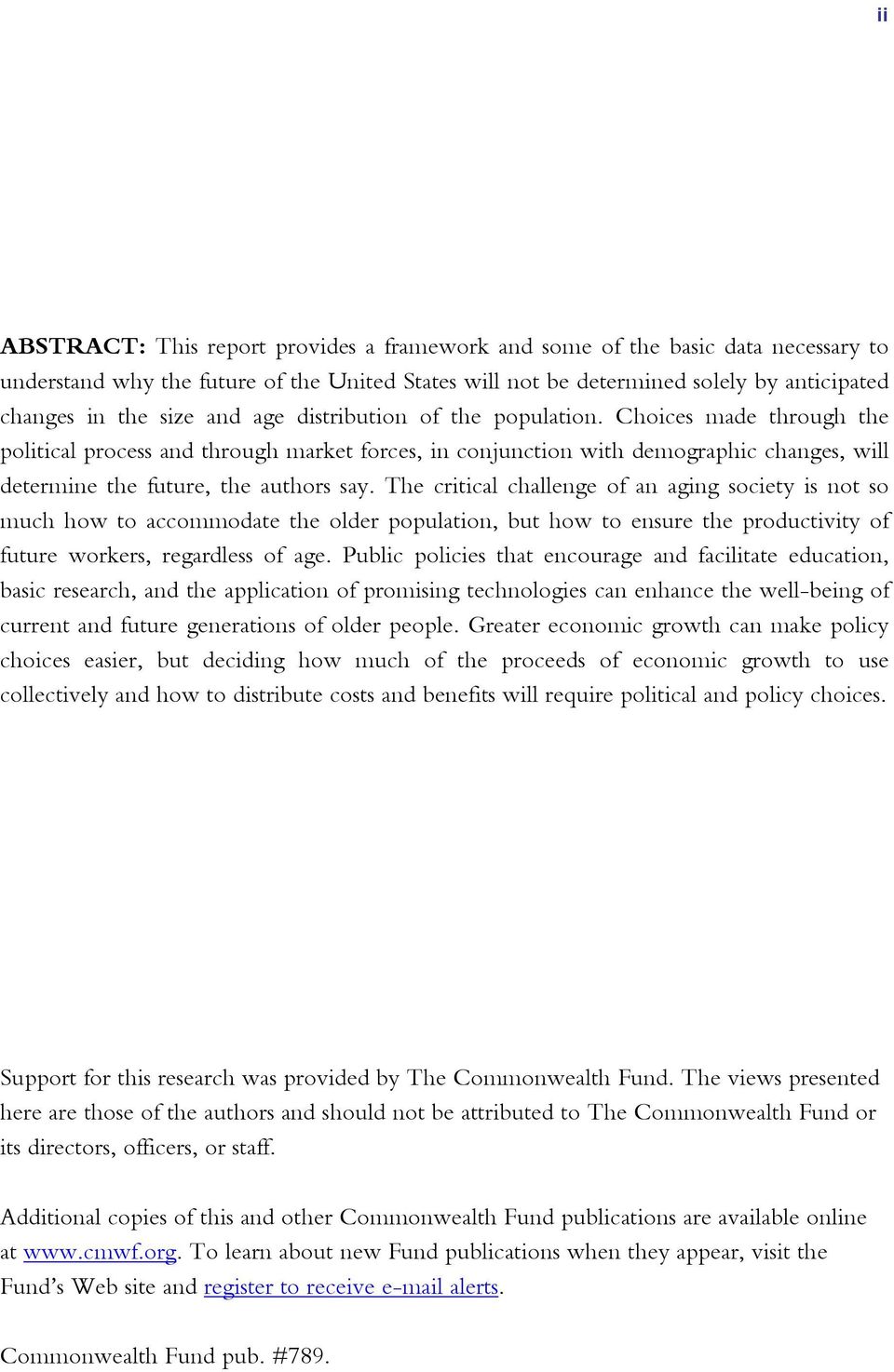
3 iii CONTENTS ACKNOWLEDGMENTS... iv PREFACE... v INTRODUCTION...1 PART ONE: THE FUTURE WILL BE DIFFERENT CHAPTER 1: THE DEMOGRAPHIC IMPERATIVE...7 CHAPTER 2: ECONOMIC GROWTH MATTERS PART TWO: THE OLDER POPULATION OF TOMORROW WILL BE DIFFERENT CHAPTER 3: THE FINANCIAL OUTLOOK CHAPTER 4: FUTURE HEALTH AND LONG-TERM CARE NEEDS CHAPTER 5: POLICY CHOICES MATTER APPENDIX: DETAILED TABLES OF TIME-SERIES FIGURES NOTES...109
4 iv ACKNOWLEDGMENTS The authors gratefully acknowledge the assistance of Katherine Mack and Susan Rogers Mathieu in the preparation of this report, as well as the helpful comments on prior drafts from Barbara Cooper, Judith Feder, Jerry Mashaw, Marilyn Moon, Joe Quinn, and Timothy Smeeding.
5 v PREFACE Authors Note: In this report, unless otherwise noted, the term older people generally refers to individuals age 65 and older. This reflects the manner in which data are often reported. For most of recorded history, average life expectancy at birth was less than 30 years. By 1900, average life expectancy in the United States had reached nearly age 50, and by 2000 it had reached age 74 for men and age 80 for women. These vast improvements can be traced to a wide array of nutritional and environmental factors as well as advances in medicine. Recent advances in medical care, particularly surrounding the detection and treatment of heart disease, have led to marked increases in life expectancy at age 65 and older. The improvement in life expectancy is a benefit of the dramatic increase in the wealth of developed nations, and a contributor to that increase. In those nations, retirement has been established as a normative stage of life. The definition of retirement continues to evolve, but its presence is part of a social revolution. 1 All of us are a part of this transformation. The choices we make throughout our lives are a part of this process. Our choices are guided by expectations, labor market conditions, circumstantial opportunities, our health, the health of our families, and the availability and structure of public programs and private institutions. The evolution and ongoing transformation of retirement has changed our culture and contributed to the changes in the demographic structure of society. Society s future is not determined solely by demographic changes. Focusing on the anticipated growth in population by age group is just too simplistic an approach. Rather, the future is shaped by the choices made or not made individually and collectively, bounded by the limits in resources and, in particular, knowledge. Knowledge is at the heart of gains in productivity, economic growth, and the advances in medical care, agriculture, communication, transportation, and the environment. Population change must be considered in the context of other changes throughout the economy and society. Private markets and public policies are not only effective tools for encouraging individual behavior, but also for responding to the collective needs of consumers, workers, and employers.
6 vi This report begins with an examination of demographic changes that have occurred and those that are most likely to occur in the near future. A discussion of the importance of the economy follows. Although economic growth has contributed to demographic change, it is quite likely that demographic changes have also affected economic growth. In Part II, the capacity of people and institutions to adapt is explored. Data make clear that today s older people are different from their predecessors. In the future, the needs of older people and their contributions to society are likely to be different as well. This report concludes with a discussion of policy options that can influence the future and summarizes the primary policy challenges of an aging society. This report builds on Demography Is Not Destiny, which was published in January That report was directed by a distinguished group of scholars who met regularly to discuss the implications of an aging society. The working group, which was chaired by Judith Feder, Georgetown University, and Marilyn Moon, American Institutes of Research, also included James C. Callahan, Jr., Brandeis University; Susan Dentzer, The NewsHour with Jim Lehrer; Jack Hadley, Urban Institute; Roger C. Herdman, Institute of Medicine; James S. Jackson, University of Michigan; Jerry L. Mashaw, Yale University; Sandra Newman, Johns Hopkins University; Joseph F. Quinn, Boston College; and Timothy M. Smeeding, Syracuse University. The work that was undertaken to produce Demography Is Not Destiny was supported by the Commonwealth Fund. The overwhelming response to that first effort led us to prepare Demography Is Not Destiny, Revisited. Our intent was not simply to update the data, but to reexamine the points made six years ago with the advantage of more years of data and the commentary collected from the first version. The opportunity granted us by the Commonwealth Fund produced substantial rewriting and the replacement of many charts. We were most fortunate that Judith Feder, Marilyn Moon, Jerry Mashaw, Joseph Quinn, and Timothy Smeeding, who were instrumental in shaping the first report, were willing to work with us to comment on drafts of this report. Their comments proved invaluable in helping us to sort out the interdependence of the many factors that will make tomorrow different from today. We are also grateful for the comments and insights of Barbara Cooper of the Commonwealth Fund, as well as the comments on earlier drafts from others at the Fund. As this report is being written, the United States is engaged in a war on terrorist organizations, state governments have been making gut-wrenching cuts due to budget deficits, the size of the federal budget deficit has increased dramatically, and U.S. troops are engaged in very dangerous missions in Iraq. Despite this, our optimism about the
7 future has not been dampened. People have always shown tremendous capacity to adapt to economic fluctuations, political unrest, and national emergencies. While the transitional costs of events like these are not distributed fairly, individuals continue to demonstrate an incredible capacity to give of themselves for causes greater than themselves. This selflessness, in conjunction with selfish entrepreneurial zeal, reflects a complex public spirit. We fiercely compete in the marketplace and yet we are genuinely interested in joining together, as families and communities, to take on collective challenges. No doubt, the aging of society will continue to impose tremendous challenges, but through collective actions in the political process as well as collective actions in the marketplace, these challenges can be met without necessarily diminishing future standards of living. vii
8 1 INTRODUCTION That our society is aging is well known. Media stories and political rhetoric abound concerning the impending demographic challenges as the population age 65 and older is anticipated to more than double by the year Much of the handwringing concerns an expectation of dire fiscal consequences for publicly financed programs, such as Medicare and Social Security, of which older people tend to be the principal beneficiaries. What is not said is that planning for the future on the basis of demographic projections alone is a fool s game. Population projections can be wrong, but even if they turn out to be correct, other factors, particularly those related to the economy and public policies, can have a decidedly greater impact on the future than simply the growing number and proportion of older people. What is needed for wise policy planning is a close look at the range of influences on our future and the willingness to make choices to use some of our wealth to invest in the future. No doubt the future will be different from the past. Yet we can take solace by looking to the past. After all, some of the anticipated demographic changes, like the doubling of the population age 65 and older, have already occurred. The population is anticipated to grow older than it is now, but the population is already older now than it has ever been. Moreover, demographically the United States is considerably younger than most other industrialized countries. What can we learn by looking to the past and understanding how the economy and public policies interacted with demographic changes? And what can we learn by looking at older nations as well? This report provides a framework and some of the basic data necessary to understand why our future is not determined solely by the anticipated changes in the size and age distribution of the population. Themes repeated throughout this report include: Demography is not destiny. The choices made through the political process and through market forces, in conjunction with demographic changes, will determine the future. The critical challenge of an aging society is not so much how to accommodate the older population, but how to ensure the productivity of future workers, regardless of age. In the future, older persons are likely to be at least as diverse in terms of their health, financial status, and ethnic origins as their predecessors. Not all racial and
9 2 ethnic populations have benefited from past economic growth to the same extent. Some groups are extremely vulnerable. Uncovered health and long-term care expenses leave everyone fiscally vulnerable, but particularly affect older persons. Public policies that encourage and facilitate education, basic research, and the application of promising technologies can enhance the well-being of current and future generations of older people. Greater economic growth can make policy choices easier, but deciding how much of the proceeds of economic growth to use collectively and how to distribute costs and benefits will require political and policy choices. The U.S. Population Age 65 and Older Has Already Grown Dramatically Without Devastating Consequences Future demographic change is much easier to anticipate than other forms of change. At any point in the past century, one could have easily anticipated a dramatic increase in the size and proportion of the population age 65 and older. Since 1900, the number of Americans age 65 and older has doubled three times. Since 1960, the population age 65 and older has doubled while the overall population has only grown 57 percent. However, since 1960 the nation s income (as measured by real gross domestic product) has nearly quadrupled. Economic Growth Matters Economic growth has made the nation more prosperous and has enabled many to enjoy a higher standard of living than would have been possible a generation earlier. Although income and wealth are not distributed equally, most families have seen their material standard of living improve with each generation. Many wonder if the country can support an aging society. Most of this anxiety is directed at one aspect of aging: federal entitlement spending. In 1998, the Commission on Retirement Policy predicted rapid increases in entitlement spending spiraling deficits huge revenue needs a burden on future generations. 2 In 1995, the Bipartisan Commission on Entitlement and Tax Reform warned that the projected imbalance between spending and revenues particularly with regard to health care and retirement entitlement programs will, together with interest on the federal debt, undermine America s capacity to make appropriate investments in the well being of our citizens and undertake other essential government functions, such as national defense. 3

10 3 There are legitimate reasons to be concerned about growth in expenditures, but there is more reason to be concerned about economic growth. With little economic growth society faces fewer choices on how to care for those who are least able to care for themselves. With sufficient economic growth there are more choices and fewer persons in need. Small differences in sustained economic growth will have a dramatic impact on the fiscal future of society. If real economic growth averages about 2 percent per year between now and 2050, then, depending on the policy choices we make, government expenditures as a proportion of the economy in 2050 might not be substantially larger than today and we will still be able to meet the promises made to future beneficiaries. It would be foolish to assume society will simply grow its way out of the difficult choices that the aging of the population will require. It would be equally foolish to assume that the future will be completely dismal if there is no radical restructuring of government programs. If public policies support the market transitions necessary for economic growth during demographic transitions, then we can afford to meet the challenges of the retirement of the baby boom. The Older Population of Tomorrow Will Be Different Life today is different from the past, in part because of demographic and economic changes. The population age 65 to 75 is healthier, wealthier, and better educated than persons in this age group in past generations. Future groups of older people are likely to be even better off. They too will redefine retirement and old age. Older persons still remain vulnerable Improvements across age groups should not blind us to the fact that certain segments of the population age 65 and older remain very vulnerable. Older single women, for example, have particularly low average incomes. There is also substantial variation in the educational attainment of baby boomers. Because people with more education tend to have higher incomes and better health, this educational disparity virtually guarantees a diverse group of older people in the future. Current financial disparities are expected to persist or grow. And large health and long-term care expenses can substantially drain the resources of even those who previously felt financially secure. Insuring risks Social insurance in the form of Social Security, disability insurance, unemployment insurance, and Medicare is designed to improve the economic security of workers and their dependents. These programs, along with private insurance and tax incentives for

11 4 individual savings and employee benefits, have pooled financial risk and contributed to the well-being of American families. However, longer life expectancy has accentuated the financial risks of health and long-term care by highlighting increasingly large gaps in public programs and private insurance. Some of the gaps in coverage are filled by public assistance, such as Medicaid and Supplemental Security Income. However, many gaps are not filled, resulting in homelessness, hunger, and higher proportions of unmet and uncompensated health care needs. Policy Matters Population growth and change will affect society, but so too will policy choices. Much of the concern over the anticipated growth in the older population is related to anxiety about the federal budget. The budget issues may be significant, but the federal budget is just one facet of the economy. Policymakers must not only evaluate the tax-financed expenditures of programs like Medicare and Social Security, they must also consider the net impact these expenditures have and changes that would occur if these programs did not exist. With reasonable economic growth, projected government spending will not be substantially larger as a percentage of national income than it is today. With less economic growth, tougher choices related to cutting program benefits or raising taxes will have to be made. But given the likelihood of some economic growth, the debate about future government spending is likely to be a debate mostly about how to distribute the additional wealth in the economy. Currently, much of the public discussion about an aging society involves how to finance Social Security and Medicare. Resolving this question will have an impact on financial security for future age groups but will do little to resolve the implications for communities. Reducing the share of public support does not eliminate societal costs, it merely leaves individuals and their families responsible for a larger share, and some of those costs end up getting shifted back to the public sector through less direct and often more expensive means. Families and local communities will face a wide array of issues related to education, housing, social services, and transportation that will not be answered by cutting, expanding, or restructuring entitlement programs. The Future Will Bring Challenges that Require Thoughtful Attention Now Issues related to the aging of our society pale in comparison to the social, political, military, and economic challenges our society has already faced. With little planning,
12 5 society has adjusted to the baby boom and to the consequences of large numbers of people moving through the schools, the labor force, and the housing, product, and financial markets. The baby boom is now anticipated to begin moving out of the labor force and into the realm of health care, long-term care, and claims on retirement income. Society can and will adjust. But the transitions and their consequences will be easier the better prepared we are. As policymakers decide on policies to meet this challenge, they must recognize that those policies will have to change as everything else changes. This suggests maintaining flexibility to allow such changes to be made as the future becomes clearer.

13 6 PART ONE: THE FUTURE WILL BE DIFFERENT The inevitable changing age distribution in the U.S. population, and changes in labor, financial, and consumer markets, ensure that the future will be different. Part I examines the imperative suggested by demographic change and the economic response that has occurred. There are at least four points to keep in mind when considering the demographic imperative: The United States is substantially younger than other industrialized countries. Other industrialized nations have already faced and will continue to face aging trends that are more pronounced than in the United States. If population projections between now and 2050 turn out to be correct, then the number of children plus older persons relative to the working-age population will not be as large as it was in The financing of government programs imposes a substantial challenge, regardless of economic growth. However, if real economic growth averages 2 percent or more per year, then projected government expenditures in 2050 could be about the same proportion of gross domestic product (GDP) as today. Ultimately, the central challenge of an aging society is ensuring that future workers are able to produce more than current workers. The changing distribution of workers and consumers is likely to encourage greater productivity, but investments in education, training, basic science, and technology will also be required.

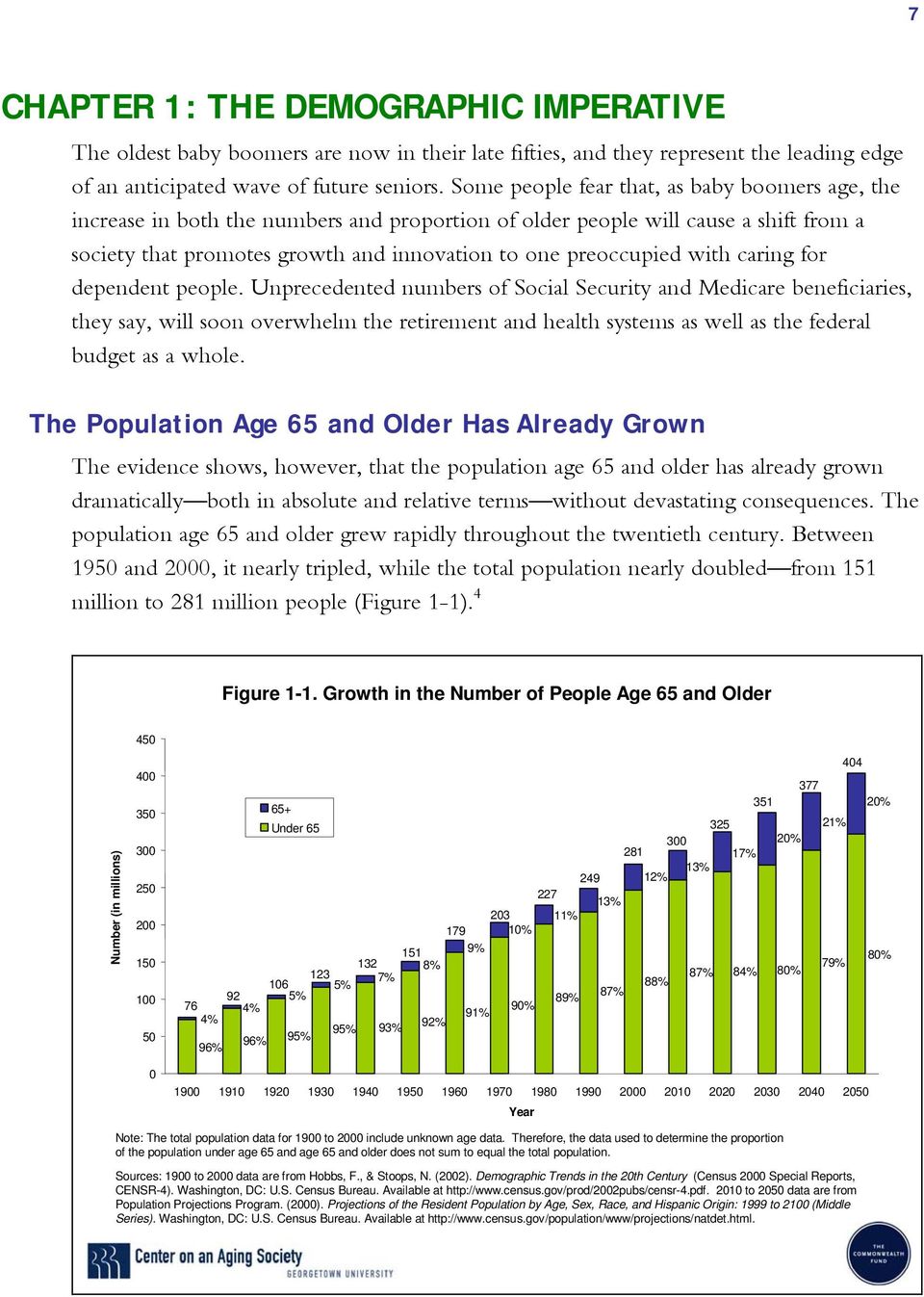
14 7 CHAPTER 1: THE DEMOGRAPHIC IMPERATIVE The oldest baby boomers are now in their late fifties, and they represent the leading edge of an anticipated wave of future seniors. Some people fear that, as baby boomers age, the increase in both the numbers and proportion of older people will cause a shift from a society that promotes growth and innovation to one preoccupied with caring for dependent people. Unprecedented numbers of Social Security and Medicare beneficiaries, they say, will soon overwhelm the retirement and health systems as well as the federal budget as a whole. The Population Age 65 and Older Has Already Grown The evidence shows, however, that the population age 65 and older has already grown dramatically both in absolute and relative terms without devastating consequences. The population age 65 and older grew rapidly throughout the twentieth century. Between 1950 and 2000, it nearly tripled, while the total population nearly doubled from 151 million to 281 million people (Figure 1-1). 4 Figure 1-1. Growth in the Number of People Age 65 and Older 450 Number (in millions) % Under % % 17% % 13% % % % 151 9% 87% 84% 80% 79% 80% 132 8% 123 7% 106 5% 88% 92 5% 89% 87% 76 4% 96% 96% 95% 95% 93% 92% 91% 90% 4% Year Note: The total population data for 1900 to 2000 include unknown age data. Therefore, the data used to determine the proportion of the population under age 65 and age 65 and older does not sum to equal the total population. Sources: 1900 to 2000 data are from Hobbs, F., & Stoops, N. (2002). Demographic Trends in the 20th Century (Census 2000 Special Reports, CENSR-4). Washington, DC: U.S. Census Bureau. Available at to 2050 data are from Population Projections Program. (2000). Projections of the Resident Population by Age, Sex, Race, and Hispanic Origin: 1999 to 2100 (Middle Series). Washington, DC: U.S. Census Bureau. Available at
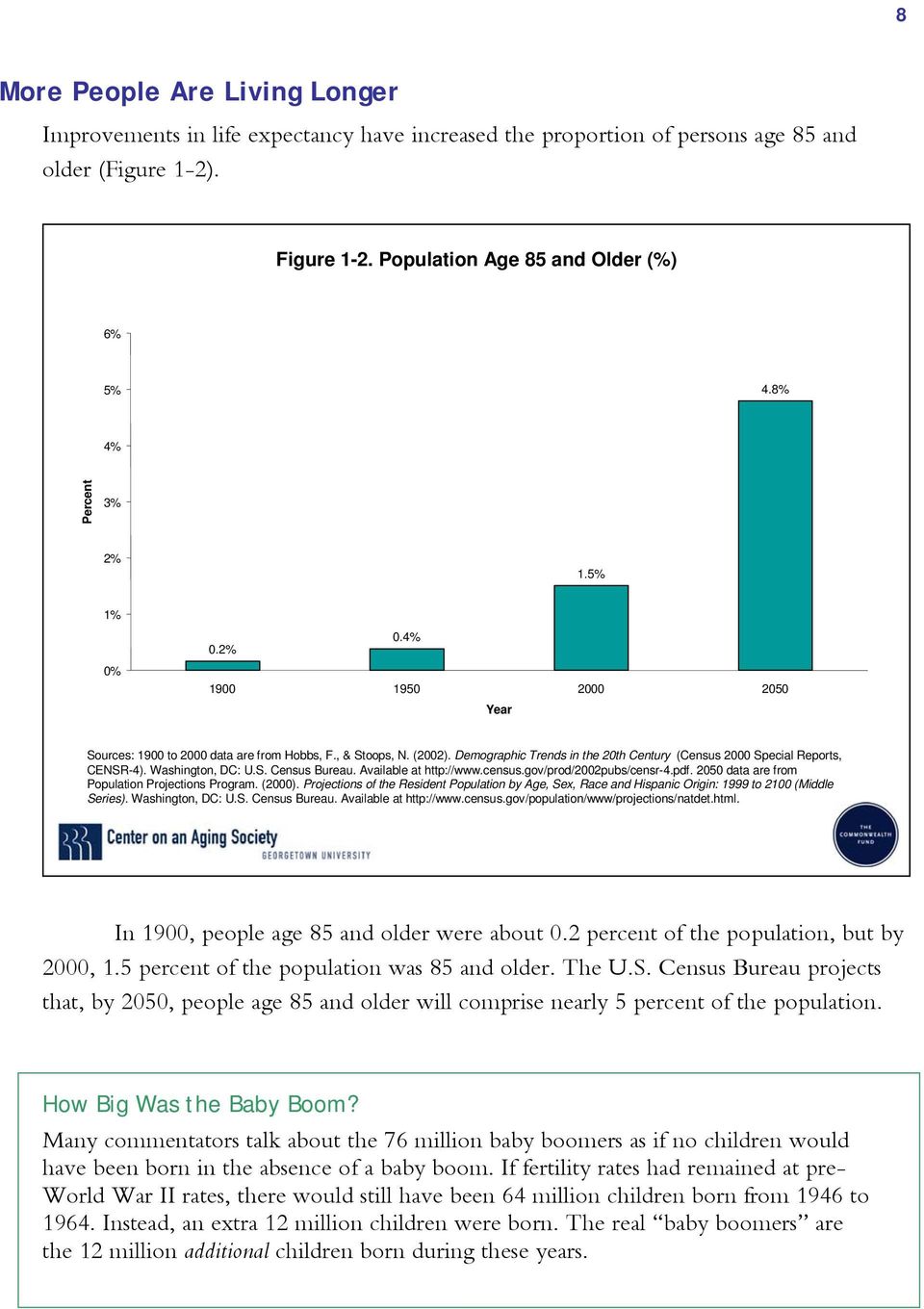
15 8 More People Are Living Longer Improvements in life expectancy have increased the proportion of persons age 85 and older (Figure 1-2). Figure 1-2. Population Age 85 and Older (%) 6% 5% 4.8% 4% Percent 3% 2% 1.5% 1% 0% 0.4% 0.2% Year Sources: 1900 to 2000 data are from Hobbs, F., & Stoops, N. (2002). Demographic Trends in the 20th Century (Census 2000 Special Reports, CENSR-4). Washington, DC: U.S. Census Bureau. Available at data are from Population Projections Program. (2000). Projections of the Resident Population by Age, Sex, Race and Hispanic Origin: 1999 to 2100 (Middle Series). Washington, DC: U.S. Census Bureau. Available at In 1900, people age 85 and older were about 0.2 percent of the population, but by 2000, 1.5 percent of the population was 85 and older. The U.S. Census Bureau projects that, by 2050, people age 85 and older will comprise nearly 5 percent of the population. How Big Was the Baby Boom? Many commentators talk about the 76 million baby boomers as if no children would have been born in the absence of a baby boom. If fertility rates had remained at pre- World War II rates, there would still have been 64 million children born from 1946 to Instead, an extra 12 million children were born. The real baby boomers are the 12 million additional children born during these years.
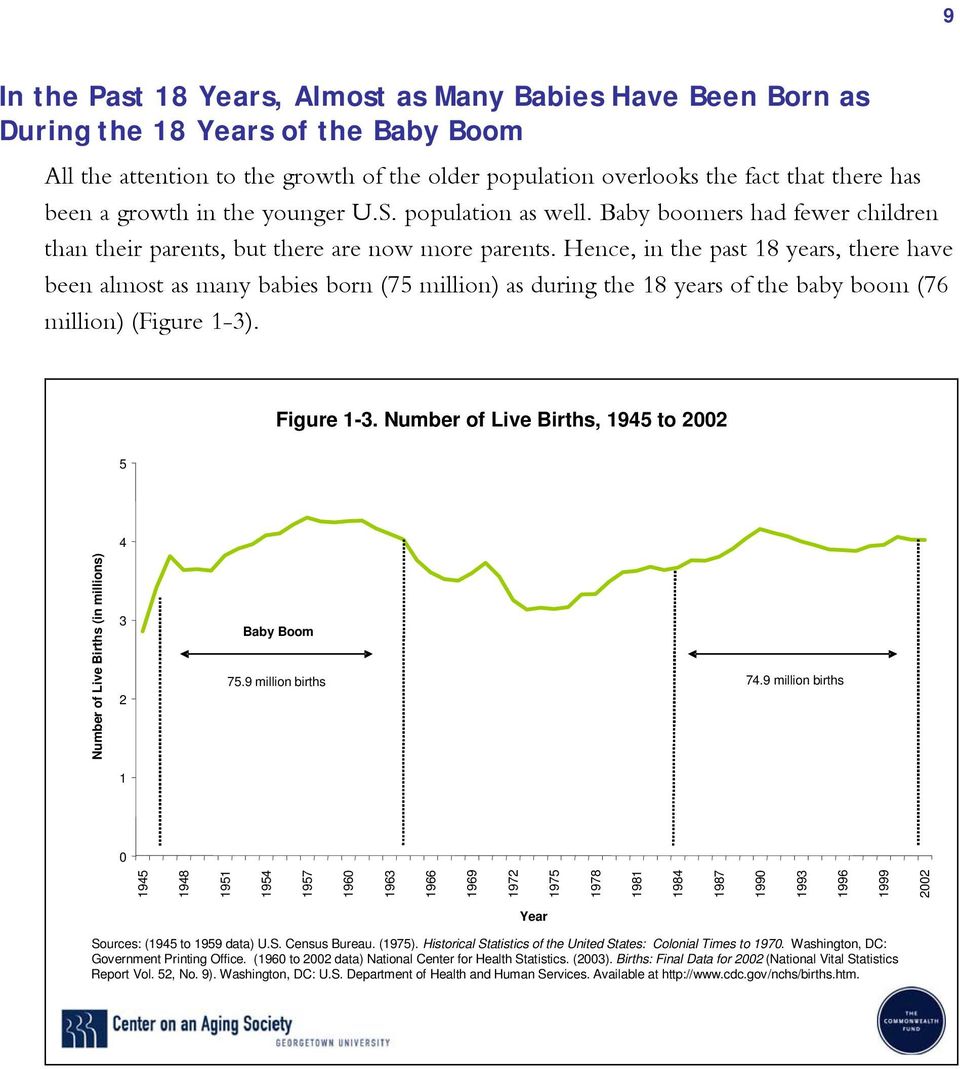
16 9 In the Past 18 Years, Almost as Many Babies Have Been Born as During the 18 Years of the Baby Boom All the attention to the growth of the older population overlooks the fact that there has been a growth in the younger U.S. population as well. Baby boomers had fewer children than their parents, but there are now more parents. Hence, in the past 18 years, there have been almost as many babies born (75 million) as during the 18 years of the baby boom (76 million) (Figure 1-3). Figure 1-3. Number of Live Births, 1945 to Number of Live Births (in millions) Baby Boom 75.9 million births 74.9 million births Sources: (1945 to 1959 data) U.S. Census Bureau. (1975). Historical Statistics of the United States: Colonial Times to Washington, DC: Government Printing Office. (1960 to 2002 data) National Center for Health Statistics. (2003). Births: Final Data for 2002 (National Vital Statistics Report Vol. 52, No. 9). Washington, DC: U.S. Department of Health and Human Services. Available at Year
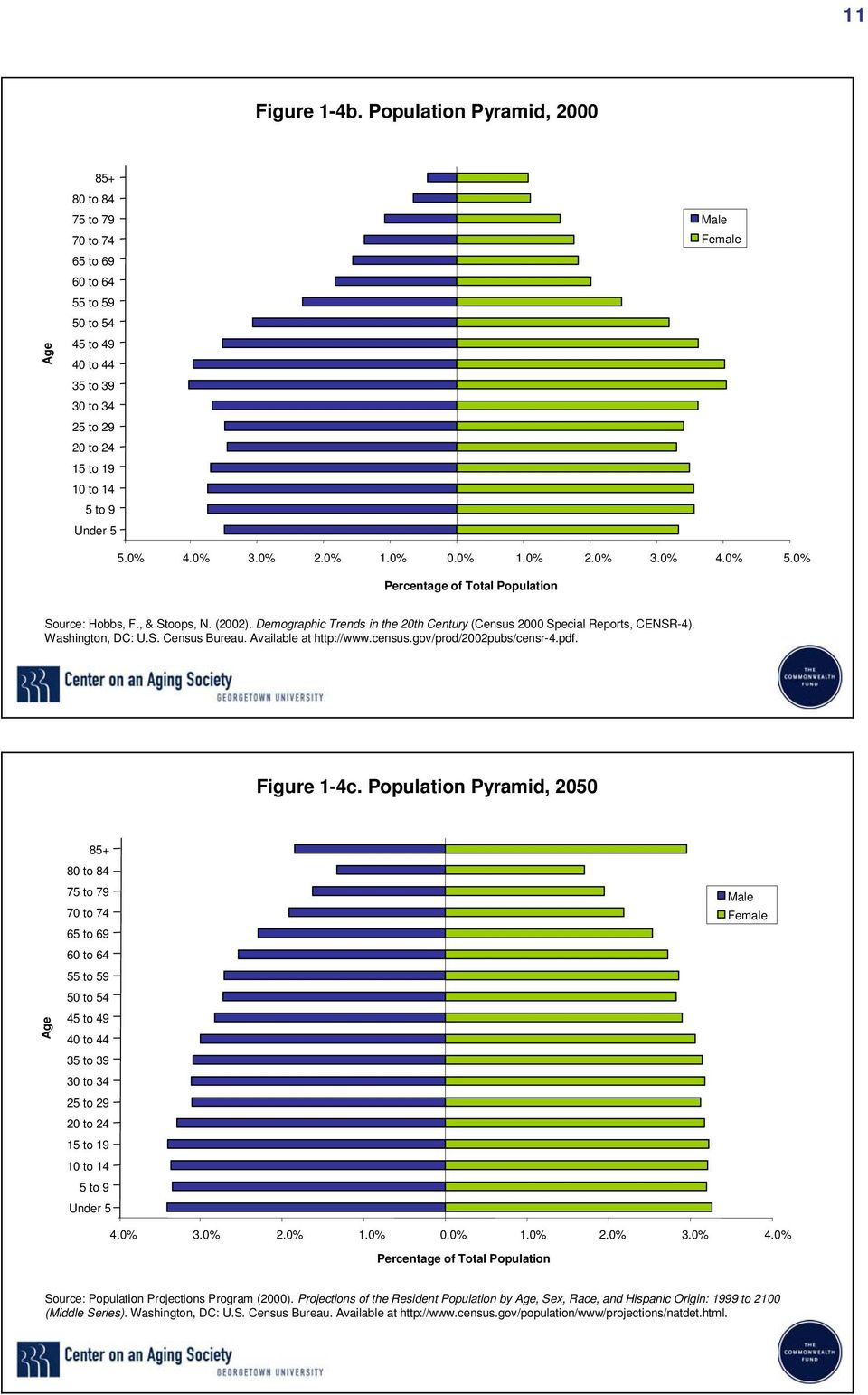
17 10 The Population Profile Will Change As the children of baby boomers have children and more people live longer, the top of the age pyramid will fill out and become more rectangular. Looking at the pattern up to 1950, except for those born during the Depression, each new generation has been larger than the one that preceded it (Figure 1-4a). Figure 1-4a. Population Pyramid, 1950 Age to to to to to to to to to to to to to to to 14 5 to 9 Under 5 Male Female 6.0% 5.0% 4.0% 3.0% 2.0% 1.0% 0.0% 1.0% 2.0% 3.0% 4.0% 5.0% 6.0% Percentage of Total Population Source: Hobbs, F., & Stoops, N. (2002). Demographic Trends in the 20th Century (Census 2000 Special Reports, CENSR-4). Washington, DC: U.S. Census Bureau. Available at By 2000, the population distribution has already become less triangular, reflecting falling fertility rates after the baby boom and during the 1970s (Figure 1-4b). By 2050, when all of the surviving baby boomers will be age 85 and older, the triangle is expected to become a rectangle indicating that the population will be more evenly distributed across generations than it has ever been (Figure 1-4c).
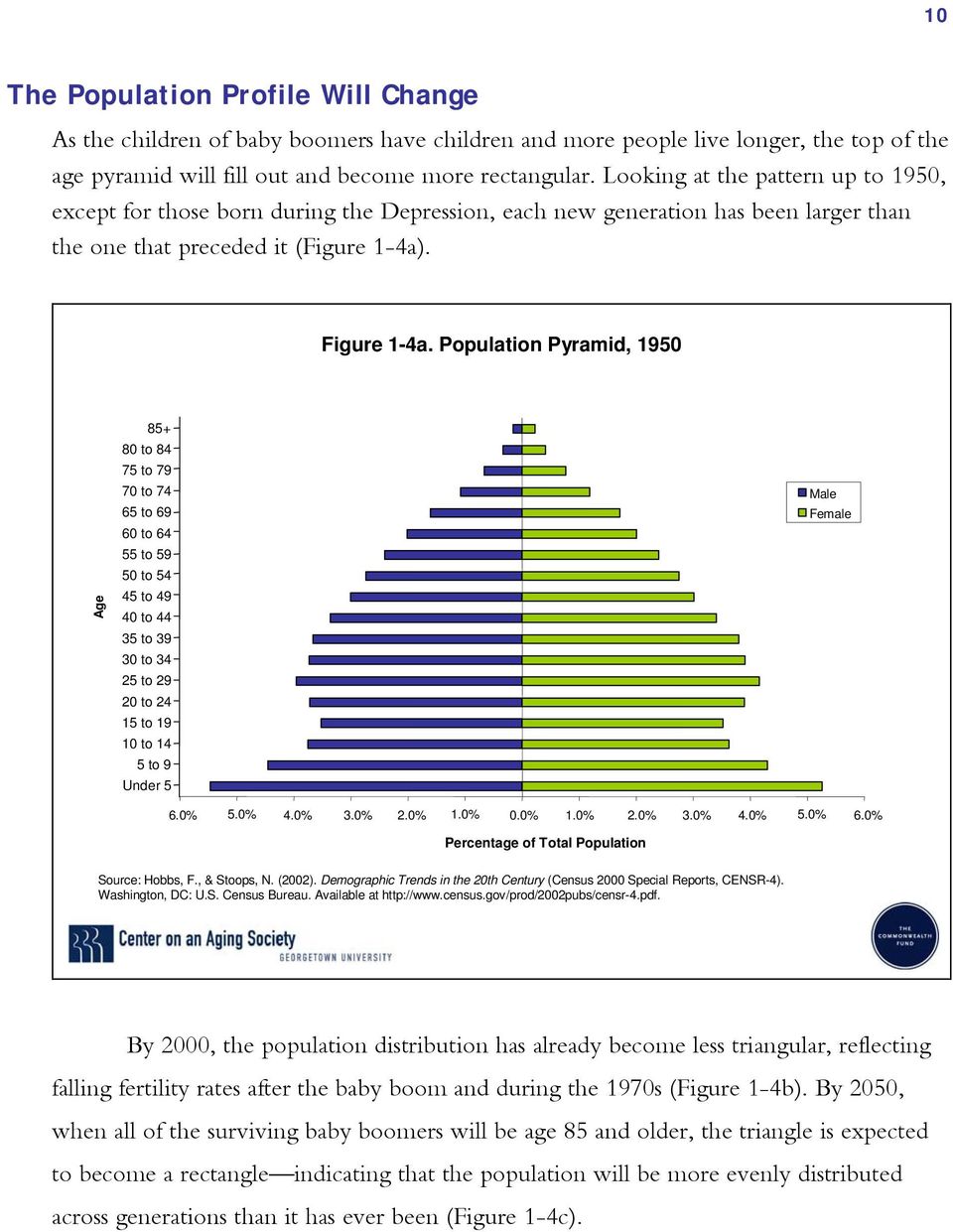
18 11 Figure 1-4b. Population Pyramid, 2000 Age to to to to to to to to to to to to to to to 14 5 to 9 Under 5 Male Female 5.0% 4.0% 3.0% 2.0% 1.0% 0.0% 1.0% 2.0% 3.0% 4.0% 5.0% Percentage of Total Population Source: Hobbs, F., & Stoops, N. (2002). Demographic Trends in the 20th Century (Census 2000 Special Reports, CENSR-4). Washington, DC: U.S. Census Bureau. Available at Figure 1-4c. Population Pyramid, 2050 Age to to to to to to to to to to to to to to to 14 5 to 9 Under 5 Male Female 4.0% 3.0% 2.0% 1.0% 0.0% 1.0% 2.0% 3.0% 4.0% Percentage of Total Population Source: Population Projections Program (2000). Projections of the Resident Population by Age, Sex, Race, and Hispanic Origin: 1999 to 2100 (Middle Series). Washington, DC: U.S. Census Bureau. Available at
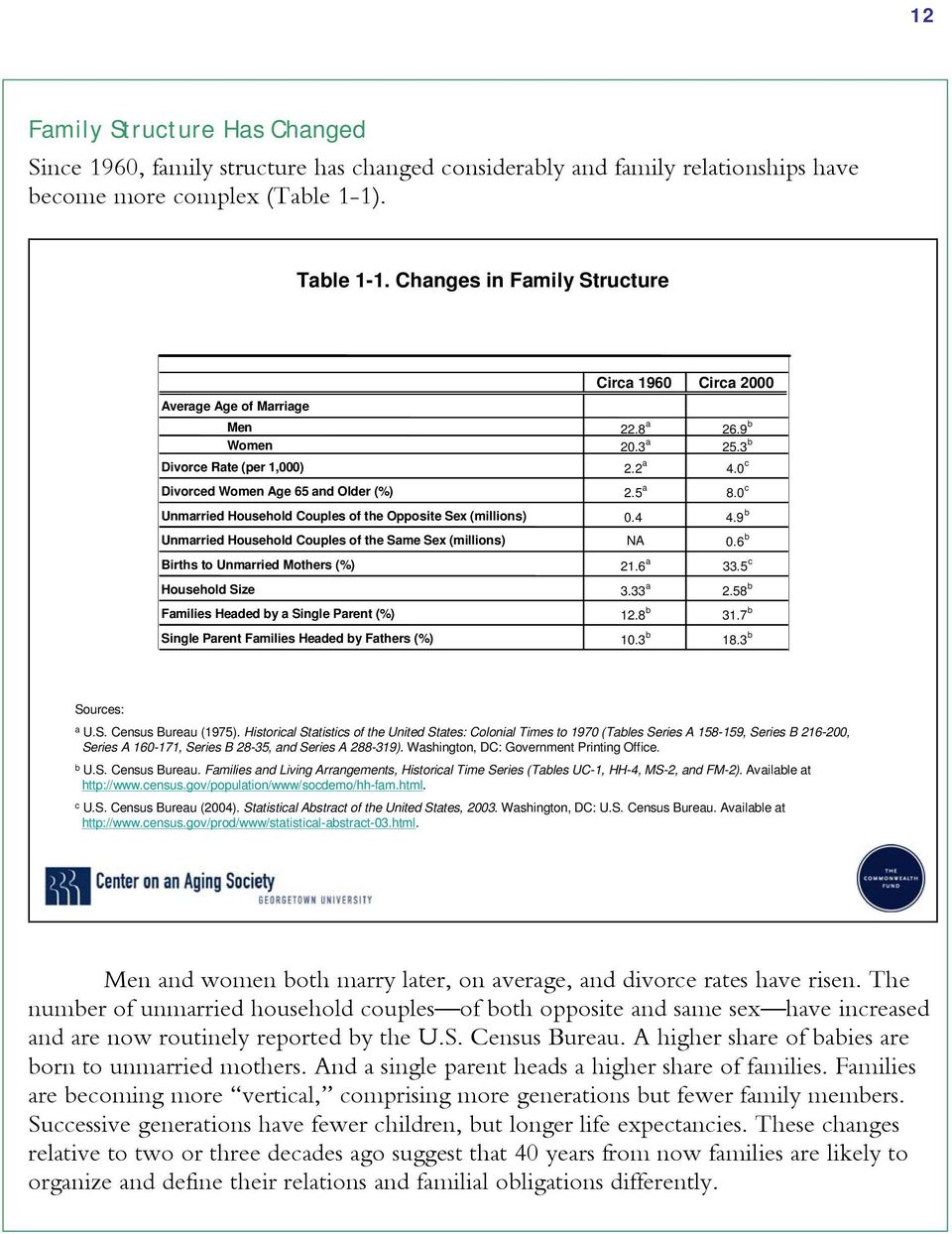
19 12 Family Structure Has Changed Since 1960, family structure has changed considerably and family relationships have become more complex (Table 1-1). Table 1-1. Changes in Family Structure Circa 1960 Circa 2000 Average Age of Marriage Men 22.8 a 26.9 b Women 20.3 a 25.3 b Divorce Rate (per 1,000) 2.2 a 4.0 c Divorced Women Age 65 and Older (%) 2.5 a 8.0 c Unmarried Household Couples of the Opposite Sex (millions) b Unmarried Household Couples of the Same Sex (millions) NA 0.6 b Births to Unmarried Mothers (%) 21.6 a 33.5 c Household Size 3.33 a 2.58 b Families Headed by a Single Parent (%) 12.8 b 31.7 b Single Parent Families Headed by Fathers (%) 10.3 b 18.3 b Sources: a U.S. Census Bureau (1975). Historical Statistics of the United States: Colonial Times to 1970 (Tables Series A , Series B , Series A , Series B 28-35, and Series A ). Washington, DC: Government Printing Office. b U.S. Census Bureau. Families and Living Arrangements, Historical Time Series (Tables UC-1, HH-4, MS-2, and FM-2). Available at c U.S. Census Bureau (2004). Statistical Abstract of the United States, Washington, DC: U.S. Census Bureau. Available at Men and women both marry later, on average, and divorce rates have risen. The number of unmarried household couples of both opposite and same sex have increased and are now routinely reported by the U.S. Census Bureau. A higher share of babies are born to unmarried mothers. And a single parent heads a higher share of families. Families are becoming more vertical, comprising more generations but fewer family members. Successive generations have fewer children, but longer life expectancies. These changes relative to two or three decades ago suggest that 40 years from now families are likely to organize and define their relations and familial obligations differently.
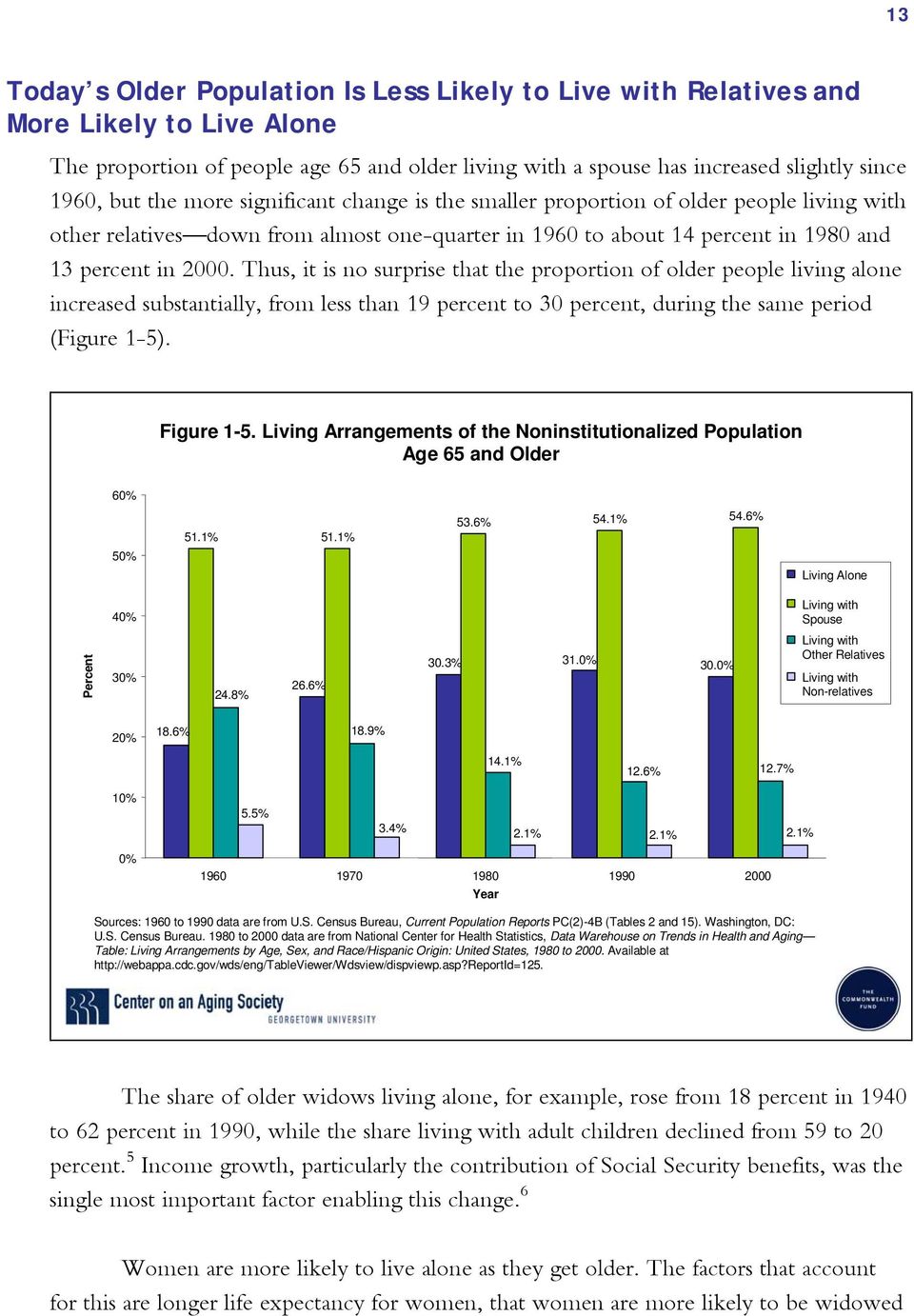
20 13 Today s Older Population Is Less Likely to Live with Relatives and More Likely to Live Alone The proportion of people age 65 and older living with a spouse has increased slightly since 1960, but the more significant change is the smaller proportion of older people living with other relatives down from almost one-quarter in 1960 to about 14 percent in 1980 and 13 percent in Thus, it is no surprise that the proportion of older people living alone increased substantially, from less than 19 percent to 30 percent, during the same period (Figure 1-5). Figure 1-5. Living Arrangements of the Noninstitutionalized Population Age 65 and Older 60% 51.1% 51.1% 53.6% 54.1% 54.6% 50% Living Alone 40% Living with Spouse Percent 30% 24.8% 26.6% 30.3% 31.0% 30.0% Living with Other Relatives Living with Non-relatives 20% 18.6% 18.9% 14.1% 12.6% 12.7% 10% 5.5% 3.4% 2.1% 2.1% 2.1% 0% Year Sources: 1960 to 1990 data are from U.S. Census Bureau, Current Population Reports PC(2)-4B (Tables 2 and 15). Washington, DC: U.S. Census Bureau to 2000 data are from National Center for Health Statistics, Data Warehouse on Trends in Health and Aging Table: Living Arrangements by Age, Sex, and Race/Hispanic Origin: United States, 1980 to Available at The share of older widows living alone, for example, rose from 18 percent in 1940 to 62 percent in 1990, while the share living with adult children declined from 59 to 20 percent. 5 Income growth, particularly the contribution of Social Security benefits, was the single most important factor enabling this change. 6 Women are more likely to live alone as they get older. The factors that account for this are longer life expectancy for women, that women are more likely to be widowed
21 14 (which is a reflection of the age disparity between husbands and wives), and that older women are less likely to remarry than older men. Family members are less likely to live near one another today than in the past. In a 1992 study of people age 51 to 61, fewer than half some 40 percent reported that they had children living within 10 miles. 7 In a 1994 study of persons age 70 and older, only 35 percent said their children lived that close. 8 Older Hispanics Are Least Likely to Live Alone Now and in the Future Over the next 20 years, relatively little change is expected in the proportion of older people who will live alone. There are, however, projected differences by race and ethnicity (Figure 1-6). Figure 1-6. Persons Age 65 and Older Living Alone, by Race, 1990 to 2020 (%) 35% 31% 33% 32% 30% 30% 31% 31% Percent 25% 20% 15% 10% 22% 24% 25% White Hispanic Black and Other 5% 0% Year Source: Administration on Aging. (1996). Aging into the 21st Century. Available at Currently, older Hispanic persons are less likely than white non-hispanics or blacks age 65 and older to live alone. Projections indicate that more Hispanic persons might live alone in the future, while the proportion of whites living alone may decline. Still, the likelihood of living alone will be lower for the Hispanic population age 65 and
22 15 older. Among older people who live alone or are expected to live alone, the Hispanic population is more likely than other racial or ethnic groups to have living children. 9 The U.S. Is Younger Than Other Industrialized Countries Population aging resulting from declining fertility rates and increasing life expectancies is a worldwide phenomenon. Since 1960, older populations in the industrialized countries have more than doubled. 10 Today, the United States is the youngest of the industrialized countries (Figure 1-7). Figure 1-7. Proportion of the Population Age 65 and Older, 2000 and % 35% 33% 34% % 25% 25% 27% 30% 26% Percent 20% 15% 13% 16% 16% 18% 17% 16% 12% 21% 10% 5% 0% Canada France Germany Italy Japan United Kingdom United States Country Source: U.S. Census Bureau. International Data Base (IDB), Online Demographic Aggregation. Available at By 2050, the proportion of the population that is age 65 and older in the United States is projected to be considerably smaller than in any of the other industrialized nations. People age 65 and older will be 21 percent of the population in the United States but 30 percent or more of the population in Germany, Italy, and Japan.
23 16 Immigration Has a Small Effect on the Age Distribution Each decade since the 1940s has seen more immigrants arrive in the United States (Figure 1-8). Nearly all immigrants are under the age of 65 and a significant share of the immigrant population is under the age of 25. Large numbers of immigrants could have an impact on the age distribution. However, the small number of immigrants relative to the population has not had a significant effect. Figure 1-8. Immigration to the United States, 1900 to ,800,000 1,600,000 1,400, to 64 Under 25 1,536,293 3% Number 1,200,000 1,000, , , ,000 Total 1,041, , , ,700 65% 530, , , ,398 32% 1,063,523 5% 847,687 5% 62% 59% 200,000 70,756 36% 33% Note: The total number of immigrants admitted to the United States and the percentage distribution by age of immigrants to the United States in 1990, 2000, and 2002 does not account for immigrants whose age was unknown. There were 190 immigrants whose age was unknown in 1990, 2,120 in 2000, and 209 in Sources: 1900 to 2000 data are from Office of Immigration Statistics, U.S. Citizenship and Immigration Services (2002) Statistical Yearbook of the Immigration and Naturalization Service (Tables 1 and 12). Available at data are from Office of Immigration Statistics, U.S. Citizenship and Immigration Services (2003) Year of Immigration Statistics (Tables 1 and 6). Available at Year
24 17 What Do Dependency Ratios Mean? To better understand the economic implications of demographic change, it is convenient to examine the ratio of the population of those least likely to be in the labor force to those most likely to be in the labor force (Figure 1-9). This snapshot provides a crude indication of how much workers will need to produce to support those not working. It is crude because employment is not determined by age, and this measure does not enable us to account for changes in technology and productivity. Figure 1-9. Projected Number of Dependents per 100 Working-Age People and Older Under 20 Dependency Ratio Note: SSA s Intermediate Assumptions were used to determine the projected dependency ratios; "dependents" refers to the population under age 20 and age 65 and older; and "working age" refers to the population age 20 to 64. Source: Social Security Administration (SSA). (2004). The 2004 Annual Report of the Board of Trustees of the Federal Old-Age and Survivors Insurance and Disability Insurance Trust Funds (Table V.A2). Washington, DC: SSA. Year In 1960, there were more than 90 persons either age 20 and younger or age 65 and older being supported by every 100 persons of primary working age. Interestingly, the ratio of dependents to the working-age population has declined. In fact, by 2010 it is expected to be substantially less than it was in After 2010, the number of dependents relative to the working-age population is expected to increase, but even by 2050 it is not expected to be as large as it was in Most of the decline in the dependency ratio reflects the decline in the number of children per worker. After 2000, most of the anticipated increase in the dependency ratio reflects a growing proportion of persons age 65 and older. This shift in the composition of the dependency ratio will reflect different needs.
25 18 Population Projections Are Not Certain Population projections are uncertain (Figure 1-10). Figure Past and Projected Population Age 65 and Older, 1950 to ,000 Number (in thousands) 100,000 80,000 60,000 40,000 Historical Lowest Series Middle Series Highest Series 20, Year Sources: 1950 to 2000 data are from Hobbs, F., & Stoops, N. (2002). Demographic Trends in the 20th Century (Census 2000 Special Reports, CENSR-4). Washington, DC: U.S. Census Bureau. Available at to 2050 data are from Population Projections Program (2002). Projections of the Resident Population by Age, Sex, Race, and Hispanic Origin, 1999 to 2100 (lowest, middle, and highest series). Available at Depending on the assumptions made concerning future mortality and immigration rates, the U.S. Census Bureau estimates that the number of people age 65 and older in 2050 will range from 71 million to 98 million a difference of 27 million people and nearly 40 percent. This uncertainty is really quite remarkable, given the fact that everyone who could be age 65 and older between now and 2050 has been born.
26 19 Projections of People Age 85 and Older Also Vary Substantially Projections of the population age 85 and older are even more varied. By 2050 there may be anywhere from 16 million to 24 million people age 85 or older a difference of 8 million and nearly 50 percent (Figure 1-11). Figure Past and Projected Population Age 85 and Older, 1950 to ,000 Number (in thousands) 25,000 20,000 15,000 10,000 Historical Lowest Series Middle Series Highest Series 5, Year Source: 1950 to 2000 data are from Hobbs, F., & Stoops, N. (2002). Demographic Trends in the 20th Century (Census 2000 Special Reports, CENSR-4). Washington, DC: US Census Bureau. Available at to 2050 data are from Population Projections Program. (2000). Projections of the Resident Population by Age, Sex, Race, and Hispanic Origin: 1999 to 2100 (lowest, middle, and highest series) [Data file]. Available at
27 20 The Future Numbers of Older and Younger Working-Age People Are Uncertain Given the uncertainty of population projections, it is not surprising that projections of the ratio of the older population to the working-age population vary (Figure 1-12). Figure Number of People Age 65 and Older per 100 People Age 20 to 64: Three Projections Ratio Intermediate High Mortality Low Mortality Year Source: Social Security Administration (SSA) (2004) Annual Report of the Board of Trustees of the Federal Old-Age and Survivors Insurance and Disability Insurance Trust Funds (Table V.A2). Washington, DC: SSA. Available at Most social insurance programs, like Social Security and Medicare, are financed primarily by payroll taxes. Thus, variations in the ratio help explain part of the variation in the Social Security Trustees assessment that the OASDI Trust Funds (Social Security) and the Hospital Insurance (HI) Trust Funds (Part A of Medicare) could either be depleted around 2042 or 2019, respectively, or remain solvent for at least 75 years. 11
28 21 The Older Population Is Projected to Grow Even Older Currently, people age 80 and older constitute one-quarter 26 percent of the older population. By 2050, the U.S. Census Bureau s intermediate projections indicate that this share is expected to rise to about 39 percent. From 2000 to 2050, while the population age 65 to 79 is projected to increase 95 percent, the population age 80 and older could increase 244 percent (Figure 1-13). Figure Older Population by Age 2000 n = 34 million 2050 n = 82 million 85 to % 80 to % 90 to % 95 to % % 65 to % 85 to % 90 to % 95 to % % 65 to % 75 to % 70 to % 80 to % 70 to % 75 to % Sources: 2000 data are from U.S. Census Bureau. Census 2000 Summary File 1 (Table PCT12). Available at data are from Population Projections Program. (2000). Projections of the Resident Population by Age, Sex, Race, and Hispanic Origin: 1999 to 2100 (Middle Series). Washington, DC: U.S. Census Bureau. Available at
29 22 The Population Will Be More Racially and Ethnically Diverse Minority populations will represent larger proportions of both the population age 65 and older and younger than age 65 in future years (Figures 1-14a,b). Figure 1-14a. Population Under Age 65 by Race and Ethnicity 2000 n = 246 million 2050 n = 322 million Asian and Pacific Islander 3.8% Hispanic 13.0% American Indian 0.9% Asian and Pacific Islander 9.4% American Indian 0.8% Black 12.3% Hispanic 26.4% Non-Hispanic White 49.8% Non-Hispanic White 70.0% Black 13.5% Sources: 2000 data are from U.S. Census Bureau (2002). Census 2000 Ranking and Comparison Population and Housing Tables (Table PHC-T-8). Available at data are from Population Projections Program (2002). Projections of the Resident Population by Age, Sex, Race, and Hispanic Origin: 1999 to 2100 (Middle Series). Washington, DC: U.S. Census Bureau. Available at
30 23 Figure 1-14b. Population Age 65 and Older by Race and Ethnicity 2000 n = 35 million 2050 n = 82 million Asian and Pacific Islander 2.3% American Indian 0.4% Hispanic 4.8% Black 7.9% Hispanic 16.4% Asian and Pacific Islander 6.5% American Indian 0.6% Non-Hispanic White 84.6% Black 12.2% Non-Hispanic White 64.2% Sources: 2000 data are from U.S. Census Bureau (2002). Census 2000 Ranking and Comparison Population and Housing Tables (Table PHC-T-8). Available at data are from Population Projections Program (2002). Projections of the Resident Population by Age, Sex, Race, and Hispanic Origin: 1999 to 2100 (Middle Series). Washington, DC: U.S. Census Bureau. Available at Because of differences in immigration and fertility rates, African American, Asian and Pacific Islander, and Hispanic populations are all increasing more rapidly than the non-hispanic white population. Non-Hispanic whites made up 85 percent of the older population in 2000, a share that is projected to decline to 64 percent by Non- Hispanic whites made up 70 percent of the population under age 65 in 2000, a share that is projected to become 50 percent in Over the same period, the Hispanic proportion of the population age 65 and older is expected to more than triple, growing from 5 percent in 2000 to 16 percent in 2050, and the Hispanic proportion of the population under age 65 is projected to double, from 13 to 26 percent. The U.S. Population Will Be Better-Educated in the Future During the past several decades, the proportion of adults in the United States who have not completed high school has decreased, while the proportion of adults with high school and college degrees has increased. 12 Projections based on data from the U.S. Census Bureau suggest that over the next three decades, educational attainment levels among both native-born and foreign-born residents will steadily increase (Figure 1-15).
31 24 Figure Projected Educational Attainment of the U.S. Population Age 25 and Older 100% 80% 83% 87% Percent 60% 40% 48% 56% 20% 24% 28% 0% High School Degree Post-Secondary Bachelor's Degree Educational Level Note: Low-level projections were used to illustrate educational attainment. High-level projections indicate that the proportion of people age 25 and older with post-secondary education or bachelor's degrees could be as high as 63 percent and 31 percent, respectively. Source: Cheeseman Day, J., & Bauman, K.J. (2000). Have We Reached the Top? Educational Attainment Projections of the U.S. Population. Working Paper Series No. 43. Washington, DC: U.S. Census Bureau. Available at For example, in 2003 about 48 percent of the population has some post-secondary education, but by 2028, 56 percent of the population is expected to have attained this level of education. 13 In fact, improvements in the level of education attained are expected to occur in all industrialized countries (Figures 1-16a,b). 14
32 25 Figure 1-16a. Proportion of the Male Population Age 25 to 64 That Has Attained at Least Tertiary-Level Education, 2001 MALE Canada 39% France 22% Germany 28% Country Italy 10% Japan 36% U.K. 27% U.S. 37% 0% 5% 10% 15% 20% 25% 30% 35% 40% 45% Percent Note: Tertiary refers to post-secondary educational attainment in which a degree is awarded (includes both occupational and academic degrees). Source: Organization of Economic Cooperation and Development (2001). Education at a Glance, OECD Indicators, 2003 (Table A3.1a). Available at Figure 1-16b. Proportion of the Female Population Age 25 to 64 That Has Attained at Least Tertiary-Level Education, 2001 FEMALE Canada 44% France 24% Germany 18% Country Italy 10% Japan 32% U.K. 35% U.S. 37% 0% 5% 10% 15% 20% 25% 30% 35% 40% 45% 50% Percent Note: Tertiary refers to post-secondary educational attainment in which a degree is awarded (includes both occupational and academic degrees). Source: Organization of Economic Cooperation and Development (2001). Education at a Glance, OECD Indicators, 2003 (Table A3.1a). Available at
33 26 Although gains in education have occurred and are expected to continue, it is important to note that there is still a substantial portion of the population that has difficulties acquiring, comprehending, and applying relevant information. The 1992 National Adult Literacy Survey reported that some 15 to 18 million of the 39 million adults age 60 and older in the United States are essentially functionally illiterate. The proportion of people with very limited skills in processing information is greater at older ages and may in fact increase with age. 15 People with lower levels of functional literacy face real barriers in understanding and making informed decisions about health and financial matters. Some of the Youngest States Are Expected to Age the Most States will be experiencing demographic and market changes differently (Table 1-2). Table 1-2a. State Rankings of the Proportion of the Population Age 65 and Older, 2000 and 2025 Percentage Point Increase in the Population Age 65 and State Rank of the Proportion of the Population Age 65 and Older Older, 2000 to Oregon % % Montana % % Colorado % % Idaho % % Nevada % % Arkansas % % West Virginia % % North Carolina % % Wyoming % % Washington % % Kentucky % % Florida % % Oklahoma % % Utah % % South Carolina % % Arizona % % North Dakota % % Tennessee % % Minnesota % % Iowa % % Vermont % % Mississippi % % Alabama % % Nebraska % % South Dakota % % Sources: 2000 data are from U.S. Census Bureau. Census 2000 Summary File 1 (Table P12). Available at data are from U.S. Census Bureau. Detailed State Projections by Single Year of Age, Sex, Race and Hispanic Origin: 1995 to Available at In fact, many of the states with the largest anticipated increase in older people are states that currently have the least infrastructure in place to address the needs of older people. Rural and urban areas will also have different experiences relative to the growing proportion of older people. About one-fifth 20 percent of all Americans lived in rural
34 27 areas in 2000, but the proportion of people age 65 and older living in rural areas was somewhat higher at 23 percent. 16 Table 1-2b. State Rankings of the Proportion of the Population Age 65 and Older, 2000 and 2025 Percentage Point Increase in the Population Age 65 and State Rank of the Proportion of the Population Age 65 and Older Older, 2000 to Wisconsin % % Georgia % % New Hampshire % % Maine % % Indiana % % Louisiana % % Virginia % % Missouri % % Ohio % % Kansas % % Delaware % % Texas % % Michigan % % Pennsylvania % % New Mexico % % Maryland % % Alaska % % Massachusetts % % Illinois % % Rhode Island % % Connecticut % % New Jersey % % New York % % Hawaii % % California % % District of Columbia % % Sources: 2000 data are from U.S. Census Bureau. Census 2000 Summary File 1 (Table P12). Available at data are from U.S. Census Bureau. Detailed State Projections by Single Year of Age, Sex, Race and Hispanic Origin: 1995 to Available at What About Tomorrow? Longer life expectancies in conjunction with mothers having fewer children ensure that in the future there will be a larger proportion of people age 65 and older. By how much is somewhat uncertain, because future mortality, fertility, and net immigration rates are unknowable. However, improvements in life expectancy suggest the opportunity for fundamental changes in how education, family formation, living arrangements, and labor force participation are organized over a lifetime. The choices people make will in part be affected by the opportunities that are available. These choices, however, can have profound impacts on other aspects of society as they permeate through private markets and public policies. To the extent the population projections turn out to be correct, it is quite likely that between now and 2050 the number of children plus the number of older persons, relative to the working-age population, will be less than it was in In 1960, for every
35 100 working-age persons there were 90.5 persons age 65 and older or age 20 and younger. By 2050 there could be 81.2 older and younger persons for every 100 workingage persons. Clearly, there will have been a shift from children to older persons. This shift will in turn require a shift in budgets, because certain needs, such as child care and education, and the sources of financing for those needs, are different from health and long-term care needs, for example. On the other hand, older persons can still be engaged in the labor market long after age 65 and the savings of older persons are a necessary component of financial markets. 28
36 29 CHAPTER 2: ECONOMIC GROWTH MATTERS Economic growth affords a nation the opportunity to improve standards of living for everyone. The greater the rate of real economic growth, the more opportunities there are to alter the well-being of individuals in society. Real economic growth reflects the increase in national income after removing the price increases. This chapter examines the relationship between demographic change, the economy, and real economic growth. Economic Growth Has Enabled Many People to Enjoy a Higher Standard of Living From 1940 to 1959, the size of the U.S. economy (in real terms) doubled. It doubled again by 1965 and then doubled again by Since 1987, the economy has expanded, on average, 2.9 percent per year in real terms or over 55 percent (Figure 2-1). As a consequence, persons born in 1940, who are now 64 years old, have witnessed an 875 percent increase in standards of living. Figure 2-1. Real Gross Domestic Product, 1929 to ,000 Dollars (in billions of 2000 dollars) Dollars (in billions of 2000 do 10,000 8,000 6,000 4,000 2,000 August, 1929 to March, 1933 May, 1937 to June, 1938 February, 1945 to October, 1945 November, 1948 to October, 1949 August, 1953 to May, 1954 August, 1957 to April, 1958 April, 1960 to February, 1961 December, 1969 to November, 1970 November, 1973 to March, 1975 January, 1980 to July, 1980 July, 1981 to November, 1982 July, 1990 to March, 1991 March, 2001 to November, Note: Blue-shaded areas represent recessionary periods. Source: U.S. Bureau of Economic Analysis. National Income Product Accounts Tables (Table 1.1.6). Available at Year
37 30 Specialization of skills and advances in technology have significantly changed quality of life. Just three decades ago, many of today s necessities personal computers, personal data assistants, facsimile machines, cellular telephones, digital cameras were luxuries and even fantasies of science fiction. Many older people vividly remember when indoor plumbing was the exception in much of the country. Economic Growth Has Occurred Despite Population Growth Real economic growth occurred despite the fact that the population age 65 and older was also increasing (Figure 2-2). From 1950 to 2000, the overall population of the United States grew about 87 percent. The number of workers nearly doubled, but the number of people age 65 and older nearly tripled. 17,18 The country s ability to absorb a tripling of an older population and still experience an increase in living standards was related in part to advances in productivity and general economic growth. Over this time period, the economy, as measured by GDP per capita, increased nearly 200 percent, rising steadily from $11,717 in 1950 to $34,760 in 2000 (in 2000 dollars). As of 2003, GDP per capita had reached $35,721 (in 2000 dollars). Figure 2-2. Real GDP per Capita, 1929 to 2003 $40,000 $35,000 GDP per Capita (in 2000 dollars) $30,000 $25,000 $20,000 $15,000 $10,000 $5,000 $ Year Source: U.S. Bureau of Economic Analysis. National Income Product Accounts Tables (Table 7.1). Available at
38 31 The Changing Labor Force: Employment and People Almost one-fifth of people age 65 and older 18 percent are working (Figure 2-3). Figure 2-3. Characteristics of Workers and the General Population Age 65 or Older, 2000 Income of $20,000 or Less Income of $50,000 or More 17% 23% 37% 42% Workers General Population Poor Physical Health 2% 1% Very Good to Excellent Physical Health 28% 53% Less than a High School Degree 21% 32% High School Degree or More 68% 79% Male 44% 56% 0% 10% 20% 30% 40% 50% 60% 70% 80% 90% Percent Source: Center on an Aging Society, analysis of data from the Health and Retirement Study, Many older people continue to work for financial reasons. Others enjoy the income, but also find their work gratifying and stimulating. Among all older workers, 94 percent say that they really enjoy going to work. 19 Attitudes and expectations about retirement and labor force participation are different today than in the past. People who work into their later years generally are better educated, healthier, and wealthier than their nonworking peers. As a group, they contribute energy, experience, and skills. Older workers are participating in the labor force in new ways. The distinction between work and retirement is not as clear as it once was as some people make a transition from full-time employment to full-time retirement. Some older workers phase out of employment by changing from full-time to part-time status for some period. Some retirees are returning to the workforce as consultants or parttime, seasonal, or temporary workers. Compared to the past, fewer jobs today require physical labor and therefore more jobs are attractive to older workers.
39 32 The Composition of the Federal Budget Has Changed The growth in the number of people eligible for federal entitlements and the increased cost of program benefits have resulted in a shift in the composition of the federal budget (Figure 2-4). Figure 2-4. Federal Expenditures as a Percentage of Total Federal Government Expenditures, 1962 to % 90% 80% 70% 60% Net Interest Other Discretionary Defense Other Mandatory Medicaid Medicare Social Security 50% 40% 30% 20% 10% 0% Percent Year Source: Congressional Budget Office (CBO) (2004). The Economic and Budget Outlook: Fiscal Years (Tables F-5, F-7, and F-9). Washington, DC: CBO. Available at After 1970, public expenditures on programs for which older people were primary beneficiaries increased. A substantial portion of this shift was accommodated by the decline in the proportion of the budget going toward national defense. In 1962, national defense outlays equaled 49 percent of the federal budget. Defense outlays remained near 45 percent through the late 1960s, but then plummeted to 16 percent of the federal budget by Since then, the share of the budget going to defense expenditures has increased. The Bush administration s proposed 2005 budget calls for increasing defense spending to 19 percent. 21
40 33 Entitlement Programs Account for Over 40 Percent of the Federal Budget Social Security, Medicare, and Medicaid expenditures now account for 42 percent of federal spending (Figure 2-5). Figure 2-5. Total Federal Budget, 2003 Total Federal Outlays = $2,157.6 Billion Interest 7.1% Medicaid 7.4% Medicare 12.7% All Other Discretionary 19.5% Social Security 21.8% Defense 18.8% All Other Mandatory 17.3% Source: Congressional Budget Office (CBO) (2004). The Economic and Budget Outlook: Fiscal Years (Tables F-5, F-7, and F-9). Washington, DC: CBO. Available at Some 84 percent of Social Security benefits are paid directly to people age 65 and older and 87 percent of Medicare payments are made on their behalf. 22 Although only 9 percent of Medicaid beneficiaries are age 65 or older, about 27 percent of Medicaid expenditures are directed toward care of older persons. 23
41 34 Federal Expenditures on Entitlements Are Expected to Increase Given the growing number of older persons and that advances in medical care are usually embraced, it is quite likely that the share of the nation s income going to finance Social Security, Medicaid, and Medicare will increase dramatically (Figure 2-6). 24 The Congressional Budget Office (CBO) released six budget scenarios for the future. In the two most extreme sets of assumptions, spending on Social Security, Medicaid, and Medicare is assumed to increase from 8 percent of GDP in 1999 to between 13 percent and 28 percent of GDP in Most of the difference in the expenditure scenarios stems from assumptions concerning health care. CBO assumes that average annual expenditures per Medicare beneficiary, for example, will increase between 5 percent (in the least expansive scenario) and 8 percent (in the most expansive scenario) per year. During the past decade, however, Medicare expenditures per beneficiary increased less than 5 percent per year. Figure 2-6. Projections of Federal Expenditures as a Percentage of GDP 30% 25% 20% Federal Share of Medicaid Medicare Social Security 4.0% 5.3% Percent 15% 10% 5% 0% 2.8% 15.9% 12.1% 2.1% 8.7% 1.6% 5.7% 1.4% 3.7% 2.2% 4.1% 4.1% 4.9% 5.9% 6.2% 6.3% Year Note: The following high path spending assumptions were used: excess cost growth in Medicaid and Medicare spending will continue at past rates of 2.5 percent per year; defense spending will follow the 2004 Future Years Defense Program, with allowances for additional spending to support the global war on terrorism, as well as allowances for cost risks; and nondefense discretionary spending and other mandatory spending (excluding Social Security) are maintained at their historical levels as a share of GDP. Source: Congressional Budget Office (2003). The Long-Term Budget Outlook (Supplemental Tables). Available at
42 35 What a Difference a Year Makes Projections are more art than science. Another year of data and refinements in the assumptions can result in dramatic differences in projections made for 20 or 30 years away. To get a sense of this, consider a series of projections by the Congressional Budget Office for the year In May 1998, the Congressional Budget Office had been anticipating that the federal budget would have a surplus for most of the next decade. They anticipated that national income (GDP) in 2030 would be $33.1 trillion and total government spending would be 25 percent of GDP. In December 1999, the CBO modeling had been revised, but a surplus was still projected. GDP and total government spending were now expected to be 4 percent and 6 percent, respectively, lower than projected 20 months earlier. Comparing similar projections of 2030 done in 1999, 2000, and 2003 reveals considerable changes in the projections of national income, the size of the government, and the expenditures for Medicare, Medicaid, and Social Security. CBO did not release long-term projections in 2002 and in 2003 they provided a more dramatic range of projection scenarios. Our assumption is that Scenario 2 is the most similar to the assumptions used in the 1999 and 2000 projections. Scenario 2 can be characterized as a set of assumptions reflecting intermediate spending and lower revenues. During the time in which these projections were done, the federal budget would go from surplus to deficit and the economy through a recession. The business cycle reached a peak in March 2001 (industrial production had reached its peak level in September 2000), marking the beginning of the recession. The eight-month recession was over by November 2001, but by the time of the projections in December 2003, the economy had not fully recovered. Table 2-1 reflects the change from either projection done in the preceding year or the change between 1999 and 2003 for GDP and federal expenditures in Table 2-1. Change in Spending and GDP Projections for 2030 from Prior Projections (Scenario 2) (Scenario 2) Medicare 5% 5% 55% 55% Medicaid 22% 2% 109% 151% Social Security 7% 13% 9% 10% Total Government Expenditures 2% 1% 13% 17% Nominal GDP 10% 9% 4% 16% Sources: 1999 data are from Congressional Budget Office (CBO) (1999). The Long-Term Budget Outlook: An Update (Table 4). Washington, DC: CBO. Available at ftp://ftp.cbo.gov/18xx/doc1806/ltbudg99.pdf data are from CBO (2000). The Long-Term Budget Outlook (Table 4). Washington, DC: CBO. Available at ftp://ftp.cbo.gov/25xx/doc2517/long-term%20budget%20outlook.pdf data are from CBO (2002). A 125-Year Picture of the Federal Government's Share of the Economy, 1950 to Washington, DC: CBO. Available at ftp://ftp.cbo/gov/35xx/doc352/125revisedjuly3.pdf data are from CBO (2003). The Long-Term Budget Outlook (Supplemental Tables, Scenarios 1 and 2). Washington, DC: CBO. Available at
43 36 How Much of the Nation s Additional Wealth Ought to Be Government Spending? In 1950, federal spending was less than 15 percent of GDP; however, by 1975, it had increased to over 21 percent. Since 1975, federal spending as a percentage of GDP has remained between 19 percent and 23 percent. Similarly, state and local government spending increased steadily from 6 percent in 1950 to 13 percent of GDP in The proportion declined somewhat after 1975 until 1990, but has increased since. Total government spending, then, has increased from 21 percent of GDP in 1950 to more than 33 percent, but at times has exceeded 36 percent (Figure 2-7). Figure 2-7. Total, Federal, and State and Local Government Expenditures as a Percentage of GDP, 1950 to % 35% Total Government Federal State and Local 30% 25% 20% 15% 10% 5% 0% Percent Source: U.S. Bureau of Economic Analysis. National Income Product Accounts Tables (Tables 1.1.5, 3.1, 3.2 and 3.3). Available at Year The fact that government spending has tended to increase with the growth in GDP suggests a willingness to spend a growing share of additional wealth through government activities. However, most of the increase in the nation s wealth still remained in private hands.
44 37 Most Workers Will Likely Be Able to Afford the Taxes Necessary to Maintain Social Security and Medicare in 2050 If smaller proportions of workers are able to keep up with the growing demand for the products and services they provide, then those workers should eventually see their wages and salaries increase (Figure 2-8). The Social Security Trustees assume that if real GDP is increasing on average 2.9 percent per year, wages for the average worker will increase from about $35,000 in 2004 to over $205,000 in Figure 2-8. Wages of the Average Worker Net of Taxes to Finance Social Security, Medicare, and the Disability Insurance Program $250,000 Current Dollars $200,000 $150,000 $100,000 $50,000 $ $35,057 $30,605 Average Wages Wages Net of Taxes $154,508 $205,168 Note: Taxes on the average worker assumes only workers finance OASI, DI, HI and the general revenues needed for Parts B and D of Medicare. Sources: These calculations assume that the full cost of these programs is financed by workers. Old-Age and Survivors Insurance and Disability Insurance (OASDI) cost rates are from Table VI.B1 and average wages are from Table VI.F7 in The Board of Trustees, Federal OASDI (2004). The 2004 Annual Report of the Board of Trustees of the OASDI Trust Funds. Washington, DC: Social Security Administration. Available at The Hospital Insurance (HI) cost rate is from Table II.B8 and II.C21 and the cost of Supplemental. Medical Insurance (SMI) is based on the estimated Government Contributions in Table II.C5 of the Board of Trustees, Federal HI and Federal SMI Trust Funds (2004). The 2004 Annual Report of the Board of Trustees of the Federal HI and Federal SMI Trust Funds. Washington, DC: Centers for Medicare and Medicaid Services. Available at Income tax data is from the Internal Revenue Service (2003). Internal Revenue Service Data Book, 2002 (Publication No. 55B). Available at Total income taxes were then increased by the assumed rate of increase in average wages provided in Table VI.F7 of the Board of Trustees, Federal OASDI (2004) If it is assumed that only workers are taxed to fully finance OASDI and HI Trust Funds as well as the general revenues assumed to be needed to finance Parts B and D of Medicare, then taxes on the worker earning the median wage for Social Security and Medicare would need to increase from $4,451 in 2004 to $50,660 in As expected, the rate of increase in taxes would be greater than the rate of increase in wages, but nevertheless, wages net of taxes would still have increased about 405 percent, from $30,605 in 2004 to $154,508 in This is an average rate of increase of 3.5 percent per year. Clearly this is affordable, but the question is whether people will be willing to pay the additional taxes to maintain these programs.
45 38 Higher Growth Reduces the Challenge Society Faces In 2002, total government spending exceeded $3 trillion dollars or about 32 percent of national income. By 2050, total government spending could range from $23 trillion to $65 trillion, depending in large part on assumptions about the growth in health care costs. Using the CBO s middle set of assumptions, however, we can more easily show the importance of economic growth in determining the relative burden of expenditures of this magnitude (Figure 2-9). The middle set of assumptions used for federal spending and applied to state and local spending suggests that by 2050 total government spending could be $36 trillion. Figure 2-9. Total Government Spending as a Percentage of GDP, 1995 to % 70% 60% Less 1 Percentage Point CBO Assumed Economic Growth Rate (4.4%) Plus 1 Percentage Point 67% 50% 40% 33% 43% 30% 27% 20% 10% 0% Percent Sources: Historic and projected GDP and Federal expenditure data are from Congressional Budget Office (2003). Long-Term Budget Outlook: Supplemental Data [Data file] retrieved from Center on an Aging Society's calculations of projected state and local expenditures are based on data from the U.S. Bureau of Economic Analysis. National Income Product Accounts Tables (Table 3.3). Available at Year The CBO assumes that nominal GDP will increase, on average, about 4.4 percent per year through At that rate, total government spending could increase from 32 percent of GDP to 43 percent of GDP. But what if GDP increases a bit more than the CBO assumes? Since 1960, nominal GDP increased on average more than 7.1 percent per year, so even a 1 percentage point increase to 5.4 percent per year is modest when contrasted with historical growth.
46 39 At a growth rate of 5.4 percent, government spending as a percent of GDP could turn out to be about 27 percent. On the other hand, if GDP grows one percentage point less than the CBO assumes, government spending as a percent of GDP could be more than twice what it is today, at 67 percent of GDP. Is There a Limit on Federal Taxes? Some have argued that the public will not tolerate federal expenditures in excess of 20 percent of national income. 27 Those who make this argument note that whenever federal expenditures exceeded 20 percent of national income, there was a legislative response that lowered federal expenditures. The implication these observers draw is that policymakers chose to cut federal expenditures because expenditures had reached a threshold that the public did not tolerate. A closer look at the history and timing of tax law changes does not fully support this notion. Regardless of the absolute or relative level of taxes or expenditures, there has always been political pressure to avoid raising taxes. But, neither tax rates nor government spending were cut when government expenditures exceeded 20 percent of national income. Each time the proportion fell, it did so because economic growth increased faster than the growth in the expenditures and not because taxes were cut. The most recent round of tax cuts occurred when federal expenditures as a percent of GDP were at historic lows. While there may very well be a limit to the level of taxes the public will tolerate, it is hard to define that limit from the historical data. In fact, many of the same arguments could have been made 30 years ago, suggesting that the public would not tolerate federal expenditures in excess of 15 percent of national income. Perhaps there is more concern among voters about what government does with taxes than about the relative size of taxes. After all, we are the government. We are the employers and the taxpayers. But over a lifetime, we are also the children, parents, and grandparents that make up families and communities. What About Tomorrow? Economic growth, more so than demographic change, will affect the financial well-being of the nation, government budgets, and individuals financial independence. However, economic growth requires public and private investments in education, training, basic research, applied research, and capital formation. Nor will economic growth eliminate the need to confront difficult policy choices. We will, we hope, continue to be able to choose how much of our additional wealth should be taxed, and how this revenue is spent: how much for current needs and how much for investment in the human, scientific, and environmental capital of future generations. The choices will, first and foremost, reflect our values, not what we can afford.
47 40 PART TWO: THE OLDER POPULATION OF TOMORROW WILL BE DIFFERENT Part II takes a closer look at how demographic changes might affect how people live their lives. Much of the concern regarding the capacity of the country to accommodate an aging society is based on the needs and contributions of the current population age 65 and older. But tomorrow s older population will almost certainly have different needs, behave differently, and, hence, affect markets and public policy differently. There are four important considerations in thinking about how the population age 65 and older of the future is likely to be different: America s older population is living in a manner that few of them could have imagined when they were younger. They are better educated, healthier, and wealthier. Tomorrow s older population could be even better off than today s along these dimensions. Although improvements have occurred for many older persons, not all have benefited to the same extent; certain groups remain vulnerable. The gap in educational attainment among the baby boomers ensures that tomorrow s generations of older people will be a diverse group. Existing financial disparities are likely to persist and grow. Some individuals will be much healthier than others. If policies to accommodate older people are to be effective, they must be geared to the neediest as well as to the better-educated, the healthier, and the wealthier. Today s population age 65 and older covers an age span of 40 years. It includes vibrant 93-year-olds in good health as well as cognitively impaired 66-year-olds in poor health. The older population of today is racially, ethnically, and culturally diverse, but future groups of older people can be expected to be even more so. Tomorrow s older persons are likely to face very different challenges and to have opportunities that cannot yet be anticipated. This is because baby boomers will bring about changes in society as they age. They will also adapt to changing circumstances.
48 41 CHAPTER 3: THE FINANCIAL OUTLOOK There are strong indications that the financial circumstances of the population age 65 and older have improved over the last 40 years or so. Median income has increased, more people own their homes, and poverty rates have decreased. This is due to economic growth and Social Security, Medicare, and other government-sponsored programs, which provide a broad base of financial security for older persons. Improvements in financial status have not been evenly distributed among the population, however. The Financial Status of the Current Older Population Has Improved Relative to Past Generations Generally, with the notable exceptions of the mid-1970s, early 1990s, and early 2000s, median income of householders age 65 and older has increased since 1967 (Figure 3-1). Figure 3-1. Median Household Income of Householders Age 65 and Older, 1967 to 2002 $30,000 $25,000 Income (in 2001 dollars) $20,000 $15,000 $10,000 $5,000 $ Sources: 1967 to 2002 data are from U.S. Census Bureau. Historical Income Tables Households (Table H-10). Available at data are from U.S. Census Bureau. Detailed Income Tabulations 2003 Household Income (Table HINC-02). Available at Year The improvement reflects the growth of the economy, enhancement of public benefit programs, private insurance, and other private initiatives. As people reach age 65 with higher incomes, retirement benefits from employment, and the enhancements in
49 42 public programs, older people, as a group, will maintain their financial independence longer. Among the more important sources of financial protection is Social Security, which began paying benefits in 1940, followed by Medicare, which began providing coverage for health care expenditures in Other significant changes include the health care and social services of Medicaid and the Older Americans Act (all effective in 1966), support available through the Supplemental Security Income Program (SSI), which was established in 1972, the pension protections provided through the Employee Retirement Income Security Act of 1974, and subsequent amendments and tax law changes that have encouraged and subsidized home ownership and retirement saving. The future financial status of the older population will depend on how recent changes in pension plans affect future incomes and on the generosity of Social Security and Medicare benefits. Home Ownership Among the Population Age 65 and Older Has Increased The increase in home ownership among older people is another indication that circumstances have improved (Figure 3-2). In 20 years, the proportion of people age 65 and older who owned their homes increased by 15 percentage points. Among the population age 65 and older, married couples are the most likely to be homeowners. Figure 3-2. Homeownership Rates of the Population Age 65 and Older Homeownership Rate (percent) All Married Single Male Single Female Marital Status Source: U.S. Census Bureau. Housing Vacancies and Homeownership Annual Statistics: 2003 (Table 15). Available at
50 43 Poverty Rates Have Declined As recently as the 1960s, old age was strongly associated with poverty. In 1960, more than one-third of the population age 65 and older was poor. Today, one-tenth is poor. By 1974, the poverty rate for the population age 65 and older had already dropped to half the 1968 rate. The largest real increases in Social Security benefits occurred during that fiveyear period, aided by the annual adjustment of benefits to a cost of living index in The decline in poverty among the population age 65 and older is a major societal accomplishment, but poverty rates for this group have remained fairly steady since Children are more likely than adults, however, to live in a poor household and this has critical implications for the future as well (Figure 3-3). Figure 3-3. Poverty Rate by Age, 1959 to % 35% 30% Under to and Older 25% Percent 20% 15% 10% 5% 0% Note: Data from 1960 to 1965 are unavailable for the population age 18 to 64 and age 65 and older. Source: U.S. Census Bureau. Historical Poverty Tables from the Current Population Survey People (Table 3). Available at Year Improvements in Financial Status Have Been Greater for Some Racial and Ethnic Groups Than Others Although poverty rates have declined for all people age 65 and older, the largest improvement since 1959 has occurred among the black population. In recent years, poverty rates for older people of Hispanic origin have increased somewhat. Just over one-
51 44 fifth of black and Hispanic elders are poor. The poverty rate for older whites and Asians remains considerably lower, however (Figure 3-4). 70% Figure 3-4. Poverty Rate of the Population Age 65 and Older, by Race and Ethnicity, 1959 to % 50% White Black Hispanic Asian and Pacific Islander Percent 40% 30% 20% 10% 0% Note: Data are not available for the 1960 to 1965 white population, 1959 to 1964 black population, 1959 to 1972 Hispanic population, and the 1959 to 1986 Asian and Pacific Islander population. Sources: 1959 to 2001 data are from U.S. Census Bureau. Historical Poverty Tables from the Current Population Survey People (Table 3). Available at data are from U.S. Census Bureau. Detailed Poverty Tables: 2002 (Table POV01 Below 100 Percent of Poverty. Available at Year
52 45 Social Security Is a Critical Element of Financial Security for Older People In 2001, the vast majority of the population age 65 and older (91%) received Social Security benefits, compared with only 69 percent in 1962 (Figure 3-5). Figure 3-5. Percentage of People Age 65 and Older with Different Sources of Income, 1962 to % Public Assistance 8% 14% % 1962 Earnings 22% 36% Source of Income Pensions 18% 35% 40% Asset Income 54% 58% 68% Social Security 69% 91% 90% 0% 10% 20% 30% 40% 50% 60% 70% 80% 90% 100% Percent Sources: 1962 to 1998 data are from Social Security Administration (2000). Income of the Aged, Washington, DC: SSA data are from Social Security Administration (2002). Income of the Aged, Washington, DC: SSA data are from Social Security Administration (2003). Income of the Aged, Washington, DC: SSA. Income from assets and pensions is also more prevalent now than in 1962, although the proportion of people with income from assets has declined somewhat in recent years. Reliance on public assistance by older people, in contrast, has decreased considerably, with 5 percent receiving it in 2001 compared with 14 percent in 1962.
53 46 Pension Plans Have Changed There has been an increase in the number of people participating in retirement plans (Figure 3-6). In 2001, for example, almost 39 million people participated in employersponsored retirement plans, compared to almost 30 million in At the same time, there have been significant changes in the types of plans offered. Figure 3-6. Number of Active Participants in Defined Benefit and/or Defined Contribution Plans 60,000 50,000 Defined Benefit Defined Contribution Number (in thousands) 40,000 30,000 20,000 10, Year Source: Employee Benefits and Security Administration, Department of Labor ( , Winter). Abstract of 1998 Form 5500 Annual Reports. Pensions Plan Bulletin 11. Available at The shift from defined benefit plans, which guarantee a set amount of money during retirement, to defined contribution plans, which provide a predetermined amount of money for workers to invest, can have an impact on the availability of funds at retirement. The shift in plans has also increased the market risk faced by individuals. In 2001, the proportion of workers whose primary coverage was from a defined contribution plan was 79 percent. 29 While Their Incomes Have Increased, Older People Are Not Rich That poverty rates have fallen and average real incomes have increased for people age 65 and older does not mean that all older people are well-off (Figures 3-7a,b).
54 47 Figure 3-7a. Distribution of the Population Age 65 and Older, by Income Relative to Poverty Level 1975 n = 21,662 (in thousands) Over 400% 17.4% Under 50% 2.0% 50 to 74% 3.7% 75 to 99% 9.6% 300 to 399% 11.8% 100 to 124% 10.1% 125 to 149% 9.6% 200 to 299% 20.5% 175 to 199% 7.5% 150 to 174% 7.9% Source: U.S. Census Bureau (1977). Characteristics of the Population Below the Poverty Level: 1975 (Current Population Reports P60-106). Retrieved from Figure 3-7b. Distribution of the Population Age 65 and Older, by Income Relative to Poverty Level 2002 n = 34,234 (in thousands) Over 400% 26.2% Under 50% 2.2% 50 to 74% 2.4% 75 to 99% 5.9% 100 to 124% 6.4% 125 to 149% 7.7% 300 to 399% 13.6% 150 to 174% 7.5% 175 to 199% 6.3% 200 to 299% 21.7% Source: U.S. Census Bureau. Detailed Poverty Tables: 2002 (Table POV01). Available at
55 48 In 1975, about half of the population age 65 and older had incomes lower than 200 percent of the poverty line. By 2002, this proportion had declined, but nearly 4 out of 10 people age 65 and older are still poor or near-poor, with incomes at or below 200 percent of the poverty line ($17,256 for an individual). These persons are vulnerable to increases in housing and prescription drug prices, out-of-pocket health care costs, longterm care expenses, or other unexpected expenses. Many feel financially insecure because they are developing health problems and have insufficient funds to cover the care they are likely to need. Older People Are More Likely to Experience Long-Term Poverty Poverty rates for the population age 65 and older are not high, overall, relative to other age groups. However, for the elderly the duration of poverty is longer, and as people get older they are less likely to be able to escape from poverty (Figure 3-8). Figure 3-8. Duration of Poverty for Different Age Groups, 1988 to % 41.8% 40% 35% Under and Older 85 and Older 30% Percent 25% 20% 20.1% 24.3% 26.1% 17.4% 15% 10% 8.5% 10.5% 5% 3.6% 5.6% 0% At Least One Year At Least Three Years All Five Years Number of Years in Poverty Source: Wu, Ke Bin (2003). Poverty Experience of Older Persons: A Poverty Study from a Long-Term Perspective (Table 1). Washington, DC: AARP, Public Policy Institute. Available at
56 49 Relative to Other Industrialized Countries, Many Older People in the U.S. Are Financially Vulnerable In the United States, one-quarter of the older population is financially vulnerable. That is, they have incomes that are less than 50 percent of median income. This proportion is higher than most other major industrial countries (Figure 3-9). Figure 3-9. Proportion of the Population Age 65 and Older Below 50 Percent of Median Income, by Country 35% 30% 29.4% 28.9% 25% 24.7% 21.4% 20.9% Percent 20% 15% 13.7% 10% 10.5% 7.8% 8.5% 9.8% 11.6% 11.3% 7.7% 8.4% 5% 0% Australia Austria Canada Finland France Germany Italy Netherlands Norway Spain Sweden Switzerland United Kingdom United States Country Note: The poverty line was calculated at 50 percent of median income. Source: Luxembourg Income Study. Key Figures-Relative Poverty Rates for the Total Population, Children and the Elderly. Available at
57 50 Income Among Older People Is Not Evenly Distributed Another economic factor affecting older people is income inequality (Figure 3-10). Figure Distribution of Households, with Householders Age 65 and Older, by Annual Household Income Quintile, % 40% 38.5% 35% 30% 28.0% Percent 25% 20% 15% 16.6% 10% 9.8% 7.1% 5% 0% Lowest (< $17,916) Second ($17,916 to $33,376) Third ($33,377 to $53,150) Fourth ($53,151 to $84,015) Fifth ($84,016 +) Annual Household Income Quintile Source: U.S. Census Bureau. Detailed Income Tabulations: 2003-Household (Table HINC-05). Available at Dividing the total income of the population age 65 and older into five equal dollar percentiles (20% shares), or quintiles, is a good way of illustrating the situation. The top 20 percent of income among everyone age 65 and older, for example, is shared among just 7 percent of older households, all of which have annual household incomes at or above $84,016. The bottom 20 percent of income is spread among 39 percent of older households, all of which have annual incomes below $17,916. The next to lowest quintile of income is spread among 28 percent of older households, all of which have annual incomes between $17,916 and $33,376. Putting the bottom two quintiles together reveals that 66.5 percent of older households have annual incomes below $33,377.
58 51 Income Sources Vary Considerably by Income Level Sources of income differ by income quintile (Figure 3-11). Figure Share of Income from Various Sources for Married Couples Age 65 and Older, by Annual Income Quintile, 2000 Percent 100% 80% 60% 40% Other 24.4 Public Assistance 22.7 Income from Assets Earnings 42.0 Pensions 25.0 Social Security % % First (< $17,877) Second ($17,877 to $26,640) Third ($26,641 to $37,439) Fourth ($37,440 to $60,014) Fifth (> $60,015) Annual Income Quintile Note: Married couples is defined as a married couple living together and at least one of whom is 65 or older. Pensions includes Railroad Retirement, government employee pensions, private pensions, or annuities. Source: Social Security Administration (2002). Income of the Population Age 55 or Older, Washington, DC: SSA. Available at Across all the quintiles, the distribution of the four main sources of income is 39 percent from Social Security, 24 percent from earnings accounts, 18 percent from pensions, and 16 percent from asset income accounts. 30 Among older married couples in the top quintile of the income distribution (the wealthiest 20%), Social Security contributes 15 percent of total income. For all others, Social Security provides 36 percent or more of total income. For those whose income is within the bottom two quintiles (the poorest 40%), Social Security is critical, providing over 70 percent of total income.
59 52 Some Groups of Older People Are Particularly Vulnerable Some groups of older people are particularly vulnerable (Table 3-1). Table 3-1. Median Household Income of Householders Age 65 and Older, by Selected Characteristics, 2000 All 65 and Older Age 65 to 69 Age 70 to 74 Age 75 to 79 Age 80 to 84 Age 85 and Older All 65 and Older* $24,549 $31,434 $26,570 $21,654 $21,535 $17,746 White + 19,790 Black + 12,333 Hispanic + 10,544 All Married Couples* $34,151 $40,482 $35,299 $30,019 $28,933 $26,298 White + 31,775 Black + 26,192 Hispanic + 19,314 Nonmarried Males* $21,683 $24,441 $21,570 $20,379 $22,072 $19,255 White + 16,537 Black + 10,192 Hispanic + 9,926 Nonmarried Females* $16,521 $19,622 $17,575 $15,459 $16,378 $14,861 White + 12,602 Black + 8,581 Hispanic + 7,818 * Based on total family income of all relatives residing in the household. + Based on total income of the aged unit within a household. (Aged units are defined as married couples who live together at least one of whom is 55 or older and nonmarried persons age 55 and older). Source: Social Security Administration (2002). Income of the Population 55 or Older, 2000 (Tables 2.1. and 3.3). Washington, DC: SSA. Available at Generally, married couples in which one person is at least age 65 or older have more income than single individuals age 65 or older, and older nonmarried men have more income than older nonmarried women. Older whites have substantially more income than older blacks or Hispanics. Thus, among people age 65 and older, incomes tend to be highest among younger, married, white people, and lowest among older, single, Hispanic women. Among nonmarried women age 85 or older, median family income in 2000 was $14,861. Among married couples age 65 to 69, it was nearly three times as high at $40,482.
60 53 Wealth Distribution Is Uneven Wealth distribution is uneven, as well (Figure 3-12). In 2000, median net wealth among people age 65 and older was $108,885. Most of this wealth was in the form of home equity. If home equity is excluded, median net wealth of the population age 65 and older in 2000 was $23, Among older people in the lowest 20 percent of the income distribution, median net wealth was $44,346 with home equity included, and about $3,500 without it. Among the top 20 percent, median net wealth was $499,015 with home equity and $328,432 without it. $600,000 Figure Median Total Net Wealth and Median Net Wealth Excluding Home Equity of Householders Age 65 and Older, by Household Monthly Income Quintile, 2000 $500,000 $499,015 Median Net Wealth Excluding Home Equity Median Net Wealth $400,000 $300,000 $200,000 $192,500 $284,565 $328,432 $100,000 $0 $114,425 $124,733 $78,213 $44,346 $29,532 $3,500 Lowest (< $1,304) Second ($1,304 to $2,426) Third ($2,427 to $3,813) Fourth ($3,814 to $5,988) Fifth (>$5,988) Household Monthly Income Quintile Source: Orzechowski, S., and Sepielli, P. (2003). Net Worth and Asset Ownership of Households: 1998 and (Current Population Reports P70-88). Washington, DC: U.S. Census Bureau. Available at Wealth Distribution May Change, but Disparities Will Persist As a result of higher education levels, higher wages during working years, higher women s labor force participation, more dual-income families, and the maturation of the pension system, larger proportions of older people are projected to hold significantly more wealth. 32 However, even by 2030, when baby boomers will be 65 or older, almost 19 percent of the older population is projected to have less than $25,000 in total assets and 26 percent will have less than $100,000 in total assets (in 2000 dollars) (Figure 3-13). 33
61 54 Figure Distribution of Total Assets Among the Population Age 65 and Older (in 2000 dollars) 100% 90% 19% 80% 10% 35% 44% 70% Percent 60% 50% 40% 30% 20% 21% 17% 9% 12% 19% 11% 6% 13% 16% 7% 5% $300,000 + $200,000 $299,999 $100,000 $199,999 $25,000 $99,999 $10,000 $24,999 $0 $9,999 10% 22% 17% 14% 0% Note: Total Assets includes home equity and all liquid assets. Source: Knickman, J.R., Hunt, K.A., Snell, E.K., Alecxih, L.M.B., and Kennell, D.L. (2003). Wealth Patterns Among Elderly Americans: Implications for Health Care Affordability. Health Affairs 22 (3). Year What About Tomorrow? Among persons in the United States age 65 and older, there is a large and growing gap between the well-off and poor, and this gap is wider in the United States than in any other industrialized nation. 34 The challenge for the future is to ensure that some measure of financial security will be available for everyone, earlier in life and during later years when events such as catastrophic illness or a severe economic downturn can threaten individual financial security.
62 55 CHAPTER 4: FUTURE HEALTH AND LONG-TERM CARE NEEDS In many respects, today s population age 65 and older tends to be healthier than the same age group in the past. People are living longer than ever and the likelihood of having a disability has declined for the older population. More people are taking advantage of preventive care and a variety of efforts directed at promoting healthy lifestyles. Yet a large and growing proportion of the population is overweight or obese. Living longer has also resulted in a greater chance of living with chronic conditions, many of which are also conditions that put people at risk of needing long-term care. Thus, despite gains in overall health status for the older population, there is tremendous uncertainty about how much health and long-term care people will need in the future. Some segments of the population are healthier than others. Racial and ethnic minorities and people with relatively low incomes tend to have more health-related problems and fewer resources with which to respond. Differences in health are a primary reason for tremendous differences in well-being. Health status is the major factor that determines whether people are able to lead active, independent lives. The costs of health care and long-term care are important determinants of financial well-being, because these costs can substantially drain financial resources. The Risk of Chronic Conditions Increases with Age Since the turn of the twentieth century, the causes and circumstances of death have changed. Acute and infectious diseases, such as tuberculosis, influenza, and pneumonia, were much more significant causes of death then than they are today. But when an individual survives an acute condition, his or her probability of developing a chronic health condition increases. Many chronic conditions are disabling. Some of the more common and debilitating include arthritis, hypertension, heart disease, cancer, diabetes, and having survived a stroke. Among the population age 80 and older, more than one-half have arthritis or hypertension and more than one-third have heart disease. Nearly a quarter have cancer, about 10 percent have had a stroke, and 11 percent have diabetes (Figure 4-1). Many persons age 80 and older have two or more serious conditions.
63 56 Figure 4-1. Prevalence of Chronic Conditions Among People Living in the Community by Age, % 50% 50 to to 79 52% 53% 51% 49% 80 and Older 42% 40% 35% 36% Percent 30% 29% 24% 20% 14% 16% 19% 10% 10% 11% 10% 8% 8% 3% 0% Heart Disease Diabetes Stroke Hypertension Cancer Joint Pain (Arthritis) Condition Source: Center on an Aging Society analysis of National Health Interview Surveys, Risk Factors Differ Among Income Groups Some people are at risk for chronic conditions because of factors that cannot be modified, such as genetic predisposition, gender, and age. Risk factors related to health behaviors can be modified, however. A majority of older people in all income groups are at risk for chronic conditions because of being overweight and a lack of physical exercise. The older low-income population is least likely to exercise and most likely to smoke. Strategies to reduce risk factors may be more effective if they target specific populations (Figure 4-2a,b).
64 57 Figure 4-2a. Prevalence of Risk Factors Among People Age 65 to 79, by Income 80% 70% 69% Low (< $20,000) 60% 60% 59% 57% 54% Middle ($20,000 $49,999) High ($50,000+) 50% 47% Percent 40% 30% 20% 18% 10% 12% 9% 4% 5% 6% 0% Is overweight or obese Does not engage Currently smokes cigarettes in physical exercise Risk Factor Drinks 3+ alcoholic drinks per day Source: Center on an Aging Society analysis of the Health and Retirement Study, Figure 4-2b. Prevalence of Risk Factors Among People Age 80 and Older, by Income 90% 80% 79% 70% 60% 68% 63% Low (< $20,000) Middle ($20,000 $49,999) High ($50,000+) Percent 50% 40% 41% 41% 41% 30% 20% 10% 0% Is overweight or obese 5% 4% Does not engage Currently smokes cigarettes in physical exercise Risk Factor 4% 4% 1% 1% Drinks 3+ alcoholic drinks per day Note: Sample sizes for population with high income who smoke and for all income categories for those who drink 3+ alcoholic drinks per day are small and should be interpreted with caution. Source: Center on an Aging Society analysis of the Health and Retirement Study, 2000.
65 58 Minority Older Persons Are Poorer in Health and in Other Resources Nonwhites are more likely than whites to have had less education, live in substandard housing, and be poor, malnourished, and in bad health. Poverty rates for minority older persons relative to their white counterparts have not improved since the 1970s. Poverty rates among minority older persons average two to three times the rate of poverty for older whites. 35 The highest poverty rates 51 percent are experienced by older Hispanic women who live alone or with nonrelatives. 36 Racial differences in wealth are even larger than the differences for income. For example, financial assets for white householders age 70 and older are 11 times greater than those of blacks and eight times greater than for Hispanics. Some 72 percent of white elders receive income from assets compared to only 27 percent of blacks and 37 percent of Hispanics. 37 Minorities also suffer disproportionately from major conditions such as cardiovascular disease, diabetes, cancer, and hypertension as well as from a variety of other illnesses. 38 Among older Americans, some 42 percent of blacks and 39 percent of Hispanics report fair to poor health compared to 24 percent of whites. 39 Life expectancy at age 65 is 18 years for whites and 16 years for blacks. 40 Older black and Hispanic persons tend to underuse health care services, a problem that is closely related to their ability to pay. Many are uninsured and often go without needed health care. Sixty-nine percent of the white population age 65 and older have private insurance coverage, compared with 36 percent of the older blacks and 23 percent of older people of Hispanic origin. 41 In some cases, the inability to pay for health care may result in death at an earlier age. 42 Health in later life is affected by exposure to pollution and toxins earlier in life or by hazardous and physically demanding jobs. 43 In addition, there are theories (that are yet to have empirical backup) that years of discrimination and inequality may affect minority elders mental health, and through that, the aging process.
66 59 Medicare Pays for Just Over Half of Older Americans Health Care Costs The federally financed Medicare program is a major payer for health care services for older Americans (Figure 4-3). Substantial public support also comes from the Medicaid program. Private insurers pay for 12 percent of expenditures. Older people finance one-fifth of the cost of services themselves; however, even at this level, the cost of health care services represents a substantial portion of income for many. For example, out-of-pocket spending for health care accounts for one-third of older Medicare beneficiaries income. 44 Figure 4-3. Personal Health Care Expenditures for Medicare Beneficiaries Age 65 and Older, by Source of Payment, 1999 Out-of-Pocket 20.4% Other Source 2.3% Private Insurance 12.2% Medicare 55.2% Medicaid 10.0% Note: Personal health care expenditures consist of health care goods and services purchased directly by individuals. They exclude public program administration costs, the net cost of private health insurance, research by nonprofit groups and government entities, and the value of new construction put in place for hospitals and nursing homes. Source: Centers for Medicare and Medicaid Services. (1999). Chapter 3. Detailed Tables from the Medicare Beneficiary Survey Data (Table 3.4). In Health and Health Care of the Medicare Population, Washington, DC: CMS. Available at
67 60 Changes in Medical Science, Technology, and Behavior Affect Health Care Needs Some individuals have health risks because of factors that cannot be modified, such as genetic predisposition, gender, or age. Recent advances in medicine and current knowledge about the potential health effects of behavioral change make it reasonable to assume that the future health and health care needs of older people will be different from those needs today. Medications and procedures that could not even have been imagined a few years ago have radically changed the way some diseases are treated and have limited the threat they pose. While heart disease remains the number one cause of death, patients have a much greater chance of surviving a heart attack and controlling heart disease because procedures such as coronary angiography, angioplasty, new approaches to cardiac surgery, and new medications have been developed. Immunizations for polio, mumps, and chicken pox have all but eradicated those diseases. Laser technology has led to new, less invasive surgical techniques for many health conditions, such as heart disease, skin cancer, and eye problems. Research in biotechnology and genetics is also expanding the prospects for future cures. New diseases such as AIDS and the proliferation of cancer offer new challenges, but there is also tremendous scientific potential for the twenty-first century. Lifestyle choices can affect health and longevity as well. Tobacco use, the most preventable cause of death and illness, is responsible for nearly one in five deaths in the United States. Nearly one-half of all smokers who do not quit die from a disease caused by smoking. 45 A healthy diet, along with exercise, is particularly important in reducing the rates of obesity among all Americans. Among U.S. adults age 65 and older, 18 percent are obese and 40 percent are overweight. 46 Overweight adults are at increased risk for diabetes, high blood pressure, and heart disease. 47 The extent to which tomorrow s older populations will adopt healthy lifestyles is not known. Neither is the impact that advances in medical science and technology will have on the health of the population. What is certain is that in the future, health care needs and available responses to those needs will be different from today. The high obesity rates for younger populations suggest that the proportion of obese older people will be even greater in the future.
68 61 The Vast Majority of Medicare Beneficiaries Have Some Supplemental Insurance Coverage Medicare has dramatically improved both the health and financial security of millions of older people, as well as younger people with disabilities and end-stage renal disease. Virtually all people age 65 and older are eligible for Medicare coverage. Medicare has ensured access to medical care, but not all needed health or long-term care services are covered, leading many beneficiaries to purchase supplemental policies (Figure 4-4). Most of these, however, only cover some out-of-pocket expenses, not the dental and hearing and vision services (for example) that don t come under Medicare. Currently, Medicare does not cover outpatient prescription drugs, but a prescription drug benefit will be available to Medicare beneficiaries beginning in Figure 4-4. Supplemental Coverage of Noninstitutionalized Medicare Beneficiaries Age 65 and Older, 1999 Full Year QMB 4% Full Year Medicaid 4% Full Year SLMB/Part Year Medicaid 3% Medigap 27% Medicare + Choice 16% Medicare Only 8% Employer 38% Source: Gross, D., and Brangan, N. (1999). Out-of-Pocket Spending on Health Care by Medicare Beneficiaries Age 65 and Older: 1999 Projections. Washington, DC: Public Policy Institute, AARP. Available at Despite supplemental coverage, Medicare recipients do have considerable out-ofpocket liabilities for their health care services as well as for their premiums (Figure 4-5). For example, the monthly premium for Part B physician coverage was $66.60 in The deductible for each hospitalization was $876 and a copayment of $219 per day was imposed after day 60 until day 90. For days 91 to 150, there is a copay of $438 per day
69 62 and after day 150 the beneficiary is responsible for all costs. The first 20 days of care in a skilled nursing facility following a hospital discharge is covered in full, but copayments of $ are imposed for each day thereafter (with a 100-day limit). The new Medicare Part D prescription drug benefit will have monthly premiums as well as deductibles and copayments. Figure 4-5. Projected Out-of-Pocket Spending as a Share of Income Among Groups of Medicare Beneficiaries, 2000 and % 70% 63.3% % 60% 51.6% Percent 50% 40% 30% 29.9% 44.0% 29.1% 41.1% 21.7% 20% 10% 8.9% 7.8% 0% Beneficiaries Age 65 and Older Beneficiaries with Disabled Beneficiaries Physical or Cognitive Ages 45 to 64 Health Problems and No Other Health Insurance Type of Medicare Beneficiary Beneficiaries Ages 65 to 74 with High Annual Household Incomes ($50,000 or More) Female Beneficiaries Age 85 and Older with Physical or Cognitive Health Problems and Low Annual Household Incomes ($5,000 to $20,000) Source: Maxwell, S., Moon, M., and Segal, M. (2001). Growth in Medicare and Out-of-Pocket Spending: Impact on Vulnerable Beneficiaries. Washington, DC: The Urban Institute. Available at Many Older People Have Substantial Out-of-Pocket Health Care Expenses Excluding long-term care expenses, the average Medicare beneficiary, age 65 and older, spent $3,142 for out-of-pocket costs in 2000 and that amount is projected to increase to $5,248 in Almost one-third (30%) of these expenditures are for services not covered by Medicare. Some 28 percent of out-of-pocket spending is for supplemental insurance premiums, 21 percent is for cost-sharing for Medicare services, and 21 percent is for Medicare Part B premiums. These expenses were, on average, about 22 percent of household income for older Medicare beneficiaries in 2000 and are expected to increase
70 63 to almost 30 percent in Certain groups of Medicare beneficiaries are particularly vulnerable. For example, out-of-pocket spending represents more than half of income for older low-income women in poor health. 49 As People Live Longer, They Are More Likely to Require Ongoing Assistance About 7 million people age 65 and older need substantial hands-on assistance from others, or long-term care. 50 The prevalence of limitations in activities of daily living (ADLs) and instrumental activities of daily living (IADLs) increases with age (Figure 4-6). Among people age 65 or over, 20 percent have limitations in IADLs. At age 85, over 19 percent have limitations in IADLs and another 19 percent have limitations in one or more ADLs. 25% Figure 4-6. Percentage of Older People with Functional Limitations Who Need Help from Another Person, % 19.8% 65 to to and older 15% Percent 10% 9.3% 8.2% 10.9% 5% 4.0% 3.9% 3.5% 1.8% 1.7% 0% IADLs Only 1 or 2 ADLs 3 to 6 ADLs Level of Functional Limitation Note: Those with IADLs only said yes to needing help with IADLs from another person and no to ADL question. Those with ADLs may or may not have an IADL. Those with 1 or 2 ADLs responded yes to needing help with ADLs and yes to fewer than three specific activity questions. Those with 3 to 6 ADLs responded yes to at least three of the follow-up questions about specific activities. Source: Center on an Aging Society analysis of data from National Health Interview Survey, Broadening the definition to include conditions that make it difficult to perform routine activities increases from 7 million to 18 million the number of older people who might need assistance. 51 The most common conditions leading to disability are arthritis or rheumatism, back problems, coronary heart disease, respiratory conditions, hearing trouble, stiffness, mental or emotional problems, diabetes, visual impairments, and stroke. 52
71 64 In addition, some people have disabilities related to cognitive impairments, such as senile dementia, or physical changes such as loss of strength and agility. Disability Rates Among Older Populations Have Declined Among the population age 65 and older, disability rates remained relatively constant during the 1970s. Between 1982 and 1999, however, the proportion of older people with a disability declined from 26 to 20 percent (Figure 4-7). This change offers the possibility that disability rates may decline in the future. Disability rates among younger people, however, have increased. Figure 4-7. Disability Rates of the Population Age 65 and Older, by Disability Level, 1982 to % 25% Institutional 3 6 ADLs 1 2 ADLs IADL only 6.8% 6.6% 6.1% 20% 5.7% 4.2% Percent 15% 6.7% 6.5% 6.7% 6.4% 6.4% 10% 5% 6.9% 7.0% 6.7% 6.1% 6.0% 0% 5.7% 6.2% 4.8% 4.4% 3.2% Source: Manton, K. G., and Gu, X. (2001, May 22). Changes in the prevalence of chronic disability in the United States black and nonblack population above age 65 from Proceedings from the National Academy of Sciences 98 (11): Year Most of the measured decline in disability rates among those age 65 and older has been for less severe disabilities. The proportion of people with difficulties in instrumental activities of daily living (IADLs) declined at an annual rate of 2.7 percent between 1982 and During the same period, the proportion of people with limitations in fairly serious activities of daily living (ADLs) declined by 1.4 percent annually. 53
72 65 The net effect of an overall decline in disability rates and an increase in life expectancy at older ages may be that the number of years free of disability is increasing, but it is becoming more difficult to avoid some level of disability prior to death. 54 Race and gender have been factors in disparities in disability rates and the measured declines in disability rates; however, the gap between blacks and everyone else has narrowed as disability rates declined more among blacks than among others. The Need for Long-Term Care in the Future Will Increase Long-term care refers to assistance and services for people who are limited in their ability or unable to perform basic activities, such as bathing or dressing, because of chronic illness or disabling conditions. Estimates based primarily on current disability rates and applied to the number of people anticipated to be age 65 and older in the future suggest the high likelihood that more people will need long-term care (Figure 4-8). These people will need a range of different services. 14,000 Figure 4-8. Projections of the Number of People Age 65 and Older Who Will Need Long-Term Care 12,000 12,300 12,100 Number (in thousands) 10,000 8,000 6,000 4,000 9,200 10,400 2, Year Note: CBO s calculations are based on data from the Lewin Group and the Center for Demographic Studies at Duke University. Source: Congressional Budget Office (1999). Projections of Expenditures for Long-Term Care Services for the Elderly. Washington, DC: CBO. Available at ftp://ftp.cbo.gov/11xx/doc1123/ltcare.pdf.
73 66 The Number of People Using Supportive Services Will Increase Substantially By 2020, the number of older people expected to use nursing home care and other supportive services will increase somewhat (Figure 4-9). In the following years, as the older population continues to grow, the need for services will increase substantially. Currently, nearly 19 percent of the population age 85 and older lives in nursing homes. 55 Future nursing home residency rates will depend not only on the demand for care, but also on the availability of nursing homes and alternatives to nursing home care. Figure 4-9. Projected Number of Older Americans Using Supportive Services, 2000 to Nursing Facility Skilled Home Care Alternative Residential Care Personal Care 4 Number (in millions) Year Source: Commission on Affordable Housing and Health Facility Needs for Seniors in the 21st Century (2002). A Quiet Crisis in America, A Report to Congress. Washington, DC: GPO. Available at Alternatives to Nursing Home Care Are Growing During the last decade, the supply of home- and community-based services has increased in response to some people s preferences for assistance outside of a nursing home (Figure 4-10). Medicaid has contributed to this by shifting some of the expenditures for nursing home care to home- and community-based care. In 2001, Medicaid financed 44 percent of long-term care spending in the United States. Most of this spending (71%) was for care in institutions such as nursing homes. 56 However, the proportion of spending for homeand community-based care has more than doubled since 1990, while the proportion spent
74 67 on nursing home care has declined dramatically. Similar trends are apparent in the private sector, where the proportion of expenditures for home health care has increased substantially. Figure Proportion of National Long-Term Care Spending for Home- and Community-Based Services and Institutions, 1990 to 2002 $180 Dollars (in billions) $160 $140 $120 $100 $80 $60 $40 $67 79% Institutional Spending HCBS Spending $90 $83 $75 73% 75% 78% $98 70% $110 68% $120 67% $128 67% $132 $133 67% 67% $138 68% $148 67% $156 66% $20 $0 33% 33% 32% 33% 34% 33% 32% 33% 27% 30% 22% 25% 21% Note: Data do not include services provided in hospital-based facilities.. Sources: Centers for Medicare and Medicaid Services (CMS). National Health Accounts Historical National Health Expenditures by Type. of Service and Source of Funds: Calendar Years , available at Clearinghouse for the Community Living Exchange. HCBS Data Medicaid Long-Term Care Expenditures FY 2002, available at Year Over the past decade, the use of adult day care centers, more extensive home care services, assisted living facilities, and hospice services also has increased. Who Are the Caregivers of Older People? Caregivers generally provide assistance for necessary and ongoing activities such as shopping, cleaning, managing a household, or performing personal care such as helping someone eat, get dressed, use the bathroom, take a bath, or move about the house. Almost 80 percent of older persons with limitations in these forms of activities live at home or in a community-based setting, and receive at least some unpaid, nonprofessional assistance, the majority of which comes from family members. Adult children account for 31 percent of all unpaid, informal caregivers, and daughters constitute over half 53 percent of adult children caregivers (Figure 4-11). 57 But almost 23 percent of caregivers age 50 and older are spouses. More wives provide care than husbands. The typical caregiver is a married
75 68 woman in her mid-forties who works full time, is a high school graduate, and has an annual household income of $35,000. There is, however, tremendous diversity around this average portrait. 58 Figure Informal Caregivers of Older People in the Community, 1997 n = 2,241 Friend 15% Son or Daughter 31% Other Relative 28% Son-in-Law or Daughter-in-Law 9% Grandchild 12% Spouse 5% Source: National Alliance for Caregiving (NAC) & AARP (1997, June). Family Caregiving in the U.S.: Findings from a National Survey. Washington, DC: NAC and AARP.
76 69 Most People Age 65 and Older Live in Conventional Housing The great majority of older people live in conventional housing (Figure 4-12). As the number of people who need some assistance grows, there will be an increase in demand for housing options to meet these needs. Existing homes can be modified to make day-today living easier for older people, particularly those with disabilities. New homes may be explicitly designed to meet the needs of older people. Spouses constitute only 5 percent of all informal caregivers. Figure Major Types of Housing Occupied by Senior Householders and Persons (Age 65 and Older) in the United States, 1999 Congregate Care and CCRC Independent Living = 2.5% Assisted Living = 1.9% Skilled Nursing = 5.9% 10.3% Conventional Housing Units: Senior Householders Conventional Housing Units: Younger Householder (Under Age 65) 8.2% Supportive Seniors Housing Units Owner-Occupied Dwellings = 6.8% Renter-Occupied Dwellings = 1.4% 81.5% Total Owner-Occupied Units = 65.4% Unsubsidized Rental Units = 11.5% Government Subsidized Rental Units = 4.6% Source: Commission on Affordable Housing and Health Facility Needs for Seniors in the 21st Century (2002). A Quiet Crisis in America, A Report to Congress. Washington, DC: GPO. Available at It is remarkable to note that most long-term care is provided by family caregivers and that families persist in providing substantial amounts of care despite the presence of professional caregivers. Thus, whether a family uses privately or publicly financed assistance, family members provide a substantial amount of care. People age 70 and older who receive help with basic personal care from their adult children are 60 percent less likely than those who do not receive help from their children to use nursing home care over a subsequent two-year period. Black and Hispanic elders are substantially more likely than whites to receive help from their children. 59
77 70 Long-Term Care Poses a Significant Financial Burden Based on recent trends, total expenditures on behalf of people age 65 and older for longterm care are projected to almost triple by If cures are found for particularly expensive conditions, such as Alzheimer s disease, expenditures could be lower. But if other debilitating conditions affect large portions of the population, expenditures could be higher. 60 Long-term care poses a significant financial burden for most people (Figure 4-13). In 2000, the average annual cost of care in a nursing home was $44, ,62 The average home health aide visit cost $ At this rate, five visits per week would cost more than $15,000 per year and daily visits would cost about $21,000 per year. In comparison, the median income in 2001 was $14,152 for people age 65 and older and $13,362 for people 75 and older. Older people with the lowest incomes are most likely to report that they have limitations in basic activities of daily living (Figure 4-14). Figure Proportion of People 85 and Older with Income and Assets Less than the Cost of a Nursing Home in 2000 ($44,100 per year) 60% Includes Primary Home Does Not Include Primary Home 57% 50% 45% 40% 37% Percent 30% 20% 22% 10% 0% Fewer Assets than Cost of One Year Fewer Assets than Cost of Two Years Source: Center on an Aging Society analysis of data from the Health and Retirement Study, 2000.
78 71 Figure Percentage of the Community-Dwelling Older Population with Limitations, by Income Quartile, % 25% 20% 24% Lowest Quartile Middle Two Quartiles Highest Quartile Percent 15% 15% 12% 12% 10% 9% 8% 7% 5% 4% 4% 0% Any Limitation IADL or One ADL Two or More ADLs Functional Limitations Source: Public Policy Institute (2003). Beyond 50.03: A Report to the Nation on Independent Living and Disability. Washington, DC: AARP. Available at Out-of-Pocket Expenses for Long-Term Care Are Expected to Increase Out-of-pocket payments by older people receiving long-term care and their families financed more than one-third (38%) of their long-term care costs in That proportion could rise or fall depending on the availability of public and private insurance and the cost of care in the future (Figure 4-15).
79 72 Figure Out-of-Pocket Costs for Long-Term Care Services for People Age 65 and Older $60 Assumes no increase in private long-term care insurance $52.1 $50 $45.5 Cost (in billions of 2000 dollars) $40 $30 $20 $42.8 $38.4 $35.5 $42.9 Assumes increase in private long-term care insurance $10 $ Year Source: Hagen, S. (March 1999). Projections of Expenditures for Long-Term Care Services for the Elderly. Washington, DC: Congressional Budget Office. Available at More People Have Purchased Private Long-Term Care Insurance Long-term care insurance has only been sold by national insurance companies since the mid-1980s. Not surprisingly, there are relatively few people currently using long-term care insurance to finance their care. Uncertainty about whether current policies will adequately cover services available in the future may make some people wary of purchasing long-term care policies. The number of policies sold, however, continues to increase (Figure 4-16). In 2001, some 72 percent of the policies ever sold were still in force. 64 This suggests that roughly six million people or about 11 percent of people age 65 and older have a long-term care insurance policy. Buyers of long-term care insurance tend to be somewhat younger and wealthier than nonbuyers, and are more likely to be employed. 65
80 73 Figure Long-Term Care Insurance Policies Sold 9,000 8,000 7,529 8,261 7,000 6,831 Number (in thousands) 6,000 5,000 4,000 3,000 2,430 2,930 3,417 3,837 4,351 4,960 5,542 6,080 2,000 1, ,130 1,550 1, Source: Coronel, S. A. (2003, January). Long-Term Care Insurance in Washington, DC: Health Insurance Association of America (HIAA). Year What If There Is a Cure? The enormous uncertainty related to making predictions about the need for long-term care and the cost of care in the future is illustrated by alternative scenarios associated with Alzheimer s disease, which currently affects some four million people in the United States. The Alzheimer s Association estimates that the direct and indirect costs of the disease total at least $100 billion each year, making it the third most expensive disease in the United States (after heart disease and cancer). 66 The Association predicts that about 14 million Americans will have Alzheimer s disease by the middle of the next century. If researchers develop a cure for Alzheimer s disease, its financial and long-term care burdens will be greatly reduced. If no cure is found and more people are affected, the costs will increase. The costs associated with the disease could be higher still if new expensive technologies or drugs are developed to test for or treat the disease, or if new types of facilities are built specifically for patients with Alzheimer s. More than 7 in 10 Alzheimer s patients are now treated at home. In a recent investigation, patients with moderate-to-severe Alzheimer s disease who received memantine, an experimental treatment, required less caregiver time 45 hours or $815 per month for a home health aide, on average than those who did not receive the treatment. 67 This is just one example of an innovation in managing the disease that could also have an impact on costs.
81 74 What About Tomorrow? Advances in life expectancy have not yet meant a reduction in the risk of developing a chronic health condition. Many chronic conditions and certainly multiple conditions contribute to disability. So too do frailty and cognitive impairments. The anticipated increase in the number of people with a disabling condition, in particular, raises a serious challenge that is pervasive throughout health care and social services: who will be there to care? Families will certainly continue to play a major role in caring for older family members and coordinating the services of health care providers. In the future, however, the pool of potential caregivers, per person with long-term care needs, is likely to be smaller. Increased mobility means that adult children are less likely to live nearby. With more women in the workforce, fewer will be at home to provide care. Current shortages and high turnover rates for paraprofessionals suggest that without significant changes in health, long-term care, and labor policies, workforce shortages may reach crisis proportions. On an individual level, it is difficult to make predictions about the need for health and long-term care services and the potential accompanying financial burden. But we do know that collectively the need will be great and that efforts to respond to anticipated needs now may help ease the burden later.
82 75 CHAPTER 5: POLICY CHOICES MATTER Public policies establish private property rights, govern private markets, and encourage, discourage, or forbid specific behaviors. When markets fail to either efficiently or effectively provide the goods and services that are broadly desired or needed, public policies are used to either improve the function of the market or provide the goods and services through other means. The policymaking process, however, is far from efficient. Generally, the process is more effective at reacting to widely recognized problems than anticipating future problems. The further out the anticipated problem, the more difficult it may be to promote policy changes. Moreover, once a policy is in place, society s needs can change faster than the political and legislative process is able to respond. Out of necessity then, public policies are always evolving. This chapter examines the types of public policies that could affect future circumstances, and identifies key policy challenges posed by an aging society. Here are the chapter s major highlights: Policies can promote economic growth, redistribute income, influence individual behaviors (including the demographic profile of the population), and therefore change the future. The changing age distribution creates challenges at all levels of government and for persons of all ages. Finding the right balance between pooling risk and financing the consequences of those risks is first and foremost a political question and secondarily a question of affordability. Prudent public policy calls for action today, when the adjustments required will be smaller than if society chooses to wait. But, policies should be developed with the flexibility to make adjustments as circumstances change, especially since it is not always certain how individuals and markets will respond to changing opportunities and circumstances. Policies that Affect Economic Growth The keys to furthering economic growth are in the investments made in nurturing and educating children, training workers, supporting basic science, and financing the application
83 76 of scientific knowledge. Do all children born today have the opportunity to be nurtured, stimulated, and appropriately fed and housed in a safe environment? Will they have access to an education that is able to effectively teach them how to learn? Will they be able to grow up in good health and with access to appropriate medical care if they should become sick? Will they have ample assistance and opportunity to find their way into higher education or vocational training and then have opportunities to apply their skills in the labor market? Is there sufficient investment in the basic sciences? Will those whose interests and talents lie in biology, chemistry, engineering, and physics have the opportunity to build on a base of research that will yield new advances in science? Will applied scientists, engineers, and entrepreneurs have access to the financial capital to experiment with turning scientific advances into new tools for improved productivity? It is unrealistic to assume that the private market can adequately invest in the wellbeing and education of future workers or in the basic science and infrastructure necessary to bring scientific knowledge to the point of market-based enterprise. Because of the externalities inherent in these investments, public financing will be necessary. 68 Entrepreneurs and market forces are necessary, however, to turn knowledge into productivity enhancements that will result in economic growth. The application of science and technology requires entrepreneurs and skilled workers. Public policies can influence the life-course of future workers, including education, family formation, and supports for workers with children or older parents who need help. Public policies can influence labor policy and influence technological advancements in ways that will improve labor productivity. Among the relevant policy levers are labor laws; laws governing employee benefits and educational programs; tax laws concerning research and development; patents; and laws governing international trade. Government policies concerning data collection, studies, demonstration projects, and the dissemination of information can also influence labor practices, attitudes, and expectations. Government also plays a direct role in encouraging scientific and technological advancement, by financing the basic research and development that is then made available to private enterprises.
84 77 What Can We Afford? Public policy debates tend to be about what we value, yet most debates eventually narrow to the question of what we can afford. Except at the extremes, it is not easy to answer this question. We can t afford to spend all of our national income on government enterprises. To do so may entail a diminished standard of living; but how much spending is too much? On the other hand, if none of our national income is spent on government programs, we may endanger future standards of living. But how much is necessary? Given a national income of more than $10 trillion, the range between not spending enough and spending too much is enormous. At present, about $3.0 trillion of national income is collected through taxes and slightly more than $3.2 trillion is spent annually through government activities, resulting in an annual deficit of about $200 billion. Clearly, as suggested by the cut in income tax rates in 2001 and 2002, many argue that we are spending too much. Others, however, might disagree because the cut in taxes was not met with an equal cut in expenditures. In fact, expenditures have increased, resulting in an increase in deficit spending. On September 24, 2003, Secretary Rumsfeld appeared before the Senate Committee on Appropriations to testify on the President s emergency supplemental budget request for $87 billion for post-military operations in Afghanistan and Iraq. In his prepared remarks, Secretary Rumsfeld posed a rhetorical question: Is $87 billion a great deal of money? Yes. But can we afford it? Without question. 69 His point was that this request was of such high value that the money was not an issue. This request was the price of freedom... Funding this request would send a clear message to terrorists that we are willing to spend what it takes. We were able to afford the $87 billion because it was important. Is $87 billion a lot of money? Relative to our national income, it is not. But in government program terms, $87 billion is more than enough money to fund current levels of Head Start for the next 18 years (even adjusting for anticipated inflation). Alternatively, $87 billion is enough money to finance Medicaid s current coverage of home- and community-based long-term care for the next five years. Policies That Redistribute Income All market-based economies recognize the importance of redistributing income. Public policies are not only needed to provide a safeguard for some of the unjust and harsh transitional aspects of a market-based economy, but also to efficiently spread the risks that people face. The majority of income redistribution in the United States has been through social insurance programs such as Social Security, unemployment insurance, Workmen s Compensation, disability insurance, and Medicare. The benefits in these programs are available to workers and their dependents who have worked a minimum number of quarters in jobs that are required to pay payroll taxes for these programs. For persons unable to work or whose work was not covered by the Social Security Act or for some low-income
85 78 beneficiaries, an array of public assistance programs have been developed, such as Medicaid, Temporary Assistance for Needy Families, and Supplemental Security Income. Social insurance in conjunction with public assistance programs offers protection to workers and their dependents when a worker is unemployed, injured, disabled, or dies prior to retirement. Social Security provides a public pension for retirees and a survivor s benefit for retirees widows. Medicare enhances access to health care, regardless of ability to pay or health status. Medicaid has become critical to low-income Medicare beneficiaries with chronic health conditions and Medicare beneficiaries with modest incomes but few savings who need long-term care. These programs serve as a critical base of support upon which private insurance, deferred compensation, and individual savings can be used to further spread the risks, and provide even better income, disability, and health security. Employers in particular, encouraged by tax policies, have helped to expand private insurance coverage. Policies That Influence Behavior Social insurance and public assistance programs define collective responsibility and therefore clarify individual responsibility. Social insurance programs provide a floor of protection upon which private voluntary actions can be built to enhance financial and health security. Information, regulation, grants, and tax policy are among the primary public policy tools used to clarify and encourage individuals to undertake the responsibility for risks not covered by these programs. Public policies and resources can be used to encourage individuals to save; to pursue higher education; to enter or leave the workforce at specific times; and to purchase various forms of insurance (such as health, life, disability, or long-term care insurance). The Department of Labor has been engaged in a public education campaign to encourage workers to save for retirement. Tax policies also influence savings behavior. Tax policies concerning insurance premiums and reserves influence employer decisions about the benefits to provide as well as their structure. In addition, public policy affects the scope and depth of the types of insurance products offered in the private market. Government-backed loans can help persons with little to no income pursue higher education prior to entering the labor force full time. At the other end, Social Security rules affecting retirement benefits can influence when individuals decide to leave the labor force.
86 79 Policies That Affect Demography Public policy can affect the future age distribution in the United States. Such policies include those that affect immigration, public health, individual health behaviors, and investments in scientific research for biomedical breakthroughs that directly affect mortality or fertility rates, as well as policies that affect individual access to medical care. Tax policy can also be used to encourage, or more likely lessen, some of the financial barriers that discourage families from having children. Currently, for example, family income subject to federal income taxes is adjusted for the number of children using both deductions and credits. Deductions for some child care expenses are also allowed. Immigration policy can also affect the number and age distribution of people living in the country. Improvements in public health including activities that ensure safe air and water, immunize the population, and promote certain healthy behaviors have increased life expectancy in the United States. Improvement in life expectancy can also be traced to the dramatic reduction in infant mortality brought about by better diet and prenatal care. Premature babies whose survival would have been considered a miracle 10 years ago routinely survive and thrive today, largely because of medical technology. Scientific and technological advances have also improved care later in life. More diseases can be diagnosed and treated today than in the past. And many more people live with illnesses that would have been fatal earlier in the century. Direct government-financed scientific research has contributed to advances in medical science. Similarly, scientific breakthroughs have led to commercial applications, at least in part because of tax and patent law policies that encourage corporate research and development. These policies, in conjunction with government efforts to increase individual access to medical care, will almost certainly continue to improve the life expectancy of older people in the future. Policy Challenges Posed by an Aging Society As the population ages, the needs and wants of older persons will represent a larger proportion of the market, and thus their preferences will affect the price and distribution of goods and services. The shifts in demand, caused by the changing age distribution of the population, are likely to lead to changes in public budgets and in the marketplace. The challenges imposed by an aging society, therefore, affect government at multiple levels as well as employers and consumers of all ages.
87 80 The Federal Budget Challenge The shift in demand that receives the most public attention is the growing number of Social Security and Medicare beneficiaries. A growing proportion of beneficiaries relative to the number of workers is likely to impose a fiscal burden on workers. This is not unique to Social Security or Medicare. It is an issue that arises when current workers pay for current beneficiaries. Beneficiaries of many public programs are not workers. There is, however, a group of workers and other taxpayers that are also beneficiaries of public policies. This includes everyone who qualifies for a provision in the tax code that allows them to deviate from the normal tax on income. 70 The President s 2004 budget identifies over 50 different provisions, called tax expenditures, which effectively result in foregone income tax revenues. 71 Among the largest tax expenditures are the exclusion for medical premiums and medical care, the net exclusion of pension contributions and pension earnings, and the deductibility of mortgage interest on owner-occupied homes. These three provisions alone resulted in an estimated tax expenditure of $343 billion in This is more than total anticipated expenditures for Medicare. While Medicare s benefits are not distributed based on income, tax expenditures are of disproportionately greater value to persons with higher taxable incomes. 73 The public policies that create these tax expenditures, like the public policies that created public programs like Medicare, for example, reflect deliberate policy choices. In the case of nonwage compensation, the policy choices made are the cornerstone of the voluntary employer-provided health insurance, pension, and retirement savings plans. Without these preferential tax treatments, employers would not be a part of the health and retirement system and the private market for health insurance and pension plans might not even exist. However, failure to recognize these revenue losses, or the fact that these preferences disproportionately favor higher income taxpayers, biases the discussion about government expenditures for other programs like entitlement programs. Federal Entitlement Programs A growing number of older people will, of course, result in more people receiving Social Security and Medicare benefits. In addition, there are likely to be more claims on Medicaid for long-term care. Given anticipated changes in technology, standards of care, and the cost of labor, health and long-term care costs per beneficiary are also likely to increase. Thus, a growing number of Social Security, Medicare, and Medicaid beneficiaries are likely to result in greater absolute and per capita public expenditures.
88 81 While the fiscal burdens imposed by these programs are significant, future economic growth and policy choices will determine if these burdens are overwhelming. Ironically, the factors underlying the anticipated increases in public expenditures for entitlement programs are some of the same factors that could result in additional economic growth. The decline in fertility rates relative to the increase in longevity will eventually result in higher real wages. Employers will instinctively seek less expensive, labor-saving technologies to produce their goods and services and in so doing require fewer highly skilled workers. The growing number of older persons not only increases the size of the demand for goods and services, but many of these same consumers are part of the potential supply of financial capital necessary to implement the technological advances intended to enhance labor productivity. This suggests that the public policy issues raised by growing entitlement spending should not only focus on the rules governing the entitlement program itself, but on ensuring economic growth as well. Investing in economic growth requires making specific up-front expenditures (the investment) in hopes of realizing an increase in economic growth in the future. The amount of economic growth in the future is uncertain, but the expenditures necessary for the investment are known.
89 82 Real Economic Growth of 2.6 Percent Could Be Adequate The Congressional Budget Office issued a series of projections based on a wide range of assumptions concerning taxes and expenditure rates. Their assumptions lead to increases in federal expenditures for Social Security, Medicare, and Medicaid from 8 percent of GDP in 2003 to as high as 28 percent or as low as 13 percent of GDP by The projections assume different rates of growth in expenditures and the deficit (owing to different tax rates), but not different rates of economic growth. For these specific projections, the CBO assumed a real economic growth of 2.3 percent per year through This falls within the range of growth assumed by the Social Security Trustees. They use a range from 1.5 percent in the high-cost assumptions to 2.7 percent per year in the low-cost assumptions, with 2.1 percent assumed for the intermediate assumptions. 75 These assumptions are appropriately prudent, but it should be noted that in every decade, except the 1930s, the economy has grown by more than 3 percent per year (Figure 5-1). Wishful thinking will not affect economic growth, but public policies can. Instead of assuming particular rates of economic growth, perhaps it is worth asking what rate of economic growth would be necessary to keep the size of government relative to national income below a particular threshold. In 2003, for example, total federal, state, and local government spending as a percentage of GDP was about 32 percent. By how much would GDP need to increase to keep total government spending at 32 percent of GDP? Using the CBO s assumptions for the fastest-growing health care expenditures, the economy as measured by the average annual change in real GDP would need to grow by 3.7 percent per year to maintain this 32 percent of national income threshold. 76 Using the CBO s lowest assumptions of health care expenditures suggests that the average annual nominal growth in GDP would need to be 1.4 percent. Although real economic growth of 3.7 percent is optimistic and real economic growth of 1.4 percent is pessimistic, a value in between these extremes, of 2.6 percent, is certainly achievable. Real economic growth of this magnitude with continual pressure to hold down rates of spending growth should be more than sufficient to finance anticipated growth in public expenditures. Real economic growth has generally (except for the 1930s) exceeded 3 percent per year. During some decades, like the 1940s and 1960s, real rates of increase were dramatically greater (5.1% and 4.5% per year, respectively). For the 1950s, 1970s, and 1980s, average annual rates of growth were about 3.5 percent, while in the 1990s, real economic growth was a bit lower (3.2% per year).
90 83 Figure 5-1. Average Annual Rate of Increase in Real GDP Growth Rate s 1940s 1950s 1960s 1970s 1980s 1990s Decade Source: Calculations based on Bureau of Economic Analysis. National Income Product Account Tables (Table 1.1.6). Available at The Challenge for Communities Entitlement reforms, per se, will not resolve the central challenge of an aging society. Communities must be able to help those who need help while at the same time ensure that the community remains attractive. Vibrant communities attract and retain people of all ages, who want to grow older in that community. Decreasing the amount of federal funding can increase the risk for communities of having to provide more services financed from a lower tax base. Population aging suggests that there could be a decline in some community needs, such as education, child welfare, and juvenile crime, and an increase in demand for health and long-term care, senior services, and transportation. Meeting the needs of older persons, however, can t come at the expense of meeting the needs of younger persons without jeopardizing the community as a whole. Communities need a tax base, which requires employers and workers. Workers, in turn, not only need job choices but a good educational system for their children. Communities also need volunteers, leaders, and others to mentor and watch out for each other. Older people are often in the best position to serve in these
91 84 roles, but they want to feel safe and included. To keep older people involved, they will need educational and cultural outlets and access to public transportation. As communities age, the challenge will be to balance objectives. One way of helping to do this is to create collaborations among key community stakeholders, such as community colleges, schools, churches, employers, and social service agencies. The inability to meet service needs will result in migration out of the community, and those who leave first are more likely to be persons the community can least afford to lose. If people with the greatest resources leave the community, it will be those with both the fewest resources and greatest social service and medical needs that remain. Given that every community is at a very different starting point, it may make sense for some communities to reconsider their boundaries. Some communities are too small, while others are quite large but contain diverse subcommunities within them. This may require reconsidering the community from a regional perspective. Market-Based Challenges of an Aging Society The changing composition of the population can also lead to a broader set of challenges in the marketplace. Two sectors that deserve special consideration are education and health care. These sectors share similarities they are relatively labor intensive, depend on highly educated workers, and are less likely to offer benefits from gains in productivity. The labor markets for educators and health care workers are also similar. The demand for their labor tends to be dominated by one or two large employers within each community. As a consequence, despite shortages of teachers, nurses, nurse s aides, and home-care workers, salaries of these professions have not increased at a level commensurate with the increased demand for their services. 77 Lower salaries among health care workers and educators, however, have not slowed expenditures for the cost of health or long-term care or education. Higher education and health care costs have been increasing faster than the growth in GDP. 78 Education costs prior to college have also been increasing, but it is harder to measure the increase, because tuition is not paid at public schools. Budgets have increased, but because costs have increased faster than most school system budgets, programs have been cut and capital expenditures delayed. Higher expenditures impose trade-offs with other goods and services, and limit access for some. Underfinanced education prior to college and financial barriers to higher education
92 85 can impede economic growth. Higher health care expenditures may limit access to needed health care and impede financial security. 79 Changes in Spending at One Level of Government Can Influence Spending at Another Level Federal spending and tax policies affect spending and revenues at state and local levels of government (Figure 5-2). Lower federal subsidies for projects and services provided by state and local governments clearly leave state and local governments with the decision whether or not to increase spending to match the reduction in federal support. State and local spending as a proportion of total government spending has hovered around 30 percent since 1962, but grew faster than federal spending through the early 1970s, despite the Vietnam War and the federal war on poverty. To some extent, this growth in expenditures reflected the efforts of state and local governments to meet the social service and educational needs of the baby boomers as they matriculated into elementary and high school. State and local spending reached a peak of nearly 35 percent in 1973, when nearly half of all baby boomers were still school-aged. State and local spending, as a percentage of total government spending, declined to about 28 percent by 1984, by which time the youngest baby boomer had graduated high school. From the late 1970s through the mid- 1980s, however, federal expenditures increased faster than state and local expenditures and, therefore, the relative share of government expenditures from state and local government declined, until quite recently. Steady and substantial declines in the rate of growth in federal spending have in fact resulted in substantial increases in state and local government spending. Rising property values and substantial capital gains from the sale of appreciated stocks helped to finance the services paid for by states. The subsequent and dramatic decline in the value of the stock market along with the increase in unemployment has resulted in revenue shortfalls in 30 states, leading to extremely difficult budget decisions during a time in which federal spending has also been cut.
93 86 Figure 5-2. State and Local Government Expenditures as a Percentage of Total Government Expenditures, 1960 to 2003 (numbers in billions of 2000 dollars) Percent Year Source: U.S. Bureau of Economic Analysis. National Income Product Account Tables (Tables 3.1 and 3.3). Available at Meeting the Challenges of an Aging Society A critical question is how best to use public policies to improve standards of living for everyone as society ages. This is a matter of encouraging economic growth and pooling the risks that individuals face over their lifetimes. No doubt, demographic changes will affect the future. But the future is also affected by the choices we make. A growing number of economists, demographers, and other analysts have begun to evaluate the simultaneous relationships among demographic changes and the economy. Individual responses culminate in societal responses that can affect the labor market, the market for goods and services, living arrangements, and public policy. The economy, public policy, and the adaptations individuals and institutions make will affect the future. Consequently, anticipating the future simply by focusing on the anticipated growth and changing age distribution of the population is much too simplistic. Public policy can change expectations, and changing expectations can influence how people behave in the various spheres in which they operate. Public policy can also provide the information and incentives for people, communities, and institutions to invest in the future in
94 87 ways that will support economic growth. Public policy can also help direct resources to those with the greatest need, and can insure risks that are not insurable in the private market. Through deliberate actions, public policy can affect educational attainment, family formation, labor force participation, and the demand for goods and services upon which economic growth depends. Much of what will occur in the future and how certain changes will affect the rest of society are not yet known. This does not mean action is not warranted. In fact, the sooner we commit to investing in the future and set priorities for action, the greater our options will be. Policymakers must make policies keeping in mind that the policy choices made will affect the future. Perhaps this will encourage policymakers to recognize the need for incremental changes as circumstances change. Anticipating the future and acting accordingly will change the future itself.
95 88 APPENDIX: DETAILED TABLES OF TIME-SERIES FIGURES Figure 1-1. Growth in the Number of People Age 65 and Older Total Under Number in Number in Percent Number in Percent Thousands Thousands Thousands ,995 72,713 96% 3,080 4% ,972 87,854 96% 3,950 4% , ,629 95% 4,933 5% , ,047 95% 6,634 5% , ,650 93% 9,019 7% , ,428 92% 12,270 8% , ,764 91% 16,560 9% , ,146 90% 20,066 10% , ,996 89% 25,549 11% , ,468 87% 31,242 13% , ,430 88% 34,992 12% , ,148 87% 39,715 13% , ,195 83% 53,733 17% , ,752 80% 70,319 20% , ,174 80% 77,177 20% , ,687 80% 81,999 20% Sources: 1900 to 2000 data are from Hobbs, F., & Stoops, N. (2002). Demographic Trends in the 20th Century (Census 2000 Special Reports, CENSR-4). Washington, DC: U.S. Census Bureau. Available at: censr-4.pdf to 2050 data are from Populations Projections Program (2000). Projections of the Resident Population by Age, Sex, Race, and Hispanic Origin: 1999 to 2100 (Middle Series). Washington, DC: U.S. Census Bureau. Available at Note: The total population data for 1900 to 2000 include unknown age data. Therefore, the data used to determine the proportion of the population under age 65 and age 65 and older do not sum to equal the total population.
96 89 Figure 1-3. Number of Live Births, 1945 to 2002 Year Number (in thousands) Year Number (in thousands) , , , , , , , , , , , , , , , , , , , , , , , , , , , , , , , , , , , , , , , , , , , , , , , , , , , , , , , , , ,022 Live Births, ,874 Live Births, ,915 Sources: 1945 to 1959 data are from U.S. Census Bureau (1975). Historical Statistics of the United States: Colonial Times to 1970, Part 1. Washington, DC: GPO to 2002 data are from National Center for Health Statistics. (2003). Births: Final Data for National Vital Statistics Report Vol. 52, No. 9.
97 90 Figure 1-4a, 1-4b, and 1-4c. Population Pyramids (numbers are in thousands) Male Female Male Female Male Female Total 150, , ,687 Under 5 8, % 7, % 9, % 9, % 13, % 13, % 5 to 9 6, % 6, % 10, % 10, % 13, % 12, % 10 to 14 5, % 5, % 10, % 10, % 13, % 12, % 15 to 19 5, % 5, % 10, % 9, % 13, % 13, % 20 to 24 5, % 5, % 9, % 9, % 13, % 12, % 25 to 29 5, % 6, % 9, % 9, % 12, % 12, % 30 to 34 5, % 5, % 10, % 10, % 12, % 12, % 35 to 39 5, % 5, % 11, % 11, % 12, % 12, % 40 to 44 5, % 5, % 11, % 11, % 12, % 12, % 45 to 49 4, % 4, % 9, % 10, % 11, % 11, % 50 to 54 4, % 4, % 8, % 8, % 10, % 11, % 55 to 59 3, % 3, % 6, % 6, % 10, % 11, % 60 to 64 3, % 3, % 5, % 5, % 10, % 10, % 65 to 69 2, % 2, % 4, % 5, % 9, % 10, % 70 to 74 1, % 1, % 3, % 4, % 7, % 8, % 75 to 79 1, % 1, % 3, % 4, % 6, % 7, % 80 to % % 1, % 3, % 5, % 6, % % % 1, % 3, % 7, % 11, % Sources: 1950 and 2000 data are from Hobbs, F., & Stoops, N. (2002). Demographic Trends in the 20th Century (Census 2000 Special Reports, Series CENSR-4). Washington, DC: U.S. Census Bureau. Available at data are from Population Projections Program. (2000). Projections of the Resident Population by Age, Sex, Race, and Hispanic Origin: 1999 to 2100 (Middles Series). Washington, DC: U.S. Census Bureau. Available at
98 91 Figure Past and Projected Population Age 65 and Older, 1950 to 2050 (numbers are in thousands) Historical Lowest Series Middle Series Highest Series , , , , , , ,067 39,715 40, ,779 53,733 56, ,188 70,319 75, ,017 77,177 87, ,239 81,999 98,313 Sources: 1950 to 2000 data are from Hobbs, F., & Stoops, N. (2002). Demographic Trends in the 20th Century (Census 2000 Special Reports, CENSR-4). Washington, DC: U.S. Census Bureau. Available at: to 2050 data are from Populations Projections Program (2000). Projections of the Resident Population by Age, Sex, Race, and Hispanic Origin: 1999 to 2100 (Middle Series). Washington, DC: U.S. Census Bureau. Available at Figure Past and Projected Population Age 85 and Older, 1950 to 2050 (numbers are in thousands) Historical Lowest Series Middle Series Highest Series , , , , ,650 5,786 5, ,334 6,763 7, ,023 8,931 10, ,422 14,284 16, ,139 19,352 23,865 Sources: 1950 to 2000 data are from Hobbs, F., & Stoops, N. (2002). Demographic Trends in the 20th Century (Census 2000 Special Reports, CENSR-4). Washington, DC: U.S. Census Bureau. Available at: to 2050 data are from Populations Projections Program (2000). Projections of the Resident Population by Age, Sex, Race, and Hispanic Origin: 1999 to 2100 (Middle Series). Washington, DC: U.S. Census Bureau. Available at
99 92 Figure Number of People Age 65 and Older per 100 People Age 20 to 64: Three Projections Intermediate High Mortality Low Mortality Source: The Board of Trustees, Federal Old-Age and Survivors Insurance and Disability Insurance. (2004) Annual Report of the Board of Trustees of the Federal Old-Age and Survivors Insurance and Disability Insurance Trust Funds (Table V.A2). Washington, DC: Social Security Administration. Available at
100 93 Figure 2-1. Real Gross Domestic Product, 1929 to 2003 (in billions of 2000 dollars) Year Gross Domestic Product Year Gross Domestic Product , , , , , , , , , , , , , , , , , , , , , , , , , , , , , , , , , , , , , , , , , , , , , , , , , , , , , , , , , , , , , , , ,398 Source: U.S. Bureau of Economic Analysis. National Income Product Accounts Tables (Table 7.1). Available at
101 94 Figure 2-2. Real Gross Domestic Product per Capita, 1929 to 2003 (in 2000 dollars) Year Gross Domestic Product Year Gross Domestic Product 1929 $7, $17, $6, $17, $5, $18, $5, $18, $5, $18, $5, $18, $6, $19, $6, $20, $7, $20, $6, $19, $7, $20, $7, $21, $9, $22, $10, $22, $12, $22, $13, $23, $12, $22, $11, $23, $10, $24, $11, $25, $10, $26, $11, $26, $12, $27, $12, $28, $13, $28, $12, $28, $13, $28, $13, $28, $13, $29, $13, $30, $13, $30, $13, $31, $13, $32, $14, $33, $14, $34, $15, $34, $16, $34, $35,721 Source: U.S. Bureau of Economic Analysis. National Income Product Accounts Tables (Table 7.1). Available at
102 95 Figure 2-4. Federal Expenditures as a Percentage of Total Federal Government Expenditures, 1962 to 2003 Social Security Medicare Medicaid Other Mandatory Billions of Dollars Percent Billions of Dollars Percent Billions of Dollars Percent Billions of Dollars Percent 1962 $ % $ % $ % $ % 1963 $ % $ % $ % $ % 1964 $ % $ % $ % $ % 1965 $ % $ % $ % $ % 1966 $ % $ % $ % $ % 1967 $ % $ % $ % $ % 1968 $ % $ % $ % $ % 1969 $ % $ % $ % $ % 1970 $ % $ % $ % $ % 1971 $ % $ % $ % $ % 1972 $ % $ % $ % $ % 1973 $ % $ % $ % $ % 1974 $ % $ % $ % $ % 1975 $ % $ % $ % $ % 1976 $ % $ % $ % $ % 1977 $ % $ % $ % $ % 1978 $ % $ % $ % $ % 1979 $ % $ % $ % $ % 1980 $ % $ % $ % $ % 1981 $ % $ % $ % $ % 1982 $ % $ % $ % $ % 1983 $ % $ % $ % $ % 1984 $ % $ % $ % $ % 1985 $ % $ % $ % $ % 1986 $ % $ % $ % $ % 1987 $ % $ % $ % $ % 1988 $ % $ % $ % $ % 1989 $ % $ % $ % $ % 1990 $ % $ % $ % $ % 1991 $ % $ % $ % $ % 1992 $ % $ % $ % $ % 1993 $ % $ % $ % $ % 1994 $ % $ % $ % $ % 1995 $ % $ % $ % $ % 1996 $ % $ % $ % $ % 1997 $ % $ % $ % $ % 1998 $ % $ % $ % $ % 1999 $ % $ % $ % $ % 2000 $ % $ % $ % $ % 2001 $ % $ % $ % $ % 2002 $ % $ % $ % $ % 2003 $ % $ % $ % $ % Source: Congressional Budget Office (CBO). (2004). The Economic and Budget Outlook: Fiscal Years (Tables F-5, F-7, and F-9). Washington, DC: CBO. Available at
103 96 Figure 2-4. Federal Expenditures as a Percentage of Total Federal Government Expenditures, 1962 to 2003 (continued) Defense Other Discretionary Net Interest Total Billions of Dollars Percent Billions of Dollars Percent Billions of Dollars Percent Billions of Dollars 1962 $ % $ % $ % $ $ % $ % $ % $ $ % $ % $ % $ $ % $ % $ % $ $ % $ % $ % $ $ % $ % $ % $ $ % $ % $ % $ $ % $ % $ % $ $ % $ % $ % $ $ % $ % $ % $ $ % $ % $ % $ $ % $ % $ % $ $ % $ % $ % $ $ % $ % $ % $ $ % $ % $ % $ $ % $ % $ % $ $ % $ % $ % $ $ % $ % $ % $ $ % $ % $ % $ $ % $ % $ % $ $ % $ % $ % $ $ % $ % $ % $ $ % $ % $ % $ $ % $ % $ % $ $ % $ % $ % $ $ % $ % $ % $1, $ % $ % $ % $1, $ % $ % $ % $1, $ % $ % $ % $1, $ % $ % $ % $1, $ % $ % $ % $1, $ % $ % $ % $1, $ % $ % $ % $1, $ % $ % $ % $1, $ % $ % $ % $1, $ % $ % $ % $1, $ % $ % $ % $1, $ % $ % $ % $1, $ % $ % $ % $1, $ % $ % $ % $1, $ % $ % $ % $2, $ % $ % $ % $2, Source: Congressional Budget Office (CBO). (2004). The Economic and Budget Outlook: Fiscal Years (Tables F-5, F-7, and F-9). Washington, DC: CBO. Available at
104 97 Figure 2-7. Total Federal, State, and Local Government Expenditures as a Percentage of GDP, 1950 to 1976 GDP Total Government Federal Government State and Local Government Billions of Dollars Billions of DollarsPercentBillions of DollarsPercent Billions of Dollars Percent 1950 $293.8 $ % $ % $ % 1951 $339.3 $ % $ % $ % 1952 $358.3 $ % $ % $ % 1953 $379.4 $ % $ % $ % 1954 $380.4 $ % $ % $ % 1955 $414.8 $ % $ % $ % 1956 $437.5 $ % $ % $ % 1957 $461.1 $ % $ % $ % 1958 $467.2 $ % $ % $ % 1959 $506.6 $ % $ % $ % 1960 $526.4 $ % $ % $ % 1961 $544.7 $ % $ % $ % 1962 $585.6 $ % $ % $ % 1963 $617.7 $ % $ % $ % 1964 $663.6 $ % $ % $ % 1965 $719.1 $ % $ % $ % 1966 $787.8 $ % $ % $ % 1967 $832.6 $ % $ % $ % 1968 $910.0 $ % $ % $ % 1969 $984.6 $ % $ % $ % 1970 $1,038.5 $ % $ % $ % 1971 $1,127.1 $ % $ % $ % 1972 $1,238.3 $ % $ % $ % 1973 $1,382.7 $ % $ % $ % 1974 $1,500.0 $ % $ % $ % 1975 $1,638.3 $ % $ % $ % 1976 $1,825.3 $ % $ % $ % Source: U.S. Bureau of Economic Analysis. National Income Product Accounts Tables (Tables 1.1.5, 3.1, 3.2, and 3.31). Available at
105 98 Figure 2-7. Total Federal, State, and Local Government Expenditures as a Percentage of GDP, 1977 to 2003 GDP Total Government Federal Government State and Local Government Billions of DollarsBillions of DollarsPercentBillions of DollarsPercent Billions of Dollars Percent 1977 $2,030.9 $ % $ % $ % 1978 $2,294.7 $ % $ % $ % 1979 $2,563.3 $ % $ % $ % 1980 $2,789.5 $ % $ % $ % 1981 $3,128.4 $ % $ % $ % 1982 $3,255.0 $1, % $ % $ % 1983 $3,536.7 $1, % $ % $ % 1984 $3,933.2 $1, % $ % $ % 1985 $4,220.3 $1, % $ % $ % 1986 $4,462.8 $1, % $1, % $ % 1987 $4,739.5 $1, % $1, % $ % 1988 $5,103.8 $1, % $1, % $ % 1989 $5,484.4 $1, % $1, % $ % 1990 $5,803.1 $1, % $1, % $ % 1991 $5,995.9 $1, % $1, % $ % 1992 $6,337.7 $2, % $1, % $ % 1993 $6,657.4 $2, % $1, % $ % 1994 $7,072.2 $2, % $1, % $ % 1995 $7,397.7 $2, % $1, % $ % 1996 $7,816.9 $2, % $1, % $1, % 1997 $8,304.3 $2, % $1, % $1, % 1998 $8,747.0 $2, % $1, % $1, % 1999 $9,268.4 $2, % $1, % $1, % 2000 $9,817.0 $2, % $1, % $1, % 2001 $10,100.8 $3, % $1, % $1, % 2002 $10,480.8 $3, % $2, % $1, % 2003 $10,987.9 $3, % $2, % $1, % Source: U.S. Bureau of Economic Analysis. National Income Product Accounts Tables (Tables 1.1.5, 3.1, 3.2, and 3.31). Available at
106 99 Figure 2-8. Wages of the Average Worker Net of Taxes to Finance Social Security, Medicare, and the Disability Insurance Program Average Wages Wages Net of Taxes Average Wages Wages Net of Taxes 2002 $33,477 $33, $80,646 $65, $33,892 $33, $82,715 $67, $35,057 $30, $86,853 $69, $36,507 $32, $90,991 $72, $37,908 $33, $95,128 $75, $39,402 $34, $97,645 $77, $41,021 $36, $100,163 $79, $42,671 $37, $105,197 $83, $44,382 $39, $110,232 $86, $46,143 $40, $115,267 $90, $47,988 $41, $118,328 $92, $49,850 $43, $121,390 $94, $50,872 $44, $127,513 $98, $53,756 $46, $133,636 $103, $55,154 $47, $139,759 $107, $56,552 $48, $143,465 $110, $59,349 $50, $147,170 $112, $62,146 $52, $154,582 $118, $64,942 $54, $161,993 $123, $66,647 $55, $169,404 $128, $68,351 $57, $173,874 $132, $71,760 $59, $178,345 $135, $75,169 $61, $187,286 $141, $78,578 $64, $196,227 $148, $205,168 $154,508 Sources: These calculations assume that the full cost of these programs is financed by workers. Old-Age and Survivors Insurance and Disability Insurance (OASDI) cost rates are from Table VI.B1 and Average Wages are from Table VI.F7 in The Board of Trustees, Federal OASDI. (2004) The 2004 Annual Report of the Board of Trustees of the OASDI Trust Funds. Washington, DC: Social Security Administration. Available at The Hospital Insurance (HI) cost rate is from Table II.B8 and II.C21 and the cost of Supplemental Medical Insurance (SMI) is based on the estimated Government Contributions in Table II.C5 of the Board of Trustees, Federal HI and Federal SMI Trust Funds. (2004). The 2004 Annual Report of the Board Trustees of the Federal HI and Federal SMI Trust Funds. Washington, DC: Centers for Medicare and Medicaid Services. Available at Income tax data is from the Internal Revenue Service. (2003). Internal Revenue Service Data Book, 2002 (Publication No. 55B). Available at Total income taxes were then increased by the assumed rate of increase in average wages provided in Table VI.F7 of the Board of Trustees, Federal OASDI. (2004). Note: Taxes on the average worker assumes ONLY workers finance OASI, DI, HI, and the general revenues needed for Parts B and D of Medicare.
107 100 Figure 2-9. Total Government Spending as a Percentage of GDP, 1995 to 2022 (numbers in billions of dollars) Less 1 Percentage Point CBO Assumed Economic Growth Plus 1 Percentage Point 1995 $7, % $7, % $7, % 1996 $7, % $7, % $7, % 1997 $8, % $8, % $8, % 1998 $8, % $8, % $8, % 1999 $9, % $9, % $9, % 2000 $9, % $9, % $9, % 2001 $10, % $10, % $10, % 2002 $10, % $10, % $10, % $10, % $10, % $10, % 2005 $11, % $11, % $11, % 2006 $11, % $12, % $12, % 2007 $12, % $12, % $13, % 2008 $13, % $13, % $14, % 2009 $13, % $14, % $14, % 2010 $14, % $14, % $15, % 2011 $14, % $15, % $16, % 2012 $15, % $16, % $17, % 2013 $15, % $17, % $18, % 2014 $16, % $17, % $19, % 2015 $17, % $18, % $21, % 2016 $17, % $19, % $22, % 2017 $18, % $20, % $23, % 2018 $19, % $21, % $24, % 2019 $19, % $22, % $26, % 2020 $20, % $23, % $27, % 2021 $20, % $24, % $28, % 2022 $21, % $25, % $30, % Sources: Historic and projected GDP and federal expenditure data are from Congressional Budget Office. (2003). Long-Term Budget Outlook (Supplemental Data Tables). Washington, DC: CBO. Available at Center on an Aging Society s calculations of projected state and local expenditures are based on data from the U.S. Bureau of Economic Analysis. National Income Product Accounts Tables (Table 3.3). Available at
108 101 Figure 2-9. Total Government Spending as a Percentage of GDP, 2023 to 2050 (numbers in billions of dollars) Less 1 Percentage Point CBO Assumed Economic Growth Plus 1 Percentage Point 2023 $22, % $26, % $31, % 2024 $22, % $27, % $33, % 2025 $23, % $28, % $35, % 2026 $24, % $29, % $37, % 2027 $25, % $31, % $39, % 2028 $26, % $32, % $41, % 2029 $26, % $33, % $43, % 2030 $27, % $35, % $45, % 2031 $28, % $36, % $48, % 2032 $29, % $38, % $50, % 2033 $30, % $40, % $53, % 2034 $31, % $41, % $56, % 2035 $32, % $43, % $59, % 2036 $33, % $45, % $62, % 2037 $34, % $47, % $65, % 2038 $36, % $49, % $69, % 2039 $37, % $51, % $72, % 2040 $38, % $53, % $76, % 2041 $39, % $55, % $80, % 2042 $41, % $58, % $84, % 2043 $42, % $60, % $89, % 2044 $43, % $63, % $94, % 2045 $45, % $66, % $98, % 2046 $46, % $68, % $104, % 2047 $48, % $71, % $109, % 2048 $49, % $74, % $115, % 2049 $51, % $77, % $121, % 2050 $52, % $81, % $127, % Sources: Historic and projected GDP and federal expenditure data are from Congressional Budget Office. (2003). Long-Term Budget Outlook (Supplemental Data Tables). Washington, DC: CBO. Available at Center on an Aging Society s calculations of projected state and local expenditures are based on data from the U.S. Bureau of Economic Analysis. National Income Product Accounts Tables (Table 3.3). Available at
109 102 Figure 3-1. Median Household Income of Householders Age 65 and Older, 1967 to 2002 Median Income (in 2001 dollars) 1967 $12, $13, $13, $13, $14, $15, $15, $16, $16, $16, $16, $17, $17, $17, $18, $19, $19, $20, $20, $21, $21, $21, $21, $22, $21, $21, $21, $21, $22, $21, $22, $23, $24, $23, $23, $23,152 Sources: 1967 to 2001 data are from the U.S. Census Bureau. Historical Income Tables Households (Table H-10). Available at data are from the U.S. Census Bureau. Detailed Income Tabulations 2003 Household Income (Table HINC-02). Available at
110 103 Figure 3-3. Poverty Rate by Age, 1959 to 2001 (numbers in thousands) Under to and Older Below Poverty Level Below Poverty Level Below Poverty Level Total Number Percent Total Number Percent Total Number Percent ,021 11, % 175,685 17, % 33,769 3, % ,741 11, % 173,638 16, % 33,566 3, % ,731 12, % 169,141 16, % 32,621 3, % ,338 13, % 167,327 17, % 32,394 3, % ,069 14, % 165,329 18, % 32,082 3, % ,650 14, % 163,691 18, % 31,877 3, % ,566 14, % 161,508 18, % 31,658 3, % ,020 15, % 160,329 19, % 31,267 3, % ,292 15, % 159,208 19, % 30,779 3, % ,440 15, % 157,680 18, % 30,430 3, % ,918 14, % 154,684 17, % 30,590 3, % ,049 13, % 153,502 16, % 30,093 3, % ,144 12, % 152,282 15, % 29,566 3, % ,747 12, % 150,761 15, % 29,022 3, % ,294 12, % 149,201 15, % 28,487 3, % ,948 12, % 147,631 16, % 27,975 3, % ,876 13, % 146,396 16, % 27,322 3, % ,447 13, % 144,551 16, % 26,818 3, % ,334 13, % 143,052 17, % 26,313 3, % ,345 13, % 141,328 17, % 25,738 3, % ,449 12, % 139,477 15, % 25,231 3, % ,914 11, % 137,428 13, % 24,686 3, % ,375 10, % 135,333 12, % 24,194 3, % ,311 9, % 130,169 11, % 23,175 3, % ,137 10, % 128,262 11, % 22,468 3, % ,028 10, % 126,175 11, % 22,100 3, % ,079 11, % 124,122 11, % 21,662 3, % ,134 10, % 122,101 10, % 21,127 3, % ,959 9, % 120,060 9, % 20,602 3, % ,930 10, % 117,957 10, % 20,117 3, % ,816 10, % 115,911 10, % 19,827 4, % ,159 10, % 113,554 10, % 19,470 4, % ,090 9, % 111,528 9, % 18,899 4, % ,385 10, % 108,684 9, % 18,559 4, % ,408 11, % 107,024 10, % 18,240 5, % ,218 12, % 105,241 11, % 17,929 5, % ,986 14, % N/A N/A N/A N/A N/A N/A ,711 16, % N/A N/A N/A N/A N/A N/A ,181 16, % N/A N/A N/A N/A N/A N/A ,722 16, % N/A N/A N/A N/A N/A N/A ,121 16, % N/A N/A N/A N/A N/A N/A ,601 17, % N/A N/A N/A N/A N/A N/A ,315 17, % 96,685 16, % 15,557 5, % Source: U.S. Census Bureau. Historical Poverty Tables from the Current Population Survey People (Table 3). Available at
111 104 Figure 3-4. Poverty Rate of the Population Age 65 and Older, by Race and Ethnicity, 1959 to 2001 (numbers in thousands) All Races White Below Poverty Level Below Poverty Level Total Number Percent Total Number Percent ,557 5, % (NA) 4, % ,929 5, % 16,514 4, % ,240 5, % 16,791 4, % ,559 4, % 17,062 3, % ,899 4, % (NA) 4, % ,470 4, % (NA) 4, % ,827 4, % (NA) 3, % ,117 3, % (NA) 3, % ,602 3, % (NA) 2, % ,127 3, % 19,206 2, % ,662 3, % 19,654 2, % ,100 3, % 20,020 2, % ,468 3, % 20,316 2, % ,175 3, % 20,950 2, % ,194 3, % 21,898 2, % ,686 3, % 22,325 3, % ,231 3, % 22,791 2, % ,738 3, % 23,234 2, % ,313 3, % 23,754 2, % ,818 3, % 24,206 2, % ,322 3, % 24,629 2, % ,975 3, % 25,173 2, % ,487 3, % 25,602 2, % ,022 3, % 26,001 2, % ,566 3, % 26,479 2, % ,093 3, % 26,898 2, % ,590 3, % 27,297 2, % ,430 3, % 27,256 2, % ,779 3, % 27,580 2, % ,267 3, % 27,985 2, % ,658 3, % 28,436 2, % ,877 3, % 28,464 2, % ,082 3, % 28,553 2, % ,394 3, % 28,759 2, % ,621 3, % 28,880 2, % ,566 3, % 29,703 2, % ,769 3, % 29,790 2, % Source: U.S. Census Bureau. Historical Poverty Tables from the Current Population Survey People (Table 3). Available at
112 105 Figure 3-4. Poverty Rate of the Population Age 65 and Older, by Race and Ethnicity, 1959 to 2001 (numbers in thousands) Black Hispanic Asian and Pacific Islander Below Poverty Level Below Poverty Level Below Poverty Level Total Number Percent Total Number Percent Total Number Percent 1959 (NA) (NA) (NA) (NA) (NA) (NA) (NA) (NA) (NA) 1960 (NA) (NA) (NA) (NA) (NA) (NA) (NA) (NA) (NA) 1961 (NA) (NA) (NA) (NA) (NA) (NA) (NA) (NA) (NA) 1962 (NA) (NA) (NA) (NA) (NA) (NA) (NA) (NA) (NA) 1963 (NA) (NA) (NA) (NA) (NA) (NA) (NA) (NA) (NA) 1964 (NA) (NA) (NA) (NA) (NA) (NA) (NA) (NA) (NA) 1965 (NA) % (NA) (NA) (NA) (NA) (NA) (NA) , % (NA) (NA) (NA) (NA) (NA) (NA) , % (NA) (NA) (NA) (NA) (NA) (NA) , % (NA) (NA) (NA) (NA) (NA) (NA) , % (NA) (NA) (NA) (NA) (NA) (NA) , % (NA) (NA) (NA) (NA) (NA) (NA) , % (NA) (NA) (NA) (NA) (NA) (NA) , % (NA) (NA) (NA) (NA) (NA) (NA) , % (NA) % (NA) (NA) (NA) , % (NA) % (NA) (NA) (NA) , % (NA) % (NA) (NA) (NA) , % % (NA) (NA) (NA) , % % (NA) (NA) (NA) , % % (NA) (NA) (NA) , % % (NA) (NA) (NA) , % % (NA) (NA) (NA) , % % (NA) (NA) (NA) , % % (NA) (NA) (NA) , % % (NA) (NA) (NA) , % % (NA) (NA) (NA) , % % (NA) (NA) (NA) , % % (NA) (NA) (NA) , % % % , % 1, % % , % 1, % % , % 1, % % , % 1, % % , % 1, % % , % 1, % % , % 1, % % , % 1, % % , % 1, % % , % 1, % % , % 1, % % , % 1, % % , % 1, % % , % 1, % % Source: U.S. Census Bureau. Historical Poverty Tables from the Current Population Survey People (Table 3). Available at
113 106 Figure 3-6. Number of Active Participants in Defined Benefit and/or Defined Contribution Plans, 1979 to 1998 (numbers in thousands) Defined Benefit Defined Contribution ,440 17, ,133 18, ,082 20, ,756 23, ,964 27, ,172 30, ,024 33, ,670 34, ,432 34, ,081 34, ,304 33, ,344 35, ,747 35, ,362 38, ,127 39, ,615 40, ,531 42, ,262 44, ,745 47, ,994 50,335 Source: Employee Benefits and Security Administration, U.S. Department of Labor. ( , Winter). Abstract of 1998 Form 5500 Annual Reports. Pensions Plan Bulletin 11. Available at Figure 4-9. Projected Number of Older Americans Using Supportive Services, 2000 to 2020 (numbers in millions) Nursing Facility Alternative Residential Care Skilled Home Care Personal Care Source: Commission on Affordable Housing and Health Facility Needs for Seniors in the 21st Century. (2002). A Quiet Crisis in America, A Report to Congress. Washington, DC: Government Printing Office. Available at
114 107 Figure 5-1. Average Annual Rate of Increase in Real GDP Decade Growth Rate 1930s s s s s s s 3.2 Source: Calculations based on Bureau of Economic Analysis. National Income Product Accounts Tables (Table 1.1.6). Available at
115 108 Figure 5-2. State and Local Government Expenditures as a Percentage of Total Government Expenditures, 1960 to 2003 (numbers in billions of 2000 dollars) Total Government Expenditures State and Local Government Expenditures Percentage State and Local Expenditures 1960 $ $ % 1961 $ $ % 1962 $ $ % 1963 $ $ % 1964 $ $ % 1965 $ $ % 1966 $ $ % 1967 $ $ % 1968 $ $ % 1969 $ $ % 1970 $ $ % 1971 $ $ % 1972 $ $ % 1973 $ $ % 1974 $ $ % 1975 $ $ % 1976 $ $ % 1977 $ $ % 1978 $ $ % 1979 $ $ % 1980 $ $ % 1981 $ $ % 1982 $1, $ % 1983 $1, $ % 1984 $1, $ % 1985 $1, $ % 1986 $1, $ % 1987 $1, $ % 1988 $1, $ % 1989 $1, $ % 1990 $1, $ % 1991 $2, $ % 1992 $2, $ % 1993 $2, $ % 1994 $2, $1, % 1995 $2, $1, % 1996 $2, $1, % 1997 $2, $1, % 1998 $2, $1, % 1999 $2, $1, % 2000 $3, $1, % 2001 $3, $1, % 2002 $3, $1, % 2003 $3, $1, % Source: Calculations based on Bureau of Economic Analysis. National Income Product Account Tables (Table 3.1 and 3.6). Available at
116 109 NOTES 1 Roszak, T. (1998). America the Wise: The Longevity Revolution and the True Wealth of Nations. New York: Houghton Mifflin. 2 National Commission on Retirement Policy. (1998). Can America Afford to Retire? The Retirement Security Challenge Facing You and the Nation. Washington, D.C.: Center for Strategic and International Studies. Available at 3 Bipartisan Commission on Entitlement and Tax Reform. (1995). Final Report to the President. Washington, D.C.: U.S. Government Printing Office. 4 Hobbs, F., and Stoops, N. (2002). Demographic Trends in the 20th Century (Census 2000 Special Reports, CENSR-4). Washington, D.C.: U.S. Census Bureau. Available at 5 McGarry, K., and Schoeni, R. (1998). Social Security, Economic Growth, and the Rise in Independence of Elderly Widows in the 20th Century. Washington, D.C.: National Bureau of Economic Research. Available at 6 Ibid. 7 McGarry, K., and Schoeni, R. (1995). Transfer Behavior in the Health and Retirement Study: Measurement and Redistribution of Resources Within the Family. Journal of Human Resources 30: S184 S McGarry, K., and Schoeni, R. (1997). Transfer Behavior Within the Family: Results from the Asset and Health Dynamics Study. The Journals of Gerontology 52(B): Available at 9 Administration on Aging. (1998). Aging into the 21st Century (Table 8). Available at 10 World Bank. (2003). World Development Indicators Washington, D.C.: World Bank. 11 Social Security and Medicare Boards of Trustees. (2004). Status of the Social Security and Medicare Programs; A Summary of the 2004 Annual Reports. Washington, D.C.: Social Security Administration and the Centers for Medicare and Medicaid Services. Available at 12 U.S. Census Bureau. Education Attainment Historical Tables (Tables A-1 and A-2). Available at 13 Cheeseman Day, J., and Bauman, K.J. (2000). Have We Reached the Top? Educational Attainment Projections of the U.S. Population (Working Paper Series No. 43). Washington, D.C.: U.S. Census Bureau. Available at 14 Organization for Economic Cooperation and Development (OECD). (1998). Maintaining Prosperity In An Aging Society. Paris, France: OECD. 15 National Center for Education Statistics. (1996). Literacy of Older Adults in America: Results from the National Adult Literacy Survey. Washington, D.C.: U.S. Department of Education. Available at 16 U.S. Census Bureau. (2001). The Older Population in the United States: March 2000 Detailed Tables (Table 21). Available at 17 Bureau of Labor Statistics. Labor Force Statistics from the Current Population Survey (Series ID# LFU (1). Available at
117 Hobbs, F., and Stoops, N. (2002). Demographic Trends in the 20th Century (Census 2000 Special Reports, Series CENSR-4). Washington, D.C.: U.S. Census Bureau. Available at 19 Center on an Aging Society calculations based on data from the Health and Retirement Survey, Congressional Budget Office (CBO). (2004). The Budget and Economic Outlook: Fiscal Years 2005 to Washington, D.C.: CBO. Available at 21 Ibid. 22 Social Security Administration (SSA). (2003). Fast Facts and Figures about Social Security. Washington, D.C.: SSA. Available at 23 Kaiser Commission on Medicaid and the Uninsured. (2004). The Medicaid Program at a Glance. Fact Sheet. Washington, D.C.: Henry J. Kaiser Family Foundation. Available at 24 The federal share of Medicaid represents federal expenditures made to match state Medicaid expenditures. The match rate varies by state. 25 By comparison, the Trustees of the Social Security and Medicare Trust Funds estimate that by 2050, Medicare expenditures will be between 7.7 percent (low cost) and 13.3 percent (high cost) of GDP, with 9.6 percent being the intermediate assumption. Social Security, including the Disability Insurance portion of the program, is projected to range from 5.4 percent to 7.7 percent of GDP with 6.5 percent being the intermediate assumption. (See Table VI.F5 in the 2004 OASDI Trustee s Report and Table II.C2 in the 2004 HI Trustee s Report.) 26 The exact amount varies slightly between 4.3 percent and 4.4 percent, depending on the assumptions used concerning tax rates and interest rates. 27 Bipartisan Commission on Entitlement and Tax Reform. (1994). Interim Report to the President. Washington, D.C.: U.S. Government Printing Office. 28 Purcell, P.J. (2002). Pensions and Retirement Savings Plans: Sponsorship and Participation. Washington, D.C.: Congressional Research Service. 29 Copeland, C. (January 2004). Retirement plan participation and asset allocation. EBRI Notes 25(1): Social Security Administration. (2003). Income of the Aged Chartbook, Washington, D.C.: SSA. Available at 31 Median wealth measures total assets (excluding income from pensions and Social Security) minus liabilities. 32 Knickman, J.R., Hunt, K.A., Snell, E.K., Alecxih, L.M.B., and Kennell, D.L. (2003). Wealth Patterns Among Elderly Americans: Implications for Health Care Affordability. Health Affairs 22(3): Ibid. 34 AARP. (2001). Beyond 50: A Report to the Nation on Economic Security. 35 Proctor, B.D., and Dalaker, J. (2003). Poverty in the United States: 2002 (Current Population Report P60-222). Washington, D.C.: U.S. Census Bureau. 36 Administration on Aging. (2002). A Profile of Older Americans: Washington, D.C.: U.S. Department of Health and Human Services.
118 Williams, D.R., and Wilson, C.M. (2001). Race, Ethnicity, and Aging. In Binstock, R., and George, L. (eds.). Handbook of Aging and the Social Sciences. Fifth Edition. San Diego, Calif.: Academic Press. 38 Ibid. 39 Center on an Aging Society analysis of data from the National Health Interview Survey, National Center for Health Statistics. (2002). Health, United States, Washington, D.C.: U.S. Department of Health and Human Services. 41 Ibid. 42 Committee on the Consequences of Uninsurance, Board on Health Care Service, Institute of Medicine. (2002). Care Without Coverage: Too Little Too Late. Washington, D.C.: National Academies Press. 43 Himes, C. (2002). Elderly Americans. Population Bulletin 57(4). 44 Gross, D., and Brangan, N. (1999). Out-of-Pocket Spending on Health Care by Medicare Beneficiaries Age 65 and Older: 1999 Projections. Washington, D.C.: AARP Public Policy Institute. 45 American Cancer Society. (2002). Cancer Facts & Figures, Atlanta, Ga.: American Cancer Society. 46 Agency for Healthcare Research and Quality and the Centers for Disease Control and Prevention. (2002). Physical Activity and Older Americans: Benefits and Strategies. Retrieved from the AHRQ Web site at 47 U.S. Department of Health and Human Services. (2001). The Surgeon General s Call to Action to Prevent and Decrease Overweight and Obesity. Washington, D.C.: U.S. Government Printing Office. 48 The average health care expense related to out-of-pocket costs is somewhat misleading. Most Medicare beneficiaries have few health care expenditures in any given year. In 1998, about 41 percent of all Medicare beneficiaries incurred less than $500 in health care expenditures; yet at the time, the average Medicare expenditure was about $4,900 per beneficiary. This discrepancy arises because more than 80 percent of Medicare expenditures are attributable to the health care needs of about 20 percent of beneficiaries. 49 Maxwell, S., Moon, M., and Segal, M. (2001). Growth in Medicare and Out-of-Pocket Spending: Impact on Vulnerable Beneficiaries. New York: The Commonwealth Fund. 50 Long-Term Care Financing Project. (2003). Who Needs Long-Term Care (Fact Sheet). Washington, D.C.: Georgetown University. 51 McNeil, J. (2001). Americans With Disabilities: Table 2. Current Population Report No. P70-73). Washington, D.C.: U.S. Census Bureau. 52 Centers for Disease Control and Prevention. (2001). Prevalence of Disabilities and Associated Health Conditions Among Adults U.S., Morbidity and Mortality Weekly Report 50(7): Freedman, V., Martin, L., and Schoeni, R. (2002). Recent Trends in Disability and Functioning Among Older Adults in the United States, A Systematic Review. JAMA 288(24): Friedland, R.B. (2004). Caregivers and Long-Term Care Needs in the 21st Century: Will Public Policy Meet the Challenge? Washington, D.C.: Georgetown University Long-Term Care Financing Project. 55 Spillman, B., and Lubitz, J. (2002). New Estimates of Lifetime Nursing Home Use. Have Patterns of Use Changed? Medical Care 40(10):
119 Summer, L. (2003). Medicaid and Long-Term Care, fact sheet. Washington, D.C.: Georgetown University Long-Term Care Financing Project. Available at 57 Mack, K., and Thompson, L. (forthcoming). Adult Children: The Possibility of Providing Care for a Disabled Older Parent, data profile. Washington, DC: Center on an Aging Society, Georgetown University. 58 National Alliance for Caregiving and AARP. (1997). Family Caregiving in the U.S.: Findings from a National Survey. Washington, D.C.: National Alliance for Caregiving and AARP. 59 LoSasso, A.T., and Johnson, R.W. (2002). Does Informal Care from Adult Children Reduce Nursing Home Admissions for the Elderly? Inquiry 39(3): Hagen, S. (1999). Projections of Expenditures for Long-Term Care Services for the Elderly. Washington, D.C.: Congressional Budget Office. 61 Stucky, B.R., and Mulvey, J. (2000). Can Aging Baby Boomers Avoid the Nursing Home? Washington, D.C.: American Council of Life Insurers. 62 In 2002, the average cost of care in a nursing home was $52,195 for a semiprivate room and $61,320 for a private room; from Mature Market Institute. (2002). MetLife Market Survey on Nursing Homes and Home Care Costs, Westport, Conn.: MetLife Insurance. 63 Stucky, B.R., and Mulvey, J. (2000). 64 Coronel, S.A. (2003). Long-Term Care Insurance in Washington, D.C.: Health Insurance Association of America. 65 Health Insurance Association of America. (2000). Who Buys Long-Term Care Insurance in 2000? A Decade of Study of Buyers and Nonbuyers. Washington, D.C.: HIAA. 66 The Alzheimer s Association. (2003). Facts: Statistics about Alzheimer s Disease. Retrieved from 67 Reisberg, B. et al. (2003). Memantine in Moderate-to-Severe Alzheimer s Disease. New England Journal of Medicine 348(6): Because the benefits of these investments spill over to others and because maintaining basic science as a trade-secret limits the ability of others to advance the science, a private market will not evolve to fully undertake these types of investments. 69 Senate Committee on Appropriations. (2003). Appropriations Committee Supplemental Hearing: Statement of Secretary Donald Rumsfeld. Retrieved January 16, 2004, from 70 Carasso, A., and Steuerle, E. (2003). Tax Expenditures: Revenue Loss Versus Outlay Equivalents. Tax Notes. P Accessed through March 10, U.S. Office of Management and Budget. (2003). Analytical Perspectives, Budget of the U.S. Government, Fiscal Year Washington, D.C.: U.S. Government Printing Office. 72 U.S. Office of Management and Budget. (2003). Analytical Perspectives, Budget of the U.S. Government, Fiscal Year (Tables 6-3 and 6-4). Washington, D.C.: U.S. Government Printing Office. 73 Sheils, J., and Haught, R. (2004). The Cost of Tax-Exempt Health Benefits in Health Affairs Web Exclusive. Available at According to this study, families with incomes of $100,000 or more (14 percent of the population) accounted for 26.7 percent of the tax expenditure for the exclusion for medical premiums and care.
120 Congressional Budget Office. (2003). The Long-Term Budget Outlook. Washington, D.C.: CBO. These two estimates reflect the low and high spending assumptions; the intermediate spending path projects spending to be 18 percent of GDP in It is probably worth noting that in the low-cost assumptions, the OASDI Trust Funds are not insolvent over the entire 75-year projection period. 76 Note that the CBO projections are just for federal expenditures. The state and local expenditures are based on applying CBO s projected rates of increase in government spending to current state and local expenditures. 77 Even physicians and college-level professors have not been completely immune. They are paid substantially more than elementary school teachers and nurses, for example, but real wages have not been increasing commensurate with the increasing costs of health care and higher-level education. 78 Health care expenditures have been growing 1 to 2 percentage points faster than the economy for some time now. Average college tuition and room and board for private institutions increased from $3,977 in the school year to $22,968 in the school year; 7 percent per year, as cited in National Center for Education Statistics. (2002). Digest of Education Statistics, Table 312. [Data file]. Retrieved from 79 Michael E. Chernew, Richard A. Hirth, and David M. Cutler show that if health care expenditures continue to grow faster than economic growth by 1 percentage point, then the increase in health care spending will consume more than one-half the increase in per capita income but by 2075 health care would represent 38 percent of GDP. While fiscally affordable, this would limit the ability to finance larger shares of non health-care government spending. If health care spending increases 2 percentage points faster than national income, however, health care will consume all of the increase in national income before Hence private and public health care expenditures should be a bigger concern than the growth of government expenditures. (See, Increased Spending on Health Care: How Much Can the United States Afford? Health Affairs, July/August 2003, 22:4;13 25).
Population Bulletin. america s aging population. Population Reference Bureau. www.prb.org. Vol. 66, No. 1 FEBRUARY 2011
 Population Bulletin BY LINDA A. JACOBSEN, mary kent, marlene lee, and mark mather america s aging population Vol. 66, No. 1 FEBRUARY 2011 www.prb.org Population Reference Bureau Population Reference Bureau
NATIONAL INSTITUTE ON AGING NATIONAL INSTITUTES OF HEALTH U.S. DEPARTMENT OF HEALTH AND HUMAN SERVICES U.S. DEPARTMENT OF STATE
 NATIONAL INSTITUTE ON AGING NATIONAL INSTITUTES OF HEALTH U.S. DEPARTMENT OF HEALTH AND HUMAN SERVICES U.S. DEPARTMENT OF STATE Why Population Aging Matters A Global Perspective Contents Foreword.......................................
How To Get A Job When You Drop Out Of High School
 F When Girls Don t Graduate WE ALL FAIL A Call to Improve High School Graduation Rates for Girls The National Women s Law Center is a nonprofit organization that has been working since 1972 to advance
Chapter 2. PROJECTIONS OF HIGH SCHOOL GRADUATES
 Chapter 2. PROJECTIONS OF HIGH SCHOOL GRADUATES The U.S. population which numbered 311.6 million in 2011, according to U.S. Census Bureau estimates has grown by almost 4 percent in the five years since
21 st Century Challenges
 UNITED STATES GOVERNMENT ACCOUNTABILITY OFFICE 21 st Century Challenges Reexamining the Base of the Federal Government GAO-05-325SP FEBRUARY 2005 Contents Preface 1 Section 1: Introduction 5 Section 2:
The Price of Prisons What Incarceration Costs Taxpayers
 CENTER ON SENTENCING AND CORRECTIONS The Price of Prisons What Incarceration Costs Taxpayers JANUARY 2012 (UPDATED 7/20/12) Christian Henrichson Ruth Delaney Executive Summary Persistent fiscal challenges
The U.S. Nursing Workforce: Trends in Supply and Education
 The U.S. Nursing Workforce: Trends in Supply and Education Health Resources and Services Administration Bureau of Health Professions National Center for Health Workforce Analysis April 2013 The Health
A NATION ONLINE: How Americans Are Expanding Their Use of the Internet. February 2002
 A NATION ONLINE: How Americans Are Expanding Their Use of the Internet February 2002 U.S. DEPARTMENT OF COMMERCE Economics and Statistics Administration National Telecommunications and Information Administration
California is facing a serious shortfall in its supply of college-educated workers. Projections
 Closing the Gap Meeting California s Need for College Graduates Hans Johnson Ria Sengupta with contributions from Patrick Murphy Supported with funding from The William and Flora Hewlett Foundation istockphoto
An Aging Nation: The Older Population in the United States
 An Aging Nation: The Older Population in the United States Population Estimates and Projections Current Population Reports By Jennifer M. Ortman, Victoria A. Velkoff, and Howard Hogan Issued May 2014 P25-1140
THE DECISION TO CONTRACT OUT:
 THE DECISION TO CONTRACT OUT: UNDERSTANDING THE FULL ECONOMIC AND SOCIAL IMPACTS Daphne T. Greenwood * Colorado Center for Policy Studies March 2014 *Daphne T. Greenwood, Ph. D. is professor of economics
BEYOND NEED AND MERIT Strengthening State Grant Programs
 May 2012 BEYOND NEED AND MERIT Strengthening State Grant Programs Getty, Peter Glass Brookings Institution State Grant Aid Study Group Sandy Baum, Chair David W. Breneman Matthew M. Chingos Ronald G. Ehrenberg
SOME ECONOMIC CONSEQUENCES OF GLOBAL AGING
 H N P D i s c u s s i o n P a p e R SOME ECONOMIC CONSEQUENCES OF GLOBAL AGING A Discussion Note for the World Bank Ronald Lee, Andrew Mason and Daniel Cotlear December 2010 SOME ECONOMIC CONSEQUENCES
January 2014 IN THIS TOGETHER: The Hidden Cost of Young Adult Unemployment. a policy brief by: Rory O Sullivan, Konrad Mugglestone, and Tom Allison
 January 2014 IN THIS TOGETHER: The Hidden Cost of Young Adult Unemployment a policy brief by: Rory O Sullivan, Konrad Mugglestone, and Tom Allison IN THIS TOGETHER Acknowledgements The authors would like
MEASURING UP THE NATIONAL REPORT CARD ON HIGHER EDUCATION
 MEASURING UP 2008 THE NATIONAL REPORT CARD ON HIGHER EDUCATION THE NATIONAL CENTER FOR PUBLIC POLICY AND HIGHER EDUCATION BOARD OF DIRECTORS Chairman THE HONORABLE JAMES B. HUNT JR. Womble Carlyle Sandridge
Parity or Disparity: The State of Mental Health in America
 Parity or Disparity: The State of Mental Health in America 2015 Acknowledgements Mental Health America (MHA), formerly the National Mental Health Association, was founded in 1909 and is the nation s leading
The recession of 2007 2009, a
 Employment outlook: Labor force projections to : a more slowly growing workforce The projected labor force growth over the next 10 years will be affected by the aging of the baby-boom generation; as a
Brown at 60. Great Progress, a Long Retreat and an Uncertain Future. by Gary Orfield and Erica Frankenberg, with Jongyeon Ee and John Kuscera
 Brown at 60 Great Progress, a Long Retreat and an Uncertain Future by Gary Orfield and Erica Frankenberg, with Jongyeon Ee and John Kuscera MAY 15, 2014 Executive Summary Six decades of separate but equal
15 ECONOMIC FACTS ABOUT MILLENNIALS. The Council of Economic Advisers
 15 ECONOMIC FACTS ABOUT MILLENNIALS The Council of Economic Advisers October 2014 Contents Introduction... 3 Fact 1: Millennials are now the largest, most diverse generation in the U.S. population... 5
EDUCATION BLUEPRINT: AN ECONOMY BUILT TO LAST
 EDUCATION BLUEPRINT: AN ECONOMY BUILT TO LAST Table of Contents Educating Our Way to An Economy Built to Last 1 Higher Education Access and Success: Securing America s Economic Competitiveness 3 Reforming
MORE YEARS, BETTER LIVES
 MORE YEARS, BETTER LIVES Strategic Research Agenda on Demographic Change Joint Programming Initiative (JPI) More Years, Better Lives The Potential and Challenges of Demographic Change 2014 Strategic Research
Prosperity at a Crossroads Targeting Drivers of Economic Growth for Greater Kansas City
 Prosperity at a Crossroads Targeting Drivers of Economic Growth for Greater Kansas City Prosperity at a Crossroads: Targeting Drivers of Economic Growth in Greater Kansas City Published by the Mid-America
Who Will Teach? Experience Matters
 Who Will Teach? Experience Matters Thomas G. Carroll,Ph.D., President Elizabeth Foster, Director of Strategic Initiatives January 2010 The National Commission on Teaching and America s Future (NCTAF) is
State IT Workforce: Under Pressure. A National Survey of the States
 A National Survey of the States TABLE OF CONTENTS Background and Approach... 1 Survey Participants... 2 Key Survey Findings... 3 Detailed Survey Findings... 4 Section I: Assessment of Current State IT
Connected by 25: Improving the Life Chances of the Country s Most Vulnerable 14-24 Year Olds
 Connected by 25: Improving the Life Chances of the Country s Most Vulnerable 14-24 Year Olds Michael Wald and Tia Martinez Stanford University William and Flora Hewlett Foundation Working Paper November,
Poverty or Prosperity
 Canadian Centre for Policy Alternatives June 2013 Poverty or Prosperity Indigenous Children in Canada David Macdonald and Daniel Wilson www.policyalternatives.ca RESEARCH ANALYSIS SOLUTIONS About the authors
Conclusions and Controversies about the Effectiveness of School Resources
 Conclusions and Controversies about the Effectiveness of School Resources Eric A. Hanushek Both the U.S. public and U.S. policymakers pursue a love-hate relationship with U.S. schools. While a majority
How To Understand The Benefits Of Paid Leave In California
 Leaves That Pay Employer and Worker Experiences with Paid Family Leave in California Eileen Appelbaum and Ruth Milkman Highlights of Legislative History on Family and Medical Leave in California, 1946
Into the Eye of the Storm: Assessing the Evidence on Science and Engineering Education, Quality, and Workforce Demand
 Into the Eye of the Storm: Assessing the Evidence on Science and Engineering Education, Quality, and Workforce Demand October 2007 B. Lindsay Lowell Georgetown University [email protected] Hal Salzman
Suicide Data Report, 2012
 Suicide Data Report, 2012 Department of Veterans Affairs Mental Health Services Suicide Prevention Program Janet Kemp, RN PhD Robert Bossarte, PhD 1 Table of Contents List of Tables... 3 List of Figures...