
The U.S. Nursing Workforce: Trends in Supply and Education
|
|
|
- Melvin Norman
- 11 years ago
- Views:
Transcription


1 The U.S. Nursing Workforce: Trends in Supply and Education Health Resources and Services Administration Bureau of Health Professions National Center for Health Workforce Analysis April 2013
2

3 The Health Resources and Services Administration (HRSA), U.S. Department of Health and Human Services (HHS), provides national leadership in the development, distribution, and retention of a diverse, culturally competent health workforce that can adapt to the population s changing health care needs and provide the highest quality care for all. The agency, through the Bureau of Health Professions, administers a wide range of training grants, scholarships, loans, and loan repayment programs that serve as a catalyst to advance changes in health professions training that respond to the evolving needs of the health care system. The National Center for Health Workforce Analysis (the National Center) informs public and private-sector decision-making related to the health workforce by expanding and improving health workforce data, disseminating workforce data to the public, improving and updating projections of the supply and demand for health workers, and conducting analyses of issues important to the health workforce. For more information about the National Center, us at [email protected], or visit our website at iii
4

5 Contents EXECUTIVE SUMMARY vii INTRODUCTION SECTION 1 The Registered Nurse and Licensed Practical Nurse Workforce... 3 Workforce Size and Distribution Trends in the Nursing Workforce During the Past Decade SECTION 2 Nursing Pipeline and Nursing Education Capacity New Entrants to the Nursing Profession Post-Licensure Nurse Education The U.S. Nursing Pipeline and Internationally Educated Nurses Figures Figure 1. The RN Workforce per 100,000 Population, by State Figure 2. The per Capita RN Workforce, Ranked by State Figure 3. The LPN Workforce per 100,000 Population, by State Figure 4. The per Capita LPN Workforce, Ranked by State Figure 5. Nurse Workforce Distribution in Rural and Urban Areas Figure 6. Nurses per 100,000 Residents in Rural and Urban Areas Figure 7. Growth in the U.S. Nursing Workforce Figure 8. Highest Degree Held by RNs, Census 2000 and ACS 2008 to Figure 9. Age Distribution of RNs, in Five-Year Increments Figure 10. Counts of RNs in the Workforce, by Age, in Five-Year Increments Figure 11. Race/Ethnicity in the RN Workforce and Total Working-Age Population Figure 12. Age Distribution of LPNs, in Five-Year Increments Figure 13. Counts of LPNs in the Workforce, by Age, in Five-Year Increments Figure 14. Race/Ethnicity in the LPN Workforce and Total Working-Age Population Figure 15. Average Hours Worked by RNs, by Age Figure 16. Average Hours Worked by LPNs, by Age Figure 17. Growth in Full-Time Nurse Salaries v

6 Figure 18. NCLEX-RN Passers, 2001 to Figure 19. Growth in NCLEX-RN First-Time Test Takers, by Bachelor s and Non-Bachelor s Degree Status, 2001 to Figure 20. Total Number and Percentage of NCLEX-RN First-Time Test Takers, by Bachelor s and Non-Bachelor s Degree Status, 2001 vs Figure 21. NCLEX-RN First-Time Test Takers per Capita, Figure 22. NCLEX-PN Passers, 2001 to Figure 23. NCLEX-PN First-Time Test Takers per Capita, Figure 24. Licensed RNs Graduating With BSN Qualification, 2007 to Figure 25. Master s and Doctoral Graduates, 2007 to Figure 26. Nurse Practitioner Graduates, 2001 to Figure 27. Nurse Anesthetist Graduates, 2001 to Figure 28. Newly Certified Nurse Midwives, 2001 to Figure 29. Internationally Educated Nurses Passing the NCLEX-RN, 2001 to Figure 30. Internationally Educated Nurses Passing the NCLEX-RN, by Country, Figure 31. Internationally Educated Nurses Passing the NCLEX-PN, 2001 to Figure 32. Internationally Educated Nurses Passing the NCLEX-PN, by Country, Tables Table 1. The RN Workforce, by State, per 100,000 Population Table 2. The LPN Workforce, by State, per 100,000 Population Table 3. Residential Distribution of the RN Workforce Across Urban and Rural Areas Table 4. Residential Distribution of the LPN Workforce Across Urban and Rural Areas.. 17 Table 5. Growth in the per Capita Supply of RNs and LPNs Table 6. Setting of Employment for Nurses, Census 2000 and ACS 2008 to Table 7. Estimated Number of RNs, by Setting of Employment Table 8. Estimated Number of LPNs, by Setting of Employment Table 9. NCLEX-RN First-Time Test Takers, by State and Degree Type, Table 10. NCLEX-PN First-Time Test Takers, by State, vi

7 Executive Summary Understanding the supply and distribution of nurses is key to ensuring access to care and an effective health care system. This report presents data on the supply, distribution, and education/pipeline of the U.S. nursing workforce. The data come from a variety of sources and present recent trends and the current status of the registered nurse (RN) and licensed practical/vocational (LPN) workforces. The report is intended to be used by national and state workforce planners, as well as educators, researchers, and policy makers. The Current Supply of Nurses and Trends Over Time 1 There were 2.8 million RNs (including advanced practice RNs) and 690,000 LPNs in the nursing workforce that is, working in the field of nursing or seeking nursing employment in 2008 to About 445,000 RNs and 166,000 LPNs lived in rural areas (about 16 percent of the RN workforce and 24 percent of the LPN workforce). The nursing workforce grew substantially in the 2000s, with RNs growing by more than 500,000 (24.1 percent) and LPNs by more than 90,000 (15.5 percent). Growth in the nursing workforce outpaced growth in the U.S. population. The number of RNs per 100,000 population (per capita) increased by about 14 percent, and the number of LPNs per capita increased by about 6 percent. Owing to strong growth in new entrants, the absolute number of RNs younger than 30 has increased. Nevertheless, about one-third of the nursing workforce is older than 50. The average age of nurses has increased over the past decade by almost two years for RNs and 1.75 years for LPNs, reflecting aging within the very large cohort of nurses aged 41 to 50 in Currently, about 55 percent of the RN workforce holds a bachelor s or higher degree. An associate s degree in nursing was the first nursing degree for many of these nurses. The percentage of the RN workforce holding a bachelor s or higher degree increased from 50 to 55 over the past decade. 1 Information on the nurse supply is based on HRSA analysis of data collected by the U.S. Census Bureau: the combined American Community Survey 2008 to 2010 and the Census 2000 Long Form. The sources cover a time period of approximately one decade. vii
8 The RN and LPN workforces are slowly becoming more diverse over time. The proportion of non-white RNs increased from 20 to 25 percent during the past decade. The proportion of men in the RN workforce increased by about a percentage point and is currently 9 percent. The majority of RNs (63.2 percent) are providing inpatient and outpatient care in hospitals. The distribution of RNs across settings held relatively steady over the past decade. However, while the proportion of RNs in hospitals held steady, the number of RNs working in hospitals increased by more than 350,000 (about 25 percent). In contrast to RNs, less than one-third of LPNs (29.3 percent) work in hospitals, and that proportion has declined slightly over the past decade. The RN and LPN Pipeline 2 The nursing pipeline, measured by the annual number of individuals who pass national nurse licensing exams, grew substantially from 2001 to 2011, with RN test passers growing 108 percent and LPN passers growing 80 percent. In 2011, more than 142,000 new graduate RNs passed the NCLEX-RN. This compares with 68,561 in From 2001 to 2011, the number of bachelor s prepared RN candidates taking the NCLEX RN exam for the first time more than doubled, from 24,832 individuals in 2001 to 58,246 in Non-bachelor s prepared RN candidates taking the NCLEX-RN exam for the first time experienced a 96.5-percent growth, increasing from 43,927 in 2001 to 86,337 in Non-bachelor s prepared RN candidates continue to constitute the majority of all RN candidates (60 percent in 2011). The number of internationally educated RNs passing the NCLEX fluctuated significantly between 2001 and While not all enter practice in the United States, passage of the NCLEX is a prerequisite and sets the maximum number of internationally educated RNs that can be licensed each year. From 2001 to 2007, the annual number of passers increased steadily, from about 6,700 to nearly 23,000. The annual number of internationally educated NCLEX passers has dropped since 2007 and was only 6,100 in Information about new entrants to the field was obtained from the National Council of State Boards of Nursing, the organization administering the RN and LPN licensure exams. viii
9 Post-Licensure Education 3 Nearly 28,000 RNs were awarded a post-licensure bachelor s degree in nursing (RN-BSN) in There has been an estimated 86.3-percent increase in the annual number of RN BSN graduates over just the past four years. More than 24,000 nursing master s degrees and nearly 2,200 nursing doctoral degrees were awarded in The number of master s and doctoral graduates increased by 67 percent from 2007 to This report on trends in the national nursing supply and pipeline does not take into account the many factors likely to influence future supply and demand. The key indicators tracked in this report should be followed closely in the coming years as economic recovery, demographics, and health reform evolve to shape nursing workforce supply and demand in the United States. 3 Data about post-licensure education capacity was obtained from the American Association of Colleges of Nursing. ix
10

11 Introduction This report presents an overview of the trends in the supply and pipeline of nurses to assist the work of national and state offcials, policy makers, the nursing community, educators, and researchers focused on the nursing workforce. Data and information are incorporated from various sources covering both the registered nurse (RN) and licensed practical/vocational nurse (LPN) workforces. The sources vary in the years of data available, but where possible, trends over the past decade are analyzed. Section 1, The Registered Nurse and Licensed Practical/Vocational Nurse Workforce, presents an overview and analysis of recent trends in the nurse supply. This section includes estimates of RNs and LPNs working in each state, rural/urban differences, and trends in educational attainment, employment, and demographics of the nursing workforce such as age, race/ ethnicity and gender. Sources of data used for this section include the U.S. Census Bureau s American Community Survey 2008 to 2010 and the Census 2000 Long Form. Section 2, Nursing Pipeline and Education Capacity, presents current information on the pipeline for nursing (the production of new nurses) nationally and by state. Data are also presented on the growth in newly licensed nurses, by degree type, the growth in internationally born/ educated nurses and trends in post-licensure education. The data used in this section were obtained from the National Council of State Boards of Nursing and the American Association of Colleges of Nursing. 1
12

13 Section 1 The Registered Nurse and Licensed Practical Nurse Workforce An analysis of recent trends in the nursing workforce is important to anticipate future supply growth and identify likely changes in educational and demographic composition. Information on the size of the U.S. nursing workforce and its distribution across states and in rural and urban areas is presented. Growth in the workforce over time is measured against growth in the general population. Next, key trends in educational attainment, racial/ethnic composition, and gender are highlighted. The section concludes with an analysis of trends in the setting and work hours of the nursing workforce. Two sources of data from the U.S. Census Bureau were used to examine the current supply of registered nurses (RNs) and licensed practical nurses (LPNs), as well as changes in the workforce that have occurred during the past decade: the American Community Survey (ACS) three-year combined file for 2008 to 2010 and the Census 2000 Long Form 5-percent sample. (See About the Data below.) Owing to the household sampling strategy of these Census surveys, all results presented in this section are for the nursing workforce those individuals who report their current occupation as nursing and who currently have or are seeking a job. It is not possible to count, with either data source, the number of individuals educated or licensed as nurses who are working in another field or are out of the workforce entirely. Another important note is that advanced practice registered nurses are included in results for RNs. The Census data sources used here do not separate them. 3
14 About the Data The ACS 2008 to 2010 three-year file and Census 2000 Long Form 5-percent sample offer nearly identical question wording and an established set of techniques for comparing results over time. The sources also offer large sample sizes: more than 110,000 RNs and 31,000 LPNs are included within the percent sample, while nearly 90,000 RNs and more than 21,000 LPNs are included in the ACS 2008 to 2010 three-year file. This means that estimates derived from these sources are highly precise and, in most cases, can be made at both state and national levels. The ACS 2008 to 2010 three-year file was selected over a singleyear file in order to improve the precision of state and national estimates. Unlike the Census 2000 data, which represent a point in time, the ACS three-year file represents an average of the three-year time period. It is inappropriate to refer to this estimate as representing Throughout this section, we refer to this as the current nurse supply because it was the most up-to-date three-year file available at the time of our analysis. For most estimates, relative standard errors (RSEs) are quite small. Because of the large sample size, even small differences across time (1 or 2 percentage points) are statistically significant at the 0.05 level. All differences over time discussed within the text of this section are statistically significant, though detailed results of significance testing are not presented. All estimates reported in this section have an RSE of less than 30 percent. More information about the data sources and methods used in this report can be found in The U.S. Nursing Workforce: Technical Documentation, available at 4
15 Workforce Size and Distribution There were an estimated 2,824,641 RNs and 690,038 LPNs within the nursing workforce during the 2008 to 2010 time period. Based on the size of the U.S. population during the period, this equates to 921 RNs and 225 LPNs per 100,000 members of the population (per capita). Tables 1 and 2, below, show the RN and LPN workforces by state, based on the ACS 2008 to 2010 three-year file. Nurses who live in one state but work in another were placed according to the state in which they work. The total population in each state, also derived from the ACS three-year file, was used to calculate the number of RNs per 100,000 population in each state. Table 1. The RN Workforce, by State, per 100,000 Population State 1 RNs Total Population RNs per 100,000 Alabama 45,666 4,753, Alaska 5, , Arizona 50,841 6,345, Arkansas 27,415 2,897, California 274,722 36,971, Colorado 43,480 4,970, Connecticut 37,555 3,561,486 1,054.5 Delaware 10, ,791 1,163.9 District of Columbia 2 9, ,306 1,666.2 Florida 167,476 18,674, Georgia 75,976 9,612, Hawaii 9,357 1,347, Idaho 10,527 1,553, Illinois 120,203 12,795, Indiana 63,655 6,458, Iowa 33,378 3,033,163 1,
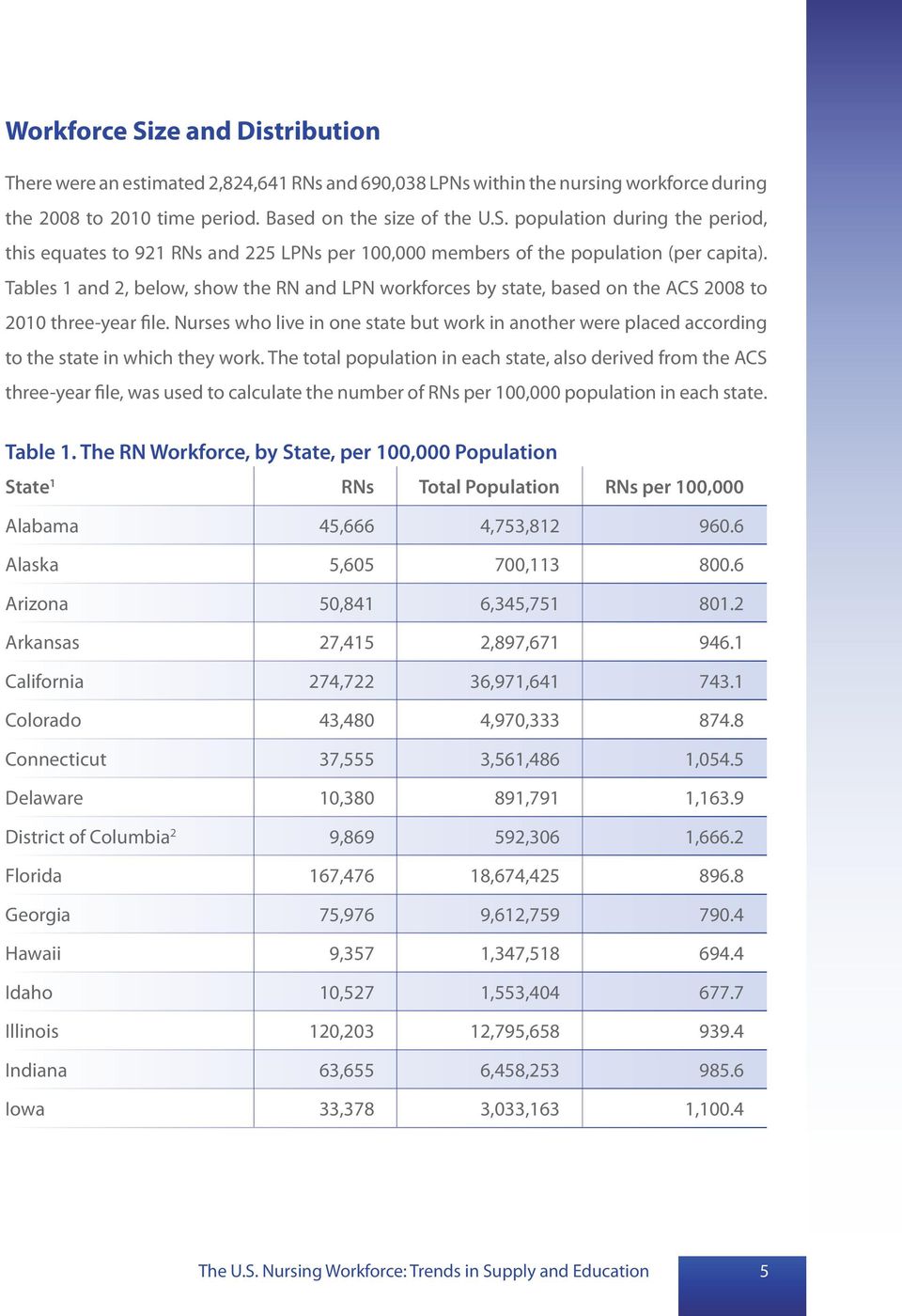
16 Table 1. The RN Workforce, by State, per 100,000 Population (cont d) State 1 RNs Total Population RNs per 100,000 Kansas 28,556 2,833,318 1,007.9 Kentucky 44,755 4,317,738 1,036.5 Louisiana 42,856 4,490, Maine 16,153 1,329,222 1,215.2 Maryland 55,944 5,733, Massachusetts 80,725 6,514,611 1,239.1 Michigan 89,445 9,908, Minnesota 57,639 5,279,601 1,091.7 Mississippi 29,016 2,958, Missouri 63,756 5,960,413 1,069.7 Montana 11, ,763 1,135.6 Nebraska 22,260 1,813,164 1,227.7 Nevada 19,428 2,680, New Hampshire 13,860 1,316,255 1,053.0 New Jersey 75,269 8,756, New Mexico 15,701 2,037, New York 196,189 19,303,930 1,016.3 North Carolina 90,663 9,440, North Dakota 7, ,681 1,157.0 Ohio 126,582 11,526,823 1,098.2 Oklahoma 29,366 3,716, Oregon 32,113 3,805, Pennsylvania 140,077 12,662,926 1,106.2 Rhode Island 12,744 1,053,846 1,209.3 South Carolina 42,254 4,585,
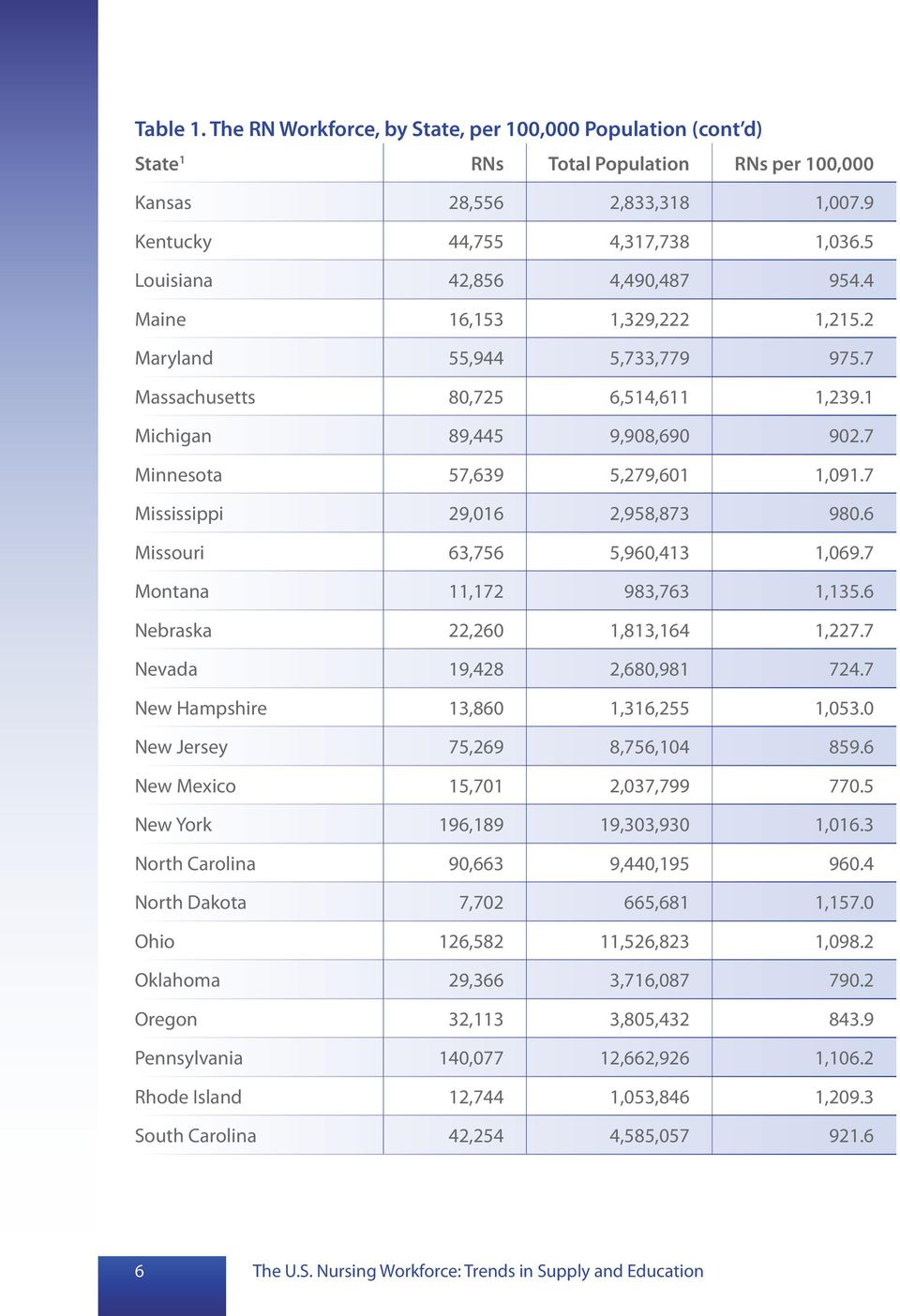
17 Table 1. The RN Workforce, by State, per 100,000 Population (cont d) State 1 RNs Total Population RNs per 100,000 South Dakota 10, ,563 1,247.7 Tennessee 67,159 6,303,437 1,065.4 Texas 186,573 24,789, Utah 18,771 2,720, Vermont 6, ,976 1,044.5 Virginia 64,268 7,928, Washington 56,607 6,658, West Virginia 19,220 1,847,352 1,040.4 Wisconsin 60,813 5,667,100 1,073.1 Wyoming 4, , U.S. Total 2,824, ,738, Data Source: HRSA analysis of the ACS three-year file 1 All state estimates have a relative standard error (RSE) of less than 10%. 2 The nursing workforce is likely denser in the District of Columbia (D.C.) in part because of the presence of several academic medical centers, like most cities, that require a large RN workforce. Many nurses and patients commute into D.C. for work and health services. Since most states include rural and/or suburban areas, it is not instructive to compare D.C. with states in terms of per capita supply. Table 2. The LPN Workforce, by State, per 100,000 Population State LPNs Total Population LPNs per 100,000 Alabama 12,297 4,753, Alaska , Arizona 7,853 6,345, Arkansas 10,734 2,897, California 54,817 36,971, Colorado 5,843 4,970, Connecticut 8,605 3,561, Delaware 2 1, , District of Columbia 1 1, ,
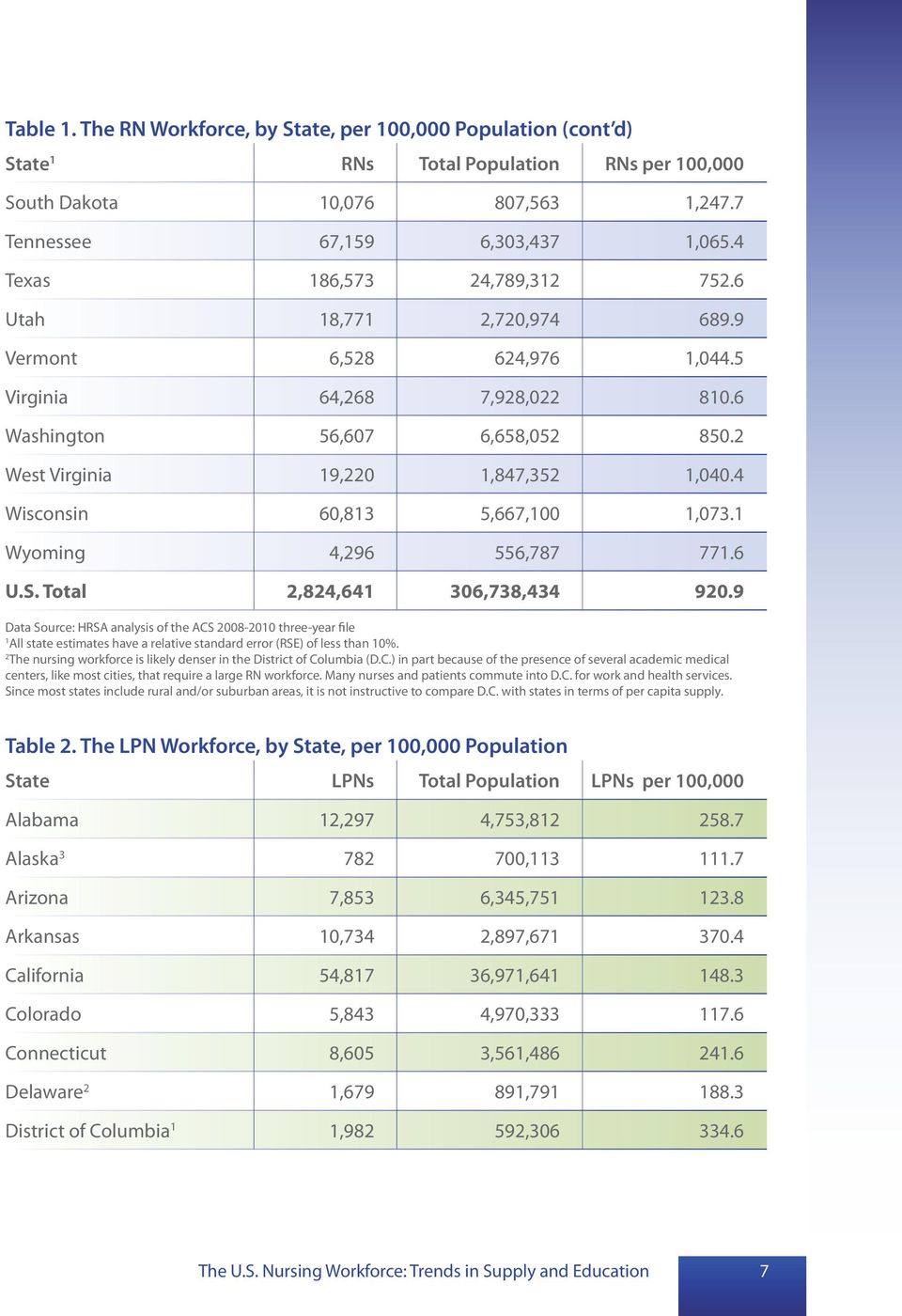
18 Table 2. The LPN Workforce, by State, per 100,000 Population (cont d) State LPNs Total Population LPNs per 100,000 Florida 45,686 18,674, Georgia 22,076 9,612, Hawaii 2 2,107 1,347, Idaho 1 2,880 1,553, Illinois 20,949 12,795, Indiana 17,114 6,458, Iowa 7,397 3,033, Kansas 7,056 2,833, Kentucky 9,857 4,317, Louisiana 17,457 4,490, Maine 1 1,952 1,329, Maryland 11,733 5,733, Massachusetts 14,390 6,514, Michigan 19,196 9,908, Minnesota 15,462 5,279, Mississippi 9,719 2,958, Missouri 18,841 5,960, Montana 2 1, , Nebraska 5,882 1,813, Nevada 3,101 2,680, New Hampshire 1 3,526 1,316, New Jersey 16,584 8,756, New Mexico 1 2,555 2,037,

19 Table 2. The LPN Workforce, by State, per 100,000 Population (cont d) State LPNs Total Population LPNs per 100,000 New York 46,063 19,303, North Carolina 20,535 9,440, North Dakota 2 2, , Ohio 36,934 11,526, Oklahoma 13,335 3,716, Oregon 1 2,998 3,805, Pennsylvania 38,202 12,662, Rhode Island 1 1,735 1,053, South Carolina 10,149 4,585, South Dakota 2 2, , Tennessee 23,373 6,303, Texas 58,189 24,789, Utah 1 2,728 2,720, Vermont 2 1, , Virginia 22,276 7,928, Washington 8,226 6,658, West Virginia 6,346 1,847, Wisconsin 10,279 5,667, Wyoming , U.S. Total 690, ,738, Data Source: HRSA analysis of the ACS three-year file Note: The LPN population in small states is more diffcult to estimate with precision. Higher RSEs in these states mean less precise estimates. 1 State has an RSE between 10% and 14.9%. 2 State has an RSE between 15% and 19.9%. 3 State has an RSE between 20% and 25%. 9
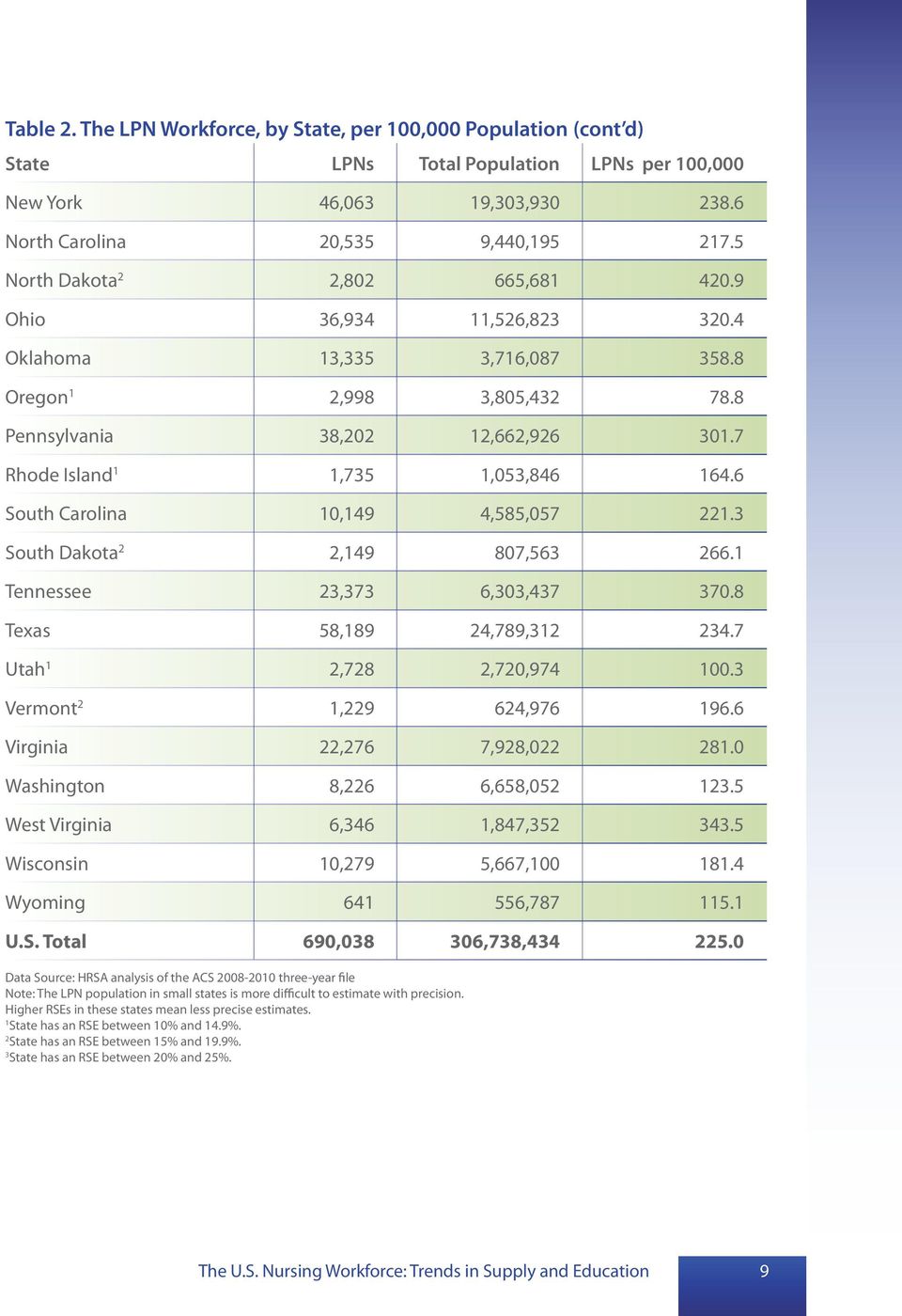
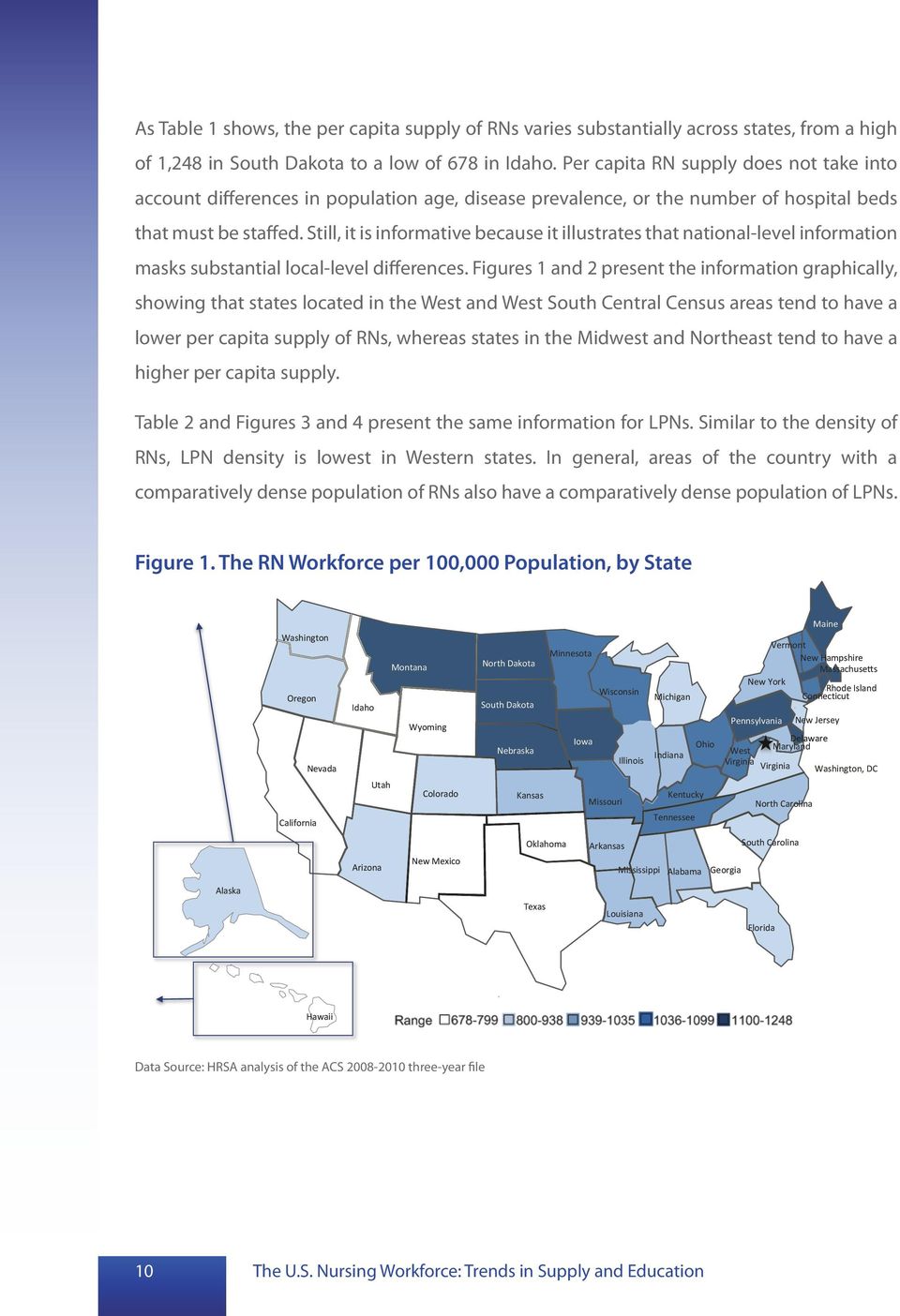
20 As Table 1 shows, the per capita supply of RNs varies substantially across states, from a high of 1,248 in South Dakota to a low of 678 in Idaho. Per capita RN supply does not take into account differences in population age, disease prevalence, or the number of hospital beds that must be staffed. Still, it is informative because it illustrates that national-level information masks substantial local-level differences. Figures 1 and 2 present the information graphically, showing that states located in the West and West South Central Census areas tend to have a lower per capita supply of RNs, whereas states in the Midwest and Northeast tend to have a higher per capita supply. Table 2 and Figures 3 and 4 present the same information for LPNs. Similar to the density of RNs, LPN density is lowest in Western states. In general, areas of the country with a comparatively dense population of RNs also have a comparatively dense population of LPNs. Figure 1. The RN Workforce per 100,000 Population, by State Washington Oregon Nevada Idaho Montana Wyoming North Dakota South Dakota Nebraska Minnesota Iowa Wisconsin Illinois Michigan Indiana Ohio Maine Vermont New Hampshire MassachuseNs New York Rhode Island Connecticut Pennsylvania New Jersey Delaware West Maryland Virginia Virginia Washington, DC California Utah Colorado Kansas Missouri Kentucky Tennessee North Carolina Arizona New Mexico Oklahoma Arkansas Mississippi Alabama Georgia South Carolina Alaska Texas Louisiana Florida Hawaii Data Source: HRSA analysis of the ACS three-year file 10
21 Figure 2. The per Capita RN Workforce, Ranked by State South Dakota Massachusetts Nebraska Maine Rhode Island Delaware North Dakota Montana Pennsylvania Iowa Ohio Minnesota Wisconsin Missouri Tennessee Connecticut New Hampshire Vermont West Virginia Kentucky New York Kansas Indiana Mississippi Maryland Alabama North Carolina Louisiana Arkansas Illinois South Carolina U.S. Average Michigan Florida Colorado New Jersey Washington Oregon Virginia Arizona Alaska Georgia Oklahoma Wyoming New Mexico Texas California Nevada Hawaii Utah Idaho ,000 1,200 1,400 Data Source: HRSA analysis of the ACS three-year file 11
22 Figure 3. The LPN Workforce per 100,000 Population, by State Washington Oregon Nevada Idaho Montana Wyoming North Dakota South Dakota Nebraska Minnesota Wisconsin Iowa Illinois Michigan Ohio Indiana Maine Vermont New Hampshire Massachusetts New York Rhode Island Connecticut Pennsylvania New Jersey Delaware West Maryland Virginia Virginia Washington, DC California Utah Colorado Kansas Missouri Kentucky Tennessee North Carolina Arizona New Mexico Oklahoma Arkansas Mississippi Alabama South Carolina Georgia Alaska Texas Louisiana Florida Hawaii Data Source: HRSA analysis of the ACS three-year file Workforce Distribution Across Rural and Urban Areas A large majority of nurses reside in urban areas, consistent with the distribution of the total population. 4 About 445,000 RNs and 166,000 LPNs reside in rural areas (see Figure 5). Almost one-quarter of LPNs (24 percent) live in rural areas, whereas only 16 percent of RNs do so. For comparison, about 17 percent of the U.S. population, or more than 52 million residents (as estimated in the ACS 2008 to 2010), live in rural areas. Urban areas have a somewhat higher number of RNs per capita than is true for the nation as a whole, while rural areas have a lower per capita supply of RNs (see Figure 6). In contrast, rural areas have a higher number of LPNs per capita, compared with the nation, while urban areas have a lower per capita supply of LPNs. 4 The geographic unit used for this analysis is the Public Use Microdata Area (PUMA). PUMAs, the smallest geographic unit available on the ACS public use files, are areas containing 100,000 people. In this report, an urban PUMA is one in which a majority of residents live in metropolitan areas, as defined by the Offce of Management and Budget (OMB, 2003); rural PUMAs are those with a majority in nonmetro counties. (See The classification of PUMAs as rural or urban employed a coding scheme developed by the U.S. Department of Agriculture and based on the OMB metro/non-metro classification. PUMAs represent the household location of survey respondents. It is not possible to present a rural-urban distribution according to the work location of survey respondents. 12
23 Figure 4. The per Capita LPN Workforce, Ranked by State North Dakota Louisiana Tennessee Arkansas Oklahoma West Virginia Mississippi Nebraska Ohio Missouri Pennsylvania Minnesota Virginia New Hampshire South Dakota Indiana Alabama Kansas Florida Iowa Connecticut New York Texas Georgia Kentucky U.S. Average South Carolina Massachusetts North Carolina Maryland Vermont Michigan New Jersey Delaware Idaho Wisconsin Montana Rhode Island Illinois Hawaii California Maine New Mexico Arizona Washington Colorado Nevada Wyoming Alaska Utah Oregon Data Source: HRSA analysis of the ACS three-year file 13
24 Figure 5. Nursing Workforce Distribution in Rural and Urban Areas 100% 80% 60% Urban 2,379,953 Urban 524,058 Urban 254,590,000 40% 20% 0% Rural 444,688 Rural 165,980 Rural 52,153,208 RNs LPNs U.S. Population Data Source: HRSA analysis of the ACS three-year file Figure 6. Nurses per 100,000 Residents in Rural and Urban Areas 1, RNs LPNs Per Capita Rural Per Capita Urban Per Capita U.S. Data Source: HRSA analysis of the ACS three-year file Tables 3 and 4 present key demographic and employment characteristics for rural, urban, and all areas. In general, RNs in rural areas are more likely to be female and white non-hispanic/ Latino and to hold an associate s degree or less as their highest degree. RNs in rural areas are 14
25 slightly less likely to work in hospitals and more likely to work in nursing care facilities when compared with their urban counterparts. Similar demographic and setting differences were found among LPNs. Each of these characteristics is charted over time for the nation (rural and urban areas combined) in the next section. Table 3. Residential Distribution of the RN Workforce Across Urban and Rural Areas Age 25 or younger Urban Areas (%) 5.3 Rural Areas (%) 4.9 All Areas (%) * * or older Total Average Age Education RN Diploma* Associate s* Bachelor s* Master s and Doctoral* Total Race/Ethnicity White* Black/African American*
26 Table 3. Residential Distribution of the RN Workforce Across Urban and Rural Areas (cont d) Urban Rural All Areas (%) Areas (%) Areas (%) Hispanic/Latino* Asian* American Indian/Alaska Native* Multiple/Other* Total Percent Male* Setting Hospitals* Nursing Care Facilities* Offces of Physicians Home Health Care Services* Outpatient Care Centers* Other Health Care Services* Elementary and Secondary Schools Employment Services Insurance Carriers* Administration of HR Programs 1 * Justice, Public Order, and Safety 2 * Offces of Other Practitioners* Colleges and Universities* Residential Facilities, w/o Nursing All Other Settings 3 * Total Data Source: HRSA analysis of the ACS three-year file Note: Not all totals equal 100 due to rounding. *Rural vs. urban proportions within the category are statistically significantly different at p< Category includes RNs whose jobs focus primarily on administration. 2 Category includes the majority of nurses working in public health settings. 3 For this analysis, all settings holding less than 1% of the RN population have been recoded to Other. 16
27 Table 4. Residential Distribution of the LPN Workforce Across Urban and Rural Areas Urban Rural All Areas (%) Areas (%) Areas (%) Age 25 or younger or older Total Average Age Race/Ethnicity White* Black/African American* Hispanic/Latino* Asian* American Indian/Alaska Native Multiple/Other* Total Percent Male*
28 Table 4. Residential Distribution of the LPN Workforce Across Urban and Rural Areas (cont d) Urban Areas (%) Rural Areas (%) All Areas (%) Setting Hospitals* Nursing Care Facilities Offces of Physicians* Home Health Care Services Outpatient Care Centers* Other Health Care Services Elementary and Secondary Schools* Employment Services Administration of HR Programs Justice, Public Order, and Safety Residential Facilities, w/o Nursing* All Other Settings Total Data Source: HRSA analysis of the ACS three-year file Note: Not all totals equal 100 due to rounding. *Rural vs. urban proportions within the category are statistically significantly different at p< Category includes RNs whose jobs focus primarily on administration. 2 Category includes the majority of nurses working in public health settings. 3 For this analysis, all settings holding less than 1% of the RN population have been recoded to Other. Settings for which estimates had greater than 30% RSE have been recoded to Other, including insurance carriers, colleges/universities, and offces of other health care practitioners. Trends in the Nursing Workforce During the Past Decade A comparison of estimates from the Census 2000 Long Form and the ACS 2008 to 2010 threeyear file shows that the RN workforce grew by nearly one-quarter and the LPN workforce grew by 15.5 percent (see Figure 7). Over a period of approximately nine years, this equates to an annual growth of approximately 61,000 RNs (2.7-percent compound annual growth rate) and 10,300 LPNs (1.8-percent compound annual growth rate). 18
29 Figure 7. Growth in the U.S. Nursing Workforce 3,500,000 3,000, % Growth 2,824,641 2,500,000 2,275,276 Workforce 2,000,000 1,500,000 1,000, , % Growth 597, ,038 0 LPN Census 2000 Long Form RN ACS Three-Year File Data Sources: HRSA analysis of the ACS three-year file and Census 2000 Long Form 5% sample Over the past nine years, growth in the nursing workforce has surpassed that of the population. As Table 5 shows, the per capita supply of both RNs and LPNs has increased over time, with RN growth more than twice that for LPNs. The number of RNs per capita has increased by almost 14 percent, while the number of LPNs per capita has increased about 6 percent. Increasing per capita supply does not necessarily indicate that the nurse supply is more adequate now than it was in The measure does not account for other trends that have increased the demand for nurses, such as an aging population, increasing patient acuity, and hospital staffng and hiring preferences. Table 5. Growth in the per Capita Supply of RNs and LPNs Nurses (Census 2000) Per Capita Supply (2000) Nurses (ACS 08-10) Per Capita Supply (08-10) % Change in per Capita Supply RNs 2,275, ,824, % LPNs 597, , % Data Sources: HRSA analysis of the ACS three-year file and Census 2000 Long Form 5% sample 19
30 RN Workforce Education and Demographics RNs can enter the workforce through education programs at multiple levels: diploma, 5 associate s, bachelor s, and even entry graduate degree programs that produce new nurses with master s degrees (see Figure 8). After entering the RN workforce, many nurses attain additional education to advance in their careers and to prepare them for advanced practice and teaching or research roles. The Institute of Medicine (IOM) nursing report, entitled Future of Nursing: Leading Change, Advancing Health, recommended higher levels of education in the nursing field. This recommendation was made to prepare nurses for the more complex care needed by sicker patients and the sophisticated new technologies available for providing care. 6 It was followed with a specific goal to increase the proportion of nurses with a bachelor s degree to 80 percent by Analysis of Census data shows a small increase in the number of bachelor s and graduate degree holders about 5 percentage points over approximately nine years. Currently, about 55 percent of the RN workforce holds a bachelor s or higher degree. Only 34 percent of RNs in rural areas hold a bachelor s or higher degree (refer to Table 3). Section 2 presents information on both pre- and post-licensure bachelor s graduates. The Age Structure of the RN Workforce Over the past decade, the average age of RNs has increased by nearly two years, from 42.7 years in 2000 to 44.6 years in the ACS 2008 to Figure 9 provides a graphical view of the changing age structure of RNs over time. In 2000, a large proportion of RNs were 41 to 45 years old. In the ACS 2008 to 2010, the age distribution is flatter, and a larger proportion is older than age 50. Similar proportions fall into the younger age categories in both time periods, however. 5 Census data report the level but not the type of degree held by individuals with less than a bachelor s degree. Therefore, RNs who reported a high school diploma or some college, no degree were assumed to hold an RN diploma. 6 See 20
31 Figure 8. Highest Degree Held by RNs, Census 2000 and ACS 2008 to 2010 Associate's, 38.0% Bachelor's, 40.8% Graduate, 8.9% RN Diploma, 12.3% Master's, 8.6% Census 2000 Doctorate, 0.3% Bachelor's, 44.6% Master's, 10.3% Graduate, 10.6% Associate's, 37.9% RN Diploma, 6.9% Doctorate, 0.4% ACS Data Sources: HRSA analysis of the ACS three-year file and Census 2000 Long Form 5% sample 21
32 Figure 9. Age Distribution of RNs, in Five-Year Increments 20% 18% 16% 14% 12% 10% 8% 6% 4% 2% 0% 25 or and younger older Census 2000 ACS Data Sources: HRSA analysis of the ACS three-year file and Census 2000 Long Form 5% sample Another way to view the changing age structure of nurses is through a comparison of absolute numbers in the workforce (see Figure 10). The workforce has grown overall, but this growth is concentrated in the older and younger ends of the age spectrum, and there are actually fewer RNs aged 36 to 45 working today, compared with nine years ago. Although the nursing workforce has aged over the past decade, it is encouraging to see growth in the number aged 35 and younger. This finding suggests that young people continue to see nursing as a viable career and predicts longer-term stability in the age distribution of the nursing workforce. However, the tremendous growth of RN cohorts nearing retirement age is still a cause for concern. Over the next 10 to 15 years, the nearly 1 million RNs older than 50 about onethird of the current workforce will reach retirement age. Retirement of large numbers of RNs over the next two decades means a loss of experiential knowledge and leadership brought to the workforce by seasoned RNs. The retirement decisions of this older cohort, which may be influenced by the pace of economic recovery, will affect the nursing workforce going forward. 22
33 Figure 10. Counts of RNs in the Workforce, by Age, in Five-Year Increments 500, , , , , , , , ,000 50, or and younger older Census 2000 ACS Data Sources: HRSA analysis of the ACS three-year file and Census 2000 Long Form 5% sample At the same time, health care delivery settings will need to accommodate an older nursing workforce over the next decade. As recommended by the Robert Wood Johnson Foundation in its 2006 white paper, Wisdom at Work, 7 employers will need to consider creative options for retaining older nurses. Such options include more flexible scheduling and new roles that take advantage of the older nurse s experience. RN Workforce Diversity Diversity within the nursing workforce in terms of race/ethnicity and sex is desirable because it can improve both access and care quality for minorities and medically underserved populations. 8 Nursing has historically been dominated by white females, and as Figure 11 shows, the nursing workforce is still predominantly white. However, over time, the proportion of racial/ethnic minorities has been increasing. Black/African Americans, Asians, and Hispanics/Latinos 9 make up greater proportions of the RN population, while whites have 7 See 8 See 9 The Census Bureau collects Hispanic/Latino ethnicity in a separate question from race. For this analysis, we have coded all Hispanics as Hispanic/Latino regardless of their selection for race. 23

34 declined in proportion, from more than 80 percent in 2000 to about 75 percent in the ACS 2008 to Figure 11. Race/Ethnicity in the RN Workforce and Total Working-Age Population 100% 90% 80% 70% 60% 50% 40% 30% 20% 10% 0% Census 2000 (RNs) % ACS (RNs) % ACS (Wrk. Age Pop) % Multiple/Other Haw. Nat./Pac. Isl Am Ind/AK Native Asian Hispanic/Latino Black/African American White Mul=ple/Other Haw. Nat./ Pac. Isl. Am Ind/AK Na=ve Asian Hispanic/La=no Black/African American White Data Sources: HRSA analysis of the ACS three-year file and Census 2000 Long Form 5% sample Figure 11 also shows a comparison with the current U.S. working-age population (i.e., the population aged 16 and older) for race/ethnicity. The working-age population has a lower percentage of whites (67 percent vs. 75 percent for RNs). The RN workforce has a smaller percentage of Hispanics/Latinos and Black/African Americans, and a larger percentage of Asians, when compared with the total working-age population. The percentage difference for Hispanics/Latinos is particularly notable: They compose 14 percent of the working-age population but only 5 percent of the RN workforce. Nursing remains a predominantly female profession, but the proportion of RNs who are male has increased over time: from 7.7 percent in Census 2000 to 9.1 percent in the ACS 2008 to
35 LPN Workforce Demographics Many of the demographic trends observed for RNs hold for LPNs as well. As Figure 12 shows, the LPN age distribution has also flattened and shifted toward older ages. Also consistent with the findings for RNs, the proportion of younger nurses appears to be holding reasonably steady. During the time period covered by this analysis, the average age of LPNs increased by about 1.75 years, from 41.9 in 2000 to 43.6 in the ACS 2008 to Figure 12. Age Distribution of LPNs, in Five-Year Increments 18% 16% 14% 12% 10% 8% 6% 4% 2% 0% 25 or and younger older Census 2000 ACS Data Sources: HRSA analysis of the ACS three-year file and Census 2000 Long Form 5% sample Similar to RNs, the absolute number of LPNs has grown overall, but this growth has occurred only among those younger than 30 and older than 50 (see Figure 13). The number of LPNs aged 31 to 50 has actually decreased over the past 10 years. More than one-third of the LPN workforce is older than age
36 Figure 13. Counts of LPNs in the Workforce, by Age, in Five-Year Increments 120, ,000 80,000 60,000 40,000 20, or and younger older Census 2000 ACS Data Sources: HRSA analysis of the ACS three-year file and Census 2000 Long Form 5% sample The proportion of LPNs from minority racial/ethnic groups has increased over time (from about 32 percent to 37 percent). LPNs are more likely to identify as racial/ethnic minorities when compared with RNs. In particular, the proportion of Black/African Americans is higher among LPNs (23.6 percent in the ACS 2008 to 2010 vs. 9.9 percent for RNs). As Figure 14 shows, the LPN workforce has a substantially higher percentage of African Americans than does the total working-age population. However, as was true for RNs, Hispanics/Latinos are underrepresented in the LPN workforce. Employment Characteristics of RNs and LPNs The settings 10 in which nurses are employed are shown in Table 6. The majority of RNs (63.2 percent) continue to work in hospitals, and that proportion has not changed significantly during the past decade. Over time, the proportion working in nursing care facilities, physician offices, and home health has declined slightly, while the proportion working in outpatient care centers and other health care services has increased slightly. Note that these increases 10 The Census Bureau uses the North American Industry Classification System (NAICS) codes for recording employment setting, and though they are limited in the level of detail available, the data sources used here offer some insights into changes in the distribution of nurses across settings. 26

37 and decreases are quite small and that the majority of RNs are still providing inpatient and outpatient care in hospitals. Figure 14. Race/Ethnicity in the LPN Workforce and Total Working-Age Population 100% 90% 80% 70% 60% 50% 40% 30% 20% 10% 0% Census 2000 (LPNs) % ACS (LPNs) % ACS (Working Age Population) % Multiple/Other Hawaiian Nat./ Pac. Isl Am Ind/AK Native Asian Hispanic/Latino Black/African American White Multiple/Other Hawaiian Nat./ Pac. Isl. Am Ind/AK Native Asian Hispanic/Latino Black/African American White Data Sources: HRSA analysis of the ACS three-year file and Census 2000 Long Form 5% sample In sharp contrast, less than one-third of LPNs (29.3 percent) work in hospitals. That proportion has declined slightly (from 34.9 percent) during the past decade. Care provided by LPNs has shifted away from hospitals and physician offces and toward home health, outpatient care centers, and other health care services. About one-third of LPNs work in nursing care facilities, and that proportion has held steady over time. LPNs compose the predominant licensed workforce within residential long-term care facilities. 27
38 Table 6. Setting of Employment for Nurses, Census 2000 and ACS 2008 to 2010 RNs LPNs Census 2000 % ACS % Census 2000 % ACS % Hospitals Nursing Care Facilities Offces of Physicians Home Health Care Services Outpatient Care Centers Other Health Care Services Elementary and Secondary Schools Employment Services Insurance Carriers and Related Activities Administration of Human Resource Programs Justice, Public Order, and Safety Activities Offces of Other Health Practitioners Colleges and Universities, Including Junior Colleges Residential Care Facilities, Without Nursing All Other Settings Data Sources: HRSA analysis of the ACS three-year file and Census 2000 Long Form 5% sample 1 Category includes skilled nursing facilities, also called nursing homes. 2 Category includes RNs whose jobs focus primarily on administration. 3 Category includes the majority of nurses working in public health settings. 4 For this analysis, all settings holding less than 1% of the RN population have been recoded to Other. 28
39 Another assessment is the growth or decline in the estimated number of workers, by setting, as shown for RNs in Table 7. The RN workforce grew by 24 percent during the decade, and most settings experienced increases in their RN workforces. Even though the percentage of RNs working in hospitals did not increase significantly, the absolute number of RNs working in hospitals increased by more than 350,000 about 25 percent. Despite the growth in the RN workforce overall, three settings experienced absolute losses in RN employees: offces of physicians, offces of other health practitioners, and residential care facilities. 11 The largest gains, as a percentage of growth in absolute numbers, occurred for outpatient care centers, administration positions, and other healthcare services. The LPN workforce grew by 15.5 percent over the past decade, but the growth was very uneven across settings (see Table 8). The number of LPNs in hospitals actually decreased by about 6,500, and the LPN workforce in the offces of physicians and other providers decreased by 12,000 during the past decade. Large gains in absolute numbers occurred for nursing care facilities (31,366), outpatient care centers (17,921), home health (10,374), and other health care services (34,918). The average number of hours worked by RNs held remarkably steady over the time period covered by this analysis, hovering at about 37 hours per week. When examined by age (see Figure 15), it is clear that older nurses are, as expected, working fewer hours than younger nurses. Interestingly, nurses aged 60 and older are working more hours in the ACS 2008 to 2010 when compared with Census This finding may be due to the recession, which anecdotal reports suggest has increased the amount of time nurses work. It is unclear why the differences are found primarily among those older than 60, although the impact of the recession on retirement savings differentially impacts those who are closer to retirement. 11 Employment distribution across settings over time was also assessed using data from the Bureau of Labor Statistics (BLS s) Occupational Employment Statistics program. The results were generally similar, although the percentage decrease of RNs and LPNs in physicians offces was much smaller. As a result, the BLS employment estimates do not show absolute declines in the number of RNs and LPNs in physicians offces. 29
40 Table 7. Estimated Number of RNs, by Setting of Employment Census 2000 Estimate ACS Estimate Estimated Growth/ Decline % Change in Growth Hospitals 1,427,497 1,785, , % Nursing Care Facilities 189, ,051 18, % Offces of Physicians 156, ,231-22, % Home Health Care Services 101, ,922 4, % Outpatient Care Centers 70, ,022 60, % Other Health Care Services 66, ,449 86, % Elementary and Secondary Schools 51,495 61,323 9, % Employment Services 45,835 58,362 12, % Insurance Carriers and Related Activities 22,919 25,155 2, % Administration of Human Resource Programs 1 20,509 38,136 17, % Justice, Public Order, and Safety Activities 2 14,793 18,137 3, % Offces of Other Health Practitioners Colleges and Universities, Including Junior Colleges Residential Care Facilities, Without Nursing 13,346 7,596-5, % 12,637 16,320 3, % 10,853 9, % All Other Settings 3 70,397 71,705 1, % Totals 2,275,276 2,824, , % Data Sources: HRSA analysis of the ACS three-year file and Census 2000 Long Form 5% sample 1 Category includes RNs whose jobs focus primarily on administration. 2 Category includes the majority of nurses working in public health settings. 3 For this analysis, all settings holding less than 1% of the RN population have been recoded to Other. 30
41 Table 8. Estimated Number of LPNs, by Setting of Employment Census 2000 Estimate ACS Estimate Change Over Time % Change in Estimates Hospitals 208, ,247-6, % Nursing Care Facilities 180, ,594 31, % Offces of Physicians 66,915 56,874-10, % Home Health Care Services 33,225 43,599 10, % Outpatient Care Centers 21,613 39,534 17, % Other Health Care Services 13,612 48,530 34, % Elementary and Secondary Schools 4,907 7,312 2, % Employment Services 20,226 26,530 6, % Insurance Carriers and Related Activities 1,467 1, % Administration of Human Resource Programs 1 2,039 6,426 4, % Justice, Public Order, and Safety Activities 2 6,113 8,956 2, % Offces of Other Health Practitioners Colleges and Universities, Including Junior Colleges Residential Care Facilities, Without Nursing 5,084 2,565-2, % 1,255 2,291 1, % 10,715 8,721-1, % All Other Settings 3 21,367 23,213 1, % Totals 597, ,038 92, % Data Sources: HRSA analysis of the ACS three-year file and Census 2000 Long Form 5% sample 1 Category includes RNs whose jobs focus primarily on administration. 2 Category includes the majority of nurses working in public health settings. 3 For this analysis, all settings holding less than 1% of the LPN population have been recoded to Other. 31
42 Figure 15. Average Hours Worked by RNs, by Age or and older younger Census 2000 ACS Data Sources: HRSA analysis of the ACS three-year file and Census 2000 Long Form 5% sample Figure 16. Average Hours Worked by LPNs, by Age or and older younger Census 2000 ACS Data Sources: HRSA analysis of the ACS three-year file and Census 2000 Long Form 5% sample 32
43 The average hours worked by LPNs also held quite steady over time, hovering around 37 hours per week across all ages. Similar to RNs, the ACS 2008 to 2010 data suggest that LPNs are working more hours than in 2000 within older age categories (refer to Figure 16). The difference is particularly noticeable in the 61 to 70 age category. Figure 17 shows the average salary of a full-time nurse (36 or more hours per week). Full-time salary has increased by about $20,000 for RNs and about $11,500 for LPNs over the past decade. An increasing average salary can reflect the influence of many factors, including inflation, an older (and more experienced) workforce, and wage hikes to stimulate employment interest in areas facing a nursing shortage. Figure 17 presents the average salary within the ACS 2008 to 2010 adjusted to 2000 constant dollars to remove the impact of inflation (darker part of the bar). As the figure also shows, once inflation has been accounted for, the salary increase remains notable at nearly 15 percent ($6,600) over 10 years. Figure 17. Growth in Full-Time Nurse Salaries $70, $60, $63, ** $50, $40, $39, ** $30, $20, $10, $43, $50, * $27, $31, * $0.00 RNs 2000 RNs LPNs 2000 LPNs Data Sources: HRSA analysis of the ACS three-year file and Census 2000 Long Form 5% sample *Inflation adjusted to 2000 constant dollars. **Actual salary in the ACS , adjusted to 2010 dollars. 33
44
45 Section 2 Nursing Pipeline and Nursing Education Capacity A key driver of the nurse supply in the future is the nation s capacity to produce new nurses through our education system the workforce pipeline. In general, the pipeline can be viewed through a number of metrics, including the number of future students, current students, new graduates, or new licensees. However, measuring the nursing pipeline presents a particular analytic challenge for two reasons. First, new RNs enter the field from a variety of educational levels, including diploma, associate s, bachelor s, and master s degree programs. Second, many graduates of diploma and associate s degree programs return to school to earn higher degrees; thus, reports of bachelor s degree graduates often include both those entering nursing for the first time as well as RNs seeking the additional degree qualification. Similarly, while the vast majority of new master s degrees represent continuing education for existing nurses, some earning master s degrees are new nurses. As a result, it can be diffcult to separate new nurses from existing nurses in data reported on the pool of nursing graduates. Though there are different types of degrees awarded to those entering nursing, every individual who wishes to practice as a nurse in the United States must pass a licensure examination: the National Council Licensure Examination for Registered Nurses (NCLEX-RN ) or the National Council Licensure Examination for Practical Nurses (NCLEX-PN ). This section of the report presents data on the two major components of the nursing workforce pipeline: new entrants to the profession and post-licensure education. New Entrants to the Nursing Profession Trends in U.S.-educated candidates both sitting for and passing the licensure exams are presented in Figures 18 through
46 About the Data Data for NCLEX exams are published annually to provide descriptive information, including pass rates by quarter, for licensure candidates by country of education (U.S. or international). Summary charts and tables in this section focus on U.S.-educated NCLEX exam passers. Additional data, including the jurisdiction of the test taker and educational attainment of NCLEX-RN candidates, are available only for first-time, U.S.-educated test takers. Therefore, this section also includes tables and figures that incorporate first-time test taker data where appropriate. First-time and repeat U.S.-educated candidates for the NCLEX-RN have pass rates of 87.4 percent and 54.9 percent, respectively. Firsttime and repeat U.S.-educated candidates for the NCLEX-PN have pass rates of 87.1 percent and 40.6 percent, respectively. Source: The National Council of State Boards of Nursing, Nurse Licensure and NCLEX Examination Statistics Publications, , Volumes 4, 13, 19, 20, 25, 31, 35, 42, 50, and 52, available at 36
47 Registered Nurses The number of individuals pursuing nursing education has increased in recent years. Consequently, the number of nurses passing the exam required to become licensed as a nurse more than doubled between 2001 and As Figure 18 shows, the number of individuals passing the NCLEX-RN increased steadily over the course of the past 10 years, with particularly large increases in the middle of the decade. Though growth slowed somewhat from 2008 on, NCLEX volumes showed year-on-year increases even throughout the recent economic downturn. Figure 18. NCLEX-RN Passers, 2001 to 2011 Passers 150, , , , , ,000 90, % Growth, , ,726 98, , , , , ,390 80,000 70,000 60,000 70,474 68,561 75,821 50, Year Data Source: HRSA compilation of data from the National Council of State Boards of Nursing, Nurse Licensure and NCLEX Examination Statistics Publications, , and from the National Council of State Boards of Nursing, Number of Candidates Taking the NCLEX Examination and Percent Passing, by Type of Candidate, While data on overall growth in the nursing pipeline are critical to help inform projections of the size of the future workforce, NCLEX data can also provide more detailed information about licensure candidates to shed light on other key issues. A particular focus in the United States in recent years has been on the educational attainment of new nurses. Figure 19 depicts the growth in first-time, U.S.-educated exam candidates by bachelor s and non-bachelor s degree status from 2001 to Bachelor s prepared candidates more than doubled, increasing by nearly 135 percent. Of the 75,824 additional individuals who sat 37
48 for the NCLEX-RN in 2011, compared with 2001, 33,414 had obtained a bachelor s degree in nursing (BSN). Thus, bachelor s prepared candidates represented about 44 percent of the overall growth exhibited from 2001 to Figure 19. Growth in NCLEX-RN First-Time Test Takers, by Bachelor s and Non-Bachelor s Degree Status, 2001 to 2011 Candidates 100,000 90,000 80,000 70,000 60,000 50,000 40,000 30,000 20,000 10,000 0 Non-Bachelor's Candidates: 85, % Growth, ,793 79,375 82,467 63,690 69,357 56,543 49,736 52,260 55,407 44,871 50,056 45,772 41,346 35,496 43,927 30,628 25,821 26,632 BSN Candidates: 24, % Growth, Year 86,337 58,246 Bachelor s Prepared Non- Bachelor s Prepared Data Source: HRSA compilation of data from the National Council of State Boards of Nursing, Nurse Licensure and NCLEX Examination Statistics Publications, , and from the National Council of State Boards of Nursing, Number of Candidates Taking the NCLEX Examination and Percent Passing, by Type of Candidate, Non-bachelor s test takers, a group consisting of diploma, associate s degree, and special program code NCLEX-RN candidates, grew by over 96 percent, from 43,927 in 2001 to 86,337 in The faster growth of bachelor s prepared candidates over the course of the past decade caused the overall distribution of RN licensure test takers to shift slightly toward bachelor s prepared candidates. These candidates increased from 36.1 percent of the licensure pipeline in 2001 to just over 40 percent in 2011 (see Figure 20). Despite this shift, the majority of firsttime candidates for RN licenses have not obtained a bachelor s degree. Of NCLEX-RN testers, 59.7 percent are not bachelor s prepared, and the vast majority of these individuals (95.8 percent) are educated at the associate s degree level. 38
49 Figure 20. Total Number and Percentage of NCLEX-RN First-Time Test Takers, by Bachelor s and Non-Bachelor s Degree Status, 2001 vs ,000 Non-Bachelor's Bachelor's Total Candidates: 144, , ,000 Total Candidates: 100,000 68,759 58, % 80,000 60,000 40,000 20,000 24, % 43, % 86, % Data Source: HRSA compilation of data from the National Council of State Boards of Nursing, Nurse Licensure and NCLEX Examination Statistics Publications, Although the majority of examinees in 2011 continued to be educated at the associate s degree level, trends in NCLEX-RN first-time test takers across the period studied suggest that bachelor s prepared candidates will slowly grow to represent an increasing proportion of test takers over time. According to the American Community Survey (ACS), approximately 44.6 percent of the nursing workforce from 2008 to 2010 held a bachelor s degree as their highest degree. In combination with the data above, this finding suggests that many nurses go on to earn additional educational degrees after beginning practice. Table 9 provides first-time NCLEX candidate data, by jurisdiction of educational institution and degree attainment in 2010, the most recent year for which state-level data are available. Although candidates in a state are not necessarily converted to workers in that state, recent evidence suggests that geographic mobility among newly licensed nurses is extremely limited. 12 Therefore, it is reasonable to assume that the majority of NCLEX candidates associated with a state will in fact join that state s nursing workforce after the examination. 12 Kovner, C., Corcoran, S., & C. Brewer. (2011). The Relative Geographic Immobility Of New Registered Nurses Calls For New Strategies To Augment That Workforce. Health Affairs, 30(12):
50 Table 9. NCLEX-RN First-Time Test Takers, by State and Degree Type, 2010 Jurisdiction Diploma Associate Degree Baccalaureate Total Per Capita Alabama 0 2,067 1,328 3, Alaska Arizona 0 2, , Arkansas , California 0 7,515 3,828 11, Colorado , Connecticut , Delaware District of Columbia Florida 0 5,350 2,211 7, Georgia 0 1,476 1,489 2, Hawaii Idaho Illinois 19 3,015 2,410 5, Indiana 44 2,328 1,709 4, Iowa 0 1, , Kansas 0 1, , Kentucky 0 1, , Louisiana ,317 2, Maine Maryland 0 1, , Massachusetts 66 1,486 1,779 3, Michigan 0 2,882 2,031 4, Minnesota 0 1,898 1,030 2, Mississippi 0 1, , Missouri 63 1,517 1,831 3, Montana
51 Table 9. NCLEX-RN First-Time Test Takers, by State and Degree Type, 2010 (cont d) Jurisdiction Diploma Associate Degree Baccalaureate Total Per Capita Nebraska , Nevada New Hampshire New Jersey 701 1, , New Mexico , New York 14 6,696 2,975 9, North Carolina 148 2,496 1,308 3, North Dakota Ohio 319 4,719 2,868 7, Oklahoma 0 1, , Oregon , Pennsylvania 1,288 2,891 2,965 7, Rhode Island South Carolina 0 1, , South Dakota Tennessee 0 1,399 1,660 3, Texas 144 5,392 3,547 9, Utah 0 1, , Vermont Virginia 428 1,874 1,243 3, Washington 0 1, , West Virginia , Wisconsin 0 1,679 1,455 3, Wyoming Total 3,768 81,555 55, , Data Source: HRSA compilation of data from the National Council of State Boards of Nursing, Nurse Licensure and NCLEX Examination Statistics Publications, 2012 Note: Total excludes NCLEX-RN candidates from the American Samoa, Guam, Northern Mariana Islands, and the Virgin Islands, which accounted for 64 first-time test takers in Total also excludes 105 Special Program Code candidates. Per capita figures for the country are based on the sum of the total graduates and the sum of the individual state populations. 41

52 Seventeen states had more bachelor s degree candidates than associate s degree candidates taking the NCLEX exam for the first time, with North Dakota leading the list with 81.2 percent BSN-educated candidates. Although the proportion of diploma-educated candidates in the national NCLEX-RN pool was small, these numbers masked a large degree of variability across the 50 U.S. states: Thirty-five states had no diploma graduate NCLEX-RN candidates, while 92 percent of the diploma graduate NCLEX-RN candidates were concentrated in eight states. Figure 21 shows a shaded map of NCLEX-RN first-time candidates per capita. The data identify states producing more or fewer new RNs relative to their state population. Unlike the absolute pipeline figures, per capita data reveal regional variation more clearly, with all but three of the top 10 states in the Midwest region of the United States and the remainder in the South. While per capita data suggest areas where production is higher or lower than the national average, these data do not reflect state-level differences in population characteristics, disease prevalence, or current adequacy of the nurse supply. Figure 21. NCLEX-RN First-Time Test Takers per Capita, 2010 Washington Oregon Nevada Idaho Montana Wyoming North Dakota South Dakota Nebraska Minnesota Iowa Wisconsin Illinois Michigan Indiana Ohio Maine Vermont New Hampshire Massachusetts New York Rhode Island Connecticut Pennsylvania New Jersey Delaware West Maryland Virginia Virginia Washington, DC California Utah Colorado Kansas Missouri Kentucky Tennessee North Carolina Arizona New Mexico Oklahoma Arkansas Mississippi Alabama Georgia South Carolina Alaska Texas Louisiana Florida Hawaii Data Source: HRSA compilation of data from the National Council of State Boards of Nursing, Nurse Licensure and NCLEX Examination Statistics Publications,
53 Licensed Practical Nurses As shown in Figure 22, the LPN pipeline, defined here as the number of individuals passing the NCLEX-PN, has grown substantially across the past decade. From 2001 to 2011, the pipeline grew from 33,448 to 60,302, an 80-percent increase. Although growth was generally consistent across the period studied, the growth rate declined slightly from 2007 to In addition, there was a surprising decrease in the number of individuals passing the NCLEX from 2010 to This finding is at least partly attributable to lower pass rates across NCLEX candidates, as well as to a decrease in the number of first-time exam takers. Figure 22. NCLEX-PN Passers, 2001 to ,000 Year 65,000 60,000 55,000 50,000 45, % Growth 42,723 51,136 48,155 54,464 58,209 57,450 60,548 63,777 60,302 40,000 35,000 36,662 30,000 25,000 33, Passers Data Source: HRSA compilation of data from the National Council of State Boards of Nursing, Nurse Licensure and NCLEX Examination Statistics Publications, Table 10 displays NCLEX-PN first-time candidates, by state, for 2010, as well as the number of candidates per capita, while Figure 23 examines the link between state population and per capita LPN candidates graphically to highlight regional trends. With the single exception of New Jersey, the top 10 states for the per capita LPN pipeline, which include Ohio, Iowa, Delaware, Arkansas, Kansas, Oklahoma, New Jersey, Minnesota, Virginia, and Louisiana, are all found in the Midwest and the South. Coastal states, including those in the Northeast and the Pacific, are generally evenly distributed across the per capita rank list. 43
54 Table 10. NCLEX-PN First-Time Test Takers, by State, 2010 State Candidates Candidates per Capita Alabama Alaska Arizona Arkansas 1, California 8, Colorado Connecticut Delaware District of Columbia Florida 4, Georgia 1, Hawaii Idaho Illinois 1, Indiana 1, Iowa 1, Kansas Kentucky 1, Louisiana 1, Maine Maryland Massachusetts Michigan 1, Minnesota 1, Mississippi Missouri 1, Montana Nebraska
55 Table 10. NCLEX-PN First-Time Test Takers, by State, 2010 (cont d) State Candidates Candidates per Capita Nevada New Hampshire New Jersey 2, New Mexico New York 3, North Carolina 1, North Dakota Ohio 5, Oklahoma 1, Oregon Pennsylvania 2, Rhode Island South Carolina South Dakota Tennessee 1, Texas 5, Utah Vermont Virginia 2, Washington 1, West Virginia Wisconsin 1, Wyoming Total 66, Data Source: HRSA compilation of data from the National Council of State Boards of Nursing, Nurse Licensure and NCLEX Examination Statistics Publications, 2012 Note: Total excludes NCLEX-PN candidates from the American Samoa, Guam, Northern Mariana Islands, and the Virgin Islands, which accounted for 76 first-time test takers in
56 Figure 23. NCLEX-PN First-Time Test Takers per Capita, 2010 Washington Oregon Nevada Idaho Montana Wyoming North Dakota South Dakota Nebraska Minnesota Wisconsin Iowa Illinois Michigan Ohio Indiana Maine Vermont New Hampshire Massachusetts New York Rhode Island Connecticut Pennsylvania New Jersey Delaware West Maryland Virginia Virginia Washington, DC California Utah Colorado Kansas Missouri Kentucky Tennessee North Carolina Arizona New Mexico Oklahoma Arkansas Mississippi Alabama South Carolina Georgia Alaska Texas Louisiana Florida Hawaii Data Source: HRSA compilation of data from the National Council of State Boards of Nursing, Nurse Licensure and NCLEX Examination Statistics Publications, 2012 Post-Licensure Nurse Education While the education of a given health profession is important to the health workforce planning community, the educational progression of nurses is of particular interest given the recent recommendations for increasing the educational attainment of RNs. As noted in Section 1 of this report, the Institute of Medicine (IOM) recommended a large increase in the proportion of RNs holding a bachelor s degree. Analysis of Census Bureau data revealed that the proportion of RNs with a bachelor s or graduate degree increased from 50 to 55 percent during the 2000s. The IOM recommended that 80 percent be bachelor's prepared by the year Data on NCLEX examinations showed that the proportion of candidates prepared with a BSN has increased from 36 to 40 in the past decade. Although only 39 percent of pre-licensure RNs have obtained a bachelor s degree, bachelor s prepared RNs represent 44.6 percent of the RN workforce, according to the ACS data presented in Section 1. This finding suggests that an important minority of bachelor s prepared RNs received their bachelor's degree after initial licensure. Educational data tracking the annual number of post-licensure 46
57 graduates can help inform projections of the future composition of the RN workforce. Several nursing organizations collect data on nursing program enrollments and graduations. The American Association of Colleges of Nursing (AACN) is a national association representing bachelor s and graduate nursing education at over 600 public and private universities and colleges. AACN conducts an annual survey of member and non-member universities and publishes the most current statistics available on student enrollment and graduations. Subsequent figures in this section explore data on post-licensure BSN, master s, and doctoral graduates. About the Data AACN annually distributes surveys requesting graduation numbers from bachelor s and higher-degree nursing education programs. This section explores results from the 2007 to 2011 surveys, which produced data for the scholastic years 2006 to 2007 through 2010 to The 2011 to 2012 survey, which captured graduation data for the 2010 to 2011 scholastic year, was distributed to 838 institutions in September 2011 and achieved a response rate of 87.5 percent. The number of surveys distributed by AACN and the response rate achieved on these surveys vary annually. Source: Fang, D., Li, Y., & Bednash, G. D. (2012) Enrollment and Graduations in Baccalaureate and Graduate Programs in Nursing. Washington, DC: American Association of Colleges of Nursing; additional data provided upon request from AACN 47
58 The number of RNs who graduated from post-licensure bachelor s degree programs grew from 14,946 to 27,845 from 2007 to 2011, an increase of approximately 86 percent (see Figure 24) in just four years. These RN to BSN graduate data indicate that RNs are increasingly advancing their education. If this growth continues, progress toward the IOM goal of increasing nurse education levels is more likely than the supply trends over the past decade (presented in Section 1) suggest is likely. Figure 24. Licensed RNs Graduating With BSN Qualification, 2007 to ,000 28,000 26, % Growth, ,845 RN-BSN Graduates 24,000 22,000 20,000 18,000 16,000 16,802 19,606 22,531 14,000 14,946 12, Year Data Source: HRSA compilation of data from the AACN Research and Data Center, 2012 More caution is warranted when evaluating state-level post-licensure data. Many RN to BSN students are enrolled in online degree programs and therefore may live in a state other than the state where the academic program is physically located. Post-licensure graduations can be recorded by the state where the physical institution is housed, but the graduates themselves could live and work anywhere in the country. Rather than identifying states that may be underproducing, state per capita data on post-licensure graduates may more likely identify states that export graduates through online education. For this reason, state-level post-licensure data are not presented. Figure 25 displays the number of master s and doctoral-prepared nurse graduates nationally from 2007 to These nurses, in addition to potentially fulfilling team leadership roles at clinical sites, serve another critical function: educating the future nursing workforce. 48
59 The annual output of master s graduates has increased by about 60 percent, while the production of doctoral graduates has more than tripled, over the past four years. In total, the annual number of nursing graduate degrees awarded has grown 67.4 percent. Figure 25. Master s and Doctoral Graduates, 2007 to ,000 5,000 Master's Graduates 25,000 20,000 15,000 10,000 15,182 17,247 1,227 19,063 1,815 21,730 24,311 2,196 4,000 3,000 2,000 Doctoral Graduates 5, , Master's Graduates Data Source: HRSA compilation of data from the AACN Research and Data Center, 2012 Doctoral Graduates While there is considerable growth over the course of the past four years, anecdotal and survey evidence indicates that nurse faculty shortages are a longstanding concern. 13 In AACN s most recent survey, the national faculty vacancy rate was estimated at 7.6 percent. Therefore, almost two-thirds of the nursing schools reported faculty vacancies as a reason for not accepting all qualified applicants into the entry-level bachelor s programs. Advanced Clinical Roles of Special Interest Advanced Practice Registered Nurses (APRNs), nurses who are educated at the master s or doctoral level, are of particular interest to the workforce planning community in the United States. APRNs are important providers of health care. Nurse Practitioners (NPs) practice in primary care and acute care settings. NPs provide initial, ongoing, and comprehensive care for patients, including assessment, diagnosis, 13 See 49
60 treatment, and management of patients with acute and chronic illnesses. While the degree of independence or supervision required by a licensed (physician) provider for the NP to practice varies with state law, NPs are widely considered a critical component of the patient care workforce. Figure 26 shows substantial growth in the production of NPs from 2001 to In 11 years, the number of NP graduates grew from 7,261 to 12,273, a growth of approximately 69 percent. Figure 26. Nurse Practitioner Graduates, 2001 to 2011 NP Graduates 13,500 12,500 11,500 10,500 9,500 8,500 7,500 6,500 5,500 7, % Growth, ,979 6,611 6,526 7,583 6,900 8,865 8,014 9,698 11,135 12, Year Data Source: HRSA compilation of data from the AACN Annual Survey (in collaboration with the National Organization of Nurse Practitioner Faculties for collection of nurse practitioner data) Note: Counts include master s and post-master s degree NP and NP/Clinical Nurse Specialist graduates as well as Bachelor s-to-doctorate of Nursing Practice graduates. Certified registered nurse anesthetists practice in many settings, including academic medical centers, community hospitals, outpatient surgery centers, pain clinics, or physician offces. Similar to the NP, the degree of independence or supervision needed by a licensed provider (physician, dentist, or podiatrist) for the nurse anesthetist to practice varies with state law. Over the past 10 years, the number of nurse anesthetist graduates has increased substantially, rising from 1,159 graduates in 2001 to 2,447 graduates in 2011 (see Figure 27). 50
61 Figure 27. Nurse Anesthetist Graduates, 2001 to ,000 Nurse Anesthetist Graduates 2,500 2,000 1,500 1,000 1, % Growth, ,474 1,333 1,709 1,628 1,900 1,995 2,158 2,231 2,375 2, Year Data Source: National Board of Certification and Recertification for Nurse Anesthetists About the Data Data on new-entrant certified registered nurse anesthetists and certified nurse midwives were obtained from the American Association of Nurse Anesthetists (AANA) and the American Midwifery Certification Board (AMCB), respectively. Some certified registered nurse anesthetists and certified nurse midwives are educated outside of schools of nursing and are not captured in the AACN annual survey. As a result, AACN data may underestimate the total number of new-entrant certified registered nurse anesthetists and certified nurse midwives. The AANA provided data on certified registered nurse anesthetist graduates on request. Information on the number of newly certified nurse midwives was obtained from AMCB annual reports, available at: 51
62 Certified nurse midwives play an important role in women s health care throughout the lifespan, providing gynecologic and perinatal care as well as other primary care services. Nurse midwives work in a variety of settings, including private offices, the offices of other health care practitioners, birth centers, hospitals, and public health. Over the past 10 years, the number of newly certified nurse midwives has fluctuated. It declined through the early 2000s, but has rebounded in the last four years. Their number has grown from 285 newly certified nurse midwives in 2007 to nearly 400 in 2011 (see Figure 28). Figure 28. Newly Certified Nurse Midwives, 2001 to Newly Certified Nurse Midwives Data Source: HRSA compilation of data from the AMCB, 2010 and 2011 Annual Reports The U.S. Nursing Pipeline and Internationally Educated Nurses Internationally educated nurses are another source of pipeline for the U.S. nursing workforce, especially in times of shortage in domestic supply. Health workforce migration, a critical issue for many years, has received increased attention recently as a result of the 2010 World Health Organization Global Code of Practice on the International Recruitment of Health Personnel ( Global Code ). The Global Code represents an effort to promote ethical principles in the recruitment of international health personnel, with a particular focus on minimizing 52
63 recruitment from countries experiencing critical shortages. Because nurse migration is a topic of interest to nursing workforce stakeholders in the United States, this section explores recent trends in internationally educated RN and LPN licensure candidates. Identifying data sources to track the migration of internationally educated nurses into the United States is a challenge. Although some nurses may apply for visas based on their professional status as health care workers, others may enter on a spousal visa or other dependent visa, making professional visa data incomplete. Regardless of how a nurse enters the United States, however, (s)he must pass the appropriate NCLEX exam in order to be eligible for a state license (and thus, to work as a nurse). As such, the following information explores trends in internationally educated nurses who pass the appropriate NCLEX exam. About the Data An individual may take the NCLEX exam at a U.S. testing facility or at one of the international testing sites. International testing sites are located in Australia, Canada, England, Germany, Hong Kong, India, Japan, Mexico, the Philippines, Puerto Rico, and Taiwan. Those who seek to enter the United States on the basis of their professional status as a nurse will take the NCLEX exam prior to migrating. Others may enter the country using a different type of visa and test after their entry to the United States. NCLEX exam data are one indicator of the overall level of interest in migrating to the United States. However, it is important to note that these data cannot differentiate those nurses who ultimately migrated from the pool of nurses who were exploring the possibility. These data therefore represent the upper limit of the number that could become licensed in the United States. They also are intended to serve only as a relative gauge for the outcome of a critical checkpoint in the process of an internationally educated nurse s journey to U.S. licensure. 53
64 The number of internationally educated NCLEX-RN passers fluctuated significantly over the past decade (see Figure 29). Steady increases in the earlier part of the decade were followed by a substantial decrease after 2007, immediately following the economic recession. U.Seducated NCLEX-RN candidates, on the other hand, experienced steady and sustained growth from 2001 to 2010, more than doubling their numbers by the end of the decade (as shown in Figure 18). These data suggest that the in-migration of internationally educated nurses may be sensitive to the effects of the macro-economic climate as well as the domestic production of nurses. There are likely to be fewer U.S. job opportunities for internationally educated nurses as a result of the doubling of domestic production over the past decade. Figure 29. Internationally Educated Nurses Passing the NCLEX-RN, 2001 to ,000 20,000 20,942 22,879 18,935 Passing Candidates 15,000 10,000 10,152 12,870 14,954 14,760 13,808 8,880 5,000 6,682 6, Year Data Source: HRSA compilation of data from the National Council of State Boards of Nursing, Nurse Licensure and NCLEX Examination Statistics Publications, 2012 Figure 30 displays the top five countries of education for NCLEX-RN passers in 2010 and the number of individuals passing the exam from each country. With 5,188 individuals passing the NCLEX-RN, the Philippines contributed by far the highest number of individuals to the U.S. pipeline of internationally educated nurses in 2010 almost seven times that of South Korea, which ranked at number two. 54
65 Figure 30. Internationally Educated Nurses Passing the NCLEX-RN, by Country, ,000 5,000 5,188 Passing Candidates 4,000 3,000 2,000 1,000 0 PHILIPPINES SOUTH KOREA INDIA CANADA NIGERIA Country Data Source: HRSA compilation of data from the National Council of State Boards of Nursing, data provided upon request In contrast to both internationally educated RNs and domestic LPNs, the international pipeline of LPNs experienced a net decline across the past decade (see Figure 31). Unlike internationally educated RNs, which showed steady growth across the early portion of the decade before declining in 2007, the internationally educated LPN pipeline experienced a second period of decline in the earlier part of the decade followed by a brief resurgence in Like internationally educated RNs, international LPN supply declined from 2007 onward. The volume of internationally educated LPNs sitting for and passing the NCLEX was, across the time period as a whole, dramatically lower than the number of RNs. Figure 32 displays the top five countries of education for NCLEX-PN passers in 2010 and the number of individuals passing the exam from each country. As with the NCLEX-RN, the Philippines contributed by far the highest number of individuals to the pipeline of internationally educated LPNs in
66 Figure 31. Internationally Educated Nurses Passing the NCLEX-PN, 2001 to 2011 Passing Candidates 2,000 1,800 1,600 1,400 1,200 1, ,434 1, , ,515 1, , ,270 Year Data Source: HRSA compilation of data from the National Council of State Boards of Nursing, Nurse Licensure and NCLEX Examination Statistics Publications, , Figure 32. Internationally Educated Nurses Passing the NCLEX-PN, by Country, PHILIPPINES INDIA CANADA CUBA NIGERIA Data Source: HRSA compilation of data from the National Council of State Boards of Nursing, data provided upon request 56
67 57
68
Chapter 2. PROJECTIONS OF HIGH SCHOOL GRADUATES
 Chapter 2. PROJECTIONS OF HIGH SCHOOL GRADUATES The U.S. population which numbered 311.6 million in 2011, according to U.S. Census Bureau estimates has grown by almost 4 percent in the five years since
Suicide Data Report, 2012
 Suicide Data Report, 2012 Department of Veterans Affairs Mental Health Services Suicide Prevention Program Janet Kemp, RN PhD Robert Bossarte, PhD 1 Table of Contents List of Tables... 3 List of Figures...
Demography Is Not Destiny, Revisited
 Demography Is Not Destiny, Revisited Robert B. Friedland and Laura Summer Center on an Aging Society Georgetown University March 2005 ii ABSTRACT: This report provides a framework and some of the basic
A NATION ONLINE: How Americans Are Expanding Their Use of the Internet. February 2002
 A NATION ONLINE: How Americans Are Expanding Their Use of the Internet February 2002 U.S. DEPARTMENT OF COMMERCE Economics and Statistics Administration National Telecommunications and Information Administration
Time Spent Teaching Core Academic Subjects in Elementary Schools: Comparisons Across Community, School, Teacher, and Student Characteristics
 NATIONAL CENTER FOR EDUCATION STATISTICS Statistical Analysis Report February 1997 Time Spent Teaching Core Academic Subjects in Elementary Schools: Comparisons Across Community, School, Teacher, and Student
Is School Funding Fair? A National Report Card
 Is School Funding Fair? A National Report Card Bruce D. Baker, Rutgers University David G. Sciarra, Education Law Center Danielle Farrie, Education Law Center Is School Funding Fair? A National Report
Brown at 60. Great Progress, a Long Retreat and an Uncertain Future. by Gary Orfield and Erica Frankenberg, with Jongyeon Ee and John Kuscera
 Brown at 60 Great Progress, a Long Retreat and an Uncertain Future by Gary Orfield and Erica Frankenberg, with Jongyeon Ee and John Kuscera MAY 15, 2014 Executive Summary Six decades of separate but equal
Trends in0. Trends Higher Education Series COLLEGE PRICING 2014
 Trends in0 1 Trends Higher Education Series COLLEGE PRICING 2014 See the Trends in Higher Education website at trends.collegeboard.org for the figures and tables in this report and for more information
How To Get A Job When You Drop Out Of High School
 F When Girls Don t Graduate WE ALL FAIL A Call to Improve High School Graduation Rates for Girls The National Women s Law Center is a nonprofit organization that has been working since 1972 to advance
Out-of-Field Teaching: The Great Obstacle to Meeting the Highly Qualified Teacher Challenge
 Issue Brief Education Division Contact: Bridget Curran, 202/624-5386 or [email protected] July 21, 2004 Out-of-Field Teaching: The Great Obstacle to Meeting the Highly Qualified Teacher Challenge By Richard
California is facing a serious shortfall in its supply of college-educated workers. Projections
 Closing the Gap Meeting California s Need for College Graduates Hans Johnson Ria Sengupta with contributions from Patrick Murphy Supported with funding from The William and Flora Hewlett Foundation istockphoto
MEASURING UP THE NATIONAL REPORT CARD ON HIGHER EDUCATION
 MEASURING UP 2008 THE NATIONAL REPORT CARD ON HIGHER EDUCATION THE NATIONAL CENTER FOR PUBLIC POLICY AND HIGHER EDUCATION BOARD OF DIRECTORS Chairman THE HONORABLE JAMES B. HUNT JR. Womble Carlyle Sandridge
The Price of Prisons What Incarceration Costs Taxpayers
 CENTER ON SENTENCING AND CORRECTIONS The Price of Prisons What Incarceration Costs Taxpayers JANUARY 2012 (UPDATED 7/20/12) Christian Henrichson Ruth Delaney Executive Summary Persistent fiscal challenges
All Over the Map. A 10-Year Review of State Outbreak Reporting
 All Over the Map A 10-Year Review of State Outbreak Reporting All Over the Map A 10-Year Review of State Outbreak Reporting Including a Report Card on 50 States and Washington, D.C. All Over the Map Acknowledgments
THE STATUS OF WOMEN IN THE STATES: 2015. Employment and Earnings
 THE STATUS OF WOMEN IN THE STATES: 2015 Employment and Earnings About This Report This report is a part of the Institute for Women s Policy Research s series, The Status of Women in the States: 2015, which
Parity or Disparity: The State of Mental Health in America
 Parity or Disparity: The State of Mental Health in America 2015 Acknowledgements Mental Health America (MHA), formerly the National Mental Health Association, was founded in 1909 and is the nation s leading
CREATED EQUAL. Racial and Ethnic Disparities in the US Criminal Justice System. Christopher Hartney / Linh Vuong MARCH 2009
 CREATED EQUAL Racial and Ethnic Disparities in the US Criminal Justice System Christopher Hartney / Linh Vuong MARCH 2009 NATIONAL COUNCIL ON CRIME AND DELINQUENCY This report was made possible through
Restrictions on Medicaid Funding for Abortions: A Literature Review
 June 2009 Restrictions on Medicaid Funding for Abortions: A Literature Review Stanley K. Henshaw, Theodore J. Joyce, Amanda Dennis, Lawrence B. Finer and Kelly Blanchard HIGHLIGHTS n The Hyde Amendment
Children and the Households They Live In: 2000
 Children and the Households They Live In: 2000 Census 2000 Special Reports Issued March 2004 CENSR-14 The vast majority of the 72.1 million people under 18 years in the United States in 2000 lived in households
State IT Workforce: Under Pressure. A National Survey of the States
 A National Survey of the States TABLE OF CONTENTS Background and Approach... 1 Survey Participants... 2 Key Survey Findings... 3 Detailed Survey Findings... 4 Section I: Assessment of Current State IT
Do people really have multiple health insurance plans? Estimates of Nongroup Health Insurance in the American Community Survey
 Do people really have multiple health insurance plans? Estimates of Nongroup Health Insurance in the American Community Survey SEHSD Working Paper Number 2011-28 Annie Mach 1,3 and Brett O Hara 2,3 ABSTRACT
AND JUSTICE. Differential Treatment of Youth of Color in the Justice System JANUARY 2007 NATIONAL COUNCIL ON CRIME AND DELINQUENCY
 AND JUSTICE FORSOME Differential Treatment of Youth of Color in the Justice System JANUARY 2007 NATIONAL COUNCIL ON CRIME AND DELINQUENCY TABLE OF CONTENTS Executive Summary 1 Introduction 4 Methodology
Into the Eye of the Storm: Assessing the Evidence on Science and Engineering Education, Quality, and Workforce Demand
 Into the Eye of the Storm: Assessing the Evidence on Science and Engineering Education, Quality, and Workforce Demand October 2007 B. Lindsay Lowell Georgetown University [email protected] Hal Salzman
Sinking or Swimming: Findings from a Survey of State Adult Education Tuition and Financing Policies
 N C S D A E National Council of State Directors of Adult Education Sinking or Swimming: Findings from a Survey of State Adult Education Tuition and Financing Policies June 2012 Marcie Foster with Lennox
EDUCATION BLUEPRINT: AN ECONOMY BUILT TO LAST
 EDUCATION BLUEPRINT: AN ECONOMY BUILT TO LAST Table of Contents Educating Our Way to An Economy Built to Last 1 Higher Education Access and Success: Securing America s Economic Competitiveness 3 Reforming
The Two or More Races Population: 2010
 The Two or More Races Population: 2010 2010 Census Briefs Issued September 2012 C2010BR-13 INTRODUCTION Data from the 2010 Census and Census 2000 present information on the population reporting more than
The Health of the Public Charter School Movement: A State-By-State Analysis
 The Health of the Public Charter School Movement: A State-By-State Analysis OCTOBER 2014 Table of Contents 1 Introduction 3 Methodological Overview 7 The 2014 Health of the Public Charter School Movement
The recession of 2007 2009, a
 Employment outlook: Labor force projections to : a more slowly growing workforce The projected labor force growth over the next 10 years will be affected by the aging of the baby-boom generation; as a
January 2014 IN THIS TOGETHER: The Hidden Cost of Young Adult Unemployment. a policy brief by: Rory O Sullivan, Konrad Mugglestone, and Tom Allison
 January 2014 IN THIS TOGETHER: The Hidden Cost of Young Adult Unemployment a policy brief by: Rory O Sullivan, Konrad Mugglestone, and Tom Allison IN THIS TOGETHER Acknowledgements The authors would like
Population Bulletin. america s aging population. Population Reference Bureau. www.prb.org. Vol. 66, No. 1 FEBRUARY 2011
 Population Bulletin BY LINDA A. JACOBSEN, mary kent, marlene lee, and mark mather america s aging population Vol. 66, No. 1 FEBRUARY 2011 www.prb.org Population Reference Bureau Population Reference Bureau