
Guilty as charged? Mistaken identity, science, and criminal law
|
|
|
- Joshua Hunter
- 10 years ago
- Views:
Transcription
1 WIDENER UNIVERSITY SCHOOL OF LAW VOLUME 14 NUMBER 1 SPRING 07 Guilty as charged? Mistaken identity, science, and criminal law The technology of surveillance Twelve years of service from the Criminal Defense Clinic Mistaken eyewitness identification and wrongful convictions

2 WIDENER UNIVERSITY SCHOOL OF LAW VOLUME 14 NUMBER 1 SPRING 07 Widener University School of Law Board of Overseers Eugene D. McGurk, Esq. 78, Chair Associate Provost and Dean, Linda L. Ammons, Ex Officio Steven P. Barsamian, Esq. 75, Ex Officio C. Grainger Bowman, Esq. The Honorable M. Jane Brady The Honorable Peter John Daley II 93 Michael G. DeFino, Esq. 75 The Honorable Susan C. Del Pesco 75 Jeff Foreman, Esq. 94 Geoffrey Gamble, Esq. Jacqueline G. Goodwin, EdD The Honorable Philip A. Gruccio Vice Dean Russell A. Hakes, Ex Officio President James T. Harris III, DEd, Ex Officio Richard K. Herrmann, Esq. Justice Randy J. Holland Andrew McK. Jefferson, Esq. 93 Peter M. Mattoon, Esq. Kathleen W. McNicholas, MD, JD 06 George K. Miller Jr., Esq. 81 The Honorable Charles P. Mirarchi Jr. The Honorable Donald F. Parsons Jr. Joanne Phillips, Esq. 87 Vice Dean Loren D. Prescott Jr., Ex Officio Thomas L. Sager, Esq. The Honorable Thomas G. Saylor John F. Schmutz, Esq. Susan E. Schwab, Esq. 92 The Honorable Gregory M. Sleet The Honorable Lee A. Solomon 78 Jack M. Stover, Esq. Donald P. Walsh, Esq. The Honorable Joseph T. Walsh John A. Wetzel, Esq. 75 Widener University School of Law Magazine Published by the Office of University Relations Executive Editor: Lou Anne Bulik Editor: Debra Goldberg Contributing Writers: Mary Allen, Jules Epstein, Debra Goldberg, Russell Hakes, Stephen Henderson, Rosemary Pall, Loren Prescott, Judith Ritter, Sandy Smith, Leonard Sosnov Photography: Mary Allen, Ashley Barton, Jim Graham, Rosemary Pall, Nancy Ravert-Ward Magazine Advisory Board: Mary Allen, Linda L. Ammons, Lou Anne Bulik, Paula Garrison, Debra Goldberg, Michael Goldberg, Susan Goldberg, Russell Hakes, Deborah McCreery, John Nivala, Rosemary Pall, Loren Prescott, Liz Simcox, Constance Sweeney
3 Contents 28 Delaware Supreme Court Hears Arguments at Widener Law Innocent and Found Guilty How can we prevent wrongful convictions? 4 The Widener Law Criminal Defense Clinic: Twelve Years of Making a Difference CRIMINAL LAW/LITIGATION The Technology of Surveillance: Will the Supreme Court s Expectations Ever Resemble Society s? Dean s Message 18 Faculty Publications 22 Faculty News 27 Legal Briefs 32 Alumni Impact 38 Success Stories 46 Alumni Events 50 Class Notes I ll Never Forget That Face (But I Might Not Remember It Accurately) Mistaken eyewitness identification testimony Selma Hayman 86, Giving Back to Widener Law WIDENER LAW 1

4 A message from the dean The highlight of my first semester as dean was participating in the bar swearing-in ceremonies and receptions for hundreds of our students who are now members of the bar in Pennsylvania, New Jersey, and Delaware. D E A R A L U M N I A N D F R I E N D S : My first year as your new dean has been rewarding and filled with activity here at the Law School. As you will discover as you read this issue of the magazine, Widener Law is executing its vision, which states, in part, Widener University School of Law aspires to be a synergy of diverse and highly qualified students interacting with dedicated scholars, teachers, and practitioners in a vibrant, student-centered environment. The theme for this edition is criminal law and litigation. Our resident scholars, Professors Len Sosnov, Jules Epstein, Stephen Henderson, and Judy Ritter, provide informative articles on topics ranging from mistaken witness identification to how courts are applying the Fourth Amendment in issues of technology and surveillance. Our students are getting real-world experience in a variety of forums. Professors Ritter and Arlene Rivera Finklestein s sojourn to New Orleans over winter break with nine Widener-Delaware law students to assist in protecting the rights of the accused is featured. Externs in Harrisburg talk about their experience at the Dauphin County District Attorney and Public Defender offices. David Sunday, a third-year student on the Harrisburg campus, shares his thoughts about the summer he spent as an intern at the United Nations. Our alumni litigators in Philadelphia are also featured, Sharon Caffrey 87, a partner with Duane Morris; Eugene McGurk 78, a partner at Raynes McCarty; James Golkow 86, a partner at Cozen O Connor; Bernard Smalley 80, a shareholder with Anapol Schwartz; and Larry Bendesky 87, a shareholder at Saltz, Mongeluzzi, Barrett & Bendesky, talk about their experiences in the courtroom, give advice to actors who play lawyers in the movies, and explain what it means to be a Philadelphia lawyer. There is so much good news; I cannot summarize it all here. However, read more about the Dean s Leadership Forum inaugurated this past semester. Our first participant was New Jersey alumnus George Miller 81, a successful attorney in private practice, businessman, and community leader. George packed our Ruby Vale Courtroom on the Delaware campus and spent a riveting hour talking about the difference Widener made in his life and his subsequent successes, including dealing with none other than Donald Trump. On the Harrisburg campus, U.S. District Court Judge John Jones lectured on his decision in the intelligent design case, and Ann Durr Lyon, niece of Justice Hugo Black, and whose parents along with civil rights activist E.D. Nixon bailed out Rosa Parks when she was arrested for not giving up her seat on a Montgomery bus, joined us to celebrate Dr. Martin Luther King s birthday. After the wonderful official welcoming ceremonies on both campuses last fall attended by so many of you, the highlight of my first semester as dean was participating in the bar swearing-in ceremonies and receptions for hundreds of our students who are now members of the bar in Pennsylvania, New Jersey, and Delaware. There is much more to tell, as you will discover when you read this issue. Finally, I want to thank all of you who have been so gracious in making my transition to Widener Law so seamless and successful. At Widener Law, we are living our vision, and our best days are yet to come. D E A N L I N DA L. A M M O N S 2 WIDENER LAW

5 A message from the executive council The campaign to name the Alfred Avins Special Collections Library has now exceeded $200,000, and a dedication ceremony to name the room in honor of Dean Avins is scheduled for spring D E A R A L U M N I A N D F R I E N D S : 2007 promises to be a great year for our law school. Our alumni are establishing themselves as leaders in the legal community and reaching new heights of success and achievement. On December 11, the Alumni of the Year Award was presented to Brian Preski 92, former chief of staff to the Speaker of the Pennsylvania House of Representatives. Brian exemplifies the success that Widener graduates now achieve. The Outstanding Service Awards recipients are Yvonne Takvorian Saville 92 and Scott Blissman 97, and the Outstanding Young Alumni were Robert J. Sanders 98 and William Higgins 99. It is certainly gratifying to read what our alumni have done in such a short period of time. The annual Philadelphia Alumni Reception took place on March 22 at The Crystal Tea Room. Over 300 attend this annual event, including judges from many benches and counties in the tri-state area. If you missed the reception, please join your fellow alumni next year for this fabulous party, which notably excludes speeches and fundraising, and is all about reuniting with classmates and networking with colleagues. The campaign to name the Alfred Avins Special Collections Library has now exceeded $200,000, and a dedication ceremony to name the room in honor of Dean Avins is scheduled for spring Dean Avins, our founder, deserves this special recognition since, without his initiative and perseverance, there would be no Widener University School of Law, nor any Widener Law graduates. If you have not contributed to this campaign, please do so now, and be sure to attend the spring ceremony, which will also mark the seventh anniversary of his passing. Everyone associated with Widener Law owes a debt of gratitude to Dean Alfred Avins. Our new dean, Linda Ammons, has begun to implement her ambitious plans to propel Widener to the forefront of law schools, and you can look forward to much greater visibility for Widener Law. Dean Ammons brings her remarkable energy and talent to the helm of the law school, and we are already enjoying the fruits of her efforts. Her ability to connect with the administration, faculty, students, and alumni is invaluable in creating a unified and focused Widener image. Please join Dean Ammons and support our school in the way you can best serve! Alumni Association W I D E N E R U N I V E R S I T Y S C H O O L O F L AW A L U M N I A S S O C I AT I O N E X E C U T I V E C O U N C I L Steven P. Barsamian 75, President Frank C. DePasquale Jr. 86, Vice President Renae B. Axelrod 91, Secretary D I R E C T O R S Thomas R. Anapol 91 The Honorable Raymond A. Batten 79 The Honorable Robert S. Blasi 75 Scott E. Blissman 97 John F. Brady 91 Michael A. Burns 04 Christopher Cabott 05 The Honorable Richard M. Cappelli 81 John Cirrinicione, Student Bar Association President, Ex Officio Member Representative Mark B. Cohen 93 Bernard G. Conaway 89 Michael J. D Aniello 83 Anna M. Darpino 06 The Honorable Michael A. Diamond 82 Brian P. Faulk 02 Kenneth D. Federman 93 Catherine N. Harrington 88 W. Bruce Hemphill 84 Michael J. Heron 03 Damian S. Jackson 96 John F. Kennedy 01 M. Susan Williams Lewonski 98 Kathryn A. Macmillan 78 Anne M. Madonia 94 Peter V. Marks Sr. 77 Cecilia M. McCormick 91 Jeffrey W. McDonnell 94 David C. McFadden 96 Frank J. McGovern 95 Maria C. McLaughlin 92 James F. Metka 80 The Honorable Paul P. Panepinto 76 Jonathan E. Peri 99 Dr. Stephen R. Permut 85 George T. Ragsdale III 92 Larry S. Raiken 75 Karen Ann Ulmer 95 Meghan L. Ward 03 S I N C E R E LY, S T E V E N P. B A R S A M I A N WIDENER LAW 3

6 CRIMINAL LAW/ADVOCACY Innocent and Found Guilty In an imperfect justice system, responsiveness and disclosure can help prevent wrongful convictions. By Professor Leonard Sosnov 4 WIDENER LAW

7 When individuals charged with crimes are factually innocent, they usually get the verdict they deserve not guilty. For others, there are guilty verdicts, long-term incarceration, and bleak prospects for vindication. Why does the system produce such results in these cases? This is partly because the very nature of the system is imperfect. There are no video cameras on when the crime took place, or physical evidence to test for DNA to tell us conclusively who the perpetrator is. Thus, the jury must sort out the testimony of witnesses who may be lying or sincerely mistaken. Other variables come into play, including the relative skills of the attorneys for the prosecution and the defense. It is no wonder then, that guilty persons are sometimes found not guilty, and innocent individuals sometimes convicted. There are, however, other factors that adversely affect the innocent, which are not natural by-products of an imperfect justice system. One problem is the tunnel vision some police and prosecutors possess once a crime is solved with an arrest. Any investigation before police concluded that the defendant was the perpetrator, even when fairly conducted, usually ceases once an arrest is made. The resources of the prosecutor and police are then directed toward building a case for conviction at trial. Not infrequently, this means ignoring leads and evidence, which may show that someone else did the crime. For example, often a crime is deemed solved when a crime victim, attacked by a stranger, identifies a picture of an individual from an array of photographs. The identified person is arrested as a result. In some cases, the victim (or eyewitness) attends a post-arrest lineup, in which police include the defendant. On occasion, the victim positively identifies an individual other than the defendant. Countless times, I have seen the same thing happen: The individual positively identified is not investigated, the identification is treated by authorities as a mistake, and the prosecution proceeds. Because defense counsel is present at the lineup, or otherwise informed of the result, the jury might be apprised that someone other than the defendant was identified as the perpetrator. In other situations, however, defense counsel is kept in the dark about evidence that might exculpate the client. The United States Supreme Court has held that a prosecutor s duty is to seek justice, and therefore the Due Process Clause requires disclosure of any material evidence tending to show the defendant is innocent or which discredits the state s witnesses. Because this is a self-policing obligation, overzealous police officers or prosecutors can bury significant evidence they are duty-bound to disclose. Once the innocent defendant is convicted, exoneration becomes much more difficult. The United States Supreme Court has held that, unlike some trial errors, a claim of innocence does not even raise a constitutional question that can be litigated in the federal courts. Reconsideration of a case is frequently unattainable in state courts as well, once the jury has spoken no matter how uninformed or misled because of lawyer incompetence, prosecutorial misconduct, or other factors. Once, in a case where I had convincing new evidence of the defendant s innocence, the prosecutor rejected it, telling me, We have to respect the sanctity of the verdict. Fortunately, in a few of these cases, relief is possible because a judge is concerned with justice, rather than finality. In a small percentage of cases, DNA testing can scientifically prove the perpetrator s identity because physical evidence such as sweat, blood, saliva, or another bodily secretion may be tested. It is of vital importance that this evidence be preserved and made available for testing. While the law is Once the innocent defendant is convicted, exoneration becomes much more difficult. The United States Supreme Court has held that, unlike some trial errors, a claim of innocence does not even raise a constitutional question that can be litigated in the federal courts. generally improving, many states still have no provisions guaranteeing the preservation of this evidence for testing or re-testing as scientific methods advance. Even where the evidence is available, many states have statutes of limitations on testing requests, or difficult evidentiary hurdles. Post-conviction DNA testing, it is hoped, will become increasingly available. Both commentators and the courts have recognized DNA as nothing less than a truth machine that ensures justice. With the increasing availability of large DNA data banks, DNA testing has the potential not only to exonerate an innocent, incarcerated defendant, but also to lead to the arrest and conviction of the real perpetrator who has been free to commit more crimes. Additionally, if test results confirm the defendant s guilt, society is served because any question of innocence has been put to rest. Our imperfect system needs to be more responsive to the possibility of error both before and after conviction. Justice system is a misnomer when there is not enough attention paid to fairly disclosing and analyzing all evidence in an effort to determine the truth. Professor Sosnov teaches and writes in the areas of Criminal Law, Criminal Procedure, and Evidence. He has extensive litigation experience, including briefing and arguing two cases before the United States Supreme Court. WIDENER LAW 5
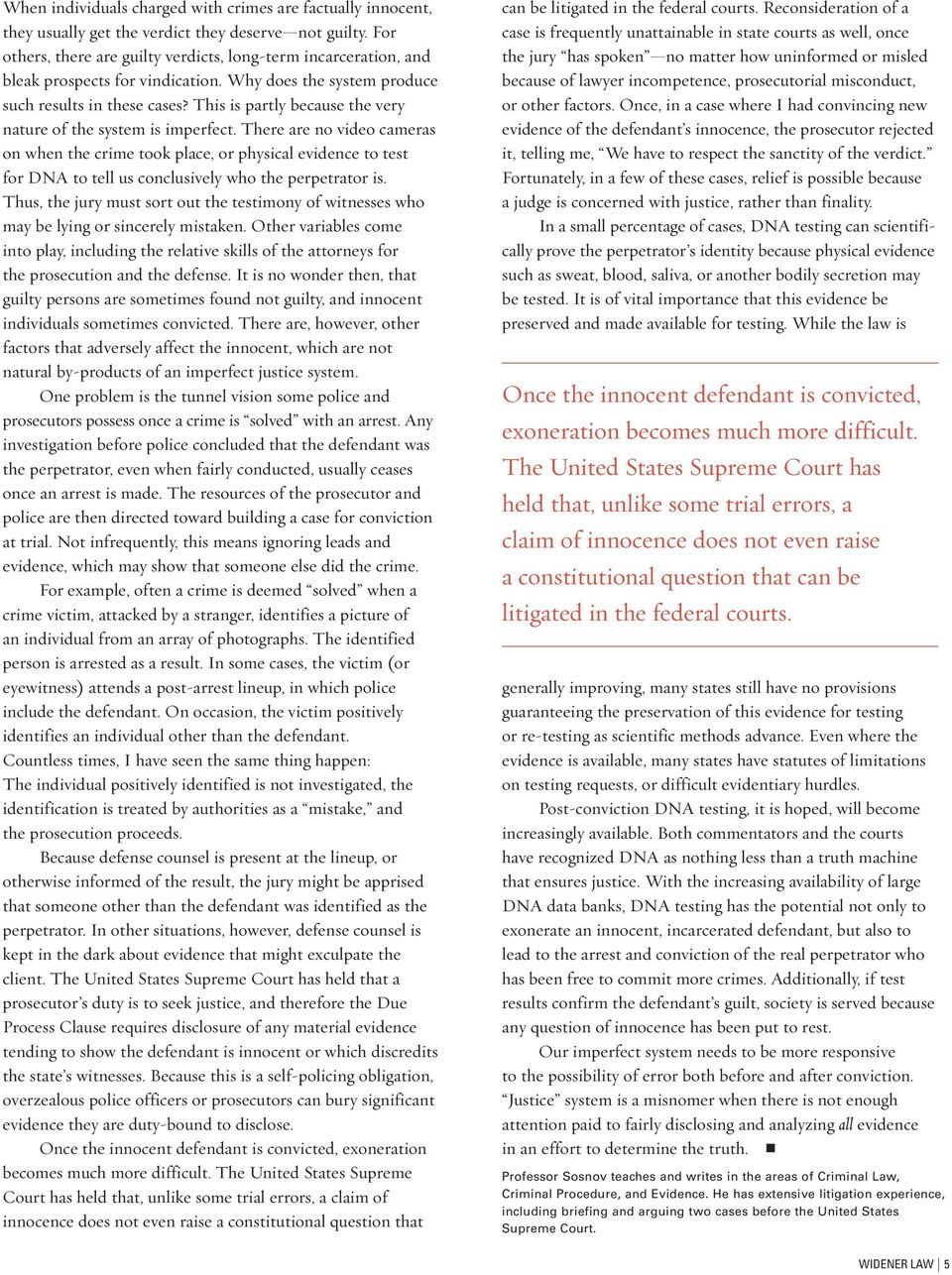
8 CRIMINAL LAW/ADVOCACY On the steps of the courthouse in New Orleans: From left, Rachel Ramsay, Danielle Graham, Dave Iannucci, Jessica Sanchez, Everett Gillison, Lisa Vetro, Nazim Karaca, and Eric Lubin. Also participating but not shown were students Brett Bendistis and Julie Serfess. Gillison is a public defender in Philadelphia who joined the students on the trip. 6 WIDENER LAW

9 Widener Law Criminal Defense Clinic: Twelve Years of Making a Difference By Judith L. Ritter, Associate Professor BORN IN THE 1960S, CLINICAL LEGAL EDUCATION IS ROOTED IN THE NOTION THAT LAW STUDENTS BELONG ON THE FRONT LINES IN THE BATTLE FOR SOCIAL JUSTICE. Over time, law school clinics have served the dual functions of preparing students for the practice of law and providing legal assistance to underrepresented populations. When I joined the Widener Law faculty in 1994, I was offered the opportunity to start a new, live-client, in-house, criminal defense clinical program. Live client distinguishes the program from simulation courses. It means that students represent real defendants in real criminal prosecutions. In-house means that the clinic functions as a small firm housed at the law school. Looking back at our first twelve years, I am gratified that the Widener Criminal Defense Clinic has exemplified the founding principles of clinical education. My partner, Staff Attorney Romie Griesmer, and I follow a simple clinical education design: Through hands-on experience, a small caseload, close mentoring, and a leave no stone unturned philosophy, we teach students how to be thorough, prepared, and effective defense lawyers. Our goal is for clinic students to graduate having seen and practiced client-centered, zealous, and conscientious defense lawyering. Another significant feature of the clinic model is team litigation. Students work in teams that include a faculty member. Team meetings with routine brainstorming sessions provide valuable opportunities for students to appreciate the intellectual joy of creatively and carefully analyzing legal issues. Moreover, the legal product created by the team is superior to one provided by individual litigators. Certification from the Pennsylvania Supreme Court authorizes our students to function as first-chair lawyers. We start each semester with an intense training and orientation program that covers substantive law and legal skills. Once the students get their cases, they conduct client interviews, fact investigation, legal research, preliminary hearings, pre-trial discovery and motions, plea negotiations, guilty plea colloquies, pre-trial hearings, and trials. The cases run the gamut of those that a new public defender would encounter: assault, drug possession, DUI, terroristic threats, and thefts. What the students lack in experience, they make up for in preparation and passion enabling them to gain good results for our clients. In addition to the more routine cases, over the years the clinic has also taken on more unusual cases, as the following highlights demonstrate. R E P R E S E N T AT I O N O F C A P I T A L D E F E N D A N T S I N C E R T I O R A R I P R O C E E D I N G S I N T H E U N I T E D S T AT E S S U P R E M E C O U R T: The clinic has represented a number of Pennsylvania capital prisoners in petitions for certiorari to the United States Supreme Court. These projects provided the students with a breadth of experience as they mastered the formalities, rigors, and requirements of Supreme Court practice. The work strengthened their research skills, as they were required to immerse themselves in complicated, challenging, and often unfamiliar legal issues. Petitions prepared by the clinic presented issues involving the Confrontation Clause, jury instructions, and the Eighth Amendment s prohibition WIDENER LAW 7

10 of cruel and unusual punishment. These petitions also allowed students to hone their writing skills as they drafted and re-drafted arguments and received much feedback and editing suggestions. Of course, the final product had to be perfect, and students learned how to exert maximum effort to accomplish that goal. Perhaps most important were the relationships students established with condemned prisoners. Students were expected to correspond with their clients and thereby learned something of the personalities behind the names. Indeed, when one cert client with sickle cell anemia suffered from hypersensitivity to the cold, a clinic student went through prison channels to get him extra blankets. When he died from his illness while his case was pending, the student attended the funeral, interacted with his family, and felt a loss. D N A A N D I N N O C E N C E : Defense clinic students took on a couple of cases in which, years after a conviction and the imposition of life sentences, our clients sought the opportunity to be exonerated through DNA testing. In both cases the technology was not available at the time of their trials. While exoneration was not to be, students gained knowledge of the science of DNA, post-conviction law and practice, the challenges of investigating old cases, and techniques for counseling clients with diminishing options. G O I N G T O T H E G U L F : On New Year s Day, nine third-year Widener Law students headed to New Orleans for a week of volunteering, to assist the Office Clinic enrollment is always full because students recognize the enormous rewards the program offers providing quality defense for the indigent, gaining first-chair lawyering experience, acquiring confidence, enhancing a resume, and employability to name a few. Students Dave Iannucci, Danielle Graham, and Lisa Vetro see first-hand the devastation left by Katrina. of the Public Defender for Orleans Parish. As part of this project, a joint endeavor of the Criminal Defense Clinic and the Public Interest Resource Center, students assisted with and conducted bail motions on behalf of pre-trial detainees who have suffered, and whose cases have been neglected due to the chaotic state of the court system after Hurricane Katrina. Because a number of these students have just completed their Criminal Clinic experience, they have real-world experience doing this work and can provide truly valuable assistance. Much of the financial backing for this trip came from generous contributions from Widener Law alumni who rallied to our call for help. T W E LV E Y E A R S O F R E W A R D S : Clinic enrollment is always full because students recognize the enormous rewards the program offers providing quality defense for the indigent, gaining firstchair lawyering experience, acquiring confidence, enhancing a resume, and employability to name a few. Then there is the reward for the teachers. That comes when we accompany students to court appearances and see the pronounced growth and professional maturity demonstrated by our students. We feel enormous pride when we see our students conducting court proceedings as professional and persuasive advocates. Judith L. Ritter is professor of law and director of the Criminal Defense Clinic at the Delaware campus. She teaches and writes in the areas of Criminal Law, Criminal Procedure and Post Conviction Remedies. 8 WIDENER LAW

11 CRIMINAL LAW/ADVOCACY The Spirit of Service Top: Marks on boarded-up buildings around New Orleans show the flood level during Katrina. Middle: Nazim Karaca helps with paperwork to process Louisiana prisoners. Bottom: Students Lisa Vetro and Dave Iannucci work on a case. While most law students across the country enjoyed a well-deserved break from their studies during the holiday season, a group of Widener Law students traveled to the Gulf Coast to assist the Public We are excited to be taking Widener s spirit of service on the road and putting it to work in Orleans Parish. Arlene Rivera Finkelstein, Director, Public Interest Resource Center Defender s Office there, which is still trying to recover from the case backlog created by Hurricane Katrina. During the first week of January, nine student volunteers conducted in-depth interviews with jailed defendants awaiting trial in Orleans Parish one of the hardest-hit areas of the storm. Students drafted memos on their interviews and gave them to the Orleans Public Defender s Office in an attempt to help move inmates cases forward. Widener Law professors Judy Ritter and Arlene Rivera Finkelstein accompanied and supervised the students. Ritter directs the Pennsylvania Criminal Defense Clinic on Widener s Delaware Campus. Finkelstein directs the Public Interest Resource Center on the Delaware Campus. Both helped train the students in preparation for their trip, in conjunction with the Katrina- Gideon Interviewing Project. The project is named after the landmark case, Gideon v. Wainwright, in which the U.S. Supreme Court recognized that states are constitutionally obligated to provide counsel to indigent criminal defendants. We are excited to be taking Widener s spirit of public service on the road and putting it to work in Orleans Parish, said Finkelstein. Our students will get a taste of the good they can do as attorneys, and while they are making this meaningful contribution, they will get real, practical experience for the future. The Widener Law students joined students from Fordham and Brooklyn law schools in visiting Orleans Parish. However, Widener is the only Philadelphia-region law school to send students to the Gulf Coast for the Katrina-Gideon Interviewing Project during the winter break. WIDENER LAW 9

12 CRIMINAL LAW/ADVOCACY USA Today created quite a stir when, on May 11, 2006, it reported that the National Security Agency had obtained and was parsing the records identifying millions, if not billions, of telephone calls placed by Americans.

13 The Technology of Surveillance: Will the Supreme Court s Expectations Ever Resemble Society s? By Stephen E. Henderson, Associate Professor For law students studying criminal procedure or at least for those cramming for the exam it becomes a mantra: government conduct only implicates the Fourth Amendment protection against unreasonable searches if it invades a reasonable expectation of privacy. This is not the contemporary definition of the word search, nor was it the definition at the time of the founding. But, via a well-intentioned concurrence by Justice Harlan in the famous 1967 case of Katz v. United States, it became the Court s definition. This lack of fealty to the English language left some questions. For example, is determining whether someone has a reasonable expectation of privacy a normative inquiry (what should a person expect) or an empirical one (what does a person expect)? And why do we need to determine whether someone had a reasonable expectation of privacy when the next question is, to the consternation of law students, whether the search was reasonable. Remarkably, the High Court has never answered these questions, although Justice Scalia has complained about the latter. But there are even larger problems with what the Court has done with its reasonable expectation of privacy test, problems that became immediately apparent, but that are now becoming critical. Consider some recent events and technologies, and the problem becomes clear. Why might Patricia Dunn soon be able to empathize with Martha Stewart? Because she has been indicted for her role in the Hewlett-Packard board-leak fiasco. In a nutshell, Dunn allegedly authorized and assisted in an investigation that relied upon an information broker to determine which board member or members were leaking confidential information to the press. How does an information broker obtain that information? She lies. But it isn t pleasant to have to tell new acquaintances at a cocktail party that one lies for a living, so instead information brokers engage in pretexting, which means contacting phone companies, posing as customers, and thereby obtaining call records. HP also appears to have engaged in dumpster diving, shadowing, and other favorites in the snoop s arsenal, but for our purposes we want to focus on pretexting. Naming aside, pretexting must be a pretty nasty business. Not only did it cost Dunn her chairman job, but the Attorney General of California charged her in a felony indictment and settled civil charges against the company for $14.5 million. The FBI investigated, the SEC instigated a review (admittedly for a tangentially related Sarbanes-Oxley issue), the House Committee on Energy and Commerce held hearings, the governator (Schwarzenegger) signed legislation explicitly criminalizing pretexting of telecommunications records, and the United States Congress considered and might enact the same. Whatever it takes to constitute a reasonable expectation of privacy, it must be satisfied with respect to dialing WIDENER LAW 11

14 What if the government wants to plant a mole in your life who will remember, record, and transmit everything you say to him or her? There is no constitutional constraint. What if the government wants to place an electronic transponder on your vehicle to track your car? There is no constitutional constraint. records. After all, USA Today created quite a stir when, on May 11, 2006, it reported that the National Security Agency had obtained and was parsing the records identifying millions, if not billions, of telephone calls placed by Americans. And there is, in fact, a federal statute, the Stored Communications Act, which forbids such access absent legal process. Apparently, a reasonable American both should and would expect dialing records to be confidential. But according to the Supreme Court, there is no Fourth Amendment restriction on police accessing such records. They can be obtained for any reason, or for no reason. Mere curiosity will do. Why? Because to the Court, one who discloses information to a third party retains no reasonable expectation of privacy in that information (the third party doctrine ). And we know we give those numbers to our phone company how else are its switches to connect the call? So how about your bank records? As far as you are concerned, there is no constitutional constraint on government access. What if the government wants to plant a mole in your life who will remember, record, and transmit everything you say to him or her? There is no constitutional constraint. What if the government wants to place an electronic transponder on your vehicle to track your car? There is no constitutional constraint. What if the government wants to fly over your backyard to see what you do within that fence of yours? There is no constitutional constraint. And if the government wants to comb through your garbage, going so far as reconstructing shredded documents or testing a tampon for seminal fluid? There is no constitutional constraint. These are the cases law students learn. But it gets worse. The human body is constantly radiating energy. This in itself sounds worrisome, but unless you are at a temperature of absolute zero (so chilly, atoms stop vibrating), you are going to emit energy. We don t see this energy because it isn t in the visible spectrum, but it turns out the body is much more emissive in the millimeter wave spectrum than most other objects, such as guns, knives, and particulates. And just as visible light transmits through glass, millimeter waves transmit through clothing. This allows police to carry what is in essence a video camera attuned to this spectrum and view what a person is carrying on his or her person from a distance. Does the Fourth Amendment restrict use of such a device? Not under the third party doctrine, because you knowingly (at least now you know) convey this information to others. And there are more banal examples. Consider to whom you disclose your messages. And how about your physical location? If you carry a modern cellular phone, you typically convey a very accurate location to your service provider not only when you are placing or receiving a call, but anytime the phone is turned on. And what of querying the mammoth databases amalgamating different types of information that we tend to hear about when they suffer security breaches? This is the magnum opus of the Court s third party doctrine the Court has removed all constitutional (legal) constraint, and technology has now removed any significant cost constraint. So what should the Court do? Obviously the third party doctrine must go, but it is admittedly difficult to replace this wonderfully bright-line rule with anything administrable. I have crafted a proposal, and interested readers can peruse it via my page at Widener s Web site. But in the space I have here let me just say this: Last term the Supreme Court declared that [t]he constant element in assessing Fourth Amendment reasonableness is the great significance given to widely shared social expectations. As the HP debacle demonstrates, the Court s jurisprudence deviates sharply from actual expectations. Unless the Court changes course our Constitution will read like AT&T s recently modified privacy policy, which explains that [w]hile your account information may be personal to you, these records constitute business records that are owned by AT&T. That might suffice for corporate America, but it shouldn t do for our Constitution. So what should the Court do? Obviously the third party doctrine must go, but it is admittedly difficult to replace this wonderfully bright-line rule with anything administrable. Stephen E. Henderson is associate professor on the Delaware campus, where he concentrates on intellectual property and criminal law. He received his JD from Yale Law School, where he co-founded the Yale Law and Technology Society. 12 WIDENER LAW

15 Selma Hayman 86 Giving Back to Widener Law Selma Hayman 86 feels that she has been able to effect meaningful change through the law. She is also generous and grateful to her alma mater, Widener Law, for the opportunities it gave her to do important and valuable work for the underserved. And so, in keeping with her style and her values, Hayman recently donated appreciated securities to fund a charitable gift annuity to benefit the law school. A charitable gift annuity is a planned gift which affords the donor substantial tax benefits, including a tax deduction at the time of the gift, while allowing the person to receive annuity payments. Hayman likes the charitable gift annuity vehicle because the annuity payments will supplement her income when she is retired, and she is pleased with the tax savings. In her words, It should be noted that a portion of the annuity payment, because it is a return of principal, is tax free, and there are some tax savings if you donate appreciated property. The charitable gift annuity vehicle is beneficial for the charitable institution as well, because the institution receives the remaining funds after the donor dies. In Hayman s case, the gift will benefit a scholarship for minority students. When I was in law school, there were only about two black students in my class, and I thought it was a major gap, she explains. Although she realizes that minority enrollment at Widener Law has increased since that time, Hayman wants to encourage a more diverse population in the legal profession. A desire to give back to the law school as thanks for scholarship help she personally received as a student is also a motivating factor, she says. Hayman, who has a bachelor s degree in biology from Antioch College and a PhD in biochemistry from the University of Wisconsin at Madison, entered Widener Law in 1983 at the age of 52 after a career in research. Of her decision to attend law school later in life, Hayman says, I was on the board of the American Civil Liberties Union and saw that law school could be interesting and socially relevant. She parlayed her law degree and her commitment to social justice into a career that has been devoted to representing clients who desperately need her help. Focusing primarily on elder law, Hayman has handled guardianships, cases involving nursing home rights, Medicare and Medicaid issues, and Social Security Disability claims and appeals. Elder law, according to Hayman, turned out to be a good fit. She recently noted, An awful lot of what I do is helping people who have serious problems. I don t deal with people with a lot of money. I send them to someone else. I didn t go into the law to get rich. Hayman s philosophy on life and the law has indeed aided many clients during her career and in light of her recent planned gift it will also benefit many future law students. WIDENER LAW 13

16 14 WIDENER LAW The simple problem is that the mind is not a video or digital recorder; it neither perceives all details nor retains those it did see in a pristine, unalterable state.

17 CRIMINAL LAW/ADVOCACY I ll never forget that face... (But I might not remember it accurately.) Mistaken eyewitness identification testimony is a leading cause of most wrongful convictions. By Professor Jules Epstein Mistaken identification cases are high profile in the media. This has resulted in significant part from DNA exonerations. The scientific conclusiveness of DNA as proof of innocence has permitted a retrospective assessment of what went wrong in those cases. And what went wrong in a substantial proportion of those cases was a reliance on eyewitness identification testimony. According to the Innocence Project, as of November 2006 over 75% of the 183 post-conviction DNA exonerations in the U.S. involve mistaken eyewitness identification testimony, making it the leading cause of these wrongful convictions. But it is not just in 183 cases. For more than a century, every study of wrongful convictions has shown that mistaken identification is the major culprit, usually at a rate of roughly two-thirds of the cases studied. And FBI statistics of DNA examinations in sex offenses show a startlingly high rate of mistaken identifications: in over 10,000 cases where crime scene DNA was tested against suspects DNA, the exclusion rate [the rate at which the DNA showed the suspect could not have contributed the evidence] was 20 percent. The numbers show the prevalence of this problem, but not its cause. And the cause has five demonstrable components problems with perception and memory, improper police evidence gathering, juror over-valuing of eyewitness testimony, bad lawyering, and judicial decisions and practices that are contrary to the known science. Perception and Memory: The simple problem is that the mind is not a video or digital recorder; it neither perceives all details nor retains those it did see in a pristine, unalterable state. How do we know this? In the past three decades, over 2,000 peer-reviewed studies have shown that several factors impede accurate perception and recall: Weapons Focus: When a firearm or knife is present, crime witnesses look at the weapon, not at the perpetrator s face. Own-Race Bias: It remains a sad but true fact that witnesses are better at identifying persons of their own race than of other races. Stress: Very high levels of stress impair the accuracy of eyewitness testimony. This is true even where the witness is a trained police officer or member of the military. The Memory Drop-Off: Accurate recall of an event drops sharply after a several hour period. Confidence/Accuracy: Although many witnesses maintain that they, personally, are 100% sure of their identification, the correlation between their confidence and the accuracy of their identifications is low. Police Evidence Gathering: An abundance of studies has shown that when police conduct interviews or lineups, their words or gestures can contribute to mistaken identifications. Asking did the man have a big mustache may implant that feature onto the witness memory; and telling witnesses to look for the perpetrator in the lineup can suggest that the perpetrator is in the group being looked at, and thus cause the witness to pick someone, not necessarily the right person. Juror Over-valuing of Eyewitness Testimony: Jurors believe eyewitnesses (usually crime victims), as they seem sincere and have no apparent motive to lie or pick the wrong person. In one mock jury study, 72% of the jurors found the subject WIDENER LAW 15

18 The standard for suppressing eyewitness testimony as unreliable has no regard for how memory works or how police conduct may influence witnesses... guilty when there was one eyewitness. A separate set of jurors were given the same one-witness evidence and were told that the eyewitness was legally blind; the percentage of jurors voting guilty dropped only to 68%. Bad Lawyering: Too many cases involve lawyers who have not studied the psychology of eyewitness evidence and who use cross-examination techniques designed to expose the dishonest witness when what they are confronting is an honest but mistaken witness. Judicial Decisions: The law s development is currently running twenty to thirty years behind the clear science. The standard for suppressing eyewitness testimony as unreliable has no regard for how memory works or how police conduct may influence witnesses. Jury instructions also fail to keep pace with the science, and many jurisdictions prohibit or limit the use of expert witnesses to explain why an eyewitness claim might be unreliable. So, where and how are remedies being sought? Many legislatures, police departments, and state agencies have adopted guidelines for police investigation in identification cases, particularly in how to interview witnesses and conduct lineups. New Jersey has adopted these on a statewide basis, including the requirement that lineups be conducted blind, i.e., by a detective who does not know which person is the suspect. Advanced training in how to litigate a case of mistaken identification is being provided nationally, and across Pennsylvania, for defense lawyers. In the courts, resources are being amassed to press for better jury instructions, greater acceptance and use of experts, and a more science-based standard for assessing whether eyewitness testimony should be admissible. Much is occurring, but much more is needed, particularly in terms of education for judges, juries, and police. And until these changes are implemented, we will continue to see headlines like those from Delaware in September 2006 when two people were wrongly identified from bank robbery surveillance photos: Police, again, accuse the wrong man. Mistaken Identity Resources Articles: Epstein, Tri-State Vagaries: The Varying Responses of Delaware, New Jersey, and Pennsylvania to the Phenomenon of Mistaken Identifications, 12 WIDENER L. REV. 327 (2006) Psychology Eyewitness Expert Resources: Web site of Professor Gary Wells, gwells/homepage.htm Web site of Dr. Solomon Fulero, Web site of Professor Stephen Penrod, Government Publications: New Jersey State Attorney General Guidelines on Eyewitness Identification, iastate.edu/faculty/gwells/njguidelines.pdf National Institute of Justice, Eyewitness Evidence: A Guide for Law Enforcement, files1/nij/ pdf Organizations: The Innocence Project, Media: FRONTLINE, What Jennifer Saw, Jules Epstein is associate professor at Widener s Delaware campus. He joined Widener from the Philadelphia criminal defense firm of Kairys, Rudovsky, Epstein & Messing, and teaches criminal law and evidence courses. He serves as faculty for a National Judicial College program training judges in capital case representation. 16 WIDENER LAW
19 Ever wish you could do more for Widener Law? Many of Widener University School of Law s most faithful contributors give an annual donation each year but wish they could support the law school in a more significant way. A planned gift is the answer for many people, and it may be the answer for you. The following options allow you to make gifts to the law school while also benefiting yourself and your heirs: testamentary bequest life insurance policy individual retirement account charitable remainder trust charitable lead trust charitable gift annuity Please discuss these and other planned giving vehicles with your financial advisor or contact the Alumni and Development Office at for further information. Alumni and Development Office 4601 Concord Pike Wilmington, DE

20 Faculty Publications B A R N E T T, L A R R Y D., Social Productivity, Law, and the Regulation of Conflicts of Interest in the Investment Industry, 3 CARDOZO PUB. L. POL Y & ETHICS J. 793 (2006). When Is a Mutual Fund Director Independent? The Unexplored Role of Professional Relationships Under Section 2(A)(19) of the Investment Company Act, 4 DEPAUL BUS. & COM. L.J. 155 (2006). The Regulation of Mutual Fund Names and the Societal Role of Trust: An Exploration of Section 35(d) of the Investment Company Act, 3 DEPAUL BUS. & COM. L.J. 345 (2005). B A R R O S, B E N J A M I N, Home as a Legal Concept, 46 SANTA CLARA L. REV. 255 (2006). At Last, Some Clarity: The Potential Long-Term Impact of Lingle v. Chevron and the Separation of Takings and Substantive Due Process, 69 ALB. L. REV. 343 (2005). When a Certified Mail Notice of Tax Delinquency Is Returned as Undelivered, Must Governments Take Additional Steps Before Seizing Property?, PREVIEW U.S. SUP. CT. CAS B R I T T O N, A N N H., Bones of Contention: Custody of Family Pets, 20 J. AM. ACAD. MATRIMONIAL LAW. 1 (2006). C H E S L E R, S U S A N, The Small Group Progress Conference, 20 THE SECOND DRAFT (Bull. of the Legal Writing Inst.), August, 2005, at 11. C O N A W AY, A N N E., & Robert R. Keatinge, KEATINGE AND CONAWAY ON CHOICE OF BUSINESS ENTITY, (Thomson West 2006). et al., Internal Disputes and Break-Ups: Colorado, California, and Delaware, Limited Liability Entities 2005 New Developments in Limited Liability Companies and Limited Liability Partnerships Live via Satellite TV/Webcast on the American Law Network, ALI-ABA Video Law Review, March 17, 2005 (VMF0317 ALI-ABA 81). Transferee and Assignee Rights; Charging Orders; Piercing and Reverse Piercing; Duty to Creditors; and Other Creditor Remedies in Uniform Unincorporated Acts, Selecting Legal Form and Structure for Closely-Held Businesses and Ventures Live Via Satellite TV/Webcast on the American Law Network, ALI-ABA Video Law Review, February 10, 2005 (VMF0210 ALI-ABA 165). C O Z Z I L L I O, M I C H A E L J., et al., SPORTS LAW: CASES AND MATERIALS (Carolina Academic Press 2nd ed. 2007). & Robert L. Hayman Jr., SPORTS AND INEQUALITY (Carolina Academic Press 2005). C U L H A N E, J O H N G., Lawrence-ium: The Densest Known Substance, 11 WIDENER L. REV. 259 (2005). Even More Wrongful Death: Statutes Divorced from Reality, 32 FORDHAM URB. L.J. 171 (2005). Writing On, Around, and Through Lawrence v. Texas, Symposium on the Implications of Lawrence and Goodridge for the Recognition of Same-Sex Marriages and the Validity of DOMA, 38 CREIGHTON L. REV. 493 (2005). Bad Science, Worse Policy: The Exclusion of Gay Males from Donor Pools, 24 ST. LOUIS U. PUB. L. REV. 129 (2005). & Stacey L. Sobel, The Gay Marriage Backlash and Its Spillover Effects: Lessons From a (Slightly) Blue State, Symposium: The Legislative Backlash to Advances in Rights for Same- Sex Couples, 40 TULSA L. REV. 443 (2005). D A LY, E R I N, & Jeremy Sarkin, RECONCILIATION IN DIVIDED SOCIETIES: FINDING COMMON GROUND, (Penn Press 2007). The New Liberty, 11 WIDENER L. REV. 221 (2005). D E R N B A C H, J O H N, WRITING ESSAY EXAMS TO SUCCEED (NOT JUST TO SURVIVE) (2d ed. Aspen 2007). et al., Stabilizing and Then Reducing U.S. Energy Consumption: Legal and Policy Tools for Efficiency and Conservation, 37 ENVTL. L. REP. (Envtl. L. Inst.) 10,003 (2007) Targets, Timetables, and Effective Implementing Mechanisms: Necessary Building Blocks for Sustainable Development, SUSTAINABLE DEVELOPMENT LAW & POLICY (Fall 2005). & Dan Tarlock, 2005, Sustainable Development and Natural Governance: The Challenges Ahead in SOCIAL SCIENCES AND HUMANITIES, IN ENCYCLOPEDIA OF LIFE SUPPORT SYSTEMS (EOLSS), Developed Under the Auspices of UNESCO, EOLSS Publishers, Oxford, UK,

21 et al., Committee on Climate Change and Sustainable Development: 2005 Annual Report, in ENV T ENERGY AND RESOURCES L.: THE YEAR IN REVIEW 115 (2006). et al., Committee on Climate Change and Sustainable Development: 2004 Annual Report, in ENV T ENERGY AND RESOURCES L.: THE YEAR IN REVIEW 120 (2005). D I M I N O, M I C H A E L D. S R., et al, SPORTS LAW: CASES AND MATERIALS (Carolina Academic Press 2nd ed. 2007). Counter-Majoritarian Power and Judges Political Speech, 58 FLA. L. REV. 53 (2006). The Non-Political Branch, 10 TEX. REV. L. & POL. 449 ( ) (reviewing LEE EPSTEIN & JEFFREY A. SEGAL, ADVICE AND CONSENT: THE POLITICS OF JUDICIAL APPOINTMENTS (2005)). The Worst Way of Selecting Judges Except all the Others That Have Been Tried, 32 N. KY. L. REV. 267 (2005). E G G E N, J E A N M. TOXIC TORTS IN A NUTSHELL (Nutshell Series, Thomson West 3rd ed. 2005). The Normalization of Product Preemption Doctrine, 57 ALA. L. REV. 725 (2006). Daubert and Its Progeny: Expert Scientific Evidence in Massachusetts Personal Injury Cases, J. OF THE MASS. ACAD. OF TRIAL ATT YS 22 (Fall 2005/Winter 2006). Toxic Exposures at Ground Zero: Is There a Role for the Tort System?, 1 WIDENER HEALTH L. TODAY 1 (Fall 2005). The Impact of the Class Action Fairness Act on Plaintiffs in Mass-Tort Actions, 12 No. 3 ANDREWS CLASS ACTION LITIG. REP. 17, Apr. 21, J U L E S E P S T E I N Tri-State Vagaries: The Varying Responses of Delaware, New Jersey, and Pennsylvania to the Phenomenon of Mistaken Identifications, 12 WIDENER L. REV. 327 (2006). Expert Witnesses, in THE PROSECUTION AND DEFENSE OF SEX CRIMES, Chapter 30 (Bender 1976; chap. 2006). Jury Selection in Sex Offense Cases, in THE PROSECUTION AND DEFENSE OF SEX CRIMES, Chapter 33 (Bender 1976; chap. 2006). Sex Offender Registration and Community Notification, in THE PROSECUTION AND DEFENSE OF SEX CRIMES, Chapter 43 (Bender 1976, 2004; chap. 2005, chap. 2006). Federal Sentencing in Drug Cases, in DEFENSE OF NARCOTICS CASES, Chapter 5B (Bender 1972, 2005; chap. 1999, 2001, 2002, 2004, 2005). Jury Selection in Drug Offense Cases, in DEFENSE OF NARCOTICS CASES, Chapter 5A (Bender 1972; chap. 2004; releases through 2005). True Lies: The Constitutional and Evidentiary Bases for Admitting Prior False Accusation Evidence in Sexual Assault Prosecutions, 24 QUINNIPIAC L. REV. 609 (2006). F A M I LY, J I L L E., Another Limit on Federal Court Jurisdiction? Immigrant Access to Class-Wide Injunctive Relief, 53 CLEV. ST. L. REV. 11 ( ). The Rush to Limit Judicial Review, PERSPECTIVES ON IMMIGRATION (American Immigration Law Foundation, Washington, D.C.), Sept.2006, available at september_perspective.shtml. F I C H T E R, A N D R E W, Owning a Piece of the Doc: State Law Restraints on Lay Ownership of Healthcare Enterprises, 39 J. HEALTH L. 1 (2006). Health Care at Lake Wobegon, 1 WIDENER HEALTH L. TODAY 1 (Spring 2005). F R I E D M A N, S T E P H E N E., Improving the Rolling Contract, 56 AM. U. L. REV. 1 (2006) G A R F I E L D, A L A N E., Protecting Children From Speech, 57 FLA. L. REV. 565 (2005), reprinted in FIRST AMENDMENT LAW HANDBOOK (Rodney Smolla ed., 2005/2006). Editorial, Hate the Vile Campaign Ads? Blame the Supreme Court, PHIL. INQ, NOV. 2, 2006, at A19. Editorial, A More Perfect Union, THE NEWS J. (Wilmington, DE), Sept. 17, 2006, at A21. Editorial, Independence Day Honors Lofty Concept, Hard-Won Reality, THE NEWS J. (Wilmington, DE), July 4, 2006, at E3. Editorial, Science-Belief Tension Is Natural, THE NEWS J. (Wilmington, DE), Apr. 8, 2006, at A7. Editorial,.and on Constitution Day, What to Celebrate? PHIL. INQ., Sep. 16, 2005, at A21. Editorial, Judge Judges on How They Use Their Power, THE NEWS J. (Wilmington, DE), Nov. 18, 2005, at A14. G E D I D, J O H N L., Editorial, Upholding Separation of Power Was Proper, PATRIOT NEWS (Harrisburg, PA), Sept. 15, 2006, at A11. G O L D B E R G, M I C H A E L J., Rights of Union Members Within Their Unions, in EMPLOYEE AND UNION MEMBER GUIDE TO LABOR LAW: A MANUAL FOR ATTORNEYS REPRESENTING THE LABOR MOVEMENT, Chapter 12 (Thomson-West 2005 revisions). Teamster Reformers: Their Union, Their Jobs, Their Movement, 72 J. TRANSP. L. LOGISTICS & POL Y 13 (2005). H A K E S. R U S S E L L A., et al., 2005 Uniform Commercial Code Survey: Introduction, 61 BUS. LAW (2006). et al., The Uniform Commercial Code Survey: Introduction, 60 BUS. LAW (2005). H A M E R M E S H, L A W R E N C E A., Symposium: Litigation reform Since the PSLRA: A Ten-Year Retrospective: Panel Three: Sarbanes- Oxley Governance Issues: The Policy Foundations of Delaware Corporate Law, 106 COLUM. L. REV (2006). Ruby R. Vale and a Definition of Legal Scholarship, 31 DEL. J. CORP. L. 253 (2006). Twenty Years After Smith v. Gorkom: An Essay on the Limits of Civil Liability of Corporate Directors and the Role of Shareholder Inspection Rights, The Smith v. Gorkom Symposium, 45 WASHBURN L.J. 283 (2006). & Michael L. Wachter, The Fair Value of Cornfields in Delaware Appraisal Law, 31 J. CORP. L. 119 (2005). Corporate Officers and The Business Judgment Rule: A Reply to Professor Johnson, 60 BUS. LAW. 865 (2005). H A R R I N G T O N C O N N E R, D A N A, Editorial, - Rachel Kipp, Law School Has Human Side, THE NEWS J. (Wilmington, DE), January 14, 2007, at B2. WIDENER LAW 19
22 Faculty Publications Societal Views and Survivors of Domestic Violence: Asking the Right Questions, 13 WIDENER SCHOOL OF LAW MAGAZINE, 2006, at 10. H AY M A N, R O B E R T L. J R., & Michael J. Cozzillio, SPORTS & INEQUALITY (Carolina Academic Press 2005). H E M I N G W AY, A N N A P., Keeping Students Interested While Teaching Citation, 20 THE SECOND DRAFT (Bull. of the Legal Writing Inst.), August, 2005, at 14. H E N D E R S O N, S T E P H E N E., Learning From All Fifty States How to Apply the Fourth Amendment and Its State Analogs to Protect Third Party Information from Unreasonable Search, 55 CATH. U. L. REV. 101 (2006). Nothing New Under the Sun? A Technologically Rational Doctrine of Fourth Amendment Search, 56 MERCER L. REV. 507 (2005). H I L L, L O U I S E L., Services as Objects of International Trade: Bartering the Legal Profession, 39 VAND. J. TRANSNAT L L. 347 (2006). H O D A S, D AV I D R., Sustainable Development and the Marrakech Accords, in THE LAW OF ENERGY FOR SUSTAINABLE DEVELOPMENT, Chapter 4, at 56 (Adrian J. Bradbrook et al. eds. 2005). State Law Responses to Global Warming: Is It Constitutional to Think Globally and Act Locally?, Symposium on Environmental Law and The Constitution, 21 PACE ENVTL. L. REV. 53 (2003), reprinted in Daniel A. Farber and Jim Chen, DISASTERS AND THE LAW: KATRINA AND BEYOND 312 (Aspen 2006). The Challenge of High Priced Oil, 20 NAT. RESOURCES & ENV T 59, Fall Executive Privilege and Energy Policy, 19 NAT. RESOURCES & ENV T 3 (2005). Vantage Point & Issue Editor, Transboundary Conflicts Issue, 21 NAT. RESOURCES & ENV T, Summ K E A R N E Y, M A R Y K AT E, Recognizing That They Watch, 14 WIDENER L.J. 437 (2005). K E L L E Y, J. PAT R I C K, The Seduction of the Appellate Body: Shrimp/Sea Turtle I and II and the Proper Role of States in WTO Governance, 38 CORNELL INT L L.J. 459 (2005). K O T L E R, M A R T I N, A., PRODUCTS LIABILITY AND BASIC TORT LAW (Carolina Academic Press 2005). K R I S T L, K E N N E T H T., Allocating Responsibilities for Environmental Cleanup Liabilities through Purchase Price Discounts, ENVTL. COUNS., Oct. 15, 2005, at 2, reprinted in CORPORATE COUNSEL S GUIDE TO ACQUISITIONS AND DIVESTITURES Chapter 20.1 (Thomson West 2005, 2006 revisions). A Boundary Dispute s Effect on Siting an LNG Terminal, 21 NAT. RESOURCES & ENV T. 34, Summ Clinic Provides Environmental Defense, Legal Training, WIDENER U. SCH. L. MAG., Fall 2005, at 9. L E E, G. R A N D A L L, Nineteenth Century Visions of a Twenty-First Century Bar: Were Dickens s Expectations for Lawyers Too Great?, 15 WIDENER L. J. 283 (2006). Dorothy Day and Innovative Social Justice: A View from Inside the Box, 12 WM. & MARY J. WOMEN & L. 187 (2005). Bruce Springsteen s Hope and the Lawyer as Poet Advocate, 14 WIDENER L.J. 867 (2005). Lessons to be Learned, Lessons to Live Out: Catholicism at the Crossroads of Judaism and American Legalism, 49 ST. LOUIS U. L.J 367 (2005). Introduction, The Lawyer as Poet Advocate: Bruce Springsteen and the American Lawyer, 14 WIDENER L.J. 719 (2005). A Law Professor on Being Fashioned, 14 WIDENER L.J. 469 (2005). The Continuing Moral Fashioning of a Law Professor, ORANGE COUNTY LAW., June 2005, at 18. L I P K I N, R O B E R T J U S T I N, Which Constitution: Who Decides? The Problem of Judicial Supremacy and the Interbranch Solution, 28 CARDOZO L. REV (2006). The Harm of Same-Sex Marriage: Real or Imagined? 11 WIDENER L. REV. 277 (2005). Book Review, 15 L. & POL. BK. REV. 539 (2005) (reviewing FRANK I. MICHELMAN, BRENNAN AND DEMOCRACY (2005)), at subpages/reviews/michelman605.htm Book Review, 16 L. & POL. BK. REV. 133 (2006) (reviewing ARGUING MARBURY V. MADISON (Mark Tushnet, ed.) (2005)). 20 WIDENER LAW
23 Going Courting: How Same-Sex Marriage Opponents Came to Love the Courts (Sept. 9, 2005), at M A N N, R O B E R T A F., & Mona L. Hymel, Getting Into the Act: Enticing the Consumer to Become Green Through Tax Incentives, 26 ENVTL. L. REP. (Envtl. L. Inst.) (2006). On The Road Again: How Tax Policy Drives Transportation Choice, 24 VA. TAX REV. 587 (2005). Top Ten Strategies for Encouraging Tax Compliance, 111 TAX NOTES 919 (2006). & Jasper L. Cummings, Jr., Point & Counterpoint: The No-Net-Value Proposed Regulations: Invalid Exercise of Authority or Well- Reasoned Interpretation, 25 NEWSQUARTERLY (ABA Tax Sec.) 14 (Fall 2005). et al., The American Jobs Creation Act s Impact on Individual Investors: A Monster of Complexity? 22 J. TAX N OF INVEST. 187 (2005). M AY, J A M E S R., & Robert L. Glicksman, Justice Rehnquist and the Dismantling of Environmental Law, 36 ENVTL. L. REP. (Envtl. L. Inst.) (2006). The North American Symposium on the Judiciary and Environmental Law: Constituting Fundamental Environmental Rights Worldwide, 23 PACE ENVTL. L. REV. 113 (2005/2006). Trends in Constitutional Environmental Law, 37 No. 4 ABATRENDS 8 (March/ April 2006). The Aftermath of TMDL Litigation: Consent Decrees and Settlement Agreements, in CLEAN WATER ACT: LAW AND REGULATION 157 (ALI-ABA Course of Study, Oct , 2005). Where Constitutional Law and Environmental Law Intersect, WIDENER U. SCH. L. MAG., Fall 2005, at 12. Now More Than Ever: Trends in Environmental Citizen Suits at 30, Environmental Citizen Suits at Thirtysomething: A Celebration & Summit Symposium, Part I, 10 WIDENER L. REV. 1 (2003), reprinted in ENVIRONMENTAL LAW 385 (ALI-ABA Course of Study, Feb , 2005). The Availability of State Environmental Citizen Suits, 18 NAT. RESOURCES & ENV T 53 (2004), reprinted in ENVIRONMENTAL LAW 439 (ALI-ABA Course of Study, Feb , 2005). M E A D O W S, R O B Y N L., et al., Sales (Uniform Commercial Code Annual Survey), 61 BUS. LAW (2006). et al., Sales (Uniform Commercial Code Annual Survey), 60 BUS. LAW (2005). Unconscionability as a Contract Policing Device for the Elder Client: How Useful Is It? 38 AKRON L. REV. 741 (2005). et al., 2005 Uniform Commercial Code Survey: Introduction, 61 BUS. LAW (2006). et al., The Uniform Commercial Code Survey: Introduction, 60 BUS. LAW (2005). M I R K AY, N I C H O L A S A., Relinquish Control! Why the IRS Should Change Its Stance on Exempt Organizations in Ancillary Joint Ventures, 6 NEV. L.J. 21 (2005). M O R I N G I E L L O, J U L I E T M., Has Congress Slimmed Down The Hogs?: A Look at the BAPCA Approach to Pre-Bankruptcy Planning, 15 WIDENER L.J. 615 (2006). & William L. Reynolds, Internet Contracting Cases , 61 BUS. LAW. 433 (2005). Signals, Assent and Internet Contracting, 57 RUTGERS L. REV (2005). Cyberspace Law Survey: Introduction, 61 BUS. LAW. 431 (2005). M O U L T O N, H. G E O F F R E Y J R., Consistency, Proportionality, and Substantive Judicial Review in Capital Sentencing, 80 IND. L.J. 98 (2005). N I C H O L S, N AT H A N I E L C., When Harry Met Sally: Client Counseling Under BAPCPA, 15 WIDENER L.J. 641 (2006). Modeling Professionalism: The Process From a Clinical Perspective, 14 WIDENER L.J. 441 (2005). N I VA L A, J O H N F., The Landscape Art of Daniel Urban Kiley, 29 WM. & MARY ENVTL. L. & POL Y REV. 267 (2005). O L I V E R, W E S L E Y, The Rise and Fall of Material Witness Detention in Nineteenth Century New York, 1 N.Y.U. J. L. & LIBERTY 726 (2005). Toward a Better Categorical Balance of the Costs and Benefits of the Exclusionary Rule, 9 BUFF. CRIM. L. REV. 201 (2005). R A E K E R - J O R D A N, S U S A N M., Parsing Personal Predilections: A Fresh Look at the Supreme Court s Cruel and Unusual Death Penalty Jurisprudence, 58 ME. L. REV. 99 (2006). R AY, L A U R A K., Laughter at the Court: The Supreme Court as a Source of Humor, 79 S. CAL. L. REV (2006). America Meets the Justices: Explaining the Supreme Court to the General Reader, 72 TENN. L. REV. 573 (2005). Holder v. Hall, in THE OXFORD COMPANION TO THE SUPREME COURT OF THE UNITED STATES 466 (Kermit L. Hall et al., eds., 2nd ed. 2005). R E E D, T H O M A S J., & Hon. Eunice L. Ross, WILL CONTESTS (West Group 2d ed. 1999, & Cum. Supp. 2006). Admitting the Accused s Criminal History: The Trouble With Rule 404(b), 78 TEMP. L. REV. 201 (2005). R O B I N E T T E, C H R I S T O P H E R J., Torts Rationales, Pluralism, and Isaiah Berlin, 14 GEORGE MASON L. REV. 329 (2007) Can There be a Unified Theory of Torts? A Pluralist Suggestion from History and Doctrine, 43 BRANDEIS L.J. 369 (2005). S O S N O V, L E O N A R D N., & David Rudovsky, PENNSYLVANIA CRIMINAL PROCEDURE: LAW, COMMENTARY AND FORMS (West s Pennsylvania Practice Series, West Group 2d ed (pocket parts through 2006)). S T R A U S S, A N D R E W L., ET AL., INTERNATIONAL LAW AND WORLD ORDER: A PROBLEM-ORIENTED COURSEBOOK (Thomson West 4th ed. 2006). ET AL., SUPPLEMENT OF BASIC DOCUMENTS TO INTERNATIONAL LAW AND WORLD ORDER (Thomson West 4th ed. 2006). Is International Law a Threat to Democracy: Framing the Question, 12 ILSA J. INT L & COMP. L. 555 (2006). TAKING DEMOCRACY GLOBAL: ASSESSING THE BENEFITS AND CHALLENGES OF A GLOBAL PARLIAMENTARY ASSEMBLY (One World Trust 2005). W I L L I A M S, S E R E N A M., Exploring the Complexities of Environmental Justice, WIDENER U. SCH. L. MAG., Fall 2005, at 8. WIDENER LAW 21
24 Faculty News J O H N D E R N B A C H M I C H A E L D I M I N I O J I L L F A M I LY L O R E N P R E S C O T T J R. P R O F E S S O R A N N E. C O N A W AY made a presentation in Vail, CO, in August 2006 at the Annual Colorado Business Law Institute. The presentation was entitled, Overtaxing the Concept of Good Faith : The Distinction in Contractual Good Faith and Good Faith in the Law of Fiduciaries and Trust Law. Ann was the organizer and a panelist on the October 4 roundtable at Widener Law School on Statutory and Case Law Developments in Good Faith. On October 5, Ann organized the Third Annual Symposium on the Law of Delaware Business Entities, entitled Good Faith After Disney: The Role of Good Faith in Organizational Relations in Delaware Business Entities, sponsored by the Delaware State Bar Association. She introduced the program by presenting Context of Good Faith in Delaware Corporate Law. During the afternoon session, Ann presented Overtaxing Good Faith: The Distinction Among Contractual Good Faith and Good Faith in the Law of Fiduciaries and Trust Law. P R O F E S S O R J O H N G. C U L H A N E has been the Acting Director of the Health Law Institute since January In addition to the responsibilities that position entails, he continues to work on the Public Health Law Information Project, expected to be completed Spring P R O F E S S O R J O H N D E R N B A C H has been reappointed Chair of the ABA Committee on Sustainable Development, Ecosystems and Climate Change for John, with seven Widener students (Robert Altenburg, Thomas Corcoran, Norman Marden, Allison Rafferty, Christopher Reibsome, Edward Ruud, and David Sunday) in his Seminar on Energy Efficiency, published Stabilizing and Then Reducing U.S. Energy Consumption: Legal and Policy Tools for Efficiency and Conservation, 37 ENVTL. L. REP. (Envtl. L. Inst.) 10,003 (2007). John was a panelist for Federal and State Environmental Issues at the Environmental Law Forum at the Pennsylvania Bar Institute in Harrisburg on April 5, On April 6, John made a presentation on Sustainability, Climate Change, and Energy Efficiency at the Climate Change Challenges: Legal Responses to Environmental Disasters symposium at the New England School of Law in Boston. On April 18, John made a presentation on Taking Energy Efficiency Seriously at the Catastrophic Climate Change: The Science, the Costs, and the Race for Remedies symposium at the Albany School of Law in New York. C H R I S T O P H E R R O B I N E T T E On May 5, 2006, Professor Culhane made two appearances in connection with Philadelphia s Equality Forum: The Global GLBT Event. That morning, he was a featured guest on Radio Times (WHYY-FM, Philadelphia); the topic was Family Matters: Gays and the Law (available at In the afternoon, he participated in a panel entitled Family Matters. On April 24, 2006, John participated on the ethics panel for Custody Reform on the Horizon, a CLE sponsored by the Pennsylvania Bar Institute. In January, 2007, Professor Culhane spoke at a conference on same-sex marriages and civil unions held at Tulane Law School. The results of the conference are to be published in LAW AND SEXUALITY: A REVIEW OF LESBIAN, GAY, BISEXUAL AND TRANSGENDER LEGAL ISSUES, published at Tulane. In May he was a presenter on Effective Approaches for Motivating People and Institutions to Adopt More Sustainable Practices and Technologies at the Roundtable on Science and Technology for Sustainability at the National Academy of Sciences in Washington, D.C. In August he provided testimony before the House Democratic Policy Committee in Harrisburg on H.B. 2744, which would authorize grants for local climate change action plans. In September John was a moderator at the Charlestown Citizens Forum on Energy 101: How Energy Policy Hits Home in Berwyn, Pennsylvania.
25 On October 5, John made a presentation on Energy Policy and Climate Change to the Opening Session on Energy Policy Act of 2005, at the 14th Section Fall Meeting of the ABA Section of Environment, Energy and Resources in San Diego. In November and December, John presented: Sustainable Development and State and Local Governance, at the Florida Coastal School of Law, Environmental Summit, Jacksonville, Florida, Nov. 3, 2006; Sustainable Development, Climate Change, and State Action, Responses to Global Warming: The Law, Economics, and Science of Climate Change, at the University of Pennsylvania Law Review Symposium, Philadelphia, Nov. 16, 2006; and Facing Climate Change in a Sea of Legal Uncertainty, at the Sixth Annual Great Lakes Water Conference: Climate Change, the Courts, and a Common Water Policy, sponsored by the University of Toledo College of Law, Toledo, Ohio, Dec. 1, P R O F E S S O R M I C H A E L D I M I N O presented The Community Caretaking Doctrine and Fourth Amendment Reasonableness to the Federalist Society Faculty Conference. P R O F E S S O R J U L E S E P S T E I N was a CLE planner and presenter at the 2006 Pennsylvania Bar Institute, Criminal Law Symposium, Capital Case training; the Pennsylvania Association of Criminal Defense Lawyers (PACDL), Mistaken Identification training (Fall 2006); Bucks County Bar Association Bench Bar CLE, Hollywood and Cross-Examination (Fall, 2006); and Philadelphia Bar Association Bench Bar CLE, And Justice for All - Cross-Examination in the Movies. Jules helped plan, and was a presenter on, death penalty issues at the February 9 daylong capital case training sponsored by the Pennsylvania Association of Criminal Defense Lawyers. Jules is one of four faculty for a National Judicial College capital case training for Pennsylvania judges, to be held in late March in Harrisburg. He will also be one of four faculty for a four day course on advanced evidence for judges from around the nation, sponsored by the National Judicial College at the end of May in Philadelphia. Professor Epstein has been named one of three Pennsylvania representatives to a national network for the reform of eyewitness identification law, sponsored by the Innocence Project and other organizations. He remains an active member of the committee that drafts jury instructions (criminal) for the Pennsylvania courts. P R O F E S S O R J I L L E. F A M I LY made a presentation on May 5 in Las Vegas at the Immigration Law Teachers Workshop on the subject of The Role of Injunctive and Declaratory Relief in Immigration Cases. On October 14, Jill spoke on the subject of Stripping Judicial Review: Congress in Action at the Temple Political and Civil Rights Law Review Symposium at Temple University Beasley School of Law in Philadelphia. P R O F E S S O R A R L E N E R I V E R A F I N K E L S T E I N, working with Professor Judith Ritter, helped organize and lead a group of Widener Law students in their travel to New Orleans in January 2007 to provide assistance to inmates that had been unavailable as a result of the Katrina disaster. Arlene was also a panelist for Cross-Ex: The Crossroads of your Case! at the ABA National Conference for the Minority Lawyer on Thursday, June 22, 2006, in Philadelphia. Panelists included attorneys and a judge who commented on the effectiveness of cross-examination strategies demonstrated in contemporary television shows. In June and July of 2006, Arlene taught two writing seminars entitled Real Writing for Real Lawyers at the Philadelphia Law Department. The seminars were designed to improve the writing skills of new attorneys and summer interns, and to help them shift gears from writing in the academic setting to writing in the high-pressure, high-volume City Solicitor s Office. P R O F E S S O R A L A N E. G A R F I E L D, as the outgoing Chair of the AALS Section on Mass Communication Law, moderated Secrecy in the Name of Security and A Conversation with Daniel Ellsberg at the AALS Annual Conference in January Alan organized The First State Celebrates Constitution Day program, a Web site collection of essays on the Constitution written by Delaware government and community leaders. On January 19, 2007, Alan presented Evaluating Copyrights Impact on Speech at a symposium at the Brennan Center for Justice, sponsored by Hofstra University School of Law and New York University School of Law. On February 7, 2007, Alan spoke on Preemption, Local Municipalities and Federal Immigration Law: A Struggle for Balance at Widener. Alan made presentations to the Council on American-Islamic Relations on February 11th, entitled, Civil Liberties During Wartime ; and on Separation of Church and State at Easttown Library on February 20. Alan was the organizer and moderator for A Conversation with Delaware Valley Muslim Leaders at Widener University School of Law on March 18, P R O F E S S O R J O H N L. G E D I D was the keynote speaker at the annual meeting of the National Association of Administrative Law Judges held in Des Moines, Iowa, in early July. He spoke on the revision of the Model State Administrative Procedure Act, of which John is the reporter for the National Conference of Commissioners on Uniform State Laws. John served as an organizer of the 9th Annual Administrative Law Symposium held by the Pennsylvania Bar Institute on August 23. He also conducted a CLE session on developments in administrative law at the symposium. WIDENER LAW 23
26 Faculty News In July John served as Reporter and presented a draft Model State Administrative Procedure Act to the National Conference of Commissioners on Uniform State Laws at the annual meeting of the National Conference in North Carolina. John was appointed by PBA vice chair of the PBA statutory law committee, and chair-elect for the following year. P R O F E S S O R M I C H A E L G O L D B E R G won a significant victory in August in the 3d Circuit in a union democracy case brought on behalf of four reformers in the International Longshoremen s Association. The case strengthened the statutory free speech and due process rights union members have within their unions, and also enforced a statutory requirement that unions inform their members about the union members bill of rights contained in the Labor-Management Reporting & Disclosure Act. The case, now on remand to determine remedies, is reported at 457 F.3d 331. P R O F E S S O R L A W R E N C E A. H A M E R M E S H presented a paper, The Policy Foundations of Delaware Corporate Law, to the 12th Annual Institute for Law and Economic Policy (Nassau, symposium on federal and state regulation of corporate governance) on May 5, 2006; the paper was accepted for the symposium issue of the COLUMBIA LAW REVIEW. On May 10, he made a presentation in Chicago to the ABA Section of Business Law s Committee on State and Local Business Bar Leaders, on majority voting issues and their treatment in pending amendments to the Model Business Corporation Act. Larry presented his working paper (coauthored with Prof. Michael Wachter at Penn), The Short and Puzzling History of the Implicit Minority Discount in Delaware Appraisal Law, to the advanced business law seminar at Fordham Law School on January 16, On December 8, he presented this paper at a roundtable at the Institute for Law and Economics at the University of Pennsylvania. In December Larry was appointed by the Delaware Insurance Commissioner as the hearing officer on the application for approval of the proposed acquisition of Royal Indemnity Company and other Delaware affiliates. The acquisition is challenged by General Motors, DaimlerChrysler, the owners of the World Trade Center, and many other significant policyholders. The hearing on the application was held on January 19, Larry spoke in Washington, DC, on December 1, on a panel at the fall meeting of the ABA Section of Business Law s Committee on Federal Securities Litigation, on the subject of institutional investor activism. Co-panelists included the Executive Director of the Council of Federal Securities Litigation, the Executive Director of the Council of Institutional Investors, the head of corporate governance affairs for TIAA-CREF, and the Chief Justice of the Delaware Supreme Court. The Securities and Exchange Commission approved for public notice and comment Larry s proposed plan of distribution in the Columbia Funds mutual fund market timing settlement. The plan is available at pdp.pdf. Larry was a panelist on the October 4 roundtable at Widener Law School on Statutory and Case Law Developments in Good Faith. On October 5, he was moderator of a panel on Good Faith in Delaware Corporate Law, as part of Delaware State Bar Association s program on good faith in business entity law. On October 13, Professor Hamermesh presented the paper previously described, The Policy Foundations of Delaware Corporate Law, as part of a panel on evolving rules of corporate governance, during a day-long symposium at the University of Maryland Law School on the interplay of state and federal law in corporate governance. P R O F E S S O R D A N A H A R R I N G T O N C O N N E R presented a work in progress on Child Visitation Determinations for Incarcerated Perpetrators of Extreme Acts of Violence Against Women at the Update for Feminist Law Professors at Temple Law School on February 3, 2007.
27 P R O F E S S O R S T E P H E N H E N D E R S O N has been named Reporter for a new set of ABA Criminal Justice Standards regarding government access to third-party information. Stephen made the following presentations: Criminal Defense in the Age of Terrorism, to the Criminal Justice Section of the Pennsylvania Bar in Philadelphia on September 26; Personal Technology & Free Speech: The Truth About FaceBook, MySpace, and File Sharing, at Widener University on September 21; Where Science, Technology and the Law Intersect, at a Planning Engagement Workshop for the Florida Judiciary s Long- Range Strategic Plan, Orlando, FL on May 18; and New Technologies and Their Impact on the Fourth Amendment, at the Pennsylvania Association of Criminal Defense Lawyers (PACDL) Search & Seizure Seminar, in King of Prussia, PA, on February 3. P R O F E S S O R D AV I D H O D A S chaired the Planning Committee and moderated the overall conference and final session of the 34th American Bar Association National Spring Conference on the Environment, Ecosystems, Infrastructure and the Environment: Reconciling Law, Policy and Nature, held at the University of Maryland Law School, June 9, David presented a paper, Ecosystems and Energy, at The Law and Policy of Ecosystem Services: A Symposium, Florida State University College of Law, April 7-8, 2006 (to be published Spring 2007). David was the Issue Editor, Transboundary Conflicts Issue, 21 NATURAL RESOURCES & ENVIRONMENT (Summ. 2006). P R O F E S S O R PAT R I C K K E L LY presented a paper, Democratic Constitutionalism and the Reception of International Law into Domestic Legal Orders, at the Temple University School of Law s Annual Delaware Valley International Day symposium on October 21, P R O F E S S O R R O B E R T J U S T I N L I P K I N accepted an invitation to be a guest blogger at Ratio Juris: Empirical and Mathematical Analysis of Legal Decisionmaking: A Member of the Jurisdynamics Network. Bobby has subsequently established his own blog entitled Essentially Contested America. Bobby was interviewed by the SUNDAY NEWS JOURNAL on August 20, 2006, on Middletown Grants, Loans: Unethical or Just Generous? ; by WILM RADIO August 18, 2006, on District Court Decision to Overturn the Administration s Warrantless Wiretaps ; by the DELAWARE STATE NEWS on May 30, 2006, on DSU Meeting Questioned; Board Session Behind Doors Called Violation ; and by the WILMINGTON NEWS JOURNAL on May 12, 2006, on Bush Faces Outrage on Phone Records. P R O F E S S O R J A M E S R. M AY was also appointed to the Council of the ABA Section on Environment, Energy and Resources, to its Education Service Group, and as Vice Chair of its Strategic Response Committee, and served as Chair of its Committee on Constitutional Law. Jim spent his sabbatical as Visiting Scholar at the Environmental Law Institute in Washington, D.C. During his sabbatical, Jim spoke at conferences sponsored by the American Law Institute (citizen enforcement), the American Bar Association (water quality policy and the environmental effects of Hurricane Katrina and other national disasters), and Oregon Law School (constitutional law). He also spoke about Justice Rehnquist s legacy at three law schools and the Environmental Law Institute. Jim also traveled to South Africa, where he lectured about the intersection of Constitutional and Environmental Law. P R O F E S S O R D O R E T T A M C G I N N I S has been selected to serve on the Upper Level Writing Committee of the Legal Writing Institute. Among other things, the Committee will compile nationwide information regarding law school upper level writing curricula and develop Web site content for interested faculty. P R O F E S S O R N I C H O L A S M I R K AY presented Tax Exempt Challenges at the Lorman Seminar on Tax Exempt Organizations in Delaware in Newark, Delaware on May 31, Nick presented 2006 Developments in Federal Income Taxation at the annual Delaware Tax Institute on November 14, Professor Nicholas Mirkay was elected Vice Chair of the Food Bank of Delaware Board of Directors in May Professor Mirkay was also elected Secretary of the Delaware HIV Consortium Board of Trustees in May P R O F E S S O R J U L I E T M O R I N G I E L L O was named Co-Chair of the International Coordinating Committee of the ABA Business Law Section. Juliet was appointed to the Editorial Board of Business Law Today, the magazine of the ABA Business Law Section. Juliet made a presentation on September 12 at the Pennsylvania Bar Institute s Eleventh Annual Bankruptcy Institute entitled Ethics for the Consumer Practitioner. As Chair of the Uniform Commercial Code Committee of the Pennsylvania Bar Association Business Law Section, she and her committee prepared the Report on the Uniform Commercial Code Modernization Act of 2007 which recommends the enactment of Revised Articles 1 and 7 of the UCC in Pennsylvania. The Report was approved by the Business Law Section Council on January 10, 2007 and will be considered by the PBA House of Delegates at its next meeting. P R O F E S S O R W E S L E Y O L I V E R made a presentation in September at NYU Law School on material witness detention in the nineteenth century. Wes made a presentation entitled Magistrates Examinations, Police Interrogations and Miranda-Like Warnings in Nineteenth Century New York at Harvard Law School as part of the Harvard Legal History Colloquium, on October 16. WIDENER LAW 25
28 Faculty News In October, Wes made a presentation on the origins of Miranda-like warnings at the University of Colorado School of Law symposium entitled Cautions and Confessions: Miranda vs. Arizona After 40 Years, commemorating the fortieth anniversary of the Miranda decision. The symposium included keynote speaker Yale Kamisar and presentations by Albert Alschuler, Margareth Etienne, Mark Godsey, Judge Morris Hoffman, Richard Leo, John Parry, Jacqueline Ross, Bruce Smith, George Thomas III, and Melissa Waters. Wes presentation will be forthcoming as an article in the TULANE LAW REVIEW. Wes has recently appeared twice (and will likely appear at least a third time) on the CBS affiliate offering commentary on the local Kevin Eckenrode murder trial. P R O F E S S O R R O B E R T P O W E R made a presentation in May at the Middle District of Pennsylvania s Bankruptcy Law Conference on the subject of Constitutional Issues in the 2005 Bankruptcy Act. Bob also made a presentation on the Pinochet Case and the increasing globalization of criminal law at the Law and Society Association Conference in July. P R O F E S S O R C H R I S T O P H E R R O B I N E T T E is currently working with Jeffrey O Connell as co-author on a book on tort reform to be published by Carolina Academic Press. P R O F E S S O R J U D I T H R I T T E R, working with Professor Arlene Rivera Finkelstein, helped organize and lead a group of Widener Law students in their travel to New Orleans in January 2007 to provide assistance to inmates that had been unavailable as a result of the Katrina disaster. P R O F E S S O R A N D R E W S T R A U S S gave the Henry Usborne Memorial Lecture on March 8, 2006, to members of the British Parliament in the Houses of Parliament in London. The title of his speech was, Taking Democracy Global. Then, on March 10, Andy presented Are Present Global Institutions Still Relevant? in Athens, Greece, at the New School of Athens Conference entitled Beyond the Millennium Declaration: Embracing Democracy and Good Governance. On March 31, Andy presented Pursuing International Trade Remedies for the Problem of Global Warming on a panel at the Annual Meeting of the American Society of International Law. On April 6-8 Andy chaired the Widener University School of Law Symposium, Envisioning a More Democratic Global System. On December 5, 2006, Andy lectured at Yale Law School on Toward a More Democratic Global System. P R O F E S S O R C AT H E R I N E W A S S O N was elected to serve a second four-year term on the editorial board of the JOURNAL OF THE LEGAL WRITING INSTITUTE. She was also appointed chair of the newly-created Teaching Resources Committee of the Legal Writing Institute and has been invited to serve on the Membership Task Force for the Association of Legal Writing Directors.
29 Legal Briefs Law School Launches Online Constitution Day Project Widener University School of Law the only law school in America s First State of Delaware launched a new online project this fall in observance of Constitution Day. The result was a resource for all Americans looking to better understand what the nation celebrates every Sept. 17. The project, the brainchild of Professor Alan E. Garfield, the H. Albert Young Fellow in Constitutional Law, capitalized on Delaware s role as the first state to ratify the Constitution. It was intended to bring everyone a deeper meaning of this national observance, by drawing out the thoughts of Delaware s political, legal, and civic leaders. Garfield asked Delaware leaders to reflect upon the meaning of the Constitution and to explain their roles in ensuring our democracy s ongoing vitality. He amassed a collection of pieces from an array of people including the Delaware governor, both U.S. senators and Delaware s lone representative in the U.S. House, state legislative leaders, state and federal judges, local clergy, and legal and business leaders. Garfield began the project with an eye for enlightening the public about what it is we should celebrate on Constitution Day. The result was an essay package beautifully displayed at the law school Web site, where readers from all walks of life can peruse the statements, comment on them, or submit their own thoughts about what we should celebrate on Constitution Day. The Constitution is not perfect, Garfield says, and neither are Supreme Court decisions interpreting it. But it has come to symbolize our societal commitment to respecting the dignity and humanity of every individual. Garfield said he hopes the project will kick-start a process that continues to make Constitution Day a meaningful event as Americans grow accustomed to the observance. As Delaware s only law school, Widener Law is poised to be a central figure in future observances, and I look forward to enhancing the celebration we have started this year, he says. Honoring King Ann Lyon The faculty, students and staff on both campuses of Widener University School of Law took time in January to honor the memory of Dr. Martin Luther King Jr. In Harrisburg, about 100 people gathered on Jan. 25 in the administration building to hear retired educator Ann Lyon speak about history and her family s connections to the civil rights movement. Lyon, 79, grew up the daughter of privileged, white Southern parents who stood out for their support of equal treatment for African Americans. Her parents, along with activist E.D. Nixon, helped bail Rosa Parks a family friend who helped Lyon s mother with her sewing out of jail and convinced her to become a test case. Lyon, the niece of the late U.S. Supreme Court Justice Hugo Black, recalled the days of the Montgomery bus boycott, in which she talked of King s commitment to peaceful demonstrations. He said if there s any kind of violence, the cause is lost and we are doomed. In Delaware, about 100 people gathered Thursday, Jan. 18 in the Ruby R. Vale Moot Courtroom for a panel discussion of civil rights issues and a keynote address by Dr. Mary Frances Berry, the Geraldine R. Segal Professor of American Social Thought and Professor of History at the University of Pennsylvania. Other panelists included Widener Law faculty members Serena M. Williams, Arlene Rivera Finkelstein, Andrew L. Strauss, Robert J. Lipkin, Robert L. Hayman Jr., and Drewry Nash Fennell, executive director of the ACLU-Delaware. King, Berry said, was going to be a preacher and could have had a long, potentially lucrative career in the church. He wasn t born a leader. It wasn t on his belly button when he was born. He became a leader. So can you, she told the students. After the talk, Berry signed copies of her book, My Face is Black Is True: Callie House and the Struggle for Ex-Slave Reparations. WIDENER LAW 27
30 Legal Briefs Delaware Supreme Court Hears Arguments at Widener Law The Delaware Supreme Court came to Widener University School of Law to hear oral arguments in two cases on March 14. The court sat en banc before a packed Ruby R. Vale Moot Courtroom. It was the first time since 2002 that the court visited the law school to hear oral arguments and the crowd was so large that some watched from an overflow classroom equipped with a live video feed. We were thrilled to welcome the Delaware Supreme Court back to campus. Their presence enriches the legal education experience for our students and the cases of the day were especially meaningful for everyone affiliated with our Institute of Delaware Corporate & Business Law, Law Dean Linda L. Ammons said. We are grateful to the Court for giving us this rare and valuable access, and we are especially proud of our alumni who attended in their professional capacity. They are an example for our students. The court heard two cases: Trenwick v. Billett, which originated in the Court of Chancery; and AT&T v. Clarendon, which came from the Superior Court. Delaware counsel in the second case included three Widener Law alumni, David A. Denham 02, Mary B. Matterer 88, and Kevin F. Brady 82. The Law School hosted members of the court, their staff and court administrators for lunch after the hearings. Ammons said the day was so successful she hopes to welcome the justices back again next year. Widener Law Takes a Seat By Sandy Smith When asked who helped him win his hard-won victory over incumbent Mike Fitzpatrick in Pennsylvania s Eighth Congressional District, Patrick Murphy 99 credits his family. His Widener family, that is. The individual attention I received at Widener Law and the family atmosphere that Widener provided helped me a great deal in launching my career and my campaign, says Murphy. I was lucky that I served on the Trial Advocacy Honor Society, where you learn to develop the skills to be a litigator. I applied that skill set first as a prosecutor, then as a professor, then in running for Congress. Widener connections also helped as Murphy s campaign to unseat Fitzpatrick progressed. I approached President Harris and David Hoskins, a trustee both were very helpful with strategic advice and my fellow classmates from as far away as West Virginia, he says. Two classmates, Keith Gamble 99 and Melissa Foley 99, joined his campaign as field operatives, as did undergraduate student Ryan Riley 07. He also received advice from former Vice President for Government and Community Relations Marcus Lingenfelter. The first Iraq War veteran to be elected to Congress, Murphy joined the Army in 1993 and is currently a captain in the Army Reserve. After graduating from Widener Law, he became first a prosecuting attorney, then a professor of constitutional law at the United States Military Academy. He was teaching at West Point when the Americanled coalition invaded Iraq in 2002 to topple Saddam Hussein, and he soon found himself called to serve with his unit, the 86th Airborne Division. The conditions Murphy found on his tour of duty with the 86th including the 19 men in his unit who lost their lives there led him to conclude that a change of direction was needed both there and back home. That conclusion, in turn, launched his congressional campaign. Even though Murphy has never held elective office before, he will head to Washington knowing something about how the legislative process, thanks in part to another Widener connection. I was lucky that I worked in constituent services for State Representative Tom Tangretti [D-Westmoreland]. I got a good exposure to public service that way. Murphy got that job through another Widener Law alumna, Mary Peters 00.
31 Widener Law and Thomas Jefferson University announce partnership Legal Briefs The Health Law Institute at Widener University School of Law and Thomas Jefferson University in Philadelphia are now offering two joint-program degrees. The schools finalized the exciting agreement in March. This fall, students can begin working toward either juris doctor/master of science in public health degrees or master of jurisprudence in health law/master of science in public health. John G. Culhane, acting director of the Health Law Institute, said the typical track will have students beginning their studies at Widener for a year, moving on to Jefferson for another year or two and then finishing at Widener. These joint programs will be an exciting step forward for our law school and our Health Law Institute. With the ever-increasing interest in, and awareness of, public health issues, the time has never been better for collaboration with one of the nation s leading medical and health education universities. Thomas Jefferson and Widener Law will both benefit immensely from these programs and from the cross-pollination of the disciplines of law and public health. At Thomas Jefferson, the program will be run through the university s College of Graduate Studies, which was established in The university s master of science program in public health is designed for part-time students with the option of fulltime study. Graduates are able to pursue careers in public health administration, health insurance organization leadership, health consulting, international programs and the pharmaceutical industry. Law Dean Linda L. Ammons said combining the new joint degree programs will add to the already nationally and internationally recognized Health Law Institute and the other quality degrees the school offers in this area, including the LLM, MJ, SJD, and DL. Combining a Widener law degree with a Jefferson public health degree will surely make the program s graduates sought-after in the marketplace, Ammons said. A joint degree from two such reputable schools is going to bring fantastic opportunities for students who choose this path, she said. Sports and Entertainment Law Association Hosts Second Symposium About 75 people spent a day on the Widener Law Delaware campus learning about the latest developments in sports and entertainment law, including new legal issues that have accompanied the worldwide explosion in personalized ring tones. More ring tones than fulllength songs are now downloaded online, 21 percent of U.S. wireless subscribers have a downloaded ring tone, and Billboard has begun carrying a Top-40 ring tone chart, speaker Terence W. Camp, Esq., told the crowd gathered in the Ruby R. Vale Moot Courtroom on Nov. 17. For a recording industry looking to preserve revenue in an increasingly digital music age, an October decision by the U.S. Copyright Office may have provided the answer, Camp said. The office decided that most ring tones are subject to royalties under the copyright law licensing system, but the decision could be appealed. It may be a battle won in a war yet to be resolved, Camp said. Eleven speakers made presentations during the second annual conference, put on by the law school and its Sports and Entertainment Law Association. Other topics of the day included the release of films and television shows on the Internet, NFL contract negotiations, and the ethical concerns that face entertainment attorneys. We are excited to bring you such a unique learning opportunity through these timely topics that affect all of our lives, in some way, each day, Dean Linda L. Ammons said during her welcome remarks. Sports and Entertainment Law Association students who helped plan the event stand with their faculty advisor. From left, Isha Mehta, Ivan Lee, adjunct faculty member Alexander Murphy, Benjamin Cline, David Iannucci, Kevin Pulley, Chris Egoville. WIDENER LAW 29
32 Legal Briefs Dean s Leadership Forum Kicks Off With Alumnus George Miller 81 Great leaders are not the people who come into a room and start telling people how wonderful they are, a standing-room-only crowd in the Ruby R. Vale Moot Courtroom was told in November. At the end of the day what you want to try to do is lead through accomplishment, lead through service, lead through example, said George K. Miller, a successful attorney, businessman, and community leader. Miller was interviewed for the inaugural Dean's Leadership Forum that took place Nov. 15 on the Delaware campus. The forum is an engaging new program for the entire law school community that focuses primarily on the experiences of Widener Law alumni and provides an opportunity for students, in a conversational setting, to learn about what it takes to be a leader in legal and other communities. Dean Linda L. Ammons chatted with Miller in front of about 250 students and faculty, who were then allowed to pose their own questions. Miller is a 1981 Widener Law grad who has his own practice in Atlantic City and serves on the law school Board of Overseers. He has been involved in business ventures with Harrah's Entertainment, the Philadelphia Stars franchise, United States Football League, and the Shore Cable Company of New Jersey. Miller talked about his work ethic and how he secured his first job as an attorney by starting the day early, working late, and willingly making coffee and driving his superiors when needed and how today he balances time for his family and himself. In every business, if you don't put your foot down, the business will eat you up, Miller says. You really have to think about what you want from life. He mixed anecdotes about representing the infamous Donald Trump in Atlantic City with sage advice on the importance of networking and building a name in the legal field. George was a fantastic interview for our inaugural forum, Ammons says. He struck a wonderful balance between words of wisdom and entertaining stories. He got our program off to a great start, and I look forward to bringing it back with another outstanding speaker. Widener Hosts Discussion on Hot-Button Immigration Issues Widener Law hosted a timely discussion of immigration issues Oct. 23 on the Harrisburg campus. The school s student chapter of the ACLU sponsored the event with support from the Black and Minority Law Students Association. The program stemmed from headline-making legislation passed in Hazleton, PA. The controversial Hazleton Illegal Immigration Act ordinance would have obligated Hazleton landlords and business owners to confirm that tenants and customers were legal residents before providing them with any services. The city agreed not to enforce the ordinance, but is working on a new version. The afternoon featured two important speakers. Elena Park, an immigration attorney who practices with Cozen O Connor in West Conshohocken, PA, where she heads the firm s immigration practice, discussed federal agency policy and legislative trends involving immigration. She focused on how these trends have impacted Pennsylvania residents, including a brief explanation of what has been happening with the Hazleton Illegal Immigration Act ordinance. Park concentrates on business and employment immigration matters. As part of her practice she also trains employers on I-9 (employment verification) compliance and defends employers in the event of Department of Labor or Department of Homeland Security investigations. Park is co-counsel to the coalition that is opposing the Hazleton Illegal Immigration Act in federal court. She is a member of the American Immigration Lawyers Association. Park holds an undergraduate degree from the University of Toronto and a law degree from Temple University James E. Beasley School of Law. Dr. Agapito Lopez, a retired ophthalmologist who represents Luzerne and Lackawanna Counties on the Pennsylvania Governor s Advisory Commission on Latino Affairs, spoke about the history of migration
33 Widener Welcomes U.S. District Judge John Jones The inaugural Dean's Leadership Forum on the Delaware campus was a huge success. George K. Miller '81 took questions from Law Dean Linda L. Ammons. into the United States, including the changing immigration laws, Hazleton s immigration history, the new immigrant wave there, and possible political and social motives affecting immigration policies. Lopez has been a regular spokesman for the Latino community in Hazleton and has been in the forefront of opposition to the Hazleton Illegal Immigration Act. Lopez holds an undergraduate degree from the University of Puerto Rico in Rio Piedras. He earned a medical degree from the University of Puerto Rico School of Medicine in His wife, Sandra L. Medina-Lopez, is a social worker who has directed the Migrant Education Program in Hazleton for the last 14 years. Presided over Intelligent Design case Widener Law s Harrisburg campus welcomed U.S. District Judge John Jones to a packed moot courtroom for a talk on judicial independence on October 24. We must never forget that the rule of law is not a conservative or liberal value. It is an American value. More than 200 people, predominately students, filled the room for the hour-long discussion. Jones explained how the high-profile intelligent design case of Kitzmiller v. Dover, over which he presided last year, ignited a passion in him for matters pertaining to judicial independence. He said that case and the firestorm of attention it got from special interest groups, the media, and pundits, taught him the public has no real grasp on how judges operate. When necessary, the public believes judges will, or should, throw one for the home team, Jones said. It does exist and it is quite real. Jones decided the Kitzmiller case in December 2005, ruling in favor of the 11 Dover, PA, parents who sued their local school district claiming intelligent design is a form of creationism something that cannot legally be taught in public schools. Jones agreed, finding intelligent design to be a religious belief, not a scientific theory. He ruled that teaching it in public classrooms violated the U.S. Constitution. He and his family lived under the protection of the United States Marshals Service during the trial, held in Harrisburg. Jones suggested to the Widener students that judges and attorneys must do more to speak to the process of law and how the courts operate, with an eye for educating the public. We must never forget that the rule of law is not a conservative or liberal value. It is an American value, he said. President George W. Bush appointed Jones to the U.S. District Court in The U.S. Senate unanimously confirmed him in July of that year. His talk aired on C-SPAN s America & the Courts program Saturday, Oct. 28, and is available through by clicking on America & the Courts. WIDENER LAW 31
34 Alumni Impact Tierney offers the Daily News as an example of what he meant when he spoke of the paper finding its voice. The Daily News has a clear sense of what it is and what it wants to be, he says. The Inquirer, which is still a terrific paper, sometimes has some uncertainty about what it is and what it wants to do. It s like seeing an old friend who keeps changing the part in her hair every so often. Running Philadelphia Newspapers, Inc., which is still the region s dominant news organization, has required Tierney to use both the right-brain creativity he acquired in the course of a career in advertising and public relations and the left-brain rigor he developed while studying law at Widener. Hometown Boy Makes News Running The Philadelphia Inquirer and Daily News is a labor of love for Brian Tierney 87. By Sandy Smith Brian Tierney 87, the man who made James Earl Jones the voice of Verizon, would like The Philadelphia Inquirer to get its voice back too. And as chairman and chief executive officer of Philadelphia Media Holdings and publisher of the Inquirer, he is now in a position to make that happen. Tierney is the public face of the group of local investors that purchased the Inquirer and its sister paper, the Philadelphia Daily News, from the McClatchy Company for $515 million last summer. My family has read the Inquirer for three generations, he says, so he is familiar with both its past and its present. And if the Inquirer can regain a sense of purpose, he said in an interview not long after the sale, it could have a future as great as its past. He embarked on both his PR career and his legal studies at about the same time, not long after graduating from the University of Pennsylvania in When I first got out of college, I was going to go right into law school, but I decided I wanted to try other things first, he says. So he started a public relations firm, in his words, as a day job to pay my bills while I worked my way through law school. Here I was, going to be a lawyer, and I had a family and bills to pay, so I started the PR firm thinking it was something I would do while I studied to become a lawyer. But the firm took off; it became really successful. The success didn t stop him from enrolling in law school anyway. Brian followed his older brother Kevin 82 to Widener Law, where he would be followed by his younger brother, Michael 93.
35 Running Philadelphia Newspapers, Inc., which is still the region s dominant news organization, has required Tierney to use both the rightbrain creativity he acquired in the course of a career in advertising and public relations and the left-brain rigor he developed while studying law at Widener. The law school years were a hectic time for Tierney. I was dealing with major clients during the day, then jumping in my car and driving down to law school at night, he recalls. I knew that I wasn t going to practice law, but I found it stimulating still. It was something that I thought would be useful, and it has proved a useful tool as a businessperson to have the law degree. When asked to provide examples, he continues, I think it s helpful in negotiations, obviously. But what is particularly helpful for me is on the creative side. Many times, creativity is about connecting things in illogical ways, seeing patterns that aren t necessarily obvious at first glance. Law tends to build on logic this leads to this leads to that and that has made me successful as a businessperson. I also enjoyed the intellectual stimulation that law school offered. I found sitting in constitutional law classes almost a tonic after the end of a long day. Tierney offered praise for his Widener Law instructors. I had some terrific professors when I was at Widener, he says. I can honestly say that the professors I had at Widener were on a caliber with those I had at Penn. There was Ruth Gansky, who taught me contracts and procurement issues; Chuck Peruto on criminal law; Fairfax Leary, a constitutional law professor who had taught at Penn; and the real-world folks who were members of the Delaware Supreme Court a real strong group of professors. The recent drama surrounding negotiations with the newspapers unions and the layoffs of some 70 Inquirer reporters have not dampened his enthusiasm nor deflected him from his goal of restoring the paper to prominence. We want to be in a position where a year or two from now, if you ask someone, What is the best media company in serving its community? they will say, You ought to go to Philadelphia and check out what they re doing there. He is also well aware of the role the Inquirer and Daily News play in setting the region s news agenda. Tierney and his partners have received tons of from readers and media professionals and have conducted focus groups and informal discussions to learn how Philadelphians view the papers. One thing that comes through is that this is the most important media site for the region, he says of the papers and their joint Web site, philly.com. There s great affection for the product, he notes. And there s a lot of pride in the fact that in Philadelphia, we ve been able to do something that no one else has been able to do, and that s have local control of the papers again. The New York Times and the national media are talking about the Philadelphia experiment. We ve had people calling in from other cities L.A., Baltimore asking about what we re up to. It s definitely a high-wire act, and so far, Tierney has managed to keep his balance on the tightrope as he works to get the papers back on a growth trajectory. In a recent interview, he described some of the underbrush he had to clear. We bought a company with a lot of challenges that was owned by one of the worst run media companies in the country, he said. Part of the problem was the labor contracts. Fortune magazine described them in December as the most archaic contracts of any in the United States. But with a lot of conversation, working in partnership with our unions, we were able to change just about every work rule we wanted to change.... What I learned in law school was that negotiating is not about splitting the difference, he said. The end result has to be something that works for both sides. While Tierney was not directly involved in the labor negotiations, the negotiating team he assembled kept this in mind. I also enjoyed the intellectual stimulation that law school offered. I found sitting in constitutional law classes almost a tonic after the end of a long day. Tierney has also put muscle back into the papers marketing efforts, which have already begun to produce results. In November and December, Inquirer circulation was up for the first time in two years. Daily News circulation was up for the first time in four years a stark contrast to the papers recent performance under Knight Ridder management. It s all in keeping with the ultimate goal of becoming the region s preeminent news source. The goal of an enterprise is to grow, to serve the community, and to hire the right people to do the job, he said. WIDENER LAW 33
36 Alumni Impact The Philadelphia Story: The term Philadelphia lawyer has always held a certain cachet and still does. Traditionally, Philadelphia attorneys have been viewed as aggressive and top-notch in the profession, with courtroom skills that complement their razor-sharp legal minds. Recently, we asked some Widener Law alumni, who rank among the city's most respected civil litigators, to comment on the highlights and challenges of courtroom practice in one of America s toughest legal towns. S H A R O N L. C A F F R E Y 8 7, a partner with Duane Morris, concentrates her practice in the areas of mass tort, product liability, and toxic tort litigation, from the defense side. She has also handled numerous asbestos cases and medical malpractice cases. Her extensive litigation experience includes more than 75 cases brought to trial, with 25 of those being tried to verdict. Caffrey is a frequent speaker on the topic of ediscovery issues and serves as vice chair of the Toxic Tort and Environmental Law Committee of the American Bar Association. What do you love about being in the courtroom? It takes a great deal of effort and preparation to be an effective trial attorney. Once you are prepared for trial and begin opening arguments, a trial is like a chess match you have to think three steps ahead of your adversary and the witnesses you are cross-examining. It is exciting and mentally stimulating to try to outwit your adversary and their witnesses. What is the most difficult part of trying a case? There are many challenges to trying a case, including the seemingly mundane, like scheduling experts who have conflicting schedules, getting all of your exhibits ready, and so on. However, the most difficult aspect of trial for me is waiting for a jury to return a verdict and sitting while the verdict is read. At that point there is nothing else the trial lawyer can do to affect the outcome of the case: You simply have to wait and have confidence that you did the best you could for your client. What advice do you give to beginning attorneys with regard to courtroom skills, demeanor, or tactics? One of my partners recently told me that 80 percent of a person s impression of you is based upon your appearance. While I am not certain of the accuracy of the statistic, a trial lawyer needs to look and act like a trial lawyer at all times while in the courtroom. If you exude confidence and professionalism, the jury will pick up on that. Similarly, if you exude arrogance or indifference, the jury will pick up on that as well. The jury needs to see that you believe in your clients and their cause and that you have confidence and conviction in what you say. They also need to believe you and, to some extent, like you as a person. I also advise against greed and deception before a jury, such as overreaching, stretching the truth, trying to bury bad evidence, or otherwise appearing that you have something to hide. Juries almost always pick up on these tactics and will punish a client for the lawyer s behavior. Are there any particular courtroom moments that stand out in your mind as career highlights or are simply unforgettable? There is one moment I will not forget from my first few years of practice. A senior member of the bar, who was sitting next to me in the courtroom while we were each waiting to argue motions, leaned over and said, Honey, don t worry. Someone will come along and marry you, and you won t have to do this anymore. On a more positive note, a number of years ago I defended a large corporation in a tough wrongful death case. I surprised even myself by winning the case outright. The case was tried very cleanly, so the plaintiff did not have much of an appeal and, in fact, did not appeal after the post-trial motions were denied. I recently had a deposition with the same attorney, but he did not recognize me, as I had married in the interim and practice under my married name. He mentioned that I looked a lot like another lawyer who had out-maneuvered him in trial, and I had to hide a smile. What do you think it means these days to be a Philadelphia attorney? I have tried cases all over the country and still believe Philadelphia attorneys earn their reputations as being among the most skilled and clever adversaries. Philadelphia attorneys have the rare combination of intellect, courtroom skills, and street smarts, which makes them formidable adversaries. Because Philadelphia attorneys are often pitted against other Philadelphia attorneys in the courtroom, they learn from the best on a daily basis.
37 Litigators in the City S H A R O N L. C A F F R E Y 8 7 E U G E N E D. M C G U R K J R. 7 8 E U G E N E D. M C G U R K J R. 7 8, a partner at Raynes McCarty, has represented claimants in medical malpractice cases, products liability, and all forms of personal injury involving catastrophic injuries and deaths, from the trial courts to the highest courts of Pennsylvania and New Jersey, since joining the firm in An experienced lecturer, he has spoken at the University of Pennsylvania, Temple University School of Law, Thomas Jefferson University Medical School, the Medical College of Pennsylvania, and at numerous continuing legal education seminars. He is also an adjunct faculty member in Widener s Health Law program. McGurk is Chair of the Board of Overseers of Widener Law, and he is a member of the Board of Trustees of Widener University. In addition, McGurk serves on the Philadelphia State Civil Procedures Committee of the Philadelphia Bar Association. He has also been a board member of the Center City Proprietors Association and at present serves as an advisory board member. What do you love about being in the courtroom? It is such a dynamic process that is all about relating to and engaging people. It demands your best and can be exhilarating. What is the most difficult part of trying a case for you? Getting everyone in the right place at the right time. Without a doubt scheduling witnesses is every lawyer s biggest dilemma. What advice do you give beginning attorneys with regard to courtroom skills, demeanor, or tactics? Be yourself and be prepared. There are no substitutes for preparation. If you try to be something you re not, or put a spin on things, the jury will see right through it. Are there any particular courtroom moments that stand out in your mind as career highlights or as something that you will just never forget? I especially enjoy trying cases with a colleague. You know the old adage, a load divided between two is more than halved in weight. As to moments I will never forget, I vividly remember a case in which there was some difficult economic analysis which the jury was asked to make. I told them in closing that they may need a calculator when they come to the question of damages. Needless to say, I was thrilled when a note was sent to the judge stating that they were ready for that calculator. What do you think it means these days to be a "Philadelphia attorney?" Pretty much what the dictionary says: A knowledgeable lawyer who pays attention to detail. I think that rings true for my fellow lawyers and judges in the Philadelphia Bar. J A M E S D. G O L K O W 8 6, a partner at Cozen O Connor, where he serves as chair of the firm s Workers Compensation Subrogation & Recovery Group, has tried numerous cases in both state and federal courts, including those in Delaware, Pennsylvania, New York, New Jersey, Virginia, Vermont, and Puerto Rico. His litigation experience includes prosecuting and defending cases involving complex product liability, particularly those involving medical devices and medical equipment, construction accidents, and premises liability, and he has been a frequent speaker and author on tort-related topics. What do you love about being in the courtroom? The spontaneity. No matter how much preparation is performed, there will be moments when the unexpected or unanticipated happens and a trial lawyer needs to react instantly in front of the judge and jury. It may be that a witness says something unexpected, or a new document surfaces. That challenge is what I enjoy the most. What, for you, is the most difficult part of trying a case? Jury selection. It is very difficult to determine if a potential juror will be sympathetic to your side of the case based upon some brief questions. In some jurisdictions the Court conducts the juror s examination (voir dire), making it even more difficult. J A M E S D. G O L KO W 8 6 WIDENER LAW 35
38 Alumni Impact The Philadelphia Story: What advice do you give to beginning attorneys with regard to courtroom skills, demeanor, or tactics? Be yourself, first and foremost. Many young attorneys try to copy another lawyer s style, demeanor, etc., which usually doesn t work. The most effective attorneys act in a manner most natural to them, which usually comes across with sincerity. B E R N A R D W. S M A L L E Y 8 0 concentrates his practice in the areas of medical negligence, pharmaceutical liability, defamation, class actions, products liability, and other personal injury matters from the plaintiff s side. A shareholder at Anapol Schwartz, Smalley s extensive trial experience has earned him a place as a fellow in both the International What advice do you give to beginning attorneys with regard to courtroom skills, demeanor, or tactics? Observe the good, the bad, and the downright ugly from everyone but develop your own style, one that you are comfortable with. Your style, however, must include both inwardly and outwardly the fact that you are in control. Academy of Trial Lawyers and Are there any particular Are there any particular the American College of Trial courtroom moments that courtroom moments that Lawyers. He sits on the Board stand out in your mind as stand out in your mind of Governors of the Association career highlights or as as career highlights or of Trial Lawyers of America and something that you will as something that you has served as president of the just never forget? will just never forget? Philadelphia Trial Lawyers I was trying a high profile The first case that I tried to Association. case in Puerto Rico. I got my verdict as a new associate in adversary s expert on crossexamination to admit his theory didn t fit, but lost the case anyway. A valuable lesson. It taught me that juries look at the big picture not just an isolated courtroom battle. What do you love about being in the courtroom? The absolute electricity that comes with cross-examination of the target defendant. It brings together the knowledge that you ve acquired based my current firm was one in which I was up against one of my mentors. After a two-week trial, I got a chance to respond on rebuttal to my mentor s closing argument that his medical expert simply could upon your preparation as well not have misrepresented the What do you think it as the agility of mind that is truth given his extensive means these days to be a required when the answers training, experience, and his Philadelphia attorney? to your questions come back eighty-five page resume; I Tough, aggressive, but at not quite as you anticipated. reminded the jury on rebuttal all times, scrupulous and that our former President, trustworthy. What, for you, is the Richard M. Nixon, probably most difficult part of had a resume just as extensive, trying a case? and we all know what he did. Before the trial, it is the It was a spontaneous remark, arduous and painstaking but it helped to carry the day. preparation to try the case by The jury returned a substantial making sure that you have left verdict for my client. no stone unturned. Afterwards, it is waiting for the verdict.
39 Litigators in the City B E R N A R D W. S M A L L E Y 8 0 L A R R Y B E N D E S K Y 8 7 What do you think it means these days to be a Philadelphia attorney? A while back, I had the privilege of meeting and being asked a series of questions by acclaimed actor Denzel Washington in preparation for his role as the attorney who represented Tom Hanks in the movie Philadelphia. Mr. Washington said it best: he wanted to make sure he acted in the finest tradition of a Philadelphia attorney, one who effectively and with passion and zeal, represents those whose rights would be snuffed out by the powerful for their own gain. L A R R Y B E N D E S K Y 8 7 is a shareholder at Saltz, Mongeluzzi, Barrett & Bendesky. Bendesky represents plaintiffs in product liability cases, including those involving the operation of motor vehicles, elevators, power tools, and industrial and manufacturing equipment, and he also handles claims involving catastrophic construction accidents. He has served as lead counsel or co-counsel in numerous complex cases involving verdicts or settlements exceeding $1 million. Bendesky serves on the Board of Governors of the Pennsylvania Trial Lawyers Association and is a frequent lecturer on the topics of product liability and construction litigation. What do you love about being in the courtroom? So much of life involves uncertainty and shades of grey. Trying a case is one of the few areas where this is a winner and a loser. It is all or nothing. Everything is magnified. It is fun to be on your feet, questioning the witness, giving an opening or giving a closing, knowing that a decision will be made, one way or the other, with certainty. What is the most difficult part of trying a case? Preparing for it.the vast majority of cases settle. Because you don t know which cases will settle or will try, it is necessary to prepare every case as if you are going to trial. After you have completed discovery, turned over expert reports and (in some jurisdictions) completed expert depositions, you must prepare the case for trial. It is a tedious, timeconsuming process. You have to painstakingly review the file, mark the portions of the depositions that you want read in, prepare and respond to motions in limine, notice and schedule witnesses, and prepare a proposed jury charge and voir dire questions. It is painstaking, but must be done if you are going to be an effective advocate in the courtroom. What advice do you give to beginning attorneys with regard to courtroom skills, demeanor, or tactics? We try to tell all of our young attorneys to soak up as much information as they can from all available sources. We encourage our attorneys to come to court with us, even if they are not involved in the case, to watch trials. We also pay for any continuing education course on evidence or courtroom skills that they would like to attend. I am particularly proud of the fact that eight of our attorneys have received an LLM in Trial Advocacy. With all of the training that we encourage our young lawyers to obtain, we emphasize that they must be themselves in and out of the courtroom. Jurors recognize an act. We also encourage our lawyers to be courteous and respectful to the court, the court staff, and opposing counsel. Trial lawyers have, I believe, a poor and unfair reputation in the public at large. Poor public perception of trial lawyers should not be compounded by discourtesy to those in the courtroom. Are there any particular courtroom moments that stand out in your mind as career highlights or as something that you wil just never forget? The most exciting moment in the courtroom is when a jury comes back and you are waiting for the verdict. The career highlight of mine is receiving an $8.3 million verdict for a client who was rendered deaf when a utility pole struck him on the head. What do you think it means these days to be a Philadelphia attorney? The term Philadelphia attorney means someone who is sharp, savvy, industrious, and hard-working. To be a Philadelphia lawyer means knowing your way around the courtroom and how to get things done in a practical and efficient manner. WIDENER LAW 37
40 Success Stories the job to concentrate on his law studies full time and expects to graduate in May. Sunday had always had an interest in the UN after witnessing its peacekeeping missions during his time in the Navy. While researching summer work options, he went online and learned about the UN program. His acceptance came after Sunday had already secured other summer work. He turned to Dean of Students Elizabeth G. Simcox for advice. David Sunday with Elizabeth Simcox at the United Nations in New York City. International Intrigue Intern acts as Widener ambassador in the peacekeeping world. Harrisburg third-year law student David Sunday knows how to follow a dream. The 31-year-old spent the summer of 2006 interning at the United Nations in New York City, under an ultra-competitive program where he was one of only 10 American law students selected to participate. Sunday was one of 3,000 applicants from around the world. A total of 170 interns from 70 countries took part in the 10-week program. The entire summer I was an ambassador for Widener, Sunday said, explaining he told his colleagues about the school and its programs and always strived to do his best, so it would reflect positively on the school. Sunday was assigned to a very high-profile department: peacekeeping operations. He performed legal research, wrote memos, and did some finance work. His main project was drafting a manual on the handling of third-party claims filed against the UN as a result of peacekeeping missions. The unpaid summer experience took an unexpected turn in the final weeks, when Israeli forces attacked Lebanon, and Sunday was tapped because of prior military experience to help staff a New York-based UN crisis center, which was the nerve center for peacekeeping operations. The Harrisburg native enlisted in the Navy after high school, where he spent six years traveling the world, working in counter-narcotics in the Caribbean and South America and enforcing UN sanctions in the Persian Gulf. He earned a degree in finance from Penn State University after leaving the Navy and then became a finance analyst for UPS. He left I told him that I did not ever want him to look back and wish that he had taken this opportunity if he had turned it down, Simcox recalled. The two stayed in close touch over the summer, and Simcox visited him in New York. The work he did, friends he met, interactions he made were incredible for him. He volunteered for special assignments as often as possible, and his enthusiasm was boundless. On the site visit I made, his supervisors and co-workers all spoke highly of him, she says. In my mind, this was a pivotal experience for David. He went into it with little preparation, made the arrangements, traveled a distance every day to get to work, learned the city, participated in substantive projects in his department, and learned how to deal with a very diverse group of people from all over the world. I can safely say this was something he will remember for a lifetime. Sunday said he enjoyed getting a global perspective on things, which he missed from his time in the military. I think it s important for people to see there are a lot of opportunities out there. You have to be creative and build on your own personal experiences that are unique to your background, he says.
41 Mission Accomplished Santino Ceccotti gets by with hard work and a little help from his friends. If you congratulate Santino Ceccotti about his December 2006 law school graduation, he will modestly deflect praise for his accomplishments, and instead, talk about his gratitude to the law school community for assisting him in achieving his goal of a law school education. It s been very easy here with all the assistance the university has provided, he says. I wouldn t have been able to do this without the law school being so willing and accommodating. The Widener Law graduate, although confined to a wheelchair, has an enthusiasm for his law school experience that transcends physical barriers. After earning a degree in finance from the University of Delaware, Ceccotti enrolled as an evening division student and fully embraced life at Widener Law, participating in moot court programs, in the bankruptcy clinic, in the probono partnership program, and in the environmental law clinic and serving in leadership roles with the Moot Court Honor Society, the Business Law Society, and the Association of Latin American and Hispanic Students. He recently commented, though, that a judicial externship with Vice Chancellor Donald F. Parsons Jr. at the Delaware Court of Chancery has been the highlight of my law school career. Ceccotti worked on judicial opinions in the areas of corporations, estates, and guardianships over the course of a year. It s been very easy here with all the assistance the university has provided, he says. I wouldn t have been able to do this without the law school being so willing and accommodating. Ceccotti emphasizes that the welcoming and accommodating nature of the faculty, administration, staff, and students helped him to achieve his goals. Unable to take notes himself, Ceccotti recorded his law school classes and also utilized a fellow student note-taker. His mother, Liliana, drove Ceccotti to campus for all of his classes and has been a familiar face at the law school. She says that her son s time at Widener Law has been a wonderful experience because I can see the making of my esquire. We ve always been proud of him; he always accomplished everything he set out to do. Associate Dean for Student Affairs Susan Goldberg also has great regard for Ceccotti s determination and accomplishments, saying, Santino has been a delight to work with during his time at Widener. I really enjoyed getting to know him. Despite his physical limitations, he has excelled in his classes and has taken advantage of many learning opportunities available at the law school. He is bright, capable, articulate, and dedicated and enthusiastic about embarking on his legal career. Ceccotti is not resting on his laurels, though. As this publication goes to press, he is awaiting the results of the February Pennsylvania bar examination, with plans to take the Delaware bar exam in July. His job search has also begun. Ceccotti hopes to land a position in the corporate or bankruptcy fields and has embarked upon his quest for a legal job with the enthusiasm and determination typical of his Widener Law career. Santino and Liliana Ceccotti WIDENER LAW 39
42 Success Stories Third-year Harrisburg students gain courtroom experience on both sides of the aisle. M I C H A E L G I B S O N, 29, grew up in southern New Jersey, just outside of Ocean City, in Linwood. He is a 2000 graduate of Villanova University and hopes to graduate in May from Widener Law. He is an extern with the Dauphin County District Attorney s office. ATale of Why did you choose Widener Harrisburg? I chose Widener Harrisburg for several reasons. First, because of its recognition in the South Jersey area where I grew up and planned to practice and because my brother is a graduate of the Delaware campus, and my father was an adjunct professor at the Delaware campus. Both my brother and father were able to give me first-hand feedback of their experiences in the Widener community, which made me feel extremely comfortable with the law school. Second, I chose Harrisburg because I thought it would provide me with some new experiences. I had already gone to undergraduate school and worked for several years in the Philadelphia area and thought Harrisburg would be a nice change. Describe your experience at the DA s office. I have always been interested in criminal law but never seriously considered it as a field of practice. However, after my experience at the DA s office, it is definitely something that I am considering. It has not only exposed me to the nuances of the life of an attorney in a criminal law office, but also allowed me to get some courtroom experience. At the DA s offices I was involved in everything from case research to conducting detention hearings in both adult and juvenile court. Did any specific case open your eyes to an issue or injustice in the criminal justice system? I cannot recall a case where I felt that I witnessed any injustice, but I do recall one discouraging issue that seemed to underline all the cases: drugs. I was somewhat surprised and discouraged to see just how big the drug problem is in the criminal world. No matter what issue was being tried or what charge had been filed, it seemed almost every case involved drugs. My experiences in these cases really opened my eyes to the significance of this problem and how it leads to additional criminal activity. How will your extern experience help you as an attorney? One of the areas that I am really interested in is litigation, and my experience at the DA s office provided me with several opportunities to participate in the courtroom and interact with the judges and other attorneys. By taking advantage of this opportunity, I now have foundation, my sea legs if you will, to enter a courtroom and have a general comfort level that other students may not have.
43 Two Externs What are your career goals? which I am very excited about. My exact career goals are Working alongside Judge somewhat undefined at this Perskie will provide me with point. However, I plan to return a tremendous learning experience and lay a strong founda- to the South Jersey area and begin my practice. It is most tion for my legal career. likely that I will enter into a How has Widener played civil litigation practice or get a part? involved with some casino Not only has the school taught work, but I am always looking me how to think and analyze for new interests. Furthermore, situations like a lawyer, but it since both my brother (a has also provided me with partner in a firm in Cape May external opportunities, such as County) and father (a retired my externship and trial workshops, that have helped put my Superior Court Judge, now in mediation and arbitration) are learning to the test. In addition, practicing in the area, it would I feel that I matured during my be nice if one day the three of years at Widener. Despite being us could join forces. one of the older first-year I have secured a clerkship students when I began school, following graduation with I still feel that my experience Judge Perskie in Atlantic City, at Widener helped me grow as a person. D A M I A N D E S T E F A N O, 26, hails from Easton, PA, and attended Northeastern University in Boston. He is externing at the Dauphin County Public Defender s office and will graduate from Widener Law in May. Why did you choose Widener Harrisburg? I got into the Trial Admission Program and it was close to home. Describe your experience at the PD s office. I obtained my interest in criminal law by working through Widener s Law Clinic. During the summer 06 semester, I was able to work on actual criminal files under an amazing staff attorney, Monica D. Cliatt 99. The clinic introduced me to criminal procedure. I would interview defendants and take them through the preliminary hearing, formal arraignment, and disposition stages. This gave me valuable experience for the PD s office; I was able to jump right in. On the first day of working at the PD s office, I was asked to sit in on an interview with two attorneys from the PD s office and a defendant for a firstdegree murder charge before the preliminary hearing held at Central Court at DCP. I attended preliminary hearings with supervising attorneys and was handed simple assault files. I was to interview the client and present the matter to the District Justice so that the charges could be dismissed instead of the client being bound over for trial. I was asked to lift capias and reinstate bails under unique circumstances. I drafted a lot of continuances and guilty plea colloquies. I was also able to sit on initial interviews for individuals that were applying for PD s assistance. The approach to criminal practice within Dauphin County is hands on. I was able to meet judges and attorneys from all over the county. I was asked to wear a suit every day, and my office was basically the Dauphin County Courthouse. Lastly, I was able to attend Juvenile Detention Hearings. Did any specific cases affect you or open your eyes to an issue or injustice in the criminal justice system? All the cases affect me and they all opened my eyes. Every defendant has a story and every one has a version of the facts. We barter with people s liberty. That is the nature of the criminal system, but it leaves no room to miss details. How will your extern experience help you when you become an attorney? I would not be a complete attorney without this externship. This is courtroom experience every day. I learned how to interact in a courtroom between fellow attorneys and judges. Plus, I learned where to file any kind of document at the courthouse. What are your career goals? I plan to stay in criminal practice for a while at the public defender s office and get practical experience in the courtroom. The number of attorneys that have actual courtroom experience is low, and I already have that before graduating law school. Later, I hope to join a private criminal practice. WIDENER LAW 41
44 Success Stories Dual Threat For stand-out student Meghan Adams, success is par for the course. Whether she is on the golf course or in the classroom, third-year law student Meghan Adams strives for perfection. Adams won the Delaware Women s Golf Association state amateur tournament in June She also was the tourney champ in 03 and 05, and came in second in An exemplary student, Adams is in the top 10 percent of her class. She serves as articles editor for the Delaware Journal of Corporate Law, and is active in the Student Bar Association. Additionally, Adams clerks for the Delaware Supreme Court s Chief Justice Myron T. Steele through Widener Law s judicial externship program. From the age of 11, when she took lessons offered to members of her swim team, Adams has been hooked on golf. Her parents saw her enthusiasm for the sport and bought her first set of clubs that Christmas. By the time she was 13, she was involved in a junior golf program through Hartefeld National Golf Club in Avondale, PA, and was participating in tournaments. At Dover High School, she played on the men s team and shot from the men s tees. According to Adams, Dover High was a golf powerhouse, and the competition with her male teammates improved her game. During her senior year, she finished ninth in the boys state tournament, playing from the men s tees. After two years at James Madison University, sports scholarships were cut and Adams transferred to the University of North Carolina. There, she was captain of the golf team, leading the squad to qualify for the NCAA nationals its best finish in five years. Despite her talent for the sport, Adams made the decision not to turn pro. Instead, she golfs for pleasure and works with a golf teacher who is based in Florida. I just want to go out there and have fun, she explains. I really like to go out with my male law school classmates who think they can beat me! Adams success this year in golf and in law school is bittersweet, however. Her father, Michael, her inspiration and biggest cheerleader, died suddenly of heart disease in September. Not only was he a golfer who attended her tournaments and shuttled her to golf activities as a youngster, but according to Adams, My dad always wanted to go to law school and didn t have the opportunity. He encouraged me to go. I didn t know if I would really like it, but I love it. The week before he died, Adams shared with her father the news that she had been offered a position after graduation with the Wilmington firm of Chimicles & Tikellis, where she will focus on corporate law from the plaintiff s side.
45 In Search of... Widener University School of Law Alumni Attention Alumni: We want your Class Notes! Class Notes invites alumni to write to the Development/Alumni Office with news of interest. If your name has not appeared recently in Class Notes, take a moment to share some news about yourself for an upcoming issue. If you wish, include a photograph with your information (digital 300 dpi or hard copy). I N A N E F F O R T T O B R I N G T O G E T H E R A L U M N I F R O M A R O U N D T H E G L O B E, Widener University School of Law is proud to announce the publication of an all-new Alumni Directory. Scheduled for release in late 2007, our Alumni Directory will be an up-to-date and complete reference of more than 10,800 Widener University School of Law grads. This comprehensive volume will include current name, previous name as a student (if different), as well as class year. Each biographical listing will also include home address, phone number, names of spouse and children, plus detailed professional information. The new edition will list alumni alphabetically, by class year, by geographic location, and by occupation in our special career networking section. The Alumni Office has chosen Harris Connect to produce this special edition. Harris Connect will begin researching and compiling data for inclusion in the directory by mailing a questionnaire to each alumnus/a soon. Please be sure to complete the questions and return the form immediately. If we don t have your current address on file, please contact the Alumni Office at as soon as possible, so we can make sure you receive a directory questionnaire. Name Class Year Home Address City / State / Zip Telephone (Home) (Home) Business Address City / State / Zip Telephone (Business) (Business) Your news: With your participation, the edition of the Widener University School of Law Alumni Directory is sure to be a great success! Visit the Widener University School of Law Web site at Send your Class Note to: Alumni Office, Widener University School of Law P.O. Box 7474, Wilmington, DE
46 Congratulations! Widener University School of Law and Dean Linda L. Ammons congratulate these Widener Law alumni who have recently passed state bar examinations.* *This list reflects only those alumni for whom the law school has received notification of bar passage. C A L I F O R N I A Michael Brandon Smith D E L A W A R E Theodore W. Annos Katie W. Arrington Sara E. Auerbach Gary D. Berg Allyson M. Britton Justin P. Callaway Kevin M. Carroll Jimmy C. Chong Sandra F. Clark Matthew P. D Emilio Timothy W. Davenport David W. DeBruin John J. Ellis Keith J. Feigenbaum Samuel C. Fiechter Erin K. Fitzgerald Matthew B. Frawley Kristi N. Frazer Michael B. Galbraith Vicki L. Goodman Robin M. Grogan Rochelle L. Gumapac Tara E. Hafer Peter K. Janczyk Leonard Kingsley Nicholas M. Krayer Vince R. Melone Marcus E. Montejo Jennifer A. Murphy Penelope B. O Connell Andrea C. Panico Mona A. Parikh Kristen W. Poff Pamela D. Politis Ciro C. Poppiti Chandra J. Rudloff Michael G. Rushe Heather A. Schwenzer Raymond N. Scott Anne K. Seelaus Chakaravarthi R. Srivatsan William R. Stewart III Jennifer L. Story Dana L. Vinograd Raeann C. Warner Matthew M. Warren Steven G. Weiler Rachelle R. Wells M A R Y L A N D Elizabeth Eremita Kathleen Mari Feely Bryan Stephen Flood Adam Paul Frank Thomas J. Harrison Bret Keisling Frank Joseph Mazurek III Vivek Sawhney Andrew Schwartz Benjamin Chapman Stevens Frank D. Thompson II Shannon Marie Weaver N E W J E R S E Y Michael R. Abbott Erik R. Anderson Richard C. Andrien Chandra M. Arkema Sara E. Auerbach James Anthony Augustine Mitchell R. Ayes Rahat N. Babar Sandra L. Battista Zlata Berman Justin M. Bieber Seth T. Black Robert Bondar Rita J. Bonner Kevin T. Bright Beth A. Brockson Megan E. Brown Lauren E. Bucksner Andrea J. Bullock Michael L. Burns Jill A. Cantor Kevin M. Carroll Michael S. Chuven Lisa B. Cohen Michael S. Cohen Kyle F. Colin Brian P. Corcoran Jennifer E. Cranston Anna M. Darpino Daphne A. Demourtzidis Christine A. DePetris Kathleen B. Duffy Mazin I. Elias John J. Ellis Christina A. Eunson Keith J. Feigenbaum Matthew M. Fisher Erin K. Fitzgerald Corinne M. Foley Samuel E. Friedman Gretchen E. Fry Melissa A. Fry Joseph Galea Nicola F. Gammon Jacquelyn S. Goffney Kevin M. Gogots David E. Goldberg Justin L. Groen Andrea E. Hammel Matthew G. Hauber Christian G. Heesters Andrew J. Hennessy David J. Jablonski Richard Jahn Joshua A. Janis Melissa D. Karabulut Christina M. Keating Michele L. Kluk Justin L. Krik Daniel M. Kurkowski Ian F. Landman Brandon J. Lauria Richard Lee Melissa A. Lentz Anthony J. Leonard Michael D. Leva Joshua A. Levin Jeffrey R. Lindsay Evan Y. Liu John R. Logan Anne M. Lombardo Edward M. Louka Dan A. Lovin Megan L. Malavolta Nicholas W. Mattiacci Mary McClellan Alyson J. McDonald Kevin G. McDonald Brian P. McEntee Jeffrey H. McGovern Daniel B. McMeen Ryan F. Michaleski Jarrod M. Miller Suzanne D. Montgomery Justin S. Moriconi Michael P. Murphy John Mylan Shawn C. Newman Marybeth O Connor Christopher D. Olszyk Luciano N. Patruno Andrew M. Peoples Colette M. Perri Arthur W. Petersen Bryan M. Remington Sarah K. Resch Milena Rodionov Trisha L. Romano Summer Rose-Rich Matthew A. Ross Lawrence B. Rowe Terence P. Ruf Michael G. Rushe Mark A. Rushnak Joseph J. Russo Matthew I. Sack Mathew L. Sampson Neil Sarker Geoffrey F. Sasso Dawn M. Schwartz Justin J. Serianni Steven Shakhnevich James R. Shamy Catharine E. Sibel Michael J. Sileski Holly E. Smith Kristen K. Stoker Jennifer L. Story Franklin R. Strokoff Joshua E. Tebay Christopher J. Tellner 44 WIDENER LAW
47 Marguerite L. Thomas Jennifer J. Thompson Marc R. Tilney Brett N. Tishler Matthew T. Tranter Robert A. Turco James Turner Jeremiah J. Underhill Amy A. Underwood Lauren A. VanEmbden Nicholas J. Wachinski Vanessa L. Walters Raeann C. Warner Patrick J. Wesner Laura R. Westfall Lisa A. Wood N E W Y O R K Travis Arrindell Mitchell Ayes Tanya Bridges Ryan Briskin Michael Chuven Sean Newell John Eric Olsson Corey Adam Ruggiero Mark Rushnak Carolina Salvia Steven Shakhnevich P E N N S Y LVA N I A Michael R. Abbott Robert J. Albanese Laurie A. Anderson Theodore W. Annos Chandra M. Arkema Rahat N. Babar Amy L. Bennecoff Zlata Berman Justin M. Bieber Thomas D. Bielli Seth N. Boer John M. Bollinger Patrick J. Bradley Sarah S. Brase-Davis Kevin T. Bright Beth A. Brockson Eric M. Brown Megan E. Brown Lauren E. Bucksner Zeljka U. Budisavljevic Andrea J. Bullock Michael L. Burns Jill Alison Cantor Marie C. Cespuglio Ayesha S. Chacko Jimmy C. Chong Douglas S. Cinoman Michael J. Clark Sandra F. Clark Brian P. Cleghorn Christopher A. Clouse Lisa B. Cohen Kyle F. Colin Patrick J. Collins Edwin J. Colon Brian P. Corcoran Jennifer E. Cranston Stewart C. Crawford Bryan D. Cutler Anna M. Darpino Daphne Ahtaridis Demourtzidis Leanne M. Deptula David C. DiDonna Carmen C. DiMario Tina M. DiNicola Daniel M. Dixon Stuart B. Doctorovitz Erin F. Downing Linda B. Drejza Kathleen B. Duffy Miles P. Dumack Leonid Eberman Christina A. Eunson Islanda L. Finamore Matthew M. Fisher Robert C. Fisher III Corinne Michele Foley Kristi A. Fredericks Samuel E. Friedman Melissa A. Fry Nicola F. Gammon Jacquelyn S. Goffney David E. Goldberg Michael B. Goldberg Justin L. Groen Tara E. Hafer Andrea E. Hammel Matthew G. Hauber Roger C. Hay Melissa L. Heckman Melissa M. Heesters Katherine L. Heintzelman Andrew J. Hennessy Justin Highlands Sara M. Hudock Christopher A. Iacono Sasha C. Intriago- Rodrigues David J. Jablonski Richard Jahn Miranda G. James Joshua A. Janis Ingrid Jean-Baptiste Amanda Joachim Christopher R. Johnson Jennifer A. Juchniewicz Melissa D. Karabulut Richard A. Kates Christina M. Keating Matthew B. Keener Lucas A. Kelleher K. Scott Kennedy Scott H. Kerr Lisa M. Klein Justin L. Krik Christin C. Kubacke Susan K. Kubinsky Andrew C. Laird Jeanna L. Lam Ian F. Landman Mary Ruth Lasota Elizabeth G. Latorre Brandon J. Lauria Mrs. Julie A. Lavan Melissa A. Lentz Anthony J. Leonard Joshua A. Levin Evan Y. Liu Edward M. Louka Dan A. Lovin Megan L. Malavolta Kathleen A. Maloles Jason I. Manus Jason P. Marmon Andre Martino Nicholas W. Mattiacci Frank T. McCabe Mary McClellan Kevin G. McDonald Lindsay A. McDonald Brian P. McEntee Jeffrey H. McGovern Daniel B. McMeen Joshua T. McNamara William A. McNeal Stephen M. McVey Kimberly A. Meany Elizabeth A. Meredith Ryan F. Michaleski Antonio D. Michetti Shannon P. Miller Jarrod M. Miller Christa M. Miller Steven R. Mills Suzanne D. Montgomery Thomas W. Moore Justin S. Moriconi Andrew R. Morris Karen P. Muroski Mark J. Mustin David A. Ney Margaret D. Nikolis Marybeth O Connor Christopher D. Olszyk Michael P. Opacki Ryan A. Palmer Luciano N. Patruno Lisa M. Pectol Gustine J. Pelagatti Andrew M. Peoples Colette M. Perri Arthur W. Petersen Joseph W. Petka Christine M. Pierangeli Mark T. Pilon Pamela D. Politis Tracey L. Potere Kimberly V. Pranton Brett P. Preston Kenneth R. Pyle Nina G. Qureshi Krista M. Reale Bryan M. Remington Matthew J. Rifino John M. Roberts Milena Ilevska Rodionov Andrew S. Rosenbloom Mrs. Summer Rose-Rich Lawrence B. Rowe Chandra J. Rudloff Terence P. Ruf Joseph J. Russo John E. Sabo Matthew I. Sack Mathew L. Sampson Neiladree Sarker Geoffrey F. Sasso Shannon T. Schlott Heather A. Schwenzer Michael J. Sechrist Korab R. Sejdiu Justin J. Serianni Jacqueline J. Shafer Catharine E. Sibel Michael J. Sileski Sarah B. Silver Jesse S. Silverman Holly E. Smith Virginia J. Speicher Aimee Spelman Casey O. Srogoncik Amir Stark Angela M. Stehle Charles W. Stinson Kristen K. Stoker Franklin R. Strokoff Melissa A. Szydlik Christopher M. Tallarico Charlene A. Taylor Damon T. Taylor Joshua E. Tebay Christopher J. Tellner Marguerite L. Thomas Toby C. Thomas Brett N. Tishler Matthew T. Tranter Elizabeth A. Tucker Robert A. Turco Amy A. Underwood J aime L. Walker Rachelle R. Wells Patrick Joseph Wesner Suzanne West Laura R. Westfall Pamela Whitney Charles T. Williams Kristen N. Winsko Lisa A. Wood James D. Wood Tawnya M. Yetter WIDENER LAW 45
48 Events OUTSTANDING ALUMNUS OF THE YEAR AWARD The Outstanding Alumnus of the Year Award was given on December 11 on the Wilmington campus to Brian J. Preski 92 of Philadelphia. The award is presented to an alumnus or alumna who, through service to his or her community or profession, or other accomplishments, has brought honor, recognition, and distinction to the Widener University School of Law. Preski, a graduate of the Wilmington campus, is the former chief of staff to the Speaker of the Pennsylvania House of Representatives. In that role, he served as the key advisor to members of the Pennsylvania House leadership team and helped to develop and author legislation aimed at improving the quality of life and well-being of Pennsylvania residents. Preski recently joined the Philadelphia law firm of Wolf, Block, Schorr and Solis-Cohen, LLP. NEW LAWYERS JOIN THE PENNSYLVANIA BAR On Nov. 13, 2006, 14 Widener Law graduates were admitted to the practice of law at a ceremony that was held in Harrisburg at the Dauphin County Court House (below). Pennsylvania Supreme Court Justice Thomas G. Saylor presided with The Honorable Richard A. Lewis, President Judge, Dauphin County Court of Common Pleas. In addition, a ceremony was held on Nov. 14 at Philadelphia City Hall. Twenty-eight new lawyers were admitted during this event. Pennsylvania Supreme Court Justice Sandra Schultz Newman presided over the ceremony with The Honorable Robert S. Blasi 75, Supervising Judge, Philadelphia County, Municipal Court, Civil Division, The Honorable C. Darnell Jones II, President Judge, Philadelphia County, Court of Common Pleas, The Honorable Charles P. Mirarchi Jr., Administrative Judge Emeritus, Philadelphia County, Court of Common Pleas, Trial Division, and The Honorable Margaret T. Murphy 77, Supervising Judge, Philadelphia County, Court of Common Pleas, Domestic Relations. 46 WIDENER LAW The Widener-unique events allow the Law School graduates to be admitted to the bar alongside their friends and classmates. A reception that welcomed the family and friends to celebrate with the graduates followed each ceremony.
49 2006 ALUMNI AWARD WINNERS Seated from left, William J. Higgins Jr. 99 (Outstanding Recent Alumni Award), Yvonne Takvorian Saville 95 (Outstanding Service Award). Standing from left, Law Dean Linda L. Ammons, Robert J. Sander 98 (Outstanding Recent Alumni Award), Brian J. Preski 92 (Alumnus of the Year Award), Scott E. Blissman 97 (Outstanding Service Award), Steven P. Barsamian 75, president of the Widener Law Alumni Association. JUDGES RECEPTION The Honorable Paul Panepinto 76 hosted a reception in Philadelphia City Hall on Dec. 18 for Judges of the First Judicial District to welcome Dean Linda Ammons to the region. Shown, left to right, are Hon. James J. Fitzgerald III, A.J., Hon. Paul P. Panepinto 76, Dean Linda Ammons, Hon. George Overton 86, and Hon. C. Darnell Jones, P.J. HARRISBURG CLASS OF 96 REUNION Alumni from Harrisburg Campus Class of 96 and guests reconnected at Scott s Grille in downtown Harrisburg on Nov. 4. Pictured are: Front row, left to right: Jack Marino 96, Stephanie Hoover 96; Back row, left to right: Dan Clough 96, Emily Clough, Paul Zimmerman 96, John Coyle 96, Amy Wolfberg, Doug Wolfberg 96, Carrie Carroll 96, John Zimmerman 96, Robin Hensinger Grenoble 96, Angie Ioannou 96, Julie Coyle 96, Cheryl Brown 96, and Mike Wanagiris 96. Also attending but not shown were Erin Hennessey 96, Caryn Green 96, Chris Preate 96, Jim Carroll 95, and Scott Grenoble 94. WASHINGTON, D.C. AALS RECEPTION On Jan. 3, Dean Linda Ammons greeted Washington, D.C. area alumni and students, as well as faculty members, at a special reception held in conjunction with the annual meeting of the Association of American Law Schools. WIDENER LAW 47
50 Events WIDENER LAW HOSTS DISTINGUISHED LECTURE IN HEALTH LAW More than 100 people heard New Jersey attorney George W. Conk, Esq., deliver the second annual Raynes McCarty Distinguished Lecture in Health Law on Widener s Delaware campus and at the Union League in Philadelphia. The lecture, delivered at both of the locations on Oct. 11, was titled Will the post 9/11 world be a post-tort world? Conk is managing partner at Tulipan and Conk, PC, in South Orange, NJ, and is an adjunct faculty member at Fordham Law School. At the McCarty lecture, seated from left, Regina M. Foley 92, David F. Binder, and Martina W. McLaughlin, all of Raynes McCarty. Standing from left, Eugene D. McGurk Jr. 78, chairman of the Widener Law Board of Overseers and an attorney with Raynes McCarty; Martin K. Brigham of Raynes McCarty; George W. Conk, of Tulipan and Conk, PC, the attorney who delivered the 2006 Raynes McCarty Distinguished Lecture in Health Law; Gerald A. McHugh Jr. of Raynes McCarty; Widener Law Dean Linda L. Ammons; Dr. Andrew Newman, associate director of Widener s Health Law Institute; and Raynes McCarty attorneys Timothy R. Lawn 89, Stephen E. Raynes, Dr. Daniel M. Finelli, Lois DeAntonio, and Daniel Bencivenga. The event was made possible through the generosity of the Raynes McCarty law firm, based in Philadelphia. Raynes McCarty attorneys represent the catastrophically injured. It is one of the country s most philanthropic and civicminded firms. DEAN S WELCOME RECEPTION, WILMINGTON Well-wishers, including, front row from left, Mrs. Mary Wagner (Dean Ammons mother), Widener University President James T. Harris III, Delaware Supreme Court Chief Justice Myron T. Steele, New Castle County Executive Chris Coons, Wilmington Mayor James M. Baker, Dean of Ohio State University-Moritz College of Law Nancy H. Rogers, and Widener University Provost Jo Allen, congratulated Dean Linda L. Ammons at a welcome reception on the Wilmington campus on Sept. 26. Dean Linda L. Ammons shows off a key to the city of Wilmington given to her by Mayor James M. Baker at the Dean s Welcome Reception, Wilmington. 48 WIDENER LAW
51 IOWA PROFESSOR DELIVERS WIDENER LAW S 2006 FRANCIS G. PILEGGI DISTINGUISHED LECTURE IN LAW Hillary A. Sale, the F. Arnold Daum professor of corporate finance and law at the University of Iowa College of Law, delivered the 2006 annual Francis G. Pileggi Distinguished Lecture in Law to a packed du Barry Room at the Hotel du Pont in Wilmington on Oct. 20. Sale s presentation Caremark: A Tale of Two Fiduciaries came on the 10th anniversary of the Court of Chancery decision by retired Chancellor William T. Allen titled In re Caremark International Inc. Derivative Litigation. The famous decision dramatically focused attention on directors roles in implementing corporate compliance programs. Sale said she teaches the opinion every year in her classes and she reached out to students, too, during her trip to Widener. After giving her lecture to an audience of more than 100 members of the legal community in downtown Wilmington, including four members of the Delaware Supreme Court, she traveled to the School of Law campus and addressed about 100 students. The event was made possible by the generosity of Francis G. Pileggi, a founding attorney of Pileggi & Pileggi and father of Widener Law alumnus Francis G.X. Pileggi 86, who conceived of the idea to create a corporate law forum for practitioners, judges, and academics. Sale s lecture was presented by the law school and the Delaware Journal of Corporate Law, the school s prestigious law review. The lecture series has attracted many renowned speakers in the area of corporate law since the first Pileggi lecture in At the Pileggi lecture: Delaware Chief Justice Myron T. Steele; Hillary A. Sale, the F. Arnold Daum professor of corporate finance and law at University of Iowa College of Law; Francis G. Pileggi, whose generosity made the lecture possible; and Widener Law Dean Linda L. Ammons. DEAN S WELCOME RECEPTION, HARRISBURG Law Dean Linda L. Ammons mingles with students at the welcome ceremony in her honor on Sept. 20. From left: Vaneskha Hyacinthe, Melissa Vega, Dean Linda L. Ammons, Elizabeth Schwartz, and Prince Holloway. WIDENER LAW 49
52 Class Notes 1975 The Honorable Howard Sherman, in December 2006, was sworn in as a Justice of the New York State Supreme Court, Bronx County Coming Soon! Pennsylvania have received this prestigious award. He practices law in Broomall, Delaware County, and is the owner of Industrial Valley Abstract Company. The Honorable Paul P. Panepinto is a candidate for the GOP nomination as Justice of the State of Pennsylvania Supreme Court. He has been a member of the Court of Common Pleas of Greg Jacobs has retired Philadelphia since from his position as Senior Chief Intelligence Charles W. Proctor III Specialist, United States recently received the Navy Reserve, Reserve designation of Certified Intelligence Area Six, Land Title Professional Naval Air Station from the Pennsylvania Joint Reserve Base, Land Title Association. Fort Worth, TX. Only 49 individuals in Looking for a better way to connect and reconnect with fellow alumni from Widener Law? Widener University School of Law will soon introduce an online community. Here are some of the exciting, interactive features you ll be able to enjoy: Find classmates and colleagues in the online alumni directory Update your personal information Check out upcoming events and register online Post class notes and photos or read about news from other Widener Law graduates Make a credit card gift or a pledge to the Widener Law Fund Look for more information to follow in the mail and online Roy Alan Cohen is a senior litigation principal of Porzio, Bromberg & Newman, PC, in Morristown, NJ, and has been named chair of the Toxic and Hazardous Substances Litigation Committee of the International Association of Defense Counsel James M. Matour of Hangley Aronchick Segal & Pudlin has been selected for inclusion in the 2007 edition of Best Lawyers in America Robert A. Honecker received the Outstanding Career Advocacy Award on September 15, 2006, from the County Prosecutors Association of New Jersey at the annual State of New Jersey County Prosecutors Association meeting, held in Atlantic City. The award is given to a career assistant prosecutor who has demonstrated leadership that has inspired his colleagues to become better prosecutors, conveyed professionalism and integrity throughout his career, and made a difference in the lives of victims. Honecker, who joined the Monmouth County Prosecutor s Office in 1981, is the first assistant prosecutor from Monmouth County to receive this award. Honecker has served for over 25 years with the Monmouth County Prosecutor s Office, having held the positions of Director of the Child Abuse Unit, Director of the Environmental Crimes Unit, Second Assistant Prosecutor, First Assistant Prosecutor, and Acting Prosecutor for Monmouth County. One of eight assistant district attorneys and prosecutors in the United States who sit on the National District Attorneys Association s Board of Directors, Honecker is a certified criminal trial attorney in the state of New Jersey and resides in Shrewsbury with his wife and three children. David Moneymaker reports that he is alive and well despite a report in the Fall 2006 issue of the Widener Law magazine to the contrary. Commenting on the error, Moneymaker noted, As strange as it may sound, a lot of good has come from that mistake. I was able to catch up with individuals with whom I haven t spoken in a very long time. 50 WIDENER LAW
53 1982 Scott E. Diamond has joined Stark & Stark as a 1989 Kevin F. Brady, partner in the corporate and commercial litigation group shareholder and practices from the Princeton and Marlton, NJ, offices. Alexander Bowie II has joined the Commercial Litigation Practice of Day, of the Wilmington office Berry & Howard in their of Connolly Bove Lodge & Hutz, received the Andrew D. Christie Pro Bono Publico Award Joseph W. Oxley was sworn in as president of the American Jail Association in May 2006 and received the Sheriff of the Year Award from the National Sheriffs Association in June Mary E. Sherlock of Mary E. Sherlock, PA in Dover, DE, is the new vice president/president of the Community Legal Aid Society Inc. in Dover Kevin J. Barnes married Nadine E. Rotondo, who holds a bachelor s and a master s degree in social work from Widener University, on June 2, 2006, in Ocean City, NJ. They are expecting their first child in April The family resides in Ocean City, NJ, where Kevin owns a law practice, The Law Offices of Kevin J Jill Fisher has joined the Philadelphia-based law firm of Zarwin Baum DeVito Kaplan Schaer Toddy PC. She will head the firm s Employment Department. Prior to joining Zarwin Baum DeVito Kaplan Schaer Toddy PC, Fisher headed her own practice specializing in the full spectrum of employment law and human resources management. She has drafted numerous employment handbooks and personnel policies, conducted custom inhouse seminars, and developed training programs for managers and supervisors. A well-known lecturer in her field, her speaking engagements have included the World Affairs Council, the Council on Education in Management and Lorman Education Services. Fisher is a member of the Employment Law and Human Resource sections of the Philadelphia Bar Association and is a member of the Society for Human Resource Management. Derek R. Layser was recently named a Pennsylvania Super Lawyer by the publishers of Law & Politics and Philadelphia magazine for plaintiff s personal injurymedical malpractice. A Super Lawyer designation represents the top five percent of practicing attorneys in Pennsylvania, and selection is by an extensive peer nomination and polling process. This is the third consecutive year Layser has received this honor. Layser is a founding shareholder of Layser & Freiwald, PC, with offices in Philadelphia, PA, and Westmont, NJ, and has an active trial practice in both states. Donald L. Logan is the principal at the newly formed Logan & Associates, LLC, in Wilmington, DE. Joseph J. McGovern announced the release of his first book The Kyoto Protocol. He has also authored a second book, The Lazarus Witness. New York City office Emmanuel J. Argentieri has been elected to the Executive Committee of New Jersey business law firm Parker McCay. Mary Ann Plankinton has joined MacElree Harvey in West Chester, PA, as a partner and will practice out of the firm s Kennett Square, PA, office. Plankinton, of Landenberg, PA, is a graduate of St. Joseph s University. She concentrates her practice in family law. She has served on several civic boards of directors, including the Kennett Square YMCA and Chester County Futures, the Kennett Township Planning Commission, and the Chester County Bar Association. She is appointed as a guardian ad litem through the Delaware family courts. Licensed by both the Pennsylvania and Delaware bars, she is a member of the American, Pennsylvania, Delaware, and Chester County Bar Barnes, LLC. Associations. WIDENER LAW 51
54 Class Notes character, strength, per- learn seminar entitled Units 21st Annual Seminar sonality, achievement, and Business Development and Expo on Insurance activities in matters affect- for Women Lawyers: Fraud. ing women lawyers have Addressing the Gender served as an inspiration Factor focused on how Richard L. Morris Jr. was for women lawyers in acknowledging communi- awarded, by NameProtect, Kevin D. Sheehan has been promoted to shareholder at the New Jersey law firm of Parker McCay where he focuses on real estate development, local government law, affordable housing, redevelopment, and environmental issues. their professional careers. In addition to overseeing the firm s Delaware office, DeMatteis serves as counsel in the firm s government and public affairs practice, focusing her practice in legislative and regulatory lobbying and business development in Delaware and Washington, cation differences between men and women can help women lawyers to succeed in business development. Goldstein was also appointed advisor to the ABA Women Rainmakers this year. Her company, Rainmaker Trainers, coaches lawyers to help them increase law firm the Trademark Insider Award for #1 Miami Law Firm for U.S. Trademark Filings and #4 Top U.S. Trademark Filer for Jill (Moyer) Mayer was promoted to Supervising D.C. She also chairs the revenues. Deputy Attorney General 1991 Michael A. Brown, a managing partner with the Washington, D.C., office of consulting firm Alcalde & Fay, is a candidate for the District of Columbia City Council. A special election will be held in May to fill the Ward 4 seat. Brown also serves as a Democratic commentator for Fox News. firm s gaming practice group. DeMatteis currently serves as chair of the Delaware Commission for Women A. Kyle Berman has joined Fox Rothschild LLP in Lansdale, PA. Donald J. Detweiler has 1993 Lisa Hunn Barber, associate general counsel for Brandywine Realty Trust, has been named leadership executive by the Delaware Valley chapter of the National MS Society. Barber was presented with the Multiple Sclerosis Leadership Award at a of the Organized Crime & Racketeering Bureau of the New Jersey Division of Criminal Justice. She resides in Cherry Hill, NJ, with her husband, Joel Mayer, Esq., and their two children. David J. Shannon of Marshall, Dennehey, Warner, Coleman & Goggin, Philadelphia, PA, spoke on understanding joined Greenberg Traurig, reception held recently copyright, trademark, and LLP, Wilmington, DE, office at the Pyramid Club in trade secret law as a faculty as a shareholder in the Philadelphia. She was member of the continuing reorganization and elected for the award for legal education seminar bankruptcy department. her outstanding contribu- entitled Technology Law tion to the civic, business, in Pennsylvania: The and cultural betterment Fundamentals and More. Claire M. DeMatteis, director of Stradley Ronon s Wilmington, DE, office, was recently pre- of the Greater Delaware Valley. She has raised over $4,000 in a special gifts campaign for the chapter. sented with the Women s Leadership Award from the Delaware State Bar Association. DeMatteis was selected for this award as a member of the Delaware Bar whose Lisa Goldstein, President of Rainmaker Trainers, recently spoke at the Hadassah Attorneys Council. The lunch and William O. Krekstein, partner at Nelson Levine de Luca & Horst, LLC, was a featured speaker at the International Association of Special Investigative Gina Rubel, president of Furia Rubel Communications, Inc., along with Jeffrey B. 52 WIDENER LAW
55 Albert, Esquire, of McKissock & Hoffman, PC, to a five-year term on the Northeast Bergen County Jack Marino has joined Rhoads & Sinon, LLP, in 1997 presented a two-hour CLE Utilities Authority for Harrisburg, PA. at the Bucks County Bar Bergen County, NJ. Association sponsored Ronald J. Reybitz was by the Women Lawyers Charles F. Gfeller has been named a Rising Star Committee on November promoted to partner at in the 2005 edition of 21, The program Edwards Angell Palmer Pennsylvania Super addressed Tips and Tricks for Marketing Your Law Firm Ethically and Effectively. Rubel is an attorney with 15 years of integrated communications experience. After practicing law for several years, she now focuses on her passion for proactive, integrated communication for law firms and legal organizations. Rubel has developed and executed integrated communications plans for large and small law firms and supervised crisis communications, risk management, and media relations for internationally publicized death penalty trials. She served on a Supreme Court of Pennsylvania Disciplinary Board Hearing Committee for six years, acting as the chairperson for three years Suzanne Spencer Abel has & Dodge where he is a member of the Insurance & Reinsurance Department. He practices primarily in the areas of complex civil and commercial litigation, products liability, and risk management. Gfeller has tried cases in both state and federal courts, has argued before the Connecticut Appellate Court, and has participated in arbitrations, mediations, and other alternative dispute resolution proceedings. Robert C. Trichilo has joined the law firm of Post & Post in its Berwyn, PA, office and concentrates in the area of medical malpractice defense litigation. Prior to joining Post & Post, Robert served as an assistant district attorney in both Luzerne and Monroe counties Lawyers. Reybitz is currently in-house counsel with PPL Corporation in Allentown, PA. Patrick J. Sweeney was named to the Board of Directors of DRI The Voice of the Defense Bar, a national organization of more than 22,000 defense trial lawyers and corporate counsel. At the recent annual meeting of DRI, Sweeney, partner at the Philadelphia office of the law firm Sweeney & Sheehan, was named Atlantic Regional Director of the nation s largest civil defense bar organization. As a member of DRI s Board of Directors, Sweeney will oversee programs for Delaware, New Jersey, New York, and Pennsylvania. Sweeney practices in the areas of transportation, premises liability, consumer protection, and matters of general liability. Joan M. Bergman has joined the Greensboro, NC, office of Nexsen Pruet Adams Kleemeier and will work as an associate in the firm s real estate practice group. Previously, Bergman practiced at a Greensboro law firm, representing clients primarily developers in land acquisitions and construction of commercial and multi-family residential sites. She has experience in numerous areas of real estate, including conducting due diligence and title searches, reviewing loan documents, and drafting easements and closing statements. Prior to that, Bergman worked at a large regional law firm in the products liability practice group. She also has experience in employment, corporate, and construction law. opened a private practice. Eric R. Augustine has been His service record with She handles workers named an associate at DRI includes three years compensation and family Keefer Wood Allen & Rahal as state representative law cases in Cumberland where he will concentrate for Pennsylvania and vice and Dauphin counties, PA. his practice in civil litigation. chair of DRI s Technology Joseph M. Ariyan and his wife, Susan, welcomed their son, Joseph Leon, on October 12, In George T. Lees III has joined Rawle & Henderson, LLP, as counsel in the firm s Wilmington, Committee. Leslie K. Gross has been named Director of Communications in Saul Ewing s marketing department. In August, Ariyan was named DE, office. WIDENER LAW 53
56 Class Notes this newly created position, Gross will oversee the firm s communications initiatives, including public relations, all marketing materials, and the advertising campaign. Prior to joining Saul Ewing, Gross was an attorney with the Philadelphia firm of Fell & Spalding, where she concentrated her litigation Court of Common Pleas of Chester County. She has been an active member of the Chester County Bar Association, where she chaired the Law Related Education Committee, and served as a member of the Board of Directors of the Chester County Bar Foundation. and Pennsylvania Super Lawyers Magazine Rising Stars John J. Flynn III recently accepted a new position as the Executive Director of the Maryland Republican Party in Annapolis, MD Ninette Byelich-Jackson and husband, Marc, announce the birth of their third child, a girl, Keturah Elizabeth, on Sept. 29, She joins sister Abigail, who was born on Sept. 11, 2005, and 4-year-old brother Benjamin. practice in the areas of defamation, healthcare, Kara A. Kaczynski has professional malpractice, joined WolfBlock in the and employment. She also firm s Roseland office. oversaw the firm s market- Kaczynski, an associate ing efforts. Prior to her in the firm s Real Estate legal career, Gross worked practice group, most in Comcast Corporation s marketing department, where she focused on marketing collateral, advertising, and public relations. Maureen Mackay Nacey has joined the Chester County, PA, law firm Gawthrop Greenwood. Nacey s practice concentrates in domestic law, including divorce, equitable distribution, property settlement agreements, spousal support, child custody, child support, and adoptions. Prior to joining Gawthrop Greenwood, Nacey was an associate in a private practice. She previously served as law clerk to the Hon. Judge James P. MacElree II of the Jack Rosenbloom of the Jenkintown firm Semanoff Ormsby Greenberg & Torchia, LLC, has been named a Pennsylvania Rising Star by Pennsylvania Super Lawyers for the second year in a row. Only 2.5 percent of Pennsylvania attorneys receive this honor every year. Rising Stars are chosen by their peers as being among the top up-and-coming lawyers in the state. John Sabatina was elected to the Pennsylvania House of Representatives, 174th Legislative District, in March of 2006 and sworn in during April Ellen B. Wilber, an associate in the firm Dickie, McCamey & Chilcote, PC, Philadelphia, PA, has been named a Rising Star for 2006 by Philadelphia Magazine recently served as in-house counsel to the Kushner Companies in Florham Park, NJ. She previously was the lead Land-Use associate at Scarinci and Hollenbeck, LLC, in Lyndhurst, NJ. Amy Parsons and Robert C. Fisher III 06 were married on July 28, Claudia Guglielmo 98 and Cari Weitzman Raymond 98 were bridesmaids. Amy recently accepted a new position with Schering-Plough in Kenilworth, NJ, and the couple purchased a new home in Burlington, NJ. Ari D. Weitzman joined Abom & Kutulakis in Carlisle, PA. Randall Hurst has been appointed to the Sewage Management and Treatment Task Force advisory committee. The task force, which serves as a legislative advisory committee to the Joint Legislative Air and Water Pollution Control and Conservation Committee of the General Assembly, advises Pennsylvania lawmakers on pollution, conservation, and infrastructure issues. Hurst is an associate with Mette, Evans & Woodside and focuses his practice in the environmental law and land use area. Hurst holds a Master of Science in Environmental Pollution Control from Penn State, is certified by the Institute of Professional Environmental Practice as a senior Qualified Environment Professional (QEP), and holds a Class A-1 State Wastewater Treatment Plant operator s license. 54 WIDENER LAW
57 Christopher A. Ward has joined Klehr, Harrison, Harvey, Branzburg & Ellers as an associate. Ward concentrates his practice in bankruptcy, reorganizations, workouts and restructurings, and debtorin-possession financing Elysa Bergenfeld has joined the law firm of Stark & Stark as an associate. Lorraine Bohanske Possanza has joined Sunstein Murphy & Associates, PC, in West Chester, PA, as an associate in the practice of health law. Michael T. Hollister has joined Logan & Associates, LLC, in Wilmington, DE, as an associate. Christina (Maycen) Thompson and her husband Jim welcomed their daughter, Avery Juliana, on May 23, Christina is an associate in the Business Law Group at Connolly Bove Lodge & Hutz LLP in Wilmington, DE Bryan McQuillan has become a partner in the firm of Mancke Wagner Spreha & McQuillan. McQuillan is the former Dauphin County chief deputy public defender. Victoria K. Petrone has joined Logan & Associates, LLC, in Wilmington, DE, as an associate. Mark Schiavo, an attorney with Dilworth Paxson, LLP, concentrates his practice in the area of complex commercial litigation in the state and federal courts of Pennsylvania and New Jersey. He routinely represents clients in a wide variety of litigation matters, including commercial breach of contract claims and tort defense litigation. Schiavo resides in Mt. Laurel, NJ. Daniel W. Scialpi has entered the Army Judge Advocate General Corps as a First Lieutenant. After completion of training, he, his wife Mervi, and their two sons, Erik and William, will be stationed at Fort Hood, TX. Chad Toms has joined the firm of Bifferato Gentilotti Biden & Balick, Wilmington, DE Teri Calloway, husband Matt, and daughter Keely Clarke welcomed Kaitlin Janet Calloway on Aug. 1, Tabatha L. Castro of Rapposelli Castro and Gonzales in Wilmington, DE, was honored on Oct. 4, 2006, receiving the Wilmington Award. The program acknowledges Wilmington citizens who exemplify excellence in areas such as the arts, athletics, business, community service, education, faith, government, health and science, heroism, seniors, volunteerism, and human and/or civil rights. Geoffrey Christ and wife Debra welcomed their first child, son Owen, in November of 2004, and their second child, a son, Spencer, in January. Christ was just appointed by Governor Minner to a three-year term on the Delaware State Board of Pharmacy as a professional member. In addition to his real estate practice, he is a practicing pharmacist in the Bethany Beach area. Shaun H. Day has accepted the position of assistant general counsel with RL Corporation, an accounting and financial consulting company in West Chester, PA. Eugene DePasquale, a Democrat, took office in January as a member of the Pennsylvania State House of Representatives. He represents the York Citybased 95th State House District. Before running for office, he worked for a variety of government institutions and elected officials, including a stint as legislative director for State Senator (now Congresswoman) Allyson Schwartz. He also served as director of economic development for the City of York, as well as a deputy secretary for the State Department of Environmental Protection under Governor Ed Rendell. He is a former chair of the York County Democratic Party. Tanya Pino Jefferis has returned to Prickett Jones & Elliott, PA, to practice with their litigation group. She focuses her practice on product & premises liability and toxic tort. Jefferis also practices corporate and business litigation. Leda Pojman is working as an assistant attorney general in the Wyoming Attorney General s office, Criminal Division, Appellate Section. WIDENER LAW 55
58 Class Notes Nancy Lewis, who serves Lori E. Hood has joined Jennifer Stonerod has as an attorney with the Drinker Biddle & Reath, joined Parker McCay s Judge Advocate General LLP in Philadelphia, PA, Medical Malpractice Group Corps, was the official as an associate in the in Marlton, NJ, as an Army escort for the United environmental law practice associate. Stonerod will States Supreme Court at group of the firm s litigation concentrate her practice Scott W. Reid, an associate with Cozen O Connor, was recently elected presidentelect of the Barristers Association of Philadelphia. the funeral of former President Gerald R. Ford department. Abbegael M. Pacuska has joined the Pennsylvania Office of Attorney General recently in the litigation in the area of medical malpractice. Prior to joining Parker McCay, Ms. Stonerod served as law clerk to the Honorable Michael J. Hogan, in the Suzanne N. Canning has section based in Harrisburg. Superior Court of New 2003 Robert J. Foley Jr., an associate with the Foley Law Firm since December 2003, appeared in the Pennsylvania Super Lawyers 2006, Rising Stars Edition. In addition to his legal work, Foley sits on the Board of Directors of the Lackawanna County Bar Association, Young Lawyers Division. Robert King received the Master of Laws (LLM) degree in Trial Advocacy, with Honors, from Temple University in Philadelphia in recent ceremonies. King was selected by his fellow trial attorneys in the program as Best Oral Advocate. King focuses his practice on litigation and healthcare law. He also serves as a national mediator and arbitrator for the American Health Lawyers Association in Washington, D.C. joined the Associate Chief Counsel s Office of U.S. Customs and Border Protection as in-house counsel under the Department of Homeland Security. Harrison E. Cherney was named chief operating officer of 1st Republic Mortgage Bankers, a national mortgage bank with its headquarters located in Floral Park, NY. Cherney is also a member of the board of directors of Global Group Holdings, Inc., and the Little Peoples Children s Theater of New York. Tim Daly, appointed by the Borough Council of Phoenixville, PA, to the planning commission last July, recently accepted a new appointment as member of Council from the middle ward. He and his wife have two children and have resided in the borough for four years. Pacuska practiced in a private law firm until her recent appointment. She is a member of the Pennsylvania Trial Lawyers Association and serves on the Board of Directors for Heinz-Menaker Senior Center. Michelle L. Sommer has joined Abom & Kutulakis in Carlisle, PA Thomas D. Bielli has joined Harvey, Pennington Ltd. in Philadelphia, PA. Seth N. Boer has joined the District Attorney s Office in Berks County, PA, as an assistant district attorney. Tricia Cruz is an assistant public defender for Adams County, PA, and she resides in Gettysburg. James G. Lare has joined Cozen O Connor s Jersey, Burlington County, Civil Division. She also served as a clerk in the Division of Law in the Office of the New Jersey Attorney General. Jay C. Whittle has opened a solo practice and specializes in immigration and naturalization Robert C. Fisher III married Amy Parsons 98 on July 28, John R. Logan of Susquehanna Township, PA, has been appointed vice president and general counsel of The Vartan Group Inc. Deceased 1981 Nancy E. Davitt 1985 Patricia Jeanne Chalfont Philadelphia office as an associate, practicing in the firm s general litigation department. 56 WIDENER LAW
59 Widener Law Fund Join your fellow alumni give today! 100 percent of Widener Law Alumni at Young Conaway Stargatt & Taylor give to the Widener Law Fund! Dean Linda L. Ammons congratulated Widener Law Alumni at a reception to celebrate five consecutive years of 100-percent participation by Widener Law graduates and to thank Administrative Partner Richard Levine for the firm s sponsorship of a Public Interest Student Fellowship. Twenty-two Widener Law alumni are employed at Young Conaway. Gifts to the Widener Law Fund expand financial aid, enhance student programs, support clinics, improve library resources and services, and allow the school to attract and retain a world class faculty. (Left to right, first row) Linda Ammons, Richard Levine, Lisa Goodman 94, Patricia A. Widdoss 98, Jennifer Noel 00, student fellow Megan Kneisel, Michael W. McDermott 03; (left to right, second row) Edwin Harron 95, Richard DiLiberto 86, Eugene DiPrinzio 80, Timothy Snyder 81, Scott Holt 95, and Monte Squire 05. G I V E T O D AY T O T H E W I D E N E R L AW F U N D By phone: By mail: Widener University School of Law Office of Development/Alumni Relations P.O. Box 7474 Wilmington, DE Online:
60 Calendar JUNE Widener Law Alumni Reception, Scranton 14 Widener Women s Network Event, Philadelphia AUGUST Widener Alumni Night at Harrisburg Senators Baseball Game 4601 Concord Pike P.O. Box 7474 Wilmington, DE NONPROFIT ORG US POSTAGE PA I D PITTSBURGH PA PERMIT NO Address Service Requested
JULES EPSTEIN EDUCATION. University of Pennsylvania Law School Juris Doctor, 1978
 JULES EPSTEIN Associate Professor of Law Widener University School of Law (Delaware) 4601 Concord Pike P.O. Box 7475 Wilmington, Delaware 19803-0475 Phone: 302-477-2031 E-Mail: [email protected];
The Federal Criminal Process
 Federal Public Defender W.D. Michigan The Federal Criminal Process INTRODUCTION The following summary of the federal criminal process is intended to provide you with a general overview of how your case
GLOSSARY OF SELECTED LEGAL TERMS
 GLOSSARY OF SELECTED LEGAL TERMS Sources: US Courts : http://www.uscourts.gov/library/glossary.html New York State Unified Court System: http://www.nycourts.gov/lawlibraries/glossary.shtml Acquittal A
DESCRIPTION OF THE FEDERAL CRIMINAL JUSTICE SYSTEM FOR DEFENDANTS
 DESCRIPTION OF THE FEDERAL CRIMINAL JUSTICE SYSTEM FOR DEFENDANTS DESCRIPTION OF THE FEDERAL CRIMINAL JUSTICE SYSTEM FOR DEFENDANTS This pamphlet has been provided to help you better understand the federal
MODEL CRIMINAL DEFENSE MENTORING PROGRAM Utah State Bar New Lawyer Training Program
 MODEL CRIMINAL DEFENSE MENTORING PROGRAM Utah State Bar New Lawyer Training Program The following is submitted as a Model Mentoring Plan for the criminal defense practice field. It was prepared by an experienced
Stages in a Capital Case from http://deathpenaltyinfo.msu.edu/
 Stages in a Capital Case from http://deathpenaltyinfo.msu.edu/ Note that not every case goes through all of the steps outlined here. Some states have different procedures. I. Pre-Trial Crimes that would
Massachusetts Major City Chiefs. Best Practices in Eyewitness Identification and the Recording of Suspect Interviews
 Massachusetts Major City Chiefs Best Practices in Eyewitness Identification and the Recording of Suspect Interviews September 2010 Introduction In December 2009 the Boston Bar Association published Getting
CRIMINAL LAW AND VICTIMS RIGHTS
 Chapter Five CRIMINAL LAW AND VICTIMS RIGHTS In a criminal case, a prosecuting attorney (working for the city, state, or federal government) decides if charges should be brought against the perpetrator.
How To Appeal To The Supreme Court In North Carolina
 QUESTIONS AND ANSWERS ABOUT YOUR APPEAL AND YOUR LAWYER A Guide Prepared by the Office of the Appellate Defender 1. WHO IS MY LAWYER? Your lawyer s name is on the notice that came with this guide. The
The Legal System in the United States
 The Legal System in the United States At the conclusion of this chapter, students will be able to: 1. Understand how the legal system works; 2. Explain why laws are necessary; 3. Discuss how cases proceed
C RIMINAL LAW O V E RVIEW OF T H E T E XAS C RIMINAL J USTICE P ROCESS
 T E X A S Y O U N G L A W Y E R S A S S O C I A T I O N A N D S T A T E B A R O F T E X A S C RIMINAL LAW 1 0 1 : O V E RVIEW OF T H E T E XAS C RIMINAL J USTICE P ROCESS A C RIMINAL LAW 1 0 1 Prepared
Morgan County Prosecuting Attorney Debra MH McLaughlin
 Morgan County Prosecuting Attorney Debra MH McLaughlin Directions: From Fairfax Street Entrance, Enter Main Door, turn Right through door, up the narrow staircase. Office is at top of steps. (Old Circuit
YAVAPAI COUNTY PUBLIC DEFENDER 595 WHITE SPAR ROAD PRESCOTT, ARIZONA 86303 PHONE: (928) 771-3588 FAX: (928) 771-3413 INFORMATION BOOKLET
 YAVAPAI COUNTY PUBLIC DEFENDER 595 WHITE SPAR ROAD PRESCOTT, ARIZONA 86303 PHONE: (928) 771-3588 FAX: (928) 771-3413 INFORMATION BOOKLET Table of Contents CRIMINAL PROCEDURE Initial Appearance/Bond Preliminary
The NH Court System excerpts taken from http://www.courts.state.nh.us/press/030608guide.pdf
 The NH Court System excerpts taken from http://www.courts.state.nh.us/press/030608guide.pdf NH court system: The modern trial and appellate court system in New Hampshire took shape in 1901, when the legislature
LEGAL MALPRACTICE AND THE CRIMINAL DEFENSE ATTORNEY By Peter L. Ostermiller
 LEGAL MALPRACTICE AND THE CRIMINAL DEFENSE ATTORNEY By Peter L. Ostermiller Occasionally, a defendant, while incarcerated and apparently having nothing better to do, will file a Motion under RCr. 11.42,
Information for Crime Victims and Witnesses
 Office of the Attorney General Information for Crime Victims and Witnesses MARCH 2009 LAWRENCE WASDEN Attorney General Criminal Law Division Special Prosecutions Unit Telephone: (208) 332-3096 Fax: (208)
SUPERIOR COURT OF THE STATE OF DELAWARE
 SUPERIOR COURT OF THE STATE OF DELAWARE T. HENLEY GRAVES SUSSEX COUNTY COURTHOUSE RESIDENT JUDGE 1 THE CIRCLE, SUITE 2 GEORGETOWN, DE 19947 (302) 856-5257 December 16, 2014 Natalie S. Woloshin, Esquire
A Citizen s Guide to the Criminal Justice System: From Arraignment to Appeal
 A Citizen s Guide to the Criminal Justice System: From Arraignment to Appeal Presented by the Office of the Richmond County District Attorney Acting District Attorney Daniel L. Master, Jr. 130 Stuyvesant
STUDENT STUDY GUIDE CHAPTER NINE
 Multiple Choice Questions STUDENT STUDY GUIDE CHAPTER NINE 1. Which of the following is a type of case that is often heard by lower level courts? a. Breach of contract b. Federal appeals c. Maritime claims
Maricopa County Attorney s Office Adult Criminal Case Process
 The following is a brief description of the process to prosecute an adult accused of committing a felony offense. Most misdemeanor offenses are handled by municipal prosecutors; cases involving minors
Decades of Successful Sex Crimes Defense Contact the Innocence Legal Team Now
 Criminal Court Felonies The U.S. has the highest rate of felony conviction and imprisonment of any industrialized nation. A felony crime is more serious than a misdemeanor, but the same offense can be
Prosecuting Attorneys Council of Georgia Transition Into Prosecution Program
 Prosecuting Attorneys Council of Georgia Transition Into Prosecution Program Office: Name of Beginning Lawyer: Bar No. Name of Mentor: Bar No. MODEL MENTORING PLAN OF ACTIVITIES AND EXPERIENCES FOR STATE
INTRODUCTION DO YOU NEED A LAWYER?
 INTRODUCTION The purpose of this handbook is to provide answers to some very basic questions that inmates or inmates families might have regarding the processes of the criminal justice system. In no way
Cynthia E. Jones. David A. Clark School of Law, University of the District of Columbia Summer 1996 Adjunct Instructor (Appellate Advocacy)
 Cynthia E. Jones Teaching Experience Assistant Professor of Law Fall 2004-present Visiting Professor 2002-2004 Courses: Evidence, Criminal Law, Criminal Procedure and Race, Crime and Politics seminar George
Guidelines for Guardians ad Litem for Children in Family Court
 Guidelines for Guardians ad Litem for Children in Family Court Preamble The following are guidelines for attorneys and non-lawyer volunteers appointed as guardians ad litem for children in most family
SARAH A. MOURER University of Miami School of Law
 EXPERIENCE SARAH A. MOURER University of Miami School of Law P.O. Box 248087, Coral Gables, Florida 33124-8087 (305) 401-8663, [email protected] Home Address: 37 NE 97 Street, Miami Shores, FL 33138
A Federal Criminal Case Timeline
 A Federal Criminal Case Timeline The following timeline is a very broad overview of the progress of a federal felony case. Many variables can change the speed or course of the case, including settlement
TIFFANY R. MURPHY. Assistant Professor of Law Director Criminal Defense Clinic
 TIFFANY R. MURPHY Assistant Professor of Law Director Criminal Defense Clinic University of Arkansas School of Law 1045 W. Maple Street Waterman Hall Fayetteville, Arkansas 72701 (479) 575-3056 (office)
Lawrence A. Vogelman 22 Cedar Point Road Durham, New Hampshire 03824. February 2005- present. Nixon, Vogelman, Barry, Slawsky & Simoneau, PA
 Lawrence A. Vogelman 22 Cedar Point Road Durham, New Hampshire 03824 EMPLOYMENT Director February 2005- present Nixon, Vogelman, Barry, Slawsky & Simoneau, PA Practice consists of civil rights and employment
Nine Question You Should Always Ask Every Lawyer You Interview in a Personal Injury or Wrongful Death Case
 Nine Question You Should Always Ask Every Lawyer You Interview in a Personal Injury or Wrongful Death Case Here are 9 questions you should ask EVERY lawyer you interview to represent you in a personal
Facts for. Federal Criminal Defendants
 Facts for Federal Criminal Defendants FACTS FOR FEDERAL CRIMINAL DEFENDANTS I. INTRODUCTION The following is a short summary of what will happen to you if you are charged in a federal criminal case. This
Title 15 CRIMINAL PROCEDURE -Chapter 23 ALABAMA CRIME VICTIMS Article 3 Crime Victims' Rights
 Section 15-23-60 Definitions. As used in this article, the following words shall have the following meanings: (1) ACCUSED. A person who has been arrested for committing a criminal offense and who is held
Memorandum from the Public Interest Law Faculty
 Memorandum from the Public Interest Law Faculty TO: FROM: RE: All Students The Public Interest Committee Course Selection for Civil Public Interest Law I INTRODUCTION The practice of civil public interest
HOW A TYPICAL CRIMINAL CASE IS PROSECUTED IN ALASKA
 HOW A TYPICAL CRIMINAL CASE IS PROSECUTED IN ALASKA The Office of Victims Rights receives many inquiries from victims about how a criminal case in Alaska is investigated by police and then prosecuted by
MAIN STREET LEGAL SERVICES DEFENDER LAWYERING SEMINAR AND CLINIC APPLICATION
 Allie Robbins Assistant Dean for Academic Affairs (718) 340-4579 Tel 2 Court Square [email protected] (718) 340-4394 Fax Long Island City, NY 11101-4356 MAIN STREET LEGAL SERVICES DEFENDER LAWYERING
AN ACT. The goals of the alcohol and drug treatment divisions created under this Chapter include the following:
 ENROLLED Regular Session, 1997 HOUSE BILL NO. 2412 BY REPRESENTATIVE JACK SMITH AN ACT To enact Chapter 33 of Title 13 of the Louisiana Revised Statutes of 1950, comprised of R.S. 13:5301 through 5304,
CRIMINAL COURT IN MINNESOTA: Understanding the Process so You can Sleep at Night
 RYAN PACYGA CRIMINAL DEFENSE 333 South 7 th Street, Suite 2850 Minneapolis, MN 55402 612-339-5844 www.arrestedmn.com More information on the YouTube channel Ryan Pacyga CRIMINAL COURT IN MINNESOTA: Understanding
Robert A. Bauerschmidt graduated cum laude from The University of Illinois College of Law in May, 1990 and received his Bachelor of Arts Degree from
 Robert A. Bauerschmidt graduated cum laude from The University of Illinois College of Law in May, 1990 and received his Bachelor of Arts Degree from The University of Michigan in May, 1987. In 1990, he
HOFSTRA UNIVERSITY SCHOOL OF LAW, CRIMINAL JUSTICE CLINIC, Hempstead, N.Y.
 TEACHING EXPERIENCE HOFSTRA UNIVERSITY SCHOOL OF LAW, CRIMINAL JUSTICE CLINIC, Hempstead, N.Y. June 2000 through Present Clinical Instructor. Directly supervise law students in all phases of representation
Criminal Justice 101 (Part II) Grand Jury, Trial, & Sentencing. The Charging Decision. Grand Jury 5/22/2014. Misdemeanors v.
 Criminal Justice 101 (Part II) Grand Jury, Trial, & Sentencing Presented at: Office of the Attorney General 2014 Texas Crime Victim s Services Conference Transformations: Building Community Networks Grand
Oregon State Bar Judicial Voters Guide 2014
 Oregon State Bar Judicial Voters Guide 2014 1) Full name: Michael A Greenlick 2) Office Address and Phone Number: Multnomah County Courthouse 1021 SW 4 th Ave, Portland, OR 97204 503-988-3214 3) Web site
Criminal Law. Month Content Skills August. Define the term jurisprudence. Introduction to law. What is law? Explain several reasons for having laws.
 Criminal Law Month Content Skills August Introduction to law Define the term jurisprudence. What is law? Explain several reasons for having laws. Discuss the relationship between laws and values. Give
THE SUPREME COURT OF THE REPUBLIC OF PALAU HANDBOOK FOR TRIAL JURORS
 THE SUPREME COURT OF THE REPUBLIC OF PALAU HANDBOOK FOR TRIAL JURORS I. Purpose of This Handbook The purpose of this handbook is to acquaint trial jurors with the general nature and importance of their
Networked Knowledge Media Report Networked Knowledge Prosecution Reports
 Networked Knowledge Media Report Networked Knowledge Prosecution Reports This page set up by Dr Robert N Moles [Underlining where it occurs is for editorial emphasis] Anthony Graves is appointed to the
Gina Maisto Smith. 215.981.4490 Direct 215.981.4750 Fax [email protected]
 Gina Maisto Smith Gina Maisto Smith is a partner in the White Collar Litigation and Investigations Practice Group of Pepper Hamilton LLP, resident in the Philadelphia office. Ms. Smith chairs a national
The Indiana Coalition Against Domestic Violence
 Evidentiary Issues in Domestic Cases: An Overview Introduction A. Importance of legal representation in cases that involve domestic violence. B. History of protection order laws and implications for evidence.
CRIMINAL DEFENSE FAQ. QUESTION: Am I required to allow law enforcement be allowed to search my house or my car?
 THE LAW OFFICES OF SCOTT L. KRAMER CRIMINAL DEFENSE FAQ ANSWERS FROM AN DELAWARE COUNTY ATTORNEY: QUESTION: Am I required to allow law enforcement be allowed to search my house or my car? No. You are never
Data Mining Minnesota Murder Victim s Cell Phone Reveals. Smoking Gun Evidence
 Data Mining Minnesota Murder Victim s Cell Phone Reveals Smoking Gun Evidence State v. Ferguson, 804 N.W.2d 586 (Minn. 2011) Introduction Television programs routinely show attorneys and investigators
David Crum, Esq. Managing Partner New Mexico Legal Group, P.C.
 David Crum, Esq. Managing Partner New Mexico Legal Group, P.C. ABOUT THE AUTHOR David Crum, Esq. David Crum is the Managing Partner of New Mexico Legal Group, P.C., an Albuquerque-based criminal defense
Glossary of Terms Acquittal Affidavit Allegation Appeal Arraignment Arrest Warrant Assistant District Attorney General Attachment Bail Bailiff Bench
 Glossary of Terms The Glossary of Terms defines some of the most common legal terms in easy-tounderstand language. Terms are listed in alphabetical order. A B C D E F G H I J K L M N O P Q R S T U V W
Actual Innocence. Establishing Innocence or Guilt. Forensics, False Confessions and Eye-Witness Identification. Habeas Issues In the Trenches
 All three days are FREE for Texas Judges and their staff, Prosecutors and their staff, Defense Lawyers who regularly represent indigent defendants, Law Enforcement Officials, and qualifying Law Students.
Glossary. To seize a person under authority of the law. Police officers can make arrests
 Criminal Law Glossary Arrest Charge Convicted Court Crime/Offence Crown Attorney or Prosecutor Criminal Custody Guilty Illegal Innocent Lawyer To seize a person under authority of the law. Police officers
Court Record Access Policy
 SUPREME COURT OF BRITISH COLUMBIA Court Record Access Policy The Supreme Court of British Columbia 800 Smithe Street Vancouver, BC V6Z 2E1 www.courts.gov.bc.ca Page 1 of 39 TABLE OF CONTENTS PART I: GENERAL
The Circuit Court. Judges and Clerks. Jurisdiction
 The Circuit Court The circuit court is the trial court of general jurisdiction in Virginia, and the court has authority to try a full range of both civil and criminal cases. Civil cases involve disputes
Criminal Justice System Commonly Used Terms & Definitions
 Criminal Justice System Commonly Used Terms & Definitions A B C D E F G H I J K L M N O P Q R S T U V W X Y Z Accused: Acquittal: Adjudication: Admissible Evidence: Affidavit: Alford Doctrine: Appeal:
FLORIDA STATE UNIVERSITY POLICE DEPARTMENT Chief David L. Perry
 FLORIDA STATE UNIVERSITY POLICE DEPARTMENT Chief David L. Perry 830 West Jefferson Street 850-644-1234 VICTIMS' RIGHTS BROCHURE YOUR RIGHTS AS A VICTIM OR WITNESS: ------- We realize that for many persons,
A Victim s Guide to Understanding the Criminal Justice System
 A Victim s Guide to Understanding the Criminal Justice System The Bartholomew County Prosecutor s Office Victim Assistance Program Prosecutor: William Nash 234 Washington Street Columbus, IN 47201 Telephone:
CITY OF EDMONDS REQUEST FOR QUALIFICATIONS FOR PUBLIC DEFENSE ATTORNEYS. The City of Edmonds ( City ), Washington, is requesting proposals from well
 CITY OF EDMONDS REQUEST FOR QUALIFICATIONS FOR PUBLIC DEFENSE ATTORNEYS The City of Edmonds ( City ), Washington, is requesting proposals from well qualified attorneys interested in providing legal representation
A Guide for Childhood Sexual Abuse Survivors
 You are not alone. It was not your fault. You have courage. You have choices. You have power. We re here to help. A Guide for Childhood Sexual Abuse Survivors Breaking the silence. Raising Awareness. Fighting
Montana Elder and Persons With Developmental Disabilities Abuse Prevention Act
 Montana Elder and Persons With Developmental Disabilities Abuse Prevention Act 52-3-801. Short title. This part may be cited as the "Montana Elder and Persons With Developmental Disabilities Abuse Prevention
Information about the Criminal Justice System**
 1 Victim s Guide to the Nebraska Criminal Justice System Information about the Criminal Justice System** ** Please note that the information contained in this booklet is only in relationship to felony
How Do People Settle Disputes? How a Civil Trial Works in California
 Article brought to you by the Administrative Office of the California Courts and California Council for the Social Studies in partnership for Civic Education How Do People Settle Disputes? How a Civil
APPENDIX: OVERVIEW OF PUBLIC INTEREST WORK
 APPENDIX: OVERVIEW OF PUBLIC INTEREST WORK Public interest work is done in a wide variety of practice settings. Lawyers also use different advocacy approaches. Finally, different organizations focus on
CRIMINAL LAW INTERNSHIP PROGRAM
 CRIMINAL LAW INTERNSHIP PROGRAM INFORMATIONAL BULLETIN 2016-2017 Dear Prospective Interns: Thank you for your interest in the Criminal Law Internship Program (CLIP) at the Public Defender Service for the
Chapter 3. Justice Process at the County Level. Brooks County Courthouse
 Chapter 3 Justice Process at the County Level Brooks County Courthouse Chapter Three: Judice Process at the County Level Developmental Assets: Life Skills: TEKS: Objectives: 10. Safety 30. Responsibility
Courts & Our Legal System
 Courts & Our Legal System 2012 (Version 1.0) This booklet has been prepared, published and distributed by the Public Legal Education Association of Saskatchewan (PLEA). The purpose of PLEA and this booklet
UNDERSTANDING THE CRIMINAL JUSTICE SYSTEM Anne Benson
 UNDERSTANDING THE CRIMINAL JUSTICE SYSTEM Anne Benson What is the Criminal Justice System? The criminal justice system is the system we have in the United States for addressing situations where it is believed
OBJECTIVES CRIMINAL PROCESS- PROSECUTING ATTORNEY S OFFICE NAVIGATING THE CRIMINAL AND CIVIL PROCESS IN CHILD ABUSE AND NEGLECT CASES
 NAVIGATING THE CRIMINAL AND CIVIL PROCESS IN CHILD ABUSE AND NEGLECT CASES LORI FLUEGEL ASSISTANT PROSECUTING ATTORNEY JACKSON COUNTY OBJECTIVES UNDERSTANDING OF THE CRIMINAL AND CIVIL PROCESS OF CHILD
*Reference Material For information only* The following was put together by one of our classmates! Good job! Well Done!
 From: "We The People for Independent Texas" Subject: No contract - No case. *Reference Material For information only* The following was put together by one of our classmates! Good job! Well Done! Courts
2015 Oneida County Assigned Counsel School. Presents. Friday, April 24, 2015
 2015 Oneida County Assigned Counsel School Presents CRIMINAL PRACTICE Friday, April 24, 2015 Sponsored by the Oneida County Bar Association In cooperation with the New York State Defenders Association,
Conviction Integrity Unit Best Practices October 15, 2015
 Conviction Integrity Unit Best Practices October 15, 2015 District Attorney s offices are increasingly creating Conviction Integrity Units (CIUs) to re examine questionable convictions and guard against
Purpose of the Victim/Witness Unit
 Purpose of the Victim/Witness Unit The Victim/Witness Assistance Division of the Lake County State s Attorney s Office was formed to serve the needs of people like you. The division is meant to ensure
2,225 gain admission to 'very noble' profession
 Sign Out Front Page Trial Notebook Case Summaries In the News Calendar Photo of the Day Courts New Suits Public Notices Jobs Search Advanced Search Site Map Customer Care Contact Us LB Company Order A
UNITED STATES DISTRICT COURT DISTRICT OF MINNESOTA CRIMINAL JUSTICE ACT PLAN
 UNITED STATES DISTRICT COURT DISTRICT OF MINNESOTA CRIMINAL JUSTICE ACT PLAN I. AUTHORITY Under the Criminal Justice Act of 1964, as amended, (CJA), 18 U.S.C. 3006A and the Guidelines for Administering
Role Preparation. Preparing for a Mock Trial
 Civil Law Mock Trial: Role Preparation This package contains: PAGE Preparing for a Mock Trial 1-5 Time Chart 6 Etiquette 7-8 Role Preparation for: Plaintiff and Defendant Lawyers 9-12 Judge 13 Jury 13
Dean Rod Smolla came to Widener University Delaware
 10 QUESTIONS for Rod Smolla DEAN AND PROFESSOR OF LAW, WIDENER UNIVERSITY DELAWARE LAW SCHOOL INTERVIEW BY JOHN E. SAVOTH Dean Rod Smolla came to Widener University Delaware Law School in 2015 after a
BRYCE A. FETTER ORLANDO JUVENILE CHARGES ATTORNEY
 BRYCE A. FETTER ORLANDO JUVENILE CHARGES ATTORNEY People make mistakes, especially young people. Juvenile lawyer Bryce Fetter believes children should get a second chance through rehabilitation rather
College of Arts and Sciences Criminal Justice Course Descriptions
 CATALOG 2010-2011 Undergraduate Information College of Arts and Sciences Criminal Justice Course Descriptions CCJ2002: Crime in America This course is an introduction to the study of criminology/criminal
A Victim s Guide to the Capital Case Process
 A Victim s Guide to the Capital Case Process Office of Victims Services California Attorney General s Office A Victim s Guide to the Capital Case Process Office of Victims Services California Attorney
Written Response to Questions from Chairwoman Linda Sanchez for. Heather E. Williams
 Written Response to Questions from Chairwoman Linda Sanchez for Heather E. Williams First Assistant Federal Public Defender District of Arizona - Tucson 4 August, 2008 Follow-up to Testimony before the
2016 PA Super 29 OPINION BY JENKINS, J.: FILED FEBRUARY 09, 2016. Michael David Zrncic ( Appellant ) appeals pro se from the judgment
 2016 PA Super 29 COMMONWEALTH OF PENNSYLVANIA Appellee IN THE SUPERIOR COURT OF PENNSYLVANIA v. MICHAEL DAVID ZRNCIC Appellant No. 764 MDA 2015 Appeal from the Judgment of Sentence March 30, 2015 in the
K. DURKIN P.O. BOX 103 CONROE TX 77305 TEL 936.242.0908 FAX 936.755.1870 [email protected]
 Turek DeVore, PC 1201 Lake Woodlands Dr Ste 4026 The Woodlands, TX 77380-5015 January 15, 2014 Dear Mr. Turek: I am writing in regards to the Associate Attorney position (Job Posting 8257744) which you
Chapter 4 Crimes (Review)
 Chapter 4 Crimes (Review) On a separate sheet of paper, write down the answer to the following Q s; if you do not know the answer, write down the Q. 1. What is a crime? 2. There are elements of a crime.
STATE OF OHIO ) CASE NO. CR 12 566449 ) Plaintiff, ) JUDGE JOHN P. O DONNELL ) vs. ) ) LONNIE CAGE ) JOURNAL ENTRY ) Defendant )
 IN THE COURT OF COMMON PLEAS CUYAHOGA COUNTY, OHIO STATE OF OHIO ) CASE NO. CR 12 566449 ) Plaintiff, ) JUDGE JOHN P. O DONNELL ) vs. ) ) LONNIE CAGE ) JOURNAL ENTRY ) Defendant ) John P. O Donnell, J.:
MINNESOTA S EXPERIENCE IN REVISING ITS JUVENILE CODE AND PROSECUTOR INPUT IN THE PROCESS September 1997
 MINNESOTA S EXPERIENCE IN REVISING ITS JUVENILE CODE AND PROSECUTOR INPUT IN THE PROCESS September 1997 In 1991, Minnesota began a major effort to substantially revise the laws governing our juvenile justice
The Impact of DNA Technology on the Prosecutor: Handling Motions for Post-Conviction Relief
 The Impact of DNA Technology on the Prosecutor: Handling Motions for Post-Conviction Relief Mark Lee I would like to talk a little bit about the extent to which the advent of DNA technology has impacted
The Law Clerk Internship Program
 The Law Clerk Internship Program The Santa Clara County District Attorney's Office offers voluntary law clerk internship programs to students who have completed at least one full year of law school. The
IN THE COURT OF APPEALS OF THE STATE OF IDAHO. Docket No. 40618 ) ) ) ) ) ) ) ) ) )
 IN THE COURT OF APPEALS OF THE STATE OF IDAHO Docket No. 40618 LARRY DEAN CORWIN, Petitioner-Appellant, v. STATE OF IDAHO, Respondent. 2014 Unpublished Opinion No. 386 Filed: February 20, 2014 Stephen
Self-Help Guide for a Prosecutorial Discretion Request
 Self-Help Guide for a Prosecutorial Discretion Request In June 2011, Immigration and Customs Enforcement ( ICE ) announced it would not use its resources to deport people it considers low priority and
TESTIMONY ROBERT M. A. JOHNSON ANOKA COUNTY ATTORNEY ANOKA, MINNESOTA JUNE 4, 2009 INDIGENT REPRESENTATION: A GROWING NATIONAL CRISIS
 TESTIMONY OF ROBERT M. A. JOHNSON ANOKA COUNTY ATTORNEY ANOKA, MINNESOTA JUNE 4, 2009 ON INDIGENT REPRESENTATION: A GROWING NATIONAL CRISIS TESTIMONY OF ROBERT M.A. JOHNSON FOR THE HOUSE JUDICIARY SUBCOMMITTEE
PROGRAM ANNOUNCEMENT
 The Advocacy Institute, in Conjunction With the County Prosecutors Association of New Jersey, Is Pleased to Announce PROGRAM ANNOUNCEMENT APA/AGAI 2 ND ANNUAL CLE CONFERENCE May 21, 2011 8:00 a.m. to 4:00
Glossary of Court-related Terms
 Glossary of Court-related Terms Acquittal Adjudication Appeal Arraignment Arrest Bail Bailiff Beyond a reasonable doubt Burden of proof Capital offense Certification Charge Circumstantial evidence Citation
JUROR S MANUAL (Prepared by the State Bar of Michigan)
 JUROR S MANUAL (Prepared by the State Bar of Michigan) Your Role as a Juror You ve heard the term jury of one s peers. In our country the job of determining the facts and reaching a just decision rests,
Maryland Courts, Criminal Justice, and Civil Matters
 Maryland Courts, Criminal Justice, and Civil Matters Presentation to the New Members of the Maryland General Assembly Department of Legislative Services Office of Policy Analysis Annapolis, Maryland December
An Introduction to the Federal Public Defender=s Office and the Federal Court System
 Some Things You Should Know An Introduction to the Federal Public Defender=s Office and the Federal Court System Office of the Federal Public Defender Southern District of West Virginia 300 Virginia Street
Jacob Michael Femminineo, Jr. Partner. Practice Areas
 Jacob Michael Femminineo, Jr. Partner Family Law/Divorce; Criminal You might recognize Jacob M. Femminineo, Jr. from the cover of the Yellow Pages or the many times he has been in the Macomb Daily, but