
PAS :2014. Specification for information management for the operational phase of assets using building information modelling
|
|
|
- Paulina Leonard
- 10 years ago
- Views:
Transcription
1 Specification for information management for the operational phase of assets using building information modelling

2 Publishing and copyright information The BSI copyright notice displayed in this document indicates when the document was last issued.. Published by BSI Standards Limited ISBN ICS No copying without BSI permission except as permitted by copyright law. Publication history First published March 2014

3 Contents Foreword... ii 0 Introduction... iv 1 Scope Normative references Terms, definitions and acronyms Asset information management process CDE and AIM Roles and responsibilities Information exchange Annexes Annex A (informative) Guidance related to the information management process Annex B (informative) Examples of the CDE in use Annex C (informative) Contractual scenarios Annex D (informative) Responsibilities for information management processes Bibliography List of figures Figure 1 Relationship between asset management, PAS and PAS vi Figure 2 PAS information delivery cycle amended for asset management... vii Figure 3 BIM maturity levels extended to asset information management... viii Figure 4 Relationship between elements of information management... ix Figure 5 High-level asset information process map... 8 Figure 6 Exchange of data and information with the AIM Figure 7 Interface between the AIM and the existing enterprise systems Figure 8 Process map within the CDE Figure 9 The common data environment extracted from PAS Figure 10 Ensuring data and information governance and assurance 17 List of tables Table D.1 Summary of stakeholder roles and responsibilities i

4 Foreword This PAS was sponsored by the Construction Industry Council (CIC) on behalf of the Building Information Modelling (BIM) Task Group. Its development was facilitated by BSI Standards Limited and it was published under licence from The British Standards Institution. It came into effect on 31 March Acknowledgement is given to the following organizations that were involved in the development of this PAS as members of the steering group: AEC3 Atkins Limited BAM BSRIA CIC ECS Limited The Facilities Society FSI (FM Solutions) Limited Government Property Unit Graeme Tappenden Consulting Hitherwood Consulting The Institute of Asset Management National Grid Network Rail Parsons Brinckerhoff University of Greenwich Acknowledgement is also given to the members of a wider review panel who were consulted in the development of this PAS. The British Standards Institution retains ownership and copyright of this PAS. BSI Standards Limited as the publisher of the PAS reserves the right to withdraw or amend this PAS on receipt of authoritative advice that it is appropriate to do so. This PAS will be reviewed at intervals not exceeding two years, and any amendments arising from the review will be published as an amended PAS and publicized in Update Standards. This PAS is not to be regarded as a British Standard. It will be withdrawn upon publication of its content in, or as, a British Standard. The PAS process enables a specification to be rapidly developed in order to fulfil an immediate need in industry. A PAS can be considered for further development as a British Standard, or constitute part of the UK input into the development of a European or International Standard. Relationship with other publications This PAS builds on the existing code of practice for the collaborative production of architectural, engineering and construction information, defined within BS 1192:2007. It is a companion document of, and refers heavily to PAS :2013, Specification for information management for the capital/delivery phase of construction projects using building information modelling. It also refers heavily to the BS ISO series, Asset management, PAS 55:2008, Asset management, and to existing facilities management standards BS 8210:2012 and BS 8587:2012. BS 8536:2010 and BS 8572:2011 have also been useful source documents in relation to facilities management. Use of this document It has been assumed in the preparation of this PAS that the execution of its provisions will be entrusted to appropriately qualified and experienced people, for whose use it has been produced. Information about this document Copyright is claimed on the wedge element of Figure 3. Copyright holders are Mark Bew and Mervyn Richards. Copyright is also claimed on Figure 2, which has been repurposed for this publication from Figure 14 in PAS :2013. The copyright holder is Mervyn Richards. ii

5 Presentational conventions The provisions of this PAS are presented in roman (i.e. upright) type. Its requirements are expressed in sentences in which the principal auxiliary verb is shall. Its recommendations are expressed in sentences in which the principal auxiliary verb is should. The use of the auxiliary verb can indicates that something is technically possible and the auxiliary verb may indicates permission. Commentary, recommendations, explanation and general informative material are presented in smaller italic type using the heading NOTE, and do not constitute normative elements. Contractual and legal considerations This publication does not purport to include all the necessary provisions of a contract. Users are responsible for its correct application. Compliance with this PAS cannot confer immunity from legal obligations. iii
6 0 Introduction 0.1 Background and context The Introduction to this PAS sets the scene for the normative content. Whilst in this sense the introduction is informative, it is recommended that all users of PAS take the time to read and reflect on the topics discussed here since these affect the way that the body of the PAS has been written and the way that its requirements have been expressed. In May 2011, the UK Government published the Construction Strategy aimed at reducing the cost of public sector assets by up to 20% by The strategy calls for a profound change in the relationship between public authorities and the construction industry to ensure the Government consistently gets a good deal and the country gets the social and economic infrastructure it needs for the long-term. This is reinforced by the Industrial Strategy Construction ), published in July PAS is a companion document to PAS , which specified an information management process to support building information modelling (BIM) Level 2 in the capital/delivery phase of projects. In contrast, PAS focuses on the operational phase of assets irrespective of whether these were commissioned through major works, acquired through transfer of ownership or already existed in an asset portfolio. The operational phase of an asset is deemed to commence at handover, but the requirements within PAS may also be helpful during major works. Like PAS , PAS applies to both building and infrastructure assets. In addition, both PAS and PAS assume a certain level of knowledge regarding BIM and BS 1192:2007. PAS makes extensive reference to the definitions and concepts in PAS All users of PAS are encouraged to obtain a copy of PAS , which is summarized on and available as a free download. The discipline of asset management allows organizations to optimize the whole life cost of managing portfolios of assets which can be complex and varied in nature, distributed over extensive geographical areas and may be subjected to differing demand/utilization requirements. Integrating the management of information across the longer term activity of asset management with the shorter term activity of asset construction for a portfolio of assets should deliver real savings. These come about in a variety of ways, including: reduced costs as a result of the automated transfer of accurate, complete and unambiguous information at asset handover and during transfer of operation from one service provider to another; better awareness of the operational and maintenance needs of assets; better decisions regarding operation and maintenance expenditure based on actual asset performance and status; dynamic measurement and condition-sensing enabling poor energy performance, faults and impending failure to be identified; better organizational and strategic planning from more complete and accurate asset information, for example in the development of the health and safety file required by the Construction (Design and Management) Regulations[1]; better information quality as a result of automation enabling an increased amount of verification. It is up to each organization to decide for itself how and when to apply PAS to existing asset information, especially when a new project delivers a project information model (PIM) as defined in PAS ). 1) Available from 2) Available from iv

7 0.2 Substantive issues a) Despite similarities in the nature of the assets being managed, there are differences in approach between the asset management and facilities management disciplines. Both have generated their own standards or specifications (see Clause 2, Normative references) and both have evolved their own language of preferred and defined terms. In their own ways, facilities management and asset management are concerned with managing the key assets of an organization at optimal whole life cost. These activities extend to the infrastructure and buildings needed by the organization and cover physical-, organizational- and peoplerelated requirements. In facilities management this distinction is often made through the terms hard FM and soft FM. This PAS concentrates on physical-related requirements and so, for clarity of intent, the terms asset and asset management are used in this document to reflect this emphasis. b) The management of portfolios of assets will typically involve an almost continuous cycle of assets being created, operated, maintained/ overhauled and then decommissioned or demolished prior to more asset creation activities. This PAS is fundamentally about the availability, integrity and transfer of data and information during the operational phase of an asset s life. Where assets are subject to a capital/delivery phase this means there is a link with those information management processes defined in PAS There are still instances where organizations treat capital and operational expenditure separately and these practices present challenges to the strategic and holistic management of assets, as existing asset information should inform major works. However, the draft publication of the framework for the digital Plan of Work (available in early 2015) should start to change this custom and practice, as it includes a stage for strategic planning at the property or asset portfolio level and a stage for feedback and learning from a completed project. This mirrors the strategic asset management system and life cycle approach contained within PAS 55-1 and BS ISO It is important that the handovers between discrete time-limited project work and ongoing management operations, and vice versa, are properly designed and implemented. c) PAS cross-references with other existing standards concerned with the management of assets, with the procurement of asset-related services and asset management services, and with the organization of information related to asset management. These standards are listed in the normative references in Clause 2. In particular, this PAS is closely related to the BS ISO series of standards and their UK antecedents PAS 55-1 and PAS These asset management standards provide one overarching framework for the adoption and implementation of PAS and PAS The relationship between these specifications and the concept of asset management is illustrated in Figure 1, with organizational and asset management shown around the interlocking requirements of PAS and PAS As such, PAS should be implemented within a management system that sets out requirements for policy, strategy, planning, implementation, organizational structure, people and IT systems in order to optimize the management of an organization s assets. Although the BS ISO series has been published, PAS 55 had not been withdrawn at the time of writing. PAS refers to BS ISO for general issues regarding asset management and to PAS 55 where the additional detail in PAS 55 is relevant. v

8 Figure 1 Relationship between asset management, PAS and PAS NOTE 1 The cycle of activities shown in Figure 1 is based on that given in Asset Management an anatomy [1] and also includes reference to the life cycle stage numbers shown in Figure 2. NOTE 2 The inclusion of the disposal stage of the lifecycle within PAS covers the situation where demolition of an existing asset is part of the construction of a new asset. In other situations, disposal may be within the scope of this PAS or, in the case of very specialist disposal activities, may not be in scope of either PAS. NOTE 3 The organization should consider how the land asset remaining after demolition of an asset is treated in relation to PAS and PAS NOTE 4 It will also be for the organization to decide whether the modification, replacement or enhancement of an asset falls within the scope of PAS or PAS d) Where a suitable business case might exist, this PAS provides a mechanism for existing assets to enter the PAS management process without relying on a project information model (PIM) from a capital/delivery project managed using the PAS process. There are three different entry points to the information management processes set out in PAS and PAS , and these are crossreferenced to the stage numbers shown in green ovals in Figures 1 and 2: 1) Stage 7 and n, operation and end of life PAS information management in response to a trigger-related event (e.g. minor works); 2) Stage 6, handover and close-out PAS information management in response to a capital/delivery project that has followed PAS ; 3) Stage 0, strategy PAS information management in response to a major works trigger-related event. NOTE Some trigger-related events are listed in A.5. e) An obvious difference between PAS and this PAS is the more flexible sequence of activities throughout the asset life cycle. Whereas PAS is able to follow a clear and well-understood sequence, commonly defined by project stages, this PAS applies across a mixture of planned and unplanned events in the life of an asset that can happen in any order between the points of asset handover and asset disposal. The information delivery cycle shown in PAS :2013, Figure 2, has therefore been adapted to convey these nonsequential triggers, each of which will have their own implications for the information management process, and this is shown in Figure 2. vi

9 Figure 2 PAS information delivery cycle amended for asset management 0 BREAKDOWN NOTE 1 The Execution and Delivery boxes in the outer management process are described in PAS NOTE 2 Figure 2 is adapted from the information delivery cycle developed for PAS , but operational information may be used to inform the early stages of a project, e.g. plan of work stages 0 to 3. f) PAS and PAS both support what has become known as BIM Level 2, in response to the Government s Construction Strategy published in The wedge diagram in Figure 3 is often used to describe what is meant by the different maturity levels of BIM, from Level 0 to Level 3. The levels were defined in A report for the Government Construction Client Group Building Information Modelling (BIM) Working Party Strategy Paper, 3) with BIM Level 2 defined as: Managed 3D environment held in separate discipline BIM tools with attached data. Commercial data managed by an enterprise resource platform. Integration on the basis of proprietary interfaces or bespoke middleware could be regarded as pbim (proprietary). The approach may utilize 4D programme data and 5D cost elements as well as operational systems. In addition, collaboration at BIM Level 2 is filebased as opposed to paper-based (BIM Level 0) or through integrated web services (envisaged as BIM Level 3 at the time of writing). NOTE Some organizations may not wish to or be able to adopt BIM Level 3 as currently envisaged if the use of a web-based approach conflicts with their own requirements, for example for information security. However, the wedge diagram in Figure 3 defines the BIM Levels in terms of design and construction terminology, with the acronyms at Level 2 standing for architectural information model, structural information model, building services information model, etc. Figure 3, therefore, shows the original wedge diagram and B/555 BSI technical committee s road-map with additional text appropriate for asset management, to help the user of this PAS understand the definition of BIM Level 2 in terms of asset information management. 3) Available from vii

10 Figure 3 BIM maturity levels extended to asset information management Level 0 Level 1 Level 2 Level 3 Key A) In preparation. IFC Industry Foundation Classes IDM Information Delivery Manual IFD International Framework for Dictionaries NOTE 1 Copyright is claimed on the wedge element of Figure 3. Reproduction of this element and making products from it might infringe that copyright. Details of the copyright owners can be found in the Foreword. NOTE 2 More information about BS is given in 7.1.3, Note 2. viii

11 0.3 The relationship between project and asset information PAS extends the information management concepts covered in PAS It sets out the need for information requirements and for an information model that is focused on the operational phase of an asset or portfolio of assets. The relationship between the key requirements of PAS and this PAS is shown in Figure 4. The purpose of the asset information model (AIM) is to be the single source of approved and validated information related to the asset(s). This includes data and geometry describing the asset(s) and the spaces and items associated with it, data about the performance of the asset(s), supporting information about the asset(s) such as specifications, operation and maintenance manuals, and health and safety information. This PAS is flexible in allowing data and information to be stored within a discrete information model, or to be accessed via links to existing information systems. 0.4 Overarching requirements for BIM Level 2 asset information management Asset information management should take place within the context of an asset management system, including the preparation of plans, organizational information requirements and plain language questions, see Figure 4. The following overarching requirements for an asset information management process suitable for Level 2 have been adapted from BS ISO 55001:2014, 7.5: a) The roles and responsibilities for information management have to be considered; b) The processes, procedures and activities for information management have to be considered and specified; c) The risks related to information management have to be considered, including the impact of quality, availability and management of information on organizational decision making; d) The exchange of information with stakeholders has to be considered, including the requirements for information quality, information attributes, method of exchange and the timing of information exchange. Figure 4 Relationship between elements of information management ix

12 These principles are reflected in the requirements of this PAS to reinforce the importance of asset information in asset management. 0.5 Overview of PAS content This PAS specifies the information management requirements of the operating phase of assets in four different ways. a) It specifies the information management processes by which data and information is specified through organizational and asset information requirements, is put into and retrieved from the AIM, and is passed on to or used with existing enterprise systems, where appropriate, to support the organizational information requirements (OIR). This is described in 4.1 to 4.7. NOTE Links and cross-references between the AIM and existing enterprise systems should be used instead of duplicating data or information. b) It specifies a federated model (see 4.6.3) that contains the data and information required by the AIM and explains its relationship to the PIM that is defined in PAS This latter point is described in B.1. c) It specifies the nature and types of data and information to be used in information exchange and within the AIM. Wherever possible, this is done through cross-reference to existing standards. Information exchange is described in Clause 7. d) It gives two examples of the detailed processes for implementing the BS 1192 common data environment, for different asset-related activities. These are described in Annex B. In addition, it suggests how high-level responsibilities may be allocated to the various stakeholders participating in the information management processes, while recognizing that these responsibilities will be definitively specified in contracts or works orders. The way these responsibilities are allocated to individuals or organizations will depend on the complexity of the asset or portfolio and the asset management system of the organization. It is not the intention of this PAS to create new positions in the asset management team. However it may be necessary for organizations to undertake a gap analysis to assess existing skills against the requirements defined within this PAS. x

13 1 Scope This PAS specifies requirements for information management to achieve building information modelling (BIM) Level 2 in relation to the operation and maintenance of assets (buildings and infrastructure). It covers the data transfer processes to: a) create an asset information model (AIM) for an existing asset or portfolio of assets; b) exchange asset information with a project information model (PIM); c) record information relating to the disposal, decommissioning or demolition of an asset; d) use the AIM to support organizational requirements; e) revise the AIM as the asset changes; and f) hold the AIM as a resource for the organization. This PAS does not cover data content as this is defined in the organizational information requirements (OIR) and asset information requirements (AIR) but does cross-refer to broad headings and documents which define data content. This PAS is for use by organizations and individuals responsible for the operation, maintenance and strategic management of assets. It is of use to individuals involved in transferring data from the PIM to an AIM utilized by the organization. In addition, it is of use to individuals involved in exchanging data throughout the life of an asset. NOTE An organization may apply this PAS without necessarily needing to use BIM Level 2. However, an organization required to apply BIM Level 2 to the operational phase of an asset should apply this PAS. 1

14 2 Normative references The following documents, in whole or in part, are normatively referenced in this document and are indispensable for its application. For dated references, only the edition cited applies. For undated references, the latest edition of the referenced document (including any amendments) applies. BS ISO 55000, Asset management Overview, principles and terminology PAS :2013, Specification for information management for the capital/delivery phase of construction projects using building information modelling 2

15 3 Terms and definitions 3.1 Terms and definitions For the purposes of this PAS, the following terms and definitions apply in addition to, or in some cases (as stated), replacing the terms and definitions from PAS : alignment achieving complete agreement between the contents of an information model and the state of a physical asset asset item, thing or entity that has potential or actual value to an organization [BS ISO 55000:2014] NOTE 1 An asset may be fixed, mobile or movable. It may be an individual item of plant, a system of connected equipment, a space within a structure, a piece of land, or an entire piece of infrastructure or an entire building or portfolio of assets. NOTE 2 Value can be tangible, intangible, financial or non-financial, but in the context of this PAS assets are predominantly physical entities such as systems, equipment, inventory or properties. NOTE 3 The value of an asset might vary throughout its life and an asset might still have value at the end of its life. NOTE 4 This definition is different from that used in PAS 55-1: asset information management discipline of managing asset-related organizational data and information to a sufficient quality to support organizational objectives and outcomes asset information model (AIM) data and information that relates to assets to a level required to support an organization s asset management system NOTE 1 An AIM can relate to a single asset, a system of assets or the entire asset portfolio of an organization NOTE 2 This definition is different from that used in PAS :2013 to reflect developments since that PAS was drafted. NOTE 3 The AIM consists of graphical, non-graphical and documentation components as well as metadata. NOTE 4 The AIM is the product of the common data environment (CDE, see ) process and comprises the PUBLISHED part of the CDE asset information requirements (AIR) data and information requirements of the organization in relation to the asset(s) it is responsible for NOTE 1 The organization should have processes in place to respond to any changes in the AIR while a project using PAS is underway. NOTE 2 When the asset management process gives rise to a new project that will apply PAS , then the appropriate AIR becomes or forms part of the employer s information requirements (EIR) as defined in PAS : asset management coordinated activity of an organization to realize value from assets [BS ISO 55000:2014] NOTE 1 The term activity has a broad meaning and can include, for example, the approach, the planning, the plans and their implementation. NOTE 2 In this PAS this includes realizing value from networks and systems of assets asset management system management system for asset management whose function is to establish the asset management policy and asset management objective [BS ISO 55000:2014] 3
![3.1.1 alignment achieving complete agreement between the contents of an information model and the state of a physical asset 3.1.2 asset item, thing or entity that has potential or actual value to an organization [BS ISO 55000:2014] NOTE 1 An asset may be fixed, mobile or movable.](/docs-images/40/616448/images/page_15.jpg "It may be an individual item of plant, a system of connected equipment, a space within a structure, a piece of land, or an entire piece of infrastructure or an entire building or portfolio of assets.")
16 3.1.8 capital/delivery phase major works where information is managed using PAS :2013 and an asset is designed, procured and delivered NOTE See also COBie (Construction Operation Building information exchange) structured asset information for the commissioning, operation and maintenance of an asset often in a neutral spreadsheet format that will be used to supply data to the organization to populate decision-making tools and asset management systems [adapted from PAS :2013 to refer to an asset rather than a project] common data environment (CDE) single source of information for any given project or asset, used to collect, manage and disseminate all relevant approved files, documents and data for multidisciplinary teams in a managed process [adapted from PAS :2013 to refer to an asset rather than a facility] NOTE The explanatory notes to PAS , A.30 gives supporting commentary on the CDE data observations that in context yield information [Skyrme and Amidon, Knowledge management, 1997 [2]] NOTE 1 See also NOTE 2 Data may be quantitative or qualitative data manager organizational representative responsible for establishing governance and assuring data and information flow to and from the AIM NOTE See also Clause 6, Note data store repository for data within the AIM NOTE For BIM Level 2 the data store could be a database. See also file store repository for information within the asset information model NOTE For BIM Level 2 the file store should be an electronic document management system (EDMS). See also handover the stage of a capital/delivery project where the asset is made available for use or occupation NOTE This is one of the starting points of the PAS information management process and is designated 6 in Figures 1 and information data arranged and processed into meaningful patterns, put into context [Skyrme and Amidon, Knowledge management, 1997 [2]] NOTE See also information management process (IMP) process to manage information related to the operational phase of an asset maintainer individual, department or organization engaged by either the owner or operator of an asset to carry out maintenance on or in connection with that asset NOTE Where the maintainer is a department within the owner s organization, there may not be a formal contract between maintainer and organization maintenance combination of all technical and associated administrative actions to retain or restore an asset to a state in which it can perform its required function [adapted from BS ISO :2011, BS ISO :2004] NOTE 1 Maintenance includes, but is not limited to, cleaning, servicing, repairing and replacing parts of the asset. NOTE 2 This is one of the starting points of the PAS information management process and is designated n in Figures 1 and employer individual or organization named in an appointment or building contract as the employer [PAS :2013] 4

17 major works works where information is managed using PAS :2013 NOTE 1 See also NOTE 2 Major works may include large-scale or complex demolition, refurbishment or repair, new construction. A possible division between major and minor works is whether or not they need to be notified to the HSE or equivalent regulator, but the organization should define its own differentiation between major and minor works. NOTE 3 This is one of the starting points of the PAS information management process and is designated 0 in Figures 1 and management of assets operational activities carried out on assets in support of those assets meeting their requirements minor works works carried out on an asset where information is managed using this PAS NOTE 1 See also NOTE 2 Minor works include maintenance. A possible division between major and minor works is whether or not they need to be notified to the Health and Safety Executive or equivalent regulator but the organization should define its own differentiation between major and minor works. NOTE 3 This is one of the starting points of the PAS information management process and is designated n in Figures 1 and operator organization that uses an asset to create value but does not own the asset organization person or group of people that has its own functions with responsibilities, authorities and relationships to achieve its objectives [BS ISO 55000:2014] NOTE In the context of this PAS, the organization may also be known as the owner (such as the government department, agency, private firm or individual owning a piece of infrastructure or the freeholder of a building), the operator (such as the leaseholder of a building or the concession-holder of a piece of infrastructure), or maintainer (such as a contracted provider of maintenance services, or an in-house maintenance department or team). See , and respectively organizational information requirements (OIR) data and information required to achieve the organization s objectives NOTE The management activities leading to OIR are the equivalent of the employer key decision points in PAS owner organization that owns an asset and uses the asset either directly or indirectly to create value plain language questions questions asked of the supply chain by the employer to inform decision-making at key stages of an asset life cycle or project NOTE Plain language questions are referred to in PAS :2013. The equivalent term in asset management is organizational information requirements project information model (PIM) information model (see PAS :2013, 3.27) developed during the design and construction phase of a project [PAS :2013] RAG report performance report summarizing a series of assessments as red (does not meet requirement), amber (does not meet requirement but plan in place to bring up to standard), or green (meets requirement) NOTE A RAG report may be generated in relation to any information or process, for example data quality, data completeness, performance indicators, timeliness of deliverables, etc supervisory control and data acquisition (SCADA) systems that collect operational data from assets to support supervisory and other managerial activities NOTE Examples of SCADA systems include building management systems, pipeline flow management systems, traffic flow measurement systems trigger planned or unplanned event that changes an asset or its status NOTE The realignment between the asset information and a series of unrecorded changes may constitute a trigger. This may be termed an update trigger. 5
18 trigger-related event response to a trigger and the reflection of the altered state of the asset in the AIM 3.2 Acronyms AIM asset information model AIR asset information requirements BIM building information modelling BMS building management system BS British Standard CAFM computer-aided facility management CDE common data environment CMMS computerized maintenance management system COBie construction operation building information exchange EAM enterprise asset management EDMS electronic document management system EIR employer s information requirements FM facilities management GIS geographic information systems (G)SL (government) soft landings IFC industry foundation classes IMP information management process ISO International Standards Organization O&M operation and maintenance OIR organizational information requirements PAS publicly available specification PIM project information model POE post occupancy evaluation RACI responsible, authorizing, contributing, informed RAG red amber green SCADA supervisory control and data acquisition XML extensible mark-up language 6

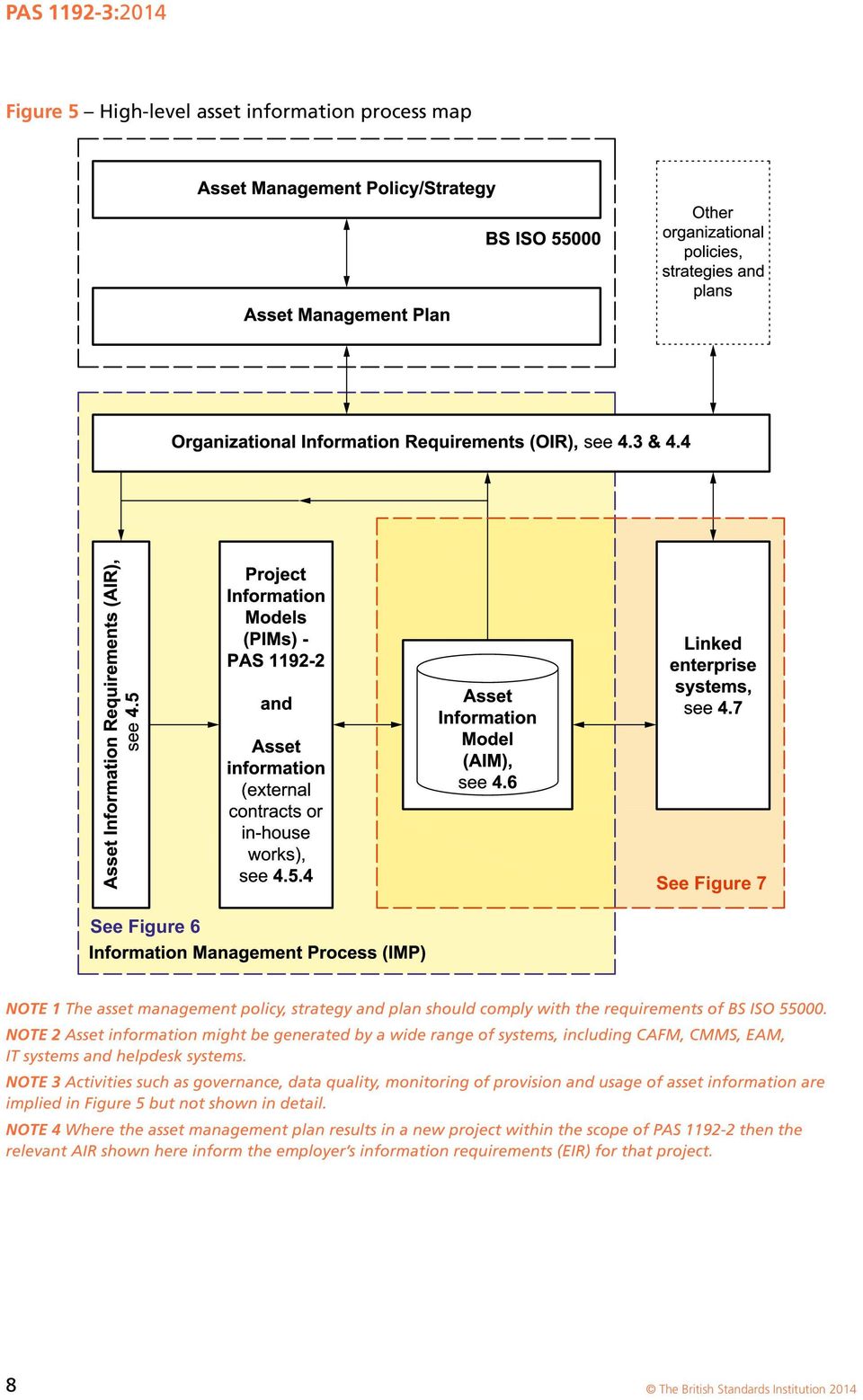
19 4 Asset information management process 4.1 General The requirements of this PAS shall apply to the organization responsible for managing an asset. The requirements of this PAS shall be achieved through the organization s direct actions or through delegated or sub-contracted authority. However, ultimate responsibility shall remain with the organization unless provided for differently by a legal or regulatory requirement. The organization shall establish, document, implement and maintain an information management process (IMP) in accordance with the requirements of this PAS. NOTE 1 Asset information should be controlled by a management system incorporating the requirements, processes and governance, suitable for the organization s needs and/or for the needs of its stakeholders. The IMP shall cover the operational lifecycle of the asset including, but not limited to, handover from design and construction, day-to-day operation of the asset, planned and reactive maintenance, minor works, major works, decommissioning, and dismantling or demolition. The IMP shall operate within or link with such enterprise systems or organizational functions as necessary to optimize the capture, processing, storage and analysis of the data and information specified in the asset information requirements (AIR) for the purposes of satisfying the organizational information requirements (OIR). NOTE 2 The boundary between asset information and other organizational information is not necessarily rigid. Effective organizational management may mean that asset management requires sources of information beyond the IMP or that other organizational management activities require asset information. NOTE 3 A high-level asset information process-map is shown in Figure 5. More detailed representations of parts of the process map are shown in subsequent Figures, and a detailed process map is shown in Figure 10. 7

20 Figure 5 High-level asset information process map See Figure 7 See Figure 6 NOTE 1 The asset management policy, strategy and plan should comply with the requirements of BS ISO NOTE 2 Asset information might be generated by a wide range of systems, including CAFM, CMMS, EAM, IT systems and helpdesk systems. NOTE 3 Activities such as governance, data quality, monitoring of provision and usage of asset information are implied in Figure 5 but not shown in detail. NOTE 4 Where the asset management plan results in a new project within the scope of PAS then the relevant AIR shown here inform the employer s information requirements (EIR) for that project. 8
21 4.2 Purpose of the information management process The information management process shall maintain the integrity of asset information to support the following activities related to asset management: a) defining asset management strategies and plans; b) implementing asset management plans; c) managing the asset lifecycle; d) acquiring and managing asset knowledge; e) managing the organization and its human resources; f) managing and reviewing risk. NOTE Limited guidance on the nature of these activities is given in Annex A. 4.3 Steps in the asset information management process The asset information management process shall comprise the following steps. a) Establish information governance processes to direct, control and assure that asset information is managed effectively as an organizational resource, with reference to any asset management strategies and plans. b) Establish the OIR based on the asset management activities identified in the policy, strategy and plan, which may be developed through BS ISO see 4.4. c) Define the AIR that shall be met, in order that the OIR can be satisfied, and the information exchanges by which data and information is transferred to and from the asset information model (AIM), see 4.5. NOTE The AIR may start as descriptive text, but should then be developed into a digital plan of deliverables. The effort to complete this should not be underestimated. d) Define the mechanisms for the creation, receiving, validating/verifying, storing, sharing, archiving, analyzing and reporting on the information and data to be held in the AIM. NOTE 1 See 4.6 and Annex B for example sets of procedures for asset-related events. NOTE 2 The CDE examples in Annex B show validation through the use of RAG reports, although other validation methods may be suitable. e) Define the interfaces for exchange of data and information between the AIM and other information systems used by the organization, see 4.7. f) Define the mechanisms for maintaining the AIM and for monitoring the quality, including referential integrity, of data and information within the AIM through use of the CDE. NOTE Where appropriate, ISO/TS should be used to establish data quality. The steps in the information management process shall be triggered by each asset-related event or the planning for such an event. NOTE A set of envisaged asset-related events are given in A.5. Other events not explicitly covered in A.5 can occur and the information management process (IMP) should also be applied in these cases. 4.4 Organizational information requirements (OIR) The organization shall determine, catalogue and maintain its requirements for information to meet the needs of its asset management system and other organizational functions. NOTE 1 Limited guidance on the nature of the activities to support this requirement is given in A.2. NOTE 2 Where the asset management plan results in a new project within the scope of PAS then the relevant OIR will inform the plain language questions referenced in PAS Asset information requirements (AIR) General Based on the OIR, specific AIR shall be specified as part of a contract or as an instruction to in-house teams and may use data and information from the AIM relating to the asset management activities being carried out. The AIR shall also specify data and information to be captured and fed into the AIM. Where the activities relate to major works covered by PAS , then the AIR will inform the EIR. NOTE See A.3 for a list of data and information types related to assets and asset management Classification The AIR shall require the organization to classify the data and information being put into the AIM according to an agreed classification system or through the structures of the data store and/or file store. NOTE 1 Classification is necessary to enable stored data and information to be searched and retrieved. NOTE 2 A number of classification systems are available. The choice of classification system should follow industry standards where possible, but should take account of the organization s specific needs. 9
22 4.5.3 Linkages between OIR, AIR and AIM The information requirements at an organizational level, the OIR, shall be conveyed to external contractors or in-house works teams through task- or project-specific AIR. These AIR shall form part of the specification for each asset-related contract or works. Where these contracts are managed in accordance with PAS then the AIR shall inform the development of the PAS EIR. The information required by the organization at each decision point shall be drawn from the AIM. If the information held within the AIM is not sufficient or suitable to satisfy the OIR then the organization shall amend the relevant AIR to acquire the necessary data and information Exchange of data and information with the AIM The exchange of data and information with the AIM shall be file-based and implemented through information exchanges between the information provider and the organization responsible for maintaining the AIM, as indicated by the green circles in Figure 6. NOTE 1 The content of the information exchanges should be sufficient to satisfy the requirements of 4.6.3, allowing for data and information that is already contained in the linked enterprise systems. The requirement for the process for data and information exchange to comply with ISO/IEC shall be considered by the organization defining the OIR and the AIR. The frequency and scope of each information exchange shall be defined in relation to each asset management event. The format of each information exchange shall be defined by the organization that has defined the OIR and the AIR. NOTE 2 Where COBie is used for information exchange then the content of the COBie files should be determined by the AIR. NOTE 3 Where appropriate, information received by a contractor or works team from the AIM may originate from the external enterprise systems to which the AIM is linked. NOTE 4 See also Clause Asset information model (AIM) Creation of the AIM The AIM shall be created in accordance with the organization s requirements. This shall be achieved through a variety of management activities, including some or all of the following: a) transfer of information and data from existing organizational systems into the AIM; b) recognizing or relabeling an existing data and information store as part of the AIM; c) collection of new or updated information and data from surveys of the physical asset; d) exchange of information and data with project information model(s) generated as a result of BIM Level 2 capital/delivery projects as specified by PAS Asset information shall not be considered as the AIM under this PAS until it has been authorized and accepted according to the information management process and flagged or transferred to the Published part of the common data environment (CDE) process. NOTE It might not be appropriate, cost-effective or possible to create the AIM through a single activity or programme of activities. The AIM may be progressively developed and enhanced as a phased and prioritized programme of activities in line with the OIR Data and information definitions The data and information definitions within the AIM shall enable the organization to meet its OIR. NOTE 1 The data and information definitions should also be consistent with those identified in BS 8210:2012 Clause 9, BS 8587:2012, Clause 5 and PAS 55-2:2008, The AIM shall also contain such data and information as shall be specified by the organization such as those headings listed in Annex A. The data and information definitions shall enable assets with multiple occupants and/or multiple uses to be recorded and analyzed. They shall also enable users of the AIM to understand the engineering, commercial or other reasons for the specification or installation of each significant asset. NOTE 2 Example processes to accept, verify, validate and authorize data and information are described in detail in Annex B. 10
23 Figure 6 Exchange of data and information with the AIM Data and information content All data and information related to or required for the operational phase of an asset shall be contained in or linked to the AIM. At BIM Level 2, the AIM shall be a federated model consisting of a number of discrete parts. The extent and nature of these parts shall be related to the complexity, purpose and scale of the asset. NOTE 1 The AIM should contain the following parts: a) information concerning the original brief, specification, design intent and analysis relating to the original installation of the asset and any subsequent changes; b) 3d object-based model(s) of the environment and location of the asset; c) information, or links to information, concerning the ownership of the asset and any rights or covenants associated with the asset; d) information, or links to information, concerning and data obtained from the maintenance, survey or other work carried out on the asset during its lifetime; e) information, or links to information, concerning and data obtained from monitoring the operation and condition of the asset, for example through a SCADA. NOTE 2 Information about an asset might not be available depending on its age, ownership history or other factors. Unavailable or incomplete information might concern the original installation or all the maintenance or other work carried out on an asset. NOTE 3 The organization should define the extent of the AIM, for example whether each asset has its own AIM or whether multiple assets are grouped into a single AIM. Within the AIM, data and information shall be stored in a data store and a file store respectively. The asset-related AIR shall be stored within the CDE. 11
24 4.6.4 Processes for maintaining the AIM The organization shall establish processes and procedures to cover the following aspects of maintaining the AIM: a) allocation of roles, responsibilities and authorities for the origination, generation, capture, maintenance, retention, transmission, access to, assurance and archiving of information and data; b) definition of the content, meaning, formats and medium for the representation, retention, transmission and retrieval for all information and data; c) requirements for information and data maintenance, including version control, integrity checks, validation against the AIR and other assurance activities; d) measuring, monitoring, reporting and continually improving the quality of information and data to support organizational needs; e) requirements for the generation, capture or importing of the identified items of information and data; f) requirements for the storage of information and data according to integrity, security and confidentiality requirements; g) requirements for disaster recovery, including the recovery point and the recovery time; h) retrieval, distribution and availability of information and data to designated parties as required by agreed schedules or defined circumstances; i) requirements for the archival of designated information and data, for example for the purpose of retaining audit records and knowledge preservation; j) requirements for the disposal of obsolete, unreliable or unwanted information and data in accordance with the organization s requirements and security and privacy requirements. NOTE 1 The detailed process for maintaining the AIM is illustrated through the CDE examples in Annex B. NOTE 2 The processes to accept, authorize and verify information within the CDE should occur every time information and data is received through an information exchange. NOTE 3 When information and data has passed the verification and validation process and has been accepted to be stored in the AIM, then the file store and data store should be updated accordingly. However, if verification and validation is not achieved then the information and data should be rejected, passed to the Archive area of the CDE for record purposes, and returned to the originator for resubmission. NOTE 4 The decision to dispose of data or information should be exercised with great care so that all foreseeable uses of the data or information have been considered, including by stakeholders outside the organization. Data and information shall be stored in a safe place, readily retrievable and protected from deterioration. Critical asset management records shall be protected from possible fire and other damage or loss as appropriate. The organization shall consider issues surrounding the holding and use of electronic records, e.g. legal constraints, storage media obsolescence, access controls. NOTE 5 Responsibility for managing and maintaining the AIM should be in accordance with ISO/TS Annex B, which describes the roles of data manager, data administrator and data technician. The information management process shall either: a) ensure that between the completion of a triggerrelated event and the next trigger the information held in the AIM gives a true picture of the state of the asset. A trigger-related event shall not be completed until the AIM has been updated to bring the relevant asset data and information back into alignment with the, now altered, state of the asset; or b) define the extent to which the asset information may be out of alignment with the state of the asset, particularly with reference to available resources for updating the AIM. While a trigger-related event is underway, the information management process shall ensure that asset information unrelated to the event remains in alignment with the state of the asset. 12
25 4.7 Links to existing enterprise systems General The information management process shall enable the AIM to link to existing enterprise systems. NOTE 1 See A.4 for a list of example enterprise systems. Some organizations may consider these or other existing enterprise systems to be part of the AIM, depending on the context and the requirements of their organization. NOTE 2 The purpose of links between the AIM and existing enterprise systems is to enable the organization to meet the OIR Interface between AIM and existing enterprise systems The interface between the AIM and the existing enterprise systems shall be implemented through twoway connectivity, see Figure 7. The interface shall push authorized data and information from the AIM to the appropriate enterprise systems as determined by the organizational requirements. The interface shall pull data and information from the appropriate enterprise systems into the AIM, whence it shall be available to external contractors or in-house works teams in support of the AIR for their contracts or works. NOTE 1 The IMP may allow external contractors or inhouse works teams to use a combination of data and information from the AIM and the enterprise systems. NOTE 2 The organization may implement the interface as remote calls to either the AIM or the enterprise systems. However, it is essential that data and information ownership and validation are assured. The organization should consider whether replication or transaction-based strategies are needed and implement appropriate validation and roll-back procedures as necessary. See also Figure 8, NOTE Asset management triggers The IMP shall be implemented in response to a set of triggers, which may occur at any time throughout the life of the asset, defined by the organization. NOTE See A.5 for a list of example triggers. Figure 7 Interface between the AIM and the existing enterprise systems 13
26 5 CDE and AIM 5.1 Processes to implement the CDE The organization shall implement processes to provide the CDE as shown in Figure 8 (which has been developed from Figure 9) in order to maintain integrity and control of the data and information throughout the supply chain. NOTE 1 The CDE provides a collaborative environment where the whole team can share work and forms the basis here for the information management process. The CDE could consist of more than one system configured to meet the requirements as defined in BS 1192:2007. BS 1192:2007 introduces the managed process within the CDE necessary for enabling the delivery of defined data sets for major works. This general process is reproduced here as Figure 9 for information. B.1 develops the CDE principles to show an example of the process of incorporating data and information in an AIM in this case as a result of a new major works project that concludes with a PIM. B.2 shows an example of transferring an external contract from one provider to another. NOTE 2 For the purposes of this PAS, the information management process deals with information as well as data. During the operational phase of an asset, the information management process can start at two points from a new asset via capital expenditure, or from an asset forming part of an existing portfolio or estate. NOTE 3 Annex B contains examples of the process for two specific triggers. NOTE 4 In the operational phase of the asset, the process within the CDE will vary depending on which trigger has occurred. 5.2 Use of the AIM An existing AIM shall be identified, or a new AIM shall be created, at the inception of a trigger-related event and shall be used: a) as a repository for all information about the event works; b) as a means to access links to the information about the event works, e.g. to/from linked enterprise systems; c) as the means to receive information from other parties throughout the project stages, up to acceptance of the as-built PIM (as specified in PAS ). NOTE 1 A detailed information management process map is shown in Figure 10. This brings together the elements illustrated in Figures 5, 6, 7 and 8. NOTE 2 From the earliest stage of a project or event works, information relevant to it should be sourced from existing assets in the case of a current portfolio or asset base, or created afresh in the case of a completely new project. This should start before a PIM has been created and so a repository is required to capture this early input. Typical examples may be business case reports carried out during the digital plan of work stage 0 in order to understand the need for the new asset and then to inform the project brief. Similarly, information can be captured from the operational side in order to help inform this process information such as previous history of the asset, site surveys and studies, utilities and services infrastructure, etc. In many cases the project might relate to existing assets and so a subset of the existing AIM should initially populate the project PIM. The project work might therefore require the existing AIM to be updated to reflect the status of the new project, clearly indicating the status of each asset, i.e. those to be constructed and those existing assets which will be modified/enhanced/replaced. However, it is important that the current status of the asset is clear at all times. NOTE 3 Once a project has commenced, there are points at which the delivery team are required to exchange information with the employer (or owner), and a method should be in place for the employer/owner to be able to receive this information, and to check and validate that information as described in 5.1. This situation would occur at PAS at the Decision Points 1, 2, 3, 6 and 7 in the case of the UK Government Client. NOTE 4 To provide a repository for project information, the AIM should be created at the inception of the project, before any other parties are involved. This can then be operated alongside the PIM and used by the client/owner to process information received throughout the project. This could be the area represented in Figure 10 by the client shared area. Using the AIM in this way provides the benefits of ensuring a single truth, where all information is in one place. NOTE 5 The AIM can act as an information source for purposes other than construction works. 14
27 Figure 8 Process map within the CDE NOTE 1 In some cases the shared and client shared areas may be the same, depending on the practices of the organisation. NOTE 2 Gates are numbered to follow on from those described in PAS NOTE 3 The external AIM shown on the left of Figure 8 is any AIM acting as a source or a recipient of data or information which is being managed within the CDE. NOTE 4 The two-way connection between external enterprise systems and the CDE verified gate (gate 8) assumes that the external systems have equivalent approval, authorization and verification processes to that shown in the CDE. If this is not the case then information received from external enterprise systems should be routed to the client shared area, from where it can be verified and validated against the AIR and authorized through gate 7. NOTE 5 The shared area is a sub-set of the client shared area. The shared area is accessible to the information providers. The client shared area is also accessible to the owner or operator. NOTE 6 The published area in Figure 8 represents the AIM. 15
28 Figure 9 The common data environment extracted from PAS
29 PAS :2014 Figure 10 Ensuring data and information governance and assurance NOTE The PUBLISHED area in Figure 10 represents the AIM. 17
30 6 Roles and responsibilities Roles and responsibilities for information management as defined in this PAS shall be set out in the contract(s) between the owner or operator and the maintainer(s). NOTE 1 Examples of different contractual arrangements are shown in Annex C and examples of roles for different organizations in response to different triggers or trigger-related events are shown in Annex D. NOTE 2 In accordance with ISO/TS , a data manager should have the responsibility for accepting information into the shared area of the CDE and for authorizing it for the published area. The role of the data manager shall be filled at all times by one person, or more than one person in succession, from either the owner or from the operator. For large or complex assets there is likely to be more than one data manager due to the volume or nature of data tasks. However, there will ultimately need to be one point of responsibility for this role for the whole of the IMP. An equivalent role in managing asset information may be the asset information manager. NOTE 3 In many organizations the roles of data manager and asset information manager may be executed by the same individual and may include information management as defined in PAS NOTE 4 One method for clarifying roles and responsibilities is to use the RACI indicators ( R to identify the responsible party, A the authorizing party, C the contributing parties and I the parties to be kept informed). 18
31 7 Information exchange 7.1 Information exchange processes and content Information exchanges shall be carried out in accordance with the requirements of the AIR. The AIR shall define the structure, process and content of information to be exchanged. NOTE 1 The preparation of the AIR needs to consider the operations of the organization, including the activities it carries out and the tools and systems used to manage those activities, and the organization as a whole. Information exchanges should be arranged to provide information for key decision making points. NOTE 2 See also The information identified by the organization shall be of a quality appropriate to the asset management decisions and activities it supports, and appropriate to the operation, maintenance and management of the asset. NOTE 1 The type of information required at each information exchange will be different depending on the nature and practices of the organization. These should be clearly understood, and should be defined at the strategy stage of any new works. A key part of this will be appreciating which information the operational team need to carry out their activities, and also the format it needs to be in. NOTE 2 Each information exchange will be specified by the outsourced contract/in-house works which will be set up to satisfy the particular AIRs. All AIRs taken together will express the whole requirement at any one time The method of information exchange shall be compatible with the systems and processes operated by the organization in order to ensure that the material can be checked, validated and then be made use of in the day to day operations. NOTE 1 COBie is the method of information exchange to be used on UK Government mandated projects. However, for other applications any procedure may be adopted which allows for the effective capture and transfer of the information required at each exchange point, as well as facilitating its checking and validation. NOTE 2 A definition of the information requirements leading up to handover and post-occupancy evaluation of a capital/delivery project is in preparation as BS , Collaborative production of architectural, engineering and construction information Client information requirements. This should be published in summer This standard will specify mandatory requirements and recommend best practice for BIM Levels 1, 2 and 3. BS will support the implementation of COBie and will also reference to IFC and IFC XML. 19
32 Annex A (informative) Guidance related to the information management process A.1 General This Annex contains guidance to amplify the requirements contained in Clause 4, to give those implementing this PAS some idea of what those requirements are intended to cover. Much of the detail is adapted from PAS NOTE Although PAS 55 has been superseded by the BS ISO series, PAS 55 had not been withdrawn at the time of writing and much of the content remains valid. A.2 Specific asset management activities The following activities support the high-level activities contained in 4.4: asset accounting, activity costing, forecasting; planning and budgeting; demand management and customer expectation policy; capital investment and life cycle costing; innovation and change management; interfacing with regulatory bodies; asset operation or utilization; asset modifications, refurbishment, replacement, reuse/redeployment, disposal, recycling; spares, materials and purchasing; data, information and knowledge management; contractor and supplier management; human resources, skills development and competencies; maintenance, inspection, condition and performance monitoring; contingency planning and emergencies; energy efficiency and environmental aspects, e.g. renewable resources, recycling, waste management, air purity, hygiene; risk assessment and management; safety, health and environmental management. NOTE 1 The asset management activities above are adapted from PAS 55-2: i). The following activities may assist in the definition of the OIR from 4.4: optimizing the asset management strategy and optimizing/prioritizing its asset management plan(s); assessing the financial benefits of planned improvement activities; modelling the asset to support operational decision making; determining the operational and financial impact of asset unavailability or failure; making life cycle cost comparisons of alternative capital investments; identifying expiry of warranty periods; determining the end of an asset s economic life, e.g. when the asset related expenditure exceeds the associated income; determining the cost of specific activities (activity based costing), e.g. the total cost of maintaining a specific asset(s)/asset system; obtaining/calculating asset replacement values; undertaking financial analysis of planned income and expenditure; obtaining/calculating the financial and resource impact of deviating from plans that might result in a change in asset availability or performance (e.g. what is the financial impact of deferring the maintenance of a specific generator by six months?); assessing its overall financial performance; undertaking the on-going identification, assessment and control of asset related risks. NOTE 2 The OIR above are taken from PAS 55-2:2008, 4.4.6a). NOTE 3 Some of these OIR might not be applicable to all organizations. 20
33 A.3 Specific asset information requirements Example asset information requirements combining BS 8587 and PAS 55-2 are listed as follows: a) Legal information: details of ownership and maintenance demarcation where assets interface across a system or network of assets; work instructions together with diagrams and reporting requirements, legal obligations such as health and safety file information, and safety/ environmental considerations; asset related contractual information; task risk assessments and control measures. b) Commercial information: descriptions of assets and the asset systems they serve; functions of assets, including any interdependencies to the activities that require them; vendor data (details of the organization that supplied the asset) including asset lead time; the condition and duty of assets including intensity of use; key performance indicators; condition and performance targets or standards; criteria of non-conformance and the actions to be taken; the criticality of assets and spaces to the organization; identities and levels of spares held, inter-changeability, specifications and storage locations. c) Financial information: financial data including, where available, whole life costs of asset deployment including cost of historical and planned maintenance tasks, operating costs, downtime impact, current asset replacement value, original purchase/leasing cost. d) Technical information: engineering data and design parameters; details of asset dependencies and interdependencies; commissioning dates and data; operational data including performance characteristics and design limits. e) Managerial information: unique asset identification numbers; locations of the assets, possibly using spatial referencing or geographical information systems; spatial data relating to assets, for example pavement areas, room sizes; warranties and guarantee periods; access planning and work schedules; when assets were last maintained/inspected and when these tasks are next due; list of overdue/outstanding tasks; historical record of planned and unplanned maintenance tasks performed, details of the tasks to be carried out; asset related standards, process(es) and procedure(s); the presence of any hazardous contents or waste; details of asset destination at end of current life; details of emergency plans including responsibilities and contact details; details of historical asset failures, causes and consequences (if known). NOTE These AIR are adapted from PAS 55-2:2008, 4.4.6b) and BS 8587:2012, Clause 5 and are indicative only. A.4 Example enterprise systems that may be linked to the AIM The nature and extent of existing systems that the organization may link to the AIM may vary. Example enterprise systems are listed as follows: document management systems; work/programme planning and scheduling systems; materials management and spares inventory systems; purchasing systems; accounting and financial planning systems; asset utilization systems; property systems; engineering design and modelling systems; performance reporting systems; condition monitoring systems; geographical information systems (GIS) and spatial analysis toolkits (for the analysis of GIS data); asset possession/shutdown/outage planning systems; SCADA; knowledge management systems; staff location, scheduling and despatch systems. NOTE These existing enterprise systems are adapted from PAS 55-2:2008, 4.4.6b). 21
34 A.5 Example triggers The types of triggers for which the information management process should be operated will be defined by the organization. Example triggers are listed as follows: The organization s receipt of information provided at information exchanges during major works, including the capital/delivery phase of a project delivering a new asset; The organization s decision to manage information relating to an existing asset according to PAS ; Performance evaluation of an asset, including failure trends from similar components used elsewhere and experience-based learning and feedback from asset performance; Maintenance work on an asset, whether planned or reactive; Minor works on an asset, such as minor repairs, component replacements or minor upgrades; Major works on an asset such as major repairs, refurbishments or major upgrades; Asset replacement; End-of-life works, such as decommissioning, demolition or moth-balling; Planning for and, where appropriate, implementing an emergency response; Risk assessment of an asset; Change in value of an asset; Change in regulations applying to an asset; Change in organizational requirements relating to the asset; Change in ownership of an asset; Change in operator of an asset; Change in maintainer of an asset. NOTE The specific information management processes for the first and last of the listed triggers are described in Annex B. Similar processes should be defined by the organization to apply the same principles to the other triggers that are appropriate for them. 22
35 Annex B (informative) Examples of the CDE in use B.1 Example 1, transferring a PIM into the AIM NOTE This example demonstrates the process for taking a PIM into the operational CDE as the basis of the AIM, and is reflected in Figure 8. The example is more specific about the nature of the organization and hence uses the terms owner and operator. B.1.1 WORK IN PROGRESS B The work in progress (WIP) area of the CDE should be used to hold unapproved information for each organizational role. NOTE 1 The WIP area represents information generated from a number of parties, all involved in a particular project or activity. For example, this can be survey reports, site investigations, digital scanning surveys or any other source information which might be used to contribute to a wider activity. These parties may be external consultants or contractors, or people from within the client s own organization. NOTE 2 AIMs for existing assets may be received from other organizations as a result of transfer of assets. NOTE 3 The WIP area concludes with the Approval Gate ( 6 in Figure 8) which represents the transition to SHARED, where the information is checked, reviewed and approved by the person in charge of that particular activity. This responsibility should be made clear within each of the individual organizations/client departments. B The PIM used as the basis for the AIM should include only the objects or elements representing what has actually been constructed, which shall replace those objects or elements representing design intent. NOTE 1 The PIM will typically be a subset of the AIM, where a project covers only part of an organization s asset portfolio. NOTE 2 The PIM will represent what has actually been installed and not what the designers intended. Therefore the party responsible for delivering the PIM should ensure that the PIM includes information such as model, performance, supplier/manufacturer rather than the generic information provided originally by the designers. Changes between the design intent and the installed arrangement may include re-routing of services due to physical site constraints, an alternative design solution due to value engineering, to reflect design errors, etc. B.1.2 SHARED and CLIENT SHARED NOTE SHARED may be interpreted as being the status of the file rather than being moved across the system. This will prevent multiple copies of files and allow archiving of data with subsequent revisions/versions. B To pass through the Approved Gate (Gate 6) a check, review and approval process should be carried out before information is issued to the SHARED area. The checks should include: a) model suitability check; b) technical content check; c) information exchange; d) drawings extract checks along with any additional documentation that is shared as a co-ordinated package of information. NOTE The checks for a particular project or activity can change depending on the nature of the information exchanged. The checks for each exchange should be clearly identified in the AIR. B The SHARED area of the CDE should be used to hold information which has been approved for sharing with other organizations/parties to use as reference material for their own activity development. When all activities, including co-ordination and clash checking on the 3D models, have been completed, the information should be placed in the CLIENT SHARED area. B To pass through the Authorized Gate (Gate 7) the information in the CLIENT SHARED area should be authorized by the owner or the operator. NOTE Published documentation includes specifications, reports, O&M manuals, visualizations, 3D models, maintenance schedules, etc. This represents the transition to PUBLISHED. B Checks for authorization should include validation and verification for compliance with the AIR deliverables and completion of the Plain Language Questions (where applicable). Accepted information and data should be transferred to the PUBLISHED area. NOTE Some information may be commercially sensitive, or have security implications, and as such access to this might need to be controlled. Therefore, it might be necessary to provide separate areas within the AIM Published area which are capable of restricting access to certain data or information. 23
36 B Information rejected at this stage should be transferred to the ARCHIVE area in order to contribute to the full project/asset information history. B As part of this process a RAG validation report should be produced and passed to the CLIENT SHARED area. Details of information or data rejected at this stage should be passed back to the contractor or works team. B The Authorized Gate (Gate 7) should be used for information to be validated when it is delivered as an AIM for use in operation of the asset. B The Authorized Gate (Gate 7) should represent validated information for delivery to an AIM for use in operation of the asset. NOTE 1 This process will be iterative if the sign-off process finds that the requirements for the information exchange have not been met. NOTE 2 Information to be validated will often not be the entire AIM as the project may have been dealing with a subset of the whole asset inventory. B.1.3 PUBLISHED NOTE PUBLISHED may be interpreted as being the status of the file rather than being moved across the system. This will prevent multiple copies of files and allow archiving of data with subsequent revisions/versions. B The PUBLISHED area of the CDE should be used to hold the published information. Information in the PUBLISHED area that is superseded by new information should be moved to the ARCHIVE area. NOTE The published area concludes with the Verified Gate (Gate 8). B The verified information from the PUBLISHED area should be available to support the AIR, and the OIR as well as the linked enterprise systems. NOTE 1 The verified information from the PUBLISHED area can be used for meeting the AIR in the Client Shared Area. NOTE 2 The verified data from the PUBLISHED area can be used to populate the AIM database, used as the repository for supporting the day-to-day asset management activities. NOTE 3 The verified information from the PUBLISHED area can be used for informing the linked enterprise systems and also the OIR, related to other organizational operations and activities. In the case of the linked enterprise systems, this may be a two way process, assuming that the information in the linked enterprise systems has undergone a similar control process. B The PUBLISHED area should be maintained in two parts: File Store to hold all PUBLISHED Level 2 files such as documents, geographic models and non-geographic structured data files, and the Data Store to hold all non-geographic structured data as a data model, such as a relational object database. The two parts should be referentially and relationally maintained so an object in the Data Store can reference a model or document in the File Store. The references in the Data Store can also be external. B.1.4 ARCHIVE NOTE ARCHIVE may be interpreted as being the status of the file rather than being moved across the system. This will prevent multiple copies of files and allow archiving of data with subsequent revisions/ versions. B The ARCHIVE area of the CDE is for inactive or superseded material and should be used to record all progress through each information exchange and should hold a record of all transactions and change orders and may provide an audit trail in the event of a dispute. B In addition, checked and verified as-constructed information in the PUBLISHED area should be passed to the ARCHIVE area once it has been superseded. B The ARCHIVE area within the AIM should include all information from the PIM archive area. NOTE It is important that all information produced throughout the briefing, design and construction phases of an asset are captured and made available to the asset operators. Information used as the basis for design decisions might not be required for the daily operation of the asset, but might be needed for future remodelling or if performance issues are experienced with the asset. However, the archive needs to be actively managed, aligned with the asset information management requirement. B The ARCHIVE should be maintained in two parts: File Store to hold all ARCHIVE Level 2 files such as documents, geographic models and non-geographic structured data files, and the Data Store to hold all non-geographic structured data objects, each maintaining the record of instance of the move to the ARCHIVE area to deliver a full file and data object history archive. 24
37 B.2 Example 2, transferring the AIM from one service provider to another NOTE 1 This example represents the process for taking an AIM used for a particular operations contract (contract AIM) into the operational CDE at the end of the contract, such as when the service provider is to change. Terms and Gate references used here relate to those shown in Figure 8. The example is more specific about the nature of the organization and hence uses the terms owner and operator. NOTE 2 As the contract AIM exists and forms a record data set, it will not pass through the Work in progress area and Gate 6. Therefore, it will be passed directly into the CLIENT SHARED area to undergo the authorized/verified process. B.2.1 CLIENT SHARED NOTE CLIENT SHARED may be interpreted as being the status of the file rather than being moved across the system. This will prevent multiple copies of files and allow archiving of data with subsequent revisions/versions. B The contract AIM being passed to the CLIENT SHARED area should represent the status of the relevant asset at that point in time. NOTE 1 The contract AIM will typically form a subset of the organization s AIM, where a project covers only part of an organization s asset portfolio. NOTE 2 The contract AIM will represent what actually exists within the asset as opposed to what existed when the contract started. Therefore, the service provider should ensure that the contract AIM accurately reflects all applicable works which have been carried out during the life of the contract. B To pass through the Authorized Gate (Gate 7) the information in the CLIENT SHARED area should be authorized by the owner or the operator. NOTE Published documentation includes specifications, reports, O&M manuals, visualizations, 3D models, maintenance schedules, etc. This represents the transition to PUBLISHED. B Checks for authorization should include validation and verification for compliance with the AIR and OIR deliverables. Accepted information should be transferred to the PUBLISHED area. Accepted data should be transferred to the AIM database. NOTE Some information might be commercially sensitive, or have security implications, and as such access to this may need to be controlled. Therefore, it may be necessary to provide separate areas within the AIM Published area and database which are capable of restricting access to certain data or information. B Information rejected at this stage should be transferred to the ARCHIVE area in order to contribute to the full project/asset information history. B As part of this process a RAG validation report should be produced and passed to the CLIENT SHARED area. Details of information or data rejected at this stage should be passed back to the contractor or works team. B The Authorized Gate (Gate 7) should be used for information to be validated when it is delivered as an AIM for use in operation of the asset. NOTE 1 This process will be iterative if the sign-off process finds that the requirements for the information exchange have not been met. NOTE 2 It will often not be the entire AIM as the project may have been dealing with a subset of the whole asset inventory. B.2.2 PUBLISHED NOTE PUBLISHED may be interpreted as being the status of the file rather than being moved across the system. This will prevent multiple copies of files and allow archiving of data with subsequent revisions/versions. B The PUBLISHED area of the CDE should be used to hold the published information. Information in the PUBLISHED area that is superseded by new information should be moved to the ARCHIVE area. NOTE The published area concludes with the Verified Gate (Gate 8). 25
38 B The verified information from the PUBLISHED area should be available to support the AIR, the OIR and the linked enterprise systems. NOTE 1 The verified information from the PUBLISHED area can be used for meeting AIR in the CLIENT SHARED area. NOTE 2 The verified data from the PUBLISHED area can be used to populate the AIM database, used as the repository for supporting the day-to-day asset management activities. NOTE 3 The verified information from the PUBLISHED area can be used for informing the linked enterprise and also the OIRs, related to other organizational operations and activities. In the case of the linked enterprise systems, this might be a two way process, assuming that the information in the linked enterprise systems has undergone a similar control process. NOTE 4 The verified information from the PUBLISHED area can be used as the AIM for the incoming service provider. B.2.3 ARCHIVE NOTE ARCHIVE may be interpreted as being the status of the file rather than being moved across the system. This will prevent multiple copies of files and allow archiving of data with subsequent revisions/versions. B The ARCHIVE area of the CDE is for inactive or superseded material and should be used to record all progress through each information exchange and should hold a record of all transactions and change orders and should provide an audit trail in the event of a dispute. B In addition, checked and verified as-constructed information in the PUBLISHED area should be passed to the ARCHIVE area once it has been superseded. B The ARCHIVE area within the AIM shall include all information from the PIM archive area. NOTE It is important that all information produced throughout the briefing, design and construction phases of an asset are captured and made available to the asset operators. Information used as the basis for design decisions might not be required for the daily operation of the asset, but might be needed for future remodelling or if performance issues are experienced with the asset. However, the archive should be actively managed and aligned with the asset information management requirements. 26
39 Annex C (informative) Contractual scenarios C.1 Background Examples are included here for common contractual scenarios related to the management of assets. These have been shown in two distinct groups (C.1 buildings and C.2 infrastructure) in order to reflect the practices in the two asset areas. The purpose of these scenarios is to explain where the organization (to which this PAS is directed) could be in the supply chain. Each of the contractual scenarios described should be arranged so as to make the provision of PIMs/AIMs possible throughout the life of the asset, passing from one organization to the next in order to provide and maintain a full asset information data set. C.2 Contractual scenarios related to management of buildings C.2.1 General There are a variety of contractual arrangements between parties involved in asset delivery projects, and some of these are described in this clause. These arrangements will ultimately determine the way the operations teams are appointed/engaged. Contractual arrangements need to be carefully considered for each of these scenarios, and care should be taken to ensure duplication of responsibility is avoided whilst making sure that all relevant issues and duties are covered. These scenarios illustrate how responsibility for different parts of the asset information management system may change under different contractual conditions. For each of these scenarios there is an equivalent situation where the asset is already owned, and the project is to redevelop it. C.2.2 Develop, own, operate scenario The first scenario described is where an owner will retain control of an asset once it has been constructed. The owner engages a supply chain to deliver an asset construction project. The delivery supply chain task team undertake to provide the asset to the owner via a contract between the two parties. The owner then engages an operator supply chain to manage the asset once it has been completed and successfully handed over. The operator supply chain is engaged via a contract with the employer. C.2.3 Develop, own, let scenario In the second scenario, here the owner will let out the asset to a tenant once it has been completed, becoming a landlord. As in the first scenario the owner has engaged the supply chain to provide the asset. Once the asset has been handed over, the employer lets the asset to tenants. This arrangement results in the possibility of split responsibilities for the operation of the asset, the landlord will retain responsibility for the operation and maintenance of the common areas whereas the various tenants will be responsible for their own particular areas. In this case there may be a number of contracts for maintenance or operation awarded on the same asset. C.2.4 Develop, own, sell scenario In this case the developer sells off the asset to an owner or landlord after completion. The owner may choose to use the asset himself, or may choose to let it to tenants. This may also result in split responsibilities for the operation and maintenance of the asset, with the landlord and tenants each making arrangements with operator supply chains. C.3 Contractual scenarios related to management of infrastructure C.3.1 Background As with the contractual scenarios described in C.1, there are a range of scenarios which relate to the management of infrastructure. Also as described in C.1, these arrangements will determine the way the operations teams are appointed/engaged. C.3.2 Own, change, own scenario This is where an asset owner identifies the need for works to be carried out to an existing asset. 27
40 An example may be where the owner of an existing asset in this case a bridge identifies that the deck needs to be replaced. The owner arranges for a contracted party to replace the deck part of the bridge system, and the bridge is then handed back to the operational part of the organization on completion. C.3.3 Develop, transfer, own scenario In this case a developer builds an asset in support of a wider project, transfers the operation of the asset to a third party which takes on ownership of the asset. The example used here is where a construction company builds a sewerage network to support a new housing development. On completion the network is transferred to the local water supply authority which takes on the ownership and its operational responsibilities. It is also common practice for the ownership of roads within housing estates to be transferred from the developer to the local authority on completion, with the local authority taking on the maintenance obligations. C.3.4 Own, enhance, own scenario Here an asset owner wants to enhance an existing asset which it will retain ownership of. In this example, the owner of an existing motorway needs to increase the capacity and opts to widen it. The owner contracts an external organization to carry out the widening works and then takes back the motorway on completion. C.3.5 Own, transfer, operate/maintain, transfer, own (DBFO) scenario This deals with a situation whereby an asset is transferred to an operator for a set period and then handed back to the owner at the end. An example may be where an existing road network is transferred to a maintainer under a franchise agreement. The maintainer will be responsible for bringing the network up to a good standard, carry out ongoing maintenance for the period of the franchise, and then ownership of the network will revert to the original owner at the end of the franchise period. This scenario is also called DBFO (design, build, finance, operate). 28
41 Annex D (informative) Responsibilities for information management processes D.1 General An example of organizational responsibilities for information management in connection with different triggers or trigger-related events is shown in Table D.1. Table D.1 Summary of stakeholder roles and responsibilities Trigger or 1related event Owner Operator Maintainer Other (specified) Undertaking a project operating to PAS Update AIM from information received from the major works design and contractor leads Make AIM available to the Operator Receive access to AIM from the Owner Make AIM available to the Maintainer Receive access to AIM from the Operator Major works design and contractor leads: Supply information to the Owner Developing an AIM for an existing asset Create or commission the creation of the AIM Make AIM available to the Operator Receive access to AIM from the Owner Make AIM available to the Maintainer Receive access to AIM from the Operator Day-to-day operation of an asset Update the AIM with operational data and information Update the AIM with operational data and information Supply information to the Operator or Owner for updating Planned and reactive maintenance of an asset Update the AIM with data and information provided by the Maintainer (for assets managed by the Owner) Update the AIM with data and information provided by the Maintainer (for assets managed by the Operator) Provide data and information related to maintenance activities to the Owner or Operator as appropriate Carrying out minor works on an asset Update the AIM with data and information provided by the works contractor (for assets managed by the Owner) Update the AIM with data and information provided by the works contractor (for assets managed by the Operator) Works contractor: Provide data and information for the AIM to the Owner or Operator as appropriate Carrying out major works on an asset Update the AIM with information provided by the design lead and/or contractor lead for the works (for assets managed by the Owner) Update the AIM with information provided by the design lead and/or contractor lead for the works (for assets managed by the Operator) Design lead and/ or contractor lead: Provide data and information from the works End-of-life of an asset Update the AIM with data and information related to the end-of-life Make AIM available to the Operator if the Operator still has an interest in the asset portfolio Receive access to updated AIM if the Operator still has interest in the asset portfolio End-of-life contractor: Provide data and information to the Owner Realigning the AIM Update the AIM with information related to all events since the last alignment Update the AIM with information related to all events since the last alignment 29
42 Bibliography Standards publications BS 1192:2007, Collaborative production of architectural, engineering and construction information Code of practice BS ), Collaborative production of architectural, engineering and construction information Client information requirements BS :2004, BS ISO :2004, Building and civil engineering Vocabulary Part 1: General terms BS 8210:2012, Guide to facilities maintenance management BS 8536:2010, Facility management briefing Code of practice BS 8572:2011, Procurement of facility-related services Guide BS 8587:2012, Guide to facility information management BS ISO :2011, Buildings and constructed assets Service life planning Part 1: General principles and framework BS ISO 55001:2014, Asset management Management systems Requirements BS ISO 55002:2014, Asset management Management systems Guidelines for the application of ISO BS ISO/IEC 27001, Information technology Security techniques Information security management systems Requirements ISO/TS :2011 Ed 1, Data quality. Part 150: Master data. Quality management framework Other publications [1] Institute of Asset Management, Asset management an anatomy, Version 1.1, Bristol, UK: IAM, [2] SKYRME, D.J. and D.M. AMIDON. Knowledge management. Institute of Management, Corby, Further reading BS 8544, Guide for life cycle costing of maintenance during the use phases of buildings BS EN 13460, Maintenance Documentation for maintenance BS EN 15331, Criteria for design maintenance and control of maintenance services for buildings Building Information Modelling The Digital Plan of Work & Assemblies, Construction Industry Council. Building Information Model (BIM) Protocol. First edition, UK: CIC, Construction Industry Council. Outline Scope of Services for the Role of Information Management, UK: CIC, COBie-UK-2012, Reference documentation, RICHARDS, M. Building Information Management A Standard Framework and Guide to BS London, UK: BSI, WAY, M., B. BORDASS, A. LEAMAN and R. BUNN. Soft Landings Framework, UK: BSRIA, PAS 55-1:2008, Asset management Part 1: Specification for the optimized management of physical assets PAS 55-2:2008, Asset management Part 2: Guidelines for the application of PAS ) In preparation 30
43 British Standards Institution (BSI) BSI is the independent national body responsible for preparing British Standards and other standards-related publications, information and services. It presents the UK view on standards in Europe and at the international level. BSI is incorporated by Royal Charter. British Standards and other standardization products are published by BSI Standards Limited. Revisions British Standards and PASs are periodically updated by amendment or revision. Users of British Standards and PASs should make sure that they possess the latest amendments or editions. It is the constant aim of BSI to improve the quality of our products and services. We would be grateful if anyone finding an inaccuracy or ambiguity while using British Standards would inform the Secretary of the technical committee responsible, the identity of which can be found on the inside front cover. Similarly for PASs, please notify BSI Customer Services. Tel: +44 (0) Fax: +44 (0) BSI offers BSI Subscribing Members an individual updating service called PLUS which ensures that subscribers automatically receive the latest editions of British Standards and PASs. Tel: +44 (0) Fax: +44 (0) Buying standards You may buy PDF and hard copy versions of standards directly using a credit card from the BSI Shop on the website In addition all orders for BSI, international and foreign standards publications can be addressed to BSI Customer Services. Tel: +44 (0) Fax: +44 (0) [email protected] In response to orders for international standards, BSI will supply the British Standard implementation of the relevant international standard, unless otherwise requested. Information on standards BSI provides a wide range of information on national, European and international standards through its Knowledge Centre. Tel: +44 (0) Fax: +44 (0) [email protected] BSI Subscribing Members are kept up to date with standards developments and receive substantial discounts on the purchase price of standards. For details of these and other benefits contact Membership Administration. Tel: +44 (0) Fax: +44 (0) [email protected] Information regarding online access to British Standards and PASs via British Standards Online can be found at Further information about British Standards is available on the BSI website at Copyright All the data, software and documentation set out in all British Standards and other BSI publications are the property of and copyrighted by BSI, or some person or entity that owns copyright in the information used (such as the international standardization bodies) has formally licensed such information to BSI for commercial publication and use. Except as permitted under the Copyright, Designs and Patents Act 1988 no extract may be reproduced, stored in a retrieval system or transmitted in any form or by any means electronic, photocopying, recording or otherwise without prior written permission from BSI. This does not preclude the free use, in the course of implementing the standard, of necessary details such as symbols, and size, type or grade designations. If these details are to be used for any other purpose than implementation then the prior written permission of BSI must be obtained. Details and advice can be obtained from the Copyright & Licensing Department. Tel: +44 (0) [email protected] 31
44 Peter Hansford Chief Construction Advisor The HM Government s Building Information Modelling (BIM) Programme which has a target to have all centrally-procured Government projects adopt BIM Level 2 by 2016 has been called one of the most ambitious and advanced policy-driven programmes in the world. It is one in which the UK can take on a global leadership role in BIM exploitation. The BIM Programme is also an integral part of the joint industry-government Industrial Strategy for Construction, Construction 2025, an enabler of our ambition to achieve significant improvements in cost, value and carbon performance during construction and operation. By working in a collaborative, digitally-enabled environment, we can remove waste and help achieve better asset outcomes throughout all stages of the asset life-cycle. PAS :2013 looks at the capital delivery phase and builds on the collaborative processes of BS 1192:2007. This document PAS :2014 is a companion to PAS and reminds us that we design and construct to enable the successful operation of assets that support society in a way that is economically and environmentally sustainable. I believe that to achieve that aim requires operational data that is drawn from all relevant sources, stored in an accessible location and is correct, up to date, and can be processed quickly to answer the strategic questions of the organisation. Mark Bew Chair of the HM Government BIM Task Group Standards play an important role in enabling the wider adoption of BIM technologies, processes and collaboration by ensuring that the same accurate data can be accessed throughout the supply chain. The standardization of Level 2 BIM will help HM Government and industry alike reduce cost significantly and enable future industry growth. PAS :2014 plays an integral role in the adoption of digital techniques in the asset management and facility management communities which represent such a large and important part of the built environment sector. The Industrial Strategy Construction 2025 calls for future whole life cost savings of up to 33% and the application of digital capabilities such as those described in PAS is a part of achieving that target. Please refer to for updates and other documents. The site also provides help such as lessons learned and access to the BIM4 communities. PAS provides a framework upon which to build a digital asset information model to support the operational information management process. I believe that collaborative BIM working processes and the data rich technologies that support them are fundamental for economic growth in both our domestic and international construction markets. It is therefore essential that we are adequately equipped to ensure the UK is at the frontline of this global shift in how we create, operate, maintain and de-commission our built environment. ISBN BSI, 389 Chiswick High Road London W4 4AL United Kingdom
PAS 1192-3:2014. Specification for information management for the operational phase of assets using building information modelling
 Specification for information management for the operational phase of assets using building information modelling Publishing and copyright information The BSI copyright notice displayed in this document
The Asset Information Model using BIM
 AIM - PAS 1192:3:2014 The Asset Information Model using BIM Figure 1 PAS1192-2 and PAS1192-3 by: Rob Manning BIS BIM Task Group Introduction In this article we look at how the approach outlined in document
PAS 1192-3 Specification for information management for the operational phase of assets using building information modelling
 PAS 1192-3 Specification for information management for the operational phase of assets using building information modelling David Churcher - Hitherwood Consulting John Sands - BSRIA 1 PAS 1192-3 Overview
Specification for information management for the capital/delivery phase of construction projects using building information modelling
 Incorporating Corrigendum No. 1 Specification for management for the capital/delivery phase of construction projects using building modelling Publishing and copyright The BSI copyright notice displayed
Quick Guide: Meeting ISO 55001 Requirements for Asset Management
 Supplement to the IIMM 2011 Quick Guide: Meeting ISO 55001 Requirements for Asset Management Using the International Infrastructure Management Manual (IIMM) ISO 55001: What is required IIMM: How to get
TECHNICAL SPECIFICATION
 TECHNICAL SPECIFICATION IEC/TS 62443-1-1 Edition 1.0 2009-07 colour inside Industrial communication networks Network and system security Part 1-1: Terminology, concepts and models INTERNATIONAL ELECTROTECHNICAL
ITIL Managing Digital Information Assets
 ITIL Managing Digital Information Assets Shirley Lacy, ConnectSphere Frieda Midgley, Digital Continuity Project Judith Riley, Digital Continuity Project Nigel Williamson, Digital Continuity Project White
AEROSPACE STANDARD. Quality Management Systems - Requirements for Aviation, Space and Defense Organizations RATIONALE
 AEROSPACE STANDARD AS9100C Issued 1999-11 Revised 2009-01 Superseding AS9100B Quality Management Systems - Requirements for Aviation, Space and Defense Organizations RATIONALE This standard has been revised
The Performance Gap. Is there a performance gap and if so is there a solution? Rob Manning. BSc(Hons) CEng FCIBSE. BIS BIM Core Team.
 The Performance Gap. Is there a performance gap and if so is there a solution? Rob Manning. BSc(Hons) CEng FCIBSE. BIS BIM Core Team. The performance gap are construction customers getting the assets
Legal, Contractual Considerations with BIM 360 Review
 PAK/902/11 February 2016 Rev02 Philip King, Hilson Moran CIBSE BIM Steering Group - 360 Review Legal, Contractual Considerations with BIM 360 Review BIM is now extensively used in the design, construction
Asset Management Systems Scheme (AMS Scheme)
 Joint Accreditation System of Australia and New Zealand Scheme (AMS Scheme) Requirements for bodies providing audit and certification of 13 April 2015 Authority to Issue Dr James Galloway Chief Executive
BUILDING INFORMATION MODEL (BIM) PROTOCOL
 BUILDING INFORMATION MODEL (BIM) PROTOCOL 2013 Standard Protocol for use in projects using Building Information Models The CIC acknowledges the technical input and leadership provided by the BIM Task Group
Guideline on good pharmacovigilance practices (GVP)
 22 June 2012 EMA/541760/2011 Guideline on good pharmacovigilance practices (GVP) Module I Pharmacovigilance systems and their quality systems Draft finalised by the Agency in collaboration with Member
The Asset Management Landscape
 The Asset Management Landscape Second Edition ISBN 978-0-9871799-2-0 Published March 2014 www.gfmam.org The Global Forum on Maintenance and Asset Management The Global Forum on Maintenance and Asset Management
NABL NATIONAL ACCREDITATION
 NABL 160 NABL NATIONAL ACCREDITATION BOARD FOR TESTING AND CALIBRATION LABORATORIES GUIDE for PREPARING A QUALITY MANUAL ISSUE NO. : 05 AMENDMENT NO : 00 ISSUE DATE: 27.06.2012 AMENDMENT DATE: -- Amendment
Master Data Management
 Master Data Management Managing Data as an Asset By Bandish Gupta Consultant CIBER Global Enterprise Integration Practice Abstract: Organizations used to depend on business practices to differentiate them
Interagency Science Working Group. National Archives and Records Administration
 Interagency Science Working Group 1 National Archives and Records Administration Establishing Trustworthy Digital Repositories: A Discussion Guide Based on the ISO Open Archival Information System (OAIS)
Changing data needs from a life cycle perspective in the context of ISO 55000
 Changing data needs from a life cycle perspective in the context of ISO 55000 Mr. Ed de Vroedt and Mr. Peter Hoving Affiliation: UMS Group Europe; [email protected], +316 1026 6162 ABSTRACT This paper
Disclosure to Promote the Right To Information
 इ टरन ट म नक Disclosure to Promote the Right To Information Whereas the Parliament of India has set out to provide a practical regime of right to information for citizens to secure access to information
BIM Strategy for NHSScotland
 BIM Strategy for NHSScotland Professor Bimal Kumar and Graham Hayne GCU BIM Partnership School of Engineering and Built Environment Glasgow Caledonian University Agenda Introduction to BIM GCU BIM Partnership
CONSOLIDATED VERSION IEC 62304. Medical device software Software life cycle processes. colour inside. Edition 1.1 2015-06
 IEC 62304 CONSOLIDATED VERSION Edition 1.1 2015-06 colour inside Medical device software life cycle processes INTERNATIONAL ELECTROTECHNICAL COMMISSION ICS 11.040 ISBN 978-2-8322-2765-7 Warning! Make sure
Space Project Management
 EUROPEAN COOPERATION FOR SPACE STANDARDIZATION Space Project Management Information/Documentation Management Secretariat ESA ESTEC Requirements & Standards Division Noordwijk, The Netherlands Published
IMAS 05.10. First Edition 01 September 2012 Amendment 1, May 2013
 Amendment 1, May 2013 IMAS 05.10 01 September 2012 Amendment 1, May 2013 Information Management for Mine Action Director, United Nations Mine Action Service (UNMAS) 1 United Nations Plaza, 6th Floor New
Guidelines for Best Practices in Data Management Roles and Responsibilities
 Guidelines for Best Practices in Data Management Roles and Responsibilities September 2010 Data Architecture Advisory Committee A subcommittee of Information Architecture & Standards Branch Table of Contents
Australian Standard. Information technology Service management. Part 2: Guidance on the application of service management systems
 ISO/IEC 20000-2:2012 AS ISO/IEC 20000.2 2013 Australian Standard Information technology Service Part 2: Guidance on the application of service systems This Australian Standard was prepared by Committee
How To Comply With The Loss Prevention Certification Board
 Loss Prevention Standard LPS 1014: Issue 5.3 This Loss Prevention Standard is the property of BRE Global Ltd. and is made publicly available for information purposes only. Its use for testing, assessment,
ISO 9001:2008 Quality Management System Requirements (Third Revision)
 ISO 9001:2008 Quality Management System Requirements (Third Revision) Contents Page 1 Scope 1 1.1 General. 1 1.2 Application.. 1 2 Normative references.. 1 3 Terms and definitions. 1 4 Quality management
Guideline on good pharmacovigilance practices (GVP)
 1 2 20 February 2012 EMA/541760/2011 3 4 Guideline on good pharmacovigilance practices (GVP) Module I Pharmacovigilance systems and their quality systems Draft finalised by the Agency in collaboration
CEN/BT/WG 215 N 045 4 th draft BUSINESS PLAN
 CEN/BT/WG 215 N 045 4 th draft BUSINESS PLAN CEN/TC XXX Building Information Modelling (BIM) CEN/TC XXX Business Plan Date:2014-09-16 Version: Draft #7 Page: 1 EXECUTIVE SUMMARY Business Environment [to
Asset Management Policy March 2014
 Asset Management Policy March 2014 In February 2011, we published our current Asset Management Policy. This is the first update incorporating further developments in our thinking on capacity planning and
IRCA Briefing note ISO/IEC 20000-1: 2011
 IRCA Briefing note ISO/IEC 20000-1: 2011 How to apply for and maintain Training Organization Approval and Training Course Certification IRCA 3000 Contents Introduction 3 Summary of the changes within ISO/IEC
This is a sample chapter from A Manager's Guide to Service Management. To read more and buy, visit http://shop.bsigroup.com/bip0005 BSI British
 A Manager s Guide to Service Management A Manager s Guide to Service Management Jenny Dugmore Shirley Lacy First published in the UK in 1995 by BSI, 389 Chiswick High Road, London W4 4AL Second edition
International Workshop Agreement 2 Quality Management Systems Guidelines for the application of ISO 9001:2000 on education.
 ISO 2002 All rights reserved ISO / IWA 2 / WD1 N5 Date: 2002-10-25 Secretariat: SEP-MÉXICO International Workshop Agreement 2 Quality Management Systems Guidelines for the application of ISO 9001:2000
An Approach to Records Management Audit
 An Approach to Records Management Audit DOCUMENT CONTROL Reference Number Version 1.0 Amendments Document objectives: Guidance to help establish Records Management audits Date of Issue 7 May 2007 INTRODUCTION
Facility management briefing checklist
 Facility management briefing checklist The checklist has been prepared as a complementary document to BS 8536:2010 Facility management briefing. Code of practice. BS 8536 is a standard for facility designers,
Employer s Information Requirements Version 07 28.02.13. Core Content and Guidance Notes
 Employer s Information Requirements Version 07 28.02.13 Core Content and Guidance Notes Employer s Information Requirements - Guidance notes version 07: 28.02.13 Contents 1.0 Employer s Information Requirements
The Asset Management Landscape
 The Asset Management Landscape ISBN 978-0-9871799-1-3 Issued November 2011 www.gfmam.org The Asset Management Landscape www.gfmam.org ISBN 978-0-9871799-1-3 Published November 2011 This version replaces
Earth Science Academic Archive
 Earth Science Academic Archive The Principles of Good Data Management The National Geoscience Data Centre British Geological Survey, Keyworth, Nottingham, NG12 5GG Contents Purpose of this guide 1 What
Gap Analysis of ISO 15189:2012 and ISO 15189:2007 in the field of Medical Testing
 Gap Analysis May 2013 Issued: May 2013 Gap Analysis of and in the field of Medical Testing Copyright National Association of Testing Authorities, Australia 2013 This publication is protected by copyright
INTEGRATING RECORDS MANAGEMENT
 INTERNATIONAL RECORDS MANAGEMENT TRUST INTEGRATING RECORDS MANAGEMENT IN ICT SYSTEMS Good Practice Indicators CONTENTS Figure 1: Designing a Records Management Improvement Programme iv Figure 2: Integrating
Office for Nuclear Regulation
 ONR GUIDE LC17 Management Systems Document Type: ONR Nuclear Safety Technical Inspection Guide Unique Document ID and Revision No: NS-INSP-GD-017 Revision 2 Date Issued: November 2012 Review Date: November
How To Use Concerto.Com
 ASSET AND FACILITIES integrated software solutions 01 EXECUTIVE SUMMARY SOLUTION OVERVIEW Concerto provides a secure, web based, property asset management suite of software incorporating comprehensive
How To Manage Assets
 PRIVATE CIRCULATION SSM/1/-/2_10_0018 ISO 2010 All rights reserved Please note that apart from some very minor edits, this working draft is the same draft as was provided as part of the NWIP Please submit
ISO 9001: 2008 Boosting quality to differentiate yourself from the competition. xxxx November 2008
 ISO 9001: 2008 Boosting quality to differentiate yourself from the competition xxxx November 2008 ISO 9001 - Periodic Review ISO 9001:2008 Periodic Review ISO 9001, like all standards is subject to periodic
Project Management Manual
 Project Management Manual PM01 Introduction to the Project Management Manual Ref: PM01 (V7.01) - Uncontrolled once Printed Issued on 20 th December 2006 Manual Owner: James Couper Head of Project Management
UNIVERSITY OF MANITOBA PROCEDURE
 UNIVERSITY OF MANITOBA PROCEDURE Procedure: Parent Policy: Effective Date: June 23, 2015 Revised Date: Review Date: June 23, 2025 Approving Body: Authority: Responsible Executive Officer: Delegate: Contact:
Design Specification for IEEE Std 1471 Recommended Practice for Architectural Description IEEE Architecture Working Group 0 Motivation
 Design Specification for IEEE Std 1471 Recommended Practice for Architectural Description IEEE Architecture Working Group 0 Motivation Despite significant efforts to improve engineering practices and technologies,
An organization properly establishes and operates its control over risks regarding the information system to fulfill the following objectives:
 p. 1 System Management Standards Proposed on October 8, 2004 Preface Today, the information system of an organization works as an important infrastructure of the organization to implement its management
Health, Security, Safety and Environment (HSE)
 Health, Security, Safety and Environment (HSE) Content: 1 Objective 2 Application and Scope 21 Application of HSE Directive with underlying documents 22 Scope of HSE Management system 3 Framework for our
Scotland s Commissioner for Children and Young People Records Management Policy
 Scotland s Commissioner for Children and Young People Records Management Policy 1 RECORDS MANAGEMENT POLICY OVERVIEW 2 Policy Statement 2 Scope 2 Relevant Legislation and Regulations 2 Policy Objectives
Title: Rio Tinto management system
 Standard Rio Tinto management system December 2014 Group Title: Rio Tinto management system Document No: HSEC-B-01 Standard Function: Health, Safety, Environment and Communities (HSEC) No. of pages: 23
This interpretation of the revised Annex
 Reprinted from PHARMACEUTICAL ENGINEERING The Official Magazine of ISPE July/August 2011, Vol. 31 No. 4 www.ispe.org Copyright ISPE 2011 The ISPE GAMP Community of Practice (COP) provides its interpretation
Gatekeeper PKI Framework. February 2009. Registration Authority Operations Manual Review Criteria
 Gatekeeper PKI Framework ISBN 1 921182 24 5 Department of Finance and Deregulation Australian Government Information Management Office Commonwealth of Australia 2009 This work is copyright. Apart from
TECHNICAL REPORT IEC TR 62443-2-3. Security for industrial automation and control systems Part 2-3: Patch management in the IACS environment
 TECHNICAL REPORT IEC TR 62443-2-3 Edition 1.0 2015-06 colour inside Security for industrial automation and control systems Part 2-3: Patch management in the IACS environment INTERNATIONAL ELECTROTECHNICAL
ISO 9001. What to do. for Small Businesses. Advice from ISO/TC 176
 ISO 9001 for Small Businesses What to do Advice from ISO/TC 176 ISO 9001 for Small Businesses What to do Advice from ISO/TC 176 ISO Central Secretariat 1, chemin de la Voie-Creuse Case postale 56 CH -
Moving from ISO/IEC 27001:2005 to ISO/IEC 27001:2013
 Transition guide Moving from ISO/IEC 27001:2005 to ISO/IEC 27001:2013 The new international standard for information security management systems ISO/IEC 27001 - Information Security Management - Transition
RIBA Plan of Work 2013: Consultation document. You are invited to complete the online questionnaire by 12 August 2012.
 RIBA Plan of Work 2013: Consultation document The RIBA is undertaking a comprehensive review of the RIBA Plan of Work. This document sets out the reasons and the rationale behind that review as well as
IT service management
 BRITISH STANDARD BS 15000-1:2002 IT service management Part 1: Specification for service management ICS 35.020 Committees responsible for this British Standard The preparation of this British Standard
NASCIO EA Development Tool-Kit Solution Architecture. Version 3.0
 NASCIO EA Development Tool-Kit Solution Architecture Version 3.0 October 2004 TABLE OF CONTENTS SOLUTION ARCHITECTURE...1 Introduction...1 Benefits...3 Link to Implementation Planning...4 Definitions...5
How To Understand And Implement Pas 55
 White Paper June 2009 Enabling the benefits of PAS 55: The new standard for asset management in the industry Page 2 Contents 2 Introduction 2 The PAS 55 asset management standard 4 The scope of PAS 55
AS/NZS ISO 9001:2008 Quality management systems Requirements (Incorporating Amendment No. 1)
 AS/NZS ISO 9001:2008 Quality management systems Requirements (Incorporating Amendment No. 1) AS AS/NZS AS/NZS ISO 9001:2008 This Joint Australian/New Zealand Standard was prepared by Joint Technical Committee
<name of project> Software Project Management Plan
 The document in this file is adapted from the IEEE standards for Software Project Management Plans, 1058-1998, which conforms to the requirements of ISO standard 12207 Software Life Cycle Processes. Tailor
PUBLICLY AVAILABLE SPECIFICATION PRE-STANDARD
 IEC/PAS 62443-3 PUBLICLY AVAILABLE SPECIFICATION PRE-STANDARD Edition 1.0 2008-01 Security for industrial process measurement and control Network and system security INTERNATIONAL ELECTROTECHNICAL COMMISSION
Domain 1 The Process of Auditing Information Systems
 Certified Information Systems Auditor (CISA ) Certification Course Description Our 5-day ISACA Certified Information Systems Auditor (CISA) training course equips information professionals with the knowledge
Digital Continuity in ICT Services Procurement and Contract Management
 Digital Continuity in ICT Services Procurement and Contract Management This guidance relates to: Stage 1: Plan for action Stage 2: Define your digital continuity requirements Stage 3: Assess and manage
Australian Standard. Customer satisfaction Guidelines for complaints handling in organizations (ISO 10002:2004, MOD) AS ISO 10002 2006
 AS ISO 10002 2006 AS ISO 10002 2006 Australian Standard Customer satisfaction Guidelines for complaints handling in organizations (ISO 10002:2004, MOD) This Australian Standard was prepared by Committee
PROJECT MANAGEMENT PLAN TEMPLATE < PROJECT NAME >
 PROJECT MANAGEMENT PLAN TEMPLATE < PROJECT NAME > Date of Issue: < date > Document Revision #: < version # > Project Manager: < name > Project Management Plan < Insert Project Name > Revision History Name
Polish Financial Supervision Authority. Guidelines
 Polish Financial Supervision Authority Guidelines on the Management of Information Technology and ICT Environment Security for Insurance and Reinsurance Undertakings Warsaw, 16 December 2014 Table of Contents
JOHN HART GENERATING STATION REPLACEMENT PROJECT. Schedule 9. Quality Management
 JOHN HART GENERATING STATION REPLACEMENT PROJECT Schedule 9 Quality Management SCHEDULE 9 QUALITY MANAGEMENT TABLE OF CONTENTS 1. QUALITY MANAGEMENT SYSTEM... 1 1.1 Quality Management System...1 1.2 Project
Workplace first aid kits
 BS 8599-1:2011 BSI Standards Publication NO COPYING WITHOUT BSI PERMISSION EXCEPT AS PERMITTED BY COPYRIGHT LAW raising standards worldwide Workplace first aid kits Part 1: Specification for the contents
Office of the Auditor General AUDIT OF IT GOVERNANCE. Tabled at Audit Committee March 12, 2015
 Office of the Auditor General AUDIT OF IT GOVERNANCE Tabled at Audit Committee March 12, 2015 This page has intentionally been left blank Table of Contents Executive Summary... 1 Introduction... 1 Background...
Translation Service Provider according to ISO 17100
 www.lics-certification.org Certification Scheme S06 Translation Service Provider according to ISO 17100 Date of issue: V2.0, 2015-11-15 Austrian Standards plus GmbH Dr. Peter Jonas Heinestraße 38 1020
TERRITORY RECORDS OFFICE BUSINESS SYSTEMS AND DIGITAL RECORDKEEPING FUNCTIONALITY ASSESSMENT TOOL
 TERRITORY RECORDS OFFICE BUSINESS SYSTEMS AND DIGITAL RECORDKEEPING FUNCTIONALITY ASSESSMENT TOOL INTRODUCTION WHAT IS A RECORD? AS ISO 15489-2002 Records Management defines a record as information created,
ITIL V3 and ISO/IEC 20000
 For IT Service Management ITIL V3 and ISO/IEC 20000 Jenny Dugmore and Sharon Taylor Alignment White Paper March 2008 ITIL V3 and ISO/IEC 20000 Background For some years the close relationship between ITIL
PAS 277:2015. Health and wellness apps Quality criteria across the life cycle Code of practice
 Health and wellness apps Quality criteria across the life cycle Code of practice Publishing and copyright information The BSI copyright notice displayed in this document indicates when the document was
ISO 18308 INTERNATIONAL STANDARD. Health informatics Requirements for an electronic health record architecture
 INTERNATIONAL STANDARD ISO 18308 First edition 2011-04-15 Health informatics Requirements for an electronic health record architecture Informatique de santé Exigences relatives à une architecture de l'enregistrement
For the Design, Installation, Commissioning & Maintenance of Fixed Gaseous Fire Suppression Systems
 BAFE Scheme: SP203-3 Version 1: July 2008 Amendment No: 1 Fire Protection Industry Scheme, Reference SP203 Part 3 For the Design, Installation, Commissioning & Maintenance of Fixed Gaseous Fire Suppression
How To Manage Assets
 INSTITUTE OF CERTIFIED PUBLIC ACCOUNTANTS OF KENYA ASSET MANAGEMENT SEMINAR SEPTEMBER 9 TH -11 TH, 2015 Asset Information Credibility. Professionalism. AccountAbility 1 Asset Information 2 Content 1. Stakeholders
ISO/IEC Directives, Part 1 Consolidated ISO Supplement Procedures specific to ISO
 ISO/IEC Directives, Part 1 Consolidated ISO Supplement Procedures specific to ISO Directives ISO/IEC, Partie 1 Supplément ISO consolidé Procédures spécifiques à l ISO Sixth edition, 2015 [Based on the
Special Purpose Reports on the Effectiveness of Control Procedures
 Auditing Standard AUS 810 (July 2002) Special Purpose Reports on the Effectiveness of Control Procedures Prepared by the Auditing & Assurance Standards Board of the Australian Accounting Research Foundation
The following is intended to outline our general product direction. It is intended for informational purposes only, and may not be incorporated into
 The following is intended to outline our general product direction. It is intended for informational purposes only, and may not be incorporated into any contract. It is not a commitment to deliver any
LORD CHANCELLOR S CODE OF PRACTICE ON THE MANAGEMENT OF RECORDS UNDER
 LORD CHANCELLOR S CODE OF PRACTICE ON THE MANAGEMENT OF RECORDS UNDER SECTION 46 OF THE FREEDOM OF INFORMATION ACT 2000 NOVEMBER 2002 Presented to Parliament by the Lord Chancellor Pursuant to section
PHASE 3: PLANNING PHASE
 PHASE 3: PLANNING PHASE The Planning Phase focuses principally on required project planning work. Proper comprehensive project planning is essential to a successful IT project, and incomplete project planning
Project Management Institute. Construction. Extension to. A Guide to the Project Management Body of Knowledge. PMBOK Guide 2000 Edition.
 Project Management Institute Construction Extension to A Guide to the Project Management Body of Knowledge PMBOK Guide 2000 Edition Provisional Construction Extension to A Guide to the Project Management
GFMAM Competency Specification for an ISO 55001 Asset Management System Auditor/Assessor First Edition, Version 2
 GFMAM Competency Specification for an ISO 55001 Asset Management System Auditor/Assessor First Edition, Version 2 English Version PDF format only ISBN 978-0-9871799-5-1 Published April 2014 www.gfmam.org
Collaborative production of architectural, engineering and construction information Code of practice
 BRITISH STANDARD Collaborative production of architectural, engineering and construction information Code of practice ICS 01.100.30; 35.240.10 NO COPYING WITHOUT BSI PERMISSION EXCEPT AS PERMITTED BY COPYRIGHT
INFORMATION AND DOCUMENTATION RECORDS MANAGEMENT PART 1: GENERAL IRISH STANDARD I.S. ISO 15489-1:2004. Price Code
 IRISH STANDARD I.S. ISO 15489-1:2004 ICS 01.140.20 INFORMATION AND DOCUMENTATION RECORDS MANAGEMENT PART 1: GENERAL National Standards Authority of Ireland Glasnevin, Dublin 9 Ireland Tel: +353 1 807 3800
Mapping the Technical Dependencies of Information Assets
 Mapping the Technical Dependencies of Information Assets This guidance relates to: Stage 1: Plan for action Stage 2: Define your digital continuity requirements Stage 3: Assess and manage risks to digital
NSW Data & Information Custodianship Policy. June 2013 v1.0
 NSW Data & Information Custodianship Policy June 2013 v1.0 CONTENTS 1. PURPOSE... 4 2. INTRODUCTION... 4 2.1 Information Management Framework... 4 2.2 Data and information custodianship... 4 2.3 Terms...
Mapping of outsourcing requirements
 Mapping of outsourcing requirements Following comments received during the first round of consultation, CEBS and the Committee of European Securities Regulators (CESR) have worked closely together to ensure
Achieve greater efficiency in asset management by managing all your asset types on a single platform.
 Asset solutions To support your business objectives Achieve greater efficiency in asset by managing all your asset types on a single platform. When you use Maximo Asset Management to help maximize the