
Student Progression; Student Support Plan
|
|
|
- Logan Cooper
- 10 years ago
- Views:
Transcription
1 Student Progression; Student Support Plan Student Success! Douglas K. Whittaker, Ed.D. Superintendent of Schools 1
2 District Vision Student Success! District Mission To promote character and competence in a positive learning culture that ensures success and inspires purpose for ALL. Core Values Integrity Leadership Excellence Safety 2
3 THE SCHOOL BOARD OF CHARLOTTE COUNTY, FLORIDA Lee Swift, Chairman District One Barbara Rendell, Vice Chairman District Five Alleen Miller District Two Bob Segur District Three Ian Vincent District Four The Student Progression Plan was prepared by Steve Dionisio, Assistant Superintendent of Learning. Information was provided and the document was reviewed by principals at the elementary, middle, and high school levels. Additional contributors include: Laura Allen, Hospital/Homebound Coordinator; Linda Apple, Director of Exceptional Education; Carmel Kisiday, Director of Elementary Learning; Cheryl Edwards, Director of Secondary Learning; Tara Whisenant, Coordinator of Virtual Learning. The document was updated and approved on August 11, Copies of official School Board Rules which relate to Student Conduct are available in all schools as well as the district offices and on our website The Charlotte County Public Schools does not discriminate in educational programs, activities or employment on the basis of race, color, religion, sex, national origin, age, marital status or handicap. S.B.C.C. Policy 2260,

4 Table of Contents Superintendent s Message... 5 Information for All Levels... 6 Comprehensive Student Progression/Student Support Plan... 6 Next Generation Sunshine State Standards and Florida Standards... 7 Allocation of Resources... 8 Assessment and Support... 8 Multi-tiered System of Support (MTSS)... 8 Promotion/Retention and Monitoring Progress... 9 Achievement Levels for Florida Standards Assessments (FSA) Promotion and Retention Statistics Promotion with Good Cause Virtual School Opportunities Charlotte Virtual School (CVS) Full-time CVS Students (Grades K-12) Eligibility Florida Virtual School Academically Challenging Curriculum to Enhance Learning Options (ACCEL) Credit Acceleration Program (CAP) GPA and Extra Curricular Activities District Physical Education Programs Compact on Educational Opportunity for Military Children Homeless Students Hospital Homebound Grading for Hospital/Homebound Students Transferring Students Transfer Student Grade Placement Home School Students Home School Students Access to Courses Home School Transfer Student Grade Placement Home School Students and Extra-curricular Activities SECTION TWO: Elementary School Progression SECTION THREE: Middle School Progression SECTION FOUR: High School Progression Appendix I Appendix II Appendix III

5 Dear Parents, We are pleased to present you with the Student Progression Plan (SPP) for Charlotte County Public Schools. It is our responsibility to provide you with an information map that will create a successful educational experience for your child each year along the route to graduation from high school. This SPP contains important, valuable information that will help you and your child navigate the variety of programs, curricula and courses offered by the district. There are many pathways to success in education and, ultimately, in life. We believe that the more information you have about our educational offerings, the better choices you and your child will make through the years you are in the Charlotte County Public Schools. Also included in the SPP are various requirements for progression from grade to grade and our graduation requirements. Please carefully examine all of these requirements with your child and contact our staff at your child s school or at the district office if you have any questions. It is our collective hope that you find this document helpful and that it will help you and your child plan an exciting and successful educational journey. Sincerely, Douglas K. Whittaker, Ed.D. Superintendent of Schools 5

6 Information for all Levels (Elementary School, Middle School and High School) Comprehensive Student Progression/Student Support Plan Charlotte County Public Schools (CCPS) has a comprehensive student progression/student support plan that includes student progression from one grade to another based on the student s mastery of the standards, specifically in English Language Arts, mathematics, science, and social studies that include the following: 1. Standards for evaluating each student s performance, including how well he or she masters the performance standards approved by the State Board of Education; 2. Criteria that emphasizes student reading proficiency in kindergarten through grade 3 and provide targeted instructional support for students with identified deficiencies in English Language Arts, mathematics, science, and social studies. 3. The provision that Charlotte County Public Schools provides all courses required for middle grades promotion and high school graduation an appropriate instruction designed to ensure that students meet the State Board of Education adopted standards in English Language Arts, mathematics, science, social studies, world languages, health and physical education, and the arts. 4. Provide results of evaluations used to monitor a student s progress in grades K-12 to the student s teacher and student s parent in a timely manner. When available, instructional personnel will be provided with student achievement of standards and benchmarks in order to improve instruction. The specific standards and grade level performance, which must be met, can be found in each section of the Student Progression;Student Support Plan under the heading Promotion or Retention or Grade Level Classification. F.S (2)(a)(b)(c) 6

7 Florida Standards The Florida Standards were created and adopted through a state-led initiative and are composed of high-quality academic expectations in English Language Arts (ELA) and mathematics that define both the knowledge and skills all students should master by the end of each grade level in order to be on track for success in college and career. The Florida Standards have replaced our previous state standards in ELA and mathematics, while the Next Generation Sunshine State Standards (NGSSS) in science and social studies remain in place for The standards establish consistent learning goals for all students.- The standards are relevant to the real world, focusing on the knowledge and skills students will need to succeed in life after high school, in both post-secondary education and a globally competitive workforce. With a clear roadmap of academic expectations, students, parents and teachers can work together toward shared goals. A diverse team of teachers, parents, administrators, researchers and content experts developed the Florida Standards to be academically rigorous, attainable for students, and practical for teachers and districts. Florida Standards Instructional Emphasis ELA and literacy in history/social studies, science and technical subjects Building knowledge through content rich nonfiction and informational texts in addition to literature; Reading and writing that is grounded in evidence from the text; and Regular practice with complex text and its academic vocabulary (i.e. words such as commit and synthesize. Mathematics Make sense of problems and persevere in problem solving; Reason abstractly and quantitatively; Construct viable arguments and critique the reasoning of others; Model with mathematics; Use appropriate tools strategically; Attend to precision; Look for and make use of structure; and Look for and express regularity in repeated reasoning. For more information on The Florida State Standards, go to: 7

8 Allocation of Resources CCPS will allocate remedial and supplemental instruction resources to students in the following priority: 1. Students who are deficient in reading by the end of grade 3; and 2. Students who fail to meet performance levels required for promotions as defined by the performance standards in each grade level. F.S (3)(a)(b) Assessment and Support Each student must participate in the statewide, standardized assessment program required by s Students not achieving Level 3 (satisfactory) or above on a statewide, standardized assessment must be evaluated to determine the nature of the student s difficulty, the areas of academic need, and strategies for providing academic support to improve the student s performance. A student who is not meeting the school or district requirements for satisfactory performance must be covered by one of the following plans: 1. A federally required student plan such as an Individual Education Plan; 2. A school wide system of progress monitoring for all students, except a student who scores Level 4 or above in the specific subject area statewide assessment may be exempted from participation by the principal; or 3. An Individualized Progress Monitoring Plan. Reading deficiency and parent notification for students who demonstrate substantial deficiency in reading in kindergarten through grade 3 will be addressed in the elementary portion of the Student Progression/Student Support Plan. Targeted instructional support to students with identified deficiencies in English Language Arts, mathematics, science, and social studies will be provided. Multi-tiered System of Supports (MTSS) CCPS is committed to the implementation of a Response to Intervention, through the Multitiered System of Supports (MTSS). The multi-tiered system of academic and behavioral supports relies on problem solving and data-based decision making to improve educational outcomes and meet the academic and behavioral needs of all students. MTSS, is a term used to describe an evidence-based model of schooling that uses data-based problem-solving to integrate academic and behavioral instruction and intervention. The integrated instruction and intervention is delivered to students in varying intensities (3 tiers) based on student need. Need-driven decision-making seeks to ensure that district resources reach the appropriate students at the appropriate levels to accelerate the performance of ALL students to achieve and/or exceed proficiency. Core components of the MTSS framework include: An integrated systemic approach focused on student outcomes A guiding framework for school improvement activities and strategic planning 8

9 A team of professionals from different disciplines focused on improving student performance. A continuum of services with timely interventions matched to student needs. Softwarenology s School Portal, a unified data collection system easily accessible to all staff through the district website ( includes both data and intervention planning/and monitoring information necessary for MTSS implementation. CCPS will provide high quality instruction and intervention(s) matched to student needs and will use learning rate and level of performance to drive instructional decisions regarding promotion, acceleration, retention, and remediation. Promotion/Retention, and Monitoring Progress Student progression decisions consider the effectiveness of core instruction, mastery of Florida Standards, and the student s response to evidence-based instruction and interventions implemented with fidelity. For complete information regarding Promotion/Retention and Monitoring Progress, please refer to the appropriate section at each level, i.e., elementary, middle or high school. The acceptable level of performance on a Florida Standards Assessment (FSA) (2015) at each grade level is Level 3- which indicates satisfactory performance. The cut scores for support and/or promotion at the elementary level are as follows: o Grade 3,4,5 support: Below level 3 in English Language Arts and/or mathematics; and non-mastery of standards in science and social studies; o In grades where there is no FSA (2015), non-mastery of Florida standards in English Language Arts, mathematics and science and social studies. *NOTE: Students who do not score Level 2 or higher on the statewide, standardized English Language Arts assessment required under s for grade 3 will be retained except for good cause Grades 6-12 English Language Arts, science, and mathematics utilize FSAs scores and additional progress monitoring systems to make decisions regarding academic support. The cut scores for support at the middle school level are below level 3 in English Language Arts, science, and/or math. The cut scores for support at the high school level are below level 3 in English Language Arts, science, social studies, and math. High schools shall use all available assessment results, including the results of statewide, standardized English Language Arts assessments and end-of-course assessments for Algebra 1 and Geometry, to advise students of any identified deficiencies and to provide appropriate postsecondary preparatory instruction. F.S (4)(a)(b)(c) 9

10 Achievement Levels for the Florida Standards Assessments (FSA): Note: One of the requirements of HB 7069 is an independent verification of the psychometric validity of statewide, standardized assessments first implemented in This independent study must be completed by September 1, 2015, and only after the verification of the validity of the assessments may the results be used for purposes of instructional personnel and school administrator evaluations and for publishing school grades results. Standard setting educator panel activities are dependent on the findings of this study. Once the scale scores for FSAs are released via the work of the FSA Standard Setting Committees, the CCPS Student Progression Plan will be amended to include this information. FSA English Language Arts (ELA) Scale Scores Grade FSA Mathematics Scale Scores Grade Promotions and Retention Statistics* By grade, the number and percentage of all students in grades 3 through 10 performing at Levels 1 through 5 on the English Language Arts (ELA) portions of the FSA are indicated below. Note: TBD: FSA Achievement levels will be added to the CCPS Student Progression Plan upon state release. FSA Achievement Levels TBD upon State Release 2015 Florida Standards Assessment (FSA) Achievement Levels : LEVELS 1-5 Grade Level FSA ELA Level 1 FSA ELA Level 2 FSA ELA Level 3 FSA ELA Level 4 FSA ELA Level 5 Number % Number % Number % Number % Number %

11 Retentions By grade, the number and percentage of all students retained in grades 3-10 are indicated below Grade Level Number of Students Retained Percentage of Students Retained % 4 3 <1% 5 3 <1% % % % 9 6 <1% % Promotion with Good Cause* *Statistics will be provided after September 1 st of each year. Below, by category, is the total number of students who were promoted in for good cause. Limited English Proficient students with less than 2 years of instruction in ELL based on the initial date of entry into a school in the United States. Students with disabilities whose IEP indicates participation in the statewide assessment plan is not appropriate Students who demonstrate an acceptable level of performance on an alternative standardized reading or ELA assessment approved by the State Board of Education Students who demonstrate through a student portfolio that the student is performing at least at Level 2 on the statewide, standardized ELA assessment

12 Students with disabilities who take the standardized ELA assessment and who have an IEP or 504 plan that reflects that the student has received intensive instruction in reading or ELA for more than 2 years but still demonstrates a deficiency and was previously retained in kindergarten, grade 1, grade 2, or grade 3. Students who have received intensive intervention in reading for two or more years but still demonstrate a deficiency in reading who were previously retained in kindergarten, grade 1, grade 2, or grade 3 for a total of 2 years. A student may not be retained more than once in grade TOTAL NUIMBER OF STUDENTS PROMOTED FOR GOOD CAUSE 129 Virtual School Opportunities Charlotte Virtual School (CVS) is an Internet-based school that is a franchise of Florida Virtual School. The courses offered are based upon the state standards and provide Florida s students with an alternative way to earn credits for highs school graduation. For more information, go to our District CVS website at: Full-time CVS Students (Grades K-12) CVS offers a full-time enrollment option for students in grades K-12. CVS serves as Charlotte County s virtual instruction program and satisfies the requirements set forth in Florida Statute Full-time CVS students are registered as public school students, take part in FCAT and other district testing, and have the opportunity to earn a standard Charlotte County diploma. CVS partners with Florida Virtual School for middle and high school curriculum. It is important to know that CVS offers high school diplomas to students registered in our full-time program only. CVS partners with Calvert for K- 5 curriculum. As stipulated by the Florida K-20 Education Code parents or legal guardians have the right to choose online (virtual) educational options for the children (Fla. Stat (6)). The School Board shall provide Charlotte County Schools students with access to enroll in virtual courses and award credit for successful completion of such courses. The student s full-time school may not deny access to a student choosing enrollment in an online provider as long as the enrollment meets statutory requirements. Access may be available to students during the normal school day. 12

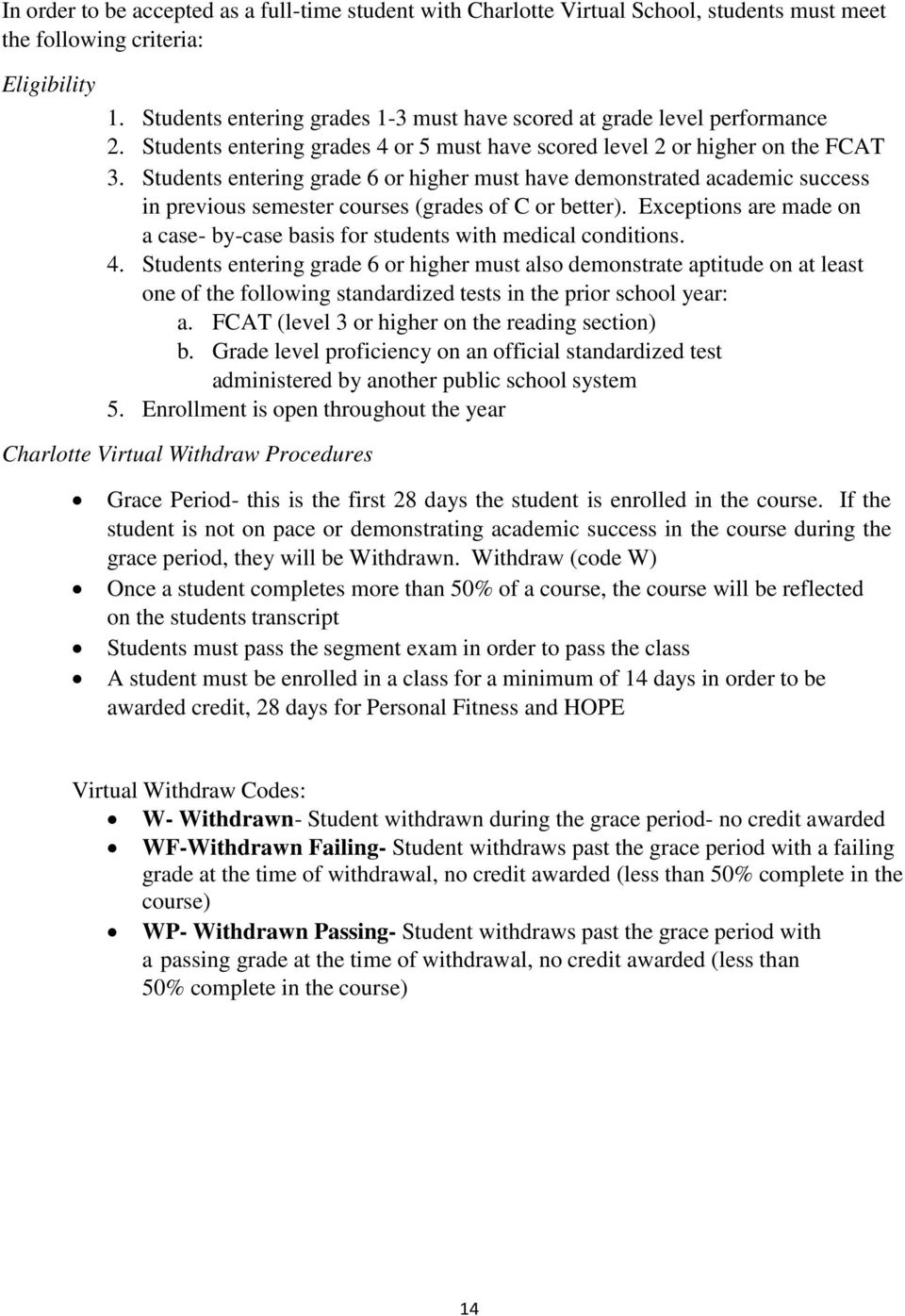
13 CVS offers a full-time enrollment option for students in grades K-12. CVS serves as Charlotte County s virtual instruction program and satisfies the requirements set forth in Florida Statute. Full-time CVS students are registered as public school students, take part in FCAT, FSA, NGSSS, and other district testing, and have the opportunity to earn a standard Charlotte County diploma. CVS partners with Florida Virtual School for middle and high school curriculum. It is important to know that Charlotte Virtual offers high school diplomas to students registered in our fulltime program only. CVS partners with Calvert for K-5 curriculum. Charlotte County Virtual School (CVS) Charlotte Virtual School full-time Enrollment Eligibility Requirements Students who enroll in Charlotte Virtual School full-time must meet at least one of the following criteria as specified in Florida Statute , to participate in virtual instruction; the student spent the prior school year in attendance at a public school in the state and was enrolled and reported by the school district for funding during October and February for purposes of the Florida Education Finance Program surveys; the student is a dependent child of a member of the United States Armed Forces who was transferred within the last 12 months to this state from another state or from a foreign country pursuant to a permanent change of station order; the student was enrolled during the prior school year in a virtual instruction program under Florida Statute , the K-8 Virtual School Program under Florida Statute , or a full-time Florida Virtual School program under Florida Statute (8)(a); the student has a sibling who is currently enrolled in a virtual instruction program and the sibling was enrolled in that program at the end of the prior school year; the student is eligible to enter kindergarten or first grade; the student is eligible to enter grades 2 through 5 and is enrolled full-time in a school district virtual instruction program, virtual charter school, or the Florida Virtual School. Virtual School Enrollment Eligibility Requirements Grades 2-5 Students in grades 2-5 may enroll in one of the full-time virtual education options. These include full-time options offered by FLVS, Charlotte County Schools, and virtual charter schools. To apply for CVS s full time program, go to: 13

14 In order to be accepted as a full-time student with Charlotte Virtual School, students must meet the following criteria: Eligibility 1. Students entering grades 1-3 must have scored at grade level performance 2. Students entering grades 4 or 5 must have scored level 2 or higher on the FCAT 3. Students entering grade 6 or higher must have demonstrated academic success in previous semester courses (grades of C or better). Exceptions are made on a case- by-case basis for students with medical conditions. 4. Students entering grade 6 or higher must also demonstrate aptitude on at least one of the following standardized tests in the prior school year: a. FCAT (level 3 or higher on the reading section) b. Grade level proficiency on an official standardized test administered by another public school system 5. Enrollment is open throughout the year Charlotte Virtual Withdraw Procedures Grace Period- this is the first 28 days the student is enrolled in the course. If the student is not on pace or demonstrating academic success in the course during the grace period, they will be Withdrawn. Withdraw (code W) Once a student completes more than 50% of a course, the course will be reflected on the students transcript Students must pass the segment exam in order to pass the class A student must be enrolled in a class for a minimum of 14 days in order to be awarded credit, 28 days for Personal Fitness and HOPE Virtual Withdraw Codes: W- Withdrawn- Student withdrawn during the grace period- no credit awarded WF-Withdrawn Failing- Student withdraws past the grace period with a failing grade at the time of withdrawal, no credit awarded (less than 50% complete in the course) WP- Withdrawn Passing- Student withdraws past the grace period with a passing grade at the time of withdrawal, no credit awarded (less than 50% complete in the course) 14
15 Florida Virtual School Florida Virtual School is an Internet-based high school funded by the Florida legislature. The courses offered are based upon the state standards and provide Florida s students with an alternative way to earn credits for high school graduation. A major characteristic of this system is the expectation that students assume full responsibility for learning by locating, evaluating, and using a wide range of resources. It is therefore most suited to students who are self-motivated, committed, and fully matured, independent learners. Requirements for Registration The student must be recommended by his/her high school counselor and principal (or designee). School representatives reserve the option to deny a request based on academic or behavioral record which indicates that the student would not be best served by this. Students can register online at This registration will not be confirmed until Florida Virtual School personnel have evidence that permission has been secured. Admissions are limited and students may be placed on a wait list for the next available placement. Registration is an ongoing process. Academically Challenging Curriculum to Enhance Learning Options (ACCEL) Academically Challenging Curriculum to Enhance Learning (ACCEL) options are educational options that provide academically challenging curriculum or accelerated instruction to eligible public school students in kindergarten through grade 12. At a minimum, each school must offer the following ACCEL options: whole-grade and midyear promotion; subject-matter acceleration; virtual instruction in higher grade level subjects; and the Credit Acceleration Program under s Additional ACCEL options may include but are not limited to, enriched science, technology, engineering, and mathematics coursework; enrichment programs; flexible grouping; advanced academic courses; combined classes; self-paced instruction; rigorous industry certifications that are articulated to college credit and approved pursuant to ss and ; work-related internships or apprenticeships; curriculum compacting; advanced-content instruction; and telescoping curriculum. Eligibility requirements include appropriate test scores, grades and/or grade point average, attendance record, discipline record, and teacher and guidance counselor recommendation. Exercising the ACCEL Option must be congruent with class size requirements. Transportation to another facility is the responsibility of the parent. Students accepted in to the ACCEL Option must have a performance contract including compliance with attendance and conduct requirements and other areas of compliance established by the principal in conjunction with the District Office. See Appendix I. 15

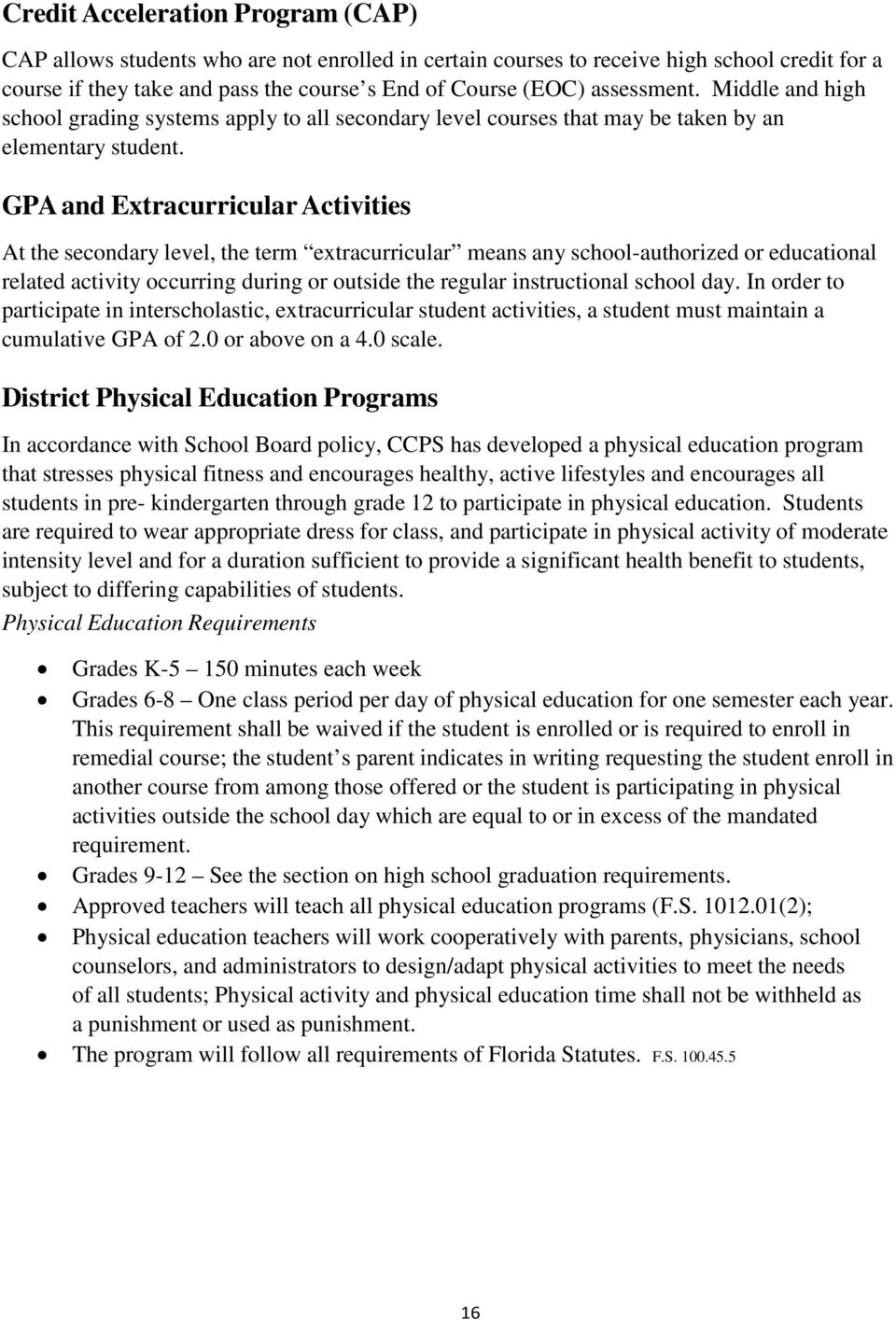
16 Credit Acceleration Program (CAP) CAP allows students who are not enrolled in certain courses to receive high school credit for a course if they take and pass the course s End of Course (EOC) assessment. Middle and high school grading systems apply to all secondary level courses that may be taken by an elementary student. GPA and Extracurricular Activities At the secondary level, the term extracurricular means any school-authorized or educational related activity occurring during or outside the regular instructional school day. In order to participate in interscholastic, extracurricular student activities, a student must maintain a cumulative GPA of 2.0 or above on a 4.0 scale. District Physical Education Programs In accordance with School Board policy, CCPS has developed a physical education program that stresses physical fitness and encourages healthy, active lifestyles and encourages all students in pre- kindergarten through grade 12 to participate in physical education. Students are required to wear appropriate dress for class, and participate in physical activity of moderate intensity level and for a duration sufficient to provide a significant health benefit to students, subject to differing capabilities of students. Physical Education Requirements Grades K minutes each week Grades 6-8 One class period per day of physical education for one semester each year. This requirement shall be waived if the student is enrolled or is required to enroll in remedial course; the student s parent indicates in writing requesting the student enroll in another course from among those offered or the student is participating in physical activities outside the school day which are equal to or in excess of the mandated requirement. Grades 9-12 See the section on high school graduation requirements. Approved teachers will teach all physical education programs (F.S (2); Physical education teachers will work cooperatively with parents, physicians, school counselors, and administrators to design/adapt physical activities to meet the needs of all students; Physical activity and physical education time shall not be withheld as a punishment or used as punishment. The program will follow all requirements of Florida Statutes. F.S
17 Compact on Educational Opportunity for Military Children The purpose of the Interstate Compact on Educational Opportunity for Military children is to remove barriers to educational success imposed on children of military families because of frequent moves and deployment of their parents. This applies to the children of active duty members of the uniformed services, including members of the National Guard and reserve on active duty orders, members or veterans of the uniformed services who are severely injured and medically discharged or retired for a period of 1 year after medical discharge or retirement and members of the uniformed services who die on active duty or as a result of injuries sustained on active duty for a period of 1 year after death. The compact does not apply to the children of inactive members of the National Guard and military reserves, members or veterans of the uniformed services now retired except as previously stated, and other US Department of Defense personnel and other federal agency civilian and contract employees not defined as active duty members. A special power of attorney relative to the guardianship of a child of a military family is sufficient for enrollment; official or unofficial records will be accepted to expedite student enrollment; 30 days will be given for proper immunizations; students are allowed to continue their grade level enrollment if transfer is during the school year; students must be able to continue with special courses (gifted, honors, AP, etc.); students who meet criteria for special academic programs will be given first preference for admission; and, students placed in the care of a non-custodial parent who lives in a school s jurisdiction different from that of the custodial parent may continue to attend the school in which he or she enrolled. Schools must facilitate the inclusion in extracurricular activities, regardless of application deadline to the extent the student is otherwise qualified; schools must facilitate on time graduation by waiving courses required for graduation if similar coursework has been satisfactorily completed; schools will accept end of course exams and other required tests from the sending state in lieu of local requirements. If a military student transfers at the beginning of or during the his or her senior year and is not eligible to graduate from the receiving local education agency after all alternatives have been considered, the sending and receiving local education agencies must ensure the receipt of a diploma from the sending local education agency if the student meets the graduation requirements from the sending local agency. If one of the states in question is not a member of the Military Compact, the member state shall use its best efforts to facilitate the ontime graduation of the student. F.S Homeless Students Homeless students, as defined by Title X of the McKinney-Vento Act, have equal access to all programs and services and are entitled to immediate enrollment in schools. In the case of homeless children and families, school nurses, social workers, the Homeless Liaison, guidance counselors, and registrars will coordinate efforts to assist these students with obtaining the required registration documents during the 30-day interim. The Homeless Liaison will identify eligible students and work to eliminate barriers to school success. 17

18 Hospital/Homebound Hospital/Homebound services are available for students with a medically diagnosed physical or psychiatric illness or injury, which confines the student to home or hospital for an extended period of time and significantly restrict the student s activities. Students will receive hospital/homebound instruction only in core academic subjects. Student participation in the instructional session is monitored for attendance. The curriculum will follow that of the regular school, adapted to the needs of the student. The instructional program is individualized. The students classroom teacher(s) will be responsible for providing the homebound teacher with appropriate assignments and tests. A secondary student will receive hospital/homebound instruction only in core academic subjects and other subjects as appropriate. Successful course completion or credit can be awarded for hospital/homebound instruction. Long-term participation in the hospital/homebound program will require a change to the student s schedule and can impact credits and the graduation timeline. The hospital/homebound service will be terminated upon recommendation of the physician, recovery from the illness or injury, the ability to participate in the regular school program, and/or lack of participation/cooperation from the student or family. Eligibility for Hospital/Homebound To be eligible for hospital/homebound services a Florida licensed physician must certify to the following: The student is expected to be absent from school for at least 15 school days, or the equivalent on a block schedule, due to physical, psychiatric, chronic, or repeated intermittent illness from the date of completed application; is under medical care for the illness which is acute, catastrophic, or chronic in nature; is confined to hospital or home and all activities are restricted; will be able to participate and benefit from an instructional program; and can receive instructional services without endangering the health and safety of the instructor or other students with whom the instructor may come in contact. Grading Procedures for Hospital/ Homebound Each homebound teacher will be responsible for evaluating and recording grades for the student while he/she is receiving instruction in this program. Basic guidelines include the following: The classroom teacher and the hospital/homebound teacher will determine who will grade the student s individual assignments. If a student is in the hospital/homebound program for half of the grading period or more, the hospital/homebound teacher is responsible for presenting an evaluation of the student s work to the student s classroom teacher(s) or designated school personnel. This evaluation will be averaged in with the classroom teacher s grades that are recorded for the student during the remainder of the grading period. If a student is in the home program for the entire grading period, the hospital/homebound teacher will accept the responsibility for reporting grades in each subject area taught. 18

19 Transferring Students In order to be admitted to a Charlotte County School, a transferring student must provide the following data within 30 days of enrollment: Official documentation that a parent/guardian was a legal resident of the state in which the child was previously enrolled in school; An official letter or transcript from a proper school authority that shows the record of attendance, academic information, and grade placement of the student; Evidence of immunization against communicable diseases as required by Florida law Evidence of date of birth as required by Florida law Evidence of a medical examination completed within the last 12 months as required by Florida law; Evidence of legal guardianship/custody, when appropriate; and A complete disclosure form noting previous school expulsions, arrests resulting in a charge, and juvenile justice actions the student has had as required by Florida law. Transfer of High School Credit: Beginning with the school year, if a student transfers to a Florida public high school from an out of country, out of state, a private school, or a home education program and the student s transcript shows a mathematics credit in a course that requires passage of a statewide, standardized assessment in order to earn a standard high school diploma, the student must pass the assessment unless the student earned a comparative score, passes a statewide assessment in that subject administered by the transferring entity, or passed the statewide assessment the transferring entity uses to satisfy the requirement. If a student s transcript shows a credit in high school reading or English/Language Arts II or III, the student must take and pass the grade 10 FCAT reading or FSA ELA grade 10 assessment (dependent upon 9 th grade cohort year) or earn a concordant score on the SAT or ACT as specified by state board rule. S.R.R. 6A ; 6A (3)(b); F.S ; ; ; (1)(b) Transfer Student Grade Placement The grade placement of students transferring from other counties, countries, states, or private schools will be determined by the principal of the receiving school based on placement tests, course completion status, credits earned, age, and previous school records. All failing grades from classes taken in Charlotte County and all Florida public schools are subject to course completion recovery or credit recovery. 19

20 Home School Students Home School Student Access to Courses Home school students in grades 6-12 may access courses CVS. See the section on Virtual School for more information. Home school students wishing to take courses at the high school level beyond those which are connected to out of school activities, may do so in accordance with compliance of class size reduction requirements. Home school students must register for these courses during the 2 week period before school begins each year. Home Education, is the sequentially progressive instruction of a student directed by his or her parent or guardian in order to satisfy Florida s requirement for compulsory education. Parents assuming responsibility for education a child a home also assume the responsibility for providing curriculum, educational materials, and evaluations necessary to determine student progress. The school system does not supply textbooks, curriculum guides, or educational standards for the home-educated student (Fla. Stat , ,(4), and (1)). To establish a Home Education Program under Florida Statute , a parent must: 1. Notify the district school superintendent of the county in which the parent resides of his or her intent to establish and maintain a home education program. The notice shall be in writing, signed by the parent, and shall include the names, addresses, and birthdates of all children who shall be enrolled as students in the Home Education Program. The notice shall be filed in the district school superintendent s office within 30 days of the establishment of the home education program. A written notice of termination of the Home Education program shall be filed in the district school superintendent s office within 30 days after said termination. (CCPS provides an enrollment form and termination form). 2. Maintain a portfolio of educational records to include: A log of educational activities which is made contemporaneously with the instruction and which designates by title any reading materials used, and samples of any writings, worksheets, workbooks, or creative materials used or developed by the student. The portfolio shall be preserved by the parent for 2 years and shall be made available for inspection by the district school superintendent, or designee, upon 15 days written notice. Nothing in this section shall require the district school superintendent to inspect the portfolio. 3. Provide for an annual educational evaluation documenting the student s demonstration of educational progress at a level commensurate with her or his ability. The parent shall select the method of evaluation and shall file a copy of the evaluation annually with the Charlotte County School District s superintendent s office. 4. The annual educational evaluation shall consist one of the following: A teacher selected by the parent shall evaluate the student s educational progress upon review of the portfolio and discussion with the student. Such teacher shall hold a valid regular Florida certificate to teach academic subjects at the elementary or secondary level; The student shall take any nationally normed student achievement test administered by a certified teacher; The student shall take a state student assessment test used by the school district and administered by a certified teacher, at a location and under testing conditions approved by the school district; The student shall be evaluated by an individual holding a valid, active license (as a school psychologist) pursuant to the provisions of Florida Statute (7) or 20
21 (8); or The student shall be evaluated with any other valid measurement tool as mutually agreed upon by the district school superintendent of the district in which the student resides and the student s parent resides. Home education students may participate in interscholastic, extracurricular activities at their district assigned school as long as they meet the requirements of Florida Statute Home education students participating in interscholastic extracurricular activities, must meet the same immunization requirements as students attending any non-home education program (F.S ). 5. The district school superintendent s office/designee shall review and accept the results of the annual educational evaluation of the student in a Home Education Program. If the student does not demonstrate educational progress at a level commensurate with her or his ability, the district school superintendent s office shall notify the parent, in writing, that such progress has not been achieved. The parent shall have 1 year from the date of receipt of the written notification to provide remedial instruction to the student. At the end of the 1-year probationary period, the student shall be reevaluated as specified in Florida Statute (1)(c). Continuation in a Home Education Program shall be contingent upon the student demonstrating educational progress commensurate with her or his ability at the end of the probationary period. Home School Transfer Student Grade Placement The Grade placement of students transferring from home education programs will be determined by the principal of the receiving school with assistance from the District Office. Appropriate grade placement will be based on the following: Assessment of academic achievement; Portfolio of work completed in home education; Previous record in public and/or private school; and Age and maturity. At the end of the first grading period after placement, if the student earns at least a C in each of the core academics, the placement shall be determined to be appropriate. Home School Students and Extracurricular Activities In order to participate in extracurricular activities at the geographic school the student is eligible to attend, the student must meet the following requirements: The student must register with the school his/her intent to participate in interscholastic extracurricular activities as a representative of the school before the beginning date of the season for this the activity in which he or she wishes to participate; The student must be able to participate in curricular activities if that is a requirement of the extracurricular activity; The student must meet the requirements of the home education program, the residency requirements and the behavior requirements as other students; A student who transfers from a home education program before or during the first grading period of the school is academically eligible to participate during the first grading period provided the student has a successful evaluation from the previous year; ineligible students need to successfully complete one grading period; 21
22 During the period of participation, the home school student must demonstrate educational progress in all subjects taken in the home education program by a method agreed upon by the parent and the school principal which may include the following: o Review of the student s work by a certified teacher chosen by the parent; o Grades earned through correspondence; o Grades earned in courses taken at a community college, university or trade school; and o Standardized test scores other methods according to law. F.S
23 Student Progression in the Elementary School Grades PreK-5 Table of Contents Admissions Requirements Pre-Kindergarten Kindergarten First Grade Attendance Course of Study Curriculum Homework Reading Homework Reading Strategies for Parents Assessment/Support/Progress Monitoring Academic Support Reading Deficiencies Promotion and Retention Promotion Retention Grade Three (3) Reading and Retention Successful Progression for Retained Third Grade Students Mid-Year Promotion Intensive Acceleration Class (IAC) Promotion to Middle School Promotion for Exceptional Education Students Reporting Student Progress Report Cards Grades K-2 Report Cards Grades K-2 Standards Based Report Cards Grade 3-5 Report Cards
24 Student Progression in the Elementary School Admissions Requirements Pre-Kindergarten Program To enter the Pre-kindergarten Program, a child must meet the eligibility criteria established by the Florida Department of Education. Program eligibility and selection is based on meeting the following criteria: The child must Be four (4) years of age (except students with disabilities) on or before September 1; Meet the economic eligibility criteria (except students with disabilities); and Meet other criteria established by the Florida Department of Education. Children who meet the program criteria are admitted on a space-available basis. Children with disabilities are admitted. Kindergarten Students must be five (5) years old on or before September 1 to be eligible to enter kindergarten as stated in Florida law. Students must have received appropriate health examinations and immunization records as stated in Florida law. The statewide kindergarten screening will take place within the first 30 school days of each school year. F.S (1) First Grade Students must be six (6) years old by September 1 and have successfully completed kindergarten as stated in Florida law.f.s ; Attendance School attendance is required of all students, kindergarten through age 16. Students who have excessive excused absences, unexcused absences, tardies, or early departures will be referred to the Child Study Team or the Student Assistance Team for appropriate interventions. For more information, see the CCPS Code of Student Conduct. 24
25 Course of Study Curriculum Students in kindergarten through grade 5 will be provided instruction at their appropriate instructional level(s) and will follow curricula that include the following: English Language Arts (ELA): The Florida Standards Mathematics: The Florida Standards Science/Health Social Studies Physical Education Other subjects in the curricula may include the following: Music Art Computer Technology (use of digital tools and applications) Personal/Social Development Spanish Science Technology Engineering and Math (STEM) labs Curricula shall be determined by the following: Laws of the State of Florida Next Generation Sunshine State Standards (NGSSS) The Florida Standards Topics of subject matter required by the State Board of Education: African-American History Awareness of Handicaps Career Awareness Character Education Civics Critical Thinking/Problem Solving Energy/Environmental Education Health, Safety, Substance Abuse Multi-cultural Awareness Holocaust Awareness Veteran Sacrifices Others as determined by state law Needs of students A variety of support services are available to students to help them meet the performance standards of each subject. Homework Homework is an extension of learning and is important for improving student achievement. Each school is expected to have homework guidelines tailored to its student population, including a system for reviewing which promotes learning. Homework is designed as an extension of school class work for the purpose of practice and reinforcement of classroom learning. Homework is purposeful and meaningful. There is a system for reviewing homework assignments that promotes learning. Parents shall be fully informed of the school s homework policy. It is expected that parents will instill in their children the responsibility to see that homework is completed and returned. S.B.R
26 Reading Homework Students in elementary school should read or be read to at least 20 minutes each evening. Strategies for Parents to Help Children Increase Reading Success Invite your child to read with you every day. When reading a book where the print is large, point word by word as you read. This will help your child learn that reading goes from left to right and understand that the word said is the word seen. Read your child s favorite book over and over. Read many stories with rhyming words and repeated lines. Invite your child to join in on repeating parts. Point, word by word, as your child reads along with you. Discuss new words. For example, This big house is called a palace. Who do you think lives in a palace? Stop and ask about the pictures and about what is happening in the story. Read from a variety of children s books, including fairy tales, song books, poems, and information books. From Reading Tips for Parents, U.S. Department of Education Available online at or call USA-LEARN. Assessment/Support/Progress Monitoring Each child must participate in statewide, standardized assessments and district-required local assessments unless exempt under criteria established by the Commissioner of Education. A school district may not schedule more than 5 percent of a student s total school hours in a school year to administer these assessments. The 5 percent test administration limit may be exceeded as needed to provide test accommodations that are required by an Individual Education Plan, 504 Plan or English Language Learner Plan. In order to meet the state mandated requirements for assessment and progress monitoring, the following state and district-required assessments are used at the elementary level to help determine student achievement, the assessment map below will be followed. Other formative assessments may also be used to help determine student progress and achievement. Required state and district assessments will be administered in accordance with the district-required assessment schedule. 26
27 **BOY/MOY/EOY District Required **BOY/MOY/EOY District Required **BOY/MOY/EOY District Required **BOY/MOY State Required **EOY State Required FSA Grade Level K ELA Mathematics Science/Social Studies i-ready-cbt DRA-PBT(MOY-EOY) i-ready-cbt FLKERS (BOY) 1 i-ready-cbt i-ready-cbt DRA-PBT(MOY-EOY) 2 i-ready-cbt i-ready-cbt DRA-PBT(MOY-EOY) 3 i-ready-cbt i-ready-cbt Science MOY- EOY- PBT 4 i-ready-cbt i-ready-cbt Science-MOY- EOY- PBT ELA-PBT Mathematics-PBT ELA-CBT Mathematics-PBT 5 i-ready-cbt i-ready-cbt Science-BOY-MOY- EOY-PBT ELA-PBT Mathematics-PBT Science-PBT K 1-5 ACCESS ELL 2.0 (MOY) **BOY= Beginning of year; MOY=Middle of year; EOY=End of year; FSA=Florida State Assessment PBT=Paper Based Testing; CBT= Computer Based Testing Academic Supports Progress Monitoring/ Grade Level Progression Each student who does not meet specific levels of performance on required state and district assessments for ELA, mathematics, science, and social studies, shall be provided with interventions and support that shall continue until performance expectations are met as documented by demonstrating mastery of standards, and/or passing the state assessment(s) See Assessment and Support on page 8 of this document. Multi-tiered System of Supports (MTSS) The multi-tiered system of academic and behavioral supports relies on problem solving and data-based decision-making to improve educational outcomes and meet the academic and behavioral needs of all students. Multiple tiers of increasingly intense instruction intervention services are implemented and monitored. Each intervention service for identified students shall be tailored to identify the individual 27
28 assistance deemed necessary to remedy a student s diagnosed deficiencies. This support must clearly identify The specific diagnosed academic need(s), The success-based intervention strategies to be used, How, when, how often, by whom and how long intensive instruction is to be provided, and The monitoring and reevaluation activities to be employed Students With Reading Deficiencies Any student who exhibits a substantial deficiency in reading based upon locally determined or state-wide assessments conducted in kindergarten or grade 1, grade 2, or grade 3, or through teacher observation must: Be monitored and given immediate intensive reading instruction that must continue until the student demonstrates grade level proficiency in a manner determined by the district, which may include achieving a Level 3 on the statewide, standardized English Language Arts assessment. If a student s reading deficiency is not remediated by the end of grade 3, as demonstrated by scoring Level 2 or higher on the statewide, standardized assessment required under s for grade 3, the student must be retained unless he or she is exempt from mandatory retention for good cause. Parent(s) of any K-3 student who exhibits a reading deficiency must be informed of the exact nature of the student s difficulty in reading and be involved in the development of a plan to support and improve their child s performance. Promotion and Retention Promotion Grades K-5 Each student s progression from one grade to another is based on the student s mastery of the standards in s specifically English Language Arts, mathematics, science, and social studies as assessed by classroom work, portfolios, teachers/staff observation, teacher assessments, and data from required district and state assessments. Promotion/retention for grades K-5 will not be determined solely on the basis of a single test/method except in grade 3. Grade three students who do not score at level 2 or higher on the statewide standardized assessment for English Language Arts (ELA) will be retained except for those students who are promoted for good cause. No promotion or retention decision may be made for any individual student classified as ELL/LEP based solely on a score on any single assessment instrument, whether such assessment instrument is part of the statewide assessment program or of a particular districts formal assessment process. A formal retention recommendation regarding an ELL/LEP student may be made through the action of an ELLP/LEP committee. This committee meeting is held prior to Good Cause decision affecting ELL/LEP students. The primary responsibility for determining and documenting each student s level of performance and ability to function academically, socially, and emotionally at the next grade level is that of the student s teacher(s), subject to review and approval of the school principal. No student can be assigned to a grade level based solely on age or other factors that constitute social promotion. The principal has the final authority to determine the placement of students except for good cause promotions at grade three, which must be reviewed by the superintendent or designee. 28
29 Retention- Grades K-5 The following are considered when retention of a student is a possibility: o FSA scores (when available); o Stanford Achievement Test, version 10 (SAT 10) scores (when available); o Progress Monitoring support provided through MTSS and formative or district required assessments; o Report card; o Support services (before, during, and after school programs); o Title I services; o Exceptional Student Education (ESE) services; o English Language Learner services (ELL);and o Prior retentions. Any child being considered for retention should be referred to the Child Study Team who will analyze the contents of the cumulative record prior to the recommendation for retention. This team will also gather input from related classroom teachers and other appropriate school personnel. When retention is the recommendation, parents/guardians must be advised immediately, through a parent conference, at which time future program modifications will be discussed. When students are retained, they must be enrolled in an intensive program that is different from the previous year s program and that takes into account the student s learning style. No student can be assigned to a grade level based solely on age or other factors that constitute social promotion. The principal has the final authority to determine the placement of students except for good cause promotions at grade three, which must be reviewed by the superintendent. F.S (1), (2)(a); (2)(b); (5)(c)(1)(2)(3); (6)(z) Grade Three Reading and Retention If a student s reading deficiency is not remediated by the end of grade 3, as demonstrated by scoring Level 2 or higher on statewide, standardized assessment required under s for grade 3, the student must be retained unless he or she is exempt from mandatory retention for good cause. A student who is promoted to grade four with a good cause exemption shall be provided intensive reading instruction an intervention that include specialized diagnostic information and specific reading strategies to meet the needs of each student so promoted. The school district shall assist schools and teachers with the implementation of reading strategies for students promoted with a good cause exemption which research has shown to be successful in improving reading among students who have reading difficulties. Good cause exemptions are limited to the following: 1. Limited English proficient students who have had less than 2 years of instruction in an English for Speakers of Other Languages program based on the initial date of entry into a school in the United States. 2. Students with disabilities whose individual education plan indicates that participation in the statewide assessment program is not appropriate, consistent with the requirements of s Students who demonstrate an acceptable level of performance on an alternative 29
30 standardized reading or English Language Arts assessment approved by the State Board of Education. 4. A student who demonstrates through a student portfolio that he or she is performing at least at Level 2 on the statewide, standardized English Language Arts assessment. 5. Students with disabilities who take the statewide, standardized English Language Arts assessment and who have an individual education plan or a Section 504 plan that reflects that the student has received intensive instruction in reading or English Language Arts for more than 2 years but still demonstrates a deficiency and was previously retained in kindergarten, grade 1, grade 2, or grade Students who have received intensive reading intervention for 2 or more years bust still demonstrate a deficiency in reading and who were previously retained in kindergarten, grade 1, grade 2, or grade 3 for a total of 2 years. A student may not be retained more than once in grade Students who have received intensive remediation in reading or English Language Arts for 2 or more years but still demonstrate a deficiency and who were previously retained in kindergarten, grade 1, grade 2, or grade 3 for a total of 2 years. Intensive instruction for students so promoted must include an altered instructional day that includes specialized diagnostic information and specific reading strategies for each student. The district school board shall assist schools and teachers to implement reading strategies that research has shown to be successful in improving reading among low-performing readers. Requests for good cause exemptions from the mandatory retention requirement must include documentation submitted by the teacher to the school principal. The principal must review and discuss such recommendation with the teacher and make the determination as to whether the student should be promoted or retained. If the principal determines that the student should be promoted, the principal must make that recommendation in writing to the superintendent or designee who in turn shall accept or reject the principal s recommendation in writing. Districts must notify parents in writing that their child has been identified at risk of third grade retention due to reading deficiencies, the district is required to provide in writing, the specific criteria and policies for a portfolio and the evidence required for a student to demonstrate mastery of Florida s grade 3 English Language Arts Standards. F.S (6)(a) 30
31 Successful Progression for Retained Third Grade Students Third grade students who are retained must be provided daily intensive interventions in reading as identified by a valid and reliable diagnostic assessment. Intervention must include the following: Effective instructional strategies A highly effective teacher Participation the summer reading program Appropriate teaching methodologies A completed student portfolio 90 minutes per day of uninterrupted scientifically research-based reading instruction which includes phonemic awareness, phonics, fluency, vocabulary, comprehension, and other strategies which may include but not be limited to the following: o Small group instruction o Integration of science and social studies content within the 90 minute block; o Reduced teacher-student ratio o More frequent progress monitoring o tutoring or mentoring o transition classes containing 3 rd and 4 th grade students o extended school day, week, or year F.S (7)(a)(b)1,23,5,6,7 Mid-Year Promotion of Third Grade Students Any retained 3 rd grade student may be promoted to 4 th grade under the following conditions: Shows success as an independent reader by performing at or above grade level in reading; and has an assessment portfolio, which demonstrates mastery of 3 rd grade state assessment. Students promoted during the school year after November 1 st must demonstrate proficiency levels in reading equivalent to the level necessary for the beginning of grade 4. The rules adopted by the State Board of Education must include standards that provide a reasonable expectation that the student s progress is sufficient to master appropriate grade 4 level reading skills. Intensive Acceleration Class (IAC) for 3 rd Grade Any student in grade 3 who scored at Level 1 on the FSA identified in s , F.S. and who was retained in grade 3 the prior year shall have an Intensive Acceleration Class (IAC) The focus of the Intensive Acceleration Class shall be to increase a child s reading and English Language Arts skill level at least two grade levels in 1 school year. The Intensive Acceleration class shall: Have a reduced teacher-student ratio Provide uninterrupted reading instruction for the majority of student contact time each day incorporating opportunities to master grade 4 Florida Standards and NGSS Standards Use a reading program that is scientifically researched-based and has proven results in accelerating students reading achievement within the same school year Provide intensive language and vocabulary instruction using a scientifically researched- based program F.S (7)(b)4 31
32 Promotion to Middle School A student who scores below Level 2 on Florida Standards Assessment for reading and whose academic progress is inadequate as determined by the principal, must attend the summer reading program if offered in order to be considered for promotion to middle school. Promotion for Exceptional Education Students ESE students receiving instruction with ESE support will have the following additional criteria considered for promotion: Individual Education Plan (IEP) including how the student s disability affects the student s participation in the general curriculum; Classroom performance, and Level of mastery of course performance standards. F.S (6)(a) Reporting Student Progress Parents can view grades by registering with the District FOCUS Parent Portal. Parents may also view student academic, behavior, assessments and interventions data over multiple school years on Softwarenology s School Portal using the same ID and password as for FOCUS. The software will automatically translate all communications to a family s native language allowing greater collaboration with teachers. Student data is displayed in a meaningful way as their child progresses towards college and career readiness. Good communication concerning student progress is informative, purposeful, and ongoing. Student progress will be reported to parents in the following ways: Teacher/parent or student led conferences Periodic informal written or oral communications Interim reporting at least once per marking period for all students and on a daily, weekly, or as-needed basis for students experiencing difficulty Student progress reporting which includes mastery of standards data in ELA, mathematics, science, and social studies as gathered through the following: o Classroom work o Observations o Portfolios o Classroom assessments o District Assessments, where appropriate o State assessments, where appropriate Report Cards Report cards are issued as follows: Grades K-5 four times annually; and Year Round School Grades K-5 three times annually. All schools use report cards as the primary means of reporting student progress. Selected programs utilize a standardized reporting insert in combination with the report card. Report cards give an annual report of student progress towards achieving state and 32
33 district expectations for mastery of standards in, English Language Arts, mathematics, science, and social studies. For students with disabilities, the report card will include progress toward achievement of Individual Education Plan (IEP) goals and objectives. For ELL students, progress should be communicated in a language that the parents understand, whenever feasible. Grading Scale K-5 Grades K-2 Report Cards Student Performance Indicators are: O-Outstanding S-Satisfactory I-Some progress made, but improvement is needed U-Unsatisfactory Rated Areas of Performance Personal and Social Language and Literacy Mathematics Science Social Studies Other basics such as art, music, STEM and physical education are rated as follows: O-Outstanding S-Satisfactory I-Some progress made, but improvement is needed at this time U-Unsatisfactory Grades K-2 Standards Based Report Cards Standards based report cards are used to report student progress in kindergarten at all elementary schools and for grades K-2 in the following schools: East Elementary, Liberty Elementary, Sallie Jones Elementary and Vineland Elementary. Mastery of standards in English Language Arts, Mathematics, Science and Social Studies is reported using a four point rubric: 4-Exceeds Standard 3-Meets Standard 2-Progressing Toward Standard 1-Beginning Demonstration of Standard Other basics such as art, music, STEM and physical education are rated as follows: E=Excellent S=Satisfactory N=Needs improvement 33
34 Grades 3-5 Report Cards Letter grades for English Language Arts, mathematics, science and social studies are based on the following numerical scale: A= B=80-89 C=70-79 D=60-69 F= 0-59 Other basics such as art, music, STEM, and physical education are rated as follows: O-Outstanding S-Satisfactory I-Some progress made, but improvement is needed at this time U-Unsatisfactory F.S
35 Student Progression in the Middle School Grades 6-8 Table of Contents Attendance Course of Study Curriculum Earning High School Credit Toward Graduation Homework Assessment Support Progress Monitoring Plans (PMP) Process Reading Deficiencies PMP Process for Math Assessments and Grade Level Performance Promotion and Retention Promotion Between Grade Levels Performance Basesd Course Completion/Project PASS Course Recovery/Credit Retrieval Grading Attendance Requirement for Course Completion Second Chance Option Reporting Student Progress Grade Point Average and Interscholastic Activities Grading Criteria Semester Exams Grade Point Average Grading Scale Semester Grades Report Cards
36 Student Progression in the Middle School Attendance School attendance is required of all students, kindergarten through age 16. When a student exceeds nine (9) absences in a semester in any one subject area, he or she may be in danger of failing. It is the responsibility of the parent and student to make arrangements to complete appropriate make-up work. Students who have excessive excused or unexcused absences will be referred to the Student Assistance Team for appropriate interventions. For more information, see the CCPS Code of Student Conduct Course of Study CCPS provides all courses required for middle grades promotion and provides appropriate instruction designed to endure that students meet State Board of Education adopted standards. Curriculum There shall be instruction in any subject matter, field, topic or specific area required by law in accordance with the Florida Statutes and the Florida Department of Education. High school courses such as English Language Arts (ELA), mathematics, and science may be offered to middle school students who meet the appropriate entrance requirements. Students in grades 6-8 will be provided instruction at their appropriate instructional level(s) and will follow curricula that include the following subjects: 3 courses in ELA 3 courses in mathematics. Middle schools must offer at least one high school level mathematics course for which students can earn high school credit; 3 courses in social studies, one semester of which must include the study of state and federal government and civics education; 3 courses in science; and Students must complete a one (1) semester course in Career and Education Planning to be completed in 6 th, 7 th, or 8 th grades. The course must be: o Internet-based, easy to use, and customizable to each student and include research-based assessments to assist students in determining educational and career options and goals. The state s Career and Education Planning System has contracted with Kuder, Inc., to design a system to meet the above requirements that will replace the current CHOICES career planning tool. The new and enhanced career planning system will be available for use during the school year. Students will be able to use the new system to explore their interests in associated careers, review educational requirements for various careers, build a career and education plan and research financial aid opportunities. Please visit planning-tool-implementation for more on the new system. The Career and Education Planning course must result in a completed personalized academic and career plan for the student; must emphasize 36
37 F.S the importance of entrepreneurship skills, technology, or the application of technology in career fields; and, must provide information from the Department of Economic Opportunity s economic security report. 1 semester in physical education each year unless a district waiver is secured. A variety of exploratory experiences may be offered by schools including, but not limited to the following: Applied Technology Art Band Chorus Computer Literacy Drama Spanish Health Earning High School Credit Toward Graduation Middle school students may earn credit toward high school graduation under the following conditions: Students are considered ninth graders during the periods in which they are enrolled in the high school credit courses offered at the middle school site; The courses are listed in the Florida Course Code Directory and meet high school requirements; Courses are offered for the same number of hours of instruction as currently offered at the high school; Students demonstrate mastery of district and state course performance standards; and Placement of grades to the high school transcript is as follows: o All grades earned must be placed on the high school transcript; o Students who earn a grade of C, D, or F will have the opportunity for grade forgiveness by retaking the same course or a comparable course in high school; and o If the student retakes the course, only the higher grade and credit will be included in the grade point average calculation. The original course and grade will still be reported on the transcript. F.S Successful completion (middle school requirement) of a high school level Algebra I or Geometry course is not contingent on the end-of-course (EOC) assessment; however, o Beginning with the school year, to earn high school credit for Algebra I, a middle grades student must take the state wide standardized Algebra I EOC assessment and pass the course. o Beginning with the school year, to earn high school credit for Geometry I, a middle school student must take the Geometry I EOC assessment, which will count as 30% of the final grade. 37
38 Homework Homework is an extension of learning and is important for improved student achievement. Each school is expected to have homework guidelines tailored to its student population including a system for reviewing which promotes learning. Homework is designed as an extension of school class work for the purpose of practice and reinforcement of classroom learning. Home work is purposeful and meaningful. Students should be able to successful complete homework independently. There is a system for reviewing homework assignments that promotes learning. Parents shall be fully informed of the school s homework policy. It is expected that parents will instill in their children the responsibility to see that homework is completed and returned. 38
39 Assessment In order to meet the state mandated requirements for assessment, the following required researchbased assessments are used at the middle school level to help determine student achievement. Each student must participate in statewide assessments unless exempt under certain criteria established by the Commissioner of Education. For Exceptional Student Education (ESE), English Language Learners (ELL) students, and students who have a 504 plan, any accommodations must be specified in their individual education plans. Each plan must state specifically which tests the student is expected to take and the accommodations(s) allowed for that test. F.S ; Required Assessments in Middle School Sixth Seventh Eight GRADE SUBJECT STATE DISTRICT English Language Arts FSA i-ready Math FSA i-ready English Language Arts FSA i-ready Math FSA i-ready Social Studies Civics EOC (30%) USA Test Prep English Language Arts FSA i-ready Math FSA i-ready Algebra 1/Alg.1 honors EOC (required for high school) USA Test Prep Science FCAT 2.0 USA Test Prep Support Multi-tiered System of Supports (MTSS) Progress Monitoring/Progress Monitoring Plans (PMP) Process Note: Progress monitoring must occur at least 3 times per year for reading. SBR6A Each student who does not meet specific levels of performance in ELA, science and/or mathematics shall be provided with scientifically research-based interventions as indicated by additional diagnostic assessments used to determine the nature of the student s difficulty and areas of academic need. Support and intervention shall continue until performance expectations are met as documented by demonstrating mastery, passing the state assessment(s) or graduating from high school. Progress monitoring plans (PMP) shall be developed in consultation with the parent or guardian for any student not meeting district or state achievement levels in ELA, science, or math. The plan can be an IEP or a school-wide system of progress monitoring for all students through the Multi-tiered System of Supports (MTSS). The multi-tiered system of academic and behavioral supports relies on problem solving and data-based decision-making to improve educational outcomes and meet the academic and behavioral needs of all students. Multiple tiers of increasingly intense instruction 39
40 intervention services are implemented and monitored. The school-wide PMP must include intensive remedial instruction in the areas of weakness. Intensive remediation means instruction designed to specifically concentrate time and effort on the diagnosed deficiencies of the individual student. If a student is being served in ESE, ELL, or Intensive Literacy programs, the plan developed for these programs can serve as the PMP if the plan addresses the specific area(s) of need identified for reading, writing, mathematics, and/or science. See the individual school s Student Success Plans for more specific information. Reading Deficiencies Striving Readers at Middle School Striving readers are defined as students in any grade who are identified as having an assessed deficiency in reading. In order to ensure these students needs are met and in keeping with the guidelines of the Department of Education, remediation and instructional placement in Charlotte County Public Schools is provided as follows: *Note: Remedial instruction is not in lieu of ELA course completion requirements for promotion. For each year in which a student scores at Level 1 on the FSA ELA, the student may be enrolled in and complete an intensive reading course the following year. Placement of Level 2 readers in either an intensive reading course or a content area course in which reading strategies are delivered shall be determined by diagnosis of reading needs. Reading courses shall be designed and offered as they are described in the District s Comprehensive Reading Plan. F.S (9) ANY student in ANY grade who is identified as having a deficiency in reading must participate in the school-wide PMP, which must identify the following: The student s specific areas of deficiency in phonemic awareness, phonics, fluency, comprehension, and vocabulary; The desired levels of performance in these areas; and Progress monitoring must occur 3 times per year. 40
41 Progress Monitoring Plan (PMP) Process for Math For each year in which a student scores at Level 1 or 2 on the Florida Standards Assessments in Mathematics, the student may receive remediation the following year, which may be integrated into the student s required mathematics course. The school-wide plan must contain the following elements: o Additional diagnostic assessment; o Identification of the specific diagnosed academic needs to be remediated; o Identification of the success-based and/or research-based strategies to be used; o Identification of how, when, how often, by whom and how long intensive remedial instruction is to be provided; and o Identification of monitoring and re-evaluation activities to be employed. Students will be reassessed at the end of the remediation period to determine if the district and/or state mastery of standards level in designated area(s) has been attained. Remediation must take into account a student s learning style. F.S (4)(c) Assessments and Grade Level Performance (reading and math support) Sixth GRADE SUBJECT STATE DISTRICT English Language Arts Math FSA Scoring at Levels 1 or 2 in grade 5 i-ready, Teacher Observation Seventh English Language Arts Math FSA Scoring at Levels 1 or 2 in grade 6 i-ready, Teacher Observation Eighth English Language Arts Math FSA Scoring at Levels 1 or 2 in grade 7 i-ready, Teacher Observation Upon subsequent evaluation, if the documented deficiency has not been remediated in accordance with the schoolwide Progress Monitoring Plan, the student may be retained. 41
42 Promotion and Retention Promotion/retention will not be determined solely on the basis of a single test/method. Promotion from middle school to high school (grade 8 to grade 9) requires the successful completion of the following: 3 courses in ELA emphasizing literature, composition, and technical text; 3 courses in mathematics. Middle schools must offer at least one high school level mathematics course for which students can earn high school credit; 3 courses in social studies, one semester of which must include the study of state and federal government and civics education; 3 courses in science; and 1 semester course in career education which results in a completed personalized academic and career plan for the student and which places and emphasis on entrepreneurship and the application of technology in career fields; Promotion Between Grade Levels Successful course completion is defined as passing a core course with a grade of D or better. For promotion from 6 th to 7 th grade, students must successfully complete 2 full core courses; 7 th to 8 th grade students must successfully complete 3 full core courses and have no 6 th grade missing core courses. The Principal has the authority to determine final placement of students grades 6 through 8. Promotion to the next grade shall be based upon a student making adequate progress and demonstrating an appropriate level of achievement of the essential concepts in the academic core. Student performance must be judged on the basis of a number of measures taken over time (see grading criteria). No student can be assigned a grade level based solely on age or other factors that constitute social promotion. A student who scores below a Level 2 on the FSA reading and whose academic progress is inadequate, as determined by the principal, must attend the summer reading program if offered in order to be considered for promotion. This includes promotion to high school. Note: Remediation of failed core courses must take place as soon as possible. If a student fails any semester of a core class, the student may be promoted to the next grade level if the student enrolls and is successful in the summer course retrieval program, (when offered) and as well as the before, during, or after school course retrieval program. 42
43 Performance Based Course Completion Successful course completion can be awarded for performance-based learning as well as for courses with approved modifications as a strategy for dropout prevention at The Academy. F.S (3)(a)-(k) Project PASS (Pathways to Achieve Student Success) Project PASS is an educational alternative program for middle school students at The Academy. Students in PASS are usually 7 th or 8 th graders, are 1-3 years behind in grade, may have many skill deficiencies, and may have failed multiple middle school courses. The goal of the PASS program is to assist students to complete middle school courses, acquire the necessary skills for high school success, and assist students in catching up whenever possible to their peer group. In many cases, students enter high school with some completed high school credits. Some students attend Academy high school classes or take a Florida Virtual class for high school credit. It is essential that students master the middle grades concepts in order to be successful in high school. For this reason, the length of time a student spends in the PASS program will depend on his or her needs, and not on a pre-determined calendar. Students may spend as little as one semester or up to 2 years in the program as they master the material and prepare themselves for what lies ahead. Students who are not able to complete middle school requirements after 2 years in PASS will be referred to other more appropriate programs. Students and parents are invited to interview for admission to PASS with the Academy Principal. Once students are selected, Academy staff conduct thorough reviews of students transcripts, cum folders, 504 and IEPs plans. All PASS students will take the TABE test in the first 2 weeks of school to determine their grade level ability in all of the core subject areas with approved accommodations as determined by 504 and IEP plans. Students are tentatively assigned to one of three cohorts based on the length of time it is anticipated they will need to be in the PASS program. Cohort A Students in this group have taken all 6 th and 7 th grade required core courses at least once and have demonstrated their ability through TABE testing results to work on an 8 th grade level in most or all classes. It is anticipated that they will be able to earn or demonstrate mastery of missing credits within one semester and move on to The Academy in January either full time or part time while finishing up 8 th grade requirements., Cohort B Students in this group have not demonstrated 8 th grade level ability in most courses based on TABE Test It is anticipated that they will remain in the PASS program for 1-1 ½ years as they earn and/ or demonstrate mastery of missing credits. No student can be assigned a grade level based solely on age or other factors that constitute social promotion. 43
44 Cohort C Students in this group begin their PASS experience at the start of the 2 nd semester in January. These students will also take the TABE test upon entering the program and TABE testing results will determine if students work on 8 th grade curriculum to possibly finish middle school by the end of the year and begin 9 th grade in August of the following year. Others who need to complete courses they have not mastered may continue in the PASS program the next year, staying for either the 1 st or both semesters during the next school year. NOTE: PASS students who are pregnant and/or parenting may choose to participate in HOPE Teenage Parent Program at any time. Support: *Students who score at a level 1 or 2 on the FSA English Language Arts exam /FCAT 2.0 Reading must take a 90-minute double block of classes for remediation. This will be satisfied by taking Intensive ELA for 45 minutes and Intensive Reading for 45 minutes. These students will be required to stay in these courses for the full year and will not have the opportunity to take English I during the 2 nd semester, regardless of the Cohort they are placed in. **Students who score at a level 1 on the FSA Math must take a class which includes remediation strategies. This class can be a separated Intensive Math class, or can be incorporated into the regular math class. Students who score a level 2 on FSA Math may take the remedial math (either as a separate class or incorporated) depending on need. Students in PASS may also make up failed courses by attending summer school and after school course retrieval opportunities upon availability. Middle school completion requires student to demonstrate mastery 4 core courses for each grade level (6 th, 7 th, and 8 th ) for a total of 12 course completions. The courses required are Language Arts, Math, Science, and Social Studies. Mastery of these courses may be demonstrated as follows: 1. Student takes the course and earns a passing grade of D or better* 2. A Student who has already taken a course, but not received a passing grade, earns a passing grade of D or better on the cumulative exam. 3. A student takes the TABE test and demonstrates mastery of grade level courses (failed courses will be given a grade of D ) 4. A student who fails the first semester of a full year course but earns a C or better in the second semester and successfully passes the end of course exam, will earn a passing grade of D for the first semester *Students who have not taken a course previously MUST do option 1 and take the course, even if they are able to demonstrate mastery. Most courses are 90-minute block classes, which allow students to complete a full year s worth of work within one semester. Students who successfully complete a course during the 1 st semester can move on to the next course during the 2 nd semester. Students who do not 44
45 successfully complete a course during the 1 st semester have the additional time during the 2 nd semester to show mastery of those skills. In addition, while completing their middle school credits, students may also have the opportunity to earn high school credits (both core and electives), giving them a head start when they enter high school. Students are given a course tracking sheet when they enter the PASS program to keep track of completed and missing credits. The required middle school courses are as follows: 6 th Grade: 7 th Grade: 8 th Grade: MJ Math 1 MJ Math 2 MJ Math 3* MJ Language Arts 1 MJ Language Arts 2 MJ Language Arts 3 Earth/Space Science Life Science Physical Science World History Civics American History *A student may substitute Algebra IA/B for high school credit instead of MJ Math 3 if he or she has demonstrated advanced math ability, and has received a recommendation by a teacher or guidance counselor. *Students who have not completed their PE requirements for Middle School will be given a waiver upon entry into PASS. High school credits student may earn while in the PASS program may include core curriculum classes or some of the following electives: HOPE (9 th grade PE requirement) 1 full credit CTC Career Courses (9weeks each) ½ credit Drama or other performing arts course (Graduation Requirement) ½ credit Weightlifting ½ credit Leadership ½ credit Journalism ½ credit State Assessments: PASS students will take all required State Assessments based on their current grade level work. PASS students who are enrolled in 9 th grade English will take the 9 th grade ELA. Progress Monitoring: Every 9 weeks, middle school course completion progress is reviewed using an academic portfolio, which includes grades, attendance, behavior, and work habits. In addition, progress will be determined based on iready and/orusa Test Prep results. Every semester, student goals are reviewed and updated, and adjustments are made to class schedules. If a student demonstrates readiness for more high school classwork, he or she may transition to the Academy at the semester. Transitions to the other high schools only occur at the start of a new school year. Progression to High School: All PASS program students participate in meetings with staff and parent/guardians to review progress made. These student-led conferences may occur at the semester to transfer to the Academy, or at the end of the year for entry into their high school of choice. Future goals and school placement decisions are made at the time of the conference, and may result in one of the 45
46 following outcomes: Student enrolls at The Academy, possibly also taking classes at the CTC and/or special interest electives as PCH* Student enrolls at home high school Student enrolls in summer school (if available), and may transition to high school of choice in the fall Student enrolls in summer school (if available), and continues in the PASS program for the 1 st semester of the following year Student enrolls in SNAP (if 16+ and not engaged in school) or has been in PASS 2 years Student is placed in the SEA disciplinary program by the SERT committee for completion of behavioral levels *While most students will be encouraged to attend their home high schools after completing the PASS program, students may apply at The Academy and will be considered on a case-by-case basis upon completion of the interview process. PASS students who enter their home high school in the fall must have a freshman year in order to be associated with a specific year s graduation requirements. Therefore, students who have already earned high school credits from the Academy will enter as freshmen in the fall. At the end of the 1 st semester of high school, credits will be re-evaluated by guidance counselors to determine if a student should remain in 9 th grade or advance to 10 th grade. Course Recovery Middle school students have an opportunity to achieve successful course completions after failing a course through participation in virtual courses, the summer program (when offered) or through the before, during, or after school program throughout the school year. Credit Retrieval Grading Students earning credit via credit retrieval shall earn one of two grades it they successfully complete their coursework: A grade of D, if the level of work results in a percentage of percent. A grade of C, if the level of work results in a percentage of 70 percent or higher. Attendance Requirement for Course Completion School attendance is required for all students, kindergarten through age 16. A student with more than nine absences in a semester can earn half of the successful course completion successfully complete a semester course only if he/she has demonstrated mastery of the course performance standards in the course of study by achieving a grade of C or better on the semester examination or an alternative assessment, each of which covers all the standards. If the student does not meet the above requirements, he/she will receive a final grade of F and no successful completion for the course. All the other policies governing successful course completions, semester averages, and grade promotion must be met as outlined in the CCPS Student Progression Plan. Hardship cases should be referred to the principal and the Student Assistance Team. Additional information regarding CCPS attendance policies, class work, make-up privileges, etc. can be found in the CCPS Code of Student Conduct. F.S
47 Second Chance Option For courses provided on a full-year basis, if a student fails the first semester, a full-year credit can be earned under the following conditions; The student earns a C or higher for each of the third and fourth quarters; and The student earns a C or higher on the second semester exam; and The student has met the attendance requirements for the second semester. Reporting Student Progress Parents can view grades by registering with the District FOCUS Parent Portal. Parents may also view student academic, behavior, assessments and interventions data over multiple school years on Softwarenology s School Portal using the same ID and password as for FOCUS. The software will automatically translate all communications to a family s native language allowing greater collaboration with teachers. Student data is displayed in a meaningful way as their child progresses towards college and career readiness. Grade Point Average and Participation in Interscholastic Activities To be eligible to participate in interscholastic activities, a student will need an overall Grade Point Average of 2.0 or above for the preceding grading period. Grading Criteria Middle school students shall be expected to demonstrate achievement of the essential concepts (state standards) in the core subject areas. Student progress reporting will include mastery of standards data in ELA, mathematics, science, and social studies. Grading criteria must be based on a variety of assessments which may include the following: o Classroom work; o Projects/presentations; o Classroom assessments; o Observations; o Portfolios; and o Other relevant information. All of the above provide opportunities for all students to demonstrate mastery of the course- specific benchmarks and standards as outlined in the state course descriptions. Student progress reporting will include mastery of standards data in ELA, mathematics, and science. Conduct and effort reflect student work habits, not academic achievement of coursespecific benchmarks and standards, and therefore should not be included in the academic grade. Students must be advised of the grading criteria used in the school and in class at the beginning of the course of study. Semester Exams Semester exams based on subject performance standards will be given at the end of both semesters in all grades. 47
48 Grade Point Average To determine the grade point average (GPA), the total number of quality points for a marking period is divided by the total number of letter grades in the marking period. To determine the cumulative GPA, the total number of quality points for all courses are added, and the sum is divided by the total number of letter grades represented. Grading Scale The district grading scale for grades six through eight is as follows: Grade Percentage Quality Point Value Progress A Outstanding Progress B Above Average Progress C Adequate Progress D Lowest Acceptable Progress F Failure Blank N/A N/A Incomplete F.S Semester Grades Semester grades will be determined in the following way; Letter grades are averaged to determine semester final grades as follows: First nine weeks 40% Second nine weeks 40% Semester exam 20% The process is repeated for the second semester. Grades for courses having a state standardized EOC and high school courses taken in middle school have the same percentages as high schools as follows: First nine weeks 35% Second nine weeks 35% Semester exam 30% Semester grades and credit of courses having a state standardized EOC are not determined until the results of the state standardized EOC are received by the district. Report Cards It is the firm belief of CCPS that excellence in education requires community commitment, and one of the cornerstones of this belief is communication between home and school. Good communication is informative, purposeful and ongoing. It should include the following: Interim reports at the 4 ½ week period for all students; Interim reporting- daily, weekly, or an as needed basis for students performing below grade level; Nine week report cards to include information on the following: 48
49 Absences and tardies Indication to parents when a student is working at a level below that expected for his/her assigned grade placement Grades which reflect mastery of performance standards as outlined in the state course descriptions mastery of standards levels in reading, writing, mathematics, and science as appropriate; and Annual report of student progress towards achieving state and district expectations for master of standards in reading, writing, mathematics, and science, based on results of district and state wide testing; and For ESE and ELL students, the report will include progress towards achievement of the goals and objectives. F.S
50 Student Progression in the High School Grades 9-12 Table of Contents Introduction Career and Technical Education Career and Professional Academies Career-Themed Courses Articulated Credit Career and Education Planning Considerations When Creating a Four-Year Plan Admissions Home School Student Access to Courses Foreign Exchange Student Program Requirements Credit Definition of Credit Performance Based Credit High School Courses Taken Below Grade Nine Credit Retrieval Grading Graduation Requirements Entering Grade 9 (Cohort Requirements by Year) Credit Restrictions or Qualifications Job Prep Programs Certificate of Completion Special Course Content Attendance Requirement for Course Credit Students Needing a Pathway (SNAP) for Success Transfer Credit Making up Required Credit Academic Honesty Mastery of Student Performance Standards Class Enrollment Requirements Interscholastic/Extracurricular Activity Requirements Grading Scale Courses Earning Weighted Grade Point Value Grading Criteria Calculating Grade Point Average Calculating Grades in the Extended Period Required Grade Point Average Reporting Student Progress Grade Level Classifications Senior End of Course Exam Waiver Assessment Concordant Score Options Florida Standards Assessments (FSA) Achievement Levels FCAT 2.0 and Florida EOC Assessments Achievement Levels College Ready Cut Scores Assessment Support/Progress Monitoring Making up Required Credits
51 Multi-Tiered System of Supports (MTSS) Reading Deficiencies Mathematics Deficiencies Additional Programs and Opportunities Advanced Placement Advanced International Certificate of Education (A.I.C.E) Industry Certification Dual Enrollment Early Admission Under Dual Enrollment College Early Admission Not Included Under Dual Enrollment College Credit in Escrow Florida Southwestern State College On Line Classes Diplomas/Certificates of Completion Diploma Designations (Scholar and Merit) Early High School Graduation Adaptions for Exceptional Education Students Student Rights and Parent Notification SWD Deferring Receipt of a Standard High School Diploma Exceptional Student Education Criteria for a Standard Diploma Exceptional Student Education Criteria for Special Diploma State of Florida High School Performance-Based Diploma/Exit Option Diploma Certificate of Completion Awards for Standard Diploma Students Summa Cum Laude Magna Cum Laude Cum Laude Scholarships and Awards Florida Bright Futures Scholarship Program Talented 20 Program Appendix I Appendix II Appendix III
52 Student Progression in the High School Grades 9-12 Introduction Student Success! To promote character and competence in a positive learning culture that ensures success and inspires purpose for all. All incoming ninth grade students and their parents or guardians shall be active participants in choosing an end- of- high school destination and putting in place preliminary four year plans to achieve those goals. It is our belief that students perform better when they are interested in what they are taught; therefore, all students will enter high school identifying career pathways based on selfidentified personal interests and abilities that may lead to future careers. These pathways are flexible and open to change during registration. These destinations will also accommodate the needs of Exceptional Student Education (ESE) students as defined in the Individual Education Plans (IEP). Destinations include the following: Four-year university, community college plus university, or military academy; Two-year postsecondary degree; Postsecondary vocational-technical certificate; and Immediate employment or entry level military. Credits will be earned based on student achievement of the performance standards outlined for each course. The grades on report cards will reflect the level of achievement of these standards. Students who do not achieve these standards will be provided extended learning opportunities and the necessary support to be successful. The grades 9-12 assessment system will provide information that will help all students graduate with the skills, attitudes, and knowledge to be successful and responsible. F.S Career and Technical Education Career and Technical Education (CTE) prepares Charlotte County students for a wide range of careers, from nurses to computer technicians, and hundreds of careers in between! When community visioning sessions were conducted several years ago, it became apparent that parents, students, and community business partners wanted to enhance the CTE programs in all schools. CTE was seen as a direct link to careers, post-secondary training, or the military and helped to give students clear goals for their future. A one-to-two year career/technical certification opens the door in many career fields and may serve as a stepping stone to higher level careers or further education. Charlotte County Schools provides Career and Professional Academies and Career Themed Courses at the secondary level. 52
53 Career and Professional Academies A Career and Professional Academy is a research-based program that integrates academic curriculum with an industry-specific curriculum aligned directly to priority workforce needs established by the regional workforce board or the Department of Economic Opportunity. Career and Professional Academies provide academic curriculum integrated with a career curriculum, consider multiple styles of student learning, promote learning by doing through application and adaptions, maximize relevance of the subject matter, enhance each student s capacity to excel, and include an emphasis on work habits and work ethics. Students completing career and professional academy programs must receive a standard high school diploma (merit designation may apply), the highest available industry certification, and opportunities to earn post-secondary credit if the academy partners with a postsecondary institution approved to operate in the state. F.S Career Themed Course(s) A career themed course is a course, or a course in a series of courses, that leads to an industry certification identified in the Industry Certification Funding List pursuant to rules adopted by the State Board of Education. Career-themed courses have industry-specified curriculum aligned directly to priority workforce needs established by the regional workforce board or the Department of Economic Opportunity. Students completing a career-themed course must be provided opportunities to earn postsecondary credit if the credit for the career-themed course that can be articulated to a postsecondary institution approved to operate in the state. The goals of a career and professional academy and career-themed courses are to: Increase student academic achievement and graduation rates through integrated academic and career curricula. Prepare graduating high school students to make appropriate choices relative to employment and future education experiences. Focus on career preparation through rigorous academics and industry certification. Raise student aspiration and commitment to academic achievement and work ethics through relevant coursework. Promote acceleration mechanisms, such as dual enrollment or articulated credit, so that students may earn postsecondary credit while in high school. Support the state s economy by meeting industry needs for skilled employees in high-skilled, high-wage, and high-demand occupations. Articulated Credit The State Board of Education has approved the listed Statewide Career and Technical Education Articulation Agreements which are based on industry certification. This supports the Department s Next Generation Areas of Focus effort Number 3- to expand opportunities for postsecondary degrees and certificates. These agreements are intended to be a minimum guarantee of articulated credit and do not preclude institutions from granting additional credit based on local agreements. Please reference the Gold Standard Career Pathways Articulation Agreements at: 53
54 Career and Education Planning Florida is implementing a comprehensive education and career planning tool to help students and adults prepare a plan to achieve their education and career goals. The new education and career planning too will replace Florida CHOICES. Once the complete system is rolled out, there will be online tools and resources customized specifically for the state of Florida for students, elementary through postsecondary education, and adults. Please reference in the link below for updates to the new career planning tool that will be available to all students all grade levels in August. Considerations When Creating a Four-Year Plan Computer literacy is an expectation in all high school courses. Students going to selective universities are advised to take Advanced Placement course(s) whenever available during their high school careers. Student should consider taking as many dual enrollment courses as possible to maximize college courses without having the burden of payment. Please note that some colleges outside the state of Florida do not recognize dual credit courses. Students who take dual enrollment courses are creating an official college transcript. Students should take electives which are academic in nature or which follow the intended career pathway. Highly selective colleges prefer four (4) years of the same foreign language. Students are encouraged to participate in leadership roles, community service and in depth extracurricular activities. Admissions Home School Student Access to Courses Home school students now have the opportunity to take multiple courses from Charlotte Virtual School (CVS). In addition, home school students wishing to take courses at the high school beyond those which are connected to out of school activities, may do so in accordance with compliance of class size reduction requirements. Home school students must register for these courses during the 2 week period before school begins each year. Foreign Exchange Student Program Requirements The sponsoring organization must have an approved application on file in the CCPS District Office before contacting the school. A complete copy of the CCPS Foreign Exchange Student Policy and Guidelines will be provided for the organization to accept and follow. All foreign exchange students must adhere to all of the following criteria: Be at least 16 but not more than 18 years of age at the date of enrollment; Have sufficient knowledge of the English language to participate in high school courses; ELL screening/placement as appropriate; Obtain permission of the principal. The principal may admit a maximum of five (5) foreign exchange students annually; Be in attendance the first day of school; Declare at time of enrollment whether or not the student is seeking a diploma form the school; and Complete all graduation requirements for a Florida Standard Diploma in order to be eligible for graduation and to obtain a high school diploma. 54
55 Credit The Board recognizes that circumstances may permit students in grades eight (8) through twelve (12) to meet course requirements in less time than the state requirement of 135 clock hours (120 in an extended period or block class) of instruction for the purpose of determining graduation credit. The Board hereby delegates the responsibility to determine whether or not such circumstances exist to the Superintendent, whose decision in such matters shall be final. The Superintendent will inform the Board of any such circumstances. If, in the judgment of the Superintendent, circumstances exist that allow students to earn credit required for graduation without meeting the state requirement of 135 clock hours for credit, students must demonstrate mastery of established performance standards and applicable standards. In such cases, each school department and/or grade level will identify and submit in writing to the principal for approval a set of strategies that will be used to assess student mastery of the established performance standards for each course in which the students are enrolled. Furthermore, in such cases, it shall be the responsibility of the teacher of each course in which students are enrolled to provide instruction in, and to assess mastery of all established performance standards. Progress towards mastery will be measured by teacher observation as well as the use of classroom assignments and/or teacher-made or commercially developed tests. At the conclusion of the days available for instruction, mastery of the established performance standards shall be measured by the use of comprehensive departmental/grade level examinations or by culminating activities or projects. Credit will be earned by successful mastery of the established standards as described above. Definition of Credit One full credit is defined as a minimum of 135 hours (120 in the extended or block period) of instruction in a designated course of study, which contains student performance standards, based on the state standards. One-half credit is defined as the equivalent of one-half of the requirements for one full credit. The amount of in-class instruction time may be modified in dropout prevention program courses; however, the time must be sufficient to allow students to master course descriptions and district-adopted performance standards. Three semester hours of college credit earned through dual enrollment and satisfying the requirements of the district s inter-institutional articulation agreement, shall also equal one- half (.05) high school credit unless otherwise designated by the Articulation Coordinating Committee or the Florida Department of Education. A complete list of courses of study is available in the Florida Course Code Directory. All courses will be offered and grades assigned in one-half (0.5) credit increments unless otherwise designated. F.S ; Performance Based Credit Credit can be awarded for performance-based learning as well as for courses with approved modifications as a strategy for dropout prevention at all of The Academy programs. F.S (3)(a)-(k) 55
56 High School Courses Taken Below Grade Nine Middle school students may earn credit toward high school graduation under the following conditions: Students are considered ninth graders during the periods in which they are enrolled in the high school credit courses offered at the middle school site; The courses are listed in the Florida Course Code Directory and meet high school requirements; The courses are offered for the same number of hours of instruction as currently offered at the high school; Students demonstrate mastery of district course performance standards; All grades earned must be placed on the high school transcript; Students who earn a grade of C, D, or F will have the opportunity for grade forgiveness by retaking the same course or a comparable course in high school; and If the student retakes the course, only the higher grade and credit will be included in the grade point average calculation; however, the original grade will be shown on the transcript. Credit Retrieval Grading Students earning credit via credit retrieval shall earn one of two grades if they successfully complete their coursework: A grade of D, if the level of work results in a percentage of percent. A grade of C, if the level of work results in a percentage of 70 percent or higher. 56
57 Graduation Requirements: Students Entering Grade nine in the School Year Students must successfully complete one of the following diploma options: 24-credit standard diploma 18-credit Academically Challenging Curriculum to Enhance Learning (ACCEL) option Advanced International Certificate of Education (AICE) curriculum (if available) International Baccalaureate (IB) Diploma curriculum (if available) Students must pass the following statewide assessments: Grade 10 ELA (or ACT/SAT concordant score) Algebra I end-of-course (EOC) or a comparative score on the Postsecondary Education Readiness Test (P.E.R.T.) Students must participate in the EOC assessments and the results constitute 30 percent of the final course grade. These assessments are in the following subjects: Algebra I* Biology I Algebra II (if enrolled)* Geometry* U.S. History *Special Note: Thirty percent not applicable if enrolled in the school year. What is the credit acceleration program (CAP)? This program allows a student to earn high school credit if the student passes a statewide course assessment without enrollment in the course. The courses include the following subjects: Algebra I Biology I Geometry Algebra II U.S. History What are the graduation requirements for students with disabilities? Two options are available only to students with disabilities. Both require the 24 credits listed in the table and both allow students to substitute a career and technical (CTE) course with related content for one credit in ELA IV, mathematics, science and social studies (excluding Algebra I, Geometry, Biology I and U.S. History). Students with significant cognitive disabilities may earn credits via access courses and be assessed via an alternate assessment. Students who choose the academic and employment option must earn at least.5 credit via paid employment. Waivers for Students with Disabilities: Students with disabilities who are working toward a standard high school diploma are expected to participate in statewide, standardized assessments; however, legislation provides for a waiver of statewide, standardized assessment graduation requirements for students with disabilities whose abilities cannot be accurately measured by the assessments. Pursuant to s (3)(c)2., F.S., A student with a disability for whom the individual education plan (IEP) team determines that the statewide, standardized assessments cannot accurately measure the student s abilities, taking into consideration all allowable accommodations, shall have the assessment results waived for the purpose of receiving a course grade and a standard high school diploma. Such waiver shall be designated on the student s transcript. For additional information, visit 57
58 Students Entering Grade nine in the School Year What are the requirements for the 24-credit standard diploma option? 4 Credits English Language Arts (ELA) ELA I, II III, IV ELA honors Advanced Placement (AP) Advanced International Certificate of Education (AICE) International Baccalaureate (IB) Dual enrollment courses may satisfy this requirement 4 Credits Mathematics One must be Algebra I One must be Geometry Industry certifications that lead to college credit may substitute for up to two mathematics credits (except for Algebra I and Geometry) 3 Credits Science One must be Biology I, two of which must be equally rigorous science courses. Two of the three required credits must have a laboratory component. An industry certification that leads to college credit substitutes for up to one science credit (except for Biology I) An identified rigorous computer science course with a related industry certification substitutes for up to one science credit (except for Biology I) 3 Credits Social Studies 1 credit in World History 1 credit in U.S. History.5 credit in U.S. Government.5 credit in Economics with Financial Literacy 1 Credit Fine and Performing Arts, Speech and Debate, or Practical Arts 1 Credit Physical Education To include the integration of health Special Note: Eligible courses and eligible course substitutions are specified in the Florida Course Code Directory at 8 Elective Credits 1 Online Course Students must earn a 2.0 grade point average on a 4.0 scale. 58
59 Students Entering Grade Nine in the School Year Students must successfully complete one of the following diploma options: 24-credit standard diploma 18-credit Academically Challenging Curriculum to Enhance Learning (ACCEL) option Advanced International Certificate of Education (AICE) curriculum (if available) International Baccalaureate (IB) Diploma curriculum (if available) Students must pass the following statewide assessments: Grade 10 ELA (or ACT/SAT concordant score) Algebra I end-of-course (EOC) or a comparative score on the Postsecondary Education Readiness Test (P.E.R.T.) Students must participate in the EOC assessments and the results constitute 30 percent of the final course grade. These assessments are in the following subjects: Algebra I* U.S. History Biology I Algebra II (if enrolled)* Geometry* *Special Note: Thirty percent not applicable if enrolled in the school year. What is the credit acceleration program (CAP)? This program allows a student to earn high school credit if the student passes a statewide course assessment without enrollment in the course. The courses include the following subjects: Algebra I Biology I Geometry Algebra II U.S. History What are the graduation requirements for students with disabilities? Two options are available only to students with disabilities. Both require the 24 credits listed in the table and both allow students to substitute a career and technical (CTE) course with related content for one credit in ELA IV, mathematics, science and social studies (excluding Algebra I, Geometry, Biology I and U.S. History). Students with significant cognitive disabilities may earn credits via access courses and be assessed via an alternate assessment. Students who choose the academic and employment option must earn at least.5 credit via paid employment. Waivers for Students with Disabilities: Students with disabilities who are working toward a standard high school diploma are expected to participate in statewide, standardized assessments; however, legislation provides for a waiver of statewide, standardized assessment graduation requirements for students with disabilities whose abilities cannot be accurately measured by the assessments. Pursuant to s (3)(c)2., F.S., A student with a disability for whom the individual education plan (IEP) team determines that the statewide, standardized assessments cannot accurately measure the student s abilities, taking into consideration all allowable accommodations, shall have the assessment results waived for the purpose of receiving a course grade and a standard high school diploma. Such waiver shall be designated on the student s transcript. For additional information, visit 59
60 Students Entering Grade Nine in the School Year What are the requirements for the 24-credit standard diploma option? 4 Credits English Language Arts (ELA) ELA I, II III, IV ELA honors Advanced Placement (AP) Advanced International Certificate of Education (AICE), International Baccalaureate (IB) Dual enrollment courses may satisfy this requirement 4 Credits Mathematics One must be Algebra I One must be Geometry Industry certifications that lead to college credit may substitute for up to two mathematics credits (except for Algebra I and Geometry) 3 Credits Science One must be Biology I, two of which must be equally rigorous science courses. Two of the three required credits must have a laboratory component. An industry certification that leads to college credit substitutes for up to one science credit (except for Biology I) An identified rigorous computer science course with a related industry certification substitutes for up to one science credit (except for Biology I) 3 Credits Social Studies 1 credit in World History 1 credit in U.S. History.5 credit in U.S. Government.5 credit in Economics with Financial Literacy 1 Credit Fine and Performing Arts, Speech and Debate, or Practical Arts 1 Credit Physical Education To include the integration of health Special Note: Eligible courses and eligible course substitutions are specified in the Florida Course Code Directory at 8 Elective Credits 1 Online Course Students must earn a 2.0 grade point average on a 4.0 scale. 60
61 Students Entering Grade Nine in the School Year Students must successfully complete one of the following diploma options: 24-credit standard diploma 18-credit Academically Challenging Curriculum to Enhance Learning (ACCEL) option Advanced International Certificate of Education (AICE) curriculum (if available) International Baccalaureate (IB) Diploma curriculum (if available) Students must pass the following statewide assessments: Grade 10 ELA (or ACT/SAT concordant score) Algebra I end-of-course (EOC) or a comparative score on the Postsecondary Education Readiness Test (P.E.R.T.) Students must participate in the EOC assessments and the results constitute 30 percent of the final course grade. These assessments are in the following subjects: Algebra I* Geometry* U.S. History Biology I Algebra II (if enrolled)* * Special Note: Thirty percent not applicable if enrolled in the school year. What is the credit acceleration program (CAP)? This program allows a student to earn high school credit if the student passes a statewide course assessment without enrollment in the course. The courses include the following subjects: Algebra I Geometry U.S. History Biology I Algebra II What are the graduation requirements for students with disabilities? Two options are available only to students with disabilities. Both require the 24 credits listed in the table and both allow students to substitute a career and technical (CTE) course with related content for one credit in ELA IV, mathematics, science and social studies (excluding Algebra I, Geometry, Biology I and U.S. History). Students with significant cognitive disabilities may earn credits via access courses and be assessed via an alternate assessment. Students who choose the academic and employment option must earn at least.5 credit via paid employment. Certain students may earn a special diploma. Waivers for Students with Disabilities: Students with disabilities who are working toward a standard high school diploma are expected to participate in statewide, standardized assessments; however, legislation provides for a waiver of statewide, standardized assessment graduation requirements for students with disabilities whose abilities cannot be accurately measured by the assessments. Pursuant to s (3)(c)2., F.S., A student with a disability for whom the individual education plan (IEP) team determines that the statewide, standardized assessments cannot accurately measure the student s abilities, taking into consideration all allowable accommodations, shall have the assessment results waived for the purpose of receiving a course grade and a standard high school diploma. Such waiver shall be designated on the student s transcript. For additional information, visit 61
62 Students Entering Grade Nine in the School Year What are the requirements for the 24-credit standard diploma option? 4 Credits English Language Arts (ELA) ELA I, II III, IV ELA honors Advanced Placement (AP) Advanced International Certificate of Education (AICE), International Baccalaureate (IB) Dual enrollment courses may satisfy this requirement 4 Credits Mathematics One must be Algebra I One must be Geometry Industry certifications that lead to college credit may substitute for up to two mathematics credits (except for Algebra I and Geometry) 3 Credits Science One must be Biology I, two of which must be equally rigorous science courses. Two of the three required credits must have a laboratory component. An industry certification that leads to college credit substitutes for up to one science credit (except for Biology I) An identified rigorous computer science course with a related industry certification substitutes for up to one science credit (except for Biology I) 3 Credits Social Studies 1 credit in World History 1 credit in U.S. History.5 credit in U.S. Government.5 credit in Economics with Financial Literacy 1 Credit Fine and Performing Arts, Speech and Debate, or Practical Arts 1 Credit Physical Education To include the integration of health Special Note: Eligible courses and eligible course substitutions are specified in the Florida Course Code Directory at 8 Elective Credits 1 Online Course Students must earn a 2.0 grade point average on a 4.0 scale. 62
63 Students Entering Grade Nine in the School Year Students must successfully complete one of the following diploma options: 24-credit standard diploma 18-credit Academically Challenging Curriculum to Enhance Learning (ACCEL) option Advanced International Certificate of Education (AICE) curriculum (if available) International Baccalaureate (IB) Diploma curriculum (if available) Students must pass the following statewide assessments: Grade 10 reading (or ACT/SAT concordant score) Algebra I end-of-course (EOC) if Algebra I is taken after or a comparative score on the Postsecondary Education Readiness Test (P.E.R.T.) Students must participate in the following EOC assessments: Algebra I (if enrolled after ) Biology I (if enrolled after ) Geometry (if enrolled after ) U.S. History (if enrolled after ) and performance on the EOC constitutes 30 percent of the final course grade *Policy adopted in rule by the district school board may require for any cohort of students that performance of a statewide, standardized EOC assessment constitute 30 percent of a student s final course grade. What are the graduation requirements for students with disabilities? Two options are available only to students with disabilities. Both require the 24 credits listed in the table and both allow students to substitute a career and technical (CTE) course with related content for one creditin ELA IV, mathematics, science and social studies (excluding Algebra I, Geometry, Biology I and U.S. History). Students with significant cognitive disabilities may earn credits via access courses and be assessed via an alternate assessment. Students who choose the academic and employment option must earn at least.5 credit via paid employment Certain students may earn a special diploma. Waivers for Students with Disabilities: Students with disabilities who are working toward a standard high school diploma are expected to participate in statewide, standardized assessments; however, legislation provides for a waiver of statewide, standardized assessment graduation requirements for students with disabilities whose abilities cannot be accurately measured by the assessments. Pursuant to s (3)(c)2., F.S., A student with a disability for whom the individual education plan (IEP) team determines that the statewide, standardized assessments cannot accurately measure the student s abilities, taking into consideration all allowable accommodations, shall have the assessment results waived for the purpose of receiving a course grade and a standard high school diploma. Such waiver shall be designated on the student s transcript. For additional information, visit 63
64 Students Entering Grade Nine in the School Year What are the requirements for the 24-credit standard diploma? 4 Credits English Language Arts (ELA) 4 Credits Mathematics One must be Algebra I One must be Geometry Industry certifications that lead to college credit may substitute for up to two mathematics credits (except for Algebra I and Geometry) 3 Credits Science One must be Biology I, two of which must have a laboratory component An industry certification that leads to college credit substitutes for up to one science credit (except for Biology I) An identified rigorous computer science course with a related industry certification substitutes for up to one science credit (except for Biology I) 3 Credits Social Studies 1 credit in World History 1 credit in U.S. History.5 credit in U.S. Government.5 credit in Economics 1 Credit Fine and Performing Arts, Speech and Debate, or Practical Arts Eligible courses are specified in the Florida Course Code Directory at 1 Credit Physical Education To include the integration of health 8 Elective Credits 1 Online Course Students must earn a 2.0 grade point average on a 4.0 scale. 64
65 Credit Restrictions or Qualifications Sequential Courses Subject area courses that depend on sequential information are to be taken in sequential order. Typically, in such courses, a student who fails to pass will not be allowed to enroll in the next higher course level until the failed course has been successfully completed. Level One Courses No student may be granted credit toward high school graduation for enrollment in any Level 1 course unless the student s assessment indicates that a more rigorous course of study would be inappropriate, in which case a written assessment of need must be included in the student s IEP or a student performance plan signed by the principal, the guidance counselor, and the parent/guardian. Student assessment will include review of all academic records, standardized test scores, and teacher evaluation. If these requirements are met, a Level 1 course may meet subject area graduation requirements. A Limited English Proficient (LEP) student may be placed in a Level 1 course based only on the student s previous academic achievement or current needs, irrespective of English mastery of standards. Level 1 courses are listed in the Florida Course Code Directory. Health Opportunities through Physical Education (HOPE) Students entering high school in school year (Class of 2012) and beyond must take Health Opportunities through Physical Education (HOPE-PE Variation), which will replace physical education and personal fitness. The following waivers apply: Interscholastic Sports Participation in two seasons of an interscholastic sport at the junior varsity and varsity levels AND a passing grade of C on the Personal Fitness Competency test satisfies the full 1 credit physical education requirement. ROTC Participation in ROTC counts as credit for physical education (1 semester ROTC = 1 semester physical education) =.5 credit. This half credit may not be used to satisfy the personal fitness requirement. Completion of two years in a Reserve Officer Training Corps (R.O.T.C.) class satisfies the full 1 credit physical education and the full 1 credit Performing Arts requirement. Note: Completion of only one year of R.O.T.C. and /or one year of junior varsity/varsity sports will not satisfy.5 of the graduation credit. The student must completely fulfill the waiver. Adaptive Physical Education Adaptive P.E. will satisfy the requirement for those exceptional education students seeking a standard diploma who cannot be assigned to personal fitness pursuant to physical education guidelines in the Individuals with Disabilities Education Act and Section 504 of the Rehabilitation Act Remedial Credits Limit on Remedial Credits: Any grade 9-12 course listed in the Florida Course Code Directory for which credit is given may be used to meet the elective credit requirement, except no more than nine (9) credits earned in remedial or compensatory education may be counted as elective credit. Remedial credits in mathematics or English may be used only as elective credits, and may not be used as credits for required courses in mathematics and English. 65
66 Job Preparatory Programs Any high school student who enrolls in a job preparatory program may substitute up to two (2) equivalent credits as specified in the Course Code Directory for a portion of the required credits in English, mathematics and science. A student who completes a job preparatory program and substitutes part of this program for business English, business math, pre-algebra, general science, or anatomy and physiology may not take any of these courses and receive additional credit. See the current Florida Course Code Directory for more specific information. Certificate of Completion Students who have successfully completed all the credit requirements for graduation but have not met the state requirement for the Algebra 1 EOC, FSA ELA, grade 10/FCAT 2.0 grade 10 and/or achieved the minimum grade point average, are eligible for a Certificate of Completion. Any student who is entitled to or receives a Certificate of Completion may elect to remain in high school for up to one additional year, or in the case of exceptional students, until the end of the school year in which the student reaches the age of 22, and receive instruction designed to remedy his or her identified deficiencies. Upon meeting all requirements, a Standard Diploma will be awarded. Special Course Content Members of the instructional staff at all schools will teach the sacrifices that veterans have made in serving the country and protecting democratic values worldwide. Such instruction must occur on or before Veterans Day and Memorial Day. F.S ; ; (3) Attendance Requirement for Course Credit School attendance is required of all students, kindergarten through age 16. A student may not be awarded a credit for any course if he/she has not attended class for the minimum number of hours unless he/she has demonstrated mastery of the student performance standards for the course. A student with more than nine (9) absences in a semester or more than five (5) absences per nine weeks for an extended period can earn a half credit only if he/she has demonstrated mastery of the course performance standards in the course of study by achieving a grade of C or better on the semester examination or an alternate assessment(s), each of which covers all the standards. If the student does not meet the above requirements, he/she will receive a final grade of F and no credit for that semester of the course. All the other policies governing earning credits, semester averages, and grade promotion must be met as outlined in the CCPS Student Progression Plan. Hardship cases should be referred to the Student Assistance Team subject to the principal s approval. Additional information regarding CCPS attendance policies, class work, make-up privileges, etc. can be found in the CCPS Code of Student Conduct. F.S
67 Students Needing a Pathway (SNAP) for Success! High school students who are disengaged with school and are considering dropping out may be transferred to the SNAP for Success! Program at the Academy. Once transferred, a student will meet with the program leadership to discuss the best educational options available. A student in SNAP will receive intensive remediation in core subject areas in conjunction with GED preparation. Transfer Credit Work or academic credit may be transferred into CCPS if the credit was earned in another public school, private school or home school. If validation of the official transcript is deemed necessary for accreditation purposes, the student does not possess an official transcript, or the student is a home education student, credits shall be validated through performance during the first grading period. A student transferring into a school shall be placed at the appropriate sequential course level. To receive credit, a student should have a minimum grade point average of 2.0 at the end of the first grading period for each course. The number of high school credits transferred shall not exceed the number that may be earned under School Board Policies in comparable periods of time. No transfer student shall receive a high school diploma without having passed all required state assessments FSA/FCAT tests or concordant scores and EOCs unless the student demonstrated mastery on a reciprocal exam from the state of origin. Transfer students shall be required to complete graduation requirements based upon their grade placement. Such requirements for graduation shall not be retroactive for transfer students, provided the student has met the requirements of the school district or state from which he or she is transferring. However, students may be required to complete the maximum number of credits a student may earn during regular full terms each year if their overall high school credit total will be less than the credits normally required of CCPS students to graduate. Transfer of high school credit: Beginning with the school year, if a student transfers to a Florida public high school from an out of country, out of state, a private school, or a home education program and the student s transcript shows a mathematics credit in a course that requires passage of a statewide, standardized assessment in order to earn a standard high school diploma, the student must pass the assessment unless the student earned a comparative score, passes a statewide assessment in that subject administered by the transferring entity, or passed the statewide assessment the transferring entity uses to satisfy the requirement. If a student s transcript shows a credit in high school reading or English Language Arts II or III, the student must take and pass the grade 10 FSA ELA or earn a concordant score on the SAT or ACT as specified by state board rule. F.S (3) Making up Required Credits Students who fail required courses will have several opportunities to make up credits. See Academic Supports for specific information. Academic Honesty 67
68 As students progress through school, they are reminded that academic honesty is an expectation for all students. Instances of cheating in any form will be considered a critical breach of character and integrity as well as a serious violation of the Code of Student Conduct. Cheating is defined as The inappropriate and deliberate distribution or use of information, notes, materials, or work of another person, used as your own, in the completion of an academic exam, test or assignment. Cheating violations may result in the loss of eligibility for local scholarships, loss of honors, awards, and membership in extra-curricular activities. In addition a student whose actions enable others to cheat (e.g., stealing or selling a test) will be considered to have committed a particularly serious violation of the Code of Student Conduct which will result in the strongest of consequences related to the nature of the incident including, if applicable, referral to law enforcement. Parents and students are encouraged to consult the Code of Student Conduct for further clarification. Mastery of Student Performance Standards The curriculum of all high school courses is based upon the appropriate State Board approved State Board of Education standards. Course performance standards will be clearly communicated to all students at the beginning of a course or unit of instruction. A variety of instructional strategies and instructional/technological media will be used to ensure equal opportunity to learn and meet the needs of individuals or student groups. Assessment of student achievement of the performance standards will be done on a regular, continuous basis using a variety of assessment methods-teacher observations, classroom assignments, performance tasks, portfolios, and other relevant documentation. Mastery of performance standards is required for course credit. Class Enrollment Requirements Every student in grades 9 through 12 must be scheduled for a full day of classes in each semester. Exceptions might include home school, hospital/homebound, early admission under dual enrollment and alternative school programs. Other exceptions must be referred to the Assistant Superintendent of Learning. In addition to the credits available during the school day, in the course of the school year students may earn the following credits: Two credits per year may be earned outside the regular school day for courses where the student has received a grade of D or F. This is subject to principal and district office approval of the course. Any special hardship cases involving credit recovery of more than two credits per year must be referred to the Assistant Superintendent of Learning. Students who have the opportunity to accelerate their learning through special courses must have principal approval BEFORE enrolling in such courses if they wish to receive high school credit. Interscholastic/Extracurricular Activity Requirements In order for a student to be eligible to participate in athletic activities, an athlete must meet all of the requirements established by the Florida High School Athletic Association and maintain satisfactory conduct, as defined by the district Code of Student Conduct. Home school students, who wish to participate in extracurricular activities, may only do so in the high school in the district they reside. The only exception is if the student applies for an out-of-district 68
69 reassignment. Center school students, who wish to participate in extracurricular activities, may only do so in the high school in the district they reside. In order for students to be eligible to participate in extracurricular activities, they must meet all of the requirements established by the governing regulations of the organization and maintain satisfactory conduct as defined by the district Code of Student Conduct. Grading Scale The Florida Uniform Grading Scale for grades 9-12 is as follows: Grade Percentage Quality Point Value Progress A Outstanding Progress B Above Average Progress C Adequate Progress D Lowest Acceptable Progress F Failure No Grade N/A N/A Incomplete F.S Courses Earning Weighted Grade Point Value 1.0 Additional Point Value for Core courses (math, English science social studies) at the Advanced Placement, A.I.C.E. or Dual Credit level..50 Additional Point Value for Core courses (math, English, science, social studies) at the honors level as designated in the Course Code Directory; Adult courses taken as dual credit at Charlotte Technical Center (CTC); Foreign language courses at Level III and above; and Courses recommended by the District Curriculum Committee and approved by the Superintendent or designee(s). "Note: The District Curriculum Committee will meet as needed to make recommendations to the Superintendent or designee(s) for weighted courses. Grading Criteria Grading criteria must be based on a variety of assessments, which may include the following: Classroom work; Projects/performance tasks; Classroom assessments; Observations; Discussion-based assessments; 69
70 Portfolios; and Other relevant information. Teachers shall be responsible for assuring student achievement of the student performance standards, which are incorporated into their course standards. Students must be advised of the grading criteria used in the school and in each class at the beginning of the course of study. Conduct and effort reflect students work habits, not their academic achievement on benchmarks and should not be included in their academic grade. Promotion/retention will not be determined solely on the basis of a single assessment/method. The primary responsibility for determining and documenting each student s level of performance and ability to function academically is that of the student s teacher(s), subject to review and approval of the school principal. Calculating Grade Point Average Grade point averages (GPA) shall be computed by grade weight averages. A numerical grade weight shall be determined by assigning a numerical weight to the alphabetical equivalent of the student s final grade in each course and multiplying it by its credit value. A student s overall (cumulative) grade point average shall be computed by adding together the grade point average for each course and dividing it by the total number of credits attempted. GPA must be computed to four decimal places (e.g., cannot be rounded up to 2.0). When the grade forgiveness policy is used, only the higher grade will be averaged into the GPA. All semester grades are averaged to determine a student s cumulative grade point average (GPA) and class rank. Class rank will be calculated on both an un-weighted and weighted basis. Letter grades are averaged to determine semester final grades as follows: First nine weeks 35% Second nine weeks 35% Semester exam or End of Course Assessment (EOC) 30% Any course grade not replaced according to the grade forgiveness policy shall be included in the calculation of the cumulative GPA required for graduation. All courses, however, must be shown on the student transcript. Calculating Grades in the Extended Period The extended period will follow all guidelines and policies outlined in the CCPS Student Progression Plan for regular class periods. Letter grades are averaged to determine semester final grades as follows: First 4½ weeks (equivalent to 9 weeks) 35% Second 4½ weeks (equivalent to 9 weeks) 35% End of the first nine weeks exam (equivalent to the semester exam) 30% The same procedure will be followed for the second nine-week period to complete second semester. Progress reports are likewise issued at appropriate times. In addition, the semester exam waiver policy is applicable in the same manner as for regular classes. Required Grade Point Average 70
71 For graduation, a cumulative minimal GPA of 2.0 or above on a 4.0 scale is required. Any course grade not replaced according to the forgiveness policy shall be included in the calculation of the cumulative grade point average required for graduation. Any student whose cumulative GPA drops below a 2.5 on a 4.0 scale will be considered an at-risk student and parents will be notified in writing as to the student s risk of not meeting the graduation requirements. Any student who has a cumulative GPA below 2.0 will be provided special academic assistance to aid in meeting the GPA requirement. In such cases, a Progress Monitoring Plan providing the needed assistance will be developed and implemented. This may be accomplished through one or more of the following: forgiveness policies, second chance option, and/or modified curriculum. F.S (5)(e) Reporting Student Progress Parents can view grades by registering with the District FOCUS Parent Portal. Parents may also view student academic, behavior, assessments and interventions data over multiple school years on Softwarenology s School Portal using the same ID and password as for FOCUS. The software will automatically translate all communications to a family s native language allowing greater collaboration with teachers. Student data is displayed in a meaningful way as their child progresses towards college and career readiness. It is the firm belief of CCPS that excellence in education requires community commitment, and one of the cornerstones of this belief is communication between home and school. Good communication is informative, purposeful, and ongoing, and should include the following: Interim reports at the midterm for all students (i.e., at the 4 ½ week interval for regular schedule and at the 2 week interval for extended period); Interim reports daily, weekly, or an as needed basis for students performing below grade level; and A standard report card issued to all students four (4) times a year, after each nine-week grading session and on uniform dates as adopted annually. These reports will contain information on the following; Absences and tardies; Student conduct and behavior; and Grades which reflect the following: Mastery of performance standards as determined by teacher observation, classroom assignments, classroom tests, projects and other relevant information; and Mastery of standards levels in English Language Arts, mathematics, social studies and science as appropriate. An annual report of student progress towards achieving state and district expectations for mastery of standards in reading, writing, mathematics, social studies and science based on results of district and statewide testing. Even if a student is 18 years of age or older, the parent will be notified during a grading period when it is apparent that the student may fail or is doing unsatisfactory work in any course. The opportunity for a conference with the teacher or principal will be provided. Grade Level Classification Under normal circumstances, students are classified at the end of each school year. To be classified as a grade 10 student, the student must have completed one year of high school and been awarded a minimum of five credits to include one of four credits in mathematics and one of four credits in English or meet the grade nine FSA Level 2 in English Language Arts and the Algebra 1 EOC, Level 2. To be classified as a grade 11 student, the student must have completed two years of high school and been awarded 11 credits to include two of four credits in mathematics and two of four credits in English or meet the 71
72 grade 10 FSA Level 2 in English Language Arts. To be classified as a grade 12 student, the student must have completed three years of high school and been awarded a minimum of 16 credits, or at the beginning of the third year of high school, the student must have declared the intent to graduate under the Accel option Note: Programs at the Academy have a different grade level classifications, based on the needs of its population. When students do not meet classification requirements, they may only proceed to the next grade level on the recommendation of the Student Assistance Team and the approval of the principal. Guidance Counselor recommendation to modify grade level classification procedures of any particular student must have the prior permission of the school s Principal or designee. For courses which result in a state standardized end of course assessment (EOC), any assessment administered during final exam week will not be cumulative in nature and will be factored as a quarter 4 grade. The state standardized EOC will calculate at 30% of the student s semester 2 grade. Senior End of Course Exam Waiver NOTE: Official State of Florida End of Course (EOC) Exams cannot be waived. Only seniors can waive exams; however, no one can waive EOC exams. Exam waivers do not pertain to AP tests and dual credit exams required by colleges, nor do they pertain to official State of Florida EOC exams. The semester exam in a course that is year-long, such as English or math, etc. can only be waived at the end of the entire course. A semester exam for a semester course can be waived at the end of first or second semester. Students must have an overall A or B average in the course no more than 5 absences for the semester (3 in a block class) no more than five tardies for the semester no external suspensions for the entire semester The waiver must be signed by the student s parent/guardian and submitted for administrative approval three (3) days prior to the semester exam date. When an exam is waived, the two nine-week grades for that semester will be averaged to obtain a semester average for the course. 72
73 Assessment In order to meet the state mandated requirements for assessment, the following required research- based assessments are used at the high school level to help determine student achievement and provide academic support of the Florida Standards Assessments in English Language Arts (grades 9-10), Algebra 1, Geometry, and Algebra 2 as well as the Next Generation Sunshine State Standards EOCs of Biology and US History. When the student reaches Grade 11, even if s/he has not taken the Grade 10 FSA ELA test, s/he meets the criteria to participate in the retake version of the Grade 10 FSA ELA test. GRADE SUBJECT STATE DISTRICT OTHER ASSESSMENTS NINTH English Language Arts FSA ELA w/ Writing Component USA TEST PREP PSAT (optional) Not a National Merit qualifying year Math Science FSA EOC *Algebra 1, Geometry, Geometry Honors (dependent upon enrollment in course) *Must pass to earn USA TEST PREP Advanced Placement exams (dependent upon enrollment in course) standard diploma NGSSS EOC -- Biology, Biology Honors USA TEST PREP (dependent upon enrollment in course) TENTH English Language Arts *FSA ELA w/ Writing Component USA TEST PREP ACT PLAN *Must pass to earn standard diploma PSAT (optional) Not a National Merit qualifying year Math FSA EOC Geometry, Geometry Honors (dependent upon USA TEST PREP ACT/SAT/PERT (required for students planning to enroll in dual credit courses 73
74 Science enrollment in course) NGSSS EOC Biology, Biology Honors USA TEST PREP Advanced Placement exams (dependent upon enrollment in course) (dependent upon enrollment in course) ELEVENTH English Language Arts FSA ELA, grade 10 retakes (if needed) USA TEST PREP PSAT (optional) National Merit Math Algebra 2 EOC (dependent upon enrollment in course) USA TEST PREP ACT/SAT/PERT (optional) ASVAB (optional) Social Studies NGSSS EOC-US History, US History Honors (dependent upon enrollment in course) USA TEST PREP Advanced Placement exams (dependent upon enrollment in course) TWELFTH English Language Arts FSA ELA grade 10 or FCAT 2.0 Reading retakes (if needed) USA TEST PREP SAT II (optional) Advanced Placement exams (dependent upon enrollment in course). ***End of Course Assessment (EOC) *** PERT (Post-Secondary Education Readiness Test) 74
75 Concordant Score Option A student can graduate by receiving a score comparable to the FCAT 2.0 Reading/FSA ELA passing score on the ACT or SAT and a score comparable to the FSA Algebra 1 EOC passing score on the PERT. The current, approved concordant scores for the FSA ELA, grade 10 and the FSA Algebra 1 EOC may also be used for students scheduled to graduate in Students may satisfy the score requirements using various combinations of tests. Concordant Scores by Year Student Entered Grade 9 Assessment Reading/ELA to present Algebra I (FSA/NGSSS) to Present FCAT N/A ACT 19 N/A SAT 430 N/A Algebra I EOC N/A 399 PERT N/A 97 The table above shows the concordant and comparative scores students must achieve based on the year they entered grade 9. Even if they have achieved a concordant score before the Grade 10 assessment, all students enrolled in grade 10 are required to participate in the Grade 10 FSA ELA assessment in accordance with section , Florida Statutes (F.S.). Additionally, if students have achieved a comparative score on the PERT prior to enrolling and completing Algebra I or an equivalent course, they must take the Algebra 1 EOC assessment in accordance with s , F.S. Additional guidance regarding FCAT concordant scores is posted at Florida Standards Assessments (FSA) Achievement Levels The success a student has achieved with the Florida Standards will be assessed by FSA ELA and Mathematics assessments and will be described by Achievement Levels that range from 1 (lowest) to 5 (highest). Level 3 indicates satisfactory performance. The level of performance required to score in each achievement level will be established prior to the spring 2016 administration. Note: One of the requirements of HB 7069 is an independent verification of the psychometric validity of statewide, standardized assessments first implemented in This independent study must be completed by September 1, 2015, and only after the verification of the validity of the assessments may the results be used for purposes of instructional personnel and school administrator evaluations and for publishing school grades results. Standard setting educator panel activities are dependent on the findings of this study. Once the scale scores for FSAs are released via the work of the FSA Standard Setting Committees, the CCPS Student Progression Plan will be amended to include this information for the purpose of student promotion, retention, and support/progress monitoring. 75
76 FCAT 2.0 and Florida EOC Assessments Achievement Levels The Achievement Levels define the level of success a student has with the Next Generation Sunshine State Standards (NGSSS) on the FCAT 2.0 and Florida EOC Assessments. The following Achievement Levels apply to all FCAT 2.0 and EOC assessments and range from 1 (lowest) to 5 (highest). FCAT 2.0 Reading Developmental Scale Scores GRADE LEVEL 1 LEVEL 2 *LEVEL 3 LEVEL 4 LEVEL 5 (PASSING) * *Students entering grade 9 in the school year must pass the grade 10 Reading assessment or earn the ACT/SAT concordant score. NGSSS Algebra 1 EOC Assessment Scale Scores LEVEL 1 LEVEL 2 LEVEL 3 LEVEL 4 LEVEL 5 (PASSING) NGSSS Biology EOC Assessment Scale Scores LEVEL 1 LEVEL 2 LEVEL 3 LEVEL 4 LEVEL 5 (PASSING) NGSSS Geometry EOC Assessment Scale Scores LEVEL 1 LEVEL 2 LEVEL 3 LEVEL 4 LEVEL 5 (PASSING) NGSSS US HISTORY EOC Assessment Scale Scores LEVEL 1 LEVEL 2 LEVEL 3 LEVEL 4 LEVEL 5 (PASSING)
77 College Ready Cut Scores P.E.R.T ACCUPLACER (CPT) SAT-1 ACT Mathematics 114 Elementary Algebra 72 Mathematics 440 Mathematics 19 Reading 106 Reading 83 Verbal 440 Reading 19 Writing 103 Writing 83 English 17 Assessment Support/Progress Monitoring Each child must participate in statewide, standardized assessments and district-required local assessments unless exempt under criteria established by the Commissioner of Education. A school district may not schedule more than 5 percent of a student s total school hours in a school year to administer these assessments. The 5 percent test administration limit may be exceeded as needed to provide test accommodations that are required by an Individual Education Plan, 504 Plan or English Language Learner Plan. In order to meet the state mandated requirements for assessment and progress monitoring, state and districtrequired assessments are used at the secondary level to help determine student achievement. Other formative assessments may also be used to help determine student progress and achievement. Required state and district assessments will be administered in accordance with the district-required assessment schedule. Making up Required Credits Grade Forgiveness In order to improve GPA and assist with graduation requirements, a student may retake a course in which a D or F was attained. In cases where a course is no longer offered or where scheduling does not permit, the closest equivalent may be substituted. When the grade forgiveness policy is used, only the higher grade will be averaged into the GPA. All grades, whether replaced or not, will appear on the student transcript. Courses must be taken in the proper sequence as much as possible. Honors courses can only be repeated during a regular school year or through Virtual School. However, if a student chooses to take a general level class to replace a failed honors course, then the general course and grade obtained will replace the honors course. The original honors grade will not be used to compute the student s GPA. For required courses, the D or F will be replaced with the grade of C or better earned subsequently in the same or comparable course. In elective courses, the D or F will be replaced with the grade of C or better earned subsequently in the same or comparable course. If the student repeats a course where an F was the original grade, and 77
78 subsequently only earns a D, the D will replace the original grade. Any course grade not replaced shall be included in the calculation of the cumulative grade point average. F.S (5) (e) Second Chance Option For courses provided on a full-year basis, if a student fails the first semester, a full-year credit can be earned under the following conditions: The student earns a C or higher for each of the third and fourth quarters; The student earns a C or higher on the second semester exam; and The student has met the attendance requirements for the second semester. Additional Make-Up Credit Opportunities Students in need of make-up credit may earn additional credits through programs such as Edgenuity, Charlotte Virtual School, Florida Virtual School, or correspondence courses from accredited and/or approved programs. In addition, student may enroll in out-of-district summer school or night school programs with prior approval from the principal (or designee). Multi-tiered System of Supports (MTSS) Progress Monitoring/Progress Monitoring Plans (PMP) Process Note: Progress monitoring may occur at least 3 times per year. SBR 6A Each student who does not meet specific levels of performance in English Language Arts, science, social studies and/or mathematics shall be provided with scientifically research-based interventions as indicated by additional diagnostic assessments used to determine the nature of the student s difficulty and areas of academic need. Supportive instruction shall continue until performance expectations are met as documented by demonstrating mastery, passing the state assessment(s) or graduating from high school. Progress monitoring plans (PMP) shall be developed in consultation with the parent or guardian for any student not meeting district or state achievement levels in English Language Arts, science, social studies, or math. The plan can be an IEP or a school-wide system of progress monitoring for all students through the Multi-tiered System of Supports (MTSS). The multi-tiered system of academic and behavioral supports relies on problem solving and data-based decision-making to improve educational outcomes and meet the academic and behavioral needs of all students. Multiple tiers of increasingly intense instruction or intervention services are implemented and monitored. The school-wide Progress Monitoring Plan must include intensive remedial instruction in the areas of weakness. Intensive remediation means instruction designed to specifically concentrate time and effort on the diagnosed deficiencies of the individual student. If a student is being served in ESE, ELL, or Intensive Literacy programs, the plan developed for these programs can serve as the Progress Monitoring Plan if the Plan addresses the specific area(s) of need identified for reading, writing, mathematics, and/or science. Assessment and Support: Reading and Math Deficiencies 78
79 Each student must participate in the statewide, standardized assessment program required by s Each student who does not achieve a level 3 or above on the English Language Arts assessment or the Algebra 1 EOC assessment must be evaluated to determine the nature of the student s difficulty, the areas of academic need, and strategies for providing academic supports to improve the student s performance. A student who is not meeting the school district or state requirements for satisfactory performance in English Language Arts and mathematics must be covered by one of the following plans: 1. A federally required student plan such as an individual education plan; 2. A school-wide system of progress monitoring for all students, except a student who scores level 4 or above on the English Language Arts and mathematics assessments may be exempted from participation by the principal; or 3. An individualized progress monitoring plan Reading Deficiencies Striving Readers in High School Striving readers are defined as any student in any grade who is identified as having an assessed deficiency in reading. In order to ensure these students needs are met and in keeping with the guidelines of the Department of Education, academic supports and instructional placement in Charlotte County Public Schools is provided as follows: Note: Remedial instruction is not in lieu of English credit requirements for graduation. For each year in which a student scores at Level 1 on FCAT 2.0 Reading or the FSA ELA, the student should be enrolled in and complete an intensive reading course the following year. Placement of Level 2 readers in either an intensive reading course or a content area course in which reading strategies are delivered shall be determined by diagnosis of reading needs. ANY student in ANY grade who is identified as having a deficiency in reading must participate in the school-wide Progress Monitoring Plan. Mathematics Deficiencies For each year in which a student scores below level 3 on the FSA Mathematics, the student should receive remediation the following year. These courses may be taught through applied, integrated, or combined curriculum. The school-wide Progress Monitoring Plan process for English Language Arts, science, social studies and math must contain the following elements: Additional diagnostic assessment; Identification of the specific diagnosed academic deficiency to be remediated; Identification of the research-based strategies to be used; Identification of how, when, how often, by who, and how long intensive remedial instruction is to be provided; and Identification of the monitoring and re-evaluation activities to be employed. " Note: Remedial instruction may not be in lieu of English and mathematics credit requirements for graduation. Students will be reassessed at the end of the remediation period to determine if the district mastery of standards level in the designated area(s) has been attained. Remediation continues until mastery of standards level is attained as documented by state test, graduating from high school, or the student no longer is subject to compulsory school attendance. All remediation must be documented and be placed in the student s cumulative record. Remediation must take into account a student s learning style. 79
80 Additional Programs and Opportunities Advanced Placement The Advanced Placement (AP) program is a unique learning experience in which students can earn college credit. Qualified students engage in intense discussions, solve problems collaboratively, and learn to write clearly and persuasively. AP courses are taught as part of the high school curriculum and follow the curricular guidelines established by the high school in conjunction with the District Office and College Board. Students must meet enrollment criteria specific to each AP course and upon successful completion of each course the student may receive college credit. Advanced International Certificate of Education (A.I.C.E.) The University of Cambridge, England sponsors the A.I.C.E. program, which is now offered at some high schools. A.I.C.E. curriculum is learner-centered, with an emphasis on intellectual inquiry, cultural awareness, problem solving, and creative thinking. Qualified students can enroll in A.I.C.E. courses to enhance a well-rounded array of college-prep curriculum. By passing the standardized exams, students can earn college credit. Industry Certification Career Technical Education (CTE) programs are now providing students with the opportunity to earn credentials and certifications, which are recognized and valued by business and industry. Eligible students are assessed by an independent, certifying entity using predetermined standards for knowledge, skills and competencies, resulting in a time-limited credential that is nationally recognized and applicable to an occupation that is included in the workforce system s targeted occupation list. Dual Enrollment The dual enrollment program is designed to expand the learning opportunities for qualified students. Qualified students who wish to enroll in college level or technical courses and who need the credits to meet high school graduation requirements may enroll in approved post- secondary courses. These courses are taught as part of the high school curriculum and follow the curricular guidelines established by the high school, Charlotte Technical Center, Florida Southwestern State College, State College of Florida, Manatee-Sarasota, Embry-Riddle Aeronautical University, and Florida Gulf Coast University. Students must meet enrollment criteria specific to each dual enrollment course, and upon successful completion of each course will receive both high school and post-secondary credit. The number of credits a student may earn is determined by the college or university. Students dually enrolled in the regular school year are exempt from tuition, fees, and textbook costs. Students interested in Dual Enrollment opportunities are encouraged to speak to their school s Certified School Counselor and refer to the various articulated acceleration plans between CCPS and the appropriate state college or university to carefully determine the criteria that is required for dual enrollment. A dual enrollment status is assigned to an eligible secondary school student who has certified that s/he is seeking an associated degree or vocational certification and who is enrolled in a college post-secondary course that is creditable toward the high school diploma. A dual enrollment student must be concurrently enrolled in a high school program. 80
81 Dual enrollment courses will be graded using the college standards for grading. The dual enrollment grade will be reported the same for the high school report card and the college transcript, and all instructional materials are the property of the Charlotte County Public Schools. The student is responsible for returning the materials to the home school principal or designee. Materials should be returned in the same condition as when initially issued to to the student. Criteria for Charlotte Technical Center (CTC) Dual Enrollment includes the following: The dual enrollment program is available for all qualified Charlotte County high school students; The selection of candidates for the dual enrollment program at CTC is based upon established CTC dual enrollment criteria; Students who are selected will be required to attend an orientation with their parent/guardian. The students will be assigned a date to take the Test of Adult Basic Education (T.A.B.E.) and must pass the test prior to the following year. The students remain enrolled at their home high school and are allowed to participate in high school activities; Diplomas are awarded by the home high school; and Students earn their academic credits at the home school and elective credits from CTC through technical training programs. Early Admission Under Dual Enrollment Early admission as a type of dual enrollment is available to juniors and/or seniors who wish to spend their senior year on the campus of a postsecondary institution with which CCPS has an articulation agreement. Currently this type of enrollment is open to students attending either Florida Southwestern State College, State College of Florida, or Florida Gulf Coast University. Students who wish to participate in this must meet the criteria set forth in the articulation agreements. These students maintain their enrollment at their home high schools and are still considered to be part of the high school graduating class. College Early Admission Not Included Under Dual Enrollment The Early Admission Program is designed as an alternative plan for graduation for those seniors who have demonstrated through academic achievement and maturity the required ability and motivation to succeed in such an accelerated program. A senior who meets the established requirements for the Early Admission Program may be admitted to the early admission program of any college or university in lieu of completing his/her senior year at high school. In order to be recommended for this program, a student must meet the following requirements: Have completed the credit and course requirement to be classified as a senior as outlined in the Student Progression Plan; Be a senior with a 3.0 or higher cumulative un-weighted grade point average; Apply all credits to high school graduation requirements; Have passed the FSA; Have completed one of the following entry level tests and have an entry level test score appropriate for college level instruction prior to enrollment: ACT, FCELPT, or SAT-I; Acceptance from a postsecondary institution; and Be recommended by the principal. The student will receive a high school diploma at the end of the senior/first college year if the student has done the following: Completed and received such credits as required and approved by the principal to meet equivalent 81
82 course requirements for high school graduation; and Maintained at least a C average. The following rules apply to the relationship between the home high school and a student who is in a College: Early Admissions Program Not Under Dual Enrollment: Will no longer be considered a high school student; May participate in graduation, but will not be eligible to be honored as a National Honor Society member; Will not receive recognition as a summa, magna, or cum laude graduate; and May contact his/her home high school guidance counselor to obtain scholarship information and assistance. College Credit in Escrow If a student enrolls in a college course after regular school hours or during summer break, the cost of such course work is the obligation of the student. Such course work does not count toward fulfilling graduation requirements unless the principal has given written, prior approval. The college may award credit in escrow for these courses. Florida Southwestern State College On-line Classes Students who wish to accelerate their learning and who wish to earn dual enrollment college credit are encouraged to take Florida Southwestern State College courses on-line. Students must have the required GPA and SAT/ACT or CPT scores to enroll in on-line dual enrollment courses. A computer lab will be available on campus for a period each instructional day for the students to access the on-line dual enrollment courses. 82
83 Diplomas/Certificates of Completion Scholar & Merit Diploma Designations Scholar Designation: In addition to the requirements of a standard diploma, in order to earn the Scholar designation, a student must satisfy the following requirements: 9 th Grade Cohort of Scholar Diploma Designation In addition to meeting the 24-credit standard high school diploma requirements, a student must earn 1 credit in Algebra II (must pass EOC); pass the Geometry EOC; earn 1 credit in statistics or an equally rigorous mathematics course; pass the Biology I EOC; earn 1 credit in chemistry or physics; earn 1 credit in a course equally rigorous to chemistry or physics; pass the U.S. History EOC; earn 2 credits in the same world language; and earn at least 1 credit in AP, IB, AICE or a dual enrollment course. A student is exempt from the Biology I or U.S. History assessment if the student is enrolled in an AP, IB or AICE Biology I or U.S. History course and the student takes the respective AP, IB or AICE assessment and earns the minimum score to earn college credit. Merit Diploma Designation Meet the standard high school diploma requirements. Attain one or more industry certifications from the list established (per section , Florida Statutes). 9 th Grade Cohort of : Scholar Diploma Designation In addition to meeting the 24-credit standard high school diploma requirements, a student must earn 1 credit in Algebra II (must pass EOC); pass the Geometry EOC; earn 1 credit in statistics or an equally rigorous mathematics course; pass the Biology I EOC; earn 1 credit in chemistry or physics; earn 1 credit in a course equally rigorous to chemistry or physics; pass the U.S. History EOC; earn 2 credits in the same world language; and earn at least 1 credit in AP, IB, AICE or a dual enrollment course. A student is exempt from the Biology I or U.S. History assessment if the student is enrolled in an AP, IB or AICE Biology I or U.S. History course and the student takes the respective AP, IB or AICE assessment and earns the minimum score to earn college credit. Merit Diploma Designation Meet the standard high school diploma requirements. Attain one or more industry certifications from the list established (per section , Florida Statutes [F.S.]). 83
84 9 th Grade Cohort of : Scholar Diploma Designation In addition to meeting the 24-credit standard high school diploma requirements, a student must earn 1 credit in Algebra II; earn 1 credit in statistics or an equally rigorous mathematics course; pass the Biology I EOC; earn 1 credit in chemistry or physics; earn 1 credit in a course equally rigorous to chemistry or physics; pass the U.S. History EOC; earn 2 credits in the same world language; and earn at least 1 credit in AP, IB, AICE or a dual enrollment course. A student is exempt from the Biology I or U.S. History assessment if the student is enrolled in an AP, IB or AICE Biology I or U.S. History course and the student takes the respective AP, IB or AICE assessment and earns the minimum score to earn college credit. Merit Diploma Designation Meet the standard high school diploma requirements Attain one or more industry certifications from the list established (per section , Florida Statutes [F.S.]). 9 th Grade Cohort of : Scholar Diploma Designation In addition to meeting the 24-credit standard high school diploma requirements, a student must earn 1 credit in Algebra II; earn 1 credit in statistics or an equally rigorous mathematics course; pass the Biology I EOC; earn 1 credit in chemistry or physics; earn 1 credit in a course equally rigorous to chemistry or physics; pass the U.S. History EOC; earn 2 credits in the same world language; and earn at least 1 credit in AP, IB, AICE or a dual enrollment course. A student is exempt from the Biology I or U.S. History assessment if the student is enrolled in an AP, IB or AICE Biology I or U.S. History course and the student takes the respective AP, IB or AICE assessment and earns the minimum score to earn college credit. Merit Diploma Designation Meet the standard high school diploma requirements Attain one or more industry certifications from the list established (per s , F.S.) Early High School Graduation Early graduation is graduation in less than 8 semesters. Eligible students are those who finish their 24 credits before the 8 th semester and meet all the appropriate graduation requirements. Adaptations for Exceptional Education Students 84
85 The Individual Education Plan (IEP) committee shall document on the IEP whether the student is pursuing a course of study leading towards a Standard Diploma or a Special Diploma. This shall be documented during the student s eighth grade year or the year prior to the student s fourteenth birthday, whichever comes first, and it must be reviewed annually. Student Rights and Parent Notification Nothing contained in this document or in state board rules shall be construed to limit or restrict the right of an exceptional student solely to a Special Diploma for Exceptional Students. Any such student shall, upon request, be afforded the opportunity to fully meet all requirements through the procedures established in state law, and thereby qualify for a Standard Diploma. The parents of each exceptional student eligible for a Special Diploma for Exceptional Students shall be notified through the IEP process of the options available. SBRA6A-195(4); 1.95(4) (f); 6A-1.995(1); 6A F.S Students with Disabilities Deferring Receipt of a Standard High School Diploma A student whose Individual Educational Plan requires special education transition planning, transition services or related services through the age of 21 may defer receipt of their standard diploma. Once a student defers, they must be enrolled in accelerated college credit instructions, industry certification courses that lead to college credit, a collegiate high school program. Courses necessary to satisfy the Scholar designation requirements or a structured work-study, internship or pre-apprenticeship program in order to continue to receive a Free and Appropriate Public Education. Students must make their decision to defer receipt of their diploma by May 15 in the school year in which they are expected to meet all graduation requirements. If a student does not defer their diploma before May 15, the district is released of the obligation to provide a Free and Appropriate Public Education (FAPE). Parents and students are notified in writing of the option to defer the standard High School diploma by January 30 of the year the student is expected to graduate. Deferment is documented within the Individual Educational Plan and also kept on file in writing. The deferral applies until the student is no longer age eligible for FAPE or elects to accept the standard diploma, whichever comes first. SRBA6A-09963(3), FS (11); FCA Exceptional Student Education Criteria for a Standard Diploma An exceptional education student must satisfy the requirements of a Standard Diploma as detailed in the Graduation Requirements section, and shall acquire credit requirements for a Standard Diploma through either of the following methods: 1. Attend exceptional education classes for instruction in basic courses with the same student performance standards as those required of non-exceptional students; or 2. Attend regular classes where the instruction accommodates the student s exceptionality. The determination of strategies to use shall be based on an assessment of the student s needs and this decision shall be reflected in the student s IEP. Accommodations may include an increase or decrease in instructional time, variations in instructional strategies and materials, special teacher certification requirement adjustments, teacher or student use of special communication systems or other assistive technology, classroom and district test administration procedures and other evaluation procedures to accommodate the student s disability; or 3. Attend exceptional student education classes for instruction in access point courses and participate in alternate assessments (Effective June 20, 2014 for students entering grade school year) When developing modifications for vocational courses, the particular outcomes and student performance standards which a student must master to earn credit must be specified on the student s IEP. Some students with disabilities may need modified program requirements. Generally, these are students working toward a special diploma. 85
86 Students seeking a standard diploma may receive accommodations for delivery of content, but not modification of the course requirement or student performance standards. Eligible 504 students will receive course modifications as described in their accommodation plans In some instances, the IEP committee many determine that the FSA/FCAT 2.0 or EOC (end of course) exam cannot accurately measure the student s abilities, thus the FSA/FCAT 2.0 and/or EOC exam results may be waived for the purpose of receiving a standard high school diploma if the student does the following: Completes the minimum number of credits and other requirements; Does not pass the grade 10 FSA with allowable accommodations after taking the test twice, once in grade 10 and once in grade 11; Demonstrates mastery of standards in the core content knowledge and skills necessary for grade-to-grade and high school graduation after being provided instruction; and Takes but does not pass the EOC exam, and has demonstrated mastery of the course standards and benchmarks. F.S Exceptional Student Education Criteria for Special Diploma (Students entering 9 th grade prior to the SY) The Special Diploma options are provided for students who have been properly identified as intellectually disabled (InD). Hearing impaired (HI), specific learning disabled (SLD), physically orthopedically impaired (OI), dual-sensory impaired (DSI), emotionally/behaviorally disordered disabled (EBD), on the autism spectrum (ASD), traumatic brain injured (TBI), other health impaired (OHI), or language impaired (LI). Language impaired is only for students whose ability to communicate orally or in writing is seriously impaired. Requirements for a Special Diploma do not include taking FSA/FCAT 2.0 or a minimum GPA of 2.0 Option 1: The student will master access points of the Florida Standards, complete 24 credits as prescribed in this plan, and maintain a GPA of 1.5 or higher. Option 2: The student must have completed 6 credits with a GPA of 1.5 or higher. Of the required 6 credits, the student must have completed 1 credit of Career Preparation or Self-Determination, 1 credit of English, and 1 credit of Math. The student must also achieve all annual goals and short-term objectives related to employment and community competencies in the training plan. The student will demonstrate mastery of specified employment community competencies. The student will be successfully employed at a job in the community, based on industry standards, complete at least one semester of full time employment, demonstrate mastery of the annual goals and short-term objectives related to employment and community competencies specified on the student s Transition Individual Education Plan, demonstrate mastery of the competencies specified in the Employment and Community Competencies Training Plan, and paid at least a minimum wage in compliance with the requirements of the Fair Labor Standards Act. Students with disabilities seeking to earn a Special Diploma, entering grade nine in and thereafter, mastery of the Florida Standards will be certified through completion of courses that address 86
87 the relevant access points and essential understandings through use of alternative assessment procedures at the student s level of functioning. Students with significant disabilities entering 9 th grade during the school year, may earn a standard diploma through mastery of access point standards. In addition, students working toward a special diploma may consider working toward a standard diploma, if the IEP team, which includes the parent and the student, determines that is the best option for the student and it is aligned with their post-secondary goals. Students who work toward a standard diploma via access courses must have written parental approval of any changes to the high school graduation option and specified in the student s IEP. If the student does not demonstrate mastery of the performance standards for ESE students, but does meet all other graduation requirements, the student will receive a Special Certificate of Completion. F.S SBR 6A State of Florida High School Performance-Based Diploma (Aka: Exit Option Diploma) This program can only be accessed by students who meet the following requirements: Meet program eligibility criteria whose cohort group is graduating or has graduated; Enroll in one of the following approved programs: The Academy, Career Quest, HOPE, SEA, Afternoon Alternatives, or the Charlotte Harbor Sands program; Demonstrate through practice/achievement tests a probability for success on the GED test; and Receive formal counseling on all aspects of the program. To utilize the Exit Option be eligible for the High School Performance-Based Diploma, the student must do the following: Meet eligibility criteria; Pass all required sections of the Florida Standards Assessments; Pass the GED; and Not graduate before the graduation date of the class with whom he/she entered kindergarten. Certificate of Completion Students who have successfully completed all the credit requirements for graduation but have not met the state requirement for FCAT 2.0 and/or have not achieved the minimum grade point average are eligible for a Certificate of Completion. Any student who is entitled to or receives a Certificate of Completion may elect to remain in high school for up to one additional year, or in the case of exceptional students, until the end of the school year in which the student reaches the age of 22, and receive instruction designed to remedy his or her identified deficiencies. Upon meeting all requirements, a Standard Diploma will be awarded. A Certificate of Completion is limited to those students who are in the 24-credit high school graduation program. Awards for Standard Diploma Students Summa Cum Laude Student will receive Summa Cum Laude recognition if, by the end of the 8th semester, they have a 4.2 or higher weighted cumulative GPA and at least 12 weighted course credits with a B or higher (to include at least 4 87
88 Dual Credit, A.I.C.E., or Advanced Placement course credits). A D or F as a final grade in any course at any time, including 8th semester, disqualifies students. Grade forgiveness may not be applied to the GPA. Magna Cum Laude Students will receive Magna Cum Laude recognition if, by the end of the 8th semester, they have a 3.85 or higher weighted cumulative GPA, at least six weighted course credits with a B or higher (to include at least 3 Dual Credit, A.I.C.E., or Advanced Placement course credits), and do not meet the criteria for Summa Cum Laude. A D or F as a final grade in any course at any time, including 8th semester, disqualifies students. Grade forgiveness in the same subject area may be applied. Cum Laude Students will receive cum Laude recognition if, by the end of the 8th semester, they have 3.5 or higher weighted cumulative GPA and do not meet the criteria for Magna or Summa Cum Laude. A D or F as a final grade in any course at any time, including 8th semester, disqualifies students. Grade forgiveness in the same subject area may be applied. *Students may also earn the Scholar or Merit designation on their diploma. Scholarships and Awards Florida Bright Futures Scholarship Program This program establishes a lottery-funded scholarship to reward any Florida high school graduate who merits recognition for high academic achievement and who enrolls in an eligible Florida public or private postsecondary institution within three years of high school graduation. The awards are the following; Florida Academic Scholars Award; Florida Merit Scholar Award; and Gold Seal Scholars Award. Note: The eligibility requirements vary for each scholarship. Requirements include, but are not limited to, certain course requirements and minimum grade point average. Detailed information about these programs may be obtained in the guidance office or on the Bright Futures website: Talented 20 Program At the end of the seventh semester the school district provides the Department of Education a list of the top twenty percent (20%) of the senior class seeking a Standard Diploma based on their weighted grade point averages as defined by the Charlotte County School District. Students within this top twenty percent who have met the State University System required courses for admission are guaranteed admission by the State of Florida into one of the public universities. If more than 20% of the senior class falls into the top 20% due to ties in weighted grade point average, the following will be considered in the order listed: State University System 19 required credits; Number of level 3 courses; and Length of time at school. 88
89 Appendix I ACCEL PROGRAM 18 CREDITS MINIMUM 4 credits ELA 4 credits mathematics 3 credits science 3 credits social studies 1 credit fine arts 3 credits electives Physical Education: Not required Online: Not required Assessment: Same as 24 Credit Program Grade Point Average: Same as 24 Credit Program 89
90 Appendix II Special diploma option 1 requirements 9 th grade cohort ACCESS courses only available for students on alternate assessment. ENGLISH 4 credits ACCESS English 1/2*; ACCESS English 3/4* MATH 4 credits ACCESS Algebra IA* & 1B*; ACCESS Informal Geometry*; ACCESS Liberal Arts Math SCIENCE 3 credits ACCESS Biology I*; ACCESS Earth/Space Science; ACCESS Integrated Science 1; ACCESS Chemistry 1 SOCIAL STUDIES 3 credits ACCESS World History*; ACCESS US History*, ACCESS Economics*; ACCESS US Government*; ACCESS Economics with Financial Literacy FINE/PERFORMING/PRACTICAL ARTS CAREER/VOCATIONAL PHYSICAL EDUCATION WITH HEALTH ELECTIVES/OTHER 1 credit Self- Determination* + ; Transition Planning 2 credits Career Preparation* +, Career Experience*, Career Placement, Supported Competitive Employment, Preparation for Entrepreneurship 1 credit ACCESS HOPE 9-12* 6 credits ONLINE COURSE REQUIREMENT None TOTAL 24 credits *required course for Special Diploma Option 1 + may be used to meet the credit requirement for Fine/Performing/Practical Arts Cohort groups prior to will continue to meet the Special Diploma Option 1 requirements determined for their entry into 9 th grade 90
91 6 credits to include: 1 credit in English; 1 credit in Math; Appendix III SPECIAL DIPLOMA OPTION 2 REQUIREMENTS 9 TH GRADE COHORT 1 credit in Self Determination or Career Preparation AND Successful employment in community based job the equivalent of one semester in compliance with Fair Labor Standards Act, Mastery of goals and objectives related to employment and community competencies in Individual Transition Plan Cohort groups prior to will continue to meet the Special Diploma Option 2
Florida Virtual School Student Progression Plan 2013-2014
 Florida Virtual School Student Progression Plan 2013-2014 1 Table of Contents Introduction... 8 FLVS Mission, Vision and Commitment... 8 FLVS as a District... 8 FLVS Schools... 9 FLVS Franchises... 9 FLVS
School District of Hillsborough County Guide to
 School District of Hillsborough County Guide to Office of Home Education 2704 N. Highland Ave. Room 309 Tampa, FL 33602 Phone: (813) 609-6816 Fax: (813)609-6825 Email: [email protected] Website:
INSTRUCTIONAL POLICIES POLICY 307 STUDENT PROGRESSION PLAN
 INSTRUCTIONAL POLICIES POLICY 307 STUDENT PROGRESSION PLAN Public school students in the Volusia County School District shall progress from kindergarten through grade 12 according to the student progression
Questions and Answers for Schools Concerning The Interstate Compact on Educational Opportunities for Military Children
 Questions and Answers for Schools Concerning The Interstate Compact on Educational Opportunities for Military Children In 2008, the Florida Legislature enacted the Interstate Compact on Educational Opportunity
STUDENT PROGRESSION PLAN
 STUDENT PROGRESSION PLAN 2015 2016 HILLSBOROUGH COUNTY PUBLIC SCHOOLS School Board Members Susan L. Valdes, Chair District 1 Doretha W. Edgecomb, Vice Chair District 5 April Griffin District 6 Sally A.
The School District of Lee County STUDENT PROGRESSION PLAN 2014-15
 The School District of Lee County STUDENT PROGRESSION PLAN 2014-15 Board Approved August 12, 2014 Due to the Florida Department of Education s recent release of technical assistance related to new legislation,
Miami-Dade County Public Schools
 Please note that the information included in this document may be revised, pending legislative changes resulting from the 2016 legislative session. The changes would be in effect for the 2016-2017 school
Home School Information for the Santa Rosa County School District. Enrollment/Participation in a Home Education Program for all Grade Levels K-12
 Home School Information for the Santa Rosa County School District Enrollment/Participation in a Home Education Program for all Grade Levels K-12 NOTE: Beginning 2015-2016 School Year, all students enrolling
2014-2015 Adult High School Technical Assistance Guide. Florida Department of Education
 2014-2015 Adult High School Technical Assistance Guide Florida Department of Education Florida Department of Education Division of Career and Adult Education 325 West Gaines Street, Room 754 Tallahassee,
STUDENT PROGRESSION PLAN
 SANTA ROSA COUNTY DISTRICT SCHOOLS STUDENT PROGRESSION PLAN 2015-16 SCHOOL BOARD OF SANTA ROSA COUNTY TIM WYROSDICK SUPERINTENDENT OF SCHOOLS 1.0 LEGAL BASIS OF THE PLAN and OVERVIEW STATE STATUTE 1008.25
Florida Virtual School Student Progression Plan 2016-2017
 Florida Virtual School Student Progression Plan 2016-2017 1 Table of Contents Introduction... 8 FLVS Mission, Vision and Commitment... 8 FLVS as a District... 8 FLVS Schools... 9 FLVS Franchises... 9 FLVS
Florida Public Virtual Schools Questions and Answers 2014-15
 Florida Public Virtual Schools Questions and Answers 2014-15 General Information About Virtual (Online) Education Virtual Education Options for 2014-15 District Virtual Instruction Program (VIP) District
OKALOOSA COUNTY SCHOOL DISTRICT INDEPENDENT EDUCATION INFORMATION PACKET
 OKALOOSA COUNTY SCHOOL DISTRICT INDEPENDENT EDUCATION INFORMATION PACKET Note to Parents/Guardian: This packet contains information we hope you will find helpful to establish your family s Home School
House Bill 7059, Acceleration Plan
 House Bill 7059, Acceleration Plan The academic progress of all students, including those students who exceed curriculum benchmarks, remains a high priority for the school district. Per 1002.3105, Florida
SCHOOL BOARD OF POLK COUNTY HOME EDUCATION 2015-2016
 SCHOOL BOARD OF POLK COUNTY HOME EDUCATION 2015-2016 http://www.polk-fl.net/parents/studentservices/documents/homeedpacket_rev082014.pdf INTRODUCTION Home education, as defined by Florida law, is sequentially
MIDDLE SCHOOL STUDENT PROGRESSION PLAN (GRADES 6-8) 2015-2016. Sarasota County School Board Approval
 MIDDLE SCHOOL STUDENT PROGRESSION PLAN (GRADES 6-8) 2015-2016 Sarasota County School Board Approval Required Public Notice [FS 1008.25(8)] The School Board of Sarasota County, Florida will publish annually
School Board Policy 5410
 School Board Policy 5410 THE SCHOOL BOARD OF MIAMI-DADE COUNTY, FLORIDA Perla Tabares Hantman, Chair Dr. Lawrence S. Feldman, Vice Chair Dr. Dorothy Bendross-Mindingall Susie V. Castillo Carlos L. Curbelo
GOVERNMENT OF THE VIRGIN ISLANDS VIRGIN ISLANDS BOARD OF EDUCATION V I B E
 GOVERNMENT OF THE VIRGIN ISLANDS VIRGIN ISLANDS BOARD OF EDUCATION V I B E Home Education Policy Approved by the 13th Elected Board of Education May 14, 1998 Revised by the 17 th Elected Board of Education
Updated Frequently Asked Questions for Oregon Diploma Options, 2014
 Updated Frequently Asked Questions for Oregon Diploma Options, 2014 This document is organized into topic areas: General: Definition and general implementation information Eligibility: Eligibility criteria
STATE BOARD OF EDUCATION Action Item February 25, 2015
 STATE BOARD OF EDUCATION Action Item February 25, 2015 SUBJECT: Approval of Amendment to Rule 6A-6.05281, Educational Programs for Students in Department of Juvenile Justice Detention, Prevention, Residential,
6.9 6.9.1. GRADING SYSTEMS
 6.9 The professional staff will develop a program of studies which encourages students to continually strive for self-improvement and success in their academic work. 6.9.1. GRADING SYSTEMS Periodic grade
North Star Online School Enrollment Application Grades 7-12 350 Hunter Lake Drive Reno, Nevada 89509 (775) 353-6900
 North Star Online School Enrollment Application Grades 7-12 350 Hunter Lake Drive Reno, Nevada 89509 (775) 353-6900 Use this checklist to ensure that everything is included and the application is complete:
High School Graduation Requirements
 High School Graduation Requirements Procedure No. 2410A A student graduating from a Longview high school shall receive a diploma indicating essential skills competency and exit outcomes proficiency. In
GULF COAST UNIVERSITY AGREEMENT AND ARTICULATED ACCELERATION PLAN FOR COLLEGE-LEVEL INSTRUCTION FOR HIGH SCHOOL STUDENTS
 DISTRICT SCHOOL BOARD OF LEE COUNTY, FLORIDA and FLORIDA GULF COAST UNIVERSITY AGREEMENT AND ARTICULATED ACCELERATION PLAN FOR COLLEGE-LEVEL INSTRUCTION FOR HIGH SCHOOL STUDENTS SECTION I - INTRODUCTION
CODING: Words stricken are deletions; words underlined are additions. hb7029-03-er
 1 2 3 4 5 6 7 8 9 10 11 12 13 14 15 16 17 18 19 20 21 22 23 24 25 26 27 28 An act relating to education; amending s. 1002.321, F.S.; requiring the Department of Education to develop an online catalog of
A SACS Accredited Distance Education School
 Thank you for requesting information on The Ogburn School, where you can earn a high school diploma through convenient home study. When you enroll with us your tuition includes: enrollment in a private
HOMESCHOOLING INSTRUCTION POLICY. WV Code 18-8-1, Exemption B, subsection b. specifies that the home school must provide:
 HOMESCHOOLING INSTRUCTION POLICY WV Code 18-8-1, Exemption B, subsection b. specifies that the home school must provide: Notice of Intent Prior to the beginning of the school year, notice must be given
Data Housed at the North Carolina Education Research Data Center
 Data Housed at the North Carolina Education Research Data Center District-level data Community Index Data, Year 2004 Each file has one record per Local Education Agency with the percent of students (a)
GLOUCESTER ONLINE ACADEMY OF LEARNING (GOAL)
 GLOUCESTER ONLINE ACADEMY OF LEARNING (GOAL) Gloucester County Public Schools STUDENT HANDBOOK Page 1 Table of Contents Welcome Letter...3 Site Information...4 Admission and Enrollment...5 Mission, Model,
DUAL ENROLLMENT ARTICULATION AGREEMENT BETWEEN. NORTH FLORIDA COMMUNITY COLLEGE and HOME EDUCATION STUDENTS
 DUAL ENROLLMENT ARTICULATION AGREEMENT BETWEEN NORTH FLORIDA COMMUNITY COLLEGE and HOME EDUCATION STUDENTS Pursuant to s.1007.271 (13), F.S., the dual enrollment program is available for an eligible home
Michigan Merit Curriculum High School Graduation Requirements
 Michigan Merit Curriculum High School Graduation Requirements 45 Understanding Michigan s graduation requirements will enable you to help your child obtain a high school diploma and ultimately succeed
CHAPTER 2013-225. Committee Substitute for House Bill No. 7029
 CHAPTER 2013-225 Committee Substitute for House Bill No. 7029 An act relating to education; amending s. 1002.321, F.S.; requiring the Department of Education to develop an online catalog of digital learning
Orange County Public Schools. State Accountability System September 2, 2014
 State Accountability System September 2, 2014 Assessment and Accountability in Transition No major portion of Assessment and Accountability is going to stay constant for the 2014 15 school year In addition,
HOMESCHOOLING IN PENNSYLVANIA: A FACT SHEET
 HOMESCHOOLING IN PENNSYLVANIA: A FACT SHEET IMPORTANT: ELC's publications are intended to give you a general idea of the law. However, each situation is different. If, after reading our publications, you
Admission to the College
 Admission to the College Admission of Curriculum Students College of The Albemarle follows the open door admissions policy of the State Board of Community Colleges. This policy provides for the admission
10 Different State Diploma Structures from Across the Country. October 28, 2014
 10 Different State Diploma Structures from Across the Country October 28, 2014 Guiding Questions How do other states compare on issues of rigor, complexity of course requirements, and college and career
2015-2016 STUDENT PROGRESSION PLAN
 2015-2016 STUDENT PROGRESSION PLAN Board Approved October 27, 2015 ~ An Equal Opportunity School District ~ ADMISSION, ENROLLMENT, AND TRANSFERS 6 I. ADMISSION 6 A. FIRST ENTRY 6 B. ENTRY FROM ANOTHER
General Guidance for State Board of Education Rule 160-1-3-.09 WAIVERS AND VARIANCES OF HIGH SCHOOL GRADUATION ASSESSMENTS
 General Guidance for State Board of Education Rule 160-1-3-.09 WAIVERS AND VARIANCES OF HIGH SCHOOL GRADUATION ASSESSMENTS VERSION 1.1 Table of Contents Table of Contents... i Document Version History...
CURRICULUM. Texas Association of School Administrators
 HB 5 Aycock Accountability, Assessment, and Curriculum Requirements Due to the dense content of HB 5, the following summary is organized into four broad categories: (1) curriculum, (2) assessment, (3)
Miami-Dade County Public Schools CURRICULUM BULLETIN
 Miami-Dade County Public Schools CURRICULUM BULLETIN 2014-2015 THE SCHOOL BOARD OF MIAMI-DADE COUNTY, FLORIDA Perla Tabares Hantman, Chair Dr. Lawrence S. Feldman, Vice Chair Dr. Dorothy Bendross-Mindingall
Brazos School for Inquiry and Creativity
 English as a Second Language (ESL) January 2013 It is the policy of the Brazos School for Inquiry and Creativity not to discriminate on the basis of race, color, national origin, sex or handicap in its
A. Supervised work experience or other outside school experience in accordance with Education Code 51760.3 and 5 CCR 1635.
 INSTRUCTION CORONA-NORCO UNIFIED SCHOOL DISTRICT 6522 PROMOTION AND GRADUATION REQUIREMENTS HIGH SCHOOL GRADUATION REQUIREMENTS ALTERNATIVE CREDITS TOWARD GRADUATION In order to meet individual student
Shelby County Board of Education GRADUATION REQUIREMENTS
 Shelby County Board of Education GRADUATION REQUIREMENTS 5004 Issued Date: 08/26/10 Revised: 05/28/13 Effective: 07/01/13 I. PURPOSE To identify requirements for graduation for Shelby County Schools. II.
TMCC Dual Credit Handbook
 TMCC Dual Credit Handbook Welcome to Turtle Mountain Community College! The administration, faculty, and staff are delighted that you have chosen to begin your college career with TMCC. Whether a student,
Technical Assistance Paper
 Pam Stewart Commissioner of Education DPS: 2014-94 Date: August 1, 2014 Technical Assistance Paper What s Special about Special Education? Specially Designed Instruction for Students with Disabilities
Published by the Florida Department of Education s Office of Articulation
 Florida Counseling for Future Education Handbook 2015 2016 Edition Published by the Florida Department of Education s Office of Articulation 1 The Florida Counseling for Future Education Handbook is annually
Statewide Course Catalog Public School District and Open Enrollment Charter School Agreement 2013-2014
 Submit by Email Print Form Statewide Course Catalog The Texas Virtual School Network (TxVSN), created by the 80th Texas Legislature in 2007, provides electronic (online) courses for students across the
Florida Keys Community College Home Education Articulation Agreement
 Florida Keys Community College Home Education Articulation Agreement Program Description: The dual enrollment program for home education students consists of the enrollment of an eligible home education
REGULATIONS of the BOARD OF REGENTS FOR ELEMENTARY AND SECONDARY EDUCATION
 REGULATIONS of the BOARD OF REGENTS FOR ELEMENTARY AND SECONDARY EDUCATION K-12 Literacy, Restructuring of the Learning environment at the middle and high school levels, and proficiency based graduation
HOME INSTRUCTION. HOWARD COUNTY PUBLIC SCHOOL SYSTEM Student Services and Special Education Office of Pupil Personnel.
 HOME INSTRUCTION HOWARD COUNTY PUBLIC SCHOOL SYSTEM Student Services and Special Education Office of Pupil Personnel Revised 10/12 Home Instruction Philosophy The Howard County Public School System recognizes
MILLARD EDUCATION ONLINE
 DESCRIPTOR TERM: Instructional Program Millard District Policy File Code: 5080 Approved: 10-16-12 MILLARD EDUCATION ONLINE A. Purpose The Utah State Legislature established Public Education Online in the
THE SCHOOL BOARD OF MIAMI-DADE COUNTY, FLORIDA
 Miami-Dade County Public Schools CURRICULUM BULLETIN 2013-2014 THE SCHOOL BOARD OF MIAMI-DADE COUNTY, FLORIDA Ms. Perla Tabares Hantman, Chair Dr. Martin Karp, Vice Chair Dr. Dorothy Bendross-Mindingall
Data Housed at the North Carolina Education Research Data Center
 Data Housed at the North Carolina Education Research Data Center District-level data Community Index Data, Year 2004 Each file has one record per Local Education Agency with the percent of students (a)
GRANDVIEW INDEPENDENT SCHOOL DISTRICT ENGLISH AS A SECOND LANGUAGE POLICY AND PROCEDURES
 GRANDVIEW INDEPENDENT SCHOOL DISTRICT ENGLISH AS A SECOND LANGUAGE POLICY AND PROCEDURES ESL PROGRAM GOAL and MISSION The goal of the English as a Second Language (ESL) program in Grandview ISD is to enable
COATESVILLE AREA SCHOOL DISTRICT
 No. 137 SECTION: PROGRAMS COATESVILLE AREA SCHOOL DISTRICT TITLE: HOME-SCHOOLING PROGRAM ADOPTED: October 24, 2001 REVISED: 137. HOME-SCHOOLING PROGRAM 1. Purpose SC 1327, 1327.1 The Board shall approve
SB 149 - Individual Graduation Committees Frequently Asked Questions
 SB 149 - Individual Graduation Committees Frequently Asked Questions 1. Are all students eligible to receive an Individual Graduation Committee review? Only students who are classified in grade 11 or 12
THE NEWARK PUBLIC SCHOOLS Newark, New Jersey POLICY
 THE NEWARK PUBLIC SCHOOLS Newark, New Jersey POLICY FILE CODE: 5113 (Page 1 of 6) ABSENCES AND EXCUSES In order for the Newark Public Schools to fulfill its responsibility for providing a thorough and
Virtual School Option TWO RIVERS VIRTUAL SCHOOL HANDBOOK
 Virtual School Option TWO RIVERS VIRTUAL SCHOOL HANDBOOK 2014-2015 Overview The Two Rivers Virtual School Option was implemented in the 2011-2012 school year for students in grades 9-12. Providing students
60% - Summative Test, labs, DIA. 40% - Formatives Reading logs, Class work, Home work
 60% - Summative Test, labs, DIA 40% - Formatives Reading logs, Class work, Home work 3 Language Arts 3 Math 3 Science 3 Social Studies Reading is a district requirement Student s must pass 5 out of 7 classes
POLICY 6000.1: STUDENT PROGRESSION PLAN
 POLICY 6000.1: STUDENT PROGRESSION PLAN THE SCHOOL BOARD S MISSION IS TO PROVIDE EVERY STUDENT WITH A QUALITY EDUCATION IN A SAFE AND SECURE LEARNING ENVIRONMENT. THIS POLICY AND THE RELATED POLICIES THAT
Statewide Course Catalog Public School District and Open-Enrollment Charter School Agreement 2014-2015
 The Texas Virtual School Network (TxVSN), created by the 80th Texas Legislature in 2007, provides electronic (online) courses for students across the state that have been approved through the course submission
LOS ANGELES UNIFIED SCHOOL DISTRICT Policy Bulletin
 TITLE: NUMBER: ISSUER: Graduation Requirements for the Graduating Classes of 2014 and 2015 BUL-5186.0 DATE: February 11, 2011 Judy Elliott, Chief Academic Officer Office of Curriculum, Instruction, and
Elementary and Secondary. Curriculum Extensions. Home Education
 Instruction 6173(a) Elementary and Secondary Curriculum Extensions Home Education In accordance with the requirements of Section 1327.1 of the Pennsylvania School Code, the Board of School Directors of
Teacher Certification
 100% online coursework Self-paced program Approved by the Texas Education Agency/State Board for Educator Certification Low upfront cost Teacher Certification Course Catalog www.etools4education.com Main
ESL HANDBOOK. CCISD ESL Handbook/01/11/2011/Curr/TBG
 ESL HANDBOOK State Goals Chapter 89.1201 Adaptations for Special Populations Subchapter BB. Commissioner's Rules Concerning State Plan for Educating Limited English Proficient Students The goal of English
Requirements for Admission
 Requirements for Admission 25 Requirements for Admission Admissions Office Cope Administration Building 208 Application Filing Deadlines The deadline for Fall Semester applications is July 1. The deadline
CLARK COUNTY SCHOOL DISTRICT REGULATION HIGH SCHOOL GRADUATION REQUIREMENTS R-5127
 CLARK COUNTY SCHOOL DISTRICT REGULATION HIGH SCHOOL GRADUATION REQUIREMENTS R-5127 I. Graduation Requirements To receive a diploma signifying graduation from a Clark County School District high school,
MSGP Associated Course Codes with Descriptions
 MSGP Course Codes Current Course Codes 2014-15 Course Codes 2015-16 Math 270201 Sixth Grade Mathematics 270201 Sixth Grade Mathematics 270202 Seventh Grade Mathematics 270202 Seventh Grade Mathematics
DoDEA Administrators Guide April 2010 8. GRANTING MIDDLE SCHOOL AND HIGH SCHOOL CREDIT
 8. GRANTING MIDDLE SCHOOL AND HIGH SCHOOL CREDIT DoDEA Administrators Guide References: (a) DoDEA Regulation 2000.1, High School Graduation Requirements, July 29, 2004 (b) DoD Instruction 1342.12, Provision
ADMINISTRATIVE PROCEDURE
 ADMINISTRATIVE PROCEDURE CATEGORY: Instruction SUBJECT: PAGE: 1 OF 8 A. PURPOSE AND SCOPE 1. To outline administrative procedures regarding enrollment of high school students in college/university coursework
Frequently Asked Questions (FAQ): Homeschooling in Minnesota
 Frequently Asked Questions (FAQ): Homeschooling in Minnesota Decision to Homeschool 1. What might parents/guardians want to think about when considering whether homeschooling is the best option for their
NEBO SCHOOL DISTRICT BOARD OF EDUCATION POLICIES AND PROCEDURES
 NEBO SCHOOL DISTRICT BOARD OF EDUCATION POLICIES AND PROCEDURES J - Students Compulsory Education / Home School JDK DATED: November 12, 2014 SECTION: POLICY TITLE: FILE NO.: TABLE OF CONTENTS 1. PURPOSE
Dual Enrollment. Frequently Asked Questions. General
 Dual Enrollment Dual enrollment is an acceleration mechanism that allows students to pursue an advanced curriculum relevant to their individual postsecondary interests. Each year, over 50,000 students
INDIANA S NEW HIGH SCHOOL COURSE AND CREDIT REQUIREMENTS
 Updated 6/15/06 Indiana State Board of Education FREQUENTLY ASKED QUESTIONS REGARDING INDIANA S NEW HIGH SCHOOL COURSE AND CREDIT REQUIREMENTS June 2006 TABLE OF CONTENTS General Information and Brief
ST. CROIX CENTRAL Virtual/Homeschool HANDBOOK
 ST. CROIX CENTRAL Virtual/Homeschool HANDBOOK This page intentionally left blank. Table of Contents Definition of Virtual/Homeschool Program...2 St. Croix Central Approach...2 Local Education Guide (LEG)...2
ALTERNATIVE EDUCATION PROGRAMS
 Tony Evers, PhD, State Superintendent ALTERNATIVE EDUCATION PROGRAMS The large and/or traditional school environment is becoming less effective for increasing numbers of students. Research shows this is
POLICY 8030 GRADUATION REQUIREMENTS. I. Policy Statement
 GRADUATION REQUIREMENTS BOARD OF EDUCATION Effective: July 1, 2014 I. Policy Statement The Board of Education is committed to ensuring that each student in the Howard County Public School System meets
DISTRICT VIRTUAL INSTRUCTION PROGRAM GUIDELINES AND PROCEDURES 2014-15
 DISTRICT VIRTUAL INSTRUCTION PROGRAM GUIDELINES AND PROCEDURES 2014-15 GENERAL INFORMATION, PROCEDURES, RULES, AND REGULATIONS GENERAL SCHOOL INFORMATION Broward Virtual School (BVS) is a Broward County
Within the context of this policy, the following definitions apply:
 GRADUATION REQUIREMENTS BOARD OF EDUCATION Effective: July 1, 2015 I. Policy Statement The Board of Education is committed to ensuring that each student in the Howard County Public School System (HCPSS)
OLEY VALLEY SCHOOL DISTRICT
 OLEY VALLEY SCHOOL DISTRICT in partnership with... HANDBOOK & POLICY MANUAL 2014-2015 Revised 07.14.14 I. Table of Contents Ø Introduction to the Berks Online Learning Program Ø Berks Online Learning District
NEW CASTLE AREA SCHOOL DISTRICT
 No. 137 SECTION: PROGRAMS NEW CASTLE AREA SCHOOL DISTRICT TITLE: HOME EDUCATION PROGRAMS ADOPTED: September 15, 2004 REVISED: 137. HOME EDUCATION PROGRAMS 1. Authority SC 1327, 1327.1 2. Definitions The
Contracting with Technical Colleges and Other Ways to Complete High School
 Contracting with Technical Colleges and Other Ways to Complete High School Tony Evers, PhD, State Superintendent 1. Which students have the right to attend a technical college for purposes of receiving
Dual Enrollment. Frequently Asked Questions. General. 1. What is dual enrollment?
 Dual Enrollment Dual enrollment is an acceleration mechanism that allows students to pursue an advanced curriculum relevant to their individual postsecondary interests. Each year, more than 50,000 students
QUESTIONS AND ANSWERS MassCore Updated October 16, 2015
 GENERAL QUESTIONS 1. What is? is a recommended, rigorous course of study based on standards in Massachusetts s curriculum frameworks that aligns high school coursework with college and career expectations.
Colorado High School Graduation Guidelines
 Colorado High School Graduation Guidelines Adopted by the State Board of Education May 2013 Introduction In 2007, the General Assembly adopted H.B. 07-1118 that set forth a process for developing statewide
64th Legislature AN ACT ESTABLISHING THE MONTANA SPECIAL NEEDS EDUCATION SAVINGS ACCOUNT PROGRAM;
 64th Legislature HB0322 AN ACT ESTABLISHING THE MONTANA SPECIAL NEEDS EDUCATION SAVINGS ACCOUNT PROGRAM; PROVIDING DEFINITIONS; ESTABLISHING REQUIREMENTS FOR ELIGIBILITY AND ALLOWABLE EXPENSES; PROVIDING
How To Get A High School Diploma In Wisconsin
 POLICY 6456 Academic credits shall be awarded for mastery of standards in grades nine through twelve. A student must earn 23 credits, and 23.5 credits beginning with the class of 2016-17, as described
Mosinee School District. Online Learning Option
 Expect the Best Mosinee School District Online Learning Option we need multiple pathways to connect rigorous academic standards to real-world learning experiences, including on-line learning opportunities