
Florida Virtual School Student Progression Plan
|
|
|
- Phoebe Stewart
- 9 years ago
- Views:
Transcription
1 Florida Virtual School Student Progression Plan
2 Table of Contents Introduction... 8 FLVS Mission, Vision and Commitment... 8 FLVS as a District... 8 FLVS Schools... 9 FLVS Franchises... 9 FLVS Terminology... 9 District of Enrollment... 9 District of Residence... 9 School of Enrollment (Public/Charter School Students only)... 9 School of Instruction Virtual Learning Lab Blended Learning Center Field Trip and Extra-Curricular Activities General Procedures and Policies for Student Progression Application and Acceptance into FLVS Programs FLVS Flex S Compulsory School Attendance FLVS Full Time (FLVS FT) S Interstate Compact on Educational Opportunity for Military Children S Compulsory School Attendance Kindergarten Admission First Grade Admission S Physical Education; Assessment S Public School Student Progression; Remedial Instruction; Reporting Requirements Comprehensive Program Allocation of Resources Assessment and Support Reading Deficiency and Parental Notification Elimination of Social Promotion Successful Progression for Retained Readers Annual Report Attending a FLVS School State Requirements
3 S Florida Standards S Statewide Assessment Program General Information S Report Cards Students who are Hospital/Homebound through Their Home District S Exceptional Student Education (ESE) Eligible Students S Digital Materials FLVS Flex Program Progression Plan FLVS Flex K-5 Program S Students Eligible for Kindergarten through Grade 12 Virtual Instruction FLVS Flex (Public and Private School students) Home Education Program Initial Entry Requirements Students with Special Needs S Statewide Comprehensive Assessment Program Middle School End of Course Assessments (EOC) S , F.S. Middle and High School Grading System Middle School Grading System Weighted Grading System Middle School Flex Curriculum FLVS Flex High School Program FLVS Flex (Public and Private School students) Home Education Program Initial Entry Requirements Students with Special Needs S Statewide Comprehensive Assessment Program High School End of Course Assessments (EOC) Section Digital Materials S High School Grading System High School Curriculum Flex Program FLVS Flex 6-8 and 9-12 Instructional Policies Student/Parent/Teacher Communication Academic Integrity Course Progress Resubmissions
4 Mandatory Final Exam Policy Discussion-Based Assessments Collaboration Assessments Honors Assessments AP Course Policy Seat Time Policy Students who are Hospital/Homebound through Their Home District FLVS Full Time (FLVS FT) Program Progression Plan S English Language Learners (ELLs) S Students Eligible for Kindergarten through 12th Grade Virtual Instruction Transfer of Student Credits S Required Instruction S Report Cards End-of-Year Status Statement S Public School Student Progression; Remedial Instruction; Reporting Requirements Comprehensive Program Allocation of Resources Assessment and Support Reading Deficiency and Parental Notification Mandatory Retention Successful Progression for Retained Third Grade Students Annual Report S Academically Challenging Curriculum to Enhance Learning (ACCEL) Options Eligibility and Procedural Requirements ACCEL Requirements Award of a Standard High School Diploma S Exceptional Student Education (ESE) Eligible Students FLVS Flex K-5 Elementary School Program Initial Enrollment Requirements Age Limitations First Grade Admission Required Documents School Attendance Placement of Elementary Transfer Students S Reading Assessment K

5 S Kindergarten Readiness Screening S Statewide Assessment Program Elementary S Public School Student Progression; Remedial Instruction; Reporting Requirements Successful Progression for Retained Readers K-3 READ Initiative Intensive Acceleration Class for Retained Third Graders Promotion of FLVS FT Elementary Students Elementary School Curriculum FLVS FT Middle School Program Initial Entry Requirements Enrollment Information Eligibility Information Required Documents Prior Public Schooling Limitations Other Documentation Powers and Duties of District School Board Early Warning System School Attendance Placement of In-State Transfer Students Placement of Out-of-State Transfer Students S Statewide Assessment Program Middle School End of Course Assessments (EOC) S General Requirements for Middle Grades Promotion Academic Courses Enrichment S , F.S. Middle and High School Grading System Middle School Grading System S Student Standards for Participation in Interscholastic and Intrascholastic Extracurricular Student Activities (Craig Dickinson Act) Definition of Extracurricular Eligibility Student Athlete Eligibility S Students with Disabilities Initial Entry Requirements Enrollment Information

6 Eligibility Information Required Documents Required Credits for Placement Enrollment Termination School Attendance Placement of In-State Transfer Students Placement of Out-Of-State Transfer Students FLVSFT High School Instructional Policies S Statewide Assessment Program High School End of Course Assessments (EOC) S Requirements for a Standard High School Diploma Core Curriculum Credits Enrichment for High School Students Grade Forgiveness Policies Strategies for Exceptional Students to Meet Standard Diploma Requirements Award of a Standard High School Diploma Uniform Transfer of High School Credits Career Education Courses That Satisfy High School Credit Requirements Certificate of Completion Establishment of Graduation Standards S Standard High School Diploma Designations S Early High School Graduation S Parental Notification of Acceleration Mechanisms S Accelerated High School Graduation Options Three-Year Standard College Preparatory Program Selection Requirements Parent Notification of Graduation Options Graduation Option Selection Parent and Student Responsibility Requirements in Excess of Minimum Eighteen Credits Assessment and GPA Requirements Notification Requirements for Students Not on Track Automatic Change to Four-Year Graduation Program Standard Diploma Awarding Three-Year Graduation Options S Acceleration Options
7 S Learning Opportunities for Out-of-Country Transfer Students Needing Additional Instruction to Meet High School Graduation Requirements S Definition of "Credit" S High School Grading System Weighted Grading System S Transition to Postsecondary Education and Career Opportunities S Interscholastic Extracurricular Eligibility Definition of Extracurricular Eligibility Student Athlete Eligibility School-Specific Requirements for Participation S Students with Disabilities S Articulated Acceleration Mechanisms Home Education Early Admission Advanced Placement Credit by Examination International Baccalaureate Advanced International Certificated of Education Programs S Dual Enrollment Programs Definition of Dual Enrollment Program Eligibility Teacher and Student Qualifications College Credit Dual Enrollment Curriculum Standards Career and Technical Dual Enrollment Informing Students College Credit Early Admission Fee Examination Course Weighting S Florida Bright Futures Scholarship Program Student Eligibility Requirements for Initial Awards High School Curriculum Full Time Program

8 Draft Copy The FL Legislation is not fully implemented for the school year. FLVS has made every effort to include accurate information but it must be considered Draft until such time as all legislation is enacted and associated rules and policies are defined by our Department of Education. Introduction Florida Virtual School (FLVS) is pleased to present the District Student Progression Plan. It will continue to evolve as new legislation is implemented and our district grows its offerings and student body. FLVS Mission, Vision and Commitment Our Mission: To deliver a high quality, technology-based education that provides the skills and knowledge students need for success. Our Vision: To transform education worldwide one student at a time. Our Commitment: The student is at the center of every decision we make. We have built our school on these beliefs: o Every student is unique, so learning should be dynamic, flexible and engaging. o Studies should be integrated rather than isolated. o Students, parents, community members, and schools share responsibility for learning. o Students should have choices in how they learn and how they present what they know. o Students should be provided guidance with school and career planning. o Assessments should provide insights not only of student progress but also of instruction and curriculum. FLVS as a District FLVS is a recognized district in the state of Florida. We differ from other districts in that our zoned area is not bound by county lines; instead we exist to serve all students in the state of Florida in differing capacities. Our programs include: FLVS Flex - Part time instruction grades Kindergarten through grade 12 FLVS Full Time (FT) - Full time instruction grades Kindergarten through grade 12 FLVS is enacted through FL statute (see F.S.) and exists to serve any student in the state who meets the eligibility requirements (see Attending an FLVS School State Requirements below, pg. 13; Refer to Section (5) for full-time program) for this (online) educational delivery context and shall give priority to: 1. Students who need expanded access to courses in order to meet their educational goals, such as home education students and students in inner-city and rural high schools who do not have access to higher-level courses. 2. Students seeking accelerated access in order to obtain a high school diploma at least one semester early. 8
9 Florida law provides FLVS as a school choice option for parents and students. The 2002 Florida School Code adopted by the Florida Legislature provides parents and students with numerous statutory rights for educational choice. Those related to Florida Virtual School can be found at the following link: FLVS Schools In order to serve the various programs identified above, FLVS has implemented Elementary, Middle and High Schools. Student progression varies based on the program and school. Each type will be presented in this document to assist the student and parent with tracking and ensuring student success. Program Grade Program Grade Full Time Public Kindergarten through grade 5 Flex Kindergarten through grade 5 Full Time Public Grades 6-12 Flex Grades 6-8 Flex Grades 9-12 FLVS Franchises Many districts in the state of FL franchise with FLVS to offer our online curriculum using their own instructors. Students remain in their zoned district and school in this model and also benefit from FLVS curriculum and technology to take their online courses. It s our honor and pleasure to serve Florida districts and students in every capacity; we are committed to the success of every student in our program. FLVS Terminology Specific terms will be used throughout this document to indicate where the accountability lies per Florida Statute. District of Enrollment For FLVS Flex, this is the zoned district, usually a county in Florida, where the parent/guardian has residency and where the student is or would be enrolled. For FLVS Full Time students, the District of Enrollment is FLVS. District of Residence This only pertains to students in the FLVS Full Time program. The District of Residence is the district where the parent/guardian has residency and where the student is or would be enrolled. FLVS FT students are eligible to participate in specific District of Residence activities which are detailed in subsequent sections. School of Enrollment (Public/Charter School Students only) This is the zoned school in Florida assigned to where the student resides and is or would be enrolled. For FLVS Flex students, this is the school where the student attends or where the student would attend if enrolled in public school. This term is not used in the context of home education or private school students. For FLVS Full Time students, the School of Enrollment is one of the 2 FLVS FT schools. 9
10 School of Instruction Primarily used in the context of FLVS Flex, this title indicates what FLVS school taught the student for one or more specific course(s). The School of Instruction for FLVS Flex students is one of the 3 FLVS Flex schools. The School of Instruction for FLVS FT students is the same as the School of Enrollment. Virtual Learning Lab Also used in the context of FLVS Flex, this applies to public and private schools that offer online courses taught by FLVS certified instructors in a lab setting at the student s school of enrollment. The lab course is taken during the regular school day, facilitated by physical school staff, and follows a traditional 180- day school calendar. The FLVS instructor periodically visits the lab in person and supports the lab and student virtually following FLVS policy. Students may also access the course from home as needed. Blended Learning Center Only used in the context of FLVS Flex and public/charter school students, this term applies to public districts/schools that offer online courses taught by FLVS certified instructors in a lab setting at the student s school of enrollment. Blended learning consists of the following components: at least in part through online learning, with some element of student control over time, place, path, and/or pace; at least in part in a supervised brick-and-mortar location away from home; and the modalities along each student s learning path within a course or subject are connected to provide an integrated learning experience. The lab course is taken during the regular school day, facilitated by physical school staff, and follows a traditional 180-day school calendar. A certified instructor is provided by the school of enrollment. The FLVS instructor regularly visits the lab in person and supports the lab and student virtually following FLVS policy. Students may also access the course from home as needed. Field Trip and Extra-Curricular Activities FLVS is proud to offer educational opportunities that extend beyond the virtual classroom with many involving field trips. For full details regarding field trip policy in addition to relevant documents including our volunteer application form, please visit: 10
11 General Procedures and Policies for Student Progression The version of the Student Progression Plan incorporates policies and procedures that are defined by Florida Statute. Many of these have overarching applicability to all schools in our district, so they are presented here. Specific school information follows this section. Application and Acceptance into FLVS Programs FLVS is a school of choice for students in the state of Florida. As such, there are compliance requirements depending upon which program is requested. FLVS Flex FLVS Flex is available to students enrolled in home education programs, district public and charter schools, and private schools in the state. Eligibility is detailed in FL Statute Specific details on eligibility can also be found in the specific sections below. Students may enroll in as few as one course, or more depending upon their particular mode of schooling and educational needs. Application is made by registering online with FLVS. The link for that is Request(s) for course(s) follow a process that is determined by the type of student making the request. Home Education the zoned district home education office must verify that the enrolling student is a registered and in good standing Home Education participant. The parent must approve the course request(s) and provide proof that they are still eligible Florida residents. Students in grades 2-5 must meet specific eligibility requirements as defined in FL Statute Public/Charter School the certified school counselor at the student s school of enrollment must confirm that the course request is academically appropriate for the student. Private School the private school must be affiliated with FLVS. The certified school counselor at the private school of enrollment must confirm that the course request is academically appropriate for the student and that the student meets eligibility requirements per FL Statute Any student who qualifies for FLVS Flex based on the eligibility statute is automatically accepted into the program. Course requests are filled on an as possible basis. In addition to our statute language regarding our high priority students (Low Performing, High Minority and Rural), FLVS also gives priority to graduating seniors for placement with an instructor. Students are asked to provide the preferred starting date in the course and every effort is made to meet that request. Students may start in a course on any day of the year, although some restrictions apply to courses tied to a specific testing date, e.g. AP courses. Students must have easy access to an online computer, either personally or through their school or public library, as most FLVS course work is done online. Florida Virtual School Flex courses require a time and learning commitment throughout a student s enrollment. As such, students who are enrolled in a public or private traditional school are limited to three (3) simultaneous FLVS Flex course enrollments. Homeschooling students are limited to six (6) simultaneous FLVS Flex course enrollments. FLVS Instructional Leadership maintains ultimate discretion over situational deviation from this policy. 11

12 S Compulsory School Attendance All children who have attained the age of six years or who will have attained the age of six years by February 1 of any school year, or who are older than six years of age but who have not attained the age of 16 years, are required to attend school regularly during the entire school term. Kindergarten Admission Children who have attained the age of five years on or before September 1 of the school year are eligible for admission to public kindergarten during that school year under the rules prescribed by the district school board. First Grade Admission Any child who has attained the age of six years on or before September 1 of the school year and who has been enrolled in a public school, or who has attained the age of six years on or before September 1 and has satisfactorily completed the requirements for kindergarten in a private school from which the district school board accepts transfer of academic credit, or who otherwise meets the criteria for admission or transfer in a manner similar or applicable to other grades, shall progress according to the district student progression plan. Student Placement Student placement into courses in K-5 Flex is based upon academic appropriateness as determined by the student, parent, school counselor, report card and school administrator. Students will take a placement test in reading and mathematics for appropriate placement and use the last report card for grade level assignment. Students must spend a minimum of 6 weeks in the course to submit for FTE successful completion. Classroom Transfer Process Each school district must establish a transfer process for parents to request his/her child be transferred to another classroom teacher Schools must approve or deny the transfer request within two weeks of receiving it Parent does not have the right to choose a specific classroom teacher If a request is denied, the school must notify parents and specify the reasons for the denial An explanation of the transfer process must be made available in the student handbook or similar publication 12
13 FLVS Full Time (FLVS FT) FLVS FT is a public school program in the state of Florida. Students enroll in one of two schools (a K-5 school or a 6-12 school) instead of enrolling in the zoned school of enrollment. FLVS becomes the district of enrollment and FLVS FT is the school of enrollment and instruction for the student. It follows a traditional 180-day calendar with all students observing the same start and end dates for school and a more traditional pace of instruction. FLVS partners with Connections Education in the staffing and running of this program. To learn more about eligibility and request information or enroll in either of the FT schools, please visit Note that there are fixed enrollment times and students will not be accepted once enrollment is closed. Student Placement Student placement into courses is based upon academic appropriateness as determined by the student, parent, school counselor and school administrator. Students may be placed to meet graduation requirements, need for acceleration, and/or need for remediation. For more information please reference FL Statute Classroom Transfer Process Each school district must establish a transfer process for parents to request his/her child be transferred to another classroom teacher Schools must approve or deny the transfer request within two weeks of receiving it Parent does not have the right to choose a specific classroom teacher If a request is denied, the school must notify parents and specify the reasons for the denial An explanation of the transfer process must be made available in the student handbook or similar publication S Interstate Compact on Educational Opportunity for Military Children The purpose of the Interstate Compact on Educational Opportunity for Military Children (S , F. S.) is to remove barriers to educational success imposed on children of military families because of frequent moves and deployment of their parents. FL is a participating state in the Interstate Compact and observes the policies and procedures prescribed. For complete information on the Interstate Compact and what it provides, visit If a student and parent/guardian are living outside of the state of FL and wish to participate in FLVS, it will be necessary for the student to meet eligibility requirements of and enroll in the home education program in the FL district where residency is maintained. FLVS Flex will then serve that student as an eligible home education student. 13

14 Students may not be enrolled full-time in public or private school in another state and enrolled in FL public education/flvs. S Compulsory School Attendance All children who have attained the age of six years or who will have attained the age of six years by February 1 of any school year, or who are older than six years of age but who have not attained the age of 16 years, are required to attend school regularly during the entire school term. Kindergarten Admission Children who have attained the age of five years on or before September 1 of the school year are eligible for admission to public kindergarten during that school year under the rules prescribed by the district school board. First Grade Admission Any child who has attained the age of six years on or before September 1 of the school year and who has been enrolled in a public school, or who has attained the age of six years on or before September 1 and has satisfactorily completed the requirements for kindergarten in a private school from which the district school board accepts transfer of academic credit, or who otherwise meets the criteria for admission or transfer in a manner similar or applicable to other grades, shall progress according to the district student progression plan. For other provisions in this statute, visit S Physical Education; Assessment It is the responsibility of each school district school board to develop a physical education program that stresses physical fitness and encourages healthful, active lifestyles and to encourage all students in prekindergarten through grade 12 to participate in physical education. Physical education shall consist of physical activities of at least a moderate intensity level and for a duration sufficient to provide a significant health benefit to students, subject to the differing capabilities of students. All physical education programs and curricula must be reviewed by a certified physical education instructor. Each district school board shall adopt a written physical education policy that details the school district's physical education program, the expected program outcomes, the benefits of physical education, and the availability of one-on-one counseling concerning the benefits of physical education. The FLVS policy can be found here: Each district school board shall provide 150 minutes of physical education each week for students in kindergarten through grade 5. The equivalent of one class period per day of physical education for one semester of each year is required for students enrolled in grades 6-8. One PE credit, which shall include integration of health, must be earned in grades 9-12 to meet high school graduation requirements. For the complete statute language, visit S Public School Student Progression; Remedial Instruction; Reporting Requirements It is the intent of the Legislature that each student s progression from one grade to another be determined, in part, upon proficiency in English language arts, social studies, science, and mathematics; that district school board policies facilitate such proficiency; and that each student and his or her parent be informed of that student s academic progress. All FLVS students (excluding home education and 14

15 private school students) are responsible for taking all Florida High Stakes Assessments to measure progress and satisfying graduation requirements. Note: For FLVS Flex students, progression at FLVS is measured within the context of the course(s) taken at FLVS. The district and school of enrollment determine all other progress of the student based on the information contained below. Comprehensive Program Students must meet specific, published standards approved by the State Board of Education before progression is achieved. Failure to meet standards will result in remediation and/or retention. Allocation of Resources Schools must allocate resources for students who fail to progress, prioritizing students who will be retained if progress is not achieved. Assessment and Support Each student must participate in the statewide, standardized assessment program required by s All FLVS FT Public students are required to participate in all state-mandated testing. The tests are administered at the student s zoned School of Enrollment or other approved designated testing location per Florida Statute and the student is responsible for all transportation and other requirements related to attending the testing. Each student who does not achieve a Level 3 or above on the statewide, standardized English Language Arts assessment, or the Algebra I EOC assessment must be evaluated to determine the nature of the student's difficulty, the areas of academic need, and strategies for providing academic supports to improve the student's performance. Students who require support will receive diagnostic testing to identify and measure deficiencies prior to support occurring. Additional diagnostics will be used to measure progress while being remediated. This monitoring plan will be created in conjunction with the student and parent. A student who is not meeting the school district or state requirements for satisfactory performance in English Language Arts and mathematics must be covered by one of the following plans: 1. A federally required student plan such as an individual education plan; 2. A schoolwide system of progress monitoring for all students, except a student who scores Level 4 or above on the English Language Arts and mathematics assessments may be exempted from participation by the principal; or 3. An individualized progress monitoring plan. Reading Deficiency and Parental Notification Students who demonstrate deficiencies in reading in grades kindergarten through grade 3 will be evaluated to determine the nature of the student s difficulty, the areas of academic need and provided strategies for academic support to improve performance. The student s reading deficiency will be monitored and the supportive instruction will continue until the student demonstrates grade level proficiency in a manner determined by the district, which may include achieving a Level 3 on the statewide, standardized English Language Arts assessment. Parents must be notified of the deficiency and interventions provided. Failure to be reading at or above grade level in grade 3 may result in retention of the student until the deficiency is eliminated. Students may be promoted midyear when appropriate. To be promoted to grade 4, a student must score a Level 2 or higher on the statewide, standardized English Language Arts assessment required under s for grade 3. 15

16 Elimination of Social Promotion No student may be assigned to a grade level based solely on age or other factors that constitute social promotion. There are instances where a student may not be retained, or may receive a waiver, even if not reading at grade level. See the statute language for specifics. Successful Progression for Retained Readers Students retained due to reading deficiencies must receive support and services to address their deficiencies. They must be allowed to progress once their assessment shows that they are no longer deficient. Specific resources and support are mandated by this statute. For the complete statute language, visit Annual Report Each district school board must annually report to the parent of each student the progress of the student toward achieving state and district expectations for proficiency in reading, writing, science, and mathematics. District results must also be published in the local newspaper and on the district website. 16
17 Attending a FLVS School State Requirements FLVS is a public school. As such, it must adhere to the FL Statutes that guide public school instruction. Although we serve all students in the state, our funding is provided by public tax dollars and we are required to comply with the Florida Department of Education (FDOE) policies. Regardless of whether you are attending the FLVS Flex program or the FLVS FT program, Florida laws and policies must be honored. The statutes identified below are incorporated into all FLVS programs. Compliance will be dictated by the district and school of enrollment. S Florida Standards FLVS is required to teach, and students are required to meet, state curriculum standards as defined by the FDOE. Florida State Standards establish the core content of the curricula to be taught in the state and specify the core content knowledge and skills that Kindergarten through 12 th grade public school students are expected to acquire. Standards must be rigorous and relevant and provide for the logical, sequential progression of core curricular content that incrementally increases a student s core content knowledge and skills over time. Curricular content for all subjects must integrate critical-thinking, problem-solving, and workforce-literacy skills; communication, reading, and writing skills; mathematics skills; collaboration skills; contextual and applied-learning skills; technology-literacy skills; information and media-literacy skills; and civic-engagement skills. The standards must include distinct grade-level expectations for the core content knowledge and skills that a student is expected to have acquired by each individual grade level from kindergarten through grade 8. The standards for grades 9 through 12 may be organized by grade clusters of more than one grade level except as otherwise provided for visual and performing arts, physical education, health, and foreign language standards. Florida is migrating to the Florida Standards and some grades have already implemented them as required core curriculum. To access the complete statute, visit S Statewide Assessment Program General Information Students attending FLVS are subject to the statewide assessment program based upon the status of their school of enrollment. FLVS does not administer any statewide assessments as part of the Flex program but public school students receiving part-time instruction by the Florida Virtual School in courses requiring statewide end-of-course assessments must take all statewide end-of-course assessments required pursuant to s Students are expected to adhere to the policy of their local district or private school. Home education students who desire to take and use statewide assessments as their annual education evaluation must request that testing through the Home Education office at their district of residence. Full Time program students must take all mandatory statewide assessments. Section , F.S. states that testing is mandatory for all students in attendance at a Florida public school, therefore the only way a student would not participate is if the student is absent during the entire testing window. See each school section for specifics on testing by school grade level. S Report Cards FLVS requires the regular issuance of student report cards (also called Progress Reports) for all elementary, middle, and high school students. These report cards clearly depict and grade: 17
18 The student's academic performance in each class or course in Grades K through 12 based on examinations, written papers, class participation, and other academic performance criteria. It includes the student's performance or nonperformance at his or her grade level; The student's conduct and/or behavior (not applicable to Flex Program); and The student's attendance, including absences and tardiness. Note: in a virtual environment, this element may be interpreted differently and tardiness may be considered not applicable. See the Policy Handbook for FLVS for complete details. Students who are Hospital/Homebound through Their Home District All FLVS students have remote access to curriculum, assessments and instructors. Students who are hospitalized or homebound may have additional opportunities for flexibility in scheduling and completion of assignments per their district approval. Please refer to the District ESE administrator for specific questions/concerns. S Exceptional Student Education (ESE) Eligible Students A student may not be given special instruction or services as an exceptional student until after he or she has been properly evaluated and found eligible as an exceptional student in the manner prescribed by rules of the State Board of Education. As a Choice program and provider, FLVS will make every effort to support the needs of the student based on the specific IEP language. A student whose individual education plan indicates that full-time virtual instruction is appropriate may be enrolled in a full-time virtual instruction program. S Digital Materials Each district school board, in consultation with the district school superintendent, shall make available digital materials, CAPE Digital Tool certificates, and CAPE industry certifications for students in prekindergarten through grade 12 in order to enable students to attain digital skills and accelerate their education. CAPE Digital Tool certificates and CAPE industry certifications may be integrated into subject area curricula, offered as a separate course, made available through open-access options, or deployed through online or digital computer applications. FLVS will be an option for students to obtain these certificates and certifications where offered. 18
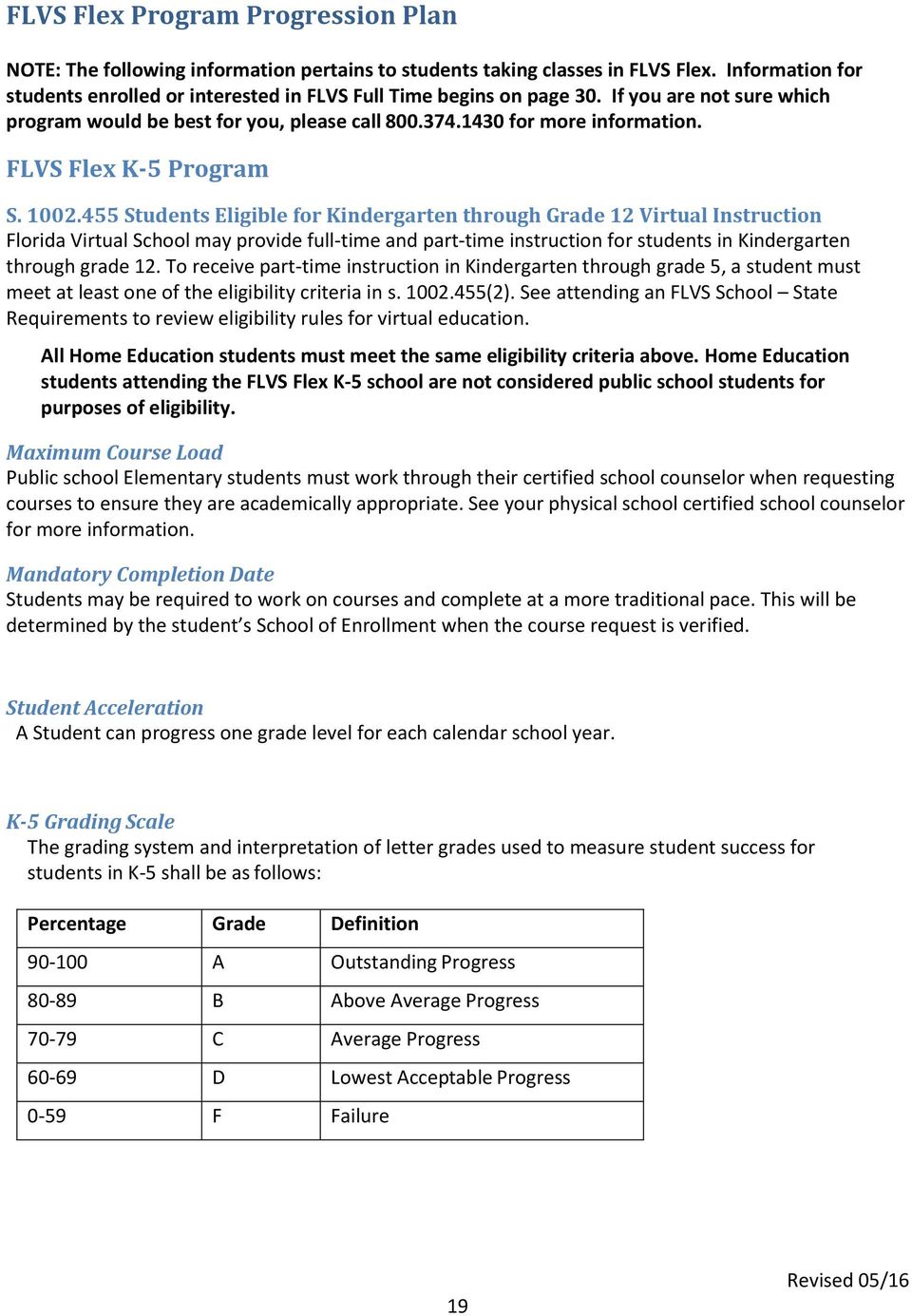
19 FLVS Flex Program Progression Plan NOTE: The following information pertains to students taking classes in FLVS Flex. Information for students enrolled or interested in FLVS Full Time begins on page 30. If you are not sure which program would be best for you, please call for more information. FLVS Flex K-5 Program S Students Eligible for Kindergarten through Grade 12 Virtual Instruction Florida Virtual School may provide full-time and part-time instruction for students in Kindergarten through grade 12. To receive part-time instruction in Kindergarten through grade 5, a student must meet at least one of the eligibility criteria in s (2). See attending an FLVS School State Requirements to review eligibility rules for virtual education. All Home Education students must meet the same eligibility criteria above. Home Education students attending the FLVS Flex K-5 school are not considered public school students for purposes of eligibility. Maximum Course Load Public school Elementary students must work through their certified school counselor when requesting courses to ensure they are academically appropriate. See your physical school certified school counselor for more information. Mandatory Completion Date Students may be required to work on courses and complete at a more traditional pace. This will be determined by the student s School of Enrollment when the course request is verified. Student Acceleration A Student can progress one grade level for each calendar school year. K-5 Grading Scale The grading system and interpretation of letter grades used to measure student success for students in K-5 shall be as follows: Percentage Grade Definition A Outstanding Progress B Above Average Progress C Average Progress D Lowest Acceptable Progress 0-59 F Failure 19
20 FLVS Flex 6-8 Programs We are proud to offer both FLVS Flex 6-8 (grades 6-8) and FLVS Home Education programs (grades 6 8) to students. FLVS Flex (Public and Private School students) FLVS Flex is a part time program that supports the need for students enrolled in another district or private school in Florida to accelerate, remediate, resolve a schedule conflict, and/or access curriculum not offered in their district/school of enrollment. Students need the advisement and confirmation from the certified school counselor at their enrolled school to take academically appropriate classes part time at FLVS. Note that parental/guardian involvement is expected and required to participate in FLVS courses. Home Education Program Students in this program are considered Home Education students. Students must register as Home Education students with their resident school district and be in good standing. There are no other eligibility requirements to participate and students are not required to take the FSA, FCAT, or complete any state-mandated end of course assessments or meet graduation requirements for high school students. Note: many home education students do plan to eventually switch to public school in order to graduate with a diploma. If that is a consideration, students should be meeting graduation requirements which include passing certain state-mandated exams. The Home Education office in the student s District of Enrollment can provide further information on this. Home education students are not eligible to receive a diploma from FLVS or receive any other services that may be provided to public school students. Students may follow a standard school calendar or work at a pace appropriate to their goals and learning. Students may enroll in courses that are academically appropriate for their desired educational path. Initial Entry Requirements FLVS Flex is a public school program providing middle school curriculum to children of Florida residents at no additional taxpayer expense. Florida law provides FLVS as a school choice option for parents and students. If the course is appropriate for the student, the school or district may not deny access to the FLVS course. This is true even if the course is offered at the student s traditional school. Further information on this may be found at this site on the FLDOE website: Students may enroll by going to Geographic Limitations Students shall be considered Florida students and thus qualify for free access to FLVS courses if any of the following criteria are met: Be enrolled in a Florida public/charter school, or Be enrolled and in good standing as a homeschool student with a Florida public school district, or Be enrolled in an affiliated Florida private school and whose legal guardian is a Florida resident, or Be the child of a parent who is stationed at a Florida military base (the legal guardian must be the person who is stationed at the Florida military base) 20

21 Age Limitations FLVS Flex will enroll students through age 19. The student's age on the date of the course enrollment may not be older than 19. For the purposes of this policy, "date of course enrollment" refers to the date on which a complete registration or course request for the course segment is made. Students must complete all coursework, including final exam, before their 21 st birthday. Exceptional education students who have not earned a standard diploma remain eligible for educational services through the end of the school year in which they become twenty-two years old. (IDEA (a) Required Documents Students enroll and request courses online. Home Education students must have a Home School Verification Form approved by their district of residence and submitted to FLVS, along with online parental consent, before any course requests will be approved. Certified school counselor consent for the course request(s) are the only requirement for FLVS Flex public/charter/private school students. Note that parental/guardian involvement is expected and required to participate in FLVS courses. FLVS does also request the student s social security number to ensure unique identification. Please note that some agencies, for example Florida Bright Futures, require this number to apply for scholarships. FLVS uses all possible safeguards to ensure this number is secure, including encryption in our database and masking to only display the last 4 digits. Other Documentation You may need to provide additional documentation if any of the following circumstances apply: Student Number Identifier, Florida: If your child previously attended a FL public school or is attending public school now (besides FLVS), we are required to use the same number for our state data reporting. Custody order: If your legal guardianship is determined by a court order, please submit a copy of the order. This will ensure that proper contact is maintained, as FLVS does require that each instructor speak with the parent or guardian at least monthly. IEP or 504 plan: If a student is a student with a disability, this must be indicated in the appropriate section on the application and a copy of the most current IEP must be submitted. An ESE staff member will review whether the IEP indicates that enrollment in a fulltime virtual instruction program is appropriate or not according to Section (5), F.S. Military orders: If you are enrolling your student under the exception for children of U.S. Armed Forces, you will need to provide copies of your orders. Students with Special Needs FLVS Flex is a school of choice. As such, it should be considered and chosen only if FLVS is the most appropriate choice based on the unique needs of the student and the services available. S Statewide Comprehensive Assessment Program Middle School Students attending FLVS Flex are subject to the statewide assessment program based upon the status of their school of enrollment. FLVS does not administer any statewide assessments as part of the Flex program. Students are expected to adhere to the policy of their local district or private school with 21
22 regard to testing. Home education students who desire to take and use statewide assessments as their annual education evaluation must request that testing through the home education office in their district of residence. End of Course Assessments (EOC) EOC assessments must be rigorous, statewide, standardized, and developed or approved by the Florida Department of Education. The content knowledge and skills assessed by EOC assessments must be aligned to the core curricular content established in the Florida Standards. Students enrolled in Civics, Algebra 1, Algebra II, Geometry, or Biology 1 or an equivalent course with a statewide, standardized EOC assessment are required to take the specific End of Course Assessment at their school of enrollment or at a location agreed upon by their zoned district and FLVS. S , F.S. Middle and High School Grading System Middle School Grading System The grading system and interpretation of letter grades used to measure student success for students in public schools shall be as follows: Percentage Grade Definition A Outstanding Progress B Above Average Progress C Average Progress D Lowest Acceptable Progress 0-59 F Failure Weighted Grading System Middle School courses factor into the student s Grade Point Average using the same standards as HS courses. There are no weighted courses in Middle School. Students accelerating and taking a high school honors course while in middle school will receive honors credit (1.5 weighting) on their high school GPA calculation when they enter high school. Note: A high school transcript is initiated upon the first completion of a high school course regardless of the student s official grade. Middle School Flex Curriculum To see the curriculum available through FLVS Flex, please visit 22
23 FLVS Flex High School Program We are proud to offer both FLVS Flex (grades 9-12) and FLVS Home Education program (grades 9-12) to students for the current school year. FLVS Flex (Public and Private School students) FLVS Flex is a part time program that supports the need for students enrolled in another district or private school in Florida to accelerate, remediate, resolve a schedule conflict, and/or access curriculum not offered in their district/school of enrollment. Students need the advisement and confirmation from the certified school counselor at their enrolled school to take academically appropriate classes part time at FLVS. Note that parental/guardian involvement is expected and required to participate in FLVS courses. Home Education Program Students in this program are considered Home Education students. Students must register as Home Education students with their resident school district and be in good standing. There are no other eligibility requirements to participate and students are not required to take the FSA, FCAT, or complete any state-mandated end of course assessments or meet graduation requirements for high school students. Note: many home education students do plan to eventually switch to public school in order to graduate with a diploma. If that is a consideration, students should be meeting graduation requirements which include passing certain state-mandated exams. The Home Education office in the student s District of Enrollment can provide further information on this. Home education students are not eligible to receive a diploma from FLVS or receive any other services that may be provided to public school students. Students may follow a standard school calendar or work at a pace appropriate to their goals and learning. Students may enroll in courses that are academically appropriate for their desired educational path. Home Education Student Eligibility A home education student is eligible to participate in the interscholastic extracurricular activities at the public school that he or she would be assigned to attend based on a district's attendance area policies or may develop an agreement to participate at a private school provided the following conditions are met: o The student must meet the requirements of the home education program. (s , F.S.) During the period of participation, the home education student must demonstrate educational progress in all subjects taken in the home education program by a method of evaluation agreed upon by the parent and the school principal, which may include: o Review of the student's work by a certified teacher chosen by the parent. o Grades earned through correspondence. o Grades earned in courses taken at a community college, university, or trade school o Standardized test scores above the 35th percentile, or any other method in s , F.S. The student must meet the same residency requirements as other students in the school at which he or she participates. The student must meet the same standards of acceptance, behavior, and performance as required of other students in extracurricular activities. The student must register with the school his or her intent to participate in interscholastic extracurricular activities as a representative of the school before the beginning date of the 23
24 season for which the activity in which he or she wishes to participate. A home education student must be able to participate in curricular activities if that is a requirement for an extracurricular activity. A student who transfers from a home education program to a public school before or during the first grading period of the school year is academically eligible to participate in interscholastic extracurricular activities during the first grading period provided the student has a successful evaluation from the previous year. Any public school or nonpublic school student who has been unable to maintain academic eligibility for participation in interscholastic extracurricular activities is ineligible to participate as a home education student until the student has successfully completed one grading period in home education, fulfilling the requirements for interscholastic extracurricular eligibility, s (3)(a)2, F.S., to become eligible to participate as a home education student. Initial Entry Requirements FLVS Flex is a public school program providing middle school curriculum to children of Florida residents at no additional tax payer expense. Florida law provides FLVS as a school choice option for parents and students. If the course is appropriate for the student, the school or district may not deny access to the FLVS course. This is true even if the course is offered at the student s traditional school. Further information on this may be found at this site on the FLDOE website: Students may enroll by going to Geographic Limitations Students shall be considered Florida students and thus qualify for free access to FLVS courses if any of the following criteria are met: Be enrolled in a Florida public/charter school, or Be enrolled and in good standing as a homeschool student with a Florida public school district, or Be enrolled in an affiliated Florida private school and whose legal guardian is a Florida resident, or Be the child of a parent who is stationed at a Florida military base (the legal guardian must be the person who is stationed at the Florida military base) Age Limitations FLVS will enroll students through age 19. The student's age on the date of the course enrollment may not be older than 19. For the purposes of this policy, "date of course enrollment" refers to the date on which a complete registration or course request for the course segment is made. Students must complete all coursework, including final exam, before their 21 st birthday. Exceptional education students who have not earned a standard diploma remain eligible for educational services through the end of the school year in which they become twenty-two years old. (IDEA (a) Required Documents Students enroll and request courses online. Home Education students must have a Home School Verification Form approved by their district of residence and submitted to FLVS, along with online parental consent, before any course requests will be approved. Certified school counselor consent for 24
25 the course request(s) are the only requirement for FLVS Flex public/charter/private school students. Note that parental/guardian involvement is expected and required to participate in FLVS courses. FLVS does also request the student s social security number to ensure unique identification. Please note that some agencies, for example Florida Bright Futures, require this number to apply for scholarships. FLVS uses all possible safeguards to ensure this number is secure, including encryption in our database and masking to only display the last 4 digits. Other Documentation You may need to provide additional documentation if any of the following circumstances apply: Student Number Identifier, Florida: If your child previously attended a FL public school or is attending public school now (besides FLVS), we are required to use the same number for our state data reporting. Custody order: If your legal guardianship is determined by a court order, please submit a copy of the order. This will ensure that proper contact is maintained, as FLVS does require that each instructor speak with the parent or guardian at least monthly. IEP or 504 plan: If a student is a student with a disability, this must be indicated in the appropriate section on the application and a copy of the most current IEP must be submitted. An ESE staff member will review whether the IEP indicates that enrollment in a fulltime virtual instruction program is appropriate or not according to Section (5), F.S. Military orders: If you are enrolling your student under the exception for children of U.S. Armed Forces, you will need to provide copies of your orders. Students with Special Needs FLVS Flex is a school of choice. As such, it should be considered and chosen only if FLVS is the most appropriate choice based on the unique needs of the student and the services available. S Statewide Comprehensive Assessment Program High School Students attending FLVS Flex are subject to the statewide assessment program based upon the status of their school of enrollment. FLVS does not administer any statewide assessments as part of the Flex program. Students are expected to adhere to the policy of their local district or private school with regard to testing. Home education students who desire to take and use statewide assessments as their annual education evaluation must request that testing through the home education office in their district of residence. End of Course Assessments (EOC) EOC assessments must be rigorous, statewide, standardized, and developed or approved by the Florida Department of Education. The content knowledge and skills assessed by EOC assessments must be aligned to the core curricular content established in the Florida Standards. Students enrolled in Algebra 1, Algebra 2, Geometry, US History or Biology 1 or an equivalent course with a statewide, standardized EOC assessment are required to take the specific End of Course Assessment at their school of enrollment or at a location agreed upon by their zoned district and FLVS. 25
26 Section Digital Materials Each district school board, in consultation with the district school superintendent, shall make available digital materials, CAPE Digital Tool certificates, and CAPE industry certifications for students in prekindergarten through grade 12 in order to enable students to attain digital skills. The digital materials, CAPE Digital Tool certificates, and CAPE industry certifications may be integrated into subject area curricula, offered as a separate course, made available through open-access options, or deployed through online or digital computer applications, subject to available funding. S High School Grading System The grading system and interpretation of letter grades used to measure student success for students in public schools shall be as follows: Percentage Grade Value Definition Regular Weight Honors Credit Weight A 4 Outstanding Progress B 3 Above Average Progress C 2 Average Progress D 1 Lowest Acceptable Progress 0-59 F 0 Failure AP/Dual Enrollment Weight High School Curriculum Flex Program To see the curriculum available through FLVS Flex, please visit 26
27 FLVS Flex 6-8 and 9-12 Instructional Policies Student/Parent/Teacher Communication It is the policy of FLVS Flex that students and parents complete a Welcome Call with the instructor of every enrolled course in the first several days of enrollment. Instructors will call and , using the information provided by students and parents at registration, to attempt to complete this communication. A student s enrollment will not be permitted to remain active if the student and parent do not complete a course Welcome Call with the instructor. Instructors will also contact students and parents at least once per month to provide an update on student course progress and grade. A student s enrollment will not be permitted to remain active if the student and parent do not return an instructor s contact attempts. Instructors will provide assignment feedback and assignments grades within 48 hours of an assignment s submission. Instructors will return written and phone contact from students and parents within 24 hours. Academic Integrity Student academic integrity is a core value and universal expectation at Florida Virtual School. Detailed information regarding the criminal nature of academic brokering, the policies pertaining to reporting, and the proctored exam process can be found on our website at the following address: Course Progress Standard semester pace in most FLVS courses is 18 weeks to complete; while some courses may have a different standard pace, every course has its own unique pace chart to guide students and parents to success in the course. Students whose enrollment in their course segment exceeds an appropriate and agreed upon pace for learning and retaining course material (as determined by the course pace chart and instructor) will be contacted and offered help. Students who do not respond to teacher-led interventions by regularly submitting course assessments, as indicated through those interventions, will be withdrawn. Instructional Leadership may exercise discretion in varying from this policy in certain student situations and as needed in courses associated with state or AP assessments. Withdrawals during the first 14 days of a course enrollment will result in a grade of W on a student s transcript. Thereafter, withdrawals are processed as WP for students who are earning a passing grade (59.5% or above, overall) at the time of withdrawal and as WF for students who are earning a failing grade (59.4% or below, overall) at the time of withdrawal. All final grades and withdrawals are sent to the student s school of record. Resubmissions As part of Florida Virtual School s commitment to mastery learning as a process, students who choose to remediate material to gain additional understanding will have the option to re-attempt a formative assessment in their course. Formative assessments in a course may include: worksheets, written 27
28 compositions, lab reports, short answer paragraphs, essays, book responses, graded discussion board posts, and other assessments that require teacher evaluation of the student s work. While infrequent situational deviation may occur at an Instructional Leader s discretion, Florida Virtual School limits the number of total attempts to three on the formative assessments mentioned above. Summative assessment submissions will be limited to one. Exceptions may be made in certain situations if determined appropriate by the instructional team. Mandatory Final Exam Policy The purpose of the final exam is to assist in validating that students have demonstrated mastery of key course concepts and standards. The final exam, unto itself, is not the sole determiner of student achievement; however, students are required to take a final exam in all FLVS courses in order to be eligible for course credit. The FLVS Academic Integrity department may, at its discretion, require a proctored segment exam for any student on a situational basis. Academic Integrity proctored exams must be successfully passed (grade of 59.5% or higher) in order for a student to be eligible for course credit. Discussion-Based Assessments As a means of ensuring comprehension and integrity, each course contains built-in assignments that are designated to be completed verbally, during a discussion between a teacher and student. A student who does not complete and pass the discussion-based assessments in his/her course is ineligible for course credit. Collaboration Assessments To foster 21st Century Skills and build real-world competencies, FLVS courses contain opportunities for collaboration in learning with peers. While completing a collaboration assessment is not a requirement for earning completion credit for an FLVS course, it is highly recommended that all students complete these assessments. Grades are assigned for participation in collaborations, and opting to forgo a collaboration opportunity may result in a 0 percent grade being issued for that assignment. Honors Assessments Students who elect to complete an honors course, where available, commit to completing and passing all honors assessments in the course. Students who do not complete and pass (score of 60% or higher) all honors assessments in the course will not be completed with honors credit for the course. Students seeking honors credit must also complete the honors segment exam. 28
29 AP Course Policy Students entering high school grades 9-12 have access to Advanced Placement courses that may result in earning college credit for high school coursework. These courses are used to calculate overall Grade Point Average (GPA) and typically count extra in the calculation. These courses are also available at no charge to Florida public school students, whereas they may have a tuition cost if taken in college. (S , F.S.) A passing grade in the course will be accepted for high school credit. Students are not required to take the Advanced Placement exam prior to receiving credit for the course; they may receive half credit at the end of each semester. However, students enrolled in a traditional school while taking an AP course with FLVS should reference their school district s policies related to credit weighting and exam requirements to determine how their grade will be weighted by their school district. Postsecondary institutions determine college credit awarded based on the AP Exam score earned. FLVS strongly encourages students who take AP courses to sit for the course AP Exam in May. Students shall be exempt from payment of any fees or costs associated with AP Exam participation, with the following two exceptions: Students who incur late registration fees will be responsible for fee payment, and nonmilitary family students who take the test outside the United States will be responsible for registration costs. Seat Time Policy Another aspect of FLVS s commitment to student learning is the seat time policy for each segment of every course. To ensure adequate time for comprehension and mastery, students must work in a course segment consistently for a minimum 14 days starting from the date of first submission. 28 days of work is required, at minimum, for a two-segment course. Based on content, some courses have longer seat time policies. Consistent submission of assessments will ensure the student is engaged and learning. This policy provides students the opportunity to receive ongoing feedback and remediation while demonstrating their learning through several required checkpoints. DBAs (Discussion-Based Assessments) are limited to no more than 1 per day. The Instructional Leadership Team reserves the right to evaluate a student s gradebook to determine when the work habits show consistent progress, thus beginning the count towards the 14 day minimum, and may require a student to take a proctored exam in order to complete the class. All assignments must be completed prior to taking the segment exam. Students/Parents with questions about a specific course s seat time policy are encouraged to contact their instructor for details. Students who are Hospital/Homebound through Their Home District All FLVS VIP students may have remote access to curriculum, assessments and instructors. Students who are hospitalized or homebound may have additional opportunities for flexibility in scheduling and completion of assignments per their district approval. 29
30 FLVS Full Time (FLVS FT) Program Progression Plan NOTE: The following information pertains to students taking classes in FLVS Full Time (FLVS FT). If you are not sure which program would be best for you, please call for more information. In the absence of language to the contrary, FLVS FT adopts the requirements specified in statute for the operation of this program. Students are expected to meet the progression standards of the state and FLVS FT provides the prescribed testing, intervention and reporting as required. S English Language Learners (ELLs) Where the school has limited English proficient students, the identification and instruction shall be appropriately designed to develop the student's mastery of the four language skills, including listening, speaking, reading, and writing, as rapidly as possible based on the students English proficiency level. The students are placed into Supplemental Student Support Programs and monitored by their homeroom teacher in Elementary School and their LA teacher in Middle School. Supplemental Student Support Programs are programs that use interventions that are designed to address the instructional needs of students who require additional support mastering the Essential Skills and Standards. The strategic intervention and progress monitoring provided through the implementation of targeted supplemental instructional support programs (SISPs) helps to ensure students are receiving instruction that meets their individual needs. The ES homeroom and MS LA teachers are ESOL endorsed/certified. For more details on ELL instruction requirements, visit Note: Refer to Rule 6A-6.090, F.A.C. Programs for English Language Learners. Students with Active IEP or 504 Accommodation Plan Our goal is to provide an exemplary educational experience for all students. Current documentation should be provided as stated above to ensure that proper course placement can be achieved. S Students Eligible for Kindergarten through 12th Grade Virtual Instruction A student may participate in virtual instruction in the school district in which he or she resides if the student meets the eligibility criteria below. A student is eligible to participate in virtual instruction if: The student spent the prior school year in attendance at a public school in the state and was enrolled and reported by the school district for funding during October and February for purposes of the Florida Education Finance Program surveys; The student is a dependent child of a member of the United States Armed Forces who was transferred within the last 12 months to this state from another state or from a foreign country pursuant to a permanent change of station order; 30
31 The student was enrolled during the prior school year in a virtual instruction program under s ,, or a full-time Florida Virtual School program under s (8)(a); The student has a sibling who is currently enrolled in a virtual instruction program (VIP) and the sibling was enrolled in that program at the end of the prior school year; The student is eligible to enter kindergarten or first grade; or The student is eligible to enter grades 2 through 5 and is enrolled full-time in a school district virtual instruction program, virtual charter school, or the Florida Virtual School. The virtual instruction options for which this eligibility section applies include: School district operated part-time or full-time kindergarten through grade 12 virtual instruction programs under s (1)(b) for students enrolled in the school district. Full-time virtual charter school instruction authorized under s Virtual courses offered in the course code directory to students within the school district or to students in other school districts throughout the state pursuant to s Transfer of Student Credits There are three options for requesting and being granted credit by FLVS Full Time for coursework completed in a different school setting, all of which follow Florida Education Rule 6A as outlined below: 1. Credits and grades earned and offered for acceptance at FLVS Full Time shall be based on official transcripts and shall be accepted at face value, and may be subject to validation at the school s discretion. If validation of the official transcript is deemed necessary, or if the student does not possess an official transcript or is a home education student, credits may be validated through performance during the first grading period as outlined in #2, below. 2. Validation of credits shall be based on performance in classes at FLVS Full Time. A student transferring into FLVS FT will be placed at the appropriate sequential course level based on the student s academic documents submitted when transferring into FLVS, and the student should have a minimum grade point average of 2.0 at the end of the first semester. Students who meet this requirement will have their transfer credits validated. Students who do not meet this requirement will have credits validated using the Alternative Validation Procedure, as outlined in #3, below. 3. If validation based on performance as described above is not satisfactory (student does not have a 2.0 at the end of the first semester), then any one or more of the following alternative procedures may be used for validation purposes as determined by the teacher, principal, and parent: (a) Portfolio evaluation by the superintendent or designee; (b) Written recommendation by a Florida certified teacher selected by the parent and approved by the principal; (c) Demonstrated performance in courses taken through dual enrollment or at other public or private accredited schools; (d) Demonstrated proficiencies on nationally-normed standardized subject area assessments; (e) Demonstrated proficiencies on the FSA, FCAT; or 31
32 (f) Written review by FLVS of the criteria utilized for a given subject provided by the former school. Students must be provided at least ninety (90) days from date of transfer to prepare for assessments outlined in paragraphs (3)(d) and (e), if required. (Refer to Rule 6A , F.A.C. State Uniform Transfer of High School Credits, and Rule 6A , F.A.C. State Uniform Transfer of Students in the Middle Grades.) S Required Instruction FLVS Full Time shall provide all courses required for elementary grades promotion, middle grades promotion, high school graduation and appropriate instruction designed to ensure that students meet State Board of Education adopted standards (Florida Standards) in the following subject areas: reading and other English language arts, mathematics, science, social studies, foreign languages, health and physical education, and the arts. To access the complete statute, visit S Report Cards FLVS requires the regular issuance of student report cards (also called Progress Reports) for all elementary, middle, and high school students. These report cards clearly depict and grade: The student's academic performance in each class or course in Grades 1 through 12 based on examinations, written papers, class participation, and other academic performance criteria. It includes the student's performance or nonperformance at his or her grade level; The student's conduct and/or behavior; and The student's attendance, including absences and tardiness. Note: in a virtual environment, this element may be interpreted differently and tardiness may be considered not applicable. See the Policy Handbook for the specific FLVS school for complete details. End-of-Year Status Statement The final report card for a school year shall contain a statement indicating end-of-the-year status regarding performance or nonperformance at grade level, acceptable or unacceptable behavior and attendance, and promotion or non-promotion. Schools shall not exempt students from academic performance requirements, such as final exams, based on practices or policies designed to encourage student attendance. A student's attendance record may not be used in whole or in part to provide an exemption from any academic performance requirement. For access to the complete statute, please visit S Public School Student Progression; Remedial Instruction; Reporting Requirements Note: This section only pertains to FLVS Full Time public students where it discusses progression from one grade to the next. FLVS is only responsible for progress monitoring students in the FLVS FT program who fail to achieve required progress as measured by state-mandated testing. For FLVS Flex students, progression is measured within the context of a single course. All FLVS students (excluding home education and private school students) are responsible for taking all Florida Statewide Comprehensive Assessments to measure progress and satisfy graduation requirements. 32
33 It is the intent of the Legislature that each student s progression from one grade to another be determined, in part, upon proficiency in English language arts, social studies, science, and mathematics; that district school board policies facilitate such proficiency; and that each student and his or her parent be informed of that student s academic progress. All FLVS students (excluding home education and private school students) are responsible for taking all Florida High Stakes Assessments to measure progress and satisfying graduation requirements. Note: For FLVS Flex students, progression at FLVS is measured within the context of the course(s) taken at FLVS. The district and school of enrollment determine all other progress of the student based on the information contained below. Comprehensive Program Students must meet specific, published standards approved by the State Board of Education before progression is achieved. Failure to meet standards will result in remediation and/or retention. Allocation of Resources Schools must allocate resources for students who fail to progress, prioritizing students who will be retained if progress is not achieved. Assessment and Support Each student must participate in the statewide, standardized assessment program required by s All FLVS FT Public students are required to participate in all state-mandated testing. The tests are administered at the student s zoned School of Enrollment or other approved designated testing location per Florida Statute and the student is responsible for all transportation and other requirements related to attending the testing. Each student who does not achieve a Level 3 or above on the statewide, standardized English Language Arts assessment, or the Algebra I EOC assessment must be evaluated to determine the nature of the student's difficulty, the areas of academic need, and strategies for providing academic supports to improve the student's performance. Students who require support will receive diagnostic testing to identify and measure deficiencies prior to support occurring. Additional diagnostics will be used to measure progress while being remediated. This monitoring plan will be created in conjunction with the student and parent. A student who is not meeting the school district or state requirements for satisfactory performance in English Language Arts and mathematics must be covered by one of the following plans: 1. A federally required student plan such as an individual education plan; 2. A schoolwide system of progress monitoring for all students, except a student who scores Level 4 or above on the English Language Arts and mathematics assessments may be exempted from participation by the principal; or 3. An individualized progress monitoring plan. Reading Deficiency and Parental Notification Students who demonstrate deficiencies in reading in grades kindergarten through grade 3 will be evaluated to determine the nature of the student s difficulty, the areas of academic need and provided strategies for academic support to improve performance. The student s reading deficiency must be monitored and the supportive instruction must continue until the student demonstrates grade level proficiency in a manner determined by the district, which may include achieving a Level 3 on the statewide, standardized English Language Arts assessment. Parents must be notified of the deficiency and interventions provided. Failure to be reading at or above grade level in grade 3 may result in retention of the student until the deficiency is eliminated. Students may be promoted midyear when 33
34 appropriate. To be promoted to grade 4, a student must score a Level 2 or higher on the statewide, standardized English Language Arts assessment required under s for grade 3. Notification The parent of any student who exhibits a substantial deficiency in reading, as described above, is notified in writing via the Student Success Plan* of the following: That his or her child has been identified as having a substantial deficiency in reading. A description of the current services that are provided to the child. A description of the proposed supplemental instructional services and supports that will be provided to the child that are designed to remediate the identified area of reading deficiency. That if the child s reading deficiency is not remediated by the end of grade 3, the child must be retained unless he or she is exempt from mandatory retention for good cause. Strategies for parents to use in helping their child succeed in reading proficiency. Statewide, standardized English Language Arts assessment is not the sole determiner of promotion and that additional evaluations, portfolio reviews, and assessments are available to the child to assist parents and the school district in knowing when a child is reading at or above grade level and ready for grade promotion. The district s specific criteria and policies for midyear promotion. Midyear promotion means promotion of a retained student at any time during the year of retention once the student has demonstrated ability to read at grade level. *Note: Student Success Plans document levels of performance, assigned interventions, and progress on those interventions. Elimination of Social Promotion No student may be assigned to a grade level based solely on age or other factors that constitute social promotion. The district school board may only exempt students from mandatory retention, as provided in paragraph (5)(b), for good cause. A student who is promoted to grade 4 with a good cause exemption shall be provided support and reading instruction and intervention that include specialized diagnostic information and specific reading strategies to meet the needs of each student so promoted. The school district shall assist schools and teachers with the implementation of reading strategies for students promoted with a good cause exemption which research has shown to be successful in improving reading among students that have reading difficulties. Mandatory Retention The district school board may only exempt students from mandatory retention, as provided in the previous section, for good cause. Good cause exemptions are limited to the following: Limited English proficient students who have had less than 2 years of instruction in an English for Speakers of Other Languages program based on the initial date of entry into a school in the United States. Students with disabilities whose individual education plan indicates that participation in the statewide assessment program is not appropriate, consistent with the requirements of s Students who demonstrate an acceptable level of performance on an alternative standardized reading or English Language Arts assessment approved by the State Board of Education. 34
35 A student who demonstrates through a student portfolio that he or she is performing at least at Level 2 on the statewide, standardized English Language Arts assessment. Students with disabilities who take the statewide, standardized English Language Arts assessment and who have an individual education plan or a Section 504 plan that reflects that the student has received intensive instruction in reading or English Language Arts for more than 2 years but still demonstrates a deficiency and was previously retained in kindergarten, grade 1, grade 2, or grade 3. Students who have received intensive reading intervention for 2 or more years but still demonstrate a deficiency in reading and who were previously retained in kindergarten, grade 1, grade 2, or grade 3 for a total of 2 years. A student may not be retained more than once in grade 3. Students who have received intensive remediation in reading or English Language Arts for 2 or more years but still demonstrate a deficiency and who were previously retained in kindergarten, grade 1, grade 2, or grade 3 for a total of 2 years. Intensive instruction for students so promoted must include an altered instructional day that includes specialized diagnostic information and specific reading strategies for each student. The district school board shall assist schools and teachers to implement reading strategies that research has shown to be successful in improving reading among low-performing readers. Requests for good cause exemptions for students from the mandatory retention requirement as described above shall be made consistent with the following: Documentation shall be submitted from the student's teacher to the school principal that indicates that the promotion of the student is appropriate and is based upon the student's academic record. In order to minimize paperwork requirements, such documentation shall consist only of the existing progress monitoring plan, individual educational plan, if applicable, report card, or student portfolio. The school principal shall review and discuss such recommendation with the teacher and make the determination as to whether the student should be promoted or retained. If the school principal determines that the student should be promoted, the school principal shall make such recommendation in writing to the district school superintendent. The district school superintendent shall accept or reject the school principal's recommendation in writing. Successful Progression for Retained Third Grade Students Students retained under the provisions described above must be evaluated to determine the nature of the student s difficulty, the areas of academic need and provided strategies for academic support to improve performance to ameliorate the student s specific reading deficiency, as identified by a valid and reliable diagnostic assessment. FLVS FT-retained 3 rd grade students must attend a summer reading camp (virtually) and if not previously enrolled in an SISP, they will be enrolled the following school year, as well as provided with reading support using appropriate teaching methodologies necessary to assist those students in becoming successful readers, able to read at or above grade level, and ready for promotion to the next grade. See the statute for the full description of required actions. Students promoted during the school year after November 1 must demonstrate proficiency levels in reading equivalent to the level necessary for the beginning of grade 4. The rules adopted by the State Board of Education must include standards that provide a reasonable expectation that the student's progress is sufficient to master appropriate grade 4 level reading skills. 35
36 Annual Report In addition to the requirements noted above, each district school board must annually report to the parent of each student the progress of the student toward achieving state and district expectations for proficiency in English language arts, social studies, science, and mathematics. The district school board must report to the parent the student s results on each statewide, standardized assessment. Student performance results on district-required local assessments will be reported to teachers and parents no later than 30 days after the administration of such assessments. Statewide assessment test results are sent in the postal mail to the student s parent or guardian. The evaluation of each student s progress must be based upon the student s classroom work, observations, tests, district and state assessments, and other relevant information. Progress reporting must be provided to the parent in writing in a format adopted by the district school board. FLVS publishes progress reports twice a year with specific comments on progress in achieving grade-level expectations and attendance information. Stateassessment scores are not included in the report card comments as we don t typically have that data yet at the time report cards are published. Students who are performing below grade level are given Student Success Plans, which document levels of performance, assigned interventions, and progress on those interventions. Teachers also complete 4 Personalized Learning Plan calls to discuss academic progress and goals. S Academically Challenging Curriculum to Enhance Learning (ACCEL) Options ACCEL options are educational options that provide academically challenging curriculum or accelerated instruction to eligible public school students in kindergarten through grade 12. At a minimum, each school offers the following Academically Challenging Curriculum to Enhance Learning (ACCEL) options: whole-grade and midyear promotion subject-matter acceleration virtual instruction in higher grade level subjects Credit Acceleration Program under s , F.S. Additional ACCEL options may include, but are not limited to, the following: enriched science, technology, engineering, and mathematics (STEM) coursework enrichment programs flexible grouping advanced academic courses combined classes self-paced instruction rigorous industry certifications that are articulated to college credit and approved pursuant to ss and work-related internships or apprenticeships curriculum compacting advanced-content instruction telescoping curriculum. 36
37 Special note: Curriculum compacting is a process whereby a student is given a pre-assessment giving the teacher information about what content the student has already mastered. The student would then not be required to complete mastered content, but work on alternate or enrichment activities instead. In telescoped curriculum, material is not necessarily skipped but students move more quickly through all material thereby eliminating repetition and considerably increasing the pace of instruction to meet the needs of high potential students. Eligibility and Procedural Requirements Principal Determined Eligibility Requirements When the promotion or acceleration occurs within the principal s school, each principal must establish student eligibility requirements. Elementary School Acceleration Eligibility Students who desire to accelerate in Elementary School must satisfy the following requirements: Students must be enrolled in FLVS FT for at least 60 days. Evidence of readiness as demonstrated by LEAP tests scores 95% or above, CBM results 75 th percentile or above, samples of written work, current grades and semester grades, FSA results from previous year. We also review the Assessment Objective Performance Report (AOPR) and make sure the student has mastered all grade level benchmarks in a semester course. Once the student has met the requirements, individualized plans are developed for acceleration if the Student Support Team agrees that the student meets acceleration criteria. Middle Grades Acceleration Eligibility In the Middle School, according to the Middle School Pupil Progression plan, students must take 3 years of Language Arts, Math, Science, and Social Studies. However, these subjects can be at advanced levels. The criterion that is looked at includes: FSA scores of Level 4/Level 5 Current grades are all A s and B s LEAP scores 95% or above Verified Curriculum Based assessment results 75 th percentile or above High School Acceleration Eligibility Students requesting to participate in Honors, AP and Dual Enrollment courses must meet the following criteria: Has earned a minimum high school unweighted GPA of 3.0 Has earned passing scores on FSA English Language Arts for Honors/AP course, or passing PERT/ACT/SAT score for Dual Enrollment For AP courses, student has completed pre-requisite for requested course ACCEL Requirements Each principal must inform parents and students of the ACCEL options available at the school and the student eligibility requirements for the ACCEL options established pursuant to information provided above. Each principal must establish a process by which a parent may request student participation in wholegrade promotion, midyear promotion, and subject-matter acceleration when the promotion or acceleration occurs within the principal s school; virtual instruction in higher grade level subjects; or an 37
38 alternative ACCEL option established by the principal. If the parent selects one of these ACCEL options and the student meets the eligibility requirements established by the principal pursuant to information above, the student must be provided the opportunity to participate in the ACCEL option. Each school district must establish a process by which a parent may request student participation in whole-grade promotion, midyear promotion, or subject-matter acceleration that would result in a student attending a different school. If the parent selects one of these ACCEL options and the student meets the eligibility and procedural requirements set forth in the district s comprehensive student progression plan, as required above, the student must be provided the opportunity to participate in the ACCEL option. If a student participates in an ACCEL option pursuant to the parental request per the above information, a performance contract must be executed by the student, the parent, and the principal. At a minimum, the performance contract must require compliance with: 1. Minimum student attendance requirements. 2. Minimum student conduct requirements. 3. ACCEL option requirements established by the principal, which may include participation in extracurricular activities, educational outings, field trips, interscholastic competitions, and other activities related to the ACCEL option selected. If a principal initiates a student s participation in an ACCEL option, the student s parent must be notified. A performance contract, pursuant to information provided above, is not required when a principal initiates participation but may be used at the discretion of the principal. Award of a Standard High School Diploma A student who meets the applicable grade 9 cohort graduation requirements of s (3)(a)-(e), or s (10)(a)1.-5., (b)1.-5., (c)1.-5., or (d)1.-5.,earns three credits in electives, and earns a cumulative grade point average (GPA) of 2.0 on a 4.0 scale shall be awarded a standard high school diploma in a form prescribed by the State Board of Education. If a student was enrolled in high school prior to and opted for one of the former 18-credit accelerated high school graduation options, the student can continue earning credits as part of the program and upon completion of the former 18-credit option, can graduate with a standard diploma. S Exceptional Student Education (ESE) Eligible Students The school district (FLVS FT) shall provide for an appropriate program of special instruction, facilities, and services for exceptional students as prescribed by the State Board of Education as acceptable, including certain provisions as specified in (1)(a)-(g) of the statute. Each full-time virtual instruction program under s , F.S., or s , F.S., must fulfill the obligations of a school district under this section for public school exceptional students who are enrolled in a full-time virtual instruction program. A student whose individual educational plan indicates that fulltime virtual instruction is appropriate may be enrolled in a full-time virtual instruction program. To see the full statute language, please visit 38
39 FLVS Flex K-5 Elementary School Program Our Public Program is available to students in grades K 12 (subject to the additional requirements outlined below) statewide. FLVS will be the student s school district of record and students will receive a school report card and will graduate with a diploma from FLVS if all requirements are met. Students must meet all public school requirements for attendance and standardized test participation. Students will be expected to have an average of 6 courses per year for grades 9 12 or equivalent instructional hours for K 8. Initial Enrollment Requirements Student eligibility requirements for FLVS Full Time are determined by the State of Florida. Before enrolling, review the eligibility requirements posted at the FLDOE website: Please review the following eligibility requirements carefully to determine if your student is eligible to participate in grades K 12. Age Limitations Kindergarten: Any student enrolling in kindergarten must be five (5) years old on or before September 1 in the school year for which they are enrolling. First Grade: Any student enrolling in first grade must be six (6) years old on or before September 1 in the school year for which they are enrolling. First Grade Admission Any child who has attained the age of six years on or before September 1 of the school year and who has been enrolled in a public school, or who has attained the age of six years on or before September 1 and has satisfactorily completed the requirements for kindergarten in a private school from which the district school board accepts transfer of academic credit, or who otherwise meets the criteria for admission or transfer in a manner similar or applicable to other grades, shall progress according to the district student progression plan. Required Documents A copy of one of the following documents must be provided for every student to verify age eligibility. To avoid unnecessary delays, provide a copy of this document along with your enrollment documents. Birth certificate Passport FLVS does also request the student s social security number to ensure unique identification. Please note that some agencies, for example Florida Bright Futures, require this number to apply for scholarships. FLVS uses all possible safeguards to ensure this number is secure, including encryption in our database and masking to only display the last 4 digits. Geographical Limitations A copy of one of the following documents must be provided to verify your legal residence. If you do not have any of these documents, please contact the Enrollment Team to discuss acceptable alternatives. Gas, electric, or water bill from the last 60 days that includes your name and service address Mortgage statement or lease agreement Other Documentation You may need to provide additional documentation if any of the following circumstances apply: 39
40 Student Number Identifier, Florida: If your child previously attended a FL public school, we are required to use the same number for our state data reporting. Custody order: If your legal guardianship is determined by a court order, please submit a copy of the order. Report Card/Unofficial Transcript: We encourage all applicants to supply their most recent report card or unofficial transcript during the enrollment process. It is exceptionally helpful to ensure that students receive the personalized learning that our program offers. Gifted evaluation: If you are requesting enrollment in a course that is ahead of or behind the student's age-based grade level or you are requesting placement in a Talented course, a placement counselor will contact you to request a report card and/or state test scores. IEP or 504 plan: If a student is a student with a disability, this must be indicated in the appropriate section on the application and a copy of the most current IEP must be submitted. An ESE staff member will review whether the IEP indicates that enrollment in a full-time virtual instruction program is appropriate or not according to Section (5), F.S. Military orders: If you are enrolling your student under the exception for children of U.S. Armed Forces, you will need to provide copies of your orders. School Attendance FLVS FT K-3 students must complete the recommended 20 hours per week (required 720 hours per year). FLVS fourth and fifth grade students must complete the recommended 25 hours per week (required 900 hours per year). FLVS teachers will monitor and review attendance records on a weekly basis. Learning Coaches document student attendance in the Learning Management System (LMS); the school verifies that the attendance records are accurate. Truancy FLVS FT defines truancy as 15 unexcused days in 90-days or 10 consecutive unexcused days, with or without the knowledge or consent of the student's parent or guardian, and who is subject to compulsory school attendance. In order to maximize student learning, regular attendance is imperative. The FLVS Full Time program offers a great deal of flexibility about how many hours students spend each day on school work and on what days of the week they complete that work. Due to this flexibility, FLVS Full Time program has zero tolerance for truancy and students who are considered truant will be dis-enrolled from the Florida Virtual School Full Time public program. Learning Coaches are held legally responsible for ensuring that their students are fully participating in school. Placement of Elementary Transfer Students Students who were part of the Florida public school program last school year are eligible to transfer to FLVS Full Time Public per the eligibility requirements stated above. Grade placement is based on the careful evaluation of each pupil s achievement in terms of his/her appropriate instructional goals. The basis for making the determination is affected by many inputs including: progress tests, daily observation, classroom assignments, standardized tests, student products and all other objective data available. The primary responsibility for determining each pupil s level of performance and ability to function academically, socially, and emotionally at each level is that of the classroom teacher, subject to the review and approval of the Principal. No student may be assigned to a grade level based solely on age or other factors that constitute social promotion. 40
41 Kindergarten and First Grade Out-of-State Transfers The State Board of Education may adopt rules under which students not meeting the entrance age may be transferred from another state if their parents have been legal residents of that state. Rule 6A , Florida Administrative Code (F.A.C.), Entry into Kindergarten and first grade by Out-of- State Transfer Students state that: 1. Any student who transfers from an out-of-state public school and who does not meet regular age requirements for admission to Florida public schools shall be admitted upon presentation of the data required in subsection (3). 2. Any student who transfers from an out-of-state nonpublic school and who does not meet regular age requirements for admission to Florida public schools may be admitted if the student meets age requirements for public schools within the state from which he or she is transferring, and if the transfer of the student's academic credit is acceptable under rules of the school board. Prior to admission, the parent or guardian must also provide the data required in subsection (3). 3. In order to be admitted to Florida schools, such a student transferring from an out-of-state school must provide the following data: a. Official documentation that the parent(s) or guardian(s) was a legal resident(s) of the state in which the child was previously enrolled in school; b. An official letter or transcript from proper school authority which shows record of attendance, academic information, and grade placement of the student; c. Evidence of immunization against communicable diseases as required in s , F.S.; d. Evidence of date of birth in accordance with s , F.S.; and e. Evidence of a medical examination completed within the last twelve (12) months in accordance with s , F.S. S Reading Assessment K-3 Section 11 - Students with Reading Deficiencies: The parent of any K-3 student who exhibits a reading deficiency shall be immediately notified of the student's deficiency with a description and explanation, in terms understandable to the parent, of the exact nature of the student's difficulty in learning and lack of achievement in reading; shall be consulted in the development of a plan, as described in s (4)(b), F.S.; and shall be informed that the student will be given reading instruction until the deficiency is corrected. This is an additional requirement to the remediation support and notification provisions contained in s , F.S., and in no way reduces the rights of a parent or the responsibilities of a school district under that section. For the complete bill language, visit S Kindergarten Readiness Screening The statewide Florida Kindergarten Readiness Screener-Work Sampling System (FLKRS-WSS) required to be administered to each kindergartener in the district within the first 30 days of instruction per Section , Florida Statutes. The statewide kindergarten screening assesses the readiness of each student for kindergarten based upon the performance standards adopted by the DOE. FLVS FT staff will contact affected parents to schedule this assessment once all enrollment requirements are met. For information on the specifics of this screening, go to the following URL: 41
42 S Statewide Assessment Program Elementary The statewide, standardized English language arts, Math and Science assessments are given in grades 3-5. Students taking the ELA assessment shall not take the discontinued Reading or Writing assessment. ELA assessments shall be administered online. Students taking a revised Mathematics assessment shall not take the discontinued assessment. All FLVS FT students are required to take these assessments. For a complete schedule of assessments and testing dates, visit Other tests may be required based on special programs that the student attends. Page 2 of the testing schedule details what those other tests would be and when they are administered. Each student who does not meet specific levels of performance on the required assessments as determined by the district school board or who scores below Level 3 on the statewide, standardized English Language Arts assessment or on the statewide, standardized Mathematics assessments in grades 3 through 8, must be provided with additional diagnostic assessments to determine the nature of the student's difficulty, the areas of academic need, and strategies for appropriate intervention and instruction. If a student s reading deficiency is not remedied by the end of grade 3, as demonstrated by scoring Level 2 or higher on the statewide, standardized assessment required under s for grade 3, the student must be retained. For the full statute language, visit and S Public School Student Progression; Remedial Instruction; Reporting Requirements It is the intent of the Legislature that each student s progression from one grade to another be determined, in part, upon satisfactory performance in English language arts, social studies, science, and mathematics; that district school board policies facilitate student achievement; that each student and his or her parent be informed of that student s academic progress; and that students have access to educational options that provide academically challenging coursework or accelerated instruction pursuant to s For the complete F.S. text, visit Excerpts are provided below. Successful Progression for Retained Readers Students retained under the provisions of information provided above must be provided individualized interventions and support in reading to ameliorate the student s specific reading deficiency, as identified by a valid and reliable diagnostic assessment. This intervention must include effective instructional strategies, participation in the school district s summer reading camp, and appropriate teaching methodologies necessary to assist those students in becoming successful readers, able to read at or above grade level, and ready for promotion to the next grade. Each school district shall: Provide third grade students who are retained under the provisions of paragraph (5)(b) with academic support and instructional services to remediate the identified areas of reading deficiency, including participation in the school district s summer reading camp as required under paragraph (a) and a minimum of 90 minutes of daily, uninterrupted, scientifically research-based reading instruction which includes phonemic awareness, phonics, fluency, vocabulary, and comprehension and other strategies prescribed by the school district, which may include, but are not limited to: a. Integration of science and social studies content within the 90-minute block. b. Small group instruction. c. Reduced teacher-student ratios. 42
43 d. More frequent progress monitoring. e. Tutoring or mentoring. f. Transition classes containing 3rd and 4th grade students. g. Extended school day, week, or year. Provide written notification to the parent of a student who is retained under the provisions of paragraph (5)(b) that his or her child has not met the proficiency level required for promotion and the reasons the child is not eligible for a good cause exemption as provided in paragraph (6)(b). The notification must comply with the provisions of s (15) and must include a description of proposed interventions and supports that will be provided to the child to remediate the identified areas of reading deficiency. Implement a policy for the midyear promotion of a student retained under the provisions of paragraph (5)(b) who can demonstrate that he or she is a successful and independent reader and performing at or above grade level in reading or, upon implementation of English Language Arts assessments, performing at or above grade level in English Language Arts. Tools that school districts may use in reevaluating a student retained may include subsequent assessments, alternative assessments, and portfolio reviews, in accordance with rules of the State Board of Education. Provide students who are retained under the provisions of paragraph (5)(b) with a highly effective teacher as determined by the teacher s performance evaluation under s Establish at each school, when applicable, an Intensive Acceleration Class for retained grade 3 students who subsequently score Level 1 on the required statewide, standardized assessment identified in s The focus of the Intensive Acceleration Class shall be to increase a child s reading and English Language Arts skill level at least two grade levels in 1 school year. The Intensive Acceleration Class shall: Be provided to a student in grade 3 who scores Level 1 on the statewide, standardized Reading assessment or the English Language Arts assessment and who was retained in grade 3 the prior year because of scoring Level 1. Have a reduced teacher-student ratio. Provide uninterrupted reading instruction for the majority of student contact time each day and incorporate opportunities to master the grade 4 Next Generation Sunshine State Standards or Florida Standards in other core subject areas. Use a reading program that is scientifically research-based and has proven results in accelerating student reading achievement within the same school year. Provide intensive language and vocabulary instruction using a scientifically research-based program, including use of a speech-language therapist. K-3 READ Initiative The FLVS FT Program has established a Reading Enhancement and Acceleration Development (READ) Initiative. The focus of the READ Initiative is to prevent the retention of Grade 3 students and to offer intensive accelerated reading instruction to Grade 3 students who failed to meet standards for promotion to Grade 4 and to each K-3 student who is assessed as exhibiting a reading deficiency. For the full statute language, visit Please also see the Florida Virtual School Comprehensive Reading Plan for specific details. Plans are available on the FLDOE website: 43
44 Intensive Acceleration Class for Retained Third Graders Each school, where applicable, will provide an intensive acceleration class for retained Grade 3 students who subsequently score at a Level 1 on the statewide, standardized English Language Arts assessment and who was retained in grade 3 the prior year because of scoring Level 1. The focus of the intensive acceleration class shall be to increase a child's reading level at least two grade levels in one school year. Note: This class is for a student who would be spending his or her third year in Grade 3 (has been retained two times already.) Applicable schools are those with retained Grade 3 students who subsequently score at Level 1 on FSA ELA. Through this class, a retained third grader could be promoted from Grade 3 to Grade 5. Promotion of FLVS FT Elementary Students The student must successfully complete English Language Arts, Social Studies, Science, and Mathematics courses, achieving a 60% or higher overall grade. Students must successfully complete all assigned lessons and assessments in active courses. Elementary School Curriculum Florida Public Kindergarten through Grade 12 educational instruction in Florida is based on the Next Generation Sunshine State Standards and, in some content areas, the Florida Standards. For complete information on what standards are implemented in what grade, visit To access the FLVS FT Elementary School curriculum, please visit 44
45 FLVS FT Middle School Program Initial Entry Requirements Student eligibility requirements for FLVS Full Time are determined by the State of Florida. Before enrolling, review the following eligibility requirements carefully to determine if your student is eligible to participate in grades 6-8. Enrollment Information The annual enrollment period is open June 1-June 30 and will be available to students applying to enroll in Florida Virtual School Full Time (FLVS FT). The open enrollment period will be announced by FLVS FT and posted on our website. FLVS FT reserves the right to open additional enrollment periods throughout the year. FLVS FT is accessible to all students that meet the Eligibility requirements. Eligibility Information Florida Virtual School Full Time (FLVS FT) is a school of choice that provides a fully online educational option for students in the state of Florida in grades Students enrolled in FLVS FT are required to participate in state testing and adhere to all district policies with regards to attendance, participation, and completion of coursework. Students who meet district requirements and graduation requirements, as set forth by the state, are eligible to receive a Florida diploma from FLVS FT. Documentation requested during the application process is subject to review and may include requests for resubmission. Documentation is due by the last day of the enrollment period. Upon review of the student s full academic records, the FLVS FT Principals reserve the right to make enrollment exceptions based on individual students academic needs and what s in the best interest of the individual student. The following eligibility requirements must be met in order to be eligible for enrollment with FLVS FT: 1. The student must be a legal resident in the State of Florida. Military families living outside the State of Florida may enroll, but must maintain their Florida residency. 2. Students must meet the age requirements as outlined by Florida statutes and FLVS FT policy: a. The student must be able to meet graduation requirements (24 credits) during the school year in which the student turns age nineteen (19) by earning six (6) credits per academic year. In addition, the student must maintain the required grade point average (GPA). b. Students who will be age eighteen (18) years of age as of the first day of school, and who, by earning six (6) credits in the upcoming academic year cannot meet graduation requirements by the end of the school year, including grade point average (GPA), are not eligible to enroll in FLVS FT. c. Students who are age nineteen (19) or older are not eligible to enroll in FLVS FT. d. The limitations regarding age requirements do not include students with disabilities. Please note that the age requirements for students with disabilities that have an active Individual Educational Plan (IEP) differ from the general school age requirements. 3. All students with disabilities are required to meet the state and school admission criteria in order to be accepted into FLVS FT just as their non-disabled peers. Current Individual Educational Plans (IEP) of student applicants who meet the school s entrance criteria will be reviewed on an individual basis in order to determine the appropriateness of the full-time 45
46 virtual education option. See section Section S for more information on students with disabilities. 4. Students who need to earn less than 25% of their required credits to be eligible for a diploma are not eligible to enroll. AdvancED accreditation requires the institution ensures that students graduating from the institution complete at least 25% of the courses for graduation at the institution. 5. Previous year Florida home school students must present their most recent district home school evaluation indicating student is on grade level. Out of state homeschool students without an evaluation or standardized tests may be required to submit a current student portfolio with evidence of work samples and activity logs. 6. Students must have daily access to a computer, internet service, , and telephone in order to maintain contact with teachers, staff, and administration. 7. Students applying for grades 6-12 are recommended to meet the below academic progress. FLVS offers both a Full Time and a Flex option for students in the state of FL. The FLVS Flex option allows for students to take a reduced course load, or complete more than 6 credits per year. The FLVS Flex option allows students to have access to courses 12 months per year, and is recommended for students who are in need of additional course work in a school year to get on track for graduation. The FLVS FT/FLVS Flex bridge program allows students a personalized path for meeting their academic needs. RECOMMENDED MIDDLE SCHOOL ACADEMIC PROGRESS Grade Student is Entering Required Academic Achievement Successful Course Completion Minimum Unweighted Cumulative GPA 6 Proficient scores** on Grade 5 FSA ELA Reading, Writing AND Math Promotion from Grade 5 N/A 7 Proficient scores** on Grade 6 FSA ELA Reading, Writing AND Math Passing grades in at least 4 core courses in Grade Proficient scores** on Grade 7 FSA ELA Reading, Writing AND Math Passing grades in at least 4 core courses in Grade RECOMMENDED HIGH SCHOOL ACADEMIC PROGRESS 46
47 Grade Student is Entering Required Academic Achievement Successful Course Completion Minimum Accumulated Credits Minimum Unweighted Cumulative GPA 9 Proficient scores** on Grade 8 FSA ELA Reading, Writing AND Math Passing grades in at least 4 core courses in Grade 8 N/A Proficient scores** on Grade 9 FSA ELA and any applicable EOCs English I AND Algebra I OR Geometry Proficient scores** on Grade 10 FSA ELA and Algebra 1 EOC as applicable English I, II AND Algebra I OR Geometry AND 1 Science AND 1 Social Science Proficient scores** on Grade 10 FSA ELA and Algebra 1 EOC English I, II, III AND Algebra I AND Geometry AND 2 Science AND 2 Social Science **Proficient scores = At least satisfactory achievement (Level 3 or higher) on the most recent Florida standardized assessments per grade level as defined by the Florida Department of Education s achievement levels and scale scores. For more details, please visit: **Students may also demonstrate academic achievement through proficient grade level scores on an official standardized test administered by another public or private school system OR concordant scores on the SAT (430), ACT (19) and/or PERT (97). Truth in Application A student s application does not guarantee enrollment to FLVS FT and alternative options may be discussed. In addition, any subsequent enrollment may be terminated if it is discovered that the application provided incomplete, inaccurate or false information, or if any information was withheld. Students applying for enrollment are required to submit all academic records prior to any consideration for admission. Parents must disclose their child s current Individual Educational Plan (IEP) or current 504 Plan status as applicable at the time of applying for enrollment. 47
48 Required Documents A copy of one of the following documents must be provided to verify your legal residence. If you do not have any of these documents, please contact the Enrollment Team to discuss acceptable alternatives. Gas, electric, or water bill from the last 60 days that includes your name and service address Mortgage statement or lease agreement FLVS does also request the student s social security number to ensure unique identification. Please note that some agencies, for example Florida Bright Futures, require this number to apply for scholarships. FLVS uses all possible safeguards to ensure this number is secure, including encryption in our database and masking to only display the last 4 digits. Prior Public Schooling Limitations None Other Documentation You may need to provide additional documentation if any of the following circumstances apply: Student Number Identifier, Florida: If your child previously attended a FL public school, we are required to use the same number for our state data reporting. Custody order: If your legal guardianship is determined by a court order, please submit a copy of the order. Official Transcripts/STS: We require all applicants to supply official transcripts with state testing score during the enrollment process. It is exceptionally helpful to ensure that students receive the personalized learning that our program offers. Gifted evaluation: If you are requesting enrollment in a course that is ahead of or behind the student's age-based grade level or you are requesting placement in a talented course, a placement counselor will contact you to request a report card and/or state test scores. IEP or 504 plan: If a student is a student with a disability, this must be indicated in the appropriate section on the application and a copy of the most current IEP must be submitted. An ESE staff member will review whether the IEP indicates that enrollment in a full-time virtual instruction program is appropriate or not according to Section (5), F.S. Military orders: If you are enrolling your student under the exception for children of U.S. Armed Forces, you will need to provide copies of your orders. Free/Reduced Lunch application: Even though a virtual student does not require meals at school, FLVS Full Time is required to report the number of students enrolled in our program who qualify for free/reduced lunch. Please be sure to complete the application and return it so FLVS can accurately report this number to the state Powers and Duties of District School Board A school that includes any of grades 6, 7, or 8 shall include annually in its school improvement plan information and data on the school s early warning system required under paragraph (b), including a list of the early warning indicators used in the system, the number of students identified by the system as exhibiting two or more early warning indicators, the number of students by grade level that exhibit each early warning indicator, and a description of all intervention strategies employed by the school to improve the academic performance of students identified by the early warning system. In addition, a school that includes any of grades 6, 7, or 8 shall describe in its school improvement plan the strategies 48
49 used by the school to implement the instructional practices for middle grades emphasized by the district s professional development system pursuant to s (4)(b)9. Early Warning System. A school that includes any of grades 6, 7, or 8 shall implement an early warning system to identify students in grades 6, 7, and 8 who need additional support to improve academic performance and stay engaged in school. The early warning system must include the following early warning indicators: Attendance below 90 percent, regardless of whether absence is excused or a result of out-ofschool suspension. One or more suspensions, whether in school or out of school. Course failure in English Language Arts or mathematics. A Level 1 score on the statewide, standardized assessments in English Language Arts or mathematics. A school district may identify additional early warning indicators for use in a school s early warning system. When a student exhibits two or more early warning indicators, the school s child study team under s or a school-based team formed for the purpose of implementing the requirements of this paragraph shall convene to determine appropriate intervention strategies for the student. The school shall provide at least 10 days written notice of the meeting to the student s parent, indicating the meeting s purpose, time, and location, and provide the parent the opportunity to participate. School Attendance FLVS FT students must complete the required 25 hours per week (recommended 900 hours per year). FLVS teachers will monitor and review attendance records on a weekly basis. Learning Coaches document student attendance in the Learning Management System (LMS); the school verifies that the attendance records are accurate. Truancy FLVS FT defines truancy as 15 unexcused days in 90-days or 10 consecutive unexcused days, with or without the knowledge or consent of the student's parent or guardian, and who is subject to compulsory school attendance. In order to maximize student learning, regular attendance is imperative. The FLVS Full Time program offers a great deal of flexibility about how many hours students spend each day on school work and on what days of the week they complete that work. Due to this flexibility, FLVS Full Time program has zero tolerance for truancy and students who are considered truant will be dis-enrolled from the Florida Virtual School Full Time public program. Learning Coaches are held legally responsible for ensuring that their students are fully participating in school. Placement of In-State Transfer Students Students who were part of the Florida public school program last year are eligible to transfer to FLVS Full Time Public per the eligibility requirements stated above. Students may enroll after the start of the school year or semester up until the point that enrollment is closed. The actual date on which enrollment closes is determined annually at the discretion of the school. Families enrolling mid-year are subject to all the same enrollment requirements as families that enroll prior to the start of the school year or semester. 49
50 Grade placement is based on the careful evaluation of each pupil s achievement in terms of his/her appropriate instructional goals. The basis for making the determination is affected by many inputs including: progress tests, daily observation, classroom assignments, standardized tests, student products and all other objective data available. The primary responsibility for determining each pupil s level of performance and ability to function academically, socially, and emotionally at each level is that of the classroom teacher, subject to the review and approval of the Principal. No student may be assigned to a grade level based solely on age or other factors that constitute social promotion. Placement of Out-of-State Transfer Students The Florida ruling around state uniform processes for transfer of Middle Grade Students states that: (1) Grades earned and offered for acceptance shall be based on official transcripts and shall be accepted at face value subject to validation if required by the receiving school s accreditation. If validation of the official transcript is deemed necessary, or if the student does not possess an official transcript or is a home education student, successful completion of courses shall be validated through performance during the first grading period as outlined in subsection (2) of this rule. (2) Validation of courses shall be based on performance in classes at the receiving school. A student transferring into a school shall be placed at the appropriate sequential course level and should be passing each required course at the end of the first grading period. Students who do not meet this requirement shall have courses validated using the Alternative Validation Procedure, as outlined in subsection (3) of this rule. (3) Alternative Validation Procedure. If validation based on performance as described above is not satisfactory, then any one of the following alternatives identified in the district student progression plan shall be used for validation purposes as determined by the teacher, principal, and parent: a. Portfolio evaluation by the superintendent or designee; b. Demonstrated performance in courses taken at other public or private accredited schools; c. Demonstrated proficiencies on nationally-normed standardized subject area assessments; d. Demonstrated proficiencies on the FSA; or e. Written review of the criteria utilized for a given subject provided by the former school. Students who are transferring into grades 6-8 and have taken high school courses that have a required End of Course Assessment will be required to meet the transfer requirements for those courses. See the FLVS FT High School section for further details. Students must be provided at least ninety (90) days from date of transfer to prepare for assessments outlined in paragraphs (3)(c) and (d) of this rule if required. (6A ) S Statewide Assessment Program Middle School The statewide, standardized English language arts, Mathematics and Science assessments are given in grades 6-8. Students taking the ELA assessments shall not take the discontinued statewide, standardized assessments in Reading or Writing. ELA assessments shall be administered online. Students taking the Mathematics assessment shall not take the discontinued assessment. All FLVS FT students are required to take these assessments. For a complete schedule of assessments and testing dates, visit Other tests may be required based on special programs that the student attends. Page 2 of the testing schedule details 50
51 what those other tests would be and when they are administered. Each student who does not meet specific levels of performance on the required assessments as determined by the district school board or who scores below Level 3 on the statewide, standardized English Language Arts assessment or on the statewide, standardized Mathematics assessments in grades 3 through 8, must be provided with additional diagnostic assessments to determine the nature of the student's difficulty and the areas of academic need, to provide the strategies and support need for the appropriate intervention and instruction. For the full statute language, visit and Middle grades students enrolled in Algebra I or Geometry must take the statewide, standardized EOC assessment for those courses and may not take the corresponding grade-level FCAT. End of Course Assessments (EOC) EOC assessments must be rigorous, statewide, standardized, and developed or approved by the Florida Department of Education. The content knowledge and skills assessed by EOC assessments must be aligned to the core curricular content established in the Next Generation Sunshine State Standards or Florida Standards, as applicable. Students enrolled in an Algebra I, Algebra II, Geometry, or Biology 1 course or an equivalent high school course with a statewide, standardized EOC assessment are required to take the corresponding End of Course Assessment. Note these are high school level courses. Students taking a high school course in grades 6-8 may bank the credit towards high school graduation requirements and use that course in lieu of a middle grade math course. Students in the FLVS Full Time Public school must take all statewide standardized assessments. They must be administered (by law) at the student s zoned school of residence or at a location mutually agreed upon by the zoned district and FLVS. Every FLVS Full Time public school student is responsible for determining when FSA, FCAT and End of Course assessment tests will be administered in their district of residence and completing those tests. FLVS will notify each district of students requiring testing to ensure that adequate resources are available. Student scores on the statewide standardized assessments are reported back to FLVS Full Time and represent a significant portion of the FLVS Full Time school grade. They are also used to determine student progression options. Section , F.S. states that testing is mandatory for all students in attendance at a Florida public school, therefore the only way a student would not participate is if the student is absent during the entire testing window. Students who score a level 4 or level 5 on FSA Math Grade 7 will be strongly encouraged to take Algebra 1 in 8 th grade. Algebra 1 does have an End of Course Assessment that a student must pass to earn a standard diploma. Middle School students who take and pass the Algebra 1 EOC are allowed to bank the credit for high school and the passing score is used to meet the graduation requirement. Civics End of Course Assessment Civics is a required course offered to middle grades students. Each student s performance on the statewide, standardized EOC assessment in civics education constitutes 30 percent of the student s final course grade. S General Requirements for Middle Grades Promotion In order for a student to be promoted to high school from a school that includes middle grades 6, 7, and 8, the student must successfully complete the following academic courses: 51
52 Academic Courses The chart below represents the required courses to progress from middle school to high school. English Language Arts (ELA) Math Social Studies Science Three middle grades or higher courses. Three middle grades or higher courses. Each school that includes middle grades must offer at least one high school-level mathematics course for which students may earn high school credit. To earn high school credit for Algebra I, a middle grades student must take the statewide, standardized Algebra I EOC assessment and pass the course, and in addition, beginning with the school year and thereafter, a student's performance on the Algebra I EOC assessment constitutes 30 percent of the student's final course grade. To earn high school credit for a Geometry course, a middle grades student must take the statewide, standardized Geometry EOC assessment, which constitutes 30 percent of the student's final course grade, and earn a passing grade in the course. Three middle grades or higher courses. Beginning with students entering grade 6 in the school year, one of these courses must be at least a one-semester civics education course that includes the roles and responsibilities of federal, state, and local governments; the structures and functions of the legislative, executive, and judicial branches of government; and the meaning and significance of historic documents, such as the Articles of Confederation, the Declaration of Independence, and the Constitution of the United States. Three middle grades or higher courses. One of these courses must be at least a one-semester civics education course that includes the roles and responsibilities of federal, state, and local governments; the structures and functions of the legislative, executive, and judicial branches of government; and the meaning and significance of historic documents, such as the Articles of Confederation, the Declaration of Independence, and the Constitution of the United States. Beginning with the school year, each student s performance on the statewide, standardized EOC assessment in civics education required under s constitutes 30 percent of the student s final course grade. A middle grades student who transfers into the state's public school system from out of country, out of state, a private school, or a home education program after the beginning of the second term of grade 8 is not required to meet the civics education requirement for promotion from the middle grades if the student's transcript documents passage of three courses in social studies or two year-long courses in social studies that include coverage of civics education. Three middle grades or higher courses. 52
53 Other Beginning with the school year, to earn high school credit for a Biology I course, a middle grades student must take the statewide, standardized Biology I EOC assessment, which constitutes 30 percent of the student s final course grade, and earn a passing grade in the course.* One course in career and education planning to be completed in 7th or 8th grade. * If a middle school student desires to earn a Scholar Designation in High School, the student must take and pass and the Biology EOC Assessment. Each school must inform parents about the course curriculum and activities. Enrichment FLVS FT students engaged in enrichment activities for Reading and/or Math are required to attend weekly LiveLesson sessions and complete skills assignments and assessments. Note: State Board Rule 6A-6.054, F.A.C. establishes guidelines for placement in reading intervention and for progress monitoring. Progress monitoring must occur three times per year. S , F.S. Middle and High School Grading System Middle School Grading System The grading system and interpretation of letter grades used to measure student success for students in public schools shall be as follows: Percentage Grade Definition A Outstanding Progress B Above Average Progress C Average Progress D Lowest Acceptable Progress 0-59 F Failure Weighted Grading System Middle School courses factor into the student s Grade Point Average using the same standards as HS courses. There are no weighted courses in Middle School. Students accelerating and taking a high school honors course while in middle school will receive honors credit (1.5 weighting) on their high school GPA calculation when they enter high school. Note: A high school transcript is initiated upon the first completion of a high school course regardless of the student s official grade. S Student Standards for Participation in Interscholastic and Intrascholastic Extracurricular Student Activities (Craig Dickinson Act) 53
54 Interscholastic extracurricular student activities are an important complement to the academic curriculum. Participation in a comprehensive extracurricular and academic program contributes to student development of the social and intellectual skills necessary to become a well-rounded adult. Definition of Extracurricular The term "extracurricular" means any school-authorized or education-related activity occurring during or outside the regular instructional school day. Eligibility In order to participate in interscholastic, extracurricular student activities, a student must maintain a cumulative GPA of 2.0 or above on a 4.0 scale, or its equivalent, in the courses required by statute for high school graduation (5) or s A student must fulfill the requirements of an academic performance contract between the student, the district school board, the appropriate governing association, and the student's parents. If the student's cumulative GPA falls below 2.0, or its equivalent, on a 4.0 scale in courses required for high school graduation specified in s (5) or s At a minimum, the contract must require that the student attend summer school, or its grade equivalent, between Grades 9 and 10 or Grades 10 and 11, as necessary. A student must have a cumulative GPA of 2.0 or above on a 4.0 scale, or its equivalent, in the courses required for high school graduation, specified in (5) or s during his or her junior or senior year. Maintain satisfactory conduct, including adherence to appropriate dress and other codes of student conduct policies described in s (2). If a student is convicted of, or is found to have committed, a felony or a delinquent act that would have been a felony if committed by an adult, regardless of whether adjudication is withheld, the student s participation in interscholastic extracurricular activities is contingent upon established and published district school board policy. Any student who is exempt from attending a full school day based on rules adopted by the district school board for double sessions or programs, experimental schools, or schools operating under emergency conditions, must maintain a 2.0 GPA, or its equivalent, on a 4.0 scale and pass each class. Home Education Student Eligibility A home education student is eligible to participate in the interscholastic extracurricular activities at the public school that he or she would be assigned to attend based on a district's attendance area policies or may develop an agreement to participate at a private school provided the following conditions are met: o The student must meet the requirements of the home education program. (s , F.S.) During the period of participation, the home education student must demonstrate educational progress in all subjects taken in the home education program by a method of evaluation agreed upon by the parent and the school principal, which may include: o Review of the student's work by a certified teacher chosen by the parent. o Grades earned through correspondence. o Grades earned in courses taken at a community college, university, or trade school o Standardized test scores above the 35th percentile, or any other method in s , F.S. 54
55 The student must meet the same residency requirements as other students in the school at which he or she participates. The student must meet the same standards of acceptance, behavior, and performance as required of other students in extracurricular activities. The student must register with the school his or her intent to participate in interscholastic extracurricular activities as a representative of the school before the beginning date of the season for which the activity in which he or she wishes to participate. A home education student must be able to participate in curricular activities if that is a requirement for an extracurricular activity. A student who transfers from a home education program to a public school before or during the first grading period of the school year is academically eligible to participate in interscholastic extracurricular activities during the first grading period provided the student has a successful evaluation from the previous year. Any public school or nonpublic school student who has been unable to maintain academic eligibility for participation in interscholastic extracurricular activities is ineligible to participate as a home education student until the student has successfully completed one grading period in home education, fulfilling the requirements for interscholastic extracurricular eligibility, s (3)(a)2, F.S., to become eligible to participate as a home education student. Student Athlete Eligibility 1. Defines eligible to participate to include student participating in tryouts, off-season conditioning, summer workouts, preseason conditioning, in-season practice, or contests. Term does not mean student must be placed on any specific team 2. Technical changes to home school, charter school, and Florida Virtual School full-time program student participation. Reference f.s or the controlled open enrollment provisions 3. Prohibits districts or charter schools from delaying eligibility or prevent student participating in controlled open enrollment, or a choice program, from being immediately eligible to participate in extracurricular activities 4. Student may not participate in a sport if they participated in same sport at another school during that year, unless they meet one of the following criteria: Dependent children of active duty military personnel whose move resulted from military orders Children in foster care that was relocated Court-ordered change in custody due to separation, divorce or serious illness or death of custodial parent School- Specific Requirements for Participation A student attending Florida Virtual School Full Time (FLVS-Full Time) is eligible to participate at the public school to which the student would be assigned according to the school district attendance area policies, provided: a. The student meets the student eligibility criteria as specified in state statute F.S.; b. Meets any additional requirements as determined by the board of trustees of the Florida Virtual School; 55
56 c. The student meets the same residency requirements as other students in the school at which he/she participates; d. The student meets the same standards of acceptance, behavior and performance as required of other students in extracurricular activities; e. The student registers with the school his/her intent to participate in interscholastic athletic competition as a representative of the school, utilizing the official Association process as approved by the Executive Director (see Policy ), prior to the Monday of the first week of regular season competition for the sport(s) in which he/she wishes to participate; A student who transfers from the Florida Virtual School full-time program to a traditional public school before or during the first grading period of the school year is academically eligible to participate in interscholastic extracurricular activities during the first grading period if the student has a successful evaluation from the previous school year pursuant to paragraph (a). A public school or private school student who has been unable to maintain academic eligibility for participation in interscholastic extracurricular activities is ineligible to participate in such activities as a Florida Virtual School student until the student successfully completes one grading period in the Florida Virtual School pursuant to paragraph (a). The student complies with all FHSAA regulations, including eligibility requirements regarding age and limits of eligibility, and local school regulations during the time of participation; The student provides proof of basic medical insurance coverage and both independently secured catastrophic insurance coverage and liability insurance coverage which names the FHSAA as an insured party in the event the school s insurance provider does not extend coverage to students attending FLVS-Full Time; The student provides his/her own transportation to and from the public school; and The student provides to public school authorities all required forms and provisions. Ineligibility A student who withdraws from a regular school program to establish school residence at Florida Virtual School Full Time (FLVS-Full Time) and who is ineligible at the time of withdrawal from the regular school program due to his/her failure to meet academic or behavioral eligibility standards shall be ineligible to compete in interscholastic athletic competition under the provisions of Requirements for Participation until he/she has successfully completed one full semester (see Bylaw ) and has met all other eligibility requirements of this association. In determining the academic eligibility of a student who withdraws from a regular school program prior to the normal conclusion of the current semester and subsequently establishes school residence at FLVS-Full Time, the grades as posted in each subject for that student on the date of his/her withdrawal from the regular school program shall be used. Transfers A student who, after the beginning of the academic/athletic year transfers from FLVS-Full Time to a member school, transfers from any school to FLVS-Full Time, transfers from/to FLVS-Full Time to/from a different Florida Virtual Education program (i.e. Florida Virtual School Flex, a District Virtual Instruction Program, a District Franchise of FLVS, a Virtual Charter School, etc.) or transfers from/to FLVS-Full Time to/from home education, is considered a transfer student and is subject to the provisions of this statute. 56
57 For specifics related to this statute, visit S Students with Disabilities The term "student with a disability" means any student who is documented as having an intellectual disability; a hearing impairment, including deafness; a speech or language impairment; a visual impairment, including blindness; an emotional or behavioral disability; an orthopedic or other health impairment; an autism spectrum disorder; a traumatic brain injury; or a specific learning disability, including, but not limited to, dyslexia, dyscalculia, or developmental aphasia. Pursuant to F.S (3)(e) Florida Virtual School Full Time Public shall offer exceptional educational programs that meet the needs of students with disabilities for those students who meet the following criteria: 1) A student whose individual educational plan (IEP) indicates that full-time virtual instruction is appropriate may be enrolled in a full-time virtual instruction program, in accordance with Section (5), F.S. 2) The student s IEP indicates that comparable services and supports are available and appropriate in the full-time virtual education setting and that a full-time virtual setting reflects the Least Restrictive Environment (LRE). Middle School Curriculum Full Time Program To see the curriculum available through FLVS Full Time, please visit FLVS Full Time High School Program Our FLVS Full Time High School is available to students in grades 9 12 for the upcoming school year and does issue a diploma as specified by FDOE policy. FLVS will be the student s school district of record and students will receive a school report card from FLVS. Students must meet all public school requirements for attendance and state-mandated standardized test participation. FLVS Full Time expects all students to be college-bound; therefore the Scholar designation is the standard progression path for all students. For more information on this designation, see scholar designation below. Additionally, FLVS FT places all incoming 9 th graders into the Leadership Skills class as an elective to help students develop the requisite skills and behaviors to be successful. See High School Curriculum for more information. Initial Entry Requirements Student eligibility requirements for FLVS Full Time are determined by the State of Florida. Before enrolling, review the following eligibility requirements carefully to determine if your student is eligible to participate in grades Enrollment Information The annual enrollment period is open June 1-June 30 and will be available to students applying to enroll in Florida Virtual School Full Time (FLVS FT). The open enrollment period will be announced by FLVS FT and posted on our website. FLVS FT reserves the right to open additional enrollment periods throughout the year. FLVS FT is accessible to all students that meet the Eligibility requirements. 57
58 Eligibility Information Florida Virtual School Full Time (FLVS FT) is a school of choice that provides a fully online educational option for students in the state of Florida in grades Students enrolled in FLVS FT are required to participate in state testing and adhere to all district policies with regards to attendance, participation, and completion of coursework. Students who meet district requirements and graduation requirements, as set forth by the state, are eligible to receive a Florida diploma from FLVS FT. Documentation requested during the application process is subject to review and may include requests for resubmission. Documentation is due by the last day of the enrollment period. Upon review of the student s full academic records, the FLVS FT Principals reserve the right to make enrollment exceptions based on individual students academic needs and what s in the best interest of the individual student. The following eligibility requirements must be met in order to be eligible for enrollment with FLVS FT: 8. The student must be a legal resident in the State of Florida. Military families living outside the State of Florida may enroll, but must maintain their Florida residency. 9. Students must meet the age requirements as outlined by Florida statutes and FLVS FT policy: a. The student must be able to meet graduation requirements (24 credits) during the school year in which the student turns age nineteen (19) by earning six (6) credits per academic year. In addition, the student must maintain the required grade point average (GPA). b. Students who will be age eighteen (18) years of age as of the first day of school, and who, by earning six (6) credits in the upcoming academic year cannot meet graduation requirements by the end of the school year, including grade point average (GPA), are not eligible to enroll in FLVS FT. c. Students who are age nineteen (19) or older are not eligible to enroll in FLVS FT. d. The limitations regarding age requirements do not include students with disabilities. Please note that the age requirements for students with disabilities that have an active Individual Educational Plan (IEP) differ from the general school age requirements. 10. All students with disabilities are required to meet the state and school admission criteria in order to be accepted into FLVS FT just as their non-disabled peers. Current Individual Educational Plans (IEP) of student applicants who meet the school s entrance criteria will be reviewed on an individual basis in order to determine the appropriateness of the full-time virtual education option. See Section S for more information on students with disabilities. 11. Students who need to earn less than 25% of their required credits to be eligible for a diploma are not eligible to enroll. AdvancED accreditation requires the institution ensures that students graduating from the institution complete at least 25% of the courses for graduation at the institution. 12. Previous year Florida home school students must present their most recent district home school evaluation indicating student is on grade level. Out of state homeschool students without an evaluation or standardized tests may be required to submit a current student portfolio with evidence of work samples and activity logs. 58
59 13. Students must have daily access to a computer, internet service, , and telephone in order to maintain contact with teachers, staff, and administration. 14. Students applying for grades 6-12 are recommended to meet the below academic progress. FLVS offers both a Full Time and a Flex option for students in the state of FL. The FLVS Flex option allows for students to take a reduced course load, or complete more than 6 credits per year. The FLVS Flex option allows students to have access to courses 12 months per year, and is recommended for students who are in need of additional course work in a school year to get on track for graduation. The FLVS FT/FLVS Flex bridge program allows students a personalized path for meeting their academic needs. RECOMMENDED MIDDLE SCHOOL ACADEMIC PROGRESS Grade Student is Entering Required Academic Achievement Successful Course Completion Minimum Unweighted Cumulative GPA 6 Proficient scores** on Grade 5 FSA ELA Reading, Writing AND Math Promotion from Grade 5 N/A 7 Proficient scores** on Grade 6 FSA ELA Reading, Writing AND Math Passing grades in at least 4 core courses in Grade Proficient scores** on Grade 7 FSA ELA Reading, Writing AND Math Passing grades in at least 4 core courses in Grade RECOMMENDED HIGH SCHOOL ACADEMIC PROGRESS Grade Student is Entering Required Academic Achievement Successful Course Completion Minimum Accumulated Credits Minimum Unweighted Cumulative GPA 9 Proficient scores** on Grade 8 FSA ELA Reading, Writing AND Math Passing grades in at least 4 core courses in Grade 8 N/A
60 10 Proficient scores** on Grade 9 FSA ELA and any applicable EOCs English I AND Algebra I OR Geometry Proficient scores** on Grade 10 FSA ELA and Algebra 1 EOC as applicable English I, II AND Algebra I OR Geometry AND 1 Science AND 1 Social Science Proficient scores** on Grade 10 FSA ELA and Algebra 1 EOC English I, II, III AND Algebra I AND Geometry AND 2 Science AND 2 Social Science **Proficient scores = At least satisfactory achievement (Level 3 or higher) on the most recent Florida standardized assessments per grade level as defined by the Florida Department of Education s achievement levels and scale scores. For more details, please visit: **Students may also demonstrate academic achievement through proficient grade level scores on an official standardized test administered by another public or private school system OR concordant scores on the SAT (430), ACT (19) and/or PERT (97). Truth in Application A student s application does not guarantee enrollment to FLVS FT and alternative options may be discussed. In addition, any subsequent enrollment may be terminated if it is discovered that the application provided incomplete, inaccurate or false information, or if any information was withheld. Students applying for enrollment are required to submit all academic records prior to any consideration for admission. Parents must disclose their child s current Individual Educational Plan (IEP) or current 504 Plan status as applicable at the time of applying for enrollment. Required Documents A copy of one of the following documents must be provided to verify your legal residence. If you do not have any of these documents, please contact the Enrollment Team to discuss acceptable alternatives. Gas, electric, or water bill from the last 60 days that includes your name and service address Mortgage statement or lease agreement FLVS does also request the student s social security number to ensure unique identification. Please note that some agencies, for example Florida Bright Futures, require this number to apply for scholarships. FLVS uses all possible safeguards to ensure this number is secure, including encryption in our database and masking to only display the last 4 digits. 60
61 Prior Public Schooling Limitations None Supporting Documentation Your eligibility will be verified through state data. You do not need to submit verification of your eligibility unless you dispute the state or district determination of your eligibility, or you are claiming the exception for children of U.S. Armed Forces. If you dispute a finding that you are not eligible, we will provide you with information as to how to appeal that finding if you have other proof of enrollment. Other Documentation You may need to provide additional documentation if any of the following circumstances apply: Student Number Identifier, Florida: If your child previously attended a FL public school, we are required to use the same number for our state data reporting. Custody order: If your legal guardianship is determined by a court order, please submit a copy of the order. Official Transcripts/STS: We require all applicants to supply official transcripts with state testing score during the enrollment process. It is exceptionally helpful to ensure that students receive the personalized learning that our program offers. Gifted evaluation: If you are requesting enrollment in a course that is ahead of or behind the student's age-based grade level or you are requesting placement in a Talented course, a placement counselor will contact you to request a report card and/or state test scores. IEP or 504 plan: If a student is a student with a disability, this must be indicated in the appropriate section on the application and a copy of the most current IEP must be submitted. An ESE staff member will review whether the IEP indicates that enrollment in a full-time virtual instruction program is appropriate or not according to Section (5), F.S. Military orders: If you are enrolling your student under the exception for children of U.S. Armed Forces, you will need to provide copies of your orders. Free/Reduced Lunch application: Even thought a virtual student does not require meals at school, FLVS Full Time is responsible for reporting to the state DOE the number of enrolled students who qualify for free/reduced lunch. Please be sure to complete the application and return it so FLVS can accurately report this number to the state. Required Credits for Placement The standard Student Progression in FL is 24 credits in 4 years which translates to an average load of 6 credits per year. Students transferring to FLVS FT should have the following number of credits completed to be placed into the school at the entering grade shown: Entering Grade Minimum Required Credits Notes 9 th grade None 10 th grade 5 or more 11 th grade 11 or more 12 th grade 17 or more 24 credits are required to graduate; assumes 6 courses are successfully completed per year. 61
62 For students who do not have the required number of credits, FLVS suggests that students enroll with us as a home education student during which time the student can take the courses needed to enter 10 th, 11 th or 12 th grade with sufficient credits to be on pace to graduate. Enrollment Termination A student who attains the age of 16 years during the school year is not subject to compulsory school attendance beyond the date upon which he or she attains that age if the student files a formal declaration of intent to terminate school enrollment with the district school board. Public school students who have attained the age of 16 years and who have not graduated are subject to compulsory school attendance until the formal declaration of intent is filed with the district school board. The declaration must acknowledge that terminating school enrollment is likely to reduce the student's earning potential and must be signed by the student and the student's parent. The school district must notify the student's parent of receipt of the student's declaration of intent to terminate school enrollment. The student's certified school counselor or school personnel must conduct an exit interview with the student to determine the reasons for the student's decision to terminate school enrollment and actions that could be taken to keep the student in school. The student must be informed of opportunities to continue his or her education in a different environment, including, but not limited to, adult education and GED test preparation. Additionally, the student must complete a survey in a format prescribed by the Department of Education to provide data on student reasons for terminating enrollment and actions taken by schools to keep students enrolled. School Attendance FLVS students must complete the recommended 25 hours per week (required 900 hours per year). FLVS teachers will monitor and review attendance records on a weekly basis. Learning Coaches document student attendance in the Learning Management System (LMS); the school verifies that the attendance records are accurate. See the FLVS FT Student Handbook for additional discussion regarding attendance and participation. Truancy Truancy is 15 unexcused days in any 90-day period, or 10 consecutive unexcused days, with or without the knowledge or consent of the student's parent or guardian, and who is subject to compulsory school attendance. In order to maximize student learning, regular attendance is imperative. The FLVS Full Time program offers a great deal of flexibility about how many hours students spend each day on school work and on what days of the week they complete that work. Due to this flexibility, FLVS Full Time program has zero tolerance for truancy and students who are considered truant will be dis-enrolled from the Florida Virtual School Full Time public program. Learning Coaches are held legally responsible for ensuring that their students are fully participating in school. Placement of In-State Transfer Students Students who were part of the Florida public school program last year are eligible to transfer to FLVS Full Time per the eligibility requirements stated above. 62
63 Grade placement is based on the careful evaluation of each pupil s achievement in terms of his/her appropriate instructional goals. The basis for making the determination is affected by many inputs including: progress tests, daily observation, classroom assignments, standardized tests, student products and all other objective data available. The primary responsibility for determining each pupil s level of performance and ability to function academically, socially, and emotionally at each level is that of the classroom teacher, subject to the review and approval of the Principal. No student may be assigned to a grade level based solely on age or other factors that constitute social promotion. See Required Credits for Enrollment for further information. Placement of Out-Of-State Transfer Students The Florida ruling around state uniform transfer of High School Credits states that: 1. Grades earned and offered for acceptance shall be based on official transcripts and shall be accepted at face value subject to validation if required by the receiving school s accreditation. If validation of the official transcript is deemed necessary, or if the student does not possess an official transcript or is a home education student, credits shall be validated through performance during the first grading period as outlined in subsection (2) of this rule. 2. Validation of credits shall be based on performance in classes at the receiving school. A student transferring into a school shall be placed at the appropriate sequential course level and should have a minimum grade point average of 2.0 at the end of the first grading period. Students who do not meet this requirement shall have credits validated using the Alternative Validation Procedure, as outlined in subsection (3) of this rule. 3. Alternative Validation Procedure. If validation based on performance as described above is not satisfactory, then any one of the following alternatives shall be used for validation purposes as determined by the teacher, principal, and parent: a. Portfolio evaluation by the superintendent or designee; b. Written recommendation by a Florida certified teacher selected by the parent and approved by the principal; c. Demonstrated performance in courses taken through dual enrollment or at other public or private accredited schools; d. Demonstrated proficiencies on nationally-normed standardized subject area assessments; e. Demonstrated proficiencies on the FSA; or f. Written review of the criteria utilized for a given subject provided by the former school. Students must be provided at least ninety (90) days from date of transfer to prepare for assessments outlined in paragraphs (3)(d) and (e) of this rule if required. (6A ) FLVSFT High School Instructional Policies For additional information related to FLVSFT instructional procedures, FLVSFT students and parents are invited to reference the FLVFT Student/Parent Handbook, found in the Connexus Virtual Library. Academic Integrity Student academic integrity is a core value and universal expectation at Florida Virtual School Full-Time. Detailed information regarding the criminal nature of academic brokering, the policies pertaining to reporting, and the proctored exam process can be found in the FLVSFT Student/Parent Handbook. 63
64 Mandatory Final Exam Policy The purpose of the final exam is to assist in validating that students have demonstrated mastery of key course concepts and standards. The final exam, unto itself, is not the sole determiner of student achievement; however, students are required to take a final exam in all FLVS Full-Time courses in order to be eligible for course credit. The FLVS Full-Time Academic Integrity department may, at its discretion, require a proctored segment exam for any student on a situational basis. Academic Integrity proctored exams must be successfully passed (grade of 60% or higher) in order for a student to be eligible for course credit. Discussion-Based Assessments As a means of ensuring comprehension and integrity, each course contains built-in assignments that are designated to be completed between the teacher and student. A student who does not complete and pass the discussion-based assessments in his/her course is ineligible for course credit. S Statewide Assessment Program High School The primary purpose of the student assessment program is to provide student academic achievement and learning gains data to students, parents, teachers, school administrators, and school district staff. This data is to be used by districts to improve instruction; by students, parents, and teachers to guide learning objectives; by education researchers to assess national and international education comparison data; and by the public to assess the cost benefit of the expenditure of taxpayer dollars. Several statewide, standardized assessments are given in grades All FLVS FT students are required to take these assessments. For a complete schedule of assessments and testing dates, visit Other tests may be required based on special programs that the student attends. Page 2 of the testing schedule details what those other tests would be and when they are administered. Each student who does not meet specific levels of performance on the required assessments as determined by the district school board or who scores below Level 3 on the statewide, standardized Reading assessment or, the English Language Arts assessment must be provided with additional diagnostic assessments to determine the nature of the student's difficulty and the areas of academic need, to provide the strategies and support needed for the appropriate intervention and instruction. For the full statute language, visit and The Florida English Language Arts (ELA) assessments measures a student's content knowledge and skills in reading and writing at the high school level. Florida is assessing content knowledge and skills for math, science and social studies via the End of Course assessments currently required for Algebra I, Algebra II, Geometry, Biology and US History. The content knowledge and skills assessed by all statewide assessments must be aligned to the core curricular content established in the Next Generation Sunshine State Standards or the Florida Standards. Other content areas may be included as directed by the Commissioner. It is a requirement of enrollment in the Florida Virtual School Full Time Program, and our expectation, that students complete all required state testing, including FSA/FCAT/EOC Testing, for those grade levels which require them. Tests must be administered (by law) at the student s zoned school. Every FLVS Full Time public school student is responsible for determining when FSA, FCAT and/or End of Course assessments will be administered in their district of residence and completing those tests. Transportation to the testing location is the responsibility of the student/guardian. FLVS will notify each district of students requiring testing to ensure that adequate resources are available. Student scores on 64
65 the statewide, standardized assessments are reported back to FLVS Full Time and represent a significant portion of the FLVS Full Time school grade. A student who has not earned a passing score on the grade 10 ELA Assessment must participate in each retake of the assessment until the student earns a passing score to comply with FL graduation requirements. Section , F.S. states that testing is mandatory for all students in attendance at a Florida public school at the time of testing. FL graduation requirements include passing specific state assessments. If a student does not test, it may affect the ability to graduate from high school. End of Course Assessments (EOC) EOC assessments must be statewide, standardized, and developed or approved by the Department of Education as follows: Math EOCs Algebra 1 All students enrolled in Algebra I must take the Algebra I EOC assessment. A student who is enrolled in Algebra I must earn a passing score on the Algebra I EOC assessment or attain a comparative score as authorized in order to earn a standard high school diploma. A student who has not earned a passing score on the Algebra I EOC assessment must participate in each retake of the assessment until the student earns a passing score. Geometry Beginning with the school year, all students enrolled in geometry must take the Geometry EOC assessment. Beginning with the school year the Geometry EOC assessment must count for 30 percent of the student s final course grade. Algebra II Beginning with the school year, all students enrolled in Algebra 2 must take the Algebra 2 EOC assessment and it must count 30 percent of the student s final course grade. Except as otherwise provided in this section, Middle grades students enrolled in Algebra I or Geometry must take the statewide, standardized EOC assessment for those courses and may not take the corresponding grade-level FSA. Science EOC Beginning with the school year, all students enrolled in Biology I must take the Biology I EOC assessment and it must count 30 percent of the student s final course grade. Note: Students who take AP Biology or other accelerated courses that earn college credit and pass the associated test will not be required to take the Biology 1 EOC assessment. 65
66 Except as otherwise provided in this section, Middle grades students enrolled in Algebra I or Geometry must take the statewide, standardized EOC assessment for those courses and may not take the corresponding grade-level FCAT. US History EOC Beginning with the school year, all students enrolled in US History must take the US History EOC assessment and it must count 30 percent of the student s final course grade. Note: Students who take AP US History or other accelerated courses that earn college credit and pass the associated test will not be required to take the US History EOC assessment. For the complete statute regarding assessment, please visit S Requirements for a Standard High School Diploma Note: Any student enrolled in FLVS FT for graduation must have taken at least 6 full credits in an FLVS program to be eligible to graduate per SACS Accreditation Assurances. Graduation requires the successful completion of a minimum of 24 credits, an International Baccalaureate curriculum, or an Advanced International Certificate of Education curriculum. Students must be advised of eligibility requirements for state scholarship programs and postsecondary admissions. Students who desire to take more credits per year must demonstrate academic appropriateness as determined by the FLVS FT counselor. Students seeking an accelerated path to graduate earlier than 4 years should work with their school counselor. The required credits may be earned through equivalent, applied, or integrated courses or career education courses as defined in s (4), including work-related internships approved by the State Board of Education and identified in the course code directory. However, any must-pass assessment requirements must be met. An equivalent course is one or more courses identified by content-area experts as being a match to the core curricular content of another course, based upon review of the Next Generation Sunshine State Standards or Florida Standards for that subject. An applied course aligns with Next Generation Sunshine State Standards and includes real-world applications of a career and technical education standard used in business or industry. An integrated course includes content from several courses within a content area or across content areas. 66
67 Core Curriculum Credits Curriculum Area A student entering grade 9 in the school year must earn: A student entering grade 9 in the school year must earn: A student entering grade 9 in the school year must earn: A student entering grade 9 in the school year and beyond must earn: English Language Arts Mathematics Four credits in English/ELA. A student must pass the statewide, standardized grade 10 Reading assessment, or earn a concordant score, in order to graduate with a standard high school diploma. Four credits in mathematics, which must include Algebra I and Geometry. The statewide, standardized Algebra I EOC assessment constitutes 30 percent of the student's final course grade. A student who takes Algebra I or Geometry after the school year must take the statewide, standardized EOC assessment for the course Four credits in English/ELA. A student must pass the statewide, standardized grade 10 Reading assessment, or earn a concordant score, in order to graduate with a standard high school diploma. Four credits in mathematics, which must include Algebra I and Geometry. A student who takes Algebra I after the school year must pass the statewide, standardized Algebra I EOC assessment, or earn a comparative score, in order to earn a standard high school diploma. A student who takes Algebra I or Geometry after the school year must take Four credits in English/ELA. A student must pass the statewide, standardized grade 10 Reading assessment, or earn a concordant score, in order to graduate with a standard high school diploma. Four credits in mathematics, which must include Algebra I and Geometry. A student who takes Algebra I after the school year must pass the statewide, standardized Algebra I EOC assessment, or earn a comparative score, in order to earn a standard high school diploma. A student who takes Geometry after the school year must take the statewide, Four credits in English Language Arts (ELA) The four credits must be in ELA I, II, III, and IV. A student must pass the statewide, standardized grade 10 Reading assessment or, when implemented, the grade 10, or earn a concordant score in order to earn a standard high school diploma. Four credits in mathematics. A student must earn one credit in Algebra I and one credit in Geometry. A student's performance on the statewide, standardized Algebra I end-of-course (EOC) assessment constitutes 30 percent of the student's final course grade. A student must pass the statewide, standardized Algebra I EOC assessment, or earn a 67
68 Curriculum Area A student entering grade 9 in the school year must earn: A student entering grade 9 in the school year must earn: A student entering grade 9 in the school year must earn: A student entering grade 9 in the school year and beyond must earn: but is not required to pass the assessment in order to earn course credit. A student's performance on the Geometry EOC assessment is not required to constitute 30 percent of the student's final course grade. A student who earns an industry certification for which there is a statewide college credit articulation agreement approved by the State Board of Education may substitute the certification for one mathematics credit. Substitution may occur for up to two mathematics credits, except for Algebra I and Geometry. the statewide, standardized EOC assessment for the course but is not required to pass the assessment in order to earn course credit. A student's performance on the Geometry EOC assessment is not required to constitute 30 percent of the student's final course grade. A student who earns an industry certification for which there is a statewide college credit articulation agreement approved by the State Board of Education may substitute the certification for one mathematics credit. Substitution may occur for up to two mathematics credits, except for Algebra I and Geometry. standardized EOC assessment for the course but is not required to pass the assessment in order to earn course credit. A student's performance on the Algebra 1 or Geometry EOC assessment is not required to constitute 30 percent of the student's final course grade. A student who earns an industry certification for which there is a statewide college credit articulation agreement approved by the State Board of Education may substitute the certification for one mathematics credit. Substitution may occur for up to two mathematics credits, except for Algebra I and Geometry. comparative score, in order to earn a standard high school diploma. A student's performance on the statewide, standardized Geometry EOC assessment constitutes 30 percent of the student's final course grade. If the state administers a statewide, standardized Algebra II assessment, a student selecting Algebra II must take the assessment, and the student's performance on the assessment constitutes 30 percent of the student's final course grade. A student who earns an industry certification for which there is a statewide college credit articulation agreement approved by the State Board of Education may substitute the certification for one mathematics credit. Substitution may occur for up to two mathematics 68
69 Curriculum Area A student entering grade 9 in the school year must earn: A student entering grade 9 in the school year must earn: A student entering grade 9 in the school year must earn: A student entering grade 9 in the school year and beyond must earn: Science Three credits in science, two of which must have a laboratory component. A student who takes Biology I after the school year must take the statewide, standardized Biology I EOC assessment but is not required to pass the assessment in order to earn course credit. A student's performance on the assessment is not required to constitute 30 percent of the student's final course grade. A student who earns an industry certification for which there is a statewide college credit articulation agreement approved by the State Board of Education may substitute the certification for one science credit, except for Biology 1. Three credits in science, two of which must have a laboratory component. One of the science credits must be Biology I. A student who takes Biology I after the school year must take the statewide, standardized Biology I EOC assessment but is not required to pass the assessment in order to earn course credit. A student's performance on the assessment is not required to constitute 30 percent of the student's final course grade. A student who earns an industry certification for which there is a statewide college credit articulation agreement approved by the State Board of Education may substitute the certification for one science credit, except for Biology 1. Three credits in science, two of which must have a laboratory component. One of the science credits must be Biology I. A student who takes Biology I after the school year must take the statewide, standardized Biology I EOC assessment but is not required to pass the assessment in order to earn course credit. A student's performance on the assessment is not required to constitute 30 percent of the student's final course grade. A student who earns an industry certification for which there is a statewide college credit articulation agreement approved by the State Board of Education may substitute the certification for one science credit, except for Biology 1. credits, except for Algebra I and Geometry. Three credits in science, two of which must have a laboratory component. One of the science credits must be Biology I and the other two credits in equally rigorous courses. The student s performance on the statewide, standardized EOC assessment constitutes 30% of the student s final course grade. A student who earns an industry certification for which there is a statewide college credit articulation agreement approved by the State Board of Education may substitute the certification for one science credit, except for Biology 1. 69
70 Curriculum Area A student entering grade 9 in the school year must earn: A student entering grade 9 in the school year must earn: A student entering grade 9 in the school year must earn: A student entering grade 9 in the school year and beyond must earn: Social Studies Performing/Fine Arts Physical Education Three credits in social studies of which one credit in World History, one credit in United States History, one-half credit in United States Government, and one-half credit in economics is required. A student who takes United States History after the school year must take the statewide, standardized United States History EOC assessment but the student's performance on the assessment is not required to constitute 30 percent of the student's final course grade. One credit in fine or performing arts, speech and debate, or practical arts One credit in physical education to include integration of health. Three credits in social studies of which one credit in World History, one credit in United States History, one-half credit in United States Government, and one-half credit in economics is required. A student who takes United States History after the school year must take the statewide, standardized United States History EOC assessment but the student's performance on the assessment is not required to constitute 30 percent of the student's final course grade. One credit in fine or performing arts, speech and debate, or practical arts One credit in physical education to include integration of health. Three credits in social studies of which one credit in World History, one credit in United States History, one-half credit in United States Government, and one-half credit in economics is required. The statewide, standardized United States History EOC assessment constitutes 30 percent of the student's final course grade. One credit in fine or performing arts, speech and debate, or practical arts One credit in physical education to include integration of health. Three credits in social studies of which one credit in World History, one credit in United States History, one-half credit in United States Government, and one-half credit in economics is required. The statewide, standardized United States History EOC assessment constitutes 30 percent of the student's final course grade. One credit in fine or performing arts, speech and debate, or practical arts One credit in physical education to include integration of health. Note: There are many activities which may now Note: There are many activities which may now Note: There are many activities which may now Note: There are many activities which may now 70
71 Curriculum Area A student entering grade 9 in the school year must earn: count for PE. See the full statute language for a detailed list. A student entering grade 9 in the school year must earn: count for PE. See the full statute language for a detailed list. A student entering grade 9 in the school year must earn: count for PE. See the full statute language for a detailed list. A student entering grade 9 in the school year and beyond must earn: count for PE. See the full statute language for a detailed list. Electives Eight Credits in Electives Eight Credits in Electives Eight Credits in Electives Eight Credits in Electives Online Course Requirement n/a One online course is required. One online course is required. One online course is required. Students entering grade 9 in the school year may not use a driver education course to meet this requirement. Students entering grade 9 in may use a driver education course. 71
72 Notification Requirements The school district must notify students and parents, in writing, of the requirements for a standard high school diploma, available designations, and the eligibility requirements for state scholarship programs and postsecondary admissions. The Department of Education shall directly and through the school districts notify registered private schools of public high school course credit and assessment requirements. Each private school must make this information available to students and their parents so they are aware of public high school graduation requirements. Enrichment for High School Students FLVS FT students engaged in enrichment activities for Reading and/or Math are required to attend weekly LiveLesson sessions and complete skills assignments and assessments. Grade Forgiveness Policies A student must achieve a cumulative grade point average (GPA) of 2.0 on a 4.0 scale, or its equivalent, in the courses required in this section (s , F.S.) to be eligible to graduate with a standard diploma. Each district school board shall adopt policies designed to assist students in meeting the requirements of this subsection. These policies may include, but are not limited to: forgiveness policies, summer school or before or after school attendance, special counseling, volunteers or peer tutors, school-sponsored help sessions, homework hotlines, and study skills classes. Forgiveness policies for required courses shall be limited to replacing a grade of "D" or "F", or the equivalent of a grade of "D" or "F", with a grade of "C" or higher, or the equivalent of a grade of "C" or higher, earned subsequently in the same or comparable course. Forgiveness policies for elective courses shall be limited to replacing a grade of "D" or "F", or the equivalent of a grade of "D" or "F", with a grade of "C" or higher, or the equivalent of a grade of "C" or higher, earned subsequently in another course. The only exception to these forgiveness policies shall be made for a student in the middle grades who takes any high school course for high school credit and earns a grade of "C", "D", or "F", or the equivalent of a grade of "C", "D", or "F". In such case, the district forgiveness policy must allow the replacement of the grade with a grade of "C" or higher, or the equivalent of a grade of "C" or higher, earned subsequently in the same or comparable course. In all cases of grade forgiveness, only the new grade shall be used in the calculation of the student's GPA. Any course grade not replaced according to a district school board forgiveness policy shall be included in the calculation of the cumulative GPA required for graduation. Strategies for Exceptional Students to Meet Standard Diploma Requirements The district school board may require specific courses and programs of study within the minimum credit requirements for high school graduation and shall provide necessary accommodations and supports according to the IEP that are available and appropriate in the full-time virtual environment, to assure exceptional students the opportunity to meet the graduation requirements for a standard diploma. The IEP team shall determine which of these strategies to employ based upon an assessment of the student's needs and shall reflect this decision in the student's individual education plan. 72
73 Students with Disabilities The district school board must provide instruction to prepare students with disabilities to demonstrate proficiency in the core content knowledge and skills necessary for successful grade-to-grade progression and high school graduation. Beginning not later than the first IEP to be in effect when the student attains the age of 16, or younger if determined appropriate by the parent and the IEP team, the IEP must include the following statements that must be updated annually: (a) A statement of intent to pursue a standard high school diploma and a Scholar or Merit designation, pursuant to s , as determined by the parent. (b) A statement of intent to receive a standard high school diploma before the student attains the age of 22 and a description of how the student will fully meet the requirements in s , including, but not limited to, a portfolio pursuant to 1 s (11)(b) which meets the criteria specified in State Board of Education rule. The IEP must also specify the outcomes and additional benefits expected by the parent and the IEP team at the time of the student s graduation. (c) A statement of appropriate measurable long-term postsecondary education and career goals based upon age-appropriate transition assessments related to training, education, employment, and, if appropriate, independent living skills and the transition services, including courses of study needed to assist the student in reaching those goals. (d) A student with a disability who meets the standard high school diploma requirements in this section may defer the receipt of a standard high school diploma if the student: 1. Has an individual education plan that prescribes special education, transition planning, transition services, or related services through age 21; and 2. Is enrolled in accelerated college credit instruction pursuant to s , industry certification courses that lead to college credit, a collegiate high school program, courses necessary to satisfy the Scholar designation requirements, or a structured work-study, internship, or pre-apprenticeship program. (e) A student with a disability who receives a certificate of completion and has an individual education plan that prescribes special education, transition planning, transition services, or related services through 21 years of age may continue to receive the specified instruction and services. (f) Any waiver of the statewide, standardized assessment requirements by the individual education plan team, pursuant to s (3)(c), must be approved by the parent and is subject to verification for appropriateness by an independent reviewer selected by the parent as provided for in s Award of a Standard High School Diploma A student who earns a cumulative grade point average (GPA) of 2.0 on a 4.0 scale and meets the requirements of the cohort year shall be awarded a standard high school diploma in a form prescribed by the State Board of Education. A student who fails to earn the required credits or achieve a 2.0 GPA shall be awarded a certificate of completion in a form prescribed by the State Board of Education. Uniform Transfer of High School Credits Beginning with the school year, if a student transfers to a Florida public high school from out of country, out of state, a private school, or a home education program and the student's transcript 73
74 shows a mathematics credit in Algebra I the student must pass the statewide, standardized Algebra I EOC assessment in order to earn a standard high school diploma unless the student earned a comparative score, passed a statewide assessment in Algebra I administered by the transferring entity, or passed the statewide mathematics assessment the transferring entity uses to satisfy the requirements of the Elementary and Secondary Education Act, 20 U.S.C. s If a student s transcript shows a credit in high school reading or English Language Arts II or III, in order to earn a standard high school diploma, the student must take and pass the statewide, standardized grade 10 Reading assessment, grade 10 ELA or earn a concordant score. If a transfer student's transcript shows a final course grade and course credit in Algebra I, Algebra II, Geometry, Biology I, or United States History, the transferring course final grade and credit shall be honored without the student taking the requisite statewide, standardized EOC assessment and without the assessment results constituting 30 percent of the student's final course grade. Career Education Courses That Satisfy High School Credit Requirements Participation in career education courses engages students in their high school education, increases academic achievement, enhances employability, and increases postsecondary success. By July 1, 2014, the department shall develop, for approval by the State Board of Education, multiple, additional career education courses or a series of courses that meet the requirements set forth in s (2), (4), and (5) and this subsection and allow students to earn credit in both the career education course and courses required for high school graduation under this section and ss and The state board must determine if sufficient academic standards are covered to warrant the award of academic credit. Career education courses must include workforce and digital literacy skills and the integration of required course content with practical applications and designated rigorous coursework that results in one or more industry certifications or clearly articulated credit or advanced standing in a 2-year or 4-year certificate or degree program, which may include high school junior and senior year work-related internships or apprenticeships. The department shall negotiate state licenses for material and testing for industry certifications. The instructional methodology used in these courses must be comprised of authentic projects, problems, and activities for contextually learning the academics. Each school district should take the initiative to work with local workforce boards, local business and industry leaders, and postsecondary institutions to establish partnerships for the purpose of creating career education courses or a series of courses that meet the requirements set forth in s (2), (4), and (5) that students can take to earn required high school course credits. Emphasis should be placed on online coursework and digital literacy. School districts must submit their recommended career education courses to the department for state board approval. School district-recommended career education courses must meet the same rigorous standards as department-developed career education courses in order to be approved by the state board. School districts participating in the development of rigorous career education courses will be able to better address local workforce needs and allow students the opportunity to acquire the knowledge and skills that are needed not only for academic advancement but also for employability purposes. Regional consortium service organizations established pursuant to s shall work with school districts, local workforce boards, postsecondary institutions, and local business and industry leaders to create career education courses that meet the requirements set forth in s (2), (4), and (5) and this subsection that students can take to earn required high school course credits. The regional consortium shall submit course recommendations to the department, on behalf of the consortium 74
75 member districts, for state board approval. A strong emphasis should be placed on online coursework, digital literacy, and workforce literacy as defined in s (27). For purposes of providing students the opportunity to earn industry certifications, consortiums must secure the necessary site licenses and testing contracts for use by member districts. Certificate of Completion A certificate of completion will be awarded to a student who completes the minimum number of credits and other requirements in s (1), (2), and (3), F.S., but who is unable to earn passing scores on the statewide, standardized Reading/ELA assessment or earn a concordant score, or complete all requirements in student progression and remedial instruction, or achieve a cumulative GPA of a 2.0 on a 4.0 scale, or its equivalent. Any student who is entitled to a certificate of completion may elect to remain in the secondary school either as a full-time student or a part-time student for up to 1 additional year and receive special instruction designed to remedy his or her identified deficiencies. Note: A student who has received a certificate of completion and who subsequently meets the requirements for a standard high school diploma shall be awarded a standard diploma whenever the requirements are completed. Additionally, the awarding of a certificate of completion is limited to those students choosing the 24-credit general high school graduation program and is not applicable to the three-year graduation programs. Establishment of Graduation Standards To earn a Standard Diploma from FLVS FT, the following criteria must be met: Successful completion of the academic credit or curriculum requirements of s ), F.S. For courses that require statewide EOC assessments a minimum of 30 percent of a student's course grade shall be comprised of performance on the statewide, standardized EOC assessment. Assessment Requirements Earning passing scores on the statewide, standardized assessments, as defined in s , F.S., or scores on a standardized test that are concordant with passing scores as defined in s F.S. Concordant and Comparative Scores by Year Students Entered Grade 9 Reading Algebra 1 Table 3: Concordant and to to Assessment Present Present FCAT N/A SAT 430 N/A ACT 19 N/A Algebra 1 EOC Assessment N/A 399 PERT N/A 97 Completion of all other applicable requirements prescribed by the district school board as specified in s , F.S. S Standard High School Diploma Designations Each standard high school diploma shall include, as applicable, the following designations if the student meets the criteria set forth for the designation: Scholar designation. In addition to the requirements of s , in order to earn the Scholar designation, a student must satisfy the following requirements: 75
76 o o o o o Mathematics. Earn one credit in Algebra II and one credit in statistics or an equally rigorous course. Beginning with students entering grade 9 in the school year students must pass the Algebra II and Geometry statewide, standardized. Science. Pass the statewide, standardized Biology I EOC assessment and earn one credit in chemistry or physics and one credit in a course equally rigorous to chemistry or physics. However, a student enrolled in an Advanced Placement (AP), International Baccalaureate (IB), or Advanced International Certificate of Education (AICE) Biology course who takes the respective AP, IB, or AICE Biology assessment and earns the minimum score necessary to earn college credit as identified pursuant to s (2) meets the requirement of this subparagraph without having to take the statewide, 1710 standardized Biology I EOC assessment. Social studies. Pass the statewide, standardized United States History EOC assessment. However, a student enrolled in an AP, IB, or AICE course that includes United States History topics who takes the respective AP, IB, or AICE assessment and earns the minimum score necessary to earn college credit as identified pursuant to s (2) meets the requirement of this subparagraph without having to take the statewide, standardized United States History EOC assessment. Foreign language. Earn two credits in the same foreign language. Other. Earn at least one credit in an Advanced Placement, an International Baccalaureate, an Advanced International Certificate of Education, or a dual enrollment course. Merit designation. In addition to the requirements of s , in order to earn the Merit designation, a student must attain one or more industry certifications from the list established under s S Early High School Graduation The purpose of this section is to provide a student the option of early graduation and receipt of a standard high school diploma if the student earns 24 credits and meets the graduation requirements in s Early graduation means graduation from high school in less than 8 semesters or the equivalent. Each school district shall notify the parent of a student who is eligible to graduate early. A school district may not prohibit a student who meets the requirements of this section from graduating early. A student who graduates early may continue to participate in school activities and social events and attend and participate in graduation events with the student s cohort, as if the student were still enrolled in high school. A student who graduates early will be included in class ranking, honors, and award determinations for the student s cohort. A student who graduates early must comply with district school board rules and policies regarding access to the school facilities and grounds during normal operating hours. If eligible for a Florida Bright Futures Scholarship Program award under ss , a student who graduates from high school midyear may receive an initial award in the spring term following the student s graduation. Note: A student who graduates from high school midyear must apply no later than August 31 of the student s graduation year in order to be evaluated for and, if eligible, receive an award for the current academic year as specified in s , F.S. In addition, a student who receives an initial 76
77 award during the spring term shall be evaluated for scholarship renewal after the completion of a full academic year, which begins with the fall term as outlined in s (4), F.S S Parental Notification of Acceleration Mechanisms At the beginning of each school year, parents of students in or entering high school must be notified of the opportunity and benefits of Advanced Placement, International Baccalaureate, Advanced International Certificate of Education, dual enrollment, and Florida Virtual School courses and options for early graduation as outlined in s Dependent children of active duty military personnel who otherwise meet the eligibility criteria for special academic programs offered through public schools shall be given first preference for admission to such programs even if the program is being offered through a public school other than the school to which the student would generally be assigned. If such a program is offered through a public school other than the school to which the student would generally be assigned, the parent or guardian of the student must assume responsibility for transporting the student to that school. For purposes of this subsection, special academic programs include magnet schools, advanced studies programs, Advanced Placement, dual enrollment, Advanced International Certificate of Education, and International Baccalaureate. Districts must notify the parent of a student who earns an industry certification that articulates for postsecondary credit of the estimated cost savings to the parent before the student s high school graduation versus the cost of acquiring such certification after high school graduation, which would include the tuition and fees associated with available postsecondary credits. Also, the student and the parent must be informed of any additional industry certifications available to the student. S Accelerated High School Graduation Options Students who entered their first year of high school in the school year and thereafter and who choose the 24 credits option are required to satisfy graduation requirements as specified in s , F.S. Three-Year Standard College Preparatory Program Completion of a three-year college preparatory program requires successful completion of a minimum of 18 academic credits in Grades 9 through 12. The 18 primary credits required for completion of this program shall be distributed as follows: Four credits in English, with major concentration in composition and literature; Three credits, and beginning with students entering Grade 9 in the school year, four credits, one of which must be Algebra 1. Beginning with the following school years, additional mathematics graduation requirements for students entering grade nine include the following: o o One of the four credits in mathematics must be in Geometry or a series of courses equivalent to Geometry as approved by the State Board of Education (SBOE) o Algebra 1 EOC Assessment performance will constitute 30 percent of the student's final course grade, if enrolled [s (3)(c)2.a.(I)]. o o Earn passing score on the Algebra 1 EOC Assessment in order to earn course credit o Geometry EOC assessment performance will constitute 30 percent of the student's final course grade, if enrolled [s (3)(c)2.a.(I)]. o
78 o o Earn a passing score on the Geometry EOC assessment in order to earn course credit One of the four credits in mathematics must be Algebra 2 or a series of courses equivalent to Algebra 2 as approved by the SBOE. Courses identified as equivalent courses for Algebra 1, Geometry, and Algebra 2 are listed in the "Equivalent Mathematics and Science Courses" (PDF) Three credits in science, two of which must have a laboratory component. Beginning with the following school years, additional science graduation requirements for students entering grade nine include the following: o o One of the three credits in science must be Biology 1 or a series of courses equivalent to Biology 1 as approved by the SBOE o Biology 1 EOC assessment performance will constitute 30 percent of the student's final course grade, if enrolled [s (3)(c)2.a.(I)]. o o Earn a passing score on the Biology 1 EOC Assessment in order to earn course credit o o Three credits must include one credit of Biology 1 or a series of courses equivalent to Biology 1 as approved by the SBOE Chemistry or Physics or a series of courses equivalent to Chemistry or Physics as approved by the SBOE A course in an equally rigorous course as determined by the SBOE Courses identified as equivalent courses for Biology 1, Chemistry, and Physics are listed in the "Equivalent Mathematics and Science Courses" (PDF). Courses identified as "equally rigorous" science courses are listed in the "Equally Rigorous Science Courses" (PDF). Three credits in social sciences, which must include one credit in United States history, one credit in world history, one-half credit in United States government, and one-half credit in economics; Three credits in a single vocational or career education program, three credits in career and technical certificate dual enrollment courses, or four credits in vocational or career education courses ( pending legislative action). A single vocational or career education program consists of a sequential program of studies and requires at least three secondary school career and technical credits taken over at least two academic years that will qualify a student for the Florida Gold Seal Vocational Scholars (GSV) award; and Two credits in electives unless four credits are earned pursuant to s (1)(c)5, F.S. ( pending legislative action). 78
79 Selection Requirements In and thereafter for students who choose a three-year accelerated program, prior to selecting an accelerated graduation program described in s (1)(b) or (1)(c), F.S., a student and the student's parent should meet with designated school personnel to receive an explanation of the relative requirements, advantages, and disadvantages of each program option, and the school must also receive written consent from the student's parent. If an effort to meet with the student's parent fails and that effort has been documented by designated school personnel, the student may select a program described in section (1)(b) or section (1)(c) with the written consent of the student's parent. A student may select a program described in section (1)(b) or section (1)(c) without the written consent of the student's parent if the student is 18 years of age or older. Parent Notification of Graduation Options Beginning with the school year, each district school board shall provide each student in Grades 6-12 and their parents with information concerning the three-year and four-year high school graduation options listed in s (1), F.S., including the respective curriculum requirements for those options, so that the students and their parents may select the program that best fits their needs. The information shall include a timeframe for achieving each graduation option. Graduation Option Selection Parent and Student Responsibility Selection of one of the graduation options listed in s (1), F.S., may be completed by the student at any time during Grades 9 through 12, subject to the requirements in s (2), F.S. If the student and parent fail to select one of the accelerated high school graduation options, the student shall be considered to have selected the 24 general requirements for high school graduation specified in s (1)(a), F.S. Note: Students who entered their first year of high school in the school year and thereafter and who choose the 24 credits option are required to satisfy graduation requirements as specified in s , F.S. Requirements in Excess of Minimum Eighteen Credits District school boards may not establish requirements for accelerated three-year high school graduation options in excess of the requirements in s (1)(b) and (c), F.S. For courses that require statewide, standardized EOC assessments under s (3)(c)2.c., a minimum of 30 percent of a student's course grade shall be comprised of performance on the statewide EOC assessment. Assessment and GPA Requirements Students pursuing accelerated three-year high school graduation options, college, or career preparatory programs specified in s (1)(b) or (1)(c), F.S., are required to: Earn passing scores on the ELA as defined in s (3)(a), F.S., or scores on a standardized test that are concordant with passing scores. Achieve a cumulative weighted GPA of 3.5 on a 4.0 scale or its equivalent in the courses required for the college preparatory accelerated three-year high school graduation option specified in s (1)(b), F.S.; or Achieve a cumulative weighted GPA of 3.0 on a 4.0 scale or its equivalent in the courses required for the career preparatory accelerated three-year high school graduation option stated in s (1)(c), F.S. Note: The GPA for a three-year graduation plan is calculated on the specific eighteen credits required to graduate. 79
80 Receive a weighted or unweighted grade that earns at least 3.0 points or its equivalent to earn course credit toward the 18 credits required for the college preparatory accelerated three-year program stated in s (1)(b), F.S. Receive a weighted or unweighted grade that earns at least 2.0 points, or its equivalent, to earn course credit toward the 18 credits required for the career preparatory accelerated three-year high school graduation option stated in s (1)(c), F.S. Weighted grades referred to in s (6)(b)-(d), F.S., shall be applied to those courses specifically listed or identified by the Department as rigorous pursuant to s (3), F.S., or weighted by the district school board for class ranking purposes. Notification Requirements for Students Not on Track If, at the end of each grade, a student is not on track to meet the credit, assessment, or GPA requirements of the accelerated graduation option selected, the school shall notify the parent of the following: The requirements that the student is not currently meeting. The specific performance necessary in Grade 11 for the student to meet the accelerated graduation requirements. The right of the student to change to the four-year program set forth in s or s , F.S. as applicable. Note: Students who entered their first year of high school in the school year and thereafter and who choose the 24 credits option are required to satisfy graduation requirements as specified in s , F.S. Automatic Change to Four-Year Graduation Program A student who selected one of the accelerated three-year graduation options shall automatically move to the four-year program stated ins or s , F.S., if applicable, if the student: Fails to earn five credits by the end of Grade 9 or fails to earn 11 credits by the end of Grade 10. Does not achieve a score of 3 or higher on the Grade 10 FSA ELA assessment. Note: A student who has not completed all requirements for the three-year graduation program, including earning passing scores on the FCAT and achieving the required GPA, must be required to meet the minimum 24-credit program pursuant to s , F.S. Students who entered their first year of high school in the school year and thereafter and who choose the 24 credits option are required to satisfy graduation requirements as specified in s , F.S. Standard Diploma Awarding Three-Year Graduation Options A student who meets all requirements prescribed in s (1) and (6), F.S., shall be awarded a standard diploma in a form prescribed by the State Board of Education. Note: Students selecting one of the three-year programs must be treated equally with students graduating via the minimum 24-credit general high school graduation program in all ways, including eligibility for valedictorian, salutatorian, Talented 20, and Bright Futures. A school district may, however, choose to recognize a valedictorian and a salutatorian from each graduation program. Students graduating in three years cannot be excluded from activities traditionally provided for graduating students during their anticipated graduation year. 80
81 S Acceleration Options Each high school shall advise each student of programs through which a high school student can earn college credit, Advanced Placement (AP), International Baccalaureate (IB), Advanced International Certificate of Education (AICE), dual enrollment, and early admission courses, career academy courses, and courses that lead to national industry certification, as well as the availability of course offerings through virtual instruction. Students shall also be advised of the early and accelerated graduation options under ss and , F.S. Beginning with the school year, each high school shall offer an IB Program, an AICE Program, or a combination of at least four courses in dual enrollment or AP, including one course in each English, mathematics, science, and social studies. To meet this requirement, school districts may provide courses through virtual instruction, if the virtual course significantly integrates postsecondary level content for which a student may earn college credit, as determined by the FDOE, and for which a standardized EOC assessment, as approved by the FDOE, is administered. The Credit Acceleration Program (CAP) purpose is to allow a secondary student to earn high school credit in a course that requires a state-wide, standardized EOC assessment if the student attains a specified score on the assessment. Notwithstanding s , F.S., Definition of "credit", a school district shall award course credit to a student who is not enrolled in the course, or who has not completed the course, if the student attains a passing score on the corresponding statewide, standardized EOC assessment. The school district shall permit a student who is not enrolled in the course, or who has not completed the course, to take the standardized EOC assessment during the regular administration of the assessment. Note that any course that is issued credit through the CAP process will not count in GPA calculations. No weighting or letter grade is issued. Students entering high school grades 9-12 have access to Advanced Placement courses that may result in earning college credit for high school coursework. These courses are used to calculate overall Grade Point Average (GPA) and typically count extra in the calculation. These courses are also available at no charge to Florida public school students, whereas they may have a tuition cost if taken in college. (S , F.S.) S Learning Opportunities for Out-of-Country Transfer Students Needing Additional Instruction to Meet High School Graduation Requirements Students who enter a Florida public school at the 11th or 12th grade from out of state or from a foreign country shall not be required to spend additional time in a Florida public school in order to meet the high school course requirements of the school district, state, or country from which he or she is transferring. Such students who are not proficient in English should receive immediate and intensive instruction in English language acquisition. However, to receive a standard high school diploma, a transfer student must earn a 2.0 GPA and pass the Grade 10 FCAT 2.0, required in s (3), F.S., or an alternate assessment as described in s (10), F.S. Students who have met all requirements for the standard high school diploma except for passage of the grade 10 FCAT 2.0 Reading, or grade 10 FSA ELA, or an alternate assessment by the end of Grade 12 must be provided the following learning opportunities: Participation in an accelerated high school equivalency diploma preparation program during the summer. Upon receipt of a certificate of completion, be allowed to take the Common Placement Test (CPT) and be admitted to remedial or credit courses at a state community college, as appropriate. 81
82 Note: The certificate of completion they may receive is a CPT-Eligible Certificate of Completion. It must be reported by districts in Survey 5 using Withdrawal Code W8A. In addition, to assist community colleges in identifying these students during the admissions process, the certificate itself must bear the designation of "CPT eligible." Participation in an adult general education program as provided in s , F.S., for such time as the student requires to master English, reading, mathematics, or any other subject required for high school graduation. Students attending adult basic, adult secondary, or vocationalpreparatory instruction are exempt from any requirement for the payment of tuition and fees, including lab fees. A student attending an adult general education program shall have the opportunity to take the grade 10 FCAT 2.0 or grade 10 FSA ELA, as appropriate to year entering high school, an unlimited number of times in order to receive a standard high school diploma. Note: FLVS FT does not offer an Adult Ed program. Students requiring this would not be good candidates for our full-time school. Students who have been enrolled in an ESOL program for less than two school years and have met all requirements for the standard high school diploma except for passage of the grade 10 FCAT 2.0, FSA, or alternate assessment may receive immersion English language instruction during the summer following their senior year. Students receiving such instruction are eligible to take the FCAT 2.0, FSA or alternate assessment and receive a standard high school diploma upon passage of the grade 10 FCAT 2.0, FSA or the alternate assessment. This section will be implemented to the extent funding is provided in the General Appropriations Act. The district superintendent shall be responsible for notifying all students of the consequences of failure to receive a standard diploma, including the potential ineligibility for financial assistance at postsecondary educational institutions. S Definition of "Credit" One full credit equals a minimum of 135 hours of instruction in a course that contains student performance standards. One full credit means a minimum of 120 hours of bona fide instruction in a designated course of study that contains student performance standards for purposes of meeting high school graduation requirements in a district school that has been authorized to implement block scheduling by the district school board. Note: A student may be awarded credit for less than 135 hours of instruction if he or she has demonstrated mastery of the course requirements and Next Generation Sunshine State Standards or Florida Standards as provided by the school district student progression plan. This clarification includes awarding credit for courses taken in summer school, through performance-based instruction, block scheduling, or course modifications that combine courses. The district school board must establish policies for these nontraditional programs and must verify student achievement of the course requirements in accordance with the state high school grading system. If a school combines two courses for multiple credit during a single instructional period, it is recommended that the combination be approved by the school board after analysis of the course modifications and assurance that the course requirements and appropriate Next Generation Sunshine State Standards or Florida Standards for each of the courses integrated are included in the combination and that the combined course is taught by instructors with appropriate certification. The hourly requirements for one-half credit are one-half of the requirements specified above. 82
83 The school district maintains a one-half credit earned system that includes courses provided on a fullyear basis; and one-half credit shall be awarded if the student successfully completes either the first or the second half of a full year course but fails to successfully complete the other half. If the student successfully completes either the first or the second half of a full-year course but fails to successfully complete the other half of the course and the averaging of the grades in each half would result in a passing grade, the student must successfully meet additional school board requirements, such as class attendance, homework, participation, and other indicators of performance. (S , F.S.) S High School Grading System The grading system and interpretation of letter grades used to measure student success for students in public schools shall be as follows: Percentage Grade Value Definition Regular Weight A 4 Outstanding Progress B 3 Above Average Progress Honors Credit Weight C 2 Average Progress D 1 Lowest Acceptable Progress F 0 Failure AP/Dual Enrollment Weight Weighted Grading System Note: This section applies only to students enrolling in the FLVS Full Time program. Florida Virtual School FULL TIME public program will calculate the class rank for each public high school student two times per year, shortly after the conclusion of each semester. Students who have not yet successfully completed any high school courses for credit directly from the Florida Virtual School FULL TIME public program will be excluded from the class rank calculation. For the purposes of calculating the class rank, the student s cumulative Grade Point Average (G.P.A.) will be used, which may include weighted grades for Honors or Advanced Placement courses. Courses transferred in from other accredited institutions will also be included in the class rank as long as there is a grade assigned for that course. EOC exam scores are not computed into class rank. The cumulative G.P.A. is calculated to the thousandth of a point. Students whose class rank rounds off to the same thousandth of a point will be considered tied and will receive the same class rank. The ranking will compare students within the same grade level at the same school. The class rank is not included on the student s official high school transcript, but is available for release upon written request. S Transition to Postsecondary Education and Career Opportunities To ensure quality planning for successful transition to postsecondary education and career opportunities for students with disabilities the Individual Education Plan (IEP) Team shall begin the process of and develop an IEP for identifying the need for transition services prior to age 14 to identify the student s postsecondary goals to be put into place by the time they turn 16 years of age. For the complete statue 83
84 language visit S Interscholastic Extracurricular Eligibility Definition of Extracurricular Interscholastic extracurricular student activities are an important complement to the academic curriculum. Participation in a comprehensive extracurricular and academic program contributes to student development of the social and intellectual skills necessary to become a well-rounded adult. As used in this section, the term extracurricular means any school-authorized or education-related activity occurring during or outside the regular instructional school day. Eligibility Maintain a grade point average of 2.0 or above on a 4.0 scale, or its equivalent, in the previous semester or a cumulative grade point average of 2.0 or above on a 4.0 scale, or its equivalent, in the courses required by s or s A student must fulfill the requirements of an academic performance contract between the student, the district school board, the appropriate governing association, and the student's parents. If the student's cumulative GPA falls below 2.0, or its equivalent, on a 4.0 scale in courses required for high school graduation specified in s or s , at a minimum, the contract must require that the student attend summer school, or its grade equivalent, between Grades 9 and 10 or Grades 10 and 11, as necessary. A student must have a cumulative GPA of 2.0 or above on a 4.0 scale, or its equivalent, in the courses required for high school graduation, specified in s or s , during his or her junior year. The content and the format of the academic performance contract are determined by the school district and the appropriate governing association. The student must maintain satisfactory conduct, and if a student is convicted or is found to have committed a felony or delinquent act, which would have been a felony if committed by an adult, regardless of whether adjudication is withheld, the student's participation in interscholastic extracurricular activities is contingent upon school board policy. Address that any student who is exempt from attending a full school day based on rules adopted by the district school board for double sessions or programs, experimental schools, or schools operating under emergency conditions, must maintain a 2.0 GPA, or its equivalent, on a 4.0 scale and pass each class. Home Education Student Eligibility A home education student is eligible to participate in the interscholastic extracurricular activities at the public school that he or she would be assigned to attend based on a district's attendance area policies or may develop an agreement to participate at a private school provided the following conditions are met: o The student must meet the requirements of the home education program. (s , F.S.) During the period of participation, the home education student must demonstrate educational progress in all subjects taken in the home education program by a method of evaluation agreed upon by the parent and the school principal, which may include: o Review of the student's work by a certified teacher chosen by the parent. o Grades earned through correspondence. 84
85 o Grades earned in courses taken at a community college, university, or trade school o Standardized test scores above the 35th percentile, or any other method in s , F.S. The student must meet the same residency requirements as other students in the school at which he or she participates. The student must meet the same standards of acceptance, behavior, and performance as required of other students in extracurricular activities. The student must register with the school his or her intent to participate in interscholastic extracurricular activities as a representative of the school before the beginning date of the season for which the activity in which he or she wishes to participate. A home education student must be able to participate in curricular activities if that is a requirement for an extracurricular activity. A student who transfers from a home education program to a public school before or during the first grading period of the school year is academically eligible to participate in interscholastic extracurricular activities during the first grading period provided the student has a successful evaluation from the previous year. Any public school or nonpublic school student who has been unable to maintain academic eligibility for participation in interscholastic extracurricular activities is ineligible to participate as a home education student until the student has successfully completed one grading period in home education, fulfilling the requirements for interscholastic extracurricular eligibility, s (3)(a)2, F.S., to become eligible to participate as a home education student. Student Athlete Eligibility Defines eligible to participate to include student participating in tryouts, off-season conditioning, summer workouts, preseason conditioning, in-season practice, or contests. Term does not mean student must be placed on any specific team Technical changes to home school, charter school, and Florida Virtual School full-time program student participation. Reference f.s or the controlled open enrollment provisions Prohibits districts or charter schools from delaying eligibility or prevent student participating in controlled open enrollment, or a choice program, from being immediately eligible to participate in extracurricular activities Student may not participate in a sport if they participated in same sport at another school during that year, unless they meet one of the following criteria: Dependent children of active duty military personnel whose move resulted from military orders Children in foster care that was relocated Court-ordered change in custody due to separation, divorce or serious illness or death of custodial parent 85
86 School-Specific Requirements for Participation A student attending Florida Virtual School Full Time (FLVS-Full Time) is eligible to participate at the public school to which the student would be assigned according to the school district attendance area policies, provided: The student meets the student eligibility criteria as specified in state statute F.S.; The student meets the same residency requirements as other students in the school at which he/she participates; The student meets the same standards of acceptance, behavior and performance as required of other students in extracurricular activities; The student registers with the school his/her intent to participate in interscholastic athletic competition as a representative of the school, utilizing the official Association process as approved by the Executive Director (see Policy ), prior to the Monday of the first week of regular season competition for the sport(s) in which he/she wishes to participate; The student complies with all FHSAA regulations, including eligibility requirements regarding age and limits of eligibility, and local school regulations during the time of participation; The student provides proof of basic medical insurance coverage and both independently secured catastrophic insurance coverage and liability insurance coverage which names the FHSAA as an insured party in the event the school s insurance provider does not extend coverage to students attending FLVS-Full Time; The student provides his/her own transportation to and from the public school; and The student provides to public school authorities all required forms and provisions. Ineligibility A student who withdraws from a regular school program to establish school residence at Florida Virtual School Full Time (FLVS-Full Time) and who is ineligible at the time of withdrawal from the regular school program due to his/her failure to meet academic or behavioral eligibility standards shall be ineligible to compete in interscholastic athletic competition under the provisions of Requirements for Participation until he/she has successfully completed one full semester (see Bylaw ) and has met all other eligibility requirements of this association. In determining the academic eligibility of a student who withdraws from a regular school program prior to the normal conclusion of the current semester and subsequently establishes school residence at FLVS-Full Time, the grades as posted in each subject for that student on the date of his/her withdrawal from the regular school program shall be used. Transfers A student who, after the beginning of the academic/athletic year (see Bylaw 1.4.5), transfers from FLVS- Full Time to a member school, transfers from any school to FLVS-Full Time, transfers from/to FLVS-Full Time to/from a different Florida Virtual Education program (i.e. Florida Virtual School Flex, a District Virtual Instruction Program, a District Franchise of FLVS, a Virtual Charter School, etc.) or transfers from/to FLVS-Full Time to/from home education, as defined in Policy 16.4, is considered a transfer student and is subject to the provisions of Bylaw 9.3. Transfer from FLVS-Full Time to a Member School A student who transfers from FLVS-Full Time, to a member school and does not meet one of the exceptions in Bylaw will be ineligible to represent the member school in interscholastic competition. 86
87 Exception for Transfer from FLVS-Full Time to a Member School An FLVS-Full Time student who meets the Requirements of Participation and is representing a member public school as an FLVS-Full Time student, and then subsequently transfers to that same member public school shall be eligible on the sixth school day of attendance at the member school, provided all other eligibility requirements are met. Transfer from a School to FLVS-Full Time A student who transfers from any school to FLVS-Full Time and does not meet one of the exceptions in Bylaw will be ineligible to represent the public member school in interscholastic competition. Exception for Transfer from a School to FLVS-Full Time A student who currently attends a member public school and subsequently meets the Requirements of Participation and transfers to FLVS-Full Time, wishing to participate for the that same member public school shall be eligible on the sixth school day of attendance at the alternative/special school, provided all other eligibility requirements are met. Transfer from/to FLVS-Full Time to/from a Different Florida Virtual Education Program A student who transfers from/to FLVS-Full Time to/from a different Florida Virtual Education program (i.e. Florida Virtual School Flex, a District Virtual Instruction Program, a District Franchise of FLVS, a Virtual Charter School, etc.) and does not meet one of the exceptions in Bylaw will be ineligible to represent the member school in interscholastic competition. Exception for Transfer from/to FLVS-Full Time to/from a Different Florida Virtual Education Program An FLVS-Full Time student who meets the requirements of Policy and is representing a member public school as an FLVS-Full Time student and then subsequently transfers to a different Florida Virtual Education program or a student representing a public member school as a different Florida Virtual Education program student and then subsequently transfers to FLVS-Full Time and wishing to represent that same member public school shall be eligible on the sixth school day of attendance at the member school, provided all other eligibility requirements are met. Transfer from/to FLVS-Full Time to/from Home Education A student who transfers from/to FLVS-Full Time to/from home education and does not meet one of the exceptions in Bylaw will be ineligible to represent the member school in interscholastic competition. Exception for Transfer from/to FLVS-Full Time to/from Home Education An FLVS-Full Time student who meets the Requirements of Participation and is representing a member public school as an FLVS-Full Time student and then subsequently transfers to home education or a student representing a public member school as a home education student and then subsequently transfers to FLVS-Full Time and wishing to represent that same member public school shall be eligible on the sixth school day of attendance at the member school, provided all other eligibility requirements are met. S Students with Disabilities The term "student with a disability" means any student who is documented as having an intellectual disability; a hearing impairment, including deafness; a speech or language impairment; a visual impairment, including blindness; an emotional or behavioral disability; an orthopedic or other health 87
88 impairment; an autism spectrum disorder; a traumatic brain injury; or a specific learning disability, including, but not limited to, dyslexia, dyscalculia, or developmental aphasia. Pursuant to F.S (3)(e) Florida Virtual School Full Time Public shall offer exceptional educational programs that meet the needs of students with disabilities for those students who meet the following criteria: 1. A student whose individual educational plan (IEP) indicates that full-time virtual instruction is appropriate may be enrolled in a full-time virtual instruction program, in accordance with Section (5), F.S. 2. The student s IEP indicates that comparable services and supports are available and appropriate in the full-time virtual education setting and that a full-time virtual setting reflects the Least Restrictive Environment (LRE). S Articulated Acceleration Mechanisms Articulated acceleration shall be available and will serve to shorten the time necessary for a student to complete the requirements associated with a high school diploma and a postsecondary degree, broaden the scope of curricular options available to students, or increase the depth of study available for a particular subject. This shall include, but not be limited to, dual enrollment, early admission, Advanced Placement (AP), credit by examination, the International Baccalaureate (IB) Program, and the Advanced International Certificate of Education Program (AICE). Credit earned through the FLVS shall provide additional opportunities for early graduation and acceleration. FLVS FT currently offers dual enrollment, AP, and credit by examination. Home Education Home education students may participate in dual enrollment, career dual enrollment, early admission, and credit by examination. Credit earned by home education students through dual enrollment shall apply toward the completion of a home education program that meets the requirements of s , F.S. Early Admission Early admission shall be in the form of dual enrollment through which eligible secondary students enroll in a postsecondary institution on a full-time basis in courses that are creditable toward the high school diploma and the associate or baccalaureate degree. Students enrolled are exempt from the payment of registration, matriculation, and lab fees. Advanced Placement AP is the enrollment of an eligible secondary student in a course offered by the Advanced Placement Program administered by the College Board. Postsecondary credit for an AP course shall be awarded to students who score a minimum of 3 on a 5-point scale on the corresponding AP exam. Students shall be exempt from the payment of any fees for administration of the examination regardless of whether or not the student achieves a passing score on the examination. Credit by Examination Credit by examination shall be the program through which postsecondary credit is earned based on the receipt of a specified minimum score on nationally standardized general or subject area examinations. The State Board of Education states minimum scores required for an award of credit in the statewide articulation agreement. 88
89 International Baccalaureate FLVS FT does not offer IB courses. Advanced International Certificated of Education Programs FLVS FT does not offer AICE programs. Any student who earns 9 or more credits from one or more of the acceleration mechanisms provided for in this section is exempt from any requirement of a public postsecondary educational institution mandating enrollment during a summer term. S Dual Enrollment Programs FLVS FT has executed one or more articulation agreement to offer Dual Enrollment courses for FLVS FT public students through contracted Florida post-secondary colleges. Interested students and parents should contact their FLVS FT certified school counselor for more information on what schools are participating with FLVS FT. Eligibility requirements are provided below. Home school students can apply to and attend any college while taking secondary school courses with FLVS FT or FLVS PT. The student and family are responsible for all enrollment and tuition/fees expenses. Definition of Dual Enrollment Program The dual enrollment program is defined as the enrollment of an eligible secondary student in a postsecondary course creditable toward high school completion and a career certificate or an associate or baccalaureate degree A student who is enrolled in postsecondary instruction that is not creditable toward a high school diploma may not be classified as a dual enrollment student. FLVS FT currently has an articulation agreement with Polk State College (PSU) in Lakeland, FL and Seminole State College in Sanford, FL. Eligibility An eligible secondary student is a student who is enrolled in any of grades 6 through 12 in a Florida public school or in a Florida private school, that is in compliance with s (2) and provides a secondary curriculum pursuant to s Students who are eligible for dual enrollment pursuant to this section may enroll in dual enrollment courses conducted during school hours, after school hours, and during the summer term. However, if the student is projected to graduate from high school before the scheduled completion date of a postsecondary course, the student may not register for that course through dual enrollment. The student may apply to the postsecondary institution and pay the required registration, tuition, and fees if the student meets the postsecondary institution s admissions requirements under s , F.S. Instructional time for dual enrollment may vary from 900 hours; however, the school district may only report the student for a maximum of 1.0 full-time equivalency (FTE). Any student enrolled as a dual enrollment student is exempt from the payment of registration, tuition, and laboratory fees. Vocational-preparatory instruction, college-preparatory instruction, and other forms of precollegiate instruction, as well as physical education courses that focus on the physical execution of a skill rather than the intellectual attributes of the activity, are ineligible for inclusion in the dual enrollment program. Recreation and leisure studies courses shall be evaluated individually in the same manner as physical education courses for potential inclusion in the program. Teacher and Student Qualifications Student eligibility requirements for initial enrollment in college credit dual enrollment courses must include a 3.0 unweighted high school GPA, and the minimum score on a common placement test adopted by the State Board of Education which indicates that the student is ready for college-level 89
90 coursework. Student eligibility requirements for continued enrollment in college credit dual enrollment courses must include the maintenance of a 3.0 unweighted high school GPA and the minimum postsecondary grade point average established by the postsecondary institution. Regardless of meeting student eligibility requirements for continued enrollment, a student may lose the opportunity to participate in a dual enrollment course if the student is disruptive to the learning process such that the progress of other students or the efficient administration of the course is hindered. Student eligibility requirements for initial and continued enrollment in career certificate dual enrollment courses must include a 2.0 unweighted high school GPA. Exceptions to the required GPAs may be granted on an individual student basis if the educational entities agree and the terms of the agreement are contained within the dual enrollment articulation agreement established pursuant to s (21) F.S. Note: Community college boards of trustees may establish additional initial student eligibility requirements, which shall be included in the dual enrollment articulation agreement to ensure student readiness for postsecondary instruction. Additional requirements included in the agreement may not arbitrarily prohibit students who have demonstrated the ability to master advanced courses from participating in dual enrollment courses. District school boards may not refuse to enter into an agreement with a local community college if that community college has the capacity to offer dual enrollment courses. College Credit Dual Enrollment Curriculum Standards The following curriculum standards apply to college credit dual enrollment: Dual enrollment courses taught on the high school campus must meet the same competencies required for courses taught on the postsecondary institution campus. To ensure equivalent rigor with courses taught on the postsecondary institution campus, the postsecondary institution offering the course is responsible for providing in a timely manner a comprehensive, cumulative end-of-course assessment or a series of assessments of all expected learning outcomes to the faculty member teaching the course. Completed, scored assessments must be returned to the postsecondary institution and held for 1 year. Instructional materials used in dual enrollment courses must be the same as or comparable to those used in courses offered by the postsecondary institution with the same course prefix and number. The postsecondary institution must advise the school district of instructional materials requirements as soon as that information becomes available but no later than one term before a course is offered. Course requirements, such as tests, papers, or other assignments, for dual enrollment students must be at the same level of rigor or depth as those for all non-dual enrollment postsecondary students. All faculty members teaching dual enrollment courses must observe the procedures and deadlines of the postsecondary institution for the submission of grades. A postsecondary institution must advise each faculty member teaching a dual enrollment course of the institution s grading guidelines before the faculty member begins teaching the course. Dual enrollment courses taught on a high school campus may not be combined with any noncollege credit high school course. Career and Technical Dual Enrollment Career dual enrollment shall be provided as a curricular option for secondary students to pursue in order to earn a series of elective credits toward the high school diploma. Career dual enrollment shall be available for secondary students seeking a degree or certificate from a complete career-preparatory program and may not be used to enroll students in isolated career courses. 90
91 Informing Students Each district school board shall inform all secondary school students and their parents of dual enrollment as an educational option and mechanism for acceleration. Students and their parents shall be informed of student eligibility requirements, the option for taking dual enrollment courses beyond the regular school year, and the minimum academic credits required for graduation. District school boards must annually assess the demand for dual enrollment and provide that information to each partnering postsecondary institution. Alternative grade calculation, weighting systems, and information regarding student education options that discriminates against dual enrollment courses, are prohibited. College Credit Early Admission Specify that early admission is a form of dual enrollment through which eligible secondary students enroll in a postsecondary institution on a full-time basis in courses that are creditable toward the high school diploma and the associate or baccalaureate degree. A student must enroll in a minimum of 12 college credit hours per semester or the equivalent to participate in the early admission program; however, a student may not be required to enroll in more than 15 college credit hours per semester or the equivalent. Students enrolled are be exempt from the payment of registration, tuition, and laboratory fees. Career Early Admission Specify that career early admission is a form of career dual enrollment through which eligible secondary students enroll full time in a career center or a Florida College System institution in courses that are creditable toward the high school diploma and the certificate or associate degree. Participation in the career early admission program is limited to students who have completed a minimum of 6 semesters of full-time secondary enrollment, including studies undertaken in the ninth grade. Students enrolled are exempt from the payment of registration, tuition, and laboratory fees. Fee Examination Students who meet the eligibility requirements of s , F.S., and who choose to participate in dual enrollment programs are exempt from the payment of registration, tuition, and laboratory fees. Course Weighting School districts and community colleges must weigh dual enrollment courses the same as advanced placement, International Baccalaureate, and Advanced International Certificate of Education courses when GPA's are calculated. Alternative grade calculation or weighting systems that discriminate against dual enrollment courses are prohibited. S Florida Bright Futures Scholarship Program Student Eligibility Requirements for Initial Awards FLVS FT will annually provide to each high school student a complete and accurate Florida Bright Futures Scholarship Evaluation Report and Key. The report shall be disseminated at the beginning of each school year. The report will include all high school coursework attempted, the number of credits earned toward each type of award, and the calculation of the grade point average for each award. The report will also identify all requirements not met per award, including the grade point average requirement, as well as identify the awards for which the student has met the academic requirements. The student report cards must contain a disclosure that the grade point average calculated for purposes of the Florida Bright Futures Scholarship Program may differ from the grade point average on the report card. 91
92 The State Board of Education shall publicize the examination score required for a student to be eligible for a Florida Academic Scholars award, pursuant to s (1)(a) or (b), as follows: For high school students graduating in the academic year and thereafter, the student must earn an SAT score of 1290 which corresponds to the 89th SAT percentile rank or a concordant ACT score of 29. The State Board of Education shall publicize the examination score required for a student to be eligible for a Florida Medallion Scholars award, pursuant to s (1)(a) or (b), as follows: For high school students graduating in the academic year and thereafter, the student must earn an SAT score of 1170 which corresponds to the 75th SAT percentile rank or a concordant ACT score of 26 or the student in a home education program whose parent cannot document a collegepreparatory curriculum must earn an SAT score of 1220 or a concordant ACT score of 27. The SAT percentile ranks and corresponding SAT scores specified in paragraphs (a) and (b) are based on the SAT percentile ranks for 2010 college-bound seniors in critical reading and mathematics as reported by the College Board. The next highest SAT score is used when the percentile ranks do not directly correspond. High School Curriculum Full Time Program To see the curriculum available through FLVS Full Time, please visit 92
Florida Virtual School Student Progression Plan 2013-2014
 Florida Virtual School Student Progression Plan 2013-2014 1 Table of Contents Introduction... 8 FLVS Mission, Vision and Commitment... 8 FLVS as a District... 8 FLVS Schools... 9 FLVS Franchises... 9 FLVS
School District of Hillsborough County Guide to
 School District of Hillsborough County Guide to Office of Home Education 2704 N. Highland Ave. Room 309 Tampa, FL 33602 Phone: (813) 609-6816 Fax: (813)609-6825 Email: [email protected] Website:
INSTRUCTIONAL POLICIES POLICY 307 STUDENT PROGRESSION PLAN
 INSTRUCTIONAL POLICIES POLICY 307 STUDENT PROGRESSION PLAN Public school students in the Volusia County School District shall progress from kindergarten through grade 12 according to the student progression
Florida Public Virtual Schools Questions and Answers 2014-15
 Florida Public Virtual Schools Questions and Answers 2014-15 General Information About Virtual (Online) Education Virtual Education Options for 2014-15 District Virtual Instruction Program (VIP) District
2014-2015 Adult High School Technical Assistance Guide. Florida Department of Education
 2014-2015 Adult High School Technical Assistance Guide Florida Department of Education Florida Department of Education Division of Career and Adult Education 325 West Gaines Street, Room 754 Tallahassee,
STUDENT PROGRESSION PLAN
 STUDENT PROGRESSION PLAN 2015 2016 HILLSBOROUGH COUNTY PUBLIC SCHOOLS School Board Members Susan L. Valdes, Chair District 1 Doretha W. Edgecomb, Vice Chair District 5 April Griffin District 6 Sally A.
6.9 6.9.1. GRADING SYSTEMS
 6.9 The professional staff will develop a program of studies which encourages students to continually strive for self-improvement and success in their academic work. 6.9.1. GRADING SYSTEMS Periodic grade
Home School Information for the Santa Rosa County School District. Enrollment/Participation in a Home Education Program for all Grade Levels K-12
 Home School Information for the Santa Rosa County School District Enrollment/Participation in a Home Education Program for all Grade Levels K-12 NOTE: Beginning 2015-2016 School Year, all students enrolling
NORWIN SCHOOL DISTRICT 105. CURRICULUM PROCEDURES OPTIONS TO ACHIEVING CREDITS
 NORWIN SCHOOL DISTRICT 105. CURRICULUM PROCEDURES OPTIONS TO ACHIEVING CREDITS The Board recognizes the need to allow students flexibility to accelerate through courses and has established the following
11 HB186/SCSFA/1 A BILL TO BE ENTITLED AN ACT
 SENATE SUBSTITUTE TO HB186 AS PASSED SENATE A BILL TO BE ENTITLED AN ACT 1 2 3 4 5 6 7 8 9 10 11 12 13 14 15 16 17 18 To amend Chapter 2 of Title 20 of the Official Code of Georgia Annotated, relating
Florida s Guide to Public High School Graduation
 Florida s Guide to Public High School Graduation It s a Major Opportunity! For Students Entering Ninth Grade in 2008-2009 Florida Department of Education 2008 1 High School Graduation Programs Overview
CHAPTER 2013-225. Committee Substitute for House Bill No. 7029
 CHAPTER 2013-225 Committee Substitute for House Bill No. 7029 An act relating to education; amending s. 1002.321, F.S.; requiring the Department of Education to develop an online catalog of digital learning
Miami-Dade County Public Schools
 Please note that the information included in this document may be revised, pending legislative changes resulting from the 2016 legislative session. The changes would be in effect for the 2016-2017 school
Florida s Guide to Public High School Graduation
 Florida s Guide to Public High School Graduation It s a Major Opportunity! For Students Entering Ninth Grade in 2007-2008 Florida Department of Education 2007 High School Graduation Programs Overview If
The School District of Lee County STUDENT PROGRESSION PLAN 2014-15
 The School District of Lee County STUDENT PROGRESSION PLAN 2014-15 Board Approved August 12, 2014 Due to the Florida Department of Education s recent release of technical assistance related to new legislation,
CODING: Words stricken are deletions; words underlined are additions. hb7029-03-er
 1 2 3 4 5 6 7 8 9 10 11 12 13 14 15 16 17 18 19 20 21 22 23 24 25 26 27 28 An act relating to education; amending s. 1002.321, F.S.; requiring the Department of Education to develop an online catalog of
Michigan Merit Curriculum High School Graduation Requirements
 Michigan Merit Curriculum High School Graduation Requirements 45 Understanding Michigan s graduation requirements will enable you to help your child obtain a high school diploma and ultimately succeed
TENNESSEE STATE BOARD OF EDUCATION
 TENNESSEE STATE BOARD OF EDUCATION HIGH SCHOOL POLICY 2.103 ELEMENTS OF SCHOOL-WIDE REFORM The following policy will be effective beginning with the ninth grade class entering high school during the 2009-2010
School Board Policy 5410
 School Board Policy 5410 THE SCHOOL BOARD OF MIAMI-DADE COUNTY, FLORIDA Perla Tabares Hantman, Chair Dr. Lawrence S. Feldman, Vice Chair Dr. Dorothy Bendross-Mindingall Susie V. Castillo Carlos L. Curbelo
1. Are home education students eligible for interscholastic extracurricular activities?
 Frequently Asked Questions: Home Education Student Eligibility for Interscholastic Extracurricular Activities with Florida High School Athletic Association (FHSAA) 1. Are home education students eligible
TYPES OF BLENDED LEARNING ENVIRONMENTS Station Rotation. Lab Rotation
 BLENDED LEARNING The definition of blended learning is a formal education program in which a student learns: (1) at least in part through online learning, with some element of student control over time,
DUAL ENROLLMENT ARTICULATION AGREEMENT BETWEEN. NORTH FLORIDA COMMUNITY COLLEGE and HOME EDUCATION STUDENTS
 DUAL ENROLLMENT ARTICULATION AGREEMENT BETWEEN NORTH FLORIDA COMMUNITY COLLEGE and HOME EDUCATION STUDENTS Pursuant to s.1007.271 (13), F.S., the dual enrollment program is available for an eligible home
STATE BOARD OF EDUCATION Action Item February 25, 2015
 STATE BOARD OF EDUCATION Action Item February 25, 2015 SUBJECT: Approval of Amendment to Rule 6A-6.05281, Educational Programs for Students in Department of Juvenile Justice Detention, Prevention, Residential,
Within the context of this policy, the following definitions apply:
 GRADUATION REQUIREMENTS BOARD OF EDUCATION Effective: July 1, 2015 I. Policy Statement The Board of Education is committed to ensuring that each student in the Howard County Public School System (HCPSS)
How To Get A College Degree In Michigan
 Conditional Payment Q #1 A #1 May the district require a pupil to successfully complete the college course prior to tuition and fees being paid by the district? No. The language in MCL 388.514(4) and MCL
DoDEA Administrators Guide April 2010 8. GRANTING MIDDLE SCHOOL AND HIGH SCHOOL CREDIT
 8. GRANTING MIDDLE SCHOOL AND HIGH SCHOOL CREDIT DoDEA Administrators Guide References: (a) DoDEA Regulation 2000.1, High School Graduation Requirements, July 29, 2004 (b) DoD Instruction 1342.12, Provision
Dual Enrollment. Frequently Asked Questions. General
 Dual Enrollment Dual enrollment is an acceleration mechanism that allows students to pursue an advanced curriculum relevant to their individual postsecondary interests. Each year, over 50,000 students
Dual Enrollment. Frequently Asked Questions. General. 1. What is dual enrollment?
 Dual Enrollment Dual enrollment is an acceleration mechanism that allows students to pursue an advanced curriculum relevant to their individual postsecondary interests. Each year, more than 50,000 students
Questions and Answers for Schools Concerning The Interstate Compact on Educational Opportunities for Military Children
 Questions and Answers for Schools Concerning The Interstate Compact on Educational Opportunities for Military Children In 2008, the Florida Legislature enacted the Interstate Compact on Educational Opportunity
House Bill 7059, Acceleration Plan
 House Bill 7059, Acceleration Plan The academic progress of all students, including those students who exceed curriculum benchmarks, remains a high priority for the school district. Per 1002.3105, Florida
STUDENT PROGRESSION PLAN
 SANTA ROSA COUNTY DISTRICT SCHOOLS STUDENT PROGRESSION PLAN 2015-16 SCHOOL BOARD OF SANTA ROSA COUNTY TIM WYROSDICK SUPERINTENDENT OF SCHOOLS 1.0 LEGAL BASIS OF THE PLAN and OVERVIEW STATE STATUTE 1008.25
A. Supervised work experience or other outside school experience in accordance with Education Code 51760.3 and 5 CCR 1635.
 INSTRUCTION CORONA-NORCO UNIFIED SCHOOL DISTRICT 6522 PROMOTION AND GRADUATION REQUIREMENTS HIGH SCHOOL GRADUATION REQUIREMENTS ALTERNATIVE CREDITS TOWARD GRADUATION In order to meet individual student
POLICY 6000.1: STUDENT PROGRESSION PLAN
 POLICY 6000.1: STUDENT PROGRESSION PLAN THE SCHOOL BOARD S MISSION IS TO PROVIDE EVERY STUDENT WITH A QUALITY EDUCATION IN A SAFE AND SECURE LEARNING ENVIRONMENT. THIS POLICY AND THE RELATED POLICIES THAT
RULES FOR THE ADMINISTRATION, CERTIFICATION AND OVERSIGHT OF COLORADO ONLINE PROGRAMS
 DEPARTMENT OF EDUCATION Colorado State Board of Education RULES FOR THE ADMINISTRATION, CERTIFICATION AND OVERSIGHT OF COLORADO ONLINE PROGRAMS 1 CCR 301-71 1.0 Statement of Basis and Purpose. These rules
QUESTIONS AND ANSWERS MassCore Updated October 16, 2015
 GENERAL QUESTIONS 1. What is? is a recommended, rigorous course of study based on standards in Massachusetts s curriculum frameworks that aligns high school coursework with college and career expectations.
Performance Based Credit Policy
 Performance Based Credit Policy In addition to Carnegie Units, Madison Southern students may earn credit toward graduation through the following methods consistent with Madison County Schools Policy 08.113
POLICY 8030 GRADUATION REQUIREMENTS. I. Policy Statement
 GRADUATION REQUIREMENTS BOARD OF EDUCATION Effective: July 1, 2014 I. Policy Statement The Board of Education is committed to ensuring that each student in the Howard County Public School System meets
CLARK COUNTY SCHOOL DISTRICT REGULATION HIGH SCHOOL GRADUATION REQUIREMENTS R-5127
 CLARK COUNTY SCHOOL DISTRICT REGULATION HIGH SCHOOL GRADUATION REQUIREMENTS R-5127 I. Graduation Requirements To receive a diploma signifying graduation from a Clark County School District high school,
ALTERNATIVE CREDITS TOWARD GRADUATION AR 6146.11
 Alternative means specified by the district for completing the prescribed course of study shall be made available to students, parents/guardians, and the public. (Education Code 51225.3) Recognizing that
INDIANA S NEW HIGH SCHOOL COURSE AND CREDIT REQUIREMENTS
 Updated 6/15/06 Indiana State Board of Education FREQUENTLY ASKED QUESTIONS REGARDING INDIANA S NEW HIGH SCHOOL COURSE AND CREDIT REQUIREMENTS June 2006 TABLE OF CONTENTS General Information and Brief
Orange County Public Schools. State Accountability System September 2, 2014
 State Accountability System September 2, 2014 Assessment and Accountability in Transition No major portion of Assessment and Accountability is going to stay constant for the 2014 15 school year In addition,
STUDENT ATTENDANCE. General Requirements
 STUDENT ATTENDANCE General Requirements The New Hanover County Board of Education (Board) believes that regular and punctual attendance at school is imperative for educational success. Students are expected
Published by the Florida Department of Education s Office of Articulation
 Florida Counseling for Future Education Handbook 2015 2016 Edition Published by the Florida Department of Education s Office of Articulation 1 The Florida Counseling for Future Education Handbook is annually
SCHOOL BOARD OF POLK COUNTY HOME EDUCATION 2015-2016
 SCHOOL BOARD OF POLK COUNTY HOME EDUCATION 2015-2016 http://www.polk-fl.net/parents/studentservices/documents/homeedpacket_rev082014.pdf INTRODUCTION Home education, as defined by Florida law, is sequentially
National Board for Professional Teaching Standards Certification Incentive Program
 Certificated Personnel BP 4112.2(a) CERTIFICATION The Superintendent or designee shall ensure that persons employed in positions requiring certification qualifications have the appropriate credential or
The Ohio Core. Purpose of the Ohio Core The stated purposes of the Ohio Core are:
 Purpose of the Ohio Core The stated purposes of the Ohio Core are: The Ohio Core To establish the Ohio Core as the standard expectation for all students graduating from high school; To prepare Ohioans
RULES FOR THE ADMINISTRATION, CERTIFICATION AND OVERSIGHT OF COLORADO ONLINE PROGRAMS
 DEPARTMENT OF EDUCATION Colorado State Board of Education RULES FOR THE ADMINISTRATION, CERTIFICATION AND OVERSIGHT OF COLORADO ONLINE PROGRAMS 1 CCR 301-71 [Editor s Notes follow the text of the rules
The term Accredited School does not include entities that are accredited as home study programs or non-traditional educational centers.
 Policy Awarding Units and Transferring Credit Descriptor Code: JBC(4) Select Language Definitions: 1. Accredited School an elementary, middle or secondary school accredited by or holding provisional status
FAQ for Section 21f of the State School Aid Act
 FAQ for Section 21f of the State School Aid Act (MCL 388.1621f) Developed by the Michigan Department of Education and Michigan Virtual University Released September 2014 Section 21f expands access to digital
Home-Based Private Educational Program (Homeschooling) Frequently Asked Questions November 2013
 Home-Based Private Educational Program (Homeschooling) Frequently Asked Questions November 2013 Tony Evers, PhD, State Superintendent TOPICS I. General Information about Homeschooling... II. Homeschool
FLORIDA DEPARTMENT OF EDUCATION
 FLORIDA DEPARTMENT OF EDUCATION DPS: 2013-56 DATE: November 21, 2013 Pam Stewart Commissioner of Education Technical Assistance Paper Third-Grade Student Progression Summary: The purpose of this Technical
Home-Based Private Educational Program (Homeschooling) Frequently Asked Questions September 2015
 Home-Based Private Educational Program (Homeschooling) Frequently Asked Questions September 2015 Tony Evers, PhD, State Superintendent TOPICS I. General Information about Homeschooling... II. Homeschool
South Brunswick High School PATHWAYS TO GRADUATION. Understanding Option II: A Guide for Students and Parents
 South Brunswick High School PATHWAYS TO GRADUATION Understanding Option II: A Guide for Students and Parents Table of Contents Graduation Requirements. Page 2 Options. Page 2 Option II: Course Registration.
Florida Keys Community College Home Education Articulation Agreement
 Florida Keys Community College Home Education Articulation Agreement Program Description: The dual enrollment program for home education students consists of the enrollment of an eligible home education
SB 149 - Individual Graduation Committees Frequently Asked Questions
 SB 149 - Individual Graduation Committees Frequently Asked Questions 1. Are all students eligible to receive an Individual Graduation Committee review? Only students who are classified in grade 11 or 12
Shelby County Board of Education GRADUATION REQUIREMENTS
 Shelby County Board of Education GRADUATION REQUIREMENTS 5004 Issued Date: 08/26/10 Revised: 05/28/13 Effective: 07/01/13 I. PURPOSE To identify requirements for graduation for Shelby County Schools. II.
High School Graduation
 Genesee Intermediate School District Michigan s High School Graduation requirements Guide for Parents IMPORTANT NOTICE Information is subject to change. For the most current information, go to www.geneseeisd.org.
OKALOOSA COUNTY SCHOOL DISTRICT INDEPENDENT EDUCATION INFORMATION PACKET
 OKALOOSA COUNTY SCHOOL DISTRICT INDEPENDENT EDUCATION INFORMATION PACKET Note to Parents/Guardian: This packet contains information we hope you will find helpful to establish your family s Home School
How To Pass A Gw.A.S.A
 AWARDING UNITS OF CREDIT AND ACCEPTANCE OF TRANSFER CREDIT AND/OR GRADES The Cherokee County School District s secondary schools shall accept student course credit earned in an accredited school. The school
6A-10.024 Articulation Between and Among Universities, Community Colleges, and School Districts. It is the intent of the Board of Governors and the
 6A-10.024 Articulation Between and Among Universities, Community Colleges, and School Districts. It is the intent of the Board of Governors and the State Board of Education to facilitate articulation and
N.J.A.C. 6A:20, ADULT EDUCATION PROGRAMS TABLE OF CONTENTS
 N.J.A.C. 6A:20, ADULT EDUCATION PROGRAMS TABLE OF CONTENTS SUBCHAPTER 1. GENERAL PROVISIONS 6A:20-1.1 Purpose and function 6A:20-1.2 Definitions 6A:20-1.3 Age and out-of-school requirements 6A:20-1.4 Certification
HOMESCHOOLING IN PENNSYLVANIA: A FACT SHEET
 HOMESCHOOLING IN PENNSYLVANIA: A FACT SHEET IMPORTANT: ELC's publications are intended to give you a general idea of the law. However, each situation is different. If, after reading our publications, you
OPERATING STANDARDS FOR IDENTIFYING AND SERVING GIFTED STUDENTS
 OPERATING STANDARDS FOR IDENTIFYING AND SERVING GIFTED STUDENTS Ohio Administrative Code 3301-51-15 March 2008 3301-51-15 Operating standards for identifying and serving gifted students. (A) Definitions
TITLE 135 PROCEDURAL RULE WEST VIRGINIA COUNCIL FOR COMMUNITY AND TECHNICAL COLLEGE EDUCATION SERIES 21 FRESHMAN ASSESSMENT AND PLACEMENT STANDARDS
 TITLE 135 PROCEDURAL RULE WEST VIRGINIA COUNCIL FOR COMMUNITY AND TECHNICAL COLLEGE EDUCATION SERIES 21 FRESHMAN ASSESSMENT AND PLACEMENT STANDARDS 135-21-1. General. 1.1. Scope. This policy establishes
CLARK COUNTY SCHOOL DISTRICT REGULATION HIGH SCHOOL GRADUATION REQUIREMENTS R-5127
 CLARK COUNTY SCHOOL DISTRICT REGULATION HIGH SCHOOL GRADUATION REQUIREMENTS R-5127 I. Graduation Requirements To receive a diploma signifying graduation from a Clark County School District high school,
Gifted & Talented Program Description
 Gifted & Talented Program Description The purpose of Cedar Unified School District s gifted and talented program is to nurture academic excellence and improve student achievement among all students. To
Student Progression; Student Support Plan
 Student Progression; Student Support Plan 2015-2016 Student Success! Douglas K. Whittaker, Ed.D. Superintendent of Schools www.yourcharlotteschools.net 1 District Vision Student Success! District Mission
This agreement may be amended or renewed from year-to-year by the President of Northwest Florida State College.
 INTER-INSTITUTIONAL EARLY COLLEGE/DUAL ENROLLMENT ARTICULATION AGREEMENT Between NORTHWEST FLORIDA STATE COLLEGE AND THE HOME SCHOOL PARENT OR GUARDIAN This early college/dual enrollment articulation agreement
Florida Counseling for Future Education Handbook
 Florida Counseling for Future Education Handbook 2010 2011 Edition Published by the Florida Department of Education TABLE OF CONTENTS INTRODUCTION...1 GENERAL ADVISING...2 FACTS.org: Online Student Advising
RULES FOR THE ADMINISTRATION, CERTIFICATION AND OVERSIGHT OF COLORADO ONLINE PROGRAMS
 DEPARTMENT OF EDUCATION Colorado State Board of Education RULES FOR THE ADMINISTRATION, CERTIFICATION AND OVERSIGHT OF COLORADO ONLINE PROGRAMS 1 CCR 301-71 [Editor s Notes follow the text of the rules
MIDDLE SCHOOL STUDENT PROGRESSION PLAN (GRADES 6-8) 2015-2016. Sarasota County School Board Approval
 MIDDLE SCHOOL STUDENT PROGRESSION PLAN (GRADES 6-8) 2015-2016 Sarasota County School Board Approval Required Public Notice [FS 1008.25(8)] The School Board of Sarasota County, Florida will publish annually
5542 COURSES FOR CREDIT 5542
 5542 COURSES FOR CREDIT 5542 In Policy 5540, Graduation Requirements, the Board has established requirements for graduation and the granting of diplomas. In order for a course to be considered a credit
Educational Practices REFERENCE GUIDE. Aligned to the AdvancED Standards for Quality Schools
 Educational Practices REFERENCE GUIDE Aligned to the AdvancED Standards for Quality Schools Table of Contents Introduction... 3 Purpose and Direction... 4 Governance and Leadership... 5 Duties of the Governing
IKF Administrative Regulation
 IKF GRADUATION REQUIREMENTS Section A. GRADUATION STANDARDS CORE 40 1. In order to be eligible to graduate from high school with a Core 40 Diploma, a student shall satisfy the following requirements: English/Language
Dual Enrollment Handbook 2015-2016
 Updated March 2, 2015 1 Introduction The Dual Enrollment Program was created to allow qualified students the opportunity to fulfill high school graduation requirements while earning college credit toward
A SACS Accredited Distance Education School
 Thank you for requesting information on The Ogburn School, where you can earn a high school diploma through convenient home study. When you enroll with us your tuition includes: enrollment in a private
2015-2016 STUDENT PROGRESSION PLAN
 2015-2016 STUDENT PROGRESSION PLAN Board Approved October 27, 2015 ~ An Equal Opportunity School District ~ ADMISSION, ENROLLMENT, AND TRANSFERS 6 I. ADMISSION 6 A. FIRST ENTRY 6 B. ENTRY FROM ANOTHER
State of Texas Assessments of Academic Readiness (STAAR) Frequently Asked Questions For Parents and Students
 State of Texas Assessments of Academic Readiness (STAAR) Frequently Asked Questions For Parents and Students Table of Contents STAAR GENERAL QUESTIONS... 2 STAAR END-OF-COURSE (EOC) TESTS FOR HIGH SCHOOL
Byne Christian School 2014-15
 Byne Christian School 2014-15 Guidance Manual 2013-14 A Year of Excellence at Byne Christian School 2832 Ledo Road, Albany, GA 31707 www.bcssaints.org (229) 436-0173 Guidance Department Byne Christian
ADMINISTRATIVE PROCEDURE
 ADMINISTRATIVE PROCEDURE CATEGORY: Instruction SUBJECT: PAGE: 1 OF 8 A. PURPOSE AND SCOPE 1. To outline administrative procedures regarding enrollment of high school students in college/university coursework
Frequently Asked Questions (FAQ): Nonpublic Schools, Including Homeschools Unaccredited by a Minnesota-Recognized Accrediting Agency
 Frequently Asked Questions (FAQ): Nonpublic Schools, Including Homeschools Unaccredited by a Minnesota-Recognized Accrediting Agency Revised July 2013 Decision to Homeschool 1. What might parents/guardians
GRADUATION REQUIREMENTS
 SOUTH LYON COMMUNITY SCHOOLS 5460/page 1 of 8 GRADUATION REQUIREMENTS Credits Twenty-three (23) credits in grades 9-12 are required for graduation. One-half (1/2) credit will be awarded for successful
Louisiana Profile of State High School Exit Exam Policies 2012
 LA PROFILE 1 Louisiana Profile of State High School Exit Exam Policies 2012 State exit exam policy Type of test Students must pass English language arts and mathematics and either science or social studies
2011-2012. Course Code Directory and Instructional Personnel Assignments
 2011-2012 Course Code Directory and Instructional Personnel Assignments This document applies to programs in public schools, grades PreK-12, and certain postsecondary programs that begin in the time period
Virtual School Option TWO RIVERS VIRTUAL SCHOOL HANDBOOK
 Virtual School Option TWO RIVERS VIRTUAL SCHOOL HANDBOOK 2014-2015 Overview The Two Rivers Virtual School Option was implemented in the 2011-2012 school year for students in grades 9-12. Providing students
Updated Frequently Asked Questions for Oregon Diploma Options, 2014
 Updated Frequently Asked Questions for Oregon Diploma Options, 2014 This document is organized into topic areas: General: Definition and general implementation information Eligibility: Eligibility criteria
DISTRICT VIRTUAL INSTRUCTION PROGRAM GUIDELINES AND PROCEDURES 2014-15
 DISTRICT VIRTUAL INSTRUCTION PROGRAM GUIDELINES AND PROCEDURES 2014-15 GENERAL INFORMATION, PROCEDURES, RULES, AND REGULATIONS GENERAL SCHOOL INFORMATION Broward Virtual School (BVS) is a Broward County
1. Who is eligible to participate in the new digital learning initiative approved by the Legislature and the Governor in 2013?
 Developed by the Michigan Department of Education and Michigan Virtual University Questions 1-34 released on Aug. 29, 2013 Questions 27-35 added on Sept. 29, 2013 Questions 36-59 added on Dec. 10, 2013
Within the context of this policy, the following definitions apply: B. Code A letter used to reflect the academic history of a student.
 BOARD OF EDUCATION POLICY 8020 GRADING AND REPORTING: HIGH SCHOOL Effective: April 14, 2016 I. Policy Statement The Board of Education of Howard County is committed to ensuring that all students meet or
Postsecondary Education Readiness Test (P.E.R.T.) Frequently Asked Questions
 Postsecondary Education Readiness Test (P.E.R.T.) Frequently Asked Questions This Frequently Asked Questions (FAQ) addresses various questions regarding Florida s Postsecondary Education Readiness Test