
This is Entra Eiendom. 2 <Seksjon>
|
|
|
- Wilfrid Baker
- 10 years ago
- Views:
Transcription
1 Annual Report 2012

2 2 <Seksjon> This is Entra Eiendom Entra Eiendom is a fully integrated real estate company working over the entire real estate value chain to develop, manage and operate commercial properties. Entra s main purpose is to provide premises to meet the needs of central government, municipalities and private companies. Entra is one of Norway s leading property companies, and is owned by the Norwegian Government through the Ministry of Trade and Industry. The Group owns roughly 1.2 million square metres of floor space. The Group is divided into four regions: Central Oslo, Greater Oslo, Southern and Western Norway, and Central and Northern Norway. The Group has its head office in Oslo.
3 Entra Annual Report Entra in brief 4 CEO s statement 6 About the Company 8 Our business 8 Entra s business areas 11 Entra s history 12 Management team of Entra 14 From the Board room 16 Articles of Association of Entra Eiendom AS 16 Corporate Governance 17 Board of Directors report 25 Declaration by the Board of Directors and CEO 37 Entra s Board of Directors 38 Financial statements 40 Consolidated financial statements Entra Eiendom 40 Annual financial statements Entra Eiendom AS 84 Auditor s report 108

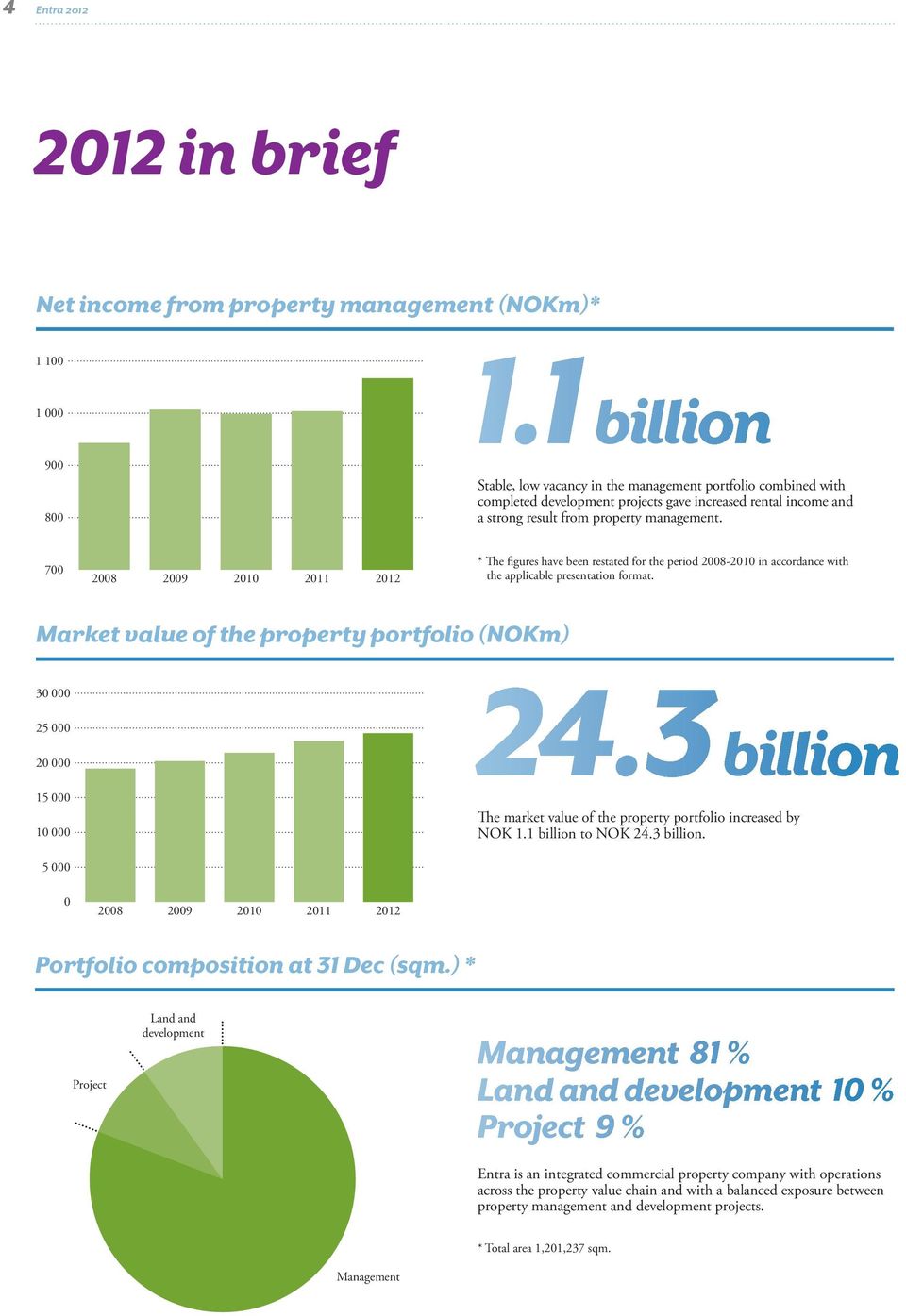
4 4 Entra in brief Net income from property management (NOKm)* billion Stable, low vacancy in the management portfolio combined with completed development projects gave increased rental income and a strong result from property management * The figures have been restated for the period in accordance with the applicable presentation format. Market value of the property portfolio (NOKm) billion The market value of the property portfolio increased by NOK 1.1 billion to NOK 24.3 billion Portfolio composition at 31 Dec (sqm.) * Project Land and development Management 81 % Land and development 10 % Project 9 % Entra is an integrated commercial property company with operations across the property value chain and with a balanced exposure between property management and development projects. * Total area 1,201,237 sqm. Management
5 Entra Annual Report kwh Energy consumption per sqm. In 2012, Entra met the Group s target of average energy consumption, adjusted for temperature variations, of 200 kwh per square metre. For 2013 the target is 195 kwh per square metre. 3.7 LTIF rate Number of work-related injuries with absence per million hours worked. 9.5 years Weighted average duration of leases (years) Long average remaining lease duration provides security for the Group s cash flow % Equity ratio The Group s financial position is strong, with an equity ratio of 30.8 (31.1) per cent at 31December Key figures All amounts in NOK million Financial Rental income Profit before tax Total comprehensive income Net nominal interest-bearing debt Total assets Equity Equity ratio (%) 30.8 % 31.1 % 31.3 % 30.6 % 29.1 % Operations Weighted average remaining lease term (years) Energy consumption (kwh/sqm.)* Share of public sector tenants (%) 81 % 80 % 79 % 80 % 82 % * Average energy consumption adjusted for temperature fluctuations per square metre

6 6 Entra 2012 Statement by the Chief Executive Officer: Entra moving ahead Entra has completed a year with solid results due to successful execution of development projects, sound investments, solid revenues, operational efficiency and cost control. We are pleased to have delivered strong financial results in combination with an increase in both customer and employee satisfaction was also a turbulent year for the Company with changes in the management and the Board of Directors that attracted much attention and broad media coverage. Despite this difficult situation, our employees managed to maintain a strong focus on the day-to-day operations and to keep a close dialogue with our customers. In difficult times, it is good to have a strong values driven organization with expertise and enthusiasm as core elements. Entra has a strong foundation for continued positive growth. Our strategic platform has three pillars; profitable growth, customer satisfaction and environmental leadership. In the period ahead, we shall strengthen our focus on property development and portfolio management, as well as develop potential new business opportunities for reducing our customers overall rental costs. Operating our own properties continues to represent a competitive advantage and ensure close customer contact. Having satisfied customers is one of our main strategic pillars. We participate in the Norwegian Tenant Satisfaction Index to ensure an objective measurement of satisfaction among our customers. The customer satisfaction ratio in 2012 was 71, which is well above the Norwegian sector average of 68. Entra scores above the Norwegian average in all ten areas associated with customer satisfaction, but we will continue to work hard to improve our customer satisfaction in the future. One of the strategic pillars in Entra is to be an environmental leader. We are proud that we have taken a position as a front runner and one that sets new standards in finding environmentally efficient solutions based on profitability. This is a competitive advantage for Entra, an advantage we shall maintain and improve. We completed several projects supporting our environmental position in Work is in progress to transform two ordinary 1980s office blocks at Kjørbo outside Sandvika into the world s first energy-positive renovated office buildings. With our strong Powerhouse alliance partners, we are showing that this type of initiative is also feasible in our climate. We are proud that Papirbredden 2 in Drammen was named Building of the Year in 2012 during Byggedagene in Oslo in March In particular, the jury highlighted the fact that the project documented outstanding achievements within areas such as HSE, construction efficiency, quality and productivity, relations with public authorities/departments and universal design. The jury also emphasised energy and environmental solutions, localization, and efficient use of space. In Bergen, Entra and our partner and co-owner Oslo Pensjonsforsikring have been nominated to create MediaCity Bergen. Bergen s tallest office building, Lars Hilles gate 30, will be transformed into an innovative new media centre where TV2, NRK, Bergens Tidene, BA (Bergensavisen), the University of Bergen and Vizrt plan to co-locate. We have created a flexible, financially attractive and space-efficient concept with innovative work places which gives Norway s leading media companies a strong foundation for developing and attracting expertise and talent was another year in which Entra managed to achieve ambitious energy targets. The defined target was 200 kwh/ sqm. for all buildings. We met the target due to focused and systematic efforts from our property operation and technical management. The target for this year is consumption of 195 kwh/sqm., which is a challenging goal is set to be an exciting year for Entra. On 9 June 2011, the Norwegian Parliament (Storting) adopted a resolution to authorise the Government to reduce its ownership in Entra down to 33.4 per cent in connection with a privatization of the company. Although we do not know when the Government will implement this resolution, we will ensure the administration is ready to act when the time comes. I would like to express my gratitude for the contributions of our many talented employees and excellent partners during 2012 and I look forward to another very exciting year in 2013.

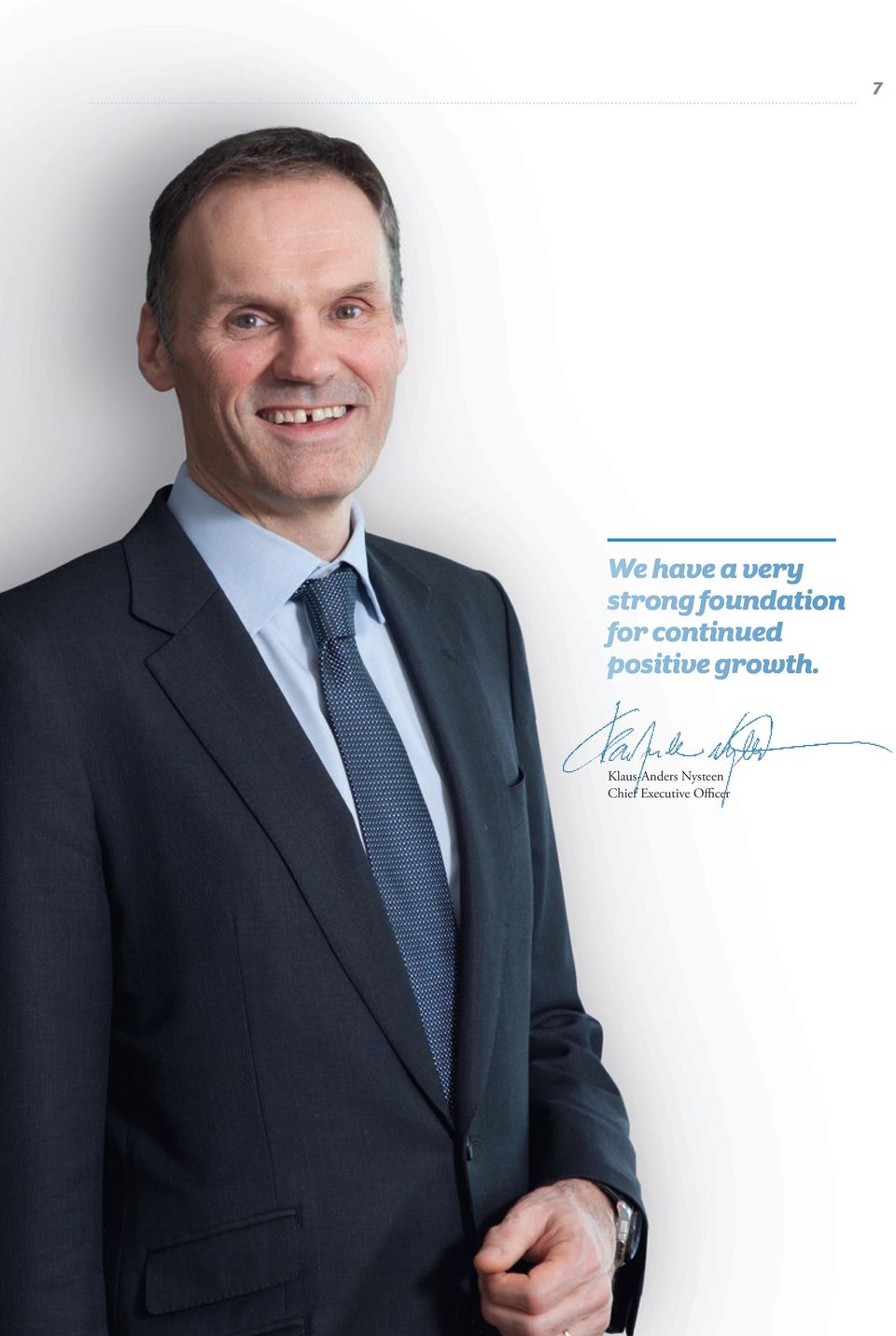
7 Entra Annual Report We have a very strong foundation for continued positive growth. Klaus-Anders Nysteen Chief Executive Officer
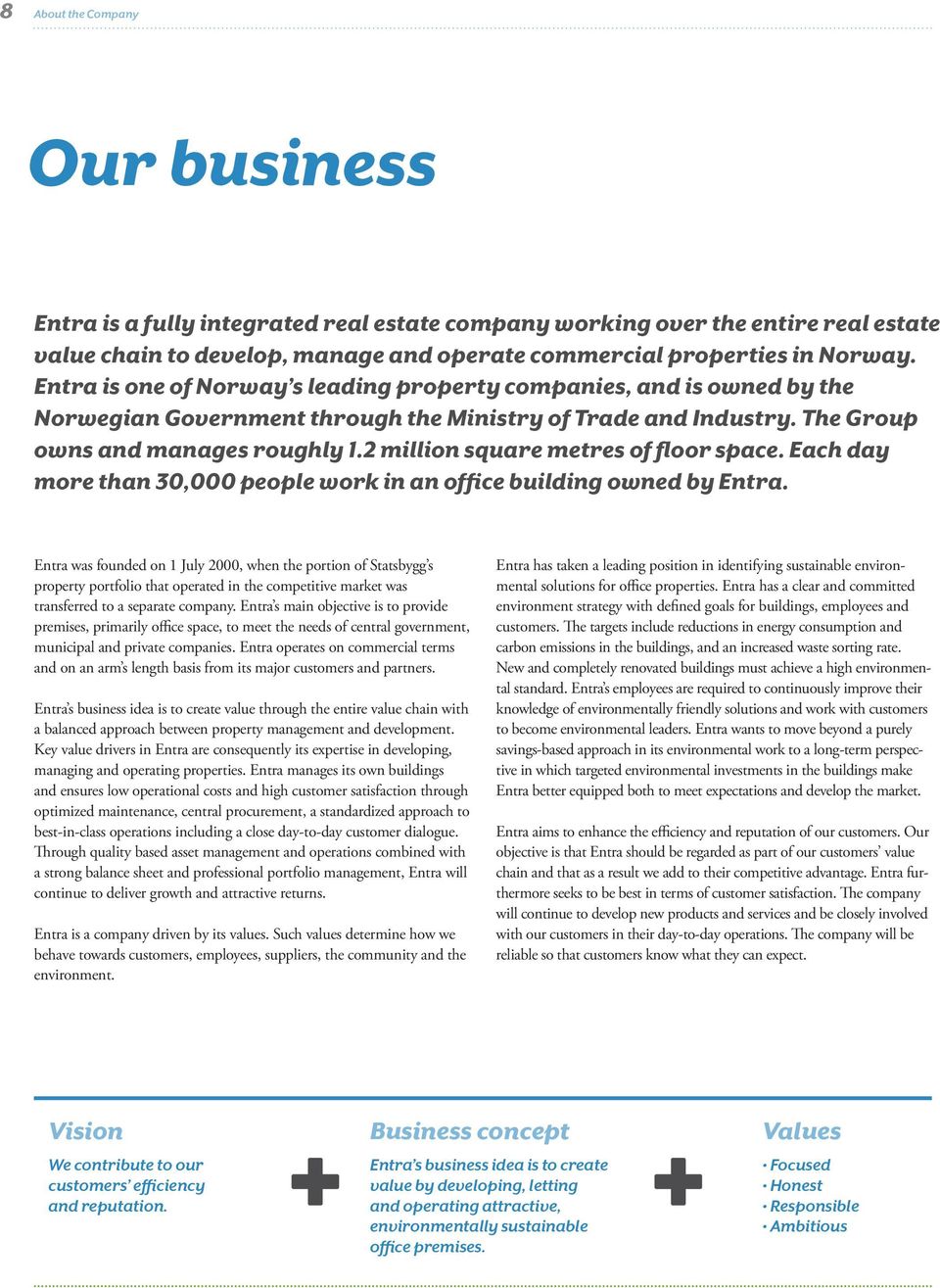
8 8 About the Company Our business Entra is a fully integrated real estate company working over the entire real estate value chain to develop, manage and operate commercial properties in Norway. Entra is one of Norway s leading property companies, and is owned by the Norwegian Government through the Ministry of Trade and Industry. The Group owns and manages roughly 1.2 million square metres of floor space. Each day more than 30,000 people work in an office building owned by Entra. Entra was founded on 1 July 2000, when the portion of Statsbygg s property portfolio that operated in the competitive market was transferred to a separate company. Entra s main objective is to provide premises, primarily office space, to meet the needs of central government, municipal and private companies. Entra operates on commercial terms and on an arm s length basis from its major customers and partners. Entra s business idea is to create value through the entire value chain with a balanced approach between property management and development. Key value drivers in Entra are consequently its expertise in developing, managing and operating properties. Entra manages its own buildings and ensures low operational costs and high customer satisfaction through optimized maintenance, central procurement, a standardized approach to best-in-class operations including a close day-to-day customer dialogue. Through quality based asset management and operations combined with a strong balance sheet and professional portfolio management, Entra will continue to deliver growth and attractive returns. Entra is a company driven by its values. Such values determine how we behave towards customers, employees, suppliers, the community and the environment. Entra has taken a leading position in identifying sustainable environmental solutions for office properties. Entra has a clear and committed environment strategy with defined goals for buildings, employees and customers. The targets include reductions in energy consumption and carbon emissions in the buildings, and an increased waste sorting rate. New and completely renovated buildings must achieve a high environmental standard. Entra s employees are required to continuously improve their knowledge of environmentally friendly solutions and work with customers to become environmental leaders. Entra wants to move beyond a purely savings-based approach in its environmental work to a long-term perspective in which targeted environmental investments in the buildings make Entra better equipped both to meet expectations and develop the market. Entra aims to enhance the efficiency and reputation of our customers. Our objective is that Entra should be regarded as part of our customers value chain and that as a result we add to their competitive advantage. Entra furthermore seeks to be best in terms of customer satisfaction. The company will continue to develop new products and services and be closely involved with our customers in their day-to-day operations. The company will be reliable so that customers know what they can expect. Vision We contribute to our customers efficiency and reputation. Business concept Entra s business idea is to create value by developing, letting and operating attractive, environmentally sustainable office premises. Values Focused Honest Responsible Ambitious
9 Entra Annual Report Geographical distribution of the property portfolio (sqm.) Tromsø Central Oslo Greater Oslo (Helsfyr- Bryn, Drammen, Bærum, Skedsmo and Østfold) Southern and Western Norway (Kristiansand, Stavanger and Bergen) Central and Northern Norway (Trondheim, Bodø and Tromsø) Bodø Trondheim Geographic regions Bergen Greater Oslo Central Oslo The Group is divided into four regions: the Central Oslo region, the Greater Oslo region, the Southern and Western Norway region and the Central and Northern Norway region. The Group has its registered offices in Oslo and regional offices in Trondheim and Bergen. Entra s geographic strategy is to focus on growth in Oslo, Bergen, Trondheim, Drammen and Sandvika. Entra s portfolio is managed with defined targets for profitable growth, customer satisfaction and environmental leadership. Entra s main focus is the office segment. Stavanger Kristiansand

10 10 <Seksjon> MediaCity Bergen In 2016, Bergen may have the first Nordic MediaCity. TV2, NRK Hordaland, Bergens Tidende, Bergensavisen, Vizrt and the University of Bergen all want to co-locate at Lars Hilles gate 30. The vision behind MediaCity Bergen is to create an internationally leading community for innovation and knowledge based development within the media field. Lars Hilles gate 30 is owned by Entra and Oslo Pensjonsforsikring. On the following pages we are proud to present some of our projects.

11 Entra Annual Report Entra s business areas Entra has three business areas: Customers and Markets, Operations and Maintenance, and Projects and Development. In addition, the company has various administrative support functions, with the finance department being one of the most important. Entra s business model is capital intensive. Thus, access to long-term capital on competitive terms is important. The bond market is an important source of financing for commercial real estate and Entra is an attractive issuer of bonds. The capital structure reflects the Group s current property portfolio and risk management guidelines. Entra s solid portfolio and stable cash flow strengthens the company s attractiveness in the capital markets, for bank loans, commercial paper and bonds. Below is a description of the company s business areas: Customers and Markets Customers and Markets is responsible for lettings, customer relations, and market analysis. Customers and Markets is responsible for all lease negotiations with customers and works closely with Operations and Maintenance in responding to customer requirements and needs. Customers and Markets furthermore co-operates with Projects and Development in the design and development stages of various projects. Furthermore, Customers and Markets is important to the company s further development through its knowledge of the market, including existing and potential customers demand for office space. Operations and Maintenance Entra manages all its properties with its own employees. Through high professional competency and presence, the company s operations managers ensure that the buildings function optimally for customers every day. The customer service centre is responsible for ensuring professional handling of all customer enquiries with quick and efficient response times. Entra aims to be an industry leader in providing environmentally friendly solutions and continuously measures this using a number of property operation parameters. With its green benefit agreements and innovative projects, the department works closely with customers. We believe that sustainable environmental solutions will contribute to our customers efficiency and reputation and to Entra s long-term growth and profitability. Projects and Development Closely cooperating with Entra s other business areas, Projects and Development creates value for Entra through high quality execution of property development and renovation projects. Projects and Development is responsible for concept and feasibility studies, development work, implementation of construction projects and conservation plans. For concept and projects that are of commercial or other strategic interest, Projects and Development carries out feasibility studies which include physical, political and commercial issues. The department is responsible for complying with regulatory conditions and urban planning when this is necessary or expected by the surroundings. Profitable growth Customer satisfaction Environmental leadership Entra has defined three strategic pillars that create a foundation for the company s priorities and action plans.
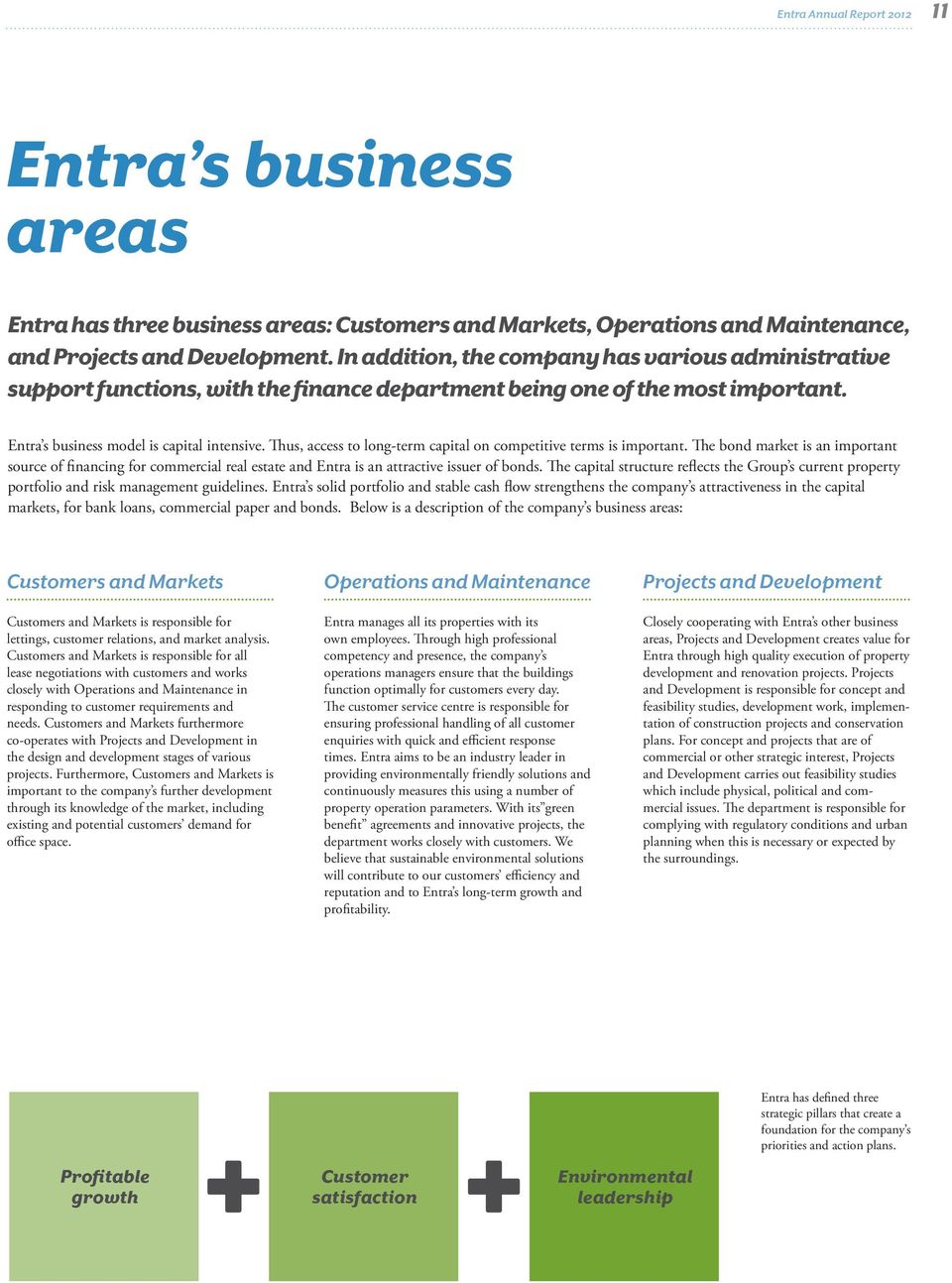
12 12 About the Company Entra s history Since the company was established in 2000, Entra has developed, built and managed a number of large properties in Oslo, Bergen, Trondheim, Drammen, Kristiansand and Stavanger. The figure illustrates the development in total assets for the period The figures show value-adjusted total assets up until 2005, and total assets (IFRS) after this. Acquires 1/3 of Oslo S development Acquires the National Library in Oslo Acquires Havnelageret in Oslo Develops the university college in Akershus Acquires and develops Munch-Quarter in Oslo Acquires and develops BG14 in Oslo Statens Utleiebygg AS was established on 29 February
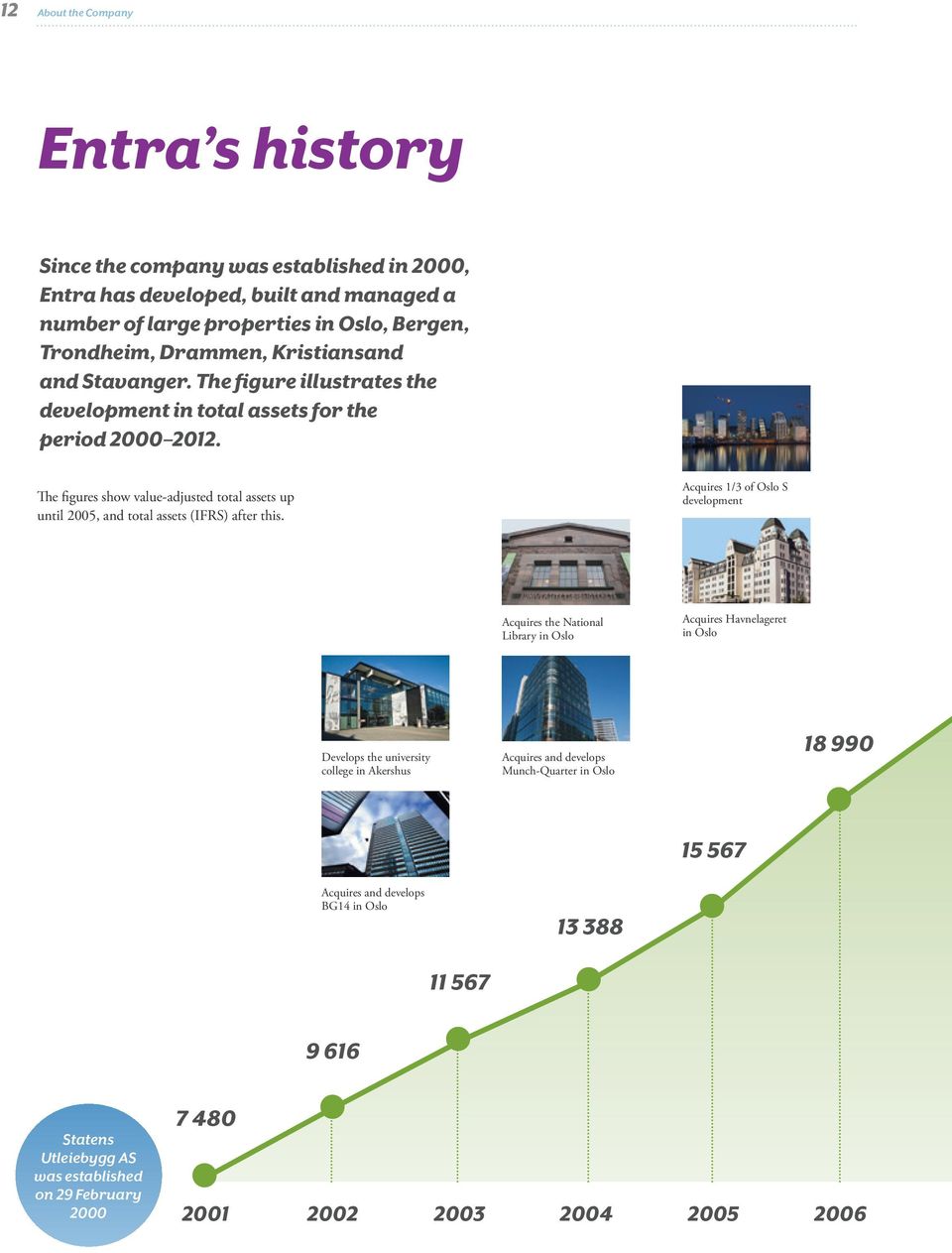
13 Entra Annual Report Develops Brattørkaia in Trondheim Renovates Fredrik Selmers vei 4 in Oslo Nominated for MediaCity in Bergen Builds Nonnesetergaten 4 in Bergen Develops Rockheim in Trondheim Renovates Prof. Olav Hanssens vei in Stavanger Renovates Powerhouse, Kjørbo Builds Papirbredden in Drammen Renovates Middelthunsgate 29 in Oslo Builds Papirbredden 2 in Drammen
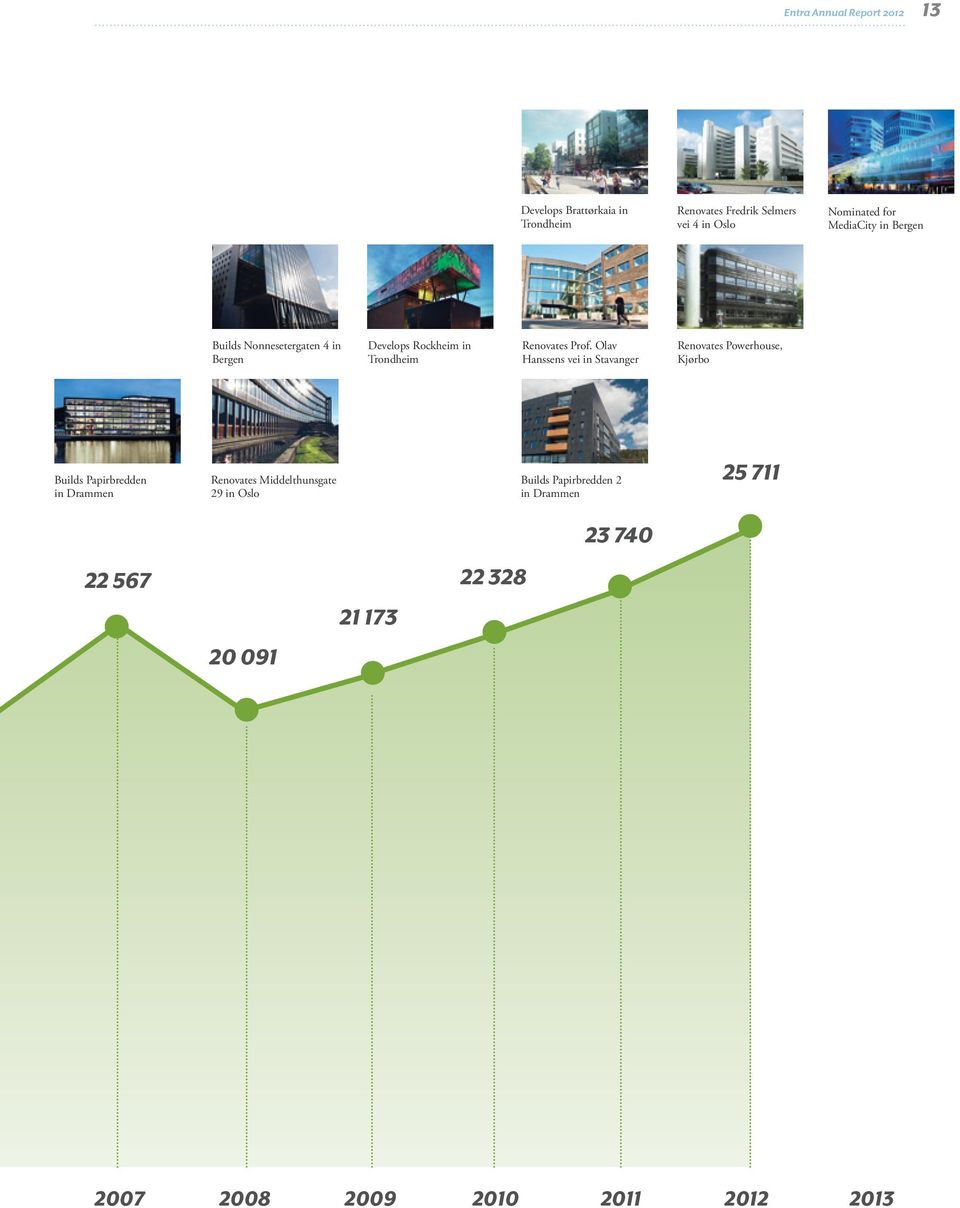
14 14 About the Company Management team of Entra Klaus-Anders Nysteen Chief Executive Officer Joined in 2013 Management experience from Statoil Fuel & Retail ASA, Storebrand Bank ASA, Posten Norge and Hydro Seafood AS Anne Harris Chief Financial Officer Joined in 2010 Management experience from Norsk Hydro ASA and Total Norge AS Anders Solaas Executive Vice President Customers and Markets Joined in 2010 Management experience from Hafslund ASA, Hafslund Eiendom AS, Hafslund Energy Trading LLC (Seattle, USA), Hafslund Strøm AS and Fondsforvaltning AS Bjørn Holm Executive Vice President Projects and Development Joined in 2004 Management experience from Albert Kr. Hæhre Entreprenør AS, NCC Norge AS / Eeg-Henriksen Bygg AS and Ing F. Selmer AS / Selmer Furuholmen AS Nils Fredrik Skau Executive Vice President Operations and Maintenance Joined in 2000 Experience from Statsbygg, Telemarkhus and Siv. ing. Hæreid AS Hege Njå Bjørkmann Executive Vice President Communication Joined in 2013 Management experience from Kreab Gavin Anderson, 20/20 Communications, JKL and Kapital Nils Fredrik Skau Hege Njå Bjørkmann Anders Solaas
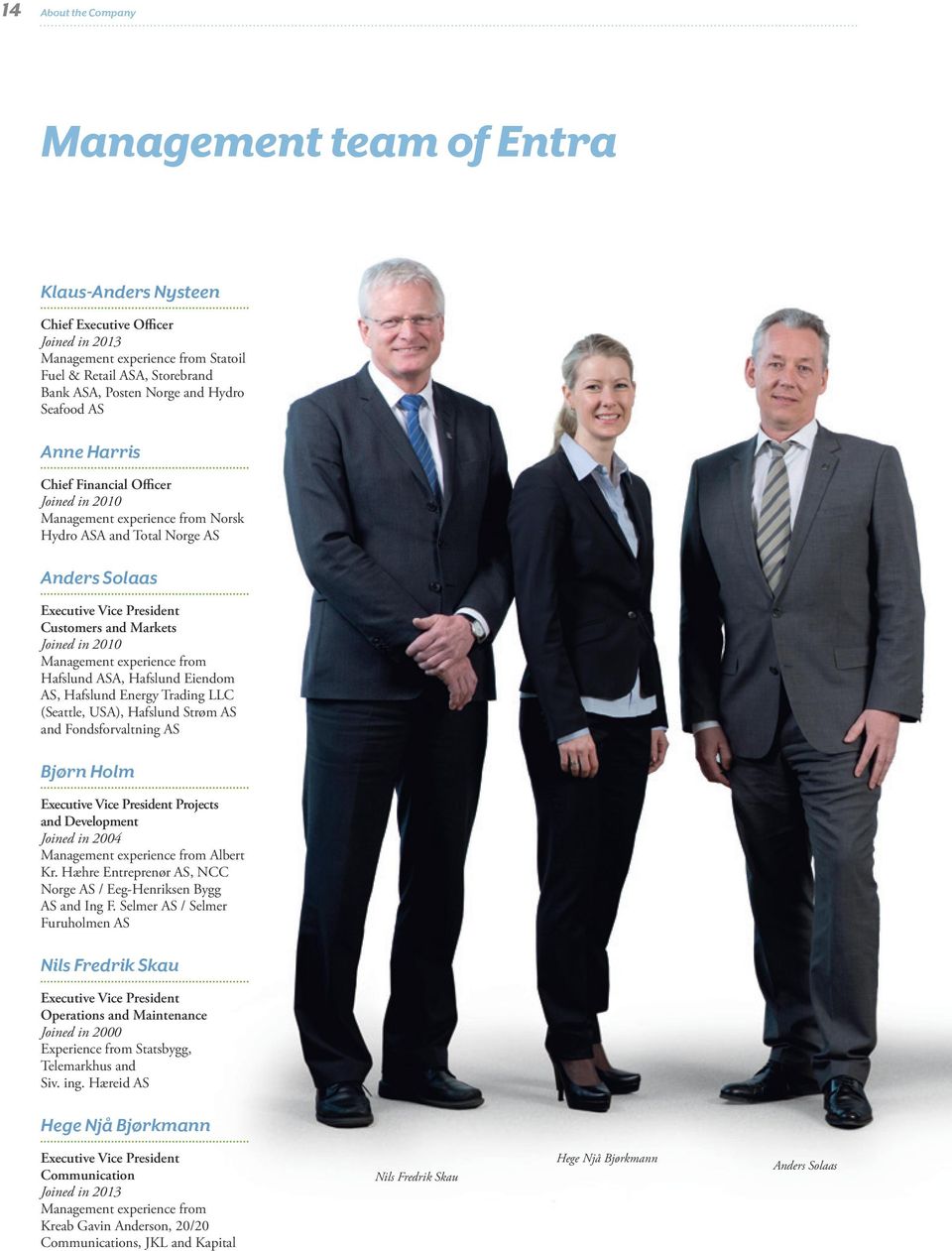
15 Entra Annual Report Klaus-Anders Nysteen Anne Harris Bjørn Holm

16 16 From the Board room Articles of Association of Entra Eiendom AS 1 Name of the company The name of the company is Entra Eiendom AS. 2 Offices of the company The company s offices are in Oslo, Norway. 3 Activities of the company The company s main aim is to meet government requirements for premises. The company can own, buy, operate and manage real property, and carry out other activities that are connected with this. The company can also own shares or stakes in, and participate in, other companies that perform the activities described in the previous article. The company shall be run on commercial principles. 4 Share capital The company s share capital is NOK 142,194,000 distributed across 142,194 shares, each with a nominal value of NOK 1, Board of Directors The company s Board of Directors shall have between five and seven shareholder-elected members. 6 Registration in the Norwegian Registry of Securities The company s shares will not be registered in the Norwegian Registry of Securities. 7 Signatories The company shall be bound by the signature of two Board members or one Board member and the CEO acting in concert. 8 General meeting The following items shall be raised at and resolved by the Annual General Meeting: 1. Approval of the annual accounts and annual statement, including the allocation of dividends 2. Other matters that legally fall within the remit of the Annual General Meeting. 9 Features of historic value The features of historic value in the company s buildings shall be properly safeguarded in line with current laws and regulations When disposing of properties comprising buildings constructed before 1950, the company shall follow the rules contained in the fourth paragraph of section 2.1 of the Order on the disposal of real estate belonging to the state, etc. (Royal Decree of 10 December 1997), or any regulation which might replace it. 10 Statement on the determination of salaries and other remuneration of senior executives The Board shall prepare a statement on the determination of salaries and other remuneration of senior executives. This is included as a note in the annual financial statements. The statement shall have the content specified in Section 6-16a of the Norwegian Public Limited Companies Act, and shall be considered accordingly by the company s Annual General Meeting. See Section 5-6, third paragraph, of the Norwegian Public Limited Companies Act.

17 Entra Annual Report Corporate Governance Entra Eiendom AS (Entra) is owned by the Norwegian Government, which exercises and manages its ownership through the Ministry of Trade and Industry. Each year, Entra s executive management and Board of Directors review the company s corporate governance principles and evaluate how they are working in practice. Entra reports on the Group s policies and practice for corporate governance in accordance with section 3-3b of the Norwegian Accounting Act and the Norwegian Code of Practice for Corporate Governance of 23 October There is further information about the Code of Practice published by the Norwegian Corporate Governance Board (NUES) at There are some minor differences from the recommendations. These are discussed under the individual sections below and are due to the fact that the Norwegian state is the company s only shareholder. 1. Corporate governance statement Governance The Ministry of Trade and Industry s management of the company on behalf of the Government is based on generally accepted principles of corporate governance and the distribution of roles among the shareholders, the Board of Directors and the management under Norwegian company law. In addition, the Government has drawn up principles for good corporate governance, which essentially coincide with NUES s requirements relating to transparency and information about the company. The Norwegian Government s ownership policy is summarized in chapter 5 of the Government s Ownership Report, no. 13 ( ) to the Storting. For more detailed information about the Norwegian Government s ownership policy, see no/nb/dep/nhd/tema/eierskap. The shareholder appoints a Board of Directors to safeguard the interests of the shareholder, as well as to ensure that the company s needs for expertise, capacity and diversity are met. The Norwegian Government is a proactive shareholder with respect to setting clear goals for the company. It is also important that there are well functioning systems in place for monitoring the company s financial situation, corporate social responsibility and ethical management. Board of Directors and executive management Entra s objectives and strategy are set by the Board. The ethical guidelines and values adopted by the Board are the foundation on which Entra s activities are built. Entra s values of being focused, honest, responsible and ambitious are important for the development of a good corporate culture and form the basis for good corporate governance. Guidelines, procedures and authorisation structures can be found in Entra s system of governing documents that integrate strategy, goals and overall principles with routines and documentation requirements for the administration and business areas in the value chain. The company is split into three business areas: Customers and Markets, Operations and Maintenance and Projects and Development. The Group has administrative support functions for accounting and finance, communication and human resources. Based on the authority granted to the CEO by the Board, the CEO has implemented an authorisation structure for the Group. Entra uses a balanced scorecard as an important tool for corporate governance. Based on the Group s strategy, various criteria for measuring performance have been established. Scorecards have been created for each business area and for the company s support functions. The scorecards include goals for corporate social responsibility and environmental standards in the Group. The balanced scorecard system provides a basis for the executive management s governance of the Group and for reporting to the Board on operations. Corporate social responsibility and the environment State-owned companies face strict requirements in fulfilling corporate social responsibilities. Entra s strategy includes an ambition to be an industry leader in implementing environmentally sustainable solutions. The following key areas have also been defined for the Group s corporate social responsibility work: urban development, HSE, working conditions and ethics. Corporate social responsibility is an integrated part of Entra s corporate governance. Entra s corporate social responsibility policy also applies to our suppliers. The Board has adopted guidelines on socially responsible procurement. There must be a competitive bidding process in which all bidders are treated equally. Suppliers must undergo annual supplier verification and accept the Group s guidelines for socially responsible procurement in order to qualify as an Entra supplier. Entra aims to further increase our procurement expertise and raise awareness about socially responsible purchasing. Requirements in relation to corporate social responsibility and the environment must be clearly c ommunicated to the Group s suppliers. Both manufacturing processes and finished products must meet defined environmental standards, and the fundamental rights of employees must be respected by all the links in
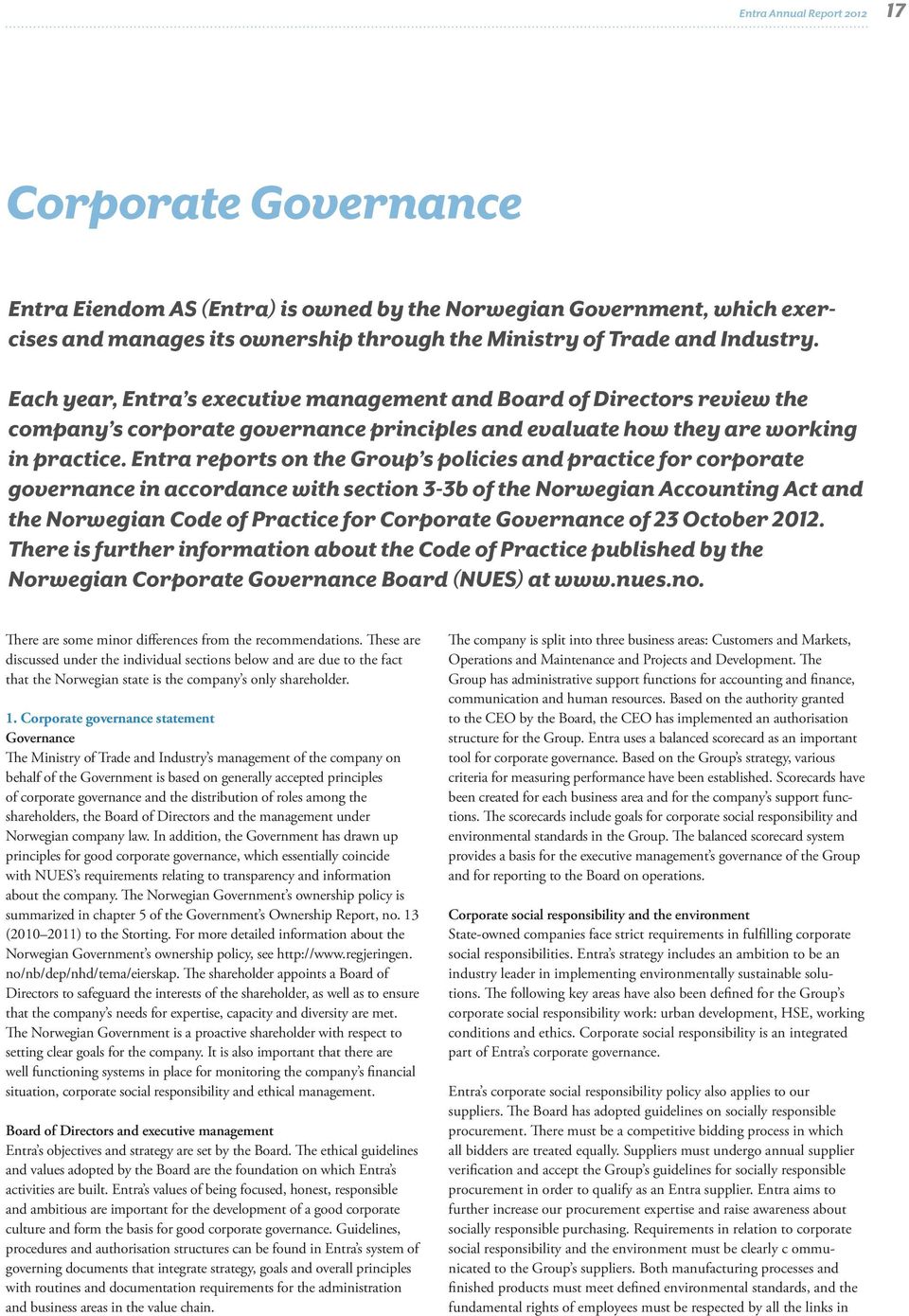
18 18 From the Board room Papirbredden 2, Drammen The new office building on Grønland Torg in Drammen meets passive building standards and is built in accordance with FutureBuilt s quality criteria. The building is part of the Papirbredden Knowledge Park in the centre of the city s vibrant new district and is owned by Entra and the municipality of Drammen. Entra s chain of suppliers. The Group s environmental criteria for suppliers and the document on socially responsible purchasing are available on our website Ethical guidelines Entra s ethical guidelines set out how the Group s stakeholders shall be treated and corresponding expectations to our employees. The guidelines provide guidance and support to employees on decision-making and problem-solving issues. The guidelines support the company s corporate social responsibility activities and deal with topics such as health, safety and the environment and business ethics, including corruption and bribery. The ethical guidelines were last updated and approved by the Board at the end of Compulsory training in the Group s ethical guidelines, including dilemma training, took place in 2012, and all employees was required to sign up to the ethical guidelines. Entra s ethical guidelines are available at Non-conformance with the recommendations: None 2. Activities According to the company s articles of association, Entra can own, buy, sell, operate and manage real estate, and carry out other activities in this connection. The company can invest in shares or ownership interests and participate in companies engaged in similar activities. The company shall be run on commercial principles. Entra s main purpose is to provide premises to meet government needs, and to operate on commercial principles similar to those of private enterprises in the industry. 1) The Group has a clearly defined strategy, values and overall objectives. See for a more detailed description of the company s strategy. By developing, letting and managing highly environmentally friendly premises, the company shall add value. The company s strategy is based on profitable growth, customer satisfaction and environmental leadership. The main focus is on letting office properties in the main towns and cities where the company is already established. Non-conformance with the recommendations: None 3. Equity and dividends Equity Entra shall maintain enough equity to allow it to pursue its goals and strategy, while reflecting the Group s risk profile. The Group s equity at 31 December 2012 was NOK 7,921.6 (NOK 7,391.4) million, equivalent to an equity ratio of 30.8 (31.1) per cent. The Group s financial strength is considered satisfactory. Dividend The Board proposes the dividend to the Annual General Meeting. Section 20-4, subsection 4 of the Norwegian Companies Act states that the Annual General Meetings of state-owned companies do not have to adopt the dividend allocations proposed by the Board or corporate assembly. The Annual General Meeting can determine the dividend in accordance with Section 8-1 of the Norwegian Companies Act. The shareholder has a dividend policy for Entra under which the annual dividend shall constitute 50 per cent of the Group s profit after tax and non-controlling interests as calculated under the Norwegian Accounting Act and generally accepted accounting principles, or be equivalent to at least two per cent of book equity after non-controlling interests under IFRS at the start of the financial year. The expected dividend from Entra is presented each year in the national budget. For the financial year 2012 a dividend of NOK million is proposed from Entra. 1) White Paper no. 29 ( )

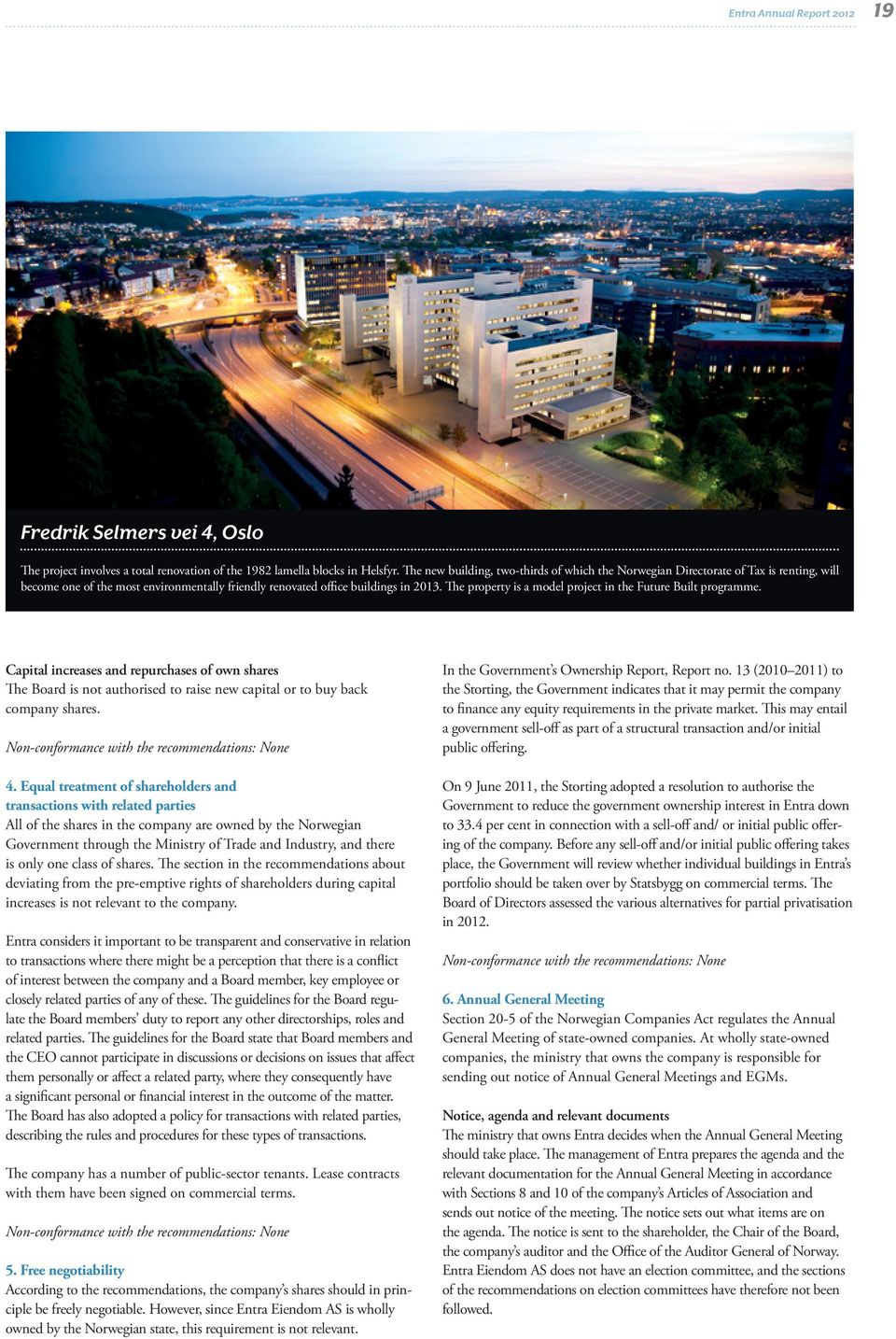
19 Entra Annual Report Fredrik Selmers vei 4, Oslo The project involves a total renovation of the 1982 lamella blocks in Helsfyr. The new building, two-thirds of which the Norwegian Directorate of Tax is renting, will become one of the most environmentally friendly renovated office buildings in The property is a model project in the Future Built programme. Capital increases and repurchases of own shares The Board is not authorised to raise new capital or to buy back company shares. Non-conformance with the recommendations: None 4. Equal treatment of shareholders and transactions with related parties All of the shares in the company are owned by the Norwegian Government through the Ministry of Trade and Industry, and there is only one class of shares. The section in the recommendations about deviating from the pre-emptive rights of shareholders during capital increases is not relevant to the company. Entra considers it important to be transparent and conservative in relation to transactions where there might be a perception that there is a conflict of interest between the company and a Board member, key employee or closely related parties of any of these. The guidelines for the Board regulate the Board members duty to report any other directorships, roles and related parties. The guidelines for the Board state that Board members and the CEO cannot participate in discussions or decisions on issues that affect them personally or affect a related party, where they consequently have a significant personal or financial interest in the outcome of the matter. The Board has also adopted a policy for transactions with related parties, describing the rules and procedures for these types of transactions. The company has a number of public-sector tenants. Lease contracts with them have been signed on commercial terms. Non-conformance with the recommendations: None 5. Free negotiability According to the recommendations, the company s shares should in principle be freely negotiable. However, since Entra Eiendom AS is wholly owned by the Norwegian state, this requirement is not relevant. In the Government s Ownership Report, Report no. 13 ( ) to the Storting, the Government indicates that it may permit the company to finance any equity requirements in the private market. This may entail a government sell-off as part of a structural transaction and/or initial public offering. On 9 June 2011, the Storting adopted a resolution to authorise the Government to reduce the government ownership interest in Entra down to 33.4 per cent in connection with a sell-off and/ or initial public offering of the company. Before any sell-off and/or initial public offering takes place, the Government will review whether individual buildings in Entra s portfolio should be taken over by Statsbygg on commercial terms. The Board of Directors assessed the various alternatives for partial privatisation in Non-conformance with the recommendations: None 6. Annual General Meeting Section 20-5 of the Norwegian Companies Act regulates the Annual General Meeting of state-owned companies. At wholly state-owned companies, the ministry that owns the company is responsible for sending out notice of Annual General Meetings and EGMs. Notice, agenda and relevant documents The ministry that owns Entra decides when the Annual General Meeting should take place. The management of Entra prepares the agenda and the relevant documentation for the Annual General Meeting in accordance with Sections 8 and 10 of the company s Articles of Association and sends out notice of the meeting. The notice sets out what items are on the agenda. The notice is sent to the shareholder, the Chair of the Board, the company s auditor and the Office of the Auditor General of Norway. Entra Eiendom AS does not have an election committee, and the sections of the recommendations on election committees have therefore not been followed.
20 20 From the Board room In 2012 the deadline for registering for the Annual General Meeting was set as close as practicably possible to the Annual General Meeting. Chair of meeting The Chair of the meeting is elected by the Annual General Meeting. The Chair of the Board chaired the Annual General Meeting in Attendance The Ministry of Trade and Industry represents the shareholder at the Annual General Meeting and participation can only take place by attendance. This is because Entra only has one shareholder. As a minimum requirement, the Chair of the Board of Directors shall attend the Annual General Meeting on behalf of the Board. The Board s participation at the meeting is agreed with the shareholder. The company s auditor shall always attend the Annual General Meeting. The Office of the Auditor General is entitled to attend, and exercised that right in The CEO and CFO attend on behalf of the execu- tive management. Non-conformance with the recommendations: For the sections of the recommendations that are relevant to the company, there is only one minor non-conformance item. This non-conformance is related to the participation of the entire Board at the company s Annual General Meeting. 7. Election committee Entra does not have an election committee. Board members are appointed by the shareholder. Non-conformance with the recommendations: The company does not have an election committee as Board members are appointed by the shareholder. 8. Corporate assembly and Board, composition and independence Entra does not have a corporate assembly. Election of the Board The shareholder elects between five and seven shareholder-elected members, including the Chair, for a period of two years through the Annual General Meeting. The Board of Directors was elected/re-elected at the 2012 Annual General Meeting, with five shareholder-elected members. The Board also contains two members who are chosen by and from the employees, who sit for the same length of time as the shareholder-elected members. At the extraordinary general meeting in autumn of 2012, three of the Board s shareholder-elected members were replaced. Composition of the Board The composition of the Board at the end of 2012 was as follows: Siri Hatlen (Chair), Martin Mæland (Deputy Chair), Arthur Sletteberg, Ingrid Tjøsvold, Kjell Bjordal, Tore Benediktsen and Birthe Smedsrud Skeid. The last two are chosen by and from the employees. The proportion of female members of the Board is around 43 per cent. Emphasis is placed on the fact that the Board as a whole should have experience of working on boards and of the company s main activities in order to make a positive contribution to the ability of the company to add value. The Board must also have the capacity required to perform its duties. No representatives of the Group s executive management are Board members. Independence of the Board: All shareholder-elected members are considered to be independent of the Group s executive management, main business partners and shareholder. Detailed information about the Board members is provided in the annual report and is also available at Non-conformance with the recommendations: The company is wholly owned by the Norwegian Government and it is impossible for Board members to own shares in the company. 9. The work of the Board The tasks of the Board The Board has overall responsibility for the management and control of the Group and for monitoring the operational management and the Group s activities. The Board has drawn up guidelines that govern its own activities and procedures. The Board specifies general rules for the business and is responsible for the Group being run in accordance with the core values, ethical guidelines and the shareholder s expectations. The Board shall also prepare plans and budgets for the Group s activities and be kept informed about its financial position and performance. Each year, the strategy and overall objectives for the Group are reviewed. The Board checks that the Group has sufficient capital in view of the scope of its activities and the associated risks, and that its activities are subjected to appropriate audits. Organisation of the Board s work The Chair of the Board chairs Board meetings. The Board has elected a Deputy Chair who chairs meetings when the Chair cannot or should not lead the work of the Board. A thematic plan for the Board s work for the year has been established. Based on the annual plan, the Chair of the Board in consultation with the company s CEO adopts the final agenda for the Board meeting. Emphasis is placed on the importance of good preparation for Board meetings, and of allowing all Board members to take part in decision-making procedures. The CEO and CFO attend all Board meetings. The company s auditor attends when the annual financial statements are adopted or on other occasions where the auditor s expertise is relevant. Each year the Board assesses its own work and way of working as a basis for assessing the need to make changes and improvements. This assessment includes an evaluation of the Board s expertise, collectively and for each member, and how well the Board works as a team. The results of the evaluation are presented to the shareholder. Guidelines for the CEO The Board has adopted guidelines that regulate the CEO s tasks and the relationship with the Board. At Board meetings, the CEO reports on the status of the company s operations, including the risk matrix and risk assessments, and scorecards showing developments in relation to the Group s most important goals. Sub-committees The Board has established an audit committee and a remuneration committee. The Board has established mandates for the tasks of the committees. The mandates are subject to annual revision. In accordance with their respective mandates, the audit committee and the remuneration committee shall have two or three shareholder representatives from the current Board of Directors. The representatives are elected by the Board for two years at

21 Entra Annual Report a time, to coincide with the Board s term of office. The committees assist the Board with preparing its work, but decisions are taken by the whole Board. The audit committee helps the Board to assess issues relating to financial reporting, internal controls, compliance with ethical guidelines and overall risk management. The audit committee ensures that the Group has an independent and effective external auditor. The audit committee also ensures that the company has adequate internal controls and procedures for compliance with laws and regulations. The audit committee contains three shareholder-elected Board members. The CFO and the committee secretary always attend as representatives of the management. The company s auditor also attends. The CEO and other members of the management also attend as required. The audit committee has established a calendar of meetings, and meets at least five times a year. In 2012, the audit committee held nine meetings. The committee performs an annual evaluation of its own work. The remuneration committee assists the Board with all matters relating to employment conditions, pay and any severance payments to the CEO. The CEO consults the remuneration committee in connection with determining the salaries of the company s senior management team. The remuneration committee is composed of the Chair of the Board of Directors and a shareholder-elected member of the Board. The CFO and CEO always attend as representatives of the management. The CEO does not attend discussions on issues that affect the CEO personally The company s HR manager attends as required. A calendar of meetings has been established for the remuneration committee, which normally meets between three and four times a year. The remuneration committee held three meetings in Non-conformance with the recommendations: None 10. Risk management and internal controls The Board is responsible for ensuring that the company, the financial reporting and asset management are subject to adequate control. The company s risk management shall support the company s strategic and financial goals and help the company avoid events that may have an adverse impact on the company s operations and reputation. Risk management and internal controls at Entra are described in the company s system of governing documents. Entra works systematically to ensure continuous improvement of its internal controls of financial reporting. The Group has a proactive approach towards risk management, and potential risks shall be identified, assessed, quantified and managed. The executive management has established routines for identifying and managing the exposure to risk entailed by Entra s activities. The company has established a risk matrix, where the main risks are considered to be: commercial risk, operational risk, project risk and business and strategic risk. Commercial risk includes the Group s financial risk and is managed in accordance with the adopted finance policy and financial instruments as one of the ways of limiting risk exposure. The Group s commercial risk also includes the risk associated with signing and renegotiating contracts, which is continuously monitored. Operational risk is managed through procedures for day-to-day operations, compliance and HSE work. Project risk is managed continuously throughout the project period by close monitoring of progress, finances and contractual issues. Business and strategic risks include the possible impact on the company of policies, regulation and external non-recurring events. Powerhouse Kjørbo At Kjørbo outside Sandvika, offices are being renovated as energy-positive buildings for the first time ever! Powerhouse is a partnership established between the environmental organisation ZERO, Entra Eiendom, Skanska, Hydro and Snøhetta architects. The ambition is to develop and create office buildings that have positive energy consumption calculated over their lifetime. Asplan Viak is the technical consultant and tenant.
22 22 From the Board room New customer service centre Entra aims to be close to the customer and the best in terms of customer satisfaction. Entra s customer service centre deals with all types of inquiries and helps improve customers efficiency. 800 ENTRA. Of course we can help you! Reporting In conjunction with the executive management s reviews of the company s operations, risk matrices are drawn up within each business and support area to provide an overall picture of the Group s exposure to risk. The Group s financial status is monitored by reviews of the accounts compared with the budget and projections, and performance is reported using the balanced scorecards in all the business and support areas. The Group has established systems for managing and monitoring issues related to health, safety and the environment as an integrated part of its management reporting. The Board performs an annual review of the Group s risk and established internal controls as part of the company s target and budget process. The Board is also informed of the development of the company s risk exposure in quarterly business reports. The executive management s risk assessments and the information that they provide about corrective measures put the Board in a good position to judge whether the company s risk management procedures are satisfactory. Risk management and internal controls are also discussed by the Board s audit committee. Monitoring and control of financial reporting Procedures have been established for financial reporting that involve carrying out a high-level review of significant estimates, provisions and accruals in conjunction with preparing the quarterly and annual financial statements. Separate notes to the accounts are prepared for significant accounting items, non-routine transactions and periodic provisions, which are approved by the CFO. The valuation of the company s properties is subject to a separate review and assessment at management level at the close of each quarter. This involves holding meetings with the external appraisers with a particular focus on discussing perceptions of the market, risk premiums and documentation. The Group s actual financial performance is monitored against the budget each month, and projections are updated on an ongoing basis. The company reconciles and documents all balance sheet items at the Group companies at the close of each quarter. Balance sheet items such as liabilities, bank deposits, projects and non-current assets are subject to special reviews. Projects are reviewed on a quarterly basis by the project and accounting departments together to assure the quality of the accounting and calculation of tax. System-generated items linked to liabilities and interest rate hedging are subject to manual reconciliation each month. Significant profit and loss accounts and tax-sensitive accounts are subject to reconciliation each quarter. All reconciliations are reviewed and quality assured. In connection with quarterly reporting, the Group s external auditor performs audit tasks equivalent to simplified audit checks, but without confirmation. The Group s interim and annual financial reports are reviewed by the audit committee before they are given to the Board. The audit committee reviews the external auditor s management letter, as well as the findings and assessments of audits in conjunction with interim and annual reports. Significant issues in the auditor s report are presented to the Board. Financial management The Group is managed by means of financial targets linked to the return on equity, the management of the debt portfolio and the return on the property portfolio. Profitability calculations are performed in connection with acquiring property and major renovation/development projects, using a fixed calculation method and required rate of return. The current fair value of development projects is monitored throughout the course of the project. Long-term forecasts are made of expected financial developments as a component of the Group s risk management, using a model with detailed assumptions concerning the Group s financial performance, cash flow
23 Entra Annual Report and assets. The forecasts take into account cyclical developments in the economy, financial parameters and the property market. Scenarios and simulations are developed for various different life cycles. The simulations provide good information for the Board and the executive management in their monitoring of developments in key balance sheet figures and cash flow. Allocations of capital and risk profiles are important parameters for guiding financing activities. The company s finance policy contains guidelines for the day-to-day management of the Group s financial risk. Principles have been defined for borrowing, management of liquidity risk and interest rate risk, and credit and counterparty risk. The Group s model for financial projections yields up-to-date key figures, which are monitored on a continual basis. There is periodic reporting to the management in accordance with the management guidelines for the financing activities, and to the Board through the business report. There is systematic monitoring of the general economic situation and how this affects the Group s financial risk. Based on expected developments in the economy and analysis of the company s financial position, expected developments in both short-term and long-term interest rates, the strategy for interest rate positioning, capital requirements and planned financing activities are discussed, as well as opportunities in the financing market. See the description in the company s annual report for a more detailed presentation of the Group s financial position and risk. Monitoring of risk management and internal controls As part of the Group s internal control system, Entra has established a quality department that performs internal auditing with the aim of assisting the Board and the management in their assessments of whether the main risks the Group is exposed to are being adequately managed and monitored. The quality department carries out operational audits in accordance with the plan approved by the Board. The audits make use of both internal and external resources. The results are presented to the audit committee and the Board on an annual basis. If necessary, the company s quality manager can report directly to the audit committee and the Board. Follow-up of the ethical guidelines and socially responsible purchasing Issues relating to ethics and corporate social responsibility are included in the company s internal audit plan and the mandate of the quality department. The environmental perspective is an integrated part of the assessments made in connection with potential investments, for example. Special requirements have been defined for Entra s suppliers in the document Socially responsible purchasing, and a supplier verification is conducted each year to ensure that the Group s suppliers are familiar with and adhere to the contractual conditions. In order to follow up on the company s requirements regarding corporate social responsibility in the supply chain, the company uses external consultants to perform supplier audits on selected projects. These audits included a focus on Entra s standard requirements for corporate social responsibility and the suppliers follow-up of these standards, e.g. those related to procurement processes, environmental monitoring and waste segregation as well as further control of pay, working and living conditions in accordance with laws and regulations. Internal controls linked to Entra s core values, ethical guidelines and corporate social responsibility are under development and are imple- mented on an ongoing basis. The management continuously strives to prevent corruption and undesirable incidents, with a focus on the company s values and ethical guidelines. Systematic training in ethical guidelines and dilemma training for all employees in 2012 has helped to increase awareness among Entra s employees. The company s quality manager is the recipient of and follows up on non-compliance notifications submitted via the Group s reporting sys- tem. The ethical guidelines set out how employees can report breaches of the company s ethical guidelines or legislation, and this information is also available on the intranet. Employees are encouraged to report unsatisfactory situations. In addition to internal reporting, the company has also established an external reporting channel to a law firm, who can receive notifications on behalf of the company. Non-conformance with the recommendations: None 11. Remuneration of the Board Each year, the Annual General Meeting determines the remuneration of the Board. For information about remuneration of the Board in 2012, see Note 25 to the financial statements. The remuneration of the Board is not performance-related, and no options have been issued to Board members. For a discussion of the Board s independence, see Section 8. Non-conformance with the recommendations: None 12. Remuneration of key employees Guidelines for determining salaries and remuneration With effect from 1 April 2011, the Government s guidelines concerning the State s position on senior executive remuneration in stateowned companies from 2006 were replaced by new guidelines, issued in connection with White Paper no. 13 ( ) Active ownership and appendix no. 1 Guidelines for terms of employment for senior executives in state-owned enterprises and companies. The primary objective of the guidelines is to ensure that senior executive remuneration levels within companies with a State shareholding are competitive, but not above those of other similar companies. The companies shall promote moderation in executive pay. The principal element in the remuneration of senior executives should be the fixed basic salary. The guidelines also lay down that the sum total of the individual components in a pay package must be assessed as a whole, including fixed basic salary, any variable pay and other benefits such as pensions and severance pay. It is the responsibility of the entire Board to adopt guidelines for the remuneration of senior executives. The Board s statement concerning executive remuneration The Annual General Meeting of 27 June 2011 adopted an amendment to the Articles of Association of Entra Eiendom AS to ensure compliance with the Government s revised guidelines on remuneration of senior executives. Effective from the 2012 Annual General Meeting, the Board shall submit a statement on the determination of salaries and other remuneration of senior executives. The general meeting dealt with this statement for the first time at the general meeting of 14 May The statement for 2012 is included in note 25 to the Group s annual financial statements. Determination of salaries and compensation of senior executives The Board of Directors appointed a new CEO in December The CEO receives a fixed annual salary of NOK 2.85 million and no performance-related pay. A pension agreement for a defined-contribution
24 24 From the Board room pension has been entered into for cover over and above 12G, which complies with the government s guidelines on senior executive remuneration. The CEO is entitled to six months salary after termination based on the basic salary at the time the Board takes the initiative to terminate the employment. It is the view of the Board that the overall conditions comply with the government s guidelines on senior executive remuneration. The Board assesses the CEO s terms and conditions of employment once a year in light of a recommendation from the Board s remuneration committee. The CEO consults the remuneration committee in connection with the annual adjustment of the salaries of the Group s senior management team. See the presentation of the remuneration committee in Section 9. The other members of the management group have a performancerelated pay scheme, with an upper limit of 25 per cent of their annual salaries. There are no share option schemes for key employees. The remuneration of the Group s executive management and the Board of Directors is discussed in more detail in note 25 to the annual financial statements. Performance-related pay The general performance-related pay scheme for employees of Entra is linked to defined company targets related to return on equity, owner costs, achieved rents, occupancy rate, customer satisfaction and energy consumption, as well as defined individual goals. The extent to which the company achieved its goals over the course of the year can be seen from the company s corporate governance reporting. Total performance-related pay from the scheme cannot exceed 12.3 per cent of the employee s annual salary in any given year. Non-conformance with the recommendations: None 13. Information and communication Financial reporting and communication The financial statements are prepared in accordance with the International Financial Reporting Standards (IFRS). Reporting must fulfil statutory requirements and provide sufficient information to allow the company s stakeholders to form as accurate a picture of the business as possible. Entra Eiendom AS has publicly traded bonds, and its reporting conforms to the rules of the Norwegian Securities Trading Act, as well as with the requirements specified by the Oslo Stock Exchange for companies with listed bonds. The Group usually produces the interim report for the fourth quarter in February, while the annual financial statements and the Board s annual report are considered by the Board of Directors in March. The annual report is prepared and sent to the shareholder and is also published on the company s website in April. In addition to this, the Group reports accounting figures every quarter. The quarterly figures and annual results are published through stock exchange notices and press releases. The Group s report on corporate social responsibility will be integrated in the annual report for The financial calendar is published on the company s website and is also stated in the company s annual report. Dialogue with shareholders The Group considers it vitally important to inform the shareholder about the Group s performance and its financial position. Regular meetings must be held with representatives of the shareholder and company at which the annual and interim accounts are presented. The CEO and CFO always attend on behalf of the company. In addition, there are regular meetings between shareholder representatives, the Chair of the Board and the CEO. Non-conformance with the recommendations: None 14. Acquisition The company is wholly owned by the Norwegian Government through the Ministry of Trade and Industry. The owner cannot sell shares in the company without special authorisation from the Norwegian Parliament (the Storting). Non-conformance with the recommendations: Section 14 of the recommendations is not considered relevant to the company. 15. Auditor The annual general meeting elects the Group s auditor. Deloitte AS was elected auditor at the Annual General Meeting of 14 May Plan for the auditor s work Each year the auditor presents a plan for his work to the audit committee, which in turn informs the Board of its most important aspects. Auditor s relationship to the Board The auditor attends the meetings of the audit committee, as well as Board meetings to review and adopt the annual report and financial statements. There is one annual meeting between the audit committee and the auditor, and one meeting between the whole Board and the auditor, which is not attended by representatives of the Group s executive management. Auditor s review of the company s internal controls and financial reporting When presenting the results of the interim audit to the audit committee, the auditor focuses on the company s internal controls, identified weaknesses and proposals for improvements. The auditor summarises the findings and assessments of the annual audit for the Group s execu- tive management and audit committee. Significant issues are summed up for the Board. Auditor s independence On submitting the auditor s report for 2012, the auditor provided a written declaration of compliance with the specified independence requirements; cf. the Norwegian Auditing and Auditors Act. Each year the auditor s independence is also assessed by the audit committee. The Board has drawn up guidelines on the use of the external auditor, governing what work the auditor can do for the company in view of the requirement for independence. Any major tasks other than statutory audits shall be approved by the audit committee in advance. The management group informs the audit committee of additional services supplied by the external auditor under a fixed item on the agenda at meetings. Annual General Meeting The auditor attends the Annual General Meeting in conjunction with the discussion of the annual report and financial statements. The auditor s fee for statutory auditing and other services is approved by the Annual General Meeting. Non-conformance with the recommendations: None
25 Entra Annual Report Good underlying operations and exciting future opportunities Solid performance and completion of projects, combined with gains from sale of properties in the jointly controlled entity Oslo S Utvikling AS contributed to a profit before tax for 2012 of NOK (NOK 805.6) million. A stable, low vacancy rate in the property portfolio and completed projects resulted in increased rental income, and net income from property management of NOK 1,067.4 (NOK 1,004.1) million. The market value of the property portfolio increased by NOK 1.1 billion to NOK 24.3 billion, mainly as a result of good project development. Entra has a continuous focus on finding new and innovative environmentally friendly solutions. At Kjørbo outside Sandvika, an office building is being renovated into an energy-positive building, a building that has a positive energy consumption calculated over its lifetime. Development projects in 2012 will contribute to a significant level of future activity for the Group. In Trondheim the development at Brattørkaia has come a long way with the completion of the building at Brattørkaia 15 in the first quarter of 2013 and plans for an energypositive building in the same area. The establishment of Entra OPF Utvikling AS together with Oslo Pensjonsforsikring provides good development opportunities in Bergen. THIS IS ENTRA EIENDOM Entra is a fullly integrated real estate company working over the entire real estate value chain to develop, manage and operate commercial properties in Norway, and is one of the country s leading property companies. Entra s main purpose is to provide premises to meet central government needs, and to operate on commercial principles similar to those of private companies in the industry. The Group has both public and private sector customers, of which public-sector tenants account for 81 per cent. The Group s vision is to help enhance its customers efficiency and reputation. Entra s strategic platform has three pillars; profitable growth, customer satisfaction and environmental leadership. The head office is in Oslo, and regional offices are located in Bergen and Trondheim. ENTRA S ACTIVITIES IN 2012 The work of the Board In 2012, the Board reviewed and approved the Group s strategy, including the financial targets and vision. The Board of Directors also assessed the various alternatives for a privatisation of Entra in On 9 June 2011, the Norwegian Parliament (Storting) adopted a resolution to authorize the Government to reduce its ownership interest in Entra down to 33.4 per cent in connection with a privatization of the company. There has been good dialogue between the Board and the owner and significant progress has been made on this matter. Kyrre Olaf Johansen left his post as Chief Executive Officer in April For the period from April to October, Rune Olsø was Acting Chief Executive Officer, while Anne Harris was Acting Chief Executive Officer from October to January In December 2012, the Board appointed Klaus-Anders Nysteen as the company s new Chief Executive Officer, and he took office on 29 January Rental market Rents in Oslo rose by seven per cent in 2012, compared to five per cent in 2011, with the greatest increase for centrally located, modern office space. Rental activity was at its highest since The office vacancy rate at the end of the year was around seven per cent, unchanged from the previous year. Rents in Bergen were relatively stable throughout the year. There was strong demand for modern, centrally located offices. The office vacancy rate remained unchanged at around six to seven per cent in There was a high level of activity in the rental market in Stavanger in 2012 and rents rose slightly for centrally located, modern premises. The office vacancy rate rose by around one percentage point in 2012 and was approximately five per cent at the end of the year. In Trondheim, there was a good level of activity in the rental market throughout the year, with relatively stable rents. Strong competition from new-builds helped keep rents down. The office vacancy rate was approximately six per cent at the end of The proportion of vacant space in Entra s portfolio increased slightly over the year, and the Group had a vacancy rate of 4.2 (3.7) per cent at 31 December Vacancy was highest in the Greater Oslo region, with a vacancy rate of 5.9 per cent, and lowest at 1.3 per cent in the Southern and Western Norway region. Central Oslo had a vacancy rate of 4.6 per cent and the Central and Northern Norway Region had a vacancy rate of 1.4 per cent.
26 26 From the Board room Nordic Built The Nordic Built Challenge is an open multidisciplinary design contest for the refurbishment of five buildings in the Nordic region. Entra has been invited to enter the Post Office building Posthuset on Biskop Gunnerus gate 14 in Oslo as the Norwegian entry in one of the five individual competitions. At the close of 2012, the Group managed 971,466 square metres spread across 99 properties. Including the properties in the Project and Land and Development portfolios the total area is 1,201,237 square metres. The average remaining lease duration at this time was 9.5 (9.9) years. In 2012, Entra signed leases corresponding to a total annual rent of NOK 74.2 million and 47,300 square metres, with the most important individual contracts being: Sør-Trøndelag University College, Tungasletta 2, Trondheim, 10,274 square metres Asplan Viak, Kjørbo, Bærum, 6,863 square metres Fylkesmannen i Østfold, Vogtsgt. 17, Moss, 5,320 square metres Nexans, Grenseveien 92, Oslo, 2,022 square metres Customer satisfaction One of Entra s goals is to be best in the industry in terms of customer satisfaction. The Norwegian Tenant Satisfaction Index was used to measure customer satisfaction. Entra achieved an overall customer satisfaction rating of 71 (70) in 2012, compared with the national average of 68 (66) in the industry. Entra s customers consider the company s properties to have the best location in the industry. On the survey s environmental questions, Entra achieved a score of 70 (66), compared with the national average of 62 (60). It is gratifying that customers appreciate Entra s efforts to create environmentally friendly solutions. As an important part of Entra s customer-oriented work, Entra opened a customer service centre in the autumn of The customer service centre is a central point of day-to-day contact for Entra s customers and improves efficiency for both customers and Entra. Projects and development In 2012, the Group invested NOK 922 million in new-builds and renovation projects, and the following major projects were completed on schedule: Lerviksveien 36, Stavanger Papirbredden 2, Building 1, Drammen Professor Olav Hanssens vei 10, third construction phase, Stavanger At the end of 2012, the project portfolio had a total area of 109,000 square metres. At Øvre Torg in Sandvika, renovation and new-builds are underway with a total of 15,500 square metres. A new Learning Centre will be established for Bærum Municipality and Oslo and Akershus University College. The project is scheduled for completion in In 2011, the Powerhouse Alliance was established by the construction company Skanska, Snøhetta Architects, the environmental organisation Zero, the aluminium company Hydro, and Entra. In 2012, the alliance developed and introduced concepts and solutions for the world s northernmost energy-positive new-build at Brattørkaia in Trondheim and the world s northernmost energy-positive renovated office building at Kjørbo in Sandvika. At Kjørbo, two office blocks will be renovated as energypositive buildings. During the fourth quarter, a lease contract was signed with Asplan Viak for the entire project of around 6,850 square metres. These will be the first office buildings in Norway that are renovated to produce more energy than they consume over their usable lifetime. The project is scheduled for completion in January The total renovation of Fredrik Selmers vei 4 in Helsfyr for the tenant, the Norwegian Directorate of Taxes, is on schedule. The building is going to be renovated to meet the passive house standard and energy efficiency rating A. The building will be awarded BREEAM Very Good classification, and the project is part of the FutureBuilt programme. In 2012, the Directorate of Taxes also leased an additional 2,100 square metres, bringing its total rented area to 27,000 square metres. Work remains to start on 7,500 square metres of the
27 Entra Annual Report Professor Olav Hanssens vei 10, Stavanger This is a completely renovated office building which became ready for occupancy on 1 January Its main tenants are the Norwegian Petroleum Directorate and the Petroleum Safety Authority Norway. The property is located on Ullandhaug, with NRK and the University of Stavanger as its closest neighbours. property that is currently without a tenant. The project is scheduled for completion on 1 November The 20,000 square metre project at Brattørkaia 15 in Trondheim has been completed and was handed over to the tenants during the first quarter of The building has been designed in accordance with the passive building standard, the energy efficiency rating A standard and BREEAM rating Very Good. At Ringstabekkveien 105, the construction of 72 senior living apartments for sale has been commissioned, along with around 3,000 square metres of commercial premises for rent to the Bærum municipal authorities. Start-up of the project is contingent on pre-sale of at least 50 per cent of the units. Entra is going to build a 2,000 square metre school building for Kristiansand International School on the property Kongsgård allé 20 in Kristiansand. The building will meet the passive house standard. The new building is scheduled to be completed by the start of the academic year in autumn In addition, Entra has worked on a number of projects that are at an early stage, where an investment decision has not yet been taken. The most important projects are discussed below. Entra has carried out further work on plans for the development of the Tullinkvartalet quarter of Oslo. As part of the development plans, Entra acquired several properties in this quarter in A main priority here is the establishment of a city-centre campus in collaboration with the University of Oslo. Through the jointly controlled entity Entra OPF Utvikling, Entra has worked on the opportunities to develop the new MediaCity Bergen concept at Lars Hilles gate 30. The concept involves the relocation to shared premises of major media companies in Bergen. The development of the property includes renovation of the building and expansion totalling 45,000 square metres. A final decision on whether the project goes ahead or not will be made in August/September Along with several leading Nordic companies in the real estate industry, Entra has signed the Nordic Built Charter. The Nordic Council of Ministers has developed a programme for investment in industry and innovation, with a focus on green growth. A key element of this programme is the Nordic Built Challenge, which is an open, multi-discipline design competition for the renovation of buildings. The aim is to develop good concepts that enable sustainable renovation of existing buildings. Each of the Nordic countries enters one building in the competition. Entra s Post Office building, Posthuset, at Biskop Gunnerus gate 14 in Oslo is the Norwegian entry. Entra has carried out further work on development plans for the Greenfield Datacenter and in October sold 67 per cent of the shares in Greenfield Property AS to Lefdal Gruve Drift AS. The transaction market Over 2012 as a whole, commercial property transactions in Norway amounted to NOK 52 billion, an increase in volume of almost 40 per cent compared with Of this sum, office premises represented around NOK 23 billion and retail premises around NOK 18 billion. The growing uncertainty about future developments in the international economy has affected the Norwegian interest rate and credit market in 2012 and has had an impact on the transaction market. The new requirements placed on banks concerning increased equity and risk exposure have led to a tighter financial market. This may be a
28 28 From the Board room Øvre Torg, Sandvika The new Knowledge Centre in the centre of Sandvika is under construction and will consist of a new low-rise five-storey building and a fully renovated high-rise sevenstorey building. The property is located between the court house and the tax authority centre, and the quarter will undergo significant upgrading and modernisation. compounding reason for the flat value growth for commercial property. The prime yield is still at 5.25 per cent in central Oslo. Acquisition of properties and property companies As part of its portfolio management and the Group s strategy, Entra both acquired and sold properties and companies in All property acquisitions are within defined areas of growth for the Group. As part of Entra s plans to develop the Tullin quarter, Entra acquired the properties Universitetsgata 7 and Kristian Augusts gate 19 in Oslo. The acquisition price was based on property values of NOK 260 million and NOK 150 million respectively. On 22 October, Entra acquired the remaining 48 per cent of the shares in Brattørkaia AS from Utstillingsplassen Eiendom AS and Koteng Holding AS AS the company wishes to be a long-term owner of Brattørkaia. In spring 2012, Entra acquired shares in WexelsPlass Garasje AS, which owns 69 parking spaces adjacent to the Lakkegata 55 property in Oslo. The acquisition was based on a property value of NOK 14 million. Sales of shares and properties In connection with the acquisition of Kristian Augusts gate 19 in Oslo, Entra sold the property Dronningens gate 16/ Skippergata 17 in Oslo to Kristian Augusts gate 15 AS for NOK 181 million. On the establishment of Entra OPF Utvikling AS, Entra transferred Allehelgens gate 6 in Bergen to the company. The property was valued at NOK 219 million in the transaction. On 30 September 2012, Entra sold 67 per cent of the shares in Greenfield Property AS to Lefdal Gruve Drift AS. Entra signed an agreement to sell Hammersborggata 12 and Youngs gate 7 9/Torggata 13 to Industri Energi, a trade union under the Norwegian Confederation of Trade Unions (LO). The total transaction price for the properties was NOK 567 million. Hammersborggata 12 was handed over on 8 January 2013, while the shares in Youngskvartalet AS, which owns Youngs gate 7 9/Torggata 13, will be transferred once the property has been completed. Entra also sold some smaller properties in Stakkevollveien 11 AS in Tromsø was sold for NOK 20 million and Toldbodbrygga 2 in Fredrikstad for NOK 10 million. Part-owned subsidiaries Our development projects in Drammen are continuing through Papirbredden Eiendom AS (60 per cent). The Papirbredden 2 project, Building 1, was completed in June The project was the first construction project in Norway designed from the outset to participate in the FutureBuilt programme. FutureBuilt aims to promote climatefriendly architecture and urban development. The building, which covers approximately 9,000 square meters, is fully leased to tenants including the Norwegian Labour Inspection Authority, the pharmaceutical company MSD AS, Buskerud University College and Telemark University College. Papirbredden Eiendom AS also owns Kreftings gate 33, Drammen Science Park, the old Fyrhuset lighthouse, and Union Scene in Drammen. Kreftingsgate 33 is defined as a development project. Drammen Science Park Kunnskapsparken is primarily leased to higher education institutions and a library. Union Scene is a modern cultural centre with stages, theatres and offices for Drammen Town Council s culture department.
29 Entra Annual Report Jointly controlled entities and associates On 1 April 2012, Entra Eiendom AS and Oslo Pensjonsforsikring (OPF) established a joint venture Entra OPF Utvikling AS (50 per cent). Entra s property, Allehelgens gate 6 and OPF s property, Lars Hilles gate 30 in Bergen, were transferred to the company at the same time. Entra also paid NOK million in capital contributions. The company is working on the renewal of the lease to the police in Allehelgens gate 6. The renewal will include a major refurbishment project at the property. Lars Hilles gate 30 was one of two remaining participants in the competition to develop the new concept of MediaCity Bergen, and on 7 February 2013 the major media players in Bergen announced that they have jointly decided to enter into final negotiations with Entra OPF Utvikling on a lease for Lars Hilles gate 30 in Bergen. The building is the largest commercial building in central Bergen. Oslo S Utvikling AS (33.33 per cent) is playing a major role in the development of Bjørvika. In the Opera Quarter, the company is building a total of approximately 350,000 square metres of commercial and residential space within the Bjørvika development. At the end of 2012, OSU had fully developed around 122,000 square metres, of which 111,000 square metres have been sold and taken over by the buyer. In early 2012, OSU entered into an agreement for the sale of the DNB buildings to DNB Liv. The transaction was based on a property value of just under NOK 4.8 billion. The first two of a total of three buildings were completed in 2012 and transferred to the buyer. Entra s share of the profits from OSU in 2012 is NOK million. OSU develops properties for sale, meaning that the properties are not recognised at fair value in the accounts, but at historical cost. The investment is accounted for in the consolidated financial statements using the equity method and the equity is recognised at a value of NOK million at 31 December In 2012, OSU paid dividends and made a repayment of previously invested capital, of which Entra s share came to NOK million. The market value of the remaining properties and projects in OSU is estimated at approximately NOK 4.3 billion (100 per cent). Entra s per cent ownership interest yields a market value of NOK 1.4 billion. This estimate has been calculated using the same principles as for other valuations of Entra s investment properties. Entra s share of value-adjusted equity was NOK 1.0 billion at 31 December 2012, taking into account 10 per cent latent deferred tax. UP Entra AS (50 per cent) develops and manages approximately 80,000 square metres of property in the Hamar region. In 2012, the company began construction of a 1,700 square metre extension to Stangeveien 105 in Hamar, where the tenant is the Norwegian National Rail Administration. During 2012, UP Entra AS increased its holding in Storhamargata Eiendom AS to per cent. Storhamargata Eiendom AS has commenced the renovation of the old Nestlé factory and has signed lease contracts for approximately 3,000 square metres. Sørlandet Kunnskapspark Eiendom AS (51 per cent) owns the Sørlandet Kunnskapshavn science park. The property is home to large tenants such as Agder Research, Høyskoleforlaget and the Sørlandet Resource Centre, as well as a number of smaller companies that want to be part of a research-driven environment. Greenfield Property AS (33 per cent ownership interest) is owned by Lefdal Gruve Drift AS and Entra Eiendom AS. The company is in negotiations with EVRY regarding the establishment of a new data centre. Corporate responsibility Entra demonstrates corporate social responsibility in the way in which our core business helps resolve social challenges in a long-term and profitable manner. The company s corporate social responsibility work is in line with the goals and expectations which the government, in its capacity as owner, has expressed in the Government s Ownership Report, (Report no. 13 ( )), where it states that companies with state ownership shall be leading companies in the efforts to promote corporate social responsibility in areas where it is natural for that business. One of Entra s main strategic focus areas is to be an industry leader in providing environmentally sustainable solutions. Entra believes that environmental work both provides a competitive advantage and will be profitable. In addition, Entra has defined the following three areas for its corporate social responsibility work: Urban development Entra will contribute to developing urban areas for the benefit of those who work and live there HSE and working conditions Working with and in an Entra building shall be the safest in the sector Ethics Entra is honest and responsible in everything we do The company s impact on the environment Entra seeks to develop environmentally friendly buildings in collaboration with customers, suppliers and partners. The environmental strategy is well integrated at all levels in the Group, and the environmental targets are monitored through the balanced scorecard system. In contrast to traditional financial strategies in business, environmental thinking means looking ahead to the future and adopting a broader, long-term life-cycle perspective. Through high quality property management in its development and renovation projects, Entra seeks to influence the market conditions and requirements regarding the environmental efficiency of buildings. Entra has chosen to adopt BREEAM certification as a tool for building classification for all new-builds and total renovations. Entra was the first property company to introduce green benefit agreements in 2011, and in 2012 it entered into 56 (12) green benefit agreements. The agreements commit the tenant and Entra to a binding cooperation on measures to enhance the environmental performance of the premises. Entra identifies and finances the measures, while tenants enjoy lower waste management and energy costs and pay for the measures as part of the communal costs. Entra s environment strategy shall serve to reduce the company s negative impact on the environment. The Group has achieved significant energy savings through targeted-oriented work over several years to reduce energy consumption. In 2012, the Group had an average energy consumption adjusted for temperature variations of 200 kwh per square metre. The goal for 2013 is an average energy consumption of 195 kwh per square metre. The total energy consumption adjusted for temperature variations was reduced by nearly 3.6 GWh from 2011 to Energy consumption is reduced by means of good control systems, continuous training of operating personnel, and investments in energy-saving measures at the properties. Using online tools, the operating personnel continuously monitor energy consumption, water consumption, waste volumes and source sorting at all properties. The Group s total carbon emissions in 2012 have been calculated as 52,398,000 (50,100,000) kg, of which carbon emissions from oil and gas heating account for only 27,000 (39,000) kg.
30 30 From the Board room Entra is also actively involved in environmental issues outside its own business areas. Senior executives at Entra have roles on the boards of the Norwegian Green Building Council and the Green Building Alliance. Enova projects In total, 700,000 square metres of the Group s property portfolio is covered by energy-saving projects started in 2006 and 2007 with the support of Enova. The aim of the Enova projects was to reduce energy consumption in the buildings by approximately 19 GWh per year relative to their energy consumption at the time the projects were started. By 2012, energy consumption had been cut by 25.6 GWh per year, equivalent to a reduction of 16.5 per cent. The specific energy consumption of the Entra properties covered by the Enova projects was 200 kwh per square metre in This is significantly lower than at other comparable buildings, and reflects the hard work of the operations department and our close cooperation with our customers. Of the four Enova projects started in 2006 and 2007, the projects in Eastern Norway and Western Norway were completed in spring 2011 and spring 2012 respectively. On completion, these projects achieved energy savings of 16.6 GWh per year and also converted 15.6 GWh per year into renewable heat. Entra has chosen energy-optimal solutions that meet the passive house or low energy standards in all its new-build and upgrade projects. Grants were received from Enova for these solutions. Urban development Entra wants to contribute to the development of urban areas where the Group is present. A key element in the development of the Brattørkaia area was the construction of a pedestrian and cycle bridge over the railway area. The bridge is called Sjøgangen and links the quayside to the city centre. The bridge opened in October In 2012, Entra completed Papirbredden 2 Building 1, which represents further development of the Papirbredden area in Drammen. Entra s involvement in Sandvika, where it is developing a new learning centre at Øvre Torg, is an important part of the Kunnskapsbyen Sandvika project to develop Sandvika as a centre of learning and education and will help revitalise the old Sandvika town centre. The renovated building will be eco-friendly and energy efficient with additional insulation of existing façades and roofs, low-energy windows and new technical installations. All features of cultural value in the Group s buildings are carefully safeguarded in line with current laws and regulations. When disposing of properties comprising buildings constructed before 1950, the company follows the provisions contained in the fourth paragraph of section 2.1 of the Order on the disposal of real estate belonging to the state, etc. (Royal Decree of 19 December 1997), which was also referred to in Report no. 29 ( ) to the Storting. HSE and organisation Entra is responsible for ensuring the safety of its customers, suppliers, employees and guests. Entra s goal of being a zero-harm workplace for people, the environment and society underpins all the Group s health, safety and environmental work. The main HSE requirements for the business are specified in the Group s HSE policy. In 2012, Entra had a serious accident involving a fatality on the construction project in Brattørkaia 15. The person who died was an employee of one of the subcontractors of Reinertsen, which is the contractor for the construction project. The police and the Labour Inspection Authority have conducted investigations but Entra has not yet received the final report. After the accident, Entra conducted a review of the internal HSE procedures on projects. Brattørkaia, Trondheim A new district leading to the sea is being developed at Brattørkaia. The project will establish several thousand jobs and the goal is to create open and vibrant urban spaces. Rockheim, the Directorate for Nature Management and an office building are already in place and two new office buildings are being planned.
31 Entra Annual Report Entra s LTI rate (the number of work-related injuries resulting in absence per million work-hours) was 3.7 in 2012, compared with 6.3 in Risk analysis is a key element in Entra s HSE work and is central to all Entra s projects and the day-to-day operation of the properties. The risk analyses shall also help promote continuous improvements by giving priority to the most important HSE measures and establishing good action plans. Good reporting routines, combined with the systematic recording and follow-up of all types of injuries and adverse events, are an important part of the Group s improvement work. At the close of 2012, the Group had 163 employees in total, corresponding to full-time equivalents. Staff turnover at Entra was 6.8 per cent, which is 2.7 percentage points lower than in Adjusted for natural wastage (retirement), turnover was 4.5 per cent, which is four percentage points lower than in Sickness absence at Entra was 3.8 per cent in 2012, down by 0.7 percentage points compared with The company works systematically to prevent sickness absence, as stipulated in the agreement on an Inclusive Workplace, and monitors the progress of staff on sick leave closely. The company has established its own policy for older workers. In 2012, Entra participated in the employee satisfaction survey Great Place to Work for the fourth time. This important survey provides a basis for comparing employee satisfaction both within the organisation and in relation to other companies. In 2012, there has been systematic work on targeted measures, and this year s survey showed a good improvement on The company is working on plans to increase employee satisfaction further in Entra s leadership principles, which were developed and implemented in 2011, are firmly rooted in the company s core values and set standards for management. The leadership principles articulate the expectations which employees can have to their managers at Entra. Systematic leadership development took place in 2012 on the basis of these principles. As part of Entra s work to prevent corruption and undesirable incidents, systematic training on Entra s ethical guidelines was provided throughout the organisation in 2012, with all employees signing that they have read and understood the guidelines. Cooperation with employee organisations was good and constructive during 2012, and made a positive contribution to the running of the company. Equality and diversity At 31 December 2012, 28 (28.8) per cent of the Group s employees were women. Around 52 per cent of the positions at the company are in the operations and maintenance department, where most of these jobs are related to the operation of the company s properties. This is an area in which there are usually very few female applicants. At the end of 2012, 9.4 per cent of the workers in the operations and maintenance department were women. This represents an increase of 1.4 percentage points compared with 2011 and we are working to further increase the proportion of women in this area of our business. The proportion of women at the company, excluding the operations and maintenance department, is 50 per cent. Entra aims to increase the number of women working at the company, and this goal has been incorporated into the company s recruitment procedures. In 2012, over 40 per cent of the Board members were women. Employee benefits, such as flexible working hours and full pay during illness and parental leave regardless of the National Insurance Scheme s limits are regarded as important measures in the efforts to ensure equal opportunity. The company believes in the benefits of diversity, and this goal has been incorporated into Entra s recruitment procedures. The company s recruitment processes encourage all qualified candidates to apply, regardless of their age, gender, ethnic background or any disabilities. 3.4 per cent of Entra s employees worked part-time in 2012, of which 67 per cent were men. All employees who worked part time had chosen to do so by their own preference. STATEMENT OF INCOME, BALANCE SHEET AND STATEMENT OF CASH FLOWS Income The Group s rental income amounted to NOK 1,500.3 (NOK 1,434.7) million. This increase is primarily due to the completion of development projects. Other operating revenues amounted to NOK 32.4 (NOK 33.1) million. The Group s total operating revenues amounted to NOK 1,532.7 (NOK 1,467.8) million. Total operating expenses were virtually unchanged compared to last year at NOK (NOK 463.7) million. Other property costs fell to NOK (NOK 127.2) million as a result of lower rent costs. At the same time, administrative ownership costs increased to NOK (NOK 186.0) million in The change was mainly due to higher levels of activity in the Group. The profit from property management was NOK 1,067.4 (NOK 1,004.1) million in The Group had a positive impact from the change in value of investment properties of NOK (NOK 629.2) million. The net yield based on contract rents was 6.0 (6.2) per cent at the close of the year. Market conditions were largely unchanged throughout the year. Factors linked to individual properties, including the signing of important lease contracts, adjustments in the estimated costs of building projects, and sales of properties, have had a positive impact on the change in the value of investment properties. The long weighted remaining term of the contract portfolio helps to minimise the impact of changes in the market rent on property values compared with shorter leases. The Group s share of profit from associates and jointly controlled entities amounted to NOK (NOK -28.4) million. The increase is theresult of increased profit from Oslo S Utvikling AS (OSU), following the recognition of income on transfer of the first two bank buildings to the buyer, DNB Liv. The Group s operating profit was NOK 1,705.1 (NOK 1,604.8) million. Net realised financial items totalled NOK (NOK ) million. The average credit interest rate is 5.34 (5.28) per cent. Net interest-bearing liabilities increased by NOK 1,050.9 million in 2012,
32 32 From the Board room Geographical distribution of market value (NOKm) Southern and Western Norway Greater Oslo Central and Northern Norway Central Oslo resulting in higher interest expenses. Compared with 2011, however, net realised financial items were at the same level. This is because of write-downs relating to IFRIC 12 properties in Net unrealised changes in the value of financial instruments amounted to NOK (NOK ) million. The market value of the company s financial liabilities rose more in 2012 than in Net unrealised changes in value are affected by a change in the recording of loans with variable interest rates at their nominal value. The Group s profit before tax in 2012 was NOK (NOK 805.6) million. The tax expense for the year totalled NOK (NOK 226.6) million. The Entra Eiendom Group s profit after tax was Balance sheet The Group s reported total equity at the close of the year totalled NOK 25,710.8 (NOK 23,740.3) million. The carrying amount of the Group s investment properties and investment properties held for sale rose by NOK 1,056.3 million in 2012 to NOK 22,936.7 million. Investment properties are valued at fair value, based on the average of two external, independent valuations. Properties valued in accordance with the IFRIC 12 rules amounted to NOK 1,296.7 (NOK 1,318.7) million. Investments in associates and jointly controlled entities increased to NOK 1,100.3 (NOK 502.0) million. This increase is the result of the establishment of Entra OPF Utvikling AS and good profit levels at OSU in In 2012, the Group saw an increase in its net interest-bearing liabilities of NOK 1,050.9 million to NOK 13,581.6 (NOK 12,530.7) million to finance property investments. The Group s equity was NOK 7,921.6 (NOK 7,391.4) million at 31 December Deferred tax was NOK 2,464.5 (NOK 2,352.5) million. Deferred tax is calculated as the difference between the tax value and the market value of the Group s investment properties using the nominal tax rate of 28 per cent. The Group had an equity ratio of 30.8 (31.1) per cent at the close of the year. The Board considers the Group s financial position to be satisfactory. Cash flows The Group s net cash flows from operating activities increased to NOK (NOK 517.2) million, mainly as a result of changes in working capital and other accruals. The difference between net cash flows from operating activities and the operating profit is largely explained by the change in the value of investment properties and the interest and fees for loans paid to financial institutions. Net cash flows from investment activities came to NOK -1,238.2 (NOK -1,052.5) million. The investments were mainly associated with renovation projects and new-builds in The acquisition of investment properties and the establishment of the jointly controlled entity Entra OPF Utvikling AS increased net cash flows from investment activities by NOK million. In 2012, net cash flow from financing activities totalled NOK (NOK 434.6) million. The increased financing requirements are mainly related to ongoing projects. The total net change in liquid assets for the year was NOK 16.5 (NOK ) million. Going concern The financial statements have been prepared on the basis of the going Total assets (NOKm) Market value of the property portfolio (NOKm)
33 Entra Annual Report Equity ratio (%) Maturity structure interest hedging <1 y 1-2 y 2-4 y 4-6 y 6-8 y 8-10 y >10 y concern assumption, and the Board confirms that this assumption is valid. The company is in a healthy financial position, and has good liquidity. There have been no events since 31 December 2012 that affect the financial statements. FINANCIAL MATTERS Conditions in the financial markets remained volatile in The European Central Bank s refinancing package for banks in the eurozone contributed to a positive trend in the first quarter. The positive trend was followed by weak development in important expectation indicators and increasing uncertainty with regard to the sovereign debt situation in southern Europe. This situation resulted in large risk premiums on government interest rates in several southern European countries and falling stock markets. Major central banks, particularly in Europe and the USA, subsequently decided to implement further expansionary monetary policy measures. These measures helped to stabilise the global macroeconomic trend. The main expectation indicators for the major economies signalled positive growth prospects and the financial markets performed well towards the end of the year. The Group has chosen a finance strategy with an equity ratio that will allow financial flexibility over the economic cycle. Entra has defined a range for its equity ratio of per cent over the economic cycle. The company will normally aim for the median value of the target range, i.e. an equity ratio of 30 per cent. Entra is exposed to developments in the financial markets and in 2012 experienced rising rates in the credit markets for new loan agreements. The market for commercial paper remained very liquid throughout the year. Towards the end of the year, Entra established new credit facilities with its banks to secure the Group s need for available capital in The average financing costs of the Group are shown in the table below. At 31 December 2012, 62 (67) per cent of the Group s total interest-bearing debt was subject to fixed interest rates. At the same time, the effective term to maturity of the Group s interest rate hedging instruments was 3.2 (3.4) years. Interest rate structure The Group is financed through a variety of bank and capital market instruments. The loans have a balanced maturity profile. At 31 December 2012, the Group s liquid assets amounted to NOK 64.8 (NOK 48.3) million. In addition, the company had committed, unused credit facilities with Norwegian banks totaling NOK 4.1 (NOK 4.5) billion. The Group s liabilities at 31 December 2012 totaled NOK 17,789.2 (NOK 16,348.9) million. The Group s nominal interestbearing liabilities totalled NOK 13,527 (NOK 12,694) million at the same date, equivalent to 52.6 (53.5) per cent of total equity. Net financial expenses* All figures in NOK millions Q Q Q Q Total Interest cost Other financing cost Interest income Net financing cost Net interest bearing nominal debt Average financing interest** 5.34 % * The table includes amortised transaction costs. ** Average financing interest is calculated based on rolling four quarters basis. Net quarterly financing cost is the sum of the last four quarters. Net interest bearing nominal debt is calculated based on four quarters rolling average.
34 34 From the Board room Composition of interest-bearing debt Drawn bank loans Entra 31 % Secured Bond 8 % Bank loans subsidiaries 12 % Certificates 14 % Listed Bonds 35 % Maturity structure of long term interest bearing debt and undrawn credit facilities <1 y 1-2 y 2-4 y 4-6 y 6-8 y 8-10 y >10 y Interest bearing debt (NOKm) Undrawn credit facilities (NOKm) CORPORATE GOVERNANCE Corporate governance at Entra is based on the principles set out by the Norwegian Corporate Governance Committee (NUES) in its Norwegian Code of Practice for Corporate Governance. In 2012, there were 14 Board meetings, of which five were extraordinary Board meetings. The Annual General Meeting in 2012 reduced the number of shareholder-elected Board members from seven to five. Siri Hatlen took over as Chair of the Board from Grace Reksten Skaugen, who left the Board. At the Extraordinary General Meeting of 15 October 2012, Arthur Sletteberg, Ingrid Tjøsvold and Kjell Bjordal were elected as new Board members. Ottar Brage Guttelvik, Ketil Fjerdingen and Ida Helliesen stepped down from the Board on the same date. The Group has established a set of values and ethical guidelines that underpin its operations. Defined overall objectives and strategies highlight Entra s ambitions, strategic choices and long-term goals. Guidelines, routines and authorisation structures have been drawn up to put the strategy and overall objectives into operation. See the chapter of this report on corporate governance for a more detailed discussion of the corporate governance principles and reporting pursuant to Section 3-3b of the Norwegian Accounting Act. SHAREHOLDER INFORMATION The Norwegian Government, through the Ministry of Trade and Industry, owns 100 per cent of the shares in Entra Eiendom AS through Entra Holding AS. The owner cannot dispose of the shares in the company without special authorisation from the Storting. In the Government s Ownership Report, Report no. 13 ( ) to the Storting, the Government indicates that it may permit the company to finance any equity capital needs in the private market. This may entail a government sell-down as part of a structural transaction and/or initial public offering. On 9 June 2011, the Storting adopted a resolution to authorise the government to reduce the government ownership interest in Entra Eiendom AS down to 33.4 per cent in connection with a sell-down and/or initial public offering of the company. Before any sell-down and/or initial public offering takes place, the government will review whether individual buildings in Entra s portfolio should be taken over by Statsbygg on commercial terms. Dividend policy The shareholder has adopted a dividend policy for Entra Eiendom AS. The annual dividend shall constitute 50 per cent of the Group s profit after tax and non-controlling interests as calculated under the Norwegian Accounting Act and generally accepted accounting principles, or be equivalent to at least two per cent of book equity after non-controlling interests under IFRS at the start of the financial year. The expected dividend from Entra Eiendom AS is presented each year in the national budget. RISKS ASSOCIATED WITH ENTRA S BUSINESS Entra assesses risk on an ongoing basis and draws up risk maps for the business. The main risks are considered to be commercial risk, operational risk, project risk and business and strategic risk. Entra s commercial risk includes the risk associated with signing and renegotiating contracts. The Group is exposed to changes in market rents in the form of economic downturns. The Group achieves stable and predictable cash flows through long-term leases with a balanced maturity profile. The company aims to reduce rental risks through systematic customer care, by keeping track of when contracts expire and planning how to find new tenants. 81 per cent of the Group s customers are in the public sector, and changes in the prerequisites and efficiency improvements in the public sector may affect the company s risk exposure. The market value of the company s property portfolio is affected by cyclical fluctuations in the economy. A decrease in the market value will reduce the Group s equity ratio. Commercial risk includes the Group s financial risk. The Group is exposed to financial risk through the liabilities on its balance sheet. The management of its financing activities is regulated by the limits set in the Group s finance policy. Changes in interest rates will have an impact on
35 Entra Annual Report the Group s cash flows. The company manages this risk by actively using various interest rate hedging instruments. Liquidity risk and refinancing risk are reduced by entering into long-term loan agreements as well as by maintaining an adequately diversified maturity structure and using a variety of different credit markets and counterparties. Entra does not expose itself to currency risk. Our high proportion of public-sector tenants means that credit and counterparty risk is limited. The creditworthiness of other customers is continuously monitored. If a customer lacks financial strength, adequate security is demanded. The Group is exposed to project risk in conjunction with the construction and renovation of properties. The company takes this type of risk into account in its investment analysis prior to deciding on project start-up, and risk is subsequently continuously monitored throughout the project period. When calculating the required return, a risk premium is added to allow for elements like cost increases over the construction period, delays and contractual disputes. When making investment decisions, market risk is also taken into account when analysing cash flow and required rate of return. There is currently a discrepancy between the price growth on current leases (CPI) and the increase in building costs. While CPI is currently around 1 per cent per year, building costs are predicted to increase by 4 5 per cent per year over the next few years. This entails a risk of reduced profits. Operational risk is managed through procedures for day-to-day operations, compliance and HSE work. Business and strategic risks include the possible impact on the Group s operations of policies, regulation and significant unforeseen non-recurring events. The group has identified strategic risk factors, and considers these to be carefully managed through the work and measures currently implemented. PROFIT FOR THE YEAR AND ALLOCATIONS In 2012, Entra Eiendom AS made a profit after tax of NOK (NOK 143.9) million, as set out in the financial statements prepared in accordance with the Norwegian Accounting Act and Norwegian generally accepted accounting principles. The Board proposes that Entra Eiendom AS s profit for the year, in accordance with the owner s defined dividend policy, is distributed as follows: Transferred to other equity Proposed dividend NOK million NOK million The company s unrestricted equity at 31 December 2012 was NOK million after the proposed dividend. FUTURE DEVELOPMENT General Entra is constantly engaged in developing new projects and operating its properties, in support of the company s business concept of adding value by developing, managing and operating attractive and environmentally friendly premises. The Group s growth ambitions are largely associated with the central areas of Oslo, Sandvika, Drammen, Bergen and Trondheim in order to meet the needs of existing and new customers. Focused operations in 2012 provide good momentum heading into MediaCity Bergen may become a reality in 2016, with TV 2, NRK Hordaland, Bergens Tidende, Bergensavisen, Vizrt and the University of Bergen all relocating to shared premises. A final decision on relocation is expected in August/September 2013, with the possibility of renovation and expansion totalling 45,000 square metres through Entra OPF Utvikling AS. Entra signed an agreement on 12 February 2013 to buy the property for the planned European head office of Statoil Fuel & Retail in Schweigaardsgate 16 in central Oslo. The company is also working on development projects, including the Tullinkvartalet quarter in Oslo and the further development of Brattørkaia in Trondheim and Papirbredden in Drammen. The completion of the project for the Directorate of Taxes at Fredrik Selmers Vei 4 in November 2013 will be an important milestone. It is essential for Entra to have the trust of its customers, owners, employees and of society as a whole. Entra seeks to be close to its customers and wants to be the best in the industry in terms of customer satisfaction The establishment of the customer service centre in 2012 Expiry structure of contract portfolio (NOKm) > 0 Annual rent (NOKm) No. of contracts
36 36 From the Board room will help to strengthen customer focus even further in Entra will continue to build on the Group s strong position in the rental market for commercial property. Entra will work in a targeted manner to secure profitable growth for the Group, while the environmental strategy and ambitions for the Group s corporate social responsibility work will also underpin its operations. Market developments The global macroeconomic trend in 2012 was influenced by monetary policy stimuli from central banks. Important expectation indicators in the major economies are signaling more positive growth prospects as 2013 begins. At the same time, unemployment in Europe is high and rising. The Norwegian economy is in a solid position, but weaker growth is expected in the mainland economy in 2013 than in Unemployment was lower in 2012 than forecast at the beginning of the year. High levels of activity are expected going forward, albeit with slightly lower growth. Entra expects market rents for modern premises in central locations to rise slightly. Rents for less central and less efficient premises are expected to remain unchanged. Demand for office space may be slightly lower in Entra s Consensus Report predicts a stable or slight increase in office vacancy in Oslo. High levels of new-building activity will contribute to an increase in supply, which will be partially counteracted by the growth in officeintensive sectors and the conversion of office buildings to housing. Property investors continue to be interested in properties in good locations with a reliable cash flow, as well as in development properties. The trend of converting office buildings into residential buildings is expected to continue in areas with low office rents and high house prices. Tenants are willing to pay high prices for the best properties, and this is reflected in large differences depending on the quality and location of the property. Property transactions continue to be affected by the difficult financial market. A falling office vacancy rate and strong demand for premises are contributing to optimism among investors. Financial developments Entra s equity ratio has remained stable, and the Group has long-term, diversified loan agreements. Transactions during 2012, particularly on the bond market, showed that there is a strong willingness to lend money to Entra, even at times when the finance markets are volatile and challenging. It is the view of the Board that Entra s strong cash flow and balance sheet give it a sound financial platform. The Board will continue its conservative financial risk profile. Entra will use its strong position to continue growing profitably in accordance with the Group s strategy. The Board is of the opinion that the Group has good foundations for further growth and development. Oslo, 22 March 2013 The Board of Directors of Entra Eiendom AS Siri Hatlen Chair of the Board Martin Mæland Deputy Chair Ingrid Tjøsvold Board member Arthur Sletteberg Board member Kjell Bjordal Board member Tore Benediktsen Board member Birthe Smedsrud Skeid Board member Klaus-Anders Nysteen Chief Executive Officer
37 Entra Annual Report Declaration by the Board of Directors and CEO We declare that, to the best of our knowledge, the consolidated financial statements for the year 2012 have been prepared in accordance with IFRS, as stipulated by the EU, including the additional information required by the Norwegian Accounting Act, and that the parent company s financial statements for 2012 have been prepared in accordance with the Norwegian Accounting Act and Norwegian generally accepted accounting principles, and that the information contained therein provides a true and fair picture of the assets, liabilities, financial position and results of the company and the Group. We also declare that, to the best of our knowledge, the annual report gives a true and fair picture of the performance, results and financial position of the company and the Group, as well as describing the most important areas of risk and uncertainty faced by the business. Oslo, 22 March 2013 The Board of Directors of Entra Eiendom AS Siri Hatlen Chair of the Board Martin Mæland Deputy Chair Ingrid Tjøsvold Board member Arthur Sletteberg Board member Kjell Bjordal Board member Tore Benediktsen Board member Birthe Smedsrud Skeid Board member Klaus-Anders Nysteen Chief Executive Officer
38 38 From the Board room Entra s Board of Directors Siri Hatlen Chair of the Board from 2012 Martin Mæland Vice-chair of the Board, Board member since 2007 Arthur Sletteberg Board member since 2012 Ingrid Tjøsvold Board member since 2012 Kjell Bjordal Board member since 2012 Tore Benediktsen Board member since 2008, Employee representative Birthe Smedsrud Skeid Board member since 2012, Employee representative Kjell Bjordal Tore Benediktsen Siri Hatlen
39 Entra Annual Report Arthur Sletteberg Birthe Smedsrud Skeid Martin Mæland Ingrid Tjøsvold
40 40 Consolidated financial statements Entra Eiendom Consolidated financial statements Entra Eiendom Statement of total comprehensive income 41 Balance sheet 42 Consolidated statement of changes in equity 44 Consolidated statement of cash flows 45 Notes 46
41 Entra Annual Report Statement of total comprehensive income 1 January to 31 December All amounts in NOK million Note Rental income Other operating revenue Total operating revenue Maintenance Operating expenses Other property costs 7, 10, Administrative owner costs 25, Total operating expenses Net income from property management Adjustment to value of investment property Share of profit from associates and jointly controlled entities 12, Operating profit Interest and other finance income Interest and other finance expense Net realised financial items Unrealised changes in value of financial instruments Net financial items Profit before tax Tax expense Profit/loss for the year Total comprehensive income for the year Profit for the year allocated to: Shareholders in the parent company Non-controlling interests Total comprehensive income for the period allocated to: Shareholders in the parent company Non-controlling interests Earnings per share (NOK) Continuing operations Ordinary = Diluted Notes 1 through to 32 form an integral part of the consolidated financial statements.
42 42 Consolidated financial statements Entra Eiendom Balance sheet at 31 December assets All amounts in NOK million Note NON-CURRENT ASSETS Other intangible assets Total intangible assets Investment properties 3, Property used by owner Other property, plant and equipment Total property, plant and equipment Investments in associates and jointly controlled entities 12, Loans to associates and jointly controlled entities Derivatives Other non-current receivables Total non-current financial assets Total non-current assets CURRENT ASSETS Housing units for sale Trade receivables Other receivables Total current receivables Cash and bank deposits Total current assets Investment properties held for sale TOTAL ASSETS Notes 1 through to 32 form an integral part of the consolidated financial statements.
43 Entra Annual Report Balance sheet at 31 December equity and liabilities All amounts in NOK million Note EQUITY Paid-in equity Retained earnings Non-controlling interests Total equity LIABILITIES Interest-bearing liabilities Pension liabilities Deferred tax Derivatives Other liabilities Total non-current liabilities Trade payables and other payables Interest-bearing liabilities Prepayments and provisions Total current liabilities Total liabilities TOTAL EQUITY AND LIABILITIES Notes 1 through to 32 form an integral part of the consolidated financial statements. Oslo, 22 March 2013 The Board of Directors of Entra Eiendom AS Siri Hatlen Chair of the Board Martin Mæland Deputy Chair Ingrid Tjøsvold Board member Arthur Sletteberg Board member Kjell Bjordal Board member Tore Benediktsen Board member Birthe Smedsrud Skeid Board member Klaus-Anders Nysteen Chief Executive Officer
44 44 Consolidated financial statements Entra Eiendom Consolidated statement of changes in equity All amounts in NOK million Paid-in equity Retained earnings Total majority Noncontrolling interests Total equity Equity at 1 Jan Total comprehensive income Dividend paid Change in non-controlling interests Equity at 31 Dec Total comprehensive income Dividend paid Buy-out of non-controlling interests Equity at 31 Dec Notes 1 through to 32 form an integral part of the consolidated financial statements.
45 Entra Annual Report Consolidated statement of cash flows All amounts in NOK million Note Cash flows from operating activities Interest paid on loans from financial institutions Payment of loan fees Net cash flows from operating activities Proceeds from sales of property, plant and equipment Sales of operations, net liquidity Purchase of investment properties Cost of upgrades of investment properties Purchase of intangible assets and other property, plant and equipment 7, Purchase of shares and other investments Investment in housing units for sale Repayment of loans to associates and jointly controlled entities Investments in associates and jointly controlled entities Dividends from associates and jointly controlled entities 12, Net cash flows from investing activities New non-current liabilities Repayment of non-current liabilities New current liabilities Repayment of current liabilities Equity injection by non-controlling interests Purchase of non-controlling interests Dividends paid Net cash flows from financing activities Net change in cash and cash equivalents Cash and cash equivalents at the start of the period Cash and cash equivalents at the end of the period Notes 1 through to 32 form an integral part of the consolidated financial statements.
46 46 Consolidated financial statements Entra Eiendom Notes NOTE 1 General information Entra Eiendom was established on 1 July Entra Eiendom is engaged in the development, letting, management, operation, sale and purchase of real estate in Norway. The company is one of Norway s largest property companies, with a total property portfolio of 1,201,237 square metres and 971,466 square metres under management, of which 53,561 square metres were vacant at 31 December Entra Eiendom s head office is situated in Oslo. Regional offices are located in Oslo, Bergen and Trondheim. All of the shares in the company are owned by the Norwegian Government through the Ministry of Trade and Industry. The Board consists of five shareholder-elected members and two employee representatives. Entra Eiendom operates in direct competition with private players on a commercial basis. The company is fully financed in the private markets. The company mainly has public-sector tenants, and at 31 December 2012 the proportion of public-sector tenants was 81 (80) per cent. The consolidated financial statements were adopted by the Board of Directors on 22 March NOTE 2 Accounting policies ACCOUNTING POLICIES The most important accounting policies used to prepare the annual financial statements are described below. These policies are used in the same way for all periods presented, unless otherwise indicated in the description. BASIC PRINCIPLES The consolidated financial statements have been prepared in accordance with International Financial Reporting Standards (IFRS) and interpretations by the IFRS Interpretation Committee (IFRIC), as endorsed by the EU, as well as additional Norwegian reporting requirements pursuant to the Norwegian Accounting Act. The consolidated financial statements have been prepared on a historical cost basis, with the following modifications: investment properties as well as financial assets and financial liabilities have been measured at fair value. Financial instruments measured at fair value include the Group s non-current borrowings at fixed interest rates and derivatives. Presenting the accounts in accordance with IFRS requires the management to make certain assessments and assumptions. The application of the company s accounting policies also requires management to exercise judgement. Estimates and subjective judgements are based on past experience and other factors that are considered relevant. Actual results may deviate from these estimates. The estimates and underlying assumptions are continuously reassessed. Changes in accounting estimates are recognised in the period in which the changes occur if they apply only to that period. If the changes also apply to future periods, the impact is distributed over the current and future periods. Note 3 details items in the accounts that are based on a significant amount of subjective judgement. The consolidated financial statements have been filed on the assumption of the business being a going concern. The Group has started using the following new and amended standards in 2012: No new or amended IFRS or IFRIC interpretations came into effect for the 2012 financial year that are considered to have or are expected to have a significant impact on the consolidated financial statements. Standards, amendments to existing standards and interpretations that have not yet come into force, and which the Group has not chosen to apply early: The following standards, amendments to existing standards and interpretations of existing standards have been published and will be mandatory for the consolidated financial statements for periods starting on or after 1 January 2013, and the Group has chosen not to adopt these early with effect for the 2012 financial year. IAS 1 Presentation of Financial Statements This standard has been amended with the result that items in comprehensive income are to be divided into two groups: those which are potentially reclassifiable to profit or loss subsequently and those which are not. This amendment does not affect which items are to be included in comprehensive income. IAS 19 Employee Benefits This standard was amended in June The amendments entail that all actuarial gains and losses are recognised in comprehensive income as they arise (eliminating the corridor approach), the immediate recognition of all costs relating to pension liabilities accrued in previous periods, and the replacement of interest expenses and anticipated return on pension assets with a net interest amount, calculated by applying the discount rate to the net pension liability or asset.
47 Entra Annual Report Unrecognised actuarial gains/losses at 31 December 2012 are presented in Note 18 Pensions. The Group will implement the revised standard as of the 2013 financial year. The effect of implementing IAS 19R is expected to result in a reduction in equity of approximately NOK 17.2 million as a consequence of recognising previously unrecognised actuarial gains and losses. IFRS 9 Financial Instruments Revised versions of IFRS 9 were published in November 2009 and October 2010, replacing the rules in IAS 39 on recognition, classification and measurement of financial instruments. Under IFRS 9, financial assets are divided into two categories depending on how they are measured: those measured at fair value and those measured at amortised cost. Classification is made on initial recognition. Classification will depend on the business model the company uses to handle its financial instruments and the contractual cash flow characteristics of the instrument. The rules for financial liabilities are largely the same as under IAS 39. The most significant change in cases where financial liabilities are measured at fair value is that part of gains or losses in the fair value of these instruments attributable to changes in the company s own credit risk are to be presented in other comprehensive income, as opposed to in the income statement, as long as this does not result in accrual errors in the measurement of profit or loss. The Group intends to adopt IFRS 9 once the standard comes into force and has been approved by the EU. The standard comes into force for accounting periods starting on or after 1 January The Group will also examine the consequences of the remaining stages of IFRS 9 once these have been completed by the IASB. The Group has not yet assessed the full impact of IFRS 9. IFRS 10 Consolidated Financial Statements The standard is based on the existing principles defining control as the decisive factor in determining whether a company is to be included in the consolidated accounts of the parent company. The standard provides extensive guidance on determining whether control exists in difficult cases. The standard is not expected to have any significant consequences for the Group. The Group intends to apply the standard to accounting periods beginning on or after 1 January 2013, although the EU does not require its application until 1 January IFRS 11 Joint Arrangements The standard replaces IAS 31 Interests in Joint Ventures and SIC 13 Jointly Controlled Entities Non-monetary Contributions by Venturers. IFRS 11 has two main categories of joint arrangements: joint operations and joint ventures. The proportionate consolidation method is no longer permissible. The equity method of accounting must be used for interests in jointly controlled entities. For arrangements classified as joint operations, the parties recognise their share of the assets and liabilities in the collaboration. The classification of joint arrangements is determined by the nature and terms of the arrangement, as opposed to its formal structure. The standard is not expected to entail any significant changes for the Group. The Group intends to apply the standard to accounting periods beginning on or after 1 January 2013, although the EU does not require its application until 1 January IFRS 12 Disclosure of Interests in Other Entities The standard contains the disclosure requirements for financial interests in subsidiaries, jointly controlled entities, associates, special purpose entities (SPE) and other unconsolidated structured entities. The Group intends to apply the standard to accounting periods beginning on or after 1 January 2013, although the EU does not require its application until 1 January IFRS 13 Fair Value Measurement The standard provides a precise definition of fair value for use in IFRS, provides a single framework describing how to measure fair value in IFRS, and defines what additional information must be disclosed when fair value is used. The standard does not expand the area of application for the use of fair value; rather it provides guidance on how it should be applied when fair value measurement is already required or permitted by other IFRS. The Group measures certain assets and liabilities at fair value. The Group applies IFRS 13 to accounting periods beginning on or after 1 January There are no other IFRS standards and IFRIC interpretations that have not yet come into effect that are expected to have a significant impact on the consolidated financial statements. CONSOLIDATION PRINCIPLES Subsidiaries Subsidiaries are entities over which the Group exercises control of financial and operating policies, normally through ownership of more than half the voting rights. When deciding whether control exists, the effect of potential voting rights that can be exercised or converted on the balance sheet date is taken into consideration. The Group also assesses whether there is control in entities over which it does not have more than 50 per cent of the voting rights, but in which it is nevertheless able to influence financial and operational guidelines in practice ( actual control ). Actual control can exist in situations where the other voting rights are spread over a large number of shareholders who are not realistically capable of organising their voting. In the assessment of whether the Group has actual control over a subsidiary, decisive importance is attached to whether the Group can choose the Board it wants. Subsidiaries are consolidated from the date on which control is transferred to the Group, and are deconsolidated when control ceases. The acquisition method is used to account for purchases of subsidiaries that constitute a business. The transferred consideration (cost of acquisition) is measured at the fair value of the transferred assets, the equity
48 48 Consolidated financial statements Entra Eiendom instruments that have been issued, liabilities assumed in transferring control and direct costs relating to the actual purchase. The cost of acquisition also includes the fair value of all assets or liabilities that are the result of an agreement on contingent consideration. Identifiable purchased assets, assumed liabilities and contingent liabilities are recognised at fair value on the date of acquisition. The costs associated with the business combination are expensed when they are incurred. If the aggregate of the consideration, the carrying amount of noncontrolling interests and the fair value on the acquisition date of any previously held ownership interests exceeds the fair value of the acquired entity s identifiable net assets, the difference is capitalised as goodwill. If the aggregate is less than the company s net assets, the difference is immediately recognised in income. Contingent consideration is recognised at fair value on the date of acquisition. Subsequent changes in the fair value of the contingent consideration are recognised in profit or loss or recognised as a change in other comprehensive income, if the contingent consideration is classified as an asset or a liability. Contingent consideration classified as equity is not remeasured, and subsequent settlement is recognised in equity. For accounting purposes, acquisitions of subsidiaries that do not constitute a business as defined in IFRS 3, such as subsidiaries that only consist of a building, are treated as asset acquisitions. The cost of acquisition is then attributed to the individual identifiable assets and liabilities based on their relative fair values on the acquisition date. Expenses associated with the transaction are capitalised under the property. In such cases no provision is made for deferred tax (cf. exceptions in IAS 12). Intragroup transactions, balances and unrealised gains are eliminated. Unrealised losses are eliminated, but are considered evidence of impairment in terms of writing down the value of the transferred asset. If necessary, the accounting policies at subsidiaries are changed in order to bring them into line with the Group s accounting policies. Transactions with non-controlling interests Transactions with non-controlling interests in subsidiaries are treated as equity transactions. If shares are acquired from a non-controlling interest, the difference between the payment and the proportion of the carrying amount of the subsidiary s net assets attributable to the shares is recognised in the equity of the parent company s owners. Gains and losses arising from the sale of shares to non-controlling interests are similarly recognised in equity. If the Group loses control, any residual holding is remeasured at fair value through profit or loss. Thereafter, the fair value is used as the acquisition cost for accounting purposes, and the holding is treated as an investment in an associate, in a jointly controlled entity or in a financial asset. Amounts previously included in comprehensive income that relate to the company are treated as if the Group had disposed of the underlying asset and liability. This may result in amounts that were previously included in comprehensive income being reclassified to the income statement. Jointly controlled entities Jointly controlled entities are companies where the Group shares control with other parties, and where an agreement between the parties ensures that strategic decisions on financial and operating policies are unanimous. This applies to companies where a shareholder agreement ensures joint control of the business. The Group s interests in jointly controlled entities are measured using the equity method. If necessary, the accounting policies at jointly controlled entities are changed in order to bring them into line with the Group s accounting policies. The proportion of any gains and losses on the sale of assets to jointly controlled entities that is attributable to other owners (outside the Group) of the jointly controlled entity is recognised in profit or loss. When assets are acquired from a jointly controlled entity, any gain or loss is only recognised in profit or loss when the asset is sold by the Group. A loss is recognised immediately if the transaction indicates that the value of the company s current or non-current assets has fallen. Associates Associates are companies over which the Group has significant influence but not control. Significant influence normally exists where the Group s investment represents between 20 and 50 per cent of the voting rights. Investments in associates are initially recognised on the acquisition date at the acquisition cost, and thereafter using the equity method. Investments in associates include any excess values and goodwill identified at the time of acquisition, less any subsequent impairment losses. The Group s share of the profit and loss of associates is recognised and added to the carrying amount of the investments together with the portion of unrecognised equity changes. The Group s share of the comprehensive income of associates is recognised in the Group s comprehensive income and added to the carrying amount of the investments. The Group does not recognise its share of the loss if this would result in a negative carrying amount for the investment (including the entity s unsecured receivables), unless the Group has taken over obligations or made payments on behalf of the associate. The Group s share of unrealised gains on transactions between the Group and its associates are eliminated. This also applies to unrealised losses, unless there is a permanent loss of value. Where necessary, the accounts of associates have been brought into line with the Group s accounting policies. Gains and losses arising from the dilution of ownership interests in associates are recognised in profit or loss. If the Group no longer has significant influence, any residual holding is remeasured at fair value through profit or loss. Thereafter, the fair value is used as the acquisition cost for accounting purposes, and the holding is treated as a financial asset. Amounts relating to the company that were previously recognised in comprehensive income are treated as if the associate had disposed of the underlying assets and liabilities. This may result in amounts that were previously included in comprehensive income being reclassified to the income statement. If the Group reduces its shareholding but retains significant influence, a proportionate share of the amounts previously recognised in comprehensive income is reclassified to the income statement. CURRENCY The Group s presentation currency is NOK. This is also the functional currency of the parent company and all of its subsidiaries. Foreign currency transactions are translated at the exchange rate on the date of the transaction. Monetary foreign currency items are translated to NOK at the exchange rate on the balance sheet date. Non-monetary items that are measured at cost in a foreign currency are translated to NOK using the exchange rate on the transaction date. Non-monetary
49 Entra Annual Report items that are measured at fair value in a foreign currency are translated to NOK using the exchange rate on the balance sheet date. Exchange rate fluctuations are recognised in profit or loss as they arise. SEGMENT INFORMATION Operating segments are reported in the same way as in internal reports to the company s highest decision-making authority. The company s highest decision-making authority, which is responsible for allocating resources and assessing the profitability of the operating segments, has been identified as the group management. INVESTMENT PROPERTY Investment property is owned with the aim of achieving a long-term return from rental income and increase in value. Properties used by the Group are valued separately under property, plant and equipment. Investment property is recognised at fair value, based on market values identified by independent valuers. Gains or losses as a result of changes in the market value of investment properties are recognised in profit or loss as they arise, and are presented on a separate line after income from property management. Initial measurement also takes into consideration the property s cost price, which includes direct transaction costs such as document duty and other public duties, legal fees and due diligence costs. Transaction costs associated with properties acquired through business combinations (as defined in IFRS 3) are expensed. Subsequent expenditure is added to the investment property s carrying amount, if it is probable that future financial benefits associated with the expenditure will flow to the Group and the expense can be measured reliably. Other maintenance costs are recorded through the income statement in the period in which they are incurred. When investment properties are disposed of, the difference between the net sales proceeds and carrying amount is recognised through profit or loss. Investment property is valued at each reporting date. The value is estimated by independent valuers. The valuation is based on the individual property s assumed future cash flows, and property values are arrived at by discounting cash flows with individual risk-adjusted required rate of return. The required rate of return for each property is defined as being a long-term risk-free interest plus a property-specific risk supplement. The latter is defined on the basis of the property segment to which the property belongs, its location, standard, occupancy rate, tenants financial reliability and remaining lease term. Known market transactions with similar properties in the same geographical area are also taken into consideration. Changes in fair value are recognised as changes in the value of investment property. For properties where the Group is involved in constructing and/or upgrading public infrastructure, and where the Group operates and maintains the infrastructure for an agreed period of time, the infrastructure itself is not included in the Group s accounts, but is instead treated as a financial or intangible asset, depending on whether the Group has a public liability to pay/guarantee cash flows. In those cases where the Group has a contractual right to receive a specific amount or other financial asset from the public sector, in return for constructing or upgrading and subsequently maintaining/operating the asset for an agreed period, the infrastructure is deemed a financial asset as defined in IAS 39. If the Group is entitled to charge users of a public asset that it has constructed/upgraded, and it is responsible for maintaining and operating it for an agreed period, the entitlement is deemed an intangible asset as defined in IAS 38. The total amount recognised in income varies depending on the use of the asset. The Group has three properties classified as financial assets under IFRIC 12. PROPERTY, PLANT AND EQUIPMENT Property, plant and equipment are recognised at acquisition cost, less depreciation. The acquisition cost includes costs directly related to the acquisition of the asset. Buildings under construction that do not qualify as investment properties are recognised at historical cost, adjusted for write-downs. The acquisition cost includes costs directly related to the acquisition of the asset. Subsequent expenditure is added to the asset s carrying amount or recognised separately, when it is probable that future financial benefits attributable to the expenditure will flow to the Group and the expense can be measured reliably. Amounts relating to replaced parts are recognised in the income statement. Other maintenance costs are recorded through the income statement in the period in which they are incurred. Sites that are not considered to be investment properties (and buildings under construction) are not depreciated. Other assets are depreciated in a straight line over their anticipated remaining useful life. The remaining useful life and residual value are reassessed on each balance sheet date and changed if necessary. If the carrying amount of an asset is higher than its recoverable amount, the value of the asset is written down to the recoverable amount. Gains and losses on disposals are recognised through profit or loss, and are calculated as the difference between the sales price and the carrying amount at the time of disposal. NON-CURRENT ASSETS HELD FOR SALE AND DISCONTINUED OPERATIONS Non-current assets and groups of non-currents assets and liabilities are classified as held for sale if their carrying amount will be recovered through a sales transaction rather than through their continuing use. This condition is regarded as met if the sale is highly probable and the non-current asset (or groups of non-current assets and liabilities) is available for immediate sale in its present condition. The management must be intending to sell the asset and must expect the sale to be completed within a year of the balance sheet date. Non-current assets and groups of non-current assets and liabilities classified as held for sale are measured at the lower of their previous carrying amount and fair value less selling costs. Investment properties classified as held for sale are measured at fair value in the same way as other investment properties. HOUSING PROJECTS BEING DEVELOPED BY THE COMPANY FOR SALE Housing projects involve the development and construction of residential housing, with individual units being handed over to the purchaser when they are completed. During their construction these projects are classified as current assets. When the homes are completed and handed over to the buyer, the sales price and cost of construction are recognised in the income statement.
50 50 Consolidated financial statements Entra Eiendom BUILDINGS UNDER CONSTRUCTION Sales of property projects are measured at cost and presented under inventories. The sales price is recognised in the income statement on handover. For construction contracts where the design and delivery schedule have been negotiated with the buyer, costs and revenues are recognised in the income statement in accordance with the percentage of completion method described in IAS 11. Borrowing costs The borrowing costs for capital used to finance buildings under construction is capitalised under the asset in question. When calculating the capitalised borrowing costs, the average interest rate on the company s debt portfolio over the course of the year is used, unless there is separate financing for the specific project. In such cases the specific borrowing cost for the loan in question is used. When calculating the average interest rate to be used for the capitalisation of borrowing costs, loans taken out for specific projects are not included. INTANGIBLE ASSETS Goodwill Goodwill is the difference between the cost and the fair value of the Group s share of net identifiable assets in the entity on the acquisition date. Goodwill arising from the acquisition of subsidiaries is classified as an intangible asset. For the purposes of impairment testing, goodwill is allocated to the relevant cash flow generating units. Goodwill is allocated to the cash flow generating units or groups of cash flow generating units that are expected to benefit from the acquisition from which the goodwill arose. Goodwill is tested for impairment annually and is recognised at cost less any impairment losses. Impairment of goodwill is not reversed. Gains and losses on the sale of an operation include the carrying amount of goodwill relating to the sold operation. Goodwill arising from the purchase of shares in associates and jointly controlled entities is included under the investment in the associate or jointly controlled entity, and is tested for impairment as part of the carrying amount of the investment. Software Purchased software is recognised at cost (including expenditure on making programs operative) and is amortised over the expected useful life. Expenses directly associated with the development of identifiable and unique software owned by the Group and which is likely to generate net financial benefits for more than one year are capitalised as intangible assets, and are depreciated over the expected useful life. Expenses relating to the maintenance of software are expensed as incurred. Development projects Activities related to the application of knowledge to a plan or in relation to a concept or project prior to being taken into use/production, are classified as development activities which are capitalised as intangible assets when the Group considers it likely that the skills developed will generate net financial benefits. Expenses that are capitalised as development projects are directly attributable expenses relating to the development of the new skills. Impairment of non-financial assets Intangible assets with an uncertain useful life are not depreciated and are instead tested annually for impairment. Property, plant and equipment and intangible assets that are depreciated are also tested for impairment if there is any indication to suggest that future cash flows cannot justify the carrying amount of the asset. Write-downs are recorded through the income statement as the difference between the carrying amount and the recoverable amount. The recoverable amount is the utility value or fair value, whichever is the higher, less selling costs. When testing for impairment, non-current assets are grouped at the lowest possible level at which it is possible to identify independent cash flows (cash flow generating units). In conjunction with each financial report, the company assesses whether it is possible to reverse past write-downs of non-financial assets (except goodwill). FINANCIAL INSTRUMENTS A financial instrument is defined as being any contract that gives rise to a financial asset at one entity and a financial liability or equity instrument at another entity. Financial instruments are recognised on the transaction date, i.e. the date on which the Group commits to buying or selling the asset. Financial assets are classified in the following categories: at fair value through profit or loss, loans and receivables and available for sale. Financial assets at fair value through profit or loss are assets held for trading purposes, and include derivatives. Loans and receivables are unquoted non-derivative financial assets with fixed or determinable payments. Available-for-sale financial assets are assets designated as available for sale or assets that do not fall under any of the other categories, including minor shareholdings. Financial liabilities are classified as financial liabilities at fair value through profit or loss and financial liabilities at amortised cost. Financial liabilities at fair value through profit or loss comprise loans designated at fair value upon initial recognition (fair value option) and derivatives. Financial liabilities at amortised cost consist of liabilities that do not fall under the category at fair value through profit or loss. Financial assets and liabilities are classified upon initial recognition based on their characteristics and purposes. In order to avoid accounting mismatch, Entra Eiendom has used the fair value option for the company s long-term borrowing at fixed interest rates used to finance the acquisition of investment properties measured at fair value. Liabilities designated at fair value through profit or loss are typically debt incurred to finance the acquisition of investment properties measured at fair value. Trade receivables and other financial assets Trade receivables and other financial assets are classified as loans and receivables and are measured at fair value upon initial recognition, and thereafter at amortised cost. Interest is ignored if it is insignificant. A provision for bad debts is recognised if there is objective evidence that the Group will not receive payment in accordance with the original conditions. Any subsequent payments received against accounts for which a provision has previously been made are recognised in the income statement. Trade receivables and other financial assets are classified as current assets, unless they are due more than twelve months after the balance sheet date. If so, they are classified as non-current assets. Cash and cash equivalents Cash and cash equivalents consist of bank deposits and other shortterm, highly liquid investments with an original term to maturity of no more than three months. Derivatives The Group uses derivatives to manage its interest rate risk. Derivatives are initially recognised at fair value on the date on which the contract was signed, and subsequently at fair value. Gains or losses on
51 Entra Annual Report re-measurement at fair value are recognised in the income statement. Regular payments are presented as interest and other finance expenses. Changes in the value of the derivatives are presented under adjustment to value of financial instruments. The fair value of interest rate swaps is the estimated amount the Group would receive or pay to redeem the contracts on the balance sheet date. This amount will depend on interest rates and the contracts remaining term to maturity. The derivatives are classified on the balance sheet as current liabilities or non-current liabilities, depending on whether they are expected to be redeemed under or over 12 months from the balance sheet date. Trade payables and other non-interest-bearing financial liabilities Trade payables and other non-interest-bearing liabilities are classified as financial liabilities at amortised cost, and are measured at fair value upon initial recognition, and subsequently at amortised cost using the effective interest rate method. Interest is ignored if it is insignificant. Interest-bearing liabilities Interest-bearing liabilities that satisfy the criteria for using the fair value option under IAS 39 are classified in the category at fair value through profit or loss. Entra Eiendom uses the fair value option for interestbearing liabilities at fixed interest rates incurred to finance the acquisition of investment properties. Interest-bearing liabilities are recognised at fair value when the loan is received. Subsequently loans are measured at fair value through the income statement and are presented under net financial items. Ordinary interest expenses are presented on the income statement under net financial items. Interest-bearing liabilities with variable interest rates are classified as financial liabilities at amortised cost, and are measured at fair value upon initial recognition, and subsequently at amortised cost using the effective interest rate method. Interest-bearing liabilities are classified as current liabilities where the debt is due for repayment less than 12 months from the balance sheet date. PENSIONS The Group has pension schemes which are defined-benefit plans. A defined-benefit plan is a pension arrangement which defines the pension payment an employee will receive on retirement. The pension benefit payable is dependent on a number of factors, such as the employee s age, number of years of membership of the Norwegian Public Service Pension Fund and salary. The recognised pension obligation relating to defined-benefit plans is the present value of the defined-benefit on the balance sheet date less the fair value of the plan assets, adjusted for unrecognised actuarial gains/losses and changes to pension plans relating to past service. The pension obligation is calculated annually by an independent actuary using the projected credit unit method. The present value of the defined-benefit is determined by discounting estimated future payments using a discount rate based on bonds with preference rights, which mature around the same time as the related pension obligations. Changes to benefits payable under the pension plan are measured through profit or loss, unless the entitlements under the new pension plan are contingent upon the employee remaining at the company for a specific amount of time (the qualifying period). In such cases the cost associated with the change to the plan is amortised in a straight line over the qualifying period. Actuarial gains/losses resulting from new information or changes to actuarial assumptions over and above the greater of 10 per cent of the value of plan assets and 10 per cent of pension obligations are recognised in the income statement over a period corresponding to the employees average remaining service period. Redundancy packages are payments made when a contract of employment is terminated by the Group before the normal retirement age or when an employee voluntarily agrees to leave in return for such a payment. The Group expenses redundancy packages when it has a proven obligation to either terminate the contract of current employees in accordance with a formal, detailed plan that cannot be withdrawn by the Group, or to make redundancy payments as a result of an offer made to encourage voluntary redundancy. Redundancy packages that are due for payment over 12 months after the balance sheet date are discounted to their present value. TAX The tax expense consists of tax payable and deferred tax. Tax is charged to the income statement, except where it relates to items that are recognised directly in equity. In such cases, the tax is either recognised in comprehensive income or directly in equity. Deferred tax is calculated using the liability method for all temporary differences between the tax values and consolidated accounting values of assets and liabilities. Any deferred tax arising from the initial reporting of a liability or asset in a transaction which is not a business combination and which on the transaction date does not affect accounting or tax results is not recognised on the balance sheet. Deferred tax is defined using tax rates and laws which are enacted or likely to be enacted on the balance sheet date, and which are expected to be used when the deferred tax asset is realised or when the deferred tax is utilised. In the event of adjustments to the value of investment properties, deferred tax is calculated and adjusted at the nominal tax rate of 28 per cent. For investment properties acquired through the purchase of shares in property companies or not acquired through a business combination, in the event of an adjustment in value, deferred tax is calculated on the property s fiscal value. Deferred tax asset is recognised to the extent that it is likely that future taxable profit will be available against which the temporary differences can be offset. In principle, deferred tax is not calculated on temporary differences arising from investments in subsidiaries and associates. This does not apply in cases where the Group is not in control of when the temporary differences will be reversed, and it is probable that they will be reversed in the foreseeable future. Nor is a liability for deferred tax calculated upon initial recognition of assets or liabilities obtained through an acquisition of a subsidiary not classified as a business combination. PROVISIONS The Group recognises provisions for lease agreements and legal requirements when a present, legal or constructive obligation has arisen as a result of a past event, it is likely that an outflow of resources will be required to settle the obligation and its amount can be estimated reliably. There is no provision for future bad debts. In cases where there are several obligations of the same nature, the likelihood of settlement is determined by assessing the group as a whole. A
52 52 Consolidated financial statements Entra Eiendom provision for the group is recognised even if there is little likelihood of settlement of the group s individual elements. Provisions are measured at the present value of expected payments to settle an obligation. A discount rate before tax is used which reflects the present market situation. Any increase in an obligation as a result of a changed time value is reported under finance expense. INCOME RECOGNITION Operating revenue consists of rental income and other operating revenue. Gains on the sale of property are presented as part of the change in value. Rental income encompasses the fair value of the payments received for services that fall within the ordinary activities of the company. Rental income is presented net of VAT, rebates and discounts. Shared costs are capitalised alongside payments on account from tenants and therefore have no impact on the income statement. Shared costs are settled after the balance sheet date. Rental income is recognised over the duration of the lease. If a rent exemption is agreed, or if the tenant receives an incentive in conjunction with the signing of the lease, the cost or loss of rent is spread over the duration of the lease, and the resulting net rent is recognised in equal instalments. The accrued loss of rent or costs are presented under other receivables. Lease contracts that are terminated are valued on an individual basis. Payments relating to the termination of contracts are recognised in the period from the contract being entered into until the date of its termination. LEASE CONTRACTS Lease contracts where a significant proportion of the risks and benefits of ownership remain with the lessor are classified as operating leases. Rent payments for operating leases (less any financial incentives given by the lessor) are expensed in a straight line over the duration of the lease. Lease contracts for property, plant and equipment where the Group has all of the risks and benefits of ownership are classified as finance leases. Finance leases are recognised at the start of the lease term at the lower of fair value and the present value of the minimum lease payments. STATEMENT OF CASH FLOWS The statement of cash flows is prepared using the indirect method. This means that the statement is based on the Group s profit before tax in order to present cash flows from operating, investing and financing activities respectively. Dividends paid to shareholders and non-controlling interests are presented under financing activities. DIVIDENDS Dividend payments to the company s shareholders are classified as debt from the date on which the dividend is adopted by the Annual General Meeting. NOTE 3 Critical accounting estimates and subjective judgements Fair value of investment properties Investment properties are measured at their fair value based on external, independent valuations. Each quarter, all of Entra s properties are valued by two independent, external valuers. The valuations at 31 December 2012 were obtained from Akershus Eiendom AS and DTZ Realkapital Verdivurdering AS. The valuations are mainly based on the discounted cash flow method, which involves discounting future cash flows over a specified period using an estimated discount rate and then adding the estimated residual value at the end of the period. Future cash flows are calculated on the basis of cash flows from signed leases, as well as future cash flows based on an expected market rent at the end of the lease terms. The fair value of investment properties is therefore mainly affected by expected market rents, discount rates and inflation. The market rent for each property takes into account the property s situation, standard and leases signed for comparable properties in the area. For the duration of existing lease terms, the discount rate is mainly based on an assessment of the individual tenants financial solidity and classification. After the end of the lease term, cash flows are discounted using a discount rate that takes into account the risk of not finding a tenant and location. Inflation is estimated using the consensus of a selection of banks and official statistics. When carrying out their valuations, the valuers receive comprehensive details of the lease contracts at the properties, floor space and details of any vacant premises, and up-to-date information about all ongoing projects. Any uncertainties relating to the properties/projects and lease contracts are also clarified verbally and in writing as and when required. The Group management performs internal controls to ensure that all relevant information is included in the valuations. The valuers perform their valuations on the basis of the information they have received, and estimate future market rents, yields, inflation and other relevant parameters. Each individual property is assessed in terms of its market position, rental income (contractual rents versus market rents) and ownership costs, with estimates being made for anticipated vacancy levels and the need for alterations and upgrades. The remaining term of the lease contracts is also assessed for risk, along with any special clauses in the contracts. Each property is also compared with recently sold properties in the same segment (location, type of property, mix of tenants, etc.).
53 Entra Annual Report The table below shows to what extent the value of the property portfolio is affected by inflation, market rents, discount rates (interest rates) and exit yields (market yields), assuming that all other factors are equal. Parameter Change in per cent Change in value (NOK million)* Inflation % Market rents % Discount rate % Exit yield % * Estimates by DTZ Realkapital Verdivurdering AS in conjunction with valuations at 31 December Fair value of financial liabilities The Group values liabilities with fixed interest rates and financial derivatives at fair value in the Group s balance sheet. The Group s interest-bearing debt is measured at fair value using valuation methods where all of the parameters that have a significant impact on measuring fair value are either directly or indirectly observable. The fair value of both listed and unlisted bonds with fixed interest rates is set at the tax value (as determined by a committee appointed by the Norwegian Securities Dealers Association, The fair value of commercial paper is estimated as its nominal value, due to the short term to maturity. For more information on how the Group values its financial assets and liabilities see note 4-2. The carrying amount of financial liabilities classified at fair value through profit or loss will increase by NOK million or decrease by NOK million in the event of a parallel shift in market rates for NOK of +/- 1 percentage point. Pensions The present value of pension obligations is dependent on several different factors which are determined by a number of actuarial assumptions. The assumptions used to calculate net pension costs (revenue) include the discount rate. Any changes to these assumptions will affect the carrying amount of the pension obligations. The Group determines the relevant discount rate at the end of each year. This is the interest rate used to calculate the present value of the future estimated outgoing cash flows required to fulfil the pension obligations. When determining the relevant discount rate, the Group looks at the interest rate for high-quality corporate bonds or bonds with preference rights, which mature around the same time as the related pension obligations. At 31 December 2012, the discount rate was determined on the basis of bonds with preference rights. The effect of using this interest rate instead of using a discount rate based on government bonds results in a reduction of obligations of around NOK 30 million. If a discount rate is used which deviates from the management estimates by +/- 0.5 per cent, the carrying amount of the pension obligations will be NOK 10.0 million lower or NOK 11.3 million higher. See Note 18 for more details on the estimates. Uncertainty surrounding estimates pursuant to IFRIC 12 IFRIC 12 regulates the building of public infrastructure by private operators commissioned by public authorities. The infrastructure is also to be operated by the private sector for a period, although the public sector retains control of the residual value. Entra has three properties regulated by these rules. The value of non-current receivables has been calculated using estimates to which uncertainty is attached. The uncertainty relates to future rent payments. There is also uncertainty surrounding the property-specific estimates of future ownership costs, investments and purchase options
54 54 Consolidated financial statements Entra Eiendom NOTE 4 Financial risk management All amounts in NOK million Governance structure, exposure and reporting The Board of Entra Eiendom AS has defined limits for the financial exposure of the Group through the financial directive. The financial directive regulates the following: Allocation of responsibility for financial governance Overall limits for financial exposure, as well as policies for handling these Principles of borrowing Defines how financial risk is to be calculated and key controls that must be in place to ensure adequate risk management. Requirements for reporting and monitoring. The Group s overall financial risk exposure is reported regularly to the Board. There is a responsibility and authority matrix for Finance, which defines authority for the day-to-day management of financial transactions within the overall framework of financial governance. The Group must ensure that there is adequate operational risk management and internal control through clear areas of responsibility and segregation of duties. The procedures relate in particular to the management of financial exposure and the division of responsibility between the various roles in the treasury department and the department s financial systems. There are guidelines for managing financial exposure, which include checklists related to the control of current transactions. Entra has established an internal finance committee which is a forum for updates on and discussion of the macroeconomic climate, as well as for discussing the company s financial risks and opportunities. Long-term projections are made of financial developments as a component of the Group s risk management, using a model with detailed assumptions concerning the Group s financial performance, cash flow and assets. The projections take into account cyclical developments in the economy, financial parameters and the property market. Scenarios and simulations are developed for various development life cycles. The simulations will provide good information for the Board and the executive management in their monitoring of developments in central key figures and cash flow. The Group s finance strategy shall ensure that the Group has financial flexibility and that it achieves competitive financial terms. The Group is exposed to financial risk and has defined the following relevant risk areas: Liquidity/refinancing risk Capital management and solvency Interest rate risk Credit/counterparty risk Currency risk Liquidity risk Liquidity risk is the risk that the Group will be unable to meet its financial obligations when they are due and that financing will not be available at a reasonable price. The company seeks to limit liquidity risk through: requirements for committed capital to cover refinancing requirements average credit period requirements the use of various credit markets and counterparties spread maturity structure for the Group s financing Capital management and solvency The main purpose of the Group s capital management is to maintain a good balance between debt and equity, in order to maximise the value of the shares in the company, while also maintaining a good credit rating and obtaining loan terms with lenders that reflect the risk profile of the company. The Group has defined a target range for its equity ratio of per cent over the economic cycle. This means that the Group will normally aim for the median value of the target range, i.e. an equity ratio of 30 per cent. There are covenants in the Group s loan agreements that specify requirements in relation to the company s financial strength. Interest rate risk Interest rate risk arises from the portfolio s exposure to debt instruments being affected by changes in the money market rates. Interest rate risk affects the company s cash flows and the market value of the company s liabilities. The main purpose of the company s strategy to manage interest rate risk is to ensure that the company achieves a balance between the desired interest expense and interest rate risk. The Group s interest rate risk is managed through the requirements for fixed interest rates for at least 60 per cent of the debt portfolio, an average duration in the range of 2 5 years and diversification of the maturity structure for fixed interest rates.
55 Entra Annual Report Credit and counterparty risk Stable, predictable and long-term access to capital is critical to Entra Eiendom. Entra Eiendom considers that the ability of creditors to behave predictably over the long term is often dependent on their creditworthiness. For this reason, the Group wants the company s creditors to be of a good credit quality and has established credit rating limits for the company s creditors. The credit ratings of the company s financial counterparties are continuously monitored. Currency risk The company shall not incur any currency risk and at 31 December 2012, the Group has no currency exposure. Financial covenants There are covenants in the Group s bank loan agreements relating to the value-adjusted equity ratio (VEK), interest cover ratio (ICR) and the loan-to-value of property (LTV). At 31 December 2012, the Group was not in breach of any covenants. There are no covenants in relation to the Group s bond or commercial paper loans. Maturity structure of all financial liabilities REMAINING TERM Under 3 months 4-12 months 1-2 years 2-4 years 4-6 years 6-8 years 8-10 years Over 10 years Total Interest-bearing bank loans principal Interest-bearing bank loans estimated interest Bonds principal Bonds estimated interest Commercial paper principal Commercial paper estimated interest Financial instruments - interest rate derivatives-estimated interest Trade payables Other financial liabilities Total REMAINING TERM Under 3 months 4-12 months 1-2 years 2-4 years 4-6 years 6-8 years 8-10 years Over 10 years Total Interest-bearing bank loans principal Interest-bearing bank loans estimated interest Bonds principal Bonds estimated interest Commercial paper principal Commercial paper estimated interest Financial instruments - interest rate derivatives-estimated interest Trade payables Other financial liabilities Total The table is based on undiscounted contractual cash flows. The maturity analysis is based on the earliest possible redemption for instruments where the counterparty has a choice as to when to redeem the instrument. Estimated interest is based on the interest rate on the individual loan/ instrument on the balance sheet date. In order to manage its liquidity risk, the Group has available, unused credit facilities with Norwegian and international banks, as well as available liquid assets. Unused credit facilities TERM TO MATURITY Under 3 months 4-12 months 1-2 years 2-4 years 4-6 years 6-8 years 8-10 years Over 10 years Total Parent company's unused credit facilities Subsidiaries' unused credit facilities Total unused credit facilities
56 56 Consolidated financial statements Entra Eiendom Unused credit facilities TERM TO MATURITY Under 3 months 4-12 months 1-2 years 2-4 years 4-6 years 6-8 years 8-10 years Over 10 years Total Parent company's unused credit facilities Subsidiaries' unused credit facilities Total unused credit facilities At 31 December 2012, the Group had NOK 31.7 (NOK 17.1) million of available liquid assets. See Note 16. Interest rate risk The Group s liabilities are subject to fixed interest rates (62 per cent of liabilities). The Group uses a variety of derivatives to optimise its portfolio for its interest rate fixing structure. The choice of interest rate structure is based on an evaluation of the Group s financial strength and ability to generate long-term, stable cash flow. At 31 December 2012, the weighted average duration was 3.2 (3.4) years. The average credit interest rate is 5.34 (5.28) per cent at 31 December This interest rate is calculated on a rolling four-quarter basis. The table below shows the nominal value of outstanding current and non-current interest-bearing debt including derivatives. Maturity structure of the Group s exposure to nominal interest rate risk At 31 Dec Term to maturity Up to 1 year 1-2 years 2-4 years 4-6 years 6-8 years 8-10 years Over 10 years Total Percentage 39 % 4 % 15 % 14 % 18 % 5 % 6 % 100 % Amount At 31 Dec Term to maturity Up to 1 year 1-2 years 2-4 years 4-6 years 6-8 years 8-10 years Over 10 years Total Percentage 33 % 14 % 11 % 15 % 12 % 9 % 6 % 100 % Amount Sensitivity analysis for market interest rates The table below shows the overall impact on the Group s financing costs of a parallel shift in market rates for NOK of +/- 1 percentage point, based on the Group s debt portfolio and interest rate derivatives on the balance sheet date. The figure quoted for the change in the fair value of debt and derivatives reflect what the market value of the portfolio would be on the balance sheet date if the yield curve were 1 per cent higher or lower, based on discounted future cash flows from the various instruments Total change in profit/loss (after tax) * Change in the Group's interest expense (annualised) Change in the fair value of bonds and derivatives (after tax) Market rates increase by 1 percentage point Interest-bearing debt Derivatives Market rates fall by 1 percentage point Interest-bearing debt Derivatives * A positive figure signifies an increase in profit after tax.
57 Entra Annual Report Total change in profit/loss (after tax) * Change in the Group's interest expense (annualised) Change in the fair value of bonds and derivatives (after tax) Market rates increase by 1 percentage point Interest-bearing debt Derivatives Market rates fall by 1 percentage point Interest-bearing debt Derivatives * A positive figure signifies an increase in profit after tax. Key figures for the Group s financial instruments Nominal value of interest rate derivatives on the balance sheet date** of which - Fixed-to-variable swaps** Variable-to-variable swaps Variable-to-fixed swaps Options or option-related products Range of fixed interest rates From 2.94 % to % From 2.94 % to % Index for variable rate instruments NIBOR NIBOR Average fixed rate excl. futures contracts 4.92 % 5.16 % Average fixed rate incl. futures contracts 4.66 % 5.16 % Fair value of derivatives on the balance sheet date (NOK million) Change in fair value of bank loans over the year *** Change in fair value of bonds over the year Change in fair value of interest rate derivatives over the year Premiums/discounts, loan arrangements Total change in fair value of financial instruments ** NOK 3,075 (NOK 3,570) million of swaps linked to the fixed-interest bonds issued by the Group are included in the volume of interest rate swaps. These bonds are swapped to a variable rate in order to ensure that the Group is in a position to manage its interest rate fixing independently of the bonds. The real volume used for interest rate fixing is therefore NOK 10,312 (NOK 8,960) million. NOK 8,612 (NOK 7,260) million of this consists of pure interest rate swaps, whilst NOK 1,700 (NOK 1,700) million is interest rate options or option-related products. Option-related products are used either to put a ceiling on parts of the Group s future interest rate expenses, or to reduce the current interest rate on the portfolio by issuing options that expose the company to a limited amount of risk. The majority of the Group s option-related agreements are standard interest rate swaps where the bank has an option to extend the maturity date of the contracts. *** Spreads on bank loans are included in market value calculations for The agreed spreads on bank loans were considered to be below the assumed market spreads on bank loans with an equivalent term to maturity and credit risk on the balance sheet date. The difference between the agreed interest rate spreads and market spreads has been discounted over the loan s term to maturity. This reduces the market value of the liability for In 2012, the recognition of liabilities with variable interest rates was adjusted, which resulted in liabilities with variable interest rates now being valued at nominal value. This change resulted in an accounting increase in liabilities of NOK million.
58 58 Consolidated financial statements Entra Eiendom NOTE 4-1 Categories of financial instruments All amounts in NOK million Loans and receivables Financial assets available for sale Financial assets at fair value through profit or loss Total Financial liabilities at fair value through profit or loss Financial liabilities at amortised cost Total Held for sale Held for sale Designated upon initial recognition Assets Financial investments - shares other financial assets Liabilities Interest-bearing non-current liabilities Interest-bearing current liabilities Derivatives Derivatives Trade receivables Trade payables Other current receivables Other current liabilities Cash and cash equivalents Total financial assets Total financial liabilities Loans and receivables Financial assets available for sale Financial assets at fair value through profit or loss Total Financial liabilities at fair value through profit or loss Financial liabilities at amortised cost Total Held for sale Held for sale Designated upon initial recognition Assets Financial investments - shares other financial assets Liabilities Interest-bearing non-current liabilities Interest-bearing current liabilities Trade receivables Derivatives Other current receivables Trade payables Cash and cash equivalents Other current liabilities Total financial assets Total financial liabilities
59 Entra Annual Report NOTE 4-2 Information about fair value measurements All amounts in NOK million From 31 December 2012, the recognition of liabilities with variable interest rates was adjusted, which resulted in bank and bond loans with variable interest rates now being valued at amortised cost. In 2011, the fair value of bank loans was calculated based on the difference between contractual cash flows and cash flows calculated using market credit spreads on the balance sheet date. The estimate of market credit spreads is based on the views of two different banks, and represents their estimate of the price that Entra would have to pay for credit with an equivalent structure to its existing loans. The fair value of both listed and unlisted bonds with fixed interest rates is set at the tax value (as determined by a committee appointed by the Norwegian Securities Dealers Association, The fair value of commercial paper is estimated as its amortised cost, due to the short term to maturity. Financial derivatives are measured at fair value using valuation methods where the significant parameters are obtained from quoted market data. The Group uses the following hierarchy to classify financial instruments, based on the valuation methods used to measure and disclose their fair value. Level 1: Quoted (unadjusted) prices in active markets for identical assets and liabilities. Level 2: Other techniques where all of the parameters that have a significant impact on measuring fair value are either directly or indirectly observable. Level 3: Valuation techniques that use parameters that significantly affect the valuation, but which are not observable. Financial assets at fair value Level 1 Level 2 Level 3 Financial assets at fair value through profit or loss - Derivatives Financial assets available for sale - Equity instruments Total Financial liabilities at fair value Level 1 Level 2 Level 3 Financial liabilities at fair value through profit or loss - Derivatives Bank loans Bonds Commercial paper Other Total Financial assets at fair value Level 1 Level 2 Level 3 Financial assets available for sale - Equity instruments Total Financial liabilities at fair value Level 1 Level 2 Level 3 Financial liabilities at fair value through profit or loss - Derivatives Bank loans Bonds Commercial paper Other Total
60 60 Consolidated financial statements Entra Eiendom Information about the fair value of financial assets measured at amortised cost Fair value Carrying amount Fair value Carrying amount Loans to associates Financial assets service concession arrangements (IFRIC 12) Trade receivables Closing balance The fair value is the same as the carrying amount for jointly controlled entities and associates, as the interest rate is adjusted continuously and no changes in credit margins have been identified. Trade receivables have a short anticipated term, so the fair value is the same as the carrying amount. For service concession arrangements, fair value has been set as the average of two external valuers estimates of the fair values of the properties in question; see Note 3. Information about the fair value of financial liabilities measured at amortised cost The difference between the fair value and the amortised cost of interest-bearing liabilities with variable interest rates is described in note 20. Other financial liabilities are short term and the difference between the fair value and the amortised cost is marginal. NOTE 4-3 Financial items All amounts in NOK million Interest income* Other finance income Total interest and other finance income Interest expenses of which capitalised loan arrangement fees Other finance expense** Total interest and other finance expense Average interest on capitalised loan arrangement fees 5.5 % 5.4 % * Interest income includes the impact of IFRIC 12 on financial assets where the Group s counterparty is the state. The effective interest rate based on the asset s cash flow is used to calculate the finance income for the period. ** Other finance expense in 2011 includes the impact of the write-down of the IFRIC 12 assets totalling NOK 87.5 million before tax. NOTE 5 Segment information The Group s senior managers look at performance by geographical region. The geographical regions share similar characteristics, so the Group considers that under IFRS 8 it has only one reportable segment. NOTE 6 Major transactions There were no major transactions in 2012 or 2011.
61 Entra Annual Report NOTE 7 Intangible assets All amounts in NOK million 2012 Concept development Options Other intangible assets* Total Acquisition cost at 1 Jan Acquisitions Disposals Acquisition cost at 31 Dec Accumulated depreciation and write-downs at 1 Jan Depreciation and write-downs Disposals Accumulated depreciation and write-downs at 31 Dec Carrying amount at 31 Dec Anticipated useful life Depreciations schedule 5 years Straight-line 2011 Options Other intangible assets* Total Acquisition cost at 1 Jan Acquisitions Acquisition cost at 31 Dec Accumulated depreciation and write-downs at 1 Jan Depreciation Accumulated depreciation and write-downs at 31 Dec Carrying amount at 31 Dec Anticipated useful life Depreciations schedule 5 years Straight-line * Other intangible assets relate to software.
62 62 Consolidated financial statements Entra Eiendom NOTE 8 Investment properties All amounts in NOK million Value of investment properties Opening balance at 1 Jan Net change in fair value recognised in the income statement Adjustment to value of investment property Other movements New acquisitions Improvements Capitalised loan arrangement fees Disposals Reclassified as housing units for sale Closing balance at 31 Dec Of which investment properties held for sale Investment properties Investment properties held for sale comprise 7 (2) investment properties for which the sales process had started, but not been completed, on the balance sheet date. Assuming that acceptable offers are received, the properties are expected to be sold within 12 months. In 2012, the Group has identified seven new investment properties held for sale. For information about valuations and fair value calculations for investment properties, see Note 3 Critical accounting estimates and subjective judgements. NOTE 9 Housing units for sale The design and construction of housing units for sale began in Until the units are completed and transferred to buyers, they are treated as current assets. Their total carrying amount was NOK million at 31 Dec NOTE 10 Other property, plant and equipment All amounts in NOK million 2012 Property used by owner Other property, plant and equipment Total Acquisition cost at 1 Jan Acquisitions Disposals Acquisition cost at 31 Dec Accumulated depreciation and write-downs at 1 Jan Depreciation Disposals Accumulated depreciation and write-downs at 31 Dec Carrying amount at 31 Dec Anticipated useful life years 1-5 years Depreciations schedule Straight-line Straight-line
63 Entra Annual Report Property used by owner Other property, plant and equipment Total Acquisition cost at 1 Jan Acquisitions Disposals Acquisition cost at 31 Dec Accumulated depreciation and write-downs at 1 Jan Depreciation Accumulated depreciation and write-downs at 31 Dec Carrying amount at 31 Dec Anticipated useful life years 1-5 years Depreciations schedule Straight-line Straight-line NOTE 11 Subsidiaries Subsidiary Acquisition date Business office Shareholding/ voting rights Oslo Z AS Oslo 100 % Biskop Gunnerusgt. 14 AS Oslo 100 % Universitetsgaten 2 AS Oslo 100 % Kunnskapsveien 55 AS Oslo 100 % Entra Kultur 1 AS Oslo 100 % Kristian Augustsgate 23 AS Oslo 100 % Nonnen Utbygging AS Oslo 100 % Langkaia 1 AS Oslo 100 % Kjørboparken AS Oslo 100 % Brattørkaia AS* Oslo 100 % Ribekk AS Oslo 100 % Bispen AS Oslo 100 % Pilestredet 28 AS Oslo 100 % Hagegata 24 AS Oslo 100 % Hagegata 23 AS Oslo 100 % Holtermanns veg 1-13 AS Oslo 100 % Karoline Kristiansen vei 2 AS Oslo 100 % Youngskvartalet AS Oslo 100 % Brødrene Sundt Verktøimaskinfabrik AS Oslo 100 % Tullinkvartalet AS Oslo 100 % Universitetsgaten 7 AS Oslo 100 % Greenfield Datacenter AS Oslo 100 % Wexelsplass Garasje AS Oslo 100 % Kristian Augustsgate 19 AS Oslo 100 % Papirbredden Eiendom AS Oslo 60 %
64 64 Consolidated financial statements Entra Eiendom Shares in subsidiaries owned through subsidiaries Acquisition date Business office Shareholding/ voting rights Papirbredden Eiendom AS Grønland 51 AS Drammen 100 % Grønland 56 AS Drammen 100 % Grønland 58 AS Drammen 100 % Grønland 60 AS Drammen 100 % Kreftingsgate 33 AS Drammen 100 % Brattørkaia AS Brattørkaia 14 AS Trondheim 100 % Brattørkaia 15AB-16 AS Trondheim 100 % Brattørkaia 17A AS Trondheim 100 % Brattørkaia 17B AS Trondheim 100 % Brattørkaia Energi AS Trondheim 100 % Ribekk AS Ringstabekk AS Oslo 100 % * Entra Eiendom AS increased its shareholding from 52 per cent to 100 per cent of the shares in Brattørkaia AS on 24 October NOTE 12 Associates All amounts in NOK million Investments in associates are recognised using the equity method Acquisition date Business office Shareholding/ voting rights Carrying amount Share of profit/loss Of which changes in value under IFRS * Associates Ullandhaug Energi AS Stavanger % Tverrforbindelsen AS Trondheim % Greenfield Property AS** Oslo % Youngstorget Parkeringshus AS Oslo % Total associates Acquisition date Business office Shareholding/ voting rights Carrying amount Share of profit/loss Of which changes in value under IFRS * Associates Ullandhaug Energi AS Stavanger % Kunnskapsbyen Eiendom AS Oslo % Tverrforbindelsen AS Trondheim % Youngstorget Parkeringshus AS Oslo % Total associates * Changes in value under IFRS consist of changes in the value of property, loans and interest rate hedging instruments, plus calculated deferred tax on the changes. ** Entra Eiendom AS has sold off some of its shareholding in Greenfield Property AS, with Lefdal Gruve Drift AS buying 67 per cent of the company.
65 Entra Annual Report Movement in carrying amount of associates Carrying amount at 31 Dec 2011 Share of profit/ loss for 2012 Dividend 2012 Capital injection/ reduction Carrying amount at 31 Dec 2012 Associates Ullandhaug Energi AS Tverrforbindelsen AS Greenfield Property AS Kunnskapsbyen Eiendom AS Youngstorget Parkeringshus AS Total associates Aggregate financial information about associates (Figures stated refer to Entra Eiendom s ownership interest) Operating revenue Profit after tax Total comprehensive income Total assets Equity Total liabilities NOTE 13 Jointly controlled entities All amounts in NOK million Investments in jointly controlled entities are measured using the equity method Acquisition date Business office Shareholding/ voting rights Carrying amount Share of profit/loss Of which changes in value under IFRS * Jointly controlled entities Sørlandet Kunnskapspark Eiendom AS Kristiansand % UP Entra AS Hamar % Entra OPF Utvikling AS Oslo % Oslo S Utvikling AS Oslo % Total jointly controlled entities Acquisition date Business office Shareholding/ voting rights Carrying amount Share of profit/loss Of which changes in value under IFRS * Jointly controlled entities Sørlandet Kunnskapspark Eiendom AS** Kristiansand % UP Entra AS Hamar % Oslo S Utvikling AS Oslo % Total jointly controlled entities * Changes in value under IFRS consist of changes in the value of property, loans and interest rate hedging instruments, plus calculated deferred tax on the changes. ** In 2011, Sørlandet Kunnskapspark Eiendom AS was reclassified from subsidiary to joint venture, in keeping with a new interpretation of the shareholder agreement. According to the shareholder agreement, strategic and operational decisions must be unanimous among the shareholders. It also requires proportional representation on the Board and rotation of the role of the chair of the board among the shareholders.
66 66 Consolidated financial statements Entra Eiendom Movement in carrying amount of jointly controlled entities Carrying amount at 31 Dec 2011 Share of profit/ loss for 2012 Dividend 2012 Capital injection/ reduction Carrying amount at 31 Dec 2012 Jointly controlled entities Sørlandet Kunnskapspark Eiendom AS UP Entra AS Entra OPF Utvikling AS Oslo S Utvikling AS Total jointly controlled entities Aggregate financial information about jointly controlled entities (Figures stated refer to Entra Eiendom s ownership interest) Operating revenue Profit after tax Total comprehensive income Total assets Equity Total liabilities The Group owns per cent of Oslo S Utvikling AS, which represents a significant asset to the Group. There has not been any change in the share of ownership or voting rights in this jointly controlled company in The Group received NOK (NOK 95.3) million in dividends from OSU in The Group has also received the repayment of paid-in capital of NOK 30.7 million, after reduction of the share premium at OSU in Summary of significant accounting items in the consolidated financial statements of Oslo S Utvikling AS after IFRS adjustments for 2012 and 2011 (100 per cent) Balance sheet: Current assets of which cash and cash equivalents Non-current assets Current liabilities of which current financial liabilities other than accounts payable and provisions Non-current liabilities of which non-current financial liabilities other than accounts payable and provisions Income statement: Operating revenue Operating expenses of which depreciation and write-downs Net financial items of which interest income of which interest expenses Profit before tax Tax expense Profit after tax Total comprehensive income
67 Entra Annual Report Reconciliation of carrying amount Shareholding Net assets 100 % Group's shareholding in the company % Added value % Carrying amount of Group's shareholding % INFORMATION ABOUT MAJOR PROJECTS THROUGH OSLO S. UTVIKLING AS (OSU) Oslo S. Utvikling AS (OSU) is a property development company established for the purpose of developing properties at Bjørvika, Oslo. OSU is jointly controlled by the Group, and is accounted for using the equity method. Sales of property projects are measured at cost and presented under inventories. The sales price is recognised in the income statement on handover. At 31 December 2012, OSU was on course to develop approx. 300,000 square metres, which is around one-third of the total area being developed at Bjørvika. OSU s most important projects are described below. Projects completed in 2012 and saw the completion of the Visma building, which was sold in February 2006 (forward contract) for a gross price of NOK 920 million (value of property). The gain on the sale, taking into account the seller s future commitments, was recognised in The office section of two of the DNB buildings was completed and delivered to both the tenant and buyer in The gain on the sale, taking into account the seller s future commitments, was recognised in Current projects under development At 31 December 2012, roughly 90 per cent of the Deloitte Building (total floor space of approx. 16,000 square metres) has been leased and Deloitte has rented the entire office section. At 31 December 2012, purchase contracts have been signed for approx. 90 per cent of the project. In early 2013, the façade work on the building was agreed. Completion is scheduled for late Of the DNB buildings, two were completed in The third building, where the entire office section is leased to DNB, will be completed by the end of An agreement has been concluded for the sale of the office section of the building, with delivery on completion. Barcode Basement AS, a subsidiary of OSU, is a separate company that owns, and which is developing and building, all of the underground areas in the Barcode zone (gross area of 70,000 square metres, just over 50 per cent of which Basement will be responsible for), and the business will lease out storage, parking spaces and plant/plant rooms for the buildings above. At year-end 2012, the areas from the western limit (under the PwC Building) and east as far the DNB buildings have been completed and for the most part leased. The remaining areas will be completed over the period Infrastructure projects OSU owns 34 per cent of Bjørvika Utvikling/Bjørvika Infrastruktur. These companies are mainly involved in building infrastructure at Bjørvika, with an estimated cost of NOK 2,000 2,500 million. The costs are covered by developers, who pay a fixed amount per square metre of development, as well as by a contribution of NOK 300 million from the City of Oslo. Payments are due at certain milestones, with 30 per cent due when work above ground level starts, 50 per cent on completion of the buildings structures and 20 on their completion. The infrastructure contributions have been incorporated into the cost estimates for the various buildings. All infrastructure is to be transferred to the City of Oslo free of charge. Contractual obligations All contractual obligations on the balance sheet date that have not been capitalised are included in the table below. Contractual obligations Property, plant and equipment Total contractual obligations
68 68 Consolidated financial statements Entra Eiendom NOTE 14 Other non-current receivables All amounts in NOK million Financial assets service concession arrangements (IFRIC 12) Other non-current receivables Total other non-current receivables NOTE 15 Current receivables All amounts in NOK million Trade receivables Provisions for bad debts Net trade receivables Other current receivables Total current receivables At 31 December 2012, NOK 20.1 (NOK 24.9) million in trade receivables were overdue. Provisions for a loss of NOK 2.9 (NOK 6.2) million have been made for overdue trade receivables. Trade receivables relate to various customers who historically have not had problems with meeting their obligations. The age analysis of these trade receivables is as follows: Trade receivables Up to 3 months Over 3 months Total overdue Other current receivables Shared costs to be distributed amongst tenants Advance payments and accruals VAT owed Accrued interest Other current receivables Total other current receivables
69 Entra Annual Report NOTE 16 Bank deposits All amounts in NOK million Bank deposits Tied bank deposits Total bank deposits Tied bank deposits relate to the withholding tax account and guarantees for loans. NOTE 17 Share capital and shareholder information The Group has paid-in equity of NOK 1,414.2 million, consisting of NOK million in share capital and NOK 1,272 in share premium reserve. There have been no equity transactions with the shareholders in the parent company in The share capital of NOK 142,194,000 consists of 142,194 shares with a face value of NOK 1,000. All shares enjoy equal rights. All of the shares are owned by the Norwegian Ministry of Trade and Industry through Entra Holding AS. No provision is made for dividends in the consolidated accounts until the Annual General Meeting has been held and the dividend has been decided. In 2012, Entra Eiendom AS paid the adopted dividend for 2011 of NOK 137 million (NOK per ordinary share). NOTE 18 Pension liabilities All amounts in NOK million The Group has pension schemes that cover a total of 166 (153) current employees and 48 (43) pensioners. The schemes provide an entitlement to defined future benefits. These benefits are mainly dependent on number of years of contributions, salary level on reaching retirement age and the level of benefits from the National Insurance Scheme. Commitments are covered through the Norwegian Public Service Pension Fund. The Group also has a contractual early-retirement scheme (AFP). At 31 December 2012, 11 (11) former employees had chosen to make use of the AFP scheme. Entra Eiendom AS s employees are members of the Norwegian Public Service Pension Fund. This is a defined-benefit pension scheme that gives all employees a guaranteed level of pension in the future. As a member of the Norwegian Public Service Pension Fund, the guaranteed pension level ensures a defined pension benefit. The guarantee means that employees will receive at least 66 per cent of their pension qualifying salary. Any income over and above 12 times the National Insurance Scheme s basic amount is not included in the qualifying salary. The pension benefit payable is based on the employee s salary, average percentage of full-time equivalents and length of service (30 years service qualifies for a full pension). The company s pension scheme satisfies the requirements of the Norwegian Act on Compulsory Occupational Pensions. Entra operates an early retirement pension scheme (AFP) from the age of 62. Employees can cut back on their working week or retire completely. If they choose to cut back, they must continue to work 60 per cent of a full-time position. Between the ages of 62 and 65, pensions are calculated in accordance with the National Insurance Scheme s stipulations. On reaching the age of 65, the pension is calculated using either the National Insurance Scheme s rules or the Norwegian Public Service Pension Fund s rules, depending on which is better for the member. At 31 December 2012, the net pension liabilities associated with the AFP scheme amounted to NOK 7.0 (NOK 17.8) million, which is included under total pension liabilities in the table below. Employees are also insured against incapacity and death. The former Chief Executive Officer, Kyrre Olaf Johansen, had a separate pension scheme with a minimum qualifying period requirement. At the date of his departure in April 2012, the qualifying period requirement had not been met, and company s commitment of NOK 8.1 million will not therefore be paid. The company s commitment thus ceased from the same date.
70 70 Consolidated financial statements Entra Eiendom The balance sheet liabilities have been calculated as follows Present value of accrued pension liabilities in defined-benefit schemes in unit trusts Fair value of pension scheme assets Unrecognised costs relating to pension liabilities accrued in previous periods Employers' NICs accrued Net pension liabilities on the balance sheet at 31 Dec Change in defined-benefit pension liabilities over the year Pension liabilities at 1 Jan Present value of pensions earned this year Interest expense Actuarial losses/(gains) Pension benefits paid Pension liabilities at 31 Dec Change in fair value of pension scheme assets Pension scheme assets at 1 Jan Anticipated return on pension scheme assets Actuarial (gains)/losses Contributions from employer Pension benefits paid Pension scheme funds at 31 Dec Total cost recognised in the income statement Cost of pension benefits accrued during current period Interest expense Anticipated return on pension scheme assets Actuarial gains and losses, etc. - - Administrative expenses Employers' National Insurance contributions Total per cent employee pension contributions Expenses related to separate defined contribution scheme for employees at subsidiaries Total expenses, included under payroll costs The actual return on pension scheme assets was NOK -1.1 (NOK 1.6) million. The following economic assumptions have been used Discount rate 3.90 % 2.60 % Anticipated return on pension scheme assets 4.00 % 4.10 % Annual wage growth 3.50 % 3.50 % Annual adjustment to the National Insurance Scheme's basic amount ("G") 3.25 % 3.25 % Annual adjustment of pensions 2.50 % 2.50 % Mortality rates K2005 K2005 Disability rates 200 % * K % K1963 Proportion of entitled employees making use of AFP 20 % 40 % The actuarial assumptions are based on generally accepted assumptions in the insurance industry with regard to demographic factors.
71 Entra Annual Report Percentage distribution of the pension scheme assets by investment category at 31 Dec Government bonds 100 % 100 % Corporate bonds 0 % 0 % Shares 0 % 0 % Property 0 % 0 % Other 0 % 0 % Total 100 % 100 % Amounts for the current year and for the four previous years Gross defined-benefit pension scheme liabilities Fair value of pension funds at 31 Dec Net defined-benefit pension scheme liabilities Sensitivity analysis for the assumptions used to calculate pension assets and liabilities Discount rate Impact on liabilities Impact as a percentage 0.5 percentage point reduction 3.40 % % Discount rate at 31 Dec % percentage point increase 4.40 % % Wage growth Impact on liabilities Impact as a percentage 0.5 percentage point reduction 3.00 % % Expected wage growth at 31 Dec % percentage point increase 4.00 % % Expected payment to the defined-benefit pension plan for the period 1 Jan 2013 to 31 Dec 2013 is NOK 20.0 million. NOTE 19 Other liabilities All amounts in NOK million Prepayments from customers Provisions for non-current liabilities Other non-current liabilities Total other liabilities
72 72 Consolidated financial statements Entra Eiendom Movements in provisions for non-current liabilities 2012 Provision for rent payments/ loss-making contracts Provision for maintenance service concession arrangements (IFRIC 12) Other provisions Total Movements in provisions Opening balance at 1 Jan Additional provisions during the year Provisions used during the year Unused provisions reversed during the year Discounting of provisions Transferred to current Closing balance at 31 Dec Provision for rent payments/ loss-making contracts Provision for maintenance service concession arrangements (IFRIC 12) Other provisions Total Movements in provisions Opening balance at 1 Jan Additional provisions during the year Provisions used during the year Unused provisions reversed during the year Discounting of provisions Closing balance at 31 Dec Details of provisions for properties leased by Entra At 31 December 2012, Entra Eiendom had made provisions for rent payments for Akersgata 55 and Dronningensgate in Oslo. These rent obligations are current at 31 December 2012 and are included in note 22. An assessment is made of the relationship between the rent paid by Entra Eiendom and the rental income that can be achieved by leasing out these premises. This assessment is based on the rental cost and rental income specified in current leases, as well as an evaluation of future rental income for vacant premises and for contracts that are expiring. For properties leased by Entra, the company calculates the net cash flow over the duration of the lease contract. The present value of future cash flows is calculated using a discount rate of six per cent. In the accounts, a provision is made at 31 Dec equal to the estimated present value. Changes in the present value compare to the previous year are recorded through the income statement. More detailed explanation of the provision for maintenance under IFRIC 12 The contracts that the Group has signed with Vøyenenga school, Borgarting Court of Appeal and the National Library specify that the Group undertakes to maintain the buildings. A regular provision is therefore made in accordance with IAS 37 to cover future maintenance requirements.
73 Entra Annual Report NOTE 20 Interest-bearing liabilities and accrued interest All amounts in NOK million Non-current interest-bearing liabilities Nominal value 2012 Market value 2012 Carrying amount 2012 Nominal value 2011 Market value 2011 Carrying amount 2011 Bank loans Bonds Total non-current interest-bearing liabilities Current interest-bearing liabilities Nominal value 2012 Market value 2012 Carrying amount 2012 Nominal value 2011 Market value 2011 Carrying amount 2011 Bank loans Bonds Commercial paper Other liabilities Total current interest-bearing liabilities The average risk premium on the Group s loans at 31 Dec 2012 was 0.86 (0.50) per cent. The Group s bonds and commercial paper are subject to the following terms The Group s bonds at 31 Dec 2012 ISIN Issue limit Coupon rate Term to maturity Amount issued* Repurchased* Net balance* NO % NO M Nibor+0.80 % NO M Nibor+1.22 % NO % NO M Nibor+1.25 % NO % NO % The Group s commercial paper at 31 Dec 2012 ISIN Issue limit Coupon rate Term to maturity Amount issued* Repurchased* Net balance* NO % NO % NO % NO % NO % NO % NO % * face value
74 74 Consolidated financial statements Entra Eiendom The Group s bonds at 31 Dec 2011 ISIN Issue limit Coupon rate Term to maturity Amount issued* Repurchased* Net balance* NO % NO M Nibor+0.80 % NO % NO % NO % NO % The Group s commercial paper at 31 Dec 2011 ISIN Issue limit Coupon rate Term to maturity Amount issued* Repurchased* Net balance* NO % NO % NO % NO % NO % NO % NO % * face value Mortgages In general the Group s financing is based on the parent company borrowing from external parties using negative pledge clauses. Wholly-owned subsidiaries are generally financed using intra-group loans. For projects/properties with special characteristics, separate mortgage-based financing can be arranged. At 31 December 2012, a long-term bond of NOK 1,100 million is secured against the National Library and associated buildings, located at Henrik Ibsens gate 110 in Oslo. The lender also has a mortgage on the rental income from the property. For subsidiaries that are not wholly-owned by Entra Eiendom AS, separate financing is generally arranged without any guarantee from the shareholders. This kind of financing is generally secured through a mortgage Carrying amount of liabilities secured through mortgages Carrying amount of mortgaged assets Buildings and sites
75 Entra Annual Report NOTE 21 Trade payables and other liabilities All amounts in NOK million Trade payables Holiday pay owed Unpaid government taxes and duties Shared costs for buildings, owed to tenants Interest accrued Other liabilities Total trade payables and other liabilities NOTE 22 Prepayments and provisions All amounts in NOK million Prepayments from customers Provisions for current liabilities Total prepayments and provisions Movements in provisions for current liabilities 2012 Provisions for salaries and fees Other Total Movements in provisions Opening balance at 1 Jan Additional provisions during the year Provisions used during the year Unused provisions reversed during the year Transferred from non-current Closing balance at 31 Dec Provisions for salaries and fees Other Total Movements in provisions Opening balance at 1 Jan Additional provisions during the year Provisions used during the year Unused provisions reversed during the year Closing balance at 31 Dec
76 76 Consolidated financial statements Entra Eiendom NOTE 23 Lease contracts All amounts in NOK million The Group mainly enters into contracts with a fixed rent for the lease of property. The Group s future accumulated rent from non-terminable operational lease contracts at 31 December year year 5 years years Total** The Group s lease contracts at 31 December have the following maturity structure measured in annual rent* Remaining term No. of contracts Contract rent Contract rent, per cent No. of contracts Contract rent Contract rent, per cent 1 year % % 1 year 5 years % % 5 years 10 years % % 10 years % % Total** % % The table above shows the remaining non-terminable contractual rent for current lease contracts without taking into account the impact of any options. * The rent is stated as the annualised contractual rent, and is therefore not reconcilable with the rental income for the year for accounting purposes. ** Rent includes rent from IFRIC 12 properties classified under net finance in the income statement. Other parameters relating to the Group s contract portfolio Vacancy rate of the management portfolio* 4.2 % 3.7 % Share of public sector tenants 79.0 % 80.0 % Weighted average remaining contract term 9.5 years 9.9 years * In 2012 and 2011, the economic vacancy rate is stated in accordance with EPRA standards. On account of the high occupancy rate, the high proportion of public sector tenants and the relatively long average remaining contract term, the risk to the Group s cash flow is considered low. NOTE 24 Other operating revenue All amounts in NOK million Sales of maintenance services to tenants Administrative mark-ups Sale of services* Service concession arrangements (IFRIC 12) recognised in the income statement Other operating revenue Total other operating revenue * The sale of services relates to property development and project management in Optimo Prosjekt AS. The company was part of the Group until 25 May 2011.
77 Entra Annual Report NOTE 25 Personnel costs All amounts in NOK million Personnel costs Salaries, performance-related pay and other taxable benefits* Employers' National Insurance contributions Pension expenses Other personnel costs Total personnel costs Of which capitalised as projects under development Of which shared costs to be distributed amongst tenants Of which related to the ongoing operation of properties Total salary and personnel costs Number of employees/full-time equivalents Number of employees at 31 Dec Number of full-time equivalents at 31 Dec Average number of employees * Salaries, performance-related pay and other taxable benefits includes a NOK 13.8 (NOK 15.3) million provision for performance-related pay for all employees in 2012, which has not yet been paid out. STATEMENT ON THE DETERMINATION OF SALARIES AND OTHER REMUNERATION OF SENIOR EXECUTIVES: The Board of Directors statement on the determination of salaries and other remuneration of senior executives is presented to the Annual General Meeting. The statement is structured as follows: General guidelines on the compensation of senior executives The board s follow-up of senior executives pay Explanation of the compensation of senior executives Determination of salaries and other remuneration in 2013 Overview of total remuneration to senior executives in 2012 General guidelines on the compensation of senior executives The Norwegian Government has laid down guidelines for terms of employment for senior executives in state-owned enterprises and companies, cf. Report no. 13 ( ) to the Storting, Appendix 1. These guidelines form the basis for the Board s pay policy at Entra Eiendom and provide guidance concerning recruitment and employment processes and in connection with the annual review of the salaries of the Group s senior management team and the CEO. Compensation of senior executives is based on the Group s general HR strategy and pay policy. Entra Eiendom wants to be an attractive employer that attracts the best candidates and is able to retain and develop professional employees. To this end, Entra needs to be able to offer good pay packages, including competitive salaries, to ensure the company can recruit and retain attractive expertise. The Board is, however, currently occupied with moderating salary trends for senior executives. The guidelines on remuneration stress in particular that the overall compensation shall be competitive, but not above those of other similar companies in Norway. The principal element of the compensation package should be a fixed basic salary and the total remuneration shall be considered together as a whole. To the extent that performance-related pay schemes are used, the targets shall be objective, measurable and identifiable, and there must be a clear correlation between the company s targets and the targets in the performance-related pay scheme. The Board s follow-up of senior executives pay The Board has established a compensation committee consisting of two representatives from the current Board of Directors to follow up on the remuneration of the Group s senior executives The compensation committee is chaired by the Chair of the Board. The compensation committee monitors the remuneration of senior executives in relation to the Government s guidelines for terms of employment for senior executives in stateowned enterprises and companies. The committee evaluates the company s performance reward schemes and recommends guidelines for determining salaries prior to final determination by the Board. The Board determines the Chief Executive Officer s salary on an annual basis in light of a recommendation from the Board s compensation committee. The CEO consults the compensation committee in connection with determining the salaries of the Group s members of the senior executives.
78 78 Consolidated financial statements Entra Eiendom Explanation of the compensation of senior executives The fixed basic salary is the principal element in the remuneration of the Group s senior executives and the Chief Executive Officer. Up to and including 2012, in addition to the basic salary, the CEO had a performance-related pay scheme with an upper limit of 50 per cent of his/her annual salary. From 2013, the CEO has no performance-related pay scheme. The total performance-related pay for other members of the Group s senior management team cannot exceed 25 per cent of their annual salary. For the Group s senior management team, performance-related pay in 2012 is based on targets defined at company and business level, as well as predefined personal targets. Examples of performance-related pay targets include return on equity, owner costs, achieved rents, occupancy rate, customer satisfaction and energy consumption. The performance-related pay applies until the Board decides on changes to this. Group management, excluding the CEO have a defined benefit pension limited to 12 x the National Insurance basic amount ( 12G ), in line with the other employees. With the exception of the CEO, none of the group s senior management team have a final salary arrangement as a part of their employment agreement. There are no share option schemes for senior executives. Senior executives have company car or mileage agreements. The company also covers other benefits to the management team in line with the benefits offered to the other employees at Entra and in accordance with standard practice at Norwegian companies. The Chief Executive Officer and the rest of the management group have a number of internal directorships. They do not receive special remuneration for these directorships. In 2012, salary and severance pay were paid to former CEO Kyrre Olaf Johansen, who stepped down from his post in mid-april The former CEO had a notice period of six months and during this period receives ordinary pensionable salary payments and other benefits. Kyrre Olaf Johansen also receives severance pay for 12 months, subject to certain conditions. Kyrre Olaf Johansen does not receive any performance-related pay for Former Director of Communications and Corporate Social Responsibility, Ingrid Schiefloe, left her post at Entra on 30 June An agreement was concluded for the payment of severance pay for seven months, subject to certain conditions. The severance pay is based on the corresponding salary at the time of departure. Ingrid Schiefloe does not receive any performance-related pay for Rune Olsø was Acting CEO for six months in 2012 and CEO for a short period, until he left his post on 17 October Rune Olsø receives ordinary pensionable salary and other benefits during the notice period of six months based on an annual salary of NOK 2.85 million. In addition, he is paid three months severance pay based on the aforementioned salary. Rune Olsø does not receive any performance-related pay for Determination of salaries and other remuneration in 2013 The new CEO of Entra Eiendom AS, Klaus-Anders Nysteen, took office in January In 2013, Nysteen has a fixed salary of NOK 2.85 million and has a personal pension agreement for a defined-contribution pension of 30 per cent of the fixed salary above 12G, which is in accordance with the government guidelines on senior executive remuneration. The CEO is not covered by the company s performance-related pay scheme. The CEO is entitled to six months salary after termination based on the basic salary at the time the Board takes the initiative to terminate the employment. The Board has been occupied with moderating the conditions adopted for a new CEO. If the owner decides that the company is to be listed, and such a process is initiated, the Board will recommend to the Annual General Meeting the establishment of a long-term incentive scheme linked to shares and/or bonuses for senior executives in accordance with the prevailing government guidelines on senior executive remuneration. The Board will in principle use the same guidelines for compensation of senior executives in 2013 as it did in The targets for the performance-related pay scheme of the Group s senior executives are expanded to include all the company targets according to the scorecard for 2013 approved by the Board. Individual targets are also set. The Board determines the CEO s salary, and the compensation committee is consulted in connection with determining the salaries of the other members of the senior management team. The annual determination of pay for senior executives is based on assessment of the individual employee.
79 Entra Annual Report Overview of total remuneration to senior executives Payments to senior executives in 2012 All amounts in NOK thousand Salaries Performancerelated pay** Benefits in kind Commuting costs *** Estimated pension costs Total remuneration 2012 Key employees Kyrre Olaf Johansen, CEO, left the company 17 Apr 2012* Rune Olsø, Deputy CEO, Acting CEO and CEO, left the company 17 Oct 2012* Anne Harris, CFO and Acting CEO from 17 Oct Nils Fredrik Skau, Technical Director Bjørn Holm, Director of Projects and Development Anders Solaas, Director Customers and Markets Ingrid Schiefloe, Dir. Comm. and CSR, left the company 30 Jun 2012* Total The Group appointed a temporary Director of Communications and Corporate Social Responsibility in * Salaries and other remuneration during the notice period, as well as severance pay paid in 2013 are not included in the table above. ** Performance-related pay is based on targets met in 2011, which was paid in *** Costs associated with established commuting arrangements did not previously form part of the overview of payments to senior executives, but are included in the overview from the 2012 financial year. Payments to senior executives in 2011 All amounts in NOK thousand Salaries Performancerelated pay Benefits in kind Estimated pension costs Total remuneration 2011 Key employees Kyrre Olaf Johansen, CEO Rune Olsø, Deputy CEO since 10 May Anne Harris, CFO, joined the company 1 Oct Sverre Vågan, Director of Human Resources, left the company 28 Feb Nils Fredrik Skau, Technical Director Bjørn Holm, Director of Projects and Development Ingrid Schiefloe, Director of Communication and Corporate Social Responsibility Anders Solaas, Director Customers and Markets, joined the company 16 Aug Total
80 80 Consolidated financial statements Entra Eiendom Overview of total remuneration to the Board of Directors Board fees Committee fees Total remuneration 2012 Total remuneration 2011 The Board of Directors Grace Reksten Skaugen, Chair Martin Mæland, Vice-chair Finn Berg Jacobsen, Board member Ida Helliesen, Board member (up until 15 Oct 12)* Ottar Brage Guttelvik, Board member (up until 15 Oct 12)* Ketil Fjerdingen, Board member (up until 15 Oct 12)* Åse Koll Lunde, (up until 29 Dec 2011) Tore Benediktsen, employee representative** Mari Fjærbu Åmdal, employee representative** Frode Halvorsen, employee representative (half period)** Total* The overview of the remuneration of the Board of Directors shows remuneration paid in 2012 for the period between the dates of the Annual General Meetings in 2011 and The Board and committee members received no other compensation than what is set out in the table. The above amounts are subject to National Insurance contributions of 14.1 per cent * Total remuneration paid for the period between the Annual General Meeting in 2011 and the Annual General Meeting in 2012, as well as for the period up to the date when the Board members left the Board in the period from 2012 to ** Does not include ordinary salary. The Group has a performance-related pay scheme that covers all employees. Payments are based on the results achieved by the Group, customer satisfaction and individual goals. Auditor s fee All amounts in NOK thousand Statutory audit Tax advice 9 63 Other services not related to auditing Other auditing services Total auditor's fee (excl. VAT) NOTE 26 Operating expenses All amounts in NOK million Operating expenses Administrative costs Payroll and personnel expenses Operating expenses Other operating costs Total operating expenses * A total of NOK 1.7 (NOK 2.2) million of the total operating expenses are related to properties that do not generate any income.
81 Entra Annual Report NOTE 27 Other property costs All amounts in NOK million Other property costs Rent paid by Entra Eiendom Project operating expenses Development costs Depreciation and write-downs Total other property costs NOTE 28 Administrative owner costs All amounts in NOK million Administrative expenses Payroll and personnel expenses Office expenses, furnishings and equipment Consultancy fees Other administrative owner costs Total administrative owner costs NOTE 29 Tax All amounts in NOK million Deferred tax is stated net if the Group has a legal right to offset deferred tax assets against the deferred tax on the balance sheet, and if the deferred tax is owed to the same tax authority. The following net value was recognised: Deferred tax Deferred tax assets Net deferred tax Change in deferred tax (+)/ deferred tax assets (-) Non-current assets* Financial instruments Current assets Gains/losses account Provisions Loss carried forward Total Recognised in income statement for the period Acquisition and disposal of subsidiaries Recognised in income statement for the period Acquisition/disposal of subsidiaries * The Group has applied the main rule for recognition of deferred tax in connection with the purchase of shares in property companies that are not acquired through a business combination. This means that deferred tax is recognised as the difference between the tax value and consolidated accounting value of investment properties. Deferred tax linked to the retrospective accumulated change in the value of investment properties at 31 December 2012 is NOK 2,078.7 (NOK 2,243.2) million.
82 82 Consolidated financial statements Entra Eiendom Tax payable is calculated as follows Profit before tax Share of profit/loss at associates and jointly controlled entities Other permanent differences Corrections to previous years Changes in loss carryforwards Changes in temporary differences* Profit for tax purposes - - Tax payable on the balance sheet - - Tax payable on the balance sheet - - The tax expense for the year is calculated as follows Tax payable - - Correction of deferred tax Change in deferred tax Tax expense for the year Tax rate of 28 per cent applied. Reconciliation of tax expense with profit multiplied by nominal tax rate 2012 Per cent 2011 Per cent Profit for accounting purposes multiplied by nominal tax rate % % Tax on share of profit/loss at associates and jointly controlled entities % % Tax on permanent differences % % Corrections to previous years % % Tax expense for accounting purposes % % NOTE 30 Related parties All amounts in NOK million Entra Eiendom is owned by the Norwegian government through the Ministry of Trade and Industry. Most of the company s premises are leased to public-sector tenants. Lease contracts are signed on commercial terms. NOK 1,192 million of the Group s annual rental income is generated by leases where the state is the customer, through various ministries. In 2012, the Group s transactions and balances with associates and jointly controlled entities mainly related to loans and interest payments on loans. The aggregate figures are shown in the table below Other interest received Jointly controlled entities Associates Total interest income Receivables Jointly controlled entities - - Associates Total receivables
83 Entra Annual Report NOTE 31 Earnings per share Earnings per share are calculated as the profit for the year attributable to the shareholder of NOK (NOK 564.8) million divided by the weighted average number of outstanding ordinary shares over the course of the financial year, which was 142,194 (142,194). There are no dilution effects, so the diluted earnings per share are the same as the earnings per share Total comprehensive income for the year attributable to shareholders of the parent company (NOK million) Average number of outstanding shares (Note 17) Earnings per share (NOK) NOTE 32 Cash flows from operating activities All amounts in NOK million Profit before tax Net expensed interest on loans from financial institutions Accrued, not paid interest income Share of profit from associates and jointly controlled entities Ordinary depreciation Write-downs of non-current assets Non-cash impact of IFRIC Adjustment to value of investment property Changes in the market value of financial derivatives Changes in trade receivables Changes in trade payables Difference between pension expense and payments into/out of pension schemes Change in other accruals Total cash flows from operating activities
84 84 Annual financial statements for Entra Eiendom AS Annual financial statements for Entra Eiendom AS Income statement 85 Balance sheet 86 Cash flows 88 Notes 89
85 Entra Annual Report Income statement 1 January - 31 December All amounts in NOK thousand Note Rental income Other operating income Total operating revenue Maintenance Operating expenses Other property costs 3, 4, Administrative owner costs 19, 22, Total operating expenses Operating profit Income from investments in subsidiaries Income from investments in jointly controlled entities Interest income from Group companies Other interest received Other finance income Interest expense Other finance expenses Net financial expenses Profit before tax Tax expense Profit/loss for the year
86 86 Annual financial statements for Entra Eiendom AS Balance sheet at 31 December assets All amounts in NOK thousand Note NON-CURRENT ASSETS Intangible assets Total intangible assets Sites, buildings and other real property Buildings under construction Other property, plant and equipment Total property, plant and equipment Investment in subsidiaries Investments in associates and jointly controlled entities Loans to Group companies 6, Loans to associates and jointly controlled entities Investments in shares/stakes Receivables from Group companies 6, Other non-current receivables Total non-current financial assets Total non-current assets CURRENT ASSETS Trade receivables 7, Receivables from Group companies Other receivables Total current receivables Cash and bank deposits Total current assets TOTAL ASSETS
87 Entra Annual Report Balance sheet at 31 December equity and liabilities All amounts in NOK thousand Note EQUITY Share capital Share premium reserve Total paid-in equity Other equity Total equity LIABILITIES Interest-bearing liabilities Pension liabilities Deferred tax Other liabilities Total non-current liabilities Trade payables and other payables 11, Interest-bearing liabilities Liabilities to group companies Proposed dividend Prepayments and provisions Total current liabilities Total liabilities TOTAL EQUITY AND LIABILITIES Oslo, 22 March 2013 The Board of Directors of Entra Eiendom AS Siri Hatlen Chair of the Board Martin Mæland Deputy Chair Ingrid Tjøsvold Board member Arthur Sletteberg Board member Kjell Bjordal Board member Tore Benediktsen Board member Birthe Smedsrud Skeid Board member Klaus-Anders Nysteen Chief Executive Officer
88 88 Annual financial statements for Entra Eiendom AS Cash flows All amounts in NOK thousand Note Profit before tax Ordinary depreciation 3, Write-down of shares and property, plant and equipment 3,4, 23, Loss/gain on the sale of shares and property, plant and equipment Group contribution recognised but not received Dividend from jointly controlled entity recognised but not received Difference between pension expense and payments into/out of pension schemes Net expensed interest on loans from financial institutions Net interest paid on loans from financial institutions Changes in trade receivables Changes in trade payables Change in other accruals Net cash flows from operating activities Proceeds from sales of property, plant and equipment Payments made for the purchase/upgrading of property, plant and equipment Purchase of other property, plant and equipment Purchase of intangible assets Sales of shares and stakes in other enterprises Purchase of shares in subsidiaries Payments made on loans to subsidiaries Payments received on loans to subsidiaries Repayment of loans to associates and jointly controlled entities Income from investments in associates and jointly controlled entities Investments in associates and jointly controlled entities Group contributions paid/received Net change in cash pool balance Net cash flows from investing activities New non-current liabilities Repayment of non-current liabilities New current liabilities Repayment of current liabilities Dividends paid Net cash flows from financing activities Net change in cash and cash equivalents Cash and cash equivalents at the start of the period Cash and cash equivalents at the end of the period
89 Entra Annual Report Notes NOTE 1 Accounting policies The annual financial statements have been prepared in accordance with the Norwegian Accounting Act of 1998 and good Norwegian accounting practice. General principles for measurement and classification of assets and liabilities Assets intended for long-term ownership or use are classified as noncurrent assets. Other assets are classified as current assets. Receivables that are repayable within a year are classified as current assets. When classifying current and non-current liabilities, equivalent criteria have been applied. Current assets are valued at the lower of the acquisition cost and fair value. Non-current assets are measured at cost, but are written down to their recoverable value if the latter is lower than the carrying amount, and the impairment is expected to be other-than-temporary. Non-current assets with a limited useful life are depreciated according to a schedule. Other non-current liabilities and current liabilities are measured at their face value. Subsidiaries, associates and jointly controlled entities Investments in subsidiaries and jointly controlled entities are included in the company accounts using the cost method. Investments are written down to their fair value if the reduction in value is other-thantemporary and the write-down appears to be necessary in accordance with generally accepted accounting principles. The same applies to investments in associates. Dividends and Group contributions from subsidiaries are recognised as income from the investment in the subsidiary in the year that the allocation is made by the subsidiary. Dividends and Group contributions from subsidiaries that exceed the retained earnings over the period of ownership are considered repayments of the acquisition cost. Dividends from associates and jointly controlled entities are recognised as income from the investment in the associates and jointly controlled entities in the year that the dividend is received. Dividends that exceed the retained earnings over the period of ownership are considered repayments of the acquisition cost. Foreign currency Monetary foreign currency items on the balance sheet are translated at the exchange rate on the balance sheet date. Income recognition Operating revenue consists of rental income and other operating revenue. Rental income encompasses the fair value of the payments received for services that fall within the ordinary activities of the company. Rental income is presented net of VAT, rebates and discounts. Shared costs are capitalised alongside payments on account from tenants and therefore have no impact on the income statement. Shared costs are settled after the balance sheet date. Rental income is recognised over the duration of the lease. If a rent exemption is agreed, or if the tenant receives an incentive in conjunction with the signing of the lease, the cost or loss of rent is spread over the duration of the lease, and the resulting net rent is recognised in equal instalments. The accrued loss of rent or costs are presented under other receivables. Lease contracts that are terminated are valued on an individual basis. Payments relating to the termination of contracts are recognised in the period from the contract being entered into until the date of its termination. Costs Costs are normally reported in the same period as the related income. Where there is no clear link between expenditure and income, allocation is determined on the basis of assessment criteria. Pensions Pension costs and pension liabilities are calculated using a linear accumulation model based on assumptions relating to discount rates, projected salaries, the level of benefits from the National Insurance Scheme and future returns on pension funds, as well as actuarial calculations of mortality, voluntary early retirement, etc. The net pension liability is the difference between the present value of pension obligations and the value of pension scheme assets allocated to pay for those benefits. Pension scheme assets are measured at fair value. Changes in liabilities due to changes in pension plans are allocated over the expected remaining contribution period. Actuarial gains and losses, and the impact of changes to actuarial assumptions, are amortised over the remaining expected contribution period if they exceed 10 per cent of whichever is greater of the pension liabilities and pension scheme assets (the corridor ). Employers National Insurance Contributions are expensed on the basis of the pension contributions made for secured (collective) pension schemes. Tax The tax expense on the income statement covers both tax payable for the period and changes in deferred tax. Deferred tax is calculated at 28 per cent on the basis of the temporary differences that exist between accounting and tax values, as well as any losses carried forward for tax purposes at year-end. Temporary differences which increase or reduce tax and are reversed or may be reversed in the same period have been eliminated. Net deferred tax assets are shown on the balance sheet in so far as they are likely to be utilised.
90 90 Annual financial statements for Entra Eiendom AS Tax on Group contributions that is recorded as raising the cost price of shares in other companies, and tax on received Group contributions that is recorded as a reduction in the cost of the shares, is entered directly against tax on the balance sheet (the entry is made under tax payable if the Group contribution affects tax payable, and under deferred tax if the Group contribution affects deferred tax). Property, plant and equipment Property, plant and equipment are recognised on the balance sheet and are depreciated to a schedule over the anticipated useful life of the assets. Direct maintenance of property, plant and equipment is recognised in the income statement on an ongoing basis. Additions or improvements are added to the asset s cost price and are depreciated in line with the asset. Expenses related to construction projects are capitalised as buildings under construction. The financing costs for capital linked to the development of non-current assets are recognised on the balance sheet for accounting purposes, but are counted as an expense for tax purposes. Projects are recognised on the balance sheet and depreciated from the date of completion and when the non-current asset enters service. Intangible assets Development costs are recognised as assets on the balance sheet to the extent that a future financial benefit can be associated with the development of an identifiable intangible asset and the costs can be measured reliably. If this is not the case, they are expensed on an ongoing basis. Intangible assets are written down to the recoverable amount where the expected economic benefit does not justify the carrying amount. Recognised development is depreciated on a straight-line basis over the useful life. Receivables Trade and other receivables are reported at nominal value after deduction of loss provisions. Loss provisions are made on the basis of an individual assessment of each receivable. Cash and cash equivalents Cash and cash equivalents consist of bank deposits and other shortterm, highly liquid investments with an original term to maturity of no more than three months. The company has an account in a Group cash pooling arrangement and finances its subsidiaries liquidity requirements. Contingent liabilities The company has a certain number of lease agreements where it is the tenant. These contracts are included in the letting activities. Under Norwegian Accounting Standards on contingent liabilities and assets, provision must be made for losses in the event that such premises remain vacant or partially vacant. The company has calculated the necessary provision as of 31 December. The cost of leasing the premises, the duration of the lease and the sub-lease s value have been taken into account for the calculation of the present value. Assumptions have also been made about the letting of vacant properties using the estimated vacancy period. An estimated rental price has been set based on lease agreements achieved. Non-current liabilities Non-current liabilities are shown on the balance sheet at nominal value on the initial date. Premiums and discounts in connection with taking on non-current liabilities, as well as arrangement fees, are accrued over the period of the loan. Similarly, in the event of the repurchase of bonds, premiums and discounts are accrued over the remaining term to maturity for the relevant liabilities. All of the company s debt is subject to variable rates (including fixed rate bonds, which are swapped to a variable rate). The company has then used interest-rate swaps to convert its debt to fix-rate loans with varying maturities. For information on maturities, please see Note 9. The company accrues these interest-rate swaps in such a way that the fixed rate is expensed in the income statement. On the termination of interest-rate swap agreements, the profit or loss is accrued over the remaining term to maturity of the agreement in question. The company has chosen to apply accounting principles which mean that changes in the value of the company s interest rate swaps are not recognised in the income statement. Hedged items are carried at their nominal value. In general, the Group s financing is based on negative pledge clauses. Statement of cash flows The statement of cash flows is prepared according to the indirect method. Cash and cash equivalents includes cash in hand, bank deposits and other short-term, highly liquid investments with insignificant price risk which can be converted to known amounts of cash and which have a remaining maturity of less than three months from the date of acquisition. Changes to classification The company has made a number of changes to the financial statements compared with previous years. The comparative figures have been restated accordingly. Group Entra Eiendom AS is the parent company of a group of companies. The consolidated accounts can be obtained by writing to Entra Eiendom AS, Postboks 52, Økern NO-0508 Oslo. NOTE 2 Equity All amounts in NOK thousand Share capital Share premium reserve Other equity Total Equity at 1 Jan Profit/loss for the year Proposed dividend Equity at 31 Dec The share capital of NOK 142,194,000 consists of 142,194 shares with a face value of NOK 1,000. All shares enjoy equal rights. All of the shares are Entra Holding AS, which is in turn owned by the Norwegian Ministry of Trade and Industry.
91 Entra Annual Report NOTE 3 Intangible assets All amounts in NOK thousand Concept development* Software Options* Total intangible assets Acquisition cost at 1 Jan Transferred from other assets Acquisitions Disposals Acquisition cost at 31 Dec Accumulated depreciation and write-downs brought forward Depreciation for the year Write-downs for the year Closing accumulated depreciation and write-downs Accumulated depreciation and write-downs at 31 Dec Carrying amount at 31 Dec Anticipated useful life Depreciations schedule 3 years Straight-line * No depreciation is charged against concept development and options. NOTE 4 Property, plant and equipment All amounts in NOK thousand Sites* Buildings Machinery, fixtures and fittings Art* Buildings under construction* Total property, plant and equipment Acquisition cost at 1 Jan Transferred from other assets Acquisitions Disposals Acquisition cost at 31 Dec Accumulated deprecation at 1 Jan Depreciation for the year ** Transferred to intangible assets Write-downs for the year Disposals Accumulated deprecation at 31 Dec Carrying amount at 31 Dec Anticipated useful life 69 years 50 years 3, 4, 10 years Depreciations schedule Straight-line Straight-line Straight-line Acquisitions of buildings includes NOK 29,951 (NOK 19,469) thousand of interest on capitalised construction loans. * No depreciation is charged against sites and buildings under construction and art. The figure for depreciation of sites pertains to capitalised costs linked to infrastructure on leased land. ** The difference between the year s depreciation set out in the note and the total depreciation on the income statement is NOK 1,642 (NOK 1,498) thousand. Fixtures and fittings have been included on the balance sheet where the depreciation is charged to joint tenant expenses on the balance sheet.
92 92 Annual financial statements for Entra Eiendom AS NOTE 5 Subsidiaries, associates and jointly controlled entities All amounts in NOK thousand Entra Eiendom AS Investments in subsidiaries, associates and jointly controlled entities are recognised using the cost method. Subsidiary Acquisition date Business office Shareholding and voting rights Carrying amount at 31 Dec Oslo Z AS Oslo 100 % Biskop Gunnerusgt. 14 AS Oslo 100 % Universitetsgaten 2 AS Oslo 100 % Kunnskapsveien 55 AS Oslo 100 % Entra Kultur 1 AS Oslo 100 % Kristian Augustsgate 23 AS Oslo 100 % Nonnen Utbygging AS Oslo 100 % Langkaia 1 AS Oslo 100 % Kjørboparken AS Oslo 100 % Brattørkaia AS* Oslo 100 % Ribekk AS Oslo 100 % Bispen AS Oslo 100 % Pilestredet 28 AS Oslo 100 % 359 Hagegata 24 AS Oslo 100 % Hagegata 23 AS Oslo 100 % Holtermanns veg 1-13 AS Oslo 100 % Karoline Kristiansen vei 2 AS Oslo 100 % Youngskvartalet AS Oslo 100 % Brødrene Sundt Verktøimaskinfabrik AS Oslo 100 % Tullinkvartalet AS Oslo 100 % Universitetsgaten 7 AS Oslo 100 % Greenfield Datacenter AS Oslo 100 % 120 Wexelsplass Garasje AS Oslo 100 % Kristian Augustsgate 19 AS Oslo 100 % Papirbredden Eiendom AS Oslo 60 % Total Shares in subsidiaries owned through subsidiaries Acquisition date Business office Shareholding and voting rights Carrying amount at 31 Dec Papirbredden Eiendom AS Grønland 51 AS Drammen 100 % Grønland 56 AS Drammen 100 % Grønland 58 AS Drammen 100 % Grønland 60 AS Drammen 100 % Kreftingsgate 33 AS Drammen 100 % Total Brattørkaia AS* Brattørkaia 14 AS Trondheim 100 % Brattørkaia 15AB-16 AS Trondheim 100 % Brattørkaia 17A AS Trondheim 100 % Brattørkaia 17B AS Trondheim 100 % Brattørkaia Energi AS Trondheim 100 % Total Ribekk AS Ringstabekk AS Oslo 100 % Total * Entra Eiendom AS increased its shareholding from 52 per cent to 100 per cent of the shares in Brattørkaia AS on 24 October 2012.
93 Entra Annual Report Acquisition date Business office Shareholding and voting rights Carrying amount Carrying amount of equity at 31 Dec 2012 Profit/loss after tax for 2012 Jointly controlled entities Sørlandet Kunnskapspark Eiendom AS Kristiansand % UP Entra group Hamar % Entra OPF Utvikling group Oslo % Oslo S. Utvikling group Oslo % Associates Ullandhaug Energi AS Stavanger % Tverrforbindelsen AS Trondheim % Greenfield Property AS* Oslo % Youngstorget Parkeringshus AS Oslo % * Entra Eiendom AS has sold off some of its shareholding in Greenfield Property AS, with Lefdal Gruve Drift AS buying 67 per cent of the company. NOTE 6 Non-current receivables All amounts in NOK thousand Proportion of receivables which fall due after more than one year Loans to Group companies Receivables from Group companies (Group cash pooling arrangement, non-current) Loans to associates and jointly controlled entities Prepaid fees Prepaid costs Total non-current receivables NOTE 7 Trade receivables All amounts in NOK thousand Gross trade receivables Provisions for bad debts Total net trade receivables Trade receivables Up to 3 months Over 3 months Total overdue
94 94 Annual financial statements for Entra Eiendom AS NOTE 8 Other current receivables All amounts in NOK thousand Other current receivables Prepaid costs Receivables relating to the sale of property VAT owed Other current receivables Total other current receivables NOTE 9 Interest-bearing liabilities and financial instruments All amounts in NOK thousand Non-current interest-bearing liabilities Bank loans Bond loans Total non-current interest-bearing liabilities Current interest-bearing liabilities Bank loans Commercial paper Other liabilities Total current interest-bearing liabilities Maturity structure of non-current liabilities Year 2012 Loan value 2011 Loan value More than 5 years Total Unused credit facilities At 31 December 2012, the maturity structure of the company s new unused credit facilities was as follows Maturity structure of committed, unused credit facilities Year 2012 Loan value 2011 Loan value Total
95 Entra Annual Report Special terms and conditions in Entra Eiendom AS s loan agreements In general, the Group s financing is based on negative pledge clauses. Loans and interest rate hedges Interest rate hedging at Entra Eiendom AS is part of the Group s overall risk management, and must be viewed in that context. Our interest-rate position should support the company s strategic development, and should reflect the company s risk profile and anticipated future market interest rates based on the company s interest rate view. The Group s guidelines on managing interest rate risk are expressed as a preferred interest rate structure (standard portfolio). The standard portfolio specifies the Group s requirements with respect to the weighted term and time segments. At 31 December 2012, the weighted average duration was 3.2 (3.4) years. The average credit interest rate is 5.69 per cent at 31 December This interest rate is calculated on a rolling four-quarter basis. Entra Eiendom AS s portfolio of loans and interest rate hedges has the following interest rate structure: 2012 Loan value 2011 Loan value Up to one year 42 % years 3 % years 17 % years 10 % years 17 % Over 8 years 10 % Total 100 % The effect of interest rate hedges is shown in the income statement. The fair value of the company s portfolio of interest rate hedges is not shown on the balance sheet. Interest-bearing liabilities associated with hedging activities Entra Eiendom AS uses interest rate derivatives to manage the interest rate risk arising from its interest-bearing liabilities. The company s debt financing consists of bank loans, as well as commercial paper and bonds. The bank loans are subject to variable interest rates. Commercial paper is subject to variable interest rates. The company has issued both fixed-rate and variable-rate bonds. Outstanding fixed-rate bonds are hedged using fixed-to-variable interest rate swaps. As a result, the hedged bonds are classified as part of the company s portfolio of variable rate loans. The company s exposure to variable interest rates is hedged for cash flow risk using variable-to-fixed interest rate swaps. Cash flow hedging Entra Eiendom AS s liabilities are directly or indirectly subject to variable interest rates. Entra Eiendom AS uses variable-to-fixed interest rate derivatives to manage the company s interest rate risk. Cash flows are hedged by matching the terms and volumes of the interest rate derivatives with the expected maturity profile of the company s interest-bearing liabilities. The expected maturity profile of Entra Eiendom AS s interestbearing liabilities is based on an assessment of the need to refinance existing liabilities and to obtain additional financing. The table below shows that after taking into account cash flow hedges, 69 per cent of the company s interest-bearing liabilities are effectively subject to fixed interest rates. Changes in NIBOR rates will therefore affect the interest expense on 31 per cent of the company s interest-bearing liabilities. Cash flow hedging Hedged item Variable interest rate liabilities Hedge Interest rate swaps (variable-to-fixed) Hedge ratio (unhedged position) Hedge ratio (% hedged) 69 % 76 %
96 96 Annual financial statements for Entra Eiendom AS Changes in the cash flow hedges over the financial year: Change in value Opening balance market value of liability Change in value Closing balance market value of liability The fair value of the company s interest rate swaps used as cash flow hedges specifies the present value of the contractual fixed-interest rate agreements. The present value represents the market value of the company s liabilities to the counterparty of the interest rate swaps. The change in value over the financial year represents the change in the market value of liabilities. The reason for the increase in the market value of the company s liabilities for the 2012 financial year was falling market interest rates. Fair value hedging Entra Eiendom AS has the following fair value hedges for the company s outstanding fixed-rate bonds: MATURITY STRUCTURE Fair value hedging 2012 Total Up to 1 year 1-5 years >5 years Hedged item Fixed interest rate liabilities Hedge Interest rate swaps (fixed-to-variable) Hedge ratio (unhedged position) Hedge ratio (% hedged) 100 % MATURITY STRUCTURE Fair value hedging 2011 Total Up to 1 year 1-5 years >5 years Hedged item Fixed interest rate liabilities Hedge Interest rate swaps (fixed-to-variable) Hedge ratio (unhedged position) Hedge ratio (% hedged) 100 % Changes in the value of fair value hedges over the financial year: Change in value Opening balance market value of liabilities (+) /receivables (-) Change in value Closing balance market value of liabilities (+) /receivables (-) At 31 December 2012, the market value of the company s fair value hedges amounts to a receivable.
97 Entra Annual Report NOTE 10 Other non-current liabilities All amounts in NOK thousand Provisions for non-current liabilities Prepaid rent Total other liabilities Provision for rent payments-/ loss-making contracts Total Movements in provisions Opening balance at 1 Jan Provisions used during the year Transferred to current Closing balance at 31 Dec Provision for rent payments-/ loss-making contracts Total Movements in provisions Opening balance at 1 Jan Additional provisions during the year Provisions used during the year Unused provisions reversed during the year Discounting effect Closing balance at 31 Dec Details of provisions for properties leased by Entra At 31 December 2012, Entra Eiendom AS had made provisions for rent payments for Akersgata 55, Oslo and Kristian Augustgate 19, Oslo. An assessment is made of the relationship between the rent paid by Entra Eiendom AS and the rental income that can be achieved by leasing out these premises. This assessment is based on the rental cost and rental income specified in current leases, as well as an evaluation of future rental income for vacant premises and for contracts that are expiring. For properties leased by Entra, the company calculates the net cash flow over the duration of the lease contract. The present value of future cash flows is calculated using a discount rate of six per cent. In the accounts, a provision is made at 31 Dec equal to the estimated present value. Changes in the present value in relation to the previous year are recorded through the income statement.
98 98 Annual financial statements for Entra Eiendom AS NOTE 11 Trade payables and other liabilities All amounts in NOK thousand Trade payables Holiday pay owed Unpaid government taxes and duties Shared costs for buildings, owed to tenants Interest accrued Other liabilities Total trade payables and other liabilities NOTE 12 Prepayments and provisions All amounts in NOK thousand Prepayments from customers Provisions for current liabilities Total prepayments and provisions Provisions for salaries and fees Other Total Movements in provisions Opening balance at 1 Jan Additional provisions during the year Transferred from non-current Provisions used during the year Unused provisions reversed during the year Closing balance at 31 Dec Provisions for salaries and fees Other Total Movements in provisions Opening balance at 1 Jan Additional provisions during the year Provisions used during the year Closing balance at 31 Dec
99 Entra Annual Report NOTE 13 Intragroup balances All amounts in NOK thousand Receivables Trade receivables Current receivables, Group companies Non-current receivables, Group companies Total Liabilities Trade payables Current liabilities to Group companies Total The company has established a group cash pooling arrangement. This is the net bank deposits that are presented as Entra Eiendom AS s cash at bank. The company signed long-term loan agreements with its subsidiaries. Loans to subsidiaries are classified as current financial assets (shortterm element) and non-current financial assets (long-term element). NOTE 14 Restricted funds All amounts in NOK thousand Cash in hand and at bank at the end of the period is shown in the statement of cash flows Tax withholding account Other locked-up deposits 75 - Total NOTE 15 Pensions All amounts in NOK thousand The company has pension schemes that cover a total of 166 (153) current employees and 48 (43) pensioners. The schemes provide an entitlement to defined future benefits. These benefits are mainly dependent on number of years of contributions, salary level on reaching retirement age and the level of benefits from the National Insurance Scheme. Commitments are covered through the Norwegian Public Service Pension Fund. The company also has a contractual early-retirement scheme (AFP). At 31 December 2012, 11 (11) former employees had chosen to make use of the AFP scheme. Entra Eiendom AS s employees are members of the Norwegian Public Service Pension Fund. This is a defined-benefit pension scheme that gives all employees a guaranteed level of pension in the future. As a member of the Norwegian Public Service Pension Fund, the guaranteed pension level ensures a defined pension benefit. The guarantee means that employees will receive at least 66 per cent of their pension qualifying salary. Any income over and above 12 times the National Insurance Scheme s basic amount is not included in the qualifying salary. The pension benefit payable is based on the employee s salary, average percentage of full-time equivalents and length of service (30 years service qualifies for a full pension). The company s pension scheme satisfies the requirements of the Norwegian Act on Compulsory Occupational Pensions. Entra Eiendom AS operates an early retirement pension scheme (AFP) from the age of 62. Employees can cut back on their working week or retire completely. If they choose to cut back, they must continue to work 60 per cent of a full-time position. Between the ages of 62 and 65, pensions are calculated in accordance with the National Insurance Scheme s stipulations. On reaching the age of 65, the pension is calculated using either the
100 100 Annual financial statements for Entra Eiendom AS National Insurance Scheme s rules or the Norwegian Public Service Pension Fund s rules, depending on which is better for the member. At 31 December 2012, the net pension liabilities associated with the AFP scheme amounted to NOK 7 (NOK 17.8) million, which is included under total pension liabilities in the table below. Employees are also insured against incapacity and death. The former Chief Executive Officer, Kyrre Olaf Johansen, had a separate pension scheme with a minimum qualifying period requirement. At the date of his departure in April 2012, the qualifying period requirement had not been met, and company s commitment of NOK 8.1 million will not therefore be paid. The company s commitment thus ceased from the same date. The balance sheet liabilities have been calculated as follows: Present value of accrued pension liabilities in defined-benefit schemes in unit trusts Fair value of pension scheme assets Unrecognised costs relating to pension liabilities accrued in previous periods Employers' NICs accrued Net pension liabilities on the balance sheet at 31 Dec Change in defined-benefit pension liabilities over the year Pension liabilities at 1 Jan Present value of pensions earned this year Interest expense Actuarial losses/(gains) Pension benefits paid Pension liabilities at 31 Dec Change in fair value of pension scheme assets Pension scheme assets at 1 Jan Anticipated return on pension scheme assets Actuarial (gains)/losses Contributions from employer Pension benefits paid Pension scheme funds at 31 Dec Total cost recognised in the income statement Cost of pension benefits accrued during current period Interest expense Anticipated return on pension scheme assets Actuarial gains and losses, etc Administrative expenses Employers' National Insurance contributions Total per cent employee pension contributions Total expenses, included under payroll costs The actual return on pension scheme assets was NOK -1.1 (NOK 1.6) million.
101 Entra Annual Report The following economic assumptions have been used: Discount rate 3.90 % 3.80 % Anticipated return on pension scheme assets 4.00 % 4.10 % Annual wage growth 3.50 % 3.50 % Annual adjustment to the National Insurance Scheme's basic amount ("G") 3.25 % 3.25 % Annual adjustment of pensions 2.50 % 2.50 % Mortality rates K2005 K2005 Disability rates 200 % * K % K63 Proportion of entitled employees making use of AFP % % The actuarial assumptions are based on generally accepted assumptions in the insurance industry with regard to demographic factors. NOTE 16 Tax All amounts in NOK thousand Tax for the year breaks down as follows Tax impact of Group contributions entered as investments Change in deferred tax Total tax Calculation of the tax base for the year Profit before tax Taxable Group contributions received Non-taxable income* Non-taxable expenses* Basis for tax for the year Net temporary differences Change in differences included in the calculation of deferred tax Tax base for the year - - Overview of temporary differences and loss to carry forward Change Receivables Non-current assets Provisions in accordance with generally accepted accounting principles Pensions Financial instruments Income from interests in partnerships Gains and losses Net temporary differences Loss carried forward Basis for deferred tax on the balance sheet Deferred tax/deferred tax assets on the balance sheet
102 102 Annual financial statements for Entra Eiendom AS Reconciliation of nominal and effective tax rates % tax on profit before tax Correction of deferred tax Non-taxable income* Non-taxable expenses* Calculated tax Effective tax rate 13.0 % 11.9 % * Includes: Non-deductible expenses, such as entertainment, gains on the sale of shares and write-downs of shares. NOTE 17 Rental income All amounts in NOK thousand Geographical distribution Central Oslo Greater Oslo Southern and Western Norway Central and Northern Norway Total The company only has one business area. NOTE 18 Other operating revenue All amounts in NOK thousand Profit on the sale of property Other operating revenue Total
103 Entra Annual Report NOTE 19 Payroll expenses, number of employees, remuneration, etc. All amounts in NOK thousand Payroll and personnel expenses Salaries, fees, etc Employers' National Insurance contributions Pension expenses Other expenses Other personnel costs Total Of which capitalised as projects under development Of which shared costs to be distributed amongst tenants Of which related to the ongoing operation of properties Total salary and personnel costs Over the year, on average 160 (151) full-time equivalent staff worked at the company. STATEMENT ON THE DETERMINATION OF SALARIES AND OTHER REMUNERATION OF SENIOR EXECUTIVES: The Board s statement on the determination of salaries and other remuneration of senior executives is presented to the Annual General Meeting and is included in the note to the annual accounts on payroll expenses. The statement is structured as follows: General guidelines on the compensation of senior executives The board s follow-up of senior executives pay Explanation of the compensation of senior executives Determination of salaries and other remuneration in 2013 Overview of total remuneration to senior executives in 2012 General guidelines on the compensation of senior executives The Norwegian Government has laid down guidelines for terms of employment for senior executives in state-owned enterprises and companies, cf. Report no. 13 ( ) to the Storting, Appendix 1. These guidelines form the basis for the Board s pay policy at Entra Eiendom AS and provide guidance concerning recruitment and employment processes and in connection with the annual review of the salaries of the Group s senior management team and the CEO. Compensation of senior executives is based on the Group s general HR strategy and pay policy. Entra Eiendom AS wants to be an attractive employer that attracts the best candidates and is able to retain and develop professional employees. To this end, Entra Eiendom AS needs to be able to offer good pay packages, including competitive salaries, to ensure the company can recruit and retain attractive expertise. The Board is, however, currently occupied with moderating salary trends for senior executives. The guidelines on remuneration stress in particular that the overall compensation shall be competitive, but not above those of other similar companies in Norway. The principal element of the compensation package should be a fixed basic salary and the total remuneration shall be considered together as a whole. To the extent that performance-related pay schemes are used, the targets shall be objective, measurable and identifiable, and there must be a clear correlation between the company s targets and the targets in the performance-related pay scheme. The Board s follow-up of senior executives pay The Board has established a compensation committee consisting of two representatives from the current Board of Directors to follow up on the remuneration of the Group s senior executives The compensation committee is chaired by the Chair of the Board. The compensation committee monitors the remuneration of senior executives in relation to the Government s guidelines for terms of employment for senior executives in stateowned enterprises and companies. The committee evaluates the company s performance reward schemes and recommends guidelines for determining salaries prior to final determination by the Board. The Board determines the Chief Executive Officer s salary on an annual basis in light of a recommendation from the Board s compensation committee. The CEO consults the compensation committee in connection with determining the salaries of the Group s members of the senior executives. Explanation of the compensation of senior executives The fixed basic salary is the principal element in the remuneration of the Group s senior executives and the Chief Executive Officer. Up to and including 2012, in addition to the basic salary, the CEO had a performance-related pay scheme with an upper limit of 50 per cent of his/her annual salary. From 2013, the CEO has no performance-related pay scheme. The total performance-related pay for other members of the Group s senior management team cannot exceed 25 per cent of their annual salary. For the Group s senior management team, performance-related pay in 2012 is based on targets defined at company and business level, as well as predefined personal targets. Examples of performance-related pay targets include return on equity, owner costs, achieved rents, occupancy rate, customer satisfaction and energy consumption. The performance-related pay applies until the Board decides on changes to this. Group management, excluding the CEO have a defined benefit pension limited to 12 x the
104 104 Annual financial statements for Entra Eiendom AS National Insurance basic amount ( 12G ), in line with the other employees. With the exception of the CEO, none of the group s senior management team have a final salary arrangement as a part of their employment agreement. There are no share option schemes for senior executives. Senior executives have company car or mileage agreements. The company also covers other benefits to the management team in line with the benefits offered to the other employees at Entra Eiendom AS and in accordance with standard practice at Norwegian companies. The Chief Executive Officer and the rest of the management group have a number of internal directorships. They do not receive special remuneration for these directorships. In 2012, salary and severance pay were paid to former CEO Kyrre Olaf Johansen, who stepped down from his post in mid-april The former CEO had a notice period of six months and during this period receives ordinary pensionable salary payments and other benefits. Kyrre Olaf Johansen also receives severance pay for 12 months, subject to certain conditions. Kyrre Olaf Johansen does not receive any performance-related pay for Former Director of Communications and Corporate Social Responsibility, Ingrid Schiefloe, left her post at Entra Eiendom AS on 30 June An agreement was concluded for the payment of severance pay for seven months, subject to certain conditions. The severance pay is based on the corresponding salary at the time of departure. Ingrid Schiefloe does not receive any performance-related pay for Rune Olsø was Acting CEO for six months in 2012 and CEO for a short period, until he left his post on 17 October Rune Olsø receives ordinary pensionable salary and other benefits during the notice period of six months based on an annual salary of NOK 2.85 million. In addition, he is paid three months severance pay based on the aforementioned salary. Rune Olsø does not receive any performance-related pay for Determination of salaries and other remuneration in 2013 The new CEO of Entra Eiendom AS, Klaus-Anders Nysteen, took office in January In 2013, Nysteen has a fixed salary of NOK 2.85 million and has a personal pension agreement for a defined-contribution pension of 30 per cent of the fixed salary above 12G, which is in accordance with the government guidelines on senior executive remuneration. The CEO is not covered by the company s performance-related pay scheme. The CEO is entitled to six months salary after termination based on the basic salary at the time the Board takes the initiative to terminate the employment. The Board has been occupied with moderating the conditions adopted for a new CEO. If the owner decides that the company is to be listed, and such a process is initiated, the Board will recommend to the Annual General Meeting the establishment of a long-term incentive scheme linked to shares and/or bonuses for senior executives in accordance with the prevailing government guidelines on senior executive remuneration. The Board will in principle use the same guidelines for compensation of senior executives in 2013 as it did in The targets for the performance-related pay scheme of the Group s senior executives are expanded to include all the company targets according to the scorecard for 2013 approved by the Board. Individual targets are also set. The Board determines the Chief Executive Officer s salary, and the compensation committee is consulted in connection with determining the salaries of the other members of the senior management team. The annual determination of pay for senior executives is based on assessment of the individual employee. Overview of total remuneration to senior executives Payments to senior executives All amounts in NOK thousand Salaries Performancerelated pay** Benefits in kind*** Estimated pension costs Total remuneration 2012 Total remuneration 2011 Key employees Kyrre Olaf Johansen, CEO, left the company 17 Apr 2012* Rune Olsø, Deputy CEO and Acting CEO, left the company 17 Oct 2012* Anne Harris, CFO and Acting CEO from 17 Oct Nils Fredrik Skau, Technical Director Bjørn Holm, Director of Projects and Development Anders Solaas, Director Customers and Markets Ingrid Schiefloe, Dir. Comm. and CSR, left the company 30 Jun 2012* Former employees Total The company appointed a temporary Director of Communications and Corporate Social Responsibility in * Salaries and other remuneration during the notice period, as well as severance pay paid in 2013 are not included in the table above. ** Performance-related pay is based on targets met in 2011, which was paid in *** Benefits in kind include commuting costs for Rune Olsø and Nils Fredrik Skau. Costs associated with established commuting arrangements did not previously form part of the overview of payments to senior executives, but are included in the overview from the 2012 financial year.
105 Entra Annual Report Payments to the Board of Directors Board fees Committee fees Total remuneration 2012 Total remuneration 2011 The Board of Directors Grace Reksten Skaugen, Chair Martin Mæland, Vice-chair Finn Berg Jacobsen, Board member Ida Helliesen, Board member (up until 15 Oct 12)* Ottar Brage Guttelvik, Board member (up until 15 Oct 12)* Ketil Fjerdingen, Board member (up until 15 Oct 12)* Åse Koll Lunde, (up until 29 Dec 2011) Tore Benediktsen, employee representative** Mari Fjærbu Åmdal, employee representative** Frode Halvorsen, employee representative (half period)** Total* The overview of the remuneration of the Board of Directors shows remuneration paid in 2012 for the period between the dates of the Annual General Meetings in 2011 and The Board and committee members received no other compensation than what is set out in the table. The above amounts are subject to National Insurance contributions of 14.1 per cent. * Total remuneration paid for the period between the Annual General Meeting in 2011 and the Annual General Meeting in 2012, as well as for the period up to the date when the Board members left the Board in the period from 2012 to ** Does not include ordinary salary. The company has a performance-related pay scheme that covers all employees. Payments are based on the results achieved by the Group, customer satisfaction and individual goals. Auditor's fee Statutory audit Other auditing services Tax advice 9 - Other services not related to auditing Total auditor's fee (excl. VAT) NOTE 20 Operating expenses All amounts in NOK thousand Operating expenses Administrative costs Operating expenses Other operating costs Total operating expenses
106 106 Annual financial statements for Entra Eiendom AS NOTE 21 Other property costs All amounts in NOK thousand Other property costs Rent paid by Entra Eiendom Project operating expenses Development costs* Depreciation of property, plant and equipment and intangible assets Write-downs of property, plant and equipment and intangible assets Loss on the sale of property Total other property costs * The company amended its principles for recognising development costs in See Note 1. NOTE 22 Administrative owner costs All amounts in NOK thousand Administrative expenses Payroll and personnel expenses Office expenses, furnishings and equipment Consultancy fees Other administrative owner costs Total administrative owner costs NOTE 23 Other finance income All amounts in NOK thousand Other finance income Gain on sale of shares Reversal of previous write-downs of shares Other finance income 34 - Total other finance income NOTE 24 Other finance expenses All amounts in NOK thousand Other finance expenses Loss on the sale of shares Write-downs of shares Write-downs of financial assets Accrued fees and share premiums Other finance expenses Total other finance expenses
107 Entra Annual Report NOTE 25 Related-party transactions All amounts in NOK thousand Entra Eiendom AS is owned by the Norwegian Government represented by the Ministry of Trade and Industry through Entra Holding AS. Most of the company s premises are leased to public-sector tenants. Lease contracts are signed on commercial terms. Related-party transactions: Counterparty Rental cost Subsidiary General manager fees* Subsidiary General manager fees* Jointly controlled entity General manager fees* Associate 20 - Project management** Subsidiary Project management** Jointly controlled entity Project management** Associate Invoiced payroll expenses ** Subsidiary Invoiced payroll expenses ** Jointly controlled entity Invoiced operating expenses** Subsidiary Invoiced operating expenses** Jointly controlled entity Invoiced operating expenses** Associate Interest income Subsidiary Interest income Jointly controlled entity Interest income Associate The Group s balances with subsidiaries, associates and jointly controlled entities are described in Notes 6 and 13. * The company recognises this income as a reduction in expenses (offsetting). ** Some of the expenses are passed on to the tenants as shared costs.
108 108 Auditor s report Deloitte AS Karenslyst allé 20 Postboks 347 Skøyen NO-0213 Oslo Norway Tel: Fax: Translation from the original Norwegian version To the Annual Shareholders' Meeting of Entra Eiendom AS INDEPENDENT AUDITOR S REPORT Report on the Financial Statements We have audited the accompanying financial statements of Entra Eiendom AS, which comprise the financial statements of the parent company and the financial statements of the group. The financial statements of the parent company comprise the balance sheet as at 31 December 2012, and the income statement and cash flow statement for the year then ended, and a summary of significant accounting policies and other explanatory information. The financial statements of the group comprise the statement of financial position as at 31 December 2012, and the statement of comprehensive income, statement of changes in equity and cash flow statement for the year then ended, and a summary of significant accounting policies and other explanatory information. The Board of Directors and the Managing Director s Responsibility for the Financial Statements The Board of Directors and the Managing Director are responsible for the preparation and fair presentation of these financial statements in accordance with the Norwegian Accounting Act and accounting standards and practices generally accepted in Norway for the company accounts and in accordance with International Financial Reporting Standards as adopted by EU for the group accounts, and for such internal control as The Board of Directors and the Managing Director determine is necessary to enable the preparation of financial statements that are free from material misstatement, whether due to fraud or error. Auditor s Responsibility Our responsibility is to express an opinion on these financial statements based on our audit. We conducted our audit in accordance with laws, regulations, and auditing standards and practices generally accepted in Norway, including International Standards on Auditing. Those standards require that we comply with ethical requirements and plan and perform the audit to obtain reasonable assurance about whether the financial statements are free from material misstatement. An audit involves performing procedures to obtain audit evidence about the amounts and disclosures in the financial statements. The procedures selected depend on the auditor s judgment, including the assessment of the risks of material misstatement of the financial statements, whether due to fraud or error. In making those risk assessments, the auditor considers internal control relevant to the entity s preparation and fair presentation of the financial statements in order to design audit procedures that are appropriate in the circumstances, but not for the purpose of expressing an opinion on the effectiveness of the entity s internal control. An audit also includes evaluating the appropriateness of accounting policies used and the reasonableness of accounting estimates made by management, as well as evaluating the overall presentation of the financial statements. We believe that the audit evidence we have obtained is sufficient and appropriate to provide a basis for our audit opinion. Deloitte refers to one or more of Deloitte Touche Tohmatsu, a UK Limited company, and its network of member firms, each of which is a legally separate and independent entity. Please see for a detailed description of the legal structure of Deloitte Touche Tohmatsu and its member firms. Medlemmer av Den Norske Revisorforening Org.nr:
109 Entra Annual Report Page 2 Independent Auditor s Report to the Annual Shareholders' Meeting of Entra Eiendom AS Opinion on the financial statements for the parent company In our opinion, the financial statements of the parent company are prepared in accordance with the law and regulations and give a true and fair view of the financial position of Entra Eiendom AS as at 31 December 2012, and of its financial performance and its cash flows for the year then ended in accordance with the Norwegian Accounting Act and accounting standards and practices generally accepted in Norway. Opinion on the financial statements for the group In our opinion, the financial statements of the group are prepared in accordance with the law and regulations and give a true and fair view of the financial position of the group Entra Eiendom AS as at 31 December 2012, and of its financial performance and its cash flows for the year then ended in accordance with International Financial Reporting Standards as adopted by EU. Report on Other Legal and Regulatory Requirements Opinion on the Board of Directors report and statement of corporate governance principles and practices Based on our audit of the financial statements as described above, it is our opinion that the information presented in the Board of Directors report and statement of corporate governance principles and practices concerning the financial statements, the going concern assumption and the proposal for the allocation of the profit is consistent with the financial statements and complies with the law and regulations. Opinion on Registration and Documentation Based on our audit of the financial statements as described above, and control procedures we have considered necessary in accordance with the International Standard on Assurance Engagements (ISAE) 3000, «Assurance Engagements Other than Audits or Reviews of Historical Financial Information», it is our opinion that management has fulfilled its duty to produce a proper and clearly set out registration and documentation of the company s accounting information in accordance with the law and bookkeeping standards and practices generally accepted in Norway. Oslo, 22 March 2013 Deloitte AS Aase Aa. Lundgaard (signed) State Authorised Public Accountant (Norway) [Translation has been made for information purposes only]
110 110 <Seksjon> Definitions Market value of the property portfolio Vacancy rate of the management portfolio Management properties Project properties Land and development properties Total area Net interest-bearing liabilities Weighted remaining lease term Gross / net yield Prime yield Equity ratio Credit period Effective term to maturity of interest rate hedges Average credit interest rate Average risk premium The market value of all the properties in parent company, subsidiaries and partly owned companies, regardless of their classification for accounting purposes. Does not include the market value of properties in joint ventures and associated companies. Estimated market rent of vacant space divided by the estimated market rent of the entire portfolio. This key figure is based on the EPRA standard. Properties that are actively managed by the company. Properties where it has been decided to start construction of a new building, renovation or remodelling. Property / plots of land with planning permission for development. Total area comprises the area of management properties, project properties and land / development properties. The nominal value of interest-bearing liabilities, adjusted for cash and cash equivalents, including the financial assets of associated and jointly controlled companies. Remaining contractual rent divided by contractual annual rent on the balance sheet day Gross yield is calculated by dividing total current contractual rent by total market value. Net yield is calculated by dividing total current contractual rent less calculated cost of ownership by total market value. The direct yield on properties that the market perceives as being in an attractive location, of a high standard and having reliable tenants. Prime yield is often used as an indicator of the lowest yield an investor can expect to pay in the commercial property market at a given time. Equity as a percentage of total assets. Weighted average remaining term to maturity of the Group s credit facilities. Weighted remaining effective term to maturity of the Group s interest rate hedging instruments. The Group s net financing cost (including accrued transaction costs and interest income) divided by net nominal interest-bearing debt. Average credit spread over the benchmark rate.
111 Financial calendar st quarter Half year report rd quarter The date for the 2013 AGM has not yet been set
112 Design and production: Artbox, Oslo Head office Biskop Gunnerus gate 14b 0185 Oslo Postal address Postboks 52, Økern 0508 Oslo Tel: (+47) Fax: (+47) Customer service centre Tel: (+47)
Corporate Governance Guidelines
 Corporate Governance Guidelines 1. Introduction Entra ASA ( Entra ), and together with its subsidiaries, ( the group ) will be subject to the reporting requirements on corporate governance set out in 3
The list below gives references to where the points required by section 3-3b of the Norwegian Accounting Act may be found.
 Corporate governance Corporate governance at the Moelven Group is based on the current Norwegian recommendation for corporate governance of October 2014. The recommendation has not been changed in 2015,
Q3 2015. Oslo 12 November 2015 Baard Schumann, CEO Sverre Molvik, CFO
 Q3 2015 Oslo 12 November 2015 Baard Schumann, CEO Sverre Molvik, CFO Agenda Highlights Operational update Financial update Market Outlook and summary 2 HIGHLIGHTS Highlights Q3 2015 Continued strong margins
Equity per share (NOK) 147 123 131 Equity ratio 39 % 38 % 36 % Non-current net asset value per share (NOK) (EPRA NNNAV) 2) 184 152 165
 REPORT FOR Q2 AND THE FIRST 6 MONTHS OF 2015 KEY FIGURES Amounts in NOK million Q2 2015 Q2 2014 30.06.15 30.06.14 2014 Net rental income 501 450 1 005 904 1 883 Fair value adjustments in investment properties
Equity per share (NOK) 135 123 131 Equity ratio 37 % 39 % 36 % Non-current net asset value per share (NOK) (EPRA NNNAV) 2) 170 153 165
 REPORT Q1/2015 KEY FIGURES Amounts in NOK million Q1 2015 Q1 2014 31.12.14 Net rental income 503 454 1 883 Fair value adjustments in investment properties and interest rate derivatives 1 294-9 281 Profit
Corporate governance. 1. Implementation and reporting on corporate governance. 2. IDEX s business. 3. Equity and dividends
 Corporate governance Update resolved by the board of directors of IDEX ASA on 16 April 2015. This statement outlines the position of IDEX ASA ( IDEX or the Company ) in relation to the recommendations
RULES OF PROCEDURE FOR THE BOARD OF DIRECTORS, THE EXECUTIVE CHAIRMAN AND THE GENERAL MANAGER IN DOLPHIN GROUP ASA
 RULES OF PROCEDURE FOR THE BOARD OF DIRECTORS, THE EXECUTIVE CHAIRMAN AND THE GENERAL MANAGER IN DOLPHIN GROUP ASA ADOPTED BY THE BOARD OF DIRECTORS ON 27 APRIL 2015 1. THE BOARD OF DIRECTORS The Board
Regulatory Standards of Governance and Financial Management
 Regulatory Standards of Governance and Financial Management 5. Regulatory Standards of Governance and Financial Management Introduction 5.1. This section sets out our Regulatory Standards of Governance
Algeta includes a Corporate Governance review in its annual report and has implemented a set of ethical guidelines.
 Corporate governance principles and review As a Norwegian public limited liability company, Algeta is subject to the regulation of the Public Limited Liability Companies Act of 1997, as amended (the Act
Corporate governance report Sandvik 2006
 Corporate governance report Sandvik 2006 Effective and transparent corporate governance enhances the confidence of Sandvik s stakeholders and also heightens focus on business value and shareholders value.
BRITISH SKY BROADCASTING GROUP PLC MEMORANDUM ON CORPORATE GOVERNANCE
 BRITISH SKY BROADCASTING GROUP PLC MEMORANDUM ON CORPORATE GOVERNANCE INTRODUCTION British Sky Broadcasting Group plc ( the Company ) endorses the statement in the UK Corporate Governance Code ( the Corporate
Coventry Resources Inc. Corporate Governance Statement (current as at 30 June 2015)
 Coventry Resources Inc. Corporate Governance Statement (current as at 30 June 2015) The Board of Directors are responsible for the overall strategy, governance and performance of Coventry Resources Inc.
Rolls Royce s Corporate Governance ADOPTED BY RESOLUTION OF THE BOARD OF ROLLS ROYCE HOLDINGS PLC ON 16 JANUARY 2015
 Rolls Royce s Corporate Governance ADOPTED BY RESOLUTION OF THE BOARD OF ROLLS ROYCE HOLDINGS PLC ON 16 JANUARY 2015 Contents INTRODUCTION 2 THE BOARD 3 ROLE OF THE BOARD 5 TERMS OF REFERENCE OF THE NOMINATIONS
1st quarter 2015 Oslo, 30 April 2015
 1st quarter 2015 Oslo, 30 April 2015 Agenda Highlights Financial update Markets and operations Closing remarks Olav Line Svein Hov Skjelle Olav Line Olav Line Q&A session 2 Revenue growth and increasing
INTERIM REPORT. Q1 2015 (unaudited)
 INTERIM REPORT Q1 2015 (unaudited) Key figures FIGURES IN NOK 000s INCOME STATEMENT Profit/loss after taxation 29 446 32 079 112 243 Net interest margin 1,53 % 1,81 % 1,64 % Profit/loss after tax as a
YEARENDED31DECEMBER2013 RISKMANAGEMENTDISCLOSURES
 RISKMANAGEMENTDISCLOSURES 2015 YEARENDED31DECEMBER2013 ACCORDINGTOCHAPTER7(PAR.34-38)OFPARTCANDANNEXXIOFTHECYPRUSSECURITIES ANDEXCHANGECOMMISSIONDIRECTIVEDI144-2007-05FORTHECAPITALREQUIREMENTSOF INVESTMENTFIRMS
Words from the President and CEO 3 Financial highlights 4 Highlights 5 Export lending 5 Local government lending 6 Funding 6 Results 6 Balance sheet
 Words from the President and CEO 3 Financial highlights 4 Highlights 5 Export lending 5 Local government lending 6 Funding 6 Results 6 Balance sheet 7 Events after the balance sheet date 8 Income statement
Stolt-Nielsen Limited
 Stolt-Nielsen Limited Relevant Legislation and Codes of Practice for Corporate Governance Stolt-Nielsen Limited s ( SNL or the Company ) Corporate Governance addresses the interaction between SNL s shareholders,
Electricity Settlements Company Ltd Framework Document
 Electricity Settlements Company Ltd Framework Document This framework document has been drawn up by the Department of Energy and Climate Change in consultation with the Electricity Settlements Company.
Regulation on the implementation of the Norwegian Financial Mechanism 2009-2014
 Regulation on the implementation of the Norwegian Financial Mechanism 2009-2014 adopted by the Norwegian Ministry of Foreign Affairs pursuant to Article 8.8 of the Agreement between the Kingdom of Norway
Appendix 14 CORPORATE GOVERNANCE CODE AND CORPORATE GOVERNANCE REPORT
 Appendix 14 CORPORATE GOVERNANCE CODE AND CORPORATE GOVERNANCE REPORT The Code This Code sets out the principles of good corporate governance, and two levels of recommendations: code provisions; and recommended
Finansinspektionen s Regulatory Code
 Finansinspektionen s Regulatory Code Publisher: Finansinspektionen, Sweden, www.fi.se ISSN 1102-7460 This translation is furnished for information purposes only and is not itself a legal document. Finansinspektionen's
Corporate Governance in D/S NORDEN
 Corporate Governance in D/S NORDEN Contents: 1. The role of the shareholders and their interaction with the management of the company... 2 2. The role of the stakeholders and their importance to the company...
CALLING NOTICE FOR ANNUAL GENERAL MEETING. The annual general meeting in Storm Real Estate AS (the Company ) will be held at
 To the shareholders in Storm Real Estate AS CALLING NOTICE FOR ANNUAL GENERAL MEETING The annual general meeting in Storm Real Estate AS (the Company ) will be held at Hotel Scandic, Parkveien 68, Oslo
RISK MANAGEMENT AND COMPLIANCE
 RISK MANAGEMENT AND COMPLIANCE Contents 1. Risk management system... 2 1.1 Legislation... 2 1.2 Guidance... 3 1.3 Risk management policy... 4 1.4 Risk management process... 4 1.5 Risk register... 8 1.6
- - - - - - - - - - - - - - - - - - - - - - - - - - - - - - - - - - - - - - - - - - - - - - - - - - - - - - - - - - - - - - -
 . Board Charter - - - - - - - - - - - - - - - - - - - - - - - - - - - - - - - - - - - - - - - - - - - - - - - - - - - - - - - - - - - - - - - 1. Interpretation 1.1 In this Charter: Act means the Companies
FINAL TERM SHEET. Scatec Solar ASA Senior Unsecured Bond Issue 2015/2018 (the Bonds or the Bond Issue )
 11 November 2015 FINAL TERM SHEET Scatec Solar ASA Senior Unsecured Bond Issue 2015/2018 (the Bonds or the Bond Issue ) ISIN: NO001 075229.8 Issuer: Group: Currency: Borrowing Amount: Coupon Rate: Scatec
THE GROUP S CODE OF CORPORATE GOVERNANCE
 THE GROUP S CODE OF CORPORATE GOVERNANCE REVISED SEPTEMBER 2012 CONTENTS INTRODUCTION..... p. 4 A) RULES OF OPERATION OF UNIPOL GRUPPO FINANZIARIO S.p.A. s MANAGEMENT BODIES....... p. 6 A.1 BOARD OF DIRECTORS....
Rules for the admission of shares to stock exchange listing (Listing Rules)
 Rules for the admission of shares to stock exchange listing (Listing Rules) TABLE OF CONTENTS: 1. GENERAL... 3 2. CONDITIONS FOR ADMISSION TO LISTING... 3 2.1 GENERAL CONDITIONS... 3 2.1.1 Public interest,
KUMBA IRON ORE LIMITED (Registration number 2005/015852/06) ( Kumba or the Company )
 KUMBA IRON ORE LIMITED (Registration number 2005/015852/06) ( Kumba or the Company ) RISK COMMITTEE ( the committee ) TERMS OF REFERENCE 1. CONSTITUTION 1.1 In line with the recommendations of the King
- 1 - CATHAY PACIFIC AIRWAYS LIMITED. Corporate Governance Code. (Amended and restated with effect from 3rd March 2014)
 - 1 - CATHAY PACIFIC AIRWAYS LIMITED (Amended and restated with effect from 3rd March 2014) This Code sets out the corporate governance practices followed by the Company. The Board and its responsibilities
Interim report for the 3rd quarter of 2008. Glitnir Bank ASA
 Interim report for the 3rd quarter of 2008 Glitnir Bank ASA contents Report of the Directors...3 Consolidated Income Statement...5 Consolidated Balance Sheet...6 Consolidated Statement of Changes in Equity...7
A Guide to Corporate Governance for QFC Authorised Firms
 A Guide to Corporate Governance for QFC Authorised Firms January 2012 Disclaimer The goal of the Qatar Financial Centre Regulatory Authority ( Regulatory Authority ) in producing this document is to provide
Press release first quarter figures 2010
 Press release first quarter figures 2010 VASTNED RETAIL REALISES DIRECT INVESTMENT RESULT OF 17.1 MILLION IN SPITE OF DIFFICULT LETTING MARKET; VALUE MOVEMENTS IN PROPERTY PORTFOLIO BACK INTO BLACK AFTER
Board Charter. May 2014
 May 2014 Document History and Version Control Document History Document Title: Board Charter Document Type: Charter Owner: Board [Company Secretary] Description of content: Corporate Governance practices
Regulation on the implementation of the European Economic Area (EEA) Financial Mechanism 2009-2014
 the European Economic Area (EEA) Financial Mechanism 2009-2014 adopted by the EEA Financial Mechanism Committee pursuant to Article 8.8 of Protocol 38b to the EEA Agreement on 13 January 2011 and confirmed
Corporate Governance Principles
 2 Corporate Governance Principles Preamble Trust in the corporate policy of Bayerische Landesbank (BayernLB) is largely dependent on the degree to which there are responsible, transparent management and
Infratil Limited - Board Charter. 1. Interpretation. 1.1 In this Charter:
 Infratil Limited - Board Charter 1. Interpretation 1.1 In this Charter: Act means the Companies Act 1993. Board means the Board of Directors of Infratil Limited. Business means the business of Infratil
Ordina does not have a one-tier board. In view of the above, a limited number of the Code s best practices do not apply.
 CORPORATE GOVERNANCE STATEMENT This is a statement regarding corporate governance as meant in article 2a of the decree on additional requirements for annual reports (Vaststellingsbesluit nadere voorschriften
JOB DESCRIPTION FOR THE EXECUTIVE DIRECTOR OF NORGES BANK INVESTMENT MANAGEMENT (NBIM)
 JOB DESCRIPTION FOR THE EXECUTIVE DIRECTOR OF NORGES BANK INVESTMENT MANAGEMENT (NBIM) This job description was approved by the Executive Board of Norges Bank on 26 November 2008. Title: Name: Area of
INVESTMENT POLICY April 2013
 Policy approved at 22 April 2013 meeting of the Board of Governors (Minute 133:4:13) INVESTMENT POLICY April 2013 Contents SECTION 1. OVERVIEW SECTION 2. INVESTMENT PHILOSOPHY- MAXIMISING RETURN SECTION
Roche Capital Market Ltd Financial Statements 2009
 R Roche Capital Market Ltd Financial Statements 2009 1 Roche Capital Market Ltd, Financial Statements Reference numbers indicate corresponding Notes to the Financial Statements. Roche Capital Market Ltd,
Report on Corporate Governance 2013
 Report on Corporate Governance 2013 Contents Board Statement on Corporate Governance /01/ 1. Implementation and reporting on Corporate Governance 2013 /03/ 2. Business /04/ 3. Equity and Dividends /04/
Act on Mortgage Credit Banks 23.12.1999/1240. Chapter 1 General provisions. Section 1 Definition of a mortgage credit bank
 (Unofficial translation, amendments up to 645/2006 included) Act on Mortgage Credit Banks 23.12.1999/1240 Chapter 1 General provisions Section 1 Definition of a mortgage credit bank A mortgage credit bank
Icelandair Group hf.
 Icelandair Group hf. Condensed Consolidated Interim Financial Information 1 January - 31 March 2010 ISK Icelandair Group hf. Reykjavíkurflugvöllur 101 Reykjavík Iceland Reg. no. 631205-1780 Contents Endorsement
ARTICLES OF ASSOCIATION FOR SPAREBANK 1 NORD-NORGE
 ARTICLES OF ASSOCIATION FOR SPAREBANK 1 NORD-NORGE 2 June 2014 CHAPTER 1 CORPORATE NAME, REGISTERED HEAD OFFICE, OBJECTS Article 1-1 Corporate name, registered head office, objects SpareBank 1 Nord-Norge
Corporate Governance in the ATP Group
 Corporate Governance in the ATP Group ATP s activities are regulated by statute. ATP is thus an independent, statutory institution, the aim of which is to administer the ATP pension scheme. Alongside the
Consolidated financial statements
 Summary of significant accounting policies Basis of preparation DSM s consolidated financial statements have been prepared in accordance with International Financial Reporting Standards (IFRS) as adopted
HIGHLIGHTS FIRST QUARTER 2016
 Q1-16 EUROPRIS ASA 2 CONTENTS / HIGHLIGHTS FIRST QUARTER 2016 HIGHLIGHTS FIRST QUARTER 2016 (Figures for the corresponding period of last year in brackets. The figures are unaudited.) Group revenues increased
VPO NOK Rules. Rules for the Central Securities Settlement. in Norwegian Kroner
 Entry into force: 29. April 2015 Version: 1.1 Published 27. April 2015 VPO NOK Rules Rules for the Central Securities Settlement in Norwegian Kroner This document is a translation from the original Norwegian
Roche Capital Market Ltd Financial Statements 2012
 R Roche Capital Market Ltd Financial Statements 2012 1 Roche Capital Market Ltd - Financial Statements 2012 Roche Capital Market Ltd, Financial Statements Reference numbers indicate corresponding Notes
UNITED STATES SECURITIES AND EXCHANGE COMMISSION Washington, D.C. 20549 FORM 10-Q
 UNITED STATES SECURITIES AND EXCHANGE COMMISSION Washington, D.C. 20549 FORM 10-Q È QUARTERLY REPORT PURSUANT TO SECTION 13 OR 15(d) OF THE SECURITIES EXCHANGE ACT OF 1934 For the quarterly period ended
Corporate Governance Statement
 ASX and Media Release 2 October 2015 Black Oak Minerals Limited (ASX: BOK) releases its current as referenced in the Annual Report to Shareholders and Appendix 4G which were released to ASX on 29 September
STANDARD LIFE INVESTMENTS PROPERTY INCOME TRUST LIMITED
 This document is issued by Standard Life Investments Property Income Trust Limited (the "Company") and is made available by Standard Life Investments (Corporate Funds) Limited (the AIFM ) solely in order
Revised May 2007. Corporate Governance Guideline
 Revised May 2007 Corporate Governance Guideline Table of Contents 1. INTRODUCTION 1 2. PURPOSES OF GUIDELINE 1 3. APPLICATION AND SCOPE 2 4. DEFINITIONS OF KEY TERMS 2 5. FRAMEWORK USED BY CENTRAL BANK
Internal Control Systems and Maintenance of Accounting and Other Records for Interactive Gaming & Interactive Wagering Corporations (IGIWC)
 Internal Control Systems and Maintenance of Accounting and Other Records for Interactive Gaming & Interactive Wagering Corporations (IGIWC) 1 Introduction 1.1 Section 316 (4) of the International Business
Corporate governance statement
 Corporate governance statement Compliance with the UK Corporate Governance Code In the period to 30 March 2013, as detailed below and in the risk and risk management report and the remuneration report
NOTES NOTE 1 SUBSIDIARIES NOTE 2 RECEIVABLES. Cash flow statement
 Blueway annual report 2010 Blueway AS Notes to the Accounts 47 Taxes related to paid group contributions which is booked as an increase of the cost price of the related shares, and taxes related to received
Corporate Governance Guide for Investment Companies
 Incorporating the UK Corporate Governance Code and the AIC Code of Corporate Governance February 2015 www.theaic.co.uk Contact details The Association of (AIC) represents closed-ended investment companies
SAGICOR FINANCIAL CORPORATION
 Interim Financial Statements Nine-months ended September 30, 2015 FINANCIAL RESULTS FOR THE CHAIRMAN S REVIEW The Sagicor Group recorded net income from continuing operations of US $60.4 million for the
Carnegie Investment Bank AB (publ) Year-end report
 Carnegie Investment Bank AB (publ) (Corp. reg. no. 516406-0138) Year-end report 1 January 31 December 2009 Carnegie Investment Bank AB (publ) is a leading independent investment bank with Nordic focus.
Operations. Group Standard. Business Operations process forms the core of all our business activities
 Standard Operations Business Operations process forms the core of all our business activities SMS-GS-O1 Operations December 2014 v1.1 Serco Public Document Details Document Details erence SMS GS-O1: Operations
MINISTRY OF FOREIGN AFFAIRS AND EUROPEAN INTEGRATION CROATIAN PARLIAMENT
 CROATIAN PARLIAMENT 3136 Pursuant to Article 88 of the Constitution of the Republic of Croatia, I hereby issue the DECISION PROMULGATING THE ACT ON AMENDMENTS TO THE COMPANIES ACT I hereby promulgate the
INDUSTRIAL-ALLIANCE LIFE INSURANCE COMPANY. FIRST QUARTER 2000 Consolidated Financial Statements (Non audited)
 INDUSTRIAL-ALLIANCE LIFE INSURANCE COMPANY FIRST QUARTER 2000 Consolidated Financial Statements (Non audited) March 31,2000 TABLE OF CONTENTS CONSOLIDATED INCOME 2 CONSOLIDATED CONTINUITY OF EQUITY 3 CONSOLIDATED
INFORMATION SHEET NO.54. Setting up a Limited Liability Company in Poland December 2008
 INFORMATION SHEET NO.54 Setting up a Limited Liability Company in Poland December 2008 General The Commercial Companies Code (KSH) regulates all issues related to the establishment, activity and dissolution
Corporate Governance Report for Sectra AB (publ) for the 2015/2016 fiscal year
 1 (10) Corporate Governance Report for Sectra AB (publ) for the 2015/2016 fiscal year Sectra is a public Swedish limited-liability company, listed on the Nasdaq Stockholm Exchange since 1999. Management
WSP GLOBAL INC. AMENDED AND RESTATED CORPORATE GOVERNANCE GUIDELINES
 WSP GLOBAL INC. AMENDED AND RESTATED CORPORATE GOVERNANCE GUIDELINES MARCH 2015 TABLE OF CONTENTS 3 WSP GLOBAL INC. 3 INTRODUCTION 3 A.BOARD RESPONSIBILITIES 3 B. EXPECTATIONS OF DIRECTORS 4 C. BOARD ORGANIZATION
Progen Pharmaceuticals Limited ABN 82 010 975 612
 Progen Pharmaceuticals Limited ABN 82 010 975 612 Corporate Governance - 2015 Progen Pharmaceuticals Limited (the Company or Progen ) is a dual listed Australian company. Our primary listing is on the
Finansinspektionen's Regulations
 Finansinspektionen's Regulations Publisher: Gent Jansson, Finansinspektionen, Box 6750, 113 85 Stockholm. Ordering address: Thomson Fakta AB, Box 6430, 113 82 Stockholm. Tel +46 8-587 671 00, Fax +46 8-587
ARION BANK S 2014 FINANCIAL RESULTS
 Press release, 24 February 2015 ARION BANK S 2014 FINANCIAL RESULTS Arion Bank reported net earnings of ISK 28.7 billion for the year 2014, compared with ISK 12.7 billion for the year 2013. Return on equity
TREASURY AND INVESTMENT MANAGEMENT POLICY
 TREASURY AND INVESTMENT MANAGEMENT POLICY 1.0 INTRODUCTION 1.1 This document sets out the policy for the University and its subsidiary companies concerning raising capital finance and investment of surplus
Articles and Memorandum of Association - English convenience translation -
 Articles and Memorandum of Association - English convenience translation - as of April 08, 2015 This is the convenience translation of the German original version of the Articles and Memorandum of Association
Profit is affected by seasonal variations and ramp up of new employees. EBITDA of NOK 1 (-2) million and 0.5% (-2.7%) margin in the third quarter.
 2 /16 Highlights Q3 The growth continues in the third quarter with strong growth in number of employees and low turnover rate. Profit is affected by seasonal variations and ramp up of new employees. Cancellation
STATEMENT OF COMPLIANCE WITH CORPORATE GOVERNANCE PRINCIPLES
 STATEMENT OF COMPLIANCE WITH CORPORATE GOVERNANCE PRINCIPLES The Board of Impexmetal S.A., pursuant to Article 91 Section 5 and 4 of the 19 February 2009 Regulation of the Minister of Finance Regarding
The Kvaerner management system. An introduction to how we manage our business
 The Kvaerner management system An introduction to how we manage our business Introduction The purpose of this book is to describe how Kvaerner manages its business. All documents described in this book
Roche Capital Market Ltd Financial Statements 2014
 Roche Capital Market Ltd Financial Statements 2014 1 Roche Capital Market Ltd - Financial Statements 2014 Roche Capital Market Ltd, Financial Statements Roche Capital Market Ltd, statement of comprehensive
Macquarie Group Limited Board Charter
 = Macquarie Group Limited Board Charter 1. ROLE AND RESPONSIBILITIES 1.1 The primary role of the Board of Voting Directors of Macquarie Group Limited ( the Board ) is to promote the long-term health and
PONSSE PLC, STOCK EXCHANGE RELEASE, 26 OCTOBER 2010, 9:00 a.m. PONSSE S INTERIM REPORT FOR 1 JANUARY 30 SEPTEMBER 2010
 PONSSE PLC, STOCK EXCHANGE RELEASE, 26 OCTOBER 2010, 9:00 a.m. PONSSE S INTERIM REPORT FOR 1 JANUARY 30 SEPTEMBER 2010 - Net sales were EUR 171.8 (Q1-Q3/2009 EUR 98.9) million. - Q3 net sales were EUR
DRAFT TEMPLATE FOR DISCUSSION CORPORATE GOVERNANCE COMPLIANCE STATEMENT
 DRAFT TEMPLATE FOR DISCUSSION CORPORATE GOVERNANCE COMPLIANCE STATEMENT This template is designed for those companies wishing to report on their compliance with the Code of Corporate Governance of the
Guidance Note: Corporate Governance - Board of Directors. March 2015. Ce document est aussi disponible en français.
 Guidance Note: Corporate Governance - Board of Directors March 2015 Ce document est aussi disponible en français. Applicability The Guidance Note: Corporate Governance - Board of Directors (the Guidance
Scott s Real Estate Investment Trust. Interim Consolidated Financial Statements (Unaudited) March 31, 2009 and 2008
 Interim Consolidated Financial Statements March 31, and Interim Consolidated Balance Sheets (in thousands of dollars) Assets March 31, December 31, Income-producing properties (note 3) 172,404 174,135
RISK MANAGEMENt AND INtERNAL CONtROL
 RISK MANAGEMENt AND INtERNAL CONtROL Overview 02-09 Internal control the Board meets regularly throughout the year and has adopted a schedule of matters which are required to be brought to it for decision.
Vestas Wind Systems A/S Company reg. No. 10 40 37 82 1. Vestas internal protocol
 Articles of association Vestas Wind Systems A/S Company reg. No. 10 40 37 82 1. Vestas internal protocol Table of contents Article 1 Name and objects 3 Article 2 Share capital and shares 3 Article 3 Authorisations
Capital Management Standard Banco Standard de Investimentos S/A
 Capital Management Standard Banco Standard de Investimentos S/A Level: Entity Type: Capital Management Owner : Financial Director Approved by: Board of Directors and Brazilian Management Committee (Manco)
CORPORATE GOVERNANCE STATEMENT
 CORPORATE GOVERNANCE STATEMENT CORPORATE GOVERNANCE PRINCIPLES AND RECOMMENDATIONS In determining what those standards should involve, Sundance has considered the 3 rd Edition of ASX Corporate Governance
German Corporate Governance Code
 (as amended on May 26, 2010) Government Commission German Corporate Governance Code 1. Foreword 1 This German Corporate Governance Code (the "Code") presents essential statutory regulations for the management
Interim report Q1 2013 KLP Banken AS Group
 Interim report Q1 2013 KLP Banken AS Group Contents Interim financial statement 1/2013 3-4 Income statement 5 Financial position statement 6 Statement of owners equity 7 Statement of cash flows 8 Notes