
Adoption in Switzerland
|
|
|
- Judith Cain
- 10 years ago
- Views:
Transcription
1 Adoption in Switzerland
2

3 Table of Contents 1 Introduction, 5 2 Legal Provisions, International conventions, Legislation, 7 3 Main Tasks of the Federal Central Authority (FCA), 8 / Receiving and passing on communications and files, Exchange of information and coordination, Power to issue directives or recommendations, Role as a representative and contact abroad, Accreditation and supervision of the activities of agencies, 9 4 Main Tasks of the Cantonal Central Authorities (CCA), Providing information, Procedure for the certificate of suitability and matching with parents, Monitoring and supervision, Cooperation with the Federal Central Authority, Delegation clause, 10 5 General Conditions that Prospective Adoptive Parents must meet, 11 / Joint adoption, Adoption by a single parent, Adoption of a spouse s child, Adoption of an adult, 12 6 Procedure for Intercountry Adoption, First steps, Submitting the file on the prospective adoption, Granting adoption, The other authorities involved, Post-adoption supervision, The costs of intercountry adoption, The opportunities and risks of intercountry adoption, 22 7 Adoption Agencies, 23 8 National Adoption, 24 9 Tracing Birth Parents, Frequently asked questions, 26 27

4 4 Intercountry Adoption is a subsidiary measure for the protection of children it only becomes an option if reintegrating a child into his/her extended family or adoption in the child s country of origin is not feasible.

5 5 1 Introduction Every year, between 350 and 400 children are welcomed to Switzerland with a view to their adoption. After a difficult start to their lives, these children should be placed in homes that are well prepared and able to provide them with everything that they need. At the same time, respect must be shown for their origins and an appropriate procedure must be applied to guarantee their well-being. This goal can only be achieved through coordinated action between the cantonal and federal central authorities, adoption agencies and prospective adoptive parents. What are the rules that must be followed in intercountry adoption cases? What are each participant s tasks and duties? Who is allowed to adopt a child? What is the procedure? What are the opportunities and the risks if you become involved in providing a child with a proper home for the first time? This brochure aims to answer these questions and others. It is intended as a source of information for any person or authority involved in adoption, but does not claim to be exhaustive or to guarantee that every case will proceed exactly as described.
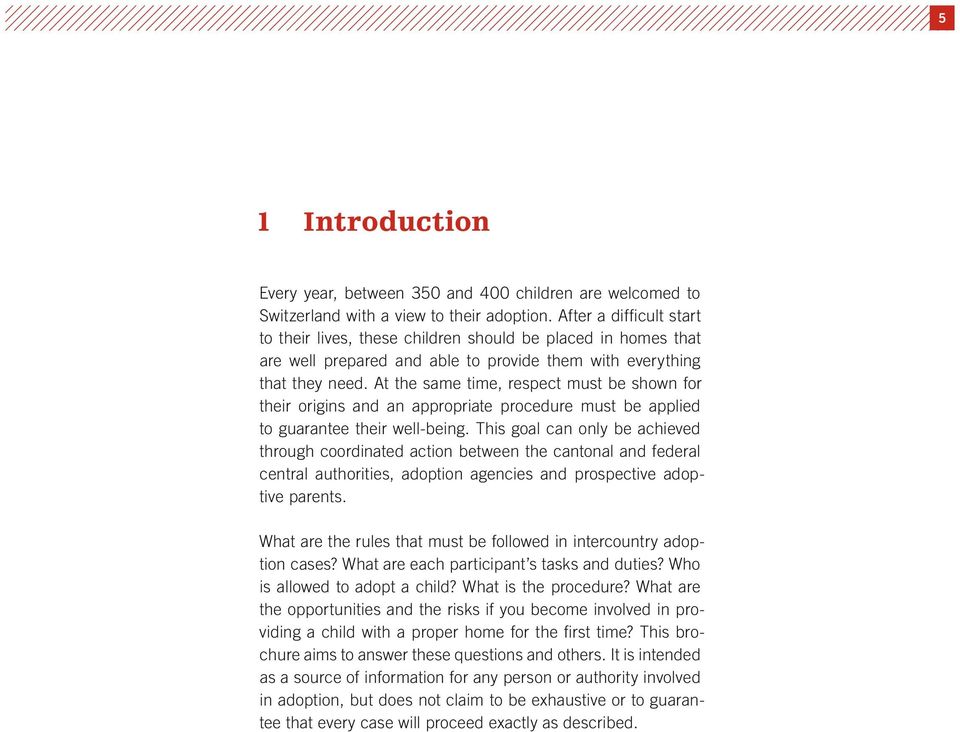
6 6 The Hague Convention of 29 May 1993 on intercountry adoption is in force between Switzerland and 89 other States.
7 7 2 Legal Provisions 2.1 International conventions Switzerland is a signatory to the Convention of 20 November 1989 on the Rights of the Child (CRC; RS 0.107) and to the Convention of 29 May 1993 on Protection of Children and Cooperation in respect of Intercountry Adoption (Hague Convention 93; RS ). The principal objective of both these conventions is to ensure that priority is given to the child s best interests, to prevent the abduction, sale of or trafficking in children, and to lay down standards for cooperation between the authorities in the child s state of origin and the authorities in the receiving state in adoption cases. For further information on the Hague Convention, a current list of contracting states and explanatory documents, you should consult the website of The Hague Conference (Hague Conference Intercountry adoption section). 2.2 Legislation Swiss Civil Code of 10 December 1907 (Art c CC; RS 210) The Civil Code sets out the basic provisions that must be complied with in adoption cases in order to guarantee the child s best interests. Federal Act of 22 June 2001 on the Hague Convention on Adoption and on Measures to Protect Children in Intercountry Adoption Cases (HCAA; RS ) This federal act implements the Hague Convention of 1993 in Switzerland and provides measures to protect a child who has come to Switzerland for adoption. In particular, it provides for the appointment of a guardian or deputy following the child s arrival in Switzerland. In addition, it contains criminal provisions aimed at preventing the placement of children without authorisation, making improper financial gains from adoption and trafficking in children. Adoption Ordinance of 29 June 2011 (OAdo; RS ) This Ordinance contains the procedural rules for placing children for adoption, for obtaining accreditation as an adoption agency and for the supervision of agency activities. It brings together all the enforcement provisions of the Hague Convention, the federal act implementing it and the provisions of the Swiss Civil Code. It has the advantage of consolidating all the enforcement provisions in a single instrument.
8 8 3 Main Tasks of the Federal Central Authority (FCA) 3.1 Receiving and passing on communications and files The FCA is the primary contact for the central authorities in the children s states of origin. It acts as an intermediary between the foreign authorities and the cantonal central authorities. For this reason, it is normally the body that receives and passes on communications and reports related to intercountry adoptions. 3.2 Exchange of information and coordination The FCA actively encourages an exchange of experiences and coordination between the cantonal central authorities, the adoption agencies and the federal authorities. Representatives of the federal and cantonal central authorities meet regularly in working groups to discuss procedural problems or current issues. In addition, the FCA advises the cantonal central authorities on legal matters and informs them regularly of the experiences it has had with the other signatory states to the Hague Convention. It also provides information on its website on a certain number of countries of origin. However, the cantonal central authorities are responsible for providing information directly to prospective adoptive parents. 3.3 Power to issue directives or recommendations The FCA has the general power to issue instructions or recommendations intended primarily to ensure coordination or avoid the abuses in the field of adoption. This power allows it to limit or even to prohibit completely the adoption of children born in states that do not cooperate adequately or where there is a serious risk of abuse during procedures (non-compliance with procedural rules, lack of state structures that permit the genuine verification of the origin of the children, serious malpractices, etc.) or generally speaking if it takes the view that the procedure carries the risk of harming the welfare of the child. It may base its decision on an analysis made by the Swiss representation in the country concerned or on the reports of governmental organisations (such as UNICEF or the Hague Conference on International Private Law) or non-governmental organisations (such as the International Social Service or Terre des Hommes). It may also refer to reports carried out by other countries or even by adoption agencies working in the regions concerned. It also has the power to issue directives to limit the activities of agencies.
9 9 3.4 Role as a representative and contact abroad When dealing with intercountry adoptions under the Hague Convention regime, the FCA examines the adoption files that the cantons have prepared, in some cases with the support of adoption agencies, to ensure that they are complete. It then forwards them to the foreign central authorities. It also receives decisions and the documents, such as the files relating to the children put up for adoption that are sent by foreign central authorities and passes them on to cantonal central authorities. It is the designated point of contact for foreign central authorities. In addition, the FCA represents Switzerland in dealings with foreign adoption authorities and in the international forums concerning adoption, for example at the Hague Conference on International Private Law. At these meetings, it discusses the difficulties that can arise when applying the Convention and looks for solutions. Finally, it encourages cooperation with all the states of origin, whether they are parties to the Hague Convention or not. 3.5 Accreditation and supervision of the activities of agencies The FCA is also responsible for granting the accreditation required by all the adoption agencies active in Switzerland and for supervising their activities. Based on questionnaires, interviews and activity reports, it evaluates applications for granting or extending accreditation as an adoption agency. The examination of professional qualifications is carried out on a case-by-case basis and may involve agency staff having to attend seminars or training days. Accreditation is granted for a maximum term of five years and is limited to certain countries (see Chapter 8 below). Finally, the FCA regularly welcomes delegations from foreign authorities. Contacts of this type always make for more effective cooperation.
10 10 4 Main Tasks of the Cantonal Central Authorities (CCA) 4.1 Providing information The CCAs are the information and advisory service for anyone who wishes to adopt a child, as well as for the communes and other government offices. They also have the responsibility for deciding how prospective adoptive parents must prepare themselves when applying for a certificate of suitability for adoption. 4.2 Procedure for the certificate of suitability and matching with parents On receipt of an adoption application, the central authority in the canton where the prospective parents live makes certain that there are no legal barriers preventing the applicants from adopting a foreign child. It conducts an investigation into whether they are suitable as adoptive parents, setting out the results in a social enquiry report (see Section below). If all the legal conditions and socio-educational requirements are met and the applicants have decided on the profile of the child they wish to adopt, as well as his/ her country of origin, the CCA issues them with its certificate of suitability. The prospective adoptive parents work with either an adoption agency or the CCA to prepare a file for the country of origin. The requirements that this file and the applicants must satisfy vary depending on the country of origin and may be different from the requirements that Switzerland would impose. Normally all the documents in the file on the prospective adoptive parents must be translated into an official language of the child s country of origin and be legalised. Once a child is proposed by the state of origin, the CCA, after ensuring firstly that the required documents have been provided by the state of origin and secondly that the prospective adoptive parents accept the proposal, authorises the prospective parents to host the child and approves the continuation of the procedure. 4.3 Monitoring and supervision Once the child is living with his/her adoptive family, the CCA makes sure that the child s care is monitored and his/her placement supervised until the adoption is granted or recognised. The adoptive parents must cooperate in the preparation of the post-adoption reports that are sent to the country of origin. If they fail to do so, they may be fined. 4.4 Cooperation with the Federal Central Authority The CCA carries out checks and issues opinions for the FCA. It may also be involved in the accreditation procedure for agencies and may take part in bilateral or multilateral meetings with foreign authorities. Finally, the FCA may request the CCA to provide it with statistical data and estimates of the costs of the adoption procedure, in particular in connection with the supervision of agencies. 4.5 Delegation clause The Ordinance authorises a canton to delegate its powers to another canton or to an intercantonal authority. Any or all of the tasks within the cantons power may be delegated (see Sections 4.1 to 4.4 above).

11 11 5 General Conditions that Prospective Adoptive Parents must meet The Swiss authorities are only competent to grant adoption if the prospective adoptive parents are resident in Switzerland (with the exception certain highly exceptional cases where the court at a parent s place of origin has jurisdiction, see Section below). The recognition in Switzerland of an adoption granted abroad is the subject of its own chapter (see section below). The Swiss Civil Code imposes a certain number of general conditions that parents must satisfy if they want to adopt a child: Based on their personal, family, social and financial circumstances, as well as their health and their educational capabilities, the prospective adoptive parents must guarantee that they will be able to look after the child that they adopt permanently and in a satisfactory manner and provide for his/her upkeep and education. Adoption can only be considered if all the circumstances indicate that establishing a parent-child relationship will serve the well-being of the child without unfairly prejudicing the position of the adoptive parents other children. The prospective adoptive parents must have cared for and brought up the child within of the same household for at least one year, unless the adoption granted abroad is recognised directly in Switzerland. If the child is capable of judgement, he or she must consent to adoption. The birth parents of the child must consent to his/her adoption. If the child is born in Switzerland, they are not permitted to consent to adoption in the first six weeks following the birth of the child. A parent s consent can be disregarded if he/she is not seriously concerned about the child s welfare or if his/her identity is unknown, he/ she has been absent for a considerable time and his/her address is unknown or he/she is permanently incapable of judgement.
12 Joint adoption Joint adoption is the rule. The prospective adoptive parents have to have been married for at least five years or must both be over the age of 35, and they must be at least sixteen years older than the child. 5.2 Adoption by a single parent Adoption by a single parent, although the exception, is possible if the adoptive parent is over 35, is neither married nor in a registered partnership and is at least sixteen years older than the child. A married person may only adopt as a single parent if he/ she is over the age of 35 and his/her spouse has become permanently incapable of judgement, or been absent for a considerable time and his/her address is unknown, or if legal separation was granted more than three years previously. 5.3 Adoption of a spouse s child A person can adopt his/her spouse s child if they have been married for at least five years. 5.4 Adoption of an adult It is possible to adopt an adult, provided the person wishing to adopt has no children or other descendants of his/ her own and looked after and provided for the education of the adopted person for at least five years while he/she was a minor.
13 Couples who are living together or in a registered partnership and same-sex couples are not permitted to adopt jointly. 13

14 14 6 Procedure for Intercountry Adoption The adoption procedure comprises several stages, described below, for the prospective adoptive parents. They must first of all contact the central authority in the canton (CCA) where they live. It should be noted that foreign nationals must hold either a residence permit (B permit), or a permanent residence permit (C permit) or an accreditation pass. 6.1 First steps Information session and filing an application Generally, persons interested in adoption are firstly invited to an interview, either individually or together, to learn about adoption, after which they must decide whether to file a formal application in order to begin the adoption process. The CCA, after ensuring that the applicants meet the legal conditions for adoption, begins the process of social assessment Assessment of suitability of prospective adoptive parents The assessment is made by a social worker or a qualified psychologist affiliated to the CCA and takes the form of various interviews, at least one of which takes place at the home of the prospective adoptive parents. The aim is to decide whether the prospective adoptive parents have the personal qualities to be able to offer every guarantee that the adopted child will benefit from an adequate level of care, upbringing and education. The decision is based on their state of health, the time they have available, their financial circumstances, their parenting skills and their housing conditions. General requirements It is essential that the circumstances as a whole, and the motives of the prospective adoptive parents in particular, suggest that adoption will serve the well-being of the child and that the welfare of any other children living in the family will not be adversely affected. The prospective adoptive parents have to be ready to accept the child as he/she is, to respect his/her origins and to familiarise the child with his/her roots. In accordance with the requirements imposed by the states of origin, prospective adoptive parents must undertake to assist in preparing post-adoption reports that will be sent to the state of origin after the child has arrived. Many countries demand information on how a child is integrating and developing in his/her new family in Switzerland. The prospective adoptive parents must indicate whether they intend to use an adoption agency and, where appropriate, to say which one. It is also up to them to provide a profile of the child that they wish to adopt, especially as far as the child s age and state of health is concerned.
15 15 Special cases The Ordinance on Adoption makes the suitability assessment subject to stricter requirements if the prospective adoptive parents want to adopt a child over four years old. In particular, they have to be able to communicate with the child as soon as he/she arrives (e.g. they must at least have a basic command of his/her language). Stricter requirements also apply when accepting a child with health problems, or if there are already several children living in the family. Finally, special attention is paid to any adoption application by a single parent, in particular with regard to the time the parent has available, parenting skills, financial circumstances or even the candidate s social network. Age of the child and of the prospective adoptive parents The prospective adoptive parents may not be declared suitable if there is an age difference between them and the child they wish to adopt of more than 45 years. The CCA will issue a negative opinion if both the applicants exceed this age limit and will apply stricter standards when assessing the suitability criteria if one of the two adoptive parents exceeds this age limit. Basically a couple cannot be declared suitable if one of them will be of retirement age when the adopted child is an adolescent. The CCA has a certain latitude and must bear in mind the circumstances of the case in question and the interests of the child when making its assessment. As a result, it is possible that the prospective adoptive parents will be declared suitable even if they exceed the age difference limits, especially if they have already established close links with the child. Preparation and training One of the suitability criteria relates to preparing prospective adoptive parents, who must attend information sessions or suitable preparatory courses recommended by the CCA. It is therefore the cantons responsibility to define the content and the extent of the preparation required. Absence of criminal convictions incompatible with adoption The CCA will request an extract from the VOSTRA automated register of convictions in order to verify if either applicant has been convicted of an offence incompatible with adoption or if proceedings for such an offence are ongoing. Foreign applicants must provide an extract from the register of convictions in their state of origin or an equivalent document. If criminal proceedings are ongoing for an offence incompatible with adoption, the CCA will suspend the suitability assessment until the case has been finally concluded.
16 16 Anyone who accepts a foreign child in Switzerland with a view to adoption without obtaining the required authorisation is liable to criminal penalties. In addition, the cantonal central authority may decide to place the child in question in a different home or to return the child to his/her country of origin.

17 Certificate of suitability On completion of the social assessment, if the conditions of suitability are met, the CCA certifies in a formal ruling that the prospective adoptive parents are suitable and issues them with a certificate of suitability. This document defines the profile of the child, in particular his/her origin, minimum and maximum age, state of health or even his/her sex. In addition, the validity of the certificate of suitability may be made subject to conditions and obligations. The maximum duration of the certificate of suitability is three years, although it may be extended at the request of the prospective adoptive parents. If the decision is negative, it is possible to appeal against the refusal of the CCA to issue a certificate of suitability. 6.2 Submitting the file on the prospective adoption The procedure at this stage varies, depending on whether the child being adopted comes from a state party to the Hague Convention (Section below) or not (Section below) State of origin that is a party to the Hague Convention Once the certificate of suitability is obtained, the complete file on the prospective adoptive parents, prepared according to the requirements of the child s country of origin (see on this the FCA website, is sent via the FCA to the central authority in the state of origin. The central authority in the state of origin, after examining the file on the prospective adoptive parents, will decide whether to accept them as candidates. If they are accepted, their file is put on the waiting list. When a child can be referred for adoption, the central authority in the state of origin prepares a file on the child containing a report (on the child s adoptability, background story and habits, state of health, etc.) accompanied by photographs and documents. The referral of a child that accompanies the file is sent to the FCA, which in turn sends it to the CCA. The prospective adoptive parents are informed about the referred child by the CCA or, if applicable, by the accredited agency that they are working with. If the child s file is not complete, especially if it lacks information on medical issues or on the consents required for adoption, the CCA will request the central authority in the state of origin to provide the additional information. If they accept the referral, and if it corresponds closely with the profile in the certificate of suitability, the prospective adoptive parents then sign a declaration of consent, which allows the CCA to grant authorisation to receive the child and continue the procedure. The procedure can then continue in the child s state of origin and ends with a decision on placement or adoption (see Section 6.3 below). The prospective adoptive parents are basically free to enlist the services of an accredited agency unless an agency is required by the state of origin (see Chapter 8 below).
18 State of origin that is not a party to the Hague Convention Once the certificate of suitability has been obtained, the complete file on the prospective adoptive parents, prepared according to the requirements of the child s country of origin (see on this subject the FCA website, admin.ch), is sent to the competent authority in the state of origin by the prospective adoptive parents themselves or via the accredited agency that they have chosen. This authority decides whether to accept the file and, if it does so, it places it on the waiting list. As soon as a child can be put up for adoption, the competent authority in the state of origin passes on the proposal directly to prospective adoptive parents or to their agency. This proposal, accompanied by various documents (a report on the background story and the life of the child, indications of his/her adoptability and state of health, as well as photos), is submitted to the CCA, which, if the prospective adoptive parents consent and if the profile of the referred child corresponds with their certificate of suitability, grants authorisation to receive the child. The procedure can then continue in the child s state of origin and ends with a decision on placement or adoption (see Section 6.3 below). 6.3 Granting adoption If adoption is not granted in the child s state of origin Irrespective of the child s state of origin (party to the Hague Convention or not), the local authorities only decide on the child s placement. Where they do so, on the child s arrival in Switzerland, a guardian is appointed to look after the child s interests. Once the child has been placed for one year, the prospective parents can apply to the competent authority in their canton of residence for adoption to be granted If adoption is granted in the child s state of origin If adoption is granted in the country where the child comes from, a distinction should be made between the following scenarios: Where the country is a state party to the Hague Convention: once the adoption decree is granted, the central authority in the state of origin issues a certificate attesting that the procedure was carried out in accordance with the Convention. This certificate of conformity allows the automatic recognition of the adoption in all the states parties to the Convention, provided the adoption granted has the same effects in those states, i.e. in Switzerland, it must be full adoption. If adoption in the state of origin has effects that are substantially different from those under Swiss law, the adoptive parents will have to request the competent authorities in their canton of residence to grant full adoption. On arrival of the child in Switzerland, a deputy is appointed to assist the adoptive parents. The deputy s mandate terminates 18 months at the latest after his/her appointment. Where the country is not a state party to the Hague Convention: adoption granted in the child s country of origin is not recognised automatically in Switzerland. The adoptive parents will have to apply for adoption with the competent authorities in their canton of residence. On the child s arrival in Switzerland, a guardian is appointed to assist the adoptive parents. If at least one of the adoptive parents is a citizen of or resident in the state where adoption is granted, the adoptive parents can request that the adoption be recognised under international private law. Recognition in this case is limited to the effects of adoption in the state in which adoption is granted.

19 Adoption granted based on jurisdiction at the place of origin When the prospective adoptive parents are not resident in Switzerland and at least one of them is Swiss, the competent authority at the Swiss place of origin can grant full adoption of a child that has been entrusted to the parents. For this to happen, first of all it must either be impossible for the prospective adoptive parents to obtain a judgment of full adoption in their country of residence, or they cannot reasonably be required to go through the adoption procedure and, secondly that they fulfil the conditions under Swiss law Effects of adoption Simple adoption, possible in certain states, does not end the previous parent-child relationship and does not have the same effects as full adoption in several respects, in particular in relation to inheritance rights or acquiring citizenship. Swiss law, however, only recognises full adoption: the adopted child acquires the same legal status as a child living with his/her birth parents, with the result that the previous parent-child relationship is terminated. Adoption is also irrevocable. A certified full adoption granted in a state party to the Hague Convention is recognised in its own right in the other contracting states. Only if an adoption is clearly contrary to Swiss public policy, taking account of the child s best interests, will recognition be refused. An adoption granted abroad that would not have the same effects as an adoption granted in Switzerland (simple adoption) will have to be converted into a full adoption by filing an application to this effect with the competent authority in the canton of residence. If an adoption granted abroad can be recognised in Switzerland but takes the form of simple adoption, the adoptive parents can request the competent Swiss authority at their place of residence to grant full adoption provided the conditions of Swiss law are met (in particular if they have obtained the consent of the birth parents to full adoption and the child has been placed for at least one year with the adoptive parents). In contrast to simple adoption, full adoption ends the previous parent-child relationship and places the adopted child in the same position as a biological child. In Switzerland, only full adoption is possible.
20 The other authorities involved Once the CCA has authorised the placement of the referred child, the cantonal migration authority will authorise the Swiss representation abroad to issue an entry visa for the child (if the child has a passport) or allow safe conduct (if the child does not have a passport). If the child becomes Swiss when adoption is granted abroad, the FCA will arrange for a pass (laissez-passer) to be issued to permit the child to enter Switzerland. As soon as adoption is granted, the civil register office responsible for the child s registration automatically receives notification via the CCA, which passes on the adoption decree or a certified copy. The civil register office then registers the child in the civil registers, which means that the adoptive parents can request a new family certificate. 6.5 Post-adoption supervision On the child s arrival in Switzerland, a guardian or a deputy is appointed to assist the adoptive parents with advice on and support in caring for the child, together with information on the various administrative procedures that have to be completed. In several cantons this job is done by the same social workers as those who have advised the family since they began the adoption procedure. At the end of his/ her mandate, the guardian or deputy submits a report to the guardianship authority on how the relationship between the child and the adoptive parents is developing. The guardian or deputy s mandate ends between twelve and eighteen months after it is established. In addition, almost all of the states of origin call for post-adoption supervision reports. The specific requirements differ from country to country, but at least mean that reports must be provided on the child s development over the first year following arrival in the new family. These reports have to be prepared by the CCA, the accredited adoption agency or the adoptive parents themselves, depending on what the state of origin requires. Normally prospective adoptive parents are requested to give a written undertaking during the evaluation procedure that they will assist in preparing the supervision reports for the state of origin, as shortcomings in this area are likely to jeopardise good relations with the states of origin. The adoption agencies also offer parents post-adoptive support (see Chapter 8 below). There are also associations for adoptive parents, which offer a place to exchange views and obtain support for the adoptive families keen to share their experiences or seeking help when facing a difficult situation (see > liens). 6.6 The costs of intercountry adoption The costs of intercountry adoption can vary quite considerably from one case to the next, depending on the chosen country of origin (and, in particular, on the number of trips required or the length of time spent in the country) and on whether it is decided to work with an accredited adoption agency or not. They include administrative charges for the work done by the different authorities involved (CCA, FCA, diplomatic representations, the migration authority, courts). The fees charged by adoption agencies vary according to

21 No one may derive an improper financial or other gain from an activity related to intercountry adoption. 21
22 22 the services offered. Finally, the expenses incurred abroad are made up of administrative charges and court fees, accommodation expenses for the child (or sometimes even donations to a children s institution), medical costs for the child, lawyers fees, translation fees, the costs of hiring a driver, and travelling and accommodation expenses for the adoptive parents, etc. In relation to costs, the Hague Convention has laid down principles to prevent abuses. In particular, it recognises that it must be possible to ask for reasonable fees and costs but that the charges must not be disproportionate and that the central authorities must make every effort to ensure that consents required for adoption are not paid for. In every case, it is strongly recommended not to hand over money in person and to ask for a receipt for every payment made. 6.7 The opportunities and risks of intercountry adoption Intercountry adoption is a child protection measure, offering a home to children who have hitherto lacked adequate family support. On average around 350 families are created in this way every year in Switzerland. Due to the socio-economic development of certain traditional countries of origin and as a result of a fall in the number of abandoned children, accompanied by a rise in the number of national adoptions, there has been a significant decline in the number of children available for intercountry adoption around the world. At the same time, a still quite high number of people are looking to adopt in their desire to start a family. This evolution means that there is no guarantee that any adoption procedure will end in success. In addition, most candidates for adoption want to adopt a young child in good health, but this does not correspond with the reality of what is needed. Indeed an increasing number of children put up for intercountry adoption are no longer infants and/or have health problems. Because of this, prospective adoptive parents should beware of the risk of abuse and of becoming involved with less than scrupulous people who offer to speed up or complete the procedure in return for a financial reward. Adoption candidates who do not make use of the services of an accredited adoption agency are more likely to be confronted with this issue. If there is any doubt as to the advisability of a service or the amount of fees, it is recommended to contact the CCA in order to clarify the situation. Any adoption procedure will involve unknown factors, in particular as far as the length of the process is concerned. The current trend is for procedures to take longer, and it is not unusual nowadays for couples to have to wait four years or more before their case is completed. It is also worth bearing in mind that due to political or social changes or natural disasters in the states of origin, a moratorium on adoption proceedings may be imposed and records frozen from one day to the next.
23 23 7 Adoption Agencies An adoption agency is any person or organisation that wishes to offer services in Switzerland in intermediating between children released for adoption and their future adoptive parents, and in particular any person or organisation that wishes to advise on the possibility of adopting a minor child. Agencies play a vital role in the preparing, supporting and supervising prospective adoptive parents before and after adoption. Due to their knowledge of the procedure and the realities on the ground, as well as their contacts in the country of origin, they provide crucial support to adoption candidates. However, it is not up to them to make the decisions, whether in relation to the certificate of suitability or in relation to matching. These decisions are taken solely by the CCA (see Section 4.2 above). Accreditation is required in order to operate as an adoption agency. The Federal Office of Justice is the authority responsible for accrediting and supervising agencies. Persons or organisations wanting to operate in Switzerland have to demonstrate a detailed knowledge of the adoption procedure in Switzerland and abroad, have suitable experience in the field of adoption, be familiar with the socio-cultural conditions in the countries of origin where they wish to operate, be committed to working in the child s best interests and comply with the basic ethical rules for the field of adoption. An agency is entitled only to the reimbursement of its expenses and a reasonable fee for its work. It is not essential to use an agency in Switzerland, but more than half of all adoption candidates call on their services. A list of currently accredited agencies is available on the Federal Office of Justice website ( Accreditation is required to operate as an adoption agency. Any person carrying on mediation activities without accreditation is liable to a fine.
24 24 8 National Adoption Every year, some thirty children born in Switzerland are put up for adoption. The procedure for national adoption is basically the same as for adopting a child from abroad (see Section 6.1 above). Candidates for adoption must hold a certificate of suitability for adoption. The birth parents cannot consent to the adoption of the child before the child is six weeks old and they then have a further six weeks in which to revoke their consent should they change their minds. Once the child can be placed in his/her prospective adoptive family, a guardian is appointed for the duration of the placement 9 Tracing Birth Parents Any adopted child has a right to information on the identity of his/her birth parents on attaining the age of majority, or before if the child can demonstrate a legitimate interest. Adoption agencies are required to keep a file on the adoption of a child and to pass it on to the cantonal authorities for archiving no later than when they complete their activities on the case. Each canton has an office responsible for counselling adopted people who want to trace their birth parents. This list is available on the FCA website: > recherche des origines
25 25 The time between the submitting a file and the referral of a child can be more than four years, depending on the state of origin and the profile of the child sought. There is no other guarantee of receiving any proposal of a child.
26 26 10 Frequently asked questions Is there an accredited agency for Colombia? You will find the list of agencies accredited by the Confederation on our website: We would like to adopt a child from abroad. What should we do? You must first contact the central authority for intercountry adoption in your canton of residence. They will advise and support you throughout the procedure. You will find a list of cantonal central authorities on our website: We are not married but have lived together now for seven years. Can we adopt a child from abroad? Under Swiss law, only a married couple can jointly adopt a child (Art. 264a Swiss Civil Code). We are a married couple living in Switzerland, but we do not have Swiss citizenship. Can we adopt a child from abroad? Persons living in Switzerland can apply to the central authority of their canton of residence in order to adopt a child, regardless of their nationality. You will find the details of the authority in your canton on our website: We would like to adopt a child from abroad. How long does the process take on average? The length of the adoption process varies enormously depending on the country of origin, the preferred age of the child and the child s state of health. I was adopted in Switzerland 20 years ago and I am trying to trace my birth parents. Whom should I contact for help? There is an office in every canton responsible that advises adopted people who want to trace their birth parents. You will find a list of these offices on our website: > recherche des origines We want to adopt a child in Switzerland. What should we do and what conditions do we have to fulfil? The conditions to fulfil and the procedure are the same as for an intercountry adoption. You must first contact the central authority in your canton of residence. You will find the details on our website: What is the difference between full adoption and simple adoption? Full adoption, the only form of adoption available in Switzerland, breaks all links that exist between a child and his/her birth parents. The adoptive parents take their place. Simple adoption, which exists in numerous countries of origin of adoptive children, preserves certain legal ties (for example in relation to inheritance rights) between the child and his/ her birth parents.
27 How many children are adopted each year in Switzerland? Without counting the children of spouses, an average of 300 to 400 children originating from abroad and 30 to 40 children originating from Switzerland are adopted in Switzerland each year. You will find further information on the website of the Federal Statistical Office: Office fédéral de la statistique > thèmes > population > mouvement de la population. I am writing a thesis on intercountry adoption. Can you send me any information? All the important information is available on our website. If you have any questions, you can contact one of the central cantonal authorities. You will find their details on our website: I want to adopt my second wife s fourteen year-old daughter. My wife is not a Swiss citizen. What do I have to do? To adopt your spouse s children, you have to have been married for at least five years. The central authority in your canton of residence will be able to advise you on the procedure to follow. You will find its details on our website: We are both Swiss, we live abroad and we want to adopt a child. Where should we go to apply for adoption? Whatever your nationality, you have to contact the competent authority in the place where you live. Do adoptive children automatically become Swiss citizens? In a case of full adoption, the child automatically takes the nationality of his/her parents (Art. 267 and 267a Swiss Civil Code). However, this is not the case with a simple adoption granted abroad. This must be converted into a full adoption by a court judgment issued in Switzerland. Is there a minimum or maximum age for adopting a child from abroad? If you have not been married (e) for at least five years, you must be at least 35 years old. In addition, the child must be at least sixteen years younger than his/her adoptive parents. The Ordinance of 29 June 2011 on Adoption also requires that the difference in age between the child and his/ her adoptive parents should not be more than 45 years.
28 Additional information: Federal Office of Justice Central Adoption Authority of the Swiss Confederation Bundesrain 20 CH-3003 Bern Tel Fax e
NB: Unofficial translation, legally binding only in Finnish and Swedish Ministry of Justice, Finland. Adoption Act
 NB: Unofficial translation, legally binding only in Finnish and Swedish Ministry of Justice, Finland Adoption Act Act No 22/2012, adopted on 20 January 2012 Chapter 1 General provisions Section 1 Purpose
PLEASE NOTE. For more information concerning the history of this Act, please see the Table of Public Acts.
 PLEASE NOTE This document, prepared by the Legislative Counsel Office, is an office consolidation of this Act, current to June 1, 2010. It is intended for information and reference purposes only. This
CONVENTION ON PROTECTION OF CHILDREN AND CO-OPERATION IN RESPECT OF INTERCOUNTRY ADOPTION
 Go to the Intercountry Adoption Section CONVENTION ON PROTECTION OF CHILDREN AND CO-OPERATION IN RESPECT OF INTERCOUNTRY ADOPTION (Concluded 29 May 1993) (Entered into force 1 May 1995) The States signatory
235.1. Federal Act on Data Protection (FADP) Aim, Scope and Definitions
 English is not an official language of the Swiss Confederation. This translation is provided for information purposes only and has no legal force. Federal Act on Data Protection (FADP) 235.1 of 19 June
Pakistan. http://adoption.state.gov/country/pakistan.html. Country Information
 Page 1 of 6 Pakistan Country Information Pakistan is not party to the Hague Convention on Protection of Children and Co-operation in Respect of Intercountry Adoption (Hague Adoption Convention). Therefore,
GENERAL INFORMATION ABOUT ADOPTION PROCEDURES
 Adoption in Florida WHAT IS ADOPTION? Adoption is the legal procedure by which a child becomes, through court action, part of a family other than that of his or her birth parents. Adoption is a serious
Federal Act on Combating Money Laundering and Terrorist Financing in the Financial Sector 1
 English is not an official language of the Swiss Confederation. This translation is provided for information purposes only and has no legal force. Federal Act on Combating Money Laundering and Terrorist
LAW OF THE REPUBLIC OF GEORGIA ON CITIZENSHIP OF GEORGIA
 /unofficial translation/ LAW OF THE REPUBLIC OF GEORGIA ON CITIZENSHIP OF GEORGIA Citizenship is the stable legal relationship of a person with the state which is expressed in the totality of their mutual
WHO MAY ADOPT A CHILD?
 Adoption in Florida INTRODUCTION Lawyers and judges receive many inquiries from persons who wish to adopt a child. This pamphlet has been prepared to help you understand adoption laws and procedures and
Delaware UCCJEA 13 Del. Code 1901 et seq.
 Delaware UCCJEA 13 Del. Code 1901 et seq. 1901. Short title This chapter may be cited as the Uniform Child Custody Jurisdiction and Enforcement Act. 1902. Definitions As used in this chapter: (1) "Abandoned"
ADOPTION OF CHILDREN CHAPTER 131
 [CH.131 1 CHAPTER 131 LIST OF AUTHORISED PAGES 1 4 LRO 1/2010 5 8 Original 9 16 LRO 1/2010 SECTION ARRANGEMENT OF SECTIONS 1. Short title. 2. Interpretation. 3. Power to make adoption orders. 4. Alien
Call for Applicants (Non-Greek Nationals) PROGRAMME 2014-2015 DOCTORAL/POSTDOCTORAL RESEARCH IN GREECE
 HELLENIC REPUBLIC MINISTRY OF EDUCATION & RELIGIOUS AFFAIRS ------ STATE SCHOLARSHIPS FOUNDATION (Ι.Κ.Υ.) DIRECTORATE FOR SPECIAL PROGRAMMES, INTERNATIONAL SCHOLARSHIPS UNIT FOR FOREIGNERS AND CULTURAL
Adoption and Children (Scotland) Bill [AS AMENDED AT STAGE 2]
![Adoption and Children (Scotland) Bill [AS AMENDED AT STAGE 2]](/thumbs/27/11007416.jpg "Adoption and Children (Scotland) Bill [AS AMENDED AT STAGE 2]") Adoption and Children (Scotland) Bill [AS AMENDED AT STAGE 2] CONTENTS Section PART 1 ADOPTION CHAPTER 1 ADOPTION SUPPORT SERVICES Adoption support services 1 Duty of local authority to provide adoption
Adoption and Children (Scotland) Bill [AS AMENDED AT STAGE 2] CONTENTS Section PART 1 ADOPTION CHAPTER 1 ADOPTION SUPPORT SERVICES Adoption support services 1 Duty of local authority to provide adoption
Information for parents considering adoption of their child
 Information for parents considering adoption of their child Published by the Victorian Government Department of Human Services Melbourne, Victoria Copyright State of Victoria 2008 This publication is copyright,
(Chapter No. not allocated yet) SOCIAL SECURITY ORDINANCE
 (Chapter No. not allocated yet) SOCIAL SECURITY ORDINANCE Non-authoritative Consolidated Text This is not an authoritative revised edition for the purposes of the Revised Edition of the Laws Ordinance;
Instructions for expatriate Finns
 Instructions for expatriate Finns Information about the address and personal circumstances of Finnish nationals residing abroad only stay up to date if they report any changes in such information to the
How To Adopt In The United States
 FAQs for SOCIAL WORKERS Disclaimer: The following is intended as a very general guide to assist social workers to gain a basic understanding of elements of the accreditation and approval regulations under
LAW. ON ELECTRONIC SIGNATURE (Official Gazette of the Republic of Montenegro 55/03 and 31/05)
 LAW ON ELECTRONIC SIGNATURE (Official Gazette of the Republic of Montenegro 55/03 and 31/05) I GENERAL PROVISIONS Article 1 This Law shall regulate the use of electronic signature in legal transactions,
Malta Individual Investor Programme Checklist and Guidelines
 Identity Malta Agency, Mediterranean Conference Centre, Old Hospital Street, Valletta VLT 1645 Malta [email protected] Malta Individual Investor Programme Checklist and Guidelines PLEASE READ
ENDURING POWER OF ATTORNEY ENDURING POWER OF ATTORNEY. ver: 2 1/06/02. Short Form
 Department of Justice and Attorney-General Form 2 Queensland Powers of Attorney Act 1998 (Section Form 2 44(1)) Queensland Powers of Attorney Act 1998 (Section 44(1)) ENDURING POWER OF ATTORNEY ENDURING
Practice Direction 14C Reports by the Adoption Agency or Local Authority
 Practice Direction 14C Reports by the Adoption Agency or Local Authority This Practice Direction supplements FPR Part 14, rule 14.11(3) Matters to be contained in reports 1.1 The matters to be covered
Adoption. /adoptionandfostering [email protected] www.lbhf.gov.uk www.rbkc.gov.uk www.westminster.gov.uk
 Adoption /adoptionandfostering [email protected] www.lbhf.gov.uk www.rbkc.gov.uk www.westminster.gov.uk 2 The London Borough of Hammersmith & Fulham, The Royal Borough of Kensington and Chelsea and
Partnership Support Form for Residence
 OFFICE USE ONLY Client no.: Date received: Application no.: March 2015 INZ 1178 Partnership Support Form for Residence For applications under the Partnership Category of Residence Instructions tes for
Federal law on certification services in the area of the electronic signature
 Law on the electronic signature 94.0 Notice This English translation has no official character. The only authentic texts are the German, French and Italian versions published in the Official Compendium
810.12. Federal Act on Human Genetic Testing (HGTA) Scope, Purpose and Definitions
 English is not an official language of the Swiss Confederation. This translation is provided for information purposes only and has no legal force. Federal Act on Human Genetic Testing (HGTA) 810.12 of
SELF-REGULATION RULES OF THE ASSOCIATION ROMANDE DES INTERMÉDIAIRES FINANCIERS (ARIF)
 1 SELF-REGULATION RULES OF THE ASSOCIATION ROMANDE DES INTERMÉDIAIRES FINANCIERS (ARIF) A. GENERALITIES Purpose of the Rules 1 The Self-Regulation Rules, enacted by the Association romande des intermédiaires
Electronic Documents Law
 Disclaimer: The English language text below is provided by the Translation and Terminology Centre for information only; it confers no rights and imposes no obligations separate from those conferred or
Merchants and Trade - Act No 28/2001 on electronic signatures
 This is an official translation. The original Icelandic text published in the Law Gazette is the authoritative text. Merchants and Trade - Act No 28/2001 on electronic signatures Chapter I Objectives and
BERMUDA ADOPTION OF CHILDREN REGULATIONS 2013 BR 93 / 2013
 QUO FA T A F U E R N T BERMUDA ADOPTION OF CHILDREN REGULATIONS 2013 BR 93 / 2013 TABLE OF CONTENTS 1 2 3 4 5 6 7 8 9 10 11 12 13 14 15 16 17 18 Citation Interpretation Form of transfer of care and custody
INTRODUCTION 1 STRUCTURE AND APPROACH 1 CONTEXT AND PURPOSE 2 STATEMENT OF PURPOSE 3
 June 2007 Table of Contents INTRODUCTION 1 STRUCTURE AND APPROACH 1 CONTEXT AND PURPOSE 2 STATEMENT OF PURPOSE 3 3 Standard 1: Statement of purpose 3 Standard 2: Written guide to the adoption service for
Entrepreneur Residence Guide
 December 2015 INZ 1057 Entrepreneur Residence Guide Entrepreneur Residence Category Information about this guide The purpose of this guide is to help you complete the Entrepreneur Residence Application
Law of Georgia On Adoption and Foster Care. Chapter I. General Provisions
 Law of Georgia On Adoption and Foster Care Chapter I General Provisions Article 1. Goals and scope of regulation of the Law 1. The Goals of this Law are: based on the principles recognized by the Constitution
Convention for the Suppression of the Traffic in Persons and of the Exploitation of the Prostitution of Others
 Convention for the Suppression of the Traffic in Persons and of the Exploitation of the Prostitution of Others Approved by General Assembly resolution 317 (IV) of 2 December 1949 Preamble Entry into force:
LAW FOR THE ELECTRONIC DOCUMENT AND ELECTRONIC SIGNATURE. Chapter two. ELECTRONIC DOCUMENT AND ELECTRONIC SIGNATURE
 LAW FOR THE ELECTRONIC DOCUMENT AND ELECTRONIC SIGNATURE Prom. SG. 34/6 Apr 2001, amend. SG. 112/29 Dec 2001, amend. SG. 30/11 Apr 2006, amend. SG. 34/25 Apr 2006, amend. SG. 38/11 May 2007 Chapter one.
STUDENT LEGAL SERVICES. CUSTODY & ACCESS Children of Married Parents Seeing a Divorce A GUIDE TO THE LAW IN ALBERTA REGARDING OF EDMONTON
 COPYRIGHT AND DISCLAIMER A GUIDE TO THE LAW IN ALBERTA REGARDING CUSTODY & ACCESS Children of Married Parents Seeing a Divorce version: 2010 STUDENT LEGAL SERVICES OF EDMONTON GENERAL All information is
first direct credit card terms
 first direct credit card terms 1 Definitions These are the definitions used in this Agreement: : a transfer to the Account of an amount you owe to another lender (who is not a member of the HSBC Group)
DIRECTIVE 2 RELATING TO THE VERIFICATION OF THE IDENTITY OF THE CONTRACTING PARTY
 1 DIRECTIVE 2 RELATING TO THE VERIFICATION OF THE IDENTITY OF THE CONTRACTING PARTY Principle 1 The financial intermediary shall verify the identity of the contracting party of each of his business relationships
Issue Brief. Arizona State Senate LEGAL DECISION-MAKING AND PARENTING TIME INTRODUCTION DETERMINING LEGAL DECISION-MAKING AND PARENTING TIME
 Arizona State Senate Issue Brief January 17, 2014 Note to Reader: The Senate Research Staff provides nonpartisan, objective legislative research, policy analysis and related assistance to the members of
Witness Protection Act 1995 No 87
 New South Wales Witness Protection Act 1995 No 87 Status information Currency of version Current version for 5 October 2012 to date (generated 10 October 2012 at 19:15). Legislation on the NSW legislation
CP 14. Grant of Canadian Citizenship for Persons Adopted by Canadian Citizens
 CP 14 Grant of Canadian Citizenship for Persons Adopted by Canadian Citizens June 11, 2015 Updates to Chapter... 6 Listing by date... 6 1. What this chapter is about... 7 1.1. This chapter is about...
MARYLAND CODE Family Law. Subtitle 1. GENERAL PROVISIONS
 MARYLAND CODE Family Law Title 9.5 MARYLAND UNIFORM CHILD CUSTODY JURISDICTION AND ENFORCEMENT ACT *** Current as of April, 2012 *** Section 9.5-101 Definitions Subtitle 1. GENERAL PROVISIONS (a) In general.-
ESTONIA MONEY LAUNDERING AND TERRORISM FINANCING PREVENTION ACT
 ESTONIA MONEY LAUNDERING AND TERRORISM FINANCING PREVENTION ACT Important Disclaimer This translation has been generously provided by the Estonian Financial Supervision Authority. This does not constitute
Frequently Asked Questions about Adoption in Tennessee
 Frequently Asked Questions about Adoption in Tennessee BIRTH MOTHER RELATED 1. When can the mother of the baby start the adoption process? A. Legal proceedings cannot begin until at least four (4) days
Code of Conduct for registered migration agents
 Code of Conduct for registered migration agents Current from 1 JULY 2012 SCHEDULE 2: CODE OF CONDUCT (regulation 8) Migration Act 1958, subsection 314(1) THIS CODE OF CONDUCT SHOULD BE DISPLAYED PROMINENTLY
DECISION OF THE EUROPEAN CENTRAL BANK of 9 February 2010 on the rules governing the traineeship programme of the European Central Bank (ECB/2010/NP4)
 DECISION OF THE EUROPEAN CENTRAL BANK of 9 February 2010 on the rules governing the traineeship programme of the European Central Bank (ECB/2010/NP4) THE EXECUTIVE BOARD OF THE EUROPEAN CENTRAL BANK, Having
Number 9 of 2015. Children and Family Relationships Act 2015
 Number 9 of 2015 Children Family Relationships Act 2015 Number 9 of 2015 CHILDREN AND FAMILY RELATIONSHIPS ACT 2015 CONTENTS PART 1 PRELIMINARY AND GENERAL Section 1. Short title, collective citations
Personal Data Act (1998:204);
 Personal Data Act (1998:204); issued 29 April 1998. Be it enacted as follows. General provisions Purpose of this Act Section 1 The purpose of this Act is to protect people against the violation of their
INTRODUCTION. This Information Booklet is for people who are thinking about adopting a child from overseas. This is known as Intercountry Adoption.
 INTRODUCTION This Information Booklet is for people who are thinking about adopting a child from overseas. This is known as Intercountry Adoption. 1 We trust that you find the information useful. Further
International Adoption and the Immigration Process
 Citizenship and Immigration Canada Citoyenneté et Immigration Canada International Adoption and the Immigration Process C&I-387-03-00 International Adoption and the Immigration Process For additional
EMANCIPATION IN WI THE WHAT, WHEN & WHY OF EMANCIPATION IN WISCONSIN
 EMANCIPATION IN WI Definition: In family law cases, emancipation of a minor (also called "divorce from parents") refers to a court process through which a minor can become legally recognized as an independent
THE CROATIAN PARLIAMENT DECISION PROMULGATING THE ACT ON INVESTMENT FUNDS WITH A PUBLIC OFFERING
 THE CROATIAN PARLIAMENT Pursuant to Article 89 of the Constitution of the Republic of Croatia, I hereby pass the DECISION PROMULGATING THE ACT ON INVESTMENT FUNDS WITH A PUBLIC OFFERING I hereby promulgate
THIRD SUPPLEMENT TO THE GIBRALTAR GAZETTE No. 4,167 of 7th May, 2015
 THIRD SUPPLEMENT TO THE GIBRALTAR GAZETTE No. 4,167 of 7th May, 2015 B. 13/15 Clause PRIVATE TRUST COMPANIES BILL 2015 1. Short title and commencement. 2. Interpretation. 3. Registration of Private Trust
Children s Law Center of Indiana
 Children s Law Center of Indiana Frequently Asked Questions about Termination of the Parent-Child Relationship in Indiana 1 By: Derelle Watson-Duvall, J.D. Kids Voice of Indiana May 2015 1. What is the
A BILL FOR SOCIAL PROTECTION ACT, 2015
 ANGUILLA A BILL FOR SOCIAL PROTECTION ACT, 2015 Published by Authority A BILL FOR SOCIAL PROTECTION ACT TABLE OF CONTENTS SECTION PART 1 PRELIMINARY 1. Interpretation PART 2 BOARD 2. Establishment of Board
Act to Implement Certain Legal Instruments in the Field of International Family Law (International Family Law Procedure Act IFLPA)
 Act to Implement Certain Legal Instruments in the Field of International Family Law (International Family Law Procedure Act IFLPA) in the version of the promulgation of 26 January 2005 (Federal Law Gazette
A guide to intercountry adoption for UK residents
 A guide to intercountry adoption for UK residents Department for Education This leaflet provides an overview of the process for intercountry adoption where children are brought into the UK. It should not
APPLICATION FOR AFFILIATION TO THE ASSOCIATION ROMANDE DES INTERMÉDIAIRES FINANCIERS (ARIF) (DIRECTIVE 1)
 APPLICATION FOR AFFILIATION TO THE ASSOCIATION ROMANDE DES INTERMÉDIAIRES FINANCIERS (ARIF) (DIRECTIVE 1) February 2013 Please print and complete the present document fully in printing characters, tick
Where these regulations require a member of the School's staff or a body of the School to act, this authority may be delegated where appropriate.
 REGULATIONS FOR RESEARCH DEGREES These Regulations are approved by the Academic Board. Last updated: June 2015 Where these regulations require a member of the School's staff or a body of the School to
Agreement between the Swiss Federal Council and the Bank for International Settlements to determine the Bank s legal status in Switzerland
 Agreement between the Swiss Federal Council and the Bank for International Settlements to determine the Bank s legal status in Switzerland (of 10 February 1987; text as amended effective 1 January 2003
Part 10. Directors and Company Secretaries
 Part 10 Division 1 Subdivision 1 Section 453 A4183 Part 10 Directors and Company Secretaries Division 1 Appointment, Removal and Resignation of Directors Subdivision 1 Requirement to have Directors 453.
DEPARTMENT FOR CHILDREN, SCHOOLS AND FAMILIES. The Children Act 1989 Guidance and Regulations. Volume 1. Court Orders
 DEPARTMENT FOR CHILDREN, SCHOOLS AND FAMILIES The Children Act 1989 Guidance and Regulations Volume 1 Court Orders A FRAMEWORK FOR THE CARE AND UPBRINGING OF CHILDREN 1 TABLE OF CONTENTS PAGE CHAPTER 1
DEPENDENT ELIGIBILITY AND ENROLLMENT
 Office of Employee Benefits Administrative Manual DEPENDENT ELIGIBILITY AND ENROLLMENT 230 INITIAL EFFECTIVE DATE: October 10, 2003 LATEST REVISION DATE: July 1, 2015 PURPOSE: To provide guidance in determining
Platform Specialty Products Corporation Foreign Corrupt Practices Act/Anti-Corruption Policy
 1. Introduction. Platform Specialty Products Corporation Foreign Corrupt Practices Act/Anti-Corruption Policy 1.1 Combating Corruption. Platform Specialty Products Corporation, including its subsidiaries,
CONSULTATION PAPER NO 2. 2004
 CONSULTATION PAPER NO 2. 2004 REGULATION OF GENERAL INSURANCE MEDIATION BUSINESS This consultation paper explains the need for the Island to regulate general insurance mediation business and examines the
Guidance on health and character
 Guidance on health and character Who is this document for?... 2 About the structure of this document... 2 Section 1: Introduction... 4 About us (the HPC)... 4 How we are run... 5 About registration...
Regulations concerning measures to combat money laundering and the financing of terrorism, etc.
 Regulations concerning measures to combat money laundering and the financing of terrorism, etc. Translation as of April 2009. This translation is for information purposes only. Legal authenticity remains
Switzerland's Federal Code on Private International Law (CPIL) 1
 Switzerland's Federal Code on Private International Law (CPIL) of December 8, 987 UM BRICHT www.umbricht.com TABLE OF CONTENTS Article Page Chapter : Provisions in Common Section : Scope Section : Jurisdiction
ADOPTION. The Adoption Law All adoptions filed in the state of Missouri are governed by the same 1123
 ADOPTION What is Adoption? Adoption is a legal process that establishes a parent/child relationship between two people who are not otherwise related by blood. There are three sets of participants in an
LEGISLATION COMMITTEE OF THE CROATIAN PARLIAMENT
 LEGISLATION COMMITTEE OF THE CROATIAN PARLIAMENT 2300 Pursuant to its authority from Article 59 of the Rules of Procedure of the Croatian Parliament, the Legislation Committee determined the revised text
EMERGENCY PURCHASES AND FLIGHT DELAY INSURANCE CERTIFICATE OF INSURANCE INTRODUCTION HOW TO OBTAIN ASSISTANCE
 RBC VISA INFINITE* AVION EMERGENCY PURCHASES AND FLIGHT DELAY INSURANCE CERTIFICATE OF INSURANCE IMPORTANT PLEASE READ: This Certificate of Insurance is a valuable source of information and contains provisions
ELECTRONIC COMMERCE AND ELECTRONIC SIGNATURE ACT (ZEPEP-UPB1) (Official consolidated text)
 ELECTRONIC COMMERCE AND ELECTRONIC SIGNATURE ACT (ZEPEP-UPB1) (Official consolidated text) On basis of article 153 of the National Assembly of Slovenia Rules of Procedure the National Assembly of the Republic
PERMANENT COURT OF ARBITRATION OPTIONAL RULES FOR ARBITRATING DISPUTES BETWEEN TWO STATES
 PERMANENT COURT OF ARBITRATION OPTIONAL RULES FOR ARBITRATING DISPUTES BETWEEN TWO STATES 39 OPTIONAL ARBITRATION RULES TWO STATES CONTENTS Introduction 43 Section I. Introductory Rules 45 Scope of Application
An affidavit is a document containing a statement that the deponent swears to be true to the best of their knowledge.
 Affidavit An affidavit is a document containing a statement that the deponent swears to be true to the best of their knowledge. The commissioner then signs as confirmation that the oath or affirmation
SEMGROUP CORPORATION. Anti-Corruption Compliance Policy August, 2011
 SEMGROUP CORPORATION Anti-Corruption Compliance Policy August, 2011 SCOPE This is a global policy (the Policy ) applicable to the worldwide operations of SemGroup Corporation ("SemGroup") and all of its
Residence visa for family reunification under the European Community regime
 Residence visa for family reunification under the European Community regime INTRODUCTION A European Community Family Reunification visa may be issued to anyone falling under EU law, provided they enter
A Guide to Adoption Law for North Carolina Birth Mothers
 A Guide to Adoption Law for North Carolina Birth Mothers 1. Who may place a child for adoption? Who accepts children for adoption? A parent with legal and physical custody of a child may place the child
CHAPTER 9. 1. This Act may be cited as the Adoption of Children. 2. (1) Upon an application in the prescribed manner Power to make
 Adoption of Children (CAP. 9 1 CHAPTER 9 THE ADOPTION OF CHILDREN ACT Arrangement of Sections Section Short title. Power to make adoption orders. Restrictions on making adoption orders. Matters with respect
AN BILLE UM CHOMHAIRLEOIRÍ BAINISTITHE FIACHAIS A RIALÁIL, 2011 REGULATION OF DEBT MANAGEMENT ADVISORS BILL 2011. Mar a tionscnaíodh As initiated
 AN BILLE UM CHOMHAIRLEOIRÍ BAINISTITHE FIACHAIS A RIALÁIL, 2011 REGULATION OF DEBT MANAGEMENT ADVISORS BILL 2011 Mar a tionscnaíodh As initiated ARRANGEMENT OF SECTIONS PART 1 Preliminary and General Section
HELM TRUST COMPANY LIMITED COMPANY MANAGEMENT APPLICATION FORM
 HELM TRUST COMPANY LIMITED COMPANY MANAGEMENT APPLICATION FORM PLEASE NOTE THAT IN ACCORDANCE WITH ANTI MONEY LAUNDERING LAWS NEW BUSINESS CANNOT BE ACCEPTED BY ANY JERSEY TRUST AND COMPANY BUSINESS SERVICE
LEGAL SCHEME REGULATIONS
 LEGAL SCHEME REGULATIONS These Regulations came into force on 1 July 2014. 1 Introduction 1.1 These Regulations govern the Union s legal Scheme. The Rules of the Union set out your other rights and entitlements.
Licence Chapter 639 Special Transportation Services
 Licence Special Transportation Services 639.1.1 Citation Chapter Index Article - 1 Short Title Article 2 - Interpretation 639.2.1 Accessible vehicle - defined 639.2.2 City - defined 639.2.3 Clerk - defined
1 PART ONE: INTRODUCTION
 1 PART ONE: INTRODUCTION 1.1 This document lays down the Code of Practice for solicitors and firms providing criminal legal assistance 1. It has been prepared by the Scottish Legal Aid Board ( the Board
A law to make provision for the citizenship of the Republic and for matters connected therewith
 A law to make provision for the citizenship of the Republic and for matters connected therewith The House of Representatives enacts as follows: PART I. PRELIMINARY 1. This Law may be cited as the Republic
Registration for Home Schooling in NSW Information Package
 Registration for Home Schooling in NSW Information Package August 2013 2013 Copyright Board of Studies NSW for and on behalf of the Crown in right of the State of New South Wales. This document contains
Identity Cards Act 2006
 Identity Cards Act 2006 CHAPTER 15 Explanatory Notes have been produced to assist in the understanding of this Act and are available separately 6 50 Identity Cards Act 2006 CHAPTER 15 CONTENTS Registration
Rule 60A - Child and Adult Protection
 Rule 60A - Child and Adult Protection Scope of Rule 60A 60A.01(1) This Rule is divided into four parts and it provides procedure for each of the following: (c) (d) protection of a child, and other purposes,
International Transfer of Prisoners (South Australia) Act 1998
 Version: 2.4.2000 South Australia International Transfer of Prisoners (South Australia) Act 1998 An Act relating to the transfer of prisoners to and from Australia. Contents Part 1 Preliminary 1 Short
Federal Act on Private Security Services provided Abroad
 English is not an official language of the Swiss Confederation. This translation is provided for information purposes only and has no legal force. Federal Act on Private Security Services provided Abroad
The Limited Partnership Bill, 2010 THE LIMITED LIABILITY PARTNERSHIP BILL 2010 ARRANGEMENT OF CLAUSES PART I PRELIMINARY. Clause
 THE LIMITED LIABILITY PARTNERSHIP BILL 2010 ARRANGEMENT OF CLAUSES 1 Short title and commencement. 2 Interpretation. PART I PRELIMINARY Clause PART II REGISTRAR AND REGISTRAR OF LIMITED LIABILITY PARTNERSHIPS
PRISONERS INTERNATIONAL TRANSFER (QUEENSLAND) ACT 1997
 Queensland PRISONERS INTERNATIONAL TRANSFER (QUEENSLAND) ACT 1997 Reprinted as in force on 1 April 1999 (Act not amended up to this date) Reprint No. 1 This reprint is prepared by the Office of the Queensland
LAW ON ELECTRONIC TRANSACTIONS
 Lao People s Democratic Republic Peace Independence Democracy Unity Prosperity National Assembly No 20/NA Vientiane Capital, Date: 7 December 2012 (Unofficial Translation) LAW ON ELECTRONIC TRANSACTIONS
Civil Law (Wrongs) (Proportionate Liability and Professional Standards) Amendment Act 2004
 Australian Capital Territory Civil Law (Wrongs) (Proportionate Liability and Professional Standards) Amendment Act 2004 Contents Page 1 Name of Act 2 2 Commencement 2 3 Legislation amended 2 4 New chapter
LAW ON MUTUAL ASSISTANCE IN CRIMINAL MATTERS
 LAW ON MUTUAL ASSISTANCE IN CRIMINAL MATTERS I GENERAL PROVISIONS Subject and Application of the Law Article 1 This Law shall govern mutual assistance in criminal matters (hereinafter: mutual assistance)
The Fostering Network 2006 Managing Allegations and Serious Concerns About Foster Carers Practice: a guide for fostering services.
 1 foreword The role of foster carers is a unique and challenging one. They look after some of our most vulnerable children, 24 hours a day, and it is essential that they are properly supported. The way
THE DOCTORATE CHARTER OF THE UNIVERSITY OF STRASBOURG
 THE DOCTORATE CHARTER OF THE UNIVERSITY OF STRASBOURG Preparing a doctorate combines high-level training and professional research experience. Once the thesis has been defended, a Philosopher's Degree
Qualified Electronic Signatures Act (SFS 2000:832)
 Qualified Electronic Signatures Act (SFS 2000:832) The following is hereby enacted 1 Introductory provision 1 The purpose of this Act is to facilitate the use of electronic signatures, through provisions