
CHAPTER 13 CHAPTER 13. Generated by Foxit PDF Creator Foxit Software For evaluation only.
|
|
|
- Howard White
- 10 years ago
- Views:
Transcription
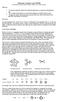
1 Generated by Foxit PDF reator Foxit Software Pd- AND f-blk RGANETALLIS PAn organometallic compound must contain P a carbon-metal bond. PBook, p. 459, gives list of common ligands P An over-view of organometallics No. of Electrons gand omplex 1 alkyl R [( 3 ) 3 Ptl] aryl 6 5 ( 6 5 ) 3 r[( 2 5 ) 2 ] 3 2 carbonyl : r() 6 alkene R 2 =R 2 Pt( 2 4 )l 2 3 allyl 2 -= 2 Ni( 3 5 ) 2 4 butadiene 2 =-= 2 Fe() 3 ( 4 6 ) 5 - cyclopentadienyl 5 5 Fe( 5 5 ) 2 6 benzene 6 6 r( 6 6 ) 2 Post of the ligands that donate an even number of electrons contain unsaturated groups. The pi component of ethylene is equivalent to the electron pair on :N 3. PBroadly speaking, there are two kinds of bonding. 1) A single carbon atom is directly attached to the metal: - 2 -= 2 and P2) pi donation: 2 2 P Effective atomic number (EAN) is often used to rationalize bonding. The modern expression of the EAN rule is the 18 electron rule. P We need a method to account for the electrons from the metal atom and those from the ligand. P An example: Fe() 3 ( 4 6 ). With neutral ligands, Fe is formally in a zero oxidation state and so has 8 valence electrons: 4s 2 3d 6. P 3 's donate 2 and 4 6 (butadiene) donates 4. So = 18. P The basis for the 18 electron rule lies in the fact that the ns, np, and (n-1)d electrons are similar in energy.
![of Electrons gand omplex 1 alkyl R [( 3 ) 3 Ptl] aryl 6 5 ( 6 5 ) 3 r[( 2 5 ) 2 ] 3 2 carbonyl : r() 6 alkene R 2 =R 2 Pt( 2 4 )l 2 3 allyl 2 -= 2 Ni( 3 5 ) 2 4 butadiene 2 =-= 2 Fe() 3 ( 4 6 ) 5 -](/docs-images/43/6018641/images/page_1.jpg "cyclopentadienyl 5 5 Fe( 5 5 ) 2 6 benzene 6 6 r( 6 6 ) 2 Post of the ligands that donate an even number of electrons contain unsaturated groups.")
2 Generated by Foxit PDF reator Foxit Software PA couple more examples: r() 6 : r has 6 electrons: 4s 1 3d 5 Each donates two: 2 x 6 = 12 total = 18 n() 5 : n has 7 electrons: 4s 1 3d 5 Each donates two: 2 x 5 = 10 total = 17 But n() 5 actually n 2 () 10 2 n = 14 electrons; 10 = 20 electrons 1 n-n = 2 electrons total = = 36/2 = 18 P d-blk ARBNYLS. Probably the most important organometallic compounds. The molecule has filled 3σ and vacant 2π orbitals. P The sigma orbital is an electron donor, though not a very good one. P The pi orbitals (the LUs)are antibonding orbitals, and thus, of the right symmetry to overlap with d- orbitals on metals. P Backbonding - note that this enables the to bind on metals in low valence states and "bleed" the electron density away from the metal. may form one bond, or may bridge two, or even three, metals

3 Generated by Foxit PDF reator Foxit Software PRelated pi-acid ligands. P N - and N particularly important examples. PNote PF 3 - the d-orbitals on P, once thought to be the acceptors, play little role. PIt is the P-F antibonding sigma orbital formed from the P 3p orbitals. Pany polynuclear carbonyls. Pften prepared by thermal or photochemical decomposition of the simple carbonyls 2 Fe() 5 --hν--> Fe 2 () 9 + PSTRUTURE. Generally adhere to the 18-electron rule. P The () 6 are octahedral, the () 5 are trigonal bipyramid (care -the monomeric ones are!), and () 4 are tetrahedral. Notable exception is V() 5, which esr shows to be monomeric down to liquid nitrogen temps and, below that dimerizes and then follows the 18-electron rule. As noted before, the 18- electron rule helps us figure out that n() 5 is actually n 2 () 10 Pne of the main tools for determining the structure of the carbonyl compounds is vibrational spectroscopy. P Free has its IR stretch at 2143 cm -1. The coordination of should reduce the (triple) bond order, because electrons from the metal have been accepted into the antibonding orbitals. That is what happens - we see, for Fe() 5, = stretch of 2116, 2030, and 1989 cm -1. Three since there are three posssible symmetries for the vibrations of the set of five ligands. Two are IR active and three are Raman active. Infrared Raman Totally symmetric band - absent in IR, present in Raman

4 Generated by Foxit PDF reator Foxit Software PIn polynuclear molecules, we have basically two types of 's - terminal and bridinging. PBridging 's have even lower frequencies - there are two metals donating electrons into the antibonding orbitals on one molecule. P For Fe 2 (η 5 - p) 2 () 4, we get two terminal stretches in the area of 2000 cm -1, and one peak (from the bridging ligands) at 1800cm -1. Terminal Bridging Fe Fe P Two types organometallic compounds are formed: ionic and covalently bonded. PGroup IA metal alkyls provide examples of both extremes. Pthium alkyls are soluble in hydrocarbons and other nonpolar solvents indicative of covalent character. They react violently in air and water, often igniting spontaneously. Pther Group IA metal alkyls are appreciably more ionic than are the lithium compounds. P They are not particularly soluble in hydrocarbon solvents, but they are still extremely reactive toward air and moisture. P These ionic organometallic compounds can be prepared either by treatment of dimethylmercury with the appropriate alkali metal or by the reaction of an alkyl halide with an alkali metal: P( 3 ) 2 g + 2 K --> 2[ 3 ] - K + + g P 2 5 l + 2 K --> [ 2 5 ] - K + + Kl

5 Generated by Foxit PDF reator Foxit Software PStructures typical of ionic compounds; for example [ 3 ] - K + crystallizes in the nickelarsenide lattice. P thium alkyls have different structures than the other metal alkyls; Pdue to their greater covalent character, they form tetrameric or octahedral clusters, for example, ( 3 ) 4 and ( 25 ) 6. The structure of the former is a square: PThese small clusters, called oligomers, are attributed to multicenter, two-electron bonds l > ( 3 ) l P Groups IIA and IIIA metal aklyls also form clusters or polymers. P onomeric precursors for Groups IA-IIIA elements - P eg R, R 2 Be, and R 3 Al - electron-deficient so P achieve more stable electronic configurations by forming multicenter bonds. Such as: PPreparation of these types of main-group alkyls include: l > ( 3 ) l 3( 2 5 ) 2 g > ( 2 5 ) g x Bel 2 + 2x (n-bu) --> [(n-bu) 2 Be] x + 2x l 110 o x[( 3 ) 2 g] + x Be > [( 3 ) 2 Be] x + x g 3 3 Al 3 3 Al 3 3 3( 3 ) 2 g + 2 Al ---> ( 3 ) 6 Al g 2 Al > ( 2 5 ) 6 Al 2

6 Generated by Foxit PDF reator Foxit Software P ay also use lithium alkyls as starting material to make more complex compounds: P p 2 Fe + n-bu --> p( 5 5 )Fe + n P Sodium cyclopentadienide can used also. P Prepared by reacting cyclopentadiene with sodium metal dispersed in tetrahydrofuran. yclopentadiene not stable as a monomer The dimer must be cracked thermally immediately prior to use: P heat > P Group IA organometallics used to synthesize ketones: P 2 ( 3 ) > 4 ( 3 ) P thium alkyls used as stereospecific polymerization catalysts to form 1,4-cispoly(isoprene). P Aluminum alkyls important in the Ziegler- Natta alkene polmerization. P And, don t forget the Grignard reagents, RgX P Na ---> 2 Na + p P Synthesis of Group IIIA and Group IVA organometallics: P Gal gbr --> ( 2 5 ) 3 Ga + 3 gbrl P Tl --> Tlp+ 2 P Sil gl --> ( 3 ) 2 Sil gl 2 P l + 4Na/Pb --> ( 2 5 ) 4 Pb + 3Pb + 4Nal P The compounds all highly covalent, soluble in organic solvents, and fairly volatile.

18 electron rule : How to count electrons
 18 electron rule : How to count electrons The rule states that thermodynamically stable transition metal organometallic compounds are formed when the sum of the metal d electrons and the electrons conventionally
Electron Counting in Organometallic Chemistry
 Electron Counting in Organometallic Chemistry 1. The 18-Electron Rule; definition & rationalisation The constitution and structure of main group element complexes can be predicted and rationalised by a
Chemistry 105, Chapter 7 Exercises
 hemistry 15, hapter 7 Exercises Types of Bonds 1. Using the periodic table classify the bonds in the following compounds as ionic or covalent. If covalent, classify the bond as polar or not. Mg2 4 i2 a(3)2
Determining the Structure of an Organic Compound
 Determining the Structure of an Organic Compound The analysis of the outcome of a reaction requires that we know the full structure of the products as well as the reactants In the 19 th and early 20 th
Organometallics Study Seminar Chapter 13: Metal-Ligand Multiple Bonds
 Organometallics Study Seminar Chapter 13: Metal-Ligand Multiple Bonds Contents 1. Carbene Complexes 2. Silylene Complexes 3. Metal-Heteroatom Multiple Bonds 1. Carbene Complexes 1.1 Classes of Carbene
A pure covalent bond is an equal sharing of shared electron pair(s) in a bond. A polar covalent bond is an unequal sharing.
 CHAPTER EIGHT BNDING: GENERAL CNCEPT or Review 1. Electronegativity is the ability of an atom in a molecule to attract electrons to itself. Electronegativity is a bonding term. Electron affinity is the
Page 1. 6. Which hydrocarbon is a member of the alkane series? (1) 1. Which is the structural formula of methane? (1) (2) (2) (3) (3) (4) (4)
 1. Which is the structural formula of methane? 6. Which hydrocarbon is a member of the alkane series? 7. How many carbon atoms are contained in an ethyl group? 1 3 2 4 2. In the alkane series, each molecule
The Lewis structure is a model that gives a description of where the atoms, charges, bonds, and lone pairs of electrons, may be found.
 CEM110 Week 12 Notes (Chemical Bonding) Page 1 of 8 To help understand molecules (or radicals or ions), VSEPR shapes, and properties (such as polarity and bond length), we will draw the Lewis (or electron
CHAPTER 6 REVIEW. Chemical Bonding. Answer the following questions in the space provided.
 Name Date lass APTER 6 REVIEW hemical Bonding SETIN 1 SRT ANSWER Answer the following questions in the space provided. 1. a A chemical bond between atoms results from the attraction between the valence
Covalent Bonding & Molecular Orbital Theory
 Covalent Bonding & Molecular Orbital Theory Chemistry 754 Solid State Chemistry Dr. Patrick Woodward Lecture #16 References - MO Theory Molecular orbital theory is covered in many places including most
Suggested solutions for Chapter 3
 s for Chapter PRBLEM Assuming that the molecular ion is the base peak (00% abundance) what peaks would appear in the mass spectrum of each of these molecules: (a) C5Br (b) C60 (c) C64Br In cases (a) and
ch9 and 10 practice test
 1. Which of the following covalent bonds is the most polar (highest percent ionic character)? A. Al I B. Si I C. Al Cl D. Si Cl E. Si P 2. What is the hybridization of the central atom in ClO 3? A. sp
Periodic Table Questions
 Periodic Table Questions 1. The elements characterized as nonmetals are located in the periodic table at the (1) far left; (2) bottom; (3) center; (4) top right. 2. An element that is a liquid at STP is
Chapter 5 Periodic Table. Dmitri Mendeleev: Russian Chemist credited with the discovery of the periodic table.
 Chapter 5 Periodic Table Dmitri Mendeleev: Russian Chemist credited with the discovery of the periodic table. How did he organize the elements? According to similarities in their chemical and physical
AP Chemistry A. Allan Chapter 8 Notes - Bonding: General Concepts
 AP Chemistry A. Allan Chapter 8 Notes - Bonding: General Concepts 8.1 Types of Chemical Bonds A. Ionic Bonding 1. Electrons are transferred 2. Metals react with nonmetals 3. Ions paired have lower energy
2. Atoms with very similar electronegativity values are expected to form
 AP hemistry Practice Test #6 hapter 8 and 9 1. Which of the following statements is incorrect? a. Ionic bonding results from the transfer of electrons from one atom to another. b. Dipole moments result
CHEM 1211K Test IV. MULTIPLE CHOICE (3 points each)
 CEM 1211K Test IV MULTIPLE COICE (3 points each) 1) ow many single covalent bonds must a silicon atom form to have a complete octet in its valence shell? A) 4 B) 3 C) 1 D) 2 E) 0 2) What is the maximum
Ultraviolet Spectroscopy
 Ultraviolet Spectroscopy The wavelength of UV and visible light are substantially shorter than the wavelength of infrared radiation. The UV spectrum ranges from 100 to 400 nm. A UV-Vis spectrophotometer
Exam 2 Chemistry 65 Summer 2015. Score:
 Name: Exam 2 Chemistry 65 Summer 2015 Score: Instructions: Clearly circle the one best answer 1. Valence electrons are electrons located A) in the outermost energy level of an atom. B) in the nucleus of
Untitled Document. 1. Which of the following best describes an atom? 4. Which statement best describes the density of an atom s nucleus?
 Name: Date: 1. Which of the following best describes an atom? A. protons and electrons grouped together in a random pattern B. protons and electrons grouped together in an alternating pattern C. a core
for excitation to occur, there must be an exact match between the frequency of the applied radiation and the frequency of the vibration
 ! = 1 2"c k (m + M) m M wavenumbers! =!/c = 1/" wavelength frequency! units: cm 1 for excitation to occur, there must be an exact match between the frequency of the applied radiation and the frequency
Chapter 9. Chemical reactivity of molecules depends on the nature of the bonds between the atoms as well on its 3D structure
 Chapter 9 Molecular Geometry & Bonding Theories I) Molecular Geometry (Shapes) Chemical reactivity of molecules depends on the nature of the bonds between the atoms as well on its 3D structure Molecular
13.4 UV/VIS Spectroscopy
 13.4 UV/VIS Spectroscopy The spectroscopy which utilizes the ultraviolet (UV) and visible (VIS) range of electromagnetic radiation, is frequently referred to as Electronic Spectroscopy. The term implies
Chapter10 Tro. 4. Based on the Lewis structure, the number of electron domains in the valence shell of the CO molecule is A) 1 B) 2 C) 3 D) 4 E) 5
 Chapter10 Tro 1. All of the geometries listed below are examples of the five basic geometries for molecules with more than 3 atoms except A) planar triangular B) octahedral C) tetrahedral D) trihedral
Bonds. Bond Length. Forces that hold groups of atoms together and make them function as a unit. Bond Energy. Chapter 8. Bonding: General Concepts
 Bonds hapter 8 Bonding: General oncepts Forces that hold groups of atoms together and make them function as a unit. Bond Energy Bond Length It is the energy required to break a bond. The distance where
CHEMISTRY 101 EXAM 3 (FORM B) DR. SIMON NORTH
 1. Is H 3 O + polar or non-polar? (1 point) a) Polar b) Non-polar CHEMISTRY 101 EXAM 3 (FORM B) DR. SIMON NORTH 2. The bond strength is considerably greater in HF than in the other three hydrogen halides
Chapter 9 - Covalent Bonding: Orbitals
 Chapter 9 - Covalent Bonding: Orbitals 9.1 Hybridization and the Localized Electron Model A. Hybridization 1. The mixing of two or more atomic orbitals of similar energies on the same atom to produce new
3. What would you predict for the intensity and binding energy for the 3p orbital for that of sulfur?
 PSI AP Chemistry Periodic Trends MC Review Name Periodic Law and the Quantum Model Use the PES spectrum of Phosphorus below to answer questions 1-3. 1. Which peak corresponds to the 1s orbital? (A) 1.06
Experiment 11. Infrared Spectroscopy
 Chem 22 Spring 2010 Experiment 11 Infrared Spectroscopy Pre-lab preparation. (1) In Ch 5 and 12 of the text you will find examples of the most common functional groups in organic molecules. In your notebook,
CHEMISTRY 1710 - Practice Exam #5 - SPRING 2014 (KATZ)
 CHEMISTRY 1710 - Practice Exam #5 - SPRING 2014 (KATZ) Name: Score: This is a multiple choice exam. Choose the BEST answer from the choices which are given and write the letter for your choice in the space
Chapter 15 Radical Reactions. Radicals are reactive species with a single unpaired electron, formed by
 Chapter 15 Radical Reactions Radicals are reactive species with a single unpaired electron, formed by homolysis of a covalent bond; a radical contains an atom that does not have an octet of electrons,
Type of Chemical Bonds
 Type of Chemical Bonds Covalent bond Polar Covalent bond Ionic bond Hydrogen bond Metallic bond Van der Waals bonds. Covalent Bonds Covalent bond: bond in which one or more pairs of electrons are shared
Theme 3: Bonding and Molecular Structure. (Chapter 8)
 Theme 3: Bonding and Molecular Structure. (Chapter 8) End of Chapter questions: 5, 7, 9, 12, 15, 18, 23, 27, 28, 32, 33, 39, 43, 46, 67, 77 Chemical reaction valence electrons of atoms rearranged (lost,
In the box below, draw the Lewis electron-dot structure for the compound formed from magnesium and oxygen. [Include any charges or partial charges.
 Name: 1) Which molecule is nonpolar and has a symmetrical shape? A) NH3 B) H2O C) HCl D) CH4 7222-1 - Page 1 2) When ammonium chloride crystals are dissolved in water, the temperature of the water decreases.
2. John Dalton did his research work in which of the following countries? a. France b. Greece c. Russia d. England
 CHAPTER 3 1. Which combination of individual and contribution is not correct? a. Antoine Lavoisier - clarified confusion over cause of burning b. John Dalton - proposed atomic theory c. Marie Curie - discovered
PRACTICE PROBLEMS, CHAPTERS 1-3
 PRATIE PRBLEMS, APTERS 1-3 (overed from h. 3: Alkane and Alkyl alide nomenclature only) 1. The atomic number of boron is 5. The correct electronic configuration of boron is: A. 1s 2 2s 3 B. 1s 2 2p 3.
CHEM 51LB: EXPERIMENT 5 SPECTROSCOPIC METHODS: INFRARED AND NUCLEAR MAGNETIC RESONANCE SPECTROSCOPY
 CHEM 51LB: EXPERIMENT 5 SPECTROSCOPIC METHODS: INFRARED AND NUCLEAR MAGNETIC RESONANCE SPECTROSCOPY REACTIONS: None TECHNIQUES: IR, NMR Infrared (IR) and nuclear magnetic resonance (NMR) spectroscopy are
Chapter 10 Molecular Geometry and Chemical Bonding Theory
 Chem 1: Chapter 10 Page 1 Chapter 10 Molecular Geometry and Chemical Bonding Theory I) VSEPR Model Valence-Shell Electron-Pair Repulsion Model A) Model predicts Predicts electron arrangement and molecular
Unit 3: Quantum Theory, Periodicity and Chemical Bonding
 Selected Honour Chemistry Assignment Answers pg. 9 Unit 3: Quantum Theory, Periodicity and Chemical Bonding Chapter 7: The Electronic Structure of Atoms (pg. 240 to 241) 48. The shape of an s-orbital is
Question 4.2: Write Lewis dot symbols for atoms of the following elements: Mg, Na, B, O, N, Br.
 Question 4.1: Explain the formation of a chemical bond. A chemical bond is defined as an attractive force that holds the constituents (atoms, ions etc.) together in a chemical species. Various theories
3.091 Fall Term 2002 Homework #4 Solutions
 3.091 all Term 2002 omework #4 olutions 5-5. We imply that sodium is a better electron donor than lithium. Evidence for this can be found in the lower value of AVEE which for these two elements is equivalent
Chapter 6 Assessment. Name: Class: Date: ID: A. Multiple Choice Identify the choice that best completes the statement or answers the question.
 Name: Class: Date: ID: A Chapter 6 Assessment Multiple Choice Identify the choice that best completes the statement or answers the question. 1. When an atom loses an electron, it forms a(n) a. anion. c.
B) atomic number C) both the solid and the liquid phase D) Au C) Sn, Si, C A) metal C) O, S, Se C) In D) tin D) methane D) bismuth B) Group 2 metal
 1. The elements on the Periodic Table are arranged in order of increasing A) atomic mass B) atomic number C) molar mass D) oxidation number 2. Which list of elements consists of a metal, a metalloid, and
These instructions are for a classroom activity which supports OCR A Level Chemistry A.
 Lesson Element Keyword activities Instructions for teachers These instructions are for a classroom activity which supports OCR A Level Chemistry A. Just a minute! To run this activity you will need a set
H 2O gas: molecules are very far apart
 Non-Covalent Molecular Forces 2/27/06 3/1/06 How does this reaction occur: H 2 O (liquid) H 2 O (gas)? Add energy H 2O gas: molecules are very far apart H 2O liquid: bonding between molecules Use heat
SHAPES OF MOLECULES (VSEPR MODEL)
 1 SAPES MLEULES (VSEPR MDEL) Valence Shell Electron-Pair Repulsion model - Electron pairs surrounding atom spread out as to minimize repulsion. - Electron pairs can be bonding pairs (including multiple
What You Need To Know for the Chemistry Regents Exam
 Name: What You Need To Know for the Chemistry Regents Exam The Test The Chemisty Regents Exam is broken down into three sections: Part A: 35 mulitple choice questions from all units covered over the course
Chapter 5 Classification of Organic Compounds by Solubility
 Chapter 5 Classification of Organic Compounds by Solubility Deductions based upon interpretation of simple solubility tests can be extremely useful in organic structure determination. Both solubility and
EXPERIMENT 9 Dot Structures and Geometries of Molecules
 EXPERIMENT 9 Dot Structures and Geometries of Molecules INTRODUCTION Lewis dot structures are our first tier in drawing molecules and representing bonds between the atoms. The method was first published
Symmetric Stretch: allows molecule to move through space
 BACKGROUND INFORMATION Infrared Spectroscopy Before introducing the subject of IR spectroscopy, we must first review some aspects of the electromagnetic spectrum. The electromagnetic spectrum is composed
Unit Vocabulary: o Organic Acid o Alcohol. o Ester o Ether. o Amine o Aldehyde
 Unit Vocabulary: Addition rxn Esterification Polymer Alcohol Ether Polymerization Aldehyde Fermentation Primary Alkane Functional group Saponification Alkene Halide (halocarbon) Saturated hydrocarbon Alkyne
Find a pair of elements in the periodic table with atomic numbers less than 20 that are an exception to the original periodic law.
 Example Exercise 6.1 Periodic Law Find the two elements in the fifth row of the periodic table that violate the original periodic law proposed by Mendeleev. Mendeleev proposed that elements be arranged
Name: Class: Date: 3) The bond angles marked a, b, and c in the molecule below are about,, and, respectively.
 Name: Class: Date: Unit 9 Practice Multiple Choice Identify the choice that best completes the statement or answers the question. 1) The basis of the VSEPR model of molecular bonding is. A) regions of
We emphasize Lewis electron dot structures because of their usefulness in explaining structure of covalent molecules, especially organic molecules.
 Chapter 10 Bonding: Lewis electron dot structures and more Bonding is the essence of chemistry! Not just physics! Chemical bonds are the forces that hold atoms together in molecules, in ionic compounds,
Carboxylic Acid Derivatives and Nitriles
 Carboxylic Acid Derivatives and itriles Carboxylic Acid Derivatives: There are really only four things to worry about under this heading; acid chlorides, anhydrides, esters and amides. We ll start with
ATOMS AND BONDS. Bonds
 ATOMS AND BONDS Atoms of elements are the simplest units of organization in the natural world. Atoms consist of protons (positive charge), neutrons (neutral charge) and electrons (negative charge). The
Name Class Date. What is ionic bonding? What happens to atoms that gain or lose electrons? What kinds of solids are formed from ionic bonds?
 CHAPTER 1 2 Ionic Bonds SECTION Chemical Bonding BEFORE YOU READ After you read this section, you should be able to answer these questions: What is ionic bonding? What happens to atoms that gain or lose
Prentice Hall. Chemistry (Wilbraham) 2008, National Student Edition - South Carolina Teacher s Edition. High School. High School
 Prentice Hall Chemistry (Wilbraham) 2008, National Student Edition - South Carolina Teacher s Edition High School C O R R E L A T E D T O High School C-1.1 Apply established rules for significant digits,
CHAPTER 6 Chemical Bonding
 CHAPTER 6 Chemical Bonding SECTION 1 Introduction to Chemical Bonding OBJECTIVES 1. Define Chemical bond. 2. Explain why most atoms form chemical bonds. 3. Describe ionic and covalent bonding.. 4. Explain
STANDARD ANSWERS AND DEFINITIONS
 Evidence for Kekule s model to be wrong: STANDARD ANSWERS AND DEFINITIONS All C-C bond lengths are the same length, between C-C and C=C. Only reacts with Br2 with a halogen carrier Benzene is lower in
Molecular Geometry and VSEPR We gratefully acknowledge Portland Community College for the use of this experiment.
 Molecular and VSEPR We gratefully acknowledge Portland ommunity ollege for the use of this experiment. Objectives To construct molecular models for covalently bonded atoms in molecules and polyatomic ions
Lecture 2 - Semiconductor Physics (I) September 13, 2005
 6.012 - Microelectronic Devices and Circuits - Fall 2005 Lecture 2-1 Lecture 2 - Semiconductor Physics (I) September 13, 2005 Contents: 1. Silicon bond model: electrons and holes 2. Generation and recombination
1 The water molecule and hydrogen bonds in water
 The Physics and Chemistry of Water 1 The water molecule and hydrogen bonds in water Stoichiometric composition H 2 O the average lifetime of a molecule is 1 ms due to proton exchange (catalysed by acids
Part B 2. Allow a total of 15 credits for this part. The student must answer all questions in this part.
 Part B 2 Allow a total of 15 credits for this part. The student must answer all questions in this part. 51 [1] Allow 1 credit for 3 Mg(s) N 2 (g) Mg 3 N 2 (s). Allow credit even if the coefficient 1 is
Elements of Addition Polymerization. Branching and Tacticity. The Effect of Crystallinity on Properties
 Topics to be Covered Elements of Addition Polymerization Branching and Tacticity The Effect of Crystallinity on Properties Chapters 1 & 2 in CD (Polymer Science and Engineering) What Are Polyolefins? The
A mutual electrical attraction between the nuclei and valence electrons of different atoms that binds the atoms together is called a(n)
 Chemistry I ATOMIC BONDING PRACTICE QUIZ Mr. Scott Select the best answer. 1) A mutual electrical attraction between the nuclei and valence electrons of different atoms that binds the atoms together is
Chemistry Workbook 2: Problems For Exam 2
 Chem 1A Dr. White Updated /5/1 1 Chemistry Workbook 2: Problems For Exam 2 Section 2-1: Covalent Bonding 1. On a potential energy diagram, the most stable state has the highest/lowest potential energy.
TRANSITION METALS AND COORDINATION CHEMISTRY
 CHAPTER TWENTY-ONE TRANSITION METALS AND COORDINATION CHEMISTRY For Review 1. Chromium ([Ar]:4s 0 3d 5 ) and copper [Ar]:4s 1 3d 10 ) have electron configurations which are different from that predicted
A REVIEW OF GENERAL CHEMISTRY: ELECTRONS, BONDS AND MOLECULAR PROPERTIES
 A REVIEW OF GENERAL CEMISTRY: ELECTRONS, BONDS AND MOLECULAR PROPERTIES A STUDENT SOULD BE ABLE TO: 1. Draw Lewis (electron dot and line) structural formulas for simple compounds and ions from molecular
Chapter 7. Comparing Ionic and Covalent Bonds. Ionic Bonds. Types of Bonds. Quick Review of Bond Types. Covalent Bonds
 Comparing Ionic and Covalent Bonds Chapter 7 Covalent Bonds and Molecular Structure Intermolecular forces (much weaker than bonds) must be broken Ionic bonds must be broken 1 Ionic Bonds Covalent Bonds
NOTE: This practice exam contains more than questions than the real final.
 NOTE: This practice exam contains more than questions than the real final 1 The wavelength of light emitted from a green laser pointer is 532 10 2 nm What is the wavelength in meters? 532 10-7 m 2 What
neutrons are present?
 AP Chem Summer Assignment Worksheet #1 Atomic Structure 1. a) For the ion 39 K +, state how many electrons, how many protons, and how many 19 neutrons are present? b) Which of these particles has the smallest
Chem 121 Problem Set V Lewis Structures, VSEPR and Polarity
 hemistry 121 Problem set V olutions - 1 hem 121 Problem et V Lewis tructures, VEPR and Polarity AWER 1. pecies Elecronegativity difference in bond Bond Polarity Mp 3 E = 3.0-3.0 = 0 for - very weakly polar
Chapter 7 Periodic Properties of the Elements
 Chapter 7 Periodic Properties of the Elements 1. Elements in the modern version of the periodic table are arranged in order of increasing. (a). oxidation number (b). atomic mass (c). average atomic mass
Chemistry Diagnostic Questions
 Chemistry Diagnostic Questions Answer these 40 multiple choice questions and then check your answers, located at the end of this document. If you correctly answered less than 25 questions, you need to
Bonding Practice Problems
 NAME 1. When compared to H 2 S, H 2 O has a higher 8. Given the Lewis electron-dot diagram: boiling point because H 2 O contains stronger metallic bonds covalent bonds ionic bonds hydrogen bonds 2. Which
The elements of the second row fulfill the octet rule by sharing eight electrons, thus acquiring the electronic configuration of neon, the noble gas o
 2. VALENT BNDING, TET RULE, PLARITY, AND BASI TYPES F FRMULAS LEARNING BJETIVES To introduce the basic principles of covalent bonding, different types of molecular representations, bond polarity and its
TRENDS IN THE PERIODIC TABLE
 Noble gases Period alogens Alkaline earth metals Alkali metals TRENDS IN TE PERIDI TABLE Usual charge +1 + +3-3 - -1 Number of Valence e - s 1 3 4 5 6 7 Electron dot diagram X X X X X X X X X 8 Group 1
EXPERIMENT 17 : Lewis Dot Structure / VSEPR Theory
 EXPERIMENT 17 : Lewis Dot Structure / VSEPR Theory Materials: Molecular Model Kit INTRODUCTION Although it has recently become possible to image molecules and even atoms using a high-resolution microscope,
Types of Polymerization
 Types of Polymerization There are four types of polymerisation reactions; (a) Addition or chain growth polymerisation (b) Coordination polymerisation (c) Condensation or step growth polymerisation (d)
Electrophilic Addition Reactions
 Electrophilic Addition Reactions Electrophilic addition reactions are an important class of reactions that allow the interconversion of C=C and C C into a range of important functional groups. Conceptually,
Section 3: Crystal Binding
 Physics 97 Interatomic forces Section 3: rystal Binding Solids are stable structures, and therefore there exist interactions holding atoms in a crystal together. For example a crystal of sodium chloride
DETERMINACIÓN DE ESTRUCTURAS ORGÁNICAS (ORGANIC SPECTROSCOPY) IR SPECTROSCOPY
 DETERMINACIÓN DE ESTRUCTURAS ORGÁNICAS (ORGANIC SPECTROSCOPY) IR SPECTROSCOPY Hermenegildo García Gómez Departamento de Química Instituto de Tecnología Química Universidad Politécnica de Valencia 46022
 INTDUCTIN T LEWIS ACID-BASE CEMISTY DEINITINS Lewis acids and bases are defined in terms of electron pair transfers. A Lewis base is an electron pair donor, and a Lewis acid is an electron pair acceptor.
CHM220 Addition lab. Experiment: Reactions of alkanes, alkenes, and cycloalkenes*
 CM220 Addition lab Experiment: Reactions of alkanes, alkenes, and cycloalkenes* Purpose: To investigate the physical properties, solubility, and density of some hydrocarbon. To compare the chemical reactivity
Electronegativity and Polarity MAIN Idea A chemical bond s character is related to each atom s
 Section 8.5 Objectives Describe how electronegativity is used to determine bond type. Compare and contrast polar and nonpolar covalent bonds and polar and nonpolar molecules. Generalize about the characteristics
Electronegativity and Polarity
 and Polarity N Goalby Chemrevise.org Definition: is the relative tendency of an atom in a molecule to attract electrons in a covalent bond to itself. is measured on the Pauling scale (ranges from 0 to
Geometries and Valence Bond Theory Worksheet
 Geometries and Valence Bond Theory Worksheet Also do Chapter 10 textbook problems: 33, 35, 47, 49, 51, 55, 57, 61, 63, 67, 83, 87. 1. Fill in the tables below for each of the species shown. a) CCl 2 2
Which substance contains positive ions immersed in a sea of mobile electrons? A) O2(s) B) Cu(s) C) CuO(s) D) SiO2(s)
 BONDING MIDTERM REVIEW 7546-1 - Page 1 1) Which substance contains positive ions immersed in a sea of mobile electrons? A) O2(s) B) Cu(s) C) CuO(s) D) SiO2(s) 2) The bond between hydrogen and oxygen in
Chapter 11. Free Radical Reactions
 hapter 11 Free Radical Reactions A free radical is a species containing one or more unpaired electrons Free radicals are electron-deficient species, but they are usually uncharged, so their chemistry is
Conjugation is broken completely by the introduction of saturated (sp 3 ) carbon:
 Conjugation. Conjugation relies on the partial overlap of p-orbitals on adjacent double or triple bonds. ne of the simplest conjugated molecules is 1,3-butadiene. Conjugation comes in three flavors, the
3) Of the following, radiation has the shortest wavelength. A) X-ray B) radio C) microwave D) ultraviolet E) infrared Answer: A
 1) Which one of the following is correct? A) ν + λ = c B) ν λ = c C) ν = cλ D) λ = c ν E) νλ = c Answer: E 2) The wavelength of light emitted from a traffic light having a frequency of 5.75 1014 Hz is.
Chapter 4: Structure and Properties of Ionic and Covalent Compounds
 Chapter 4: Structure and Properties of Ionic and Covalent Compounds 4.1 Chemical Bonding o Chemical Bond - the force of attraction between any two atoms in a compound. o Interactions involving valence
Chapter 7. Chemistry, The Central Science, 11th edition Theodore L. Brown; H. Eugene LeMay, Jr.; and Bruce E. Bursten
 Chemistry, The Central Science, 11th edition Theodore L. Brown; H. Eugene LeMay, Jr.; and Bruce E. Bursten Chapter 7 John D. Bookstaver St. Charles Community College Cottleville, MO Development of Table
Unit 2 Periodic Behavior and Ionic Bonding
 Unit 2 Periodic Behavior and Ionic Bonding 6.1 Organizing the Elements I. The Periodic Law A. The physical and chemical properties of the elements are periodic functions of their atomic numbers B. Elements
The Periodic Table: Periodic trends
 Unit 1 The Periodic Table: Periodic trends There are over one hundred different chemical elements. Some of these elements are familiar to you such as hydrogen, oxygen, nitrogen and carbon. Each one has
Chemistry 151 Final Exam
 Chemistry 151 Final Exam Name: SSN: Exam Rules & Guidelines Show your work. No credit will be given for an answer unless your work is shown. Indicate your answer with a box or a circle. All paperwork must
Chapter 2 Polar Covalent Bonds: Acids and Bases
 John E. McMurry www.cengage.com/chemistry/mcmurry Chapter 2 Polar Covalent Bonds: Acids and Bases Modified by Dr. Daniela R. Radu Why This Chapter? Description of basic ways chemists account for chemical
Chapter 7. Electron Structure of the Atom. Chapter 7 Topics
 Chapter 7 Electron Structure of the Atom Copyright The McGraw-Hill Companies, Inc. Permission required for reproduction or display. 1 Chapter 7 Topics 1. Electromagnetic radiation 2. The Bohr model of
Chemical Bonds and Groups - Part 1
 hemical Bonds and Groups - Part 1 ARB SKELETS arbon has a unique role in the cell because of its ability to form strong covalent bonds with other carbon atoms. Thus carbon atoms can join to form chains.