
Condition of Nursing and Nursing Education in the Commonwealth
|
|
|
- Cassandra Ward
- 10 years ago
- Views:
Transcription
1 SCHEV Report Condition of Nursing and Nursing Education in the Commonwealth January 2004 STATE COUNCIL OF HIGHER EDUCATION FOR VIRGINIA ADVANCING VIRGINIA THROUGH HIGHER EDUCATION

2 ACKNOWLEDGEMENTS Representative members of the academic and professional nursing communities, the Advisory Committee to the Governor on the Future of Nursing Workforce, and the State Council of Higher Education for Virginia (SCHEV) prepared this report and contributed data on nursing workforce supply and demand. The Office of Research in the Center for Health Policy, Research and Ethics at George Mason University conducted the supporting research of registered nurse supply and demand in the Commonwealth of Virginia (Dr. P.J. Maddox, Principal Investigator). The following individuals, organizations, and state agencies are acknowledged for their contributions to the study and this report: Barbara Brown, Virginia Hospital and Healthcare Association; Nancy Cooley, Alan Edwards and Kimberly Waid, SCHEV; April Kees, Joint Commission on Health Care; P.J. Maddox, David Wong and Victoria Doyon, George Mason University; JoAnne Henry, Virginia Commonwealth University and Governor s Advisory Council; and Carol Seavor, Jefferson College of Health Sciences. Other significant contributors include Tim Dall of the Lewin Group. In addition, the 2003 Governor s Advisory Council on the Future of Nursing and members of the Virginia Partnership in Nursing are acknowledged for their participation and contributions in the preparation of this report. Data were obtained from a variety of agencies and organizations whose cooperation and assistance were invaluable: Gail Jaspen, Office of the Commissioner of Health; Nancy Hofheimer, Virginia Department of Health; Steve Hasty, Department of Human Resource Management; Richard White, Virginia Health Information; Jay Douglas and Paula Saxby, Virginia Board of Nursing; Mildred Owings, Virginia Community College Nursing Programs; Linda Berlin, American Association of Colleges of Nursing; the Virginia Health Care Association; Marilyn Biviano, Director, National Center for Health Workforce Analysis; and the American Health Care Association. SCHEV January 2004
3 TABLE OF CONTENTS EXECUTIVE SUMMARY...I LIST OF ACRONYMS, ABBREVIATIONS AND TERMS... II INTRODUCTION... 1 VIRGINIA S NURSE WORKFORCE... 3 NURSE DEMAND... 3 NURSE SUPPLY... 8 ADEQUACY OF REGIONAL NURSE SUPPLY ECONOMIC IMPLICATIONS OF RN SHORTAGE NURSING EDUCATION IN VIRGINIA IMPACT OF NURSING EDUCATION CAPACITY RECOMMENDATIONS INCREASE NURSE EDUCATION CAPACITY SCHOLARSHIPS AND LOAN REPAYMENT PROGRAMS RECRUITMENT OF NURSES IMPROVE DATA COLLECTION REFERENCES APPENDIXES APPENDIX A: METHODS COLLECTING AND ANALYZING INFORMATION ON NURSING SUPPLY AND DEMAND IN THE COMMONWEALTH OF VIRGINIA APPENDIX B: SCHEV NURSING SUPPLY & DEMAND PROJECT DATA SOURCES APPENDIX C: GMU NURSING PROGRAM SURVEY APPENDIX D: VIRGINIA POPULATION AND PROJECTED RN DEMAND BY SETTING AND REGION, APPENDIX E: NATIONAL COMPARISONS OF FACULTY SALARY DATA BY POSITION APPENDIX F: DETAILED DATA ON VIRGINIA NSM PROJECTIONS UNDER THREE SCENARIOS APPENDIX G: LIST OF VIRGINIA COUNTIES BY SIX SCHEV GEOGRAPHIC NURSING RECRUITMENT REGIONS SCHEV January 2004

4 EXECUTIVE SUMMARY The inadequate number of licensed nurses remains a persistent and escalating condition within the Commonwealth of Virginia. As the segment of Virginia s population above age 65 increases, so does the demand for qualified nurses. At the same time, factors both within and outside of the healthcare profession have rendered increasing the supply of nurses and nursing faculty difficult. Combined, these conditions have left Virginia with a nursing shortage that is anticipated to escalate. The State Council of Higher Education for Virginia (SCHEV) recognizes that in order to increase the supply of nurses, changes in nursing education must take place at the state and institutional level. Nurses play a critical role within the healthcare community. Meeting the existing and future demands for nurses is vital to the stability of Virginia s healthcare system. To lay a foundation and provide a catalyst for discussions concerning how to increase access to the state s nursingeducation programs, SCHEV, in collaboration with members of the healthcare and education communities, presents the report Condition of Nursing and Nursing Education in the Commonwealth. The formulation of actions to address the inadequate supply of nurses in the Commonwealth (as addressed in legislative mandate HB2818) necessitates an awareness of the status of both nursing and nursing education. Thus, the information and analyses contained within this report have been set forth for state and institutional policymakers in order to: (1) provide background information, including an overview of Virginia s nursing education infrastructure and data from prior studies on the condition of nursing in the Commonwealth; (2) illuminate the severity of the nursing shortage through an examination of RN supply and demand trends within the Commonwealth; and (3) introduce broad recommendations for increasing the number of nurses educated in the Commonwealth. Key findings: 1. The demand for nursing services in the Commonwealth is growing. Population growth, Virginia s aging population, and trends in healthcare service utilization are major causes of the increasing demand for qualified nurses. 2. The supply of registered nurses will become inadequate as demand continues to grow. More new nurses are needed to meet this demand and to replace those nearing retirement. 3. Numerous nursing programs are located in Virginia, but serious limits exist on the number of enrollees who can be accepted. Any expansion of nursing education programs is dependent on having an adequate number of well-prepared nursing faculties. General recommendation and areas for addressing the nursing shortage: 1. Increase nursing education program capacity in order to increase the supply of nurses. 2. Provide scholarships and loan repayment programs to promising nursing students who need financial assistance. 3. Develop and implement a comprehensive nursing recruitment plan for the Commonwealth targeted at populations that are currently under-represented. 4. Improve current data collection on nurse employment, age, and education level. SCHEV i January 2004

5 LIST OF ACRONYMS, ABBREVIATIONS AND TERMS AACN American Association of Colleges of Nursing Advisory Council Advisory Council on the Future of Nursing in Virginia AMCA American Health Care Association BHPr Bureau of Health Professions, HRSA BLS United States Bureau of Labor Statistics Board of Nursing Virginia Dept. of Health Professions, Board of Nursing Census United States Census Bureau CHPRE Center for Health Policy, Research, and Ethics at GMU DHHS Department of Health and Human Services DHP Virginia Department of Health Professions FTE Full Time Equivalent GMU George Mason University HRSA Health Resources and Services Administration NCHWA National Center for Health Workforce Analysis NCLEX National Council Licensure Examination NDM Nursing Demand Model NSM Nursing Supply Model SCHEV State Council of Higher Education for Virginia SREB Southern Regional Education Board VDH Virginia Department of Health VHHA Virginia Hospital and Healthcare Association VHI Virginia Health Information VPN Virginia Partnership in Nursing Nursing Degree References RN Registered Nurse LPN Licensed Practical Nurse ADN Associate Degree Nursing BSN Baccalaureate Degree Nursing Diploma/Dip Diploma Degree SCHEV HB 2818 Study Regions 1 Blue Ridge Central Hampton Northern Roanoke Southwest 1 SCHEV HB 2818 Study Regions are defined using the six regions and county codes as previously reported in Virginia Nurses Survey 2001, Virginia Department of Health Professions, Board of Nursing, Richmond, VA. October Virginia Tech Center for Survey Research, Blacksburg, VA. SCHEV ii January 2004
6 INTRODUCTION The supply of and demand for nurses in Virginia has become an issue of concern for healthcare providers and the public. As a result, in HB2818 2, the 2003 General Assembly tasked the State Council of Higher Education for Virginia (SCHEV) with the responsibility for developing, in cooperation with institutions of higher education, the Board of Nursing, and the Advisory Council on the Future of Nursing in Virginia, a strategic statewide plan to ensure an adequate supply of nurses in Virginia. SCHEV is also directed to recommend to the Governor and the General Assembly such changes in public policy as may be necessary to meet the state's current and future need for essential nursing services. The Advisory Council's statute was amended to require it to develop recommendations to resolve issues pertaining to nurse education, recruitment, and retention and to report its recommendations to and cooperate with the State Council of Higher Education and the Board of Nursing in the development of a strategic statewide plan to ensure an adequate supply of nurses. This research project was designed to analyze the supply of and demand for Virginia s nursing workforce using the best available data to inform policy and decision-making, with a particular focus on issues amenable to recommendations and actions suggested by SCHEV and the Governor s Advisory Council on the Future of Nursing (see Appendix A). In collaboration with representatives from across public and private sectors, and academic and practice communities, this project studied changes in projected supply of and demand for registered nurses (RNs) in the Commonwealth for the time period. The aim of this project was to inform public debate and assist state and local decision makers in responding to the strategic planning objectives of HB2818. The project utilized the most current and reliable data available. To support comparative analysis over time and across geographic regions and employment settings, standardized data were used from periodically updated sources such as federal agencies, professional nursing associations and the Virginia Board of Nursing. A complete list of the data sources utilized in this report is included in Appendix B. Key data sources for the project include: Survey data for all RN nursing schools in the Commonwealth. These surveys include: (1) the American Association of Colleges of Nursing (AACN) annual survey of Virginia collegebased nursing schools; and (2) a survey of Virginia nursing schools awarding Associate Degrees in Nursing (ADNs) and diplomas in nursing (schools not represented in the AACN survey) (see Appendix C). Data from the Virginia Board of Nursing on nurse licensure and nursing education programs. A database with information on the Commonwealth s population demographics (Virginia Department of Health, US Census), health service utilization (Virginia Health Information 2 HB 2818: Supply and demand for nurses in Va. ( SCHEV 1 January 2004

7 [VHI], Virginia Hospital and Healthcare Association [VHHA]), and public sector employment of nurses (Department of Health Professionals). Information in this database includes regional population demographics, nurse employment and regional utilization of healthcare services. The Nursing Supply Model (NSM) and the Nursing Demand Model (NDM), developed by the National Center for Health Workforce Analysis (NCHWA) in the Health Resources and Services Administration (HRSA), were adapted to project RN supply and demand by region within the Commonwealth. SCHEV 2 January 2004
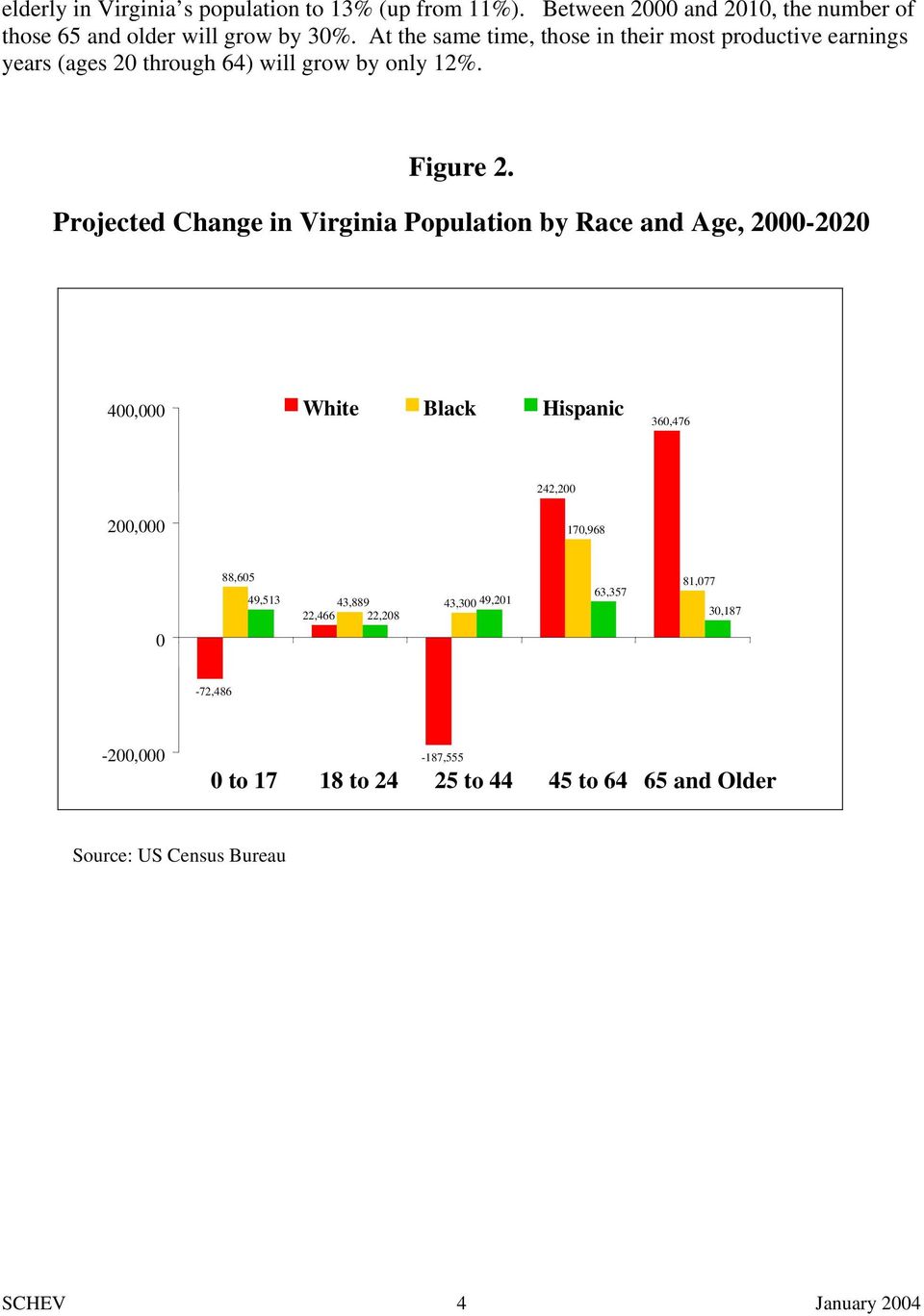
8 VIRGINIA S NURSE WORKFORCE NURSE DEMAND The demand for full-time-equivalent (FTE) RNs in the Commonwealth of Virginia is projected to increase by approximately 42% between 2000 and 2020, which is slightly higher than the projected rate of increase for the entire U.S. (Biviano et al., 2004). Major trends contributing to this surge in demand are the projected population growth especially the growth in the elderly population, economic trends, and changes in the healthcare operating environment. Population Growth and Aging. Across the U.S., states are experiencing an increasing demand for nursing services as community populations grow and age. The growth in demand for nursing services is especially high in nursing facilities and home health, settings that provide care to the elderly. The U.S. Census Bureau reports that the population of the Commonwealth of Virginia grew 14% between 1990 and Between 2000 and 2010, Virginia s population is expected to increase 12% (about 900,000 individuals). However, following decennial census trends, population growth will vary by region in the Commonwealth. The greatest regional growth will continue to be seen in Northern Virginia, the Richmond metro area, and the Tidewater/Hampton Roads regions. Some areas of the state, such as Southwest Virginia, are projected to experience a continued decrease in population (Figure 1). Figure 1. Projected Number Change in Virginia Population, ,123 to 150,351 2,995 to 14, to 2, to 320-6,1 90 to N ot A vailable Lee Wise Scott Dickenson Buchanan Russell Washington Tazewell Sm yth Bland Grayson Wythe Shenandoah Frederick Warren Clarke Fauquier Loudoun Fairfax Arlington Rappahannock Rockingham Page P rince W illiam Culpeper Stafford H ighland Madison Augusta Greene Orange K ing G eorge Bath Albem arle Spo tsylvania Westmoreland Louisa Caro line Richmond Rockbridge Essex Northum berland Fluvanna Nelson Hanover King And Q ueen Accom ack Alleghany Goochland K ing W illiam Lancaster Henrico Botetourt Am herst Buckingham Powhatan Middlesex Craig Cumberland C h e s te rfie ld New Kent Charles City Gloucester Mathews Roanoke Northampton Appom attox Am elia Jam es City Giles Bedford Prince Edward Prince George Campbell York M ontgomery Nottoway Surry D inwiddie Pulaski C harlotte Franklin Sussex Floyd Lunenburg Isle O f W ight Pittsylvania H alifax Brunswick Carroll M ecklenburg Southam pton Chesapeake City Patrick Henry Greensville Suffolk City Virginia Beach C ity Data Source: Virginia Employment Commission The age composition of Virginia s population is projected to change substantially by 2020, with the largest growth occurring among the elderly (age 65 and above) and the near elderly (age 45 to 64) (see Figure 2). Virginia s median age jumped from 32 years to 35 years between 1990 and As the largest cohort of Virginians is comprised of baby boomers aged 45 to 54 years, the median age will continue to rise. The effect of Virginia s population aging is significant. By 2010, baby boomers will move into the 65-and-older age group and push the percentage of SCHEV 3 January 2004

9 elderly in Virginia s population to 13% (up from 11%). Between 2000 and 2010, the number of those 65 and older will grow by 30%. At the same time, those in their most productive earnings years (ages 20 through 64) will grow by only 12%. Figure 2. Projected Change in Virginia Population by Race and Age, ,000 White Black Hispanic 360, , , , ,605 81,077 63,357 49,513 43,889 43,300 49,201 22,466 22,208 30,187-72, , ,555 0 to to to to and Older Source: US Census Bureau SCHEV 4 January 2004
10 The distribution and growth in the elderly population, however, is not uniform across the Commonwealth (see Figure 3). Interestingly, regions with declining population have the largest percentage of population over 65 years of age. For example, the percentage of those who are 65- and-older is only 7% of the population in Northern Virginia, while the proportion of elderly is nearly twice that in the Southwest (14%) and Blue Ridge (12%-13%) regions. Figure 3. Virginia Percent Population Over Age 65, by Region Data Source: 2000 Census The growing elderly population has a significant impact on health service utilization. According to the Virginia Hospital and Healthcare Association, those 65 and over represent 11% of the population, yet consume approximately 35% of hospital resources. At the other end of the age spectrum, the presence of an increased number of women of childbearing age in a region also increases utilization of health services. In Virginia, the most frequently cited reason for hospital admission is childbirth. The Commonwealth records about 80,000 births per year; the largest percentage of those (12% to 15%) is in Northern Virginia. Through 2010, this trend is expected to continue, with Tidewater/Hampton Roads reporting the second highest number of births, followed by the Richmond metro area. SCHEV 5 January 2004

11 In conclusion, a declining and aging population drives the projected increased demand for health services in the Southwestern region, while population growth and aging combine to create higher growth in nurse demand in other regions. Baseline RN Demand Projections. Key to understanding the adequacy of Virginia s RN workforce is an understanding of current and projected RN demand. For this study, the National Center for Health Workforce Analysis (NCHWA) Nursing Demand Model (NDM) was populated with data for each of six regions in the Commonwealth to produce regional RN demand projections through Aggregating the results across regions produced an estimated overall growth in FTE RN demand of 42% between 2000 and Total estimated RN demand for Virginia in 2020 (69,600) was derived by aggregating RN demand estimates; the aggregated total approximates the NCHWA projection of 70,300 RNs in Virginia (Biviano et al, 2004). National trends indicate that the majority of nurses are employed in hospitals where they represent 1 in 4 employees. An adequate supply of nurses is essential to quality health care. Recent studies have shown strong links between patient care outcome (safety and quality) and nurse education and staffing. 3, 4 Analysis of sector-specific demand in the Commonwealth of Virginia (see Table 1) indicates continued increasing demand for RNs in hospitals, and also indicates increasing demand over time in long-term care and ambulatory care settings. Growth in demand for each sector is projected to increase at rates similar to the national growth rate, with the exception of home health where the projected growth rate is somewhat lower than the national projected growth rate. Table 1. Projected RN Demand Virginia (FTE) Projected FTE RN Demand Projected Growth Setting to to 2020 Total 49,200 59,900 69,600 22% 42% Hospitals 30,500 37,200 43,600 22% 43% Nursing Facilities 3,000 4,200 4,900 40% 66% Doctor's Offices 4,300 5,100 5,700 19% 33% Home Health 2,500 3,300 4,200 37% 73% Other 9,000 10,100 11,100 13% 24% Data Source: Projections from National Center for Health Workforce Analysis Nursing Demand Model adapted for Virginia. Note: settings might not sum to total because of rounding. 3 For additional information see Aiken, L.H., Clarke, S.P., Cheung, R.B., Sloane, D.M., & Silber, J.H. (September 23, 2003). Education levels of hospital nurses and surgical patient mortality. Journal of the American Medical Association, 290, For additional information see J. Needleman, P. Buerhaus, S. Mattke et al., Nurse Staffing Levels and the Quality of Care in Hospitals, New England Journal of Medicine 346 (2002): SCHEV 6 January 2004
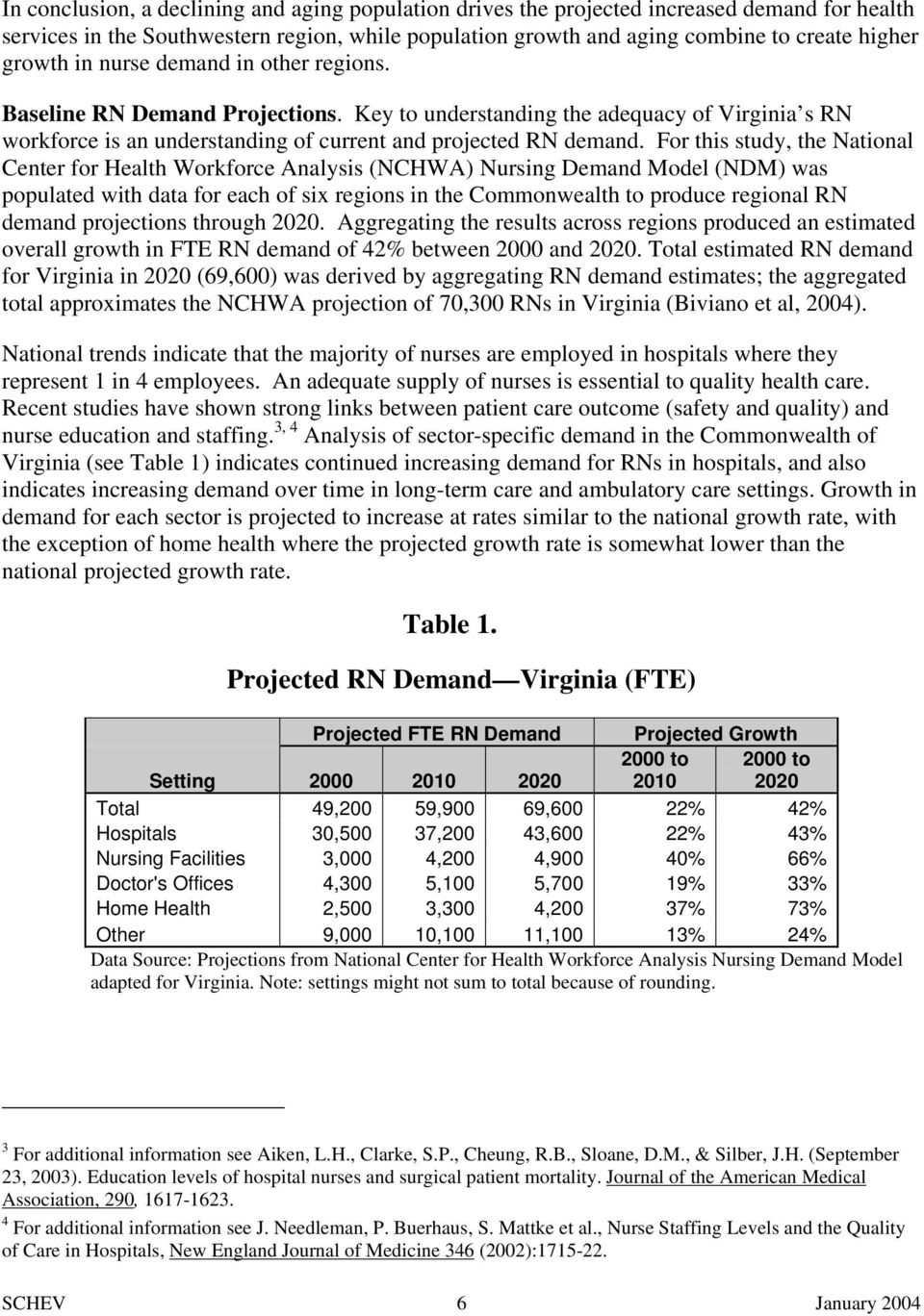
12 Table 2. Projected RN Demand United States (FTE) Projected FTE RN Demand Projected Growth Setting to to 2020 Total 2,001,000 2,346,000 2,822,000 17% 41% Hospitals 1,240,000 1,428,000 1,699,000 15% 37% Nursing Facilities 173, , ,000 30% 66% Doctor's Offices 155, , ,000 15% 32% Home Health 132, , ,000 42% 109% Other 302, , ,000 9% 18% Data Source: NDM projections, National Center for Health Workforce Analysis, BHPr, HRSA. Note: settings might not sum to total because of rounding. Additional demand analyses by region were also conducted. Results indicate that the real demand for nurses increases consistently over time as a function of: (1) population growth; (2) aging of Virginia s population; and (3) health service utilization trends. The projected demand by region (see Figure 4) follows the economic and population trends found in population projections. Figure 4. Virginia RN FTE Demand by Region ,000 20,000 # RNs 15,000 10,000 5, Blue Ridge Central Hampton Roads Northern Virginia Roanoke Southwestern Data Source: Projections from the National Center for Health Workforce Analysis, BHPr, HRSA, Nursing Demand Model adapted for Virginia. SCHEV 7 January 2004
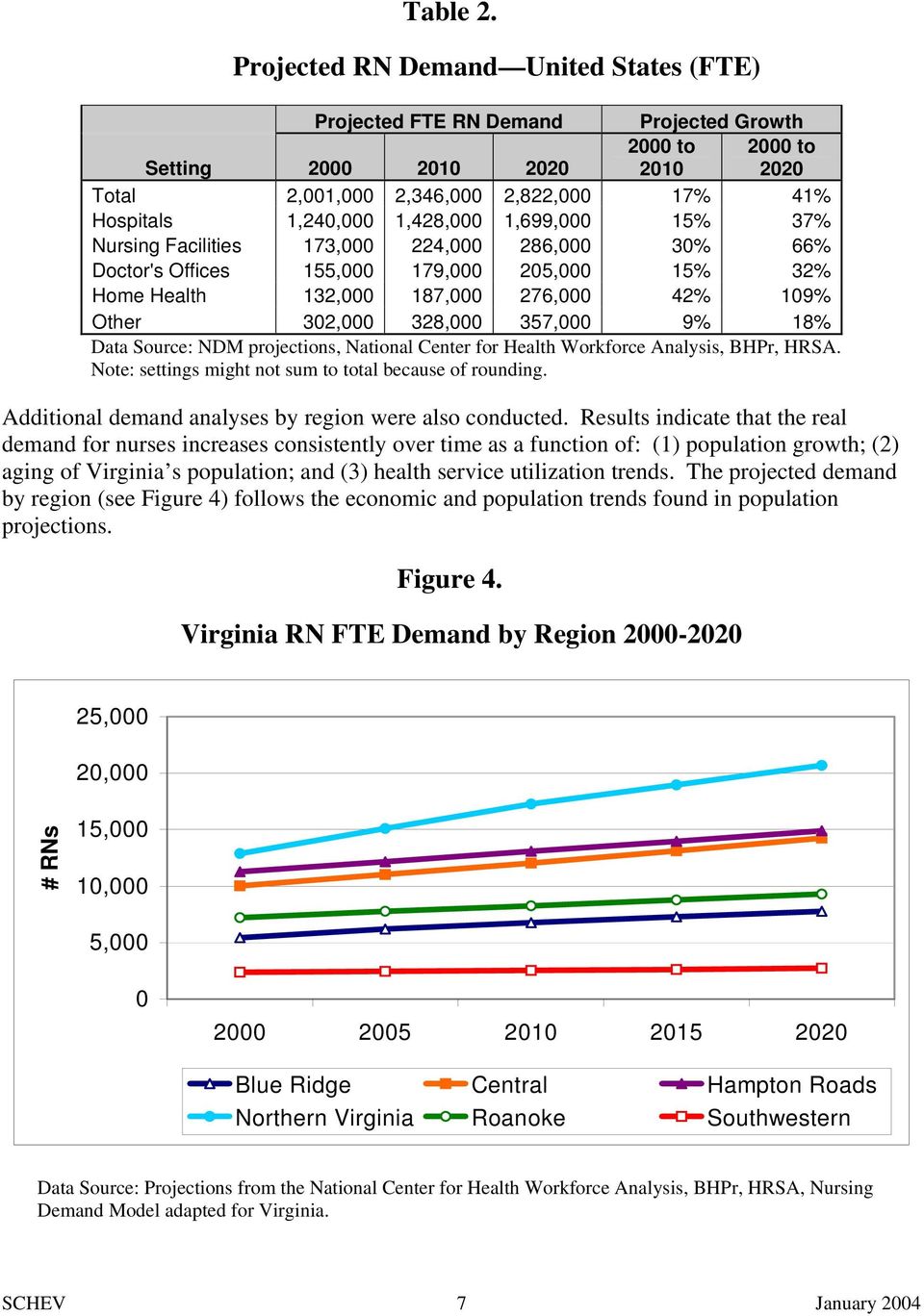
13 Following state economic and demographic trends, demand for nurses is highest in Northern Virginia and Hampton Roads and is lowest in Southwest Virginia. Regional projections of nurse demand by employment sector are found in Appendix D. Table 3. Virginia Projected FTE RN Demand Setting Total 49,200 54,700 59,900 64,800 69,600 Hospitals (Total) 30,500 34,000 37,200 40,400 43,600 ST Hospitals, Inpatient 21,200 23,700 26,000 28,300 30,600 ST Hospitals, Outpatient 1,900 2,100 2,300 2,500 2,600 ST Hospitals, Emergency 1,900 2,000 2,100 2,100 2,200 All other hospitals 5,500 6,200 6,900 7,500 8,200 Nursing Facilities 3,000 3,600 4,200 4,600 4,900 Doctor's Offices 4,300 4,700 5,100 5,400 5,700 Home Health 2,400 2,900 3,300 3,800 4,200 Occupational Health School Health 1,500 1,600 1,600 1,700 1,700 Public Health 2,400 2,600 2,700 2,900 3,000 Other 4,300 4,700 5,000 5,300 5,600 VA Population 7,079,000 7,407,000 7,707,000 8,005,000 8,295,000 Data Source: Projections from the National Center for Health Workforce Analysis, BHPr, HRSA, Nursing Demand Model adapted for Virginia. NURSE SUPPLY Demographics of Virginia RNs. The demographics of registered nurses in the Commonwealth follow national trends. Currently, the average age of RNs in Virginia is over 45. Also consistent with observed national trends is the increasing age of nursing students and first-time licensed nurses. The cohort of RNs currently aged 45 is expected to begin retiring as they enter their sixties. Over the next 10 to 15 years, baby boomers will leave the workforce and become part of the population that will utilize health services at an increasing rate. Because nurses work both part time and full time, it is useful to define the supply of RNs in terms of full-time-equivalents. An RN working full time for the entire year is counted as 1 FTE, while an RN working part time or for only half of the year is counted as ½ FTE. RNs working in non-nursing positions and RNs not in the labor force are counted as 0 FTE. Consequently, the FTE supply of nurses in the workforce is significantly less than the number of licensed RNs. The Virginia Board of Nursing estimates that in May of 2001 there were close to 66,000 RNs licensed in Virginia. The 2000 National Sample Survey of RNs indicates that there were approximately 45,000 RN FTEs working in Virginia, so the FTE supply of working nurses approximates 70% of total licensed RNs. This estimate is similar to the national ratio of FTE to licensed RNs. This is not surprising since nurses are known to retain their licenses even after retirement. SCHEV 8 January 2004

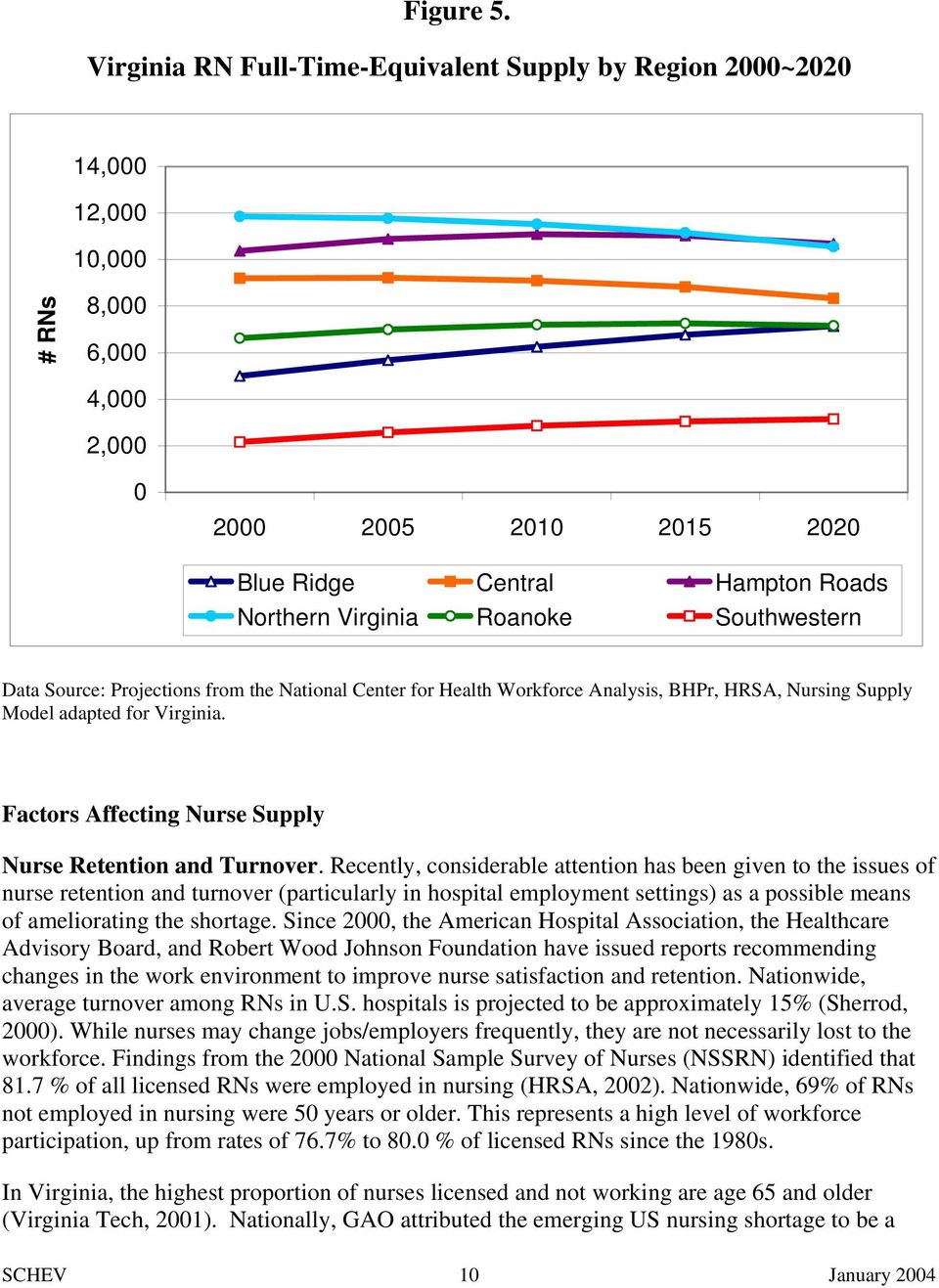
14 The National Nursing Supply Model (NSM), was adapted to project RN supply by region in Virginia. Results indicate that Virginia s FTE supply of RNs will increase by a total of only 4% between 2000 and 2020 (see Table 4). Table 4. Virginia RN Full-Time-Equivalent Supply by Region Region % Change 2000 to 2020 Blue Ridge 5,000 5,700 6,300 6,800 7,100 42% Central 9,200 9,200 9,100 8,800 8,300-10% Hampton Roads 10,400 10,900 11,100 11,000 10,700 3% Northern Virginia 11,900 11,800 11,500 11,100 10,600-11% Roanoke 6,600 7,000 7,200 7,300 7,200 9% Southwestern 2,200 2,600 2,900 3,000 3,100 41% Virginia Total 45,300 47,200 48,100 48,000 47,000 4% Data Source: Projections from the National Center for Health Workforce Analysis, BHPr, HRSA, Nursing Supply Model adapted for Virginia. RN FTE supply is projected to increase slowly through approximately 2010 to 2015, at which time the number of RNs withdrawing from the workforce (either retiring or deciding to not practice full-time in nursing) will exceed the number of new RN graduates. This will lead to a gradual decrease in RN FTE supply. These projections were made using baseline assumptions for current trends in the number of new graduates, labor force participation rates, and net migration across states. The rate of change in RN FTE supply varies substantially by region (see both Table 4 above and Figure 5 below). SCHEV 9 January 2004

15 Figure 5. Virginia RN Full-Time-Equivalent Supply by Region 2000~ ,000 12,000 10,000 # RNs 8,000 6,000 4,000 2, Blue Ridge Central Hampton Roads Northern Virginia Roanoke Southwestern Data Source: Projections from the National Center for Health Workforce Analysis, BHPr, HRSA, Nursing Supply Model adapted for Virginia. Factors Affecting Nurse Supply Nurse Retention and Turnover. Recently, considerable attention has been given to the issues of nurse retention and turnover (particularly in hospital employment settings) as a possible means of ameliorating the shortage. Since 2000, the American Hospital Association, the Healthcare Advisory Board, and Robert Wood Johnson Foundation have issued reports recommending changes in the work environment to improve nurse satisfaction and retention. Nationwide, average turnover among RNs in U.S. hospitals is projected to be approximately 15% (Sherrod, 2000). While nurses may change jobs/employers frequently, they are not necessarily lost to the workforce. Findings from the 2000 National Sample Survey of Nurses (NSSRN) identified that 81.7 % of all licensed RNs were employed in nursing (HRSA, 2002). Nationwide, 69% of RNs not employed in nursing were 50 years or older. This represents a high level of workforce participation, up from rates of 76.7% to 80.0 % of licensed RNs since the 1980s. In Virginia, the highest proportion of nurses licensed and not working are age 65 and older (Virginia Tech, 2001). Nationally, GAO attributed the emerging US nursing shortage to be a SCHEV 10 January 2004
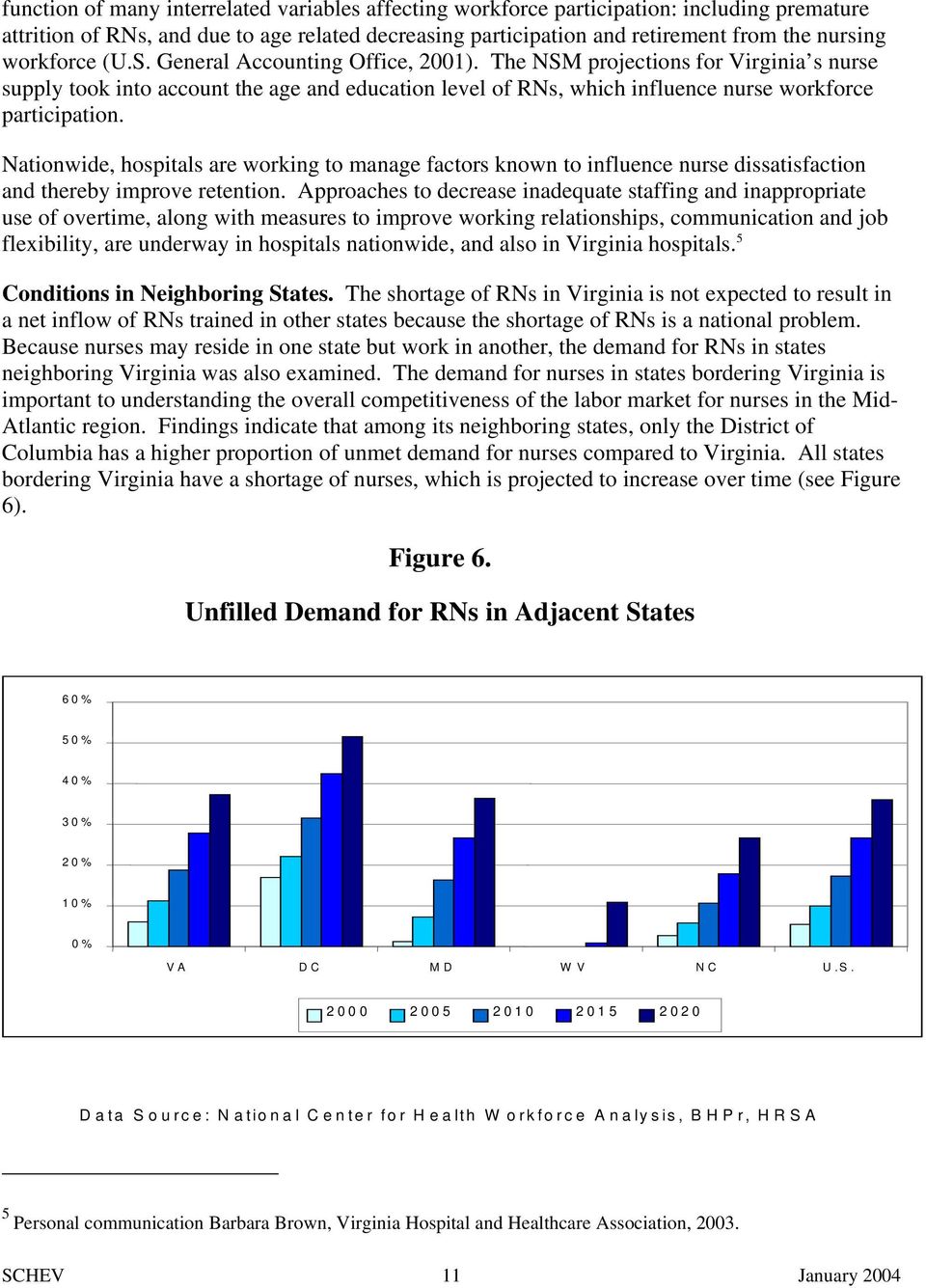
16 function of many interrelated variables affecting workforce participation: including premature attrition of RNs, and due to age related decreasing participation and retirement from the nursing workforce (U.S. General Accounting Office, 2001). The NSM projections for Virginia s nurse supply took into account the age and education level of RNs, which influence nurse workforce participation. Nationwide, hospitals are working to manage factors known to influence nurse dissatisfaction and thereby improve retention. Approaches to decrease inadequate staffing and inappropriate use of overtime, along with measures to improve working relationships, communication and job flexibility, are underway in hospitals nationwide, and also in Virginia hospitals. 5 Conditions in Neighboring States. The shortage of RNs in Virginia is not expected to result in a net inflow of RNs trained in other states because the shortage of RNs is a national problem. Because nurses may reside in one state but work in another, the demand for RNs in states neighboring Virginia was also examined. The demand for nurses in states bordering Virginia is important to understanding the overall competitiveness of the labor market for nurses in the Mid- Atlantic region. Findings indicate that among its neighboring states, only the District of Columbia has a higher proportion of unmet demand for nurses compared to Virginia. All states bordering Virginia have a shortage of nurses, which is projected to increase over time (see Figure 6). Figure 6. Unfilled Demand for RNs in Adjacent States 60% 50% 40% 30% 20% 10% 0% VA DC MD WV NC U.S D ata S ource: N ational C enter for H ealth W orkforce A nalysis, B H P r, H R S A 5 Personal communication Barbara Brown, Virginia Hospital and Healthcare Association, SCHEV 11 January 2004
17 ADEQUACY OF REGIONAL NURSE SUPPLY If current trends continue, the supply of FTE RNs in Virginia is projected to be 47,000 by Because demand for FTE RNs is expected to increase to approximately 70,000 in 2020, a shortage of over 23,000 FTE RNs (32% of demand) is projected. Age-related RN retirements will reduce the supply of RNs in Virginia s workforce at an increasing rate through The discrepancy between the projected Virginia RN supply and demand through 2020 is shown below in Figure 7. While the demand projections for Virginia are consistent with national projections from the Bureau of Labor Statistics (BLS), and the Bureau of Health Professions (BHPr), the Commonwealth s nurse supply per capita (per 100,000 population) ranks 40 th in the US. Also consistent with national trends, the Commonwealth s RNs are disproportionately white and female. SCHEV 12 January 2004

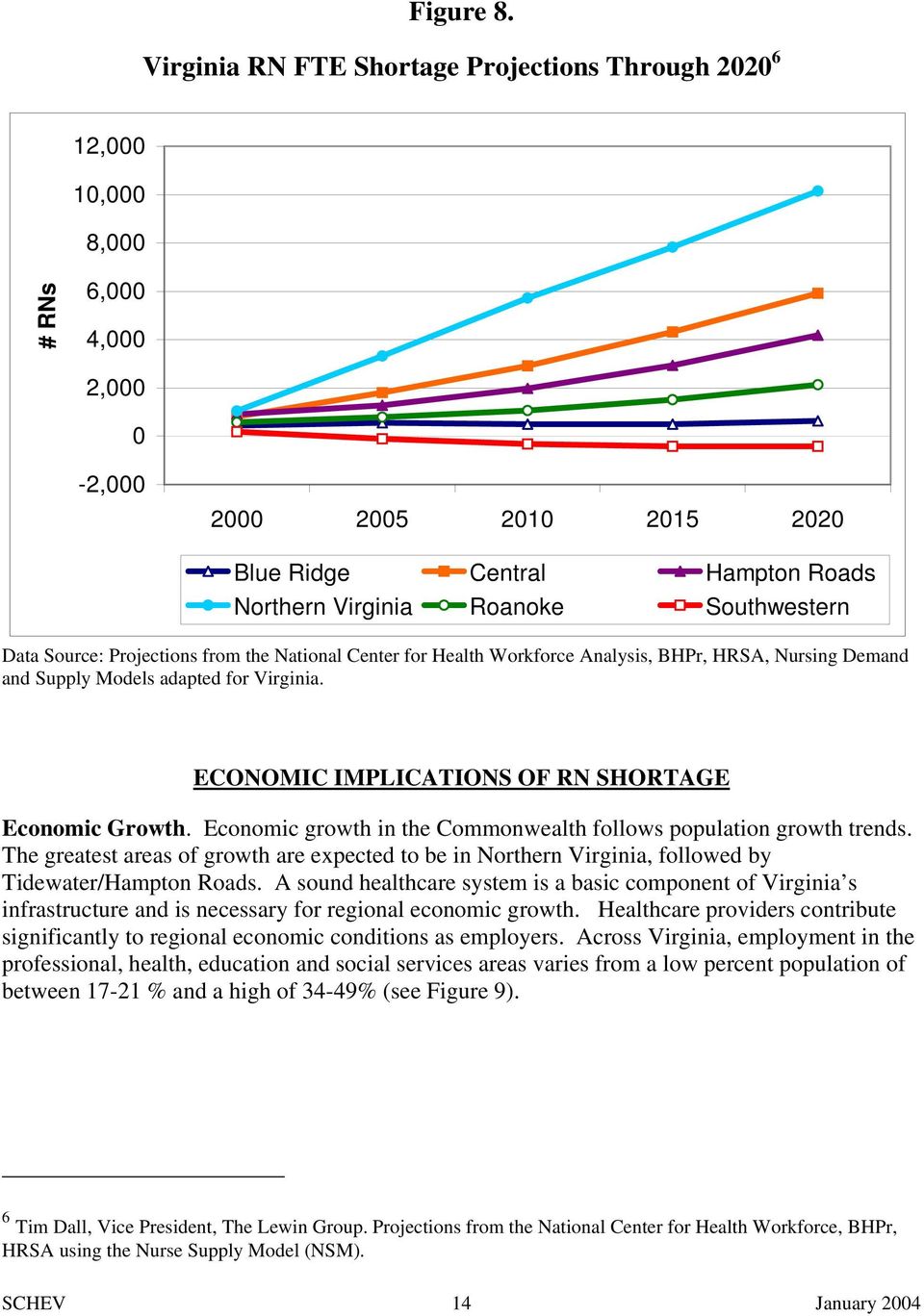
18 Figure 7. US and Virginia RN Supply and Demand FTE per 1000,000 Population Virginia Demand Virginia Supply U.S. Demand U.S. Supply Data Source: National Center for Health W orkforce Analysis, BHPr, HRSA The importance of an adequate supply of health professionals is critical to the availability and quality of health services in each region. An adequate supply of nurses is important for regional business and economic development and therefore is important for economic stability and growth. In summary, the supply of RNs in the Commonwealth is inadequate to meet the current and projected demand. The supply of RNs will become increasingly inadequate, as more nurses are required to meet growth in the demand for nurses and replace those who retire. To meet the demand for new RN positions and replace retiring nurses, Virginia will need to double its average number (1,900) of new licenses per year. Additional analyses of the adequacy of RN supply in Virginia, based upon current and projected educational scenarios, are introduced on page 22 of this report. Analysis of the regional trends indicates a growing shortage of FTE RNs in all regions except Southwest. Figure 8 illustrates the gap in projected RN FTE supply relative to projected demand through SCHEV 13 January 2004

19 Figure 8. Virginia RN FTE Shortage Projections Through ,000 10,000 8,000 # RNs 6,000 4,000 2, , Blue Ridge Central Hampton Roads Northern Virginia Roanoke Southwestern Data Source: Projections from the National Center for Health Workforce Analysis, BHPr, HRSA, Nursing Demand and Supply Models adapted for Virginia. ECONOMIC IMPLICATIONS OF RN SHORTAGE Economic Growth. Economic growth in the Commonwealth follows population growth trends. The greatest areas of growth are expected to be in Northern Virginia, followed by Tidewater/Hampton Roads. A sound healthcare system is a basic component of Virginia s infrastructure and is necessary for regional economic growth. Healthcare providers contribute significantly to regional economic conditions as employers. Across Virginia, employment in the professional, health, education and social services areas varies from a low percent population of between % and a high of 34-49% (see Figure 9). 6 Tim Dall, Vice President, The Lewin Group. Projections from the National Center for Health Workforce, BHPr, HRSA using the Nurse Supply Model (NSM). SCHEV 14 January 2004
20 Figure 9. Percent Employed in Virginia s Professional, Education, Health, and Social Service Sectors, % to 49.2% 28.6% to 34.0% 23.3% to 28.6% 21.0% to 23.3% 17.0% to 21.0% Frederick Clarke L oudoun Warren Fairfax Shenandoah Fauquier Arlington Highland Rappahannock Page P rince W illiam Rockingham Culpeper Stafford Madison King George Augusta Greene Orange Lee Bath Albemarle Spotsylvania Westmoreland Louisa Caroline Richmond Rockbridge Essex Northumberland Fluvanna Nelson Hanover King And Queen Goochland A lleghany King William Lancaster Accomack Henrico Amherst Botetourt Buckingham Powhatan Middlesex Craig New Kent Mathews Cumberland Chesterfield Roanoke Gloucester Appomattox Amelia Charles City Buchanan Giles Northampton J am es City Bedford Prince Edward Bland Campbell Prince George York Dickenson Tazewell Montgomery Nottoway Surry Charlotte Dinwiddie Pulaski Wise Franklin Russell Wythe Lunenburg Floyd Sussex Halifax Isle O f W ight Smyth Pittsylvania V irginia Beach City Brunswick Carroll Southampton Scott Washington Suffolk City Grayson Patrick Mecklenburg Henry Greensville Chesapeake City Virginia = 29.9% Data Source: 2000 Census Without an adequate supply of staff, health facilities have reduced revenue and increased risk of closing, thereby reducing access to health services within communities. Workforce shortages, especially for RNs, create financial strain on health service providers (employers) who must deal with increasing competition with higher wages and labor substitution. These trends come at a time when health service demand is increasing for most of Virginia s healthcare systems. Note that the cost of care increases as staffing shortages create wage-related expense inflation. Expense inflation is one of the foremost areas of uncertainty in the assessment of an organization s credit quality. Credit quality affects providers ability to upgrade current operations to meet regulatory or patient demands and/or to expand services in response to technological improvements or patient needs. As health care is a labor-intensive business, salary and benefit expenditures are key determinants of health facilities financial viability. An inadequate supply of nurses has been found to reduce or impede access to care, adversely affect patient safety and contribute to increases in the cost of care (Aiken & Fagin, 1997). The financial condition of healthcare providers affects ability to provide cost-effective, quality health services and in turn affects the health status and quality of life in communities. SCHEV 15 January 2004

21 The growing shortage of nurses not only has implications for the quality of healthcare provided to residents of the Commonwealth, but also affects the region s competitiveness in efforts to attract and retain employers. NURSING EDUCATION IN VIRGINIA Overview. There are three education routes to earning a basic nursing degree to be eligible to take the national licensing examination prior to become a Registered Nurse: (1) Associate degree programs offered in community colleges and selected colleges; (2) Diploma programs (offered by hospitals); and (3) Baccalaureate degree programs (offered in colleges and universities). Basic RN education programs vary from two to four years in length, depending upon the degree earned. Educational programs that prepare individuals to become LPNs are offered in public schools and community colleges and take between 12 and 18 months. To be eligible to become licensed to practice as an LPN or RN, an individual must graduate from an accredited, Virginia Board of Nursing approved education program and pass a appropriate national licensing examination. According to the Virginia Partnership in Nursing (VPN), Virginia nursing schools and programs also support career ladder progression through established curriculum articulation programs for specific LPN and Associate Degree RN programs, as well as bachelor s and higher nursing degrees. 7 Number and Distribution of Nursing Education Programs. The 2002 Virginia General Assembly authorized a study on nursing education, reported in House Document 29, which described the distribution of nursing-education opportunities in Virginia. The report indicated that a variety of entry-level RN and LPN education programs were well distributed across the Commonwealth, producing nurses from a variety of degree and diploma programs from different educational settings. The geographic distribution and types of nursing programs by region are shown in Figure 10. Virginia s nursing education programs are spread across the Commonwealth, providing citizens access to nursing education throughout Virginia. While the number and geographic distribution of nursing education programs appears adequate in the Commonwealth, schools in all regions report serious limits in their capacity to accommodate the demand for qualified full- and parttime enrollees. Respondents to the nursing school survey identified key factors related to the capacity of nursing schools to enroll qualified students including inadequate numbers of available teaching faculty, facility size and qualified faculty to supervise required practicum or field placements. 7 Personal correspondence with JoAnne Henry, Co-Chair Virginia Partnership for Nursing, the schools participating in the articulation plan are expected to be posted in early 2004 on the VPN website. Preliminary discussion of participants was originally announced in May 2003 at the VPN Annual meeting. The final verification of the articulation agreement participation was in process at the time of this report. SCHEV 16 January 2004
22 Figure 10. Geographic Distribution of Virginia Nursing Degree Programs Data from all Virginia nursing schools and programs were included in this report and are identified in Table 5 (schools participating in AACN and George Mason University (GMU) surveys). 8 Planning Information for Virginia Higher Education. Presented to Leadership Group, July 22, 2003, at the National Center for Higher Education Management Systems, Boulder, CO. SCHEV 17 January 2004
23 Table 5. Virginia Nursing Programs/Schools Participating in the 2003 Condition of Nursing and Nursing Education Study School Name Region Name Blue Ridge Community College Blue Ridge Eastern Mennonite University Blue Ridge Germanna Community College Blue Ridge James Madison University Blue Ridge Lord Fairfax Community College Blue Ridge Piedmont Virginia Community College Blue Ridge Shenandoah University Blue Ridge University of Virginia Blue Ridge Bon Secours Memorial School of Nursing Central J. Sargeant Reynolds Community College Central John Tyler Community College Central Southside Regional Medical Center School of Nursing Central Southside Virginia Community College Central Virginia Commonwealth University/Medical College of Virginia Central Christopher Newport University Hampton Roads Hampton University Hampton Roads Norfolk State University Hampton Roads Old Dominion University Hampton Roads Riverside School of Professional Nursing Hampton Roads Sentara Norfolk General Hospital School of Nursing Hampton Roads Thomas Nelson Community College Hampton Roads Tidewater Community College Hampton Roads George Mason University Northern Virginia Marymount University Northern Virginia Northern Virginia Community College Northern Virginia Community Hospital Roanoke Valley- College of Health Sciences Roanoke Dabney S. Lancaster Community College Roanoke Danville Regional Medical Center School of Nursing Roanoke Liberty University Roanoke Lynchburg College Roanoke Lynchburg General Hospital School of Nursing Roanoke New River Community College Roanoke Patrick Henry Community College Roanoke Radford University Roanoke Virginia Western Community College Roanoke Virginia Appalachian Tri College Southwestern University of Virginia College at Wise Southwestern Wytheville Community College Southwestern SCHEV 18 January 2004
24 Both the number and capacity of nursing education programs affect Virginia s ability to meet projected requirements for RNs in the future (see Table 6). Currently, Virginia s production of RN program graduates falls short of workforce requirements. This shortfall is projected to worsen over time. This is particularly unfortunate given the high number of qualified applicants unable to be admitted to nursing programs due to nursing program capacity limitations. Table 6. Number of RN Education Programs Region AND BSN Diploma MSN PhD Blue Ridge Central Hampton Roads Northern Roanoke Southwestern Total Data Source: Virginia Board of Nursing. Any expansion of nursing education programs is dependent on an adequate numbers of wellprepared nursing faculties. Virginia nursing programs report considerable difficulty in filling clinical faculty vacancies, as well as an increasing difficulty in hiring senior-level faculty. Contrary to a previous SCHEV study of nursing faculty salaries (see Appendix E), survey respondents reported problems with hiring and retaining faculty due to salary related issues. Programs also reported difficulty attracting new clinical faculty because starting salaries were $10, 000 to $15,000 less than those offered by healthcare providers. This problem was frequently cited in urban community-college associate degree programs in particular. Studies of the adequacy of nurse faculty salaries in aggregate may be misleading because of the wide variation in salaries between clinical nursing faculty and senior (non-clinical teaching and research) faculty, as well as wide variation in salary ranges by region. Baccalaureate and masters degree programs reported increasing difficulty hiring part-time clinical faculty and also identified increasing difficulty hiring doctoral-prepared faculty who can engage in research, teaching and mentoring future faculty. Most nursing programs identified difficulty recruiting clinical and academic faculty as the most significant barrier to maintaining or growing future enrollments. Additionally, many also reported increasing competition among schools for limited access to clinical training slots in local health care facilities. Another concern is the cost of operating nursing programs relative to current tuition and fee revenue. Consistent with other health professions, nursing programs are expensive to operate. Due to high faculty-to-student ratios (required in staffing hands-on clinical courses) and the cost of acquiring, maintaining, and upgrading healthcare technologies and laboratories, the operating expenses of nursing programs are high. To be accredited by the Board of Nursing, nursing programs must maintain at least a 1:10 faculty-to-student ratio to assure patient safety during clinical courses. In Virginia, many hospitals require that this ratio not exceed 1:8 in order to ensure safe patient care. This faculty-to-student ratio is much higher than for other collegiate majors, and faculty salary costs relative to tuition and fee revenue are high. Overall, clinical SCHEV 19 January 2004
25 nursing-program costs may not be fully supported by tuition and fee revenue alone, particularly if adjustments for high intensity education programs are not reflected in an institutions budget allocation formula. Nursing School Graduates. The number of new nurses entering the workforce annually, combined with the number of nurses retiring and migrating into and out of Virginia for employment, determines the supply of nurses. Analyses of nurse licensure data from the Virginia Board of Nurses indicate that the Commonwealth grants approximately 1,598 first-time RN licenses annually. 9 The majority of these licensees are individuals who graduated from Virginia baccalaureate, diploma, and associate-degree nursing schools or programs. Annually, a relatively small number of nurses migrate into Virginia from other localities or international sources. The Board of Nursing estimates that the total number of endorsed nurses in Virginia in 2003 was approximately 480 LPNs and 3,134 RNs. 10 Nursing school and program data on enrollment, applicants, and graduations is illustrated in Table 7. Currently, basic RN schools and programs have more qualified applicants than can be accepted. As with demand, and considering the location of nursing schools and programs, wide regional variation exists in enrollment capacity and graduations. Table 7. Distribution of Nursing Schools and Students by Degree Program Combined AACN/GMU Survey Results for Academic Year BASIC DEGREE PROGRAMS ADVANCED DEGREE PROGRAMS Region Name Schools Enrollment Graduated Rejected* Enrollment Graduated Rejected* Blue Ridge Central 5 1, Hampton Roads 8 1, Northern Virginia 3 1, , Roanoke Southwestern Total 36 6,038 2,137 1,397 2, NOTE: The reported numbers may not represent an unduplicated count due to the reliance upon available administrative data. For example, individuals might both apply and be rejected from more than one school. Growing Demand for Advance-practice Nurses and Nursing Faculty. Advance-practice nurses are prepared at the master s degree level as nurse practitioners, clinical nurse specialists, 9 Department of Health Professions, Commonwealth of Virginia, Board of Nursing, Report of Statistics, July 1, June 30, Licensing Examination Applicants Data for Registered Nurse Licensure in Virginia, July 1, June 30, 2003, p Board of Nursing, Commonwealth of Virginia, personal communication October 10, SCHEV 20 January 2004
26 nurse midwives, nurse anesthetists, nurse administrators, and entry level nursing faculty. These individuals have at least a baccalaureate degree in nursing and a master s degree in an area of specialized study (i.e., education, management, or nursing specialization). Changes in the U.S. healthcare system have increased the demand for nurses with advanced education. The current numbers of certified nurse anesthetists, certified nurse midwives, and women s health nurse practitioners are small. Yet, advance practice nurses now providing direct care form the core of nurses who can serve as clinical nursing faculty of the future. In addition, nurses with doctorates are needed as university faculty, researchers, and administrators. Doctorally prepared nurses conduct nursing and health-services research to improve patient health and safety in the Commonwealth. The loss of nursing faculty associated with age-related retirement will adversely impact Virginia s education programs sooner than other employment settings for nurses. The average age of nursing faculty in 2002 was 53, while that of the general RN population was about 45 years old. Consistent with reports from the AACN and the Southern Regional Education Board (SREB), faculty from nursing education programs will be retiring in unprecedented numbers in the next 10 years (AACN, 2003; Hodges, 2002). In Virginia, age-related retirement of nursing faculty is projected to occur sooner than for nurses in general. The average age of nursing faculty ranges from a low of 45 in Southwest Virginia to a high of 54 in Northern Virginia (see Figure 11). SCHEV 21 January 2004
27 Figure 11. Average Age of Virginia Nursing Faculty 2002, by Region Blue Ridge Central Hampton Roads Northern Roanoke Southwestern Data Source: SCHEV Nursing Salary Study 2002 IMPACT OF NURSING EDUCATION CAPACITY In order to assess changes in the impact of new RN graduation rates in nurse supply in Virginia, three alternative scenarios were constructed. Projections for nurse supply were derived using baseline NSM baseline supply projections adjusted for different scenarios or assumptions about the new nurses supply. The NSM baseline assumes a modest increase over time in the number of graduates from Virginia s nursing programs, with the increase in graduates reflecting modest growth in the traditional pool of applicants to nursing programs women age 20 to 44. In 2000, Virginia had approximately 45,200 FTE RNs. The NSM baseline projections suggest that FTE supply will increase to approximately 48,800 in 2010, about which time the number of retiring nurses will start to exceed the number of new nurse graduates such that FTE supply will decline to approximately 47,000 RNs by Using the NSM, three alternative scenarios were modeled for increases (above the baseline projections) in the number of nursing school graduates as follows: Scenario 1: Doubles the annual number of graduates for all RN programs. This scenario assumes that nursing education capacity will increase gradually during the next six years. Under this scenario, FTE RN supply will increase to 52,800 in 2010 and 66,500 in Scenario 2: Double the annual number of RN graduates in the regions with the fastest growing demand for RNs (i.e., Central, Hampton Roads, Northern Virginia). This SCHEV 22 January 2004
28 scenario assumes a 25% increase in the annual number of graduates in all three regions. Under this scenario, FTE RN supply will increase to 51,600 in 2010 and 60,700 in Scenario 3: This scenario assumes a 50% increase in the annual number of RN graduates from all programs. Under this scenario, FTE RN supplies increase to 51,400 in 2010 and 57,600 in Figure 12 illustrates the impact of RN supply increases under the three scenarios tested. These projections illustrate the importance of significant and timely expansion of Virginia s nursing education capacity. Appendix F contains detailed data on NSM projects for all scenarios. Figure 12. Impact of Increasing Virginia Nurse Supply Under Three Scenarios 11 75,000 70,000 65,000 FTE RNs 60,000 55,000 50,000 45,000 40, Baseline Supply Baseline Demand Alt. Supply Scenario 1 Alt. Supply Scenario 2 Alt. Supply Scenario 3 Data Source: Projections from the National Center for Health Workforce Analysis, BHPr, HRSA, Nursing Demand and Supply Models adapted for Virginia. 11 Tim Dall, Vice President, The Lewin Group. Supply projections from NSM National Center for Health Workforce, BHPr, HRSA. SCHEV 23 January 2004
29 RECOMMENDATIONS The critical shortage of qualified nurses projected through 2020 will have a significant deleterious effect on the health and economic development of Virginia. Failure to successfully address the problem will threaten the quality and safety of the entire healthcare system in the Commonwealth and will adversely affect both the quality of life and economic growth within communities. To address the nursing shortage, the contributors to this report propose a number of short-term and long-term recommendations that are education amenable. This section of the report summarizes recommendations in four areas: 1. Increase nurse education capacity (nursing enrollment); 2. Provide financial assistance to nursing students; 3. Support recruitment into nursing; and 4. Improve data collection for nursing workforce planning and analyses. INCREASE NURSE EDUCATION CAPACITY Increasing the number of nurses educated in the Commonwealth of Virginia is essential to assuring an adequate supply of nurses. The policy options proposed herein should increase the number of nurses practicing in Virginia by enhancing and expanding current nursing programs. A plan for nursing education expansion should be developed collaboratively by SCHEV and Virginia s public and private institutions of higher education. Increasing the supply of nurses educated in the Commonwealth is an essential intervention necessary to reduce the nursing shortage over time. Individual programs have unique requirements and capabilities to support significant enrollment growth. Program needs range from funding for expansion or upgrading of physical facilities, laboratories, and equipment to funding for faculty salaries and student support services. Increasing the number of nurse educators is urgently required in order to support current efforts and any future program expansion. Specific recommendations include: 1.A. Identify nursing education programs that demonstrate a capacity to increase enrollment (particularly in high demand regions). Specifically, document successful approaches including, but not limited to, strategies that: Request nursing programs to submit strategic plans that identify enrollment capabilities and resource requirements to increase basic nursing program enrollment by 50% and 100% respectively (schools/programs should include information on barriers and limitations); and Prioritize increased funding for: o Basic nursing programs with available physical infrastructure and capacity (e.g. Northern Virginia Community College); and o Baccalaureate (BSN) second-degree programs that provide advanced placement for more rapid academic progression (e.g. second degree BSN programs). SCHEV 24 January 2004
30 1.B. 1.C. 1.D. 1.E. Identify master s and post-master s nursing programs that prepare nursing faculty in each geographic region in the Commonwealth: Prioritize funding to existing programs to benefit targeted program expansions; Identify resource requirements to increase enrollment (including use of distance education technology); and Identify mechanisms to offer collaborative nursing faculty/nursing education certificates and degrees (post baccalaureate and post masters). Disseminate public information about nurse career-ladder articulation programs for nurses, which enable individuals to advance their skills and education or to move from LPN to RN; RN to BS; and RN to MS education programs. Conduct a review and evaluation of educational placement levels for LPN programs, which is aimed at identifying the best models for the expansion of LPN and RN articulation programs available in the Commonwealth. Expand the nursing education pipeline through new, enhanced and/or restructured funding approaches. An October 2003 report from the National Conference of State Legislatures (Greene, Allan, & Henderson, 2003) identified numerous approaches to funding nursing education: General revenue support. o Increased appropriations for nursing programs (appropriations above base for higher education). Some were granted based upon program s planned dramatic enrollment growth or based upon competitive (peer reviewed) analysis of program performance plans; and o Block grants. Formula funding. o Several states have established formula-funding systems to allocate appropriated funds, including differentiated formulas to cover the variation (increased) costs of high faculty-to-student programs such as nursing. A central question is whether academic programs actually receive the funds (all or in part) generated by these formulae. Emerging financing approaches. o New financing methods (i.e., other than general revenue) for supporting nursing education have included innovative uses of funds targeted for enrollment growth, economic development, tobacco settlement monies, and state-appropriated federal dollars. (Virginia has appropriated one million dollars in tobacco settlement funds for undergraduate college education in the Southwest region.) o Workforce Investment Act funds may be available for entry-level worker training programs such as Nursing Assistant and LPN programs. Some states have also expanded the use of these funds to professional occupations. Medicaid reimbursement to support graduate nurse education. o The Medicare graduate medical education (GME) pass through provides teaching hospitals reimbursement to offset the cost of medical clinical training programs. Most states Medicaid programs also pay for GME, with 12 states SCHEV 25 January 2004
31 having recognized payments directed to support clinical training of graduate nurses in teaching hospital programs. This strategy allows Medicaid to pay for graduate nursing education, especially when intergovernmental transfers of state funds are utilized to capture additional Medicaid matching funds. Dedicated state appropriations. o State legislatures have the option to establish dedicated line items for nursing within the higher education appropriation. Such funding could be timelimited and require programs to demonstrate specific levels of performance (thus protecting them from encroachment of other institutional programs). This strategy reduces institutional flexibility in allocation of resources, but may ensure viability and growth of publicly-funded nursing education. At a minimum, this report recommends institutions of higher learning implement a plan to adjust nursing-program faculty funding formulas and/or increase direct funding to support increased faculty salaries. o Prioritize salary increases for traditional full-time academic faculty (who work the 9-month academic year) and part-time nursing faculty receiving compensation according to the matrix schedule (which would target part-time clinical practicum course faculty). SCHOLARSHIPS AND LOAN REPAYMENT PROGRAMS Each year, the number of scholarship applications received exceeds the available funding. Comparisons of tuition costs to scholarships awarded indicate that awards are generally below $1,000, and tuition is at least 2-5 times higher than scholarships awarded. The lack of financial aid is a problem for students across all program levels. Additionally, emerging studies suggest that older students and those from diverse racial and ethnic backgrounds may be more likely to need tuition assistance in order to pursue a nursing education (particularly at the graduate level). According to the National Conference of State Legislatures (NCSL) on the role of states in funding nursing education, the average baccalaureate graduate leaves a public nursing school with a $14,000 education debt ($16,000 for private nursing schools) (Greene, et. al., 2003). The New York Center for Health Workforce Studies (a HRSA regional workforce center) reported that 29 states have scholarship, loan and/or loan forgiveness programs that have been effective in getting nurses to work in underserved communities and facilities after graduation (HRSA, 2002). Loan forgiveness programs provide loans to individuals who, if they agree to practice in targeted areas/programs (i.e., under-served communities or facilities) for a specified amount of time after graduation, will not have to repay the borrowed funds. According to the NCSL (2003) report, state financing of nursing education has utilized financing mechanisms such as general revenue support, formula funding, and funding innovations for significant enrollment growth (public private partnerships and establishing capital/intellectual capital funds). In Virginia, the Mary Marshall Nursing Scholarship Program has $100,000 in general funds for RN (all program types) and LPN program student scholarships. Virginia Nurses contribute $1.00 of individual licensure fees to support this scholarship fund. Individual awards from the SCHEV 26 January 2004
32 Marshall Scholarship range between $200 and $2,000. Unfortunately, this amount is inadequate to provide meaningful support to enable economically disadvantaged students and working nurses to study full-time and offset more of the full cost of nursing education. Each year, $25,000 in general funds is available for Nursing Practitioner and Nurse Midwife scholarships, which typically provide individual awards of approximately $5,000. This opportunity constitutes a minor contribution to supporting the education of more advancepractice nurses in Virginia. An increase in funds that produces increased individual awards to cover a larger percentage of education costs is needed. A long-term care scholarship program that was created by the General Assembly has not been funded. This program s lack of funds is particularly unfortunate, as the need for nurses with specialized skills in caring for an increasingly aged population is growing. The long-term care sector could benefit from an expanded and better-prepared applicant pool. An adequately funded scholarship program for individuals interested in working with the aged would contribute to this goal. Specific recommendations include: 2.A. 2.B. 2.C. Increase funding for existing scholarship and loan repayment programs: Prioritize scholarship and loan repayment programs for nursing faculty; Ensure the priority for funding of racial and ethnic minorities in basic and post basic nursing education programs; and Fund Virginia s Long Term Care Scholarship program. Increase scholarship and loans available to adult students entering LPN programs and basic nursing programs (full or part-time), especially advanced placement baccalaureate programs. Establish a directory of scholarships with the goal of on-line application through a single website portal. RECRUITMENT OF NURSES 3.A. 3.B. 3.C. 3.D. Fund a comprehensive nursing recruitment plan in the Commonwealth. Identify state funding to support existing effective recruitment initiatives (to ensure sustainability). Prioritize the recruitment of men as well as racial and ethnic minorities into nursing as a second career. Establish a public private partnership to provide accurate and up-to-date information about nursing careers and educational options in Virginia. Provide education to young people, parents, and guidance counselors as well as math and science teachers, about the types of nursing education programs, educational requirements of the programs, and the career opportunities in nursing. SCHEV 27 January 2004
33 This report acknowledges the success and effectiveness of the Virginia Partnership in Nursing s K-12 and Man Enough to Care recruitment campaigns, which warrants consideration for state education funding in order to ensure sustainability. 12 IMPROVE DATA COLLECTION This study utilized existing data and was limited by lack of current uniform data on nurse employment, age, and educational level. Valid, reliable data to inform supply and demand analysis for workforce planning is needed. More data on service utilization and nurse employment in Virginia s long-term care is particularly needed. Specific recommendations include: 4.A. Support more detailed data collection by the Virginia Board of Nursing at time of initial and re-licensure. This data should include among the variables licensee s initial and up-graded degrees in nursing and licensee s employment (location of employer(s), setting and role). 4B. Support improved data collection on health service utilization for all sectors of the health system, including expansion of data collection to include long-term care and public health utilization. 4.C. Develop a mechanism to periodically monitor changes in the nursing workforce over time. Data variables should correspond to national measures (i.e., National Random Sample Survey of Nurses (NSSRN) to facilitate analysis over time and comparison of findings). 12 See Virginia Partnership for Nursing web page, accessed November 18, 2003, SCHEV 28 January 2004
34 REFERENCES American Association of Colleges of Nursing (AACN). (2003, May). Faculty shortages in baccalaureate and graduate nursing programs: Scope of the problem and strategies for expanding the supply. Washington, DC: Author. Aiken, L.H., Clarke, S.P., Cheung, R.B., Sloane, D.M., & Silber, J.H. (2003, September 23). Education levels of hospital nurses and surgical patient mortality. Journal of the American Medical Association, 290, Aiken, L.H., Clarke, S.P., Sloane, D.M., Sochalski, J., & Silber, J.H. (2002, October 23/30). Hospital nurse staffing and patient mortality, nurse burnout, and job dissatisfaction. Journal of the American Medical Association, 288, Aiken, L. H., Sloane, D. M., Lake, E. T., Sochalski, J., & Weber, A. L. (1999). Organization and outcomes of inpatient AIDS care. Med Care, 37(8), Aiken, L.H. & Fagin, C.M. (1997). Evaluating the consequences of hospital restructuring. Med Care, 35(10 Suppl), OS1-4. Aiken, L. H., Sochalski, J., & Lake, E. T. (1997). Studying outcomes of organizational change in health services. Med Care, 35(11 Suppl), NS6-18. Berlin, L.E. & Sechrist, K.R. (2002). The shortage of doctorally prepared nursing faculty: a dire situation. Nursing Outlook, 50(2), Berlin, L.E., Bednash, G.D., & Stennett, J. (2003) Enrollment and graduations in baccalaureate and graduate programs in nursing. Washington, DC: American Association of Colleges of Nursing (AACN). Biviano, M., Dall, T., Tise, S., Fritz, M., Spencer, W. Grover, A. (2004). What is Behind HRSA s Projected Supply, Demand, and Shortages of Registered Nurses. Report prepared by the National Center for Health Workforce Analysis, Bureau of Health Professions, Health Resources and Services Administration. Buerhaus, P.I., Staiger, D.O., & Aurerbach D.I. (2003). Is the current shortage of hospital nurses ending? Health Affairs, 22(6), Department of Health Professions. (2001) Commonwealth of Virginia, Board of Nursing, Report of Statistics, July 1, June 30, Accessed November 2003 from: Greene, Deborah L., Allan, J.A., & Henderson, T. (2003, October). The role of states in financing nursing education. Washington, DC: National Council of State Legislators. Hodges, Linda C. (2002, February). Nursing faculty shortage: Long-term solutions and shortterm strategies. Presented at the conference of the Southern Regional Board of Education, Atlanta, GA. SCHEV 29 January 2004
35 Health Resources and Services Administration; Regional Center for Health Workforce Studies; School of Public Health; University of Albany, SUNY. (2002, July). How are states responding to health worker shortages? An interim report. Albany, New York: Author. Joint Commission on Accreditation of Healthcare Organizations. (2002, August). Healthcare at the crossroads, strategies for addressing the evolving nursing crisis. Retrieved from: Kimball, B., & O Neil, E. (2002, April). Health care s human crisis: The American nursing shortage. Commissioned by The Robert Wood Johnson Foundation. Retrieved from: Planning Information for Virginia Higher Education. Presented to Leadership Group, July 22, 2003, at the National Center for Higher Education Management Systems, Boulder Colorado. Sherrod, D.R. (2000). Revising the flight of Talent: Volume I. Washington DC: Nursing Executive Center, Advisory Board Company. State Council of Higher Education for Virginia. (2002, November). Virginia nursing faculty salaries. Richmond, VA: Author. State Council of Higher Education for Virginia, & Virginia Department of Health Professions, Board of Nursing Richmond, VA. (2001, October). Virginia Nurses Survey Blacksburg, VA: Virginia Tech Center for Survey Research. Virginia Employment Commission Population Projections. Accessed August 18, 2003 from: U.S. Department of Health and Human Services, Health Resources and Services Administration Bureau of Health Professions, National Center For Health Workforce Analysis. (2002 July). Projected supply, demand, and shortages of RNs: Retrieved November 17, 2003 from: U.S. Department of Health and Human Services, Health Resources and Services Administration Bureau of Health Professions, National Center For Health Workforce Analysis. (2002 February). The Registered nurse population: Findings from the 2000 National Sample Survey. Retrieved November 17, 2003 from: U.S. General Accounting Office. (2001). Nursing workforce: Emerging nurse shortages due to multiple factors. Washington DC: United State General Accounting Office. Retrieved from: SCHEV 30 January 2004
36 Appendixes SCHEV 31 January 2004
37 APPENDIX A: METHODS COLLECTING AND ANALYZING INFORMATION ON NURSING SUPPLY AND DEMAND IN THE COMMONWEALTH OF VIRGINIA STUDY APPROACH: METHODOLOGY Study Purpose and Audience This section describes the data collection and analytic methods utilized in the study of Virginia s nursing workforce supply and demand, conducted in support of the HB The State Council of Higher Education for Virginia (SCHEV) served as the lead agency for development of the legislatively mandated report. The Office of Research in the Center for Health Policy, Research and Ethics at George Mason University (Dr. P.J. Maddox) in collaboration with consulting economist (Tim Dall) from the Lewin Group conducted the study. Methods utilized for data collection and analysis supported the following mandated tasks: 1) Inter-agency and stakeholder collaboration cooperate through SCHEV with institutions of higher education; the Board of Nursing, and the Advisory Council on the Future of Nursing in Virginia; 2) use of the best available data to support a strategic statewide plan to ensure an adequate supply of nurses in Virginia; 3) collect and analyze available data to recommend to the Governor and the General Assembly such changes in public policy as may be necessary to meet the state's current and future need for essential nursing services; and, 4) provide data responsive to development of a report and recommendations with input from the Advisory Board, Board of Nursing and SCHEV on issues pertaining to nurse education, recruitment, and retention within a statewide strategic plan to ensure an adequate supply of nurses. The methods utilized for data collection and analyses are described below. 1. Cooperate Across Commonwealth Nursing Groups With input from the SCHEV and institutions of higher education across the Commonwealth, the data collection and research team at George Mason University and the Lewin Group collaborated with a variety of entities (state agencies, regulatory bodies, professional groups and federal agencies in all phases of the study and writing of the report. These entities provided technical assistance and advice on data collection, stakeholder engagement and in determining the significance of findings and development of recommendations. The findings of the study (including nursing workforce supply and demand projections) were reviewed by representative members of the nursing academic community, Advisory Committee to the Governor on the Future of Nursing Workforce, State Council of Higher Education in the Commonwealth, the Virginia Partnership in Nursing, Virginia Health and Hospital Association, the Virginia Board of Nursing, Virginia Joint Commission on Healthcare: Barbara Brown, VHHA; Nancy Cooley and Kimberly Waid, SCHEV; April Kees, Joint Commission on Health Care; P.J. Maddox and Victoria Doyon, George Mason University; JoAnne Henry, VPN and Governor s Advisory Council; and Carol Seavor, Jefferson School of Health Sciences. Mr. Tim Dall (the Lewin Group, Falls Church) served at the project s consulting economist. The following contributors are recognized for their technical assistance and support for data 13 HB 2818: Supply and demand for nurses in Va. ( SCHEV 32 January 2004
38 collection: Gail Jaspen, DHP, Nancy Hofheimer, VDH; Steve Hasty, DHRM; Richard White, VHI; Jay Douglas and Paula Saxby, Virginia Board of Nursing, Mildred Owings, Virginia Community College Nursing Programs; Linda Berlin, American Association of Colleges of Nursing and the Virginia Health Care Association and the American Health Care Association. 2. Identify Available Information on Nursing Workforce Demand and Supply In consultation with the nursing groups, the GMU CHPRE research team and its consulting economist (Tim Dall) identified the types and sources of national and state-level data available on Commonwealth of Virginia nurse supply and demand model variables to be utilized to project demand for nurses (per study aims). Wherever feasible, standardized data were utilized, along with data that supported analyses by geographic region. As concerns variables required in the NSM (nurse supply model) data were derived from extant primary sources such as data from the Board of Nursing and surveys of Virginia nursing schools and programs. Data from Virginia s baccalaureate and higher programs were obtained from the annual survey conducted by the American Association of Colleges of Nursing (AACN). 14 In addition, GMU CHPRE obtained written consent to modify the AACN survey instrument and collected comparable nursing school data from AD, Certificate and Diploma nursing programs across the Commonwealth. The GMU CHPRE, Office of Research implemented the survey, collected and analyzed the data for all responding Associate Degree, Certificate and Diploma programs in the Commonwealth. A total of 38 schools were surveyed. Thirty-six (36) schools responded during the month of August and a subsequent follow-up by phone and fax achieved a response rate of 100%. 3. Collect and Analyze Nursing Supply and Demand Data and Information SCHEV asked the GMU Center for Health Policy, Research and Ethics, Office of Research at George Mason University to conduct the supply demand analyses needed to inform the HB 2818 report. GMU used a variety of means to collect data relying, wherever possible, on standardized extant data sources collected at the national, state and local levels. Methods included: Fax and phone interviews with nursing school administrators including staff familiar with nursing student recruitment and retention; Data were provided by national and state member associations based on academic year or calendar year 2002 from the American Association of Colleges of Nursing, and VHHA with access to statewide data for the Commonwealth of Virginia within national data bases; Federal and state government databases based on the most recent available editions (e.g., Nursing Home Compare: 1) About the Nursing Home: including the number of beds and type of ownership; and 2) Nursing Home Staff Information: including the average number of hours worked by RNs, licensed practical or vocational nurses, and certified nursing 14 National League for Nursing Accrediting Commission, Inc. (NLNAC) Accredited Nursing Programs SCHEV 33 January 2004
39 assistants per resident per day), Centers for Medicare and Medicaid Services); Virginia Department of Health; and Department of Health Professions. Follow-up telephone interviews with nursing school deans and administrators in the Commonwealth; Personal phone conversations with other state government officials in Virginia Department of Health, VHHA, and DHPR; Available secondary data sources including printed and online reports, journal articles, etc. (see Appendix F Selected References); and Comments and guidance from representative Commonwealth nursing leaders engaged in the study. The data collection and analyses in support of this project were comprised of nursing school capacity assessments of 38 schools in six regions. These data were obtained from a comprehensive statewide assessment of nurse supply and nursing education capacity from the best available sources. Along with specific data on the demand for nurses (by region and sector), local and state decision-makers may use study results to inform policy, educational strategic planning and serve as a baseline for evaluation purposes over time. The analysis of nursing supply data in the Commonwealth combines available AACN data for all Baccalaureate, Masters and Doctoral degree programs with survey data conducted by the CHPRE Office of Research for all Associate Degree, Certificate and Diploma nursing programs. Six geographic regions as defined by VHHA nurse recruitment regions were utilized to supply regional analysis of data (see Appendix G). Consistent with the legislative mandate, data collection activities were focused on nurse education, recruitment, and retention as they influence nurse supply. A detailed review of the National Nurse Demand Model (NDM) is described in the next section. Nursing Demand Model The NDM, developed by the National Center for Health Workforce Analysis (NCHWA), projects state-level demand for FTE RNs, LPNs, and nurse aides/auxiliaries and home health aides through The NDM has two major components, the data and equations used to project future: demand for health care services (e.g., hospital inpatient days), and nurse staffing intensity (e.g., FTE RNs demanded per inpatient day). The NDM projects demand for RNs in 12 employment settings, demand for LPNs and NAs in 5 settings, and demand for health care services in 6 settings. Key variables in the model are Census Bureau population projections by state, age, and sex; state-level estimates of healthcare utilization and nurse staffing patterns in the base year (i.e., 2000); measures of patient acuity; nurse wages; rates of uninsured and managed care enrollment; Medicaid and Medicare payment rates; and characteristics of the healthcare operating environment. The NDM contains policy related adjustments that allow the user to change assumptions about growth rates for many of the variables. In keeping with NCHWA s goal to support state and local workforce planning efforts, the NDM software was designed so that researchers could adapt the model to make sub-state projections, SCHEV 34 January 2004
40 expand the number of settings modeled, and expand the number of healthcare occupations modeled. The model was designed for easy updates the user can edit the projection equations and input files within the software, or can import new input files. The user can create customized reports that can be printed, graphed, or exported to other software packages. The NDM is written in Visual Basic and runs on a personal computer. Nursing Supply Model The NSM, also developed by NCHWA, 15 produces state-level projections of the supply of RNs through The NSM provides a profile for nurses by age, state, and education level (i.e., diploma or associates degree, baccalaureate degree, and graduate degree). The NSM models the number of newly trained RNs, cross-state migration patterns, employment patterns, and retirement patterns. As concerns workforce participation rates, the NSM tracks the number of licensed RNs and applies a probability of leaving the workforce based upon age and highest level of educational attainment. This probability of leaving (or letting an RN license expire) is used to determine the number of nurses who leave the workforce due to retirement, death or disability. Also, regarding state employment turnover, the NSM estimates the probability of immigrating to or emigrating from one state to another during the course of the year. The migration probability varies by nurse age, highest educational attainment, and state. Migration probabilities, labor supply probabilities and FTE labor supply probabilities were estimated using data from the National Sample Survey of RNs (in the case of migration data were utilized from the 1992, 1996 and 2000 files). The nurse retirement rates were derived from analysis of the Current Population Survey (CPS), from the estimated retirement rates for college-educated women. The NSM is a flexible, adaptable application program that runs in a Microsoft Windows environment. Users may edit the data and equations used in the projections, import new input tables, change projection assumptions to model alternative scenarios, and export the projections into other software packages. The NSM contains policy features that allow the user to project RN supply under alternative sets of assumptions regarding expected changes in RN training capacity, wages, and working conditions. Users may also select from a wide variety of reports that show state and national projections of licensed RNs, employed RNs, and full-timeequivalent RNs. The NSM was written using FileMaker Pro software and runs on a personal computer. 4. Summary and Analysis of Nursing Workforce Supply and Demand The analytic framework for this study of the adequacy of Virginia RN workforce utilized projections of the demand for RNs, projections of the supply for RNs and determined the adequacy of RN supply relative to demand. Supply was projected through 2020 for the Commonwealth and by region. Nurse demand was projected by setting through 2020 and by region. 15 Department of Health and Human Services, Health Resources and Service Administration, Bureau of Health Professions, National Center for Health Workforce Analysis personal correspondence. SCHEV 35 January 2004
41 5. Identify Issues Pertaining To Nurse Education, Recruitment, And Retention Educational Programs Ability to Meet Projected Demand As concerns factors associated with RN educational programs and ability to meet projected demand, most schools identified a number of factors and concerns associated with future nursing school capacity and its impact on future enrollment. Virginia nursing schools and programs identified an inability to meet increasing RN demands relative to the number of qualified applicants rejected because the academic programs cannot accommodate. Among schools and programs, there is emerging consensus that something must be done to address the program capacity and limitations in supporting future program growth: Insufficient number of nursing faculty and limited Physical Capacity: classrooms, laboratories, clinical sites in all relevant patient care service specialty areas (including women s and children s services and mental health) and number of qualified preceptors. Securing Sufficient RN Faculty As also concerns factors associated with securing sufficient RN faculty, the majority of responding schools indicate an inability to recruit qualified faculty due to increased competition for faculty applicants (taking jobs in with other sectors) and insufficient FTE and/or funding for faculty salaries. The majority of schools also identified adverse affects from: Aging faculty, increasing faculty retirements and resignations (outpacing ability to fill faculty vacancies); rural geography impacting faculty recruitment and, inadequate training of applicants as educators Selected List of Data Sources Reports Projected Supply, Demand and Shortages of Registered Nurses The Registered Nurse Population, Findings from the 2000 National Sample Survey of Registered Nurses Virginia Board of Nursing Annual Report 2002, Virginia Board of Nursing NCLEX Results Nursing Education Programs Virginia Employment Commission Population Projections SCHEV 36 January 2004
42 Databases (See also Appendix B) National Sample Survey of Registered Nurses 2002 American Association of Colleges of Nursing (AACN) Enrollment, Graduation and Rejected data profiling the 12 NLNAC-accredited Baccalaureate Degree programs in the Commonwealth National Sample Survey of RNs Enrollment August 1, 2001 to July 31, 2002; Graduations Fall 2002 Virginia Department of Health, Human Resources System Snapshot 9/11/03 and captured data for FYE 03 (July 1, 2002-June 30, 2003) Demand Data: State Nursing Positions/employees Virginia Hospital and Healthcare Association (VHHA) FYE within 2001 Demand Data: Service utilization, includes nursing home care, excludes Managed Care U.S. Department of Health and Human Services, Centers for Medicare and Medicaid Services, Long term Care Supply and Demand Surveys 2003 George Mason University, Center for Health Policy Research and Ethics, Survey of Associate Degree, Certificate and Diploma Nursing Programs Academic Year SCHEV 37 January 2004
43 APPENDIX B: SCHEV NURSING SUPPLY & DEMAND PROJECT DATA SOURCES Data Source 2000 National Sample Survey of RNs Enrollment August 1, 2001 to July 31, 2002; Graduations Fall 2002 Virginia Board of Nursing Virginia Tech Survey 2001 Virginia Department of Health, Human Resources System Snapshot 9/11/03 and captured data for FYE 03 (July 1, 2002-June 30, 2003) Virginia Hospital & Healthcare Association (VHHA) FYE within 2001 SCHEV Faculty Salary Survey July 2002 Virginia Employment Commission Data Virginia Regional Data Files for NSSRN NCLEX Results Nursing Education Programs Licensure Survey of RNs, LPNs and CNAs Demand Data: State Nursing Positions/employees Demand Data: Service utilization, includes nursing home care, excludes Managed Care Survey data on nursing faculty salaries Population Projections and Demographics Centers for Medicare and Medicaid Services Virginia Nursing Schools Survey Academic Year Long term Care Facilities Demand and Supply for Nurses VA Nursing Programs enrollment and graduations (AACN survey adapted: Extant and GMU collected data) SCHEV 38 January 2004
44 APPENDIX C: GMU NURSING PROGRAM SURVEY George Mason University College of Nursing and Health Science Center for Health Policy Research & Ethics July 18, 2003 Dear Nursing Program Director: Enclosed is a survey that asks for data on your nursing program in order to inform a report being developed in response to the Virginia State Legislature (HB2818). The legislation requires the Virginia State Council of Higher Education, in cooperation with the Board of Nursing, the Advisory Council on the Future of Nursing in Virginia, and others, to formulate a strategic plan to ensure an adequate supply of nurses. It also requires the Council to recommend to the State changes in public policy that would be required to ensure adequate nursing care in Virginia in the present and future. The data from Virginia s community college, diploma and college/university nursing programs is necessary to inform this report. Unfortunately the annual report to the Board of Nursing Virginia does not contain all of information needed. Therefore, we are asking your assistance to provide the data requested on this survey. The Center for Health Policy Research and Ethics at George Mason University has been asked by SCHEV (Dr. Nancy Cooley) to collect and analyze data in July, to inform the report that will be written in response to HB2818. We are on a very tight schedule as the report is due to the legislature in early September. As a school of nursing, your program plays an important role in supplying the state with nurses. It is vital that you return this survey ASAP so that this data can be collected and analyzed in time for discussions on the next budget cycle. Please note the dates of the information requested, not the most recent academic year: Enrollment figures for Fall, 2002 Graduation figures from August 1, 2001 to July 31, 2002 Your timely cooperation is greatly appreciated. If you have any questions, please feel free to contact me at the information listed below. Please direct completed surveys or questions about the survey itself to the project research assistant Mr. Jeff Klein or Ms. Victoria Doyon (ph: ; fax: ; [email protected]). SCHEV 39 January 2004
45 Please Fax your completed survey to Jeff Klein or Victoria Doyon at Sincerely, Dr. P.J.Maddox Director, Office of Research, Center for Health Policy, Research & Ethics Phone: Fax: SCHEV 40 January 2004
46 SCHEV 41 January 2004
47 SCHEV 42 January 2004
48 SCHEV 43 January 2004
49 SCHEV 44 January 2004
50 SCHEV 45 January 2004
51 SCHEV 46 January 2004
52 SCHEV 47 January 2004
53 APPENDIX D: VIRGINIA POPULATION AND PROJECTED RN DEMAND BY SETTING AND REGION, Setting Hospitals (Total) 30,500 34,000 37,200 40,400 43,600 ST Hospitals, Inpatient 21,200 23,700 26,000 28,300 30,600 ST Hospitals, Outpatient 1,900 2,100 2,300 2,500 2,600 ST Hospitals, Emergency 1,900 2,000 2,100 2,100 2,200 All other hospitals 5,500 6,200 6,900 7,500 8,200 Nursing Facilities 3,000 3,600 4,200 4,600 4,900 Doctor's Offices 4,300 4,700 5,100 5,400 5,700 Home Health 2,400 2,900 3,300 3,800 4,200 Occupational Health School Health 1,500 1,600 1,600 1,700 1,700 Public Health 2,400 2,600 2,700 2,900 3,000 Other 4,300 4,700 5,000 5,300 5,600 Total 49,200 54,700 59,900 64,800 69,600 VA Population 7,079,000 7,407,000 7,707,000 8,005,000 8,295,000 Data Source: Projections from the National Center for Health Workforce Analysis, BHPr, HRSA, Nursing Demand Model adapted for Virginia. Note: Settings might not sum to total due to rounding. D2. Virginia Blue Ridge Region RN Demand (FTE) by Setting Hospitals (Total) 4,500 5,100 5,600 6,000 6,400 ST Hospitals, Inpatient 3,100 3,600 3,900 4,200 4,500 ST Hospitals, Outpatient ST Hospitals, Emergency All other hospitals ,000 1,100 1,200 Nursing Facilities Doctor's Offices Home Health All other TOTAL 5,400 6,200 6,800 7,300 7,800 Data Source: Projections from the National Center for Health Workforce Analysis, BHPr, HRSA, Nursing Demand Model adapted for Virginia. Note: Settings might not sum to total due to rounding. SCHEV 48 January 2004
54 D3. Virginia Central Region RN Demand (FTE) by Setting Hospitals (Total) 7,500 8,300 9,100 10,000 10,900 ST Hospitals, Inpatient 5,200 5,800 6,400 7,000 7,600 ST Hospitals, Outpatient ST Hospitals, Emergency All other hospitals 1,400 1,500 1,700 1,900 2,100 Nursing Facilities Doctor's Offices Home Health All other 1,100 1,200 1,300 1,300 1,400 TOTAL 10,000 11,000 12,000 13,100 14,300 Data Source: Projections from the National Center for Health Workforce Analysis, BHPr, HRSA, Nursing Demand Model adapted for Virginia. Note: Settings might not sum to total due to rounding. D4. Virginia Hampton Roads Region RN Demand (FTE) by Setting Hospitals (Total) 5,400 5,900 6,400 6,900 7,400 ST Hospitals, Inpatient 3,800 4,100 4,400 4,800 5,200 ST Hospitals, Outpatient ST Hospitals, Emergency All other hospitals 1,000 1,100 1,200 1,300 1,400 Nursing Facilities ,000 1,100 Doctor's Offices 1,400 1,500 1,600 1,700 1,800 Home Health ,000 1,200 1,300 All other 3,000 3,000 3,100 3,200 3,300 TOTAL 11,300 12,200 13,100 14,000 14,900 Data Source: Projections from the National Center for Health Workforce Analysis, BHPr, HRSA, Nursing Demand Model adapted for Virginia. Note: Settings might not sum to total due to rounding. SCHEV 49 January 2004
55 D5. Northern Virginia Region RN Demand (FTE) by Setting Hospitals (Total) 6,300 7,500 8,600 9,500 10,400 ST Hospitals, Inpatient 4,400 5,200 6,000 6,700 7,300 ST Hospitals, Outpatient ST Hospitals, Emergency All other hospitals 1,200 1,400 1,600 1,800 2,000 Nursing Facilities ,100 1,200 Doctor's Offices 1,600 1,900 2,100 2,300 2,400 Home Health 900 1,200 1,400 1,600 1,900 All other 3,400 3,800 4,200 4,500 4,800 TOTAL 12,900 15,100 17,300 19,000 20,700 Data Source: Projections from the National Center for Health Workforce Analysis, BHPr, HRSA, Nursing Demand Model adapted for Virginia. Note: Settings might not sum to total due to rounding. D6. Virginia Roanoke Region RN Demand (FTE) by Setting Hospitals (Total) 5,400 5,800 6,200 6,600 7,000 ST Hospitals, Inpatient 3,800 4,100 4,300 4,600 4,900 ST Hospitals, Outpatient ST Hospitals, Emergency All other hospitals 1,000 1,100 1,100 1,200 1,300 Nursing Facilities ,000 Doctor's Offices Home Health All other TOTAL 7,200 7,800 8,300 8,800 9,300 Data Source: Projections from the National Center for Health Workforce Analysis, BHPr, HRSA, Nursing Demand Model adapted for Virginia. Note: Settings might not sum to total due to rounding. SCHEV 50 January 2004
56 D7. Virginia Southwest Region RN Demand (FTE) by Setting Hospitals (Total) 1,300 1,300 1,400 1,500 1,500 ST Hospitals, Inpatient ,000 1,000 1,100 ST Hospitals, Outpatient ST Hospitals, Emergency All other hospitals Nursing Facilities Doctor's Offices Home Health All other TOTAL 2,400 2,400 2,500 2,600 2,700 Data Source: Projections from the National Center for Health Workforce Analysis, BHPr, HRSA, Nursing Demand Model adapted for Virginia. Note: Settings might not sum to total due to rounding. SCHEV 51 January 2004
57 APPENDIX E: NATIONAL COMPARISONS OF FACULTY SALARY DATA BY POSITION Comparison of Full-Time Calendar Year Instructional Nurse Faculty Salaries and Selected Non-Academic Base Salaries (All US) Instructional Faculty Median 75 th Percentile Assoc. Prof. (Doctoral) $74,556 $81,116 Asst. Prof. (Doctoral) $65,212 $69,795 Assoc. Prof. (Master s) $60,556 $67,259 Asst. Prof. (Master s) $55,262 $61,310 Non-Academic Positions VP for Nursing $113,100 $134,122 Nursing Director $93,344 $103,083 NPs (Specialty Care) $69,407 $76,407 Nurse Manager $69,416 $75,326 CNS $61,351 $69,666 Sources: Berlin LE, Stennett J. Bednash GD Salaries of Instructional and Administrative Nursing Faculty in Baccalaureate and Graduate Programs in Nursing. Washington, DC: AACN; SCHEV 52 January 2004
58 APPENDIX F: DETAILED DATA ON VIRGINIA NSM PROJECTIONS UNDER THREE SCENARIOS Double RN Graduates 200% or 125% 150% w/ lag Year Baseline Supply Alt. Supply Scenario 1 Alt. Supply Scenario 2 Alt. Supply Scenario 3 Baseline Demand ,218 45,218 45,218 45,218 49, ,110 47,110 47,110 47,110 54, ,053 52,826 51,629 51,378 59, ,089 60,381 56,830 55,103 64, ,035 66,505 60,727 57,590 69,612 Source: Tim Dall, Vice President, The Lewin Group, projections from the National Center for Health Workforce s Nursing Supply Model adapted for Virginia. SCHEV 53 January 2004
59 APPENDIX G: LIST OF VIRGINIA COUNTIES BY SIX SCHEV GEOGRAPHIC NURSING RECRUITMENT REGIONS FipsID CityCountyName RegionID RegionName 3 Albemarle County 1 Blue Ridge 15 Augusta County 1 Blue Ridge 43 Clarke County 1 Blue Ridge 47 Culpepper County 1 Blue Ridge 69 Frederick County 1 Blue Ridge 79 Greene County 1 Blue Ridge 91 Highland County 1 Blue Ridge 113 Madison County 1 Blue Ridge 125 Nelson County 1 Blue Ridge 137 Orange County 1 Blue Ridge 139 Page County 1 Blue Ridge 157 Rappahannock County 1 Blue Ridge 165 Rockingham County 1 Blue Ridge 171 Shenandoah County 1 Blue Ridge 187 Warren County 1 Blue Ridge 540 Charlottesville City 1 Blue Ridge 660 Harrisonburg City 1 Blue Ridge 790 Staunton City 1 Blue Ridge 820 Waynesboro City 1 Blue Ridge 840 Winchester City 1 Blue Ridge 7 Amelia County 2 Central 25 Brunswick County 2 Central 29 Buckingham County 2 Central 33 Caroline County 2 Central 36 Charles City County 2 Central 41 Chesterfield County 2 Central 49 Cumberland County 2 Central 53 Dinwiddie County 2 Central 57 Essex County 2 Central 65 Fluvanna County 2 Central 75 Goochland County 2 Central 81 Greensville County 2 Central 85 Hanover County 2 Central 87 Henrico County 2 Central 97 King and Queen County 2 Central 99 King George County 2 Central 101 King William County 2 Central 103 Lancaster County 2 Central 109 Louisa County 2 Central 111 Lunenburg County 2 Central 117 Mecklenburg County 2 Central SCHEV 54 January 2004
60 FipsID CityCountyName RegionID RegionName 127 New Kent County 2 Central 133 Northumberland County 2 Central 135 Nottoway County 2 Central 145 Powhatan County 2 Central 147 Prince Edward County 2 Central 149 Prince George County 2 Central 159 Richmond County 2 Central 193 Westmoreland County 2 Central 570 Colonial Heights City 2 Central 595 Emporia City 2 Central 670 Hopewell City 2 Central 730 Petersburg City 2 Central 760 Richmond City 2 Central 1 Accomack County 3 Hampton Roads 73 Gloucester County 3 Hampton Roads 93 Isle of Wight County 3 Hampton Roads 95 James City County 3 Hampton Roads 115 Mathews County 3 Hampton Roads 119 Middlesex County 3 Hampton Roads 131 Northampton County 3 Hampton Roads 175 Southampton County 3 Hampton Roads 181 Surry County 3 Hampton Roads 183 Sussex County 3 Hampton Roads 199 York County 3 Hampton Roads 550 Chesapeake City 3 Hampton Roads 620 Franklin City 3 Hampton Roads 650 Hampton City 3 Hampton Roads 700 Newport News City 3 Hampton Roads 710 Norfolk City 3 Hampton Roads 735 Poquoson City 3 Hampton Roads 740 Portsmouth City 3 Hampton Roads 800 Suffolk City 3 Hampton Roads 810 Virginia Beach City 3 Hampton Roads 830 Williamsburg City 3 Hampton Roads 13 Arlington County 4 Northern Virginia 59 Fairfax County 4 Northern Virginia 61 Fauquier County 4 Northern Virginia 107 Loudoun County 4 Northern Virginia 153 Prince William County 4 Northern Virginia 177 Spotsylvania County 4 Northern Virginia 179 Stafford County 4 Northern Virginia 510 Alexandria City 4 Northern Virginia 600 Fairfax City 4 Northern Virginia SCHEV 55 January 2004
61 FipsID CityCountyName RegionID RegionName 610 Falls Church City 4 Northern Virginia 630 Fredericksburg City 4 Northern Virginia 683 Manassas City 4 Northern Virginia 685 Manassas Park City 4 Northern Virginia 21 Bland County 5 Southwestern 27 Buchanan County 5 Southwestern 51 Dickerson County 5 Southwestern 77 Grayson County 5 Southwestern 105 Lee County 5 Southwestern 167 Russell County 5 Southwestern 169 Scott County 5 Southwestern 173 Smyth County 5 Southwestern 185 Tazewell County 5 Southwestern 191 Washington County 5 Southwestern 195 Wise County 5 Southwestern 197 Wythe County 5 Southwestern 520 Bristol City 5 Southwestern 720 Norton City 5 Southwestern 5 Alleghany County 6 Roanoke 9 Amherst County 6 Roanoke 11 Appomattox County 6 Roanoke 17 Bath County 6 Roanoke 19 Bedford County 6 Roanoke 23 Botetourt County 6 Roanoke 31 Campbell County 6 Roanoke 35 Carroll County 6 Roanoke 37 Charlotte County 6 Roanoke 45 Craig County 6 Roanoke 63 Floyd County 6 Roanoke 67 Franklin County 6 Roanoke 71 Giles County 6 Roanoke 83 Halifax County 6 Roanoke 89 Henry County 6 Roanoke 121 Montgomery County 6 Roanoke 141 Patrick County 6 Roanoke 143 Pittsylvania County 6 Roanoke 155 Pulaski County 6 Roanoke 161 Roanoke County 6 Roanoke 163 Rockbridge County 6 Roanoke 515 Bedford City 6 Roanoke 530 Buena Vista City 6 Roanoke 560 Clifton Forge City 6 Roanoke 580 Covington City 6 Roanoke SCHEV 56 January 2004
62 FipsID CityCountyName RegionID RegionName 590 Danville City 6 Roanoke 640 Galax City 6 Roanoke 678 Lexington City 6 Roanoke 680 Lynchburg City 6 Roanoke 690 Martinsville City 6 Roanoke 750 Radford City 6 Roanoke 770 Roanoke City 6 Roanoke 775 Salem City 6 Roanoke 780 South Boston City 6 Roanoke SCHEV 57 January 2004
63 STATE COUNCIL OF HIGHER EDUCATION FOR VIRGINIA ADVANCING VIRGINIA THROUGH HIGHER EDUCATION James Monroe Building 101 North Fourteenth Street Richmond, Virginia Tel: (804) Fax: (804) Web
National College Advising Corps Empowering Students to Succeed American Youth Policy Forum May 29, 2009. Our Mission
 National College Advising Corps Empowering Students to Succeed American Youth Policy Forum May 29, 2009 Headquartered at the University of North Carolina at Chapel Hill Jackson Hall, Campus Box 2200 Chapel
COMMONWEALTH OF VIRGINIA VIRGINIA COMMUNITY COLLEGE SYSTEM WORKFORCE INNOVATION AND OPPORTUNITY ACT
 COMMONWEALTH OF VIRGINIA VIRGINIA COMMUNITY COLLEGE SYSTEM WORKFORCE INNOVATION AND OPPORTUNITY ACT The Virginia Community College System VIRGINIA WORKFORCE LETTER (VWL) #15-03 TO: LOCAL WORKFORCE DEVELOPMENT
COMMONWEALTH OF VIRGINIA VIRGINIA COMMUNITY COLLEGE SYSTEM WORKFORCE INNOVATION AND OPPORTUNITY ACT
 COMMONWEALTH OF VIRGINIA VIRGINIA COMMUNITY COLLEGE SYSTEM WORKFORCE INNOVATION AND OPPORTUNITY ACT The Virginia Community College System VIRGINIA WORKFORCE LETTER (VWL) #14-18 TO: LOCAL WORKFORCE DEVELOPMENT
GUIDE TO LOCAL TAXES ON BUSINESS 2014-2015
 GUIDE TO LOCAL TAXES ON BUSINESS 2014-2015 INTRODUCTION...iii TABLES TABLE 1 Taxes on Real Estate... 1 TABLE 2 Manufacturers Taxes on Machinery and Tools... 5 TABLE 3 Nonmanufacturers Taxes on Tangible
GUIDE TO LOCAL TAXES ON BUSINESS 2013-2014
 GUIDE TO LOCAL TAXES ON BUSINESS 2013-2014 INTRODUCTION... iii TABLES TABLE 1 Taxes on Real Estate... 1 TABLE 2 Manufacturers Taxes on Machinery and Tools... 5 TABLE 3 Nonmanufacturers Taxes on Tangible
DLAS Document Summary
 DLAS Document Summary DLAS Document Summary Teacher Survey Results Author Department of Education Enabling Authority Item 132, paragraph B. 12., Chapter 890, 2011 Acts of Assembly (May 2, 2011) Executive
Local Government GIS Activities
 Local Government GIS Activities 1 of 7 Local Government GIS Activities As the mandated coordinating body for GIS activities in the Commonwealth of Virginia, VGIN works with local governments on several
DLAS Document Summary
 DLAS Document Summary DLAS Document Summary Teacher Survey Results Author Department of Education Enabling Authority Item 139, paragraph B.12., Chapter 806, 2013 Acts of Assembly Executive Summary Item
ENHANCING EDUCATION THROUGH TECHNOLOGY (ED TECH) PROGRAM. Part D of Title II of the Elementary and Secondary Education Act
 Individual Application for School Division Formula Subgrant under the ENHANCING EDUCATION THROUGH TECHNOLOGY (ED TECH) PROGRAM Part D of Title II of the Elementary and Secondary Education Act Phase I Submission
.. 3 AUTHORITY FOR THE COLLECTION OF FINES AND FEES HISTORY OF FINES AND FEES REPORTING PURPOSE OF FINES AND FEES REPORTING
 TABLE OF CONTENTS EXECUTIVE SUMMARY... 2 COLLECTION OF FINES AND FEES... 3 AUTHORITY FOR THE COLLECTION OF FINES AND FEES... 3 HISTORY OF FINES AND FEES REPORTING... 3 PURPOSE OF FINES AND FEES REPORTING...
VIRGINIA RETIREMENT SYSTEM TEACHER RETIREMENT PLAN
 VIRGINIA RETIREMENT SYSTEM TEACHER RETIREMENT PLAN GASB No. 68 Schedules With Independent Auditor s Report Thereon For the Fiscal Year Ended June 30, 2013 Table of Contents Independent Auditor s Report
2012 Rankings Virginia
 2012 Rankings Virginia Introduction Where we live matters to our health. The health of a community depends on many different factors, including the environment, education and jobs, access to and quality
How Medicaid Works. A Chartbook for Understanding Virginia s Medicaid Insurance and the Opportunity to Improve it. The Commonwealth Institute
 How Medicaid Works A Chartbook for Understanding Virginia s Medicaid Insurance and the Opportunity to Improve it Virginia Poverty Law Center SECTION I 1 Understanding Virginia s Medicaid Program Today
Insurance Coverage and Employee Benefits Survey 2009-10. September 2010
 Insurance Coverage and Employee Benefits Survey 2009-10 September 2010 ACKNOWLEDGEMENT The VEA acknowledges the valuable assistance given by division superintendents and staff. Their replies to VEA questionnaires
Medicare Supplement Outline of Coverage. Plans A, F & N Anthem Blue Cross and Blue Shield Virginia 2016
 Medicare Supplement Outline of Coverage Plans A, F & N Anthem Blue Cross and Blue Shield Virginia 2016 This booklet includes premium rates, Medicare deductibles, copays and maximum out-of-pocket costs.
CRIMINAL INJURIES COMPENSATION FUND
 VIRGINIA WORKERS COMPENSATION COMMISSION CRIMINAL INJURIES COMPENSATION FUND 2006 ANNUAL REPORT JULY 1, 2005 JUNE 30, 2006 MARY VAIL WARE, DIRECTOR P.O. BOX 26927 RICHMOND, VA 23261 WWW.CICF.STATE.VA.US
How To Get A Bus To A Medicaid Appointment
 Non-Emergency Medicaid Transportation (NEMT) for Virginia Fee For Service (FFS) Medicaid Members Member Manual Table of Contents What is LogistiCare... 4 Non Emergency Medical Transportation (NEMT)...
Sickle Cell Disease An Overview of Current Services and Emerging Needs in the Commonwealth
 Sickle Cell Disease An Overview of Current Services and Emerging Needs in the Commonwealth Michael O. Royster, M.D., M.P.H. Director, Office of Minority Health and Public Health Policy Virginia Department
VIRGINIA NURSING FACULTY SALARIES
 Report to the Joint Commission on Health Care VIRGINIA NURSING FACULTY SALARIES STATE COUNCIL OF HIGHER EDUCATION FOR VIRGINIA ADVANCING VIRGINA THROUGH HIGHER EDUCATION TABLE OF CONTENTS Executive Summary...
ANNUAL JAIL REVENUES AND EXPENDITURES REPORT (INCLUDING CANTEEN & OTHER AUXILIARY FUNDS)
 Commonwealth of Virginia COMPENSATION BOARD Report to the General Assembly Courtesy of Blue Ridge Regional Jail Amherst Adult Detention Center FY 2011 JAIL COST REPORT ANNUAL JAIL REVENUES AND EXPENDITURES
Welcome to Radford University 2013 Education Career Fair
 Welcome to Radford University 2013 Education Career Fair Amherst County Schools, Amherst, VA : Positions Available: Elementary, Secondary English, Secondary Math, Secondary Social Studies and History,
Government Transparency in Virginia. How Localities Compare
 Government Transparency in Virginia How Localities Compare By: Jeremy Beales and Michael W. Thompson January 2010 Thomas Jefferson Institute for Public Policy The Thomas Jefferson Institute for Public
Iowa Legislative Fiscal Bureau. Iowa's Nursing Shortage. This Issue Review provides a comprehensive overview of the current nursing shortage in Iowa.
 Iowa Legislative Fiscal Bureau I S S U E R E V I E W Dennis Prouty State Capitol (515) 281-5279 Des Moines, IA 50319 FAX 281-8451 September 20, 2001 ISSUE Iowa's Nursing Shortage This Issue Review provides
TAXING POWERS GRANTED TO VIRGINIA COUNTIES, CITIES, AND TOWNS (Incorporates changes through the 2009 General Assembly)
 Real Property ( 58.1-3200) Counties, Cities, Towns, and Special Districts TAXES ON PROPERTY Town tax is levied in addition to county tax. Towns may conduct own reassessment, but none currently do so; all
NHCAA selects Dr. Koumaras as Medical Director of the Year
 2012 Year End For Dentists NHCAA selects Dr. Koumaras as Medical Director of the Year We are pleased to announce that Dr. George Koumaras was selected to receive the Medical Director of the Year Award
Please send completed application to:
 VIRGINIA CHILD CARE PROVIDER SCHOLARSHIP PROGRAM Provided by: Virginia Department of Social Services (VDSS) Now Administered by: (NVCC) 1-866-636-1608 OR 703-257-6579 Email: [email protected]
 Page 1 Page 2 Page 3 Page 4 Page 5 Page 6 Page 7 Page 8 Page 9 Page 10 Page 11 Page 12 Page 13 Page 15 Page 16 Executive Director Jane N. Kusiak Page 17 Page 18 Page 19 Page 20 How do we get organized
Nursing Education Programs 2013-2014 Annual School Report
 STATE OF WASHINGTON DEPARTMENT OF HEALTH Nursing Education Programs 2013-2014 Annual School Report Statistical Summary and Trends Analysis Nursing Care Quality Assurance Commission DOH 669-269 (Revised
Institutions of Higher Education in Virginia
 Advanced Technology Institute Alliance Medical & Health Sciences College American College of Commerce & Technology American National University - Salem American Public University System American University
Nursing Shortage Fact Sheet
 CONTACT: Robert J. Rosseter, (202) 463-6930, x231 [email protected] Nursing Shortage Fact Sheet The U.S. is in the midst of a shortage of registered nurses (RNs) that is expected to intensify as
Intent to Plan for Master of Science in Nursing
 Shepherd University Board of Governors October 12, 2006 Agenda Item No. 6 Intent to Plan for Master of Science in Nursing Board of Governors approval is sought to plan a Master of Science in Nursing (MSN)
How To Understand And Understand The Health Care Needs In North Dakota
 North Dakota Nursing Needs Study 2011 Licensed Nurse Supply Analysis January, 2012 Patricia L. Moulton, Ph.D. North Dakota Center for Nursing Research Publication #3 Funding for this project was provided
Florida s Advanced Registered Nurse Practitioner Supply: 2014-2015 Workforce Characteristics and Trends
 Florida s Advanced Registered Nurse Practitioner Supply: 2014-2015 Workforce Characteristics and Trends Visit our site at: www.flcenterfornursing.org TABLE OF CONTENTS Key Findings...3 Introduction.4 Results
VRS-Participating Employers
 VRS-Participating Employers More than 800 employers participate in the Virginia Retirement System (VRS) on behalf of their employees. Employers include state agencies, public colleges and universities,
A CHANGING, GROWING HEALTH CARE SECTOR
 A CHANGING, GROWING HEALTH CARE SECTOR Demand Continues for More Nurses and Allied Health Care Professionals 2012 Nursing and Allied Health Care Professionals Workforce Survey Report The 2012 Nursing and
Tri-Council for Nursing
 For Immediate Release Tri-Council for Nursing Issues New Consensus Policy Statement on the Educational Advancement of Registered Nurses WASHINGTON, D.C., May 14, 2010 In light of the recent passage of
Survey of Nursing Education Programs: 2005 2006 School Year
 Survey of Nursing Education Programs: EXECUTIVE SUMMARY In the fall of 2006, the Michigan Center for Nursing conducted a survey of nursing education programs in Michigan to collect information on the types
The Supply and Demand for Registered Nurses and Licensed Practical Nurses in Nebraska
 The Supply and Demand for Registered Nurses and Licensed Practical Nurses in Nebraska February 6, 2006 David I. Rosenbaum, Ph.D. 4103 South Gate Blvd Lincoln NE 68506 402-489-1218 Executive Summary Recent
NEW YORK S GROWING DEMAND
 Nurses and Allied Health Professionals NEW YORK S GROWING DEMAND Results from the 2011 Health Care Professionals Workforce Survey JUNE 2011 Published by The 2011 Health Care Professionals Workforce Survey
Virginia Nursing Faculty Salaries: 2008 Update
 October 2008 Virginia Nursing Faculty Salaries: 2008 Update Advancing Virginia through Higher Education ACKNOWLEDGEMENTS As with the majority of SCHEV initiatives, the production of this report is a collaborative
Topic: Nursing Workforce Snapshot A Regional & Statewide Look
 Topic: Nursing Workforce Snapshot A Regional & Statewide Look Nursing Workforce in Texas 184,467 registered nurses (2011) Median age of RN is 47 (2011) Gender 89% Female and 11% Male (2011) Race/Ethnicity
And in rural areas. Chart 3: Median number of days to fill vacant RN positions in urban and rural areas
 RN Shortages in Hospitals March 1999, Vol. 1, No. 2 Nurses comprise the largest sector of the healthcare workforce and the majority of nurses work in hospitals. Because of the prominence and importance
Community-Based Probation & Pretrial Services AGENCY DIRECTORY. October 2014
 Community-Based Probation & AGENCY DIRECTORY October 2014 Department of Criminal Justice Services 1100 Bank Street Richmond, Virginia 23219 www.dcjs.virginia.gov This directory is divided into two sections:
REPORT FALL 2003 SURVEY OF MAINE NURSING EDUCATION PROGRAMS
 REPORT FALL 003 SURVEY OF MAINE NURSING EDUCATION PROGRAMS Prepared by Jane Kirschling, Dean and Professor of Nursing College of Nursing and Health Professions University of Southern Maine [email protected]
Survey of Nursing Education Programs: 2005 2006 School Year
 Survey of Nursing Education Programs: 2005 2006 School Year EXECUTIVE SUMMARY In the fall of 2006, the Michigan Center for Nursing conducted a survey of nursing education programs in Michigan to collect
The Florida Senate. Interim Project Report 2005-140 November 2004 REVIEW OF NURSING SHORTAGES IN HOSPITALS AND NURSING HOMES SUMMARY BACKGROUND
 The Florida Senate Interim Project Report 2005-140 November 2004 Committee on Health Care Senator Durell Peaden, Jr., Chair REVIEW OF NURSING SHORTAGES IN HOSPITALS AND NURSING HOMES SUMMARY The current
White Paper: Community Colleges Awarding Baccalaureate Degrees in Nursing
 White Paper: Community Colleges Awarding Baccalaureate Degrees in Nursing Introduction The community s response to the proposal for a six-year pilot program allowing community colleges in Arizona to offer
To help transform our health care system and improve
 INVITED COMMENTARY The RIBN Initiative: A New Effort to Increase the Number of Baccalaureate Nurses in North Carolina Polly Johnson To meet the increasing demand for a more educated nursing workforce,
REDUCE INST. AID OR LOANS? 1- reduce work study, 2-then loans, 3- last institutional aid (but it depends on each individual student & situation)
 SCHOOL American University Averett University Blue Ridge Community College Bluefield college Bon Secours School of Nursing Bridgewater College Bryant & Stratton Christopher Newport University College of
Nursing Supply and Demand Study 2008
 Nursing Supply and Demand Study 2008 2100 Sherman Avenue, Suite 100 Cincinnati, OH 45212-2775 Phone: (513) 531-0200 2 Table of Contents I. Introduction... 3 II. Hospital Survey (Demand)... 4 A. Registered
POSITION STATEMENT ON EDUCATIONAL ADVANCEMENT FOR REGISTERED NURSES
 POSITION STATEMENT ON EDUCATIONAL ADVANCEMENT FOR REGISTERED NURSES EXECUTIVE SUMMARY INA supports the action report adopted at the House of Delegates. ANA (O Brien & Gural, 2008) recommends: Increasing
B A S I C R E Q U I R E M E N T S : F O R M R E Q U I R E M E N T S : PAPER:
 M o r t g a g e T a x V I R G I N I A B A S I C R E Q U I R E M E N T S : F O R M R E Q U I R E M E N T S : PAPER: NON-STANDARD FEE: MARGINS: PRINT: PREPARER INFO: TRUSTEE: MARITAL STATUS: APN/PID NUMBER:
BUILD UPON YOUR NLCP EXPERIENCE THROUGH ACADEMIC PROGRESSION
 BUILD UPON YOUR NLCP EXPERIENCE THROUGH ACADEMIC PROGRESSION Dr. Colleen Manzetti, CNE, CNLCP Assistant Professor & Graduate Faculty Monmouth University 1 LEARNING OBJECTIVES: 1. The participants will
Projected Supply, Demand, and Shortages of Registered Nurses: 2000-2020
 Projected Supply, Demand, and Shortages of Registered Nurses: 2000-2020 July 2002 U.S. Department of Health and Human Services Health Resources and Services Administration Bureau of Health Professions
GAO NURSING WORKFORCE. Multiple Factors Create Nurse Recruitment and Retention Problems. Testimony
 GAO For Release on Delivery Expected at 10:00 a.m. Wednesday, June 27, 2001 United States General Accounting Office Testimony Before the Subcommittee on Oversight of Government Management, Restructuring
South Carolina Nurse Supply and Demand Models 2008 2028 Technical Report
 South Carolina Nurse Supply and Demand Models 2008 2028 Technical Report Overview This document provides detailed information on the projection models used to estimate the supply of and demand for Registered
Nursing Workforce and Louisiana Home Health Agencies
 HCLA/LALA Annual Conference & Exhibion November 12-13, 214 Hilton New Orleans Riverside, New Orleans, Louisiana Breakout Session Nursing Workforce and Louisiana Home Health Agencies Thursday, November
VIRGINIA TEACHING SCHOLARSHIP LOAN PROGRAM
 BRIEFING VIRGINIA TEACHING SCHOLARSHIP LOAN PROGRAM PRESENTED TO THE SENATE FINANCE SUBCOMMITTEE ON EDUCATION JANUARY 24, 2008 DR. PATRICIA I. WRIGHT CHIEF DEPUTY SUPERINTENDENT OF PUBLIC INSTRUCTION PATTY
2010 NLN NURSE EDUCATOR SHORTAGE FACT SHEET
 2010 NLN NURSE EDUCATOR SHORTAGE FACT SHEET The National League for Nursing and the Carnegie Foundation Preparation for the Professions Program conducted a study of the nation's estimated 32,000 nurse
BUSINESS, CONSUMER SERVICES, AND HOUSING AGENCY GOVERNOR EDMUND G. BROWN JR.
 BUSINESS, CONSUMER SERVICES, AND HOUSING AGENCY GOVERNOR EDMUND G. BROWN JR. BOARD OF REGISTERED NURSING PO Box 944210, Sacramento, CA 94244-2100 P (916) 322-3350 F (916) 574-8637 www.rn.ca.gov Louise