
Friends With Benefits Received? A Comparison of Market Sourcing Rules
|
|
|
- Melvin Glenn
- 10 years ago
- Views:
Transcription
1 Friends With Benefits Received? A Comparison of Market Sourcing Rules by Jeffrey A. Friedman and Michele L. Pielsticker often look to where the benefit of the service was received. Determining the receipt of a benefit poses many problems, and states have adopted proxies or assumptions for defining the location of a customer s benefit. Some first look at the billing address of the taxpayer s customer or the location specified in the contract between the taxpayer and its customer. For example, to source receipts from sales of services to individual customers (as opposed to business customers), California s Prop. Reg ,1 applying a benefits received rule, sources the sale to the billing address of the taxpayer s customer.2 The customer s billing address serves as a safe harbor taxpayers may choose it as a proxy for the location where the benefit of the service is received.3 Jeffrey A. Friedman Michele L. Pielsticker As more states move toward a single-sales-factor formula for apportioning business income, so too are they drawn toward market-based sourcing rules to source receipts from sales of services and intangibles. States perceive market-based sourcing as providing more favorable tax treatment for in-state businesses, but it often results in a tax increase for out-of-state businesses that are forced to transition from costs of performance sourcing. The market sourcing approach brings many new problems, as states struggle to create a set of rules that provide certainty, as well as the flexibility needed to fairly reflect the location of the taxpayer s market. In this article, we review various aspects of rules for sourcing receipts from the sale of services under several states market approaches, evaluating the rules based on their practicality and functionality for accurately determining a taxpayer s level of economic activity in the state. Next we apply these rules to specific fact patterns. We conclude by suggesting guidelines for states to follow in developing rules that are practical and functional. Receipts From Sales of Services Use of Customers Address Information In determining where to source a receipt for the sale of a service under a market-based approach, states State Tax Notes, December 5, Although this regulation is likely to be finalized by the Franchise Tax Board on December 1, at press time this regulation has neither received final approval from the FTB nor been finalized by the Office of Administrative Law. 2 Calif. Prop. Reg (c)(1)(A). Calif. Revenue and Taxation Code section (b)(1) provides the statutory basis for sourcing receipts from sales of services. 3 This presumption may be overcome only by the taxpayer and not by the FTB. Calif. Prop. Reg (c)(1)(A). If the customer s billing address is not the location where the benefit of the service was received, the taxpayer may show, based on a preponderance of the evidence, that its contract or books and records show the extent to which the benefit was received in California. Id. If the taxpayer chooses not to use the customer s billing address but seeks to overcome the presumption and uses an alternative method for sourcing the receipt, the FTB is entitled to examine the taxpayer s position to determine whether the alternative method reasonably reflects where the benefit of the service was received. Id. If the customer s billing address does not accurately reflect where the benefit of the service was received, the taxpayer is permitted to overcome the presumption through an alternative method, based on the taxpayer s contract with its customer or on its books and records. Id. If an alternative method cannot be determined by reference to the foregoing, the location where the benefit of the service is received must be reasonably approximated. Id. California s customer billing address presumption provides certainty. Thus, the presumption likely will reduce administrative costs for both the taxpayer and the FTB and offers a practical means of sourcing receipts. 675

2 There are problems with using a customer s billing address as a sourcing rule. For example, the California Franchise Tax Board acknowledges that wireless phone customers may have a billing address in the state but receive phone services in many locations. In that case, the proposed regulation provides an example that uses the ratio of California net plant facilities over the total net plant facilities that are used to provide the services to estimate the location of the benefit of the taxpayer s wireless services. 4 In light of the federally required primary place of use rule used for state and local transaction taxes, it is ironic that the FTB has identified mobile telecommunications as an area in which the customer s address may not be practical. 5 The federal rule assumes that the primary place of use of a mobile telecommunications customer which is frequently the customer s billing address 6 isan appropriate proxy for sourcing transactions taxes. Use of Books and Records or Contract Information By contrast, California does not provide a safe harbor presumption for sourcing receipts from sales of services to business customers. Instead, the proposed regulation provides that the location where the benefit of the service is received by a business customer is presumed to be in California to the extent indicated in the contract between the taxpayer and its customer or the taxpayer s books and records, regardless of the customer s billing address. 7 California s proposed sourcing rules for sales of services to businesses create uncertainty, because they provide only a presumption allowing for either the FTB or a taxpayer to apply a more favorable method if an undetermined evidentiary 4 Calif. Prop. Reg (c)(1(C)(1). 5 4 U.S.C. section 122(a). 6 Federal law defines primary place of use as the street address representative of where the customer s use of the mobile telecommunications service primarily occurs, which must be...the residential street address or the primary business street address of the customer; and... within the licensed service area of the home service provider. 4 U.S.C. section 124 (8). 7 Calif. Prop. Reg (c)(2)(A). This presumption may be overcome by the taxpayer or the FTB if either can demonstrate by a preponderance of the evidence that the location where the benefit actually was received was not the location specified in the contract or the taxpayer s books and records. Id. If the presumption is overcome or the taxpayer s contract or books and records do not indicate where the benefit of the service was received, the proposed regulation allows the location to be reasonably approximated. Id. If reasonable approximation is impossible, only then can the location where the customer ordered the service be used as a proxy for the location where the benefit of the service was received. Id. The customer s billing address is the last resort; it can be used only after the other rules have been ineffective. Id. standard is met. The proposed regulation does not specify what type of evidence may be used to overcome the presumption or when the FTB will challenge the taxpayer s use of these items to show where the benefit of the service is received. California s proposed sourcing rules for sales of services to businesses create uncertainty, because they provide only a presumption. Although California s proposed regulation loses practicality points because it provides no safe harbor for sourcing sales of services to businesses, it scores functionality points because it allows the taxpayer and the state to look beyond the taxpayer s contract and books and records to determine where the benefit of the service was received. Finally, it is difficult to discern the difference between rebutting the presumption established in the first tier of California s market sourcing rules and applying equitable apportionment relief 8 available to the FTB and all taxpayers when the general rules are distortive of the taxpayers economic activity in the taxing state. Competing State Theories California s rules for sourcing sales of services to business and individual customers provide an example of how to define benefit received. However, California does not have a corner on the market there are other competing approaches for defining benefit received. Some are summarized in Table 1 on the next page. Use of a Readily Determinable Standard Similar to California s proposed rules for sourcing sales of services to individuals, Maine, Minnesota, and Illinois use the customer s address as a proxy for the location where the benefit of the service is received, but only after a finding that if the state where the service is received is not readily determinable. 9 Maine provides that if the location of the benefit is not readily determinable, services are deemed received at the individual customer s home, or if the customer is a business, at the office where the order for services was placed in the regular 8 Cal Rev. and Tax. Code section allows either the taxpayer to request or the FTB to require the use of an alternative method of apportionment or allocation if the standard formula is distortive of the taxpayer s actual economic activity in the state. 9 Maine Rev. Stat. Ann. Tit. 36, section 5211(16-A); Minn. Stat. Ann. section (5)(j). 676 State Tax Notes, December 5, 2011

3 California (Proposed Reg.) a Customer s Billing Address Safe Harbor (Individuals), Last Tier (Businesses) Table 1. Key State Comparison Chart Contract Between Taxpayer and Customer/ Taxpayer s Books and Records Rebuttable Presumption (Businesses) Illinois b Last Tier c May provide evidence that makes location of benefit readily determinable Maine d (Individuals), Third Tier (Businesses) May provide evidence that makes location of benefit readily determinable Minnesota e Last Tier May provide evidence that makes location of benefit readily determinable Location Where Services Are Ordered Customer s Fixed Place of Business Actual Place of Benefit Third Tier N/A (Businesses) determinable) N/A determinable) determinable and customer has fixed place of business in state) determinable) determinable and customer has fixed place of business in state) a Calif. Proposed Regulation (c). b 35 Ill. Comp. Stat. 5/304(a)(3)(C-5)(iv). c Illinois applies a throwout rule if the taxpayer is not taxable in the state where the benefit of the service is received. 35 Ill. Comp. Stat. Ann. 5304(a)(3)(C-5)(iv). d Maine Rev. Stat. Ann. Tit. 36, section 5211(16-A). e Minn. Stat. Ann. section (5)(j). course of the customer s business. 10 If that location cannot be determined, the services are deemed received at the customer s billing address. 11 Minnesota s and Illinois s laws are silent regarding alternative methods for determining the location where services are received by individuals. 12 However, receipts for services provided to a corporation, partnership, or trust may be sourced only to a state where the business customer has a fixed place of business (the customer s address). 13 If the state where the customer receives the service is not readily determinable, or the corporation, partnership, or trust has no fixed place of doing business, the office where the customer ordered the service in the regular course of business is deemed to be the 10 Maine Rev. Stat. Ann. Tit. 36, section 5211(16-A). 11 Id. 12 Minn. Stat. Ann. section (5)(j); 35 Ill. Comp. Stat. 13 Minn. Stat. Ann. section (5)(j); 35 Ill. Comp. Stat. location where the service is received. 14 If that location is not determinable, the services are deemed received at the customer s billing address. 15 The Maine and Minnesota approaches to market sourcing are more practical than California s approach because each tier of the cascading rules offers some degree of certainty. Unlike California s proposed regulation, which allows the FTB to reject the location of benefit stated in the contract by reference to unspecified evidence of where the benefit of the service actually was received, Maine, Minnesota, and Illinois provide another tier in the cascading rules only when the location of the service is not readily determinable. Taxpayers may justifiably be concerned about the readily determinable standard. A stated location of service in the contract with the taxpayer s customer will presumably suffice in those states to determine where the service is received. If it doesn t, the other 14 Minn. Stat. Ann. section (5)(j); 35 Ill. Comp. Stat. 15 Minn. Stat. Ann. section (5)(j); 35 Ill. Comp. Stat. State Tax Notes, December 5,

4 tiers offer proxies the customer s office location or the place from which the order for services was submitted. Those states score lower in the functionality ranking, however, because they don t explicitly provide for the flexibility to use an alternative method that may more accurately estimate where the benefit of the service was received. Apportioning the Benefit Received Ohio sources receipts from the sale of services according to the proportion of the purchaser s benefit in that state compared with the benefit received everywhere. 16 The Ohio statute provides that the physical location where the purchaser ultimately uses or receives the benefit of what was purchased shall be paramount in determining the proportion of the benefit in this state to the benefit everywhere. 17 Ohio Rule section provides separate sourcing rules for 54 different types of services for purposes of the commercial activity tax a nightmare or nirvana, depending on your perspective. The Maine and Minnesota approaches to market sourcing are more practical than California s approach because each tier of the cascading rules offers some degree of certainty. The functionality and practicality of Ohio s expansive sourcing rules depend on the rule in question. For example, accounting services performed both inside and outside the state may, at the taxpayer s election, be sourced to the purchaser s principal place of business or the individual customer s address. 18 The Ohio rule offers a series of cascading factors to use in determining the principal place of business, such as the branch, division, or other unit where the client primarily receives the benefit... the primary location of the management operations of the purchaser s business unit, and the billing address of the customer. 19 These cascading factors are different for each service. Like California, Ohio seems to account for the fact that a single method of substantiating the location of the benefit received is not uniformly workable. Unlike California, however, Ohio provides more detailed guidance to taxpayers, making the rule more predictable. Wisconsin also sources receipts from sales of services performed in multiple states in proportion 16 Ohio Rev. Code Ann. section (B)(2)(c)(ii). 17 Id. 18 Ohio Rule section (C)(1)(c). 19 Id. to the benefit received. 20 Unlike Ohio, Wisconsin provides no guidance on how to determine the proportion of the benefit received in Wisconsin. 21 The Wisconsin sourcing statute provides functionality through its flexibility, but it offers little certainty. For Michigan tax purposes, sales of services performed within and outside the state are sourced in proportion to the benefit in each state, like in Ohio and Wisconsin. 22 Michigan Revenue Administrative Bulletin (RAB) provides more guidance on ascertaining where the benefit of the service is received. 23 For example, it provides that if a service relates to tangible personal property owned or leased by the purchaser, the service is sourced to Michigan if the tangible personal property was located in Michigan or delivered to the purchaser in Michigan. 24 The guidance also states that if the purchaser of the service is engaged in a trade or business in Michigan and in one or more other states, and the service relates to the purchaser s trade or business, the benefit of the service is received in Michigan to the extent that it relates to the trade or business of the purchaser in Michigan. 25 Similar rules are provided for services regarding the use of intangible property and legal and accounting services. 26 The guidance is scant on the meaning of the phrase to the extent that. Thus, Michigan s sourcing isn t very practical because it offers little predictability. As in Ohio and Wisconsin, the rules seek to identify the actual amount of benefit received in Michigan to determine the taxpayer s level of economic activity in that state. Thus, the rules offer flexibility to allow for alternative methods to achieve an accurate result. Application of Market Sourcing Rules for Sales of Services Market sourcing rules lead to divergent results when applied, and often can lead to double taxation. The following examples demonstrate the practical differences of states market approaches. Hypothetical A Accounting Services: Acme Accounting Firm provides accounting services to Multistate Manufacturing Corp. (MMC). MMC has facilities in California, Illinois, Michigan, and Minnesota, but its principal place of business and state 20 Wis. Stat. section 71.25(9)(dh)(3). 21 Wisconsin does provide guidance regarding when the gross receipts from services are sourced to Wisconsin if the purchaser of the service received the benefit of the service in Wisconsin. Wis. Stat. section 71.25(9)(dh). 22 Mich. Comp. Laws section (2)(a). 23 Mich. Dep t of Treas. RAB (May 20, 2010). 24 Id. at Id. 26 Id. 678 State Tax Notes, December 5, 2011

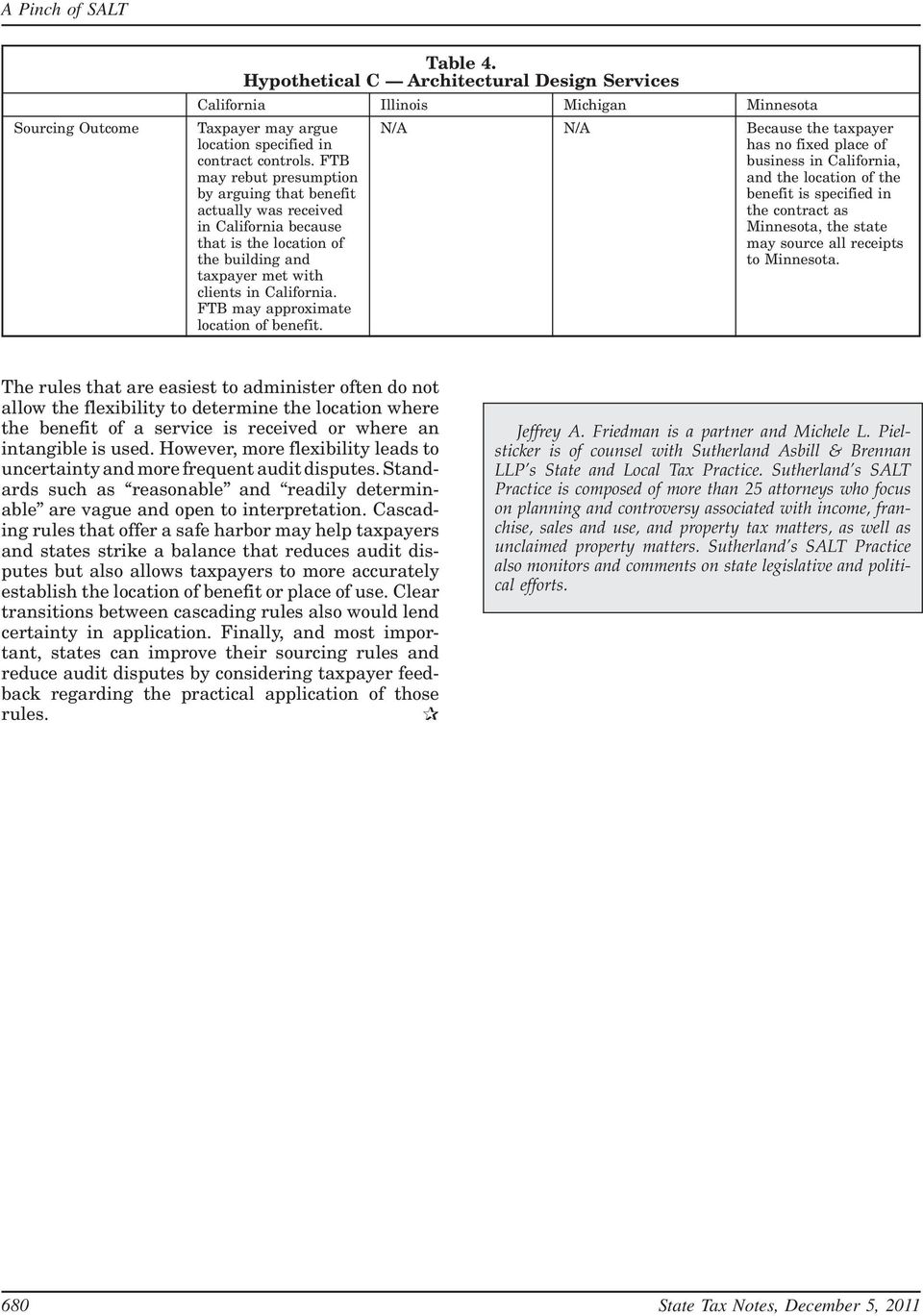
5 Sourcing Outcome Table 2. Hypothetical A Accounting Services California a Illinois b Michigan c Minnesota d Unclear. May reasonably approximate location where benefit received. May source partially to California based on proportion of benefit. a Calif. Proposed Regulation (c). b 35 Ill. Comp. Stat. 5/304(a)(3)(C-5)(iv). c Mich. Comp. Laws Ann. section (2)(a). d Minn. Stat. Ann. section (5)(j). Unclear. May argue that actual benefit received among the four facilities is not readily determinable. May source to fixed place of business in Illinois because that is where services were ordered. Taxpayer may argue benefit received is spread among four facilities. Unclear. Service sourced to Michigan to the extent that services relate to the purchaser s Michigan operations. Same as Illinois. Sourcing Outcome Table 3. Hypothetical B Software Support California Illinois Michigan Minnesota Customers, billing address creates presumption that 30 percent of receipts sourced to California. Presumably Illinois would look to where the calls originated (10 percent) or to customer s billing address (30 percent). If the service relates to prewritten software, (tangible property) located in Michigan, the entire benefit of the service received in Michigan is sourced to Michigan. If the service relates to custom software (intangible property), the benefit of the service is sourced to Michigan to the extent that the intangible property is used in Michigan. The state likely will look to the origination of the call to determine proportion of use. N/A of commercial domicile is Illinois. MMC ordered the services that relate to all of its facilities from its principal place of business. The contract with MMC does not specify where the benefit of the accounting service is received. (See Table 2.) Hypothetical B Software Support: A software company has a call center located in Minnesota, but it provides support services only to individual customers located in California, Illinois, and Michigan for a set monthly fee specified in its contracts. Ten percent of the calls originate from Illinois, 50 percent from California, and 40 percent from Michigan. Thirty percent of the customers billing addresses are in California, 30 percent in Illinois, and 40 percent in Michigan. (See Table 3.) Hypothetical C Architectural Design Services: Design Corp. has its principal place of business in Minnesota and is designing a building for a manufacturer located in California. Design Corp. s employees travel frequently to California to meet with the manufacturer and discuss the blueprints for the building, and the manufacturer s employees travel to Minnesota to do the same. Design Corp. drafts the blueprints in Minnesota. The contract specifies that the location where the service is received is Minnesota. (See Table 4, next page.) Conclusion While market-based sourcing may seem appealing, it may be more difficult to apply, and may lead to less predictable results than costs of performance sourcing. Thus, as states develop rules for marketbased sourcing to apply to receipts from sales of services, they should attempt to balance practicality with functionality. Those two criteria often conflict. State Tax Notes, December 5,
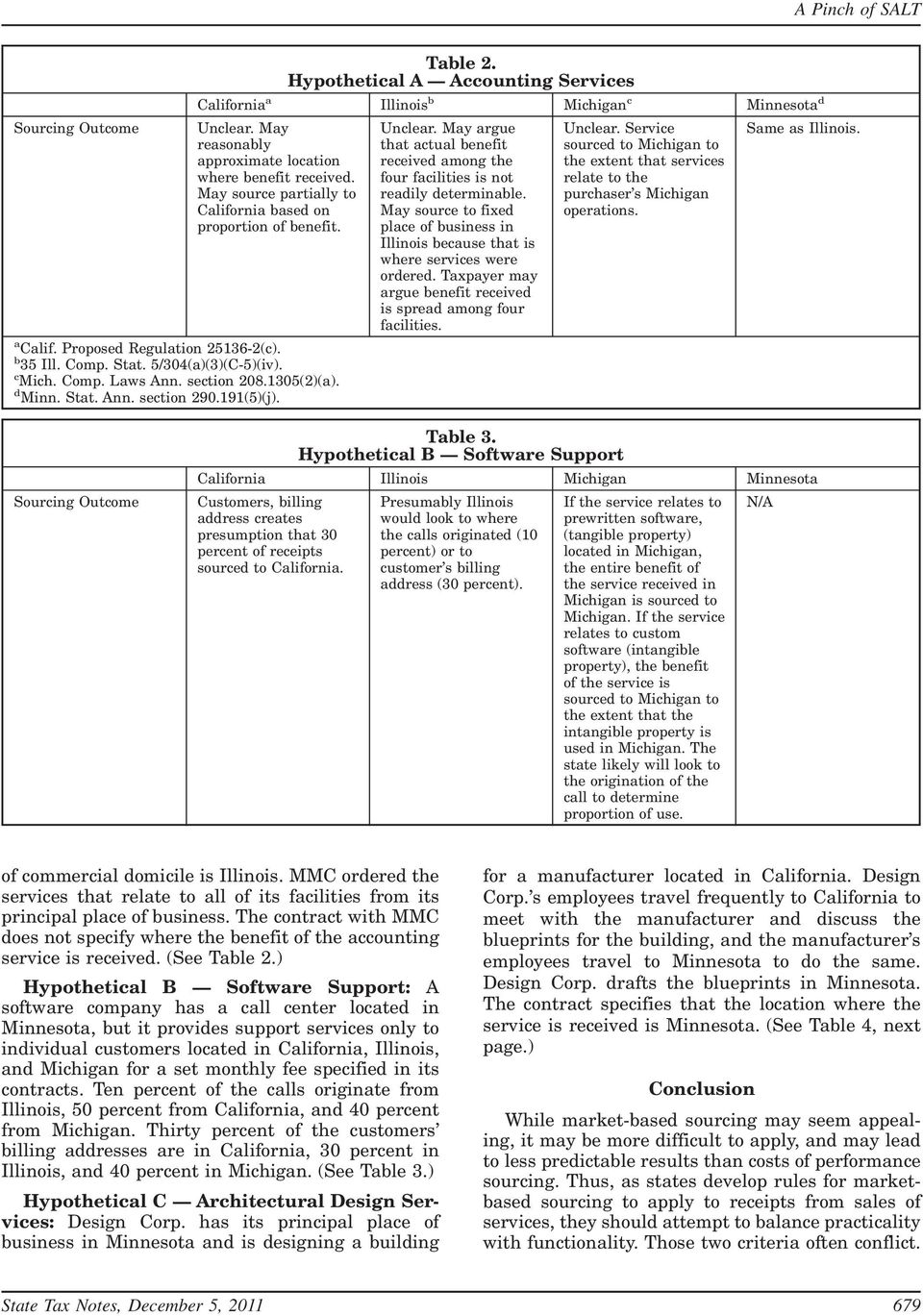
6 Sourcing Outcome Table 4. Hypothetical C Architectural Design Services California Illinois Michigan Minnesota Taxpayer may argue location specified in contract controls. FTB may rebut presumption by arguing that benefit actually was received in California because that is the location of the building and taxpayer met with clients in California. FTB may approximate location of benefit. N/A N/A Because the taxpayer has no fixed place of business in California, and the location of the benefit is specified in the contract as Minnesota, the state may source all receipts to Minnesota. The rules that are easiest to administer often do not allow the flexibility to determine the location where the benefit of a service is received or where an intangible is used. However, more flexibility leads to uncertainty and more frequent audit disputes. Standards such as reasonable and readily determinable are vague and open to interpretation. Cascading rules that offer a safe harbor may help taxpayers and states strike a balance that reduces audit disputes but also allows taxpayers to more accurately establish the location of benefit or place of use. Clear transitions between cascading rules also would lend certainty in application. Finally, and most important, states can improve their sourcing rules and reduce audit disputes by considering taxpayer feedback regarding the practical application of those rules. Jeffrey A. Friedman is a partner and Michele L. Pielsticker is of counsel with Sutherland Asbill & Brennan LLP s State and Local Tax Practice. Sutherland s SALT Practice is composed of more than 25 attorneys who focus on planning and controversy associated with income, franchise, sales and use, and property tax matters, as well as unclaimed property matters. Sutherland s SALT Practice also monitors and comments on state legislative and political efforts. 680 State Tax Notes, December 5, 2011
Developments in Sourcing
 TEI - Denver Chapter May 13, 2015 Michele Borens Marc Simonetti Developments in Sourcing Agenda Introduction Market Sourcing Professional Services E-Services Financial Services Cable Service 2 3 Market
State taxation in a global environment factor presence nexus considerations for foreign companies. by Charlie Fischer, Deloitte Tax LLP
 State taxation in a global environment factor presence nexus considerations for foreign companies by Charlie Fischer, Deloitte Tax LLP Spring 2015 FEATURED ARTICLES ISSUE 121 MARCH 5, 2015 State Taxation
State Apportionment Update Market Based Sourcing John Iannotti. September 25, 2015
 State Apportionment Update Market Based Sourcing John Iannotti September 25, 2015 1 Sales Factor Market Based Sourcing for Services (2008) No Tax IPA/COP Service Performed in State (%) Market Other 2 Sales
The nuances of market-based sourcing of service revenue: Not all markets look the same
 The nuances of market-based sourcing of service revenue: Not all markets look the same Giles Sutton, Jamie Yesnowitz, Chuck Jones and Terry F. Conley * The nuances of market-based sourcing of service revenue
What s News in Tax Analysis That Matters from Washington National Tax
 What s News in Tax Analysis That Matters from Washington National Tax Let s Get Personal About Sourcing Sales of Personal Services Out-of-state service providers should be familiar with how states source
STATE TAX CONSIDERATIONS FOR STOCK PLAN PROFESSIONALS
 STATE TAX CONSIDERATIONS FOR STOCK PLAN PROFESSIONALS A. William Caporizzo Kimberly B. Wethly Julie Hogan Rodgers WilmerHale February 25, 2008 Table of Contents I. State Taxation of Optionee...1 A. State
SOURCING OF SALES APPORTIONMENT FACTOR OF THE NH BUSINESS PROFITS TAX
 SOURCING OF SALES APPORTIONMENT FACTOR OF THE NH BUSINESS PROFITS TAX Income from Services and Intangibles New Hampshire Department of Revenue Administration Presentation to the House Ways & Means Committee
MTC APPORTIONMENT AND ALLOCATION RULES FOR FINANCIAL INSTITUTIONS
 MTC APPORTIONMENT AND ALLOCATION RULES FOR FINANCIAL INSTITUTIONS On the July 8, 2008 definitions working group conference call, states were asked to submit written comments outlining the issues that each
Instructions for 2013 Form 4A-1: Wisconsin Apportionment Data for Single Factor Formulas
 Instructions for 2013 Form 4A-1: Wisconsin Apportionment Data for Single Factor Formulas Purpose of Form 4A-1 Corporations, partnerships, tax-option (S) corporations and nonresident estates, trusts, and
Can You Take This to the Bank? State Taxation of Financial Institutions
 by Jeffrey M. Serether, Maria P. Eberle, and Michael L. Colavito Jr. What Is a Financial Institution and Does Your Entity Qualify? Jeffrey M. Serether Maria P. Eberle Michael L. Colavito Jr. In this installment
State + Local Tax. Practice Description
 State + Local Tax PRACTICE GROUP CHAIR Craig B. Fields 250 West 55 th Street New York, New York 10019 (212) 468-8193 [email protected] Morrison & Foerster is the first large law firm in the country to build
State & Local Tax Alert Breaking state and local tax developments from Grant Thornton LLP
 State & Local Tax Alert Breaking state and local tax developments from Grant Thornton LLP Major Nexus Developments of 2010 Examined; States Follow Trend of Adopting Bright-Line Nexus Standards During 2010,
Noonan s Notes on Tax Practice State Tax Notes, June 30, 2008, p. 1063 48 State Tax Notes 1063 (June 30, 2008)
 Noonan s Notes on Tax Practice State Tax Notes, June 30, 2008, p. 1063 48 State Tax Notes 1063 (June 30, 2008) Multistate Taxation of Stock Option Income -- Time for a National Solution? by Timothy P.
STATE OF ILLINOIS DEPARTMENT OF REVENUE OFFICE OF ADMINISTRATIVE HEARINGS SPRINGFIELD, ILLINOIS
 IT 12-09 Tax Type: Income Tax Tax Issue: Non-resident Exemption STATE OF ILLINOIS DEPARTMENT OF REVENUE OFFICE OF ADMINISTRATIVE HEARINGS SPRINGFIELD, ILLINOIS THE DEPARTMENT OF REVENUE OF THE STATE OF
MTC THREE-FACTOR ELECTION IN CALIFORNIA, MICHIGAN, AND TEXAS
 MTC THREE-FACTOR ELECTION IN CALIFORNIA, MICHIGAN, AND TEXAS Giles Sutton, Jamie C. Yesnowitz, Chuck Jones, Terry Conley, Terry Gaul, and Ralph Ourlian* of Grant Thornton LLP look at whether the business
Adjusted Factor-Based Nexus Thresholds Announced, Other Matters Discussed
 January 2013 California FTB Contacting Nonfilers The California Franchise Tax Board (FTB) is contacting more than 1 million people who did not file a 2011 state income tax return. The deadline to file
Apportionment Formulas
 Apportionment Formulas When a corporation s business activities extend into more than one state, such that the corporation is or could be taxed by more than one state, the question arises as to how to
Financial Institutions Regulation Apportionment & Allocation Issues List For MTC Income and Franchise Tax Uniformity Subcommittee 1
 Financial Institutions Regulation Apportionment & Allocation Issues List For MTC Income and Franchise Tax Uniformity Subcommittee 1 I. Property factor issues related to solicitation, investigation, negotiation,
WORKERS COMPENSATION BASICS COORDINATION OF BENEFITS. Hank Patterson Patterson Harkavy LLP Chapel Hill, North Carolina September 19, 2011
 WORKERS COMPENSATION BASICS COORDINATION OF BENEFITS Hank Patterson Patterson Harkavy LLP Chapel Hill, North Carolina September 19, 2011 I. Introduction A comprehensive knowledge of government and private
UNIFORM DIVISION OF INCOME FOR TAX PURPOSES ACT. Drafted by the NATIONAL CONFERENCE OF COMMISSIONERS ON UNIFORM STATE LAWS.
 UNIFORM DIVISION OF INCOME FOR TAX PURPOSES ACT Drafted by the NATIONAL CONFERENCE OF COMMISSIONERS ON UNIFORM STATE LAWS and by it APPROVED AND RECOMMENDED FOR ENACTMENT IN ALL THE STATES at its ANNUAL
Transitioning to the Michigan Corporate Income Tax
 July 2012 Michigan Bar Journal Tax Law 23 Transitioning to the Michigan Corporate Income Tax Out With the Old and In With the New By Wayne D. Roberts E ffective January 1, 2012, Michigan no longer imposes
State and Local Tax: Up in the Air: Sales Taxation of Cloud Computing. National State and Local Tax Practice
 State and Local Tax: Up in the Air: Sales Taxation of Cloud Computing Craig Williams Managing Director Marshal Kline Managing Director National State and Local Tax Practice Objectives Provide an overview
State and local tax update for law firms. Baker Tilly refers to Baker Tilly Virchow Krause, LLP,
 State and local tax update for law firms Baker Tilly refers to Baker Tilly Virchow Krause, LLP, an independently owned and managed member of Baker Tilly International. 2010 Baker Tilly Virchow Krause,
Illinois Department of Revenue Regulations
 Illinois Department of Revenue Regulations Title 86 Part 100 Section 100.3400 Apportionment of Business Income of Financial Organizations for Taxable Years Ending Prior to December 31, 2008 (IITA Section
OREGON Multistate Taxation and E-Commerce. John H. Gadon
 OREGON Multistate Taxation and E-Commerce John H. Gadon Lane Powell Spears Lubersky LLP 601 S.W. Second Avenue, Suite 2100 Portland, Oregon 97204-3158 (503) 778-2100 www.lanepowell.com I. Oregon and the
The State of State and Local Taxation and How it Impacts Your Law Firm
 The State of State and Local Taxation and How it Impacts Your Law Firm Presentation to the Association of Legal Administrators February 20, 2014 Steven D. Lando, CPA Tax Partner Anchin, Block & Anchin
State Tax Bad Debt Recovery Issues. Agenda
 2015 COST ANNUAL MEETING Chicago, Illinois State Tax Bad Debt Recovery Issues John Allan Partner, Jones Day Atlanta, Georgia Frank Julian Vice President, Macy s Cincinnati, Ohio David Otero Partner, Akerman
Iowa s S Corporation Apportionment Tax Credit. Tax Credits Program Evaluation Study
 Iowa s S Corporation Apportionment Tax Credit Tax Credits Program Evaluation Study April 2016 By Angela Gullickson Tax Research and Program Analysis Section Iowa Department of Revenue Preface During the
Legislative Fiscal Bureau One East Main, Suite 301 Madison, WI 53703 (608) 266-3847 Fax: (608) 267-6873
 Legislative Fiscal Bureau One East Main, Suite 301 Madison, WI 53703 (608) 266-3847 Fax: (608) 267-6873 June 5, 2001 Joint Committee on Finance Paper #104 Corporate Income and Franchise Tax -- Tax Treatment
COMBINED REPORTING WITH THE CORPORATE INCOME TAX
 COMBINED REPORTING WITH THE CORPORATE INCOME TAX Issues for State Legislatures William F. Fox and LeAnn Luna * November, 2010 Report commissioned by the NCSL Task Force on State & Local Taxation of Communications
Determining What s Unitary: Combined Filing Requirements and Options
 NAVIGATING STATE TAXATION IN A GLOBAL BUSINESS ENVIRONMENT Determining What s Unitary: Combined Filing Requirements and Options Peter Leonardis AIG Alysse McLoughlin McDermott Will & Emery LLP David Vistica
Co-Chairs, NCSL Executive Committee Task Force on State and Local Taxation
 August 11, 2013 Dear Legislator, Bruce W. Starr Senator Or egon Presid ent, NCSL Thomas W. Wright Chief of Staff to Speak er Alaska Staff Chair, NCSL William T. P ound Executive Dir ector On behalf of
Avoiding Tax Surprises In Trust And Estate Litigation: Transfer Tax Aspects Of Settlements
 Avoiding Tax Surprises In Trust And Estate Litigation: Transfer Tax Aspects Of Settlements Julie K. Kwon A. Introduction 1. Parties negotiating the resolution of their disputes regarding interests in trusts
INFORMATION BRIEF Minnesota House of Representatives Research Department 600 State Office Building St. Paul, MN 55155 December 1998.
 INFORMATION BRIEF Minnesota House of Representatives Research Department 600 State Office Building St. Paul, MN 55155 December 1998 Pat Dalton, Legislative Analyst (651) 296-7434 Internet Taxation Internet
Demystifying the Sales Factor: Classifying Receipts. by Catherine A. Battin, Maria P. Eberle, and Lindsay M. LaCava
 Demystifying the Sales Factor: Classifying Receipts by Catherine A. Battin, Maria P. Eberle, and Lindsay M. LaCava Catherine A. Battin Maria P. Eberle Lindsay M. LaCava Catherine A. Battin is a partner
TENNESSEE DEPARTMENT OF REVENUE REVENUE RULING # 06-27 WARNING
 TENNESSEE DEPARTMENT OF REVENUE REVENUE RULING # 06-27 WARNING Revenue rulings are not binding on the Department. This presentation of the ruling in a redacted form is information only. Rulings are made
STANDARD NONFORFEITURE LAW FOR INDIVIDUAL DEFERRED ANNUITIES
 Model Regulation Service April 2003 Table of Contents Section 1. Section 2. Section 3. Section 4. Section 5. Section 6. Section 7. Section 8. Section 9. Section 10. Section 11. Section 12. Section 13.
Tax Reserves and Related Items March 2011. Proration. Craig Pichette
 Tax Reserves and Related Items March 2011 Proration Craig Pichette Proration What is Proration? The assumption that a portion of every dollar of investment t income or dividend id d received is credited
FYI For Your Information
 TAXPAYER SERVICE DIVISION FYI For Your Information Apportionment of Income C CORPORATIONS A C Corporation doing business only in Colorado will compute its tax on 100% of the Colorado taxable income. However,
Stock Option Income Double Taxed Income
 The State and Local Tax Lawyer September 15, 2002 Stock Option Income Double Taxed Income By: Debra L. Silverman I. INTRODUCTION Taxpayers who have been compensated with employee stock options, and their
What the CAT Dragged In: The Tax Outside Ohio s Borders
 What the CAT Dragged In: The Tax Outside Ohio s Borders by Thomas H. Steele and Kirsten Wolff Thomas H. Steele is a partner with Morrison & Foerster LLP, San Francisco. Kirsten Wolff is an associate with
11,820. Doing Business or Nexus.
 Checkpoint Contents State & Local Tax Library State & Local Tax Reporters States California Explanations Income--Corporate DOING BUSINESS OR NEXUS 11,820 Doing Business or Nexus. State & Local Taxes 11,820.
(1) Purpose; General Rule; Relationship to Other Rules; Outline.
 830 CMR: DEPARTMENT OF REVENUE 830 CMR 63.00: TAXATION OF CORPORATIONS 830 CMR 63.32B.2: Combined Reporting (1) Purpose; General Rule; Relationship to Other Rules; Outline. (a) Purpose. The purpose of
SURVEY OF THE CURRENT INSURANCE REGULATORY ENVIRONMENT FOR AFFINITY MARKETIG 1 A
 SURVEY OF THE CURRENT INSURANCE REGULATORY ENVIRONMENT FOR AFFINITY MARKETIG ARRANGEMENTS (FORC Journal: Vol. 23 Edition 4 - Winter 2012) Kevin G. Fitzgerald, Esq. (414) 297-5841 N. Wesley Strickland (850)
OPERATION AS A PARTNERSHIP OR LIMITED LIABILITY COMPANY STATE INCOME TAX CONSEQUENCES TO THE ENTITY, ITS PARTNERS AND ITS MEMBERS
 OPERATION AS A PARTNERSHIP OR LIMITED LIABILITY COMPANY STATE INCOME TAX CONSEQUENCES TO THE ENTITY, ITS PARTNERS AND ITS MEMBERS David A. Fruchtman Horwood Marcus & Berk Chartered 180 N. LaSalle Street,
Sourcing Income of Electrical Industry
 Sourcing Income of Electrical Industry To: Robynn Wilson, Income and Uniformity Committee Chair From: Bruce Fort, Counsel, and Ken Beier, Training Director, Multistate Tax Commission Date: July 17, 2014
CAT 2005 06 Situsing Rules for Certain Services Issued September, 2005; Revised April, 2006; Revised October, 2006; Revised December, 2006
 Information Release CAT 2005 06 Situsing Rules for Certain Services Issued September, 2005; Revised April, 2006; Revised October, 2006; Revised December, 2006 This release contains a rule for situsing
Articles: A Roadmap of How One Governor Used Economic Development to Create a New Virginia Economy: Part Two
 Multistate Tax State Tax Matters August 21, 2015 In this issue: Articles: A Roadmap of How One Governor Used Economic Development to Create a New Virginia Economy: Part Two... 1 Income/Franchise: Alabama:
Recent Changes and Trends in Legislation Related to Equity Income Sourcing
 International Executive Mobility Recent Changes and Trends in Legislation Related to Equity Income Sourcing Originally published in The Journal of Corporate Taxation (WG&L), September / October 2013 Author:
STATE TAXATION OF CLOUD COMPUTING
 STATE TAXATION OF CLOUD COMPUTING Maria Biava, Verizon Eric Tresh, Sutherland Asbill & Brennan LLP Michele Borens, Sutherland Asbill & Brennan LLP November 13, 2012 AGENDA What is Cloud Computing? > Different
Series LLC Is It Finally Usable?
 Originally published in: BNA Tax Management Real Estate Journal November 3, 2010 Series LLC Is It Finally Usable? By: Howard J. Levine and Daniel W. Stahl 1 BACKGROUND Many in the real estate development
State Tax Return. Georgia Court Ruling Spotlights Significant Complexities of 338(h)(10) Elections for State Income Tax Purposes
 June 2009 State Tax Return Volume 16 Number 2 Georgia Court Ruling Spotlights Significant Complexities of 338(h)(10) Elections for State Income Tax Purposes Kirk Kringelis Atlanta (404) 581-8565 In most
TENNESSEE DEPARTMENT OF REVENUE LETTER RULING # 97-19
 TENNESSEE DEPARTMENT OF REVENUE LETTER RULING # 97-19 WARNING Letter rulings are binding on the Department only with respect to the individual taxpayer being addressed in the ruling. This presentation
ADULT PROTECTION STATUTES DELETIONS AND ADDITIONS QUICK REFERENCE 2008 & 2009
 ADULT PROTECTION STATUTES DELETIONS AND ADDITIONS QUICK REFERENCE 2008 & 2009 STATE: DELETIONS (RED): ADDITIONS (GREEN): Alabama Ala. Code 38-9-7 Ala. Code 38-9-8 Arkansas Ark. Code Ann. 9-20-103 Ark.
Marke C. Greene, Moss Adams LLP Jeffrey A. Friedman, Sutherland Michele Borens, Sutherland TEI Region VIII Conference Seattle, June 9, 2014
 Marke C. Greene, Moss Adams LLP Jeffrey A. Friedman, Sutherland Michele Borens, Sutherland TEI Region VIII Conference Seattle, June 9, 2014 On Cloud 9: Almost 10 Use Cases of Cloud Taxation 1 Use Case
A PINCH OF SALT state tax notes
 A PINCH OF SALT state tax notes by Carley A. Roberts, Pilar Mata, Stephanie T. Do, and Kathryn E. Pittman Carley A. Roberts Stephanie T. Do Pilar Mata Kathryn E. Pittman Carley A. Roberts is a partner
Marc Simonetti Andrew Appleby. May 6, 2014
 Marc Simonetti Andrew Appleby TEI Upstate New York Tax Conference May 6, 2014 The Latest and Greatest in State Tax Litigation Agenda Group Composition / Unitary Disputes Apportionment Nexus MTC Election
2 Business Income Tax
 2 Business Income Tax 2 BUSINESS INCOME TAX PART A: GENERAL TAX PROVISIONS AND ADMINISTRATION OF CREDITS 1. FEDERAL TAX CONFORMITY South Carolina income tax laws conform substantially to the federal income
Options for Worker Co-op Legal Structure
 Options for Worker Co-op Legal Structure California Co-op Conference Jenny Kassan, Katovich Law Group [email protected] (510) 834-4530 August 16, 2009 Options for Worker Co-op Legal Structure Cooperative
Eligible Personal Property Exemptions for Assessors
 Eligible Personal Property Exemptions for Assessors In December of 2012 Governor Snyder signed into law Public Acts 397 through 403 and 406 through 408 of 2012. These Public Acts significantly changed
State Income and Franchise Tax Laws that Conform to the REIT Modernization Act of 1999 (May 1, 2001). 1
 State Income and Franchise Tax Laws that Conform to the REIT Modernization Act of 1999 (May 1, 2001). 1 1. Alabama does not adopt the Code on a regular basis but instead specifically incorporates only
DOL Whistleblower Rule Will Have Far-Reaching Effects
 Portfolio Media. Inc. 860 Broadway, 6th Floor New York, NY 10003 www.law360.com Phone: +1 646 783 7100 Fax: +1 646 783 7161 [email protected] DOL Whistleblower Rule Will Have Far-Reaching Effects
Unintended Consequence of I.R.C. Conformity: California Rules Taxpayer May Disregard Treas. Reg. 1.337(d)-2
 Unintended Consequence of I.R.C. Conformity: California Rules Taxpayer May Disregard Treas. Reg. 1.337(d)-2 By Brian J. Sullivan, Director and Michael F. Paxton, Senior Deloitte Tax LLP Tax Management
Nexus Reviews: Uncovering State Sales or Income Tax Obligations Designing an Effective Internal Process to Identify Potential Tax Exposures
 Presenting a live 110 minute webinar with interactive Q&A Nexus Reviews: Uncovering State Sales or Income Tax Obligations Designing an Effective Internal Process to Identify Potential Tax Exposures THURSDAY,
Comment, A STATE SURVEY DUAL REPRESENTATION IN ADOPTION
 \\jciprod01\productn\m\mat\27-2\mat207.txt unknown Seq: 1 29-JUL-15 10:30 Vol. 27, 2015 Dual Representation in Adoption 481 Comment, A STATE SURVEY DUAL REPRESENTATION IN ADOPTION Dual representation is