
Awareness and Outreach Task Force Report to the National Cyber Security Partnership March 18, Executive Summary
|
|
|
- Derrick McKinney
- 10 years ago
- Views:
Transcription
1 Awareness and Outreach Task Force Report to the National Cyber Security Partnership March 18, 2004 Executive Summary About the Task Force The Awareness and Outreach Task Force, an industry-led coalition of interested security experts from the public and private sectors, was created as part of the National Cyber Security Summit process. Task force members include representatives from trade associations, nonprofit organizations, publicly traded and privately held companies, and state, local, and federal government. Task force members participated voluntarily, donated their time, and were not paid. The task force is not an advisory group to the Department of Homeland Security (DHS) or any other state, local, or federal government department or agency. Instead, it operates under the guidance and coordination of the National Cyber Security Partnership, a coalition of trade associations, including the U.S. Chamber of Commerce, the Information Technology Association of America, TechNet, and the Business Software Alliance, that sponsored and organized the National Cyber Security Summit held in Santa Clara, California, on December 2 3, TASK FORCE MISSION Originally, this task force was charged with developing an awareness campaign to inform small businesses and home users about the importance of cyber security. However, during the December 2--3, 2003, National Cyber Security Summit, the task force expanded its scope beyond small businesses and home users to more accurately reflect the priorities of the National Strategy to Secure Cyberspace. The current mission and description of the taskforce follows: Mission: To promote a comprehensive national awareness program to empower all Americans businesses, the general workforce, and the general population to secure their own parts of cyberspace. Description: The Awareness and Outreach Task Force has developed implementation strategies and tactical plans that target home users, small businesses, large enterprises, schools and institutions of higher education, and state and local governments. Recognizing that we all have a role to play, each constituency has provided practical steps to increase awareness, accountability, and understanding to take action to manage the risks we face in today s constantly changing environment. Task Force Co-Chairs: Dan Caprio, Chief of Staff to Commissioner Orson Swindle, Federal Trade Commission Ty Sagalow, Worldwide Corporate Product Development, Deputy Chief Underwriting Officer and DBG-Vice President, American International Group and COO, AIG ebusiness Risk solutions. Howard Schmidt, Vice President and Chief Information Security Officer, E-Bay, Inc.
2 The U.S. Chamber of Commerce serves as the Task Force Secretariat. The Task Force Co-Chairs thank Andrew Howell, Vice President for Homeland Security, and Scott Algeier, Manager for Homeland Security, both at the U.S. Chamber of Commerce, for their significant contributions to this report. PROBLEMS and CHALLENGES Although the Internet has increased communication and productivity has provided businesses with access to new markets, it has also given hackers, thieves, disgruntled employees, fraudsters, and other criminals new opportunities to cause economic and social damage on a broader scale and has created new potential weapons of terrorism, more quickly than ever before. Generally, many private enterprises, public entities, and home users lack the resources to adequately manage cyber security risk. A large number of entrepreneurs and home users are not aware of how their individual cyber security preparedness affects security overall. Internet users must be made aware of the importance of sound cyber security practices and given more user-friendly tools to implement them. RECOMMENDATIONS and NEXT STEPS Small Businesses Develop and distribute a cyber security guidebook for small businesses and encourage the development of market-based incentives such as insurance and risk profile analysis that reward small businesses that enhance their cyber security preparedness. Home Users Support, promote, and launch a national public service campaign on cyber security. Develop a cyber security tool kit for home users. Work with the Internet Service Provider (ISP) communities to identify ways to use their access to their customers to promote cyber security. Large Enterprises Create and implement, in September, 2004, in partnership with DHS, a series of regional homeland security forums for CEOs of large enterprises. A portion of the program should highlight the roles of CEOs in cyber security. Begin, in July 2004, a direct mail campaign to C-Suite executives of the 10,000 largest companies in America to provide senior corporate executives with key messages and activities that are necessary for enterprisewide cyber security. Designate September 2004 as Cyber Security Month, and market to CEOs of large enterprises the importance of focusing on cyber security and participating in the DHS CEO regional homeland security forums. 2
3 Distribute and raise awareness of the cyber risk management tools being developed by the Cyber Security Summit s Corporate Governance Task Force. K-12 Schools and Higher Education Inventory, catalogue, and share best practices on raising cyber security awareness to home users, large enterprises, small businesses, K 12 schools and institutions of higher education, and state and local governments. Partner with education groups, school boards, superintendents, teachers, and colleges and universities to develop and distribute materials to school children and institutions of higher education that raise awareness of appropriate cyber security behavior. Provide cyber security and ethics curricula and explore opportunities for introducing awareness content as part of courses. Consider replicating the DHS Homeland Security CEO Forums for university presidents. A portion of the program should highlight the roles of university presidents in cyber security. State and Local Government Develop, in conjunction with DHS, a Cyber Security Excellence Award to recognize teams, rather than individuals, at the state and local government levels. Create a Web-based training tool for state and local governments, as well as for businesses and home users, featuring a series of webcasts hosted by a variety of vendors, which are offering their services pro bono. Consider replicating the DHS Homeland Security CEO Forums for governors. A portion of the program should highlight the roles of governors and mayors in cyber security. CONCLUSIONS A major role for the Awareness Task Force has been, and will continue to be, to leverage existing awareness and outreach efforts and to initiate and enhance publicprivate partnerships. Promoting a secure cyberspace is the responsibility of every citizen, all levels of government (state, local, and federal), academia, and industries, regardless of size or sector. The list of key stakeholders involved in the solution is limitless, and therefore, the solution will only come as a result of coordinated, publicprivate partnerships. The progress of the task force demonstrates the effectiveness of the publicprivate partnership model. Task force members believe that more can be accomplished by working together, rather than by working separately. The task force has catalogued existing best practices, developed strategies to market those practices to specific audiences, created incentive plans to ensure acceptance of those practices, contributed 3

4 to the development of a national advertising campaign, and developed a strategy to communicate to public and private CEOs across the country about the importance of cyber security and their role in enhancing it. Recognizing the role of our students, teachers, and schools and universities, a strategy has been created to bring cyber security directly to them. In addition, the task force has a team of dedicated state and local public servants who have taken shared responsibility in enhancing cyber security awareness in state and local government agencies throughout each state. While these accomplishments are extensive, the task force recognizes that there is much more to do. The task force also acknowledges that there are other groups who are making positive contributions to cyber security awareness and encourages interested parties to comment on this report and join in the task force s efforts. 4
5 Awareness and Outreach Task Force Report to the National Cyber Security Partnership March 18, 2004 Task Force Report INTRODUCTION Originally, this task force was charged with developing an awareness campaign to inform small businesses and home users about the importance of cyber security. However, during the December 2--3, 2003, National Cyber Security Summit, the task force expanded its scope beyond small businesses and home users to more accurately reflect the priorities of the National Strategy to Secure Cyberspace. The current mission and description of the taskforce follows: Mission: To promote a comprehensive national awareness program to empower all Americans businesses, the general workforce, and the general population to secure their own parts of cyberspace. Description: The Awareness and Outreach Task Force has developed implementation strategies and tactical plans that target home users, small businesses, large enterprises, schools and institutions of higher education, and state and local governments. Recognizing that we all have a role to play, each constituency has provided practical steps to increase awareness, accountability, and understanding to take action to manage the risks we face in today s constantly changing environment. WORKING GROUPS Because of the diversity of each target audience, the task force established five working groups to develop plans to target specific audiences. The working groups and their chairs are as follows: Home Users: Tiffany Jones, Manager, Government Affairs Symantec Corp. Small Businesses: Kai Tamara Hare, Chief Executive Officer nuserve SM State and Local Government: Will Pelgrin, Director, Office of Cyberspace Security and Critical Infrastructure Protection, State of New York Large Enterprises: Marc Jones, President and Chief Executive Officer, Visonael Higher Education and Schools: Jim Tiecher, Executive Director, Cyber Smart and Rodney Petersen, Policy Analyst and Security Task Force Coordinator, EDUCAUSE THEMES OF THE AWARENESS CAMPAIGN Each working group developed action plans based on these themes: Explain the problem. Successful awareness programs need to explain to the constituents what the problem is and why cyber security is important. Promote Individual responsibility. All people have a role to play and need to understand the importance of being proactive. Motivate. Constituents need to be motivated to implement cyber security steps that will ultimately change behavior (positive and negative reinforcements). 5

6 Keep it simple. Cyber security needs to be simple for users to implement. Be creative. Policymakers and industry representatives need to be creative when thinking about cyber security issues, possible actionable steps, and matrixes to measure results. Leverage existing programs and relationships. Reaching out to industry is a quick and easy for spreading the message about cyber security awareness. SELECT ACCOMPLISHMENTS TO DATE Small Businesses Tools for Small Businesses Developed, with the Internet Security Alliance, a small business cyber security guidebook. Made available, for free, Cyber RiskProfiler TM with cyber scoring-technology developed and donated by nuserve SM to assist small businesses in identifying and managing their cyber risks. Obtained cyber risk insurance premium credits from an insurance company. AIG ebusiness Risk Solutions, a division of the property-casualty insurance subsidiaries of American International Group, Inc. agreed in principle to provide credits, where legally permitted, on cyber-insurance policies for businesses that effectively implement task force awareness suggestions. The task force is looking forward to and seeks the participation of other qualified carriers in this program. Created an online small business cyber security resource center. Home Users Home User Awareness The National Cyber Security Alliance (NCSA) a non-profit public-private coalition of tech companies, owners and operators of critical infrastructures, and federal government agencies and departments DHS and the Federal Trade Commission are recognized leaders in the home user awareness market. These organizations must continue to work closely together to implement a comprehensive awareness campaign. Cyber Security Tips for Home Users Contributed to updating and revising the NCSA s Top 10 cyber security tips for home users. Launch of Personal Firewall Day Web Site Personal Firewall Day is dedicated to educating everyone about the threats we face and pose when we do not protect our computers with personal firewalls. Personal Firewall Day is also a call to firewall experts to share their expertise and advice with family, friends, and their communities. Large Enterprises General Business Community The task force established relationships with trade associations representing the broad business community to explore ways to raise the level of cyber security awareness among C-suite executives. 6
7 Financial Services Community The task force's efforts have been incorporated into the outreach efforts of the Finance and Banking Information Infrastructure Committee, headed by the Department of Treasury and the Financial Services Sector Coordinating Council. The council consists of 25 financial sector trade associations and holding cyber and physical security symposiums, hosted by the Federal Deposit Insurance Corporation, in 25 cities nationwide. These symposiums have reached in excess of 5,000 banking professionals and now include a session on how financial institutions can help home and small business users protect themselves from cyber attacks. K-12 Education and Institutions of Higher Education National Education Partnerships CyberSmart! is a recognized leader in education and awareness to K-12 students. EDUCAUSE assists technology leaders at the nation s institutions of higher education in sharing information on best practices. The task force has built upon and leveraged the work of these two organizations to build relationships with this target audience. Effective Security Practices Guide The EDUCAUSE/Internet2 Computer and Network Security Task Force released the first-ever Effective Security Practices Guide for the higher education community, providing practical approaches to preventing, detecting, and responding to IT security problems in a wide range of higher education environments. The guide fulfills a recommendation from the National Strategy to Secure Cyberspace for colleges and universities "... to secure their cyber systems by establishing one or more sets of best practices for IT security." State and Local Government Created a pilot Web-based training tool for state and local governments, as well as businesses and home users, featuring a series of Webcasts. Developed a concept for a national award recognizing achievement and leadership in cyber security by stats and local government information security professionals. The award would recognize teams, rather than individuals. Enhanced Partnerships Federal Trade Commission The Awareness Task Force supports the FTC s Dewie the Turtle home user awareness campaign and Operation Secure Your Server," an international effort headed by the Federal Trade Commission and 36 additional agencies in 26 countries to reduce the flow of unsolicited commercial by urging organizations to close open relays and open proxies. Open relays and open proxies are servers that allow any computer in the world to bounce or route through servers of other organizations, thereby disguising the real origin of the . Spammers often abuse these servers to flood the Internet with unwanted . Their abuses not only overload servers, but also could damage an unwitting business reputation if it appears that the business sent the spam. Operation Secure Your Server provides businesses with simple, inexpensive ways to protect their computer systems from misuse. 7

8 Events Hosted a two-day workshop in conjunction with EDUCAUSE and CyberSmart! in January, focusing on outreach to K-12 and higher education students, executives, and staff. Conducted, in conjunction with the Internet Security Alliance, 10 focus group sessions, with almost 100 small business owners to provide content and feedback for the small business cyber security guidebook. 8
9 RECOMMENDATIONS AND NEXT STEPS Small Businesses Targeted, but Extensive Distribution of the Cyber Security Guidebook. The U.S. Chamber of Commerce, the National Federation of Independent Businesses, the National Association of Manufacturers, and the Internet Security Alliance have each agreed to market the guidebook to its members and make it available on their Web sites. To distribute the guidebook to a larger audience, however, the task force has approached the Small Business Administration about the possibility of distributing the guidebook to small businesses. Initially, the guidebook will be an online resource. But to maximize the effect of this small business tool, the task force is looking for government and corporate sponsors to help underwrite the costs of producing and distributing large quantities of printed guidebooks. Timeline: The preliminary text will be reviewed by the associations working on the campaign. Once organizations have signed off on the book s content (early April) the document will be typeset and electronically distributed. A printed version of the book is also planned for an April or May release, depending on funding levels required. Increase Scope of Insurance Industry Participation: The task force acknowledges the leadership of AIG ebusiness Risk Solutions, a division of the property-casualty insurance subsidiaries of American International Group, Inc., which agreed in principle to provide credits, where legally permitted, on cyberinsurance policies for businesses that effectively implement task force awareness suggestions. To gain broader support of this initiative, the task force will ask other insurance companies to provide financial incentives equivalent to AIG s discounts. Timeline: This work will begin immediately, and the task force plans to announce partnerships with other insurance carriers by the fall. Home Users National Advertising Campaign: The task force partnered with the National Cyber Security Alliance to update and revise its Top 10 list of cyber security tips for home users. These tips will serve as the basis of a three-year national advertising campaign, which will be launched as soon as the financial resources are available. Timeline: The launch of the national advertising campaign is tentatively scheduled for the fall. Testing of initial advertising campaign. This initial advertising campaign should be followed by a national opinion poll and then a follow-on campaign that takes into account strengths and weaknesses uncovered by poll findings. Timeline: The testing of the initial advertising campaign will begin after the first year of the campaign s launch. 9
10 Leverage the access of Internet Service Providers (ISPs). Since ISPs reach every home user of the Internet, the task force has partnered with the United States Internet Service Providers Association (USISPA) to determine how this access can be leveraged. In addition, colleges and universities serve as ISPs to nearly 20 million students and employees. The Task Force will continue to work with the ISPs to find creative ways to educate home users on cyber security issues. Timeline: The USISPA and the National Cyber Security Alliance will meet in the spring to formalize a partnership. Develop a Home User Cyber Security Tool Kit. Create a cyber security kit for home users that provides detailed, easy to implement instructions on how to implement the Top 10 tips list, CD tutorials with definitions, best practices and videos, vendor-neutral security checks, and mouse pads listing basic security tips. The tool kit could be distributed as part of the national awareness campaign by point-of-purchase retailers and by computer companies when sending their products to consumers. Timeline: The tool kits are already in development and should be completed and ready for distribution by summer. Large Enterprises Create a CEO-Level Forum Series with DHS. The task force believes that the best way to increase the level of cyber security awareness in large enterprises is to go directly to where the CEOs are. Therefore, we recommend that DHS join with leading business associations in hosting a series of regional homeland security forums. To add value, such forums need the direct support and participation of senior executives of DHS. Timeline: In the spring, the task force will approach DHS to partner in this series. If DHS agrees, the task force will confirm the participation of various trade associations for this series. By summer, the task force, partner organizations, and DHS will announce a list of five pilot markets to test this program. The first regional CEO forum is expected in September. Cyber Security Month. The task force will create and promote an advertising program, primarily through print media, focusing CEOs of large enterprises on the issue of cyber security. The goal is to get free insertions of ads in publications that senior executives read. Timeline: Since September is when most corporations focus on budgeting for the following year, the goal is to launch this campaign and the first regional CEO forum in September. Direct mail campaign to the C-Suite executives of the 10,000 largest companies in America. The purpose of the campaign is to provide senior corporate executives with key messages and activities that are necessary for enterprisewide cyber security. 10
11 Timeline: This direct mail campaign would be launched in July to precede September s Cyber Security Month and CEO forums and would be funded through corporate sponsors. Provide seminars on cyber security best practices at major trade shows and perform Webinars. These seminars and Webinars would target C-suite executives and be conducted by a paid consultant. The goal is to do one Webinar a month and have a presence at one trade show a month. Timeline: Although intended as ongoing activities, the seminars and Webinars would begin in September, in conjunction with Cyber Security Awareness month. Market and Distribute a Guide to Information Security for C-Suite Executives. The task force will help distribute and raise awareness of the cyber risk management tools being developed by the Corporate Governance Task Force. Timeline: The task force has received commitments from several business associations to help in distributing to their members the Corporate Governance Task Force recommendations. Further, the task force plans to distribute these tools at the proposed regional forums. A more extensive marketing campaign for these tools is expected by the summer. K-12 Schools and Higher Education Creation and Distribution of Awareness Material. Often, direct communication and peer communication is the most effective means of influencing the behavior of this audience. Therefore, the task force will partner with CyberSmart! EDUCAUSE, Consortium for School Networking (CoSN) and others to create and distribute materials that raise awareness of appropriate cyber security behavior. Such materials might include posters, stickers, and brochures. The task force will seek to partner with school boards, teachers, state boards of education, the U.S. Department of Education, and institutions of higher education to explore how these entities can share these materials with their respective communities. Timeline: The task force will finalize the awareness materials and formalize partnerships in the second quarter of Provide Cyber Security and Ethics Curricula. The task force believes that in addition to teaching students how to operate computers, schools should educate students on how to use the computer securely. The task force will develop curriculum material and explore opportunities for introducing awareness content as part of courses. Timeline: Cyber Security curricula for K-12 students is expected in the fourth quarter of
12 Identify and Collect Effective Practices and Solutions. By recognizing that the development of effective practices is a continuing process, the task force will continue to support higher education efforts to identify and catalogue effective practices for the Effective Security Practices Guide. Timeline: Additional effective practices and solutions will be collected and disseminated during 2004, and a second version of the guide will be released in January By recognizing that the development of effective practices is a continuing process, the task force will continue to identify and catalogue effective practices for the Effective Security Practices Guide. The task force will disseminate the Effective Security Practices Guide to institutions of higher education. Timeline: The task force has begun to catalogue existing best practices and will identify and disseminate them in the third quarter of Create a DHS Regional Forum Series with University Presidents. The task force will consider developing a homeland security forum series for university presidents, based on the DHS Homeland Security CEO Forums. A portion of the program should highlight the roles of university presidents in cyber security. Timeline: After the launch of the CEO forum series in September, the task force will examine the value of replicating the series for university presidents. State and Local Governments Development of a Cyber Excellence Awards. The State and Local Working Group developed a concept for a national award recognizing achievement and leadership in cyber security by state and local government information security professionals. The award would recognize teams rather than individual and could be based on a single act as well as a project. The task force recommends that the program be sponsored by DHS, with the winners being chosen by a committee of industry, academic, and government leaders. Next steps include approaching DHS about sponsoring the award and further refining award criteria and timing. Timeline: In the spring, the task force will ask DHS to agree to sponsor the awards. If DHS agrees, the awards criteria and timeline will be developed by the task force in conjunction with DHS by early summer. Sharing and Promoting Effective Practices. The task force inventoried existing best practice material for state and local governments, such as training employees on computer security, installing screen savers with cyber security tips, creating cyber security posters for the workplace, and contracting with vendors to enable home use as well as office use of their security products. From this inventory, the task force will select the most useful documents, update them as necessary, and publish them in a central location, such as a Web site. 12

13 Timeline: The task force expects to select the most beneficial best practice documents in the spring and begin dissemination to state and local governments in early summer. Webcast Training. The Task Force has agreed to develop a Web-based training tool for state and local governments. This tool will feature a series of Webcasts hosted by a variety of vendors, at no cost to the government, and will focus on a number of topics such as security 101 and risk assessments. The tool will be posted on the Multi-State ISAC Web page, and the Multi-State ISAC will ask its members to push the tool to local governments. This feature will also be posted on the NCSA s site as a tool for home users and small businesses. Timeline: The first Webcast pilot has been finalized. This project is scheduled to be launched in mid April to a limited audience of approximately 200 people and available on the Web by the summer. Support a State or a National Poster Contest for School Children. The NCSA sponsors a national poster contest for school children. The task force recommends that each state support this effort by encouraging their students to participate. In addition, it recommends that each state promote cyber security practices by displaying the winning posters. In the absence of a national effort, each state is encouraged to develop its own statewide contest. Timeline: The task force will coordinate the launch of the poster contest with the National Cyber Security Alliance. NCSA has not announced a timeline for its poster contest. Measuring Success Survey. The task force developed a one-page survey to obtain a baseline of where state and local government entities are in terms of cyber security awareness. The survey can be completed periodically to measure the success of the entity in promoting and developing cyber security awareness. Timeline: The survey will be finalized and distributed to state and local governments by the end of spring. Create a DHS Regional Forum Series with Governors. The task force will consider developing a homeland security forum series for governors and mayors, based on the DHS Homeland Security CEO Forums. A portion of the program should highlight the roles of governors and mayors in cyber security. Timeline: After the launch of the CEO forum series in September, the task force will examine the value of replicating the series for governors and mayors. 13

14 Report Appendix The Awareness and Outreach Task Force Working Group on K-12 Schools and Higher Education Working Group Report February 19, 2004 Background The K-16 Working Group was assigned the task of developing an action agenda to reach K-12 schools and institutions of higher education with initiatives that will raise awareness and provide solutions regarding cyber security issues and practices. Our efforts comprise a part of the overall objective of the Awareness Task Force to institute and promote a comprehensive national awareness program to empower all Americans businesses, the general workforce, and the general population to secure their own parts of cyberspace. This reports presents an implementation strategy coupled with a tactical plan that targets K-12 students, parents, educators, and higher education. We focus on practical steps to increase awareness and manage the risks associated with the challenges of cyber security. This report does not contain resource requirements and estimated expenses associated with each action agenda item. However, following your review and as a next step we are happy to supply budget estimates. The intent of this report is 1) to provide guidance to policy makers in the public and private sectors regarding the implementation of the National Strategy to Secure Cyberspace as it relates to outreach education, 2) to provide the private sector, nonprofits, the education community and other stakeholders with direction and 3) to provide feedback to the Awareness Task Force Co-Chairs that will be efficiently coordinated with the input of other working group as a focal point for the conversation and actions associated with this critical issue. The recommendations contained herein reflect the opinions of experts in K-16 cyber security education, and have been derived following years of experience in the field. The content for this report was substantially generated at the National Cyber Security Summit, December 3-4, 2003 and at the EDUCAUSE Security Education and Awareness Workshop, January 15-16,
15 The Problem Stakeholders in K-12 and higher education have insufficient awareness and training with regard to cyber security issues and practices. Consider the following: Just 30 percent of higher education institutions have implemented a cyber security education program (EDUCAUSE Center for Applied Research, 2003) An estimated 40 million young people in the U.S. spend significant amounts of time online. According to the National Cyber Security Alliance, many of them leave the family computer wide open to outside intrusion. Data from the Pew Research Center confirms that nearly all adults who download music from the Internet (including parents and college students) don t think they re stealing. According to the California Department of Education, only 13 percent of California s K-12 teachers consider themselves proficient at technology use. Key Stakeholders Governing Boards for Institutions of Higher Education Higher Education faculty Higher Education staff Higher Education students Higher Education alumni and visitors Higher Education associations Senior K-12 administrators Boards of Education K-12 teachers K-12 curriculum developers K-12 students K-12 parents and other adult caregivers Education and hi-tech trade associations State departments of Education Hi-tech industry employers 15
16 Inventory of Work Areas Common k-16 work areas Create and provide awareness-generating materials such as posters, stickers, certificates, etc. Develop curriculum materials and explore opportunities for introducing awareness content as part of course(s) Explore opportunities for introducing awareness as part of new employee of new student orientation. Media outreach intended to avoid cyber security paranoia while promoting interest in cyber security in an education context. Identify spokespersons for cyber security in education, which may include subject experts, well-known personalities, characters (such as Dewey the turtle). Engage trade associations in a coordinated effort to reach K-12 schools and higher education. Provide a template of content that associations can customize and distribute to their membership. Create and manage an online information sharing resource that will serve as both a focal point and repository of cyber security-related content, and a networking place for interested stakeholders. Incentive/Awards Programs Recognizing, with the possibility of certifying educators & students for achieving curricula goals, competency in the field of cyber security. Showcase exemplars (e.g., poster contests, innovative teaching methods, etc) Formative and summative assessment processes should provide quantifiable data regarding the impact of initiative, curricula, etc. Work areas specific to K-12 Advocacy Lobby state and federal lawmakers, departments of education and school districts to integrate cyber security and ethics curricula into state and nationally mandated standards. This should be done in an interdisciplinary manner (where cyber ethics, for example, would impact technology, social studies, science standards, among others). Outreach It s critical to emphasize continuing outreach, not just provide standards and instructional materials for the following stakeholders Teacher education: integrate cybersecurity/ethics curricula into state and national teaching certification requirements and ongoing professional development activities/requirements (e.g., Act 48 in PA) Parent awareness: cyber security in support of academic achievement and school policy School Board awareness: articulating the need for cyber security Provide cyber security and ethics curricula to K-12 schools Provide cyber security and ethics curricula to K-12 families Recommend IT staff training and certifications 16

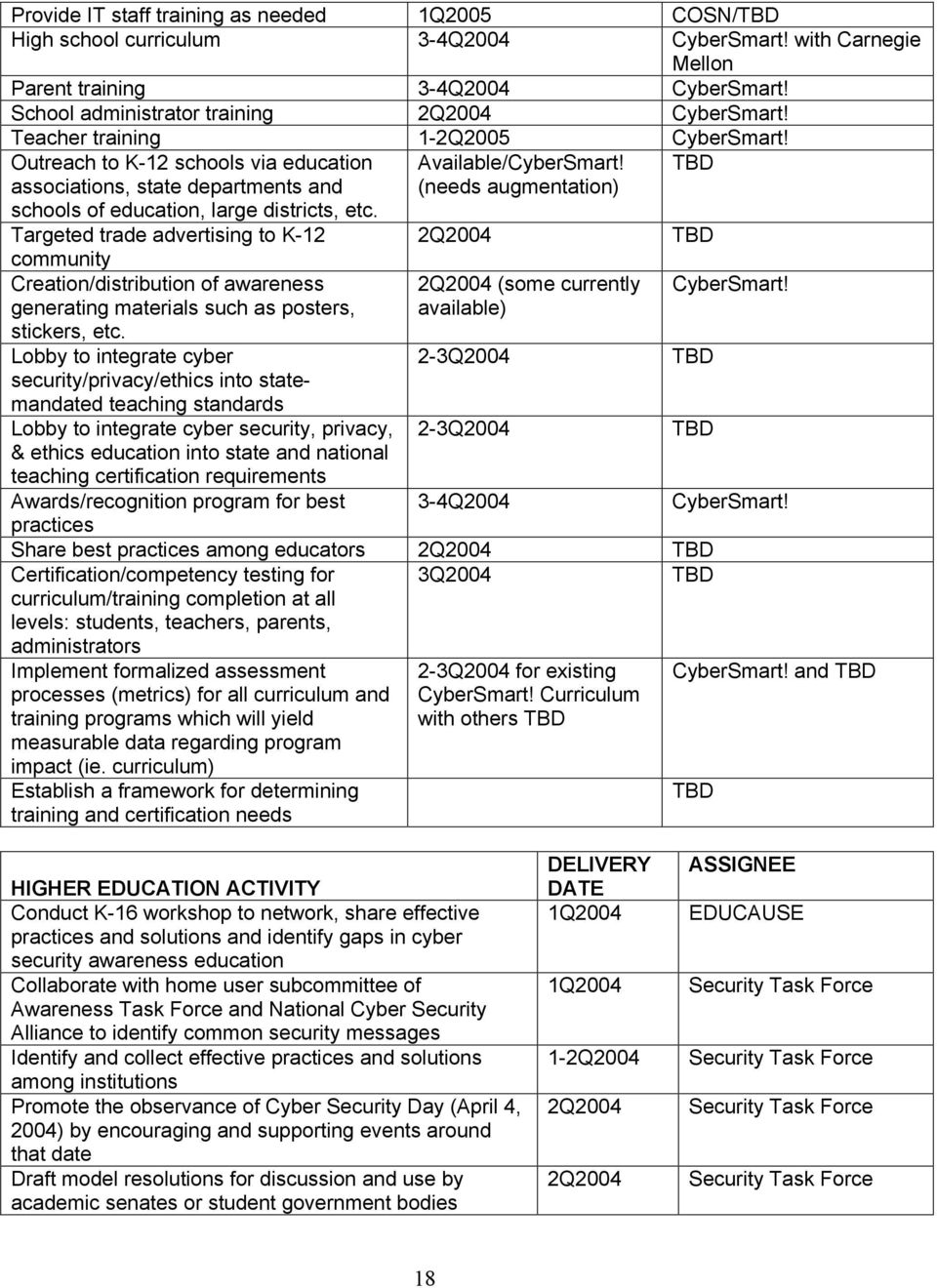
17 Work areas specific to higher education Resource Development Identify common problems and solutions to be converted into messages that will be common across user groups and organizational entities. Create and provide a model cyber security awareness programs for higher education. This will provide a template that the institution can customize to meet its individual needs. For example, a set of orientation materials that could be conveyed to first year students. Develop awareness content (e.g., web pages, posters, videos, etc.) that could be re-used by multiple institutions. Encourage collaboration and sharing of resources between academic programs (e.g., Centers for Academic Excellence in Information Assurance Education) and the operational needs to improve user awareness Outreach Executive awareness: to include governing boards and senior administrators All users baseline security awareness Information Assurance function share best practices and models for team of individuals: IT security officer, risk manager, legal counsel, auditor, campus police or public safety, etc. Business functions address security considerations that affect collection, maintenance, and use of sensitive or confidential data Provide awareness programs targeted to students: to include residential students and as part of orientation or academic programs Provide awareness programs targeted to faculty both as users of technology and as teachers who can influence student behavior Provide awareness programs targeted to staff, especially consistent with their administrative function within the institution IT staff training and professional identify and promote critical skills and competencies needed and identify or develop training programs Continuity of Message There should be a continuity of cyber security messages created by all Tasks Forces. For example, a set of cyber security tips adapted in an education program must not conflict with the messages communicated to home users, small businesses, enterprise employees, etc. Action Agenda The preliminary action agenda below includes projects already in place, along with new items to be developed and completed per the following schedule. The working group will leverage existing initiatives wherever possible (e.g., Consortium of School Networking (COSN), CyberSmart!, EDUCAUSE/Internet2 Computer and Network Security Task Force) with a concerted effort to involve stakeholders and players who provide value. K-12 ACTIVITY DELIVERY DATE ASSIGNEE K-middle school curriculum Available/CyberSmart! CyberSmart! Identify and collect effective practices and solutions for training of IT staff 1Q2005 COSN/TBD 17

18 Provide IT staff training as needed 1Q2005 COSN/TBD High school curriculum 3-4Q2004 CyberSmart! with Carnegie Mellon Parent training 3-4Q2004 CyberSmart! School administrator training 2Q2004 CyberSmart! Teacher training 1-2Q2005 CyberSmart! Outreach to K-12 schools via education associations, state departments and schools of education, large districts, etc. Targeted trade advertising to K-12 community Creation/distribution of awareness generating materials such as posters, stickers, etc. Lobby to integrate cyber security/privacy/ethics into statemandated teaching standards Lobby to integrate cyber security, privacy, & ethics education into state and national teaching certification requirements Available/CyberSmart! (needs augmentation) 2Q2004 2Q2004 (some currently available) TBD TBD 2-3Q2004 TBD 2-3Q2004 TBD CyberSmart! Awards/recognition program for best 3-4Q2004 CyberSmart! practices Share best practices among educators 2Q2004 TBD Certification/competency testing for curriculum/training completion at all levels: students, teachers, parents, administrators 3Q2004 TBD Implement formalized assessment processes (metrics) for all curriculum and training programs which will yield measurable data regarding program impact (ie. curriculum) Establish a framework for determining training and certification needs 2-3Q2004 for existing CyberSmart! Curriculum with others TBD CyberSmart! and TBD TBD HIGHER EDUCATION ACTIVITY Conduct K-16 workshop to network, share effective practices and solutions and identify gaps in cyber security awareness education Collaborate with home user subcommittee of Awareness Task Force and National Cyber Security Alliance to identify common security messages Identify and collect effective practices and solutions among institutions Promote the observance of Cyber Security Day (April 4, 2004) by encouraging and supporting events around that date Draft model resolutions for discussion and use by academic senates or student government bodies DELIVERY ASSIGNEE DATE 1Q2004 EDUCAUSE 1Q2004 Security Task Force 1-2Q2004 Security Task Force 2Q2004 Security Task Force 2Q2004 Security Task Force 18
19 Establish a Cyber Security newsletter for higher 2Q2004 Security Task Force education Highlight effective practices and solutions during 2Q2004 Security Task Force EDUCAUSE and Internet2 Security Professionals Workshop Sharing effective practices and solutions among 2-3Q2004 Security Task Force institutions Establish a Speakers Bureau for cyber security 2-3Q2004 Security Task Force awareness Develop and disseminate a Security Awareness Toolkit 3Q2004 Security Task Force for colleges and universities Develop an awareness video for college and university 3Q2004 Security Task Force executives Inventory practices and highlight effective practices and solutions for K-12 teacher education & awareness 3Q2004 Security Task Force & COSN Establish a student contest for the development of an 3-4Q2004 Security Task Force awareness video targeted to students that can be reused by multiple institutions Identify and collect effective practices and solutions for 4Q2004 Security Task Force training of IT staff Create model cyber security awareness curriculum 4Q2004 Security Task Force Conduct a pre-conference seminar on how to conduct 4Q2004 Security Task Force security education and awareness at EDUCAUSE2004 Promote the observance of Cyber Security Day 4Q2004 Security Task Force (October 31, 2004) by encouraging and supporting events around that date Establish an easy-to-replicate tool and database of 1Q2005 Security Task Force questions for the establishment of an online quiz Establish or adopt an online tutorial and selfassessment 1Q2005 Security Task Force instrument for general user education Implement formalized assessment processes (metrics) for curriculum and awareness programs which will yield 1Q2005 Security Task Force measurable data regarding program impact Awards/recognition programs for best practices 2-3Q2005 EDUCAUSE Objective to double number of institutions with cyber security awareness programs in place 2Q3Q2005 Security Task Force 19

20 Working Group Members Dena Haritos Tsamitis, Carnegie Mellon CyLab and Information Networking Institute Jim Teicher, CyberSmart! Rodney Petersen, Educause Charles Livingston, National Defense University Barbara Laswell, SEI/CERT EDUCAUSE Workshop Participants Raymond Albert, University of Maine at Fort Kent Robin Anderson, University of Maryland, Baltimore County Cedric Bennett, Stanford University Kelley Bogart, University of Arizona Mark Bruhn, Indiana University Paige Buechley, Texas State Auditor s Office Daniel Caprio, Federal Trade Commission David Escalante, Boston College Amy Ginther, University of Maryland Melissa Guenter, Consultant Tiffany Olson Jones, Symantec Corporation Lance Jordan, Rutgers University Richard Lesniak, University at Buffalo Mark Luker, EDUCAUSE Vic Macaonachy, National Security Agency Peter Martino, U.S. Department of Homeland Security Jeffrey McCabe, Texas A&M University Steve Miller, Consortium on School Networking/Mass Networks Education Partnership Shirley Payne, University of Virginia Rodney Petersen, EDUCAUSE Davina Pruitt-Mentle, University of Maryland Corey Schou, Idaho State University Chris Seiberling, Consortium on School Networking/Mass Networks Education Partnership Jack Suess, University of Maryland, Baltimore County Elizabeth Sweet, University of Michigan Jim Teicher, CyberSmart Dena Haritos Tsamitis, Carnegie Mellon University Valerie Vogel, EDUCAUSE/Internet2 Calvin Weeks, University of Oklahoma 20
21 Select List of Cyber Security Awareness Activities Industry The American Institute of Certified Public Accountants This links to a paper that addresses the role of CPAs in information security. The American Institute of Certified Public Accountants is the national, professional organization for all Certified Public Accountants. Its mission is to provide members with the resources, information, and leadership that enable them to provide valuable services in the highest professional manner to benefit the public as well as employers and clients. The Business Roundtable The Business Roundtable's Digital Economy Task Force has produced a resource to help CEOs and their senior executives develop a robust, effective program to protect their business as they incorporate sophisticated information systems into their operations. The resource includes recommendations for furthering corporate cyber security programs; a depiction of the need for not just technology but also policy issues in a successful program; and a list of key government contacts and Internet sites with more information on cyber security. Access the resource at The Business Software Alliance The Business Software Alliance (BSA), with programs in 65 countries worldwide, is dedicated to promoting a safe and legal digital world. BSA is the voice of the world's commercial software industry before governments and in the international marketplace. BSA also educates consumers on software management and copyright protection, cyber security, trade, e-commerce and other Internet-related issues. Visit their security page: Center for Internet Security CIS provides methods and tools to improve, measure, monitor, and compare the security status of Internet-connected systems and appliances. The Information Technology Association of America ITAA seeks to improve the information security of the nation's critical information infrastructure in both the private and public sectors. This site includes links to news articles, press releases and reports. The Institute of Internal Auditors The IIA and its partners released Information Security Management and Assurance: A Call to Action for Corporate Governance. The report advises board members to pay attention to information security issues, stating the Internet introduces new risks to every 21
22 organization. It contains 10 questions board members should ask in assessing the state of information security within the organizations they govern. The Internet Security Alliance The Internet Security Alliance is a collaborative effort between Carnegie Mellon s CERT Coordination Center and the Electronic Industries Alliance to promote sound information security practices, policies, and technologies that enhance the security of the Internet and global information systems. The ISA recently released a guide to 10 of the highest priority and most frequently recommended security practices for business. Government Computer Crime and Intellectual Property Section, U.S. Department of Justice The Computer Crime and Intellectual Property Section ( CCIPS ) attorney staff focus exclusively on the issues raised by computer and intellectual property crime. Section attorneys advise federal prosecutors and law enforcement agents; comment upon and propose legislation; coordinate international efforts to combat computer crime; litigate cases; and train all law enforcement groups. This website includes lesson plans and information for kids on cyberethics at: The Federal Trade Commission The Federal Trade Commission has created this website for consumers and businesses as a source of information about computer security and safeguarding personal information. National Institute of Standards and Technology Computer Security Resource Center's Small Business Corner The mission of NIST's Computer Security Division is to improve information systems security. This site focuses on resources for small businesses. The National Strategy to Secure Cyberspace The National Strategy to Secure Cyberspace, an implementing component of the National Strategy for Homeland Security, is part of the White House's overall effort to protect the Nation. The purpose of this document is to engage and empower Americans to secure the portions of cyberspace that they own, operate, or control, or with which they interact. U.S. Department of Education Internet Safety Page The Education Department's Office of Educational Technology works to assist the education community with meeting the national goals for educational technology. 22
23 United States Postal Service The United States Postal Service offers a Web site with information about its comprehensive privacy framework. The site also provides links to other resources and tools dealing with a host of privacy issues. Visit their Privacy Office: The World Bank To educate policy makers, businesses, consumers of financial services, and others involved in E-finance and E-commerce, the World Bank offers an E-security Site focusing on the complex trade-offs and actions needed to manage the risks of fraud and of compromising the security of digital assets. The site includes links to the World Bank's conferences, including its September 2002 seminar, Global Dialogue E-Security: Risk Mitigation in Financial Transactions, and also serves as a clearinghouse for knowledge on managing the risks associated with open network architectures. Non Profits and Partnerships The Asia Oceania Electronic Marketplace Association The Asia Oceania Electronic Marketplace Association (AOEMA) was formed to promote the use of electronic commerce in the Asian region. Working closely with Asia-Pacific Economic Cooperation, AOEMA has done a number of projects on the barriers to electronic commerce, including this booklet to help you protect yourself when using the internet: BBBOnLine BBBOnLine is the arm of the Council of Better Business Bureaus that specifically deals with web sites. Working in concert with the 142 local BBBs in the United States and Canada, BBBOnLine encourages sound and ethical online business practices through its Privacy program, Reliability program, BBB Code of Online Business Practices, and an international initiative to promote safe e-commerce. CERT Coordination Center s Home Network Security Tips The CERT Coordination Center (CERT/CC) is a center of Internet security expertise, located at the Software Engineering Institute, a federally funded research and development center operated by Carnegie Mellon University. CERT s information ranges from protecting your system against potential problems to reacting to current problems to predicting future problems. Consumerreports.org Consumer Reports' Cyberspace Invaders site includes practical advice for consumers and a link to CR's online subscriber security survey. It also includes consumer security product ratings. 23
24 The Cyber Citizen Partnership The Cybercitizen Awareness Program educates children and young adults on the dangers and consequences of cyber crime. By reaching out to parents and teachers, the program is designed to establish a broad sense of responsibility and community in an effort to develop in young people smart, ethical, and socially conscious online behavior. CyberSmart! CyberSmart! provides a comprehensive set of free lesson plans, student activities, and related materials for teachers and families to introduce the skills associated with 21st Century literacy, citizenship, and ethics. These skills provide the building blocks in order for children to be safe, responsible, and effective 21st Century citizens and learners. To access the CyberSmart! Curriculum, click here. GetNetWise -- About Security The GetNetWise.org security section was established to deliver information and materials to consumers to protect their information and networks from theft, misuse and destruction. The site includes tutorials on how to use common software programs to enhance security and privacy. The National Center for Missing and Exploited Children s NetSmartz Workshop The NetSmartz Workshop is an educational resource for children of all ages, parents and teachers on how to stay safer on the Internet. NetSmartz is a project of the National Center for Missing and Exploited Children and Compaq. National Cyber Security Alliance The National Cyber Security Alliance is a cooperative effort between industry and government organizations to foster awareness of cyber security through educational outreach and public awareness. NetSafeKids NetSafeKids is produced by the National Research Council of the National Academies. The site offers essential information and practical tips that will help parents and adults make more informed decisions about how children spend time online. Organisation for Economic Co-Operation and Development OECD governments have drawn up new Guidelines for the Security of Information Systems and Networks in the wake of last year's September 11 attacks in the United States, in order to counter cyberterrorism, computer viruses, hacking and other threats. 24
25 Top 10 Cyber Security Tips 1. Use anti-virus software and keep it up to date. Make sure you have anti-virus software on your computer! Anti-virus software is designed to protect you and your computer against known viruses so you don t have to worry. But with new viruses emerging daily, anti-virus programs need regular updates, like annual flu shots, to recognize these new viruses. Be sure to update your anti-virus software regularly! The more often you keep it updated, say once a week, the better. Check with the web site of your anti-virus software company to see some sample descriptions of viruses and to get regular updates for your software. Stop viruses in their tracks! 2. Don t open or attachments from unknown sources. Be suspicious of any unexpected attachments even if it appears to be from someone you know. A simple rule of thumb is that if you don't know the person who is sending you an , be very careful about opening the and any file attached to it. Should you receive a suspicious , the best thing to do is to delete the entire message, including any attachment.. If you are determined to open a file from an unknown source, save it first and run your virus checker on that file, but also understand that there is still a risk. If the mail appears to be from someone you know, still treat it with caution if it has a suspicious subject line (e.g. Iloveyou or Anna Kounikova ) or if it ortherwise seems suspicious (e.g., it was sent in the middle of the night). Also be careful if you receive many copies of the same message from either known or unknown sources. Finally, remember that even friends and family may accidentally send you a virus or the may have been sent from their machines without their knowledge. Such was the case with the "I Love You" virus that spread to millions of people in When in doubt, delete! If you receive an from a trusted vendor or organization, be careful of phishing, a hightech scam used to deceive consumers into providing personal data, including credit card numbers, etc. For information about phishing go to the FTC document titiled How Not to Get Hooked By a Phishing Scam, The best way to make sure you re dealing with a merchant you trust, and not a fraudster, is to initiate the contact yourself. Type the merchant s address into your Internet browser instead of clicking on a link in an . 25
26 3. Protect your computer from Internet intruders use firewalls. Equip your computer with a firewall! Firewalls create a protective wall between your computer and the outside world. They come in two forms, software firewalls that run on your personal computer and hardware firewalls that protect a number of computers at the same time. They work by filtering out unauthorized or potentially dangerous types of data from the Internet, while still allowing other (good) data to reach your computer. Firewalls also ensure that unauthorized persons can t gain access to your computer while you re connected to the Internet. You can find firewall hardware and software at most computer stores and in some operating systems. Don t let intruders in! 4. Regularly download security updates and patches for operating systems and other software. Most major software companies today release updates and patches to close newly discovered vulnerabilities in their software. Sometimes bugs are discovered in a program that may allow a criminal hacker to attack your computer. Before most of these attacks occur, the software companies or vendors create free patches for you that they post on their web sites. You need to be sure you download and install the patches! Check your software vendors web sites regularly for new security patches or use the automated patching features that some companies offer. Ensure that you are getting patches from the correct patch update site. Many systems have been compromised this past year by installing patches obtained from bogus update sites or s that appear to be from a vendor that provides links to those bogus sites. If you don t have the time to do the work yourself, download and install a utility program to do it for you. There are available software programs that can perform this task for you. Stay informed! 5. Use hard-to-guess passwords. Mix upper case, lower case, numbers, or other characters not easy to find in a dictionary, and make sure they are at least eight characters long. Passwords will only keep outsiders out if they are difficult to guess! Don t share your password, and don t use the same password in more than one place. If someone should happen to guess one of your passwords, you don t want them to be able to use it in other places. The golden rules of passwords are: (1) A password should have a minimum of 8 characters, be as meaningless as possible, and use uppercase letters, lowercase letters, symbols and numbers, e.g., xk2&lp97. (2) Change passwords regularly, at least every 90 days. (3) Do not give out your password to anyone! For enhanced security, use some form of two-factor authentication. Two-factor authentication is a way to gain access by combining something you know (PIN) with something you have (token or smart card). 6. Back up your computer data. Experienced computer users know that there are two types of people: those who have already lost data and those who are going to experience the pain of losing data in the future. Back up small amounts of data on floppy disks and larger amounts on CDs. If you have access to a network, save copies of your data on another computer in the network. Many people make weekly backups of all their important data. And make sure you have your original software start-up disks handy and available in the event your computer system files get damaged. Be prepared! 26
27 7. Don t share access to your computers with strangers. Learn about file sharing risks. Your computer operating system may allow other computers on a network, including the Internet, to access the hard-drive of your computer in order to share files. This ability to share files can be used to infect your computer with a virus or look at the files on your computer if you don t pay close attention. So, unless you really need this ability, make sure you turn off file-sharing. Check your operating system and your other program help files to learn how to disable file sharing. Don t share access to your computer with strangers! 8. Disconnect from the Internet when not in use. Remember that the Digital Highway is a two-way road. You send and receive information on it. Disconnecting your computer from the Internet when you re not online lessens the chance that someone will be able to access your computer. And if you haven t kept your anti-virus software up-to-date, or don t have a firewall in place, someone could infect your computer or use it to harm someone else on the Internet. and help protect others: disconnect! 9. Check your security on a regular basis. When you change your clocks for daylight-savings time, reevaluate your computer security. The programs and operating system on your computer have many valuable features that make your life easier, but can also leave you vulnerable to hackers and viruses. You should evaluate your computer security at least twice a year do it when you change the clocks for daylight-savings! Look at the settings on applications that you have on your computer. Your browser software, for example, typically has a security setting in its preferences area. Check what settings you have and make sure you have the security level appropriate for you. Set a high bar for yourself! 10. Make sure your family members and/or your employees know what to do if your computer becomes infected. It s important that everyone who uses a computer be aware of proper security practices. People should know how to update virus protection software, how to download security patches from software vendors and how to create a proper password. Make sure they know these tips too! 27
28 Awareness and Outreach Task Force Membership List Name Scott Algeier Michael Allred Blake Bishop Dan Caprio Lara Chamberlain Larry Clinton Charles Curran Tom Dailey Chris Dixon Sue Giatras Bill Guidera, Michael Gusky Kai Tamara Hare James Holt Andrew Howell Jay Hoyer Commerce Tracy Hulver Doug Johnson Marc Jones Tiffany Jones Tom Kellermann Irene Kinoshita, Jeff Klaben Charlie Le Grand Charles Livingston Dan Lohrmann Louis Malafarina Dan McCall Stuart McKee Time McNulty Steven Miller Partnership Mell Mireles Krista Montie Margaret Morrissey Wil Pelgrin Rodney Petersen David Peyton Manufacturers Lynne Pizzini, Debra Reiger, Joe Richardson Larry Rogers Organization U. S Chamber of Commerce State of Utah State of Florida Federal Trade Commission NFIB Internet Security Alliance United States Internet Service Providers Association United States Internet Service Providers Association NASCIO State of Utah Microsoft Corporation State of Louisiana nuserve Saber Security Solutions U.S. Chamber of Commerce Walnut Creek Chamber of TruSecure American Bankers Association Visionael Corp. Symantec Corporation The World Bank Tysak Applied Materials The Institute of Internal Auditors, Inc. National Defense University State of Michigan Public Intelligence Guardent State of Washington AirZip Mass Networks Education State of Texas, Department of Information Resource State of New York, CSCIC State of New York, CSCIC State of New York, CSCIC EDUCAUSE National Association of State of Montana State of California U.S. Department of State Software Engineering Institute 28
29 Awareness and Outreach Task Force Membership List (cont) Name Mike Russo Ty Sagalow Howard Schmidt Chris Seiberling Arnie Shimo Patty Strickland Jim Teicher Dena Tsamitis Ken Watson Donald Wilborn Vic Winkler Todd Wittbold Organization State of Florida American International Group e-bay Mass Networks Education Partnership Lockheed Martin Information Technology Patty, State of Florida CyberSmart! Carnegie Mellon CyLab & INI Cisco Systems, Inc. Donald, U.S. Secret Service Sun Microsystems The MITRE Corporation 29
MARYLAND. Cyber Security White Paper. Defining the Role of State Government to Secure Maryland s Cyber Infrastructure.
 MARYLAND Cyber Security White Paper Defining the Role of State Government to Secure Maryland s Cyber Infrastructure November 1, 2006 Robert L. Ehrlich, Jr., Governor Michael S. Steele, Lt. Governor Message
Priority III: A National Cyberspace Security Awareness and Training Program
 Priority III: A National Cyberspace Security Awareness and Training Program Everyone who relies on part of cyberspace is encouraged to help secure the part of cyberspace that they can influence or control.
NASCIO 2014 State IT Recognition Awards
 NASCIO 2014 State IT Recognition Awards Project: California Cybersecurity Task Force Category: Cybersecurity Initiatives Project Initiation Date: September, 2012 Project Completion Date: May 2013 Carlos
PRO-NET. A Publication of Building Professional Development Partnerships for Adult Educators Project. April 2001
 Management Competencies and Sample Indicators for the Improvement of Adult Education Programs A Publication of Building Professional Development Partnerships for Adult Educators Project PRO-NET April 2001
Legislative Council Panel on Information Technology and Broadcasting. Hacking and Virus Activities and Preventive Measures
 For discussion on 12 June 2000 Legislative Council Panel on Information Technology and Broadcasting Hacking and Virus Activities and Preventive Measures Purpose This paper briefs Members on the common
YOUR PRESENTERS TODAY S WORLD. Maryly Skallos Technology Coordinator St. Thomas the Apostle School [email protected]
 CYBER SAFETY, CYBER ETHICS, CYBER SECURITY How to teach the kids about these concepts (a primer from staysafeonline.org program that is available free from the website) YOUR PRESENTERS Maryly Skallos Technology
Actions and Recommendations (A/R) Summary
 Actions and Recommendations (A/R) Summary Priority I: A National Cyberspace Security Response System A/R 1-1: DHS will create a single point-ofcontact for the federal government s interaction with industry
STATE OF NEW HAMPSHIRE STRATEGIC PLAN TO ADDRESS CYBER CRIME
 STATE OF NEW HAMPSHIRE STRATEGIC PLAN TO ADDRESS CYBER CRIME MAY 2004 Page 1 of 7 State of New Hampshire Strategic Plan to Address Cyber Crime May 2004 Introduction Cyber crime, or more broadly, electronic
Cybersecurity Report on Small Business: Study Shows Gap between Needs and Actions
 SURVEY REPORT: cyber security Cybersecurity Report on Small Business: Study Shows Gap between Needs and Actions Confidence in a connected world. Executive summary An online survey revealed that while U.S.
CYBER SECURITY. ADVISORY SERVICES Governance Risk & Compliance. Shemrick Rodney IT Specialist Consultant Antigua & St. Kitts
 CYBER SECURITY ADVISORY SERVICES Governance Risk & Compliance Shemrick Rodney IT Specialist Consultant Antigua & St. Kitts The Financial Services Industry at Crossroads: Where to From Here? WELCOME What
How To Write A National Cybersecurity Act
 ROCKEFELLER SNOWE CYBERSECURITY ACT SUBSTITUTE AMENDMENT FOR S.773 March 17, 2010 BACKGROUND & WHY THIS LEGISLATION IS IMPORTANT: Our nation is at risk. The networks that American families and businesses
Atlantic Provinces Community College Consortium Business Plan 2005-2006
 Atlantic Provinces Community College Consortium Business Plan 2005-2006 2 Table of Contents 1.0 Introduction.....3 2.0 The Planning Context..... 4 2.1 Vision and Mission..4 2.2 Strategic Planning Themes...4
TESTIMONY OF BARRY R. WIDES DEPUTY COMPTROLLER FOR COMMUNITY AFFAIRS OFFICE OF THE COMPTROLLER OF THE CURRENCY BEFORE THE
 For Release Upon Delivery 10:00 a.m., April 15, 2008 TESTIMONY OF BARRY R. WIDES DEPUTY COMPTROLLER FOR COMMUNITY AFFAIRS OFFICE OF THE COMPTROLLER OF THE CURRENCY BEFORE THE COMMITTEE ON FINANCIAL SERVICES
INTERENT SAFETY AND RESPONSIBILITY CYBER SECURITY
 INTERENT SAFETY AND RESPONSIBILITY CYBER SECURITY Note: This section can be taught by the technology teacher or classroom teachers with support from the librarian. Contents: 1. Introduction and Essential
Westlaw Journal. What is the Cybersecurity Framework? Risk Management Process And Pathway to Corporate Liability? Expert Analysis
 Westlaw Journal Computer & Internet Litigation News and Analysis Legislation Regulation Expert Commentary VOLUME 31, ISSUE 14 / DECEMBER 12, 2013 Expert Analysis The Cybersecurity Framework: Risk Management
Integrating Cybersecurity with Emergency Operations Plans (EOPs) for Institutions of Higher Education (IHEs)
 Integrating Cybersecurity with Emergency Operations Plans (EOPs) for Institutions of Higher Education (IHEs) Amy Banks, U.S. Department of Education, Center for School Preparedness, Office of Safe and
i-safe K 12 CURRICULUM SCOPE 06-07
 i-safe K 12 CURRICULUM SCOPE 06-07 GRADES K 4 Scope and sequence i-safe materials are available in topic modules to provide the teacher with flexibility in creating a program of instruction that best suits
The Computerworld Honors Program
 The Computerworld Honors Program Honoring those who use Information Technology to benefit society Status: Laureate Final Copy of Case Study Year: 2013 Organization Name: Cybersecurity and Infrastructure
Federal Bureau of Investigation s Integrity and Compliance Program
 Evaluation and Inspection Division Federal Bureau of Investigation s Integrity and Compliance Program November 2011 I-2012-001 EXECUTIVE DIGEST In June 2007, the Federal Bureau of Investigation (FBI) established
SUSTAINABILITY. Goal: Sustain environmental literacy by ensuring effective implementation of the 2010 Environmental Literacy for Illinois Plan.
 SUSTAINABILITY Goal: Sustain environmental literacy by ensuring effective implementation of the 2010 Environmental Literacy for Illinois Plan. Objectives: 1. Develop an educated populace that will preserve,
DEOSNEWS Volume 14 Number 1 January 2005. 14:1 Interview with Tim Stroud, President and CEO of the North American Council for Online Learning (NACOL)
 DEOSNEWS Volume 14 Number 1 January 2005 14:1 Interview with Tim Stroud, President and CEO of the North American Council for Online Learning (NACOL) Editorial Online education in K-12 schools is a relatively
2014 STRATEGIC PLAN: INTRODUCTION
 2014 STRATEGIC PLAN: INTRODUCTION The Association of Inspectors General s Strategic Plan identifies our collective aspirations of what this organization may achieve in the years to come. It is designed
CYBER SECURITY GUIDANCE
 CYBER SECURITY GUIDANCE With the pervasiveness of information technology (IT) and cyber networks systems in nearly every aspect of society, effectively securing the Nation s critical infrastructure requires
Computer and Network Security in Higher Education
 Mark Luker and Rodney Petersen Computer and Network Security in Higher Education Mark Luker and Rodney Petersen, Editors A Publication of EDUCAUSE Copyright 2003 Jossey-Bass Inc. Published by Jossey-Bass,
California Counties Information Security Programs A look into the progress and future plans across counties
 CCISDA California Counties Information Services Directors Association California Counties Information Security Programs A look into the progress and future plans across counties 2010 Progress Report April
Computer and Network Security in Higher Education
 The Authors Computer and Network Security in Higher Education Mark Luker and Rodney Petersen, Editors A Publication of EDUCAUSE Copyright 2003 Jossey-Bass Inc. Published by Jossey-Bass, A Wiley Company.
Cyber Security Recommendations October 29, 2002
 Cyber Security Recommendations October 29, 2002 Leading Co-Chair (Asia/Oceania) Co-Chair (Americas) Co-Chair (Europe/Africa) Dr. Hiroki Arakawa Executive Vice President NTT Data Corporation Richard Brown
Cybersecurity: A Shared Responsibility and Department of Homeland Security Priority
 Cybersecurity: A Shared Responsibility and Department of Homeland Security Priority A Presentation to the National Cyberwatch Center November 20, 2015 Webinar Protocol :: Mute your phone/mic when not talking
University Libraries Strategic Goals and Objectives. extracted from: A Strategic Plan for the UNLV Libraries: 2005-2010.
 University Libraries Strategic Goals and Objectives extracted from: A Strategic Plan for the UNLV Libraries: 2005-2010 June 1, 2005 For a copy of the complete Libraries Strategic Plan, please contact the
GLOBAL BUSINESS DIALOGUE ON ELECTRONIC COMMERCE CYBER SECURITY AND CYBER CRIME SEPTEMBER 26, 2000. CEO EDS Corporation
 GLOBAL BUSINESS DIALOGUE ON ELECTRONIC COMMERCE CYBER SECURITY AND CYBER CRIME SEPTEMBER 26, 2000 Issue Chair: Issue Sherpa: Dick Brown CEO EDS Corporation Bill Poulos EDS Corporation Tel: (202) 637-6708
CERT/CC Overview & CSIRT Development Team Activities
 CERT/CC Overview & CSIRT Development Team Activities Georgia Killcrece CSIRT Development Team CERT Program Software Engineering Institute Carnegie Mellon University Pittsburgh, PA 15213-3890 October 2006
Integrating Cybersecurity with Emergency Operations Plans (EOPs) for K-12 Education
 Integrating Cybersecurity with Emergency Operations Plans (EOPs) for K-12 Education Amy Banks, U.S. Department of Education, Center for School Preparedness, Office of Safe and Healthy Students Hamed Negron-Perez,
Department of Homeland Security
 Department of Homeland Security Cybersecurity Awareness for Colleges and Universities EDUCAUSE Live! July 24, 2014 Overview Dramatic increase in cyber intrusions, data breaches, and attacks at institutions
Action Plan 2010-2015 for Canada s Cyber Security Strategy
 Action Plan -2015 for Canada s Cyber Security Strategy Her Majesty the Queen in Right of Canada, 2013 Cat: PS9-1/2013E-PDF ISBN: 978-1-100-21895-3 ii Introduction Information technology is highly integrated
Information Security: A Perspective for Higher Education
 Information Security: A Perspective for Higher Education A By Introduction On a well-known hacker website, individuals charged students $2,100 to hack into university and college computers for the purpose
Texas Infrastructure Council Planning and building the future for Texas' infrastructure
 TXIC Texas Infrastructure Council Planning and building the future for Texas' infrastructure Texas Infrastructure Council Mission To support state and local governments in the formation and implementation
JOB ANNOUNCEMENT. Chief Security Officer, Cheniere Energy, Inc.
 JOB ANNOUNCEMENT Chief Security Officer, Cheniere Energy, Inc. Position Overview The Vice President and Chief Security Risk Officer (CSRO) reports to the Chairman, Chief Executive Officer and President
UA Student Security Awareness/Anti- Phishing Campaign
 2013-14 PROJECT PROPOSAL Posted: 4/21/14 UA Student Security Awareness/Anti- Phishing Campaign OBJECTIVE: University students are attractive targets for identity thieves and hackers. According to the FTC
Guide to Building A Broad-Based Coalition
 Guide to Building A Broad-Based Coalition Supporting the Development and Sustainability of a System of Pathways DISTRICT FRAMEWORK TOOL 1.1.3 As communities across California commit to developing systems
For Discussion Paper No. 9/2011 on 3 November 2011 DIGITAL 21 STRATEGY ADVISORY COMMITTEE. Cyber Security
 For Discussion Paper No. 9/2011 on 3 November 2011 DIGITAL 21 STRATEGY ADVISORY COMMITTEE Cyber Security Purpose This paper briefs Members on the global cyber security outlook facing governments of some
Atlantic Cape Community College Branding Communication Plan
 Atlantic Cape Community College Branding Communication Plan STEP 1: Research: Capital campaign and branding research summary To determine whether Atlantic Cape Community College was ready to begin a capital
7 Homeland. ty Grant Program HOMELAND SECURITY GRANT PROGRAM. Fiscal Year 2008
 U.S. D EPARTMENT OF H OMELAND S ECURITY 7 Homeland Fiscal Year 2008 HOMELAND SECURITY GRANT PROGRAM ty Grant Program SUPPLEMENTAL RESOURCE: CYBER SECURITY GUIDANCE uidelines and Application Kit (October
National Cyber Security Awareness Month. Week Five: Building the Next Generation of Cyber Professionals
 National Cyber Security Awareness Month Week Five: Building the Next Generation of Cyber Professionals Webinar recording and evaluation survey This webinar is being recorded and will be made available
CYBERSECURITY BEST PRACTICES FOR SMALL AND MEDIUM PENNSYLVANIA UTILITIES
 CYBERSECURITY BEST PRACTICES FOR SMALL AND MEDIUM PENNSYLVANIA UTILITIES The information provided in this document is presented as a courtesy to be used for informational purposes only. This information
State of Minnesota. Enterprise Security Strategic Plan. Fiscal Years 2009 2013
 State of Minnesota Enterprise Security Strategic Plan Fiscal Years 2009 2013 Jointly Prepared By: Office of Enterprise Technology - Enterprise Security Office Members of the Information Security Council
Business Continuity for Cyber Threat
 Business Continuity for Cyber Threat April 1, 2014 Workshop Session #3 3:00 5:30 PM Susan Rogers, MBCP, MBCI Cyberwise CP S2 What happens when a computer program can activate physical machinery? Between
Cyber Security. CYBER SECURITY presents a major challenge for businesses of all shapes and sizes. Leaders ignore it at their peril.
 Cyber Security Personal and commercial information is the new commodity of choice for the virtual thief, argues Adrian Leppard, Commissioner for City of London Police, as he sets out the challenges facing
Appendix H3 Public Outreach
 Appendix H3 Public Outreach H3.1 Public Outreach Components There are a variety of components that will be needed in development of a comprehensive outreach campaign for the SMMP. Components will include:
Threats to Local Governments and What You Can Do to Mitigate the Risks
 Association of Minnesota Counties Threats to Local Governments and What You Can Do to Mitigate the Risks Andrew Dolan Director of Government Affairs Multi-State Information Sharing and Analysis Center()
Experience the commitment WHITE PAPER. Information Security Continuous Monitoring. Charting the Right Course. cgi.com 2014 CGI GROUP INC.
 Experience the commitment WHITE PAPER Information Security Continuous Monitoring Charting the Right Course May 2014 cgi.com 2014 CGI GROUP INC. During the last few months of 2013, six federal agencies
Comprehensive i-safe Curriculum International Scope of Lessons and Language Availability
 Comprehensive i-safe Curriculum International Scope of Lessons and Language Availability The i-safe comprehensive curriculum provides a unique approach to Internet safety education, by meaningfully integrating
[STAFF WORKING DRAFT]
![[STAFF WORKING DRAFT]](/thumbs/24/2919786.jpg "[STAFF WORKING DRAFT]") S:\LEGCNSL\LEXA\DOR\OI\PARTIAL\CyberWD..xml [STAFF WORKING DRAFT] JULY, 0 SECTION. TABLE OF CONTENTS. The table of contents of this Act is as follows: Sec.. Table of contents. Sec.. Definitions. TITLE
S:\LEGCNSL\LEXA\DOR\OI\PARTIAL\CyberWD..xml [STAFF WORKING DRAFT] JULY, 0 SECTION. TABLE OF CONTENTS. The table of contents of this Act is as follows: Sec.. Table of contents. Sec.. Definitions. TITLE
TESTIMONY OF VALERIE ABEND SENIOR CRITICAL INFRASTRUCTURE OFFICER OFFICE OF THE COMPTROLLER OF THE CURRENCY. Before the
 For Release Upon Delivery 10:00 a.m., December 10, 2014 TESTIMONY OF VALERIE ABEND SENIOR CRITICAL INFRASTRUCTURE OFFICER OFFICE OF THE COMPTROLLER OF THE CURRENCY Before the COMMITTEE ON BANKING, HOUSING,
2 Gabi Siboni, 1 Senior Research Fellow and Director,
 Cyber Security Build-up of India s National Force 2 Gabi Siboni, 1 Senior Research Fellow and Director, Military and Strategic Affairs and Cyber Security Programs, Institute for National Security Studies,
Internet Safety and Security: Strategies for Building an Internet Safety Wall
 Internet Safety and Security: Strategies for Building an Internet Safety Wall Sylvanus A. EHIKIOYA, PhD Director, New Media & Information Security Nigerian Communications Commission Abuja, NIGERIA Internet
National Cyber Security Policy -2013
 National Cyber Security Policy -2013 Preamble 1. Cyberspace 1 is a complex environment consisting of interactions between people, software and services, supported by worldwide distribution of information
Engineering our Future New Jersey: Partnerships, the Critical Element
 Engineering our Future New Jersey: Partnerships, the Critical Element Elisabeth McGrath, Stevens Institute of Technology Dawna Schultz, Stevens Institute of Technology Abstract: Engineering Our Future
Chemical Sector Cyber Security Program
 Chemical Sector Cyber Security Program Christine Adams, Director, Chemical Sector Cyber Security Program Neil Hershfield, Director, CIDX Cyber Security Initiative Cyber Security Program Leadership Executive
CYBER INFORMATION SECURITY AWARENESS AND PROTECTION PRACTICES. Strengthening Your Community at the Organizational Level
 CYBER INFORMATION SECURITY AWARENESS AND PROTECTION PRACTICES Strengthening Your Community at the Organizational Level Las Vegas, Nevada 2012 Security Awareness and Why is it Important? In today s economic
Enterprise Security Tactical Plan
 Enterprise Security Tactical Plan Fiscal Years 2011 2012 (July 1, 2010 to June 30, 2012) Prepared By: State Chief Information Security Officer The Information Security Council State of Minnesota Enterprise
AOPA'S GUIDE TO CANDIDATE FORUMS. stand on issues important to General Aviation. A guide to help pilots discover where candidates
 AOPA'S GUIDE TO CANDIDATE FORUMS A guide to help pilots discover where candidates stand on issues important to General Aviation What is a Candidate Forum? A candidate forum is an event hosted by a community
BUSINESS SECTOR STRATEGY:
 BUSINESS SECTOR STRATEGY: MEDICAL TECHNOLOGY Created with: MEDEC - CANADA S MEDICAL TECHNOLOGY COMPANIES February 2011 Open for Business is Ontario s initiative to create faster, smarter and streamlined
SALEM AREA ONE COMMUNITY INITIATIVE
 SALEM AREA ONE COMMUNITY INITIATIVE Mission Statement To develop a safe, respectful, all-inclusive community through education, advocacy, and coordinated actions that include an effective response to prejudice
The FBI Cyber Program. Bauer Advising Symposium //UNCLASSIFIED
 The FBI Cyber Program Bauer Advising Symposium October 11, 2012 Today s Agenda What is the threat? Who are the adversaries? How are they attacking you? What can the FBI do to help? What can you do to stop
DHS, National Cyber Security Division Overview
 DHS, National Cyber Security Division Overview Hun Kim, Deputy Director Strategic Initiatives Information Analysis and Infrastructure Protection Directorate www.us-cert.gov The strategy of DHS, as defined
RWWL 2010-2015 STRATEGIC PLAN: Building a 21st Century Learning Community Advancing the Academic Village
 RWWL 2010-2015 STRATEGIC PLAN: Building a 21st Century Learning Community Advancing the Academic Village Clark Atlanta University Interdenominational Theological Center Morehouse College Spelman College
Statement National Strategy for Trusted Identities in Cybersecurity Creating Options for Enhanced Online Security and Privacy
 Statement National Strategy for Trusted Identities in Cybersecurity Creating Options for Enhanced Online Security and Privacy We thank the administration for this valuable opportunity to engage in a national
Presidential Summit Reveals Cybersecurity Concerns, Trends
 Portfolio Media. Inc. 860 Broadway, 6th Floor New York, NY 10003 www.law360.com Phone: +1 646 783 7100 Fax: +1 646 783 7161 [email protected] Presidential Summit Reveals Cybersecurity Concerns,
PREPARED TESTIMONY OF THE NATIONAL CYBER SECURITY ALLIANCE MICHAEL KAISER, EXECUTIVE DIRECTOR ON THE STATE OF CYBERSECURITY AND SMALL BUSINESS
 PREPARED TESTIMONY OF THE NATIONAL CYBER SECURITY ALLIANCE MICHAEL KAISER, EXECUTIVE DIRECTOR ON THE STATE OF CYBERSECURITY AND SMALL BUSINESS BEFORE THE COMMITTEE ON HOUSE SMALL BUSINESS SUBCOMMITTEE
NGA Paper. Act and Adjust: A Call to Action for Governors. for cybersecurity;
 NGA Paper Act and Adjust: A Call to Action for Governors for Cybersecurity challenges facing the nation. Although implementing policies and practices that will make state systems and data more secure will
SECURE AND TRUSTWORTHY CYBERSPACE (SaTC)
 SECURE AND TRUSTWORTHY CYBERSPACE (SaTC) Overview The Secure and Trustworthy Cyberspace (SaTC) investment is aimed at building a cybersecure society and providing a strong competitive edge in the Nation
Draft. Graduate Education Strategic Plan. Contents. DRAFT September 29, 2014
 Graduate Education Strategic Plan Contents Vision... 3 Mission... 3 Guiding Principles... 3 Graduate Education at Georgia Tech... 4 Strategic Goals... 5 Goal 1: Deliver an educational experience that is
Vendor Risk Management Financial Organizations
 Webinar Series Vendor Risk Management Financial Organizations Bob Justus Chief Security Officer Allgress Randy Potts Managing Consultant FishNet Security Bob Justus Chief Security Officer, Allgress Current
Cyber Incident Annex. Cooperating Agencies: Coordinating Agencies:
 Cyber Incident Annex Coordinating Agencies: Department of Defense Department of Homeland Security/Information Analysis and Infrastructure Protection/National Cyber Security Division Department of Justice
Preventing and Defending Against Cyber Attacks November 2010
 Preventing and Defending Against Cyber Attacks November 2010 The Nation s first ever Quadrennial Homeland Security Review (QHSR), delivered to Congress in February 2010, identified safeguarding and securing
Statement of. Mike Sena. President, National Fusion Center Association. Director, Northern California Regional Intelligence Center (NCRIC)
 Statement of Mike Sena President, National Fusion Center Association Director, Northern California Regional Intelligence Center (NCRIC) Joint Hearing of the Subcommittee on Emergency Preparedness, Response,
2015-2016 BUSINESS PLAN
 2015-2016 BUSINESS PLAN Purpose of the Plan This annual Business Plan is designed to outline actions and processes that will be undertaken to meet the Chamber s mission, vision and strategic plan. The
Strategic Plan Overview
 College of Business Administration Strategic Plan Overview Mission: The mission of the College of Business Administration at SDSU is to maintain a challenging learning environment that fosters excellence