
Criminal Justice In Washington State November 2004
|
|
|
- Lauren Bishop
- 10 years ago
- Views:
Transcription
1 STATE OF WASHINGTON DEPARTMENT OF COMMUNITY, TRADE AND ECONOMIC DEVELOPMENT Criminal Justice In Washington State November 2004 Public Agencies Prosecutors/Defenders Legislature Offender Courts Community CorrectionsAgencies Victim Media Law Enforcement Juli Wilkerson Director

2 Washington State Byrne Grant Advisory Committee Membership BGAC Chair Mr. Larry Erickson, Executive Director Wa Assn of Sheriffs and Police Chiefs BGAC Vice Chair The Honorable Tari Eitzen, Spokane County Superior Court Judge The Honorable Mike Doherty,Clallam County Commissioner Alternate:Ms. Sophia Byrd, Policy Director Washington State Association of Counties Ms. Marie Dudley, President Renewed Life Seminary Ms. Anne Fiala, Offender Programs Administrator Department of Corrections Chief Jay Goss,Tulalip Tribe Ms. Kate Greenquist, LECC Manager Western District of Washington Office of the United States Attorney Ms. Christie Hedman, Executive Director Washington Defenders Association Mr. Gerald Horne, Prosecuting Attorney Alternate: Mr. Tom McBride, Washington Association of Prosecuting Attorneys The Honorable Laura Inveen, King County Superior Court Judge Ms. Nancy Ousley, Assistant Director Department of Community Trade & Economic Development Alternate: Mr. Paul Perz, Managing Director Department of Community, Trade & Economic Development Chief Lowell Porter Washington State Patrol Alternate:Deputy Chief Steve Jewell Chief Jim Scharf, Everett Police Department Mr. Ken Stark, Director Department of Social and Health Services Division of Alcohol and Substance Abuse Alternate:Mr. Doug Allen Department of Social and Health Services Division of Alcohol and Substance Abuse Ms. Nan Stoops, Director Washington State Coalition Against Domestic Violence Mr. Steve Tomson Eastern District of Washington Office of the United States Attorney Mr. Dick Van Wagenen, Senior Policy Advisor Governor s Executive Policy Office Ms. Jenny Wieland, Executive Director Family & Friends of Violent Crime Victims Production of this document was supported by Grant #2003-DB-BX-0243, awarded to the State of Washington by the Bureau of Justice Programs, U.S. Department of Justice. Points of view or opinions contained within this document do not necessarily represent the official position or policies of the U. S. Department of Justice.

3 Criminal Justice in Washington State Washington State Department of Community, Trade and Economic Development Juli Wilkerson Director November 2004 Joli Sandoz, M.A. Principal Research Carol Owens, Ed.D Project Director Nancy Ousley, Assistant Director Local Government Division Paul Perz, Managing Director Safe & Drug Free Communities Unit This document is available by internet at: Additional and alternative copies of this report can be requested by calling Safe and Drug-Free Communities at (360) or in writing at Department of Community, Trade and Economic Development, Safe and Drug-Free Communities, PO Box 42525, Olympia Washington

4

5 Criminal Justice in Washington State TABLE OF CONTENTS Section 1: Crime Victims The Changing Landscape of Victims Rights and Services...3 Victims of Crime in Washington State...3 Legislative Recognition of Crime Victims...4 Advocacy for Victims...6 Funding for Victims Services...7 Key Program Areas...10 Needs of Washington s Victims Outpace Service...11 Key State Agencies...12 Organizations that Influence Policy...15 State Advocacy Organizations...16 Recent Washington Research on Victims Services...17 Section 2: Offenders Introduction...23 Section I: Adult Offenders in Washington State...24 Demographic, Socio-Economic, and Criminal Attributes...25 Socio-Economic Attributes: Education, Employment, Family and Health...27 Adult Offenders Navigating the System, From Crime to Punishment...30 Section II: Juvenile Offenders in Washington State...32 Demographics of the Juvenile Offenders Population...33 Juvenile Offenders Navigating the System, From Crime to Punishment...35 Section III: Other Offender Populations in Washington State...37 Section IV: Offenders Legal Rights...37 Vacation of Conviction Records...39 Section V: The Impact of Public Policy Changes on Incarceration Rates...39 Section 3: Law Enforcement Law Enforcement in Washington State Introduction...47 Federal Law Enforcement in Washington...47 Tribal Law Enforcement...49 Snapshot of State and Local Law Enforcement...50 Washington State Patrol...51 Sheriffs...58 Police...59 Special Police Agencies...60 Corners and Medical Examiners...61 State Agencies Law Enforcement...61 Law Enforcement Support Coalitions...63 Terrorism and Law Enforcement Response...65 Section 4: Defenders Defenders...75 Trial Level Defenders...77 Appellate Representation...77 Additional Public Defense Criminal Functions...78 Public Defense Civil Functions...78 Federal Defenders...79 Support Organizations...80 List of Figures by Section... -v- List of Tables by Section...-vii- Acknowledgements... -ix- Executive Summary...-xii- Introduction xv- Washington State Organization Chart... -xxi- -iii-
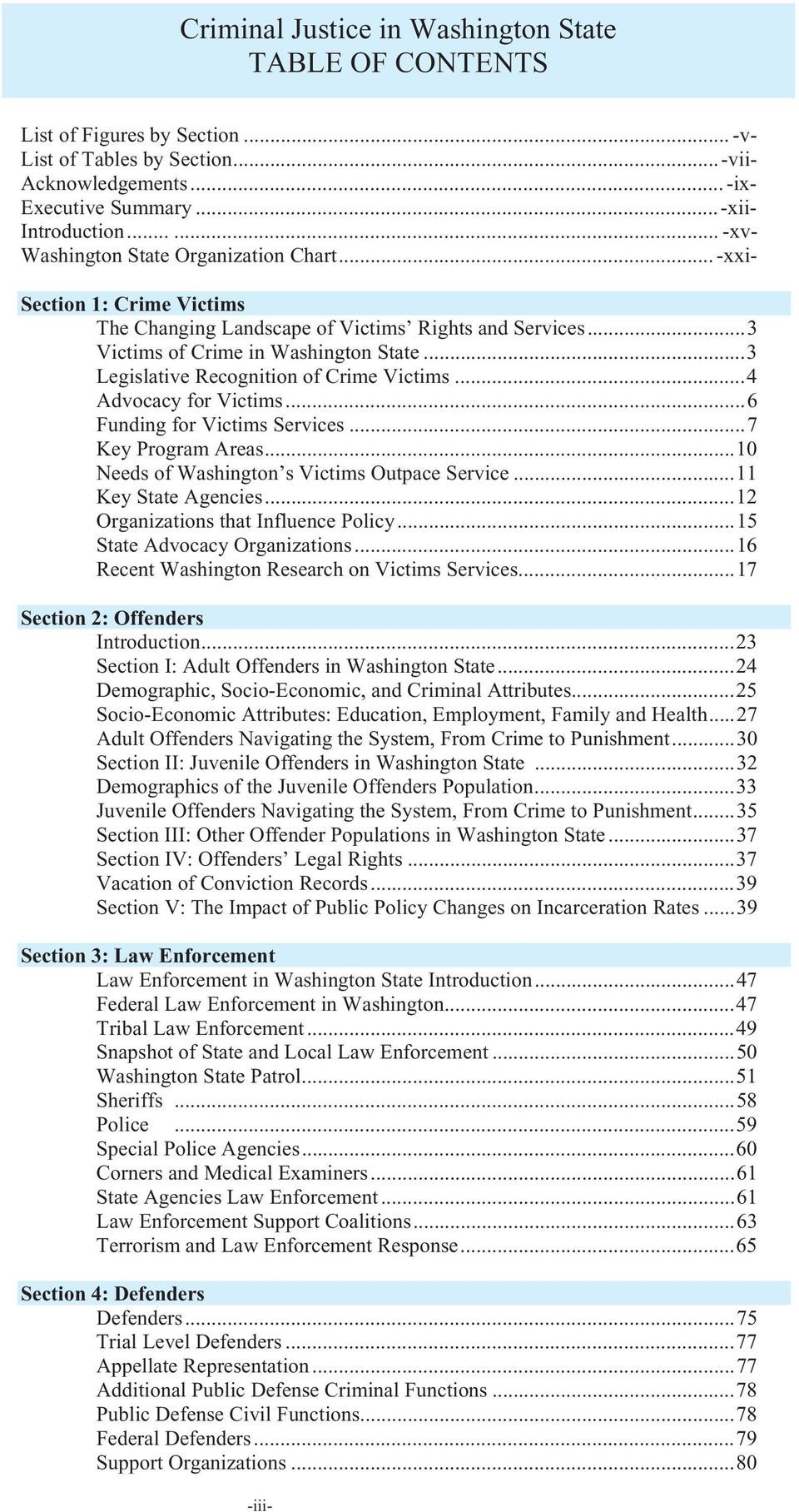
6 Section 5: Prosecutors Prosecutors...87 Infrastructure...89 Support Organizations...91 Section 6: Courts Introduction...97 The State Court System...97 The Federal Court System The Tribal Court System Military Courts Section 7: Corrections Corrections Who Goes Where: Incarceration Alternatives Local Jails Washington Department of Corrections: Adult Felony Offenders Juvenile Offenders: Local Detention and JRA Section 8: Financing Criminal Justice 2001 Snapshot Expenditure Trends Federal Funding of Criminal Justice Activities in Washington State Section 9: Criminal Justice Information Network Washington s Statewide Justice Information Network (JIN) Appendices Appendix A: Narrative Example of the Adult Criminal System Appendix B: Interviews with Victim Advocates Appendix C: System Chronology Appendix D: Accounts Funding State Criminal Justice Activities Appendix E: Local Government Finance Study Appendix F: Washington State Agencies Allocated Funds for Criminal Justice Activities/Functions Appendix G: Byrne Grant Historical Funding Program Allocations Appendix H: Glossary of Acronyms Appendix I: Comprehensive Source List iv-
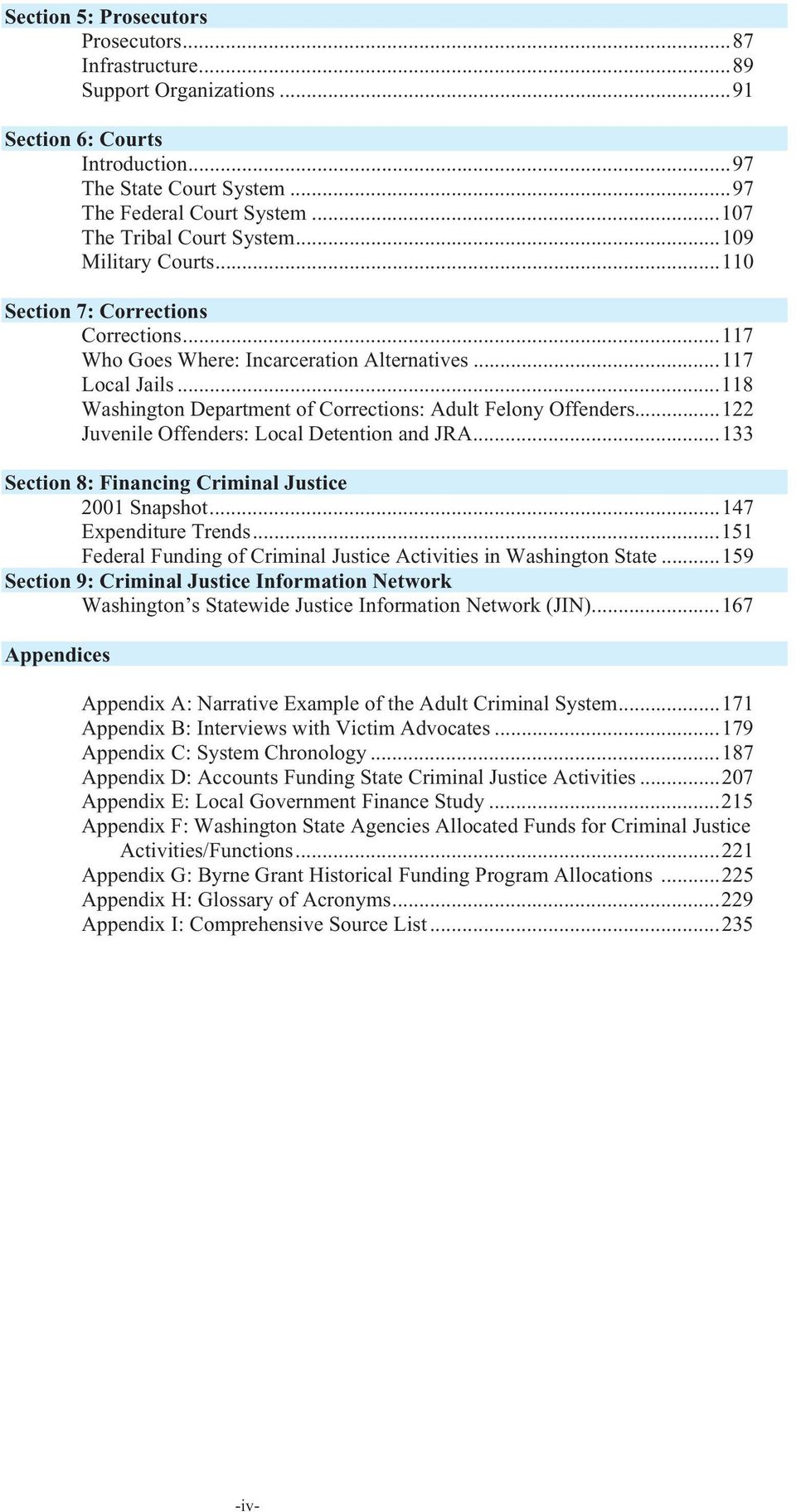
7 FIGURES BY SECTION Section 1: Crime Victims Figure 1-1: Victimizations Reported to Police Section 2: Offenders Figure 2-1: Adult & Juvenile Incarcerations Rates in Washington: Figure 2-2: Department of Corrections, Type of Crimes Figure 2-3: Adult Criminal Justice Flow Chart Figure 2-4: Juveniles Confined in Local Detention Facilities Figure 2-5: Juvenile Justice System Flow Chart for Criminal Offenses Figure 2-6: Cumulative Effects of Criminal Justice Legislation in Washington State Session Section 3: Law Enforcement Figure 3-1: Washington State Patrol Organizational Chart Figure 3-2: Troopers and Washington Drivers Figure 3-3: Sworn Personnel in Sheriff s Office in Washington Counties Figure 3-4: Selected Areas of Duty for Full Time Sworn Personnel in U.S. Local Police Departments Figure 3-5: Governor s Domestic Security Infrastructure Section 4: Defenders No figures in this section. Section 5: Prosecutors Figure 5-1: Total Felony Filings and Total Felony Convictions Washington State Adults: Section 6: Courts In Washington Figure 6-1: Washington Court Structure, Figure 6-2: 2001 Juvenile Offense Referrals by Type of Offense Section 7: Corrections Figure 7-1: Historical and Forecast Inmate Population Figure 7-2: Percent Returned to Prison within Five Years of Release Figure 7-3: Department of Corrections Map of Facilities Figure 7-4: Average Daily Population Versus Rated Capacity in Facilities Operated by Washington State Department of Corrections 124 Figure 7-5: One in Every 25 Washington State Males Aged are on Active Supervision by Washington State s Department of Corrections Figure 7-6: Washington State s Offender Accountability Act Classification Chart Figure 7-7: Washington State Sentencing Guidelines Commission Drug Offender Sentencing Alternative Sentences Fiscal Years Figure 7-8: Juvenile Admissions to Detention Facilities January December Figure 7-9: Washington State JRA Population Growth Figure 7-10:Service Needs of Juvenile Rehabilitation Administration Facility Residents Section 8: Financing Criminal Justice Figure 8-1: State & Local Expenditures Figure 8-2: State & Local Expenditures by Entity Figure 8-3: State & Local Expenditures by Expenditure Category: Law & Justice Figure 8-4: Adjusted State Expenditures Law & Justice Figure 8-5: County Expenditures Law & Justice Figure 8-6: City Expenditures Law & Justice Figure 8-7: State & Local Expenditures by Expenditure Category: Law & Justice v

8 Figure 8-8: State & Local Expenditures by Type of Fund: Law & Justice Figure 8-9: Prison Inmate Population Compared to age Male Population Figure 8-10: Juvenile Rehabilitation Institutional Population Compared to age Populations Figure 8-11: Per Household Taxpayer Cost of Washington s Criminal Justice System Figure 8-12: City Expenditures Figure 8-13: County Expenditures Figure 8-14: Adjusted State Expenditures Figure 8-15: US Department of Justice FY 2002 Awards to Washington BY DOJ Core Function Section 9: Criminal Justice Information Network Figure 9-1: Washington State Justice Information Network Overview of Criminal Justice System Figure 9-2: Washington Criminal Information Interchange Process vi

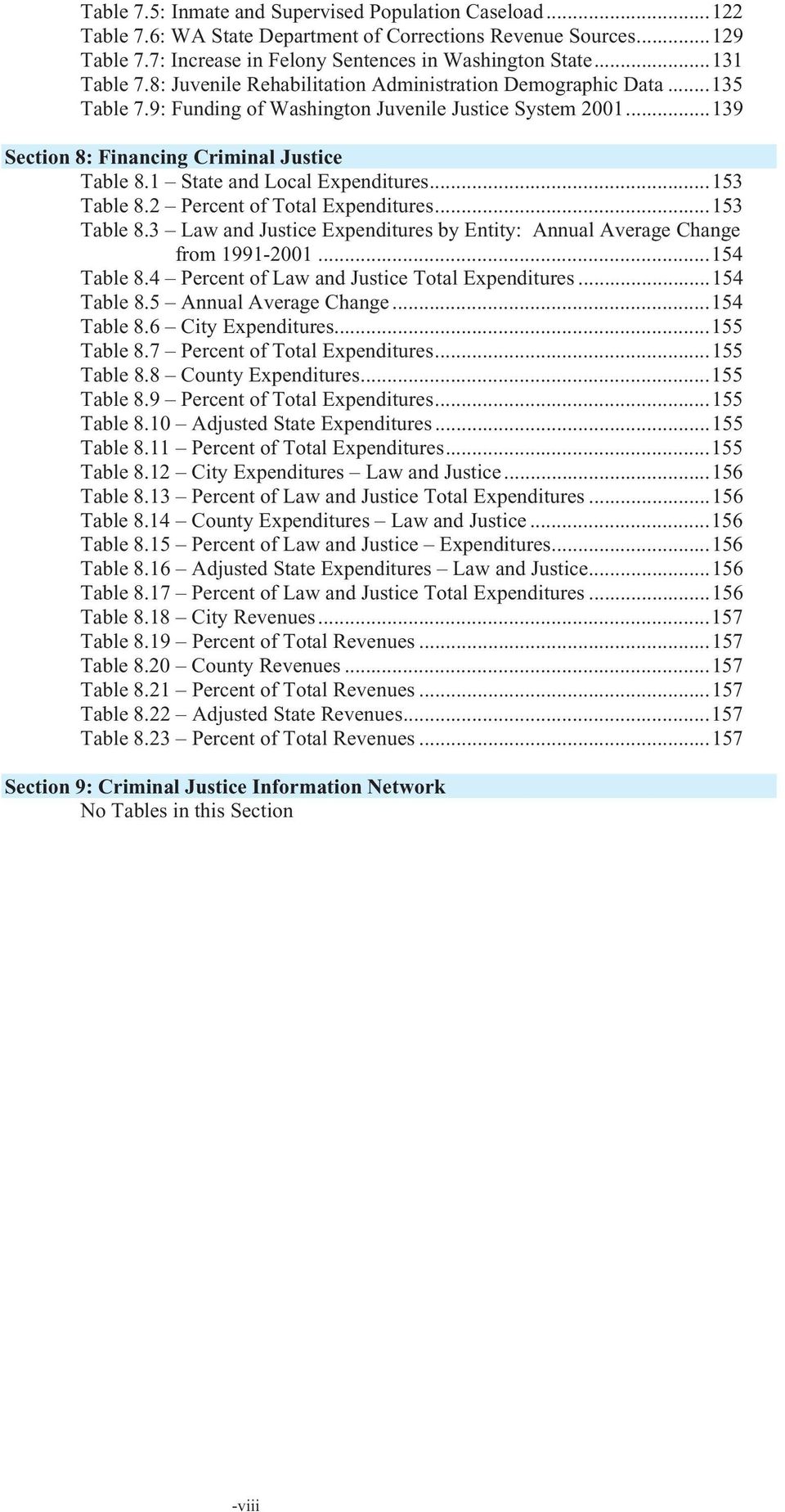
9 TABLES BY SECTION Section 1: Crime Victims Table 1.1: Fund Deposits from Penalty Assessment Collections...8 Table 1.2: VOCA Funding Into Washington State...9 Table 1.3 :Byrne Grant Historical Funding...10 Table 1.4: Washington State Emergency Domestic Violence Shelter and Safe Home Programs...12 Table 1.5: Domestic Violence Victims Served By Type of Service...13 Table 1.6: VOCA Victim Services...14 Table 1.7: Washington Statewide Compensation Program...14 Section 2: Offenders Table 2.1: Department of Corrections, Field Supervision Caseload...24 Table 2.2: Recidivism by Type of Offense...25 Table 2.3: Estimated Washington State Population...25 Table 2.4: Washington Department of Corrections Prisoner Count...26 Table 2.5: County Jail Average Daily Population Table 2.6: National Data for Educational Attainment Table 2.7: WA State Educational Attainment, County and City Jails, Table 2.8: WA State Employment at Arrest...28 Table 2.9: WA State Marital Status at Arrest...28 Table 2.10: Felony Cases Filed in Superior Courts...31 Table 2.11: WA Juvenile and Detention Populations by Race/Ethnicity...33 Table 2.12: WA State Juvenile Charges and Diversion...36 Table 2.13: DOC Non-US Citizen Offenders June Section 3: Law Enforcement Table 3.1: Federal Officers Authorized to Carry Firearms and Make Arrests In Washington State Table 3.2: Resources Available to Police Departments in Indian Country...50 Table 3.3: Full-Time State, Local, and Tribal Law Enforcement...51 Table 3.4: WSP Major Arrest Categories...52 Table 3.5: Commercial Vehicle Services...54 Table 3.6: Special Weapons and Tactics Team (SWAT)...55 Table 3.7: Criminal Investigations...55 Table 3.8: Criminal History Statistics...56 Table 3.9: Fire Protection Bureau Activity...56 Table 3.10: Participating Agencies in NW HIDTA Section 4: Defenders No tables in this section... Section 5: Prosecutors Table 5.1: Adult Felony Trial Pattern SGC Fiscal Year Table 5.2: Prosecution Costs: Personnel Hours Per Type of Case...88 Section 6: Courts Table 6.1: Juvenile Offense Referrals by Number and Percentage Table 6.2: Summary of the Cost-Benefit Analysis of Five Adult Drug Courts in the Evaluation Table 6.3: Drug Courts in Washington State Table 6.4: Proportion of Judicial and Legal Service Direct Expenditures Borne By State and Local Governments in Washington Table 6.5: Department of Justice Authority for Native American Programs FY Section 7: Corrections Table 7.1: Jail Capacity Compared to Statewide Average Table 7.2: Average Daily Populations of Male and Female Inmates in Washington State s Jails Table 7.3: Jail Construction Costs Table 7.4: Urinalysis Findings vii

10 Table 7.5: Inmate and Supervised Population Caseload Table 7.6: WA State Department of Corrections Revenue Sources Table 7.7: Increase in Felony Sentences in Washington State Table 7.8: Juvenile Rehabilitation Administration Demographic Data Table 7.9: Funding of Washington Juvenile Justice System Section 8: Financing Criminal Justice Table 8.1 State and Local Expenditures Table 8.2 Percent of Total Expenditures Table 8.3 Law and Justice Expenditures by Entity: Annual Average Change from Table 8.4 Percent of Law and Justice Total Expenditures Table 8.5 Annual Average Change Table 8.6 City Expenditures Table 8.7 Percent of Total Expenditures Table 8.8 County Expenditures Table 8.9 Percent of Total Expenditures Table 8.10 Adjusted State Expenditures Table 8.11 Percent of Total Expenditures Table 8.12 City Expenditures Law and Justice Table 8.13 Percent of Law and Justice Total Expenditures Table 8.14 County Expenditures Law and Justice Table 8.15 Percent of Law and Justice Expenditures Table 8.16 Adjusted State Expenditures Law and Justice Table 8.17 Percent of Law and Justice Total Expenditures Table 8.18 City Revenues Table 8.19 Percent of Total Revenues Table 8.20 County Revenues Table 8.21 Percent of Total Revenues Table 8.22 Adjusted State Revenues Table 8.23 Percent of Total Revenues Section 9: Criminal Justice Information Network No Tables in this Section -viii
11 Acknowledgements The production of this report could not have been accomplished without the generous assistance of many agencies, community organizations and individuals who collaborated in selecting the contents of this report, provided ongoing consultation to the staff, and drafted and edited portions of this report. The Byrne Committee extends very special thanks to Joli Sandoz, the principal researcher and author for the first phase of this report s development. Other staff from the Department of Community, Trade and Economic Development who made significant contributions to the report were Carol Owens, project director and writer; Visudha de los Santos, research analyst, writer and project coordination; Jennifer Scrafford, research analyst and writer; Jill Severen, editor; Cecilia Gardener, layout design; and Lori Salzer and Gail Mitchell who provided staff support. The Byrne Committee gratefully acknowledge the following: The Criminal Justice Plan Steering Committee members who put in long hours over many months to help with the report s development: The Honorable Mike Doherty, Clallam County Commissioner; The Honorable Tari Eitzen, Spokane Superior Court; Larry Erickson, Washington Association of Sheriffs and Police Chiefs; Anne Fiala, Department of Corrections; Kate Greenquist, Office of US Attorney, Western District of Washington; Christie Hedman, Washington Defender Association; Gerald Horne, Pierce County Prosecuting Attorney; Deputy Chief Steve Jewell, Washington State Patrol; Paul Perz, Washington State, Community Trade & Economic Development; Ken Stark, Washington State Department of Social and Health Services; Nan Stoops, Washington State Coalition Against Domestic Violence; and Carol Webster, Governor s Juvenile Justice Advisory Committee. All of the state and local government staff, criminal justice system experts, advocates and community members who provided guidance and support during the research and editing of this report are too numerous to list, but include the following: Administrative Office of the Courts Gil Austin, Andrew Glenn Brigid Collins Family Support Center Byron Manering Bureau of Justice Administration Dr. Marika Litras Everett Police Department Jim Scharf Justice Information Network Brian LeDuc Northwest High Intensity Drug Trafficking Area Dave Rodriguez King County Department of Judicial Administration Kym Anderson -ix-

12 King County Sheriff s Office Kevin Fagerstrom Legislature Evaluation and Accountability Program Lori Bame Looking Glass Analytics Mason Burley Mothers Against Drunk Drivers Suzanne Guinn, Tom Lawvre National Oceanic and Atmospheric Association Brad Vinish Pierce County Eileen O Brien Port of Seattle Police Tony Anderson Seattle City Attorney's Office Mike Finkle Sentencing Guidelines Commission David Boerner, Ida Leggett Stillaguamish Tribe Felix Moran Tri-City Airport Police Arthur Owen United States Attorney s Office Susan Roe, Steve Tomson United States Coast Guard Keith Alholm United States Federal Defender Office Tom Hillier, Roger Peven Washington Association Criminal Defense Lawyers David Donnan Washington Association of Prosecuting Attorneys Tom McBride Washington Association of Washington Cities Deanna Krell Washington Association of Counties Sophia Byrd Washington Association of Sheriffs and Police Chiefs William Curtright, Jim LaMunyon, Linda McHenry Washington Coalition of Sexual Assault Programs Suzanne Brown Washington Horse Racing Commission Bob Leichner Washington State Coalition Against Domestic Violence Leigh Hofheimer Washington State Caseload Management Council David Fallen Washington State Criminal Justice Training Commission Bob Posey, Ron Price, Brian Elliott Washington State Department of Community, Trade and Economic Development Louise Deng-Davis, Sharon Elias, Bev Emery, Bill Johnston, Jim Lambert, Harvey Queen, Susie Roberts -x-
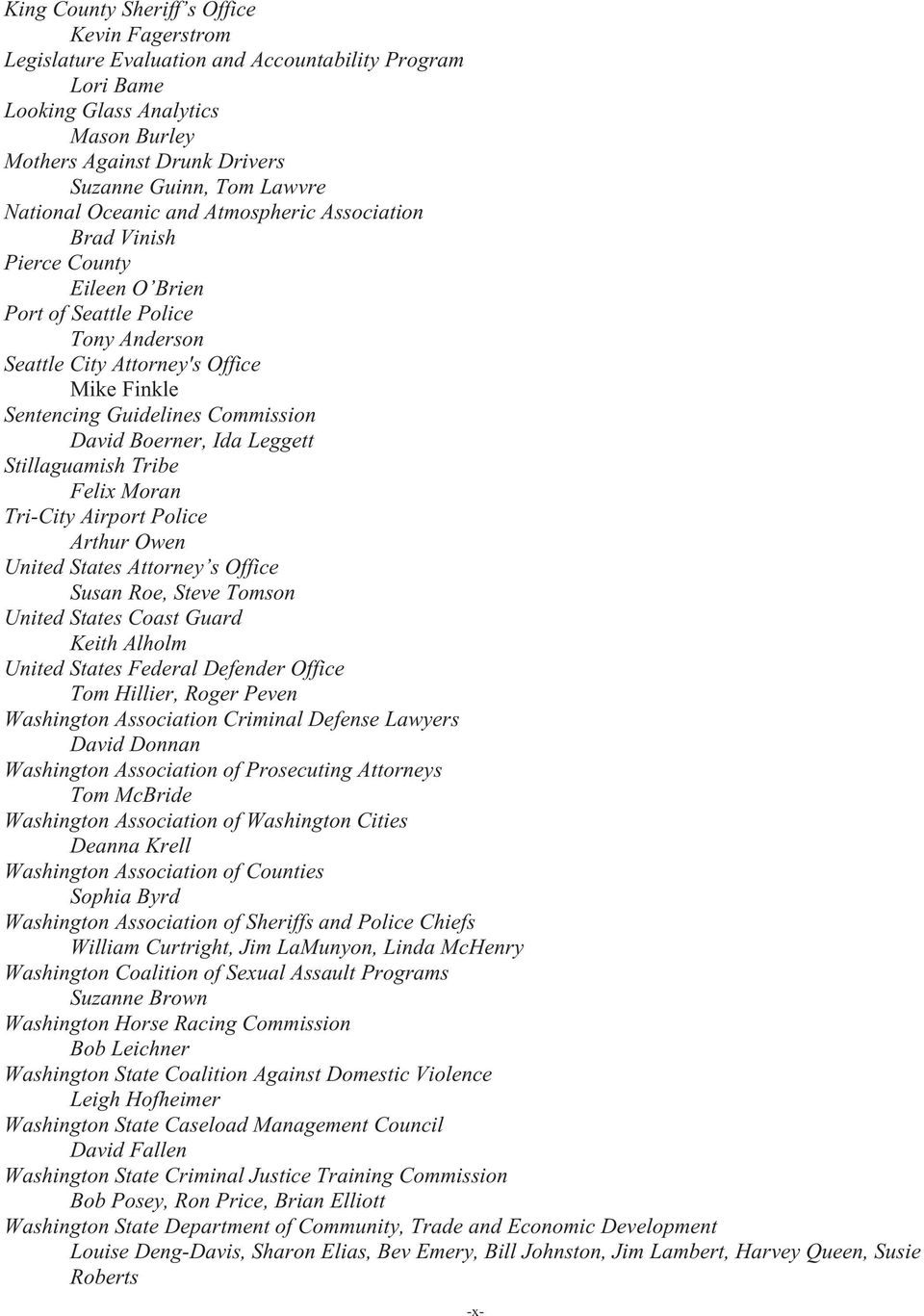
13 Washington State Department of Corrections Steve Eckstrom, Tracy Guerin, Patty Terry, William Stutz Washington State Department of Labor and Industries Ken Crooke Washington State Department of Natural Resources Dennis Heryford Washington State Department of Social and Health Services Doug Allen; Glenn Baldwin, Becky Denny, Linda Egge, Susan Hannibal, Daniel Robertson, Cheryl Reule, Cheryl Stephani, Ed Vukich Washington State Gambling Commission Susan Arland Washington State Governor s Office Dick Van Wagenen Washington State Institute for Public Policy Steve Aos Washington State Office of Attorney General s Office Scott Blonien Washington State Office of Financial Management Garry Austin; Robin Campbell, Bev Hempleman, Lori Jones, Irv Lefberg Washington State Office of Public Defense Mary Jane Ferguson, Joanne Moore Washington State Parks and Recreation Commission Sherri Sweeney Washington State Patrol Mark Couey, Larry Hebert Whitman College Terry Thompson Yakima County Prosecutor s Office Kevin Eilmes, Robyn Light Robert Boruchowitx, Meg Crager, Mike Finkle and Barb Severson -xi-

14

15 Executive Summary Criminal Justice in Washington State was developed and written as a project of Washington State s Byrne Grant Committee. Grant #2003-DB-BX-0243, awarded to the State of Washington by the Bureau of Justice Programs, U.S. Department of Justice, supports Byrne grant programs and activities. The Washington State Department of Community, Trade and Economic Development (CTED) is the state s administrative agency for the Byrne Grant in Washington State. There is no centralized state administration of criminal justice programs in Washington State. However, the state, federal and local agencies that make up Washington s criminal justice system are linked by a public policy-making structure that creates the common laws and procedures that define the criminal justice system and its operation. This report provides a comprehensive description of the current structure and operation of that system. The Byrne Grant Committee is made up of criminal justice and victim advocacy professionals who advise the CTED on best use for Byrne grant funds by: Developing a statewide strategy for use of Byrne Grant funds which includes an assessment of drug and violent crime problems in the state, analysis of the effectiveness of current efforts, and a plan of action for addressing the problems; Providing advice and counsel regarding the development and administration of the Byrne Program; and Making funding recommendations to CTED for appropriate programs to reduce violence and drug-related crimes in Washington State. In Washington State, Byrne grant funding currently supports a variety of strategies to reduce drug and violent crime, including multi-jurisdictional narcotics taskforces, youth violence prevention, the Governor s Council on Substance Abuse, drug courts, criminal history records, training for defenders, domestic violence legal advocacy, crime victims advocacy, and tribal law enforcement. The primary purpose of this report is to provide a full description of the operation of Washington s criminal justice system to provide a foundation for future planning to assess criminal justice system needs and to develop recommendations for public policy action to reduce the impact of drug and violent crime. This report includes descriptions of the key components of Washington s criminal justice system including services to Offenders and Victims, Courts, Defenders, Prosecutors, Corrections, and the financing of criminal justice system. Readers of the report will discover some interesting facts about drugs and violent crime in Washington State, including the following: For every 100 crimes reported in Washington State, there are 29 arrests, which will result in six felony convictions. Washington Institute for Public Policy research showed a drop of two to four percent in crime for every 10 percent increase in incarceration between 1980 and Between 1980 and 2000 the state s population increased by 42 percent. The number of felony sentences increased by 150 percent over the same time period. - -xiii-

16 One out of every 100 males ages 18 to 39 is incarcerated in a Department of Corrections facility. Washington is the only state that uses determinate sentencing for juveniles and was one of the first states to adopt determinate sentencing for adults. The Department of Corrections supervises 16,000 offenders in correctional facilities and oversees an average of 65,000 felony offenders completing sentences in the community. On an average day in 2001, Washington s juvenile justice system oversaw 13,646 youth. Of those, 11,604 were supervised at the local level. Between July 2001 and June 2002 domestic violence shelters in Washington State provided services to 25,574 adults and children. Another 34,813 people seeking shelter services were turned away because of lack of space. The national average for the number of sworn law enforcement officers is 157 per 100,000 residents. Washington State ranks 48 th among all states for the number of local law enforcement officers, averaging 98 per 100,000 residents. In 1999, expenditures for law an justice costs by Washington s state and local governments was $418 per capita, ranking 22 nd in comparison with other states. The national average is $442. Washington State ranks last among all states in the funding provided for the state s court system. Local governments provide 85 percent of the funding dedicated to courts in Washington. -xiv-

17 Introduction I. Scope of this Report Criminal Justice in Washington State was developed and written as a project of Washington State s Byrne Grant Committee. There is no centralized state administration of criminal justice programs in Washington State. However, the state, federal and local agencies that make up Washington s criminal justice system are linked by a public policy-making structure that creates the common laws and procedures that define the criminal justice system and its operation. This report provides a comprehensive description of the current structure and operation of that system. The Byrne Grant Committee is made up of criminal justice and victim advocacy professionals who advise the Department of Community, Trade and Economic Development on best use for Byrne grant funds by: Developing a statewide strategy for use of Byrne Grant funds which includes an assessment of drug and violent crime problems in the state, analysis of the effectiveness of current efforts, and a plan of action for addressing the problems; Providing advice and counsel regarding the development and administration of the Byrne Program; and Making funding recommendations to CTED for appropriate programs to reduce violence and drugrelated crimes in Washington State. Grant #2003-DB-BX-0243, awarded to the State of Washington by the Bureau of Justice Programs, U.S. Department of Justice, supports Byrne grant programs and activities. The Department of Community, Trade and Economic Development (CTED) is the State s administrative agency for the Byrne Grant in Washington State. In Washington State Byrne grant funding currently supports a variety of strategies to reduce drug and violent crime, which include the following: Multi-Jurisdictional Narcotics Task Forces. The Byrne grant provides funding for twenty law enforcement terms that investigate, apprehend and prosecute mid to upper-level drug traffickers Youth Violence Prevention The youth violence prevention program supports thirteen community-based approaches to reduce youth violence, serving approximately 15,000 youth each year. Governor s Council on Substance Abuse The Council is a cross system policy advisory group that advises the Governor and State agencies on state policy and programs actions to reduce substance abuse through prevention, treatment and law and justice strategies. Drug Courts Approximately nine drug courts in Washington State receive Byrne funds, which provide supervised drug treatment for non-violent offenders in lieu of serving jail time. Criminal History Records The purpose of the Criminal History Records project is to create a uniform, statewide system for reporting and compiling records on criminal history. Defender Training Through Byrne grant funding the Washington Defenders Association provides information, technical assistance and training for public defenders. Domestic Violence Legal Advocacy This project provides legal advocates for 42 domestic violence programs in Washington State. Advocates help victims of domestic violence navigate the Legal system. This project also provides training on current domestic violence laws and procedures for local law enforcement and prosecutors. -xv-

18 Tribal Law Enforcement Assistance This project funds projects that help local tribal law enforcement agencies develop improve services to their communities through strategies like community policing and officer training in police methods, violence prevention and drug interdiction. Crime Victims Advocacy Crime victim s advocacy provides services to victims of violent crimes, other than sexual assault and domestic violence. The purpose of this report is to provide a full description of the operation of Washington s criminal justice system to provide a foundation for future work to assess criminal justice system needs and strategic planning for public policy action to reduce the impact of drug and violent crime. II. Geography and Demographics of Washington State Washington State covers 66,582 square miles, making it the 20th largest state in the United States. Elevations range from sea level to the 14,411-foot tall Mount Rainier, the highest point in Washington State. Washington's coastline on the Pacific Ocean is 157 miles long. To the north, Washington State shares an international border with Canada. The 2001 census update estimated population for Washington State was 5,987,973. More than a quarter of Washington s residents (25.7 percent) are under the age of 18, while 11.2 percent of the population is over 65. Caucasians who are not of Hispanic or Latino origin make up 78.8 percent of the population. People of Hispanic or Latino origin make up 7.5 percent of the population. Persons of Asian origin make up 5.5 percent of the population and African Americans account for 3.2 percent of the population. There are 29 federally recognized Indian Tribes within the boundaries of Washington State. Census data for Washington State estimates that persons of American Indian or Alaska Native origin make up 1.6 percent of the state s population. Manufacturing is the leading contributor to the state s economy. The state is a leading producer of such products as apples, wheat, and timber. Tourism and international trade are also essential contributors to the state s economic base. III. Criminal Justice Policy Development Public policy in the criminal justice area can be defined as general or specific strategies for resolving a particular crime-related issue. Public policy making can be a complicated process that involves several agencies of government and timelines of events. The evolution of law and justice policy development generally utilizes long-standing governmental agencies and follows historical traditions and trends. All three branches of our governmental system Executive, Legislative, and Judicial contribute to policy development at the federal, state, and local government levels. Significant criminal justice policy is drafted, debated, and enacted by the state legislature. After the legislature has adopted a law, administrative rule-making agencies are generally responsible for the implementation of the new law. There is delegation of legislative authority to the administrative agency for development of the details of the new policy. In some areas, such as constitutional criminal rights, courts may develop court-made law, or caselaw that further interprets the law. Federal, state, and local governments are involved in development of criminal justice policy on a regular basis. Most citizens understand the role of the federal and state government in this process, but do -xvi-
19 not readily understand the more limited role of local governments. In the State of Washington, the State Constitution, Article II, Section II, discusses the general delegation of police power to local government. A local government has police powers to the extent that local action does not contravene the State Constitution or State statutes. For example, local government may enact a public safety ordinance prohibiting the same type of conduct as prohibited the same type of conduct as prohibited by state statute so long as the statute was not intended to be exclusive and the ordinance and the state statute do not conflict. However, local police power is still subject to state and federal constitutional constraints. An example of relatively recent public policy development can be found in the area of crime victims. In recent years, particularly vulnerable classes of people, such as children, the elderly and victims of sexual offenses have been recognized as significant factors in our system of justice. Recognition has been reflected in our statutory and administrative law and in government funding procedures, which are specifically allocated for the support and reimbursement of crime victims. Areas such as victims/witness services, hotlines, family support, and others are slowly being acknowledged and addressed in public policy A. The Executive Branch In Washington State, the Governor works with a cabinet of state agency directors to develop and carry out administrative policy for the delivery of state services. Some of the major cabinet-level agencies involved with criminal justice system operations include: Department of Corrections Department of Social and Health Services Office of Financial Management Washington State Patrol Department of Community, Trade and Economic Development Traffic Safety Commission Department of Health Military Department Governor s Office of Indian Affairs Office of the Attorney General Liquor Control Board Indeterminate Sentencing Review Board In Washington State, the Governor s Office and cabinet level agencies receive advice and counsel from many sources as they research the criminal justice-related issues and policy solutions. Policy advisory committees made up of citizens with expertise and experience with criminal justice-related issues are a key resource. These groups bring a broad range of expertise and knowledge into the policy development process to help the Governor and state agencies stay current with criminal justice issues and the impact of crime in Washington s communities. Some policy advisory groups are short-term groups appointed to research and make recommendations for specific policy issues. Other policy advisory groups have a longer mission and work with cabinet agencies and the Governor s Office on an ongoing basis to advise them on more long-term policy issues. These policy advisory groups include the Byrne Committee, the Governor s Council on Substance Abuse, The Washington State Law and Justice Council, Department of Correction s Victims Council, the Governor s Juvenile Justice Advisory Committee, Department of Social and Health Services Division of Alcohol and Substance Abuse s Citizen Advisory Council on Alcoholism and Drug Addiction, Washington State Patrol s Organized Crime Advisory Board and the Task Force on Missing and Exploited Children, Department of Health s Sex Offender Treatment Advisory Committee, and the Military Department s Committee on Terrorism. -xvii-
20 B. The Legislature The Washington State Legislature is made up of two houses (or chambers), the Senate and the House of Representatives. Washington has 49 legislative districts, each of which elects a Senator and two Representatives. The Senate and House of Representatives meet in session each year to create new laws, change existing laws, and enact budgets for the state. In the process of researching criminal justice issues for legislative action, the Legislature may consult with a number of sources, including the Washington State Institute for Public Policy (WSIPP), Sentencing Guidelines Commission (SGC), the Legislative Evaluation and Accountability Program (LEAP), the Superior Court Judges Association, Juvenile Court Administrators Association, Washington State Association of Counties, Washington Association of Prosecuting Attorneys, Washington State Association of Sheriffs and Police Chiefs, and the Association of Washington Cities. The members of the House and Senate offer proposed legislation, or bills, for consideration. The ideas for bills come from a number of places. Often something that has happened in the last year will inspire new legislation. During the 1994 Legislative Session, youth violence bills were presented as a result of the change in people's perception of crime. Individual legislators may wish to address issues that are specific to their district. The Legislature may decide to tackle a major issue, such as the need for drug sentencing reform, when changes in society dictate that a change in state law is needed. Once a bill has passed both the House and Senate, it is sent to the Governor. The Governor may decide to sign it, veto part of it, or veto all of it. If the Governor vetoes part or all of it, the Legislature may vote to override the veto. If the governor does not act on a bill after the allotted number of days, it is as if it was signed. Once a bill becomes law, it is referred to the appropriate agency for implementation. C. Judicial Washington s court system has four levels: courts of limited jurisdiction, superior courts (courts of general jurisdiction), the Court of Appeals, and the Supreme Court. These courts hear both civil and criminal matters. Because superior courts have no limit on the types of civil and criminal cases heard, they are called general jurisdiction courts. Superior courts also have authority to hear cases appealed from courts of limited jurisdiction. Most superior court proceedings are recorded so that a written record is available if a case is appealed. Appellate courts can then properly review cases appealed to them. Some superior courts use video recordings instead of the customary written transcripts prepared by court reporters. Court Terms Functions Courts of Limited Four-year 30 single or multi-county districts. Jurisdiction Misdemeanor criminal cases (Includes district and Traffic, non-traffic, and parking infractions municipal courts) Domestic violence protection orders Civil actions of $50,000 or less Small claims -xviii-

21 Superior Courts Four-year Civil matters Domestic relations Felony criminal cases Juvenile matters Appeals from courts of limited jurisdiction Located in each county in the state. Court of Appeals Six-year, staggered Appeals from lower courts except those in jurisdiction of the Supreme Court The Supreme Court Six-year, Appeals from the Court of Appeals staggered Administers state court system D. The Public Initiative Process A Public Initiative process provides an alternate way for voters to exercise legislative action to effect public policy change. The public initiative process is authorized by RCW 29A , Filing proposed measures with secretary of state (Effective July 1, 2004.). Public initiatives begin with an individual or group deciding to take action to address a need or desire for change in state policy. The initiative is proposed through a petition and must have the signatures of 8 percent of the number of voters voting in the last preceding regular gubernatorial election before it can be certified to be placed on the ballot for voter approval or rejection. There are two types of initiatives: 1. Initiative to the people. Original legislation by the voters, proposing a new law (or changing existing laws) without consideration by the Legislature. 2. Initiative to the Legislature. Original legislation by the voters, proposing a new law (or changing existing laws) for consideration by the Legislature at its next regular session. If not enacted, it is placed on the next general election ballot. Some of the Washington State initiatives approved by voters in the recent past have helped to shape criminal justice policy. The Hard Time for Hard Crime Initiative increased penalties for crimes involving a firearm. The Three Strikes Law requires life sentences for persons convicted of three serious crimes. E. Federal Government The federal government s jurisdiction and enforcement authority set the parameters for numerous public safety and criminal justice policies. The federal government has jurisdiction for crimes that extend across state borders to other states or foreign countries, as well as policies that must be uniformly applied and enforced from state to state to ensure equal protection under the law. In addition, federal requirements placed on States as a condition for receiving federal grant funds can have a great impact on how states design and carry out federally-funded services provided by the states. Sometimes federal legislation adds requirements for states as a condition of receiving federal grant funds. Examples of this type of legislation that have been attached as a condition for receiving Byrne Grant funds include (1) Jacob Wetterling Crimes Against Children and the Sexually Violent Offender Registration Act which required a system for registration of sex offenders; (2) Pam Lychner Sexual Offender Tracking and Identification Act of 1996 which modified the provisions of the Jacob Wetterling Act to require lifetime registration for sexual offenders; and (3) Campus Sex Crimes -xix-
22 Prevention Act which seeks to ensure that campus police agencies are promptly notified of the registration and employment status of convicted sex offenders at institutions of higher education. The combined impact of federal, state and local jurisdictions policies blend together to form the operational structure for the criminal justice system. The following chapters give an overview of this system and how it functions from day-to-day in Washington State. -xx-
23 Organization Chart Washington State Government Legislative Branch Joint Legislative Audit and Review Committee Legislative Transportation Committee Legislative Ethics Board Legislative Evaluation and Accountability Program Judicial Branch Senate House of Representatives Supreme Court Office of the State Actuary Joint Legislative Systems Committee Redistricting Commission (activated decennially) Executive Branch Agencies Managed by Statewide Elected Officers Court of Appeals Supreme Court Clerk Law Library Superior Courts Supreme Court Commissioner Reporter of Decisions District Courts Administrator for the Courts Commission on Judicial Conduct Municipal Courts Office of Public Defense Commissioner of Public Lands Insurance Commissioner Treasurer Lieutenant Governor Governor Attorney General Superintendent of Public Instruction Auditor Secretary of State Department of Natural Resources Forest Practices Board Public Deposit Protection Commission State Finance Committee Office of the Governor Executive Ethics Board Board of Education Academic Achievement and Accountability Commission Professional Educator Standards Board Productivity Board State Library Environment and Natural Resources Department of Ecology Department of Agriculture commodity commissions Interagency Committee for Outdoor Recreation Salmon Recovery Funding Board Pollution Liability Insurance Program Fish and Wildlife Commission Department of Fish and Wildlife Parks and Recreation Commission Environmental Hearings Office Pollution Control Hearings Board Shorelines Hearings Board Forest Practices Appeals Board Hydraulic Appeals Board Conservation Commission Columbia River Gorge Commission Growth Management Hearings Boards Eastern Washington Central Puget Sound Western Washington Board of Natural Resources General Government Office of Financial Management Department of General Administration Department of Revenue Department of Personnel Personnel Resources Board Department of Retirement Systems Employee Retirement Benefits Board Department of Information Systems Integrated Justice Information Board Lottery Commission Department of Financial Institutions Military Department Public Printer Office of Administrative Hearings Board of Accountancy Liquor Control Board Utilities and Transportation Commission Personnel Appeals Board (abolished 2006) Public Employment Relations Commission Board of Tax Appeals Public Disclosure Commission Board for Volunteer Firefighters and Reserve Officers Gambling Commission Horse Racing Commission Investment Board Statute Law Committee Code Reviser Municipal Research Council Economic and Revenue Forecast Council Caseload Forecast Council Pension Funding Council Forensic Investigations Council Citizens Commission on Salaries for Elected Officials State Capitol Committee Law Enforcement Officers and Fire Fighters Retirement System Plan 2 Board Puget Sound Water Quality Action Team Salmon Recovery Office Health and Transportation Human Services Agencies Managed by Governor-appointed Executives State Patrol Department of Licensing occupational regulatory boards Traffic Safety Commission Transportation Commission Department of Transportation Board of Pilotage Commissioners Marine Employees Commission Transportation Improvement Board Freight Mobility Strategic Investment Board County Road Administration Board Department of Social and Health Services Department of Labor and Industries Department of Employment Security Department of Health occupational regulatory boards Department of Corrections Department of Veterans Affairs Council for the Prevention of Child Abuse and Neglect Health Care Authority Public Employees Benefits Board Department of Services for the Blind Agencies Under Authority of a Board Governor s Office of Indian Affairs Office of the Family and Children s Ombudsman Human Rights Commission Indeterminate Sentence Review Board Board of Industrial Insurance Appeals Criminal Justice Training Commission Sentencing Guidelines Commission Health Care Facilities Authority Board of Health Home Care Quality Authority Tobacco Settlement Authority Education School for the Blind School for the Deaf Board of Trustees Workforce Training and Education Coordinating Board Higher Education Coordinating Board Governing Boards of Four Year Institutions of Higher Education University of Washington Washington State University Central Washington University Eastern Washington University Western Washington University The Evergreen State College Board for Community and Technical Colleges Boards of Trustees Community Colleges Technical Colleges Spokane Intercollegiate Research and Technology Institute Higher Education Facilities Authority Washington State Historical Society Eastern Washington State Historical Society Community and Economic Development Department of Community, Trade, and Economic Development Economic Development Commission Energy Facility Site Evaluation Council Public Works Board Building Code Council Office of Minority and Women s Business Enterprises Commission on Asian Pacific American Affairs Commission on African- American Affairs Commission on Hispanic Affairs Arts Commission Convention and Trade Center Housing Finance Commission Economic Development Finance Authority PREPARED BY THE OFFICE OF FINANCIAL MANAGEMENT 7/03
24
25 Section 1: Crime Victims Section 1 Crime Victims
26
27 Crime Victims The Changing Landscape of Victims Rights and Services In the past 30 years, there has been a significant change in the relationship between the criminal justice system and crime victims. Citizen organizations of victims of domestic violence, sexual assault, and drunk drivers have all had important impacts on the role victims and victims advocates play in the legal system. These and other groups and their allies have won important changes in the way victims are treated by the courts and the prison system, and have lobbied for and won significant funding for a variety of victims services. These reforms have taken place at the federal, state, and local level. Today, the field of victims rights and services continues to evolve. As the needs of crime victims become more widely understood, demand for victim services has increased beyond the system s current capacity to provide them. Nonetheless, there is a clear trend towards greater attention to the constructive role victims and their advocates can play in bringing criminals to justice, in advocating for changes in public policy, and in educating the public about crime and its consequences. And, there is a growing recognition that the criminal justice system must be responsive to victims needs. Victims of Crime in Washington State According to a 2000 National Victim s survey, victims reported less than half of nonfatal crimes against persons. Every year, many Washington residents become victims of crime, but the exact number is a mystery because the majority of crimes are not reported. In 2000, the National Crime Victimization Survey noted that victims across the U.S. told police about less than half of the non-fatal, violent crimes against persons older than 12, although national reporting of violent crime did increase from an annual average of 43 percent between 1992 and 1999, to 49 percent in 2000 (Bureau of Justice Statistics ). Only about 39 percent of property crimes were reported. The chart on the next page shows the total number of serious violent crimes, compared to the victimizations reported to police. The bottom line in the chart is the number of homicides recorded by police, plus other violent crimes, whether or not they were reported to police. The middle line is the number of violent crimes reported to police. The top line is the number of violent crimes, excluding commercial robberies and crimes that involved victims over age 12. For purposes of this chart, serious violent crime includes rape, robbery, aggravated assault and homicide. 3
28 FIGURE 1-1 Victimizations Reported to Police: ,500,000 4,000,000 3,500,000 3,000,000 2,500,000 2,000,000 1,500,000 1,000, , The first state-funded programs for victims of crime began in Total Serious Violent Crime (NCVS) Victimizations Reported to Police (NCVS) Crimes Recorded by Police (UCR) Source: US Department of Justice, Bureau of Justice Statistics To date, statewide comprehensive victims surveys have not been undertaken in Washington. 1 However, Spokane was included in a 12-city study of victimization in 1998, conducted by the federal Office of Community-Oriented Policing Services and the Bureau of Justice Statistics. An estimated sixty-seven out of each 1,000 Spokane residents aged 12 and older reported that they had been the victim of a violent crime during the year. Four hundred and eleven people per 1,000 residents more than 40 percent said they had experienced a property crime. Data from interviews indicated that just 31 percent of violent crime victimizations were reported to the police, well below the national estimate (Bureau of Justice Statistics ). 2 Legislative Recognition of Crime Victims Victims are an integral part of the criminal justice process. They often report the crime, providing first responders with initial information. Victims offer personal testimony at trial and in the pre-sentence investigation report read by judges before deciding on the defendant s punishment. In addition, victims or their survivors often write or orally present a victim impact statement, telling judges how the crime affected them. Crime Victim Compensation Program Despite victims key role in criminal justice, the first state-funded program for crime victims in Washington State did not appear until 1974, when the state legislature established the Crime Victim Compensation Program, (RCW 7.68) 1 In November 2001, OCVA published the results of a survey of sexual assault victims, Sexual Assault Experiences and Perceptions of Community Response to Sexual Assault (Washington State Office of Crime Victim's Advocacy 2001). 2 When researchers compared the number of crimes reported to police in Spokane with those survey participants said had been reported, as a check on the usefulness of the self-report data, the figures were generally similar (Bureau of Justice Statistics ). 4
29 which enables crime victims to receive government financial assistance, including the cost of medical care and lost wages. Domestic Violence and Sexual Assault Funding In 1979, the Legislature allocated the first-ever state funding for domestic violence (DV) (RCW ) and sexual assault (SA) victims (RCW ). State funds supported DV and SA programs across the state, creating a network of advocacy and support for these victims. Victim s Bill of Rights - RCW 7.69 and 7.69A list rights of adult and child crime victims, survivors, and witnesses. (These are often referred to as the Victim s Bill of Rights and Child s Bill of Rights.) RCW notes the intent of the bill to grant to the victims of crime and the survivors of such victims a significant role in the criminal justice system, by focusing on victim notification of hearing and trial schedules, and respect for what victims suffered. The bill of rights requires that victims have access to advocates and to information regarding possible compensation for missed employment, and the opportunity to make victim impact statements. The victim impact statement is a statement to the court written by the victim describing the impact of the crime on his or her life. Victim advocates provide a full range of services (See section on advocacy for victims, below.) Victims rights are detailed in the box. Victims have the right: 1) To be informed of, and attend, trial and all other court proceedings the defendant has the right to attend, at prosecutor s discretion; 2) To make a statement at sentencing and at any proceeding where the defendant's release is considered; and 3) To have a representative appointed if the victim is unavailable. WA Const. Art. 1, Sec. 35. Still, many advocates argue there is no enforcement of these rights, and that victims have little recourse if their rights are denied. In 2002, the Underserved Victims of Crime Task Force Report suggested investing the Office of Crime Victims Advocacy (OCVA) with authority to investigate and report on all victims rights violations (Washington State Office of Crime Victims Advocacy 2002a 32). In 1989, a victim s rights amendment was added to the Washington State Constitution to allow felony crime victims to attend the trial and make a statement at sentencing. Washington Constitutional Amendment - In 1989, legislators changed the Washington State Constitution to include a victims rights amendment. Section 35 grants felony victims the right to be informed of and, at the judge s discretion, to attend the defendant s trial and make a statement at sentencing (WA Const. Art.1, Section 35). Community Protection Act - In 1990, the Community Protection Act (RCW 71.09) established ways to decrease the incidence of sexual assault and improve services for victims of sexual assault. Included in the Act were longer sentences for offenders, mandated registration by sex offenders with law enforcement agencies, community notification about released sex offenders, qualification requirements for sex offender 5
30 treatment facilities, and increased advocacy and treatment services for victims. The Community Protection Act also established the Office of Crime Victims Advocacy (OCVA). Under the mandates of RCW , OCVA assists communities in planning and implementing services for crime victims, and advises local and state governments on practices, policies and priorities that affect crime victims. Program staff also administer various grants supporting community and statewide victims services programs. Address Confidentiality Program - Since 1991, the Address Confidentiality Program (ACP) has been managed by the Secretary of State to help crime victims stay safe by preventing offenders from using state and local government records to locate victims. Under RCW , victims receive a substitute mailing address that can legally be used when working with state and local agencies, and seals two normally public documents: voter registration and marriage records. To qualify for the program, a victim must be a survivor of sexual assault, domestic violence or stalking; must be a resident of Washington; and must have recently moved to a location unknown to the abuser and government agencies. Advocacy For Victims Victims services are necessary in the aftermath of a violent crime because the impacts of such experiences may temporarily render people unable to manage everyday activities. Victims services are necessary in the aftermath of a violent crime because the impacts of such experiences may temporarily render people unable to manage everyday activities. It is often helpful for victims to know that they are not alone, and that there are others who have suffered similar crime experiences and have survived. In Washington, there are two kinds of advocacy and support services for victims: system-based services (that is, services provided from within the criminal justice system) and community-based services (services provided by independent non-profit organizations). System-based services facilitate victim contacts with the legal system and, depending on the type of crime, can notify registered victims of changes in the location or incarceration status of the offender. Because of the systembased advocate s location within the criminal justice system, these services can often effectively help victims with their individual cases and help develop policy improvements. To be eligible for local court revenue to fund victim/witness services, prosecutor programs must provide comprehensive service to victims of all crimes, inform victims about the Crime Victim Compensation Program, and assist victims with adjudications and restitution (RCW ). Some law enforcement agencies also designate a victim s advocate. Prosecutor victim programs, housed in prosecutors offices, are funded in part by fines paid by convicted defendants, and by federal grants such as Victims of Crime Act funding. In larger counties, revenue is generally sufficient to support these services, but in smaller counties fines may cover only a fraction of a staff member s salary. Most of the income for such programs comes from district and municipal courts, which rely heavily on fines instead of incarceration. In 1996, the Legislature passed 6
31 SHB 2358, raising penalties for superior court defendants and increasing the percentage of fines earmarked for victims programs. Community-based services are often the primary resource in a victim s community to provide help throughout the criminal justice and personal recovery processes. Community-based programs provided by non-profit organizations deliver a wide variety of services, primarily to victims of sexual assault and domestic violence. Because they are independent agencies, community programs are able to advocate at different points in the process from system-based agencies, and in a variety of ways. Both types of advocacy, system-based and community-based, are necessary. System-based support helps the victim gain access to the criminal justice system, while community-based organizations can tailor their services to the needs of victims of certain types of crime. Community-based services are often the primary resource in a victim s community to provide help throughout the criminal justice and personal recovery processes. Funding for Victim Services Local Funding- Few local governments currently fund services for crime victims. Most of the money local governments do allocate for this purpose is directed to sexual assault or domestic violence agencies (Washington State Office of Crime Victims Advocacy 2002a 20). State Funding - The major sources of state funding for victims services are the Public Safety and Education Account (PSEA), the Violence Reduction and Drug Enforcement Account (VRDE) and the state general fund. PSEA funds come from fines imposed on criminal defendants when they are convicted, and fines for traffic violations (RCW ). Taxes on gun and alcohol sales and drug forfeitures go into the VRDE account (RCW ). The state general fund receives money from nonappropriated state taxes such as retail sales tax, business and occupation tax, and property tax. The Legislature allocates general fund dollars through the biennial state budget process. 3 Crime Victims Compensation Program (CVC) - The Department of Labor and Industries receives both federal and state funds for crime victim compensation. The federal Victims of Crime Act appropriated $6.8 million to CVC during PSEA provided CVC with $20.2 million during that same period. In addition, CVC received $1.2 million in funds from Inmate Wage Assessments, and $3 million from Inmate Collect Calls (Crooker July 22, 2003). Prosecutor-Based Victim/Witness Programs - SHB 2358, passed in 1996, increased the fines imposed on criminals from $100 to $500 for defendants convicted of a felony or gross misdemeanor, and to $250 (up from $75) for defendants convicted of one or more misdemeanors. (Washington State Office of Crime Victims Advocacy 2002c 1) OCVA reported in 2002 that the increase in assessments had resulted in a significant increase in funding for county victim/witness assistance programs. If statewide felony convictions and collection rates remain 3 More information about specific state funds can be found in the Fund Reference Manual published by the Washington State Office of Financial Management (n.d. a). Funding for criminal justice purposes is discussed in more detail in the finance chapter of this report. 7
32 stable, the assessments will generate between $5 and $6 million a year for state and local governments. Approximately $1.7 million of this amount will support victim/witness services provided by county prosecutors offices (Washington State Office of Crime Victims Advocacy 2002c 11). The table below details PSEA and Victim/Witness Program funds collected between 1995 and TABLE 1-1 Fund Deposits from Penalty Assessment Collections: Statewide Totals Victim/Witness Program Superior Court $11,771 $67,564 $399,237 $894,296 $1,361,809 $1,626,974$1,668,321 Juvenile Court $411 $18,108 $71,850 $112,989 $137,061 $153,816 $155,066 County General Fund Superior Court $652,320 $740,903 $900,439 $1,275,229 $1,361,809 $1,626,974$1,668,321 Juvenile Court $22,294 $86,132 $97,796 $127,952 $137,061 $153,816 $155,066 PSEA Superior Court $312,513 $380,455 $611,612 $1,020,953 $1,281,703 $1,531,270$1,570,184 Juvenile Court $10,981 $49,054 $79,833 $113,384 $128,998 $144,768 $145,944 Grand Totals $1,010,290 $1,342,216 $2,160,767 $3,544,803 $4,408,441 $5,237,617$5,362,901 Source: Washington State Department of Community Trade & Economic Development, Office of Crime Victims Advocacy 2002c 6 Department of Corrections (DOC) - The Victim/Witness Program and Community Victim Liaisons are funded by state general funds. Office of Crime Victims Advocacy (OCVA) - OCVA funds their crime victim and advocacy services through the State General Fund, PSEA and VRDE. Department of Social and Health Services (DSHS) - DSHS manages state funding for domestic violence emergency shelter services. They also receive a small amount of PSEA money for services to underserved victims of family violence. Federal Funding The bulk of federal funding for victims services in Washington comes from the following grants: The Violence Against Women Act (VAWA) provides funding and directives to programs intended to protect victims, educate the public and professionals, and build connections between violence prevention services and supports. Violence Against Women Act (VAWA) - Title IV of the Violent Crime Control and Law Enforcement Act of 1994 (P.L ) helps states, tribes, local government and community-based advocacy agencies to develop effective law enforcement and prosecution strategies to prevent domestic violence and sexual assault against women, and strengthen services for women who are violent crime victims. The Act provides funding and directives to programs intended to protect victims, educate the public and professionals, and build connections between violence prevention services and supports. This includes rape prevention and education, battered women shelters and child abuse victim programs. Washington s Office of Crime Victim Advocacy administers VAWA funds under several grant programs. The Services-Training-Officers- 8
33 Prosecutors (STOP) Grant provides funds and technical assistance to local law enforcement, prosecution, and victim services to improve the criminal justice system's response to violence against women. Each county receives approximately $26,000 as a base amount, and additional awards are based on population and size of the county. The Rural Domestic Violence and Child Victimization Enforcement Grant, also within VAWA, funds special projects. Grants to the Enforcement of Tribal Protection Orders Project and Protection Orders to Victims of Sexual Assault Project, under VAWA, expand the number of people who use and benefit from protection orders. Federal funds from the 1984 Victims of Crime Act (VOCA) partially fund 44 emergency domestic violence shelters in Washington State. Victims of Crime Act (VOCA) - In 1984, the federal Victims of Crime Act created a formula grant program to states to fund direct services to victims of domestic violence, child abuse, sexual assault and underserved victims of crime (such as survivors of homicide victims, robberies, hate/bias crimes, etc.). VOCA funds come from fines and penalties imposed on federal offenders. Federal VOCA funds also support state crime victim compensation programs. In Washington, VOCA helps fund the Victim Assistance Grant Program, administered by Department of Social & Health Services (DSHS) 4, and the Crime Victims Compensation Program administered by L&I. For federal fiscal year 2002, the VOCA victim assistance grant to Department of Social Health Services was $7,845,000, of which $7,374,300 was distributed to agencies serving victims of crime (Hannibal June 19, 2003). From this grant, Department of Social & Health Services partially funds 44 emergency domestic violence shelter programs 5, 41 sexual assault programs (through interlocal agreement with CTED) and 28 programs serving other victims of crime such as victims of child abuse, survivors of homicide victims, and elderly victims of crime. TABLE 1-2 VOCA Funding Into Washington State Recipient Funds Received DSHS $3,535,262 L&I $3,332,000 Source: Hannibal June 19, 2003 Source: Crooker July 22, 2003 Federal Family Violence Prevention and Services Act (FVPSA) - FVPSA is a formula grant program administered by the U.S. Department of Health and Human Services to support domestic violence emergency shelter and advocacy services. Seventy percent of this funding is for emergency domestic violence shelters, and 25 percent goes towards related assistance. In federal fiscal year 2002, Department of Social & Health Services received $1,745,219 from FVPSA (Hannibal June 19, 2003). From this grant, DSHS partially funds 44 emergency domestic violence shelter programs 6 (in combination with available state general fund and VOCA moneys), and 12 programs serving 4 By statute, DSHS, after receipt of VOCA funds, is required to send the portion of the grant that is designated for sexual assault to OCVA to administer. 5 These shelters are also partially funded by FVPSA, described in the following paragraph. 6 These shelters are also partially funded by the VOCA grants and therefore mentioned in that section. 9
34 underserved victims of family violence (in combination with PSEA funds). Edward Byrne Memorial State and Local Law Enforcement Assistance - The Byrne Program was created by the federal Anti-Drug Abuse Act of A statewide committee of criminal justice professionals directs funding toward controlling violent and drug-related crime and supports efforts to create multi-jurisdictional drug-control policies. In 2002, Washington was granted $9,886,474 in Byrne funding. OCVA administers Byrne funding designated for victims services. In fiscal federal year , $687,155 of the Byrne Fund went to domestic violence advocacy, while $60,000 supported non-domestic violence crime victim s advocacy (Washington State Department of Community Trade and Economic Development 2003a). TABLE 1-3 Byrne Grant Historical Funding Program Allocations By Year Program SFY 01 FFY 00 SFY 02 FFY 01 SFY 03 FFY 02 Domestic Violence Advocacy Training $30, Domestic Violence Legal Advocacy $667,094 $697,075 $687,155 Crime Victim s Advocacy (non-domestic Violence) -- $60,000 $60,000 Source: Washington State Department of Community, Trade and Economic Development 2003a Key Program Areas Sexual Assault and Domestic Violence - In 1979, the Washington Legislature allocated funds for the first time to victims of sexual assault and domestic violence by passing the Shelters for Victims of Domestic Violence Act (RCW ) and the Victims of Sexual Assault Act (RCW ). Currently, 44 domestic violence shelters and 41 community sexual assault programs around the state utilize state funds administered by DSHS. Registered or enrolled witnesses and victims of violent or sexual crimes are notified when perpetrators are released, transferred or escaped from state facilities. Underserved Victims of Crime - As defined in SB 6763, underserved victims are victims of crimes including homicide, robbery, child abuse, assault (other than domestic abuse and sexual assault), and vehicular assault. A recent report to the Legislature by the Underserved Victims of Crime Task Force listed four goals for providing services to underserved victims: 1) ensure crime victims know their rights; 2) ensure crime victims have full access to services; 3) design services to alleviate the full impact of the crime; and 4) prevent re-occurrence of the impact of the crime (2002a 14). Prosecutor-based victim/witness programs provide some support to these victims, but such help is limited. Communitybased organizations also lack sufficient funding to be an adequate resource. Victim/Witness Notification Department of Social and Health Services (DSHS) - DSHS Victim Notification staff contact registered victims or witnesses of violent or sexual crime when the perpetrators are released, transferred, or escape from DSHS-administered programs, including those at Washington state 10
35 psychiatric hospitals, juvenile facilities or the Special Commitment Center for sexual offenders. Department of Corrections (DOC) - Since 1983, DOC has notified enrolled victims and witnesses when a perpetrator convicted of a violent, sex, felony harassment or serious drug crime moves within the prison system or is released. In 2002, DOC hired Community Victim Liaisons (CVLs), located in each field office within DOC s five regions. They serve as a bridge between DOC and the victim community. The primary role of the CVL is to be the point of contact for the victim to explain release processes and to keep him/her informed about the released offender s living status. The Office of Crime Victims Advocacy (OCVA) - OCVA contacts victims of offenders when the offender is scheduled for review by the Indeterminate Sentencing Review Board, and informs victims of their right to participate. Out of the 25 cases per month that receive parole eligibility reviews, about 20 percent of the victims participate in the review process. Crime Victims Compensation Program The state s Department of Labor and Industries was designated in 1973 to administer the Crime Victim Compensation (CVC) Program, because benefits are allocated in a manner similar to those for workers compensation. To qualify for victim s compensation, applicants must be the victim of a violent crime (such as assault, domestic violence, or child abuse), that resulted in injury. The applicant must notify law enforcement of the crime within one year, and complete a program application. State law requires that CVC be a payer of last resort, meaning CVC pays benefits only after benefits available through the victim s private or public insurance have been exhausted. Benefits offered by CVC range from payment of medical, dental or mental health counseling bills and partial payment of lost wages, to funeral costs and pensions. The program provides up to $150,000 for medical costs and up to $40,000 for disability benefits. Needs of Washington s Victims Outpace Services In fiscal year 2002 Washington s domestic violence shelters and safe home programs served 24,574 adults and children and turned away an additional 34,713. Current services and service levels available to Washington crime victims simply do not meet needs. A survey of 35 agencies with responsibility for victim services revealed that 24 percent are not serving victims because necessary services do not exist (Washington State Office of Crime Victims Advocacy 2002a 14). While services for domestic violence and sexual assault are available, these agencies have no resources for victims of other crime categories such as vehicular assault, robbery, and physical assault. Demand also far exceeds supply of services to victims of domestic violence and sexual assault. Between July 1, 2001 and June 30, 2002 for example, Washington s domestic violence shelters and safe home programs served 24,574 adults and children and turned away an additional 34,713 they were unable to shelter (Washington State Department of Social and Health Services, Division of Program and Policy, Children s Administration 2002). 11
36 TABLE 1-4 Washington State Emergency Domestic Violence Shelter And Safe Home Programs: July 1, 2001 June 30, 2002 Category Number Total Adults and Children Served 24,574 Adults (18+) 15,811 Children (0-17) 8,763 Total Adults and Children Sheltered 6,616 Bednights 126,664 Average length of Stay at Shelter days Total Turnaway/Unable to Shelter 34,713 Source: Washington State Department of Social and Health Services, Division of Program and Policy, Children s Administration From July 2001 to June 2002, the state domestic violence hotline handled 27,780 calls. At present, victims of domestic violence are the only crime victims who have access to a statewide toll-free 24-hour crisis line. Between July, 2001 and June, 2002, the state domestic violence hotline handled 27,780 calls, revealing widespread demand for this service (Washington State Department of Social and Health Services 2002). As indicated in the Underserved Victim s Task Force report, violent crimes create many victims in addition to the person actually hurt or killed. For example, a homicide can create uncertainty and trauma among everyone who knew the victim, from the hairdresser to the spouse to the neighbors. With about 200 homicides in Washington every year, there are not sufficient services for the secondary victims of these violent crimes. Summarized results of interviews with nine victims' advocates working in county and community programs across Washington appear in Appendix 2. These professionals identify additional specific gaps in services to crime victims. Key State Agencies Four key state agencies administer benefits and funding and provide services to crime victims and crime victim programs around the state. Washington State Office of Crime Victims Advocacy (OCVA), Washington State Department of Community, Trade and Economic Development - Established in 1990, OCVA responsibilities include: (1) advocating on behalf of crime victims in obtaining needed services and resources; (2) administering grant funds for community programs working with crime victims; (3) assisting communities in planning and implementing services for crime victims; and (4) advising local and state government agencies of policies that affect crime victims. OCVA provides funding and advocacy for all crime victims, and victims of sexual assault and domestic violence in particular. Approximately 15,000 victims of sexual assault and 38,000 victims of domestic violence annually receive services through OCVA contracts. An additional 250 victims annually receive advocacy services through OCVA (Emery, June 3, 2003). The table on the next page details OCVA support of domestic violence victims through community contractors. 12
37 TABLE 1-5 Domestic Violence Victims Served By Type of Service: July 2001 July 2002 Purpose of Service Individuals Served (Unduplicated Count) Protection Anti-Harassment Orders 9,499 Divorces/Separation 4,699 Child Custody/Visitation/Parenting Plans 4,355 Financial Support/AFDC 2,668 Crime Victim Compensation Applications 1,026 Criminal Charges Against Abuser 5,446 Referral to Other Agencies 11,539 Other/Misc. 15,136 Adults Served 19,165 Children Served 19,222 Source: Washington State Department of Community Trade and Economic Development, Office of Crime Victims Advocacy Washington State Department of Social and Health Services (DSHS) - DSHS manages three programs for crime victims: the Victim/Witness Notification Program, the Domestic Violence/Victim Services Program, and the Sex Offender School Attendance Program. The Victim/Witness Notification Program alerts victims or witnesses when persons incarcerated in a Washington psychiatric hospital, a facility for juveniles, or the Special Commitment Center for sexual predators are released, transferred, or escape. This confidential program is available to the victim, next of kin, the parent/guardian of minor victim of a violent or sex offense, or a witness who participated in the criminal prosecution of the offender. Victims/witnesses must enroll in the program in order to receive services. DSHS contractors, receiving federal VOCA funding, served 38,039 victims of crime with crisis counseling, shelters, medical advocacy and telephone contact. The Domestic Violence/Victim Services Program contracts with local and non-profit agencies to provide direct services to victims of domestic violence and victims of other crimes, including victims and survivors of child abuse, drunk driving, homicide, gang violence, bank robbery, and other crimes. Program staff also manage the statewide certification of domestic violence perpetrator treatment programs. Finally, as part of RCW (5), DSHS also administers the Sex Offender School Attendance Program, which ensures that juvenile sex offenders released from Juvenile Rehabilitation Administration facilities do not attend the same school as their victim or victim s siblings. As indicated in Table 1-6 on the next page, from October 1, 2001 to September 30, 2002, DSHS contractors, receiving federal VOCA funding, served 38,039 victims of crime with crisis counseling, shelters, medical advocacy and telephone contact. 13
38 TABLE 1-6 VOCA Victim Services: Oct. 1, 2001 Sept. 30, 2002 Number of Crime Victims Served 586 Child Physical Abuse 5,201 Child Sexual Abuse 202 DUI/DWI Crashes 26,586 Domestic Violence 1,898 Adult Sexual Abuse 12 Elder Abuse 1,021 Adult Molested as Children 372 Survivor of Homicide Victim 263 Robbery 551 Assault 1,347 Other Source: Washington State Department of Social and Health Services Washington State Department of Labor and Industries (L &I) L & I serves crime victims through the Crime Victims Compensation program. Table 1-7 details the claims paid during federal fiscal year Type of Crime TABLE 1-7 Washington Statewide Compensation Program: Oct. 1, 2001 Sept. 30, 2002 Number of Claims Paid Estimated Number of DV Related Claims Paid Total Amount Paid Assault 2, $5,485,807 Homicide $1,635,385 Sexual Assault $352,601 Child Abuse $506,795 DWI/DUI $617,216 Other Vehicular Crimes $755,513 Stalking 0 0 $318,094 Robbery $0 Terrorism 0 0 $0 Kidnapping 0 0 $0 Arson 0 0 $0 Other 56 0 $133,684 TOTAL 3, $ $9,805,095 There are approximately 25,000 victims and witnesses currently enrolled in the DOC Release Notification Program, representing about 33 percent of those eligible to enroll. Source: Washington State Department of Labor and Industry, Crime Victim Compensation Program 2003 Washington State Department of Corrections (DOC)- DOC administers two key witness/victim programs: Victim/Witness Notification - Program staff notify registered victims when offenders convicted of violent, sex, felony harassment and serious drug crimes move through the prison 7 These victims services are funded with federal, not state, money. 14
39 system. There are approximately 25,000 victims and witnesses currently enrolled in the DOC Release Notification Program, representing about 33 percent of those eligible to enroll. Since its inception in 1983, the program has administered an estimated average of 300 notifications, and enrolled about 120 new victims and witnesses each month (Stutz May 7, 2003). Community Victim Liaisons (CVL) - DOC staff evaluates offenders to determine their level of risk to the community and to their previous victim. If an offender close to release is evaluated as highly likely to reoffend, poses an imminent risk to the victim, or has specifically threatened the victim, CVL contacts the victim and begins safety planning. Liaisons also bring in other DOC staff, local law enforcement and victim support groups to help the victim. There are currently five liaisons across the state. Victim/witness staff and liaisons conducted 85 wraparounds. Wraparound is support provided by law enforcement agencies for victims when the perpetrator is released from prison without supervision conditions. Support is provided by the CVL in cases where the perpetrator is released with conditions. Wraparounds include notification of release, and victim protection plans for victims at high risk (Stutz May 7, 2003). Organizations that Influence Policy The following organizations were created by policy-makers to study and make recommendations related to identification and enforcement of victims rights. The Domestic Violence Fatality Review Panel was established in Domestic Violence Fatality Review Panel - Governor Locke established the Governor s Domestic Violence Action Group in response to the May, 1999 discovery of Linda David, a woman beaten and held captive by her husband. The Action Group s report, entitled Everybody s Business, focused on prevention of domestic violence among populations with special needs such as women with disabilities, immigrant women, the elderly, sexual minorities and women of color. Soon after release of the report, the Legislature passed RCW , which created a domestic violence fatality review panel to convene annually over the next decade, subject to funding availability. Underserved Crime Victims Task Force - In 2002, the Legislature passed Senate Bill 6763, creating the Washington State Task Force on Funding for Community-Based Services to Underserved Victims of Crime. In a report released in late 2002, the Task Force recommended the creation of a funding pool, administered by OCVA, to provide technical assistance to underserved victims service providers to build capacity and enhance services. The Task Force also recommended further study of the following: the needs of the underserved community; granting OCVA enforcement authority to review rights violations experienced by crime victims; the need to improve the collection of penalty assessments; expand community outreach programs; increase the amount of resources for victims; and fund a statewide toll free hotline for all victims of crime (Washington State Office of Crime Victims Advocacy 2002a 31-34). 15
40 Washington State Task Force Report on Trafficking in Persons - OCVA defines trafficking as the recruitment, transportation or sale of persons for labor. This labor is forced and usually maintained through coercion, threats and violence. Trafficked persons may be forced to work in the sex trade, domestic labor, begging, hotels, or may be exploited in mailorder bride or child adoption schemes. Although it may involve men, trafficked persons are usually women and children who are especially vulnerable in their home countries (Washington State Office of Crime Victims Advocacy 2002b 3, 4). In 2002 Washington State established the first Taskforce in the US to deal with trafficking of persons. In 2002, the Legislature s Trafficking in Persons Act (HB 2381) created the first statewide Anti-Trafficking Task Force in the United States, and charged it with measuring and evaluating the state s progress in trafficking-related activities, identifying available services to trafficked persons, and recommending methods to provide a coordinated system of support for persons victimized by trafficking. The group s first report, released in November, 2002, outlines limitations and concerns related to victim services to trafficked persons. Currently, Washington relies on community service agencies that may not have the funding or the capacity to serve the special needs of these victims. Trafficked persons often deal with language and cultural differences, as well as shame in being forced to work in the sex industry, gender and racial discrimination, and a general unawareness of their legal rights or available services (Washington State Office of Crime Victims Advocacy 2002b 8, 14). State Advocacy Organizations There are several key statewide victims advocacy organizations in Washington. Washington Coalition of Crime Victim Advocates (WCCVA) WCCVA was established in 1984 to coordinate crime victim advocates across the state. Staff advocate for public policies that help victims, promote public awareness of victims, monitor legislation that affects victims, and enhance communication between victim service providers. Washington Coalition of Sexual Assault Programs (WCSAP) WCSAP has a membership of 41 community sexual assault programs in Washington. They work at both the state and federal level in four areas: education and training, organizational services, prevention, and agency operation. Staff also are extensively involved in public policy advocacy. Federal and state funds as well as members financially support WCSAP. Washington State Coalition Against Domestic Violence (WSCADV) - WSCADV is a non-profit, statewide network of 64 member programs serving victims of domestic violence in rural, urban and tribal reservation communities of Washington, plus 119 individual and organizational associates. WSCADV staff advocate for victims, provide training and consultation for member programs, conduct research and educate the public. In December, 2002, they published Tell the World What Happened to Me: Findings and Recommendations from the Washington State Domestic Violence Fatality Review. Families and Friends of Violent Crime Victims - This organization provides services for underserved victims of robbery, aggravated assault, 16
41 families of missing adults where foul play is suspected, and homicide victims. It is the only statewide organization providing 24-hour support to these victims, including one-on-one crisis intervention, peer support group meetings and courtroom support. Mothers Against Drunk Driving (MADD) MADD serves victims of vehicular crimes and opposes drunk driving. MADD staff offers emotional support, assistance with crime victim compensation, courtroom assistance and resource referrals. See appendices for historical timeline of major policy and legislation. Recent Washington Research on Victims Services Concern for victims has resulted in a great deal of research in Washington. Below is all known research conducted in the last three years Washington State Coalition Against Domestic Violence. Dec Tell the World What Happened to Me: Findings and Recommendations from the Washington State Domestic Violence Fatality Review. Seattle, Washington. Washington State Office of Crime Victims Advocacy, Department of Community, Trade and Economic Development. Nov Task Force Report on Underserved Victims of Crime. Olympia, Washington. Washington State Office of Crime Victims Advocacy, Department of Community, Trade and Economic Development. Nov Washington State Task Force Report on Trafficking in Persons. Olympia, Washington. Northwest Crime & Social Research, Inc. Sept Washington State Drug and Violence Crime Update: An Analysis of Statewide and County Trends: Olympia, Washington Washington State Office of Crime Victims Advocacy, Department of Community, Trade and Economic Development. Nov Sexual Assault Experiences and Perceptions of Community Response to Sexual Assault: A Survey of Washington State Women Voters. Olympia, Washington Governor s Domestic Violence Action Group. Oct Everybody s Business. 17
42 Sources Cited Crooker, Ken. July 22, Fiscal Program Manager, Crime Victim s Compensation Program, Washington State Department of Labor and Industries. Unpublished data. Personal Communication. Emery, Bev. June 3, Managing Director, Washington State Department of Community Trade and Economic Development, Office of Crime Victim s Advocacy, Unpublished data. Personal Communication. Governor's Domestic Violence Action Group. Everybody s Business: Report of the Governor s Domestic Violence Action Group [Online] Available: Accessed: September 29, Hannibal, Susan. June 19, Program Manager, Washington State Department of Social & Health Services, Domestic Violence and Victim Services, Children s Administration, Unpublished data. Personal Communication. Hart, Timothy C. and Rennison, PH D. Callie. US Department of Justice, Bureau of Justice Statistics, March Reporting Crime to the Police Report No [Online] Available: Accessed: May 13, Hobart, Margaret. December Washington State Coalition Against Domestic Violence, Tell the World What Happened to Me: Findings and Recommendations from the Washington State Domestic Violence Fatality Review. Seattle, Washington. Public Law , Driver s Privacy Protection Act Revised Code of Washington , Special Proceedings and Actions Revised Code of Washington , State Government - - Executive Revised Code of Washington , Food, Drugs, Cosmetics and Poisons Revised Code of Washington , Public Health and Safety Revised Code of Washington , Public Health and Safety Revised Code of Washington 71.09, Mental Illness Smith, Steven K.; Steadman, Greg W., and Minton, Todd D. US Department of Justice, Bureau of Justice Statistics, May Criminal Victimization and Perceptions of Community Safety in 12 Cities (NCJ ). [Online] Available: Accessed: May 13, Stutz, William. May 7, Washington State Department of Corrections, Community Protection Unit, Unpublished data. Personal communication. Washington Constitution Article 1, Section 35 Washington State Department of Community, Trade and Economic Development. Safe and Drug-Free Communities Unit. 2003a. Drug Control and System Improvement Formula Grant Program: Annual Program Reports & Annual Projects Summaries, July 1, 2001 June 30, Olympia, Washington. Washington State Department of Community, Trade and Economic Development, Safe and Drug Free Communities Unit. 2003b. Byrne Grant Historical Funding. Olympia, Washington. Washington State Department of Labor and Industries, Crime Victim Compensation Program, April, Victims of Crime Act, State Compensation Program, 2002 Washington Statewide Compensation Program. [Online] Available: Accessed: April 30,
43 Washington State Department of Labor and Industries. Crime Victims Compensation. n.d. [Online] Available: Accessed: May 13, Washington State Department of Social and Health Services, Children Administration, Division of Program and Policy, Washington State Domestic Violence Emergency Shelter Statistics: Washington State Department of Social and Health Services. April, Victims of Crime Act, Victim Assistance Grant Program, 2002 Washington State Wide Assistance Report. [Online] Available: Accessed: April 30, Washington State Department of Community Trade and Economic Development, Office of Crime Victims Advocacy, n.d. Indeterminate Sentence Review Board. [Online] Available: Accessed: May 7, Washington State Department of Community Trade and Economic Development, Office of Crime Victim's Advocacy, Sexual Assault Experiences and Perceptions of Community Response to Sexual Assault: A Survey of Washington State Women. [Online] Available: Accessed: September 19, Washington State Department of Community Trade and Economic Development, Office of Crime Victims Advocacy, 2002a. Task Force Report on Underserved Victims of Crime. Olympia, Washington. [Online] Available: Accessed: May 13, Washington State Department of Community Trade and Economic Development, Office of Crime Victims Advocacy, 2002b. Washington State Task Force Report on Trafficking in Persons. Olympia, Washington. [Online] Available: Accessed: May 13, Washington State Department of Community Trade and Economic Development, Office of Crime Victims Advocacy, Dec. 2002c. The Collection and Use of Penalty Assessments Under Chapter 122, Laws of 1996 (SHB 2358). Olympia, Washington. 19
44
45 Section 2: Offenders Section 2 Offenders
46
47 Offenders Introduction The term offender as it is used in this chapter primarily refers to a person convicted of a crime. Offender may also refer to persons who have been arrested, cited and released (usually for misdemeanors); those incarcerated in state prisons; and those detained in city or county jails. In 2003, the total adult state prison population was 16,689 (DOC), while local jails had an average daily population of 8,818 prisoners (WASPC). In 2003, the total adult Department of Corrections (DOC) state prison population was 16,689, while local 7 jails had an average daily population of 8,818 prisoners (Washington Association of Sheriffs and Police Chiefs 2003). There is little demographic data on misdemeanants who did not receive imprisonment as part of the sentence. Offenders under the age of 18 are referred to as juvenile offenders 8 and status offenders 9. Youth offenders are held in county detention facilities or state juvenile rehabilitation centers. In 2003, there were 32,898 youth in county detention facilities (Governor s Juvenile Justice Advisory Council, 2003) while, 1,196 (Washington State, Juvenile Rehabilitation Authority) youth were admitted to juvenile rehabilitation centers. In Washington the adult incarceration rate for both state prisons and county jails has increased substantially from the 1960 s, while the incarceration rate for juveniles in state institutions has remained relatively stable, though county detention rates have increased. (Washington State Institute for Public Policy, 2003). Figure 2-1 shows that the number of adults in prison has increased 137 percent from FIGURE 2-1 Adult and Juvenile Incarceration Rates in Washington State: (The Number of Adults Incarcerated Per 1, to 49-Year-Olds, and the Number of Juveniles Incarcerated per 1, to 17-Year-Olds) 6 5 For example, the adult prison incarceration rate in 1980 w as 2.3 per to 49-year-olds; by 2002 the rate w as 5.5, an increase of 137% Adults in State Prisons (DOC) Adults in County Jails 1 Juveniles in State Institutions (JRA) Juveniles in County Detention Adults in State Prisons (DOC) Adults in County Jails Juveniles in State Institutions (JRA) Juveniles in County Detention Source: Washington State Institute for Public Policy Locally, city and county, administered facilities that house individuals awaiting hearing or arrest, and persons with sentences shorter than a year. 8 Juveniles who have committed a crime 9 Juveniles who are runaways, truant from school or who have violated a curfew. 23
48 Section I: Adult Offenders in Washington State In 2002, 60 percent of the Washington prison population was serving time for crimes against persons, 19 percent for property crimes, and 21 percent for drug offenses. As figure 2-2 indicates, in 2002, most of the adult Washington state prison population was serving time for crimes against persons. In 2002, 60 percent of the Washington prison population was serving time for crimes against persons, 19 percent for property crimes, and 21 percent for drug offenses. At the end of September 2003, 20.5 percent of the adult offenders in prison were serving a sentence that was less than 2 years, and 3 were serving a life sentence 10 (Washington State Department of Corrections). FIGURE 2-2 Department of Corrections Type of Crimes 2002 Property Crimes 19% Crimes Against Persons 60% Drug Crimes 21% Source: Washington State Department of Corrections 2002 While some offenders committed to prison will spend the rest of their lives in confinement, the Department of Corrections (DOC) estimates that 97 percent will return to the community. This population typically requires community supervision upon release. The DOC Planning and Research Section reported that as of September 30, 2003, 16,064 persons were confined in prison or work release facilities in Washington and 94,605 persons were on field supervision ( Of these, as shown in table 2-1 more than 1/3 of those released require active supervision. TABLE 2-1 Department of Corrections Field Supervision Caseload, September 2003 Active Supervision 34,153 Inactive Supervision 26,399 Monitored (Collection and Monetary Obligations only) 34,053 Total Field Supervision 94,605 Source: Washington State Department of Corrections Research and Planning Section, This includes the eleven persons sentenced to death. 24
49 A study of recidivism by the Washington State Institute of Public Policy (WSIPP) of 3,048 persons released from prison in 1990 and who returned to prison during the following 8 years, found that drug offenders are most likely to return for drug offenses, property offenders are most likely to return for property offenses, and violent offenders are most likely to return for violent offenses (Aos, 2003). Most Serious Offense TABLE 2-2 Recidivism by Type of Offense Violent Offense Risk Management Level A /B Sex Offense Risk Management Level A /B Property Offense Drug Offense Recidivism Offense Violent Offense 22.9% 19.5% 11.9% 10.20% Sex Offense 3.3% 34.6% 1.3% 1.1% Property Offense 41.7% 30.2% 63.1% 18.0% Drug Offense 32.1% 15.6% 23.8% 70.8% Source: Aos, 2003 The Supplemental Security Income (SSI) Cost Offset Pilot Project 2002 Progress Report provides the results of a study of 8,213 SSI clients who had a record of arrest or conviction and needed substance abuse treatment (Estee ). The arrest rate in the 12 months following treatment was 43 percent lower for the treatment group compared to the arrest rate for the untreated group. Demographic, Socio-Economic, and Criminal Attributes of the Adult Offender Population In Washington State males make up 87 percent of the adults incarcerated in county jails and 92 percent of the state corrections facilities population. In Washington State males make up 87 percent of the adults incarcerated in county jails (Washington Association of Police Chiefs, 2002) (see table 2-5) and 92 percent of the state corrections facilities population (Washington State Department of Corrections)(see table 2-4). Approximately 71 percent of adults in county jails and state corrections facilities are white (Washington State Department of Corrections). The 2001 census update estimated population for Washington State was 5,987,973. Table 2-3 shows the percentage of composition of race and ethnicity. This data reflects that 78.8 percent of the total population in Washington State is white. African Americans make up 3.2 percent of Washington s total population (table 2-3), but account for 12 percent of the adults in county jails (table 2-5) and 21.1 percent of the state prison population (table 2-4). TABLE 2 3 Estimated Washington State Population Race/Ethnicity Demographics 2001 Race/Ethnicity Percentage White 78.8% African American 3.2% Asian 5.5% Hispanic 7.5% Other 5% Source: US Census Bureau,
50 TABLE 2 4 Washington Department of Corrections Prisoner Count, September 2003 Count Percentage Gender Male 14,788 92% Female 1,276 8% Race/Ethnicity White % African American % Native American % Asian % Unknown/Other 29.9% Hispanic % Total September ,064 Source: Washington State Department of Corrections, 2003 Department of Corrections (DOC) Offender Demographics The Department of Corrections maintains statistics on offenders in state institutions. DOC prisoners in September 2003 numbered 16,064. As shown in table 2-3, the majority of prisoners are white males, though proportionately more African Americans are incarcerated. In 2002, county jail administrators,reported an average daily population of 8,818, which included 7,674 men and 1,276 women prisoners. The average age of the confined adult offender in Washington State is 35.9 years (Washington State Department of Corrections). The chapter on corrections in this report contains additional information about jail and prison capacity, the confined population, and correctional programs. From January 31, 2001 through January 31, 2002, the Washington prison population increased 6 percent as compared to 2.6 percent nationally (Harrison 2003). County Jail Offender Demographics The Washington State Association of Sheriffs and Police Chiefs (WASPC) tracks data related to offenders served by city and county law enforcement agencies. As shown in Table 2-5, the racial composition is similar to the September 2003 DOC population, in that the majority of offenders in county jails are white male and proportionately there are more African Americans. In 2002, County jail administrators reported to the Washington State Association of Police Chiefs, an average daily population of 8,818, which included 7,674 men and 1,276 women prisoners. TABLE 2 5 Washington State County Jail Average Daily Population 2002 Count Percentage Gender Male 7,674 87% Female 1,276 13% Race/Ethnicity White 6,285 71% African American 1,047 12% Native American 387 4% Asian 163 2% Hispanic % Other % Total 8,818 Source: Washington State Association of Police Chiefs,
51 Socio-Economic Attributes: Education, Employment, Family and Health National data shows that offenders are less likely to have completed high-school and have gainful employment as compared to the general population. They are often not married or divorced. Additionally, they tend to have greater health issues than the average population. Education Educational Achievement - A Bureau of Justice Statistics report describes the educational achievement levels nationally for jail and prison inmates. The author, Caroline Harlow, compared educational attainment data for state, federal, local prison, jail and probationer populations for She found, nationally, 39.7 percent of state prison inmates have not completed high school, as compared to 18.4 percent of the general population. She also found that inmates with less than a high school degree were less likely to be employed (35 percent) at the time of arrest; those with some college were more likely to be employed (69.9 percent). These results are summarized in table 2-6. Educational Attainment TABLE 2-6 National Data for Educational Attainment 1997 Prison Inmates State 1997 Federal 1997 Local Jail Inmates 1996 General Population 8 th Grade or Less 14.2% 12.0% 13.1% 7.2% Some High School 25.5% 14.5% 33.4% 11.2% GED 28.5% 22.7% 14.1%. High School Diploma 20.5% 27.0% 25.9% 33.2% Postsecondary/Some College 9.0% 15.8% 10.3% 26.4% College Graduate or More 2.4% 8.1% 3.2% 22.0% Source: Harlow, 2003 In a one-week measurement, during 1999, Vukich found that 57.1 percent of the County Jail inmates and 55.1 percent of the City Jail inmates have less than 12 years of education. The City and County Jails in the State of Washington report conducted by Ed Vukich for the Department of Social and Health Services (DSHS) describes the socio-economic attributes of the jail population in Washington. In a one-week measurement, during 1999, Vukich found that 57.1 percent of the County Jail inmates and 55.1 percent of the City Jail inmates have less than 12 years of education (see table 2-7). TABLE 2-7 Washington State Educational Attainment County and City Jails, 1999 Educational Attainment County Jails City Jails < 12 Years 57.1% 55.1% 12 Years % 44.9% Source: Vukich and Daniels,
52 Employment Status Employment Table 2-8 reflects the employment status of county and city jail inmates in Washington at the time of arrest in About 1/2 of the offenders in local jails were employed at the time of arrest, however of these, only about 1/3 were employed full-time. Nearly 50 percent of the offenders were not employed, many of which were not looking for employment (Vukich and Daniels). Employment Status TABLE 2 8 Washington State Employment at Arrest County and City Jail Inmates 1999 County Jail Inmates City Jail Inmates Local Facility Mean Employed Full-Time 35.9% 33.5% 34.7% Employed Part-Time 6.7% 7.8% 7.25% Employed Occasionally 5.7% 10.8% 8.25% Total Employed 48.3% 52.1% 50.2% Unemployed/Looking 18.8% 34.1% 26.45% Unemployed/Not Looking 32.9% 13.8% 23.35% Total Unemployed 51.7% 47.9% 49.8% Source: Vukich and Daniels, 2000 Family and Home Life Marital Status Table 2-9 shows the marital status of Washington state county and city jail inmates at the time of arrest in Many offenders have never been married percent of the offenders in county jails and 49.4 percent in city jails were never married (Vukich and Daniels) percent of the county jail inmates, and 20.4 percent of the city jail inmates were divorced. TABLE 2 9 Washington State Marital Status at Arrest County and City Jail Inmates 1999 Marital Status County Jail Inmates City Jail Inmates Married 11.6% 16.0% Common Law 2.0% 3.7% Divorced 22.5% 20.4% Separated 5.1% 9.9% Widowed 1.6% 0.0% Never Married 55.6% 49.4% Unknown 1.6%.06% Source: Vukich and Daniels, 2000 Lifestyle During Offender s Childhood The Bureau of Justice Statistics (BJS) report, Profile of Jail Inmate s reported national data for the offenders lifestyles as children. Many offenders were low-income, raised without a father, and had family members who had been incarcerated. Forty-eight percent lived with a single parent. Forty percent lived in foster homes at some point during their childhood. Forty percent lived 28
53 in households that received public assistance. Just over 46 percent had a family member who had been incarcerated (Harlow, 1998). Homelessness National data shows that in the year prior to admission, 12 percent of offenders who are not parents were homeless. Among incarcerated parents of minor children, mothers reported the greatest rate of homelessness at 18 percent (Mumola, 2000a). A 1997 DSHS study found that 65.3 percent of the persons in the King County jail needed substance abuse treatment, as did 55.9 percent in the Yakima County jail, and 78.8 percent in the Whatcom County jail (Ryan 16-31). Health Factors Substance Use - Alcohol Use Data for Washington State shows that offenders are more likely to abuse alcohol and drugs than the general population. The Department of Social and Health Services (DSHS), Division of Alcohol and Substance Abuse (DASA) provides financial assistance to persons in need of alcohol or substance abuse treatment who cannot afford to pay for the treatment. A 1997 DSHS study revealed that 65.3 percent of the persons in the King County jail needed substance abuse treatment, as did 55.9 percent in the Yakima County jail, and 78.8 percent in the Whatcom County jail (Ryan 16-31). Prevalence of Illicit Drug Use - The 2002 National Survey on Drug Use and Health estimated that 8.3 percent of the noninstitutionalized U. S. population, age 12 and older, used illicit drugs during the prior year (US Department of Health and Human Services, Substance Abuse and Mental Health Service Administration 4). Researchers found that 29.1 percent of the 1.8 million adult offenders on parole (or any other type of supervision following release from prison) were current users of illicit drugs. Incarceration Related to Drug Offenses National data for 2001 found that 34 percent of incarcerated persons nationally were arrested for drug related offenses. In 1996, it was reported that 64.2 percent of jail inmates regularly used drugs before arrest (Harlow, 1998). According to the US Department of Health and Human Services, in 1999, 8 percent of the total Washington state population used some form of illicit drug during Among Washington State inmates, 0.6 percent were HIV positive or had AIDS (Muruschak 2). Mental Health - The 2000 Census of State and Federal Adult Correctional Facilities found that nationally, 10 percent of the inmates in state prisons receive psychotropic medication, and 12.5 percent receive mental health therapy or counseling. In Washington State s prisons, 13.1 percent of the population receives psychotropic medication, and 2.6 percent are under 24-hour mental health care (Beck 6, 2001). HIV-Positive Prisoners and Prisoners with AIDS National data for people in prison found that 520 per 100,000 are HIV positive, compared to 130 per 100,000 in the general United States population. At the end of 2000, 2.2 percent of those confined in state prisons were HIV positive or had AIDS. Among Washington State inmates, 0.6 percent were HIV positive or had AIDS (Muruschak 2, 2000). In 2002, the Washington Department of Health reported that 457 Washington state residents have AIDS -- less than.001 percent of the total population. 29
54 Adult Offenders Navigating the System, From Crime to Punishment Crime Investigation - The system for determining whether an adult suspect is guilty of a misdemeanor or felony crime is complex. Even before a suspect is prosecuted for his or her crime, there are numerous discretionary decision-making points related to the accused perpetrator and the crime. The reported crime undergoes an investigation. A crime observed by a law enforcement officer can result in immediate citation, arrest or referral to the prosecutor. Not all crimes investigated result in the identification of a suspect. Figure 2-3 Adult Criminal Justice Flow Chart Crime Observed and/or Reported by/to Police* Investigation Non-police agencies such as Fish and wildlife find criminal activity. (To Juvenile System if person is under 18, unless 16 or 17 year old commits a serious crime.) Citation/ Arrest by Police Bail and Arraignment Hearings Plea Negotiations Negotiations Not Successful Trial Not Guilty Discharge Plea Negotiation Accepted Found Guilty by Fact-finder (Judge or Jury) Pre-Sentence Investigation for sex offenders and mental health offenders Sentencing Hearing Incarceration: Prison for sentences over 1 year. Jail for all others. Sentencing Alternatives: Community Services Work Release Drug Treatment *Shadowed boxes indicate where victims interact with the criminal justice system. Discharge Source: State of Washington, Department of Community, Trade and Economic Development, Safe and Drug-Free Communities,
55 Arrest - After the law enforcement officer determines that there is probable cause that a crime has been committed, a suspect may be identified for detention or arrest. A suspect may be detained for 72 hours after arrest before a first appearance hearing where a judge determines whether there was probable cause to arrest. If there is no probable cause the suspect is released. If probable cause is found the suspect may be released or bail is set. The Washington Department of Corrections (DOC) estimates that, on average, for each 100 crimes reported to a law enforcement agency resulted in 29 arrests. Charges may still be filed at a later date for accused persons who were not charged within 72 hours from the appearance hearing, and subsequently released. If charges are filed, the suspect, now a defendant, will be arraigned and may be released. At arraignment, the defendant enters a plea of guilty or not guilty. Filing Charges - After arrest, the suspect may or may not be charged with the crime. The prosecutor decides at this juncture, whether to file charges against the accused, drop the case, or reduce the charges. If there are no charges, the accused must be released. DOC estimates that for every 29 arrests, 13 result in Superior Court filed cases. If charges are filed, the suspect may be released on his/her own recognizance, released with posted bail, or may continue to be detained. In 2002, 41,908 felony cases were filed in the Superior Courts of Washington. The Washington State Administrative Office of the Courts (AOC) compiles statistics on the number and types of cases filed in Superior Court and District Courts, as well as the number of trials and sentences. Table 2-10 shows that in 2002, 41,908 felony cases were filed in the Superior Courts of Washington. Of these 32,612 plead guilty. The number of Superior Court felony case filings has steadily increased since 1998 (Washington State Caseloads of the Courts). TABLE Felony Cases Filed in Superior Courts Total Cases Filed* Results: Not Guilty 304 Plead Not Guilty, Tried, and Found Guilty 1,741 Plead Guilty 32,612 Total Convictions *Total Cases filed includes cases that did not have resolution during Source: Administrative Office of the Courts, 2002 Courts - After the arraignment, the accused receives a preliminary hearing. At this hearing, the accused may be assigned a defender if he/she cannot afford his/her own legal counsel. At the preliminary hearing, the judge determines if there is probable cause, and whether the crime is within the jurisdiction of the court. If this is not validated, the judge may dismiss the case. After the preliminary hearing, the prosecutor and defender may enter into plea negotiations. The accused 31
56 may choose to plead guilty to a lesser charge. Again, many discretionary decisions may occur. An agreed upon plea negotiation may result in the judge accepting the plea or not. If the plea is accepted, the accused will not go to trial; instead, the next phase will be determining an appropriate penalty. A person accused of a serious crime who does not plead guilty will usually go before a jury, although the accused may waive the right to a jury trial, and ask for the judge to make the determination. Convictions - The trial will result in acquittal or conviction. The Washington State Department of Corrections estimates that the 13 Superior Court filed cases will result in six felony convictions. If convicted, the offender has the right to appeal the decision. Sentencing for felony convictions is based on a determinate sentencing structure. Judges can dictate a sentence outside of the prescribed range, and may also consider sentencing alternatives such as diversion and community service. Corrections - After conviction and sentencing, the offender will enter the corrections system. The sentences for those who were convicted in table 2-10 included 8,758 prison terms and 20,797 community supervision/probation terms. Offenders sentenced to community supervision usually served a term of confinement in a county jail first. For more information see the Washington Courts web site at Section II: Juvenile Offenders in Washington State While juvenile arrest rates have fallen in the past 10 years, arrests of female youth have increased. In 2001, 15.2 girls per 10,000 were arrested, and 26.9 percent were incarcerated. As shown in figure 2-4, the majority of youth confined in juvenile detention facilities in Washington State are there for felony violations (Vukich 1999). A smaller percentage is confined for technical violations and misdemeanors. In 1999, the juvenile arrest rate for violent crimes was 2.85 per 1000 (Governor s Juvenile Justice Advisory Committee). Figure 2-4 Juveniles Confined in Local Detention Facilities By Severity of Current Offense Technical Violators 21% Becca Bill 4% Status Offenders 5% Misdemeanor 20% Source: Vukich, Felony 50%
57 Demographics of the Juvenile Offenders Population Washington Youth Population - Juveniles comprise approximately 25 percent of the Washington population, according to the Office of Financial Management (OFM) 2001 population estimates. The highest youth population increase from 1990 to 2001 was the year old age group, at 41 percent. Table 2-11 details the race and ethnicity composition for both the Washington state youth population and the Washington state juvenile detention population. In 2000, 33,382 youth were held in Washington detention facilities. Youth Detention Population - In 2000, 33,382 youth were held in Washington detention facilities (Governors Juvenile Justice Advisory Committee 2002). The race and ethnicity composition reflected in table 2-11 shows that most of these youth are white. Proportionately more African American youth (12 percent) are incarcerated. TABLE 2-11 Washington Juvenile and Detention Populations By Race/Ethnicity 2000 Race/Ethnicity Washington Youth Population White 76% 67% African American 4% 12% Native American 2% 5% Asian 5% 3% Hispanic 12% 10% Juvenile Detention Population Source: Governor s Juvenile Justice Advisory Report, 2001 OFM 2001 Population Estimates Among youth detained in county facilities in 2001, 29 percent were minority. The minority juvenile population increases to 43% in the state JRA. facilities (GJJAC). Female Juvenile Offenders - Girls are entering the juvenile system at a higher rate than in the past. While juvenile arrest rates have fallen in the past 10 years, arrests of female youth have increased. In 2001, 15.2 girls per 10,000 were arrested, and 26.9 percent were incarcerated. In 2001, 61 percent of the placements in Secure Crisis Residential Centers (S- CRC) were female. Thirty-five percent of those held were minorities, and the average age was 14.8 years old (Governor s Juvenile Justice Advisory Committee, 2002). The increase in arrest and detention rates place a strain on the current juvenile justice system, which was designed to meet the needs of male offenders. Minority Youth - Among youth detained in county facilities in 2001, 29 percent were minority. The minority juvenile population increases to 43 percent in the state JRA facilities (Governors Juvenile Justice Advisory Committee, 2002). In Washington, 48 percent of the minority population lives in King and Pierce Counties. In Adams, Franklin and Yakima counties, 40 percent of youth are minorities. Over-representation of minority youth begins at arrest, increases at detention and more than doubles at commitment to the juvenile corrections stage (Governors Juvenile Justice Advisory Committee, 2002). Addressing this disproportionality is one of GJJAC s focus areas. The GJJAC annual report indicates the following findings as contributing factors to disproportionate representation of minority youth in the 33
58 juvenile justice system: A disproportionate number of minority youth are detained prior to adjudication; youth securely detained prior to adjudication are more likely to be subsequently incarcerated; the lack of use by professionals of standardized objective assessments; perceptions of youth problems in terms of how responsible the youth is for the criminal act or how affected the youth is by external forces such as, poverty and family dysfunction; racial differences in crime and arrest; and the minority diversion rate, which is lower than that for white youth. State law requires counties to address minority over-representation in detention facilities and diversion programs. Factors Contributing to Juvenile Crime Factors identified as contributing to juvenile crime include poverty, truancy, parental incarceration, parental and/or juvenile substance abuse, school failure, and minority status. Poverty The Office of Financial Management (OFM) estimates that 17.5 percent of youth in Washington lived in poverty in The Washington State Office of the Superintendent of Public Instruction (OSPI) reports that 36 percent of children statewide come from families whose income qualifies them for the National School Lunch and Breakfast programs. Truancy - In 1995, it became a state requirement that school districts file truancy petitions when a student had a number of unexcused absences. The changes in law also made it possible for parents to file truancy petitions. Between January and June of 2002, 9,355 truancy petitions were filed (Governors Juvenile Justice Advisory Committee, 2002). Parental Incarceration According to Bureau of Justice Statistics (BJS), nationally in 1999, 1,498,800 children under the age of 18 had a parent in prison. Fifty-five percent of state prisoners were reported to have a child under the age of 18. Of these, 35.6 percent of the fathers and 58.5 percent of the mothers confined in state prisons reported that during the month prior to their arrest they lived with their minor children, while 2.4 percent of the parents reported that they had a child in a foster home or agency at the time of their arrest (Mumola, 2000a). Substance Abuse Among juveniles, a total of 8,811 drug and alcohol related arrests were made in 2001 (Governors Juvenile Justice Advisory Committee 2003). The Washington Survey of Adolescent Health Behaviors 2000 found that 46.8 percent of the grade 12 students used alcohol in the previous 30 days, while 24.4 percent reported the use of marijuana in the previous 30 days. School Failure - The Office of the Superintendent of Public Instruction (OSPI) Graduation and Drop-Out Statistics report shows an annual high school (grades 9-12) dropout rate of 7.7 percent, an increase from the school year. About 31 percent of the class of 2002 did not graduate. Most of those who didn t graduate are considered to have dropped-out. The State Board for Community and Technical Colleges tracks the number of GED certificates issued in Washington. In 2002, a total of 10,603 GED certificates were obtained. 34
59 Juvenile youth facing these factors are often placed in foster homes or are in need of at risk services. These youth are served through state services. Foster Home Placement - Child in Need of Services (CHINS) petitions allow a parent, child, or DSHS to file a petition for child placement in a foster or group home. In 2001, the number of CHINS filings was reduced to 467 from 585 in 2000 (GJJAC). At-Risk Youth At-Risk Youth (ARY) are defined by statute to include youth who are away from home without parental permission for more than 72 consecutive hours; who exhibit behaviors that endanger the health, safety and welfare of themselves or others; who are beyond the parent s control; or who have a substance abuse issue for which there is no pending criminal charge related to the abuse. ARY petitions, which order the child to remain in the home, have increased 180 percent since In 1995, 749 filings occurred whereas, 2,102 filings occurred in 2001 (GJJAC). Juvenile Offenders Navigating the System, From Crime to Punishment The system for juvenile offenders differs from the adult system. The juvenile offender system serves offenders, status offenders, and nonoffenders. Non-offenders are youth held in facilities for their health or safety. The annual report of the Office of Juvenile Justice includes the following data on citations, arrests, prosecution, and rehabilitation. Citation/Arrest Law enforcement officers cite or arrest youth who have committed a criminal or status offense. A total of 46,069 Washington youth were referred for prosecution in 2001 (Governor s Juvenile Justice Advisory Committee). Prosecution The prosecutor will refer the youth to a diversion program for a first misdemeanor offense, juvenile court, adult court, or decline to file. For 16 and year olds, certain serious offenses must be filed in adult court. The juvenile court may also decline jurisdiction and require juveniles to be tried in adult court after a decline hearing. Table 2-12 shows the number of Washington juveniles referred to prosecutors during the time period from January 1 through December 31, 2001, the number of charges filed and the results of these filings. Of the 46,069 referrals made, 71 percent were male. Of the charges filed, a greater number were made against male offenders (78 percent). Diversion programs are community-based accountability boards that can impose sentences consisting of community service, restitution, and other measures. Of the 17,627 cases referred to diversion, 37 percent were female offenders. Of the 95 cases remanded to adult courts, 84 percent were male offenders. 11 The Violence Reduction Act of 1994 created a provision in which 16 and 17 year old youth charged with certain violent crimes are automatically transferred to the adult court system. 35
60 FIGURE 2-5 Juvenile Justice Flow Chart for Criminal Offenses Cited/Arrested by Police Referred to County Prosecutor If Youth Over 16, Traffic, Boating or Game Offense Case Cited to District Court Youth Referred to Diversion Charges Filed, Case Goes to Court Case Set For Declination Hearing No Action Charges Dismissed Diversion Refused or Youth Does Not Complete Diversion, Case Sent to County Prosecutor Youth Completes Diversion and No Charges are Filed Case Retained in Juvenile Court Case Remanded to Adult Court Case Adjudicated Case Dismissed Not Guilty Guilty Standard Range Community Service, Restitution, Counseling, or Detention is Ordered OR Youth is Sentenced to JRA Manifest Injustice, Community Service, Restitution, Counseling, or Detention is Ordered OR Youth is Sentenced to JRA Source: Office of Juvenile Justice, 2002 A total of 46,069 Washington youth were referred for prosecution in TABLE 2-12 January 1-December 31, 2001 Washington State Juvenile Charges and Diversion Referred to Prosecution Charges Filed Referred to Diversion Remanded to Adult Court Count % Count % Count % Count % Gender Male 32,800 71% 13,368 78% 11,162 63% 80 84% Female 13,175 29% 3,659 22% 6,474 37% 15 16% Total Count 46,069* 17,061 17, *This number also includes cases, which did not have action taken or an intake decision made. Source: Office of Juvenile Justice, 2002 Juvenile Justice Report 51 Corrections Youth sentenced to community service, restitution, counseling or detention will complete the terms of their sentence in their community. Sentencing exceeding time periods of 30 days will result in the youth offender completing the sentence in a state Juvenile Rehabilitation Administration facility. Like adults, youth are sentenced pursuant to a determinate sentencing grid based upon the seriousness of 36
61 their offense and their criminal history. See Section 7 Corrections for more detailed information on determinate sentencing. Section III: Other Offender Populations in Washington State U.S. Military Veterans - Nationally, 56,500 Vietnam War era veterans and 18,500 Persian Gulf era veterans were in federal or state prisons in Of these, 50.3 percent served during a time of peace, 49.7 percent served during a time of war, and 20 percent of the imprisoned veterans reported combat experience (Mumola, 2000). Non-U.S. Citizen Offenders - DOC reported that as of June 30, 2003, a total of 8.6 percent of state prisoners are citizens of countries other than the United States. There is no data available for local jails. Table 2-13 shows that most non-us citizens incarcerated are from Mexico, Canada, Cuba and Vietnam. Of the 8.6 percent state prisoners that are non-us citizens, more than half, 4.8 percent are from Mexico (Washington State Department of Corrections, 2003). TABLE 2 13 Department of Corrections Non-US Citizen Offenders June 2003 Country of Citizenship Percentage Mexico 4.8% Canada.2% Cuba.2% Vietnam.4% Other 1.9% Unknown 1.1% Total 8.6% Source: Washington State Department of Corrections, 2003 Washington law allows foreign nationals to volunteer for deportation in return for a suspended prison sentence. (RCW 9.94A.280) For some non- U. S. citizen offenders, deportation and permanent exclusion from the United States prior to completion of a prison term is preferable to deportation and permanent exclusion from the United States following a prison term. Section IV: Offenders Legal Rights The consequences of a felony conviction extend beyond the loss or restriction of liberty. Certain offenders are denied some rights and government benefits as a consequence of the conviction. This report does not try to attempt to cover every possible loss of liberty. 37
62 Washington is among the most restrictive states in denying the right to vote to citizens convicted of one felony offense (Kuzma 1996). At the time of the November, 1996 election, 3.7% of the adult population in Washington and 2% of the adult population in the United States was not eligible to vote due to a felony conviction. Right to Vote Denied - The right to vote in Washington is denied to anyone convicted of an offense punishable by confinement in a state correctional facility. 12. (RCW ) Effective July 1, 2004, the statute language will specify that persons convicted of a felony in either state or federal court will be ineligible to vote. (RCW 29A ) At the time of the November, 1996 election, 3.7 percent of the adult population in Washington and 2 percent of the adult population in the United States was not eligible to vote due to a felony conviction. (American Civil Liberties Union of Washington, 2002) Washington is among the most restrictive states in denying the right to vote to citizens convicted of one felony offense (Kuzma 1996). Convicted felons also loose the right to hold an elected office, as being a qualified contender requires a voter s registration. Conviction history reported on a job application may also affect employability. Persons convicted of certain felonies are excluded by federal law from work in some businesses or are not eligible for certain occupational licenses. Additionally those with certain sexual offenses are prohibited from employment in schools and in situations of unsupervised access to children (9.96a.020(1), (2).). Right to Enlist Denied Felony offenders are not eligible to enlist in the U.S. military, unless an exception is made (US Department Of Justice 3). Employability - Felony conviction history disclosed on a job application is likely to reduce the individual s chances of being hired (Petersilia 116). Employers are allowed to consider a felony record in the hiring decision, and to discharge employees who fail to disclose a felony conviction (Petersilia 116, 2003). Discrimination based on conviction history violates federal law unless there is a business necessity, according to the EEOC. ( Federal and State Government Benefits Denied Federal and state government benefits that provide a safety net for those who cannot afford adequate nutrition, health are, shelter, and education may be denied to felons convicted of some drug offenses after September 1, 1989 (US Department Of Justice 9). Temporary Assistance for Needy Families - The 1996, federal welfare reform law denies eligibility for food stamps and temporary assistance to needy families (TANF) to persons convicted of committing a drug offense on or after August 22, Washington state exercised the right to make exceptions to this mandate, and choose not deny to TANF or food stamps to drug offenders convicted of only possession or use of an illegal drug, who do not have a drug offense conviction in the preceding 3 years, who are assessed to be chemically-dependant by a 12 Persons convicted of a felony committed after July 1, 1984 are eligible to vote after the sentencing court has issued a certificate of discharge. It is the responsibility of DOC to notify the court when an offender fulfills the terms of his or her sentence. Legislation passed in 2002 requires the court to notify ex-offenders when their certificate of discharge has been issued (Administrative Office of the Courts). Persons convicted of a felony committed before July 1, 1984 who have completed 36 months of parole may be able to obtain a certificate of discharge from the Indeterminate Sentence Review Board (ACLU). Additional information about restoration of the right to vote can be found in Chapter 9 of the Revised Code of Washington. An offender s right to vote, serve on a jury, or hold elected office is restored upon issuance of a certificate of discharge. 38
63 Division of Alcohol and Substance Abuse certified program, and who are participating in a rehabilitation plan that includes chemical dependency treatment and job services (WAC ). In the 2004 Legislative Session, the Washington legislature passed a bill that overrides the federal law and allows drug felons to receive food stamps. Subsidized Public Housing Sex offenders, who are required by state law to register for the rest of their lives, are not allowed to live in federally subsidized public housing (US Department Of Justice 10). Pell Grants Some offenders prosecuted for state and federal drug related crimes including possession of illegal drugs are denied student financial aid such as Federal Pell grants or Stafford loans for specified time periods (U.S. Department of Education). Vacation of Conviction Records Many ex-offenders are eventually eligible for reversal of these barriers and civil disabilities. Washington law provides a right to offenders under certain circumstances to vacate their criminal history record. A vacated record remains available to law enforcement but is generally not subject to public disclosure (RCW ). Once a person s criminal record is vacated, the person is no longer required to report the conviction on job applications (RCW 9.96A.020). The restoration of civil rights occurs through a certificate of discharge from the Indeterminate Sentence Review Board (for crimes committed before July 1984), the sentencing court (for persons on probation or suspended sentence) or application to the Clemency and Pardons board (Kuzma, 1996). Changes in public policy, sentencing guidelines, juvenile codes and other factors have contributed to the increase of the imprisoned offender population. Section V: The Impact of Public Policy Changes on Incarceration Rates for Offenders in Washington State Changes in public policy, sentencing guidelines, juvenile codes and other factors have contributed to the increase of the imprisoned offender population. The corrections chapter has more information on the specific policies that have promoted these changes. In addition, in 1997 the legislature expanded the list of juvenile crimes that can be automatically transferred to the adult courts, and revised the juvenile sentencing structure. Since these provisions were enacted, the number of cases transferred to the adult system has tripled (Barnoski, 2003). To date, there is no consistent evidence that shows whether placement in the juvenile or adult system increases or decreases recidivism. Figure 2-6 shows the projected effects of these policy changes. 39
64 12000 Figure 2-6 Cumulative Effects of Criminal Justice Legislation in Washington State Sessions Increase to Prison Population Bills 2002 Anhydrous Ammonia 00 Ranking '99 4 Bills '98 5 Others '97 2 Strikes '97 Juv Rev '97 Hard Time '95 3 Strikes '94 Youth Vio '94 Sex '90 Burglary '89 Drugs '89 Sex '88 FTOW Drug '87 Escape '87 Scoring '86 0 Work Camp '93 DOSA '95 3 Bills '99 Drug Offenders ' Fiscal Year Source: Caseload Forecast Council,
65 Sources Cited American Civil Liberties Union of Washington. November 6, Restoring the Right to Vote in Washington. [Online] Available: Accessed: August 27, 2003 Aos, Steve; Phipps, Polly; Barnoski, Robert; & Lieb, Roxanne. May The Comparative Costs and Benefits of Programs to Reduce Crime, Version 4.0, Washington State Institute for Public Policy. Olympia, Washington. Arrestee Drug Abuse Monitoring, National Institute of Justice. April Annual Report, NCJ Washington, D.C. [Online] Available: Accessed: November 26, Arrestee Drug Abuse Monitoring, National Institute of Justice. October 2003b Annualized Site Reports. Washington D.C. [Online] Available: Accessed: November 27, Barnoski, Robert PhD. January Changes in Washington States Jurisdiction of Juvenile Offenders: Examining the Impact. Washington State Institute of Public Policy. Olympia, Washington. Beck Ph.d, Allen J. & Maruschak, Laura M. July Mental Health Treatment in State Prisons, Bureau of Justice Statistics. NCJ Benson, Ann & Stansell, Jay W. Updated August Immigration Consequences of Criminal Convictions. The Washington Defenders Immigration Project. Caseload Forecast Council, Washington State Inmate Population Forecast Process Document With Sept SGC Assumptions, and Oct 2002 OFM Population Forecast [Online]. Available: Accessed: June 2, 2003 Estee, Phd., Sharon & Nordlund, Daniel J. February Washington State Supplemental Security Income (SSI) Cost Offset Pilot Project, 2002 Progress Report, Chapter 7 Criminal Justice Outcomes, p , Washington State Department of Social and Health Services, Research and Analysis Division. [Online] Available: www1.dshs.wa.gov/rda/research/11/109.pdf. Accessed: November 26, Governors Juvenile Justice Advisory Committee. Washington State Office of Juvenile Justice; 2001 Juvenile Justice Report. March 2002, Olympia, Washington Governors Juvenile Justice Advisory Committee. Washington State Office of Juvenile Justice; 2002 Juvenile Justice Report. March 2003, Olympia, Washington Harlow, PhD, Caroline Wolf Education and Correctional Populations. US Department of Justice, Bureau of Justice Statistics. NCJ Harlow, PhD, Caroline Wolf Profile of Jail Inmates US Department of Justice, Bureau of Justice Statistics. NCJ Harrison, Paige M. & Beck, Allen J. July Prisoners in 2002, Bureau of Justice Statistics. NCJ Kuzma, Susan. October Civil Disabilities of Convicted Felons: A State-by-State Survey. US Department of Justice, Office of the Pardon Attorney. [Online] Available: Accessed: November 10, Mumola, Christopher J. 2000a. Incarcerated Parents and Their Children. US Department of Justice. Office of Justice Programs. NCJ
66 Mumola, Christopher J., Veterans in Prison or Jail, 2000b. US Department of Justice. Bureau of Justice Statistics, NCJ Maruschak, Laura HIV in Prisons. Bureau of Justice Statistics. NCJ Petersilia, Joan, When Prisoners Come Home, Parole and Prisoner Re-entry Oxford University Press, New York, NY Revised Code of Washington, Chapter Restoration of Civil Rights Revised Code of Washington, Chapter 9.96A.020 Sentencing reform act of 1981 Revised Code of Washington, Chapter Elections Revised Code of Washington, Chapter 29A Elections Ryan, Rosemary, Rinaldi, L, McGee, S, Kabel, J, and Williams, C, Arrestee Estimates of Substance Abuse Treatment Need Study, Department of Social and Health Services, Research and Data Analysis, Report Number 4-22, September 1997, [Online] Available: www1.dshs.wa.gov/rda/research/4/22.shtm. Accessed: November 29, United States Census Bureau 2001 US Department of Education Student Eligibility. [Online] Available: Accessed December 16, US Department of Health and Human Services, Substance Abuse and Mental Health Services Administration National Survey on Drug Use and Health. [Online] Available: Accessed November 25, 2003 NCJ US Department of Justice, Office of the Pardon Attorney, Federal Statutes Imposing Collateral Consequences Upon Conviction. [Online] Available: Accessed: November 17, US Department of Justice. Statutes Imposing Collateral Consequences Upon Conviction. [Online] Available: Accessed: November 17, Vukich, Edward M. and Daniels, Karen City and County Jails in the State of Washington: The Washington State master Capacity Plan Snapshot Report. Olympia, WA Washington Association of Sheriffs and Police Chiefs, Washington State Department of Corrections, Washington State Sentencing Guidelines Commission. Washington Administrative Code, , How being a felon impacts your eligibility for benefits. [Online] Available: Accessed October 23, Washington Association of Sheriffs and Police Chiefs, Year Statewide Average of Daily Population. [Online] Available: Accessed: December 12, 2003 Washington Association of Sheriffs and Police Chiefs, Year Statewide Average of Daily Population. [Online] Available: Accessed: December 12, 2003 Washington State Administrative Office of the Courts, 2002 Legislative Summary. [Online]. Available: Accessed: October 20, Washington State Administrative Office of the Courts, 2003 Legislative Summary. [Online]. Available: Accessed: October 20,
67 Washington State Board for Community and Technical Colleges. GED Certificates and High School Diplomas Obtained in the K-12 Program Washington State Data Book. [Online] Olympia WA Office of Financial Management. Washington State, Department of Corrections, Research and Planning Section. Confinement Statistics, September 30, [Online]. Available: Accessed: November 12, Washington State, Department of Corrections. Recidivism Briefing Paper No. 18, October [Online]. Available: Accessed: October 10, Washington State Department of Corrections. Recidivism Briefing Paper No. 20, April [Online]. Available: Accessed: October 10, Washington State Department of Social and Health Services. Juvenile Rehabilitation Residential Population Summary Washington State Data Book. [Online] Olympia, Washington. Office of Financial Management. Washington State, Department of Health. Reported Communicable Diseases. [Online]. Available: Accessed: March 10, 2004 Washington State, Department of Social and Health Services Juvenile Rehabilitation Residential Population Summary. [Online]. Available: Washington State Institute for Public Policy Washington State, Office of Financial Management, 2003 Washington State Data Book. [Online]. Available: Accessed: March 16, Washington State Office of Financial Management 2001 Population Estimates. Washington State, Office of Superintendent of Public Instruction. National School Lunch Data. [Online] Accessed December 16, Washington State, Office of Superintendent of Public Instruction. August Graduation and Drop Out Statistics for Washington s Counties, Districts and Schools, Final Report School Year Olympia, Washington. Washington State, Office of Superintendent of Public Instruction. Survey of Adolescent Health Behaviors September Olympia, Washington. Washington State, Sentencing Guidelines Commission. Correctional Capacity in Washington State, Status Report [Online] Available: Accessed: November 17, Wilson, James Q., Crime and Public Policy p from Crime; Public Policies for Crime Control Editors: James Q. Wilson and Joan Petersilia, 2002, Institute for Contemporary Studies Press, Oakland, California. 43
68
69 Section 3: Law Enforcement Section 3- Law Enforcement
70
71 Law Enforcement in Washington State Law enforcement in Washington takes place within a complex array of jurisdictions, including federal, tribal, state, county, and municipal agencies. There are also multi-agency efforts that engage is specialized work such as terrorism prevention and response. Although law enforcement agencies often work together, sharing resources and goals, each also has specific limits related to personnel, jurisdiction and funding. At present, all face the challenges of shrinking budgets, growing population and greater demands connected to preventing terrorism and being prepared to respond to possible terrorist attacks. Federal Law Enforcement In Washington State Washington s ratio of 24 officers per 100,000 residents is below the U.S. average of 31. The federal Bureau of Justice Statistics reports that in June, 2000, 1,394 federal officers with arrest and firearm authority were stationed in Washington. Roughly half worked in criminal investigation and patrol. Although a strong presence, federal officers were in somewhat shorter supply here than across the nation. Washington s ratio of 24 officers per 100,000 residents is below the U.S. average of 31 (Bureau of Justice Statistics ,8). The largest numbers of federal agents here served in the U.S. Customs Service 13 and Immigration and Naturalization Service. 14 Table 3-1 details the number of officers in Washington by federal agency. Federal Agency Immigration and Naturalization Federal Bureau of Investigation TABLE 3-1 Federal Officers Authorized To Carry Firearms And Make Arrests In Washington State 2000 Number of Officers U.S. Customs Service 310 Drug Enforcement Administration U.S. Postal Inspection Service U.S. Marshals Service Internal Revenue Service Bureau of Alcohol, Tobacco and Firearms Federal Offices in Washington State (Where Known) District Offices in Spokane and Seattle Stations: Colville, Oroville, Pasco, Spokane, Wenatchee Field Office: Seattle Resident Agencies: Bellingham, Everett, Olympia, Richland, Silverdale, Spokane, Tacoma, Vancouver, Wenatchee, Yakima Field Office: Seattle Ports of Entry: Blaine, Longview, Oroville, Seattle, Sumas, Tacoma Statewide Offices: Blaine, Seattle, Spokane, Tacoma, Tri-Cities, Yakima Offices are located within every zip code in Washington Eastern District of Washington in Spokane Western District of Washington in Seattle Local Offices: Bellevue, Bellingham, Everett, Kennewick, Olympia, Seattle, Silverdale, Spokane, Tacoma, Vancouver, Yakima 34 Field Offices: Seattle, Spokane, Yakima Source: US Department of Justice Bureau of Justice Statistics (numerical data) 13 Beginning March 1, 2003, the enforcement and investigative arms of the Customs Service, the investigative and enforcement functions of the former Immigration and Naturalization Service, and the Federal Protective Service, merged into the Bureau of Immigration and Customs Enforcement, U.S. Department of Homeland Security. 14 Since the reorganization of government agencies after September 11, 2001, the INS became the Bureau of Citizenship and Immigration Services (BCIS) within the Department of Homeland Security (DHS). 47
72 Several other federal agencies maintain law enforcement presence in Washington. Five U.S. Fish and Wildlife Service, Division of Law Enforcement agents enforce federal wildlife protection laws, conduct investigations, and operate wildlife inspection programs in Washington. Inspectors working in Seattle are members of the Puget Sound Anti-Smuggling Group, a collaboration of 15 state, county, and federal law enforcement agencies concentrating on the smuggling of contraband into the U. S. via Seattle air, sea, and rail ports of entry (U.S. Fish and Wildlife 2001, 10, 22). Region 10 of the U.S. Environmental Protection Agency (EPA) covers Washington, Oregon, Idaho and Alaska. The Criminal Law Enforcement Program identifies, apprehends and assists prosecutors in convicting those who violate federal environmental laws (U.S. Environmental Protection Agency 2003). The EPA maintains a criminal investigation office in Seattle. The National Marine Fisheries Service, National Oceanic and Atmospheric Administration, protects living marine resources. Covering Oregon, Idaho and Washington, the Northwest Enforcement Division s primary regional concerns are the Endangered Species Act and the Marine Protection Act, and the protection of salmon and whales. Twenty sworn officers conduct investigations in Washington, often in collaboration with the Washington State Department of Fish and Wildlife. Officers also work closely with U.S. Coast Guard, Immigration and Customs and Border Patrol (Vinish July 31, 2003). The U.S. Department of Agriculture, Forest Service Law Enforcement and Investigations employs special agents to investigate violations of criminal and administrative provisions under the U.S. Code, such as theft of government property, timber theft, distribution of controlled substances, and archeological and cultural resource violations. Law enforcement officers also conduct general patrol of forestland. Officers carry firearms, make arrests, present cases for prosecution by the U.S. Attorneys and prepare investigative reports (U.S. Forest Service 2003). In Washington, 25 sworn officers handle criminal investigations and general patrol duties (Severson July 31, 2003). The United States Park Police is a unit of the National Park Service, which is part of the U.S. Department of the Interior. Park Police have jurisdiction in all National Park Service areas and certain other federal and state lands. Created in 1791, the U.S. Park Police are responsible for preventing and detecting criminal activity, conducting investigations, apprehending individuals who break laws, protecting a visiting President or foreign dignitaries, and guarding monuments and memorials. All national parks have law enforcement. For example, at Mount Rainier National Park, there are 15 permanent law enforcement rangers (Woodward August 20, 2003). The U.S. Coast guard has enforcement jurisdiction over all navigable waterways. In Washington, the military also has a law enforcement presence, although exact numbers cannot be released because of security concerns. The U.S. Coast Guard s 13 th District is responsible for operations in Idaho, Montana, Oregon and Washington. Their enforcement jurisdiction covers all navigable waterways and waterways where there is interstate commerce. Coast Guard law enforcement personnel primarily conduct homeland security missions, drug interdiction and fisheries enforcement, but they also enforce all federal 48
73 laws and regulations. In the Coast Guard, anyone who is a level E-4 with command approval has law enforcement authority. The U.S. Army Criminal Investigation Command responds to criminal investigations where the army has an interest. The Naval Criminal Investigative Service conducts felony criminal investigations and counterintelligence for the Navy and the U.S. Marine Corps. They have offices in Bremerton, Whidbey Island and Everett. The Air Force Office of Special Investigations handles criminal investigations for the Air Force and the Department of Defense. Tribal Law Enforcement Criminal justice jurisdiction on tribal lands is determined by a combination of law (tribal, state and federal) and treaty. Tribes generally have their own criminal statutes and law enforcement agencies, which have authority over Native Americans within the boundaries of reservation land. 15 Two hundred thirty-seven commissioned tribal police officers worked in Washington in 2001 (Washington Association of Sheriffs and Police Chiefs ). Jurisdictional issues often surface in Indian country 16, in part because tribal police do not have authority to arrest non-tribal members, or authority over private lands within a reservation. Court cases and legislative actions over time have rendered the situation quite complex; but to put it simply, Jurisdiction over crimes in Indian country depends on several factors, including the identity of the victim and the offender [Indian or non-indian], the severity of the crime [specific serious crimes come under U.S. federal, not tribal, jurisdiction], and where the crime was committed (Office of Justice Programs ). 17 From a practical standpoint, non-tribal law enforcement officers may be hours away from a reservation crime scene, and so unable to respond swiftly; in addition, non-tribal agencies may not have resources to respond to incidents outside their own geographic jurisdictions. One result in Washington has been increased use of tribal areas by organized drug traffickers, as a perceived safe zone for their operations. Often, tribal police are not equipped to handle the problems drug traffickers present, and federal agencies do not routinely investigate such drug cases (Governor s Council on Substance Abuse Report ). The Bureau of Indian Affairs (BIA) funds tribal law enforcement under the Indian Self-Determination and Education Assistance Act of 1975 (Public Law ). In recent years, the U. S. Department of Justice 15 Washington State does exercise civil or criminal jurisdiction over tribal members on tribal lands in the following situations: compulsory school attendance, public assistance, domestic relations, mental illness, juvenile delinquency, adoption proceedings, dependent children, and the operation of motor vehicles on public roads (Washington State House of Representatives 2003). 16 DOJ FY2002 Office of Justice Programs and Office of Community Oriented Policing Services Grants awarded to tribes in Washington State are listed on-line (Office of Justice Programs n.d.). 17 Chapter 5 of a 2003 U.S. Commission on Civil Rights report, A Quiet Crisis: Federal Funding and Unmet Needs in Indian Country, discusses this issue in non-technical terms, and directs readers to more detailed sources (U.S. Commission on Civil Rights ). 49
74 (DOJ) has increased grants and technical assistance to tribes nationally, although a number of these DOJ programs have or are scheduled to lose funding (U.S. Commission on Civil Rights ). Some tribes dedicate additional funds. The state also gives a small amount of money to tribal law enforcement agencies. Across the U. S., Native American law enforcement agencies have access to an estimated 55 to 80 percent of the law enforcement resources available in other communities. As the table below reveals, Indian country spending on law enforcement staffing and budgets falls well below that elsewhere in the U.S. (Wakeling ). The violent crime rate on Indian reservations is two to three times that on non-indian lands. TABLE 3-2 Resources Available to Police Departments in Indian County Indian National County Average Comparable Non-Indian Jurisdictions: Small, Rural Comparable Non-Indian Jurisdictions: High Crime Officers per 1, residents Law enforcement $83 $104 $131 N/A dollars per capita Dollars spent per $36,000 $43,400 $48,200 N/A employee Data sources: Executive Committee for Indian Country Law Enforcement Improvements 1997; Federal Bureau of Investigation 1997; Reaves 1996; Reaves and Goldberg 1998 Source: Wakeling These and other factors contribute to a reservation violent crime rate that is between two and three times that found elsewhere in the US (Wakeling ). Some police agencies are administered by an associated tribe; typically, BIA 638 contracts establish their organizational framework and performance standards and provide basic funding for actual law enforcement work. Officers are tribal employees. The largest of these tribally-run departments is that of the Yakama Nation, with 31 full-time sworn personnel policing a reservation 2,153 square miles, and a 1999 population of 15,968 (Office of Justice Programs ). Other nations, such as the Hoh and Spokane Tribes, have police agencies that are run by the federal government under 638, and law enforcement are federal employees. The Northwest Association of Tribal Law Enforcement Officers, a non-profit coalition of tribal police organizations started in 1976, provides a forum for tribal personnel to share resources and ideas. Snapshot Of State And Local Law Enforcement Local law enforcement officers work for municipal police agencies and county sheriff s departments. They undertake the majority of street-level law enforcement work in Washington. Depending on their assignments, officers employed by state and local governments may conduct patrols and investigations, answer calls for service, resolve community problems, enforce traffic laws and generally provide for public safety within their jurisdictions. The Washington Association of Sheriffs and Police Chiefs (WASPC) compiled a count of full-time public law enforcement personnel in 50
75 Washington as of October 31, Commissioned officers are those certified to carry a weapon by the Washington State Police Academy. Civilian employees are support and administrative staff who do not carry weapons. TABLE 3-3 Full-Time State, Local and Tribal Law Enforcement October 31, 2001 Sheriff s Offices Commissioned 2,468 Civilian 1,123 Total 3,591 Police Departments Commissioned 6,016 Civilian 1,908 Total 7,924 Washington State Patrol Commissioned 1,021 Civilian 1,326 Total 2,347 Source: Washington Association of Sheriffs and Police Chiefs During the Washington state criminal justice Training Commission certified 9,600 peace officers. The Washington State Criminal Justice Training Commission (CJTC) oversees training, certification and licensing of all law enforcement officers except state troopers. Before graduating, CJTC recruits complete 720 hours of basic law enforcement academy training that includes criminal law and procedures, traffic enforcement, cultural awareness, communication skills and patrol procedures. During , CJTC certified 9,600 peace officers 18 and licensed 2,059 private security guards and detectives who carry firearms (Washington State Criminal Justice Training Commission , 2). Between August, 2002 and July, 2003, CJTC instructors trained 191 officers for police and sheriff departments, tribal law enforcement agencies, the state Gambling Commission and Washington s Department of Fish and Wildlife (Elliott July 30, 2003). Prospective state troopers go through a rigorous selection process, and complete a 26-week basic training course at the Washington State Patrol Academy near Olympia, followed by eight weeks of practical field instruction. In addition to trooper basic training, the Academy includes training in communications, firearms, commercial vehicle enforcement, first aid, basic supervision, management, and other fields related to law enforcement. Nationally-known training programs include water safety, an emergency vehicle driving course, and collision investigation. About 50 new troopers graduate from the Academy each year. State Law Enforcement Washington State Patrol Established in 1921 to police Washington s highways, the Washington State Patrol (WSP) now operates under authority from RCW and RCW , which give officers full police power. WSP staffs random patrols 18 "Peace officer" means a duly appointed city, county, or state law enforcement officer (RCW 9A ). 51
76 The Washington Association of Sheriffs and Police Chiefs 2001 count recorded 1,021 commissioned and 1,126 civilian Patrol employees (2001). and reactive responses to calls for service. WSP is guided by a Problem Oriented Public Safety (POPS) philosophy that fosters development of partnerships among the WSP, citizens, and other stakeholders. The Governor appoints the WSP s Chief. The Washington Association of Sheriffs and Police Chiefs 2001 count recorded 1,021 commissioned and 1,126 civilian Patrol employees (2001). The majority of WSP s full-time employees (FTE) are in highway traffic enforcement and emergency operations (970.6 FTE) with the next largest FTE assignment (237.5 FTE) in commercial vehicle safety enforcement and inspection of school buses and commercial motor vehicles and their drivers (Washington State Office of Financial Management 2002). TABLE 3-4 WSP Major Arrest Categories Arrest Category % Change DUI 18,513 14, Hit-and-Run Reckless Driving 1,670 1, Negligent Driving 4,722 4, Felony Eluding Failure to Yield Right-of- 2,487 2, Way Child Restraint 4,154 2, Driving with License 23,130 20, Suspended Seat Belt Violations 65,603 39, Speed 24,542 21, Speed Aircraft 9,832 3, Speed Radar 207, , Speed Too Fast for 9,764 9, Conditions Hazardous Materials Motor Vehicle Theft Misdemeanor Warrants 8,532 6, Felony Warrants 2,336 1, Drugs 8,564 6, Uninsured Motorists 34,404 27, Source: Washington State Patrol 2002c 2 Although WSP focuses primarily on traffic enforcement and safety, the Legislature has extended the agency s role to include criminal law enforcement assistance and fire protection, as can be seen in the chart on the next page. About half (1,000) of WSP s personnel are commissioned officers, who have completed training and earned certification to carry a weapon. 52
77 FIGURE 3-1 Washington State Patrol Organizational Chart January 2004 CHIEF LOWELL M. PORTER Department Psychologist Government and Media Relations Audit/Inspection Division Labor and Risk Management Field Operations Bureau Fire Protection Bureau Forensic Laboratory Services Bureau Investigative Services Bureau Management Services Bureau Technical Services Bureau Tacoma D-1 Seattle D-2 Yakima D-3 Mobilization Responder/Readiness Division Fire Code & Info. Services Fire Services Training Crime Laboratory Division Kelso Kennewick Commercial Vehicle Division Investigative Assistance Division Office of Professional Standards Budget and Fiscal Services Human Resource Division Property Management Division Communications Division Criminal Records Division Electronic Services Division Spokane D-4 Vancouver D-5 Enforcement, Regulation, and Investigation Division Marysville Seattle Evidence and Records Division Criminal Investigation Division Research and Planning Section Information Technology Division Training Division Wenatchee D-6 Spokane Marysville D-7 Tacoma Bremerton D-8 Latent Prints Special Operations Division Toxicology Laboratory Division Implied Consent Section Source: Washington State Patrol
78 The WSP s Field Operations Bureau is primarily responsible for traffic law enforcement, and handles collision investigation and assistance to motorists on 17,524 miles of state and interstate highways. The bureau is composed of eight geographical districts, and the Special Operations Division, the Explosives Unit, Honor Guard, Canine Unit, Aviation Section, Executive Protection Unit, and Vessel and Terminal Security. The number of registered motor vehicles in Washington topped 6 million in Almost three-quarters of the state s residents (4.3 million of 5.97 million state population) are licensed drivers. The number of registered motor vehicles in Washington topped 6 million in Almost three-quarters of the state s residents (4.3 million of 5.97 million state population) are licensed drivers. WSP reports the number of miles traveled in motor vehicles within the state in 2001 as 53,669 in billions. Troopers face increasing workloads as the number of Washington drivers increases. As the following chart shows, although the number of miles driven has grown, the number of troopers available to patrol the highways has not kept pace FIGURE 3-2 Troopers and Washington Drivers Troopers Drivers Vehicles M iles Source: Washington State Patrol 2002a A-26. The WSP s Investigative Services Bureau (ISB) consists of five divisions that provide various public services, including weighing and inspection of commercial vehicles and school buses, narcotics investigation and dismantling of drug labs, fatality, criminal, missing children investigations, computer forensics and organized crime intelligence. Although not a complete record of this Bureau s work, the tables below detail some of the WSP ISB responsibilities. TABLE 3-5 Commercial Vehicle Services Service Statistics Trucks Weighed 1,975,055 1,453,786 Permit Revenues (in dollars) 942, ,923 Permits Sold 31,838 33,129 School Bus Inspections 11,296 10,811 Private School Bus Inspections Commercial Vehicle Safety Alliance Inspections 115,884 74,105 Truck Inspections Vehicles Out of Service 16,175 14,764 Truck Inspections Drivers Out of Service 5,334 4,880 Source: Washington State Patrol 2002b 6 54
79 TABLE 3-6 Special Weapons and Tactics Team (SWAT) Response Description Methamphetamine Labs Tactical Responses Turndowns Total Calls for Service Source: Washington State Patrol 2002b 7 ISB s Missing and Exploited Children s Task Force assisted in the investigation of 57 cases, and the Missing Children Clearinghouse assisted with 490 cases involving custodial interference or missing children, a 36 percent increase from TABLE 3-7 Criminal Investigation Division Investigations Total Cases Opened 1,217 * Total Physical Arrests 184 * Felony Vehicular Homicide Investigations 60 * Felony Vehicular Assault Investigations 140 * Crime Scene Response Assists/Other Agencies Vehicles Stolen in Washington State 39,370 37,476 Auto Theft Cases Stolen Vehicles Recovered Auto Theft Arrests Vehicle Identification Number (VIN) Inspections 46,518 56,363 Fuel Tax Evasion Collections (in dollars) 427, ,345 Fuel Tax Evasion Assessments (in dollars) 1,028,329 1,158,617 * Data not available Source: Washington State Patrol 2002b 7 In addition, ISB s Missing and Exploited Children s Task Force assisted in the investigation of 57 cases, and the Missing Children Clearinghouse assisted with 490 cases involving custodial interference or missing children, a 36 percent increase from 2001 (Washington State Patrol 2002c 6). Within WSP s Intelligence Unit, the Organized Crime Advisory Board oversees the Organized Crime 19 Intelligence Division. This legislatively created body, made up of fourteen voting and two nonvoting members, advises the Governor on coordination of the organized crime intelligence effort (RCW ). The Support (Technical) Services Bureau provides overall administrative and support services to the Patrol s traffic and investigation programs, and to other law enforcement agencies. Through its Criminal Records Division, this Bureau manages four statewide criminal records systems. ACCESS (A Central Computerized Enforcement Services System), provides telecommunication linkages to all law enforcement and criminal justice agencies in Washington, and allows contact nationwide through the National Law Enforcement Telecommunications Center files. The Washington Crime Information Center (WACIC) collects and makes available several types of information from around the state, including data about missing persons and stolen property. 19 Organized crimes are those activities conducted by members of an association, engaged in supplying illegal goods and services and/or engaged in criminal activities (RCW ). 55
80 Finally, the Washington State Identification System (WASIS), the statewide repository for fingerprint-based criminal history record information, is used by law enforcement and criminal justice personnel to track arrest and conviction data. WATCH (Washington Access To Criminal History) is this system s online access site. Volume of the WSP s work in several records-related categories during the years 2000 and 2001 appears on the chart below. TABLE 3-8 Criminal Records Division Criminal History Statistics Public Inquiries 107, ,778 Child/Vulnerable Adult Inquiries 41,788 53,789 Fingerprint Cards Received 314, ,478 Fingerprint Card Upgrades 254, ,117 New Fingerprint Records Added 95,345 34,042 Online checks through WATCH 734, ,128 Active Online Users of WATCH 10,315 8,317 Processed Records Requests (in dollars) 5,034,408 5,128,193 Disposition (All Types) 267, ,163 Washington State Patrol 2002b 5 The WSP s Office of the State Fire Marshal, Fire Protection Bureau, provides services including fire incident reporting and data collection, investigation, fire code review, fire inspections for vulnerable populations, and regulation of fireworks and sprinkler systems through a licensing program. This Bureau also operates the State Fire Training Academy and Certification Program through a standards and accreditation process. TABLE 3-9 Fire Protection Bureau Activity Hazardous Materials/Terrorism Training 1,845 1,258 Annual Initial and Follow-up Inspections Conducted 1,932 2,490 Nursing Home Facilities Inspected Boarding Home Facilities Inspected Group Home Facilities Inspected Child Care Centers Inspected Boarding Home Fire Sprinkler Retrofits School Plan Review Projects Plan Reviews Ongoing Projects Plan Reviews Completed Projects 7 -- Plan Review Project Values (not including schools) (in dollars) 370,000, Fire Sprinkler Contractor Licenses Washington State Patrol 2002b 10 The Forensics Lab Sciences Bureau conducted 3,941 death investigations in The Forensic Lab Sciences Bureau provides a wide range of assistance to law enforcement officers across the state, helping at crime scenes, preparing evidence for trial, and providing expert testimony. The Bureau coordinates the work of the State's Breath Alcohol Test Program, Drug Evaluation and Classification Program, six Crime Laboratories, the Latent Print Laboratory, and the State Toxicology Laboratory. Bureau staff conducted 3,941 death investigations, and received 2,800 DUI and
81 drug cases in 2002, increases in each category over 2001 (Washington State Patrol 2002c 9). During 2001, Washington s law enforcement agencies sent WSP crime labs 14,151 controlled substance cases, in which suspected evidence is chemically analyzed for drug content (Washington State Patrol 2002c 10). The Bureau s Crime Laboratory Division provides forensic services to over 300 law enforcement agencies in Washington, at four full service (Seattle, Tacoma, Marysville, and Spokane) and three limited service crime labs (Kelso, Kennewick, and Tumwater). Staff analyze physical evidence relating to crimes, and perform deoxyribonucleic acid (DNA) typing for adults and juveniles convicted of violent or sexual offenses. During 2001, Washington s law enforcement agencies sent WSP crime labs 14,151 controlled substance cases, in which suspected evidence is chemically analyzed for drug content (Washington State Patrol 2002c 10). DNA testing helps law enforcement identify perpetrators of crime. In 1970, research scientists concluded that components of human genes are arranged in patterns as unique as those of a fingerprint, thereby allowing identification of individuals solely from their genetic material. Today, the use of DNA testing is widespread. By drawing on the data in evergrowing DNA databanks, forensic scientists can attempt to match the DNA found at a crime scene with that of a specific suspected perpetrator. In a high-profile Washington case, the Green River serial murders, the Seattle Crime Laboratory performed the DNA analysis that led to identification of the murderer. Maintaining DNA databanks is time consuming and costly. As DNA testing becomes more widely understood, law enforcement personnel are sending more and a wider variety of samples for testing. One forensic scientist can complete the samples of roughly six or seven cases per month; the Bureau currently employs 25 scientists and has a backlog of 500 cases. In an effort to speed analysis, Washington s Crime Lab recently converted its databank to the new short tandem repeat (STR) technology and added all Washington samples into the FBI s Combined DNA Index System (CODIS). The widely adopted STR technology allows scientists to make rapid determinations with small amounts of DNA (Hebert July 28, 2003). The WSP operates the Washington State Toxicology Laboratory in Seattle, which performs drug and alcohol testing at the request of coroners, medical examiners, law enforcement agencies, prosecuting attorneys, and the state Liquor Control Board. The laboratory handles an average of 8,000 cases per year (Washington State Patrol ). Finally, WSP s Management Services Bureau supports the work of the Patrol through the Human Resource Division, the Property Management Division, and Budget and Fiscal Services. Funding The Patrol s funding comes primarily from motor vehicle license fees, which are deposited in the State Patrol Highway Account. Because the 18 th Amendment to the Washington State Constitution limits the use of motor vehicle funds for certain purposes, the Patrol s criminal justice activities are funded separately through the state general fund, the Public Safety and Education Account, and accounts dedicated to a specific purpose, such as the Fingerprint Identification Account and the Fire Services Training Account (Washington State Patrol 2002b A-2). 57
82 SHERIFFS Washington law identifies the sheriff as the chief executive officer and conservator of the peace of the county (RCW ). Sheriffs statutory responsibilities include arresting and jailing those who violate the law, defending the county against those who endanger public peace, executing and processing all court orders and warrants, attending court sessions, and making a complaint of all violations of criminal law within the jurisdiction. In most counties, the sheriff is also responsible for managing the 911 communications center, emergency services, and the county jail. The size of Washington state Sheriff s offices vary from four to 610 personnel certified to carry weapons. All sheriffs are elected for a four-year term, with the exception of the Pierce County Sheriff, who is appointed by, and reports to, the County Executive. Each sheriff s office has jurisdiction over a whole county, including towns and cities within that county that contract for specific law enforcement services. More than 25 sheriff departments currently contract their services to cities and other entities (Washington Association of Sheriffs and Police Chiefs 2001). The King County Sheriff s Office, for example, provides policing services to 13 cities within the county, and to the Muckleshoot Indian Reservation and Metro Transit (Fagerstrom July 25, 2003). Services offered to cities by local sheriff s offices include responding to in-person, phoned-in complaints, patrol in areas that are determined by crime analysis and research as likely to be impacted by new criminal activities, community policing, criminal investigation, communications, records, crime analysis, supervisions and specialty services like air support, bomb disposal and canine units. Sizes of Washington s sheriff s offices vary from four to 610 personnel certified to carry a weapon. In the 39 counties during 2001, there were 2,468 commissioned officers. (Washington Association of Sheriffs and Police Chiefs ). FIGURE 3-3 Sworn Personnel in Sheriff s Offices in Washington Counties 2002 Clallam 70 San Juan Island 40 Whatcom 66 Skagit 39 Snohomish 226 Okanogan 32 Jefferson 17 Chelan 50 Douglas Kitsap Grays Harbor Mason Pacific 10 Wahkiakum 7 Thurston 85 Cowlitz 47 Clark 136 King 610 Ferry 10 Lincoln 21 Pierce Kittitas 20 Grant Adams 18 Stevens 22 Pend Oreille 14 Spokane192 Whitman 14 Lewis 44 Franklin Yakima 21 Garfield 71 Columbia 4 Benton 9 70 Skamania 35 Klickitat 18 Walla Walla 43 Source: Data from National Public Safety Information Bureau Asotin 16
83 POLICE 201 of 268 towns and cities in Washington state support police departments. In 2002, 201 of Washington s 268 towns and cities supported a police department (National Public Safety Information Bureau 2002 xvi), as authorized by Article XI, 11 of the state constitution. State law requires cities to appoint a chief law enforcement officer (RCW 35A ) and towns a town marshal (RCW ). Cities and towns can also contract with another jurisdiction to provide law enforcement. As noted above, some 25 of the state s 39 county sheriff departments currently provide services to other entities, including towns and cities. Municipalities are not required to maintain specific staffing levels in relation to population. Nationally, in 2000, local police departments (including Washington D.C.) 20 hired an aggregate average of 157 sworn personnel per 100,000 residents. According to the Bureau of Justice Statistics, Washington s local jurisdictions together support only 98 sworn police personnel per 100,000 residents. Only one state, West Virginia, reported fewer local officers responding to calls per 100,000 residents (Reaves ). Typically across the US, police agencies are usually divided into geographic districts so that police officers become very familiar with the communities they protect. Police officers identify and arrest suspected offenders, resolve neighborhood and domestic disturbances, file reports and enforce traffic laws. Local law enforcement personnel spend the majority of their time in patrol duties, but they also participate in investigations, attend court proceedings and have duties related to jail operations. FIGURE 3-4 Selected Areas of Duty For Full-time Sworn Personnel In U.S. Local Police Departments, 2000 Patrol Investgations Court Operationis Jail Operations 0% 10% 20% 30% 40% 50% 60% 70% Source: Reaves In their report on the 2000 census of state and local law enforcement, the Bureau of Justice Statistics defines local law enforcement as including general purpose local police departments, the large majority of which are operated by municipal governments. The local category also took in county, tribal and multi-jurisdictional police agencies. The tribal category excluded police agencies operated by the Bureau of Indian Affairs, which provides police services to a few tribes in Washington State (Reaves ). 59
84 Washington s ports make up the largest locally controlled public port system in the world. Washington s police officers attend training at the Criminal Justice Training Commission as a condition of their employment. They must complete Basic Academy Training to learn skills such as criminal law and procedures, traffic enforcement, cultural awareness, communication skills, emergency vehicle operations course, firearms, crisis intervention, patrol procedures, criminal investigation and defensive tactics. Upon completion of 720 hours of training, officers become fully commissioned. Special Police Agencies Washington Ports Washington s ports make up the largest locally controlled public port system in the world, with 76 port districts located in 33 counties. These districts handle seven percent of U.S. exports and six percent of all imports. The Port of Seattle and Port of Tacoma, combined, comprise the second largest container complex in North America, after Los Angeles/ Long Beach (Washington Public Ports Association 2003). Ports have authority to hire their own police personnel, with full police powers, under RCW Port police officers ensure that cargo containers received are secure; intercept alleged terrorists, smugglers, other criminals and undocumented immigrants seeking entry to the United States, and enforce federal and state laws. Currently, the Port of Seattle and Port of Pasco employ their own officers to patrol port-owned and - operated property. Seattle retains 107 officers, with over 80 percent of these officers at the SeaTac Airport (Anderson July 28, 2003); the Port of Pasco force is composed of four full-time commissioned officers and nine part time officers (Owen July 29, 2003). Campus Police Despite occasional perceptions of colleges and universities as isolated and idyllic, Washington s campuses are not free of crime. In 2002, Washington s six four-year state institutions alone reported a total of 38 violent and 1,910 property crimes (WASPC 2002). The National Public Safety Information Bureau s directory documented 307 law enforcement officers working on 41 campuses across the state in 2002, and this was an incomplete list ( ). 21 Although they frequently supplement their services through cooperation with local sheriff and police departments, colleges and universities generally acknowledge unique security needs. Authority to hire campus law enforcement personnel comes from state statute for state schools; private schools receive authorization through their Boards of Trustees (Thompson July 29, 2003). Campus law enforcement personnel may be commissioned officers who have completed training at the Washington State Criminal Justice Training Commission and are qualified to carry a gun and make arrests. Some campuses hire non-commissioned security employees to patrol the 21 The Washington Higher Education Coordinating Board lists 11 campuses of public four-year institutions, and 34 degree-granting public community and technical schools, in addition to the private colleges and universities operating in this state. 60
85 grounds, open and close buildings, and conduct fire/safety checks, relying on city police departments to provide criminal services. Coroners and Medical Examiners Coroners and Medical Examiners investigate sudden, unexpected, violent and suspicious deaths by gathering evidence from witnesses and examining the body externally and internally. Thirty-three counties in the state elect coroners; the remaining six appoint medical examiners. In four Washington counties (Jefferson, Kittitas, Pacific and San Juan), elected prosecutors serve as coroner. In Washington 33 of the 39 counties elect coroners. The Washington State Forensic Investigations Council, a 12-member committee appointed by the Governor to oversee death investigations and state toxicology and crime labs, is made up of law enforcement, coroners, civic and county elected leaders, private forensic pathologists, and one medical examiner. Currently, the Council is developing relevant sudden child death training for county coroners, medical examiners, law enforcement and other first responders. The Washington Association of Coroners and Medical Examiners gives these professionals the opportunity to exchange information concerning duties, methods and official practices and to promote cooperation with law enforcement and the medical community. State Agencies Law Enforcement Several state agencies hire enforcement personnel to fulfill specific functions. The Washington Department of Fish and Wildlife s (WDFW) enforcement program ensures compliance with habitat protection requirements; responds to emergency situations involving bear, cougar and other dangerous wildlife; protects the state's fish and wildlife resources by enforcing fishing and hunting rules and regulations; and assists other law enforcement departments in emergency response (Washington Department of Fish and Wildlife 2003a). The Program is primarily responsible for enforcing Titles 75 and 77, the Fish and Wildlife section of Washington state law. The 163 FTE officers hold federal U.S. Fish and Wildlife and National Marine Fisheries Service commissions, as well as Washington certification, and have jurisdiction over violations of federal laws and regulations, including the Endangered Species Act. Law enforcement within WDFW is divided into six regional offices, with an additional statewide marine detachment with jurisdiction over coastal waters, Puget Sound, and the Strait of Juan de Fuca. About 83 percent of an average officer s time is devoted to natural resource law compliance while the remaining time is spent ensuring compliance with other laws and wildlife protection (Washington Department of Fish and Wildlife 2003b). In 2003, the WDFW Enforcement Program became the third fish and wildlife enforcement agency in the country to receive recognition from a national accreditation program, the Commission on Accreditation for Law Enforcement Agencies. Accreditation requires that 97 core standards be met relating to training, use of force procedures, evidence handling, 61
86 records management and communications (Washington Department of Fish and Wildlife 2003a). The Liquor Control Board oversees sale and distribution of alcohol beverages, a responsibility that includes licensing, enforcement, education and controlled distribution and merchandising systems. Eighty-five Liquor Enforcement Agents throughout the state investigate complaints of liquor and tobacco violations, conduct classes to discourage youth access to liquor, and deter sale of untaxed cigarettes. In 2002, the National Liquor Law Enforcement Association selected Washington s agents as Liquor Enforcement Agency of the Year (Washington State Liquor Control Board ). Although Liquor Control Board agents bear primary responsibility for liquor law enforcement, all commissioned officers of county sheriff and municipal police departments, and commissioned members of the Washington State Patrol, can enforce state liquor license laws. Although Liquor Control Board agents bear primary responsibility for liquor law enforcement, all commissioned officers of county sheriff and municipal police departments, and commissioned members of the Washington State Patrol, can enforce state liquor license laws. In 1973, the legislature established the Washington State Gambling Commission as a law enforcement agency, in response to reports of gambling corruption. RCW 9.46 details agency responsibilities, which include regulating authorized gambling, and controlling illegal gambling and related activities (Washington State Gambling Commission 2003). The Gambling Commission currently employs 99 commissioned law enforcement agents (Arland July 23, 2003). The Washington State Department of Ecology (DOE) employs two fulltime criminal investigators who, together with the federal Environmental Protection Agency criminal investigators, form the Ecology/EPA Criminal Investigations Task Force. Cases are referred to DOE by inspectors, members of the public or employees of violating companies. A total of 210 cases investigated between July, 1992 and June, 2001 resulted in 110 criminal convictions with penalties assessed of $4,286,665 (Washington State Department of Ecology , 7-8). Headquartered in Olympia, the Washington State Parks and Recreation Commission employs 520 full-time employees. Two hundred and eleven of these are commissioned law enforcement personnel with full arrest power (Sweeney July 30, 2003). The Park Commission is currently requiring all new hire rangers to be armed. Rangers hired before November 1999 have the option to carry a firearm. The Washington Horse Racing Commission, created in 1933 by the state legislature, licenses, regulates and supervises all race meets held in the state. Commissioners are appointed by the Governor to six-year terms. Two members of the House and two members of the Senate also serve as ex officio Commissioners. Four investigators oversee pari-mutuel wagering and horseracing (Leichner July 31, 2003). Eight general authority personnel with full arrest authority handle law enforcement at Washington State s Department of Natural Resources Enforcement Division, aided by 70 limited authority personnel, who issue citations. Law enforcement personnel enforce laws such as RCW Titles 46 (Motor Vehicle laws), 76 (Forests), 77 (Fish and Wildlife) and under their own WAC
87 Law Enforcement Support Coalitions In recent years, many of Washington s law enforcement agencies have begun coordinating their efforts. Northwest High-Intensity Drug Trafficking Area (NW HIDTA): HIDTAs across the U. S. support the National Drug Control Strategy to reduce drug trafficking, demand, money laundering, and drug-related violent crime. In addition to reducing demand by supporting treatment and effective demand reduction programs, NW HIDTA s purpose is to measurably reduce large scale importation and local drug trafficking by intercepting shipments, and disrupting local manufacturing and trafficking operations. NW HIDTA unites existing efforts and funding sources to achieve greater effectiveness against drug law violators, in part by sponsoring 11 multi-jurisdictional task forces, and providing them with investigative support and intelligence information. NW HIDTA unites existing efforts and funding sources to achieve greater effectiveness against drug law violators, in part by sponsoring 11 multijurisdictional task forces, and providing them with investigative support and intelligence information. Northwest HIDTA initiatives bring a unique combination of federal, state and local law enforcement and prevention programs together in 14 Washington counties: Cowlitz, Clark, King, Kitsap, Lewis, Pierce, Skagit, Snohomish, Thurston and Whatcom west of the Cascade Mountains, and Benton, Franklin, Spokane, and Yakima to the east. Types of agencies participating in NW HIDTA efforts are detailed below. JTF-6 refers to a temporarily assigned military analyst who works on a drug case for six months. Other HIDTA refers to staff in HIDTA s central Seattle office. TABLE 3-10 Participating Agencies in NW HIDTA 2002 Type of Agency Full Time Part Time Total People People Federal State Local National Guard 3 3 JTF Other HIDTA TOTAL Source: Rodriguez August 20, 2003 Besides the drug interdiction work, HIDTA also has an Investigative Support Unit (ISU), and a Technical Equipment Program. In addition to the significant case analysis provided by the Analytical Unit, ISU staff maintains a Watch Center map, which plots all planned drug arrests, sales, money pickups, raids and surveillance. Using the Western States Information Network (WSIN) as its primary database, Watch Center employees can prevent a potentially dangerous or fatal situation from occurring by coordinating investigations through its deconfliction system. As part of the Technical Equipment Program, HIDTA loans surveillance paraphernalia, such as night vision equipment, tracking devices and video recorders to law enforcement agencies. 63
88 20 multi-jurisdictional task forces work to interdict drugs through the combined efforts of law enforcement and prosecution. Washington State Multi-jurisdictional Regional Narcotics Task Forces: Serving selected Washington counties and cities, multijurisdictional task forces work to interdict drugs through the combined efforts of law enforcement and prosecution. Task force personnel target mid- to upper-level drug traffickers, most of whom are beyond the capabilities of local law enforcement agencies. By combining the resources, personnel, and equipment of multiple law enforcement agencies, task forces can pursue offenders across jurisdictions and leverage the use of limited resources. Funding is provided by a formula Byrne Grant from the U. S. Department of Justice, Bureau of Justice Assistance, administered through contracts with the Washington Department of Community, Trade and Economic Development (CTED). CTED also contracts with WSP to provide the Task Forces with detectives and detective sergeants to assist local forces in narcotics investigation. Federal requirements mandate that the local jurisdiction must provide 25 percent of the funds for this work. Usually, this requirement is met through local staffing expenditures. To share intelligence, the Task Forces use the Regional Information Sharing System (RISS) operated by the Washington State Information Network (WSIN), which includes Alaska, California, Hawaii, Oregon, and Washington. RISS is a federally funded program administered by the U.S. Department of Justice, Bureau of Justice Assistance. RISS offers timely computerized information on suspects and activities, analysis of multijurisdictional crime to connect subjects and identify conspiracies, and information sharing conferences with specialized training. WASPC: Founded in 1963, the Washington Association of Sheriffs and Police Chiefs combines representatives of state, local and federal law enforcement. Members consist of executive and top management personnel from law enforcement agencies statewide, including sheriffs, police chiefs, WSP, DOC, and representatives of federal agencies. Recognized as a local unit of government in 1982 (RCW 36.28A.010), WASPC works to strengthen the criminal justice system. WASPC offers Local Law Enforcement Block Grants to law enforcement agencies in seven purpose areas, ranging from law enforcement support services to crime prevention programs and multi-jurisdictional task forces. Beginning in 1988, WASPC took over another project, the Jail Booking Reporting System. WASPC gathers jail information using the Felon Reporting System, which collects offender information on felons serving time in a local jurisdiction, and the Population Accounting System, which summarizes monthly counts of each jail s population. To date, WASPC is developing a plan to allow the jail booking information to be accessed within the Washington Justice Information Network (JIN). (See section 9.) 22 Current Task Forces for FFY 2003 include: City of Aberdeen, City of Bellevue, City of Chehalis, Clallam County, Clark County, Cowlitz County, Grant County, City of Kent, Kitsap County, City of Lacey, City of Mount Vernon, Okanogan County, City of Pasco, Pierce County, Snohomish County, Spokane County, City of Wenatchee, Whatcom County, Whitman County and Yakima County. 64
89 Through two consultation programs, WASPC also provides policy and procedure review for law enforcement agencies. Management, consulting and technical assistance are offered to WASPC members who want to engage in a professional review of their services in the Loaned Executive Management Assistant Program (LEMAP). Qualified professionals in the law enforcement field conduct the review and help plan for improvement. Two agencies have participated in LEMAP studies this year (Curtright August 21, 2003). Approximately sixty-five law enforcement agencies are currently accredited in Washington, meaning their practices and policies comply with 442 WASPC and national standards. Accreditation is another important WASPC service. Approximately sixtyfive agencies are currently accredited in Washington, meaning their practices and policies comply with 442 WASPC and national standards. Each agency must renew their accreditation every three years; 21 agencies are up for renewal in 2004 (Curtright August 21, 2003). Finally, WASPC offers Correctional Options Services, a consultant program that leases offender-monitoring equipment to cities that manage their own correctional program, or provides full service offender monitoring to a community. (Some offenders are electronically monitored following their release; others are monitored while they are under house arrest sentences.) WASPC helps about 50 communities and manages an average daily population of 650 offenders (McHenry August 19, 2003). Terrorism And Law Enforcement Response Since terrorist attacks on the World Trade Center and the Pentagon on September 11, 2001, states and the U. S. government have been planning for response to terrorist activity. 23 Washington, with its concentrated civilian populations, coastal waters, international border, large and isolated rural areas, and large nuclear and chemical storage facilities began its preparations in 1999, when Ahmed Ressam was caught trying to enter the state from Canada with a truck loaded with explosives. Despite this early start, challenges such as overlapping and competing jurisdictions, ineffective information exchange, and a state budget crisis have slowed and complicated Washington s anti-terrorist efforts. Preparing the state for response to terrorist attack requires multijurisdictional efforts to coordinate a number of state and local entities, as shown by the infrastructure chart below. In May, 2003, Seattle took part in TOPOFF2, the most comprehensive terrorism response exercise ever undertaken in the United States. This involved a simulated dirty bomb explosion in Seattle, and a simultaneous simulated biological attack in Chicago. Twenty-seven local, county, state and federal offices and agencies were involved in the planning for this exercise (City of Seattle). Hundreds of residents and first responders and other public employees conducted the exercise over a 36-hour period. 23 The Federal Bureau of Investigation defines terrorism as the unlawful use of force, violence, or other criminal activity against persons or property to intimidate or coerce a government, the civilian population, or any segment thereof, in the furtherance of political or social objectives" (Seattle Field Office, Federal Bureau of Investigation). 65
90 FIGURE 3-5 Governor s Domestic Security Infrastructure Governor Emergency Management Council State Patrol Assn of Sheriffs & Police Chiefs Dept of Ecology Building Officials Military Department Search and Rescue City Officials Local EM Directors Local Fire Chiefs EMC Committee on Terrorism Fire Protection Bureau State EM Directors Dept of Health County Sheriffs Dept of Natural Resources Private Industry Assn of County Officials Member-at-large Core Membership Dept of Ecology Dept of Agriculture Dept Social & Health Services National Guard Dept of Health Dept Information Services Office of Attorney Gen Office Financial Mgmt Dept of Transportation State Patrol Emergency Mgmt Division Local Emergency Management Local Emergency Medical Fire Protection Bureau Local Fire Departments Dept of Labor & Industries Local Law Enforce (Chiefs) Local Law Enforce (Sheriffs) Public Health Assn of Hospitals Advisory FBI U.S. Coast Guard FEMA Dept of Defense Public Health Services EPA Dept of Personnel Employment Security Dept TAG/Director, Military Department E-911 Advisory Committee Local Domestic Security Executive Group TAG/Director, Military Department (Chair) Director, Emergency Management Division Chief, Washington State Patrol Secretary of Health Secretary of Transportation Director, Department of Agriculture Director, Department of Ecology Director, Department of Information Services Director, Office of Financial Management State Attorney General s Office Governor s Senior Staff APCO Assn of WA Cities-East Fire Protection Policy Board Large Urban Counties-East Member At Large Qwest Communications VoiceStream Wireless WA Fire Commissioners Assn WA State Ambulance Assn WA Emergency Mgmt Assn WUTC State Assn of Counties-West State Council of Fire Fighters Small Rural Counties-East Small Rural Counties-West Assn of WA Cities-West King County Large Urban Counties-West National Emer. Number Assn Verizon WA Assn of Sheriffs & Chiefs WA Independent Tel. Assn State Dept of Health Washington State Patrol State Assn of Counties-East State Assn of Fire Chiefs State Council of Police Officers As of 28 Dec 01 Source: Washington State Emergency Management Division
91 The Emergency Management Division (EMD) of Washington State s Military Department is responsible for managing emergencies statewide, as mandated by RCW Chapter State law also establishes the Emergency Management Council to advise the Governor. In January, 2000, the Council created a Committee on Terrorism (COT). COT is composed of members from a variety of fields, including law enforcement, and from multiple local and state government agencies. The Committee s purpose is to recommend to the Emergency Management Council statewide strategies that address threats and acts of terrorism through mitigation, preparedness, response and recovery activities (Emergency Management Division 2002b 1). Law enforcement personnel are widely recognized to be among the most likely first responders (along with fire departments and emergency medical technicians) to a terrorist attack. The FBI is the lead federal law enforcement agency in federal efforts against terrorism. To date, COT has developed a statewide assessment of local first responder needs and capabilities, coordinated anti-terrorism training for first responders, obtained amendment of the Public Disclosure Act (RCW ) to prevent the release of certain public records related to terrorism, and completed a statewide threat assessment and analysis and a confidential terrorism annex to the state s Comprehensive Emergency Management Plan (Emergency Management Division 2002b 1). Law enforcement personnel are widely recognized to be among the most likely first responders (along with fire departments and emergency medical technicians) to a terrorist attack. COT s assessment of statewide needs and capabilities was used to distribute $3 million in U. S. Department of Justice equipment grants for police and fire agencies. The Federal Emergency Management Agency (FEMA) has also provided assistance for responder training (Emergency Management Division 2002a). 24 Washington s Comprehensive Emergency Management Plan assigns state law enforcement agencies specific functions in the event of statewide emergency. WSP is designated at the lead, with law enforcement support from the Departments of Corrections, Fish and Wildlife, Military (EMD and National Guard), Natural Resources, and the Liquor Control Board, Parks and Recreation Commission, and Utilities and Transportation Commission (Washington State Military Department 2003 Appendix 1, Figure 3 7-8). 25 Several additional statewide efforts, new since September 11, 2001, address prevention of terrorist activity through information and intelligence sharing. The Puget Sound Joint Terrorism Task Force (PSJTTF): The FBI is the lead federal law enforcement agency in federal efforts against terrorism. PSJTTF was formed in 2000, to coordinate criminal investigations of suspected terrorists with help from federal, state and local law enforcement. The PSJTTF has two branches, based in Seattle and Spokane (Seattle Field Office, Federal Bureau of Investigation). 24 These grants were managed by the Terrorism Program of the EMD (Emergency Management Division n.d.). 25 Specific duties of each agency are outlined in the Basic Plan section of the Comprehensive Emergency Management Plan (Washington State Military Department 2003). 67
92 The Anti-Terrorism Task Force of the U.S. Attorney s Office: This statewide group works with the Joint Terrorism Task Force, primarily on coordinating and monitoring information sharing, training, and threat assessment among law enforcement agencies (Western District of Washington n.d.). The Law Enforcement Information Exchange (LInX): LInX is a planned information sharing initiative intended to respond to and prevent crime and terrorism. The major local participants are from Kitsap, King and Snohomish Counties (Naval Criminal Investigative Unit ). Local September 11 responses across the state vary considerably. In an article published in the Seattle Times on April 12, 2003, J. Patrick Coolican reported a wide range of approaches taken by suburban cities toward terrorism-related spending. Renton, for example, is reported to have spent almost $1 million on post-september 11 purchases ranging from airport security to terrorism insurance. According to Coolican, Edmonds used $145,000 of city (that is, not federal grant) money to train and better equip fire and police personnel. Another Seattle-area city, Mercer Island, had an emergency-preparedness budget in place before the terrorist activities in New York and Washington D.C. (Coolican 2003 n.p.). Steven D. Stehr, chair of the Department of Political Science/Criminal Justice Program at Washington State University, noted significant fluctuations in emergency preparedness from county to county in a 2003 report on homeland security activities in Washington. Such a finding, he pointed out, is not unusual among regional and local governments in the U. S. (Stehr ). While recognition of terrorist incidents as a real possibility in Washington apparently has not changed much in local response plans, Stehr does report increased emphasis on multidisciplinary coordination and communication interoperability. The biggest legacy of September 11, 2001 that he observed is terrorism prevention planning (Stehr ). Local officials interviewed by Stehr specifically mentioned collaborative work to identify opportunities for mutual aid in preventive efforts (Stehr ). See appendices for a timeline of major law enforcement policy and legislation. 68
93 Sources Cited Anderson, Tony. July 28, Chief of Police, Port of Seattle. Unpublished data. Personal Communication. Arland, Susan. July 23, Public Information Officer, Washington State Gambling Commission. Unpublished data. Personal Communication. City of Seattle, Washington. n.d. Seattle Participates in A Federal Anti-Terrorism Exercise (Topoff 2) May [Online] Available: Accessed: August 17, Coolican, J. Patrick. April 12, Suburbs Also Spend in War on Terrorism. Seattle Times. [Online] Availablehttp://archives.seattletimes.nwsource.com/cgibin/texis.cgi/web/vortex/display?slug=suburbterror12e&date= &query=suburbs+terrorism. Accessed: July 31, Curtright, William. August 21, Management Services Coordinator, Washington Association of Sheriffs and Police Chiefs. Unpublished data. Personal Communication. Elliott, Brian. July 30, Public Affairs, Criminal Justice Training Commission. Unpublished data. Personal Communication. Fagerstrom, Kevin. July 25, King County Media Relations Officer, King County Sheriffs Office. Unpublished data. Personal Communication. Federal Bureau of Investigation, Seattle Field Office, n.d. Terrorism. [Online] Available: Accessed: August 17, Hebert, Larry. July 28, Crime Laboratory Division Manager, Washington State Crime Laboratories. Unpublished data. Personal Communication. Heryford, Dennis. August 20, Director of Law Enforcement, Washington State Department of Natural Resources. Unpublished data. Personal communication. King County Police Chiefs Association General Overview. Seattle, Washington Leichner, Robert M. July 31, Executive Secretary, Washington Horse Racing Commission. Unpublished data. Personal communication. McHenry, Linda. August 19, Assistant Director, Washington Association of Sheriffs and Police Chiefs. Unpublished data. Personal communication. National Public Safety Information Bureau National Directory of Law Enforcement Administrators, Correctional Institutions and Related Agencies. Steven s Point, Wisconsin. Naval Criminal Investigative Service, United States Navy Draft Memorandum of Understanding. n.p. Owen, Arthur V. July 29, Chief of Police, Tri-City Airport. Unpublished data. Personal Communication. Public Law, , Indian Self Determination and Education Assistance Act Reaves, Brian A., Ph. D, and Hurt, Timothy C. July Federal Law Enforcement Officers, U.S. Department of Justice, Bureau of Justice Statistics. July [Online] Available: Accessed: July 7,
94 Reaves, Brian and Matthew J. Hickman Census of State and Local Law Enforcement Agencies, Bureau of Justice Statistics, U.S. Department of Justice. [Online] Available: Accessed: August 20, Revised Code of Washington 36.28A.010, Counties Rodriguez, Dave. August 20, Executive Director. Northwest High Intensity Drug Trafficking Area (NW HIDTA) Annual Report. Seattle, Washington. Severson, Barb. July 31, Patrol Commander, U.S. Department of Agriculture, Forest Service Law Enforcement and Investigations Division. Unpublished data. Personal Communication. Stehr, Steven D Homeland Security in the State of Washington: A Baseline Report on the Activities of State and Local Governments. New York, New York. [Online] Available: Accessed: August 4, Sweeney, Sherri. July 30, Secretary Supervisor, Visitor Protection and Law Enforcement. Washington State Parks and Recreation Commission. Unpublished data. Personal communication. Thompson, Terry. Director of Security, Whitman College. July 29, Unpublished data. Personal communication. US Attorney s Office, Western District of Washington, n.d. Washington State Anti-Terrorism Task Force. [Online] Available: Accessed: August 17, 2003 US Commission on Civil Rights A Quiet Crisis: Federal Funding and Unmet Needs in Indian Country. Washington DC. [Online] Available: Accessed: August 16, US Department of Justice, Office of Justice Programs, n.d. Washington FY 2002 Office of Justice Programs and Office of Community Oriented Policing Services Grants. Available: US Department of Justice, Office of Justice Programs, Jails in Indian Country, Report # NCJ [Online] Available: Accessed: August 16, US Department of Justice, Office of Justice Programs, Tribal Law Enforcement, (Revised April 29, 2003). Report # NCJ [Online] Available: Accessed: August 16, United States Environmental Protection Agency Criminal Enforcement. [Online] Available: Accessed: August 8, United States Fish and Wildlife Service, Division of Law Enforcement. Annual Report FY [Online] Available: Accessed: August 4, United State Forest Service, Department of Agriculture Investigations. [Online] Available: Accessed: July 31, Vinish, Brad. July 31, Deputy Special Agent in Charge, Office for Law Enforcement, National Oceanic and Atmospheric Administration. Unpublished data. Personal Communication. Wakeling, Stewart, et. al Policing on American Indian Reservations. National Institute of Justice, Office of Justice Programs, U.S. Department of Justice. Report # NCJ Washington DC. [Online] Available: Accessed: August 16, Washington Association of Sheriffs and Police Chiefs Crime in Washington: 2001 Annual Report. Olympia, Washington. [Online] Available: Accessed: July 7,
95 Washington Association of Sheriffs and Police Chiefs Uniform Crime Reporting Statistics. Olympia, Washington. Washington Higher Education Coordinating Board. n.d. Washington Colleges and Universities. Olympia, Washington. [Online] Available: Accessed: August 16, Washington Public Ports Association Frequently Asked Questions. [Online] Available: Accessed: July 25, Olympia, Washington. Washington State Criminal Justice Training Commission Annual Report. Burien, Washington. [Online] Available: Accessed: August 4, Washington State Department of Community, Trade and Economic Development Drug Control and System Improvement Formula Grant Program: State Annual Report. Olympia, Washington. Washington State Department of Community Trade and Economic Development, Governor s Council on Substance Abuse Report, June 2002, Olympia, Washington. Washington State Department of Ecology. Nov Criminal Enforcement: A Look Back Over the Past Ten Years. Publication # Seattle, Washington. [Online] Available: Accessed: July 3, Washington State Department of Fish and Wildlife. 2003a. WDFW Enforcement Program Meets Stringent Accreditation Standards. (WDFW Press Release) [Online] Available: Accessed: June 16, Washington State Department of Fish and Wildlife. 2003b. Enforcement. [Online] Available: Accessed: June 16, Washington State Gambling Commission Olympia, Washington. [Online] Available: Accessed: August 17, Washington State House of Representatives, Criminal Justice & Corrections Committee Bill Analysis HB [Online] Available: Accessed: August 8, Washington State Liquor Control Board Annual Report. Olympia, Washington. [Online] Available: Accessed: August 4, Washington State Military Department, Emergency Management Division, Terrorism Program. n.d. [Online] Available: Accessed: August 17, Washington State Military Department Emergency Management Division. August 29, Emergency Management and Homeland Security in Washington State. (PowerPoint presentation) Available: Accessed: July 31, Washington State Military Department, Emergency Management Division, 2002a, Terrorism Program. [Online] Available: Accessed: August 17, Washington State Military Department, Emergency Management Division, June 2002b. Washington State Emergency Management Council Committee on Terrorism. [Online] Available: Accessed: July 25,
96 Washington State Military Department Washington State Comprehensive Emergency Management Plan, Edition 11. [Online] Available: Accessed : August 17, Washington State Office of Financial Management. September Agency Strategic Summary: Activity Inventory for the Budget Submittal. Olympia, Washington. Washington State Patrol, Office of the State Fire Marshal, May 23, Strategic Advancement Forum. Washington State Parks and Recreation Commission Law Enforcement Report. Olympia, Washington. Washington State Patrol Annual Report. Olympia, Washington. [Online] Available: Accessed: July 7, Washington State Patrol Organizational Chart. Olympia, Washington Washington State Patrol. 2002a. Annual Report. [Online] Available: Accessed: August 11, Washington State Patrol. 2002b. Agency Strategic Summary. Olympia, Washington. Washington State Patrol. July Forensic Laboratory Services Bureau: Strategic Advancement Forum. Seattle, Washington. Woodward, Nancy. August 20, Human Resources, Assistant. Mt. Rainier National Park. Personnel Communication 72
97 Section 4: Defenders Section 4 Defenders
98
99 Defenders The U.S. and Washington State constitutions grant all criminal defendants the right to representation by a qualified attorney, even if the defendant cannot afford to pay one. The U.S. criminal justice system relies on three important actors: the prosecutor, defender and trier of fact. The prosecutor and the defense counsel advocate for their clients. The prosecutor represents the government, and the defense attorney represents the person who is accused of a crime the defendant. Ideally, equal financial resources support each advocate. A third actor, the fact-finder or judge, operates as a neutral party who weighs information presented by the advocates, and determines a just result. Of course, the system works best when the advocacy is equally competent on both sides, and when the fact-finder is fair. Because of the seriousness of criminal charges, defendants need strong advocacy. The law allows defendants to act as their own trial advocates, or to hire a private attorney. Defendants may also apply to be represented by a public defender if they cannot afford to hire an attorney. (Public defenders are attorneys who are paid by the county, municipality, or state.) The American Bar Association (ABA), a national association of attorneys, states in its standards that attorneys should be provided to defendants as soon as possible after they are arrested, including bail hearings (American Bar Association 1998). Defense attorneys protect the defendant s rights by investigating the charges against them, appearing with the defendant at preliminary hearings, working out a plea bargain, or presenting a case at trial. They may also represent the defendant on appeal. The U.S. and Washington State constitutions grant all criminal defendants the right to representation by a qualified attorney, even if the defendant cannot afford to pay one. All people charged with a felony, misdemeanor, juvenile offense, capital offense or probation violation may apply for a public defender at county or city expense. People facing civil commitment, sex offender commitment, or dependency proceedings, and children facing contempt of court in truancy proceedings, are entitled to public defenders as well. Defendants are qualified to be represented by a public defender if they are 1) receiving public assistance, 2) involuntarily committed to a public mental health facility, 3) have an annual income of 125 percent or less of the current federal poverty level, or 4) are unable to pay the anticipated cost of counsel because they have insufficient funds (This last group may be required to pay a portion of the defense costs when able (RCW ). Screeners determine the income of a defendant and recommend appointment of a public defender at the trial level. In some of Washington s larger counties, full-time screeners take applications from defendants and make recommendations to judges, who refer to these reports when the defendant first appears in court. In other counties, a judge screens the defendant. In Washington, publicly funded attorneys, appointed at the superior court level, represent between 85 and 90 percent of defendants (Washington State Office of Public Defense ). Some cities and counties have defenders working in local government agencies. Others contract with non-profit defender organizations. Most cities or counties use either a rotating appointment system with private practice attorneys (assigned counsel) or contract with for-profit firms. 75
100 All criminal defendants found guilty at trial may appeal their convictions with attorneys provided by the state, regardless of the defendant s ability to pay. Indigency is, however, still a statutory prerequisite. While superior court judges have the authority to appoint appellate public defenders, most appoint attorneys who have been pre-qualified by the Washington State Office of Public Defense, which also pays for appellate public defense services. Most convicted defendants, particularly those in prison, cannot afford the high costs related to an appeal. While all persons have the right to appeal only those who are indigent are provided attorneys by the state. Parties also may appeal an order of dependency action or termination, criminal contempt convictions and involuntary civil commitments. Washington s Office of Public Defense reports that funds provided court-appointed attorneys to about 88 percent of defendants in criminal and juvenile appeals in 1999 (Washington State Office of Public Defense ). In 1989, the Washington State Legislature passed a law requiring that each local government adopt public defense standards to ensure adequate representation for all defendants. The Washington Defender Association (WDA), a non-profit organization that represents public defenders and assigned counsel across Washington, amended and updated the model standards they had developed in The Washington State Bar Association (WSBA) endorsed the updated standards in January When implemented, these standards helped to ensure that all defendants have effective counsel, regardless of the county where they are tried. WDA addressed caseload levels, which are a significant predictor of the quality of public defense. Defense counsel carrying high caseloads cannot provide timely, effective assistance. ABA standards require that defense counsel must not carry a caseload that is so large it interferes with a proper representation of the client, or endangers the client (American Bar Association ). Full-time public defense attorneys, according to WDA standards, should not carry more than 150 felonies or 300 misdemeanors per year ( ). Based on a national standard of 1,650 billable hours per attorney, per year (Washington Defender Association ), this works out to attorneys spending just 11 hours on each felony or roughly five hours on each misdemeanor (Washington Defender Association ). Though a constitutional right to defense, many Washington defendants do not have counsel through proceedings for a myriad of reasons. High public defender caseloads have been recognized as a problem by the Washington State Court of Appeals. In 1993, the Court of Appeals found that public defenders were working at caseload levels higher than those accepted by the WSBA, and so could legally withdraw from accepting more assigned cases, a precedent applicable to all of Washington (City of Mount Vernon vs. Weston, 68 Wash. App. 411 (1993)). Though defendants have a constitutional right to defense, many Washington defendants do not have counsel through proceedings for a myriad of reasons. Attorneys are faced with high caseloads, lack of 76
101 resources, and lack the experience and training needed for the cases in which they are assigned. Counties have differing defense systems that lack oversight mechanisms and many have not adopted defense standards. Courts across the state violate the right to counsel by neglecting to advise defendants of their rights, failing to offer interpreter services for non-english speaking persons, and by allowing prosecutors to negotiate directly with non-represented defendants. These barriers most often result in the defendant facing imprisonment after a guilty plea made without counsel. And, often the defendant is unaware of his right to an attorney (Boruchowitz, 2004). Trial Level Defenders Counties fund trial attorneys for criminal defendants who cannot afford to hire an attorney in several ways. All methods can be effective, though each requires adequate funding and knowledgeable and experienced attorneys. County-Based Public Defender Currently six counties have salaried staff attorneys who provide criminal indigent defense services: Whatcom, Pierce, Spokane, Skagit, Thurston, and Yakima. Non-Profit Corporations Currently four counties contract directly with non-profit corporations to manage their public defense systems: King, Clallam, Jefferson, and Snohomish. Private Firms - The majority of rural counties contract with individual defenders or private firms who handle all or a designated section of the criminal defense cases. Assigned Counsel Panels - In this system, the court appoints attorneys from a list of private Bar Association members who accept cases on an individual basis. Only a few counties maintain these lists for primary assignment of counsel. Appellate Representation Appellate lawyers are paid between $2,100 and $2,300 per case. Prior to 1995, Washington s Supreme Court and the Administrative Office of the Courts oversaw indigent defense services when cases that had been tried were appealed. (This is called the appellate level.) However, the Supreme Court determined that a growing backlog of cases and the need to prevent a conflict of interest in payment amount determination made this system unworkable. In 1995, the Appellate Indigent Defense Commission studied indigent defense systems in other states, and recommended the creation of the Office of Public Defense (OPD) to administer defense funds and work with appellate courts. OPD now handles funding for all indigent defense appeals. Appellate lawyers are paid between $2,100 and $2,300 per case. Death penalty attorneys receive $100 per hour. Attorneys can apply for additional compensation if a case is extraordinarily complex. During fiscal year 2002, OPD processed 13,030 invoices from court reporters, county clerks, appellate courts and attorneys, distributing $3,832,271 for 77
102 attorney services and $1,416,507 for other services (Washington StateOffice of Public Defense 2002d 3). Annually, the fees support approximately 1,600 newly filed cases (Ferguson May 20, 2003). To provide defense services in Division I of the Court of Appeals in Washington, OPD contracts with two competitively selected law firms. For Division II and III appeals, OPD contracts with over three- dozen individual defense attorneys. Almost all death penalty defendants are indigent and require appointed counsel. OPD recommends the appointment of death penalty counsel to the Supreme Court from a list prepared by the Capital Counsel Panel. Court rules require that these attorneys be highly qualified and experienced. In December, 2000, OPD implemented a rotating process for death penalty counsel appointments in order to attain equal distribution of cases to qualified counsel. This process was used during 2002 to recommend counsel for two appellate level death penalty cases (Washington State Office of Public Defense 2002d 5). Additional Public Defense Criminal Functions Dependency/Termination Cases. Dependency cases are initiated when the state s Department of Social and Health Services (DSHS) files a petition in juvenile court alleging that a child is dependent (that is, the child is dependent on the state) because of child abuse and/or neglect, or because a parent is ill or otherwise unable to care for the child. In most cases, dependency is temporary, and children are returned to their families after a stay in foster care. If conditions in the child s family do not improve, however, DSHS may file a petition to terminate the parentchild relationship. In 2002, 3,024 juvenile dependency proceedings and 1,434 terminations were filed across the state. In both situations, the Attorney General s Office represents the state, and defense attorneys represent the parents. Parents qualify for appointed counsel in the vast majority of these cases; OPD reports the indigency rate in juvenile courts is about 95 percent (Washington State Office of Public Defense 2002 b 10). County governments fund these defense expenses, while the state covers the cost of prosecution (RCW 13.34). In 2002, 3,024 juvenile dependency proceedings and 1,434 terminations were filed across the state (Washington State Administrative Office of the Courts ). In the largest counties, such as Pierce, King, and Spokane, staff public defenders represent the parents. More than one defense attorney is needed in many of these proceedings because RCW allows separate counsel for each parent. At many dependency hearings, the parents have never been married to each other or are divorced, or they have significant conflicts of interest, such as allegations of violence in relation to the child; hence the need for individual representation. Defenders may also be appointed for children in dependency proceedings who are 12 and older. Public Defense Civil Functions Public Defenders also provide defendant support in civil cases: 78
103 Sex Predator Commitment Cases - Washington has a law (RCW 71.09) that allows the state to hold certain sex offenders for mental health treatment after they have completed their prison terms. Under this law, roughly 3 percent of the approximately 1,000 sex offenders released from prison each year are sent to the Special Commitment Center located on McNeil Island. Providing legal defense services for these cases is very time consuming. The state reimburses county governments for defense costs of attorneys and investigative staff at the relatively low rate of $49.41 per attorney hour (WAC ), a figure unchanged since Therefore, counties must supplement state funds to find attorneys willing to take this work. The King County Prosecutor s office prosecutes commitment cases against individuals previously convicted in King County. In all other counties, the Attorney General s Office represents state interests at commitment hearings. After King County defenders requested more funding in a court hearing in January 2003, the state agreed to increase the funding to $65 per hour, and this rate is included in the supplemental budget request this legislative session. Washington was a pioneer in developing fair hearings for people who in earlier years had been sent to mental hospitals for indefinite periods with little due process protections. Becca Cases - These are civil cases in which public defenders represent juveniles in truancy or at-risk youth petitions, or Child In Need of Services cases. Attorneys advocate for the child, test information provided by the school district or the parents, and propose alternatives to incarceration if the child has violated a court order. Office of Support Enforcement Cases - Parents in contempt proceedings for non-payment of child support are represented by public defenders. Civil Commitment Cases - Public defenders represent clients who are facing civil commitment to mental health or treatment facilities for mental or alcohol/substance abuse disorders. Washington was a pioneer in developing fair hearings for people who in earlier years had been sent to mental hospitals for indefinite periods with little due process protections. Lawyers make sure the government can prove the allegations that a person is dangerous to himself or to others and needs to be hospitalized, and often can develop less restrictive alternatives to hospitalization which a judge adopts. Federal Defenders Federal attorneys represent defendants in federal criminal cases where individuals are unable to pay for adequate representation (18 U.S.C. 3006A). The defense attorneys are appointed by the federal District Court to advocate for individuals on indictment, information or complaint, violations of supervised release, probation or federal parole, witness representation, ancillary proceedings, post conviction actions and appeals to the United States Court of Appeals and Supreme Court. Two federal defender organizations represent indigent clients in Washington: the Defenders of Eastern Washington, located in Spokane and Yakima, and the Defenders of Western Washington, in Seattle and Tacoma. Eighteen lawyers handle criminal cases in eastern Washington, each carrying an average load of 30 open cases at any one time. The office closes roughly 950 cases per year (Peven May 7, 2003). Not all of these 79
104 cases are in Washington, as the office also covers the District of Idaho and staffs a Capital Habeas Unit to provide federal habeas corpus representation 26 to death row inmates in Eastern Washington and Idaho. Fifteen trial lawyers and four research lawyers try the federal defender cases in Western Washington. The office closes between 1700 and 1800 cases per year, and each lawyer averages about 120 cases annually. The relatively large number of misdemeanor cases from federal military bases in the western part of the state accounts for the disparity in numbers between the two sides of the state (Hillier May 19, 2003). Support Organizations Office of Public Defense - OPD is an independent judicial branch agency, created by the state legislature in 1996 to implement the constitutional guarantee of counsel and to ensure the effective and efficient delivery of the indigent appellate services funded by the state (RCW ). OPD does not directly represent clients. A small staff administers state funds, develops administrative procedures, standards, and guidelines for appellate defense services, coordinates attorney services in the appellate courts, and initiates improvements in indigent defense in Washington. Ongoing programs include: The National Council of Family and Juvenile Court Judges evaluated the program in 2003, finding a substantial increase in the rate of family reunifications in OPD program cases. Enhancement of the existing appellate representation system. Since 1999, OPD has been working with courts and attorneys to improve the quality of appellate representation through a competitive contract process. One such project is the development of a statewide appellate brief bank where attorneys are making available via the internet, copies of appellate briefs to enhance the available resources for attorneys. Funding for Death Penalty Assistance. As directed by the Legislature, OPD developed a process to select and contract for the Death Penalty Assistance Center, a statewide resource for attorneys representing defendants faced with the death penalty. Extraordinary Criminal Justice Costs Act. OPD, with assistance from the Washington Association of Sheriffs and Police Chiefs, is also responsible for administering the Extraordinary Criminal Justice Costs Act, which provides state reimbursement to counties experiencing high expenditures related to aggravated murder in any one year (RCW ). The Legislature reimbursed two of the nine county applicants a total of $394,000 for petitions submitted in 2001 (Washington State Office of Public Defense 2002c 1). Dependency Representation Pilot Program. OPD began a pilot program in 2000 to provide enhanced services in Pierce and Benton-Franklin Juvenile Courts. The project provides funds to add attorneys and paralegals to the Pierce County Department of Assigned Counsel child 26 Habeas corpus is a writ that directs those who have custody of the defendant to appear in court to determine if the prisoner is lawfully held in jail. It is protection against illegal confinement when the person s due process rights are impaired, bail is excessive, etc. It can also be used procedurally in federal district courts to challenges the state s lower court conviction. 80
105 dependency and termination of parental rights staff. In Benton-Franklin juvenile court, the project allowed the hiring of additional half-time attorneys, which reduced caseloads to 45 cases each. The National Council of Family and Juvenile Court Judges evaluated the program in 2003, finding a substantial increase in the rate of family reunifications in OPD program cases (Washington State Office of Public Defense 2002b 1). OPD received a legislative extension of project funding through Implementation of Dependency and Termination Equal Justice Committee. At the direction of the 2001 Legislature, the OPD Advisory Committee established a new judicial branch committee to develop guidelines for a statewide child dependency and termination of parental rights defense representation program. The Committee is also examining problems in dependency and termination proceedings that obstruct equal justice for parents, and early permanent placements for children. Washington Defender Association - WDA was formed in 1983 to provide support and training for public defenders. This group represents the organized defender offices in the state, and most of the assigned counsel and private firms providing public defense services. Some key statewide projects include: A juvenile justice assessment of indigent defense for juveniles found that many counties have not adopted public defense standards, children are allowed to waive their rights to counsel, attorneys have extraordinarily high caseloads, and attorneys lack specialized training. Standards for Public Defense Service - In 1989, WDA updated model standards they had developed in 1984, to give public defenders objectives and minimum requirements to guide legal representation. The standards were endorsed by the Washington State Bar Association in 1990, and acknowledged by the state legislature that same year. RCW now requires that each county or city, no matter how the entity provides public defender services, adopt the standards. The Washington Supreme Court in 2003 emphasized that local governments need to have standards. The Washington State Bar is working with WDA to revise the standards. Byrne Grant Special Needs Project - Federal Byrne funds granted to the WDA provide two attorneys to advise, assist and train the public across the state on issues affecting defendants. For example, the immigration attorney educates defenders, prosecutors, and judges about ways to allow an abusive spouse to be sanctioned and receive treatment in the U.S., without affecting his or her immigration status. If the spouse is the primary wage-earner, his or her continued presence in the U.S. may be the best solution for the entire family. WDA has also chaired a cross-systems workgroup to address the needs of juvenile sex offenders unable to live at home. Its current focus is on collateral consequences and post-conviction relief. Washington Juvenile Justice Assessment Project - WDA recently conducted a statewide assessment of indigent defense services for juveniles in Washington to evaluate the quality of juvenile defense counsel services. Among the findings, the researchers found that many counties have not adopted public defense standards, children are allowed to waive their rights to counsel, attorneys have extraordinarily high caseloads, attorneys lack specialized training, and there is statewide confusion about the role of the defender. 81
106 Some of the resulting recommendations include that children be provided adequate representation, that Washington law be changed to conform with national standards, counties enact standards of practice as required by law, attorneys receive training specific to juvenile representation, and limits be placed on caseloads. The full report can be accessed at: Washington State Office of Public Defense Dependency Project - WDA and OPD are collaborating on the child dependency and termination or parental rights project mentioned above. The project provides additional resources to county public defenders, whose clients are often disadvantaged by the fact that the defenders frequently face better-funded state attorneys general in dependency hearings. Emerging issues include truancy, children in need of supervision, at-risk youth, two- and three-strikes legislation, and sexually violent predators. Training - WDA provides approximately 100 hours annually of continuing legal education seminars on a variety of topics to attorneys across the state. Staff also maintain a website with a brief and expert bank, send out weekly updates, publish the DefenseNET Newsletter and with the Washington Association of Criminal Defense Lawyers publish Washington Criminal Defense magazine and training manuals. Blue Ribbon Commission on Indigent Defense - A Commission sponsored by the Washington State Bar Association began meeting in May 2003 to focus on six issue areas important to public defenders, including issues that have emerged since the WDA standards were accepted by the WSBA in Emerging issues include truancy, children in need of supervision, at-risk youth, twoand three-strikes legislation, and sexually violent predators. The state bar panel plans to issue a report to the Board of Governors in Spring The group has collected data on funding and caseload levels across the state. Washington Association of Criminal Defense Lawyers (WACDL) - As a professional association that primarily serves private criminal defense lawyers, WACDL maintains a brief bank for defenders, publishes a monthly journal, and provides attorneys with continuing legal education. Although WACDL is most involved with misdemeanor litigation, the organization often works with the WDA on issues such as clearing a criminal record and updating the evidence code. See appendices for historical timeline of major policy and legislation. 82
107 Sources Cited 18 U.S.C., 3006A, Crimes and Criminal Procedures American Bar Association. October An Assessment of Access to Counsel and Quality of Representation in Juvenile Offender Matters. [Online] Available: Accessed: February 2, American Bar Association Criminal Justice Public Policy Initiative, Resolution 112D. [Online] Available: Accessed: Apr. 28, American Bar Association ABA Standards for Criminal Justice: Providing Defense Services, 3rd Edition. Boruchowitz, Robert C. January The Right to Counsel: Every Accused Person s Right. [Online] Available: Accessed: February 2, City of Mount Vernon vs Weston, 68 Wash., App 411 (1993) Ferguson, Mary Jane. May 20, Deputy Director, Washington State Office of Public Defense. Unpublished data. Personal Communication. Hillier, Tom. May 19, Executive Director, Western District of Washington Federal Defender Office. Unpublished data. Personal communication. Peven, Roger. May 7, Executive Director, Eastern District of Washington Federal Defender Office. Unpublished data. Personal communication. Revised Code of Washington , Criminal Procedures Revised Code of Washington 13.34, Juvenile Courts and Juvenile Offenders Revised Code of Washington 71.09, Mental Illness Washington Administrative Code , Social and Health Services, Washington Defender Association Standards for Public Defense Services. Seattle, Washington. [Online] Available: Accessed: May 19, Washington State Administrative Office of the Courts Superior Court Annual Caseload Report. Olympia, Washington. [Online] Available: Accessed: August 7, Washington State Office of Public Defense Criteria and Standards for Determining and Verifying Indigency. Olympia, Washington. [Online] Available: % pdf. Accessed: May 19, Washington State Office of Public Defense. 2002b. Dependency and Termination Parents Representation Pilot: Evaluation. Olympia, Washington. [Online] Available: 02%20Second%20Evaluation.pdf. Accessed: May 19,
108 Washington State Office of Public Defense. 2002c. Extraordinary Criminal Justice Cost Prioritized List Commentary. [Online] Available: %20Extraordinary%20Criminal%20Justice%20Prioritized%20List.pdf. Accessed: May 19, Washington State Office of Public Defense. 2002d. Annual Report. Olympia, Washington. [Online] Available: Accessed: May 19,
109 Section 5: Prosecutors Section 5: Prosecutors
110
111 Prosecutors When a person commits a crime in Washington, a prosecutor brings charges and acts as the attorney for the city, county, state, tribe, or federal government whose criminal laws have been violated. The prosecutor represents the people that is, the government acting on behalf of the public, in all criminal actions. A criminal prosecution is a dispute between the government whose laws have been violated and the alleged offender, so the crime victim is a witness, not a party to the action. (That is, the victim is not suing the alleged offender.) RCW authorizes county prosecuting attorneys to represent the state and counties of Washington in criminal trials. County prosecutors also act as legal advisors to the legislature, represent the state, county and all school districts in legal actions, and are responsible for all criminal and civil actions where the state or county is a party. Various RCW provisions and/or city charters empower city prosecutors to appear for, and represent, their respective cities in criminal proceedings. The vast majority of cases are resolved through plea negotiations. When the police present a case to the prosecutor, the prosecutor decides what criminal charges will be filed. Prosecutors have wide discretion in the charging process, but they are guided by RCW 9.94A.411, which states that a prosecutor must not prosecute, even when sufficient evidence exists, if it serves no public purpose, defeats the purpose of the law in question, or results in decreased respect for the law. After the prosecutor files charges, prosecutors and defendants, through their attorneys, may resolve the case through plea negotiations, or the case may proceed to trial. The vast majority of cases are resolved through plea negotiations, especially less serious offenses. For example, as the table below indicates, in 2000, 96.3 percent of adult Level I felonies (such offenses as eluding a police vehicle, forging a prescription or presenting false verification of eligibility for welfare) were resolved by a plea, while 60 percent of the more serious Level 15 cases (murder, homicide by abuse, malicious explosion) went to trial (Washington State Sentencing Guidelines Commission 2002). TABLE 5-1 Adult Felony Trial Pattern - Sentencing Guidelines Commission Fiscal Year 2002 Data Total Bench Trial Bench Jury Trial Jury Plea Plea % Sentences Total Trial % Total Trial % Total 0 1, % % 1, % 1 10, % % 10, % 2 3, % % 3, % 3 4, % % 4, % 4 2, % % 2, % % % % % % % % % % 8 1, % % 1, % % % % % % % % % % % % % % % % % % % % % % % % Total 27, % 1, % 26, % Seriousness Level 87
112 Source: Washington State Sentencing Guidelines Commission 2001, 13 In making, charging and plea decisions prosecutors must consider a number of factors. Constraints such as caseload levels per staff member, available resources, evidentiary issues, or the burden on a prosecutor s office often influence whether a prosecutor will offer a plea bargain. The chart below details estimated average costs of felony prosecution for various types of crime, based on an unpublished 2000 survey by the Local Government Fiscal Note Program at the Washington State Department of Community, Trade and Economic Development. Personnel costs were based on an average hourly rate of $36.91 for attorneys and $19.10 for other staff (Association of Washington Cities ). To obtain the hours per case estimates, staff surveyed prosecutors from nine small, medium, and large counties chosen to be a representative sampling of counties. 27 Felony Crime TABLE 5-2 Prosecution Costs: Personnel Hours Per Type Of Case Total Hours Per Case (Including Appeals) Total Hours Per Case (No Appeals) Total Average Cost (Including Appeals) All Personnel Total Average Cost (No Appeals) Attorney Staff Attorney Staff All Personnel Homicide/Manslaughter $17,183 $11,382 Sex Offenses: A & B $6,748 $3,298 Assaults/Robbery/Other $2,695 $2,028 Crimes Against Person Drug Crimes $2,290 $703 Burglary/Theft $2,378 $754 Standard definitions for what constitutes a case, and nationally accepted methods for counting cases, have yet to be decided. There are no national or state standards for prosecutor caseloads. Source: Washington State Department of Community, Trade, and Economic Development, Local Government Fiscal Note Program, 2002 In addition to financial limitations, availability of staff time may also influence which cases are prosecuted, and which are dropped or settled through plea negotiations. Prosecutors often consider cases that do not result in trial or even formal charges. Standard definitions for what constitutes a case, and nationally accepted methods for counting cases, have yet to be decided. There are no national or state standards for prosecutor caseloads. The chart on the next page provides a general sense of the growth in felony filings and convictions in Washington over the recent decade, and of new numbers of filings and convictions, but does not address prosecutor workload. 27 The counties surveyed were Benton, Clark, Ferry, Kitsap, Pierce, Skamania, Snohomish, Walla Walla, and Yakima. 88
113 FIGURE 5-1 Total Felony Filings and Total Felony Convictions Washington State Adults 60,000 50,000 40,000 30,000 20,000 10, Total Felony Filings Total Felony Convictions Source: Washington State Department of Community, Trade and Economic Development with data from the Washington State Administrative Office of the Courts. Infrastructure Depending on the crime and the statute governing the crime, an alleged offender may be prosecuted at one of four levels: County prosecutors handle the bulk of prosecutions in Washington. City Attorneys Under RCW , each city must prosecute misdemeanor and gross misdemeanor offenses committed by adults in its jurisdiction who are referred by their respective law enforcement agencies. City attorneys also act as advisors to city police departments on searches and other activities related to drug cases, although a law enforcement agency may have its own in-house attorney. The city council or mayor appoints all city attorneys except in Seattle, where election of the city attorney is provided for in the city charter. Assistant city attorneys may be city employees, or cases may be contracted out to a private law firm. Some city attorney offices have liaison attorneys, who serve as links between various city, state and federal entities in deciding who will bring charges for multijurisdictional crimes. County Prosecuting Attorneys County prosecutors handle the bulk of prosecutions in Washington. They often structure their offices into several units, the largest of which, is usually the criminal division. These offices can represent the state in all criminal actions in district and superior courts, state and federal courts of appeal, and the Washington and U.S. Supreme Courts; however, they typically rely on the state Attorney General s office to respond to criminal matters that reach the federal courts. They also take referrals from any law enforcement agency. (Most of their cases are generated by local sheriff s offices, but cases may be referred from local, state, or federal law enforcement agencies when it is determined that a case is not 89
114 within their jurisdiction.) County prosecutors also handle the bulk of drug prosecutions in Washington. Each county prosecutor is elected by county voters, and can appoint deputies who exercise the prosecutor s authority. State Attorney General Office The Criminal Justice Division of the state Attorney General s Office (AGO) represents a number of criminal justice agencies. The Division does not have original criminal jurisdiction; that is assigned by statute to County Prosecutors. However, the AGO may become involved in a criminal matter under three circumstances: 1) a county prosecutor requests help in a particularly complex litigation, or where the prosecutor s office has a conflict of interest; 2) the Governor asks the AGO to investigate a case with or without the permission of the county prosecutor; and 3) the Medicaid fraud unit of the AGO discovers a violation that the county does not have the resources to prosecute. AGO attorneys represent the Department of Corrections, Indeterminate Sentencing Review Board, Governor s Clemency and Pardons Board, the Governor s Office on extraditions and detainers, and the Criminal Justice Training Commission. They also counsel the Washington State Patrol. AGO attorneys investigate Medicaid fraud and resident abuse cases, environmental crimes, economic crimes, and computer crimes on behalf of the state. They also manage the Homicide Investigation Tracking System (HITS). Some key units within the AGO include: Investigators have collected data from more than 7,200 murder investigations and more than 7,600 sexual assaults. HITS is the only statewide central repository for information relating to violent crimes. Sentencing/Habeas Corpus Unit: This unit represents the state and DOC in challenges to the validity of confinement by prisoners. They specifically handle the prosecution of death penalty cases and other convictions in federal court. In 2001, there were approximately 1,100 new cases opened in this unit (Washington State Office of the Attorney General ). Sexually Violent Predator Unit: This unit is responsible for prosecuting and seeking civil commitment of mentally ill sex offenders who have completed their prison sentences in 38 of Washington s 39 counties. Attorneys appear in both state and federal courts. (Sex offenses are not prosecuted in federal courts, but the civil rights of sex offenders may become federal matters.) Approximately 24 persons were referred to the unit in 2001 to initiate proceedings, and the unit obtained 19 civil commitments (Washington State Office of the Attorney General ). Homicide Investigation Tracking System: HITS tracks homicides, rapes and other violent crimes. Investigators have collected data from more than 7,200 murder investigations and more than 7,600 sexual assaults. HITS is the only statewide central repository for information relating to violent crimes. Staff received 456 requests for assistance from law enforcement agencies in 2001 (Washington State Office of the Attorney General ). Criminal Litigation Unit: This unit helps with complex criminal cases at the request of the Governor, county prosecuting attorneys 90
115 or the Organized Crime Intelligence Unit of the Washington State Patrol. About 30 cases are referred annually for general assistance, investigation or prosecution. In addition, 30 to 40 cases are referred for assistance at the trial or appellate level. (Washington State Office of the Attorney General ). U.S. Attorneys Washington s two federal prosecuting attorney offices provide trial counsel representing the U. S. government in both criminal and civil federal cases. These offices also prosecute cases investigated by federal law enforcement agencies in Washington, such as the Federal Bureau of Investigation, Drug Enforcement Administration, and the Immigration and Naturalization Service. U.S. Attorneys work almost exclusively in the federal court system. The U.S. Attorney s offices collaborate with state and county governments, non-profit agencies, and community groups on projects to address public safety. For example, state and federal prosecutors have concurrent jurisdiction in many drug, fraud, identity theft, environmental and child pornography cases. Both offices of the U.S. Attorneys work closely with the Joint Terrorism Task Force, a group of federal and state agencies planning for response to potential terrorist events. Both districts provide support for local projects with Project Safe Neighborhoods, a nationwide strategy to reduce gun crime in partnership with county prosecutors offices. In the Western District offices, located in Seattle and Tacoma, the U.S. Attorney s criminal division includes 53 attorneys working in four units: general crimes, complex crimes, terrorism and violent crimes, and criminal enterprises. Several collaborative task forces, staffed with varying combinations of federal, state and local law enforcement personnel, operate out of this office. These task forces include the HIDTA drug task forces, cyber-crime task force, the Internet Fraud Working Group, the Computer Crimes Working Group, and the Internet Crimes Against Children Task Force. Grants through the Western Office support community-based initiatives related to public safety such as Weed and Seed sites and the School Violence Prevention and Response Protocol Committee in Seattle. Seventeen criminal attorneys staff the Eastern District offices in Spokane and Yakima. Lead attorneys work in a specific area of expertise such as terrorism or asset forfeiture. (Asset forfeiture is the confiscation of property or money derived from illegal activity such as drug trafficking.) The Eastern District hosts the White Collar Crime Working Group, made up of detectives from federal and state agencies such as Customs, Drug Enforcement Agency, Federal Bureau of Investigation, and the state Department of Labor and Industries, sharing information on current investigations. The office also sponsors the Spokane Methamphetamine Action Team, made up of government and non-governmental officials and individuals in public safety and health services, and the Organized Crime Drug Enforcement Action Team. Action Team participants vary depending on the nature of the investigation. 91
116 Support Organizations Washington Association of Prosecuting Attorneys The Washington Association of Prosecuting Attorneys (WAPA) was founded in 1976 and is a non-partisan, non-profit service organization that assists in the training and support of county prosecutors. WAPA advocates for county prosecutors at the state and national levels. Washington State Association of Municipal Attorneys This organization facilitates conferences and continuing legal education for attorneys. General membership is open only to city or town attorneys and their assistant attorneys. The Municipal Research and Services Center in Seattle, Washington acts as their clerical and organizational arm. Washington State Criminal Justice Training Commission (CJTC) CJTC provides training to personnel from a number of areas of Washington s criminal justice system. Staff administers state funds for training to prosecuting attorneys and their staff. The training itself is provided by professional organizations such as WAPA. See appendices for historical timeline of major policy and legislation. 92
117 Sources Cited Association of Washington Cities Washington City and County Employee Salary and Benefit Survey. Olympia, Washington. Washington State Department of Community, Trade and Economic Development, Safe and Drug Free Communities Unit. Drug and Violent Crime Profile. [Online] Available: Accessed: May 19, Washington State Department of Community, Trade and Economic Development Local Government Fiscal Note Program Prosecution Costs (unpublished document). Olympia, Washington. Washington State Office of the Attorney General of Washington. Annual Report Olympia, Washington. [Online] Available: Accessed: April 22, Washington State Sentencing Guidelines Commission A Comprehensive Review and Evaluation of Sentencing Policy in Washington State Olympia, Washington. [Online] Available: Review - Final Draft doc Accessed: May 19,
118
119 Section 6: Courts Section 6 Courts
120
121 Courts Washington is one of 14 states to use determinate sentencing for felony convictions. INTRODUCTION When law is broken in Washington, the alleged offender may be prosecuted in a state, federal, tribal, or military court. Jurisdiction over the defendant depends on the crime charged, the discretion of the prosecutor, and the defendant s status (i.e., age, citizenship, military or tribal status, criminal history). This report briefly examines all four court systems and identifies each court s source of authority, as well as funding and the key components of each court s infrastructure. The State Court System I. Introduction Washington s state court system has four levels: courts of limited jurisdiction, superior courts (courts of general jurisdiction), Courts of Appeals, and the state Supreme Court. These courts hear both civil and criminal matters. Civil cases are disputes between private citizens, corporations, governmental bodies, or other organizations. Criminal cases, which are the subject of this report, are brought by the government against individuals or corporations accused of committing a crime. The prosecutor has the authority to charge the accused person (defendant) on behalf of the government (plaintiff). The prosecution has the burden of proving to the judge or jury that the defendant is guilty beyond a reasonable doubt. The most serious crimes are felonies, punishable by more than a year s confinement in state prison or for sentences of less than a year, in county jail. Felonies include crimes such as arson, assault, larceny, most drug offenses, robbery, burglary, murder and rape. Lesser crimes (misdemeanors and gross misdemeanors) are punishable by fines, and/or supervision or confinement in city or county jail for less than one year. An example of a misdemeanor is theft of property under $250. Driving under the influence of alcohol is an example of a gross misdemeanor. Defendants found guilty of breaking a law receive a sentence from a judge. Juries can determine guilt or innocence, but not punishment, except in death penalty cases. Washington is one of fourteen states to use determinate felony sentencing, which requires judges to impose penalties based on a uniform set of guidelines approved by the Legislature (Washington State Institute for Public Policy 2003a 1). Most children under 18 accused of breaking the law appear in a juvenile court (separate from adult court), and receive sanctions under a different set of determinate guidelines. When they are accused of committing designated serious crimes, juveniles are (or may be) prosecuted as adults (a process known as declination by the juvenile court). II. Legal Authority Article IV of the Washington State Constitution authorizes the state s judiciary. It vests judicial power in a supreme court, superior courts, justices of the peace and such inferior courts as the Legislature may provide. These sections are repeated and embellished in state law 97
122 (the Revised Code of Washington, or RCW) under Title 2, Courts of Record, and Title 3, Courts of Limited Jurisdiction. III. Infrastructure Most children under age 18 appear in juvenile court, but may be prosecuted as an adult if accused of offenses designated as serious crimes. The crime charged, the age of the defendant, and the punishment that can be imposed determine which level of state courts will hear a case. The accompanying diagram depicts Washington s court structure, and how state courts interrelate. CSP refers to terminology developed by the National Center for State Courts Court Statistics Project, which is further explained in State Court Organization 1998 (Bureau of Justice Statistics 2000). DWI/DUI stands for driving while intoxicated/driving under the influence. 28 FIGURE 6-1 Washington Court Structure, 2000 Supreme Court 9 justices sit en banc and in panels -- CSP case types: Mandatory jurisdiction in civil, capital criminal, criminal, administrative agency, juvenile, certified questions from federal court cases. Discretionary jurisdiction in civil, non-capital criminal, administrative agency, juvenile, disciplinary, original preceding, interlocutory decision cases. Court of Last Resort Court of Appeals (3 court/divisions) 22 judges sit in panels -- CSP case types: Mandatory jurisdiction in civil, non-capital criminal, administrative agency, juvenile, original proceedings cases. Discretionary jurisdiction in an administrative agency, interlocutory decision cases. Intermediate appellate court Superior Court (31 districts in 39 counties) 174 judges -- CSP case types: Tort, contract ($0/no maximum). Exclusive real property rights ($0/no maximum), domestic relations, estate, mental health, civil appeals, miscellaneous civil jurisdiction. Exclusive felony, criminal appeals jurisdiction. Exclusive juvenile jurisdiction. Court of general jurisdiction Municipal Court 106 judges -- CSP case types Domestic Violence. Misdemeanor, DWI/DUI. Moving traffic, parking, miscellaneous traffic, and ordinance violation. Jury trials except in traffic and parking District Court (48 courts in 65 locations for 39 counties) 113 judges -- CSP case types: Tort, contract ($0/$50,000), domestic violence. Exclusive small claims jurisdiction ($2,500). Misdemeanor, DWI/DUI Moving traffic, parking, miscellaneous (not-traffic) violations. Preliminary hearings. Jury trials except in traffic and parking Courts of limited jurisdiction Source: Bureau of Justice Statistics For a more comprehensive explanation of Washington State s court system than we are able to provide here, see A Citizen s Guide to the Courts (Washington State Administrative Office of the Courts. 2001). 98
123 More than two million cases are filed each year in Washington s courts of limited jurisdiction. A. Courts of Limited Jurisdiction District and municipal courts comprise the courts of limited jurisdiction, the first level of courts in Washington. Cities and towns create municipal courts; district courts are a county responsibility. These courts hear traffic and misdemeanor cases, as well as most civil claims up to $50,000, including driving under the influence of drugs or alcohol, theft, and fourth degree assault. More than two million cases (Washington Courts) are filed each year in Washington s courts of limited jurisdiction. Judges in these courts are specialists who are experts in a particular body of law. District court cases are most often decided by judges but sometimes by a six-person jury. Mental Health Courts These special calendars within district and superior courts handle cases involving mentally ill defendants. The intent is to divert these offenders from jail to treatment. Defendants must be diagnosed with serious mental illnesses such as psychotic disorders, bipolar disorders, or major depression, not simply situational stressors such as adjustment disorders, mild depression or anxiety. Mental health courts accept defendants whose mental health poses a significant problem and is a possible contributing factor to the alleged crime. Defendants participation in mental health courts most often is voluntary. If they choose not to participate in mental health court, their cases go on the regular court calendar. Jail psychiatric staff who screen for mental health problems often refer defendants, as do police, attorneys, family members and probation officers. Criminal mental health courts are located in King, Clark and Clallam Counties, Seattle Municipal court, and Spokane District and Municipal Courts. Snohomish County is currently exploring the possibility of setting up such a court. Domestic Violence Courts Domestic violence cases are among the most complex and difficult to try, frequently requiring additional court time because of factors such as victim concerns, firearm possession, batterer intervention programs, and effects of conviction on immigration status. More people are required to be present at domestic violence hearings, including victims, victim advocates, additional court security personnel, (due to heightened possibility of violence), and probation officers, who provide recommendations on sentencing, services and contact with the victim. As a result of this complexity, approximately 200 courts in the United States have reorganized to recognize the special needs of domestic violence cases. Benefits of this specialization include a single judge to provide leadership, sentencing consistency and defendant accountability, batterer and drug treatment, scheduled periodic review, and more knowledgeable prosecutors and judges (Kleinhesselink and Mosher ). 99
124 Juvenile delinquents are those youth who have committed an offense that would be illegal regardless of the child s age. Civil protection orders may be heard in municipal, district or superior court. In some cases, municipal and district courts transfer jurisdiction to superior court. These include cases where superior court is already hearing the matter, where children are involved, and/or where the petitioner is requesting exclusion of the respondent from a common dwelling. In Washington, King County sponsors a Municipal Domestic Violence Pretrial Court in Seattle, which provides a special pretrial conference calendar for misdemeanor domestic violence cases. In Clark County, where 45 percent of all criminal trials in 2002 were assigned to the domestic violence court, officials have created a domestic violence court system. Superior court judges confer their jurisdiction on judges in district court, so that misdemeanor criminal domestic violence cases and orders for civil protection are heard in the same court (Kleinhesselink and Mosher ). B. Superior Courts The second level of trial court jurisdiction is the superior court. This court has general jurisdiction, which means that there are no limits to the types of civil or criminal cases that can be heard, including appeals from courts of limited jurisdiction. Criminal defendants in superior court have the right to request a jury trial. Most felony criminal cases require juries of 12 citizens. Voters elect superior court judges to four-year terms, in 31 districts around the state. Juvenile Courts Juvenile courts were established to deal with abused and neglected youth (dependents) and youth who break the law (offenders). Dependents need court decisions to provide statesponsored foster care or other living arrangements when they have an unfit or incapacitated parent. Juvenile delinquents are those youths who have committed an offense that would be illegal regardless of the child s age. A child who has committed an offense that would not be illegal if an adult committed it is termed a status offender. Juvenile courts have jurisdiction if the offender is under age 18; however, jurisdiction of a youth may be declined by the juvenile court (that is, sent to an adult court) if the crime is a serious one. The state Juvenile Justice Act of 1977 and its revisions govern juvenile offenders. When a youth under age 18 commits a crime, the seriousness of the offense and his or her previous criminal history determine which court will hear the case. As with adults, judges use a uniform set of guidelines to determine sentencing. 29 Washington s Violence Reduction Act of 1994 requires automatic filing in adult court if the juvenile is sixteen or seventeen years old and the alleged offense is a serious violent 29 Washington is the only state to have determinate juvenile sentencing (Washington State Institute for Public Policy 2003a 3). 100
125 offense, the offender has a criminal history, or the offender committed robbery or rape of a child in the first degree, a driveby shooting, burglary, or any violent offense with a firearm (RCW 9.94A.030). On an average day in 2001, 1,144 juvenile offenders resided in Juvenile Rehabilitation Administration facilities. State and county government are responsible for juvenile justice. The most serious juvenile offenders are sent to state institutions, managed by the Juvenile Rehabilitation Administration (JRA). During 2001, 1,144 offenders resided in JRA facilities on an average day. After incarceration, these offenders are supervised in the community, another state-funded service. JRA reported an average of 1,065 juvenile offenders on their parole caseloads in 2001 (Washington State Institute for Public Policy ). Sentencing guidelines place less serious juvenile offenders under county jurisdiction. Approximately 900 juveniles occupied county detention centers, and 10,539 juveniles were under county community supervision on a typical day in 2001 (Washington State Institute for Public Policy ). If a youth offender has never been in trouble before, the Juvenile Prosecutor diverts the case to a Community Accountability Board, made up of residents of the offender s community. Punishment may be restitution, counseling, informational or educational sessions, a fine up to $100 and/or community service. If the juvenile complies with the diversion, no record is kept. Non-compliance, however, leads to a charge in juvenile court, where juvenile prosecutors have discretion to review and prosecute these matters. The table and chart below show the number of Washington juveniles arrested or cited and referred to prosecutors, and the types of offenses involved. TABLE 6-1 Juvenile Offense Referrals by Number and Percentage JUVIS System 1/ (Excludes King County) King County 2/ 2001 Statewide Totals Offense Number Percent Number Percent Number Percent A+ A & A % 210 2% 905 2% B+ & B 4,057 8% % 5,012 8% C+ & C 6,484 13% 1,326 14% 7,810 13% D+ & D 26,560 53% 4,878 52% 31,438 52% E 12,767 25% 1,969 21% 14,736 25% Total Referrals 50, % 9, % 59, % Source: Governor s Juvenile Justice Advisory Committee, Office of Juvenile Justice
126 FIGURE Juvenile Offense Referrals by Type of Offense Type E 25% Type A Type B 0% 8% Type C 13% Type D 54% Type A= Murder, kidnap, rape, etc. Type B = Assault 2, burglary, vehicular homicide, etc. Type C = Assault 3, malicious harassment, marijuana sale, etc. Type D = Weapon possession, criminal trespass, display weapon, DUI, vehicular prowling, etc. Type E = Alcohol offense, disorderly conduct, prostitution, reckless driving etc. Source: Governor s Juvenile Justice Advisory Committee The Washington State Institute for Public Policy (WSIPP) research found that there is a 13.3 percent reduction in recidivism rates amount drug court participants. Drug Courts Drug courts, administered through specialized superior courts and tribal courts, offer court-supervised, comprehensive drug treatment programs to eligible non-violent drug and property felony offenders who agree to stipulate to the facts, meet job training or academic goals, and report regularly to a judge. The Drug Court Program serves as an alternative to jail and/or prison. The Washington State Institute for Public Policy (WSIPP) research found that there is 13.3 percent reduction in recidivism rates among drug court participants (2003b 4). Evaluating six well-established state adult drug courts in King, Pierce, Spokane, Skagit, Thurston, and Kitsap Counties, WSIPP found that five of the six drug courts reduced felony recidivism by 13 percent (2003b 8). The King County result, a 4 percent decrease in offending, may have may have dropped below this figure because of early terminations from drug court treatment programs during (Washington State Institute for Public Policy 2003b 9). WSIPP also conducted a cost-benefit analysis of the six programs. Researchers found that drug courts are expensive, because of increased uses of court resources and drug treatment and monitoring: $4,427 per defendant, compared to $1,717 per defendant in regular court. However, when costs associated with reduced recidivism are factored in -- some $3,759 in future criminal justice costs that would have been shouldered by taxpayers, plus $3,020 in costs that would have been borne by 102
127 For every $1.00 spend on drug courts, there is a cost benefit of $1.74 for future costs avoided for criminal justice expense and crime victims losses. future crime victims -- analysis shows a benefit of $1.74, for each $1.00 of cost (Washington State Institute for Public Policy 2003b). TABLE 6-2 Summary of the Cost-Benefit Analysis Of Five Adult Drug Courts in the Evaluation Benefits of Reduced Recidivism Criminal Justice Costs Avoided per Drug Court Participant Crime Victim Costs Avoided per Drug Court Participant Total Crime-Related Costs Avoided per Drug Court Participant $3,759 $3,020 $6,779 Costs of the Drug Court Total added cost of the Drug Court per participant $3,891 Net Gain (loss) per Drug Court Participant $2,888 Benefit-to-Cost Ratio $1.74 Source: Washington State Institute for Public Policy 2003b 11 Funding for drug courts comes from a mix of federal, state, local, and private sources. Federal grants through the U.S. Department of Justice, including Byrne Memorial Grant funds, as well as state money from the Public Safety Enforcement Account (PSEA) and Violence Reduction Drug Enforcement (VRDE) account have been sources of financial support for Washington s drug courts. The table below lists drug court programs operating or planned in Washington. TABLE 6-3 Drug Courts In Washington State (Current & Planned) County Adult Juvenile Family Tribal Courts Benton-Franklin Kennewick Kennewick Clallam Port Angeles Port Makah Tribe Angeles Clark Vancouver Cowlitz Kelso Kelso Island Coupeville King Seattle Seattle Planned Kitsap Port Orchard Port Orchard Mason Planned (Shelton) Pacific (Seattle) Planned (Port Orchard) Pend Oreille Planned (Newport) Pierce Tacoma Tacoma Tacoma Suquamish Tribe (Planned) Shoalwater Bay Tribe (Planned) Skagit Mt. Vernon Snohomish Everett Planned (Everett) Planned (Everett) Spokane Spokane Spokane Stevens Spokane Tribe Thurston Olympia Olympia Whatcom Bellingham Bellingham Bellingham Lummi Indian Nation Nooksack Tribe (Planned) Yakima Yakima Yakama Nation (Adult operating, juvenile planned) Source: Office of Justice Programs Drug Court Clearinghouse 2003 Tribal locations from Governor s Office of Indian Affairs
128 C. Court of Appeals The Court of Appeals is the third state court level. Criminal case defendants dissatisfied with lower court decisions may appeal to this court. Court of Appeals judges also handle Personal Restraint Petitions, which are similar to writs of habeas corpus in enabling a petitioner to question the legality of a specific person s imprisonment. The Court of Appeals has three divisions in Washington: King County and north, Pierce County and south, and the eastern side of the state. Judges, who are elected to six-year terms, typically review lower court transcripts and hear oral arguments before making their decisions. Litigants may not present witnesses or evidence not relied upon in earlier trials. D. Supreme Court The Supreme Court has direct review over a trial court decision involving a person acting under color of law (i.e., with official authority), and situations in which a trial court has ruled a statute or ordinance unconstitutional; conflicting statutes or rules of law are involved; or the issue is of broad public interest and requires a prompt and ultimate determination. The Supreme Court must also review all cases where the death penalty is imposed. Otherwise, review of lower court decisions is left to the discretion of the Court; that is, the Supreme Court can choose whether to review the case, or let the decision of the lower court stand. The Supreme Court also supervises attorney discipline and standards of conduct statewide. Voters across the state elect nine justices to six-year terms. Opinions written by this Court become state precedent, and dictate the way lower courts interpret future cases. IV. Funding for Courts In 1999, county budgets paid 66 percent of court expenses, and city governments covered another 19.3 percent. Local governments provide 85 percent of the funding for the Washington s state court system. State government s 15 percent share falls well below the national average; Washington, in fact, ranks last among states in state support for courts. State accounts fund one-half of Superior Court judges salaries, the Court of Appeals, the Supreme Court and its administrative departments (including the state law library). City and county governments pay for municipal courts, and the operating expenses of District and Superior Courts the bulk of the system. In 1999, county budgets paid 66 percent of court expenses, and city governments covered another 19.3 percent (Washington State Administrative Office of the Courts n.d. b). 30 The state pays Department of Corrections probation costs for superior court. 30 For a description of recent efforts by the Court Funding Task Force, formed by the Board for Judicial Administration at the request of the Superior Court Judges Association and the District and Municipal Court Judges' Association, see Washington State Administrative Office of the Courts n.d. a. 104
129 Counties paid the cost for probation resulting from District Court Cases. Another expense that is increasing for counties is the cost of providing courtroom security. The table below compares Washington s current court funding structure with averages nationwide). In Washington state local governments provide 85% of the funding for the court system. TABLE 6-4 Proportion of Judicial and Legal Service Direct Expenditures Borne by State and Local Governments in Washington State Local Local Entity Counties Municipalities Washington 14.7% 85.3% 66.0% 19.3% State National Average Source: Washington State Administrative Office of the Courts n.d. b V. Key Administrative Bodies and Staff Several important administrative entities provide support to Washington s judges and courts. A. Administrative Office of the Courts (AOC): Established by the Legislature, AOC operates under the direction of the Chief Justice of the Supreme Court. AOC provides information, coordination, education, ethics opinions, and consultations and staff support to judges across the state. AOC also provides technical assistance in the editing, publishing, and dissemination of bench books. Bench books are usually authored by judges and offer expertise, law updates, forms, and scripts for the different areas of law. B. County Clerks: These independently elected local officials serve as financial and administrative officers for Superior Courts. They preserve and organize all court files, maintain the security and integrity of court records, store and protect exhibits, and train courtroom clerks. C. Board for Judicial Administration (BJA): BJA is made up of judges who develop policy and provide leadership for the courts of Washington. D. Judges Associations: Judicial associations focus on issues of court and judiciary governance, procedure and policy. In Washington, the associations include the Superior Court Judges Association and the District and Municipal Court Judges Association. VI. Commissions, Boards, Committees, and Councils Under the Auspices of the State Courts: In order to anticipate and correct problems, courts have established study commissions. The following are key: 105
130 The Washington State Minority and Justice Commission studies racial and ethnic bias in state courts and promotes measures to eliminate it. The Washington State Gender and Justice Commission promotes gender equality in law. The Time-for-Trial Task Force, initiated by the Washington Supreme Court in March, 2002, reviewed rules related to timely resolution in criminal cases. The Task Force recently submitted a report to the State Supreme Court recommending broad changes to court rules (Time-For-Trial Task Force n.d.). The Ethics Advisory Committee advises judges about the rules of judicial conduct, and submits recommended changes in the state Code of Judicial Conduct to the Supreme Court. The Court Funding Task Force develops and implements measures to create long-term stability for the funding of trial courts. The Board for Court Education works to educate judges across the state about emerging issues in order to improve judicial decision-making. VII. Entities in Which the Courts Participate Judges and court staff participate in a number of entities significant to the criminal justice system as a whole. Sentencing Guidelines Commission: The Sentencing Guidelines Commission was created to ensure that offenders receive consistent sentences across the state, if they commit similar crimes and have similar criminal histories. Judges participate as members of the Commission to set sentencing rules for both juvenile and adult sentences. They also collect and compile accurate sentencing information on felony offenders, and produce a computerized database that analyzes effects of changes in sentencing laws on prison populations. Edward Byrne Memorial State and Local Law Enforcement Assistance Discretionary Grant Program: Federal Byrne grant funds are used to reduce violent and drug-related crime, improve operations, and build coordination and cooperation within local and state criminal justice systems. These federal funds are granted to each state and U. S. territory. A state-level committee composed of criminal justice professionals from across the Washington makes grant allocation decisions to local jurisdictions. Washington Governor s Juvenile Justice Advisory Committee (GJJAC): GJJAC is Washington s State Advisory Group. Each state is required by the federal Juvenile Justice and Delinquency Prevention Act of 1974 to have such a body. GJJAC receives federal funding, which it awards to local demonstration projects, technical assistance efforts, and for research to find ways to reduce juvenile delinquency, and to improve the juvenile justice system. Members include juvenile justice professionals and knowledgeable private citizens, who 106
131 Department of Corrections staff provide presentencing investigation reports for sex and mentally ill offenders. VIII. represent all sectors of the juvenile justice system and all geographical areas of the state. GJJAC also receives some state funding. Legislative Work Groups and Committees: Judges participate on Legislative multi-disciplinary groups and committees that draft and implement legislation. For example, judges sit on the Drug Offender Sentencing Grid Committee and the Drug Sentencing Task Force. Entities Closely Affecting Courts Throughout the criminal justice system, courts rely on and work with other agencies or programs. The following agencies are essential for court dispositions, although they are not funded or staffed by the court. Department of Corrections (DOC): DOC takes jurisdiction over defendants after sentencing, and runs the state prison system. DOC staff also provide pre-sentence investigation reports for sex and mentally ill offenders to help judges determine sentencing. Department of Social and Health Services (DSHS): This agency houses several programs that support defendants and victims in criminal cases. Adult Protective Services investigates allegations of abuse and neglect of seniors and adults with disabilities. The Special Commitment Center houses sex offenders who have completed their prison sentences, but are held for mental health treatment. The Children s Administration provides services to abused and neglected children, including foster care and adoption, and services to reunite families. The Juvenile Rehabilitation Administration runs several institutions that house the most serious juvenile offenders, and provides group homes and community supervision to reintegrate offenders who have completed their sentences into the community. The Mental Health Division allocates funding to Regional Support Networks that provide community-based mental health care, and also provides inpatient mental health treatment at two state mental hospitals. The Legislative and Community Relations Office administers the Victim Witness Notification Program. This confidential program helps to assist victims and witnesses of sexual assault or violent crimes track the location and other status changes of the person who victimized them. The Federal Court System I. Introduction Washington is divided into two Federal Judicial Districts, one in Spokane for the Eastern District, and one in Seattle for the 107
132 Federal courts rarely handle juvenile cases. II. III. Western District. One U.S. Attorney s Office and one Marshal s office are also located in each district. A specific type of crime can fall exclusively under federal jurisdiction, as do terrorism, income tax evasion and crimes that cross state lines; under state jurisdiction exclusively, such as violent crimes; or under concurrent jurisdiction of the state and federal system, as is the case with most drug crimes. For procedural reasons, Washington s federal courts rarely handle juveniles in the trial process, or after conviction. Legal Authority Article III of the United States Constitution creates a system of federal courts to hear cases between litigants involving federal statutes or cases beyond the jurisdiction of the states. Infrastructure Federal courts have three tiers: district courts, circuit courts, and the Supreme Court. All judges on federal courts are nominated by the President and confirmed by the U.S. Senate. They serve for life, or until they retire. A. District Courts Two of the 94 U.S. district courts are located in Washington. The Eastern District Court staffs a main office in Spokane, and two divisional offices in Yakima and Richland; the Western District Court holds regular sessions in Tacoma and Seattle. Bankruptcy Courts: Federal courts have exclusive jurisdiction over bankruptcy cases. The Eastern Washington Bankruptcy Court is located in Spokane and Yakima; the Western Washington Bankruptcy Court is located in Seattle and Tacoma. These courts are a specialty court of the federal district court. B. Circuit Court There are 13 circuits in the United States, each with a court of appeals. The largest is the Ninth Circuit, with 28 judgeships. Washington sits in the Ninth Circuit, along with ten other states and territories. The Ninth Circuit Washington courthouse is located in Seattle. People appear in circuit court when they are appealing a federal district court s decision. C. Supreme Court The U. S. Supreme Court, located in Washington D.C., consists of a chief justice and eight associate justices. The federal Supreme Court holds original jurisdiction over cases involving treaties and foreign diplomats, and cases when a 108
133 state is a party in a legal dispute. When there is a controversy between two or more states; between a state and citizens of another state; or between a state, or a state s citizens, and foreign states, citizens or subjects, the Supreme Court has appellate jurisdiction. The Tribal Court System Fourteen of the 29 federally recognized tribes in Washington State operate their own courts. I. Introduction In 1934, the federal Indian Reorganization Act encouraged tribes to enact their own laws and establish their own justice systems. Today, there are 29 federally recognized tribes in Washington. Fourteen operate their own courts, and 11 contract with Northwest Intertribal Court System, a consortium of tribes who share judges, prosecutors and related court services (Owens ). II. Legal Authority Tribes are inherent sovereign powers that pre-date the U. S. government; they do not draw their authority from U. S. federal law. However, the U. S. Constitution grants the federal government exclusive authority to address Indian affairs. Under the Major Crimes Act of 1885, the federal government has jurisdiction over serious felonies committed by Indians (18 U.S.C. 1153). 31 Tribes share concurrent jurisdiction with the federal government over other felonies when committed by Indians in Indian Country (that is, on tribal land). Tribal laws govern crimes by Indians against Indians on reservations, unless punishment is more than one year in prison. In that case, the federal government has the authority to prosecute. Native Americans from all tribes are subject to the jurisdiction of tribal courts for crimes committed on Indian lands. State governments have exclusive jurisdiction over crimes by non-indians on tribal lands, as well as crimes by Indians off reservation land. State governments may not regulate Indian Country without specific Congressional authorization. III. Funding Tribal court funding from the federal government has been sporadic and largely insufficient. The Department of Justice, Office of Justice Programs provided $5 million in 1999 as part of the Indian Country Law Enforcement Initiative, but it was reduced to $1 million in It increased in 2002, but again decreased in These major crimes include murder, manslaughter, kidnapping, maiming, felony sexual assault, incest, assault with intent to commit murder, assault with a dangerous weapon, assault resulting in serious bodily injury, assault against an individual under sixteen, arson, burglary, robbery, and felony theft. 109
134 A member of the military who commits a crime on a military base is subject to the Uniform Code of Military Justice. IV. TABLE 6-5 DOJ Budget Authority for Native American Programs FY (in thousands of dollars) * * 2004* * Tribal Courts -- 5,000 5, ,727 7,948 5,921 * Enacted amounts (actuals not available) ** Indicates that no funding was appropriated **Estimate based on 2004 budget request Source: U.S. Commission on Civil Rights Criminal Procedure Procedures used in tribal courts vary greatly from those of state and federal courts. For example, the Indian Civil Rights Act guarantees a jury trial, but local tribal practices usually dictate whether the trial is by jury, judge, or a panel of tribal members and/or elders. Tribal courts do not require licensed attorney representation. Larger tribes generally provide local attorney public defenders to criminal defendants, but this is not mandated. Tribal courts are very limited in their sentencing power; judges may sentence offenders to one year in jail and/or a $5,000 fine for most serious offenses. Tribes have both written and unwritten codes of law. They often adopt U. S. federal or state law in the absence of applicable provisions of tribal law. Tribal common law, custom, and tradition, as well as federal provisions often influence the system, and most tribal codes specifically authorize consideration of all of these by decision-makers (Owens ). Military Courts I. Introduction Eight military bases are located in Washington: Fairchild Air Force Base, McChord Air Force Base, Fort Lewis (Army), Camp Murray (National Guard), Naval Air Station at Whidbey Island, Naval Submarine Base at Bangor, Naval Station at Bremerton, and Naval Station at Everett. Military personnel are subject to military laws and a military tribunal. State and federal laws cover military personnel who commit crimes away from a military base. However, a member of the military charged with a crime perpetrated on base is subject to the Uniform Code of Military Justice (UCMJ). The UCMJ was created in 1950 to ensure standardized procedures among the service branches. Defendants charged under the UCMJ undergo a court-martial, which can be appealed to the Court of Criminal Appeals and Court of Appeals for the Armed Services. Under certain circumstances, the military defendant may appeal to the U.S. Supreme Court. Civilians who commit crimes on military bases are subject to state or federal jurisdiction, not that of the UCMJ. 110
135 II. Legal Authority Article I of the U.S. Constitution gives Congress the power to make rules for the government and regulation of the armed forces. III. Funding Federal funds support military courts. IV. Infrastructure A. Court Martial Within a military branch, the staff judge advocate (SJA) is the chief legal counsel for a military command. He or she heads up an office that is responsible for criminal and civil law issues, as well as providing legal assistance on civil law matters to military members and their families. In the criminal law context, the SJA is similar to a prosecutor, although with no inherent authority to dispose of charges or convene court-martial. In the military justice system, commanders retain that power. A court-martial panel consists of a military judge and not less than five members who act as jury. However, some cases may be tried by a single military judge if the accused so requests (UCMJ Sec 816, Art. 16). The more serious the crime the greater the number of panel members. Each case that results in a finding of guilt is reviewed by a judge advocate. B. Court of Criminal Appeals After review, the Judge Advocate must refer a case to the Court of Criminal Appeals if the approved sentence includes death, confinement for more than one year, or a punitive discharge. The Court of Appeals is granted broad power to review court-martial records of trial, determine questions of law and fact, weigh evidence, and reduce sentences. Each Court of Appeals is made up of at least three lawyers, typically senior judge advocates. Determinations of fact are final and cannot be appealed. Only questions of law may be appealed to the United States Court of Appeals for the Armed Forces. C. Court of Appeals for the Armed Forces The Court of Appeals for the Armed Forces hears only cases involving a death sentence, or cases reviewed by the Court of Criminal Appeals. This body is made up of five civilian judges, who convene in Washington, D.C. 111
136 Sources Cited 18 United States Code 1153, Crimes and Criminal Procedures Governor s Juvenile Justice Advisory Committee, Office of Juvenile Justice Juvenile Justice Report. Olympia, Washington. [Online] Available: Accessed: August 6, Governor s Office of Indian Affairs Washington State Tribal Directory. Olympia, Washington. [Online] Available: Accessed: August 14, Kleinhesselink, Randall and Clayton Mosher. March A Process Evaluation of the Clark County Domestic Violence Court. [Online] Available: Accessed: August 6, Office of Justice Programs Drug Court Clearinghouse and Technical Assistance Project, School of Public Affairs, The American University. Summary of Drug Court Activity by State and County. May 22, 2003 [Online] Available: Accessed: August 14, Owens, Susan. August The Tribal Court Environment. Equal Justice: Washington State Minority and Justice Commission. Olympia, Washington. Volume 6, Number 1. Revised Code of Washington 9.94A.030, Crimes and Punishments Time-For-Trial Task Force. Washington Supreme Court. n.d. Final Report. Olympia, Washington. [Online] Available: Accessed: August 14, Uniform Code of Military Justice Sec 816, Art. 16, Courts- Martial Classified U.S. Commission on Civil Rights A Quiet Crisis: Federal Funding and Unmet Needs in Indian Country. Washington D.C. [Online] Available: Accessed: August 22, U.S. Department of Justice, Bureau of Justice Statistics State Court Organization Report # NCJ [Online] Available: Accessed: August 13, Washington State Administrative Office of the Courts. n.d. a Task Force reviews trial court funding (Newsletter article). Summer, [Online] Available: Accessed: August 14, Washington State Administrative Office of the Courts. n.d. b. State & Local Government Burden of Total Direct Expenditure on Judicial & Legal Services, Fiscal Year Data from Bureau of Justice Statistics, U.S. Department of Justice. [Online] Available: Accessed: August 14, Washington State Administrative Office of the Courts A Citizen s Guide to the Courts. Ninth Edition. Olympia, Washington. [Online] Available: Accessed: August 14,
137 Washington State Institute for Public Policy The Juvenile Justice System in Washington State: Recommendations to Improve Cost Effectiveness. [Online] Olympia, Washington. Available: Accessed: May 13, Washington State Institute for Public Policy. January 2003a. The Criminal Justice System in Washington State. Olympia, Washington. [Online] Available: Accessed: May 13, Washington State Institute for Public Policy. March 2003b. Washington State s Drug Courts for Adult Defendants: Outcome Evaluation and Cost-Benefit Analysis. Olympia, Washington. [Online] Available: Accessed: May 13,
138
139 Section 7: Corrections Section 7 Corrections
140
141 Corrections Jails/ Prisons/ County Detention/Juvenile Rehabilitation Administration The number of people incarcerated in Washington has been growing, and is expected to continue to grow. Currently one of every 100 males age 18 to 39 is serving time in a Washington State Department of Corrections (DOC) facility (Washington State Department of Corrections 2003b 14). Between 1987 and 2002, the adult inmate population increased 139 percent, while the total state population increased by 34 percent (Washington State Caseload Forecast Council ). Source: Washington State Caseload FIGURE Forecast 7-1 Council Historical and Forecast Inmate Population Between 1987 and 2002, the adult inmate population in Washington State increased by 139 percent, while the state s total population increased by 34 percent. Number of Inmates 25,000 20,000 15,000 10,000 5,000 Actual InmatePopulation Forecast Inmate Population Total State Population 20,000,000 18,000,000 16,000,000 14,000,000 12,000,000 10,000,000 8,000,000 6,000,000 4,000,000 2,000,000 Total State Population Fiscal Year End Note: Inmates include pre-release and work release offenders, and community violators. Source: Washington State Caseload Forecast Council Correctional Facility Population Compared To Capacity. Changes to sentencing laws are policy decisions that are not necessarily accompanied by adjustments to the size of correctional facilities. Citizen initiatives and legislative action have altered Washington sentencing laws every year since Such changes are rarely part of a coordinated criminal justice strategy. One result is that the average daily population in DOC facilities often far exceeds capacity. The chart above shows that this is a serious and growing problem. Although DOC is at times able to house some inmates in other states (Washington State Department of Corrections 2003c 1), this is not a permanent solution. Who Goes Where: Incarceration Alternatives After a person is found guilty of a crime by a Washington court, a judge hands down the sentence. Prior criminal record and the severity of the present offense determine how long the person will spend in jail or prison. The judge decides whether there will be a monetary fine or community supervision. Community supervision means that the person is required to report periodically to the court, to participate in mental health or substance abuse treatment, or to meet other requirements set by the court. Community service routinely follows incarceration. 117
142 Adult misdemeanants and felony offenders awaiting trial are held in jails run by city or county governments. Washington s Department of Corrections (DOC) takes jurisdiction over adult felony offenders who are sentenced to more than one year in prison; DOC personnel also provide post-confinement community supervision. Depending on the severity of their offense and/or their history of juvenile offenses, juvenile offenders convicted in juvenile courts serve their sentences in local juvenile detention facilities, or in state facilities run by the Juvenile Rehabilitation Administration. Federal detainees in Washington are sent to the federal detention center at SeaTac. Currently, SeaTac houses 860 inmates. Defendants sentenced by tribal courts may serve their time in jails on a reservation or in county jails with which the tribe contracts for space. Six Washington tribes run their own jails (Bureau of Justice Statistics ). Local Jails 37 of Washington s 39 counties run their own jails. Jails are locally run correctional facilities that may confine offenders before, during and after their court trials; 19 Washington cities and 37 counties run their own jails. 33 Inmates sentenced to jail usually serve terms of less than one year; they also may be offenders who violated parole conditions or were arrested on an outstanding warrant. Local jails often house felons after conviction, while they await transfer to a DOC facility. Jails also house probation violators. In a one-day count on February 24, 1999, the Washington Association of Sheriffs and Police Chiefs (WASPC) reported 672 offenders in city jails; 9,520 offenders in county jails; and another 1,144 offenders supervised, but not confined, by county jail personnel (Washington Association of Sheriffs and Police Chiefs ). Crowding is the major problem currently facing jails. In a WASPC survey completed in 2000, 67 percent of both city and county jails reported jail crowding as their most significant problem. Jails have been forced to house prisoners in double or triple bunks, convert program space into housing units, or expand into modular units. WASPC attributes crowding to a growing trend to incarcerate intoxicated drivers, court delays leaving alleged offenders awaiting trial in jails for longer periods, increasing numbers of arrests, stricter sentences for parole violators, and a growing state population (Washington Association of Sheriffs and Police Chiefs ). The chart below details the overpopulation trend in Washington jails. TABLE 7-1 Jail Capacity Compared to Statewide Average Daily Population (ADP) in Washington State s Jails Year End Capacity 9,680 9,905 9,770 9,886 10,193 ADP 9,798 10,518 10,689 11,082 11,872 ADP As % of Capacity 101.2% 106.1% 109.4% 112.0% 116.4% Source: Washington Association of Sheriffs and Police Chiefs Douglas and San Juan counties do not have county jails. 118
143 Another problem faced by jail administrators and staff is the changing make-up of the inmate population. Today more felons and serious criminals serve their time in jails than misdemeanants, because facilities are too crowded and jail managers can accept only the most dangerous criminals. Misdemeanants are less likely to be sentenced to jail time. Jail personnel report that this shift results in a larger population of violent offenders, who are more likely to assault staff or other inmates. An increase in the proportion of femaleto-male prisoners is also changing jail demographics; since 1997, the percentage of women inmates in the Washington jail population has risen from 11.8 to An increase in the proportion of female-to-male prisoners is also changing jail demographics; since 1997, the percentage of women inmates in the Washington jail population has risen from 11.8 to Most jails cannot provide the sight and sound separation from male inmates and staff required for women prisoners safety. Below is a chart describing the gender mix of the jail population from 1997 to TABLE 7-2 Average Daily Populations (ADP) of Male and Female Inmates in Washington State s Jails Year Male 8,646 9,242 9,329 9,675 10,295 Female 1,152 1,277 1,361 1,406 1,577 Totals 9,798 10,519 10,690 11,081 11,872 Source: Washington Association of Sheriffs and Police Chiefs 2003 Expanding Jail Capacity Some cities and counties have contracted bed space from facilities that are not presently overcrowded, such as Yakima, Benton, Okanogan and Chelan County jails. Using bed space in other jurisdictions, however, requires transportation of prisoners, creating additional expense and security risk. Some cities and counties cannot afford to pay contract prices. In response to crowding, various jurisdictions have used tent cities or added modular buildings, annexes and satellites to existing facilities. Few of these attempts to expand capacity permanently improve infrastructure. Some 23 percent of jails in Washington were built prior to 1972, another 70 percent between 1972 and In addition to being too small for current demand, Washington s jail facilities are outdated. Building a jail, though, is expensive. Below are final costs for some recently completed jail facilities. TABLE 7-3 Jail Construction Costs Facility, Number of Beds - and ( ) Year Completed Cost (in millions) Benton County 420 Beds (2003) $26.0 Clark County Jail 200 beds (2001) $10.5 Kitsap County Jail 375 beds (2003) $24.0 Kittitas County Jail 220 beds (Not Completed) $20.0 Pierce County 1,000 beds (2003) $54.0 Skamania County 47 beds (2001) $5.5 Yakima County 160 beds (1999) $4.0 Source: Washington Association of Sheriffs and Police Chiefs Updated by LeMunyon August 22,
144 Operating Costs WASPC reports that the six-year average estimated cost per day for prisoners in Washington State s county jails in 2000 was $47.90, below the national average of $ Differences in jail design, including variation in such factors as line of sight (that is, ability for staff to see prisoners at all times) and security features preclude a standardized staff-to-offender ratio in Washington s jails. In 2000, numbers across the state ranged from 1.8 to 5.8 prisoners per jail employee (Washington Association of Sheriffs and Police Chiefs ). Annual operating costs per prisoner also varied, in large part for the same reason; in that same year, per-inmate operating costs spanned a continuum from $9,142 to $32,119. Despite this variance, WASPC reports that the six-year average estimated cost per day for prisoners in Washington State s county jails in 2000 was $47.90, below the national average of $52.64 (Washington Association of Sheriffs and Police Chiefs ). Offenders With Special Needs Between 14 and 20 percent of jail residents are seriously mentally ill. Because offenders stay a shorter time in jail than in prison, (frequently less than 72 hours), jails generally offer fewer services. However, populations of offenders with special needs may be in jail as long as one year. The idea of regional jails with staff trained to handle the needs of specific inmate populations is currently being discussed by the state s criminal justice professionals. Many inmates need health care. For example, jail prisoners suffer higher rates of HIV/AIDS, tuberculosis, sexually transmitted diseases, and hepatitis B and C than Washington s general population (Washington Association of Sheriffs and Police Chiefs ). Between 14 and 20 percent of jail residents are seriously mentally ill. More than half of defendants booked into jails in Spokane and Seattle, (two National Institute of Justice monitoring sites), test positive for drug use, as revealed in the table below. More than half of the defendants booked into jails in Spokane and Seattle test positive for drug use. Urinalysis Findings Confidence Interval <21 Percent Positive by Age TABLE 7-4 Seattle, Washington 36+ Unknown Violent Percent Positive by Offense -3% Spokane, Washington Urinalysis Findings Percent Positive by Age Property Drug DV DWI Other Percent Positive by Offense Unknown Confidence Interval < Unknown Violent Property Drug DV DWI Other Unknown -5% Source: National Institute of Justice Healthcare needs place a tremendous burden on jail budgets. Because offenders become ineligible for state and federal healthcare programs when incarcerated, jails must pick up these costs. In an April, 2000 survey, Washington jails reported health care costs of $16 million in 1998, an increase of $9 million since 1994 (Washington Association of 120
145 Sheriffs and Police Chiefs ). Even at this level of spending, many jails are unable to separate mentally ill inmates from others, or provide these offenders with the treatment and medication their illnesses require. Organizations In Which Local Jails Participate Washington State Jail Association (WSJA) Established in 1973, this group of jail officers, supervisors and managers share information in order to standardize the procedures for the movement of prisoners around the state. The Association also produces a quarterly publication, sponsors annual training conferences through the Washington State Criminal Justice Training Commission, and lobbies on behalf of its members. Some recent issues addressed by the Association include employees right-to-know issues about the health dangers of contact with offenders body fluids, and pension and benefit reform for jail employees. Washington State Jail Industries Board (JI) By providing technical assistance and leadership, this board of business, labor, crime victims and state agency representatives encourages local jail industries. They try to do so in ways that minimize competition with existing private businesses. In all 39 counties inmates work in a variety ofjobs. In response to a 2001 survey, all 39 counties reported jail inmates working. Inmates can work in four different classes of jobs, ranging from private sector and community non-profit employment to correctional industries support and production. Services provided by inmates include laundry, food, and janitorial work. This work offsets the cost of incarceration in Washington jails. JI estimates that if inmates received the state minimum wage of $6.72 per hour, this would represent a return of a $24 million value to taxpayers (Washington State Jail Industries Board 2001 ii). Washington Association of Sheriffs and Police Chiefs (WASPC) WASPC acts as a clearinghouse for information about jails (in addition to many other criminal justice system responsibilities). Staff hosts the Jail Managers Forum, a group that provides jail administrators with their own forum for discussion and information sharing. WASPC is developing an electronic statewide Jail Booking and Reporting System (JBRS) that will connect all jails in every city and county and will interface with the Washington Justice Information Network (JIN). JBRS will eventually allow the retrieval of information on prisoners and produce summary data for use in managing the jails and for automated victim notification. Currently, the servers are complete and functional and the data architecture has been completed. Work is currently being done on the statistical reporting and summary data collection phase of the project. Interfaces between JBRS and local jails are being developed with an expected completion in
146 Washington Department Of Corrections: Adult Felony Offenders Today, DOC employs over 8,000 people who administer and supervise more than 16,000 offenders in 15 institutions, 13 work release and 3 pre-release facilities. In 1981, the Washington State Legislature formed the Department of Corrections (DOC) (RCW Chapter 72), creating an independent body separate from the Department of Social and Health Services, where the prison system had previously been headquartered (Washington State Department of Corrections 2003a 1). In addition, DOC employees oversee more than 65,000 of the 93,000 offender field cases felony offenders who are finishing their sentences in the community. The remaining offenders have been evaluated as posing a low risk to the community, and hence are not under supervision (Engrossed Substitute Senate Bill 5990). Demographic Data Of Incarcerated And Supervised Populations After conviction, judges sentence felony offenders to incarceration in a state prison, community supervision, or a combination of the two. The chart below details DOC s inmate and supervised population caseloads as of April 30, TABLE 7-5 Inmate And Supervised Population Caseload as of April 30, 2003 Inmate Population 16,597 Community Corrections Population Active Supervision 65,709 Inactive Status 28,092 Source: Washington State Department of Corrections 2003c 4 Recidivism 34 Although over half of the admissions to prisons in 2002 were new admissions, repeat offenders made up a large proportion of DOC s incarcerated population. DOC s prison population is made up of firsttime offenders, previous offenders sentenced for new crimes, and offenders who were released from prison but have not successfully completed the community supervision requirements. DOC estimates that the five-year return rate for repeat offenders averages 32 percent (Washington State Department of Corrections 2000). 34 DOC defines recidivism as a return to a Washington State adult correctional facility resulting from a new conviction or parole violation by an offender who has either been discharged or paroled from such a facility (DOC ). 122
147 FIGURE Percent Returned to Prison Within Five Years of Release by Year of Return and Type of Crime Property Person Drug Sex Year 1 Year 2 Year 3 Year 4 Year 5 Source: Washington State Department of Corrections Correctional Options 8 institutions handle 80 percent of the population incarcerated in the Department of Corrections facilities. Incarceration. Eight major institutions handle 80 percent of the incarcerated population within Washington. These institutions house the highest risk offenders and offer the highest security. They include Airway Heights Corrections Center (Spokane County, 1,536 beds), Clallam Bay Corrections Center (Olympic Peninsula, 858 beds), McNeil Island Corrections Center (Pierce County, 1,143 beds), Monroe Correctional Complex (Snohomish County, 2,010 beds), Stafford Creek Corrections Center (Grays Harbor County, 1,320 medium and 72 maximum security beds), Washington Corrections Center (Shelton, 1,285 beds), Washington Corrections Center for Women (Gig Harbor, 654 beds) and Washington State Penitentiary (Walla Walla, 1,729 beds). Lower risk offenders are housed in minimum-security institutions within Washington when their behavior merits the change or their release date is imminent. Crews from minimum-security facilities often work in the community or in the prison. These facilities include Ahtanum View Correctional Complex (Yakima, 60 bed work release and 120 bed assisted living facility), Airway Heights Corrections Center (400 beds), Cedar Creek Corrections Center (Capitol Forest, 200 beds), Coyote Ridge Corrections Center (Connell, 400 beds), Larch Corrections Center (Yacolt, 400 beds), McNeil Island Corrections Center (1,143 beds), Monroe Correctional Complex (2,010 beds), Olympic Corrections Center (Jefferson County, 340 beds), Washington Corrections Center for Women, Washington State Penitentiary, Pine Lodge PreRelease (Spokane County, 329 beds) and Tacoma PreRelease (Piece County, 140 beds). 123
148 FIGURE 7-3 Department of Corrections Map of Facilities Key: Major Institutions Minimum Institutions Work Release Facilities San Juan Whatcom Skagit Okanogan Ferry Pend Oreille Island Stevens Clallam Snohomish Jefferson Chelan Douglas Kitsap King Lincoln Spokane Grays Harbor Mason Thurston Pierce Kittitas Grant Adams Whitman Pacific Lewis Yakima Franklin Columbia Garfield Wahkiakum Cowlitz Skamania Benton Walla Walla Asotin Clark Klickitat Source: Washington State Department of Corrections 2003b 13 Work-training release facility staff oversees an offender s work schedule and housing. DOC operates 13 work release and 3 pre-release facilities around the state. Resident offenders pay the cost of their room and board. FIGURE 7-4 Average Daily Population Versus Rated Capacity in Facilities Operated by the Washington State Department of Corrections Average Daily Population Capacity Source: Washington State Department of Corrections 2002b 1 124
149 Classification of inmates into work release, minimum and maximum security prisons has remained stable over the last five fiscal years, relative to increases in population. The majority of offenders are minimum custody offenders. Goals of the Washington state correction s system are to ensure public safety, punish offenders, stress personal responsibility, and discourage recidivism. Inmate Services. Washington s state legislature and Governor have assigned the corrections system specific goals: to ensure public safety, punish offenders, stress personal responsibility, and discourage recidivism through fair and equitable treatment shaped around specific community values (RCW ). To achieve these objectives, DOC provides programs related to education, religion, victim awareness education, and sex offender and chemical dependency treatment (among others) to some incarcerated offenders. The intent of the programs is to change how offenders think and behave. High-risk offenders in particular require intensive programs and services if the recidivism cycle is to be interrupted. Drug treatment is a case in point. DOC staff administer a pen-and-paper screening test when an offender enters prison to determine his or her propensity for dependence on drugs. Because the need for treatment far exceeds the resources to provide it, offenders receive treatment only if they have (in descending priority) a positive screening outcome for chemical dependency, are within one year of release, and qualify either by being sentenced under Washington s Drug Offender Sentencing Alternative or classification as at high risk to re-offend. In July, 2003, 2,665 incarcerated offenders were estimated to meet these criteria and were expected to be released from prison during the fiscal year. Contract staff are deployed to treatment sites to assess and admit these offenders to treatment. Staff are contracted to treat 3,041 offenders, but generally 25 percent remain untreated because of referral lag, offender sickness, lock-down status or lack of staff (Terry, August 25, 2003). DOC provides medically necessary mental and physical health care services to offenders, including management and distribution of prescription medications, dental and optical care, and medical treatment and examinations. As in the case of offenders housed in jails, offenders under DOC supervision lose all health benefits through Medicare and Medicaid as well as, any Washington Department of Social and Health Services benefits while they are in prison. During the 1998 fiscal year, Washington spent $3,411 per year on health care costs per offender, far above the national yearly average of $2,734. A National Institute of Corrections (NIC) study published in 2001 examined state corrections expenditures for health care. During the 1998 fiscal year, Washington spent $3,411 per year on health care costs per offender, far above the national yearly average of $2,734 (National Institute of Corrections ). The NIC notes that Washington, between 1985 and 1998, increased health care expenditures by $2,950 per offender, or percent. 35 Nationally, during those same years, average costs increased $1,375, or about percent (National Institute of Corrections ). 35 It should be noted that DOC included mental health and dental costs in figures provided for this study; some other states did not. In addition, Washington s DOC provides several needed but nationally atypical services to inmates; as Hepatitis C vaccinations and specific psychotropic medications (Fiala July 18, 2003). 125
150 To contain these costs, DOC has taken several significant steps to reduce expenditures for health care personnel. Improved recruitment andretention of pharmacists, physicians and nurses should reduce reliance on more costly contract personnel. Telemedicine and other initiatives will allow more efficient use of health care providers. DOC is also exploring new processes to screen referrals to outside providers, and to consolidate pharmacy services (Fiala July 18, 2003). Community Supervision. DOC community corrections are handled by 635 officers in 83 offices around the state. During April, 2003, 65,709 offenders were on active supervision with DOC. 36 DOC s current strategic plan notes that this number includes one of every 25 males ages 18 to 39. FIGURE 7-5 One in Every 25 Washington State Males aged 18 to 39 are on Active Supervision by Washington State s Department of Corrections Source: Washington State Department of Corrections 2003b 15 Typically, offenders assessed as high risk for re-offense are those convicted of a violent crime, level 3 sex offenders, mentally ill offenders and those with a history of threatening behavior. Community Corrections Officers (CCO) have a range of duties with regard to an offender. They supervise offenders who have not been incarcerated and also those who have been incarcerated and subsequently released from prison. CCOs use a risk-management management protocol providing greater supervision for offenders who are deemed a greater risk and lesser supervision for low-risk offenders. They must stay up to date with each offender s living arrangements, employment, arrest problem areas and adherence to treatment activities. If there is a violation of community supervision standards, the CCO has arrest authority. Specialized DOC personnel screen all felony offenders released from prison or jails into the community for post-confinement supervision, assessing the risk of re-offense and the harm an individual has already done to victims and society. Typically, offenders placed in the high risk category are those convicted of a violent crime, Level 3 sex offenders, mentally ill offenders, or people with a history of threatening behavior. In 1999, the Offender Accountability Act (OAA) (RCW ) mandated that DOC focus resources on individuals who pose 36 According to DOC, in 1996 Washington State ranked second highest among states nationally, in the number of persons on local and state supervision in the community per 100,000 adult residents. The top five states are: Texas 3,113; Washington 3,059; Delaware 3,012; Rhode Island 2,798; Georgia 2,669 (Washington State Department of Corrections 2003f). 126
151 the greatest risk of re-offending, while giving the agency greater discretion to modify conditions of supervision and punish violators. 37 By combining the results of a formal risk assessment (the Level of Service Inventory-Revised, or LSI-R), with answers to additional questions relevant to past violent behavior, offenders are classified into four types: Risk Management (RM) A through D, with RM-A as the category of offender considered most likely to re-offend. Below is an accountability flow chart showing how the risk assessment determines the level of risk management, and conditions of community supervision. FIGURE 7-6 Washington State s Offender Accountability Act Classification Chart Risk Assessment Risk Management Level Conditions of Supervision Risk Profile LSI-R Score Acts of Violence Offender Characteristics Additional Risk Factors Community Risk Victim Safety Place Safety Offender Associations RM-A Priority 1 Supervision RM-B Priority 2 Supervision RM-C Priority 3 Supervision RM-D Banked Dynamic Risk Factors Prohibitions Places Schools People Victims Crime Partners Potential Victims Behaviors Drugs Alcohol Illegal Activities Hanging out Targeted Intervention Chemical Dependency Treatment Sex Offender Treatment Anger Management Day reporting Employment Education Reparation Victim Impact Community Service Restitution/Fines Source: Washington State Department of Corrections 2003g In 2003, the legislature changed DOC s supervision responsibilities. The majority of offenders at the two lowest levels of risk, Risk Management C and D, will no longer be supervised after they leave prison. The Department of Corrections has the third largest state agency budget, behind only the Department of Social and Health Services and the Department of Transportation. DOC also traditionally monitored the collection of fines the court assessed to offenders (for victim restitution, attorney fees, court costs, extradition fees, and court drug funds). However, since October 2003, county clerks monitor fund collection after the offender s supervision requirements are completed (SHB 5990). Funding For Corrections DOC s biennial budget is the third largest among Washington state agencies, behind only the Department of Social and Health Services and the Department of Transportation. DOC s support comes almost entirely from the state s general fund, supplemented by smaller accounts such as Public Safety and Education Account (PSEA) and Violence Reduction Drug Enforcement (VRDE). Offenders also supplement their own 37 Annual evaluations of Offender Accountability Act effects are being conducted by the Washington State Institute for Public Policy. The most recent is available on-line, at 127
152 supervision costs through the Offender Betterment Fund (from phones and vending machines in prison), and the room and board fees inmates pay while participating in work release programs. The table below shows sources of DOC s funding during the last and next biennia. TABLE 7-6 Washington State Department of Corrections Revenue Sources Fund Biennium (with 2003 supplemental) Biennium General Fund State Operating $1,091,860,381 $1,164,069,000 General Fund Federal Operating $11,093,324 $8,746,000 Public Safety and Education $17,069,020 $19,149,000 Operating Public Health Services Operating $1,453, Violence Reduction/Drug $4,847,721 $3,034,000 Enforcement Operating Salary/Insurance Increase Revolving $67, Operating Digital Government Revolving $250, Account Operating Special Retirement Contribution $(17,643) --- Increase Revolving Operating Total $1,126,623,221 $1,194,998,000 Note: Biennium figures do not reflect OFM allotments or special allocations. Source: Guerin June 12, 2003 Organizations in which DOC participates Sentencing Guidelines Commission - The Sentencing Guidelines Commission monitors and evaluates felony sentencing policies, and recommends amendments to the Governor and Legislature. As an exofficio member of the Commission, the Secretary of DOC advises the Commission. The Sentencing Guidelines Commission consists of 20 voting members, 16 of whom are appointed by the Governor for threeyear terms. Members include judges, attorneys, law enforcement authorities, elected city and county officials, citizens, government officials, and legislators. Caseload Forecast Council - The Council was established by the legislature in 1997 and charged with forecasting caseloads for health and human services, prisons, and other government-mandated services in Washington. Council members include state legislators, the Director of the Department of Revenue, and the Director of the Office of Financial Management. The Council meets three times a year to adopt official forecasts. Forecasts affect DOC s budget requests in areas ranging from staffing to the number of offender beds, because the state legislature and the Governor base the state budget on these forecasts. Jails - DOC staff work closely with WASPC and local jail managers throughout the state on issues such as offender classification, management standards, jail booking and reporting systems, and capacity. Intrastate Compact Agreements to enable the transfer of inmates between county jails and DOC are currently under consideration.
153 Washington State Law and Justice Advisory Council - Under RCW , the Secretary of DOC co-chairs an Advisory Council, made up of local and state government officials. The Council encourages partnerships between city, county and state services for sharing resources in the criminal justice system. Local jurisdictions have also formed law and justice committees that focus solely on issues within their authority. Office of Financial Management, Risk Management Advisory Committee - DOC participates in formulating policies and direction for Washington State's risk management programs. Washington Integrated Justice Information Board - This Board, previously the Criminal Justice Information Act Executive Committee, governs the Justice Information Network. The Board is responsible for developing a statewide network to integrate criminal justice data currently independently collected from various law enforcement and justice agencies. This will facilitate information sharing and integrated delivery of justice information. The Board is required to submit a plan to the Legislature by September, Significant Legislation Washington is one of the first states to adopt determinate sentencing for adults, and is the only state with determinate sentencing for juveniles. In 1982, before the Sentencing Reform Act was fully implemented, there were approximately 10,000 sentences. By 2000, the number of felony sentences grew to 25,034. Because state laws govern which offenders go to prison and which receive community supervision, and for what amount of time, legislative changes significantly affect DOC s caseloads. In addition, legislators budget decisions determine agency capacity and services. Below are several pieces of legislation that have affected DOC. Sentencing Reform Act - After sentencing by Washington courts, both adult and juvenile offenders serve time as determined by the Sentencing Guidelines. Established in 1981, the Sentencing Reform Act (SRA) created a sentencing grid for all adult felony sentences that result in prison and/or jail incarceration. Juveniles who commit crimes in Washington are subject to determinate sentencing under the Juvenile Justice Act of 1977 (RCW 13.40). Washington is one of the first states to adopt determinate sentencing for adults, and is the only state with determinate sentencing for juveniles. The principal goal of the new sentencing guidelines system was to ensure that offenders who commit similar crimes and have similar criminal histories receive equivalent sentences. Sentences were to be determined by the seriousness of the offense and by the criminal record of the offender. The Sentencing Guidelines Commission is responsible for evaluating and monitoring the guidelines. The Commission consists of 20 voting members, 16 of whom are appointed by the Governor for three year terms, and four who serve as ex-officio members by virtue of their positions as Secretary of Corrections, Assistant Secretary of JRA, Chair of the Indeterminate Sentencing Review Board, and Director of the Office of Financial Management. The Commission recommends changes to the Governor and Legislature and provides information on sentencing practices and trends to the public. 129
154 The volume of felony sentences has increased since the Guidelines were enacted. In 1982, before SRA was fully implemented, there were approximately 10,000 sentences, but by 2000, the number of felony sentences grew to 25,034 (Washington State Sentencing Guidelines Commission ). As the table below shows, although the state population increased by only 42 percent, the number of felony sentences increased by 150 percent. TABLE 7-7 Increase in Felony Sentences in Washington State Year Felony Sentences State Population Rate Per 100, * 10,000 4,232, ,223 4,866, ,034 5,894, * 1982 Pre-Guideline Volume Source: Washington State Sentencing Guidelines Commission The increased number of felony sentences does not reflect an increase in the amount of crime; reported crime actually dropped from 1990 to 1997 in Washington (Washington State Institute for Public Policy ). Instead, amendments to the Sentencing Guidelines made jail and prison terms longer, and sent more offenders to prison. SGC identified some of the most influential amendments increasing felony sentences: Elimination of First-time Offender Waiver sentencing option for drug dealing, Increasing the seriousness level of certain felony offenses and miscellaneous felonies, Imposition of consecutive sentencing for serious violent offenses, Increasing the score for certain offenses, Increasing points for prior offences in offender score, Imposition of life sentences without parole for persistent violent and sex offenders, Increasing penalties for armed crime, and Reduction/elimination of sentence reduction due to good behavior for some offenses (Washington State Sentencing Guidelines Commission ). 2SHB Drug Offenses Sentencing Changes The legislature passed 2SHB 2338 in the 2002 session. This legislation creates a special sentencing grid for offenders convicted of a drug offense committed on or after July 1, The bill allows for non-violent defendants arrested for drug possession to choose an intensive, heavily supervised rehabilitation program in lieu of incarceration and a criminal record. Hard Time for Armed Crime/Three Strikes - Voters passed two citizen initiatives lengthening offender sentences during the 1990s. RCW , also called Hard Time for Armed Crime, increased the sentences for offenders found guilty of committing offenses with weapons. RCW 9.94A ( Three Strikes You re Out ) gives offenders convicted of a third felony a mandatory life sentence. The effect of these initiatives on the corrections system has been to create an older population of offenders, who have added significantly to inmate health care expenditures. DOC must also ensure the safety of aging offenders, who may be more vulnerable to younger, more aggressive inmates. 130
155 Finally, offenders under these new laws serve their first years in close custody, requiring costly extra supervision. Drug Offender Sentencing Alternative - The Drug Offender Sentencing Alternative (DOSA) (RCW 9.94A.660), enacted in 1995 and expanded in 1999, applies to offenders convicted of non-violent, non-sex offenses who have not used a weapon. DOSA allows the court to impose a shorter sentence than the standard range for the offense, to be served in prison. The remainder can be served in community custody, which must include substance abuse treatment, crime-related prohibitions and testing and monitoring for drug use. Although more of these offenders serve prison time, as shown in the chart below, they serve shorter sentences. DOC will be able to redirect savings achieved because of these shorter sentences to support local drug treatment programs (Washington State Department of Corrections 2003b 11). FIGURE 7-7 Washington State Sentencing Guidelines Commission Drug Offender Sentencing Alternative Sentences Fiscal Years by Quarter /3 95/4 96/1 96/2 96/3 96/4 97/1 97/2 97/3 97/4 98/1 98/2 98/3 98/4 99/1 99/2 99/3 99/4 00/1 00/2 00/3 00/4 01/1 01/2 Source: Washington State Sentencing Guidelines Commission ESSB 6151 The Management of Sex Offenders The Washington State Legislature enacted 3ESSB 6151 The Management of Sex Offenders in the Civil Commitment and Criminal Justice Systems in This legislation creates sentencing changes for certain sex offenders. Under this legislation, any adult offender who is convicted of a specified sex offense and has a prior conviction for a two strike offense (RCW 9.94A.030(32) (b)), is to receive an indeterminate sentence. The minimum term of the sentence is to be set in the standard range, according to the seriousness level of the offense and the offender score. Convicted offenders are eligible for earned release pursuant to RCW 9.94A.728, have the opportunity for sex offender treatment while incarcerated and are eligible for the Special Sex 131
156 Offender Sentencing Alternative as provided in RCW 9.94A.670. The offender sentences are served in prison, regardless of the length of the sentence. ESSB 5990, which took effect in 2003, increased the amount of sentence reduction for good behavior from 33 1/3 percent to 50 percent. OAA allowed DOC to concentrate its greatest resources on offenders who pose the greatest risk to reoffend. Additionally, the bill expands the definitions of sexual misconduct of a minor in the first and second degree, reclassifies several offenses as Class A felonies and classifies attempts to commit any of a list of enumerated offenses as Class A felonies. ESSB Engrossed Substitute Senate Bill 5990, which took effect on July 1, 2003, increased the time that some inmates can have subtracted from their sentences for good behavior. This is expected to save $47.2 million each biennium. The amount of the sentence reduction for good behavior was shifted from 33 1/3 percent to 50 percent. The new law also shifts the collection of fines and restitution from DOC to each of the 39 county clerks, and eliminates DOC s responsibility to supervise certain Risk Management Level C and D offenders, the lowest risk offenders (Guerin June 12, 2003). Offender Accountability Act - Passed in 1999, OAA allowed DOC to concentrate its greatest resources on offenders who pose the greatest risk to re-offend. It also allows DOC to establish and modify supervision condition and sanctions. Juvenile Offenders: Local Detention and the State Juvenile Rehabilitation Administration (JRA) The state Juvenile Justice Act of 1977 and its revisions dictate the state s care of juvenile offenders. While the Act acknowledges the importance of the rehabilitation of youth, it also seeks to hold offenders accountable for their actions. Juvenile courts, a division of Superior Courts, handles most charges against juveniles. 38 When juvenile courts sentence youth offenders, they do so under a set of determinate sentencing guidelines. Washington is the only state with determinate sentencing guidelines for juveniles. A court may decide that a juvenile who commits a very serious crime should be treated as an adult. Under the state Violence Reduction Act of 1994 and 1997, juveniles who are 16 or 17 and who commit certain violent offenses are automatically transferred to adult court. A prosecutor may also petition the court to remand a youth of any age to adult court if they meet the criteria set forth in RCW The process for a juvenile arrested for a crime is very different than for an adult. After arrest, juvenile offenders are usually taken to local juvenile detention centers, where they are evaluated. After adjudication by a judge, if incarceration is required, the juvenile may be sent to a JRA residential facility or returned to county detention, depending on the severity of the crime. Juveniles who commit more serious crimes are sent to state institutions. The juvenile may also be required to participate in community supervision. 38 Violations for traffic, fish, game or boat violations are handled by District or Municipal Courts. 132
157 The number of juveniles in Washington s justice system on an average day in 2001 was 13,646. The number of juveniles held in detention facilities has increased 79 percent since On an average day in 2001, Washington s juvenile justice system contained 13,646 youth. Most of these young offenders were supervised at the local level (11,604); the JRA managed the minority (2,042) (Washington State Institute for Public Policy ). Local Detention Washington counties operate twenty juvenile detention facilities, administered by juvenile courts, and one regional center administered by a group of counties. While the most serious juvenile offenders are sentenced to incarceration in state residential facilities managed by JRA, less serious offenders are held under the jurisdiction of counties. Some are sentenced to confinement in county-operated detention facilities, while others are supervised on probation. Other less serious offenders may be placed in diversion programs, where they agree to provide restitution, go to counseling or participate in community service. If the diversion agreement is followed, no conviction appears on the juvenile record. If the juvenile fails to follow the agreement, he or she faces charges in juvenile court. Juvenile detention centers are basically jails for juveniles where they await court hearings or serve time after sentencing (up to 30 days). Most detention centers provide medical, mental health, drug and alcohol, anger management, victim awareness, educational and skill building services. The number of juveniles held in detention facilities has increased since 1991 by 79 percent, although in 2001 the number decreased by four percent from the previous year. FIGURE 7-8 Juvenile Admissions to Detention Facilities January 1, 1988 December 31, Source: Washington State Governor s Juvenile Justice Advisory Committee
158 Juvenile Rehabilitation Administration (JRA) Juveniles sentenced for longer than the local juvenile detention center average of 10 days are sent to a JRA institution. JRA is part of the state Department of Social and Health Services. Its mandate is to reduce crime, protect the public, and hold offenders accountable for their actions. JRA runs preventive, rehabilitative and transition programs in institutional and community settings. JRA runs several institutions as well as smaller, community facilities, and is also responsible for aftercare therapy and parole. The average length of stay in a JRA residential placement is 10 months. Since about 1997, the JRA population in confinement has been declining, even though the state juvenile population has grown by 15 percent. The number of youth in JRA institutions grew to almost 1,400 in 1997, but decreased in recent years, as shown in the chart below. This reflects a net decrease in juvenile crime. FIGURE 7-9 Washington State Juvenile Rehabilitation Population Source: Washington State Juvenile Rehabilitation Administration 2003e Below is a table of key demographic data of JRA residential youth. Of the juveniles held in residential facilities in 2003, 92 percent were male and 8 percent were female. TABLE 7-8 Juvenile Rehabilitation Administration Demographic Data Demographic Male 92% Female 8% Minority 43% Violent Offenders 44% Sex Offenders 18% Average Age 16.5 years Source: Washington State Juvenile Rehabilitation Administration 2003a 134
159 Institutions, Group Homes, and Community Supervision JRA services are designed to meet the custody and service needs of youth who are serious offenders, and those with offense histories who haven t responded to community sanctions. JRA provides care for these individuals through an integrated program of institutions, communitybased group homes and family-focused parole services. JRA operates three medium to maximum security institutions: Green Hill School (Chehalis, 218 beds), Maple Lane School (Centralia, 214 beds), and Echo Glen Children s Center (Snoqualmie, 172 beds). JRA also runs a medium security youth camp at Naselle (144 beds), one basic training camp, Camp Outlook (Connell, 30 beds), and seven state contracted minimum-security group home facilities. Youth come to JRA with complex needs related to their inability to function in the community. Staff complete a diagnostic screening at each individual s commitment to JRA, assessing for risk of re-offending, suicide, assault, and escape, and for medical and mental health issues including chemical dependency, substance abuse, and sexual vulnerability and/or aggressiveness. Assessment is ongoing; treatment needs and progress are reviewed every 90 days or in some cases, more often. JRA s goal is to help youthful offenders with complex needs and deficits develop skills to become confident, competent and responsible citizens. JRA s primary intervention is an Integrated Treatment Model, founded on Cognitive-Behavioral Treatment, which involves teaching, motivating and coaching youth in the use of a series of skill sets for meeting needs and coping with stress. Dialectical Behavior Therapy is the basis for JRA s work with youth who have acute mental illnesses. FIGURE 7-10 Service Needs of Juvenile Rehabilitation Administration Facility Residents July 2003 Sexual Offense Issues 28% Mental Health 56% Chemical Dependence 60% Medical Fragility 1% Cognitive Impairment 35% 0% 10% 20% 30% 40% 50% 60% 70% Source: Washington State Juvenile Rehabilitation Administration 2003a 3 135
160 Sex offenders who have a current or prior sex offense, are assessed as sexually aggressive, or have current illegal sexualized behavior. (Washington State Juvenile Rehabilitation Administration 2003a 3). Sex offender services consist of individual and group counseling on topics such as victim empathy, family support and education, and social skills training and sex education. On July 1, 2002, 190 sex offenders, age 11 to 20, were in Juvenile Rehabilitation Administration custody. Researchers estimate that more than 80 percent of individuals committed to Juvenile Rehabilitation Administration are substance abusers or chemically dependent. On July 1, 2002, 190 sex offenders, age 11 to 20, were in JRA custody. Another 375 sex offenders were under community supervision (Washington State Juvenile Rehabilitation Administration 2003c). As indicated in the chart above, significant mental health problems affect more than half of JRA s offenders. Youth characterized as having significant mental health issues include those with a current DSM-IV diagnosis, and/or who are currently prescribed psychotropic medication, and/or who have demonstrated suicidal behavior in the last six months. (JRA does not include youth whose sole diagnosis is Conduct Disorder, Oppositional Defiant Disorder, Pedophilia, Paraphilia, or Chemical Dependency in its count of mentally ill youth.) As many as 51 percent of the youth residing in JRA institutions have a major depression or other psychotic disorder (Robertson August 24, 2003). JRA s Mental Health Oversight Committee provides recommendations on mental health policy, and creates protocols for tracking such disorders. Substance abuse is a leading cause of young people s interaction with the criminal justice system; researchers estimate that more than 80 percent of individuals committed to JRA are substance abusers or chemically dependent (Washington State, Juvenile Rehabilitation Administration, 2002). JRA provides assessment and specialized drug and alcohol treatment services to these juvenile offenders. It operates three intensive inpatient programs, two intensive outpatient programs, and one recovery house and long-term care chemical dependency facility. The JRA Substance Abuse Oversight Committee meets monthly to ensure efficient coordination of services and make policy recommendations to the Assistant Secretary of JRA. JRA staff also care for medically fragile youth who have acute or chronic conditions that requires a doctor s supervision or treatment at least once a month. JRA also cares for youth with cognitive impairments, including offenders who require special education, youth with developmental disabilities, mental retardation, and borderline intellectual functioning in public schools. Community Facility and Community Supervision Programs To provide a positive transition from custody to community living, JRA youth often live in community facility programs, similar to group homes, before they are released. Community facilities vary in size from 1 to 23 beds, and provide 24-hour supervision, individual and group counseling, drug and alcohol education, and skills training. JRA contracts with private providers for 115 of these community facility beds, and operates 111 minimum security beds at seven state-run community facilities. The 136
161 average cost per day in FY 1999 was $ (Washington State Juvenile Rehabilitation Administration 2003b). Youth in community programs frequently hold paying jobs, and are required to pay restitution to victims. In 2002, youth in JRA community residential programs paid over $85,000 in compensation to crime victims, and completed over 10,000 hours of community service on restorative justice projects. The total amount of restitution paid by youth in JRA residential care during 2002 was over $147,000 (Robertson August 24, 2003). After release from commitment, JRA youth require significant aftercare. Parole (community supervision) helps offenders transition from residential to community living. JRA uses both state and contracted county staff to provide supervision after release for up to 36 months, depending on the youth s risk of re-offense, and the type of offenses he or she has committed in the past. Parole services are focused on youths families. The model is referred to as Functional Family Parole, with the goal of motivating and engaging families to reinforce the positive gains made by youth as they transition back into community life. State Funded Juvenile Court Services Through a partnership called Consolidated Juvenile Services (CJS), the state, county juvenile courts, and private providers share costs of providing local comprehensive services to youth offenders. The programs funded under CJS include: CJS At-Risk - These are clusters of pre-commitment services that may include diversion, probation supervision, individual and family counseling, drug/alcohol assessment and treatment, alternative education, vocational training, and psychiatric and psychological programs intended to prevent juveniles from entering the criminal justice court system. Every juvenile court jurisdiction in Washington has such a program. The Chemical Dependency Disposition Alternative (CDDA) allows suspension of a Juvenile Rehabilitation Administration sentence with an alternative of chemical dependency treatment for chemically dependent, non-violent offenders. Community Juvenile Accountability Act (CJAA) - These programs target youth on county probation who are at moderate to high risk for reoffending. Most CJAA programs focus on the family. In keeping with Washington s emphasis on research-based intervention, CJAA is the first U.S. effort to implement proven juvenile recidivism reduction programs on a statewide basis (Washington State Department of Social and Health Services 2002). Chemical Dependency Disposition Alternative (CDDA) - This sentencing alternative allows juvenile courts to suspend a JRA sentence for chemically dependent, non-violent offenders. As an alternative to being sent to JRA, youth receive chemical dependency treatment and juvenile court supervision in their home communities. The typical suspended sentence is 15 to 36 weeks. In addition to chemical dependency treatment, youth may be confined in detention for up to 90 days. If a youth fails to participate in treatment or violates the conditions of supervision, the court can revoke the suspended sentence and commit the youth to a JRA institution. 137
162 Special Sex Offender Disposition Alternative (SSODA) - This program is for first time sex offenders, and allows the court to suspend sentencing to a residential facility while the youth attends a community treatment program and is supervised by the juvenile court. If an offender fails to finish the treatment program or violates the conditions of supervision, the court can revoke the suspended sentence and commit the youth to a JRA institution. Interstate Compact on Juveniles - This Compact ensures that the receiving states will cooperate in supervising juvenile justice system youth with probation or parole obligations who move to another state. The agreement also provides for the return of youth who escape from detention or JRA facilities, and for interstate cooperation in the return home of non-delinquent runaways. The program serves over 700 youth per month from Washington. Mental Health Disposition Alternative - This sentencing alternative can be used by juvenile courts to suspend a JRA sentence for youth with mental health issues related to offending behavior. Instead of being sent to a JRA facility, youth receive mental health treatment and juvenile court supervision in their home communities. Courts may revoke suspended sentences, or apply local sanctions for youth who violate treatment or supervision conditions. Option B - Juvenile courts may exercise this option, suspend a standard range JRA sentence, and apply local sanctions and supervision by the juvenile court. This option is geared to youth younger than fourteen years, and minor offenders over the age of 14 years. Juvenile Accountability Incentive Block Grant (JAIBG) - This federal grant program, administered by JRA, funds juvenile justice programs such as intensive county probation services, day reporting, drug courts and additional juvenile prosecutors. Currently, JRA funds 54 programs statewide (Washington State Juvenile Rehabilitation Administration 2003d). Funding Washington s expenditures on juvenile confinement and community supervision during 2001 are detailed below. The chart shows state funding amounts, and state amounts combined with those from other sources. 39 TABLE 7-9 Funding of Washington s Juvenile Justice System 2001 (Million of dollars) Juvenile Offender JRA Juvenile Courts Total Functions State Total State Total State Total Confinement $63.0 $66.7 $2.8 $52.7 $65.9 $119.4 Community Supervision $15.8 $18.0 $18.4 %48.8 %34.2 %66.8 Subtotal $78.9 $84.7 $21.2 $101.5 $100.1 $186.3 Source: Washington State Institute for Public Policy Washington s juvenile justice system implements state laws on child dependency, and on at-risk, runaway and truant youth, in addition to responding to criminal offenses by juveniles. Funding information for these non-offender functions is available on-line (Washington State Institute for Public Policy ). 138
163 During the 2001 to 2003 biennium, JRA had authority to spend $234.2 million, which supported 1,224 full-time employees and JRA s various facilities and programs. Funding for the biennium declined to $206.4 million (Legislative Evaluation and Accountability Program Committee ). Significant Legislation Federal legislation passed in 1974 requires that non-offending youth and status offenders are not in locked facilities or housed in facilities with adults. Washington State is the only state with determinate sentencing for youth. Federal Juvenile Justice and Delinquency Prevention Act (JJDP) - This Act, which was passed in 1974, established a single federal agency to address juvenile delinquency. JJDP provides formula block grants to states, based on their population of juveniles under 18. To be eligible, JJDP requires that non-offending youth and status offenders are not in locked facilities, are not in adult jails and lockups, are separate from adults, and that JRA has studied and developed strategies to handle any disparities in race that may exist. Because Washington s At-Risk and Runaway Youth Act of 1995 allows runaway youth to be locked up for five days, the federal Department of Justice determined Washington is out of compliance with JJDP. Therefore, Washington lost 25 percent of the federal grant funds in 2000, 2001, and 2002 (Washington State Governor s Juvenile Justice Advisory Committee 2002 II). Juvenile Justice Act of 1977 (RCW 13.40) - Juveniles who commit crimes in Washington are subject to the provisions of this state Act, which contains guidelines and procedures for the imposition of sentences. Passage of this Legislation revised the state s juvenile sentencing practices, creating a determinate sentencing model based on an offender s age, prior criminal history and seriousness of the current offense. As noted above, Washington is at present the only state with determinate sentencing for youth. Related Organizations Washington Governor s Juvenile Justice Advisory Committee (GJJAC) - GJJAC was established in 1982 to promote delinquency prevention and improve the juvenile justice system. GJJAC members are juvenile justice professionals and private citizens, who represent a cross-section of the state. Committee members and staff monitor secure facilities for compliance with federal law, advise the Governor and legislature on juvenile justice issues, award both federal and state funds to projects, and ensure state compliance with the federal JJDP. GJJAC is staffed by the Office of Juvenile Justice, which is housed in the Department of Social and Health Services. Sentencing Guidelines Commission (SGC) - SGC members (judges and other juvenile justice professionals, legislators and citizen representatives) review and recommend changes in juvenile disposition standards. The Commission also reports to the Governor and legislature on racial and ethnic disparities in juvenile dispositions, capacity of state and local facilities, and juvenile recidivism (Washington State Sentencing Guidelines Commission 2002a 2). The Assistant Secretary of JRA sits on the SGC. 139
164 Sources Cited Engrossed Substitute Senate Bill 5990 Fiala, Anne. July 18, Assistant Deputy Secretary, Washington State Department of Corrections. Unpublished data. Personal communication. Guerin, Tracy. Washington State Department of Corrections. June 12, Unpublished data. Personal communication. Legislative Evaluation and Accountability Program Committee Legislative Final Operating Budget Agency Summary. [Online] Available: Accessed: August 7, News Tribune. April 14, Pierce County: New Jail Opens Today, Nine Months Late. [Online] Available: Accessed: April 14, Revised Code of Washington, Chapter , Crimes and Punishments Revised Code of Washington, Chapter 9.94A.660, Crimes and Punishments Revised Code of Washington, Chapter 13.40, Juvenile Courts and Juvenile Offenders Revised Code of Washington, Chapter 72, State Institutions Robertson, Daniel. August 24, Juvenile Rehabilitation Administration, Department of Social Health Series, Washington State. Unpublished data, Personnel communication. Stephani, Cheryl. June 9, Assistant Secretary, Juvenile Rehabilitation Administration. Unpublished data. Personal communication. Terry, Patty. August 25, Chemical Dependency Treatment and Drug Testing Administrator, Washington State Department of Corrections. Unpublished data. Personal communication. U.S. Department of Justice, Bureau of Justice Statistics, Jails in Indian Country, Washington, D.C. [Online] Available: Accessed: August 13, U.S. Department of Justice, National Institute of Corrections, Correctional Health Care: Guidelines for the Management of an Adequate Delivery System. Washington D.C. [Online] Available: Accessed: June 12, U.S, Department of Justice, National Institute of Justice, Arrestee Drug Abuse Monitoring Annual Report. Washington, D.C. [Online] Available: Accessed: August 13, Washington Association of Sheriffs and Police Chiefs Regional Jails in the State of Washington. Olympia, Washington. Washington Association of Sheriffs and Police Chiefs State Average Jail Population. Olympia, Washington. [Online] Available: Accessed: July 2, Washington State Caseload Forecast Council Adult Corrections Caseload Forecast. Olympia, Washington. [Online] Available: Accessed: August 13,
165 Washington State Department of Corrections Recidivism: Offense Comparison. Recidivism Briefing Paper No. 18. Olympia, Washington. [Online] Available: Accessed: August 13, Washington State Department of Corrections. August 2002b. Five More Years in Corrections. Olympia, Washington. [Online] Available: Accessed: June 4, Washington State Department of Corrections. 2003a. About Us. [Online] Available: Accessed: June 4, Washington State Department of Corrections. 2003b. Strategic Plan: Fiscal Years Olympia, Washington. [Online] Available: Accessed: June 4, Washington State Department of Corrections. 2003c. The Communique. Volume 22, No. 6. [Online] Available: Accessed: June 4, Washington State Department of Corrections. 2003d. Drug Testing Results. Olympia, Washington. Washington State Department of Corrections. 2003f. Community Supervision Population Characteristics. Olympia, Washington. [Online] Available: Accessed: July 2, Washington State Department of Corrections. 2003g. Offender Accountability Act. Olympia, Washington. [Online] Available: Accessed: July 2, Washington State Department of Social and Health Services State-Funded Juvenile Court Services. [Online] Available: Accessed: August 7, Washington State Department of Social and Health Services, Juvenile Rehabilitation Administration, Juvenile Rehabilitation Dollars. Olympia, Washington. Washington State Department of Social and Health Services, Juvenile Rehabilitation Administration,. 2003a. Reducing Recidivism for High-Risk Juvenile Offenders. Presentation to Senate Ways and Means Committee. Washington State Department of Social and Health Services, Juvenile Rehabilitation Administration,. 2003b. Community Facility Programs. [Online] Available: Accessed: June 11, Washington State Department of Social and Health Services, Juvenile Rehabilitation Administration,. 2003c. Offender Services. [Online] Available: Accessed: June 11, Washington State Department of Social and Health Services, Juvenile Rehabilitation Administration,. 2003d. State-Funded Juvenile Court Services. [Online] Available: Accessed: June 11, Washington State Department of Social and Health Services, Juvenile Rehabilitation Administration,. 2003e. Population Growth. [Online] Available: Accessed: June 11, Washington State Governor s Juvenile Justice Advisory Committee, Office of Juvenile Justice Juvenile Justice Report. Olympia, Washington. [Online] Available: Accessed: June 11,
166 Washington State Institute for Public Policy Trends in Felony Crime in Washington State and Related Taxpayer Costs. Olympia, Washington. [Online] Available: Accessed: August 18, Washington State Institute for Public Policy The Juvenile Justice System in Washington State: Recommendations to Improve Cost-Effectiveness. Olympia, Washington. [Online] Available: Accessed: June 11, Washington State Institute for Public Policy Washington s Offender Accountability Act: Update and Progress Report on the Act s Evaluation. Olympia, Washington. [Online] Available: Accessed: August 6, Washington State Jail Industries Board Offender Work Report. Olympia, Washington. Washington State Sentencing Guidelines Commission A Comprehensive Review and Evaluation of Sentencing Policy in Washington State Olympia, Washington. [Online] Available: Accessed: July 2, Washington State Sentencing Guidelines Commission. 2002a. Juvenile Disposition Manual. Olympia, Washington. [Online] Available: %20w%20JRA%20Sheet.pdf. Accessed: June 11, Washington State Sentencing Guidelines Commission. 2002b. Statistical Summary of Adult Felony Sentencing: Fiscal Year Olympia, Washington. [Online] Available: Report 2002.pdf. Accessed: June 12,
167 Section 8: Financing Criminal Justice In Washington Section 8: Financing Criminal Justice In Washington
168
169 Financing Criminal Justice In Washington 2001 Snapshot Washington s state, municipal and county governments spent close to three billion dollars on law and justice during percent of total statewide government expenditures. 40 As a whole, law and justice spending by Washington s governments (excluding civil legal costs) were equal to roughly one-quarter of state and local spending on education, one-third of health and human services costs, or two-thirds of government investments in transportation (Legislative Evaluation and Accountability Program (LEAP) Committee n.d.) (Dollars in Millions) Law & Justice $ 2,808.2 Fire & Emergency $ Health & Human Services $ 8,200.7 Transportation $ 3,942.0 Natural Resources $ 1,874.8 General Government $ 2,240.6 Debt Service $ 2,654.1 Education $ 10,798.4 All Other $ 3,327.8 Total Expenditures $ 36,581.2 FIGURE 8-1 State & Local Expenditures 42 : Total All Funds for 2001 All Other 9.1% Education 29.5% *Negative and small amounts are not shown in pies. Source: Legislative Evaluation and Accountability Program (LEAP) Committee n.d. Law & Justice 7.7% Debt Service 7.3% General Government 6.1% Fire & Emergency 2.0% Health & Human Services 22.4% Natural Resources 5.1% Transportation 10.8% City, county and state governments share roughly equally in shouldering 2001 non-federal public spending 43 for Washington s criminal justice system (Legislative Evaluation and Accountability Program (LEAP) Committee n.d.). 40 In Washington State during 1999, 7.8 percent of combined state and local expenditures were for law and justice purposes; nationally that same year, 7.7 cents of every dollar spent by state and local governments across the US went toward justice activities (police protection, corrections, and judicial and legal services) (Bureau of Justice Statistics , 4). Caution must be used in comparing the two figures, however, as federal and Washington State governments may define justice activities somewhat differently. 41 Data for state, county, and city expenditures related to law and justice, annually from 1991 through 2001, and expenditure trends during this decade, can be found at LEAP s Local Government Finance Study website, (Legislative Evaluation and Accountability Program (LEAP) Committee n.d.). 42 Local Government totals include counties and cities; and school, port, and transit districts. Not included are other special purpose districts such as fire, water, and library districts. Please note that data does not show criminal justice expenditures by school districts, ports, or transit districts over the study period; for this reason, these entities are not included in many of this section s tables and charts. 43 That is, expenditures by state and local governments; these may include funds which originate at the federal level but are administered at state or local. 145
170 FIGURE 8-2 State & Local Expenditures, By Entity: Law & Justice Total All Funds for 2001 By Entity for 2001 (Dollars in Millions) County $1,022.2 City $843.6 Transit* $0.0 Port* $0.0 School District* $0.0 State $942.3 Federal* $0.0 Total Expenditures $2,808.2 City 30% State 34% County 36% *Negative and small amounts are not shown in pies. Source: Legislative Evaluation and Accountability Program (LEAP) Committee n.d. Data sources used by the Local Government Finance Study (LGFS) classify law and justice outlays into law enforcement, legal (criminal legal spending only; spending on civil legal services is excluded), judicial, detention and corrections, juvenile services, and other. 44 As shown in Figure 8-3, law enforcement and detention/corrections are the two largest expenses. FIGURE 8-3 State & Local Expenditures, By Expenditure Category: Law & Justice Total All Funds for (Dollars in Millions) Law Enforcement $1,166.4 Legal (Excluding Civil) $158.2 Judicial $390.3 Detention & Correction $916.9 Juvenile Services $153.4 Other Law & Justice* $23.0 Total Expenditures $2,808.2 *Negative and small amounts are not shown in pies. Source: Legislative Evaluation and Accountability Program (LEAP) Committee n.d. Detention & Correction 33% Judicial 14% Legal (Excluding Civil) % Juvenile Services 6% Law Enforcement 41% At the state level, prisons are the most expensive part of the system. At the county level, expenses are more or less equally divided between law enforcement, jails, and the judicial system. And at the municipal level, the most expensive component of the justice system is the police force. 44 More information about the LGFS data sources can be accessed at (Legislative Evaluation and Accountability Program (LEAP) Committee n.d.). Appendix E of this report lists the Budget, Accounting, and Reporting System (BARS) codes included in each category, as provided to us by the Legislative Evaluation and Accountability Program (LEAP) Committee, sponsors of the Local Government Finance Study. More information about the LGFS data sources can be accessed at (Legislative Evaluation and Accountability Program (LEAP) Committee n.d.). 146
171 FIGURE 8-4 Adjusted State Expenditures Law & Justice Operating All Funds for (Dollars in Millions) Law Enforcement $213.8 Legal (Excluding Civil)* $9.1 Judicial $72.9 Detention & Correction $517.0 Juvenile Services $58.2 Other Law & Justice* $0.0 Total Expenditures $871.1 *Negative and small amounts are not shown in pies. Source: Legislative Evaluation and Accountability Program (LEAP) Committee n.d. Judicial 8% Law Enforcement 25% Detention & Correction 60% Juvenile Services 7% FIGURE 8-5 County Expenditures Law & Justice Operating All Funds for (Dollars in Millions) Law Enforcement $269.2 Legal (Excluding Civil) $108.9 Judicial $241.2 Detention & Correction $239.8 Juvenile Services $93.9 Other Law & Justice $18.0 Total Expenditures $971.0 Detention & Correction 24.7% Juvenile Services 9.7% Other Law & Justice* 1.9% Law Enforcement 27.7% *Negative and small amounts are not shown in pies. Source: Legislative Evaluation and Accountability Program (LEAP) Committee n.d. Judicial 24.8% Legal (Excluding Civil) 11.2% 45 Adjusted data has been worked with; to eliminate the double counting that occurs in accounting systems when one government entity transfers funds to another. For more information about adjustments made to the data used here, see the About the Data section of the Local Government Finance Study website, at (Legislative Evaluation and Accountability Program (LEAP) Committee n.d.). 147
172 FIGURE 8-6 City Expenditures Law & Justice Operating All Funds for (Dollars in Millions) Law Enforcement $652.0 Legal (Excluding Civil) $39.5 Judicial $65.0 Detention & Correction $60.4 Juvenile Services* -$0.2 Other Law & Justice* $5.5 Total Expenditures $822.1 Detention & Correction 7.4% Judicial 8.0% Legal (Excluding Civil) 4.8% *Negative and small amounts are not shown in pies. Source: Legislative Evaluation and Accountability Program (LEAP) Committee n.d. Law Enforcem 79.9% Capital expenditures that is, spending on building or renovating facilities -- made up about 5 percent of Washington s law and justice spending in Jail and prison projects generated more than two-thirds (69.2 percent) of these costs (Legislative Evaluation and Accountability Program (LEAP) Committee n.d.). As of November 2002, 11 of Washington s 39 counties reported construction or renovation projects underway for criminal justice facilities, a figure that does not include state or city projects (Washington State Department of Community, Trade and Economic Development 2002). FIGURE 8-7 State & Local Expenditures by Expenditure Category Law & Justice Capital All Funds for 2001 (Dollars in Millions) 2001 (Dollars in Millions) Law Enforcement $31.4 Legal (Excluding Civil)* $0.7 Judicial $11.2 Detention & Correction $99.7 Juvenile Services $1.5 Other Law & Justice* -$0.5 Total Expenditures $144.0 Judicial 8% Law Enforcement 22% Detention & Correction 69% *Negative and small amounts are not shown in pies. Source: Legislative Evaluation and Accountability Program (LEAP) Committee n.d. Juvenile Services 1% More than two billion dollars (85.7 percent) of Washington s $2.8 billion law and justice expenditure total came from state, county and municipal general funds. Other funds contributed another $265 million. 47 At the state level, the 46 Capital outlay generally goes to the acquisition, construction, or renovation of fixed assets such as land and buildings. 47 The Association of Washington Cities budgeting handbook provides this explanation: resources that are not dedicated by state law or their nature to unique activities [are allocated] to the general fund ( ). General funds account for, or keep record of, all financial resources and transactions not accounted for in other funds. Special revenue funds account for monies from specific revenue sources, which are dedicated to particular purposes. Washington s Motor Vehicle Fund, with revenues generated from vehicle fuel taxes, vehicle licenses, and federal transportation agencies, and which accounts for highway activities of the 148
173 major funds supporting criminal justice activities the State General Fund, Public Safety and Education Account (PSEA), Violence Reduction and Drug Enforcement Account (VRDE) and State Patrol Highway Account receive monies from taxes, licenses, permits, fees and charges, and federal grants-in-aid. 48 Property and sales and use taxes are usually the largest revenue sources for Washington s city and county general funds (Legislative Evaluation and Accountability Program (LEAP) Committee n.d.). FIGURE 8-8 State & Local Expenditures, By Type of Fund: Law & Justice Total All Funds for (Dollars in Millions) General $2,408.3 Revenue $265.1 Debt Service* $0.0 Capital Projects $114.0 Enterprise* $20.7 Total Expenditures $2,808.2 Capital Projects 4.1% General 86.4% Revenue 9.5% *Negative and small amounts are not shown in pies. Source: Legislative Evaluation and Accountability Program (LEAP) Committee n.d. Twenty-one state agencies, boards, and commissions receive funding for activities and functions related to criminal justice. (See Appendix F for a list of agencies and associated activities.) Information about specific state criminal justice programs including program descriptions, associated annual Full Time Equivalent employees (FTEs), and funding can be found at the Washington State Office of Financial Management Agency Activity Inventory webpage, at (Washington State Office of Financial Management, n.d. b). In 1999, the most recent year for which comparison information is available, Washington ranked 22 nd among all states in law and justice spending by state and local governments, at an estimated $418 per capita. The national average was $442 (Bureau of Justice Statistics ). Approximately 11 percent of Washington s state and local government employees worked in the justice system; the national average was 12.8 percent (Bureau of Justice Statistics ). Expenditure Trends According to Washington s Office of Financial Management (OFM), State economic, demographic, and social trends are related to one another and, in turn, affect government policies on spending and taxation. A strong economy, for example, attracts more people to the state, which in turn, boosts state tax collections. At the same time, however, increases in population also put additional pressure on areas of state responsibility such as, public schools, prisons, and social services. Social developments, such as crime rates and the incidence of teenage pregnancies, also contribute to demands on public resources (Washington State Office of Financial Management 2003 c). OFM identifies two criminal justice costs as the principal drivers of spending at the state level: the number of inmates in state prisons, and the number of youth in juvenile rehabilitation institutions. 49 Both of these populations are expected to continue to rise during the next three decades. Washington State Patrol (among other state government operations), is an example of a special revenue fund at the state level (Washington State Office of Financial Management n.d. a). 48 See Appendix D of this report for a more comprehensive list of state accounts supporting specific Washington State criminal justice activities. Washington s Fund Reference Manual, which provides information about specific funds, is on-line as part of the Office of Financial Management website, at (Washington State Office of Financial Management n.d. a). 49 Additional cost drivers identified by OFM are: State Government FTEs Compared to Population, K-12 Enrollment, Public Higher Education Enrollment, Income Assistance (AFDC/TANF) Caseloads, State-Supported Child Care, State-Supported Nursing Home Caseload, Medical Assistance Caseload (2003 c). 149
174 FIGURE 8-9 Prison Inmate Population Compared to Age Male Population Prison Inmate Population Year Inmate , , , , , , , , , , , , ,446 From 1970 through 1988, the prison inmate population closely tracked the population group most susceptible to incarceration -- males age The Sentencing Reform Act stabilized and lowered the prison caseload in the mid- to late 1980s, while new policies, including an emphasis on drug crimes beginning in the late 1980s had a dramatic impact on the size of the prison population. Data Sources: Office of Financial Management Caseload Forecast Council Source: Washington State Office of Financial Management 2003e JRA Inmate Population Year Inmate , , , , , , , , , FIGURE 8-10 Juvenile Rehabilitation Institutional Population Compared to Age Population Source: Washington State Office of Financial Management 2003d The Washington State Institute for Public Policy reports an inflation-adjusted doubling in taxpayer cost of the criminal justice system in Washington between 1975 and Analysts attribute this increase to policy changes that call for locking up more offenders (especially drug offenders) and requiring longer sentences (2003 4). Figure 8-11 below depicts per household increases in costs for police services, criminal prosecutors and courts, and local and state jails and prisons 50 respectively, as part of the overall rise in cost. 50 Correctional facilities, local community supervision, and juvenile detention and rehabilitation. 150
175 FIGURE 8-11 Per Household Taxpayer Cost of Washington s Criminal Justice System: (in 2001 dollars) $1,400 $1,200 $1,000 $800 $600 $400 $200 $ Police State Local Courts&Pros. Source: Washington State Institute for Public Policy 2003 Although dollar amounts of city, county and state spending on law and justice have risen significantly, the law and justice proportion of total government spending remained roughly the same between 1991 and TABLE 8-1 State & Local Expenditures Total Funds (Dollars in Millions) Category Law & Justice 1, , , , , , , , , , ,808.2 Totals Expenditures: 19, , , , , , , , , , ,581.2 TABLE 8-2 Percent of Total Expenditures Category Law & Justice 7.7% 8.1% 7.8% 7.6% 7.7% 8.1% 8.0% 7.8% 7.8% 7.9% 7.7% Source: Legislative Evaluation and Accountability Program (LEAP) Committee n.d. Similarly, the size of each entity s proportion of total spending on law and justice has held roughly steady, as can be seen in the tables below. (Legislative Evaluation and Accountability Program (LEAP) Committee n.d.) 151
176 TABLE 8-3 Law and Justice Expenditures by Entity: Annual Average Change from 1991 to 2001 Total Funds (Dollars in Millions) Entity County ,022.2 City State Totals: 1, , , , , , , , , , ,808.2 Source: Legislative Evaluation and Accountability Program (LEAP) Committee n.d. TABLE 8-4 Percent of Law & Justice Total Expenditures Entity County 33.7% 32.0% 32.5% 35.6% 35.0% 37.0% 35.5% 35.6% 34.6% 35.3% 36.4% City 29.7% 27.5% 28.3% 29.3% 29.2% 29.1% 29.6% 30.9% 30.3% 30.1% 30.0% State 36.5% 40.5% 39.2% 35.1% 35.8% 33.9% 35.0% 33.5% 35.1% 34.6% 33.6% Totals: 100.0% 100.0% 100.0% 100.0% 100.0% 100.0% 100.0% 100.0% 100.0% 100.0% 100.0% Source: Legislative Evaluation and Accountability Program (LEAP) Committee n.d. TABLE 8-5 Annual Average Change Category Annual Average Change County 7.4% City 6.7% Transit --- Port --- School District --- State 6.0% Source: Legislative Evaluation and Accountability Program (LEAP) Committee n.d. 152
177 Although costs continue to increase each year, the proportion of the state s expenditures directed toward law and justice activities was at a ten-year low in Law and justice percentages of city and county expenditures changed very little during the previous decade. TABLE 8-6 City Expenditures Total Funds (Dollars in Millions) Category Law & Justice TABLE 8-7 Percent of Total Expenditures Category Law & Justice 11.6% 11.5% 11.9% 11.5% 12.1% 12.2% 13.0% 12.5% 11.3% 13.2% 12.1% TABLE 8-8 County Expenditures Total Funds (Dollars in Millions) Category Law & Justice ,022.2 TABLE 8-9 Percent of Total Expenditures Category Law & Justice 25.3% 25.1% 25.2% 21.2% 21.8% 22.7% 21.9% 22.2% 22.2% 22.1% 23.0% TABLE 8-10 Adjusted State Expenditures Total Funds (Dollars in Millions) Category Law & Justice TABLE 8-11 Percent of Total Expenditures Category Law & Justice 6.4% 7.5% 6.7% 6.1% 6.2% 6.4% 6.5% 6.2% 6.6% 6.3% 5.9% Source: Legislative Evaluation and Accountability Program (LEAP) Committee n.d. Traditionally, law and justice activities have been supported from general funds; about 95 percent of city, 87 percent of county and 75 percent of state law and justice dollars come from this source. The proportions have fluctuated slightly, but hold roughly steady over a ten-year period. 153
178 TABLE 8-12 City Expenditures Law & Justice Total Funds (Dollars in Millions) Fund General TABLE 8-13 Percent of Law & Justice Total Expenditures Fund General 96.2% 96.9% 96.2% 96.6% 95.3% 95.9% 95.9% 94.3% 94.5% 94.8% 95.7% TABLE 8-14 County Expenditures Law & Justice Total Funds (Dollars in Millions) Fund General TABLE 8-15 Percent of Law & Justice Total Expenditures Fund General 89.4% 89.9% 88.9% 87.2% 84.9% 80.3% 83.0% 84.1% 87.3% 88.9% 87.6% TABLE 8-16 Adjusted State Expenditures Law & Justice Total Funds (Dollars in Millions) Fund General TABLE 8-17 Percent of Law & Justice Total Expenditures Fund General 72.6% 62.1% 59.4% 72.0% 73.1% 76.2% 72.1% 75.6% 71.2% 71.9% 74.9% Source: Legislative Evaluation and Accountability Program (LEAP) Committee n.d. General funds are by definition, those that are not specifically obligated for special purposes, but this does not mean they can be spent solely at policy-makers discretion. Current state laws mandate most of the expenditures paid for out of the state general fund. For example, Washington s Constitution directs the legislature to fund "basic education." Public schools therefore receive about 43 percent of the general fund budget. Statutes also mandate certain levels of medical assistance, prison, and debt service spending. Altogether, state legislators and the Governor can determine how roughly one-quarter of state general fund dollars will be spent without passing new legislation. State general fund revenues fluctuate for several reasons. Policy changes can divert monies from general funds to dedicated accounts. Voters may pass initiatives that limit taxes or spending. Changes in the economy and in residents spending patterns can also increase or decrease general fund totals. When state residents and businesses 154
179 make purchasing decisions, they affect the amount of money in the general fund and, therefore, the number of dollars available for law and justice. At the city and county level, the justice system is the expenditure area most dependent on local general funds (Senate Ways and Means Committee ). As can be seen below, in 2001 the proportion of local government general fund dollars (the source of most law and justice spending) to total revenue was at a ten year low, indicating unusual restriction in funds policy-makers could use to meet a variety of needs. At the state level, the proportion remained generally what it had been since TABLE 8-18 City Revenues All Funds (Dollars in Millions) Fund General 1, , , , , , , , , , ,397.8 TABLE 8-19 Percent of Total Revenues Fund General 33.1% 34.2% 36.1% 35.8% 33.3% 34.5% 35.3% 33.6% 32.0% 35.8% 30.9% TABLE 8-20 County Revenues All Funds (Dollars in Millions) Fund General , , , , , , ,458.1 TABLE 8-21 Percent of Total Revenues Fund General 40.3% 39.9% 33.3% 32.5% 32.5% 30.4% 28.1% 30.3% 30.4% 32.6% 29.6% TABLE 8-22 Adjusted State Revenues All Funds (Dollars in Millions) Fund General -3, , , , , , , , , , ,039.4 TABLE 8-23 Percent of Total Revenues Fund General 93.1% 62.8% 61.0% 61.8% 62.1% 61.8% 61.2% 63.0% 63.2% 63.5% 62.1% Source: Legislative Evaluation and Accountability Program (LEAP) Committee n.d. 155
180 There are many demands on general fund dollars. Law and Justice remain the largest single expenditure category from city and county general funds. FIGURE 8-12 City Expenditures Total General Funds for (Dollars in Millions) Law & Justice $807.8 Fire & Emergency $416.6 Health & Human Services $26.7 Transportation $42.8 Natural Resources $332.8 General Government $280.1 Debt Service* $12.4 Education* $0.0 All Other $20.5 Total Expenditures $1,939.8 Fire & Emergency 22% Health & Human Services 1% Transportation 2% Natural Resources 17% General Government 14% All Other 1% Law & Justice *Negative and small amounts are not shown in pies 43% Source: Legislative Evaluation and Accountability Program (LEAP) Committee n.d. FIGURE 8-13 County Expenditures Total General Funds for (Dollars in Millions) Law & Justice $895.2 Fire & Emergency $30.8 Health & Human Services $46.2 Transportation* -$2.0 Natural Resources $119.0 General Government $273.0 Debt Service* $8.6 Education $0.0 All Other* $1.1 Total Expenditures $1,372.0 Health & Human Services 3.4% Fire & Emergency 2.2% Natural Resources 8.7% General Government 20.0% *Negative and small amounts are not shown in pies Source: Legislative Evaluation and Accountability Program (LEAP) Committee n.d. Law & Justice 65.6% 156
181 FIGURE 8-14 Adjusted State Expenditures Total General Funds for (Dollars in Millions) Law & Justice $705.3 Fire & Emergency* $101.2 Health & Human Services $6,369.0 Transportation* $13.5 Natural Resources $343.8 General Government $768.3 Debt Service $455.9 Education $1,410.6 All Other* $58.1 Total Expenditures $10,225.8 General Government 8% Natural Resources 3% Debt Service 5% Education 14% Law & Justice 7% *Negative and small amounts are not shown in pies Source: Legislative Evaluation and Accountability Program (LEAP) Committee n.d. Health & Human Services 63% Federal Funding of Criminal Justice Activities in Washington Two sources document federal funding for criminal justice in Washington. These sources describe funds awarded to state government agencies, and specific U. S. Department of Justice (DOJ) grants to some local agencies and Native American tribes. (This report does not include spending by the federal government for agencies such as the FBI.) The Schedule of Expenditures of Federal Awards, from the state s Single Audit Report, recounts data provided by state agencies about federal dollars spent during a specific fiscal year. Several Washington governmental entities receive federal funds for criminal justice purposes ranging from residential substance abuse treatment for state prisoners, to enhanced court responses, to adoption and foster care. DOJ distributes the bulk of federal criminal justice money awarded to Washington State and local governments (Washington State Office of Financial Management b). DOJ provides more detailed data about DOJ funding in Washington on its web site. Figure 8-15 shows the range and amounts of DOJ funding during FY 2002, by categories based on DOJ-defined core functions. 53 Washington received the majority of its DOJ funds specifically for law enforcement purposes. These awards totaled more than $44.2 million, and are dedicated to purposes such as, hiring and training police officers, training first responders, and 51 We have not provided fiscal amounts from the Schedule in this report. The 2002 version of the Schedule is available on-line at (Washington State Office of Financial Management 2003b). 52 The Local Government Finance Study (LGFS) website provides amounts of DOJ funding, by year from 1991 to 2001, to cities, counties and Washington State governments; and Washington s transit, port, and school districts. We did not include this information here because the data could not be examined to determine how much of the money was awarded for criminal justice purposes specifically. To access this information on-line, at the LGFS website click on Revenue Sources, Revenue by Source Category, and then Federal Distributions (Legislative Evaluation and Accountability Program (LEAP) Committee n.d.). Information regarding the elimination of double counting between levels of government can be found in the About the Data section of the website, at (Legislative Evaluation and Accountability Program (LEAP) Committee n.d.). 53 The website also details grants to localities, in separate lists organized by city name, and by core function. Information provided includes federal program name, amount of award, and the grant number. This information can be accessed at (Office of Justice Programs n.d.). 157
182 providing resources for community policing (Office of Justice Programs 2003). FIGURE 8-15 US Department of Justice FY 2002 Awards to Washington By DOJ Core Function Total: $ (Dollars in Millions) Law Enforcement $28.7 Law Enforcement Formula $15.5 Substance Abuse $1.9 Substance Abuse Formula $10.8 Victims $0.8 Victims Formula $11.4 Communities $3.0 Counter-Terrorism $9.8 Juvenile Justice $16.9 Juvenile Justice Formula $6.4 Total Expenditures $10,225.8 Source: Office of Justice Program s n.d. Formula Grants Juvenile Justice 16.1% Counter- Terrorism 9.3% Communities 2.9% Discretionary Grants Victims Formula 10.8% Juvenile Justice Formula 6.1% Victim s 0.8% Substance Abuse Formula 10.3% Law Enforcement 27.3% Law Enforcement Formula 14.7% Substance Abus e 1.8% Juvenile delinquency prevention and programs such as youth mentoring and reducing gang violence made up the next largest federal funding category, at $23.31 million. Of this amount, $12.61 million supported drug interdiction and enforcement, and prevention and drug treatment programs, including drug courts. 54 Most of the funding in the victims category ($12.21 million) was earmarked to provide compensation and assistance for crime victims, and to combat domestic violence and sexual assault (Office of Justice Programs 2003). 54 A 16-year overview of in-state allocations of federal Byrne Memorial Grant funding awarded to Washington State appears in Appendix D. Byrne funds appear under the substance abuse category in DOJ s listing, and are allocated by a statewide committee of criminal justice professionals in accord with the grant s purpose areas. 158
183 Sources Cited Association of Washington Cities and Washington Finance Officers Association Budgeting for Cities and Towns in Washington State: A Handbook for Policymakers, Chief Appointed Officials and Others Involved in the Budget Making Process. Olympia, WA. [Online] Available: Accessed August 28, Legislative Evaluation and Accountability Program (LEAP) Committee, Washington State Legislature. n.d. Local Government Finance Study, 2001 Update. [Online] Available: Accessed: August 20, Legislative Evaluation and Accountability Program (LEAP) Committee. Washington State Legislature Budget, Accounting, And Reporting System (Bars) Codes in Each Law and Justice Category, Local Government Finance Study. Personal communication from Lori Bame. Municipal Research and Services Center of Washington A Revenue Guide for Washington Cities and Towns. Seattle, Washington. [Online] Available: Accessed: August 28, Municipal Research and Services Center of Washington A Revenue Guide for Washington Counties. Seattle, WA. [Online] Available: Accessed: August 28, Senate Ways & Means Committee, Washington State Legislature A Citizen's Guide To Local Government Finance in Washington State. Olympia, Washington. [Online] Available: Accessed: August 22, US Department of Justice, Bureau of Justice Statistics Justice Expenditure and Employment in the United States, (NCJ ). [Online] Available: Accessed: March 7, US Department of Justice, Office of Justice Programs. n.d. Washington FY 2002 Office of Justice Programs and Office of Community Oriented Policing Services Grants. [Online] US Department of Justice, Office of Justice Programs Washington Received More Than $105 Million From Justice Department Last Year. Press release. [Online] Available: Accessed: July 24, Washington State Department of Community, Trade and Economic Development. Public Works Board Capital Projects for Criminal Justice Facilities. Unpublished survey. Washington State Department of Community, Trade and Economic Development. Safe and Drug-Free Communities Unit Bryne Grant Historical Funding: Program Allocations by Year. Unpublished document. Olympia, Washington. Washington State Institute for Public Policy The Criminal Justice System in Washington State Document No [Online] Available: Accessed: July 24, Washington State Office of Financial Management. n.d. a. Fund Reference Manual. [Online] Available: Accessed: July 24, Washington State Office of Financial Management, n.d. b. Agency Activity Inventory System. [Online] Available: Accessed: August 20, Washington State Office of Financial Management State of Washington Activity Summary by Agency. [Online] Available: Accessed: July
184 Washington State Office of Financial Management. 2003a. State of Washington Activity Summary by Agency. (Dated March ). Unpublished document. Washington State Office of Financial Management. 2003b. State of Washington Schedule of Expenditure of Federal Awards (Federal Programs Not Clustered). [Online] Available: Accessed: July Washington State Office of Financial Management. Washington Trends. March 26, 2003c. [Online] Available: Accessed: August 28, Washington State Office of Financial Management. Washington Trends: Juvenile Rehabilitation Institutional Population. March 26, 2003d. [Online] Available: Accessed: August 28, Washington State Office of Financial Management. Washington Trends: Prison Inmate Population. March 26, 2003e. [Online] Available: Accessed: August 28,
185 Section 9: Justice Information Network Information (JIN) Section 9 Justice Information Network (JIN)
186
187 Justice Information Network Washington s Statewide Justice Information Network (JIN) When observers envision the criminal justice system as a turning wheel, then criminal history information appears as one fuel that powers its movement. Each stage in the criminal justice process generates information on which the next stage is dependent; as noted at Washington s Justice Information Network website, for example, Offenders cannot be punished until police file reports, prosecutors file charges, and judges sign sentencing documents (Washington State Department of Information Services 2002). Growing numbers of criminal cases, convictions, and offenders mean the justice system must process information more efficiently across jurisdictional and functional lines. Gaps and delays in information processing can compromise public safety. Washington s legislature passed the 1984 Criminal Justice Information Act (CJIA) (RCW ) to provide a system of reporting and disseminating felony criminal justice information that provides: (1) Timely and accurate criminal histories for filing and sentencing under the sentencing reform act of 1981, (2) identification and tracking of felons, and (3) data for statewide planning and forecasting of the felon population. The Act also established a steering committee, which until recently informally coordinated criminal history reporting systems. In 2003, the Legislature renamed the committee the Washington Integrated Justice Information (WIJI) Board, enlarged its membership to include local government agencies, and formalized its scope and responsibility with specific powers and duties (SHB 1605, Chapter 104, Laws of 2003). The new law also recognizes advances in technology for information storage, retrieval, communication and sharing. Integration of information no longer requires building and combining huge databases into a single system. Instead, integration can mean the remote retrieval of information from separate, individualized databases and its display in a single format (Washington State Justice Information Network 2003). Currently, four agencies the State Patrol, Administrative Office of the Courts, Department of Corrections, and Department of Licensing -- maintain the major state-level databases containing criminal justice information, which, for the most part, they receive from local law enforcement and courts. At the same time, local justice professionals must access this state-level information as they do their jobs. Relevant information, however, is recorded in various formats, requiring a practitioner to gain access to each database separately. In addition, local jurisdictions maintain their own records in a similarly wide range of databases. Figure 9-1 on the next page depicts the role information systems currently play in Washington State s criminal justice process. At each stage in an alleged offender s progression through the system (the inner ring, labeled Cycle ), information is both accessed and recorded. Databases storing this information are shown in the second ring out from center, Statewide Systems and in the outer ring, Local Systems. At the investigation stage, for example, seven local and statewide systems may contain relevant information (in addition to national databases not shown on the chart). 163
188 FIGURE 9-1 Washington State Justice Information Network Overview of Criminal Justice System Local Systems LERMS, CHRI CAD, IBRS LERMS, CAD, IBRS LLE LLE, Sheriff IBRS, WASIS ACCESS, WACIC, Arrest WASIS, IBRS Investigate Book LERMS, Jail System Jurisdiction LLE, Sheriff Statewide Systems WASIS, AFIS Cycle Book File Charges SCOMIS, DISCIS, JUVIS Arraign Sheriff, Prosecutor, Court, Court Clerk SCOMIS, DISCIS, JUVIS LERMS, Jail System, Local Court System, PA System Courts, Prosecutor, Jail, Court Clerk Jail System, Local Court System, PA System CRIME RELEASE Jail System Corrections, Jails, Courts Terminate Obligation WASIS, OBTS, WACIC Incarcerate Supervise WASIS, OBTS, WACIC Corrections, Jails Jail System Judge Sentence WASIS, SCOMIS, DISCIS, JUVIS OBIT WASIS, SCOMIS, DISCIS, JUVIS Courts, Prosecutor, Jail, Court Clerk Courts, Prosecutor, Jail, Court Clerk Local Court System, PA System, Local Probation Local Court System, PA System Key WASIS WSP Criminal History System WACIC WSP Crime Information System SCOMIS AOC Superior Court Management Information System DISCIS AOC District Court Information System JUVIS AOC Juvenile Information System LERMS Law Enforcement Records Management System CAD Computer-Aided Dispatch Systems LLE Local Law Enforcement IBRS Incident-Based Reporting System OBTS DOC Offender-Based Tracking System PA Prosecuting Attorney Justice Information Network, or JIN, is an umbrella phrase referring to Washington s strategic process and governance structure for sharing criminal justice information (Washington Justice Information Network ) cross-agency and cross-jurisdictional efforts now overseen by the Integrated Justice Information Board. These efforts are complicated and slowed by the sheer number of data systems and the historical autonomy of various 164
189 components of the criminal justice system. Policy makers vision, as it appears in HB 1605, is to provide complete, accurate, and timely information to criminal justice agencies and courts in a single computer session while eliminating redundancies of effort, improving decision-making and public and criminal justice system safety, and maintaining security and respect for privacy rights (SHB 1605). The diagram below depicts how information might be transmitted to and from state-level databases to allow online, real time access to fingerprints, court documents, photos, criminal histories, and more, enabling justice professionals to quickly identify dangerous offenders, assemble complete criminal histories for sentencing, track offenders under supervision, and perform fast and accurate background checks, and meet other needs. Figure 9-2 Washington Criminal Information Interchange Process In order to realize these goals, the Integrated Justice Information Board must foster collaboration among jurisdictions, including uniform data standards and protocols for data transfer and sharing, interface applications, and connectivity standards; and develop connections and applications enabling single session access from multiple platforms. An important new step is the development of a Summary Offender Profile (SOP), linking various databases through any offender s name and other identifying information in an easy-to-use Web-based format. SOP draws on existing data to respond to queries from authorized professionals, requiring no new databases and minimal support. The Board must also seek and allocate available funding for justice information-sharing, increase awareness and participation by local agencies, and identify additional opportunities to advance and coordinate integration efforts. The recent hiring of a program director will assist the Board in meeting these responsibilities and provide a needed staff focus. 165
190 Sources Cited Substitute House Bill (SHB) 1605, Chapter 104, Laws of [Online] Available: Washington State Department of Information Services About the Justice Information Network. [Online] Available: Accessed :August 18, Washington State Justice Information Network. April An Orientation to the Justice Information Network. Olympia, Washington. Washington State Justice Information Network HB 1605 and SB 5648: Statewide Justice Information Network Olympia, Washington. 166
191 Appendix A: Narrative Example of the Adult Criminal System Appendix A: Narrative Example of the Adult Criminal System
192
193 Narrative Flowchart: Adult Criminal System Here is the story of Samuel, a defendant coping with methamphetamine abuse, who is about to enter the Washington State criminal justice system. Samuel lives in Cowlitz County, Washington. He graduated from high school four years ago. Since then he has held several low-paying jobs, but he s never at the same job for very long. Samuel started experimenting with drugs during high school and is now addicted to methamphetamine, a drug made from legal and easily obtainable ingredients, including ephedrine or pseudoephedrine. A storeowner caught Samuel stealing what he needed for his meth recipe. The owner called the police. As often happens, a civilian observes the crime and reports it to authorities, usually by calling Police arrive at the scene. On-going investigations include tasks such as interviewing witnesses and victims, gathering physical evidence, and identifying suspects. The police decide they have enough evidence to arrest Samuel and the prosecuting attorney files felony charges of possession of ephedrine with intent to manufacture methamphetamine. Samuel cannot afford a lawyer, so he fills out an application with the help of an employee screener at the court, who recommends that he be given a public defender. The judge in Superior court agrees and assigns Samuel an attorney. The sentencing range set by Washington State law for this offense, for a defendant with no prior record, is 21 to 27 months. However, the defender meets with Samuel and convinces him to accept the prosecution s plea bargain. Samuel pleads guilty in return for 160 hours of community service and 30 days in a work-release program. No trial is required. Police can make an arrest when a crime takes place in their presence or when an officer has probable cause to believe someone committed specified misdemeanors or a felony. In the United States, the government, via a prosecuting attorney, files all criminal charges. Laws grant the prosecutor wide latitude to plea bargain; that is, to negotiate an agreement with the defendant in which the defendant agrees to plead guilty to some crimes in return for reduced or dismissed charges, the prosecutor s willingness to recommend a particular sentence, or some other benefit to the defendant. A judge must consent to all pleas. Defendants who cannot afford an attorney will have one appointed for them if they are receiving public assistance, involuntarily committed to a public mental health facility, or receiving an annual income of 125 percent or less of current federally established poverty level. Because his income is very low, the court appoints Samuel an attorney from the public defender s office. More than 303,000 crimes were reported in Washington during 2000, but only about 6,800 of these offenders were admitted to state prisons (Washington State Department of Corrections 2003a 9). Resources such as money and available personnel frequently limit the number of people who go to prison. Instead, many defendants will do community service, pay a fine, or face similar punishments that don t involve incarceration. Back on the streets, Samuel again uses drugs. He continues to steal to support his habit. Without substance abuse treatment, Samuel feels powerless to defeat his addiction. Washington s Division of Alcohol and Substance Abuse estimates that between 56 percent and 79 percent of adult arrestees in Washington State are in need of substance abuse treatment at the time of arrest (DASA ). Treatment programs are effective but often not available, due to lack of resources. Studies reveal that defendants who do not receive treatment are much more likely to start using drugs again and return to the criminal justice system. About 45 percent of felony drug offenders processed in 169
194 regular courts will commit another felony during the eight years following release (Washington State Institution for Public Policy ). Specialty drug courts, through which defendants receive treatment, counseling and monitoring, decrease the likelihood of recidivism and save taxpayers money, yet they are only currently available in 12 Washington counties. A study by WSIPP in 2003, found that for every tax dollar spent, $1.74 dollars were saved through the prevention of future crimes, and recidivism dropped by 13 percent among participants in drug courts (Washington State Institution for Public Policy ). In an attempt to steal money to buy more drugs, Samuel borrows a friend s gun and breaks into Ed s home. Ed surprises Samuel while he s stealing jewelry from Ed s bedroom. Startled, Samuel shoots Ed, hitting his leg. Samuel escapes from Ed s house but the homeowner is able to identify Samuel to police, and he is arrested. After arrest, Samuel appears in Superior Court for arraignment. At a felony arraignment in Superior Court, defendants are given formal notice of the charges against them, and plead guilty or not guilty. Conditions of release such as bail/bond or no contact orders are also addressed. Defendants are required to follow all conditions set by the judge. Samuel is charged with the felony of first-degree burglary because he used a weapon. At arraignment, the judge informs Samuel of the charges, the penalties, and his constitutional rights to a jury or bench trial. The judge sets up bail for Samuel until trial begins and orders him not to contact the victim or bail will be revoked. Ed is contacted by the prosecutor s office to explain what will happen at trial and the importance of Ed s testimony. A victims coordinator tells Ed about the Victims Compensation Program, a state program for victims of crimes that can help pay his medical bills if he does not have health insurance. The coordinator also tells Ed about community programs whose staff can provide counsel and support. Victims are an integral part of the criminal justice process. Police and prosecutors rely on victims to give testimony and identify perpetrators. Washington law lists nine rights of crime victims and witnesses. These include the right to be told about the outcome of a case in which they were involved, and to be notified if a court proceeding is changed or canceled. If threatened with harm for testifying, victims have the right to police protection. Most prosecutors offices have victim/witness services to explain and accompany victims through the criminal justice process. Samuel s court appointed public defender wants to enter into a plea agreement with the prosecutor, to reduce the charges against Samuel. However, because Samuel used a weapon, the prosecutor refuses to bargain. The judge hears pretrial motions and Samuel s case goes to trial. The prosecutor delivers an opening statement and calls witnesses to testify about Samuel s drug use and his activities on the night he broke into Ed s house. The victim, Ed, gives evidence about what happened during the burglary. The defender then responds with an opening statement and facts to rebut the charges. Samuel s attorney offers the testimony of Samuel s high school science teacher, who talks about Samuel s good traits, and Samuel also takes the stand. The jury, after considering the evidence, returns a verdict of guilty of armed burglary. Both the prosecutor and defender give a closing summation of the case. Superior Court judges rule on various pre-trial issues such as any plea agreements or motions about whether specific pieces of evidence can be admitted into trial. If evidence is obtained illegally or police have taken a confession in violation of Miranda warnings, a judge may decide to throw out the evidence and dismiss the case. A trial is an adversarial proceeding where the prosecutor must prove that the defendant is guilty beyond any reasonable doubt. The defendant does not have to prove his or her innocence, but may challenge the accuracy of the prosecutor s evidence. 170
195 Defendants in Washington State may elect for either a jury or a bench trial (in which a judge, not a jury, hears the case). In Superior Court, the jury must be made up of twelve members who must come to a unanimous verdict. After jury members reach a verdict, they are excused and the judge considers Samuel s punishment. She consults Washington s sentencing guidelines and the pre-sentence investigation report. Ed offers a Victim Impact Statement, telling the judge he now feels worried and stressed about his safety at home. He can no longer be alone and he has had to start therapy to deal with the trauma of the event. The judge uses all of this information to make her sentencing decision. When a judge is considering the sentences for a convicted defendant, the Department of Corrections may be asked to prepare a report summarizing the crime, and the defendant s personal and criminal backgrounds. The victim may also be contacted for a recommendation on the sentence and may present a Victim Impact Statement to the judge, either orally or written. Adult felony offenders in Washington are subject to the Sentencing Reform Act of 1981, which sets up a determinate sentencing for offenders and eliminates parole and probation. The guidelines address the seriousness of the crime committed and the defendant s criminal history. Judges may impose a sentence that goes outside the presumptive sentence range but must provide to the defendant a written reason for the departure, including the factors that justified the sentence. Prosecutors and defenders can appeal a departure. The judge may also consider several sentencing alternatives such as fines, probation, community service, incarceration in jail or prison, or a combination of these. The final punishment may also require the offender to make financial restitution to victims who have suffered financial harm. In 2001, over 25,248 felony sentences were handed out in Washington State. Twenty-two percent of these felony sentences were for violent crimes, or crimes against a person such as assault. Another 34 percent were for drug offenses and the remaining 44 percent were for property crimes, including burglary and motor vehicle theft (DOC 2003b). The sentencing range for Samuel s crime is 21 to 27 months. In addition, Samuel s use of a gun will earn him an additional five years of incarceration. In total, the judge sentences Samuel to seven years in prison. Samuel is stunned, shocked into silence. However, he knows he broke the law. He decides not to appeal the verdict, vowing instead to go to prison peacefully, reform his life and stop using drugs. DOC oversees fulfillment of part or all of the sentencing conditions for adults found guilt of a felony offense, including both incarceration and community service. In addition, DOC supervises offenders convicted in Superior Court whose cases have been pled down from a felony to a misdemeanor. DOC provides medically necessary health care services and emergency care to offenders in prison facilities, including prescriptions, dental and optical care, medical examinations and treatment programs. DOC also provides mental health services to offenders assessed as acute or chronic mentally ill. Because of the numerous health problems drug users, especially those addicted to meth suffer from, DOC faces large health care costs for these prisoners. Users may suffer from liver, kidney, cardiovascular, dental and skin damage. They are often malnourished and sleep deprived, which makes them even more susceptible to further health problems. Verdicts from Superior Court may be appealed to the Court of Appeals. The defendant and prosecutor file briefs that summarize the lower court proceedings and evidence as well as caselaw that support their case. Either party can request that the case be orally argued before the Court of Appeals. The appellate court will issue an opinion that, if published, will become legal precedent for future cases. Following his prison term, Samuel returns to Cowlitz County. DOC staff does not consider him a high-risk for reoffending because he had no prior history of criminal activity before his involvement with meth. Samuel is responsible for paying $500 towards the Crime Victims Compensation Program. 171
196 DOC staff screen felony offenders before release from prison, considering the nature of the harm done by the offender, the offender s relationship to a victim or potential victim, and information provided to DOC by victims. DOC supervises about 25 percent of all felons released into the community, focusing on those considered to be at highest risk of re-offending those, convicted of a violent crime, high-level sex offenders, and offenders with a history of violence or threatening behavior. DOC also administers the collection of money from offenders. Almost every felony offender is required to pay a crime victim compensation fee, but other fees may also be assessed. Because of the lack of drug treatment services in prison, Samuel is released without the skills needed to avoid drugs. He returns to Cowlitz County and begins hanging out with the same people he knew before his time in prison. Despite promises to the contrary, Samuel starts using meth again. Offenders who do not have proper substance abuse treatment are highly likely to return to jail. The Department of Corrections estimates that about 26.3 percent of drug offenders will return to jail in the first year of their release (DOC 2002). Research generally demonstrates that drug treatment is effective in reducing or eliminating drug use as well as, reducing rates of recidivism. Despite this fact, there are a large number of drug users who do not receive treatment. State corrections officials estimate that between 70 and 85 percent of inmates need some form of substance abuse treatment. However, a recent study showed that less than 11 percent of inmate populations were receiving treatment (Washington State Department of Community, Trade and Economic Development ). 172
197 Sources Cited Washington State Department of Community, Trade and Economic Development. Jan. 14, Evaluation of Program and Individual Outcomes for Washington State Prisoners Receiving Chemical Dependency Treatment During Incarceration, Grant Application. Washington State Department of Corrections. April Recidivism: Historical Review of Returns to Prison. Olympia, Washington. Recidivism Briefing Paper No. 20. Washington State Department of Corrections. 2003a. Strategic Plan: Fiscal Years 2003-Olympia, Washington. [Online] Available: Accessed: May 21, Washington State Department of Corrections. 2003b. [Online] Available: Accessed: May 12, Washington State Division of Alcohol and Substance Abuse. Jan Chemical Dependency and the Criminal Justice System. Olympia, Washington. Washington State Institute for Public Policy. Mar Washington State s Drug Courts for Adult Defendants: Outcome Evaluation and Cost-Benefit Analysis. Olympia, Washington. [Online] Available: Accessed: May 21,
198 174
199 Appendix B: Interviews with Victims Advocates Appendix B: Interviews with Victims Advocates
200
201 Interviews with Victim Advocates Project staff conducted 30 to 90 minute scoping interviews with more than ten victim advocates during the fall of Those interviewed represented organizations suggested by Bev Emery, director of Washington State s Office of Crime Victims Advocacy, and by the victim advocates themselves as the interviews progressed. The purpose of these interviews was to obtain a broad, general and informal overview of issues, the system- and what community-based advocates see in relation to services provided (and not provided) to crime victims; an overview meant to partially fill in gaps in information resulting from the lack of formal research on victims nationally and in Washington State. The summary below is intended as a compendium of observations and ideas, not as a substitute for formal research and not as recommendations. A list of respondents appears at the end of this appendix. Most interviews followed a set pattern, in which the interviewer asked the questions listed below. The responses, however, were wide-ranging and led in a variety of directions. Two of the interviews were conducted with groups of experts; the rest were with individuals. While the roll-up below does not indicate how often specific issues surfaced, project staff were struck by the frequency with which victim advocates stressed these three points: 1) The victim services system in Washington State is at the developmental stage in which increased funding is necessary, largely to build infrastructure. 2) Results during the past decade show that the standard solutions of training, education and research are simply not enough to improve services to victims. Solutions must be found at the levels of accountability of judges, law enforcement officers, prosecutors and their staff, and probation caseworkers. Crossjurisdictional cooperation must also be instituted. 3) Washington State is fortunate in the amount and quality of victim support expertise available, and in the quality of the state s relevant laws. In addition, the public wants victims to be supported. Hence there is every reason to believe that when victim support infrastructure is funded, good work will be done. Interview Questions What are the one or two highest priority gaps, issues or problems facing crime victims in their relationships with Washington s juvenile or criminal justice systems? For each concern... Describe the gap, issue or problem. What victim groups does this concern directly affect? What specific steps could state and/or local governments take to address it? How would this solution benefit victims? Are there other groups of Washington State residents this solution would benefit? What obstacles would you anticipate in the way of your solution? What if anything, is already working well for crime victims in Washington State? Roll-Up Summary of Interviews Please note that within the lists of responses, specific issues, etc., do not appear in any particular order. ISSUES Protective Orders Issue/s Gaps in the orders available for sexual assault victims Possible Solutions Mentioned Facilitate discussions among key players including law enforcement, domestic violence and sexual assault advocates, court commissioner and clerks, prosecutors to develop policy recommendations 177
202 Inadequate Service Capacity: Coordination of information Issue/s Protective orders sometimes conflict with each other; criminal judges cannot always access information about orders issued in civil cases quickly enough to make use of the information (and vice versa) Possible Solutions Mentioned Better coordination between various computerized records and information systems Access to Criminal Justice System Issue/s Calls to 911 often a victim s first contact with criminal justice system: language barriers and policy decisions about length of calls affect access Lack of qualified interpreters (in all parts of criminal justice system, including law enforcement and courts) Possible Solutions Mentioned Policies about access to translation and about length of calls should be more consistent across the state (with particular attention paid to domestic violence call policy) Training for officers in improving interviews with victims Appropriate Identification of Primary Aggressor in Domestic Violence Cases Issue/s Some data now indicates that women domestic violence survivors are being arrested and changed with DVrelated crimes disproportionately to men Batterers have learned to manipulate the system Information relevant to identification and arrest of offenders to available across jurisdictions Possible Solutions Mentioned Law enforcement education and departmental policy (must be a priority to respond effectively to domestic violence, so officers can spend enough time on each call and on case preparation) Training for law enforcement officers on identifying defensive wounds, better understanding of mandatory arrest law An internet-based database to share information across small non-compatible databases Perhaps changing wording of laws Evidence-Based Prosecution Model Issue/s Inadequate evidence collection Possible Solutions Mentioned Training for law enforcement officers Policy decisions requiring adequate evidence collection Judges Issue/s Domestic violence may be viewed as a family matter rather than a pattern of violence Victim advocates for all types of crime find it difficult to access trainings and meetings of the judiciary Possible Solutions Mentioned Training for judges in understanding domestic violence dynamics and perpetrators tactics Assigning judges with relevant training to domestic violence cases Creating an electronic solution to the current difficulties in running an offender record check during sentencing Relationship Between Civil and Criminal Justice Systems Issue/s Barriers to sharing information quickly and easily Families may have proceedings going on in each system without any coordination Discrepancies between civil and criminal protective orders (see above) Possible Solutions Mentioned Electronic links between civil and criminal systems 178
203 Case workers to work with families who have simultaneous cases in each system Inadequate Service Capacity: Underserved Victims 55 Issue/s There are few services available for victims of most types of crime. (The exceptions are domestic violence and sexual assault victims, although even these programs are far from meeting all needs of all victims.) Possible Solutions Mentioned Programs and funding for domestic violence and sexual assault victims should be used as models to build programs for victims of other types of crime Funding (including direct funding from state), technical assistance, infrastructure, staff Comprehensive study to identify the scope and needs State agencies do more public awareness and outreach efforts for those services that do exist Expand Washington State s Office of Crime Victims Advocacy national and state resource database Time Lags in Evidence Processing and Evaluation Issue/s Long time-lags in processing evidence in cases lead to prolonging the experience for the victim Possible Solutions Mentioned Increase evidence processing capacity Inadequate Service Capacity: No enforcement mechanism to protect victims rights Issue/s Although Washington State law lists the rights of crime victims, a way to legally enforce these rights does not exist Possible Solutions Mentioned Granting authority to an ombuds program, perhaps located within state government, with authority to enforce victims rights Inadequate Service Capacity: Statewide hotline Issue/s No statewide hotline or statewide ability to respond to victims (except victims of domestic violence) Possible Solutions Mentioned Institute hotline Inadequate Service Capacity: System-based victim advocates Issue/s Victim services programs in prosecutors offices around state very understaffed, and offer help during limited hours Victims are not receiving enough information about the cases in which they are involved, including basic information such as whether or not charges will be filed, and why There is a need for system-based advocacy services in languages other than English Court facilities often not comfortable or safe for victims (victim and supporters may wait in the same room as the offender before a trial begins, for example) Possible Solutions Mentioned Increase funding, hold prosecutors accountable for victim services Public Awareness: Seriousness of Specific Crimes, and of Crime in General Issue/s Public not adequately educated about the experiences of victims, and about the present inadequacies of the system 55 One respondent referred us to the recommendations in the following report: Washington State Office of Crime Victims Advocacy, Washington State Department of Community, Trade and Economic Development. 2002a. Task Force Report on Underserved Victims of Crime. Olympia, Washington. [Online] Available: Accessed: May 13,
204 Possible Solutions Mentioned Education of public about more than crime statistics; the full effects of crime on the victim; gaps in present system Holding Offenders Accountable: Restitution Issue/s Present policy does not cover restitution for what the victim has actually lost. Collecting restitution is currently problematic (chances of actually collecting are low, efforts are fragmented across jurisdictions) Possible Solutions Mentioned Privatize collection and provide contractors with training in working with victims Assign collection to a victim-focused public agency Holding Offenders Accountable: Appropriate sentences for offenders Issue/s Rehabilitation for offenders with drug and/or alcohol problems Appropriate sentences for vehicular homicide Possible Solutions Mentioned Change vehicular assault and homicide sentences comparable to other similar charges Juvenile System Issue/s Lack of appropriate law enforcement response in juvenile cases (don t always arrest when indicated) Judges, prosecutors and others are not screening and assessing to identify juvenile offenders or juvenile victims Possible Solutions Mentioned Training for officers and others in screening and assessing, and in listening to and taking victims seriously Responsive policy decisions RESPONSES TO THE QUESTION, WHAT IS GOING RIGHT? Prevention efforts (such as healthy men campaigns) are much better than they used to be. Some good court-based advocacy efforts for domestic violence victims are taking place in King County (though there are still continuing needs in this area). Some law enforcement officers are thorough, respectful, and prepare evidence carefully in domestic violence cases. Some judges do adequately hold domestic violence offenders accountable. Victim notification of release of offender, by jails in King County, happens smoothly. Collaboration between system- and community-based advocates takes place. Two decades of hard work have produced a great deal of expertise in victim advocacy and support, in this state; when and where infrastructure receives funding, good work can be done. Washington State can be proud of its accomplishments regarding strengthening victims rights and services statewide over the past 30 years. In fact, the state is a model for the rest of the United States. The victim advocacy community as a whole has done a superb job of grassroots collaboration to continually work to improve public policy in the areas of victims rights and services. 180
205 PEOPLE INTERVIEWED Kevin Eilmes, Senior Supervising Attorney Juvenile Division Yakima County Prosecuting Attorney's Office Nan Stoops, Director Washington State Coalition Against Domestic Violence Kelly Starr, Fatality Review Program Coordinator Washington State Coalition Against Domestic Violence Leigh Hofheimer, Program Coordinator Washington State Coalition Against Domestic Violence Susanne Guinn, Director of Victim Services MADD Washington State Meg Crager, Consultant Suzanne Brown, Executive Director Washington Coalition of Sexual Assault Programs Kym Anderson, Law Enforcement Training Coordinator King County Department of Judicial Administration Eileen O Brien Victim Witness Assistance Pierce County Prosecuting Attorney In addition, staff attended a board meeting of the Washington Coalition of Crime Victim Advocates. 181
206 182
207 Appendix C: System Chronology Appendix C: System Chronology
208
209 Timelines Courts Timeline Date Event Source 1850 First courthouse in area north of Columbia River, in Lewis County on Jackson Prairie District of Washington Federal Court was established Washington federal districts split into eastern and western courts Indian Reorganization Act encourages tribes to enact their own laws and establish their own courts Congress enacts the Uniform Code of Military Justice to establish uniformity among service branches. It also creates boards of review for each of the armed forces Public Law provides concurrent state jurisdiction over many criminal and civil actions on Indian Reservations in selected states which has slowed the development of independent tribal criminal justice systems on many reservations 1978 Oliphant v. Suquamish Tribe: Supreme Court ruled that tribal courts do not have jurisdiction over non-indians Northwest Intertribal Court System established to join resources and allow each tribe to have its own court by sharing judges, prosecutors, and related court services Military Boards of Review become the United States Court of Appeals for the Armed Forces, subject to review by the Supreme Court King County Drug Court implemented. It is the 12 th drug court in the country and currently serves as mentor to more than 400 drug courts in operation. There are currently 14 counties in Washington with drug courts. Feb, 1999 King County District Court institutes a specialized Mental Health Court to link mental health treatment system and criminal justice system. Fish, Harriet, Law Enforcement in Washington State: The First 100 Years Washington Association of Sheriffs and Police Chiefs (1989) at 4. Ninth Circuit Court of Appeals. Brief History of the Ninth Circuit Courts. [Online] Available: Accessed: August 28, Ninth Circuit Court of Appeals. Brief History of the Ninth Circuit Courts. [Online] Available: Accessed: August 28, Tribal Resource Center. Tribal Court History. [Online] Available: y.asp. Accessed: August 28, U.S. Air Force Court of Criminal Appeals. History. [Online] Available: afcca.law.af.mil/history.html. Accessed: January 31, Healing to Wellness Courts: A Preliminary Overview of Tribal Drug Courts: U.S. Department of Justice (July 1995). 435 U.S. 313 (1978) Northwest Intertribal Court System. [Online] Available: Accessed: January 31, U.S. Air Force Court of Criminal Appeals. History. [Online] Available: afcca.law.af.mil/history.html. Accessed: January 31, Washington State Administrative Office of the Courts. State of the Judiciary. [Online] Available: Accessed: January 31, King County District Court. Mental Health Court. [Online] Available: Accessed August 28,
210 Courts Timeline Date Event Source Oct Office of the Administrator of the Courts adopts the national standard name of Administrative Office of the Courts along with a simplified logo in response to a public opinion poll stating the general public feels the courts are too confusing The Time-for-Trial Task Force, initiated by the Washington Supreme Court, begins to review rules related to timely resolution in criminal cases. Washington State Administrative Office of the Courts. New Agency Name, Court Logo. [Online] Available: Accessed: February 5, Washington State Administrative Office of the Courts. Time for Trial Task Force. [Online] Available: mittee.home&committee_id=78. Accessed: August 28, Juvenile Law Timeline Date Event Source Early 1800s Late 1800s 1899 Early 1900s Nationwide trend to treat young criminals as adults and subject them to adult punishments like whipping, banishment, and public humiliation. Increased modernization nationwide leads to Progressive Reform and creation of separate juvenile system. Growth of idea of state as parent parens patriae becomes the basis for court intervention. Indeterminate sentences used for disposition in child s best interests. First formal juvenile court opened in Chicago. Nationally, there is a trend to focus on the offender and not on the offense in juvenile courts. There is also focus on rehabilitation, not on punishment. Juvenile courts are more informal and instructive. States begin constructing large state schools to house delinquents away from adult offenders. Washington creates separate juvenile court. Washington 1913 Act outlines care, custody and discipline for juveniles that approximated level of care of parent. Day, Jeffrey K. Juvenile Justice in Washington: A Punitive System in Need of Rehabilitation 16 UPS L. Rev 399, 401 (Fall 1992) Day, Jeffrey K. Juvenile Justice in Washington: A Punitive System in Need of Rehabilitation 16 UPS L. Rev 399, 402 (Fall 1992) Day, Jeffrey K. Juvenile Justice in Washington: A Punitive System in Need of Rehabilitation 16 UPS L. Rev 399, 402 (Fall 1992) Center on Juvenile and Criminal Justice. History of Juvenile Justice. [Online] Available: Accessed: August 28, Day, Jeffrey K. Juvenile Justice in WA: A Punitive System in Need of Rehabilitation 16 UPS L. Rev 399, 404 (Fall 1992) Act of Feb 15, 1905, ch Wash. Laws 35. Act of Mar. 22, 1913, ch. 160, 1913 Wash. Laws Washington s admissions to state s juvenile Day, Jeffrey K. Juvenile Justice in Washington: 186
211 Juvenile Law Timeline Date Event Source 1967 institutions nearly double. This is attributed, in part, to the fact that while counties paid for court costs to handle juveniles; post-disposition costs were paid by the state. Therefore, counties have an incentive to inject juveniles into the state system Supreme Court begins to define due process rights for juveniles in Kent v. U.S. and calls for safeguards when transferring juveniles to adult courts. Supreme Court further defines juvenile rights in In re: Gault, which gives juveniles due process rights as well as the right to know charges, have counsel appointed, and be advised of the right against self-incrimination. Double jeopardy and delinquency beyond a reasonable doubt also applied. Right to jury trial denied. Congress enacts Juvenile Justice and Delinquency Prevention Act of 1974 that provides financial incentives to the state to remove status offenders (child who has committed an offense that would not be illegal if it were committed by an adult) from traditional juvenile court system into community-based, non-secure facilities. Institute of Judicial Administration and the American Bar Association complete the Juvenile Justice Standards Project, recommending the abolition of indeterminate sentencing in favor of determinate sentences based on the fundamental premises that courtordered treatment was not inherently beneficial to juveniles. Juvenile Justice Act of 1977: Responding to criticism that juvenile dispositions were disproportionate to the crime committed, Washington s juvenile courts move away from parens patriae and towards a vision of courts as an instrument of justice holding juveniles accountable. Washington adopts the presumptive sentencing of IJA-ABA standards, focusing on acts committed rather than social background or need for treatment. Factors included in sentencing include age, offense seriousness, and prior criminal history. Washington becomes the only state with A Punitive System in Need of Rehabilitation 16 UPS L. Rev 399, 407 (Fall 1992) 383 U.S. 541 (1966) 387 U.S. 1 (1967) Pub. L. No tit. I, 101, 88 Stat (1974) Day, Jeffrey K. Juvenile Justice in Washington: A Punitive System in Need of Rehabilitation 16 UPS L. Rev 399, 408 (Fall 1992) 1977 Wash. Laws ch. 291 (codified at WASH. REV. CODE ANN. Ch (West 1992)) Revisions to Washington s Juvenile Offender Sentencing Laws: Washington State Institute for Public Policy (July 2002) at
212 Juvenile Law Timeline Date Event Source presumptive determinate sentencing for juvenile offenders August, The Governor's Juvenile Justice Advisory Committee (GJJAC) established by Executive Order to implement the federal Juvenile Justice and Delinquency Prevention Act in Washington State. State v. Schaaf: Washington denies juvenile right to jury trial. Study of thirteen of Washington s eighteen detention facilities reveal that staff training is below nationally recognized standards and that the physical plants of many facilities constitute hazards to the life, safety, and health of staff and inmates. No juvenile (defined as a person under 18 who has not been transferred previously to adult courts) can be held in adult jails for more than 24 hours. GJJAC monitors all jails for compliance Act amended to once again promote rehabilitation by creating structured residential program that benefits community and juvenile offenders by promoting offenders personal development. Class-action lawsuit filed claiming that King County Detention Center is unsafe, overcrowded, and unsanitary. Overcrowding and meager staffing subjected juveniles to violence and psychological harm. Results in court holding no more than two juveniles may stay in one jail cell Act amended to state that rehabilitation and punishment have equal weight in the juvenile system. No substantive changes to law Act amended to automatically transfer cases to adult criminal court when 16 or 17 year old is charged with certain serious crimes. Legislature passes the Becca Bill, providing parents and law enforcement more authority to detain and hold runaway juveniles Act amended to give juvenile courts more discretion to use county detention facilities for juvenile offenders not sentenced to the state. Modified sentencing by making it a function of Governor s Juvenile Justice Advisory Committee. Who We Are. [Online] Available: l. Accessed: August 28, Wash. 2d 1, 22, 743 P.2d 241, 250 (1987) Day, Jeffrey K. Juvenile Justice in Washington: A Punitive System in Need of Rehabilitation 16 UPS L. Rev 399, 425 (Fall 1992) Revised Code of Washington Omnibus Alcohol and Controlled Substances Act, ch. 271, 115, 1989 Wash. Laws 1266, T.I. v. Delia, No (King County Super. Ct. May 22, 1991 (motion for injunction). Juvenile Justice Act of 1977, 1992 Wash Laws ch. 205, Revisions to Washington s Juvenile Offender Sentencing Laws: Washington State Institute for Public Policy (July 2002) at Wash. Laws ch. 312 (codified in scattered sections of Wash. Rev. Code 13.04, 13.32A, 28A.255, 28A.600, 36.18, 43.43, 46.20, 46.82, 70.96A, 71.34, 74.13, 82.14) 1997 Revisions to Washington s Juvenile Offender Sentencing Laws: Washington State Institute for Public Policy (July 2002) at
213 Juvenile Law Timeline Date Event Source two factors (seriousness of offense and criminal history) rather than three (age was deleted). Funding for intensive parole for up to 25 percent of the highest-risk youth committed to Juvenile Rehabilitation Administration. Evaluating How Juvenile Rehabilitation Administration s Intensive Parole Program Affects Recidivism: Washington State Institute for Public Policy (Dec. 2002) at 1. Law Enforcement Timeline Date Event Source 1789 United States Marshals organized. Recognized as oldest law enforcement agency in United States. Fish, Harriet, Law Enforcement in Washington State: The First 100 Years Washington Association of Sheriffs and Police Chiefs (1989) at Coast Guard established nationally. Fish, Harriet, Law Enforcement in Washington State: The First 100 Years Washington Association of Sheriffs and Police Chiefs (1989) U.S. Park Police created Establishment of King County Sheriff s Department Washington Territory Created. Washington Territory s first code of laws established by Judge William Strong and Chief Justice Ed Lander First federal court in session in Washington territory. Fish, Harriet, Law Enforcement in Washington State: The First 100 Years Washington Association of Sheriffs and Police Chiefs (1989) at 4. Fish, Harriet, Law Enforcement in Washington State: The First 100 Years Washington Association of Sheriffs and Police Chiefs (1989) at 4. Fish, Harriet, Law Enforcement in Washington State: The First 100 Years Washington Association of Sheriffs and Police Chiefs (1989) Seattle s first jail established. Fish, Harriet, Law Enforcement in Washington State: The First 100 Years Washington Association of Sheriffs and Police Chiefs (1989) at Pierce County jail opens in Steilacoom. Fish, Harriet, Law Enforcement in Washington State: The First 100 Years Washington. Association of Sheriffs and Police Chiefs (1989) Attorney General given jurisdiction over District Attorney and U.S. Marshal. Fish, Harriet, Law Enforcement in Washington State: The First 100 Years Washington Association of Sheriffs and Police Chiefs (1989) at
214 Law Enforcement Timeline Date Event Source 1871 U.S. Congress creates Department of Justice which places all territorial prisons under U.S. Marshals. Fish, Harriet, Law Enforcement in Washington State: The First 100 Years Washington Association of Sheriffs and Police Chiefs (1989) at Yakima Nation Police established. Fish, Harriet, Law Enforcement in Washington State: The First 100 Years Washington Association of Sheriffs and Police Chiefs (1989) Police forces authorized for Native Indian Tribes Yakima Nation Police established. Fish, Harriet, Law Enforcement in Washington State: The First 100 Years Washington Association of Sheriffs and Police Chiefs (1989) Walla Walla State Penitentiary opens. Fish, Harriet, Law Enforcement in Washington State: The First 100 Years Washington Association of Sheriffs and Police Chiefs (1989) at 6. Nov. 11, 1889 Washington becomes state. Statehood creates state courts with sheriffs as officers James Champou is the first inmate at Walla Walla to be hanged Washington State Sheriffs and Peace Officers Association formed. Fish, Harriet, Law Enforcement in Washington State: The First 100 Years Washington Association of Sheriffs and Police Chiefs (1989) at 6. Fish, Harriet, Law Enforcement in Washington State: The First 100 Years Washington Association of Sheriffs and Police Chiefs (1989) at 7. Fish, Harriet, Law Enforcement in Washington State: The First 100 Years Washington Association of Sheriffs and Police Chiefs (1989) at Washington State Sheriff Association formed. Fish, Harriet, Law Enforcement in Washington State: The First 100 Years Washington Association of Sheriffs and Police Chiefs (1989) at National Fraternal Order of Police (FOP) founded as a non-profit. Their goals include promoting fraternalism, professionalism, and pride in law enforcement. June 8, 1921 Washington Legislature authorizes appointment of State Highway Patrol with the power of peace officers Bureau of Investigation opens office in Seattle (later named Federal Bureau of Investigation). History of the Fraternal Order of Police, [Online] Available: Assessed: February 6, 2003 Washington State Patrol. History, Organization and Mission. [Online] Available: Accessed: August 28, Fish, Harriet, Law Enforcement in Washington State: The First 100 Years Washington Association of Sheriffs and Police Chiefs (1989) at
215 Law Enforcement Timeline Date Event Source 1925 First Chief, William Cole, appointed for highway police Highway Patrol renamed the Washington State Patrol by the Legislature and given full police powers. State Patrol placed under Governor, who has the power to order their use in the state. Washington State Patrol. Where We ve Been. [Online] Available: Accessed: August 28, Washington State Patrol. Where We ve Been. [Online] Available: Accessed: August 28, Washington Department of Game established Fish, Harriet, Law Enforcement in Washington State: The First 100 Years Washington Association of Sheriffs and Police Chiefs (1989) at The Washington Horse Racing Commission, created by the State Legislature to license, regulate and supervise all race meets held in the state National Parks Law Enforcement Division comes to Washington Washington Police Chiefs Association formed and in operation along with the Washington Police Officers Association Washington State Patrol, Division of Motor Vehicle Inspection and Weight (now known as the Commercial Vehicle Division) created. They are responsible for checking trucks for size, weight, and license violations Legislation passes to allow a campus police force in Washington State, replacing each campus own Marshal commissioned by either or both of the city or county law enforcement departments State Legislature created the Department of Natural Resources to bring together seven boards and agencies responsible for protecting public natural resources and managing the state trust lands The Washington Association of Sheriffs and Police Chiefs was founded, consisting of executive and top management personnel from law enforcement agencies statewide. Membership includes sheriffs, police chiefs, the Washington State Patrol, the Washington Department of Corrections, and representatives of a number of federal agencies. Washington Horse Racing Commission. Agency Mission. [Online] Available: Accessed: August 28, Fish, Harriet, Law Enforcement in Washington State: The First 100 Years Washington Association of Sheriffs and Police Chiefs (1989) at 9. Fish, Harriet, Law Enforcement in Washington State: The First 100 Years Washington Association of Sheriffs and Police Chiefs (1989) at 9. Washington State Patrol. Where We ve Been. [Online] Available: Accessed: August 28, Fish, Harriet, Law Enforcement in Washington State: The First 100 Years Washington Association of Sheriffs and Police Chiefs (1989) at 150. Washington State Department of Natural Resources. DNR Today. [Online] Available: Accessed: August 28, Washington Association of Sheriffs and Police Chiefs. About WASPC. [Online] Available: Accessed: August 28,
216 Law Enforcement Timeline Date Event Source 1973 Washington State Patrol, Investigative Assistance Division was created, including the Narcotics Section, Organized Crime Intelligence Unit, Missing Children Clearinghouse, and a Clandestine Laboratory Response Team Washington State Patrol: Identification and Criminal History Section established with two full service crime labs in Seattle and Spokane Washington State Patrol begins Missing Children s programs First female Washington State Patrol troopers hired. Washington State Patrol. Where We ve Been. [Online] Available: Accessed: August 28, Washington State Patrol. Where We ve Been. [Online] Available: Accessed: August 28, Fish, Harriet, Law Enforcement in Washington State: The First 100 Years Washington Association of Sheriffs and Police Chiefs (1989) at 11. Washington State Patrol. Where We ve Been. [Online] Available: Accessed: August 28, Circuits in use in Washington. Fish, Harriet, Law Enforcement in Washington State: The First 100 Years Washington Association of Sheriffs and Police Chiefs (1989) at Northwest Association of Tribal Law Enforcement Officers, a non-profit coalition of tribal police organizations, created to provide a forum for tribal personnel to share resources and ideas Evergreen Lodge #1 is the first Fraternal Order of Police lodge established in the state of Washington Washington Crime Information Center database is brought on-line Washington Department of Fisheries given full police powers by Legislature Washington State Department of Game becomes Department of Wildlife Mobile Computer Network, an innovative system linking laptop computers in patrol cars with satellite and land-based radio communication technology, becomes operational. Warner, Mark. Northwest Association of Tribal law Enforcement Officers. Personal Communication. July 15, Fraternal Order of Police. [Online] Available: Accessed: August 28, Washington State Patrol. Where We ve Been. [Online] Available: Accessed: August 28, Fish, Harriet, Law Enforcement in Washington State: The First 100 Years Washington Association of Sheriffs and Police Chiefs (1989) at 12. Fish, Harriet, Law Enforcement in Washington State: The First 100 Years Washington Association of Sheriffs and Police Chiefs (1989) at 12. Washington State Patrol. Where We ve Been. [Online] Available: Accessed: August 28,
217 Law Enforcement Timeline Date Event Source 1995 Washington State Patrol Chief Annette Sandberg becomes the first woman to head a state law agency State Fire Marshall s Office joined the WSP agency Washington State s Fraternal Order of Police Lodge begins. The State Lodge oversees all the local lodges in the state of Washington and represents all Washington FOP members on the national level Problem Oriented Public Safety (POPS) was initiated by WSP, adding 72 trained POPS officers to patrol over next three years. POPS signaled the beginning of a new problemsolving philosophy that fosters the development of partnerships among the WSP, citizens, and other stakeholders, who together help solve public safety problems in communities throughout the state High Intensity Drug Trafficking Area (HIDTA) formed, responsible for the following Washington counties: King, Pierce, Skagit, Snohomish, Thurston, Whatcom, and Yakima. Washington State Patrol. Where We ve Been. [Online] Available: Accessed: August 28, Washington State Patrol. Where We ve Been. [Online] Available: Accessed: August 28, Fraternal Order of Police. [Online] Available: - StLodge. Assessed: August 28, 2003 Washington State Patrol. Where We ve Been. [Online] Available: Accessed: August 28, Rodriquez, Dave. Northwest High Intensity Drug Trafficking Area. Sentencing And Corrections Timeline Date Event Source 1853 Washington Territory s first code of laws established. Fish, Harriet, Law Enforcement in Washington State: The First 100 Years Washington Association of Sheriffs and Police Chiefs (1989) 1854 Death penalty becomes part of Washington law when Territorial Legislature enacted Revised Code of Washington Washington s first permanent State Penitentiary at Walla Walla opens. Washington State Department of Corrections. The Washington State Death Penalty. [Online] Available: Accessed: August 28, Washington State Department of Corrections. History. [Online] Available: Accessed: August 28,
218 Sentencing And Corrections Timeline Date Event Source 1909 Legislature makes first-degree murder punishable by life imprisonment or death, at discretion of court Death penalty abolished by Territorial Legislature. The Death Penalty in Washington: An Historical Perspective, Comment, 57 Washington L. Rev. 525, 527 (July 1982) Washington State Department of Corrections. The Washington State Death Penalty. [Online] Available: Accessed: August 28, Death penalty reinstated. The Death Penalty in Washington: An Historical Perspective, Comment, 57 Washington L. Rev. 525, 527 (July 1982) 1930 The Federal Bureau of Prisons established to provide more progressive and humane care for Federal inmates, to professionalize the prison service, and to ensure consistent and centralized administration of the 11 Federal prisons in operation at that time Indian Reorganization Act encourages tribes to enact their own laws and establish their own courts U.S. Government recognizes inherent sovereignty of Indian nations to make their own laws and to be ruled by them All functions of state hospitals and correctional facilities transferred to Department of Social and Health Services Washington State Jails Association established by jail officers, supervisors and managers to allow easy passage of information from one jail to another Death penalty again abolished. Later this year, Washington voters approve Initiative Measure 316, imposing a mandatory death penalty for Aggravated Murder in the First Degree. Federal Bureau of Prisons. The Bureau in Brief. [Online] Available: Accessed: August 28, National Tribal Justice Resource Center. Tribal Court History. [Online] Available: asp. Accessed: August 28, Williams v. Lee, 358 U.S. 217 (1958). Washington State Department of Corrections. History. [Online] Available: Accessed: August 28, Washington State Jail Association. History. [Online] Available: Accessed: August 28, The Death Penalty in Washington: An Historical Perspective, Comment, 57 Washington L. Rev. 525, 527 (July 1982) Legislature enacted Revised Code of Washington 10.94, replacing the mandatory death sentence and detailing the procedures for imposing the death penalty. Washington State Department of Corrections. The Washington State Death Penalty. [Online] Available: Accessed: August 28,
219 Sentencing And Corrections Timeline Date Event Source 1981 New capital punishment law establishes procedures for carrying out death penalty in Washington. The executions are done at the Washington State Penitentiary by intravenous injection unless the defendant requests hanging Washington State Legislature enacted the Sentencing Reform Act ("SRA"), which established the Sentencing Guidelines Commission and directed it to recommend to the Legislature a determinate sentencing system for adult felonies. The Commission completed the original adult felony sentencing "grid" in 1982, and the Legislature enacted it into law in The Sentencing Reform Act took effect for crimes committed on and after July 1, Codified in chapter 9.94A Revised Code of Washington, the SRA contains the guidelines and procedures used by the courts to impose sentences for adult felonies. The Commission continues to advise the Legislature on necessary adjustments to the sentencing structure Legislature transfers adult correctional facilities to newly created Department of Corrections The Federal Bureau of Justice Assistance was established in 1984 as a component of the Office of Justice Programs, U.S. Department of Justice Federal Defenders of Eastern Washington and Idaho is formed as the Community Defender Organization for the Eastern District of Washington and the District of Idaho pursuant to 18 U.S.C. 3006A (the Criminal Justice Act) to provide defense services in federal criminal cases to individuals who are financially unable to obtain adequate representation The State Enhanced (E 9-1-1) Program was established as a result of voter referendum approval. The referendum directed that E emergency communications systems be in place in every county of the state by December 31, Washington State Department of Corrections. The Washington State Death Penalty. [Online] Available: Accessed: August 28, Washington State Sentencing Guidelines Commission. Sentencing Reform Act: Historical Background. [Online] Available: Accessed: August 28, Washington State Department of Corrections. History. [Online] Available: Accessed: August 28, Office of Justice Programs, U.S. Department of Justice. Program Brief. [Online] Available: rne%20fact%20sheet.pdf. Accessed: August 28, Federal Defenders of Eastern Washington and Idaho. [Online] Available: Accessed: August 28, Washington State Emergency Management. State Enhanced [Online] Available: Accessed: January 31,
220 Sentencing And Corrections Timeline Date Event Source 1993 Initiative 593 establishes the penalty of life in prison without release for persistent offenders (76 percent of voters approving law). Offenders who commit three most serious offenses are considered persistent offenders. Offenders convicted of two separate sex offenses are also considered persistent offenders. Judges and prosecutors have no discretion Jail Industries Board recognized and authorized by legislature. A twenty-one member all volunteer board created to run the organization The Drug Offender Sentencing Alternative (DOSA) expanded in 1999, applies to offenders convicted of non-violent, non-sex offenses who have not used a weapon. DOSA allows the court to impose a sentence of one-half of the midpoint of the presumptive standard range for the offense, to be served in prison. The remainder can be served in community custody, which must include substance abuse treatment, crime-related prohibitions and testing and monitoring for drug use Washington legislature directs the Sentencing Commission to assume functions of the Juvenile Disposition Standards Commission. They respond by creating the nation s first determinate sentencing guidelines for juveniles The Caseload Forecast Council was established by the Legislature and charged with forecasting all entitlement caseloads in Washington Offender Accountability Act passed that allows Department of Corrections to deploy resources to offenders who pose the greatest threat of reoffending. Expands authority of Department of Corrections to establish and modify conditions of supervision and to sanction violators Nationwide, American Indian Tribes operate 171 law enforcement agencies that employ the equivalent of at least 1 full-time sworn officer with general arrest powers. In addition, the Bureau of Indian Affairs operates 37 agencies providing law enforcement services in Indian country. The Yakima Tribal Police Department has 31 full-time sworn personnel. Sentencing Guidelines Commission. Sentencing Reform Act: Historical Background. [Online] Available: Accessed: January 29, RCW RCW 9.94A.660. Sentencing Guidelines Commission. Sentencing Reform Act: Historical Background. [Online] Available: Accessed: January 29, RCW 43.88C.010 Washington State Department of Corrections. Laws with significant impact. [Online] Available: Accessed on January 31, Bureau of Justice Statistics Fact Sheet, Tribal Law Enforcement 2000 at 1 (Jan 2003). 196
221 Sentencing And Corrections Timeline Date Event Source 2001 Last execution in Washington to date (77 executions since 1904). James H. Elledge was 58 years old at the time of death SHB 2338 changed sentencing for drug offenses to reflect idea that offenders need treatment other than incarceration Department of Corrections s supervision changed by Legislature so that the majority of offenders at the two lowest levels of risk, Risk Management C and D, will no longer be supervised. County clerks will now monitor fund collection after the offender s supervision requirements are completed. Washington State Department of Corrections. Washington State Death Penalty. [Online] Available: Accessed: January 31, Washington State Department of Corrections. Laws with significant impact. [Online] Available: Accessed: January 31, ESSB Substance Abuse And Prevention Programs Timelines Date Event Source 1972 Uniform Alcoholism and Intoxication RCW 70.96A Treatment Act passed decriminalizing intoxication and creating a system of community alcohol centers and established a civil mechanism for involuntary treatment Legislation creating deferred prosecution RCW and requiring chemical dependency assessment for DUI are enacted Omnibus Drug Act addresses law enforcement, prevention, community mobilization, and treatment services related to substance abuse in Washington State. P.L Division of Alcohol and Substance Abuse assigns staff to Department of Corrections to assist in conforming Department of Corrections programs to Division of Alcohol and Substance Abuse standards Governor s Council on Substance Abuse established by executive order responsible for working with State and local agencies and communities to develop substance abuse reduction goals and advise Governor on substance abuse issues by providing recommendations for policy program and research strategies. Department of Social and Health Services, Division of Alcohol and Substance Abuse 197
222 1995 Drug Offender Sentencing Act enacted RCW 9.94A SHB 2338 Drug Sentencing Reform passes Washington Association for Substance Abuse and Violence Prevention (WASAVP) created to unite prevention advocates through the prevention of substance abuse and violence. WASAVP Brochure Victim Services Timeline Date Event Source 1972 Seattle Rape Relief was founded as one of the Seattle Post-Intelligencer, June 23, first agencies in the state to provide support services, including counseling and support groups, to rape victims. It closed in 1999 due to financial problems The state s Department of Labor and Industries RCW was designated to administer the Crime Victim Compensation (CVC) Program Family and Friends of Violent Crime Victims formed Washington legislature passes Shelters for RCW Victims of Domestic Violence Act, the first state funding specifically for shelter services for victims of domestic violence Washington legislature passes Victims of RCW Sexual Assault Act, the first state funding for services to victims of sexual assault Washington Coalition of Sexual Assault Programs (WCSAP) founded to eliminate sexual violence MADD founded after death of 13-year-old killed by a repeat offender drunk driver Office for Victims of Crime (OVC) is created by Department of Justice as a national resource center, to train professionals and develop model legislation U.S. Attorney General issues guidelines for federal victim and witness assistance Department of Corrections Release Notification Program created to notify victims when offenders convicted of violent, sex, felony harassment and serious drug crimes move through the prison system. Crime Victim s Rights in America. A Historical Overview National Crime Victim s Rights Week Resource Guide. Crime Victim s Rights in America. A Historical Overview National Crime Victim s Rights Week Resource Guide. Crime Victim s Rights in America. A Historical Overview National Crime Victim s Rights Week Resource Guide. Department of Corrections 198
223 Victim Services Timeline Date Event Source 1984 Washington Coalition of Crime Victim Advocates established to coordinate advocates across the state. Staff advocate for public policies that help victims, promote public awareness of victims, monitor legislation that affects victims and enhance communication between victim service providers Victims of Crime Act establishes Crime Victims Fund, made up of federal criminal fines, penalties and bond forfeitures to support state victim compensation and local victim service programs Victim/Witness Notification system is established within the Federal Bureau of Prisons; Victim/witness coordinator positions are established within the U.S. Attorney s Offices Domestic Violence Prevention Act: Created Civil Order for Protection and included Mandatory Arrest Provisions Victim s Bill of Rights created to recognize the detrimental impact of crime on victims, survivors of victims and witnesses Child s Bill of Rights created, ensuring that children have explained to them what is happening in court as well as allowing children to have an advocate present The Office for Victims of Crime sets aside funds for the Victim Assistance in Indian Country (VAIC) grant program to provide direct services to Native Americans by establishing on-reservation victim assistance programs in Indian Country Federal Drunk Driving Prevention Act is passed, with all 50 states establishing a drinking age of The Byrne Program is created by to direct funding toward controlling violent and drugrelated crime and serious offenders and support efforts to create multi-jurisdictional drugcontrol policies Washington constitutional amendment passed to include rights of crime victims. Victims now have the right to be notified of all proceedings with the defendant and may speak at sentencing. VA/introduc.htm 18 USC 3013, 3681, 3682 Crime Victim s Rights in America. A Historical Overview National Crime Victim s Rights Week Resource Guide. RCW / RCW 7.69 RCW 7.69A.030 Crime Victim s Rights in America. A Historical Overview National Crime Victim s Rights Week Resource Guide. Crime Victim s Rights in America. A Historical Overview National Crime Victim s Rights Week Resource Guide. P.L Article 1, Section 35 of the Washington State Constitution 199
224 Victim Services Timeline Date Event Source 1989 Washington Coalition of Crime Victim Ourworld.compuserve.com/homepages/wccva/hist Advocates incorporated Washington State Office of Crime Victims Advocacy (OCVA) established to advocate for crime victims, administer grant funds, assist communities and local and state governments with policies that impact victims. OCVA is currently housed at the Department of Community, Trade, and Economic Development Payne v. Tennessee: Supreme Court holds that the 8 th Amendment does not prohibit a state from permitting victim impact evidence to be heard by a jury making a sentencing decision in a death penalty case Washington s Community Protection Act included the U.S. first law authorizing public notification when dangerous sex offenders are released into the community Washington State Coalition Against Domestic Violence (WSCADV) founded as a statewide network of programs that serve victims of domestic violence Washington Secretary of State established the Address Confidentiality Program (ACP) to prevent offenders from using state and local government records to locate victims Federal Violence Against Women Act authorizes more than $1 billion in funding for programs to combat violence against women Office for Juvenile Justice and Delinquency Prevention issues the Juvenile Justice Action Plan that includes recommendations for victims rights and services for victims of juvenile offenders within the juvenile justice system Legislature passed SHB 2358, which raised the proportion of PSEA funding for victim/witness programs from 1.75 percent to 50 percent of money collected from offenders Victim s Rights Clarification Act of 1997 allows victims to attend a trial and appear as impact witnesses during the sentencing phase of both death penalty and non-death penalty cases. ory.htm RCW U.S. 808, 827 (1990). RCW RCW P.L Crime Victim s Rights in America. A Historical Overview National Crime Victim s Rights Week Resource Guide USC
225 Victim Services Timeline Date Event Source 1999 Full Faith and Credit for Foreign Protection RCW Orders: authorized law enforcement to enforce out of state or tribal criminal and civil protective order in Washington State Initiative 695 passes, repealing MVET, a source of victim services funding All states plus District of Columbia., Virgin Islands, Puerto Rico, and Guam have established crime victim compensation programs Department of Corrections creates five victims liaisons around Washington State. Crime Victim s Rights in America. A Historical Overview National Crime Victim s Rights Week Resource Guide. Department of Corrections 201
226 202
227 Appendix D: Accounts Funding Washington State Criminal Justice Activities Appendix D: Accounts Funding Washington State Criminal Justice Activities
228
229 Financial Notes: Data in this table comes from the Agency Activity Inventory, which Washington s Office of Financial Management describes as summarizing the major activities of each budgeted agency within Washington state government. Individual [program] descriptions address the nature of the service, what clients are involved, and how much the activity costs under the current budget. Cost information is provided by state agencies, based on their accounting records (Washington State Office of Financial Management, n.d.b.). Inclusion of specific activities and functions on this list was often a judgment call about the proper scope of the term criminal justice. While we have made efforts to be inclusive, some relevant programs may have been unintentionally omitted. Many of the activities and functions here are categorized in the source document under Public Safety and Criminal Justice but not all programs in that category (which includes civil justice) are listed. Accident Fund Account Cost Of Supervision Account County Criminal Justice Account Death Investigations Account Federal Seizure Account Fingerprint Identification Account Gambling Revolving Account General Fund-Federal Accounts Funding Washington State Criminal Justice Activities Labor And Industry Provider Fraud Unit Corrections Offender Community Supervision Offender Treatment Washington State Patrol Crime Lab Traffic And Auto Theft Investigation Forensic Investigation Council State Toxicology Laboratory Washington State Patrol Crime Lab Property Management Division Criminal Justice Training Commission Professional Development Washington State Patrol Crime Lab Investigative Assistance for Drug Enforcement Washington State Patrol Criminal Records Management Property Management Division Recipient Agency Activity Gambling Commission General Enforcement And Criminal Intelligence Investigation Office Of The Attorney General Criminal Investigation And Prosecution Investigation And Prosecution Of Medicaid Fraud And Resident Abuse Community, Trade And Economic Development Violent Crime Victims Services Drug Control And System Improvement Grants Domestic Violence Legal Advocacy Office Of Financial Management Criminal History Federal Grant Corrections Offender Basic Requirements Offender Community Supervision 205
230 Account General Fund Local General Fund State Accounts Funding Washington State Criminal Justice Activities Offender Educational Services Offender Treatment Washington State Patrol Investigative Assistance For Drug Enforcement Washington State Patrol Investigative Assistance For Drug Enforcement Crime Lab Property Management Division Recipient Agency Activity Commission On Judicial Conduct Judicial Conduct Review Office Of Public Defense Office Of Public Defense Office Of The Attorney General Criminal Investigation And Prosecution Homicide Investigation Tracking System Investigation And Prosecution Of Medicaid Fraud And Resident Abuse Office Of The Secretary Of State Address Confidentiality Community, Trade And Economic Development Court Appointed Special Advocates Sexual Assault Treatment Program Safe And Drug Free Communities Unit City And County Funding Distribution Liquor Control Board Tobacco Tax Enforcement Tobacco Tax Seizure Fund Washington State Patrol Administrative Support Communications Crime Lab Criminal Records Mgmt Executive Protection Highway Traffic Enforcement And Emergency Operations Information Technology Investigative Assistance For Drug Enforcement Law Enforcement Training And Support Missing Children Recovery Office Of The Chief Property Management Division Labor And Industries Crime Victim Compensation Program Indeterminate Sentence Review Board Indeterminate Sentencing System Social And Health Services Community Residential Services For Juvenile Offenders Community Based State And Federal Grant Programs County Consolidated Contract Services At-Risk Services, Chemical Dependency Disposition Alternative (CDDA), Special Sex Offender Disposition Alternative (SSODA), Community Juvenile Accountability Act (CJAA) Juvenile Rehabilitation Administration Residential Facilities Juvenile Rehabilitation Administrative And Technical Programs Juvenile Rehabilitation Administration State Transportation Unit Regional Services For Juvenile Offenders Secure Community Transition Center Secure Crisis Residential Center Victim Assistance 206
231 Account Grade Crossing Protective Account Highway Safety Fund--State Industrial Insurance Premium Refund Liquor Revolving Account Medical Aid Fund Multi Transportation Municipal Criminal Justice Account Accounts Funding Washington State Criminal Justice Activities Corrections Employee Support Facility Maintenance Information Technology Offender Basic Requirements Offender Community Supervision Offender Custody Offender Educational Services Offender Services Offender Treatment Offender Work Programs Other Government Services Support Operations Work Release Recipient Agency Activity Sentencing Guidelines Commission Sentencing Policy Advice State Parks And Recreation Commission Visitor Protection and Law Enforcement Fish And Wildlife Enforcement Aviation, Vehicle and Vessel Shop Enforcement Field Operations -- Public Licensing Driver Services Mandatory Suspensions Military Department Emergency Management Training, Exercise and Public Education Utilities And Transportation Commission Railroad Safety Licensing Driver Services Accident Processing Driver Services Document Processing Driver Services Mandatory Suspensions Commission On Judicial Conduct Judicial Conduct Review Liquor Control Board Enforcement Of Liquor Control Laws Labor And Industries Provider Fraud Unit Washington State Patrol Communications Crime Lab Criminal Records Management Information Technology Washington State Patrol Crime Lab Criminal Justice Training Commission Basic Law Enforcement Academy Community, Trade and Economic Development Criminal Justice Assistance to Cities 207
232 Accounts Funding Washington State Criminal Justice Activities Account Recipient Agency Activity Other [Unidentified Accounts] Community, Trade And Economic Development Community Mobilization Against Substance Abuse Grants To Encourage Arrest Policies Local Law Enforcement Block Grants Residential Treatment in State Prisons and Local Jails Rural Domestic Violence and Child Victimization Violence Against Women Act Stop Grant Watch Your Car Program Motor Vehicle Theft Prevention Criminal Justice Training Commission Administration Basic Law Enforcement Academy Corrections Training Professional Development Washington State Patrol Executive Protection Military Department Emergency Management Training, Exercise And Public Education Enhanced 911 Program Social And Health Services Community Residential Services For Juvenile Offenders Community-Based State And Federal Grant Programs County Consolidated Contract Services At-Risk Services, Chemical Dependency Disposition Alternative (Cdda), Special Sex Offender Disposition Alternative (Ssoda), Community Juvenile Accountability Act (Cjaa) Juvenile Rehabilitation Administration Residential Facilities Juvenile Rehabilitation Administrative And Technical Programs Regional Services For Juvenile Offenders Victim Assistance Fish And Wildlife Enforcement Aviation, Vehicle And Vessel Shop Enforcement Field Operations -- Public Parks Renewal And Stewardship Account Prostitution Prevention And Intervention Account Public Safety And Education Account--State State Parks And Recreation Commission Visitor Protection and Law Enforcement Community, Trade And Economic Development Prostitution Prevention Office Of Public Defense Public Defense Office Of The Attorney General Criminal Investigation And Prosecution Homicide Investigation Tracking System Investigation And Prosecution Of Medicaid Fraud And Resident Abuse Community, Trade And Economic Development Sexual Assault Treatment Program Office Of Crime Victims Advocacy Corrections Employee Support Information Technology Offender Basic Requirements Offender Community Supervision Offender Treatment Support Operations Washington State Patrol Crime Lab Criminal Records Management Information Technology Investigative Assistance For Drug Enforcement 208
233 Account Public Safety And Education Account Federal Public Safety And Education Account--Local Accounts Funding Washington State Criminal Justice Activities Recipient Agency Activity Missing Children Recovery Property Management Division Criminal Justice Training Commission Administration Basic Law Enforcement Academy Corrections Training Management Support For Public Law Enforcement Agencies Professional Development Prosecuting Attorney Training Labor And Industries Crime Victims Compensation Labor And Industries Crime Victims Compensation Labor And Industries Crime Victims Compensation Public Service Revolving Fund Utilities And Transportation Commission Railroad Safety Savings Incentive Account Indeterminate Sentence Review Board Indeterminate Sentencing System Commission On Judicial Conduct Judicial Conduct Review State Patrol Highway Account Federal State Patrol Highway Account Local State Patrol Highway Account- -State State Seizure Account Violence Against Women Account Washington State Patrol Commercial Vehicle Safety Enforcement Highway Traffic Enforcement And Emergency Operations Information Technology Washington State Patrol Communications Highway Traffic Enforcement And Emergency Operations Washington State Patrol Administrative Support Collision Records Commercial Vehicle Safety Enforcement Communications Highway Traffic Enforcement And Emergency Operations Implied Consent Information Technology Law Enforcement Training And Support Office Of The Chief Property Management Division Traffic And Auto Theft Investigation Vehicle Identification Number Inspection Washington State Patrol Investigative Assistance For Drug Enforcement Community, Trade And Economic Development Grants To Encourage Arrest 209
234 Account Violence Reduction And Drug Enforcement Account Accounts Funding Washington State Criminal Justice Activities Recipient Agency Activity Community, Trade And Economic Development Office Of Crime Victims Advocacy Sexual Assault Treatment Program Drug Prosecution Assistance Grants Information Technology Corrections Offender Treatment Information Technology Washington State Patrol Investigative Assistance For Drug Enforcement 210
235 Appendix E: Local Government Finance Study Appendix E: Local Government Finance Study
236
237 Local Government Finance Study Category Crosswalk: State Agencies & Programs aligned with BARS Chart of Accounts Structure LEAP Office 2 - August 12, 2003 Category Agency Program BARS Code BARS Title Law Enforcement 117 Washington State Gambling Commission 010 Regulation and Control Administration-Law Enforcement 195 Liquor Control Board 060 Enforcement 521.2x Police Operations 225 Washington State Patrol 010 Field Operations Bureau Crime Prevention 227 Washington State Criminal Justice Training Commission 477 Department of Fish and Wildlife 060 Enforcement 690 Work Study Training-Law Enforcement 810 Belated Claims Facilities-Law Enforcement 900 Capital Traffic Policing-Law Enforcement 020 Investigative Services Bureau 521.9x Other Services-Law Enforcement 030 Support Services Bureau 594/ Law Enforcement-Capital Outlays 010 Training Law Enforcement-Intergovernmental Service Revenues 020 Washington Association of Sheriffs & Police Chiefs 740 Contributions to Retirement Systems 040 Law Enforcement Officers and Firefighter Retirement 050 State Patrol Retirement System Law Enforcement-Interfund/Interdepartmental Service Revenues Legal (Excluding Civil) 100 Office of Attorney General 010 Administrative Services Administration-Legal 810 Belated Claims 515.2x Legal Services 020 Consumer Protection Training-Legal Services 030 Anti-Trust Facilities-Legal Services 040 Agency Legal Services Consumer Affairs-Legal Services 019 Work Study Crime Victim & Witness Program-Legal 080 Criminal Litigation Unit Child Support Enforcement-Legal Services 085 Medicaid Fraud 594/ Legal Services-Capital Outlays 100 Torts Legal Services-Intergovernmental Service Revenues Legal Services-Interfund/Interdepartmental Service Revenues 213
238 Local Government Finance Study Category Crosswalk: State Agencies & Programs aligned with BARS Chart of Accounts Structure LEAP Office 2 - August 12, 2003 Category Agency Program BARS Code BARS Title 045 Supreme Court 010 Adjudication County Administrator for Courts Judicial 690 College Work Study 512.2x Superior Court System 810 Belated Claims County Clerk 048 Court of Appeals 010 Adjudication District Court 690 College Work Study Municipal Court 810 Belated Claims Traffic Violations Bureau 900 Capital Law Library 050 Commission On Judicial Conduct 010 Administration 594/ Courts-Capital Outlays 810 Belated Claims Courts-Intergovernmental Service Revenues 055 Office of Administrator for Courts 010 Administration Courts-Interfund/Interdepartmental Service Revenues 810 Belated Claims 020 Judicial Information System 030 Judicial Services 040 Special Programs 050 Superior Court Judges 070 Management Services 056 Office of Public Defense 010 Administration 250 Indeterminate Sentence Review Board 010 Prison Terms and Paroles 810 Belated Claims 325 Sentencing Guidelines Commission 010 Administration 810 Belated Claims 740 Contributions to Retirement Systems 070 Judges Retirement System 060 Judicial Retirement System Detention & Correction 310 Department of Corrections 810 Belated Claims Administration-Detention & Correction 900 Capital Administration-Detention/Correction 100 Administration and Support Services Monitoring of Prisoners-Detention & Correction 214
239 Local Government Finance Study Category Crosswalk: State Agencies & Programs aligned with BARS Chart of Accounts Structure LEAP Office 2 - August 12, 2003 Category Agency Program BARS Code BARS Title Juvenile Services 200 Correctional Operations 523.2x Housing & Monitoring of Prisoners 300 Community Supervision 523.3x Probation & Parole Services-Detention & Correction 400 Correctional Industries 523.3x Probation & Parole Services 600 Interagency Payments Probation & Parole Services 980 Inventory Transactions Misdemeanant Supervision 317 Correction Standards Committee 010 Administration Training-Detention & Correction Training-Detention/Correction Facilities-Detention & Correction Facilities-Detention/Correction Care & Custody of Prisoners-Detention & Correction Care & Custody of Prisoners Other-Detention & Correction 523.9x Other-Detention/Correction 594/ Adult Detention/Correction-Capital Outlays Adult Detention/Correct- Interfund/Interdepartmental Service Revenues Adult Detention/Correction- Interfund/Interdepartmental Service Revenues 300 Dept of Social and Health Services 020 Juvenile Rehabilitation Administration-Juvenile Services Intake-Juvenile Services Investigations/Diagnosis-Juv Svcs Case Supervision-Juvenile Services Transportation-Juvenile Services Residential Care&Custdy-JuvenileSvc Med/Dental Treatment-Juvenile Svc Juvenile Facilities Training-Juvenile Services 594/ Juvenile Services-Capital Outlays 215
240 Local Government Finance Study Category Crosswalk: State Agencies & Programs aligned with BARS Chart of Accounts Structure LEAP Office 2 - August 12, 2003 Category Agency Program BARS Code BARS Title Juvenile Srvcs-Interfund/Interdepartmental Service Revenues Juvenile Services-Interfund/Interdepartmental Service Revenues Administration-Juvenile Services Other Law & Justice 167 Forensic Investigations Council 010 General Expenses Animal Control-Other Phys Envir Source: Legislative Evaluation and Accountability Program (LEAP) Committee Coroner Administration-Coroner Coroner Services Death Investigations Training-Coroner Facilities-Coroner 594/ Coroners-Capital Outlays Coroners-Interfund/Interdepartmental Service Revenues Coroners-Interfund/Interdepartmental Service Revenues 216
241 Appendix F: Washington State Agencies Allocated Funds for Criminal Justice Activities and Functions A p pendix F: Washington State Agencies Allocated Funds for Criminal Justice Activities and Functions
242
243 Washington State Agencies Allocated Funds for Criminal Justice Activities and Functions Notes: Data in this table comes from the Agency Activity Inventory, which Washington s Office of Financial Management describes as summarizing the major activities of each budgeted agency within Washington state government. Individual [program] descriptions address the nature of the service, what clients are involved, and how much the activity costs under the current budget. Cost information is provided by state agencies, based on their accounting records (Washington State Office of Financial Management, n.d. b). Inclusion of specific activities and functions on this list was often a judgment call about the proper scope of the term criminal justice. While we have made efforts to be inclusive, some relevant programs may have been unintentionally omitted. Many of the activities and functions here are categorized in the source document under Public Safety and Criminal Justice but not all programs in that category (which includes civil justice) are listed. Agency Commission on Judicial Conduct Community, Trade and Economic Development Corrections Fish and Wildlife Forensic Investigations Council Indeterminate Sentence Review Board Labor and Industries Licensing Criminal Justice Activity/Function Judicial Conduct Review Court Appointed Special Advocates Domestic Violence Legal Advocacy Grants to Encourage Arrest Policies Office of Crime Victims Advocacy Prostitution Prevention Rural Domestic Violence and Child Victimization Sexual Assault Prevention Program Sexual Assault Treatment Program Violence Against Women Act STOP Grant Violent Crime Victims Services Watch Your Car Program Motor Vehicle Theft Prevention Bulletproof Vest Partnership Program Border Towns City and County Funding Distribution Community Mobilization Program Drug Control and System Improvement Drug Prosecution Assistance Grants Local Law Enforcement Block Grants Residential Treatment in State Prisons Project Safe Neighborhoods Forensics Improvement Grants Employee Support Facility Maintenance Information Technology Offender Basic Requirements Offender Community Supervision Offender Custody Offender Educational Services Offender Services Offender Treatment Offender Work Programs Other Government Services Support Operations Work Release Enforcement Aviation, Vehicle and Vessel Shop Enforcement Field Operations -- Public State Toxicology Lab Management/Crime Lab Management Indeterminate Sentencing System Compensation of Crime Victims Provider Fraud Unit Driver Services Accident Processing Driver Services Document Processing Driver Services Mandatory Suspensions 219
244 Agency Liquor Control Board Military Department Office of the Attorney General Office of Financial Management Office of Public Defense Office of the Secretary of State Sentencing Guidelines Commission Social and Health Services State Parks and Recreation Commission Utilities and Transportation Commission Washington State Criminal Justice Training Commission Washington State Gambling Commission Washington State Patrol Source: Washington State Office of Financial Management 2003 Criminal Justice Activity/Function Enforcement of Liquor Control Laws Tobacco Tax Enforcement Tobacco Tax Seizure Fund Emergency Management Training, Exercise and Public Education Enhanced 911 Program Criminal Investigation and Prosecution Homicide Investigation Tracking System Investigation and Prosecution of Medicaid Fraud and Resident Abuse Criminal History Federal Grant Public Defense Address Confidentiality Program Sentencing Policy Advice Community Residential Services for Juvenile Offenders Community-Based State and Federal Grant Programs (to prevent juvenile violence) County Consolidated Contract Services At-Risk Services, Chemical Dependency Disposition Alternative (CDDA), Special Sex Offender Disposition Alternative (SSODA), Community Juvenile Accountability Act (CJAA) Juvenile Rehabilitation Administration Residential Facilities Juvenile Rehabilitation Administrative and Technical Programs Juvenile Rehabilitation Administration State Transportation Unit Regional Services for Juvenile Offenders Secure Crisis Residential Center Secure Community Transition Center Victim Assistance Visitor Protection and Law Enforcement Railroad Safety Administration Basic Law Enforcement Academy Corrections Training Management Support for Public Law Enforcement Agencies Professional Development Prosecuting Attorney Training General Enforcement and Criminal Intelligence Investigations Administrative Support Collision Records Communications Commercial Vehicle Safety Enforcement Crime Laboratory Criminal Records Management Executive Protection Highway Traffic Enforcement and Emergency Operations Implied Consent Information Technology Investigative Assistance for Drug Enforcement Law Enforcement Training and Support Missing Children Recovery Office of the Chief Toxicology Laboratory Traffic and Auto Theft Investigation Vehicle Identification Number Inspection 220
245 Appendix G: Bryne Grant Historical Funding Program Allocations By Year Appendix G: Bryne Grant Historical Funding Program Allocations by Year
246
247 Appendix 7: Bryne Grant Historical Funding: Program Allocations by Year BYRNE GRANT HISTORICAL FUNDING PROGRAM ALLOCATIONS BY YEAR* 1 4 Yr Exempt 4 Yr Cap Program Category SFY'88 FFY'87 SFY'89 FFY'88 SFY'90 FFY'89 SFY'91 FFY'90 SFY'92 FFY'91 SFY'93 FFY'92 SFY'94 FFY'93 SFY'95 FFY'94 SFY'96 FFY'95 SFY'97 FFY'96 SFY'98 FFY'97 SFY'99 FFY'98 SFY'00 FFY'99 SFY'01 FFY'00 SFY'02 FFY'01 SFY'03 FFY'02 Administration - Monitoring x N/A A 223,700 73,200 90, , , , , , , , , , , , , ,358 Evaluation 140, , , , ,000 99,000 99,000 99,000 99,000 99,000 97,591 Drug Education w/law Enf. Participation Project P 440, ,000 Urban Projects Project P/I/E 100, , , ,000 Gang Prevention & Intervention Project P/I 535,000 * 7 * 7 Youth Violence Prevention & Intervention Project P/I 174, , , , , , , , , ,150 Narcotics Task Force x N/A E 1,605, ,852 1,136,854 4,356,500 4,400,000 4,159,600 3,630,255 3,122,000 3,603,250 3,603,250 3,603,250 3,636,075 3,603,250 3,603,250 3,603,250 3,551,972 WSP Participation in NTFs* 2 x N/A E 654, , , , ,000 1,086, , ,000 1,233,250 1,255,075 1,136,825 1,056,102 1,079,825 1,079, ,785 Data Collection - Nacrotics Task Forces x N/A E 100,000 27,100 25,000 25,000 50,000 50,000 46,000 46,000 51,000 51,000 51,000 51, ,725 45,000 45,000 44,000 Drug Prosecution in NTFs x N/A E 430, , , , , , , , ,177 Drug Prosecution Assistance - General* 1 Program E 730, , , ,128 Clandestine Lab Response & Education* 1 w/ntf's w/o Educ E * 7 150, ,000 * 7 175, , , , ,000 Asset Forfeiture Training - Statewide Project E 10,000 High Impact Offender Prosecution Project E * 5 * 5 * 5 128,573 Tribal Law Enforcement Assistance Project E/P 240, , , , , , , ,154 Drug Defender Assistance* 1 Program D 8, , , , ,000 Sentencing Alternatives Training Project D/I 300, , , ,000 Defending Special Needs... Project D 312, , , ,246 State Drug Policy x N/A S 27,500 91,000 91,000 91,000 91,000 91,000 89,705 Law Enforcement Education/Training* 1 Project S 30, , , ,000 Crime Lab Enhancements* 1 Program S 605, , , ,000 Criminal History Records x N/A S 404, , , , , , , , , , ,324 Correctional Industries Enhancement* 1 Program S 782, , , ,000 Offender Based Tracking Sys Feasibility Study Project S 100,000 National Incident Based Reporting System Project S 90,000* 7 60,000* 7 Threat Assessment Project S 17,559* 7 Drug Courts Project I/S 495,000* 3 450, ,000 1,093, , , , ,897 Substance Abuse Treatment in Jails Project I/S 93,000 93,000 93, , , , , ,000 88,000 Domestic Violence Advocacy Training x N/A I 42,000 42,000 30,000 Domestic Violence Legal Advocacy x N/A I 535, , , , , , , , , , , ,155 Crime Victim's Advocacy (non-dv) x N/A I 60,000* 7 60,000 Grant Totals: 3,237,000 1,003,000 2,187,000 7,339,000 7,955,000 8,088,000 8,208,000 7,020,000 8,915,000 9,441,000 10,061,600 10,221,435 10,254,000 10,009,362 10,016,369 9,884,
248 Note * 1 : Carryover before FFY'98 not shown, generally was reapplied to either the generating program or youth/gang violence, or until '98 to administration Note * 2 : Carryover (other than Criminal History) during/after FFY'98 applied to WSP Participation in NTFs to bring the participation element to specified levels Note * 3 : Expended during FFY'96 contract period in conjunction with the FFY'96 allocation. Note * 4 : Education component added to Clandestine Laboratory Response (SIRT) in FFY'98 to enable funding as a new activity supporting the task forces Note * 5 : High Impact Offender Program (Seattle) funded as a NTF until FFY'93 Note * 6 : Crime Victim's Advocacy (Non-DV) may be funded if sufficient carryover is available Note * 7 : Funded with Carryover or as a specified portion of another program/contract Category Symbols: A=Administration P=Prevention E=Enforcement D=Defense S=System Improvement I=Intervention Source: Washington State Department of Community, Trade and Economic Development
249 Appendix H Glossary of Acronyms Appendix H Glossary of Acronyms
250
251 Acronym Glossary ABA ACCESS ACP ADAM ADP AAFDC AFIS AGO ALIAS AOC ART ARY AWC BARS BCIS BIA BJA BJS CAD CAP CASA CCO CDDA CHINS CHUP CJAA CJIA CJS CJTC CODIS COPS COT CSP CTED CVC CVL DASA DEA DEC DHS DIS DISCIS DMV DNA DOC DOE DOH DOJ DOL DOSA DSHS DSM-IV American Bar Association A Centralized Computerized Enforcement Service System Address Confidentiality Program Arrestee Drug Abuse Monitoring Average Daily Population Assistance for Families and Dependent Children Automated Fingerprint Identification System Attorney General's Office (Washington) Automated Law Enforcement Information Access System Administrative Office of the Courts Aggression Replacement Therapy At Risk Youth Association of Washington Cities Budget, Accounting and Reporting System Bureau of Citizenship and Immigration Services Bureau of Indian Affairs Bureau for Judicial Administration Bureau of Justice Statistics Computer Aided Dispatch System Capacity Court Appointed Special Advocate Community Corrections Officers Chemical Dependency Disposition Alternative Child in Need of Services Criminal History Update Project Community Juvenile Accountability Act Criminal Justice Information Act Consolidated Juvenile Services Criminal Justice Training Commission, Washington State Combined DNA Index System (FBI) Community Oriented Policing Services Committee on Terrorism Court Statistics Project Community, Trade and Economic Development, Washington State Crime Victims Compensation, Washington State Community Victim Liaisons Division of Alcohol and Substance Abuse (DSHS) Drug Enforcement Agency Drug Evaluation Classification Project Department of Homeland Security Department of Information Services District and Municipal Courts Information System Department of Motorized Vehicles, Washington State Deoxyribonucleic Acid Department of Corrections, Washington State Department of Ecology, Washington State Department of Health, Washington State Department of Justice, Washington State Department of Licensing, Washington State Drug Offender Sentencing Alternative Department of Social and Health Services, Washington State Diagnostic and Statistical Manual of Mental Disorders, Fourth Edition 227
252 DV DWI/DUI EMC EMD EPA ESSB FBI FEMA FFT FFY FY FORS FTE FVPSA GCOSA GJJAC HB HIDTA HITS IAFIS IBRS IDEA IEP ISB ISU JAIBG JBRS JI JIS JIN JJDP JRLARC JRA JRSA JTTF JUVIS LEIRA LEAP LEAP LEMAP LERMS LGFS L&I LID LLE LInX LSI-R MADD MECTF MRSC MST MVET NATEO NCIC NCJ Domestic Violence Driving While Intoxicated/Driving Under the Influence Emergency Management Council Emergency Management Division, Washington State Environmental Protection Agency, U.S. Engrossed Substitute Senate Bill Federal Bureau of Investigation Federal Emergency Management Agency Functional Family Therapy Federal Fiscal Year Fiscal Year Felony Offenders Reporting System Full Time Equivalent (Employees) Federal Family Violence Prevention and Services Act Governor's Council on Substance Abuse Governor's Juvenile Justice Advisory Committee, Washington State House Bill High-Intensity Drug Trafficking Area Homicide Investigation Tracking System Integrated Automated Fingerprint Identification System (FBI) Incident Based Reporting System Individuals with Disabilities Education Act Individualized Education Plan Investigative Services Bureau (WSP) Investigative Support Unit (HIDTA) Juvenile Accountability Incentive Block Grant Jail Booking and Reporting System Jail Industries Board, Washington State Judicial Information System Justice Information Network Federal Juvenile Justice and Delinquency Prevention Act Joint Legislative Audit and Review Committee Juvenile Rehabilitation Administration Justice Research Statistics Association Joint Terrorism Task Force Juvenile Information System Law Enforcement Information Records Association Legislative Evaluation and Accountability Program Law Enforcement Assistance Program Loaned Executive Management Assistant Program Law Enforcement Records Management System Local Government Finance Study Department of Labor and Industries, Washington State Local Identification Number Local Law Enforcement Law Enforcement Information Exchange Level of Service Inventory Revised Mothers Against Drug Driving Missing and Exploited Children Task Force Municipal Research and Services Center of Washington Multi-Systematic Therapy Motor Vehicle Excise Tax Northwest Association of Tribal Enforcement Officers National Crime Information Center National Criminal Justice 228
253 NCVS NCHIP NGA NIBRS NIC NIJ NLETS NSOR NWHIDTA OAA OAC OBTS OCO OCVA OFM OJP OMNI OPD PA PCN POPS PSC PSEA PSJTTF RCRC RCW RISS RMA RMB RMC RMD SA SAC SB S-CRC SCOMIS SFY SGC SHB SID SIS Grant SJA SMT SOP SRA SSI SSODA STOP STR SWAT TANF TSC UCMJ USC USDOJ National Crime Victimization Survey National Criminal History Improvement Program National Governor's Association National Incident Based Reporting System National Institute of Corrections National Institute of Justice National Law Enforcement Telecommunications System National Sex Offender Registry Northwest High Intensity Drug Trafficking Area Offender Accountability Act Office of the Administrator of the Courts Offender Based Tracking System (DOC) Office of Correctional Operations Office of Crime Victims Advocacy, Washington State Office of Financial Management, Washington State Office of Justice Programs Offender Management Networked Information System (DOC) Office of Public Defense, Washington State Prosecuting Attorney Process Control Number Problem Oriented Public Safety (Washington) Prevention Standing Committee (GCOSA) Public Safety and Education Account Puget Sound Joint Terrorism Task Force Regional Crisis Residential Center Revised Code of Washington Regional Information Sharing System Risk Management A Risk Management B Risk Management C Risk Management D Sexual Assault Statistical Analysis Center Senate Bill Secure Crisis Residential Center Superior Court Management Information System State Fiscal Year Sentencing Guidelines Commission Substitute House Bill State Identification Number State Identification Systems Formula Grant Staff Judge Advocate Scars, Marks and Tattoos Summary Offender Profile Sentencing Reform Act Supplemental Security Income Special Sex Offender Disposition Alternative Services Training Officers Prosecutors Short Tandem Repeat Technology (DNA) Special Weapons Tactics Team Temporary Assistance for Needy Families Traffic Safety Commission Uniform Code of Military Justice United States Code United States Department of Justice 229
254 VA VAIC VAWA VIP VOCA VRA VRDE VUCSA WA WAC WACDL WACIC WACO WAMFCU WAPA WASIS WASPC WATCH WCCVA WCIC WCSAP WDA WDFW WIJI Board WIN WSAC WSACC WSAMA WSBA WSCADV WSIN WSIPP WSJA WSLJAC WSP Veterans Administration Victim Assistance in Indian Country Violence Against Women Act Veterans Incarceration Project Victims of Crime Act Violence Reduction Act Violence Reduction and Drug Enforcement Account Violation of Uniform Code of Substance Abuse Washington Washington Administrative Code Washington Association of Criminal Defense Lawyers Washington Crime Information Center Washington Association of County Officials Washington State Medicaid Fraud Control Unit Washington Association of Prosecuting Attorneys Washington State Identification System (WSP) Washington Association of Sheriffs and Police Chiefs Washington Access to Criminal History Washington Coalition of Crime Victim Advocates Washington Crime Information Center Washington Coalition of Sexual Assault Programs Washington Defender Association Washington Department of Fish and Wildlife Washington Integrated Justice Information Board Washington Interagency Network Against Substance Abuse Washington State Association of Counties Washington State Association of County Clerks Washington State Association of Municipal Attorneys Washington State Bar Association Washington State Coalition Against Domestic Violence Washington State Information Network Washington State Institute for Public Policy Washington State Jail Association Washington State Law & Justice Advisory Committee Washington State Patrol 230
255 Appendix I: Bibliography Appendix I Bibliography
256
257 Bibliography American Bar Association. October An Assessment of Access to Counsel and Quality of Representation in Juvenile Offender Matters. [Online] Available: Accessed: February 2, American Bar Association Criminal Justice Public Policy Initiative, Resolution 112D. [Online] Available: Accessed: Apr. 28, American Bar Association ABA Standards for Criminal Justice: Providing Defense Services, 3rd Edition. American Civil Liberties Union of Washington. November 6, Restoring the Right to Vote in Washington. [Online] Available: Accessed: August 27, 2003 Association of Washington Cities Washington City and County Employee Salary and Benefit Survey. Olympia, Washington. Association of Washington Cities and Washington Finance Officers Association Budgeting for Cities and Towns in Washington State: A Handbook for Policymakers, Chief Appointed Officials and Others Involved in the Budget Making Process. Olympia, WA. [Online] Available: Accessed August 28, Anderson, Tony. July 28, Chief of Police, Port of Seattle. Unpublished data. Personal Communication. Arland, Susan. July 23, Public Information Officer, Washington State Gambling Commission. Unpublished data. Personal Communication. Aos, Steve; Phipps, Polly; Barnoski, Robert; & Lieb, Roxanne. May The Comparative Costs and Benefits of Programs to Reduce Crime, Version 4.0, Washington State Institute for Public Policy. Olympia, Washington. Arrestee Drug Abuse Monitoring, National Institute of Justice. April Annual Report, NCJ Washington, D.C. [Online] Available: Accessed: November 26, Arrestee Drug Abuse Monitoring, National Institute of Justice. October Annualized Site Reports. Washington D.C. [Online] Available: Accessed: 11/27/2003. Barnoski, Robert PhD. January Changes in Washington States Jurisdiction of Juvenile Offenders: Examining the Impact. Washington State Institute of Public Policy. Olympia, Washington Beck Ph.d, Allen J. & Maruschak, Laura M. July Mental Health Treatment in State Prisons Bureau of Justice Statistics. NCJ Benson, Ann & Stansell, Jay W. Updated August Immigration Consequences of Criminal Convictions. The Washington Defenders Immigration Project. Boruchowitz, Robert C. January The Right to Counsel: Every Accused Person s Right. [Online] Available: Accessed: February 2, Caseload Forecast Council, Washington State Inmate Population Forecast Process Document With Sept SGC Assumptions, and Oct 2002 OFM Population Forecast [Online]. Available: Accessed: June 2,
258 City of Seattle, Washington. n.d. Seattle Participates in A Federal Anti-Terrorism Exercise (Topoff 2) May [Online] Available: Accessed: August 17, City of Mount Vernon vs Weston, 68 Wash., App Coolican, J. Patrick. April 12, Suburbs Also Spend in War on Terrorism. Seattle Times. [Online] Availablehttp://archives.seattletimes.nwsource.com/cgibin/texis.cgi/web/vortex/display?slug=suburbterror12e&date= &query=suburbs+terrorism. Accessed: July 31, Crooker, Ken. July 22, Fiscal Program Manager, Crime Victim s Compensation Program, Washington State Department of Labor and Industries. Unpublished data. Personal Communication. Curtright, William. August 21, Management Services Coordinator, Washington Association of Sheriffs and Police Chiefs. Unpublished data. Personal Communication. Elliott, Brian. July 30, Public Affairs, Criminal Justice Training Commission. Unpublished data. Personal Communication. Emery, Bev. June 3, Managing Director, Washington State Department of Community Trade and Economic Development, Office of Crime Victim s Advocacy. Unpublished data. Personal Communication. Engrossed Substitute Senate Bill 5990 Estee, Phd., Sharon & Nordlund, Daniel J. February Washington State Supplemental Security Income (SSI) Cost Offset Pilot Project, 2002 Progress Report, Chapter 7 Criminal Justice Outcomes, p Washington State Department of Social and Health Services, Research and Analysis Division. [Online] Available: www1.dshs.wa.gov/rda/research/11/109.pdf. Accessed: November 26, Fagerstrom, Kevin. July 25, King County Media Relations Officer, King County Sheriffs Office. Unpublished data. Personal Communication. Federal Bureau of Investigation, Seattle Field Office. n.d. Terrorism. [Online] Available: Accessed: August 17, Ferguson, Mary Jane. May 20, Deputy Director, Washington State Office of Public Defense. Unpublished data. Personal Communication. Fiala, Anne. July 18, Assistant Deputy Secretary, Washington State Department of Corrections. Unpublished data. Personal Communication. Governor's Domestic Violence Action Group. Everybody s Business: Report of the Governor s Domestic Violence Action Group [Online] Available: Accessed: September 29, Governors Juvenile Justice Advisory Committee. Washington State Office of Juvenile Justice. March Juvenile Justice Report. Olympia, Washington Washington State Office of Juvenile Justice. March Juvenile Justice Report. Olympia, Washington. Governor s Office of Indian Affairs Washington State Tribal Directory. Olympia, Washington. [Online] Available: Accessed: August 14, Guerin, Tracy. Washington State Department of Corrections. June 12, Unpublished data. Personal Communication. 234
259 Hannibal, Susan. June 19, Program Manager, Washington State Department of Social & Health Services, Domestic Violence and Victim Services, Children s Administration. Unpublished data. Personal Communication. Harlow, PhD, Caroline Wolf Education and Correctional Populations. US Department of Justice, Bureau of Justice Statistics. NCJ Profile of Jail Inmates US Department of Justice, Bureau of Justice Statistics. NCJ Harrison, Paige M. & Beck, Allen J. July Prisoners in Bureau of Justice Statistics. NCJ Hart, Timothy C. and Rennison, Ph D. Callie, US Department of Justice, Bureau of Justice Statistics, March Reporting Crime to the Police Report No [Online] Available: Accessed: May 13, Hebert, Larry. July 28, Crime Laboratory Division Manager, Washington State Crime Laboratories. Unpublished data. Personal communication. Heryford, Dennis. August 20, Director of Law Enforcement, Washington State Department of Natural Resources. Unpublished data. Personal communication. Hillier, Tom. May 19, Executive Director, Western District of Washington Federal Defender Office. Unpublished data. Personal Communication. Hobart, Margaret. December Washington State Coalition Against Domestic Violence. Tell the World What Happened to Me: Findings and Recommendations from the Washington State Domestic Violence Fatality Review. Seattle, Washington. King County Police Chiefs Association General Overview. Seattle, Washington. Kleinhesselink, Randall and Clayton Mosher. March A Process Evaluation of the Clark County Domestic Violence Court. [Online] Available: Accessed: August 6, Kuzma, Susan. October Civil Disabilities of Convicted Felons: A State-by-State Survey. US Department of Justice, Office of the Pardon Attorney. [Online] Available: Accessed: November 10, Legislative Evaluation and Accountability Program (LEAP) Committee. Washington State Legislature Budget, Accounting, And Reporting System (Bars) Codes in Each Law and Justice Category, Local Government Finance Study. Personal communication from Lori Bame Legislative Final Operating Budget Agency Summary. [Online] Available: Accessed: August 7, Washington State Legislature. n.d. Local Government Finance Study, 2001 Update. [Online] Available: Accessed: August 20, Leichner, Robert M. July 31, Executive Secretary, Washington Horse Racing Commission. Unpublished data. Personal communication. Maruschak, Laura HIV in Prisons. Bureau of Justice Statistics. NCJ McHenry, Linda. August 19, Assistant Director, Washington Association of Sheriffs and Police Chiefs. Unpublished data. Personal Communication. 235
260 Mumola, Christopher J Incarcerated Parents and Their Children. US Department of Justice. Office of Justice Programs. NCJ b. Veterans in Prison or Jail. US Department of Justice. Bureau of Justice Statistics, NCJ Municipal Research and Services Center of Washington A Revenue Guide for Washington Counties. Seattle, WA. [Online] Available: Accessed: August 28, A Revenue Guide for Washington Cities and Towns. Seattle, Washington. [Online] Available: Accessed: August 28, National Public Safety Information Bureau National Directory of Law Enforcement Administrators, Correctional Institutions and Related Agencies. Steven s Point, Wisconsin. Naval Criminal Investigative Service, United States Navy Draft Memorandum of Understanding. n.p. News Tribune. April 14, Pierce County: New Jail Opens Today, Nine Months Late. [Online] Available: Accessed: April 14, Noble, Patty. August 25, Chemical Dependency Treatment and Drug Testing Administrator, Washington State Department of Corrections. Unpublished data. Personal communication. Office of Justice Programs Drug Court Clearinghouse and Technical Assistance Project, School of Public Affairs, The American University. Summary of Drug Court Activity by State and County. May 22, 2003 [Online] Available: Accessed: August 14, Owen, Arthur V. July 29, Chief of Police, Tri-City Airport. Unpublished data. Personal Communication. Owens, Susan. August The Tribal Court Environment. Equal Justice: Washington State Minority and Justice Commission. Olympia, Washington. Volume 6, Number 1. Petersilia, Joan When Prisoners Come Home, Parole and Prisoner Re-entry. Oxford University Press. New York, NY Peven, Roger. May 7, Executive Director, Eastern District of Washington Federal Defender Office. Unpublished data. Personal Communication. Public Law , Indian Self Determination and Education Assistance Act Public Law , Driver s Privacy Protection Act Revised Code of Washington, , Special Proceedings and Actions Revised Code of Washington, Chapter , Crimes and Punishments Revised Code of Washington, 9.94A.030, Crimes and Punishments Revised Code of Washington, Chapter 9.94A.660, Crimes and Punishments Revised Code of Washington, Chapter Restoration of Civil Rights Revised Code of Washington, Chapter 9.96A.020 Sentencing Reform Act of 1981 Revised Code of Washington, , Criminal Procedures Revised Code of Washington, 13.34, Juvenile Courts and Juvenile Offenders 236
261 Revised Code of Washington, Chapter 13.40, Juvenile Courts and Juvenile Offenders Revised Code of Washington, Chapter Elections Revised Code of Washington, Chapter 29A Elections Revised Code of Washington, 36.28A.010, Counties Revised Code of Washington, , State Government - - Executive Revised Code of Washington, , Food, Drugs, Cosmetics and Poisons Revised Code of Washington, , Public Health and Safety Revised Code of Washington, , Public Health and Safety Revised Code of Washington, 71.09, Mental Illness Revised Code of Washington, Chapter 72, State Institutions Reaves, Brian and Matthew J. Hickman Census of State and Local Law Enforcement Agencies, Bureau of Justice Statistics, U.S. Department of Justice. [Online] Available: Accessed: August 20, Reaves, Brian A., Ph. D, and Hurt, Timothy C. July Federal Law Enforcement Officers, U.S. Department of Justice, Bureau of Justice Statistics. [Online] Available: Accessed: July 7, Robertson, Daniel. August 24, Juvenile Rehabilitation Administration, Department of Social Health Services. Washington State. Unpublished data, Personnel communication. Rodriguez, Dave. August 20, Executive Director. Northwest High Intensity Drug Trafficking Area (NW HIDTA) Annual Report. Seattle, Washington. Ryan, Rosemary, Rinaldi, L, McGee, S, Kabel, J, and Williams, C. n.d. Arrestee Estimates of Substance Abuse Treatment Need Study, Department of Social and Health Services, Research and Data Analysis, Report Number 4-22, September 1997, [Online] Available: www1.dshs.wa.gov/rda/research/4/22.shtm. Accessed: November 29, Senate Ways & Means Committee, Washington State Legislature A Citizen's Guide To Local Government Finance in Washington State. Olympia, Washington. [Online] Available: Accessed: August 22, Severson, Barb. July 31, Patrol Commander, U.S. Department of Agriculture, Forest Service Law Enforcement and Investigations Division. Unpublished data. Personal communication. Stehr, Steven D Homeland Security in the State of Washington: A Baseline Report on the Activities of State and Local Governments. New York, New York. [Online] Available: Accessed: August 4, Stephani, Cheryl. June 9, Assistant Secretary, Juvenile Rehabilitation Administration. Unpublished data. Personal communication. Stutz, William. May 7, Washington State Department of Corrections, Community Protection Unit, Unpublished data. Personal communication. 237
262 Sweeney, Sherri. July 30, Secretary Supervisor, Visitor Protection and Law Enforcement. Washington State Parks and Recreation Commission. Unpublished data. Personal communication. Smith, Steven K., Steadman, Greg W., and Minton, Todd D. US Department of Justice, Bureau of Justice Statistics, May Criminal Victimization and Perceptions of Community Safety in 12 Cities (NCJ ). [Online] Available: Accessed: May 13, Thompson, Terry. Director of Security, Whitman College. July 29, Unpublished data. Personal communication. Time-For-Trial Task Force. Washington Supreme Court. n.d. Final Report. Olympia, Washington. [Online] Available: Accessed: August 14, Uniform Code of Military Justice Section 816, Article 16, Courts - Martial Classified United States Attorney s Office, Western District of Washington, n.d. Washington State Anti-Terrorism Task Force. [Online] Available: Accessed: August 17, 2003 United States Census Bureau United States Commission on Civil Rights A Quiet Crisis: Federal Funding and Unmet Needs in Indian Country. Washington DC. [Online] Available: Accessed: August 16, United States Department of Education Student Eligibility. [Online] Available: Accessed December 16, United States Department of Health and Human Services, Substance Abuse and Mental Health Services Administration National Survey on Drug Use and Health. NCJ [Online] Available: Accessed November 25, United States Department of Justice, Office of Justice Programs Washington Received More Than $105 Million From Justice Department Last Year. Press release. [Online] Available: Accessed: July 24, United States Department of Justice, National Institute of Justice Arrestee Drug Abuse Monitoring Annual Report. Washington, D.C. [Online] Available: Accessed: August 13, United States Department of Justice, Bureau of Justice Statistics Jails in Indian Country, Washington, D.C. [Online] Available: Accessed: August 13, United States Department of Justice, Bureau of Justice Statistics Justice Expenditure and Employment in the United States, NCJ [Online] Available: Accessed: March 7, United States Department of Justice, National Institute of Corrections Correctional Health Care: Guidelines for the Management of an Adequate Delivery System. Washington D.C. [Online] Available: Accessed: June 12, United States Department of Justice, Bureau of Justice Statistics State Court Organization Report # NCJ [Online] Available: Accessed: August 13,
263 United States Department of Justice, Office of Justice Programs. Tribal Law Enforcement (Revised April 29, 2003). Report # NCJ [Online] Available: Accessed: August 16, United States Department of Justice, Office of Justice Programs. n.d. Washington FY 2002 Office of Justice Programs and Office of Community Oriented Policing Services Grants. [Online] United States Department of Justice, Office of the Pardon Attorney, Federal Statutes Imposing Collateral Consequences Upon Conviction. [Online] Available: Accessed: November 17, United States Environmental Protection Agency Criminal Enforcement. [Online] Available: Accessed: August 8, United States Fish and Wildlife Service, Division of Law Enforcement. Annual Report FY [Online] Available: Accessed: August 4, United State Forest Service, Department of Agriculture Investigations. [Online] Available: Accessed: July 31, Vinish, Brad. July 31, Deputy Special Agent in Charge, Office for Law Enforcement, National Oceanic and Atmospheric Administration. Unpublished data. Personal Communication. Vukich, Edward M. and Daniels, Karen City and County Jails in the State of Washington: The Washington State master Capacity Plan Snapshot Report. Olympia, Washington Washington Constitution Article 1, Section 35 Wakeling, Stewart, et. al Policing on American Indian Reservations. NCJ National Institute of Justice, Office of Justice Programs, U.S. Department of Justice. Washington DC. [Online] Available: Accessed: August 16, Washington Administrative Code, , How being a felon impacts your eligibility for benefits. [Online] Available: Accessed October 23, Washington Administrative Code , Social and Health Services. Washington Association of Sheriffs and Police Chiefs State Average Jail Population. Olympia, Washington. [Online] Available: Accessed: July 2, Washington Association of Sheriffs and Police Chiefs Year Statewide Average of Daily Population. [Online] Available: Accessed: December 12, 2003 Washington Association of Sheriffs and Police Chiefs Uniform Crime Reporting Statistics. Olympia, Washington. Washington Association of Sheriffs and Police Chiefs Year Statewide Average of Daily Population. [Online] Available: Accessed: December 12, Washington Association of Sheriffs and Police Chiefs Crime in Washington: 2001 Annual Report. Olympia, Washington. [Online] Available: Accessed: July 7,
264 Washington Association of Sheriffs and Police Chiefs Regional Jails in the State of Washington. Olympia, Washington. Washington Defender Association Standards for Public Defense Services. Seattle, Washington. [Online] Available: Accessed: May 19, Washington State Administrative Office of the Courts, 2003 Legislative Summary. [Online]. Available: Accessed: October 20, Washington State Administrative Office of the Courts Legislative Summary. [Online]. Available: Accessed: October 20, Washington State Administrative Office of the Courts A Citizen s Guide to the Courts. Ninth Edition. Olympia, Washington. [Online] Available: Accessed: August 14, Washington State Administrative Office of the Courts Superior Court Annual Caseload Report. Olympia, Washington. [Online] Available: Accessed: August 7, Washington State Administrative Office of the Courts. n.d. a Task Force reviews trial court funding (Newsletter article). Summer, [Online] Available: Accessed: August 14, Washington State Administrative Office of the Courts. n.d. b. State & Local Government Burden of Total Direct Expenditure on Judicial & Legal Services, Fiscal Year Data from Bureau of Justice Statistics, U.S. Department of Justice. [Online] Available: Accessed: August 14, Washington Higher Education Coordinating Board. n.d. Washington Colleges and Universities. Olympia, Washington. [Online] Available: Accessed: August 16, Washington State Board for Community and Technical Colleges. GED Certificates and High School Diplomas Obtained in the K-12 Program Washington State Data Book. [Online] Olympia Washington. Washington State Caseload Forecast Council Adult Corrections Caseload Forecast. Olympia, Washington. [Online] Available: Accessed: August 13, Washington State Criminal Justice Training Commission Annual Report. Burien, Washington. [Online] Available: Accessed: August 4, Washington State Department of Community, Trade and Economic Development. Safe and Drug-Free Communities Unit Bryne Grant Historical Funding: Program Allocations by Year. Unpublished document. Olympia, Washington. Washington State Department of Community, Trade and Economic Development. Safe and Drug-Free Communities Unit Drug Control and System Improvement Formula Grant Program: Annual Program Reports & Annual Projects Summaries, July 1, 2001 June 30, Olympia, Washington. Washington State Department of Community Trade and Economic Development, Office of Crime Victims Advocacy Task Force Report on Underserved Victims of Crime. Olympia, Washington. [Online] Available: Accessed: May 13,
265 Washington State Department of Community Trade and Economic Development, Office of Crime Victims Advocacy Washington State Task Force Report on Trafficking in Persons. Olympia, Washington. [Online] Available: Accessed: May 13, Washington State Department of Community Trade and Economic Development, Office of Crime Victims Advocacy, Dec The Collection and Use of Penalty Assessments Under Chapter 122, Laws of 1996 (SHB 2358). Olympia, Washington. Washington State Department of Community, Trade and Economic Development Drug Control and System Improvement Formula Grant Program: State Annual Report. Olympia, Washington. Washington State Department of Community Trade and Economic Development, Governor s Council on Substance Abuse Report. June Olympia, Washington. Washington State Department of Community, Trade and Economic Development Local Government Fiscal Note Program Prosecution Costs (unpublished document). Olympia, Washington. Washington State Department of Community, Trade and Economic Development. Public Works Board Capital Projects for Criminal Justice Facilities. Unpublished survey. Washington State Department of Community Trade and Economic Development, Office of Crime Victim's Advocacy Sexual Assault Experiences and Perceptions of Community Response to Sexual Assault: A Survey of Washington State Women. [Online] Available: Accessed: September 19, Washington State Department of Community Trade and Economic Development, Office of Crime Victims Advocacy. n.d. Indeterminate Sentence Review Board. [Online] Available: Accessed: May 7, Washington State Department of Community, Trade and Economic Development, Safe and Drug Free Communities Unit. Drug and Violent Crime Profile. [Online] Available: Accessed: May 19, Washington State Department of Corrections About Us. [Online] Available: Accessed: June 4, Washington State Department of Corrections Strategic Plan: Fiscal Years Olympia, Washington. [Online] Available: Accessed: June 4, Washington State Department of Corrections The Communique. Volume 22, No. 6. [Online] Available: Accessed: June 4, Washington State Department of Corrections Drug Testing Results. Olympia, Washington. Washington State Department of Corrections Community Supervision Population Characteristics. Olympia, Washington. [Online] Available: Accessed: July 2, Washington State Department of Corrections Offender Accountability Act. Olympia, Washington. [Online] Available: Accessed: July 2, Washington State Department of Corrections. August Five More Years in Corrections. Olympia, Washington. [Online] Available: Accessed: June 4,
266 Washington State Department of Corrections. Recidivism Briefing Paper No. 20, April [Online] Available: Accessed: October 10, Washington State, Department of Corrections, Research and Planning Section. Confinement Statistics, September 30, [Online] Available: Accessed: November 12, Washington State Department of Corrections Recidivism: Offense Comparison. Recidivism Briefing Paper No. 18. Olympia, Washington. [Online] Available: Accessed: August 13, Washington State Department of Ecology. Nov Criminal Enforcement: A Look Back Over the Past Ten Years. Publication # Seattle, Washington. [Online] Available: Accessed: July 3, Washington State Department of Fish and Wildlife WDFW Enforcement Program Meets Stringent Accreditation Standards. (WDFW Press Release) [Online] Available: Accessed: June 16, Washington State Department of Fish and Wildlife Enforcement. [Online] Available: Accessed: June 16, Washington State, Department of Health. n.d. Reported Communicable Diseases. [Online]. Available: Accessed: March 10, 2004 Washington State Department of Labor and Industries, Crime Victim Compensation Program. April, Victims of Crime Act, State Compensation Program, 2002 Washington Statewide Compensation Program. [Online] Available: Accessed: April 30, Washington State Department of Labor and Industries. Crime Victims Compensation. n.d. [Online] Available: Accessed: May 13, Washington State Department of Social and Health Services, Juvenile Rehabilitation Administration,. 2003a. Reducing Recidivism for High-Risk Juvenile Offenders. Presentation to Senate Ways and Means Committee Washington State Department of Social and Health Services, Juvenile Rehabilitation Administration,. 2003b. Community Facility Programs. [Online] Available: Accessed: June 11, Washington State Department of Social and Health Services, Juvenile Rehabilitation Administration. 2003c. Offender Services. [Online] Available: Accessed: June 11, Washington State Department of Social and Health Services, Juvenile Rehabilitation Administration. 2003d. State-Funded Juvenile Court Services. [Online] Available: Accessed: June 11, Washington State Department of Social and Health Services, Juvenile Rehabilitation Administration. 2003e. Population Growth. [Online] Available: Accessed: June 11, Washington State Department of Social and Health Services. April, Victims of Crime Act, Victim Assistance Grant Program, 2002 Washington State Wide Assistance Report. [Online] Available: Accessed: April 30, Washington State Department of Social and Health Services. Juvenile Rehabilitation Residential Population Summary Washington State Data Book. [Online] Olympia Washington. 242
267 Washington State Department of Social and Health Services, Juvenile Rehabilitation Administration Juvenile Rehabilitation Dollars. Olympia, Washington. Washington State Department of Social and Health Services, Children Administration, Division of Program and Policy. n.d. Washington State Domestic Violence Emergency Shelter Statistics: Washington State Gambling Commission Olympia, Washington. [Online] Available: Accessed: August 17, Washington State House of Representatives, Criminal Justice & Corrections Committee Bill Analysis HB [Online] Available: Accessed: August 8, Washington State Institute for Public Policy. January The Criminal Justice System in Washington State. Document No Olympia Washington. [Online] Available: Accessed: May 13, Washington State Institute for Public Policy. March Washington State s Drug Courts for Adult Defendants: Outcome Evaluation and Cost-Benefit Analysis. Olympia, Washington. [Online] Available: Accessed: May 13, Washington State Institute for Public Policy The Juvenile Justice System in Washington State: Recommendations to Improve Cost Effectiveness. [Online] Olympia, Washington. Available: Accessed: May 13, Washington State Institute for Public Policy The Juvenile Justice System in Washington State: Recommendations to Improve Cost-Effectiveness. Olympia, Washington. [Online] Available: Accessed: June 11, Washington State Institute for Public Policy Washington s Offender Accountability Act: Update and Progress Report on the Act s Evaluation. Olympia, Washington. [Online] Available: Accessed: August 6, Washington State Institute for Public Policy Trends in Felony Crime in Washington State and Related Taxpayer Costs. Olympia, Washington. [Online] Available: Accessed: August 18, Washington State Jail Industries Board Offender Work Report. Olympia, Washington. Washington State Liquor Control Board Annual Report. Olympia, Washington. [Online] Available: Accessed: August 4, Washington State Military Department Washington State Comprehensive Emergency Management Plan, Edition 11. [Online] Available: Accessed : August 17, Washington State Military Department, Emergency Management Division. 2002a. Terrorism Program. [Online] Available: Accessed: August 17, Washington State Military Department, Emergency Management Division. June 2002b. Washington State Emergency Management Council Committee on Terrorism. [Online] Available: dir/divfacshts/18-emc-terrorism-fs-02.doc Accessed: July 25,
268 Washington State Military Department Emergency Management Division. August 29, Emergency Management and Homeland Security in Washington State. (PowerPoint presentation) Available: Accessed: July 31, Washington State Military Department, Emergency Management Division, Terrorism Program. n.d. [Online] Available: Accessed: August 17, Washington State Office of the Attorney General of Washington. Annual Report Olympia, Washington. [Online] Available: Accessed: April 22, Washington State Office of Financial Management State of Washington Activity Summary by Agency. [Online] Available: Accessed: July 23, Washington State Office of Financial Management State of Washington Schedule of Expenditure of Federal Awards (Federal Programs Not Clustered). [Online] Available: Accessed: July 23, Washington State Office of Financial Management. Washington Trends. March 26, [Online] Available: Accessed: August 28, Washington State Office of Financial Management. Washington Trends: Juvenile Rehabilitation Institutional Population. March 26, [Online] Available: Accessed: August 28, Washington State Office of Financial Management. Washington Trends: Prison Inmate Population. March 26, 2003e. [Online] Available: Accessed: August 28, Washington State, Office of Financial Management Washington State Data Book. [Online]. Available: Accessed: March 16, Washington State Office of Financial Management State of Washington Activity Summary by Agency. (Dated March ). Unpublished document. Washington State Office of Financial Management. September Agency Strategic Summary: Activity Inventory for the Budget Submittal. Olympia, Washington. Washington State Office of Financial Management 2001 Population Estimates. Washington State Office of Financial Management. n.d. a. Fund Reference Manual. [Online] Available: Accessed: July 24, Washington State Office of Financial Management, n.d. b. Agency Activity Inventory System. [Online] Available: Accessed: August 20, Washington State Office of Public Defense Dependency and Termination Parents Representation Pilot: Evaluation. Olympia, Washington. [Online] Available: 02%20Second%20Evaluation.pdf. Accessed: May 19, Washington State Office of Public Defense Extraordinary Criminal Justice Cost Prioritized List Commentary. [Online] Available: %20Extraordinary%20Criminal%20Justice%20Prioritized%20List.pdf. Accessed: May 19,
269 Washington State Office of Public Defense Annual Report. Olympia, Washington. [Online] Available: Accessed: May 19, Washington State Office of Public Defense Criteria and Standards for Determining and Verifying Indigency. Olympia, Washington. [Online] Available: % pdf. Accessed: May 19, Washington State, Office of Superintendent of Public Instruction. August Graduation and Drop Out Statistics for Washington s Counties, Districts and Schools, Final Report School Year Olympia Washington. Washington State, Office of Superintendent of Public Instruction. Survey of Adolescent Health Behaviors September Olympia, Washington. Washington State, Office of Superintendent of Public Instruction. n.d. National School Lunch Data. [Online]. Accessed December 16, Washington State Parks and Recreation Commission Law Enforcement Report. Olympia, Washington. Washington State Patrol Organizational Chart. Washington State Patrol. Office of the State Fire Marshal. May 23, Strategic Advancement Forum. Washington State Patrol. July Forensic Laboratory Services Bureau: Strategic Advancement Forum. Seattle, Washington. Washington State Patrol Annual Report. [Online] Available: Accessed: August 11, Washington State Patrol Agency Strategic Summary. Olympia, Washington. Washington State Patrol Annual Report. Olympia, Washington. [Online] Available: Accessed: July 7, Washington State Sentencing Guidelines Commission Juvenile Disposition Manual. Olympia, Washington. [Online] Available: %20w%20JRA%20Sheet.pdf. Accessed: June 11, Washington State Sentencing Guidelines Commission Statistical Summary of Adult Felony Sentencing: Fiscal Year Olympia, Washington. [Online] Available: Report 2002.pdf. Accessed: June 12, Washington State Sentencing Guidelines Commission A Comprehensive Review and Evaluation of Sentencing Policy in Washington State Olympia, Washington. [Online] Available: Review - Final Draft doc Accessed: May 19, Washington State Sentencing Guidelines Commission. Correctional Capacity in Washington State, Status Report [Online] Available: Accessed: November 17, Washington Public Ports Association Frequently Asked Questions. [Online] Available: Accessed: July 25, Olympia, Washington. Wilson, James Q., Crime and Public Policy p from Crime; Public Policies for Crime Control. Editors: James Q. Wilson and Joan Petersilia, 2002, Institute for Contemporary Studies Press, Oakland, California 245
270 Woodward, Nancy, August 20, Human Resources, Assistant. Mt. Rainier National Park. Personnel Communication 18 United States Code 3006A, Crimes and Criminal Procedures 18 United States Code 1153, Crimes and Criminal Procedures 246
Maryland Courts, Criminal Justice, and Civil Matters
 Maryland Courts, Criminal Justice, and Civil Matters Presentation to the New Members of the Maryland General Assembly Department of Legislative Services Office of Policy Analysis Annapolis, Maryland December
CRIMINAL LAW AND VICTIMS RIGHTS
 Chapter Five CRIMINAL LAW AND VICTIMS RIGHTS In a criminal case, a prosecuting attorney (working for the city, state, or federal government) decides if charges should be brought against the perpetrator.
Chapter 504. (Senate Bill 422) Criminal Procedure Office of the Public Defender Representation Criminal Defendants Citations and Appearances
 MARTIN O'MALLEY, Governor Ch. 504 Chapter 504 (Senate Bill 422) AN ACT concerning Criminal Procedure Office of the Public Defender Representation Criminal Defendants Citations and Appearances FOR the purpose
August 2014 Report No. 14-705
 John Keel, CPA State Auditor A Report on Executive Compensation at State Agencies Report No. 14-705 A Report on Executive Compensation at State Agencies Overall Conclusion The decisions of state agencies
The Department of Justice
 The Legislative Fiscal Division Presents an Agency Profile of: The Department of Justice Contact: Greg DeWitt, Senior Fiscal Analyst Room 119, State Capitol Building Phone: 444-5392 E-mail: [email protected]
(1) Sex offenders who have been convicted of: * * * an attempt to commit any offense listed in this subdivision. (a)(1). * * *
 House Proposal of Amendment S. 292 An act relating to term probation, the right to bail, medical care of inmates, and a reduction in the number of nonviolent prisoners, probationers, and detainees. The
LEGISLATIVE RESEARCH COMMISSION PDF VERSION
 CHAPTER 38 PDF p. 1 of 10 CHAPTER 38 (HB 171) AN ACT relating to reorganization. Be it enacted by the General Assembly of the Commonwealth of Kentucky: Section 1. KRS 12.020 is amended to read as follows:
Violence Against Women Formula Grants
 User Guide Violence Against Women Formula Grants STOP Violence Against Women Formula Grants Number: 16.588 Agency: Department of Justice Office: Violence Against Women Office Program Information Authorization
Pierce County. Drug Court. Established September 2004
 Pierce County Drug Court Established September 2004 Policies and Procedures Updated September 2013 TABLE OF CONTENTS I. Drug Court Team II. Mission Statement III. The Drug Court Model IV. Target Population
Senate Bill No. 86 Committee on Transportation and Homeland Security
 Senate Bill No. 86 Committee on Transportation and Homeland Security CHAPTER... AN ACT relating to offenses; providing that counseling and evaluations required for certain offenses may be conducted in
How to Apply for a Pardon. State of California. Office of the Governor
 How to Apply for a Pardon State of California Office of the Governor Statement of Philosophy A California Governor's pardon is an honor traditionally granted only to individuals who have demonstrated exemplary
Criminal Justice 101. The Criminal Justice System in Colorado and the Impact on Individuals with Mental Illness. April 2009
 Criminal Justice 101 The Criminal Justice System in Colorado and the Impact on Individuals with Mental Illness April 2009 Acronyms DOC = Department of Corrections DYC = Division of Youth Corrections DCJ
FLORIDA STATE UNIVERSITY POLICE DEPARTMENT Chief David L. Perry
 FLORIDA STATE UNIVERSITY POLICE DEPARTMENT Chief David L. Perry 830 West Jefferson Street 850-644-1234 VICTIMS' RIGHTS BROCHURE YOUR RIGHTS AS A VICTIM OR WITNESS: ------- We realize that for many persons,
Domestic Violence: Can the Legal System Help Protect Me?
 Domestic Violence: Can the Legal System Help Protect Me? What is domestic violence? Domestic violence is a pattern of physically and/or emotionally abusive behavior used to control another person with
At A Glance. Contact. Two Year State Budget: $122 million - General Fund
 Background PUBLIC DEFENSE BOARD Agency Profile Agency Purpose The Board of Public Defense is a judicial branch agency whose purpose is to provide quality criminal defense services to indigent defendants
Proposition 5. Nonviolent Offenders. Sentencing, Parole and Rehabilitation. Statute.
 Proposition 5 Nonviolent Offenders. Sentencing, Parole and Rehabilitation. Statute. SUMMARY This measure (1) expands drug treatment diversion programs for criminal offenders, (2) modifies parole supervision
PROPOSAL. Expansion of Drug Treatment Diversion Programs. December 18, 2007
 December 18, 2007 Hon. Edmund G. Brown Jr. Attorney General 1300 I Street, 17 th Floor Sacramento, California 95814 Attention: Ms. Krystal Paris Initiative Coordinator Dear Attorney General Brown: Pursuant
Using Administrative Records to Report Federal Criminal Case Processing Statistics
 Using Administrative Records to Report Federal Criminal Case Processing Statistics John Scalia, Jr. Statistician Bureau of Justice Statistics U.S. Department of Justice Federal criminal case processing
AN ACT. The goals of the alcohol and drug treatment divisions created under this Chapter include the following:
 ENROLLED Regular Session, 1997 HOUSE BILL NO. 2412 BY REPRESENTATIVE JACK SMITH AN ACT To enact Chapter 33 of Title 13 of the Louisiana Revised Statutes of 1950, comprised of R.S. 13:5301 through 5304,
(S.1) It is hereby enacted by the General Assembly of the State of Vermont: Sec. 1. CRIMINAL OFFENSE CLASSIFICATION WORKING GROUP
 No. 61. An act relating to studies on classification of criminal offenses, development of a cost-benefit model for assessing criminal and juvenile justice programs, and the role of administrative hearing
The Texas Judicial System. Criminal Appeals, in Courts of Appeals, in District Courts, in County Courts, in
 The Texas Judicial System The judicial power of the State of Texas is derived from Article 5, Section 1 of the Texas Constitution, which provides: The judicial power of this State shall be vested in one
court. However, without your testimony the defendant might go unpunished.
 Office of State Attorney Michael J. Satz VICTIM RIGHTS BROCHURE YOUR RIGHTS AS A VICTIM OR WITNESS: CRIMINAL JUSTICE PROCESS The stages of the criminal justice system are as follows: We realize that for
2014 ANNUAL REPORT DISTRICT ATTORNEY WASHINGTON COUNTY
 2014 ANNUAL REPORT DISTRICT ATTORNEY WASHINGTON COUNTY 2014 Annual Report presented in April 2015 FUNCTIONS AND RESPONSIBILITIES The primary function of the Office of the District Attorney is to prosecute
Information for Crime Victims and Witnesses
 Office of the Attorney General Information for Crime Victims and Witnesses MARCH 2009 LAWRENCE WASDEN Attorney General Criminal Law Division Special Prosecutions Unit Telephone: (208) 332-3096 Fax: (208)
ANNUAL REPORT ALLEGAN COUNTY PROSECUTING ATTORNEY
 ALLEGAN COUNTY PROSECUTING ATTORNEY FREDERICK ANDERSON Allegan County Building 113 Chestnut Street Allegan, Michigan 49010 Telephone: (269) 673-0280 Fax: (269) 673-0599 E-mail: [email protected]
VICTIM COMPENSATION APPLICATION
 OFFICE OF THE ATTORNEY GENERAL Crime Prevention & Victim Services Crime Victim Compensation Division Post Office Box 220 Jackson, Mississippi 39205-0220 1-800-829-6766 or 601-359-6766 601-576-4445 (FAX)
SENATE BILL 1486 AN ACT
 Senate Engrossed State of Arizona Senate Forty-fifth Legislature First Regular Session 0 SENATE BILL AN ACT AMENDING SECTION -, ARIZONA REVISED STATUTES, AS AMENDED BY LAWS 00, CHAPTER, SECTION ; AMENDING
Chapter 1. Framework and Function of County Government. Grimes County Courthouse
 Chapter 1 Framework and Function of County Government Grimes County Courthouse Chapter One: Framework and Function of County Government Developmental Assets: Life Skills: TEKS: Objectives: 7. Community
CRIMINAL STATISTICS REPORTING REQUIREMENTS
 CRIMINAL STATISTICS REPORTING REQUIREMENTS April 2014 California Department of Justice Kamala D. Harris, Attorney General California Justice Information Services Division Bureau of Criminal Information
This chapter shall be known and may be cited as the Alyce Griffin Clarke Drug Court Act.
 9-23-1. Short title This chapter shall be known and may be cited as the Alyce Griffin Clarke Drug Court Act. HISTORY: SOURCES: Laws, 2003, ch. 515, 1, eff from and after July 1, 2003. 9-23-3. Legislative
MINNESOTA S EXPERIENCE IN REVISING ITS JUVENILE CODE AND PROSECUTOR INPUT IN THE PROCESS September 1997
 MINNESOTA S EXPERIENCE IN REVISING ITS JUVENILE CODE AND PROSECUTOR INPUT IN THE PROCESS September 1997 In 1991, Minnesota began a major effort to substantially revise the laws governing our juvenile justice
CALIFORNIA COURTS AND THE JUDICIAL SYSTEM
 CALIFORNIA COURTS AND THE JUDICIAL SYSTEM California Courts and the Judicial System Unlike the federal system, in which judges are appointed by the president, confirmed by the Senate, and serve for life
The NH Court System excerpts taken from http://www.courts.state.nh.us/press/030608guide.pdf
 The NH Court System excerpts taken from http://www.courts.state.nh.us/press/030608guide.pdf NH court system: The modern trial and appellate court system in New Hampshire took shape in 1901, when the legislature
CONFERENCE COMMITTEE REPORT BRIEF HOUSE BILL NO. 2055
 SESSION OF 2015 CONFERENCE COMMITTEE REPORT BRIEF HOUSE BILL NO. 2055 As Agreed to May 18, 2015 Brief* HB 2055 would amend law related to battery against a law enforcement officer, determination of criminal
Chapter 153. Violations and Fines 2013 EDITION. Related Laws Page 571 (2013 Edition)
 Chapter 153 2013 EDITION Violations and Fines VIOLATIONS (Generally) 153.005 Definitions 153.008 Violations described 153.012 Violation categories 153.015 Unclassified and specific fine violations 153.018
Table of Contents 2014-15 Revised Budget - Public Defense Board
 Table of Contents 2014-15 Revised Budget - Public Defense Board Agency Profile - Board of Public Defense... 1 Current, Base and Governor's Recommended Expenditures - Rev... 3 Sources and Uses... 4 Governor's
DISTRICT ATTORNEY S OFFICE OCTOBER 1 ST, 2013 2014 BUDGET
 DISTRICT ATTORNEY S OFFICE OCTOBER 1 ST, 2013 2014 BUDGET Denver District Attorney Strategic Overview Mission: To professionally and completely prosecute crimes and investigate potential crimes on behalf
How To Write A Book
 THOMAS B. HEFFELFINGER RESUME Personal Education Office: Best & Flanagan LLP 225 South Sixth Street, Suite 4000 Minneapolis, Minnesota 55402-4690 Office Telephone: (612) 339-7121 Office Fax: (612) 339-5897
APPENDIX: OVERVIEW OF PUBLIC INTEREST WORK
 APPENDIX: OVERVIEW OF PUBLIC INTEREST WORK Public interest work is done in a wide variety of practice settings. Lawyers also use different advocacy approaches. Finally, different organizations focus on
THOMAS B. HEFFELFINGER
 THOMAS B. HEFFELFINGER RESUME Personal Education Office: Best & Flanagan LLP 60 South Sixth Street, Suite 2700 Minneapolis, Minnesota 55402-4690 Office Telephone: (612) 339-7121 Office Fax: (612) 339-5897
Most states juvenile justice systems have
 BRIEF I Setting the Stage: Juvenile Justice History, Statistics, and Practices in the United States and North Carolina Ann Brewster Most states juvenile justice systems have two main goals: increased public
CHAPTER 2. COLORADO COURT SYSTEM Updated by Honorable Julie E. Anderson
 CHAPTER 2 COLORADO COURT SYSTEM Updated by Honorable Julie E. Anderson THE LEGAL SYSTEM IN COLORADO The Colorado Constitution defines the structure and gives the power to the three units that comprise
Table. (Click on the table number to go to corresponding table)
 Table Number Table Name (Click on the table number to go to corresponding table) Narrative 04.01 Actual Index Offenses Known to the Police, by County: 1993 to 2007 04.02 Actual Index Offenses Known to
JUVENILE DRUG TREATMENT COURT STANDARDS
 JUVENILE DRUG TREATMENT COURT STANDARDS SUPREME COURT OF VIRGINIA Adopted December 15, 2005 (REVISED 10/07) PREFACE * As most juvenile justice practitioners know only too well, the populations and caseloads
DUI DRUG TREATMENT COURT STANDARDS
 DUI DRUG TREATMENT COURT STANDARDS SUPREME COURT OF VIRGINIA ADOPTED October 2006 (REVISED) PREFACE During the past fifteen years, a quiet revolution has occurred within the criminal justice system. The
FEDERALISM THE SYSTEM OF GOVERNMENT IN THE UNITED STATES
 FEDERALISM THE SYSTEM OF GOVERNMENT IN THE UNITED STATES In the United States, we are governed by both national and state governments and our rights are protected by state and federal Constitutions. Basically,
MISSISSIPPI LEGISLATURE REGULAR SESSION 2003 COMMITTEE SUBSTITUTE FOR SENATE BILL NO. 2605
 MISSISSIPPI LEGISLATURE REGULAR SESSION 2003 By: Senator(s) Hyde-Smith, King, Walden, Chaney, Williamson, Dearing, Posey, Frazier, Turner, Walls To: Judiciary; Appropriations COMMITTEE SUBSTITUTE FOR SENATE
Federal revenues deposited into the Crime Victims Fund come from the following sources:
 Page 1 of 3 OVC HOME MORE OVC FACT SHEETS LIBRARY & MULTIMEDIA Site Search Crime Victims Fund Text size: A A The Crime Victims Fund (the Fund), established by the Victims of Crime Act of 1984 (VOCA), is
Published annually by the California Department of Justice California Justice Information Services Division Bureau of Criminal Information and
 Published annually by the California Department of Justice California Justice Information Services Division Bureau of Criminal Information and Analysis Criminal Justice Statistics Center 2011 Juvenile
Purpose of the Victim/Witness Unit
 Purpose of the Victim/Witness Unit The Victim/Witness Assistance Division of the Lake County State s Attorney s Office was formed to serve the needs of people like you. The division is meant to ensure
SHORT TITLE: Criminal procedure; creating the Oklahoma Drug Court Act; codification; emergency.
 SHORT TITLE: Criminal procedure; creating the Oklahoma Drug Court Act; codification; emergency. STATE OF OKLAHOMA 2nd Session of the 45th Legislature (1996) SENATE BILL NO. 1153 By: Hobson AS INTRODUCED
State and Local Government
 State and Local Government a. Explain the basic structure of the Georgia state constitution. b. Explain the concepts of separation of powers and checks and balances. c. Describe the rights and responsibilities
DETENTION HEARINGS By Michael C. O Brien Assistant District Attorney 305 th District Court, Dallas, Texas
 DETENTION HEARINGS By Michael C. O Brien Assistant District Attorney 305 th District Court, Dallas, Texas Speaker Biography Michael C. O Brien is a prosecutor with Dallas County District Attorney s Office
COMMUNITY PROTOCOL FOR DOMESTIC VIOLENCE CASES
 COMMUNITY PROTOCOL FOR DOMESTIC VIOLENCE CASES PURPOSE: The County Attorney, Sheriff, Police Chief, Court Service Officer and DV Agency have mutually agreed upon this community protocol to encourage the
WASHINGTON STATE JUVENILE JUSITCE PROFILE (courtesy of the NCJJ web site)
 WASHINGTON STATE JUVENILE JUSITCE PROFILE (courtesy of the NCJJ web site) Delinquency Services Summary Decentralized State: Delinquency services are organized at both the state and local level in Washington.
Crime in Missouri 2012
 Crime in Missouri MISSOURI STATE HIGHWAY PATROL RESEARCH AND DEVELOPEMENT DIVISION STATISTICAL ANALYSIS CENTER FOREWORD This publication is produced by the Missouri State Highway Patrol, Statistical Analysis
The Rights of Crime Victims in Texas
 The Rights of Crime Victims in Texas 1 Housekeeping Please turn off cell phones and pagers or place in a silent mode. Questions can be answered in presentations or during break. 2 Constitutional Rights
Criminal Justice in Nevada Part I: Overview
 Criminal Justice in Nevada Part I: Overview 2010-2011 Policy and Program Report Produced by the Publications Unit, February 2010 OVERVIEW OF THE CRIMINAL JUSTICE SYSTEM In the United States, generally
Best & Flanagan LLP 225 South Sixth Street, Suite 4000 Minneapolis, Minnesota 55402-4690 Office Telephone: (612) 339-7121 Office Fax: (612) 339-5897
 THOMAS B. HEFFELFINGER RESUME Personal Office: Best & Flanagan LLP 225 South Sixth Street, Suite 4000 Minneapolis, Minnesota 55402-4690 Office Telephone: (612) 339-7121 Office Fax: (612) 339-5897 Education
Victim Information. Other Information. How did you find out about the CVCP? Check the box that applies: Police/Law Enforcement
 Department of Labor and Industries Crime Victims Compensation Program PO Box 44520 Olympia WA 98504-4520 Email: [email protected] Fax: (360) 902-5333 Crime Victim s Application for Benefits
Adult Criminal Justice Case Processing in Washington, DC
 Adult Criminal Justice Case Processing in Washington, DC P. Mitchell Downey John Roman, Ph.D. Akiva Liberman, Ph.D. February 2012 1 Criminal Justice Case Processing in Washington, DC P. Mitchell Downey
It s time to shift gears on criminal justice VOTER
 It s time to shift gears on criminal justice VOTER TOOLKIT 2014 Who are the most powerful elected officials most voters have never voted for? ANSWER: Your District Attorney & Sheriff THE POWER OF THE DISTRICT
GENESEE COUNTY DISTRICT ATTORNEY S OFFICE
 GENESEE COUNTY S OFFICE ORGANIZATIONAL CHART ADMINISTRATION PRE-ARREST INVESTIGATION In conjunction with Police Agencies MISDEMEANOR PROSECUTIONS in Town and Village Justice Courts FELONY PROSECUTIONS
Juvenile Offenders Crime Victims Rights Law Enforcement Responsibilities
 Juvenile Offenders Crime Victims Rights Law Enforcement Responsibilities Crime Victims Rights when involving a Juvenile Offender are the same as if the offender were an adult in cases of -- felony grade
Judicial Election Questionnaire - Judge version
 Judicial Election Questionnaire - Judge version 1) Your full name: Youlee Yim You 2) Office Address and Phone Number: 1021 SW Fourth Ave., Portland, Oregon 97204 503-988-3404 3) Web site (if applicable):
OFFICE OF THE DISTRICT ATTORNEY Third Judicial District Of Kansas Chadwick J. Taylor, District Attorney
 OFFICE OF THE DISTRICT ATTORNEY Third Judicial District Of Kansas Chadwick J. Taylor, District Attorney Shawnee County Courthouse Fax: (785) 251-4909 200 SE 7th Street, Suite 214 Family Law Fax: (785)
CERTIFICATE OF REHAB. & PARDON INSTRUCTION FORMS PACKET
 CERTIFICATE OF REHAB. & PARDON INSTRUCTION FORMS PACKET PKG-016 SUPERIOR COURT OF CALIFORNIA, COUNTY OF SAN DIEGO CENTRAL DIVISION, 220 W. BROADWAY, SAN DIEGO, CA 92101-3814 EAST COUNTY DIVISION, 250 E.
Title 5: ADMINISTRATIVE PROCEDURES AND SERVICES
 Title 5: ADMINISTRATIVE PROCEDURES AND SERVICES Chapter 316-A: VICTIMS' COMPENSATION FUND Table of Contents Part 9. CRIMINAL JUSTICE PLANNING AND ASSISTANCE... Section 3360. DEFINITIONS... 3 Section 3360-A.
INFORMATION FOR CRIME VICTIMS AND WITNESSES CHARLES I. WADAMS PROSECUTING ATTORNEY
 INFORMATION FOR CRIME VICTIMS AND WITNESSES CHARLES I. WADAMS PROSECUTING ATTORNEY Garden City, Idaho 6015 Glenwood St., Garden City, ID 83714 (208) 472-2900 www.gardencityidaho.org A MESSAGE Garden City
THE ARIZONA EXECUTIVE BRANCH
 THE ARIZONA EXECUTIVE BRANCH The executive branch is made up of six elected offices: the Governor; Secretary of State; Attorney General; State Treasurer; Superintendent of Public Instruction; and State
Virginia State Crime Commission s Sex Offender Task Force
 Virginia State Crime Commission s Sex Offender Task Force Formation of Virginia s Sex Offender Task Force Heinous crimes against children committed by sex offenders in other states have been well publicized
C i t y A t t o r n e y B r i e f s
 City Attorney Jan Goldsmith C i t y A t t o r n e y B r i e f s Newsletter of the San Diego City Attorney s Office 1200 Third Avenue, Suite 1620 San Diego, CA 92101 4106 http://www.sandiego.gov/cityattorney/
64th Legislature AN ACT GENERALLY REVISING LAWS REGARDING SEX OFFENDER REGISTRATION; REQUIRING THE
 64th Legislature HB0088 AN ACT GENERALLY REVISING LAWS REGARDING SEX OFFENDER REGISTRATION; REQUIRING THE OFFENDER TO PROVIDE E-MAIL ADDRESSES AND SOCIAL MEDIA SCREEN NAMES WHEN REGISTERING; REQUIRING
A BILL TO BE ENTITLED AN ACT
 Page 1 of 24 03 HB 770/AP House Bill 770 (AS PASSED HOUSE AND SENATE) By: Representatives Coleman of the 118 th, Porter of the 119 th, Fleming of the 79 th, Smyre of the 111 th, Skipper of the 116 th,
Garfield Public Schools Social Studies Curriculum Criminal Justice
 Garfield Public Schools Social Studies Curriculum Criminal Justice Revision Committee: David Gray Eric Giamongo Giovanni Luciano Meghan DeCarlo Donald Campeau Daniel Rigoglioso Doug Fede George Ibach Emilia
EXPUNCTIONS IN TEXAS
 EXPUNCTIONS IN TEXAS Texas Young Lawyers Association Family Law Committee P.O. Box 12487, Capitol Station Austin, TX 78711-2487 (800) 204-2222 Ext. 1800 For additional family law resources, visit www.tyla.org.
The rights of crime victims in Maryland. The role and responsibilities of Law Enforcement
 The rights of crime victims in Maryland The role and responsibilities of Law Enforcement Prepared by the Governor s Office of Crime Control & Prevention and the Maryland State Board of Victim Services
Colorado Legislative Council Staff Fiscal Note STATE and LOCAL FISCAL IMPACT. Date: Bill Status: Fiscal Analyst:
 Colorado Legislative Council Staff Fiscal Note STATE and LOCAL FISCAL IMPACT Drafting Number: Prime Sponsor(s): LLS 15-0042 Rep. Saine; McCann Sen. Cooke; Johnston Date: Bill Status: Fiscal Analyst: House
Chapter 938 of the Wisconsin statutes is entitled the Juvenile Justice Code.
 Juvenile Justice in Wisconsin by Christina Carmichael Fiscal Analyst Wisconsin Chapter 938 of the Wisconsin statutes is entitled the Juvenile Justice Code. Statute 938.1 of the chapter states that it is
The Texas District and County Attorneys Association August, 2010
 The Texas District and County Attorneys Association August, 2010 The Texas District and County Attorneys Association (TDCAA) is a professional 501(c)(6) nonprofit corporation dedicated to providing educational
Removal of Youth in the Adult Criminal Justice System: A State Trends Update. Rebecca Gasca on behalf of Campaign for Youth Justice
 Removal of Youth in the Adult Criminal Justice System: A State Trends Update Rebecca Gasca on behalf of Campaign for Youth Justice Juvenile Court founded in 1899 to create a separate justice system for
Crime in Arkansas 2001
 State of Arkansas Mike Huckabee Governor Arkansas Crime Information Center Crime in Arkansas A publication of the Statistical Analysis Center Special Services Division Arkansas Crime Information Center
Rider Comparison Packet. 2014-15 General Appropriations Bill
 Rider Comparison Packet Conference Committee on Bill 1 2014-15 General Appropriations Bill Article IX - General Provisions Prepared by the Legislative Budget Board Staff 4/22/2013 ARTICLE IX - GENERAL
Information about the Criminal Justice System**
 1 Victim s Guide to the Nebraska Criminal Justice System Information about the Criminal Justice System** ** Please note that the information contained in this booklet is only in relationship to felony
Victim Services Programs. Core Service Definitions
 Victim Services Programs Core Service Definitions EFFECTIVE MAY 2012 1 P a g e Core Services Overview The Criminal Justice Coordinating Council (CJCC) strives to be a responsible and exemplary steward
The Circuit Court. Judges and Clerks. Jurisdiction
 The Circuit Court The circuit court is the trial court of general jurisdiction in Virginia, and the court has authority to try a full range of both civil and criminal cases. Civil cases involve disputes
[As Amended by Senate Committee of the Whole] SENATE BILL No. 351. By Joint Committee on Corrections and Juvenile Justice Oversight 1-11
![[As Amended by Senate Committee of the Whole] SENATE BILL No. 351. By Joint Committee on Corrections and Juvenile Justice Oversight 1-11](/thumbs/30/13939589.jpg "[As Amended by Senate Committee of the Whole] SENATE BILL No. 351. By Joint Committee on Corrections and Juvenile Justice Oversight 1-11") Session of 00 [As Amended by Senate Committee of the Whole] SENATE BILL No. By Joint Committee on Corrections and Juvenile Justice Oversight - 0 0 0 AN ACT concerning crimes, punishment and criminal procedure;
Session of 00 [As Amended by Senate Committee of the Whole] SENATE BILL No. By Joint Committee on Corrections and Juvenile Justice Oversight - 0 0 0 AN ACT concerning crimes, punishment and criminal procedure;
General District Courts
 General District Courts To Understand Your Visit to Court You Should Know: It is the courts wish that you know your rights and duties. We want every person who comes here to receive fair treatment in accordance
DEPARTMENT OF POLICE
 DEPARTMENT OF POLICE Mission Statement: The mission of the Department of Police is to consistently seek and find ways to affirmatively promote, preserve, and deliver a feeling of security, safety, and
New Mexico Criminal Justice System NEW MEXICO CRIMINAL JUSTICE SYSTEM. Instructor Guide. New Mexico Department Page: 1 of 11 Of Public Safety
 NEW MEXICO CRIMINAL JUSTICE SYSTEM New Mexico Department Page: 1 of 11 INSTRUCTOR NOTES New Mexico Department Page: 2 of 11 COURSE TITLE: NEW MEXICO CRIMINAL JUSTICE SYSTEM BLOCK: 2.4 DPS ACCREDITATION
c*ttprrme Tourt OMlin
 c*ttprrme Tourt OMlin MEMORANDUM TO: Senate President Keith Faber FROM: Chief Justice Maureen O'Connor DATE: October 22, 2013 RE: Proposal for the Dissolution of the Criminal Sentencing Commission and