
Coding & Reimbursement. For the Ear, Nose, & Throat Practice
|
|
|
- Dina Wilcox
- 10 years ago
- Views:
Transcription
1 Coding & Reimbursement For the Ear, Nose, & Throat Practice Sponsored by the New York County Medical Society March 2007 Presented by James A. McNally, CPC - Health Care Consultant Services Claims processing standards and policy - 3 Medicare policy: how to access it, how to influence it - 3 Managed care and private carrier policy - 4 Basic coding concepts: An overview - 9 ICD diagnosis codes - 9 CPT procedure codes - 9 Modifiers: CPT & HCPCS - 10 Global surgery and modifiers - 11 ABundling@ and the National Correct Coding Initiative (NCCI) B 12 1

2 Proper documentation - 15 Documenting Evaluation & Management (E/M) services - 16 Coding for Ear, Nose, & Throat - 23 Common Ear, Nose, & Throat services and their Payment and Policy Indicators - 23 Major NCCI policy issues in Ear, Nose, & Throat B 25 Appendix - 33 Template: Respiratory System Examination Requirements - 34 About the Speaker James A. McNally, CPC, heads his own health care consulting firm specializing in third-party coding and insurance issues and has over 25 years of experience in the health care field. He served as Ombudsman and as Associate Director of the Division of Socio-Medical Economics at The Medical Society of the State of New York (MSSNY). Before that, he held varied positions in Empire Blue Cross Blue Shield's Medicare Division. Mr. McNally has worked extensively in the health insurance field, handling many diverse issues including guiding physicians through third-party insurer review and audit actions, assisting them on coding and billing policy topics, advising on the implementation of electronic data formats for physicians, and addressing other medical practice concerns. Mr. McNally works with a number of national, county and state specialty societies, and has developed and handles their third-party payer coding help programs. He can be reached at [email protected] or via his web site at 2

3 Copyright by The New York County Medical Society The information in this booklet is general in nature and is intended for educational purposes only. The New York County Medical Society disclaims any responsibility and/or liability arising from use or reliance upon this information for claims or adverse results in specific interactions with insurers. Claims processing standards and policy Putting together a claim properly is technically challenging. It must be done according to a special set of standards that exist for diagnosis coding, procedure coding, and many other aspects of the coding, billing and reimbursement process. 3

4 Most of these standards have been created by the government and private insurers, working together and using input from organized medicine through the national, state, county, and state specialty medical society structure. The standards help to codify proper medical/surgical treatments, provide patients with access to quality medical care, and protect benefit dollars. Standards exist for: AMA CPT coding and related policy Full ICD & HCPCS Coding NTIS Correct Coding Initiative (CCI) lists The concept of the Local Coverage Determination (LCD) Documentation standards for medical record evaluation (the E&M Guidelines) Use of all AMA/HCPCS Modifiers and other modifiers (We discuss these areas in detail later in this booklet.) Medicare policy: How to access it, how to influence it Medicare makes its claims processing policy readily available to physicians. What the physician should do: - Local Medicare carriers offer a range of policy resources: Local Coverage Determinations (LCDs), news briefs, bulletins, etc.). - Physicians can also access national policy directives on the Center for Medicare & Medicaid Services (CMS) website at: Medicare also makes it possible for the individual physician to influence policy development, through: - Carrier Advisory Committees (CACs) - Provider Education & Training Committees hosted by the local Medicare carrier 4

5 Managed care and private carrier policy Unlike Medicare, many managed care organizations (MCOs) fail to, or are reluctant to, divulge their policy documents and/or fee schedules to panel physicians--either at the time of initial sign-on or upon the physician=s later request. While a number of lawsuits have been successful with this problem, incidents of insurers= ignoring, refusing, or providing only limited data are nevertheless increasing. And another problem: Even though standards do exist for coding, billing, and reimbursement, it is an unfortunate reality that third-party insurers have not universally adopted these standards--and are not required to adopt them under present law and/or regulations! What the physician should do: Physicians are strongly urged to make a good-faith effort to obtain all pertinent claims processing guidelines from every managed care carrier they may be thinking of participating with, or are already participating with. Many physician requests for policy go unanswered, or are denied (with the carrier citing unsubstantiated Aproprietary information@ concerns). But it is essential that you make the effort to obtain this information. That way, you get Aon the record@ as having requested it. You should document your requests via Certified Return Receipt in order to protect yourself Adown the road,@ in case a carrier later makes a retroactive refund demand on claims that it has already paid. You may want to use the following sample letter to request policy: Sample letter: Request for policy Dear (name of contact at carrier): Open discussion of claims and payment policy can go far to improve cooperation and mutual understanding between physicians and managed care plans. Administrative disputes can be minimized and more resources can be devoted to efficient, highbquality care. In accordance, I am hereby respectfully requesting that you provide me, on a timely basis, with all pertinent policy documents for services rendered by this office as a participant with your organization. Please forward claims processing and reimbursement policy for the following: Please see attached for specific services Please send all policy related to (particular specialty). Thank you. Cc: (All appropriate regulatory agencies) 5

6 Managed care organization (MCO) policy websites Recently, some of the major managed care and private carriers have been making an effort to improve their websites in order to ease physician communications and make their policies more Atransparent." Some of these MCO actions have been voluntary; others have been court-ordered, as the result of litigation. It=s a first step in the long process of informing panel physicians about proper claim and coding processes. More is needed: carriers should make more detailed information available to participating (and even nonparticipating) physicians. Negotiations on this issue are ongoing. Physicians who are participants with some of the major MCO panels can access these MCOs= websites, registering and signing on via a User Name and Password that the MCO assigns. This user-specific sign-in process enables you to see specific claim and patient information that is unique to your practice. Following are some of the MCO websites (this is not an all-inclusive list): Oxford Health Plans Aetna Note: The Aetna Coverage Policy Bulletins are accessible to all via the following link for Coverage Policy Bulletins: Empire Blue Cross Blue Shield Empire Blue Cross Blue Shield also has a participating physician registration and sign-in process to access physician specific claims and patient eligibility information. It is accessible through the main web site above. 6

7 Anyone can access a number of resources on the Empire site, at: Physician Sourcebook Medical Policies Newsletters CIGNA dical/index.html#p GHI HIP United Healthcare 7

8 Obtaining fee schedules What the physician should do: It is in the physician=s best interest to be proactive and Aget on the by sending the following letters to the carriers the physician participates with. All communications mentioned or shown here should be sent Certified Return Receipt. This is so you have a formal record. Communications should also be safeguarded in the event that you need to demonstrate a Agood faith effort,@ if a carrier comes back to you after the fact demanding an arbitrary refund. Sample letter: Request for fee schedules Dear (name of contact at carrier): Open discussion of fee schedules and payment policy can go far to improve cooperation and mutual understanding between physicians and managed care plans. Administrative disputes can be minimized and more resources can be devoted to efficient, highbquality care. As you know, the New York State Department of Health has recently ruled that plan disclosure of fee schedules is mandatory. Per New York State Public Health Law Section 4406Bc (5a): "Contracts entered into between a plan and a health care Physician shall include terms which prescribe (a) the method by which payments to a Physician, including any prospective or retrospective adjustments thereto, shall be calculated... And (b) a description of the... information relied upon to calculate any such payments and adjustments..." In accordance, I am hereby respectfully requesting that you provide me, on a timely basis, with fee schedule data for services rendered by this office as a participant with your organization. Please forward fee schedule data for the following: Please see attached for specific codes. Please send all procedure codes related to (particular specialty). In addition, please be advised that my agreement with your organization satisfies all confidentiality concerns. Thank you. Cc: County/State/Specialty Medical Society All appropriate regulatory agencies 8

9 If the carrier does not send the requested fee schedules, you are urged to send the following to the appropriate regulatory agency to register a complaint. Sample letter: Complaint letter to regulatory agency (Date) (CONTACT INFORMATION) I am writing at the recommendation of my professional medical society with regard to an ongoing problem issue your office is familiar with. I had requested in a letter dated (Date of Original Request) that (Name of Insurance Carrier/Managed Care Plan) provide me with fee schedule data for services rendered by this office under my rights as a participant. They have: (CHOOSE THE APPROPRIATE PARAGRAPH) Not responded to my original request as of this date. Provided me only with what they consider to be the most common procedures codes for my specialty even though that is not what the law states. Stated that they would not provide me with the fee schedule as they consider it proprietary information. As a result, I am seeking your office=s assistance in an effort to investigate this violation of the law and require them to provide with this information. Your prompt attention to this request will be greatly appreciated. Thank you. Cc: (All appropriate regulatory agencies) 9

10 Basic coding concepts: An overview ICD-9 diagnosis codes The International Classification of Diseases, 9th Revision, Clinical Modification (ICD-9-CM), is a clinical modification of the World Health Organization=s (WHO) classification of morbidity and mortality (ICD-9). ICD-9-CM is published as a three-volume set: Volume 1 (Disease: Tabular list), Volume 2 (Disease: Alphabetic Index), and Volume 3 (Procedures: Alpha and Tabular). The ICD-9 codes are used to describe your patient=s condition using the most specific diagnosis, symptom, problem or complaint, by indicating the chief diagnosis per service billed. When selecting an ICD-9-CM code, be sure to: Select the highest level of specificity. Claims submitted with 3- or 4-digit codes where 4- or 5-digit codes are available will be rejected as truncated. Be aware of the importance of proper ICD-9-CM diagnosis coding and policy directives. Access the available Covered Indications listings at the carrier level. Resource: ICD Coding Manual fpage CPT procedure codes The CPT (Current Procedural Terminology) system is a numeric coding system that describes the services and procedures provided by physicians. CPT codes are compiled by the American Medical Association. CPT has six sections: Evaluation and Management, Medicine, Anesthesia, Surgery, Radiology, and Pathology and Laboratory. How CPT is used in Medicare billing For medical billing, Medicare mandates that CPT codes be used to describe the services/procedures performed. The CPT codes are entered in field (Item) 24d of the CMS-1500 paper claim form, or in the appropriate data field on electronic billing software. 10

11 Modifiers: CPT & HCPCS Modifiers are two-position alpha, numeric, or alphanumeric codes that physicians can add, as suffixes, to procedure codes. Physicians use modifiers to indicate that a service or procedure that has been performed has been altered by some specific circumstance, but has not changed in its definition or code. Modifiers may be used to indicate that: A service or procedure has both a professional and technical component A service or procedure was performed by more than one physician A service or procedure has been increased or reduced Only part of a service was performed An adjunctive service was performed Unusual events occurred The CPT modifiers are numeric modifiers devised by the AMA. The HCPCS modifiers are alpha or alphanumeric modifiers, devised by the federal government or local carriers to meet temporary needs. Common CPT modifiers 22 - Unusual procedural service: Surgeries for which the services performed are significantly greater than those usually required, may be billed with the A22@ modifier. Be sure to include a concise statement about how the service differs from the usual service, plus an operative report Unrelated evaluation & management service: During the post-operative period, the same physician has provided an unrelated cognitive, or evaluation and management (E/M), service Significant, separately identifiable evaluation & management service by the same physician on the same day of the procedure or other service (0-10 day procedure): A separate diagnosis is not needed. (See Global Surgery, page 11.) 26 - Professional component: Certain procedures are a combination of a physician or professional component (such as the interpretation of an X-ray or test) and a technical component (such as the taking of the X-ray). When the physician component is reported separately, adding Modifier 26 to the usual procedure code helps identify the service Distinct procedural service: The physician may need to indicate that a procedure or service was distinct or separate from other services performed on 11

12 the same day. Modifier 59 may be used to show that there was a different session or patient encounter, a different procedure or surgery, a different site, a separate lesion, or a separate injury. This modifier is used to Aunbundled@ one service from another (see ABundling,@ page 12). Common HCPCS modifiers GA B The physician has a Awaiver of liability@ statement on file. RT (Right side) - Use to identify procedures performed on the right side of the body. TC - Technical component: Under certain circumstances, a charge may be made for the technical component of a diagnostic test only. Adding modifier TC to the usual procedure number indicates that this is solely a technical component charge. Complete listings of all modifiers are on the Medicare carrier web site at: ODIFIERS Global surgery and modifiers Global surgery & medical care and surgery on the same day, or in the postoperative period of a surgical procedure Many practices specializing in Ear, Nose, & Throat do surgeries and medical care on the same day, or medical care in the postoperative period of a given surgery. It is essential to know how to submit these services so that all medically necessary services are allowed. Remember this important principle: All medical care associated with a surgical procedure is considered part of the global surgical package, and is calculated in the payment made for the surgery itself. There are occasions when medical care on the same day (or in the postoperative period of a surgical procedure) can be allowedcif you use the applicable modifier. Usually, a separate and distinct diagnosis is required. (Note: Medicare does not require a separate diagnosis, but many managed care and private insurers do). 12

13 What the physician should do: The physician should know the proper use of the following appropriate modifiers: 24 - Unrelated evaluation and management service by the same physician during the postoperative period Significant separately identifiable evaluation and management service by the same physician on the day of the procedure. If another surgery is required in the post-operative period of an initial surgical procedure, the following modifiers are appropriate: 78 - Return trip to the operating room for a related procedure during a postoperative period Unrelated procedure or service by the same physician during a postoperative period. ABundling@ and the National Correct Coding Initiative (NCCI) One of the major problems in billing for a medical practice is Abundling.@ ABundling@ has to do with services performed on the same day. Each carrier has its own unique list that contains certain combinations of these same-day services, chosen by that carrier. For each combination on the list, the carrier states that one of the codes in the combination will be allowed, but the other code will be lumped or Abundled@ in with the first code. Payment for the second code (the Abundled@ code) will be reduced or denied altogether. CMS itself has a set of policy statements known as the National Correct Coding Initiative (NCCI), which is built around CMS= own Abundling@ list (the CCI list). The CCI list states incorrect and inappropriate coding combinations for services performed on the same day. The CCI list contains two main types of code combinations: Comprehensive/Component code combinations, in which the Acomprehensive@ code will be paid and the Acomponent@ code disallowed. Mutually Exclusive codes or codes, representing services that cannot reasonably be performed in the same session. 13

14 Modifier 59 and the Correct Coding Initiative (Subscript 1 Procedures) In the CPT system, it may be appropriate and necessary to use a modifier to indicate that two distinct or independent services were in fact performed. (The physician does know how to code appropriatelycthe two codes weren=t included on the same claim form just through an error.) Modifier 59 is the modifier most frequently used to attest to distinct services performed on the same date. Modifier 59 should be used to identify procedures/services that are not normally reported together, but are appropriate under certain circumstances. In the hard-copy version of the CCI Bundling Lists, these services are shown with a subscript A1@ above the code. The online version has a column indicating whether a modifier is permissible. Modifier 59 may be used to signal a different session or patient encounter, a different procedure or surgery, a different site or organ system, or a separate injury (or area of injury in extensive injuries)--not ordinarily encountered or performed on the same day by the same physician. Modifier 59 should be appended to the secondary, additional, or lesser procedures(s) or service(s). Note: The patient=s medical record must reflect that the modifier is being used appropriately to describe separate services. You must be able to justify the unbundling. Also note: Modifier 59 should be used only if no other modifier is appropriate. In closing, it is important to note that numerous third party insurers do not use the CCI bundling code lists. Instead, these insurers rely on commercially available Aproprietary@ software packages that have been developed without the input of organized medicine. This problem is being addressed in a number of venues, most notably the courts and the legislature. What the physician should do: The Medicare CCI edit tables are updated quarterly. Physicians should be aware of these edit tables and have their support staff access them on a regular basis. The tables can be downloaded free of charge from the CMS website at: CCI Coding Manual CCI Edit Lists 14

15 Physicians should see whether any of the services they commonly perform are listed as Subscript 1 procedures. They should use Modifier 59 accordingly. Physicians should also see whether they perform any services that cannot be properly unbundled with Modifier 59. Knowing about these services in advance will preclude time-consuming, expensive, and ultimately fruitless appeal requests. Example * = In existence Effective Column 1 Column 2 prior to Date 1996 Deletion Date*= no data Modifier0= not allowed1= allowed9= not applicable * * Nasal endoscopy, diagnostic, unilateral or bilateral (separate procedure) Control nasal hemorrhage, anterior, simple (limited cautery and/or packing) 15

16 Proper documentation If you send in a claim, you must be ready to stand by it. The insurer needs evidence that the services you provided are consistent with the claim and the reimbursement. At the time of the encounter or soon after, key details must be entered in the patient=s chart: the diagnosis, the exact services provided, the site of service--and more. A properly documented medical record is also important for the patient=s care. It helps the physician plan the patient=s immediate treatment, and monitor the patient=s care over time. It helps the physician communicate with other healthcare professionals. And it helps professionals collect data that may be useful for research and education. The chart chronologically documents the care of the patient. Detailed and accurate notations must be made of pertinent facts, findings, and observations about an individual=s health history, including past and present illnesses, examinations, tests, treatments, and outcomes. Chart format and legal safeguards The medical record should be complete and legible. Nothing should be erased. If anyone makes a change, that change should be dated the day the change is made, not the day the service was provided. The confidentiality of the medical record should be fully maintained, per the requirements of medical ethics and law. Chart content For each encounter, the record should show the date, plus the verifiable, legible identity (name) of the healthcare professional that provided the service. The record should also include: The diagnosis or condition that matches the ICD-9 coding on the claim, and the services that matches the CPT-4 coding on the claim The chief complaint and/or reason for the encounter Relevant history, plus patient=s progress, responses to treatment and changes in treatment Physical examination findings Prior diagnostic test results 16

17 Appropriate risk factors Assessment, clinical impression or diagnosis, including past and present diagnoses and conditions Plan for care, including follow-up care and instructions In addition, if the rationale for ordering diagnostic and other ancillary services is not specifically documented, this rationale should be easy to infer. Documenting Evaluation and Management (E/M) services Cognitive services, also known as Evaluation and Management (E/M) services, are crucial to medical care and are a major documentation challenge. E/M services include office visits, consultations, hospital visits and home visits. (You=ll find a chart showing the most common E/M codes on pages 18, 19 and 22.) An E/M service can be relatively simple or complex, depending on how sick the patient is, how many different organ systems are involved, and many other factors. For that reason, the CPT system allows you to code E/M services at five levels, from the least complex (Level 1) to the most complex (Level 5). You just have to be able to justify your choice of level via the documentation in the chart. CMS has put out special E/M Documentation Guidelines to help physicians and their staffs choose appropriate E/M codes. Reviewing these guidelines will be an important part of your education. The E/M Documentation Guidelines are available on the CMS web site at: The Evaluation and Management codes are broken down by level of service. For each level, there are specific requirements regarding what you must document in the patient=s chart, if you are going to assign that code level to the service performed. This is where the physician and their coding and billing staff must work together very closely. The chart drives the choice of E/M code--and not vice versa! The E/M service components 17

18 The CPT code descriptors for the levels of E/M services recognize seven components of these services: History Examination (e.g., see Respiratory System Examination Requirements template, page 34) Medical decision-making Counseling Coordination of care Nature of presenting problem Time When you choose an E/M service level, remember that the first three of these components (history, examination and medical decision-making) should be the key to your decision. For new patients and initial consults, all three of those components must be met; for existing patients and subsequent consults, two of the three components must be met. (The CPT codes give a full description of these requirements.) Note that the level of E/M service is dependent on not just one component, but two or three. Therefore, even if you choose Level 5 for one component (say, the examination component), that doesn=t necessarily mean that the other components (history and medical decision-making) were also Level 5. Level of Medical Decision-Making (LMDM) Chart B Point System Note: Keep in mind that choosing a level for medical decision-making is extremely subjective. It is very rare that an insurer, public or private, will base any audit activity solely on the lack of a Aproper@ level of decision-making. Lev el Decision # of DX's/Mgt Options Amt/Complexity of Data Risk of Complications 1&2 Straightforward Minimal (1) Minimal or none (1) Minimal (1) 3 Low Complexity Limited (2) Limited (2) Low (2) 4 Moderate Complexity Multiple (3) Moderate (3) Moderate (3) 5 High Complexity Extensive (4+) Extensive (4+) High (4) The initial visit 18

19 What constitutes an Ainitial office visit or For that matter, what constitutes a Anew patient@? A Anew patient@ is defined as one who has not received any professional services from the physician within the previous three years. (Note: What if several physicians are practicing in a multi-specialty practice and this patient saw one of the other physicians in the practice? The patient may still be viewed as a new patient if that other physician was of a different specialty.) 19

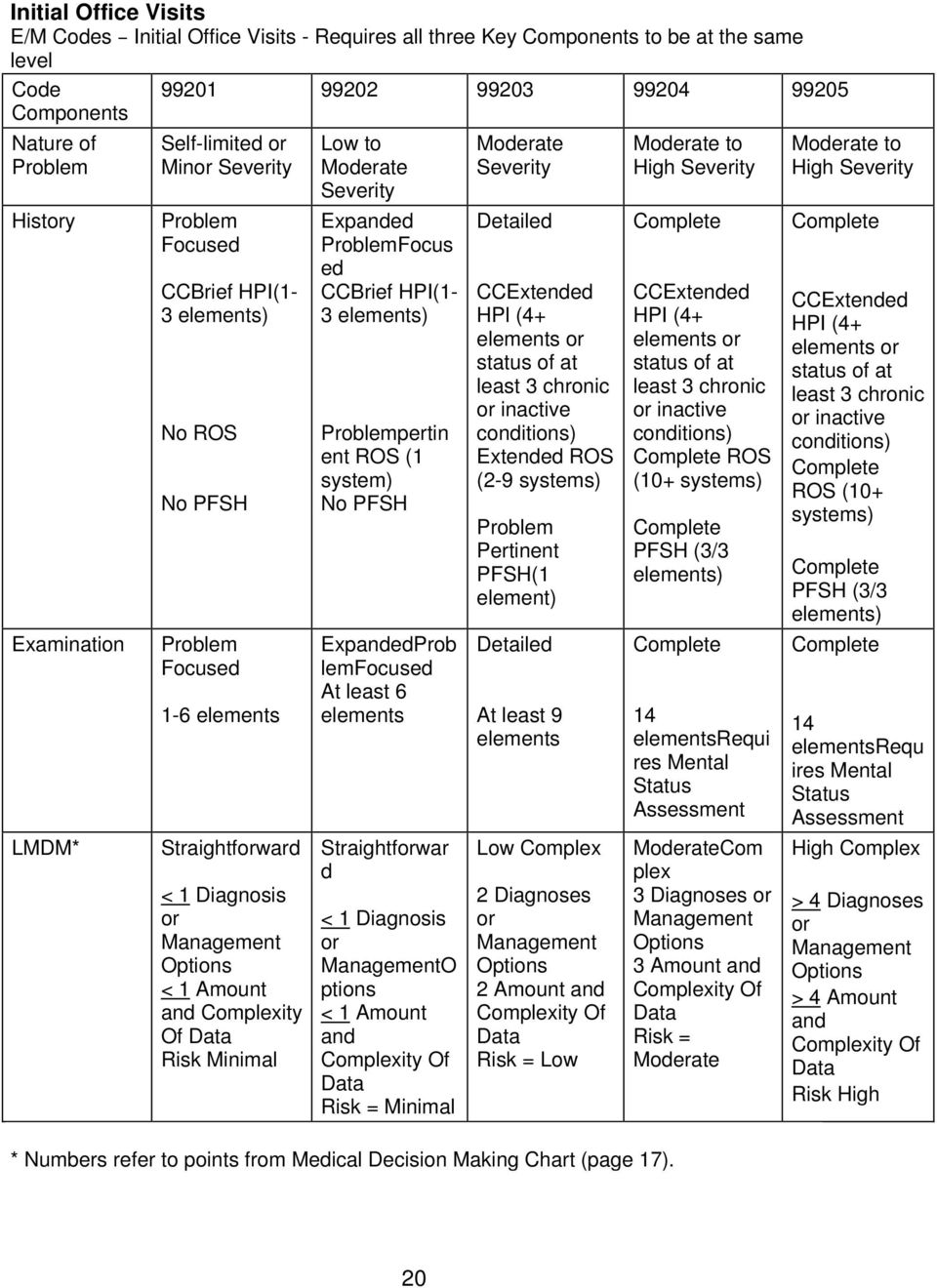
20 Initial Office Visits E/M Codes B Initial Office Visits - Requires all three Key Components to be at the same level Code Components Nature of Problem History Examination LMDM* Self-limited or Minor Severity Problem Focused CCBrief HPI(1-3 elements) No ROS No PFSH Problem Focused 1-6 elements Straightforward < 1 Diagnosis or Management Options < 1 Amount and Complexity Of Data Risk Minimal Low to Moderate Severity Expanded ProblemFocus ed CCBrief HPI(1-3 elements) Problempertin ent ROS (1 system) No PFSH ExpandedProb lemfocused At least 6 elements Straightforwar d < 1 Diagnosis or ManagementO ptions < 1 Amount and Complexity Of Data Risk = Minimal Moderate Severity Detailed CCExtended HPl (4+ elements or status of at least 3 chronic or inactive conditions) Extended ROS (2-9 systems) Problem Pertinent PFSH(1 element) Detailed At least 9 elements Low Complex 2 Diagnoses or Management Options 2 Amount and Complexity Of Data Risk = Low Moderate to High Severity Complete CCExtended HPI (4+ elements or status of at least 3 chronic or inactive conditions) Complete ROS (10+ systems) Complete PFSH (3/3 elements) Complete 14 elementsrequi res Mental Status Assessment ModerateCom plex 3 Diagnoses or Management Options 3 Amount and Complexity Of Data Risk = Moderate Moderate to High Severity Complete CCExtended HPI (4+ elements or status of at least 3 chronic or inactive conditions) Complete ROS (10+ systems) Complete PFSH (3/3 elements) Complete 14 elementsrequ ires Mental Status Assessment High Complex > 4 Diagnoses or Management Options > 4 Amount and Complexity Of Data Risk High * Numbers refer to points from Medical Decision Making Chart (page 17). 20
21 Established Patient Office Visits E/M Codes B Office Visit B Established Patient B Requires 2 of 3 Key Components to be at same level Code Nature of Presenting Problem History Exam LMDM* Minimal Severity Evaluation and Management Code does not require the presence of a physician Self-limited or Minor Severity Problem Focused CC Brief HPI(1-3 elements) No ROS No PFSH Problem Focused 1-5 elements Straightforwar d <1 Diagnosis or ManagementO ptions <1 Amount of Data Risk Minimal 21 Low tomoderatese verity ExpandedProb lemfocused CC Brief HPI (1-3 elements) Problem Pertinent ROS (1 system) No PFSH ExpandedProb lemfocused At least 6 elements Low Complex 2 Diagnoses ormanagement Options 2 Amount of Data Risk Low Moderate tohighseverity Detailed * Numbers refer to points from Medical Decision Making Chart (page 17). Consultation coding CC Extended HPI (4+ elements or status of at least 3 chronic or inactive conditions) Extended ROS (2-9 systems)proble mpertinentpfs H (1element) Detailed At least 9 elements Moderate Complex 3 Diagnoses or ManagementO ptions 3 Amount of Data Risk Moderate A consultation is a referral by one physician to another physician, normally a specialist in a different field, who will provide advice or a treatment plan. Medicare will reimburse the consulting physician for the following services: Moderate to High Severity Comprehensive CC Extended HPI (4 = elements or status of at least 3 chronic or inactive conditions) Complete ROS (10+ systems) Complete PFSH (2/3 elements) Comprehensive 14 elements Requires Mental Status Assessment High Complex >4 Diagnoses ormanagementop tions >4 Amount of Data Risk = High
22 Taking the patient=s history Examining the patient Initiating diagnostic and/or therapeutic services Preparing a written report that contains a diagnosis and becomes part of the patient=s permanent medical record Any time a physician performs a service for a patient at the request of another physician, the requesting physician=s name and Unique Physician Identification Number (UPIN) must be indicated in blocks 17 and 17a of the CMS-1500 claim form or the appropriate electronic equivalent. If the consultant subsequently assumes responsibility for management of a portion or all of the patient=s condition(s), this consultant should use the E/M codes describing initial or subsequent visits, depending on the type of encounter (first time seen, etc.). New Medicare rules on consultations: CMS has substantially revised the Medicare Claims Processing Manual, and has released a communication known as a ATransmittal,@ that lists the correct new CPT codes for consultations. The AMA CPT codes (hospital inpatient follow-up consultations) and codes (confirmatory consultations) were deleted, beginning Policy for consultations has been clarified with regard to the definition of Aconsultation,@ documentation requirements, when and by whom a consultation may be performed/reported, how to deal with a split/shared evaluation and management service, and nonphysician practitioners. New rules for confirmatory consultation (Asecond opinion@): The 2006 Confirmatory Consultation codes have been deleted. (Those codes were used primarily for patient-initiated or "second opinion" consultations.) Now, the proper way to code a second opinion (or patient-initiated consultation or request) depends on who requested the encounter. The patient, a family member or an insurer is no longer an appropriate source for a consultation request. Now, appropriate sources include a physician, counselor, nurse or nurse practitioner. To determine the appropriate code, you must ensure that the consultation requirements are met. You should report a regular consult code if the visit meets the three requirements for a consultation: (1) appropriate source of the request for opinion, (2) rendering of services and (3) report to the requester. What if the source is other than a physician, counselor, nurse or nurse practitioner? In that case, the appropriate requesting source is lacking and so 22
23 the three requirements have not been met. Therefore, instead of a consult, you must submit an office visit for the evaluation and management of a new or established patient. And since this would most likely be the first time you encounter this patient, it would be an Ainitial visit,@ depending on the place of service. Regarding private or managed care organizations consult policy: check with each carrier to determine its payment policy. To view the full CMS communication, go to: 23
24 Consultations E/M Codes B Consultations B Office - Requires all 3 Key Components to be at the same level Code Components Nature of Problem History Examination LMDM* Self-limited or Minor Severity Problem Focused CCBrief HPI(1-3 elements) No ROS No PFSH Problem Focused 1-6 elements Straightforward < 1 Diagnosis or Management Options < 1 Amount and Complexity Of Data Risk Minimal Low to Moderate Severity Expanded ProblemFocus ed CCBrief HPI(1-3 elements) Problempertin ent ROS (1 system) No PFSH ExpandedProb lemfocused At least 6 elements Straightforwar d < 1 Diagnosis or ManagementO ptions < 1 Amount and Complexity Of Data Risk = Minimal Moderate Severity Detailed CCExtended HPl (4+ elements or status of at least 3 chronic or inactive conditions) Extended ROS (2-9 systems) Problem Pertinent PFSH(1 element) Detailed At least 9 elements Low Complex 2 Diagnoses or Management Options 2 Amount and Complexity Of Data Risk = Low Moderate to High Severity Complete CCExtended HPI (4+ elements or status of at least 3 chronic or inactive conditions) Complete ROS (10+ systems) Complete PFSH (3/3 elements) Complete 14 elementsrequi res Mental Status Assessment ModerateCom plex 3 Diagnoses or Management Options 3 Amount and Complexity Of Data Risk = Moderate Moderate to High Severity Complete CCExtended HPI (4+ elements or status of at least 3 chronic or inactive conditions) Complete ROS (10+ systems) Complete PFSH (3/3 elements) Complete 14 elementsrequ ires Mental Status Assessment High Complex > 4 Diagnoses or Management Options > 4 Amount and Complexity Of Data Risk High * Numbers refer to points from Medical Decision Making Chart (page 17). 24
25 Coding for Ear, Nose, & Throat Your Medicare carrier=s website shows the full policy for key coding and billing issues, expressed in the Local Coverage Determination (LCD) format. You will find policy for: Indication and Limitations of Coverage and/or Medical Necessity CPT/HCPCS Codes ICD-9 Codes That Support Medical Necessity Documentation Requirements Utilization Guidelines (if available) Sources of Information Revision History Coding Guidelines To review key sections of the policies below, please see the section titled APolicy in this booklet=s Appendix (page 34). Common Ear, Nose, & Throat Services and their Payment and Policy Indicators Many times, physicians will require information on a particular code and its payment and policy guidelines. A full listing of pertinent policy guidelines is contained in the National Physician Fee Schedule Relative Value File. The file contains the associated relative value units used in calculating the Medicare payment, a fee schedule status indicator used in determining if a service is covered, and various payment policy indicators for more than 10,000 physician services. In addition to the above, it includes information on global or post-op periods, payment of assistant at surgery, team surgery, bilateral surgery, supervision requirements, and more. The drawback to this file is that it is large and requires Unzip software to access it. As a result, CMS has provided a quicker way to get this information. Go to the web site below and follow the instructions. 25
26 For example, when you type in code and request payment indicators, this grid appears and tells you, among other items, that the Global period for this surgery is 0 days, an the Asst Surg value of 1 means an assistant at surgery may not be paid for this code. HCP C Modifie r Short Description Nasal endoscopy, dx Pro c Sta t PCT C Glob al Ass t Sur g Bilt Sur g Mul t Sur g Co Sur g Tea m Surg Phy s Sup v Diag Imagin g Family Ind A It should be noted that, while this is a Medicare-specific file with payment and policy data unique to the federal program, many third party insurers use Medicare policy as an unofficial or sometimes official guide. The above function gives you data on a specific procedure code. To find the claims processing policy regarding common Ear, Nose, & Throat services of a specific Medicare carrier such as National Government Services - Empire Medicare Services in New York, you may want to look at the following websites (this is not an all-inclusive list): Respiratory Therapy Services Diagnostic Nasal Endoscopy Swallow Evaluation B Dysphagia Transtelephonic Spirometry Allergan Immunotherapy Medically Necessary Removal of Impacted Cerumen Requiring a Physician=s Skill Audiologic & Vestibular Function Tests 26
27 Major NCCI policy issues in Ear, Nose, & Throat The following are basic rules for Ear, Nose, & Throat Correct Coding (CCI) policy, to include the Respiratory and Ear Systems. Surgery: Respiratory, Cardiovascular, Hemic and Lymphatic Systems CPT Codes A. Introduction The general guidelines regarding correct coding apply to the CPT codes in the range of Specific issues unique to this section of the CPT Manual are clarified in the following guidelines. B. Evaluation and Management (E/M) Services Medicare Global Surgery Rules define the rules for reporting evaluation and management (E/M) services with procedures covered by these rules. This section summarizes some of the rules. All procedures on the Medicare Physician Fee Schedule are assigned a Global period of 000, 010, 090, XXX, YYY, or ZZZ. The global concept does not apply to XXX procedures. The global period for YYY procedures is defined by the Carrier. All procedures with a global period of ZZZ are related to another procedure, and the applicable global period for the ZZZ code is determined by the related procedure. Since NCCI edits are applied to same-day services rendered by the same provider to the same beneficiary, certain Global Surgery Rules are applicable to NCCI. An E/M service is separately reportable on the same date of service as a procedure with a global period of 000, 010, or 090 under limited circumstances. If a procedure has a global period of 090 days, it is defined as a major surgical procedure. If an E/M service is performed on the same date of service as a major surgical procedure for the purpose of deciding whether to perform this surgical procedure, the E/M service is separately reportable with modifier -57. Other E/M services on the same date of service as a major surgical procedure are included in the global payment for the procedure and are not separately reportable. NCCI does not contain edits based on this rule because Medicare Carriers have separate edits. 27
28 If a procedure has a global period of 000 or 010 days, it is defined as a minor surgical procedure. The decision to perform a minor surgical procedure is included in the payment for the minor surgical procedure, and should not be reported separately as an E/M service. However, a significant and separately identifiable E/M service unrelated to the decision to perform the minor surgical procedure is separately reportable with modifier -25. NCCI does contain some edits based on these principles, but the Medicare Carriers have separate edits. Neither the NCCI nor the Carriers have all possible edits based on these principles. Procedures with a global surgery indicator of AXXX@ are not covered by these rules. Many of these AXXX@ procedures are performed by physicians and have inherent pre-procedure, intra-procedure, and post-procedure work that is usually performed each time the procedure is completed. This work should never be reported as a separate E/M code. Other AXXX@ procedures are not usually performed by a physician and have no physician work relative value units associated with them. A physician should never report a separate E/M code with these procedures for the supervision of others performing the procedure or for the interpretation of the procedure. With most AXXX@ procedures, the physician may, however, perform a significant and separately identifiable E/M service on the same day of service, which may be reported by appending modifier B25 to the E/M code. This E/M service may be related to the same diagnosis that requires the performance of the AXXX@ procedure, but it cannot include (1) any work inherent in the AXXX@ procedure, (2) supervision of others performing the AXXX@ procedure, or (3) time for interpreting the result of the AXXX@ procedure. Appending modifier B25 to a significant, separately identifiable E/M service when performed on the same date of service as an AXXX@ procedure is correct coding. C. Respiratory System 1. Because the upper airway is bordered by a mucocutaneous margin, several CPT codes may define services involving biopsy, destruction, excision, removal, revision, etc., of lesions of this margin, specifically the nasal and oral surfaces. When billing a CPT code for these services, only one CPT code which most accurately describes the service performed should be coded, generally either from the CPT section describing integumentary services (CPT codes ) or respiratory services (CPT codes ). When the narrative accompanying the CPT codes from the respiratory system section includes tissue transfer (grafts, flaps, etc.), individual tissue transfer/graft/flap codes (e.g., CPT codes ) are not to be separately coded. 2. In keeping with the general guidelines previously promulgated, when a biopsy of an established lesion of the respiratory system is obtained as part of an excision, destruction, or other type of removal (either endoscopically or surgically) at the same session, a biopsy code is not to be reported by the surgeon in addition to the removal code. In the case of multiple similar or identical lesions, the biopsy code is not separately reported even if performed in 28
29 a different area. As noted previously, in the circumstance where the decision to perform the more comprehensive procedure (excision, destruction, or other type of removal) is dependent on the results of the biopsy, the procedure may be separately reported. If, at the same session, a biopsy is necessary to establish the need for surgery, modifier -58 would be used to indicate this. Example: If a patient presents with nasal obstruction, sinus obstruction and multiple nasal polyps, it may be reasonable to perform a biopsy prior to, or in conjunction with, polypectomy and ethmoidectomy. In this situation a separate code (e.g., CPT code for nasal/sinus endoscopy) is not to be reported with the column one nasal/sinus endoscopy code (e.g., CPT code 31255) (even though the latter code does not specifically list a biopsy in its CPT narrative), because the biopsy tissue is procured as part of the surgery, not to establish the need for surgery. 3. When a diagnostic endoscopy of the respiratory system is performed, it is routine to evaluate the access regions as part of the medically necessary service; a separate service for this evaluation is not to be reported. For example, if an anterior ethmoidectomy is endoscopically performed, it is inappropriate to bill a diagnostic nasal endoscopy simply because the approach to the sinus was transnasal. As another example, fiberoptic bronchoscopy services routinely involve a limited inspection of the nasal cavity, the pharynx and the larynx; only the bronchoscopic code is reported, not with the nasal endoscopy, laryngoscopy, etc., for this service, because this service is routine and incidental to the bronchoscopy. If a diagnostic endoscopy is performed, and this results in a decision to perform a (non-endoscopic) surgical procedure, then this endoscopy could be separately reported, indicating that this represented a distinct diagnostic service. Modifier - 58 may be used to indicate that the diagnostic endoscopy and the nonendoscopic surgical procedure are staged or planned procedures. Diagnostic endoscopy of the respiratory system (e.g., sinus endoscopy, laryngoscopy, bronchoscopy, pleuroscopy, etc.) performed at the same encounter as a surgical endoscopy is included in the surgical endoscopy, according to CPT Manual guidelines. However, when an open surgical procedure is performed and, at the same session, is accompanied by a "scout" endoscopy to evaluate the surgical field, the endoscopy code is not reported separately. This policy applies if the purpose of the endoscopic procedure is either to confirm the anatomical nature of the patient's respiratory system or to confirm the adequacy of the surgical procedure (e.g., tracheostomy, etc.). Additionally if an attempt to perform an endoscopic procedure fails and is converted to an open procedure, the endoscopic procedure is not separately reportable with the open procedure. Example: If a patient presents with aspiration of a foreign body and a bronchoscopy is performed indicating a lobar foreign body obstruction, an attempt may be made to remove the obstruction bronchoscopically. It would be inappropriate to code and bill for both CPT code (bronchoscopy - 29
30 diagnostic) and code (surgical bronchoscopy with removal of foreign body); only the "surgical" endoscopy, code 31635, would be appropriate. In this example, if the endoscopic effort is unsuccessful and a thoracotomy is planned, the diagnostic bronchoscopy could be separately coded in addition to the thoracotomy. Modifier -58 may be used to indicate that the diagnostic bronchoscopy and the thoracotomy are staged or planned procedures. If the surgeon decided to repeat the bronchoscopy after induction of general anesthesia to confirm the surgical approach to the foreign body, billing a service for this confirmatory bronchoscopy is inappropriate, although the initial diagnostic bronchoscopy could still be reported. Additionally, the failed bronchoscopic attempt to remove the foreign body should not be reported with an open procedure to remove the foreign body. 4. When a sinusotomy is performed in conjunction with a sinus endoscopy, only one service is reported. If the medically necessary service was the sinusotomy and the endoscopy was performed to evaluate adequacy or visualize the sinus cavity for disease, then the primary procedure would be best represented by the appropriate sinusotomy CPT procedure code. On the other hand, as a sinusotomy is usually required to accomplish a medically necessary diagnostic (or surgical) sinus endoscopy, the sinus endoscopy would be the primary (medically necessary) service and should be reported. CPT Manual narrative indicates that a surgical sinus endoscopy always includes a sinusotomy and diagnostic endoscopy. 5. Control of bleeding during a procedure is an integral part of endoscopic procedures and is not separately reported (e.g., CPT code for control of nasal hemorrhage is not to be reported with CPT code for nasal/sinus endoscopy, etc.). If bleeding is a late complication and requires a significant, separately identifiable service after the patient has been released from the endoscopic procedure, a separate service may be reported with modifier -78, indicating that a related procedure was performed to treat a complication during the postoperative period. When endoscopic procedures are performed, the most comprehensive code describing the service rendered is reported. If multiple procedures are performed and are not adequately described by a single CPT procedure code, more than one code may be reported; however, the multiple procedure modifier -51 is attached to the appropriate secondary service CPT codes. Additionally, only medically necessary services are reported; incidental examinations of other areas are not to be separately reported. 7. When laryngoscopy is required for placement of an endotracheal tube (e.g., CPT code 31500), a laryngoscopy code is not to be separately coded. Additionally, when a laryngoscopy is used to place an endotracheal tube for nonemergent reasons (e.g., general anesthesia, bronchoscopy, etc.), a separate service is not to be reported for the laryngoscopy. The CPT code refers only to endotracheal intubation as an emergency procedure; it is not reported when an elective intubation is performed. When intubation is performed in the 30
31 setting of a rapidly deteriorating patient who will require mechanical ventilation, a separate service may be reported as long as there is adequate documentation of the reasons for intubation. 8. When tracheostomy is performed as an essential part of laryngeal surgery, in accordance with the separate procedure policy, the CPT code is not separately reported. This would include laryngotomy, laryngectomy, or laryngoplasty codes, or other codes that routinely require placement of a tracheostomy. 9. If a laryngoscopy is required for the placement of a tracheostomy, the tracheostomy (CPT codes ) is reported and not the laryngoscopy. 10. CPT code (nasopharyngoscopy with endoscopy) should not be reported as a distinct service when performed as a cursory inspection with other respiratory endoscopic procedures. 11. A surgical thoracoscopy is included in and not to be separately reported from an open thoracotomy when performed at the same session; the thoracotomy would represent that the more extensive procedure was successfully accomplished. If, however, the thoracoscopy was performed for purposes of an initial diagnosis and the decision to perform surgery is based on the results of the thoracoscopy, then it is separately reported. Modifier -58 may be used to indicate that the diagnostic thoracoscopy and the thoracotomy are staged or planned procedures. Auditory System 1. When a mastoidectomy is included in the description of an auditory procedure (e.g., CPT codes 69530, 69802, 69910), separate codes describing mastoidectomy are not reported. 2. Myringotomies (e.g., CPT codes and 69421) are included in tympanoplasties and tympanostomies. F. Operating Microscope 1. CMS allows payment for use of the operating microscope (CPT 69990) with a list of procedures identified in the Internet-Only Manuals(IOM) Medicare Claims Processing Manual (Publication ), Chapter 12, Section (Allowable Adjustments) (formerly Medicare Carriers= Manual, Section 15055). NCCI bundles CPT code into all other surgical procedures. Most edits do not allow use of NCCIassociated modifiers. G. General Policy Statements 31
32 1. In this Manual many policies are described utilizing the term Unless indicated differently, the usage of this term does not restrict the policies to physicians only; it applies to all practitioners, hospitals, providers, or suppliers eligible to bill the relevant HCPCS/CPT codes pursuant to applicable portions of the Social Security Act (SSA) of 1965, the Code of Federal Regulations (CFR), and Medicare rules. In some sections of this Manual, the term would not include some of these entities because specific rules do not apply to those entities. For example, Anesthesia Rules and Global Surgery Rules do not apply to hospitals. 2. With few exceptions, the payment for a surgical procedure includes payment for dressings, supplies, and local anesthesia. These items are not separately reportable under their own HCPCS/CPT codes. Wound closures utilizing adhesive strips, topical skin adhesive, or tape alone are not separately reportable. In the absence of an operative procedure, these types of wound closures are included in an E&M service. 3. With limited exceptions, Medicare Anesthesia Rules prevent separate payment for anesthesia for a medical or surgical service when provided by the physician performing the service. The physician should not report CPT codes Additionally, the physician should not unbundle the anesthesia procedure and report component codes individually. For example, introduction of a needle or intracatheter into a vein (CPT code 36000), venipuncture (CPT code 36410), or drug administration (CPT codes ) should not be reported when these services are related to the delivery of an anesthetic agent. Medicare may allow separate payment for moderate conscious sedation services (CPT codes ), when these services are provided by the same physician performing the medical or surgical procedure, except for those procedures listed in Appendix G of the CPT Manual. Drug administration services (CPT codes ) are not separately reportable by the physician who performs an operative procedure for drug administration during the operative procedure. Under the Outpatient Prospective Payment System (OPPS), drug administration services related to operative procedures are included in the associated procedural HCPCS/CPT codes. Examples of such drug administration services include, but are not limited to, anesthesia (local or other), hydration, and medications such as anxiolytics or antibiotics. Providers should not report HCPCS/CPT codes C8950-C8952, or for these services. Medicare Global Surgery Rules prevent separate payment for postoperative pain management when provided by the physician performing an operative procedure. HCPCS/CPT codes 36000, 36410, 37202, , , 64450, 64470, 64475, and describe some services that may be utilized for postoperative pain management. The services described by these codes may be reported by the physician performing the operative procedure only if provided for purposes unrelated to 32
33 the postoperative pain management, the operative procedure, or anesthesia for the procedure. If a physician performing an operative procedure provides a drug administration service (HCPCS/CPT codes , C8950-C8952) for a purpose unrelated to anesthesia, intra-operative care, or post-procedure pain management, the drug administration service (HCPCS/CPT codes , C8950-C8952) may be reported with an NCCIassociated modifier. 4. Fine needle aspiration (FNA) (CPT codes 10021, 10022) should not be reported with another biopsy procedure code for the same lesion unless one specimen is inadequate for diagnosis. For example, an FNA specimen is usually examined for adequacy when the specimen is aspirated. If the specimen is adequate for diagnosis, it is not necessary to obtain an additional biopsy specimen. However, if the specimen is not adequate and another type of biopsy (e.g, needle, open) is subsequently performed at the same patient encounter, the other biopsy procedure code may also be reported with an NCCI-associated modifier. 5. If the code descriptor of a HCPCS/CPT code includes the phrase Aseparate procedure,@ the procedure is subject to NCCI edits based on this designation. CMS does not allow separate reporting of a procedure designated as a Aseparate procedure@ when it is performed at the same patient encounter as another procedure in an anatomically related area through the same skin incision, orifice, or surgical approach. 33
34 (This page intentionally left blank.) 34
35 APPENDIX TEMPLATE: RESPIRATORY SYSTEM EXAMINATION REQUIREMENTS 35
36 Respiratory System Exam Requirements Examination: N = Normal ABN = Abnormal NE = Not Evaluated COMMENT = Significant positive or negative findings Element N ABN NE Comment Constitutional Measurement of any three of the following seven vital signs: 1) sitting or standing blood pressure, 2) supine blood pressure, 3) pulse rate and regularity, 4) respiration, 5) temperature, 6) height, 7) weight (May be measured and recorded by ancillary staff) General appearance of patient (e.g., development, nutrition, body habitus, deformities, attention to grooming) Head and Face Eyes Ears, Nose, Mouth and Throat Inspection of nasal mucosa, septum and turbinates Inspection of teeth and gums Examination of oropharynx (e.g., oral mucosa, hard and soft palates, tongue, tonsils and posterior pharynx) Neck Examination of neck 36
37 (e.g., masses, overall appearance, symmetry, tracheal position, crepitus) Examination of thyroid (e.g., enlargement, tenderness, mass)examination of jugular veins (e.g., distension; a, v or cannon a waves) Respiratory Inspection of chest with notation of symmetry and expansion Assessment of respiratory effort (e.g., intercostal retractions, use of accessory muscles, diaphragmatic movement) Percussion of chest (e.g., dullness, flatness, hyperresonance) Palpation of chest (e.g., tactile fremitus) Auscultation of lungs (e.g., breath sounds, adventitious sounds, rubs) Cardiovascular Auscultation of heart including sounds, abnormal sounds and murmurs Examination of peripheral vascular system by observation (e.g., swelling, varicosities) and palpation (e.g., pulses, temperature, edema, tenderness) Chest (Breasts) Gastrointestinal (Abdomen) Examination of abdomen with notation of presence of masses or tenderness Examination of liver and 37
38 spleen Genitourinary Lymphatic Palpation of lymph nodes in neck, axillae, groin and/or other location Musculoskeletal Assessment of muscle strength and tone (e.g., flaccid, cog wheel, spastic) with notation of any atrophy and abnormal movements Examination of gait and station Extremities Inspection and palpation of digits and nails (e.g., clubbing, cyanosis, inflammation, petechiae, ischemia, infections, nodes) Skin Inspection and/or palpation of skin and subcutaneous tissue (e.g., rashes, lesions, ulcers) Neurological/ Brief assessment of mental status including Psychiatric $ Orientation to time, place and person $ Mood and affect (e.g., depression, anxiety, agitation) Content and Documentation Requirements Level of Exam Perform and Document: 38
39 Problem Focused Expanded Problem Focused bullet. Detailed Comprehensive One to five elements identified by a bullet. At least six elements identified by a At least twelve elements identified by a bullet. Perform all elements identified by a bullet; document every element in each box with a shaded border and at least one element in each box with an unshaded border. 39
CODE AUDITING RULES. SAMPLE Medical Policy Rationale
 CODE AUDITING RULES As part of Coventry Health Care of Missouri, Inc s commitment to improve business processes, we are implemented a new payment policy program that applies to claims processed on August
Modifiers. Page 1 of 6
 Modifiers A Current Procedural Terminology/Healthcare Common Procedure Coding System (CPT/HCPCS) modifier is a twocharacter (alpha and/or numeric) code appended to a CPT/HCPCS procedure code to clarify
Modifier Usage Guide What Your Practice Needs to Know
 BlueCross BlueShield of Mississippi Modifier Usage Guide What Your Practice Needs to Know Modifier 22 Usage Modifier 22 - Procedural Service The purpose of this modifier is to report services (surgical
Importance of Auditing
 Medicare 201: Practitioner Importance of Auditing EY Fraud Investigation and Dispute Services Jennifer Shimek, Senior Manager Gretchen Segado, Manager Agenda Importance of Auditing National and Local Coding
Documentation Guidelines for Physicians Interventional Pain Services
 Documentation Guidelines for Physicians Interventional Pain Services Pamela Gibson, CPC Assistant Director, VMG Coding Anesthesia and Surgical Divisions 343.8791 1 General Principles of Medical Record
The file and the documentation should create a clean chronological record of the patient and their interactions with the provider.
 Documentation and Coding Guidelines for Athletic Trainers Table of Contents What is documentation and why is it important? Documentation and SOAP What do payers want and why? General guidelines of medical
There are two levels of modifiers: Level 1 (CPT) and Level II (CMS, also known as HCPCS).
 PROVIDER BILLING GUIDELINES Modifiers Modifiers are two digit or alphanumeric characters that are appended to CPT and HCPCS codes. The modifier allows the provider to indicate that a procedure was affected
Modifier -25 Significant, Separately Identifiable E/M Service
 Manual: Policy Title: Reimbursement Policy Modifier -25 Significant, Separately Identifiable E/M Service Section: Modifiers Subsection: None Date of Origin: 1/1/2000 Policy Number: RPM028 Last Updated:
COM Compliance Policy No. 3
 COM Compliance Policy No. 3 THE UNIVERSITY OF ILLINOIS AT CHICAGO NO.: 3 UIC College of Medicine DATE: 8/5/10 Chicago, Illinois PAGE: 1of 7 UNIVERSITY OF ILLINOIS COLLEGE OF MEDICINE CODING AND DOCUMENTATION
Class Action Settlement Recap
 Class Action Settlement Recap Enhancements to Claim Payment Policy, Processing and Payment Disclosure, and an Appeals Process for Class Action Settlement Providers The following enhancements are effective
CODING. Neighborhood Health Plan 1 Provider Payment Guidelines
 CODING Policy The terms of this policy set forth the guidelines for reporting the provision of care rendered by NHP participating providers, including but not limited to use of standard diagnosis and procedure
CPT Coding in Oral Medicine
 CPT Coding in Oral Medicine CPT - Current Procedural Terminology Medical Code Set (00000-99999) Established as an indexing/coding system to standardize terminology among physicians and other providers
Physician Fee Schedule BCBSRI follows CMS Physician Fee Schedule (PFS) Relative Value Units (RVU) for details relating to
 Policy Coding and Guidelines EFFECTIVE DATE: 09 01 2015 POLICY LAST UPDATED: 09 02 2015 OVERVIEW This Policy provides an overview of coding and guidelines as they pertain to claims submitted to Blue Cross
5/2/2014. Beginning Biller / Coder 101 Thursday, May 8 1:00 p.m. to 2:30 p.m. Disclaimer. Stay in touch through Facebook Please note
 Disclaimer Beginning Biller / Coder 101 Thursday, May 8 1:00 p.m. to 2:30 p.m. Presented by: Judy B Breuker, CPC, CPMA, CCS P, CDIP, CHC, CHCA, CEMC, AHIMA Approved ICD 10 CM/PCS Trainer The class is intended
WELLCARE CLAIM PAYMENT POLICIES
 WellCare and Harmony Health Plan s claim payment policies are based on publicly distributed guidelines from established industry sources such as the Centers for Medicare and Medicaid Services (CMS), the
istent Trabecular Micro-Bypass Stent Reimbursement Guide
 istent Trabecular Micro-Bypass Stent Reimbursement Guide Table of Contents Overview Coding 3 4 Coding Overview Procedure Coding Device Coding Additional Coding Information Coverage Payment 10 11 Payment
A GUIDE TO EVALUATION & MANAGEMENT CODING AND DOCUMENTATION
 A GUIDE TO EVALUATION & MANAGEMENT CODING AND DOCUMENTATION Produced by ConnectiCare, Inc. in conjunction with its affiliate Group Health Incorporated TABLE OF CONTENTS Summary and Overview...Page 3 Part
Intra-operative Nerve Monitoring Coding Guide. March 1, 2011
 Intra-operative Nerve Monitoring Coding Guide March 1, 2011 Please direct any questions to: Patty Telgener, RN Vice President, Reimbursement Services Emerson Consultants (303) 526-7604 (office) (303) 570-2159
1) There are 0 indicator edits, which are never correctly reported together;
 Medical Coverage Policy Coding and Guidelines sad EFFECTIVE DATE: 11/15/2011 POLICY LAST UPDATED: 11/1/2013 OVERVIEW This Policy provides an overview of coding and guidelines as they pertain to claims
Global Surgery Fact Sheet
 DEPARTMENT OF HEALTH AND HUMAN SERVICES Centers for Medicare & Medicaid Services R Global Surgery Fact Sheet Fact Sheet Definition of a Global Surgical Package Medicare established a national definition
Modifiers 58, 78, and 79 Staged, Related, and Unrelated Procedures
 Manual: Policy Title: Reimbursement Policy Modifiers 58, 78, and 79 Staged, Related, and Unrelated Procedures Section: Modifiers Subsection: None Date of Origin: 9/22/2004 Policy Number: RPM010 Last Updated:
How To Write A Code Of Conduct
 Disclosures Behavioral Health Coding, Contracting and Billing, Part 1 Presented by Mimi Reed, BHSA, CPC A, MCP, MTA, Consultant, SCHA MI Mimi Reed, BHSA, CPC A, MCP, MTA, Consultant, SCHA MI Amy Valimont,
Medicare 101: Basics of Modifier Billing. Part B Provider Outreach and Education February 26, 2014
 Medicare 101: Basics of Modifier Billing Part B Provider Outreach and Education February 26, 2014 Housekeeping Tips When you called in, did you enter your attendee code? Dial-in number: 1-800-791-2345
Billing an NP's Service Under a Physician's Provider Number
 660 N Central Expressway, Ste 240 Plano, TX 75074 469-246-4500 (Local) 800-880-7900 (Toll-free) FAX: 972-233-1215 [email protected] Selection from: Billing For Nurse Practitioner Services -- Update
Status Active. Assistant Surgeons. This policy addresses reimbursement for assistant surgical procedures during the same operative session.
 Status Active Reimbursement Policy Section: Surgery/Interventional Procedure Policy Number: RP - Surgery/Interventional Procedure - 001 Assistant Surgeons Effective Date: June 1, 2015 Assistant Surgeons
E&M Coding- It s All About The Documentation
 E&M Coding- It s All About The Documentation Presented for Anthem Blue Cross and Blue Shield By: Penny Osmon, BA, CPC Coding & Reimbursement Educator WI Medical Society Wisconsin Medical Society, Copyright
Modifiers. This modifier can be located in the following rule(s): Anesthesia Global Maternity
 The Medical Clean Claims Task force has developed this modifier grid to identify modifiers that are considered to be important in the overall adjudication of a claim from a commercial payer perspective.
E/M Learning Tips INTRODUCTION TO EVALUATION. Introduction to Evaluation and Management (E/M) Coding for the Child and Adolescent Psychiatrist
 INTRODUCTION TO EVALUATION AND MANAGEMENT (E/M) CODING FOR THE CHILD AND ADOLESCENT PSYCHIATRIST Benjamin Shain, MD, PhD David Berland, MD Sherry Barron-Seabrook, MD Copyright 2012 by the American Academy
Part 1 General Issues in Evaluation and Management (E&M) in Headache
 AHS s Headache Coding Corner A user-friendly guide to CPT and ICD coding Stuart Black, MD Part 1 General Issues in Evaluation and Management (E&M) in Headache By better understanding the Evaluation and
Separate, But Not Distinct: The Appropriate Use Of Modifiers 25 And 59
 Separate, But Not Distinct: The Appropriate Use Of Modifiers 25 And 59 Sandy Giangreco, RHIT, CCS, CPC, CPC-H, CPC-I, PCS AHIMA Approved ICD-10-CM/PCS Trainer Jenny Studdard, CPC, RCC, CPCO AHIMA Approved
istent Trabecular Micro-Bypass Stent Reimbursement Guide
 istent Trabecular Micro-Bypass Stent Reimbursement Guide Table of Contents Overview Coding 2 3 Coding Overview Procedure Coding Device Coding Additional Coding Information Coverage Payment 8 9 Payment
E/M coding workshop. The risk of not getting it right. PAMELA PULLY CPC, CPMA BILLING/CLAIMS SUPERVISOR GENESEE HEALTH SYSTEM
 E/M coding workshop. The risk of not getting it right. PAMELA PULLY CPC, CPMA BILLING/CLAIMS SUPERVISOR GENESEE HEALTH SYSTEM Disclaimer This information is accurate as of December 1, 2014 and is designed
HEALTH DEPARTMENT BILLING GUIDELINES
 HEALTH DEPARTMENT BILLING GUIDELINES Acknowledgement: Current Procedural Terminology (CPT ) is copyright 2015 American Medical Association. All Rights Reserved. No fee schedules, basic units, relative
Payment Policy. Evaluation and Management
 Purpose Payment Policy Evaluation and Management The purpose of this payment policy is to define how Health New England (HNE) reimburses for Evaluation and Management Services. Applicable Plans Definitions
Coding for same-day visits and procedures By Emily Hill, PA-C
 Coding for same-day visits and procedures By Emily Hill, PA-C Can you get insurers to pay you for a procedure like endometrial biopsy performed at the same time as a problem-oriented visit? Sometimes.
Gone are the days when healthy
 Five Common Coding Mistakes That Are Costing You Fix these problems to increase your bottom line. GREG CLARKE Emily Hill, PA-C Gone are the days when healthy third-party reimbursements meant practices
Table of Contents Forward... 1 Introduction... 2 Evaluation and Management Services... 3 Psychiatric Services... 6 Diagnostic Surgery and Surgery...
 Table of Contents Forward... 1 Introduction... 2 Evaluation and Management Services... 3 Psychiatric Services... 6 Diagnostic Surgery and Surgery... 6 Other Complex or High Risk Procedures... 7 Radiology,
Title: Coding Documentation for IHS Affiliated Physician Practices
 Affiliated Physician Practices Effective Date: 11/03; Rev. 4/06, 7/08, 7/10 POLICY: IHS affiliated physician practices will code diagnoses utilizing the International Classification of Diseases, Ninth
Medical Necessity: Can You Please Define That? Part I. Riva Lee Asbell Philadelphia, PA
 Medical Necessity: Can You Please Define That? Part I Riva Lee Asbell Philadelphia, PA INTRODUCTION One of Medicare=s most elusive concepts is the term Amedical necessity@. Yet, lack thereof is the reason
100.1 - Payment for Physician Services in Teaching Settings Under the MPFS. 100.1.1 - Evaluation and Management (E/M) Services
 MEDICARE CLAIMS PROCESSING MANUAL Accessed September 25, 2005 100.1 - Payment for Physician Services in Teaching Settings Under the MPFS Payment is made for physician services furnished in teaching settings
Medical Compliance with Billing and Coding 2013: Will your Records Survive an Audit from a Third Party Payer or the OIG?
 Medical Compliance with Billing and Coding 2013: Will your Records Survive an Audit from a Third Party Payer or the OIG? Michael J. McGovern, OD, FAAO; Richard Soden, OD, FAAO American Academy of Optometry
CORRECT CODING INITIATIVE OB/GYN CPT CODES INTRODUCTION
 CORRECT CODING INITIATIVE OB/GYN CPT CODES INTRODUCTION 2015 NOTE: CMS UPDATES THE CCI QUARTERLY. FOR THE MOST RECENT VERSION, SEE DEPT. OF HEALTH ECONOMICS AND CODING WWW.ACOG.ORG CMS Correct Coding Initiative
Patient Progress Note & Dictation Standard
 Objective: The patient progress note serves as a basis for planning patient care, documenting communication between the health care provider and any other health professional contributing to the patient's
Modifier Reference PAYMENT POLICY ID NUMBER: 10-011. Original Effective Date: 05/14/10. Revised: 05/31/12 DESCRIPTION:
 Private Property of Florida Blue. This payment policy is Copyright 2012, Florida Blue. All Rights Reserved. You may not copy or use this document or disclose its contents without the express written permission
My Coding Connection, LLC 618-530-1196. 24 Unrelated E/M by the same physician during a postoperative period
 MODIFIERS Rachel Coon, CCS-P, CPC, CPC-P, CPMA, CPC-I, CEMC, ICD-10 My Coding Connection, LLC 618-530-1196 GLOBAL PACKAGE MODIFIERS 24 Unrelated E/M by the same physician during a postoperative period
CONNECTIONS TESTING FOR ICD-10
 TESTING FOR ICD-10 In conjunction with the Centers for Medicare and Medicaid Services (CMS), Providence Health Plan (PHP) and all major payers will convert from International Classification of Diseases,
Coding for Evaluation and Management Services
 Coding for Evaluation and Management Services Joanne Mehmert, CPC Joanne Mehmert & Associates, LLC [email protected] 2006 CPT E&M Updates May 2006 2 1 E&M Deleted Codes Deleted codes 99261-99263 Follow-up consultation
How to Use the Medicare National Correct Coding Initiative (NCCI) Tools
 DEPARTMENT OF HEALTH AND HUMAN SERVICES Centers for Medicare & Medicaid Services R How to Use the Medicare National Correct Coding Initiative (NCCI) Tools Knowing how to look up Medicare NCCI code pair
Empire BlueCross BlueShield Professional Reimbursement Policy
 Subject: Evaluation and Management Services and Related Modifiers -25 & 57 NY Policy: 0026 Effective: 8/19/2013 1/31/2014 Coverage is subject to the terms, conditions, and limitations of an individual
Coding Endoscopic Sinus Surgery
 Coding Endoscopic Sinus Surgery Audio Seminar/Webinar July 31, 2008 Practical Tools for Seminar Learning Copyright 2008 American Health Information Management Association. All rights reserved. Disclaimer
Forms designed to collect this information will help staff collect all pertinent information.
 1 CPT AUDIT TOOL INSTRUCTIONS The Nursing Consultants from the Public Health Nursing and Professional Development Unit based on multiple Evaluation & Management audits across the state have developed these
Procedural Coding Guidelines Utilizing CPT, HCPCS and CDT
 saving faces changing lives Procedural Coding Guidelines Utilizing CPT, HCPCS and CDT I. INTRODUCTION This paper discusses procedure coding, using the Current Procedural Terminology (CPT), Health Care
Modifiers XE, XS, XP, XU, and 59 - Distinct Procedural Service
 Manual: Policy Title: Reimbursement Policy Modifiers XE, XS, XP, XU, and 59 - Distinct Procedural Service Section: Modifiers Subsection: None Date of Origin: 1/1/2000 Policy Number: RPM027 Last Updated:
Medicare 101: Basics of CPT. Part B Provider Outreach and Education February 11, 2015
 Medicare 101: Basics of CPT Part B Provider Outreach and Education February 11, 2015 Housekeeping Tips When you called in, did you enter your attendee code? Dial-in number: 1-800-791-2345 Attendee (participant)
Modifiers. Policy Number: 10.01.503 Last Review: 5/2015 Origination: 12/2004 Next Review: 5/2016
 Modifiers Policy Number: 10.01.503 Last Review: 5/2015 Origination: 12/2004 Next Review: 5/2016 Policy Modifiers indicate that a service was altered in some way from the stated descriptor without changing
Current Procedural Terminology (CPT) Code Changes for 2013
 Current Procedural Terminology (CPT) Code Changes for 2013 For 2013 there have been major changes to the codes in the Psychiatry section of the AMA s Current Procedural Terminology, the codes that must
SECTION 4. A. Balance Billing Policies. B. Claim Form
 SECTION 4 Participating Physicians, hospitals and ancillary providers shall be entitled to payment for covered services that are provided to a DMC Care member. Payment is made at the established and prevailing
The Official Guidelines for coding and reporting using ICD-9-CM
 Reporting Accurate Codes In the Era of Recovery Audit Contractor Reviews Sue Roehl, RHIT, CCS The Official Guidelines for coding and reporting using ICD-9-CM A set of rules that have been developed to
Medicare Physician Fee Schedule Modifiers
 Basics of MPFS Part 3 Medicare Physician Fee Schedule Modifiers Presented by Part B Provider Outreach and Education July 16, 2013 Disclaimer This information released is the property of Cahaba GBA and
Coding Flow Charts. What is Medical Coding? 9/17/2012. Diagnosis Codes ICD-9-CM. Volume 1 & 2* Speakers
 Speakers Welcome to Coding Basics - Essentials You Must Know to Thrive Brought to you by ACC s Cardiovascular Administrator Work Group Presented by the ACC in conjunction with the MedAxiom Business Office
Evaluation & Management. Guidelines. Presented by: Kristi A. Gutierrez CCS-P, CPC, CEMC
 Evaluation & Management Documentation and Coding Guidelines Presented by: Kristi A. Gutierrez CCS-P, CPC, CEMC Objectives Participants will gain a working knowledge of Medicare s 1995 Evaluation & Management
Shellie Sulzberger, LPN, CPC, ICDCT-CM Coding & Compliance Initiatives, Inc.
 Shellie Sulzberger, LPN, CPC, ICDCT-CM Coding & Compliance Initiatives, Inc. Reasonable efforts have been made to provide the most accurate and current information on CPT 2015 code changes. However codes,
9/15/2015. Learning objectives. Coding and compliance. Coding Compliance for the IDS Environment. Could Your Coding be Costing You Money?
 Coding Compliance for the IDS Environment Could Your Coding be Costing You Money? Nancy Enos, FACMPE, CPC-I, CPMA, CEMC MGMA 2015 Annual Conference Learning objectives 1. Discover how administrators of
Disclaimer CODING 101 BOOT CAMP CODING SEMINAR FOR NEW PHYSICIANS
 CODING 101 BOOT CAMP CODING SEMINAR FOR NEW PHYSICIANS AND STAFF Chicago Dermatological Society January 26, 2013 Presented by Joy Newby, LPN, CPC, PCS Newby Consulting, Inc. 5725 Park Plaza Court Indianapolis,
MEDICAL POLICY Modifier Guidelines
 POLICY.........PG0011 EFFECTIVE......10/30/05 LAST REVIEW... 10/13/15 MEDICAL POLICY Modifier Guidelines GUIDELINES This policy does not certify benefits or authorization of benefits, which is designated
Section 2. Licensed Nurse Practitioner
 Section 2 Table of Contents 1 General Information... 2 1-1 General Policy... 2 1-2 Fee-For-Service or Managed Care... 2 1-3 Definitions... 2 2 Provider Participation Requirements... 3 2-1 Provider Enrollment...
Intraoperative Nerve Monitoring Coding Guide. March 1, 2010
 Intraoperative Nerve Monitoring Coding Guide March 1, 2010 Please direct any questions to: Kim Brew Manager Reimbursement and Therapy Access Medtronic ENT (904) 279-7569 Rev 9/10 KB TO OUR PARTNERS IN
Presentation title here
 Presentation Provider toolbox title here Sylvia Strickland, MBA, Provider Reimbursement Presentation title here Bridgette Ampey, CPC, Code Review Jorri Smith, Network Innovation & Education priorityhealth.com
Professional/Technical Component Policy
 Policy Number 2015R0012C Professional/Technical Component Policy Annual Approval Date 1/27/2014 Approved By Payment Policy Oversight Committee IMPORTANT NOTE ABOUT THIS REIMBURSEMENT POLICY You are responsible
Coding for the Internist: The Basics
 Coding for the Internist: The Basics Evaluation and management is the most important part of the practice for an internist and coding for these visits can have an important effect for the bottom line of
Local Coverage Article: Venipuncture Necessitating Physician s Skill for Specimen Collection Supplemental Instructions Article (A50852)
 Local Coverage Article: Venipuncture Necessitating Physician s Skill for Specimen Collection Supplemental Instructions Article (A50852) Contractor Information Contractor Name CGS Administrators, LLC Article
Question and Answer Submissions
 AACE Endocrine Coding Webinar Welcome to the Brave New World: Billing for Endocrine E & M Services in 2010 Question and Answer Submissions Q: If a patient returns after a year or so and takes excessive
Non-Physician Practitioner Services Coding & Reporting. Karla R. Peter, RHIT, CCS, CCS-P, CPC Avera Health September 6, 2013
 Non-Physician Practitioner Services Coding & Reporting Karla R. Peter, RHIT, CCS, CCS-P, CPC Avera Health September 6, 2013 Medical Necessity Overarching Criterion Medicare Claims Processing Manual, Chapter
Introduction to Medical Coding For Lawyers
 American Health Lawyers Association Institute on Medicare and Medicaid Payment Issues March 20-22, 2013 Introduction to Medical Coding for Payment Lawyers Robert A. Pelaia Senior University Counsel for
A. CPT Coding System B. CPT Categories, Subcategories, and Headings
 OST 148 MEDICAL CODING, BILLING AND INSURANCE COURSE DESCRIPTION: Prerequisites: None Corequisites: None This course introduces CPT and ICD coding as they apply to medical insurance and billing. Emphasis
2013 MPFS Indicator Descriptors
 2013 MPFS Indicator Descriptors Here is an overview of the layout. Use the key on the following pages to interpret indicators. Indicator NOTE - # NOTE - C PROCEDURE/MOD PAR Amount NON-PAR Amount Limiting
GEORGIA MEDICAID TELEMEDICINE HANDBOOK
 GEORGIA MEDICAID TELEMEDICINE HANDBOOK CONNECTING GEORGIA OVERVIEW The Department of Community Health s (DCH) Telemedicine and Telehealth policies are slated to improve and increase access and efficiency
Appendix A Denial Management and Negotiation Hearing Screening
 Appendix A Denial Management and Negotiation Hearing Screening Ideally, hearing screenings should be covered benefits that are separately payable by the health plan. While health plan benefits may include
Final. National Health Care Billing Audit Guidelines. as amended by. The American Association of Medical Audit Specialists (AAMAS)
 Final National Health Care Billing Audit Guidelines as amended by The American Association of Medical Audit Specialists (AAMAS) May 1, 2009 Preface Billing audits serve as a check and balance to help ensure
AHLA. HH. Introduction to Medical Coding for Payment Lawyers
 AHLA HH. Introduction to Medical Coding for Payment Lawyers Robert A. Pelaia Senior University Counsel University of Florida Jacksonville Jacksonville, FL Institute on Medicare and Medicaid Payment Issues
1995 DOCUMENTATION GUIDELINES FOR EVALUATION AND MANAGEMENT SERVICES
 1995 DOCUMENTATION GUIDELINES FOR EVALUATION AND MANAGEMENT SERVICES I. INTRODUCTION WHAT IS DOCUMENTATION AND WHY IS IT IMPORTANT? Medical record documentation is required to record pertinent facts, findings,
2014 E&M Oncology Documentation & Coding Basics Working Smarter, Not Harder!
 2014 E&M Oncology Documentation & Coding Basics Working Smarter, Not Harder! West Virginia Oncology Society October 2, 2014 This presentation is offered as an educational tool. E&M Consulting Inc. does
Midlevel Practitioner Billing and Incident To
 Midlevel Practitioner Billing and Incident To Health Care Compliance Association North Central Regional Conference October 5, 2012 Presented by Joy Newby, LPN, CPC, PCS Newby Consulting, Inc. 5725 Park
Policy Limitations This policy applies to all places of service in accordance with the National POS code set.
 Original Effective Date: January 1, 2013 Revision Date: February 1, 2014 PROFESSIONAL EVALUATION AND MANAGEMENT SERVICES Policy NHP reimburses participating providers for the provision of medically necessary
Zimmer Payer Coverage Approval Process Guide
 Zimmer Payer Coverage Approval Process Guide Market Access You ve Got Questions. We ve Got Answers. INSURANCE VERIFICATION PROCESS ELIGIBILITY AND BENEFITS VERIFICATION Understanding and verifying a patient
ILLINOIS WORKERS' COMPENSATION COMMISSION MEDICAL FEE SCHEDULE INSTRUCTIONS AND GUIDELINES
 Table of Contents ILLINOIS WORKERS' COMPENSATION COMMISSION MEDICAL FEE SCHEDULE INSTRUCTIONS AND GUIDELINES For treatment before 2/1/09 Introduction and Purpose Reference Materials Section 1. Ambulatory
Status Active. Reimbursement Policy Section: Anesthesia Services Policy Number: RP - Anesthesia - 001 Anesthesia Effective Date: June 1, 2015
 Status Active Reimbursement Policy Section: Anesthesia Services Policy Number: RP - Anesthesia - 001 Anesthesia Effective Date: June 1, 2015 Anesthesia Policy Description: Definitions: This policy addresses
Modifiers. Disclaimer
 Modifiers The Rest of the Story 1 Disclaimer This is not an all inclusive list of every modifier; this is an overview of many modifiers and their intended usage. This material is designed to offer basic
Coding and Billing. General Office Billing Guidelines Scroll to page 1. Key Terms.. Scroll to page 2
 OVER VEIW General Office Billing Guidelines Scroll to page 1 Key Terms.. Scroll to page 2 Coding for Evaluation and Management Services..Scroll to page 2 Frequently Used Common Procedural Codes.. Scroll
NEW YORK STATE MEDICAID PROGRAM NURSE PRACTITIONER PROCEDURE CODES
 NEW YORK STATE MEDICAID PROGRAM NURSE PRACTITIONER PROCEDURE CODES Table of Contents GENERAL INFORMATION... 3 STATE DEPARTMENT OF HEALTH CONDITIONS FOR PAYMENT... 6 PRACTITIONER SERVICES PROVIDED IN HOSPITALS...
Home Study Course for the Medical Biller
 Home Study Course for the Medical Biller Copyright 2001-2014, Medical Billing Course.com Chapter 4 Understanding Codes An introduction to procedure and diagnosis coding. In Chapter 4 you will be introduced
HOW TO PREVENT AND MANAGE MEDICAL CLAIM DENIALS TO INCREASE REVENUE
 Billing & Reimbursement Revenue Cycle Management HOW TO PREVENT AND MANAGE MEDICAL CLAIM DENIALS TO INCREASE REVENUE Billing and Reimbursement for Physician Offices, Ambulatory Surgery Centers and Hospitals
AHS s Headache Coding Corner A user-friendly guide to CPT and ICD coding
 AHS s Headache Coding Corner A user-friendly guide to CPT and ICD coding Stuart Black, MD Part 3 - Medical Decision Making (MDM) coding in Headache As stated in the CPT codebook, the classification of
Suzanne Honor-Vangerov, Esq. CPC, CPC-I
 Suzanne Honor-Vangerov, Esq. CPC, CPC-I 1 Managing Attorney, Lien Unit Floyd Skeren & Kelly LLP Owner of Honor System Consulting Prior Manager of the Division of Workers Compensation Medical Unit, in charge
Rotator Cuff Repair Surgical Procedures
 Rotator Cuff Repair Surgical Procedures 2011 Reimbursement and Coding Reference Guide for Physicians and Hospitals This coding reference guide is intended to illustrate the common CPT * codes, ICD-9 CM