
Individual tax return instructions 2015
|
|
|
- Melanie Williams
- 10 years ago
- Views:
Transcription
1 Instructions for taxpayers Individual tax return instructions 05 To help you complete your tax return July June 05 Lodge online with mytax this year. Find out more inside NAT

2 OUR COMMITMENT TO YOU We are committed to providing you with accurate, consistent and clear information to help you understand your rights and entitlements and meet your obligations. If you follow our information in this publication and it is either misleading or incorrect and you make a mistake as a result, we must still apply the law correctly. If that means you owe us money, you must pay it but we will not charge you a penalty. Also, if you acted reasonably and in good faith we will not charge you interest. If correcting the mistake means we owe you money, we will pay it and pay you any interest you are entitled to. If you feel that this publication does not fully cover your circumstances, or you are unsure how it applies to you, you can seek further help from us. We regularly revise our publications to take account of any changes to the law, so make sure that you have the latest information. If you are unsure, you can check for more recent information at ato.gov.au or contact us. This publication was current at June 05. FOREWORD Individual tax return instructions 05 is a guide to help you correctly complete your 05 tax return. For most people it has all you need to fill in your tax return. The more technical and less commonly used information is at ato.gov.au/instructions05 If you have internet access, try lodging online: n MyTax is our streamlined online service for people with straightforward tax affairs. It works on mobile devices, tablets and computers. Using mytax can save you time because it downloads the information that has been reported to us by your employer, bank, super fund, health fund, government agencies and other providers, straight into your return. This year mytax includes more income sources, to make lodging your tax return easier. n Our e-tax software is still available for people with more complex tax affairs. It is downloadable and works on both PC and Mac. Lodging online is free and secure and most refunds are issued within business days. To find out what product is right for you go to ato.gov.au/lodgeonline There is a complete set of instructions and a range of tools and calculators at ato.gov.au At the back of this guide are details about our other online services, and how you can contact us. If you do your best to complete your tax return correctly, whether through mytax, e-tax or on paper, you will not be subject to any penalties if you get things wrong. All you need to do is take reasonable steps to ensure that the information you provide is as complete and accurate as possible. The ATO app puts tax and super help in your hand Using the ATO app you can: log in to access our online services including mytax, to lodge your 05 income tax return track the progress of your return search for lost super access useful tools and calculators. The app is available now for download from Google play, Windows Phone Store or the Apple App Store. Find out more at ato.gov.au/app AUSTRALIAN TAXATION OFFICE FOR THE COMMONWEALTH OF AUSTRALIA, 05 You are free to copy, adapt, modify, transmit and distribute this material as you wish (but not in any way that suggests the ATO or the Commonwealth endorses you or any of your services or products). PUBLISHED BY Australian Taxation Office Canberra June 05 JS 3977
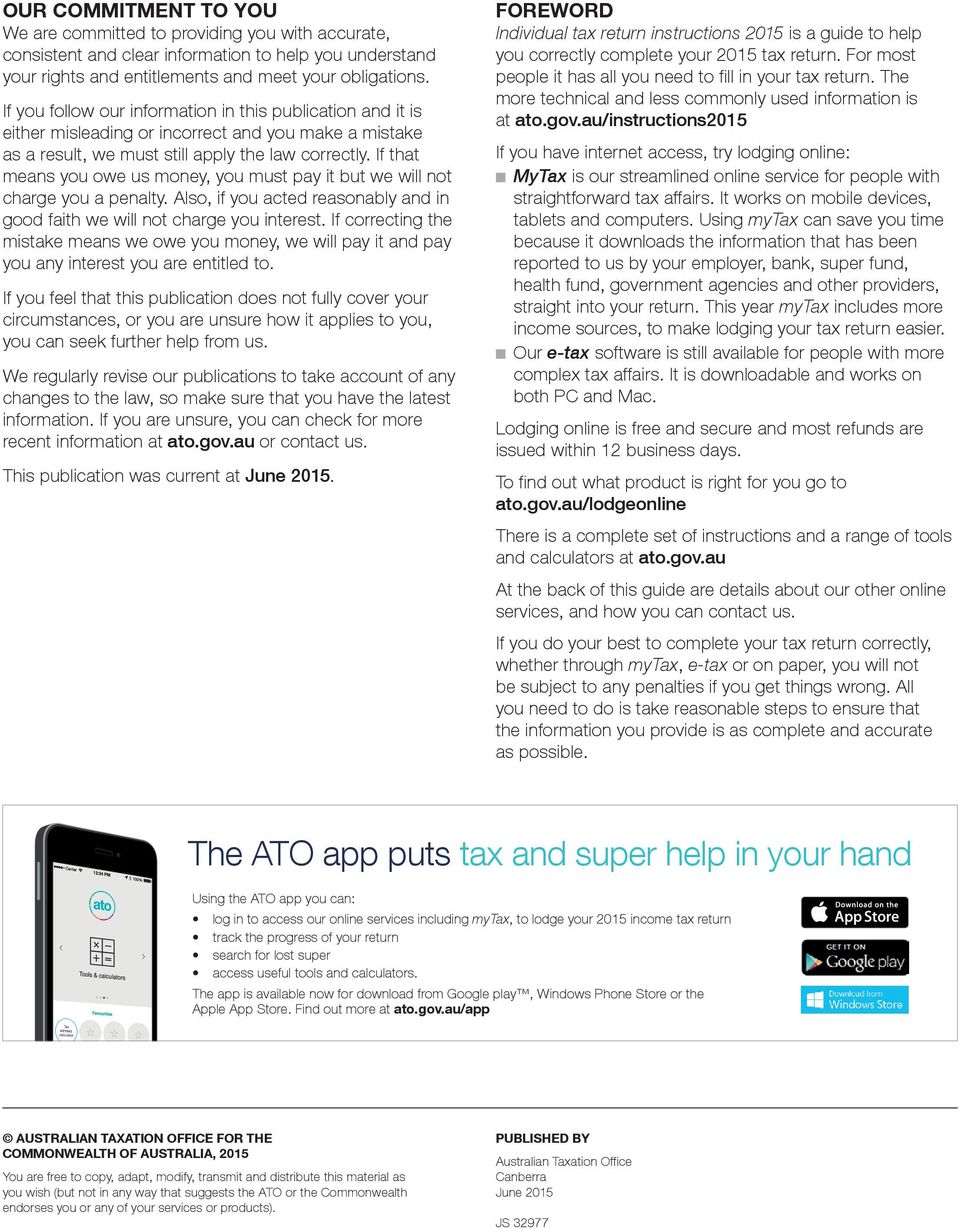
3 Contents Will you need Individual tax return instructions supplement 05? 3 What s new this year? 4 Do you need to lodge a tax return? 5 Non-lodgment advice 05 7 Completing Individual information on your tax return 8 INCOME Salary or wages 9 Allowances, earnings, tips, directors fees etc 0 3 Employer lump sum payments 4 Employment termination payments 5 Australian Government allowances and payments 3 6 Australian Government pensions and allowances 4 7 Australian annuities and superannuation income streams 5 8 Australian superannuation lump sum payments 7 9 Attributed personal services income 8 Total tax withheld 8 0 Gross interest 9 Dividends 0 Employee share schemes Income from the supplementary section of your tax return 3 Total income or loss 3 DEDUCTIONS Claiming deductions 4 D Work-related car expenses 5 D Work-related travel expenses 6 D3 Work-related uniform, occupation specific or protective clothing, laundry and dry-cleaning expenses 7 D4 Work-related self education expenses 9 D5 Other work-related expenses 3 D6 Low-value pool deduction 3 D7 Interest deductions 33 D8 Dividend deductions 33 D9 Gifts or donations 34 D0 Cost of managing tax affairs 35 Deductions from the supplementary section of your tax return 36 Total deductions 36 Subtotal 36 LOSSES L Tax losses of earlier income years 37 Taxable income or loss 37 TAX OFFSETS T Seniors and pensioners (includes self-funded retirees) 38 T Australian superannuation income stream 4 Tax offsets from the supplementary section of your tax return 4 Total tax offsets 4 Adjustments from the supplementary section of your tax return 4 MEDICARE LEVY M Medicare levy reduction or exemption 43 M Medicare levy surcharge 46 Private health insurance policy details 49 ADJUSTMENTS A Under 8 5 A Part-year tax-free threshold 53 A3 Government super contributions 54 INCOME TESTS IT Total reportable fringe benefits amounts 59 IT Reportable employer superannuation contributions 60 IT3 Tax-free government pensions or benefits 60 IT4 Target foreign income 6 IT5 Net financial investment loss 6 IT6 Net rental property loss 63 IT7 Child support you paid 64 IT8 Number of dependent children 64 Spouse details married or de facto 65 INFORMATION Checklist 67 Definitions 67 Amounts that you do not pay tax on 73 Important information 76 More information inside back cover INDIVIDUAL TAX RETURN INSTRUCTIONS 05
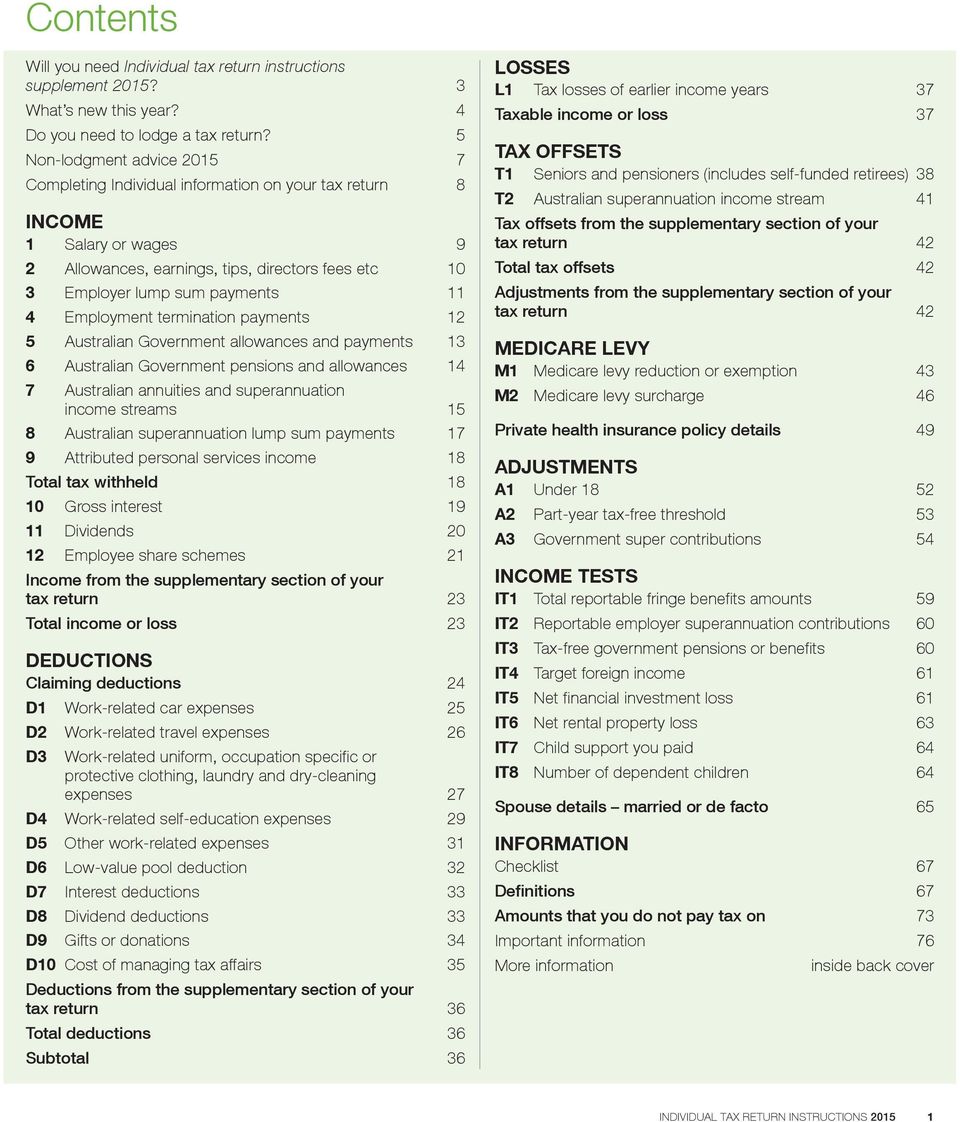
4 The quick smart way to lodge online Lodging your tax return can be easier this year with mytax. Information is pre-filled, making it easier There are less questions, making it quicker We use a range of systems and controls to ensure that your information is protected, it s as safe as using online banking and most refunds are issued within business days. Over million people used mytax last year. Go to ato.gov.au/lodgeonline to find out more about mytax. INDIVIDUAL TAX RETURN INSTRUCTIONS 05
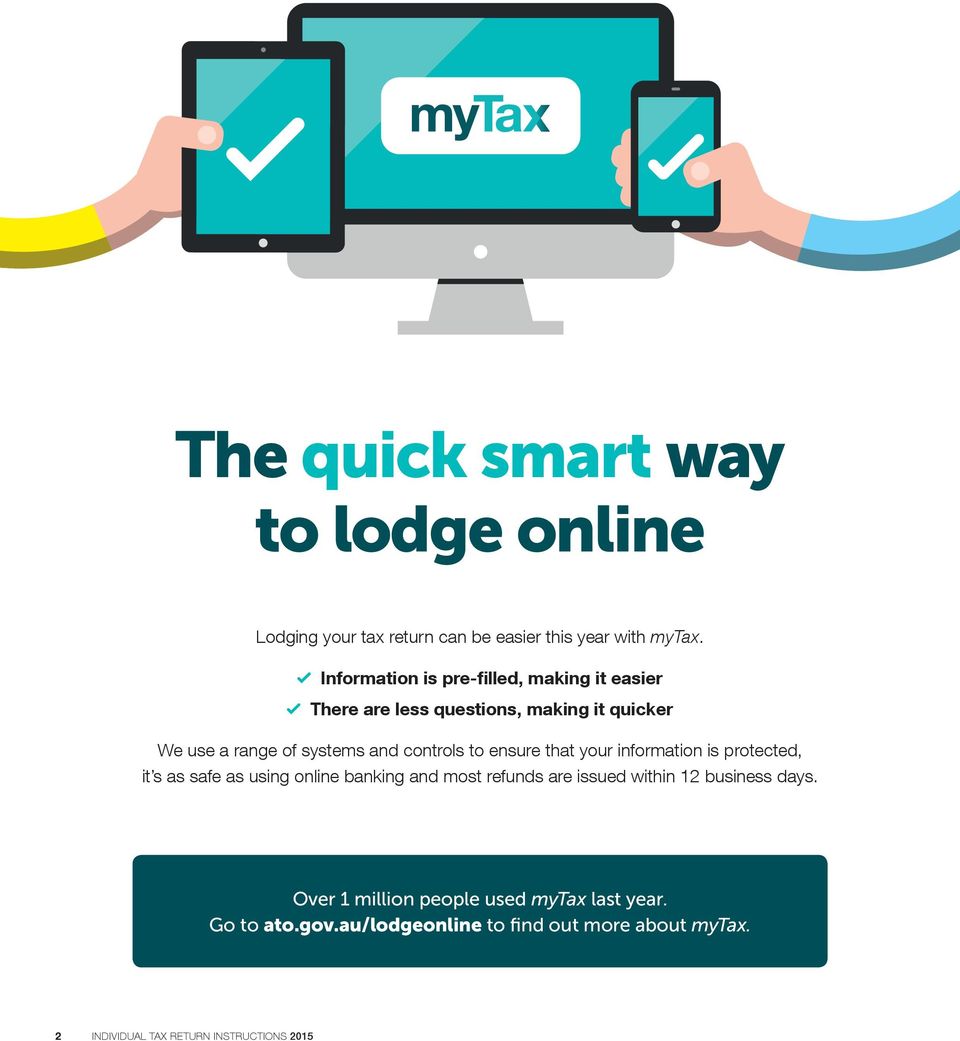
5 Will you need Individual tax return instructions supplement 05? Individual tax return instructions supplement 05 contains questions that are not included in Individual tax return instructions 05. Check the list below to see whether you need it to complete your tax return. INCOME 3 Income from partnerships and trusts* 4 Personal services income* 5 Net income or loss from business* 6 Deferred non-commercial business losses* 7 Net farm management deposits or repayments 8 Capital gains (from all sources including shares, real estate and other property) 9 Foreign entities 0 Foreign source income and foreign assets or property, including foreign source pension or annuity Rent Bonuses from life insurance companies and friendly societies 3 Forestry managed investment scheme income 4 Other income (income not listed elsewhere) * If you were a partner in a partnership that made a loss, or you are required to complete income questions 4, 5 or 6, you cannot lodge a paper return. You must lodge your tax return using e-tax or a registered tax agent. TAX OFFSETS T3 Superannuation contributions on behalf of your spouse T4 Zone or overseas forces T5 Total net medical expenses T6 Invalid and invalid carer T7 Landcare and water facility T8 Other non-refundable tax offsets T9 Other refundable tax offsets ADJUSTMENT A4 Amount on which family trust distribution tax has been paid CREDIT FOR INTEREST ON TAX PAID C Credit for interest on early tax payments HOW TO GET INDIVIDUAL TAX RETURN INSTRUCTIONS SUPPLEMENT 05 Individual tax return instructions supplement 05 is only available online at ato.gov.au/instructions05 You can still get a copy of the Tax return for individuals (supplementary section) 05 return form from our Publications Distribution Service (see inside back cover) and our shopfronts. DEDUCTIONS D Deductible amount of undeducted purchase price of a foreign pension or annuity D Personal superannuation contributions (generally for the self-employed) D3 Deduction for project pool D4 Forestry managed investment scheme deduction D5 Other deductions that is, deductions not claimable at items D to D4 or elsewhere on your tax return INDIVIDUAL TAX RETURN INSTRUCTIONS 05 3
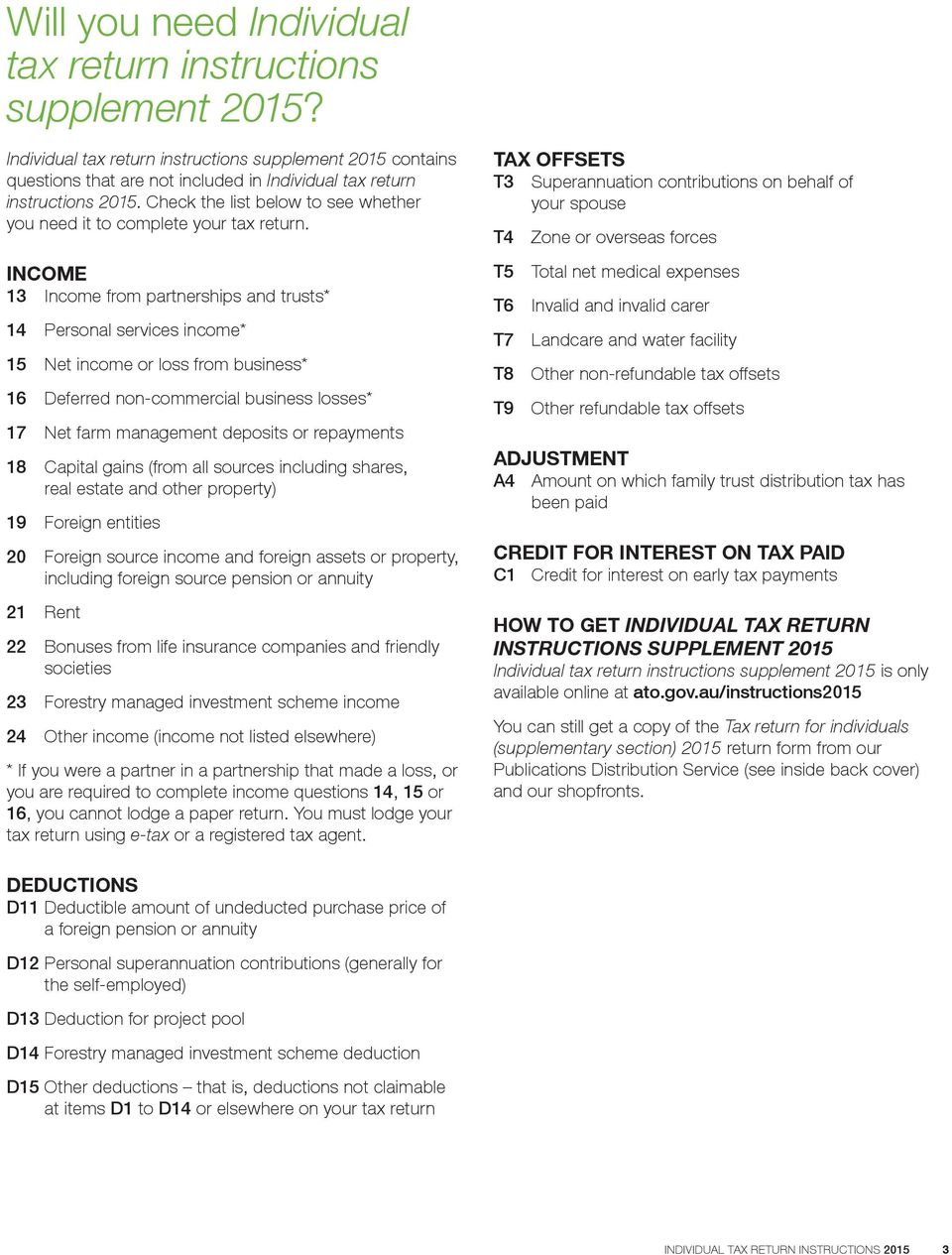
6 What s new this year? TEMPORARY BUDGET REPAIR LEVY A temporary budget repair levy of % will be calculated on your taxable income that exceeds $80,000. The levy will be calculated using the information provided in your tax return. If you need to pay the levy it will be shown on your Notice of Assessment. PREVENTING DIVIDEND WASHING The dividend washing integrity rule applies from July 03. The integrity rule prevents you from claiming franking credits where you have received a dividend as a result of dividend washing. Dividend washing occurs where you, or an entity connected to you, claim two sets of franking credits by: n selling shares that are held on the Australian Securities Exchange (ASX) and have become ex-dividend, and then n purchasing some substantially identical shares using a special ASX trading market. The dividend washing integrity rule does not apply if: n you are an individual, and n you received no more than $5,000 in franking credits during However, the dividend washing integrity rule applies where dividends flow indirectly to you through your interest in a trust or partnership. The Commissioner may also apply the anti-avoidance legislation to deny franking credit benefits to any dividend washing transactions. Go to ato.gov.au/dividendwashing for more information. EXPANDING ACCELERATED DEPRECIATION FOR SMALL BUSINESSES In the 05 budget, the government announced its intention to allow small businesses with an aggregate turnover of less than $ million to immediately deduct assets they start to use or install ready for use, provided the asset costs less than $0,000. The small business simplified depreciation pool will apply to assets costing $0,000 or more. These changes will apply to assets acquired and installed ready for use from 7.30pm (AEST) May 05. At the time of publishing, these changes had not yet become law. For more information, go to ato.gov.au and search for expanding accelerated depreciation. 4 INDIVIDUAL TAX RETURN INSTRUCTIONS 05
7 Do you need to lodge a tax return? If any of the following applies to you, then you must lodge a tax return. REASON During 04 5, you were an Australian resident and you: n paid tax under the pay as you go (PAYG) withholding or instalment system, or n had tax withheld from payments made to you. REASON You were eligible for the seniors and pensioners tax offset (see pages 38 40) and your rebate income (not including your spouse s) was more than: n $3,79 if you were single, widowed or separated at any time during the year n $3,79 if you had a spouse but one of you lived in a nursing home or you had to live apart due to illness (see the definition of Had to live apart due to illness on page 39), or n $8,974 if you lived with your spouse for the full year. To work out your rebate income, see page 7 or go to ato.gov.au/instructions05 and use the Income tests calculator. REASON 3 You were not eligible for the seniors and pensioners tax offset but you received a payment listed at question 5 on page 3 and other taxable payments which, when added together, made your taxable income more than $0,54. REASON 4 You were not eligible for the seniors and pensioners tax offset and you did not receive a payment listed at question 5 or 6 on pages 3 and 4, but your taxable income was more than: n $8,00 if you were an Australian resident for tax purposes for the full year n $46 if you were under 8 years old at 30 June 05 and your income was not salary or wages n $ if you were a foreign resident and you had income taxable in Australia which did not have non-resident withholding tax withheld from it n your part-year tax-free threshold amount, if you became or stopped being an Australian resident for tax purposes; see question A or phone OTHER REASONS You must lodge a tax return if any of the following applied to you: n You had a reportable fringe benefits amount on your: PAYG payment summary individual non-business, or PAYG payment summary foreign employment. n You had reportable employer superannuation contributions on your: PAYG payment summary individual non-business PAYG payment summary foreign employment, or PAYG payment summary business and personal services income. n You were entitled to the private health insurance rebate but you did not claim your correct entitlement as a premium reduction, and your spouse (if you had one) is not claiming the rebate for you in their income tax return. n You carried on a business. n You made a loss or you can claim a loss you made in a previous year. n You were 60 years old or older and you received an Australian superannuation lump sum that included an untaxed element or it is a death benefit superannuation lump sum paid to you as a non-dependant. n You were under 60 years old and you received an Australian superannuation lump sum that included a taxed element or an untaxed element. n You were entitled to a distribution from a trust or you had an interest in a partnership, and the trust or partnership carried on a business of primary production. n You were an Australian resident for tax purposes and you had exempt foreign employment income, and $ or more of other income. (For more information about exempt foreign employment income, see question 0 in the Individual tax return instructions supplement 05.) n You are a special professional covered by the income averaging provisions. These provisions apply to authors of literary, dramatic, musical or artistic works, inventors, performing artists, production associates and active sportspeople. n You received income from dividends or distributions exceeding $8,00 (or $46 if you were under 8 years old on 30 June 05), and you had: franking credits attached, or amounts withheld because you did not quote your tax file number or Australian business number to the investment body. INDIVIDUAL TAX RETURN INSTRUCTIONS 05 5
8 Do you need to lodge a tax return? n You made personal contributions to a complying superannuation fund or retirement savings account and will be eligible to receive a super co-contribution for these contributions. n You were a liable parent or a recipient parent under a child support assessment, unless: you received one or more Australian Government allowances, pensions or payments for the whole of the period July 04 to 30 June 05, and the total of all the following payments was less than $3,60 - taxable income - exempt Australian Government allowances, pensions and payments - target foreign income (see question IT4) - reportable fringe benefits - net financial investment loss (see question IT5) - net rental property loss (see question IT6), and - reportable superannuation contributions. If you are a liable parent or recipient parent under a child support assessment and you received one or more Australian Government allowances, pensions or payments, go to ato.gov.au/instructions05 and read Do you need to lodge a tax return? Deceased estate If you are looking after the estate of someone who died during 04 5, consider all the above reasons on their behalf. If a tax return is not required, complete the Non lodgment advice 05 form on the next page and send it to us. If a tax return is required, see page 8 for more information. Franking credits If you don t need to lodge a tax return for 04 5, you can claim a refund of franking credits by using Refund of franking credits instructions and application for individuals 05 (NAT 405) and lodging your claim online, by mail, or phone First home saver account If you had a first home saver account in 04 5 and believe you are entitled to a first home saver account government contribution, you must lodge either: n a tax return, or n a notification of eligibility (if you are not required to lodge a tax return and you were an Australian resident for at least part of 04 5) by completing the First home saver account notification of eligibility (NAT 7947). Go to ato.gov.au to get a copy of this form. If you have read all the information above and know that you do not have to lodge a tax return, complete a Non-lodgment advice 05, unless one of the following applies to you: n You have already sent us a tax return, non-lodgment advice, form or letter telling us that you do not need to lodge a tax return for all future years. n You are lodging an application for a refund of franking credits for 05. n Your only income was from an allowance or payment listed at question 5 on page 3 or you received a pension, payment or an allowance listed at question 6 on page 4 and your rebate income was less than or equal to the relevant amount in reason (if you are eligible for the seniors and pensioners tax offset), or your taxable income was less than or equal to the relevant amount in reason 3 (the agencies that paid you have provided information for us to determine that you do not need to lodge a tax return). A Non-lodgment advice 05 can be submitted using our online services. For more information about online services go to ato.gov.au/onlineservices Alternatively, complete the Non-lodgment advice 05 on the next page and send it to us. 6 INDIVIDUAL TAX RETURN INSTRUCTIONS 05

9 n indd 8/04/5 0:58 AM Non-lodgment advice 05 July 04 to 30 June 05 Please print neatly in BLOCK LETTERS with a black or blue ballpoint pen only. Do not use correction fluid or tape. If you do not need to lodge a tax return for the 04 5 income year ( July 04 to 30 June 05), you will need to complete the form below and send it to the ATO by 3 October 05. For more information about lodging a tax return see Individual tax return instructions 05. From July 05 you can get copies of Individual tax return instructions 05 (NAT ) from ATO shopfronts or by phoning the Publications Distribution Service on Your tax file number (TFN) See the Privacy note in the Declaration at the bottom of this form. Your date of birth DAY MONTH YEAR Your name Title for example, Mr, Mrs, Ms, Miss Surname or family name Given names Your postal address Suburb or town State Postcode Country if not Australia Have you changed your postal address since your last tax return? NO YES Read on. Print the address on your last notice of assessment or the address you last told us about. Suburb or town State Postcode Country if not Australia Your phone number during business hours if it is convenient Area code Phone number Reason for not lodging a tax return I will not have to lodge a tax return for 05 or any future years because: I will not have to lodge a tax return for 05 because none of the reasons listed in the Individual tax return instructions 05 apply. DECLARATION Privacy The ATO is authorised by the Taxation Administration Act 953 to request your tax file number (TFN). We will use your TFN to identify you in our records. It is not an offence not to provide your TFN. However if you do not provide your TFN, there may be a delay in processing this form. Taxation law authorises the ATO to collect information and to disclose it to other government agencies. For information about your privacy go to ato.gov.au/privacy Please sign the declaration below. I declare that the information I have given on this non-lodgment advice is true and correct. The tax law imposes heavy penalties for giving false or misleading information. Signature Date DAY MONTH YEAR NAT WHEN COMPLETED AUSTRALIAN TAXATION OFFICE AND SIGNED SEND TO: GPO BOX 9845 IN YOUR CAPITAL CITY Note: Do not replace the words IN YOUR CAPITAL CITY with the name of your capital city. Because of a special agreement with Australia Post there is no need for you to include the name of your capital city or a postcode. Sensitive (when completed) INDIVIDUAL TAX RETURN INSTRUCTIONS 05 7

10 Completing Individual information on your tax return It is important that you complete the Individual information on pages and of your tax return accurately to avoid delaying your notice of assessment. We have provided explanations below for the tax-related items so that you can complete those sections correctly. If you are not sure whether you have to lodge a tax return see page 5 for more information. YOUR TAX FILE NUMBER (TFN) Your TFN is shown on your payment summary, as well as on your last notice of assessment. You do not have to quote your TFN on your tax return, but your assessment may be delayed if you do not. If you are new to the tax system and don t have a TFN, phone ARE YOU AN AUSTRALIAN RESIDENT? For the meaning of Australian resident for tax purposes, see Definitions on page 68. If you were an Australian resident for tax purposes for all of 04 5, print X in the Yes box. If you were an Australian resident for tax purposes for part of 04 5, print X in the Yes box and complete A on page 7 of your tax return. We need this information to work out your tax-free threshold. If you were not an Australian resident for tax purposes for all of 04 5, print X in the No box. HAS ANY PART OF YOUR NAME CHANGED SINCE COMPLETING YOUR LAST TAX RETURN? To find out how to update your name on our records, go to ato.gov.au/updatedetails or phone WILL YOU NEED TO LODGE AN AUSTRALIAN TAX RETURN IN THE FUTURE? This may be your last tax return if: n your annual taxable income in the future will be below the tax-free threshold ($9,400 for 05 6) n your only source of income in the future will be an Australian Government pension n you will become eligible for the seniors and pensioners tax offset in 05 6, and your rebate income is below the threshold for lodging a tax return this year (for threshold levels and eligibility for 04 5, see pages 38 40) n you are moving overseas permanently, or n you are 60 years old or older and your only source of income is from superannuation benefits (both lump sum and income streams) that have already been subject to tax in the superannuation fund. Depending on your situation, print X in the Yes, Don t know or No box. DECEASED ESTATE If you are completing a tax return for someone who has died: n print DECEASED ESTATE at the top of page of the tax return n print X in the No box at Will you need to lodge an Australian tax return in the future? The executor or administrator of the estate must sign the tax return. ELECTRONIC FUNDS TRANSFER (EFT) Direct refund We need your financial institution details to pay any refund owing to you, even if you have provided them to us before. Joint accounts are acceptable. Complete the following: BSB number; this number has six digits (do not include spaces or hyphens) account number; this number has no more than nine digits (do not include spaces or hyphens) account name, as it appears on the bank account records. Include all blank spaces where required. If the account name exceeds 3 characters, provide only the first 3 characters. 8 INDIVIDUAL TAX RETURN INSTRUCTIONS 05

11 Completing Salary or wages Did you earn income from any of the following where tax was withheld: n salary and wages n commissions n bonuses n income from part-time or casual work n parental leave pay n Dad and Partner Pay n foreign employment n amounts for lost salary or wages paid under an income protection policy a sickness or accident insurance policy, or a workers compensation scheme? No Go to question. Yes Read on. Answering this question You need your PAYG payment summary individual non-business and PAYG payment summary foreign employment. your tax return Print For 3 For the type of occupation from which you earned most of your income at item. each payment summary, write at item : n the payer s Australian business number (ABN) or withholding payer number n write the Total Australian tax withheld amounts under Tax withheld n write the gross payment amounts under Income. If you have five payment summaries or less, you have finished this question. Otherwise, repeat this step for your first four payment summaries, then go to step 3. your remaining payment summaries: n add up the total tax withheld (including total Australian tax withheld for PAYG payment summaries foreign employment) and write the total under Tax withheld at the left of G n add up the gross payment amounts (including total gross payment amounts for PAYG payment summaries foreign employment) and write the total under Income at G n leave the ABN entry for that line blank. INDIVIDUAL TAX RETURN INSTRUCTIONS 05 9
12 Allowances, earnings, tips, directors fees etc This question is about payments from working such as: n employment allowances n tips, gratuities n consultation fees n payments for voluntary and other services n all payments from which tax was not withheld, such as commissions, bonuses casual job income insurance payments (income protection, sickness and accident policies). Employment allowances include: n car and travel allowances, and reimbursements of car expenses n award transport payments (paid under an industrial law or award that was in force on 9 October 986) n tool, clothing and laundry allowances n dirt, height, site, first aid and risk allowances n meal and entertainment allowances. Did you receive any of these payments? No Go to question 3. Yes Read on. Answering this question You will need your payment summaries or comparable statements. Add Add up any tax withheld from these payments. Do not include any amounts of tax withheld you have shown at item. Write the total under Tax withheld at item. up all of these payments. Write the total under Income at K. If you received a travel or overtime meal allowance paid under an industrial agreement, do not show it on your tax return if: n you spent the whole amount on deductible expenses n it was not shown on your payment summary, and n it does not exceed the Commissioner s reasonable allowance amount. You cannot claim deductions for the expenses that you paid for with that allowance. For more information on reasonable allowances, you can go to ato.gov.au/instructions05 and read question. 0 INDIVIDUAL TAX RETURN INSTRUCTIONS 05

13 3 Employer lump sum payments Did you receive any lump sum payments from your employer for: n unused annual leave or n unused long service leave? No Go to question 4. Yes Read on. Answering this question You will need your PAYG payment summary individual non business, PAYG payment summary foreign employment or a comparable statement from your payer that shows an amount at Lump sum A or Lump sum B. You must go to ato.gov.au/instructions05 and read question 3 for instructions on what to do if you have: n amounts at Lump sum D or Lump sum E, or n paid foreign tax. If you do not have amounts shown at Lump sum A on your payment summaries, go to step 4 below. Add Add 3 Print 4 Add 5 Add up the tax withheld from lump sum A amounts shown on your payment summaries. Write the total under Tax withheld at the left of R item 3. up all lump sum A amounts on your payment summaries. Write the total at R. in the TYPE box at R: R if the amount related to a genuine redundancy payment, an early retirement scheme payment, or the invalidity segment of an employment termination payment or superannuation benefit T for all other situations. Check with your payer if you are not sure. If you do not have any amounts shown at Lump sum B on your payment summaries, you have finished this question. Go to question 4. Otherwise, read on. up the tax withheld from lump sum B amounts shown on your payment summaries. Write the total under Tax withheld at the left of H item 3. up all lump sum B amounts on your payment summaries. Divide the total by 0. This is because only 5% is taxable. Write the total at H. INDIVIDUAL TAX RETURN INSTRUCTIONS 05

14 4 Employment termination payments Employment termination payments (ETPs) are payments you received because your employment was terminated. These payments appear on a PAYG payment summary employment termination payment. This item also covers: n death benefit ETPs n foreign ETPs n late termination payments. Do not show the following payments anywhere on your tax return: n foreign termination payments n ETPs you received as the trustee of a deceased estate n departing Australia superannuation payments. Did you receive an ETP? No Go to question 5. Yes Read on. Answering this question You will need your PAYG payment summary employment termination payment. For the meaning of the following terms and what to do if they apply to you, go to ato.gov.au/instructions05 and read question 4: n foreign ETPs n late termination payments n transitional termination payments n foreign termination payments n death benefits dependants. You must go to ato.gov.au/instructions05 and read question 4 for instructions on what to do if you received more than one ETP. Write the date of payment and your payer s Australian business number (ABN) in the left column at item 4. Write the amount of tax withheld under Tax withheld at the left of I. 3 Write the taxable component at I. 4 Print the ETP code for the payment in the CODE box at I. If your PAYG payment summary employment termination payment does not have an ETP code, contact the employer or payer. If you are unable to contact the employer or payer, select the code that best describes your payment from the following list: Code R O Description if you received your ETP because of n early retirement scheme n genuine redundancy n invalidity n compensation for personal injury unfair dismissal harassment discrimination if your ETP is not described by R, for example, you received it because of n golden handshake n gratuity n payment in lieu of notice n payment for unused sick leave n payment for unused rostered days off S if you received a code R ETP in 04 5 and you had received another ETP (code R or code O), or a transitional termination payment, in an earlier income year for the same termination of employment INDIVIDUAL TAX RETURN INSTRUCTIONS 05
15 4 Employment termination payments 5 Code Description P if you received a code O ETP in 04 5 and you had received another ETP (code R or code O), or a transitional termination payment, in an earlier income year for the same termination of employment D B N if you received a death benefit ETP and you were a death benefits dependant if you received a death benefit ETP in 04 5 and you were not a death benefits dependant, and you had received another death benefit ETP in an earlier income year for the same termination of employment if you received a death benefit ETP and you were not a death benefits dependant, and code B does not apply. Australian Government allowances and payments Did you receive any of the following Australian Government payments: n Newstart allowance n Youth allowance n Austudy payment n parenting payment (partnered) n partner allowance n sickness allowance n special benefit n widow allowance n farm household allowance n an education payment of any of the following when you were 6 years old or older ABSTUDY living allowance payment under the Veterans Children Education Scheme payment shown as MRCA Education Allowance on your payment summary n other taxable Commonwealth education or training payments shown on your payment summary n an income support component from a Community Development Employment Project (CDEP) n a CDEP scheme participant supplement n disaster recovery allowance. If you received an Interim farm household allowance, do not show it here; show it at item 4. No Go to question 6. Yes Read on. INDIVIDUAL TAX RETURN INSTRUCTIONS 05 3

16 5 Australian Government allowances and payments 6 Answering this question You will need: n your PAYG payment summary individual non-business, or n a letter from the agency that paid your allowance or payment stating the amount you received. If you do not have this information, contact the agency that paid you. Add Add up the tax withheld shown on each of your payment summaries and letters. Write the total under Tax withheld at item 5. up the gross payments shown on each of your payment summaries and letters. Write the total at A. Australian Government pensions and allowances Did you receive any of the following Australian Government payments: n age pension n bereavement allowance n carer payment n disability support pension, if you have reached age-pension age n education entry payment n parenting payment (single) n widow B pension n wife pension, if either you or your partner was of age-pension age n age service pension n income support supplement n Defence Force income support allowance (DFISA) where the pension, payment or allowance to which it relates is taxable n DFISA-like payment from the Department of Veterans Affairs (DVA) n invalidity service pension, if you have reached age pension age n partner service pension? No Go to question 7. Yes Read on. 4 INDIVIDUAL TAX RETURN INSTRUCTIONS 05
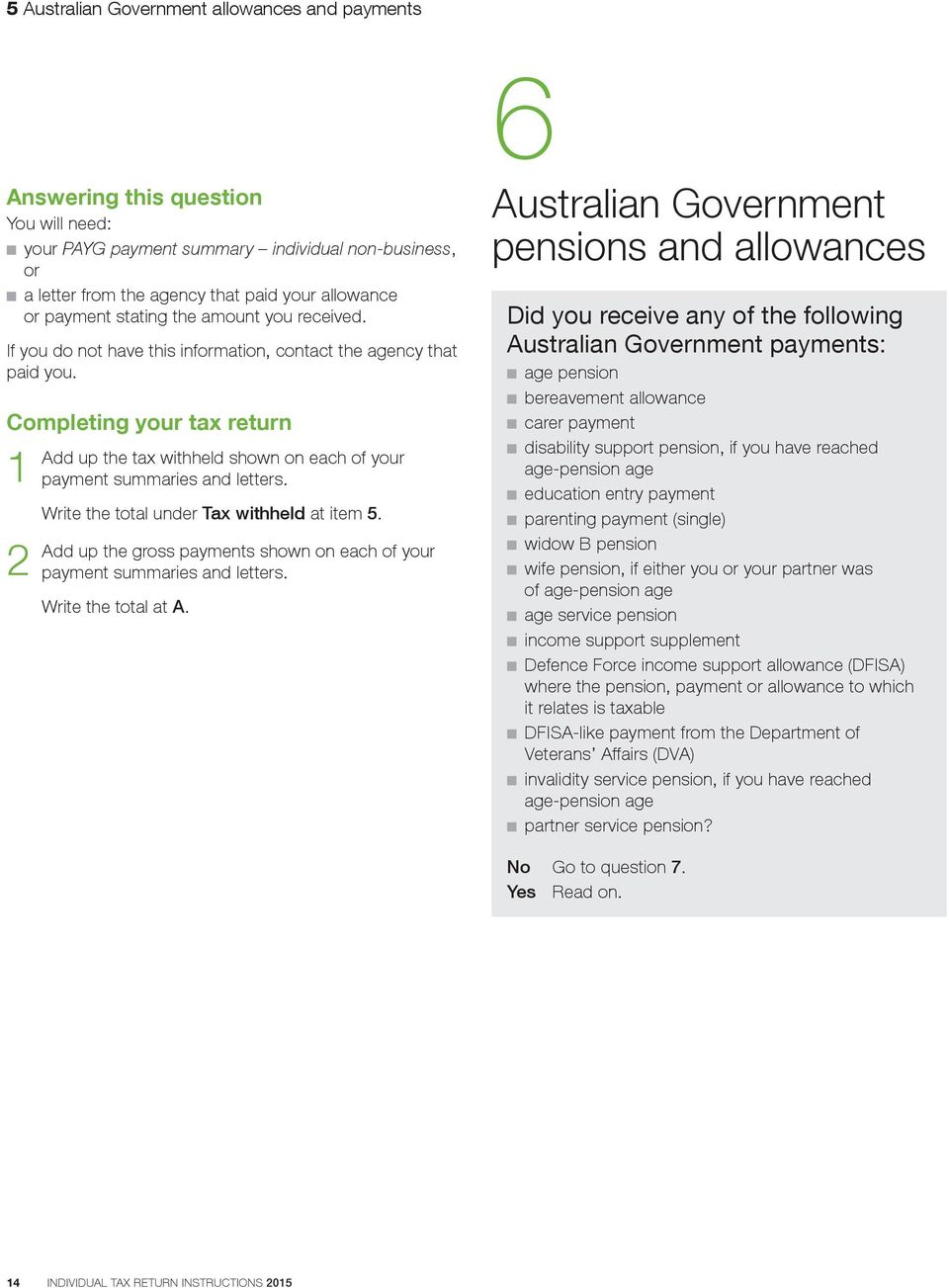
17 6 Australian Government pensions and allowances Answering this question You will need: n your PAYG payment summary individual non-business, or n a letter from the agency that paid your pension, allowance or payment stating the amount you received. If you have not received this information, contact the agency that paid you. Add Add up the tax withheld shown on each of your payment summaries and letters. Write the total under Tax withheld at item 6. up the gross payments shown on each of your payment summaries and letters. Write the total at B. 7 Australian annuities and superannuation income streams Australian annuities (also called non-superannuation annuities) are paid to you by Australian life insurance companies and friendly societies. Australian superannuation income streams (including lump sum in arrears amounts) are paid to you by Australian superannuation funds, retirement savings account (RSA) providers and life insurance companies. If you received a taxable Australian superannuation lump sum payment, do not show it here; show it at item 8. Did you receive Australian annuities or superannuation income streams? No Go to question 8. Yes Read on. Answering this question You will need: n for annuities your PAYG payment summary individual non business which shows the amount of your annuity and its undeducted purchase price (UPP) n for superannuation income streams your PAYG payment summary superannuation income stream. INDIVIDUAL TAX RETURN INSTRUCTIONS 05 5
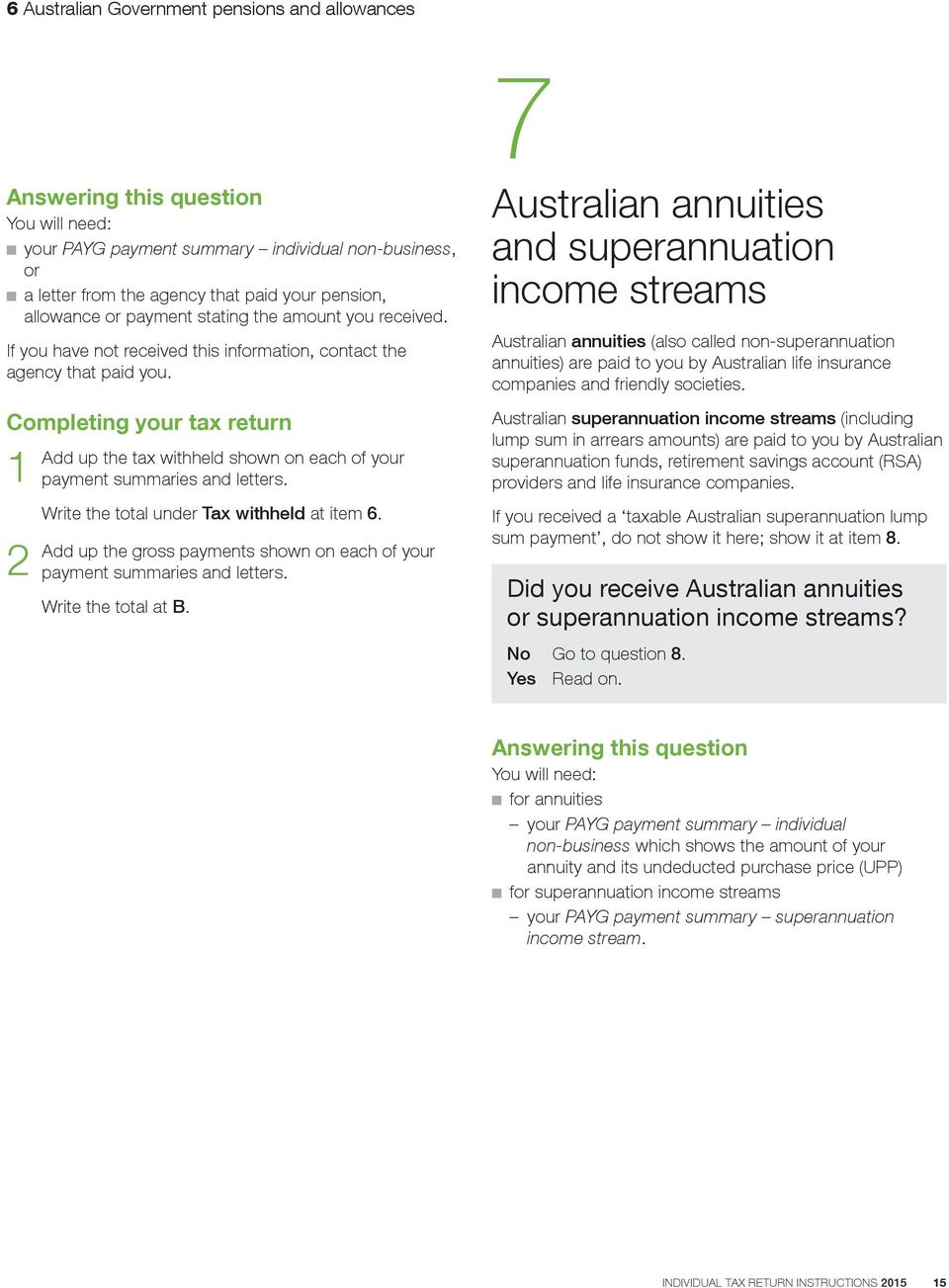
18 7 Australian annuities and superannuation income streams Add Superannuation income streams Add up the taxed element amounts that appear under the heading Taxable component on your superannuation income stream payment summaries. Write the total at J item 7. up any untaxed element amounts that appear under the heading Taxable component on your superannuation income stream payment summaries. Write the total at (a) in worksheet below. If you did not receive any, write 0. 3 Annuities If you did not receive Australian annuities, write 0 at (b) in worksheet below and go to step 4. 4 Complete If you received Australian annuities, take the deductible amount of the annuity s UPP away from the gross amount shown on your payment summary. Write the total at (b) in worksheet below. If the answer is a negative write 0. If you had more than one annuity: n work out the total for each annuity n add these totals together, and n write the amount at (b) in worksheet. worksheet. Worksheet Total untaxed element amounts (from step ) Total amounts from annuities (from step 3) Add (a) and (b). $ (a) $ (b) $ (c) 5 Add up the tax withheld amounts on your payment summaries for your superannuation income streams and annuities. Write the total in the left hand column under Tax withheld at item 7. 6 Did you receive superannuation income stream lump sums in arrears? 7 Add No Yes You have finished this question. Go to question 8. Read on. Add up all the taxed element amounts that appear under the heading Lump sum in arrears taxable component on your superannuation income stream payment summaries. Write the total at Y item 7. up all the untaxed element amounts that appear under the heading Lump sum in arrears taxable component on your superannuation income stream payment summaries. Write the total at Z item 7. Lump sums in arrears tax offset You may be entitled to a tax offset if you received a superannuation income stream lump sum in arrears. You will need to provide further information. You must go to ato.gov.au/instructions05 and read question 7 to complete this question. Transfer the amount at (c) to N item 7. 6 INDIVIDUAL TAX RETURN INSTRUCTIONS 05
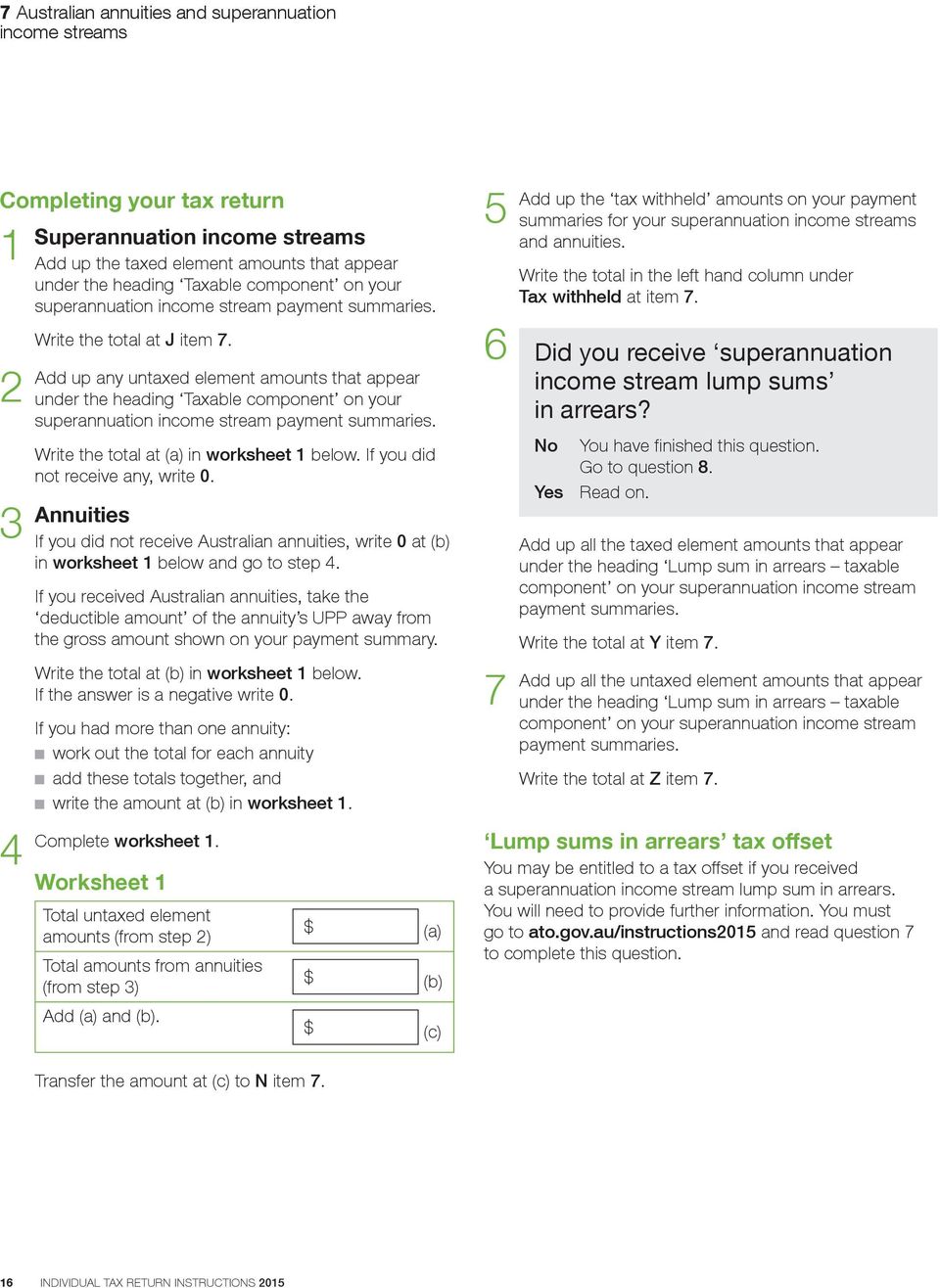
19 8 Australian superannuation lump sum payments This question is about Australian superannuation lump sum payments or superannuation death benefit payments you received, including those paid by: n superannuation funds n approved deposit funds n retirement savings account providers n life insurance companies. It is also about any: n amounts we paid to you in respect of the superannuation guarantee charge or the superannuation holding accounts special account n payments you received from the unclaimed money registers. Do not show on your tax return any: n death benefit lump sum payments you received as a dependant of the deceased n taxed element of a superannuation lump sum payment you received on or after your 60th birthday, unless it is a death benefit superannuation lump sum payment paid to you as a non-dependant n amounts paid to you because you have a terminal medical condition n departing Australia superannuation payments. Did you receive any of these payments? No Go to question 9. Yes Read on. Answering this question You will need your PAYG payment summary superannuation lump sum. If you have not received it, contact your payer. You must go to ato.gov.au/instructions05 and read question 8 if any of the following apply: n you received more than one superannuation lump sum during the year, as you need to provide additional information n you need to know who is considered a dependant of the deceased n you had types of superannuation lump sum payments that are not covered by this question. Write Write in the left column at item 8 the date of payment and your payer s Australian business number (ABN), as shown on your payment summary. the total amount of tax withheld, as shown on your payment summary, under Tax withheld at item 8. 3 Did you receive the lump sum payment as a death benefit but you were not a dependant of the deceased? 4 From No Go to step 4. Yes Print N in the TYPE box at item 8. Read on. your payment summary, write at item 8: n the taxed element amount at Q n the untaxed element amount at P. INDIVIDUAL TAX RETURN INSTRUCTIONS 05 7
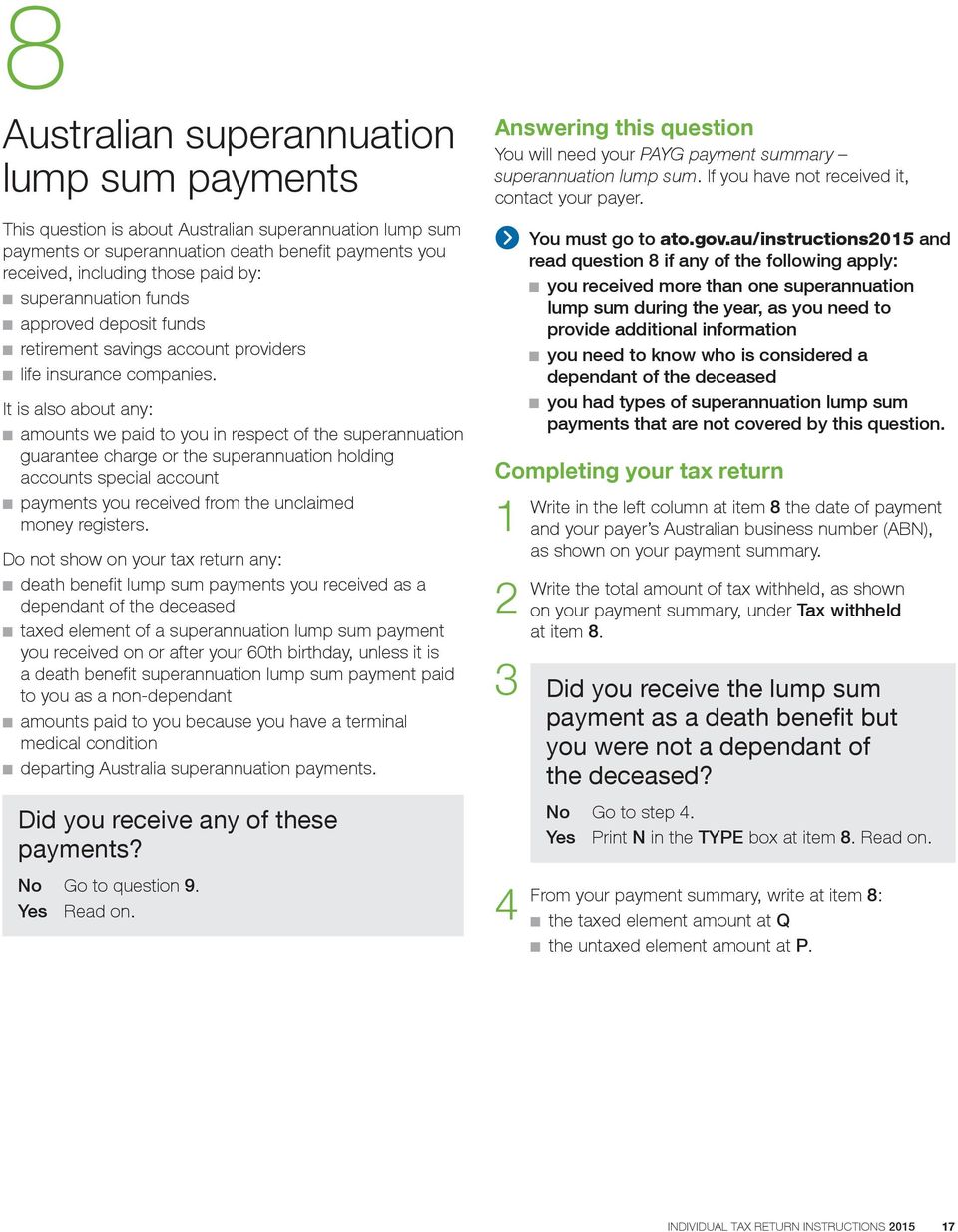
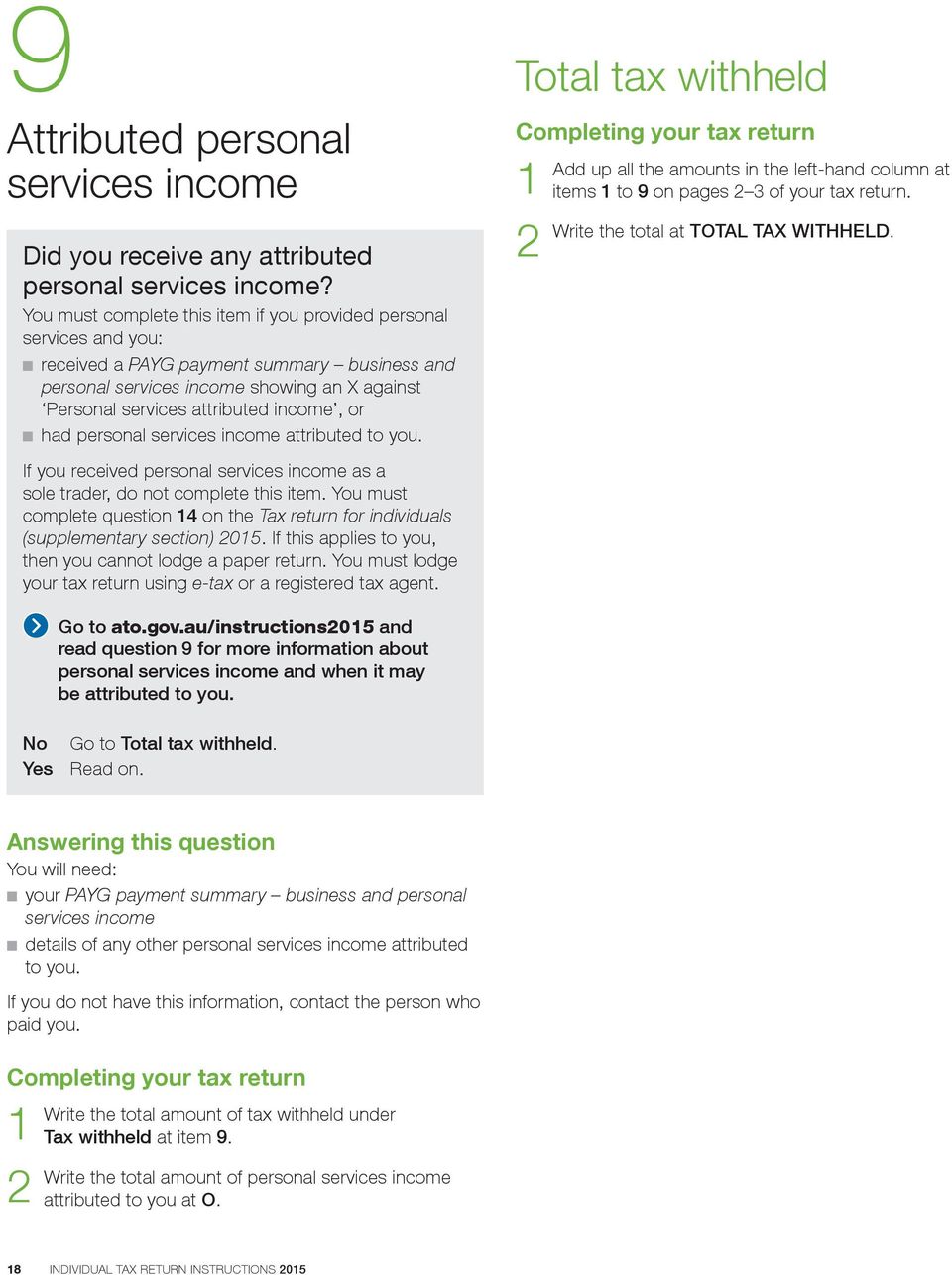
20 9 Completing Attributed personal services income Did you receive any attributed personal services income? You must complete this item if you provided personal services and you: n received a PAYG payment summary business and personal services income showing an X against Personal services attributed income, or n had personal services income attributed to you. If you received personal services income as a sole trader, do not complete this item. You must complete question 4 on the Tax return for individuals (supplementary section) 05. If this applies to you, then you cannot lodge a paper return. You must lodge your tax return using e-tax or a registered tax agent. Total tax withheld your tax return Add up all the amounts in the left-hand column at items to 9 on pages 3 of your tax return. Write the total at TOTAL TAX WITHHELD. Go to ato.gov.au/instructions05 and read question 9 for more information about personal services income and when it may be attributed to you. No Yes Go to Total tax withheld. Read on. Answering this question You will need: n your PAYG payment summary business and personal services income n details of any other personal services income attributed to you. If you do not have this information, contact the person who paid you. Write Write the total amount of tax withheld under Tax withheld at item 9. the total amount of personal services income attributed to you at O. 8 INDIVIDUAL TAX RETURN INSTRUCTIONS 05
21 0 Gross interest Was any interest paid or credited to you from any source in Australia? Gross interest includes: n interest from savings accounts, term deposits and cash management accounts n interest we paid or credited to you n interest from children s accounts you opened or operated with funds that you used as if they were yours n tax file number (TFN) amounts, that is, amounts withheld by financial institutions because you did not provide your TFN or Australian business number (ABN) to them. Read Will you need Individual tax return instructions supplement 05? on page 3 if you received interest from other sources, including interest from a foreign source. You must go to ato.gov.au/instructions05 and read question 0 for information on how to treat: n children s accounts you operate n TFN amounts, and n non-resident withholding tax. Add Write 3 Add up the amounts of gross interest you received in the total amount of your gross interest at L item 0. If the total was less than $, do not write anything. up all the TFN amounts shown on your statements, but do not include TFN amounts that we have already refunded to you. Write the total at M. No Go to question. Yes Read on. Answering this question You will need: n your statements, passbooks and other documentation from your financial institutions and other sources that show 04 5 interest income (TFN amounts are shown on your statement or document as Commonwealth tax or TFN withholding tax ) n any notice of assessment or amended assessment you received from us during 04 5 that shows interest on early payments or interest on overpayments. Interest credited to a first home saver account is not assessable income. Do not include it anywhere on your tax return. If you had a joint account, show only your share of the interest. INDIVIDUAL TAX RETURN INSTRUCTIONS 05 9
22 Dividends Were you paid, or credited with, dividends from shares by Australian companies? Dividends and distributions include: n dividends applied under a dividend reinvestment plan n dividends that were dealt with on your behalf n bonus shares that qualify as dividends n distributions by a corporate limited partnership n dividends paid by a corporate unit trust, public trading trust or listed investment company. No Go to question. Yes Read on. Answering this question You will need your statements from each Australian company that paid you dividends or made distributions to you between July 04 and 30 June 05 inclusive. If you had any shares in joint names, show only your proportion of the dividends. Do not include dividends or a distribution on which family trust distribution tax has been paid. You must go to ato.gov.au/instructions05 and read question to find out how to complete this question if: n you received a dividend as a result of a dividend washing arrangement n you had shares and were under an obligation to make, or were likely to make, a related payment n within 45 days of buying shares (90 days for certain preference shares), you either sold them or entered into an arrangement to reduce the risk of making a loss on them, or n you received or were credited with amounts related to a non-share equity interest by a private company, as a shareholder or associate of a shareholder, in the form of payments, loans or debts forgiven by a trustee of a trust in the form of payments, loans or debts forgiven where a private company in which you were a shareholder, or an associate of a shareholder, had an unpaid present entitlement from the trust when you were not an Australian resident for tax purposes. If your statement does not show franked and unfranked portions of the dividend, include the total dividend amount at T item when you complete step. Add Add 3 Add 4 Add up all the unfranked dividend amounts from your statements, including any tax file number (TFN) amounts withheld. Also include any other amounts that are treated as dividends. Write the total at S. up all the franked dividend amounts from your statements and any other franked dividends paid or credited to you. Write the total at T. up the franking credit amounts shown on your statements. Do not include them if the holding period rule, related payments rule or dividend washing integrity rule prevent you from claiming them. For more information, see You and your shares 05. Write the total at U. up any TFN amounts withheld that have not been refunded to you. Write the total at V. 0 INDIVIDUAL TAX RETURN INSTRUCTIONS 05
23 Answering Employee share schemes This question is about discounts on employee share scheme interests (ESS interests) that you or your associate received under an employee share scheme. ESS interests are: n shares n stapled securities (provided at least one of the stapled interests is a share in a company) n rights to acquire shares and stapled securities. An ESS interest acquired by your associate in regard to your employment is treated as though the ESS interest was acquired by you. The discount is the difference between the market value of the ESS interests and the amount paid to acquire them. The ESS interests can: n be from an Australian company or a foreign company n relate to your employment inside or outside Australia. Did any of the following apply to you? n You received a discount on ESS interests acquired under a taxed-upfront scheme. n A deferred taxing point occurred in respect of ESS interests you acquired at a discount under a deferral scheme. n A cessation time occurred during 04 5 in relation to a qualifying ESS interest you acquired before July 009 under an employee share scheme, and you had not elected to be taxed upfront on the discount. No Yes For more information about cessation time and qualifying ESS interests acquired before July 009, go to ato.gov.au and search for Employee Share Schemes answers to frequently asked questions by employees. Go to Income from the supplementary section of your tax return. Read on. this question You will need your Employee share scheme statement from each employer with whom you participated in an employee share scheme. If you do not have all your employee share scheme statements, contact your employer. You can use the Employee share schemes calculator at ato.gov.au/instructions05 to help you answer this question. You must go to ato.gov.au/essemployee if any of the following apply: n you were a temporary resident or foreign resident when you received your ESS interests n you received ESS interests from a foreign employer n you disposed of your ESS interests because of a corporate restructure or takeover and received replacement ESS interests. If an associate of yours, for example your spouse, acquired an ESS interest as a result of your employment, you must include the discount in your assessable income. Your associate does not include the discount on their tax return. Add Add 3 Add up the discount amounts received from taxed upfront schemes eligible for reduction from your statements. Write the total at D item. up the discount amounts you received from taxed-upfront schemes not eligible for reduction from your statements. Write the total at E. up the discount amounts you received from deferral schemes where a deferred taxing point occurred during 04 5 from your statements. Write the total at F. INDIVIDUAL TAX RETURN INSTRUCTIONS 05
24 Employee share schemes 4 Add 5 If up the discount amounts from qualifying ESS interests you acquired before July 009 from your statements where: n you did not make an election to be taxed upfront at the time you received them, and n a cessation time occurred during Write the total at G. you did not write an amount at D: n add up the amounts that you wrote at E, F and G n write the total at B, and n go to step 8. 7 If 8 Add 9 If the amount at D is less than or equal to $,000, add up the amounts that you wrote at E, F and G and write the total at B. If the amount at D is greater than $,000, add up the amounts at D, E, F and G then take $,000 away from the total. Write the answer at B. up all the TFN amounts withheld from discounts from your statements and write the total at C. you did not pay foreign income tax in respect of any discounts you received, you have finished this question. Otherwise, read on. If you wrote an amount at D, you may be entitled to reduce the amount of the discounts received under taxed-upfront schemes by up to $,000. Write at A the total amount of your discounts from ESS interests for which you are claiming a foreign income tax offset. Calculate your taxable income as if you were not entitled to this reduction. If you had a taxable loss, treat it as zero for the purposes of this calculation. Add up the following amounts: n your taxable income n your total reportable fringe benefits amounts (W item IT) n your reportable employer superannuation contributions (T item IT) n your net financial investment loss (X item IT5) n your net rental property loss (Y item IT6) n your deductible personal superannuation contributions (H item D). 6 Is the amount you worked out at step 5 greater than $80,000? No Go to step 7. Yes Read on. Add up the amounts that you wrote at D, E, F and G and write the total at B. Go to step 8. INDIVIDUAL TAX RETURN INSTRUCTIONS 05
25 Income from the supplementary section of your tax return Did you receive income that is shown on the supplementary section of your tax return? If you are unsure, read Will you need Individual tax return instructions supplement 05? on page 3. No Yes Go to Total income or loss. You must complete the relevant income questions on the Tax return for individuals (supplementary section) 05, then read on. Transfer the amount you wrote at TOTAL SUPPLEMENT INCOME OR LOSS on page 5 of your tax return (supplementary section) to I on page 3 of your tax return. If the amount is a loss, print L in the LOSS box at the right of the amount. Total income or loss Add If 3 Write up all the amounts in the right-hand column for items to on pages and 3 of your tax return. you have no amount at I below item on your tax return go to step 3. Otherwise read on. If the amount at I is a loss, take it away from your total from step. Otherwise, add the amount at I to your total from step. the result at TOTAL INCOME OR LOSS. If the amount is a loss, print L in the LOSS box at the right of the amount. INDIVIDUAL TAX RETURN INSTRUCTIONS 05 3
26 Claiming deductions You may be able to claim deductions for work-related expenses you incurred while performing your job as an employee. You incur an expense in an income year when: n you receive a bill or invoice for an expense that you are liable for and must pay (even if you don t pay it until after the end of the income year), or n you do not receive a bill or invoice but you are charged and you pay for the expense. If your expense includes an amount of goods and services tax (GST), the GST is part of the total expense and is therefore part of any deduction. For example, if you incurred union fees of $440 which included $40 GST, you claim a deduction for $440. Basic rules The expense must not be private, domestic or capital in nature. For example, the costs of normal travel to and from work, and buying lunch each day are private expenses. If you incurred an expense that was both work-related and private or domestic in nature, you can claim a deduction only for the work-related portion of the expense. You cannot claim a deduction for an expense if: n someone else paid the expense, or you were, or will be reimbursed for the expense, and n the payment or reimbursement is a fringe benefit (including an exempt benefit). If you were partially reimbursed for the expense, you can only claim the part that was not reimbursed. Allowances If you received an allowance that you showed at item on your tax return, you may be able to claim a deduction for your expenses covered by the allowance. The expenses must be incurred in producing your employment income, and must meet the basic rules discussed above. For example, if you received a tools allowance of $500 and your tool expenses were $300, you include the whole amount of the allowance at item on your tax return and claim a deduction of $300 at item D5. Decline in value of a depreciating asset You may be able to claim a deduction for the decline in value of a depreciating asset you held during the 04 5 year if you used it to produce income that you show on your tax return. Depreciating assets include items such as tools, reference books, computers and office furniture. You may be able to claim an immediate deduction for the full cost of depreciating assets costing $300 or less. For more information, see Guide to depreciating assets 05 (NAT 996). Go to ato.gov.au/instructions05 to get a copy of this publication. Advance expenditure If you have prepaid an amount for a service costing $,000 or more, and the service extends for a period of more than months or beyond 30 June 06 (such as a subscription to a journal relating to your profession), you can claim only the portion that relates to You can also claim the proportion of your pre paid expenses from a previous year that relate to For more information, see Deductions for prepaid expenses 05 (NAT 470). Go to ato.gov.au/instructions05 to get a copy of this publication. Record keeping for work-related expenses You must be able to substantiate your claims for deductions with written evidence if the total amount of deductions you are claiming is greater than $300. The records you keep must prove the total amount, not just the amount over $300. The $300 does not include car and meal allowance, award transport payments allowance and travel allowance expenses. There are special written evidence rules for these claims which are explained at the relevant items. If the total amount you are claiming is $300 or less, you need to be able to show how you worked out your claims, but you do not need written evidence. 4 INDIVIDUAL TAX RETURN INSTRUCTIONS 05
27 D Work-related car expenses Work-related car expenses are expenses you incurred as an employee for a car you: n owned n leased, or n hired under a hire-purchase agreement. Did you have any work-related car expenses? No Go to question D. Yes Read on. Answering this question What can you claim? You can claim car expenses you incurred for work related purposes in You can also claim the cost of using your car to travel directly between two separate places of employment, for example, when you have a second job. You cannot claim for the normal trip between home and work, unless: n you use your car to carry bulky tools or equipment (such as an extension ladder or cello) which you use for work and cannot leave at work n your home is a base for employment (you started work at home and travelled to a workplace to continue work for the same employer), or n you have shifting places of employment (you regularly work at more than one place each day). Claim at this item any work related car expenses incurred in earning income shown on a PAYG payment summary foreign employment. Methods You can choose one of the following methods to work out your work-related car expenses. For work-related travel of 5,000 kilometres or less: n cents per kilometre method, or n logbook method. For work-related travel over 5,000 kilometres: n % of original value method n one-third of actual expenses method, or n logbook method. If you qualify to use more than one method, you can use whichever gives you the largest deduction or is most convenient. If you are not using the cents per kilometre method, you must go to ato.gov.au/instructions05 and read question D. You can also go to ato.gov.au/instructions05 and use our Work related car expenses calculator to work out your claim. Cents per kilometre method The most you can claim using this method is 5,000 kilometres per car, even if you travelled more. No written evidence of expenses is necessary with this method, but you may need to show us how you worked out your work related kilometres (for example, by producing diary records of work-related trips). If you are using the % of original value method, one third of actual expenses method, or logbook method, you must go to ato.gov.au/instructions05 and read question D, then go to step 4. If you are using the cents per kilometre method, read on. You must go to ato.gov.au/instructions05 and read question D for more information about shifting places of employment. INDIVIDUAL TAX RETURN INSTRUCTIONS 05 5
28 D Work-related car expenses Use 3 Use 4 Write 5 Print the following table to find out how much you can claim per kilometre (km) depending on your car s engine size. Ordinary engine Rotary engine Cents per km,600cc or less (.6 litre or less),60 to,600cc (Over.6 and up to.6 litre),60cc and over (Over.6 litre) 800cc or less 80,300cc,30cc and over 65 cents 76 cents 77 cents the following table to work out the amount you can claim: Total work-related kilometres (cannot be more than 5,000 km) (a) Cents per km for your car s engine (65, 76 or 77 cents) (b) Multiply (a) by (b). Divide (c) by 00. The result is the dollar amount you can claim. (d) If you are claiming for more than one car using this method, repeat steps and 3 for each car and add up all the amounts at (d). the total of your claim at A item D. the relevant code letter from the table below in the CLAIM TYPE box beside the amount. Method Cents per kilometre (c) Code letter % of original value T One-third of actual expenses Logbook S O B D Work-related travel expenses This question is about travel expenses you incur that are directly related to your work as an employee. They include: n public transport, including air travel and taxi fares n bridge and road tolls, parking fees and short-term car hire n meal, accommodation and incidental expenses you incur while away overnight for work n expenses for motorcycles and vehicles with a carrying capacity of one tonne or more, or nine or more passengers, such as utility trucks and panel vans n actual expenses (such as any petrol, oil and repair costs) you incur to travel in a car that is owned or leased by someone else. If your employer provided a car for you or your relatives exclusive use and you were entitled to use it for non-work purposes, you cannot claim a deduction for running costs (petrol, repairs). However, you can claim expenses such as parking and bridge and road tolls for work-related use. Reasonable allowance amounts If your travel allowance was not shown on your payment summary and was equal to or less than the reasonable allowance amount for your circumstances, you do not have to include the allowance at item provided that you have fully spent it on deductible work-related travel expenses and you do not claim a deduction for these expenses. You must go to ato.gov.au/instructions05 and read question D if any of the following apply: n you had shifting places of employment n your allowance was above the reasonable allowance amounts. Did you have any work-related travel expenses? No Go to question D3. Yes Read on. 6 INDIVIDUAL TAX RETURN INSTRUCTIONS 05
29 D Work-related travel expenses D3 Answering this question You must have written evidence for the whole of your claim. If you wish to claim meal, accommodation and incidental expenses you incurred while away overnight for work, use the table on page 7 to determine what evidence you need. You must claim at this item any work-related travel expenses incurred in earning income shown on a PAYG payment summary foreign employment. Add up all your deductible travel expenses. Write the total at B item D. Work-related clothing, laundry and dry-cleaning expenses You can claim expenses you incurred as an employee for work-related: n protective clothing n uniforms n occupation-specific clothing, and n laundering and dry-cleaning of clothing listed above. You can claim the cost of a work uniform that is distinctive (such as one that has your employer s logo permanently attached to it) and it must be either: n a non-compulsory uniform that your employer has registered with AusIndustry (check with your employer if you are not sure), or n a compulsory uniform that can be a set of clothing or a single item that identifies you as an employee of an organisation. There must be a strictly enforced policy making it compulsory to wear that clothing at work. Items may include shoes, stockings, socks and jumpers where they are an essential part of a distinctive compulsory uniform and the colour, style and type are specified in your employer s policy. You can also claim the cost of: n occupation-specific clothing which allows people to easily recognise that occupation (such as the checked pants a chef wears when working) and which are not for everyday use n protective clothing and footwear to protect you from the risk of illness or injury, or to prevent damage to your ordinary clothes, caused by your work or work environment. Items may include fire-resistant clothing, sun protection clothing, safety-coloured vests, non-slip nurse s shoes, steel-capped boots, gloves, overalls, aprons, and heavy duty shirts and trousers (but not jeans). You can claim the cost of protective equipment, such as hard hats and safety glasses at item D5. You can also claim the cost of renting, repairing and cleaning any of the above work-related clothing. INDIVIDUAL TAX RETURN INSTRUCTIONS 05 7
30 D3 Work-related clothing, laundry and dry-cleaning expenses You cannot claim the cost of purchasing or cleaning plain uniforms or clothes, such as black trousers, white shirts, suits or stockings, even if your employer requires you to wear them. You can go to ato.gov.au/instructions05 and read question D3 for more information. Did you have any work-related clothing, laundry or dry-cleaning expenses? No Go to question D4. Yes Read on. Add up all your deductible work-related clothing, laundry and dry-cleaning expenses. Write the total at C item D3. 3 Select the code letter that describes the main type of clothing you are claiming for: C N S P compulsory work uniform non-compulsory work uniform occupation-specific clothing protective clothing Print the letter in the CLAIM TYPE box at C item D3. Answering this question You will need: n receipts, invoices or other written evidence, and n diary records of your laundry costs if the amount of your laundry expenses claim is greater than $50, and your total claim for work-related expenses exceeds $300. You must claim at this item any deductible work-related clothing, laundry and dry-cleaning expenses incurred in earning income shown on a PAYG payment summary foreign employment. If you did washing, drying or ironing yourself, you can use a reasonable basis to calculate the amount, such as $ per load for work-related clothing, or 50 cents per load if other laundry items were included. You can go to ato.gov.au/instructions05 and use our Work related uniform expenses calculator to work out your claim. 8 INDIVIDUAL TAX RETURN INSTRUCTIONS 05
31 D4 Work-related self education expenses This question is about self-education expenses that are related to your work as an employee and which you incur when you do a course to get a formal qualification from a school, college, university or other place of education. To claim a deduction here, you must have met one of the following conditions when you incurred the expense: n the course maintained or improved a skill or specific knowledge required for your work activities at that time n you could show that the course was leading to, or was likely to lead to, increased income from your work activities at that time n other circumstances existed which established a direct connection between the course and your work activities at that time. You cannot claim a deduction for self-education expenses for a course that: n relates only in a general way to your current employment or profession, or n will enable you to get new employment. You cannot claim any deductions against government assistance payments, including Austudy, ABSTUDY and Youth allowance. Examples of expenses you can claim are textbooks, stationery, student union fees, student services and amenities fees, the decline in value of your computer, and certain course fees. You must claim at this item any self-education expenses incurred in earning income shown on a PAYG payment summary foreign employment. To work out your claim, you can go to ato.gov.au/instructions05 and use the Self-education expenses calculator or use the worksheet below. If Add you used the calculator, transfer the amount you worked out to D item D4 on your tax return and then go to step 6. If you are not using the calculator, read on. up your self-education expenses under the following categories: Worksheet Category A General expenses that are deductible, including textbooks, stationery, student union fees, student services and amenities fees, course fees and public transport fares You cannot claim as course fees contributions you made under HECS-HELP, or repayments under the Higher Education Loan Program (HELP), the Student Financial Supplement Scheme (SFSS) or the Trade Support Loan Program (TSL). Include car expenses (other than the decline in value of a car) worked out under the logbook or one-third of actual expenses method. For more information, see question D on pages 5 6. Your amount $ Did you have any of these self education expenses? No Go to question D5. Yes Read on. INDIVIDUAL TAX RETURN INSTRUCTIONS 05 9
32 D4 Work-related self education expenses Category B C D E 3 If Deductions for the decline in value of depreciating assets used for self education, including computers and cars for which you are claiming deductions under the logbook or one-third of actual expenses method Expenses for repairs to items of equipment used for self-education Car expenses related to your self-education for which you are claiming deductions under the cents per kilometre or % of original value method. (If you have included deductions for the decline in value of or repairs to your car under category B or C, you cannot claim car expenses under this category.) Self-education expenses that are not deductible, which are: n private costs, including non deductible travel and childcare costs, and n capital costs, like the purchase price of a desk or computer Do not include: n contributions you made under HECS-HELP, or n repayments under HELP, SFSS or TSL. Your amount Use your amounts from the worksheet above to complete the following steps. you had any category A expenses, go to step 4. Otherwise, read on. Add B, C and D. $ $ $ $ $ (f) Transfer the amount at (f) to D item D4. Go to step 6. 4 Add 5 In 6 Select 7 Print C, D and E. $ (g) If the amount at (g) is less than $50, go to step 5. Otherwise, read on. Add A, B, C and D. $ (h) Transfer the amount at (h) to D item D4. Go to step 6. working out what you can claim, certain costs are reduced by $50. Take the amount at (g) away from $50. Take the amount at (i) away from your category A amount. If the result is zero or less, write 0 at (j). Add B, C and D. Add (k) and (j). $ (i) $ (j) $ (k) $ (l) Transfer the amount at (l) to D item D4. Go to step 6. the code letter that best describes your circumstances at the time you incurred the expenses. K The study maintained or improved a skill or specific knowledge required for your work activities. I You could show that the study was leading to, or was likely to lead to, increased income from your work activities. O Other circumstances existed which established a direct connection between your self-education and your work activities as an employee. your code letter from step 6 in the CLAIM TYPE box at D. 30 INDIVIDUAL TAX RETURN INSTRUCTIONS 05
33 D5 Other work-related expenses Other work-related expenses are expenses you incurred as an employee and have not already claimed anywhere else on your tax return. These include: n union fees and subscriptions to trade, business or professional associations n certain overtime meal expenses n professional seminars, courses, conferences and workshops n reference books, technical journals and trade magazines n safety items such as hard hats, safety glasses and sunscreens n the work-related proportion of some computer, phone and home office expenses n tools and equipment and professional libraries (you may be able to claim an immediate deduction for the full cost of depreciating assets costing $300 or less; for more information see the Guide to depreciating assets 05). You can claim overtime meal expenses only if they were paid under an industrial law, award or agreement and you have included the amount of the overtime meals allowance as income at item. If your claim is more than $8.0 per meal, you must have written evidence, such as receipts or diary entries, which show the cost of the meals. You cannot claim a deduction for the decline in value of items provided to you by your employer, or if your employer paid or reimbursed you for some or all of the cost of those items, and the item was exempt from fringe benefits tax. For more information on calculating home office expenses and to use our Home office expenses calculator, go to ato.gov.au/instructions05 and read question D5. For more information about what you can claim at this item, you can go to ato.gov.au/instructions05 and read question D5. Answering this question You may need: n receipts, invoices or written evidence n statements from your bank, building society or credit union n your PAYG payment summary individual non-business n your PAYG payment summary foreign employment. If your total claim for all work-related expenses exceeds $300, you must have written evidence. To work out the amount you can claim for depreciating assets, read the Guide to depreciating assets 05 (NAT 996). Go to ato.gov.au/instructions05 to get a copy of this publication. You must claim at this item any other work-related expenses incurred in earning income shown on a PAYG payment summary foreign employment, provided you have not already claimed the expense anywhere else on your tax return. Add up all the expenses that you can claim at this item. Write the total at E item D5. Did you have any other work-related expenses? No Go to question D6. Yes Read on. INDIVIDUAL TAX RETURN INSTRUCTIONS 05 3
34 D6 Low-value pool deduction This question is about claiming a deduction for the decline in value of low-cost and low-value assets that you: n used in the course of producing income you show on your tax return, and n allocated to what is called a low-value pool. Low-cost assets are depreciating assets that cost less than $,000. Low-value assets are depreciating assets that are not low-cost assets but which, on July 04, had been written off to less than $,000 under the diminishing value method. Assets you can allocate to a low-value pool include assets you use: n in your work as an employee (see questions D to D5), or n to gain rental income (see question in the Individual tax return instructions supplement 05). If you claim the deduction at this item, do not claim it at items D to D5 and. If your low-value pool contains only assets used in business, you must lodge your tax return using e-tax or a registered tax agent. Go You to ato.gov.au/instructions05 and complete worksheet in question D6. Transfer the amount you worked out at (i) on worksheet to K item D6. will need the closing pool balance for 04 5 to calculate your low-value pool deduction for next year. Go to ato.gov.au/instructions05 and complete worksheet in question D6. Keep a record of your 04 5 closing pool balance for next year s tax return. Did you allocate assets to a low value pool in 04 5 or in a previous year? No Go to question D7. Yes Read on. Answering this question You must go to ato.gov.au/instructions05 to complete this question. 3 INDIVIDUAL TAX RETURN INSTRUCTIONS 05
35 D7 Interest deductions Did you incur expenses in earning the interest you declared at item 0? Expenses include: n bank or other financial institution account-keeping fees for accounts held for investment purposes n fees for investment advice relating to changes in the mix of your investments n interest you paid on money you borrowed to purchase income-producing investments. No Go to question D8. Yes Read on. Answering this question You will need your bank or financial institution statements or passbooks. If you had a joint account or if you shared an interest earning investment, show only your share of the joint expenses. You must go to ato.gov.au/instructions05 and read question D7 if any of the following apply: n you borrowed money for both private and investment purposes n you used equipment, such as a computer, for both private purposes and to manage your investments. Add up all your deductions for this item. Write the total at I item D7. D8 Dividend deductions Did you incur expenses in earning the dividend income you declared at item? Expenses include: n fees for investment advice relating to changes in the mix of your investments n interest paid on money borrowed to purchase shares or similar investments n costs relating to managing your investments, such as travel and buying specialist investment journals or subscriptions. You must also complete this item if your dividends included an amount for capital gain from a listed investment company (LIC). No Go to question D9. Yes Read on. Answering this question If you had joint share investments or similar shared investments, show only your share of joint expenses. If you borrowed money to purchase assets for your private use and income-producing investments, you can claim only the portion of the interest expenses relating to the income producing investments. You will need the dividend statements that you used at item that show the dividends received from a LIC. If you were an Australian resident for tax purposes when a LIC paid you a dividend and the dividend included a LIC capital gain amount, you can claim a deduction of 50% of the LIC capital gain amount. The LIC capital gain amount appears separately on your dividend statement. INDIVIDUAL TAX RETURN INSTRUCTIONS 05 33
36 D8 Dividend deductions D9 You must go to ato.gov.au/instructions05 to: n read question D8, and n get a copy of You and your shares 05 (NAT 63) if any of the following apply: n you had interest on investments under a capital protected borrowing this interest may not be fully deductible n you had interest on borrowings relating to certain overseas investments your claim may be affected by the thin capitalisation rules. Add up all your deductions for this item. Write the total at H item D8. Gifts or donations Did you make a gift or donation of $ or more to an approved organisation? Your receipt should show whether your donation is tax deductible. To check whether an organisation is an approved organisation, contact them or go to abn.business.gov.au Generally, you cannot claim a deduction for a gift or donation if you received something in return (for example, raffle tickets or a dinner). No Go to question D0. Yes Read on. Answering this question If you made one or more donations of $ or more to bucket collections conducted by an approved organisation for natural disaster victims, you can claim a tax deduction of up to $0 for the total of those contributions without a receipt. You can go to ato.gov.au/instructions05 and read question D9 for more information about gifts and donations. You must go to ato.gov.au/instructions05 and read question D9 if you had any of the following: n gifts of property and shares n contributions to fund-raising events n political donations. Add up the amounts of all gifts and donations you are entitled to claim. Write the total at J item D9. 34 INDIVIDUAL TAX RETURN INSTRUCTIONS 05
37 D0 Cost of managing tax affairs Did you incur expenses in managing your tax affairs? No Yes Go to Deductions from the supplementary section of your tax return. Read on. Add up the costs of managing your tax affairs. Write the total at M item D0. Answering this question The cost of managing your tax affairs includes: n preparing and lodging your tax return and activity statements n fees paid to a recognised tax adviser for preparing and lodging your tax return n travel to obtain tax advice from a recognised tax adviser n buying tax reference material n dealing with us about your tax affairs n appeals made to the Administrative Appeals Tribunal or courts in relation to your tax affairs n an interest charge we imposed on you. You can also claim any costs you incurred in complying with your legal obligations relating to another person s tax affairs. You cannot claim: n the cost of tax advice given by a person who is not a recognised tax adviser n a deduction for tax shortfall and other penalties for failing to meet your obligations. You must go to ato.gov.au/instructions05 and read question D0 if any of the following apply: n you want to claim a deduction for an interest charge we imposed on you n you want to find out if your tax adviser is a recognised tax adviser. INDIVIDUAL TAX RETURN INSTRUCTIONS 05 35
38 Deductions from the supplementary section of your tax return Do you have any deductions that are shown on the supplementary section of your tax return? If you are unsure, read Will you need Individual tax return instructions supplement 05? on page 3. No Yes Go to Total deductions. You must complete the relevant deduction questions on the Tax return for individuals (supplementary section) 05, then read on. Transfer the amount your wrote at TOTAL SUPPLEMENT DEDUCTIONS on page 5 of your tax return (supplementary section) to item D on page 4 of your tax return. Subtotal If you show income at TOTAL INCOME OR LOSS on page 3 of your tax return: n take away the amount at TOTAL DEDUCTIONS from the amount at TOTAL INCOME OR LOSS n write the result at SUBTOTAL n if the amount at SUBTOTAL is less than zero, print L in the LOSS box at the right of the amount. If you show a loss at TOTAL INCOME OR LOSS on page 3 of your tax return: n add the amount at TOTAL DEDUCTIONS to the amount at TOTAL INCOME OR LOSS n write the result at SUBTOTAL; print L in the LOSS box at the right of the amount. Total deductions Add Write up the deductions you claimed at items D to D0 and D on page 4 of your tax return. If you did not claim any deductions on the Tax return for individuals (supplementary section) 05 you will not have an amount at D. the result at TOTAL DEDUCTIONS on your tax return. 36 INDIVIDUAL TAX RETURN INSTRUCTIONS 05
39 L Tax losses of earlier income years Do you have tax losses from earlier income years? No Yes Go to Taxable income or loss. Read on. Do not show at this item: n capital losses n expenses and losses you incurred in earning foreign income n deferred non-commercial business losses from a prior year. Answering this question Complete this item if you have a tax loss from an earlier income year which you have not claimed as a deduction. You may have a tax loss at item L this year which you may be able to claim as a deduction. You must complete this item whether or not you are able to claim a deduction for the loss this year. To complete this item on your tax return you will need records of your tax losses from earlier income years. Taxable income or loss Did you show amounts at F or Z at item L? No Go to step. Yes Go to step. Transfer Add 3 Write the amount you have shown at SUBTOTAL on page 4 of your tax return to TAXABLE INCOME OR LOSS. If the amount is less than zero, print L in the LOSS box at the right of the amount. Keep a record of this amount to work out your tax losses of earlier income years for next year. You have now completed this section. Go to question T. up the amounts at F and Z at item L. Take the total away from the amount you wrote at SUBTOTAL. the result at TAXABLE INCOME OR LOSS on your tax return. You cannot have a loss at TAXABLE INCOME OR LOSS if you had amounts at F or Z. You must go to ato.gov.au/instructions05 to complete this question. To Write work out your tax losses of earlier income years, go to ato.gov.au/instructions05 and use the worksheets in question L. the relevant amounts at item L. INDIVIDUAL TAX RETURN INSTRUCTIONS 05 37
40 T Seniors and pensioners (includes self-funded retirees) You can claim the seniors and pensioners tax offset if you meet certain conditions relating to: n eligibility for Australian Government pensions or allowances, and n income. If you have a spouse: n you also need to work out whether they were eligible n you may not get the seniors and pensioners tax offset even if you meet all the eligibility conditions as the amount of the tax offset is based on your individual rebate income, not your combined rebate income. For the meaning of spouse and combined rebate income, see Definitions on page 7. You cannot claim this tax offset if you were in jail for the whole of Answering this question If you are eligible for this tax offset, we will use the information you provide at this question to work out the amount of your tax offset for you. You can also use the beneficiary tax offset and seniors and pensioners tax offset calculator at ato.gov.au/instructions05 to work out: n whether you are eligible for this tax offset n an estimate of your tax offset. Condition : Eligibility for Australian Government pensions and similar payments Did any of the following apply to you in 04 5? A You showed at item 6 on your tax return: n an Australian Government pension or allowance from Centrelink, or n a pension, allowance or benefit from the Department of Veterans Affairs (DVA). B You met the Centrelink age pension age requirement and were eligible for an Australian Government age pension during 04 5, but did not receive it because you did not make a claim or because of the application of the income test or the assets test, and you satisfy one of the following: n you have been an Australian resident for age pension purposes for 0 years or more, of which at least five years were continuous n you have a qualifying residence exemption because you arrived in Australia as a refugee or under a special humanitarian program n you are a woman who was widowed in Australia (at a time when both you and your late partner were Australian residents), you have made a claim for the age pension and you had two years residence immediately before your claim n you received a widow B pension, widow allowance, mature age allowance or partner allowance immediately before turning age pension age n you would qualify under an international social security agreement. To find out whether you meet the Centrelink age pension age requirement, see Definitions on page 70. If you are not sure whether you were eligible for a payment, go to humanservices.gov.au or phone the Department of Human Services on INDIVIDUAL TAX RETURN INSTRUCTIONS 05
41 T Seniors and pensioners (includes self-funded retirees) C You met the veteran pension age test and were eligible for a pension, allowance or benefit from Veterans Affairs during 04 5, but did not receive it because you did not make a claim or because of the application of the income test or the assets test, and you are: n a veteran with eligible war service, or n a Commonwealth veteran, allied veteran or allied mariner with qualifying service. To find out whether you meet the veteran pension age test, see Definitions on page 7. If you are not sure whether you were eligible for a payment, go to the DVA website or phone Veterans Affairs on Yes You meet condition. Go to condition. No You are not eligible for this tax offset. Go to question T. Condition : Income You must work out your rebate income to answer this question. You can use the worksheet on page 7, or go to ato.gov.au/instructions05 and use our Income tests calculator. Did any of the following apply to you in 04 5? n You did not have a spouse, and your rebate income was less than $50,9. n You had a spouse, and the combined rebate income of you and your spouse was less than $83,580. n At any time during the year you and your spouse had to live apart due to illness or because one of you was in a nursing home, and the combined rebate income of you and your spouse was less than $95,98. Use the table below and select all the code letters that applied to you at any time in Seniors and pensioners tax offset code letters You were single, separated or widowed. You and your spouse: n were both eligible for the seniors and pensioners tax offset, and n had to live apart due to illness * or lived apart because one of you was in a nursing home. n Your spouse was not eligible for the seniors and pensioners tax offset, and n you and your spouse had to live apart due to illness * or lived apart because one of you was in a nursing home. You and your spouse: n lived together, and n were both eligible for the seniors and pensioners tax offset. You and your spouse lived together, and your spouse was not eligible for the seniors and pensioners tax offset. * Had to live apart due to illness refers to situations where you and your spouse did not live together because one or both of you have an indefinitely continuing illness or infirmity, and as a result your combined living expenses were increased. A B C D E No Yes You are not eligible for this tax offset. Go to question T. You meet condition. Read on. INDIVIDUAL TAX RETURN INSTRUCTIONS 05 39
42 T Seniors and pensioners (includes self-funded retirees) Print Did more than one code letter apply? No Go to step. Yes If one of the circumstances in the table below applied to you use the relevant code. Otherwise, use the first code letter that applied to you in the previous table. We will work out which circumstance gives you the highest tax offset. Both A and B applied, and your spouse s taxable income was less than $8,334 Both A and D applied, and your spouse s taxable income was less than $,494 Your spouse s taxable income is the amount shown at label O on page 9 of your tax return. your code letter in the TAX OFFSET CODE box at N item T, then read on. B D 4 You 5 If must read Income tests on pages and complete all Income tests items. your seniors and pensioners tax offset code letter is A, go to question T. If your seniors and pensioners tax offset code letter is B, C, D or E, you must complete Spouse details married or de facto on pages 8 9 of your tax return. Any unused portion of tax offset If both you and your spouse are eligible for the seniors and pensioners tax offset and one of you does not use it all, the unused portion may be available for transfer to the other person. We will work this out automatically and transfer any entitlement. In working out if there is any unused spouse s seniors and pensioners tax offset available to transfer to you, we do not take your spouse s other credits and tax offsets into account. 3 Are you or your spouse a veteran, war widow or war widower? No Go to step 4. Yes Read on. Use the table below to work out which code letter applies to your circumstances. Veteran code letters You were a veteran, war widow or war widower. Your spouse was a veteran, war widow or war widower. Both V and W apply. V W X Print the code letter in the VETERAN CODE box at Y item T, then read on. 40 INDIVIDUAL TAX RETURN INSTRUCTIONS 05
43 T Australian superannuation income stream Have you shown income from an Australian superannuation income stream at item 7 on your tax return? No Yes Go to Tax offsets from the supplementary section of your tax return. You may be entitled to a tax offset. Read on. If you have shown income from an Australian superannuation income stream at item 7 on your tax return, you may be entitled to a tax offset equal to: n 5% of the taxed element, or n 0% of the untaxed element of your superannuation income stream benefit. Answering this question The tax offset amount will be shown on your PAYG payment summary superannuation income stream. If you have not received it, or you disagree with the amount shown on it, contact your payer. If your payment summary does not show the tax offset amount, you must go to ato.gov.au/instructions05 and read question T to calculate the offset. Add up the tax offsets shown on your payment summaries. Write the total at S item T. INDIVIDUAL TAX RETURN INSTRUCTIONS 05 4
44 Tax offsets from the supplementary section of your tax return Are you entitled to any tax offsets that are shown on the supplementary section of your tax return? If you are unsure, read Will you need Individual tax return instructions supplement 05? on page 3. No Yes Go to Total tax offsets. You must complete the relevant tax offset questions on the Tax return for individuals (supplementary section) 05, then read on. Transfer the amount you wrote at TOTAL SUPPLEMENT TAX OFFSETS on page 6 of your tax return (supplementary section) to T on page 5 of your tax return. Adjustments from the supplementary section of your tax return Did you receive a distribution during 04 5 on which family trust distribution tax has been paid? Yes No Read question A4 in Individual tax return instructions supplement 05. You may be entitled to an adjustment. Read on. Did you make a payment to us more than 4 days before the due date for payment? Yes Read question C in Individual tax return instructions supplement 05. You may be able to claim credit for interest on early payments. No Go to M. Total tax offsets Add Write up all the tax offset amounts you claimed at items T and T on your tax return. (We work out the amounts at items T automatically.) If you did not claim any tax offsets in the Tax return for individuals (supplementary section) 05 you will not have an amount at T. the total at TOTAL TAX OFFSETS on page 5 of your tax return. 4 INDIVIDUAL TAX RETURN INSTRUCTIONS 05
45 M Medicare levy reduction or exemption Australian residents for tax purposes are subject to a Medicare levy of % of their taxable income unless they qualify for a reduction or exemption. If you were not an Australian resident for tax purposes for all of 04 5, you are exempt from the Medicare levy. Claim your exemption at Part B of this question. For the meaning of Australian resident for tax purposes, see Definitions on page 68. A Medicare levy reduction is based on your taxable income. A Medicare levy exemption is based on specific categories. You need to consider your eligibility for a reduction or an exemption separately. Part A Medicare levy reduction Answering this question Your eligibility for a Medicare levy reduction is based on your taxable income, your spouse s taxable income and the number of dependent children you have. Your taxable income must be equal to or less than the relevant upper threshold in table for you to qualify for a reduction. If your taxable income is equal to or less than the relevant lower threshold, you do not pay the Medicare levy. We will work out any reduction for you. Table Individual taxable income thresholds Eligible for seniors and pensioners tax offset Lower $33,044 $0,896 Upper $4,305 $6,0 All other taxpayers If you were single and you had no dependent children during the income year, go to Part B Medicare levy exemption. A dependent child is any child who was an Australian resident whom you maintained in 04 5 and whose adjusted taxable income was less than the relevant ATI amount. For the meaning of dependent child, see Definitions on page 70. Reductions based on family income Family taxable income is the combined taxable incomes of you and your spouse (including a spouse who died during the year), or your taxable income if you were a sole parent with a dependent child or dependent children. Your family taxable income must be equal to or less than the limits in table for you to qualify for a reduction: Table Family taxable income limit Eligible for seniors and pensioners tax offset $57,500 $44,076* Plus $4,047* for each dependent child All other taxpayers *At the time of printing the Individual tax return instructions 05 this amount had not become law. If you were between 55 and 59 years old and received a superannuation lump sum, go to ato.gov.au/instructions05 and read question M for more information on how this affects your taxable income, or family taxable income. Is your family taxable income below the relevant limit? No You do not qualify for a Medicare levy reduction based on family taxable income. Read Part B Medicare levy exemption to see if you qualify for an exemption. Yes Go to step. Write the number of your dependent children at Y item M. INDIVIDUAL TAX RETURN INSTRUCTIONS 05 43
46 M Medicare levy reduction or exemption Read Part B Medicare levy exemption to see if you qualify for an exemption. Part B Medicare levy exemption Answering this question You may qualify for an exemption from paying the Medicare levy if you were in any of the following three exemption categories at any time in 04 5: n medical n foreign residents and residents of Norfolk Island n not entitled to Medicare benefits. If you do not fit into one of the exemption categories, leave V and W item M blank and go to question M. For the meaning of dependant and maintaining a dependant, see Definitions on pages Category : Medical In 04 5, did one of the following circumstances apply to you? n you were a blind pensioner n you received sickness allowance from Centrelink n you were entitled to full free medical treatment for all conditions under defence force arrangements or Veterans Affairs Repatriation Health Card (Gold Card) or repatriation arrangements. No Yes You do not qualify for an exemption under Category. Go to Category. Read on. During the period the Category circumstance applied to you, you must also meet one of the following conditions: Condition You had no dependants. Each of your dependants (including your spouse if you had one): n was in one of the exemption categories, or n had to pay the Medicare levy. Exemption that applies Full Full Condition You had dependent children who were not in an exemption category but who were also dependants of your spouse, and your spouse: n had to pay the Medicare levy, or n met at least one of the Category circumstances and you have completed a family agreement (see Definitions on page 70) stating that your spouse will pay the half levy for your joint dependants. You had at least one dependant (for example, a spouse) who: n was not in an exemption category, and n did not have to pay the Medicare levy. You were single or separated and you: n had a dependent child who was not in a Medicare levy exemption category, and n were entitled to FTB Part A or the rental assistance component of FTB Part A for that child, and n were in a shared-care arrangement. Then exemption from the Medicare levy is on the following basis: n for the days that you had care of your dependent child n for the days that you did not have care of your dependent child. You had a spouse who met at least one of the Category circumstances and you had a dependent child who: n was not in an exemption category, and n was dependent on both of you. In this case, either you or your spouse can claim a full exemption and the other can claim a half exemption by completing a family agreement (see Definitions on page 70). Exemption that applies Full Half Half Full Full or Half 44 INDIVIDUAL TAX RETURN INSTRUCTIONS 05
47 M Medicare levy reduction or exemption Do you qualify for a Category exemption for all or any of the income year? No Yes You do not qualify for a Medicare levy exemption under Category. Go to Category. You qualify for a Medicare levy exemption for that period. Go to Medicare levy exemption. Category : Foreign residents and residents of Norfolk Island Were you a foreign resident for tax purposes or a resident of Norfolk Island at any time during 04 5? No Yes You do not qualify for a Medicare levy exemption under Category. Go to Category 3. Read on. If you were a foreign resident for tax purposes or a resident of Norfolk Island for all of 04 5, you can claim a full exemption for the year (365 days). If you were a foreign resident for tax purposes or a resident of Norfolk Island for only part of the year, you can claim a full exemption for that period if: n you did not have any dependants for that period, or n all your dependants were in an exemption category for that period. Go to Medicare levy exemption. Category 3: Not entitled to Medicare benefits In 04 5: n did you have a Medicare entitlement statement because you were a temporary resident for Medicare purposes, or n were you a member of a diplomatic mission or consular post in Australia (or a member of such person s family and you were living with them) and you do not ordinarily live in Australia, and you were not an Australian citizen and n you did not have any dependants for that period, or n all your dependants were in an exemption category for that period? No Yes You do not qualify for a Medicare levy exemption under Category 3. Leave V and W item M blank. You have now finished this question. Go to question M. You qualify for a full exemption. Read on. Medicare levy exemption Work Write out the number of days for which you can claim a full exemption and the number of days for which you can claim a half exemption. The maximum number of days you can claim is 365. If you have overlapping qualifying periods, count the days in those overlapping periods only once. If a full exemption period overlaps a half exemption period, count the overlapping days as a full exemption period. the number of days you qualify for a full exemption at V item M. Write the number of days you qualify for a half exemption at W item M. If you were a temporary resident for Medicare purposes and have a Medicare entitlement statement from the Department of Human Services (see Category 3), print C in the CLAIM TYPE box. Otherwise leave the CLAIM TYPE box blank. We will work out your exemption entitlement. INDIVIDUAL TAX RETURN INSTRUCTIONS 05 45
48 M Medicare levy surcharge This question is compulsory. Depending on your income for Medicare levy surcharge (MLS) purposes, the MLS rate is %,.5% or.5% of: n your taxable income n your total reportable fringe benefits, and n any amount on which family trust distribution tax has been paid. You may have to pay the MLS if: n you or your dependants (including your spouse, even if they had their own income) did not have an appropriate level of private patient hospital cover for the whole of 04 5, and n your income for MLS purposes was above a certain amount. Your health insurer must give you a statement showing the number of days that you and all your dependants had appropriate cover in If you do not have this statement, or are not sure if you had an appropriate level of private patient hospital cover, contact your health insurer. Dependants For this question, your dependants (regardless of their income) are your: n spouse, even if they worked during 04 5 or had their own income n children under years old n children to 4 years old who are full-time students. Your dependants must have been Australian residents for tax purposes in 04 5 and you must have contributed to their maintenance. For the meaning of Australian resident for tax purposes and maintaining a dependant, see Definitions on pages 68 and 70. Did you and all your dependants have an appropriate level of private patient hospital cover for the whole of 04 5? Yes No Print X in the Yes box at E item M. You have finished this question. Make sure you complete Private health insurance policy details. Print X in the No box at E. Read on. Answering this question Medicare levy surcharge exemptions You are exempt from MLS for the whole of 04 5 if you fit into one of the categories in table which depend on your circumstances and your income for MLS purposes. To work out your income for MLS purposes, use worksheet on page 48, or go to ato.gov.au/instructions05 and use the Income for (Medicare levy) surcharge purposes calculator. Table Exemption categories You and all your dependants were in a Medicare levy exemption category for the whole of 04 5 (see question M). You were single for the whole of 04 5, and: n for the whole of 04 5 you did not have a dependent child, and n your income for MLS purposes was $90,000 or less. You were single for the whole of 04 5, and: n you had a dependent child for all of 04 5, and n your income for MLS purposes was $80,000 or less (plus $,500 for each dependent child after the first). You were single for part of 04 5, and: n for the whole of 04 5 you did not have a dependent child n your spouse did not die during the year, and n your income for MLS purposes was $90,000 or less. 46 INDIVIDUAL TAX RETURN INSTRUCTIONS 05
49 M Medicare levy surcharge Table Exemption categories continued You had a spouse (with or without dependent children) for the whole of 04 5, and your combined income for MLS purposes was: n $80,000 or less (plus $,500 for each dependent child after the first), or n greater than $80,000 (plus $,500 for each dependent child after the first) but your own income for MLS purposes was $0,896 or less. If you had a spouse on July 04, your spouse died during 04 5 and you did not have another spouse before the end of the year, assume that you had a spouse for the whole of 04 5 when you work out your MLS income. You must go to ato.gov.au/instructions05 and read question M if you did not fit into any of the categories in table on pages 46 7 and: n you were single for part of the year n you were widowed during the year n you became or ceased to be a sole parent n you or any of your dependants were covered for only part of the year, or n you are an overseas visitor with health cover. If you had private patient hospital cover for any part of the year, you must complete Private health insurance policy details. See pages 49 5 and then read on below. If you and all your dependants had an appropriate level of private patient hospital cover for the whole of 04 5, print X in the Yes box at E item M. You have now finished this question. If you or any of your dependants did not have private patient hospital cover or only had cover for part of the year, print X in the No box at the right of E item M. Go to step. If 3 Write you were in an exemption category (see table on pages 46 7) for the whole of 04 5, print X in the Yes box to the left of You do not have to pay the surcharge and write 365 at A item M. You have now finished this question. Go to Private health insurance policy details. If you were not in an exemption category, print X in the No box to the left of You may have to pay the surcharge and read on. at A item M the number of days for which you do not have to pay MLS. If you do not have to pay MLS for any days during the period July 04 to 30 June 05, write 365 at A item M. If you have to pay MLS for: n the whole period July 04 to 30 June 05, write 0 at A item M n part of the period July 04 to 30 June 05, write the number of days for which you do not have to pay MLS at A item M. Write the number of dependent children you had during 04 5 at D item IT8. Make sure you complete: n Income tests on page 8 of your tax return, and n Spouse details if you had a spouse during the year, on pages 8 9 of your tax return. Working out income for MLS purposes Complete worksheet on page 48 to work out your income and your spouse s income (if you had one during the year) for MLS purposes. You can also go to ato.gov.au/instructions05 and use the Income for (Medicare levy) surcharge purposes calculator. If you received exempt foreign employment income, add it to taxable income at (a). INDIVIDUAL TAX RETURN INSTRUCTIONS 05 47
50 M Medicare levy surcharge Worksheet Taxable income (from TAXABLE INCOME OR LOSS) Total reportable fringe benefits amount (from W item IT) Amount on which family trust distribution tax has been paid (from X item A4 supplementary section) Net financial investment loss (from X item IT5) Net rental property loss (from Y item IT6) Reportable employer superannuation contributions (from T item IT) Deductible personal superannuation contributions (from H item D supplementary section) Your spouse s share of the net income of a trust on which the trustee must pay tax and which has not been included at (a) (from T Spouse details) Add the amounts from (a) to (h) in each column. If you or your spouse were 55 to 59 years old, write here the taxed element amount of superannuation lump sums (other than a death benefit) received during 04 5 that do not exceed your or your spouse s low rate cap. To work out the taxed element, you must go to ato.gov.au/instructions05 and read question M. Take (k) away from (j). This is each individual s income for MLS purposes. You Spouse $ (a) $ (a) $ (b) $ (b) $ (c) $ (c) $ (d) $ (d) $ (e) $ (e) $ (f) $ (f) $ (g) $ (g) $ (h) $ (j) $ (j) $ (k) $ (k) $ (l) $ (l) Add the amount from (l) in your column to the amount from (l) in your spouse s column. Your income for MLS purposes when you are single is the amount at (l) in your column. Your combined income for MLS purposes is the amount at (n). $ (n) If your spouse received a lump sum payment in arrears which is either foreign income (shown at item 0) or other income (shown at item 4), you must complete a schedule of additional information. You must go to ato.gov.au/instructions05 and read question M to find out how to complete the schedule. 48 INDIVIDUAL TAX RETURN INSTRUCTIONS 05
51 Private health insurance policy details At any time during 04 5: n were you covered by a private health insurance policy, or n did you pay for a dependent-child-only policy? For this question, the definition of a dependent child is affected by the rules of your health fund. If you are under 5 years old and do not have your own policy, you may be covered as a dependent child on your family policy. If you are unsure about whether this applies to you, check your family private health insurance policy details or contact your insurer. No Go to question A. Yes Read on. The laws about private health insurance have changed. From July 03, the Australian Government private health insurance rebate is no longer payable on the lifetime health cover loading component of private health insurance premiums. The lifetime health cover loading is a penalty that generally applies when a person has not taken out and maintained private health insurance from the year they turn 3 years old. If this applies to you, the amount showing as Your Premiums eligible for Australian Government rebate at J on the statement provided to you by your private health insurer has already been adjusted to remove the lifetime health cover loading. From April 04, the Australian Government private health insurance rebate will be adjusted annually by the proportional increase in the consumer price index compared to the proportional increase in the average premium. If private health insurance premiums were paid before and on or after April 05, your private health insurance statement will show the information for these periods in separate lines. You need to enter the information from each line on the statement separately in your tax return. For more information about these changes go to ato.gov.au/privatehealthinsurance Answering this question You will need a statement from your registered health insurer. If you did not receive a statement, contact your insurer. Your tax return may be delayed if you do not use your statement or the pre-filling service and the private health insurance details you provide are incorrect. If you were covered as a dependent child on a family policy, use the information shown on the statement for that policy. You can download your private health insurance details online any time using the pre-filling service in e-tax. Go to ato.gov.au/etaxprefilling If you are an overseas visitor who is not eligible for Medicare, and therefore not entitled to any private health insurance rebate, do not complete Private health insurance policy details on your tax return. For more information, go to ato.gov.au/privatehealthinsurance Use the information shown on your statements to complete your tax return. If you had more than one private health insurance policy, complete the following steps for each line of information on your statement for each policy. If you have more than four lines of information on your statement, you will need to provide additional information. Go to ato.gov.au/instructions05 and read Private health insurance policy details for further instructions. Transfer Transfer the health insurer ID shown at B on your statement to B Health insurer ID on your tax return. your private health insurance membership number shown at C on your statement to C Membership number on your tax return. 3 Were you covered as a dependent child on a private health insurance policy? Yes No You are not entitled to a private health insurance rebate, however you are exempt from paying the Medicare levy surcharge. Go to step 8. Read on. INDIVIDUAL TAX RETURN INSTRUCTIONS 05 49
52 Private health insurance policy details 4 Transfer 5 Transfer 6 Transfer the whole dollar amount shown at J on your statement to J Your premiums eligible for Australian Government rebate on your tax return. Do not show percentage figures at J. the whole dollar amount shown at K on your statement to K Your Australian Government rebate received on your tax return. Do not show percentage figures at K. the number shown at L on your statement to L Benefit Code on your tax return. Working out your tax claim code 7 On 30 June 05, were you: 8 Select Single? Go to step 8. Married or de facto (including if your spouse died during 04 5 and you did not have another spouse before 30 June 05)? Go to step 9. the code letter that best describes your circumstances. You have no dependants. n You have a dependent child (your child or a sibling who is dependent on you for economic support), or n you paid for a dependent-child-only policy. You were covered as a dependent child on a private health insurance policy. Print the code letter in the Tax claim code box on your tax return. If you have more than one line of information to transfer from your statement to your tax return that relate to the same membership number, print the same Tax claim code in each line. You have now finished this question, go to question A. A B F 9 Are you claiming your spouse s share of the rebate? You can choose to claim your spouse s share of the rebate on their behalf if both of you meet all of the following three criteria. 0 Both of you: n were covered under the same policy were covered for the same period of time n were together on 30 June 05. Alternatively, your spouse can claim for both of you. You and your spouse must agree that only one of you will claim. Yes No Print C in the Tax claim code box on your tax return. If you have more than one line of information to transfer from your statement to your tax return that relates to the same membership number, print C in the Tax claim code box in each line. Go to step. Read on. Select the code letter that best describes your circumstances. n You are claiming your share of the rebate, or n you are a parent claiming for a dependent-child-only policy Your spouse is claiming your share of the rebate. Print the code letter in the Tax claim code box on your tax return. If you have more than one line of information to transfer from your statement to your tax return that relate to the same membership number, print the same code letter in the Tax claim code box in each line. You have now finished this question, go to question A. C E 50 INDIVIDUAL TAX RETURN INSTRUCTIONS 05
53 Private health insurance policy details You must provide information about your spouse s private health insurance in Private health insurance policy details on your tax return. You will need your spouse s private health insurance statement. Repeat steps to 6 using the information on your spouse s statement. Print D in the Tax claim code box on your tax return. If you have more than one line of information to transfer from your spouse s statement to your tax return, print D in the Tax claim code box in each line. When you have finished entering information from your spouse s statement, the number of lines with Tax claim code D must equal the number of lines with Tax claim code C for the same health insurer ID and membership number. For example, if there are two lines with the same health insurer ID and membership number with Tax claim code C, there should also be two lines having the same ID and membership number with Tax claim code D. INDIVIDUAL TAX RETURN INSTRUCTIONS 05 5
54 A Under 8 If you were under 8 years old on 30 June 05, you must complete this item or you may be taxed at a higher rate than necessary. Were you under 8 years old on 30 June 05? No Go to question A. Yes Read on. Answering this question Did any of the following categories apply to you? On 30 June 05 you were: n working full time or had worked full time for three months or more in 04 5 (ignoring full time work that was followed by full-time study), and were intending to work full time for most or all of 05 6, and not study full time in 05 6 n entitled to a disability support pension or someone was entitled to a carer allowance to care for you n permanently blind n disabled and were likely to suffer from that disability permanently or for an extended period n entitled to a double orphan pension, and you received little or no financial support from your relatives n unable to work full time because of a permanent mental or physical disability, and you received little or no financial support from your relatives n the main beneficiary of a special disability trust. No Go to step. Yes Read on. Write Add 3 Add 4 Write 5 Print 0 at J item A. Then print the code letter A in the TYPE box at the right of J. You have now finished this question. Go to question A. up any of the following income amounts which you have shown on your tax return: n employment income n taxable pensions or payments from Centrelink or the Department of Veterans Affairs n a compensation, superannuation or pension fund benefit n income from a deceased person s estate n income from property transferred to you as a result of another s death or family breakdown, or to satisfy a claim for damages for an injury you suffered n income from your own business n income from a partnership in which you were an active partner n net capital gains from the disposal of any of the property or investments referred to above n income from investment of amounts referred to above. up all your deductions that relate to the income from step (see the Deductions section on pages 4 36). Take away the total of those deductions from the total income you worked out at step. the amount from step 3 at J item A. If you do not have any of the income listed at step, or the amount from step 3 is $0 or less, write 0 at J item A. the code letter M in the TYPE box at the right of J item A. If the amount from step 4 included income from primary production, you will need to provide a schedule of additional information. You must go to ato.gov.au/instructions05 and read question A to find out how to complete the schedule. 5 INDIVIDUAL TAX RETURN INSTRUCTIONS 05
55 A Part-year tax-free threshold In 04 5 did you: n become an Australian resident for tax purposes, or n stop being an Australian resident for tax purposes? If you are not sure whether you are an Australian resident for tax purposes, see Definitions on page 68. No Go to question A3. Yes Read on. Write Write the date you became, or stopped being, an Australian resident for tax purposes in the Date box at item A. at N the number of months that you were an Australian resident for tax purposes up to 30 June 05, counting the first month during which you became, or stopped being, a resident. For example, if you: n became a resident for tax purposes in November 04 and remained a resident for the rest of the income year, you would write 8. n stopped being a resident for tax purposes in September 04, you would write 3. Did you receive any Australian Government pension or allowance, which you showed at item 5 or item 6? No Yes Go to. Read on. Was this amount only for: n Youth allowance n Newstart allowance n a sickness allowance n a special benefit, or n a payment under the Community Development Employment Projects (CDEP) Scheme? Yes No Go to. You are entitled to the full tax-free threshold. You do not need to answer this question. Go to question A3. INDIVIDUAL TAX RETURN INSTRUCTIONS 05 53
56 A3 Government super contributions Super co-contribution Did all of the following apply to you? n You made an eligible personal super contribution (for which you are not claiming a deduction) to a complying super fund or retirement savings account, and n you were under 7 years old on 30 June 05, and n your taxable income for 04 5 was less than $49,488, and n at least some of your income was from employment or business (including from a partnership). You can go to ato.gov.au/instructions05 to find out about eligible personal super contributions. Low income super contribution Did all of the following apply to you? n Your adjusted taxable income (ATI) was less than or equal to $37,000 n concessional contributions were made to your complying super fund, and n 0% or more of your total income was from employment or business income (including from a partnership) or a combination of both. You can go to ato.gov.au/instructions05 to find out about: n concessional contributions, and n calculating your ATI. Total income is the sum of your assessable income, your reportable fringe benefits total and your reportable employer super contributions. Assessable income is your gross income before taking deductions into account. No Yes You are not eligible for a super co-contribution. Go to Low income super contribution. Go to Answering this question. No Yes You are not eligible for a low income super contribution. Go to Income tests. Read on. Did you receive income from a partnership, which you show at item 3 of your tax return (supplementary section)? No Yes You may be eligible for a low income super contribution. We will work out the amount for you. Go to Income tests. Read on. 54 INDIVIDUAL TAX RETURN INSTRUCTIONS 05
57 A3 Government super contributions Answering this question Did you show on the supplementary section of your tax return: n any amount at items 4, 5 or 6, or n a loss at N or O item 3? Yes No You must lodge your tax return using e-tax or a registered tax agent. Read on. Did you have income from any of the following, which you show on the supplementary section of your tax return? n Deposits or repayments from the farm management deposits scheme (item 7) n Forestry managed investment scheme income (item 3) or deductions (item D4) n Other income (item 4). You can go to ato.gov.au/instructions05 for information on these types of income. No Yes Go to. You must complete the Tax return for individuals (supplementary section) 05 before you answer this question. You must use the Government super contributions workbook 05 (NAT 73495) to answer this question. Go to ato.gov.au/instructions05 to get a copy of this publication, then read on. Do any of the following apply to you? n You had income from a partnership shown at item 3 (supplementary section). n You were in a joint income group and you have deductions for 04 5 for any of the following joint income: interest shown at item 0 dividends shown at item distributions from trusts shown at L, U or C item 3 (supplementary section) foreign entities income shown at K or B item 9 (supplementary section) foreign source income shown at E or F item 0 (supplementary section) rental income shown at P item (supplementary section) bonuses from life insurance companies and friendly societies shown at W item (supplementary section). You were in a joint income group if you owned income producing assets with another person or persons, for example, if you had a joint bank account or co owned a rental property. No Go to step 4. Yes Read on. INDIVIDUAL TAX RETURN INSTRUCTIONS 05 55
58 A3 Government super contributions Complete worksheet. You will need to transfer amounts from your tax return. Worksheet Interest and dividend income Amount from L item 0 $ (a) Amount from S item $ (b) Amount from T item $ (c) Amount from U item $ (d) Trust distributions (supplementary section) Amount from L item 3 $ (e) Amount from U item 3 $ (f) Amount from C item 3 $ (g) Foreign entities income (supplementary section) Amount from K item 9 $ (h) Amount from B item 9 $ (j) Foreign source income (supplementary section) Amount from E item 0 $ (k) Rental income (supplementary section) Amount from P item Bonuses (supplementary section) Amount from W item Add all amounts from (a) to (n). $ (m) $ (n) $ (p) Transfer the amount at (p) to (u) in worksheet 3. Then work through steps to 8. Were you in a joint income group in 04 5? No Go to step 3 and write 0 at (v) in worksheet 3. Yes Complete worksheet. Worksheet For each joint income group you were in, write: n your share of income in column (q) n your share of deductions in column (r) n the lesser amount from columns (q) and (r) in column (s). If you showed partnership distributions at item 3, do not include them in worksheet. Amount from F item 0 $ (l) 56 INDIVIDUAL TAX RETURN INSTRUCTIONS 05
59 A3 Government super contributions Worksheet Joint income group (q) Income (r) Deductions (s) Lesser amount $ $ $ $ $ $ $ $ $ $ $ $ Add your lesser amounts. $ (t) 3 Complete Transfer the amount at (t) to (v) in worksheet 3. worksheet 3. Add all distributions of income from partnerships that you took into account in calculating the total amount shown at N and O item 3 of your tax return (supplementary section). Do not include your share of any partnership loss. Write the total at (x). Worksheet 3 Amount from (p) in worksheet Amount from (t) in worksheet Take (v) away from (u). Distributions of income worked out at step 3 Add (w) and (x). $ (u) $ (v) $ (w) $ (x) $ (y) Transfer the amount at (y) to F item A3. If (y) is zero, print C in the CODE box at F. 4 Did you show any 04 5 employment income or business income on your tax return other than at any of the following items? n,, 3, 4 (other than death benefits), B at item, IT or IT on your tax return n P or P8 on your Business and professional items schedule for individuals 05. This may include foreign employment income shown at T and U item 0. Yes No Write the total of these amounts at (z) in worksheet 4 on page 58 then go to step 5. Read on. 5 Did you receive a share of income from a partnership carrying on a business in which you were a partner? (Ignore any partnership losses distributed to you.) Yes No Write the total of these amounts at (aa) in worksheet 4 on page 58 then go to step 6. Read on. INDIVIDUAL TAX RETURN INSTRUCTIONS 05 57
60 A3 Government super contributions 6 Did you show: 7 Complete n income other than employment or business income, or n employment or business income that related to another income year at any of the following items? n,, 3, 4 (other than death benefits), B at item, IT or IT on your tax return n P or P8 on your Business and professional items schedule for individuals 05. This income may include: n parental leave pay or dad and partner pay you received in 04 5 after your employment ceased n employment or business income you received in 04 5 that relates to an earlier income year, such as back payments of salary, wages or unused leave paid as a lump sum. Yes No Write the total of these amounts at (cc) in worksheet 4 below, then go to step 7. Read on. worksheet 4. Worksheet 4 Amount you worked out at step 4 Amount you worked out at step 5 Add (z) and (aa). $ (z) $ (aa) $ (bb) 8 Did you have business deductions in 04 5 other than those you included in the deduction items at item P8 in the Business and professional items schedule for individuals 05? Examples include: n your share of a partnership loss from a business that has been included in calculating the amount at N or O at item 3 n deductions at X or Y at item 3 which relate to the partnership distribution n personal service income deductions at item P on the Business and professional items schedule for individuals 05 which relate to carrying on your business n deductions you show at D0 for costs involved in managing your business tax affairs as a sole trader or partnership business. No Yes Write 0 at H item A3, then go to question IT. Write the total amount of these amounts at H item A3 on page 7 of your tax return, then go to Income tests. Amount you worked out at step 6 Take (cc) away from (bb). $ (cc) $ (dd) Transfer the amount at (dd) to G item A3. If the amount is negative, print L in the LOSS box at G. Read on. 58 INDIVIDUAL TAX RETURN INSTRUCTIONS 05
61 Income tests You must complete all questions in this section of your tax return. Where the amount is zero, write 0. We use income tests to work out whether you: n can claim certain tax offsets and the amount you are entitled to receive n can receive some government benefits or concessions n are entitled to a rebate for your private health insurance n must pay Medicare levy surcharge or have a HELP, SFSS or Trade Support Loan repayment liability n must pay tax. We may also pass this information to other government agencies, such as the Department of Human Services, to ensure you are receiving your correct entitlement to government benefits. It will also be used to determine any child support payments. If you need more information on any of the income tests, go to ato.gov.au/instructions05 and read the Income tests questions. IT Total reportable fringe benefits amounts Did you receive any reportable fringe benefits amounts of $3,773 or more? No Yes Write 0 at W item IT. Go to question IT. Read on. Add Write up all the reportable fringe benefits amounts shown on your payment summaries. If a benefit amount is less than $3,773, do not include it. the total at W item IT. Go to question IT. INDIVIDUAL TAX RETURN INSTRUCTIONS 05 59
62 IT Reportable employer superannuation contributions Did your employer make reportable employer superannuation contributions on your behalf? No Yes Write 0 at T item IT. Go to question IT3. Read on. These are additional to the compulsory contributions your employer must make. An example of a reportable employer superannuation contribution is a salary sacrificed amount. If your payment summary shows a reportable employer superannuation contributions amount and you did not get your employer to make superannuation contributions in addition to their compulsory superannuation contributions, you should contact your employer before lodging your tax return to check that the payment summary figure is correct. If your employer has incorrectly calculated the reportable employer superannuation contributions amount, ask them to provide you with a revised payment summary showing the correct amount. Add Write up the reportable employer superannuation contributions amounts shown on your payment summaries. the total at T item IT. Go to question IT3. IT3 Tax-free government pensions or benefits For a list of tax-free government pensions and benefits you include at this item, see Definitions on pages 7. Did you receive a tax-free government pension or benefit? No Yes Write 0 at U item IT3. Go to question IT4. Read on. Do not include at this item any amounts you have already shown at questions 5, 6 or 7. Add up the amount of tax-free pensions or benefits you received during Write the total at U item IT3. Go to question IT4. 60 INDIVIDUAL TAX RETURN INSTRUCTIONS 05
63 IT4 Target foreign income Target foreign income is: n any income earned, derived or received from sources outside Australia n a periodical payment by way of gifts or allowances from a source outside Australia n a periodical benefit by way of gifts or allowances from a source outside Australia provided that amount has neither been included in your taxable income, nor received in the form of a fringe benefit. You must include exempt foreign employment income from N item 0 in your target foreign income total, but do not include any other foreign income amount that you show elsewhere on your tax return. For more information about target foreign income, go to ato.gov.au/instructions05 and read question IT4. Did you receive any target foreign income? No Yes Write 0 at V item IT4. Go to question IT5. Read on. Show all foreign income in Australian dollars. Add up all your target foreign income for Write the total at V item IT4. Go to question IT5. IT5 Net financial investment loss Did you receive income from, or claim deductions for: n shares in a company n an investment in a managed investment scheme, including a forestry managed investment scheme n rights or options for shares or managed investment schemes n distributions from a partnership that included income or losses from an investment listed above n any investment that is of a similar nature to those listed above? No Yes Write 0 at X item IT5. Go to question IT6. Read on. The loss you show at this item is the amount by which your deductions relating to your financial investments exceed your income from those investments. When calculating your net financial investment loss, do not include interest from your everyday transaction accounts. Managed investment schemes The investment manager will be able to tell you whether your investment is a managed investment scheme. Managed investment schemes include: n cash management trusts n property trusts n Australian equity (share) trusts n agricultural schemes (which include horticultural, aquaculture and commercial horse breeding schemes). Investments that are not managed investment schemes include: n regulated superannuation funds n approved deposit funds n debentures issued by a body corporate n franchises n schemes operated by an Australian bank in the ordinary course of banking business (such as term deposits). INDIVIDUAL TAX RETURN INSTRUCTIONS 05 6
64 IT5 Net financial investment loss Deductions Deductions you can claim for an investment include expenses you pay to: n borrow money to purchase an investment n manage your investments n obtain advice about changes in the mix of your investments. For more information about Net financial investment loss, go to ato.gov.au/instructions05 and read question IT5. Complete worksheet below. If you are a partner in one or more partnerships, add up your share of all net financial investment income and deduct your share of all net losses from the partnerships financial investments. The statement of distribution from each partnership should show these amounts. Write the total at (q). Worksheet Financial investment income Dividends from Australian shares from item : n Unfranked amount n Franked amount n Franking credit (a) (b) (c) Forestry managed investment scheme income from A item 3 (h) Any other assessable income from a financial investment (i) Add all amounts from (a) to (i). Financial investment deductions Dividend deductions from Australian shares included at item D8 (k) Managed investment scheme deductions included at Y item 3 and H item D8 (l) Forestry managed investment scheme deductions from F item D4 (m) Any other deductions attributable to a financial investment (n) Add all amounts from (k) to (n). Take (o) away from (j). Show a loss as a negative. (p) Total partnerships investment net income or loss. Show a loss as a negative. (q) Add (p) and (q). If the amount at (r) is negative, write this amount at X item IT5. Otherwise write 0 at X and go to question IT6. (j) (o) (r) Managed investment scheme income included at U item 3 Share of franked distributions and franking credits from managed investment scheme included at C item 3 (e) Dividend income or managed investment scheme income from foreign companies included at M item 0 (f) Australian franking credits from a New Zealand franking company from F item 0 (g) (d) 6 INDIVIDUAL TAX RETURN INSTRUCTIONS 05
65 IT6 Worksheet Net rental property loss Did you earn rental income, claim rental deductions, or receive a partnership distribution that included rental income or losses? No Yes Write 0 at Y item IT6. Go to question IT7. Read on. Complete worksheet to work out your net rental property loss. Any loss amounts in worksheet must be shown as negative amounts (including any totals). At (c) write your share of net rental property income or loss from the partnership tax return statement of distribution. At (d) write the net income or loss from carrying on a rental property business which you take into account in working out the amount at Z item P8 of the Business and professional items schedule for individuals 05. If this applies to you, then you must lodge your tax return using e-tax or a registered tax agent. At (f) write the total of the low-value pool deductions relating to your rental properties that you included at item D6. If Net rental property loss Net foreign rent (from R item 0) Net rent (from item ) Share of net rental property income or loss Net income or loss from rental property business (d) Add (a), (b), (c) and (d). Total of the low-value pool deductions Take away (f) from (e). the amount at (g) in worksheet is negative, (that is, a loss), write that amount at Y item IT6. Otherwise write 0 at Y and go to question IT7. (a) (b) (c) (e) (f) (g) INDIVIDUAL TAX RETURN INSTRUCTIONS 05 63
66 IT7 Child support you paid Did you pay amounts or provide benefits to another person for the maintenance of your child? No Yes Write 0 at Z item IT7. Go to question IT8. Read on. Add Write up all the amounts you paid and benefits you provided for the maintenance of your child during the total at Z item IT7. Go to question IT8. IT8 Number of dependent children Did you have any dependent children? No Write 0 at D item IT8. Go to Spouse details married or de facto. Yes Read on. For this question, a dependent child is your child who is: n under years old, or n to 4 years old and a full-time student regardless of their income. The child must be an Australian resident and you must have contributed to their maintenance. For the meaning of Australian resident for tax purposes and maintaining a dependant, see Definitions on pages 68 and 70. We use this information to determine whether you are entitled to an increase in the income test threshold for the: n private health insurance rebate n net medical expenses tax offset, and n Medicare levy surcharge. Write the number of your dependent children at D item IT8, then go to Spouse details married or de facto. 64 INDIVIDUAL TAX RETURN INSTRUCTIONS 05
67 Spouse details married or de facto Did you have a spouse during 04 5? Your spouse includes another person (of any sex) who: n you were in a relationship with that was registered under a prescribed state or territory law n although not legally married to you, lived with you on a genuine domestic basis in a relationship as a couple. No Yes Go to Taxpayer s declaration on page 0 of your tax return. Read on. Answering this question You will need: n your spouse s Tax return for individuals 05 n your spouse s PAYG payment summary individual non business n if your spouse had child support obligations, the details of the amount of child support they paid (your spouse can get this information from the Department of Human Services). If your spouse did not lodge a tax return, you will need to obtain the information required at this item from your spouse or their records. If you had more than one spouse during 04 5, complete this section with the details for your spouse on 30 June 05, or for your last spouse during If you had a spouse during 04 5 you must complete Spouse details married or de facto on pages 8 9 of your tax return. If you did not have a spouse during 04 5, go to page 0 of your tax return and complete the Taxpayer s declaration. Complete all of the labels relating to your spouse s income on page 9 of your tax return using the information on the next page. If the amount is zero, write 0. If you need more information, go to ato.gov.au/instructions05 and read Spouse details. Label O T U S P Explanation At O write the amount your spouse showed at TAXABLE INCOME OR LOSS on page 4 of their tax return. If the amount was a loss, write 0. At T write the amount of net income of a trust that the trustee was liable to pay tax on because your spouse was under a legal disability, for example, they were: n a bankrupt n a person who was declared legally incapable because of a mental condition, or n under 8 years old on 30 June 05. Do not include an amount that has already been included in your spouse s taxable income, for example, at O. Check the trust distribution statements. At U write the amount your spouse showed at X item A4 on their tax return (supplementary section). At S write the amount your spouse showed at W item IT on their tax return or the amounts shown as reportable fringe benefits amounts on their payment summaries. At P write the amount your spouse showed at item 6 on their tax return. INDIVIDUAL TAX RETURN INSTRUCTIONS 05 65
68 Spouse details married or de facto Label Explanation Label Explanation Q A B At Q write the amount of any exempt pension income that your spouse received in Make sure you include only your spouse s exempt pension income. For a list of the exempt pensions you include at Q, see Tax-free government pensions or benefits that are taken into account in the income tests in Definitions on pages 7. Do not include at this label any of the military payments listed at label B below. At A write the total of the amounts your spouse showed at: n T item IT on their tax return, and n H item D on their tax return (supplementary section). At B write the amount of the following tax free government pensions your spouse received for the income year that were not included at Q above: n a special rate disability pension paid under Part 6 of Chapter 4 of the Military Rehabilitation and Compensation Act 004 n a payment of compensation made under section 68, 7 or 75 of the Military Rehabilitation and Compensation Act 004 n a payment of the weekly amount mentioned in paragraph 34()(b) of the Military Rehabilitation and Compensation Act Complete 4 Complete C D E F At C write the amount of any target foreign income of your spouse during the income year. This is any income, periodic payments or benefits by way of gifts or allowances that were: n from sources outside Australia n not included in your spouse s taxable income, and n not fringe benefits. You should include any exempt foreign employment income shown at N item 0 on your spouse s tax return (supplementary section). All foreign income must be converted to Australian dollars before you complete this label. Add the amounts shown at IT5 and IT6 on your spouse s tax return and write the total at D. At E write the total amount of child support payments or benefits your spouse provided to another person. Do not count any payments or benefits provided to you by your spouse unless you live apart on a permanent or indefinite basis. At F write the amount you showed at (k) in the Spouse column on Worksheet on page 48. the Family Assistance consent section on page 9 of your tax return only if you consent to use part or all of your 05 tax refund to repay your spouse s Family Assistance debt. the Taxpayer s Declaration on page 0 of your tax return. 66 INDIVIDUAL TAX RETURN INSTRUCTIONS 05
69 Checklist CHECK THAT YOU HAVE completed the front page of your tax return completed the appropriate details for electronic funds transfer to have your refund paid directly into a financial institution account completed all questions that are relevant to you, including item M which is compulsory for all taxpayers Spouse details-married or de-facto if required IT IT8 A if you were under 8 years old on 30 June 05; this is compulsory and if not completed you may be taxed at a higher rate than necessary written totals at: TOTAL TAX WITHHELD TOTAL INCOME OR LOSS TOTAL DEDUCTIONS SUBTOTAL TAXABLE INCOME OR LOSS TOTAL TAX OFFSETS read and completed the Taxpayer s declaration on page 0 of your tax return. When can you expect your notice of assessment? We aim to process tax returns within 50 business days. If you lodged your tax return online using mytax or e-tax, our standard processing time is business days. If you want to work out your tax refund or debt go to ato.gov.au/instructions05 Definitions Some of the following definitions apply to all questions, while some only apply to specific questions. Each definition identifies which question it applies to. ADJUSTED TAXABLE INCOME (all questions) Adjusted taxable income (ATI) is an amount that is used most commonly to determine eligibility for certain tax offsets. The following amounts are used to calculate a person s ATI: n taxable income n reportable employer superannuation contributions n deductible personal superannuation contributions n adjusted fringe benefits n certain tax-free government pensions or benefits received by the person n target foreign income n net financial investment loss n net rental property loss n any child support payments the person provided to another person. To work out a person s ATI you can use our Income tests calculator at ato.gov.au/instructions05 or use the ATI worksheet on the next page. If you are working out the ATI of a person for the whole year, you can get the amounts for the ATI worksheet from the person s tax return. If you are working out a dependant s ATI for part of the year, you cannot use the figures from their tax return. Instead, you must work out the amounts for the period they were a dependant and complete the worksheet using these figures. The instructions at each question will tell you what to do. If you are completing a tax return for a deceased person, or your spouse died during the year and you need to know their ATI for the whole of 04 5, their ATI is the amount at (k) on the ATI worksheet: n divided by the number of days the person was alive in 04 5, and n multiplied by 365. INDIVIDUAL TAX RETURN INSTRUCTIONS 05 67
70 Definitions ATI worksheet The period for which you need to work out the person s ATI The person s taxable income from TAXABLE INCOME OR LOSS. If taxable income is a loss, write 0 at (a). The person s reportable employer superannuation contributions from T item IT The person s deductible personal superannuation contributions from H item D The person s tax-free government pensions or benefits from U item IT3 The person s target foreign income from V item IT4 The person s net financial investment loss from X item IT5 The person s net rental property loss from Y item IT6 The person s total reportable fringe benefits amounts from W item IT, multiplied by 0.53 and rounded down to the nearest dollar Add all the amounts from (a) to (h). You Dependant Dependant Dependant 3 from: /7/04 to: 30/6/05 (a) $ $ $ $ (b) $ $ $ $ (c) $ $ $ $ (d) $ $ $ $ (e) $ $ $ $ (f) $ $ $ $ (g) $ $ $ $ (h) $ $ $ $ (i) $ $ $ $ Child maintenance the person provided to a third party from Z item IT7 Take (j) away from (i). This is the person s ATI for the period. (j) (k) $ $ $ $ $ $ $ $ AUSTRALIAN RESIDENT FOR TAX PURPOSES (all questions) Generally, we consider you to be an Australian resident for tax purposes if you: n have always lived in Australia or you have come to Australia and live here permanently n have been in Australia continuously for six months or more, and for most of that time you worked in the one job and lived at the same place n have been in Australia for more than six months during 04 5, unless your usual home is overseas and you do not intend to live in Australia n go overseas temporarily and you do not set up a permanent home in another country, or n are an overseas student who has come to Australia to study and are enrolled in a course that is more than six months long. If you need help in deciding whether or not you are an Australian resident for tax purposes, go to ato.gov.au and search for Are you a resident?. 68 INDIVIDUAL TAX RETURN INSTRUCTIONS 05
71 Definitions CHILD (all questions) Child includes: n your adopted child, stepchild or ex-nuptial child n a child of your spouse, and n someone who is your child within the meaning of the Family Law Act 975 (for example, a child who is considered to be a child of a person under a state or territory court order giving effect to a surrogacy agreement). COMBINED REBATE INCOME (question T) The combined rebate income of you and your spouse is the total of: n your rebate income n your spouse s rebate income, and n the amount on which the trustee of a trust was liable to pay tax in respect of your spouse because your spouse was under a legal disability, such as being an undischarged bankrupt or a person who was declared legally incapable because of a mental condition. DEPENDANT (questions T4 and T5) A dependant must be an Australian resident for tax purposes (see page 68). A dependant can be: n your spouse (see page 7) n a child who is under years old (see above) and is not a student n a student under 5 years old who is studying full time at school, college or university n an invalid or an invalid carer (see page 70). If you want to claim a tax offset for your dependants you may need to work out your and your dependants adjusted taxable income (ATI) for the relevant period to determine: n whether you are eligible for a tax offset, and n the amount of the tax offset you are entitled to. See ATI on pages DEPENDANTS (question M for Medicare levy exemption) For question M, dependant means an Australian resident you maintained who was: n your spouse n your child under years old, or n your child, to 4 years old, who was receiving full time education at a school, college or university and whose adjusted taxable income (ATI, see pages 67 8) for the period you maintained the child was less than the total of $8 plus $8.9 for each week you maintained them. See Maintaining a dependant on page 70. If the parents of a child lived apart for all or part of the income year and the child was a dependant of each of them, the child is treated as an equal dependant of each parent. However, where a parent receives Family tax benefit (FTB) Part A for the child, including receiving only the rental assistance component, the child is a dependant of that parent for the number of days the child was in their care. DEPENDANTS (question M) For question M, your dependants (regardless of their income) are your: n spouse, even if they worked during 04 5 or had their own income n children under years old n children who are to 4 years old who are full-time students. Your dependants must have been Australian residents in 04 5 and you must have contributed to their maintenance. DEPENDENT CARER (question T6) A dependent carer is your: n spouse n parent n spouse s parent who is caring for your or your spouse s child, brother or sister who is 6 years old or older. The dependent carer must be: n receiving a carer allowance or carer payment in respect of the care they provide in relation to that person or n wholly engaged in providing care to a person receiving: a disability support pension a special needs disability support pension, or an invalidity service pension. INDIVIDUAL TAX RETURN INSTRUCTIONS 05 69
72 Definitions DEPENDENT CHILD (question M for Medicare levy reduction) A dependent child is any child who was an Australian resident whom you maintained in 04 5 and whose adjusted taxable income (ATI, see pages 67 8) was less than: Categories of dependent children Any child under years old you maintained who was not a full-time student Any full-time student aged under 5 years old at a school, college or university ATI if not maintained for the whole year For the first child: $8 plus $8.9 for each week you maintained them For each additional child: $8 plus $.70 for each week you maintained them $8 plus $8.9 for each week you maintained them ATI if maintained for the whole year For the first child: $,786 For each additional child: $,40 $,786 DEPENDENT INVALID (question T6) A dependent invalid can be your: n spouse n parent n child aged 6 years old or older n brother or sister aged 6 years old or older n spouse s parent n spouse s child aged 6 years old or older, or n spouse s brother or sister aged 6 years old or older. The dependant must be receiving: n a disability support pension n a special needs disability support pension under the Social Security Act 99, or n an invalidity service pension under the Veterans Entitlement Act 986. FAMILY AGREEMENT (question M) A family agreement is a written agreement signed by you and your spouse with details of which of you is claiming the full and the half exemption. Do not send this agreement to us. Keep it with your records. INCUR OR INCURRED (all questions) You incur an expense in an income year when you: n receive a bill or invoice for an expense that you are liable for and must pay (even if you don t pay it until after the end of the income year), or n do not receive a bill or invoice but you are charged and you pay for the expense. MAINTAINING A DEPENDANT (questions T4, T5, T6, M, M and IT8) You maintained a dependant if any of the following applied: n you and your dependant lived in the same house n you gave your dependant food, clothing and lodging n you helped them to pay for their living, medical and educational costs. If you had a spouse for the whole of 04 5 and your spouse worked at any time during the year, we still consider you to have maintained your spouse as a dependant for the whole income year. We consider you to have maintained a dependant even if the two of you were temporarily separated, for example, due to holidays or overseas travel. If you maintained a dependant for only part of the year, you may need to adjust your claim accordingly. PENSION AGE (question T) Centrelink Veterans Affairs 65 years old or older n Veteran or war widow/widower n 60 years old or older and n meets the veteran pension age test For more information about the veteran pension age test, see page INDIVIDUAL TAX RETURN INSTRUCTIONS 05
73 Definitions REBATE INCOME (question T and Do you need to lodge a tax return?) Your rebate income determines whether you are eligible for the seniors and pensioners tax offset at T. To work out your rebate income, use the following worksheet. Rebate income worksheet Your taxable income (from TAXABLE INCOME OR LOSS on page 4 of your tax return) If your taxable income is a loss, write 0 at (a). (a) Your reportable employer superannuation contributions (from T item IT on page 8 of your tax return) (b) Your deductible personal superannuation contributions (from H item D on page 5 of the supplementary section of your tax return) (c) Your net financial investment loss (from X item IT5 on page 8 of your tax return) (d) Your net rental property loss (from Y item IT6 on page 8 of your tax return) (e) Your adjusted fringe benefits amount Multiply the amount from W item IT on page 8 of your tax return by Round down to the nearest dollar. (f) Add up all the amounts from (a) to (f). This is your rebate income. (g) SPOUSE (all questions) Your spouse includes another person (of any sex) who, for the income year: n you were in a relationship with that was registered under a prescribed state or territory law n although not legally married to you, lived with you on a genuine domestic basis in a relationship as a couple. SHARED CARE (question M) You had shared care if you, and your spouse if you had one, cared for your child for some of the income year, and someone else, such as a former spouse, cared for the child for the rest of the income year. If you received family tax benefit (FTB) Part B as part of a shared-care arrangement, you will need to know your FTB shared-care percentage to calculate your spouse offset. Your FTB shared-care percentage is usually not the same as your shared care percentage which appears on correspondence you have received from the Department of Human Services. If you do not know your FTB shared-care percentage, contact the Department of Human Services (see the inside back cover for contact details). TAX-FREE GOVERNMENT PENSIONS OR BENEFITS THAT ARE TAKEN INTO ACCOUNT IN THE INCOME TESTS (question IT3) If you receive any of the government pensions or benefits listed below, you must include at item IT3 the part of those pensions and benefits that are exempt from tax. In some cases, all of your pension or benefit could be exempt from tax, and in other cases only part of it might be. Do not include any part of these pensions and benefits that is a bereavement payment, pharmaceutical allowance, rent assistance or remote area allowance, or language, literacy and numeracy supplement. n Disability support pension paid by Centrelink to a person who is under age-pension age n Wife pension where both the recipient and their partner are under age-pension age or the recipient is under the age-pension age and their partner has died n Carer payment under Part.5 of the Social Security Act 99 n Pension for defence, peacekeeping or war-caused death or incapacity or any other pension granted under Part II or Part IV of the Veterans Entitlement Act 986 INDIVIDUAL TAX RETURN INSTRUCTIONS 05 7
74 Definitions n Invalidity service pension where the veteran is under age pension age n Partner service pension where either: the partner and the veteran are under the age-pension age and the veteran is receiving an invalidity service pension, or the partner is under age-pension age, the veteran has died and was receiving an invalidity service pension at the time of death n Income support supplement paid under Part IIIA of the Veterans Entitlements Act 986 n Defence Force income support allowance payable to you on a day when the whole of your social security pension or benefit, which is also payable to you on that day, is exempt from income tax under section 5-0 of the Income Tax Assessment Act 997 n A special rate disability pension under Part 6 of Chapter 4 of the Military Rehabilitation and Compensation Act 004 n A payment of compensation under section 68, 7 or 75 of the Military Rehabilitation and Compensation Act 004 n A payment of the weekly amount mentioned in paragraph 34()(b) of the Military Rehabilitation and Compensation Act 004 (including a reduced weekly amount because of a choice under section 36 of that Act) or of a lump sum mentioned in subsection 36(5) of that Act. If you are not sure whether a government pension or benefit you have received is a tax-free government pension or benefit for the purpose of this question, phone VETERAN PENSION AGE TEST (question T) You meet the veteran pension age test if one of the following applied to you and you were eligible for a pension, allowance or benefit under the Veterans Entitlements Act 986. n You have eligible war service, that is, service in World War II or operational service as a member of the Australian Defence Force. n You are a Commonwealth or allied veteran who served in a conflict in which the Australian Defence Force was engaged during a period of hostilities, that is, World War II, or in Korea, Malaya, Indonesia or Vietnam. n You are an Australian or allied mariner who served during World War II. n You are the war widow or widower of a former member of the Australian Defence Force. Pension, allowance or benefit includes: n disability pension n service pension, and n white or gold Repatriation health cards for treatment entitlements. If you are not sure whether you meet the veteran pension age test, go to the Department of Veterans Affairs at dva.gov.au or phone them on TRAVEL EXPENSE RECORDS (question D) If you did not receive a travel allowance: Domestic travel Overseas travel Written evidence Travel diary () Written evidence Travel diary () n travel less than 6 nights in a row Yes No Yes No n travel 6 or more nights in a row Yes Yes Yes Yes If you received a travel allowance and your claim does not exceed the reasonable allowance amount: n travel less than 6 nights in a row No No No () No n travel 6 or more nights in a row No No No () Yes (3) If you received a travel allowance and your claim exceeds the reasonable allowance amount: n travel less than 6 nights in a row Yes No Yes No n travel 6 or more nights in a row Yes Yes Yes Yes (3) A travel diary is a document in which you record the nature, dates, places, times and duration of your activities and travel. Written evidence is required for overseas accommodation expenses regardless of the length of the trip but not for food, drink and incidentals. 3 Members of international aircrews do not have to keep a travel diary if they limit their claim to the amount of the allowance received. 7 INDIVIDUAL TAX RETURN INSTRUCTIONS 05
75 Amounts that you do not pay tax on You might have received amounts that you do not need to include as income on your tax return. We classify them into three different categories: n exempt income n non-assessable non-exempt income n some other amounts that are not taxable and do not affect any calculation on your tax return. The most common types of exempt and non-assessable non-exempt income are listed below. If you are not sure whether a payment you have received is exempt income, non-assessable non-exempt income or is another non taxable amount, phone EXEMPT INCOME Exempt Australian Government pensions, allowances and payments n Carer adjustment payment (CAP) n Carer payment where: both the carer and the care receivers are under age pension age, or the carer is under age-pension age and any of the care receivers has died n Defence Force income support allowance (DFISA) payable to you on a day when the whole of your social security pension or benefit, which is also payable to you on that day, is exempt from income tax under section 5-0 of the Income Tax Assessment Act 997 n Disability support pension paid by Centrelink to a person who is under age-pension age n Double orphan pension n Invalidity service pension paid under the Veterans Entitlements Act 986 where the veteran is under age pension age n Partner service pension where either: the partner (excluding the non-illness separated spouse of a veteran) and the veteran are under age pension age and the veteran receives an invalidity service pension, or the partner is under age-pension age and the veteran has died and was receiving an invalidity service pension at the time of death n Veterans Affairs disability pension and allowances, war widows and war widowers pension n Wife pension where both the recipient and their partner are under age-pension age, or the recipient is under age pension age and their partner has died Lump sum bereavement payments received as part of any of the payments in the previous column are exempt only up to the tax-free amount. Phone to find out how much of your payment is exempt. Exempt Australian Government education payments n Allowances for students under 6 years old, including those allowances paid under ABSTUDY, Youth Allowance, the Assistance for Isolated Children Scheme and the Veterans Children Education Scheme n The first $,000 of an apprenticeship early completion bonus provided under a specified state or territory scheme for occupations with skill shortages n Australian American Educational Foundation grant n Commonwealth scholarships or bursaries provided to foreign students n Commonwealth secondary education assistance n Language, literacy and numeracy supplement n Endeavour awards research fellowships or an Endeavour Executive Award n Payments under the Military Rehabilitation and Compensation Act Education and Training Scheme (MRCAETS) for eligible young persons whose eligibility was determined under: paragraph 58()(a) of the Military Rehabilitation and Compensation Act 004 and the eligible young person was under 6 years old, or paragraph 58()(b) of the Military Rehabilitation and Compensation Act 004 n Pensioner education supplement and fares allowance paid by Centrelink n Rent assistance paid to Austudy recipients n Some scholarships and bursaries received by full-time students n Supplementary allowances for students paid under the Assistance for Isolated Children Scheme n Tools for your trade payment, paid under the Australian Apprenticeships Incentive Program INDIVIDUAL TAX RETURN INSTRUCTIONS 05 73
76 Amounts that you do not pay tax on Other exempt Australian Government payments n Australian Government disaster recovery payments n Baby bonus and stillborn baby payment paid by Centrelink n Carer allowance paid under the Social Security Act 99 n Child care benefit n Child care rebate n Child disability assistance under Part.9AA of the Social Security Act 99 n DFISA bonus and DFISA bonus bereavement payment under Part VIIAB of the Veterans Entitlements Act 986 n Family tax benefit n F- deseal/reseal ex-gratia lump sum payments n Household Assistance Package payments which include: Clean Energy Advance Energy and Clean Energy Supplement payments Essential Medical Equipment payment Low Income Supplement Single Income Families Supplement n Job commitment bonus paid under the Social Security Act 99 n Loss of earnings allowance paid under the Veterans Entitlements Act 986 n Lump sum payment made under section 98N of the Veterans Entitlements Act 986 n Mobility allowance paid under the Social Security Act 99 n Economic security strategy payment to families under the A New Tax System (Family Assistance) (Administration) Act 999 or under the scheme determined under Schedule 4 to the Social Security and Other Legislation Amendment (Economic Security Strategy) Act 008 n Economic security strategy payment under the Social Security Act 99 or the Veterans Entitlements Act 986 or under the scheme determined under Schedule 4 to the Social Security and Other Legislation Amendment (Economic Security Strategy) Act 008 n Back to school bonus and single income family bonus paid under the A New Tax System (Family Assistance) (Administration) Act 999 n Training and learning bonus under the Social Security Act 99 n Farmers hardship bonus under the Social Security Act 99 n Education entry payment supplement under the Social Security Act 99 n Payments under the scheme determined under Schedule 4 to the Household Stimulus Package Act (No. ) 009 n Income support bonus under the Social Security Act 99 n Income support bonus under the scheme prepared under Part VII of the Veterans Entitlements Act 986 n Income support bonus under the scheme determined under section 58 of the Military Rehabilitation and Compensation Act 004 n The ex-gratia payment from the Australian Government, known as assistance for New Zealand non-protected special category visa holders, for: a disaster that occurred in Australia during 0 or 0 3, and that the Emergency Management Minister has declared to be a major disaster for the purposes of the Australian Government Disaster Recovery Payment n The ex-gratia payment from the Australian Government, known as the Disaster Income Recovery Subsidy, for a disaster occurring during the period starting on 3 January 03 and ending on 30 September 03 n Payment from the Thalidomide Australia Fixed Trust n Payments to carers under the scheme determined under Schedule 4 to the Social Security and Veterans Entitlements Legislation Amendment (One-off Payments and Other Budget Measures) Act 008 n Pension bonus and pension bonus bereavement payments under Part.A of the Social Security Act 99 or Part IIIAB of the Veterans Entitlements Act 986 n Pharmaceutical allowances paid under the Social Security Act 99 n Phone allowance paid under the Social Security Act 99 n Quarterly pension supplement paid under the Social Security Act 99 or the Veterans Entitlements Act 986 n Remote area allowance n Rent assistance n Schoolkids Bonus n Seniors supplement paid under the Social Security Act 99 or the Veterans Entitlements Act INDIVIDUAL TAX RETURN INSTRUCTIONS 05
77 Amounts that you do not pay tax on n Sugar industry exit grant where you complied with the condition of the grant not to own or operate any agricultural business within five years after receiving the grant n Tobacco industry exit grant where you complied with the condition of the grant not to own or operate any agricultural business within five years after receiving the grant n Utilities allowance paid under the Social Security Act 99 n Veterans supplement paid under the Veterans Entitlements Act 986 n Outer Regional and Remote (OR&R) payment made under the Helping Children with Autism package n Outer Regional and Remote (OR&R) payment made under the Better start for children with disability initiative n Prisoner of War Recognition Supplement payment under Part VIB of the Veterans Entitlements Act 986 Amounts you received directly, or which are paid to a person on your behalf, under the National Disability Insurance Scheme for approved reasonable and necessary supports funded under your plan Exempt Australian Defence Force and United Nations payments n Certain pay and allowances for Australian Defence Force personnel (your employer will advise you if an amount is exempt) n Compensation payments for impairment or incapacity resulting from service with a United Nations armed force n Compensation payments made under the Military Rehabilitation and Compensation Act 004, except those that are income-related payments n Pay and allowances for part-time service in the Australian Naval, Army or Air Force Reserve n Some allowances paid to Australian Defence Force personnel who served in prescribed overseas areas (your employer will advise you if an allowance is exempt) n Payments under the Defence Abuse Reparation Scheme Other exempt payments n Certain annuities and lump sums which are paid to an injured person under a structured settlement n Your share of certain profits or gains arising from disposal of investments by a venture capital limited partnership (VCLP), an early stage venture capital limited partnership (ESVCLP) or an Australian venture capital fund of funds (AFOF) n Certain distributions from an early stage venture capital limited partnership n Certain distributions from a pooled development fund n Certain payments relating to persecution during the Second World War n Certain profits or gains from disposal of shares in a pooled development fund n Japanese internment compensation payments made under the Compensation (Japanese Internment) Act 00 or the Veterans Entitlements Act 986 Certain amounts of interest paid by the Commonwealth on unclaimed money and property NON-ASSESSABLE NON-EXEMPT INCOME The most common types of non-assessable non-exempt income are: n the tax-free component of an employment termination payment (ETP) n that part of the taxable component of a death benefit ETP below the 04 5 cap of $85,000 paid to a dependant n the tax-free component of a superannuation benefit n the taxed element of a superannuation income stream or lump sum received by a person 60 years old or older n the taxed element of a death benefit superannuation income stream paid to a death benefit dependant where the deceased was 60 years old or older at the time of their death, or the recipient was 60 years old or older when they received the benefit n a tax-free superannuation lump sum benefit paid to a person with a terminal medical condition existing at the time when the lump sum was received or within 90 days after its receipt n National Rental Affordability Scheme payments or non cash benefits paid (whether directly or indirectly, such as through an NRAS consortium of which you are a member) by a state or territory government or a relevant body established under a state or territory law n a superannuation lump sum death benefit received by a dependant, or someone who is not a dependant but received the benefit because of the death of a member of the Australian Defence Force or an Australian police force (including Australian Protective Services) who died in the line of duty INDIVIDUAL TAX RETURN INSTRUCTIONS 05 75
78 Amounts that you do not pay tax on Important information n genuine redundancy payments and early retirement scheme payments shown as Lump sum D amounts on your payment summary n amounts on which family trust distribution tax has been paid (see question A4 in Individual tax return instructions supplement 05) n interest or other earnings credited to a first home saver account that you hold or a payment to you from such an account n government contributions paid under the First Home Saver Accounts Act 008 n government super contributions. Tax-free income for temporary residents If you are a temporary resident your foreign income is non assessable non-exempt income, except income you earn from your employment overseas for short periods while you are a temporary resident. You are a temporary resident if: n you hold a temporary visa granted under the Migration Act 958 n you are not an Australian resident within the meaning of the Social Security Act 99, and n your spouse (if you have one) is not an Australian resident within the meaning of the Social Security Act 99. If, at any time on or after 6 April 006, you have been an Australian resident for tax purposes but not a temporary resident, you will not be entitled to the temporary resident exemptions from that time, even if you later held a temporary visa. For more information, go to ato.gov.au and see Foreign income exemption for temporary residents introduction. OTHER AMOUNTS THAT YOU DO NOT PAY TAX ON You do not pay tax on most child support and spouse maintenance payments. WHO CAN COMPLETE YOUR TAX RETURN? You can get someone else to complete your tax return for you. n A family member or friend can help you but they cannot charge you a fee. You must still sign it and you are still legally responsible for the accuracy of the information. n Tax Help is a free service provided by community volunteers trained to help people on low incomes prepare their tax returns. Tax Help operates out of approved community-based centres. Volunteers do not charge a fee for their assistance. n Only a registered tax agent can charge you a fee for preparing your tax return. LODGE YOUR TAX RETURN BY 3 OCTOBER 05 You have until 3 October 05 to lodge your tax return, unless we have allowed you to lodge it later, or you have a later due date because a registered tax agent prepares your tax return. If you cannot lodge your tax return by 3 October 05 contact us as soon as possible, before 3 October 05, to find out whether you can lodge at a later date. As 3 October 05 is a Saturday, you have until Monday November to lodge your tax return without incurring a failure to lodge on time penalty. Failure to lodge on time penalty We may apply a penalty for failure to lodge on time if your tax return is not lodged by the due date. Generally, we apply a penalty of $70 for every 8 days (or part thereof) that your tax return is overdue, to a maximum of $850. We may apply the penalty even where there is no tax payable. However, our policy is not to apply a penalty where: n you lodge your tax return voluntarily, and n no tax is payable. 76 INDIVIDUAL TAX RETURN INSTRUCTIONS 05
79 Important information WHERE TO SEND YOUR TAX RETURN Within Australia To lodge online, use mytax or e-tax. Go to ato.gov.au/lodgeonline Most refunds are issued within business days. To lodge a paper tax return: n drop it off at one of our shopfronts n mail it in the pre-addressed envelope that came with it, or n mail it in your own envelope and address it to Australian Taxation Office GPO Box 9845 IN YOUR CAPITAL CITY Write IN YOUR CAPITAL CITY as above. We have a special agreement with Australia Post. Do not use a city name or postcode. From overseas To lodge online using mytax or e-tax. Go to ato.gov.au/lodgeonline Most refunds are issued within business days. To lodge a paper tax return, either: n mail it in the pre-addressed envelope that came with it, but first cross out the barcode above the address cross out IN YOUR CAPITAL CITY and write SYDNEY NSW 00, AUSTRALIA n mail it in your own envelope and address it to Australian Taxation Office GPO Box 9845 SYDNEY NSW 00, AUSTRALIA YOUR RIGHT TO MAKE A COMPLAINT If you are dissatisfied with our services, actions or a decision we have made, you have the right to make a complaint. We recommend that you first try to resolve the issue with the tax officer you have been dealing with, or by following the instructions given to you. If you are not able to resolve your issue you can escalate the matter, for example, by asking to speak to the tax officer s manager. If your issue is still not resolved, you can go to ato.gov.au/complaints to lodge your complaint online. Other ways to make a complaint: n phone our complaints line on n write to Complaints Australian Taxation Office PO Box 7 Albury NSW 640 n send a fax to THE INSPECTOR-GENERAL OF TAXATION If you are still not satisfied after lodging a formal complaint you can contact the Inspector-General of Taxation: go to igt.gov.au phone write to Inspector-General of Taxation GPO Box 55 SYDNEY NSW 00 WHEN CAN YOU EXPECT YOUR NOTICE OF ASSESSMENT? If you lodge your tax return online, our standard processing time is business days. We aim to process paper tax returns within 50 business days. To check the progress of your tax return: n go to ato.gov.au/progressofreturn n phone and choose option then option, or ask one of our customer service representatives to do a search for you. INDIVIDUAL TAX RETURN INSTRUCTIONS 05 77
80 78 INDIVIDUAL TAX RETURN INSTRUCTIONS 05
81 INDIVIDUAL TAX RETURN INSTRUCTIONS 05 79
82 80 INDIVIDUAL TAX RETURN INSTRUCTIONS 05
83 More information WEBSITE Go to ato.gov.au/instructions05 for information on anything that you read in the Individual tax return instructions 05. Our tools and calculators at ato.gov.au/calculators can help you complete your tax return. PUBLICATIONS To get publications, taxation rulings, practice statements and forms referred to in the Individual tax return instructions 05 you can: n go to our website ato.gov.au/publications n phone our Publications Distribution Service An automated self-help publications ordering service is available 4 hours a day, every day where you know the title of the publication. For each publication you order, quote the full title printed in the Individual tax return instructions 05. n go to one of our shopfronts. Not all shopfronts stock printed publications. To check our range of services, opening hours and addresses, go to ato.gov.au/visitus or phone PHONE We can offer a more personalised service if you provide your tax file number (TFN) and have your last notice of assessment with you when you phone us. If you require access to your ATO records you will be asked to prove your identity by providing your personal details. These may include your TFN and either details from your last notice of assessment or other personal details. Voiceprint We have introduced a secure, fast and easy way to verify your identity over the phone. The next time you call you may be invited to enrol your unique voiceprint, which you can then use to verify your identity. Make sure you have your tax file number ready when you call. Our phone lines are open Monday to Friday 8.00am to 6.00pm except where otherwise indicated. Go to ato.gov.au/contactus for information on extended hours of service to the community. You can find a list of our phone numbers in your White Pages. ATO personal self-help Our automated phone service is available 4 hours a day, every day, so you can: n check the progress of your refund n find lost superannuation n make an arrangement to pay a tax debt n lodge your application for a refund of franking credits. Although providing your TFN is voluntary, you need to quote your TFN to use these self-help services. Individuals Phone between 8.00am and 6.00pm Monday to Friday. You can enquire about the following subjects from this service: n lodging online using mytax or e-tax n pay as you go (PAYG), including instalment activity statements n student loan schemes (HELP and SFSS) n questions in the Individual tax return instructions 05 n capital gains, rental income, foreign income and other questions in the Individual tax return instructions supplement 05 n lodging your return n your notice of assessment n your income tax account, payment arrangements and lost refund cheques n binding oral advice. Phoning from overseas If you are phoning us from overseas, phone during our business hours, 8.00am to 5.00pm (Australian Eastern Standard or Daylight-saving Time) Monday to Friday. Note that our phone numbers may not work from all countries. You can also fax us: Aboriginal and Torres Strait Islander Specialises in helping Indigenous clients with their personal tax matters. People with a hearing, speech or vision impairment If you are deaf or have a hearing or speech impairment, you can contact us through the National Relay Service (NRS). For more information go to relayservice.gov.au For information about the Individual tax return instructions 05 in accessible formats for people with a vision impairment, go to the outside back cover. Business Complaints Go to ato.gov.au and go to Contact us Phone Fax EFT For enquiries about direct deposit of your tax refund Department of Human Services Families and Parents line (previously the Family Assistance Office contact number) Superannuation To report tax evasion confidentially Phone (FREECALL) Fax (FREECALL) Go to ato.gov.au/reportaconcern Mail Locked Bag 6050, Dandenong VIC 375
84 If you do not speak English well and want to talk to a tax officer, phone the Translating and Interpreting Service (TIS) on for help with your call. Assyrian ATO (T IS : T rans lating and I nterpreting Ser vice) Burmese Hindi पआ दय ज र ग अ छ चअ हरत स ल ब हन त प रऔ कपआ ATO स ददम क र ऱज त, ह त द व रऔ नअ य ख य व व स ( TIS: Translating and Interpreting Service ) क 0543 रप न फ. रक Indonesian Jika bahasa Inggris Anda kurang baik, dan membutuhkan bantuan dari ATO (Kantor Pajak Australia), teleponlah Layanan Penerjemahan dan Juru Bahasa (TIS: Translating and Interpreting Service) di Tax Help Tax Help is a network of community volunteers who provide a free and confidential service to help people on low incomes complete their tax returns. To find out where your nearest Tax Help centre is, phone For people with a vision impairment Lodge online Do your tax return online. For more information, go to ato.gov.au/lodgeonline Individual tax return instructions 05 and Individual tax return instructions supplement 05 in accessible formats TaxCD Audio summaries of Individual tax return instructions 05 and Individual tax return instructions supplement 05 on CD. TaxDisk Individual tax return instructions 05 and Individual tax return instructions supplement 05 on disk, for computers with screen reader and speech synthesiser software. TaxDAISY Individual tax return instructions 05 and Individual tax return instructions supplement 05 on CD for use in a Digital Accessible Information System (DAISY) player. These products are available free from the ATO phone Somali Haddii aadan si fiican ugu hadlin Ingiriiska aadna caawimo uga baahan tahay ATO, wac Adeega Tarjumida Qoraalka iyo Afcelinta (TIS: Translating and Interpreting Service) telefoon The quick smart way to lodge online Information is pre-filled, making it easier There are less questions, making it quicker Go to ato.gov.au/lodgeonline to find out more and watch our demonstration of mytax
Individual tax return instructions 2013
 Instructions for taxpayers Individual tax return instructions 03 To help you complete your tax return July 0 30 June 03 Now available on tablets NAT 7050-06.03 OUR COMMITMENT TO YOU We are committed to
Individual tax return instructions 2014
 Instructions for taxpayers Individual tax return instructions 04 To help you complete your tax return July 03 30 June 04 NAT 7050-06.04 OUR COMMITMENT TO YOU We are committed to providing you with accurate,
Tax return for individuals 2015 1 July 2014 to 30 June 2015
 Use Individual tax return instructions 2015 to fill in this tax return n Print clearly using a black pen only n Use BLOCK LETTERS and print one character in each box S M I T H S T Individual information
TAXPACK. Income. Deductions. Losses. Tax offsets. Private health insurance. Medicare levy. Adjustments CHOOSE E-TAX AND LODGE OVER THE INTERNET.
 NOT FOR SALE Income Deductions Losses Tax offsets Private health insurance CHOOSE E-TAX AND LODGE OVER THE INTERNET. see page 6 YOU MAY ALSO NEED SUPPLEMENT. see page 5 LODGE YOUR TAX RETURN BY 31 OCTOBER
baggetta & co accountants financial planners self managed super funds 2013 Individual Tax Return Checklist
 baggetta & co accountants financial planners self managed super funds 2013 Individual Tax Return Checklist Provide all supporting documentation to substantiate your claims Such as copies of receipts, tax
Defence Bank Pension Pension Tax File Number Declaration
 Defence Bank Pension Pension Tax File Number Declaration < Instructions This declaration is NOT an application for a tax file number. Please print neatly in BLOCK LETTERS and use a BLACK pen. Print X in
NB: receipt of an allowance does not automatically entitle an employee to a deduction. Compare to ATO Portal report.
 INCOME (PLEASE OBTAIN EVIDENCE WHERE APPLICABLE) 1. Salary and wages NB: have you received all your payment summaries from all your employers? Obtain and attach PAYG summaries. Non cash benefits received
Individual Tax Interview Checklist - 2010 Income Tax Return
 Where reply is Yes, supply supporting information 2009/2010 refers to the period from 1 July 2009 to 30 June 2010 Unless otherwise stated, this checklist refers to events occurring in 2009/2010 Client
LWK. Chartered Accountants. Individual Tax Return Checklist
 LWK Pty. Limited ACN 121 288 373 Chartered Accountants Business Advisers and Consultants Business Advisers an Individual Tax Return Checklist This checklist has been prepared by LWK Pty Limited Chartered
Dover Individual Income Tax Return Checklist
 Dover Individual Income Tax Return Checklist For the year ending (insert income year) 1. Advisor/Accountant Details Company/Firm name: Contact name: Contact email: Contact phone: 2. Client Details Full
Tax file number declaration
 Instructions and form for taxpayers Individuals Tax file number declaration Information you provide in this declaration will allow your payer to work out how much tax to withhold from payments made to
Tax file number declaration
 instructions and form for taxpayers Individuals Tax file number declaration The information you provide in this declaration will enable your payer to work out how much tax to withhold from payments made
Super taxes, caps, payments, thresholds and rebates
 Fact Sheet Super taxes, caps, payments, thresholds and rebates This fact sheet provides a useful one-stop reference guide to the tax rates, caps, thresholds and rebates that apply or are related to superannuation
2015 General Return Preparation
 Client name ABN Tax File Date of Birth Mobile Telephone Email Spouse s name Address Occupation Change in Marital Status / Referral Source Bank Account Details for EFT BSB OR Trust Account? A/C / Account
n Print clearly, using a BLACK pen only. n Print X in ALL applicable boxes.
 Self-managed superannuation fund annual return 2011 Who should complete this annual return? Only self-managed superannuation funds (SMSFs) can complete this annual return All other funds must complete
How to complete the PAYG payment summary individual non-business form
 Instructions for PAYG withholding payers How to complete the PAYG payment summary individual non-business form Use these instructions when completing a PAYG payment summary individual non-business (NAT
ANNUITY TAX GUIDE 2015. ANNUITY TAX GUIDE TO HELP YOU COMPLETE YOUR 2014-2015 TAX RETURN Issue date: July 2015
 ANNUITY TAX GUIDE 2015 ANNUITY TAX GUIDE TO HELP YOU COMPLETE YOUR 2014-2015 TAX RETURN Issue date: July 2015 Annuity Tax Guide 2015 This guide will help you complete your 2014-2015 tax return if you received
You and your shares 2013
 Instructions for shareholders You and your shares 2013 For 1 July 2012 30 June 2013 Covers: n individuals who invest in shares or convertible notes n taxation of dividends from investments n allowable
Individual Tax Return Checklist 2015
 Individual Tax Return Checklist 2015 This checklist has been prepared by Rose Guerin Chartered Accountants to assist clients to prepare for their 2015 individual tax return. Personal Details Client One
How to complete the PAYG payment summary individual non business
 Instructions for PAYG withholding payers How to complete the PAYG payment summary individual non business Instructions to help you complete PAYG payment summary individual non business (NAT 0046) WHEN
Tax table for employment termination payments
 Schedule 32 Pay as you go (PAYG) withholding NAT 70980 Tax table for employment termination payments Including delayed termination payments FOR PAYMENTS MADE ON OR AFTER 1 JULY 2013 For a full list of
2015 INDIVIDUAL TAX RETURN CHECK LIST
 PARTNERS Chartered Accountants Bondi Junction office -Suite 1807, Level 18, Tower Two, 101 Grafton Street, Bondi Junction, 2022, NSW, Australia Hornsby Office- 237 Pacific Highway Hornsby NSW 2077 P O
Superannuation lump sum pre-payment statement
 Instructions and form for Super providers and members Superannuation lump sum pre-payment statement WHO SHOULD COMPLETE THIS STATEMENT? You should complete this statement if you: n are a super fund, approved
2015 Individual Income Tax return submission to H & R BLOCK DARWIN
 Tax File Number Are you an Australian resident? YES/NO/UNSURE VISA Name: Mr/Mrs/Ms/Miss Has your name changed since last return? NO/YES (Previous name ) Date of birth / / Postal address: Residential address
Personal Income Tax Return - Year End Questionnaire 2015
 Personal Income Tax Return - Year End Questionnaire 2015 To assist us in preparing your income tax return, please use this questionnaire as a checklist when you compile your information. With respect to
Company tax return 2015
 Company tax return 2015 Day Month Year Day Month Year to Or specify period if part year or approved substitute period tes to help you prepare this tax return are in the Company tax return instructions
Redundancy. Benefit application form. Before you start SRR1 01/14. What we need from you. What you can expect from us
 SRR1 01/14 Redundancy Benefit application form Before you start Before you complete this benefit application form, please read the CSS Product Disclosure Statement. This form and the Explanatory notes
Payment of unclaimed superannuation money
 Instructions and form for super fund members Payment of unclaimed superannuation money How to complete your Application for payment of unclaimed superannuation money individual. For information about unclaimed
Fact Sheet Tax on Super 2009/10
 It pays to belong TM Key Focus A tax of 15% applies to concessional (i.e. before tax) contributions. All employer and salary sacrifice contributions will be taxed at the top marginal rate if your super
receive the full amount of any of the qualifying benefits and allowances for the full year, and have no other taxable income.
 Page 1 of 9 Guide to tax offsets Overview Tax offsets (sometimes also referred to as rebates) directly reduce the amount of tax you must pay. They are not the same as tax deductions. Deductions only reduce
Cessation of employment
 SR1 04/12 Cessation of employment Benefit application form Before you start Before you complete this benefit application form, please read the CSS Product Disclosure Statement. This form and the Explanatory
RECENT INCOME TAX CHANGES
 RECENT INCOME TAX CHANGES Financial Institution Details Required From 1 July 2013, when preparing your income tax returns we will need to include your nominated Australian bank account details when a refund
Tax table for back payments, commissions, bonuses and similar payments
 Schedule 30 Pay as you go (PAYG) withholding NAT 3348 Tax table for back payments, commissions, bonuses and similar payments Including lump sum payments in arrears. FOR PAYMENTS MADE ON OR AFTER 1 JULY
2015 PERSONAL INCOME TAX WORKSHEET
 2015 PERSONAL INCOME TAX WORKSHEET TAXPAYER DETAILS Title Tax File Number Surname of Birth First Name Best Contact Number ( ) Other Name/s Or Mobile Telephone Occupation (not Title) Residential Address
Contributions splitting
 Instructions for and subject form for super fund members Contributions splitting How to complete your Superannuation contributions splitting application. BEFORE COMPLETING THIS APPLICATION Contact your
Member guide. Superannuation and Personal Super Plan. The information in this document forms part of the Hostplus Product Disclosure Statement issued
 Member guide. Superannuation and Personal Super Plan Product Disclosure Statement The information in this document forms part of the Hostplus Product Disclosure Statement issued Section 7. How super is
Medicare levy variation declaration
 individuals SEGMENT taxpayers AUDIENCE instructions and form FORMAT NAT 0929-07.2007 PRODUCT ID Medicare levy variation declaration Complete this declaration if you want to: n increase the amount withheld
Tax on contributions. Non-concessional (after tax) contribution caps. Age at 1 July 2015 Annual cap Tax rate Under 65 $180,000* Nil 65-74 $180,000 Nil
 This section summarises the main Federal Government taxes that apply to superannuation at the time of preparation. For more information, contact MyLife MySuper on 1300 MYLIFE (695 433) or the Australian
2015 Personal Tax Return Instructions
 Page 1 of 6 2015 Personal Tax Return Instructions Your Last Name Your Given Names Postal Address Residential Address (if different to postal address) Your Occupation Work Phone No Mobile Phone No Home
Pay as you go withholding
 Introduction for employers Pay as you go withholding What you need to know Our commitment to you We are committed to providing you with accurate, consistent and clear information to help you understand
Application for release
 Application for release Write clearly, using a black pen only. Place X in all relevant boxes. If there is not enough space to provide full details, write the additional information on a separate page.
2014 Tax Questionnaire
 CLIENT: CBS Accountants CONTACT: Scott Burchfield PROJECT: CBS / Brand DATE: 15 June 2011 REF: Final ART 2014 Tax Questionnaire Make your 2014 Tax Return easy for just $275* Completing CBS Accountants
RECENT INCOME TAX CHANGES
 RECENT INCOME TAX CHANGES Increased Medicare Levy Low Income Thresholds The Medicare Levy low-income thresholds for families and dependent child-student component of the threshold have been changed to
Taxation measures. Medicare low income thresholds. Changes to tax rates for non-residents. Changes to the net medical expenses tax offset
 2012-2013 Federal Budget Report May 2012 This year s Federal Budget was returned to surplus while ensuring families and small business share in the benefits of the resource boom. Cor sae por restiam adis
Managing the tax affairs of someone who has died
 Page 1 of 13 Managing the tax affairs of someone who has died Introduction This guide will help you finalise the tax affairs of a deceased person. It tells you what tax returns you may need to lodge and
Statutory declaration
 Statutory declaration WHEN TO COMPLETE THIS STATUTORY DECLARATION Have you attempted to obtain the following from your payer? n Your payment summary n A copy of your payment summary n A letter stating
2014 Tax Questionnaire
 Heffernan Crawford Accountants 2014 Tax Questionnaire Make your 2014 Tax Return easy For just 250* Completing Heffernan Crawford Accountants "2014 Tax Questionnaire" can save you time and money in preparing
Understanding Tax Version 1.0 Preparation Date: 1st July 2013
 Understanding Tax Version 1.0 Preparation Date: 1st July 2013 This document provides some additional information to help you understand the financial planning concepts discussed in the SOA in relation
SUMMARY OF RATES AND THRESHOLDS 2015/16
 SUMMARY OF RATES AND THRESHOLDS 2015/16 CONTENTS Superannuation rates and thresholds Concessional contributions Non-concessional contributions Capital Gains Tax (CGT) cap amount Untaxed plan cap amount
Personal Income Tax Return Year End Questionnaire 2013
 Personal Income Tax Return ear End Questionnaire 2013 To assist us in preparing your income tax return, please use this questionnaire as a checklist when you compile your information. With respect to your
Advanced guide to capital gains tax concessions for small business 2012 13
 Guide for small business operators Advanced guide to capital gains tax concessions for small business 2012 13 For more information visit ato.gov.au NAT 3359 06.2013 OUR COMMITMENT TO YOU We are committed
Application for direct payment of government super contributions
 Instructions and form for retirees and estate trustees Application for direct payment of government super contributions WHO COMPLETES THIS APPLICATION You should complete this application if you want to
Personal investors guide to capital gains tax 2013
 Guide for investors Personal investors guide to capital gains tax 2013 To help you complete your tax return for 1 July 2012 30 June 2013 Covers: n sale of shares n sale of units in managed funds n distributions
Statement of formulas for calculating amounts to be withheld
 Schedule Pay as you go (PAYG) withholding NAT 00 Statement of formulas for calculating amounts to be withheld For payments made on or after July 0 This document is a withholding schedule made by the Commissioner
Reliance Super. Taxation Supplement. 14 March 2014. a membership category of Maritime Super
 Taxation Supplement 14 March 2014 Contents Tax on contributions 2 Tax on rollovers 3 Tax on investment earnings 3 Tax on super benefits 3 Spouse tax offset 7 Tax deductions for the self-employed 7 Low
Super terms explained
 Super terms explained Here is a useful reference guide to some of the terms we use with Super. The guide provides plain English information about Super, but does not give formal legal definitions. For
Understanding tax Version 5.0
 Understanding tax Version 5.0 This document provides some additional information to help you understand the financial planning concepts discussed in the SOA in relation to tax. This document has been published
Crispin and Jeffery Chartered Accountants
 Crispin and Jeffery Chartered Accountants Individual Tax Return Checklist PLEASE MAKE SURE YOU ATTACH DETAILS OF ALL ITEMS THAT APPLY TO YOU NAME: DATE OF BIRTH: TELEPHONE: (H) (M) OCCUPATION: (W) (F)
Redundancy. Benefit application form SRR1 01/14
 SRR1 01/14 Redundancy Benefit application form Before completing this benefit application form, you are advised to read the PSS Product Disclosure Statement at pss.gov.au or call 1300 000 377. This form
CPA AUSTRALIA TAX AND SOCIAL SECURITY GUIDE: 2014 2015
 CPA AUSTRALIA TAX AND SOCIAL SECURITY GUIDE: 2014 2015 This guide is the initiative of the CPA Australia Retirement Savings Centre of Excellence. Information is current based on legislation as at 1 July
Benefit application form and information leaflet
 SRR1 04/12 Involuntary retirement Benefit application form and information leaflet Before completing this benefit application form, you are advised to read the PSS Product Disclosure Statement at www.pss.gov.au
Advance Retirement Suite Super Early Release Financial Hardship Application
 Advance Retirement Suite Super Early Release Financial Hardship Application Trustee: BT Funds Management Ltd (BTFM) ABN 63 002 916 458 AFSL 233724 GUIDE TO COMPLETING THIS FORM > > Use this form if you
Year-end Tax Planning Guide - 30 June 2013 BUSINESSES
 Year-end Tax Planning Guide - 30 The end of the financial year is fast approaching. In the lead up to 30 June, this newsletter covers some of the year-end tax planning matters for your consideration. BUSINESSES
Tax Rates & Thresholds Handy Guide
 Tax Rates & Thresholds Handy Guide 2014/15 Income Year Issued August 2014 Taxation of Superannuation Benefits Superannuation benefits from a taxed source Age of recipient Lump Sum Income stream 60 and
Tax offsets QUESTION 19 SPOUSE TAX OFFSETS STOP NOTE. Did you have a spouse married or de facto?
 Tax offsets 19 QUESTION 19 SPOUSE TAX OFFSETS Did you have a spouse married or de facto? STOP If you maintained a child or a student, you cannot complete your tax return using Retirees TaxPack 2004 see
Contributions are taxed differently depending on whether you are making contributions to a taxed or untaxed fund.
 Tax and super Issue Date: 1 July 2015 SUP E R ANNUATION The information in this document forms part of the Product Information Booklets for GESB Super and West State Super, each dated 1 July 2015. You
CHECKLIST TAX RETURN ATHANS&TAYLOR. Chartered Accountants
 ATHANS&TAYLOR Chartered Accountants 2015 TAX RETURN CHECKLIST With the end of financial year fast approaching, we have compiled a checklist regarding income expenses that need to be on hand for the preparation
Understanding Superannuation
 Understanding Superannuation Client Fact Sheet July 2012 Superannuation is an investment vehicle designed to assist Australians save for retirement. The Federal Government encourages saving through superannuation
CPA Australia Tax and Social Security Guide: 2013-2014
 CPA Australia Tax and Social Security Guide: 2013-2014 This guide is the initiative of the CPA Australia Retirement Savings Centre of Excellence. Information is current based on legislation as at 1 July
Advanced guide to capital gains tax concessions for small business 2013 14
 Guide for small business operators Advanced guide to capital gains tax concessions for small business 2013 14 For more information visit ato.gov.au NAT 3359 06.2014 OUR COMMITMENT TO YOU We are committed
Completing your Superannuation guarantee charge statement quarterly
 Instructions and form for employers Completing your Superannuation guarantee charge statement quarterly This statement is to be used for quarters starting on or after 1 July 2003. To obtain additional
Estate planning: Taxation of deceased estates
 TB 20 Estate planning: Taxation of deceased estates Issued on 15 November 2010. Summary Under Australian law there are no duties, however, income and some capital transactions may be taxed as a consequence
Winding up a self managed super fund
 Introduction for SMSF trustees Winding up a self managed super fund What you need to know NAT 8107-08.2012 Our commitment to you We are committed to providing you with accurate, consistent and clear information
Personal Income Tax Return Questionnaire
 Personal Income Tax Return Questionnaire INCOME SUMMARY 1. Preparing tax return for the first time. 2. Income 3. Eligible Termination Payments 4. Australian Annuity or Superannuation Pension 5. Allowances,
Instructions and form for individuals living outside Australia. Tax file number application or enquiry for individuals living outside Australia
 Instructions and form for individuals living outside Australia Tax file number application or enquiry for individuals living outside Australia NAT 2628 04.2014 INTRODUCTION YOUR TAX FILE NUMBER (TFN) AND
Year-end Tax Planning Guide - 30 June 2014 BUSINESSES
 Year-end Tax Planning Guide - 30 The end of the financial year is fast approaching. In the lead up to 30 June, this newsletter covers some of the year-end tax planning matters for your consideration. BUSINESSES
Schedule 5 Tax table for back payments, commissions, bonuses and similar payments
 Schedule 5 Tax table for back payments, commissions, bonuses and similar payments QC: 34732 Content revised: Yes Abstract revised: No Abstract: Use this table if you make a payment of salary or wages that
AustChoice Super general reference guide (ACH.02)
 AustChoice Super general reference guide (ACH.02) Issued: 28 May 2015 This guide contains important information not included in the AustChoice Super PDS. We recommend you read this entire guide. The information
Statement of formulas for calculating amounts to be withheld
 Schedule Pay as you go (PAYG) withholding NAT 00 Statement of formulas for calculating amounts to be withheld For payments made on or after July 0 This document is a withholding schedule made by the Commissioner
Superannuation Surcharge Guide. Issued: December 2013
 Superannuation Surcharge Guide Issued: December 2013 Contents Introduction... 3 Surcharge process... 4 What are my options?... 5 Need more information?... 7 Contact Centres 70 Eagle Street Brisbane 63
ENTERING THE AUSTRALIAN TAX SYSTEM
 ENTERING THE AUSTRALIAN TAX SYSTEM WHAT YOU NEED TO KNOW Lodge online with e-tax at www.ato.gov.au NAT 2705 6.2003 Where you fit and what you need to know What you need to know Why do we pay tax? Residency
End of Year Payment Summary Guide
 End of Year Payment Summary Guide Table of Contents Overview of what needs to be done... 2 Getting ready to Prepare Payment Summaries... 3 Checks... 3 Check Software Compatible ATO Changes... 3 Check Final
- on termination due to redundancy
 The Increased Tax on Lump Sum Termination Payments By Ray Stevens (USA) INTRODUCTION In May, 1983, the Government announced increases in the taxation payable on lump sum superannuation benefits and on
Disaster Recovery Allowance Tropical Cyclone Marcia (Qld) February 2015
 Disaster Recovery Allowance Tropical Cyclone Marcia (Qld) February 2015 1 Do you need an interpreter when dealing with us? 7 Do any of the following apply to you? This includes an interpreter for people
Deduction for personal super contributions
 Instructions for super fund members Deduction for personal super contributions How to complete your Notice of intent to claim or vary a deduction for personal super contributions This form should only
CPA AUSTRALIA TAX AND SOCIAL SECURITY GUIDE: 2015 2016
 CPA AUSTRALIA TAX AND SOCIAL SECURITY GUIDE: 2015 2016 This guide is the initiative of the CPA Australia Retirement Savings Centre of Excellence. Information is current based on legislation as at 1 July
Small Business Tax Interview Checklist - 2010 Income Tax Return
 Please answer the following and supply supporting information where applicable. This will guide the completion of the business and professional items schedule. 2009/2010 refers to the period from 1 July