
Advanced guide to capital gains tax concessions for small business
|
|
|
- Charla Day
- 10 years ago
- Views:
Transcription
1 Guide for small business operators Advanced guide to capital gains tax concessions for small business For more information visit ato.gov.au NAT

2 OUR COMMITMENT TO YOU We are committed to providing you with accurate, consistent and clear information to help you understand your rights and entitlements and meet your obligations. If you follow our information in this publication and it turns out to be incorrect, or it is misleading and you make a mistake as a result, we must still apply the law correctly. If that means you owe us money, we must ask you to pay it but we will not charge you a penalty. Also, if you acted reasonably and in good faith we will not charge you interest. If you make an honest mistake in trying to follow our information in this publication and you owe us money as a result, we will not charge you a penalty. However, we will ask you to pay the money, and we may also charge you interest. If correcting the mistake means we owe you money, we will pay it to you. We will also pay you any interest you are entitled to. If you feel that this publication does not fully cover your circumstances, or you are unsure how it applies to you, you can seek further assistance from us. We regularly revise our publications to take account of any changes to the law, so make sure that you have the latest information. If you are unsure, you can check for more recent information on our website at ato.gov.au or contact us. This publication was current at June ABOUT THIS GUIDE This guide applies to capital gains tax (CGT) events that happened in the income year. Do not use this guide for CGT events that happened in earlier years, as the information might have changed. See Capital gains tax (CGT) essentials for earlier versions of this guide. This guide explains the CGT concessions available for small business that are contained in Division 152 of the Income Tax Assessment Act 1997 (ITAA 1997). These concessions apply to CGT events happening after 11.45am, by legal time in the Australian Capital Territory, on 21 September This guide does not explain how the concessions apply to a consolidated group of entities. When we say you or your business in this guide, we are talking about you conducting a small business as: n an individual (such as a sole trader) n a partner in a partnership n a company or a trust. AUSTRALIAN TAXATION OFFICE FOR THE COMMONWEALTH OF AUSTRALIA, 2013 You are free to copy, adapt, modify, transmit and distribute this material as you wish (but not in any way that suggests the ATO or the Commonwealth endorses you or any of your services or products). PUBLISHED BY Australian Taxation Office Canberra June 2013 JS 28998
3 CONTENTS CHANGES IN RECENT YEARS 3 01 ABOUT CAPITAL GAINS TAX 4 What is capital gains tax? 4 02 ABOUT CGT CONCESSIONS 5 CGT discount 5 Small business concessions 5 03 HOW DO YOU APPLY LOSSES, CONCESSIONS AND THE DISCOUNT? 6 Applying capital losses 6 Applying the discount and concessions 6 Choosing small business concessions 8 04 BASIC CONDITIONS FOR THE SMALL BUSINESS CGT CONCESSIONS 11 Basic conditions for the small business CGT concessions 11 Small business entity 11 Working out whether you are a small business entity 12 How to calculate your aggregated turnover 12 Passively held assets 14 Partner in a partnership: using the small business entity test 15 Maximum net asset value test 17 Who is an affiliate? 20 When an entity is connected with you 23 Active asset test 27 Extra conditions if the CGT asset is a share or trust interest 34 CGT concession stakeholder 34 Significant individual test 35 The 90% test SMALL BUSINESS 15 YEAR EXEMPTION 39 Interaction with other concessions 39 Conditions you must meet 39 Consequences of applying the exemption 43 ADVANCED GUIDE TO CAPITAL GAINS TAX CONCESSIONS FOR SMALL BUSINESS

4 CONTENTS 06 SMALL BUSINESS 50% ACTIVE ASSET REDUCTION 44 Interaction with other concessions 44 Conditions you must meet 44 Consequences of applying the reduction 44 Fixed trust distributions and 50% active asset reduction SMALL BUSINESS RETIREMENT EXEMPTION 47 Interaction with other concessions 47 Conditions you must meet 47 Termination of employment not required 49 Deemed dividends 49 Capital proceeds received in instalments 50 Receiving actual capital proceeds not required 50 CGT retirement exemption limit 51 Consequences of choosing the exemption SMALL BUSINESS ROLLOVER 53 Interaction with other concessions 53 Basic conditions 53 Consequences of choosing the rollover 54 Further CGT events DEATH AND SMALL BUSINESS CGT CONCESSIONS 58 Assets and death 58 Disposal of asset after two year time limit 58 Death and a previous small business rollover 59 MORE INFORMATION 60 2 ADVANCED GUIDE TO CAPITAL GAINS TAX CONCESSIONS FOR SMALL BUSINESS
5 CHANGES IN RECENT YEARS Changes to the CGT concessions for small business over recent years make it easier for you to work out whether you are eligible for the concessions. You will find the most recent amendments in Tax Laws Amendment (2011 Measures No. 9) Act 2012, which received royal assent on 21 March The amendments generally apply to CGT events that happened in and later income years. In this guide we refer to these amendments as the March 2012 amendments. The amendments changed the calculation of an entity s small business participation percentage: n the voting power calculation for joint owners of shares no longer applies n an entity s small business participation percentage in a discretionary trust may be greater than zero, where the trust did not make a distribution during the CGT event year because it had a tax loss or no net income for the year. As the March 2012 amendments are retrospective, you have additional time to amend your tax return to take advantage of the amendments where the original assessment was made before these amendments applied (22 March 2012, the day after royal assent). You have until the later of: n 22 March 2014 (two years after the commencement date), or n a later date allowed by the Commissioner of Taxation. You will find other amendments in Tax Laws Amendment (2009 Measures No. 2) Act 2009, which received royal assent on 23 June We will refer to these as the June 2009 amendments. This date is relevant later for the time limit for making choices. They apply to: n payments and CGT events happening on or after 23 June 2009 n CGT events happening in and later income years. We have them incorporated in this version of the guide. Information about the changes is also available in Capital gains tax (CGT) concessions for small business more changes for the years. They apply to payments and CGT events that happened on or after 23 June 2009 and involve changes to: n enable certain liabilities to reduce an entity s net asset value in applying the $6 million maximum net asset value test n ensure all uses of an asset (except certain personal use and certain uses from which passive income is derived) are considered in determining what its main use is n the operation of the retirement exemption to remove unintended consequences by ensuring the retirement exemption caters for CGT-exempt payments flowing through small business structures involving interposed entities excluding small business retirement exemption payments made to CGT-concession stakeholders from the deemed dividend provisions of section 109 and Division 7A section 109C of the Income Tax Assessment Act The following amendments were announced in the 2008 Budget and apply to CGT events happening in and later income years. The changes increase access to the CGT concessions for small businesses with turnover less than $2 million via the small business entity test for: n taxpayers owning a CGT asset used in a business by an affiliate or connected entity (passively held assets) n partners owning a CGT asset used in the partnership business (partner s assets). Other minor changes improve the operation of the concessions by: n increasing the circumstances and purposes for which a spouse or child under 18 years is taken to be an individual s affiliate n removing unintended consequences for the retirement exemption by correcting the treatment of capital proceeds received in instalments. The following changes apply retrospectively for CGT events happening in and later income years to: n increase access to the concessions for joint tenants and trustees of testamentary trusts where a gain arises from an asset within two years of the death of the deceased, where the deceased would have been entitled to the concessions n remove the requirement in the retirement exemption to meet the basic conditions, where the replacement asset conditions have not been met for the small business rollover (CGT events J5 and J6). As the and changes are retrospective, you have additional time to make your choice to use the concessions where you become eligible as a result of the June 2009 amendments. The extra time to make a choice applies to CGT events happening before 23 June You have until the later of: n the day the entity lodges its tax return for the income year in which the relevant CGT event happened n 23 June 2010 (12 months after the commencement date), or n a later date allowed by the Commissioner of Taxation. The commencement date of an amendment is the day after it received royal assent. For more information, see: n Capital gains tax (CGT) concessions for small business more changes for the years n Comparison of changes to small business CGT concessions since ADVANCED GUIDE TO CAPITAL GAINS TAX CONCESSIONS FOR SMALL BUSINESS
6 01 ABOUT CAPITAL GAINS TAX WHAT IS CAPITAL GAINS TAX? Capital gains tax (CGT) is not a separate tax but the amount of income tax that you pay on any capital gain that you make. You must include the net capital gain that you make in an income year in your assessable income for that year. There is no separate tax on capital gain, rather, the capital gains tax forms part of your income tax, because you include your capital gain on your tax return. Consequently you are taxed on your net capital gain at the normal marginal tax rate that applies to your taxable income. Your net capital gain is the difference between your total capital gains for the year and your total capital losses (from your business and other assets), less any relevant CGT discount or concessions. CGT EVENTS A capital gain or capital loss is made when certain events or transactions happen. These are called CGT events. Most CGT events involve a CGT asset. Some CGT events, such as the disposal of a CGT asset, happen often and affect many different taxpayers. Other CGT events are rare and affect only a few taxpayers, for example, those concerned directly with capital proceeds and not involving a CGT asset. CAPITAL GAINS AND LOSSES In general, you make a capital gain if you receive an amount from a CGT event (such as the disposal of a CGT asset) that is more than your total costs associated with that event. You make a capital loss if you receive an amount from a CGT event that is less than the total costs associated with that event. In some cases, you are taken to have received the market value of the CGT asset even if you received a different amount or nothing at all, for example, when you give an asset away. This rule is especially relevant to family succession transactions, for example, where you gift the family farm or other business assets to your children. You can use a capital loss only to reduce a capital gain, not to reduce other income. You can generally carry forward any unused capital losses to a later income year and apply them against capital gains in that year. Generally, you can disregard any capital gain or loss made on an asset you acquired before 20 September CGT ASSETS The most common CGT assets are land, buildings, shares in a company, and units in a unit trust. Less well known CGT assets include contractual rights, options, foreign currency, leases, licences, and goodwill. 4 ADVANCED GUIDE TO CAPITAL GAINS TAX CONCESSIONS FOR SMALL BUSINESS
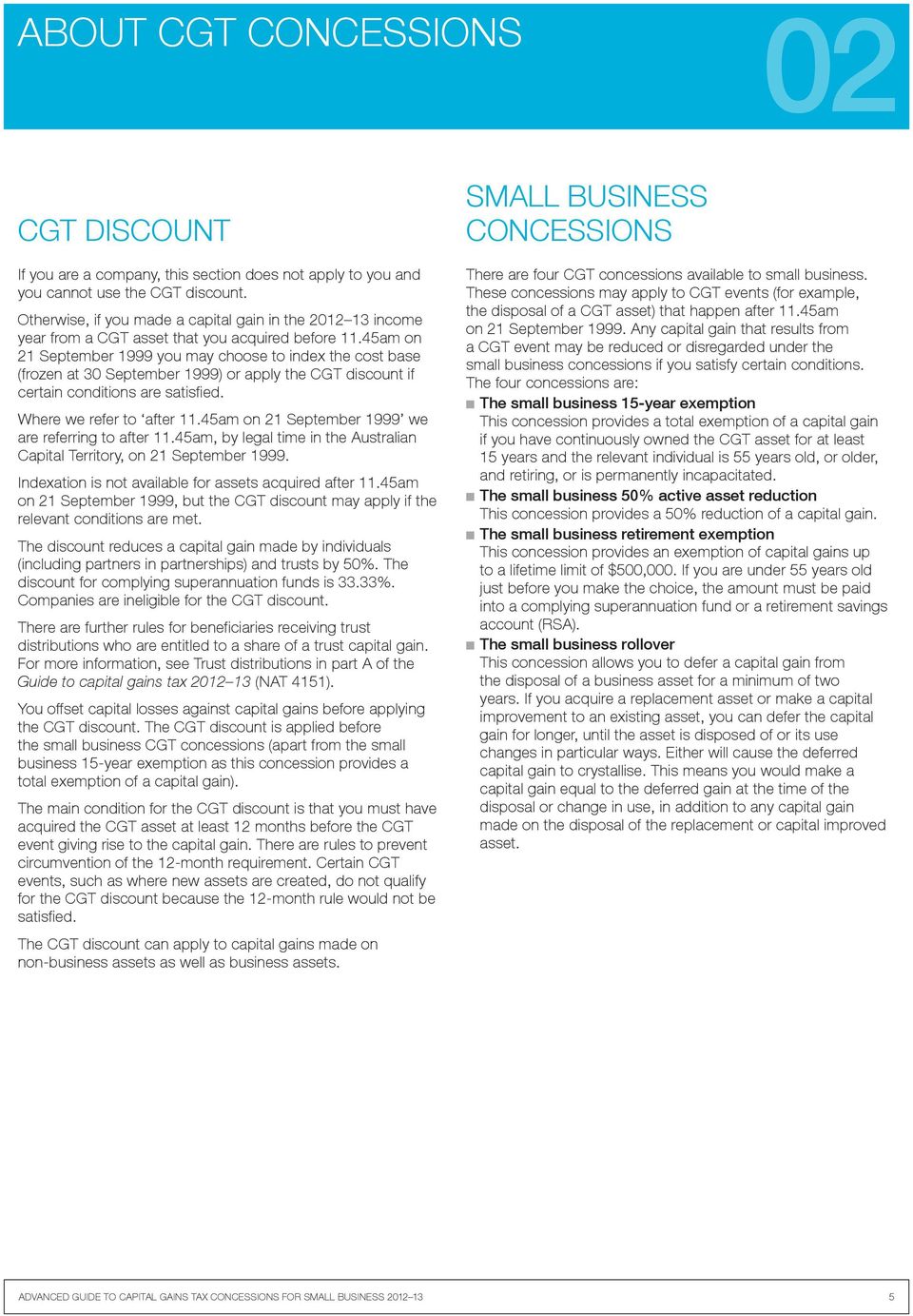
7 ABOUT CGT CONCESSIONS 02 CGT DISCOUNT If you are a company, this section does not apply to you and you cannot use the CGT discount. Otherwise, if you made a capital gain in the income year from a CGT asset that you acquired before 11.45am on 21 September 1999 you may choose to index the cost base (frozen at 30 September 1999) or apply the CGT discount if certain conditions are satisfied. Where we refer to after 11.45am on 21 September 1999 we are referring to after 11.45am, by legal time in the Australian Capital Territory, on 21 September Indexation is not available for assets acquired after 11.45am on 21 September 1999, but the CGT discount may apply if the relevant conditions are met. The discount reduces a capital gain made by individuals (including partners in partnerships) and trusts by 50%. The discount for complying superannuation funds is 33.33%. Companies are ineligible for the CGT discount. There are further rules for beneficiaries receiving trust distributions who are entitled to a share of a trust capital gain. For more information, see Trust distributions in part A of the Guide to capital gains tax (NAT 4151). You offset capital losses against capital gains before applying the CGT discount. The CGT discount is applied before the small business CGT concessions (apart from the small business 15-year exemption as this concession provides a total exemption of a capital gain). The main condition for the CGT discount is that you must have acquired the CGT asset at least 12 months before the CGT event giving rise to the capital gain. There are rules to prevent circumvention of the 12 month requirement. Certain CGT events, such as where new assets are created, do not qualify for the CGT discount because the 12 month rule would not be satisfied. The CGT discount can apply to capital gains made on non business assets as well as business assets. SMALL BUSINESS CONCESSIONS There are four CGT concessions available to small business. These concessions may apply to CGT events (for example, the disposal of a CGT asset) that happen after 11.45am on 21 September Any capital gain that results from a CGT event may be reduced or disregarded under the small business concessions if you satisfy certain conditions. The four concessions are: n The small business 15 year exemption This concession provides a total exemption of a capital gain if you have continuously owned the CGT asset for at least 15 years and the relevant individual is 55 years old, or older, and retiring, or is permanently incapacitated. n The small business 50% active asset reduction This concession provides a 50% reduction of a capital gain. n The small business retirement exemption This concession provides an exemption of capital gains up to a lifetime limit of $500,000. If you are under 55 years old just before you make the choice, the amount must be paid into a complying superannuation fund or a retirement savings account (RSA). n The small business rollover This concession allows you to defer a capital gain from the disposal of a business asset for a minimum of two years. If you acquire a replacement asset or make a capital improvement to an existing asset, you can defer the capital gain for longer, until the asset is disposed of or its use changes in particular ways. Either will cause the deferred capital gain to crystallise. This means you would make a capital gain equal to the deferred gain at the time of the disposal or change in use, in addition to any capital gain made on the disposal of the replacement or capital improved asset. ADVANCED GUIDE TO CAPITAL GAINS TAX CONCESSIONS FOR SMALL BUSINESS
8 03 HOW DO YOU APPLY LOSSES, CONCESSIONS AND THE DISCOUNT? APPLYING CAPITAL LOSSES If the small business 15 year exemption applies, you do not reduce the capital gain by any capital losses before you apply that concession. In all other cases, you apply the CGT discount and the small business concessions to the capital gain after the capital gain has been reduced by any current and prior year capital losses. If you have more than one capital gain, you can choose the order in which your capital gains are reduced by your capital losses. APPLYING THE DISCOUNT AND CONCESSIONS The small business 15 year exemption takes priority over the other small business concessions and the CGT discount. If the small business 15 year exemption applies, you entirely disregard the capital gain so there is no need to apply any further concessions. If the 15 year exemption doesn t apply, you apply the CGT discount (if applicable) to the capital gain before applying the remaining small business concessions. If you satisfy the conditions for more than one of the remaining small business concessions, you may apply each of those concessions to different parts of the capital gain. After applying any capital losses, individuals and trusts eligible for both the CGT discount and the small business 50% active asset reduction can reduce a capital gain by 75%, that is, by 50% then 50% of the remainder. The order in which you apply capital losses and the CGT concessions to capital gains is detailed below. Ken is a small business operator who sells an active asset that he has owned for more than 12 months. He makes a capital gain of $20,000. Ken also has a separate capital loss of $4,000. Assuming he satisfies all the conditions for the CGT discount and the small business 50% active asset reduction, Ken calculates his net capital gain as follows: Capital gain Capital loss Take the loss away from the gain $20,000 $4,000 $16,000 Apply 50% CGT discount $8,000 Apply 50% small business active asset reduction Reduced capital gain $8,000 $4,000 $4,000 Ken may be able to further reduce his $4,000 (reduced) capital gain by using the small business retirement exemption and/or small business rollover if he satisfies the conditions for those concessions. 6 ADVANCED GUIDE TO CAPITAL GAINS TAX CONCESSIONS FOR SMALL BUSINESS

9 03 HOW DO YOU APPLY LOSSES, CONCESSIONS AND THE DISCOUNT? Order in which to apply the discount and concessions CAPITAL GAINS MADE DURING AN INCOME YEAR Note that you make a capital gain from a depreciating asset only to the extent that you have used the depreciating asset for a non taxable purpose. Step 1: Determine whether you satisfy the basic conditions for the small business CGT concessions. YES NO You don t qualify for any of the small business CGT concessions. You may be eligible for the CGT discount. Step 2: Determine whether you qualify for the small business 15 year exemption (not relevant to capital gains from depreciating assets). YES NO Step 3: Offset any capital losses against the capital gain. Disregard the entire capital gain. You don t need to apply any of the other CGT concessions. Step 4: Determine whether you are eligible for the CGT discount. If so, reduce the remaining capital gain. Step 5: Determine whether the capital gain is from a depreciating asset used at least partly for a non taxable purpose. If so, you are not eligible for any other concessions and can t reduce your capital gain any further. Step 6: If you satisfy the basic conditions for the small business CGT concessions (see Step 1), you qualify for the small business 50% active asset reduction. If so, reduce the remaining capital gain. You can choose not to apply the 50% active asset reduction and go straight to the small business retirement exemption or rollover in step 7. Step 7: Determine whether you qualify for the small business retirement exemption or rollover. If so, reduce the remaining capital gain. KEEP THE NECESSARY CGT RECORDS Amount remaining equals the net capital gain to be included in your assessable income for the year. ADVANCED GUIDE TO CAPITAL GAINS TAX CONCESSIONS FOR SMALL BUSINESS

10 03 HOW DO YOU APPLY LOSSES, CONCESSIONS AND THE DISCOUNT? CHOOSING SMALL BUSINESS CONCESSIONS DEPRECIATING ASSETS Special rules apply to depreciating assets. A depreciating asset is an asset that has a limited effective life and can reasonably be expected to decline in value over the time it is used. Examples of depreciating assets include the plant and equipment you use in your business. Under the uniform capital allowances system that has applied since 1 July 2001, any gain or loss from a depreciating asset is included in your assessable income, or is deductible as a balancing adjustment, to the extent the asset was used for a taxable purpose, for example, to produce assessable income. The small business CGT concessions do not apply to gains you make on depreciating assets that are included in your income under the uniform capital allowances system. You make a capital gain or capital loss from a depreciating asset to the extent you have used the depreciating asset for a non taxable purpose, for example, for private purposes, (CGT event K7). Any capital gain you make in this way does not qualify for the small business concessions because it reflects the non business use of the asset. However, as depreciating assets are still CGT assets, they must be included in the maximum net asset value test. A depreciating asset may also be an active asset and may be chosen as a replacement asset under the small business rollover. You must choose the 15 year exemption, the retirement exemption and the rollover for those concessions to apply. However, the 50% active asset reduction applies automatically if the basic conditions are satisfied and you have not specifically chosen that it not apply. Generally, a choice available under the CGT law must be made by the day you lodge your income tax return for the income year in which the relevant CGT event happened, or within such further time as the Commissioner allows. The way you prepare your income tax return is generally sufficient evidence of the choice you have made. However, the retirement exemption requires you to keep a written record of the amount you choose to disregard. If you became eligible for the concessions as a result of the March 2012 amendments, you have until the later of: n the day you lodge your income tax return for the income year in which the relevant CGT event happened, or n 22 March 2014 (2 years after the commencement date), or n a later date allowed by the Commissioner. The extension of time to make a choice applies where your original assessment was made before 22 March If you became eligible for the concessions as a result of the June 2009 amendments, you have until the later of: n the day you lodge your income tax return for the income year in which the relevant CGT event happened, or n 23 June 2010 (12 months after the commencement date), or n a later date allowed by the Commissioner. The extension of time to make a choice applies to CGT events happening before 23 June ADVANCED GUIDE TO CAPITAL GAINS TAX CONCESSIONS FOR SMALL BUSINESS

11 03 HOW DO YOU APPLY LOSSES, CONCESSIONS AND THE DISCOUNT? DISTRIBUTIONS OUT OF CONCESSION AMOUNTS: TAX CONSEQUENCES Where a company or trust chooses a concession and then distributes an amount out of the capital gain to a shareholder or beneficiary, there are varying tax consequences for the shareholder or beneficiary, depending on which concession the company or trust chooses. For some concessions the amounts received by the individuals are exempt, while for other concessions the amounts are not exempt. 15 year exemption If a company or trust chooses the 15 year exemption and satisfies certain further conditions relating to the distribution of the exempt amount, the amount received by the shareholder or beneficiary is not included in their assessable income. For more information, see Consequences of applying the exemption on page % active asset reduction The tax consequences for distributions made out of 50% active asset reduction amounts will depend on, among other things, the type of entity involved. A distribution by a fixed trust could give rise to a capital gain (after firstly reducing the cost base of the beneficiary s interest in the trust to nil). However, there are no such consequences for distributions by non fixed trusts. For more information, see Fixed trust distributions and the 50% active asset reduction on page 46. A distribution by a company out of a 50% active asset reduction amount is likely to be assessable to the shareholder as an unfranked dividend. Retirement exemption If a company or trust chooses the retirement exemption and satisfies the requirements for the retirement exemption, the payment received by the shareholder or beneficiary is not included in their assessable income. COMPLYING SUPERANNUATION FUNDS AND THE CONCESSIONS Concessions not available for complying superannuation funds The small business concessions will not be available for any capital gain a complying superannuation fund makes on the sale of an asset used in a related entity s business. It may be common for a complying superannuation fund to own premises used in the business of a related entity, for example, business real property. However, as the members or trustees of the fund (who typically also control the related entity) do not control the fund in the manner required, the related entity is not a connected entity and, therefore, the business real property is not an active asset. Interaction with superannuation There is considerable interaction between the retirement exemption and superannuation. Immediate payment to superannuation fund required The retirement exemption requires amounts to be immediately contributed into a complying superannuation fund or a retirement savings account (RSA) if the recipient is younger than 55 years old when they make a choice to use the retirement exemption. This is an important requirement: failure to immediately pay the amount to a complying superannuation fund or RSA will mean the conditions are not satisfied and the retirement exemption will not be available. For more information see Small business retirement exemption on page 47. Rollover If a company or trust chooses the rollover for a capital gain and then distributes an amount out of the gain to a shareholder or beneficiary, the distribution is not exempt that is, the concession does not flow through to the individuals. The consequences of such distributions are similar to those noted above for the 50% active asset reduction. ADVANCED GUIDE TO CAPITAL GAINS TAX CONCESSIONS FOR SMALL BUSINESS

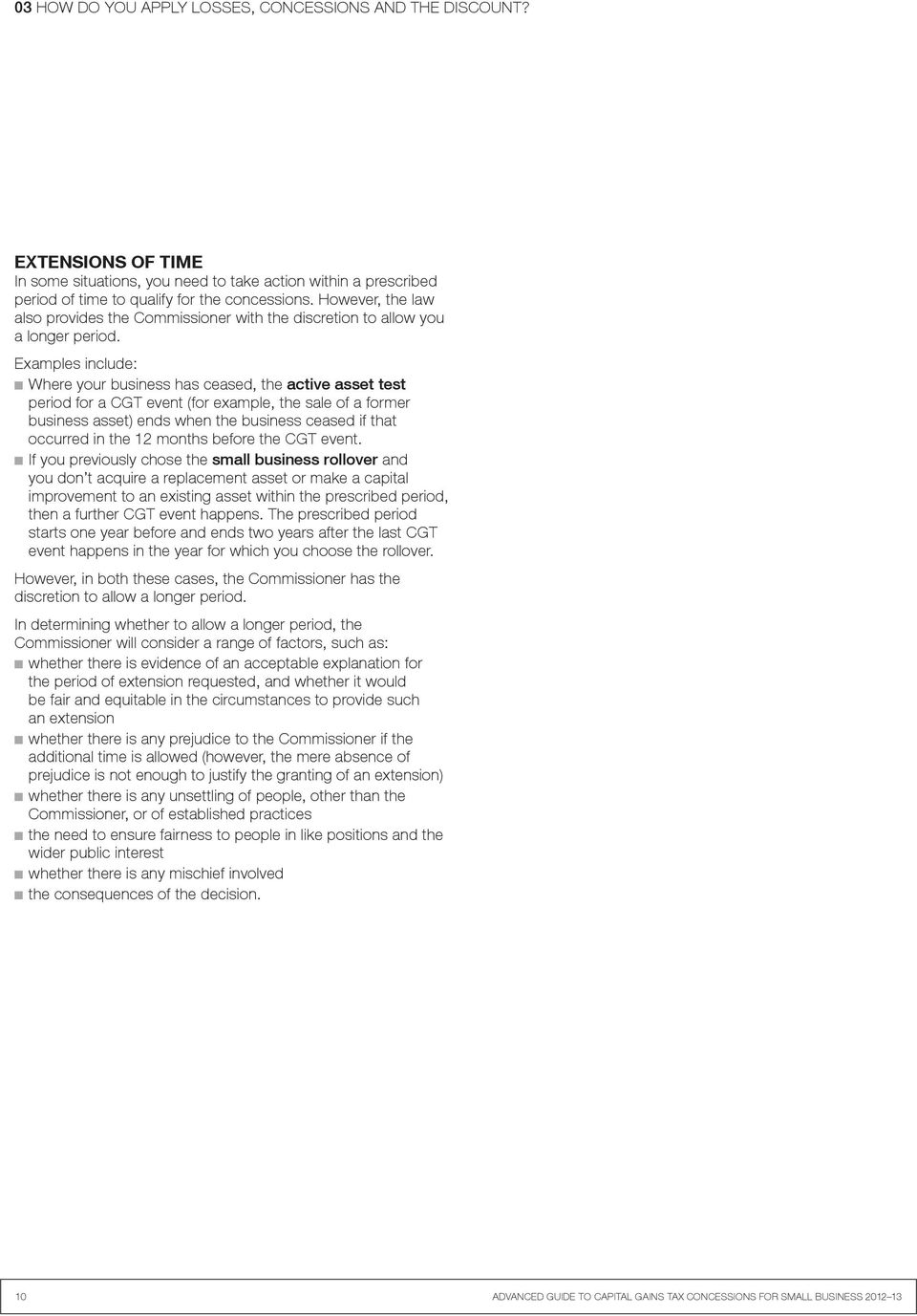
12 03 HOW DO YOU APPLY LOSSES, CONCESSIONS AND THE DISCOUNT? EXTENSIONS OF TIME In some situations, you need to take action within a prescribed period of time to qualify for the concessions. However, the law also provides the Commissioner with the discretion to allow you a longer period. Examples include: n Where your business has ceased, the active asset test period for a CGT event (for example, the sale of a former business asset) ends when the business ceased if that occurred in the 12 months before the CGT event. n If you previously chose the small business rollover and you don t acquire a replacement asset or make a capital improvement to an existing asset within the prescribed period, then a further CGT event happens. The prescribed period starts one year before and ends two years after the last CGT event happens in the year for which you choose the rollover. However, in both these cases, the Commissioner has the discretion to allow a longer period. In determining whether to allow a longer period, the Commissioner will consider a range of factors, such as: n whether there is evidence of an acceptable explanation for the period of extension requested, and whether it would be fair and equitable in the circumstances to provide such an extension n whether there is any prejudice to the Commissioner if the additional time is allowed (however, the mere absence of prejudice is not enough to justify the granting of an extension) n whether there is any unsettling of people, other than the Commissioner, or of established practices n the need to ensure fairness to people in like positions and the wider public interest n whether there is any mischief involved n the consequences of the decision. 10 ADVANCED GUIDE TO CAPITAL GAINS TAX CONCESSIONS FOR SMALL BUSINESS
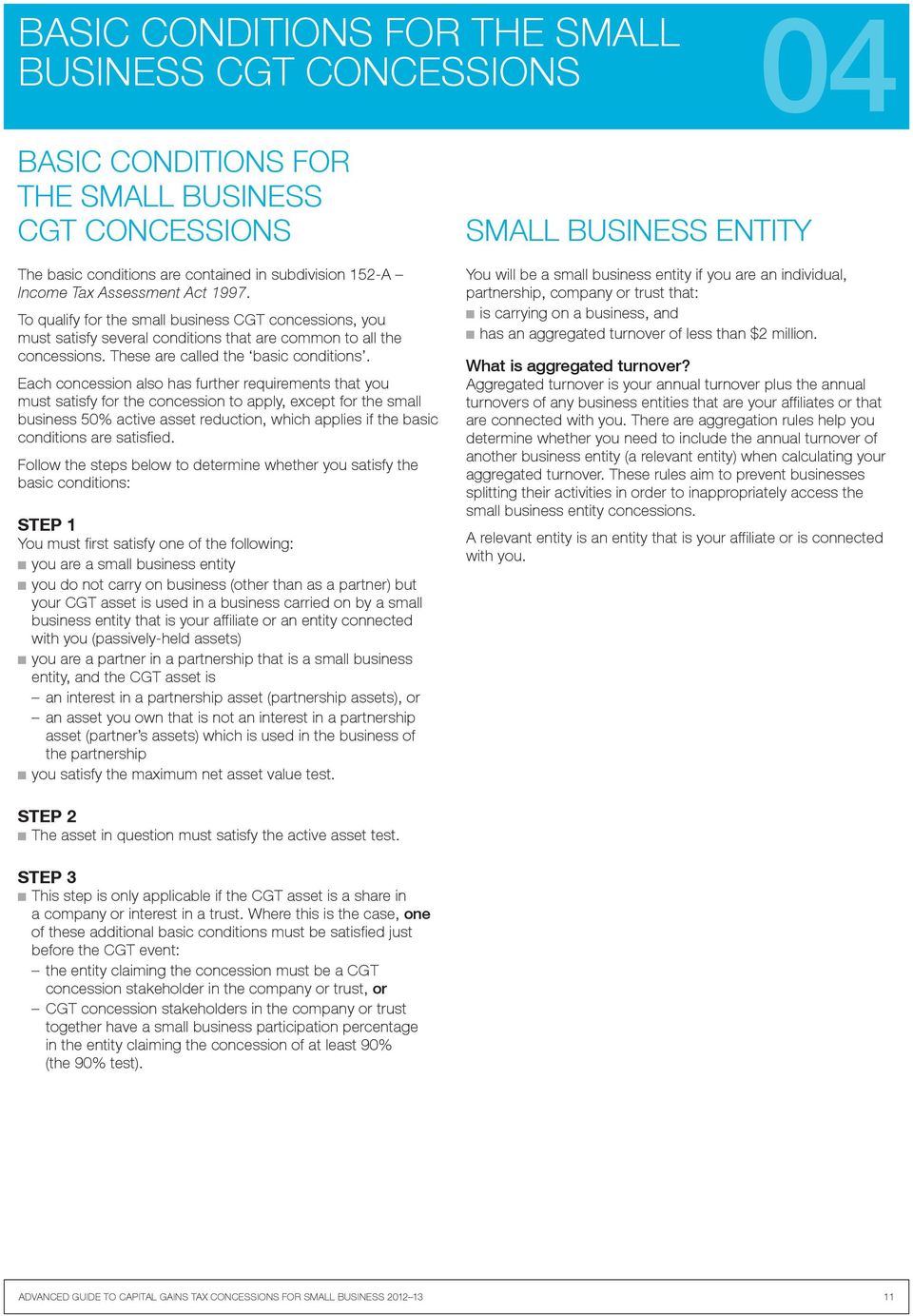
13 BASIC CONDITIONS FOR THE SMALL 04 BUSINESS CGT CONCESSIONS BASIC CONDITIONS FOR THE SMALL BUSINESS CGT CONCESSIONS The basic conditions are contained in subdivision 152 A Income Tax Assessment Act To qualify for the small business CGT concessions, you must satisfy several conditions that are common to all the concessions. These are called the basic conditions. Each concession also has further requirements that you must satisfy for the concession to apply, except for the small business 50% active asset reduction, which applies if the basic conditions are satisfied. Follow the steps below to determine whether you satisfy the basic conditions: STEP 1 You must first satisfy one of the following: n you are a small business entity n you do not carry on business (other than as a partner) but your CGT asset is used in a business carried on by a small business entity that is your affiliate or an entity connected with you (passively held assets) n you are a partner in a partnership that is a small business entity, and the CGT asset is an interest in a partnership asset (partnership assets), or an asset you own that is not an interest in a partnership asset (partner s assets) which is used in the business of the partnership n you satisfy the maximum net asset value test. SMALL BUSINESS ENTITY You will be a small business entity if you are an individual, partnership, company or trust that: n is carrying on a business, and n has an aggregated turnover of less than $2 million. What is aggregated turnover? Aggregated turnover is your annual turnover plus the annual turnovers of any business entities that are your affiliates or that are connected with you. There are aggregation rules help you determine whether you need to include the annual turnover of another business entity (a relevant entity) when calculating your aggregated turnover. These rules aim to prevent businesses splitting their activities in order to inappropriately access the small business entity concessions. A relevant entity is an entity that is your affiliate or is connected with you. STEP 2 n The asset in question must satisfy the active asset test. STEP 3 n This step is only applicable if the CGT asset is a share in a company or interest in a trust. Where this is the case, one of these additional basic conditions must be satisfied just before the CGT event: the entity claiming the concession must be a CGT concession stakeholder in the company or trust, or CGT concession stakeholders in the company or trust together have a small business participation percentage in the entity claiming the concession of at least 90% (the 90% test). ADVANCED GUIDE TO CAPITAL GAINS TAX CONCESSIONS FOR SMALL BUSINESS
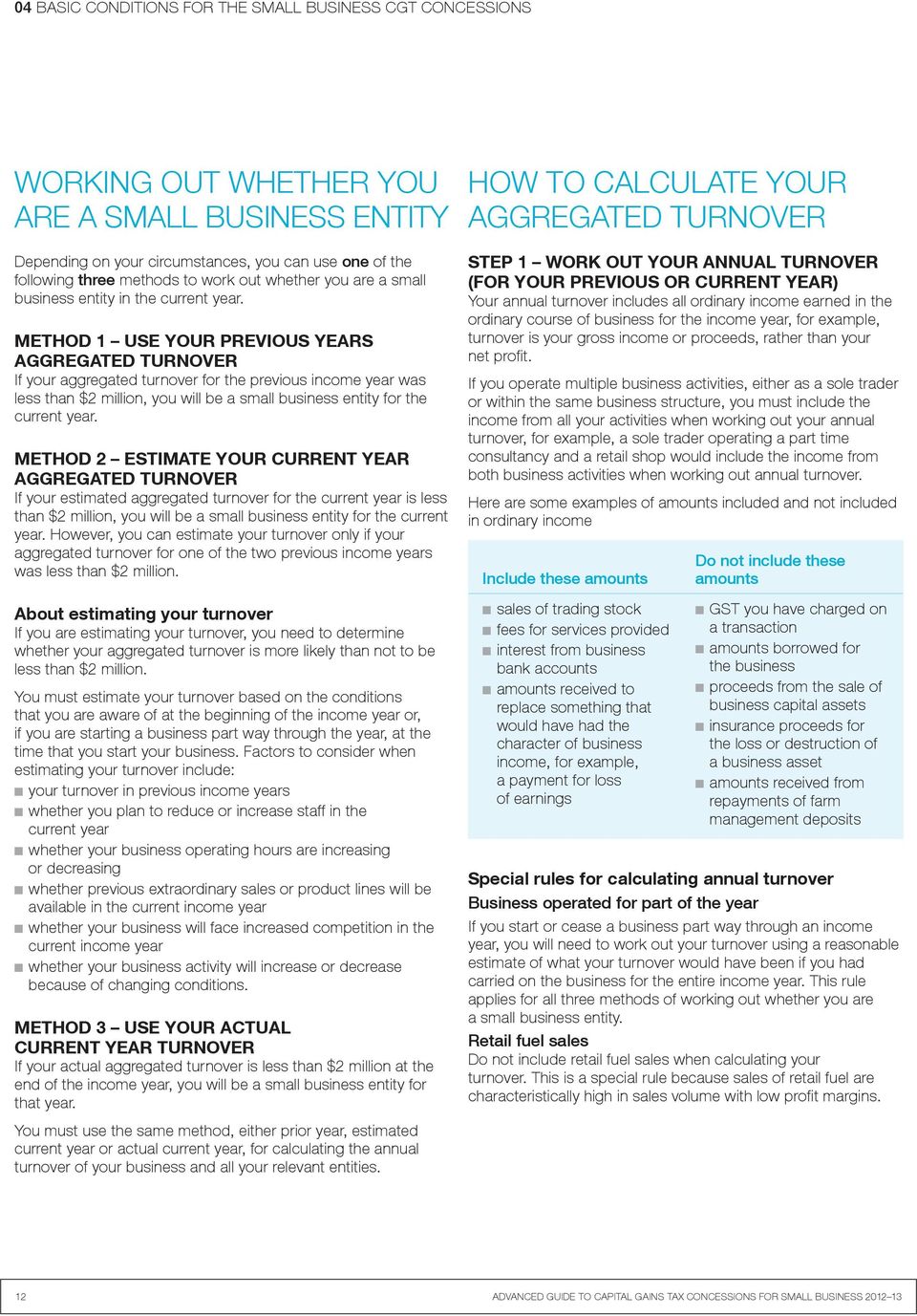
14 04 BASIC CONDITIONS FOR THE SMALL BUSINESS CGT CONCESSIONS WORKING OUT WHETHER YOU ARE A SMALL BUSINESS ENTITY Depending on your circumstances, you can use one of the following three methods to work out whether you are a small business entity in the current year. METHOD 1 USE YOUR PREVIOUS YEARS AGGREGATED TURNOVER If your aggregated turnover for the previous income year was less than $2 million, you will be a small business entity for the current year. METHOD 2 ESTIMATE YOUR CURRENT YEAR AGGREGATED TURNOVER If your estimated aggregated turnover for the current year is less than $2 million, you will be a small business entity for the current year. However, you can estimate your turnover only if your aggregated turnover for one of the two previous income years was less than $2 million. About estimating your turnover If you are estimating your turnover, you need to determine whether your aggregated turnover is more likely than not to be less than $2 million. You must estimate your turnover based on the conditions that you are aware of at the beginning of the income year or, if you are starting a business part way through the year, at the time that you start your business. Factors to consider when estimating your turnover include: n your turnover in previous income years n whether you plan to reduce or increase staff in the current year n whether your business operating hours are increasing or decreasing n whether previous extraordinary sales or product lines will be available in the current income year n whether your business will face increased competition in the current income year n whether your business activity will increase or decrease because of changing conditions. METHOD 3 USE YOUR ACTUAL CURRENT YEAR TURNOVER If your actual aggregated turnover is less than $2 million at the end of the income year, you will be a small business entity for that year. You must use the same method, either prior year, estimated current year or actual current year, for calculating the annual turnover of your business and all your relevant entities. HOW TO CALCULATE YOUR AGGREGATED TURNOVER STEP 1 WORK OUT YOUR ANNUAL TURNOVER (FOR YOUR PREVIOUS OR CURRENT YEAR) Your annual turnover includes all ordinary income earned in the ordinary course of business for the income year, for example, turnover is your gross income or proceeds, rather than your net profit. If you operate multiple business activities, either as a sole trader or within the same business structure, you must include the income from all your activities when working out your annual turnover, for example, a sole trader operating a part time consultancy and a retail shop would include the income from both business activities when working out annual turnover. Here are some examples of amounts included and not included in ordinary income Include these amounts n sales of trading stock n fees for services provided n interest from business bank accounts n amounts received to replace something that would have had the character of business income, for example, a payment for loss of earnings Do not include these amounts n GST you have charged on a transaction n amounts borrowed for the business n proceeds from the sale of business capital assets n insurance proceeds for the loss or destruction of a business asset n amounts received from repayments of farm management deposits Special rules for calculating annual turnover Business operated for part of the year If you start or cease a business part way through an income year, you will need to work out your turnover using a reasonable estimate of what your turnover would have been if you had carried on the business for the entire income year. This rule applies for all three methods of working out whether you are a small business entity. Retail fuel sales Do not include retail fuel sales when calculating your turnover. This is a special rule because sales of retail fuel are characteristically high in sales volume with low profit margins. 12 ADVANCED GUIDE TO CAPITAL GAINS TAX CONCESSIONS FOR SMALL BUSINESS
15 04 BASIC CONDITIONS FOR THE SMALL BUSINESS CGT CONCESSIONS Non arm s length business transactions Any income from transactions with an associate should be included in your turnover. If the dealing was not at arm s length (that is the goods or services were sold at a discounted price because of their association with you) you must use the market value of the goods or services when calculating your annual turnover. However, you may take into account any discounts that would have been offered had the dealing been at arm s length. Associate has the meaning given by section 318 of the Income Tax Assessment Act As an individual, your associates include but are not limited to: n your relatives, such as your spouse or children n a partnership that you are a partner in n another partner in that partnership, and that partner s spouse and children n a trustee of a trust that you, or your associate, are a beneficiary of, and n a company that you, or your associate, control or influence. There are similar rules to determine who is an associate of a company, partnership and trustee. If the aggregation rules do not apply to you, your aggregated turnover will be the same as your annual turnover. You do not need to read any further. If you must consider the aggregation rules, or are not sure whether they apply to you, go to step 2. STEP 3 WORK OUT YOUR AGGREGATED TURNOVER To work out your aggregated turnover, add the annual turnovers of relevant business entities to your annual turnover. When working out your aggregated turnover, do not include income: n from dealings between you and a relevant business entity n from dealings between any of your relevant business entities n of an entity when it was not your relevant business entity. If your aggregated turnover is less than $2 million you are a small business entity for the current year. If you are not a small business entity in an income year, you may still be able to access the capital gains tax concessions if you pass the $6 million maximum net asset value test. STEP 2 CONSIDER THE AGGREGATION RULES You must include the annual turnover of a relevant business entity with your annual turnover when working out your aggregated turnover. A relevant business entity is a business entity that, at any time during the income year, is: n connected with you, or is n your affiliate. If you have a relevant business entity, repeat step 1 on page 13 for each relevant business entity to work out their annual turnover. You must use the same method for working out your annual turnover and the annual turnovers of all your relevant businesses entities. ADVANCED GUIDE TO CAPITAL GAINS TAX CONCESSIONS FOR SMALL BUSINESS

16 04 BASIC CONDITIONS FOR THE SMALL BUSINESS CGT CONCESSIONS PASSIVELY HELD ASSETS This basic condition allows you to access the concessions for a CGT asset you own where you are not carrying on a business, but that CGT asset is used in the business of your affiliate or an entity connected with you. The basic condition can also apply where your asset is held ready for use in or is inherently connected with, the business of your affiliate or entity connected with you. The following conditions must be satisfied in the income year: n your affiliate, or entity connected with you, is a small business entity for the income year, that is, the income year in which the CGT event happens to your CGT asset n you do not carry on a business in the income year other than in partnership n if you carry on a business in partnership, the CGT asset is not an interest in an asset of the partnership n your affiliate or entity that is connected with you at a time in the income year is the same small business entity that carries on the business and uses the asset at that time and the asset is the same asset that also meets the active asset test at that time. There is a special rule for calculating aggregated turnover where the basic condition for passively held assets applies. An entity that is your affiliate, or is connected with you, is deemed to be an affiliate of, or connected with (as the case may be) the small business entity that uses the asset. This rule only applies if the entity is not already an affiliate or connected with the small business entity. In calculating the aggregated turnover of the small business entity, the turnover of entities that are deemed to be affiliates or connected entities must be included. The calculation of aggregated turnover is otherwise the same. A special affiliate rule for spouses and children under 18 applies in these cases. Assume the same facts as for the example above except that Peter has an affiliate, Mike, who carries on a separate business. Mike acts in accordance with Peter s wishes in running his business. The special rule for calculating aggregated turnover will apply to treat Mike as Foxxy Farm s affiliate also. When working out Foxxy Farm s aggregated turnover, Mike s turnover will need to be included. Peter owns land that he leases to a company he wholly owns, Foxxy Farm Pty Ltd, which uses the land in its farming business. Peter does not carry on a business himself. Under the law prior to the June 2009 amendments, Peter is not able to access the small business CGT concessions via the small business entity test because he does not carry on a business. As a result of the June 2009 amendments, Peter would be able to access the small business CGT concessions via the small business entity turnover test depending on the aggregated turnover of Foxxy Farm Pty Ltd. 14 ADVANCED GUIDE TO CAPITAL GAINS TAX CONCESSIONS FOR SMALL BUSINESS

17 04 BASIC CONDITIONS FOR THE SMALL BUSINESS CGT CONCESSIONS PARTNER IN A PARTNERSHIP: USING THE SMALL BUSINESS ENTITY TEST The CGT rules operate on the basis that a partner in a partnership carries on the partnership business collectively with the other partners. However, a partner cannot be a small business entity. It is the partnership that must satisfy the small business entity test (that is, the $2 million aggregated turnover test) to qualify as a small business entity. If the relevant conditions are met, a partner may be eligible for the small business CGT concessions using the turnover test for: n their interest in a partnership asset, or n an asset that is not a partnership asset that is used in the business of the partnership. In both cases the partner is not required to be connected with the partnership. The maximum net asset value test applies differently so that it is the individual partners in the partnership that determine their eligibility for the small business CGT concessions, and not the partnership. PARTNERSHIP ASSETS An asset is a partnership asset if the partners own the asset in accordance with their respective interests as specified in the partnership agreement. Partners may be eligible for the concessions if: n the asset is the partner s interest in a partnership asset, and n that partnership is a small business entity. PARTNER S ASSETS Partners may also be eligible for the concessions for a CGT asset the partner owns (that is not their interest in a partnership asset) when the following conditions are satisfied in the income year: n they were a partner in a partnership in the income year in which the CGT event happens to the partner s CGT asset n that partnership uses the asset at a time in the income year, in carrying on the partnership business and is a small business entity for that income year n the only business the partner carries on is as a partner in a partnership. There is a special rule for calculating aggregated turnover in cases where a partner s asset is being used in the business carried on by the partnership. An entity that is an affiliate of, or connected with, the partner is deemed to be an affiliate of, or connected with (as the case may be) the partnership that uses the asset. This rule only applies if the entity is not already an affiliate or connected with the partnership. In calculating the aggregated turnover of the partnership, the turnover of entities that are deemed to be affiliates or connected entities must be included. The calculation of aggregated turnover is otherwise the same. There is another special rule for calculating aggregated turnover where the taxpayer is a partner in more than one partnership and the asset is used in more than one partnership business. It treats each partnership that the taxpayer is a partner in, and that uses the asset, as being connected with the partnership that is trying to work out whether it is a small business entity (the test entity). When working out the aggregated turnover of the test partnership, the turnover of any other partnerships that are deemed to be connected must be included. ADVANCED GUIDE TO CAPITAL GAINS TAX CONCESSIONS FOR SMALL BUSINESS
18 04 BASIC CONDITIONS FOR THE SMALL BUSINESS CGT CONCESSIONS : Ownership of building and partnership split Beau and Irene each own 50% of a supermarket building, which is used in the business of a partnership carried on by Beau, Jack, Casey and Irene. Beau, Jack, Casey and Irene each have a 25% interest in the partnership, which trades under the name Auzzie Supermarket. Beau owns a half share in the building Jack Casey Irene owns the other half share in the building Owns 25% Owns 25% Owns 25% Owns 25% Auzzie Supermarket (partnership) uses the building in its business Under the law prior to the June 2009 amendments, Beau and Irene would not be able to access the small business CGT concessions via the small business entity turnover test for any capital gain made on the sale of the building because their respective CGT asset is not an interest in an asset of the partnership. For the CGT assets to be interests in an asset of the partnership, Beau, Jack, Casey and Irene would either have to each own 25% of the supermarket building or the partnership agreement would have to specify what interest each partner owned in the building. As a result of the June 2009 amendments, Beau and Irene may be able to access the small business CGT concessions in relation to their respective shares of the building via the small business entity turnover test, depending on the aggregated turnover of the partnership calculated respectively for Beau and Irene. The aggregated turnover of Auzzie Supermarket must be calculated separately for Beau and Irene, taking into account any entities that are affiliates of, or connected with, each of them respectively. BUSINESSES THAT ARE WINDING UP The basic conditions for passively held assets and partner s assets require that: n the asset is used in the business of your affiliate, connected entity or partnership, at a time in the income year that the CGT event happens, and n that entity is a small business entity in the year the event happens. If an entity is not using the asset in the business in the year the CGT event occurs because the business the entity previously carried on is winding up, there is a special rule that applies provided the entity used the asset in the business in the year the business ceased. This rule treats the entity as carrying on the business for a moment in time in the income year the CGT event happens and treats the asset as being used, held ready for use in, or inherently connected with, the business at that same moment in time in the CGT event year. There is another rule that applies for all the basic conditions that use the turnover test; this rule allows an entity to work out whether it is a small business entity in the CGT event year when the entity is winding up a business it previously carried on. The entity will be taken to be still carrying on the business if: n it is winding up a business it previously carried on, and n it was a small business entity in the income year the entity ceased business. 16 ADVANCED GUIDE TO CAPITAL GAINS TAX CONCESSIONS FOR SMALL BUSINESS

19 04 BASIC CONDITIONS FOR THE SMALL BUSINESS CGT CONCESSIONS MAXIMUM NET ASSET VALUE TEST There is a limit of $6 million on the net value of the CGT assets that you and certain entities can own and still qualify for the small business CGT concessions. This $6 million limit is called the maximum net asset value test. It is not indexed for inflation. You satisfy the maximum net asset value test if the total net value of CGT assets owned by certain entities does not exceed $6 million just before the CGT event that results in the capital gain for which the concessions are sought. You must include the net value of CGT assets owned by: n you n any entities connected with you, n any of your affiliates and entities connected with your affiliates (subject to the note below) Include the net value of assets of your affiliates, and entities connected with your affiliates, only if the assets are used, or held ready for use, in a business carried on by you or an entity connected with you. Don t include an asset if it is used in the business of an entity that is connected with you only because of your affiliate. Colin operates a newsagency business as a sole trader. Simon carries on his own florist business, which is unrelated to the newsagency business. Simon owns the land and building from which the newsagency is conducted and leases it to Colin. Simon also owns 100% of the shares in Simco Pty Ltd, which carries on another separate business. Simon is connected with Simco Pty Ltd because he controls the company. Simon regularly consults Colin for advice in his business affairs and acts according to Colin s wishes therefore Simon is Colin s affiliate. To determine whether he satisfies the maximum net asset value test, Colin includes the market value of the land and building owned by Simon (because it is used in his newsagency business) but does not include Simon s other assets used in his florist business (because they are not used in the newsagency business). Nor does Colin include Simco s assets, because those assets are not used in his business and Simco Pty Ltd is only connected because of his affiliate, Simon. MEANING OF NET VALUE OF CGT ASSETS The net value of the CGT assets of an entity is the amount (whether positive, negative or nil) worked out by taking the sum of the market values of those assets less any liabilities of the entity that are related to those assets, and provisions made for: n annual leave n long service leave n unearned income n tax liabilities. Partner in a partnership If you are a partner in a partnership and the CGT event happens in relation to an asset of yours or a CGT asset of the partnership (for example, disposal of a partnership asset) the maximum net asset value test would include: n all the assets of the partnership if you are connected with it, and you would exclude the value of your interest in the partnership, or n only your interest in the partnership if you are not connected with it, and you would not count the assets of the partnership as a whole. Entities that hold shares or trust interests would calculate their maximum net asset value test in a similar way. Assets included in the net value of CGT assets Assets to be included in determining the net value of the CGT assets are not restricted to business assets. They include all CGT assets of the entity, unless the assets are specifically excluded (see Assets not included on page 19). In the case of a dwelling that is an individual s main residence, the individual only includes the current market value of the dwelling in their net assets to the extent that it is reasonable, having regard to the amount that the dwelling has been used to produce assessable income which gives rise to deductions for interest payments, or would give rise to deductions for interest if interest had been paid. The individual would be entitled to deduct part of the interest on money they borrowed to buy the home if: n part of the home is set aside exclusively as a place of business and is clearly identifiable as such, and n that part of the home is not readily adaptable for private use, for example, a doctor s surgery located within a doctor s home. This is a hypothetical interest deductibility test. If the individual did not actually incur any interest, the test looks at whether they would have been entitled to a deduction if they had taken out a loan to purchase their home. ADVANCED GUIDE TO CAPITAL GAINS TAX CONCESSIONS FOR SMALL BUSINESS
20 04 BASIC CONDITIONS FOR THE SMALL BUSINESS CGT CONCESSIONS If the dwelling has had some income-producing use, the percentage of income-producing use is multiplied by the current market value to work out the value of the dwelling that should be included. This will take into account the length of time and percentage of income-producing use of the dwelling. Ben owns a house that has a market value of $750,000 just before applying the net assets test. Ben owned the house for 12 years; for the first three years, 20% of it was used for producing assessable income; for the following two years it was used 40% for producing assessable income, for two years, it was used solely as a main residence; and for the last five years, it was used 10% for producing assessable income. Ben s dwelling has had 15.8% income-producing use: (3/12 20% ) + (2/12 40%) + (2/12 0%) + (5/12 10%) Ben will include $118,750 in his net assets ($750, %). Ben has a liability of $500,000 attached to the house, therefore 15.8% ($79,166) of the liability is also included in the calculation of the net assets. Although gains from depreciating assets may be treated as income rather than capital gains, depreciating assets are still CGT assets and are, therefore, included when calculating the net asset value. Examples of amounts that are not included in liabilities for the purposes of determining the net value of the CGT assets of an entity include: n provisions for possible obligations to pay damages in a pending lawsuit n provisions for liabilities in respect of an earn out contract n provisions for the guarantee of a loan n accounting liabilities arising as a result of receiving prepaid income n expenses that are not yet due n provisions in general for such things as quantity rebate. Liabilities related to assets A liability must be related to the CGT assets of an entity to be taken into account in determining the net value of the CGT assets of the entity. This includes liabilities directly related to particular assets that are themselves included in the calculation, for example, a loan to finance the purchase of business premises. It also includes liabilities not directly related to a particular asset but rather to the assets of the entity more generally, for example, a bank overdraft or other short term financing facility that provides working capital for the operation of the business. However liabilities that are directly related to an asset that is excluded from the net asset calculation cannot be included but certain liabilities related to excluded interests in connected entities may be counted. See Some interests in connected entities on page 19. Liabilities included in the net value of CGT assets Liabilities to be included in determining the net value of the CGT assets include: n legally enforceable debts due for payment n presently existing obligations to pay either a certain sum or ascertainable sums. However, contingent liabilities are not included in the calculation. A contingent liability is a liability that will become due only on the occurrence of an event that may or may not happen. 18 ADVANCED GUIDE TO CAPITAL GAINS TAX CONCESSIONS FOR SMALL BUSINESS
21 04 BASIC CONDITIONS FOR THE SMALL BUSINESS CGT CONCESSIONS Cool Tool Pty Ltd is selling its business. The assets and liabilities of the company are as follows: Assets: $ $ Plant and machinery 1,500,000 Freehold premises 3,500,000 5,000,000 Liabilities: Mortgage (secured over the premises) 2,000,000 Provision for leave of employees 500,000 Unbilled expenses (business consultant) 200,000 Provision for rebates 200,000 Provision for possible damages payout 100,000 3,000,000 Net assets: 2,000,000 The net value of the CGT assets of the company is calculated as follows: Assets: $ $ Plant and machinery 1,500,000 Freehold premises 3,500,000 5,000,000 Liabilities: Mortgage (secured over the premises) 2,000,000 Provision for leave of employees 500,000 2,500,000 Net value of CGT assets: 2,500,000 ASSETS NOT INCLUDED Some interests in connected entities When calculating net value, you should exclude the shares, units and other interests (apart from debt) that you hold in an entity connected with you or your affiliate. This is because the net value of the CGT assets of the connected entity is already included in the test. However, include any liabilities relating to these excluded interests in connected entities. Non business assets of affiliates or connected entities Include the net value of assets of your affiliates, and entities connected with your affiliates, only if the assets are used, or held ready for use, in a business carried on by you or an entity connected with you. However, don t include an asset of your affiliate or an entity connected with your affiliate if it is used, or held ready for use, in the business of an entity that is connected with you only because of your affiliate. Personal use and superannuation assets If you are an individual, you should also disregard the following assets when working out the net value of your CGT assets: n assets being used solely for your personal use and enjoyment, or that of your affiliate n your own home, to the extent that you use it for private purposes (also, if your only other use is some incidental income producing use, exclude your home from the net asset value test) n rights to amounts payable out of a superannuation fund or an approved deposit fund n rights to an asset of a superannuation fund or an approved deposit fund n insurance policies on your life. Where an asset is disregarded, any related liability is also disregarded because these liabilities are not related to an asset included in the net asset value calculation. The following items are not taken into account in working out the net value of the CGT assets of Cool Tool Pty Ltd because they are contingent liabilities, future obligations or expectancies: n provision for possible damages payout n unbilled expenses (business consultant) n provision for rebates. ADVANCED GUIDE TO CAPITAL GAINS TAX CONCESSIONS FOR SMALL BUSINESS
22 04 BASIC CONDITIONS FOR THE SMALL BUSINESS CGT CONCESSIONS WHO IS AN AFFILIATE? An affiliate is an individual or company that, in relation to their business affairs, acts or could reasonably be expected to act: n in accordance with your directions or wishes, or n in concert with you. Trusts, partnerships and superannuation funds cannot be your affiliates. However, a trust, partnership or superannuation fund may have an affiliate who is an individual or company. However, a person is not your affiliate merely because of the nature of a business relationship you and the person share. For example, if you are a partner in a partnership, another partner is not your affiliate merely because they act, or could reasonably be expected to act in accordance with your directions or wishes in relation to the affairs of the partnership. Similarly, companies and trusts are not affiliates of their directors and trustees respectively, and vice versa, merely because of the positions held. Whether a person acts, or could reasonably be expected to act, in accordance with the taxpayer s directions or wishes, or in concert with the taxpayer is a question of fact dependent on all the circumstances of the particular case. No single factor will necessarily be determinative. Relevant factors that may support a finding that a person acts, or could reasonably be expected to act, in accordance with the taxpayer s directions or wishes, or in concert with the taxpayer, include: n the existence of a close family relationship between the parties n the lack of any formal agreement or formal relationship between the parties dictating how the parties are to act in relation to each other n the likelihood that the way the parties act, or could reasonably be expected to act, in relation to each other would be based on the relationship between the parties rather than on formal agreements or legal or fiduciary obligations n the actions of the parties. Generally, another business would not be acting in concert with you if they: n have different employees n have different business premises n have separate bank accounts n do not consult you on business matters n conduct their business affairs independently in all regards. In certain circumstances an individual or entity can be taken to be your affiliate. See Are spouses and children affiliates? on page 21, Passively held assets on page 14 and Partner s assets on page 15. : Affiliates Bob and Shirley are married. Bob has an events management business with an annual turnover of $1.7 million and Shirley owns a consultancy business with an annual turnover of $1.8 million. Bob acts in accordance with Shirley s wishes because he values her consultancy and business expertise. As a result, Bob is Shirley s affiliate because he acts in accordance with her directions and wishes in relation to his business. Shirley will need to count Bob s turnover in working out her aggregated turnover. However, Shirley is not Bob s affiliate because she does not act in accordance with his wishes or in concert with him in relation to her own business. : Not affiliates Matt and Sandy are married. They share in the running of their household. Matt owns a cleaning business with an annual turnover of $1.7 million and Sandy has a bakery with an annual turnover of $1.8 million. They have nothing to do with each other s businesses. They have: n separate bank accounts for their businesses n different business locations n their own employees. Neither Matt nor Sandy controls the management of the other s business. Even though Matt and Sandy are married, neither is an affiliate of the other because they: n do not act in concert with each other in respect of their businesses, and n neither acts according to the directions or wishes of the other. As a result, neither Matt nor Sandy has to include the annual turnover of the other s business in calculating the aggregated turnover of their own business. 20 ADVANCED GUIDE TO CAPITAL GAINS TAX CONCESSIONS FOR SMALL BUSINESS
23 04 BASIC CONDITIONS FOR THE SMALL BUSINESS CGT CONCESSIONS ARE SPOUSES AND CHILDREN AFFILIATES? Neither a spouse nor a child is automatically your affiliate. You must consider whether they are acting according to your directions or wishes, or in concert with you, in relation to their business affairs. However, where you own an asset that your spouse or child (under 18 years) uses in a business they carry on as an individual, they will be taken to be your affiliate for the purposes of the: n active asset test n $6 million maximum net asset value test, and n $2 million aggregated turnover test. By child, we mean your child less than 18 years of age. Your spouse or child may also be taken to be your affiliate where: n an asset is owned by you and that asset is used in a business carried on by an entity that your spouse (or child) owns or has an interest in, or n an asset is owned by an entity that you own or have an interest in, and that asset is used in a business carried on by your spouse (or child), or an entity that your spouse or child has an interest in. : SPOUSE Sue s spouse is taken to be her affiliate if she owns an asset that is used in the business of an entity her spouse owns. Similarly, Sue s spouse is taken to be her affiliate if an entity she owns leases an asset to an entity her spouse owns, and that entity uses the asset in business. Your spouse or child is treated as your affiliate when working out whether the entity that owns the asset is an affiliate of, or connected with, the entity that uses the asset in their business. If, by treating your spouse or child as your affiliate the result is that the business entity is taken to be an affiliate of, or connected with, the entity that owns the asset, then the affiliate rule will also apply to treat the spouse or child as an affiliate of the individual for the purposes of the small business CGT concessions in relation to: n all the basic conditions for eligibility, and n calculating aggregated turnover and net asset value. This rule only applies in relation to eligibility for the small business CGT concessions and not the other small business entity concessions. If this second stage of the affiliate rule applies it will also apply for any gain that arises from any asset that either the asset owner or the business entity or the individual or their spouse or child owns. This affiliate rule works both ways so that the individual is also taken to be an affiliate of their spouse or child. However, it only applies for as long as: n the person is their spouse or the child is under 18 years, and n any asset is being passively held. This affiliate rule for spouses and children also has application for the meaning of active asset. This affiliate rule applies only if the business entity is not already an affiliate of, or connected with, the asset owner. The treatment of spouses and children as affiliates in certain circumstances changed as a result of the second round of changes for and later income years arising from the June 2009 amendments. If this would result in you being ineligible for the concessions there is a transitional rule. Under the first round of changes to the meaning of affiliate for and later income years, spouses and children were not automatically affiliates. However, an asset held by a spouse or child was treated as an asset held by an affiliate for the purpose of the active asset test only. This was to ensure that an asset did not lose active asset status as a result of the amendments. The term small business CGT affiliate applied for the and earlier years. There are differences in the meanings of affiliate and small business CGT affiliate. For and prior years spouses and children were automatically small business CGT affiliates. Transitional rule The transitional rule ensures you are not made ineligible for the concessions, for CGT events occurring prior to 19 March 2009, because of the June 2009 amendment to the affiliate rule and the retrospective application of that rule. The affiliate rule that applied for spouses and children as a result of the June 2007 amendments applied only where the asset was held by an individual and was used in a business directly carried on by a spouse or child. It treated an asset used or held ready for use in or inherently connected with the business of a spouse or child as if it were used or held ready for use or inherently connected with a business carried on by your affiliate. This allowed your asset to be an active asset. However, this rule did not allow a CGT asset to be active where the taxpayer s spouse held an interest in an entity that used the CGT asset in its business, or the asset was not owned by an individual. ADVANCED GUIDE TO CAPITAL GAINS TAX CONCESSIONS FOR SMALL BUSINESS
24 04 BASIC CONDITIONS FOR THE SMALL BUSINESS CGT CONCESSIONS The June 2009 amendment to the affiliate rule expands the definition of affiliate to include a spouse or child of an individual, where an asset is held by one entity but used in the business of another. That entity could be an individual or a non individual. The transitional rule will apply if: n you would satisfy the basic conditions as they existed following the June 2007 amendments, and n you would not satisfy the basic conditions if the new rule about spouses and children applied to you following the June 2009 amendments. If the transitional rule applies to you, then the following June 2009 amendments will only apply to CGT events that happen to your assets on or after 19 March 2009: n the new basic conditions for passively held assets and partner s assets n the expanded definition of affiliate to include a spouse or child in passively held asset cases. If you are using the transitional rule, use the affiliate rule that applied following the June 2007 amendments for CGT events prior to 19 March : Passively held assets Philip owns 100% of Horse Farm Pty Ltd, which owns land. Horse Farm Pty Ltd does not carry on a business. However, Philip s spouse, Crystal, owns Pig Farm Pty Ltd, which uses the Horse Farm land to carry on a business. In addition, Philip owns 30% of another entity, Carrot Pty Ltd, and Crystal owns 70% of Carrot Pty Ltd. owns 100% Philip Horse Farm Pty Ltd owns land owns 30% Carrot Pty Ltd owns 70% Crystal owns 100% Pig Farm Pty Ltd uses the land in its business The amendments treat Crystal as Philip s affiliate in determining whether Pig Farm Pty Ltd (the entity that uses the land in its business) is connected with Horse Farm Pty Ltd (the entity that owns the land). The new affiliate rule applies because one entity (Horse Farm) owns a CGT asset that another entity (Pig Farm) uses in it s business. Pig Farm Pty Ltd is connected with Horse Farm Pty Ltd because Philip controls Horse Farm and Philip, together with his affiliate, Crystal, control Pig Farm. Horse Farm and Pig Farm are both controlled by the same third entity, Philip. This makes the land that Horse Farm Pty Ltd owns an active asset. The land would also have to meet the requirements of the active asset test. Therefore, Horse Farm Pty Ltd could access the small business CGT concessions if its maximum net asset value is not more than $6 million. Horse Farm could also access the concessions if Pig Farm s aggregated turnover is less than $2 million. Because Crystal is treated as Philip s affiliate in determining whether Pig Farm is an affiliate of, or connected with, Horse Farm, Crystal is also treated as Philip s affiliate for testing whether Carrot Pty Ltd is connected with Horse Farm. Carrot is connected with Horse Farm because Philip controls Horse Farm Pty Ltd and Philip together with his affiliate, Crystal, control Carrot Pty Ltd. In seeking access to the small business CGT concessions via the maximum net asset value test, Horse Farm Pty Ltd would need to include the net assets of its affiliates and entities connected with it (Pig Farm Pty Ltd and Carrot Pty Ltd). In seeking access to the small business CGT concessions via the small business entity turnover test, Pig Farm s aggregated turnover would include the annual turnovers of its affiliates and entities connected with it (Carrot Pty Ltd if it carries on business and has turnover). Horse Farm Pty Ltd must not be carrying on business to qualify under this basic condition. 22 ADVANCED GUIDE TO CAPITAL GAINS TAX CONCESSIONS FOR SMALL BUSINESS
25 04 BASIC CONDITIONS FOR THE SMALL BUSINESS CGT CONCESSIONS WHEN AN ENTITY IS CONNECTED WITH YOU Are franchisees and franchisors affiliates? Franchisees are not necessarily affiliates of the franchisor simply because of the franchise arrangement. Whether the franchisee acts in concert with the franchisor in respect of their franchise business depends on, among other things, the nature of the franchise agreement between them. The affiliate relationship does not include the relationship between the controller of an entity and the entity itself. The relationship in these situations is considered to be dictated more by obligations imposed by law, formal agreements and fiduciary obligations. Accordingly, companies, trusts and partnerships are not considered to be affiliates (and vice versa) of the various officers, persons and entities that are related to the company, trust or partnership in various capacities for example, the trustees and beneficiaries of a trust, the directors and shareholders of a company, and the partners in a partnership. An entity is connected with another entity if: n either entity controls the other entity, or n both entities are controlled by the same third entity. In certain circumstances, an entity can be taken to be connected with you. See Passively held assets on page 14 and Partner s assets on page 15. CONNECTED WITH: CONTROL OF A PARTNERSHIP, COMPANY OR TRUST (EXCEPT A DISCRETIONARY TRUST) An entity controls another entity if it or its affiliate (or all of them together): n beneficially owns or has the right to acquire beneficial ownership of, interests in the other entity that give the right to receive at least 40% (the control percentage) of any distribution of income or capital by the other entity, or if the other entity is a partnership, the net income of the partnership, or n if the other entity is a company, beneficially owns, or has the right to acquire beneficial ownership of, equity interests in the company that give at least 40% of the voting power in the company. The way in which an entity can directly control a company has been expanded from by replacing the term shares with equity interests. The meaning of an equity interest includes, but is not limited to a share in a company. Olivia and Jill conduct a professional practice in partnership. As they each have a 50% interest in the partnership, they each control the partnership. Therefore the partnership is connected with each partner, and Olivia and Jill are each connected with the partnership. ADVANCED GUIDE TO CAPITAL GAINS TAX CONCESSIONS FOR SMALL BUSINESS
26 04 BASIC CONDITIONS FOR THE SMALL BUSINESS CGT CONCESSIONS Yusef is a sole trader. He also owns shares in a company that carry 50% of the voting power in the company. The net value of his CGT assets (apart from the shares in the company) is $3 million. In determining whether he satisfies the maximum net asset value test, Yusef must take into account the net value of his CGT assets ($3 million) and the net value of the company s CGT assets because the company is connected with him. He does not include the market value of his shares in the company in the net value of his CGT assets because this amount is already reflected in the net value of the company s CGT assets. Between 40% and 50% control If an entity s control percentage in another entity is at least 40% but less than 50%, the Commissioner may determine that the first entity does not control the other entity if he is satisfied that a third entity (not including any affiliates of the first entity), controls the other entity. For an entity to be controlled by a third entity, the third entity must also have a control percentage of at least 40% in the entity, that is, it must control the entity in the way described above. In working out the third entity s control percentage, the interests of any affiliates of the third entity are taken into account. In other words, for the Commissioner to be able to determine that an entity does not control another entity (despite holding at least 40% interest in it) there must be a third entity that has a control percentage (including the interests of any affiliates) of at least 40% in the other entity. Alternatively, it is possible that both of the entities with a control percentage of at least 40% may control the company if such responsibilities are shared. Lachlan owns 48% of the shares in Ayoubi Art Supplies. He plays no part in the day-to-day or strategic decision making of the business. Daniel owns 42% of the shares in the company. The remaining 10% of shares are beneficially owned by a third shareholder who does not take part in the management of the business. All shares carry the same voting rights and Daniel makes all day-to-day and strategic decisions for the company. Even though Lachlan owns 48% of the shares in Ayoubi Art Supplies, he would not be taken to control the company if the Commissioner was satisfied that the company is controlled by Daniel. CONNECTED WITH: CONTROL OF A DISCRETIONARY TRUST Control by entity with influence over trustee From the year, an entity controls the discretionary trust if the trustee either acts, or might reasonably be expected to act, in accordance with the directions or wishes of the entity or the entity s affiliates, or both the entity and it s affiliates. All the circumstances of the case need to be considered in determining whether you satisfy this test, for example, the mere presence in the trust deed of a requirement that the trustee should have no regard to such directions or wishes would not be sufficient. Some factors which might be considered include: n the way in which the trustee has acted in the past n the relationship between the trustee and the entity or its affiliates, and the relationship the trustee has with both the entity and its affiliates n the amount of any property or services transferred to the trust by the entity or its affiliates, or by both the entity and it s affiliates n any arrangement or understanding between the entity and any person who has benefited under the trust in the past. This entity may control a discretionary trust in addition to any beneficiary with control as described below. Control by beneficiary The level of actual distributions made by a discretionary trust is used to determine who controls the trust. A beneficiary is taken to control a discretionary trust only if, for any of the four income years before the year for which relief is sought for a CGT event: n the trustee paid to, or applied for the benefit of, the beneficiary or their affiliates, or both the beneficiary and any of it s affiliates, any of the income or capital of the trust, and n the amounts paid or applied were at least 40% (the control percentage) of the total amount of income or capital paid or applied for that income year (subject to the Commissioner s discretion where the control percentage is between 40% and 50%). Exempt entities and deductible gift recipients are not treated as controlling a discretionary trust, regardless of the percentage of distributions made to them. To determine whether a particular beneficiary controls a trust, amounts paid to or applied for the benefit of any of the beneficiary s affiliates are also included when determining whether the beneficiary reaches the 40% threshold. 24 ADVANCED GUIDE TO CAPITAL GAINS TAX CONCESSIONS FOR SMALL BUSINESS
27 04 BASIC CONDITIONS FOR THE SMALL BUSINESS CGT CONCESSIONS Distributions of income and capital made to the same beneficiary are considered separately (that is, not added together) to determine if the beneficiary reaches the 40% threshold. Public entities can also be taken to control a discretionary trust if distributions to them meet the 40% control percentage. A public entity is a publicly traded company or unit trust, a mutual insurance company, a mutual affiliate company or a company in which all the shares are beneficially owned by one or more of those entities. Where a discretionary trust makes a contribution to a superannuation (or similar) fund for an employee who is also a beneficiary of the trust, this payment is not considered to be a distribution of income or capital of the trust. This is because the payment is made for the person in their capacity as employee and not in their capacity as beneficiary. The XY discretionary trust sold a business asset during the year ended 30 June 2013 and made a capital gain. The trust made the following percentage distributions of income and capital for the previous year (there were no distributions of any kind for any of the earlier years, nor did the trust have a tax loss in any previous year): income capital Mr X 50% Mrs X 50% Mr Y 30% Mrs Y 70% As Mr and Mrs X each received at least 40% of the total distributions of income from the trust, they each control the trust. As Mrs Y received at least 40% of the total distributions of capital from the trust, she also controls the trust. However, as Mr Y received less than 40% (and Mrs Y is not his affiliate) he does not control the trust. The Z discretionary trust sold a business asset during the year ended 30 June 2013 and made a capital gain. None of the Z family members are affiliates of each other. The trust made percentage distributions of income for the previous four years as follows (there were no distributions of capital and no tax losses for any year): Mrs Z 100% 25% 20% Mr Z 25% Child 1 (under 18) 25% 25% 40% Child 2 (under 18) 25% 25% 40% Exempt entity 50% All four prior years need to be examined to identify everyone who controls the trust Mrs Z controls the trust as she received at least 40% of distributions No one controls the trust in this year, because none of the individual Z family members received at least 40% of the distributions. Although the exempt entity received at least 40% of the total distributions, it is not taken to control the trust Again, no one controls the trust in this year As the children each received at least 40% of the total distributions, they are taken to control the trust. Accordingly, Mrs Z and each child control the trust. ADVANCED GUIDE TO CAPITAL GAINS TAX CONCESSIONS FOR SMALL BUSINESS
28 04 BASIC CONDITIONS FOR THE SMALL BUSINESS CGT CONCESSIONS Nominating a beneficiary as controller of the trust The trustee of a discretionary trust may nominate up to four beneficiaries as being controllers of the trust for an income year in which the trust had a tax loss or no net income and in which the trustee did not make a distribution of income or capital of the trust. In such a case, the trust might not have had the funds to make a distribution, which would prevent it from being controlled in that year. The trustee may wish to make the nomination to ensure that a particular CGT asset is treated as an active asset for that year. The nomination must be in writing, signed by the trustee and each nominated beneficiary. For CGT events happening on or after 27 June 2011, a nominated beneficiary is connected with the trust (and the trust is connected with the nominated beneficiary) for the purposes of the maximum net asset value test, the aggregated turnover test and the active asset test. For CGT events happening between the start of the income year and 27 June 2011, a beneficiary nominated as controller of a trust is connected with the trust for the purposes of the active asset test and the aggregated turnover test (as it relates to the passively held asset provisions). Neither the beneficiary nor the trust needs to include the CGT assets of the other in the calculation of the maximum net asset value test. For and prior years a nominated controller was connected with the trust for the purposes of the maximum net asset value test and the active asset test. CONNECTED WITH: INDIRECT CONTROL OF AN ENTITY The control tests for the connected with rules are designed to look through business structures that include interposed entities. If an entity (the first entity) directly controls a second entity, and the second entity controls (whether directly or indirectly) a third entity, the first entity is also taken to control the third entity. Small business entity 50% direct interest 50% direct and indirect interest 30% direct and indirect interest Company A Company B Company C In the above figure, the small business entity controls companies A and B but not company C. Exception where interposed entity is a public entity The indirect control test does not apply if an entity controls a public entity and that public entity controls a third entity, unless the first entity actually controls the third entity, for example, because it holds 50% of the voting shares of the third entity. If an entity (E1) controls a public entity (E2) that in turn controls another entity (E3), E1 will not be deemed to control E3 merely because it controls E2. However, E1 will control E3 if, for example, E1 beneficially owns shares that carry a right to 50% of the voting rights in E3. 26 ADVANCED GUIDE TO CAPITAL GAINS TAX CONCESSIONS FOR SMALL BUSINESS
29 04 BASIC CONDITIONS FOR THE SMALL BUSINESS CGT CONCESSIONS ACTIVE ASSET TEST The active asset test is satisfied if: n you have owned the asset for 15 years or less and the asset was an active asset of yours for a total of at least half of the test period detailed below, or n you have owned the asset for more than 15 years and the asset was an active asset of yours for a total of least 7.5 years during the test period. The test period: n begins when you acquired the asset, and n ends at the earlier of the CGT event, and when the business ceased, if the business in question ceased in the 12 months before the CGT event (or such longer time as the Commissioner allows). The periods in which the asset is an active asset do not need to be continuous. However, they must add up to the minimum periods specified above, depending on the total period of ownership. The asset does not need to be an active asset just before the CGT event. Jodie ran a florist business from a shop she has owned for eight years. She ran the business for five years, and then leased it to an unrelated party for three years before selling. The shop satisfies the active asset test because it was actively used in Jodie s business for more than half the period of ownership, even though the property was not used in the business just before it was disposed of. Land subdivision and active asset test If land, part of which is used in the business of the taxpayer and part of which is vacant, is subdivided, the new subdivided blocks created out of the vacant part of the land will not satisfy the active asset test when they are sold. Tom acquired 10 hectares of land as a single parcel in There are three distinct areas of the land which have different uses. Approximately 20% of the land is used in his business and 20% of the land is used for domestic purposes and contains Tom s main residence. The remaining 60% (rear of property) is vacant. The vacant part of the property has not been used or held ready for use for any purpose. Tom will subdivide the land into residential blocks. The subdivided blocks will not be trading stock because Tom is not carrying on a business of land development. After the subdivision is completed, Tom will sell all of the new subdivided blocks including those created out of the vacant part of the land. Land is a CGT asset. Tom owns the land and used it in his business. Although only 20% of the land area has been used in the business, it is considered the conditions of an active asset are satisfied. When the land is subdivided, the original land parcel is split into subdivided blocks which are separate new assets. When a CGT asset is split into two or more assets and you are the beneficial owner of the original asset and each new asset, the split is not a CGT event. You work out the cost base and reduced cost base of each new asset using the method statement set out for split, changed or merged assets. The new subdivided blocks are taken to have been acquired by Tom when that original parcel was acquired. The disposal of a subdivided block is treated as the disposal of an asset in its own right, and not as a disposal of part of an asset (the original land parcel). The subdivided blocks that are created out of the vacant part of the land are new assets that have never been used or held ready for use in any business. Therefore, they are not active assets. The main residence exemption will apply to the dwelling including up to two hectares of land adjacent to the dwelling, provided the main residence provisions are satisfied. The new subdivided blocks created out of the part of the land on which Tom carried on the business will satisfy the active asset test when they are sold as they were owned for more than 15 years and were active assets for at least 7.5 years. ADVANCED GUIDE TO CAPITAL GAINS TAX CONCESSIONS FOR SMALL BUSINESS
30 04 BASIC CONDITIONS FOR THE SMALL BUSINESS CGT CONCESSIONS CESSATION OF A BUSINESS If the CGT event happens within 12 months after the business ceased, the test period can end when the business ceased. This aspect of the active asset test allows some flexibility in the situation where a business is sold, or has otherwise ceased, and an asset previously used in the business is sold after that time. The asset only needs to be an active asset for half (to a maximum of 7.5 years) of the shorter test period during the total time the asset was owned. If the CGT event happens more than 12 months after the business ceased, the test period ends either: n when the CGT event happens, or n when the business ceased, if the Commissioner grants you an extension of time. Extension of time requests are considered on the merits of each case. For the purposes of the active asset test, the cessation of a business includes the sale of a business, that is, it is not limited to a business that ends in the sense that no one continues to carry it on but also includes a business that has ceased to be carried on by an entity because the entity has sold that business. Laura purchased business premises in February 2003 and immediately started to carry on her business from the premises. Her business expanded and she moved to larger premises across the street in April She entered into a contract to sell the original premises in July The premises were an active asset for at least half the period beginning in February 2003 and ending just before the CGT event in July 2006 and accordingly the active asset test is satisfied. For and earlier years, to satisfy the active asset test the CGT asset must have been an active asset just before the CGT event or just before the business ceased (if that happened in the 12 months before the CGT event, or longer if the Commissioner allowed). Following from the above example, the premises would not have satisfied the active asset test if Laura had sold the premises in the 2006 income year. DEATH AND THE ACTIVE ASSET TEST Where you are one of the following you may be eligible for the concessions to the same extent that the deceased would have been just prior to their death: n beneficiary of a deceased estate n legal personal representative (executor) n surviving joint tenants n trustees or beneficiary of a testamentary trust (trust created by a will). You will be eligible for the concessions where the CGT event happens within two years of the individual s death. The active asset test applies to you for any capital gain made on a sale of the assets after the two year time limit. This means that if you do not continue to carry on the deceased s business, or use the asset in another business, after the two year time period, the active asset test may not be satisfied and the small business concessions may not be available. The Commissioner can extend this two-year period. See Death and the small business CGT concessions on page 58. CONTINUING TIME PERIODS FOR ACTIVE ASSET TEST FOR INVOLUNTARY DISPOSALS There are modified rules to determine if the active asset test is satisfied for CGT assets acquired or transferred under the rollover provisions relating to assets compulsorily acquired, lost or destroyed, or to marriage breakdown (Subdivisions 124 B and 126 A of the ITAA 1997 respectively). If you acquired a replacement asset to satisfy the rollover requirements for the compulsory acquisition, loss or destruction of a CGT asset, the replacement asset is treated as if: n you acquired it when you acquired the original asset, and n it was an active asset at all times when the original asset was an active asset. If you have a CGT asset transferred to you because of a marriage breakdown, and the capital gain arising from that transfer was rolled over under the marriage breakdown rollover provisions, for purposes of the active asset test you can choose whether to: n include the ownership and active asset periods of your former spouse, or n commence the ownership and active asset periods from the time the asset was transferred to you. If you choose to include your former spouse s ownership and active asset periods of the CGT asset, that asset is treated as if it had been: n acquired by you when your former spouse acquired the asset, and n was an active asset of yours at all times when the asset was an active asset of your former spouse. 28 ADVANCED GUIDE TO CAPITAL GAINS TAX CONCESSIONS FOR SMALL BUSINESS
31 04 BASIC CONDITIONS FOR THE SMALL BUSINESS CGT CONCESSIONS MODIFIED ACTIVE ASSET TEST FOR CGT EVENT D1 A modified active asset test applies if you make a capital gain from CGT event D1 (about creating rights in another entity). The active asset test requires you to own the CGT asset before the CGT event happens. However, under CGT event D1, the relevant CGT asset (the rights) are created in the other entity without you owning them, so it would not be possible to satisfy the active asset test. Accordingly, the test is modified to require the right you create that triggers the CGT event to be inherently connected with another CGT asset of yours that satisfies the active asset test. MEANING OF ACTIVE ASSET A CGT asset is an active asset if it is owned by you and is: n used or held ready for use in a business carried on (whether alone or in partnership) by you, your affiliate, your spouse or child (under 18 years), or an entity connected with you, or n an intangible asset for example, goodwill that is inherently connected with a business carried on (whether alone or in partnership) by you, your affiliate, your spouse or child, or another entity that is connected with you. Where you own an asset that your spouse or child uses in their business, they will be taken to be your affiliate for the purposes of the: n active asset test n $6 million maximum net asset value test, and n $2 million aggregated turnover test. Where we say child we mean your child under 18 years old. Your spouse (or child) may also be taken to be your affiliate where: n an asset is owned by you and that asset is used in a business carried on by an entity that your spouse (or child) owns or has an interest in, or n an asset is owned by an entity that you own or have an interest in, and that asset is used in a business carried on by your spouse (or child), or an entity that your spouse or child has an interest. The rule is applied in two stages. The first stage treats an individual s spouse or child as their affiliate for the purposes of working out whether the entity that uses the CGT asset, or holds it ready for use in its business, is an affiliate of, or connected with, the entity that owns the CGT asset. If by applying the first stage of the rule, the entity is taken to be an affiliate of, or connected with, the entity that owns the asset, then the asset is an active asset. The asset must still meet the active asset test. The second stage of the rule treats the spouse or child as an affiliate for other purposes in the basic conditions. See Are spouses and children affiliates? on page 21. The treatment of spouses and children as affiliates in certain circumstances changed as a result of the second round of changes for and later income years arising from the June 2009 amendments. If this would result in you being ineligible for the concessions there is a transitional rule. Under the first round of changes to the meaning of affiliate for arising from June 2007 amendments, a spouse or child was not automatically an affiliate. However, an asset used by a spouse or child in their business was treated as an asset used by an affiliate for the purpose of the active asset test. This was to ensure that an asset does not lose active asset status as a result of the June 2007 amendments. For and earlier years a small business CGT affiliate included a spouse or child. BUSINESSES THAT ARE WINDING UP If you are accessing the concessions using the basic condition for passively held assets or a partner s assets, there is a special rule that affects the period of time that your asset is an active asset in the CGT event year. It applies in the income year the CGT event happens where: n a business previously carried on by your affiliate, an entity connected with you or a partnership in which you are a partner, is being wound up and the asset is no longer being used in the business, and n the asset was used, held ready for use in, or inherently connected with the business at a time in a previous income year when you ceased to carry on the business. This rule treats the entity as carrying on the business for a moment in time in the income year the CGT event happens and treats the asset as being used, held ready for use in, or inherently connected with, the business at that same moment in time in the CGT event year. The asset must still pass the active asset test. This rule is also required to enable you to meet the basic condition for passively held assets and partner s assets. WHEN AN ASSET IS HELD READY FOR USE For an asset to be held ready for use in the course of carrying on a business, it needs to be in a state of preparedness for use in the business and functionally operative. As such, premises still under construction, or land upon which it is intended to construct business premises, could not be said to be held ready for use and would, therefore, not be active assets at that time. ADVANCED GUIDE TO CAPITAL GAINS TAX CONCESSIONS FOR SMALL BUSINESS
32 04 BASIC CONDITIONS FOR THE SMALL BUSINESS CGT CONCESSIONS Margaret carried on business at various customer on site locations. She acquired some land with the intention of constructing premises in which to carry on her business. Soon after Margaret acquired the land she was approached by another party that was keen to acquire the land. Margaret sold the land and made a capital gain. She was only part way through the construction of the premises at that time. In this situation, the land was not held ready for use by Margaret in the course of carrying on her business at any time. It was not in a state of preparedness from which Margaret could carry on her business. Accordingly, the land was not an active asset at any time. WHEN SHARES AND TRUST INTERESTS ARE ACTIVE ASSETS A CGT asset is also an active asset at a given time if you own it and: n it is either a share in a company that is an Australian resident at that time or an interest in a trust that is a resident trust for CGT purposes for the income year in which that time occurs, and n the total of the following is 80% or more of the market value of all of the assets of the company or trust the market values of the active assets of the company or trust, and the market value of any financial instruments of the company or trust that are inherently connected with a business that the company or trust carries on, and any cash of the company or trust that is inherently connected with such a business. This means a share in a company or an interest in a trust is an active asset if the company or trust itself has active assets (and inherently connected financial instruments and cash) with a market value of at least 80% of the market value of all its assets. Cash and financial instruments are not active assets, but they count towards the satisfaction of the 80% test provided they are inherently connected with the business. Inherent connection Inherent connection necessarily requires something more than just some form of connection between the financial instrument and the business. A thing might be regarded as inherently connected to a business when it is a permanent or characteristic attribute of the business for example, goodwill, or trade debtors. Where a business is holding excess funds arising from a temporary spike in trading activity or the sale of a business asset, the excess funds might also reasonably be regarded as inherently connected with the business. A financial instrument must be inherently connected with a business that the owner of the financial instrument carries on, rather than any business a related entity carries on. Archimedes Pty Ltd carries on a manufacturing business. It lends $300,000 to a related company, Galileo Pty Ltd, to acquire various assets to be used in the businesses of both companies. However, a loan a company makes to a related entity to fund the acquisition of assets is not considered to be a permanent or characteristic attribute of the business the company carries on. As such, loans made between members of a corporate group as part of the overall financing of the group are not considered to be inherently connected with the business the lender carries on. Accordingly, the loan by Archimedes Pty Ltd to Galileo Pty Ltd is not taken into account in determining whether the shares in Archimedes Pty Ltd are active assets. The active asset test requires a CGT asset to have been an active asset for at least half of a particular period, as outlined earlier for example, for a share in an Australian resident company to meet this requirement, the company must satisfy the 80% test for that same period. The 80% test will be taken to have been met: n where breaches of the threshold are only temporary in nature, and n in circumstances where it is reasonable to conclude that the 80% threshold has been passed. John sells an active asset that meets the basic conditions and makes a capital gain of $500,000. He acquired shares in Fruit and Veg Co, which runs his family business, as replacement assets. The shares in Fruit and Veg Co meet the 80% test and, as a result, they are active assets. Some time later, Fruit and Veg Co borrows money to pay a dividend, and fails the 80% test. Two weeks later the dividend is paid and the shares pass the 80% test again. For the two weeks, the shares are treated as active assets even though they do not pass the 80% test. 30 ADVANCED GUIDE TO CAPITAL GAINS TAX CONCESSIONS FOR SMALL BUSINESS
33 04 BASIC CONDITIONS FOR THE SMALL BUSINESS CGT CONCESSIONS Jack and Jill are the only shareholders of Hill Water Supplies Pty Ltd, an Australian resident company that carries on a water supply business. The market values of the company s CGT assets are as follows: Business premises Goodwill Trading stock Plant and equipment Rental property (not an active asset) $400,000 $100,000 $100,000 $300,000 $100,000 Total $1,000,000 The total market value of the company s active assets is $900,000 which is more than 80% of the total market value of all the company s assets. Therefore, Jack and Jill s shares in the company are active assets. The company sells its water filtration plant (for its market value of $200,000) and then immediately contracts to purchase new plant, which is delivered and installed two months later. The funds from the sale are held in the company s bank account before being used to pay for the new plant. In this situation, although the market value of the company s active assets has dropped below the 80% mark, the company s bank account holding the $200,000 is a financial instrument inherently connected with the company s business and is therefore included in the calculation. This means the 80% test remains satisfied. Although gains from depreciating assets may be treated as income rather than capital gains, depreciating assets such as plant are still CGT assets and may, therefore, be active assets and included in the 80% test. INTERESTS IN HOLDING ENTITIES An interest in an entity that itself holds interests in another entity that operates a business may be an active asset, depending on the successive application of the 80% test at each level. Ben owns 100% of the shares in Holding Co which, in turn, owns 100% of the shares in Operating Co (both are resident companies). The only assets of Holding Co are the shares in Operating Co and all of Operating Co s assets are active assets. As Operating Co satisfies the 80% test, the shares owned by Holding Co in Operating Co are active assets. As those shares are the only assets owned by Holding Co, Holding Co also satisfies the 80% test. As a result, the shares owned by Ben in Holding Co are also active assets. If Ben sold the shares in Holding Co, all the small business concessions may potentially apply to any gains made. If Holding Co sold its shares in Operating Co, the small business concessions may apply as Ben is a CGT concessional stakeholder in Operating Co as well as having a small business participation percentage in Holding Co of at least 90%. If Operating Co sold its active assets, Operating Co may be entitled to the small business concessions as Ben is a significant individual and CGT concessional stakeholder in Operating Co as a result of his direct and indirect small business participation percentage. For more information, see Significant individual test on page 35. ASSETS THAT CANNOT BE ACTIVE ASSETS The following CGT assets cannot be active assets (even if they are used, or held ready for use, in the course of carrying on a business): n shares in companies or interests in trusts, other than those that satisfy the 80% test; see Shares and trust interest may also be active assets on page 30 n financial instruments, such as bank accounts, loans, debentures, bonds, futures and other contracts and share options (Note: if a financial instrument is inherently connected with the business, it can nevertheless count towards the satisfaction of the 80% test) n assets whose main use is to derive interest, an annuity, rent, royalties or foreign exchange gains (unless the main use for deriving rent was only temporary or the asset is an intangible asset that you have substantially developed or improved so that its market value has been substantially enhanced) n shares and trust interests in widely held entities unless held by a CGT concession stakeholder in the widely held entity. Trade debtors are not considered to be financial instruments for the purposes of the active asset exclusions. Rather, they are a business facilitation mechanism that assists in the conduct of the business and are inherently connected with the business. ADVANCED GUIDE TO CAPITAL GAINS TAX CONCESSIONS FOR SMALL BUSINESS
34 04 BASIC CONDITIONS FOR THE SMALL BUSINESS CGT CONCESSIONS Accordingly trade debtors can be included in the value of active assets when calculating the 80% test. DERIVING RENT As already noted, an asset whose main use is to derive rent (unless that main use is only temporary) cannot be an active asset. This is the case even if the asset is used in the course of carrying on a business. Whether an asset s main use is to derive rent will depend on the particular circumstances of each case. The term rent has been described as referring to the payments made by a tenant or lessee to a landlord or lessor for exclusive possession of the leased premises. As such, a key factor in determining whether an occupant of premises is a lessee paying rent is whether the occupier has a right to exclusive possession. If, for example, premises are leased to a tenant under a lease agreement granting exclusive possession, the payments involved are likely to be rent and the premises are not an active asset. On the other hand, if the arrangement allows the person only to enter and use the premises for certain purposes and does not amount to a lease granting exclusive possession, the payments involved are not likely to be rent. An asset that is leased to a connected entity or affiliate for use in its business may still be an active asset. It is the use of the asset in that entity s business that will determine the active asset status of the asset. The June 2009 amendments ensure all uses of an asset are considered in determining what the main use of the asset is and therefore whether it is an active asset. However, personal use of the asset by the asset owner, or by an individual who is their affiliate, is not considered in determining the main use of the asset. The amendments apply to CGT events that happen on or after 23 June Rachael owns five investment properties which she rents to tenants under lease agreements that grant exclusive possession. The lease terms vary from six months to two years. The properties are not active assets because they are mainly (only) used by Rachael to derive rent. It is irrelevant whether Rachael s activities constitute a business. Michael owns a motel (land and buildings) which he uses to carry on a motel business. The motel provides room cleaning, breakfast, in house movies, laundry and other services as part of the business. Guests staying in the motel do not receive exclusive possession, but simply have a right to occupy a room on certain conditions. The usual length of stay by guests is between one and seven nights. The motel would be an active asset because its main use is not to derive rent. Main use to derive rent: CGT events happening on or after 23 June 2009 The June 2009 amendments ensure that all uses of the asset are considered when working out what the main use of the asset is and, therefore whether it is an active asset. Previously, only the use of the asset by an affiliate or connected entity was considered. Personal use by the asset holder or their affiliate is not considered. The following is considered use of the asset to derive rent, where the rent is derived: n from an entity that is not an affiliate or connected with the asset owner (third party), or n by an entity that is an affiliate or connected with the asset owner (relevant entity). The use of the asset to derive rent from a third party will be considered use to derive rent, even if that entity uses the asset in their business. This is because the use of the asset by the asset owner is to derive rent. However, use of the asset by a relevant entity is treated as the use by the asset owner, even if the asset owner receives rent from the relevant entity for the use of that asset. This means, if the relevant entity uses the asset: n in its business, that use is treated as use by the asset owner to carry on business n to derive interest, rent, royalties, or foreign exchange gains from an entity that is a third party, that use is treated as use by the asset owner to derive passive income. 32 ADVANCED GUIDE TO CAPITAL GAINS TAX CONCESSIONS FOR SMALL BUSINESS
35 04 BASIC CONDITIONS FOR THE SMALL BUSINESS CGT CONCESSIONS Kiki owns a property and rents out 90% of the floor area to Lost Dog Pty Ltd that is neither her affiliate nor connected with her (that is a non related third party). Kiki earns 90% of the revenue derived from owning the property from renting it to Lost Dog Pty Ltd. Beaglehole Pty Ltd, which carries on a dog grooming business, uses the remaining 10% of the floor area of the property as its business premises and pays Kiki rent for using it this rent forms 10% of the revenue Kiki earns from owning the property. As Kiki owns 60% of Beaglehole Pty Ltd, Beaglehole is connected with Kiki. Beaglehole Pty Ltd s use of that 10% of the property is treated as Kiki s use because Beaglehole Pty Ltd is connected with Kiki. Because Beaglehole uses that part of the property as its business premises, Kiki is treated as using that part as business premises. This means that the rent Beaglehole Pty Ltd pays to Kiki is not treated as rent for the purposes of determining Kiki s main use of the property. However, Kiki s main use of the property is to derive rent, because 90% of the revenue she derives from the property is rent received from Lost Dog Pty Ltd, a non related third party. Kiki s property is not an active asset in these circumstances. This only applies to CGT events happening on or after 23 June Neil owns a property that is used as follows: n 60% of the floor area is rented to an affiliate, Andrea n 15% of the floor area is used in Neil s business n 25% remaining is used for his own personal use. Because personal use of an asset by the owner or an affiliate of the owner is ignored in determining its main use, the proportions of 60% and 15% have to be adjusted to represent a proportion of the whole use of the asset excluding the personal use. This adjustment is made by multiplying the 60% and 15% each by 100/75 [that is, 100 / (60 +15)]. Following the adjustments, Neil: n rents 80% (that is, 60% 100/75) of the non personal use floor area of the property to Andrea n uses 20% (that is, 15% 100/75) of the non personal use floor area in his business. Andrea uses 50% of the 80% space rented to her in her business and rents the remaining 50% of the space to an entity that is neither Neil s affiliate nor connected with Neil (non related third party). Andrea earns 50% of the revenue she derives from the property from her on renting to the non related third party. Andrea s business use of the property is treated as Neil s use because she is his affiliate. Therefore, Neil is treated as: n renting 50% of 80% of the property to a non related third party n using 50% of 80% in a business carried on by Neil. The main use of the property is not to derive interest, an annuity, rent, royalties or foreign exchange gains. This is because: n 40% (that is, 80% 50%) is treated as being used to derive rent from the non related third party, and n the remaining 60% is either actually used in Neil s business (20%), or is treated as being used in a business carried by Neil (40%). Neil s property is an active asset in these circumstances. Neil s asset would still have to satisfy the active asset test over the period that he has owned the asset. This only applies to CGT events happening on or after 23 June ADVANCED GUIDE TO CAPITAL GAINS TAX CONCESSIONS FOR SMALL BUSINESS
36 04 BASIC CONDITIONS FOR THE SMALL BUSINESS CGT CONCESSIONS EXTRA CONDITIONS IF THE CGT ASSET IS A SHARE OR TRUST INTEREST If the CGT asset is a share in a company or an interest in a trust, one of these additional basic conditions must be satisfied just before the CGT event: n the entity claiming the concession must be a CGT concession stakeholder in the company or trust, or n CGT concession stakeholders in the company or trust together have a small business participation percentage in the entity claiming the concession of at least 90% (the 90% test). CGT CONCESSION STAKEHOLDER An individual is a CGT concession stakeholder of a company or trust if they are a significant individual or the spouse of a significant individual where the spouse has a small business participation percentage in the company or trust at that time that is greater than zero. This participation percentage can be held directly or indirectly through one or more interposed entities. The percentages are worked out in the same way as for the significant individual test. There are 100 issued shares in Company X, all with equal voting, dividend and distribution rights. Joe owns 99 shares and his wife Anne owns one share. Joe is a significant individual in the company. Anne is Joe s spouse and because she owns a share in the company, she has a small business participation percentage in the company greater than zero. Therefore they are both CGT concession stakeholders. Anne and Joe may be entitled to the small business concessions when they sell their shares. If a company or trust has claimed the small business 15 year exemption or the small business retirement exemption, a CGT concession stakeholder may receive an exempt amount from the company or trust if the conditions are satisfied. 34 ADVANCED GUIDE TO CAPITAL GAINS TAX CONCESSIONS FOR SMALL BUSINESS
37 04 BASIC CONDITIONS FOR THE SMALL BUSINESS CGT CONCESSIONS SIGNIFICANT INDIVIDUAL TEST An individual is a significant individual in a company or trust if they have a small business participation percentage in the company or trust of at least 20% this 20% can be made up of direct and indirect percentages. A company or trust satisfies the significant individual test if it had at least one significant individual just before the CGT event. The small business 15 year exemption further requires a company or trust to have a significant individual for periods totalling at least 15 of the years of ownership of the CGT asset. The significant individual test is not the same as the control tests used to determine if an entity is connected with another entity for the purposes of the $6 million maximum net asset value test or the $2 million aggregated turnover test. TOTAL SMALL BUSINESS PARTICIPATION PERCENTAGE An entity s small business participation percentage in another entity at a time is the percentage that is the sum of: n the entity s direct small business participation percentage in the other entity at that time, and n the entity s indirect small business participation percentage in the other entity at that time. DIRECT SMALL BUSINESS PARTICIPATION PERCENTAGE Companies An entity s direct small business participation percentage in a company is the percentage of: n voting power that the entity is entitled to exercise (except for jointly owned shares) or n any dividend payment that the entity is entitled to receive, or n any capital distribution that the entity is entitled to receive, or n if they are different, the smallest of the three percentages above. All classes of shares (other than redeemable shares) are taken into account in determining an entity s participation percentage in a company. Joe owns shares that entitle him to 30% of any dividends and capital distributions of Company X. The shares do not carry any voting rights. Joe s direct small business participation percentage in Company X is 0%. A company has two different classes of shares, A and B, which have equal voting and distribution rights. Isaac holds 20% of the shares of each class. The directors can decide to make a distribution of income or capital to either class of shares to the exclusion of the other class of shares. In this situation, the company does have a significant individual. Isaac holds 20% of the voting power and, regardless of how the directors discretion is exercised, Isaac will always receive 20% of any distribution made by the company. However, if Isaac only held the class A shares and no class B shares, he would not be a significant individual. His right to receive the distribution is only notional, and dependent on how the directors exercise their discretion to make distributions. Jointly owned shares As a result of the March 2012 amendments, the voting power calculation is ignored where the shares are jointly owned, as neither owner would individually control the voting power on the jointly owned shares. This amendment applies from the income year. Trusts An entity s direct small business participation percentage in a trust, where entities have entitlements to all the income and capital of the trust, is the percentage of either: n the income of the trust that the entity is beneficially entitled to, or n the capital of the trust that the entity is beneficially entitled to. An entity s direct small business participation percentage in a trust where entities do not have entitlements to all the income and capital of the trust, and the trust makes a distribution of income or capital, is the percentage of: n distributions of income that the entity is beneficially entitled to during the income year, or n distributions of capital that the entity is beneficially entitled to during the income year, or n if two different percentages apply, then the smaller of the two. Discretionary trusts with tax losses or no net income The March 2012 amendments allow an entity another method to work out their small business participation percentage in a discretionary trust if, in the CGT event year, the trustee of the trust: n did not make a distribution of income or capital during the income year, and n had no net income or had a tax loss for income year. ADVANCED GUIDE TO CAPITAL GAINS TAX CONCESSIONS FOR SMALL BUSINESS
38 04 BASIC CONDITIONS FOR THE SMALL BUSINESS CGT CONCESSIONS The entity s direct small business participation percentage at the relevant time is worked out using the percentage of the distributions the entity was beneficially entitled to in the last income year before the CGT event year in which the trustee made a distribution. An entity s small business participation percentage is zero if: n the trust had net income and did not have a tax loss, and the trustee decided not to distribute, or n the trustee has never made a distribution in the income years up to and including the CGT event year (including where the trust had no net income or had a tax loss in each of those income years). INDIRECT SMALL BUSINESS PARTICIPATION PERCENTAGE An entity s indirect small business participation percentage in a company or trust is calculated by multiplying together the entity s direct participation percentage in an interposed entity, and the interposed entity s total participation percentage (both direct and indirect) in the company or trust. ABC Trust owns 100% of the shares in Operating Co, therefore, ABC Trust has a 100% direct interest (and no indirect interest) in Operating Co. XYZ trust is a trust where entities do not have entitlements to all of the income and capital of the trust. The objects of the trust are Evan, Mario, Denise and Katrina. After a bad trading year XYZ trust sells an asset and makes a capital gain. The trustee wants to exempt the capital gain under the small business 15 year exemption. One of the requirements is that the trust must have a significant individual (not necessarily the same individual) for at least 15 years. XYZ trust has a tax loss and has made no distributions in the CGT event year. The trustee made a distribution of income in the year prior to the CGT event year, and in all the previous years except the income year 14 years before the CGT event year. The distributions made in that immediate prior year can be used to work out the small business participation percentages of Evan, Mario, Denise and Katrina for the CGT event year, and for the earlier year that the trustee was not able to make any distributions because the trust had no net income. These amendments allow the XYZ trust to satisfy the significant individual requirement, and if the other conditions are met, the trustee can disregard the capital gain under the small business 15 year exemption. Bill Jennifer Nicky 15% of distributions spouses ABC Trust Operating Co Jennifer receives 80% of the distributions from ABC Trust, therefore, she has a direct participation percentage of 80% in ABC Trust. To find Jennifer s participation percentage in Operating Co, multiply Jennifer s direct participation percentage in ABC Trust and ABC Trust s total participation percentage in Operating Co. 80% 100% = 80% 80% of distributions 100% of ownership 5% of distributions Jennifer has an 80% participation percentage in Operating Co, so she is a significant individual of Operating Co. 36 ADVANCED GUIDE TO CAPITAL GAINS TAX CONCESSIONS FOR SMALL BUSINESS
39 04 BASIC CONDITIONS FOR THE SMALL BUSINESS CGT CONCESSIONS THE 90% TEST Bill received 15% of the distributions from ABC Trust, therefore, he has a direct participation percentage of 15% in ABC Trust. To find Bill s participation percentage in Operating Co, multiply Bill s direct participation percentage in ABC Trust and ABC Trust s total participation percentage in Operating Co. 15% 100% = 15% Bill has a 15% participation percentage in Operating Co, so he is not a significant individual of Operating Co. (As a spouse of a significant individual with a participation percentage greater than zero in the entity, Bill will be a CGT concession stakeholder). Nicky receives 5% of the distributions from ABC Trust, therefore, she has a direct participation percentage of 5% in ABC Trust. To find Nicky s participation percentage in Operating Co, multiply Nicky s direct participation percentage in ABC Trust and ABC Trust s total participation percentage in Operating Co. 5% 100% = 5% Nicky has a 5% participation percentage in Operating Co, so she is not a significant individual of Operating Co. (Nicky is not a CGT concession stakeholder). An indirect interest can be held through one or more interposed entities. The March 2012 amendments also allow an object of a discretionary trust (where entities do not have entitlements to all of the income and capital of the trust) to calculate their indirect small business participation percentage to be more than zero, where the trust had a tax loss or no net income for the income year. See discretionary trusts with tax losses or no net income. The 90% test only applies if there is an interposed entity between the CGT concession stakeholders and the company or trust in which the shares or interests are held. The interposed entity satisfies the test if small business participation percentages in that entity totalling at least 90% are held by CGT concession stakeholders of the company or trust in which the shares or interests are held. As with the significant individual test, the participation percentage can be held directly or indirectly through multiple interposed entities. 80% of ownership 90% of distributions 60% of ownership Catherine Private Company Discretionary Trust Unit Trust The discretionary trust sells the units in Unit Trust. Catherine, a significant individual and a CGT concession stakeholder of Unit Trust, has a 72% participation percentage in Discretionary Trust. 80% 90% = 72% If the other interests in Discretionary Trust are held by people who are not CGT concession stakeholders, Discretionary Trust will not satisfy the ownership requirement and will not be able to access the concessions. ADVANCED GUIDE TO CAPITAL GAINS TAX CONCESSIONS FOR SMALL BUSINESS
40 04 BASIC CONDITIONS FOR THE SMALL BUSINESS CGT CONCESSIONS Based on the ABC trust example: n Jennifer, a significant individual and CGT concession stakeholder of Operating Co, has an 80% small business participation percentage in ABC Trust n Bill, a CGT concession stakeholder of Operating Co, has a 15% small business participation percentage in ABC Trust n Nicky, who is not a CGT concession stakeholder of Operating Co, has a 5% small business participation percentage in ABC Trust. At least 90% of the participation percentages in ABC Trust are held by CGT concession stakeholders of Operating Co. As a result, ABC Trust satisfies the ownership requirement if it sells its shares in Operating Co and can access the concessions on those shares, provided the other conditions are met. 38 ADVANCED GUIDE TO CAPITAL GAINS TAX CONCESSIONS FOR SMALL BUSINESS
41 SMALL BUSINESS 15 YEAR EXEMPTION 05 The rules covering the small business 15 year exemption are contained in Subdivision 152 B of the Income Tax Assessment Act INTERACTION WITH OTHER CONCESSIONS If you qualify for the small business 15 year exemption, you can entirely disregard the capital gain and do not need to apply any other concessions. Further, you do not have to apply capital losses against your capital gain before applying the 15 year exemption. If the conditions are satisfied and you make a capital loss from the CGT event, you may use the capital loss to reduce other capital gains. CONDITIONS YOU MUST MEET You can disregard a capital gain from a CGT event happening to a CGT asset you have owned for at least 15 years if you: n satisfy the basic conditions for the small business CGT concessions (the active asset test requires the asset to have been an active asset for at least 7.5 years of the whole period of ownership) n continuously owned the CGT asset for the 15 year period ending just before the CGT event happened. If you are an individual: n when the CGT event happened you were permanently incapacitated, or you were 55 years old or older, and the event happened in connection with your retirement, and n if the CGT asset is a share in a company or an interest in a trust, that company or trust must have had a significant individual for periods totalling at least 15 years during the entire time you owned the share or interest, even if it was not the same significant individual during the whole period. If you are a company or trust: n you had a significant individual for a total of at least 15 years of the whole period of ownership (even if it was not the same significant individual during the whole period), and n the individual who was a significant individual just before the CGT event was at least 55 years old at that time and the event happened in connection with their retirement, or was permanently incapacitated at that time. DEATH AND THE 15 YEAR EXEMPTION You may be eligible for the concessions if you make a capital gain on an asset within two years of a person s death, if that asset is or was part of that individuals estate, and you are a: n beneficiary of the deceased estate n legal personal representative (executor), or n trustee or beneficiary of the testamentary trust (trusts created by a will). You may also be eligible if you, together with the deceased, owned the asset as joint tenants. You will be eligible for the 15 year exemption to the same extent that the deceased would have been just prior to their death, except that: n the CGT event does not need to be in connection with the retirement of the deceased n the deceased needs to have been 55 or older immediately before their death, rather than at the time of the CGT event. The Commissioner can extend the two year period. See Basic conditions on page 11 and Death and the small business CGT concessions on page 58. ADVANCED GUIDE TO CAPITAL GAINS TAX CONCESSIONS FOR SMALL BUSINESS
42 05 SMALL BUSINESS 15 YEAR EXEMPTION Ruth and Geoff are partners in a partnership that conducts a farming business on land they purchased in 1990 and have owned continuously since that time. The net value of their CGT assets for the purpose of the maximum net asset value test is less than $6 million. Ruth and Geoff are both over 60 years old and wish to retire. As they have no children, they decide to sell the major asset of the farming business, the land. They sell the land in December 2010 for a total capital gain of $100,000. Both Ruth and Geoff qualify for the small business 15 year exemption in relation to the capital gain. SPECIAL RULE FOR DISCRETIONARY TRUST WITH TAX LOSSES OR NO NET INCOME For the CGT event year, if a discretionary trust has no net income (or had a tax loss) and did not make a distribution of income or capital, it may work out the small business participation percentages by focussing on the most recent year in which a distribution was made prior to the CGT event year. See Discretionary trusts with tax losses or no net income. IN CONNECTION WITH AN INDIVIDUAL S RETIREMENT Whether a CGT event happens in connection with an individual s retirement depends on the particular circumstances of each case. There would need to be at least a significant reduction in the number of hours the individual works or a significant change in the nature of their present activities to be regarded as a retirement. However, it is not necessary for there to be a permanent and everlasting retirement from the workforce. The following examples provide a guide as to the likely scope of the term. A small business operator, over 55 years old, sells his business. Under the terms of the sale, he agrees to be employed by the new owner for a few hours each week for two years. The sale of the business would be in connection with the small business operator s retirement. He has permanently or indefinitely ceased being self employed and has commenced gainful employment on a much reduced scale with another party, although still performing similar activities. A small business operator and spouse are both pharmacists, are both over 55 years old and carry on business through two pharmacies. They sell one (and make a capital gain) and, accordingly, reduce their working hours from 60 hours a week each to 45 and 35 hours a week respectively. There has been some change to their present activities in terms of hours worked and location but there has not been a significant reduction in the number of hours or a significant change in the nature of their activities; therefore, there has been no retirement. If, on the other hand, one spouse reduced their hours to nil (stopped working), there would be a significant reduction in the number of hours that spouse was engaged in the business activities. Therefore the sale would be in connection with the retirement of that spouse. A CGT event may be in connection with your retirement even if it occurs at some time before retirement. Whether particular cases satisfy the conditions depends very much on the facts of each case. A small business operator, over 55 years old, sells some business assets as part of a wind-down in business activity ahead of selling the business. Within six months, she sells the business and ends her present activities. If it can be shown that the earlier CGT event was integral to the business operator s plan to cease her activities and retire, the CGT event may be accepted as happening in connection with retirement. Similarly, the words in connection with can apply where the CGT event occurs sometime after retirement. Again, this type of case would depend on its own particular facts, and would need to be considered on a case by case basis. 40 ADVANCED GUIDE TO CAPITAL GAINS TAX CONCESSIONS FOR SMALL BUSINESS
43 05 SMALL BUSINESS 15 YEAR EXEMPTION A small business operator retires and his children take over the running of the business. Within six months, they sell some business assets and make a capital gain. Several reasons may have prompted the sale of the assets. If there is no relevant connection with the small business operator s business, the requirement would not be satisfied. However, if it can be shown that the reason for the disposal of the assets is connected to retirement and the later sale is integral to the small business operator s retirement plan, the sale may be accepted as happening in connection with retirement. PERMANENT INCAPACITY Whether an individual is permanently incapacitated at the time of the CGT event depends on the particular circumstances of each case. Based on the meaning of the term permanent incapacity in retirement and superannuation law, an indicative description is: n ill-health (whether physical or mental), where it is reasonable to consider that the person is unlikely, because of the ill health, to engage again in gainful employment for which the person is reasonably qualified by education, training or experience. The incapacity does not necessarily need to be permanent in the sense of everlasting. The following examples provide an indication of the meaning of the term for the purposes of the small business 15 year exemption. Jack had been in business for many years. Unfortunately, he developed severe health problems that continued to deteriorate to the point where he was incapable of operating the business and, as a result, he sold the business. At the time he sold the business, Jack s doctor provided a written statement that Jack suffered ill health to the extent that he was unlikely to be able to engage again in gainful employment for which he was reasonably qualified. Jack was under 55 years old when he sold the business. Having regard to all the circumstances, Jack would be considered to be permanently incapacitated at the time the business was sold. As a result, he may qualify for the small business 15 year exemption if he satisfies other conditions. Fred had been running a landscape gardening business for over 20 years. One day, Fred fell out of a tree and badly broke both arms and a leg. He was in hospital for several weeks, then continued his recovery at home for several more weeks. The doctor said his recovery would take quite some time. Fred underwent extensive physiotherapy for several months; and it was nearly a year before he regained full use of his arms and legs and was able to undertake normal activities again. During this time, as Fred could not operate the business effectively, he sold the business. He was under 55 years old at the time of the sale. Although Fred suffered a serious injury which required an extensive period of rehabilitation, he was always expected to regain his physical capabilities. Having regard to all the circumstances, it could not be said Fred was permanently incapacitated at the time he sold the business. The 15 year exemption would not be available in this case. Reg had been in business for many years. Suddenly, he suffered a severe stroke which left him paralysed down one side of his body and confined to a wheelchair. Because of the extent of the damage, the doctors thought it was unlikely that Reg would regain much movement in his affected limbs. As Reg was incapable of operating his business, he sold the business. He was under 55 years old at the time of the sale. Despite the bleak outlook, Reg and his family were determined that he recover; and, Reg underwent an extensive program of physiotherapy and exercises over an extended period. After 18 months, Reg had surpassed all expectations and regained most bodily movements. Even allowing for this remarkable recovery, at the time Reg sold his business the prevailing medical opinion was that he was unlikely to be able to engage again in gainful employment for which he was reasonably qualified. Considering all the circumstances, Reg would be considered to be permanently incapacitated at the time the business was sold. As a result, he may qualify for the small business 15-year exemption if he satisfies other conditions. ADVANCED GUIDE TO CAPITAL GAINS TAX CONCESSIONS FOR SMALL BUSINESS
44 05 SMALL BUSINESS 15 YEAR EXEMPTION INVOLUNTARY DISPOSALS A requirement of the small business 15 year exemption is that you must have continuously owned the CGT asset for at least 15 years. However, there are modified rules to determine if this requirement is satisfied for CGT assets acquired or transferred under the rollover provisions relating to assets compulsorily acquired, lost or destroyed, or to marriage breakdown (Subdivisions 124 B and 126 A of the Income Tax Assessment Act 1997 respectively). If you acquired a replacement asset to satisfy the rollover requirements in respect of the compulsory acquisition, loss or destruction of a CGT asset, the replacement asset is treated as if you acquired it when you acquired the original asset. If you have a CGT asset transferred to you because of a marriage breakdown, and the capital gain arising from that transfer was rolled over under the marriage breakdown rollover provisions, for the purpose of determining whether the 15 year requirement has been satisfied you can choose to: n include the ownership period of your former spouse, or n commence the ownership period from the time the asset was transferred to you. If you choose to include your former spouse s ownership period of the CGT asset, that asset is treated as if you acquired it when your former spouse acquired the asset. SEPARATE INTERESTS IN THE SAME CGT ASSET If you own separate interests in the same CGT asset and sell those interests together, the 15 year exemption applies only to interests in the asset that you have owned continuously for at least 15 years. The exemption does not apply to any interest you have owned for less than 15 years. This is because interests in an asset acquired at different times are separate CGT assets. On 1 December 1992, Janet purchased a 40% interest in a 400 hectare parcel of grazing land. On 1 December 1997, she purchased the remaining 60% interest in the land. On 15 December 2010 (Janet s 60th birthday), she sold the land and retired. While Janet owned the 40% interest she purchased in 1992 for at least 15 years, she owned the 60% interest she purchased in 1997 for just over 13 years. The two interests are separate CGT assets and, accordingly, the capital gain made on the sale of the 60% interest is not eligible for the 15 year exemption (it may be eligible for other CGT concessions). Cameron and Therese were married for 10 years, during which time Cameron owned a farm on which he operated a dairy business. Since their divorce, Therese has owned the farm. It was transferred to her in circumstances under which Cameron obtained a rollover under the marriage breakdown rollover provisions. Therese has operated the dairy business for the past five years. Therese can sell the farm and obtain the 15 year exemption (if she is 55 years old or older and sells the farm to retire or is incapacitated) if she chooses to adopt Cameron s ownership and active asset periods. 42 ADVANCED GUIDE TO CAPITAL GAINS TAX CONCESSIONS FOR SMALL BUSINESS
45 05 SMALL BUSINESS 15 YEAR EXEMPTION CONSEQUENCES OF APPLYING THE EXEMPTION DISTRIBUTIONS OF THE EXEMPTION AMOUNT If a capital gain made by a company or trust is disregarded under the small business 15 year exemption, or would have been except that the capital gain was disregarded anyway because the relevant CGT asset was acquired before 20 September 1985, any distributions made by the company or trust of that exempt amount to a CGT concession stakeholder is: n not included in the assessable income of the CGT concession stakeholder, and n not deductible to the company or trust if certain conditions are satisfied. The conditions are: n the company or trust must make a payment within two years after the CGT event that resulted in the capital gain or, in appropriate circumstances, such further time as allowed by the Commissioner n the payment must be made to an individual who was a CGT concession stakeholder of the company or trust just before the CGT event, and n the total payments made to each CGT concession stakeholder must not exceed an amount determined by multiplying the CGT concession stakeholder s control percentage by the exempt amount. The CGT concession stakeholder s participation percentage is: n for a company or a trust (where entities have entitlements to all the income or capital of the trust) the stakeholder s small business participation percentage in the company or trust just before the CGT event, and n for a trust (where entities do not have entitlements to all the income or capital of the trust), the amount, expressed as a percentage, worked out using the formula: 100 (number of CGT concession stakeholders of the trust just before the CGT event) Joe is a significant individual of Company X, owning 60% of the shares in the company. Joe s wife Anne owns the remaining 40% of shares in the company. The company makes a capital gain of $10,000, which it can disregard under the small business 15 year exemption because Joe is 56 and both Joe and Anne are planning to retire. Six months after the CGT event, the company distributes the amount of the exempt capital gain to the shareholders. As CGT concession stakeholders, Joe and Anne both qualify for the small business 15 year distribution exemption. The amount that is exempt is calculated as follows: For Joe: 60% of $10,000 = $6,000 For Anne: 40% of $10,000 = $4,000 If it is decided to distribute $8,000 each to Joe and Anne, they can exclude from their assessable incomes for the income year an amount of $6,000 and $4,000 respectively. The balance is likely to be assessable as a dividend. The beneficiaries of the M family discretionary trust are the members of the M family and two employees of the family business carried on by the trustee of the trust. Mrs M and Mr M and their 3 children are the significant individuals of the discretionary trust and are, therefore, CGT concession stakeholders. The trustee of the trust sells a CGT asset of the business and makes a capital gain of $50,000. The gain qualifies for the small business 15 year exemption because Mr M is 58 years old and plans to retire from the family business. In the next income year the trustee distributes that amount equally to Mrs M and Mr M and to their three children. As CGT concession stakeholders, Mrs M and Mr M and their three children are each able to treat the distribution of $10,000 as an exempt amount. IMPACT ON SUPERANNUATION From 1 July 2007, if you are contributing a 15-year exemption amount to a superannuation fund or retirement savings account (RSA), the amount is generally a non-concessional contribution. To exclude the amount from your nonconcessional contributions cap and have it count towards your superannuation CGT cap instead ($1.255 million for ), you must notify the fund on the Capital gains tax cap election (NAT 71161). You must complete this election by no later than the time you make the contribution. ADVANCED GUIDE TO CAPITAL GAINS TAX CONCESSIONS FOR SMALL BUSINESS
46 06 SMALL BUSINESS 50% ACTIVE ASSET REDUCTION CONSEQUENCES OF APPLYING THE REDUCTION The rules covering the small business 50% active asset reduction are contained in Subdivision 152 C of the Income Tax Assessment Act INTERACTION WITH OTHER CONCESSIONS If you do not qualify for the small business 15 year exemption, the small business 50% active asset reduction may apply to reduce the capital gain. Unlike the other small business concessions, the small business 50% active asset reduction applies automatically if the basic conditions are satisfied, unless you choose for it not to apply. For example, you might prefer for it not to apply, and instead choose the small business retirement exemption or the small business rollover. Making this choice allows you to achieve the best result for your circumstances, for example, a company or trust may make larger tax free payments under the small business retirement exemption. Otherwise, the small business retirement exemption or the small business rollover (or both) may apply to the capital gain that remains after applying the small business 50% active asset reduction. CONDITIONS YOU MUST MEET To apply the small business 50% active asset reduction, you need to satisfy only the basic conditions. There are no further requirements. If you satisfy the basic conditions, the capital gain that remains after applying any current year capital losses and any unapplied prior year net capital losses, and the CGT discount (if applicable), is reduced by 50%. This means that if you are an individual or a trust and you have applied the CGT discount and the small business 50% active asset reduction, the capital gain (after being reduced by any capital losses applied against it) is effectively reduced by 75% (that is, 50% then 50% of the remainder). Lana operates a small manufacturing business and disposes of a CGT asset she has owned for three years and used as an active asset of the business. She makes a capital gain of $17,000 from the CGT event, and qualifies for the CGT discount and for the small business 50% active asset reduction. Lana also has a capital loss in the income year of $3,000 from the sale of another asset. She calculates her net capital gain for the year as follows: $17,000 $3,000 = $14,000 $14,000 (50% $14,000) = $7,000 $7,000 (50% $7,000) = $3,500 Her net capital gain for the year is $3,500 assuming the small business retirement exemption and the small business rollover do not apply. If Lana chooses the rollover or the retirement exemption, some or all of the remaining capital gain would be disregarded. RULES FOR BENEFICIARIES OF TRUSTS The rules for beneficiaries of trusts are contained in Subdivision 115 C of the Income Tax Assessment Act 1997 which was amended by Taxation Laws Amendment (2011 Measures No. 5) Act 2011 applicable to the and later income years. If a trust makes a capital gain, its net capital gain for the income year is generally calculated in the same way as for other entities, by reducing any capital gains firstly by any capital losses and then by any relevant concessions. The net capital gain is included in the net income of the trust. A beneficiary who is specifically entitled to a capital gain will generally be assessed on that gain, regardless of whether the benefit they receive or are expected to receive is income or capital of the trust. 44 ADVANCED GUIDE TO CAPITAL GAINS TAX CONCESSIONS FOR SMALL BUSINESS
47 06 SMALL BUSINESS 50% ACTIVE ASSET REDUCTION Capital gains to which no beneficiary is specifically entitled will be allocated proportionately to beneficiaries based on their present entitlement to income of the trust estate (excluding capital gains and franked distributions to which any entity is specifically entitled). This is called the adjusted Division 6 percentage. There are special rules that enable concessions obtained by a trust to be passed on to the beneficiaries of the trust who are entitled to a share of the trust s net capital gain. A beneficiary must gross up their share of any capital gain received from a trust by: n multiplying that amount by two, if the trust has applied either the CGT discount or the small business 50% active asset reduction, or n multiplying that amount by four, if the trust has applied both the CGT discount and the small business 50% active asset reduction. The beneficiary s share of the trust capital gains (grossed up if required) is then taken into account in the method statement for calculating the beneficiary s net capital gain to be included in their assessable income by: n the trust capital gains being firstly reduced by any capital losses of the beneficiary, and n any trust capital gain remaining is then reduced by the CGT discount (unless the beneficiary is a company see below) and the small business 50% active asset reduction, if the trust s capital gain was reduced by these two concessions to arrive at the beneficiary s net capital gain. A corporate beneficiary of a trust must gross up (as above) their share of any net capital gains received from a trust that have been reduced (by the trust) by the CGT discount. They are not entitled to reduce this grossed up amount by the CGT discount because companies are ineligible for the CGT discount. Following legislative amendments made in 2011 beneficiaries no longer need to have an amount of assessable income included under section 97, 98 or 100 of the ITAA 1936 to be treated as having an extra capital gain. The grossed up capital gain is no longer added to the beneficiary s share of the trust s net capital gain because this is no longer included in their share of the net income of the trust. Accordingly, the beneficiary no longer needs a deduction for that part of their share of the net income of the trust that is attributable to the trust s net capital gain. A unit trust makes a capital gain of $100,000 when it disposes of an active asset. The trust has no capital losses. If all the conditions for the CGT discount and the small business 50% active asset reduction are satisfied, the trust s net capital gain is $25,000 (no other concessions apply). Assume there is one individual beneficiary presently entitled to the net income of the trust. The beneficiary also has a separate capital loss of $10,000. The beneficiary works out their net capital gain as follows: Share of trust net capital gain $25,000 Gross up this amount by multiplying by 4 $100,000 Deduct capital losses $10,000 $90,000 Apply 50% CGT discount $45,000 $45,000 Apply 50% reduction $22,500 $22,500 Net capital gain $22,500 ADVANCED GUIDE TO CAPITAL GAINS TAX CONCESSIONS FOR SMALL BUSINESS
48 06 SMALL BUSINESS 50% ACTIVE ASSET REDUCTION FIXED TRUST DISTRIBUTIONS AND 50% ACTIVE ASSET REDUCTION If a beneficiary s interest in a trust is fixed (for example, an interest in a unit trust), there are rules to deal with the situation where the trust distributes to the beneficiary an amount of capital gain that was excluded from the trust s net income because it claimed the small business 50% active asset reduction. The distribution of the small business 50% active asset reduction amount is a non assessable amount under CGT event E4 in section of the Income Tax Assessment Act 1997 (ITAA 1997). The payment of the amount will firstly reduce the cost base of the beneficiary s interest in the trust. If the cost base is reduced to nil, a capital gain may arise in respect of the beneficiary s interest in the trust. This capital gain may qualify for the CGT discount (after applying any capital losses) if the interest in the trust has been owned by the beneficiary for at least 12 months. If a beneficiary s interest in a trust is not fixed (for example, the trust is a discretionary trust) there are no CGT consequences for the beneficiary. 46 ADVANCED GUIDE TO CAPITAL GAINS TAX CONCESSIONS FOR SMALL BUSINESS
49 SMALL BUSINESS RETIREMENT EXEMPTION 07 CONDITIONS YOU MUST MEET The rules covering the small business retirement exemption are contained in Subdivision 152 D of the Income Tax Assessment Act You may choose to disregard all or part of a capital gain under the small business retirement exemption if you satisfy certain conditions. If you are an individual who chooses the retirement exemption, you do not need to terminate any activity or cease business. This concession allows you to provide for your retirement. If you are CGT concession stakeholder and receive payments under the retirement exemption, you are not required to terminate your employment with the company or trust. INTERACTION WITH OTHER CONCESSIONS You may choose to apply the small business retirement exemption (if you are not eligible for the 15 year exemption): n after the small business 50% active asset reduction, that is, to the remaining 50% (or if the CGT discount has also applied, the remaining 25%) of the capital gain after capital losses have been applied n instead of the small business 50% active asset reduction, that is, to the capital gain that remains after you have applied any CGT discount and capital losses (this choice might allow a company or trust to make larger tax free payments under the small business retirement exemption) n where there has been a change in status of a CGT asset that was a replacement or capital improved asset in a rollover under subdivision 152 E (CGT event J2) n where a change happens in circumstances where a share in a company or an interest in a trust was a replacement asset in a rollover under subdivision 152 E (CGT event J2) n where you chose the rollover under subdivision 152 E and by the end of the relevant period you had not acquired a replacement asset, or made any capital improvements (CGT event J5), or n where you chose the rollover under subdivision 152 E and by the end of the relevant period the amount you incurred on a replacement asset was less than the amount chosen for the rollover (CGT event J6). Unless the capital gain arises from CGT event J5 or J6, you may choose the small business rollover instead of the retirement exemption (if the conditions are satisfied), or you may choose both concessions for different parts of the remaining capital gain. INDIVIDUAL If you are an individual, you can choose to disregard all or part of a capital gain if: n you satisfy the basic conditions n you keep a written record of the amount you chose to disregard (the CGT exempt amount), and n if you are under 55 years old just before you choose to use the retirement exemption, you make a personal contribution equal to the exempt amount to a complying superannuation fund or retirement savings account (RSA). You must make the contribution: n when you made the choice to use the retirement exemption, or when you received the proceeds (whichever is later), or n when you made the choice to use the retirement exemption if the relevant event is CGT event J2, J5 or J6. If you are 55 years old or older, when you make the choice to access the retirement exemption, there is no requirement to pay any amount to a complying superannuation fund or RSA, even though you may have been under 55 years old when you received the capital proceeds. If you choose the retirement exemption after you have received the capital proceeds (for example, when you lodge your income tax return) you are not required to make the contribution until you make the choice. Accordingly, you may use the capital proceeds for other purposes before making the choice. However, once you make the choice, you must immediately make a contribution of an amount equal to the exempt amount if you were under 55 years old just before you made the choice. To satisfy this requirement, you must pay the amount into a complying superannuation fund or RSA by the relevant date. This is an important requirement. Failure to immediately contribute the amount will mean the conditions are not satisfied, and the retirement exemption will not be available. If the gain arises as a result of CGT events J5 or J6 happening (about the replacement asset conditions not being met for the small business rollover concession) you can choose the retirement exemption for those gains without having to satisfy the basic conditions again. This is because you would have already satisfied the basic conditions at the time you chose the rollover. If you receive the capital proceeds in instalments, the above requirements about making a contribution apply to each instalment (up to the asset s CGT exempt amount). ADVANCED GUIDE TO CAPITAL GAINS TAX CONCESSIONS FOR SMALL BUSINESS
50 07 SMALL BUSINESS RETIREMENT EXEMPTION Death and the retirement exemption You may be eligible for the concessions if you make a capital gain on an asset within two years of a person s death, if that asset is or was part of that individual s estate, and you are a: n beneficiary of the deceased estate n legal personal representative (executor), or n trustee or beneficiary of the testamentary trust (trusts created by a will). You may also be eligible if you, together with the deceased, owned the asset as joint tenants. You will be eligible for the retirement exemption to the same extent that the deceased would have been just prior to their death, except that there is no requirement for the deceased to contribute an amount to a complying superannuation fund or a retirement savings account. The Commissioner can extend the two-year period. See Basic conditions for the small business CGT concessions on page 11 and Death and the small business CGT concessions on page 58. COMPANY OR TRUST If you are a company or trust, other than a public entity, you can also choose to disregard all or part of a capital gain where you meet all the following conditions: n you satisfy the basic conditions n you satisfy the significant individual test n you keep a written record of the amount you choose to disregard (the exempt amount) and, if there is more than one CGT concession stakeholder, each stakeholder s percentage of the exempt amount (one may be nil, but together they must add up to 100%) n you make a payment to at least one of your CGT concession stakeholders worked out by reference to each individual s percentage of the exempt amount n the payment is equal to the exempt amount or the amount of capital proceeds, whichever is less, and n where you receive the capital proceeds in instalments, you make a payment to a CGT concession stakeholder for each instalment in succession (up to the asset s CGT exempt amount). You must make payments: n if you choose the retirement exemption for a J2, J5 or J6 event, seven days after you choose to disregard the capital gain n in any other case, by the later of seven days after you choose to disregard the capital gain, and seven days after you receive the capital proceeds from the CGT event. If a CGT concession stakeholder is under 55 years old just before a payment is made in relation to them, the company or trust must make the payment to the CGT concession stakeholder by contributing it to a complying superannuation fund or RSA on their behalf. The company or trust must notify the trustee of the fund or the RSA at the time of the contribution that the contribution is being made in accordance with the requirements of the retirement exemption. There is no requirement to make this contribution if the stakeholder was 55 years old or older. Therefore, if you choose the retirement exemption after you have received the capital proceeds (for example, when you lodge your tax return) there is no requirement to make any payment until you have made the choice. Accordingly, you may use the capital proceeds for other purposes before choosing. However, once you choose, you must make the payment by the end of seven days after making the choice. This is an important requirement failure to make a payment by the end of seven days after making the choice to a CGT concession stakeholder (if they are 55 years old or older) or into a complying superannuation fund or RSA (if the stakeholder is under 55 years old) will mean the conditions are not satisfied and the retirement exemption will not be available. If the gain arises as a result of CGT events J5 or J6 happening (about the replacement asset conditions not being met for the small business rollover concession) you can choose the retirement exemption for those gains without having to satisfy the basic conditions again. This is because you would have already satisfied the basic conditions at the time you chose the rollover. The requirement for companies and trusts to make a payment to at least one CGT concession stakeholder was modified by the June 2009 amendments. These entities can now make a retirement exemption payment directly, or indirectly, through one or more interposed entities to a CGT concession stakeholder. The amendments ensure there is no tax impact on the interposed entity that receives and passes on the payments. The amendments apply to payments made on or after 23 June ADVANCED GUIDE TO CAPITAL GAINS TAX CONCESSIONS FOR SMALL BUSINESS
51 07 SMALL BUSINESS RETIREMENT EXEMPTION TERMINATION OF EMPLOYMENT NOT REQUIRED Where payments are made by a company or trust to a CGT concession stakeholder, the stakeholder is not required to cease any activity or office holding. Also see Deemed dividends in the next column. For an individual choosing the retirement exemption, there is no requirement to terminate any activity or cease their business. DEEMED DIVIDENDS Payments made on or after 23 June 2009 to a CGT concession stakeholder who is an employee, to satisfy the retirement exemption requirements, are no longer deemed to be in consequence of termination of employment for the purposes of section 109 of the ITAA 1936 (about excessive payments to shareholders, directors and associates being deemed to be dividends). Division 7A of the ITAA 1936 also no longer applies to treat such payments made by a company or trust as dividends. Payments made on or after 23 June 2009 to satisfy the retirement exemption requirements are not treated as a dividend nor a frankable distribution provided you are: n a company making a payment to: a CGT concession stakeholder or an interposed entity, or n an interposed entity receiving a payment and passing that payment on. See Interposed entities receiving or making payments on or after 23 June 2009 on page 51. ADVANCED GUIDE TO CAPITAL GAINS TAX CONCESSIONS FOR SMALL BUSINESS
52 07 SMALL BUSINESS RETIREMENT EXEMPTION CAPITAL PROCEEDS RECEIVED IN INSTALMENTS If a company or trust receives the capital proceeds from a CGT event in instalments and chooses the retirement exemption, it must make a payment to at least one of its concession stakeholders on receipt of each instalment, up to the CGT exempt amount. As mentioned earlier, the payment must be made by the later of seven days after the choice is made or seven days after an instalment of the capital proceeds is received. In this situation, the total amount of each instalment must be paid until the total of the payments equals the capital gain being disregarded. In other words, the requirement to make a payment must be satisfied to the greatest extent possible out of the initial instalments, rather than in some other way, such as an apportionment across all the instalments received. If an individual receives capital proceeds in instalments, each instalment is treated as a separate payment. This means that each instalment is looked at separately and in succession in applying the exemption up to the individual s CGT exempt amount. RECEIVING ACTUAL CAPITAL PROCEEDS NOT REQUIRED It is not essential to receive actual capital proceeds from the CGT event to be able to choose the retirement exemption. The retirement exemption is available where a capital gain is made when an active asset is gifted and the market value substitution rule has applied, or where CGT event J2, J5 or J6 happens. In December 2006, Harry retires from farming and transfers the farm, which he acquired in 1996, to his son for no consideration. The market value of the farm was $1 million so the market value substitution rule applies to deem the capital proceeds to equal the market value of the farm. As the cost base of the farm was $600,000, Harry made a capital gain of $400,000. Harry reduces his capital gain by the 50% CGT discount to $200,000 and then further by the 50% active asset reduction to $100,000. Even though he did not receive any capital proceeds, Harry may choose the retirement exemption for the full amount of the remaining $100,000 capital gain (assuming the other retirement exemption conditions are satisfied). In order to access the exemption on a gain made by a company or trust for which there are no actual proceeds, the company or trust must make a payment of the disregarded capital gain to at least one of its CGT concession stakeholders. 50 ADVANCED GUIDE TO CAPITAL GAINS TAX CONCESSIONS FOR SMALL BUSINESS
53 07 SMALL BUSINESS RETIREMENT EXEMPTION CGT RETIREMENT EXEMPTION LIMIT The amount of the capital gain that you choose to disregard (that is, the CGT exempt amount) must not exceed your CGT retirement exemption limit or, in the case of a company or trust, the CGT retirement exemption limit of each CGT concession stakeholder receiving a payment. An individual s lifetime CGT retirement exemption limit is $500,000, reduced by any previous CGT exempt amounts the individual has disregarded under the retirement exemption. This includes amounts disregarded under former (repealed) retirement exemption provisions. For a company or trust with eight CGT concession stakeholders (four significant individuals and their four spouses where each spouse has a small business participation percentage greater than zero), the limit is effectively $4 million, that is, $500,000 for each stakeholder. A company or trust may determine the percentage of the exempt amount attributable to each stakeholder, having regard to each stakeholder s retirement exemption limit (or remaining limit). Daryl and his wife, Mary, each own 50% of the shares in a company and are both significant individuals of the company. The company makes a capital gain and specifies Daryl s percentage of the exempt amount to be 90%, which means that the percentage specified for Mary must be 10%. Daryl s retirement exemption limit is $500,000. To determine whether his exemption limit is exceeded, Daryl would take 90% of the exempt amount, add that to amounts previously specified, and see whether the total exceeds $500,000. CONSEQUENCES OF CHOOSING THE EXEMPTION If you choose this exemption, you disregard the amount of the capital gain you have chosen as the CGT exempt amount. The amount of any capital gain that exceeds the CGT exempt amount does not qualify for this exemption. PAYMENTS MADE TO CGT CONCESSION STAKEHOLDER If you are a CGT concession stakeholder, a payment you receive from a company or trust to satisfy the retirement exemption requirements is not assessable income and is not exempt income. If you are a company or trust making the payment, it is not able to be deducted from your assessable income. INTERPOSED ENTITIES RECEIVING OR MAKING PAYMENTS ON OR AFTER 23 JUNE 2009 If you are a company or trust receiving a payment (whether directly or indirectly through one or more interposed entities) that another company or trust made to satisfy the retirement exemption requirements, and you are passing that payment on to a CGT concession stakeholder or another interposed entity: n the payment you receive is not included in your assessable income and is not exempt income, and n the payment you make is not deductible from your assessable income. Amounts which are not assessable income and not exempt income have no implications for tax losses of previous years. A payment you make to satisfy the retirement exemption requirements is not treated as a dividend nor a frankable distribution provided: n you are an interposed entity receiving a payment and passing that payment on, or n you are a company making a payment to a CGT concession stakeholder, or an interposed entity. This is the case despite section 109 of the ITAA 1936 which can treat excessive payments to shareholders, directors and associates as dividends. Therefore, section 109 no longer has any application to these payments. Division 7A of the ITAA 1936 also no longer applies to treat such payments made by a company or trust as dividends. For payments made prior to 23 June 2009 the company or trust is required to make the payment directly to the CGT concession stakeholder. ADVANCED GUIDE TO CAPITAL GAINS TAX CONCESSIONS FOR SMALL BUSINESS
54 07 SMALL BUSINESS RETIREMENT EXEMPTION SUPERANNUATION CONSEQUENCES From 1 July 2007, if you are contributing a retirement exemption amount to a superannuation fund or RSA, the amount is generally a non-concessional contribution. To exclude the amount from your non-concessional contributions cap and have it count towards your superannuation CGT cap instead ($1.255m for ), you must notify the fund on Capital gains tax cap election (NAT 71161). You must complete this form by no later than the time you make the contribution. 52 ADVANCED GUIDE TO CAPITAL GAINS TAX CONCESSIONS FOR SMALL BUSINESS
55 SMALL BUSINESS ROLLOVER 08 BASIC CONDITIONS The rules covering the small business rollover are contained in Subdivision 152 E of the Income Tax Assessment Act The small business rollover allows you to defer all or part of a capital gain made from a CGT event happening to an active asset. To qualify for the small business rollover, you need to satisfy the basic conditions that apply to all the CGT small business concessions. You can choose to obtain a rollover even if you have not yet acquired a replacement asset or incurred expenditure on a capital improvement to an existing asset. INTERACTION WITH OTHER CONCESSIONS You may choose to apply the small business rollover to as much of the capital gain as you decide: n after the small business 50% active asset reduction, that is, to the remaining 50% (or if the CGT discount has also applied, the remaining 25%) of the capital gain after you have applied capital losses, or n instead of the small business 50% active asset reduction, that is, to the capital gain remaining after you have applied any capital losses and CGT discount. Making this choice might ultimately allow a company or trust to make larger tax free payment under the small business retirement exemption if they choose the retirement exemption after the deferred capital gain has crystallised, for example, when the replacement asset is later sold. You may instead choose the small business retirement exemption if its conditions are satisfied or you may choose both concessions for different parts of the remaining capital gain. ADVANCED GUIDE TO CAPITAL GAINS TAX CONCESSIONS FOR SMALL BUSINESS
56 08 SMALL BUSINESS ROLLOVER CONSEQUENCES OF CHOOSING THE ROLLOVER If you choose the rollover, the capital gain will not be included in your assessable income. Further CGT events happen if you previously chose the rollover and certain conditions are not met by the end of the replacement asset period. This period starts one year before and ends two years after the last CGT event that occurs in the income year for which you choose the rollover. A capital gain will arise if: n you do not acquire one or more CGT assets as replacement assets or make a capital improvement to one or more existing assets, or both, within the replacement asset period (CGT event J5) n the replacement asset you acquired, or the asset to which you made the capital improvement is not an active asset at the end of the replacement asset period (a depreciating asset such as plant can be a replacement asset) (CGT event J5) n if the replacement asset is a share in a company or an interest in a trust, at the end of the replacement asset period you, or an entity connected with you, are not a CGT concession stakeholder in the company or trust, or CGT concession stakeholders in the company or trust do not have a small business participation percentage in you of at least 90% (CGT event J5) n the capital gain previously disregarded under the roll over is, at the end of the replacement asset period, more than the sum of the following the amount paid to acquire the replacement asset (that is, the first element of the cost base of the replacement asset) any incidental costs incurred in acquiring that asset, which can include giving property (that is, the second element of the cost base of the replacement asset), and the amount expended on capital improvements to one or more assets that were acquired or already owned (that is, fourth element expenditure) (CGT event J6). For a share in a company or interest in a trust to be an active asset, the company or trust must satisfy the 80% test, that is, the market value of the active assets and certain financial instruments of the company or trust must be 80% or more of the total of the market value of all the assets of the company or trust. The Commissioner has the discretion to allow a longer replacement asset period by granting you an extension of time. Jordan owns 50% of the shares in Company A and Company B. This makes him a CGT concession stakeholder in both companies. The companies are connected with Jordan because he controls both of them. Company A owns land which it leases to Jordan for use in a business. It sells the land at a profit and buys shares in Company B as replacement assets. All of Company B s assets are active assets. The replacement asset test is satisfied because the shares are active assets and Jordan is connected with Company A and is a CGT concession stakeholder in Company B. 54 ADVANCED GUIDE TO CAPITAL GAINS TAX CONCESSIONS FOR SMALL BUSINESS
57 08 SMALL BUSINESS ROLLOVER FURTHER CGT EVENTS FAILURE TO ACQUIRE A REPLACEMENT ASSET AND MAKE A CAPITAL IMPROVEMENT AFTER A ROLLOVER (CGT EVENT J5) CGT event J5 happens if you choose to obtain a rollover, and by the end of the replacement asset period: n you have not acquired a replacement asset, and have not made a capital improvement to an existing asset n the replacement or capital improved asset is not your active asset (for example you have sold it, it has become your trading stock, or it is no longer used in the business), or n where the replacement asset is a share in a company or an interest in a trust the share or trust interest fails the 80% test (unless the failure is only of a temporary nature) you, or an entity connected with you, are not a CGT concession stakeholder in the company or trust, or CGT concession stakeholders in the company or trust do not have a small business participation percentage in you of at least 90%. CONSEQUENCES OF CGT EVENT J5 When CGT event J5 happens, you make a capital gain equal to the amount of the capital gain previously disregarded under the small business rollover. The time of the event is at the end of the replacement asset period. The Commissioner may extend the replacement asset period. A capital gain from CGT event J5 may be eligible for the retirement exemption if you meet the relevant conditions. You don t need to meet the basic conditions again but you must meet the retirement exemption conditions. However, you cannot apply the 50% discount, small business 50% active asset reduction or the 15 year exemption to reduce this gain. In September 2006, Luke makes a capital gain of $80,000 on an active asset and meets the maximum net asset value test. Luke disregards the whole capital gain under the small business rollover. In September 2008, Luke does not have any replacement or capital improved assets by the end of the two year period. CGT event J5 happens and Luke makes a capital gain of $80,000 in September A transitional provision provides that where you chose a rollover in the or earlier year, and did not subsequently acquire a replacement asset, you may access the retirement exemption on a capital gain. That is, if you did not acquire a replacement asset, it would be as though you never chose the rollover and the capital gain was not disregarded. CGT EVENT J6 CGT event J6 happens if: n you choose to obtain a rollover n by the end of the replacement asset period you acquired a replacement asset or made a capital improvement to an asset, CGT event J5 has not happened and the amount you chose to rollover is greater than the sum of the following amounts: the amount paid to acquire the replacement asset (that is, the first element of the cost base of the replacement asset) any incidental costs incurred in acquiring that asset which can include giving property (that is, the second element of the cost base of the replacement asset), and the amount expended on capital improvements to one or more assets that were acquired or already owned (that is, fourth element expenditure). CONSEQUENCES OF CGT EVENT J6 When CGT event J6 happens, you make a capital gain equal to the difference between: n the amount of the capital gain disregarded under the small business rollover, and n the amount incurred on the replacement asset or capital improvements. The time of the event is at the end of the replacement asset period. The Commissioner may extend the replacement asset period. When CGT event J6 occurs, you may be eligible for the retirement exemption, provided you meet the relevant conditions for that exemption. You don t need to meet the basic conditions again. However, you cannot apply the 50% discount, small business 50% active asset reduction or the 15 year exemption to reduce this gain. ADVANCED GUIDE TO CAPITAL GAINS TAX CONCESSIONS FOR SMALL BUSINESS
58 08 SMALL BUSINESS ROLLOVER In October 2006, Nicky makes a capital gain of $700,000 on an active asset and meets the maximum net asset value test. Nicky chooses to disregard the whole capital gain. In November 2007, Nicky purchases new business premises for $300,000 and spends $150,000 on improving some other assets. The replacement and capital improved assets meet all of the relevant conditions. However, the amount of expenditure on the replacement and capital improved assets is only $450,000. The capital gain that was rolled over was $700,000. In October 2008, two years after the original CGT event, CGT event J6 happens because there has been insufficient expenditure and Nicky makes a capital gain of $250,000. The rollover of $450,000 of the original capital gain continues. A transitional provision applies where you chose the rollover in the or earlier income year and acquired a replacement asset but the expenditure incurred on that asset was less than the amount you chose to disregard under the rollover. The amount of the original capital gain that is able to be disregarded is limited to the total of the first and second elements of the cost base of the replacement asset. CGT EVENT J2 A CGT event (CGT event J2) happens if, after the end of the replacement asset period, there is a change in the status of a replacement or capital improved asset you chose for the small business rollover. Examples of CGT event J2 include: n the replacement or capital improved asset stops being your active asset, for example, you dispose of the asset or you stop using it or holding it ready for use in your business n the replacement or capital improved asset becomes your trading stock n you start to use the replacement or capital improved asset solely to produce exempt income n where the replacement asset is a share in a company or an interest in a trust the share or interest stops being an active asset, that is, the share or trust interest fails the 80% test (and the failure is more than just temporary in nature), or a liquidator or administrator of the company declares the shares worthless (CGT event G3), or you, or an entity connected with you, cease to be a CGT concession stakeholder in the company or trust (or that entity is no longer connected with you), or CGT concession stakeholders in the company or trust cease to have a small business participation percentage in you of at least 90%. CONSEQUENCES OF CGT EVENT J2 When CGT event J2 happens to your replacement or capital improved asset, you make a capital gain equal to the gain previously disregarded under the small business rollover. If there was more than one replacement or capital improved asset and a change happens to only some of the assets, the capital gain is the difference between the amount that was originally rolled over and the relevant expenditure on the remaining replacement or improved assets that satisfied the relevant conditions. The time of the event is when the change happens. A capital gain from CGT event J2 may qualify for: n further rollover, if you acquire another replacement asset, or n the retirement exemption. This is provided you meet the relevant conditions for the rollover or exemption. You cannot apply the CGT discount, the 15 year exemption or the small business 50% active asset reduction to reduce this capital gain. If you dispose of a replacement or capital improved asset, another CGT event (CGT event A1) happens in addition to CGT event J2. Any capital gain you make from CGT event A1 on the disposal of the replacement or capital improved asset may qualify for any of the small business CGT concessions, if the relevant conditions are satisfied. 56 ADVANCED GUIDE TO CAPITAL GAINS TAX CONCESSIONS FOR SMALL BUSINESS
59 08 SMALL BUSINESS ROLLOVER Peter disposes of an active asset for $10,000, making a capital gain of $2,000. He buys two replacement assets (not being depreciating assets) for $5,000 each, and chooses the small business rollover. $1,000 of the capital gain is disregarded for each replacement asset. Peter later sells one of the replacement assets for $7,500 so he makes a capital gain of $2,500. He also makes a capital gain of $1,000 because the sale of the replacement asset results in that asset no longer being an active asset. The $1,000 capital gain represents the capital gain made on the disposal of the active asset that was rolled over in respect of this replacement asset. Peter s capital gain of $1,000 made from the crystallising of the deferred capital gain (CGT event J2) may be eligible for further rollover relief or the retirement exemption. The capital gain of $2,500 made from the disposal of the replacement asset (CGT event A1) may be eligible for any of the concessions if the relevant conditions are satisfied. If CGT event J6 had previously happened in relation to the rollover, the capital gain is the same as calculated above, less the capital gain previously made under CGT event J6. If CGT event J2 has previously happened in relation to the rollover, the capital gain is the same as calculated above, less the capital gain previously made under CGT event J2. ADVANCED GUIDE TO CAPITAL GAINS TAX CONCESSIONS FOR SMALL BUSINESS
60 09 DEATH AND SMALL BUSINESS CGT CONCESSIONS ASSETS AND DEATH When a person dies, their assets devolve (are transferred) to their legal personal representative (LPR) or are acquired by a surviving joint tenant, where the deceased owned those assets as joint tenants with another person. In effect, there is a change of ownership of the assets and, therefore, a CGT event (being a disposal) happens. However, any capital gain or capital loss from this CGT event is disregarded, as is any capital gain or loss that: n the LPR makes when the asset passes to a beneficiary in the estate, or n that is made as a result of the asset being acquired by a surviving joint tenant. The LPR, beneficiary or surviving joint tenant is taken to have acquired the assets on the date of death. Generally the cost base of the assets is transferred to the assets in the hands of the LPR, beneficiary or joint tenant. However market value is used if the deceased acquired the assets before 20 September In effect, with the disregarding of any capital gain upon death and transferring the cost base upon death of the asset owner, any unrealised capital gain is deferred until a later sale of the asset by the LPR, beneficiary or joint tenant. The LPR or beneficiary of the deceased estate will be eligible for the small business CGT concessions where: n the asset is disposed of within two years of the date of death (although the Commissioner may allow a longer period by granting an extension of time), and n the asset would have qualified for the small business CGT concessions if the deceased had disposed of the asset immediately before his or her death. Provided these conditions are satisfied, the CGT small business concessions are also available to the trustee of a trust established by the will of the deceased, a beneficiary of such a trust, and a surviving joint tenant. For the retirement exemption, there is no need for the amount to be paid into a superannuation fund, even if the deceased was less than 55 years old just before his or her death. The 15 year exemption can also be chosen if the deceased had met the requirements, except that it is not necessary for the CGT event to have happened in relation to the retirement of the individual. DISPOSAL OF ASSET AFTER TWO YEAR TIME LIMIT If a person carrying on a business dies and their assets devolve to their LPR, beneficiary, surviving joint tenant or trustee or beneficiary of a testamentary trust (the transferee), the active asset test is applied to the transferee in relation to any capital gain made on a sale of the assets after the two year time limit (or such further time that the Commissioner allows). This means that if the transferee does not continue to carry on the deceased s business, or use the asset in another business, after the two year time limit, the active asset test may not be satisfied and the small business concessions may not be available. 58 ADVANCED GUIDE TO CAPITAL GAINS TAX CONCESSIONS FOR SMALL BUSINESS
61 09 DEATH AND SMALL BUSINESS CGT CONCESSIONS DEATH AND A PREVIOUS SMALL BUSINESS ROLLOVER If, before dying, a person still owned a replacement or capital improved asset from an earlier small business rollover, CGT event J2 will happen upon the person s death. This is because the replacement or capital improved asset will stop being the deceased s active asset, having devolved to their LPR. However, the general rules concerning death, in addition to disregarding any capital gain made on the replacement asset from CGT event A1, will also disregard the capital gain from CGT event J2. Although any capital gain from CGT event A1 is effectively deferred until a later sale of the asset by the LPR or beneficiary, the capital gain from CGT event J2 is not transferred to the LPR or beneficiary. This means that the capital gain from CGT event J2 is permanently disregarded under the general rules concerning death. Jack disposed of an active asset and made a capital gain of $400,000. After applying the CGT discount and the active asset reduction, his remaining capital gain was $100,000. Jack acquired a replacement asset (for more than $100,000) and chose the small business rollover, disregarding the remaining capital gain of $100,000. Jack continued to carry on his business using the replacement asset until his death. On Jack s death, the replacement asset (which had increased in value) devolved to his LPR. Accordingly, CGT event A1 and CGT event J2 happened. The capital gains from CGT event A1 and CGT event J2 are disregarded under the general rules concerning death. The capital gain on the replacement asset from CGT event A1 is effectively deferred until a later sale of the asset by the LPR or beneficiary. However, the $100,000 capital gain from CGT event J2 is not transferred to the LPR or beneficiary and, as a result, remains permanently disregarded. ADVANCED GUIDE TO CAPITAL GAINS TAX CONCESSIONS FOR SMALL BUSINESS
62 MORE INFORMATION For CGT events which happened in earlier income years, see: n Advanced guide to capital gains tax concessions for small business n Advanced guide to capital gains tax concessions for small business n Advanced guide to capital gains tax concessions for small business n Advanced guide to capital gains tax concessions for small business n Advanced guide to capital gains tax concessions for small business n Advanced guide to capital gains tax concessions for small business n Advanced guide to capital gains tax concessions for small business For more general information about: n the capital gains tax concessions for small business , see the Guide to capital gains tax concessions for small business (NAT 8384) n capital gains tax in general, see the Guide to capital gains tax (NAT 4151). n market value or market valuation see Market valuation for tax purposes. The following documents might also help you: n Division 115 of the Income Tax Assessment Act 1997 n Guide to depreciating assets (NAT 1996) n Taxation Determination TD 2007/14 Income tax: capital gains: small business concessions: what liabilities are included in the calculation of the net value of the CGT assets of an entity in the context of subsection (1) of the Income Tax Assessment Act 1997? n Taxation Determination TD 2006/65 Income tax: capital gains: small business concessions: can a share in a company or an interest in a trust qualify as an active asset under subsection (3) of the Income Tax Assessment Act 1997 if the company or trust owns interests in another entity that satisfies the 80% test? n Taxation Determination TD 2006/63 Income tax: capital gains: is a CGT asset that is leased by a taxpayer to a connected entity for use in the connected entity s business an active asset under section of the Income Tax Assessment Act 1997? n Taxation Determination TD 2006/78 Income tax: capital gains: are there any circumstances in which the premises used in a business of providing accommodation for reward may satisfy the active asset test in section of the Income Tax Assessment Act 1997 notwithstanding the exclusion in paragraph (4)(e) of the Income Tax Assessment Act 1997 for assets whose main use is to derive rent? n Taxation Determination TD 2006/71 Income tax: capital gains: small business concessions: is the part of a payment which is a small business 50% reduction amount a non-assessable part under CGT event E4 in section of the Income Tax Assessment Act 1997? You could also discuss your capital gains tax situation with your tax adviser. OTHER SERVICES If you do not speak English well and need help from the ATO, phone the Translating and Interpreting Service (TIS) on If you are deaf or have a hearing or speech impairment, phone the ATO through the National Relay Service (NRS) on the numbers listed below, and ask for the ATO number you need: n TTY users, phone For ATO 1800 free call numbers, phone n Speak and Listen users, phone For ATO 1800 free call numbers, phone n Internet relay users, connect to the NRS at relayservice.com.au 60 Advanced guide to capital gains tax concessions for small business
Advanced guide to capital gains tax concessions for small business 2013 14
 Guide for small business operators Advanced guide to capital gains tax concessions for small business 2013 14 For more information visit ato.gov.au NAT 3359 06.2014 OUR COMMITMENT TO YOU We are committed
Guide to capital gains tax concessions for
 business small business guide NAT 8384 05.2007 SEGMENT AUDIENCE FORMAT PRODUCT ID Guide to capital gains tax concessions for small business A number of legislative changes have been made to the concessions
Taxation Considerations in the Purchase and Sale of a Business. Greg Vale
 Taxation Considerations in the Purchase and Sale of a Business Presented by Level 12, 111 Elizabeth Street SYDNEY NSW 2000 T: +61 2 9993 3833 F: +61 2 9993 3830 W: www.bvtaxlaw.com.au E: [email protected]
TH6 Planning for and maximising the CGT small business concessions and audit implications
 TH6 Planning for and maximising the CGT small business concessions and audit implications James McPhedran Senior Tax and Superannuation Trainer Chartered Accountants Australia and New Zealand Sharlene
You and your shares 2013
 Instructions for shareholders You and your shares 2013 For 1 July 2012 30 June 2013 Covers: n individuals who invest in shares or convertible notes n taxation of dividends from investments n allowable
IDENTIFYING AND DEALING WITH TAXATION ISSUES 10
 IDENTIFYING AND DEALING WITH TAXATION ISSUES 10 SECTION 10(A): TAX AND FAMILY DEALINGS 10 This section looks at the taxation issues that typically arise in succession planning, how these issues can be
Personal investors guide to capital gains tax 2013
 Guide for investors Personal investors guide to capital gains tax 2013 To help you complete your tax return for 1 July 2012 30 June 2013 Covers: n sale of shares n sale of units in managed funds n distributions
GUIDE TO CAPITAL GAINS TAX 2002 03
 GUIDE TO CAPITAL GAINS TAX 2002 03 Covers: Individuals who have sold their main residence Individuals with complex capital gains tax obligations Companies, trusts and funds Lodge online with e-tax at www.ato.gov.au
Tax and Small Business: Navigating the ATO minefield as June 30 draws closer
 June 23, 2015 Tax and Small Business: Navigating the ATO minefield as June 30 draws closer The small business sector has variously been described as the engine room of the economy, as well as the biggest
TAXATION STATEMENT GUIDE 2015
 INFIGEN ENERGY TAXATION STATEMENT GUIDE 2015 Infigen Energy comprises the following: Infigen Energy Limited (ABN 39 105 051 616) Infigen Energy (Bermuda) Limited (ARBN 116 360 715) Infigen Energy Trust
INTRODUCTION TO CAPITAL GAINS TAX
 INTRODUCTION TO CAPITAL GAINS TAX Ross Fiddes Consultant Whitelaw McDonald OVERVIEW For capital gains tax to apply in Australia, a CGT Event must happen to a CGT assessable Asset. The most common event
Year-end Tax Planning Guide - 30 June 2013 BUSINESSES
 Year-end Tax Planning Guide - 30 The end of the financial year is fast approaching. In the lead up to 30 June, this newsletter covers some of the year-end tax planning matters for your consideration. BUSINESSES
Co contributions for the self employed
 Guide for super professionals Co contributions for the self employed New arrangements from 1 July 2007. NAT71579-11.2007 Our commitment to you We are committed to providing you with advice and information
Managing the tax affairs of someone who has died
 Page 1 of 13 Managing the tax affairs of someone who has died Introduction This guide will help you finalise the tax affairs of a deceased person. It tells you what tax returns you may need to lodge and
Company tax return 2015
 Company tax return 2015 Day Month Year Day Month Year to Or specify period if part year or approved substitute period tes to help you prepare this tax return are in the Company tax return instructions
Superannuation. A Financial Planning Technical Guide
 Superannuation A Financial Planning Technical Guide 2 Superannuation Contents Superannuation overview 4 Superannuation contributions 4 Superannuation taxation 7 Preservation 9 Beneficiary nomination 9
Understanding tax Version 5.0
 Understanding tax Version 5.0 This document provides some additional information to help you understand the financial planning concepts discussed in the SOA in relation to tax. This document has been published
Estate planning: Taxation of deceased estates
 TB 20 Estate planning: Taxation of deceased estates Issued on 15 November 2010. Summary Under Australian law there are no duties, however, income and some capital transactions may be taxed as a consequence
Understanding Tax Version 1.0 Preparation Date: 1st July 2013
 Understanding Tax Version 1.0 Preparation Date: 1st July 2013 This document provides some additional information to help you understand the financial planning concepts discussed in the SOA in relation
4.1 General 4.2 Draft taxation determination TD2004/D1
 4.1 General The following comments: are a general guide to the Australian taxation implications of selling your Shares in the Buy-back; may not apply to you if you buy and sell Shares in the ordinary course
2016/17 Budget. 1. Effective Budget Night 7.30pm (AEST) 3 May 2016. 1.1 New lifetime cap for non-concessional superannuation contributions
 2016/17 Budget Superannuation reform changes 1. Effective Budget Night 7.30pm (AEST) 3 May 2016 1.1 New lifetime cap for non-concessional superannuation contributions The government will introduce a $500,000
ASPECTS OF FINANCIAL PLANNING. Taxation implications of overseas residency. July 2012
 ASPECTS OF FINANCIAL PLANNING Taxation implications of More and more of our clients are being given the opportunity to live and work overseas. Before you make the move, it is worthwhile considering the
Completing your Superannuation guarantee charge statement quarterly
 Instructions and form for employers Completing your Superannuation guarantee charge statement quarterly This statement is to be used for quarters starting on or after 1 July 2003. To obtain additional
Capital gains tax and the main residence exemption
 Capital gains tax and the main residence exemption FirstTech Most clients know that a capital gain made on the sale of their main residence is exempt from capital gains tax (CGT). However, things get more
Tax deductible superannuation contributions
 Tax deductible superannuation contributions TB 35 TECHNICAL SERVICES ISSUED ON 29 OCTOBER 2014 ADVISER USE ONLY VERSION 1.1 Summary Employers and certain individuals can claim a tax deduction for contributions
Franking account tax return and instructions 2013
 Instructions for companies Franking account tax return and instructions 2013 To help you complete the franking account tax return for 1 July 2012 30 June 2013 For more information go a.gov.au NAT 1382-6.2013
Tax basics for non profit organisations
 Guide for non-profit organisations Tax basics for non profit organisations A guide to tax issues affecting non-profit organisations including charities, clubs, societies and associations You should use
Personal deductible superannuation contributions
 Last updated: 1 January 2011 Personal deductible superannuation contributions People who are entirely self employed, such as those operating their business as a sole trader or through a partnership, are
2015 YEAR END TAX & SUPERANNUATION PLANNING GUIDE
 2015 YEAR END TAX & SUPERANNUATION PLANNING GUIDE We are pleased to provide our year end tax planning guide for 2015. Tax Planning should be done on a regular basis throughout the year. However, these
April 2015 IN THIS ISSUE
 April 2015 IN THIS ISSUE Medicare Levy Surcharge and Private Health Insurance Rebate Net Medical Expenses Tax Offset Superannuation guarantee rate Super contributions caps Changes to superannuation excess
PART 2-25 TRADING STOCK Division 70 Trading stock. Guide to Division 70
 Div 70 Trading stock Sec 70-10 Subdiv 70-A What is trading stock SECTION 70-1 PART 2-25 TRADING STOCK Division 70 Trading stock Guide to Division 70 What this Division is about This Division deals with
Tax file number declaration
 Instructions and form for taxpayers Individuals Tax file number declaration Information you provide in this declaration will allow your payer to work out how much tax to withhold from payments made to
Accountant s Tax Guide
 Accountant s Tax Guide For the year ended 30 June 2010 Macquarie Wrap Macquarie Adviser Services Tax policies and general assumptions The purpose of the Accountants Tax Guide (the Guide) is to provide
Contributions splitting
 Instructions for and subject form for super fund members Contributions splitting How to complete your Superannuation contributions splitting application. BEFORE COMPLETING THIS APPLICATION Contact your
WOODSIDE PETROLEUM LTD. EMPLOYEE SHARE PLAN OFFER
 WOODSIDE PETROLEUM LTD. EMPLOYEE SHARE PLAN OFFER Guidance Notes Offer period 1 July 2008 to 30 June 2009 These guidance notes are for information only and in the event of any conflict between this document
April update focusses on matters affecting individuals
 April update focusses on matters affecting individuals UPDATE SNAPSHOT Medicare Levy Surcharge and Private Health Insurance Rebate Net Medical Expenses Tax Offset Superannuation guarantee rate Super contributions
Guide to business insurance.
 Guide to business insurance. 1 Important information This document has been prepared by The Colonial Mutual Life Assurance Society Limited ABN 12 004 021 809, AFSL 235035 (CMLA). CommInsure is a registered
Setting up a self-managed super fund
 Introduction for people setting up an SMSF Setting up a self-managed super fund What you need to know to set up a self managed super fund NAT 71923-11.2013 NAT 72579-03.2013 NAT 71454 03.2013 COVER ICON
Guide to business insurance
 Guide to business insurance Important information This document has been prepared by The Colonial Mutual Life Assurance Society Limited ABN 12 004 021 809, AFSL 235035 (CMLA). CommInsure is a registered
Company tax return instructions 2014
 Instructions for companies Company tax return instructions 2014 To help you complete the company tax return for 1 July 2013 30 June 2014 For more information visit ato.gov.au NAT 0669-06.2014 OUR COMMITMENT
End of financial year planning tips May 2014
 End of financial year planning tips May 2014 With the end of the financial year fast approaching, it is a good time to review financial planning strategies with a view to optimising your outcomes. This
Personal Trusts Established by Deed in Australia Personal trusts can be mandatory or optional, fixed or non-fixed, flexible or protective and can
 Personal Trusts Established by Deed in Australia Personal trusts can be mandatory or optional, fixed or non-fixed, flexible or protective and can have beneficiaries or unitholders: Absolute entitlement
Year-end Tax Planning Guide - 30 June 2014 BUSINESSES
 Year-end Tax Planning Guide - 30 The end of the financial year is fast approaching. In the lead up to 30 June, this newsletter covers some of the year-end tax planning matters for your consideration. BUSINESSES
represents 70 percent of the Federal Government
 GENERAL TAX ISSUES Income tax represents approximately 70 percent of the total tax revenue of the Australian Federal Government Income tax represents approximately 70 percent of the total tax revenue of
Alienation of personal services income
 Special e-bulletin Welcome to our Middleton Partners e Bulletin covering items that may be of interest. Please read and contact our office if further information or clarification is required. Alienation
Introduction for paying benefits from an SMSF. Paying benefits from a self-managed super fund
 Introduction for paying benefits from an SMSF Paying benefits from a self-managed super fund NAT 74124-04.2013 Our commitment to you We are committed to providing you with accurate, consistent and clear
Insurance. Buy/sell insurance and policy ownership Due to the CGT implications for TPD and trauma insurance policy
 29 Alex Koodrin, National Technical Manager CommInsure Alex joined CommInsure s technical team in January 2006. Prior to that, he was a risk and investment BDM with CommInsure for 4 years. Alex started
SMALL BUSINESS TAX INTERVIEW CHECKLIST 2012 INCOME TAX RETURN
 The interview checklist is a series of questions to assist clients and tax practitioners complete tax returns efficiently and consistently and to help identify relevant tax issues for special consideration.
Company tax return instructions 2015
 Instructions for companies Company tax return instructions 2015 To help you complete the company tax return for 1 July 2014 30 June 2015 For more information visit ato.gov.au NAT 0669-06.2015 OUR COMMITMENT
DEDUCTIONS FOR PREPAID EXPENSES INDIVIDUALS
 DEDUCTIONS FOR PREPAID EXPENSES INDIVIDUALS NAT 4170 6. TAXPACK REFERRED PUBLICATION AUSTRALIAN TAXATION OFFICE w ww.ato.gov.au 2000 01 How self-assessment affects most individuals Self-assessment means
n Print clearly, using a BLACK pen only. n Print X in ALL applicable boxes.
 Self-managed superannuation fund annual return 2011 Who should complete this annual return? Only self-managed superannuation funds (SMSFs) can complete this annual return All other funds must complete
Understanding Taxation Law 2012 by Gilders, Taylor, Walpole, Burton, Ciro
 Understanding Taxation Law 2012 by Gilders, Taylor, Walpole, Burton, Ciro Suggested answers to Activities and Questions by John Taylor and updated by Amy Koit Chapter 13: Taxation of Shareholders 2012
NB: receipt of an allowance does not automatically entitle an employee to a deduction. Compare to ATO Portal report.
 INCOME (PLEASE OBTAIN EVIDENCE WHERE APPLICABLE) 1. Salary and wages NB: have you received all your payment summaries from all your employers? Obtain and attach PAYG summaries. Non cash benefits received
Member guide. Superannuation and Personal Super Plan. The information in this document forms part of the Hostplus Product Disclosure Statement issued
 Member guide. Superannuation and Personal Super Plan Product Disclosure Statement The information in this document forms part of the Hostplus Product Disclosure Statement issued Section 7. How super is
Super taxes, caps, payments, thresholds and rebates
 Fact Sheet Super taxes, caps, payments, thresholds and rebates This fact sheet provides a useful one-stop reference guide to the tax rates, caps, thresholds and rebates that apply or are related to superannuation
Taxation treatment of Exchangetraded Australian Government Bonds
 Taxation treatment of Exchangetraded Australian Government Bonds 27 March 2013 This document is provided as general information only and does not consider anyone s specific objectives, situation or needs.
Small Business Tax Interview Checklist - 2011 Tax Return
 The interview checklist is a series of questions to assist clients and tax practitioners complete tax returns efficiently and consistently and to help identify relevant tax issues for special consideration.
Small Business Tax Interview Checklist - 2010 Income Tax Return
 Please answer the following and supply supporting information where applicable. This will guide the completion of the business and professional items schedule. 2009/2010 refers to the period from 1 July
Payment of unclaimed superannuation money
 Instructions and form for super fund members Payment of unclaimed superannuation money How to complete your Application for payment of unclaimed superannuation money individual. For information about unclaimed
A Financial Planning Technical Guide
 Self Managed Superannuation Funds A Financial Planning Technical Guide Securitor Financial Group Limited ABN 48 009 189 495 AFSL 240687 Contents What is a self managed superannuation fund (SMSF)? 1 What
Improving the tax treatment of bad debts in related party financing
 Improving the tax treatment of bad debts in related party financing Discussion paper July 2012 Commonwealth of Australia 2012 ISBN 978 0 642 74837 9 This publication is available for your use under a Creative
CANADIAN CORPORATE TAXATION. A General Guide January 31, 2011 TABLE OF CONTENTS INCORPORATION OF A BUSINESS 1 POTENTIAL ADVANTAGES OF INCORPORATION 1
 CANADIAN CORPORATE TAXATION A General Guide January 31, 2011 TABLE OF CONTENTS PART A PAGE INCORPORATION OF A BUSINESS 1 POTENTIAL ADVANTAGES OF INCORPORATION 1 POTENTIAL DISADVANTAGES OF INCORPORATION
ATO CLASS RULING PUBLISHED
 10 December 2014 ATO CLASS RULING PUBLISHED Syrah Resources Limited (ASX: SYR) advises that the Australian Taxation Office ( ATO ) has today published a final Class Ruling () in relation to the Company
Notes on the Small Business Tax Interview Checklist
 Notes on the Small Business Tax Interview Checklist The interview checklist are a series of questions to assist client sand tax practitioners complete tax returns efficiently and consistently and help
Understanding retirement income Version 5.0
 Understanding retirement income Version 5.0 This document provides some additional information to help you understand the financial planning concepts discussed in the SOA in relation to understanding retirement.
Tax basics for small business
 BUSINESS SMALL BUSINESS GUIDE NAT 1908-06.2004 SEGMENT AUDIENCE FORMAT PRODUCT ID Tax basics for small business A guide to your tax obligations and entitlements when running a small business Visit www.ato.gov.au
2009 MMG Tax Statement Guide: Essential information to help you complete your 2009 Australian income tax return
 2009 MMG Tax Statement Guide: Essential information to help you complete your 2009 Australian income tax return MACQUARIE MEDIA GROUP Registered trademark of Macquarie Group Limited Disclaimer The information
This paper is a guide as to how the broad principles recommended by the Board of Taxation might operate.
 TREASURY DISCUSSION PAPER TAXATION TREATMENT OF OFF-MARKET SHARE BUYBACKS NOTE TO PARTICIPANTS This paper is a guide as to how the broad principles recommended by the Board of Taxation might operate. INTRODUCTION
Fundamentals of Australian Taxation. Snehal Shah Director GMK Partners Pty Ltd
 Fundamentals of Australian Taxation Snehal Shah Director GMK Partners Pty Ltd Disclaimer This presentation is of a general nature only and is not intended to be relied upon as, nor to be a substitute for,
Selecting the legal structure of your business
 Selecting the legal structure of your business INTRODUCTION What form of legal entity should I use? How should I organise my business? The entities most commonly used by small businesses are: (1) Sole
Deduction for personal super contributions
 Instructions for super fund members Deduction for personal super contributions How to complete your Notice of intent to claim or vary a deduction for personal super contributions This form should only
SUPERANNUATION FUND RETURN PREPARATION CHECKLIST 2013
 SUPERANNUATION FUND RETURN PREPARATION CHECKLIST 2013 The following checklist for super funds, prepared by Moore Stephens on behalf of CPA Australia, should be completed in conjunction with the preparation
Introduction for SMSF trustees. Running a self managed super fund
 Introduction for SMSF trustees Running a self managed super fund NAT 11032-11.2013 NAT 72579-03.2013 NAT 71923-04.2013 NAT 74124-04.2013 NAT 8107-08.2012 Our commitment to you We are committed to providing
Introduction for Indigenous small business. Record keeping. keeping your business paperwork in order
 Introduction for Indigenous small business Record keeping keeping your business paperwork in order GETTING STARTED If you are running a small business, it is important to keep track of your business paperwork.
- on termination due to redundancy
 The Increased Tax on Lump Sum Termination Payments By Ray Stevens (USA) INTRODUCTION In May, 1983, the Government announced increases in the taxation payable on lump sum superannuation benefits and on
Pay as you go withholding
 Introduction for employers Pay as you go withholding What you need to know Our commitment to you We are committed to providing you with accurate, consistent and clear information to help you understand
Intrepid Mines Limited: ATO Ruling Re Off-Market Buy-Back
 30 March 2015 Intrepid Mines Limited: ATO Ruling Re Off-Market Buy-Back Intrepid Mines Limited ASX : IAU Enquiries regarding this report may be directed to: Ravi Underwood Chief Financial Officer, Sydney,
The Expatriate Financial Guide to
 The Expatriate Financial Guide to Australian Tax Facts Australia Introduction Tax Year Assessment Basis Income Tax Taxation in Australia is mostly at a national/federal level with property taxes (council
Product Disclosure Statement
 AMP Retirement Savings Account Product Disclosure Statement Contents 1. About AMP Retirement Savings Account 2. How super works 3. Benefits of investing with AMP Retirement Savings Account 4. Risks of
ANZ OneAnswer. Investment Portfolio. Incorporated Material
 ANZ OneAnswer Investment Portfolio Incorporated Material 5 May 2008 How do I read this Incorporated Material? This Incorporated Material provides further information and/or specific terms and conditions
Provinces and territories also impose income taxes on individuals in addition to federal taxes
 Worldwide personal tax guide 2013 2014 Canada Local information Tax Authority Website Tax Year Tax Return due date Is joint filing possible Are tax return extensions possible Canada Revenue Agency (CRA)
AUSTRALIAN PRUDENTIAL REGULATION AUTHORITY SUPERANNUATION CIRCULAR NO. II.D.3 ACQUISITION OF ASSETS FROM RELATED PARTIES
 AUSTRALIAN PRUDENTIAL REGULATION AUTHORITY SUPERANNUATION CIRCULAR NO. II.D.3 ACQUISITION OF ASSETS FROM RELATED PARTIES November 2000 DISCLAIMER AND COPYRIGHT NOTICE 1. The purpose of this Circular is
Personal Home and Vacation Properties -Using the Principal Residence Exemption
 Personal Home and Vacation Properties -Using the Principal Residence Exemption Introduction Your family s home is generally known to be exempt from capital gains taxation, but what about the family cottage
Product Ruling Income tax: tax consequences of investing in ANZ Cobalt. No guarantee of commercial success. Terms of use of this Product Ruling
 Page status: legally binding Page 1 of 30 Product Ruling Income tax: tax consequences of investing in ANZ Cobalt Contents LEGALLY BINDING SECTION: Para What this Ruling is about 1 This publication provides
Superannuation lump sum pre-payment statement
 Instructions and form for Super providers and members Superannuation lump sum pre-payment statement WHO SHOULD COMPLETE THIS STATEMENT? You should complete this statement if you: n are a super fund, approved
Registered No. xxxx. * Electrical Contracting Limited is a small company as defined by Section 350 of the Companies Act 2014.
 (SMALL COMPANY*) DIRECTORS REPORT & FINANCIAL STATEMENTS YEAR ENDED 31 DECEMBER 2014 Registered No. xxxx * Electrical Contracting Limited is a small company as defined by Section 350 of the Companies Act
TAX TUTOR INSIDE IS YOUR TAX GUIDE FOR 2013-2014
 TAX TUTOR INSIDE IS YOUR TAX GUIDE FOR 2013-2014 PERSONAL TAX PERSONAL INCOME TAX RATES 2013-2014 & 2012-2013 Taxable Income $0 - $18,200 Nil Tax Payable $18,201 - $37,000 19% of excess over $18,200 $37,001