
Abstract. Question Answering Techniques for the World Wide Web. Jimmy Lin and Boris Katz MIT Artificial Intelligence Laboratory.
|
|
|
- Bernard Fisher
- 10 years ago
- Views:
Transcription
1 Question Answering Techniques for the World Wide Web Jimmy Lin and Boris Katz MIT Artificial Intelligence Laboratory Tutorial presentation at The 11 th Conference of the European Chapter of the Association of Computational Linguistics (EACL-2003) April 12, 2003 Abstract Question answering systems have become increasingly popular because they deliver users short, succinct answers instead of overloading them with a large number of irrelevant documents. The vast amount of information readily available on the World Wide Web presents new opportunities and challenges for question answering. In order for question answering systems to benefit from this vast store of useful knowledge, they must cope with large volumes of useless data. Many characteristics of the World Wide Web distinguish Web-based question answering from question answering on closed corpora such as newspaper texts. The Web is vastly larger in size and boasts incredible data redundancy, which renders it amenable to statistical techniques for answer extraction. A data-driven approach can yield high levels of performance and nicely complements traditional question answering techniques driven by information extraction. In addition to enormous amounts of unstructured text, the Web also contains pockets of structured and semistructured knowledge that can serve as a valuable resource for question answering. By organizing these resources and annotating them with natural language, we can successfully incorporate Web knowledge into question answering systems. This tutorial surveys recent Web-based question answering technology, focusing on two separate paradigms: knowledge mining using statistical tools and knowledge annotation using database concepts. Both approaches can employ a wide spectrum of techniques ranging in linguistic sophistication from simple bag-of-words treatments to full syntactic parsing.

2 Introduction Why question answering? Question answering provides intuitive information access Computers should respond to human information needs with just the right information What role does the World Wide Web play in question answering? The Web is an enormous store of human knowledge This knowledge is a valuable resource for question answering How can we effectively utilize the World Wide Web to answer natural language questions? QA Techniques for the WWW: Introduction Different Types of Questions What does Cog look like? Who directed Gone with the Wind? Gone with the Wind (1939) was directed by George Cukor, Victor Fleming, and Sam Wood. How many cars left the garage yesterday between noon and 1pm? What were the causes of the French Revolution? QA Techniques for the WWW: Introduction

3 Factoid Question Answering Modern systems are limited to answering factbased questions Answers are typically named-entities Who discovered Oxygen? When did Hawaii become a state? Where is Ayer s Rock located? What team won the World Series in 1992? Future systems will move towards harder questions, e.g., Why and how questions Questions that require simple inferences This tutorial focuses on using the Web to answer factoid questions QA Techniques for the WWW: Introduction Two Axes of Exploration Nature of the information What type of information is the system utilizing to answer natural language questions? Structured Knowledge (Databases) Unstructured Knowledge (Free text) Nature of the technique How linguistically sophisticated are the techniques employed to answer natural language questions? Linguistically Sophisticated (e.g., syntactic parsing) Linguistically Uninformed (e.g., n-gram generation) QA Techniques for the WWW: Introduction

4 Two Techniques for Web QA Knowledge Annotation Database Concepts nature of the technique Linguistically sophisticated nature of the information Structured Knowledge (Databases) Unstructured Knowledge (Free text) Linguistically uninformed Knowledge Mining Statistical tools QA Techniques for the WWW: Introduction Outline: Top-Level General Overview: Origins of Web-based Question Answering Knowledge Mining: techniques that effectively employ unstructured text on the Web for question answering Knowledge Annotation: techniques that effectively employ structured and semistructured sources on the Web for question answering QA Techniques for the WWW: Introduction

5 Outline: General Overview Short history of question answering Natural language interfaces to databases Blocks world Plans and scripts Modern question answering systems Question answering tracks at TREC Evaluation methodology Formal scoring metrics QA Techniques for the WWW: Introduction Outline: Knowledge Mining Overview How can we leverage the enormous quantities of unstructured text available on the Web for question answering? Leveraging data redundancy Survey of selected end-to-end systems Survey of selected knowledge mining techniques Challenges and potential solutions What are the limitations of data redundancy? How can linguistically-sophisticated techniques help? QA Techniques for the WWW: Introduction

6 Outline: Knowledge Annotation Overview How can we leverage structured and semistructured Web sources for question answering? START and Omnibase The first question answering system for the Web Other annotation-based systems Challenges and potential solutions Can research from related fields help? Can we discover structured data from free text? What role will the Semantic Web play? QA Techniques for the WWW: Introduction General Overview Question Answering Techniques for the World Wide Web

7 A Short History of QA Natural language interfaces to databases Blocks world Plans and scripts Emergence of the Web IR+IE-based QA and large-scale evaluation Re-discovery of the Web Overview: History of QA NL Interfaces to Databases Natural language interfaces to relational databases BASEBALL baseball statistics Who did the Red Sox lose to on July 5? On how many days in July did eight teams play? LUNAR analysis of lunar rocks What is the average concentration of aluminum in high alkali rocks? How many Brescias contain Olivine? LIFER personnel statistics [Green et al. 1961] [Woods et al. 1972] [Hendrix 1977ab] What is the average salary of math department secretaries? How many professors are there in the compsci department? Overview: History of QA

8 Typical Approaches Direct Translation: determine mapping rules between syntactic structures and database queries (e.g., LUNAR) S NP VP Det N V N (for_every X (is_rock X) (contains X magnesium) (printout X)) which rock contains magnesium Semantic Grammar: parse at the semantic level directly into database queries (e.g., LIFER) TOP PRESENT ITEM EMPLOYEE ATTRIBUTE NAME Overview: History of QA what is the salary of Martin Devine Properties of Early NL Systems Often brittle and not scalable Natural language understanding process was a mix of syntactic and semantic processing Domain knowledge was often embedded implicitly in the parser Narrow and restricted domain Users were often presumed to have some knowledge of underlying data tables Systems performed syntactic and semantic analysis of questions Discourse modeling (e.g., anaphora, ellipsis) is easier in a narrow domain Overview: History of QA

9 Blocks World Interaction with a robotic arm in a world filled with colored blocks [Winograd 1972] Not only answered questions, but also followed commands What is on top of the red brick? Is the blue cylinder larger than the one you are holding? Pick up the yellow brick underneath the green brick. The blocks world domain was a fertile ground for other research Near-miss learning Understanding line drawings [Winston 1975] [Waltz 1975] Acquisition of problem solving strategies [Sussman 1973] Overview: History of QA Plans and Scripts QUALM [Lehnert 1977,1981] Application of scripts and plans for story comprehension Very restrictive domain, e.g., restaurant scripts Implementation status uncertain difficult to separate discourse theory from working system UNIX Consultant [Wilensky 1982; Wilensky et al. 1989] Allowed users to interact with UNIX, e.g., ask How do I delete a file? User questions were translated into goals and matched with plans for achieving that goal: paradigm not suitable for general purpose question answering Effectiveness and scalability of approach is unknown due to lack of rigorous evaluation Overview: History of QA
![The blocks world domain was a fertile ground for other research Near-miss learning Understanding line drawings [Winston 1975] [Waltz 1975] Acquisition of problem solving strategies [Sussman 1973]](/docs-images/42/565831/images/page_9.jpg "Overview: History of QA Plans and Scripts QUALM [Lehnert 1977,1981] Application of scripts and plans for story comprehension Very restrictive domain, e.g.")
10 Emergence of the Web Before the Web Question answering systems had limited audience All knowledge had to be hand-coded and specially prepared With the Web Millions can access question answering services Question answering systems could take advantage of already-existing knowledge: virtual collaboration Overview: History of QA START MIT: [Katz 1988,1997; Katz et al. 2002a] The first question answering system for the World Wide Web On-line and continuously operating since 1993 Has answered millions of questions from hundreds of thousands of users all over the world Engages in virtual collaboration by utilizing knowledge freely available on the Web Introduced the knowledge annotation approach to question answering Overview: History of QA
![2002a] The first question answering system for the World Wide Web On-line and continuously operating since 1993 Has answered millions of questions from hundreds of thousands of users all over the](/docs-images/42/565831/images/page_10.jpg "world Engages in virtual collaboration by utilizing knowledge freely available on the Web Introduced the knowledge annotation approach to question answering http://www.ai.mit.")
11 Additional START Applications START is easily adaptable to different domains: Analogy/explanation-based learning Answering questions from the GRE [Winston et al. 1983] [Katz 1988] Answering questions in the JPL press room regarding the Voyager flyby of Neptune (1989) [Katz 1990] START Bosnia Server dedicated to the U.S. mission in Bosnia (1996) START Mars Server to inform the public about NASA s planetary missions (2001) START Museum Server for an ongoing exhibit at the MIT Museum (2001) Overview: History of QA START in Action Overview: History of QA
![1983] [Katz 1988] Answering questions in the JPL press room regarding the Voyager flyby of Neptune (1989) [Katz 1990] START Bosnia Server](/docs-images/42/565831/images/page_11.jpg "dedicated to the U.S.")
12 START in Action Overview: History of QA START in Action Overview: History of QA
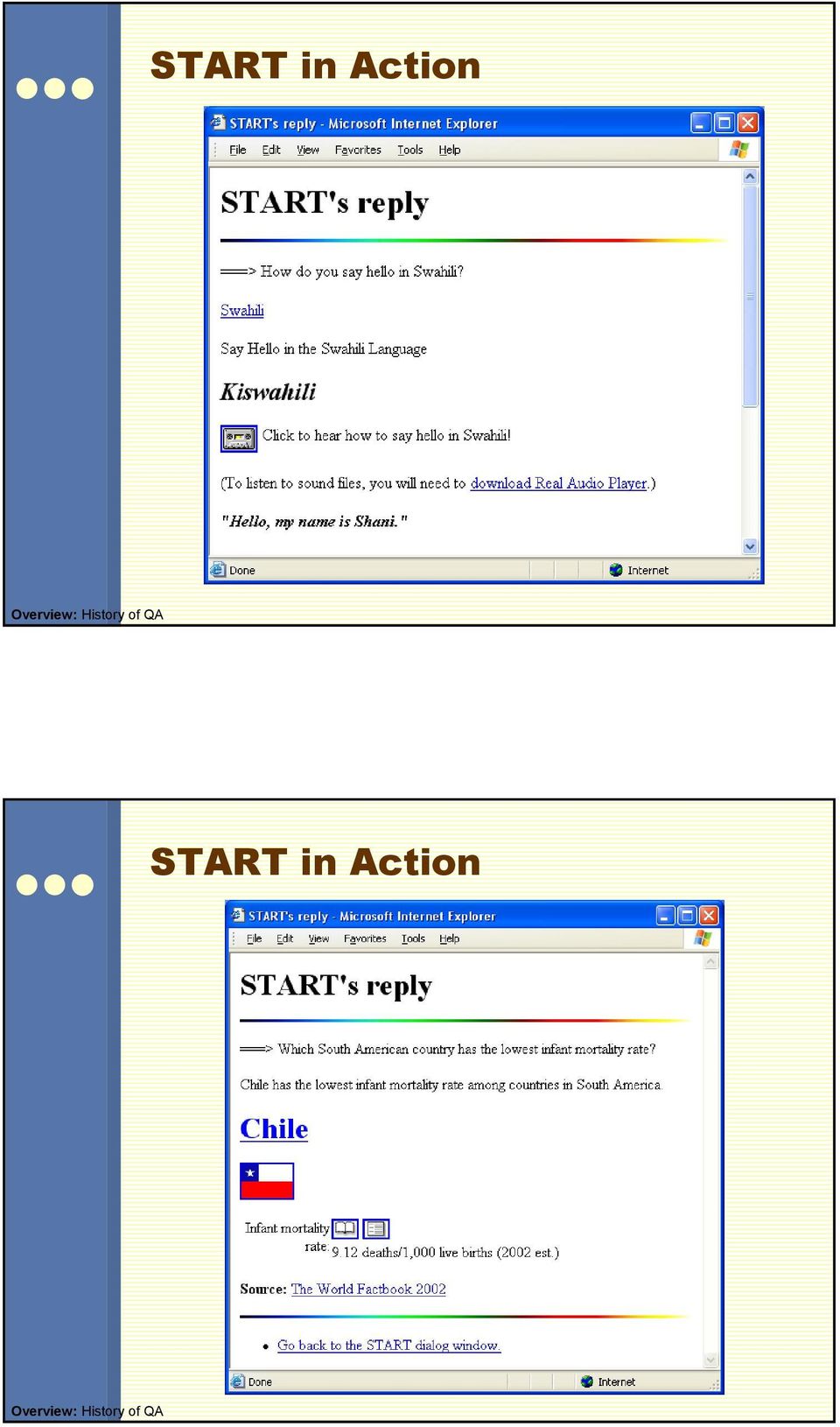
13 START in Action Overview: History of QA Related Strands: IR and IE Information retrieval has a long history Origins can be traced back to Vannevar Bush (1945) Active field since mid-1950s Primary focus on document retrieval Finer-grained IR: emergence of passage retrieval techniques in early 1990s Information extraction seeks to distill information from large numbers of documents Concerned with filling in pre-specified templates with participating entities Started in the late 1980s with the Message Understanding Conferences (MUCs) Overview: History of QA

14 IR+IE-based QA Recent question answering systems are based on information retrieval and information extraction Answers are extracted from closed corpora, e.g., newspaper and encyclopedia articles Techniques range in sophistication from simple keyword matching to some parsing Formal, large-scale evaluations began with the TREC QA tracks Facilitated rapid dissemination of results and formation of a community Dramatically increased speed at which new techniques have been adopted Overview: History of QA Re-discovery of the Web IR+IE-based systems focus on answering questions from a closed corpus Artifact of the TREC setup Recently, researchers have discovered a wealth of resource on the Web Vast amounts of unstructured free text Pockets of structured and semistructured sources This is where we are today How can we effectively utilize the Web to answer natural language questions? Overview: History of QA

15 The Short Answer Knowledge Mining: techniques that effectively employ unstructured text on the Web for question answering Knowledge Annotation: techniques that effectively employ structured and semistructured sources on the Web for question answering Overview: History of QA General Overview: TREC Question Answering Tracks Question Answering Techniques for the World Wide Web

16 TREC QA Tracks Question answering track at the Text Retrieval Conference (TREC) Large-scale evaluation of question answering Sponsored by NIST (with later support from ARDA) Uses formal evaluation methodologies from information retrieval Formal evaluation is a part of a larger community process Overview: TREC QA The TREC Cycle Proceedings Publication Call for Participation Task Definition TREC Conference Document Procurement Results Analysis Topic Development Results Evaluation Relevance Assessments Evaluation Experiments Overview: TREC QA

17 TREC QA Tracks TREC-8 QA Track [Voorhees and Tice 1999,2000b] 200 questions: backformulations of the corpus Systems could return up to five answers answer = [ answer string, docid ] Two test conditions: 50-byte or 250-byte answer strings MRR scoring metric TREC-9 QA Track [Voorhees and Tice 2000a] 693 questions: from search engine logs Systems could return up to five answers answer = [ answer string, docid ] Two test conditions: 50-byte or 250-byte answer strings MRR scoring metric Overview: TREC QA TREC QA Tracks TREC 2001 QA Track [Voorhees 2001,2002a] 500 questions: from search engine logs Systems could return up to five answers answer = [ answer string, docid ] 50-byte answers only Approximately a quarter of the questions were definition questions (unintentional) TREC 2002 QA Track [Voorhees 2002b] 500 questions: from search engine logs Each system could only return one answer per question answer = [ exact answer string, docid ] All answers were sorted by decreasing confidence Introduction of exact answers and CWS metric Overview: TREC QA
![answer string, docid ] Two test conditions: 50-byte or 250-byte answer strings MRR scoring metric Overview: TREC QA TREC QA Tracks TREC 2001 QA Track [Voorhees 2001,2002a] 500 questions: from search](/docs-images/42/565831/images/page_17.jpg "engine logs Systems could return up to five answers answer = [ answer string, docid ] 50-byte answers only Approximately a quarter of the questions were definition questions (unintentional) TREC 2002")
18 Evaluation Metrics Mean Reciprocal Rank (MRR) (through TREC 2001) Reciprocal rank = inverse of rank at which first correct answer was found: {1, 0.5, 0.33, 0.25, 0.2, 0} MRR = average over all questions Judgments: correct, unsupported, incorrect Correct: answer string answers the question in a responsive fashion and is supported by the document Unsupported: answer string is correct but the document does not support the answer Incorrect: answer string does not answer the question Strict score: unsupported counts as incorrect Lenient score: unsupported counts as correct Overview: TREC QA Evaluation Metrics Confidence-Weighted Score (CWS) (TREC 2002) Evaluates how well systems know what they know Q c i=1 i / i i c = number of correct answers in first i questions Q Q = total number of questions Judgments: correct, unsupported, inexact, wrong Exact answers Mississippi the Mississippi the Mississippi River Mississippi River mississippi Inexact answers At 2,348 miles the Mississippi River is the longest river in the US. 2,348; Mississippi Missipp Overview: TREC QA

19 Knowledge Mining Question Answering Techniques for the World Wide Web Knowledge Mining: Overview Question Answering Techniques for the World Wide Web

20 Knowledge Mining Definition: techniques that effectively employ unstructured text on the Web for question answering Key Ideas: Leverage data redundancy Use simple statistical techniques to bridge question and answer gap Use linguistically-sophisticated techniques to improve answer quality Knowledge Mining: Overview Key Questions How is the Web different from a closed corpus? How can we quantify and leverage data redundancy? How can data-driven approaches help solve some NLP challenges? How do we make the most out of existing search engines? How can we effectively employ unstructured text on the Web for question answering? Knowledge Mining: Overview

21 Knowledge Mining nature of the technique Linguistically sophisticated nature of the information Structured Knowledge (Databases) Unstructured Knowledge (Free text) Linguistically uninformed Knowledge Mining Statistical tools Knowledge Mining: Overview Knowledge and Data Mining How is knowledge mining related to data mining? Knowledge Mining Data Mining Answers specific natural language questions Discovers interesting patterns and trends Benefits from wellspecified input and output Often suffers from vague goals Primarily utilizes textual sources Utilizes a variety of data from text to numerical databases Similarities: Both are driven by enormous quantities of data Both leverage statistical and data-driven techniques Knowledge Mining: Overview
22 Present and Future Current state of knowledge mining: Most research activity concentrated in the last two years Good performance using statistical techniques Future of knowledge mining: Build on statistical techniques Overcome brittleness of current natural language techniques Address remaining challenges with linguistic knowledge Selectively employ linguistic analysis: use it only in beneficial situations Knowledge Mining: Overview Origins of Knowledge Mining The origins of knowledge mining lie in information retrieval and information extraction Information Retrieval Document Retrieval Passage Retrieval Information Extraction IR+IE-based QA Knowledge Mining Traditional question answering on closed corpora Question answering using the Web Knowledge Mining: Overview
23 Traditional IR+IE-based QA NL question Question Analyzer IR Query Document Retriever Question Type Documents Passage Retriever Passages Answer Extractor Answers Knowledge Mining: Overview Traditional IR+IE-based QA Question Analyzer Determines expected answer type Generates query for IR engine Document Retriever Input = natural language question Input = IR query Narrows corpus down to a smaller set of potentially relevant documents Passage Retrieval Input = set of documents Narrows documents down to a set of passages for additional processing Answer Extractor Input = set of passages + question type Extracts the final answer to the question Typically matches entities from passages against the expected answer type May employ more linguistically-sophisticated processing Knowledge Mining: Overview
24 References: IR+IE-based QA General Survey [Hirschman and Gaizauskas 2001] Sample Systems Cymfony at TREC-8 Three-level information extraction architecture IBM at TREC-9 (and later versions) [Prager et al. 1999] Predictive annotations: perform named-entity detection at time of index creation FALCON (and later versions) [Harabagiu et al. 2000a] Employs question/answer logic unification and feedback loops Tutorials [Srihari and Li 1999] [Harabagiu and Moldovan 2001, 2002] Knowledge Mining: Overview Just Another Corpus? Is the Web just another corpus? Can we simply apply traditional IR+IE-based question answering techniques on the Web? Questions Questions Closed corpus (e.g., news articles)? The Web Answers Answers Knowledge Mining: Overview
25 Not Just Another Corpus The Web is qualitatively different from a closed corpus Many IR+IE-based question answering techniques will still be effective But we need a different set of techniques to capitalize on the Web as a document collection Knowledge Mining: Overview Size and Data Redundancy How big? Tens of terabytes? No agreed upon methodology to even measure it Google indexes over 3 billion Web pages (early 2003) Size introduces engineering issues Use existing search engines? Limited control over search results Crawl the Web? Very resource intensive Size gives rise to data redundancy Knowledge stated multiple times in multiple documents in multiple formulations Knowledge Mining: Overview
26 Other Considerations Poor quality of many individual pages Documents contain misspellings, incorrect grammar, wrong information, etc. Some Web pages aren t even documents (tables, lists of items, etc.): not amenable to named-entity extraction or parsing Heterogeneity Range in genre: encyclopedia articles vs. weblogs Range in objectivity: CNN articles vs. cult websites Range in document complexity: research journal papers vs. elementary school book reports Knowledge Mining: Overview Ways of Using the Web Use the Web as the primary corpus of information If needed, project answers onto another corpus (for verification purposes) Combine use of the Web with other corpora Employ Web data to supplement a primary corpus (e.g., collection of newspaper articles) Use the Web only for some questions Combine Web and non-web answers (e.g., weighted voting) Knowledge Mining: Overview
27 Capitalizing on Search Engines Data redundancy would be useless unless we could easily access all that data Leverage existing information retrieval infrastructure [Brin and Page 1998] The engineering task of indexing and retrieving terabyte-sized document collections has been solved Existing search engines are good enough Build systems on top of commercial search engines, e.g., Google, FAST, AltaVista, Teoma, etc. Question Question Analysis Web Search Engine Results Processing Answer Knowledge Mining: Overview Knowledge Mining: Leveraging Data Redundancy Question Answering Techniques for the World Wide Web
28 Leveraging Data Redundancy Take advantage of different reformulations The expressiveness of natural language allows us to say the same thing in multiple ways This poses a problem for question answering Question asked in one way When did Colorado become a state? How do we bridge these two? Answer stated in another way Colorado was admitted to the Union on August 1, With data redundancy, it is likely that answers will be stated in the same way the question was asked Cope with poor document quality When many documents are analyzed, wrong answers become noise Knowledge Mining: Leveraging Data Redundancy Leveraging Data Redundancy Data Redundancy = Surrogate for sophisticated NLP Obvious reformulations of questions can be easily found Who killed Abraham Lincoln? (1) John Wilkes Booth killed Abraham Lincoln. (2) John Wilkes Booth altered history with a bullet. He will forever be known as the man who ended Abraham Lincoln s life. When did Wilt Chamberlain score 100 points? (1) Wilt Chamberlain scored 100 points on March 2, 1962 against the New York Knicks. (2) On December 8, 1961, Wilt Chamberlain scored 78 points in a triple overtime game. It was a new NBA record, but Warriors coach Frank McGuire didn t expect it to last long, saying, He ll get 100 points someday. McGuire s prediction came true just a few months later in a game against the New York Knicks on March 2. Knowledge Mining: Leveraging Data Redundancy
29 Leveraging Data Redundancy Data Redundancy can overcome poor document quality Lots of wrong answers, but even more correct answers What s the rainiest place in the world? (1) Blah blah Seattle blah blah Hawaii blah blah blah blah blah blah (2) Blah Sahara Desert blah blah blah blah blah blah blah Amazon (3) Blah blah blah blah blah blah blah Mount Waiale'ale in Hawaii blah (4) Blah blah blah Hawaii blah blah blah blah Amazon blah blah (5) Blah Mount Waiale'ale blah blah blah blah blah blah blah blah blah What is the furthest planet in the Solar System? (1) Blah Pluto blah blah blah blah Planet X blah blah (2) Blah blah blah blah Pluto blah blah blah blah blah blah blah blah (3) Blah blah blah Planet X blah blah blah blah blah blah blah Pluto (4) Blah Pluto blah blah blah blah blah blah blah blah Pluto blah blah Knowledge Mining: Leveraging Data Redundancy General Principles Match answers using surface patterns Apply regular expressions over textual snippets to extract answers Bypass linguistically sophisticated techniques, e.g., parsing Rely on statistics and data redundancy Expect many occurrences of the answer mixed in with many occurrences of wrong, misleading, or lower quality answers Develop techniques for filtering, sorting large numbers of candidates Can we quantify data redundancy? Knowledge Mining: Leveraging Data Redundancy
30 Leveraging Massive Data Sets [Banko and Brill 2001] Grammar Correction: {two, to, too} {principle, principal} Knowledge Mining: Leveraging Data Redundancy Observations: Banko and Brill For some applications, learning technique is less important than amount of training data In the limit (i.e., infinite data), performance of different algorithms converges It doesn t matter if the data is (somewhat) noisy Why compare performance of learning algorithms on (relatively) small corpora? In many applications, data is free! Throwing more data at a problem is sometimes the easiest solution (hence, we should try it first) Knowledge Mining: Leveraging Data Redundancy
31 Effects of Data Redundancy [Breck et al. 2001; Light et al. 2001] Are questions with more answer occurrences easier? Examined the effect of answer occurrences on question answering performance (on TREC-8 results) ~27% of systems produced a correct answer for questions with 1 answer occurrence. ~50% of systems produced a correct answer for questions with 7 answer occurrences. Knowledge Mining: Leveraging Data Redundancy Effects of Data Redundancy [Clarke et al. 2001a] How does corpus size affect performance? Selected 87 people questions from TREC-9; Tested effect of corpus size on passage retrieval algorithm (using 100GB TREC Web Corpus) Conclusion: having more data improves performance Knowledge Mining: Leveraging Data Redundancy
32 Effects of Data Redundancy [Dumais et al. 2002] How many search engine results should be used? Plotted performance of a question answering system against the number of search engine snippets used Performance drops as too many irrelevant results get returned # Snippets MRR MRR as a function of number of snippets returned from the search engine. (TREC-9, q ) Knowledge Mining: Leveraging Data Redundancy Knowledge Mining: System Survey Question Answering Techniques for the World Wide Web
33 Knowledge Mining: Systems Ionaut (AT&T Research) MULDER (University of Washington) AskMSR (Microsoft Research) InsightSoft-M (Moscow, Russia) MultiText (University of Waterloo) Shapaqa (Tilburg University) Aranea (MIT) TextMap (USC/ISI) LAMP (National University of Singapore) NSIR (University of Michigan) PRIS (National University of Singapore) AnswerBus (University of Michigan) Knowledge Mining: System Survey Selected systems, apologies for any omissions Generic System NL question Question Analyzer Automatically learned or manually encoded Surface patterns Web Query Web Interface Question Type Snippets Redundancy-based modules Web Answers Answer Projection TREC Answers Knowledge Mining: System Survey
34 Common Techniques Match answers using surface patterns Apply regular expressions over textual snippets to extract answers Surface patterns may also help in generating queries; they are either learned automatically or entered manually Leverage statistics and multiple answer occurrences Generate n-grams from snippets Vote, tile, filter, etc. Apply information extraction technology Ensure that candidates match expected answer type Knowledge Mining: System Survey Ionaut AT&T Research: [Abney et al. 2000] Application of IR+IE-based question answering paradigm on documents gathered from a Web crawl Passage Retrieval Entity Extraction Entity Classification Query Classification Entity Ranking Knowledge Mining: System Survey
35 Ionaut: Overview Passage Retrieval SMART IR System [Salton 1971; Buckley and Lewit 1985] Segment documents into three-sentence passages Entity Extraction Cass partial parser [Abney 1996] Entity Classification Proper names: person, location, organization Dates Quantities Durations, linear measures Knowledge Mining: System Survey Ionaut: Overview Query Classification: 8 hand-crafted rules Who, whom Person Where, whence, whither Location When Date And other simple rules Criteria for Entity Ranking: Match between query classification and entity classification Frequency of entity Position of entity within retrieved passages Knowledge Mining: System Survey
36 Ionaut: Evaluation End-to-end performance: TREC-8 (informal) Exact answer: 46% answer in top 5, MRR 50-byte: 39% answer in top 5, MRR 250-byte: 68% answer in top 5, MRR Error analysis Good performance on person, location, date, and quantity (60%) Poor performance on other types Knowledge Mining: System Survey MULDER U. Washington: [Kwok et al. 2001] Question Parsing MEI PC-Kimmo Query Formulation Original Question Parse Trees Question Classification Query Formulation Rules Quote NP PC-Kimmo Search Engine Queries Search Engine Link Parser WordNet Classification Rules T-form Grammar Web Pages Answer Answer Selection Final Ballot Clustering Scoring Candidate Answers Answer Extraction Match Phrase Type NLP Parser Summary Extraction + Scoring Knowledge Mining: System Survey
37 MULDER: Parsing Question Parsing Maximum Entropy Parser (MEI) PC-KIMMO for tagging of unknown words Question Classification Link Parser [Sleator and Temperly 1991,1993] [Charniak 1999] [Antworth 1999] Manually encoded rules (e.g., How ADJ = measure) WordNet (e.g., find hypernyms of object) Knowledge Mining: System Survey MULDER: Querying Query Formulation Query expansion (use attribute nouns in WordNet) How tall is Mt. Everest the height of Mt. Everest is Tokenization question answering question answering Transformations Who was the first American in space was the first American in Space, the first American in space was Who shot JFK shot JFK When did Nixon visit China Nixon visited China Search Engine: submit results to Google Knowledge Mining: System Survey
38 MULDER: Answer Extraction Answer Extraction: extract summaries directly from Web pages Locate regions with keywords Score regions by keyword density and keyword idf values Select top regions and parse them with MEI Extract phrases of the expected answer type Answer Selection: score candidates based on Simple frequency voting Closeness to keywords in the neighborhood Knowledge Mining: System Survey MULDER: Evaluation Evaluation on TREC-8 (200 questions) Did not use MRR metric: results not directly comparable User effort : how much text users must read in order to find the correct answer Knowledge Mining: System Survey
39 AskMSR [Brill et al. 2001; Banko et al. 2002; Brill et al. 2002] AskMSR-A {ans A1, ans A2,, ans AM } Question System Combination AskMSR-B {ans B1, ans B2,, ans BN } {ans 1, ans 2,, ans 5 } Query Reformulator Harvest Engine Answer Filtering Answer Tiling Answer Projection Search Engine [ans 1, docid 1 ] [ans 2, docid 2 ] [ans 3, docid 3 ] [ans 4, docid 4 ] NIL Knowledge Mining: System Survey AskMSR: N-Gram Harvesting Use text patterns derived from question to extract sequences of tokens that are likely to contain the answer Question: Who is Bill Gates married to? Look five tokens to the right < Bill Gates is married to, right, 5>... It is now the largest software company in the world. Today, Bill Gates is married to co-worker Melinda French. They live together in a house in the Redmond I also found out that Bill Gates is married to Melinda French Gates and they have a daughter named Jennifer Katharine Gates and a son named Rory John Gates. I of Microsoft, and they both developed Microsoft. * Presently Bill Gates is married to Melinda French Gates. They have two children: a daughter, Jennifer, and a... Generate N-Grams from Google summary snippets (bypassing original Web pages) co-worker, co-worker Melinda, co-worker Melinda French, Melinda, Melinda French, Melinda French they, French, French they, French they live Knowledge Mining: System Survey
40 AskMSR: Query Reformulation Transform English questions into search engine queries Anticipate possible answer fragments Question: Who is Bill Gates married to? Query Reformulator Simple regular expression matching (half a dozen rules) No parsing or part of speech tagging < is Bill Gates married to, right, 5> < Bill is Gates married to, right, 5> < Bill Gates is married to, right, 5> < Bill Gates married is to, right, 5> < Bill Gates married to is, right, 5> <{Bill, Gates, married}> (bag-of-words backoff) Knowledge Mining: System Survey AskMSR: Filter/Vote/Tile Answer Filtering: filter by question type Simple regular expressions, e.g., for dates Answer Voting: score candidates by frequency of occurrence Answer Tiling: combine shorter candidates into longer candidates United Nations International Nations International International Children s Emergency Emergency Fund United Nations International Children s Emergency Fund Knowledge Mining: System Survey
41 AskMSR: Performance End-to-end performance: TREC-2001 (official) MRR: (strict), (lenient) Lenient score is 25% higher than strict score Answer projection = weakest link For 20% of correct answers, no adequate supporting document could be found Observations and questions First question answering system to truly embrace data redundancy: simple counting of n-grams How would MULDER and AskMSR compare? Knowledge Mining: System Survey InsightSoft-M [Soubbotin and Soubbotin 2001,2002] Application of surface pattern matching techniques directly on the TREC corpus Question: What year was Mozart born? Query: Mozart Type of Question: When (what-year) -born? Passage With a Query Term Snippets Answer: Mozart ( ) Please pin it Patterns for this Query Type: 1. In strict order: capitalized word; parenthesis; four digits; dash; four digits; parenthesis 2. In any word: capitalized word; in ; four digits; born 3. Knowledge Mining: System Survey
42 InsightSoft-M: Patterns Some patterns for What is questions: <A; is/are;[a/an/the]; X> <X; is/are;[a/an/the]; A> Example: Michigan's state flower is the apple blossom (23 correct responses in TREC 2001) <A; comma; [a/an/the]; X; [comma/period]> <X; comma; [a/an/the]; A; [comma/ period]> Example: "Moulin Rouge, a cabaret " (26 correct responses) <A; [comma]; or; X; [comma]> Example: "shaman, or tribal magician, (12 correct responses) <A; [comma]; [also] called; X [comma]> < X; [comma]; [also] called; A [comma]> <X; is called; A> <A; is called; X> Example: "naturally occurring gas called methane (10 correct responses) Knowledge Mining: System Survey InsightSoft-M: Evaluation End-to-end performance: TREC 2001: MRR (strict) (lenient) TREC 2002: CWS 0.691, 54.2% correct Observations: Unclear how precision of patterns is controlled Although the system used only the TREC corpus, it demonstrates the power of surface pattern matching Knowledge Mining: System Survey
43 MultiText U. Waterloo: [Clarke et al. 2001b, 2002] Web Use of the Web as an auxiliary corpus to provide data redundancy Questions Altavista Frontend Google Frontend URLs Download Web Pages Auxiliary Corpus Term statistics Parsing Query Passage Retrieval TREC Corpus Passages Selection Rules Answer Selection Answers Knowledge Mining: System Survey MultiText: TREC 2001 Download top 200 Web documents to create an auxiliary corpus Select 40 passages from Web documents to supplement passages from TREC corpus Candidate term weighting: w t = c log t ( N f ) t N = sum of lengths of all documents in the corpus f t = number of occurrences of t in corpus c t = number of distinct passages in which t occurs Redundancy factor where Web passages help End-to-end performance: TREC 2001 (official) MRR (strict) (lenient) Web redundancy contributed to 25% of performance Knowledge Mining: System Survey
44 MultiText: TREC 2002 Same basic setup as MultiText in TREC 2001 Two sources of Web data: One terabyte crawl of the Web from mid-2001 AltaVista End-to-end performance: TREC 2002 (official) 36.8% correct, CWS Impact of AltaVista not significant (compared to using 1TB of crawled data) Knowledge Mining: System Survey Shapaqa ILK, Tilburg University: [Buchholz 2001] Question Question Analysis Google Analyze Google snippets for semantic roles. Match semantic role from question with those extracted from Google snippets. Answer Extraction Return most frequentlyoccurring answer Answer Projection TREC documents Find Web answer that occurs in TREC sentences (from NIST documents) 50-byte answer Knowledge Mining: System Survey
45 Shapaqa: Overview Extracts answers by determining the semantic role the answer is likely to play SBJ (subject), OBJ (object), LGC (logical subjects of passive verbs), LOC (locative adjunct), TMP (temporal adjunct), PRP (adjust of purpose and reason), MNR (manner adjunct), OTH (unspecified relation between verb and PP) Does not utilize named-entity detection When was President Kennedy shot? VERB = shot OBJ = President Kennedy TMP =? Semantic realization of answer. Parse Google snippets to extract the temporal adjunct Knowledge Mining: System Survey End-to-end performance: TREC-2001, official MRR: (strict), (lenient) Aranea MIT: [Lin, J. et al. 2002] Questions question Knowledge Annotation Knowledge Mining Formulate Requests Execute Requests Knowledge Boosting Generate N-Grams Vote Answer Projection [ Answer, docid ] AQUAINT Corpus Filter Candidates Combine Candidates Score Candidates Confidence Ordering Get Support Confidence Sorted Answers candidate answers Knowledge Mining: System Survey
46 Aranea: Overview Integrates knowledge mining and knowledge annotation techniques in a single framework Employs a modular XML framework Modules for manipulating search results Modules for manipulating n-grams: voting, filtering, etc. Scores candidates using a tf.idf metric tf = frequency of candidate occurrence (from voting) idf = intrinsic score of candidate (idf values extracted from the TREC corpus) Projects Web answer back onto the TREC corpus Major source of errors Knowledge Mining: System Survey Aranea: Querying the Web A flexible query language for mining candidate answers Question: When did the Mesozoic period end? Query: when did the Mesozoic period end Type: inexact Score: 1 Number of Snippets to Mine: 100 Query: the Mesozoic period ended?x Type: exact Score: 2 Number of Snippets to Mine: 100 Max byte length of?x: 50 Max word count of?x: 5 Inexact query: get snippets surrounding these keywords Exact query: get snippets matching exactly this pattern Text Snippets from Google A major extinction occurred at the end of the Mesozoic, 65 million years ago The End of the Mesozoic Era a half-act play May 1979 The Mesozoic period ended 65 million years ago Knowledge Mining: System Survey
47 Aranea: Evaluation End-to-end performance: TREC 2002 (official) Official score: 30.4% correct, CWS Knowledge mining component contributed 85% of the performance Observations: Projection performance: ~75% Without answer projection: 36.6% correct, CWS Knowledge mining component: refinement of many techniques introduced in AskMSR Knowledge Mining: System Survey Textmap USC/ISI: [Hermjakob et al. 2002] Natural language based reformulation resource cf. S-Rules [Katz and Levin 1988], DIRT [Lin and Pantel 2001ab] :anchor-pattern SOMEBODY_1 died of SOMETHING_2. :is-equivalent-to SOMEBODY_1 died from SOMETHING_2. :is-equivalent-to SOMEBODY_1 s death from SOMETHING_2. :answers How did SOMEBODY_1 die? :answer SOMETHING_2 :anchor-pattern PERSON_1 invented SOMETHING_2. :is-equivalent-to PERSON_1 s invention of SOMETHING_2 :answers Who is PERSON_1? :answer the inventor of SOMETHING_2 Reformulations are used in two ways: Query expansion: retrieve more relevant documents Answer selection: rank and choose better answers Question: Who was Johan Vaaler? Reformulation: Johan Vaaler s invention of <what> Text: Johan Vaaler s invention of the paper clip Answer: the inventor of the paper clip Knowledge Mining: System Survey
48 Textmap Applied reformulations to two sources IR on TREC collection: modules developed for Webclopedia [Hovy et al. 2001ab,2002] IR on the Web: manually specified query expansion, e.g., morphological expansion, adding synonyms, etc. End-to-end performance: TREC 2002 (official) 29.8% correct, CWS Reformulations in TextMap are manual generalizations of automatically derived patterns Knowledge Mining: System Survey Pattern Learning [Ravichandran and Hovy 2002] Automatically learn surface patterns for answering questions from the World Wide Web BIRTHYEAR questions: When was <NAME> born? <NAME> was born on <BIRTHYEAR> cf. [Zhang and Lee 2002] <NAME> (<BIRTHYEAR>born in <BIRTHYEAR>, <NAME> 1. Start with a seed, e.g. (Mozart, 1756) 2. Download Web documents using a search engine 3. Retain sentences that contain both question and answer terms 4. Construct a suffix tree for extracting the longest matching substring that spans <QUESTION> and <ANSWER> Suffix Trees: used in computational biology for detecting DNA sequences [Gusfield 1997; Andersson 1999] 5. Calculate precision of patterns Precision for each pattern = # of patterns with correct answer / # of total patterns Knowledge Mining: System Survey
49 Pattern Learning Example: DISCOVERER questions when <ANSWER> discovered <NAME> <ANSWER> s discovery of <NAME> <ANSWER>, the discoverer of <NAME> <ANSWER> discovers <NAME> <ANSWER> discover <NAME> <ANSWER> discovered <NAME>, the discovery of <NAME> by <ANSWER> <NAME> was discovered by <ANSWER> of <ANSWER> s <NAME> <NAME> was discovered by <ANSWER> in Observations Surface patterns perform better on the Web than on the TREC corpus Surface patterns could benefit from notion of constituency, e.g., match not words but NPs, VPs, etc. Knowledge Mining: System Survey LAMP National University of Singapore: [Zhang and Lee 2002] QA examples Question Transforming Transforming Handle do-aux and be-aux Extract keyphrase (regexp) Recognizing Question Templates Recognizing Learning Textual Patterns Answering Answer Search Engines Patterns of the form: Q S 1 A S 2 S 1 A S 2 Q Web Google Knowledge Mining: System Survey
50 LAMP: Overview Reformulate question Undo movement of auxiliary verbs Extract keyphrase (_Q_): Classify questions into 22 classes using regular expression templates (which bind to keyphrases) Mine patterns from Google: Patterns of the following forms Analysis with MEI [Charniak 1999] and PC-KIMMO [Antworth 1990] When did Nixon visit China Nixon visited China When was oxygen discovered oxygen was discovered cf. [Ravichandran and Hovy 2002] _A_ = answers matched by answer regexps _Q_ <intermediate> _A_ <boundary> <boundary> _A_ <intermediate> _Q_ Score confidence based on accuracy of mined patterns Knowledge Mining: System Survey LAMP: Overview Learning Example: Who was the first American in space? Keyphrase (_Q_) = the first American in space Answer (_A_) = ((Alan (B\. )?)?Shepard) Examples of learned patterns:, _A_ became _Q_ (0.09) _A_ was _Q_ 0.11 (0.11) _A_ made history as _Q_ (1.00) From NIST-supplied answer key Answering Questions: Obtain search results from Google Extract answers by applying learned patterns Score candidates by confidence of pattern (duplicate answers increase score) End-to-end performance: TREC 2002 (official) 21% correct, CWS Knowledge Mining: System Survey
51 NSIR for WWW U. Michigan: [Radev et al. 2002] Question: What is the largest city in Northern Afghanistan? Query modulation (largest OR biggest) city Northern Afghanistan Document retrieval Retrieve top 40 documents from Web search Sentence retrieval Retrieve top 50 sentences from documents (weighted n-gram scoring) Answer Extraction Generate phrases using a chunker Answer Ranking Answer: Mazer-e-Sharif Two components of candidate phrase score: 1. Proximity to question words 2. Phrase signatures: p(phrase-type pos-sig) e.g., p(person NNP NNP) = Knowledge Mining: System Survey Performance: MRR (TREC-8 Informal) NSIR for TREC U. Michigan: [Qi et al. 2002] Questions Questions Questions Top docs Ranked List Document retrieval Question Type Chunker Questions Questions Phrases Corpus Feature Extraction Frequency, Overlap, Length, Proximity, POSSIG LEXSIG, Word List, Named-entity, Web ranking Web ranking as a feature Answer Ranking (for one question) Answer Reranking (nil/confidence) Answers Questions Questions (by confidence) Knowledge Mining: System Survey
52 NSIR: TREC Question classification: allow multiple categories with a probabilistic classifier Phrase Extraction: extract phrases from top 20 NIST documents using LT-Chunk Feature Extraction: compute nine features of each phrase Web ranking is one such feature Answer Ranking: linearly combine individual features to produce final score for each candidate Feature weights specific to each question type End-to-end performance: TREC 2002 (official) 17.8% correct, CWS Knowledge Mining: System Survey AnswerBus U. Michigan: [Zheng 2002ab] User Question Translated Question English, German, French, Spanish, Italian, or Portuguese questions AltaVista s BabelFish Service Question Type Matching Words Search Engine Specific Query Selected Search Engines Hit Lists from Search Engines Google, Yahoo, WiseNut, AltaVista, and Yahoo News Extracted Sentence Answer Candidates Ranked Answers Knowledge Mining: System Survey
53 AnswerBus: Overview Search query Stopword filtering, low tf keyword filtering, some verb conjugation Simple sentence scoring: Score = q Q q if 0 otherwise Similar to the MITRE Algorithm [Breck et al. 2001; Light et al. 2001] q = number of matching words in query Q = total number of query words Other techniques: Question type classification Coreference resolution (in adjacent sentences) Knowledge Mining: System Survey Knowledge Mining: Selected Techniques Question Answering Techniques for the World Wide Web
54 Knowledge Mining Techniques Projecting answers onto another corpus Using the Web (and WordNet) to rerank answers Using the Web to validate answers Verifying the correctness of question answer pairs Estimating the confidence of question answer pairs Tweaking search engines: getting the most out of a search Query expansion for search engines Learning search engine specific reformulations Knowledge Mining: Selected Techniques Answer Projection Just an artifact of TREC competitions? TREC answers require [answer, docid] pair Document from the TREC corpus must support answer If answers were extracted form an outside source, a supporting TREC document must still be found Perhaps not People prefer paragraph-sized answers [Lin, J. et al. 2003] find exact answers from the Web (using data redundancy), but present answers from another source Sample answer projection algorithms: Use document-retrieval or passage retrieval algorithms query = keywords from question + keywords from answer Knowledge Mining: Selected Techniques
55 Knowledge Mining: Selected Techniques Answer Projection Performance AskMSR answer projection: [Brill et al. 2001] Used the Okapi IR engine (bm25 weighting) Generated query = question + answer Selected top-ranking document as support Performance: ~80% (i.e., 20% of supporting documents did not actually support the answer) Aranea answer projection: [Lin, J. et al. 2002] Projected answer onto NIST-supplied documents Used sliding window technique Window score = # keywords from question + # keywords from answer (neither term could be zero) Selected document of highest scoring window as support Performance: ~75% Answer Projection: Analysis Question: Who was the first black heavyweight champion? Answer: Jack Johnson Louis was the first African-American heavyweight since Jack Johnson who was allowed to get close to that symbol of ultimate manhood, the heavyweight crown Question: Who was the Roman god of the sea? Answer: Neptune Romanian Foreign Minister Petre Roman Wednesday met at the Neptune resort of the Black Sea shore with his Slovenian counterpart, Alojz Peterle, Question: What is the nickname of Oklahoma? Answer: Sooner State The victory makes the Sooners the No. 3 seed in the conference tournament. Oklahoma State (23-5, 12-4) will be the fourth seed Knowledge Mining: Selected Techniques
56 Answer Reranking [Lin, C.Y. 2002] Use the Web and WordNet to rerank answers to definition questions Input: Definition question N candidate answers Reranking Procedure Web data WordNet Reranking procedure boosts correct answers to a higher rank Output: reordered candidate answers Knowledge Mining: Selected Techniques Answer Reranking Web reranking Obtain pages from Google and calculate tf.idf values for keywords matching score = sum of tf.idf values of keywords in answer candidates new score = original candidate score matching score WordNet reranking Create a definition database from WordNet glosses; calculate idf values for keywords matching score = sum of idf values of keywords in answer candidates new score = original candidate score matching score Knowledge Mining: Selected Techniques
57 Answer Reranking What is Wimbledon? Original the French Open and the U.S. Open which includes a Japanese-style garden the most famous front yard in tennis NIL Sampras biggest letdown of the year Web Reranking the most famous front yard in tennis the French Open and the U.S. Open NIL Sampras biggest letdown of the year Lawn Tennis & Croquet Club What is Autism? Original Down s syndrome mental retardation the inability to communicate with others NIL a group of similar-looking diseases WordNet Reranking the inability to communicate with others mental disorder NIL Down s syndrome mental retardation Performance Either method: +19% MRR Both methods: +25% MRR Knowledge Mining: Selected Techniques Answer Validation [Magnini et al. 2002ac] Can we use the Web to validate answers? To automatically score and evaluate QA systems To rerank and rescore answers from QA systems The basic idea: compute a continuous function that takes both the question and answer as input (as bag of words ) Answer validation function: f(question, answer) = x if x > threshold, then answer is valid, otherwise, answer is invalid What functions satisfy this property? Can these functions be easily calculated using Web data? Knowledge Mining: Selected Techniques
58 Answer Validation Three different answer validation functions: (various statistical measures of co-occurrence) All three can be easily calculated from search engine results 1. Pointwise Mutual Information (PMI) 2. Maximal Likelihood Ratio (MLHR) 3. Corrected Conditional Probability (CCP) p( Asp Qsp) hits ( Qsp NEAR Asp) CCP( Qsp, Asp) = MaxPages 2 3 p( Asp) hits ( Qsp) hits( Asp) Qsp = question sub-pattern (content words + expansions) Asp = answer sub-pattern MaxPages = total number of pages in search engine index 2 3 Treat questions and answers as bag of words Knowledge Mining: Selected Techniques Answer Validation Performance Evaluation metric: agreement between machine algorithm and human judgment (from TREC) CCP relative CCP absolute PMI relative PMI absolute MLHR relative MLHR absolute Agreement 81.25% 78.42% 79.56% 77.79% 79.60% 77.40% Absolute threshold: fixed threshold Relative threshold: threshold set to a percentage of the score of the highest scoring answer Knowledge Mining: Selected Techniques
59 DIOGENE [Magnini et al. 2001, 2002b] Application of Web answer validation techniques Question Answer Tokenization and PoS Tagging Multiwords Recognition Document Collection World Wide Web Word Sense Disambiguation Query Reformulation Answer Validation And Ranking Answer Type Identification Search Engine Candidate Answer Filtering Keywords Expansion Query Composition Named Entities Recognition Question Processing Search Answer Extraction Knowledge Mining: Selected Techniques DIOGENE: Answer Validation Two measures Statistical approach : corrected conditional probability (using Web page hit counts only) Content-based approach : co-occurrence between question and answer (from downloaded snippets) Performance: TREC 2002 (official) 38.4%, CWS (content-based measure) Content-based measure beat statistical measure and combination of both measures Overall contribution of answer validation techniques is unclear Knowledge Mining: Selected Techniques
60 Confidence Estimation [Xu et al. 2002] Estimating the probability that a question answer pair is correct Result useful for confidence estimation Similar to Magnini et al. except without thresholding BBN2002B p(correct Q,A) p(correct T, F) p(correct T) p(correct F) 0.5 T = question type F = frequencies of A in Google summaries BBN2002C p(correct Q,A) p(correct F, INTREC) F = frequencies of A in Google summaries INTREC = boolean indicator variable, true iff answer also found in TREC TREC-9 and TREC 2001 questions used for parameter estimation Knowledge Mining: Selected Techniques Confidence Estimation Performance: TREC 2002 (official) Baseline (without Web): 18.6% correct, CWS BBN2002B: 28.8% correct, CWS BBN2002C: 28.4% correct, CWS Observations Use of Web significantly boosts performance Performance contribution of confidence estimation procedure is unclear Knowledge Mining: Selected Techniques
61 Tweaking Search Engines Getting the most out of an existing search engine Large IR literature on query expansion Expand queries based on synonyms and lexicalsemantic relations (from WordNet) [Voorhees 1994] Even with sense disambiguated queries, synonymy expansion provides little benefit Expand queries based on relevant terms in top-ranking documents [Mitra et al. 1998] Expand queries with terms from top-ranking documents that co-occur with query terms [Xu and Croft 2000] Knowledge Mining: Selected Techniques Query Expansion for the Web Query expansion is difficult with Web search engines Search algorithm is hidden: the service must be treated like an opaque black box No principled way for developing query expansion techniques: trial and error required It is beneficial to use more than one service, but how do we assess the relative strengths and weaknesses of each search engine? Knowledge Mining: Selected Techniques
62 Expanding Boolean Queries [Magnini and Prevete 2000] Exploiting lexical expansions and boolean compositions Expand keywords: synonyms and morphological derivations inventore (inventor) synonyms derivation scopritore (discoverer) ideatore (artificer) invenzione (invention) synonyms invenzione (invention) derivation inventare (invent) synonyms scoprire (discover) luce_elettrica (electric light) synonyms lampada_a_incandescenza (incandescent lamp) How do we combine these keywords into boolean queries? Knowledge Mining: Selected Techniques Knowledge Mining: Selected Techniques Query Expansion Strategies KAS: Keyword AND composition Search Conjoin original keywords (inventore luce_elettrica) KIS: Keyword Insertion Search OR of ANDs; each AND clause = original keywords + one derived word ( (inventore luce_elettrica scopritore) (inventore luce_elettrica ideatore) (inventore luce_elettrica invenzione) ) KCS: Keyword Cartesian Search OR of ANDs; AND clauses = Cartesian product of all derivations ( (inventore luce_elettrica) (inventore lampada_a_incandescenza) (scopritore luce_elettrica) (scopritore lampada_a_incandescenza) )
63 KAS vs. KIS vs. KCS Evaluation: 20 questions, documents from Excite Relevance determined by three human judges Measures: compared to KAS baseline With f-, document ordering is not taken into account With f+, document ordering is taken into account KIS KCS QS1 QS2 f- +7% -3% f+ -15% +19% f- +7% +59% f+ -15% +77% QS1: Subset of questions where number of morphological derivations and synonyms is greater than 3 QS3 +18% +17% +23% +17% QS2: equal to 2 or 3 All +19% +13% +33% +22% QS3: less than 2 Knowledge Mining: Selected Techniques Web Query Expansion: PRIS [Yang and Chua 2002] Use of the Web for query expansion Question Question Analysis Question Classification Original Content Words External Knowledge Bases Web Question Parsing WordNet Expanded Content Words Answer Answer Extraction Candidate Sentences Sentence Ranking Relevant TREC doc Document Retrieval Reduce number of expanded content words Knowledge Mining: Selected Techniques
64 PRIS: Overview Use the Web for query expansion: supplement original query with keywords that co-occur with the question Technique similar to [Xu and Croft 2000] Performance: TREC 2002 (official) 58% correct, CWS rd highest scoring system However, the contribution of the Web is unclear Knowledge Mining: Selected Techniques Search Engine Specific Queries Specific Expressive Forms: query transformation rules that improve search results [Lawrence and Giles 1998; Joho and Sanderson 2000] Focus is on improving document retrieval, not question answering per se What is x x is x refers to Shortcomings: Transformation rules were hand crafted Transformation rules did not take into account quirks of different search engines Knowledge Mining: Selected Techniques
65 Tritus [Agichtein et al. 2001] Learn query transformations optimized for each search engine is usually refers to usually refers is used AltaVista What is a is usually usually called sometimes is one Google Transformations capture the quirks of different search engines Knowledge Mining: Selected Techniques Tritus: Transformation Learning Select Question Phrase (QP): Group questions by their initial tokens Who was Albert Einstein? How do I fix a broken television? Where can I find a Lisp Machine? What is a pulsar? Generate Candidate Transformations (TR): From <Q, A> pairs, generate all n-grams of answers that do not contain content words What is a refers to refers meets driven named after often used to describe Two components to TR score: Frequency of co-occurrence between TR and QP Okapi bm25 weighting on TR [Robertson and Walker 1997; Robertson et al. 1998] Knowledge Mining: Selected Techniques
66 Tritus: Transformation Learning Train Candidate Transformations (TR) against search engines 1. Break questions into {QP C} C = question question phrase 2. Submit the query {TR C} to various search engines 3. Score TR with respect to known answer (Okapi bm25 weighting) 4. Keep highest scoring TR for each particular search engine Experimental Setting: Training Set ~10k <Question, Answer> pairs from Internet FAQs Seven question types Three search Engines (Google, AltaVista, AskJeeves) Test Set 313 questions in total (~50 per question type) Relevance of documents manually evaluated by human judges Knowledge Mining: Selected Techniques Tritus: Results Indeed, transformations learned for each search engine were slightly different Tritus + search engine performs better than search engine alone What How Where Who Knowledge Mining: Selected Techniques
67 QASM [Radev et al. 2001] QASM = Question Answering using Statistical Models cf. [Mann 2001, 2002] Query reformulation using a noisy channel translation model keyword query (biggest OR largest) producer tungsten Noisy Channel Natural language question What country is the biggest producer of tungsten? Setup: the keyword query is somehow scrambled in the noisy channel and converted into a natural language question Task: given the natural language question and known properties about the noisy channel, recover the keyword query Applications of similar techniques in other domains: machine translation [Brown et al. 1990], speech processing [Jelinek 1997], information retrieval [Berger and Lafferty 1999] Knowledge Mining: Selected Techniques QASM: Noisy Channels keyword query (biggest OR largest) producer tungsten Noisy Channel Natural language question What country is the biggest producer of tungsten? What is the noisy channel allowed to do? Channel Operators = possible methods by which the message can be corrupted DELETE: e.g., delete prepositions, stopwords, etc. REPLACE: e.g., replace the n-th noun phrase with WordNet expansions DISJUNCT: e.g., replace the n-th noun phrase with OR disjunction Once the properties of the noisy channel are learned, we can decode natural language questions into keyword queries Knowledge Mining: Selected Techniques
68 QASM: Training Training using EM Algorithm Use {Question, Answer} pairs from TREC (and from custom collection) Measure the fitness of a keyword query by scoring the documents it returns Maximize total reciprocal document rank Evaluation: test set of 18 questions Increase of 42% over the baseline For 14 of the questions, sequence of same two operators were deemed the best: delete stopwords and delete auxiliary verbs Couldn t we have hand-coded these two operators from the beginning? Knowledge Mining: Selected Techniques Knowledge Mining: Challenges and Potential Solutions Question Answering Techniques for the World Wide Web
69 Knowledge Mining: Challenges Search engine behavior changes over time Sheer amount of useless data floods out answers Anaphora poses problems Andorra is a tiny land-locked country in southwestern Europe, between France and Spain. Tourism, the largest sector of its tiny, well-to-do economy, accounts for roughly 80% of GDP What is the biggest sector in Andorra s economy? I don t know Knowledge Mining: Challenges and Potential Solutions More Challenges Answers change over time Who is the governor of Alaska? What is the population of Gambia? Relative time and temporal expressions complicate analysis Documents refer to events in the past or future (relative to the date the article was written) Date: January 2003 Five years ago, when Bill Clinton was still the president of the United States Who is the president of the United States? Bill Clinton Knowledge Mining: Challenges and Potential Solutions
70 Even More Challenges Surface patterns are often wrong No notion of constituency In May Jane Goodall spoke at Orchestra Hall in Minneapolis/St. Paul Who spoke at Orchestra Hall? May Jane Goodall Patterns can be misleading The 55 people in Massachusetts that have suffered from the recent outbreak of What is the population of Massachusetts? 55 people Most popular correct What is the tallest mountain in Europe? Most common incorrect answer = Mont Blanc (4807m) Correct answer = Mount Elbrus (5642m) Knowledge Mining: Challenges and Potential Solutions Still More Challenges Bag-of-words approaches fail to capture syntactic relations Named-entity detection alone isn t sufficient to determine the answer! Lee Harvey Oswald, the gunman who assassinated President John F. Kennedy, was later shot and killed by Jack Ruby. Who killed Lee Harvey Oswald? John F. Kennedy Knowledge coverage is not consistent When was Albert Einstein born? March 14, 1879 When was Alfred Einstein born? [Who s Alfred Einstein?] Albert Einstein is more famous than Alfred Einstein, so questions about Alfred are overloaded by information about Albert. Knowledge Mining: Challenges and Potential Solutions
71 Really Hard Challenges Myths and Jokes In March, 1999, Trent Lott claimed to have invented the paper clip in response to Al Gore s claim that he invented the Internet Who invented the paper clip? Trent Lott George Bush Jokes George Bush thinks that Steven Spielberg is the Prime Minister of Israel Who is the Prime Minister of Israel? Steven Spielberg Because: Who is the Prime Minister of Israel? X is the Prime Minister of Israel Where does Santa Claus live? What does the Tooth Fairy leave under pillows? How many horns does a unicorn have? We really need semantics to solve these problems! Knowledge Mining: Challenges and Potential Solutions NLP Provides Some Solutions Linguistically-sophisticated techniques: Parse embedded constituents (Bush thinks that ) Determine the correct semantic role of the answer (Who visited whom?) Resolve temporal referring expressions (Last year ) Resolve pronominal anaphora (It is the tallest ) Genre classification [Biber 1986; Kessler et al. 1997] Determine the type of article Determine the authority of the article (based on sentence structure, etc.) Knowledge Mining: Challenges and Potential Solutions
72 Logic-based Answer Extraction Parse text and questions into logical form Attempt to prove the question Logical form of the question contains unbound variables Determine bindings (i.e., the answer) via unification Example from [Aliod et al. 1998], cf. [Zajac 2001] Question: Which command copies files??- findall(s, (object(command,x)/s, (evt(copy,e,[x,y])/s; evt(duplicate,e,[x,y])/s; object(n,y)/s), R). Answer: cp copies the contents of filename1 onto filename2 holds(e1)/s1. object(cp,x1)/s1. object(command,x1)/s1. evt(copy,e1,[x1,x2])/s1. object(content,x2)/s1. object(filename1,x3)/s1. object(file,x3)/s1. of(x2,x3)/s1. object(filename2,x4)/s1. object(file,x4)/s1. onto(e1,x4)/s1. Knowledge Mining: Challenges and Potential Solutions Logic-based Answer Validation [Harabagiu et al. 2000ab; Moldovan et al. 2002] Use abductive proof techniques to justify answer 1. Parse text surrounding candidate answer into logical form 2. Parse natural language question into logical form 3. Can the question and answer be logically unified? 4. If unification is successful, then the answer justifies the question Knowledge Mining: Challenges and Potential Solutions
73 How Can Relations Help? Lexical content alone cannot capture meaning The bird ate the snake. The snake ate the bird. the meaning of life a meaningful life the largest planet s volcanoes the planet s largest volcanoes the house by the river the river by the house Two phenomena where syntactic relations can overcome failures of bag-of-words approaches [Katz and Lin 2003] Semantic Symmetry selectional restrictions of different arguments of the same head overlap Ambiguous Modification certain modifiers can potentially modify a large number of heads Knowledge Mining: Challenges and Potential Solutions Semantic Symmetry The selectional restrictions of different arguments of the same head overlap, e.g., when verb(x,y) and verb(y,x) can both be found in the corpus Question: What do frogs eat? Correct lexical content, correct syntactic relations (1) Adult frogs eat mainly insects and other small animals, including earthworms, minnows, and spiders. Correct lexical content, incorrect syntactic relations (2) Alligators eat many kinds of small animals that live in or near the water, including fish, snakes, frogs, turtles, small mammals, and birds. (3) Some bats catch fish with their claws, and a few species eat lizards, rodents, small birds, tree frogs, and other bats. Knowledge Mining: Challenges and Potential Solutions
74 Ambiguous Modification Some modifiers can potentially modify a large number of co-occurring heads Question: What is the largest volcano in the Solar System? Correct lexical content, correct syntactic relations (1) Mars boasts many extreme geographic features; for example, Olympus Mons, is the largest volcano in the solar system. (2) Olympus Mons, which spans an area the size of Arizona, is the largest volcano in the Solar System. Correct lexical content, incorrect syntactic relations (3) The Galileo probe's mission to Jupiter, the largest planet in the Solar system, included amazing photographs of the volcanoes on Io, one of its four most famous moons. (4) Even the largest volcanoes found on Earth are puny in comparison to others found around our own cosmic backyard, the Solar System. Knowledge Mining: Challenges and Potential Solutions Sapere: Using NLP Selectively [Lin, J. 2001; Katz and Lin 2003] Sophisticated linguistic techniques are too brittle to apply indiscriminately Natural language techniques often achieve high precision, but poor recall Simple and robust statistical techniques should not be abandoned Sophisticated linguistic techniques should be applied only when necessary, e.g., to handle Semantic symmetry Ambiguous modification Our prototype Sapere system is specially designed to handle these phenomena Knowledge Mining: Challenges and Potential Solutions
75 Using Syntactic Relations Automatically extract syntactic relations from questions and corpus, e.g., Subject-verb-object relations Adjective-noun modification relations Possessive relations NP-PP attachment relations Match questions and answers at the level of syntactic relations Knowledge Mining: Challenges and Potential Solutions Why Syntactic Relations? Syntactic relations can approximate meaning The bird ate the snake. < bird subject-of eat > < snake object-of eat > The snake ate the bird. < bird object-of eat > < snake subject-of eat > the meaning of life < life poss meaning > a meaningful life < meaning mod life > the largest planet s volcanoes < largest mod planet > < planet poss volcanoes > the planet s largest volcanoes < planet poss volcanoes > < largest mod volcanoes > the house by the river < house by river > The river by the house < river by house > Knowledge Mining: Challenges and Potential Solutions
76 Benefit of Relations Preliminary experiments with the WorldBook Encyclopedia show significant increase in precision Avg. # of sentence returned Avg. # of correct sentences Avg. precision Sapere Baseline Sapere: entire corpus is parsed into syntactic relations, relations are matched at the sentential level Baseline: standard boolean keyword retriever (indexed at sentential level) Test set = 16 question hand-selected questions designed to illustrate semantic symmetry and ambiguous modification Knowledge Mining: Challenges and Potential Solutions TREC Examples Ambiguous modification is prevalent in the TREC corpus (Q1003) What is the highest dam in the U.S.? Typical wrong answers from the TREC corpus: Extensive flooding was reported Sunday on the Chattahoochee River in Georgia as it neared its crest at Tailwater and George Dam, its highest level since A swollen tributary the Ganges River in the capital today reached its highest level in 34 years, officials said, as soldiers and volunteers worked to build dams against the rising waters. Two years ago, the numbers of steelhead returning to the river was the highest since the dam was built in Knowledge Mining: Challenges and Potential Solutions
77 Knowledge Mining: Conclusion Question Answering Techniques for the World Wide Web Summary The enormous amount of text available on the Web can be successfully utilized for QA Knowledge mining is a relatively new, but active field of research Significant progress has been made in the past few years Significant challenges have yet to be addressed Linguistically-sophisticated techniques promise to further boost knowledge mining performance Knowledge Mining: Conclusion
78 The Future nature of the technique Linguistically sophisticated Knowledge Mining Linguistic Techniques Relations-based matching, Logic, etc. nature of the information Structured Knowledge (Databases) Unstructured Knowledge (Free text) Statistical Techniques N-Gram generation, Voting, Tiling, etc. Linguistically uninformed Knowledge Mining: Conclusion Knowledge Annotation Question Answering Techniques for the World Wide Web
79 Knowledge Annotation: General Overview Question Answering Techniques for the World Wide Web Knowledge Annotation Definition: techniques that effectively employ structured and semistructured sources on the Web for question answering Key Ideas: Wrap Web resources for easy access Employ annotations to connect Web resources to natural language Leverage Zipf s Law of question answering Knowledge Annotation: Overview
80 Key Questions How can we organize diverse, heterogeneous, and semistructured sources on the Web? Is it possible to consolidate these diverse resources under a unified framework? Can we effectively integrate this knowledge into a question answering system? How can we ensure adequate knowledge coverage? How can we effectively employ structured and semistructured sources on the Web for question answering? Knowledge Annotation: Overview Knowledge Annotation Knowledge Annotation Database Concepts nature of the technique Linguistically sophisticated nature of the information Structured Knowledge (Databases) Unstructured Knowledge (Free text) Linguistically uninformed Knowledge Annotation: Overview
81 The Big Picture Start with structured or semistructured resources on the Web Organize them to provide convenient methods for access Annotate these resources with metadata that describes their information content Connect these annotated resources with natural language to provide question answering capabilities Knowledge Annotation: Overview Why Knowledge Annotation? The Web contains many databases that offer a wealth of information They are part of the hidden or deep Web Information is accessible only through specific search interfaces Pages are dynamically generated upon request Content cannot be indexed by search engines Knowledge mining techniques are not applicable With knowledge annotation, we can achieve highprecision question answering Knowledge Annotation: Overview
82 Sample Resources Internet Movie Database Content: cast, crew, and other movie-related information Size: hundreds of thousands of movies; tens of thousands of actors/actresses CIA World Factbook Content: geographic, political, demographic, and economic information Size: approximately two hundred countries/territories in the world Biography.com Content: short biographies of famous people Size: tens of thousands of entries Knowledge Annotation: Overview Zipf s Law of QA Observation: a few question types account for a large portion of all question instances Similar questions can be parameterized and grouped into question classes, e.g., When was Mozart Einstein Gandhi born? state bird Alabama state capital Alaska What is the of? state flower Arizona Where is the Eiffel Tower the Statue of Liberty Taj Mahal located? Knowledge Annotation: Overview
83 Zipf s Law in Web Search [Lowe 2000] Frequency distribution of user queries from AskJeeves search logs Frequency Frequently occurring questions dominate all questions 1 Rank Knowledge Annotation: Overview Zipf s Law in TREC [Lin, J. 2002] Cumulative distribution of question types in the TREC test collections QA Performance Knowledge Percentage Correct Coverage TREC-9 TREC-2001 TREC-9/ Question Schemas Types Ten question types alone account for ~20% of questions from TREC-9 and ~35% of questions from TREC-2001 Knowledge Annotation: Overview
84 Applying Zipf s Law of QA Observation: frequently occurring questions translate naturally into database queries What is the population of x? x {country} get population of x from World Factbook When was x born? x {famous-person} get birthdate of x from Biography.com How can we organize Web data so that such database queries can be easily executed? Knowledge Annotation: Overview Slurp or Wrap? Two general ways for conveniently accessing structured and semistructured Web resources Wrap Also called screen scraping Provide programmatic access to Web resources (in essence, an API) Retrieve results dynamically by Slurp Imitating a CGI script Fetching a live HTML page Vacuum out information from Web sources Restructure information in a local database Knowledge Annotation: Overview
85 Tradeoffs: Wrapping Advantages: Information is always up-to-date (even when the content of the original source changes) Dynamic information (e.g., stock quotes and weather reports) is easy to access Disadvantages: Queries are limited in expressiveness Queries limited by the CGI facilities offered by the website Aggregate operations (e.g., max) are often impractical Reliability issues: what if source goes down? Wrapper maintenance: what if source changes layout/format? Knowledge Annotation: Overview Tradeoffs: Slurping Advantages: Queries can be arbitrarily expressive Allows retrieval of records based on different keys Aggregate operations (e.g., max) are easy Information is always available (high reliability) Disadvantages: Stale data problem: what if the original source changes or is updated? Dynamic data problem: what if the information changes frequently? (e.g., stock quotes and weather reports) Resource limitations: what if there is simply too much data to store locally? Knowledge Annotation: Overview
86 Data Modeling Issues How can we impose a data model on the Web? Two constraints: 1. The data model must accurately capture both structure and content 2. The data model must naturally mirror natural language questions Difficulties Data is often inconsistent or incomplete Data complexity varies from resource to resource Knowledge Annotation: Overview Putting it together Connecting natural language questions to structured and semistructured data Natural Language System structured query Semistructured Database (slurp or wrap) What is the population of x? x {country} get population of x from CIA Factbook When was x born? x {famous-person} get birthdate of x from Biography.com Knowledge Annotation: Overview
87 Knowledge Annotation: START and Omnibase Question Answering Techniques for the World Wide Web START and Omnibase [Katz 1988,1997; Katz et al. 2002a] The first question answering system for the World Wide Web employs knowledge annotation techniques START structured query Omnibase biography.com World Factbook Merriam-Webster POTUS IMDb NASA etc. Questions World Wide Web How does Omnibase work? How does START work? How is Omnibase connected to START? Knowledge Annotation: START and Omibase
88 Omnibase: Overview A virtual database that integrates structured and semistructured data sources An abstraction layer over heterogeneous sources Omnibase Uniform Query Language wrapper wrapper wrapper wrapper Web Data Source Web Data Source Web Data Source Local Database Knowledge Annotation: START and Omibase Omnibase: OPV Model The Object-Property-Value (OPV) data model Relational data model adopted for natural language Simple, yet pervasive Sources contain objects Objects have properties Properties have values Many natural language questions can be analyzed as requests for the value of a property of an object The get command: (get source object property) value Knowledge Annotation: START and Omibase
89 Omnibase: OPV Examples What is the population of Taiwan? Source: CIA World Factbook Object: Taiwan Property: Population Value: 22 million When was Andrew Johnson president? Source: Internet Public Library Object: Andrew Johnson Property: Presidential term Value: April 15, 1865 to March 3, 1869 Knowledge Annotation: START and Omibase Omnibase: OPV Coverage 10 Web sources mapped into the Object-Property-Value data model cover 27% of the TREC-9 and 47% of the TREC-2001 QA Track questions Question Object Property Value Who wrote the music for the Titanic? Titanic composer John Williams Who invented dynamite? dynamite inventor Alfred Nobel What languages are spoken in Guernsey? Guernsey languages English, French Show me paintings by Monet. Monet works Knowledge Annotation: START and Omibase
90 Omnibase: Wrappers Omnibase Query (get IPL Abraham Lincoln spouse) Mary Todd ( ), on November 4, 1842 Knowledge Annotation: START and Omibase Omnibase: Wrapper Operation 1. Generate URL Map symbols onto URL Sometimes URLs can be computed directly from symbol Sometimes the mapping must be stored locally Abraham Lincoln Abe Lincoln Lincoln 2. Fetch Web page 3. Extract relevant information Search for textual landmarks that delimit desired information (usually with regular expressions) <strong>married: </strong>(.*)<br> Relevant information Knowledge Annotation: START and Omibase
91 Connecting the Pieces Knowledge Annotation: START and Omibase START and Omnibase START structured query Omnibase biography.com World Factbook Merriam-Webster POTUS IMDb NASA etc. Questions World Wide Web Natural language annotations Natural language annotation technology connects START and Omnibase Detour into annotation-based question answering Knowledge Annotation: START and Omibase
92 Natural Language Annotations [Katz 1997] An object at rest tends to remain at rest. + In 1492, Columbus sailed the ocean blue. Knowledge Base Four score and seven years ago our forefathers brought forth Natural Language Annotations: sentences/phrases that describe the content of various information segments Knowledge Annotation: START and Omibase Annotation Flow + On Mars, a year lasts 687 Earth days Annotation A Martian year is 687 days. START Knowledge Base Annotator Questions How long is the Martian year? How long is a year on Mars? How many days are in a Martian year? User On Mars, a year lasts 687 Earth days Knowledge Annotation: START and Omibase
93 Matching Annotations Natural language questions 1 Both questions and annotations are parsed into ternary expressions Natural language annotations Annotated Segment Annotated Segment Parsed annotations retain pointers back to original segment Ternary Expressions Matcher 2 Questions are matched with annotations at the syntactic level Annotated Segment 3 Annotated segments are processed and returned to the user (the exact processing depends on the segment type) Knowledge Annotation: START and Omibase Syntactic Matching Allows utilization of linguistic techniques to aid in the matching process: Synonyms Hypernyms and hyponyms Transformation rules to handle syntactic alternations Knowledge Annotation: START and Omibase
94 Transformation Rules [Katz and Levin 1988] The president impressed the country with his determination. S-rule for the Property Factoring alternation: The president s determination impressed the country. someone 1 emotional-reactionverb someone 2 with something someone 1 s something emotionalreaction-verb someone 2 with related-to related-to emotionalreactionverb something someone 1 emotionalreactionverb something 1 someone 1 someone 1 someone 2 Knowledge Annotation: START and Omibase something 1 someone 2 Emotional reaction verbs: surprise stun amaze startle impress please etc. Matching and Retrieval 1 Both questions and annotations are parsed into ternary expressions 2 3 Questions are matched with annotations at the syntactic level Annotated segments are processed and returned to the user The action taken when an annotation matches a question depends on the type of annotated segment Ternary Expressions Matcher Annotated Segment Almost anything can be annotated: Text Pictures Images Movies Sounds Database queries Arbitrary procedures etc Knowledge Annotation: START and Omibase
95 What Can We Annotate? Direct Parseables Multimedia Content The annotated segment is the annotation itself. This allows us to assert facts and answer questions about them Annotating pictures, sounds, images, etc. provides access to content we otherwise could not analyze directly Structured Queries (get imdb-movie x director ) Omnibase Annotating Omnibase queries provides START access to semistructured data Arbitrary Procedures get-time λ Annotating procedures (e.g., a system call to a clock) allows START to perform a computation in response to a question Knowledge Annotation: START and Omibase Retrieving Knowledge Matching of natural language annotations triggers the retrieval process Retrieval process depends on the annotated segment: Direct parseables generate the sentence Multimedia content return the segment directly Arbitrary procedures execute the procedure Database queries execute the database query Annotations provide access to content that our systems otherwise could not analyze Knowledge Annotation: START and Omibase
96 Parameterized Annotations Natural language annotations can contain parameters that stand in for large classes of lexical entries Gone with the Wind Who directed Good Will Hunting Citizen Kane? Who directed x? x {set-of-imdb-movies} state bird Alabama state capital Alaska What is the of? state flower Arizona What is the p of y? p {state bird, state flower } y {Alabama, Alaska } Natural language annotations can be sentences, phrases, or questions Knowledge Annotation: START and Omibase Recognizing Objects In order for parameterized annotations to match, objects have to be recognized Extraction of objects makes parsing possible: compare compare Who directed smultronstallet? Who directed mfbflxt? Who directed gone with the wind? Who hopped flown past the street? Which one is gibberish? Which one is a real question? Omnibase serves as a gazetteer for START (to recognize objects) Who directed smultronstallet? Who directed x? x = Smultronstället (1957) ( Wild Strawberries ) from imdb-movie Who directed gone with the wind? Who directed x? x = Gone with the Wind (1939) from imdb-movie Knowledge Annotation: START and Omibase
97 The Complete QA Process START, with the help of Omnibase, figures out which sources can answer the question START translates the question into a structured Omnibase query Omnibase executes the query by Fetching the relevant pages Extracting the relevant fragments START performs additional generation and returns the answer to the user Knowledge Annotation: START and Omibase START: Performance From January 2000 to December 2002, about a million questions were posed to START and Omnibase Answer: Omnibase 85k (27.1%) 100k (37.6%) 129k (37.9%) Answer: START native 123k (39.3%) 74k (27.9%) 107k (31.5%) Don t know 72k (22.9%) 65k (24.3%) 78k (22.8%) Don t understand 19k (6.0%) 15k (5.5%) 14k (4.2%) Unknown word 15k (4.8%) 12k (4.7%) 12k (3.6%) Total 313k (100%) 266k (100%) 342k (100%) Don t know = question successfully parsed, but no knowledge available Don t know = question couldn t be parsed Of those, 619k questions were successfully answered Total Answered Correctly 208k (66.4%) 174k (65.5%) 237k (69.4) Answered using Omnibase 40.9% 57.4% 54.6% Answer with native KB 59.1% 42.6% 45.4% Knowledge Annotation: START and Omibase
98 Knowledge Annotation: Other Annotation-based Systems Question Answering Techniques for the World Wide Web Annotation-Based Systems AskJeeves FAQ Finder (U. Chicago) Aranea (MIT) KSP (IBM) Early Answering (U. Waterloo) Annotation-based Image Retrieval Knowledge Annotation: Other Annotation-based Systems
99 AskJeeves Lots of manually annotated URLs Includes keyword-based matching Licenses certain technologies pioneered by START compare state bird Alabama state capital Alaska What is the of? state flower Arizona Knowledge Annotation: Other Annotation-based Systems FAQ Finder U. Chicago: [Burke et al. 1997] Question answering using lists of frequently asked questions (FAQ) mined from the Web: the questions from FAQ lists can be viewed as annotations for the answers User s question Uses SMART [Salton 1971] to find potentially relevant lists of FAQ List of FAQs User manually chooses which FAQs to search choice of FAQs Q&A pairs System matches user question with FAQ questions and returns Q&A pairs Metrics of similarity Statistical: tf.idf scoring Semantic: takes into account the length of path between words in WordNet Knowledge Annotation: Other Annotation-based Systems
100 Aranea MIT: [Lin, J. et al. 2002] Questions Database Access Schemata Knowledge Annotation Knowledge Mining Question signature: When was x born? What is the birth date of x? Knowledge Boosting Database Query: (biography.com x birthdate) Answer Projection [ Answer, docid ] Confidence Ordering Wrapper Wrapper Wrapper Web Resources Confidence Sorted Answers Knowledge Annotation: Other Annotation-based Systems Aranea: Overview Database access schemata Regular expressions connect question signatures to wrappers If user question matches question signature, database query is executed (via wrappers) Overall performance: TREC 2002 (official) Official score: 30.4% correct, CWS Knowledge annotation component contributed 15% of the performance (with only six sources) Observations: High precision, lower recall Failure modes: question signature mismatch, wrapper malfunction Knowledge Annotation: Other Annotation-based Systems
101 Aranea: Integration Capitalize on the Zipf s Law of question distribution: Handle frequently occurring questions with knowledge annotation Knowledge Annotation Knowledge Mining Handle infrequently occurring questions with knowledge mining Frequency 1 Rank Knowledge Annotation: Other Annotation-based Systems KSP IBM: [Chu-Carroll et al. 2002] KSP = Knowledge Server Portal A structured knowledge agent in a multi-agent QA architecture: IBM s entry to TREC 2002 Composed of a set of knowledge-source adaptors Performance contribution is unclear Supports queries that the question analysis component is capable of recognizing, e.g., What is the capital of Syria? What is the state bird of Alaska? Sample sources US Geological Survey WordNet Knowledge Annotation: Other Annotation-based Systems
102 Early Answering U. Waterloo: [Clarke et al. 2002] Answer specific types of questions using a structured database gathered from Web sources Sample Resources: Table Airports (code, name, location) Rulers (location, period, title) Acronyms Colleges and Universities (name, location) Holidays Animal Names (baby, male, female, group) # elements 1,500 25, ,000 5, Performance: % in correct answers % CWS Knowledge Annotation: Other Annotation-based Systems Image Retrieval Annotation-based techniques are commonly used for image retrieval e.g., [Flank et al. 1995; Smeaton and Quigley 1996] Image captions are natural sources of annotations This Viking 1 Orbiter image shows clouds to the north of Valles Marineris that look similar to cirrus clouds on Earth Knowledge Annotation: Other Annotation-based Systems
103 Knowledge Annotation: Challenges and Potential Solutions Question Answering Techniques for the World Wide Web Four Challenges [Katz and Lin 2002b; Katz et al. 2002b] The Knowledge Integration Problem: How can we integrate information from multiple sources? The Scaling Problem: Annotations are simple and intuitive, but There is simply too much data to annotate The Knowledge Engineering Bottleneck: Only trained individuals can write wrappers Knowledge engineers are required to integrate new data sources The Fickle Web Problem: Layout changes, content changes, and Our wrappers break Knowledge Annotation: Challenges and Potential Solutions
104 Cross Pollination Can research from other fields help tackle these challenges? Managing structured and semistructured data is a multidisciplinary endeavor: Question answering Information retrieval Database systems Digital libraries Knowledge management Wrapper induction (machine learning) Knowledge Annotation: Challenges and Potential Solutions Semistructured Databases Semistructured databases is an active field of research: Ariadne USC/ISI: [Knoblock et al. 2001] ARANEUS Università di Roma Tre: [Atzeni et al. 1997] DISCO Garlic IBM: [Haas et al. 1997] LORE Stanford: [McHugh et al. 1997] Information Manifold U. Washington: [Levy et al. 1996] TSIMMIS Stanford: [Hammer et al. 1997] What can we learn from this field? INRIA Rocquencourt/U. Maryland: [Tomasic et al. 1996] Query planning and efficient implementations thereof Formal models of both structure and content Alterative ways of building wrappers Knowledge Annotation: Challenges and Potential Solutions
105 Knowledge Integration How can we integrate knowledge from different sources? Knowledge integration requires cooperation from both language and database systems Language-side: complex queries must be broken down into multiple simpler queries Database-side: join queries across multiple sources must be supported When was the president of Taiwan born? Who is the president of Taiwan? + When was he born? (get resource1 (get resource2 Taiwan president) birthdate) Knowledge Annotation: Challenges and Potential Solutions Integration Challenges Name variations must be equated When was Bill Clinton born? When was William Jefferson Clinton born? When was Mr. Clinton born? How does a system know that these three questions are asking for the birth date of the same person? The Omnibase solution: synonym scripts proceduralize domain knowledge about name variants Name variation problem is exacerbated by multiple resources In resource1: Chen Shui-bian In resource2: Shui Bian, Chen How do we equate name variants? Knowledge Annotation: Challenges and Potential Solutions
106 Two Working Solutions Ariadne: manual mapping tables [Knoblock et al. 2001] Manually specify mappings between object names from different sources WHIRL: soft joins [Cohen 2000] Treat names as term vectors (with tf.idf weighting) Calculate similarity score from the vectors: v v v v u Sim( u, ) = v v u Knowledge Annotation: Challenges and Potential Solutions Complex and Brittle Wrappers Most wrappers are written in terms of textual landmarks found in a document, e.g., Category headings (such as population: ) HTML tags (such as <B> </B> ) Disadvantages of this approach: Requires knowledge of the underlying encoding language (i.e., HTML), which is often very complex Wrappers are brittle and may break with minor changes in page layout (tags change, different spacing, etc.) Knowledge Annotation: Challenges and Potential Solutions
107 LaMeTH MIT: [Katz et al. 1999] Semantic wrapper approach: describe relevant information in terms of content elements, e.g. Tables (e.g., 4 th row, 3 rd column) Lists (e.g., 5 th bulleted item) Paragraphs (e.g., 2 nd paragraph on the page) Advantages of this approach: Wrappers become more intuitive and easier to write Wrappers become more resistant to minor changes in page layout Knowledge Annotation: Challenges and Potential Solutions LaMeTH: Example (get-column 3 (get-row 1 (get-table 5 (get-profile Sun Microsystems )))) Get the 3rd column from the 1st row of the 5th table in Sun s profile Write wrappers in terms of content blocks, not in terms of the underlying encoding Knowledge Annotation: Challenges and Potential Solutions
108 Simplifying Wrapper Creation Manual wrapper creation is time-consuming and laborious How can we simplify and speed up this process? Potential solutions: GUI interfaces Wrapper toolkits Machine learning approaches Knowledge Annotation: Challenges and Potential Solutions NoDoSE [Adelberg 1998; Adelberg and Denny 1999] NoDoSE = Northwestern Document Structure Extractor A GUI for hierarchically composing wrappers Wrappers are specified in terms of textual markers and offsets Includes analyzer to detect nonfunctional scripts Knowledge Annotation: Challenges and Potential Solutions
109 W4F [Sahuguet and Azavant 1999] W4F = WysiWyg Web Wrapper Factory A wrapper construction GUI with point-and-click functionality HTML document is analyzed as a tree Pointing at an element automatically calculates its extraction path an Xpath-like expression Complex elements in a schema (e.g., regular expressions) must be specified manually Knowledge Annotation: Challenges and Potential Solutions Wrapper Toolkits ISI s Wrapper Toolkit [Ashish and Knoblock 1997] System guesses Web page structure; user manually corrects computer mistakes Extraction parser is generated using LEX and YACC UMD s Wrapper Toolkit [Gruser et al. 1998] User must manually specify output schema, input attributes, and input-output relations Simple extractors analyze HTML as a tree and extract specific nodes AutoWrapper [Gao and Sterling 1999] Wrappers are generated automatically using similarity heuristics Approach works only on pages with repeated structure, e.g., tables System does not allow human intervention Knowledge Annotation: Challenges and Potential Solutions
110 Wrapper Induction Apply machine learning algorithms to generate wrappers automatically From a set of labeled training examples, induce a wrapper that Parses new sample documents Extracts the relevant information For Example: Restaurants Review Site { (name 1, location 1, cuisine-type 1, rating 1, ), (name 2, location 2, cuisine-type 2, rating 2, ), } Output of a wrapper is generally a set of tuples Knowledge Annotation: Challenges and Potential Solutions Finite State Wrapper Induction HLRT Approach [Kushmerick et al. 1997; Kushmerick 1997] Finds Head-Left-Right-Tail delimiters from examples and induces a restricted class of finite-state automata Works only on tabular content layout SoftMealy [Hsu 1998; Hsu and Chang 1999] Induces finite-state transducers from examples; singlepass or multi-pass (hierarchical) variants Works on tabular documents and tagged-list documents Requires very few training examples Knowledge Annotation: Challenges and Potential Solutions
111 Hierarchical Wrapper Induction STALKER [Muslea et al. 1999] EC (Embedded catalog) formalism: Web documents are analyzed as trees where non-terminal nodes are lists of tuples Extraction rules are attached to edges List iteration rules are attached to list nodes Rules implemented as finite state automata Example: R1 = SkipTo(</b>) ignore everything until a </b> marker Knowledge Annotation: Challenges and Potential Solutions Wrapper Induction: Issues Machine learning approaches require labeled training examples Labeled examples are not reusable in other domains and for other applications What is the time/effort tradeoff between labeling training examples and writing wrappers manually? Automatically induced wrappers are more suited for slurping Wrapper induction is similar in spirit to information extraction: both are forms of template filling All relations are extracted from a page at the same time Less concerned with support services, e.g., dynamically generating URLs and fetching documents Knowledge Annotation: Challenges and Potential Solutions
112 Discovering Structure The Web contains mostly unstructured documents Can we organize unstructured sources for use by knowledge annotation techniques? Working solutions: automatically discover structured data from free text DIPRE Snowball WebKB Knowledge Annotation: Challenges and Potential Solutions Extract Relations from Patterns Duality of patterns and relations Relations can be gathered by applying surface patterns over large amounts of text Surface patterns can be induced from sample relations by searching through large amounts of text What if For example, the relation between NAME and BIRTHDATE can be used for question answering For example, starting with the relation Albert Einstein and 1879, a system can induce the pattern was born in relations patterns more relations more patterns more relations Knowledge Annotation: Challenges and Potential Solutions
113 DIPRE [Brin 1998; Yi and Sundaresan 1999] DIPRE = Dual Iterative Pattern Relation Extraction Small set of seed of tuples relations like (author, title) experiment started with five seed tuples Find occurrences of tuples Generate patterns from tuples pattern = <url, prefix, middle, suffix> four-tuple of regular expressions overly-general patterns were discarded Search for more tuples using patterns Knowledge Annotation: Challenges and Potential Solutions DIPRE: Results Example of a learned pattern: <LI><B>title</B> by author ( <url, prefix, middle, suffix> Results: Extracted 15,257 (author, title) relations Evaluation: randomly selected 20 books 19 out of 20 were real books 5 out of 20 were not found on Amazon Control of error propagation is critical Are the relations correct? Are the patterns correct? bogus relations bad patterns more bogus relations even more bad patterns Knowledge Annotation: Challenges and Potential Solutions
114 Snowball [Agichtein et al. 2000] Snowball: several enhancements over DIPRE (organization, headquarter) Seed Tuples Find Occurrences of Seed Tuples Generate New Seed Tuples Tag Entities Augment Table Generate Extraction Patterns Named-entity detection using Alembic Workbench [Day et al. 1997] Knowledge Annotation: Challenges and Potential Solutions Snowball: Features Pattern: <left, tag1, mid, tag2, right> left, mid, and right are vectors of term weights Example Pattern: <{< the, 0.2>}, LOCATION, {< -, 0.5>, < based, 0.5>}, ORGANIZATION, {}> left tag1 mid tag2 right Example Text: the Irving-based Exxon Corporation (Exxon, Irving) Matching Patterns with Text: take sum of dot products between term vectors Match(t p, t s ) = l p l s + m p m s + r p r s if tags match 0 otherwise Pattern learning: using tuples, find all pattern occurrences; cluster left, mid, and right vectors Knowledge Annotation: Challenges and Potential Solutions
115 Snowball: Features Confidence of a pattern is affected by Accuracy of a pattern Number of relations it generates Confidence of a tuple is affected by Confidence of the patterns that generated it Degree of match between relations and patterns Learning rate is used to control increase in pattern confidence Dampening effect: system trusts new patterns less on each iteration Knowledge Annotation: Challenges and Potential Solutions Snowball: Results The more often a tuple occurs, the more likely it will be extracted DIPRE has a tendency to blow up as irrelevant results are accumulated during each iteration. Snowball achieves both higher precision and recall Snowball: punctuation used Snowball-plain: punctuation ignored DIPRE: from [Brin 1998] Baseline: frequency of co-occurrence Ground Truth = 13k organizations from Hoover s Online crossed with extracted relations from Snowball Knowledge Annotation: Challenges and Potential Solutions
116 WebKB [Craven et al. 1998ab] Input: Ontology that specifies classes and relations Training examples that represent instances of relevant classes and relations Output: A set of general procedures for extracting new instances of classes and relations Knowledge Annotation: Challenges and Potential Solutions WebKB: Overview Knowledge Annotation: Challenges and Potential Solutions Automatically learns extraction rules such as: members-of-project(a,b) :- research_project(a), person(b), link_to(c,a,d), link_to(e,d,b), neighborhood_word_people(c). Translation: Person B is a member of project A if there is a link from B to A near the keyword people
117 WebKB: Machine Learning Learns extraction rules using FOIL FOIL = a greedy covering algorithm for learning function free Horn clauses [Quinlan and Cameron-Jones 1993] Background relations used as features, e.g., has_word: boolean predicate that indicates the presence of a word on a page link_to: represents a hyperlink between two pages length: the length of a particular field position: the position of a particular field Experimental results Extracting relations from a CS department Web site (e.g., student, faculty, project, course) Typical performance: 70-80% accuracy Knowledge Annotation: Challenges and Potential Solutions Extracting Relations: Issues How useful are these techniques? Can we extract relations that we don t already have lists for? {author, title}: Amazon.com or the Library of Congress already possess comprehensive book catalogs {organization, headquarter}: Sites like Yahoo! Finance contains such information in a convenient form Can we extract relations that have hierarchical structure? It is an open research question Knowledge Annotation: Challenges and Potential Solutions
118 From WWW to SW The World Wide Web is a great collection of knowledge But it was created by and for humans How can we build a Web of knowledge that can be easily understood by computers? This is the Semantic Web effort [Berners-Lee 1999; Berners-Lee et al. 2001] Knowledge Annotation: Challenges and Potential Solutions What is the Semantic Web? Make Web content machine-understandable Enable agents to provide various services (one of which is information access) Arrange my trip to EACL. My personal travel agent knows that arranging conference trips involves booking the flight, registering for the conference, and reserving a hotel room. My travel agent talks to my calendar agent to find out when and where EACL is taking place. It also checks my appointments around the conference date to ensure that I have no conflicts. My travel agent talks to the airline reservation agent to arrange a flight. This requires a few (automatic) iterations because I have specific preferences in terms of price and convenience. For example, my travel agent knows that I like window seats, and makes sure I get one. Knowledge Annotation: Challenges and Potential Solutions
119 Components of Semantic Web Syntactic standardization (XML) Semantic standardization (RDF) Service layers Software agents Knowledge Annotation: Challenges and Potential Solutions Syntactic Standardization Make data machine-readable XML is an interchange format XML infrastructure exists already: Parsers freely available XML databases XML-based RPC (SOAP) Broad industry support and adoption In our fictional arrange trip to EACL scenario, XML allows our software agents to exchange information in a standardized format Knowledge Annotation: Challenges and Potential Solutions
120 Semantic Standardization Make data machine-understandable RDF (Resource Description Framework) Portable encoding of a general semantic network Triples model (subject-relation-object) Labeled directed graph XML-based encoding Sharing of ontologies, e.g., Dublin Core Grassroots efforts to standardize ontologies In our fictional arrange trip to EACL scenario, RDF encodes ontologies that inform our software agents about the various properties of conferences (e.g., dates, locations, etc.), flights (e.g., origin, destination, arrival time, departure time, etc.), and other entities. Knowledge Annotation: Challenges and Potential Solutions Service Layers and Agents Service layers: utilize XML and RDF as foundations for inference, trust, proof layer, etc. Important considerations: reasoning about uncertainty, reasoning with contradicting/conflicting information In our fictional arrange trip to EACL scenario, the service layers allow us to purchase tickets, reserve hotel rooms, arrange shuttle pick-up, etc. Software agents: help users locate, compare, cross-reference content In the Semantic Web vision, communities of cooperative agents will interact on behalf of the user In our fictional arrange trip to EACL scenario, the software agents ultimately do our bidding
121 Semantic Web: What s Missing? Where in the loop is the human? How will we communicate with our software agents? How will we access information on the Semantic Web? Obviously, we cannot expect ordinary Semantic Web users to manually manipulate ontologies, query with formal logic expressions, etc. We would like to communicate with software agents in natural language What is the role of natural language in the Semantic Web? Knowledge Annotation: Challenges and Potential Solutions RDF + NL Annotations [Katz and Lin 2002a; Katz et al. 2002c; Karger et al. 2003] + In 1492, Columbus sailed the ocean blue. An object at rest tends to remain at rest. Four score and seven years ago our forefathers brought forth The Semantic Web Annotate RDF as if it were any other type of content segment, i.e., describe RDF fragments with natural language sentences and phrases Knowledge Annotation: Challenges and Potential Solutions
122 NL and the Semantic Web Natural language should be an integral component of the Semantic Web General strategy: Weave natural language annotations directly into the RDF (Resource Description Framework) Annotate RDF ontology fragments with natural language annotations In effect, we want to create Sticky notes for the Semantic Web [Karger et al. 2003] Prototype: START-Haystack collaboration Haystack: a Semantic Web platform [Huynh et al. 2002] + START: a question answering system = A question answering system for the Semantic Web Knowledge Annotation: Challenges and Potential Solutions Knowledge Annotation: Conclusion Question Answering Techniques for the World Wide Web
123 Summary Structured and semistructured Web resources can be organized to answer natural language questions Linguistically-sophisticated techniques for connecting questions with resources permit high precision question answering Knowledge annotation brings together many related fields of research, most notably NLP and database systems Future research focuses on discovery and management of semistructured resources, and the Semantic Web Knowledge Annotation: Conclusion The Future Knowledge Annotation Database Concepts Easier management of existing resources Automatic discovery of new resources The Semantic Web Knowledge Annotation: Conclusion
124 Conclusion Question Answering Techniques for the World Wide Web The Future of Web QA Two dimensions for organizing Web-based question answering strategies Nature of the information Nature of the technique The Web-based question answering system of the future Will be able to utilize the entire spectrum of available information from free text to highly structured databases Will be able to seamlessly integrate robust, simple techniques with highly accurate linguisticallysophisticated ones QA Techniques for the WWW: Conclusion
125 The Future of Web QA Linguistically sophisticated Structured Knowledge Question Answering Techniques for the World Wide Web Unstructured Knowledge Linguistically uninformed QA Techniques for the WWW: Conclusion Acknowledgements We would like to thank Aaron Fernandes, Vineet Sinha, Stefanie Tellex, and Olzem Uzuner for their comments on earlier drafts of these slides. All remaining errors are, of course, our own.
126 References Steven Abney, Michael Collins, and Amit Singhal Answer extraction. In Proceedings of the Sixth Applied Natural Language Processing Conference (ANLP-2000). Steven P. Abney Partial parsing via finite-state cascades. Journal of Natural Language Engineering, 2(4): Brad Adelberg NoDoSE a tool for semi-automatically extracting structured and semistructured data from text documents. SIGMOD Record, 27: Brad Adelbery and Matt Denny Building robust wrappers for text sources. Technical report, Northwestern University. Eugene Agichtein and Luis Gravano Snowball: Extracting relations from large plain-text collections. In Proceedings of the 5th ACM International Conference on Digital Libraries (DL 00). Eugene Agichtein, Steve Lawrence, and Luis Gravano Learning search engine specific query transformations for question answering. In Proceedings of the Tenth International World Wide Web Conference (WWW10). Diego Mollá Aliod, Jawad Berri, and Michael Hess A real world implementation of answer extraction. In Proceedings of 9th International Conference on Database and Expert Systems, Natural Language and Information Systems Workshop (NLIS 98). Arne Andersson, N. Jesper Larsson, and Kurt Swanson Suffix trees on words. Algorithmica, 23(3): Evan L. Antworth PC-KIMMO: A two-level processor for morphological analysis. Occasional Publications in Academic Computing 16, Summer Institute of Linguistics, Dallas, Texas. Naveen Ashish and Craig Knoblock Wrapper generation for semi-structured internet sources. In Proceedings of the Workshop on Management of Semistructured Data at PODS/SIGMOD 97. Paolo Atzeni, Giansalvatore Mecca, and Paolo Merialdo To weave the Web. In Proceedings of the 23rd International Conference on Very Large Databases (VLDB 1997). Michele Banko and Eric Brill Scaling to very very large corpora for natural language disambiguation. In Proceedings of the 39th Annual Meeting of the Association for Computational Linguistics (ACL-2001). Michele Banko, Eric Brill, Susan Dumais, and Jimmy Lin AskMSR: Question answering using the World Wide Web. In Proceedings of 2002 AAAI Spring Symposium on Mining Answers from Texts and Knowledge Bases. Adam Berger and John Lafferty Information retrieval as statistical translation. In Proceedings of the 22nd Annual International ACM SIGIR Conference on Research and Development in Information Retrieval (SIGIR- 1999). Tim Berners-Lee, James Hendler, and Ora Lassila The Semantic Web. Scientific American, 284(5): Tim Berners-Lee Weaving the Web. Harper, New York. Douglas Biber Spoken and written textual dimensions in English: Resolving the contradictory findings. Language, 62(2): Eric Breck, Marc Light, Gideon S. Mann, Ellen Riloff, Brianne Brown, Pranav Anand, Mats Rooth, and Michael Thelen Looking under the hood: Tools for diagnosing your question answering engine. In Proceedings of the 39th Annual Meeting of the Association for Computational Linguistics (ACL-2001) Workshop on Open- Domain Question Answering. Eric Brill, Jimmy Lin, Michele Banko, Susan Dumais, and Andrew Ng Data-intensive question answering. In Proceedings of the Tenth Text REtrieval Conference (TREC 2001). Eric Brill, Susan Dumais, and Michele Banko An analysis of the AskMSR question-answering system. In Proceedings of the 2002 Conference on Empirical Methods in Natural Language Processing (EMNLP 2002).
127 Sergey Brin and Lawrence Page The anatomy of a large-scale hypertextual Web search engine. In Proceedings of the Sixth International World Wide Web Conference (WWW6). Sergey Brin Extracting patterns and relations from the World Wide Web. In Proceedings of the WebDB Workshop International Workshop on the Web and Databases, at EDBT 98. Peter F. Brown, John Cocke, Stephen Della Pietra, Vincent J. Della Pietra, Frederick Jelinek, John D. Lafferty, Robert L. Mercer, and Paul S. Roossin A statistical approach to machine translation. Computational Linguistics, 16(2): Sabine Buchholz Using grammatical relations, answer frequencies and the World Wide Web for question answering. In Proceedings of the Tenth Text REtrieval Conference (TREC 2001). Chris Buckley and A. F. Lewit Optimization of inverted vector searches. In Proceedings of the 8th Annual International ACM SIGIR Conference on Research and Development in Information Retrieval (SIGIR-1985). Robin D. Burke, Kristian J. Hammond, Vladimir A. Kulyukin, Steven L. Lytinen, Noriko Tomuro, and Scott Schoenberg Question answering from frequently-asked question files: Experiences with the FAQ Finder system. Technical Report TR-97-05, University of Chicago. Eugene Charniak A Maximum-Entropy-Inspired parser. Technical Report CS-99-12, Brown University, Computer Science Department. Jennifer Chu-Carroll, John Prager, Christopher Welty, Krzysztof Czuba, and David Ferrucci A multistrategy and multi-source approach to question answering. In Proceedings of the Eleventh Text REtrieval Conference (TREC 2002). Charles Clarke, Gordon Cormack, and Thomas Lynam. 2001a. Exploiting redundancy in question answering. In Proceedings of the 24th Annual International ACM SIGIR Conference on Research and Development in Information Retrieval (SIGIR-2001). Charles Clarke, Gordon Cormack, Thomas Lynam, C.M. Li, and Greg McLearn. 2001b. Web reinforced question answering (MultiText experiments for TREC 2001). In Proceedings of the Tenth Text REtrieval Conference (TREC 2001). Charles Clarke, Gordon Cormack, Graeme Kemkes, Michael Laszlo, Thomas Lynam, Egidio Terra, and Philip Tilker Statistical selection of exact answers (MultiText experiments for TREC 2002). In Proceedings of the Eleventh Text REtrieval Conference (TREC 2002). William Cohen WHIRL: A word-based information representation language. Artificial Intelligence, 118(1 2): Mark Craven, Dan DiPasquo, Dayne Freitag, Andrew McCallum, Tom Mitchell, Kamal Nigam, and Sean Slattery. 1998a. Automatically deriving structured knowledge bases from on-line dictionaries. Technical Report CMU- CS , Carnegie Mellon University. Mark Craven, Dan DiPasquo, Dayne Freitag, Andrew McCallum, Tom Mitchell, Kamal Nigam, and Sean Slattery. 1998b. Learning to extract symbolic knowledge from the World Wide Web. In Proceedings of the Fifteenth National Conference on Artificial Intelligence (AAAI-1998). David Day, John Aberdeen, Lynette Hirschman, Robyn Kozierok, Patricia Robinson, and Marc Vilain Mixed-initiative development of language processing systems. In Proceedings of the Fifth ACL Conference on Applied Natural Language Processing (ANLP-1997). Susan Dumais, Michele Banko, Eric Brill, Jimmy Lin, and Andrew Ng Web question answering: Is more always better? In Proceedings of the 25th Annual International ACM SIGIR Conference on Research and Development in Information Retrieval (SIGIR-2002). Sharon Flank, David Garfield, and Deborah Norkin Digital image libraries: An innovating method for storage, retrieval, and selling of color images. In Proceedings of the First International Symposium on Voice, Video, and Data Communications of the Society of Photo-Optical Instrumentation Engineers (SPIE).
128 Xiaoying Gao and Leon Sterling AutoWrapper: automatic wrapper generation for multiple online services. In Proceedings of Asia Pacific Web Conference 1999 (APWeb99). Bert Green, Alice Wolf, Carol Chomsky, and Kenneth Laughery BASEBALL: An automatic question answerer. In Proceedings of the Western Joint Computer Conference. Jean-Robert Gruser, Louiqa Raschid, María Esther Vidal, and Laura Bright Wrapper generation for web accessible data sources. In Proceedings of the 3rd IFCIS International Conference on Cooperative Information Systems (CoopIS 1998). Dan Gusfield Linear time construction of suffix trees. In Algorithms on Strings, Trees and Sequences: Computer Science and Computational Biology. University of Cambridge. Laura M. Haas, Donald Kossmann, Edward L. Wimmers, and Jun Yang Optimizing queries across diverse data sources. In Proceedings of 23rd International Conference on Very Large Data Bases (VLDB 1997). Joachim Hammer, Jason McHugh, and Hector Garcia-Molina Semistructured data: The TSIMMIS experience. In Proceedings of the First East-European Symposium on Advances in Databases and Information Systems (ADBIS 97). Sanda Harabagiu and Dan Moldovan Open-domain textual question answering: Tutorial given at naacl Sanda Harabagiu and Dan Moldovan Open-domain textual question answering: Tutorial given at coling Sanda Harabagiu, Dan Moldovan, Marius Paşca, Rada Mihalcea, Mihai Surdeanu, Răzvan Bunescu, Roxana G îrju, Vasile Rus, and Paul Morărescu. 2000a. FALCON: Boosting knowledge for answer engines. In Proceedings of the Ninth Text REtrieval Conference (TREC-9). Sanda Harabagiu, Marius Paşca, and Steven Maiorano. 2000b. Experiments with open-domain textual question answering. In Proceedings of the 18th International Conference on Computational Linguistics (COLING-2000). Gary G. Hendrix. 1977a. Human engineering for applied natural language processing. Technical Note 139, SRI International. Gary G. Hendrix. 1977b. Human engineering for applied natural language processing. In Proceedings of the Fifth International Joint Conference on Artificial Intelligence (IJCAI-77). Ulf Hermjakob, Abdessamad Echihabi, and Daniel Marcu Natural language based reformulation resource and Web exploitation for question answering. In Proceedings of the Eleventh Text REtrieval Conference (TREC 2002). Lynette Hirschman and Robert Gaizauskas Natural language question answering: The view from here. Journal of Natural Language Engineering, Special Issue on Question Answering, Fall Winter. Eduard Hovy, Laurie Gerber, Ulf Hermjakob, Chin-Yew Lin, and Deepak Ravichandran. 2001a. Towards semantics-based answer pinpointing. In Proceedings of the First International Conference on Human Language Technology Research (HLT 2001). Eduard Hovy, Ulf Hermjakob, and Chin-Yew Lin. 2001b. The use of external knowledge in factoid QA. In Proceedings of the Tenth Text REtrieval Conference (TREC 2001). Eduard Hovy, Ulf Hermjakob, Chin-Yew Lin, and Deepak Ravichandran Using knowledge to facilitate factoid answer pinpointing. In Proceedings of the 19th International Conference on Computational Linguistics (COLING-2002). Chun-Nan Hsu and Chien-Chi Chang Finite-state transducers for semi-structured text mining. In Proceedings of the IJCAI-99 Workshop on Text Mining: Foundations, Techniques, and Applications. Chun-Nan Hsu Initial results on wrapping semistructured Web pages with finite-state transducers and contextual rules. In Proceedings of AAAI-1998 Workshop on AI and Information Integration.
129 David Huynh, David Karger, and Dennis Quan Haystack: A platform for creating, organizing and visualizing information using RDF. In Proceedings of the Eleventh World Wide Web Conference Semantic Web Workshop. Frederick Jelinek Statistical Methods for Speech Recognition. MIT Press, Cambridge, Massachusetts. Hideo Joho and Mark Sanderson Retrieving descriptive phrase from large amounts of free text. In Proceedings of the Ninth International Conference on Information and Knowledge Management (CIKM 2000). David Karger, Boris Katz, Jimmy Lin, and Dennis Quan Sticky notes for the Semantic Web. In Proceedings of the 2003 International Conference on Intelligent User Interfaces (IUI 2003). Boris Katz and Beth Levin Exploiting lexical regularities in designing natural language systems. In Proceedings of the 12th International Conference on Computational Linguistics (COLING-1988). Boris Katz and Jimmy Lin. 2002a. Annotating the Semantic Web using natural language. In Proceedings of the 2nd Workshop on NLP and XML at COLING Boris Katz and Jimmy Lin. 2002b. START and beyond. In Proceedings of 6th World Multiconference on Systemics, Cybernetics, and Informatics (SCI 2002). Boris Katz and Jimmy Lin Selectively using relations to improve precision in question answering. In Proceedings of the EACL-2003 Workshop on Natural Language Processing for Question Answering. Boris Katz, Deniz Yuret, Jimmy Lin, Sue Felshin, Rebecca Schulman, Adnan Ilik, Ali Ibrahim, and Philip Osafo- Kwaako Integrating large lexicons and Web resources into a natural language query systen. In Proceedings of the International Conference on Multimedia Computing and Systems (IEEE ICMCS 99). Boris Katz, Sue Felshin, Deniz Yuret, Ali Ibrahim, Jimmy Lin, Gregory Marton, Alton Jerome McFarland, and Baris Temelkuran. 2002a. Omnibase: Uniform access to heterogeneous data for question answering. In Proceedings of the 7th International Workshop on Applications of Natural Language to Information Systems (NLDB 2002). Boris Katz, Jimmy Lin, and Sue Felshin. 2002b. The START multimedia information system: Current technology and future directions. In Proceedings of the International Workshop on Multimedia Information Systems (MIS 2002). Boris Katz, Jimmy Lin, and Dennis Quan. 2002c. Natural language annotations for the Semantic Web. In Proceedings of the International Conference on Ontologies, Databases, and Application of Semantics (ODBASE 2002). Boris Katz Using English for indexing and retrieving. In Proceedings of the 1st RIAO Conference on User-Oriented Content-Based Text and Image Handling (RIAO 88). Boris Katz Using English for indexing and retrieving. In Patrick Henry Winston and Sarah Alexandra Shellard, editors, Artificial Intelligence at MIT: Expanding Frontiers, volume 1. MIT Press. Boris Katz Annotating the World Wide Web using natural language. In Proceedings of the 5th RIAO Conference on Computer Assisted Information Searching on the Internet (RIAO 97). Brett Kessler, Geoffrey Nunberg, and Hinrich Schütze Automatic detection of text genre. In Proceedings of the 35th Annual Meeting of the Association for Computational Linguistics and 8th Conference of the European Chapter of the Association for Computational Linguistics (ACL/EACL-1997). Craig Knoblock, Steven Minton, Jose Luis Ambite, Naveen Ashish, Ion Muslea, Andrew Philpot, and Sheila Tejada The Ariadne approach to Web-based information integration. International Journal on Cooperative Information Systems (IJCIS) Special Issue on Intelligent Information Agents: Theory and Applications, 10(1/2): Nickolas Kushmerick, Daniel Weld, and Robert Doorenbos Wrapper induction for information extraction. In Proceedings of the Fifteenth International Joint Conference on Artificial Intelligence (IJCAI-97).
130 Nickolas Kushmerick Wrapper Induction for Information Extraction. Ph.D. thesis, Department of Computer Science, University of Washington. Cody Kwok, Oren Etzioni, and Daniel S. Weld Scaling question answering to the Web. In Proceedings of the Tenth International World Wide Web Conference (WWW10). Steve Lawrence and C. Lee Giles Context and page analysis for improved Web search. IEEE Internet Computing, 2(4): Wendy G. Lehnert A conceptual theory of question answering. In Proceedings of the Fifth International Joint Conference on Artificial Intelligence (IJCAI-77). Wendy G. Lehnert A computational theory of human question answering. In Aravind K. Joshi, Bonnie L. Webber, and Ivan A. Sag, editors, Elements of Discourse Understanding, pages Cambridge University Press, Cambridge, England. Alon Y. Levy, Anand Rajaraman, and Joann J. Ordille Querying heterogeneous information sources using source descriptions. In Proceedings of 22nd International Conference on Very Large Data Bases (VLDB 1996). Marc Light, Gideon S. Mann, Ellen Riloff, and Eric Breck Analyses for elucidating current question answering technology. Journal of Natural Language Engineering, Special Issue on Question Answering, Fall Winter. Dekang Lin and Patrick Pantel. 2001a. DIRT discovery of inference rules from text. In Proceedings of the ACM SIGKDD Conference on Knowledge Discovery and Data Mining. Dekang Lin and Patrick Pantel. 2001b. Discovery of inference rules for question answering. Journal of Natural Language Engineering, Special Issue on Question Answering, Fall Winter. Jimmy Lin, Aaron Fernandes, Boris Katz, Gregory Marton, and Stefanie Tellex Extracting answers from the Web using knowledge annotation and knowledge mining techniques. In Proceedings of the Eleventh Text REtrieval Conference (TREC 2002). Jimmy Lin, Dennis Quan, Vineet Sinha, Karun Bakshi, David Huynh, Boris Katz, and David R. Karger The role of context in question answering systems. In Proceedings of the 2003 Conference on Human Factors in Computing Systems (CHI 2003). Jimmy Lin Indexing and retrieving natural language using ternary expressions. Master s thesis, Massachusetts Institute of Technology. Chin-Yew Lin. 2002a. The effectiveness of dictionary and Web-based answer reranking. In Proceedings of the 19th International Conference on Computational Linguistics (COLING-2002). Jimmy Lin. 2002b. The Web as a resource for question answering: Perspectives and challenges. In Proceedings of the Third International Conference on Language Resources and Evaluation (LREC-2002). John B. Lowe What s in store for question answering? (invited talk). In Proceedings of the Joint SIGDAT Conference on Empirical Methods in Natural Language Processing and Very Large Corpora (EMNLP/VLC- 2000). Bernardo Magnini and Roberto Prevete Exploiting lexical expansions and boolean compositions for Web querying. In Proceedings of the ACL-2000 Workshop on Recent Advances in NLP and IR. Bernardo Magnini, Matteo Negri, Roberto Prevete, and Hristo Tanev Multilingual question answering: the DIOGENE system. In Proceedings of the Tenth Text REtrieval Conference (TREC 2001). Bernardo Magnini, Matteo Negri, Roberto Prevete, and Hristo Tanev. 2002a. Is it the right answer? Exploiting Web redundancy for answer validation. In Proceedings of the 40th Annual Meeting of the Association for Computational Linguistics (ACL-2002). Bernardo Magnini, Matteo Negri, Roberto Prevete, and Hristo Tanev. 2002b. Mining knowledge from repeated co-occurrences: DIOGENE at TREC In Proceedings of the Eleventh Text REtrieval Conference (TREC 2002).
131 Bernardo Magnini, Matteo Negri, Roberto Prevete, and Hristo Tanev. 2002c. Towards automatic evaluation of Question/Answering systems. In Proceedings of the Third International Conference on Language Resources and Evaluation (LREC-2002). Gideon Mann A statistical method for short answer extraction. In Proceedings of the 39th Annual Meeting of the Association for Computational Linguistics (ACL-2001) Workshop on Open-Domain Question Answering. Gideon Mann Learning how to answer question using trivia games. In Proceedings of the 19th International Conference on Computational Linguistics (COLING-2002). Jason McHugh, Serge Abiteboul, Roy Goldman, Dallan Quass, and Jennifer Widom Lore: A database management system for semistructured data. Technical report, Stanford University Database Group, February. Mandar Mitra, Amit Singhal, and Chris Buckley Improving automatic query expansion. In Proceedings of the 21st Annual International ACM SIGIR Conference on Research and Development in Information Retrieval (SIGIR-1998). Dan Moldovan, Sanda Harabagiu, Roxana G îrju, Paul Morărescu, Finley Lacatusu, Adrian Novischi, Adriana Badulescu, and Orest Bolohan LCC tools for question answering. In Proceedings of the Eleventh Text REtrieval Conference (TREC 2002). Ion Muslea, Steve Minton, and Craig Knoblock A hierarchical approach to wrapper induction. In Proceedings of the 3rd International Conference on Autonomous Agents. John Prager, Dragomir Radev, Eric Brown, Anni Coden, and Valerie Samn The use of predictive annotation for question answering in TREC8. In Proceedings of the Eighth Text REtrieval Conference (TREC-8). Hong Qi, Jahna Otterbacher, Adam Winkel, and Dragomir R. Radev The University of Michigan at TREC2002: question answering and novelty tracks. In Proceedings of the Eleventh Text REtrieval Conference (TREC 2002). J. Ross Quinlan and R. Mike Cameron-Jones FOIL: A midterm report. In Proceedings of the 12th European Conference on Machine Learning. Dragomir Radev, Hong Qi, Zhiping Zheng, Sasha Blair-Goldensohn, Zhu Zhang, Waiguo Fan, and John Prager Mining the Web for answers to natural language questions. In Proceedings of the Tenth International Conference on Information and Knowledge Management (CIKM 2001). Dragomir Radev, Weiguo Fan, Hong Qi, Harris Wu, and Amardeep Grewal Probabilistic question answering on the Web. In Proceedings of the Eleventh International World Wide Web Conference (WWW2002). Deepak Ravichandran and Eduard Hovy Learning surface text patterns for a question answering system. In Proceedings of the 40th Annual Meeting of the Association for Computational Linguistics (ACL-2002). Steven E. Robertson and Steve Walker On relevance weights with little relevance information. In Proceedings of the 20th Annual International ACM SIGIR Conference on Research and Development in Information Retrieval (SIGIR-1997). Stephen E. Robertson, Steve Walker, and Micheline Hancock-Beaulieu Okapi at TREC-7: Automatic ad hoc, filtering, VLC and interactive. In Proceedings of the 7th Text REtrieval Conference (TREC-7). Arnaud Sahuguet and Fabien Azavant WysiWyg Web Wrapper Factory (W4F). In Proceedings of the Eighth International World Wide Web Conference (WWW8). Gerard Salton The Smart Retrieval System Experiments in Automatic Document Processing. Prentice- Hall, Englewood Cliffs, New Jersey. Daniel Sleator and Davy Temperly Parsing English with a link grammar. Technical Report CMU-CS , Carnegie Mellon University, Department of Computer Science. Daniel Sleator and Davy Temperly Parsing English with a link grammar. In Proceedings of the Third International Workshop on Parsing Technology.
132 Alan F. Smeaton and Ian Qigley Experiments on using semantic distances between words in image caption retrieval. In Proceedings of the 19th Annual International ACM SIGIR Conference on Research and Development in Information Retrieval (SIGIR-1996). Martin M. Soubbotin and Sergei M. Soubbotin Patterns of potential answer expressions as clues to the right answers. In Proceedings of the Tenth Text REtrieval Conference (TREC 2001). Martin M. Soubbotin and Sergi M. Soubbotin Use of patterns for detection of likely answer strings: A systematic approach. In Proceedings of the Eleventh Text REtrieval Conference (TREC 2002). Rohini Srihari and Wei Li Information extraction supported question answering. In Proceedings of the Eighth Text REtrieval Conference (TREC-8). Gerald J. Sussman A computational model of skill acquisition. Technical Report 297, MIT Artificial Intelligence Laboratory. Anthony Tomasic, Louiqa Raschid, and Patrick Valduriez Scaling heterogeneous distributed databases and the design of Disco. In Proceedings of the 16th International Conference on Distributed Computing Systems. Ellen M. Voorhees and Dawn M. Tice The TREC-8 question answering track evaluation. In Proceedings of the Eighth Text REtrieval Conference (TREC-8). Ellen M. Voorhees and Dawn M. Tice. 2000a. Overview of the TREC-9 question answering track. In Proceedings of the Ninth Text REtrieval Conference (TREC-9). Ellen M. Voorhees and Dawn M. Tice. 2000b. The TREC-8 question answering track evaluation. In Proceedings of the 2nd International Conference on Language Resources and Evaluation (LREC-2000). Ellen M. Voorhees Query expansion using lexical-semantics relations. In Proceedings of the 17th Annual International ACM SIGIR Conference on Research and Development in Information Retrieval (SIGIR-1994). Ellen M. Voorhees Overview of the TREC 2001 question answering track. In Proceedings of the Tenth Text REtrieval Conference (TREC 2001). Ellen M. Voorhees. 2002a. The evaluation of question answering systems: Lessons learned from the TREC QA track. In Proceedings of the Question Answering: Strategy and Resources Workshop at LREC Ellen M. Voorhees. 2002b. Overview of the TREC 2002 question answering track. In Proceedings of the Eleventh Text REtrieval Conference (TREC 2002). David L. Waltz Understanding line drawings of scenes with shadows. In Patrick H. Winston, editor, Psychology of Computer Vision. MIT Press, Cambridge, Massachusetts. Robert Wilensky, David Ngi Chin, Marc Luria, James H. Martin, James Mayfield, and Dekai Wu The Berkeley UNIX Consultant project. Technical Report CSD , Computer Science Division, the University of California at Berkeley. Robert Wilensky Talking to UNIX in English: An overview of an on-line UNIX consultant. Technical Report CSD , Computer Science Division, the University of California at Berkeley. Terry Winograd Understanding Natural Language. Academic Press, New York, New York. Patrick H. Winston, Boris Katz, Thomas O. Binford, and Michael R. Lowry Learning physical descriptions from functional definitions, examples, and precedents. In Proceedings of the Third National Conference on Artificial Intelligence (AAAI-1983). Patrick H. Winston Learning structural descriptions from examples. In Patrick H. Winston, editor, The Psychology of Computer Vision. McGraw-Hill Book Company, New York, New York. William A. Woods, Ronald M. Kaplan, and Bonnie L. Nash-Webber The lunar sciences natural lanaugage information system: Final report. Technical Report 2378, BBN. Jinxi Xu and W. Bruce Croft Improving the effectiveness of information retrieval with local context analysis. ACM Transactions on Information Systems, 18(1):
133 Jinxi Xu, Ana Licuanan, Jonathan May, Scott Miller, and Ralph Weischedel TREC2002 QA at BBN: Answer selection and confidence estimation. In Proceedings of the Eleventh Text REtrieval Conference (TREC 2002). Hui Yang and Tat-Seng Chua The integration of lexical knowledge and external resources for question answering. In Proceedings of the Eleventh Text REtrieval Conference (TREC 2002). Jeonghee Yi and Neel Sundaresan Mining the Web for acronyms using the duality of patterns and relations. In Proceedings of the 1999 Workshop on Web Information and Data Management. Rémi Zajac Towards ontological question answering. In Proceedings of the 39th Annual Meeting of the Association for Computational Linguistics (ACL-2001) Workshop on Open-Domain Question Answering. Dell Zhang and Wee Sun Lee Web based pattern mining and matching approach to question answering. In Proceedings of the Eleventh Text REtrieval Conference (TREC 2002). Zhiping Zheng. 2002a. AnswerBus question answering system. In Proceeding of 2002 Human Language Technology Conference (HLT 2002). Zhiping Zheng. 2002b. Developing a Web-based question answering system. In Proceedings of the Eleventh International World Wide Web Conference (WWW2002).
Data-Intensive Question Answering
 Data-Intensive Question Answering Eric Brill, Jimmy Lin, Michele Banko, Susan Dumais and Andrew Ng Microsoft Research One Microsoft Way Redmond, WA 98052 {brill, mbanko, sdumais}@microsoft.com [email protected];
Building a Question Classifier for a TREC-Style Question Answering System
 Building a Question Classifier for a TREC-Style Question Answering System Richard May & Ari Steinberg Topic: Question Classification We define Question Classification (QC) here to be the task that, given
TREC 2003 Question Answering Track at CAS-ICT
 TREC 2003 Question Answering Track at CAS-ICT Yi Chang, Hongbo Xu, Shuo Bai Institute of Computing Technology, Chinese Academy of Sciences, Beijing, China [email protected] http://www.ict.ac.cn/
Architecture of an Ontology-Based Domain- Specific Natural Language Question Answering System
 Architecture of an Ontology-Based Domain- Specific Natural Language Question Answering System Athira P. M., Sreeja M. and P. C. Reghuraj Department of Computer Science and Engineering, Government Engineering
Search and Information Retrieval
 Search and Information Retrieval Search on the Web 1 is a daily activity for many people throughout the world Search and communication are most popular uses of the computer Applications involving search
Term extraction for user profiling: evaluation by the user
 Term extraction for user profiling: evaluation by the user Suzan Verberne 1, Maya Sappelli 1,2, Wessel Kraaij 1,2 1 Institute for Computing and Information Sciences, Radboud University Nijmegen 2 TNO,
Domain Adaptive Relation Extraction for Big Text Data Analytics. Feiyu Xu
 Domain Adaptive Relation Extraction for Big Text Data Analytics Feiyu Xu Outline! Introduction to relation extraction and its applications! Motivation of domain adaptation in big text data analytics! Solutions!
Interactive Dynamic Information Extraction
 Interactive Dynamic Information Extraction Kathrin Eichler, Holmer Hemsen, Markus Löckelt, Günter Neumann, and Norbert Reithinger Deutsches Forschungszentrum für Künstliche Intelligenz - DFKI, 66123 Saarbrücken
Web-Based Question Answering: A Decision-Making Perspective
 UAI2003 AZARI ET AL. 11 Web-Based Question Answering: A Decision-Making Perspective David Azari Eric Horvitz Susan Dumais Eric Brill University of Washington Microsoft Research Microsoft Research Microsoft
Effective Data Retrieval Mechanism Using AML within the Web Based Join Framework
 Effective Data Retrieval Mechanism Using AML within the Web Based Join Framework Usha Nandini D 1, Anish Gracias J 2 1 [email protected] 2 [email protected] Abstract A vast amount of assorted
Web Mining. Margherita Berardi LACAM. Dipartimento di Informatica Università degli Studi di Bari [email protected]
 Web Mining Margherita Berardi LACAM Dipartimento di Informatica Università degli Studi di Bari [email protected] Bari, 24 Aprile 2003 Overview Introduction Knowledge discovery from text (Web Content
Statistical Machine Translation
 Statistical Machine Translation Some of the content of this lecture is taken from previous lectures and presentations given by Philipp Koehn and Andy Way. Dr. Jennifer Foster National Centre for Language
So today we shall continue our discussion on the search engines and web crawlers. (Refer Slide Time: 01:02)
 Internet Technology Prof. Indranil Sengupta Department of Computer Science and Engineering Indian Institute of Technology, Kharagpur Lecture No #39 Search Engines and Web Crawler :: Part 2 So today we
Collecting Polish German Parallel Corpora in the Internet
 Proceedings of the International Multiconference on ISSN 1896 7094 Computer Science and Information Technology, pp. 285 292 2007 PIPS Collecting Polish German Parallel Corpora in the Internet Monika Rosińska
Ngram Search Engine with Patterns Combining Token, POS, Chunk and NE Information
 Ngram Search Engine with Patterns Combining Token, POS, Chunk and NE Information Satoshi Sekine Computer Science Department New York University [email protected] Kapil Dalwani Computer Science Department
A Framework-based Online Question Answering System. Oliver Scheuer, Dan Shen, Dietrich Klakow
 A Framework-based Online Question Answering System Oliver Scheuer, Dan Shen, Dietrich Klakow Outline General Structure for Online QA System Problems in General Structure Framework-based Online QA system
Wikipedia and Web document based Query Translation and Expansion for Cross-language IR
 Wikipedia and Web document based Query Translation and Expansion for Cross-language IR Ling-Xiang Tang 1, Andrew Trotman 2, Shlomo Geva 1, Yue Xu 1 1Faculty of Science and Technology, Queensland University
Why is Internal Audit so Hard?
 Why is Internal Audit so Hard? 2 2014 Why is Internal Audit so Hard? 3 2014 Why is Internal Audit so Hard? Waste Abuse Fraud 4 2014 Waves of Change 1 st Wave Personal Computers Electronic Spreadsheets
MAN VS. MACHINE. How IBM Built a Jeopardy! Champion. 15.071x The Analytics Edge
 MAN VS. MACHINE How IBM Built a Jeopardy! Champion 15.071x The Analytics Edge A Grand Challenge In 2004, IBM Vice President Charles Lickel and coworkers were having dinner at a restaurant All of a sudden,
Timeline (1) Text Mining 2004-2005 Master TKI. Timeline (2) Timeline (3) Overview. What is Text Mining?
 Text Mining 2004-2005 Master TKI Antal van den Bosch en Walter Daelemans http://ilk.uvt.nl/~antalb/textmining/ Dinsdag, 10.45-12.30, SZ33 Timeline (1) [1 februari 2005] Introductie (WD) [15 februari 2005]
Flattening Enterprise Knowledge
 Flattening Enterprise Knowledge Do you Control Your Content or Does Your Content Control You? 1 Executive Summary: Enterprise Content Management (ECM) is a common buzz term and every IT manager knows it
The Prolog Interface to the Unstructured Information Management Architecture
 The Prolog Interface to the Unstructured Information Management Architecture Paul Fodor 1, Adam Lally 2, David Ferrucci 2 1 Stony Brook University, Stony Brook, NY 11794, USA, [email protected] 2 IBM
Optimization of Internet Search based on Noun Phrases and Clustering Techniques
 Optimization of Internet Search based on Noun Phrases and Clustering Techniques R. Subhashini Research Scholar, Sathyabama University, Chennai-119, India V. Jawahar Senthil Kumar Assistant Professor, Anna
Search and Data Mining: Techniques. Text Mining Anya Yarygina Boris Novikov
 Search and Data Mining: Techniques Text Mining Anya Yarygina Boris Novikov Introduction Generally used to denote any system that analyzes large quantities of natural language text and detects lexical or
3 Paraphrase Acquisition. 3.1 Overview. 2 Prior Work
 Unsupervised Paraphrase Acquisition via Relation Discovery Takaaki Hasegawa Cyberspace Laboratories Nippon Telegraph and Telephone Corporation 1-1 Hikarinooka, Yokosuka, Kanagawa 239-0847, Japan [email protected]
Optimization of Search Results with Duplicate Page Elimination using Usage Data A. K. Sharma 1, Neelam Duhan 2 1, 2
 Optimization of Search Results with Duplicate Page Elimination using Usage Data A. K. Sharma 1, Neelam Duhan 2 1, 2 Department of Computer Engineering, YMCA University of Science & Technology, Faridabad,
Approaches of Using a Word-Image Ontology and an Annotated Image Corpus as Intermedia for Cross-Language Image Retrieval
 Approaches of Using a Word-Image Ontology and an Annotated Image Corpus as Intermedia for Cross-Language Image Retrieval Yih-Chen Chang and Hsin-Hsi Chen Department of Computer Science and Information
Incorporating Window-Based Passage-Level Evidence in Document Retrieval
 Incorporating -Based Passage-Level Evidence in Document Retrieval Wensi Xi, Richard Xu-Rong, Christopher S.G. Khoo Center for Advanced Information Systems School of Applied Science Nanyang Technological
ifinder ENTERPRISE SEARCH
 DATA SHEET ifinder ENTERPRISE SEARCH ifinder - the Enterprise Search solution for company-wide information search, information logistics and text mining. CUSTOMER QUOTE IntraFind stands for high quality
Natural Language to Relational Query by Using Parsing Compiler
 Available Online at www.ijcsmc.com International Journal of Computer Science and Mobile Computing A Monthly Journal of Computer Science and Information Technology IJCSMC, Vol. 4, Issue. 3, March 2015,
Putting IBM Watson to Work In Healthcare
 Martin S. Kohn, MD, MS, FACEP, FACPE Chief Medical Scientist, Care Delivery Systems IBM Research [email protected] Putting IBM Watson to Work In Healthcare 2 SB 1275 Medical data in an electronic or
Removing Web Spam Links from Search Engine Results
 Removing Web Spam Links from Search Engine Results Manuel EGELE [email protected], 1 Overview Search Engine Optimization and definition of web spam Motivation Approach Inferring importance of features
Generating SQL Queries Using Natural Language Syntactic Dependencies and Metadata
 Generating SQL Queries Using Natural Language Syntactic Dependencies and Metadata Alessandra Giordani and Alessandro Moschitti Department of Computer Science and Engineering University of Trento Via Sommarive
Web Data Management - Some Issues
 Web Data Management - Some Issues Properties of Web Data Lack of a schema Data is at best semi-structured Missing data, additional attributes, similar data but not identical Volatility Changes frequently
» A Hardware & Software Overview. Eli M. Dow <[email protected]:>
 » A Hardware & Software Overview Eli M. Dow Overview:» Hardware» Software» Questions 2011 IBM Corporation Early implementations of Watson ran on a single processor where it took 2 hours
Big Data: Rethinking Text Visualization
 Big Data: Rethinking Text Visualization Dr. Anton Heijs [email protected] Treparel April 8, 2013 Abstract In this white paper we discuss text visualization approaches and how these are important
Mining Opinion Features in Customer Reviews
 Mining Opinion Features in Customer Reviews Minqing Hu and Bing Liu Department of Computer Science University of Illinois at Chicago 851 South Morgan Street Chicago, IL 60607-7053 {mhu1, liub}@cs.uic.edu
Module Catalogue for the Bachelor Program in Computational Linguistics at the University of Heidelberg
 Module Catalogue for the Bachelor Program in Computational Linguistics at the University of Heidelberg March 1, 2007 The catalogue is organized into sections of (1) obligatory modules ( Basismodule ) that
Question Prediction Language Model
 Proceedings of the Australasian Language Technology Workshop 2007, pages 92-99 Question Prediction Language Model Luiz Augusto Pizzato and Diego Mollá Centre for Language Technology Macquarie University
Multi language e Discovery Three Critical Steps for Litigating in a Global Economy
 Multi language e Discovery Three Critical Steps for Litigating in a Global Economy 2 3 5 6 7 Introduction e Discovery has become a pressure point in many boardrooms. Companies with international operations
Get the most value from your surveys with text analysis
 PASW Text Analytics for Surveys 3.0 Specifications Get the most value from your surveys with text analysis The words people use to answer a question tell you a lot about what they think and feel. That
Efficient Techniques for Improved Data Classification and POS Tagging by Monitoring Extraction, Pruning and Updating of Unknown Foreign Words
 , pp.290-295 http://dx.doi.org/10.14257/astl.2015.111.55 Efficient Techniques for Improved Data Classification and POS Tagging by Monitoring Extraction, Pruning and Updating of Unknown Foreign Words Irfan
Machine Learning Approach To Augmenting News Headline Generation
 Machine Learning Approach To Augmenting News Headline Generation Ruichao Wang Dept. of Computer Science University College Dublin Ireland [email protected] John Dunnion Dept. of Computer Science University
Text Analytics with Ambiverse. Text to Knowledge. www.ambiverse.com
 Text Analytics with Ambiverse Text to Knowledge www.ambiverse.com Version 1.0, February 2016 WWW.AMBIVERSE.COM Contents 1 Ambiverse: Text to Knowledge............................... 5 1.1 Text is all Around
Brill s rule-based PoS tagger
 Beáta Megyesi Department of Linguistics University of Stockholm Extract from D-level thesis (section 3) Brill s rule-based PoS tagger Beáta Megyesi Eric Brill introduced a PoS tagger in 1992 that was based
Mining Text Data: An Introduction
 Bölüm 10. Metin ve WEB Madenciliği http://ceng.gazi.edu.tr/~ozdemir Mining Text Data: An Introduction Data Mining / Knowledge Discovery Structured Data Multimedia Free Text Hypertext HomeLoan ( Frank Rizzo
How To Write A Summary Of A Review
 PRODUCT REVIEW RANKING SUMMARIZATION N.P.Vadivukkarasi, Research Scholar, Department of Computer Science, Kongu Arts and Science College, Erode. Dr. B. Jayanthi M.C.A., M.Phil., Ph.D., Associate Professor,
International Journal of Scientific & Engineering Research, Volume 4, Issue 11, November-2013 5 ISSN 2229-5518
 International Journal of Scientific & Engineering Research, Volume 4, Issue 11, November-2013 5 INTELLIGENT MULTIDIMENSIONAL DATABASE INTERFACE Mona Gharib Mohamed Reda Zahraa E. Mohamed Faculty of Science,
Word Completion and Prediction in Hebrew
 Experiments with Language Models for בס"ד Word Completion and Prediction in Hebrew 1 Yaakov HaCohen-Kerner, Asaf Applebaum, Jacob Bitterman Department of Computer Science Jerusalem College of Technology
HELP DESK SYSTEMS. Using CaseBased Reasoning
 HELP DESK SYSTEMS Using CaseBased Reasoning Topics Covered Today What is Help-Desk? Components of HelpDesk Systems Types Of HelpDesk Systems Used Need for CBR in HelpDesk Systems GE Helpdesk using ReMind
Text Analytics. A business guide
 Text Analytics A business guide February 2014 Contents 3 The Business Value of Text Analytics 4 What is Text Analytics? 6 Text Analytics Methods 8 Unstructured Meets Structured Data 9 Business Application
PiQASso: Pisa Question Answering System
 PiQASso: Pisa Question Answering System Giuseppe Attardi, Antonio Cisternino, Francesco Formica, Maria Simi, Alessandro Tommasi Dipartimento di Informatica, Università di Pisa, Italy {attardi, cisterni,
Real-Time Identification of MWE Candidates in Databases from the BNC and the Web
 Real-Time Identification of MWE Candidates in Databases from the BNC and the Web Identifying and Researching Multi-Word Units British Association for Applied Linguistics Corpus Linguistics SIG Oxford Text
Connecting library content using data mining and text analytics on structured and unstructured data
 Submitted on: May 5, 2013 Connecting library content using data mining and text analytics on structured and unstructured data Chee Kiam Lim Technology and Innovation, National Library Board, Singapore.
Detecting Parser Errors Using Web-based Semantic Filters
 Detecting Parser Errors Using Web-based Semantic Filters Alexander Yates Stefan Schoenmackers University of Washington Computer Science and Engineering Box 352350 Seattle, WA 98195-2350 Oren Etzioni {ayates,
Predicting the Stock Market with News Articles
 Predicting the Stock Market with News Articles Kari Lee and Ryan Timmons CS224N Final Project Introduction Stock market prediction is an area of extreme importance to an entire industry. Stock price is
Domain Classification of Technical Terms Using the Web
 Systems and Computers in Japan, Vol. 38, No. 14, 2007 Translated from Denshi Joho Tsushin Gakkai Ronbunshi, Vol. J89-D, No. 11, November 2006, pp. 2470 2482 Domain Classification of Technical Terms Using
Search Taxonomy. Web Search. Search Engine Optimization. Information Retrieval
 Information Retrieval INFO 4300 / CS 4300! Retrieval models Older models» Boolean retrieval» Vector Space model Probabilistic Models» BM25» Language models Web search» Learning to Rank Search Taxonomy!
Effective Self-Training for Parsing
 Effective Self-Training for Parsing David McClosky [email protected] Brown Laboratory for Linguistic Information Processing (BLLIP) Joint work with Eugene Charniak and Mark Johnson David McClosky - [email protected]
Enhancing the relativity between Content, Title and Meta Tags Based on Term Frequency in Lexical and Semantic Aspects
 Enhancing the relativity between Content, Title and Meta Tags Based on Term Frequency in Lexical and Semantic Aspects Mohammad Farahmand, Abu Bakar MD Sultan, Masrah Azrifah Azmi Murad, Fatimah Sidi [email protected]
1 o Semestre 2007/2008
 Departamento de Engenharia Informática Instituto Superior Técnico 1 o Semestre 2007/2008 Outline 1 2 3 4 5 Outline 1 2 3 4 5 Exploiting Text How is text exploited? Two main directions Extraction Extraction
Large-Scale Test Mining
 Large-Scale Test Mining SIAM Conference on Data Mining Text Mining 2010 Alan Ratner Northrop Grumman Information Systems NORTHROP GRUMMAN PRIVATE / PROPRIETARY LEVEL I Aim Identify topic and language/script/coding
A Comparative Study on Sentiment Classification and Ranking on Product Reviews
 A Comparative Study on Sentiment Classification and Ranking on Product Reviews C.EMELDA Research Scholar, PG and Research Department of Computer Science, Nehru Memorial College, Putthanampatti, Bharathidasan
NATURAL LANGUAGE TO SQL CONVERSION SYSTEM
 International Journal of Computer Science Engineering and Information Technology Research (IJCSEITR) ISSN 2249-6831 Vol. 3, Issue 2, Jun 2013, 161-166 TJPRC Pvt. Ltd. NATURAL LANGUAGE TO SQL CONVERSION
Data Mining on Social Networks. Dionysios Sotiropoulos Ph.D.
 Data Mining on Social Networks Dionysios Sotiropoulos Ph.D. 1 Contents What are Social Media? Mathematical Representation of Social Networks Fundamental Data Mining Concepts Data Mining Tasks on Digital
Web-Scale Extraction of Structured Data Michael J. Cafarella, Jayant Madhavan & Alon Halevy
 The Deep Web: Surfacing Hidden Value Michael K. Bergman Web-Scale Extraction of Structured Data Michael J. Cafarella, Jayant Madhavan & Alon Halevy Presented by Mat Kelly CS895 Web-based Information Retrieval
Natural Language Database Interface for the Community Based Monitoring System *
 Natural Language Database Interface for the Community Based Monitoring System * Krissanne Kaye Garcia, Ma. Angelica Lumain, Jose Antonio Wong, Jhovee Gerard Yap, Charibeth Cheng De La Salle University
Open Domain Information Extraction. Günter Neumann, DFKI, 2012
 Open Domain Information Extraction Günter Neumann, DFKI, 2012 Improving TextRunner Wu and Weld (2010) Open Information Extraction using Wikipedia, ACL 2010 Fader et al. (2011) Identifying Relations for
From Terminology Extraction to Terminology Validation: An Approach Adapted to Log Files
 Journal of Universal Computer Science, vol. 21, no. 4 (2015), 604-635 submitted: 22/11/12, accepted: 26/3/15, appeared: 1/4/15 J.UCS From Terminology Extraction to Terminology Validation: An Approach Adapted
Chapter-1 : Introduction 1 CHAPTER - 1. Introduction
 Chapter-1 : Introduction 1 CHAPTER - 1 Introduction This thesis presents design of a new Model of the Meta-Search Engine for getting optimized search results. The focus is on new dimension of internet
The University of Amsterdam s Question Answering System at QA@CLEF 2007
 The University of Amsterdam s Question Answering System at QA@CLEF 2007 Valentin Jijkoun, Katja Hofmann, David Ahn, Mahboob Alam Khalid, Joris van Rantwijk, Maarten de Rijke, and Erik Tjong Kim Sang ISLA,
Dublin City University at CLEF 2004: Experiments with the ImageCLEF St Andrew s Collection
 Dublin City University at CLEF 2004: Experiments with the ImageCLEF St Andrew s Collection Gareth J. F. Jones, Declan Groves, Anna Khasin, Adenike Lam-Adesina, Bart Mellebeek. Andy Way School of Computing,
Text Mining in JMP with R Andrew T. Karl, Senior Management Consultant, Adsurgo LLC Heath Rushing, Principal Consultant and Co-Founder, Adsurgo LLC
 Text Mining in JMP with R Andrew T. Karl, Senior Management Consultant, Adsurgo LLC Heath Rushing, Principal Consultant and Co-Founder, Adsurgo LLC 1. Introduction A popular rule of thumb suggests that
Urdu-English Cross-Language Question Answering System
 Final Degree Project FINAL DEGREE PROJECT Urdu-English Cross-Language Question Answering System MEDITERRANEAN UNIVERSITY OF SCIENCE AND TECHNOLOGY JUNE 2006 SUPERVISED BY: PAOLO ROSSO BY: GEET FARUKH 2204003
Subordinating to the Majority: Factoid Question Answering over CQA Sites
 Journal of Computational Information Systems 9: 16 (2013) 6409 6416 Available at http://www.jofcis.com Subordinating to the Majority: Factoid Question Answering over CQA Sites Xin LIAN, Xiaojie YUAN, Haiwei
Specialty Answering Service. All rights reserved.
 0 Contents 1 Introduction... 2 1.1 Types of Dialog Systems... 2 2 Dialog Systems in Contact Centers... 4 2.1 Automated Call Centers... 4 3 History... 3 4 Designing Interactive Dialogs with Structured Data...
A Comparative Approach to Search Engine Ranking Strategies
 26 A Comparative Approach to Search Engine Ranking Strategies Dharminder Singh 1, Ashwani Sethi 2 Guru Gobind Singh Collage of Engineering & Technology Guru Kashi University Talwandi Sabo, Bathinda, Punjab
Finding Advertising Keywords on Web Pages. Contextual Ads 101
 Finding Advertising Keywords on Web Pages Scott Wen-tau Yih Joshua Goodman Microsoft Research Vitor R. Carvalho Carnegie Mellon University Contextual Ads 101 Publisher s website Digital Camera Review The
Customizing an English-Korean Machine Translation System for Patent Translation *
 Customizing an English-Korean Machine Translation System for Patent Translation * Sung-Kwon Choi, Young-Gil Kim Natural Language Processing Team, Electronics and Telecommunications Research Institute,
Making Sense of the Mayhem: Machine Learning and March Madness
 Making Sense of the Mayhem: Machine Learning and March Madness Alex Tran and Adam Ginzberg Stanford University [email protected] [email protected] I. Introduction III. Model The goal of our research
Special Topics in Computer Science
 Special Topics in Computer Science NLP in a Nutshell CS492B Spring Semester 2009 Jong C. Park Computer Science Department Korea Advanced Institute of Science and Technology INTRODUCTION Jong C. Park, CS
CINDOR Conceptual Interlingua Document Retrieval: TREC-8 Evaluation.
 CINDOR Conceptual Interlingua Document Retrieval: TREC-8 Evaluation. Miguel Ruiz, Anne Diekema, Páraic Sheridan MNIS-TextWise Labs Dey Centennial Plaza 401 South Salina Street Syracuse, NY 13202 Abstract:
Machine Learning using MapReduce
 Machine Learning using MapReduce What is Machine Learning Machine learning is a subfield of artificial intelligence concerned with techniques that allow computers to improve their outputs based on previous
CAPTURING THE VALUE OF UNSTRUCTURED DATA: INTRODUCTION TO TEXT MINING
 CAPTURING THE VALUE OF UNSTRUCTURED DATA: INTRODUCTION TO TEXT MINING Mary-Elizabeth ( M-E ) Eddlestone Principal Systems Engineer, Analytics SAS Customer Loyalty, SAS Institute, Inc. Is there valuable
Slide 7. Jashapara, Knowledge Management: An Integrated Approach, 2 nd Edition, Pearson Education Limited 2011. 7 Nisan 14 Pazartesi
 WELCOME! WELCOME! Chapter 7 WELCOME! Chapter 7 WELCOME! Chapter 7 KNOWLEDGE MANAGEMENT TOOLS: WELCOME! Chapter 7 KNOWLEDGE MANAGEMENT TOOLS: Component Technologies LEARNING OBJECTIVES LEARNING OBJECTIVES
An Overview of a Role of Natural Language Processing in An Intelligent Information Retrieval System
 An Overview of a Role of Natural Language Processing in An Intelligent Information Retrieval System Asanee Kawtrakul ABSTRACT In information-age society, advanced retrieval technique and the automatic
Constituency. The basic units of sentence structure
 Constituency The basic units of sentence structure Meaning of a sentence is more than the sum of its words. Meaning of a sentence is more than the sum of its words. a. The puppy hit the rock Meaning of
Machine Data Analytics with Sumo Logic
 Machine Data Analytics with Sumo Logic A Sumo Logic White Paper Introduction Today, organizations generate more data in ten minutes than they did during the entire year in 2003. This exponential growth
Unlocking The Value of the Deep Web. Harvesting Big Data that Google Doesn t Reach
 Unlocking The Value of the Deep Web Harvesting Big Data that Google Doesn t Reach Introduction Every day, untold millions search the web with Google, Bing and other search engines. The volumes truly are
Mining Signatures in Healthcare Data Based on Event Sequences and its Applications
 Mining Signatures in Healthcare Data Based on Event Sequences and its Applications Siddhanth Gokarapu 1, J. Laxmi Narayana 2 1 Student, Computer Science & Engineering-Department, JNTU Hyderabad India 1
Learning Translation Rules from Bilingual English Filipino Corpus
 Proceedings of PACLIC 19, the 19 th Asia-Pacific Conference on Language, Information and Computation. Learning Translation s from Bilingual English Filipino Corpus Michelle Wendy Tan, Raymond Joseph Ang,