
Fairness at Work Policy and Guidance
|
|
|
- Alexina Mosley
- 10 years ago
- Views:
Transcription






1 Fairness at Work Policy and Guidance January

2 INTRODUCTION BY THE CHIEF MINISTER HON ALLAN BELL MHK The Isle of Man Government values its people and is committed to promoting a work environment in which all members of staff are treated fairly, consistently and with respect. This Policy reflects the Good Government principles within the Agenda for Change document, in which the Isle of Man Government, as the employer, undertakes to: Demonstrate the behaviours we value in our staff, including innovation, empowerment, courage to challenge and a focus on service; and Tackle any culture of blame and encourage a pragmatic approach to risk. Building a culture of dignity and respect at work means creating a workplace where roles, responsibilities and standards of behaviour are defined and appropriate ways of behaving are clearly communicated, promoted and supported. The Fairness at Work Policy, which supersedes the current Prevention of Bullying & Harassment and Victimisation Policy, is drafted with the above considerations in mind. It aims to provide positive options for addressing workplace conflict and to promote cordial working relationships. Everyone is encouraged to take responsibility for their own behaviour, and, if problems occur, to work towards a positive outcome. The Policy, which has been endorsed by the Council of Ministers, with the support of the Chief Officers Group, relates to all Isle of Man Government staff. Hon Allan Bell MHK Chief Minister 29 May
3 CONTENTS Introduction by the Chief Minister Hon Allan Bell MHK... 2 Contents Policy Policy Statement Policy Aims Values and Principles Scope Management, Differences of Opinion and Bullying Promoting Positive Relationships at Work Roles, Responsibilities and Standards Positive and Appropriate Behaviour that Supports Fairness at Work Inappropriate Behaviours that Undermine Fairness at Work Action and Interventions Early Action by an Individual Early Action by Management Seeking Support Structured Informal Approach Formal Complaints Lodging a Formal Complaint Investigations Malicious or Vexatious Complaints Freedom from Victimisation Confidentiality Fairness at Work versus Capability Relationship with Disciplinary Procedures Formal Complaint regarding Application of Policy Appeal Normalising the work Situation after a Complaint under this Policy Learning from Experience Training Review and Monitoring Retention of Documentation Appendix A Definitions and Glossary Appendix B Behaviours Appendix C Guidance on Early Action and Informal Interventions Appendix D Fair and Consistent Management Appendix E Role of the Contact Officer Appendix F Workplace Mediation in the IOM Government Appendix G Formal Complaints and Investigations Appendix H Sources of Support and Information Appendix I Pro Forma and Model Letter Appendix J
4 FAIRNESS AT WORK 1. POLICY 1.1. POLICY STATEMENT Fairness at Work is important to the Isle of Man Government as it strives to support its staff and deliver its services to the people of the Island. The Isle of Man Government is committed to promoting a working climate in which all members of staff are treated fairly and consistently and with dignity and respect. 1.2 POLICY AIMS The broad aims of this Policy are to: State the values and principles that underpin Fairness at Work Focus on the promotion of positive relationships at work Outline appropriate and inappropriate behaviour Provide guidance on methods for promoting Fairness at Work Encourage early resolution, informally wherever possible Set out procedures for dealing with inappropriate or unacceptable behaviour. 1.3 VALUES AND PRINCIPLES The Isle of Man Government values and supports its people and will seek to promote an environment where there is fairness, tolerance, understanding and respect for all staff. The responsibility for creating a culture of Fairness at Work is shared by all and everyone has a role to play by: Being proactive and intervening early when problems arise, whether they are raised or not Understanding and adhering to acceptable standards of conduct Taking responsibility for their own behaviour. There is a positive duty upon ALL parties to try to resolve a dispute informally wherever possible. This Policy outlines options that are available. 1.4 SCOPE This Policy applies to everyone involved in activities directly within the control of the Isle of Man Government, on and off Government premises. This includes public sector staff (on whatever terms and conditions they are employed), students, contractors, visitors, volunteers, politicians and users of facilities or services. (See Guidance regarding allegations which involve non staff members at Appendix C.2.2) 4
5 1.5 MANAGEMENT, DIFFERENCES OF OPINION AND BULLYING It may be a challenge to differentiate between management and bullying; between supervision and harassment. This policy aims to promote management styles which are effective and fair. Members of staff need to be aware that a manager has a duty to manage and that this in itself should not be confused with bullying or harassment. One way to distinguish between healthy conflict and destructive situations that may lead to bullying is to identify the type of issue involved. Differences can be related to an issue, idea or task, or to a personal value or belief. The resolution of issue-related differences is generally easier to achieve than conflict related to strongly held values or beliefs. Managers are responsible for ensuring that their staff are treated fairly and with respect by themselves, their customers or service users and by people they interact with in the workplace, by, for example: Ensuring standards and ways of working that are clear and achievable for staff, customers and service users are in place Offering constructive and fair feedback on a member of staff s performance or behaviour at work Undertaking appropriately conducted monitoring and management of a member of staff s job performance that can be evidenced and justified within good management practice. For further Guidance See Behaviours at Appendix B. 2. PROMOTING POSITIVE RELATIONSHIPS AT WORK The Isle of Man Government is committed to adopting fair treatment for all. This Fairness at Work Policy aims to ensure that no member of staff or other worker is subjected to any form of harassment, discrimination or bullying which would amount to less favourable treatment on the grounds of gender, sexual orientation, race, religion, disability, personal relationships or personality differences. No form of harassment, discrimination or bullying will be permitted or condoned under any circumstances. Harassment, discrimination and bullying at work is counter-productive in that it can make the individual feel intimidated, embarrassed or distressed, leading to lower levels of motivation and productivity and in the worst cases it can lower the person s selfesteem and feelings of self-worth. All forms of harassment, discrimination and bullying can constitute a disciplinary offence. 5
6 2.1 ROLES, RESPONSIBILITIES AND STANDARDS This Policy will be communicated to all staff employed by the Isle of Man Public Service, who are required to observe it at all times. Implementation of the Policy is the duty of Departments, Boards and Offices via their Managers/Supervisors. Staff have an individual responsibility to comply with both the spirit and the wording of the Policy. Other users of facilities or services as specified in 1.4 will be informed by whatever means may be most appropriate. Any alleged breach of the standards within this Policy should be reported as per the procedures so that the matter can be addressed promptly MINIMUM STANDARDS All members of staff have a duty to adhere to this Policy and to: Act as a positive role model for others Ensure that everyone is valued and treated fairly and with respect Understand and observe the expected standards and to seek clarity about standards when unsure Monitor their own behaviour and consider how it might affect others, refraining from acting, or from inciting other members of staff to act, in ways which could cause offence or harm Take positive action to resolve misunderstanding and voice concerns regarding witnessed inappropriate behaviour Actively and positively engage with the organisation, its teams and employers. Teams have a responsibility for fulfilling all of the above duties and, in addition, share responsibility for ensuring that all team members are: Valued Supported Included Listened to. Managers/Supervisors have, in addition to the above, a duty to maintain a positive and safe work environment that is free from inappropriate behaviour by: Ensuring that all members of staff are informed about the Fairness at Work Policy and the standards that are expected Being consistent and fair (See Fair and Consistent Management at Appendix D) Encouraging positive behaviour and involving staff in creating a culture of fairness at work Listening to and looking into the concerns of members of staff and involving all parties in developing solutions to problems and disputes (See Guidance on Early Action and Informal Interventions Appendix C) Intervening promptly to address unacceptable behaviour (See Guidance for Managers Appendix C.1) Taking complaints seriously, treating them confidentially and following the correct procedure (See Flowchart to Illustrate Procedures Appendix J) Considering the impact of a member of staff s behaviour on other staff. 6

7 2.2 POSITIVE AND APPROPRIATE BEHAVIOUR THAT SUPPORTS FAIRNESS AT WORK Positive behaviour is central to creating a positive workplace culture. When appropriate behaviour is the norm, fairness can prevail and positive working relationships can be nurtured and maintained. Productivity and services will be enhanced. The minimum standards are set out in Section INAPPROPRIATE BEHAVIOURS THAT UNDERMINE FAIRNESS AT WORK Behaviours that undermine Fairness at Work include harassment, bullying and discrimination. Definitions and examples of such behaviour are set out in Appendix A ( Definitions ) and Appendix B ( Behaviours ). They involve an absence of Fairness at Work and in some situations can constitute gross misconduct. They must be addressed and can never be condoned. Note: Members of staff need to be aware that they can be held to account for inappropriate behaviour towards work colleagues outside the workplace and outside working hours if this behaviour adversely affects working relationships or someone s ability to perform their work role, for example behaviour on social outings, use of social networking etc. 3. ACTION AND INTERVENTIONS Key Principles In the Isle of Man Government there is a positive duty upon ALL parties to try to resolve a dispute or disagreement, whenever it is reasonable to do so. Whenever reasonable the use of informal resolution of a Fairness at Work issue will be offered and encouraged as a way forward. A flow chart outlining the various procedures, means of resolution and outcomes can be found at Appendix J. There are three steps in the process: i. Informal (3) ii. Formal (4) iii. Appeal (5) It is in everyone s best interests to try to resolve problems before they develop into major issues. The first step is to try to resolve matters locally and informally. 7
8 3.1 EARLY ACTION BY AN INDIVIDUAL If an individual perceives that behaviour towards them is unacceptable, they may choose to try personal action by appropriately challenging that behaviour, either by speaking or writing to the person(s) concerned as soon as is practicable; ideally within 28 days of the incident. (See Guidance for Individuals at Appendix C.2) It may be that the other person is not fully aware of their own behaviour and its impact. By appropriately challenging the behaviour the individual may create the possibility of mutual understanding and change, and demonstrate fairness and respect for the other person. When to use: Appropriate challenging is an option available to individuals as a form of personal action. However, it may not be possible to use it in all situations, e.g. if there are safety issues or other factors that make it inappropriate. 3.2 EARLY ACTION BY MANAGEMENT The Isle of Man Government has a duty of care to all of its staff. Managers/Supervisors have a duty to act promptly and to intervene early when behaviours that could suggest or be construed as harassment, discrimination or bullying are observed or suspected. For Definitions See Appendix A and for Guidance on Early Action See Appendix C. 3.3 SEEKING SUPPORT An individual who believes that they are experiencing inappropriate behaviour which is directed at them can seek support from a Contact Officer. Similarly, an individual who has a complaint of harassment, bullying or discrimination levelled against them can also seek support from a Contact Officer. This would not be the same Contact Officer who is supporting the complainant. The Contact Officer will listen to any concerns and will explore the options available to the individual without making any judgements on the issues. For further information See Role of a Contact Officer Appendix E and Sources of Support and Information Appendix H. 3.4 STRUCTURED INFORMAL APPROACH Within this Policy there is the facility for the individual/s to agree for a Facilitator/Mediator to assist them in seeking to resolve the matter without recourse to a potentially punitive system. Mediation is a structured exercise and is likely to take a full day. Facilitated meetings tend to be shorter, less formal meetings, generally lasting no longer than a couple of hours. 8

9 Any of the following approaches may be used to seek to resolve an issue: MEETINGS FACILITATED BY HUMAN RESOURCES A facilitated meeting can be requested by the parties or their representatives. Alternatively it can be recommended by management, Staff Welfare or OHR. For a meeting to occur, the participants must be willing to take part. Facilitated meetings may provide an opportunity to explore options and develop a way forward to achieve resolution of an issue. The purpose of a facilitated meeting, as well as ground rules for the meeting, will be stated at the outset. Within these parameters, a facilitated meeting can involve a broad range of issues and methods, e.g. negotiation and/or compromise can be used and representatives can participate, i.e. trade union representative or work colleague MEETINGS FACILITATED BY OTHER THIRD PARTIES Sometimes a manager or other third party may be called in to facilitate an informal discussion between two or more individuals. It is essential that this is conducted in a fair and consistent manner that involves equal participation by the parties in decision making. The third party who is invited to facilitate must not have any interest in the issue or have any relationship to the situation that could cause any of the parties to feel disadvantaged. They must outline their role in the process, agree ground rules for the discussion and establish that both parties are willing to continue before proceeding. They must use good listening and conflict management skills, remain objective and refrain from taking sides or bringing their own opinions, issues and concerns into the discussion MEDIATION Mediation can be used at any point in a dispute. If necessary the formal process may be paused to enable mediation to take place. If agreement is not reached, then the formal process should be resumed. Mediation is a method in which the parties are brought together in a neutral setting to try to achieve a mutually acceptable outcome with the help of trained mediators who are independent and have no involvement in a case either before or after the mediation. Mediation is a voluntary process and may be helpful where conflict involves relationship issues and/or misunderstandings between people. For mediation to take place, all parties must be willing to take part. The objective of mediation is to provide two parties in conflict with a safe, neutral space in which to find their own solutions to their problems in the workplace. For a mediation to succeed it is vital that parties arrive at a solution/ sign a Mediation Agreement without the input or direction of any other individual. The mediation 9
10 environment is as non-adversarial as possible, with no reference to parties being right or wrong. For these reasons, parties attending mediation do so alone, without representation from Trades Unions or work colleagues. What is said in mediation is privileged and cannot be disclosed or used in any subsequent procedure. Mediation is not arbitration or conciliation and mediators do not make any judgments about the issues. See Workplace Mediation in IOM Government at Appendix F. 4. FORMAL COMPLAINTS Whenever possible informal resolution will be offered and encouraged. See Section 3 which outlines early action and informal methods for addressing alleged Fairness at Work issues. However, while there is a positive duty upon all parties in the Isle of Man Government to try to resolve a dispute or disagreement whenever it is reasonable to do so, it is also recognised that it may not always be possible to resolve a matter through an informal route. Members of staff who believe that they have been subject to inappropriate behaviours such as discrimination, harassment or bullying may raise a complaint formally. A fair, independent and impartial investigation to establish the facts will then be conducted. 4.1 LODGING A FORMAL COMPLAINT Guidance on the procedure for lodging a formal complaint is set out in Appendix G. Members of staff who believe that they have been subject to inappropriate behaviours, such as discrimination, harassment or bullying as laid out in Section 2 may complete the relevant section of the form at Appendix I or write a letter to lodge a complaint formally. The form is available to download as a Word document via the OHR Fairness at Work web page at INVESTIGATIONS The Designated Manager who receives the complaint will appoint an investigator to conduct a fair, independent and impartial investigation to establish the facts. The investigator will have no prior involvement in the matter, no stake or interest in the case or the parties, i.e. the person making the complaint and the person against whom the complaint is made. Appendix G describes the principles of, and the processes to be followed in Fairness at Work Investigations. It is essential that principles of Natural Justice are followed. For a definition of Natural Justice see Appendix A. The investigator will gather evidence including signed witness statements upon which a reasonable belief can be formed as to whether or not the alleged events occurred. 10
11 It is then for the Designated Manager, i.e. the manager who commissioned the investigation, to determine what action is to be taken having considered the investigation report and, in the interests of consistency, taken due account of past decisions about similar cases. Action may involve Disciplinary proceedings and, if serious enough, could constitute gross misconduct. OHR/Staff Welfare will offer support throughout the process to all parties involved. 4.3 MALICIOUS OR VEXATIOUS COMPLAINTS All complaints of discrimination, harassment or bullying will be assumed to have been made in good faith. In the event that a complaint is considered by the Designated Manager to be malicious i.e. an unreasonable complaint made with ill intent, a decision will be taken about Disciplinary Action against the person making the complaint. Members of staff are reminded of the Code of Conduct for Public Servants in respect of honesty and integrity. 4.4 FREEDOM FROM VICTIMISATION All complaints taken under this procedure will receive a full and fair hearing. Individuals who raise a complaint under this procedure will not be subjected to any unfair treatment or victimisation as a result of making the complaint. Likewise, witnesses will not be victimised for reporting incidents. 4.5 CONFIDENTIALITY All possible measures will be applied to preserve confidentiality especially those of a sensitive nature taking into account the necessary disclosure of information required during an investigation e.g. interviewing witnesses, gathering evidence, speaking to Contact Officers etc. Files and written notes must be stored in a secure location not accessible by other members of staff. Inappropriate disclosure of confidential information will be considered a disciplinary offence. Where a claim made under this policy proceeds to a disciplinary procedure, witness statements and other information will need to be disclosed to a third party. Where investigating officers consider that a criminal offence may have been committed they have a duty to disclose the information to the Police. 4.6 FAIRNESS AT WORK VERSUS CAPABILITY In some instances the investigation of a complaint may identify that there is a capability rather than conduct issue that may need to be addressed. In such cases the complaint will be referred back to the relevant manager for appropriate action under the Capability Procedure. 11
12 The Capability Procedure used will be the procedure applicable to the terms and conditions of the member of staff who is alleged to have breached the standards set out in this Policy. The aim of any action or procedure will be to bring about an improvement in behaviour. 4.7 RELATIONSHIP WITH DISCIPLINARY PROCEDURES This Policy is separate from the disciplinary process. It is to be used in cases relating to allegations of discrimination, harassment or bullying. An investigation will be carried out into a formal complaint made under this procedure, which may result in informal or formal action if appropriate. Formal action may include the application of the relevant Disciplinary Procedure. Where the relevant Disciplinary Procedure is initiated, it may not be necessary to conduct a new investigation providing both parties agree to this in writing. In all cases advice should be sought from OHR. Where a matter does progress to a disciplinary hearing, the Investigation Report produced under the Fairness at Work Policy will normally form part of the evidence and will be presented at the disciplinary hearing by the Investigating Officer who investigated the complaint under this Policy. It may be appropriate for the Investigating Officer appointed under the Disciplinary Procedure to be the same Investigating Officer that investigated the complaint under this Policy. The Disciplinary Procedure used will be the procedure applicable to the terms and conditions of the member of staff who is alleged to have breached the standards set out in this Policy. The aim of any action or procedure will be to bring about an improvement in behaviour, however, dismissal without notice, after investigation and hearing may be appropriate where proven harassment, discrimination or bullying amounts to gross misconduct. 4.8 FORMAL COMPLAINT REGARDING APPLICATION OF POLICY All individuals have the right to be treated with fairness at work and any complaint of policies and procedures and their application not facilitating this can be dealt with promptly, efficiently and in confidence using the relevant Grievance Procedure. 5. APPEAL Members of staff who feel that they have been discriminated against, bullied or harassed and who are not satisfied that their complaint has been treated seriously in accordance with this policy have recourse to an Appeal. For details of the Appeal Procedure see Appendix G 12. Members of staff who have been disciplined as an outcome of a complaint of harassment, discrimination or bullying have recourse to an appeal under the relevant disciplinary procedure. 12
13 6. NORMALISING THE WORK SITUATION AFTER A COMPLAINT UNDER THIS POLICY At this point, consideration should be given to how the parties may be reconciled to work together effectively in future. Options to assist resolution include Mediation (See Section 3.4.3) or Facilitated Meetings (See Section and 3.4.2). It may be necessary for one individual to be moved to a different area. If this is the case any move should not be viewed as one individual being punished. 7. LEARNING FROM EXPERIENCE Following the conclusion of the full process from complaint through to final outcome it is helpful for key stakeholders (e.g. manager, Office of Human Resources, investigator etc) to meet and hold a critical review to learn any lessons that could assist the organisation in terms of future practice. For example this type of analysis can focus on systems, culture, policy, practices, training needs etc that may have been significant. A set of anonymised case decisions may be maintained by OHR. 8. TRAINING Training of staff to raise awareness and understanding of this Policy will be the responsibility of Accounting Officers and should be initiated via the normal induction process of each Department, Office or Statutory Board, providing further training and/or advice in respect of changes to the Policy, as appropriate. Training of Contact Officers will be offered by the Office of Human Resources in partnership with Trade Union Representatives. 9. REVIEW AND MONITORING This Policy has been drawn up in consultation with other employing authorities and staff organisations. It will be reviewed every 3 years, subject to any changes prompting an interim review. 10. RETENTION OF DOCUMENTATION Once the matter has been concluded in accordance with Data Protection principles, documentation relating to issues investigated under this Policy should not be retained longer than necessary in line with local Grievance/Disciplinary procedures or 6 years if there is no local guidance. 13

14 APPENDIX A DEFINITIONS AND GLOSSARY THE FOLLOWING DEFINITIONS APPLY FOR THE PURPOSES OF THIS POLICY. 1. BULLYING Although there is no legal definition, for the purposes of this Policy Bullying is defined as: Any repeated, offensive, abusive, intimidating, malicious or insulting behaviour, abuse of power or unfair penal sanctions, which make the recipient feel upset, threatened, humiliated or vulnerable and thereby undermines an individual s self-confidence. This definition of Bullying has four elements, all of which must be present for there to be bullying: repetitive, negative behaviours against a person, imbalance and harmful effects. The four elements which must be present are: i. Negative behaviours against a person Negative behaviours involving various types of hostile acts See Appendix B that can be either obvious or covert, which are directed against a person by one or more people. ii. Repeated negative behaviours Negative behaviours happen on more than one occasion, occurring at different points in time. iii. Imbalance of power 1 Negative behaviours can happen at any level; the targeted person will feel unable to defend themselves against the person/s using the negative behaviours. iv. Harmful effects The targeted person sees the situation as harmful to them and experiences harmful effects e.g. lowered self-confidence or self-esteem, reduced wellbeing etc, because of the negative acts directed against them. Note 1: A one-off occurrence of negative/hostile behaviour, though potentially very distressing, would not be considered bullying; however might still be unfair and would need to be tackled once it has been observed and before it re-occurs or escalates. 1 CIPD Guide Bullying at Work: Beyond Policies to a Culture of Respect. London 2005 p.5 Appendix A Definitions and Glossary 14
15 See Actions and Interventions at Section 3 and Guidance on Early Action and Informal Interventions at Appendix C. Note 2: Bullying also needs to be distinguished from reciprocal conflict that occurs between equals i.e. each is targeting the other and each is equally able to defend themselves. Such behaviours need resolution but would not be viewed as bullying. 2. DISCRIMINATION For the purposes of this Policy Discrimination is defined as: An act which has the effect of treating a person less favourably than another on the grounds of age, disability, gender reassignment, marriage and civil partnership, pregnancy and maternity, race, religion or belief, sex, or sexual orientation. For further information regarding Sex Discrimination see the Promoting Equal Opportunities Employee Handbook. Appendix A Definitions and Glossary 15

16 3. HARASSMENT In everyday language the words harassment and bullying are often used interchangeably. In this Policy the word harassment is used in the following specific ways and is defined in the light of draft IOM legislation 2. There are three types of harassment: i. Unwanted conduct related to a relevant protected characteristic, which has the purpose or effect of violating an individual s dignity or creating an intimidating, hostile, degrading, humiliating or offensive environment for that individual. The protected characteristics are: age, disability, gender reassignment, marriage and civil partnership, pregnancy and maternity, race, religion or belief, sex or sexual orientation. ii. iii. Unwanted conduct of a sexual nature (sexual harassment) where this has the same purpose or effect as the first type of harassment Treating someone less favourably because he or she has either submitted to or rejected sexual harassment, or harassment related to sex or gender reassignment. If you are exposed to unwanted conduct related to the protected characteristics and you find this conduct offensive, you can take action even if you do not have the characteristic or even if the conduct is not directed towards you personally e.g. if material you consider to be offensive which is related to one of the above protected characteristics is displayed on a notice board thereby making the workplace an offensive environment in which to work. A single incident of unwanted conduct related to a protected characteristic can be enough to constitute harassment. 3 THIRD PARTY HARASSMENT This is when the unwanted conduct related to one or more of the above characteristics is carried out by non-staff member e.g. by a service user or contractor. 2 Equality Bill Protection from Harassment Act 2000 Appendix A Definitions and Glossary 16

17 4. MOBBING The term Mobbing is used in this Policy when the situation meets the definition of bullying (see above,) but involves a group of people who direct the negative/hostile behaviours against a targeted person or persons. 5. NATURAL JUSTICE Natural Justice is technical terminology for the rule against bias and the right to a fair hearing. While the term natural justice is often retained as a general concept, it has largely been replaced and extended by the more general "duty to act fairly". Thus, no decision is valid if it was influenced by any bias of the decision maker. The right to a fair hearing requires that individuals should not be penalised by decisions affecting their rights or legitimate expectations unless they have been given prior notice of the allegation, a fair opportunity to answer it, and the opportunity to present their own case. The mere fact that a decision affects rights or interests is sufficient to subject the decision to the procedures required by natural justice. 6. MALICIOUS COMPLAINT For the purposes of this Policy this is defined as: An unreasonable, deliberately harmful complaint (without probable cause), made and pursued out of spite. 7. VEXATIOUS COMPLAINT A Vexatious Complaint may be defined as: A complaint which is made, without sufficient grounds, the intent of which is only to cause annoyance. If a complaint made under the Fairness at Work Policy is found to be malicious or vexatious, disciplinary action may be taken against the individual making the vexatious or malicious complaint. Appendix A Definitions and Glossary 17
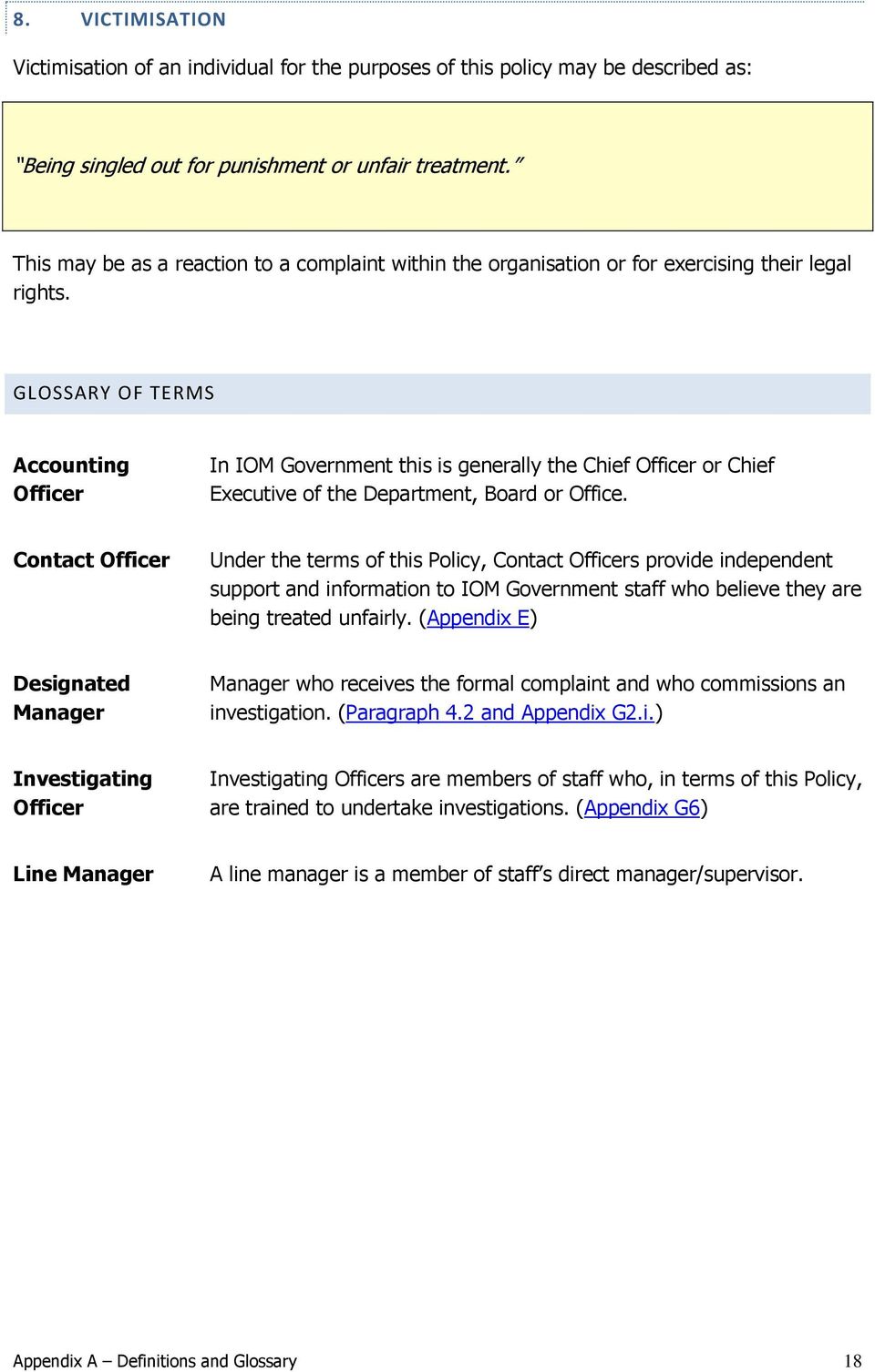
18 8. VICTIMISATION Victimisation of an individual for the purposes of this policy may be described as: Being singled out for punishment or unfair treatment. This may be as a reaction to a complaint within the organisation or for exercising their legal rights. GLOSSARY OF TERMS Accounting Officer In IOM Government this is generally the Chief Officer or Chief Executive of the Department, Board or Office. Contact Officer Under the terms of this Policy, Contact Officers provide independent support and information to IOM Government staff who believe they are being treated unfairly. (Appendix E) Designated Manager Manager who receives the formal complaint and who commissions an investigation. (Paragraph 4.2 and Appendix G2.i.) Investigating Officer Investigating Officers are members of staff who, in terms of this Policy, are trained to undertake investigations. (Appendix G6) Line Manager A line manager is a member of staff s direct manager/supervisor. Appendix A Definitions and Glossary 18
19 APPENDIX B BEHAVIOURS 1. MANAGEMENT, HEALTHY CONFLICT AND BULLYING 1. WHAT ARE THE MAJOR CHALLENGES FACING ORGANISATIONS IN TACKLING BULLYING? Getting some people to differentiate between supervision and harassment Accurately defining the difference between bullying and robust management To show managers who adopt strong management tactics with staff that there are other and more effective management styles Ensuring that staff are aware that a manager has a right to manage and that this is not confused with bullying or harassment. (Quotes from 1,190 respondents to CIPD Managing Conflict at Work Survey 2004) Often, those accused of bullying find it difficult to recognise themselves as behaving in a bullying or aggressive way. Conversely, some managers are concerned about tackling poor performance and being accused of bullying. When line managers find themselves having to deal with a low performing team, part of their role is to motivate the team to perform more effectively. The process of bringing about changes in how teams work normally involves a number of areas including setting standards, identifying and dealing with errors and mistakes, increasing productivity, greater flexibility of roles, changing priorities and reducing unreasonable expenditure. If these changes are introduced and managed correctly, they can bring about the necessary business improvements with little or no staff distress. However, if the line manager fails in their handling of the change, accusations of bullying can occur. Table 1 looks at different ways of tackling poorly performing teams and distinguishing between strong management and bullying behaviour. Appendix B Behaviours 19
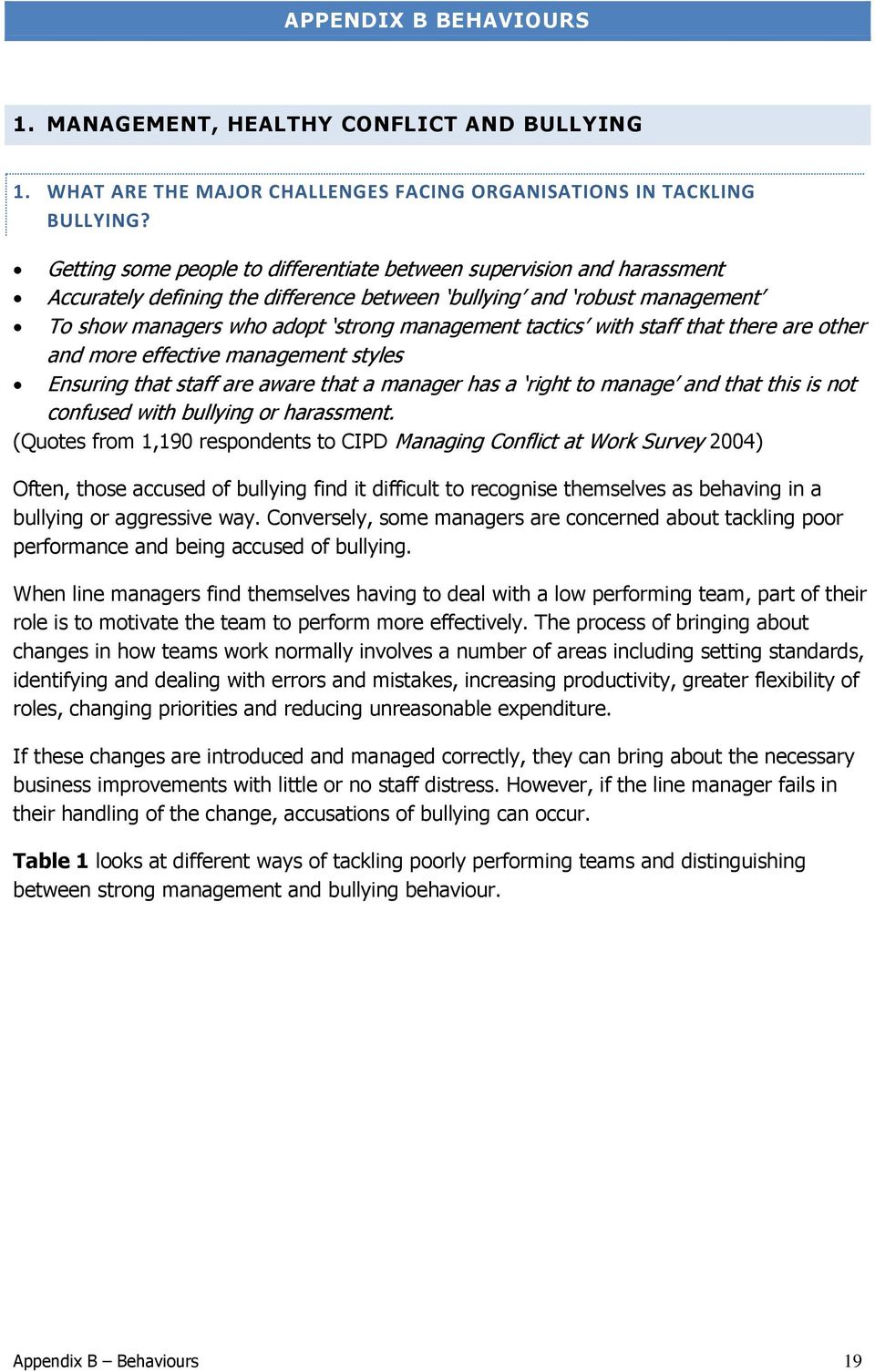
20 Table 1: Differences between management and bullying behaviour when tackling poorly performing teams 4 Addressing poor performance Management Bullying Identifying the performance issue Seeking the views of the team or individual to identify the cause of the unacceptable level of performance Agreeing new standards of performance with all team members Agreeing the method and timing of monitoring/auditing team performance Failure to achieve the standards of performance is dealt with as a performance-improvement issue Recognising positive contributions Involves looking at all the potential reasons for poor performance eg people, systems, training and equipment The team takes part in looking for the source of the problems in performance and helps the manager to identify solutions for the whole team Involves setting and agreeing standards of performance and behaviours for each team member and the manager Wherever possible the team or team member takes part in the monitoring process. The outcome of the monitoring is openly discussed Opportunities are taken to identify individuals who are struggling, and support is provided. Where individuals are unwilling to comply with the agreed performanceimprovement process, capability procedures may commence Recognises and rewards improvements in performance, attitudes and behaviours No attempt to identify the nature or source of the poor performance No discussion of the cause of their performance deficit, or opportunities for the team members to discuss their difficulties Imposing new standards without team discussion on appropriate standards of performance or behaviour Without agreeing standards, the monitoring can occur at any time and can involve areas that are unexpected by team members Individual who fail to achieve the standards of performance are put under pressure to conform. This may include ridicule, criticism, shouting, withholding of benefits, demotion, teasing or sarcasm With no monitoring, it s impossible to recognise where there have been positive contributions. Rewards and recognition are therefore arbitrary and open to acts of favouritism 4 CIPD Guide Bullying at Work: Beyond Policies to a Culture of Respect 2005 Part 5 Strong management, healthy conflict and bullying Appendix B Behaviours 20
21 2. HEALTHY CONFLICT AND BULLYING A certain amount of competition is normal and important in working life. However, bullying is different from normal conflicts because it involves unfair and unethical behaviours that cause extreme distress and disruption to the individual, group and ultimately the whole organisation. The World Health Organisation (2003) produced a guide to raise awareness of bullying and psychological harassment at work in which they chart the contrasts between healthy conflicts and bullying situations (See Table 2 below) Table 2: Differences between healthy conflict and bullying situations Healthy conflicts Clear roles and tasks Collaborative relations Common and shared objectives Explicit interpersonal relations Healthy organisations Ethical behaviour Occasional clashes and confrontation Open and frank strategies Open conflict and discussion Straightforward communication Bullying situations Role ambiguity Uncooperative behaviour/boycott Lack of foresight Ambiguous interpersonal relations Organisational flaws Unethical activities Long-lasting and systematic disputes Equivocal strategies Covert actions and denial of conflict Oblique and evasive communication One of the most important ways to distinguish between healthy conflicts and destructive situations that may lead to bullying is to identify the type of issue involved. Conflicts can be related to an issue, idea or task, or to a personal value or belief. The resolution of issuerelated conflicts is generally easier to achieve than a conflict related to strongly held values or beliefs ISSUE RELATED CONFLICT For example, a work group may have a conflict in deciding what strategy to pursue or how to allocate responsibilities. These conflicts can have a fruitful outcome if managed correctly. Problem-solving approaches allow participants to vigorously debate the issues involved and come to a creative solution. 4. PERSONAL CONFLICT Personal conflict involves issues that threaten the individual s identity or values system and are characterised by intensely negative interpersonal clashes. The types of issues involved in personal conflict are commonly viewed as non-negotiable. It is therefore much more difficult to deal with personal conflict than issue-related conflict. 5 CIPD Guide Bullying at Work: Beyond Policies to a Culture of Respect 2005 Part 5 Strong management, healthy conflict and bullying Appendix B Behaviours 21
22 2. EXAMPLES OF UNACCEPTABLE BEHAVIOURS The following examples are provided with the aim of showing the types of behaviours that the IOM Government deems to be unacceptable. The display of negative/hostile behaviours against an individual/s indicates an absence of Fairness at Work. Such behaviour may constitute discrimination, harassment or bullying. Negative/hostile behaviours can take different forms and can be overt i.e. visible or obvious to others, or covert i.e. more subtle, less easy to detect. The examples listed below are not exhaustive. The aim is to provide illustrative examples of negative/hostile behaviour which the IOM Government deems to be unacceptable. Members of staff should be aware that they may also be accountable for their actions outside work e.g. on social networking sites, at works nights out, if this affects working relationships or work performance. See Inappropriate Behaviours that undermine Fairness at Work Section HARASSMENT A) GENERAL The display or sending of offensive letters or publications: threatening behaviour and language Jostling or assault, or other non-accidental physical contact Derogatory nicknames or name-calling linked to protected characteristics Comments about race, creed or dress etc. B) SEXUAL HARASSMENT Unwanted non-accidental physical contact ranging from unnecessary touching, patting, pinching or brushing against a colleague s body, to assault and coercing sexual relations Unwelcome sexual advances, propositions or pressure for sexual activity: continued suggestions for social activity within or outside the workplace, after it has been made clear that such suggestions are unwelcome; offensive flirting Suggestions that sexual favours may further a colleague s career or refusal may hinder it, e.g. promotions, salary increases etc The display of pornographic or sexually suggestive pictures, objects or written materials Leering, whistling or making sexually suggestive comments or gestures, innuendoes or lewd comments Conduct that denigrates or ridicules or is intimidating or physically abusive of an member of staff because of their sex, such as derogatory or degrading abuse or insults which are gender-related and offensive personal comments. Appendix B Behaviours 22
23 C) RACIAL HARASSMENT Conduct that denigrates or ridicules a colleague because of his or her race, such as derogatory remarks, graffiti, jokes. Such conduct can be verbal or physical D) DISABILITY HARASSMENT Mimicking the effect of a disability or speech impairment Ostracising, ignoring and staring Making fun of a disability Use of inappropriate terms e.g. cripple, spastic Inappropriate personal questions/comments about a disability Belittling or patronising comments/nicknames Moving a wheelchair without the user s agreement Practical jokes e.g. hiding a disability aid Touching a visibly impaired person (to annoy) 2. BULLYING AND MOBBING Name-calling, insults, shouting at a colleague Intimidation, threatening behaviour (verbal or physical) Spreading malicious rumours; making malicious allegations Persistently negative and inaccurate attacks on a colleague s personal or professional performance: criticising a colleague in front of others (public humiliation) Attacking a person s performance Withholding information with the intent of deliberately affecting a colleague s performance Isolating staff by treating them as non-existent and preventing them accessing opportunities Physical or social isolation e.g. excluding colleagues by talking solely to third parties to isolate another Persistently setting impossible deadlines or objectives Removing and replacing areas of responsibility with menial or trivial tasks and taking credit for work achieved. 3. CYBER BULLYING Detrimental texts sent via mobiles or images of work colleagues posted on external websites following work events could amount to bullying. Appendix B Behaviours 23
24 APPENDIX C GUIDANCE ON EARLY ACTION AND INFORMAL INTERVENTIONS C.1 GUIDANCE FOR MANAGERS Key Principles 1. The Isle of Man Government accepts its duty of care to all its staff. Managers are responsible for assuring this and for applying the Minimum Standards set out in Section A prompt response is essential when concerns are raised or when inappropriate behaviour is observed. 3. Each situation involving behaviours at work is different. It is therefore necessary to consider each on a case-by-case basis to gain a full understanding of the problem. 4. Managers should seek advice when this is needed. Support for managers is available from different sources including the Office of Human Resources and a manager s own line manager. 5. In Isle of Man Government there is a positive duty upon ALL parties to try to resolve a dispute or disagreement, whenever it is reasonable to do so. Therefore, whenever reasonable, methods of informal resolution of Fairness at Work issues will be offered and encouraged as a way forward. 6. Use the Three Es when dealing with difficult situations (See 6 below) 1. DAY TO DAY PERFORMANCE MANAGEMENT The Isle of Man Government has a duty of care towards all its members of staff and effective performance management involves acting promptly when any signs of inappropriate behaviour are noticed. See Promoting Positive Relationships at Work in Section 2 and Behaviours in Appendix B. It also means encouraging and recognising positive behaviours. 2. WHEN INAPPROPRIATE BEHAVIOURS ARE OBSERVED OR DETECTED An early response by a manager or supervisor could involve an informal chat to find out what is going on to resolve the issue early before it escalates into a major problem or complaint. In some situations a person displaying inappropriate behaviour may not be fully aware of their actions or may themselves be experiencing difficulties and need support. However, in some situations they may realise and even intend what they are doing. Appendix C Guidance on Early Action and Informal Interventions 24
25 3. THE TYPE OF ACTION TO TAKE DEPENDS ON THE PROBLEM Therefore the first step will always be to understand the problem. For example, one type of intervention would be used for wilful and malicious behaviour (which has to do with conduct) and a different type of intervention would be used if the behaviour was because of lack of skill (which has to do with capability). Alternatively a non-disciplinary intervention e.g. mediation, education, facilitated meeting etc. may offer the way forward. 4. UNDERSTANDING THE PROBLEM WILL HELP ANSWER THE FOLLOWING TYPES OF QUESTIONS: Are there any health issues? Is Occupational Health support needed? Could counselling make a difference? Are the behaviours about unclear standards? Would standard setting help things to improve? Are the behaviours about conflict, relationship breakdown or misunderstanding? In which case, could the situation be addressed through mediation? See Section 3 and Appendix F Do issues need to be explored in order to agree an action plan? If so, would a meeting facilitated by OHR be beneficial? See Section Are the behaviours about skills and development? Would training or coaching be the answer? Consider relevant Capability Procedure Are the behaviours about conduct best addressed through discipline? If so, are they best addressed through the relevant disciplinary procedures? Appendix C Guidance on Early Action and Informal Interventions 25
26 5. WHEN A CONCERN IS RAISED OR A COMPLAINT MADE ABOUT INAPPROPRIATE BEHAVIOURS When a member of staff highlights what they believe is inappropriate behaviour towards them, a manager or supervisor will respond in one of the following ways: 5.1 If the member of staff highlights the issue verbally the manager will initially explore the issue with them following the guidance in Sections 1 and 3 of this Appendix C to determine what to do next. 5.2 If the member of staff raises the issue in the form of a formal written complaint - See Section 4 and Appendix G 5.3 If the member of staff initially raises a formal written complaint and then, on reflection, wishes to explore an informal route e.g. mediation, they must state in writing that they wish to pause their complaint while resolution is attempted and they must state what the method being used would be e.g. mediation. 6. DEALING WITH SENSITIVE ISSUES AND THE EFFECTS ON INDIVIDUALS 6.1 Situations involving inappropriate interpersonal behaviours are complex and will often be challenging as well as distressing. In these circumstances feelings and concerns are extremely important and need to be listened to, respected and acknowledged in a non-judgmental way. 6.2 Section 2 provides a standard to use when trying to establish if bullying has occurred. However, sometimes individuals may believe that that they are experiencing these types of behaviours without being able to furnish proof, for whatever reason. 6.3 Whether or not a case is likely to meet all the criteria of a formal definition, a response is necessary to address the needs of the individual(s) and the situation. Part of Fairness at Work involves keeping an open mind and listening to what is being said, thereby respecting the dignity of the other person, and offering or signposting support when it is needed. This should be the basis of a first level response and can be remembered easily as the Three Es': Explore the issue by listening to what the person has to say in order to understand as best you can without inserting your own view or interpretation. Encourage them to think about what could make a difference in order to find a way forward, engaging in this if you can. Explain how you see things but always listen first so that you understand what you need to explain. Appendix C Guidance on Early Action and Informal Interventions 26
27 7. LITMUS TEST FOR INDIVIDUALS ABOUT WHOM A COMPLAINT HAS BEEN RECEIVED o o o o Would you say or do this in front of your partner, children or parents? Would you say or do this in front of a colleague of the same sex? Would you like to see your behaviour reported in the local press? Would you like a member of your family to be on the receiving end of behaviour the same as yours? C.2 GUIDANCE FOR INDIVIDUALS Key Principle Whenever reasonable the use of informal resolution of a Fairness at Work issue will be offered and encouraged as a way forward. 1. WHEN CHALLENGING INAPPROPRIATE BEHAVIOUR IT IS IMPORTANT TO REMAIN CALM AND: i. Describe the behaviour in neutral terms e.g. There have been occasions like the one this afternoon and last Tuesday when your voice was raised/very loud when you spoke to me in front of the others. ii. Describe the effect on your performance e.g. This makes it difficult to concentrate on what s being said/difficult to take part in things/difficult to do my job. etc iii. Describe how you would like the behaviour to be different e.g. I would like/ prefer to hear about feedback/have problems highlighted in a less public setting/ in a less forceful way/ in a quieter tone. iv. Fairness at Work Standard: In this situation, you are acting in a respectful way and looking for the other person to respectfully listen to and consider what you are saying. The desired outcome is that you both agree how things will be different in the future and put this into practice. Appendix C Guidance on Early Action and Informal Interventions 27
28 2. GUIDANCE REGARDING ALLEGATIONS WHICH INVOLVE NON STAFF MEMBERS i. Where either the complainant or the person responsible is not a member of staff the same principles apply. ii. Request that the behaviour stops. If that does not have any impact the Manager for the area should be informed. iii. If a member of staff is accused of bullying or harassing an individual who is not a member of staff, a complaint should be made under the Department s own complaint procedure. Advice from the Office of Human Resources should be sought in informing the complainant of the action that has been taken. iv. If individuals who are not members of staff are accused of bullying or harassing staff an investigation shall be carried out. Types of action that can be considered include: Discussing the impact of their behaviour on staff Documenting what is unacceptable about behaviour, indicating expected changes Temporary exclusion from the area for a period Contracts of behaviours Permanent exclusion from the area Ceasing or placing restrictions on the service which will be provided. Appendix C Guidance on Early Action and Informal Interventions 28
29 APPENDIX D FAIR AND CONSISTENT MANAGEMENT Key Principles 1. Workplaces where Fairness at Work prevails are characterised by openness, support and trust. 2. Everyone has expectations about justice and fairness. If these are met, trust can exist. 3. Therefore a fair and consistent approach is essential at all levels and at all times as this will promote trust, dignity and respect. 4. Observing the standards of conduct required will enable management practices to be consistent with Fairness at Work The Isle of Man Government Code of Conduct for Public Servants outlines the responsibilities, standards of conduct, performance and ethics for all public servants who should at all times: Comply with the law; Act in a way that is professional; Treat everyone with courtesy and respect; Promote and support the principles of openness, integrity and accountability by personal example. Professional bodies have Codes of Conduct relevant to their particular profession e.g. Nursing and Midwifery Council Code; General Medical Council Code; CIPD Code of Conduct, Teachers Standards etc. 1. USING A FAIR AND CONSISTENT APPROACH A fair and consistent approach should be apparent at all times. i. Recognise and praise good performance. ii. Address difficult issues e.g. poor performance by being fair, using good listening skills and by setting a good example. This is a key aspect of being a manager so you must ensure that you know which skills to use and how to use them effectively. iii. Always use effective listening. iv. Respond positively to problems and avoid reacting in less positive ways. Be constructive and supportive. Use the Three E s in Appendix C.1 v. Monitor and manage how you feel. vi. Be inclusive. vii. Give credit where credit is due. Make sure that the member of staff who does the work is given credit rather than someone else. viii. Accept and learn from mistakes when these happen. Appendix D Fair and Consistent Management 29
30 APPENDIX E ROLE OF THE CONTACT OFFICER Contact Officers provide independent support and information to Isle of Man Government staff who believe they are experiencing discrimination, bullying and/or harassment or who are accused of discrimination, bullying and/or harassment. 1. TRAINING The Contact Officers receive training and undertake this role voluntarily in addition to their substantive duties. 2. FUNCTIONS In some situations Contact Officers will: i. Meet with members of staff to listen to their concerns about behaviour they are experiencing or an allegation that has been made against them. ii. Explain IOM Government s Fairness at Work Policy, resolution options and procedures with respect to discrimination, bullying and harassment. iii. Enable members of staff to explore and consider their options for resolution of their concerns in order that they can reach their own, informed decision about any steps that they might take. The same Contact Officer will not assist both the complainant and the respondent. 3. VALUES Contact Officers will maintain an impartial, non-judgmental view in relation to the member of staff, what the member of staff has to say and any decisions that the member of staff reaches. 4. SCOPE i. They will listen empathically and provide support but they are not counsellors. ii. They will provide information about available options but will not take decisions for the member of staff or tell the staff member what to do. iii. In some situations they may attend a meeting if requested by a member of staff in order to provide support for that staff member. However, when doing so they are not acting in a trade union or staff side capacity and will ensure that the member of staff understands this. 5. WHERE TO FIND A LIST OF CONTACT OFFICERS A list of Contact Officers can be viewed on the IOM Government Intranet under the Equal Opportunities heading. Appendix E Role of the Contact Officer 30
31 APPENDIX F WORKPLACE MEDIATION IN THE IOM GOVERNMENT Mediation is a confidential process by which a trained mediator helps people in a dispute to work out an agreement. The parties, not the mediator, decide on the terms of this agreement. Mediation gives the parties involved in a dispute the means to explore the causes and encourages them to identify a mutually acceptable resolution for themselves. It provides a structured informal way of resolving complaints, grievances and disputes. It is particularly suited when there has been a breakdown in workplace relationships between individuals or teams. Mediation tends to be most successful when disputes are identified and addressed early, before parties become too entrenched in their positions; although that is not to say that long standing disputes cannot be resolved through mediation. Mediation draws on five core principles: i. Fairness ii. Mutual Respect iii. Empathy iv. Dignity v. Dialogue The IOM Government s Workplace Mediation Scheme has trained workplace mediators who are able to conduct mediations in the following circumstances: i. When both parties are willing to work together to resolve the issue ii. When there is a workplace complaint, dispute or allegation iii. When the problem has to do with something that the parties themselves can change. However, mediation is not possible if: i. Either party is unwilling to participate ii. The law has been broken or legal processes are involved iii. There is an unbridgeable imbalance of power iv. The parties do not have the power to agree a solution v. Health issues prevent full participation. Mediation is a more structured exercise than a facilitated meeting, and can take up to a day. The individual parties attending mediation are each given an opportunity to meet the mediators, without the other party being present, to talk through their experience of the conflict and to think about potential ways to resolve it. The parties then meet each other where, facilitated by the mediators, they discuss the conflict and try to find a solution that suits them. Once the parties are in agreement that they have reached a solution to their conflict, the mediators help them to draw up SMART objectives and sign an agreement, which they keep. Nobody else receives a copy of the objectives or the agreement. Appendix F Workplace Mediation in the IOM Government 31
32 Participation is voluntary and the ability of the parties to make decisions is respected. Mediation is also impartial, neutral, independent and confidential. Mediation can be recommended to the parties by others e.g. management, OHR, Occupational Health, Staff Welfare, trade union and professional organisation representatives, or may be requested by parties involved. However, for mediation to be offered both parties must be willing and able to freely agree to attempt mediation. APPENDIX G FORMAL COMPLAINTS AND INVESTIGATIONS Individuals who decide to lodge a formal complaint may wish to contact their trade union representative or a Contact Officer for further advice. 1. LODGING A COMPLAINT i. Members of staff who believe that they have been subject to inappropriate behaviours such as harassment, discrimination or bullying may decide to lodge a complaint formally under this Policy (See Appendix A for definitions). ii. iii. The complainant must make a formal written complaint detailing the incidents to his or her Line Manager within 3 months of the most recent occurrence of the matter giving rise to the complaint. This can be done by using the relevant section of the Pro Forma at Appendix I, or by letter. If the Line Manager is the person against whom the complaint is being made or, if in the opinion of the Complainant, the Line Manager appears no longer to be impartial, the complaint shall be made to the next in line Manager (termed a Designated Manager ). 2. RECEIVING A COMPLAINT i. The Designated Manager shall acknowledge receipt of the formal complaint and advise the complainant of the course of action which will follow and the expected timescale involved. The complaint will be acknowledged within 5 working days, (using Section 3 of the Pro Forma at Appendix I). ii. The respondent(s) shall be notified in writing that an allegation of discrimination, harassment or bullying has been made against them and that they will be afforded a fair opportunity to respond. Appendix G Formal Complaints and Investigations 32
33 3. NATURAL JUSTICE The respondent will have the nature of the complaint explained to them in writing in advance, and will be told who made the complaint. They will also have the right to be interviewed and at this point can be shown the original letter of complaint or form, redacting any third party information. In addition, they have the right to question any evidence that is used against them in any proceeding that might follow after an investigation. See definition of Natural Justice in Appendix A. 4. KEY PRINCIPLES REGARDING INVESTIGATIONS i. Investigations are not hearings. ii. iii. Confidentiality: Investigations will be confidential and all parties to the investigation will observe confidentiality. Members of staff may be accompanied. Members of staff who are invited to an investigatory interview may be accompanied by a trade union or professional organisation representative (including fulltime trade union officers) or fellow work colleague. Special attention should be paid to communications with members of staff: o who have limited experience of working life o with learning difficulties o with physical disabilities or mental health issues which may impact on their ability to understand or express themselves o whose first language is not English; where required a translator will be provided, when requested. It is important to note that it is the witness who will be asked questions and who makes the statement rather than the person who accompanies them. Requests to be accompanied should be made in advance and will normally be agreed unless the presence of a proposed companion could compromise the investigation. If this is the case, the member of staff will be asked to nominate someone else. 5. INITIAL INVESTIGATION OF COMPLAINT i. The complaint shall be subject to an initial investigation by the Line Manager or Designated Manager. The Manager shall interview both parties with a view to determining an appropriate course of action, which might be a mediated solution or a view that the issue could be resolved informally. Appendix G Formal Complaints and Investigations 33
34 ii. Should either of these approaches be deemed inappropriate or inconclusive, a formal investigation of the complaint shall take place with a view to determining the facts of the allegation(s). 6. INVESTIGATING OFFICER i. Because of the highly sensitive nature of the issues, complaints that relate to discrimination, harassment and bullying will be investigated by trained investigators. The Line Manager/Designated Manager shall appoint an Investigating Officer, who will be independent and have had no prior involvement in the matter. ii. iii. In normal circumstances the Investigating Officer will be from another section or division of the same Department but it is realised that occasionally, in certain circumstances, this may not be practicable and Departments may decide that they need to ask an officer from another Government Department to act as such. The Investigating Officer must agree to being appointed as such. The investigation will be objective and carried out with sensitivity and due respect for the rights of both parties. The investigation shall be governed by terms of reference, preferably agreed in advance between the parties. Where the parties are unable to agree terms of reference the Investigating Officer shall determine them. A model letter for use by the Investigating Officer for this purpose is attached at Section 11 of Appendix I. 7. TIMESCALES i. Timescales must be reasonable allowing a thorough investigation to be completed without undue delays. Investigations shall be undertaken with the minimum of delay and should be completed whenever practicable within 4 to 6 weeks or sooner if possible. Any delay must be communicated to the parties involved and a revised timescale set. ii. If the delay is due to ill health Managers should consider whether a referral to Occupational Health is appropriate to ascertain fitness to attend an investigatory interview. Communication between management, complainant and respondent should be maintained at all times. Appendix G Formal Complaints and Investigations 34
35 8. STARTING THE INVESTIGATION PROCEDURE i. In cases of serious allegations, Management may consider the precautionary suspension of the respondent. In all cases of proposed suspension the advice of the Office of Human Resources must be sought before the individual is suspended, unless it is not possible to do so. Suspension is a neutral act and does not in any way imply guilt. An individual who is to be suspended should be advised of the reason for the suspension and may be restricted from contacting the complainant during the suspension. An individual who is suspended must be made aware of the support that is available to them. (See Appendix H.) ii. iii. iv. At the discretion of the Accounting Officer, and with consultation with the individuals concerned, consideration may be given to temporarily transferring either the respondent or the complainant to enable a complaint to be investigated. The Investigating Officer will advise complainants and respondents of the process to be followed in the investigation. Both parties shall be invited to be accompanied at all interviews, and supported by a trade union representative or work colleague throughout the process. The Investigating Officer shall meet with the complainant and the respondent and any witnesses or relevant persons with a view to establishing the facts surrounding the allegation(s). v. In extreme circumstances, and following the advice of Occupational Health, the complainant may be represented by their trade union in their absence. This may only take place with the agreement of the union concerned and the complainant. 9. CARRYING OUT INVESTIGATIONS i. Investigations must be carried out in a consistent way. Investigations will gather and test evidence upon which a reasonable belief can be formed as to whether the alleged events did or did not occur. It is important to understand that the standard of proof is the reasonable belief/probability that there is a case to answer. ii. A decision log should be maintained by the investigator throughout the investigation. Investigators may draw upon a range of evidence including documents e.g. s, letters, time sheets etc. and witness statements, provided that they relate to the complaint. Witness statements are based on investigatory interviews in which investigators will ask questions and a statement is drawn up. Witness statements should be signed, but if not signed may still be used. (Caution should be exercised if drawing conclusions based on unsigned statements as witnesses may subsequently deny these.) Appendix G Formal Complaints and Investigations 35
36 10. INVESTIGATION REPORT i. The investigator will produce an objective report for the Line/Designated Manager i.e. the manager who commissioned the investigation with a summary of the findings to the complainant and the respondent. The report will include an introduction briefly describing the background and summarising the steps taken by the investigator. The main body of the report will summarise and weigh the evidence. ii. Based on the collated evidence, the report will advise: if there was evidence to support a reasonable belief/probability that the alleged events had occurred; if the evidence did not support a reasonable belief/probability that the alleged events had occurred - see Definitions in Appendix A and Behaviours in Appendix B. 11. ACTION FOLLOWING INVESTIGATION REPORT i. The full investigation report, including appendices, is submitted to the Line/Designated Manager i.e. the manager who commissioned the investigation who will consider the report. ii. iii. iv. The Line/Designated Manager, subject to the findings of the investigation, will be responsible for deciding what action, if any, is required, e.g. mediation, training, counselling or disciplinary procedure and for meeting with both parties and advising them accordingly. The parties to the investigation i.e. the complainant and the respondent will be advised in writing by the Line/Designated Manager within 10 working days of receipt of the investigation report about what action, if any, is being taken. This letter should include an executive summary of the findings of the investigation. The parties should also be offered the opportunity to meet with the Line/Designated Manager for feedback. Where there is alleged misconduct, the relevant disciplinary procedure will be followed immediately. (See Section 4.7) v. Only if the investigation is followed by disciplinary proceedings would the full investigation report containing the original complaint appendices and witness statements be shared with the parties involved. vi. Individuals who have been disciplined following a formal disciplinary hearing and who wish to lodge an appeal should use the appeal process within the disciplinary procedure for their terms and conditions. Appendix G Formal Complaints and Investigations 36
37 12. APPEALS The procedure for making an appeal in the case of an individual who raises a complaint in accordance with the Fairness at Work Policy is set out below. i. Appeals, setting out the reasons for the appeal, must be lodged in writing with the Line/Designated Manager, who will arrange for a mutually agreed panel of not more than 3 senior managers, one of which will be the chair, to hear the appeal within 5 working days of receiving the written notification or as agreed with the appellant. ii. iii. iv. The panel hearing the appeal shall invite the parties to attend the appeal hearing. The person or persons hearing the appeal should have had no previous direct involvement in handling the matter (even though they may have been aware of its existence.) The appellant may, if they wish, be accompanied by a work colleague or a trade union representative. The decision of the panel shall be notified to the parties by the chair in writing as soon as possible after the hearing and shall be final. Appendix G Formal Complaints and Investigations 37
38 APPENDIX H SOURCES OF SUPPORT AND INFORMATION INTERNAL Contact Officers Contact Officers provide independent support to members of staff who may be affected by or accused of discrimination, harassment or bullying. They will meet to listen to a member of staff s concerns and help them explore the options available. A list of Contacts Officers is available on the IOM Government Intranet. Office of Human Resources Office of Human Resources Business Partners and their teams of Human Resources Advisers provide advice and guidance to Public Service managers and staff with regard to all Human Resource management and members of staff and industrial relations issues. They also help to clarify expectations and discuss possible options. Contact: Office of Human Resources, St Andrew s House, Finch Road, Douglas IM1 2 PX Tel: +44(0) [email protected] Website: Occupational Health Service The Occupational Health Service (OHS) can provide confidential advice on health issues which may cause difficulties within the workplace either following management or selfreferral. IOM Government has two Occupational Health Service providers: o Department of Health: Contact: Garaghyn Glass, Noble's Hospital, Strang, Douglas IM4 4RJ. Telephone: +44(0) Fax: +44(0) [email protected] o Dr S McAndry: Contact: Independent Medical Services, 10 Hawarden Avenue, Douglas IM1 4BS Tel: +44(01624)617607, Fax: +44(01624) (Dr McAndry provides services for the Department of Home Affairs only.) Staff Welfare The Staff Welfare Service provides a best practice service offering counselling at work, confidential support and member of staff support interventions. Some of these include workplace mediation, trauma support and management, support for staff in high risk roles, and the development of positive working relationships and effective organisational policies. The service is available for all members of staff of the Isle of Man Government. Contact: Telephone +44(0) or [email protected] Appendix H Sources of Support and Information 38
39 EXTERNAL Manx Industrial Relations Service (MIRS) One of MIRS objectives is to encourage a non-adversarial approach to avoiding or resolving difficulties and disputes that arise in employment relationships. MIRS can offer conciliation and/or arbitration between an employer and an individual worker. Contact: Manx Industrial Relations Service, 5th Floor, Victory House, Prospect Hill, Douglas, IM1 1EQ Telephone number: +44(0) Fax: [email protected] Website: OTHER SOURCES Talking to someone confidentially about the issues can help overcome feelings of isolation. Members of staff who are concerned that they may be affected by any of the issues described in this Policy can also seek support from: Line managers or more senior manager GPs - where the matter is having an adverse effect on their health they may wish to discuss the situation with their GP Trade Union and Professional Organisation Representatives Trusted parties of their own choice. Appendix H Sources of Support and Information 39
40 APPENDIX I PRO FORMA AND MODEL LETTER Fairness at Work Formal Complaint in respect of alleged discrimination, bullying or harassment (Policy Section 4 + Appendix G) Section 1: Member of Staff Personal Details Full Name Position / Job Title Staff Group (T&C) Gender M / F* Department Section Manager Senior Manager Name of Person TO WHOM complaint is made Name of Person AGAINST WHOM complaint is made Name of trade union representative or workplace colleague who will accompany you to meetings (if known) Section 2: Details/ Nature of formal complaint (Use additional sheets if necessary) Detail of formal complaint Witness(es) Name(s) and contact numbers List any steps taken to try to resolve the issue e.g. asked the person to stop, mediation, facilitated meeting etc. and dates when these occurred Where a meeting is arranged, my expectations of the meeting are Date: Signature of complainant: Appendix I Pro Forma and Model Letter 40
41 Personal Statement and Commitment I am raising this issue in good faith and with the intention of seeking a positive resolution for the situation that I am encountering. I have read the Fairness at Work Policy and understand the implications of the choice I am making. Send this form to your Line Manager or to the Designated Manager (Policy Section 4) Section 3: Acknowledgement of Receipt To be completed, signed and returned by the Designated Manager within 5 working days of receiving completed complaint Pro Forma Full Name of Person making the complaint Name of Person to whom complaint was made Date Pro Forma was received Dear This to acknowledge receipt of your complaint Pro Forma dated... I will write to you again in due course in order to progress the matter. In the meantime should you wish to access confidential support and advice, details are provided in Appendix H of the Fairness at Work Policy attached. Yours sincerely Signature: Date Print name and contact details of person acknowledging complaint in this space Investigating Officer agreed TOR and sent letters to Complainant and Respondent See Model letter at Section 11. Date Appendix I Pro Forma and Model Letter 41
42 Section 4: Formal Complaints and Investigations (Appendix G) o Investigations to be completed within 4-6 weeks or sooner (Appendix G7) o Designated Manager to advise parties to investigation re action to be taken, if any, within 10 working days of receipt of investigation report (Appendix G11.iii) Referral for investigation Date Referred to whom Suspension or temporary transfer if considered necessary give details Outcome of investigation Date investigating report submitted to Designated Manager Date Designated Manager to write advising relevant parties re action to be taken, if any, eg hearing arrangements, if matter to proceed to a hearing Date Time Names of hearing panel Location Outcome of hearing Please attach transcripts/ notes of meetings and discussions Section 5: To be completed by the individual raising the Complaint This complaint has/has not* been resolved to my satisfaction and I wish/do not wish* to proceed to the next Stage. The reasons I am not satisfied are: Signature Date Appendix I Pro Forma and Model Letter 42
43 Section 6: To be completed by the Designated Manager File forwarded to.. Complaint dealt with*/ Complaint unresolved to satisfaction of complainant* Signature Date Section 7: To be completed by the Individual if an Appeal is being made in terms of FAW Policy To be completed within 5 working days of notification of decision by Designated Manager (Appendix G 12i) I wish to appeal against the decision made by the Designated Manager not to uphold my complaint. Signature Date Section 8: To be completed by the Chair of the Appeal Panel following notification of Appeal To be heard within 5 working days of written notification and decision notified as soon as possible after the hearing (Appendix G12) I/we* have taken account of the attached papers; following an interview with the complainant my/our* decision, which is final, is: Signature Date Section 9: To be completed by the Individual making the Complaint (Appendix G12) I have noted the decision of the Appeal Panel and understand this is the final stage of the FAW Procedure. Signature Date Section 10: Completion Outcome notified to Designated Manager/HRA Date Signature Date Once complete please send in confidence to your OHR Business Partner for retention as appropriate Additional Notes: * Delete as appropriate Appendix I Pro Forma and Model Letter 43
44 SECTION 11 - MODEL LETTER FROM INVESTIGATING OFFICER TO SET OUT AND AGREE TERMS OF REFERENCE BETWEEN COMPLAINANT AND RESPONDENT Date In Confidence xxxxxxxxxxxx (To be addressed to Complainant and Respondent only) Dear... Allegation of Bullying, Harassment, Victimisation or Discrimination in the Workplace (Insert date) Terms of Reference I have been appointed to investigate (your/a) complaint of bullying/harassment/ discrimination/victimisation - insert as appropriate) against (name(s) of respondent/you) by (name of complainant). A copy of the complaint is attached. In order to establish the facts surrounding the complaint and investigate the matter fully, I intend to interview you, the (complainant/respondent) and the following witnesses: List of witness(es) This list may need to be extended if, during the course of my investigation, it becomes clear that I should interview other witnesses in addition to the above. My investigation should be completed within 4 to 6 weeks. If for any reason I am unable to do so I will write to you again explaining why and set a revised timescale (alternatively explain here why it will not be possible to do so within this timescale e.g. annual leave, illness, etc.) A detailed report will be submitted to Xxxxxx Xxxxxxx (the Line Manager or Designated Manager) indicating my findings and will be copied to you and the (complainant/respondent). Xxxxxx Xxxxxx (the Line Manager or Designated Manager) will be responsible for deciding whether any action is required, subject to the findings of the investigation. If disciplinary action is required, the disciplinary procedure relevant to your employment will be followed. The above comprises the terms of reference for my investigation which we discussed (and agreed). Please sign this letter, below, take a copy for your own records and return the original to me by (date). Yours sincerely (Job Title) Investigating Officer cc Line Manager/Designated Manager I agree to the above terms of reference. Name Signature (Date) 20.. Appendix I Pro Forma and Model Letter 44
45 APPENDIX J FLOWCHART TO ILLUSTRATE PROCEDURES Early Action by Individual Individual explains in person / writing to the other party that their behaviour is unacceptable (3.1) Seeking Support Awareness raising discussion regarding incident undertaken by Contact Officer / Mediator or appropriate Facilitator (3.3 and 3.4) Resolves? No Yes There are a number of means of redress and individuals are able to initiate procedure at the level that they feel is appropriate to the situation. However, whenever reasonable, the use of the Informal Resolution of a Fairness at Work issue is encouraged. Early Action by Management Line Manager or next line manager takes any action necessary to resolve issue (3.2) Mutual agreement on resolution of issue Resolves? Yes Seeking Support Awareness raising discussion regarding incident undertaken by Contact Officer / Mediator or appropriate Facilitator (3.3 and 3.4) No Resolves? Yes Agreement on future behaviour Formal Complaint As set out in this Policy; report passed to Designated Manager to determine action (4) Seeking Support Awareness raising discussion regarding incident undertaken by Contact Officer / Mediator or appropriate Facilitator (3.3 and 3.4) Appeal Panel hears Appeal in accordance with the terms of the Policy (5) No Complaint Upheld? No Yes Capability issue Refer back to manager for action under relevant capability procedure (4.6) Action:Formal/ Informal? Informal action agreed by complainant eg apology/ mediation (4.7) Formal action Disciplinary action under relevant Disciplinary Procedure (4.7) Outcome upheld? Yes Decision and action confirmed No Outcome overruled and decision revised
bullying and harassment at work
 bullying and harassment at work A toolkit for UCU branch and LA officers Including health and safety representatives and equality officers Contents Introduction.............................................................
Discipline and grievances at work. The Acas guide
 Discipline and grievances at work The Acas guide Acas can help with your employment relations needs Every year Acas helps employers and employees from thousands of workplaces. That means we keep right
Discipline and grievances at work. The Acas guide
 Discipline and grievances at work The Acas guide We inform, advise, train and work with you Every year Acas helps employers and employees from thousands of workplaces. That means we keep right up-to-date
Table of Contents RESPONDING TO ACCIDENTS AND COMPLAINTS OR TO ALLEGED OR SUSPECTED CHILD ABUSE 19
 1 Table of Contents INTRODUCTION 2 SECTION ONE: PRINCIPLES OF GOOD PRACTICE 4 SECTION TWO: PROTECTING AND PROMOTING CHILDREN S RIGHTS 5 SECTION THREE: DEVELOPING SAFE RECRUITMENT PRACTICES 8 SECTION FOUR:
How To Deal With A Complaint From An Employee
 EMPLOYMENT RELATIONS DOL 11668 NOV 12 Ministry of Business, Innovation and Employment (MBIE) Hikina Whakatutuki Lifting to make successful MBIE develops and delivers policy, services, advice and regulation
Settlement Agreements: A Guide
 Settlement Agreements: A Guide Acas can help with your employment relations needs Every year Acas helps employers and employees from thousands of workplaces. That means we keep right up to date with today
Preventing Violence and Harassment at the Workplace
 Preventing Violence and Harassment at the Workplace VAH001 Violence and Harassment 1 Table of Contents Introduction... 4 Personal versus sexual harassment... 5 Recognizing the problem of workplace violence
Executive Summary. Reflecting and moving forward. Identifying that something might be wrong. Outcomes and feedback.
 Executive Summary Reflecting and moving forward Identifying that something might be wrong Outcomes and feedback Raising a concern Examining the facts February 2015 Executive Summary 8 Freedom to Speak
No secrets: Guidance on developing and implementing multi-agency policies and procedures to protect vulnerable adults from abuse
 No secrets: Guidance on developing and implementing multi-agency policies and procedures to protect vulnerable adults from abuse There can be no secrets and no hiding place when it comes to exposing the
Report. Reflecting and moving forward. Identifying that something might be wrong. Outcomes and feedback. Raising a concern
 Report Reflecting and moving forward Identifying that something might be wrong Outcomes and feedback Raising a concern Examining the facts February 2015 Freedom to Speak Up An independent review into creating
A guide for employers and employees. Religion or belief and the Workplace
 A guide for employers and employees Religion or belief and the Workplace Acas can help with your employment relations needs Every year Acas helps employers and employees from thousands of workplaces. That
Violence, aggression and bullying at work 2010
 COMMISSION Government of Western Australia Department of Commerce Code of practice Violence, aggression and bullying at work 2010 commission for occupational safety and health Code of practice Violence,
MEDIATION: AN APPROACH TO RESOLVING WORKPLACE ISSUES
 A guide February 2013 MEDIATION: AN APPROACH TO RESOLVING WORKPLACE ISSUES 1 CONTENTS Acknowledgements 2 Introduction 3 1 The impact of conflict in the workplace 5 2 What is mediation? 8 3 When can you
Safeguarding Vulnerable Persons at Risk of Abuse National Policy & Procedures
 Safeguarding Vulnerable Persons at Risk of Abuse National Policy & Procedures Incorporating Services for Elder Abuse and for Persons with a Disability Social Care Division Table of Contents Foreword...
How to manage performance. booklet
 How to manage performance booklet We inform, advise, train and work with you Every year Acas helps employers and employees from thousands of workplaces. That means we keep right up-to-date with today s
The Human Rights Framework as a Tool for Regulators and Inspectorates
 The Human Rights Framework as a Tool for Regulators and Inspectorates Contents Foreword 5 Part 1: Introduction and Background 7 Who should use this handbook and why? 8 What is the human rights framework?
Standards for the Dental Team www.gdc-uk.org. Standards
 Standards for the Dental Team www.gdc-uk.org Standards This document sets out the standards of conduct, performance and ethics that govern you as a dental professional. It specifies the principles, standards
RAISING CONCERNS AT WORK
 RAISING CONCERNS AT WORK Whistleblowing Guidance for Workers and Employers in Health and Social Care 2 Raising Concerns at Work: Whistleblowing Guidance for Workers and Employers in Health and Social Care
Code of Human Research Ethics
 Code of Human Research Ethics If you have problems reading this document and would like it in a different format, please contact us with your specific requirements. Tel: 0116 2254 9568; e-mail [email protected].
Child Protection for. The Youth Work Sector
 Code of Good Practice Child Protection for The Youth Work Sector 2 nd Edition May 2003 Code of Good Practice Child Protection for The Youth Work Sector 2 nd Edition May 2003 2003 Department of Education
How To Be A Responsible Parent
 Protective practices for staff in their interactions with children and young people Guidelines for staff working or volunteering in education and care settings Protective practices for staff in their interactions
This document has been archived. What to do if you re worried a child is being abused
 What to do if you re worried a child is being abused Contents Preface Safeguarding Children 5 1 Introduction Working with children about whom there are child welfare concerns 7 2 What is a child in need?
Children First: National Guidance for the Protection and Welfare of Children
 Children First: National Guidance for the Protection and Welfare of Children DEPARTMENT OF Children and Youth Affairs Children First: National Guidance for the Protection and Welfare of Children 2011
Shared Solutions. A Guide to Preventing and Resolving Conflicts. Regarding Programs and Services for Students. With Special Education Needs
 Shared Solutions A Guide to Preventing and Resolving Conflicts Regarding Programs and Services for Students With Special Education Needs Une publication équivalente est disponible en français sous le titre
What equality law means for you as a student in further or higher education
 What equality law means for you as a student in further or higher education Equality Act 2010 Guidance for students Contents Introduction... 3 Section 1: Introduction... 4 Section 2: Key concepts... 9
Code of Conduct. It s always the right time to do business the right way. www.ardaghgroup.com
 Code of Conduct It s always the right time to do business the right way www.ardaghgroup.com Contents Contents Appendices Our Policy 3 Our Core Values 4 Corporate Social Responsibility 5 Personal Ethics
ANTI-BULLYING PROCEDURES FOR PRIMARY AND POST-PRIMARY SCHOOLS
 ANTI-BULLYING PROCEDURES FOR PRIMARY AND POST-PRIMARY SCHOOLS September 2013 1 Table of Contents 1. INTRODUCTION AND LEGAL FRAMEWORK... 3 1.1 INTRODUCTION... 3 1.2 REQUIREMENT ON ALL SCHOOLS TO HAVE AN
Draft Special Educational Needs (SEN) Code of Practice: for 0 to 25 years
 Draft Special Educational Needs (SEN) Code of Practice: for 0 to 25 years Statutory guidance for organisations who work with and support children and young people with SEN October 2013 Contents 1 Introduction