
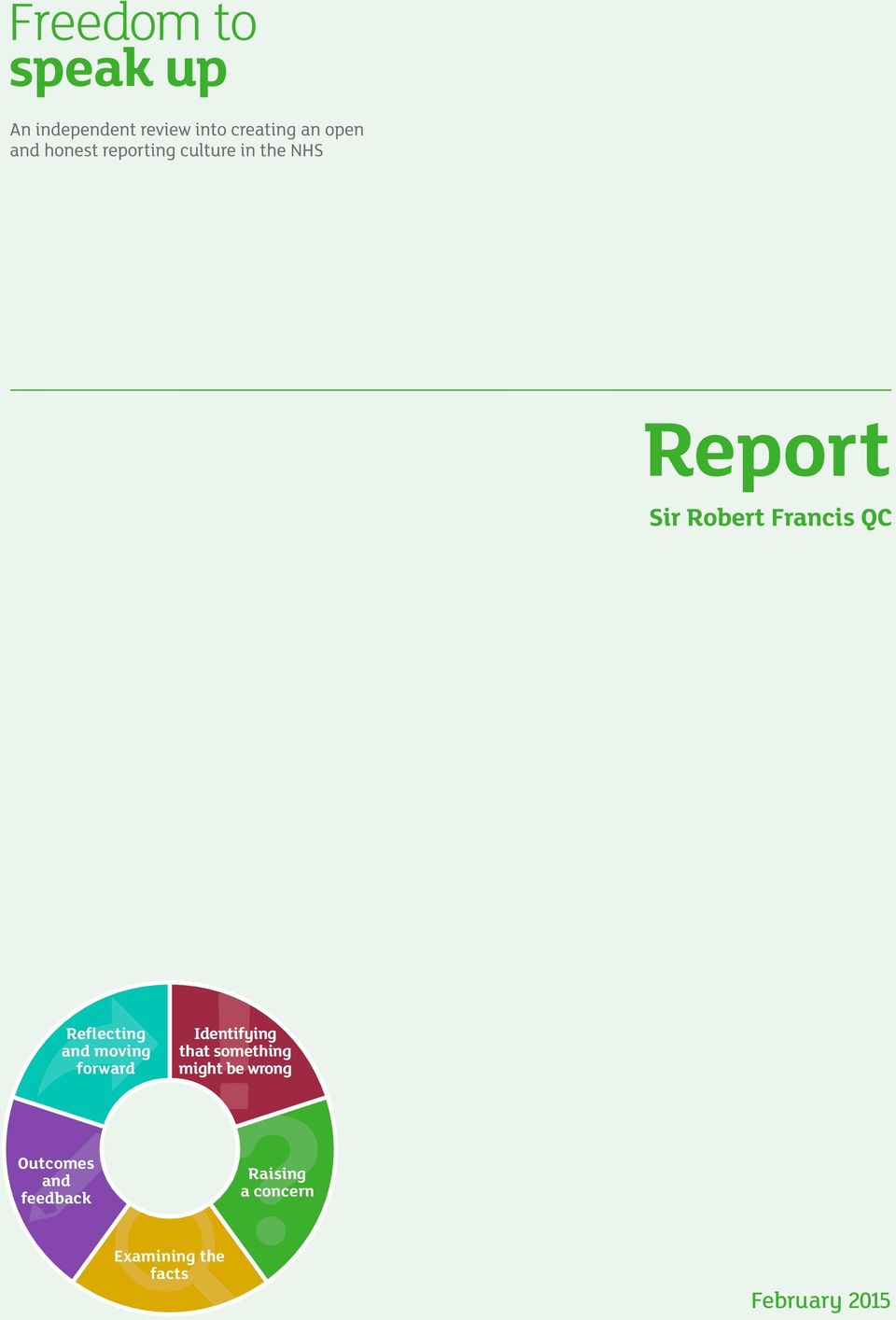
Report. Reflecting and moving forward. Identifying that something might be wrong. Outcomes and feedback. Raising a concern
|
|
|
- Arnold Walton
- 11 years ago
- Views:
Transcription
1 Report Reflecting and moving forward Identifying that something might be wrong Outcomes and feedback Raising a concern Examining the facts February 2015
2 Freedom to Speak Up An independent review into creating an open and honest reporting culture in the NHS Report Sir Robert Francis QC 11 February 2015

3 2 Freedom to Speak Up A review of whistleblowing in the NHS Contents Letter to the Secretary of State for Health 4 Executive Summary 7 Recommendations and Principles 23 Chapter 1 Introduction 29 Chapter 2 Overview of legal and policy context Introduction The legal framework in relation to whistleblowing Individual and organisational responsibilities Roles and responsibilities of regulators and others Recent initiatives in raising concerns Guidance and advice for staff raising concerns Conclusion 49 Chapter 3 Evidence from contributors Introduction Employees and former employees BME staff experience of raising concerns Employers Professional bodies (including Royal Colleges) Regulators Trade unions Other sectors Other countries 82 Chapter 4 Key themes from the evidence 85 Chapter 5 Culture Introduction A just culture Raising concerns normalising Managing poor performance and whistleblowing Bullying Visible and accessible leaders Recognising and valuing staff who raise concerns Reflective practice 115
4 Contents 3 Chapter 6 Improved handling of cases Introduction Informal and formal concerns Anonymous concerns Investigation of concerns Overuse of suspensions Mediation and dispute resolution 133 Chapter 7 Measures to support good practice Training Internal and independent support for staff Support to get back to work Transparency Accountability External review Coordinated regulatory action Recognition of organisations 174 Chapter 8 Particular measures for vulnerable groups Locums, agency and bank staff Students and trainees working towards a career in healthcare Staff from BME backgrounds Staff working in primary care organisations 184 Chapter 9 Extending legal protection 189 Chapter 10 Conclusion 195 Annexes 199 A Summary of good practice 200 B Actions by organisation 210 C Organisations that contributed to the Review 213 Di Survey results trust and primary care staff 214 Dii Survey results BME staff 217 Diii Survey results system and professional regulators 219 E Glossary of terms and abbreviations 220

5 4 Freedom to Speak Up A review of whistleblowing in the NHS Dear Secretary of State Following the Mid Staffordshire NHS Foundation Trust Public Inquiry I made recommendations designed to make the culture of the NHS patient focused, open and transparent one in which patients are always put first and their safety and the quality of their treatment are the priority. You accepted almost all the recommendations and significant progress has been made towards their implementation. As a result I believe the NHS has improved its ability to provide better and safer care. Part of this progress is an increasing recognition of the contribution staff can make to patient care through speaking up. However you identified a continuing problem with regard to the treatment of staff who raise genuine concerns about safety and other matters of public interest, and the handling of those concerns. You asked me to conduct an independent review and to make recommendations for improvement in this area. I now present my Report to you. The NHS is blessed with staff who want to do the best for their patients. They want to be able to raise their concerns about things they are worried may be going wrong, free of fear that they may be badly treated when they do so, and confident that effective action will be taken. This can be a difficult and a brave thing to do, even in a well run organisation or department, but will be extremely challenging when raising concerns is not welcomed. The handling of concerns is not easy for the employers. They find difficulty in distinguishing between concerns which are genuine and those which are not. They are worried about their ability to address the admittedly small number of employees who raise dubious concerns in order to impede justifiable management action. Finding the time and resources to deal sensitively with these issues is challenging, particularly given the other pressures they have to cope with. A service as important and as safety critical as the NHS can only succeed if it welcomes the contribution staff can make to protecting patients and to the integrity of the service. Valued staff are effective staff. A listening system is a safer system. Organisations which ignore staff concerns, or worse, victimise those who express them are likely to be dangerous places for their patients. I would have liked to report to you that there was in fact no problem with the treatment of whistleblowers and their concerns. Unfortunately this is far from the case. I was not asked to come to judgments about individual cases, but the evidence received by the Review has confirmed to my complete satisfaction that there is a serious issue within the

6 Letter to the Secretary of State for Health 5 NHS. It requires urgent attention if staff are to play their full part in maintaining a safe and effective service for patients. In fact there was near unanimity among staff, managers, regulators and leaders who assisted the Review that action needs to be taken. The number of people who wrote to the Review who reported victimisation or fear of speaking up has no place in a well-run, humane and patient centred service. In our trust survey, over 30% of those who raised a concern felt unsafe afterwards. Of those who had not raised a concern, 18% expressed a lack of trust in the system as a reason, and 15% blamed fear of victimisation. This is unacceptable. Each time someone is deterred from speaking up, an opportunity to improve patient safety is missed. The effect of the experiences has in some cases been truly shocking. We heard all too frequently of jobs being lost, but also of serious psychological damage, even to the extent of suicidal depression. In some, sad, cases, it is clear that the toll of continual battles has been to consume lives and cause dedicated people to behave out of character. Just as patients whose complaints are ignored can become mistrustful of all, even those trying to help them, staff who have been badly treated can become isolated, and disadvantaged in their ability to obtain appropriate alternative employment. In short, lives can be ruined by poor handling of staff who have raised concerns. The consistency in the stories told to us by students and trainees about the detriments they could face was alarming. These were mainly young people at the start of their careers who genuinely believed they should raise issues for the benefit of patients. Of none of them could it be said that they had axes to grind. Their overwhelming sense was one of bemusement that anyone would want to treat them badly for doing the right thing. Yet we heard far too many stories from them of being bullied, and of their assessments suddenly becoming negative. We know that thousands of reports of incidents and matters of concern are dealt with satisfactorily all the time, but the story from managers and leaders of organisations was just as concerning as that we heard from staff. There is a marked lack of the skills needed to resolve difficult and sensitive situations that can arise when staff performance is questioned. Too often people resort to formal process and make assumptions that the person who identifies a problem is the problem. Hard pressed managers are often given insufficient resources to ensure that the facts are established objectively and swiftly each time a concern is raised, and instead hunt for someone to blame. We should not forget either the plight of other staff involved in issues of this sort. Not all concerns raised in good faith are correct. There can be misunderstandings, incomplete information, and reasonable explanations for the unusual. Even where

7 6 Freedom to Speak Up A review of whistleblowing in the NHS there is something to be corrected, sensitive handling and insight can often solve the problems raised without prejudicing the welfare of those affected. However, we have seen cases where a culture of blame leads to entrenched positions, breakdown of professional relationships and considerable suffering, utterly disproportionate to the nature of the problem from which this process originated. Staff have responsibilities, too, to raise concerns in a way that is sensitive to the impact on colleagues and their employers of what they say and do. There is a need for a culture in which concerns raised by staff are taken seriously, investigated and addressed by appropriate corrective measures. Above all, behaviour by anyone which is designed to bully staff into silence, or to subject them to retribution for speaking up must not be tolerated. The measures I recommend in this report are largely about doing better what should already be done. They build on the progress made in implementing the culture change started following my earlier report. I set out 20 Principles which I believe should guide the development of a consistent approach to raising concerns throughout the NHS, whilst leaving scope for flexibility for organisations to adapt them to their own circumstances. I have described what appear to me to be the essential features of good practice and have recommended actions to help achieve each of the Principles. I believe implementing these recommendations would result in a great improvement to the present position. The overarching Principle is that every organisation needs to foster a culture of safety and learning in which all staff feel safe to raise a concern. This is something to which everyone associated with the NHS, from you as Secretary of State, to frontline staff, can and should contribute. We need to get away from the culture of blame, and the fear that it generates, to one which celebrates openness and commitment to safety and improvement. That is the way to ensure that staff can make the valuable contribution they want to offer towards protecting patients and the integrity of the NHS. Most importantly the risks to patients' lives and well-being will be reduced, and confidence in the NHS protected. I very much hope you will find this Report useful in achieving that end. Yours sincerely Sir Robert Francis QC
8 Executive Summary

9 8 Freedom to Speak Up A review of whistleblowing in the NHS Introduction 1 This Review was set up in response to continuing disquiet about the way NHS organisations deal with concerns raised by NHS staff and the treatment of some of those who have spoken up. In recent years there have been exposures of substandard, and sometimes unsafe, patient care and treatment. Common to many of them has been a lack of awareness by an organisation s leadership of the existence or scale of problems known to the frontline. In many cases staff felt unable to speak up, or were not listened to when they did. The 2013 NHS staff survey showed that only 72% of respondents were confident that it is safe to raise a concern. There are disturbing reports of what happens to those who do raise concerns. Yet failure to speak up can cost lives. 2 The aim of the Review was to provide advice and recommendations to ensure that NHS staff in England feel it is safe to raise concerns, confident that they will be listened to and the concerns will be acted upon. The Review is not the Public Inquiry that some have demanded, and it has not been tasked with investigating or passing judgment on individual cases. Its purpose has been to draw lessons from the experiences of those involved in raising and handling concerns. It has been important to hear these experiences, good and bad, to achieve this. 3 The message from staff who have suffered as a result of raising concerns has been loud and clear. I heard shocking accounts of the way some people have been treated when they have been brave enough to speak up. I witnessed at first hand their distress and the strain on them and, in some cases, their families. I heard about the pressures it can place on other members of a team, on managers, and in some cases the person about whom a concern is raised. Though rare, I was told of suicidal thoughts and even suicide attempts. The genuine pain and distress felt by contributors in having to relive their experiences was every bit as serious as the suffering I witnessed by patients and families who gave evidence to the Mid Staffordshire inquiries. The public owe them a debt of gratitude in the first place for speaking up about their concerns, and secondly for having the courage to contribute to this Review. 4 The experiences shared with us, and the suffering caused by them, have no place in a service which values, as the NHS must, its workforce and the profound contribution they make to patient safety and care. The NHS has a moral obligation to support and encourage staff to speak out. 5 I also heard it suggested that some people raise concerns for dubious motives, such as avoiding legitimate action to address poor performance. It was not within the remit of the Review to pass judgment on whether any of the cases we heard fell into this category. To the extent that this happens, it is highly regrettable, not least because it taints some people s view of whistleblowers and makes it harder for the many NHS staff who raise genuine concerns. Whatever the motive, the patient safety concerns they raise may still be valid and need to be addressed as well the performance issue. It is clear to me that in too many cases this is not done. Suggestions of ulterior purposes have for too long been used as an excuse for avoiding a rigorous examination of safety and other public interest concerns raised by NHS staff. 6 I recognise that cases are not always clear-cut. We heard contradictory accounts of some cases from those with different perspectives. There is nevertheless a remarkable consistency in the pattern of reactions described by staff who told of bad experiences. Whistleblowers have provided convincing evidence that they raised serious concerns which were not only rejected but were met with a response which focused on disciplinary action against them rather than any effective attempt to address the issue they raised. Whilst there may be some cases in which issues are fabricated or raised to forestall some form of justifiable action against them, this cannot be true of them all. I have concluded that there is a culture within many parts of the NHS which deters staff from raising serious and sensitive concerns and which not infrequently has negative consequences for those brave enough to raise them.
10 Executive Summary 9 7 There are many reasons why people may feel reluctant to speak up in any industry. For example, they may be concerned they will be seen as disloyal, a snitch or a troublemaker. Two particular factors stood out from the evidence we gathered: fear of the repercussions that speaking up would have for an individual and for their career; and the futility of raising a concern because nothing would be done about it. 8 The NHS is not alone in facing the challenge of how to encourage an open and honest reporting culture. It is however unique in a number of ways. It has a very high public and political profile. It is immensely complex. It is heavily regulated, and whilst the system consists of many theoretically autonomous decision-making units, the NHS as a whole can in effect act as a monopoly when it comes to excluding staff from employment. Further, the political significance of almost everything the system does means that there is often intense pressure to emphasise the positive achievements of the service, sometimes at the expense of admitting its problems. 9 Speaking up is essential in any sector where safety is an issue. Without a shared culture of openness and honesty in which the raising of concerns is welcomed, and the staff who raise them are valued, the barriers to speaking up identified in this Review will persist and flourish. There needs to be a more consistent approach across the NHS, and a coordinated drive to create the right culture. Background: legal and policy context 10 This Review took place in a complex and changing climate. The legal and policy framework surrounding whistleblowing is not easy to understand and has many layers. The detail of the law for the protection of whistleblowers has been amended frequently and recently. There is a range of other reviews, as well as measures and initiatives at both local and national level that will directly or indirectly have an impact on the ease with which NHS workers can speak up. This shows recognition of the issues described in this report, and the need for action to address them. However it is important that these measures are brought together. I have attempted to take account of them in the Principles and Actions, but it will be important that those charged with their implementation place them appropriately in the context. Legal context 11 In brief, the legislation which theoretically provides protection for whistleblowers is contained in the Employment Rights Act 1996, as amended by the Public Interest Disclosure Act 1998, commonly known as PIDA. Where a worker makes a protected disclosure, he/she has a right not to be subjected to any detriment by his employer for making that disclosure. 12 For a number of reasons this legislation is limited in its effectiveness. At best the legislation provides a series of remedies after detriment, including loss of employment, has been suffered. Even these are hard to achieve, and too often by the time a remedy is obtained it is too late to be meaningful. 13 The legislation does nothing to remove the confusion that exists around the term whistleblowing, which does not appear in it at all. It was clear from the written contributions and meetings that the term means different things to different people or organisations. It is sometimes taken to imply some sort of escalation: someone raises a concern, then blows the whistle when they are not heard, either within the organisation or to an outside body. Yet this is not how the law defines a protected disclosure. 14 The legislation is also limited in its applicability. It applies only to workers as defined by PIDA, so provides no protection against, for example, discrimination in recruitment, and is only now being extended to include student nurses. Recent changes and initiatives 15 In recent years there has been a range of measures which may encourage, or impose a responsibility on staff to speak up. These include introduction of a new Statutory Duty of Candour,
11 10 Freedom to Speak Up A review of whistleblowing in the NHS the Fit and Proper Person Test and Care Quality Commission s (CQC) new inspection and ratings regime. At both national and local level there have been initiatives and programmes to encourage and support staff to speak up. A range of advice and support is also available to support individuals via helplines or websites. I concluded that it is too early to assess the combined impact of these initiatives, but that they all help to reinforce the message that speaking up is integral to patient safety and care. Evidence to the Review 16 It was important to me to hear from as many people who had direct experience of raising and receiving concerns as possible. Over 600 individuals and 43 organisations wrote in response to our invitation to contribute and over 19,500 responded to the staff surveys sent out by independent researchers. We met with over 300 people through meetings, workshops and seminars. This included individuals who had raised concerns, student nurses, trainee doctors, and representatives from professional and regulatory bodies, employers, trades unions, lawyers, Black and Minority Ethnic (BME) groups and organisations that represent whistleblowers to ensure that I was able to understand the issues from all the different perspectives. We held four seminars in different parts of the country with a cross section of invited delegates to consider different stages of the process of raising concerns and potential solutions. I also commissioned independent qualitative and quantitative research. Experience of employees 17 The vast majority of people who took the time to write to the Review reported bad experiences. Many described a harrowing and isolating process with reprisals including counter allegations, disciplinary action and victimisation. Bullying and oppressive behaviour was mentioned frequently, both as a subject for a concern and as a consequence of speaking up. They also spoke of lack of support and lack of confidence in the process. 18 Despite the efforts to improve the climate described in paragraph 15, many of the contributions described cases that are recent or current. This indicates that there is still a real problem. From the evidence it was apparent that there are problems at a number of stages including deterrents to speaking up in the first place, poor handling of concerns that are raised, and vindictive treatment of the person raising the concerns. This can have a devastating impact on the person who spoke up, including loss of employment and personal and family breakdown. Vulnerable groups 19 It was also clear from the evidence that there are some groups who, for different reasons, are particularly vulnerable including locums and agency staff, students and trainees, BME groups and staff working in primary care. Experience of employers in receiving and handling public interest concerns 20 The independent research identified two distinct cultures within organisations. Some took a strict procedural approach when concerns are raised; others took a more open minded, less rigid approach which focused on resolving the issue, learning and communicating rather than following procedure. The researchers concluded that the latter were still at a formative stage and that even where there was a willingness to be more flexible, organisations were not entirely sure how to achieve it. 21 Employers who receive public interest disclosures have reported varied experiences. While all accept that many disclosures are made in good faith, they were concerned that some disclosures are made in order to pre-empt or protect the person raising them from performance action or disciplinary processes they face for entirely unrelated issues. The problems employers described included separating safety and other concerns from grievance and disciplinary issues, identifying means of addressing relationship issues, and the need to distinguish between culpability and responsibility.
12 Executive Summary 11 Experience of colleagues 22 Concerns about patient safety can have implications for clinical colleagues and managers. An incident or a series of incidents may be attributable to poor performance by an individual clinician or a team. It may be suggested that there is a systemic cause for the concern, such as a staff or equipment shortage for which one or more level of management may be considered responsible. In cultures where blame is an accepted method of explaining a concern, those implicated by a concern are likely to react in a defensive manner. Working relationships with colleagues may suffer, and organisations may default to hierarchical solutions. The role of regulators and other external bodies 23 Organisations such as regulators and oversight authorities also face issues when approached by workers raising concerns, such as difficulty establishing the facts where reports are made anonymously, or protecting confidentiality. There may also be challenges in distinguishing between appropriately reported cases and referrals which are in retaliation against someone who has raised a concern. The role of legal advisors 24 When asked for advice by NHS organisations about issues around public interest disclosure, legal advisors have tended to be influenced by an adversarial litigation and therefore defensive culture. Lawyers in such circumstances tend to look for potential defences to a claim made under public interest disclosure law, rather than to advise on the positive steps that could be taken to avoid some of the issues described above. Their focus is to pre-empt an Employment Tribunal (ET) claim rather than to assist in the prioritisation of the public interest, or to help resolve a dispute informally by sitting round a table. Emerging Themes 25 Concerns are raised daily throughout the NHS, and are heard, addressed and resolved. Steps are being taken in some trusts to improve the way in which management responds to concerns. Nevertheless the level of engagement with the Review, the consistency of the stories we heard and the fact that so many of the cases are current or recent convinced me that problems remain and there is an urgent need for system wide action. 26 The evidence presented to this Review is consistent with evidence from other sources. Whilst views may differ about the progress that has been made, there was a remarkable degree of consensus on the need for improvement, the nature of the problems in the system and what a good system would look like. Adopting such a system will benefit not only those who raise concerns, but also patients, management and the wider NHS. 27 From the evidence we drew five overarching themes. These are the need for: culture change improved handling of cases measures to support good practice particular measures for vulnerable groups extending the legal protection. 28 Chapters 5-9 of this report address each of these themes. They set out the Principles which I believe should be followed to bring about the change required, and Actions which follow from each. These are summarised at the end of the Executive Summary. The chapters contain some examples of both good practice that we heard about during the Review. At the end of each section is a summary of what I consider to be good practice in relation to each Principle. This is summarised in Annex A.
13 12 Freedom to Speak Up A review of whistleblowing in the NHS Culture Principle 1 Culture of safety Every organisation involved in providing NHS healthcare should actively foster a culture of safety and learning in which all staff feel safe to raise concerns. 29 Culture change is essential, but experience from other sectors where safety is an issue suggests that it takes time and considerable effort by the leadership of an organisation. Boards must devote time and resource to achieving this change. There was support for the concept of a just culture as opposed to a no blame culture. The primary need is to move from a culture which focuses on who is to blame? to one focused on has the safety issue been addressed? and what can we learn?. Without this, senior levels of organisations will remain ignorant of important concerns, some of which give rise to serious safety risks. 30 Progress towards the creation of the right culture should be taken into account by the system regulators in assessing whether an organisation is well-led. Principle 2 Culture of raising concerns Raising concerns should be part of the normal routine business of any well-led NHS organisation. 31 Speaking up should be something that everyone does and is encouraged to do. There needs to be a shared belief at all levels of the organisation that raising concerns is a positive, not a troublesome activity, and a shared commitment to support and encourage all those who raise honestly held concerns about safety. This will sometimes require acceptance by staff that their own performance may be the subject of comment, and that this needs to be seen as an opportunity to learn rather than a source of criticism. I appreciate this is not always easy. 32 Policies and procedures for dealing with staff concerns should not distinguish between reporting incidents and making protected disclosures. Our independent research found considerable variation in the quality of policies, and there was agreement that greater standardisation would be helpful given that a proportion of the workforce move between NHS organisations. NHS England, Monitor and the NHS Trust Development Authority (NHS TDA) should produce a standard policy and procedure. 33 To reinforce the concept of raising concerns as a safety issue, responsibility for policy and practice should rest with the executive board member who has responsibility for safety and quality, rather than human resources. 34 Investigation of the concern should be the priority, and any disciplinary action associated with it should not be considered until the facts have been established. This need not delay any performance action that is already underway and unrelated to the concern. It is important that this is well documented to demonstrate that it is not being done in retaliation, to dispel any perception that an individual is being victimised. Poor performance is itself a safety issue, and it is important that it is addressed. The important point here is that managers can show that action taken is justified and is consistent with the way others in the organisation have been treated. Principle 3 Culture free from bullying Freedom to speak up about concerns depends on staff being able to work in a culture which is free from bullying and other oppressive behaviours. 35 There were more references to bullying in the written contributions than to any other problem. These included staff raising concerns about bullying, or being afraid to do so, bullying of people who had raised concerns and frustration that no-one ever appeared to be held to account for bullying. This is corroborated by the NHS staff survey and by other reports including the
14 Executive Summary 13 General Medical Council (GMC) National Training Survey 1 and the Royal College of Nursing (RCN) employee survey 2. Some individual trusts have also acknowledged the existence of a bullying culture and taken steps to address it. 36 Bullying in the NHS cannot be allowed to continue. Quite apart from the unacceptable impact on victims, bullying is a safety issue if it deters people from speaking up. It also has implications for staff morale and for attendance and retention. We heard many examples of unacceptable behaviour and lack of respect by individuals. This has a significant impact on whether people feel able to speak up, particularly in a hierarchical culture such as the NHS. 37 It is important to take a systems approach when bullying occurs, in line with the concept of a just culture. There needs to be an examination of the causes of bullying behaviour. If it is the result of unacceptable demands or pressures on an individual, they should be addressed first. There is also a need for honest and direct feedback to individuals about the impact of their behaviour, and support provided where this might be more productive than admonition. Failure to modify bullying behaviour should always be a matter for disciplinary action. 38 All leaders and managers in NHS organisations must make it clear that bullying and oppressive behaviour is unacceptable and will not be tolerated. Everyone needs to develop selfawareness about their own behaviour and its effect on others. Everyone in leadership and managerial positions should be given regular training on how to address and how to prevent bullying. Regulators should consider the prevalence of bullying in an organisation as a factor in determining whether it is well-led, and any evidence that bullying has been condoned or covered up should be taken into consideration when assessing whether someone is a fit and proper person to hold a post at director level in an NHS organisation. Principle 4 Culture of visible leadership All employers of NHS staff should demonstrate, through visible leadership at all levels in the organisation, that they welcome and encourage the raising of concerns by staff. 39 Visible leadership is essential to the creation of the right culture. Leaders at all levels, but particularly at board level, need to be accessible and to demonstrate through actions as well as words the importance and value they attach to hearing from people at all levels. There is some excellent practice in some trusts, which should be shared and adopted across the NHS. Principle 5 Culture of valuing staff Employers should show that they value staff who raise concerns, and celebrate the benefits for patients and the public from the improvements made in response to the issues identified. 40 Public recognition of the benefits and value of raising concerns sends a clear message that it is safe to speak up, that action will be taken, and that the organisation has the confidence to be transparent and open about things that need to be addressed and wants to hear about them. There was no appetite for financial incentives for individuals, and I do not believe it is either necessary or desirable to offer them. Principle 6 Culture of reflective practice There should be opportunities for all staff to engage in regular reflection of concerns in their work. 41 The Review heard many examples of reflective practice, where issues are explored, systems are analysed and problems or best practice shared. These are invaluable, and should be encouraged throughout the NHS. We also heard that the pressure on the service means that the time available for such practice is being squeezed. 1 National Training Survey 2014: bullying and undermining, General Medical Council, November RCN Employment Survey 2013, Royal College of Nursing, September 2013
15 14 Freedom to Speak Up A review of whistleblowing in the NHS In some cases staff are expected to attend in their own time. I fully recognise the demands and pressures on the system. However these opportunities are essential as a means of sharing information and learning. Just as important, they help to develop a culture of openness and focus on safety not blame, and send a clear signal to staff that this is important. Handling Cases 42 It was clear in so many of the cases we heard about that if they had been handled well from the outset, a great deal of pain and expense could have been avoided. The more issues can be nipped in the bud, the greater the likelihood that there will be a successful outcome for everyone involved. A common factor in many of the cases we heard about was the length of time they took to resolve, if indeed they were ever resolved. Some had gone on so long it was impossible or impracticable to get the full picture. The impact of this on both individuals and organisations was immense. Principle 7 Raising and reporting concerns All NHS organisations should have structures to facilitate both informal and formal raising and resolution of concerns. 43 Many concerns are raised every day, and resolved quickly and informally. This should be encouraged wherever possible, provided it is done openly and positively. Where a concern involves a serious issue or incident or where there is disagreement about the seriousness of the concern, there needs to be a more formal mechanism for logging it, processing it and monitoring how it is being handled. This will provide a clear trail for future reference and avoidance of dispute, and also helps to identify trends, common issues and patterns to enhance organisational learning. 44 Any system needs to be as simple and free from bureaucracy as possible. However it needs to provide clarity to the person who has raised a concern about what will happen next and how they will be kept informed of progress. This report sets out what I consider to be the minimum requirements of a system and procedure to ensure that cases are well handled. This was drawn up from the problems that were described in the written contributions and in meetings, and the solutions discussed at the seminars. To ensure it is taken seriously, the Chief Executive Officer (CEO) or a designated board member needs to be involved and should regularly review all concerns that have been logged formally to ensure they are being dealt with appropriately and swiftly. 45 We heard differing views about the desirability of allowing concerns to be raised anonymously, as distinct from in confidence. They can be harder to investigate, and the motive for doing so may be questionable. In an ideal world it would not be necessary to raise concerns anonymously. In the meantime I am persuaded that they have an important role to play and should be treated as formal concerns. I was reassured to find that an anonymous concern sent to several organisations was taken seriously and acted upon. Principle 8 Investigations When a formal concern has been raised, there should be prompt, swift, proportionate, fair and blame-free investigations to establish the facts. 46 Three clear messages that came from contributors were the importance of establishing the facts, and the importance of doing so quickly, and where necessary independently, and the need to feed back to the individual and share learning more widely. In some other sectors where safety is a critical issue there are teams of independent investigators who move in at once and are quickly able to provide an initial report. 47 Where concerns are raised formally, organisations should arrange for the facts and circumstances to be investigated quickly and with an appropriate level of independence. Where the investigation is done internally, it is essential that those conducting it have the appropriate expertise; that they are genuinely independent; and that they have the training and the time to do so

16 Executive Summary 15 immediately, and are not trying to fit it in around their normal duties. 48 I am not persuaded that it is necessary to insist that all investigations are undertaken by external investigators. Nor do I consider that it would be appropriate to prescribe timescales for investigating concerns in the NHS, not least because the range of issues and circumstances is so diverse. 49 Feedback to the person who raised the concern is critical. The sense that nothing happens is a major deterrent to speaking up. There are situations where this is not straightforward due to the need to respect the privacy of others involved in the case. However there is almost always some feedback that can be given, and the presumption should be that this is provided unless there are overwhelming reasons for not doing so. 50 Suspensions and special leave should only be used where there is a risk to patient or staff safety, or concern about criminal wrongdoing or tampering with the evidence. If it is necessary to take precautionary measures, efforts should be made to redeploy staff elsewhere on the site or to a nonpatient facing role, or to limit their practice. Leaving people on leave or suspension for months on end increases their sense of isolation and the likelihood they will suffer mental health issues which in turn undermine or delay their ability to return to work. 51 There are circumstances where a working environment can become intolerable if someone has, or is believed to have raised a concern which is taken to be critical of colleagues. Ideally the person who spoke up should not be the person who is moved, as this can send a signal that they have done something wrong. Principle 9 Mediation and dispute resolution Consideration should be given at an early stage to the use of expert interventions to resolve conflicts, rebuild trust or support staff who have raised concerns. 52 It would be unrealistic to expect a service as complex and pressured as the NHS to run without some professional disagreement or conflict. However poor working relationships can be a risk to patient safety where they impact on communication, morale and willingness to speak up. These need to be addressed, through more proactive management and training in having honest conversations and giving feedback, and through the use of neutral third parties such as a trained mediator. 53 Mediation and dispute resolution techniques can play a role in resolving disputes at a much earlier stage, before positions become entrenched or relationships break down irretrievably. They can be used to rebuild trust within a team after a difficult period. Mediation needs to be done by trained experts and by people who understand the context within which they are operating. Measures to support good practice 54 Creating the right culture and enabling the effective formal handling of concerns are essential if the ability of NHS staff to raise concerns is to be improved. In addition a number of other measures are needed to support the system to ensure that it works as it should. Principle 10 Training Every member of staff should receive training in their organisation s approach to raising concerns and in receiving and acting on them. 55 For the system to work effectively, there needs to be more training, both for staff in how to raise concerns and for managers in how to receive and handle concerns. Raising concerns, and being

17 16 Freedom to Speak Up A review of whistleblowing in the NHS able to accept, with insight and without being defensive, concerns being raised about one s own practice is a fundamental skill that all NHS workers need to have. 56 Training should be provided through face to face sessions which provide insight into others perspectives: for example how it might feel if an issue is raised which could be interpreted as personal criticism, or how difficult it can be to raise a sensitive issue with someone more senior. Training in multi-disciplinary teams can help to create a shared understanding and common language and to break down silos. More senior members of staff will need additional training in how to handle concerns. 57 Raising concerns and the role of Human Factors 3 should be included in the curriculum of all healthcare professional training programmes. It is important that there is a high level of consistency in the training provided. I therefore invite Health Education England and NHS England, in consultation with stakeholders, to devise a common structure based on the good practice described in this report, to underpin training provided in trusts. Principle 11 Support All NHS organisations should ensure that there is a range of persons to whom concerns can be reported easily and without formality. They should also provide staff who raise concerns with ready access to mentoring, advocacy, advice and counselling. 58 Another recurrent theme from the contributions was the absence of anyone to turn to for support, either before they spoke up, or once they had done so. This added immeasurably to the personal stress they felt. By contrast those who told us that their experience had been good often mentioned that they felt supported throughout. 59 Two things are needed: clarity about to whom concerns can be reported; and clarity about where to go for support. There are various ways this could be provided, and ideally there will be more than one source. Some trusts have nominated a Non-Executive Director (NED) to receive concerns; some allocate a senior person to act as a buddy, or named executive directors, both to receive concerns and to offer advice. 60 Some trusts have established a new role, sometimes known as a cultural ambassador or patient safety ombudsman. Their role is to act as an independent and impartial source of advice to staff, with access to anyone in the organisation, including the CEO, or if necessary outside the organisation. They can ensure that the primary focus is on the safety issue; that the case is handled appropriately, investigated promptly and issues addressed; and that there are no repercussions for the person who raised it. They can also act as an honest broker to verify that if there were pre-existing performance issues that were already being addressed, these should continue and cannot be portrayed as a consequence of speaking up. 61 I believe such a role can make a huge contribution to developing trust within an organisation and improving the culture and the way cases are handled. I believe there would be merit in having similar roles in all NHS organisations, with a common job title such as Freedom to Speak Up Guardian, so that those who move between organisations know immediately where to go for help. They could also form a network to share good practice and to identify common issues and themes. I strongly encourage all NHS organisations to consider it. I have stopped short of recommending that all must adopt this model, as I believe boards should decide what is appropriate for their organisation. But as a minimum there needs to be someone to whom staff can go, who is recognised as independent and impartial, has the authority to speak to anyone within or outside the trust, is expert in all aspects of raising and handling concerns, has the tenacity to ensure safety issues are addressed, and has dedicated time to perform this role. 62 It was suggested that some may not be comfortable seeking advice from a Freedom to Speak Up Guardian if, for example, they are from a different professional background. There should 3 A definition of Clinical Human Factors is Enhancing clinical performance through an understanding of the effects of teamwork, tasks, equipment, workspace, culture, organisation or human behaviour and abilities, and application of that knowledge in clinical settings. See Clinical Human Factors Group website

18 Executive Summary 17 therefore be a range of others to whom people can go for advice and support. This should include at least one executive director, which may be the person responsible for safety and/or the medical director; at least one nominated manager in each department; and one external organisation, such as the Whistleblowing Helpline. 63 Support should also be available in the form of counselling and other psychological support. The evidence seen by the Review indicates that psychological damage is a foreseeable risk of not treating staff correctly when concerns are raised. We heard harrowing accounts from people about anxiety and depression due to the stress and repercussions of raising a concern, and in too many cases counselling appeared to have been promised but never materialised. This is short-sighted as well as uncaring, as it delays the point at which staff are able to return to work, and could conceivably lead to expensive litigation. Principle 12 Support to find alternative employment in the NHS Where a NHS worker who has raised a concern cannot, as a result, continue in their current employment, the NHS should fulfil its moral obligation to offer support. 64 A number of people leave their employment, either voluntarily or otherwise, after raising a concern. Some then find it difficult to find another job. The NHS can operate as a monopoly employer in many fields, and a contentious parting of the ways can result in an individual being disadvantaged when applying for a new role, without the full facts of a case being known. This is unfair on individuals, and a waste of valuable skills and resource to the NHS. 65 Where an Employment Tribunal orders reinstatement in a case involving protected disclosures, NHS organisations have a moral responsibility to re-instate the individual if at all possible, if their performance is sound, with appropriate support and development for them and/or for their colleagues to ensure they are re-integrated effectively. 66 Beyond that, there needs to be a support scheme for staff who are having difficulty finding employment and can demonstrate that this is related to having made a protected disclosure, and about whom there are no issues of justifiable and significant concern about their performance. This should be run jointly by NHS England, the NHS TDA and Monitor, and should be supported by all NHS organisations. As a minimum it should provide: remedial training or work experience for registered healthcare professionals who have been away from the workplace for long periods of time advice and assistance in relation to applications for appropriate employment in the NHS the development of a pool of employers prepared to offer trial employment guidance to employers to encourage them to consider a history of having raised concerns as a positive characteristic in a potential employee. Principle 13 Transparency All NHS organisations should be transparent in the way they exercise their responsibilities in relation to the raising of concerns, including the use of settlement agreements. 67 Lack of transparency and openness creates suspicion and mistrust. It also means that opportunities to share learning and improve patient safety may be lost. Conversely transparency about incidents and concerns, and how the trust has responded to them, sends an important signal to staff that the board welcomes and values them, and provides an opportunity to demonstrate how they focus on finding solutions and taking action, not on apportioning blame. 68 All NHS organisations should publish in their Quality Accounts quantitative and qualitative data about formally reported concerns. This could then be used by the National Learning and Reporting System to identify safety issues that are common across the NHS, and to spread learning and best practice. This requires the NHS system regulators to adopt a common approach to data about concerns, with a shared understanding of what good looks like so that there is no disincentive to trusts to be transparent and open.
19 18 Freedom to Speak Up A review of whistleblowing in the NHS 69 My attention was also drawn to the continued use of settlement agreements and to the confidentiality clauses they contain. Any confidentiality clauses which prevent a signatory from making a protected disclosure are void. I did not see any recent agreements which breached this. There were some however which contained restrictions that seemed unnecessarily draconian, and I can appreciate how individuals might think they were gagged. This is a hindrance to transparency. Greater care needs to be taken in the drafting of confidentiality clauses, which should only be included if they are genuinely in the public interest. All settlement agreements should be available for inspection by the CQC. Principle 14 Accountability Everyone should expect to be held accountable for adopting fair, honest and open behaviours and practices when raising, or receiving and handling concerns. There should be personal and organisational accountability for: poor practice in relation to encouraging the raising of concerns and responding to them the victimisation of workers for making public interest disclosures raising false concerns in bad faith or for personal benefit acting with disrespect or other unreasonable behaviour when raising or responding to concerns inappropriate use of confidentiality clauses. 70 Everyone should be held accountable for their behaviour and practice when raising, receiving and handling concerns. This applies to those raising concerns as well as to their leaders and managers. Absence of accountability puts people off speaking up, and can inhibit a person s ability to move on. Seeing a manager who has been responsible for bullying or victimisation move to a new post or even be promoted sends the wrong signal to staff and offends people s innate sense of fairness. 71 It is the responsibility of boards to ensure that there is no victimisation of or retaliation against whistleblowers, and they should be held to account for it. This will require them to maintain constant vigilance, and effective systems to enable them to keep track of what is happening within an organisation where so many people are under pressure to deliver a service. System regulators should look for evidence that this is being taken seriously. I was encouraged to hear optimism about the impact of the CQC s new inspection regime. 72 I do not believe that it would be appropriate to introduce regulation of managers at present. The Fit and Proper Person test has only just been introduced and it should be given time to bed down, and its impact to be assessed. 73 Individuals are also responsible for their own behaviour, and should be prepared to be held to account for it. Everyone who raises concerns must take responsibility for the way in which those concerns are expressed, and show willingness to accept the good faith of those who try to respond reasonably even if the conclusion is not what they would wish. It equally applies to anyone, however senior, who fails to show respect to their colleagues or is unacceptably rude. Such behaviour should not be tolerated, and those who persist with it should be held to account. Principle 15 External review There should be an Independent National Officer resourced jointly by national systems regulators and oversight bodies and authorised by them to carry out the functions described in this report, namely: review the handling of concerns raised by NHS workers, and/or the treatment of the person or people who spoke up where there is cause for believing that this has not been in accordance with good practice advise NHS organisations to take appropriate action where they have failed to follow good practice, or advise the relevant systems regulator to make a direction to that effect act as a support for Freedom to Speak Up Guardians provide national leadership on issues relating to raising concerns by NHS workers
20 Executive Summary 19 offer guidance on good practice about handling concerns publish reports on the activities of this office. 74 I considered whether there is a case for establishing an independent body with powers to review staff concerns. I concluded that it would be wrong to take responsibility for dealing with concerns away from trusts, and would be more likely to lead to delays and additional layers of bureaucracy. 75 I also gave serious thought to the need for a new body to carry out an external review of the way individual cases have been handled and whether detriment occurred. There is a gap in the system of oversight in this area. The CQC can take account of how an organisation handles cases in its assessment of how well it is led. All the systems regulators who are prescribed persons can take action to investigate the issues raised in any protected disclosure made directly to them. But these would not normally include reviewing the way in which the organisation managed their investigation, nor the way in which the individual who raised the concern was subsequently treated. The only route available to an individual who feels he has been subject to detriment for making protected disclosure is to take a case to an Employment Tribunal. However, most do not want to take legal action: all they want is to be assured that patients are safe and to get on with their jobs. 76 Rather than establish yet another new body, which would require legislation as well as new funding, I propose that an Independent National Officer (INO) should be jointly established and resourced by the CQC, Monitor, the NHS TDA and NHS England, to operate under the combined aegis of these bodies. The INO would be authorised by these bodies to: review the handling of concerns raised by NHS workers where there is reason to believe that there has been failure to follow good practice, particularly failing to address dangers to patient safety or causing injustice to staff where this has occurred, to advise the relevant NHS organisation to take appropriate and proportionate action, or to recommend to the relevant systems regulator or oversight body that it make a direction requiring such action offer guidance on good practice act as a support for Freedom to Speak Up Guardians publish reports on common themes, developments and progress towards the creation of a safe and open culture in the NHS. 77 I want to emphasise I am not proposing an office to take over the investigation of concerns, nor is this a means by which a whistleblower can circumvent existing authorised processes for raising and addressing concerns. It is also not intended to replace existing legal remedies. I do not suggest that the INO should review, still less investigate historic cases. 78 The INO will have discretion to consider how an existing case is being or has been handled, and to advise an organisation on any actions they should take to deal with the issues raised. The officer would need to operate in a timely, non-bureaucratic way. He/she would not take on the investigation of cases themselves, but would challenge or invite others to look again at cases and would need sufficient authority to ensure that any recommendations made were taken seriously and acted upon. The office should be more nimble and less bound by legalistic process than a statutory body, with wide discretion to decide whether it is appropriate to get involved in a particular case. In essence the INO would fulfil, at a national level, a role similar to that played by Freedom to Speak Up Guardians locally and provide national leadership for these issues. The INO should not be expected to review historic issues. Principle 16 Coordinated Regulatory Action There should be coordinated action by national systems and professional regulators to enhance the protection of NHS workers making protected disclosures and of the public interest in the proper handling of concerns. 79 The review highlighted the lack of any coordination between the various regulators in their approach to whistleblowing. I believe there is scope

21 20 Freedom to Speak Up A review of whistleblowing in the NHS for the systems regulators to play a bigger role. In particular I think they should pay more attention to the record of an NHS organisation in respect of how it handles concerns, and take regulatory action where that record is poor. I have suggested that all three should work together, with the Department of Health, to define their roles and agree procedures to ensure that NHS workers are adequately protected. 80 Professional regulators could also do more. The GMC has set up an independent review, chaired by Sir Anthony Hooper, to consider how it treats doctors who raise concerns, and how they might best be supported. Its findings may be relevant to other regulators. It is important that professional regulators are aware of the context in which a referral for investigation of a medical professional is made, to ascertain whether there is any risk that it is a retaliatory referral. I am not suggesting that there should be no investigation because someone has been a whistleblower: there may be a perfectly good justification for doing so. But the regulators need to assure themselves that the referral is fair. I would also urge the professional regulators to consider what they can do to speed up their investigations into fitness to practise. Principle 17 Recognition of organisations CQC should recognise NHS organisations which show they have adopted and apply good practice in the support and protection of workers who raise concerns. 81 Organisations which encourage an open and just culture should be recognised and celebrated, for example through a national award scheme, in their CQC assessment or possibly some financial incentive. Measures for vulnerable groups 82 During the course of the Review it became clear that there are some groups who are particularly vulnerable when they raise concerns. Locums, agency and bank staff 83 Non-permanent staff are in a more vulnerable position not only because of the temporary nature of their roles, but also because they are not fully integrated members of a team, may miss out on induction explaining how concerns should be raised in this organisation, and lack support. Yet they may bring objectivity and good practice from other organisations which should be welcomed. They should have access to all the same support and procedures as permanent members of staff, and should be encouraged to share their insights. Principle 18 Students and trainees All principles in this report should be applied with necessary adaptations to education and training settings for students and trainees working towards a career in healthcare. 84 Student nurses, other healthcare professional students, and trainees can help to spread good practice because they move around frequently. The group of student nurses I met told me that the need to pass each placement can constrain their ability to speak up: there were disturbing, but consistent accounts of students with previously good records who suddenly found themselves criticised, if not failed, after they raised a concern. We also heard of students being sent to placements despite reports by previous students about bullying behaviour, variable support by universities and petty victimisation (being given all the worst jobs) after raising a concern. The fear of referral for fitness to practise appears to be a further deterrent. 85 All the guidance and Principles that I have proposed for NHS staff should be available to support students and trainees working towards a career in healthcare. There should be additional protection for students. All training establishments should comply with the good practice in this report in relation to: including the importance of, and process for raising concerns in the curriculum the appointment of an independent person to advise and monitor the well-being of students
22 Executive Summary 21 who raise concerns ensuring practical and emotional support is provided through any investigation process monitoring the progress of students who raise concerns, to ensure there is no sudden and unexplained dip in their performance assessments. 86 In addition, the education and training organisations and professional regulators should work more closely when assessing the suitability of placements. Where action is repeatedly not taken in respect of poor placements, the regulator should consider removing its validation of the course. Staff from black and minority ethnic (BME) background 87 The experiences of BME staff were broadly similar to those of other staff, but without doubt they can feel even more vulnerable when raising concerns. This was partly because the culture can sometimes leave minority groups feeling excluded, and cultural misunderstandings may exacerbate difficulties. This sense of vulnerability appears to be supported by the evidence of our independent research. There is also a perception that BME staff are more likely to be referred to professional regulators if they raise concerns, more likely to receive harsher sanctions, and more likely to experience disproportionate detriment in response to speaking up. 88 Boards need to be aware that this is an issue, and should consider whether they need to take action over and above what is set out in this report to support and protect BME staff who raise concerns in their organisation. Principle 19 Primary Care All principles in this report should apply with necessary adaptation in primary care. 89 It was surprisingly hard to get a clear understanding of the options open to staff who work in primary care. Little, if any, thought seems to have been given to it since the Health and Social Care Act 2012, which abolished primary care trusts (PCTs). 90 The options would seem to be NHS England or clinical commissioning groups (CCGs), but neither are prescribed persons to whom protected disclosures can be made. Yet it seems more likely that somebody working in a very small organisation will want or need to raise a concern with, or seek advice and support from someone outside their practice particularly if their concern is about one of the senior figures. 91 I consider it essential that the support recommended in this report should be available to NHS staff who work in primary care. We heard about examples of good practice, where trainees were given induction, briefed on the policy, and felt supported by their training scheme programme director, although some trainees waited until they had completed their placement before speaking up. But it was hard to identify any source of support for other members of staff, particularly non-clinical staff. 92 Consideration should be given to how this can be provided. Federations of GP practices may be able to appoint a Freedom to Speak Up Guardian; others may be able to sign up the services of their local NHS trust s Guardian, as happens already in at least one area. NHS England should work with all commissioned primary care services to clarify policies and procedures for staff in line with the Principles in this report, which specify where employees can go for advice and support, and to register a concern. Extending the legal protection Principle 20 Legal Protection should be enhanced 93 Although I do not consider the legal protection is adequate, I firmly believe it is the priority, and more effective, to address the culture and to improve the way concerns are handled so that it is not necessary to seek redress. That has been the main focus of this Review and the report. 94 There are however two steps which should be taken. Some NHS bodies which are not currently prescribed persons to whom disclosures could be
23 22 Freedom to Speak Up A review of whistleblowing in the NHS made, should be added to the list. These include NHS England, CCGs and Local Education and Training Boards. Secondly I welcome the intention to extend the scope of the legislation to include student nurses and student midwives. This should go further to include other students working towards a career in healthcare. 95 The legislation applies to all employers, not only those in the NHS, so it would not be appropriate to make recommendations for amendment which might impact on other sectors in ways that I am not aware of. However I am particularly concerned by one aspect of the legislation, which is that it does nothing to protect people who are seeking employment from discrimination on the grounds that they are known to be a whistleblower. This is an important omission which should be reviewed, at least in respect of the NHS. I invite the Government to review the legislation to extend protection to include discrimination by employers in the NHS, if not more widely, either under the Employment Rights Act 1996 or under the Equality Act Conclusion 96 The Review confirmed that although many cases are handled well, too many are not. This has a disproportionate impact on others who are deterred from speaking up by the fear of adverse consequences or the belief that nothing will be done. It puts patients at risk. 97 I believe that the Principles and Actions in this report should together make it safe for people to speak up, and provide redress if injustice does occur. The creation of Freedom to Speak Up Guardians and an Independent National Officer in particular are key components of this, to provide support and ensure the patient safety issue is always addressed. 98 It is also important that all who raise concerns, and all who respond to them behave with empathy and understanding of others, focusing together on patient safety and the public interest. 99 I am grateful to all who have shared their experience. It has helped to shape my conclusions and has made a significant contribution to ensuring that others will have a better experience in future. I appreciate that, given my remit, some people may be disappointed that their own issues have not been addressed. Some are now so complex that I doubt that even a public inquiry would be able to resolve them. 100 I hope that genuine concerns will be investigated objectively, learning shared, and those who raise them feel supported and valued, while genuine issues about an individual s performance or conduct are dealt with separately and fairly. Anyone responsible for unacceptable breaches of the responsibilities identified in this report should be held to account, but with understanding of the pressures on them. 101 This will make the NHS a better place to work and a safer place for patients. 102 There is a great deal that can be done by wellled organisations and regulators to bring to life the Principles in this report. It will be for the Secretary of State for Health to ensure that the momentum is maintained throughout the whole of the NHS. Recommendation 1 All organisations which provide NHS healthcare and regulators should implement the principles and actions set out below, in line with the good practice described in this report 4. Recommendation 2 The Secretary of State for Health should review at least annually the progress made in the implementation of these Principles and Actions and the performance of the NHS in handling concerns and the treatment of those who raise them, and to report to Parliament. 4 Principles and actions are summarised at the end of this section and the good practice is summarised at Annex A
24 Recommendations, Principles and Actions
25 24 Freedom to Speak Up A review of whistleblowing in the NHS Recommendations Recommendation 1 All organisations which provide NHS healthcare 5 and regulators should implement the Principles and Actions set out in this report in line with the good practice described in this report. Recommendation 2 The Secretary of State for Health should review at least annually the progress made in the implementation of these Principles and Actions and the performance of the NHS in handling concerns and the treatment of those who raise them, and report to Parliament. Principles and Actions Culture Change Principle 1 Culture of safety: Every organisation involved in providing NHS healthcare, should actively foster a culture of safety and learning, in which all staff feel safe to raise concerns. Action 1.1: Boards should ensure that progress in creating and maintaining a safe learning culture is measured, monitored and published on a regular basis. Action 1.2: System regulators should regard departure from good practice, as identified in this report, as relevant to whether an organisation is safe and well-led. Principle 2 Culture of raising concerns: Raising concerns should be part of the normal routine business of any well led NHS organisation. Action 2.1: Every NHS organisation should have an integrated policy and a common procedure for employees to formally report incidents or raise concerns. In formulating that policy and procedure organisations should have regard to the descriptions of good practice in this report. Action 2.2: NHS England, NHS TDA and Monitor should produce a standard integrated policy and procedure for reporting incidents and raising concerns to support Action 2.1. Principle 3 Culture free from bullying: Freedom to speak up about concerns depends on staff being able to work in a culture which is free from bullying and other oppressive behaviours. Action 3.1: Bullying of staff should consistently be considered, and be shown to be, unacceptable. All NHS organisations should be proactive in detecting and changing behaviours which amount, collectively or individually, to bullying or any form of deterrence against reporting incidents and raising concerns; and should have regard to the descriptions of good practice in this report. Action 3.2: Regulators should consider evidence on the prevalence of bullying in an organisation as a factor in determining whether it is well-led. Action 3.3: Any evidence that bullying has been condoned or covered up should be taken into consideration when assessing whether someone is a fit and proper person to hold a post at director level in an NHS organisation. Principle 4 Culture of visible leadership: All employers of NHS staff should demonstrate, through visible leadership at all levels in the organisation, that they welcome and encourage the raising of concerns by staff. Action 4.1: Employers should ensure and be able to demonstrate that staff have open access to senior leaders in order to raise concerns, informally and formally. 5 Referred to in these principles as NHS organisations see glossary
26 Recommendations, Principles and Actions 25 Principle 5 Culture of valuing staff: Employers should show that they value staff who raise concerns, and celebrate the benefits for patients and the public from the improvements made in response to the issues identified. Action 5.1: Boards should consider and implement ways in which the raising of concerns can be publicly celebrated. Principle 6 Culture of reflective practice: There should be opportunities for all staff to engage in regular reflection of concerns in their work. Action 6.1: All NHS organisations should provide the resources, support and facilities to enable staff to engage in reflective practice with their colleagues and their teams. Better Handling of Cases Principle 7 Raising and reporting concerns: All NHS organisations should have structures to facilitate both informal and formal raising and resolution of concerns. Action 7.1: Staff should be encouraged to raise concerns informally and work together with colleagues to find solutions. Action 7.2: All NHS organisations should have a clear process for recording all formal reports of incidents and concerns, and for sharing that record with the person who reported the matter, in line with the good practice in this report. Principle 8 Investigations: When a formal concern has been raised, there should be prompt, swift, proportionate, fair and blame-free investigations to establish the facts. Action 8.1: All NHS organisations should devise and implement systems which enable such investigations to be undertaken, where appropriate by external investigators, and have regard to the good practice suggested in this report. Principle 9 Mediation and dispute resolution: Consideration should be given at an early stage to the use of expert interventions to resolve conflicts, rebuild trust or support staff who have raised concerns. Action 9.1: All NHS organisations should have access to resources to deploy alternative dispute resolution techniques, including mediation and reconciliation to: address unresolved disputes between staff or between staff and management as a result of or associated with a report raising a concern repair trust and build constructive relationships. Measures to support good practice Principle 10 Training: Every member of staff should receive training in their organisation s approach to raising concerns and in receiving and acting on them. Action 10.1: Every NHS organisation should provide training which complies with national standards, based on a curriculum devised jointly by HEE and NHS England in consultation with stakeholders. This should be in accordance with the good practice set out in this report. Principle 11 Support: All NHS organisations should ensure that there is a range of persons to whom concerns can be reported easily and without formality. They should also provide staff who raise concerns with ready access to mentoring, advocacy, advice and counselling.
27 26 Freedom to Speak Up A review of whistleblowing in the NHS Action 11.1: The Boards of all NHS organisations should ensure that their procedures for raising concerns offer a variety of personnel, internal and external, to support staff who raise concerns including: a) a person (a Freedom to Speak Up Guardian ) appointed by the organisation s chief executive to act in a genuinely independent capacity b) a nominated non-executive director to receive reports of concerns directly from employees (or from the Freedom to Speak Up Guardian) and to make regular reports on concerns raised by staff and the organisation s culture to the Board c) at least one nominated executive director to receive and handle concerns d) at least one nominated manager in each department to receive reports of concerns e) a nominated independent external organisation (such as the Whistleblowing Helpline) whom staff can approach for advice and support. Action 11.2: All NHS organisations should have access to resources to deploy counselling and other means of addressing stress and reducing the risk of resulting illness after staff have raised a concern. Action 11.3: NHS England, NHS TDA and Monitor should issue joint guidance setting out the support required for staff who have raised a concern and others involved. Principle 12 Support to find alternative employment in the NHS: Where a NHS worker who has raised a concern cannot, as a result, continue in their current employment, the NHS should fulfil its moral obligation to offer support. Action 12.1: NHS England, the NHS Trust Development Authority and Monitor should jointly devise and establish a support scheme for NHS workers and former NHS workers whose performance is sound who can demonstrate that they are having difficulty finding employment in the NHS as a result of having made protected disclosures. Action 12.1: All NHS organisations should actively support a scheme to help current and former NHS workers whose performance is sound to find alternative employment in the NHS. Principle 13 Transparency: All NHS organisations should be transparent in the way they exercise their responsibilities in relation to the raising of concerns, including the use of settlement agreements. Action 13.1: All NHS organisations that are obliged to publish Quality Accounts or equivalent should include in them quantitative and qualitative data describing the number of formally reported concerns in addition to incident reports, the action taken in respect of them and feedback on the outcome. Action 13.2: All NHS organisations should be required to report to the National Learning and Reporting System (NLRS), or to the Independent National Officer described in Principle 15, their relevant regulators and their commissioners any formally reported concerns/public interest disclosures or incidences of disputed outcomes to investigations. NLRS or the Independent National Officer should publish regular reports on the performance of organisations with regard to the raising of and acting on public interest concerns; draw out themes that emerge from the reports; and identify good practice. Action 13.3: a) CEOs should personally review all settlement agreements made in an employment context that contain confidentiality clauses to satisfy themselves that such clauses are genuinely in the public interest. b) All such settlement agreements should be available for inspection by the CQC as part of their assessment of whether an organisation is well-led. c) If confidentiality clauses are to be included in such settlement agreements for which Treasury approval is required, the trust should be required to demonstrate as part of the approval process that such clauses are in the public interest in that particular case. d) NHS TDA and Monitor should consider whether their role of reviewing such agreements should be delegated to the Independent National Officer recommended under Principle 15.
28 Recommendations, Principles and Actions 27 Principle 14 Accountability: Everyone should expect to be held accountable for adopting fair, honest and open behaviours and practices when raising or receiving and handling concerns. There should be personal and organisational accountability for: poor practice in relation to encouraging the raising of concerns and responding to them the victimisation of workers for making public interest disclosures raising false concerns in bad faith or for personal benefit acting with disrespect or other unreasonable behaviour when raising or responding to concerns inappropriate use of confidentiality clauses. Action 14.1: Employers should ensure that staff who are responsible for, participate in, or permit such conduct are liable to appropriate and proportionate disciplinary processes. Action 14.2: Trust Boards, CQC, Monitor and the NHS TDA should have regard to any evidence of responsibility for, participation in or permitting such conduct in any assessment of whether a person is a fit and proper person to hold an appointment as a director or equivalent in accordance with the Health and Social Care Act 2008 [Regulated Activities] Regulations 2014 regulation 5. Action 14.3: All organisations associated with the provision, oversight or regulation of healthcare services should have regard to any evidence of poor conduct in relation to staff who have raised concerns when deciding whether it is appropriate to employ any person to a senior management or leadership position and whether the organisation is well-led. Principle 15 External Review: There should be an Independent National Officer (INO) resourced jointly by national systems regulators and oversight bodies and authorised by them to carry out the functions described in this report, namely: review the handling of concerns raised by NHS workers and/or the treatment of the person or people who spoke up, where there is cause for believing that this has not been in accordance with good practice advise NHS organisations to take appropriate action where they have failed to follow good practice, or advise the relevant systems regulator to make a direction to that effect act as a support for Freedom to Speak Up Guardians provide national leadership on issues relating to raising concerns by NHS workers offer guidance on good practice about handling concerns publish reports on the activities of this office. Action 15.1: CQC, Monitor, NHS TDA, and NHS England should consider and consult on how such a post might jointly be created and resourced and submit proposals to the Secretary of State, as to how it might carry out these functions in respect of ongoing and future concerns. Principle 16 Coordinated Regulatory Action: There should be coordinated action by national systems and professional regulators to enhance the protection of NHS workers making protected disclosures and of the public interest in the proper handling of concerns. Action 16.1: CQC, Monitor, NHS TDA in consultation with the Department of Health should work together to agree procedures and define the roles to be played by each in protecting workers who raise concerns in relation to regulated activity. Where necessary they should seek amendment of the regulations to enable this to happen. Action 16.2: Healthcare professional regulators should review their procedures and processes to ensure compliance with the good practice set out in this report and with this Principle.
29 28 Freedom to Speak Up A review of whistleblowing in the NHS Principle 17 Recognition of organisations: CQC should recognise NHS organisations which show they have adopted and apply good practice in the support and protection of workers who raise concerns. Action 17.1: CQC should consider the good practice set out in this report when assessing how organisations handle staff concerns. Good practice should be viewed as a positive factor contributing to a good or outstanding rating as part of their well-led domain. Particular measures for vulnerable groups Principle 18 Students and Trainees: All principles in this report should be applied with necessary adaptations to education and training settings for students and trainees working towards a career in healthcare. Action 18.1: Professional regulators and Royal Colleges in conjunction with Health Education England should ensure that all students and trainees working towards a career in healthcare have access to policies, procedure and support compatible with the principles and good practice in this report. Action 18.2: All training for students and trainees working towards a career in healthcare should include training on raising and handling concerns. Principle 19 Primary Care: All principles in this report should apply with necessary adaptations in primary care. Action 19.1: NHS England should include in its contractual terms for general/primary medical services standards for empowering and protecting staff to enable them to raise concerns freely, consistent with these Principles. Action 19.2: NHS England and all commissioned primary care services should ensure that each has a policy and procedures consistent with these Principles which identify appropriate external points of referral which are easily accessible for all primary care staff for support and to register a concern, in accordance with this report. Action 19.3: In regulating registered primary care services CQC should have regard to these Principles and the extent to which services comply with them. Enhancing the legal protection Principle 20 Legal protection should be enhanced Action 20.1: The Government should, having regard to the material contained in this report, again review the protection afforded to those who make protected disclosures, with a view to including discrimination in recruitment by employers (other than those to whom the disclosure relates) on grounds of having made that disclosure as a breach of either the Employment Rights Act 1996 or the Equality Act Action 20.2: The list of persons prescribed under the Employment Rights Act 1996 should be extended to include all relevant national oversight, commissioning, scrutiny and training bodies including NHS Protect, NHS England, NHS Clinical Commissioning Groups, Public Health England, Healthwatch England, local Healthwatch, Health Education England, Local Education and Training Boards and the Parliamentry and Health Services Ombudsman. Action 20.3: The Government should ensure that its proposal to widen the scope of the protection under the Employment Rights Act 1996 includes all students working towards a career in healthcare. Note: Annex B to this report contains a list of actions showing the organisations responsible for implementing each one.
30 1 Introduction
31 30 Freedom to Speak Up A review of whistleblowing in the NHS 1 Introduction I believe that the willingness of one healthcare professional to take responsibility for raising concerns about the conduct, performance or health of another could make a greater potential contribution to patient safety than any other single factor Dame Janet Smith It is now over ten years since Dame Janet Smith wrote to the then Secretary of State for Health alongside her fifth report on the Shipman Inquiry. Her statement rings as true now as it did then. Staff who raise concerns about any issues of patient safety can and do save lives. 1.2 Since her report, and more recently since the reports into the events at Mid Staffordshire 7,8, a number of policies, processes and initiatives have been put in place to try to foster a more open and honest culture in the NHS. However, problems remain. These problems are not confined to the NHS. In recent months there have been many high profile stories about whistleblowers and scandals that might have been averted had people spoken up sooner, or been listened to, in a range of sectors, ranging from adult social care and child protection to international football. Speaking up is essential in almost all forms of collective enterprise, whether commercial or in the public sector. It is particularly important where safety is critical. 1.3 Whilst the NHS is not alone in facing the challenge of how to encourage an open and honest reporting culture, there are some respects in which it is unique: the NHS is probably the most valued institution in this country and therefore its success is important to us all. Its achievements in overcoming the challenges posed by illness, disability and disease are evidenced by countless stories of the inspirational work the NHS does every day it is a highly complex, and heavily regulated collection of organisations, constantly in the public eye and on the political agenda there is great public and political pressure on the service to produce success for every patient all of the time and to regard a failure to do so as a matter for which individuals must be held to account almost all of us will have experience of it, either directly or indirectly, and at a time when we are likely to be at our most vulnerable for every successful advance in medicine, there is likely to be an increase in the demands on the service. The task of innovation, improvement and increased delivery is never complete and never stabilised its culture has, traditionally, been very hierarchical in which reports of success are in constant demand and reports of failure are unwelcome. 1.4 Speaking up is especially important in the NHS because failure to foster a culture in which is it safe to raise concerns can cost lives. Everyone working in the NHS is in a position to identify unsafe care, to spot where things could be improved or if errors have been made. The leadership of an organisation cannot act if it is not told about things that are going wrong, inappropriate behaviour or even honest fears that something does not feel right. 1.5 When an NHS worker speaks up, they are making a vital contribution to the quality and safety of patient care. This is true not just of doctors, nurses, and other qualified healthcare professionals, but of all NHS workers regardless of position. A cleaner employed by a contractor is just as likely to witness an unsafe situation as a hospital s chief executive. A student nurse may offer a fresh insight lost to a tired senior colleague. 1.6 Almost as important, NHS workers are all in a position to contribute to protecting the integrity of the service. Every time money or equipment are wasted or stolen the resources to treat patients are reduced. Every time a patient or a colleague is deceived, intentionally or otherwise, public confidence in the service can be threatened. 6 Fifth Report of the Shipman Inquiry Safeguarding Patients: Lessons from the Past Proposals for the Future, Dame Janet Smith, 9 December The Mid Staffordshire NHS Foundation Trust Inquiry, Robert Francis QC, 24 February Mid Staffordshire NHS Foundation Trust Public Inquiry, Robert Francis QC, 6 February 2013
32 Chapter 1 Introduction The interdependence of the many different elements of the NHS system adds to the complexity of this issue. Each part of the system has a continuing need for information about what is or may be going wrong and indeed on what is going well. The complexity is a potential barrier to important information being received and acted upon in the right places in the system. The risk of this can be reduced to some extent by carefully thought through and operated systems of cooperation, information sharing, and coordinated action. However, there is a risk of organisational boundaries being used as an excuse to ignore or deflect important information. The requirements of confidentiality, sometimes more imagined than real, can be exploited to prevent communication. 1.8 While the system consists of many theoretically autonomous decision-making units, the NHS as a whole can in effect act as a monopoly when it comes to excluding staff from employment. In addition to formal mechanisms, such as the performers list regulatory structure for general medical practitioners, there are inevitably informal networks which will share information on a nonattributable basis. A result can be that the exclusion of a staff member, particularly a doctor or nurse, from one employment will mean that they cannot find work elsewhere. 1.9 Additionally, although the system is intended to be increasingly independent of Government, the political significance of almost everything the system does means there is often intense pressure to emphasise the positive achievements of the service, sometimes at the expense of recognising its problems. Without a shared culture of openness and transparency in which the raising of concerns is welcomed, and the staff who raise them are valued, the barriers to speaking up identified in this Review will persist and flourish. Background to the Review 1.10 This Review was set up in response to concerns about the reporting culture in the NHS, and the way NHS organisations deal with concerns and with the staff who raise them. Over recent years, a number of organisations have been found to provide substandard, and sometimes unsafe, care and treatment to patients. The Mid Staffordshire NHS Foundation Trust scandal is probably the most wellknown, but there have been others identified by the Care Quality Commission (CQC), the Keogh Review 9 and the media. There have also been media reports about the way people who raise concerns have been treated. In this Report we have shared examples of their experiences, some of which are shocking Efforts are undoubtedly being made to improve patient safety in the wake of the Mid Staffordshire Inquiry and other reports. However, there is also evidence to suggest that a key source of information, the people who work at the front line, is still not being sufficiently valued. In the most recent NHS staff survey 10, only 64% of NHS workers felt confident that their organisation would address their concern. Not only do staff feel they are ignored, a significant number fear there will be consequences for them if they do speak up. 72% of people who responded said they would feel safe raising a concern. 10% of staff (almost 17,000 out of 168,000 respondents) said they felt unsafe, and a further 18% (30,000) said they were unsure. This is too many. Terms of reference The aim of this Review was to provide advice and recommendations to ensure that staff working in, or providing services to, the NHS in England feel that it is safe to raise honestly held concerns of any sort in the interest of patient safety. In particular, I was asked to consider measures to ensure that staff: 9 Review into the quality of care and treatment provided by 14 hospital trusts in England: overview report, Professor Sir Bruce Keogh KBE, 16 July NHS Staff Survey, Picker Institute Europe, The full terms of reference can be found at
33 32 Freedom to Speak Up A review of whistleblowing in the NHS feel able to raise concerns, confident that they will be listened to, and that appropriate action will be taken, if they make disclosures about quality of care, malpractice or wrongdoing at work will not suffer detriment as a result of raising concerns or making a disclosure have access to appropriate remedies if they are mistreated as a result of raising concerns are reassured that those mistreating them will be held to account I was also asked to consider what further action is necessary to support those NHS workers who are brave enough to speak up, in particular: the role of the Employment Rights Act ('the 1996 Act') the interface between procedures for raising concerns and making disclosures in the public interest the merits and practicalities of independent mechanisms to resolve disputes options to support people who have raised concerns to return to employment in the NHS, where Employment Tribunals or courts have found in their favour It is important to be clear that this was not a public inquiry. I was not asked to investigate individual cases or pass judgment on historic cases, but to use the experience of the past to formulate recommendations for the future. A number of individuals did share their cases with me. I know that some are disappointed that I have not been able to get personally involved in their case or help to resolve their concerns. However, I hope that they seek some comfort from the fact that I have taken their experiences into account in producing this report, and that my conclusions and recommendations are very much informed by the assistance they have given the Review Even though I have not passed judgment on individual cases, I am confident that there is a pattern of reaction to the raising of concerns in the NHS which inhibits rather than encourages speaking up, turns a blind eye to the real issues that are raised, and often turns on the person who raises them rather than addresses what is important for patients and the public. The scope 1.16 The scope includes all organisations and individuals who provide NHS services including foundation trusts, private providers of NHS services and mental healthcare services. It also covers providers of NHS healthcare services in the community and general practice. The Review covers the NHS in England but not in the devolved administrations. The remit did not cover the provision of privately funded medical care or any form of social care. Nonetheless the lessons to be learned may well be of assistance in all these areas The Review has looked at protected disclosures within the meaning of the 1996 Act 13, but I have not limited the Review to any strict statutory definition. It is likely that any disclosure of information which tends to show a concern about the quality of care, malpractice or wrongdoing at work would come within one or more of the statutory categories set out in 2.2. Although in some circumstances a public disclosure of information, for instance to a newspaper, is protected, the conditions for obtaining statutory protection are different. I heard virtually no suggestion that the freedom for workers to disclose their concerns in public should be increased, and therefore I have limited my consideration to internal disclosures, and those made to regulators and other prescribed persons. 12 As amended by the Public Interest Disclosure Act 1998, commonly referred to as PIDA and subsequent legislation 13 The Public Interest Disclosure Act 1998 operates by amending the Employment Rights Act As such the operative legislation for the purposes of considering protected disclosures is the 1996 Act. Nonetheless, and although legally imprecise, it is commonplace for people to refer to PIDA when discussing protected disclosures
34 Chapter 1 Introduction The protection of patients from unsafe treatment should be at the heart of any system encouraging staff to raise their concerns. The focus of this Report is on what is required to bring that about. Therefore wherever there is a reference to raising concerns, speaking up or whistleblowing it should be considered to refer to the raising of a concern relevant to safety or the integrity of the system. I include in this concerns about oppressive behaviour or bullying and dysfunctional working relationships, which I consider to be safety issues. Approach and methodology 1.19 As required by the terms of reference the approach of the Review was to listen to the views and experiences of individuals and stakeholders with an interest in this area to identify what needs to be improved. The Review looked to: understand the issues from a range of different perspectives identify the problems individuals and organisations face seek views on possible solutions in order to identify measures that would help to promote an open and honest reporting culture. This involved close engagement with NHS workers who wanted to share their experiences of raising concerns, as well as employers, system and professional regulators and representative bodies The Review gathered information in a number of ways: a call for written contributions and a thematic review of responses meetings with a broad range of individuals and stakeholder groups seminars to discuss emerging themes and possible solutions qualitative research: a desk analysis of 21 whistleblowing policies an interview-based analysis of how policies are implemented in the NHS. quantitative research surveys of staff, employers and regulators desk analysis and meetings about whistleblowing in other sectors desk analysis of whistleblowing in other countries The research and seminar reports are available at A summary of findings is at chapter 3 and key themes are at chapter 4. Further evidence from other sources is described in later chapters. Previous reviews 1.22 In recent years there have been a number of reviews that have considered whistleblowing or related issues in the NHS and other sectors. These include the reports of the Mid Staffordshire NHS Foundation Trust inquiries 14,15, the National Audit Office s (NAO) reports on whistleblowing 16, Public Concern at Work s Whistleblowing Commission 17 and the Department of Business, Innovation and Skills response to its whistleblowing framework call to evidence Other relevant reviews include: Don Berwick s report on patient safety 19, the report by the Rt Hon Ann Clwyd MP and Professor Tricia Hart on NHS complaints 20, the report of Sir David Dalton and Professor Sir Norman Williams on duty of candour 21 and the Dalton Review 22 to explore ways to address the challenges faced by providers of NHS care. 14 The Mid Staffordshire NHS Foundation Trust Inquiry, Robert Francis QC, 24 February Mid Staffordshire NHS Foundation Trust Public Inquiry, Robert Francis QC, 6 February Making a Whistleblowing Policy Work, National Audit Office, March 2014 and Government Whistleblowing Policies, National Audit Office, January The Whistleblowing Commission, Report on the effectiveness of existing arrangements for workplace whistleblowing in the UK, Public Concern at Work, November Whistleblowing Framework: Call for Evidence Government Response, Department for Business Innovation and Skills, 25 June A Promise to Learn A commitment to Act, Improving the Safety of Patients in England, National Advisory Group on the Safety of Patients in England, August A Review of the NHS Hospitals Complaints System Putting Patients Back in the Picture, Right Honourable Ann Clwyd MP and Professor Tricia Hart, October Building a Culture of Candour A review of the threshold for the duty of candour and of the incentives for care organisations to be candid, Sir David Dalton and Professor Norman Williams, March Examining new options and opportunities for providers of NHS Care, Sir David Dalton, December 2014
35 34 Freedom to Speak Up A review of whistleblowing in the NHS 1.24 Each of these reports considered measures that contribute to an open and honest culture, including organisational transparency and leadership. The themes identified in these reports that are relevant to whistleblowing and the implications for patient safety appear broadly consistent with the evidence submitted to this Review. That it is still a problem despite so much attention underlines just how intractable it has been. However, there are encouraging signs that there is a genuine will to make progress, and a growing awareness of the contribution staff can make when encouraged to speak up. For example, the Dalton Review made clear that leaders should listen and respond to the insights of staff and recognise that ideas for improvement are generally found within their own organisations. Concurrent reviews 1.25 There have also been a number of reviews taking place in parallel to this Review whose findings and recommendations are likely to be relevant to the issues considered in this report. These include: the Assurance Report by Kate Lampard CBE on the Jimmy Savile Investigations Lord Rose s review of NHS leadership the General Medical Council s (GMC) review of whistleblowing by Sir Anthony Hooper the Health Select Committee s Inquiry on complaints and raising concerns. 23 Structure of report 1.26 This report sets out the findings of the Freedom to Speak Up Review and the Principles and Actions that I believe are necessary to create an open and honest culture in the NHS and to ensure those who do speak up feel valued and supported. It includes chapters on: an overview of the legal and policy context including the roles of various organisations and recent initiatives a summary of the evidence from contributors including employees, employers, professional bodies, regulators, trade unions and others key themes from the evidence and Principles and Actions needed to bring about change: culture change improved handling of cases measures to support good practice particular measures for vulnerable groups extending the legal protection. Anonymisation 1.27 The overwhelming majority of contributions to the Review were made in confidence. To protect the identity of individuals, the case studies in this report have been anonymised and in some cases the gender changed so that they do not identify individual cases or organisations. It would not be in the public interest to do otherwise. Individuals, some of whom have had harrowing experiences, would have been much less likely to assist the Review without an assurance of complete confidentiality. It would be a betrayal of that trust for that assurance to be broken now Quotes have also been anonymised. Typographical errors have been corrected but the meaning has not been changed. Glossary 1.29 There are some terms I have used in this report that are open to interpretation such as staff or NHS organisations. There is a glossary at Annex E to explain the context I am using for such terms in this report. It also includes descriptions of other terms that may be less well understood by the general reader. The Review team 1.30 I was asked by the Secretary of State for Health to chair the Review and I appointed the following to advise on issues relating to specific areas and professions within the NHS: Professor Katherine Fenton OBE, Nursing Advisor 23 4th Report - Complaints and Raising Concerns, Health Select Committee 2015 (published after completion of this report)
36 Chapter 1 Introduction 35 Dr Peter Homa CBE, NHS Chief Executive Advisor Professor Sir Norman Williams, Medical Advisor Advice was also sought from Helené Donnelly OBE, a nurse who raised concerns at Mid Staffordshire NHS Foundation Trust and is now Cultural Ambassador at Staffordshire and Stoke on Trent Partnership NHS Trust. assisted by many NHS leaders and managers who have not only recognised the problems identified in this report, but have had the courage and conviction to do something about them This report is the result of the combined contributions of so many people, but the responsibility for its contents remains mine and mine alone The Review was supported by a secretariat staffed by civil servants, appointed for their relevant skills and experience. The secretariat was led by Joanna Donaldson, former HR Director at the Department for Business, Innovation and Skills. The secretariat worked exclusively on the Review. A secure office was set up, supported by nongovernment IT systems, to ensure that the Review remained totally independent of the Department of Health. Acknowledgments 1.33 This Review would not have been possible without the commitment and hard work of the secretariat. Every member of the team has demonstrated integrity, independence, and rigour in their approach to the task set for us. Their support for me has been outstanding, and their sensitivity and empathy for the sometimes very distressed people who have assisted the Review has been remarkable. I also owe a great debt to my advisors who have devoted a great deal of time to helping me in the formulation of my conclusions and recommendations. Their wisdom has been invaluable Above all, it has been a privilege to meet, and read the contributions of, so many people who work or have worked in the NHS and want the best for its patients and the public. Many have offered their help in spite of having suffered great hardship, and being obliged to relive experiences they would probably prefer to forget. It is also right to place on record that the Review has been substantially
37
38 2 Overview of the legal and policy context
39 38 Freedom to Speak Up A review of whistleblowing in the NHS 2.1 Introduction In order to set the scene and to illustrate the complexity of the issue, this chapter describes the legal and policy context. It covers: the legal framework in relation to whistleblowing in England (see 2.2) individual and organisational responsibilities as they relate to raising concerns (see 2.3) roles and responsibilities of regulators and others to investigate concerns, support whistleblowers and to assess the culture of an organisation (see 2.4) national initiatives in raising concerns (see 2.5) guidance and advice for staff raising concerns (see 2.6) It is not intended to be a comprehensive picture but gives a flavour of the structure within which raising concerns and whistleblowing sits. 2.2 The legal framework in relation to whistleblowing This section covers: Employment Rights Act 1996 Confidentiality clauses Equality Act As referred to in 2.1, it provides an indication of the framework that is in place rather than a comprehensive guide. Employment Rights Act Current legislation on whistleblowing in England is contained in the Employment Rights Act 1996 ( the 1996 Act or ERA). The protection is set out in the 1996 Act as amended and is popularly known as the Public Interest Disclosure Act 1998 or PIDA after the legislation which inserted the whistleblowing provisions into the 1996 Act. Where a worker, as defined in section 43K of the 1996 Act makes a protected disclosure he/she has a right 24 not to be subjected to any detriment by his/her employer, a fellow employee or an agent of the employer for making that protected disclosure The provisions in the 1996 Act relating to the definition of worker have been extended to include categories of worker who might not otherwise fall within the definition of employee or worker under the 1996 Act. Examples include self-employed individuals such as GPs, community pharmacists, dentists and ophthalmic practitioners. Subject to legislation, student nurses and student midwives will shortly be included in the wider definition of worker A disclosure of information qualifies to be considered as a protected disclosure if it is made by a worker who reasonably believes it is in the public interest and if it tends to show one or more of the following 25 : that a criminal offence has been, is being, or is likely to be, committed that a person has failed, is failing, or is likely to fail, to comply with any legal obligation to which he/she is subject 24 Employment Rights Act 1996, section 47B 25 Employment Rights Act 1996, section 43B
40 Chapter 2 Overview of the legal aid policy context 39 that a miscarriage of justice has occurred, or is likely to occur that the health or safety of any individual has been, is being, or is likely to be endangered that the environment has been, is being, or is likely to be damaged that information tending to show any of the above matters is being or is likely to be deliberately concealed The 1996 Act makes provisions concerning how protected disclosures should be made, and circumstances in which a disclosure will not constitute a protected disclosure, for example if the individual making the disclosure commits an offence by doing so. It also specifies a range of persons to whom a worker can make a disclosure that would qualify for protection. This includes the worker s employer, or the employer s agent and prescribed persons. A prescribed person can be either an individual or an organisation included in a list made by order of a Secretary of State 26. Disclosures to prescribed persons will be protected if the person making the disclosure meets certain specified requirements, 27 including that they reasonably believe that the information and any allegation is substantially true Disclosures can also be made wider than the range of persons specified in the 1996 Act, for example to the police or to the media. However, there are additional conditions that need to be satisfied before a worker making a wider disclosure would be protected under the 1996 Act. In all the circumstances of the case it must be reasonable for the worker to make the disclosure. In addition one of three further conditions must be met, namely: that, at the time the disclosure is made, the worker reasonably believes that they will be subjected to a detriment by the employer if they raise a concern with them, or where there is no prescribed person to which a disclosure can be made in relation to the relevant failure, the worker reasonably believes it is likely that evidence relating to the relevant failure will be concealed or destroyed if they make a disclosure to the employer, or that the worker has previously made a disclosure of substantially the same information to his employer, or a prescribed person Unlawful detriments suffered as a result of making a protected disclosure could include bullying, harassment or victimisation, or discrimination in terms of promotion or other career progression opportunities. Similarly, an employee will be able to claim unfair dismissal if he/she can show that the reason, or principle reason, for the dismissal was that he/she had made a protected disclosure. 28 In addition, where an employee resigns because of bullying or harassment as a result of making a protected disclosure he/she may also make a claim for unfair dismissal if he/she can show that the employer was either complicit in the bullying or did not take appropriate steps to prevent it. Bullying does not have to be related to having made a protected disclosure, so a claim for unfair dismissal could also be invoked in other circumstances A worker who believes they have suffered an unlawful detriment as a result of making a protected disclosure may make a claim to an Employment Tribunal (ET) 29 against the employer and/or the employee or agent of the employer alleged to be responsible for the detriment. For any unlawful detriment short of dismissal, the remedies available are a declaration that the complaint is well founded, and an award of compensation. 30 For a finding of unfair dismissal, the remedies are an award of compensation 31 and an order for reinstatement or reengagement. 32 However, the employer is not legally obliged to comply with such an order. Where they do not, a further award of compensation can be made, unless the employer satisfies the ET that it was not practical to comply with the order The current list can be found at: 27 Employment Rights Act 1996, section 43F 28 Employment Rights Act 1996, section 103A 29 Employment Rights Act 1996, section 48(1A) 30 Employment Rights Act 1996, section 49(1). The compensation is subject to a statutory maximum, and may be reduced if the Tribunal is satisfied that the disclosure was not made in good faith (section 49(6A) 31 Employment Rights Act 1996, section Employment Rights Act 1996, section Employment Rights Act 1996, section 117
41 40 Freedom to Speak Up A review of whistleblowing in the NHS These provisions are often portrayed as protections for whistleblowers, perhaps understandably so, given that the legislation is couched in terms of making protected disclosures. However this is not an accurate description. The legislation does not provide an individual worker with guaranteed protection from suffering detriment if they make a protected disclosure, and contains no measure capable of preventing such detriments occurring. Instead it confers on workers a right not to be subjected to such detriment and gives them a route to obtain remedies if that right is violated. It must be said, however, that those remedies are relatively restricted. Furthermore, since the introduction in July 2013 of fees for bringing ET claims, there has been a significant reduction in the number of cases brought 34. It looks like the cost has, perhaps not unexpectedly, acted as a deterrent to making such claims The Enterprise and Regulatory Reform Act 2013 ( the 2013 Act ) introduced significant changes to the 1996 Act 35. In particular, it introduced vicarious liability for the bullying or harassment of whistleblowers. Where there is any bullying or harassment of a worker by a fellow worker or by an agent of the employer on the ground that he/she has made a protected disclosure, this will be treated as having been done by the employer. In addition, the requirement to make disclosures in good faith was removed, 36 although this was coupled with new powers for the ET to reduce the amount of compensation awarded where it determined that the protected disclosure in question was not made in good faith. There is also a requirement that the worker reasonably believes the disclosure to be in the public interest. Specific to the NHS, the meaning of worker was extended by the addition of further types of NHS contract to include, for example, those working in primary care such as self-employed GPs and pharmacists 37. Confidentiality clauses A further significant provision in the 1996 Act relates to confidentiality clauses within a settlement agreement or employment contract. Any such clause is deemed void if it purports to prevent those signing these agreements from making protected disclosures in the public interest. 38 Such clauses are often referred to as gagging clauses, but there is some confusion as to what this actually means. The provision refers specifically to clauses that purport to prohibit a worker from making a protected disclosure. It does not cover clauses that impose on either or both parties to the agreement or contract a duty to maintain confidentiality in other respects, such as in relation to financial details or the personal details of third parties. Equality Act The Equality Act 2010 makes it illegal to discriminate against someone with a protected characteristic 39 such as race, age, and religion. The law also protects from discrimination someone who complains about discrimination or supports someone else s claim, and prohibits harassment or victimisation of anyone who holds a protected characteristic. Making or having made a protected disclosure under the provisions of the 1996 Act is not a protected characteristic under this legislation A significant difference between the provisions of the Equality Act and those of the 1996 Act is that the Equality Act is not confined to employment or quasi-employment relationships. Thus it can, and does, have effect in respect of recruitment practices, making it unlawful to deny an individual a job for which they are otherwise the best candidate solely or mainly because they hold a particular protected characteristic. 34 Employment Tribunal Receipt Statistics (Management Information: July to September 2013), Ministry of Justice, 18 October Enterprise and Regulatory Reform Act 2013, sections 17 to Enterprise and Regulatory Reform Act 2013, section Enterprise and Regulatory Reform Act 2013, section Employment Rights Act 1996, section 43J 39 The protected characteristics are: age; disability; gender reassignment; marriage and civil partnership; race; religion or belief; sex; and, sexual orientation
42 Chapter 2 Overview of the legal aid policy context Individual and organisational responsibilities A range of measures are in place or are about to be put in place to help enable or ensure staff speak up. Some have been in place for some time and others are recent additions where it is too early to assess their impact. Some examples include: professional duties to raise concerns NHS terms and conditions 40 and the NHS Constitution 41 incident reporting and investigation obligations statutory duty of candour Fit and Proper Person Test (FPPT). Professional duties to raise concerns Regulated healthcare professionals have long had a professional duty to be candid with patients and service users about all avoidable harm. However, messaging and guidance from the professional regulators appears to have been inconsistent. In conjunction with the establishment of the statutory duty of candour on provider organisations, the professional regulators have now come together to strengthen references to candour in professional regulation guidance. These regulators are listed in the glossary at Annex E Led by the General Medical Council (GMC) and the Nursing and Midwifery Council (NMC), on 3 November 2014, the professional regulators launched a public consultation on joint guidance that will place honesty at the heart of healthcare and will put this important professional duty firmly into practice The proposed guidance calls on NHS organisations and their clinical leaders to support healthcare professionals by creating open and honest learning cultures in the work place. Regulated healthcare professionals will have to be candid with patients and service users about all avoidable harm. Obstructing colleagues in being candid would constitute a breach of the professional codes The professional codes also place professional obligations on registrants to inform employers of untoward incidents. The professional regulators are also reviewing their guidance to professional misconduct panels to ensure that they take proper account of whether professionals have raised concerns promptly. NHS terms and conditions and the NHS Constitution NHS employees have a contractual right and duty to raise concerns. In July 2010 changes were made to the NHS staff terms and conditions of service handbook to include that right. Similarly, the handbook includes an expectation that employers adopt policies that encourage staff to exercise that right. Through the NHS Constitution it is made clear that workers are expected to exercise their right to raise concerns as early as possible. In return, the NHS pledges to support all workers in doing so and to respond to and, where necessary, investigate the concerns raised. It is not only NHS staff who are required to take account of the NHS Constitution. All providers of NHS services are required, through the NHS standard contract, to take account of it, thereby extending those expectations and pledges to those that work within but are not directly employed by the NHS. 40 NHS Terms and Conditions Service Handbook, NHS Constitution for England, last updated August 2014
43 42 Freedom to Speak Up A review of whistleblowing in the NHS Extracts from the Terms and Conditions Handbook All employees working in the NHS have a contractual right and a duty to raise genuine concerns they have with their employer about malpractice, patient safety, financial impropriety or any other serious risks they consider to be in the public interest. 42 NHS organisations must have local policies that emphasise that it is safe and acceptable for staff to raise concerns and set out clear arrangements for doing so. Such policies are often referred to as whistleblowing or open practice policies. 43 [local policies should include the following point ] it is a disciplinary matter either to victimise a genuine whistleblower or for someone to maliciously make a false allegation. However, every concern should be treated as made in good faith, unless it is subsequently found out not to be. 44 Extract from the NHS Constitution Staff should aim to raise any genuine concern [they] may have about a risk, malpractice or wrongdoing at work (such as a risk to patient safety, fraud or breaches of patient confidentiality), which may affect patients, the public, other staff or the organisation itself, at the earliest reasonable opportunity. 45 Incident reporting and investigation obligations NHS England has a statutory function to give advice and guidance, to such persons as it considers appropriate, for the purpose of maintaining and improving the safety of the services provided by the health service It fulfils that function through the National Reporting and Learning System (NRLS), a service that collates health service incident data. All incidents classified as having caused severe harm or death are individually analysed. There are around reports per week. Similarly, aggregate data from all reports received by NRLS (circa 1.4 million per year) are assessed and, where learning from an incident could be beneficial, recommendations for preventing such incidents occurring in the future are shared nationally Local Risk Management Systems (LRMS) feed information into the NRLS. All trusts have systems, such as Datix, Sentinel and Ulysses, in place for the recording of incidents and will have local policies relating to when and by whom reports can be made. The Care Quality Commission (CQC) treats failure to upload concerns from LRMS at least monthly, or implausibly low rates of reported concerns, as a risk or elevated risk in its Intelligent Monitoring System. Statutory duty of candour Regulations implementing the statutory duty of candour came into effect for NHS healthcare bodies on 27 November Subject to further legislation, which the Government expects to lay in early 2015, the duty will be extended to all providers registered with the CQC from April The duty of candour requires NHS bodies to be open and honest with people. Where, in the view of a healthcare professional, an unintended or unexpected incident has resulted in, or could still result in, death, severe or moderate harm, or prolonged psychological harm to a patient, the regulations prescribe a formal set of notification procedures that the provider must follow when informing the patient, or their representative, of that harm Providers must notify the patient, give an apology and follow up the incident in writing. The 42 NHS Terms and Conditions of Service Handbook, section 21.1 Pay Circular (A for C) 4/ NHS Terms and Conditions of Service Handbook, section 21.2 Pay Circular (A for C) 4/ NHS Terms and Conditions of Service Handbook, section 21.3 Pay Circular (A for C) 4/ NHS Constitution for England, p15 46 National Health Service Act 2006 section 13R(4) as amended by Health and Social Care Act The Health and Social Care Act 2008 (Regulated Activities) Regulations 2014 (S.I. No. 2936)
44 Chapter 2 Overview of the legal aid policy context 43 duty does not apply to individuals, but to provider organisations. However, in practice the task of being open with patients will be carried out by individual staff, and organisations are expected to consider what additional support and training they need to provide to staff to comply with the requirements of the duty Compliance with the duty will be part of a provider s CQC registration requirement, and CQC will be able to use its enforcement powers if necessary. This could include bringing a prosecution against a non-compliant NHS provider, or, in the worst cases, cancelling registration. Fit and Proper Persons Test It is already the case that NHS bodies must take steps to ensure that staff are fit and proper persons for the role they are being employed to undertake. The same regulations that impose the statutory duty of candour also introduce a new requirement on NHS bodies to ensure that their board-level directors (or equivalents) are fit and proper persons for their role. The timescales for implementation are the same as for the duty of candour The criteria for eligibility as a director includes a requirement that they must not have been responsible for, or have permitted or colluded in, any serious misconduct or mismanagement, in the course of carrying out an activity regulated by CQC. This could be particularly significant in the context of whistleblowing, where directors are sometimes alleged to have been responsible for victimisation of the whistleblower or failing to act appropriately when such victimisation occurs The regulations require providers to give CQC evidence to assess whether the Fit and Proper Person Test (FPPT) has been properly applied. However, they also allow CQC to take action in respect of an individual they deem to be an unfit director, including requiring the provider to remove the individual from the post if considered appropriate. 2.4 Roles and responsibilities of regulators and others This section covers: system regulators professional regulators other bodies. It does not cover all organisations with a role in raising concerns but highlights some of the key players. System Regulators Care Quality Commission (CQC) CQC is the independent regulator of health and social care in England. Its role is to make sure that hospitals, care homes, dental and general practices and other care services in England provide people with safe, effective and high-quality care, and to encourage them to make improvements All organisations that carry out regulated activities as prescribed by the Health and Social Care Act 2008 are required to be registered with the CQC. Regulated activities include most healthcare and adult social care services. Registration is dependent on meeting a range of registration requirements, and the CQC regularly inspects registrants to satisfy itself that they continue to meet those requirements A number of changes have been made to the way CQC operates in the wake of the public inquiry into the failings in Mid Staffordshire. Three new roles, Chief Inspector of Hospitals, Chief Inspector of Primary Care and Chief Inspector of Adult Social Care have been tasked to ensure that inspections will no longer be seen as just a tick box exercise In addition, CQC has developed a new inspection framework which sets out five domains against which to assess providers. These are whether they are: safe; effective; caring; responsive to people s needs; and well-led 48. Significantly, the well-led domain covers the leadership and culture of a provider, not just its governance arrangements. 48 Raising standards, putting people first: Our strategy for 2013 to 2016, Care Quality Commission
45 44 Freedom to Speak Up A review of whistleblowing in the NHS In hospital inspections in particular, the inspection process includes discussions about how the organisation deals with concerns and handles whistleblowers. Following inspections, providers are given a rating: outstanding; good; requires improvement; or inadequate. The inspection report also identifies any non-compliance with regulatory requirements and what action has been taken or is required as a result From April 2015, twelve Fundamental Standards of care will come into effect for all CQC registered providers of healthcare services. Inspections will look to assess whether these standards are being met. Of particular relevance to this Review are the requirements that: care and treatment must be provided in a safe way for service users. In order to comply, among other things, providers must do all that is reasonably practicable to mitigate risks to health and safety, and ensure that staff have the necessary competence, skills and experience to provide the service safely 49 service users must be protected from abuse and improper treatment by the establishment and effective operation of systems and processes to investigate, immediately upon becoming aware of any allegation or evidence of such abuse 50 systems or processes must be established and operated effectively which, among other things, assess, monitor, and improve the service s quality and safety, and seek and act on feedback on the service for the purpose of continually evaluating and improving it 51 sufficient numbers of suitably qualified, skilled and experienced staff must be deployed to meet the requirement of the Fundamental Standards, and such persons must receive appropriate support, training, professional development, supervision and appraisal as necessary to enable them to perform their duties 52 staff employed by the service must have the necessary skills and competence, and where a person employed no longer meets that requirement the provider must take such action as is necessary and proportionate to ensure that the requirement is met Every registered healthcare provider of NHS services will have to comply with these requirements, and the CQC will be monitoring and, where appropriate, enforcing compliance. CQC will have a range of enforcement options available to it in the event of non-compliance, including, in extreme cases, prosecution or withdrawal of registration. NHS staff will have a major role to play in ensuring that providers meet these obligations, as well as the duty of candour referred to in CQC is also a prescribed person for the purposes of the 1996 Act (see 2.2). It therefore receives and has mechanisms in place to respond to concerns raised with it. In 2012 following a review of its National Customer Service Centre processes, CQC set up a dedicated Safety Escalation Team to receive concerns from NHS and social care workers as well as members of the public. This Safety Escalation Team (SET) ensures all high risk information is processed and forwards whistleblowing concerns to the local inspectors. The SET monitors the progress of the concern until there is a final outcome. Monitor Monitor is the sector regulator for health services in England. Its responsibilities include ensuring that: independent NHS foundation trusts are well-led so that they can provide quality care on a sustainable basis; essential services are maintained if a provider gets into serious difficulties; the NHS payment system promotes quality and efficiency; and procurement, choice and competition operate in the best interests of patients. 49 Health and Social Care Act 2008 (Regulated Activities) Regulations 2014 (S.I. 2014/2936), reg Health and Social Care Act 2008 (Regulated Activities) Regulations 2014 (S.I. 2014/2936), reg Health and Social Care Act 2008 (Regulated Activities) Regulations 2014 (S.I. 2014/2936), reg Health and Social Care Act 2008 (Regulated Activities) Regulations 2014 (S.I. 2014/2936), reg Health and Social Care Act 2008 (Regulated Activities) Regulations 2014 (S.I. 2014/2936), reg The duty of candour appears in regulation 20 of the 2014 regulations
46 Chapter 2 Overview of the legal aid policy context Monitor is a prescribed person for the purposes of the 1996 Act. Its website contains information and guidance 55 for NHS workers who wish to raise concerns with it. The guidance requires that concerns about an organisation are set out fully and as clearly as possible, stating: the issue(s) that have arisen, with a view on which of its activities the concerns relate to to which part or parts of the whistleblowing legislation the concerns relate where concerns have already been raised with an employer, what happened as a result Monitor s guidance states that any action taken on information disclosed to it will depend on whether it falls within its scope to act on, and if so, Monitor s assessment of the seriousness of the concern raised. If satisfied that it is within their remit to act, Monitor will generally do one or more of the following: make a record of the concerns to add to its database of information about organisations covered by its regulatory duties raise the issue directly with the organisation if this is considered appropriate notify another regulator or official body if it is appropriate for it to look into the concern instead of, or as well as, Monitor. NHS Trust Development Authority The NHS Trust Development Authority (NHS TDA) is a Special Health Authority responsible for providing leadership and support to those NHS trusts that are still working towards foundation trust status. Its key functions include: monitoring the performance of NHS trusts, and providing support to help them improve the quality and sustainability of their services assurance of clinical quality, governance and risk in NHS trusts supporting the transition of NHS trusts to foundation trust status appointments to NHS trusts of chairs and non-executive members and trustees for NHS Charities where the Secretary of State has a power to appoint The NHS TDA was added to the list of prescribed persons for the purposes of the 1996 Act in October It is currently developing its procedures and policies for dealing with protected disclosures made to it. Its website confirms its commitment in general terms to treating all concerns raised with it with fairness and transparency and in line with legislation. To do this, the NHS TDA states that it will work closely with the CQC and NHS trusts as necessary. If the NHS TDA decides that the concern would be better addressed by another body, it may pass the information on to them if it does, it commits to letting the person who raised the concern know. Professional regulators Most healthcare professionals are required to be registered with the relevant professional regulator in order to practise in the UK. The regulators require compliance with codes of conduct, and have powers to investigate allegations of misconduct or malpractice that call into question the fitness to practise of an individual. Reports of alleged misconduct or malpractice may be made by employers, other healthcare professionals, patients or members of the public As indicated in 2.3, the professional codes place obligations on registrants to report untoward incidents to their employers, and failure to do so may itself amount to professional misconduct All the professional regulators are prescribed persons for the purposes of the 1996 Act, and must therefore have arrangements in place to deal with protected disclosures made to them. There is some evidence from the contributions received by the Review that the professional regulators tend to respond to such disclosures by instigating formal fitness to practise proceedings, which do not necessarily prioritise ensuring that the initial concern about patient safety risks are quickly and effectively dealt with. 55 External Whistleblowing (Protected Disclosures) Policy, Monitor, Revised October 2013
47 46 Freedom to Speak Up A review of whistleblowing in the NHS Other bodies Health Education England Health Education England (HEE) was established as a Special Health Authority in June It provides leadership for the new education and training system by ensuring that the shape and skills of the future health and public health workforce evolve to sustain high quality outcomes for patients in the face of demographic and technological change HEE is not a prescribed person for the purposes of the 1996 Act. However, its 2014/15 Mandate requires development of minimum mandatory training requirements with specific reference to training staff on how to raise concerns about patient care or safety. NHS Protect NHS Protect, a subdivision of the NHS Business Services Authority, is the lead organisation for receiving and investigating allegations of fraud, bribery, corruption and other unlawful activity (such as market fixing) in the health service. Each organisation has responsibility to carry out these functions locally, whilst NHS Protect aims to: educate and inform those who work for or use the NHS about crime in the health service and how to tackle it prevent and deter crime in the NHS by removing opportunities for it to occur or to re-occur hold to account those who have committed crime against the NHS by detecting and prosecuting offenders and seeking redress where viable NHS Protect is not a prescribed person for the purposes of the 1996 Act. Royal Colleges There are a number of medical Royal Colleges across the UK which offer an Invited Review Mechanism. These reviews are requested by organisations rather than individuals and generally relate to the performance of a particular unit or department. The resulting recommendations go to the trust management although issues of serious concern can be referred to a professional or system regulator. NHS England and Clinical Commissioning Groups NHS England funds clinical commissioning groups (CCGs) who commission services for their local communities. NHS England also directly commissions some specialist services on a national basis Both NHS England and CCGs are responsible for promoting the NHS Constitution and play a vital role in setting the values and organisational norms across the NHS as a whole. As commissioner and payer, NHS England and CCGs are responsible for defining the relationships between providers and other organisations in the health service and the way these relationships work. Their role in terms of staff concerns is still emerging following the recent health service restructure. Neither is a prescribed person for the purposes of the 1996 Act There is a mandate from the Government to NHS England which sets out the strategic direction for NHS England and ensures it is democratically accountable. It is the main basis of Ministerial instruction to the NHS. Point 5 of the mandate is about treating and caring for people in a safe environment protected from avoidable harm. Extracts from 2015/16 Mandate: 5.2 Improving patient safety involves many things: treating patients with dignity and respect; high quality nursing care; creating systems that prevent both error and harm; and creating a culture of learning from patient safety incidents, particularly events that should never happen, such as wrong site surgery, to prevent them from happening again. 5.3 NHS England s objective is to continue to reduce avoidable harm and make measurable progress in 2015/16 to embed a culture of patient safety in the NHS including through improved reporting of incidents.
48 Chapter 2 Overview of the legal aid policy context National initiatives in raising concerns There are a number of recent, current or planned initiatives that will directly or indirectly have an impact on the climate surrounding or the process of raising concerns. Examples are: a Speaking Up Charter 56 launched in the summer of 2012 by NHS Employers, the organisation that represents employer bodies within the NHS. The Charter encouraged organisations to pledge publicly a commitment to help create cultural change including continuous review and evaluation of raising concerns policies to ensure they remain effective. Caremakers this concept was developed in December 2012 based on the 2012 Olympic and Paralympic Games Makers. Students and newly qualified nurses can become caremakers to promote health and well-being and restore morale and pride in nursing. They also promote the 6Cs care, competence, compassion, communication, courage and commitment. Courage can include courage to speak up and courage to change, learn and challenge how care is delivered. The Sign Up to Safety Campaign launched in June This campaign s three year objective is to reduce avoidable harm by 50% and save 6,000 lives. Organisations and individuals who sign up to the campaign commit to setting out actions they will undertake in response to the following five pledges: 1 Put safety first. Commit to reduce avoidable harm in the NHS by half and make public the goals and plans developed locally. 2 Continually learn. Make their organisations more resilient to risks, by acting on feedback from patients and by constantly measuring and monitoring how safe their services are. 3 Honesty. Be transparent with people about their progress to tackle patient safety issues and support staff to be candid with patients and their families if something goes wrong. 4 Collaborate. Take a leading role in supporting local collaborative learning, so that improvements are made across all of the local services that patients use. 5 Support. Help people understand why things go wrong and how to put them right. Give staff the time and support to improve and celebrate the progress. Commission on Education and Training for Patient Safety established by Health Education England in August It is chaired by Professor Sir Norman Williams, who is also acting as one of the Advisors to this Review. One of the Commission s key strands of work will be to examine how to support all staff, through training, to raise and respond to concerns about patient safety. The Commission is due to report in autumn Safety Fellowships programme being led by NHS England, working with the Health Foundation. This is starting early in 2015 and aims to recruit 5,000 Safety Fellows by The intention is to recruit experts in quality and wider improvement as participants in the initiative. Participants will work collaboratively through networking and development activities to address a number of significant challenges to making care safer The Review also learned about many local initiatives to improve the raising of, and learning from, concerns. These included campaigns to encourage speaking up, cultural ambassador style roles to support staff raising concerns and a range of mechanisms to provide feedback to staff about concerns that had been raised and action taken as a result. Examples of local initiatives are included in chapters 5 7. These are welcome and will undoubtedly make a difference. The evidence in chapter 3 however, indicates that these are still at an early stage and not universal. 56 Speaking up Charter, NHS Employers, 20 June 2014
49 48 Freedom to Speak Up A review of whistleblowing in the NHS 2.6 Guidance and advice for staff raising concerns There are already several sources of guidance and advice for staff on how to go about raising concerns including: NHS terms and conditions of service handbook and NHS Constitution section 2.3 mentioned that this handbook sets out the expectation that NHS employers should have local policies and procedures in place, and offers suggestions on what those policies should contain. It also noted that the NHS Constitution set out expectations in this area. guidance from regulators many of the system and professional regulators provide guidance and advice relevant to staff considering raising concerns including their own roles, if any, within that process. guidance from professional bodies a number of Royal Colleges and professional bodies provide advice and guidance to their members about where to go and the process to follow if they have concerns. Whistleblowing Helpline commissioned by the Department of Health provides free advice and support to healthcare workers who are wondering whether or how to raise a concern at work, as well as to people who are further on in the whistleblowing journey. The Helpline also provides advice and training on best practice to NHS managers, employers, professional bodies and trade union representatives. In a typical month, it answers over 50 calls relating to the NHS and receives over 3,000 hits on its website. It is not a disclosure line and does not offer an advocacy service. Its website offers factsheets, toolkits and resources to inform staff and managers in a practical way about the 1996 Act and how to take a positive approach to whistleblowing. It published updated guidance in March 2014 for employers, managers and workers on raising concerns at work. Public Concern at Work a charitable organisation that provides an advice helpline which extends to offering independent legal advice. Model policy first introduced into the NHS in 2003 and published in guidance Speak Up for a Healthy NHS produced by Public Concern at Work. The Whistleblowing Helpline published a revised model policy in its guidance Raising concerns at work in March 2014 along with a flow chart to help staff and employers understand the process of raising concerns There is a risk that such a plethora of information, advice and guidance and the various ways it can be obtained may be confusing for NHS workers with concerns. They might not know where to go for the best advice or whether, having spoken to any particular organisation, they still need to report their concerns elsewhere; or whether even speaking to that organisation had affected their rights under the 1996 Act. There is also the risk of conflicting advice, including different definitions of the term whistleblowing.
50 Chapter 2 Overview of the legal aid policy context Conclusion This brief review is not a detailed analysis of the legal and policy context, but is sufficient to illustrate the complexity of the current position. The quantity of activity in the fields of legislation, policy and guidance indicate a continuing institutional recognition that more needs to be done to support the freedom of staff to speak up, and concern that the measures already in place are insufficient. This has resulted in a somewhat piecemeal and reactive approach to this issue Particular issues are: the law seeking to protect whistleblowers is cast entirely in an employment context. It proceeds from an assumption that an exception needs to be made to a general requirement to keep the affairs of the employer confidential, rather than from an acceptance that all those providing a public service have a duty to raise concerns which affect the public interest. It is complex and offers limited retrospective remedies for victimisation all NHS employers are required to have policies which encourage or require their staff to speak up but there is no requirement for uniformity there are many sources of guidance, all expressing themselves differently.
51
52 3 Evidence from contributors
53 52 Freedom to Speak Up A review of whistleblowing in the NHS 3.1 Introduction To inform the Review, I was keen to hear from as many individuals and organisations as possible who had experience of, or an interest in, raising concerns and the whistleblowing agenda. As described in chapter 1, this was achieved in a number of ways: a call for written contributions to enable individuals and organisations with experience of, or views on, raising concerns and making disclosures in the public interest to share their experiences, views and ideas. We received over 650 contributions (612 from individuals and 43 from organisations See Annex C). We reviewed all the contributions. A thematic review was also undertaken by independent researchers of over 400 of the responses received from individuals which were in a format the researchers could analyse. The contributors were a self-selecting group and therefore not statistically representative. However, the contributions were a rich source of information about the experiences of a broad range of NHS staff. a series of private meetings and workshops with over 200 people including: individuals who wrote to the Review to explore their experiences and ideas in more detail organisations with a role to play in supporting an open and honest culture, including employers, professional bodies, system and professional regulators, trade unions and the legal profession particular staff groups (trainee doctors, student nurses and doctors from black and minority ethnic groups) to understand better their perspectives. four seminars attended by a total of 100 people to review and discuss issues and emerging themes. a confidential online survey of staff in NHS trusts and in primary care (GP practices and community pharmacies), employers and associated organisations such as system and professional regulators. As with all surveys of this type, the findings must be interpreted with some caution for a variety of reasons (for example, self-selection bias and distribution issues). Nonetheless 19,764 staff responded, 15,120 from NHS trusts and 4,644 from primary care. The responses provide a valuable source of triangulation with other sources of evidence. qualitative research involving a desk analysis of a small sample of NHS whistleblowing policies and an interview-based analysis of how such policies are implemented in the NHS. desk analysis about whistleblowing in other sectors and in other countries The research and seminar reports are available at A summary of the responses from the surveys taken into account in this chapter are set out at Annexes Di, Dii and Diii This chapter draws together key messages from these sources of information. It sets out what I heard from: employees and former employees (see 3.2) employees from a BME background (see 3.3) employers (see 3.4) professional bodies including Royal Colleges (see 3.5) regulators (see 3.6) trade unions (see 3.7) other sectors (see 3.8) other countries (see 3.9) Where possible, the messages are grouped under four headings: overarching issues such as culture; raising concerns; handling concerns; and resolving concerns My conclusions are based on this evidence and other related evidence. They are summarised in chapter 4 and expanded on in chapters 5-9.
54 Chapter 3 Evidence from contributors Employees and former employees Introduction The majority of written contributions sent to the Review were from individuals who had experience of raising concerns or the organisations representing their interests. This included contributions from family members, former colleagues and people about whom concerns had been raised. A third of the face to face meetings we held were with individuals who had direct experience of raising concerns or having the whistle blown about them. A similar proportion of contributors with direct experience of whistleblowing participated in our seminars In total, 19,764 staff responded to our surveys which included 15,120 staff in NHS trusts and 4644 staff working in primary care (general practice and community pharmacies). Not all staff answered every question on the surveys as some were not relevant to them. The baseline number for each question therefore varies. The survey findings that inform this section of the report are set out in Annex Di. Experiences of whistleblowing Unsurprisingly given the nature of this Review, positive experiences of whistleblowing were a small minority. They were generally attributed to working in an organisation with a culture of openness, a good knowledge of whistleblowing policies and procedures, feeling supported during the process, and maintaining good working relationships with colleagues. Consultants took me seriously, handling was exemplary. I was looked after and the episode did me no harm I have raised concerns on many occasions and have had excellent results. I now see it as my role to use my experience and knowledge to support and advise colleagues. I had no consequence for raising legitimate concerns quite the opposite, I was congratulated by my external assessor for doing so at my annual trainees appraisal.[ ] I now use my experience to assist in the training of junior doctors on how to raise concerns and keep your job. Case Study: A positive experience of raising concerns A newly qualified allied health professional (AHP) raised concerns with his supervisor about a senior colleague s behaviour. Professional and managerial leads asked for the concerns to be put in writing. The trust believed there to be merit in the claims and referred the senior professional to their professional regulator. The AHP gave evidence at the resulting Fitness to Practise hearing and felt supported throughout. The senior clinician left the trust and it transpired that many other staff had also had concerns about that clinician. The AHP was given space and time to consider the personal and professional impact of the experience The vast majority of experiences described were negative. Many were relatively recent or current. This is not about a small number of historic high profile cases from a time when organisations might argue the culture was different. We had a significant number of contributions about cases raised in 2014.
55 54 Freedom to Speak Up A review of whistleblowing in the NHS Figure 3a - Problems identified by contributors My experience has been horrific, protracted, and detrimental to my family life, health and professional standing. (number of submissions) 160 Making protected disclosures in the NHS has cost me my career. I have been unable to obtain work 140 in my own field since the NHS blacklisted me. I do 120 not receive unemployment benefits. The bank repossessed my house because the NHS took my 100 job rendering me incapable of making my mortgage payments. [ ] I get food from the food bank Culture Counter allegations No support Blacklisting Gagging clauses Loss of employment Victimisation/bullying Isolation Source: Freedom to Speak Up Review call for contributions Note: Some contributors identified more than one problem in their response There were descriptions of what can only be described as a harrowing and isolating process with reprisals including counter allegations, disciplinary action and victimisation. Contributors explained how this could lead to: physical and psychological exhaustion deterioration of emotional well-being and mental health such as chronic and recurring depression, anxiety, panic attacks and mental breakdown professional consequences such as detriment to professional standing and career progression impact on employment including suspension or dismissal and the resulting stigma plus possible blacklisting when seeking re-employment financial consequences, for example legal fees, and the impact these could have including, in some cases, people losing their homes. Lack of confidence in process I have often been so depressed by this experience that I have often considered suicide. I live in fear that the hospital will carry out its threat to sue me and take my home from me if I don t pay their costs quickly. I have lost all faith in the NHS and the employment tribunal system (which I believe colludes with these big employers to cover up their abuses of whistleblowers). I have suffered serious financial hardship. Finding employment is proving very difficult and I question whether any of it was worth it One contributor told us about the process they had followed in pursuit of raising a concern. They produced a flow diagram to show the organisations and individuals that they had contacted to seek advice, raise the concern and ask for help when the concern was ignored. An extract from this diagram has been recreated with permission in figure 3b. It clearly demonstrates how complex the landscape is and just how difficult it can be for staff to be heard.
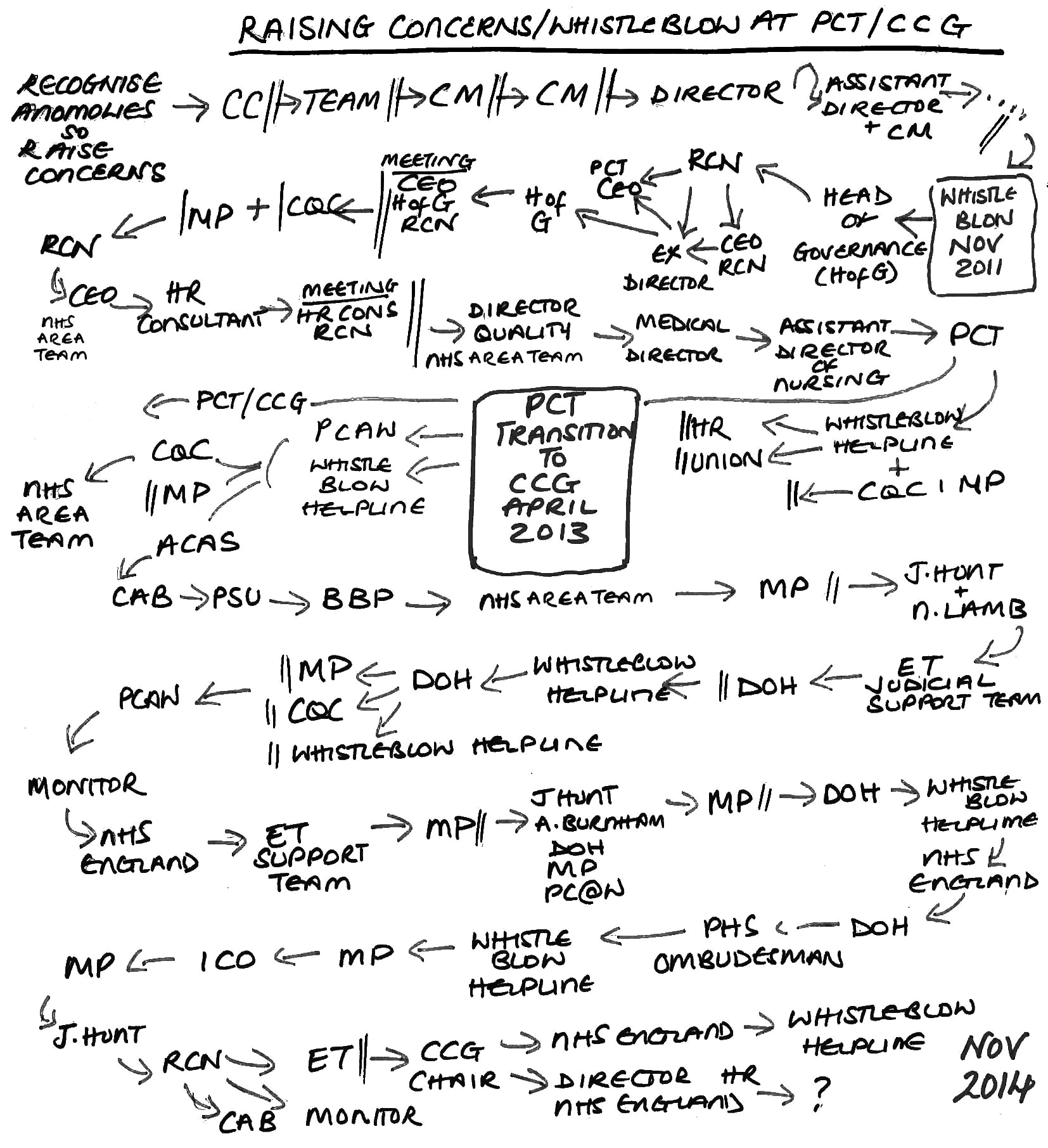
56 Figure 3b Summary of a contributor s experience Chapter 3 Evidence from contributors 55
57 56 Freedom to Speak Up A review of whistleblowing in the NHS The impact on those who were the subject of whistleblowing reports could be as severe, particularly where the allegations made were false or unsubstantiated. false allegations made under the cover of whistleblowing have left myself and a number of my colleagues deeply traumatised. Overarching issues Culture Contributors frequently described a culture of fear, blame, defensiveness and scapegoating when concerns were raised. These perceptions of the culture, real or otherwise, result in some staff refraining from raising concerns. The reality of a whistleblower in this trust is [ ] fear, bullying, ostracisation, marginalisation and psychological and physical harm. People aren t willing to put their necks on the line for fear they ll lose their heads This was reinforced to some extent by our staff surveys, where a worrying number of staff indicated that they had not raised a concern about wrongdoing in the NHS due to a lack of trust in the system or a fear of being victimised (see Figure 3c) Our research suggested that this culture might be driven by an old style target-driven leadership focused on firefighting, that blocked a more engagement-driven, compassionate, and values driven leadership. NHS has a culture of bullying and harassment that means clinicians could not raise issues in clinical care and are pressured to put targets over ethics. If there is such a culture then it is because the majority of managers or clinicians in positions of authority are driving it/managers recruited/ promoted to those positions because of their ability/willingness to push this agenda. Colleagues often quietly agreed with my concerns but refused to speak out in fear of reprisals. Figure 3c Reasons for not raising a concern 100 (% of respondents) Other Fear of victimisation Lack of trust in system Didnt know how Never had a concern Source: Freedom to Speak Up staff survey 20 0 Primary Care NHS Trusts
58 Chapter 3 Evidence from contributors When staff did raise concerns they gave examples of being met with denial and resistance. (There is) a culture of delay, defend and deny. I realised the Trust were not reporting and investigating serious incidents appropriately, or at all, [ ] despite my reminding the various relevant colleagues [ ] there is still minimisation and indecent haste to spin and shut down scandal. It is the suppression of truth by human manipulation that remains the blatant tragedy of what the NHS has now become Some referred to the fear of the consequences after they had spoken up including fear of bullying, harassment and racial discrimination. We heard examples of those fears becoming a reality. Case Study: Bullying after raising a concern A healthcare professional described being promoted to a management role within his team and then alerting the trust to procedures that were not being followed. He described how this resulted in prolonged rants and personal abuse and that some staff were bullied into falsifying records to hide failures to follow local and nationally recognised standards. He was told that the issues he was raising would be damaging to the trust if made public and to get on with his job. Terminology The hostile culture described above was likely to have been reinforced by the negative language often used in reference to speaking up. Contributors described how those who raised a concern, whether internally or externally, were often seen as troublemakers or back stabbers. Some suggested different words should be used such as raising concerns champion. Anyone who blows the whistle is seen as a snitch and is punished At the seminars there was widespread confusion about the meaning of the term whistleblowing and its relationship to a protected disclosure, but there was agreement that the term had negative connotations. It was stressed that people who raise concerns do not always think of themselves as whistleblowers. Some contributors wanted the words whistleblower and whistleblowing changed. If the outcome of your report is to find a way to create a more transparent and caring NHS then from my experience I would suggest that rather than asking for people to Blow the Whistle you should be asking them to Protect their patients Others did not see the value in changing terms. The general consensus at the seminars was to focus on changing the negative perception associated with the term rather than the term itself. He continued to raise his concerns and eventually the trust instigated a review. However, when the report was circulated around his department it was clear, although he was not named, that he had raised the concerns. He was then subjected to the most horrendous bullying by some colleagues. He reported this but no action was taken. He was eventually treated for severe anxiety and off sick for a short while.
59 58 Freedom to Speak Up A review of whistleblowing in the NHS Raising Concerns Policies and procedures Whilst the majority of staff are aware of their local whistleblowing policies and procedures, a significant minority are not. At the seminars there were calls for greater standardisation of policies and procedures across the NHS. Why does each Trust have their own policy rather than a generic approved policy that is clear and user friendly?. Seeking advice about concerns/raising concerns If staff seek advice before raising a concern, our surveys indicated that most go to a work colleague. Trade unions and professional bodies were the next most favoured sources for staff in trusts, whereas in primary care a professional body or friends and family were used. External helplines did not appear to be commonly used. Where staff raise concerns first Whistleblowing policies considered by the Review encouraged raising concerns verbally with the line manager in the first instance and putting concerns in writing beyond that. Our evidence showed that this was what staff tended to do when raising a concern. Raising concerns anonymously There was strong evidence that staff liked to have the option to raise concerns anonymously. However, there are risks that a staff member, especially if they work in a small organisation or department, could be identified. I have raised concerns with the CQC (anonymously), but am now reluctant to do so again. In order to give enough details about a problem for the CQC to investigate, it invariably means that the people in possession of such knowledge may be fairly easy to identify by the hospital managers. This has led to me being threatened and bullied by managers who are fairly sure it must have been me supplying some of the information. The only safe way to raise concerns without fear of reprisals is therefore to give less supporting detail which in turn makes it less easy for the CQC to investigate and easier for the trust to refute or hide. Raising concerns externally The majority of trust staff who raise a concern internally do not appear to then take it outside of their organisation. The reasons for this are not clear but one might assume this is either because it has been dealt with satisfactorily or the person decided not to pursue it further. Our survey indicated that staff in primary care are more likely to take a concern outside Where employees did raise concerns externally, the decision did not appear to have been made rashly. Rather, it was considered when staff had given up hope that the organisation was able or willing to take action. Lack of confidence in the process, worries about potential career impact and dissatisfaction with the outcome of the internal procedures were potential factors behind their decision highlighted by our surveys When concerns were raised externally, trust staff were most likely to refer their concerns to a trade union or professional body, whereas primary care staff appeared to prefer either a professional body or a regulator Staff rarely chose the media for raising concerns. Indeed most told us they preferred to avoid media coverage. Some staff who had been the subject of media coverage considered they were treated unfairly and in a sensationalistic manner.
60 Chapter 3 Evidence from contributors 59 sensationalist media stories have unfairly threatened public confidence in our clinical services. Handling Concerns A significant proportion of staff do not use an employer s formal procedure to raise a concern although the reason for this is not clear. Where whistleblowing policies and procedures were used locally, some staff described poor implementation and indicated that this exacerbated problems with handling concerns. Retaliatory Action We heard that whistleblowers could be subjected to performance management or referral to their professional regulator rather than an investigation of their concerns. (there is a) culture of putting blame back on the person raising serious concerns. Training Strong views were expressed at seminars that training in raising or handling concerns was inadequate. Logging concerns Some employees suggested that managers who receive concerns should make a written record that the concern has been raised and share this with the person who raised it. This was thought to be necessary to prevent cover-ups and denials later down the line. It also appeared that staff wanted concerns to be logged to ensure that they were addressed and did not get forgotten. Support after raising a concern Our evidence strongly indicated that whistleblowers were not offered any meaningful support by their employer. People felt a sense of isolation once they had raised a concern, particularly if they were moved away from their usual place of work or given special leave. They told us that they had no clearly designated member of staff they could talk to or who would take responsibility for implementing change as a result of their concern. I proposed a review of the model. This was dismissed and I began to be excluded and isolated. I remained off sick, upset, and confused about what to do next Some saw benefit in a champion style role, someone they could go to with concerns and who could support them if they pursued their concerns. I also think that a system could be put in place for all trusts to engage a staff member as an Ambassador for Cultural Change. They could be the first point of contact for staff who wish to whistleblow safely Whilst it may be good practice to offer support at the point at which a concern is raised, some staff may not be aware that they want or need support until the process is underway. It was suggested that support needed to be proactively offered and kept under review There were some concerns about a power balance too strongly in favour of the trust, particularly in terms of finances and legal support. David vs Goliath fight for justice NHS organisations appoint highly paid lawyers to undermine the Public Interest Disclosure Act and I had to fund my legal fees.
61 60 Freedom to Speak Up A review of whistleblowing in the NHS Investigation process Cases could be long running and remain unresolved for months and even years. Delays in the process for handling and investigating concerns had a huge impact on individuals, particularly if they were suspended or on special or sick leave. This included an increased sense of isolation, stress and in some cases mental health issues. Delays also reduced the possibility of establishing the facts of the case. The investigation took far too long staff had left and memories fade. Mediation The organisation should have an internal mediation mechanism to attempt to resolve the issues. Not all concerns are well-founded. Not all concerns are capable of being resolved with given resources. Nevertheless no concern that indicates genuine patient risk should be allowed to go unresolved Mediation and other forms of dispute resolution had played a part in successful outcomes for some staff. One contributor told us about a number of issues that had been satisfactorily resolved through informal local mediation. However some contributors told us how statements from mediation or without prejudice meetings were used as a means of justifying disciplinary proceedings. to avoid feeding back on outcomes of investigations and resulting actions. This was linked to a more general view that there was a lack of transparency and openness about both the process of investigating concerns and the outcomes. As my concern related to personal performance it was not possible to share how the issue was being taken forward. How can staff be assured that this confidential process is indeed happening? A mechanism for feeding back to staff that raise concerns would be useful, indicating how they are going to investigate the complaint and giving some kind of timescale for resolution Some staff did highlight that their organisations were making attempts to feedback more widely about concerns that had been received and action taken as a result. Case Study: Value of responding to feedback A trust employee said she thought her trust was good at listening to and resolving concerns. She explained that they ran a you said, we did campaign, which told staff what had happened as a result of the issues they had raised. This encouraged people to speak up and to feel that raising concerns was worthwhile. This public declaration of action that had been taken was seen as a positive development. Feedback after raising concerns Our surveys suggested that the majority of staff are told the outcome of any investigation into a concern they have raised but a significant minority are not. Some staff described how they had received either an inadequate response or no response at all to the concerns they had raised. Some indicated that organisations hid behind confidentiality as a means
62 Chapter 3 Evidence from contributors 61 Detriment after raising concerns Whistleblowers are victimised and persecuted and find themselves being accused with false counter allegations, despite in most cases a lack of evidence of any wrong doing Although the majority of trust staff responding to our survey did not report being victimised by management or colleagues after raising a concern, 1050 had experienced victimisation of some sort. This is too many. The survey also indicates that staff are more likely to be victimised or ignored by management after raising a concern than they are to be praised. Co-workers by contrast are more supportive. Case Study: A response to raising a concern in a trust A nurse gave an example of raising concerns about the safety of patients and clinical care at a team meeting. She was called to an office and shouted at by two managers until reduced to tears. She then described being criticised at every opportunity thereafter. She also noted that her appraisal was all criticism, no support and her mental health was questioned. To her knowledge, none of the concerns she had raised were looked into and there was no feedback. She did not feel able to share details of the case elsewhere fearing a harmful effect on her career. Figure 3d Reaction of management and co-workers to raising a concern Source: Freedom to Speak Up staff survey We heard of similar experiences in primary care settings. Case Study: A response to raising concerns in primary care (% of respondents) A practice nurse described several incidences of raising concerns and being ignored by managers and made to feel a trouble maker. She described how she was then bullied to the extent she became unwell and had to take months off work to recover. Even now she suffers from anxiety. She is now out of work and cannot find even a locum position. She believes she has been blacklisted. Her impression is that it does not pay to try to be a good nurse: you should just do what is asked without question. 0 Ignored Victimised Praised By management By co-workers The role of managers in handling concerns There was much criticism of managers at different levels of the NHS structure, but particularly the way middle management handles concerns. Amongst our contributors, staff rarely, if at all, seemed to believe that management dealt with or were able to deal with a disclosure in an
63 62 Freedom to Speak Up A review of whistleblowing in the NHS effective way. There were suggestions of: closing ranks ; collusion to protect NHS upper ranks ; deliberate manipulation by management; top management wrongly briefed; investigations turned against whistleblowers who were then scrutinised and subjected to disciplinary procedures; managers not taking responsibility for their actions; and, no sanctions for misuse of power. You are naïve to think this is about justice or patient safety [ ] [management] will take the easiest route to resolve a difficult situation and they see you as a troublemaker. Rather than engaging meaningfully with me to explore my concerns and consider possible remedial actions or modifications to the system, there seemed to be a rigid defensive position that precluded any potential for change and denied any problem with the system The overarching sense is that negative experiences have led to a distrust of managers, in addition to a more general mistrust of processes and concern that treatment of whistleblowers is biased and prejudicial. Few employees defended managers although a small number were positive about them. I have had a good experience as I report to the Director who is forward thinking, allows free thinking and encourages everyone s views and opinion. Confidentiality clauses There appeared to be some confusion amongst employees about the impact of confidentiality clauses in settlement agreements. A number of contributors had felt pressurised by their employer to sign agreements containing such clauses and a small number indicated that there had been a threat of repercussions if they did not. There appears a clear strategy of closing ranks and putting the whistleblower under sometimes enormous pressure to leave or accept a compromise agreement At the seminars there was an impression that confidentiality clauses prevent discussion, even of matters in the public interest, because of a belief that the employer might seek damages or the return of monies from a settlement. There was also confusion about when and to what the clauses applied. Human Resources (HR), unions and universities HR staff were criticised by some employees who shared their personal stories with us. There were concerns that HR did not provide sufficient support to individuals, tended to believe managers or were not adequately trained to deal with complex concerns. [There] is a danger that HR can just believe what the manager tells them, or believe what the employee tells them. And actually, they have a role in bringing objectivity, and asking some of the why questions. Why has this person raised this concern? Why hasn t it been able to be dealt with by the manager? Why isn t the individual satisfied with the response? Why does the manager think that response is acceptable? Asking the why questions in a very independent, objective way and almost acting as mediator or translator, sometimes, between the employee and the manager There has been unwillingness by HR to address the issues or give clear messages to the perpetrator that the behaviours were unacceptable. I feel that they just wanted to rid themselves of a problem rather than address it and the complainant becomes the problem.
64 Chapter 3 Evidence from contributors Unions received some criticism. There was an impression that unions were more likely to be on the side of management and the outcome of whistleblowing cases were too uncertain for unions to take on. It was also suggested that unions are more comfortable focusing on pay, conditions and jobs rather than patient safety concerns and preferred to support easy exit routes rather than challenge organisations about the concerns the employee had raised. By the time they get up to a senior person in the union, the whistleblowers are way, way down the line here, and their concern has been changed into an employment dispute However, employees were not universally disparaging of unions. I had support from a [union] officer during the disciplinary and grievance and that was very helpful There was some criticism of universities too, particularly in relation to student nurses. There were concerns that universities tend to take the side of the mentor rather than the student, that their processes are biased against the student and that they are not best equipped to consider fitness to practise cases. Resolving Concerns Moving on Lack of accountability of managers and leaders appeared to impact on some individuals personal resolution and ability to move on emotionally. This was especially the case when managers and leaders remained in post or went on to be promoted. A sense of injustice was apparent. Getting back to work Where a case had become difficult after the raising of a concern, staff were often not rehabilitated in the working environment, rarely redeployed within the organisation and sometimes dismissed. In some cases, staff decided to retire or, if they could get alternative employment, resign. There were some accusations of blacklisting within the NHS and examples of staff whose interviews or job offers had been withdrawn, often at very short notice. very few continue to work in their field of expertise and even fewer manage to secure permanent posts. This is because of existence of blacklisting within the NHS. There is of course in addition gradual loss of skills once being unemployed. For many, the only option is to leave the country and look for work in other parts of the world. Views of organisations that represent whistleblowers Organisations that support and represent whistleblowers reinforced and expanded on the issues identified above. Problems they highlighted included: a culture of fear victimisation after speaking up, for example intimidation and bullying and retaliatory referrals to professional bodies detriment after speaking up, for example professional, personal and financial well-being and, emotional and psychological detriment confusion over the definition of whistleblowing leading to misunderstandings about when a matter is whistleblowing, when the process starts and if an individual is protected concerns lost or contained in middle management employers focused on the employment aspect rather than the patient safety issue lack of confidence in the investigation process. For example: restricting access to relevant documentation, tampering with evidence and
65 64 Freedom to Speak Up A review of whistleblowing in the NHS fabricating allegations, conflicts of interest of investigators, editing reports ahead of publication or blocking their disclosure lack of feedback to those who have raised concern giving the perception that nothing is done and/or matters go unresolved absence of a level playing field between employers and whistleblowers in terms of access to finance and/or legal advice staff let down or unsupported by the relevant union HR departments not supporting whistleblowers or preventing detriment to them loss to the NHS of highly skilled and experienced staff due to ill health, suspension or termination of employment after raising a concern informal blacklisting of staff individuals and employers not held accountable for bullying behaviour or making unfair or unfounded allegations against whistleblowers a general lack of leadership In addition these organisations noted the following issues: there should be a zero tolerance of bullying model whistleblowing policies can have unhelpful and regressive modifications there is a lack of understanding by employers of the legislation the legislation is not working as intended; it fails to protect those who make protected disclosures about patient safety concerns as it is retrospective professional regulators seem to struggle to hold clinical managers to account when they ignore or cause detriment to whistleblowers there have been positive changes in the experience of individuals where concerns have been raised with some regulators, specifically the CQC there should be regulation of managers there is little or no evidence of a favourable sea change there is an over optimistic view of progress. 3.3 Employees from a black and minority ethnic (BME) background Introduction Much evidence relating to the experiences of BME staff in the NHS, such as the Royal College of Nursing (RCN) employee survey in and the Snowy White Peaks report 58, is not directly related to raising concerns. However, there was anecdotal evidence, including at a workshop I held with doctors from a BME background, that BME staff can feel particularly vulnerable if they raise a concern. It was suggested that they were disproportionately likely to suffer victimisation as a result. In particular we heard that BME doctors are: more likely to be referred to the GMC than non-bme doctors likely to receive more severe sanctions than non-bme doctors. My main area of concern is that the ethnic minority (BME) and the foreign trained NHS staff [ ] experience disproportionate detriment in response to speaking up against poor standards of care in the NHS In view of these concerns our survey data was analysed to highlight any key differences between the responses from staff from a BME background compared to those from a white background (including non-british white staff). The survey findings that inform this section of the report are at Annex Dii. BME staff in trusts Around 10% of staff who responded to our trust survey were from a BME background. This excludes those reporting themselves as white non- British. The largest BME group reported being from an Asian or Asian British background, making up almost 5% of total respondents and about half of BME respondents. 57 RCN Employment Survey 2013, Royal College of Nursing, September The snowy white peaks of the NHS: a survey of discrimination in governance and leadership and the potential impact on patient care in London and England, Roger Kline, 2014
66 Chapter 3 Evidence from contributors 65 Reasons for not raising concerns A higher proportion of BME respondents reported fear of victimisation as a reason for not raising a concern than those from a white background. Figure 3e Reasons for not raising a concern Source: Freedom to Speak Up staff survey A similar proportion of BME staff and staff from a white background first raise their concerns informally with their line manager. However, BME staff are more likely to have reported concerns about harassment and bullying than staff from a white background and appear to be less satisfied with the response to their concerns. Case study: The perspective of a BME member of staff (% of respondents) White BME A non-clinical member of staff from a BME background raised concerns about the approach taken by a senior director in awarding business to external contractors. After raising the concerns, a new manager was bought in to oversee this contributor s work and began to undermine them and closely monitor what were described as performance issues. The contributor hadn t previously experienced any problems at work and felt that they were being singled out for speaking up. They were treated differently to other members of staff. For example, the new manager was unwilling to make any concessions to allow them to observe important cultural customs. They felt they were being treated less favourably than their non-bme colleagues. Other Fear of victimisation Lack of trust in system Didnt know how Never had a concern After raising a concern, BME staff were: more likely to report being victimised or ignored by management than staff from a white background slightly more likely to report being victimised by co-workers than staff from a white background less likely to report being praised by management than staff from a white background.
67 66 Freedom to Speak Up A review of whistleblowing in the NHS Figure 3f Reaction of management and co-workers to BME staff raising a concern Source: Freedom to Speak Up staff survey In addition, after supporting a colleague who had raised a concern, BME staff were: more likely to report having suffered detriment than staff from a white background more likely to report having been victimised by management compared to staff from a white background more likely to report having been victimised by co-workers compared to staff from a white background. (% of respondents) BME staff reported being less likely to raise a concern again if they suspected wrongdoing than staff from a white background. BME staff in primary care 5 0 Victimised by Ignored by Victimised by Praised by management management co-workers management White background BME background A similar survey of staff in primary care (GP practices and community pharmacies) was carried out. About 24% of primary care staff who responded were from a BME background. This excludes those reporting themselves as white non-british. As for the trust survey, the largest BME group was from an Asian or Asian British background, making up about 16% of the total respondents and about two thirds of the BME respondents. The vast majority of respondents (almost 95%) worked in pharmacy. I ve seen, and I know my colleagues have seen, a large pattern of South Asian origin doctor whistleblowers, because I think there s a different culture. There isn t that collegiate med school, we re all in this together, rugby team mentality that might exist a little bit more with UK educated doctors, although I may be showing my own prejudice here. Asian doctors South Asian doctors in particular can find themselves ostracised very quickly. Differences between responses from BME staff in trusts and primary care The messages from BME staff in primary care were broadly in line with those from BME staff in trusts. However, trust staff from a BME background were considerably less satisfied with the response to their concern than staff from a white background whereas BME staff in primary care were broadly as satisfied as staff from a white background. The reason for this is not clear from the survey response.
68 Chapter 3 Evidence from contributors 67 Suggestions to improve the process and outcome of raising concerns for BME staff Suggestions from BME staff to improve raising and handling concerns were in line with suggestions from other contributors such as: culture change clarification of the process a named contact in each organisation to act on concerns raised stronger leadership better accountability more transparency One BME specific suggestion was that CQC should consider as part of their inspection process issues such as: how many BME doctors are undergoing a disciplinary process how many BME doctors have excellence awards the outcome of incidents amongst BME patients alongside the outcome of concerns raised by BME staff. 3.4 Employers Introduction Employers and their representatives (referred to as employers in this chapter) highlighted examples of good practice to learn and build from in terms of raising and handling concerns and suggested the focus be on drawing attention to such examples and encouraging their spread across the NHS. They accepted that there was room to bring all up to the standard of the best. They favoured practical, rather than legal or regulatory, solutions. Overarching issues Culture Evidence from the qualitative research indicated that employers fall into two groups when handling concerns: those who might be described as gatekeepers, who seek to maintain and emphasise the formal boundaries of what the law recognises as a protected disclosure resulting in a somewhat inflexible approach to what can be covered and how it can be addressed those who adopt a more flexible open-minded approach, experimenting with less rigid procedures aimed at increasing communication and engagement throughout the organisation. Leadership in the NHS is about receiving feedback day-in, day-out with a view to improve. It s the way we need to be, and many are Employers recognised that a move from a blame culture to an open, transparent and learning culture was important and necessary and that culture starts at the top of an organisation. However, they noted that there could be very different cultures in different parts of an organisation. They agreed that raising concerns should be a normal part of the job for anyone working in the NHS.
69 68 Freedom to Speak Up A review of whistleblowing in the NHS There is a unanimous view from employers that they want their staff to raise concerns, be curious, ask questions and shout up if they think patient safety is being compromised Employers recognise that there are a number of barriers that can still influence behaviour and prevent people speaking up such as: fear of being viewed as a troublemaker; fear of reprisals from colleagues and peers; and a lack of confidence that their employer will take their concern seriously. We heard how some trusts were taking action to address this. Case study: Local action to change culture A trust told us how they had used emerging themes from the Savile investigation, recommendations from the Francis Inquiry, staff survey results and routine monitoring to review and revise their approach to raising concerns. They established a programme of work to listen to staff and evaluate existing arrangements and, in partnership with Public Concern at Work, developed a new policy, framework and approach to reflect good practice. They plan to keep this under review There was also some concern that the Department of Health and regulators drive the NHS to focus on targets, performance and staffing levels rather than supporting staff and driving the right culture. Employers are under huge financial strain and there are currently flash points between managers who are incentivised and frontline staff whose priority is quality concerns. This needs to change Employers did highlight examples of promising cultural change, although this was still in development. Some positive changes appeared to have been triggered by the CQC s new approach to inspection. Role of Regulators Some employers were concerned about fragmentation of the regulatory system and that system regulators duplicated information requests and were not clear about what constituted good practice in terms of volume and handling of staff concerns. The regulatory world has gone mad, tripping over themselves asking for the same information Employers emphasised that culture change is not easy or quick to achieve, particularly in the NHS. There were references to the constant restructuring of the NHS and a strong message that it can be hard to embed culture change in an ever changing system. Everyone needs to stop restructuring the NHS we never actually see anything through [ ] before you ve actually embedded it, someone else has come along, there s been a new political party, and we re constantly restructuring. Raising Concerns Encouraging concerns A number of employers have introduced campaigns similar to the Stop the Line initiative at the Virginia Mason Hospital in Seattle to encourage staff to raise concerns. This is described in more detail in Anonymous concerns Employers had mixed views on receiving anonymous concerns. Some said it was better that concerns were reported anonymously than not at all whilst others were concerned that it sent the wrong message to staff, that is to say that it was unsafe
70 Chapter 3 Evidence from contributors 69 to raise a concern. Some noted that anonymous concerns could allow them to consider if there was any substance in a claim without it being overshadowed by personality and integrity issues. Raising concerns externally Employers noted that concerns that had been raised externally to the organisation could bring benefits, such as stimulating a rethink of internal processes. They were, however, concerned about the use of the media to raise concerns. Many policies we considered expressly discouraged disclosures to the media. Employers stressed that inaccurate and/or disproportionate media reporting could be damaging to both the organisation and individuals involved. Issues could be misrepresented and they were not always able to give a full account in public to correct misunderstandings. Nothing contributed by employees suggested that this view was unjustified. It angers me when serious allegations are made which, in my view, are false and which the Trust cannot publicly answer other than in the most general terms. Training Some of the whistleblowing policies analysed for the Review contained no reference at all to training and some explicitly stating that no training was needed. Nevertheless we were told about initiatives which illustrate that a range of local training programmes are available. Case study: Learning from local experience A trust told us that after a high profile case some years ago they reviewed their policy on whistleblowing. The term whistleblowing is now avoided; instead staff are asked to Be curious and If in doubt, speak out. Induction and training focuses on what the trust expects its staff to do, and how they will be supported. Anyone with a management role is trained on how to promote an engaging culture to support raising concerns. They have used conversations about the difficult case as a lever for discussions. Handling Concerns Complexity of Concerns Employers felt that staff generally raised concerns out of a professional ethos. However there was concern about inappropriate use of whistleblowing by some employees, for example, to deflect away from performance issues. We must be able to separate out stories of aggrieved self-declared whistleblowers from the genuine cases more effectively Employers stressed that cases were often complex where grievances, performance issues and whistleblowing were inter-linked. The responsibility of the NHS to protect whistleblowers needed to be balanced with the need to hold people to account who are not performing adequately. Use of processes and procedures Employers indicated that whistleblowing procedures were often not used or were sidestepped by employees with concerns being raised externally, for example, with CQC. Feedback Employers were starting to realise that feedback practices were poorly established and that responding to concerns not only entailed considering appropriate action but also giving the person who raised the concern feedback. How managers handle concerns Employers acknowledged the concerns raised by employees in 3.2 about poor handling of concerns by middle management. However, they stressed the pressure managers were under. For
71 70 Freedom to Speak Up A review of whistleblowing in the NHS example, they were under pressure from staff for them to resolve issues quickly and pressure from leaders to deliver targets within budgets. They are squeezed from both sides. This might result in concerns being suppressed rather than escalated to senior management. Bullying and victimisation Employers were concerned about a false perception that raising concerns always resulted in being victimised. Some were adamant that this was not the case and this perception was damaging to patient care deterring staff from raising concerns. The use of language is really important in building trust and confidence [ ] it is not helpful to frequently hear messages which say when staff raise concerns their careers are over or they get sacked Most whistleblowing policies we analysed included a statement that those who raised a concern would not suffer detriment. They often stated that reprisals would not be tolerated, although about half made no mention of sanctions for reprisals. Employers agreed that staff should be protected from bullying and victimisation as a result of raising concerns. Whilst there is an indication that some trusts might have mechanisms to support this aspiration, evidence presented to the Review failed to provide comfort that those responsible for victimisation, even if numbers are small, are held to account (see 7.5). all, although there was scepticism about whether everyone would accept such a decision It was noted that providing a whistleblower with a response to their concern did not guarantee closure for that person and they might still raise their concern elsewhere. Suggestions to help achieve closure included: giving the person who raised the concern a well-considered response; involving them in finding and implementing solutions; and making the response to a concern visible to all within the organisation. Accountability Employers acknowledged the desire from employees for accountability (see 3.2) but highlighted the need to distinguish between culpability and responsibility. It was noted that a culture of blame and someone should be sacked was not always helpful. Some whistleblowers may want instant retribution but that that was not always within the power of the organisation to deliver. Resolving Concerns Closure Employers were concerned that a small percentage of staff are, for whatever reason, chronically embittered and would always be dissatisfied. Vexatious cases were highlighted as ones that could cause difficulties for organisations trying to improve culture. Some employers stressed that there needed to be an end point for cases, a means to reach a binding decision, respected by
72 Chapter 3 Evidence from contributors Professional bodies (including Royal Colleges) Introduction The Review received written contributions from 11 Royal Colleges, including their umbrella organisation, and 5 clinical professional bodies. A number of these organisations also took part in our meetings and seminars There was a sense that staff raise concerns on a daily basis with their colleagues and managers and that these are resolved satisfactorily leading to better and safer care. It is when the process does not work and speaking up is discouraged that problems arise. There is a need for uniformity, consistency and fairness. The problems around raising concerns have been debated enough and the focus now needs to be on action. Processes are already in place for identifying, investigating and escalating concerns but they are not working well in practice. There is variability in how staff are treated after making a disclosure and whether the disclosure was acted on appropriately. Overall, concerns raised by staff should be given equal importance and respect to patient complaints. Overarching issues Culture As with other groups of contributors, culture and the need for culture change was commonly referred to. Whether procedures and policies on speaking up were effective or not depended on the local culture. Processes would never be fully effective while the focus was on blaming rather than learning. A culture of openness and transparency was a prerequisite for the delivery of safe, high quality care. This was most likely in organisations that valued fairness, honesty, communication and trust. Speaking up was more likely by people in organisations perceived to be responsive to complaints and concerns Culture change is a challenge, particularly in large organisations. Commitment at board, senior management and senior clinical level is necessary to facilitate such change as is good leadership and a more open and supportive attitude by senior management. Culture can be dependent on external influences such as financial and performance demands placed on trusts. Possible conflict between meeting government targets and addressing staff concerns was given as an example. Ultimately, there needs to be a change in culture across the NHS which must start at the top. Significant pressure for positive results and good news stories from politicians and senior management often results in efforts to hide problems for fear of reprisals The general view was that raising and addressing concerns needs to become normal practice. The NHS must normalise conversations about performance issues so that emerging quality and performance issues are routinely discussed before they become concerns. There needs to be a shared belief that raising concerns is positive, not a troublesome activity and that no detriment would occur. Bullying References to bullying were less common from this group although it was noted that a bullying culture is still perceived to be a problem and there should be no tolerance of bullying or undermining of staff. Some professional bodies are working together to address bullying. For example, the Royal College of Obstetricians and Gynaecologists (RCOG) is collaborating with the Royal College of Midwives (RCM) on a programme to address bullying and undermining in maternity services.
73 72 Freedom to Speak Up A review of whistleblowing in the NHS Raising Concerns The role of professional bodies A number of these bodies produce guidance for their members on how to raise concerns at work (see 2.6) and some have initiatives in this area The Royal Colleges can become aware of concerns through a range of formal and informal routes including surveys, invited service reviews and direct contact from members. Some were proactive in this area such as piloting regional conversations to offer members and fellows a safe space to raise concerns or recruiting Workplace Behaviour Champions for trainees who need independent advice about unacceptable behaviour they are experiencing A number of the Royal Colleges stressed that their role was to signpost individuals with concerns to the appropriate source of advice and support rather than act as investigators. Some were reluctant to play an increased role seeing this as the role of regulators, unions and educational bodies. Students and trainees Professional bodies stressed that healthcare students and trainees can provide important insights, bringing a fresh pair of eyes combined with experience gained through placements in multiple settings. They could be well placed to recognise instances of sub-standard care. Students, through their comprehensive exposure to different healthcare environments during training, have a particular capacity to identify problems within the health service, and to develop solutions They noted, however, that students and trainees can feel intimidated by the hierarchy within a hospital and fear the consequences of speaking up thus making them reluctant to raise concerns. Deterrents to Raising Concerns Professional bodies highlighted a range of deterrents to raising concerns which were generally in line with those we heard from other groups. In addition, the Association of Surgeons in Training (ASiT) submitted the results of a survey 59 of surgical trainees to assess their experience in raising concerns about patient safety. The majority had had concerns over patient safety yet a significant number had not felt able to raise these concerns due to perceived barriers and a lack of confidence in the process. Problems highlighted included: fear of personal vilification or reprisal; fear of impact on career; lack of confidence in the process; hierarchy of the surgical profession; and no response/ feedback or dissatisfied with response/investigation. When doctors feel that they will not be penalised for speaking up and that their actions will have a tangible impact then the NHS will benefit. Awareness of process and procedure The need for a common understanding of how concerns should and should not be raised supported by clear procedures was highlighted. Clear processes and guidance were a common suggestion for improvement Some of this group thought processes were in place but not working well in practice, whilst others stated there was no clear system to enable the reporting and raising of concerns. 59 Undermining and Bullying in Surgical Training, The Association of Surgeons in Training, May 2013
74 Chapter 3 Evidence from contributors 73 Raising concerns anonymously Staff having the opportunity to report incidents and concerns anonymously was supported. Seeking advice about concerns/raising concerns Initiatives and approaches that enable and sustain staff engagement were supported including processes to access the chief executive officer (CEO), medical director and trust non-executives such as at open meetings. Some contributors were attracted to the idea of a local champion-type role. Some saw value in a board lead to oversee internal processes for raising concerns, ensure staff feel empowered to raise concerns, and to ensure lessons from concerns are shared across the organisation. Handling Concerns Tackling concerns early Professional bodies considered it was best to ensure problems did not arise in the first place rather than solely devise new arrangements for dealing with cases after the event. We believe that a situation in which a person working in the NHS feels their only option is to become a whistleblower demonstrates a failure on the part of the organisation to put effective reporting and investigation systems in place, and to manage this by providing adequate support to their staff to follow the steps in these processes Open discussion and seeking joint resolution were considered the ideal but required a strongly supportive, non-threatening, management structure. Complexity Individual healthcare workers raise concerns for a wide variety of reasons. There is little reason to suppose that most are not genuine and represent a valid and justified exercise of the individual s professional duty to protect patients but sometimes reasons were questionable. There are occasions on which the mantle of whistle-blower can be adopted for reasons which are not completely honourable Some whistleblowing cases could be complex. Dissatisfaction with the escalation or investigation process could become conflated with the original concern about patient safety turning into a costly and time consuming debate about people and process, rather than patients and their safety. Simplifying HR frameworks within which individual medical performance are managed was suggested. Cases are often not straightforward and can involve complex and long-standing professional and interpersonal difficulties between clinical colleagues. Cases can become a morass of claim and counter-claim with a toxic mixture of grievance and disciplinary activity where positions become quickly entrenched. Even if there is desire to resolve the issue, in many cases organisations may not have the expertise to do so. Detriment after Raising Concerns Staff can be disadvantaged after raising concerns, for example, being told not to apply for promotion opportunities despite being qualified for them, themselves being accused of bullying and harassment, being suspended from work and having to defend themselves with little or no protection from their employer. Whistleblowing can also bring serious negative consequences for the individual including impact on mental health. Positively, however, the majority of surgical trainees who had raised concerns about patient safety responding to the ASiT survey (see ) stated that this did not affect their career although a small number reported a negative experience ranging from feeling professionally isolated to having to move job or location.
75 74 Freedom to Speak Up A review of whistleblowing in the NHS The overall view was that there was still a way to go for staff to be treated fairly, with respect and in a way that protects them from being disadvantaged in their career after raising a concern. Training There may be a lack of expertise within organisations to resolve issues. Training and support for managers to understand their roles and responsibilities in the handling of, and responding to, concerns would be helpful. Senior clinicians can perceive criticism as a threat rather than an opportunity to improve ways of working and learning and become defensive. This could also be an area to cover in training Investment in high quality, joint training and leadership programmes for clinicians and managers to empower them to work in collaboration to respond in a timely, transparent and proportionate way to problems or concerns was needed. Other suggestions included: emphasising raising of concerns as a key principle of medical professionalism through education; embedding raising concerns within the annual appraisal and revalidation processes; and, training and guidance for HR departments in how to deal with staff who raise concerns as their support was variable. Investigation Objectivity and a full understanding of the facts of a situation and its background are key. Individuals close to a situation may form a particular view and any external assessment must take this into account. The truth can be elusive even with a fair, rigorous and comprehensive investigation of concerns Suggestions to improve the current process included: increasing clinical input into the assessment stage of a concern; having a pool of trained internal investigators; use of independent mediation; and only suspending whistleblowers where there is evidence to show patient safety is endangered by not doing so. It was also noted that teams needed to support each other through difficulties and respond to problems in a timely and constructive way A number of the Royal Colleges referred to the Invited Review Mechanism they offer. These reviews are requested by organisations rather than individuals and generally relate to the performance of a particular unit or department. The resulting recommendations go to the trust management although issues of serious concern can be referred to the professional or system regulator. Feedback Feedback to staff after raising a concern was important. Management need to trust and respect clinicians and invest time in explaining decisions. Support Staff need practical or emotional support to navigate the steps in the process of raising concerns. The well-being of staff, both individually and as teams, needs to be considered. Partnership working between employers, trade unions and professional bodies should be promoted. Managers Managers need to strike a balance between providing a safe and excellent service to patients and working within tight budgets with financial cuts. The rapid turnover of managers can lead to the same problems recurring and staff not wanting to raise the same issues again and again. There was some suggestion that regulation of managers might be useful. The rapid turnover of managers in the NHS also works against investment, of both time and money, in long-term solutions A number of professional bodies who wrote in to us signed an open letter to the Health Service Journal in December 2014 calling for a change in attitudes towards NHS managers.
76 Chapter 3 Evidence from contributors 75 In our experience, NHS managers are as dedicated to the service as any other group of staff. We find it regrettable, therefore, that they are so often the subject of ill-judged criticism and made scapegoats when concerns arise. This is both unfair and damaging to the interests of patients since successful joint working between managerial and clinical staff is an essential ingredient of good care. Better data collection and analysis This group was the most likely to refer to the need for better data collection, analysis and understanding to detect potential problems at an early stage and identify themes and trends that need to be addressed. The need to triangulate with other relevant information such as patient complaints and clinical outcomes data was noted as was the need to audit whether tangible action takes place. The need for regulators to actively seek information about staff concerns and culture was also raised Whilst the reporting of incidents and concerns had become easier and staff in many trusts are encouraged to report critical incidents and possible risks, it seemed that this was variable across organisations. It was suggested that more effective reporting systems were needed. Resolving Concerns Closure There can come a point in some cases where the individual becomes fixated on what has happened to them and may need personal support to move on emotionally. In such a situation there may need to be stronger action to encourage them to move on when all concerns have been investigated and exhausted to prevent both psychological damage to the individual and demoralisation of the wider team. 3.6 Regulators Introduction Eighteen system and professional regulators were sent a survey to find out about their role in advising on, and handling, staff concerns. The survey results are published at www. freedomtospeakup.org.uk and summarised at Annex Diii. There was sufficient information to make tentative observations but not to distinguish between responses from professional and system regulators. A number of system and professional regulators also wrote in to the review and/or attended our seminars to share their views. Some focused on the action they had, or were taking, to improve their own processes and guidance. Others offered views and evidence to inform further thinking. Overarching issues Culture In line with a range of other contributors, professional regulators referred to issues related to culture including fear of being bullied or referred to professional regulators after raising concerns and factors such as divided loyalties and the bystander effect that can be a deterrent to speaking up. System regulators also noted that negative connotations associated with the term whistleblowing could act as a barrier to speaking up. One regulator noted that it gave a commitment that reports are used for local and national learning only and not for punitive actions so that healthcare professionals had no fear of repercussions from using their reporting systems As other contributors had done, regulators noted that some cases are complex with whistleblowing and human resource issues intertwined Some professional regulators stressed that patient safety depends upon a learning culture where errors and near misses are openly discussed and learnt from. However, absence of a blame culture may not be sufficient to encourage staff to
77 76 Freedom to Speak Up A review of whistleblowing in the NHS be open about mistakes. Any attempt to change culture without a better understanding of the human and organisational behaviour factors that underpin it risks continued failure. Consistent approach among regulators A common understanding about what good looks like in terms of raising and handling concerns is needed so that regulators are consistent in their judgement about organisations on this issue. Partnership working The broader agenda related to raising concerns required partnership working by national and local organisations. One regulator stressed that all parts of the healthcare system (employers, professional bodies, unions, educators, commissioners, regulators, insurers and the legal system) needed to promote a common expectation that everyone who works in the system must: speak up without delay encourage and support a culture where anyone can raise concerns openly and safely listen to, respond appropriately to, and learn from any patient safety concerns hold to account anyone who mistreats someone because they have raised concern be held to account, by employer and regulator, if they fail to do any of this or mistreat someone because they have raised a concern. Raising Concerns Our survey of regulators indicated that the majority allowed concerns to be reported anonymously. The majority also sought to ensure the confidentiality of a named person raising a concern although most noted that this might not be possible in all circumstances Some professional regulators stressed that registrants have an individual ethical responsibility to raise concerns. However, managers and team leaders should encourage and support a culture where staff can raise concerns openly and without fear of reprisal. They noted that experiences of registrants raising concerns in the workplace were mixed, with some reporting poor experiences. Raising concerns to a professional regulator was seen as a last resort System regulators appeared to place great value on information from staff acknowledging that every concern provides them with vital information to help understand quality of care. It is absolutely priceless to have the whistleblowing information in terms of being able to target your time and energy. And also when we get whistleblowers it does say a thing about the trust and why these people are sharing information with us and they can t share with the trust. So, it is always important and useful to hear specifically from whistleblowers Staff sometimes approach a regulator in an attempt to relieve themselves of the burden of the concern. Regulators do not have the remit to resolve individual cases but sometimes staff feel that they have no one else to turn to. A regulator is not always the best body to help and this can leave its staff feeling relatively helpless as well as leaving the person raising the concern frustrated. There could be an impact on both the whistleblower and on the staff of the regulator dealing with them. Some come to us because they re dissatisfied with the response they ve had from the Trust. Some come to us because they don t have faith in their managers to address it robustly, and some come because they can raise concerns with us anonymously, and they feel more secure in doing that Professional regulators noted that staff need to know how to report, what to report, or when to report. They need tools to challenge and raise concerns so that they did not progress to the extent that individuals felt compelled to blow the whistle.
78 Chapter 3 Evidence from contributors 77 Handling concerns People should initially report concerns about suspected wrongdoing to their employer. One system regulator cautioned against any changes that might undermine the existing responsibility of providers in this area Professional regulators noted that whistleblowers should be supported and encouraged to be part of a solution, and not penalised or discriminated against. The need for collective reflection was also highlighted One system regulator noted that some concerns cannot be corroborated and suggested that the Review needed to strike a balance between encouraging an open reporting culture while ensuring that public money and time is appropriately spent. Another highlighted the need for coordination between regulatory bodies where the focus of concerns raised is difficult to identify The majority of regulators stated that they kept the person reporting the concern informed of progress of any investigation and some also noted that they publish the number of concerns raised with them, the number of investigations conducted as a result of concerns being raised and the outcome of investigations. Resolving concerns Regulators agreed with the view of employers (see 3.4) that giving a whistleblower a response to their concern did not guarantee closure for that person. 3.7 Trade unions Introduction A number of trade unions wrote in to the Review and/or attended seminars and meetings to share their views. Some hold a dual role. Where this is the case their views have been included in the section on professional bodies (see 3.5.2) The unions explained the difficult position they can be in. They can become involved in cases at a late stage and, if they do not pursue a case, the member can become disgruntled and see the union as their enemy. Overarching issues Culture As with other contributors, unions highlighted the need for a culture in the NHS that encourages staff to raise concerns. Organisations need to be receptive to staff, their views, opinions and concerns. Staff are deterred from raising concerns by a fear that they may be bullied or harassed. The NHS needs to move to a place where staff are confident to raise concerns in the knowledge that their manager and organisation welcomes this and sees it as an opportunity to improve the way care is provided. We want organisations to see staff raising concerns as golden nuggets of information, an opportunity to pause, listen, reflect and act Unions suggested that some of the issues related to culture arose from the conflict between provision of care and balancing the books. Individuals appointed to boards need a balance of business acumen and the softer skills needed to deal with people involved in a caring profession Changing the culture of the NHS is not an easy or quick option and requires sustained commitment and a change in both leadership style and recruitment.
79 78 Freedom to Speak Up A review of whistleblowing in the NHS Raising concerns Unions highlighted some of the guidance and training available for members. Some of this is referred to later in the report. They noted that they are not prescribed persons (see 2.2) so staff do not have the protections afforded under the 1998 Act if they blow the whistle to a union Unions noted that there are a number of ways for staff to raise concerns, perhaps too many ways, leading to confusion about who best to go to and a blurring of responsibility about who should deal with the issues once raised One union stressed the need for significant tact when raising concerns and the need for recipients of concerns to show understanding. All staff need to be open to criticism of the care they provide and recognise the importance of not taking concerns personally and using feedback as an opportunity to consider how to improve the service or care provided. Training, communication and leadership would be needed to move forward. The need for good managers with strong listening and communication skills was highlighted, as was the need to cover whistleblowing policies at induction Boards must be a visible presence among hospital staff engaging them in a variety of ways in discussions to help build relationships and provide reassurance that they can be approached to discuss matters of concern. A designated board member, accountable for staff satisfaction and staff engagement, was thought to be beneficial. In addition, improvements were needed to local risk management systems and how the information collected is monitored and used in conjunction with other relevant data. Handling concerns Unions noted that objective truth can sometimes be hard to find when investigating a concern. The importance of tracking the response to a concern and offering feedback, taking care not to breach any employment confidentiality issues for other staff involved, were also highlighted. A good comparison is when you shop on line you can track what is happening to your order and know when it will be delivered. The same does not apply in the NHS, where the information is entered on to the [ ] system, submitted and then staff hear no more It was also suggested that PIDA did not provide adequate protection for staff who had blown the whistle as it can be difficult to show that detriment or dismissal is linked to a disclosure Ideas and suggestions to improve handling of concerns included: strengthening PIDA an independent body to investigate concerns where there has not been a satisfactory response at least one named contact within each organisation whose primary role it is to investigate and act on staff concerns. Resolving Concerns Employers seemed reluctant to settle whistleblowing cases due to the high level of media attention that they received and a fear that they would be portrayed as paying off the claimant. This led to wasted resources, entrenched positions, damaged careers and failure to learn from and act on the concerns originally raised.
80 Chapter 3 Evidence from contributors Other Sectors Introduction The Review team considered whistleblowing policies and practice in a number of sectors where safety is critical or where the role of whistleblowers is key: automotive, aviation, chemical and pharmaceutical, construction, financial, nuclear, oil/offshore, rail, retail and utilities. Publicly available policies from several leading companies based in the UK were considered and companies with, what appeared to be, successful or innovative policies were contacted for more information or invited to a meeting. Whistleblowing policies The small sample of whistleblowing/ raising concerns policies considered were broadly similar. They typically consisted of a statement encouraging staff to raise concerns supplemented by open door policies, staff empowerment initiatives and/or standards on behaving ethically and honestly. There was also information on where to direct a concern, generally line management in the first instance, but if that was not successful or appropriate an independent phone line and/or dedicated website was usually offered. It must be as easy as possible for staff to report concerns There appeared to be little information on the implementation of the policies available online; however some organisations recorded statistics on the number of reported incidents raised through their whistleblowing procedure. Culture All those we spoke to from other sectors confirmed that it takes a long time to get to a position where staff feel able to speak up. It requires concerted effort. It has been a long hard slog in the aviation industry, taking over 10 years to get to the position we are in today. This success is down to trust and trust alone. It takes many years to bring in a safety culture, it could not be simply dumped on the NHS Culture change comes from the top. People follow the example of leaders and this then filters down through management to front line staff. Culture is set by all staff but filters from those at the top. People copy the behaviour of their boss [ ]. Leaders have to walk the talk. What is said must be seen to be done Organisations spoken to purport to have a just culture rather than a no blame culture. We have a just culture, which is different to a no blame culture. Things beyond a certain point cannot be ignored and people understand this Once this culture is in place it has to be properly maintained. one wrong word could undermine years of work.
81 80 Freedom to Speak Up A review of whistleblowing in the NHS Raising Concerns Terminology These sectors seem to refrain from using the term whistleblowing in their policies, instead using terms such as speak up or raise concerns. Whistleblowing is a term that we keep away from, it is seen as dobbing someone in. Process It needs to be as easy as possible for staff to raise concerns. A variety of mechanisms involving phone, text, and paper based reporting, appeared to be available alongside speaking to a line manager and electronic reporting systems. Incentivising the raising of concerns Financial reward systems were not favoured. Rewards might encourage people to leave things to go wrong so they could claim a reward. A thank you and being seen to take action on an issue were the best methods to satisfy staff. We have a safety conference every two years for staff from all levels of the business from cleaners to directors. We award prizes to staff for raising concerns and staff stand up and tell their stories this is the most powerful bit. Handling Concerns In terms of handling concerns it was suggested that: anonymous reporting is permitted but not encouraged as an identifiable report allows issues to be discussed in more detail I would be worried if all calls came anonymously and likewise I would be worried if there were no anonymous calls at all. trained investigators make a real difference investigations should be undertaken separately from the local team If you don t investigate properly you can lose trust. feedback is vital Staff are good at chasing up and challenging us when no feedback has been received. dysfunctional relationships could be a safety issue: investigations should focus on safety with any HR issues dealt with separately if possible Our investigation process for safety concerns is completely separate to the normal HR disciplinary process. staff should be supported after they have raised a concern, some organisations followed up staff a few months after raising a concern to ensure there had been no detriment for them leaders need the right skills. Recruitment of the right leaders with the right behaviours (and removing those who do not) is critical The case study below demonstrates some of the actions NATS, the organisation responsible for air traffic control in the UK, has taken to create an open and just culture.
82 Chapter 3 Evidence from contributors 81 Case study: Promoting a safety culture NATS is responsible for air traffic control in the UK. Safety is a key priority and over the last 10 years their commitment to a culture of safety has resulted in a significant improvement in safety performance and a significant reduction in the number of safety incidents. Strategic Priorities: People create safety (personal capability and responsibility for safety) Raising concerns There are a number for ways staff can raise concerns: internally and confidentially through the Safety Tracking and Reporting platform (STAR) directly with line manager, the safety director or the chief legal advisor externally and anonymously through the CHIRP reporting system directly to the regulator (CAA). Safety intelligence (data and information) Tailored and proportionate (safety management system is it fit for purpose) Challenging and learning (inc. supporting external organisations and helping them understand their accountabilities) Handling concerns Independent trained specialists are used to investigate staff are usually non-operational during this time, this is seen as standard practice the whole process is conducted quickly, usually in a matter of days feedback is provided to those who raised the concern and to all staff where appropriate. Resolving concerns Basic errors are tolerated there is a scale of remedial action available following an investigation. This can range from retraining/ mentoring to demotion or, in rare circumstances, dismissal retraining can be offered to whole teams where wider issues are detected. crisis incident stress management (CISM) provides staff with someone to talk to who is independent of the investigation and the unit.appropriate. A learning organisation Data is constantly used to measure improvements in safety both leading and lagging indicators are used a safety conference is held every two years it includes recognition of staff who have raised concerns and sharing of their experiences human factors experts (including psychologists and ergonomists) are used throughout the business (23 in an organisation of 4000 staff).
83 82 Freedom to Speak Up A review of whistleblowing in the NHS 3.9 Other Countries Introduction The Review team considered whistleblowing policies and initiatives in other countries. Due to time constraints it was not possible to provide a comprehensive global picture. The team therefore focused on English speaking countries and some countries in Europe where information was readily available. Background Most western countries have legislation offering protection to whistleblowers. The UK is often seen as an exemplar on whistleblowing, both in terms of legislation and wider support. The 1998 Act, often referred to as PIDA, has been used as a template for laws in other countries. The United Kingdom indeed appears to be the model in this field of legislation as far as Europe is concerned. It was one of the first European states to legislate on the protection of whistle-blowers, its law was even described as the most far- reaching whistle-blower law in the world Nearly all countries we considered offered some form of legal protection from retaliation after whistleblowing. However, this appeared to be viewed as inadequate or hard to use, as it can be here. We read that employees raising concerns still suffered problems at work including being sidelined or dismissed. Portrayal of whistleblowers The translation of whistleblowing into other languages provides a hint as to the public perception of whistleblowers. Some countries such as Denmark and Germany have adopted the English word for day to day use. In others, the translation has negative connotations, such as snitch, squealer, nest-soiler or informer. Some countries have a more neutral term. In The Netherlands, for example, they use a term that translates as bellringer. Examples from other countries include alarm-setter, hint-giver or reporter. In Italy, Transparency International uses the phrase civicsentinel to portray whistleblowers in a positive light. Action in other countries Approaches to, and procedures for, whistleblowing in other countries that differ to those in England included: whistleblowers receiving a percentage of any money recovered from a fraud identified or fine levied (including in the healthcare sector) as a result of their whistleblowing [USA] a Joint Commission, an independent nonprofit organisation, accrediting healthcare organisations. The accreditation is recognised as a symbol of quality that reflects an organisation s commitment to meeting certain performance standards including eradicating behaviours that undermine a culture of safety [USA] a Public Sector Integrity Commissioner, to investigate wrongdoing in the federal public sector and help protect whistleblowers from reprisal, referring their cases to a special Public Servants Disclosure Protection Tribunal if reprisals are thought to have occurred. The tribunal can conduct hearings, encourage the use of and facilitate alternate dispute resolution and has the power to order remedies for whistleblowers [Canada] some nurses wear a badge that highlights that they are advocates for raising professional responsibility concerns [Canada] a Commonwealth Ombudsman responsible for promoting awareness and understanding of PIDA, monitoring and reporting on its operation to parliament, setting standards to which public agencies must comply, and receiving and investigating complaints about the handling of public interest disclosures by public agencies [Australia] 60 The Protection of Whistleblowers, Doc , Pieter Omtzigt, 14 September 2009
84 an independent whistleblowing advice centre for staff in all sectors [The Netherlands] restrictions on anonymous reporting to whistleblowing hotlines [France] each employer having an internal reporting officer who can receive protected disclosures, employees required to report internally before externally, and whistleblowing legislation not protecting those who report anonymously [Malta].
85
86 4 Key themes from the evidence
87 86 Freedom to Speak Up A review of whistleblowing in the NHS 4 Introduction 4.1 There was a high level of engagement with the Review from a range of relevant groups. A wide divergence in perspective might have been expected between NHS staff who felt they had been badly treated on the one hand and managers and leaders who handle concerns on the other. In fact there was a remarkable degree of consensus about the nature of problems in the system and the solutions. There was some difference of emphasis. Employers were more concerned about cases where whistleblowing has been used as a lever by the disgruntled, the axe grinders and the campaigners 61. There were also different views about how much progress the NHS has already made to encourage people to speak up. Organisations representing employers emphasised that much had been done and things were improving, whilst those representing whistleblowers considered this to be over optimistic. However there was no suggestion that the system for raising concerns was working well universally, and everyone agreed there was room for significant improvement. 4.2 It was clear from all that we have heard that there is a gulf between the actual experience of staff raising concerns in the health service and the understanding of managers and leaders of that experience. Some delegates at the seminars were clearly taken aback by the extent of the hurt and distress experienced by some of the whistleblowers who contributed to the Review. In some cases these impressions led to a change in previous perceptions of whistleblowers and the problems they face. It is important to avoid the tendency, shared by at least some staff who blow the whistle and managers who have to handle the concerns raised, to default to polarised positions based on stereotypes rather than objective reality. Once such positions have been taken, it can be difficult, if not impossible, for them to be changed. 4.3 It is also important to keep this in context. Concerns are without doubt raised informally and formally on a daily basis as part of the day to day running of all healthcare organisations. These can range from concerns about a minor malfunction of a piece of equipment to systemic issues or wrongdoing such as fraud. They are heard, addressed and resolved. Every day in the NHS organisations clinicians will raise issues with their colleagues and managers and these will be resolved satisfactorily leading to better and safer care. 4.4 In addition there is widespread recognition of the fact that staff are a valuable source of information about patient safety issues and an expressed willingness to encourage staff to speak up. Chapter 2 described some of the national initiatives in this area. We also heard from individual trusts and organisations about the steps they are taking to improve their own performance or spread best practice. Some examples are described in chapters Whilst this was encouraging, it was also evident from our research that progress from rhetoric to a shared good practice is at best patchy. There is still a long way to go. There was compelling evidence that: too many staff in the health service still feel unable or unwilling to raise concerns staff are deterred from speaking up by fear and by low expectations that anything will change if they do some staff who have the courage to raise concerns have bad experiences and suffer unjustifiable consequences as a result of doing so. 4.6 The experiences shared with us, and the stress and distress caused by them, have no place in any service which values, as the NHS must, its workforce and the profound contribution it makes to patient safety and care. This adversity is not confined to those who raise concerns. The ramifications, particularly when concerns are badly handled by an organisation, go much wider. They can impact on those about whom a concern may have been raised, colleagues, friends and family. 61 Roy Lilley, The Speaking Out Summit, NHS Managers.net, 8 May 2014
88 Chapter 4 Key themes from the evidence 87 From descriptions we heard, the personal cost to some individuals is shocking. People appear to have lost their health, their careers, their marriages, their homes and in some particularly tragic cases they had come close to losing, or had lost, their lives. 4.7 Whether or not it is possible in individual cases to attribute all or any of this directly to the raising of a concern, it is unacceptable. A service dedicated to the care of the sick and the promotion of public health owes a duty to those who commit themselves to these aims. They should care for and support them. The NHS has a moral obligation to do all it can to stop outcomes of this sort from happening. 4.8 There is also an impact on the organisation and wider NHS from the poor handling of concerns: when cases continue for years there is a cost for management, distracting their attention and energy from other responsibilities long term suspensions, court cases and settlements are costly for the NHS, as is the waste of skills when highly trained individuals are unable to find other jobs whole teams can be affected when there are difficulties, with divided loyalties, fear and uncertainty affecting morale and engagement. Conclusion 4.9 I am satisfied from our evidence that the problems are real and there is an urgent need for system-wide action: the level of engagement with the Review was high. In addition to the responses to the online surveys, we received 612 written contributions from individuals and 43 from organisations, and we met over 300 people in meetings, workshops and seminars. Our researchers also conducted 37 in-depth interviews. there was a similar pattern to many of the cases. It was unnecessary to make a determination on the facts of each account to be satisfied, as I am, that they had a remarkable degree of consistency. a significant proportion of the cases are current, or very recent. This is not just about historic cases. It is not a problem that has gone away. this is not just about a small number of high profile cases. Over 1000 staff responding to our surveys said that they had been victimised after raising a concern. there is a general perception that speaking up results in victimisation or lack of action. Over 1600 of the staff who responded to our survey noted that they had not raised a concern because of fear they would be victimised and over 1800 did not trust the system. Whether adverse experiences are widespread or not, the expectation seems widely shared and acts a deterrent to others. student nurses and trainee doctors suggest the problem could be endemic. They have experience of working in a number of organisations and gave consistent accounts of the problems and of variations in approach between individuals and organisations after they raise concerns. evidence from other sources corroborates our findings, such as the GMC trainee doctors survey 62, the 2013 NHS staff survey 63, and a recent survey of 7000 doctors published in the BMJ Open 64. initiatives to encourage people to speak up are numerous and widespread indicating a laudable acknowledgement that the system needs to get better, and a commitment in wellled organisations to take the necessary steps to achieve this. there is evidence of a bullying culture which suppresses concerns. A reluctance to raise concern and reports of victimisation of whistleblowers were often associated with descriptions demonstrating a culture of bullying or perceived bullying behaviour. 62 National Training Survey 2014: concerns about patient safety, General Medical Council, November NHS Staff Survey, Picker Institute Europe, The impact of complaints procedures on the welfare, health and clinical practice of 7926 doctors in the UK: a cross-sectional survey. Bourne T el al.bmj Open 2015
89 88 Freedom to Speak Up A review of whistleblowing in the NHS The incidence of feeling victimised following whistleblowing 20% [ ] will be a concern to those trying to build a culture in the NHS where it is safe to speak out[ ] Given the large numbers involved, our study supports the view that whistleblowing in the NHS is not a safe action, that bullying is not uncommon and that these problems are not isolated events From the evidence, the following themes emerged: the need for culture change improved handling of cases measures to support good practice particular measures for vulnerable groups extending legal protection These are summarised below and described further, with proposals on how to address them, in chapters 5-9. In addition, the evidence we collected provided a useful steer on what good practice looks like. This has also been summarised in chapters 5-9. Culture change (see chapter 5) 4.12 Culture was one of the issues most commonly referred to: organisations need to create the right culture. There was evidence from the research that some, but by no means all, organisations are beginning to change their culture, but there is a long way to go. There were references to the need for a no blame culture, but others suggested a just culture. More needs to be done to spread good practice raising concerns needs to become the norm. It is not yet the case that everyone considers it is the right thing to do and the safe thing to do too often cases turn into adversarial employment issues instead of focusing on the safety issue. This appears to be driven by one or more of a number of factors: the legal protection is embedded in employment law: this encourages cases to be seen as raising issues about individuals and not about safety and systems HR is often responsible for the policies and for the management of difficult cases where concerns are raised, not those in the organisation responsible for safety or service delivery there is sometimes a failure to distinguish between grievances and whistleblowing sometimes employers receive risk averse legal advice which recommends a cautious response instead of an open and honest conversation middle management is sometimes responsible for containing issues rather than passing them up the chain a serious concern amongst employers is the perceived use of whistleblowing to deter or delay management of poor performance or poor attendance. there is confusion about the meaning of the term whistleblowing, and also what protection is provided by the law there is variation in the quality of policies and procedures for handling whistleblowing bullying is a problem in the NHS. It takes a number of forms and it needs to be regarded as a safety issue. Those who bully must be held to account visible leadership is a necessary part of changing the culture. It is also a valuable way to keep in touch with what is going on but it is not universal practice people who raise concerns do not generally feel valued for doing so initiatives to encourage reflective practice as a means of exploring how things could be done better, and sharing issues and lessons learned bring benefits but this resource is being squeezed. 65 The impact of complaints procedures on the welfare, health and clinical practice of 7926 doctors in the UK: a cross-sectional survey. Bourne T el al.bmj Open 2015
90 Chapter 4 Key themes from the evidence 89 Improved handling of cases (see chapter 6) 4.13 Where cases are handled well and quickly, the likelihood of a good outcome for everyone was significantly higher. Too often we saw cases where a lot of distress for all concerned would have been avoided if they had been nipped in the bud : it should be possible for staff to raise informal as well as formal concerns formal concerns need to be logged and records shared with the person raising the concern there needs to be greater clarity and better communication with and feedback to the person who raised the concern evidence is crucial. The focus needs to be primarily on the safety issue, not on the motivation or sensitivity of the people involved; investigations to establish the facts need to be done quickly with a proportionate level of independence and expertise to help resolve issues and prevent escalation anonymous concerns are not ideal but can add value. It is better to have information anonymously about a genuine issue than not have it at all mediation and techniques such as alternative dispute resolution can have a positive impact particularly if used early on in a dispute. They should be used to address poor relationships within teams which can become safety issues suspensions should be a last resort. Too many people who raise concerns appear to be suspended or sent on special leave resulting in de-skilling and unacceptable personal consequences to health and well-being. Measures to support good practice (see chapter 7) 4.14 The Review identified a number of things that need to change in order to support the culture and behavioural change required: there appears to be little consistency across NHS organisations about how to raise or handle concerns. This may cause difficulties for employees who move between organisations there is not enough face to face training, and there is variability in the content and quality even the definition of whistleblowing can differ in training given. More training is needed for people raising, receiving and handling concerns, both in terms of procedure and support speaking up can require courage, particularly in work places which do not enjoy an open, patient centred culture. People who take that step need support, both before and after they have raised a concern. This support needs to be impartial, independent but influential help is needed for people who have been forced to leave their organisations after raising a concern but whose performance is sound who are looking for alternative employment in the NHS there is insufficient transparency in the way many organisations exercise their responsibilities in relation to the raising and handling of concerns there is confusion about the impact of confidentiality clauses in settlement agreements, and some evidence that they are unnecessarily restrictive there is a perception that those responsible for mistreating or mishandling those who speak up are never held to account the NHS is highly regulated but no-one has explicit oversight of whistleblowing. It was not always clear to whom someone should turn to help them resolve cases system and professional regulators have distinct roles in relation to governance and powers of inspection but there appears to be insufficient coordination and a gap in terms of support to individuals who raise concerns and holding people to account if they victimise or discriminate against them.
91 90 Freedom to Speak Up A review of whistleblowing in the NHS Particular measures for vulnerable groups (see chapter 8) 4.15 There are some groups which appear to be particularly vulnerable to detriment if they raise a concern: locums, agency and bank staff are vulnerable due to the temporary or short term nature of their contracts they fear they will not be re-hired if they raise concerns students, especially student nurses, are vulnerable as they are dependent on their managers to pass their placements and worry that raising concerns will jeopardise this. Universities do not appear to always give them the support they need BME staff are vulnerable because they seem to be over-represented in referrals to professional regulators and may suffer harsher sanctions following fitness to practise hearings than non- BME clinicians staff in primary care are vulnerable because their organisations are generally small so they are easily identifiable if they raise a concern possibly putting their employment at risk. The demise of PCTs also leaves it unclear where they can go outside of their organisation if they have a concern The Parliamentary and Health Service Ombudsman (PHSO) and others designed a diagram to illustrate a user led vision for handling patient complaints. It clearly set out the outcomes that someone making a complaint should expect to see if it is handled properly. There are some striking similarities between the requirements of good practice in handling patient complaints and handling concerns raised by staff, in particular the impact both on safety and on the individual raising the issue. The PHSO s diagram has been adapted for this Review to apply to staff raising concerns (see figure 4a). Extending legal protection (see chapter 9) 4.16 It was noted that: there are omissions from the list of prescribed persons to whom public interest disclosures can be made and also some groups that are not covered by the protections offered by the Employment Rights Act 1996 the law does not provide any protection or remedy for people seeking to find new employment. What good practice looks like 4.17 There is widespread agreement about how the system for raising concerns should look and feel to staff when it works well. This is drawn out in chapters 5-9 and is brought together in Annex A.
92 Chapter 4 Key themes from the evidence 91 Figure 4a - A vision for raising concerns in the NHS a. I will be thanked for speaking up b. I will speak up again in future if the need arises c. I know that my concerns will be taken seriously and actioned as appropriate d. Lessons learnt will be shared and acted on by me and my colleagues e. I will advise and support others to speak up in future a. I know that it is right to speak up b. My organisation is a supportive place to work c. I am regularly asked for my views d. I know how to raise concerns and have had training which explained what to do e. I know that I will not be bullied, victimised or harassed as a result of speaking up Reflecting and moving forward Identifying that something might be wrong a. Where there are lessons to be learned they will be 5 identified and acted on b. I will be satisfied the outcome is fair and reasonable, even if I do not agree with it c. I will be told what was found out and what action is being taken d. A plan to monitor the situation will be put in place e. I feel confident that patients are safe and that my team remains a supportive place to work Outcomes and feedback Examining the facts Raising a concern a. An independent, fair and objective investigation into the facts will take place promptly and without the purpose of finding someone to blame b. The investigation will be given the necessary resource and scope c. I am confident that any recommendations made will be based on the facts and designed primarily to promote safety and learning d. I will be kept informed of developments e. The process will be kept separate from any disciplinary or performance management action a. My colleagues and managers are approachable and trained in how to receive concerns b. My organisation has a clear and positive procedure in place c. I know where to go for support and advice d. Concerns are taken seriously and clear records are kept e. Managers always explain what will happen and keep me informed I feel confident to speak up I feel safe to speak up in future Concerns are investigated Speaking up makes a difference Concerns are well received
93
94 5 Culture
95 94 Freedom to Speak Up A review of whistleblowing in the NHS 5.1 Introduction Only if the good intentions of any law are matched by a change in culture can a safe alternative to silence be created There was near universal agreement that the most important factor affecting people s willingness to speak up or raise concerns is the culture of the organisation. Our research interviewees often made reference to NHS culture and this was reinforced in written contributions where most respondents identified organisational culture as a key factor in how whistleblowing is dealt with. changing healthcare professionals reactions to incidents from one of fear into an eagerness to report, explain and learn from what happened can only happen through cultural change It was clear from talking to contributors that there can be very different cultures in different parts of the health system. For example, a Human Resources (HR) Director who had worked in an ambulance service and an acute hospital stated that the cultures were very, very different There can also be various cultures within the same organisation. Different teams, different departments, and different hospital sites can all feel different. A whistleblower interviewee described the contrast between teams in the same organisation, where one had good leadership that allowed people to address mistakes directly and question one another, and the other had a command and control style with an individualistic dynamic and a blame culture There was a general view, reinforced by meetings with other sectors, that: culture starts at the top of an organisation, and to some extent the wider NHS system. It then filters down through all levels of leadership and management to the front line point of contact with patients willingness to speak up is influenced not only by what is said by the leadership team, but also what they do and the signals they give culture change takes time and effort. It can take a number of years of consistent effort by the leadership of an organisation and engagement of staff to build the right environment. Constant vigilance is then needed to maintain this culture culture cannot and should not be imposed on an organisation from outside: any change programme needs to be owned and led by the leadership and staff of that organisation although this might require some help Our qualitative research identified some examples of promising cultural change, which we had also heard about from employers (see 3.4). It noted however that these pockets of learning were [ ] still developing, with new approaches being tried out. Some of these changes had been externally triggered by the CQC s new approach to inspection. There also appeared to be much to learn from the experiences of other sectors. Case study: New starter interviews A non-health sector company holds one-to-one safety commitment interviews with new starters, including sub-contractors, to encourage a culture of care and mutual respect There is some disagreement about how far the system has already moved on the journey of culture change. Employers and their representatives are more optimistic about the progress that has been made than some representatives of whistleblowers. caution is appropriate in drawing any evidence of a step change in culture and practice Wherever the balance lies, it was very clear from the contributions sent to the Review, and from our meetings with junior doctors and student nurses, that there are still widespread problems. So whilst I am encouraged by the steps that are being taken and the progress that has been made in some areas, I am clear that there is still much that needs to be done. This is a 66 Whistleblowing around the world: Law, Culture and Practice. Guy Dehn and Richard Calland, IDASA (2004)
96 Chapter 5 Culture 95 problem that needs to be recognised and addressed at board level. There is no room for complacency. 5.2 A just culture There was widespread support in the evidence for a no blame culture if we are to create an environment where staff feel safe to raise concerns. The emphasis is far too often on who can we blame rather than what can we learn. This leads to a feeling that individuals are used as scapegoats to deflect criticism from organisational failings which are frequently a major contributor to serious incidents People need to be responsible and accountable for their actions, particularly where there is genuine wrongdoing or repeated errors. There has to be not blame, but you have to take responsibility It seems to me that this might apply equally to the manner in which concerns are expressed and the willingness to accept the good faith of those who try to respond reasonably to the concerns even if the conclusion is not what the person raising the concern would wish The aviation industry uses the concept of a just culture rather than a no blame culture. A no blame culture is one where information is sought on the condition that blame will not be apportioned mistakes are considered to be just that, mistakes. This is different to a just culture where people are encouraged to speak up about matters of safety or wrongdoing but know the difference between acceptable and unacceptable behaviour and actions and that beyond a certain point these things cannot be ignored. The key is that action is fair and proportionate. Workers in the aviation industry were encouraged to raise concerns but were initially reluctant to do so in case it led to delayed flights, even where passenger safety might be at risk. However, with consistent encouragement from managers and an emphasis on being fair and just rather than on blame, the culture shifted over a number of years The concept of a just culture was used in the Speaking Up Charter (2012) (see 2.5.) It called on NHS leaders to work towards a just culture where staff are supported to raise concerns and are treated fairly, with empathy and consideration both when they raise a concern and when they have been involved in an incident. The concept of a just culture is already in place in some parts of the NHS There were demands for greater accountability of managers and leaders, and for disciplinary action against people who are found to have bullied staff who have raised a concern. This is discussed further in section 7.5. There are circumstances in which accountability in the form of disciplinary action is essential, but we need to beware of the possible unintended consequence of worsening the blame culture for other staff. reservations about the increasingly punitive culture faced by NHS leaders and the potential for this to lead to an increase in blame and avoidance, rather than openness. It risks also discouraging the high calibre leaders which the NHS needs. Conclusion It is clear to me that the board or equivalent of every NHS organisation must take responsibility for driving and maintaining the necessary culture change, and monitoring progress.
97 96 Freedom to Speak Up A review of whistleblowing in the NHS The CQC should review these aspects of culture as part of their assessment of whether an organisation is safe and well-led. I think it is unlikely that an organisation which does not recognise the importance of instilling and maintaining this type of culture is one which is well-led. Likewise any department or unit, such as a ward, exhibiting such deficiencies is unlikely to be well-led The rest of this chapter sets out what I consider to be necessary to foster a culture of open and safe reporting of concerns. Some trusts will already do some or all of what is described. However it was clear from our evidence that many do not. Good practice Driving culture change Organisations: explicitly recognise the importance of encouraging staff to speak up freely, and understand the contribution this makes to patient safety, through their actions as well as their words agree a strategy to develop the right culture, which includes tackling factors such as bullying which might inhibit speaking up devote time and attention to bring about this change, through board discussions, visible leadership and monitoring progress. This should include tracking progress on key indicators such as responses to the relevant questions in the NHS staff survey demonstrate that those who speak up are valued and recognise their contribution to improving patient safety provide time and resource so that all staff can engage in reflective practice. Boards review progress on driving and maintaining culture change at regular intervals. Principle 1: Culture of safety Every organisation involved in providing NHS healthcare should actively foster a culture of safety and learning, in which all staff feel safe to raise concerns. Action 1.1 Action 1.2 Boards should ensure that progress in creating and maintaining a safe learning culture is measured, monitored and published on a regular basis. System regulators should regard departure from good practice, as identified in this report, as relevant to whether an organisation is safe and well-led.
98 Chapter 5 Culture Raising concerns normalising Introduction The evidence in chapter 3 shows that raising concerns is often regarded as something risky and to be avoided if at all possible. We need to get to the point where it is not considered exceptional, inappropriate, a matter of criticism or a matter for blame to raise concerns. It should be a natural and routine way to improve patient safety and develop learning. staff are best placed to notice if something isn t good enough or below the standard we expect, so supporting them to speak out is vital to ensuring that poor practice is highlighted wherever and whenever it occurs This is in line with findings of the Mid Staffordshire Public Inquiry 67 and other investigations into breakdown in quality of care such as the Bristol Royal Infirmary Inquiry 68 which highlighted the importance of staff feeling able to speak up. Staff who feel something is not right should feel confident to draw it to someone s attention. One company we spoke to tells its staff: If it feels wrong, it probably IS wrong Speaking up is something that all staff need to do on a regular basis. In addition to the obligations with regard to incident reporting and the professional duty of candour, the introduction of the statutory duty of candour for organisations discussed in 2.3 means that all staff will need to ensure that their employer has the information with which to fulfil its obligations. More generally in order to ensure that patients are safe all staff need to feel free to raise concerns about the way in which they are treated, whether they perceive the cause to be due to systemic reasons, or to a deficiency in the performance or ability of one or more colleagues. All need to become accustomed to accepting that their own performance may be the subject of such comment and to be open to challenge Without a more receptive culture, these duties will put added pressure on professionals who feel a conflict between doing what is right and fears of the potential consequences for their career. The readiness of doctors to carry out their professional responsibilities by raising concerns has often been clouded by fear of the potential for personal and professional consequences Key to this will be changing the mindset of everyone in the organisation from one of culpability and shame, to one in which people have sufficient self-confidence to admit vulnerability and fallibility, and to focus on the safety issue. Standardisation of processes and policies There was a degree of consensus between employers and staff that there would be merit in greater standardisation of processes and policies across the NHS, so that those who move between trusts, as many professionals in training do, would not be in any doubt about how to raise a concern. Common language, common policies, common processes and common expectations with regard to behaviour would facilitate this Our research highlighted a wide variation amongst policies, despite a model policy being available since 2003 and recently revised by the Whistleblowing Helpline, see 2.6. It also concluded that some policies did not contain good practice Problems included: very legalistic language vagueness or contradiction as to whom the policy was directed wrong or incomplete information, for example about regulators and advisory organisations mistaken or incomplete descriptions about confidentiality and anonymity. 67 Mid Staffordshire NHS Foundation Trust Public Inquiry, Robert Francis QC, 6 February The report of the public inquiry into children s heart surgery at the Bristol Royal Infirmary : learning from Bristol, Professor Ian Kennedy, 18 July 2001
99 98 Freedom to Speak Up A review of whistleblowing in the NHS Methods of registering concerns, monitoring and training were among the weak areas identified across the policies in the research sample. As the researchers noted, if policies are to drive behaviour and interactions within an organisation, it is important that they represent best practice. It is clear that there is scope for improvement in local policies. Responsibility for the policy Assuming whistleblower cases are employment issues instead of safety or quality issues hinders an acceptance of speaking up as a routine event. In many NHS organisations responsibility for the whistleblowing policy rests with Human Resources (HR) departments. This is partly because the legal remedy, for those who suffer a detriment either as a result of speaking up or as a result of being the subject of whistleblowing, is through employment law and partly because of a confusion between grievances and safety concerns Both grievances and processes to manage poor performance lead organisations to default into a risk management mode, focusing on the need to erect pre-emptive defences against possible claims. However, I believe that this in turn can lead to HR departments becoming involved in what should be regarded as safety concerns too early in the process, and a preoccupation with individuals rather than events. It is sometimes assumed that disputed concerns are raised by individuals to pre-empt or hinder some form of action against them. While this may be true in some cases, the original concern, which may be justified whatever the motive for it being raised, then tends to be ignored, overlooked or lost. the most common response of too many employers towards staff who raise concerns which have not been addressed and who then seek to pursue them is to turn a patient safety/ care dispute into an employment dispute.[ ] The original patient care and safety concern repeatedly gets lost as the employment dispute takes centre stage I consider there to be a strong case for allocating responsibility for overseeing policy, procedure and practice in this area to the executive board member who has responsibility for safety and quality. This will ensure that the investigation of a concern and any consequent action is undertaken as a priority, and as a separate process from any employment processes and procedures. I repeatedly requested separation of employment (sickness absence) and whistleblowing responses. This has not happened. The same individuals manage both Unless there are exceptional circumstances, no disciplinary action directly associated with the concern should be considered or taken until the completion of the investigation of the concern and identification of any required action. This does not preclude any action being taken in relation to an individual s performance that was already underway, or is unrelated to the issue raised, provided it is in line with the normal practice of the organisation and not undertaken in response to an individual raising a concern. This is considered further in 5.4. Encouraging speaking up Other sectors where safety takes priority have successfully made it normal and acceptable to notify management about safety issues. It has often not been easy and required considerable effort and resource. However, with consistent encouragement from managers and a just approach when mistakes were made, it was shown that the culture can be shifted over time to the point that raising safety concerns had been normalised In the US health sector, as in the UK, there has been much discussion about raising concerns and culture. An example often cited of where action was taken to address this is the Stop the Line initiative at the Virginia Mason Hospital in Seattle which was based on an initiative developed at Toyota.
100 Chapter 5 Culture 99 Case study: Stop the Line Following the tragic and avoidable death of a patient at the Virginia Mason Hospital, Seattle, USA, the hospital management adopted a new approach to patient safety. Their organisational goal is now to Ensure the safety of their patients by eliminating avoidable death and injury. All staff (and indeed patients, friends, family members and visitors) are referred to as safety inspectors. Everyone plays a part in contributing to the safety culture and the quality of care provided. One of the ways in which this is done is through empowering all safety inspectors to stop the line when a potential mistake or error is spotted. This means that they can ask that a procedure is stopped to check that what is happening is safe and appropriate. By ensuring that everyone feels safe to speak up, they hope to avoid patient harm and learn how to improve for the future In the UK the climate is undoubtedly changing. A number of trusts have introduced similar campaigns with slogans such as, If in doubt speak out or Don t walk by We also heard how some organisations were trying to get the message across to new staff as part of induction programmes. Case study: Normalising through induction New recruits to an organisation were told as part of their induction that it was an organisation which accepted that people made mistakes. What was important was that staff spoke up when mistakes or near misses occurred, so that they could be investigated, addressed and learning shared There have been several attempts to standardise and embed the process of raising concerns in the NHS. For example, the right to raise concerns and a commitment to encourage and support staff to speak up is already enshrined in the NHS Constitution 69. There are also helplines, best practice guidance and model policies (see chapter 2). However, these have not succeeded in normalising the raising of concerns because normalisation cannot be achieved by process and procedure alone. Process and procedure need to sit within a culture that inspires confidence that raising concerns will be dealt with in an appropriate way. Fear of speaking up People can be reluctant to speak up because of fear of being: blamed or made a scapegoat discriminated against disbelieved seen as disloyal seen as disrespectful in a hierarchical system bullied fear of wider consequences for a career Raising a concern can also be particularly intimidating for: students and trainees who are dependent on a placement being signed off junior staff working in hierarchical settings staff in close knit teams who might be afraid to rock the boat. many staff are still afraid of raising concerns for fear of upsetting colleagues, especially more senior ones Organisations may also be afraid to talk about the type of concerns being raised internally, just as previously they feared talking about patient complaints. 69 NHS Constitution for England, last updated August 2014
101 100 Freedom to Speak Up A review of whistleblowing in the NHS All of these issues need to be overcome. Normalising speaking up will contribute to achieving that. The term whistleblowing I have considered whether the term whistleblowing itself contributes to the barriers. I see three problems: there is confusion about what qualifies as whistleblowing. Some people consider whistleblowing to be about something concerned with criminal wrongdoing such as fraud rather than a patient safety concern. Some consider it applies when escalating a concern outside the normal management chain, or about a more senior colleague. Some believe it only applies when raising a concern outside the organisation, or even that it is limited to disclosure to the media or otherwise into the public domain the meaning of the term protected disclosure. The complexity of the legislation and confusion among contributors about what constitutes a protected disclosure is unhelpful the term has negative connotations, or can imply something separate from, and more serious than raising a concern as a normal activity I gave serious consideration to recommending that the term whistleblower should be dropped, and some other term used instead. Although I still have reservations about the term, I have been persuaded that it is now so widely used, and in so many different contexts, that this would probably not succeed. Instead we should focus on giving it a more positive image. I believe that the measures recommended in this report will do much to promote the acceptance of whistleblowing as normal and positive behaviour in healthcare. Conclusion NHS organisations need to have an integrated strategy to normalise the raising of concerns supported by an integrated policy and a common procedure for reporting incidents and raising concerns. I advise that NHS England, NHS TDA and Monitor should take joint responsibility for producing and cascading a standard policy and procedure taking into account the existing model policy developed by the Whistleblowing Helpline. This should not distinguish between reporting incidents and making protected disclosures, and should incorporate the good practice described in this report. NHS organisations may adapt the procedures to fit with local structures, provided they retain the principles and practice described in this report It is acceptable to suggest that staff raise concerns within their organisation before going to an external organisation. If there is a culture where it is safe and normal to speak up, this should not be a problem and is the most effective way of getting a concern addressed promptly. However staff should never be made to feel hesitant about raising an issue with a relevant authority outside of the organisation, such as the CQC, or to raise it anonymously if that is what they want to do. It is much better that a concern is brought to light in this way than for it not to be raised at all. Therefore policies must not be expressed, whether or not intentionally, so as to prevent or deter anyone from raising concerns directly with any prescribed person or any commissioner. They should also explicitly permit concerns to be raised anonymously (see 6.3) A reluctance to raise a concern internally first, may indicate that there is some cultural barrier to taking that course. Insightful reflection on the causes for external referral of concerns should be a matter of routine, provided, of course, that this does not in itself promote a blame culture.
102 Chapter 5 Culture 101 Good practice Making the raising of concerns a normal activity When a staff concern is raised the primary focus is on identifying and resolving any patient safety issues. There is an integrated policy and a common procedure that does not distinguish between reporting incidents and raising concerns, and focuses on the safety issue not the possible legal status or other employment issues arising from the concern. The policy and procedure: reflects good practice described in this report applies to all staff concerns irrespective of whether the staff member classes it as whistleblowing includes requirements necessary for compliance with any obligation to report issues to patients and the organisation such as professional and statutory duty of candour authorises, and does not prevent or deter staff from raising concerns directly with any prescribed person, as well as any commissioner, but may advise them that the employer welcomes concerns being raised first within the organisation. The responsibility for overseeing policy, procedure and practice relating to raising concerns is allocated to the executive board member who has responsibility for safety and quality. Investigation of concerns is separate from employment procedures where possible. Disciplinary action necessary for any party associated with a concern is not considered or taken until the completion of any investigation and identification of any action required unless there are exceptional circumstances. Where a concern is reported to an external body, the organisation reflects, without seeking to blame, on the reasons why this happened. Principle 2: Culture of raising concerns Raising concerns should be part of the normal routine business of any well-led NHS organisation. Action 2.1 Every NHS organisation should have an integrated policy and a common procedure for employees to formally report incidents or raise concerns. In formulating that policy and procedure organisations should have regard to the descriptions of good practice in this report. Action 2.2 NHS England, NHS TDA and Monitor should produce a standard integrated policy and procedure for reporting incidents and raising concerns to support Action 2.1.
103 102 Freedom to Speak Up A review of whistleblowing in the NHS 5.4 Managing poor performance and whistleblowing The interaction between whistleblowing and management of poor performance is a complex and controversial issue. People who have raised concerns cite examples where they have suddenly been subject to critical appraisals and poor performance processes as a consequence of raising concerns which were taken as criticism. Students told us how their previous good record suddenly deteriorated, and some healthcare professionals described retaliatory referral to their professional regulator On the other hand, employers have expressed their frustration about weak performers who raise concerns as a deliberate attempt to thwart or delay the performance management process, by claiming that they have raised a protected disclosure which has to be investigated first. Their experience is backed up by other bodies, such as the National Clinical Assessment Service (NCAS), Royal Colleges, and professional regulators and at least one of the organisations that support whistleblowers agreed that it does happen. To date all potential whistleblowing incidents that I have been part of investigating were cynical attempts to distract attention away from a disciplinary concern around conduct or capability Opinions differ on the extent of the problem. Whatever the scale, raising concerns for ulterior motives causes confusion and can result in unhelpful and unjustified suspicions about the authenticity of the concerns raised by all whistleblowers The motivation for a member of staff raising a concern has no automatic association with the truth or falsity of what is reported. Those who raise concerns should always be listened to: an expression of concern may well contain important safety issues. Just because someone is subject to poor performance or disciplinary action does not mean they are raising a concern mendaciously or with an ulterior personal motive. The concern itself must still be addressed as a matter of priority, and separately from any other issue involving the NHS worker who raised it The best way to meet the possibility of false allegations, dishonestly made, is to investigate and establish that they are false, and by separating this from any existing process in relation to the individual. If this approach is taken rigorously and fairly, there is no reason why the raising of a concern should ever impede the continuation of management of poor performance or disciplinary processes which are being undertaken for other genuine reasons. At the same time, this approach ensures that all concerns requiring action are identified, and that there is an evidence base justifying decisions taken about them This is not to suggest that deliberately raising a false allegation is ever acceptable. The impact of such conduct is huge. It: tarnishes the image of the vast majority of people who raise concerns for genuine reasons reinforces the negative perception of whistleblowers as troublemakers setting back attempts to change the culture around raising concerns frustrates employers who become more wary and defensive in response to people who raise concerns, for example, focusing on the motive rather than the concern itself deters other staff from coming forward with concerns for fear they too will end up being performance managed Tackling poor performance is equally important. Poor performance is itself a safety issue, and NHS organisations must address it fairly and effectively. This is about the separating out of concerns about care malpractice or wrongdoing at work from personal grievance disputes. To me that s absolutely key to it, that s crucial.
104 Chapter 5 Culture Managing poor performance in any sector is a complex and time consuming process. The fact that someone has made a protected disclosure does not preclude an employer from taking disciplinary or performance action against that person where this is appropriate. However, it would be completely wrong to instigate such action as a response to a concern being raised The design of a solution to this challenge has to start with meaningful and worthwhile performance discussions, appraisals and quality records of performance, absence etc. If there is a focus on developing staff capability in the first place, and on having the documentation and evidence to justify any performance action it should be possible to demonstrate that it is not in retaliation for speaking up. Managers need to have the confidence and capability to have honest conversations and to tackle poor behaviours where they occur, and not to succumb to the temptation to defer appropriate action because of potential difficulties. I do not underestimate how time consuming this can be, but delay in taking the appropriate action both in relation to concerns raised and performance issues can only make solutions more difficult to find. Continuous training for both new and experienced managers is essential to support this. I understand that Lord Rose has been considering the wider need for training for leaders and managers in the NHS and his recommendations should be relevant here. 5.5 Bullying unless bullying is recognised as a fundamental obstacle to a healthy, learning, compassionate culture, progress will be limited Chapter 3 gave examples of the many references to bullying we received in the written contributions, in the responses to our staff surveys, and in the discussions we had at meetings and seminars. Many of the people who shared their experiences talked about the routine bullying and harassment they have suffered within the NHS. It has been upsetting to hear people describe having been undermined, harassed and victimised and that, for some people, being on the receiving end of this kind of behaviour seems to mark a daily reality. Such behaviour should never be considered acceptable Bullying was raised with us in a number of contexts: staff raising concerns about persistent bullying behaviours attempts to cover up allegations of bullying fear of reporting bullying behaviours by senior managers bullying behaviour towards people who had raised a concern frustration that no one is ever held to account for bullying a whistleblower. What is bullying? It was clear from our seminars that there was a lack of common understanding of the term bullying. This is a complex issue and it is important to understand what we mean by bullying.
105 104 Freedom to Speak Up A review of whistleblowing in the NHS Definition of bullying in the workplace by the Advisory, Conciliation and Arbitration Service (UK) (ACAS): Offensive, intimidating, malicious or insulting behaviour, an abuse or misuse of power through means that undermine, humiliate, denigrate or injure the recipient. Bullying or harassment may be by an individual against an individual (perhaps by someone in a position of authority such as a manager or supervisor) or involve groups of people. It may be obvious or it may be insidious. Whatever form it takes, it is unwarranted and unwelcome to the individual Examples offered by ACAS of bullying or harassment include: spreading malicious rumours insulting someone by word or behaviour exclusion or victimisation unfair treatment overbearing supervision or other misuse of power or position making threats or comments about job security without foundation deliberately undermining a competent worker by overloading and constant criticism preventing individuals progressing by intentionally blocking promotion or training opportunities Whilst there was agreement from all contributors we spoke to that staff should be protected from bullying, including as a result of raising concerns, it was noted by some that bullying is often in the eye of the beholder and that the term could, on occasion, be misapplied Some employers and managers in particular registered concerns that firm management could be seen as bullying. It is clearly necessary for managers and colleagues to give staff instruction and set requirements and targets, and to disagree with them without that amounting to bullying. It is generally how these actions are carried out where problems can arise Many of those regarded as bullies by colleagues probably do not perceive themselves as such. They may consider their actions to be firm leadership, being decisive or having a sense of humour. Sometimes this may be a valid view but sometimes it may not. We all need to be mindful of how the way we speak and act is perceived by others. To an extent, whether people s experiences meet an objective standard definition of bullying or not is beside the point. If someone believes they have been bullied or harassed and the perception of others around them is that they have suffered or will also suffer in a similar way as a result of speaking up, then they will be less likely to raise a concern in future The perception of bullying can have the same detrimental effect as deliberate bullying conduct. The perception of a bullying culture has been a common feature of the system for too long. In the Mid Staffordshire Public Inquiry report 70 it was concluded about the Department of Health that: While there is not a culture of bullying within the DH, an unintended consequence of its directives and policy implementation has been that on occasions they have been perceived as bullying or have been applied oppressively. Reflection is required on how to avoid such a consequence. It is time that such reflection occurred, not just in the Department of Health but throughout the NHS. Why bullying is bad The impact of bullying on individuals, on teams and on organisations as a whole are well known. Examples include: avoidable stress and resulting illness increase in sickness absence leading to stretched teams and/or increased spend on temporary staff poor morale and difficult staff relations loss of respect for managers and leaders difficulties in staff retention reputational damage patients suffering harm or receiving less than optimal care. 70 Mid Staffordshire NHS Foundation Trust Public Inquiry, Robert Francis QC, 6 February 2013
106 Chapter 5 Culture In the context of this Review the most important consequence is the fact that workers who are bullied, or who see others bullied, are much less likely to raise the safety concerns which any well-led organisation needs to know about and act on. Thus a junior member of staff who notices a potential error being made by a surgeon is far less likely to raise the issue in time to protect the patient if the surgeon is perceived to be a bully. Evidence that bullying is a problem in the health service There exists a culture of bullying within the organisation that was largely covered up. For every case that comes to light, there is an iceberg of events that are simply not reported. Figure 5a Staff experiencing bullying Source: NHS Staff Surveys 2010, 2011, 2012 and 2013 (% of respondents) Note: The wording of the question was not identical in each survey There is a range of evidence in addition to that received by the Review that indicates that bullying remains a problem within the health service. For example: the 2013 NHS Staff survey 71 revealed that just under a quarter of trust staff (22%) had experienced harassment, bullying or abuse from either their line manager or other colleagues. This proportion was, broadly, unchanged from 2012 (23%). Although the question was not identical, it appears to be an increase from 2011 and 2010 where 14% of trust staff reported experiencing harassment, bullying or abuse from staff in the last 12 months. the 2013 RCN employee survey 72 in which 30.5% of nurses said that they had personally experienced bullying or harassment from a team member or manager in the previous 12 months. There were 9,754 respondents to the survey. the 2014 GMC National Training Survey 73 in which 8% of 49,994 respondents reported experiencing bullying and 13.5% of 49,883 reported witnessing bullying. a survey of almost 8,000 doctors in the UK 74 about the impact of complaints procedures on their welfare, health and clinical practice showed that 20% felt victimised because they had been a whistleblower for clinical or managerial dysfunction The type of behaviour that those responding to the GMC National Training Survey had been exposed to included belittling or humiliation, threatening or insulting behaviour, deliberately preventing access to training and bullying related to a protected characteristic. The vast majority of staff identified by the GMC trainees as responsible for bullying behaviour towards them were registered healthcare professionals mainly consultants or general practitioners within the training post. Relatively few of these trainees reported bullying from management. 71 NHS Staff Survey, Picker Institute Europe, RCN Employment Survey 2013, Royal College of Nursing, September National Training Survey 2014: bullying and undermining, General Medical Council, November The impact of complaints procedures on the welfare, health and clinical practise of 7926 doctors in the UK: a cross-sectional survey, Bourne T. et al., BMJ Open 2015
107 106 Freedom to Speak Up A review of whistleblowing in the NHS It is clear that where a doctor in training is bullied or fears reprisals, they are much less likely to report any patient safety concerns that they have In addition, Patients First noted in their contribution that, from the case review they carried out, bullying was reported to have occurred in 79% of the 70 cases they considered One view expressed to our researchers suggested a correlation between trusts with a bullying culture and those where people get harmed when they raise a concern. This isn t just about whistleblowing, this is about if you disagree with me and I m in a position of power, I m going to treat you so badly that you leave, because it s going to take me so long to use any HR process to get rid of you and prove you to be incompetent We saw evidence from one contributor of an attempt by a senior member of an NHS organisation to cover up information about bullying. This is totally unacceptable and everyone should be clear that such action will not be tolerated and will have consequences (see 7.5 on accountability) We also heard about cases where management failed to take action despite repeated reports of bullying. Case study: Impact of bullying A junior doctor was bullied and verbally abused by a consultant. His predecessors had also been bullied and heavily criticised for mistakes. They had raised this with management but to their knowledge no action had been taken. He raised his concern with the medical director, deanery, training programme director and training body on numerous occasions. Eventually he was invited to a meeting with the consultant and someone from HR. He hoped this would involve some sort of mediation to resolve the issue. Instead he was threatened and told that if he spoke to anyone outside the trust the consultant would make sure he never worked again. The junior doctor considered resigning but is now working elsewhere as part of natural rotation. He is much happier, with his self-confidence restored but his confidence in trust management is severely dented. Action to address bullying A well-led organisation with a healthy culture is likely to have a range of good practice measures in place to prevent bullying see good practice at We heard examples of trusts being made aware of bullying on a particular ward and taking action to address it. 75 National Training Survey 2014: bullying and undermining, General Medical Council, November 2014
108 Chapter 5 Culture 107 Case study: Action on local bullying Members of a trust board received anonymous letters from a number of people working in the hospital s maternity service. No specific concerns related to patient safety were raised, but each letter alleged that some midwives were being treated less favourably than others and that offensive behaviour was rife in the department. An attempt was made to resolve the issues at a local level, but staff in the division did not engage with the process established by the clinical director. The matter was then taken up by the trust executive management team, who implemented a three stage plan to try to understand and resolve the issues: listen to and engage with staff commission an external review of the problem implement change, where necessary, to improve the maternity services for all. The investigation found no evidence that some midwives were being treated less favourably than others. However, a range of recommendations designed to improve the culture of the service were made. The findings were shared with the service and staff were content that the process had been conducted in a fair and open way and that the recommendations would help affect real change in the department. Since making changes, results from the NHS Staff Survey have improved patient complaints have gone down and no further anonymous concerns from staff in this service have been raised. A quarterly staff experience forum now monitors progress made in implementing the recommendations and acts as a safe place where people can voice concerns. Staff are allowed to attend in work hours There was also a recent example of a trust which asked ACAS to help them address a bullying culture that had been identified during a CQC inspection. Case study: Action on a culture of bullying A CQC inspection revealed a bullying culture which was supported by results from the NHS Staff Survey. The trust worked with ACAS to try to understand the problems and learn how to improve the organisation s culture. A programme of staff engagement and evidence gathering was introduced. This indicated that employees felt victimised, undermined and frightened to speak up and there was a fear amongst some staff that this was leading to clinical mistakes going unreported. It appeared that the culture prevalent in the trust was having a range of negative effects. The trust introduced a number of initiatives for change and ACAS made recommendations in areas such as strategic management, complaints handling, management of staff and communication and engagement. Holding bullies to account We heard from some contributors about action being taken against some individuals responsible for bullying but the numbers appeared to be small. The Department of Health was asked by the Public Accounts Committee in May 2014 if they were aware of action taken by NHS trusts and NHS foundation trusts against individuals proven to have bullied whistleblowers. They carried out a one-off survey to find out whether these trusts had taken any action against any manager or senior manager who may have bullied or harassed whistleblowers within their organisation from April 2011 to 31 March As it may be possible to identify staff from the data it is not in the public domain. However, the Department shared the results with us. The overarching messages are that:
109 108 Freedom to Speak Up A review of whistleblowing in the NHS there are surprisingly few complaints about bullying and harassment formally recorded given the proportion of staff reporting these experiences in the NHS staff survey of cases that are recorded, about half go forward to an investigation stage where a case is found to answer, dismissal is very rare. Examples of sanctions that tend to be used include formal or informal discussions, verbal or written warnings, suspension, training action plans, counselling and mediation In line with the concept of a just culture described in 5.2, I think it is important that a systems approach is taken when bullying occurs. By that I mean that before embarking on the formal bullying procedures, steps should be taken to investigate the cause of someone s oppressive behaviour. This could be lack of awareness of their impact, which could be addressed through feedback and training; or there could be unacceptable pressures in their professional or personal environment, which it would be more productive to address through support rather than admonition. Failure to modify behaviour or repeated failings of this sort should however always be a matter for disciplinary action. Case study: Looking out for the cause of bullying behaviour A chief nurse makes regular visits to wards and spends time visiting patients and chatting to staff. She prioritised a ward that had received an increased number of patient complaints and a dip in the scores on the Friends and Family Test. Whilst there, nurses confided in her that they were worried about a nurse manager who was behaving in an oppressive manner toward junior staff, verging on bullying. Conclusion I am in no doubt that bullying is a problem that urgently needs to be addressed. It has implications for patient safety, for staff morale, for performance, and for staff retention All leaders and managers in NHS organisations must make it clear through their actions as well as their words that bullying and oppressive behaviour is unacceptable and will not be tolerated. They should be constantly alert, and ensure that steps are taken to change it. Everyone needs to develop self-awareness about their own behaviour and its effect on others. Healthcare provision is almost invariably a matter of teamwork, and while individual skills are important and to be valued, it is totally unacceptable for colleagues to oppress others and hinder them deploying their own skills Boards should make it a priority to ensure that everyone in senior or managerial positions is aware of the importance they attach to eradicating any form of bullying Everyone in leadership and managerial positions should be given regular training on how to address and how to prevent bullying. This should include awareness of personal impact and the potential to be perceived by others as oppressive or bullying as described at 7.1. She talked to the nurse manager, who admitted that she was experiencing considerable stress in both her professional and her personal life which was affecting her behaviour. She was given support but also made aware of the impact her behaviours had on her team. Without disclosing any personal details about the case the Chief Nurse was able to feed back to the nurses that she had taken action.
110 Chapter 5 Culture 109 Good practice Promoting a no bullying culture Boards ensure that everyone in senior or managerial positions are aware of the importance they attach to eradicating any form of bullying. Employers take steps to ensure there is no culture of bullying in the whole of, or individual parts of their organisation. This includes: Clearly articulated standards and expectations of staff at all levels: developing strategies to work with staff to address bullying where there is evidence that there is a problem regular training for everyone in leadership and managerial positions on how to address and how to prevent bullying including awareness of personal impact and the potential to be perceived by others as oppressive or bullying (see good practice in 7.1) clarity in all relevant policies and procedures that bullying and harassment will not be tolerated, and that conduct of this nature is capable of being regarded as gross misconduct a range of resources and support to address unacceptable behaviour, for example counselling and mediation monitoring all relevant indicators and formal and informal reports of concerns to understand the culture in the organisation fair procedures for dealing promptly with complaints and concerns about bullying. Leaders and managers: are clear through their actions as well as their words that bullying and oppressive behaviour is unacceptable and will not be tolerated provide constructive and honest feedback when they see inappropriate behaviour. Staff develop self awareness about their own behaviour and its effect on others (see good practice in 7.1). Principle 3: Culture free from bullying Freedom to speak up about concerns depends on staff being able to work in a culture which is free from bullying and other oppressive behaviours. Action 3.1 Bullying of staff should consistently be considered, and be shown to be, unacceptable. All NHS organisations should be proactive in detecting and changing behaviours which amount, collectively or individually, to bullying or any form of deterrence against reporting incidents and raising concerns; and should have regard to the descriptions of good practice in this report. Action 3.2 Regulators should consider evidence on the prevalence of bullying in an organisation as a factor in determining whether it is well-led. Action 3.3 Any evidence that bullying has been condoned or covered up should be taken into consideration when assessing whether someone is a fit and proper person to hold a post at director level in an NHS organisation.
111 110 Freedom to Speak Up A review of whistleblowing in the NHS 5.6 Visible and accessible leaders Leadership is undoubtedly the key to creating the right culture within an organisation as a whole and the different levels within it. Lord Rose will shortly be publishing his review of leadership in the NHS. I have not sought to duplicate his work. However, it was very clear from the evidence we received that visible leadership in particular is of crucial importance to how staff feel about raising concerns Our qualitative research suggested that the NHS has valued a particular type of leadership that has been focused on delivery and achievements. It was noted that the behaviours of these leaders were target focused. get the task done, let s tick the box, let s make sure we re meeting all those targets so that we re not subject to some kind of regulatory performance management or any scrutiny There seemed a general view that this style of leadership was not conducive to an open, honest and transparent culture. It was stressed that there was a need for more values-based leadership, visible and accessible to staff. People told us that there was no substitute for leaders walking the floor. One organisation went so far as to suggest that a duty to listen might be helpful This message was reinforced by chief executives (CEOs) and other leaders. We heard several times how they often find out what people are really thinking and feeling when they have informal face to face contact with them. We were given a number of examples of this informal contact. Case study: Accessible leaders A CEO spends a day a month working alongside a junior member of staff in different roles in the trust, wearing the same uniform and sitting with them in breaks. He finds that very quickly staff forget his position and are very open with him. This enables him to get a feel for the morale of that department or professional group. He regards this as a vital piece of feedback about the climate and culture of the organisation. It is also an opportunity for staff to raise specific issues with him, and to establish his reputation as someone who is approachable and interested. Case study: Approachable leaders A junior member of staff ed a CEO about a concern. The CEO immediately responded in a personal , and went to talk to the staff member. The staff member was initially taken aback, and slightly inhibited, but then opened up and commented that the CEO was really normal and easy to talk to. This helped to promote the CEO s reputation as someone who was approachable and willing to listen Other examples of how leaders seek to be more accessible to their staff were described to us: regular drop-in sessions where staff can meet members of executive teams to discuss any issue some also had a feedback loop to report on the action taken encouraging staff to flag concerns directly to their chief executive using a range of different communication methods including Dear John and Tell Joe initiatives CEOs and board members reporting in their bulletins to all staff or via tweets what they have learnt from spending time with different teams and going out with them on visits a CEO contracts with the team: you tell me and I will listen.
112 Chapter 5 Culture 111 Case study: Improving staff engagement One trust has taken a number of positive steps to improve staff engagement and develop an open culture where staff are able to raise concerns in a variety of ways. For example: monthly drop-in sessions held by the Director of Operations around the county all staff invited to focus groups to talk about the top four issues raised from the last year s staff survey staff representation within the safer staffing working group CEO spending time with different teams and reporting on it in their weekly bulletin to all staff staff representative officers having regular meetings with the CEO, Director of Operations and HR Director to raise and discuss concerns Regular contact between leaders and staff is important for three main reasons: it provides a source of information about patient safety if staff raise concerns informally with leaders it can be dealt with swiftly and any growing tension or disquiet nipped in the bud it provides a channel for feedback to staff about the concerns they have raised it actively demonstrates that leaders see staff concerns as a vital source of information about patient safety this helps to normalise it and promote a no-blame or just culture. Leadership skills A number of contributors noted that it was not enough for leaders to be accessible and visible. They also needed to have the right skills for leadership roles. This related not just to managers moving up the leadership ladder but also clinicians moving into leadership roles. It is vital that everyone who is recruited to a leadership role should be recruited for their leadership skills and values and should be given training and development to develop them further. There comes a point for every budding leader when [ ] attention to job-skills development needs complementing with attention to who and how they are as a human being: they need to know what it is like to be on the receiving end of their leadership, [ ], what people are likely to be saying about them in the canteen. They need to optimise the possibilities of every conversation they have. How well do they listen? How noticeable is their empathy? [ ] Development of this human dimension is crucial [ ] It is equally important that behaviours and practice should be taken into account when recruiting staff or appointing them to leadership roles. A number of trusts told us that they now recruit for values as well as clinical competence. This should be the norm for all appointments, and is essential for appointments to senior roles. We heard too many examples of people taking on leadership roles without the right skills or appropriate training. I understand that Lord Rose s report will address these issues. I am also aware of Health Education England s National Values Based Recruitment Framework 76 which is intended to transform the way that students are recruited and trained so that they share the values set out in the NHS Constitution. Conclusion Many trusts and leadership teams will already have initiatives or practices of the sort described in this section as part of their leadership and engagement strategy. However, our independent qualitative research suggested that it is not yet universal. 76 National VBR Framework, Health Education England, October 2014
113 112 Freedom to Speak Up A review of whistleblowing in the NHS Case study: Unknown leaders An executive director ran a seminar on leadership for junior doctors. He was startled to discover from the blank faces whenever he referred to the CEO by name that most of the junior doctors did not know who he was talking about Our research also indicated that some trusts want to change, but are not sure how to go about it, and are keen to hear about good practice that has worked in other trusts. I therefore welcome the work the Chief Nursing Officer has commissioned from NHS Employers. The proposed Draw the line campaign shares good practice and I urge NHS organisations to take full advantage of it Visible leadership is essential as a means of creating the right culture and as a means to get valuable information about culture and patient safety from staff. Such visible leadership should not be confined to executive directors. All those in leadership or management positions have a responsibility to set the tone in their departments, to be open to ideas, share learning and to support those who wish to raise concerns. Principle 4: Culture of visible leadership All employers of NHS staff should demonstrate, through visible leadership at all levels in the organisation, that they welcome and encourage the raising of concerns by staff. Action 4.1 Employers should ensure and be able to demonstrate that staff have open access to senior leaders in order to raise concerns, informally and formally.
114 Chapter 5 Culture Recognising and valuing staff who raise concerns Culture and behaviour in an organisation is influenced by the signals the leadership sends about what it values. Public recognition of the benefits and value of raising concerns will send a clear message that: it is safe to speak up action will be taken people should speak up in future managers encourage speaking up We heard examples of how this is being done: posting notices summarising improvements that have been made as a result of concerns/issues raised by staff articles for in-house magazines to demonstrate how a concern had been raised, how it had been handled and how the learning had been shared inviting people whose concerns have resulted in improvements to patient safety to talk to the board about their experience a non-health sector organisation holds a biennial safety conference which includes a celebration of staff who have raised concerns. Some are invited to share their experiences with delegates integrating examples of raising concerns into recruitment, induction and appraisal processes to send a clear signal that speaking up is a positive behaviour a chief executive of a non-health sector company was regularly given a list of all staff who had raised a concern and phoned a sample to thank them personally. Financial Rewards I considered whether it would be appropriate to encourage financial rewards for whistleblowing. This is an incentive used in the USA, particularly in the financial sector I found no appetite for the use of financial rewards to incentivise the raising of concerns in this country. We were told very clearly that such rewards would not increase the likelihood that people would speak up. In fact, some individuals thought that financial rewards might cause resentment if some received them and not others. They suggested that this would not be conducive to good team working Interestingly none of the representatives from other sectors that we met offered financial rewards to staff who raised concerns. One suggested that an unintended consequence might be that staff delayed raising a minor concern, instead waiting until it escalated to a point that might be eligible for a financial reward or a bigger financial reward. Research undertaken by the Financial Conduct Authority (FCA) 77 showed that the introduction of financial incentives for whistleblowers would be unlikely to increase the number of quality disclosures made to them. The general message was that staff wanted better protection for all whistleblowers rather than financial rewards for a few. Conclusion It was made very clear to me by contributors to whom I spoke that what staff who raise concerns are seeking is recognition that they did the right thing and to see action taken to address their concern where it is substantiated. I do not believe it is either necessary or desirable to introduce financial rewards As part of the process of developing the right culture, I would encourage boards to send a clear signal that they value the contribution speaking up makes to patient safety through public recognition. 77 Financial Incentives for Whistleblowers, Financial Conduct Authority and Prudential Regulation Authority, July 2014
115 114 Freedom to Speak Up A review of whistleblowing in the NHS Principle 5: Culture of valuing staff Employers should show that they value staff who raise concerns, and celebrate the benefits for patients and the public from the improvements made in response to the issues identified. Action 5.1 Boards should consider and implement ways in which the raising of concerns can be publicly celebrated.
116 Chapter 5 Culture Reflective practice The demands and pressures placed on staff working in the NHS can be enormous and there is no doubt that it can be stressful. The emotional turmoil caused when things go wrong in patient care and the impact this can have on an individual and the team in which they work is well documented. Coping with the pressure of continuous change adds to the burden Opportunities to discuss issues that are causing concern, why incidents occurred and how to prevent recurrences, and to share experience and learning are an important part of patient safety. They also play a key role in normalising speaking up in a blame free environment, and providing mutual support to staff Our evidence indicates that: where staff are given the time to think about what they do and how they do it, they often find ways to improve processes, behaviours and relationships where organisations give staff time and support to engage in reflective practice they see improvements in morale, engagement and patient safety and experience multi-disciplinary reflection provides a valuable opportunity to break down professional silos reflective meetings provide a valuable opportunity for student nurses, trainee doctors and medical students who move around frequently between NHS organisations to share learning and good practice across the NHS. Case study: Schwartz Rounds 78 Schwartz Rounds are meetings which provide an opportunity for staff from all disciplines across an organisation to reflect on the emotional aspects of their work. In its response to the second report into failings at the Mid Staffordshire NHS Foundation Trust, the Department of Health announced a 650,000 grant to the Point of Care Foundation to expand their work on piloting Schwartz Rounds in NHS Hospitals. Around 100 health and care organisations in the UK are currently contracted to run these Schwartz Rounds. The Rounds give staff the opportunity to come to terms with the emotional response to difficult situations and allow staff to provide and receive reassurance and support helping to reduce stress and people s anxieties about the work they do and the problems that can occur. Everyone s view has parity in the round so they can help to breakdown professional silos. The Rounds mirror the environment and behaviours required to create an open and honest culture and there is increasing evidence that they are effective in increasing people s willingness to confront sensitive issues and in improving the non-clinical aspects of care There are already many examples of reflective practice being used in the NHS. 78
117 116 Freedom to Speak Up A review of whistleblowing in the NHS Case study: Mortality and Morbidity (M&M) meetings M&M meetings are an opportunity for staff to have regular discussions on patient deaths, morbidity outcomes and, increasingly, near miss incidents. Those involved in deaths and near misses can talk openly about what went wrong and share their ideas on what changes can be made to ensure it does not happen again. M&M meetings: help foster a supportive culture where mistakes are acknowledged and learnt from can be a catalyst for culture change We have also heard examples of local initiatives where staff are supported to share their feelings and contribute to improving services. Case study: The Onion Every morning at 08:15 a trust holds an open session in which anyone can raise any issue of concern. They ask the same two questions every day: are there any issues of patient safety? what can we do differently today to make a difference for our patients tomorrow? People who raise concerns are asked to provide a solution and, with the support of the whole hospital community, action is taken as quickly as possible. The approach from the trust is to focus on how a solution can be reached and not on what might prevent change occurring. The CEO tweets daily about what was discussed. Case study: Learning meetings A GP Practice has a 15 minute meeting at the start of each day attended by all staff. Its purpose is to provide an opportunity for staff to raise concerns and share learning Despite the apparent benefits to staff and patients alike, we have been told that opportunities for reflective practice, especially M&M meetings are under pressure from management looking for cost savings, and that they are either being cut, reduced in frequency, or that staff are being expected to attend them in their free time. This is short sighted. Conclusion Opportunities for reflective practice play an invaluable role in patient safety and staff wellbeing and need to be encouraged and resourced. It needs to be recognised that investment in these areas will result in staff who feel valued and supported to contribute their best, thereby making the service they provide safer, more effective and productive In addition, wherever possible staff should be authorised to implement remedies themselves, and to report their conclusions and actions to relevant levels of management. Employers and staff should seek ways to share these ideas, both within their organisation and with others. New initiatives should be supported and encouraged by senior leaders by providing time and facilities for these to take place. Principle 6: Culture of reflective practice There should be opportunities for all staff to engage in regular reflection of concerns in their work. Action 6.1 All NHS organisations should provide the resources, support and facilities to enable staff to engage in reflective practice with their colleagues and their teams.
118 6 Improved handling of cases
119 118 Freedom to Speak Up A review of whistleblowing in the NHS 6.1 Introduction One of the most striking features of the meetings we had with individuals and organisations was the number of long running, unresolved cases that might have had a successful outcome if they had been handled well from the outset. This would have avoided a great deal of pain and expense. One CEO told us that with hindsight an open and honest conversation around a table might have saved years of legal proceedings, investigations, and anguish for many people, as well as huge cost Delays can have a massive impact on individuals, particularly if they are suspended or on special or sick leave. Suspensions increase their sense of isolation and can contribute to, or exacerbate, stress and in some cases mental health issues. Extended periods of leave can also lead to financial difficulties, adding to the stress. In some cases it was impossible or impracticable to get the full picture because of the lapse of time and the ensuing complexity. Fortunately, as I was not seeking to reopen past judgements I did not need to. However, this was indicative of the complexity of some cases, and evidence that the facts can get lost over time. In some cases I received a number of irreconcilable versions of events. I suspect that in some of these it would be impossible to resolve the differences, whatever time and resource were devoted to the task Once cases and positions become entrenched, it is clear that it is much harder to resolve them. There is also a risk that people lose sight of the original concern, and become more focused on the rights and wrongs of the aftermath and processes, such as, for example, whether an investigation has been done by the right people who were independent and had no conflict of interest. As it becomes harder to establish the facts, and disputes harden, the parties involved may find it increasingly difficult to accept the outcome of any investigation. Mutual suspicions and antagonisms grow, motives are continually questioned and a sense of perspective can be lost Intervention by lawyers can formalise cases too early, and polarise positions. Risk-averse advice can get in the way of a common sense solution. It was suggested by some that lawyers should only be used as a last resort. Entering into a legal battle inevitably polarises parties, and removes the focus from the public interest issue. It can also be very costly to both sides. On the whole cases were not in fact about legal issues, they were about the breakdown in human relationships and the inability to repair them We also heard that cases become a Human Resources (HR) issue too quickly where an organisation will focus on the person not the ball. It appeared that HR were more worried about the organisation s reputation We heard of one example where a concern was not well handled in the first instance, leading to a CQC investigation. However, the handling of the situation once it had been escalated was excellent and the issues were quickly resolved with a very good outcome. Case study: Handling a case well after it has been escalated Staff on a particular ward tried to raise a concern with their line management, and when it was not addressed locally, with more senior management. Somehow their concerns were not picked up, so they took them to the CQC. The CQC investigated and found that their concerns were valid. The trust s response was exemplary. Senior management, including the CEO, engaged immediately with staff, involved them in finding solutions, supported everyone and ensured no one was blamed or made a scapegoat. They also brought in a team coach to rebuild trust. Staff morale and retention has gone up, sickness absence and resignations have gone down.
120 Chapter 6 Improved handling of cases 119 Conclusion The lesson I drew from the evidence was that it is vital that cases are handled well and quickly. The more issues can be nipped in the bud by establishing facts early on, with a degree of independence if necessary, and by communicating better at all stages, using mediation if needed, the greater the likelihood that there will be a successful outcome The rest of this chapter sets out what I consider to be necessary in terms of handling concerns: informal and formal concerns, including involvement of the executive team and logging and keeping track see 6.2 anonymous concerns see 6.3 investigation of concerns including timescale, independence and feedback see 6.4 overuse of suspension see 6.5 mediation and dispute resolution see 6.6. Some trusts will already do some or all of what is described. However it was clear from our evidence that many do not. 6.2 Informal and formal concerns As discussed in 5.3, it is important that staff know how and where to raise concerns. In addition, it needs to be clear what should be done with concerns that have been raised i.e. how these are investigated and how to communicate with the person who raised them. However, our research suggested that a sizeable minority of staff are unclear about the process (see 3.2) Our research also showed that people raise concerns in a variety of ways, and frequently do not need to refer to or use whistleblowing policies. Rather, people resort to the whistleblowing procedure because they have repeatedly entered their concern through the incident reporting system or tried to raise it informally to no avail. Where concerns are first raised formal and informal Good policies are flexible with regard to the permitted modes of raising concerns (verbal, written, electronic) and are clear about external options such as reporting matters to the CQC, Monitor and the NHS TDA. They should not deter staff who feel the need to go to a regulator (see paragraph ). They should also be clear that they apply to the raising of all staff concerns whether or not staff consider that they are whistleblowing Of the 21 trust whistleblowing policies analysed, most advised raising concerns verbally with the line manager in the first instance, but in writing beyond that. This was consistent with the practice indicated through our staff surveys. Over half the staff responding to our surveys reported that they first raised their concern with their line manager. The majority did so informally. A minority reported doing this in writing.
121 120 Freedom to Speak Up A review of whistleblowing in the NHS The interview-based research also indicated that raising a concern usually starts informally. There were differences of opinion about how easy it is to raise concerns informally with staff at a senior level. Manager interviewees appeared to be supportive of this informal approach but some other interviewees noted that raising concerns informally at a higher level only worked for people who are confident enough to do this In an organisation that has embedded a safe and learning culture of the kind discussed in chapter 5, it should be possible for staff to raise minor concerns informally within their teams or elsewhere in the organisation if necessary and get these issues resolved quickly However, there will be times when the concern is more serious, or when there is genuine disagreement about the seriousness of the concern or how to handle it, and the person raising it considers an informal approach is not appropriate or has not been successful in resolving the issue. In such cases there should clearly be a mechanism for formally logging the concern and reviewing how it is being handled. We learned of examples of trusts that already have effective processes for reviewing the handling of formally raised concerns. Case study: Regular review of staff concerns A trust reviews all staff concerns on a weekly basis led by the medical director, and chief nursing officer. At this meeting a decision is made as to the appropriate level of action and investigation. This may involve an internal or external investigation to establish the facts, seeking further information to establish how serious it is, or taking an issue up with an individual. Progress on existing cases is reviewed and all are monitored until the case is closed. Overview and review by the executive team Oversight and review by a senior member of the executive team, preferably the executive board member with responsibility for safety and quality (see paragraph ) is a key element of an effective system of handling formal concerns. A common feature of a number of the high profile cases of substandard and unsafe care and treatment was the lack of awareness by the leadership of the existence or scale of the problems within their organisation. We heard about the risk that middle managers may seek to contain problems, trying to deal with them themselves without notifying directors. Regular review by the CEO or his/her nominated board director will ensure that the senior leadership has full sight of issues within their organisation. Logging and keeping track of concerns Once a concern is raised formally, it is essential that organisations provide a straightforward system for logging them. This will provide a clear trail of who did what and when but can also: reduce the risk of subsequent confusion or disagreements, for example in relation to performance management action (see 5.4) or referral to a professional regulator (see 7.7) facilitate monitoring of trends and themes for organisational learning There was strong support for a more systematic method of recording or logging concerns in the same way that organisations have a duty to record and investigate health and safety incidents. We heard that local risk management systems (LRMS) could be adapted to meet local needs. Any system must be simple and user friendly both for staff inputting information and for the organisation as a whole for identifying trends and themes Once a concern has been logged, there needs to be a clear statement for the member of staff raising a concern about how the concern will be handled and what they can expect from the process. This could be in writing and an automated response should be possible if the concern is logged electronically.
122 Chapter 6 Improved handling of cases There needs to be a clear process to ensure the concern is tracked and regularly reviewed; that it is dealt with quickly; and that there is no risk that it falls into a black hole. Investigations and feedback are discussed in more detail in 6.4, but it is essential that the person who raised the concern is kept informed of progress and any delays are explained. Knowing what to do with the concern The person receiving and logging the formal concern needs to know what to do with it once they have recorded it. They will clearly need to decide to whom they should pass it if they cannot deal with it themselves. The skill to do this will be developed in part through training, which is discussed in 7.1. The system also needs to support the process and the recording mechanism needs to facilitate onward referral where required. Recording each step of the process in this way will ensure that the concern cannot become lost in the system. Conclusion Wherever possible concerns should be raised and handled informally. It is nonetheless good practice to record them and what is done about them in case there is any need to refer back to them later. This could be achieved, for example, through the minutes of a team meeting, or retention of relevant s There needs to be a clear process to report concerns more formally when informal handling is inappropriate. A well run process will provide a clear trail of who did what and when, reducing the risk of subsequent confusion or disagreements. Proper recording of formal concerns also aligns with the values of openness and honesty, by demonstrating a transparent approach to how they are handled Systems and processes for recording and monitoring concerns should take into account the following good practice.
123 122 Freedom to Speak Up A review of whistleblowing in the NHS Good practice Handling concerns (recording and monitoring) The records of formally raised concerns include: the date on which the concern was made, and when it was acknowledged a summary of the issue and any supporting evidence provided any patient safety issues raised by the concern the gravity and urgency of the issue in the view of both the person raising the concern and the person recording it any actions the person raising the concern(s) considers should be taken to address the issue and by whom the wishes of the person raising the concern regarding disclosure of their identity to others, and confirmation that it has been explained to them that it will not always be possible to protect their identity who will be responsible for taking action on the report. Once logged a copy of the record is given: to the person raising the concern the CEO or a designated board member, anonymised if requested, unless that would prejudice the CEO/board member s ability to act on the report. This copy includes what action is to be taken. There is a process for onward referral, both internally and externally, and monitoring to avoid cases being lost in the system. Feedback is provided, whatever the outcome and whether or not a formal investigation takes place, to all those involved with raising, managing or monitoring the concern, including feedback on progress and the reasons for any change to the agreed timetable. The CEO or designated board member regularly reviews all concerns that are brought to their attention; and where they consider it appropriate, the regulator relevant to the case (either system or professional) is informed. Anonymous concerns are classed as formal concerns, recorded and followed up in the same way as other formal concerns (see 6.3). Appropriate training is mandatory for everyone in an organisation who may receive concerns from staff. It includes the organisation s procedures for recording and handling concerns (see also good practice in 7.1). Principle 7: Raising and reporting concerns All NHS organisations should have structures to facilitate both informal and formal raising and resolution of concerns. Action 7.1 Action 7.2 Staff should be encouraged to raise concerns informally and work together with colleagues to find solutions. All NHS organisations should have a clear process for recording all formal reports of incidents and concerns, and for sharing that record with the person who reported the matter, in line with the good practice in this report.
124 Chapter 6 Improved handling of cases Anonymous concerns We heard the terms confidentiality and anonymity used interchangeably. It is important to note that the two are not the same. If a concern is investigated respecting the confidentiality of the person speaking up, their identity is known by one or more people but not widely. It can be difficult to maintain confidentiality if concerns are to be investigated. If a person raises a concern anonymously their identity is not known by the recipient. However, in small departments and organisations it might be possible to deduce who raised an anonymous concern We heard differing views about whether it is desirable to allow concerns to be raised anonymously or not. It can be harder to follow up a concern that is raised anonymously as the information may be vague and there may be occasions where there are question marks over the motive. Some sectors outside of health have confirmed that they discourage anonymous reporting although do permit it. Some other countries have introduced restrictions on anonymous reporting The majority of regulators in England that engaged with the Review confirmed that they do allow anonymous reporting although some highlighted the limitations this could place on them in terms of investigation For those who want to raise a concern, having the option to do so anonymously would clearly be a safe way to do so, free from real or perceived ramifications. This was borne out by our staff surveys where the majority of staff working in both NHS trusts and in primary care agreed that having the ability to report anonymously would make it more likely that staff would raise a concern (see 3.2) The general consensus amongst the parties we spoke to was that anonymous concerns should be allowed. The overarching message was that it was better to have concerns raised in any form than not at all. However, it was suggested that a high volume of anonymous reporting could be an indicator for a lack of trust in the organisation. Some non-health sector organisations monitor the ratio of anonymous to identifiable concerns with the aim of reducing the proportion of anonymous concerns In an ideal world, it would clearly not be necessary for staff to raise concerns anonymously. Raising concerns would be an everyday part of work as described in 5.3. We are some way off of this. Mechanisms to enable anonymous raising of concerns will be needed for the foreseeable future However, having received a number of anonymous concerns during the course of the Review, some copied to multiple organisations, I was concerned that there was a danger that concerns raised in this manner: might not be taken as seriously by recipients might fall between two stools with each organisation thinking the other would take action might be discarded without logging might, when there are other pressures, be least likely to be followed up I used one anonymous letter copied to me as well as four other recipients as a case study to investigate this further. It demonstrated that receiving anonymous concerns about complex cases with an interest for multiple organisations, whilst perhaps not the most favoured option, could be taken seriously and acted on effectively to keep patients and staff safe.
125 124 Freedom to Speak Up A review of whistleblowing in the NHS Case study: Anonymous concerns sent to multiple recipients The Freedom to Speak Up Review received an anonymous letter raising concerns about a clinician at a trust. This letter had also been copied to the CEO of the trust, the relevant system and professional regulators and a union. After about 6 weeks, the Review team contacted these organisations to identify what action, if any, they had taken in response to this letter. All organisations confirmed that they had received the letter. The action they had taken is summarised below: Conclusion I have been persuaded that anonymous concerns have an important role to play in ensuring patient safety even though there are limitations in how they can be followed up. They should be recorded as a formal concern see Principle 7 in 6.2. The trust CEO appointed two executive directors to undertake an initial review of validity of claims trust alerted the relevant system and professional regulators to the letter and the initial plan of action staff interviews held decision taken to investigate clinician involved informed of content of letter and anticipated timeframes of investigation data gathering and interviews started. System regulator Inspector liaised with trust case flagged on the weekly CEO briefing regular updates of action by the trust and preliminary findings received case to inform planning of routine inspection of the trust. Professional regulator Regional officer asked to liaise with the Responsible Officer for the trust about allegations in the letter system regulator contacted to establish their plans and share relevant information. Union No action taken as letter sent to CEO of the trust and relevant system and professional regulator information kept on file.
126 Chapter 6 Improved handling of cases Investigation of concerns Introduction We heard from a number of contributors that what was needed first and foremost was to establish the facts and to examine the evidence. Yet too often this was not done soon enough or at all. Establishing the facts Establishing the facts is key to the effective handling of any concern that is raised. This should include examining possible system causes for the concern as well as potential solutions and remedies. It should not be about establishing blame or culpability. If, once the facts have been established, it is suspected that there are failings by individuals that genuinely warrant disciplinary action, this should be pursued separately in line with the concept of a just culture described in We heard from many contributors how, when cases become embroiled in HR and employment issues, the initial concern that was raised can be lost. This is particularly troubling if patient safety is at risk. The focus should be on the concern that has been raised, how serious an issue it is, how to resolve it and how to share the learning. Instead, I was informed that the focus tended to be on who is at fault and who should be disciplined. Too often the process seems to result in the person raising the concern being the subject of disciplinary or other adverse measures Our staff surveys indicated that only around half of concerns are investigated and in about a quarter of cases staff do not know if their concern was investigated at all (see 3.2 and Annex Di). The importance of feedback is discussed in more detail later in this section When a concern is raised, irrespective of motive, the priority must be to establish the facts fairly, efficiently and authoritatively. In particular it is essential to identify if there is a patient safety issue and, if so, to address it. How this is done will depend on how serious the issue is. For something fairly minor that is raised informally, this might be something that can be done jointly within the team, for example at a Mortality and Morbidity or other meeting It may not always be possible to resolve issues so easily or informally. There may be differences of recollection or opinion, tricky interpersonal relationships, or the issue may be sufficiently serious that it is important to have an independent assessment of the facts, for example, from someone outside of the department or even the organisation. Whistleblowing isn t about keeping everybody happy it s about getting to the facts, isn t it. Positive experiences A well-handled investigation can be key to resolving an issue quickly and amicably. Case study: The benefits of handling concerns well A senior clinician had serious concerns about a planned merger of departments and raised them with the CEO. The consultant was then contacted by her HR Director, who assured her that her concern would be looked into and that it was being recorded and treated as a protected disclosure. An independent investigation was set up, in consultation with the consultant to ensure she was satisfied with the choice of investigator, and she was kept in the picture at all times. The investigation did not uphold the concern, but the clinician accepted the finding and the rigour of the process. She later overheard colleagues discussing that raising concerns was a waste of time. She disagreed, and told how she had spoken up, her concerns had been thoroughly investigated, and she had felt well supported and protected throughout. She said she would encourage them to do the same.
127 126 Freedom to Speak Up A review of whistleblowing in the NHS The written contributions and meetings identified examples of practices that had led to positive experiences for those who had raised concerns. These included: collaboration between medical and nursing directors close working relationships between clinicians and managerial staff advice from external experts protection of identity Focusing on issues when they are small and/or isolated can prevent them escalating or happening elsewhere in the organisation. Poor practice However, the written contributions and meetings also identified many examples of poor practices in terms of the investigation process. These included: concerns not acknowledged failure to investigate and act biased investigations lack of transparency and openness poor communication There were also concerns about unsubstantiated and false allegations. Timescale of investigation The quicker an issue can be investigated the better. There was overarching support at the seminars for logging receipt of a concern and a timescale for acknowledging its receipt. However, there was little support for a nationally specified timescale for completing investigations. It was accepted that different issues would need different approaches and the key was to inform the person who had raised the concern about the expected timescale for investigation and of any changes to that. Investigation Seminar participants agreed that is was key to have: arrangements for fair and proportionate investigations only independent of the organisation where appropriate a pool of people who are trained to undertake the investigation of concerns This was reinforced at meetings with representatives from other sectors who confirmed that: trained investigators can make a real difference investigations should be undertaken separately from the local team it is important that investigations are seen to be done properly and that appropriate resourcing is provided Of course there will be occasions where a concern cannot be dealt with quickly and simply. This reinforces a point frequently expressed to the Review that a one size fits all model for handling concerns is not possible. There are also the cases which become more complex than initially envisaged, with ongoing investigations that can be unsettling to everyone involved However we did hear a range of ideas for what a good investigation process would look like, which, taken together form the principle ingredients of good practice. These are incorporated into the good practice summary at the end of this section. Independence of investigation (including external investigation) The need for, and value of, independent investigation of concerns was highlighted by many contributors. A solicitor with experience in handling whistleblowing cases across different sectors noted that one reason whistleblowing goes wrong in the
128 Chapter 6 Improved handling of cases 127 NHS is a lack of independent investigation. Other contributors also expressed scepticism and distrust of investigation of their concerns. Where [the issue is one of] processes rather than individual competence, [ ] the familiar problem of those in charge of the systems investigating themselves arises. Reviews were often said to be dealing with [ ] concerns, but lacked integrity and did not intend to resolve the issues so much as push them under the carpet. It made little difference whether they were carried out externally or internally; in both scenarios, it was possible to engineer findings to evidence a premeditated outcome The value of having an independent element to the investigation is that it provides objectivity so that the conclusions are more likely to be accepted by all sides, and bring closure to the issue. There were differing views as to whether investigation of concerns should be independent of the team only or independent of the organisation. Although some thought an investigation should always be external to the organisation, the majority advised that concerns should be investigated by people who are independent of the issue being looked into and that potential conflicts of interest should be identified and avoided. This did not mean necessarily that concerns had to be investigated by people external to the organisation. Staff from other departments or sites might be an option. It was noted that this might be more challenging in highly specialised areas or small organisations, although reciprocal arrangements with neighbouring services might be possible I do not consider it would be fair to insist that someone raising a concern should have an automatic right to request an external independent investigation. Nevertheless there will be many circumstances where external independence would be desirable. The degree of independence needs to be proportionate to the gravity or complexity of the issues and the seniority of those involved where it will be harder to find someone within the organisation who does not know them. An external team can provide a catalyst for dialogue where communications have broken down, often pointing out areas for change on both sides and providing a calm and credible explanation for behaviours and attitudes which may be a result of pressures in their own jobs Wherever investigators come from two things are essential. The first is that they have appropriate training and know how to conduct, and report on, an investigation quickly and with impartiality. The second is that they have dedicated time to do it, and are not being asked to squeeze it into their other duties. It may indeed be helpful to establish a panel of accredited investigators or experts to whom an organisation could turn, similar to air accident investigators. This might be something that could be led by an Independent National Officer (see 7.6) or the National Reporting and Learning System (NRLS). It would have the additional benefit that this panel could be used as a means to identify system wide issues and share learning. Feedback One of the strongest messages from both individuals and organisations was that feedback after raising a concern is vital for both individuals and other staff in organisations. This should include evidence of action being taken as a result of a concern or reasons if not. Without feedback staff are unlikely to see the point of raising concerns in the future, there may be suspicion about action or inaction, and there will be lost opportunities for wider learning. If a member of staff is bothered enough to identify a serious problem and identify a sensible solution then there should be an ethical obligation for somebody appropriate to sit down with them and talk it through, even if it is unfeasible for reasons they hadn t understood.
129 128 Freedom to Speak Up A review of whistleblowing in the NHS The results of our staff surveys indicate that there is still more to do on this: 26.6% of trust staff who answered this question (493 of 1855) noted that they were not told the outcome of the investigation into their concern 20.6% of primary care staff (77 of 374) noted that they had not been told the outcome of the investigation into their concern The qualitative information we received confirmed that the absence of feedback: could deter people from raising concerns in the future could trigger unnecessary escalation of the concern either internally or externally made it more likely that the person raising the concern would feel frustrated or aggrieved Many contributors were aggrieved at the way their concerns were treated. Some of these people would have been more likely to accept a decision, even if they did not agree with it, if they had been involved in the process and given feedback from the outset. The thing that makes me most angry was that no-one had a duty to explain why the decision was taken that this service improvement, which appeared to be feasible, affordable and lifesaving, was not going to happen. I think if that had happened I would probably have found it easier to accept in the long run Employing organisations did highlight the potential difficulty in providing full feedback while preserving the confidentiality of those involved. However, the interview-based research indicated that the importance of feedback is still not being thought about enough. They get an acknowledgement, and they know it s being taken forward. What I think we don t do so well, and what comes back to us, is we don t give detailed feedback as well as we might, and I think that s a gap for us if I m honest It may not always be possible to give full details of the conclusion. For example, the cause for a safety concern might be found to be inconsistent performance by a doctor who is not well. Even though it would not be appropriate to give full details to the person who raised the concern, there will always be some information that can be shared. In some cases it may be that the staff member would consent to disclosure of at least some personal information, or be prepared to discuss the problem with the person who raised the concern. Appropriate feedback can be adjusted to take account of the circumstances There should be a presumption that the findings of an investigation will be shared with the person who raised the concern and any other staff involved. If it is not possible to share the full report for reasons of confidentiality, as much information as possible should be shared, redacting or editing only what is essential to respect the privacy of other individuals involved. Confidentiality should not be used as a reason to give no feedback at all This will be an important step in maintaining the trust and confidence of all involved in the process that has been adopted. Even where direct sharing of information is inappropriate or impractical, for example where the information has come from an anonymous source, there are still ways to feedback to staff about concerns. Examples of what is happening already include: fact or fiction noticeboards to deal with concerns and rumours feedback on whiteboards, noticeboards and bulletins, for example you said, we did weekly e-communications listing every concern raised by staff that week and the organisation s response and/or proposed action feedback from consultant and a clinical governance trainee review of specialty specific incident forms to the rest of the department. Conclusion Three main things came out of the evidence in relation to the investigation of concerns: the importance of establishing the facts the importance of doing so quickly and if
130 Chapter 6 Improved handling of cases 129 necessary, independently of everyone involved with the issue, in a way that has the confidence of all parties feeding back to the individual and sharing learning more widely A decision should be taken at a level of seniority appropriate to the gravity of the issues raised about the appropriate response, including, where relevant, a programme of proposed action to address the safety issue identified and any learning from it that might be shared more widely. This should also be shared with the person who raised the concern. Wider learning should be shared across the organisation (see 7.4 on transparency) Investigations should be carried out in accordance with the following good practice which should be incorporated into the organisation s policy and procedures described in Principle 2. Good practice Handling concerns (the investigation process) The investigation of a staff concern: is done quickly within an agreed timescale that is set out at the start. The person who raised the concern is informed of any changes to the timescale is separate from any disciplinary process involving anyone associated with the concern where possible has a degree of independence proportionate to the gravity or complexity of the issue is conducted by appropriately qualified and trained investigators who are given the time to conduct and write up their investigation as per the agreed timescale. They are not expected to fit this into their normal work schedule. In cases involving death, serious injury or serious levels of dysfunction of system or relations, the investigators are not employed by the responsible organisation seeks to establish the facts by obtaining accounts from all involved and examining relevant records takes into account known good practice or guidelines including clinical guidelines results in feedback of the findings and any recommendations or proposed actions to the person who raised the concern and all those involved taking into account confidentiality issues where necessary confidentiality is not used as an excuse to refrain from providing feedback ensures there is someone who keeps in touch with the person who raised the concern at all times to keep them abreast of progress, and to monitor their well-being. The outcome of the investigation is considered at a level of seniority appropriate to the gravity of the issues raised alongside, where relevant, a programme of proposed action. The trust has access to a panel of trained investigators, who can respond quickly and with the necessary level of expertise. Learning from the investigation is shared across the organisation and beyond where appropriate (see 7.4 on transparency). Principle 8: Investigations When a formal concern has been raised, there should be prompt, swift, proportionate, fair and blame-free investigations to establish the facts. Action 8.1 All NHS organisations should devise and implement systems which enable such investigations to be undertaken, where appropriate by external investigators, and have regard to the good practice suggested in this report.
131 130 Freedom to Speak Up A review of whistleblowing in the NHS 6.5 Overuse of suspensions We encountered a number of individual contributors who told us they had been suspended after raising a concern and described the detriment this had caused to their professional standing and career progression. I pointed out gross injustices that were being perpetrated by the system and I was immediately suspended for alleged misconduct. after raising concerns I was excluded from work by my trust [ ] I was brought back after the trust reluctantly admitted that I had done nothing wrong Figures from the National Clinical Assessment Service (NCAS) 79 show that during the year to 31 March 2014 in the NHS in England, 155 doctors and dentists were suspended using the Maintaining High Professional Standards (MHPS) Framework. On average, doctors suspended in spent 23 weeks excluded from work, an increase of three weeks on the previous year, with an estimated 4,100 weeks lost in total across the health service Of those doctors who returned to work in , 15 had spent a year or more on suspension. Of the 150 cases resolved in , 39 (26%) resulted in a return to work without any restrictions being placed on their practice; 37 (25%) doctors returned to work with restrictions on their practice; 15 (10%) were dismissed or removed from the list and 14 (9%) resigned. In the other cases a range of outcomes were reported or were not known Whilst it is not possible to know the volume of suspensions that are, or are perceived to be, related to the raising of concerns, we heard from HR, management and staff that suspension was overused. The general view was that suspensions should be the last, not the first, option considered. It is also fair to say that managers and senior management in some organisations often have a knee jerk reaction and are too quick to suspend and discipline staff, perhaps when it is not necessary and to protect themselves and the organisation. Suspension should be a last resort, rather than a first response Possible overuse of suspension was also raised in the interview-based research. A solicitor who worked for a number of sectors noted that use of suspension was a particular issue in the NHS. There is another thing that the NHS does to whistleblowers which I ve not seen anywhere else [ ]. They will suspend you, but indefinitely, and you ll stay off for months and in some cases years while an investigation is supposedly going on which never really concludes Whilst there are no doubt occasions where suspension will be appropriate to protect patient and staff safety, I heard how suspension could be deployed too quickly or used to penalise a whistleblower Suspensions have an impact on the NHS in terms of the waste of skills and expertise and the cost of paying for agency staff or locums to cover suspended posts. However, the biggest impact is the personal cost for the individual suspended. This also applies to people who raise concerns who are sent on sick leave or special leave if their position within their team is considered untenable. Contributors described isolation, becoming deskilled, loss of confidence and psychological damage. The perception among other staff is often that the suspended member of staff has done something wrong and clinicians who have been suspended can find it hard to return to work. This is in contrast to the aviation industry where we were advised that in some fields it is seen as routine for staff to be at home for a period while investigations take place. 79 National Clinical Assessment Service: Use of exclusion and suspension from work in England, NHS Litigation Authority, 5 June 2014
132 Chapter 6 Improved handling of cases 131 The [ ] process is so slow and long drawn out while the doctor remains excluded/suspended from work, that the doctor is at risk of losing clinical skills Suspension and special leave seem to me to be avoidable in many circumstances. Alternatives might be, for example, voluntary restriction of practice, or an alternative position in another part of the organisation as a development opportunity, particularly in cases where relationships were the issue rather than clinical expertise. I agree with the suggestions of some contributors that in cases where suspensions could not be avoided: they should be signed off by a senior person within the trust investigations should be rapid so that time on suspension is kept to a minimum there should be regular monitoring to review the ongoing justification for the suspension There was also a suggestion that employers should be transparent about the number of suspensions due to raising concerns and that regulators might use this information as one indicator of how concerns are handled. I believe this would provide considerable encouragement to employers to think through and apply a consistent approach to staff on suspension. Case study: Action to reduce suspensions in a trust A new HR Director discovered the trust had 17 people on suspension. One had been suspended on full pay for over 2 years. She revised the trust policy so that: all suspensions must be signed off by the HR Director, or deputy if she is unavailable the only grounds for suspension are: likely to do harm to a patient likely to do harm to a colleague likely to tamper with evidence. even where these grounds are met, the first step is to try to redeploy the person to a role on another site, or to a non-patient facing administration role, so that they can be supported and are not left isolated at home. There are now only one or two people suspended at any one time, and another one or two redeployed within the organisation. Conclusion I am persuaded that suspension is overused on staff who raise concerns. There is some good practice that would ensure that this action is taken only when really needed to protect patients and staff Some trusts are already taking action to reduce the use of suspensions.
133 132 Freedom to Speak Up A review of whistleblowing in the NHS Good practice Suspensions and special leave Suspension of staff involved when concerns are raised is a last resort, where there is no alternative option to protect patient or staff safety, or to maintain the integrity of any investigation or for another compelling reason. Alternatives to suspension or special leave are always considered including restricted practice, mediation and support and temporary redeployment to a non-patient facing role or to another site. A decision to suspend or give special leave to someone who has raised a concern is only taken by a nominated executive director or directors with the authority of the CEO. Any decision to suspend or give special leave is accompanied by an explicit and recorded consideration of all reasonable, practicable alternatives that have been considered and the reasons they were not appropriate. The number of suspensions or special leave resulting from raising concerns and their ongoing justification is regularly reviewed by the board. The number of suspensions and special leave resulting from raising concerns is shared with regulators and used as an indicator by both the board and the regulators to consider how concerns are handled in the organisation. Staff who are suspended or on special leave following raising a concern are given full support in line with Principle 11 in 7.2.
134 Chapter 6 Improved handling of cases Mediation and dispute resolution Introduction The NHS is a pressured and organisationally complex workplace. It would be unrealistic to expect the service to run without some professional disagreements or conflict. However, poor working relationships can lead to poor communication and impact adversely on team dynamics. This can lead to important issues relating to individuals or systems being ignored or not tackled. Ultimately it can be a risk to patient safety. Action therefore needs to be taken to address relationship issues before they escalate and put patients lives at risk We heard a number of examples of difficult situations that had arisen out of poor relationships between individuals or within teams. There can be many reasons for both professional and personal conflicts and these can be exacerbated when concerns are raised about an individual, their clinical practice or their team, particularly if they are not well handled. For example, if a concern is perceived to be a threat to professional pride or integrity there is a risk that the focus becomes personal, leading to counter allegations, instead of being depersonalised and focusing on facts and evidence We heard of cases where the raising of concerns had turned previously good working relationships sour, and caused people to behave in ways they would probably never have done otherwise. Some of this might be the result of stress. As in all walks of life, there will be times when stress affects how people behave. Confusion, anger and frustration may all be symptoms of this stress and may impact on professional and personal relationships We also heard about cases where relationships between people had broken down to a point where they were unable to work together. In the NHS, where some skills are highly specialised, we cannot afford to let this happen There appeared to be widespread support for developing a culture of sitting round a table and talking openly and honestly at the outset instead of resorting to formal, sometimes legal, process. This would be particularly helpful in: addressing relationship and personality issues discussing an individual s concern and how it might be resolved, particularly if there could be more than one view about whether the concern was valid and/or how to address the concern There was a clear view that many situations might be resolved faster, to the satisfaction of all parties, if people had simply discussed problems and concerns with each other at the beginning. the facilitated workplace discussion did bring about actions that acknowledged culpability and made change based on this Helping someone to develop selfawareness and moderate their behaviour is arguably more effective than disciplinary action in the first instance. However, repeated infringements of a type likely to undermine an open and honest culture should not be tolerated. Mediation and dispute resolution While there is no template for repairing relationships, bringing in a neutral third party such as a mediator can be beneficial. The mediator can help explore issues in a non-confrontational way, helping people to negotiate disagreements and jointly create a way forward. Mediation can explore constructive solutions to problems unavailable in legal and disciplinary processes to the mutual benefit of both the public interest and all those involved. Mediation could play a particularly valuable role where concerns relate to individuals who work closely together or when they relate to someone in the direct management chain.
135 134 Freedom to Speak Up A review of whistleblowing in the NHS Mediation was mentioned by a number of contributors as a means to help people and teams to resolve relationship issues or move on after a concern had been raised. In Canada, the Public Servants Disclosure Protection Tribunal encourages the use of, and facilitates, alternate dispute resolution (ADR) such as mediation and settlement conferences Some contributors also noted that mediation should be used early in the process, combined with a swift and impartial look at the facts, before relationships breakdown irretrievably. We heard about a number of cases where those involved considered that concerns could perhaps have been resolved if ADR and/or experienced mediators had been brought in sooner. Mediation needs to be an option at an early stage before parties become too entrenched for the process to be successful Some written contributions described experience of inefficient internal mediation processes or lack of support for such processes. Case study: Lack of local support for mediation A junior nurse raised concerns, along with several colleagues, about safe staffing levels in the service they worked in. After having raised the concern informally with numerous managers in the service, they felt they were forced to pursue the matter formally; they considered this option to be a measure of last resort. An external review was undertaken. It recommended that the junior nurses and managers in question engage in a process of mediation to explore and resolve the issues at hand. The managers refused to get involved and no further action was taken. The junior nurse said that she was left to work in an environment where there was little communication and she fears for the safety of the patients being treated by the service Trained expertise can be valuable to help rebuild and restore trust in a team after it has been through a difficult period as a result of an incident or a concern being raised. Where there are difficult problems to address, or behaviours that need to change, it can be helpful to have an open, facilitated discussion to create shared ownership of the problem and of the solutions. Although it can be demanding of resources and time, it can also bring considerable benefits in the longer term The role of mediation was strongly supported at the first three seminars but had a more mixed reaction at the final one. Overall, there was support for the NHS making more use of the process, skills and language of mediation. It was suggested by some that employers should consider developing these skills across the organisation, rather than investing the expertise in one person. These mediators could then support individuals and teams experiencing difficult relationships and help to repair broken relationships We also heard that the use of mediation can bring benefits over and above dealing with the issue at hand. Examples we were given included: helping to promote the well-being of the individuals involved helping to mitigate occurrence of mental illnesses such as depression and anxiety economic benefits, including savings on legal costs indirect costs such as reducing staff sickness absence and addressing recruitment and retention issues However, there were some contributors who were more sceptical of the value of mediation based on their personal experiences of it after raising a concern. A mediation meeting I had with the manager who recommended my sacking turned into a farce when instead of mediation [the manager] presented me with an alternative accept an exit package or be sacked.
136 Chapter 6 Improved handling of cases We also heard concerns that: mediators might not be sufficiently attuned to the particulars of clinical settings and the complexities of medical opinions to be effective internal mediators may be inexperienced and of limited effectiveness internal mediators or a mediator funded by the organisation s management could not be considered neutral and would seek to push the management agenda leading to the appearance of it being a box ticking exercise While some cases may not be fully resolved through mediation, I consider that mediation and other alternative dispute resolution techniques can play an important role in handling concerns. To be effective, organisations need to use properly trained and experienced mediators and, where appropriate, professional mediators who have the relevant experience in the health service. This should increase the likelihood of a good outcome in difficult or sensitive cases. Conclusion Mediation, reconciliation and ADR techniques should be employed where there are disputes between staff members or between staff and their employers, including those arising out of raising a concern, which impact on personal relationships and trust. Good practice Mediation, reconciliation and alternate dispute resolution (ADR) NHS organisations make full use of mediation, reconciliation and ADR expertise, whether internal or external, at an early stage with the agreement of all parties involved in a dispute or disagreement. It is particularly used: where relationships are poor, to support remedial action to resolve issues before they break down irretrievably where relations have broken down, to try to repair them to build or rebuild trust in a team or a relationship where there has been a difficult issue to support staff involved in a difficult case to prevent or support recovery from stress and mental illness. Mediation and similar techniques are undertaken with the agreement of those involved, respecting their confidentiality. Refusal to consent is never considered as a cause in itself for disciplinary action. Expert support of this type is also considered prior to, or instead of, disciplinary action where there are concerns about an individual s behaviours or their oppressive management style, in line with the concept of a just culture described in 5.2, although repeated infringements of a type likely to undermine an open and honest culture are not be tolerated.
137 136 Freedom to Speak Up A review of whistleblowing in the NHS Principle 9: Mediation and dispute resolution Consideration should be given at an early stage to the use of expert interventions to resolve conflicts, rebuild trust or support staff who have raised concerns. Action 9.1 All NHS organisations must have access to resources to deploy alternative dispute resolution techniques, including mediation and reconciliation to: address unresolved disputes between staff or between staff and management as a result of or associated with a report raising a concern repair trust and build constructive relationships.
138 7 Measures to support good practice
139 138 Freedom to Speak Up A review of whistleblowing in the NHS 7 Measures to support good practice Chapters 5 and 6 looked at how NHS organisations can create the right culture in which people feel safe to raise concerns, and how concerns should be handled. This chapter looks at what is needed to make the system work well. It covers: training see 7.1 internal and independent support for staff see 7.2 support to get back to work see 7.3 transparency see 7.4 accountability see 7.5 external review see 7.6 coordinated regulatory action see 7.7 recognition of organisations see Training Availability Although there is some evidence of good practice being applied, there is no uniformity in the availability of training in raising and handling concerns. Attempts are being made to address this, but these appear to be piecemeal and dependent on local engagement rather than part of a national strategy. Case study: Train the trainers A union has developed a training programme for its representatives to run in partnership with employers. It has been piloted with 100 participants. The course aims to give an understanding of key messages and lessons from reports by Francis 80, Keogh 81 and Berwick 82, how regulatory systems work, how concerns can and should be raised and the importance of documenting information etc. The aim is to equip participants with the knowledge and confidence to run short workshops in their own organisations on how to raise concerns and why this is important. Training Need Consistency of practice is important. Some NHS workers, such as trainee doctors and agency staff, will move between establishments on a fairly regular basis. They need to know and be familiar with how to raise concerns wherever they are, and whenever they arise. Serious harm can follow when expectations fostered in one workplace with an open culture, are dashed in another which has not achieved this Training of staff in whistleblowing practice and in raising and handling concerns is essential. Good training helps to energise and educate staff and equips them with the knowledge and techniques both to raise and, equally important, to handle, concerns when they are told about them by colleagues or they are involved in the issues that are reported. Raising a concern is not always easy even in an open culture. It may involve a need to reflect on one s own practice. It may require a sensitive approach to a colleague in difficulty. Hard-pressed managers will respond more effectively to concerns raised with clarity, sensitivity, and understanding of the context in which the organisation works. Handling concerns is likely to require not only skills in analysing issues, organising appropriate investigations and managing interactions between individuals who disagree with each other, but also judgement and a sense of proportion and perspective. Therefore it was not surprising that one of the most common suggestions we heard was the need for more training and for it to be consistent. Content of Training There is no accepted standard for what constitutes effective training in terms of raising and handling concerns. The content of training needs to equip people to deal with the standard procedures but also, and perhaps most importantly, how to: raise concerns in challenging situations; respond appropriately to a concern raised about one s own work or behaviour or that of one s team; and support individuals who have raised a concern and colleagues involved. 80 Mid Staffordshire NHS Foundation Trust Public Inquiry, Robert Francis QC, 6 February Review into the quality of care and treatment provided by 14 hospital trusts in England: overview report, Professor Sir Bruce Keogh KBE, 16 July A Promise to Learn A commitment to Act, Improving the Safety of Patients in England, National Advisory Group on the Safety of Patients in England, August 2013
140 Chapter 7 Measures to support good practice Training needs to help people understand how to focus on the issue not the person, and how not to take concerns personally. The written contributions suggested that individuals at all levels often interpret concerns as personal criticism. When that happens there is a natural tendency to have a defensive reaction which immediately personalises the issues raised. This can lead to a focus on the motive for raising the concern rather than identifying the facts of the case, polarisation of positions, and a breakdown of working relationships. Once employers respond defensively and ignore the validity of the concerns raised many staff rightly fear detriment The role of Human Factors 83, the understanding of how human behaviour, workplace, equipment design and culture affect performance, is critical. Some trusts and medical schools already build human factors considerations into simulation training. I believe Human Factors science needs to be a standard part of training for everyone in healthcare. They need to understand how people react under stress, how to challenge hierarchies and tolerated practices, and the importance of not being afraid of stating the obvious. Case study: Understanding human factors An anaesthetist was intubating a patient who had inhaled vomit and was having difficulty breathing. A junior doctor noticed that the patient s chest had stopped moving but was wary of commenting as it was very basic and he was conscious that the anaesthetist was more senior and it was his area of expertise. However, he had recently been on Human Factors training and understood that when people are focused on one particular task they can miss wider issues. He spoke up. The anaesthetist had indeed been so focused on the complexity of the situation that he had not noticed. Sub optimal ventilation was confirmed. Suction was called for unblocking the tube and improving ventilation immediately. A potentially serious event was avoided. Training for all staff Raising concerns and being able to accept, with insight and without being defensive, concerns being raised about one s own practice is a fundamental skill that all NHS workers need to have. It should be part of pre-registration training for all students working towards a career in healthcare. Students and trainees are future leaders and need to be given the right skills early on if they are to become good leaders for the future. Health Education England (HEE), the Medical Schools Council and regulators responsible for training, for example the GMC and NMC, need to ensure that these skills are embedded in undergraduate and postgraduate curricula. students bring a fresh perspective and are less likely to have been injured by the prevailing culture of fear and blame. They therefore represent a section of the workforce that could, with the right training and support, be crucial agents for bringing about the desired change in culture. 83 A definition of Clinical Human Factors is Enhancing clinical performance through an understanding of the effects of teamwork, tasks, equipment, workspace, culture, organisation or human behaviour and abilities, and application of that knowledge in clinical settings. See Clinical Human Factors Group website
141 140 Freedom to Speak Up A review of whistleblowing in the NHS However this is not just about students and trainees. All staff need some form of regular training on raising and handling concerns. A standard course would not be appropriate for everyone at every stage in their career. What might be sufficient for a trainee at the outset of their career may be different from what is required for a senior consultant or manager who is likely to be both raising and receiving concerns and needs to know how to do both. The training needs of staff who are unlikely to have hands-on care of patients may also be different What was clear from discussions was that all staff need to establish a common language and understanding about concerns, and receive training to foster mutual understanding and acceptance. A multi-disciplinary approach to training was suggested as a means by some to break down silos between staff groups. Process of Training Delegates at seminars emphasised that training needs to go beyond e-learning, and that this topic is much better handled through discussion and reflection using scenarios and role play. Some employers already use real incidents as a basis for discussion and training. Case study: The Human Factor: Learning from Gina's Story A patient at a trust suffered serious avoidable harm as a result of a mistake made during a routine procedure. The trust wanted to learn from its mistakes and undertook a thorough investigation of what went wrong and why. As a result of the investigation, a number of changes were made to the way the procedure is conducted, so that it is now safer. These changes were specific to the procedure in question, but there were also general lessons such as the importance of human factors and speaking up. The trust made a video of the incident which they use as a basis for discussions and training throughout the organisation about speaking up and learning from incidents. They have made it available online 84. Training for managers and others in handling concerns As set out in 3.2, managers (particularly middle managers) have been subjected to much criticism from individual contributors with claims that they can act as a barrier to concerns being raised higher up within the organisation or that they can be involved in collusions and cover-ups. While this may be correct in some cases, the difficult position in which managers find themselves has to be understood. They will often be under great pressure, imposed by their leaders, to deliver challenging targets with limited resource. They may be required to manage underperforming staff. Approaches from staff raising concerns will only add to the pressure on them. They will often need considerable understanding, patience and resilience to satisfy these multiple demands. Added to those challenges, they also have to manage staff who may not agree with the outcome of an investigation or who seek to use the reporting of a concern as a means of resisting legitimate performance action. 84
142 Chapter 7 Measures to support good practice In order to deal with these extremely difficult situations, managers need advanced training to deal with concerns which are addressed to them or affect them or their services We heard that some training for managers is already available. It needs to be uniformly available to all staff in managerial positions, and aligned to the training given to other workers. Case study: Training for managers The Whistleblowing Helpline offers training to managers and those responsible for development of policy and best practice in the NHS. The training gives guidance and advice on how to receive concerns and how to create a positive culture where people are able to speak up without fear of recrimination. Conclusion Organisations should take into account the following good practice in terms of training on raising and handling concerns The importance of universal and consistent training is such that I believe there should be national standards, within a structure devised jointly by HEE and NHS England in consultation with stakeholders, such as NHS Employers, the Whistleblowing Helpline and other providers of training. This is important to ensure that there is consistency amongst those delivering the training about the content, the messages, the level of detail and the expectations and advice both on how to raise and how to receive and handle concerns Managers also need to have training in other relevant skills such as communication skills and identifying and managing bullying. The latter is particularly important as bullying behaviour is a deterrent to speaking up. There is little doubt that training, communication and leadership are significant issues in moving forward. Ensuring that staff are exposed to good managers with great listening and communications skills will be essential for the NHS HR staff and union representatives may also benefit from receiving additional training on handling concerns, in particular, explaining ways to resolve cases and to prevent them escalating.
143 142 Freedom to Speak Up A review of whistleblowing in the NHS Good practice Training staff in raising and handling concerns Every member of the organisation participates in training on raising and handling concerns. It is designed to meet their likely needs with some groups, such as directors, managers and HR, having a more detailed focus on handling than others. Training is done in groups, face to face and preferably multidisciplinary, making use of scenarios and role play. Training ensures all staff gain an understanding and expectation about the policy, process and support available and what is appropriate and acceptable behaviour when raising and handling concerns. It includes: the process to follow when a concern is raised including the approach to take in terms of investigation and how to prevent a situation escalating how to raise concerns with tact to avoid causing offence or provoking defensive behaviour, including raising concerns in challenging situations e.g: where the person raising the concern has been involved personally and might share some of the responsibility which might affect colleagues or be unwelcome news for a senior manager where it is likely that others may disagree with the person raising the concern where the person raising the concern does not have the full picture. consideration of human factors, how people react under stress and how to challenge hierarchies how to respond appropriately to a concern raised about one s own work or behaviour or that of one s team how to support an individual(s) who raised a concern, and any colleagues involved. Training and guidance is available on managing performance issues including if and how they may relate to whistleblowing. Principle 10: Training Every member of staff should receive training in their organisation s approach to raising concerns and in receiving and acting on them. Action 10.1 Every NHS organisation should provide training which complies with national standards, based on a curriculum devised jointly by HEE and NHS England in consultation with stakeholders. This should be in accordance with the good practice set out in this report.
144 Chapter 7 Measures to support good practice Internal and independent support for staff Introduction Most people who had a positive experience of raising concerns said they felt supported throughout and were able to maintain good working relationships with their colleagues. Support can take many forms including: practical and moral support from experienced, knowledgeable, and reassuring colleagues raising a concern as part of a group or team rather than alone direct access to specific support such as HR advice counselling (for example, through occupational health) ability to access advice from experts or support buddies The negative experiences, by contrast, were often characterised by a total lack of support and feelings of powerlessness. Examples of issues raised included: no one to turn to in the organisation no access to senior management no HR support lack of counselling. My experience is very negative. I did not feel supported Raising a concern can impact on others, who might also need support, such as: any person about whom a concern may have been raised the wider team who might be affected by divided loyalties, and fear and uncertainty, which could impact on both team morale and engagement the person dealing with the concern who might not know what to do. The emotional impact on all those directly involved cannot be underestimated. you put your support around the person that the allegations are against as opposed to the person putting the claim in. For me it s the same process, they should both get support wrapped around them to help them through the process by which you prove or otherwise that there s an issue or not. Support for whistleblowers and others affected by concerns raised Whistleblowers need support at various times: when thinking about raising a concern when reporting something that they are concerned about after having raised a concern to get back to work (if needed) This might take the form of: people to offer advice and support pastoral support including counselling support from organisations such as unions, professional bodies and regulators In addition, similar support may be needed for the person a concern is about and/or the team affected by the concern Needs will vary and therefore flexibility rather than prescription is required in the support that should be made available to each individual or team. One size will not fit all.
145 144 Freedom to Speak Up A review of whistleblowing in the NHS Sources of advice and support There should be a range of sources of advice and support that people can turn to, to ensure that, one way or another, an organisation hears about a concern and can take appropriate action. No person who raises a concern should be left feeling that they are not being listened to or that the issue they have highlighted has been ignored. That does not mean that every concern will justify action but, as a minimum, the member of staff should be reassured that they have done the right thing in speaking up and told why their concern has not resulted in any changes. The message must be that it is always better to err on the side of caution and speak up Our surveys showed that (see 3.2): when staff seek advice they are most likely to do so from a work colleague when staff raise a concern they are most likely to do so in the first instance with their line manager informally other people to whom staff raise concerns, if not their line manager (although in much lower numbers), include heads of department, HR, other internal for trust staff and a designated person or a senior partner for primary care staff. Local champion The local champion role described by contributors can take on a number of functions. This person can: ensure that any safety issue about which a concern has been raised is dealt with properly and promptly, and escalated through all management levels to the extent necessary intervene if there are any indications that the person who raised a concern is suffering any recriminations act as an honest broker if someone is trying to delay performance action of any sort be involved in training staff to feel confident about speaking up, and how to receive and deal with concerns that are raised work with HR to address the culture in an organisation and tackle the obstacles to raising concerns share best practice examples and facilitate learning escalate concerns outside of their organisation, for example to the CQC, if they do not feel that appropriate or timely action is being taken by their employer There needs to be a more formalised structure so that staff are clear who they can approach for support in raising a concern. The two most commonly raised ideas were: a local champion a designated board lead. These ideas are not mutually exclusive.
146 Chapter 7 Measures to support good practice 145 Case study: An ambassador for cultural change A trust has established a new role which they have called an Ambassador for Cultural Change. The post was established in response to the very low usage by staff of an external advice line for those considering raising concerns. The trust knew that it had to do something differently to encourage people to speak up. The purpose of the role is to support and help drive a programme of change in the trust so that it becomes an open and supportive place to work. The Ambassador works independently and reports directly to the Chief Executive on a very broad range of matters that staff bring to her attention, such as safety, quality, welfare and process. Importantly, if she doesn t think that the trust is living up to its values, she is able to hold them to account. She supports staff in raising concerns, offers reassurance to those reluctant to speak up, helps develop training and works across organisational boundaries to make the trust a safer place to be treated and a more open place to work. Since taking up the post, the number of incidents that have been reported and concerns that have been raised has increased dramatically A role of this nature in another trust has a wider remit that also includes patient complaints A role such as this can have a number of advantages. It: establishes at least one contact to whom staff could go for advice and support if they had a concern or thought their concern was being ignored demonstrates a commitment by an organisation to listen to their staff and treat them fairly offers a route to raise concerns that is outside of direct line management and HR structures, but with access to senior management, including both executive and non-executive board members, who can take appropriate action if needed is seen as independent, impartial and objective is someone who could tell it straight, have open and honest conversations and keep the temperature down and act as a conduit between staff, senior managers and the board There was some discussion about both the title of this role and the job description. On the one hand there is a case for leaving it to each organisation to decide what works for them. However a stronger case can be made for some standardisation I am persuaded that there would be advantages to the creation of a local champion role in every NHS organisation or group of organisations. Consistency over at least the name would mean that staff who moved between different establishments would always know where to go for support. I have considered a number of potential names for this role including Safety or Speaking Up Advisor/Champion/ Guardian/Ambassador, Openness Advocate and Whistleblower/Raising Concerns Support Officer. What name is chosen matters less than a shared understanding of what it signifies. The role I envisage bears some, although not complete comparison to the well-established function of the Caldicott Guardians. Accordingly my tentative view is that an appropriate name would be Freedom to Speak Up Guardian A network of these postholders should be established for peer support, to share learning and identify trends across NHS organisations that might need to be shared with the National Reporting and Learning System (NRLS), CQC or others For this to work effectively the postholder needs to have the right interpersonal skills, courage, tenacity, and the respect of colleagues as well as the full confidence of the CEO. The postholder also needs to be pragmatic, fair and understand the structure of his/her organisation and its place in the healthcare system nationally.
147 146 Freedom to Speak Up A review of whistleblowing in the NHS Not everyone will want to approach a Freedom to Speak Up Guardian. It is important to have alternative routes available. For example, someone might prefer to speak to their head of profession or departmental lead. It is best that there are a range of people whom staff can approach all working to the same objectives, and who can work together to ensure consistency of approach across their organisation. A designated board lead (executive and non-executive) Some organisations may already have a designated board lead, who may be either an executive or a non-executive director (NED) with specific responsibility for whistleblowing. They may even have both. The general view was that this should be an oversight role, demonstrating the commitment of the board as a whole to effective handling of concerns raised by staff It would not be practicable for a NED to act as a sole point of contact for whistleblowers in an organisation, given the time constraints inherent in the role. However, it would be desirable to use a NED s ability to act as an independent voice and board level champion for those who raise concerns. The NED would work closely with the Freedom to Speak Up Guardian and, like them, could act as a conduit through which information is shared between staff and the board. The NED should be expected to provide challenge alongside the Freedom to Speak Up Guardian to the executive team on areas specific to raising concerns and the culture in the organisation. When an issue is raised that is not being addressed, they should ask why The executive board lead, or leads, would oversee internal processes and keep them under review, ensure staff felt empowered to raise concerns, ensure learning from concerns was shared across the organisation, and should be accountable for the treatment of whistleblowers within the organisation. They should have the executive responsibility to account to the board, for the system of handling concerns and supporting those who raise them. I suggested in 5.3 that this responsibility should sit with the person responsible for safety and quality, rather than HR An organisation might alternatively choose to nominate a range of directors, to enable staff to go to their professional lead or the leader with direct oversight of a particular area. The case study in describes an organisation in which a panel of executive directors meets weekly to review all concerns to make decisions on the appropriate level of action and to report to the CEO. Such arrangements appear to be highly effective. Again the key is for the board and CEO to establish arrangements that work both for the organisation and for staff within it to create a culture in which people feel supported. Other leads For some people an executive or nonexecutive director may feel too senior to approach. There were suggestions that staff should be able to raise concerns with: a nominated manager in each department some contributors thought it would be easiest for staff to speak to a manager in their own department who was not their line manager; but they also wanted access to someone in another department if for any reason they felt unable to speak to their own nominated manager an independent external organisation such as a helpline or advisory service. As shown in 3.2 our staff surveys did not indicate that external helplines are a key source of advice for staff but they clearly do have a role to play. These should be given parity with internal mechanisms in internal whistleblowing policies.
148 Chapter 7 Measures to support good practice 147 Case study: The Whistleblowing Helpline The Whistleblowing Helpline, commissioned by the Department of Health, provides confidential information and advice on whistleblowing to people in the NHS and social care. The service is provided free of charge by specially trained advisors. Callers often report feeling isolated, worried and stressed. The Helpline provides advice to individuals at all stages of their whistleblowing journey; from those thinking about speaking up to those who have suffered as a result. They also provide training, support and advice to managers (see case study in paragraph ) and organisations who want to be better at receiving concerns. Counselling and support Contributors described situations where they did not feel supported by their organisation after they had raised a concern. We heard examples of individuals feeling isolated and disconnected from their colleagues, sometimes through suspension or enforced special leave during an investigation, leading to a loss of confidence in their skills and a lack of self-worth. Frequently the same people reported depression, anxiety and long-term sickness absence. There were even some harrowing accounts of contemplated or attempted suicide. It was not uncommon for contributors to mention post-traumatic stress disorder and on-going problems with their health and well-being after raising a concern. Such problems were not limited to the person raising concerns, but could also affect the subject of those concerns and the team(s) around them Evidence seen by the Review indicates that psychological damage is a foreseeable risk of not treating staff correctly when concerns are raised. Recognition of the psychological impact on those directly and indirectly involved when a concern is raised is therefore important. Organisations have a duty of care to their staff. It is essential that support is provided to people who raise concerns to help them cope with the psychological and other impacts of doing so. This should include early access to professional support and counselling if needed. NHS employees are usually able to access support through their employee assistance or support programme(s), but in some cases support was not offered or contributors had difficulty accessing it when they needed it It is important that organisations keep track of what is happening to staff who have raised a concern, considering, for example, whether any sickness leave is associated with the raising of a concern and whether they are doing enough to support them. It will also enable them to keep track of cases as an indicator of the culture in that organisation. One non-health sector representative we spoke to said that they proactively followed up staff a few months after raising a concern to ensure they were alright and were not experiencing any detriment. This approach was also supported by a whistleblowing support organisation. They recommended the introduction of a programme for monitoring progress of individuals 12 months after raising a concern and the introduction of measures that could be reported to the board and considered by the CQC and relevant regulators. This could be a role undertaken by the Freedom to Speak Up Guardian and their national network of colleagues.
149 148 Freedom to Speak Up A review of whistleblowing in the NHS Team Support Trained expertise can also be valuable to rebuild and restore trust within a team after it has been through a difficult period (see 6.6 on mediation). Where there are difficult problems to address, or behaviours that need to change, it can be helpful to have an open, facilitated discussion to create shared ownership of the problem and of the solutions. It can bring considerable benefits in the longer term, and is likely to justify the resources required to make it work The aftermath of raising concerns can be traumatic not only for the person raising the concern but also for the subject of their concerns and the teams those individuals work in. Some contributors stressed the importance of working constructively at individual staff member and team levels to ascertain the facts, to improve practice, and to rebuild relationships where necessary. We saw evidence of the positive impact that team support could have when concerns had been raised. Case study: Understanding your colleagues Someone described joining a team that focused heavily on values and behaviours. Everyone volunteered to undertake some personality and psychometric tests to learn more about how they perceive the world and make decisions. Whilst some were sceptical at first, overall the team found it a useful way to understand their colleagues better including their preferred working styles and how they react in stressful situations. It enabled the team to look out for warning signs and provide support for each other. It also helped the team to avoid potential misunderstandings by better understanding how people tended to react in different situations. The team also developed a set of team values and behaviours so that it was easier to challenge each other constructively if these were being broken This approach, like some of the reflective practice methods referred to at 5.8. can help to build strong teams, where people are able to speak openly to improve patient safety, without fear of reprisal However, provision of team support after a whistleblowing incident may be too late: more can be done proactively to build and maintain strong teams and potentially prevent the need for whistleblowing in the first place. Where there are conflicts within a team or group of people working together, team building, for example to increase understanding of individual learning styles, how team members cope under pressure and the personalities of individuals in the team can be as effective as some of the mediation techniques described in 6.6. We heard how this might make it easier to raise concerns with colleagues in a constructive way with less chance of causing offence or people becoming defensive.
150 Chapter 7 Measures to support good practice 149 Conclusion There is a need for an expert, impartial person(s) in each organisation who can advise and support staff with concerns and who has direct access to the CEO and the board when needed. I therefore strongly advise the establishment of one or more Freedom to Speak Up Guardian roles in every NHS organisation. It is essential that there is at least one person who is seen as genuinely independent, and has the confidence of, and derives his/her authority from, the CEO and the board How this is done might legitimately vary according to the particular circumstances of each organisation. Smaller organisations might need to consider whether this could be done more effectively by sharing the role with a neighbouring service see 8.4. In some places it might be a part-time role, indeed in some more complex organisations a team of staff who work in this role part-time might be a better solution. It is essential however that this is not additional to their existing duties. Freedom to Speak Up Guardians who continue to perform their professional roles might find it easier to gain the trust and confidence of colleagues However, these Guardians should not be the only source of advice and support. NEDs, departmental managers and external organisations also have a role to play. Ultimately it will be for the board of each organisation to make its own decision on the precise model it wishes to adopt to comply with the good practice set out at the end of this section. What is important is that all staff know that wherever they work in the NHS there is a resource available to them and how to access it.
151 150 Freedom to Speak Up A review of whistleblowing in the NHS Good practice Advice and support for staff raising concerns People who can support staff with concerns A range of people are available to provide advice and support for staff thinking of raising a concern or who have already raised a concern including: a Freedom to Speak Up Guardian(s) a designated non-executive director a designated executive director a nominated manager in each department an independent external organisation, such as a helpline or advisory service. The Freedom to Speak Up Guardian: is recognised by all as independent and impartial has direct access to the CEO and the chair of the board has authority to speak to anyone within or outside of the trust is an expert in all aspects of raising and handling concerns has dedicated time to perform this role, and is not expected to take it on in addition to existing duties watches over the process, and oils the wheels offers support and advice to those who want to raise concerns, or to those who handle concerns ensures that any safety issue is addressed and feedback is given to the member of staff who raised it safeguards the interests of the individual and ensures that there are no repercussions for them either immediately or in the longer term takes an objective view where there are other factors that may confuse the issue, such as pre-existing performance issues, to enable these to be pursued separately identifies common themes and ensures that learning is shared raises concerns with outside organisations if appropriate action is not taken by their employer works with Human Resources to develop a culture where speaking up is recognised and valued helps drive culture change from the top of the organisation. The designated non-executive director: is an independent voice and champion for those who raise concerns works closely with the Freedom to Speak Up Guardian to act as a conduit through which information is shared with the board provides challenge to the executive team on areas specific to raising concerns and the culture in the organisation. The designated executive board lead: oversees and reviews internal raising concerns processes ensures staff feel empowered to raise concerns ensures learning from concerns is shared across the organisation is accountable for the treatment of whistleblowers within the organisation. (Continued on next page)
152 Chapter 7 Measures to support good practice 151 Good practice Advice and support for staff with concerns (continued) Counselling and Support Staff support and counselling is accessible and available when required to all staff who have raised concerns counselling is offered to staff who have been suspended or are on sick/special leave following raising a concern organisations keep track of what is happening to staff who have raised a concern and whether they are doing enough to support them. Team Support Open and facilitated team discussions, including reflective practice, are used to create shared ownership of problems and solutions team building exercises are used to develop and sustain strong teams where people can speak openly to improve patient safety. Principle 11: Support All NHS organisations should ensure that there is a range of persons to whom concerns can be reported easily and without formality. They should also provide staff who raise concerns with ready access to mentoring, advocacy, advice and counselling. Action 11.1 The Boards of all NHS organisations should ensure that their procedures for raising concerns offer a variety of personnel, internal and external, to support staff who raise concerns including: (a) a person (a Freedom to Speak Up Guardian ) appointed by the organisation s chief executive to act in a genuinely independent capacity (b) a nominated non-executive director to receive reports of concerns directly from employees (or from the 'Freedom to Speak Up Guardian') and to make regular reports on concerns raised by staff and the organisation s culture to the board (c) at least one nominated executive director to receive and handle concerns (d) at least one nominated manager in each department to receive reports of concerns (e) a nominated independent external organisation (such as the Whistleblowing Helpline) whom staff can approach for advice and support. Action 11.2 All NHS organisations should have access to resources to deploy counselling and other means of addressing stress and reducing the risk of resulting illness after staff have raised a concern. Action 11.3 NHS England, NHS TDA and Monitor should issue joint guidance setting out the support required for staff who have raised a concern and others involved.
153 152 Freedom to Speak Up A review of whistleblowing in the NHS 7.3 Support to get back to work Introduction Some individuals who have raised concerns experience severe difficulties when seeking reemployment in the health service. For some this means they are effectively excluded from the ability to work again in their chosen field because they have made protected disclosures. I lost my career and now work part-time [ ] on the minimum wage facing poverty in old age There are a number of people who leave their employment, or even the NHS as a whole, as a result of a bad experience after raising a concern. Some leave voluntarily, because they have become disillusioned or unhappy in their roles. Alternatively, relationships and trust have broken down to such an extent that it is impossible for them to remain, or to be reinstated in rare cases where they were successful at an Employment Tribunal. Some may be so affected by their experience that they become alienated from their employer and find it increasingly difficult to work there. Some become unable to work after a period of special leave or sick leave has left them de-skilled or unfit In some cases a bad experience leads employees to act in a way which others may find difficult or challenging. This may be conduct which even an understanding and open employer will find difficult to tolerate, yet this sort of behaviour is not always intentional and can be a sign of desperation. Some employees may also refuse to accept that their concern has not been confirmed, or that it has been handled appropriately, even when others find such a refusal difficult to understand Some people move to the private sector, go abroad or change career. Others find it impossible to secure a new job. The NHS may be made up of a large number of separate employing organisations, but it is effectively a monopoly employer in many fields. This applies most particularly to clinical staff with specialist skills where the number of job opportunities are limited and the networks are strong. A non-consensual or disputed termination of employment in one part of the system often leads to exclusion from every other part, regardless of whether there is any genuine justification for this. The majority of doctors trapped in this situation [suspension] have great difficulty ever returning to clinical practice. As the NHS is a monopoly employer other avenues of employment are extremely limited We heard from and met a number of people who were struggling to get alternative employment and were concerned that they may have been blacklisted. While the Government has taken action to deal with blacklisting relating to trade union activity, this does not address the behaviour of recruiting organisations who may, for example, have heard via the media or grapevine that an applicant is a whistleblower. I have been unable to secure employment within the NHS since my dismissal as a result of what I consider to be possible black-listing within my NHS Electronic Staff Record Quite apart from the impact on individuals, most of whom were acting in good faith when raising a concern, there is a huge waste to the NHS if highly trained and skilled individuals leave the service. I consider that all NHS organisations have a moral responsibility to give every possible consideration to re-instating a member of staff who had genuine concerns and whose own performance is sound, with appropriate support and development for them and/or for colleagues as described in 6.6 and 7.2.
154 Chapter 7 Measures to support good practice There are undoubtedly some individuals who will raise concerns in a less than tactful way or who lack self-awareness and can be difficult or even disruptive work colleagues. The issues they raise may nevertheless be very valid, and should not be ignored. If such individuals can be supported and developed so that they can be helped to establish or re-establish effective working relationships with their colleagues, this would be a better outcome for everyone. An employment support scheme for NHS staff Beyond that, I believe that there is an urgent need for an employment support scheme for NHS staff and former staff who are having difficulty finding employment in the NHS who can demonstrate that this is related to having made protected disclosures and that there are no outstanding issues of justifiable and significant concern relating to their performance. This should be devised and run jointly by NHS England, the NHS Trust Development Authority and Monitor. As a minimum, it should provide: remedial training or work experience for registered healthcare professionals who have been away from the workplace for long periods of time advice and assistance in relation to applications for appropriate employment in the NHS the development of a pool of NHS employers prepared to offer trial employment to persons being supported through the scheme guidance to employers to encourage them to consider a history of having raised concerns as a positive characteristic in a potential employee All NHS organisations should support such a scheme. Doing so would send a clear signal to their staff, and to staff across the NHS that they are willing to value people who are brave enough to raise concerns. Organisations that do should be given appropriate recognition (see 7.8). Legal protection for job applicants/ Discrimination against job applicants I consider that the existing legislation under the Employment Rights Act 1996 and the Equalities Act 2010 do not give adequate redress to whistleblowers, either when they are in employment or when they are applying for new jobs. This is discussed further in chapter 9. Conclusion Organisations should take into account the good practice at the end of this section in terms of supporting staff whose performance is sound back into employment where they can demonstrate that difficulty finding employment in the NHS is related to having made a protected disclosure.
155 154 Freedom to Speak Up A review of whistleblowing in the NHS Good practice Supporting staff back into employment Employers: seek to reinstate staff who have spoken up, offering training, mediation and support where necessary make clear that they welcome job applications from people who have raised concerns at work to improve patient safety consider a history of having raised concerns as a positive characteristic in a potential employee. Organisations actively support and participate in the employment support scheme (once set up) for NHS staff and former staff having difficulty finding employment in the NHS as a result of making a protected disclosure and about whom there are no outstanding issues of justifiable and significant concern relating to their performance. Principle 12: Support to find alternative employment in the NHS Where a NHS worker who has raised a concern cannot, as a result, continue in their current employment, the NHS should fulfil its moral obligation to offer support. Action 12.1 NHS England, the NHS Trust Development Authority and Monitor should jointly devise and establish a support scheme for NHS workers and former NHS workers whose performance is sound and who can demonstrate that they are having difficulty finding employment in the NHS as result of having made protected disclosures. Action 12.2 All NHS organisations should actively support a scheme to help current and former NHS workers whose performance is sound to find alternative employment in the NHS.
156 Chapter 7 Measures to support good practice Transparency Transparency is a key part of an open and honest culture at individual, organisational and regulator level. The implications of confidentiality clauses for individuals and their impact on transparency, whether real or perceived, also need to be considered. The principle of transparency was highlighted by the Bristol Royal Infirmary 85 and Mid Staffordshire Inquiries 86 and has been endorsed by the Government. Transparency for individuals We saw in 6.4 the importance of feedback to individuals, and the difficulties that can sometimes arise when the need for transparency conflicts with the privacy of an individual. We also saw how some organisations are starting to share lessons from concerns across their organisations Lack of transparency and openness by organisations has been shown to be a deterrent to raising concerns. It contributes to frustration and stress for staff who have raised concerns. In the Review we have seen examples of: lack of feedback after raising a concern investigation reports not shared managers influencing the content of investigation reports investigation reports only shared in a heavily redacted form This leads to concerns about secrecy and cover-up and feelings that those managing internal procedures collude to protect the NHS hierarchy from exposure. This in turn creates: mistrust in investigations sometimes based on concerns about potential conflicts of interest of those carrying out investigations; sometimes from draft investigation reports being made available to the employer but not the whistleblower; and sometimes from theories developing to fill a communication vacuum concern that investigations may be turned against whistleblowers. Transparency by organisations Information from reported incidents, near misses and more general concerns can help organisations to understand why things go wrong and how to stop them happening again. Single events and near misses within one organisation can too often be seen as a one off event. Boards should already be considering data on raising concerns to identify themes and trends. Case study: Identifying lessons and sharing learning A trust has introduced an initiative in partnership with staff, managers and trade unions. All staff are encouraged to log an incident report every time a patient is harmed or a near miss occurs. On a weekly basis this information is collected and analysed by a multidisciplinary team who also use a number of other sources of information to identify trends, themes and areas of concern. A risk rating is applied to each reported incident. Where areas of concern are identified and lessons can be learned, changes are made quickly. Good ideas are shared across the trust to help avoid repeating mistakes elsewhere. The initiative has helped to identify a number of unmet training needs and by working collaboratively across professional and organisational boundaries has instilled a sense that safety is everyone s responsibility. 85 The report of the public inquiry into children s heart surgery at the Bristol Royal Infirmary : learning from Bristol, Professor Ian Kennedy, 18 July Mid Staffordshire NHS Foundation Trust Public Inquiry, Robert Francis QC, 6 February 2013
157 156 Freedom to Speak Up A review of whistleblowing in the NHS Data should also be used at a national level to identify wider learning for the NHS. The National Health Service Act 2006 as amended sets out NHS England s duty to collect and analyse information on the safety of services provided by the health service, specifically section 13R 87 states: Extract from Section 13R (1) The Board must establish and operate systems for collecting and analysing information relating to the safety of the services provided by the health service. (2) The Board must make information collected by virtue of subsection (1), and any other information obtained by analysing it, available to such persons as the Board considers appropriate. (4) The Board must give advice and guidance, to such persons as it considers appropriate, for the purpose of maintaining and improving the safety of the services provided by the health service The National Reporting and Learning System (NRLS) operated by NHS England currently fulfils this statutory function. The majority of reports into the NRLS come from trusts uploading incident reports from their local risk management systems, although some smaller organisations, such as GP practices, enter information directly into the NRLS itself The NRLS publishes regular summary reports for each organisation detailing the number and type of incidents reported and the level of harm that they caused. These reports are a useful way for organisations to benchmark themselves against others in the NHS. However, they do not include the raising of, and acting on, staff concerns National analysis of staff concerns could be a useful tool for identifying and sharing themes and good practice across the system. However, the vast majority of concerns will be local issues requiring local resolution. Transparency about the recording and resolution of these concerns at a local level can send positive messages to staff and patients addressing some of the criticisms about secrecy and cover up referred to above There is considerable appetite for greater transparency. Royal Colleges and organisations representing providers and managers support better data collection and analysis about staff concerns to detect and understand potential problems at an early stage within organisations and the wider system. Organisations representing whistleblowers highlighted the need for greater transparency from both trusts and regulators, arguing for information such as the number and type of concerns raised, the number substantiated, relevant litigation, and related issues such as the number of suspensions related to raising concerns to be included in annual reports. Information about anonymous concerns can also be seen as a useful indicator of the culture of an organisation, see Our analysis of 21 whistleblowing policies showed variation in terms of monitoring and reporting. The Review s researchers concluded that some organisations had not thought through, or lacked established practice, in this area. However they did find some good examples where policies explicitly stated monitoring would be based on the number and nature of the concerns raised, together with other identified indicators measuring organisational culture There is considerable value to be gained from triangulating information from different sources to identify problems and trends that need investigating. For example, exit interviews when people leave or move departments can be very revealing as people may be most honest when they are leaving. 87 Inserted into the 2006 Act by the Health and social Care Act 2012 S23(1)
158 Chapter 7 Measures to support good practice 157 Case study: Learning from mistakes After participating in a transparency pilot project, a trust now publishes monthly Open and Honest Care reports. These reports cover key safety issues such as the number of falls and pressure ulcers reported, results from patient and staff experience surveys, and details of improvement programmes undertaken in the last month to help improve patient safety. They also include anonymised real-life stories, for example about how a reported patient safety incident occurred. By publishing this alongside the monthly performance report the trust management has shown that it is willing to learn from mistakes and tackle issues in a constructive manner This can only work if trusts can be confident that regulators will respond constructively and consistently to this level of transparency. Regulators should specify their expectations for the collection and publication of this sort of data and how they will use it. There needs to be a common understanding among regulators about what good looks like in terms of raising and handling concerns so that they are consistent in their judgments about organisations on this issue. We heard concerns from employers in particular that system regulators were not always clear whether to criticise or praise a trust when the volume of staff concerns increased. This needs to be addressed and is considered further in 7.7. Transparency by regulators The regulators are doing more to triangulate data. I think it s really important not to just look at what comes through formal policy, I think it is important to triangulate data to say What is the health of the organisation? and where things are raised that there is an opportunity to try and pool that information together to see if there is a rising tide of issues that are occurring It also seemed, from our survey of regulators, that some were taking action to be more transparent. Of those that responded to questions about transparency: 6 of 7 noted that they publish the number of concerns raised with them by people working in the NHS 6 of 7 publish the number of investigations conducted as a result of concerns being raised 5 of 7 publish the outcome of investigations We checked the websites of a number of professional and system regulators to see whether we could easily find information about the number of concerns that were brought to their attention and the action taken as a result. While it is possible such data exists on other sites, despite our survey findings we could only find published data from one regulator. That regulator included the number of whistleblower concerns it received in its annual report. Confidentiality clauses Settlement agreements between employer and employee are commonplace in both the private and public sectors. Such agreements are usually entered into because it suits the interests of both parties to do so, for example, to avoid the risks of costly and protracted legal proceedings or to draw a line under an employment dispute. Employees are entitled to a small sum to enable them to seek legal advice on the terms and content of the agreement.
159 158 Freedom to Speak Up A review of whistleblowing in the NHS Settlement agreements often contain clauses on confidentiality. This is not unique to the NHS. These clauses can be used legitimately, for example to protect commercial interests or patient confidentiality. Where used appropriately they can be an acceptable mechanism to protect the interests of both employer and employee. However, any clause written into a contract or settlement agreement that attempts to prevent a protected disclosure being made is unenforceable and is void in law Often confidentiality clauses are drafted in complex legalistic language and such agreements are often made at times of particular stress and anxiety for the member of staff involved. I have heard of the chilling effect such clauses can have. It is not surprising that misunderstandings arise about the meaning and scope of these obligations. Individuals may also be anxious about the potential financial consequences of non-compliance with a confidentiality clause. If there is any uncertainty about its meaning it may be thought that the risk of being sued for breach is not worth taking even if public interest concerns remain I have not seen any recent settlement agreements which are not strictly compliant with the requirements of the legislation. This is consistent with the findings of the National Audit Office report in June which examined a sample of 50 settlement agreements, including 12 relating to health cases. It found no examples of confidentiality clauses restricting people s rights under the 1998 Act. This report was also in line with the findings of a union we spoke to that had considered a significant number of such clauses for members. All the clauses it had considered had been legally sound and had not sought to gag staff on issues of public interest However, I have seen some which seem unnecessarily draconian or restrictive, for example, banning signatories from disclosing the existence of a settlement agreement. It is also clear that there is an atmosphere of fear and confusion surrounding the obligations of confidentiality in such agreements so as to make them a deterrent against public interest disclosures even where they do not have that effect in law The Mid Staffordshire NHS Foundation Trust Public Inquiry Report 90 recommended that gagging clauses or non-disparagement clauses should be prohibited in the policies and contracts of all healthcare organisations, regulators and commissioners where they seek, or appear, to limit bona fide disclosure in relation to public interest issues of patient safety and care. The Secretary of State for Health made a statement in March 2013 and personally wrote to NHS Trusts informing them that gagging clauses would be banned in the NHS. That in itself may have caused some confusion. For some individuals it reinforced their belief that they had been gagged and could be sued if they discussed outstanding matters of patient safety with an appropriate regulator. Others thought it meant that all confidentiality clauses would be banned, not just those that were not compliant with the 1998 Act. Contributors experience of confidentiality clauses Confidentiality clauses were not frequently referred to by contributors to the Review, although a few individuals suggested that they had been asked to sign such agreements. Against NHS guidelines, the Trust asked me to sign a confidential gagging clause [ ] which stated I was at fault and would not speak out again. They said it was highly confidential between me and [ ]. When I refused to sign, the trust said in that case there would have to be a disciplinary case against me Concerns from contributors included that confidentiality clauses might: prevent one side having a right of reply be entered in to without the original concern they raised being addressed give an impression that no-one has been held accountable 88 Public Interest Disclosure Act 1998 Section 43J: (1) Any provision in an agreement to which this section applies is void in so far as it purports to preclude the worker from making a protected disclosure. (2) This section applies to any agreement between a worker and his employer (whether a worker's contract or not), including an agreement to refrain from instituting or continuing any proceedings under this Act or any proceedings for breach of contract 89 Confidentiality clauses and special severance payments, National Audit Office, June Mid Staffordshire NHS Foundation Trust Public Inquiry, Robert Francis QC, 6 February 2013
160 Chapter 7 Measures to support good practice 159 give the impression that people s silence is being bought or failure is being rewarded with secret pay-offs prevent a future employer or a regulator from knowing if someone has been responsible for bullying or victimising a whistleblower there were concerns that this might impact on the workings of the Fit and Proper Person Test At our seminars, there was a strong view that any clause that prevented the NHS from learning about poor practice should not be allowed. Some participants also suggested that organisations should not be able to bind people who speak up with any type of confidentiality clause. Both views are wider than the scope of the current statutory prohibition. The generally held view appeared to be that confidentiality agreements were not a good solution, almost never in the public interest, and surrounded by confusion The excessive use of confidentiality clauses of any type in settlement agreements is a hindrance to transparency. I question, for example, whether it is in the public interest for an employer to sign a confidentiality agreement relating to a performance issue involving a senior employee if that enables them to move to another public sector post, possibly on promotion. I therefore suggest that NHS organisations, and the lawyers who advise them, should take great care to ensure that any confidentiality clauses are drafted in a way that is easily understood by both parties and are genuinely in the public interest. A good starting point would be that any confidentiality clauses need to be justified rather than including them automatically. Conclusion Transparency and openness is being encouraged throughout the NHS in a variety of ways, including through the statutory duty of candour referred to in 2.3. Whilst monitoring of whistleblowing appears to be underdeveloped, it is clear that it is possible to triangulate existing data and configure indicators which can be published in the interest of transparency and learning Transparency is important for raising concerns. It helps to: foster the understanding that concerns are the norm, and not something to be hidden (see 5.3) send a signal to staff that the board welcomes and values their concerns as a source of learning (see 5.7) create trust and confidence that concerns will be looked into and addressed (see 6.4) contributes to fair accountability (see 7.5) improve safety within an organisation and across the NHS by sharing learning which may enable common themes to be identified as described in this section. The Government in its response to the Whistleblowing Framework Call for Evidence 91 has endorsed greater transparency and is committed to introduce a duty on prescribed persons to report annually For these reasons I advise that all organisations which publish Quality Accounts, or equivalent, should be required to include in them quantitative and qualitative data about formally reported concerns including the volume and a brief summary of what action was taken and the outcome, subject of course to constraints of patient confidentiality and data protection. I strongly advise Monitor, CQC, NHS TDA and NHS England to consider and specify, in consultation with the National Learning and Reporting System (NLRS) how much detail is reasonable and useful This information should be shared with the NRLS, the relevant regulator and commissioner(s) and the Independent National Officer (INO) (see Principle 15) assuming my advice in 7.6 is accepted. The information should be used by all organisations to identify themes that emerge from the reports and to share learning and best practice across the NHS Careful thought should be given to the need for confidentiality clauses in settlement agreements to ensure that they are proportionate and in the public interest. 91 Whistleblowing Framework: Call for Evidence Government Response, Department for Business Innovation and Skills, 25 June 2014
161 160 Freedom to Speak Up A review of whistleblowing in the NHS Good practice Transparency Transparency for individuals (see also good practice on investigations 6.4) The findings of any investigation are shared with the person who raised the concern and any other staff involved, redacting or editing only what is essential to respect the confidentiality of other individuals involved. Transparency by organisations NHS organisations: collect and analyse information related to staff concerns and triangulate it with information from other sources to help identify trends for further investigation and learning to share publish in Quality Accounts (or equivalent) quantitative and qualitative data about formally reported concerns such as number of concerns raised, action taken and outcome, taking into account patient confidentiality and data protection share information about formally reported concerns or incidents with disputed outcomes with the NRLS, INO (see Principle 15) and relevant regulators and commissioners. Confidentiality clauses Confidentiality clauses are: not automatically included in settlement agreements approved by the CEO to confirm they are consistent with the public interest in transparency when used written in plain English.
162 Chapter 7 Measures to support good practice 161 Principle 13: Transparency All NHS organisations should be transparent in the way they exercise their responsibilities in relation to the raising of concerns, including the use of settlement agreements. Action 13.1 All NHS organisations that are obliged to publish Quality Accounts or equivalent should include in them quantitative and qualitative data describing the number of formally reported concerns in addition to incident reports, the action taken in respect of them and feedback on the outcome. Action 13.2 All NHS organisations should be required to report to the National Learning and Reporting System (NLRS), or to the Independent National Officer described in Principle 15, their relevant regulators and their commissioners any formally reported concerns/public interest disclosures or incidences of disputed outcomes to investigations. NLRS or the Independent National Officer should publish regular reports on the performance of organisations with regard to the raising of and acting on public interest concerns; draw out themes that emerge from the reports; and identify good practice. Action 13.3 a) CEOs should personally review all settlement agreements made in an employment context that contain confidentiality clauses to satisfy themselves that such clauses are genuinely in the public interest. b) All such settlement agreements should be available for inspection by the CQC as part of their assessment of whether an organisation is well-led. c) If confidentiality clauses are to be included in such settlement agreements for which Treasury approval is required, the trust should be required to demonstrate as part of the approval process that such clauses are in the public interest in that particular case. d) NHS TDA and Monitor should consider whether their role of reviewing such agreements should be delegated to the Independent National Officer recommended under Principle 15.
163 162 Freedom to Speak Up A review of whistleblowing in the NHS 7.5 Accountability Everyone should be held accountable for their behaviour and practice when raising, receiving and handling concerns where this is not consistent with the values of a well-led organisation. This applies to those raising concerns as well as the managers and leaders handling concerns. Accountability of managers and leaders The need for accountability of managers and leaders was a common theme among those aggrieved by their treatment after raising concerns. There were two main issues that contributors raised: managers should act on concerns and be held to account if they failed to do so senior managers who took action, condoned or failed to prevent action against people who raised concerns should also be held to account. A small number even wanted to see criminal and custodial sentences. From my perspective the fundamental problem is a lack of accountability for the people who whistleblowers complain about and the managers (often the same people) who have responsibility for these problems. Accountability is meaningless when it means only describing what has been done, rather than taking responsibility for its consequences The overall experience of those who contributed to the Review, real or perceived, was that there was no accountability in their own cases or in cases in general. The likelihood of those who victimise whistleblowers being held to account appears close to vanishing point. NHS staff at the coal face bear the brunt of questioning when patient safety issues are raised, whilst managers, many of them senior, evade questioning or accountability Lack of accountability has an impact in several ways: it acts as a deterrent for other staff with concerns, that is to say, if no action was taken against those who victimised or discriminated against staff who had raised concerns others will not come forward with information that might protect patients from harm it can impact on a person s personal resolution and ability to move on emotionally especially when the senior leaders involved remain employed in the health service or are promoted it contributes to staff not feeling valued and offends people s innate sense of fairness. Repeatedly we hear of unaccountable managers protecting themselves and undertaking biased investigations, character assassination, lengthy suspensions, disciplinary hearings which resemble kangaroo courts and ultimately dismissal of staff who previously had exemplary work records. Unless the management, including those at the highest level, are held accountable for any harm caused by not acting on things which have been reported, then there is little or no chance of people being willing to report things. By accountable, I mean financially or criminally liable, not just a bit of public hand-wringing by way of a press release saying how sorry they are to patients/ relatives and that lessons have been learned A number of the contributors suggested that if people were seen to be held to account this would send a powerful and positive message to other staff.
164 Chapter 7 Measures to support good practice However, there is another side to this which must be considered. Managers are just as vulnerable as other staff to the effects of the culture in which they work, and the pressures which are imposed on them. As stressed by some employers and their representatives a just culture is equally as necessary for managers and leaders as it is for staff raising concerns. The consequence of an uneven approach could be a worsening blame culture for staff and a loss of talented managers from the NHS. Role and responsibility of the board Primary responsibility for ensuring that there is no victimisation or retaliation against staff who raise concerns must of course rest with the leadership of the organisation. It is for trust boards to take the lead in this, demonstrating by example the constructive and non-judgmental approach they expect staff to adopt. Getting this right should be an integral part of every board s routine responsibilities, and they should expect to be held to account for delivering on this Part of embedding the right attitudes and behaviours throughout an organisation includes making it clear that there will be consequences for those who do not abide by them. Even where the board and senior managers are fully and genuinely committed to an effective whistleblowing policy, it does not always appear to follow through to the middle managers and others who actually receive and deal with concerns. Role of regulators and others with an oversight or monitoring function System regulators and others with responsibility for oversight and monitoring of trust performance should look for evidence of these responsibilities being taken seriously and effectively discharged. We heard some optimism from contributors about the evolving role of CQC and the hope that this might bring with it a mechanism for increased accountability for those organisations and senior leaders that victimise or retaliate against staff raising concerns or take no action to stop this The handling of staff concerns will feed into the CQC s inspection regime through its well-led domain and there will be both pre-inspection data collection and analysis and onsite inspection work related to staff concerns. The CQC told us that inspection teams will consider: whether the value of staff raising concerns was recognised by both leaders and staff if appropriate action is taken as a result of concerns raised My proposals for more coordinated actions by system and professional regulators are set out in 7.7 and Principle 16. Regulation of managers Some NHS workers and some organisations who contributed to the Review consider there should be some form of statutory regulation of managers. They called for parity with doctors and nurses or at least assurances that managers complied with their relevant professional codes As noted in the Mid Staffordshire NHS Trust Public Inquiry Report, 92 the professional accountability faced by healthcare professional staff is of a different order to that applicable to managers. There was acknowledgement in written contributions and at the seminars that the duty of candour and the Fit and Proper Person Test (FPPT) for directors or their equivalents of health service bodies described in 2.3 might go some way to improve accountability. There were even suggestions that the FPPT should be extended to other senior positions, not only director level posts The FPPT requires that, among other things, directors should not have been responsible for, been privy to, contributed to or facilitated any serious misconduct or mismanagement (whether unlawful or not) in the course of carrying on a regulated activity. Overall, there was uncertainty about whether these regulations would make a difference given that there were still questions about how the arrangements would work in practice. This needs to be kept under review. 92 Mid Staffordshire NHS Foundation Trust Public Inquiry, Robert Francis QC, 6 February 2013
165 164 Freedom to Speak Up A review of whistleblowing in the NHS Whilst I do have sympathy with those who seek a system of regulation for managers, comparable to that applicable to registered professional clinicians, I am not convinced that the time is right for this step. Individuals cannot be recruited to senior positions without satisfying the FPPT. Boards and CEOs should look at applicants records in respect of people who have raised concerns when assessing whether they satisfy this test. It is important to see if the FPPT has the desired effect first. However, whilst I consider it prudent to give this test a chance to bed down as it only came into force at the end of November 2014, I do think more can be done to enhance the protection of NHS workers making protected disclosures. As noted above, my proposals for more coordinated action by national regulators are set out at 7.7 and Principle 16. Personal accountability of those who raise and who handle concerns Personal accountability should apply to an individual who decides to raise a concern as well as managers handling the concerns If it is not already so regarded, discriminating against, or victimising, an NHS worker because they have raised a concern, or turning a blind eye when other officers or employees do so, should be regarded by employers as serious misconduct or mismanagement. Individual members of staff need to understand that they will be held personally accountable for such behaviour. If they do not already do so, all relevant policies should be clear that victimisation, or allowing the victimisation by others, of someone because they have raised a concern will result in disciplinary action. Clearly the nature of that action, and any subsequent sanction, is a matter for local discretion having regard to the facts of individual cases The vast majority of people who feel compelled to raise concerns do so out of a desire to protect patients and improve quality of care. However, we also know that there is a small minority of people who knowingly raise false concerns or who raise concerns for less honourable reasons. This was discussed in 5.3. Staff have both a professional and personal responsibility to be honest and reasonable in raising concerns and considering the response to their concerns All NHS staff, regardless of their seniority, have a responsibility to behave in a way that shows respect for their colleagues. We heard too many anecdotes about unacceptable rudeness by one colleague to another which can be intimidating and discourages people from raising concerns. Such behaviour should be seen as a safety issue and should not be tolerated. Those who continue to behave in this way should be held accountable, whether or not they have raised bona fide concerns. Conclusion Everyone should expect to be held accountable for their behaviour and actions. This includes those who are responsible for, or contribute towards poor practice, or any other behaviour which discourages people from raising concerns or if they victimise them for doing so. It also includes anyone who raises a concern not believing it to be true or at least worthy of investigation such as a vexatious complaint against a colleague Under Principle 1, a board s progress in creating the right culture for people to speak up will be considered as part of the assessment of whether the organisation is well-led. Individuals and boards also need to be, and be seen to be, accountable for what happens in their organisations about raising concerns. The FPPT should be used in this context. Boards have a clear role in establishing the right culture and demonstrating what is and what is not acceptable. Failure to do so, or even worse, condoning or ignoring departures from what is acceptable or considered to be good practice in relation to raising concerns, should be taken into account in any assessment of who is a fit and proper person Speaking up should always be done respectfully. Disrespectful behaviour of one colleague to another is never justified, even if it involves raising a concern. This should be regarded as a safety issue. Those who are continually disrespectful should be held accountable.
166 Chapter 7 Measures to support good practice 165 Good practice Personal and organisational accountability Everyone working in an NHS organisation is held accountable for their behaviour or practice. Poor behaviour is inconsistent with the values of a well-led organisation. All staff who raise concerns: do so in good faith and in a way that is sensitive to their colleagues and employers have respect for the outcome of an investigation where it has been carried out in line with good practice. Discriminating against, or victimising, an NHS worker because they have raised a concern, or turning a blind eye when other officers or employees do so, is regarded as serious misconduct or mismanagement. Whistleblowing, employment and Human Resources policies are clear that victimisation, or allowing the victimisation by others, of someone because they have raised a concern will result in disciplinary action. Boards: demonstrate by example the constructive and non-judgmental approach they expect staff to adopt have regard to evidence of poor conduct against staff that have raised concerns by anyone they are considering appointing to a senior position. Regulators: look for evidence of boards taking their responsibilities related to staff concerns seriously consider the participation in, or permitting of, behaviour or practice that is inconsistent with the values of a well-led organisation by a director or equivalent, in any consideration of whether they are a Fit and Proper Person.
167 166 Freedom to Speak Up A review of whistleblowing in the NHS Principle 14: Accountability Everyone should expect to be held accountable for adopting fair, honest and open behaviours and practices when raising or receiving and handling concerns. There should be personal and organisational accountability for: poor practice in relation to encouraging the raising of concerns and responding to them the victimisation of workers for making public interest disclosures raising false concerns in bad faith or for personal benefit acting with disrespect or other unreasonable behaviour when raising or responding to concerns inappropriate use of confidentiality clauses. Action 14.1 Employers should ensure that staff who are responsible for, participate in, or permit such conduct are liable to appropriate and proportionate disciplinary processes. Action 14.2 Trust Boards, CQC, Monitor and the NHS TDA should have regard to any evidence of responsibility for, participation in or permitting such conduct in any assessment of whether a person is a fit and proper person to hold an appointment as a director or equivalent in accordance with the Health and Social Care Act 2008 [Regulated Activities] Regulations 2014 regulation 5. Action 14.3 All organisations associated with the provision, oversight or regulation of healthcare services should have regard to any evidence of poor conduct in relation to staff who have raised concerns when deciding whether it is appropriate to employ any person to a senior management or leadership position and whether the organisation is well-led.
168 Chapter 7 Measures to support good practice External review Introduction This section considers two issues: whether there is a need for a body to carry out external review of individual staff concerns whether there is a need for a body to carry out external review of the process of handling an individual staff concern and any detriment experienced. An independent body to consider concerns There was considerable discussion in the written contributions about the potential role of an independent body to manage disclosures by whistleblowers. Some contributors were supportive of this option, others were unsure but thought it at least worthy of consideration. Most of the reasons given in support of this idea were related to mistrust of managers and internal processes which led to concerns that treatment of whistleblowers would be biased and prejudicial. Trusts cannot be left to mark their own homework We were also told about the risks associated with establishing such a body. In particular, removing responsibility for dealing with the concern from local level to a more remote organisation could create delays, affect local ownership of issues, and require the establishment of potentially bureaucratic systems to allow the external organisation to investigate concerns. Equally importantly, there would be a real risk that serious patient safety issues may not be addressed sufficiently quickly locally, if someone reported them to an external body for investigation rather to their own organisation These risks seem to me to be powerful arguments. It is certainly not my intention to propose anything which could in fact make the practical handling of patient safety concerns more complex rather than less so. I am therefore not minded to propose establishment of an external body to consider and investigate concerns. Primary responsibility for investigating concerns should remain with the local organisation taking into account the good practice set out in 6.4. An independent body to review local handling of concerns It became apparent during the course of the Review that there is a gap in the mechanisms for oversight of how an NHS body deals with concerns raised by staff. The Government concluded in its response to the Whistleblowing Framework Call for Evidence 93 that since neither the Employment Tribunal nor the legislation specifically deal with concerns raised that: the regulators are ultimately viewed by the whistleblower as the solution to addressing their concerns. This expectation of the prescribed persons role is often not lived up to leading to a lack of confidence in the role of these bodies. I therefore believe there is merit in having a mechanism for external review of how concerns have been handled at local level and the impact on the individual where there is legitimate cause for concern CQC can investigate through inspection whether a registered organisation is safe and well-led. In doing so it can take into account any deficiencies it finds in relation to the treatment of whistleblowers and systems for addressing concerns in general. Monitor and the NHS TDA can then direct trusts to correct systemic issues identified In addition, as prescribed persons for the purposes of the 1998 Act, CQC, Monitor and the NHS TDA are expected to take action on protected disclosures made directly to them. They can, and do, investigate, and if necessary intervene, if they are made aware that there may be on-going risks 93 Whistleblowing Framework: Call for Evidence Government Response, Department for Business Innovation and Skills, 25 June 2014
169 168 Freedom to Speak Up A review of whistleblowing in the NHS to patient safety that have not been adequately addressed. However, such interventions would not generally consider how an organisation managed any local investigation of a staff concern or review it to see if it was properly carried out. Nor would they necessarily look at how the person who raised the concern or others involved in it had been treated. The focus would generally be on systemic patient safety issues to resolve, and whether the NHS body had breached the terms of its regulatory obligations None of these bodies really has a remit to consider the process by which a specific concern was handled, or to consider the treatment of an individual member of staff after raising a concern. The Parliamentary and Health Service Ombudsman (PHSO) has the power to look at certain aspects of maladministration relating to the handling of concerns but cannot look at the employment or personnel aspects, that is to say the way an individual was treated by their employer after raising a concern This means that the only route by which an aggrieved member of staff can seek redress for ill-treatment or discrimination as a consequence of raising a concern, other than through the organisation s internal grievance process is to take a claim to an Employment Tribunal and navigate the multiple complexities of the 1996 Act. It was clear that contributors did not think this a satisfactory solution, either for individuals or for employers. Often whistleblowers do not want to take legal action the great majority just want to be assured that patients are safe and get on with their jobs. Legal action also diverts attention and resources of employers away from the care of patients to defending themselves The deficiencies in the way concerns are investigated, and subsequent victimisation of individuals have been addressed in 6.4 and 7.5 respectively. What seems to be missing is any sort of external review mechanism, not to take over investigation of the concerns, but to provide a non-legalistic option to review what has been done locally, and make recommendations for further action as appropriate. This is to be compared with the more legalistic position adopted with regard to whistleblowers in the financial sector in the USA by the Securities and Exchange Commission through its Office of the Whistleblower. Under the Exchange Act 1934 section 21F1 the Commission takes action against companies which discriminate against those who provide the Commission with information. In June 2013 the Commission took enforcement action against a company requiring it to pay $2.2million to settle charges of retaliation 94. While I do not see the need to go as far as this, certainly at this stage, I do see a need for some form of external review mechanism. Independent National Officer To achieve this, I propose that an Independent National Officer (INO) should be jointly established and resourced by the CQC, Monitor, the NHS TDA and NHS England, so that it is clear that the officer operates under the combined aegis of these bodies The INO should be authorised by these bodies to use his/her discretion to: review the handling of concerns raised by NHS workers where there is cause for concern in order to identify failures to follow good practice, in particular failing to address dangers to patient safety and to the integrity of the NHS, or causing injustice to staff to advise the relevant NHS organisation, where any failure to follow good practice has been found, to take appropriate and proportionate action, or to recommend to the relevant systems regulator or oversight body that it make a direction requiring such action. This may include: addressing any remaining risk to the safety of patients or staff offering redress to any patients or staff harmed by any failure to address the safety risk correction of any failure to investigate the concerns adequately Annual Report to congress on the Dodd-Frank Whistleblower Program, Office of the Whistleblower, November
170 Chapter 7 Measures to support good practice 169 correction of any non-compliance with good practice identified appropriate recognition of the contribution of the worker who raised the concern to improving patient safety and quality of care suggesting support and remedies for former employees including referral to the employment support scheme to get staff back to work referred to in 7.3 and Principle 12 act as a support for Freedom to Speak Up Guardians referred to under Principle 11 offer guidance on good practice about handling concerns publish reports on the activities of the office, including any findings in relation to non-compliance with good practice, advice offered, and recommendations for action I want to emphasise that I am not proposing an office to take over the investigation of concerns. As I have already said, this needs to remain the responsibility of the local organisations. Nor is it my intention that this officer should be, or become, a means to circumvent existing authorised processes for raising and addressing concerns where these have been used fairly and appropriately. Where an individual has genuine fears about using their local structures to raise concerns I have made clear elsewhere in this report that local procedures should always include arrangements that encourage staff to use other options such as the range of prescribed persons. The INO should not be tasked with reviewing, let alone investigating, historic cases This new INO is someone who could consider how a case was handled, including any negative impact on the individuals concerned. Individuals could go to the INO where they have raised concerns through the proper processes and: have evidence or reason to believe that how their concern has been handled or the way they have been treated is not in line with the good practice as set out in this report and eventually the standard policy and practice recommended under Principle 2 Action 2.1; and/or are worried that the safety or other issues raised have not been properly addressed and are unable to resolve this locally. It is not, however, a means of appeal for the results of an investigation that an individual disagrees with It is not my intention that the INO should have binding powers. I do not see this role as strictly comparable to that of an Ombudsman. Instead they would advise relevant organisations on any actions that should be taken to deal with the issues raised. The officer would need to operate in a timely, non-bureaucratic fashion, with the capacity to act quickly in the event of serious safety issues coming to light. He or she would need to have sufficient authority to ensure that reviews and any recommendations coming from them are taken seriously and acted upon quickly The intention of my proposal is to provide an officer with the widest discretion to decide whether or not it is appropriate to become involved in a particular case, and, if so, what measures of intervention may be appropriate. Thus in one case the INO may decide to recommend to an employing trust that it arrange for an independent investigation of a concern. In another he/she may suggest that some form of mediation is attempted to repair fractured relationships. In a third it may be decided to signpost advice or guidance in an organisation s policy and procedure. In a fourth he/she may suggest that the treatment of a person who has raised a concern justifies either the organisation, or another stakeholder offering discretionary support The INO would in essence fulfil a role at a national level similar to the role played by effective Freedom to Speak Up Guardians locally. They would not take on cases themselves, but could challenge or invite others to look into cases which did not appear to have been handled in line with good practice or where it appeared that a person raising a concern had experienced detriment as a result of raising the concern. The INO could also provide a resource for the system as a whole by supporting Freedom to Speak Up Guardians and by offering guidance on good practice informed by developing experience from the cases considered.
171 170 Freedom to Speak Up A review of whistleblowing in the NHS Principle 15: External Review There should be an Independent National Officer (INO) resourced jointly by national systems regulators and oversight bodies and authorised by them to carry out the functions described in this Report, namely: review the handling of concerns raised by NHS workers and/or the treatment of the person or people who spoke up, where there is cause for believing that this has not been in accordance with good practice advise NHS organisations to take appropriate action where they have failed to follow good practice, or advise the relevant systems regulator to make a direction to that effect act as a support for Freedom to Speak Up Guardians provide national leadership on issues relating to raising concerns by NHS workers offer guidance on good practice about handling concerns publish reports on the activities of this office. Action 15.1 CQC, Monitor, NHS TDA, and NHS England should consider and consult on how such a post might jointly be created and resourced and submit proposals to the Secretary of State as to how it might carry out these functions in respect of existing and future concerns.
172 Chapter 7 Measures to support good practice Coordinated regulatory action System regulators Primary responsibility for ensuring that there is no victimisation or retaliation against whistleblowers rests with the leadership of the employee s organisation. There is legislation which provides a remedy if someone is victimised but as noted in chapter 9 it is perhaps not as effective as it could be in providing protection. One thing that is missing is any substantive protection offered by the system regulators to the individual member of staff who raises a concern. I have addressed this in 7.6 where I propose the creation of an Independent National Officer (INO) I believe there is scope for the system regulators to play a bigger role in supporting staff who raise concerns. I recommend that they do more to exercise their powers to take regulatory action against any registered organisation that does not handle concerns, or the individuals who raise them in line with the good practice set out in this report. This should include protecting those who raise concerns directly with a regulator, as well as those who have difficulties with internal disclosures As set out in 7.5, this is most likely to be observed by the CQC, either as part of their normal inspection process or as a result of someone raising a concern directly with them. CQC inspections should involve discussions with the organisation and with staff about how they deal with and handle workers raising concerns and what they are doing to ensure they have the right culture. They should also consider the particular treatment of staff who may be more vulnerable after raising a concern such as locums, agency and bank staff, students, trainees and staff from black and ethnic minority backgrounds these groups are discussed in more detail in chapter 8. Where the CQC is not satisfied that appropriate processes and protection have been provided they should take regulatory action or, if appropriate, require either Monitor or NHS TDA to do so It is essential that system regulators adopt a consistent approach and respond in a proportionate manner to issues raised. Employers representatives expressed frustration at what they described as regulation gone mad with similar information being requested by each regulator and inconsistent approaches taken as to judgements made on that data. I propose that the CQC, Monitor and the NHS TDA, in consultation with the Department of Health, work together to agree procedures and define the roles they will each play in protecting workers who raise concerns in relation to regulated activity. Professional regulators There is an important role for the healthcare professional regulators to play in preventing victimisation of whistleblowers. For example, they could set out requirements for support for trainees and students raising concerns From the contributions we received it is clear that there is considerable concern amongst, nurses, doctors and other healthcare professionals that referrals to their professional regulators are sometimes made in retaliation for blowing the whistle. Contributors also told us that Fitness to Practise (FtP) hearings often do not consider the possibility that it could be a retaliatory referral, and the relevance of the concern that they had raised is generally not considered. As a result individuals can feel unsupported by their professional regulator. Some professional regulators recognise that they need to do more to support staff who raise concerns. For example, the General Medical Council has launched a review of its own processes, which I welcome. It is chaired by Sir Anthony Hooper and is looking at how doctors who raise concerns are treated by the GMC and how best they might be supported in future. Standing up for what you believe in is important, and nowhere is that more true than in healthcare. Our guidance is quite clear about the requirement of doctors to raise concerns about poor care, but we want to make sure we are doing all we can to support those that do Press Release: Sir Anthony Hooper to undertake GMC whistleblowers review, General Medical Council, 5 August 2014
173 172 Freedom to Speak Up A review of whistleblowing in the NHS There was concern about the length of time it takes to screen concerns reported to professional regulators and to undertake FtP investigations. This was acknowledged in the Professional Standards Authority for Health and Social Care s (PSA) annual report 96 which said that four regulators did not ensure that their FtP cases were progressed without undue delay and another was likely to be in the same position in if it continued to decline. The reasons varied across the regulators and were set out in their individual reports The PSA noted that failure to progress cases promptly could: lead to risks to patient safety (unless an interim order is put in place); have an adverse impact on the quality of the evidence that is available at the final hearing; and/or cause unnecessary distress to all those involved, as well as damage confidence in the regulator We also heard concerns about lengthy suspensions while awaiting the outcome of a fitness to practise review. Professional regulators should review the length of time it takes to screen and undertake FtP reviews with a view to speeding up their processes. The issue of suspensions is considered in 6.5 where I advise that suspensions should be a last resort It is important that professional regulators ensure that they are aware of the context in which a referral has been made. I am not suggesting that whistleblowers should be immune from Fitness to Practise procedures. There may be a perfectly good justification for a referral. However it is important that the professional regulator is aware of material background facts, to enable them to judge whether they are relevant, and whether there is any risk of it being a retaliatory referral or unfair in any way. The important question is whether other staff in that organisation have been, or would have been, treated in the same way in the same circumstances. Conclusion There is scope for better co-ordination between the systems regulators to provide greater protection for NHS workers who raise concerns. CQC, Monitor and NHS TDA should work together in consultation with the Department of Health and the new Independent National Officer (INO) to define their roles and agree procedures to enable this to happen Healthcare professional regulators should review their procedures and processes in line with the good practice described at the end of this section. They should also consider reviewing how to ensure that their screening processes and reviews of FtP take place as quickly as possible and take into account the possibility of retaliatory referrals I would consider the following to be good practice for professional regulators. Good practice Professional regulators Professional regulators: co-ordinate with each other and system regulators to share information and act on it appropriately check whether the registrant about whom a concern has been raised has made one or more protected disclosures in connection with their employer s or healthcare professional s service and consider any relevance of such matters to the issues referred to them carry out screening of referrals and any resulting fitness to practise reviews as quickly as possible treat facts related to a protected disclosure as a relevant matter in their deliberations, satisfying themselves that the individual has been treated fairly and in line with others in the same organisation. 96 Annual Report and Accounts and Performance Review Report 2013/14, Professional Standards Authority for Health and Social Care, 2014
174 Chapter 7 Measures to support good practice 173 Principle 16: Coordinated Regulatory Action There should be coordinated action by national systems and professional regulators to enhance the protection of NHS workers making protected disclosures and of the public interest in the proper handling of concerns. Action 16.1 CQC, Monitor, NHS TDA in consultation with the Department of Health should work together to agree procedures and define the roles to be played by each in protecting workers who raise concerns in relation to regulated activity. Where necessary they should seek amendment of the regulations to enable this to happen. Action 16.2 Healthcare professional regulators should review their procedures and processes to ensure compliance with the good practice set out in this report and with this Principle.
175 174 Freedom to Speak Up A review of whistleblowing in the NHS 7.8 Recognition of organisations Just as there is a need for recognition of individuals who raise concerns (see 5.7), organisations which encourage an open and just culture in which staff feel free and supported to raise their concerns should also be celebrated The Government has said in its response to the Whistleblowing Framework Call for Evidence 97 that it intends to identify and celebrate organisations which have embraced a culture of whistleblowing. This is welcome and should show others the value it brings and help drive cultural change It might be possible within the NHS to devise some financial incentive to organisations for outstanding practice in this area or for CQC to take this into account in its ratings assessments. Either of these measures would be likely to encourage good practice, but use of CQC ratings would be easier and probably less complex to implement. An annual award for the NHS organisation that can demonstrate the best patient safety improvement(s) achieved through staff raising concerns could also be beneficial. Principle 17: Recognition of organisations CQC should recognise NHS organisations which show they have adopted and apply good practice in the support and protection of workers who raise concerns. Action 17.1 CQC should consider the good practice set out in this report when assessing how organisations handle staff concerns. Good practice should be viewed as a positive factor contributing to a good or outstanding rating as part of their well-led domain. 97 Whistleblowing Framework: Call for Evidence Government Response, Department for Business Innovation and Skills, 25 June 2014
176 8 Particular measures for vulnerable groups
177 176 Freedom to Speak Up A review of whistleblowing in the NHS 8 Particular measures for vulnerable groups This report has shown how difficult it can be for staff to raise concerns and the detriment that they can face if they do. What has also become clear is that some staff groups may be more vulnerable than others when they raise a concern, particularly: locums, agency and bank staff see 8.1 student working towards a career in healthcare and trainees see 8.2 staff from black and minority ethnic backgrounds see 8.3 staff working in primary care organisations such as GP practices see 8.4 Each of these is discussed in more detail in this chapter. 8.1 Locums, agency and bank staff Locum doctors, including sessional GPs, and agency and bank staff play an important role in the NHS. They are generally supplied through agencies although some GP locums may be freelance. They supplement the permanent team and help with peaks in workload. They can also help to cover planned and unplanned shortfalls in staffing including vacancies and short or long term staff absences There are a number of issues for these groups in terms of raising concerns: they may have no formal induction and therefore may not know where and how to raise concerns they may lack support if they have concerns they may fear that they will not be employed again by the organisation if they do raise a concern As an agency HCA, on a zero hour contract I feel that if I raise concerns about bad practice on a ward that I won t get any more shifts on that ward and maybe other wards in the same unit. they may fear that their agency will receive a bad reference making employment elsewhere difficult. Case study: A locum doctor whistleblower A locum doctor raised concerns about the way the ward in which he was contracted to work was run and about the performance of several senior colleagues. He made a number of suggestions to improve the service and the quality of care delivered. The locum s contract was terminated early without notice. The trust alleged that a member of staff had made a complaint about the practice and behaviour of the consultant, but they were unwilling to share details of the complaint with the locum. The trust did not refer the matter to the GMC but did provide a reference to the locum s agency that detailed the complaint about him. Since receiving this negative reference, the locum has struggled to find another post.
178 Chapter 8 Particular measures for vulnerable groups Staff who work on a locum, bank or agency basis bring a valuable perspective to an organisation. In addition to the skills they are bringing in to fill the identified vacancy, they bring with them experience of a range of different environments. They may be able to share good practice and identify areas that could be improved both while they are working and at exit interviews, if they take place There is a responsibility on locum, bank and agency staff raising concerns, as there is for permanent employees, to be reasonable in both what they raise and how they raise it. It is possible that they may raise concerns because things are done differently to other organisations where they have worked. Of course different does not mean wrong. The key, as with other employees raising a concern, is to ensure that the concern is considered fairly and appropriately and an explanation given of any action that will be taken and a reason why if not. What such employees say should not be ignored because of prejudice about their status alongside an established hierarchy. Conclusion I do not think it necessary to set out specific actions related to locums, agency and bank staff. All Principles in this report should be applied to this group as it does to other employees. However, employers and agencies do need to be aware of the vulnerable position that this group can find themselves in and ensure that they receive appropriate induction, training and support, are encouraged to raise concerns and are not penalised for doing so. CQC could take this into account as part of their inspections as set out in Students and trainees working towards a career in healthcare Students on placements run by their educational establishments are not workers within the statutory definition and are not therefore protected under the Employment Rights Act On 12 January 2015 the Government laid an Order to extend the statutory definition of worker so that, in future, it will include student nurses and student midwives. I welcome this. The Government also remains committed to consider other comparable groups: as I make clear in this section, such consideration is essential Whilst students are on placement they are exposed daily to real situations where they may witness incidents concerning public and patient safety. They are therefore in a particularly good position to spot things that might be going wrong. Most will bring a new perspective and an independent viewpoint when they enter clinical environments. They are a fresh pair of eyes, keen to learn and provide constructive challenge based on current learning and research. Their common sense, caring and compassionate natures are not yet dented by the scarring of previous experiences Students and other trainees working towards a career in healthcare understand that they have a responsibility to patients, the public and the profession and generally want to raise concerns where they have them. However, they can worry that raising concerns may reflect badly on them or jeopardise passing their assessments or placements. They can be deterred by the attitude of staff who are dismissive of their concerns, or even hostile. We heard many examples of poor experiences after student nurses had had the courage to speak up in such circumstances. For these individuals there had been a personal and a professional impact and, in some cases, their experience had put off their peers from raising their own concerns. This does nothing to improve patient safety.
179 178 Freedom to Speak Up A review of whistleblowing in the NHS Students are reluctant to complain even to an arm s length body such as Health Education England because they perceive interactions and networks at all levels. They see that their actions may leak widely and they feel vulnerable [ ] given the hierarchical structure, highly networked and status orientation of the NHS, these anxieties are not irrational. University training and placements We were told that training on raising concerns is being included within some curricula but that the level and availability of such training was variable around the country. Some universities enable students to talk through their experiences and perceptions, but it depends how the course is structured Students should not feel isolated if they have a concern or after they raise a concern. It may be that students are less isolated than some other professional groups such as locums and bank staff. They have a network of colleagues and tutors outside of the organisation in which they are placed with whom they ought to be able to discuss their concerns openly and confidently including peers and staff in educational establishments. However students, and indeed trainees, are still a vulnerable group in terms of raising concerns. For example, they are heavily reliant upon their placement supervisors/mentors for sign off. We heard of student nurses: failing placements after raising concerns when there had previously been no issues regarding their practice losing placements after raising concerns and ultimately losing their place at university suffering detriment from co-workers or managers whilst they remained in that placement Universities must make placements available for their students to provide the required standard of education, and trusts are reliant on a constant stream of students to maintain effective staffing levels. This creates pressure on both sides. Worryingly there were examples of students continually being placed in unsuitable settings. Often students were given placements in particular wards or trusts where we were told that concerns had been raised previously either by themselves or others with no evidence that those concerns had been addressed. Such placements appeared to be well known to the students, where for example everyone knows the ward manager is a bully. Many feared being sent to them. This is unacceptable. Case study: The experience of a student nurse A student nurse had concerns about the ward they were working on. They received little support despite contacting their university to ask for advice and help in raising their concern and the trust said that, because they were not an employee of the trust, they could not deal with their concern. The student attempted to raise the issues a number of other ways, but found that they were being treated as a nuisance. The student wanted to change to a different placement as they felt that the ward was not a safe learning environment. A new placement could not immediately be found so the student was placed on leave until an alternative could be arranged. This had a negative impact as they then had to make up the time they missed and were marked as having failed part of their course. Fitness to practise Some student nurses raised concerns about fitness to practise (FtP) hearings. The Nursing and Midwifery Council (NMC) investigate and, if necessary, take action against registered nurses and midwives on complaints which suggest they are not fit to practise. However, FtP hearings for student nurses are run by the university and its staff, rather than the NMC. This raises three questions: whether universities are adequately skilled and equipped to perform such a function whether universities could be biased against students due to a conflict of interest to
180 Chapter 8 Particular measures for vulnerable groups 179 maintain the availability of placements in areas where they might be difficult to come by why student nurses should face FtP hearings in this way when other students would follow a university disciplinary process? Where a student fails a nursing course they could apply to start again elsewhere. However student nurses may be disadvantaged if they have been through a FtP process after raising a concern. There is a risk of this being held against them. Student complaints The Higher Education Act 2004 required the appointment of an independent body to run a student complaints scheme in England and Wales. The Office of the Independent Adjudicator (OIA) is the organisation founded to oversee any complaints made against a university. All of the universities in England and Wales must subscribe to OIA. Its role is to review the handling of individual complaints by students against universities including complaints about the placements offered by a university it focuses on the process rather than the merits of the case. However, the OIA has no regulatory powers over universities and cannot punish or fine them. Neither does it have any locus over public interest concerns about NHS organisations or regulated healthcare professionals. Its functions are too general to be of real use in addressing the challenges with which this Review is concerned. Protection for students working towards a career in healthcare and trainees When the 1998 Act first became law, the intention was for it to include protection for trainees including nurses. However as student nurses, and some other healthcare professionals, now obtain their qualifications through degree based rather than vocational courses the legislation is being interpreted by some in a way that excludes them from the protections provided for In 2014, the Department for Business, Innovation and Skills (BIS) acknowledged that the provisions in section 43k(d) of the 1996 Act may no longer offer adequate protection to student healthcare professionals and that this legislation should be amended so that student nurses would be included in the protections it affords other workers. This protection will come into force in early In its response to the Whistleblowing Framework Call for Evidence 98 BIS indicated that the Government will consider whether to extend this to other student arrangements similar to student nurses. In my view it is essential that the statutory protection, such as it is, is extended to include all students when on work placements studying for a career in healthcare. How could the position of students working towards a career in healthcare and trainees be improved? Student nurses we spoke to set out a range of ideas to improve their confidence in raising concerns and the support and protection needed for this. Suggestions included: an independent person or information service for confidential support feedback via a formal mechanism throughout the process after raising a concern protection from bullying, intimidation, gossiping and harassment directly or indirectly, including through social media, by proactive monitoring of unacceptable behaviour from coworkers or managers better training and support from universities in raising concerns These suggestions are similar to those we heard from qualified staff. The Principles and corresponding actions set out in chapters 5, 6 and 7 are therefore relevant. However, I believe that more needs to be done to better support our next generation of nurses and other healthcare professionals including trainee doctors. Good Practice From speaking to a range of contributors it would seem that the following should be considered good practice. 98 Whistleblowing Framework: Call for Evidence Government Response, Department for Business Innovation and Skills, 25 June 2014
181 180 Freedom to Speak Up A review of whistleblowing in the NHS Good practice The role of organisations involved in education and training Training and support from universities and other organisations Education and training organisations: cover raising concerns in the course curriculum make available at least one officer responsible for: receiving concerns from clinical students and trainees; offering advice and support; ensuring that the concern is referred to an appropriate person or organisation for investigation; and monitoring the well-being of the student who has raised the concern ensure support (both practical and psychological) is provided throughout any informal or formal raising concerns process ensure that students are given protected time to reflect on their placements, including when they raise concerns, and have a support network in place to help them through difficult situations. Clinical placements Organisations offering clinical placements make available to clinical students and trainees the same procedures for raising concerns, obtaining advice and support and means of investigating concerns as for their regular staff. Providers of a clinical placement inform the responsible educational or training organisation if a clinical student or trainee makes a public interest disclosure or raises a comparable concern, unless the student has specifically asked that this is not done. Assessments Educational or training organisations review any adverse assessment of the competence or fitness of a clinical student or trainee who has made a public interest disclosure or has raised a comparable concern to ensure that it has not caused or contributed to a disadvantage or detriment in an assessment. Education and training organisations and regulators Education and training organisations and regulators: work closely when assessing the suitability of placements for students ensuring that they are good quality placements that will add value to the clinical student or trainee working in the NHS consider how credit for raising concerns that have contributed to patient safety can be given in students and trainees assessments. Regulators Regulators do not validate any course/placement which repeatedly receives poor feedback or where concerns have continually been ignored.
182 Chapter 8 Particular measures for vulnerable groups 181 Conclusion Subject to legislation, student nurses and student midwives will shortly be brought within the scope of the 1998 Act. The Government s response to its Whistleblowing Framework Call to Evidence 99 also indicated that it might considering extending the scope to other student arrangements similar to student nurses. I consider it essential that the same protections are in place for all students studying for a career in healthcare see Principle 20 in chapter There is evidence that support and protection for students and trainees generally is patchy and that they can fall between health education institutions, the regulators and providers of healthcare. This is addressed in Principle 18 and its corresponding actions. Principle 18: Students and trainees All principles in this report should be applied with necessary adaptations to education and training settings for students and trainees working towards a career in healthcare. Action 18.1 Professional regulators and Royal Colleges in conjunction with Health Education England should ensure that all students and trainees working towards a career in healthcare have access to policies, procedure and support compatible with the principles and good practice in this report. Action 18.2 All training for students and trainees working towards a career in healthcare should include training on raising and handling concerns. 99 Whistleblowing Framework: Call for Evidence Government Response, Department for Business Innovation and Skills, 25 June 2014
183 182 Freedom to Speak Up A review of whistleblowing in the NHS 8.3 Staff from black and minority ethnic backgrounds Context There are many staff from black and minority ethnic (BME) backgrounds in the health service. BME doctors tend to be over-represented in staff grades and under-represented in senior management roles. BME staff more generally are also over-represented in junior grades across both medical and non-medical staff. The 2013 Health and Social Care Information Centre Medical and Dental Workforce Census 100 showed that BME staff are under-represented in the higher Agenda for Change pay bands. In addition, the Snowy White Peaks of the NHS 101 report which looked at BME issues in the NHS in London found that 41% of NHS staff are from a BME background but only 8% of trust board members, and 2.5% of chief executives and chairs In addition, Snowy White Peaks 102 showed that, nationally, even once BME applicants had been shortlisted, white shortlisted applicants were 1.78 times more likely to be appointed. It was 3.48 times less likely that BME applicants would be appointed than white applicants. Experience of BME staff raising concerns Feedback from BME staff during the course of the Review raised issues that were broadly similar to those raised by other staff such as poor handling of concerns, lack of support and an overall negative experience. Whilst the issues raised and the suggested solutions did not differ greatly, I heard how vulnerable staff from BME groups can feel when raising concerns, perhaps more so than other staff groups. Most experts, leaders, decision makers are white and most staff severely punished are from BME and the NHS has to look at the reasons and what lessons can be learnt and why there are hardly any BME leaders in the decision making positions and impact of subconscious bias. If you are a whistleblower and BME it s a double whammy. I can tell you, whistleblowers and BME staff there are a lot of similarities in the way NHS treats them [ ] if a BME raises concerns about white doctors, in some trusts it is not investigated or it is dealt with informally. In some cases when BME doctors are blamed, they are immediately suspended. The BMEs are punished if a white doctor raises a simple concern Concerns were raised about the culture of the NHS and its informal networks which can leave some BME staff feeling excluded. We also heard examples of poor handling of cases which may or may not have been exacerbated by cultural misunderstandings This sense of vulnerability was also apparent from our staff survey the main findings in relation to BME staff are in 3.3 and Annex Dii. Key messages, with the caveat that the numbers involved are small and therefore lack statistical rigour, were that BME staff (excluding white non- British) were: 100 NHS Workforce: Summary of staff in the NHS: Results from September 2013 Census, Health & Social Care Information Centre, 25 March The snowy white peaks of the NHS: a survey of discrimination in governance and leadership and the potential impact on patient care in London and England, Roger Kline, The snowy white peaks of the NHS: a survey of discrimination in governance and leadership and the potential impact on patient care in London and England, Roger Kline, 2014
184 Chapter 8 Particular measures for vulnerable groups 183 more likely to report fear of victimisation and lack of trust in the system as a reason for never having raised a concern about suspected wrong doing in the health service than staff from a white background more likely to report having raised concerns about harassment, bullying or discrimination than staff from a white background more likely to report suffering detriment such as being victimised or ignored by management or co-workers after raising a concern than staff from a white background less likely to report being praised by management after raising a concern than staff from a white background more likely to report suffering detriment as a result of supporting a colleague who had raised a concern than staff from a white background less likely to report a concern again if they suspected wrongdoing than staff from a white background The messages from our primary care staff survey were broadly the same although BME staff in primary care seemed to be as satisfied as staff from a white background with the response to their concern whereas in trusts, staff from a BME background were considerably less satisfied than staff from a white background There were also anecdotal accounts that BME staff are: likely to feel more discriminated against after speaking up more likely to be referred to professional regulators if they raise a concern more likely to receive harsher sanctions than clinicians from a white background likely to experience disproportionate detriment in response to speaking up if they have been trained overseas. Conclusion To the extent that BME groups feel generally vulnerable or discriminated against because of their ethnic background, they are also likely to feel more vulnerable to victimisation as a result of raising concerns than their white colleagues. Whilst it is outside my remit to address any general issue of racial discrimination or disadvantage, it clearly has implications for raising concerns. Any such detriment acts as a deterrent to speaking up and, where people are brave enough to do so, it appears to make them more vulnerable to unacceptable detriment The Principles in this report and their associated actions apply as much to BME staff as to others. I do not think it necessary to set out specific additional actions related to the raising of concerns by BME staff. However, organisations should consider the support and protection that may be required by BME staff, having regard in particular to the possibility that they may feel particularly vulnerable when raising concerns. For example, it will be important that investigators are representative of the makeup of the workforce, and have an understanding of any issues relating to minority groups. In addition, CQC could take account of the handling of concerns from staff from BME backgrounds when they consider handling concerns more generally as part of their inspections (see 7.7).
185 184 Freedom to Speak Up A review of whistleblowing in the NHS 8.4 Staff working in primary care organisations such as GP practices Introduction The raising of concerns by NHS workers in primary care organisations, that is GP, dental and ophthalmic practices and community pharmacies requires separate consideration. Staff in such organisations can feel particularly isolated as it is harder to raise concerns without being identified, there can be a power dynamic in the employment relationship and a real risk to employment as they can be employed directly by the individual providing the service that is the subject of the concern. GP partners have complex relationships, unique within the NHS. There are closely shared professional roles and responsibilities, including both clinical and managerial aspects [ ] [and] shared financial outcome[s]. [ ] [There is] an expectation of total loyalty and mutual support, especially relevant in the face of outside challenge There are also likely to be fewer options for raising concerns outside of an organisation for ancillary and non-clinical staff who are perhaps not members of a professional body or union Over 4500 people responded to our primary care staff survey. The majority (68%) were from a pharmacy background with 19% working in general practice and 13% from unspecified organisations in primary care. Allowing for the caution due to small numbers, the key messages were that: more needs to be done to raise awareness of whistleblowing and confidential reporting procedures within primary care organisations staff in primary care are more likely to take a concern outside of their organisation than staff in trusts. Lack of confidence in the process, dissatisfaction with the outcome of the internal procedure and concern about the potential impact on their career were some reasons highlighted. It might also be a reflection of the fact that there are more options for raising and escalating concerns internally within a larger organisation than in primary care professional organisations and health care regulators are the most likely external source for primary care staff to raise a concern with victimisation after reporting a concern or supporting colleagues who have raised a concern can occur in primary care. I suspect it is particularly difficult to escape owing to the relatively small size of most primary care employers The General Dental Council (GDC) shared with us results of their annual registrant survey for Their registrants include dentists and dental care professionals in the UK. Their survey covered employees in the NHS, private and mixed practice in both primary and secondary care and included questions on raising concerns. Of the 3611 registrants who responded: 88% would know where to go to raise a concern 46% had encountered at least one issue which they felt should be raised as a concern 39% had raised a concern within their place of work about the practice or behaviour of another dental professional 80% felt that they could raise concerns openly in their workplace 78% felt that their workplace took concerns seriously 72% felt their workplace was one where concerns were investigated appropriately 66% felt that raising a justified concern would not be held against them. All numbers were lower among registrants who had actually raised a concern. Raising concerns in primary care Every GP practice has to have a formal process for patient complaints which is considered as part of the CQC inspection process. However, there is no requirement for GP practices to have an equivalent process for staff concerns. That is not to say that many will not have such policies in place or other mechanisms to support staff to raise concerns. Indeed we heard of some good practice in this area.
186 Chapter 8 Particular measures for vulnerable groups 185 Case study: Good practice in primary care A GP registrar told us that on arrival at the practice, she and her trainer discussed the whistleblowing policy. She was shown how to access it electronically and a copy was also placed in her personal file. The policy was to raise concerns with her trainer in the first instance but if her concerns were regarding him then there were other options such as the practice manager or which other partner she felt most comfortable with. She was informed that any concern would then be raised and documented at the practice meeting. If she did not feel comfortable raising concerns within the practice, the trainer encouraged her to raise the concerns with her programme director on the General Practice Vocational Training Scheme (GPVTS). Her GPVTS comprises of a weekly halfday meeting where all the GP trainees within the scheme meet for clinical teaching as well as discussions surrounding difficult cases or situations. This provides an avenue outside the practice where the GP registrar can voice her concerns in a safe and secure environment. She noted that these discussions were led by the programme director who could also escalate concerns to the Local Education and Training Board with the consent of the trainee who would remain supported by the Programme Director throughout. The GP registrar also mentioned that there were other avenues within the practice for staff to raise concerns, such as: a weekly Clinical Governance meeting a monthly practice meeting. The GP registrar considered the weekly meetings were an opportunity to raise concerns about the quality and safety of the care delivered to their patients. She considered that there was a very open culture in the practice and the clinicians felt at ease challenging each other s decisions. However, the practice nurses did not attend these meetings. They did attend the monthly practice meeting though and she had seen instances where a practice nurse had raised concerns regarding a doctor s decision and vice versa. Uncertainty about roles in the current landscape There is considerable uncertainty for GP practices about who to advise their staff to go to if they wish to raise a concern externally. Staff concerns previously sat within the remit of the former primary care trusts (PCT). Case study: Concern about a colleague A GP was not clinically dangerous but was suffering from severe anxiety. This led to over investigation and over referral of patients to hospital. Colleagues were concerned. Initial action was a quiet word from a colleague. When this did not resolve the situation they went to the PCT for help. The PCT was able to offer support: communication skills, counselling and mentorship support, and occupational health I was surprised at the lack of clarity that now exists for primary care staff wanting to raise a concern, particularly about who to go to for advice or to raise concerns outside of a primary care organisation. We had no template to guide us how to proceed within the practice and did not really know how to tackle it In the recent restructuring of the NHS this responsibility does not appear to have moved from PCTs to any other body. There seems to be no formal route to follow outside of their organisation other than the appropriate professional regulator (if they have one), the CQC or the police for a criminal matter. There is considerable uncertainty about the role of NHS England, and, for GP practices, CCGs, neither of which are prescribed persons under the 1998 Act. The CQC reported seeing a slow increase in the number of whistleblowers from primary care. However, whilst it can receive and act on concerns as appropriate it is neither empowered nor resourced to support whistleblowers.
187 186 Freedom to Speak Up A review of whistleblowing in the NHS Options to fill the gap left by PCTs include the CCGs and NHS England Local Area Teams: CCGs might be an appropriate conduit for information about concerns and there are already some good CCG models led by GPs. All practices are members of a CCG but the CCG has no formal line management responsibility for them. Nonetheless, they have a statutory duty to assist NHS England in securing continuous improvement in the quality of primary medical services. This duty includes securing improvement in the outcomes of services which show their safety. However, CCGs are still in evolution. If they were to take on this role there would have to be arrangements in place to address potential conflicts of interest, for example where a concern is raised about the GP practice where the chair of the CCG is a partner. Further consideration would also need to be given to other primary care services such as dental, pharmacy and ophthalmic which do not sit within their remit. NHS England is an alternative. It inherited the role of performance management and oversight of the standard of service provided from PCTs but is considerably more distant in a physical sense from individual practices, and indeed other primary care organisations, than were the PCTs. It has power to remove a practitioner from the performers list and with it the power to prevent him/her providing NHS services. NHS England also provides, through a regional network, the Responsible Officers required by the General Medical Council for the oversight of revalidation of GPs in the NHS. Responsible Officers are required to act on concerns about GPs. It is open to question whether NHS England through its Area Teams and performance management teams have the capacity to deal with staff concerns, but this issue does not seem to have been addressed The role that CCGs and NHS England could play needs to be considered further. As an absolute minimum it would appear that, as commissioners of health services, both CCGs and NHS England should be prescribed persons under the 1998 Act so that staff can at least alert them to concerns and be covered by the legal protections in doing so, even if these concerns are referred on. This is covered further in chapter 9. Support for staff in primary care raising concerns Many forward looking practices are now grouping together in collaborative alliances or federations which, among other things, serve to provide infrastructure support for their members. Such arrangements could offer a structure within which a go to person, equivalent to the Freedom to Speak Up Guardian role discussed in 7.2, could be provided for staff with concerns. This could provide a safe place outside the organisation for staff to approach. Federations or CCGs, on behalf of their members, could provide a home for this new locally owned model for helping colleagues with concerns. An alternative, where feasible, would be an arrangement whereby the Freedom to Speak Up Guardian within a local provider trust also provides support for the local primary care organisations. Capacity, authority, and knowledge of the system may be an issue with this option It would be challenging for single-handed practitioners that do not take part in collaborative working arrangements to provide for this sort of arrangement. Dame Janet Smith in her fifth report of the Shipman Inquiry 103 remarked on the particular challenges of governance connected with small practices. I take the view that small practices should expect to share the values and aims of primary care in the NHS generally and so organise themselves that they have the facilities to do so. In the case of staff concerns, this means ensuring that there are appropriate arrangements including a facility for external support and advice about concerns. 103 Fifth Report of the Shipman Inquiry - Safeguarding Patients: Lessons from the Past - Proposals for the Future, Dame Janet Smith, 9 December 2004
188 Chapter 8 Particular measures for vulnerable groups 187 Conclusion Staff in primary care organisations should be encouraged to raise concerns openly, routinely and without fear of criticism or worse. The 2012 reorganisation of the health service appears to have left a serious gap in relation to supporting staff in primary care who want to raise concerns The Principles set out in this report should apply equally to staff in primary care. However, they will need to be modified to take into account the different structures involved. Principle 19 sets out actions that should take place. Whilst these are relevant to primary care organisations in general, they have been modelled on GP practices. It will therefore be important to consider adaptations that might be needed to take into account the different structure and organisations in dental and ophthalmic services and in community pharmacies and also relevant work already taking place in these areas. For example, the General Dental Council (GDC) informed us that they had commissioned qualitative research to look at the experiences of registrants who have raised concerns in the workplace and/or with them to examine the barriers and enablers to them doing so. Principle 19: Primary Care All principles in this report should apply with necessary adaptations in primary care. Action 19.1 NHS England should include in its contractual terms for general/primary medical services standards for empowering and protecting staff to enable them to raise concerns freely, consistent with these Principles. Action 19.2 NHS England and all commissioned primary care services should ensure that each has a policy and procedures consistent with these Principles which identify appropriate external points of referral which are easily accessible for all primary care staff for support and to register a concern, in accordance with this report. Action 19.3 In regulating registered primary care services CQC should have regard to these Principles and the extent to which services comply with them.
189
190 9 Extending legal protection
191 190 Freedom to Speak Up A review of whistleblowing in the NHS 9.1 This chapter considers the effectiveness of the legal framework, and considers options to strengthen protection for those who raise concerns in the public interest. 9.2 We have looked at the legal framework for the protection of those who make public interest disclosures in chapter 2. The UK legislation in this field has been described as advanced, that is, having comprehensive or near-comprehensive provisions and procedures for whistleblowers by Transparency International 104, an anti-corruption non-governmental organisation. It is often seen as an exemplar in terms of legislation on public disclosure and the relevant provisions of Employment Rights Act 1996 have been used as a template for laws in a number of countries. 9.3 In essence, where a worker makes a disclosure of a type and in a manner specified in the 1996 Act, he or she is entitled to: protection from a range of detriments, including being dismissed because of the disclosure a remedy if that entitlement is not respected. 9.4 The Government itself concluded in its Whistleblowing Framework Call to Evidence 105 that the whistleblowing framework in isolation does not always prevent malpractice from taking place. Nor does it encourage people to raise concerns. 9.5 Contributors who mentioned the existing legal protection were generally in agreement that it does not work well. It is complex and the concept of a protected disclosure is not easily understood. This can act as a barrier to those who try but fail to understand what protection they have if they choose to raise a concern. 9.6 In addition, it provides remedy rather than protection against detriment. It would be extremely difficult, for example, to obtain an injunction to prevent detriment occurring as it would be difficult to prove that detriment was going to happen. There is no evidence that the prospect of an Employment Tribunal (ET) case deters victimisation. PIDA is reactive, providing a remedy for damage that has already been caused. It does not prevent reprisals. 9.7 Legal representatives who attended our workshop highlighted that: blacklisting would probably be considered detriment under the 1996 Act, but it would be hard to prove ETs are not able or equipped to judge whether a disclosure has been managed appropriately. They are not the place for patient safety concerns to be heard, although they can refer an issue for further investigation by a relevant regulator 106. Dismissal following a protected disclosure 9.8 A worker who believes they have been unfairly dismissed as a result of making a protected disclosure can take their case to an ET. If the ET finds in their favour, they can be awarded compensation and in the case of employees, an order for reinstatement or reengagement may be made. 9.9 Orders for reinstatement and re-engagement are not available to workers who are not employees. Even in the case of employees, an employer cannot be forced to comply with an order to reinstate or reengage a dismissed employee in particular if they believe it is not practical to do so. It has been suggested by some contributors that employers should be forced to take back workers who have been successful in claiming unfair dismissal because of having made a protected disclosure. Others were clear that in practice this would not be a very 104 Whistleblowing in Europe: Legal protections for whistleblowers in the EU, Transparency International 105 Whistleblowing Framework: Call for Evidence Government Response, Department for Business Innovation and Skills, 25 June This process was introduced by the Employment Tribunals (Constitution and Rules of Procedure) (Amendment) Regulations 2010 (SI 2010/131) and is now governed by Regulation 14 of the Employment Tribunals (Constitution and Rules of Procedure) Regulations 2013 (SI 2013/1237)
192 Chapter 9 Extending legal protection 191 effective remedy. For example, where there has been a serious breakdown in the relationship between the worker and the employer, as is often the case if the dispute has gone all the way to an ET, then it is likely that the worker may not want to go back to that specific job. There is also the possibility that a return might reignite tensions in a team Forcing NHS employers to comply with reinstatement orders is not a practical option and I do not consider it appropriate to make a recommendation to that effect. However, it is important to support staff who have obtained such orders to get back to work so that their skills are not lost. The NHS has a moral obligation to support those staff whose performance is sound but who have suffered as a result of speaking up. At 7.3 I set out proposals to support staff to find alternative employment in the NHS. Discrimination following a protected disclosure 9.11 A number of contributors have expressed concern that they have been blacklisted and we have been given examples of interviews and job offers being retracted at the last minute or references being withheld without apparent reason. Employment checks and references are both acceptable and necessary precautions for employers, particularly in a sector such as the NHS which has a duty to patients, but blacklisting should be unacceptable, indeed, blacklisting for trade union membership is illegal 107. Amongst the actions taken against such blacklisting the Government has increased the penalty the Information Commissioner s Office can impose for serious breaches of the Data Protection Act 1998 to 500, There is no legislation expressly outlawing discrimination by persons other than the employer through blacklisting of whistleblowers although it is possible that such activities may be a breach of the Data Protection Act. I consider that the NHS should protect individuals from discrimination in their efforts to find future employment in the service The protections currently offered by employment law to whistleblowers apply across all industry, not just healthcare. They require an employment or quasi-employment relationship between the employer and the worker. In most cases it is unlikely that a potential employer discriminating against a whistleblower while carrying out a recruitment exercise would be caught by these provisions. Thus it appears that a potential employer could be free to refuse to employ a person on the grounds that he or she had made a protected disclosure in the past Discrimination law is at present of no greater assistance. It is unlawful to discriminate in recruitment on the grounds of any of the protected characteristics in the Equality Act 2010, such as race or gender. Being the maker of a public interest disclosure is not one of those characteristics. Currently they relate to something intrinsic to the individual, such as race, gender, disability or sexual orientation. They are all part of what a person is, not what they have done. Any change to cover people who have made a protected disclosure would change the scope of the Act. As with employment law, any extension of statutory protections under the Equality Act would involve a far wider field of activity than just the health service. However the recent legislation banning blacklists of trade union members suggests that it is possible to accord protection to individuals by reference to a status which is not intrinsic to them as a person. Disclosures to the media 9.15 For a disclosure to be made straight into the public domain, to someone who is not a prescribed person, a higher bar applies (see 2.2.6). I am not proposing any changes to this. Disclosures to the press should be a last resort. There is a strong possibility of misrepresentation if the facts have not yet been investigated. This can be damaging. It can cause considerable distress to the individuals involved, to the organisation as a whole, and can worry the public unnecessarily. 107 Employment Relations Act 1999 (Blacklists) Regulations 2010/493
193 192 Freedom to Speak Up A review of whistleblowing in the NHS 9.16 The Review did not receive evidence supporting changes to this aspect of whistleblowing. I have therefore focused on improving the mechanism for internal disclosures and disclosures to prescribed persons. If the Principles and Actions proposed in this report are implemented it should not be necessary for anyone to go to the press. Facts about serious concerns will become public in the normal course of events through increased transparency, once the facts have been established. Conclusion 9.17 Although the existing legislation is weak, I have not recommended a wholesale review of the 1996 Act for two reasons. First, I do not think legislative change can be implemented quickly enough to make a difference to those working in the NHS today. What is needed is a change in the culture and mindset of the NHS so that concerns are welcomed and handled correctly. If this can be achieved, fewer staff will need recourse to the law. Second, this Review is concerned only with the position of disclosures made within one part of the public sector, the NHS. The Act covers all forms of employment whether in the public or private sectors. There may well be different considerations in other fields. extending statutory protection to all students studying for a career in healthcare rather than just student nurses. The Government s response to its Whistleblowing Framework Call to Evidence indicates that it might consider extending the scope to other student arrangements similar to student nurses. In my view there is a compelling case for taking this step There is one more general area where I think consideration needs to be given to strengthening. The evidence I have seen during the course of the Review indicates that individuals are suffering, or are at risk of suffering, serious detriments in seeking re-employment in the health service after making a protected disclosure. I am convinced that this can cause a very serious injustice: they are effectively excluded from the ability to work again in their chosen field. With that in mind, I think that consideration does need to be given to extending discrimination law to protect those who make a protected disclosure from discrimination either in the Employment Rights Act 1996 or the Equality Act 2010 or to finding an alternative means to avoid discrimination on these grounds However I do consider that there are two steps which should be taken: extending the list of prescribed persons to ensure NHS workers are protected if they raise a concern with any relevant person/body. There are some surprising omissions from this list. Most notably clinical commissioning groups and NHS England, as commissioners of services, are not included. A wide variety of bodies responsible for training are not included and among scrutiny bodies neither Healthwatch England nor local Healthwatch, unless by implication from the fact the former is a sub-committee of CQC, are included
194 Chapter 9 Extending legal protection 193 Principle 20: Legal protection Legal protection should be enhanced Action 20.1 The Government should, having regard to the material contained in this report, again review the protection afforded to those who make protected disclosures, with a view to including discrimination in recruitment by employers (other than those to whom the disclosure relates) on grounds of having made that disclosure as a breach of either the Employment Rights Act 1996 or the Equality Act Action 20.2 The list of persons prescribed under the Employment Rights Act should be extended to include all relevant national oversight, commissioning, scrutiny and training bodies including NHS Protect, NHS England, NHS Clinical Commissioning Groups, Public Health England, Healthwatch England, local Healthwatch, Health Education England, Local Education and Training Boards and the Parliamentry and Health Service Ombudsman. Action 20.3 The Government should ensure that its proposal to widen the scope of the protection under the Employment Rights Act 1996 includes all students working towards a career in healthcare.
195
196 10 Conclusion
197 196 Freedom to Speak Up A review of whistleblowing in the NHS 10.1 It is clear that the concerns which led to the setting up of this Review are justified. While incidents and reports are often handled in accordance with good practice, there is a fear shared by many NHS staff that they will suffer adverse consequences if they raise concerns. Just as worrying is the commonly held belief that nothing effective will be done about concerns if they are raised These fears are understandable in the light of the evidence of the dreadful experiences suffered by far too many staff after raising concerns which were not welcomed by the recipients. Time and again we were told of bullying and other oppressive behaviours, of apparently retaliatory action, and of a focus on finding individuals to blame rather than a rigorously objective and prompt investigation to establish the facts. We looked at the practice of other safety critical sectors and found marked differences in their approach to these issues While poor practice may be inflicted on only a minority of staff this has a disproportionate effect on the governance of the NHS. For every worker who is badly treated, many more will learn from that reported experience that it is better to keep one s head down than it is to speak up. Every time someone decides not to raise an honestly held concern or suspicion about patient safety or improper use of NHS resources, a risk to patients or to the integrity of the service will go unnoticed, unexplored and uncorrected. Just as false comfort can be drawn from statistics suggesting that the majority of patients are well cared for, or that the majority of patient complaints are processed efficiently, it would be quite wrong in the face of the evidence to the Review to be reassured by suggestions that the majority of concerns are handled correctly. Those which are not can cause untold suffering and distress to those involved, not to mention lost opportunities to correct serious risks to the service What is needed is not radical, but a careful and committed application of the principles of a culture of safety and learning. This report has set out 20 Principles which, when implemented together with the measures already being progressed following my previous report into the failings at Mid Staffordshire, will, I believe, go a long way to reduce the number of upsetting cases and deliver the open and honest culture that staff in the NHS need. Each Principle is accompanied by recommended actions Those who raise difficult concerns and those who receive them share a responsibility to conduct themselves reasonably, with empathy and understanding for the difficulties others face, and to recognise that the purpose of all they do must be to protect patients and the public interest. As with all other work in the NHS, success is achieved through teamwork and partnership, not through refusal to accept reasonable challenge and reasoned and fair decisions, or persistence in oppressive and adversarial conduct It will be important that progress is reviewed regularly. Culture change is not a one-off event, but requires constant attention and development. I believe that the widespread introduction of Freedom to Speak Up Guardians, with a national point of reference created through the new post of the Independent National Officer, is a key component in keeping watch over the way concerns are handled, providing support to those who need it, and ensuring the patient safety issue is always addressed. The climate that can be generated by these measures will be one in which injustice to whistleblowers should become very rare indeed, but is redressed when it does occur Finally I recognise that some of those who have contributed so constructively to the Review will feel that their own personal issues have not been addressed. This was perhaps inevitable given my remit, but I have to observe that in some of their cases the contention has endured over such a long time, and the issues have become so complex, that the most rigorous inquiry devoted to each such case would not have been able to resolve matters for those involved. For this reason I doubt that any form of public inquiry of the sort demanded by some would do more than raise expectations only for them to be dashed. I hope, however, that all who have contributed to this Review by
198 Chapter 10 Conclusion 197 taking the difficult step of sharing with me their sometimes harrowing experiences will receive some consolation from the knowledge that they have informed the lessons identified in the report and made a significant contribution to ensuring that others will avoid suffering the same consequences in future Let us all hope that from now: all genuine concerns are responded to by prompt, proportionate and objective investigation of the concern rather than of the person raising it all those who raise such issues are valued and thanked for what they have done, rather than bullied and victimised genuine issues about an individual s performance or conduct are dealt with fairly and entirely separately from any concerns they may raise appropriate support is available to help all with difficulties, whether staff raising concerns, management charged with handling them, or those who are implicated in the matters raised all proper concerns result in the necessary learning, shared transparently with all those interested, including the public unacceptable breach of the responsibilities identified in this report should lead to appropriate accountability, but above all where there are difficulties the explanation for them must be sought in a blame free environment. Recommendation 1: All organisations which provide NHS healthcare and regulators should implement the Principles and Actions set out in this report in line with the good practice described in this report. 108 Recommendation 2: The Secretary of State for Health should review at least annually the progress made in the implementation of these Principles and Actions and the performance of the NHS in handling concerns and the treatment of those who raise them, and report to Parliament If these things are achieved the NHS will be a far more congenial place in which to work. Most importantly, it will be a safer place for patients and the public interest in the service will be much better safeguarded There is a a great deal to be done by well-led organisations and regulators to bring to life the Principles in this report. It will be for the Secretary of State for Health to ensure that the momentum is maintained to achieve the required culture change throughout the NHS. 108 Principles and actions are summarised pn pages and the good practice is summarised at Annex A
199
200 Annexes
201 200 Freedom to Speak Up A review of whistleblowing in the NHS Annex A Summary of good practice Good practice Driving culture change (section 5.2) Organisations: explicitly recognise the importance of encouraging staff to speak up freely, and understand the contribution this makes to patient safety, through their actions as well as their words agree a strategy to develop the right culture, which includes tackling factors such as bullying which might inhibit speaking up devote time and attention to bring about this change, through board discussions, visible leadership and monitoring progress. This should include tracking progress on key indicators such as responses to the relevant questions in the NHS staff survey demonstrate that those who speak up are valued and recognise their contribution to improving patient safety provide time and resource so that all staff can engage in reflective practice. Boards review progress on driving and maintaining culture change at regular intervals. Good practice Making the raising of concerns a normal activity (section 5.3) When a staff concern is raised the primary focus is on identifying and resolving any patient safety issues. There is an integrated policy and a common procedure that does not distinguish between reporting incidents and raising concerns, and focuses on the safety issue not the possible legal status or other employment issues arising from the concern. The policy and procedure: reflects good practice described in this report applies to all staff concerns irrespective of whether the staff member classes it as whistleblowing includes requirements necessary for compliance with any obligation to report issues to patients and the organisation such as professional and statutory duty of candour authorises, and does not prevent or deter staff from raising concerns directly with any prescribed person, as well as any commissioner, but may advise them that the employer welcomes concerns being raised first within the organisation. The responsibility for overseeing policy, procedure and practice relating to raising concerns is allocated to the executive board member who has responsibility for safety and quality. Investigation of concerns is separate from employment procedures where possible. Disciplinary action necessary for any party associated with a concern is not considered or taken until the completion of any investigation and identification of any action required unless there are exceptional circumstances. Where a concern is reported to an external body, the organisation reflects, without seeking to blame, on the reasons why this happened.
202 Annexes 201 Good practice Promoting a no bullying culture (section 5.5) Boards ensure that everyone in senior or managerial positions are aware of the importance they attach to eradicating any form of bullying. Employers take steps to ensure there is no culture of bullying in the whole of, or individual parts of their organisation. This includes: clearly articulated standards and expectations of staff at all levels developing strategies to work with staff to address bullying where there is evidence that there is a problem regular training for everyone in leadership and managerial positions on how to address and how to prevent bullying including awareness of personal impact and the potential to be perceived by others as oppressive or bullying (see good practice in 7.1) clarity in all relevant policies and procedures that bullying and harassment will not be tolerated, and that conduct of this nature is capable of being regarded as gross misconduct a range of resources and support to address unacceptable behaviour, for example counselling and mediation monitoring all relevant indicators and formal and informal reports of concerns to understand the culture in the organisation fair procedures for dealing promptly with complaints and concerns about bullying. Leaders and managers: are clear through their actions as well as their words that bullying and oppressive behaviour is unacceptable and will not be tolerated provide constructive and honest feedback when they see inappropriate behaviour. Staff develop self awareness about their own behaviour and its effect on others (see good practice in 7.1).
203 202 Freedom to Speak Up A review of whistleblowing in the NHS Good practice Handling concerns (recording and monitoring) (section 6.2) The records of formally raised concerns include: the date on which the concern was made, and when it was acknowledged a summary of the issue and any supporting evidence provided any patient safety issues raised by the concern the gravity and urgency of the issue in the view of both the person raising the concern and the person recording it any actions the person raising the concern(s) considers should be taken to address the issue and by whom the wishes of the person raising the concern regarding disclosure of their identity to others, and confirmation that it has been explained to them that it will not always be possible to protect their identity who will be responsible for taking action on the report. Once logged a copy of the record is given: to the person raising the concern the CEO or a designated board member, anonymised if requested, unless that would prejudice the CEO/board member s ability to act on the report. This copy includes what action is to be taken. There is a process for onward referral, both internally and externally, and monitoring to avoid cases being lost in the system. Feedback is provided, whatever the outcome and whether or not a formal investigation takes place, to all those involved with raising, managing or monitoring the concern, including feedback on progress and the reasons for any change to the agreed timetable. The CEO or designated board member regularly reviews all concerns that are brought to their attention; and where they consider it appropriate, the regulator relevant to the case (either system or professional) is informed. Anonymous concerns are classed as formal concerns, recorded and followed up in the same way as other formal concerns (see 6.3). Appropriate training is mandatory for everyone in an organisation who may receive concerns from staff. It includes the organisation s procedures for recording and handling concerns (see also good practice in 7.1).
204 Annexes 203 Good practice Handling concerns (the investigation process) (section 6.4) The investigation of a staff concern: is done quickly within an agreed timescale that is set out at the start. The person who raised the concern is informed of any changes to the timescale is separate from any disciplinary process involving anyone associated with the concern where possible has a degree of independence proportionate to the gravity or complexity of the issue is conducted by appropriately qualified and trained investigators who are given the time to conduct and write up their investigation as per the agreed timescale. They are not expected to fit this into their normal work schedule. In cases involving death, serious injury or serious levels of dysfunction of system or relations, the investigators are not employed by the responsible organisation seeks to establish the facts by obtaining accounts from all involved and examining relevant records takes into account known good practice or guidelines including clinical guidelines results in feedback of the findings and any recommendations or proposed actions to the person who raised the concern and all those involved taking into account confidentiality issues where necessary confidentiality is not used as an excuse to refrain from providing feedback ensures there is someone who keeps in touch with the person who raised the concern at all times to keep them abreast of progress, and to monitor their well-being. The outcome of the investigation is considered at a level of seniority appropriate to the gravity of the issues raised alongside, where relevant, a programme of proposed action. The trust has access to a panel of trained investigators, who can respond quickly and with the necessary level of expertise. Learning from the investigation is shared across the organisation and beyond where appropriate (see 7.4 on transparency). Good practice Suspensions and special leave (section 6.5) Suspension of staff involved when concerns are raised is a last resort, where there is no alternative option to protect patient or staff safety, or to maintain the integrity of any investigation or for another compelling reason. Alternatives to suspension or special leave are always considered including restricted practice, mediation and support and temporary redeployment to a non-patient facing role or to another site. A decision to suspend or give special leave to someone who has raised a concern is only taken by a nominated executive director or directors with the authority of the CEO. Any decision to suspend or grant special leave is accompanied by an explicit and recorded consideration of all reasonable, practicable alternatives that have been considered and the reasons they were not appropriate. The number of suspensions or special leave resulting from raising concerns and their ongoing justification is regularly reviewed by the board. The number of suspensions and special leave resulting from raising concerns is shared with regulators and used as an indicator by both the board and the regulators to consider how concerns are handled in the organisation. Staff who are suspended or on special leave following raising a concern are given full support in line with Principle 11 in 7.2.
205 204 Freedom to Speak Up A review of whistleblowing in the NHS Good practice Mediation, reconciliation and alternate dispute resolution (ADR) (section 6.6) NHS organisations make full use of mediation, reconciliation and ADR expertise, whether internal or external, at an early stage with the agreement of all parties involved in a dispute or disagreement. It is particularly used: where relationships are poor, to support remedial action to resolve issues before they break down irretrievably where relations have broken down, to try to repair them to build or rebuild trust in a team or a relationship where there has been a difficult issue to support staff involved in a difficult case to prevent or support recovery from stress and mental illness. Mediation and similar techniques are undertaken with the agreement of those involved, respecting their confidentiality. Refusal to consent is never considered as a cause in itself for disciplinary action. Expert support of this type is also considered prior to, or instead of, disciplinary action where there are concerns about an individual s behaviours or their oppressive management style, in line with the concept of a just culture described in 5.2, although repeated infringements of a type likely to undermine an open and honest culture are not be tolerated. Good practice Training staff in raising and handling concerns (section 7.1) Every member of the organisation participates in training on raising and handling concerns. It is designed to meet their likely needs with some groups, such as directors, managers and HR, having a more detailed focus on handling than others. Training is done in groups, face to face and preferably multidisciplinary, making use of scenarios and role play. Training ensures all staff gain an understanding and expectation about the policy, process and support available and what is appropriate and acceptable behaviour when raising and handling concerns. It includes: the process to follow when a concern is raised including the approach to take in terms of investigation and how to prevent a situation escalating how to raise concerns with tact to avoid causing offence or provoking defensive behaviour, including raising concerns in challenging situations e.g: where the person raising the concern has been involved personally and might share some of the responsibility which might affect colleagues or be unwelcome news for a senior manager where it is likely that others may disagree with the person raising the concern where the person raising the concern does not have the full picture. consideration of human factors, how people react under stress and how to challenge hierarchies how to respond appropriately to a concern raised about one s own work or behaviour or that of one s team how to support an individual(s) who raised a concern, and any colleagues involved. Training and guidance is available on managing performance issues including if and how they may relate to whistleblowing.
206 Annexes 205 Good practice Advice and support for staff raising concerns (section 7.2) People who can support staff with concerns A range of people are available to provide advice and support for staff thinking of raising a concern or who have already raised a concern including: a Freedom to Speak Up Guardian(s) a designated non-executive director a designated executive director a nominated manager in each department an independent external organisation, such as a helpline or advisory service. The Freedom to Speak Up Guardian: is recognised by all as independent and impartial has direct access to the CEO and the chair of the board has authority to speak to anyone within or outside of the trust is an expert in all aspects of raising and handling concerns has dedicated time to perform this role, and is not expected to take it on in addition to existing duties watches over the process, and oils the wheels offers support and advice to those who want to raise concerns, or to those who handle concerns ensures that any safety issue is addressed and feedback is given to the member of staff who raised it safeguards the interests of the individual and ensures that there are no repercussions for them either immediately or in the longer term takes an objective view where there are other factors that may confuse the issue, such as pre-existing performance issues, to enable these to be pursued separately identifies common themes and ensures that learning is shared raises concerns with outside organisations if appropriate action is not taken by their employer works with Human Resources to develop a culture where speaking up is recognised and valued helps drive culture change from the top of the organisation. The designated non-executive director: is an independent voice and champion for those who raise concerns works closely with the Freedom to Speak Up Guardian to act as a conduit through which information is shared with the board provides challenge to the executive team on areas specific to raising concerns and the culture in the organisation. The designated executive board lead: oversees and reviews internal raising concerns processes ensures staff feel empowered to raise concerns ensures learning from concerns is shared across the organisation is accountable for the treatment of whistleblowers within the organisation. (Continued on next page)
207 206 Freedom to Speak Up A review of whistleblowing in the NHS Good practice Advice and support for staff with concerns (continued) Counselling and support Staff support and counselling is accessible and available when required to all staff who have raised concerns counselling is offered to staff who have been suspended or are on sick/special leave following raising a concern organisations keep track of what is happening to staff who have raised a concern and whether they are doing enough to support them. Team Support Open and facilitated team discussions, including reflective practice, are used to create shared ownership of problems and solutions team building exercises are used to develop and sustain strong teams where people can speak openly to improve patient safety. Good practice Supporting staff back into employment (section 7.3) Employers: seek to reinstate staff who have spoken up, offering training, mediation and support where necessary make clear that they welcome job applications from people who have raised concerns at work to improve patient safety consider a history of having raised concerns as a positive characteristic in a potential employee. Organisations actively support and participate in the employment support scheme (once set up) for NHS staff and former staff having difficulty finding employment in the NHS as a result of making a protected disclosure and about whom there are no outstanding issues of justifiable and significant concern relating to their performance.
208 Annexes 207 Good practice Transparency (section 7.4) Transparency for individuals (see also good practice on investigations 6.4) The findings of any investigation are shared with the person who raised the concern and any other staff involved, redacting or editing only what is essential to respect the confidentiality of other individuals involved. Transparency by organisations NHS organisations: collect and analyse information related to staff concerns and triangulate it with information from other sources to help identify trends for further investigation and learning to share publish in Quality Accounts (or equivalent) quantitative and qualitative data about formally reported concerns such as number of concerns raised, action taken and outcome, taking into account patient confidentiality and data protection share information about formally reported concerns or incidents with disputed outcomes with the NRLS, INO (see Principle 15) and relevant regulators and commissioners. Confidentiality clauses Confidentiality clauses are: not automatically included in settlement agreements approved by the CEO to confirm they are consistent with the public interest in transparency when used written in plain English.
209 208 Freedom to Speak Up A review of whistleblowing in the NHS Good practice Personal and organisational accountability (section 7.5) Everyone working in an NHS organisation is held accountable for their behaviour or practice. Poor behaviour is inconsistent with the values of a well-led organisation. All staff who raise concerns: do so in good faith and in a way that is sensitive to their colleagues and employers have respect for the outcome of an investigation where it has been carried out in line with good practice. Discriminating against, or victimising, an NHS worker because they have raised a concern, or turning a blind eye when other officers or employees do so, is regarded as serious misconduct or mismanagement. Whistleblowing, employment and Human Resources policies are clear that victimisation, or allowing the victimisation by others, of someone because they have raised a concern will result in disciplinary action. Boards: demonstrate by example the constructive and non-judgmental approach they expect staff to adopt have regard to evidence of poor conduct against staff that have raised concerns by anyone they are considering appointing to a senior position. Regulators: look for evidence of boards taking their responsibilities related to staff concerns seriously consider the participation in, or permitting of, behaviour or practice that is inconsistent with the values of a well-led organisation by a director or equivalent, in any consideration of whether they are a Fit and Proper Person. Good practice Professional regulators (section 7.7) Professional regulators: co-ordinate with each other and system regulators to share information and act on it appropriately check whether the registrant about whom a concern has been raised has made one or more protected disclosures in connection with their employer s or healthcare professional s service and consider any relevance of such matters to the issues referred to them carry out screening of referrals and any resulting fitness to practice reviews as quickly as possible treat facts related to a protected disclosure as a relevant matter in their deliberations, satisfying themselves that the individual has been treated fairly and in line with others in the same organisation.
210 Annexes 209 Good practice The role of organisations involved in education and training (section 8.2) Training and support from universities and other organisations Education and training organisations: cover raising concerns in the course curriculum make available at least one officer responsible for: receiving concerns from clinical students and trainees; offering advice and support; ensuring that the concern is referred to an appropriate person or organisation for investigation; and monitoring the well-being of the student who has raised the concern ensure support (both practical and psychological) is provided throughout any informal or formal raising concerns process ensure that students are given protected time to reflect on their placements, including when they raise concerns, and have a support network in place to help them through difficult situations. Clinical placements Organisations offering clinical placements make available to clinical students and trainees the same procedures for raising concerns, obtaining advice and support and means of investigating concerns as for their regular staff. Providers of a clinical placement inform the responsible educational or training organisation if a clinical student or trainee makes a public interest disclosure or raises a comparable concern, unless the student has specifically asked that this is not done. Assessments Educational or training organisations review any adverse assessment of the competence or fitness of a clinical student or trainee who has made a public interest disclosure or has raised a comparable concern to ensure that it has not caused or contributed to a disadvantage or detriment in an assessment. Education and training organisations and regulators Education and training organisations and regulators: work closely when assessing the suitability of placements for students ensuring that they are good quality placements that will add value to the clinical student or trainee working in the NHS consider how credit for raising concerns that have contributed to patient safety can be given in students and trainees assessments. Regulators Regulators do not validate any course/placement whic repeatedly receives poor feedback or where concerns have continually been ignored.
211 210 Freedom to Speak Up A review of whistleblowing in the NHS Annex B Actions by organisation ACTION SUMMARY DH NHS ENGLAND SYSTEM REG PRO REG HEE ALL ORGS incl. PROVIDERS 1.1 Boards should ensure that progress in creating and maintaining a safe learning culture is measured, monitored and published on a regular basis. 1.2 System regulators should regard departure from good practice, as identified in this report, as relevant to whether an organisation is safe and well-led. 2.1 Every NHS organisation should have an integrated policy and a common procedure for employees to formally report incidents or raise concerns. In formulating that policy and procedure organisations should have regard to the descriptions of good practice in this report. 2.2 NHS England, NHS TDA and Monitor should produce a standard integrated policy and procedure for reporting incidents and raising concerns to support Action Bullying of staff should consistently be considered, and be shown to be, unacceptable. All NHS organisations should be proactive in detecting and changing behaviours which amount, collectively or individually, to bullying or any form of deterrence against reporting incidents and raising concerns; and should have regard to the descriptions of good practice in this report. 3.2 Regulators should consider evidence on the prevalence of bullying in an organisation as a factor in determining whether it is well led. 3.3 Any evidence that bullying has been condoned or covered up should be taken into consideration when assessing whether someone is a fit and proper person to hold a post at director level in an NHS organisation. 4.1 Employers should ensure and be able to demonstrate that staff have open access to senior leaders in order to raise concerns, informally and formally. 5.1 Boards should consider and implement ways in which the raising of concerns can be publicly celebrated. 6.1 All NHS organisations should provide the resources, support and facilities to enable staff to engage in reflective practice with their colleagues and their teams. 7.1 Staff should be encouraged to raise concerns informally and work together with colleagues to find solutions. 7.2 All NHS organisations should have a clear process for recording all formal reports of incidents and concerns, and for sharing that record with the person who reported the matter, in line with the good practice in this report. 8.1 All NHS organisations should devise and implement systems which enable such investigations to be undertaken, where appropriate by external investigators, and have regard to the good practice suggested in this report. 9.1 All NHS organisations should have access to resources to deploy alternative dispute resolution techniques, including mediation and reconciliation to: address unresolved disputes between staff or between staff and management as a result of or associated with a report raising a concern repair trust and build constructive relationships Every NHS organisation should provide training which complies with national standards, based on a curriculum devised jointly by HEE and NHS England in consultation with stakeholders. This should be in accordance with the good practice set out in this report.
212 Annexes The Boards of all NHS organisations should ensure that their procedures for raising concerns offer a variety of personnel, internal and external, to support staff who raise concerns including: a) a person (a Freedom to Speak Up Guardian ) appointed by the organisation s chief executive to act in a genuinely independent capacity b) a nominated non-executive director to receive reports of concerns directly from employees (or from the Freedom to Speak Up Guardian) and to make regular reports on concerns raised by staff and the organisation s culture to the Board c) at least one nominated executive director to receive and handle concerns d) at least one nominated manager in each department to receive reports of concerns e) a nominated independent external organisation (such as the Whistleblowing Helpline) whom staff can approach for advice and support All NHS organisations should have access to resources to deploy counselling and other means of addressing stress and reducing the risk of resulting illness after staff have raised a concern NHS England, NHS TDA and Monitor should issue joint guidance setting out the support required for staff who have raised a concern and others involved NHS England, NHS TDA and Monitor should jointly devise and establish a support scheme for NHS workers and former NHS workers whose performance is sound who can demonstrate that they are having difficulty finding employment in the NHS as result of having made protected disclosures All NHS organisations should actively support a scheme to help current and former NHS workers whose performance is sound to find alternative employment in the NHS All NHS organisations that are obliged to publish Quality Accounts or equivalent should include in them quantitative and qualitative data describing the number of formally reported concerns in addition to incident reports, the action taken in respect of them and feedback on the outcome All NHS organisations should be required to report to the National Learning and Reporting System (NLRS), or to the Independent National Officer described in Principle 15, their relevant regulators and their commissioners any formally reported concerns/public interest disclosures or incidences of disputed outcomes to investigations. NLRS or the Independent National Officer should publish regular reports on the performance of organisations with regard to the raising of and acting on public interest concerns; draw out themes that emerge from the reports; and identify good practice a) CEOs should personally review all settlement agreements made in an employment context that contain confidentiality clauses to satisfy themselves that such clauses are genuinely in the public interest. b) All such settlement agreements should be available for inspection by the CQC as part of their assessment of whether an organisation is well-led c) If confidentiality clauses are to be included in such settlement agreements for which Treasury approval is required, the trust should be required to demonstrate as part of the approval process that such clauses are in the public interest in that particular case. d) NHS TDA and Monitor should consider whether their role of reviewing such agreements should be delegated to the Independent National Officer recommended under Principle Employers should ensure that staff who are responsible for, participate in, or permit such conduct are liable to appropriate and proportionate disciplinary processes Trust Boards, CQC, Monitor and the NHS TDA should have regard to any evidence of responsibility for, participation in or permitting such conduct in any assessment of whether a person is a fit and proper person to hold an appointment as a director or equivalent in accordance with the Health and Social Care Act 2008 [Regulated Activities] Regulations 2014 regulation All organisations associated with the provision, oversight or regulation of healthcare services should have regard to any evidence of poor conduct in relation to staff who have raised concerns when deciding whether it is appropriate to employ any person to a senior management or leadership position and whether the organisation is well-led.
213 212 Freedom to Speak Up A review of whistleblowing in the NHS 15.1 CQC, Monitor, NHS TDA, and NHS England should consider and consult on how such a post of an Independent National Officer (INO) might jointly be created and resourced and submit proposals to the Secretary of State as to how it might carry out these functions in respect of existing and future concerns CQC, Monitor, NHS TDA in consultation with the Department of Health should work together to agree procedures and define the roles to be played by each in protecting workers who raise concerns in relation to regulated activity. Where necessary they should seek amendment of the regulations to enable this to happen Healthcare professional regulators should review their procedures and processes to ensure compliance with the good practice set out in this report and with this Principle CQC should consider the good practice set out in this report when assessing how organisations handle staff concerns. Good practice should be viewed as a positive factor contributing to a good or outstanding rating as part of their well-led domain Professional regulators and Royal Colleges, in conjunction with Health Education England should ensure that all students and trainees working towards a career in healthcare have access to policies, procedure and support compatible with the Principles and good practice in this report All training for students and trainees working towards a career in healthcare should include training on raising and handling concerns NHS England should include in its contractual terms for general/primary medical services standards for empowering and protecting staff to enable them to raise concerns freely, consistent with these Principles NHS England and all commissioned primary care services should ensure that each has a policy and procedures consistent with these Principles which identify appropriate external points of referral which are easily accessible for all primary care staff for support and to register a concern, in accordance with this report In regulating registered primary care services CQC should have regard to these Principles and the extent to which services comply with them The Government should, having regard to the material contained in this report, again review the protection afforded to those who make protected disclosures, with a view to including discrimination in recruitment by employers (other than those to whom the disclosure relates) on grounds of having made that disclosure as a breach of either the Employment Rights Act 1996 or the Equality Act The list of persons prescribed under the Employment Rights Act should be extended to include all relevant national oversight, commissioning, scrutiny and training bodies including NHS Protect, NHS England, NHS Clinical Commissioning Groups, Public Health England, Healthwatch England, local Healthwatch, Health Education England, Local Education and Training Boards and the Parliamentry and Health Services Ombudsman The Government should ensure that its proposal to widen the scope of the protection under the Employment Rights Act 1996 includes all students working towards a career in healthcare.
214 Annexes 213 Annex C Organisations that contributed to the Review Academy of Medical Royal Colleges Action against Medical Accidents Association of Surgeons in Training British Medical Association British Psychological Society Campaign Against Unnecessary Suspensions and Exclusions (UK) Capsticks Solicitors LLP Care Quality Commission Centre for Effective Dispute Resolution Chartered Society of Physiotherapy DAC Beachcroft LLP Department for Business, Innovation and Skills Department of Health Doctors Support Group Financial Conduct Authority Foundation Trust Network General Dental Council General Medical Council General Pharmaceutical Council Health and Care Professions Council Health Education England Human Fertilisation & Embryology Authority Medical Protection Society Medicines & Healthcare products Regulatory Agency Monitor National Audit Office NATS NHS Confederation NHS Employers NHS England NHS Leadership Academy NHS Litigation Authority NHS Trust Development Agency Nursing and Midwifery Council Parkinsons UK Patients Association Patients First Professional Standards Authority Public Concern at Work Royal College of Anaesthetists Royal College of General Practice Royal College of Midwives Royal College of Nursing Royal College of Obstetricians and Gynaecologists Royal College of Paediatrics & Child Health Royal College of Pathologists Royal College of Physicians Royal College of Psychiatry Royal College of Radiologists Royal College of Surgeons of England Royal College of Surgeons, Edinburgh Scottish Workforce & Staff Governance Committee Society & College of Radiographers South West Whistleblowers Health Action Group Thames Water The Medical Defence Union The Royal Society of Medicine Student Members Group Tullow Oil Unison Unity Portal University of Nottingham Virgin Atlantic Whistleblowers UK Whistleblowing Helpline A number of NHS trusts and foundations trusts also contributed to the Review
215 214 Freedom to Speak Up A review of whistleblowing in the NHS Annex Di Survey results trust and primary care staff The full results of the staff surveys are available at The following is a summary of results used in this report. It should be noted that not all staff answered every question on the surveys some were not relevant to them. The baseline number for each question therefore varies and has been quoted to avoid being misleading or causing confusion. Respondents In total, 19,764 staff responded to our surveys which included 15,120 staff in NHS trusts and 4644 staff working in primary care (general practice and community pharmacies). Experiences of whistleblowing Around a third of the staff working in trusts (35.4% n = 5020) and just under a quarter of the staff from primary care (21.6% n = 945) reported having raised a concern about suspected wrongdoing in the NHS. Culture Around two thirds of respondents to the trust staff survey (64.6% n = 9174 of 14194) said that they had not raised a concern about wrongdoing in the NHS. Of these, 17.9% (1581 of 8851) indicated that this was due to a lack of trust in the system and 14.9% (1315 of 8851) indicated that fear of being victimised was a deterrent. Over three quarters of respondents to the primary care survey (78.4% n = 3437 of 4382) said that they had not raised a concern about wrongdoing in the NHS. Of these, 7.5% (251 of 3341) indicated that this was due to a lack of trust in the system and 10.4% (347 of 3341) indicated that fear of being victimised was a deterrent. Raising Concerns Policies and Procedures Around a quarter of staff were not aware of their organisations whistleblowing /confidential reporting procedures (23.8% (n = 3264 of 13710) of staff in trusts and 25.7% (n = 1098 of 4271) of staff in primary care). A very small number of staff also indicated that their organisations did not have a policy at all. Seeking advice about concerns/raising concerns Just over half of trust and primary care staff responding to our survey who said that they had raised a concern noted they had not obtained advice first (55.5% n = 2493 of 4490 and 55.3% n = 445 of 805 respectively). External help lines did not appear to be a key source of advice for either trust or primary care staff responding to the survey 4.0% of trust staff (n = 79 from 1989 staff) and 8.9% of primary care staff (n = 32 of 358 staff) reported using this resource. Where staff had sought advice, a work colleague was the most common source (70.5% of trust staff (n =1402 of 1989 staff) and 61.7% of primary care staff (n = 221 of 358 staff). Trade unions and professional bodies were the next most favoured sources for staff in trusts, whereas in primary care it was a professional body or friends and family. Where staff raise concerns first Around half of staff responding raised concerns with their line manager, usually informally, in the first instance (52.3% of trust staff (n = 2251 of 4303) and 49.4% of primary care staff (n = 336 of 680) raised concerns informally with their line managers first.
216 Annexes 215 Raising concerns anonymously In our survey, staff were asked if a range of measures would make it likely or unlikely that they would raise concerns about suspected wrongdoing in the future. The ability to report anonymously was the second most supported option by trust staff (68.9% n = 2881 of 4179) and the most supported option by primary care staff (68.2% n = 496 of 727). Raising concerns externally From our trust staff survey it appears that the majority of staff who raised a concern internally did not then take their concern outside of their organisation (89.1% n = 2235 of 2508). This proportion is lower in primary care where 58.0% of staff (n = 233 of 402) reported that they did not take their concern outside of the organisation. Of the very small number of staff reporting raising a concern outside their organisation, a trade union (38.0% n = 104 of 274 staff) or a professional body (35.0% n = 96 of 274 staff) were the most commonly reported routes for staff in trusts. For staff in primary care a professional body (53.7% n = 87 of 162 staff) or a health service regulator (32.1% n = 52 of 162 staff) were the most common routes. In the interviews, the CQC was the most frequently mentioned external channel referred to when the decision to go outside an organisation was made. In our trust staff survey only 1.8% of staff (n = 5 of 274 staff) reported going to the media and in primary care only 1.9% of staff (n = 3 of 162 staff) reported using this route. Handling Concerns Our staff survey indicated that a substantial proportion of staff did not use the employer s procedure to raise a concern (63.5% of trust staff (n = 2374 of 3741) and 52.5% of primary care staff (n = 325 of 619)). The reason for this was not clear. Feedback after raising concerns Of staff who told us their concerns were investigated, around three quarters in both trusts and in primary care stated that they were told the outcome of the investigation. However, this left around a quarter that were not (26.6% of trust staff (n = 493 of 1855) and 20.6% of primary care staff (n = 77 of 374)). Satisfaction with investigation of concerns A sizeable proportion of staff responding to our trust and primary care surveys reported that they were not satisfied with the response to their concern (60.5% of trust staff (n = 2589 of 4278) and 46.9% of primary care staff (n = 317 of 676)). The reason for this dissatisfaction was unclear. However, on the positive side, around three quarters of staff who said they had raised a concern said that they were likely or highly likely to raise a concern again if they suspected serious wrongdoing within their organisation (72.0% of trust staff ( n = 3074 of 4274) and 77.6% of primary care staff (n = 581 of 749)).
217 216 Freedom to Speak Up A review of whistleblowing in the NHS Detriment after raising concerns Although the numbers are small, it would appear from our trust staff survey that staff are more likely to be victimised or ignored by management after raising a concern than they are to be praised. Co-workers appear more likely to praise staff for raising a concern than management. 19.7% of staff in the trust survey reported being ignored by management (n = 847 of 4292 staff) 17.3% reported being victimised by management (n = 743) 8.8% reported being praised by management (n = 378) In contrast: 9.1% reported being ignored by co-workers (n = 389) 8.2% reported being victimised by co-workers (n = 350) 15.6% reported being praised by co-workers (n = 668) The primary care staff survey showed similar results although the numbers are very small. a sizeable minority of staff reported that they felt unsafe or very unsafe after raising a concern (30.5% of trust staff (n = 1304 of 4282) and 24.9% of primary care staff (n = 187 of 751)). a substantial minority of respondents said that they would either be unlikely or highly unlikely to raise a concern again in future if they suspected serious wrongdoing in their workplace (19.1% of trust staff (n=817 of 4,274) and 15.8% of primary care staff (n=118 of 749).
218 Annexes 217 Annex Dii Survey results BME staff The full results of the BME analysis of the staff surveys are available at org.uk. The following is a summary of results used in this report. It should be noted that not all staff answered every question on the surveys some were not relevant to them. The baseline number for each question therefore varies and has been quoted to avoid being misleading or cause confusion. BME staff in trusts 9.8% (n = 1475 of 15006) of trust staff who responded to our survey were from a BME background. This excludes those reporting themselves as white non-british. The largest BME group reported being from an Asian or Asian British background, making up 4.9% of the total respondents (n = 738 of 15006) and about half of the BME respondents. A quarter of BME staff responding to the trust survey (25.7% n = 359 of 1395) were from a nursing or midwifery background. The next highest group was allied health professionals or those from a scientific and technical background (21.6% n = 301) followed by wider healthcare team (20.4% n = 285) and medical and dental (18.9% n = 264).We did not collect data related to grade. Reasons for not raising concerns Of the 859 BME staff in trusts who reported that they had never raised a concern about suspected wrong doing in the health service: 24.1% (n = 207 of 859) reported that this was due to fear of victimisation 19.0% (n = 163) reported that they did not trust the system. Both these proportions were higher for staff from a BME than a white background where 13.8% (n = 1097 of 7941) and 17.7% (n = 1402) reported these factors respectively. Of the BME staff in trusts who reported having raised a concern about suspected wrongdoing about half (49.2% n = 189 of 384) first raised their concerns with their line manager informally, similar to the proportion of staff from a white background (52.6% n = 2052 of 3903). However: they were more likely to have reported concerns about harassment/bullying 49.3% (n = 201 of 408) or discrimination (32.4% n= 132 of 408) than staff from a white background (42.4% n = 1733 of 4085 and 12.8% n = 521 respectively) they appeared to be less satisfied with the response to their concern (not necessarily from a line manager) than staff from a white background. 40.7% (n = 1581 of 3880) of staff from a white background were satisfied compared to only 27.0% (103 of 382) of BME staff. After raising a concern BME staff were: more likely to be victimised by management than staff from a white background. 21.0% (n=112 of 533) of staff from a BME background stated that they were victimised by management after raising their concern compared to 12.5% (n=626 of 5007) of staff from a white background more likely to be ignored by management than staff from a white background. 19.3% (n=103 of 533) of staff from a BME background stated that they were ignored by management after raising their concern compared to 14.7% (n=737 of 5007) of staff from a white background
219 218 Freedom to Speak Up A review of whistleblowing in the NHS slightly more likely to be victimised by co-workers than staff from a white background. 8.6% (n=46 of 533) of staff from a BME background stated that they were victimised by co-workers after raising their concern, compared to 6.0% (n=300 of 5007) of staff from a white background less likely to be praised by management than staff from a white background. 3.0% (n=16 of 533) of staff from a BME background stated that they were praised by management after raising their concern compared to 7.2% (n=362 of 5007) of staff from a white background. After supporting a colleague who had raised a concern, BME staff were: more likely to report having suffered detriment (19.9% n =254 of 1274) than staff from a white background (14.8% n =1801 of 12169) more likely to report having been victimised by management (62.5% n=157 of 251) compared staff from a white background (55.3% n=984 of 1778) more likely to report having been victimised by co-workers (33.5% n=84 of 251) compared to staff from a white background (24.6% n=437 of 1778). BME staff reported being less likely to report a concern again if they suspected wrongdoing than staff from a white background: 59% (n=225 of 381) of BME staff stated that they were either highly likely or likely to a raise such a concern again compared to 73.4% (n=2843 of 3877) of staff from a white background 27.3% (n=104 of 381) of BME staff stated that they were either unlikely or highly unlikely to raise such a concern again compared to 18.2% (n=706 of 3877) of staff from a white background. BME staff in primary care 23.9% (n = 1097 of 4594) of primary care staff who responded were from a BME background. This excludes those reporting themselves as white non-british. As for the trust survey, the largest BME group was from an Asian or Asian British background, making up 16.1% (n= 741 of 4594) of the total respondents and about two thirds of the BME respondents. The vast majority of respondents (94.7% n = 1011 of 1068) were from a pharmacy background. The remaining 5.3% worked in general practice, including 3% of respondents who were GPs and 1.1% of respondents who were practice managers. Differences between staff in trusts and primary care The messages from our primary care survey are broadly in line with those from our trust survey with the exception that: BME staff in primary care were broadly as satisfied as staff from a white background with the response to their concern whereas in trusts, staff from a BME background were considerably less satisfied with the response to their concern than staff from a white background (50.4% (n = 71 of 141) of BME staff and to 54.1% (n = 288 of 532) of staff from a white background in primary care were satisfied compared to 73.0% (n = 279 of 382) of BME staff and 59.3% (n = 2299 of 3880) of staff from a white background in trusts staff in primary care, both BME and from a white background were generally more satisfied with the response to their concern than corresponding staff in trusts (50.4% (n=71 of 141) of BME staff and 54.1% (n=288 of 532) of staff from a white background working in primary care were satisfied with the response to their concern, compared to 27.0% (n = 103 of 382) of BME staff and 40.7% (n = 1581 of 3880) of staff from a white background).
220 Annexes 219 Annex Diii Survey results system and professional regulators The full results of the regulator survey are available at The following is a summary of results used in this report. The baseline number for each question varies and has been quoted to avoid being misleading or causing confusion. Raising Concerns 4 of 11 had a telephone hotline dedicated to the reporting of concerns. 11 of 13 allowed concerns to be reported anonymously. 10 of 13 sought to ensure the confidentiality of a named person raising a concern although 8 of 10 noted that this might not be possible in all circumstances. Handling Concerns 9 of 12 advised that people should initially report concerns about suspected wrongdoing to their employer. 7 of 12 provided written guidance to employers about management s responsibility to support whistleblowers. 11 of 13 kept the person reporting the concern informed of progress of any investigation. 6 of 7 published the number of concerns raised with them and the number of investigations conducted as a result of concerns being raised 5 of 7 published the outcome of investigations.
221 220 Freedom to Speak Up A review of whistleblowing in the NHS Annex E Glossary of terms and abbreviations 109 Terms used in the Review report Agenda for Change the national pay policy for all non-medical staff directly employed by the NHS, except some very senior managers. Alternative dispute resolution (ADR) a collective term for one of a number of means of dispute resolution (such as mediation, conciliation, referral for informal determination or arbitration) short of formal litigation or other such proceedings. Blacklisting the process by which a document containing details of individuals is compiled for the purpose of discrimination in relation to either recruitment or the treatment of workers. Compromise agreement see settlement agreement. Confidentiality clause a term in a settlement agreement which prevents one or both parties to the agreement from disclosing any of the information expressly defined as confidential in the agreement. This is sometimes referred to as a gagging clause. Contributor an individual who made a written submission to the Review or who attended a meeting, seminar or workshop arranged by the Review. Duty of Candour (DoC) introduced by the Health and Social Care Act 2008 (Regulated Activities) Regulations 2014, this relates to the statutory duty of candour placed on all health service bodies, and, from 1 April 2015, all other care providers registered with the CQC. This duty requires providers to be open and honest with patients, or their representatives, when unintended or unexpected harm has occurred during their treatment 110. Detriment harm or damage suffered, for example bullying or the loss of employment, as a result of having raised a concern. Fit and Proper Person Test (FPPT) introduced by the Health and Social Care Act 2008 (Regulated Activities) Regulations 2014, this imposes a new requirement on NHS trusts, foundation trusts and Special Health Authorities to ensure that their board-level directors (or equivalents) are fit and proper persons for their role, for example that they are of good character, appropriately qualified and competent to perform their duties. Additionally, a fit and proper person must not have been involved or complicit in any serious misconduct, management or failure of care elsewhere in a regulated health or care service 111. Gagging clause see confidentiality clause. Local Risk Management Systems (LRMS) systems which collect data related to patient harm and near misses within NHS organisations. Maintaining High Professional Standards (MHPS) framework for handling concerns about the clinical performance, conduct and health of doctors and dentists. Mediation A voluntary and typically confidential form of alternative dispute resolution involving the use of a neutral third party to resolve disputes or conflicts or to address interpersonal issues. NHS Constitution the document which establishes the values and principles that guide the NHS in England. It sets out the rights and responsibilities of those who work in and use the NHS. NHS organisations all organisations in England that provide NHS care or care paid for by the NHS, including private companies providing services on behalf of the NHS. NHS employee Any person who is directly employed by an NHS Organisation. 109 There are some terms I have used in this report that are open to interpretation. This glossary explains the context I am using for such terms alongside those that may be less well understood by the general reader. The meaning assigned to terms and abbreviations is that to be understood unless otherwise indicated by the context 110 The Health and Social Care Act 2008 (Regulated Activities) Regulations 2014, SI 2014/ The Health and Social Care Act 2008 (Regulated Activities) Regulations 2014, SI 2014/2936
222 Annexes 221 NHS staff/staff See NHS worker NHS Worker for the purposes of this report, this term includes any person who is: employed by an NHS organisation being trained by and NHS organisation (including students on placements) employed by a contractor providing services for the NHS, such as contract domestic workers working as a locum or other temporary agency staff. Primary Care Trusts (PCT) part of the NHS in England responsible for commissioning primary, community and secondary health services from providers and providing some community health services directly. They were abolished on 31 March 2013 as part of the Health and Social Care Act Professional regulators the regulators of registered healthcare professionals in the UK and Northern Ireland. This includes the General Medical Council (GMC), Nursing and Midwifery Council (NMC), General Chiropractic Council, General Dental Council (GDC), General Optical Council, General Osteopathic Council, General Pharmaceutical Council, Health and Care Professions Council, and the Professional Standards Authority. Protected disclosure a disclosure qualifying for protection, as defined by S43B of the Employment Rights Act 1996 (see paragraph of the report). Public interest disclosure a public interest disclosure is any disclosure made by a worker about any wrongdoing in their workplace (such as an issue of patient safety), as defined in Part IVA of the Employment Rights Act Quality Accounts a report published annually about the quality of services provided by a particular NHS organisation. Raising a concern reporting a concern, usually relating to patient safety or the integrity of the system, including concerns about bullying or dysfunctional working relationships. Reconciliation the process by which two or more divergent viewpoints are brought together so that they are compatible with one another. Reflective practice any one of a number of initiatives in which those who work in healthcare, usually in multidisciplinary groups, consider an aspect of their work or practice. Remedy the action (such as reinstatement of job role) or compensation ordered by an Employment Tribunal to a successful claimant. the Review the Freedom to Speak Up Review Royal Colleges the medical Royal Colleges across the UK whose primary interests are post graduate education and training and standards of clinical practice. They also have general interest in healthcare policy. Settlement agreement a legally binding contractual agreement between employer and employee which can be used to end an employment relationship or resolve an onging workplace dispute on agreed terms. Speaking up see Raising a concern. Students and trainees all students and trainees working towards a career in healthcare including medical students and trainee doctors. System regulators the financial and quality regulators of NHS services (Monitor, the Care Quality Commission, the NHS Trust Development Agency). Training bodies organisations that train or oversee the training of people working in, or who will work in NHS organisations, including universities and colleges. Training bodies organisations that train or oversee the training of people working in the NHS or who will working in the NHS. Well-led the element of the CQC s inspection process that aims to assess the leadership, culture and values of an organisation. Whistleblower a person who raises concerns in the public interest. For the purpose of concerns relating to the NHS, and in particular patient safety concerns, the term whistleblower is used in this report to apply to those who speak up when they see something wrong usually relating to patient safety but also to the integrity of the system.
223 222 Freedom to Speak Up A review of whistleblowing in the NHS Abbreviations and acronyms used in report ACAS BMA CQC CCG CEO DH ET GMC GP HEE HR NAO NCAS NED NMC NHS TDA NRLS PCaW PHSO PIDA RCN RCM RCOG The 1996 Act The 1998 Act The 2013 Act The Advisory, Conciliation and Arbitration Service (UK) The British Medical Association Care Quality Commission NHS Clinical Commissioning Group Chief Executive Officer Department of Health Employment Tribunal General Medical Council A General medical practitioner Health Education England Human resources departments or officers National Audit Office National Clinical Assessment Service Non-executive director The Nursing and Midwifery Council The NHS Trust Development Agency National Reporting and Learning System Public Concern at Work Parliamentary and Health Services Ombudsman The Public Interest Disclosure Act (the name used commonly to refer to the whistleblowing legislative provisions in the Employment Rights Act 1996) Royal College of Nursing Royal College of Midwives Royal College of Obstetricians and Gynaecologists The Employment Rights Act 1996, as amended (ERA) (The 1996 Act). The legislation in which the rights of workers to make a protected disclosure and find recourse for detriment is contained The Public Interest Disclosure Act 1998 or PIDA is the legislation which inserted whistleblowing legislative provisions into the 1996 Act. The Enterprise and Regulatory Reform Act This introduced significant changes to Part IVA and Part V and other whistleblowing legislative provisions in the 1996 Act
Executive Summary. Reflecting and moving forward. Identifying that something might be wrong. Outcomes and feedback.
 Executive Summary Reflecting and moving forward Identifying that something might be wrong Outcomes and feedback Raising a concern Examining the facts February 2015 Executive Summary 8 Freedom to Speak
RAISING CONCERNS AT WORK
 RAISING CONCERNS AT WORK Whistleblowing Guidance for Workers and Employers in Health and Social Care 2 Raising Concerns at Work: Whistleblowing Guidance for Workers and Employers in Health and Social Care
The Francis Report: one year on
 The Francis Report: one year on The response of acute trusts in England Research report Ruth Thorlby, Judith Smith, Sally Williams and Mark Dayan February 2014 Acknowledgements We are particularly grateful
Table of Contents RESPONDING TO ACCIDENTS AND COMPLAINTS OR TO ALLEGED OR SUSPECTED CHILD ABUSE 19
 1 Table of Contents INTRODUCTION 2 SECTION ONE: PRINCIPLES OF GOOD PRACTICE 4 SECTION TWO: PROTECTING AND PROMOTING CHILDREN S RIGHTS 5 SECTION THREE: DEVELOPING SAFE RECRUITMENT PRACTICES 8 SECTION FOUR:
bullying and harassment at work
 bullying and harassment at work A toolkit for UCU branch and LA officers Including health and safety representatives and equality officers Contents Introduction.............................................................
MEDIATION: AN APPROACH TO RESOLVING WORKPLACE ISSUES
 A guide February 2013 MEDIATION: AN APPROACH TO RESOLVING WORKPLACE ISSUES 1 CONTENTS Acknowledgements 2 Introduction 3 1 The impact of conflict in the workplace 5 2 What is mediation? 8 3 When can you
Review into the quality of care and treatment provided by 14 hospital trusts in England: overview report. Professor Sir Bruce Keogh KBE
 Review into the quality of care and treatment provided by 14 hospital trusts in England: overview report Professor Sir Bruce Keogh KBE 16 July 2013 Contents Letter to the Secretary of State 3 1 An achievable
Patients First and Foremost
 Patients First and Foremost The Initial Government Response to the Report of The Mid Staffordshire NHS Foundation Trust Public Inquiry Cm 8576 Patients First and Foremost The Initial Government Response
THE FREEDOM TO SPEAK UP REVIEW. Sir Robert Francis QC SUBMISSION CONTENTS SUMMARY... 2 RECOMMENDATIONS... 4 ABOUT THIS SUBMISSION...
 Sir Robert Francis QC SUBMISSION by CONTENTS SUMMARY... 2 RECOMMENDATIONS... 4 ABOUT THIS SUBMISSION... 5 PURPOSE & METHODOLOGY... 6 SYSTEMIC ISSUES... 7 THEMATIC REVIEW... 15 ANNEX 1: FULL RECOMMENDATIONS...
Education. The Need for Social Work Intervention
 Education The Need for Social Work Intervention THE NEED FOR SOCIAL WORK INTERVENTION A DISCUSSION PAPER FOR THE SCOTTISH 21 st CENTURY SOCIAL WORK REVIEW Don Brand, Trish Reith and Daphne Statham (Consultants)
Close to home. An inquiry into older people and human rights in home care
 Close to home An inquiry into older people and human rights in home care Inquiry into older people and human rights in home care Acknowledgements This has been a collaborative inquiry, significantly enhanced
Standards for the Dental Team www.gdc-uk.org. Standards
 Standards for the Dental Team www.gdc-uk.org Standards This document sets out the standards of conduct, performance and ethics that govern you as a dental professional. It specifies the principles, standards
Right First Time June 2011
 Right First Time June 2011 Contents Executive Summary 3 Introduction The size and scope of the problem 6 Our objectives and approach 7 Background Evidence of poor decision-making Reports 10 Evidence of
How to make your Quality Surveillance Group effective. National Quality Board, 2 nd Edition, March 2014
 How to make your Quality Surveillance Group effective National Quality Board, 2 nd Edition, March 2014 CONTENTS 1. Introduction and purpose... 3 2. What is a Quality Surveillance Group?... 5 3. Scope of
Settlement Agreements: A Guide
 Settlement Agreements: A Guide Acas can help with your employment relations needs Every year Acas helps employers and employees from thousands of workplaces. That means we keep right up to date with today
Making. Breaking. not. The Care Inquiry BUILDING RELATIONSHIPS FOR OUR MOST VULNERABLE CHILDREN
 Making not Breaking BUILDING RELATIONSHIPS FOR OUR MOST VULNERABLE CHILDREN Findings and recommendations of the Care Inquiry Launched in the House of Commons on 30 April 2013 The Care Inquiry CONTENTS
2010 Workers with Mental Illness: a Practical Guide for Managers
 2010 Workers with Mental Illness: a Practical Guide for Managers Endorsed by Supported by Contents Foreword 3 1. Mental health in the workplace 4 1.1 Creating a safe and healthy workplace 4 1.2 Reasons
How To Deal With A Complaint From An Employee
 EMPLOYMENT RELATIONS DOL 11668 NOV 12 Ministry of Business, Innovation and Employment (MBIE) Hikina Whakatutuki Lifting to make successful MBIE develops and delivers policy, services, advice and regulation
Safeguarding Vulnerable Persons at Risk of Abuse National Policy & Procedures
 Safeguarding Vulnerable Persons at Risk of Abuse National Policy & Procedures Incorporating Services for Elder Abuse and for Persons with a Disability Social Care Division Table of Contents Foreword...
PEOPLEINAID. Code. of good practice. in the management and support of aid personnel
 PEOPLEINAID Code of good practice in the management and support of aid personnel The People In Aid Code of Good Practice, 2003, is a revision of the People In Aid Code of Best Practice, 1997 PEOPLEINAID
Discipline and grievances at work. The Acas guide
 Discipline and grievances at work The Acas guide Acas can help with your employment relations needs Every year Acas helps employers and employees from thousands of workplaces. That means we keep right
Fairness at Work Policy and Guidance
 Fairness at Work Policy and Guidance January 2015 1 INTRODUCTION BY THE CHIEF MINISTER HON ALLAN BELL MHK The Isle of Man Government values its people and is committed to promoting a work environment in
We still need to talk. A report on access to talking therapies
 We still need to talk A report on access to talking therapies About the We need to talk coalition The We need to talk coalition is a group of mental health charities, professional organisations, Royal
LOCAL GOVERNMENT GOVERNANCE REVIEW 2015. All aboard?
 LOCAL GOVERNMENT GOVERNANCE REVIEW 15 All aboard? Key highlights ENGAGING MEMBERS are satisfied that their organisation supports risk taking consider backbench members have no real influence over decisions
Discipline and grievances at work. The Acas guide
 Discipline and grievances at work The Acas guide We inform, advise, train and work with you Every year Acas helps employers and employees from thousands of workplaces. That means we keep right up-to-date
How to manage performance. booklet
 How to manage performance booklet We inform, advise, train and work with you Every year Acas helps employers and employees from thousands of workplaces. That means we keep right up-to-date with today s
The Human Rights Framework as a Tool for Regulators and Inspectorates
 The Human Rights Framework as a Tool for Regulators and Inspectorates Contents Foreword 5 Part 1: Introduction and Background 7 Who should use this handbook and why? 8 What is the human rights framework?
The potential impact of an opt out system for organ donation in the UK. An independent report from the Organ Donation Taskforce
 The potential impact of an opt out system for organ donation in the UK An independent report from the Organ Donation Taskforce CONTENTS Introduction by the Chair of the Organ Donation Taskforce 3 1. A
THE RIGHT TIME, THE RIGHT PLACE
 THE RIGHT TIME, THE RIGHT PLACE An expert examination of the application of health and social care governance arrangements for ensuring the quality of care provision in Northern Ireland DECEMBER 2014 Review
Mental health crisis care: physical restraint in crisis. A report on physical restraint in hospital settings in England June 2013
 Mental health crisis care: physical restraint in crisis A report on physical restraint in hospital settings in England June 2013 mind.org.uk/crisiscare It was horrific I had some bad experiences of being