
Privacy in e-ticketing & e-identity
|
|
|
- Kristina Long
- 10 years ago
- Views:
Transcription
1 Privacy in e-ticketing & e-identity Attribute-proving for Smart Cards ir. Pim Vullers Institute for Computing and Information Sciences Digital Security 17th May 2011 Pim Vullers Collis visiting RU Privacy in e-ticketing & e-identity 1 / 14

2 Applet-based e-ticketing Trans Link Systems / Open Ticketing Studied the migration plan and OV Applet specifications Development of open source OV-chipkaart implementation Tested by Robert Meppelink (Collis) Only 6 failing test cases remaining out of 202 Demonstrated using terminal reference implementation at the e-transport science forum (9th March 2011) Innovation project with Luuk Danes and Jos Bosch (TLS) Separate applets per functionality: Transport, Payment, Identity Academic research Anonymous credentials for smart cards Pim Vullers Collis visiting RU Privacy in e-ticketing & e-identity 2 / 14


3 Context Introduction Smart cards are Big Brother s little helper (Stefan Brands) e-ticketing The OV-chipkaart stores your identity With a OV-chipkaart you tell... when (date and time), how (bus, train, metro,... ), and where (precisely at which stop)... you travel This data is stored for seven years; Serious privacy concerns! Detailed profiles... can be composed by both legitimate and malicious parties. Pim Vullers Collis visiting RU Privacy in e-ticketing & e-identity 3 / 14

4 Anonymous Credentials Possible solution Attribute-based authorisation Anonymous credentials: card only says I m a first class year pass valid in 2011 Subtle point: attribute may be non-identifying, but the digital signature may be used for tracing cards/individuals Why anonymous credentials? Identity-based solutions violate their users privacy (and increase identity-fraud risk) Anonymous credentials provide the same level of security Attributes provide all the system needs to know Pim Vullers Collis visiting RU Privacy in e-ticketing & e-identity 4 / 14


5 Broader Context Introduction e-identity Electronic passport and identity cards Storing (sensitive) personal information: your identity Newest features: e-signature application On-line authorisation (DigiD) (Attributes) Beyond the government... Use of verified attributes by commercial parties can easily result in undesired traceability by both the government and third parties. Pim Vullers Collis visiting RU Privacy in e-ticketing & e-identity 5 / 14


6 Privacy and Smart Cards Protection against outsiders Random UID Reader authentication Secure messaging Problem: performance Protection against insiders Harder problem Zero-knowledge proofs or blinding of identifiable information Practical implementations are rare Bad performance Pim Vullers Collis visiting RU Privacy in e-ticketing & e-identity 6 / 14

7 Outline Introduction Introduction Pim Vullers Collis visiting RU Privacy in e-ticketing & e-identity 7 / 14

8 (Verheul, Radboud University) Main ingredient: Attribute certificate Single attribute Issuer s signature Prover s public key Issuance Issuer learns the public key Strongly identifying Attribute proving Fresh blinding of certificate and public key for each session Untraceable Performance Keep smart card implementation in mind while designing. Pim Vullers Collis visiting RU Privacy in e-ticketing & e-identity 8 / 14

9 (Verheul, Radboud University) Results Good performance: Batina et al. (2010): 1.5 seconds (for 1 attribute) Hoepman, Jacobs and Vullers (2010): 0.6 seconds (for 1) Anonymous credentials on smart cards are becoming possible Issues This protocol proves only a single attribute (efficiency) Attributes do not have values Revocation is not supported by the current protocol Major bottleneck is the limited access to the cryptographic coprocessor of the Java Card smart card Pim Vullers Collis visiting RU Privacy in e-ticketing & e-identity 9 / 14

10 (Brands, Microsoft) Main ingredient: token Multiple attributes Token s public key Issuer s signature Blind issuance Issuer does not learn the public key, only the attribute values Issuer unlinkability Selective disclosure Prover can decide which (properties of) attributes to show Data minimisation Traceability Public key and signature can be used as a pseudonym. Pim Vullers Collis visiting RU Privacy in e-ticketing & e-identity 10 / 14

11 (Brands, Microsoft) Results Previous Java Card implementation: Tews and Jacobs (2009) 5 seconds (for 2 attributes), 8 seconds (for 4) Efficient MULTOS implementation: Mostowski and Vullers 0.5 seconds (for 2), 0.8 seconds (for 5) Compatible with SDK (only smart card limitations) Issues The token serves as a pseudonym (multi-show linkability) Microsoft pursues a different smart card approach Advanced features (derived attributes) are costly Our MULTOS cards have little RAM and limited cryptography Pim Vullers Collis visiting RU Privacy in e-ticketing & e-identity 11 / 14

12 (Camenisch & Lysyanskaya, IBM Research Zürich) Components Pseudonyms Camenisch-Lysyanskaya signatures blind signature scheme self-blindable signatures Zero-knowledge proofs Features Both issuer and multi-show unlinkability Efficient attributes encoding Complexity The many zero-knowledge proofs make it hard to understand and lead to a high computational complexity. Pim Vullers Collis visiting RU Privacy in e-ticketing & e-identity 12 / 14

13 (Camenisch & Lysyanskaya, IBM Research Zürich) Results Direct Anonymous Attestation Commercial use of anonymous credentials Anonymous authentication of a TPM No attributes Java Card implementations (of DAA): Bichsel et al. (2009): 7.5 seconds Sterckx et al. (2009): 3 seconds Issues Complexity (steep learning curve) Only smart card implementations for DAA Pim Vullers Collis visiting RU Privacy in e-ticketing & e-identity 13 / 14

14 Introduction Anonymous credentials on smart cards are becoming possible Our results are in line with previous work Major bottleneck: Java Cards: limited access to the cryptographic coprocessor MULTOS: little RAM and limited cryptography (RSA > 1024, ECC) support Challenges for future research Implementing on MULTOS Dealing with smart card platform shortcomings Adoption (ongoing project with Novay) Pim Vullers Collis visiting RU Privacy in e-ticketing & e-identity 14 / 14

Attribute-proving for Smart Cards
 Attribute-proving for Smart Cards progress made over the past two years ir. Pim Vullers [email protected] Institute for Computing and Information Sciences Digital Security 5th October 2011 Pim Vullers
Enhanced Privacy ID (EPID) Ernie Brickell and Jiangtao Li Intel Corporation
 Enhanced Privacy ID (EPID) Ernie Brickell and Jiangtao Li Intel Corporation 1 Agenda EPID overview EPID usages Device Authentication Government Issued ID EPID performance and standardization efforts 2
A Survey on Untransferable Anonymous Credentials
 A Survey on Untransferable Anonymous Credentials extended abstract Sebastian Pape Databases and Interactive Systems Research Group, University of Kassel Abstract. There are at least two principal approaches
Simplified Security Notions of Direct Anonymous Attestation and a Concrete Scheme from Pairings
 Simplified Security Notions of Direct Anonymous Attestation and a Concrete Scheme from Pairings Ernie Brickell Intel Corporation [email protected] Liqun Chen HP Laboratories [email protected] March
A New and Efficient Signature on Commitment Values
 International Journal of Network Security, Vol.7, No., PP.0 06, July 2008 0 A New and Efficient Signature on Commitment Values Fangguo Zhang,3, Xiaofeng Chen 2,3, Yi Mu 4, and Willy Susilo 4 (Corresponding
QUT Digital Repository: http://eprints.qut.edu.au/
 QUT Digital Repository: http://eprints.qut.edu.au/ Suriadi, Suriadi and Foo, Ernest and Josang, Audun (2009) A user-centric federated single sign-on system. Journal of Network and Computer Applications,
A Guide to EMV. Version 1.0 May 2011. Copyright 2011 EMVCo, LLC. All rights reserved.
 A Guide to EMV Version 1.0 May 2011 Objective Provide an overview of the EMV specifications and processes What is EMV? Why EMV? Position EMV in the context of the wider payments industry Define the role
Mobile Electronic Payments
 Chapter 7 Mobile Electronic Payments 7.1 Rationale and Motivation Mobile electronic payments are rapidly becoming a reality. There is no doubt that users of mobile phones are willing and even asking to
Whitepaper on identity solutions for mobile devices
 Whitepaper on identity solutions for mobile devices How software and hardware features of modern mobile devices can improve the security and user experience of your software Author: Jonas Lindstrøm The
Implementation and Adaptation of the Pseudonymous PKI for Ubiquitous Computing for Car-2-Car Communication
 Implementation and Adaptation of the Pseudonymous PKI for Ubiquitous Computing for Car-2-Car Communication Stefan Kaufmann IT-Designers Gruppe STZ-Softwaretechnik Im Entennest 2 73730 Esslingen [email protected]
Attestation and Authentication Protocols Using the TPM
 Attestation and Authentication Protocols Using the TPM Ariel Segall June 21, 2011 Approved for Public Release: 11-2876. Distribution Unlimited. c 2011. All Rights Reserved. (1/28) Motivation Almost all
Security in Electronic Payment Systems
 Security in Electronic Payment Systems Jan L. Camenisch, Jean-Marc Piveteau, Markus A. Stadler Institute for Theoretical Computer Science, ETH Zurich, CH-8092 Zurich e-mail: {camenisch, stadler}@inf.ethz.ch
Single Sign-On Secure Authentication Password Mechanism
 Single Sign-On Secure Authentication Password Mechanism Deepali M. Devkate, N.D.Kale ME Student, Department of CE, PVPIT, Bavdhan, SavitribaiPhule University Pune, Maharashtra,India. Assistant Professor,
The Impact of Cryptography on Platform Security
 The Impact of Cryptography on Platform Security Ernie Brickell Intel Corporation 2/28/2012 1 Security is Intel s Third Value Pillar Intel is positioning itself to lead in three areas: energy-efficient
SECURITY ANALYSIS OF A SINGLE SIGN-ON MECHANISM FOR DISTRIBUTED COMPUTER NETWORKS
 SECURITY ANALYSIS OF A SINGLE SIGN-ON MECHANISM FOR DISTRIBUTED COMPUTER NETWORKS Abstract: The Single sign-on (SSO) is a new authentication mechanism that enables a legal user with a single credential
50 ways to break RFID privacy
 50 ways to break RFID privacy Ton van Deursen 1 University of Luxembourg [email protected] 1 Financial support received from the Fonds National de la Recherche (Luxembourg). RFID privacy 1 / 40 Outline
Extending DigiD to the Private Sector (DigiD-2)
 TECHNISCHE UNIVERSITEIT EINDHOVEN Department of Mathematics and Computer Science MASTER S THESIS Extending DigiD to the Private Sector (DigiD-2) By Giorgi Moniava Supervisors: Eric Verheul (RU, PwC) L.A.M.
Security Digital Certificate Manager
 IBM i Security Digital Certificate Manager 7.1 IBM i Security Digital Certificate Manager 7.1 Note Before using this information and the product it supports, be sure to read the information in Notices,
Security Digital Certificate Manager
 System i Security Digital Certificate Manager Version 5 Release 4 System i Security Digital Certificate Manager Version 5 Release 4 Note Before using this information and the product it supports, be sure
Electronic Voting Protocol Analysis with the Inductive Method
 Electronic Voting Protocol Analysis with the Inductive Method Introduction E-voting use is spreading quickly in the EU and elsewhere Sensitive, need for formal guarantees Inductive Method: protocol verification
Privacy in Cloud Computing Through Identity Management
 Privacy in Cloud Computing Through Identity Management Bharat Bhargava 1, Noopur Singh 2, Asher Sinclair 3 1 Computer Science, Purdue University 2 Electrical and Computer Engineering, Purdue University
10 Secure Electronic Transactions: Overview, Capabilities, and Current Status
 10 Secure Electronic Transactions: Overview, Capabilities, and Current Status Gordon Agnew A&F Consulting, and University of Waterloo, Ontario, Canada 10.1 Introduction Until recently, there were two primary
Qualified Electronic Signatures Act (SFS 2000:832)
 Qualified Electronic Signatures Act (SFS 2000:832) The following is hereby enacted 1 Introductory provision 1 The purpose of this Act is to facilitate the use of electronic signatures, through provisions
Entrust Managed Services PKI. Getting started with digital certificates and Entrust Managed Services PKI. Document issue: 1.0
 Entrust Managed Services PKI Getting started with digital certificates and Entrust Managed Services PKI Document issue: 1.0 Date of issue: May 2009 Copyright 2009 Entrust. All rights reserved. Entrust
Entrust Smartcard & USB Authentication
 Entrust Smartcard & USB Authentication Technical Specifications Entrust IdentityGuard smartcard- and USB-based devices allow organizations to leverage strong certificate-based authentication of user identities
NIST s FIPS 201: Personal Identity Verification (PIV) of Federal Employees and Contractors Masaryk University in Brno Faculty of Informatics
 NIST s FIPS 201: Personal Identity Verification (PIV) of Federal Employees and Contractors Masaryk University in Brno Faculty of Informatics Jan Krhovják Outline Introduction and basics of PIV Minimum
ZQL. a cryptographic compiler for processing private data. George Danezis. Joint work with Cédric Fournet, Markulf Kohlweiss, Zhengqin Luo
 ZQL Work in progress a cryptographic compiler for processing private data George Danezis Joint work with Cédric Fournet, Markulf Kohlweiss, Zhengqin Luo Microsoft Research and Joint INRIA-MSR Centre Data
IBM i Version 7.3. Security Digital Certificate Manager IBM
 IBM i Version 7.3 Security Digital Certificate Manager IBM IBM i Version 7.3 Security Digital Certificate Manager IBM Note Before using this information and the product it supports, read the information
Acronym Term Description
 This glossary contains definitions of terms created by TCG, or terms that have a particular meaning in trusted computing, or terms that cause particular confusion in trusted computing. Acronym Term Description
A blind digital signature scheme using elliptic curve digital signature algorithm
 A blind digital signature scheme using elliptic curve digital signature algorithm İsmail BÜTÜN * and Mehmet DEMİRER *Department of Electrical Engineering, University of South Florida, Tampa, FL, USA Department
A User-centric Federated Single Sign-on System
 2007 IFIP International Conference on Network and Parallel Computing - Workshops A User-centric Federated Single Sign-on System Suriadi Suriadi, Ernest Foo, Audun Jøsang Information Security Institute
Privacy-preserving Data-aggregation for Internet-of-things in Smart Grid
 Privacy-preserving Data-aggregation for Internet-of-things in Smart Grid Aakanksha Chowdhery Postdoctoral Researcher, Microsoft Research ac@microsoftcom Collaborators: Victor Bahl, Ratul Mahajan, Frank
NIST Test Personal Identity Verification (PIV) Cards
 NISTIR 7870 NIST Test Personal Identity Verification (PIV) Cards David A. Cooper http://dx.doi.org/10.6028/nist.ir.7870 NISTIR 7870 NIST Text Personal Identity Verification (PIV) Cards David A. Cooper
Cryptography: Authentication, Blind Signatures, and Digital Cash
 Cryptography: Authentication, Blind Signatures, and Digital Cash Rebecca Bellovin 1 Introduction One of the most exciting ideas in cryptography in the past few decades, with the widest array of applications,
How To Encrypt Data With Encryption
 USING ENCRYPTION TO PROTECT SENSITIVE INFORMATION Commonwealth Office of Technology Security Month Seminars Alternate Title? Boy, am I surprised. The Entrust guy who has mentioned PKI during every Security
Extended SSL Certificates
 Introduction Widespread usage of internet has led to the growth of awareness amongst users, who now associate green address bar with security. Though people are able to recognize the green bar, there is
Packet Level Authentication Overview
 Packet Level Authentication Overview Dmitrij Lagutin, [email protected] Helsinki Institute for Information Technology HIIT Aalto University School of Science and Technology Contents Introduction
Ciphire Mail. Abstract
 Ciphire Mail Technical Introduction Abstract Ciphire Mail is cryptographic software providing email encryption and digital signatures. The Ciphire Mail client resides on the user's computer between the
A Secure RFID Ticket System For Public Transport
 A Secure RFID Ticket System For Public Transport Kun Peng and Feng Bao Institute for Infocomm Research, Singapore Abstract. A secure RFID ticket system for public transport is proposed in this paper. It
Device-Centric Authentication and WebCrypto
 Device-Centric Authentication and WebCrypto Dirk Balfanz, Google, [email protected] A Position Paper for the W3C Workshop on Web Cryptography Next Steps Device-Centric Authentication We believe that the
Digital Identity Management
 Digital Identity Management Techniques and Policies E. Bertino CS Department and ECE School CERIAS Purdue University [email protected] Digital Identity Management What is DI? Digital identity (DI)
Design and Implementation of the idemix Anonymous Credential System
 Design and Implementation of the idemix Anonymous Credential System Jan Camenisch and Els Van Herreweghen IBM Research, Zurich Research Laboratory 8803 Rüschlikon Switzerland {jca,evh}@zurich.ibm.com ABSTRACT
TELECOMMUNICATION NETWORKS
 THE USE OF INFORMATION TECHNOLOGY STANDARDS TO SECURE TELECOMMUNICATION NETWORKS John Snare * Manager Telematic and Security Systems Section Telecom Australia Research Laboratories Victoria TELECOMMUNICATIONS
Inductive Analysis of Security Protocols in Isabelle/HOL with Applications to Electronic Voting
 Inductive Analysis of Security Protocols in Isabelle/HOL with Applications to Electronic Voting Denis Butin 1 / 37 2 / 37 Introduction Network communication sensitive: banking, private correspondence,
Group Signatures: Authentication with Privacy
 Group Signatures: Authentication with Privacy Authors Prof. Dr. Mark Manulis, Nils Fleischhacker, Felix Günther, Franziskus Kiefer, Bertram Poettering Cryptographic Protocols Group Department of Computer
Smart Card Application Development Using Java
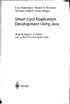 Uwe Hansmann Martin S. Nicklous Thomas Schack Frank Seliger Smart Card Application Development Using Java With 98 Figures, 16 Tables and a Multi Function Smart Card Springer Table of Contents Preface 1
Glossary of Key Terms
 and s Branch Glossary of Key Terms The terms and definitions listed in this glossary are used throughout the s Package to define key terms in the context of. Access Control Access The processes by which
IBM Payment Registry Delivers a Certificate Authority to Promote More-Secure Credit Card Transactions over the Internet
 Software Announcement June 26, 2001 IBM Payment Registry Delivers a Certificate Authority to Promote More-Secure Credit Card Transactions over the Internet Overview The Payment products are an end-to-end
D7.1 Application Description for Students
 Attribute-Based Credentials for Trust D7.1 Application Description for Students Joerg Abendroth, Vasiliki Liagkou, Apostolis Pyrgelis, Christoforos Raptopoulos, Ahmad Sabouri, Eva Schlehahn, Yannis Stamatiou,
Security/Privacy Models for "Internet of things": What should be studied from RFID schemes? Daisuke Moriyama and Shin ichiro Matsuo NICT, Japan
 Security/Privacy Models for "Internet of things": What should be studied from RFID schemes? Daisuke Moriyama and Shin ichiro Matsuo NICT, Japan 1 Internet of Things (IoT) CASAGRAS defined that: A global
User Privacy in Transport Systems Based on RFID E-Tickets
 User Privacy in Transport Systems Based on RFID E-Tickets Ahmad-Reza Sadeghi 1, Ivan Visconti 2, and Christian Wachsmann 1 1 Ruhr-University Bochum Horst-Görtz Institute for IT-Security (HGI), Germany
A Groundwork for Troubleshooting IP Based Booking with Subjection of Multiple User IDs by Blacklisting
 A Groundwork for Troubleshooting IP Based Booking with Subjection of Multiple User IDs by Blacklisting Asrani Nitin 1, Ashutosh Zajariya 2, Mangesh Sutar 3, Mukund Desai 4, K. D. Bamane 5 Division of Bachelor
Cloud based ticketing. Next generation fare collection
 Cloud based ticketing Next generation fare collection Cloud based ticketing Next generation fare collection For more than 20 years transport operators have experience with automating their fare collection
Smart Card- An Alternative to Password Authentication By Ahmad Ismadi Yazid B. Sukaimi
 Smart Card- An Alternative to Password Authentication By Ahmad Ismadi Yazid B. Sukaimi Purpose This paper is intended to describe the benefits of smart card implementation and it combination with Public
5 FAM 140 ACCEPTABILITY AND USE OF ELECTRONIC SIGNATURES
 5 FAM 140 ACCEPTABILITY AND USE OF ELECTRONIC SIGNATURES 5 FAM 141 PURPOSE (CT-IM-112; 07-30-2010) (Office of Origin: IRM/OPS/ITI/SI/IIB) The purpose of this FAM chapter is to enable the Department to
CERTIFICATION PRACTICE STATEMENT UPDATE
 CERTIFICATION PRACTICE STATEMENT UPDATE Reference: IZENPE-CPS UPDATE Version no: v 5.03 Date: 10th March 2015 IZENPE 2015 This document is the property of Izenpe. It may only be reproduced in its entirety.
DIGITAL RIGHTS MANAGEMENT SYSTEM FOR MULTIMEDIA FILES
 DIGITAL RIGHTS MANAGEMENT SYSTEM FOR MULTIMEDIA FILES Saiprasad Dhumal * Prof. K.K. Joshi Prof Sowmiya Raksha VJTI, Mumbai. VJTI, Mumbai VJTI, Mumbai. Abstract piracy of digital content is a one of the
The basic groups of components are described below. Fig X- 1 shows the relationship between components on a network.
 Elements of Email Email Components There are a number of software components used to produce, send and transfer email. These components can be broken down as clients or servers, although some components
Privacy-preserving Digital Identity Management for Cloud Computing
 Privacy-preserving Digital Identity Management for Cloud Computing Elisa Bertino [email protected] Federica Paci [email protected] Ning Shang [email protected] Rodolfo Ferrini [email protected]
RF-Enabled Applications and Technology: Comparing and Contrasting RFID and RF-Enabled Smart Cards
 RF-Enabled Applications and Technology: Comparing and Contrasting RFID and RF-Enabled Smart Cards January 2007 Developed by: Smart Card Alliance Identity Council RF-Enabled Applications and Technology:
HTTPS is Fast and Hassle-free with CloudFlare
 HTTPS is Fast and Hassle-free with CloudFlare 1 888 99 FLARE [email protected] www.cloudflare.com In the past, organizations had to choose between performance and security when encrypting their
Scalable RFID Security Protocols supporting Tag Ownership Transfer
 Scalable RFID Security Protocols supporting Tag Ownership Transfer Boyeon Song a,1, Chris J. Mitchell a,1 a Information Security Group, Royal Holloway, University of London, Egham, Surrey, TW20 0EX, UK
: Network Security. Name of Staff: Anusha Linda Kostka Department : MSc SE/CT/IT
 Subject Code Department Semester : Network Security : XCS593 : MSc SE : Nineth Name of Staff: Anusha Linda Kostka Department : MSc SE/CT/IT Part A (2 marks) 1. What are the various layers of an OSI reference
Binding Security Tokens to TLS Channels. A. Langley, Google Inc. D. Balfanz, Google Inc. A. Popov, Microsoft Corp.
 Binding Security Tokens to TLS Channels A. Langley, Google Inc. D. Balfanz, Google Inc. A. Popov, Microsoft Corp. The Problem: Bearer Tokens Web services generate various security tokens (HTTP cookies,
OIO SAML Profile for Identity Tokens
 > OIO SAML Profile for Identity Tokens Version 1.0 IT- & Telestyrelsen October 2009 Content > Document History 3 Introduction 4 Related profiles 4 Profile Requirements 6 Requirements 6
RVS Seminar Deployment and Performance Analysis of JavaCards in a Heterogenous Environment. Carolin Latze University of Berne
 RVS Seminar Deployment and Performance Analysis of JavaCards in a Heterogenous Environment Carolin Latze University of Berne Table of contents > Introduction Smartcards > Deployment Overview Linux Windows
GOALS (2) The goal of this training module is to increase your awareness of HSPD-12 and the corresponding technical standard FIPS 201.
 PERSONAL IDENTITY VERIFICATION (PIV) OVERVIEW INTRODUCTION (1) Welcome to the Homeland Security Presidential Directive 12 (HSPD-12) Personal Identity Verification (PIV) Overview module, designed to familiarize
William Hery ([email protected]) Research Professor, Computer Science and Engineering NYU-Poly
 William Hery ([email protected]) Research Professor, Computer Science and Engineering NYU-Poly Ramesh Karri ([email protected]) Associate Professor, Electrical and Computer Engineering NYU-Poly Why is cyber
Notarized Federated Identity Management for Web Services
 Notarized Federated Identity Management for Web Services Michael T. Goodrich 1, Roberto Tamassia 2, and Danfeng Yao 2 1 Department of Computer Science, University of California Irvine, CA 92697 USA [email protected]
Chapter 1: Introduction
 Chapter 1 Introduction 1 Chapter 1: Introduction 1.1 Inspiration Cloud Computing Inspired by the cloud computing characteristics like pay per use, rapid elasticity, scalable, on demand self service, secure