
Final Report: A National Code of Conduct for health care workers
|
|
|
- Roger Conley
- 10 years ago
- Views:
Transcription
1 Final Report A National Code of Conduct for health care workers 17 April

2 Final Report A National Code of Conduct for health care workers [Date to be inserted upon Ministerial agreement] This report was prepared by the Victorian Department of Health, on behalf of the Australian Health Ministers Advisory Council Australian Health Ministers Advisory Council 2014 This publication is copyright, no part may be reproduced by any process except in accordance with the provisions of the Copyright Act This document may be downloaded from the Australian Health Ministers Advisory Council website at: 2

3 Contents Acronyms Executive Summary 1. Overview 1.1. Introduction 1.2. How did this project come about? 1.3. What happened in Stage 1 of this project? 1.4. What did all Health Ministers agree to do at the end of Stage 1? 1.5. What was the purpose of the Stage 2 consultation? 1.6. What does this report cover? 1.7. Definition of terms 2. The nature of the problem and objectives of government action 2.1. The nature of the problem 2.2. Objectives of government action 3. How a code-regulation regime works in practice 3.1. The NSW scheme 3.2. The South Australian scheme 3.3. The Queensland scheme 4. Results of the national consultation 4.1. Consultation process 4.2. Key themes from the consultations Scope and application of the National Code Terms of the National Code Administration of the National Code 5. Recommended terms for the first National Code of Conduct 6. Recommendations policy parameters for nationally consistent implementation of the National Code of Conduct 6.1. Overview 6.2. Scope of application of the National Code 6.3. Who may make a complaint 6.4. Grounds for making a complaint 6.5. Timeframe for lodging a complaint 6.6. Commissioner s own motion powers 6.7. Interim prohibition orders 6.8. Who is empowered to issue prohibition orders 6.9. Grounds for issuing prohibition orders Powers to deal with persons who are not fit and proper Publication of prohibition orders and public statements 3

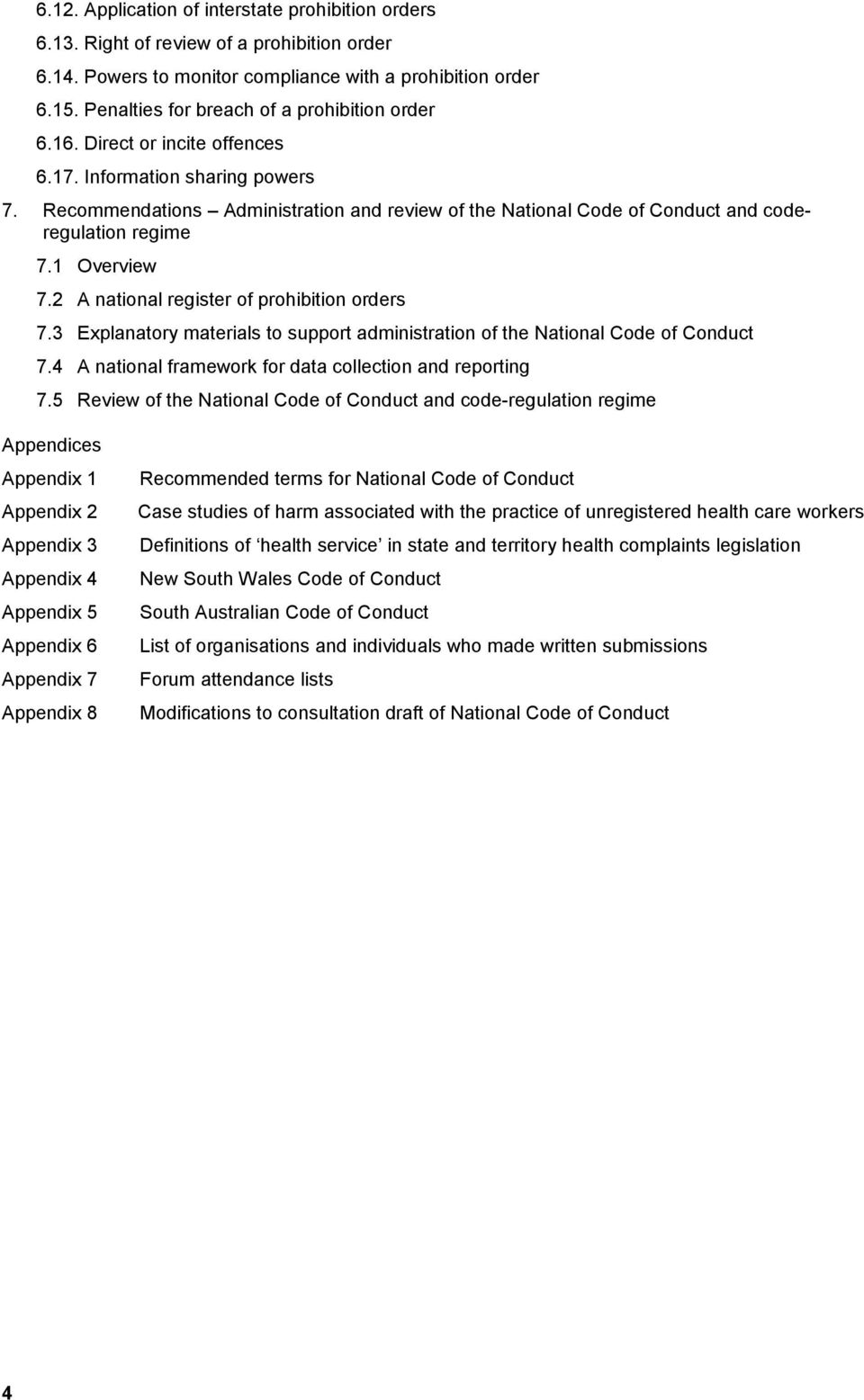
4 6.12. Application of interstate prohibition orders Right of review of a prohibition order Powers to monitor compliance with a prohibition order Penalties for breach of a prohibition order Direct or incite offences Information sharing powers 7. Recommendations Administration and review of the National Code of Conduct and coderegulation regime 7.1 Overview 7.2 A national register of prohibition orders 7.3 Explanatory materials to support administration of the National Code of Conduct 7.4 A national framework for data collection and reporting 7.5 Review of the National Code of Conduct and code-regulation regime Appendices Appendix 1 Appendix 2 Appendix 3 Appendix 4 Appendix 5 Appendix 6 Appendix 7 Appendix 8 Recommended terms for National Code of Conduct Case studies of harm associated with the practice of unregistered health care workers Definitions of health service in state and territory health complaints legislation New South Wales Code of Conduct South Australian Code of Conduct List of organisations and individuals who made written submissions Forum attendance lists Modifications to consultation draft of National Code of Conduct 4
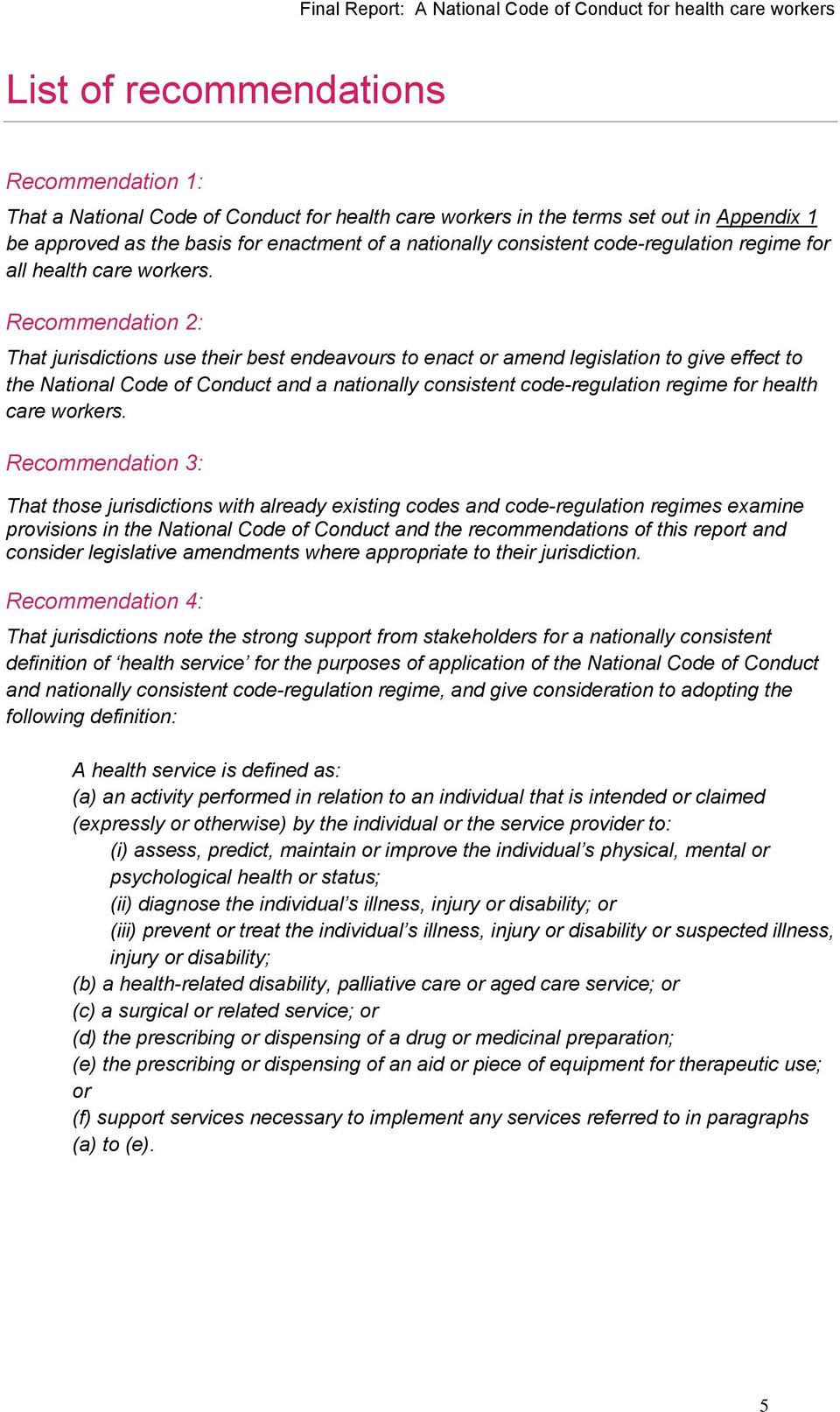
5 List of recommendations Recommendation 1: That a National Code of Conduct for health care workers in the terms set out in Appendix 1 be approved as the basis for enactment of a nationally consistent code-regulation regime for all health care workers. Recommendation 2: That jurisdictions use their best endeavours to enact or amend legislation to give effect to the National Code of Conduct and a nationally consistent code-regulation regime for health care workers. Recommendation 3: That those jurisdictions with already existing codes and code-regulation regimes examine provisions in the National Code of Conduct and the recommendations of this report and consider legislative amendments where appropriate to their jurisdiction. Recommendation 4: That jurisdictions note the strong support from stakeholders for a nationally consistent definition of health service for the purposes of application of the National Code of Conduct and nationally consistent code-regulation regime, and give consideration to adopting the following definition: A health service is defined as: (a) an activity performed in relation to an individual that is intended or claimed (expressly or otherwise) by the individual or the service provider to: (i) assess, predict, maintain or improve the individual s physical, mental or psychological health or status; (ii) diagnose the individual s illness, injury or disability; or (iii) prevent or treat the individual s illness, injury or disability or suspected illness, injury or disability; (b) a health-related disability, palliative care or aged care service; or (c) a surgical or related service; or (d) the prescribing or dispensing of a drug or medicinal preparation; (e) the prescribing or dispensing of an aid or piece of equipment for therapeutic use; or (f) support services necessary to implement any services referred to in paragraphs (a) to (e). 5
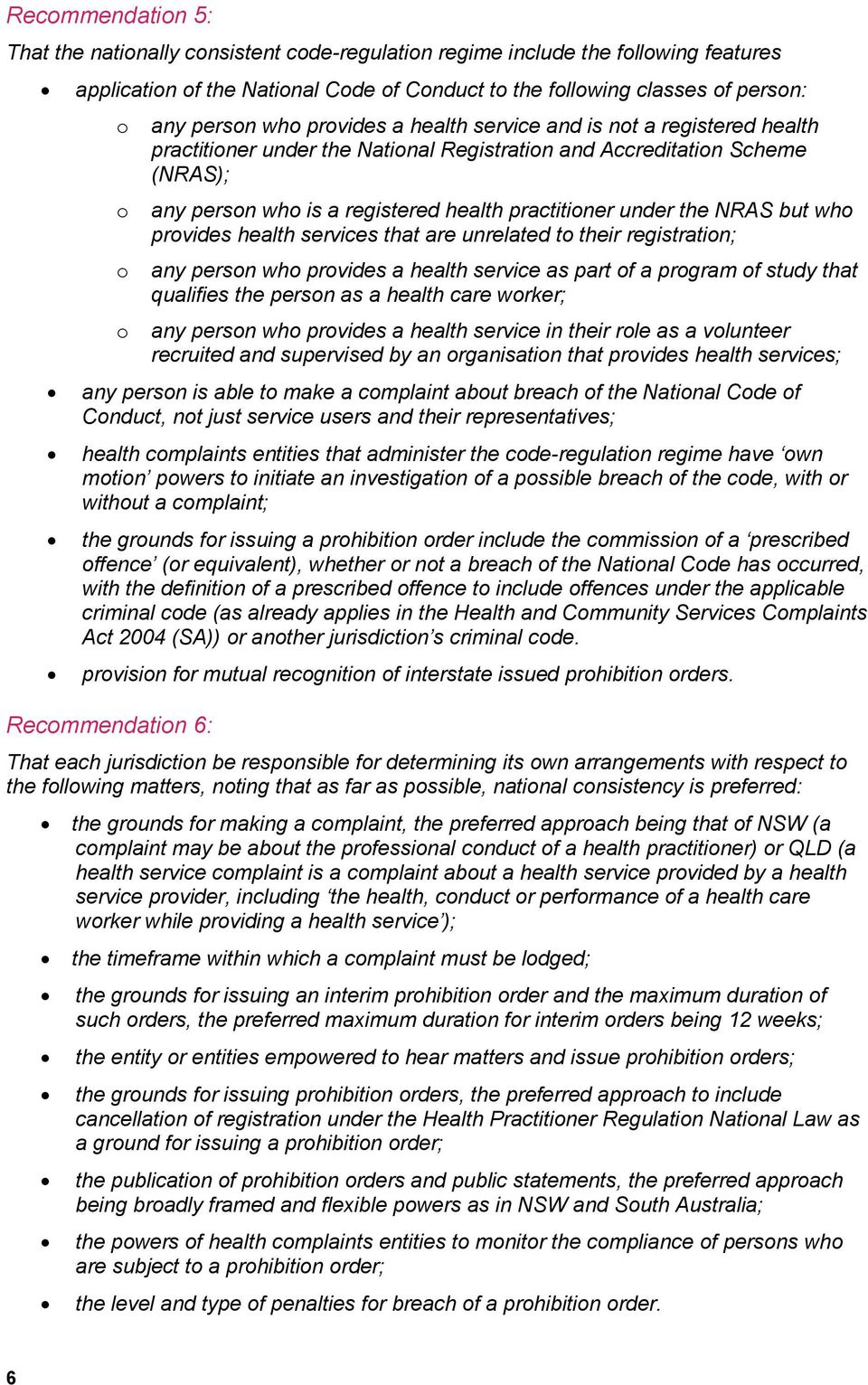
6 Recommendation 5: That the nationally consistent code-regulation regime include the following features application of the National Code of Conduct to the following classes of person: o o o o any person who provides a health service and is not a registered health practitioner under the National Registration and Accreditation Scheme (NRAS); any person who is a registered health practitioner under the NRAS but who provides health services that are unrelated to their registration; any person who provides a health service as part of a program of study that qualifies the person as a health care worker; any person who provides a health service in their role as a volunteer recruited and supervised by an organisation that provides health services; any person is able to make a complaint about breach of the National Code of Conduct, not just service users and their representatives; health complaints entities that administer the code-regulation regime have own motion powers to initiate an investigation of a possible breach of the code, with or without a complaint; the grounds for issuing a prohibition order include the commission of a prescribed offence (or equivalent), whether or not a breach of the National Code has occurred, with the definition of a prescribed offence to include offences under the applicable criminal code (as already applies in the Health and Community Services Complaints Act 2004 (SA)) or another jurisdiction s criminal code. provision for mutual recognition of interstate issued prohibition orders. Recommendation 6: That each jurisdiction be responsible for determining its own arrangements with respect to the following matters, noting that as far as possible, national consistency is preferred: the grounds for making a complaint, the preferred approach being that of NSW (a complaint may be about the professional conduct of a health practitioner) or QLD (a health service complaint is a complaint about a health service provided by a health service provider, including the health, conduct or performance of a health care worker while providing a health service ); the timeframe within which a complaint must be lodged; the grounds for issuing an interim prohibition order and the maximum duration of such orders, the preferred maximum duration for interim orders being 12 weeks; the entity or entities empowered to hear matters and issue prohibition orders; the grounds for issuing prohibition orders, the preferred approach to include cancellation of registration under the Health Practitioner Regulation National Law as a ground for issuing a prohibition order; the publication of prohibition orders and public statements, the preferred approach being broadly framed and flexible powers as in NSW and South Australia; the powers of health complaints entities to monitor the compliance of persons who are subject to a prohibition order; the level and type of penalties for breach of a prohibition order. 6
7 Recommendation 7: That in implementing the nationally consistent code-regulation regime, jurisdictions agree to: enact nationally consistent legislative provisions that enable the sharing information between health complaints entities and between health complaints entities and other regulators, along the lines of the information sharing powers contained in sections 216 and of the Health Practitioner Regulation National Law. undertake joint work to: o o establish a common web portal, to be hosted on the server of a state or territory health complaints entity, to enable public access to all decisions and prohibition orders made by health complaints entities or tribunals in participating states and territories and that each health complaints entity provide a link to the portal from its own website; develop and maintain a suite of nationally consistent explanatory materials for key target groups, and that these explanatory materials be made available in accessible formats (e.g. Plain Language, Easy English) on the websites of all health complaints entities. establish a common framework for the collection and reporting of nationally consistent data on the performance of state and territory code-regulation regimes to enable a joint report on the performance of code-regulation regimes to be provided annually to the Council of Australian Governments Health Council (the COAG Health Council). Recommendation 8: That an independent review of the national code-regulation regime be initiated by Health Ministers following five years of the regime s operation or an earlier review if requested by Health Ministers. 7

8 Executive summary In 2011, the Australian Health Ministers Advisory Council (AHMAC) undertook a national consultation on Options for the regulation of unregistered health practitioners. The term unregistered health practitioner was used in that report to describe any person who provides a health service and who is not registered in one of the 14 professions regulated under the Health Practitioner Regulation National Law, as in force in each state and territory (the National Law). The final report of the 2011 consultation, released in August 2013, found that the option of a single National Code of Conduct for unregistered health practitioners, with enforcement powers for breach of the Code was likely to deliver the greatest net public benefit to the community. The consultation found strong community and health sector support for this option. A statutory code of conduct scheme (described in this report as a code-regulation regime ) already operates in New South Wales (NSW) and South Australia, and commenced in Queensland in July In response to the report of the 2011 consultation, the Standing Council on Health (now called the Council of Australian Governments Health Council) agreed in principle on 14 June 2013 to strengthen state and territory health complaints mechanisms via a single national Code of Conduct to be made by regulation in each state and territory, and statutory powers to enforce the code by investigating breaches and issuing prohibition orders. Ministers also agreed to a nationally accessible register of prohibition orders and mutual recognition arrangements between states and territories to support national enforcement of the code. To give effect to these decisions, Health Ministers asked the Australian Health Ministers Advisory Council (AHMAC) to undertake a public consultation on the terms of the first National Code of Conduct and proposed policy parameters to underpin nationally consistent implementation of the National Code, for consideration by Health Ministers. A consultation paper A National Code of Conduct for Health Care Workers was released publicly on 7 March The paper presented for comment a draft National Code of Conduct, based on the statutory Codes of Conduct that already apply in NSW and South Australia, although the term health care worker is used in the draft National Code in place of unregistered health practitioner. Over 100 written submissions were received to the consultation and more than 330 people attended the state and territory consultation forums. The vast majority of respondents to the consultation supported the National Code of Conduct (with some amendments) and a coderegulation regime. The issue provoking the greatest discussion at the forums and in written submissions was the scope of application of the National Code; that is, who would be covered by the National Code, and for what types of service. In particular, respondents discussed where the line should be drawn between health care and social care. Respondents also highlighted the need for support materials to be made prepared by responsible health complaints entities, targeted to key audiences such as health care workers, their employers and professional associations, in order to explain specific clauses of the National Code and how the code-regulation regime works in practice. Based on feedback from the consultation, a number of amendments have been made to the draft National Code that was presented in the consultation paper. Section 5 of this report makes recommendations about the terms of the first National Code of Conduct for health 8

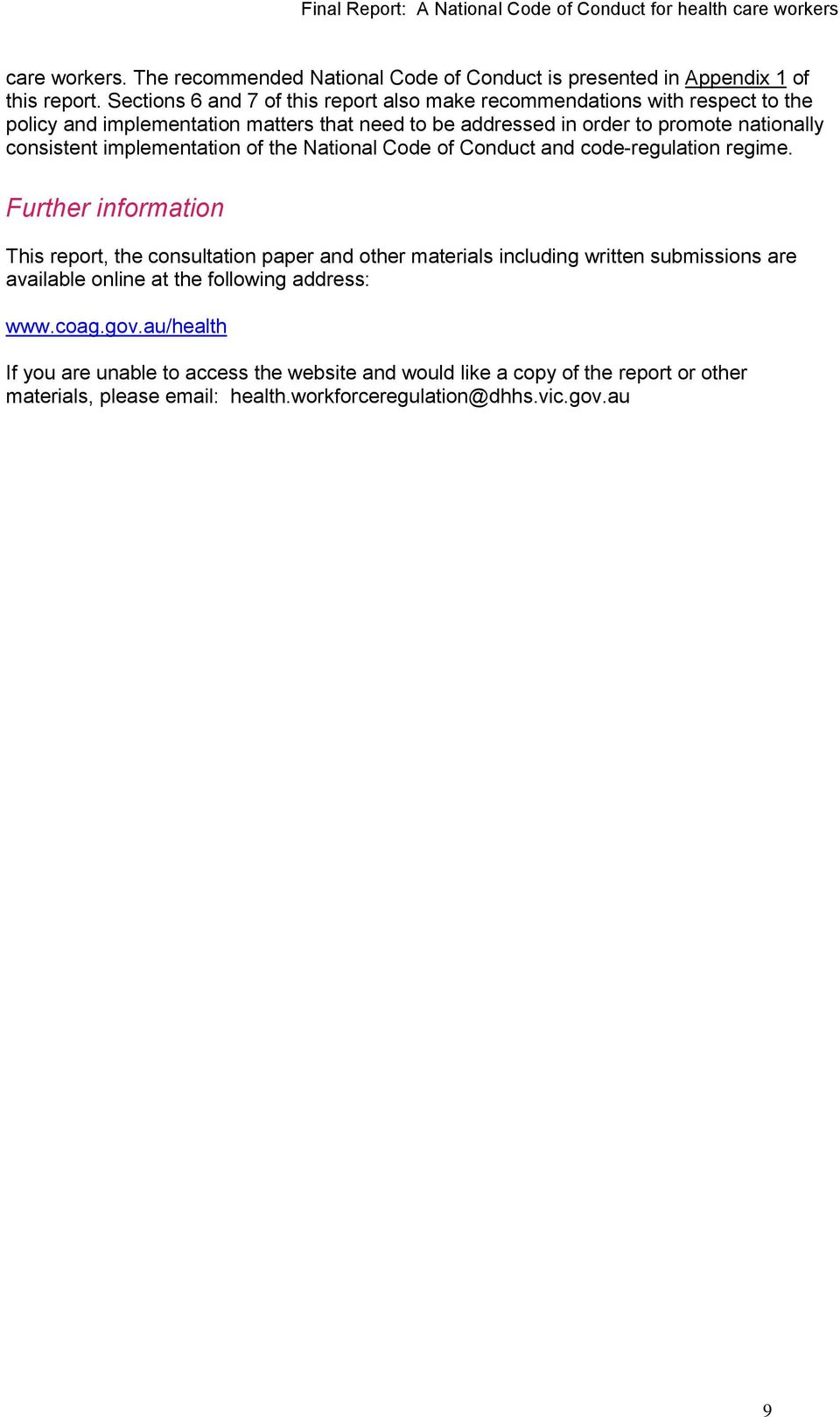
9 care workers. The recommended National Code of Conduct is presented in Appendix 1 of this report. Sections 6 and 7 of this report also make recommendations with respect to the policy and implementation matters that need to be addressed in order to promote nationally consistent implementation of the National Code of Conduct and code-regulation regime. Further information This report, the consultation paper and other materials including written submissions are available online at the following address: If you are unable to access the website and would like a copy of the report or other materials, please [email protected] 9
10 1. Overview Introduction This report presents the findings and recommendations arising from a national consultation that was undertaken in March-April 2014 at the request of all state, territory and Commonwealth Health Ministers (sitting as the Standing Council on Health). This national consultation sought views from the community and the health sector about the terms of the first National Code of Conduct for health care workers (the National Code) and how the National Code should be given effect to in all states and territories. The term coderegulation regime is used here to describe the arrangements through which the National Code of Conduct is legislated, administered and applied in each state and territory. How did this project come about? In 2007 the NSW Parliament enacted legislation to strengthen public protection for health consumers who use the services of unregistered health practitioners. The term unregistered health practitioner is used in NSW to describe those practitioners who are not registered under the National Registration and Accreditation Scheme or NRAS. The NSW scheme established a Code of Conduct for unregistered health practitioners and strengthened the powers of the NSW Health Care Complaints Commission to enable the Commission to investigate breaches of the code and issue prohibition orders when necessary to protect the public from serious harm. In 2010, Health Ministers considered the NSW arrangements and asked the Australian Health Ministers Advisory Council (AHMAC) to undertake a national consultation to assess the need to strengthen regulatory protections nationally for consumers who use the services of unregistered health practitioners, and if further public protection measures were necessary in all states and territories, how these should be structured and administered. This is the final report of Stage 2 of a three stage process (see Table 1 below) TABLE 1: Stages in the AHMAC Unregistered Health Practitioners Project Stage Activity Who is responsible? Expected Timeframe 1 Assessment of options for regulation AHMAC November April Development of terms of first National Code of Conduct for health care workers AHMAC April November Implementation of National Code of Conduct arrangements States and territories November onwards Table 2 below sets out the key events and decisions since this project commenced in

11 TABLE 2: Key events & decisions Unregistered Health Practitioners Project Date Event Stage 1: Assessment of options November Health Ministers agree to proceed with national consultation on options for 2010 strengthening regulation of unregistered health practitioners Feb 2011 Consultation paper released publicly and submissions invited March 2011 State and territory consultation forums held June 2013 Health Ministers agree in principle to proceed with a National Code of Conduct, state and territory enforcement of the Code, mutual recognition of prohibition orders, and a national register of prohibition orders. AHMAC asked to conduct a national consultation on the terms of the first National Code of Conduct Stage 2: Development of National Code of Conduct March 2014 Consultation paper released publicly and submissions invited. April 2014 State and territory consultation forums held TBA Health Ministers consider final report of National Code consultation Stage 3: Implementation of National Code of Conduct and code-regulation regime What happened in Stage 1 of this project? In the first stage of this project, a regulatory impact assessment was undertaken to assess the nature and scale of the risks associated with the provision of services by unregistered health practitioners. Stakeholders were consulted on the nature and scale of the problem and the various options available to address the problem. The costs and benefits of each option were assessed, and a recommend option was identified, being the option that provided the greatest net public benefit. The final report of Stage 1 was considered by Health Ministers in late April 2013 and released publicly in August The report is available at the following website: The report presented the results of the national consultation held in 2011, including the findings and recommendations of the regulatory assessment of the various options for strengthening regulation of unregistered health practitioners. The report found that the option of a single National Code of Conduct, with enforcement powers for breach of the Code would be more cost-effective than other options in reducing the risk of harm and offered the greatest net public benefit. The report recommended that the regulatory scheme implemented in NSW be extended to all states and territories. In the meantime, a number of states moved to establish similar regulatory protections to those already in place in NSW, with South Australia enacting legislation in 2012 and Queensland in What did all Health Ministers agree to do at the end of Stage 1? In April 2013, when Health Ministers considered the findings and recommendations from the final report of Stage 1, they agreed in principle to strengthen state and territory health complaints mechanisms via: a single national Code of Conduct for unregistered health practitioners, to be made by regulation in each state and territory, and statutory powers to enforce the Code by investigating breaches and issuing prohibition orders; a nationally accessible web based register of prohibition orders; and 11

12 mutual recognition of state and territory issued prohibition orders. Ministers agreed that under the proposed arrangements, each state and territory would be responsible for: enacting new (or amending existing) legislation and regulations to give effect to the national Code of Conduct, the national register of prohibition orders, and mutual recognition of prohibition orders across state boundaries; determining a suitable local body to receive and investigate breaches of the Code of Conduct and issue prohibition orders, noting that existing health complaints commissions already have statutory roles to investigate complaints about unregistered health practitioners but only NSW and South Australia have a code of conduct and prohibition order powers. To give effect to these decisions, Health Ministers asked AHMAC to undertake a second national consultation, this time to seek views on what should be in the first National Code of Conduct and the proposed policy parameters to underpin nationally consistent implementation of the Code, for consideration by Ministers. What was the purpose of the Stage 2 national consultation? In March 2014, a consultation paper titled A National Code of Conduct for health care workers was released publicly. Consultation forums were held in all states and territories in conjunction with local health departments in March-April 2014, and over 100 submissions were received. The purpose of the consultation was to seek public comment on: the terms of a draft National Code of Conduct for health care workers the legislative provisions necessary to apply and enforce the National Code, and the extent to which national uniformity is considered necessary or desirable proposed administrative arrangements for public access to information on prohibition orders issued by the state and territory health complaints entities that in future may be responsible for enforcing the National Code. A draft National Code of Conduct was prepared for discussion, based on the statutory Codes of Conduct that already apply in NSW and South Australia. In response to feedback from Stage 1, the draft National Code of Conduct adopted the term health care worker in place of the term unregistered health practitioner. In preparing the draft National Code, a range of other local and international codes were reviewed, including codes of ethics and practice guides for both statutorily registered and self-regulating health professions. What does this report cover? This report presents the findings and recommendations of Stage 2 of this project. It contains the following sections: Section 1: Section 2: Section 3: Overview (this section) The nature of the problem and the objectives of government action How a code-regulation regime works in practice 12
13 Section 4: Section 5: Section 6: Section 7: Results of the national consultation Recommendations The terms of the first National Code of Conduct Recommendations Policy parameters for nationally consistent implementation of the National Code of Conduct Recommendations Administration and review of the National Code of Conduct and code-regulation regime. Definition of terms National Code means the draft National Code of Conduct for health practitioners contained in Appendix 1. Code-regulation regime means a regulatory scheme under which a code of conduct is made by regulation, and a regulator is conferred with statutory powers to investigate breaches of the code and, where a breach of the code by a practitioner places the public at serious risk of harm, to issue a prohibition order that may prohibit or restrict the practitioner who is the subject of the order from providing health services. Code-regulation regimes are currently in force in NSW, South Australia and Queensland. Code-regulated health care worker means a health care worker who is (or may in the future) be regulated under a code-regulation regime Health care worker means a person who provides a health service. Health complaints entity has the same meaning as in section 5 of the Health Practitioner Regulation National Law (Victoria) Act 2009, that is, an entity that is established by or under an Act of a participating jurisdiction and whose functions include conciliating, investigating and resolving complaints made against health service providers and investigating failures in the health system. Health service is defined in each state and territory health complaints statute and has a different meaning depending on the statute. Unregistered health practitioner means a person who provides health services and who is not subject to the scheme for registration under the Health Practitioner Regulation National Law. 13

14 2. The nature of the problem and objectives of government action The final report from Stage 1 of this project published in April 2013 documented in detail the nature of the problem that a code-regulation regime for health care workers is intended to address and the objectives of government action. The nature of the problem The final report from Stage 1 presented data on the nature of the problem, including data and findings from previous government reports and coroners reports, data on complaints about unregistered health practitioners and details of the types of conduct of concern. This report is available at the following website: The report found that the vast majority of unregistered health practitioners practise in a safe, competent and ethical manner. There are, however, a small proportion of unregistered health practitioners who present a serious risk to the public because they are incompetent, or impaired due to physical or mental dysfunction or drug or alcohol addiction, or they engage in exploitative, predatory and illegal conduct such that, if they were a registered health practitioner, would result in cancellation of their registration and removal of their right to practise. Unlike the registered health professions where nationally uniform minimum qualifications and probity checking requirements apply before entry to practice, there are no enforceable hurdle requirements prior to commencing practice in those health professions that are not regulated under the National Registration and Accreditation Scheme. There is no nationally uniform or consistent mechanism for prohibiting or limiting practice when an unregistered health practitioner s impairment, incompetence or professional misconduct presents a serious risk to the public. There is evidence that practitioners will move to those jurisdictions that have less regulatory scrutiny, in order to continue their illegal or unethical conduct. Existing laws provide some protections for consumers. Civil and criminal remedies are available in all states and territories when a consumer suffers harm, and the Australian Consumer Law provides a regulatory framework that is designed to protect consumers from unsafe or defective goods and services or from unconscionable or deceptive conduct. However, three jurisdictions (NSW, South Australia and most recently Queensland) have considered these protections to be insufficient, and have moved to strengthen the powers of existing regulators. Appendix 2 provides details of some of the cases that have already come to the attention of state and territory health complaints commissioners. The more serious cases have involved the following types of conduct: Sexual misconduct involving sexual assault during treatment, or sexual relationships with patients/clients; Other improper relationships with clients particularly in the context of provision of counselling services; 14

15 Cancer care services involving a combination of behaviours that are financially exploitative, misleading and deceptive, including making false or misleading claims about the effectiveness of treatments and the nature of qualifications; Home birthing services involving the provision of home birth services to women with high risk pregnancies who for safety reasons should be delivering in a hospital setting; Failure to refer on to other health practitioners when necessary, or failure to refer in a timely manner, resulting in delayed diagnosis or treatment and some cases death. While each year there may be only a handful of such cases, the seriousness of the harm means the impact on those patients and families affected can be devastating. Deaths have occurred from time to time. In a number of cases, the practitioner has been subject to successive investigations and regulatory action by a number of regulatory bodies in one or more jurisdictions over a period of several decades. Earlier intervention by a regulator who has a mandate to examine all the evidence of breaches of professional standards together, and take strong enforcement action to prevent future harm may have reduced the number of victims. In the absence of an effective mechanism for dealing in a timely manner with those unregistered health practitioners who exhibit a pattern of predatory and exploitative behaviour towards their patients or clients, governments are under increasing pressure to extend statutory registration to additional health professions, even in cases where this type of regulation is not warranted because the costs to the community as a whole outweigh the benefits. Strengthened regulation cannot eliminate all potential risk or harm to the community, but it is possible to reduce ongoing exploitation and malpractice once it becomes evident that a health care worker is engaging in improper conduct. The objectives of government action Given the nature of the problems identified, the objective of government action is to reduce the incidence of physical, psychological or financial harm to health consumers arising from unregistered health practitioners who are incompetent, impaired, or who breach their legal and professional obligations and are not fit and proper persons to provide health services. Any government action should also be cost-effective and designed to maximise efficiency of the health system while minimising any additional regulatory requirements on health practitioners and consumers of health services. 15

16 3. How a code-regulation regime works in practice The NSW, South Australia and Queensland Governments have each legislated to establish a code-regulation regime that covers unregistered health practitioners within their respective jurisdictions. While there are some differences, these regimes operate on the same broad principles and through similar legislative mechanisms. Further details are provided below. A code-regulation regime is a form of negative licensing. As a regulatory mechanism, it sits on a continuum of regulation between self-regulation and statutory registration. It is a more targeted, less restrictive and less costly form of regulation than statutory regulation, since it provides the regulatory tools to deal directly with those who behave illegally or in an incompetent, exploitative or predatory manner. It leaves the vast majority of ethical and competent members of an unregulated health profession to self-regulate, but provides an additional level of public protection with respect to unregistered practitioners, at minimal additional cost to the community. The NSW scheme 1 The NSW arrangements were enacted in 2006 with the passage of the Health Legislation Amendment (Unregistered Health Practitioners) Act There are two main elements of the NSW scheme: a statutory Code of Conduct that sets standards that apply to all unregistered health practitioners, and registered health practitioners who provide health services that are unrelated to their registration regulatory powers to deal with complaints from consumers about practitioners who breach the Code of Conduct. Under the Public Health Act 1991 (NSW), the NSW Minister for Health has the power to make, by regulation, a Code of Conduct for the provision of health services by unregistered health practitioners. In addition, the NSW Health Care Complaints Commission has enhanced statutory powers when dealing with complaints under the Health Care Complaints Commission Act 1993 (NSW), to investigate a complaint that an unregistered practitioner has breached the Code of Conduct, and if necessary, issue a court enforceable prohibition order, either banning or restricting the person s practice (NSW Department of Health, 2008). The NSW Code of Conduct provides standards against which to objectively assess the conduct of unregistered health practitioners. Importantly, it facilitates the investigation of complaints and permits disciplinary action against practitioners who are practising unsafely or found to be exploiting or taking advantage of vulnerable people. The NSW Code applies to the provision of health services by: a) health practitioners who are not registered under the National Law (including those who have been deregistered), and 1 Much of the information in this section has been drawn from the website of the Health Care Complaints Commission of New South Wales, at 16

17 b) health practitioners who are registered under the National Law but who provide health services that are unrelated to their registration. The term health service has the same meaning as in the Health Care Complaints Act 1993 (NSW) see Appendix 3 for definitions of health service contained in state and territory health complaints legislation. Key features of the NSW scheme are: a negative licensing regulatory regime that does not restrict entry to practice, but allows effective action to be taken against a practitioner who fails to comply with proper standards of conduct or practice a set of objective and clear standards against which to assess a practitioner s conduct and practice in the event of a complaint an independent investigator to receive and investigate complaints power for the independent investigator to issue prohibition orders and give public warnings about practitioners who have failed to abide by the required standards of conduct and practice, and offence provisions for any person who breaches a prohibition order to be prosecuted through the appropriate court. The NSW Code of Conduct The NSW Code of Conduct for unregistered health practitioners came into effect on 1 August The intention of the Code is to set out the minimum practice and ethical standards with which unregistered health service providers are required to comply. The Code of Conduct informs consumers about what they can expect from practitioners and the mechanisms by which they may complain about the conduct of, or services provided by, an unregistered health practitioner. A full copy of the NSW Code of Conduct is at Appendix 4 of this report and can be downloaded from the following website address: The key clauses of the Code cover the following: Health practitioners must provide health services in a safe and ethical manner. Health practitioners diagnosed with an infectious medical condition must ensure that he or she practises in a manner that does not put clients at risk. Health practitioners must not make claims to cure certain serious illnesses. Health practitioners must adopt standard precautions for infection control. Health practitioners must not dissuade clients from seeking or continuing with treatment by a registered medical practitioner and must accept the rights of their clients to make informed choices in relation to their health care. Health practitioners must not practise under the influence of alcohol or other drugs. Health practitioners must not practise with certain physical or mental conditions. Health practitioners must not financially exploit clients. Health practitioners are required to have an adequate clinical basis for treatments. Health practitioners must not misinform their clients. 17
18 Health practitioners must not engage in a sexual or improper personal relationship with a client. Health practitioners must comply with relevant privacy laws. Health practitioners must keep appropriate records. Health practitioners must keep appropriate insurance. Health practitioners must display the Code and other information (with some exceptions). The NSW Government undertook an Impact Assessment prior to making the Regulations that gave effect to the Code (NSW Health Department 2008) 2. Powers of the NSW Health Care Complaints Commission The Commission has the power to: issue an order prohibiting a person from providing health services for a period of time; issue an order placing conditions on the provision of health services; provide a warning to the public about a practitioner and his or her services. To do so, the Commission must find that: a provider has breached the code of conduct or been convicted of a relevant offence ; and in the opinion of the Commission, the provider poses a risk to the health and safety of members of the public. A relevant offence is: an offence under Part 2A of the Public Health Act 1991 (NSW); or an offence under the Fair Trading Act 1987 (NSW) or the Competition and Consumer Act 2010 (Cth) that relates to the provision of health care services. The Commissioner has powers to initiate a prosecution for breach of a prohibition order. Breaches of a prohibition order are punishable by a fine and/or imprisonment of up to 12 months. Stages in the NSW complaints process When dealing with complaints about unregistered health practitioners the Commission will generally take the following steps: 1. Commission receives complaint When the Commission receives a complaint, it will contact the complainant to clarify the issues, notify the provider and seek their response to the complaint. 2. Assessment When assessing a complaint the Commission may obtain health records to assist the assessment of clinical issues and may seek advice from independent experts in the area. At the end of the assessment, the Commission may: a. Refer to another body (such as the Therapeutic Goods Administration or the Office of Fair Trading) b. Refer to assisted resolution (voluntary) c. Refer to conciliation 2 A second Impact assessment statement was released by the NSW Government in 2011 to remake the Code of Conduct under the Public Health Act 2010 (NSW) that is expected to commence in Query tense??? 18
19 d. Discontinue e. Investigate 3. Investigation the purpose of investigation is to obtain information so that the Commission can determine the most appropriate action (if any) to take. The focus of investigations is on protection of public health and safety. At the end of an investigation the Commission may: a. Terminate b. Refer the matter to the Director of Public Prosecutions c. Make comments d. Issue a public warning e. Issue a prohibition order placing conditions f. Issue a blanket prohibition order 4. Right to appeal the practitioner has the right to appeal against the Commission s decision. The appeal has to be made to the Administrative Decisions Tribunal within 28 days from the date of the Commission s decision. How the NSW scheme is working The NSW HCCC has advised that each year it receives approximately 90 complaints that relate to unregistered health practitioners (averaged over three years , and ). Since August 2008 when the Code of Conduct came into force, the Commission has used its prohibition order powers in 29 cases, posted on the Commission s website. Following investigation, the HCCC has issued 25 prohibition orders against practitioners and a further four public statements warning about the activities of practitioners or organisations. To date there have been no appeals to the NSW Administrative Decisions Tribunal against prohibition orders issued by the Commission. The Commissioner has successfully prosecuted one practitioner for breach of a prohibition order. The public statements and prohibition orders issued by the NSW HCCC are published on the website of the HCCC, and can be accessed at the following address: The Commission has memorandums of understanding (MOUs) with the NSW Police and a number of other regulatory agencies which allow for the sharing of information between agencies. In some cases the Commission plays a coordinating role amongst these agencies, which enables it to gather evidence of breaches of a variety of laws. Such breaches may be indicative of a pattern of conduct which demonstrates that the practitioner is likely to continue to breach the Code of Conduct and place public health and safety at risk. This pattern of conduct may warrant the issue of a prohibition order. The cost of the regime has been low, as a relatively small number of cases have been dealt with so far and no additional infrastructure has been required. However, the Commission has advised that the number of complaints it receives is increasing, as awareness of the scheme grows. The South Australian scheme In March 2011, the South Australian Parliament passed the Health and Community Services Complaints (Miscellaneous) Amendment Act. The Act conferred on the Health and Community Services Complaints Commissioner similar powers to those that apply in NSW. 19

20 The scheme includes a statutory code of conduct and prohibition order powers. The South Australian Code of Conduct came into effect in March 2013 and is based largely on the NSW Code of Conduct. A full copy of the South Australian Code of Conduct is at Appendix 5 and can be downloaded from the following website: esources/safety+and+quality/governance+for+safety+and+quality+in+health+service+organi sations/credentialling/unregistered+health+practitioners+code+of+conduct The Commissioner has similar powers to those in NSW to investigate breaches of the Code of Conduct, and in serious cases where the public is at risk of harm, to issue a prohibition order. To date, the Commissioner has issued one prohibition order. The Queensland scheme In 2013, the Queensland Parliament passed the Health Ombudsman Act. The Act establishes a Health Ombudsman and provides for similar powers to regulate unregistered health practitioners to those that apply in NSW and South Australia. The Queensland scheme does not require a Code of Conduct to be made by regulation in order for the Health Ombudsman to investigate an unregistered health practitioner and impose an interim prohibition order. The Queensland Civil and Administrative Tribunal (QCAT) is the body responsible for issuing a prohibition order. The scheme commenced in July 2014 and to date no prohibition orders have been issued. 20

21 4. Results of the national consultation This section provides a summary of the national consultation process for Stage 2 and presents the key themes from analysis of the feedback from the consultation forums and written submissions. 4.1 Consultation process The national consultation was conducted in March April A consultation paper was released in March 2014 and published on the website of the Australian Health Ministers Advisory Council (AHMAC). The national consultation and links to the consultation paper were advertised in state and territory newspapers and in The Australian newspaper. Public submissions were invited, with a closing date of 30 April The consultation paper included a draft National Code of Conduct and invited comment. Public comments were guided by a series of questions set out in a Quick Response form that could be downloaded from the website. Questions addressed the seventeen clauses comprising the draft National Code of Conduct, and related policy and administrative issues. Just over 100 written submissions were received. Half were from professional associations (50%). The remaining submissions were from individuals (13%), employers (10%), government (8%), peak health bodies (8%), education providers (4%), unions (3%), regulators (3%) and consumer representative groups (1%). At Appendix 6 is the list of those organisations and individuals who made written submissions. A series of invitation-only forums were conducted in all states and territories in March and April 2014, organised in conjunction with local health departments. The following table shows the dates and number of participants at each forum. A list of forum participants is at Appendix 7. Forum Date (2014) Number of participants Canberra 26 March 49 Brisbane 27 March 47 Darwin 2 April 25 Adelaide 3 April 65 Perth 7 April 47 Melbourne 8 April 35 Sydney 9 April 40 Hobart 14 April 23 Additional meetings were held with health complaints entities, other regulators and Commonwealth and state government agencies responsible for aged care and disability services. A reference group of health complaints commissioners provided input on drafts of the consultation paper, the National Code of Conduct and the final report. 21
22 4.2 Key themes from the consultations The main themes from the consultation forums and submissions are summarised below. Scope and application of the National Code of Conduct There is strong support for a National Code of Conduct and a code-regulation regime The vast majority of respondents supported a statutory National Code of Conduct and coderegulation regime, with strengthened powers to deal with breaches of the Code. This is consistent with the findings of the Stage 1 consultation. Most respondents agreed with the terms of the draft National Code as presented in the consultation paper, suggesting modifications that were mostly editorial in nature to improve clarity or to ensure relevance of the National Code to specific professions. There were, however, several clauses where more substantial changes were proposed. The issues that generated the most debate at the consultation forums and in submissions related to the proposed scope of application of the National Code. Questions included: Will the National Code apply to volunteers and students? Will the National Code apply to disability support workers? Will the National Code apply to those who work under the direct supervision of registered practitioners, for example, pharmacy assistants? Will the National Code apply to spiritual healing and other guidance counselling? If the National Code is to apply only to health services, how are social care and health care services to be distinguished, particularly for those health care workers who work in both types of setting? Will a code-regulation regime preclude health professions from being included in the National Registration and Accreditation Scheme at a later date? These issues are outlined further below. A code-regulation regime should not be seen as a substitute for national registration for those professions where this is warranted A number of professional associations with strong self-regulatory arrangements pointed to limitations of the National Code in regulating the quality of health services and preventing harm before a complaint is triggered. They argued that the absence of barriers to entry, scope of practice guidelines and ongoing educational requirements are significant deficiencies that are inherent in a negative licensing system. while prohibition orders will go some way to protect the public, such orders are more draconian and less effective than regulation through NRAS, where a dual focus of protection of the public and professional development of the worker is possible through mandated restriction of practice and clinical supervision (Australian Association of Social Workers) 22
23 Many of these respondents also expressed concern that the National Code and coderegulation regime would be viewed by government as a substitute for statutory registration, negating the need to consider any additional professions for inclusion in the National Registration and Accreditation Scheme (NRAS). Several unions representing allied health professionals were strongly opposed to the National Code, expressing the view that the lowest common denominator approach would fail to adequately protect the public and would, in fact, lead to major gaps and inconsistencies which could be easily exploited by health care workers motivated to skirt the system. It is unsuitable to purport to apply blanket standards of conduct across such a diverse range of professions. The potential application of the code is too broad to be meaningful (United Voice WA Branch) However, some professional associations viewed the National Code as a good start, while calling for stronger government oversight of existing co-regulatory arrangements. Many emphasised the role that professional associations play in raising the standards of health care and ensuring best practice among members. A number of professional associations submitted that the National Code should require all practitioners to be a member of a recognised professional association. Unless a professional is required to be a member of an industry recognised association, we cannot see how this legislation can be enforced (Australian Kinesiology Association) There is strong support for national consistency in both the terms of the Code and who it is to apply to There was almost universal support for national consistency in the terms of the Code and its scope of application. This included strong support for a single nationally consistent definition of what is a health service. A significant proportion of respondents supported the definition of a health service that was proposed in the consultation paper: A national code requires national consistency and implementation to be effective The code should be adopted and implemented in an identical fashion, regardless of which state or territory the healthcare worker delivers services or is resident, or when and where a reported incident of unsafe or unethical conduct has occurred (Independent Audiologists Australia) There are divergent views on use of the term health care worker to describe who is to be captured by a code-regulation regime There was no consensus on a preferred term to describe all those likely to be covered by the National Code. Although the term health care worker proposed in the consultation paper received some support, a number of alternative suggestions were put forward. Some professional associations strongly objected to the labelling of their members as workers, preferring instead terms such as practitioner or professional. Some respondents proposed that more than one term be used in the National Code to describe the different groups within scope, based on their qualification level. 23
24 A range of different groups are covered by negative licensing including professions with four or five year university qualifications and sophisticated self-regulatory mechanisms, health workers with certificate training and no regulatory framework, health professional assistants, unaligned groups and de-registered professionals. One term does not adequately describe all of these groups (Dietitians Association of Australia) There was very little support for the term unregistered health practitioner and some respondents were strongly opposed to the use of this term, arguing that it implied they were of a lesser status than registered health practitioners. The one size fits all nature of the National Code is considered problematic by some stakeholders Some respondents commented on the breadth of matters covered by the National Code, pointing out that some of the provisions in the National Code were not applicable to all health care workers. For example, the requirements to keep adequate clinical records (Clause 15) should not apply to assistants in nursing (AINs) and other health care workers in assistant roles who work under direct supervision. Some expressed the view that the code should be modified to ensure that all the requirements were applicable to all health care workers, while others felt that this issue could be effectively addressed in supporting material. While many were comfortable with the National Code s broad scope, a small number of respondents raised concerns about the wide ranging education and skill levels of those likely to be covered by the National Code. Some expressed the view that this would compromise its effectiveness. For instance, a number of respondents commented that there are challenges in framing a National Code to cover what they consider to be three discrete types of practitioner: those who are tertiary qualified; those who are vocationally trained and/or qualified; and those who are unqualified, including those who do not necessarily self-identify as health care workers. In particular, the Health Services Union (National) (HSU) expressed concern that in seeking to impose minimum standards on such a wide range of individuals, the National Code was at times incoherent and had the potential to cause confusion both to the public and to the health care workers it was intended to cover. A number of professional associations with well-established self-regulatory arrangements questioned whether the National Code could adequately cater to both strongly self-regulated professions and those with minimal or no self-regulation. These respondents stressed the reactive nature of a Code scheme, and that the minimum acceptable standard approach taken in the National Code did not sufficiently protect the public from harm. The important role of professional associations in assisting HCEs to determine what constitutes necessary competence was discussed at a number of consultation forums. For some professions and in some settings, it is difficult to distinguish between health care and social care Many respondents raised the issue of the extent to which health care workers who provide treatment or care in different health and social care settings would be covered by the National Code. Groups named included disability workers, assistants in nursing and community care workers who provide support for activities of daily living. Although some of 24
25 these support services may be health related (e.g. monitoring self-medication), others may not (e.g. assisting a client with shopping or banking). It is unclear whether a person providing disability support would be considered to be providing a health service. This area may need some further clarification (Macarthur Disability Services) In addition to support workers who work in the disability and aged care sectors, some health care professions and occupations provide services to clients with both social care and health care needs as part of a continuum of care. Examples include social workers, exercise physiologists and counsellors. Social workers have a direct influence on the health and wellbeing of some of Australia s most vulnerable citizens, across public, private and community settings, but as the Code currently stands, it may not apply to a large proportion of the social work workforce (Australian Association of Social Workers) A number of respondents from organisations operating in the aged care and disability sectors highlighted the need to ensure adequate safeguards for vulnerable client populations, particularly with the roll out of the National Disability Insurance Scheme (NDIS). Several respondents called for the specific inclusion of disability support workers within the scope of the National Code. consideration could be given to the benefits of including the community and disability sectors, in discussion with the Commonwealth. This may be timely given the implementation of the NDIS (Confidential submission) Volunteers make a sizeable and valuable contribution to the sector and should be covered by the National Code There was strong support for including volunteers within scope of the National Code and for making specific reference to this in the Code itself. Respondents pointed out that many sectors, such as palliative care, mental health support and first aid, rely heavily on volunteers to deliver health services, and not necessarily under the direct supervision of paid service providers. Appropriately trained volunteers can perform tasks that otherwise may need to be undertaken by professional staff, allowing professional staff to focus on their areas of specific expertise and possibly enabling the service to take on more clients (Palliative Care Australia) Others pointed out that many health care professionals volunteer their time, providing essentially the same services that they would provide when being remunerated. As such, it would not make sense for such individuals to be considered beyond the scope of the National Code when volunteering their services. 25
26 There are concerns about harm arising from spiritual services that purport to be health services or are delivered in conjunction with health services A number of respondents raised concerns about harm arising from spiritual care that is delivered either within a health setting or as part of providing a health service. Divergent views were expressed about whether such spiritual services are or should be captured by the National Code and how to best deal with harms arising. Organisations that represent Reiki practitioners and those who provide hospital chaplaincy services supported application of the National Code to their work and strongly identified as health care workers (or other preferred term). However, one submission from a churchbased organisation sought exemption from the National Code on the grounds that the organisation is not providing a health service, despite claiming healing benefits for their particular treatment modality. While most practitioners who provide spiritual or esoteric healing practices operate in a safe and ethical manner, as with any health service there is risk of harm, particularly psychological harm. A number of respondents reported cases of harm by health care workers providing psychological counselling and/or physical treatments and expressed concern that such practitioners were hiding behind the spiritual nature of their practices. Several respondents reported unsatisfactory dealings with HCEs, also claiming that identical complaints had been considered out of scope in some jurisdictions and within scope in others. When harmful health practices are self-labelled by practitioners as religious or spiritual in character, there is an entrenched reluctance for health complaints bodies to even claim jurisdiction. Then there is an entrenched reluctance to investigate, and an entrenched reluctance to censure or enforce bans on conduct (Cult Information and Family Support) There is strong support for any person to be able to make a complaint about a health care worker, not just service users and their representatives The consultation paper invited comment on the question of who should be able to make a complaint about a health care worker, noting that some state and territory legislation restricts the right to make a complaint to service users only, with limited exceptions. The vast majority of respondents preferred national consistency with respect to who can make a complaint, with a clear preference for the NSW and Queensland approaches, that is, that any person may make a complaint, not just health service users and their representatives. There is strong support for strengthened powers to deal with persons who are not fit and proper to provide health services The consultation paper invited comment on whether HCEs should have powers to issue a prohibition order on the grounds that a person is not fit and proper to provide health services, where they present a serious risk to public health and safety. A number of options were canvassed for providing powers to deal with health care workers who are not fit and proper persons. 26
27 The vast majority of respondents supported powers for HCEs to apply in some way a fit and proper person test, with only a small number of respondents expressing the view that these powers were not necessary or desirable. Opinion was evenly split between the three options presented in the paper, that is: including a fit and proper test in the National Code (Option 1); introducing legislative powers to apply a fit and proper test (Option 2); and expanding the definition of what constitutes a relevant offence to capture additional offences...it is essential that national consistency is achieved from a legislative perspective and that the Fit and Proper person clause is included within the National Code (Australian Orthotic Prosthetic Association) There is support for the scheme to include powers to deal with employers or training providers who direct or incite a health care worker to breach the National Code A number of respondents noted that, although the National Code is intended to apply only to individuals, there may be circumstances where a health care worker is directed by their employer or training provider to do something that would constitute a breach of the National Code. In such circumstances, there is concern that the health care worker who is simply following directions may be held solely responsible when their employer or training provider should share responsibility. The National Law contains direct or incite provisions that establish an offence for employers or other persons who direct or incite a registered health practitioner to engage in conduct that may constitute professional misconduct. A number of respondents suggested that similar provisions may be required to support application of the National Code. Terms of the National Code There is strong support for the proposed terms of the National Code of Conduct, with some modifications Most respondents agreed with the terms of the draft National Code as presented in the consultation paper, suggesting modifications that were mostly editorial in nature to improve clarity or to ensure relevance to specific professions. There were, however, several clauses where more substantial changes were proposed. These were: Clause 1: Health care workers to provide services in a safe and ethical manner Clause 2: Health care workers to obtain consent Clause 4: Health care workers to report concerns about treatment or care provided by other health care workers Clause 13 Health care workers not to engage in sexual misconduct Clause 17: Health care workers to display code and other information There is strong support for the National Code to include a clause requiring cultural sensitivity in the delivery of health services A significant number of respondents expressed concern that the consultation draft National Code did not include a requirement for culturally appropriate treatment. Although it was acknowledged that the National Code is intended to set minimum acceptable standards of 27
28 practice and professional behaviour, some respondents argued that clients are entitled to expect, at the minimum, culturally sensitive and non-discriminatory treatment from health care providers. Written submissions from organisations representing indigenous health care workers emphasised the importance of treatment or care that is responsive to the needs of Aboriginal and Torres Strait Islander individuals, families and communities. Several noted Australia s commitment to improving Aboriginal and Torres Strait Islander health outcomes through Closing the Gap initiatives. VACCHO believes that the National Code can greatly contribute to addressing the discrimination against Aboriginal people and working towards closing the health gap (Victorian Aboriginal Community Controlled Health Organisation) Some respondents recommended that Clause 1 of the National Code: Health care worker to provide services in a safe and ethical manner, be amended to include a reference to culturally appropriate treatment. The inclusion of this in the National Code would benefit all Australian, including the Aboriginal and Torres Strait Islander Peoples, by celebrating and acknowledging the diversity within our multicultural society (Indigenous Allied Health Australia) There is broad support for including a clause on consent in the National Code, although the complexities were acknowledged There was broad support for including a clause in the National Code relating to the need for health care workers to obtain patient/client consent before providing a health service. Respondents generally acknowledged that this is a complex area and several issues were identified as requiring further consideration. A number of respondents pointed out that for some health care workers and some types of service, implied consent is the norm, for example, when a health care worker is part of a larger team providing services. For fellows of the ANZCP consent for their practice is implied when consent is sought by the surgical operating team as part of a broader team based approach to treatment. This clause should be either omitted or altered to reflect this situation (Australian and New Zealand College of Perfusionists) The issue of consent in an emergency was raised by respondents, particularly those from the paramedic profession. Most expressed the view that if consent was to be included in the National Code, then there was a need for specific mention of emergency situations and the need to acknowledge the unstructured environments in which paramedics generally operate. The context of ambulance work which often involves dealing with unconscious patients, in emergency situations and often unstructured environments needs to be taken into account in interpreting this requirement (Council of Ambulance Authorities) Several respondents, particularly from the Darwin stakeholder forum, noted the difficulties in obtaining consent where significant language barriers exist, or where there is little 28
29 awareness or understanding of consent requirements, for example in relation to traditional healing practices. Some respondents called for additional subclauses to be added, including subclauses relating to advanced care directives. Such directives enable a person to plan for their future medical treatment and other care, at a time when they are not competent to make, or communicate, decisions for themselves. However, some respondents did not support the inclusion of a clause relating to consent in the National Code. They pointed to the complexities concerning the capacity for consent and the common law protections that already exist in this area. It could reasonably be considered to be duplication of an existing avenue that is available to consumers (St John Ambulance Australia) There is general support for mandatory reporting of serious Code breaches, but with modifications to the clause Most respondents were broadly supportive of Clause 4 Health care workers to report concerns about treatment of care provided by health care workers. The consultation paper invited comment on whether the wording of a clause imposing a mandatory reporting obligation should more closely reflect the mandatory reporting requirements that apply to registered health practitioners under the Health Practitioner Regulation National Law (the National Law). There was reasonable support for this option from a number of professional associations, employers and education providers. Other respondents raised questions around the practicalities of mandatory reporting, such as how it would be enforced, and what kinds of protections would be available for whistleblowers. The requirement to display the National Code of Conduct is not always practical There was general support for the requirement to display the National Code, however many respondents noted that health care workers who provide mobile treatment or care would be unable to meet this requirement. A number of respondents suggested that the list of exemptions should be expanded to include private residences. The issue of whether a link to the National Code should be made available on the websites of organisations or individuals who were unable to display the code was raised in the consultation paper. There was general support for this proposal. Administration of the National Code Supporting documents, educational materials and training are considered essential to support the effective operation of the National Code Many respondents highlighted the need for supporting materials for the National Code to be made available and that materials should be targeted to key audiences, such as health care workers, employers and professional associations. Such materials could explain in greater detail the obligations that apply under the National Code and provide context for the various 29
30 clauses. Such materials should also clarify where some clauses are less applicable to certain professional groups (for example, clinical record keeping). Respondents from some professional associations raised concerns about their limited capacity and resources to educate health care workers, particularly where, in many cases, less than half of the profession or occupational group belong to a professional association. For other respondents, no professional association exists which could fulfil this education and training role. A number of respondents felt that resources should be made available for training and that this should be the responsibility of health departments and/or HCEs. Ideally the Code of Conduct should be made available when practitioners have, at a minimum, completed an online training module that explains the code in detail there is little point in establishing a code if it is not backed up with regular on-going training, awareness raising or information sessions, and targeted promotion of good practice (Health Services Union National) Given that some classes of health care workers have minimal levels of education and limited literacy, the issue of awareness and comprehension of the obligations imposed by the National Code was of some concern to a number of respondents. The related issue of the need to embed the National Code in systems of education and training for health care workers was also raised consistently, however it was acknowledged that a proportion of health care workers likely to be covered by the Code may have minimal or no training requirements. Low levels of literacy and poor English language skills were also discussed as possible barriers to awareness and comprehension of the National Code. [There is a] need to ensure information is provided in accessible, Plain Language or Easy English formats with appropriate supports (e.g. interpreters) (Confidential submission) There is a need for stronger communication between professional associations and health complaints entities in complaints handling Many professional associations reported that they have in place robust complaints handling processes to deal with unprofessional conduct by members and that their members are required to comply with codes that specify profession-specific best practice requirements. Some respondents reported that when a consumer makes a complaint to a professional association and that complaint results in the suspension or cancellation of the practitioner s membership, there is no formal requirement for the association to inform the relevant HCE. Similarly, there is no requirement for the HCE to inform the relevant professional association/s when a prohibition order is issued against a practitioner (whether or not he or she is a member of that professional association). Respondents were concerned about potential gaps in the system whereby a practitioner is able to move between professional associations or continue to practise when his or her actions have resulted in severe sanctions. Most respondents from professional associations were in favour of stronger, more formalised information sharing with HCEs in both directions to improve efficiency and enhance consumer confidence in the complaints process. Many were of the view that the HCE should 30
31 be under a statutory obligation to advise relevant professional association/s when a prohibition order is issued (whether or not the health care worker is a member), noting that National Law provisions require National Boards to notify the relevant employer of sanctions imposed on a registered health practitioner. A two-way flow of information between the Commission and Associations will significantly improve the monitoring and advice process and help to close the loopholes that enable registering with another association after a particular association membership has been revoked (Australian Association of Massage Therapists) The co-regulatory role played by professional associations with respect to Medicare and other statutory bodies was also noted by a number of respondents. Self-regulating professional bodies provide a valuable credentialing and accreditation process for many government agencies Therefore any prohibition orders applied by the Commissioner must be notified to the peak professional bodies to ensure the integrity of the credential that external agencies rely upon (The Australian Orthotic Prosthetic Association) A number of respondents asked about subclause 1(2)(a) of the draft National Code A health care worker must maintain the necessary competence in his or her field of practice, querying how necessary competence is to be determined. Respondents queried the ability of HCEs to judge the competence or otherwise of health care workers who may be in breach of this clause. Many professional associations argued that more formal arrangements with HCEs were necessary in order to ensure that complaints could be accurately assessed against the standard that would reasonably be expected of members of the profession. 31
32 Recommended terms for the first National Code of Conduct Overview This section presents the recommendations for the terms of the first National Code of Conduct. The consultation paper contained a draft National Code that was based largely on the codes that already apply in NSW and South Australia, with the term health care worker used in place of unregistered health practitioner. The recommended clauses for inclusion in the first National Code of Conduct are set out below. Each clause is presented with commentary about the purpose of the clause, how it differs from the NSW and South Australian Codes and any other issues. A number of clauses from the NSW and South Australian Codes are NOT recommended for inclusion in the first National Code of Conduct. These are also discussed below. Appendix 1 sets out the full text of the recommended National Code of Conduct, with the commentary and other explanatory material removed. The changes made to the version of the draft National Code of Conduct published in the consultation paper of April 2013 are detailed in Appendix 8. 32
33 Clauses recommended for the first National Code of Conduct for health care workers 1. Health care workers to provide services in a safe and ethical manner 1. A health care worker must provide health services in a safe and ethical manner. 2. Without limiting subclause 1, health care workers must comply with the following: a) A health care worker must maintain the necessary competence in his or her field of practice b) A health care worker must not provide health care of a type that is outside his or her experience or training, or provide services that he or she is not qualified to provide c) A health care worker must only prescribe or recommend treatments or appliances that serve the needs of clients d) A health care worker must recognise the limitations of the treatment he or she can provide and refer clients to other competent health service providers in appropriate circumstances e) A health care worker must recommend to clients that additional opinions and services be sought, where appropriate f) A health care worker must assist a client to find other appropriate health care services, if required and practicable g) A health care worker must encourage clients to inform their treating medical practitioner (if any) of the treatments or care being provided h) A health care worker must have a sound understanding of any possible adverse interactions between the therapies and treatments being provided or prescribed and any other medications or treatments, whether prescribed or not, that he or she is, or should be, aware that a client is taking or receiving, and advise the client of these interactions. i) A health care worker must provide health services in a manner that is culturally sensitive to the needs of his or her clients. Commentary: The purpose of this clause is to make clear that health care workers must practise in a safe and ethical manner. It sets out a number of overarching requirements with respect to professional conduct, some of which are expanded upon in other sections of the National Code. This clause is based largely on the NSW Code (Clause 3) and the South Australian Code (Clause 2) except that the last two subclauses in the NSW and South Australian Codes that deal with the provision of first aid and emergency assistance are instead dealt with in Clause 5 of this draft National Code. This is in order to give these matters more prominence. This clause requires that health care workers provide treatment or care in a manner that does not harm their clients, in accordance with the professional and behavioural standards that both their colleagues and the broader community regard as acceptable. Subclauses 2(a) and (b): When clients seek health care services, they expect health care workers to have expertise in treating illness or providing care. It is therefore essential that health care workers maintain competence in their field and recognise the limits of their competence. 33
34 Subclause 2(c): Clients expect that health care workers will place the interests and health care needs of their patients first and ahead of their own financial interests. Subclauses 2(d): Clients expect that health care workers will refer to other appropriate practitioners in circumstances where they are unable to provide the necessary treatment or care, or where the treatment or care they provide proves ineffective. Subclauses 2(e) and (f): A client s best interests may be served by obtaining alternate opinions from other health care workers, and that in circumstances where a health care worker is unable to treat or care for a client due to lack of skills or expertise, or other ethical matters, they should assist the client in finding alternative competent treatment or care. Subclause 2(g): Where a person is under the regular care of a medical practitioner for a serious and/or chronic complaint and also receiving other forms of treatment from an unregistered health practitioner, this additional treatment may not be disclosed to their treating medical practitioner. There are concerns in particular about the risk of adverse interactions between some types of unorthodox treatments and orthodox pharmaceutical medicines or treatments. The risk of adverse interactions is expected to be reduced if clients make their treating medical practitioners or other health practitioners aware of the full range of treatments they are receiving. While health care workers cannot ensure that their clients do inform their treating medical practitioner of any unorthodox treatments they are receiving, they can encourage their clients to do so. Providing this encouragement, along with an explanation of the importance of avoiding adverse reactions can be an important step in overcoming any reluctance the client may have. Subclause 2(h): This subclause relates to the previous clause, and addresses the need for health care workers to take responsibility for becoming informed of any other treatments a client may be receiving, and any possible interactions those treatments may have with the treatments they prescribe. In response to feedback from the NSW Health Care Complaints Commissioner (NSW HCCC), this subclause has been modified from the NSW Code to add the words or should be. Subclause 2(i): This is a new subclause and has been included in response to submissions that highlighted the need for health care workers to provide health care in a culturally safe and responsive manner. It is not intended to require health care workers to be familiar with the specific treatment protocols or traditions of every culture with which the health care worker comes into contact, however it does require the health care worker to be open to reasonable requests from clients (for example, request for an interpreter, requests for an aboriginal health worker) in order for care to be culturally appropriate and sensitive. 34
35 2. Health care workers to obtain consent Prior to commencing a treatment or service, a health care worker must ensure that consent appropriate to that treatment or service has been obtained and complies with the laws of the jurisdiction. Commentary: The purpose of this clause is to make clear the legal requirement that all health care workers must obtain the consent of the client before providing any treatment or care. This is a new clause that is not contained in either the NSW or South Australian Codes and has been included in response to feedback from stakeholders. Consent to treatment and the requirement to warn of material risk prior to treatment (sometimes referred to as informed consent) are dealt with in the common law. There is a substantial amount of case law in this area. As part of the duty of care, health care workers are obliged to provide such information as is necessary for the client to give consent to treatment, including information on all material risks of the proposed treatment. Without the informed consent of a client, the health care worker risks legal liability for a complication or adverse outcome, even if it was not caused by his or her negligence. The issue of consent to health care is complex. The law recognises that there are circumstance where an individual may not be capable of giving informed consent (for example, due to diminished capacity), or where consent to treatment may not be required (for example, in an emergency). Most state and territory health departments issue guidelines on consent to health care. 35
36 3. Appropriate conduct in relation to treatment advice 1. A health care worker must accept the right of his or her clients to make informed choices in relation to their health care. 2. A health care worker must not attempt to dissuade a client from seeking or continuing medical treatment. 3. A health care worker must communicate and co-operate with colleagues and other health service providers and agencies in the best interests of their clients. Commentary: The purpose of this clause is to make clear the obligations on all Code-regulated health care workers to act appropriately when providing treatment advice to their patients or clients. It is based on the NSW Code (Clause 7) and the South Australian Code (Clause 6) except that subclause 7(4) of the NSW Code (subclause 6(4) of the South Australian Code) is dealt with separately as Clause 4 of the draft National Code, to give the matters it addresses more prominence. The final report of the 2011 consultation on Options for the regulation of unregistered health practitioners documented a number of cases where unregistered health practitioners had either failed to refer clients to a medical practitioner when necessary, or had actively discouraged clients from seeking or continuing medical treatment, resulting in poor health outcomes and, in at least one case, a preventable death. Subclause 1 makes clear the obligation of all Code-regulated health care workers to respect the right of clients to make informed choices in relation to their health care, including the right to obtain a second opinion, to seek additional treatment from other health care workers, or to refuse treatment. Subclause 2 is intended to impose an obligation on all Code-regulated health care workers not to dissuade or discourage clients from seeking or continuing conventional medical treatment. This clause has been modified from the NSW Code, with treatment by a registered medical practitioner replaced with medical treatment in order to broaden its application to recognise that other health practitioners may provide medical treatment. In the Guardianship and Administration Act 1986 (Vic) medical treatment is defined as medical treatment (including any medical or surgical procedure, operation or examination and any prophylactic, palliative or rehabilitative care) normally carried out by, or under, the supervision of a registered practitioner. This definition is broader than treatment by a registered medical practitioner, capturing treatment by a wider range of health care workers. Subclause 3 recognises that treatment is often cooperative and that health outcomes are improved when there are good relationships between treating health care workers. 36
37 4. Health care workers to report concerns about the conduct of other health care workers A health care worker who, in the course of providing treatment or care, forms the reasonable belief that another health care worker has placed or is placing clients at serious risk of harm must refer the matter to [Insert name of relevant state or territory health complaints entity]. Commentary: The purpose of this clause is to impose a mandatory reporting obligation on all Coderegulated health care workers to report to the responsible health complaints entity when they become aware that another health care worker is placing clients at serious risk of harm in the health care context. This clause expands upon subclause (4) of Clause 7 of the NSW Code (subclause 6 (4) of the South Australian Code), Appropriate conduct in relation to treatment advice. Concerns have been raised about whether this clause may generate complaints that are motivated less by the desire to protect the public and more by personal interest (for example, by competing business interests). However, all health complaints entities have powers to dismiss complaints that are frivolous, vexatious or lacking in substance. 5. Health care workers to take appropriate action in response to adverse events 1. A health care worker must take appropriate and timely measures to minimise harm to clients when an adverse event occurs in the course of providing treatment or care. 2. Without limiting subclause (1), a health care worker must: a) ensure that appropriate first aid is available to deal with any adverse event b) obtain appropriate emergency assistance in the event of any serious adverse event c) promptly disclose the adverse event to the client and take appropriate remedial steps to reduce the risk of recurrence d) report the adverse event to the relevant authority, where appropriate. Commentary: The purpose of this clause is to impose a minimum standard on code-regulated health care workers to deal with adverse events that occur during treatment or care in a way that ensures that clients and others are suitably protected. This clause expands upon the content of subclauses 3 (2) (i) and (j) of the NSW Code (subclauses 2 (j) and (k) of the South Australian Code). The clause includes two new subclauses 2(c) and (d) which are intended to impose minimum standards on coderegulated health care workers to deal with adverse events in a way that minimises the harm to the client and the risk of recurrence, and discharges the health care worker s obligations with respect to reporting adverse events. 37
38 6. Health care workers to adopt standard precautions for infection control 1. A health care worker must adopt standard precautions for the control of infection in the course of providing treatment or care. 2. Without limiting subclause (1), a health care worker who carries out skin penetration or other invasive procedure must comply with the [insert reference to the relevant state or territory law] under which such procedures are regulated. Commentary: The purpose of this clause is to make clear the legal requirement that applies to all health care workers to prevent the transmission of infectious diseases by adopting universal infection control procedures. Any health care worker who carries out skin penetration or other invasive procedures, including dry needling or colonic irrigation, is required to comply with the relevant laws that apply in the state or territory within which they provide services. While health care workers can be prosecuted for failure to comply with such laws, inclusion of this subclause in the National Code provides an additional regulatory tool to protect against future harm and deal with health care workers who demonstrate a pattern of poor practice. This clause is based on the NSW Code (Clause 6) and the South Australian Code (Clause 5) with the addition of a reference to other invasive procedure. The term standard precautions is widely used to describe infection control measures that include: hand hygiene, before and after every episode of client contact the use of personal protective equipment the safe use and disposal of sharps routine environmental cleaning reprocessing of reusable medical equipment and instruments respiratory hygiene and cough etiquette aseptic non-touch technique waste management appropriate handling of linen. These standard precautions are contained in the National Health and Medical Research Council (NHMRC) Australian Guidelines for the Prevention and Control of Infection in Healthcare. Similar guidelines are issued by state and territory health departments and health employers. 38
39 7. Health care workers diagnosed with infectious medical conditions 1. A health care worker who has been diagnosed with a medical condition that can be passed on to clients must ensure that he or she practises in a manner that does not put clients at risk. 2. Without limiting subclause (1), a health care worker who has been diagnosed with a medical condition that can be passed on to clients must take and follow advice from a suitably qualified registered health practitioner on the necessary steps to be taken to modify his or her practice to avoid the possibility of transmitting that condition to clients. Commentary: The purpose of this clause is to strengthen public protection where Code-regulated health care workers with infectious diseases are treating or caring for clients, in order to minimise the risk of transmission. This clause is based on the NSW (Clause 4) and South Australian Code (Clause 3). 8. Health care workers not to make claims to cure certain serious illnesses 1. A health care worker must not claim or represent that he or she is qualified, able or willing to cure cancer or other terminal illnesses. 2. A health care worker who claims to be able to treat or alleviate the symptoms of cancer or other terminal illnesses must be able to substantiate such claims. Commentary: The purpose of this clause is to provide additional protection for individuals with life threatening illnesses who may be particularly vulnerable to exploitation by unscrupulous health care workers who claim to cure cancer and other terminal illnesses. This clause is based on the NSW Code (Clause 5) and South Australian Code (Clause 4). As detailed in the final report on Options for the regulation of unregulated health practitioners, there have been a number of high profile cases of harm in Australia involving health care workers who have advertised that they are able to cure cancer. In some cases the health care workers concerned have been prosecuted under consumer complaints legislation for false, misleading or deceptive advertising. However this process has been lengthy, and has not adequately protected the public from repeat offenders. Subclause 1 is intended to set a minimum standard that advertising cures for cancer and other terminal illnesses is unacceptable and will allow the responsible HCE to take effective action to prevent the health care worker from continuing to do so. Subclause 2 is intended to set a minimum standard that acknowledges that code-regulated health care workers may legitimately make claims as to their ability to treat or alleviate the symptoms of cancer and other terminal illnesses. As with all claims made by health care workers, any claim to be able to treat and alleviate the symptoms of such illnesses must be able to be substantiated. These subclauses deal with a specific kind of misrepresentation. General issues concerning misrepresentation are dealt with in Clause 9 below. 39
40 9. Health care workers not to misinform their clients 1. A health care worker must not engage in any form of misinformation or misrepresentation in relation to the products or services he or she provides or the qualifications, training or professional affiliations he or she holds. 2. Without limiting subclause (1): a. a health care worker must not use his or her possession of a particular qualification to mislead or deceive clients or the public as to his or her competence in a field of practice or ability to provide treatment b. a health care worker must provide truthful information as to his or her qualifications, training or professional affiliations c. a health care worker must not make claims either directly to clients or in advertising or promotional materials about the efficacy of treatment or services he or she provides if those claims cannot be substantiated. Commentary: The purpose of this clause is to support health service users to make informed choices about their health care. Members of the public have a right to accurate and timely information about the efficacy of a treatment, along with any other information which may assist them in making an informed decision, such as the qualifications, training or professional affiliations of a health care worker. This clause brings together Clause 3(2)(b)(b2) and Clause 12 of the NSW Code (Clause 11 of the South Australian Code) except that the words if asked about those matters by clients have been removed from subclause 2b, to broaden its scope, in response to advice from health complaints entities. Some stakeholders have argued that the National Code should specifically prohibit health care workers from using particular professional titles that may mislead or deceive clients as to their competence, for example, courtesy titles such as Professor or Doctor. However, use of professional titles is already regulated under the National Law 3 and there are offences for unauthorised use of protected titles. These offences do not restrict the use of courtesy titles and it is proposed that the National Code adopt a similar approach, that is, to capture in a general way, misrepresentation as to qualifications. 3 Under s116 of the Health Practitioner Regulation National Law 2009, it is an offence for a person who is not a registered health practitioner to take or use a title which could be reasonably understood to mean that the person is a registered health practitioner. 40
41 10. Health care workers not to practise under the influence of alcohol or unlawful substances 1. A health care worker must not provide treatment or care to clients while under the influence of alcohol or unlawful substances. 2. A health care worker who is taking prescribed medication must obtain advice from the prescribing health practitioner or dispensing pharmacist on the impact of the medication on his or her ability to practise and must refrain from treating or caring for clients in circumstances where his or her capacity is or may be impaired. Commentary: The intent of this clause is to prohibit a health care worker from placing clients at risk by providing treatment or care while under the influence of drugs or alcohol. Also, there are a number of prescription and over the counter medicines that may individually or in combination with other medicines impair the ability of a health care worker to safely provide services to their clients. Health care workers who are taking prescription drugs that may affect their ability to treat or care for clients are advised to obtain advice from the prescribing practitioner or dispensing pharmacist. This clause is based on NSW Code (Clause 8) and the South Australian Code (Clause 7). 11. Health care workers with certain mental or physical impairment 1. A health care worker must not provide treatment or care to clients while suffering from a physical or mental impairment, disability, condition or disorder (including an addiction to alcohol or a drug, whether or not prescribed) that places or is likely to place clients at risk of harm. 2. Without limiting subclause (1), if a health care worker has a mental or physical impairment that could place clients at risk, the health care worker must seek advice from a suitably qualified health practitioner to determine whether, and in what ways, he or she should modify his or her practice, including stopping practice if necessary. Commentary: The purpose of this clause is to protect the health and safety of clients by requiring a Coderegulated health care worker who suffers from a physical or mental impairment to consider whether their impairment may impact adversely on their capacity to provide safe and competent treatment or care to clients, and if it does, to take appropriate steps cease or modify their practice. Impairment includes addiction to alcohol or other drugs, including prescription medicines. Subclause 1 is based on the NSW Code (Clause 9) and the South Australian Code (Clause 8), but has been expanded to capture impairments that are likely to place clients at risk of harm. Subclause 2 is a new clause that is intended to set a minimum standard with respect to the actions expected of code-regulated health care workers who have impairments that adversely affect their capacity to provide treatment or care. 41
42 12. Health care workers not to financially exploit clients 1. A health care worker must not financially exploit their clients. 2. Without limiting subclause (1): a) a health care worker must only provide services or treatments to clients that are designed to maintain or improve clients health or wellbeing b) a health care worker must not accept or offer financial inducements or gifts as a part of client referral arrangements with other health care workers c) a health care worker must not ask clients to give, lend or bequeath money or gifts that will benefit the health care worker directly or indirectly. Commentary: The purpose of this clause is to set a minimum standard that protects clients from financial exploitation by health care workers. This clause is based on NSW Code (Clause 10) and the South Australian Code (Clause 9). There are a number of ways in which health care workers may exploit their clients for financial gain. The most obvious is in the supply of services, medications and equipment which are for purposes other than for the benefit of the client. Particularly vulnerable to this type of exploitation are clients with terminal or other serious illnesses and those in situations of long term dependence or care. Anecdotal evidence suggests there are cases where clients have been pressured, either tacitly or otherwise, to bequeath money either directly to their health care worker, or to other individuals or organisations recommended by the health care worker. A serious conflict of interest occurs where a health care worker stands to gain financially from the death of a client. Offering or accepting financial inducements for referring clients to particular practitioners or suppliers of goods or medicines may indicate that the health care worker is motivated by self-interest to make those recommendations or referrals, rather than the interests of the client. 42
43 13. Health care workers not to engage in sexual misconduct 1. A health care worker must not engage in behaviour of a sexual or close personal nature with a client. 2. A health care worker must not engage in a sexual or other inappropriate close personal, physical or emotional relationship with a client. 3. A health care worker should ensure that a reasonable period of time has elapsed since the conclusion of the therapeutic relationship before engaging in a sexual relationship with a client. Commentary: The intent of this clause is to set a minimum standard in relation to sexual misconduct by health care workers. This clause is based on the NSW Code (Clause 13) and the South Australian Code (Clause 12). However it has been expanded with the addition of subclause 1, in order to capture boundary violations such as unwelcome sexual advances made by the health care worker that cannot be characterised as a relationship with the client. Such conduct is not explicitly referred to in the NSW or South Australian Codes. Subclauses (1) and (2): The community expects the highest level of integrity from health care workers. Any Code-regulated health care worker who engages in sexual activity with a current client would be guilty of sexual misconduct. The treatment or caring relationship between a health care worker and their client relies on a high degree of trust. Clients are often in a vulnerable position, and personal involvement with a client betrays that trust and clouds the worker s judgement. Examples of sexual behaviour are: - sexual, personal or erotic comments - comments about a person s private life, sexuality or the way they look - sexually suggestive comments or jokes - repeated requests to go out - requests for sex - sexually explicit s, text messages or posts on social networking sites - inappropriate touching, including with the implication that is has a therapeutic benefit - not charging or billing for treatment, unrelated to financial hardship. These subclauses do not specifically refer to sexual or physical assault. These are criminal offences, which should be captured by Clause 1 of this National Code. Expanding the definition of prescribed offences as recommended would also enable Health Complaints Commissioners to deal with Code-regulated health care workers who are charged with or found guilty of such offences (see section 6.10 of this report). Subclause (3): It is not possible to specify a particular period of time that must elapse between the end of a treatment or caring relationship and the commencement of a personal or sexual relationship. A Code-regulate health care worker who finds him or herself contemplating a personal relationship with a former client should seek the advice of senior colleagues to address the important ethical issues. 43
44 14. Health care workers to comply with relevant privacy laws A health care worker must comply with the relevant privacy laws that apply to clients health information, including the Privacy Act 1988 (Cth) and the [insert name of relevant state or territory legislation] Commentary: The purpose of this clause is to make clear the legal requirement that applies to all health care workers to comply with relevant state and territory privacy laws that protect the privacy and confidentiality of client information. This clause is based on the NSW Code (Clause 14) and the South Australian Code (Clause 13). Although all health care workers are legally required to comply with privacy laws, inclusion of this clause is expected to provide additional safeguards for the public, in the event that a health care worker repeatedly breaches privacy laws. Including this clause in the National Code will allow the responsible health complaints entity to take action against Coderegulated health care workers to prevent further breaches. 44
45 15. Health care workers to keep appropriate records 1. A health care worker must maintain accurate, legible and up-to-date clinical records for each client consultation and ensure that these are held securely and not subject to unauthorised access. 2. A health care worker must take necessary steps to facilitate clients access to information contained in their health records if requested. 3. A health care worker must facilitate the transfer of a client s health record in a timely manner when requested to do so by the client or their legal representative. Commentary: The purpose of this clause is to set minimum standards of conduct for Code-regulated health care workers in relation to keeping appropriate client records. This clause captures the content of NSW Code (Clause 15) and the South Australian Code (Clause 14) but with the addition of two subclauses to deal with access to and transfer of information in health records. Subclause 1: The health care record is the basic vehicle for communication among members of the health care team. Records are also kept for a variety of other purposes, a number of which are unrelated to client care, for example, for accounting or tax purposes, or to satisfy legal requirements. However, the primary purpose of a health record is to ensure that accurate and relevant information on a client s care and history is maintained, to assist with ongoing treatment and to ensure continuity of care when a client s care transfers to another health care worker. It is also an important audit tool to monitor quality of care. Maintenance of accurate, legible and contemporaneous records is also a valuable tool for a health care worker to use to address client concerns about their treatment, or in defending themselves against an allegation of negligence. Subclauses 2 and 3: While states and territories generally have legislation that affords a client the legal right to access the information contained in their health record, these subclauses are intended to provide an additional avenue for enforcing minimum standards with respect to access to and transfer of records. 45
46 16. Health care workers to be covered by appropriate insurance A health care worker should ensure that appropriate indemnity insurance arrangements are in place in relation to his or her practice. Commentary: The purpose of this clause is to set a minimum standard that requires all Code-regulated health care workers to hold, or be covered by appropriate professional indemnity insurance. This clause is based on the NSW Code (Clause 16) and the South Australian Code (Clause 15). Appropriate indemnity insurance ensures that clients who are injured as a result of misadventure associated with health care are able to receive fair and sustainable compensation. The costs to a seriously injured client can be substantial. In the absence of adequate compensation through insurance arrangements, these costs are born by the individual and their family and by the community, due to additional calls on the social security system, the public health care system and other government services. The health care worker concerned may also bear significant, possibly financially crippling costs associated with defending legal action and in payment of compensation to an injured client. As the National Code is intended to cover a wide range of health care workers with different risk profiles, it is not appropriate for the National Code to specify the level of insurance cover that would be required. Code-regulated health care workers who are employees would be expected to be covered by their employer s insurance arrangements. Those who are in independent private practice would be expected to hold insurance in their own name and to ensure that their level of cover is adequate for the type of health services they provide and the associated level of risk. Advice is generally available from professional associations on such matters. 46
47 17. Health care workers to display code and other information 1. A health care worker must display or make available a copy of each of the following documents at all premises where the health care worker carries on his or her practice: a) a copy of this Code of Conduct b) a document that gives information about the way in which clients may make a complaint to [insert name of state or territory health complaints entity]. 2. Copies of these documents must be displayed or made available in a manner that makes them easily visible or accessible to clients. 3. This clause does not apply to any of the following premises: a) the premises of any entity within the public health system (as defined in the [insert name of relevant state or territory legislation]) b) private health facilities (as defined in [insert name of relevant state or territory legislation]) c) premises of the [insert name of ambulance service] as defined in ([insert name of relevant state or territory legislation]) d) premises of approved aged care service providers (within the meaning of the Aged Care Act 1997 (Cth)). Commentary: The purpose of this clause is to require Code-regulated health care workers to display information that informs clients of the standard of service the health care worker is required to meet, and the avenue available to the client in the event that the standards are not met. This clause is based on the NSW Code (Clause 17). It does not include a requirement for health care workers display any relevant qualifications, as in the introductory paragraphs of the SA Code. 47
48 Items not recommended for inclusion in the first National Code of Conduct The following clauses from the NSW and South Australian Codes of Conduct are NOT recommended for inclusion in the first National Code of Conduct. Sale and supply of optical appliances Clause 18 of the NSW Code sets a minimum standard in relation to the sale and supply of optical appliances in NSW. There is no similar clause in the South Australian Code of Conduct. This clause is not recommended for inclusion in the National Code of Conduct. It is intended that the National Code set minimum standards that are generally applicable to all coderegulated health care workers. The sale and supply of optical appliances is dealt with differently in each state and territory, and regulation of this area of practice is considered best left to each state and territory to determine. Health care workers required to have a clinical basis for treatments Clause 11 of the NSW Code and Clause 10 of the South Australian Code state A health practitioner must have an adequate clinical basis for treatment. This clause is not recommended for inclusion in the National Code of Conduct. There are a number of clauses in the recommended National Code that address how health service users can be well informed about the nature of the treatments they are considering, and to deal with health care workers who attempt to mislead about the scientific basis or otherwise of their treatments. For instance: Clause 8 of the National Code is framed to protect health service users from Code-regulated health care workers who attempt to exploit vulnerable clients by making claims to cure certain serious illnesses. Clause 9 of the National Code is framed to protect health service users from Code-regulated health care workers who make false claims about the efficacy of a treatment. The term adequate clinical basis is not defined in the NSW or South Australian Codes. The term clinical basis with respect to the provision of a health care service is generally taken to mean that there is an evidence-base or well documented peer-reviewed assessment of the efficacy of a particular treatment, in accordance with the scientific method. Determining what is evidence based and an adequate clinical basis is problematic. For instance, it is often assumed that the treatments offered by medical and allied health professionals are evidence based and that those offered by complementary or alternative medicine practitioners are not. However, this is not always the case. There are gaps in the evidence base for both orthodox and unorthodox treatments. On the one hand, due to factors such as the limits of technology or research capability at the time a treatment regime became embedded, many conventional treatments may be only loosely based on evidence. Were such treatments subjected to the modern gold standard of randomised controlled clinical trials, they may be shown not to have an adequate clinical basis. On the other hand, many health care workers who operate under alternative paradigms are applying the scientific method to test their treatments. Even in well researched fields, recent reports suggest that confirmation bias has contributed to a lack of 48
49 critical appraisal of what are now widely adopted health guidelines, despite the existence of contradictory evidence. Such reports highlight the subjectivity of evidence-based practice. There are many health care workers who operate under a paradigm that is different to the dominant paradigm of Western biomedicine. It is not intended that the National Code be applied to prevent such health care workers from continuing to offer their services to the public, or to restrict the choices available to consumers. Consumers are entitled to choose to use health services that do not have a strong evidence base, or those that operate under a different paradigm to that of Western biomedicine. Of the nine professional codes of practice reviewed, only one included a requirement that a treatment should have an adequate clinical or evidential basis - the Dietitians Association of Australia s Statement of Ethical Practice. The former Medical Board of Victoria, in their Guide for Medical Practitioners (1999), contained guidance for medical practitioners who provided alternative or complementary therapies as an adjunct to conventional medical treatments. The guide advised practitioners that Special care must be taken to inform patients when therapy is unproven and to fully inform patients of any risks associated with such therapy. This statement recognises the lack of high quality evidence regarding the safety and efficacy of some forms of complementary medicine, without seeking to restrict consumers rights to access it. During the 2011 consultation on Options for the Regulation of Unregistered Practitioners, a number of respondents voiced objections to regulatory schemes which legitimise quackery. The terms pseudo-medicine and pseudo-science were also used to distinguish complementary medicine from legitimate or science-based medicine. The distinctions are not so easy to draw in practice. If this clause were to be included in the National Code, there is a risk that health care workers could be subject to frivolous or vexatious complaints simply on the basis that the complainant has an ideological objection to complementary medicine. 49
50 6. Recommendations policy parameters for nationally consistent implementation of the National Code of Conduct 6.1 Overview To give effect to the National Code of Conduct and code-regulation regime, new or amended legislation will be required in each state and territory, to enable the National Code of Conduct to be made by regulation and to confer or extend the powers of the responsible health complaints entity (HCE) (or similar body) to administer the National Code. Recommendation 1: That a National Code of Conduct for health care workers in the terms set out in Appendix 1 be approved as the basis for nationally consistent code-regulation regime for all health care workers. Recommendation 2: That jurisdictions use their best endeavours to enact or amend to give effect to the National Code of Conduct and a nationally consistent code-regulation regime for health care workers. Recommendation 3: That those jurisdictions with already existing codes and code-regulation regimes examine provisions in the National Code of Conduct and the recommendations of this report and consider amendments where appropriate to their jurisdiction. In addition to making recommendations about the terms of the first National Code of Conduct for health care workers, Health Ministers have asked AHMAC for advice on the policy parameters necessary to underpin nationally consistent implementation of the National Code. Sections 6.2 and 6.3 below provide details of the results of the consultations and make policy recommendations about the following: Scope of application of the National Code Terminology Who may make a complaint Grounds for making a complaint Timeframe for lodging a complaint Commissioner s own motion powers Interim prohibition orders Who is empowered to issue prohibition orders Grounds for issuing a prohibition order 50
51 Powers to deal with persons who are not fit and proper Publication of prohibition orders and public statements Application of interstate prohibition orders Right of review of prohibition orders Penalties for breach of a prohibition order Powers to monitor compliance with prohibition orders Information sharing powers 6.2 Scope of application of the National Code Who the National Code of Conduct should apply to In order to give effect to the National Code of Conduct and code-regulation regime, each state and territory s statute must identify and define the class of persons who are subject to the National Code. As in NSW and South Australia, it is proposed that the National Code of Conduct apply to two classes of person: any person who provides a health service and is not a registered health practitioner under the National Registration and Accreditation Scheme (NRAS); and any person who is a registered health practitioner under the NRAS but who provides health services that are unrelated to their registration. It is not proposed that the National Code apply to corporate bodies. Terminology The NSW and South Australian code-regulation regimes use the term unregistered health practitioner to describe and define the class of persons who are subject to code regulation. However, both the Stage 1 and Stage 2 national consultations found strong opposition from some respondents to use of the term unregistered health practitioner to describe persons expected to be subject to the National Code. Respondents argue that: use of the term unregistered health practitioner does not fairly reflect the level of regulation such practitioners may be subject to; many of the so-called unregistered professions have rigorous self-regulatory regimes, including codes of conduct and disciplinary procedures; use of the term unregistered implies a lack of professionalism and performance oversight within the profession. While there was strong support for national consistency in terminology, there were divergent views on a suitable alternative to the term unregistered health practitioner. The term that was most widely supported by respondents was health care worker although there was opposition from some to being labelled workers rather than practitioners. Taking into account the range of views, the term health care worker is recommended as the preferred term in place of other terms such as unregistered health practitioner or health service provider. 51
52 How a health service is defined The definition of a health service is set out in each state and territory s health complaints legislation. There are differences across jurisdictions in how a health service is defined. The main definitional differences are summarised in Table 3 below and relate to the following: some definitions capture services to maintain or enhance well-being as well as to prevent, diagnose or treat disease; most but not all definitions include ancillary, administrative or welfare services necessary to deliver a health service; some definitions specifically capture services provided for the care, treatment or accommodation of persons who are aged or have a physical or mental dysfunction; most but not all definitions allow for additional services to be prescribed by regulation as health services ; some definitions contain geographic limitations as to where the service is delivered; some jurisdictions specify whether volunteers are included or not. For instance: Queensland s health complaints legislation has the broadest definition, capturing services for maintaining, improving, restoring or managing peoples health and wellbeing. The South Australian definition is framed to include a service designed to promote human health and the Commissioner deals with complaints about both health and community services. The NSW and Victorian definitions are narrow compared with other jurisdictions. These definitions state that a health service includes, followed by examples. There is considerable overlap in the list of examples between NSW and Victoria. Use of the word includes means that the list of examples is not exhaustive in that there may be other services that the responsible health complaints entity determines to be health services that are not listed. The Tasmanian definition refers to services that are provided for the benefit of human health and includes a service provided for the care, treatment or accommodation of persons who are aged or have a physical disability or mental dysfunction. The Western Australian definition does not list specific types of service, rather it refers to any service provided by way of diagnosis or treatment of a disorder, preventative care, palliative care etc. In Western Australia, the scope of the regime covers complaints about both health and disability services. The ACT definition also includes a reference to maintaining or improving comfort or wellbeing. The Northern Territory definition refers to a service provided for, or purportedly for, the benefit of the health of a person. 52
53 Arguably definitions that are broadly framed and include references to wellbeing capture a range of recreation and lifestyle services, including beauty therapy, personal trainers, fitness instructors, yoga and meditation services, life coaches or even ski instructors. Differences in definition have consequences for the scope of powers of state and territory health complaints entities, and differences in application of these powers across jurisdictions have a number of consequences: Data collection and reporting: Making comparisons across jurisdictions in the application of the National Code will be more difficult if data is not collected, maintained and reported in a consistent manner. Public education: Education of health care workers and the public will be an important element of effective implementation of the code-regulation regimes. If there are differences in how the National Code applies in each jurisdiction, there will be costs incurred, for example, for professional associations in educating their members about the different arrangements in each state and territory. Similarly, community education may be more challenging and costly. Mutual recognition: If different definitions of what constitutes a health service are adopted, this may present difficulties for mutual recognition of prohibition orders, that is, the application of prohibition orders across state and territory borders. For instance, a prohibition order issued in one jurisdiction may be open to challenge in a second jurisdiction if the legislative bases for issuing such prohibition orders differ. Students and volunteers The NSW, South Australian and Queensland statutes do not specifically deal with the question of whether students and volunteers are or are intended to be covered by their respective code-regulation regimes. A distinction can be made between those volunteers who are recruited directly by an individual to assist them with management of their health, and those volunteers who are recruited and supervised by a health service provider organisation. Results of consultation Views were sought on whether should be an agreed national definition of a health service implemented in every state and territory legislation, in order to: facilitate consumer and health care worker education facilitate application of mutual recognition of prohibition orders across state and territory borders enable comparison across jurisdictions of data on complaints handling and prohibition orders, and the performance of the regulatory arrangements in general. Three options for dealing with these definitional issues were canvassed: Option 1: Each jurisdiction determines the scope of application of the National Code and determines its own definition of what constitutes a health service. Option 2: A single national definition of health service is agreed and given effect in each jurisdiction s legislation. 53
54 Option 3: A single national definition of health service is agreed and implemented in each jurisdiction s legislation, but only for the purposes of application of the National Code of Conduct. This definition would then sit alongside a broader definition of health service that applies for other functions of the health complaints entity under the jurisdiction s complaints legislation. A definition of health service was framed for the purposes of the consultation. This definition was adapted from the definition that the Australian Law Reform Commission s Review of Australian Privacy Law and Practice (ALRC 108) recommended be adopted by the Privacy Act 1988 (Cth), with three minor modifications as follows: Clause (d) has been expanded to include medicines prescribed and dispensed by any person, not just a pharmacist; Clause (e) has been added to capture aids and equipment, and Clause (f) has been added to capture support services delivered as part of a health service. There was strong support for national consistency in the definition of a health service, with most respondents stating that national consistency was important, very important or even critical. There was reasonably strong support for the definition proposed in the consultation paper and for a definition that is broadly framed to capture services aimed at maintaining or improving health and wellbeing as well as diagnosing and treating illness. There was also general support for applying the National Code and code-regulation regime to students, and to volunteers who are providing health services under the auspices of an organisation. A number of respondents, including HCEs in South Australia and Western Australia, also expressed support for including all disability and aged care workers within the scope of the National Code, whether or not they are providing services that are clearly health-related. While the original intent of the National Code was to cover health-related services or care, subclause (b) in the modified ALRC definition could be modified again in jurisdictions where the HCE is responsible for disability and/or community services in addition to health services, to remove the reference to health-related services. This would allow for all disability and aged care service providers in a jurisdiction to be covered by the National Code of Conduct and code-regulation regime, regardless of the type of services or care they are providing. 54
55 Recommendation 4: That jurisdictions note the strong support from stakeholders for a nationally consistent definition of health service for the purposes of application of the National Code of Conduct and code-regulation regime, and give consideration to adopting the following definition in state and territory health complaints legislation: A health service is defined as: (a) an activity performed in relation to an individual that is intended or claimed (expressly or otherwise) by the individual or the service provider to: (i) assess, predict, maintain or improve the individual s physical, mental or psychological health or status; (ii) diagnose the individual s illness, injury or disability; or (iii) prevent or treat the individual s illness, injury or disability or suspected illness, injury or disability; (b) a health-related disability, palliative care or aged care service; or (c) a surgical or related service; or (d) the prescribing or dispensing of a drug or medicinal preparation; (e) the prescribing or dispensing of an aid or piece of equipment for therapeutic use; or (f) support services necessary to implement any services referred to in paragraphs (a) to (e). 55
56 TABLE 3: Key features of the definition of health service in state and territory health complaints legislation Maintaining wellbeing, benefit health Disability services ACT YES Diagnosing or treating disability NSW NO OT, physio, speech pathology etc NT If for benefit of health of person If for benefit of health of person Community services Accom services aged, physical disability, mental dysfunction Volunteers Ancillary health service Services prescribed by regulation NO NO Not specified NO NO YES Community health services If for benefit of health of person NO Not specified YES YES NO If for benefit of health of person Not specified YES YES YES Qld YES Maybe Maybe Maybe Not specified YES YES NO SA If to benefit or If provided in Maybe YES NO YES YES NO promote human health association with accom services Tas If for benefit of Accom Maybe YES Not specified YES NO NO human health services Vic NO OT, physio, NO NO Not specified YES YES NO speech pathology etc WA NO Diagnosis or treatment of physical or mental disorder NO NO Not specified YES YES NO Geographic limitation 56
57 6.3 Who may make a complaint Policy issue Every state and territory health complaints statute contains a provision that establishes who is legally entitled to make a complaint. A health complaints entity cannot accept a complaint and deal with it unless the person making the complaint fits within a category of person under the applicable provision. Appendix 3 sets out the relevant state and territory provisions. There is some variation across states and territories in how these provisions are framed and who is able to make a complaint. In NSW and Queensland, any person may make a complaint. Both statutes list examples that make clear that lodging a complaint is not restricted only to a service user and their guardian or representative. Other persons can make complaints, including a practitioner with concerns about another practitioner, a member of parliament or the responsible Director-General or Minister for Health. In other states and territories, the provisions are narrower, limiting who can make a complaint to service users and their guardian or representative. However, exceptions are provided for in some statutes, giving the responsible health complaints entity the discretion to accept and deal with complaints from persons other than service users on a case by case basis. For instance, the Tasmanian statute allows the Commissioner to accept a complaint if the Commissioner considers that in the circumstances of the particular case, another person should be permitted to make a complaint. The South Australian statute similarly provides discretion for the Commissioner to accept a complaint from any other person in the public interest. Results of consultation Views were sought on who should be able to make a complaint about breach of the National Code, and the extent to which national consistency is required. There was very strong support for national consistency concerning who may make a complaint. A majority of respondents supported the NSW and Queensland approaches, that is, that any person may make a complaint. 6.4 Grounds for making a complaint Policy issue Every state and territory health complaints statute contains provisions that establish the grounds for making a complaint, that is, what a complaint may be about. Such provisions require the health complaints entity to determine whether a complaint is within jurisdiction or not. There is some variation across states and territories in how these provisions are framed and what types of complaint they capture. There are three different approaches. In NSW and Queensland, the provisions are quite brief, and terms used are similar to those in the Health Practitioner Regulation National Law in relation to registered practitioners. In Queensland, the provision states simply that A health service complaint is a complaint about a health service or other service provided by a health service provider, and gives some examples that include: the health, conduct or performance of a health care worker while providing a health service (terms used in the National Law). The NSW statute says that a Australian Health Ministers Advisory Council 57
58 complaint may be about the professional conduct of a health practitioner, including any alleged breach by the practitioner of the Code of Conduct that is made by regulation in that state. In statutes of Northern Territory, South Australia, Tasmania, Victoria and Western Australia, the grounds for making a complaint are that the health service provider (which includes an individual health practitioner) has acted unreasonably. Most statutes then set out an extensive list of examples of where, for the purposes of lodging a complaint, a provider might be considered to have acted unreasonably. These include: failing to provide a health service; discontinuing provision of a health service; failing to exercise due skill and care; failing to provide adequate information or informed consent; and unreasonably disclosing information to a third person. In ACT, a person may complain to the Commission about a health service that is not being provided appropriately or is inconsistent with the health code, the health provision principles or with a generally accepted standard of health service delivery expected of providers of the same kind as the provider. Some jurisdictions also refer to other standards documents or legislation, such as the health code and the National Standards for Mental Health Services in ACT, the Carers Charter in Northern Territory and Western Australia, the Charter in South Australia and Tasmania. Results of consultation There was strong support for national consistency in the grounds for making a complaint. A number of respondents felt that the grounds should reflect the notifiable conduct provision in the National Law. Others felt that a breach of the National Code should be a ground for making a complaint. There are advantages and disadvantages of each approach. A threshold question is whether national uniformity in the grounds for making a complaint about a code-regulated health care worker is necessary and desirable. If so, there may be advantages in adopting the same terminology as that which applies to registered health practitioners under the National Law, such as references to professional conduct and health, performance and conduct. 6.5 Timeframe for lodging a complaint Policy issue Some state and territory health complaints statutes specify the time limit within which a complaint must be lodged, and others do not. For instance, in South Australia a complaint must be made within two years from the day on which the complainant first had notice of the circumstances giving rise to the complaint, however the Commissioner has broad discretion to extend the period in a particular case. The same time limit applies in Western Australia and the Northern Territory, unless there is good reason for delay. In Victoria, the time limit is 12 months, again unless there is good reason for delay. In NSW, Queensland, ACT and Tasmania, no time limit is specified in legislation. Results of consultation Views were sought on whether there is a need for national consistency with respect to a time limit for lodging a complaint, and if so, whether the time limit should be specified, what this should be, and whether there should be discretion for the health complaints entity to accept complaints beyond the time limit and in what circumstances. 58 Australian Health Ministers Advisory Council
59 There was strong support for national consistency in the timeframe for lodging a complaint. Most respondents felt that a time limit was necessary due to the difficulties of investigating complaints where an extended period has elapsed between the conduct occurring and the complaint being lodged. Various time limits were suggested - the most common being two years - with the discretion of the Commissioner to extend the period under certain circumstances. However, as there was no agreement on what this time period should be, no recommendation is made with respect to the timeframe for lodging a complaint. 6.6 Commissioner s own motion powers Policy issue Some state and territory health complaints statutes contain provisions that enable the health complaints entity to investigate a matter that is not the subject of a complaint, or to keep dealing with a matter even where the complainant has withdrawn the complaint. The mechanism through which this is achieved differs between jurisdictions. For instance, the Queensland Ombudsman may carry out an investigation of a complaint, a systemic issue, or another matter, if the ombudsman considers an investigation of the matter is relevant to achieving an object of this Act. In South Australia, the Commissioner may investigate on his or her own motion, any other matter relating to the provision of health or community services in South Australia. Similarly, in Tasmania the Commissioner can investigate on his or her own motion, any other matter relating to the provision of health services in Tasmania. In the ACT, the commission may, on its own initiative, consider an act or service about which a complaint could be made but has not, or any other matter related to the commission s functions. This is called commission-initiated consideration. In Northern Territory the Commissioner has the power to investigate an issue or question arising from a complaint or group of complaints, if it appears to the Commissioner to be a significant issue of public health or safety or public interest, or a significant question as to the practice and procedures of a provider. No own motion powers are available to the health complaints entities in the Northern Territory, Victoria or Western Australia, although in Northern Territory and Western Australia, there are powers for the respective Health Ministers to refer matters for investigation. Results of consultation Views were sought on whether there is a need for national consistency with respect to the power for a health complaints entity to initiate an investigation of a matter on its own motion, without a complaint. There was strong support for all health complaints entities to have own motion powers, and for national consistency in the application of those powers. 6.7 Interim prohibition orders Policy issue In the three states that have enacted a code-regulation regime, the responsible health complaints entity has the power to issue an interim prohibition order pending completion of an investigation, where there is serious risk to public health and safety. However, different approaches have been taken in statute with respect to the circumstances in which an interim order may be made, the process for issuing the order, and the maximum time period for which the order applies. Australian Health Ministers Advisory Council 59
60 In NSW, the grounds for issuing an interim prohibition order are: during an investigation, and the Commissioner has formed a reasonable belief that the practitioner has breached the code of conduct, and is of the opinion that the practitioner poses a serious risk to the health or safety of members of the public, and the making of an interim order is necessary to protect the health or safety of members of the public. An interim order in NSW may be made for a maximum period of 8 weeks. In South Australia the Commissioner may issue an interim order where he: forms a reasonable belief that the code has been breached, OR that the practitioner has committed a prescribed offence and that action is necessary to protect the health or safety of members of the public. An interim order may be made for a maximum period of 12 weeks. In Queensland, the Health Ombudsman has the power to issue an interim prohibition order, if he or she is satisfied, on reasonable grounds, that the practitioner poses serious risk to persons because of the practitioner s health, conduct or performance. The statute includes examples of serious risk that include financial exploitation and making false and misleading claims about qualifications or the benefits of treatment. No maximum period is specified for issuing an order. Instead, an interim order is in place until it is revoked by the Ombudsman, or set aside by the tribunal. The grounds that apply in South Australia are, arguably, wider than those in NSW and Queensland, to the extent that the Commissioner can issue an interim order where a practitioner has committed a prescribed offence, which includes offences under the criminal law in that state. In Queensland, a show cause process is required, either before or at the time the interim order is issued. Under this process, the Ombudsman must give notice of the order (or proposed order) to the practitioner, and afford the practitioner the right to make submissions orally or in writing. In NSW and South Australia, the respective commissioners must give notice of the order to the practitioner at the time it is issued, but no show cause process is specified. Results of consultation Views were sought on whether there is a need for national consistency with respect to the issuing of interim prohibition orders, and the preferred approach. There was strong support for national consistency with respect to both the grounds for issuing an interim prohibition order and the maximum duration of such orders. There was support for both the NSW approach (8 weeks) and the South Australian approach (12 weeks), with a slight preference for the South Australian approach. Several stakeholders felt there should be no maximum time specified (the Queensland approach). 6.8 Who is empowered to issue prohibition orders Policy issue In NSW and South Australia, the responsible commissioner both investigates breaches of the Code and issues prohibition orders and interim prohibition orders. In Queensland, the Health Ombudsman is empowered to issue interim prohibition orders only, and it is the Queensland 60 Australian Health Ministers Advisory Council
61 Civil and Administrative Tribunal (QCAT) which issues the ongoing prohibition orders, following a tribunal hearing. The NSW and South Australian statutes do not specify that an unregistered health practitioner must be afforded the right to a hearing before a prohibition order is issued. However, the right of practitioners to procedural fairness is protected in NSW and South Australia in two ways. First, the NSW and South Australian commissioners have advised that as a matter of procedure, where the responsible Commissioner is considering issuing a prohibition order, the practitioner is afforded the right to be heard before the Commissioner makes a decision. Second, a practitioner who is aggrieved by a decision of the responsible Commissioner to issue a prohibition order has a right of appeal, in NSW to the Administrative Decisions Tribunal, and in South Australia to the Administrative and Disciplinary Division of the District Court. Using the same entity to both investigate/prosecute breaches and impose sanctions (prohibition orders) has strengths and weaknesses. On the one hand, it would allow the responsible health complaints entity to respond quickly and effectively to public health risks presented by health care workers, more quickly than if required to prepare and prosecute the case before a tribunal or court to obtain a prohibition order. On the other hand, it treats registered and unregistered practitioners differently. Under the Health Practitioner Regulation National Law, there is a separation of powers between the entity responsible for investigating and prosecuting breaches of professional standards (the Australian Health Practitioner Regulation Agency), and the entity that hears and adjudicates the matter and impose sanctions (a state or territory tribunal). Results of consultation Views were sought on whether there is a need for national consistency in who hears matters and issues prohibition orders and who should have powers to issue prohibition orders (other than interim orders). There was strong support for national consistency with regard to who is empowered to issue prohibition orders. A majority of respondents were of the view that a commissioner or ombudsman should be empowered to issue prohibition orders. There was also moderate support for empowering a tribunal to issue prohibition orders. However, as there are currently two jurisdictions (SA and NSW) in which the Commissioner is empowered to issue prohibition orders and one jurisdiction (QLD) where a tribunal is empowered to issue prohibition orders, it is acknowledged that different arrangements are likely to continue. 6.9 Grounds for issuing prohibition orders Policy issue In the three states that have implemented a code-regulation regime for unregistered health practitioners, different approaches have been taken in statute with respect to the grounds that must be met before a prohibition order may be issued. In NSW, the grounds for issuing a prohibition order are: an investigation has been completed in accordance with the Act, the Commission finds the practitioner has breached the code of conduct or committed a relevant offence, AND is of the opinion that the practitioner poses a serious risk to the health or safety of members of the public. In South Australia, while the terminology is slightly different ( prescribed offence instead of relevant offence and unacceptable risk instead of serious risk ), the grounds are much the Australian Health Ministers Advisory Council 61
62 same. Arguably the term unacceptable risk gives greater discretion to the South Australian commissioner than serious risk in NSW. In Queensland, the grounds for issuing a prohibition order are different. The tribunal may make a prohibition order where it decides the practitioner poses serious risk to persons because of the practitioner s health, conduct or performance. As with the interim prohibition orders, the statute lists examples such as: practising while intoxicated by alcohol or drugs; financial exploitation; sexual or improper personal relationships; discouraging a person from seeking clinically accepted care; and making false or misleading claims about qualifications or health benefits of a particular health service. While the tribunal is not required to find a breach of a code of conduct before it issues a prohibition order, it may have regard to a prescribed conduct document. On the one hand this approach gives more discretion to the tribunal. On the other hand, by omitting any reference to prescribed offences as a ground for issuing a prohibition order, arguably it limits the tribunal to considering matters that arise only in the course of the person s health practice. Results of consultation Views were sought on whether there is a need for national consistency in the grounds for issuing prohibition orders and if so, what these grounds should be. There was strong support for national consistency with respect to the grounds for issuing a prohibition order, however there was no agreement on a preferred approach Powers to deal with persons who are not fit and proper Policy issue Currently there are limited legislative powers under the NSW and South Australian code regulation regimes to take action to protect the public from future harm in circumstances where a person s conduct unconnected with their provision of health services suggests that they are not fit and proper to provide health services. There is extensive case law on when a person is considered not to be fit and proper and the circumstances in which a fit and proper person test has been applied to health practitioners. In NSW, the Health Care Complaints Commission (HCCC) is able to issue a prohibition order where a health practitioner has committed a relevant offence. A relevant offence is defined to include offences under: Part 7 of the Public Health Act 2010 (NSW) Fair Trading Act 1987 (Cth) Competition and Consumer Act 2010 (Cth) (that relates to the provision of health services). In South Australia, prescribed offence is broader in that it includes offences under: Australian Consumer Law (SA) Public Health Act 2011 (SA) and Part 3 of the Criminal Law Consolidation Act 1935 (SA) The NSW Health Care Complaints Commissioner has raised concerns about limitations in the powers of the Commissioner, in circumstances where the public may be at risk but where no breach of the NSW Code has been found on investigation. Such circumstances might include, for example, where an unregistered health practitioner has been convicted of a serious sex or violence offence, for instance, possession of child pornography. Although the NSW Commissioner would be able to investigate such persons on his own motion or in response to a 62 Australian Health Ministers Advisory Council
63 complaint, if there is no evidence that the person has breached the Code, the Commissioner has no grounds on which to issue a prohibition order, even where he considers the public to be at risk. There appear to be similar limitations under the Queensland code regulation regime. Under the Queensland Health Ombudsman Act 2013, prohibition orders are issued by the Queensland Civil and Administrative Tribunal (QCAT). In issuing a prohibition order, QCAT must decide whether, based on the health practitioner s health, conduct or performance, the practitioner poses a serious risk to the public. Like in NSW, it appears that QCAT does not have the power to issue a prohibition order on the basis of conduct that has occurred unrelated to the person s practice. In the South Australian code regulation regime, the powers of the Commissioner are broader in that a conviction for an offence under the Criminal Code of South Australia would then trigger the Commissioner s powers to issue a prohibition order, where the Commissioner decided the public were at an unacceptable risk of harm. This provision might be relied upon in the circumstances outlined above where a practitioner has committed serious sex or violence offences unrelated to their provision of health services. Another area of concern is where a health practitioner whose registration has been cancelled under the Health Practitioner Regulation National Law for professional misconduct re-brands himself or herself and continues to provide the same or similar health services using a different title. Examples might include a de-registered psychologist who continues practising as a psychotherapist or a deregistered midwife who continues practising as a home birth attendant. Unless a prohibition order is issued at the time the practitioner s registration is cancelled, there is no provision for a National Board to go back to the tribunal at a later date to seek a prohibition order. Under the NSW and South Australian code regulation regimes, in the absence of a fresh breach of the relevant Code, there are no powers to issue a prohibition order where a health practitioner s registration has been cancelled under the National Law, or where a person has committed an offence under the National Law, even when there may be a significant and continuing risk to public health and safety. Results of consultation Views were sought on a number of options for empowering health complaints entities to deal with persons who may not be fit and proper to provide health services, and whether national consistency was considered important. There was strong support for health complaints entities to be empowered to investigate and issue a prohibition order in circumstances where no breach of the National Code has occurred but the person has had their registration as a health practitioner cancelled for professional misconduct or the person has been convicted of an offence, the nature which indicates that the person is not fit and proper to provide a health service. In such cases, the responsible health complaints entity would need to be satisfied that the person s continued practice presents a serious risk to public health and safety. Australian Health Ministers Advisory Council 63
64 6.11 Publication of prohibition orders and public statements Policy issue In the three states that have implemented a code regulation regime, different approaches have been taken in statute with respect to the powers of the health complaints entity to issue public statements and warnings. In NSW the Commission has the power to publish a public statement...in a manner determined by the Commission identifying and giving warnings or information about the health practitioner and the health services provided by the health practitioner. The Commission has the power to amend or revise a public statement. In South Australia, the Commissioner has the power when an order is made to publish a public statement, in a manner determined by the Commissioner, identifying the prescribed health service provider and giving warnings or other such information as the Commissioner considers appropriate in relation to the health services.... The Commissioner may vary or revoke an order. In Queensland, the Health Ombudsman must publish on a publicly accessible website of the Ombudsman a specified list of information about each current prohibition order, the information being: the name of the health practitioner, the day the order took effect, and the details of the order. The NSW and South Australian publication powers are, arguably, broader than in Queensland, to the extent that they enable a public statement to be issued that includes information that is not contained in a prohibition order. The Queensland Health Ombudsman has powers to publish both interim prohibition orders and prohibition orders. However, there is no specific provision in the NSW and South Australian statutes that empower the respective commissioners to publish interim prohibition orders. Results of consultation Views were sought on whether national consistency is important in the publication of prohibition orders and public statements, and if so, the preferred approach. There was strong support for national consistency with respect to the publication of prohibition orders and public statements, with a majority of respondents expressing a preference for a national publicly accessible website Application of interstate prohibition orders Policy issue The Queensland statute was enacted in 2013 and includes provisions to enable prohibition orders issued interstate to be applied in Queensland. The statute includes powers for the Queensland Ombudsman to publish corresponding interstate orders, including interim prohibition orders. A corresponding interstate order is one that is prescribed by regulation and is made under a law of another state or territory and corresponds or substantially corresponds to an order made under the Queensland Health Ombudsman Act. There are no similar provisions in NSW or South Australian statutes that enable prohibition orders issued by interstate HCEs or tribunals to apply in NSW or South Australia. The approach adopted in Queensland requires that a regulation be made before an interstate issued prohibition order applies in Queensland. Given that regulations have not yet been made, it is not known whether the Queensland regulation will prescribe classes of prohibition order, 64 Australian Health Ministers Advisory Council
65 such as those issued under specified provisions of relevant interstate statutes, or whether each prohibition order that is issued will need to be separately prescribed by regulation before it applies in Queensland. Under mutual recognition legislation that applied to registered health practitioners prior to enactment of the National Law, if a practitioner s registration was cancelled or suspended in one jurisdiction, or had conditions attached, the cancellation, suspension or conditions applied automatically in all other states and territories without the need for additional administrative or regulatory action. This provided a streamlined mechanism for protecting the public. Results of consultation Views were sought on whether national consistency is important in the mechanism through which interstate prohibition orders are given effect in each jurisdiction, and if so, the preferred approach. There was strong support from respondents for national consistency with respect to the application of interstate prohibition orders. A majority of respondents expressed the view that this should be achieved through mutual recognition legislation. To date, Queensland is the only jurisdiction that has enacted provisions to enable mutual recognition of prohibition orders. These provisions require a corresponding interstate order to be prescribed by regulation. There may be other options for achieving the desired objective without requiring additional administrative or regulatory action Right of review of a prohibition order Policy issue A person who is aggrieved by a decision by a health complaints entity to issue a prohibition order against them has a right of appeal, in NSW to the Administrative Decisions Tribunal, and in South Australia to the Administrative and Disciplinary Division of the District Court. In Queensland, the tribunal (QCAT) has power to review an interim prohibition order issued by the Health Ombudsman. Appeals arising from a tribunal issued prohibition order lie to the Court of Appeal in Queensland. The time period within which an application for review or appeal must be lodged is 28 days in NSW and Queensland, and within one month (or an extended period, at the discretion of the District Court) in South Australia. Results of consultation Views were sought on whether national consistency is important with respect to the review rights for persons who are subject to a prohibition order and if so, the preferred approach. There was strong support from respondents for national consistency with respect to the right of review of a prohibition order, however there was no agreement on a preferred approach Powers to monitor compliance with a prohibition order Policy issue In the NSW, South Australia and Queensland statutes, there are no specific powers for the responsible health complaints entity to monitor the compliance of an individual practitioner with the terms of a prohibition order or interim prohibition order. The number of prohibition orders issued each year is small, and the NSW and South Australian Commissioners have advised that lack of compliance with prohibition orders has not been a particular problem to date. Australian Health Ministers Advisory Council 65
66 The NSW HCCC has advised that limited monitoring of compliance is undertaken and that a few breaches have been detected primarily by complainants and others notifying the HCCC. When the HCCC has been notified of a breach, swift action has been taken to address the breach. If the breach is serious, the HCCC has powers to initiate a prosecution through the Magistrates Court. To date, one practitioner has been successfully prosecuted for breach of a prohibition order. Arguably a prohibition order that attaches conditions to a practitioner s practice could contain conditions that require the practitioner to regularly report their compliance to the health complaints commissioner, thus enabling monitoring of compliance. However this function would require resourcing. Results of consultation Views were sought on whether national consistency is important with respect to powers to monitor compliance with prohibition orders, and if so, the preferred approach. There was strong support for national consistency, however there was no agreement on a preferred approach Penalties for breach of a prohibition order Policy issue In the three states that have implemented a code regulation regime, different approaches have been taken in legislation with respect to the penalties that apply for breach of a prohibition order or interim prohibition order. In NSW, the maximum penalty for breach of a prohibition order is 200 penalty units (currently $22,000) or imprisonment for 12 months or both. There are also offences for failing to inform a prospective client or their guardian prior to treatment of the terms of the order that applies, and failing to include details of the order in any advertising. The penalty for each of these offences is 100 penalty units (currently $11,000) or imprisonment for 6 months or both. In South Australia, the maximum penalty is a fine of $10,000 or imprisonment for two years, or both. In Queensland, the penalty for breach of a prohibition order or interim prohibition order is 200 penalty units. One penalty unit is equivalent to $ (correct at time of publishing). Results of consultation Views were sought on whether national consistency is important with respect to the penalties that apply for breach of a prohibition order, and if so, the preferred approach. There was strong support from respondents for national consistency, with a majority of stakeholders expressing a preference for the NSW approach ($22,000 or imprisonment for 12 months or both). However, penalties are set in each jurisdiction under separate legal instruments and subject to whole of government policies, so achieving national consistency is unlikely Direct or incite offences Policy issue The National Law contains direct or incite provisions that establish an offence for employers or other persons who direct or incite a registered health practitioner to engage in conduct that may constitute professional misconduct. Although the National Code is intended to apply only to individuals, there may be circumstances where a health care worker is directed by their employer or training provider to do something that would constitute a breach of the National 66 Australian Health Ministers Advisory Council
67 Code. In such circumstances, concerns have been raised that the health care worker who is simply following directions may be held solely responsible for the breach when their employer or training provider should share responsibility. Results of consultation A number of respondents raised concerns of this nature. However, no recommendation has been made because in such circumstances, it is considered that the employer would be providing a health service (through the agency of their employee) and should, therefore, be subject to the National Code and code-regulation powers Information sharing powers Policy issue NSW, South Australia and Queensland statutes provide for the sharing of information with other health complaints entities and regulators. While the provisions are worded differently, the effect is similar, to enable the sharing of confidential information between health complaints entities, including information with respect to investigations and prohibition orders. The South Australian Commissioner has the power to assist, and provide information to, a person concerned in the administration or enforcement of a law of the State, or a law of the Commonwealth or another state or territory of the Commonwealth, for purposes related to the administration or operation of that other law. The Queensland Ombudsman Act 2013 contains a provision that requires confidentiality of information under the regime, and specifies the circumstances under which confidential information may be disclosed and to whom. These provisions enable confidential information to be disclosed to a government entity with functions that correspond to the functions of the health ombudsman under this Act. The NSW Health Care Complaints Commission Act 1993 contains a provision which allows the HCCC or a member of staff of the HCCC to disclose information in exercising a function of the Act to certain individuals and organisations, including any person or body regulating health service providers in Australia, any authority regulating health service providers in Australia and any investigating or prosecuting authority established by or under legislation. Results of consultation Views were sought on whether national consistency is important with respect to the sharing of confidential information between health complaints entities and with other regulators, and if so, the preferred approach. There was strong support for a nationally consistent approach to information sharing powers. While there was strong support from respondents representing professional associations for closer ties with and legislative powers to exchange information with health complaints entities, it is not recommended that these arrangements be formalised in legislation. Rather, professional associations should be encouraged to reach agreement with health complaints entities concerning protocols for referral of matters and exchange of information. For consistency with the powers of health complaints entities when dealing with matters relating to registered health practitioners, it is proposed that information sharing powers under code regulation regimes be modelled on the relevant provisions of the National Law. Australian Health Ministers Advisory Council 67
68 Recommendation 5: That the nationally consistent code-regulation regime include the following features: application of the National Code of Conduct to the following classes of person: o o o o any person who provides a health service and is not a registered health practitioner under the National Registration and Accreditation Scheme (NRAS); any person who is a registered health practitioner under the NRAS but who provides health services that are unrelated to their registration; any person who provides a health service as part of a program of study that qualifies the person as a health care worker; any person who provides a health service in their role as a volunteer recruited and supervised by an organisation that provides health services; any person is able to make a complaint about breach of the National Code of Conduct, not just service users and their representatives; health complaints entities that administer the code-regulation regime have own motion powers to initiate an investigation of a possible breach of the code, with or without a complaint; the grounds for issuing a prohibition order include the commission of a prescribed offence (or equivalent), whether or not a breach of the National Code has occurred, with the definition of a prescribed offence to include offences under the applicable criminal code (as already applies in the Health and Community Services Complaints Act 2004 (SA)) or another jurisdiction s criminal code. provision for mutual recognition of interstate issued prohibition orders. 68 Australian Health Ministers Advisory Council
69 Recommendation 6: That each jurisdiction be responsible for determining its own arrangements with respect to the following matters, noting that as far as possible, national consistency is preferred: the grounds for making a complaint, the preferred approach being that of NSW (a complaint may be about the professional conduct of a health practitioner) or QLD (a health service complaint is a complaint about a health service provided by a health service provider, including the health, conduct or performance of a health care worker while providing a health service ); the timeframe within which a complaint must be lodged; the grounds for issuing an interim prohibition order and the maximum duration of such orders, the preferred maximum duration for interim orders being 12 weeks; the entity or entities empowered to hear matters and issue prohibition orders; the grounds for issuing prohibition orders, the preferred approach to include cancellation of registration under the Health Practitioner Regulation National Law as a ground for issuing a prohibition order; the publication of prohibition orders and public statements, the preferred approach being broadly framed and flexible powers as in NSW and South Australia; the powers of health complaints entities to monitor the compliance of persons who are subject to a prohibition order; the level and type of penalties for breach of a prohibition order. Australian Health Ministers Advisory Council 69
70 7. Recommendations Administration and review of the National Code of Conduct and code regulation regimes 7.1 Overview In order to give effect to the National Code of Conduct, a number of implementation issues will need to be addressed. The issues identified during the consultation are: Arrangements for administration of the national register of prohibition orders and website portal Development and maintenance of explanatory materials to support national application of the National Code Establishing a common framework for data collection and reporting of the performance of state and territory Code Regulation regimes. 7.2 A national register of prohibition orders Once each state and territory legislates to implements the National Code, if the responsible state or territory HCE or tribunal finds that a health care worker has breached the National Code, and considers the health care worker s continued practice to pose a serious risk to the health and safety of members of the public, the HCE or tribunal may decide to issue a prohibition order in relation to the health care worker and make a public statement about the order issued. It is intended that a prohibition order issued in one state or territory will apply in every other state or territory (see Section 6.12, recommendation 16). To ensure that information about local and interstate issued prohibition orders is readily accessible to members of the public and other health service providers including employers, it is proposed that prohibition orders be published and be accessible nationally. Three options for ensuring timely public access to prohibition orders nationally were canvassed in the consultation paper: Option 1: Each HCE is responsible for maintaining its own list of prohibition orders, accessible through its website. Each list would contain links to the lists of prohibition orders issued by HCEs in other states and territories. Option 2: One state or territory HCE agrees to host the national list of prohibition orders. Other jurisdictions are responsible for providing information on prohibition orders in a timely manner. The national list is updated by the host HCE. Option 3: A common web portal is set up to enable public access to all decisions and prohibition orders made in participating states and territories. The web portal is hosted on the server of one HCE for technical maintenance. Each HCE provides a link to the portal from its own website. There was strong support from respondents for Option 3 with moderate support for Option 2 or either Option 2 or Australian Health Ministers Advisory Council
71 Some respondents raised issues about the need to comply with relevant privacy legislation when publishing information and the need for national consistency in the information published on prohibition orders. 7.3 Explanatory materials to support administration of the National Code of Conduct As noted in Section 6 of this report, many respondents to the consultation highlighted the need for support materials to be made available and targeted to key audiences, such as health care workers, employers and professional associations. Respondents highlighted the potentially low levels of literacy and poor English language skills of some classes of health care workers, which may create barriers to awareness and comprehension of the National Code. The following clauses in particular were highlighted by respondents as requiring clarification by way of explanatory materials: Clause 1.2(i) - A health care worker must provide health services in a manner that is culturally sensitive to the needs of his or her clients. Clause 2 Health care workers to obtain consent Clause 4 Health care workers to report concerns about treatment or care provided by other health care workers Clause 11 Health care workers with certain mental or physical impairment Clause 13 Health care workers not to engage in sexual misconduct Clause 15 Health care workers to keep appropriate records Clause 16 Health care workers to be covered by appropriate insurance Clause 17 Health care workers to display the code and other information It is proposed that nationally consistent materials be produced by and the content mutually agreed by all HCEs. The materials would explain in plain English (and other languages, where applicable) the obligations that apply under the National Code. Explanatory notes would provide context for each of the clauses. 7.4 A national framework for data collection and reporting Good regulatory policy and governance dictates that jurisdictions conduct systematic review of regulation and publish reports on the performance of regulation Organisation for Economic Cooperation and Development (OECD) In order to monitor the impact of evaluate the effectiveness of the National Code of Conduct and state and territory code-regulation regimes in achieving policy goals, performance data will be required. A common framework across health complaints entities for data collection and reporting would provide important performance information about whether the Code arrangements are working as intended and would inform: future discussions about the extent of any problems that remain that might require further public protection measures (regulatory or administrative); future decision-making by Health Ministers about those professions that are seeking inclusion in the National Registration and Accreditation scheme. Australian Health Ministers Advisory Council 71
72 HCEs currently report complaints data in annual reports. The NSW HCCC has reported data relevant to the operation of its code-regulation regime since For instance, in addition to general health complaints data, in the NSW HCCC reported the following data specific to its code-regulation regime: Complaints received about unregistered health practitioners, by type of complaint and type of service provider; Public statements/prohibition orders issued (under outcome of investigations ). A common data reporting framework across jurisdictions should include this type of information, in addition to a number of other datasets including: who is lodging complaints (e.g. service users, other health care workers, other interested parties); the outcomes of complaints handling (e.g. stage reached, proportion closed following preliminary investigation etc.); when complaints are substantiated/investigated, which sections of the Code have been breached; the complainant experience (e.g. overall level of satisfaction with complaints process). HCEs have indicated that complaints against unregistered health care workers account for approximately 3-4% of all complaints against individual practitioners. A common data reporting framework in relation to the National Code is therefore feasible and could be integrated into the health complaints reporting already undertaken by HCEs. It is proposed that a common data collection and reporting framework be developed jointly by HCEs and an agreed framework presented to Health Ministers for consideration. It is anticipated that HCEs would report annually on the categories identified in the framework. 7.5 Review of the National Code of Conduct and code-regulation regimes As outlined in section 7.3, good regulatory policy and governance dictates that jurisdictions conduct systematic review of regulation and publish reports on the performance of regulation OECD2012. While responsibility for legislating for the National Code of Conduct and administering the coderegulation regime will reside with each state and territory, given the interconnectedness of these regulatory regimes and that the risk of harm arising from regulatory failure extends beyond state borders, there are advantages in reviewing these arrangements jointly by participating jurisdictions. It is proposed that the terms of the National Code of Conduct and its application within states and territories be reviewed jointly by participating jurisdictions, with the first review to commence no more than three years from the date Health Ministers approve the National Code of Conduct. 72 Australian Health Ministers Advisory Council
73 Recommendation 7: That in implementing the nationally consistent code-regulation regime, jurisdictions agree to: enact nationally consistent legislative provisions that enable the sharing information between health complaints entities and between health complaints entities and other regulators, along the lines of the information sharing powers contained in sections 216 and of the Health Practitioner Regulation National Law. undertake joint work to: o o establish a common web portal, to be hosted on the server of a state or territory health complaints entity, to enable public access to all decisions and prohibition orders made by health complaints entities or tribunals in participating states and territories and that each health complaints entity provide a link to the portal from its own website; develop and maintain a suite of nationally consistent explanatory materials for key target groups, and that these explanatory materials be made available in accessible formats (e.g. Plain Language, Easy English) on the websites of all health complaints entities. establish a common framework for the collection and reporting of nationally consistent data on the performance of state and territory code-regulation regimes to enable a joint report on the performance of code-regulation regimes to be provided annually to the Council of Australian Governments Health Council (the COAG Health Council). Recommendation 8: That an independent review of the national code-regulation regime be initiated by Health Ministers following five years of the regime s operation or an earlier review if requested by a jurisdiction. Australian Health Ministers Advisory Council 73
74 Appendices Appendix 1 Recommended terms for National Code of Conduct Definitions In this code of conduct: health care worker means a natural person who provides a health service (whether or not the person is registered under the Health Practitioner Regulation National Law). health service has the same meaning as in [insert reference to agreed definition or relevant state or territory Act] Application of code of conduct This code of conduct applies to the provision of health services by: (a) health care workers who are not required to be registered under the Health Practitioner Regulation National Law (including de-registered health practitioners), and (b) health care workers who are registered health practitioners under the Health Practitioner Regulation National Law and who provide health services that are unrelated to their registration. 1. Health care workers to provide services in a safe and ethical manner 1) A health care worker must provide health services in a safe and ethical manner. 2) Without limiting subclause 1, health care workers must comply with the following: a. A health care worker must maintain the necessary competence in his or her field of practice b. A health care worker must not provide health care of a type that is outside his or her experience or training, or provide services that he or she is not qualified to provide c. A health care worker must only prescribe or recommend treatments or appliances that serve the needs of clients d. A health care worker must recognise the limitations of the treatment he or she can provide and refer clients to other competent health service providers in appropriate circumstances e. A health care worker must recommend to clients that additional opinions and services be sought, where appropriate f. A health care worker must assist a client to find other appropriate health care services, if required and practicable g. A health care worker must encourage clients to inform their treating medical practitioner (if any) of the treatments or care being provided h. A health care worker must have a sound understanding of any possible adverse interactions between the therapies and treatments being provided or prescribed and any other medications or treatments, whether prescribed or not, that he or she is, or should be, aware that a client is taking or receiving, and advise the client of these interactions. i. A health care worker must provide health services in a manner that is culturally sensitive to the needs of his or her clients. 74 Australian Health Ministers Advisory Council
75 2. Health care workers to obtain consent Prior to commencing a treatment or service, a health care worker must ensure that consent appropriate to that treatment or service has been obtained and complies with the laws of the jurisdiction. 3. Appropriate conduct in relation to treatment advice 1) A health care worker must accept the right of his or her clients to make informed choices in relation to their health care. 2) A health care worker must not attempt to dissuade a client from seeking or continuing medical treatment. 3) A health care worker must communicate and co-operate with colleagues and other health service providers and agencies in the best interests of their clients. 4. Health care workers to report concerns about the conduct of other health care workers A health care worker who, in the course of providing treatment or care, forms the reasonable belief that another health care worker has placed or is placing clients at serious risk of harm must refer the matter to [Insert name of relevant state or territory health complaints entity]. 5. Health care workers to take appropriate action in response to adverse events 1) A health care worker must take appropriate and timely measures to minimise harm to clients when an adverse event occurs in the course of providing treatment or care. 2) Without limiting subclause (1), a health care worker must: a. ensure that appropriate first aid is available to deal with any adverse event b. obtain appropriate emergency assistance in the event of any serious adverse event c. promptly disclose the adverse event to the client and take appropriate remedial steps to reduce the risk of recurrence d. report the adverse event to the relevant authority, where appropriate. 6. Health care workers to adopt standard precautions for infection control 1) A health care worker must adopt standard precautions for the control of infection in the course of providing treatment or care. 2) Without limiting subclause (1), a health care worker who carries out skin penetration or other invasive procedure must comply with the [insert reference to the relevant state or territory law] under which such procedures are regulated. 7. Health care workers diagnosed with infectious medical conditions 1) A health care worker who has been diagnosed with a medical condition that can be passed on to clients must ensure that he or she practises in a manner that does not put clients at risk. 2) Without limiting subclause (1), a health care worker who has been diagnosed with a medical condition that can be passed on to clients must take and follow advice from a suitably qualified registered health practitioner on the necessary steps to be taken to modify his or her practice to avoid the possibility of transmitting that condition to clients. 8. Health care workers not to make claims to cure certain serious illnesses 1) A health care worker must not claim or represent that he or she is qualified, able or willing to cure cancer or other terminal illnesses. 2) A health care worker who claims to be able to treat or alleviate the symptoms of cancer or other terminal illnesses must be able to substantiate such claims. Australian Health Ministers Advisory Council 75
76 9. Health care workers not to misinform their clients 1) A health care worker must not engage in any form of misinformation or misrepresentation in relation to the products or services he or she provides or the qualifications, training or professional affiliations he or she holds. 2) Without limiting subclause (1): a. a health care worker must not use his or her possession of a particular qualification to mislead or deceive clients or the public as to his or her competence in a field of practice or ability to provide treatment b. a health care worker must provide truthful information as to his or her qualifications, training or professional affiliations c. a health care worker must not make claims either directly to clients or in advertising or promotional materials about the efficacy of treatment or services he or she provides if those claims cannot be substantiated. 10. Health care workers not to practise under the influence of alcohol or unlawful substances 1) A health care worker must not provide treatment or care to clients while under the influence of alcohol or unlawful substances. 2) A health care worker who is taking prescribed medication must obtain advice from the prescribing health practitioner or dispensing pharmacist on the impact of the medication on his or her ability to practise and must refrain from treating or caring for clients in circumstances where his or her capacity is or may be impaired. 11. Health care workers with certain mental or physical impairment 1) A health care worker must not provide treatment or care to clients while suffering from a physical or mental impairment, disability, condition or disorder (including an addiction to alcohol or a drug, whether or not prescribed) that places or is likely to place clients at risk of harm. 2) Without limiting subclause (1), if a health care worker has a mental or physical impairment that could place clients at risk, the health care worker must seek advice from a suitably qualified health practitioner to determine whether, and in what ways, he or she should modify his or her practice, including stopping practice if necessary. 12. Health care workers not to financially exploit clients 1) A health care worker must not financially exploit their clients. 2) Without limiting subclause (1): a. a health care worker must only provide services or treatments to clients that are designed to maintain or improve clients health or wellbeing b. a health care worker must not accept or offer financial inducements or gifts as a part of client referral arrangements with other health care workers c. a health care worker must not ask clients to give, lend or bequeath money or gifts that will benefit the health care worker directly or indirectly. 13. Health care workers not to engage in sexual misconduct 1) A health care worker must not engage in behaviour of a sexual or close personal nature with a client. 76 Australian Health Ministers Advisory Council
77 2) A health care worker must not engage in a sexual or other inappropriate close personal, physical or emotional relationship with a client. 3) A health care worker should ensure that a reasonable period of time has elapsed since the conclusion of the therapeutic relationship before engaging in a sexual relationship with a client. 14. Health care workers to comply with relevant privacy laws A health care worker must comply with the relevant privacy laws that apply to clients health information, including the Privacy Act 1988 (Cth) and the [insert name of relevant state or territory legislation] 15. Health care workers to keep appropriate records 1) A health care worker must maintain accurate, legible and up-to-date clinical records for each client consultation and ensure that these are held securely and not subject to unauthorised access. 2) A health care worker must take necessary steps to facilitate clients access to information contained in their health records if requested. 3) A health care worker must facilitate the transfer of a client s health record in a timely manner when requested to do so by the client or their legal representative. 16. Health care workers to be covered by appropriate insurance A health care worker should ensure that appropriate indemnity insurance arrangements are in place in relation to his or her practice. 17. Health care workers to display code and other information 1) A health care worker must display or make available a copy of each of the following documents at all premises where the health care worker carries on his or her practice: a. a copy of this Code of Conduct b. a document that gives information about the way in which clients may make a complaint to [insert name of state or territory health complaints entity]. 2) Copies of these documents must be displayed or made available in a manner that makes them easily visible or accessible to clients. 3) This clause does not apply to any of the following premises: a. the premises of any entity within the public health system (as defined in the [insert name of relevant state or territory legislation]) b. private health facilities (as defined in [insert name of relevant state or territory legislation]) c. premises of the [insert name of ambulance service] as defined in ([insert name of relevant state or territory legislation]) d. premises of approved aged care service providers (within the meaning of the Aged Care Act 1997 (Cth)). Australian Health Ministers Advisory Council 77
78 Appendix 2: Case studies of harm associated with the practice of unregistered health care workers Case 1 In 1993, Robert Jarvis was deregistered for five years by the Chiropractors and Osteopaths Tribunal for having sexual relationships with a number of female patients. He did not re-register. In 2010, the NSW Health Care Complaints Commission (HCCC) investigated a complaint that Mr Jarvis, during a consultation as a naturopath, touched a female patient inappropriately and asked her inappropriate questions. As a result of that investigation, the Commission made a prohibition order in August 2011, prohibiting Mr Jarvis from providing any health service for a period of three years. As a result of a further complaint in 2013, the Commission prosecuted Mr Jarvis before the Wollongong Local Court for providing a health service in contravention of the prohibition order and related issues. It was alleged before the Court that Mr Jarvis conducted a meditation class at the Wollongong Wellness Centre in April 2013 in which he spoke of the benefits of meditation such as stress management and gave advice on vitamins and nutrition. At the relevant time, a young woman was the only participant in the class and it was alleged that Mr Jarvis touched and spoke to her inappropriately. In June 2014 at the Wollongong Local Court, Mr Jarvis entered a plea of guilty to the two charges relating to his conduct in breaching the prohibition order. He was Jarvis was formally convicted on both offences and ordered to enter into a Good Behaviour Bond for a period of two years. Case 2 A Victorian based shamanic healer Shamir Shalom (a.k.a. Peter de Angelis) was the subject of an inquiry by the Victorian Health Services Commissioner (HSC) and was found to have engaged in sexual relationships with a number of his clients. The practitioner failed to take action as a result of the recommendations of the HSC and as a consequence the HSC, in order to prevent further risk to public safety, tabled the report in the Victorian Parliament. The case raised questions about whether the practitioner was a fit and proper person to continue providing health services, but in the absence of banning powers, the Victorian HSC s powers were limited to public naming and shaming. Case 3 A Victorian based former dentist and now a cancer care practitioner, Noel Campbell, was the subject of an inquiry by the Victorian Health Services Commissioner in Mr Campbell was prosecuted in by the Consumer Affairs Victoria (CAV) for alleged breaches of the Fair Trading Act 1999 (Vic). The case was won on appeal in 2012 and Mr Campbell ordered to pay CAV s legal fees. In late 2012, the Victorian Civil and Administrative Tribunal found that Mr Campbell had engaged in misleading, deceptive and unconscionable conduct, in a case brought by the widow of a cancer patient who was treated with vitamins and ozone therapy at Mr Campbell s Hope Clinic. The woman was awarded $9,999 in damages, the maximum allowable amount. However, having declared bankruptcy due to the CAV ruling, Mr Campbell was unable to pay. Evidence has since emerged that Mr Campbell continues to offer complementary health services care to end-stage cancer patients, attracting patients from Victoria and interstate through his website: smile.org.au. Case 4 A NSW based naturopath was implicated by the NSW Coroner in the death of a patient with end-stage renal failure undertaking a live-in de-toxification program. In 2007 the practitioner was cleared of a charge of manslaughter by the NSW Supreme Court. He had previously been found guilty of falsely 78 Australian Health Ministers Advisory Council
79 claiming he was a medical practitioner under the Medical Practice Act 1992 (NSW). In 2005 he changed his name and shifted his practice. In April 2008 the NSW Supreme Court permanently banned the practitioner from being involved in any business that offers naturopathy, medical herbalism, herbalism, iridology, hydrotherapy, sports medicine, osteopathy, blood analysis, and diet or nutrition advice in the treatment and prevention of illness. He was also permanently restrained from using in any way, in trade or commerce, the doctorate of philosophy conferred upon him in August 1998 by the Faculty of Medical Studies, Medicinea Alternativa Institute, affiliated to the Open International University for Complementary Medicines. Case 5 A Port Stephens (NSW) based naturopath was convicted in 2004 of the manslaughter of an 18 day old baby who required surgery to repair an aortic stenosis (heart defect). The baby died of heart failure following treatment with herbal drops and a Mora machine that the practitioner advised the parents had cured the problem. Case 6 A South Australian based practitioner whose registration as a psychologist was cancelled by the South Australian Psychological Board in November The Board found the practitioner guilty of, amongst other things, boundary violations with patients. The Board advised that the practitioner has amended his website to remove any reference to the words psychologist and psychology and appears to be continuing his practice involving treatment of vulnerable female patients. Case 7 The Western Australian Coroner investigated the death of Penelope Dingle (nee Brown) in June 2010 and found that her death on 25 August 2005 was a result of complications of metastatic rectal cancer. The Coroner found that while the deceased may have been receptive to alternative approaches to medicine, she was not ideologically opposed to mainstream medicine. She did however decide to not undertake the surgery recommended by her medical specialist and relied on the treatment offered by her homeopath. The Coroner noted that this case highlighted the importance of patients suffering from cancer making informed sound decisions in relation to their treatment. In this case the deceased paid a terrible price for poor decision making, the Coroner noting that she was surrounded by misinformation and poor science. Although her treating surgeon and mainstream general practitioner provided clear and reliable information, she received mixed messages from a number of different sources which caused her to initially delay necessary surgery and ultimately decide not to have surgery until it was too late. He found her homeopath was not a competent health professional and that she had minimal understanding of relevant health issues, but unfortunately that did not prevent her from treating the deceased as a patient. Case 8 A Victorian based cancer care practitioner, Paul Rana, was successfully prosecuted in 2008 by the Australian Competition and Consumer Commission for a range of breaches of the Trade Practices Act 1987 (Cth) associated with his clinics. The court found the practitioner and his company engaged in misleading or deceptive conduct and made false or misleading representations in breach of the Act by representing to persons suffering terminal illnesses (including cancer) and to their families that his system of care: could cure cancer, or reverse, stop or slow its progress or would prolong the life of a person suffering cancer, when this was not the case, and was based on generally accepted science, when this was not correct. Australian Health Ministers Advisory Council 79
80 The court also declared that the practitioner had engaged in unconscionable conduct towards highly vulnerable consumers when signing them up to pay for treatment, and that significant sums of money were extracted from these persons and their families on the basis of false hopes that the sufferers could be cured or their lives prolonged. Case 9 A Victorian based former Chinese Medicine practitioner, Robert Zhao, had his registration was cancelled by the Chinese Medicine Registration Board (CMRB) for sexual misconduct. The CMRB held two formal hearings in relation to allegations of practising without professional indemnity insurance, failing to disclose to an insurer, and sexual misconduct. He continues to practise in Victoria as a massage therapist. Case 10 A Cairns naturopath treated a man with a head injury as a result of falling off a horse. For six weeks she ineffectively treated the patient with a herbal poultice and dietary recommendations and failed to refer the patient even when the injury had progressed to a massive erosive lesion measuring 11x10 cm. At the behest of his wife, the patient finally sought medical treatment, where it was found that the lesion had eroded through the skull, soft tissue and down to the meninges of the brain. Case 11 A Brisbane massage therapist who ran a large clinic in the CBD area employing several other therapists was convicted of two counts of sexual assault and one of rape, and sentenced to two years and six months imprisonment, suspended after serving a period of nine months. The massage therapy association removed his membership but he is able to continue to practise. Case 12 The ABC Four Corners program (05 April 2010) and a subsequent West Australian newspaper article (10 April 2010) featured the story of an unqualified practitioner who provides counselling and residential retreats in Western Australia. Family members made submissions to this national consultation detailing alleged psychological damage and financial exploitation of family members attending the counselling sessions and retreats run by the practitioner and the damage to family relationships. Case 13 For 20 years a NSW social worker used his professional role and position of trust as a lure for young victims. During this time a number of allegations of improper sexual contact with children were made, but were never properly investigated. When the social worker was confronted with the complaints he would resign from his position and begin work as a social worker with a new employer. During this time, his employers included the Department of Child Welfare as well as various hospitals and schools. His crimes against children were not addressed until they were publicly broached during the Royal Commission into the NSW Police Force (Wood Royal Commission into the NSW Police Force 1997). Case 14 A homoeopath, Thomas Sam, and his wife Manju Sam were convicted of manslaughter by gross criminal negligence in June Their daughter, Gloria, died of malnutrition and septicaemia, complications of severe eczema. They were accused of gross criminal negligence by failing to get conventional medical treatment for Gloria, who died three days after being taken to a Sydney hospital on May 5, Born in July 2001, Gloria thrived until November when a nurse noticed her eczema and told the mother to see a skin specialist. Instead of doing this, the mother took Gloria to a GP who was extremely concerned at the eczema, saying it was the most severe case he had ever seen. Although the GP wrote a referral and made an appointment to a skin specialist, the parents never saw the specialist. The parents spent months attempting to treat her eczema with homeopathic remedies instead of mainstream medications. 80 Australian Health Ministers Advisory Council
81 The eczema and infections placed an enormous toll on her body which meant all the nutrition she took in was spent on fighting this off, instead of being used to grow. At four months, she weighed 6.5kg but at nine months she was down to 5.3kg and died of septicaemia. Case 15 A South Australian based former midwife, Lisa Barrett, voluntarily surrendered her registration with the Nursing and Midwifery Board of Australia (NMBA) in January 2011, following investigations into her role in the deaths of three home birth babies in South Australia between 2007 and Following surrender of her registration, Ms Barrett rebranded herself as a birth advocate and continued to provide maternity services. She was subsequently implicated in the death of another homebirth baby in Western Australia in July In October 2012, the South Australian Health and Community Services Complaints Commission (HCSCC) issued a report recommending that she immediately cease providing pre-natal, post-natal and birthing services. However, the Code of Conduct scheme had not yet commenced in South Australia and the recommendations from the report were not legally enforceable. Ms Barrett subsequently attended the home birth of another baby in South Australia in December 2012, who unfortunately died. In March 2013 the South Australian Code of Conduct regime came into effect and in November 2013 following an investigation, the South Australian Commissioner issued a prohibition order, prohibiting Lisa Barrett from offering services in any way related to pregnancy, labour and postpartum care. In December 2013, the NMBA case against Lisa Barrett, which commenced when she was a registered midwife, concluded with the Health Practitioners Tribunal of South Australia prohibiting Ms Barrett from providing services in any way related to midwifery, pregnancy, labour and post-partum care and fining her $20,000. These prohibition orders apply only in South Australia. Australian Health Ministers Advisory Council 81
82 Appendix 3 - State and Territory health complaints legislation - comparison of provisions Jurisdiction Commissioner Definition of a health service Who can make a complaint ACT Human Rights Commission Act 2005 Health Professionals Act 2004 Health Records (Privacy and Access) Act 1997 New South Wales Health Care Complaints Act 1993 Health Services Commissioner Health Care Complaints Commissioner health service is a service provided in the ACT to someone (the service user) for any of the following purposes: (a) assessing, recording, maintaining or improving the physical, mental or emotional health, comfort or wellbeing of the service user; (b) diagnosing or treating an illness, disability, disorder or condition of the service user. (2) In applying this Act in relation to a health professional who is a veterinary surgeon, a health service is a service provided to an animal (the service user) for any of the purposes mentioned in subsection (1) (a) or (b). (3) A health service includes (a) a service provided by a health professional or health practitioner in the professional s capacity as a health professional or health practitioner; and (b) a service provided specifically for carers of people receiving health services or carers of people with physical or mental conditions. "health service" includes the following services, whether provided as public or private services: (a) medical, hospital, nursing and midwifery services, (b) dental services, (c) mental health services, (d) pharmaceutical services, (e) ambulance services, (f) community health services, (g) health education services, (h) welfare services necessary to implement any services referred to in Under the Human Rights Commission Act, when the complaint is a health services complaint anyone. A complaint may be made by any person including, in particular, the following: e. the client concerned f. a parent or guardian of the client concerned g. a person chosen by the client concerned as his or her representative for the purpose of making the complaint h. a health service provider i. a member of Parliament Matters that may be the subject of a complaint Health service complaint: The service is not being provided appropriately or is not being provided. The person complaining believes that the provider of the service has acted inconsistently with specified standards: the health code or health provision principles; a generally accepted standard of health service delivery expected of providers of the same kind; any standard of practice applying to the provider under the National Law or the or the Health Professionals Act 2004 (ACT). The professional conduct of a health practitioner (including any alleged breach by the health practitioner of Division 1 or 3 of Part 7 of the Public Health Act 2010 or of a code of conduct prescribed under section 100 of that Act). A health service which affects the clinical management or care of an individual client. Own motion powers The commission may, on its own initiative, consider an act or service about which a person could make, but has not made, a complaint under this Act; or any other matter related to the commission s functions. The Commissioner may initiate a complaint under if it appears to the Commissioner that the matter that is the subject of the complaint: raises a significant issue of public health or safety, or raises a significant question regarding a health service that affects, or is likely to affect, the clinical management or care of an individual client, 82 Australian Health Ministers Advisory Council
83 Jurisdiction Commissioner Definition of a health service Who can make a complaint Northern Territory Health and Community Services Complaints Act Health and Community Services Complaints Commissioner paragraphs (a)-(g), (i) services provided in connection with Aboriginal and Torres Strait Islander health practices and medical radiation practices, (j) Chinese medicine, chiropractic, occupational therapy, optometry, osteopathy, physiotherapy, podiatry and psychology services, (j1) optical dispensing, dietitian, massage therapy, naturopathy, acupuncture, speech therapy, audiology and audiometry services, (k) services provided in other alternative health care fields, (k1) forensic pathology services, (l) a service prescribed by the regulations as a health service for the purposes of this Act. health service means a service provided or to be provided in the Territory for, or purportedly for, the benefit of the health of a person and includes: (a) a service specified by the Regulations as being a health service; and (b) an administrative service directly related to a health service; but does not include a service specified by the Regulations as not being a health service. j. the Director-General k. the Minister. A user of a health or community service or in some cases, their representative. The Minister or the Chief Executive of the agency responsible for the administration of the Public and Environmental Health Act. In some cases, a person the Commissioner is satisfied has sufficient interest in the subject matter of the complaint. A health or community service provider. Any other person, or any body, that, in the opinion of the Commissioner, should be able to make a particular complaint in the public interest. Matters that may be the subject of a complaint That a provider acted unreasonably: in providing a health service or community service or by not providing a health service or community service, or in the manner of providing a health service or community service; by denying or restricting a user access to his or her records; not making available to a user information about the user s condition that the provider was able to make available; in disclosing information in relation to a user That the provision of a health service or community service or a part of a health service or Own motion powers or if substantiated, would provide grounds for disciplinary action against a health practitioner, or be found to involve gross negligence on the part of a health practitioner, or result in the health practitioner being found guilty of an offence under the Public Health Act 2010 The Commissioner may investigate a complaint if it is referred by the Minister or the Legislative Assembly. The Minister or Legislative Assembly may refer to the Commissioner any matter relating to a health service or community service. The Commissioner may, as he or she thinks fit, investigate an issue or question arising from a complaint or a group of complaints if it appears to the Commissioner: to be a significant issue of public health or safety or public interest; or to be a significant question as to the practice and procedures of a provider. Australian Health Ministers Advisory Council 83
84 Jurisdiction Commissioner Definition of a health service Who can make a complaint Queensland Health Ombudsman Act 2013 Health Ombudsman (1) A health service is a service that is, or purports to be, a service for maintaining, improving, restoring or managing people s health and wellbeing. (2) A health service may be provided to a person at any place including a hospital, residential care facility, community health facility or home. (3) A health service includes a support service for a service mentioned in subsection (1). (4) Also, without limiting subsection (1), a health service includes (a) a service dealing with public health, including a program or activity for (i) the prevention and control of disease or sickness; or (ii) the prevention of injury; or (iii) the protection and promotion of health; and Example of health service mentioned Any person may make a health service complaint. For example: l. an individual to whom a health service is provided m. a parent, guardian or other representative of an individual to whom a health service is provided a health practitioner with concerns about the health, conduct or performance of another practitioner. Matters that may be the subject of a complaint community service was not necessary; That a provider or manager acted unreasonably in respect of a complaint made by a user about the provider s action not taking, or causing to be taken, proper action in relation to the complaint; or not properly investigating the complaint or causing it to be properly investigated. That a provider acted in disregard of, or in a manner inconsistent with the Code, Regulations etc. That an applicable organisation failed to comply with the Carers Charter. A health service or other service provided by a health service provider. For example: n. the health, conduct or performance of a health practitioner while providing a health service o. the treatment or care provided to an individual by a health service organisation or employee of a health service organisation p. the adequacy of a response by a health service provider to a complaint made to the provider about a particular service provided by an employee of the provider q. the level of compliance by a health service provider with accepted standards of professional conduct, having regard to any relevant Own motion powers The health ombudsman may carry out an investigation of a systemic issue relating to the provision of a health service, including an issue affecting the quality of a health service; or another matter, if the health ombudsman considers an investigation of the matter is relevant to achieving an object of the Act. 84 Australian Health Ministers Advisory Council
85 Jurisdiction Commissioner Definition of a health service Who can make a complaint South Australia Health and Community Services Complaints Act 2004 Health and Community Services Complaints Commissioner in paragraph (a) - a cancer screening program (b) a service providing alternative or complementary medicine; and (c) a service prescribed under a regulation to be a health service. (5) A health service does not include a service prescribed under a regulation not to be a health service. health service means (a) a service designed to benefit or promote human health; or (b) a service provided in association with the use of premises for the care, treatment or accommodation of persons who are aged or who have a physical disability or mental dysfunction; or (c) a diagnostic or screening service; or (d) an ambulance service; or (e) a service to treat or prevent illness, injury, disease or disability; or (f) a service provided by a health professional; or (g) a service involving the provision of information relating to the promotion or provision of health care or health education; or (h) a service of a class included within the ambit of this definition by the regulations; or (i) a social, welfare, recreational or leisure service if provided as part of a service referred to in a preceding paragraph; or (j) an administration service directly related to a service referred to in a preceding paragraph, but does not include (k) the process of writing, or the content of, a health status report; (l) a service of a class excluded from the ambit of this definition by the A user of a health or community service or in some cases, their representative. An MP or the Minister or the Chief Executive of the Department. In some cases, a person approved by the Commissioner. In some cases, a health or community service provider Any other person, or any body, that, in the opinion of the Commissioner, should be able to make a particular complaint in the public interest. Matters that may be the subject of a complaint prescribed conduct documents That a health or community service provider: Has acted unreasonably: by not providing a health or community service; in the manner of providing a health or community service; denying or restricting a user s access to records relating to the user; in not making available to a health or community service user information about the user s condition that the health service provider was able to make available; in disclosing information in relation to a health or community service user to a third person; by failing to provide a health or community service user with sufficient information or a reasonable opportunity to make an informed decision; or otherwise provided inadequate information about treatment, prognosis, further advice and education etc. by not taking proper action in relation to a complaint Own motion powers The Commissioner may investigate any matter specified in a written direction given by the Minister an issue or question arising from a complaint if it appears to the Commissioner to be a significant issue of public safety, interest or importance or to be a significant question as to the practice of a health or community service provider on his or her own motion, any other matter relating to the provision of health or community services in South Australia. Australian Health Ministers Advisory Council 85
86 Jurisdiction Commissioner Definition of a health service Who can make a complaint Tasmania Health Complaints Act 1995 Health Complaints Commissioner regulations; The following are examples of health services: a service provided at a hospital, health institution or aged care facility; a medical, dental, pharmaceutical, mental health, community health or environmental health service; a laboratory service; a laundry, dry cleaning, catering or other support service provided in a hospital, health institution or aged care facility. health service means (a) a service provided to a person for, or purportedly for, the benefit of human health (i) including services specified in Part 1 of Schedule 1; but (ii) excluding services specified in Part 2 of Schedule 1; or (b) an administrative service directly related to a health service specified in paragraph (a); PART 1 Services that are health services 1. A service provided at a hospital, health institution or nursing home. 2. A medical, dental, pharmaceutical, mental health, community health, A minister, the Health Minister or the Secretary of the Health Department. In some cases, a person approved by the Commissioner. In some cases, a health service provider. Any other person, or any body, that, in the opinion of the Commissioner, should be able to make a particular complaint. Matters that may be the subject of a complaint made to him or her by the user about a provider s action of a kind referred to in this section; Has provided all or part of a health or community service that was not necessary or was inappropriate. Has failed to exercise due skill. Has failed to treat a health or community service user in an appropriate professional manner. Has failed to respect a health or community service user s privacy or dignity. Has acted in any other manner that is inconsistent with the Charter of Health and Community Services Rights; Has acted in any other manner that did not conform with the generally accepted standard of service delivery expected of a provider of the kind of service. A user of a health or That a health service provider: community service or in some Has acted unreasonably: cases, their representative. by not providing or health service; in the manner of providing a health service; by denying or restricting access to records relating to the user or other information about the user s condition; or in disclosing information in relation to a health service user; by not taking proper action Own motion powers The Commissioner may investigate any matter specified in a written direction given by the Health Minister; an issue or question arising from a complaint if it appears to the Commissioner to be a significant issue of public safety or public interest; or to be a significant question as to the practice of a health service provider on his or her own motion, any other matter relating 86 Australian Health Ministers Advisory Council
87 Jurisdiction Commissioner Definition of a health service Who can make a complaint environmental health or specialized health service or a service related to such a service. 3. A service provided for the care, treatment or accommodation of persons who are aged or have a physical disability or mental dysfunction. 4. A laboratory service provided in support of a health service. 5. A laundry, dry cleaning, catering or other support service provided to a hospital, health institution, nursing home or premises for the care, treatment or accommodation of persons who are aged or have a physical disability or mental dysfunction, if the service affects the care or treatment of a patient or a resident. 6. A social work, welfare, recreational or leisure service, if provided as part of a health service. 7. An ambulance service. 8. Any other service provided by a provider for, or purportedly for, the care or treatment of another person. 9. A service provided by an audiologist, audiometrist, optical dispenser, dietitian, prosthetist, dental prosthetist, psychotherapist, medical radiation science professional, podiatrist, therapeutic counsellor or any other service of a professional or technical nature provided for, or purportedly for, the care or treatment of another person or in support of a health service. 10. A service provided by a practitioner of massage, naturopathy or acupuncture or in another natural or alternative health care or diagnostic field. 11. The provision of information relating to the promotion or provision Matters that may be the subject of a complaint in relation to a complaint. Provided a health service or of part of a health service was not necessary; Failed to exercise due skill; Failed to treat a user in an appropriate professional manner or user s privacy or dignity; Failed to provide user with sufficient information or a reasonable opportunity to make an informed decision; or otherwise provided inadequate information about treatment, prognosis, further advice and education etc. Acted in any other manner that was inconsistent with the Charter. Own motion powers to the provision of health services in Tasmania. Australian Health Ministers Advisory Council 87
88 Jurisdiction Commissioner Definition of a health service Who can make a complaint Victoria Health Services (Conciliation and Review) Act 1987 Health Records Act 2001 Health Services Commissioner of health care or to health education. 11A. A service provided at a hospital or health institution for the temporary storage of human remains as defined in the Burial and Cremation Act Any other service provided by a person registered by a registration board. PART 2 Services that are not Health Services The provision of an opinion or the making of a decision for the purposes of a claim under the Workers Compensation Act 1988 health service includes any of the following services (a) medical, hospital and nursing services; (b) dental services; (c) psychiatric services; (d) pharmaceutical services; (e) ambulance services; (f) community health services; (g) health education services; (h) welfare and social work services necessary to implement any services referred to in paragraphs (a) to (g); (ha) therapeutic counselling and psychotherapeutic services; (hb) laundry, cleaning and catering services, where those services affect health care or treatment of a person using or receiving a service referred to in this definition; (i) services provided by chiropodists, chiropractors, osteopaths, dietitians, optometrists, audiologists, audiometrists, prosthetists, physiotherapists and psychologists; (j) services provided by optical dispensers, masseurs, occupational therapists and speech therapists; (k) services provided by practitioners A user or their representative. In some cases, a provider may complain on behalf of a user. In some cases, a person with sufficient interest in the matter who is recognised by the Commissioner as a user s representative, when the user has died or is otherwise unable to appoint a representative. Matters that may be the subject of a complaint That a provider of a health service (person or body or institution etc) has acted unreasonably: by providing or not providing a health service for the user; or in the manner of providing a health service. That a health care institution has acted unreasonably by not properly investigating or not taking proper action in relation to a complaint made to it about a provider. Own motion powers No own motion powers 88 Australian Health Ministers Advisory Council
89 Jurisdiction Commissioner Definition of a health service Who can make a complaint Western Australia Health Services (Conciliation and Review) Act 1995 Director, Health and Disability Services Complaints Office of naturopathy, acupuncture and in other alternative health care fields; (ka) services provided by Chinese herbal medicine practitioners, acupuncturists and Chinese herbal dispensers; (l) a service prescribed as a health service for the purposes of this Act and includes any service provided by the Department of Health and the Secretary to the Department of Health. health service means any service provided by way of (a) diagnosis or treatment of physical or mental disorder or suspected disorder; and (b) health care, including palliative health care; and (c) a preventive health care programme, including a screening or immunization programme; and (d) medical or epidemiological research, and includes any (e) ambulance service; and (f) welfare service that is complementary to a health service; and (g) service coming within paragraph (a), (b) or (c) that is provided by a person who advertises or holds himself or herself out as a person who provides any health care or treatment; and (h) prescribed service, but does not include an excluded service. A user, a user s recognised representative or in some cases, a provider of a health service. Matters that may be the subject of a complaint A public provider has acted unreasonably in providing not providing a health service for the user; A provider has acted unreasonably in the manner of providing a health service for the user: by denying or restricting the user s access to records kept by the provider and relating to the user; in disclosing or using theusers health records or confidential information about the user; A manager has acted unreasonably in respect of a complaint made to an institution by a user about a provider s action which is of a kind mentioned in paragraphs (a) to (e) by not properly investigating the complaint or causing it to be properly investigated; or not taking proper action on the complaint; A provider has acted unreasonably by charging the user an excessive fee; or Own motion powers The Director may investigate a complaint under the direction of the Health Minister if the Minister is of the opinion that the health or welfare of any person may be at risk, or it is in the public interest. Australian Health Ministers Advisory Council 89
90 Jurisdiction Commissioner Definition of a health service Who can make a complaint Matters that may be the subject of a complaint otherwise acted unreasonably with respect to a fee; A provider that is an applicable organisation as defined in section 4 of the Carers Recognition Act 2004 has failed to comply with the Carers Charter as defined in that section. Own motion powers 90 Australian Health Ministers Advisory Council
91 Comparison of enforcement powers - NSW, SA and Qld Jurisdiction New South Wales Health Care Complaints Act 1993 Interim prohibition orders The Commission may, during any investigation of a complaint against an unregistered health practitioner, make an interim prohibition order in respect of the unregistered health practitioner, if it has a reasonable belief that the health practitioner has breached a code of conduct for unregistered health practitioners, and it is of the opinion that the health practitioner poses a serious risk to the health or safety of members of the public, and that an interim prohibition order is necessary to protect the health or safety of members of the public. An interim prohibition order may do one or both of the following: prohibit the health practitioner from providing health services or specified health services place conditions on the provision of health services or specified health services by the health practitioner. An interim prohibition order remains in force for a period of 8 weeks or a shorter period specified in the Prohibition orders Power to publish Right of appeal The Commission may issue a prohibition order if, following an investigation, it finds that the health practitioner has breached the Code of Conduct, or has been convicted of a relevant offence, and the Commissioner believes that the health practitioner poses a risk to the health or safety of members of the public. A prohibition order may prohibit the health practitioner from providing health services or specified health services for the period specified in the order, or permanently; or places conditions on the provision of health services or specified health services for the period specified in the order, or permanently. The Commissioner may issue a public statement identifying and giving warnings or information about the health practitioner and health services provided by the health practitioner. Public statements may be issues after an investigation, even if a prohibition order is not issued. There appears to be no power to publish information on interim prohibition orders. Appeals may be made to the administrative decisions tribunal about a decision that the practitioner has breached the Code of Conduct, about a public statement or about a prohibition order. Appeals much be made within 28 days of practitioner receiving notice. Relevant/prescribed offences relevant offence means: (a) an offence under Part 7 of the Public Health Act 2010, or (b) an offence under the Fair Trading Act 1987 or the Competition and Consumer Act 2010 of the Commonwealth that relates to the provision of health services. Australian Health Ministers Advisory Council 91
92 Jurisdiction Interim prohibition orders Prohibition orders Power to publish Right of appeal Relevant/prescribed offences Queensland Health Ombudsman Act 2013 South Australia Health and Community Services Complaints order. The health ombudsman may issue an interim prohibition order which prohibits the practitioner from providing any health service or a stated health service; or imposes stated restrictions on the provision of any health service, or a stated health service, by the practitioner. The health ombudsman may issue an interim prohibition if the health ombudsman is that because of the practitioner s health, conduct or performance, the practitioner poses a serious risk to the public; and it is necessary to issue the order to protect public health or safety. The health ombudsman may issue an interim prohibition order at any time, whether or not a complaint has been made in relation to the practitioner. The Commissioner may issue an interim probation order if an investigation into a health practitioner has commenced, and the Commissioner has a Prohibition orders are issued by QCAT if the tribunal decides that, because of the health practitioner s health, conduct or performance, the practitioner poses a serious risk to the public. Examples include: practising the profession unsafely, incompetently or while intoxicated financially exploiting clients engaging in a sexual or improper personal relationships with clients discouraging clients from seeking clinically accepted care or treatment making false or misleading claims. QCAT may have regard to a prescribed conduct document, for example a Code of Conduct, but is not required to consider such a document. A prohibition order may prohibit the practitioner from providing any health service or a stated health service; or impose stated restrictions on the provision of any health service, or a stated health service, by the practitioner. The Commissioner issue a prohibition order if, after an investigation, if the Commissioner is satisfied that the health practitioner has breached the Code of The health ombudsman must publish, on a publicly accessible website of the health ombudsman, the following information about each current prohibition order (including interim prohibition orders) the name of the health practitioner the day the order took effect the details of the order. The health ombudsman must also publish, on a publicly accessible website of the health ombudsman, information about corresponding interstate interim orders of which the health ombudsman is aware. The health ombudsman may publish, on a publicly accessible website or in another way the health ombudsman considers appropriate, information about a decision of QCAT relating to an unregistered health practitioner. The Commissioner may publish a public statement in relation to a health practitioner, in a manner determined by the Commissioner, identifying the health practitioner and giving If the health ombudsman decides to issue an interim prohibition order to a health practitioner, the practitioner may apply, as provided under the QCAT Act, to QCAT for a review of the decision. An application to QCAT for a review of the decision may be made within 28 days after that notice is given. Applications for review of a prohibition order made by QCAT must be made within 28 days after notice of the order is given, as provided under the QCAT Act. Appeals are made to the Court of Appeal. A health practitioner may appeal against an interim prohibition order, a prohibition order or a public statement. The appeal must be made to the Administrative and There are no relevant or prescribed offences referred to in the Act. Prescribed offence is defined to include offences under: Australian Consumer Law (SA) Part 3 of the Criminal 92 Australian Health Ministers Advisory Council
93 Jurisdiction Act 2004 Interim prohibition orders reasonable belief that the practitioner has breached a Code of Conduct or committed a prescribed offence and, in the opinion of the Commissioner, action necessary to protect the health or safety of members of the public. The Commissioner may make an order prohibiting the practitioner from providing health services, or specified health services, for a period of 12 weeks or shorter, or make an order imposing conditions on the provision of health services, or specified health services, for a period of 12 weeks or shorter. The Commissioner may at any time vary or revoke the order. Prohibition orders Power to publish Right of appeal Conduct or been found guilty of a prescribed offence; and in the opinion of the Commissioner the practitioner poses an unacceptable risk to the health or safety of members of the public. The Commissioner make an order prohibiting the prescribed health service provider from providing health services, or specified health services, for a period specified in the order, or indefinitely; or make an order imposing conditions on the provision of health services, or specified health services, by the practitioner for a specified period, or indefinitely. The Commissioner may at any time vary or revoke the order. warnings or such other information as the Commissioner considers appropriate. Disciplinary Division of the District Court within 1 month after notification. On an appeal, the Court may confirm, vary or revoke an order or publication the subject of the appeal. Relevant/prescribed offences Law Consolidation Act 1935 (SA) Public Health Act 2011 (SA). Australian Health Ministers Advisory Council 93
94 Appendix 4 - NSW Code of Conduct for unregistered health practitioners Made under the Public Health (General) Regulation 2002, Schedule 3 1 Definitions In this code of conduct: health practitioner and health service have the same meaning as in the Health Care Complaints Act Note. The Health Care Complaints Act 1993 defines those terms as follows: health practitioner means a natural person who provides a health service (whether or not the person is registered under the Health Practitioner Regulation National Law). health service includes the following services, whether provided as public or private services: (a) medical, hospital and nursing services, (b) dental services, (c) mental health services, (d) pharmaceutical services, (e) ambulance services, (f) community health services, (g) health education services, (h) welfare services necessary to implement any services referred to in paragraphs (a) (g), (i) services provided by podiatrists, chiropractors, osteopaths, optometrists, physiotherapists, and psychologists, (j) services provided by optical dispensers, dietitians, masseurs, naturopaths, acupuncturists, occupational therapists, speech therapists, audiologists, audiometrists and radiographers, (k) services provided in other alternative health care fields, (l) forensic pathology services, (m) a service prescribed by the regulations as a health service for the purposes of the Health Care Complaints Act Application of code of conduct This code of conduct applies to the provision of health services by: (a) health practitioners who are not required to be registered under the Health Practitioner Regulation National Law (including de-registered health practitioners), and (b) health practitioners who are registered under the Health Practitioner Regulation National Law who provide health services that are unrelated to their registration. Note. Health practitioners may be subject to other requirements relating to the provision of health services to which this Code applies, including, for example, requirements imposed by Part 2A of the Act and the regulations under the Act relating to skin penetration procedures. 3 Health practitioners to provide services in safe and ethical manner (1) A health practitioner must provide health services in a safe and ethical manner. (2) Without limiting subclause (1), health practitioners must comply with the following principles: (a) a health practitioner must maintain the necessary competence in his or her field of practice, 94 Australian Health Ministers Advisory Council
95 (b) a health practitioner must not provide health care of a type that is outside his or her experience or training, (b1) a health practitioner must not provide services that he or she is not qualified to provide, (b2) a health practitioner must not use his or her possession of particular qualifications to mislead or deceive his or her clients as to his or her competence in his or her field of practice or ability to provide treatment, (c) a health practitioner must prescribe only treatments or appliances that serve the needs of the client, (d) a health practitioner must recognise the limitations of the treatment he or she can provide and refer clients to other competent health practitioners in appropriate circumstances, (e) a health practitioner must recommend to his or her clients that additional opinions and services be sought, where appropriate, (f) a health practitioner must assist his or her clients to find other appropriate health care professionals, if required and practicable, (g) a health practitioner must encourage his or her clients to inform their treating medical practitioner (if any) of the treatments they are receiving, (h) a health practitioner must have a sound understanding of any adverse interactions between the therapies and treatments he or she provides or prescribes and any other medications or treatments, whether prescribed or not, that the health practitioner is aware the client is taking or receiving, (i) a health practitioner must ensure that appropriate first aid is available to deal with any misadventure during a client consultation, (j) a health practitioner must obtain appropriate emergency assistance (for example, from the Ambulance Service) in the event of any serious misadventure during a client consultation. 4 Health practitioners diagnosed with infectious medical condition (1) A health practitioner who has been diagnosed with a medical condition that can be passed on to clients must ensure that he or she practises in a manner that does not put clients at risk. (2) Without limiting subclause (1), a health practitioner who has been diagnosed with a medical condition that can be passed on to clients should take and follow advice from an appropriate medical practitioner on the steps to be taken to modify his or her practice to avoid the possibility of transmitting that condition to clients. 5 Health practitioners not to make claims to cure certain serious illnesses (1) A health practitioner must not hold himself or herself out as qualified, able or willing to cure cancer and other terminal illnesses. (2) A health practitioner may make a claim as to his or her ability or willingness to treat or alleviate the symptoms of those illnesses if that claim can be substantiated. 6 Health practitioners to adopt standard precautions for infection control (1) A health practitioner must adopt standard precautions for the control of infection in his or her practice. (2) Without limiting subclause (1), a health practitioner who carries out a skin penetration procedure within the meaning of section 51 (3) of the Act must comply with the relevant regulations under the Act in relation to the carrying out of the procedure. Australian Health Ministers Advisory Council 95
96 7 Appropriate conduct in relation to treatment advice (1) A health practitioner must not attempt to dissuade clients from seeking or continuing with treatment by a registered medical practitioner. (2) A health practitioner must accept the right of his or her clients to make informed choices in relation to their health care. (3) A health practitioner should communicate and co-operate with colleagues and other health care practitioners and agencies in the best interests of their clients. (4) A health practitioner who has serious concerns about the treatment provided to any of his or her clients by another health practitioner must refer the matter to the Health Care Complaints Commission. 8 Health practitioners not to practise under influence or alcohol or drugs (1) A health practitioner must not practise under the influence of alcohol or unlawful drugs. (2) A health practitioner who is taking prescribed medication must obtain advice from the prescribing health practitioner on the impact of the medication on his or her ability to practice and must refrain from treating clients in circumstances where his or her ability is or may be impaired. 9 Health practitioners not to practise with certain physical or mental conditions A health practitioner must not practise while suffering from a physical or mental impairment, disability, condition or disorder (including an addiction to alcohol or a drug, whether or not prescribed) that detrimentally affects, or is likely to detrimentally affect, his or her ability to practise or that places clients at risk of harm. 10 Health practitioners not to financially exploit clients (1) A health practitioner must not accept financial inducements or gifts for referring clients to other health practitioners or to the suppliers of medications or therapeutic goods or devices. (2) A health practitioner must not offer financial inducements or gifts in return for client referrals from other health practitioners. (3) A health practitioner must not provide services and treatments to clients unless they are designed to maintain or improve the clients health or wellbeing. 11 Health practitioners required to have clinical basis for treatments A health practitioner must not diagnose or treat an illness or condition without an adequate clinical basis. 12 Health practitioners not to misinform their clients (1) A health practitioner must not engage in any form of misinformation or misrepresentation in relation to the products or services he or she provides or as to his or her qualifications, training or professional affiliations. (2) A health practitioner must provide truthful information as to his or her qualifications, training or professional affiliations if asked by a client. (3) A health practitioner must not make claims, either directly or in advertising or promotional material, about the efficacy of treatment or services provided if those claims cannot be substantiated. 96 Australian Health Ministers Advisory Council
97 13 Health practitioners not to engage in sexual or improper personal relationship with client (1) A health practitioner must not engage in a sexual or other close personal relationship with a client. (2) Before engaging in a sexual or other close personal relationship with a former client, a health practitioner must ensure that a suitable period of time has elapsed since the conclusion of their therapeutic relationship. 14 Health practitioners to comply with relevant privacy laws A health practitioner must comply with the relevant legislation of the State or the Commonwealth relating to his or her clients personal information. 15 Health practitioners to keep appropriate records A health practitioner must maintain accurate, legible and contemporaneous clinical records for each client consultation. 16 Health practitioners to keep appropriate insurance A health practitioner should ensure that appropriate indemnity insurance arrangements are in place in relation to his or her practice. 17 Certain health practitioners to display code and other information (1) A health practitioner must display a copy of each of the following documents at all premises where the health practitioner carries on his or her practice: (a) this code of conduct, (b) a document that gives information about the way in which clients may make a complaint to the Health Care Complaints Commission, being a document in a form approved by the Director-General of the Department of Health. (2) Copies of those documents must be displayed in a position and manner that makes them easily visible to clients entering the relevant premises. (3) This clause does not apply to any of the following premises: (a) the premises of any body within the public health system (as defined in section 6 of the Health Services Act 1997), (b) private hospitals or day procedure centres (as defined in the Private Hospitals and Day Procedure Centres Act 1988), (c) premises of the Ambulance Service of NSW (as defined in the Health Services Act 1997), (d) premises of approved providers (within the meaning of the Aged Care Act 1997 of the Commonwealth). 18 Sale and supply of optical appliances (1) A health practitioner must not sell or supply an optical appliance (other than cosmetic contact lenses) to a person unless he or she does so in accordance with a prescription from a person authorised to prescribe the optical appliance under section 122 of the Health Practitioner Regulation National Law. (2) A health practitioner must not sell or supply contact lenses to a person unless he or she: (a) was licensed under the Optical Dispensers Act 1963 immediately before its repeal, or (b) has a Certificate IV in optical dispensing or an equivalent qualification. Australian Health Ministers Advisory Council 97
98 (3) A health practitioner who sells or supplies contact lenses to a person must provide the person with written information about the care, handling and wearing of contact lenses, including advice about possible adverse reactions to wearing contact lenses. (4) This clause does not apply to the sale or supply of the following: (a) hand-held magnifiers, (b) corrective lenses designed for use only in diving masks or swimming goggles, (c) ready made spectacles that: (i) are designed to alleviate the effects of presbyopia only, and (ii) comprise 2 lenses of equal power, being a power of plus one dioptre or more but not exceeding plus 3.5 dioptres. (5) In this clause: cosmetic contact lenses means contact lenses that are not designed to correct, remedy or relieve any refractive abnormality or defect of sight. optical appliance has the same meaning as it has in section 122 of the Health Practitioner Regulation National Law. Concerned about your health care? The Code of Conduct for unregistered health practitioners sets out what you can expect from your provider. If you are concerned about the health service that was provided to you or your next of kin, talk to the practitioner immediately. In most cases the health service provider will try to resolve them. If you are not satisfied with the provider s response, contact the Inquiry Service of the Health Care Complaints Commission on (02) or toll free on for a confidential discussion. If your complaint is about sexual or physical assault or relates to the immediate health or safety of a person, you should contact the Commission immediately. What is the Health Care Complaints Commission? The Health Care Complaints Commission is an independent body dealing with complaints about health services to protect the public health and safety. Service in other languages The Commission uses interpreting services to assist people whose first language is not English. If you need an interpreter, please contact the Translating and Interpreting Service (TIS National) on and ask to be connected to the Health Care Complaints Commission on (9.00 am to 5.00 pm Monday to Friday). More information For more information about the Health Care Complaints Commission, please visit the website Contact the Health Care Complaints Commission Office address: Level 13, 323 Castlereagh Street, SYDNEY NSW 2000 Post address: Locked Mail Bag 18, STRAWBERRY HILLS NSW 2012 Telephone: (02) Toll Free in NSW: Fax: (02) [email protected] People using telephone typewriters please call (02) Australian Health Ministers Advisory Council
99 Appendix 5 South Australian Code of Conduct for unregistered health practitioners Made under the Health and Community Services Complaints Variation Regulation 2013, Schedule 2 Code of Conduct for Unregistered Health Practitioners Made under the Health and Community Services Complaints Regulations 2005 Unless exempt by the Regulations all unregistered health practitioners must display this Code of Conduct and the information for clients about how a complaint may be made to the Health and Community Services Complaints Commissioner. If an unregistered health practitioner has relevant qualifications, these qualifications must also be displayed. All of these documents must be displayed in a position and manner that makes them easily visible and accessible to a person entering the relevant premises. This requirement to display material does not apply to the following premises: Premises of any hospital, whether public or private (within the meaning of the Health Care Act 2008). Premises of any health care service established or licensed under the Health Care Act Premises of any day procedure centre. Premises of the SA Ambulance Service Incorporated. Premises of an approved aged care services provider (within the meaning of the Aged Care Act 1997 of the Commonwealth). Schedule 2 Code of Conduct for Unregistered Health Practitioners 1 Preliminary What is an unregistered health practitioner? An unregistered health practitioner is someone who provides a health service and who doesn t have to be registered with a registration authority in order to provide his or her service. In this schedule an unregistered health practitioner is called a health practitioner. In this schedule a service user is called a client. 2 Health practitioners to provide services in a safe and ethical manner This code requires that health practitioners provide services in a safe and ethical manner. This means that the health practitioner must: (a) Maintain a reasonable level of competence in his or her field of practice. (b) Not provide health services that are outside his or her experience or training. (c) Not use his or her qualifications to mislead or deceive clients about his or her competence to provide a particular treatment. (d) Only prescribe treatment or devices that serve the needs of the client. (e) Recognise the limitations of treatments they can provide and, where appropriate, refer clients to other competent health service providers. (f) Recommend that a client seek additional opinions or services where appropriate. (g) Assist a client to find other suitable health care professionals where appropriate. Australian Health Ministers Advisory Council 99
100 (h) Encourage a client to inform his or her medical practitioner (if any) of treatment received from the health practitioner. (i) Have a sound understanding of any adverse interaction between the therapies and treatments provided or prescribed and any other medications or treatments the client might be taking or receiving. (j) Ensure that appropriate first aid is available if needed during a consultation. (k) Obtain appropriate emergency assistance (such as an ambulance service) in the event of any serious misadventure or outcome during a consultation. 3 Health practitioners diagnosed with infectious medical condition (1) Health practitioners who have been diagnosed with an infectious medical condition must: (2) Ensure that any services provided do not put the client at risk. (3) Take and follow advice from an appropriate medical practitioner regarding steps to avoid the possibility of transmission to clients. 4 Health practitioners not to make claims to cure certain serious illnesses (1) The health practitioner must not claim to be qualified, able or willing to cure cancer or other terminal illnesses. (2) Health practitioners must not claim the ability to treat, alleviate or cure serious illnesses unless the claim can be substantiated. 5 Health practitioners to take precautions for infection control Health practitioners must take appropriate precautions for the control of infection while providing a service. 6 Appropriate conduct in relation to treatment advice (1) Health practitioners must not attempt to dissuade a client from seeking or continuing treatment by a registered medical practitioner. (2) The health practitioner must accept a client s right to make an informed choice in relation to his or her own health care. (3) Health practitioners should communicate and cooperate with colleagues and other health care practitioners and agencies in the best interests of the client. (4) Health practitioners who have serious concerns about the treatment provided to a client by another health practitioner must refer the matter to the Health and Community Services Complaints Commissioner. 7 Health practitioners not to practise under influence of alcohol or drugs (1) Health practitioner must not provide services while intoxicated by alcohol or any other substance. (2) The health practitioner on prescribed medication must obtain advice from the prescribing health practitioner on the impact that medication might have on his or her ability to practise and must not treat a client if his or her ability might be impaired. 8 Health practitioners not to practise with certain physical or mental conditions A health practitioner must not provide a service while physically or mentally impaired, including if he or she is impaired by addiction to alcohol or a drug, or if his or her impairment may lead to the client being harmed. 9 Health practitioners not to financially exploit clients Health practitioners must not: (1) Accept a financial inducement or gift for referring a client to another health practitioner or supplier of medications or therapeutic goods or devices. 100 Australian Health Ministers Advisory Council
101 (2) Offer a financial inducement or gift in return for a referral from another health practitioner. (3) Provide a health service or treatment to a client unless they are designed to maintain or improve the client s health or wellbeing. 10 Health practitioners required to have clinical basis for treatments Health practitioners must have a valid clinical basis for treating a client. Health practitioners must not diagnose or treat an illness or condition unless there is an adequate clinical basis to do so. 11 Health practitioners not to misinform clients (1) Health practitioners must be truthful about their qualifications, training or professional affiliations if asked by a client. (2) Health practitioners must not make claims, either directly or in advertising or promotional material, about the efficacy of treatments or services if the claims cannot be substantiated. 12 Health practitioners not to engage in sexual or improper personal relationship with client (1) Health practitioners must not engage in sexual or other close personal relationships with clients. (2) Before engaging in a sexual or other close personal relationship with a former client, a health practitioner must ensure that a suitable period of time has elapsed since the conclusion of his or her therapeutic relationship. 13 Health practitioners to comply with relevant privacy laws Health practitioners must comply with State or Commonwealth laws relating to the personal information of clients. 14 Health practitioners to keep appropriate records Health practitioners must maintain accurate, legible and up to date clinical records of each client consultation. 15 Health practitioners to keep reasonable insurance Health practitioners should ensure that his or her practice has reasonable indemnity insurance. Australian Health Ministers Advisory Council 101
102 Appendix 6: List of organisations and individuals who made written submissions 1. Australian Association of Ayurveda 2. Name withheld 3. NSW Health Care Complaints Commission 4. Health and Clinical Education, University of South Australia 5. Congress of Aboriginal and Torres Strait Islander Nurses and Midwives 6. Australian Reiki Connection 7. Psychologists Association (SA) 8. Australian Society of Anaesthesia Paramedical Officers 9. Confidential 10. Council on the Ageing (NT) 11. Hollywood Private Hospital 12. Carol O Donnell, consumer 13. Confidential 14. Confidential 15. Australian Kinesiology Association 16. Yvonne Jayawardena, nurse (retired) 17. Independent Audiologists Australia 18. Occupational Therapy Australia 19. Orthoptics Australia (ACT) 20. Orthoptics Australia (TAS) 21. Australian Counselling Association 22. Ambulance Victoria 23. SA Dental Services 24. United Voice 25. Tahnee Marks, Doula 26. St John s Ambulance Victoria 27. Professional Hypnotherapists of Australia 28. Confidential 29. Ambulance Employees Australia Victoria 30. Healthcare Chaplaincy Council of Victoria 31. Orthoptics Australia (Federal) 32. Australian Institute of Kinesiologists 33. Esther Rocket, Chinese Medical Practitioner 34. Orthoptics Australia (Sa) 35. Macarthur Disability Services 36. Exercise and Sports Science Australia 37. Eye and Ear Hospital (Orthoptics and Medical Photography) 38. Australian College of Nursing 39. Council of Ambulance Authorities 40. Australian Institute of Medical Scientists 41. National Herbalists Association 42. Australian Association of Massage Therapists 43. Hypnotherapy Council of Australia 102 Australian Health Ministers Advisory Council
103 44. Victorian Aboriginal Community Controlled Health Organisation 45. Name withheld 46. Australian and New Zealand College of Perfusionists 47. Australian Association of Social Workers 48. Australian Medical Association 49. National Aboriginal and Torres Strait Islander Health Workers Association 50. Osteopathy Australia 51. Speech Pathology Australia 52. The Australian Foundation for Healing Touch 53. Capital Pathology 54. Homeopathy Australia 55. The Australian Orthotic Prosthetic Association Inc. 56. Orthoptics Australia (NSW) 57. Association of Nursing Recruitment Agencies 58. Australian Primary Health Care Nurses Association 59. Aspen Medical 60. Australian Dental Association 61. Indigenous Allied Health Australia 62. Australian Nursing and Midwifery Federation 63. Australian Natural Therapies Association 64. Orthoptics Australia (VIC) 65. Psychotherapy and Counselling Federation of Australia 66. The University of Notre Dame Australia 67. Hearing Aid Audiometrists Society of Australia 68. Mental Health Coordinating Council 69. Confidential 70. Australian Society of Dermal Clinicians 71. Palliative Care Australia 72. Confidential 73. Heal for Life Foundation 74. Name withheld 75. NSW Ambulance 76. Confidential 77. Health Services Commission (VIC) 78. Oral Health Professionals Association 79. Health Workforce Australia 80. Australian Dental Association (QLD) 81. Australian Usui Reiki Association 82. Australasian Podiatry Council 83. Pharmaceutical Society of Australia 84. Dietitians Association of Australia 85. Australian Physiotherapy Association 86. Confidential 87. Lee-Ann Wein, consumer 88. Confidential 89. Confidential Australian Health Ministers Advisory Council 103
104 90. National Register of Homeopaths 91. Confidential 92. Cult Information and Family Support 93. New Horizons Dental 94. Association of Massage Therapists 95. Confidential 96. Cancer Council Western Australia 97. Cathryn Walker, Nurse 98. Health Services Union 99. Australian Health Practitioner Regulation Agency 100. Pharmacy Guild of Australia 101. National Disability Services 102. Victoria Police 103. Jill Cahir, small business owner 104 Australian Health Ministers Advisory Council
105 Appendix 7: Forum attendance lists Canberra, 26 March 2014 Amanda Bresnan Palliative Care Australia Anita Phillips Australian Association of Social Workers Annette Byron Dietitians Association of Australia Bronwyn Ellis ACT Health Carter Moore Consumers Health Forum Australia Cathy Watson ACT Health Chris Gatenby The Pharmacy Guild of Australia Christine Waller ACT Health Colleen Gibbs Congress of Aboriginal and Torres Strait Islander Nurses and Midwives David Baxter Canberra Alliance for Harm Minimization and Advocacy David Prior Calvary Health Care ACT Elizabeth Porritt New Capital Private Hospital Elizabeth Spence Community and Public Sector Union Evan Lewis Department of Social Service (Commonwealth) Felicity Martin ACT Health Glenn Tirrell Health Services Union Jacinta Evans Therapy ACT Jan Properjohn ACT Health Jennie Gordon ACT Health Joel Madden ACT Health John Holohan Department of Health (Commonwealth) Kathy Francki Department of Veteran s Affairs Kay Sorimachi Pharmaceutical Society of Australia Khin Win May The Pharmacy Guild of Australia Kirsty Faichney Department of Health (Commonwealth) Leonie Anderson Department of Health (Commonwealth) Lisa Jamieson Department of Health (Commonwealth) Lisa Neumann Department of Health (Commonwealth) Liz Renton ACT Health Louise Pooladvand Department of Health (Commonwealth) Louise Riley Department of Health (Commonwealth) Mary Durkin Health Services and Human Rights Commissioner Matthew Daniel Australian Nursing and Midwifery Federation Meg Milne Aspen Medical Melissa Farrance Carers Australia Nastassia Przbylski Australian College of Nursing Peter Bowman Department of Health (Commonwealth) Rebecca Cody Department of Social Services (Commonwealth) Australian Health Ministers Advisory Council 105
106 Robin Flynn ACT Health Ros Bauer Department of Health (Commonwealth) Sally Ranford ACT Health Stacy Hunter Capital Pathology Stephen Lewis Department of Health (Commonwealth) Steve Peak Capital Pathology Suella McCuffille ACT Health Tanya Mark Department of Health (Commonwealth) Tom Helohan Department of Veteran s Affairs Wendy Rollins Australian Catholic University Brisbane, 27 March 2014 Adrienne Schneider Commission for Children and Young People Aloysa Hourigan Nutrition Australia Qld Amanda Hammer Queensland Health Amie Steel Australian Register of Naturopaths & Herbalists (Qld) Andrea Oliver Australian Health Practitioner Regulation Agency Breann Hetherington Disability Services Bronwyn Nardi Queensland Health Carla Zazulak Mater Health Services Catherine Stephens Queensland Health Cathy Nolan Australian Register of Homoeopaths Emma Babao Royal Brisbane & Women s Hospital Harry McCay Avant Mutual Group Ltd Heather Edwards Reflexology Association of Australia Howard Spry Australian Health Practitioner Regulation Agency Jacklyn Whybrow Australian Association of Social Workers Jeremy Kirby Queensland Health Justine Beirne Avant Mutual Group Ltd Katie Williams Exercise & Sports Science Australia Kirstine Sketcher-Baker Queensland Health Leon Atkinson-MacEwen Queensland Health Ombudsman Lisa Pritchard Queensland Health Liz Steel Disability Services Lucy Fisher Private Hospitals Association of Qld Margaret Kelly Hypnotherapy Council of Australia Maurice Drake Australian Health Practitioner Regulation Agency Meredith Liddy Australian Institute of Medical Scientists Miles DeLacey Queensland Health Monica Persson Audiology Australia Ltd Natasha McEwan Queensland Health Nic Maurice Private Hospitals Association of Qld 106 Australian Health Ministers Advisory Council
107 Peter Eldon Rachel Welch Rebecca MacBean Sam Goodier Sharon Bouttell Sharon Paley Shivani Gandhi Simon Howells Snehi Jarvis Tara Iannazzo Virginia Thorley Wendy Watson Darwin 2 April 2014 Dinesh Arya Linda Blair Bryony Blake Paula Bradford Heather D'Antoine John Edwards Rachael Edwards Yvonne Falckh Millie Feeney Kate Ganley Jill Garratt Kristy Hollis Malcolm Johnston-Leek Lorinda Knox Anne Lade Robyn Lesley Debra Little Jeanne Lorraine Michael McKay Nicole Nott Lina Pascalli Dirk Peek Angela Phillips Meredith Sullivan Megan Townsend Adelaide 3 April 2014 Kathy Ahwan Rebecca Badcock The Australian Workers Union Queensland Health Qld Network of Alcohol and Other Drug Agencies Australian Physiotherapy Association Central Queensland University Disability Services Australasian Association of Ayurveda Speech Pathology Australia Australian Register of Homoeopaths Speech Pathology Australia Lactation Consultants of Australia & New Zealand Reiki Australia CMO Department of Health Department of Health Department of Education United Voice Menzies Department of Health Department of Health Australian Nursing and Midwifery Federation Dietitians Association of Australia Private Massage Therapist Australian Association of Social Workers Everlasting Health St John Ambulance NT United Voice NT Health and Community Services Complaints Commission COTA Salvation Army Australian Association of Social Workers St John Ambulance NT Paramedics Australasia COTA Top End Natural Therapies Australian Nursing and Midwifery Federation Department of Health Office of the Commissioner for Public Employment SA Health SA Health Australian Health Ministers Advisory Council 107
108 Debbie Ball Carolanne Barkla Angela Berndt Deborah Bluntish Peta Braendler David Buob Marion Champion Nicholas Chiswell Samantha Clausen Michael Cousins Lynne Cowan Marilyn Crabtree Sandy Edwards Michele Evans Jane Fairlie Kate Hawke Liz Hlipala Jenny Hurley Allan Joslin Tobias Kelly Krishna Kumar Richard Larsen Yvette Latty Charmaine Mahar Craig Mattiske David May Ann Newchurch Amanda Nichinonni Jane Ottens Paul Panigiris Tim Pointon David Pope Amanda Porter Sarah Puust Trish Rose Rob Salmon Greg Scarlett Lesley Siegloff Nevena Simic Kylie Thornley Mark Thyer The Cancer Council SA Aged and Community Services SA and NT Occupational Therapy Australia (SA) Aged Rights Advocacy Service Aged and Community Services SA and NT Psychologists Association (SA) SA Health Australian Orthotic Prosthetic Association (SA) Australian Health Practitioner Regulation Agency Health Consumers Alliance of South Australia SA Health Aged Rights Advocacy Service Inc. Health and Community Services Complaints Commissioner South Australian Salaried Medical Officers Assn. Health Workforce Australia Health Workforce Australia SA Health Australian Nursing and Midwifery Federation (SA) Australian Dental Prosthetists Association Advanced Wholistic Remedies & Adv. Corporate Health Australasian Association of Ayurveda Paramedics Australasia SA Health The Flinders University of South Australia Public Service Association of SA - Health Electorate Audiological Society of Australia SA Branch Aboriginal Health Council of SA Australian Dental Prosthetists Association Australian and New Zealand College of Perfusionists SA Health Paramedics Australasia (Sa) South Australian Salaried Medical Officers Assn. Mental Health Coalition of South Australia SA Health ClinEdSA Christian Counsellors Association of Australia (SA) The Pharmacy Guild of Australia - South Australia Branch The Flinders University of South Australia Australian Association of Social Workers Deaf Australia - South Australia Aboriginal Health Council of SA 108 Australian Health Ministers Advisory Council
109 Don Tustin Lee Wightman Alison Yaxley Amy Weckert Heidi Munchenburg Perth 7 April 2014 Prof Selma Alliex Ray Bange Ian Barrett Rupinder Kaur Bhuller Richard Brightwell Danielle Brown Cathy Campbell Paul Candy Philippa Clark Karen Clark-Burg Anne Donaldson Corinne Drew Kim Firth Verona Gibson Lilian Haagensen Allan Henshaw Jelena Ilic Sabina Leitmann Kate Lenton Linda Long Trudi Marchant Coleen McClymans Kevin Mclean Carol Mirco Emmet Molloy Juanita Plunkett Stephen Psaila-Savona Frank Ransome Bruce Rego Brendan Robb Paul Scicluna Matthew Sheminant Christie Sorenti Robyn Tsapazi Roger Weston Psychologists Association (SA) SA Health Dietitians Association of Australia Disability SA SA Health Notre Dame University Paramedics Australasia Workforce Policy and Planning Branch, Dept. Health Australasian Association of Ayurveda Paramedics Australasia Edith Cowan University Workforce Policy and Planning Branch, Dept. Health Dental Health United Voice Notre Dame University Health and Disability Services Complaints Office HSU WA Australian Health Practitioner Regulation Agency Professional Hypnotherapists of Australia Reiki Association (WA) Professional Hypnotherapists of Australia Pharmaceutical Society of Australia Australian Association of Social Workers Workforce Policy and Planning Branch, Dept. of Health Association of Operating Theatre Practitioners Australian Association of Social Workers Australian Institute of Kinesiologists Australian Natural Therapists Association Workforce Policy and Planning Branch, Dept. of Health United Voice Central Institute of Technology Health and Disability Services Complaints Office Australian Association of Social Workers Health and Disability Services Complaints Office Workforce Directorate, Department of Health Australian Health Practitioner Regulation Agency Australian and New Zealand College of Perfusionists Chief Health Professions Office Australian Sign Language Interpreters' Association Reiki Association (WA) Australian Health Ministers Advisory Council 109
110 Roy Wyatt Sharon Wylie Melbourne 8 April 2014 Catherine Mancuso Chris Puckey Christina Wilson Claire Bolge Deborah Law Grant Davies Elizabeth Thuan Gail Mulcair Glen Schaube Helen Townley Ian Patrick Jennifer Byrne Jessica Andrew Jo McKinstry Katherine Walsh Kirstin Pearce Kym Daly Leanne Percy Louise Robinson Luisa Interligi Maree Cameron Matthew Stockton Merrin Bamert Mirjana Ostojic Myriam Westcott Nada Martinovic Richard Mullaly Robyn Smith Sharon White Stan Goma Steve McGhie Susi Partridge Tammy Jones Tricia Hughes Ian Patrick Sydney 9 April 2014 Kieran Pehm Katja Beitat Association of Operating Theatre Practitioners Australian Society of Anaesthetic & Paramedical Officers Eye and Ear Hospital Department of Health Speech Pathology Australia Australasian Podiatry Council Health Workforce Australia Office of Health Services Commissioner Austral Asia URUI Reiki Association (AURA) Speech Pathology Australia Australian Association of Massage Therapists Australian Health Practitioner Regulation Agency Paramedics Australasia Australian Society of Dermal Clinicians BUPA Dieticians Association of Australia. Australian Medical Association Australian Sonographers Association Australian Association of Social Workers Australian Physiotherapy Council Department of Health Office of Health Services Commissioner Aged care, Department of Health Australasian Society of Anaesthesia Paramedical Officers Department of Health Department of Health Independent Audiologists Australia Australian Physiotherapy Association Australian Health Practitioner Regulation Agency Paramedics Australasia Doula Training and Services The Pharmacy Guild of Australia-Victoria United Voice Victoria Shiatsu Therapy Association of Australia Reiki Association of Australia Australian Association of Massage Therapists Paramedics Australasia NSW Health Care and Complaints Commission NSW Health Care and Complaints Commission 110 Australian Health Ministers Advisory Council
111 John Merrick Michael Coutts-Trotter Leanne O Shannessy Susan Pearce Gerard Hayes Leigh Svendsen Ray Creen Tom Lind Imelda Todd Maggie Sands Nastassia Przybylski Ione Lewis Elizabeth Kellet Garry Lavis Nives Crvenkovic Johnathan Cropper Chantelle Adams Medeleine Smith Antony Nicholas Samuel Dettmann Eithne Irving Kym Ayscough Hobart 14 April 2014 Shaun White Angela Ames Lee McGovern Tony Kemp Jen Savenake Lee Wallace Emily Balmer Luke Bereznicki Fiona Stoker Jo Jones Tracey Turner Beverley Jefferson Chris Handbury Pip Whyte Wendy Rowell Scott Adams Cindy Hollings Health Education and Training Institute Dept. Family and Community Services NSW Ministry of Health Nursing and Midwifery Office, NSW Health Health Services Union (NSW) Health Services Union (National) Ambulance Service of NSW Australian Dental Association (NSW) Occupational Therapy Association (NSW) Australian Traditional Medicine Society Australian College of Nursing Psychotherapy and Counselling Federation of Aust. Dietitians Association of Australia Australian Association of Massage Therapists Australian Association of Social Workers (NSW) Australian and New Zealand College of Perfusionists Oral Health Professionals Association Dental Corporation Osteopathy Australia Osteopathy Australia Australian Dental Association (NSW) Australian Health Practitioner Regulation Agency Ambulance Tasmania Community and Public Sector Union Department of Health and Human Services Department of Health and Human Services Dietitians Association Australia (Tas Branch) Tasmanian Health Organisation North Hobart District Nursing Service School of Pharmacy, University of Tasmania Chief Nurse and Midwifery Officer, DHHS Australian Nursing and Midwifery Federation Australian Association of Social Workers Health and Community Services Union Oral Health Services Tasmania Health Complaints Commission Department of Health and Human Services Tasmanian Health Organisation - South Tasmanian Health Organisation - North Australian Health Ministers Advisory Council 111
112 Jan Wallace Jerry Hampton Megan Essex Emma King Anita Thomas Kim Gabriel Business Centre Manager, TasTAFE The Pharmacy Guild of Australia Department of Health and Human Services Australian Physiotherapy Association Department of Health and Human Services Department of Health and Human Services 112 Australian Health Ministers Advisory Council
113 Appendix 8: Modifications to the Consultation draft of the National Code of Conduct A number of modifications to the draft National Code were suggested by respondents. Minor wording changes were made to a number of clauses for clarity. Five clauses were the subject of significant comment from respondents. The main changes to these clauses are set out below. Clause 1: Health care workers to provide services in a safe and ethical manner The main change to this Clause is the addition of subclause 2(i). This subclause reads: A health care worker must provide health services in a manner that is culturally sensitive to the needs of his or her clients. This subclause was drafted to take into account submissions from a number of respondents who highlighted the need for health care workers to provide health care in a culturally safe and responsive manner. It does not require health care workers to be familiar with the specific treatment protocols or traditions of every culture with which the health care worker may come into contact; however it does require the health care worker to be open to reasonable requests from clients (e.g. requests for an interpreter; requests for an aboriginal health worker) which may be necessary or desirable due to a client s cultural background. In addition, two minor modifications have been made to this clause for clarity: The words or recommend have been added after prescribe in subclause 2(c) to cover a greater range or circumstances than are implied by the word prescribe alone. The subclause now reads: A health care worker must only prescribe or recommend treatments or appliances that serve the needs of clients. Health service providers replaces health care workers in subclause 2(d) to cover both registered and unregistered practitioners, as well as organisations (e.g. a clinic or treatment program). The subclause now reads: A health care worker must recognise the limitations of the treatment he or she can provide and refer clients to other competent health service providers in appropriate circumstances. Clause 2: Health care workers to obtain consent The wording of this clause has been modified to reflect the fact that consent requirements vary depending on the kind of treatment and/or circumstances of the treatment (e.g. emergencies) and that the consent laws of each jurisdiction apply. The emphasis has been shifted from the health care worker obtaining consent to ensuring that consent has been obtained to reflect that sometimes consent is implied rather than directly sought. It also addresses circumstances where the health care worker may be working as part of a team, where formal consent may have already have been secured by another team member. The clause now reads: Prior to commencing a treatment or service, a health care worker must ensure that consent appropriate to that treatment or service has been obtained and complies with the laws of the jurisdiction. Clause 4: Health care workers to report concerns about treatment or care provided by other health care workers The words in the course of providing treatment or care have been added to narrow the focus of this clause. The clause now reads: A health care worker who, in the course of providing treatment or care, forms a reasonable belief that another health care worker has placed or is placing clients at serious risk of harm, must refer the matter to [relevant state or territory HCE]. Australian Health Ministers Advisory Council 113
114 This new wording reflects similar scope of mandatory reporting obligations on registered health practitioners under the National Law, which only apply to health care workers who become aware of professional misconduct in the course of their work. This clause will not apply to health care workers in circumstances where they become aware of professional misconduct in a social setting or through a personal relationship. Clause 13 Health care workers not to engage in sexual misconduct The word inappropriate has been added to reflect that some close personal relationships may occur in the normal context of long term treatment or care, and that these relationships may be in the interests of the client. The order of the wording in subclause 3 has been reversed for consistency with subclauses 1 and 2 and the reference to close personal, physical or emotional relationship has been removed. This clause now reads: 1. A health care worker must not engage in behaviour of a sexual or close personal nature with a client. 2. A health care worker must not engage in a sexual or other inappropriate close personal, physical or emotional relationship with a client. 3. A health care worker should ensure that a reasonable period of time has elapsed since the conclusion of the therapeutic relationship before engaging in a sexual relationship with a former client. While some respondents expressed the view that there was a need to specify a reasonable period of time, this view is not supported by other stakeholders, including HCEs. The reasonable period of time may vary due to a number of factors, including the nature of the therapeutic relationship. In some circumstances, it may never be appropriate to engage in a sexual relationship with a former client. Such a determination is best left to the discretion of the Commissioner or Ombudsman. Clause 17: Health care workers to display code and other information. As discussed in section 4.2 of this Report, a number of respondents to the consultation noted that the requirement to display the code at premises was not always practical, particularly for health care workers who provide mobile treatments or care. This clause has been modified to allow the code to be made available (for example, as a brochure) rather than simply displayed on a wall (as was implied by Clause 17 in the draft National Code). Providing for the Code to be made available allows for flexibility in the way that the information is disseminated to consumers and specifically addresses the issue of those who provide mobile services or home visits. Subclause 1 b) relating to qualifications has been removed from the proposed National Code, since the requirement to display qualifications is appropriate in some settings and for some kinds of practitioners (e.g. those who provide clinical treatment in private practice) but not others (e.g. personal care workers). In addition to the above clauses, Clause 12 Health care workers not to financially exploit clients has been modified to remove subclause 2 (c): a health care worker must not accept financial inducements or gifts from the suppliers of medicines or other therapeutic goods or devices. This was considered to be a higher standard than that which currently applies to registered health practitioners, which could would potentially disadvantage herbalist, naturopaths and others who prescribe and/or supply supplements. 114 Australian Health Ministers Advisory Council
NATIONAL PARTNERSHIP AGREEMENT ON E-HEALTH
 NATIONAL PARTNERSHIP AGREEMENT ON E-HEALTH Council of Australian Governments An agreement between the Commonwealth of Australia and the States and Territories, being: The State of New South Wales The State
How To Regulate Speech Pathology
 Speech Pathology Australia Response to: Consultation paper: Options for regulation of unregistered health practitioners (February 2011) Australian Health Ministers Advisory Council Response date: Response
Guidelines on endorsement as a nurse practitioner
 Guidelines on endorsement as a nurse practitioner 7160 Introduction The National Registration and Accreditation Scheme (the National Scheme) for health professionals in Australia commenced on 1 July 2010
FOREIGN LAWYERS AND THE PRACTISE OF FOREIGN LAW IN AUSTRALIA
 FOREIGN LAWYERS AND THE PRACTISE OF FOREIGN LAW IN AUSTRALIA AN INFORMATION PAPER LAW COUNCIL OF AUSTRALIA Disclaimer This information paper has been prepared by the Law Council of Australia with the aim
Compliance and enforcement. How regulators enforce the Australian Consumer Law
 Compliance and enforcement How regulators enforce the Australian Consumer Law This publication was developed by: Australian Capital Territory Office of Regulatory Services Australian Competition and Consumer
Witness Protection Act 1995 No 87
 New South Wales Witness Protection Act 1995 No 87 Status information Currency of version Current version for 5 October 2012 to date (generated 10 October 2012 at 19:15). Legislation on the NSW legislation
Small business guide to trade practices compliance programs. April 2006
 Small business guide to trade practices compliance programs April 2006 Commonwealth of Australia 2006 ISBN 1 920702 93 8 This work is copyright. Apart from any use permitted under the Copyright Act 1968
Australian Charities and Not-for-profits Commission: Regulatory Approach Statement
 Australian Charities and Not-for-profits Commission: Regulatory Approach Statement This statement sets out the regulatory approach of the Australian Charities and Not-for-profits Commission (ACNC). It
Registration standard: Endorsement as a nurse practitioner
 Registration standard: Endorsement as a nurse practitioner Consultation report February 2016 Nursing and Midwifery Board of Australia G.P.O. Box 9958 Melbourne VIC 3001 www.nursingmidwiferyboard.gov.au
Accreditation under the Health Practitioner Regulation National Law Act 1 (the National Law)
 Accreditation under the Health Practitioner Regulation National Law Act 1 (the National Law) This paper which has been developed by accreditation authorities, national boards and the Australian Health
AUSTRALIAN CAPITAL TERRITORY LEGISLATIVE ASSEMBLY DENTISTS (AMENDMENT) BILL 1994 EXPLANATORY MEMORANDUM
 1994 AUSTRALIAN CAPITAL TERRITORY LEGISLATIVE ASSEMBLY DENTISTS (AMENDMENT) BILL 1994 EXPLANATORY MEMORANDUM Circulated by authority of the Minister for Health Terry Connolly MLA Authorised by the ACT
Chiropractic Boards response 15 December 2008
 NATIONAL REGISTRATION AND ACCREDITATION SCHEME FOR THE HEALTH PROFESSIONS Chiropractic Boards response 15 December 2008 CONSULTATION PAPER Proposed arrangements for accreditation Issued by the Practitioner
SECOND READING SPEECH
 SECOND READING SPEECH Ambulance Service Amendment Bill 2013 Mr Speaker The purpose of this Bill is to amend the Ambulance Service Act 1982 to better reflect contemporary ambulance practice and to provide
Residential Tenancies and Rooming Accommodation Amendment Bill 2011
 Residential Tenancies and Rooming Accommodation Amendment Bill 2011 Explanatory Notes Title of the Bill Residential Tenancies and Rooming Accommodation Amendment Bill 2011 (the Bill) Objectives of the
A NATIONAL CODE OF CONDUCT FOR HEALTH CARE WORKERS RESPONSE TO THE AUSTRALIAN HEALTH MINISTERS ADVISORY COUNCIL CONSULTATION PAPER OF MARCH 2014
 A NATIONAL CODE OF CONDUCT FOR HEALTH CARE WORKERS RESPONSE TO THE AUSTRALIAN HEALTH MINISTERS ADVISORY COUNCIL CONSULTATION PAPER OF MARCH 2014 APRIL 2014 Paper prepared by Paramedics Australasia For
Public consultation paper
 Public consultation paper September 2013 Proposed expanded endorsement for scheduled medicines Draft Registration standard for endorsement of registered nurses and/or registered midwives to supply and
Guideline on professional indemnity insurance for psychologists
 Guideline on professional indemnity insurance 8304 Contents Summary 1 Background 1 Scope 1 Voluntary work 1 Overseas practitioners 1 Run-off and retroactive cover 2 Group cover 2 Employer cover 2 Educational
Guide to the National Safety and Quality Health Service Standards for health service organisation boards
 Guide to the National Safety and Quality Health Service Standards for health service organisation boards April 2015 ISBN Print: 978-1-925224-10-8 Electronic: 978-1-925224-11-5 Suggested citation: Australian
Regulation of Insolvency Practitioners
 1 Regulation of Insolvency Practitioners Regulatory Impact Statement EXECUTIVE SUMMARY Under insolvency, the main issue is that there is rarely enough money to pay all the creditors everything they are
How To Get A Job In A Police Station
 Queensland Working with Children (Risk Management and Screening) Act 2000 Current as at 2 January 2015 Information about this reprint This reprint shows the legislation current as at the date on the cover
SUBMISSION TO PRODUCTIVITY COMMISSION REVIEW OF MUTUAL RECOGNITION SCHEMES JANUARY 2015
 QUEENSLAND COLLEGE OF TEACHERS SUBMISSION TO PRODUCTIVITY COMMISSION REVIEW OF MUTUAL RECOGNITION SCHEMES JANUARY 2015 BACKGROUND The Queensland College of Teachers ( the QCT ) was established in January
Disability Act 2006 A guide for disability service providers
 Disability Act 2006 A guide for disability service providers ii Disabilty Act 2006 A guide for disability service providers Published by the Victorian Government Department of Human Services, Melbourne,
New South Wales. 1 Name of Act 2 Commencement 3 Definitions 4 Who is a witness?
 New South Wales Page 1 Name of Act 2 Commencement 3 Definitions 4 Who is a witness? 5 Witness protection program 5 6 Inclusion in the witness protection program 5 7 Assessing witness for inclusion in witness
Quality Assurance and Safeguards Working Arrangements for the Launch of the NDIS in Victoria
 Quality Assurance and Safeguards Working Arrangements for the Launch of the NDIS in Victoria As agreed between the Commonwealth of Australia and Victoria As at 6 May 2013 1 Contents 1. Background... 3
Submission on the National Registration and Accreditation Scheme Partially Regulated Occupations
 Submission on the National Registration and Accreditation Scheme Partially Regulated Occupations The Australian Medical Council Limited (AMC) welcomes the opportunity to make a submission to the Practitioner
Queensland. Health Practitioner Regulation (Administrative Arrangements) National Law Act 2008
 Queensland Health Practitioner Regulation (Administrative Arrangements) National Law Act 2008 Act No. 62 of 2008 Queensland Health Practitioner Regulation (Administrative Arrangements) National Law Act
Architects Accreditation Council of Australia. Regulation of the Architect Profession within Australia An Overview
 Architects Accreditation Council of Australia Regulation of the Architect Profession within Australia An Overview February 2015 Table of Contents 1. Introduction... 3 2. Registration Requirements for Individuals...
AUSTRALIAN KINESIOLOGY ASSOCIATION INC. Professional Conduct and Practice Rules
 AUSTRALIAN KINESIOLOGY ASSOCIATION INC. Professional Conduct and Practice Rules Contents 1. APPLICATION...3 2. SCOPE OF THESE RULES...3 3. PURPOSE OF THESE RULES...3 page 2 1. APPLICATION These Rules apply
The Regulatory Framework Gene Technology Act 2000 (Cth) and the Gene Technology Bill 2001 (WA)
 For Who s Benefit? - Evaluating Genetically Modified Organisms in Western Australia from a Different Perspective Conference held by Conservation Council WA 10 October 2002 The Regulatory Framework Gene
Mandatory Reporting A process
 Mandatory Reporting A process guide for employers, facility operators and nurses Table of Contents Introduction.... 3 What is the purpose of mandatory reporting?... 3 What does the College do when it receives
COAG National Legal Profession Reform Discussion Paper: Trust money and trust accounting
 COAG National Legal Profession Reform Discussion Paper: Trust money and trust accounting Purpose The purpose of this Paper is to outline the Taskforce s preferred approach to regulation of trust money
4.2 The Scope Order is made under the power in s 4(2)(e) of the Act.
 EXPLANATORY MEMORANDUM TO THE COMPENSATION (REGULATED CLAIMS MANAGEMENT SERVICES) ORDER 2006 THE COMPENSATION (SPECIFICATION OF BENEFITS) ORDER 2006 THE COMPENSATION (CLAIMS MANAGEMENT SERVICES) REGULATIONS
Plumbing and Drainage Regulation 2012
 Regulatory Impact Statement Subordinate Legislation Act 1989 Plumbing and Drainage Regulation 2012 A regulation under the Plumbing and Drainage Act 2011 April 2012 Enquiries to: NSW Fair Trading Policy
Terms of Business for Registered Support Providers
 Terms of Business for Registered Support Providers The National Disability Insurance Scheme Act 2013 provides for the making of Rules and requirements for registered providers of support. The Rule National
Anti-bullying jurisdiction
 Anti-bullying jurisdiction Summary of the case management model For implementation from 1 January 2014 1 Overview 1.1 Purpose 1. This paper summarises the procedures and associated functions to be adopted
Vocational Education and Training (Commonwealth Powers) Bill 2012
 Vocational Education and Training (Commonwealth Powers) Bill 2012 Explanatory Notes Short title The Short title of the Bill is the Vocational Education and Training (Commonwealth Powers) Bill 2012. Policy
Building Work Contractors Act 1995
 Version: 21.11.2015 South Australia Building Work Contractors Act 1995 An Act to regulate building work contractors and the supervision of building work; and for other purposes. Contents Part 1 Preliminary
QUEENSLAND COUNTRY HEALTH FUND. privacy policy. Queensland Country Health Fund Ltd ABN 18 085 048 237. better health cover shouldn t hurt
 QUEENSLAND COUNTRY HEALTH FUND privacy policy Queensland Country Health Fund Ltd ABN 18 085 048 237 better health cover shouldn t hurt 1 2 contents 1. Introduction 4 2. National Privacy Principles 5 3.
Department of Communications. Enhancing Online Safety for Children Discussion Paper. Submission by the Australian Federal Police
 Department of Communications Enhancing Online Safety for Children Discussion Paper Submission by the Australian Federal Police March 2014 1 Introduction The AFP welcomes the opportunity to make a submission
Consultation Report. Consultation Report: Personal Injuries (Liabilities and Damages) Act - Assessments of Permanent Impairment JUNE 2015
 DEPARTMENT OF THE ATTORNEY-GENERAL AND JUSTICE Consultation Report Consultation Report: Personal Injuries (Liabilities and Damages) Act - Assessments of Permanent Impairment JUNE 2015 Legal Policy 68 The
AMA NSW AND ASMOF NSW Submission on Health Practitioners Regulation National Law
 AMA NSW AND ASMOF NSW Submission on Health Practitioners Regulation National Law This submission is filed jointly on behalf of AMA NSW and ASMOF NSW. We note the submission of the Australian Medical Association
AUSTRAC. supervision strategy 2012 14
 AUSTRAC supervision strategy 2012 14 Commonwealth of Australia 2012 This work is copyright. You may download, display, print and reproduce this material in unaltered form only (retaining this notice) for
Review of the Tasmanian Building Regulatory Framework. Response from the Board of Architects of Tasmania
 Review of the Tasmanian Building Regulatory Framework Response from the September 2014 1. Introduction The Board of Architects commends the Department of Justice for reviewing this industry framework which
017 Fit and proper person policy statement v1.0
 017 Fit and proper person policy statement v1.0 Purpose 1. The purpose of this policy statement is to provide the Board s interpretation of the term fit and proper person in Part 2.4 of the Legal Profession
Private Health Insurance: Proposal for Quality Assurance Requirements for Privately Insured Services
 Private Health Insurance: Proposal for Quality Assurance Requirements for Privately Insured Services As you may be aware, the Department of Health and Aging, Private Health Insurance Branch as part of
Submission. Ministry of Economic Development. Draft Insolvency Law Reform Bill Discussion Document. to the. on the
 Submission by to the Ministry of Economic Development on the Draft Insolvency Law Reform Bill Discussion Document 11 June 2004 PO Box 1925 Wellington Ph: 04 496 6555 Fax: 04 496 6550 1. INTRODUCTION 1.1.
Guidance on health and character
 Guidance on health and character Who is this document for?... 2 About the structure of this document... 2 Section 1: Introduction... 4 About us (the HPC)... 4 How we are run... 5 About registration...
Education programme standards for the registered nurse scope of practice
 Education programme standards for the registered nurse scope of practice July 2010 2 Introduction Under the Health Practitioners Competence Assurance Act 2003 ( the Act ) the Nursing Council of New Zealand
Victorian Training Guarantee Contract Compliance Complaints Management Guide
 Victorian Training Guarantee Contract Compliance Complaints Management Guide Published by the Department of Education and Early Childhood Development Melbourne March 2014 State of Victoria (Department
THE CHILD PROTECTION (AMENDMENT) BILL (No. XXXIX of 2008) Explanatory Memorandum
 THE CHILD PROTECTION (AMENDMENT) BILL (No. XXXIX of 2008) Explanatory Memorandum The object of this Bill is to amend the Child Protection Act to provide for a Child Mentoring Scheme. 28 November 2008 I.
APRA S FIT AND PROPER REQUIREMENTS
 APRA S FIT AND PROPER REQUIREMENTS Consultation Paper Australian Prudential Regulation Authority PREAMBLE APRA was created out of the Government s financial sector reforms that were implemented as a result
NEWMAN UNIVERSITY DISCIPLINARY POLICY AND PROCEDURE
 1. Scope and Purpose NEWMAN UNIVERSITY DISCIPLINARY POLICY AND PROCEDURE 1.1 Newman University [hereafter referred to as the University] recognises disciplinary rules and procedures are necessary for the
Principles for the assessment and management of complaints and notifications
 July 2014 Principles for the assessment and management of complaints and notifications Introduction The Council s functions, powers and responsibilities as a regulator are specified in the Health Practitioners
NATIONAL COMPLIANCE AND ENFORCEMENT POLICY
 1. Introduction NATIONAL COMPLIANCE AND ENFORCEMENT POLICY The Commonwealth, state and territory governments have agreed to harmonised work health and safety laws to improve work health and safety, provide
International Transfer of Prisoners (South Australia) Act 1998
 Version: 2.4.2000 South Australia International Transfer of Prisoners (South Australia) Act 1998 An Act relating to the transfer of prisoners to and from Australia. Contents Part 1 Preliminary 1 Short
INSURANCE BROKERS CODE OF PRACTICE
 INSURANCE BROKERS CODE OF PRACTICE BUILDING PROFESSIONAL COMPETENCE AND CONSUMER CONFIDENCE The insurance broking profession is about helping you to navigate the unavoidable complexities of insurance products
Guide to inquiries into disputes about bulk interconnection services
 Guide to inquiries into disputes about bulk interconnection services Part 3 of the Australian Postal Corporation Regulations 1996 December 2012 Commonwealth of Australia 2012 This work is copyright. Apart
Statutory duty of candour with criminal sanctions Briefing paper on existing accountability mechanisms
 Statutory duty of candour with criminal sanctions Briefing paper on existing accountability mechanisms Background In calling for the culture of the NHS to become more open and honest, Robert Francis QC,
GUIDELINES ISSUED UNDER PART 5A OF THE EDUCATION ACT 1990 FOR THE MANAGEMENT OF HEALTH AND SAFETY RISKS POSED TO SCHOOLS BY A STUDENT S VIOLENT
 GUIDELINES ISSUED UNDER PART 5A OF THE EDUCATION ACT 1990 FOR THE MANAGEMENT OF HEALTH AND SAFETY RISKS POSED TO SCHOOLS BY A STUDENT S VIOLENT BEHAVIOUR CONTENTS PAGE PART A INTRODUCTION AND STATEMENT
Foreword. Closing the Gap in Indigenous Health Outcomes. Indigenous Early Childhood Development. Indigenous Economic Participation.
 National Aboriginal and Torres Strait Islander Health Workforce Strategic Framework 2011 2015 Prepared for The Australian Health Ministers Advisory Council by the Aboriginal and Torres Strait Islander
PRISONERS INTERNATIONAL TRANSFER (QUEENSLAND) ACT 1997
 Queensland PRISONERS INTERNATIONAL TRANSFER (QUEENSLAND) ACT 1997 Reprinted as in force on 1 April 1999 (Act not amended up to this date) Reprint No. 1 This reprint is prepared by the Office of the Queensland
- Contents of this Guide - The Purpose of this Guide 1. Important Disclaimer 1. Special Hardship Orders 2. Special Hardship Orders 3
 - Contents of this Guide - The Purpose of this Guide 1 Important Disclaimer 1 Special Hardship Order vs Restricted License Application 2 Special Hardship Orders 2 Special Hardship Orders 3 When an Application
COAG National Legal Profession Reform Discussion Paper: Professional Indemnity Insurance
 COAG National Legal Profession Reform Discussion Paper: Professional Indemnity Insurance Introduction Professional indemnity insurance is insurance that:... indemnifies professional people accountants,
Education and Care Services National Regulations 2011 EXPLANATORY STATEMENT
 Education and Care Services National Regulations 2011 EXPLANATORY STATEMENT Background National Quality Framework 1. The Council of Australian Governments (COAG) released a consultation Regulation Impact
NAVIGATING THE MEDICAL BOARD IRENE ROTENKO, EMERGENCY PHYSICIAN PANEL AND HEARINGS MEMBER, MCNSW DECEMBER 2015
 NAVIGATING THE MEDICAL BOARD IRENE ROTENKO, EMERGENCY PHYSICIAN PANEL AND HEARINGS MEMBER, MCNSW DECEMBER 2015 WHAT IS ITS PURPOSE? Protection of the public Procedural fairness Confidentiality balanced
005ASubmission to the Serious Data Breach Notification Consultation
 005ASubmission to the Serious Data Breach Notification Consultation (Consultation closes 4 March 2016 please send electronic submissions to [email protected]) Your details Name/organisation
WorkCover claims. Report 18: 2014 15
 Report 18: 2014 15 Queensland Audit Office Location Level 14, 53 Albert Street, Brisbane Qld 4000 PO Box 15396, City East Qld 4002 Telephone (07) 3149 6000 Email Online [email protected] www.qao.qld.gov.au
ISSUES PAPER LEGAL REPRESENTATION AND JURISDICTIONAL LIMIT IN SMALL CLAIMS
 DEPARTMENT OF THE ATTORNEY-GENERAL AND JUSTICE ISSUES PAPER LEGAL REPRESENTATION AND JURISDICTIONAL LIMIT IN SMALL CLAIMS June 2013 Legal Policy Division Department of the Attorney-General and Justice
Tax Agent Services Act 2009
 Tax Agent Services Act 2009 No. 13, 2009 An Act to establish the Tax Practitioners Board and to provide for the registration of tax agents and BAS agents, and for related purposes Note: An electronic version
Preparation of a Rail Safety Management System Guideline
 Preparation of a Rail Safety Management System Guideline Page 1 of 99 Version History Version No. Approved by Date approved Review date 1 By 20 January 2014 Guideline for Preparation of a Safety Management
Queensland State Emergency Service Operations Doctrine
 Queensland State Emergency Service Operations Doctrine Human Resources Business Management Directives Peer Support Version: 1.0 Valid from: 14/05/2008 BMH 19.0 1. PURPOSE To outline the scope and functions
Disciplinary Policy and Procedure
 Disciplinary Policy and Procedure Policy 1. Purpose of the policy and procedure Disciplinary rules are important for the running of the University so that everyone understands what is expected of them
Crimes (Serious Sex Offenders) Act 2006 No 7
 New South Wales Crimes (Serious Sex Offenders) Act 2006 No 7 Contents Part 1 Part 2 Preliminary Page 1 Name of Act 2 2 Commencement 2 3 Objects of Act 2 4 Definitions 2 5 Definitions of serious sex offence
Registered and Accredited Individual Non-government Schools (NSW) Manual
 Registered and Accredited Individual Non-government Schools (NSW) Manual October 2014 (incorporating changes from 2004 to 2014) Please note: Amendments to the Manual are noted, as they take effect, in
Unfair Dismissal Overview Definitions What is a dismissal? Constructive Dismissal not What is unfair dismissal? unfairly dismissed
 Unfair Dismissal Overview This module contains information on the new unfair dismissal laws and covers off the following matters: Definitions surrounding unfair dismissal The Small Business Fair Dismissal
Australian ssociation
 Australian ssociation Practice Standards for Social Workers: Achieving Outcomes of Social Workers Australian Association of Social Workers September 2003 Contents Page Introduction... 3 Format of the Standards...
Essential Standards for Registration
 Essential Standards for Registration State and Territory Registering Bodies Australian Capital Territory New South Wales Northern Territory Queensland South Australia Tasmania Victoria Western Australia
Compulsory Drug Treatment Correctional Centre Act 2004 No 42
 New South Wales Compulsory Drug Treatment Correctional Centre Act 2004 No 42 Contents Page 1 Name of Act 2 2 Commencement 2 3 Amendment of Drug Court Act 1998 No 150 2 4 Amendment of Crimes (Sentencing
Effective 1 July 2014 - Version 1. Dispute Resolution Guidelines
 Effective 1 July 2014 - Version 1 Dispute Resolution Guidelines CONTENTS 1 ABBREVIATIONS 3 2 RELEVANT LEGISLATION 3 3 DEFINITIONS 4 INTRODUCTION 4 5 POLICY STATEMENT 4 5.1 Privacy 4 5.2 Language 5 5.3
COMMONWEALTH GOVERNMENT RESPONSE TO THE PRODUCTIVITY COMMISSION INQUIRY: THE MARKET FOR RETAIL TENANCY LEASES IN AUSTRALIA
 COMMONWEALTH GOVERNMENT RESPONSE TO THE PRODUCTIVITY COMMISSION INQUIRY: THE MARKET FOR RETAIL TENANCY LEASES IN AUSTRALIA August 2008 SUMMARY 1. The former Treasurer asked the Productivity Commission
Education programme standards for the registered nurse scope of practice Approved by the Council: June 2005
 Education programme standards for the registered nurse scope of practice Approved by the Council: June 2005 1 Introduction The Nursing Council of New Zealand ( the Council ) governs the practice of nurses,
Civil Law (Wrongs) (Proportionate Liability and Professional Standards) Amendment Act 2004
 Australian Capital Territory Civil Law (Wrongs) (Proportionate Liability and Professional Standards) Amendment Act 2004 Contents Page 1 Name of Act 2 2 Commencement 2 3 Legislation amended 2 4 New chapter
Australian Research Council. Client Service Charter
 Australian Research Council Client Service Charter June 2014 Message from the Chief Executive Officer Page 2 The Australian Research Council (ARC) is committed to the Australian Public Service (APS) Values
Lawlink NSW: Guide to the Workplace Video Surveillance Act
 Guide to the Workplace Video Surveillance Act A Guide to the Workplace Video Surveillance Act 1998 (NSW) Privacy NSW February 2002 CONTENTS The Workplace Video Surveillance Act 1998 Coverage of the Act
DESCRIPTION OF THE MEDICINES FOR HUMAN USE (CLINICAL TRIALS) REGULATIONS 2004
 DESCRIPTION OF THE MEDICINES FOR HUMAN USE (CLINICAL TRIALS) REGULATIONS 2004 Page 1 of 17 TABLE OF CONTENTS INTRODUCTION 4 EXECUTIVE SUMMARY 4 PUBLIC HEALTH BENEFITS 5 Good clinical practice 5 Good manufacturing
AER reference: 52454; D14/54321 ACCC_09/14_865
 Commonwealth of Australia 2014 This work is copyright. In addition to any use permitted under the Copyright Act 1968, all material contained within this work is provided under a Creative Commons Attribution
Insolvency Practitioners Bill
 Insolvency Practitioners Bill Government Bill Explanatory note General policy statement The Insolvency Practitioners Bill introduces a negative licensing system that gives the Registrar of Companies the