
A Framework for Dynamic Software Analysis & Application Performance Monitoring
|
|
|
- Patricia Hunter
- 10 years ago
- Views:
Transcription
1 A Framework for Dynamic Software Analysis & Application Performance Monitoring Dr. Ashish Oberoi 1, Pallavi 2 1 (Cse, / M.M Engineering College, India) 2 (Cse, / M.M Engineering College, India) Abstract : The objective of this research paper is to analyze software product that requires efficient measures to accurately monitor the internal software quality, based on modular design. During the course of software development life cycle, it involves defect avoidance rather than defect removal. Software metrics have been widely used to measure internal quality attributes such as coupling and cohesion for object-oriented software systems. The metrics available for coupling measurement is divided into two major categories i) Static metrics and ii) Dynamic metrics. Static metrics can only measure the expected coupling behavior of object-oriented software and not the actual behavior. Dynamic metrics can capture the actual coupling behavior as they are evaluated from data collected during runtime. Results are shown by using N-Crunch technique to measure software performance, dependency cycles between components to achieve higher code maintainability. Lines of Code, Cyclomatic Complexity, Coupling, Nesting Depth and Rank etc. Keywords: Metrics, Object Oriented, Performance Monitoring, Software, Testing. I. INTRODUCTION Software metrics enable us to make meaningful estimates for software products and help us in taking managerial and technical decisions. Conventional static metrics have been found to be inadequate for modern object-oriented software. It motivates us to focus on dynamic metrics in place of traditional static metrics. Coupling has been defined as one of the most basic qualitative measures for measuring the performance of software during design or implementation phase. It is normally defined as the degree of interdependency among modules. Coupling measures the external complexity of a class. The metrics suite for object-oriented design is partly evaluated by applying principles of measurement theory. Using the object coupling measure as an example, failing to establish a sound empirical relation system may lead to deficiencies of software metrics[3]. II. RELATED STUDY There has been a lot of research done on structural and object-oriented coupling metrics over the years. Briand et al. [1] described many of such metrics in their work on unified framework for coupling measurement. Some of the famous static coupling metrics are Coupling Between Objects (CBO) and CBO1, Response For Class (RFC) and RFC, Efferent Coupling (Ce), Afferent Coupling (Ca), Coupling Factor (COF), Message Passing Coupling (MPC), Data Abstraction Coupling (DAC) and DAC1, Information-flow-based Coupling (ICP). Chidamber and Kemerer [2] introduced the first coupling metric for object-oriented systems. In their metric suite, they defined CBO (Coupling between Objects). Paques and Delcambre [3] presented an approach to evaluate the dynamic coupling at analysis phase. They proposed Dynamic or run time Clustering Mechanism (DCM) that works by tracking hot spots for dynamic coupling at analysis phase. They stated that dynamic coupling was based on the frequency with which classes interact dunamically. Schikuta [4] proposed a dynamic approach to measure coupling of software systems. It was concluded that the conventionally used measurement systems were statically oriented and provided the incomplete dynamic behavior of the system. Yacoub et al. [5] defined a set of object-level dynamic coupling metrics which are designed to evaluate the change-proneness of a design. S S. Babu and R.M.S. Parvathi et al. [6] defined coupling measurement has traditionally been performed using static code. 37 Page

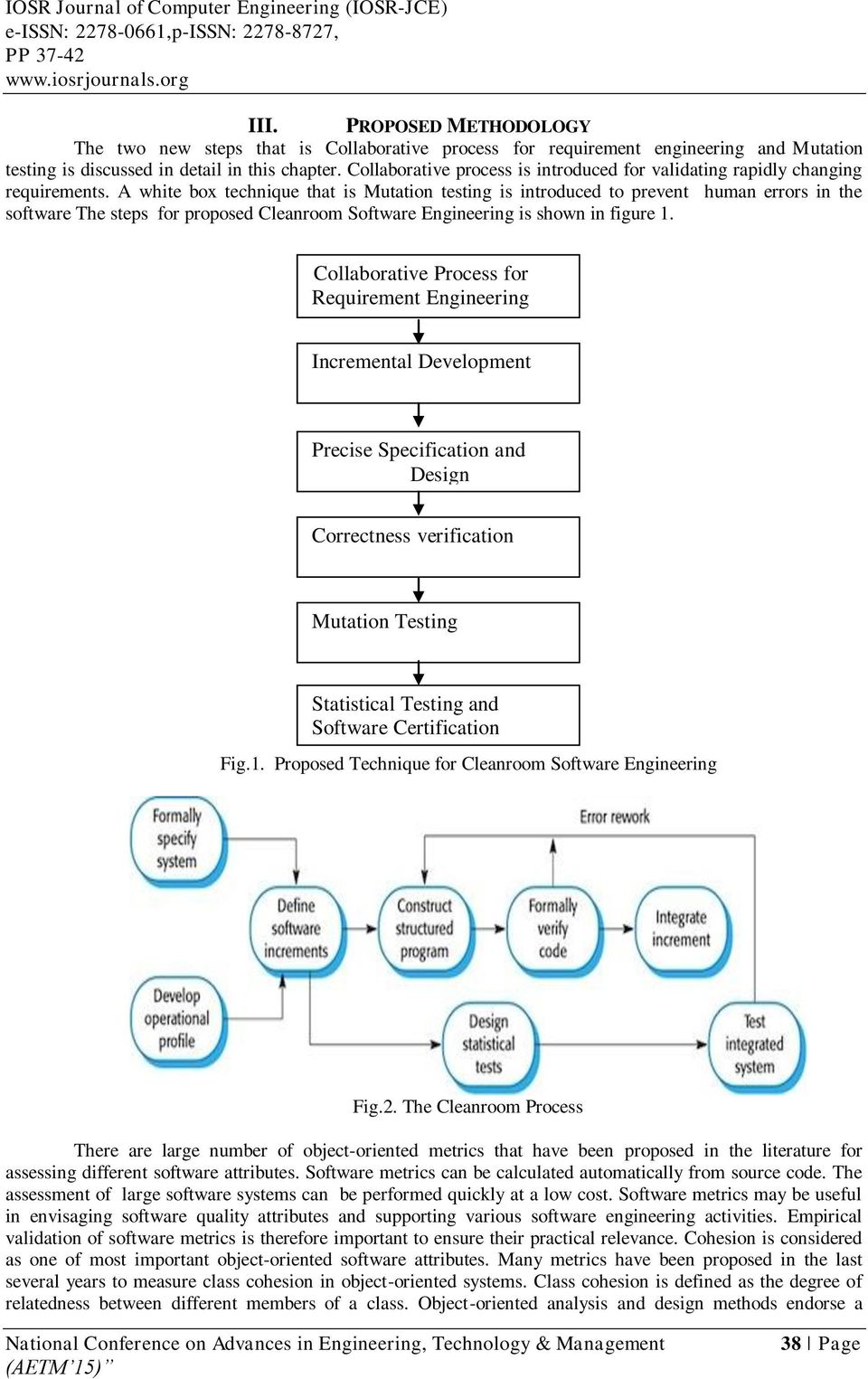
2 III. PROPOSED METHODOLOGY The two new steps that is Collaborative process for requirement engineering and Mutation testing is discussed in detail in this chapter. Collaborative process is introduced for validating rapidly changing requirements. A white box technique that is Mutation testing is introduced to prevent human errors in the software The steps for proposed Cleanroom Software Engineering is shown in figure 1. Collaborative Process for Requirement Engineering Incremental Development Precise Specification and Design Correctness verification Mutation Testing Statistical Testing and Software Certification Fig.1. Proposed Technique for Cleanroom Software Engineering Fig.2. The Cleanroom Process There are large number of object-oriented metrics that have been proposed in the literature for assessing different software attributes. Software metrics can be calculated automatically from source code. The assessment of large software systems can be performed quickly at a low cost. Software metrics may be useful in envisaging software quality attributes and supporting various software engineering activities. Empirical validation of software metrics is therefore important to ensure their practical relevance. Cohesion is considered as one of most important object-oriented software attributes. Many metrics have been proposed in the last several years to measure class cohesion in object-oriented systems. Class cohesion is defined as the degree of relatedness between different members of a class. Object-oriented analysis and design methods endorse a 38 Page
3 modular design by creating high cohesive classes. However, improper assignment of responsibilities in the design phase can lead to low cohesive classes with unrelated members. The insight provided by testing is valuable during different phases such as design, coding, testing and quality assurance. Testability generally used to detect a fault. Therefore improving software testability is an important objective in order to reduce the number defects that result from poorly designed software. It is an foreseeable fact that testability information is useful that may be complementary to testing. Higher test coverage may be achieved by transforming a system more testable for the same effort. Achieving testability is mainly a matter of separation of concerns, coupling between classes, subsystems, and cohesion. The term coupling means interaction-based coupling when viewed from a static context. But it is not so when viewed from a runtime context. Distributed systems with service oriented components have more heterogeneous networking. Traditional coupling measures had been taken into account only static coupling. They lack for dynamic coupling due to polymorphism which may underestimate the complexity of software and misjudge the need for testing and debugging. This is resulted in poor predictive accuracy of quality models in distributed Object Oriented systems that use static coupling measurements. In order to overcome these issues, we present a hybrid model in Distributed Object Oriented Software for measuring the coupling at run time. There are three steps such as Instrumentation process, Post process and coupling measurement process. In the instrumentation process the instrumented JVM has been modified to trace method calls. During this process, three major trace files are created named.prf,.clp and.svp. In the second step, the information present in these file are merged. At the end of second step, the merged detailed trace of each JVM contains pointers to the merged trace files of other JVM such that the path of every remote call from the client to server is identified uniquely. Finally, the coupling metrics is measured dynamically. The implementation level results show that the proposed system will effectively measure the coupling metrics dynamically. IV. PROPOSED WORK A few new dynamic metrics are proposed for the measurement of coupling at run-time. Moreover, different approaches for the dynamic analysis of softwares required for collection of run-time data for the measurement of dynamic metrics are compared. AOP approach is used for the computation of coupling metrics. In this paper a dynamic coupling tracer application is developed for the purpose of efficient computation of new dynamic coupling metrics. Existing dynamic coupling metrics take into account only method-method invocations between objects of classes at run-time. Dynamic coupling metrics will take into account all major types of relations such as run-time aggregation relations, run-time inheritance relations, run-time methodattribute reference relations and run-time method-method invocation relations. V. TOOL USED i) Visual Studio 2008 Microsoft Visual Studio is an integrated development environment (IDE) from Microsoft. It is used to develop computer programs for Microsoft Windows super family of operating systems, as well as web sites, web applications and web services. ii) N Crunc: N crunch tool is an automated concurrent testing tool which is used to test various modules by using different types of metrics. N crunch gives you a large amount of useful information about tested code such as code coverage features of N Crunch: a) Automatic Concurrent Testing b) Code Coverage c) Performance metrics d) Parallel Execution e) Easy DebuggingAn acknowledgement section may be presented after the conclusion, if desired. 39 Page


4 VI. RESULTS AND DISCUSSION Fig.3. First step is integration of N Crunch Tool with Visual Studio Fig 4: Enable NCrunch from NCrunch Menu with the Application Fig.5. Submit the code to be tested by the NCrunch Tool 40 Page


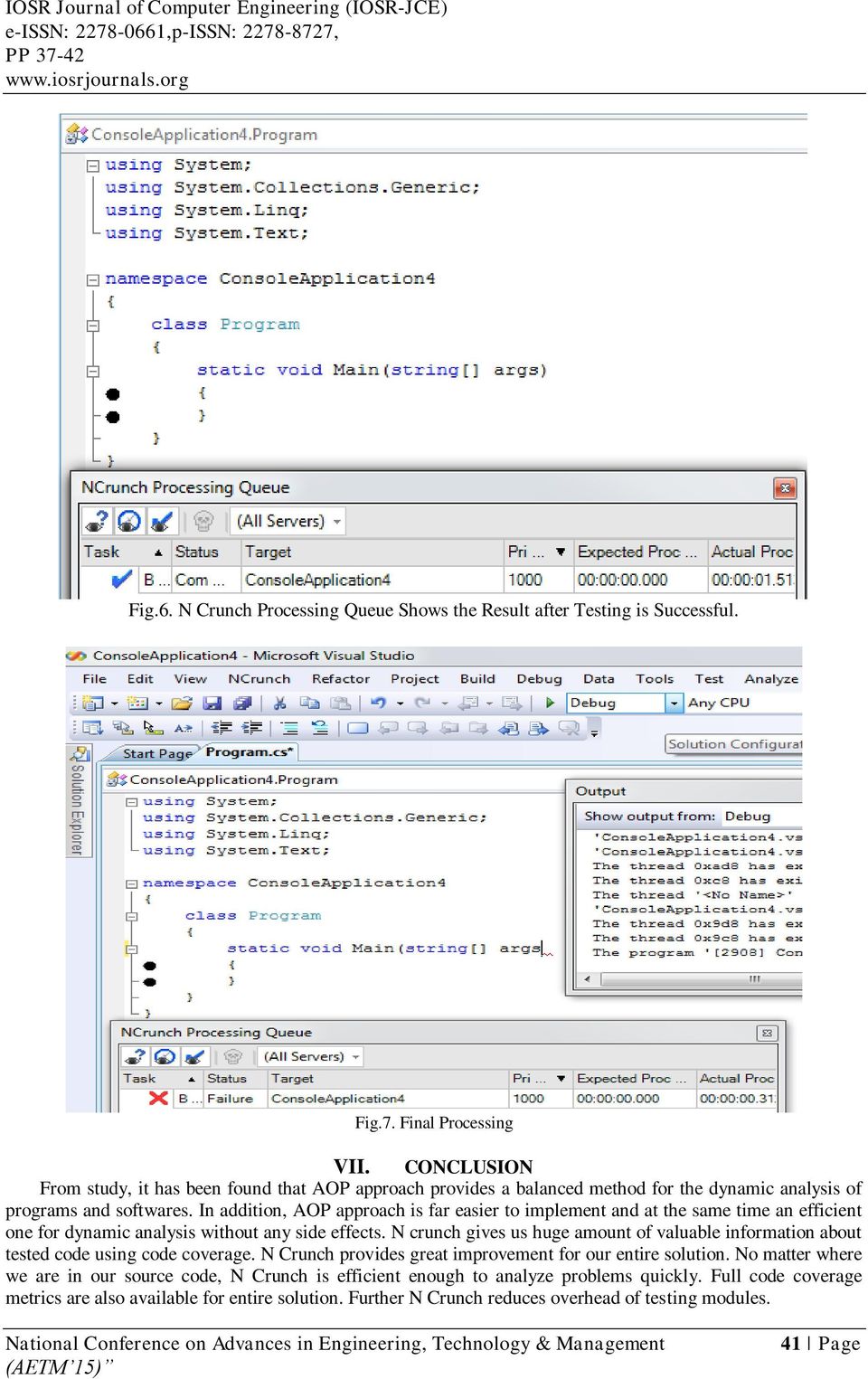
5 Fig.6. N Crunch Processing Queue Shows the Result after Testing is Successful. Fig.7. Final Processing VII. CONCLUSION From study, it has been found that AOP approach provides a balanced method for the dynamic analysis of programs and softwares. In addition, AOP approach is far easier to implement and at the same time an efficient one for dynamic analysis without any side effects. N crunch gives us huge amount of valuable information about tested code using code coverage. N Crunch provides great improvement for our entire solution. No matter where we are in our source code, N Crunch is efficient enough to analyze problems quickly. Full code coverage metrics are also available for entire solution. Further N Crunch reduces overhead of testing modules. 41 Page
6 REFERENCES [1] L.C. Briand, V. R. Basili and W. L. Melo(October 1996), A Validation of Object-Oriented Design Metrics as Quality Indicators, IEEE Transactions on Software Engineering, vol. 22, no. 10, pp [2] S. R. Chidamber, and C. F. Kemerer(1991), Towards a Metrics Suite for Object-Oriented Design, In Proceedings of the Conference on Object-Oriented Programming: Systems, Languages and Applications, (OOPSLA 91),SIGPLAN Notices, Vol. 26, no.11, pp [3] H. Paques and L. Delcambre(1999), A Mechanism for Assessing Class Interactions Using Dynamic Coupling During the Analysis Phase, In Proceedings of XVIII Brazilian Symposium on Software Engineering - SBES'99, Florianopolis - Santa Catarina Brasil. [4] E. Schikuta, Dynamic Coupling Metrics, [5] Sherif M. Yacoub, T. Robinson, and H. H. Ammar(1999), Dynamic Metrics for Object Oriented Designs, In Proceedings of the 6th International Symposium on Software Metrics [6] S. Babu and R.M.S. Parvathi(2011), Design Dynamic Coupling Measurement of Distributed Object Oriented Software Using Trace Events [7] S. Babu and R.M.S. Parvathi(January 2012), Development of Dynamic Coupling Measurement of Distributed Object Oriented Software Based on Trace Events, Vol.3, No.1, [8] Linda Badri, Mourad Badri & Fadel Toure(April,2011), An Empirical Analysis of Lack of Cohesion Metrics for Predicting Testability of Classes, Vol. 5 No. 2 [9] Mohd Nazir, Dr. Raees A. Khan, & Dr. K. Mustafa(June,2010), An Empirical Analysis of Lack of Cohesion Metrics for Predicting Testability of Classes, Volume 2 No.5 [10] Paramvir Singh and Hardeep Singh(2010), Class-level Dynamic Coupling Metrics for Static and Dynamic Analysis of Object-Oriented Systems, Vol. 1, Issue 1 [11] Jitender Kumar Chhabra and Varun Gupta(2010), A Survey of Dynamic Software Metrics 42 Page

Keywords Class level metrics, Complexity, SDLC, Hybrid Model, Testability
 Volume 5, Issue 4, April 2015 ISSN: 2277 128X International Journal of Advanced Research in Computer Science and Software Engineering Research Paper Available online at: www.ijarcsse.com A Review of Static
II. TYPES OF LEVEL A.
 Study and Evaluation for Quality Improvement of Object Oriented System at Various Layers of Object Oriented Matrices N. A. Nemade 1, D. D. Patil 2, N. V. Ingale 3 Assist. Prof. SSGBCOET Bhusawal 1, H.O.D.
How To Calculate Class Cohesion
 Improving Applicability of Cohesion Metrics Including Inheritance Jaspreet Kaur 1, Rupinder Kaur 2 1 Department of Computer Science and Engineering, LPU, Phagwara, INDIA 1 Assistant Professor Department
EVALUATING METRICS AT CLASS AND METHOD LEVEL FOR JAVA PROGRAMS USING KNOWLEDGE BASED SYSTEMS
 EVALUATING METRICS AT CLASS AND METHOD LEVEL FOR JAVA PROGRAMS USING KNOWLEDGE BASED SYSTEMS Umamaheswari E. 1, N. Bhalaji 2 and D. K. Ghosh 3 1 SCSE, VIT Chennai Campus, Chennai, India 2 SSN College of
Object Oriented Design
 Object Oriented Design Kenneth M. Anderson Lecture 20 CSCI 5828: Foundations of Software Engineering OO Design 1 Object-Oriented Design Traditional procedural systems separate data and procedures, and
Quality Analysis with Metrics
 Rational software Quality Analysis with Metrics Ameeta Roy Tech Lead IBM, India/South Asia Why do we care about Quality? Software may start small and simple, but it quickly becomes complex as more features
AN EMPIRICAL REVIEW ON FACTORS AFFECTING REUSABILITY OF PROGRAMS IN SOFTWARE ENGINEERING
 AN EMPIRICAL REVIEW ON FACTORS AFFECTING REUSABILITY OF PROGRAMS IN SOFTWARE ENGINEERING Neha Sadana, Surender Dhaiya, Manjot Singh Ahuja Computer Science and Engineering Department Shivalik Institute
Quality prediction model for object oriented software using UML metrics
 THE INSTITUTE OF ELECTRONICS, INFORMATION AND COMMUNICATION ENGINEERS TECHNICAL REPORT OF IEICE. UML Quality prediction model for object oriented software using UML metrics CAMARGO CRUZ ANA ERIKA and KOICHIRO
Regression Testing Based on Comparing Fault Detection by multi criteria before prioritization and after prioritization
 Regression Testing Based on Comparing Fault Detection by multi criteria before prioritization and after prioritization KanwalpreetKaur #, Satwinder Singh * #Research Scholar, Dept of Computer Science and
Software Defect Prediction Tool based on Neural Network
 Software Defect Prediction Tool based on Neural Network Malkit Singh Student, Department of CSE Lovely Professional University Phagwara, Punjab (India) 144411 Dalwinder Singh Salaria Assistant Professor,
Open Source Software: How Can Design Metrics Facilitate Architecture Recovery?
 Open Source Software: How Can Design Metrics Facilitate Architecture Recovery? Eleni Constantinou 1, George Kakarontzas 2, and Ioannis Stamelos 1 1 Computer Science Department Aristotle University of Thessaloniki
Definitions. Software Metrics. Why Measure Software? Example Metrics. Software Engineering. Determine quality of the current product or process
 Definitions Software Metrics Software Engineering Measure - quantitative indication of extent, amount, dimension, capacity, or size of some attribute of a product or process. Number of errors Metric -
YOKING OBJECT ORIENTED METRICS THROUGH MUTATION TESTING FOR MINIMIZING TIME PERIOD RAMIFICATION
 YOKING OBJECT ORIENTED METRICS THROUGH MUTATION TESTING FOR MINIMIZING TIME PERIOD RAMIFICATION 1 Chandu P.M.S.S., 2 Dr.T.Sasikala 1. Research Scholar, Department of CSE, Sathyabama University, Chennai,
A metrics suite for JUnit test code: a multiple case study on open source software
 Toure et al. Journal of Software Engineering Research and Development (2014) 2:14 DOI 10.1186/s40411-014-0014-6 RESEARCH Open Access A metrics suite for JUnit test code: a multiple case study on open source
Understanding Software Static and Dynamic Aspects
 Understanding Software Static and Dynamic Aspects Welf Löwe IPD, Universität Karlsruhe PF 6980, 76128 Karlsruhe Germany [email protected] Andreas Ludwig IPD, Universität Karlsruhe PF 6980, 76128 Karlsruhe
Software Testing Strategies and Techniques
 Software Testing Strategies and Techniques Sheetal Thakare 1, Savita Chavan 2, Prof. P. M. Chawan 3 1,2 MTech, Computer Engineering VJTI, Mumbai 3 Associate Professor, Computer Technology Department, VJTI,
Formal Software Testing. Terri Grenda, CSTE IV&V Testing Solutions, LLC www.ivvts.com
 Formal Software Testing Terri Grenda, CSTE IV&V Testing Solutions, LLC www.ivvts.com Scope of Testing Find defects early Remove defects prior to production Identify Risks Unbiased opinion When Should Testing
Benefits of Test Automation for Agile Testing
 Benefits of Test Automation for Agile Testing Manu GV 1, Namratha M 2, Pradeep 3 1 Technical Lead-Testing Calsoft Labs, Bangalore, India 2 Assistant Professor, BMSCE, Bangalore, India 3 Software Engineer,
Using Code Quality Metrics in Management of Outsourced Development and Maintenance
 Using Code Quality Metrics in Management of Outsourced Development and Maintenance Table of Contents 1. Introduction...3 1.1 Target Audience...3 1.2 Prerequisites...3 1.3 Classification of Sub-Contractors...3
Mining Metrics to Predict Component Failures
 Mining Metrics to Predict Component Failures Nachiappan Nagappan, Microsoft Research Thomas Ball, Microsoft Research Andreas Zeller, Saarland University Overview Introduction Hypothesis and high level
Chapter 24 - Quality Management. Lecture 1. Chapter 24 Quality management
 Chapter 24 - Quality Management Lecture 1 1 Topics covered Software quality Software standards Reviews and inspections Software measurement and metrics 2 Software quality management Concerned with ensuring
Keywords Load balancing, Dispatcher, Distributed Cluster Server, Static Load balancing, Dynamic Load balancing.
 Volume 5, Issue 7, July 2015 ISSN: 2277 128X International Journal of Advanced Research in Computer Science and Software Engineering Research Paper Available online at: www.ijarcsse.com A Hybrid Algorithm
Software Metrics. Alex Boughton
 Software Metrics Alex Boughton Executive Summary What are software metrics? Why are software metrics used in industry, and how? Limitations on applying software metrics A framework to help refine and understand
An Analysis on Objectives, Importance and Types of Software Testing
 Available Online at www.ijcsmc.com International Journal of Computer Science and Mobile Computing A Monthly Journal of Computer Science and Information Technology IJCSMC, Vol. 2, Issue. 9, September 2013,
Overview of Impact of Requirement Metrics in Software Development Environment
 Overview of Impact of Requirement Metrics in Software Development Environment 1 Mohd.Haleem, 2 Prof (Dr) Mohd.Rizwan Beg, 3 Sheikh Fahad Ahmad Abstract: Requirement engineering is the important area of
Automated Test Approach for Web Based Software
 Automated Test Approach for Web Based Software Indrajit Pan 1, Subhamita Mukherjee 2 1 Dept. of Information Technology, RCCIIT, Kolkata 700 015, W.B., India 2 Dept. of Information Technology, Techno India,
International Journal of Advance Research in Computer Science and Management Studies
 Volume 2, Issue 12, December 2014 ISSN: 2321 7782 (Online) International Journal of Advance Research in Computer Science and Management Studies Research Article / Survey Paper / Case Study Available online
Keywords: Dynamic Load Balancing, Process Migration, Load Indices, Threshold Level, Response Time, Process Age.
 Volume 3, Issue 10, October 2013 ISSN: 2277 128X International Journal of Advanced Research in Computer Science and Software Engineering Research Paper Available online at: www.ijarcsse.com Load Measurement
Exploiting Dynamic Information in IDEs Eases Software Maintenance
 Exploiting Dynamic Information in IDEs Eases Software Maintenance David Röthlisberger Software Composition Group, University of Bern, Switzerland [email protected] Abstract The integrated development
A methodology for measuring software development productivity using Eclipse IDE
 Proceedings of the 9 th International Conference on Applied Informatics Eger, Hungary, January 29 February 1, 2014. Vol. 2. pp. 255 262 doi: 10.14794/ICAI.9.2014.2.255 A methodology for measuring software
Data Refinery with Big Data Aspects
 International Journal of Information and Computation Technology. ISSN 0974-2239 Volume 3, Number 7 (2013), pp. 655-662 International Research Publications House http://www. irphouse.com /ijict.htm Data
How To Design An Information System
 Information system for production and mounting of plastic windows MARCEL, MELIŠ Slovak University of Technology - Faculty of Material Sciences and Technology in Trnava, Paulínska 16 street, Trnava, 917
Design and Code Complexity Metrics for OO Classes. Letha Etzkorn, Jagdish Bansiya, and Carl Davis. The University of Alabama in Huntsville
 Design and Code Complexity Metrics for OO Classes Letha Etzkorn, Jagdish Bansiya, and Carl Davis The University of Alabama in Huntsville {letzkorn, jbansiya, cdavis} @cs.uah.edu Software complexity metrics
A Study on Software Metrics and Phase based Defect Removal Pattern Technique for Project Management
 International Journal of Soft Computing and Engineering (IJSCE) A Study on Software Metrics and Phase based Defect Removal Pattern Technique for Project Management Jayanthi.R, M Lilly Florence Abstract:
What is a life cycle model?
 What is a life cycle model? Framework under which a software product is going to be developed. Defines the phases that the product under development will go through. Identifies activities involved in each
DESIGN OF CLUSTER OF SIP SERVER BY LOAD BALANCER
 INTERNATIONAL JOURNAL OF REVIEWS ON RECENT ELECTRONICS AND COMPUTER SCIENCE DESIGN OF CLUSTER OF SIP SERVER BY LOAD BALANCER M.Vishwashanthi 1, S.Ravi Kumar 2 1 M.Tech Student, Dept of CSE, Anurag Group
Fault Prediction Using Statistical and Machine Learning Methods for Improving Software Quality
 Journal of Information Processing Systems, Vol.8, No.2, June 2012 http://dx.doi.org/10.3745/jips.2012.8.2.241 Fault Prediction Using Statistical and Machine Learning Methods for Improving Software Quality
The «SQALE» Analysis Model An analysis model compliant with the representation condition for assessing the Quality of Software Source Code
 The «SQALE» Analysis Model An analysis model compliant with the representation condition for assessing the Quality of Software Source Code Jean-Louis Letouzey DNV IT Global Services Arcueil, France [email protected]
How To Adapt Coupling Metrics For Bpm
 Coupling metrics for business process modeling WIEM KHLIF, NAHLA ZAABOUB, HANENE BEN-ABDALLAH Mir@cl Laboratory, Faculty of Economics and Management Sciences Sfax University B.P. 088, Sfax 3000 TUNISIA
Load Balancing in Distributed Data Base and Distributed Computing System
 Load Balancing in Distributed Data Base and Distributed Computing System Lovely Arya Research Scholar Dravidian University KUPPAM, ANDHRA PRADESH Abstract With a distributed system, data can be located
A Comparative Performance Analysis of Load Balancing Algorithms in Distributed System using Qualitative Parameters
 A Comparative Performance Analysis of Load Balancing Algorithms in Distributed System using Qualitative Parameters Abhijit A. Rajguru, S.S. Apte Abstract - A distributed system can be viewed as a collection
Course Title: Software Development
 Course Title: Software Development Unit: Customer Service Content Standard(s) and Depth of 1. Analyze customer software needs and system requirements to design an information technology-based project plan.
VISUALIZATION APPROACH FOR SOFTWARE PROJECTS
 Canadian Journal of Pure and Applied Sciences Vol. 9, No. 2, pp. 3431-3439, June 2015 Online ISSN: 1920-3853; Print ISSN: 1715-9997 Available online at www.cjpas.net VISUALIZATION APPROACH FOR SOFTWARE
Software Engineering Best Practices. Christian Hartshorne Field Engineer Daniel Thomas Internal Sales Engineer
 Software Engineering Best Practices Christian Hartshorne Field Engineer Daniel Thomas Internal Sales Engineer 2 3 4 Examples of Software Engineering Debt (just some of the most common LabVIEW development
LOAD BALANCING IN CLOUD COMPUTING USING PARTITIONING METHOD
 LOAD BALANCING IN CLOUD COMPUTING USING PARTITIONING METHOD Mitesh Patel 1, Kajal Isamaliya 2, Hardik kadia 3, Vidhi Patel 4 CE Department, MEC, Surat, Gujarat, India 1 Asst.Professor, CSE Department,
Contents. Introduction and System Engineering 1. Introduction 2. Software Process and Methodology 16. System Engineering 53
 Preface xvi Part I Introduction and System Engineering 1 Chapter 1 Introduction 2 1.1 What Is Software Engineering? 2 1.2 Why Software Engineering? 3 1.3 Software Life-Cycle Activities 4 1.3.1 Software
EXTENDED ANGEL: KNOWLEDGE-BASED APPROACH FOR LOC AND EFFORT ESTIMATION FOR MULTIMEDIA PROJECTS IN MEDICAL DOMAIN
 EXTENDED ANGEL: KNOWLEDGE-BASED APPROACH FOR LOC AND EFFORT ESTIMATION FOR MULTIMEDIA PROJECTS IN MEDICAL DOMAIN Sridhar S Associate Professor, Department of Information Science and Technology, Anna University,
A Thread Monitoring System for Multithreaded Java Programs
 A Thread Monitoring System for Multithreaded Java Programs Sewon Moon and Byeong-Mo Chang Department of Computer Science Sookmyung Women s University, Seoul 140-742, Korea [email protected], [email protected]
Evaluating the Relevance of Prevailing Software Metrics to Address Issue of Security Implementation in SDLC
 Evaluating the Relevance of Prevailing Software Metrics to Address Issue of Security Implementation in SDLC C. Banerjee Research Scholar, Jagannath University, Jaipur, India Arpita Banerjee Assistant Professor,
V. Phani Krishna et al, / (IJCSIT) International Journal of Computer Science and Information Technologies, Vol. 2 (6), 2011, 2915-2919
 Software Quality Assurance in CMM and XP- A Comparative Study CH.V. Phani Krishna and Dr. K.Rajasekhara Rao CSE Department, KL University, Guntur dt., India. Abstract Software Quality Assurance is a planned
Fair Scheduling Algorithm with Dynamic Load Balancing Using In Grid Computing
 Research Inventy: International Journal Of Engineering And Science Vol.2, Issue 10 (April 2013), Pp 53-57 Issn(e): 2278-4721, Issn(p):2319-6483, Www.Researchinventy.Com Fair Scheduling Algorithm with Dynamic
Decomposition into Parts. Software Engineering, Lecture 4. Data and Function Cohesion. Allocation of Functions and Data. Component Interfaces
 Software Engineering, Lecture 4 Decomposition into suitable parts Cross cutting concerns Design patterns I will also give an example scenario that you are supposed to analyse and make synthesis from The
A FRAMEWORK FOR MANAGING RUNTIME ENVIRONMENT OF JAVA APPLICATIONS
 A FRAMEWORK FOR MANAGING RUNTIME ENVIRONMENT OF JAVA APPLICATIONS Abstract T.VENGATTARAMAN * Department of Computer Science, Pondicherry University, Puducherry, India. A.RAMALINGAM Department of MCA, Sri
International Journal of Computer Engineering and Applications, Volume V, Issue III, March 14
 International Journal of Computer Engineering and Applications, Volume V, Issue III, March 14 PREDICTION OF RATE OF IMPROVEMENT OF SOFTWARE QUALITY AND DEVELOPMENT EFFORT ON THE BASIS OF DEGREE OF EXCELLENCE
Effort Reduction in RUP using CRM for Project Development: Mapping the Best Practices of CRM into RUP
 Effort Reduction in RUP using CRM for Project Development: Mapping the Best Practices of CRM into RUP Muhammad Javed, Bashir Ahmad, Muhammad Ali Abid, Muhammad Ahmad Jan Sheikh Muhammad Saqib and Muhammad
International Journal of Advanced Research in Computer Science and Software Engineering
 Volume 3, Issue 3, March 2013 ISSN: 2277 128X International Journal of Advanced Research in Computer Science and Software Engineering Research Paper Available online at: www.ijarcsse.com Coupling and Cohesion
Quantitative Evaluation of Software Quality Metrics in Open-Source Projects
 Quantitative Evaluation of Software Quality Metrics in Open-Source Projects Henrike Barkmann Rüdiger Lincke Welf Löwe Software Technology Group, School of Mathematics and Systems Engineering Växjö University,
How To Balance In Cloud Computing
 A Review on Load Balancing Algorithms in Cloud Hareesh M J Dept. of CSE, RSET, Kochi hareeshmjoseph@ gmail.com John P Martin Dept. of CSE, RSET, Kochi [email protected] Yedhu Sastri Dept. of IT, RSET,
How To Validate An Isos 9126 Quality Model
 Validation of a Standard- and Metric-Based Software Quality Model Rüdiger Lincke and Welf Löwe School of Mathematics and Systems Engineering, Växjö University, 351 95 Växjö, Sweden {rudiger.lincke welf.lowe}@msi.vxu.se
Survey on Models to Investigate Data Center Performance and QoS in Cloud Computing Infrastructure
 Survey on Models to Investigate Data Center Performance and QoS in Cloud Computing Infrastructure Chandrakala Department of Computer Science and Engineering Srinivas School of Engineering, Mukka Mangalore,
Efficient Automated Build and Deployment Framework with Parallel Process
 Efficient Automated Build and Deployment Framework with Parallel Process Prachee Kamboj 1, Lincy Mathews 2 Information Science and engineering Department, M. S. Ramaiah Institute of Technology, Bangalore,
SOFTWARE TESTING TRAINING COURSES CONTENTS
 SOFTWARE TESTING TRAINING COURSES CONTENTS 1 Unit I Description Objectves Duration Contents Software Testing Fundamentals and Best Practices This training course will give basic understanding on software
Combining Static and Dynamic Impact Analysis for Large-scale Enterprise Systems
 Combining Static and Dynamic Impact Analysis for Large-scale Enterprise Systems The 15th International Conference on Product-Focused Software Process Improvement, Helsinki, Finland. Wen Chen, Alan Wassyng,
Reducing Technical Debt Using Maintainability Index
 Reducing Technical Debt Using Maintainability Index Too much debt can be bad for business. We are all familiar with the negative repercussions that financial debt can cause. Technical debt, and the cost
Improving data integrity on cloud storage services
 International Journal of Engineering Science Invention ISSN (Online): 2319 6734, ISSN (Print): 2319 6726 Volume 2 Issue 2 ǁ February. 2013 ǁ PP.49-55 Improving data integrity on cloud storage services
[Rokadiya,5(4): October-December 2015] ISSN 2277 5528 Impact Factor- 3.145
![[Rokadiya,5(4): October-December 2015] ISSN 2277 5528 Impact Factor- 3.145](/thumbs/29/13161576.jpg "[Rokadiya,5(4): October-December 2015] ISSN 2277 5528 Impact Factor- 3.145") INTERNATIONALJOURNALOFENGINEERING SCIENCES&MANAGEMENT A MODEL FOR WEB BASED APPLICATION USING MANUAL AND AUTOMATED TESTING TECHNIQUES AND ALSO STUDY FAULTS, THEIR EFFECTS AND TESTING CHALLENGES IN WEB
INTERNATIONALJOURNALOFENGINEERING SCIENCES&MANAGEMENT A MODEL FOR WEB BASED APPLICATION USING MANUAL AND AUTOMATED TESTING TECHNIQUES AND ALSO STUDY FAULTS, THEIR EFFECTS AND TESTING CHALLENGES IN WEB
A Hybrid Approach of Module Sequence Generation using Neural Network for Software Architecture
 A Hybrid Approach of Module Sequence Generation using Neural Network for Software Architecture Manjot Kalsi 1, Janpreet Singh 2 1 M.Tech Research Scholar, Lovely Professional University, Phagwara, Punjab,
DYNAMIC QUERY FORMS WITH NoSQL
 IMPACT: International Journal of Research in Engineering & Technology (IMPACT: IJRET) ISSN(E): 2321-8843; ISSN(P): 2347-4599 Vol. 2, Issue 7, Jul 2014, 157-162 Impact Journals DYNAMIC QUERY FORMS WITH
Cloud Computing for Agent-based Traffic Management Systems
 Cloud Computing for Agent-based Traffic Management Systems Manoj A Patil Asst.Prof. IT Dept. Khyamling A Parane Asst.Prof. CSE Dept. D. Rajesh Asst.Prof. IT Dept. ABSTRACT Increased traffic congestion
An Empirical Approach - Distributed Mobility Management for Target Tracking in MANETs
 An Empirical Approach - Distributed Mobility Management for Target Tracking in MANETs G.Michael Assistant Professor, Department of CSE, Bharath University, Chennai, TN, India ABSTRACT: Mobility management
A Comprehensive Assessment of Object-Oriented Software Systems Using Metrics Approach
 A Comprehensive Assessment of Object-Oriented Software Systems Using Metrics Approach Sanjay Kumar Dubey Department of Computer Science and Engineering Amity School of Engineering and Technology Amity
International Journal of Computer Science Trends and Technology (IJCST) Volume 2 Issue 3, May-Jun 2014
 RESEARCH ARTICLE OPEN ACCESS A Survey of Data Mining: Concepts with Applications and its Future Scope Dr. Zubair Khan 1, Ashish Kumar 2, Sunny Kumar 3 M.Tech Research Scholar 2. Department of Computer
Quality Management. Objectives
 Quality Management Ian Sommerville 2004 Software Engineering, 7th edition. Chapter 27 Slide 1 Objectives To introduce the quality management process and key quality management activities To explain the
Quality Management. Ian Sommerville 2004 Software Engineering, 7th edition. Chapter 27 Slide 1
 Quality Management Ian Sommerville 2004 Software Engineering, 7th edition. Chapter 27 Slide 1 Objectives To introduce the quality management process and key quality management activities To explain the
Comparing the Testing Approaches of Traditional, Object-Oriented and Agent- Oriented Software System
 Comparing the Testing Approaches of Traditional, Object-Oriented and Agent- Oriented Software System N.Sivakumar 1 and K.Vivekanandan 2 Department of computer Science and Engineering Pondicherry Engineering
Load Balancing in cloud computing
 Load Balancing in cloud computing 1 Foram F Kherani, 2 Prof.Jignesh Vania Department of computer engineering, Lok Jagruti Kendra Institute of Technology, India 1 [email protected], 2 [email protected]
The Software. Audit Guide. ASQ Quality Press. Milwaukee, Wisconsin. John W. Helgeson
 The Software Audit Guide John W. Helgeson ASQ Quality Press Milwaukee, Wisconsin Contents Preface Acknowledgments xv Xlx Part I Audit Fundamentals 1 Chapter 1 Introduction 3 1.1 Definitions 7 1.2 Process
Quality Management. Managing the quality of the software process and products
 Quality Management Managing the quality of the software process and products Ian Sommerville 2000 Software Engineering, 6th edition. Chapter 24 Slide 1 Objectives To introduce the quality management process
A Framework for the Design of Cloud Based Collaborative Virtual Environment Architecture
 , March 12-14, 2014, Hong Kong A Framework for the Design of Cloud Based Collaborative Virtual Environment Architecture Abdulsalam Ya u Gital, Abdul Samad Ismail, Min Chen, and Haruna Chiroma, Member,
Keywords Distributed Computing, On Demand Resources, Cloud Computing, Virtualization, Server Consolidation, Load Balancing
 Volume 5, Issue 1, January 2015 ISSN: 2277 128X International Journal of Advanced Research in Computer Science and Software Engineering Research Paper Available online at: www.ijarcsse.com Survey on Load
Verifying Semantic of System Composition for an Aspect-Oriented Approach
 2012 International Conference on System Engineering and Modeling (ICSEM 2012) IPCSIT vol. 34 (2012) (2012) IACSIT Press, Singapore Verifying Semantic of System Composition for an Aspect-Oriented Approach
Techniques and Tools for Rich Internet Applications Testing
 Techniques and Tools for Rich Internet Applications Testing Domenico Amalfitano Anna Rita Fasolino Porfirio Tramontana Dipartimento di Informatica e Sistemistica University of Naples Federico II, Italy
Component visualization methods for large legacy software in C/C++
 Annales Mathematicae et Informaticae 44 (2015) pp. 23 33 http://ami.ektf.hu Component visualization methods for large legacy software in C/C++ Máté Cserép a, Dániel Krupp b a Eötvös Loránd University [email protected]
Chap 4. Using Metrics To Manage Software Risks
 Chap 4. Using Metrics To Manage Software Risks. Introduction 2. Software Measurement Concepts 3. Case Study: Measuring Maintainability 4. Metrics and Quality . Introduction Definition Measurement is the