
Financial Literacy in Grade 11 Mathematics Understanding Annuities
|
|
|
- Juniper Thornton
- 10 years ago
- Views:
Transcription
1 Grade 11 Mathematics Functions (MCR3U) Connections to Financial Literacy Students are building their understanding of financial literacy by solving problems related to annuities. Students set up a hypothetical regular payment annuity for savings and identify life circumstances that might impact such an annuity. Students determine monthly payments and interest associated with a mortgage. Curriculum Expectations Click here to access expectations in full, with examples. C. Discrete Functions 3. Solving Problems Involving Financial Applications C3. make connections between sequences, series, and financial applications, and solve problems involving compound interest and ordinary annuities 3.7 solve problems, using technology, that involve the amount, the present value, and the regular payment of an ordinary simple annuity. Mathematical Process Expectations Problem Solving Selecting Tools and Computational Strategies Connecting Communicating Learning Goals During this lesson, students will: solve problems involving regular payments in simple annuities use scientific or graphing calculators to solve problems using the R ( 1 + i) n 1 and A = i formulas communicate solutions to annuity problems in writing make connections between the mathematical equations and real life situations Sample Success Criteria for making connections between mathematical equations and real life situations: Explain how different interest rates and payment schedules have an impact on annuities Instructional Components and Context Readiness Understanding the relationship between ordinary simple annuities and geometric series. Skill in solving the polynomial and exponential equations that are generated when different values are known and unknown in the R ( 1 + i) n 1 formula. A = i Skill in using a scientific or graphing calculator to solve linear equations. Terminology Present value Amount Future value Regular payment Compounded interest Compounding rate per period Annuity Materials and Resources Textbook or materials with practice questions Computer and projector Scientific or graphing calculators Class Set of Exit Slip Financial Literacy in Grade 11 Mathematics 1

2 Grade 11 Mathematics Functions (MCR3U) Minds On Connections Whole Class Check for Understanding Pose the scenario to the class: Suppose a new classmate joined us today. And, suppose that classmate had learned about sequences and series, but had not yet seen applications to financial literacy. How would you explain the formula R ( 1 + i) n 1 that we have been using to that student? A = i Individual Check for Computational Skills Students complete the following and check their answer with a partner: Calculate the future value and interest earned for an annuity with regular deposits of $500 every 6 months, for 10 years, at a 6.2%/annum interest rate compounded semi-annually. Guiding Questions Provide reminders re: using calculators, and always writing a conclusion at the end of a problem. Will you get a more accurate answer if you do the calculation using a decimal or a fraction? Observe which students need further support in substituting into the formula and using their calculator for computation. Whole Class Preparing for Problem Solving Pose the following questions: 1. Instead of starting now to put regular payments into an annuity in order to have a certain amount in the future (at the end of the annuity), we need to pay off a certain expense now with the promise of making regular payments into the future. How could we model this scenario using a geometric sequence? 2. Before we create a model, what are some life scenarios where people need to pay off certain expenses now with the promise of regular payments into the future? Possible answers: a mortgage; a car loan, a present commitment to support a child with future post-secondary expenses Accept whatever names and variables students use as a beginning step, then gradually introduce PV for present value, and explain why the variables R, i, and n still apply. Work towards PV = R(1+i) -1 + R(1+i) -2 + R(1+i) -n, reviewing geometric sequences as you work with what the students put forward. Observe which students are making the connections between geometric sequences and annuities, and which students need further support so that you can guide those students during the Action part of the lesson. Financial Literacy in Grade 11 Mathematics 2

3 Grade 11 Mathematics Functions (MCR3U) Action! Whole Class Formula Development Guide development of the formula by reviewing the process for summing a geometric sequence and applying a formula for a geometric series. Lead the class in application of the PV formula using the following example: Your parents agree to set up an annuity with the bank now to help you pay for living expenses over the next 5 years. The annuity will pay $50 per month and the first payment will be made one month from now. If the annuity earns 7.75%/annum interest rate compounded monthly: a. How much money should your parents initially put into the annuity? b. How much interest will the annuity earn over its term? Pairs Share Practice Students work with a partner to solve the problem: Amir borrows $ for a new condominium. If the bank charges 3.9%/a compounded monthly for the next 25 years: Connections Guiding Questions Is this possible for everyone? Why might someone not have funds available to make investment choices like the ones we re discussing? What factors might cause a person s financial situation to change? Teacher observation of student responses during review questions Student reflection on application of the information to their lives Student presentation of a case study (occurs in future lesson) Students may select from a variety of problems/case studies to demonstrate their learning a. How much will each of Amir s monthly payments be? b. How much interest will he have paid over the length of the loan? What does the interest earned tell you about the banking/loan business? Differentiate support based on observation of need. Circulate to see which pairs are making good progress and which need help. Invite pairs to discuss and assess their solutions, and support peers. Have more complex problems available for students who need an additional challenge. Financial Literacy in Grade 11 Mathematics 3

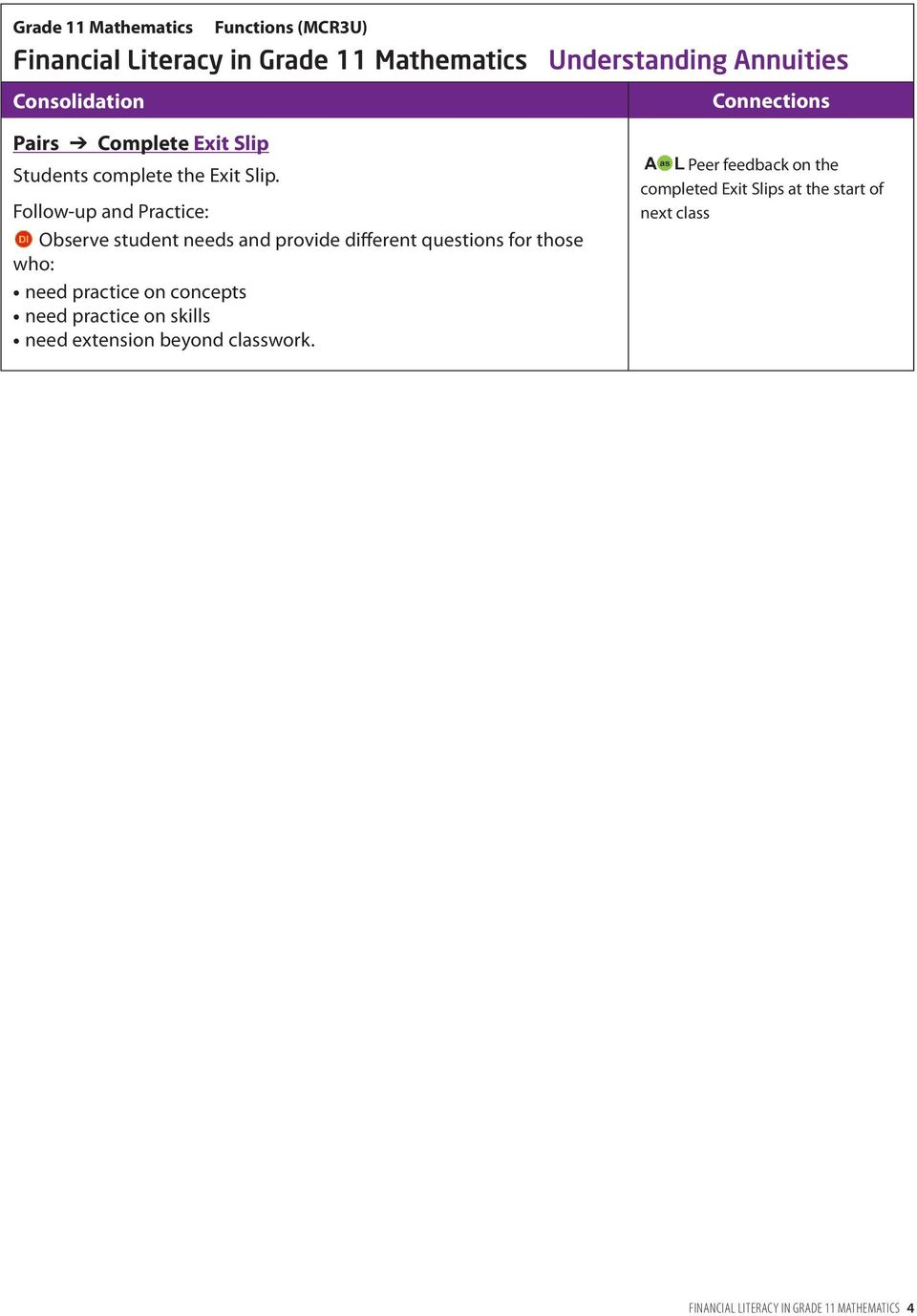
4 Grade 11 Mathematics Functions (MCR3U) Consolidation Connections Pairs Complete Exit Slip Students complete the Exit Slip. Follow-up and Practice: Observe student needs and provide different questions for those who: need practice on concepts need practice on skills need extension beyond classwork. Peer feedback on the completed Exit Slips at the start of next class Financial Literacy in Grade 11 Mathematics 4
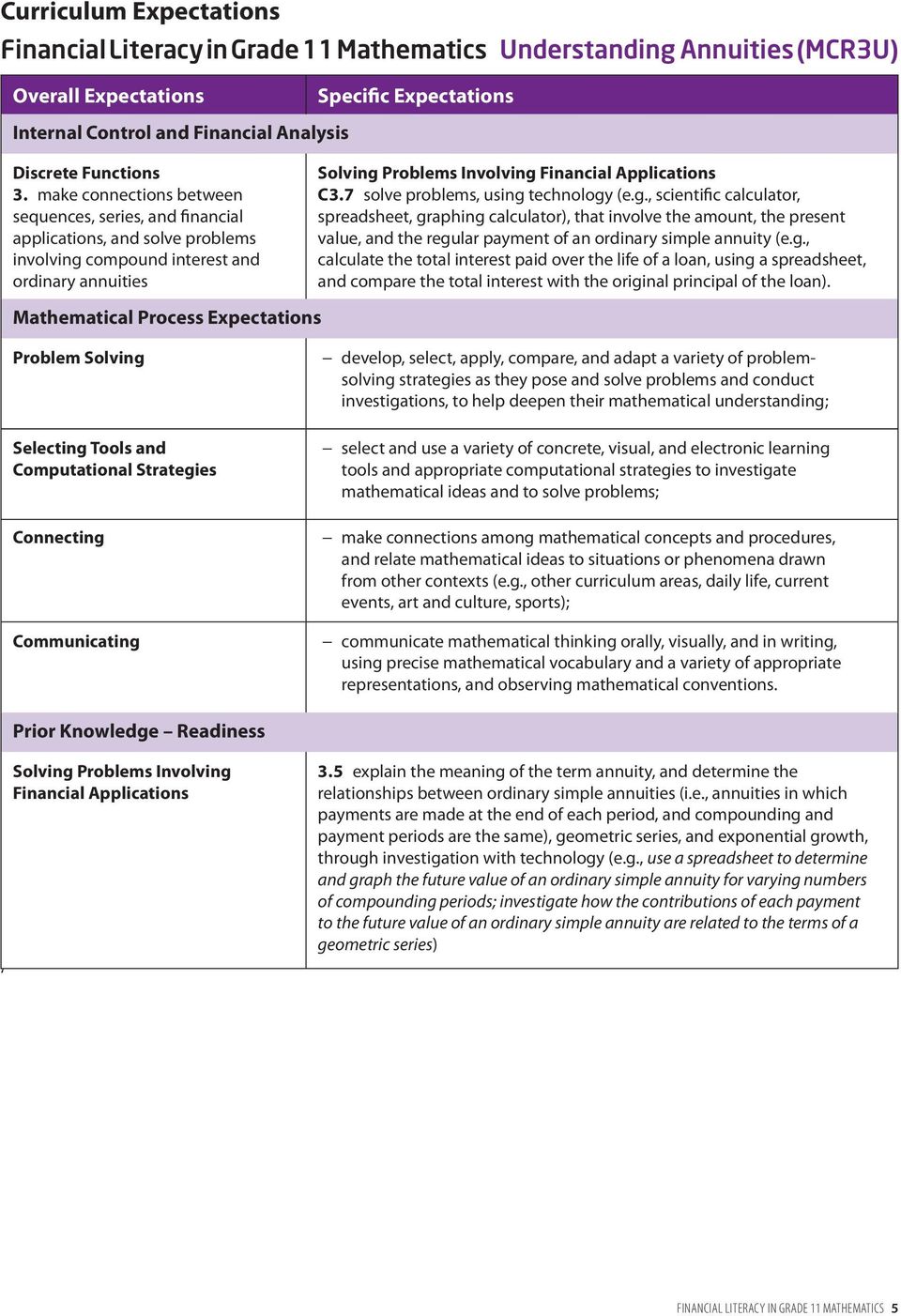
5 Curriculum Expectations (MCR3U) Overall Expectations Internal Control and Financial Analysis Discrete Functions 3. make connections between sequences, series, and financial applications, and solve problems involving compound interest and ordinary annuities Mathematical Process Expectations Specific Expectations Solving Problems Involving Financial Applications C3.7 solve problems, using technology (e.g., scientific calculator, spreadsheet, graphing calculator), that involve the amount, the present value, and the regular payment of an ordinary simple annuity (e.g., calculate the total interest paid over the life of a loan, using a spreadsheet, and compare the total interest with the original principal of the loan). Problem Solving Selecting Tools and Computational Strategies Connecting Communicating develop, select, apply, compare, and adapt a variety of problemsolving strategies as they pose and solve problems and conduct investigations, to help deepen their mathematical understanding; select and use a variety of concrete, visual, and electronic learning tools and appropriate computational strategies to investigate mathematical ideas and to solve problems; make connections among mathematical concepts and procedures, and relate mathematical ideas to situations or phenomena drawn from other contexts (e.g., other curriculum areas, daily life, current events, art and culture, sports); communicate mathematical thinking orally, visually, and in writing, using precise mathematical vocabulary and a variety of appropriate representations, and observing mathematical conventions. Prior Knowledge Readiness Solving Problems Involving Financial Applications 3.5 explain the meaning of the term annuity, and determine the relationships between ordinary simple annuities (i.e., annuities in which payments are made at the end of each period, and compounding and payment periods are the same), geometric series, and exponential growth, through investigation with technology (e.g., use a spreadsheet to determine and graph the future value of an ordinary simple annuity for varying numbers of compounding periods; investigate how the contributions of each payment to the future value of an ordinary simple annuity are related to the terms of a geometric series) Financial Literacy in Grade 11 Mathematics 5
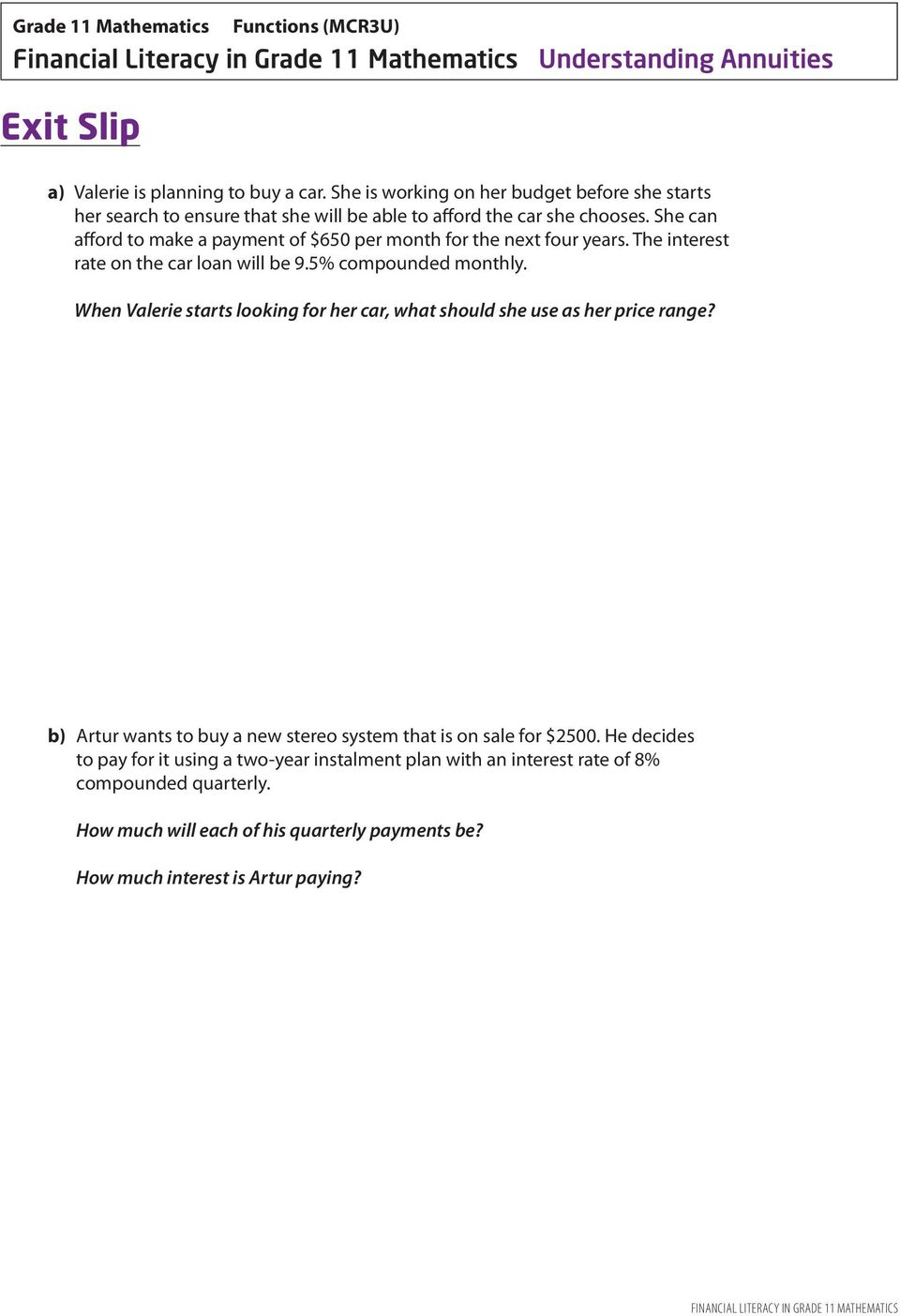
6 Grade 11 Mathematics Functions (MCR3U) Exit Slip a) Valerie is planning to buy a car. She is working on her budget before she starts her search to ensure that she will be able to afford the car she chooses. She can afford to make a payment of $650 per month for the next four years. The interest rate on the car loan will be 9.5% compounded monthly. When Valerie starts looking for her car, what should she use as her price range? b) Artur wants to buy a new stereo system that is on sale for $2500. He decides to pay for it using a two-year instalment plan with an interest rate of 8% compounded quarterly. How much will each of his quarterly payments be? How much interest is Artur paying? Financial Literacy in Grade 11 Mathematics
Contextualized Learning Activities (CLAs)
 January 2008 Specialist High Skills Major (SHSM) 1 Notes: This CLA is missing the attachments referred to at the end of the template. As such this is just an idea with no student activities or teacher
Comparing Simple and Compound Interest
 Comparing Simple and Compound Interest GRADE 11 In this lesson, students compare various savings and investment vehicles by calculating simple and compound interest. Prerequisite knowledge: Students should
Finance Unit 8. Success Criteria. 1 U n i t 8 11U Date: Name: Tentative TEST date
 1 U n i t 8 11U Date: Name: Finance Unit 8 Tentative TEST date Big idea/learning Goals In this unit you will study the applications of linear and exponential relations within financing. You will understand
first complete "prior knowlegde" -- to refresh knowledge of Simple and Compound Interest.
 ORDINARY SIMPLE ANNUITIES first complete "prior knowlegde" -- to refresh knowledge of Simple and Compound Interest. LESSON OBJECTIVES: students will learn how to determine the Accumulated Value of Regular
Investigating Investment Formulas Using Recursion Grade 11
 Ohio Standards Connection Patterns, Functions and Algebra Benchmark C Use recursive functions to model and solve problems; e.g., home mortgages, annuities. Indicator 1 Identify and describe problem situations
1. Annuity a sequence of payments, each made at equally spaced time intervals.
 Ordinary Annuities (Young: 6.2) In this Lecture: 1. More Terminology 2. Future Value of an Ordinary Annuity 3. The Ordinary Annuity Formula (Optional) 4. Present Value of an Ordinary Annuity More Terminology
Annuities: Present Value
 8.5 nnuities: Present Value GOL Determine the present value of an annuity earning compound interest. INVESTIGTE the Math Kew wants to invest some money at 5.5%/a compounded annually. He would like the
8.1 Simple Interest and 8.2 Compound Interest
 8.1 Simple Interest and 8.2 Compound Interest When you open a bank account or invest money in a bank or financial institution the bank/financial institution pays you interest for the use of your money.
A = P (1 + r / n) n t
 Finance Formulas for College Algebra (LCU - Fall 2013) ---------------------------------------------------------------------------------------------------------------------------------- Formula 1: Amount
Bank: The bank's deposit pays 8 % per year with annual compounding. Bond: The price of the bond is $75. You will receive $100 five years later.
 ü 4.4 lternative Discounted Cash Flow Decision Rules ü Three Decision Rules (1) Net Present Value (2) Future Value (3) Internal Rate of Return, IRR ü (3) Internal Rate of Return, IRR Internal Rate of Return
DISCOUNTED CASH FLOW VALUATION and MULTIPLE CASH FLOWS
 Chapter 5 DISCOUNTED CASH FLOW VALUATION and MULTIPLE CASH FLOWS The basic PV and FV techniques can be extended to handle any number of cash flows. PV with multiple cash flows: Suppose you need $500 one
E INV 1 AM 11 Name: INTEREST. There are two types of Interest : and. The formula is. I is. P is. r is. t is
 E INV 1 AM 11 Name: INTEREST There are two types of Interest : and. SIMPLE INTEREST The formula is I is P is r is t is NOTE: For 8% use r =, for 12% use r =, for 2.5% use r = NOTE: For 6 months use t =
Chapter 6. Discounted Cash Flow Valuation. Key Concepts and Skills. Multiple Cash Flows Future Value Example 6.1. Answer 6.1
 Chapter 6 Key Concepts and Skills Be able to compute: the future value of multiple cash flows the present value of multiple cash flows the future and present value of annuities Discounted Cash Flow Valuation
TASK: Present Value Analysis
 This task was developed by secondary mathematics and CTE teachers across Washington State from urban and rural areas. These teachers have incorporated financial literacy in their classroom and have received
Discounted Cash Flow Valuation
 6 Formulas Discounted Cash Flow Valuation McGraw-Hill/Irwin Copyright 2008 by The McGraw-Hill Companies, Inc. All rights reserved. Chapter Outline Future and Present Values of Multiple Cash Flows Valuing
International Financial Strategies Time Value of Money
 International Financial Strategies 1 Future Value and Compounding Future value = cash value of the investment at some point in the future Investing for single period: FV. Future Value PV. Present Value
Calculations for Time Value of Money
 KEATMX01_p001-008.qxd 11/4/05 4:47 PM Page 1 Calculations for Time Value of Money In this appendix, a brief explanation of the computation of the time value of money is given for readers not familiar with
Solving Compound Interest Problems
 Solving Compound Interest Problems What is Compound Interest? If you walk into a bank and open up a savings account you will earn interest on the money you deposit in the bank. If the interest is calculated
Finding the Payment $20,000 = C[1 1 / 1.0066667 48 ] /.0066667 C = $488.26
![Finding the Payment $20,000 = C[1 1 / 1.0066667 48 ] /.0066667 C = $488.26](/thumbs/17/134163.jpg "Finding the Payment $20,000 = C[1 1 / 1.0066667 48 ] /.0066667 C = $488.26") Quick Quiz: Part 2 You know the payment amount for a loan and you want to know how much was borrowed. Do you compute a present value or a future value? You want to receive $5,000 per month in retirement.
Quick Quiz: Part 2 You know the payment amount for a loan and you want to know how much was borrowed. Do you compute a present value or a future value? You want to receive $5,000 per month in retirement.
Review Page 468 #1,3,5,7,9,10
 MAP4C Financial Student Checklist Topic/Goal Task Prerequisite Skills Simple & Compound Interest Video Lesson Part Video Lesson Part Worksheet (pages) Present Value Goal: I will use the present value formula
The Time Value of Money
 The Time Value of Money Time Value Terminology 0 1 2 3 4 PV FV Future value (FV) is the amount an investment is worth after one or more periods. Present value (PV) is the current value of one or more future
Key Concepts and Skills. Multiple Cash Flows Future Value Example 6.1. Chapter Outline. Multiple Cash Flows Example 2 Continued
 6 Calculators Discounted Cash Flow Valuation Key Concepts and Skills Be able to compute the future value of multiple cash flows Be able to compute the present value of multiple cash flows Be able to compute
Regular Annuities: Determining Present Value
 8.6 Regular Annuities: Determining Present Value GOAL Find the present value when payments or deposits are made at regular intervals. LEARN ABOUT the Math Harry has money in an account that pays 9%/a compounded
Finance CHAPTER OUTLINE. 5.1 Interest 5.2 Compound Interest 5.3 Annuities; Sinking Funds 5.4 Present Value of an Annuity; Amortization
 CHAPTER 5 Finance OUTLINE Even though you re in college now, at some time, probably not too far in the future, you will be thinking of buying a house. And, unless you ve won the lottery, you will need
TIME VALUE OF MONEY. Return of vs. Return on Investment: We EXPECT to get more than we invest!
 TIME VALUE OF MONEY Return of vs. Return on Investment: We EXPECT to get more than we invest! Invest $1,000 it becomes $1,050 $1,000 return of $50 return on Factors to consider when assessing Return on
How To Calculate A Balance On A Savings Account
 319 CHAPTER 4 Personal Finance The following is an article from a Marlboro, Massachusetts newspaper. NEWSPAPER ARTICLE 4.1: LET S TEACH FINANCIAL LITERACY STEPHEN LEDUC WED JAN 16, 2008 Boston - Last week
Chapter 3 Mathematics of Finance
 Chapter 3 Mathematics of Finance Section 3 Future Value of an Annuity; Sinking Funds Learning Objectives for Section 3.3 Future Value of an Annuity; Sinking Funds The student will be able to compute the
Lesson 4 Annuities: The Mathematics of Regular Payments
 Lesson 4 Annuities: The Mathematics of Regular Payments Introduction An annuity is a sequence of equal, periodic payments where each payment receives compound interest. One example of an annuity is a Christmas
Finite Mathematics. CHAPTER 6 Finance. Helene Payne. 6.1. Interest. savings account. bond. mortgage loan. auto loan
 Finite Mathematics Helene Payne CHAPTER 6 Finance 6.1. Interest savings account bond mortgage loan auto loan Lender Borrower Interest: Fee charged by the lender to the borrower. Principal or Present Value:
Chapter 6. Time Value of Money Concepts. Simple Interest 6-1. Interest amount = P i n. Assume you invest $1,000 at 6% simple interest for 3 years.
 6-1 Chapter 6 Time Value of Money Concepts 6-2 Time Value of Money Interest is the rent paid for the use of money over time. That s right! A dollar today is more valuable than a dollar to be received in
Chapter F: Finance. Section F.1-F.4
 Chapter F: Finance Section F.1-F.4 F.1 Simple Interest Suppose a sum of money P, called the principal or present value, is invested for t years at an annual simple interest rate of r, where r is given
Chapter 6. Learning Objectives Principles Used in This Chapter 1. Annuities 2. Perpetuities 3. Complex Cash Flow Streams
 Chapter 6 Learning Objectives Principles Used in This Chapter 1. Annuities 2. Perpetuities 3. Complex Cash Flow Streams 1. Distinguish between an ordinary annuity and an annuity due, and calculate present
Present Value (PV) Tutorial
 EYK 15-1 Present Value (PV) Tutorial The concepts of present value are described and applied in Chapter 15. This supplement provides added explanations, illustrations, calculations, present value tables,
Future Value of an Annuity Sinking Fund. MATH 1003 Calculus and Linear Algebra (Lecture 3)
 MATH 1003 Calculus and Linear Algebra (Lecture 3) Future Value of an Annuity Definition An annuity is a sequence of equal periodic payments. We call it an ordinary annuity if the payments are made at the
2 The Mathematics. of Finance. Copyright Cengage Learning. All rights reserved.
 2 The Mathematics of Finance Copyright Cengage Learning. All rights reserved. 2.3 Annuities, Loans, and Bonds Copyright Cengage Learning. All rights reserved. Annuities, Loans, and Bonds A typical defined-contribution
Time Value of Money Revisited: Part 1 Terminology. Learning Outcomes. Time Value of Money
 Time Value of Money Revisited: Part 1 Terminology Intermediate Accounting II Dr. Chula King 1 Learning Outcomes Definition of Time Value of Money Components of Time Value of Money How to Answer the Question
Pre-Session Review. Part 2: Mathematics of Finance
 Pre-Session Review Part 2: Mathematics of Finance For this section you will need a calculator with logarithmic and exponential function keys (such as log, ln, and x y ) D. Exponential and Logarithmic Functions
Module 5: Interest concepts of future and present value
 file:///f /Courses/2010-11/CGA/FA2/06course/m05intro.htm Module 5: Interest concepts of future and present value Overview In this module, you learn about the fundamental concepts of interest and present
Dick Schwanke Finite Math 111 Harford Community College Fall 2013
 Annuities and Amortization Finite Mathematics 111 Dick Schwanke Session #3 1 In the Previous Two Sessions Calculating Simple Interest Finding the Amount Owed Computing Discounted Loans Quick Review of
Grade 6 Mathematics Assessment. Eligible Texas Essential Knowledge and Skills
 Grade 6 Mathematics Assessment Eligible Texas Essential Knowledge and Skills STAAR Grade 6 Mathematics Assessment Mathematical Process Standards These student expectations will not be listed under a separate
10.3 Future Value and Present Value of an Ordinary General Annuity
 360 Chapter 10 Annuities 10.3 Future Value and Present Value of an Ordinary General Annuity 29. In an ordinary general annuity, payments are made at the end of each payment period and the compounding period
UNIT AUTHOR: Elizabeth Hume, Colonial Heights High School, Colonial Heights City Schools
 Money & Finance I. UNIT OVERVIEW & PURPOSE: The purpose of this unit is for students to learn how savings accounts, annuities, loans, and credit cards work. All students need a basic understanding of how
Lesson 1. Key Financial Concepts INTRODUCTION
 Key Financial Concepts INTRODUCTION Welcome to Financial Management! One of the most important components of every business operation is financial decision making. Business decisions at all levels have
Introduction to the Hewlett-Packard (HP) 10BII Calculator and Review of Mortgage Finance Calculations
 Introduction to the Hewlett-Packard (HP) 10BII Calculator and Review of Mortgage Finance Calculations Real Estate Division Sauder School of Business University of British Columbia Introduction to the Hewlett-Packard
Finance 197. Simple One-time Interest
 Finance 197 Finance We have to work with money every day. While balancing your checkbook or calculating your monthly expenditures on espresso requires only arithmetic, when we start saving, planning for
9.2 Summation Notation
 9. Summation Notation 66 9. Summation Notation In the previous section, we introduced sequences and now we shall present notation and theorems concerning the sum of terms of a sequence. We begin with a
Chapter 22: Borrowings Models
 October 21, 2013 Last Time The Consumer Price Index Real Growth The Consumer Price index The official measure of inflation is the Consumer Price Index (CPI) which is the determined by the Bureau of Labor
Compound Interest Formula
 Mathematics of Finance Interest is the rental fee charged by a lender to a business or individual for the use of money. charged is determined by Principle, rate and time Interest Formula I = Prt $100 At
Chapter 4. The Time Value of Money
 Chapter 4 The Time Value of Money 1 Learning Outcomes Chapter 4 Identify various types of cash flow patterns Compute the future value and the present value of different cash flow streams Compute the return
Mathematics. Rosella Castellano. Rome, University of Tor Vergata
 and Loans Mathematics Rome, University of Tor Vergata and Loans Future Value for Simple Interest Present Value for Simple Interest You deposit E. 1,000, called the principal or present value, into a savings
This lesson plan is from the Council for Economic Education's publication: Mathematics and Economics: Connections for Life 9-12
 This lesson plan is from the Council for Economic Education's publication: Mathematics and Economics: Connections for Life 9-12 To purchase Mathematics and Economics: Connections for Life 9-12, visit:
Chapter 03 - Basic Annuities
 3-1 Chapter 03 - Basic Annuities Section 7.0 - Sum of a Geometric Sequence The form for the sum of a geometric sequence is: Sum(n) a + ar + ar 2 + ar 3 + + ar n 1 Here a = (the first term) n = (the number
Reducing balance loans
 Reducing balance loans 5 VCEcoverage Area of study Units 3 & 4 Business related mathematics In this chapter 5A Loan schedules 5B The annuities formula 5C Number of repayments 5D Effects of changing the
TIME VALUE OF MONEY (TVM)
 TIME VALUE OF MONEY (TVM) INTEREST Rate of Return When we know the Present Value (amount today), Future Value (amount to which the investment will grow), and Number of Periods, we can calculate the rate
Chapter 4 Time Value of Money ANSWERS TO END-OF-CHAPTER QUESTIONS
 Chapter 4 Time Value of Money ANSWERS TO END-OF-CHAPTER QUESTIONS 4-1 a. PV (present value) is the value today of a future payment, or stream of payments, discounted at the appropriate rate of interest.
5.1 Simple and Compound Interest
 5.1 Simple and Compound Interest Question 1: What is simple interest? Question 2: What is compound interest? Question 3: What is an effective interest rate? Question 4: What is continuous compound interest?
21.1 Arithmetic Growth and Simple Interest
 21.1 Arithmetic Growth and Simple Interest When you open a savings account, your primary concerns are the safety and growth of your savings. Suppose you deposit $1000 in an account that pays interest at
The values in the TVM Solver are quantities involved in compound interest and annuities.
 Texas Instruments Graphing Calculators have a built in app that may be used to compute quantities involved in compound interest, annuities, and amortization. For the examples below, we ll utilize the screens
Ing. Tomáš Rábek, PhD Department of finance
 Ing. Tomáš Rábek, PhD Department of finance For financial managers to have a clear understanding of the time value of money and its impact on stock prices. These concepts are discussed in this lesson,
Teaching Pre-Algebra in PowerPoint
 Key Vocabulary: Numerator, Denominator, Ratio Title Key Skills: Convert Fractions to Decimals Long Division Convert Decimals to Percents Rounding Percents Slide #1: Start the lesson in Presentation Mode
Annuities and Sinking Funds
 Annuities and Sinking Funds Sinking Fund A sinking fund is an account earning compound interest into which you make periodic deposits. Suppose that the account has an annual interest rate of compounded
PowerPoint. to accompany. Chapter 5. Interest Rates
 PowerPoint to accompany Chapter 5 Interest Rates 5.1 Interest Rate Quotes and Adjustments To understand interest rates, it s important to think of interest rates as a price the price of using money. When
THE HISTORY OF BANKING AND SAVING
 Grades 2-3 Lesson 2 THE HISTORY OF BANKING AND SAVING Key concepts: Bank accounts, savings, reasons to save Summary: This lesson introduces the history of banks and bank accounts, especially savings accounts.
Ministry of Education. The Ontario Curriculum. Mathematics. Mathematics Transfer Course, Grade 9, Applied to Academic
 Ministry of Education The Ontario Curriculum Mathematics Mathematics Transfer Course, Grade 9, Applied to Academic 2 0 0 6 Contents Introduction....................................................... 2
SHORT ANSWER. Write the word or phrase that best completes each statement or answers the question.
 Ch. 5 Mathematics of Finance 5.1 Compound Interest SHORT ANSWER. Write the word or phrase that best completes each statement or answers the question. Provide an appropriate response. 1) What is the effective
Mathematics Curriculum Guide Precalculus 2015-16. Page 1 of 12
 Mathematics Curriculum Guide Precalculus 2015-16 Page 1 of 12 Paramount Unified School District High School Math Curriculum Guides 2015 16 In 2015 16, PUSD will continue to implement the Standards by providing
What is the difference between simple and compound interest and does it really matter?
 Module gtf1 Simple Versus Compound Interest What is the difference between simple and compound interest and does it really matter? There are various methods for computing interest. Do you know what the
Algebra I Credit Recovery
 Algebra I Credit Recovery COURSE DESCRIPTION: The purpose of this course is to allow the student to gain mastery in working with and evaluating mathematical expressions, equations, graphs, and other topics,
SAVING FOR SPECIAL PURPOSES, Part 2
 Grades 9-12 Lesson 7 SAVING FOR SPECIAL PURPOSES, Part 2 Key concepts: Income, needs vs. wants, budgets, savings accounts, interest Summary: This lesson follows the lesson on saving for special purposes,
2.1 The Present Value of an Annuity
 2.1 The Present Value of an Annuity One example of a fixed annuity is an agreement to pay someone a fixed amount x for N periods (commonly months or years), e.g. a fixed pension It is assumed that the
Credit Equivalency Resource Package. Course Comparisons Quebec. English Math Science
 Credit Equivalency Resource Package Course Comparisons Quebec English Math Science Introduction Organizing Framework Secondary school offers five years of general education, divided into two cycles. Cycle
Check off these skills when you feel that you have mastered them.
 Chapter Objectives Check off these skills when you feel that you have mastered them. Know the basic loan terms principal and interest. Be able to solve the simple interest formula to find the amount of
9. Time Value of Money 1: Present and Future Value
 9. Time Value of Money 1: Present and Future Value Introduction The language of finance has unique terms and concepts that are based on mathematics. It is critical that you understand this language, because
CHAPTER 4 DISCOUNTED CASH FLOW VALUATION
 CHAPTER 4 DISCOUNTED CASH FLOW VALUATION Solutions to Questions and Problems NOTE: All-end-of chapter problems were solved using a spreadsheet. Many problems require multiple steps. Due to space and readability
Algebra Unit Plans. Grade 7. April 2012. Created By: Danielle Brown; Rosanna Gaudio; Lori Marano; Melissa Pino; Beth Orlando & Sherri Viotto
 Algebra Unit Plans Grade 7 April 2012 Created By: Danielle Brown; Rosanna Gaudio; Lori Marano; Melissa Pino; Beth Orlando & Sherri Viotto Unit Planning Sheet for Algebra Big Ideas for Algebra (Dr. Small)
CHAPTER 4 DISCOUNTED CASH FLOW VALUATION
 CHAPTER 4 DISCOUNTED CASH FLOW VALUATION Answers to Concepts Review and Critical Thinking Questions 1. Assuming positive cash flows and interest rates, the future value increases and the present value
Business Studies, Grades 9/10, Information and Communication Technology in Business, BTT1O/BTT2O
 FINANCIAL LITERACY Overview Students develop an understanding of concepts and skills related to financial literacy as they learn to use productivity software to record and communicate spending decisions
Credit: Pros and Cons
 Credit: Pros and Cons Unit: 05 Lesson: 02 Suggested Duration: 4 Days Lesson Synopsis: All economic operations depend on the flow of money and credit through the economy. The focus of this lesson is to
Interest Rates. Countrywide Building Society. Savings Growth Data Sheet. Gross (% per annum)
 Interest Rates (% per annum) Countrywide Building Society This is the rate of simple interest earned in a year (before deducting tax). Dividing by 12 gives the monthly rate of interest. Annual Equivalent
In Section 5.3, we ll modify the worksheet shown above. This will allow us to use Excel to calculate the different amounts in the annuity formula,
 Excel has several built in functions for working with compound interest and annuities. To use these functions, we ll start with a standard Excel worksheet. This worksheet contains the variables used throughout
Discounted Cash Flow Valuation
 Discounted Cash Flow Valuation Chapter 5 Key Concepts and Skills Be able to compute the future value of multiple cash flows Be able to compute the present value of multiple cash flows Be able to compute
CHECKING ACCOUNTS and ATM TRANSACTIONS
 Grades 6-8 Lesson 1 CHECKING ACCOUNTS and ATM TRANSACTIONS Key concepts: Checking accounts, ATMs, debit cards, credit cards, bank fees and regulation, safeguarding personal information Summary: This lesson
Compounding Quarterly, Monthly, and Daily
 126 Compounding Quarterly, Monthly, and Daily So far, you have been compounding interest annually, which means the interest is added once per year. However, you will want to add the interest quarterly,
Problem Set: Annuities and Perpetuities (Solutions Below)
 Problem Set: Annuities and Perpetuities (Solutions Below) 1. If you plan to save $300 annually for 10 years and the discount rate is 15%, what is the future value? 2. If you want to buy a boat in 6 years
CHAPTER 6 DISCOUNTED CASH FLOW VALUATION
 CHAPTER 6 DISCOUNTED CASH FLOW VALUATION Answers to Concepts Review and Critical Thinking Questions 1. The four pieces are the present value (PV), the periodic cash flow (C), the discount rate (r), and
Algebra I. In this technological age, mathematics is more important than ever. When students
 In this technological age, mathematics is more important than ever. When students leave school, they are more and more likely to use mathematics in their work and everyday lives operating computer equipment,
Activity 3.1 Annuities & Installment Payments
 Activity 3.1 Annuities & Installment Payments A Tale of Twins Amy and Amanda are identical twins at least in their external appearance. They have very different investment plans to provide for their retirement.
The Compound Amount : If P dollars are deposited for n compounding periods at a rate of interest i per period, the compound amount A is
 The Compound Amount : If P dollars are deposited for n compounding periods at a rate of interest i per period, the compound amount A is A P 1 i n Example 1: Suppose $1000 is deposited for 6 years in an
Dick Schwanke Finite Math 111 Harford Community College Fall 2015
 Using Technology to Assist in Financial Calculations Calculators: TI-83 and HP-12C Software: Microsoft Excel 2007/2010 Session #4 of Finite Mathematics 1 TI-83 / 84 Graphing Calculator Section 5.5 of textbook
Time Value of Money Concepts
 BASIC ANNUITIES There are many accounting transactions that require the payment of a specific amount each period. A payment for a auto loan or a mortgage payment are examples of this type of transaction.
Pre-Calculus Unit Plan: Vectors and their Applications. Dr. Mohr-Schroeder. Fall 2012. University of Kentucky. Jessica Doering.
 Pre-Calculus Unit Plan: Vectors and their Applications Dr. Mohr-Schroeder Fall 2012 University of Kentucky Jessica Doering Andrea Meadors Stephen Powers Table of Contents Narrative and Overview of Unit
HP 12C Calculations. 2. If you are given the following set of cash flows and discount rates, can you calculate the PV? (pg.
 HP 12C Calculations This handout has examples for calculations on the HP12C: 1. Present Value (PV) 2. Present Value with cash flows and discount rate constant over time 3. Present Value with uneven cash
CHAPTER 5 INTRODUCTION TO VALUATION: THE TIME VALUE OF MONEY
 CHAPTER 5 INTRODUCTION TO VALUATION: THE TIME VALUE OF MONEY 1. The simple interest per year is: $5,000.08 = $400 So after 10 years you will have: $400 10 = $4,000 in interest. The total balance will be
How To Read The Book \"Financial Planning\"
 Time Value of Money Reading 5 IFT Notes for the 2015 Level 1 CFA exam Contents 1. Introduction... 2 2. Interest Rates: Interpretation... 2 3. The Future Value of a Single Cash Flow... 4 4. The Future Value
Lesson 5: Savvy Savers
 KaChing! Lesson 5: Savvy Savers Standards and Benchmarks (see page B-56) Lesson Description Students calculate compound interest to identify benefits of saving in interest-bearing accounts. They learn
Week 4. Chonga Zangpo, DFB
 Week 4 Time Value of Money Chonga Zangpo, DFB What is time value of money? It is based on the belief that people have a positive time preference for consumption. It reflects the notion that people prefer
Appendix C- 1. Time Value of Money. Appendix C- 2. Financial Accounting, Fifth Edition
 C- 1 Time Value of Money C- 2 Financial Accounting, Fifth Edition Study Objectives 1. Distinguish between simple and compound interest. 2. Solve for future value of a single amount. 3. Solve for future
The explanations below will make it easier for you to use the calculator. The ON/OFF key is used to turn the calculator on and off.
 USER GUIDE Texas Instrument BA II Plus Calculator April 2007 GENERAL INFORMATION The Texas Instrument BA II Plus financial calculator was designed to support the many possible applications in the areas
MESSAGE TO TEACHERS: NOTE TO EDUCATORS:
 MESSAGE TO TEACHERS: NOTE TO EDUCATORS: Attached herewith, please find suggested lesson plans for term 1 of MATHEMATICS Grade 11 Please note that these lesson plans are to be used only as a guide and teachers