
Symantec Encryption Management Server
|
|
|
- Chastity Cook
- 10 years ago
- Views:
Transcription
1 Symantec Encryption Management Server Administrator's Guide 3.3
2

3 The software described in this book is furnished under a license agreement and may be used only in accordance with the terms of the agreement. Version Last updated: January Legal Notice Copyright (c) 2013 Symantec Corporation. All rights reserved. Symantec, the Symantec Logo, PGP, Pretty Good Privacy, and the PGP logo are trademarks or registered trademarks of Symantec Corporation or its affiliates in the U.S. and other countries. Java is a registered trademark of Oracle and/or its affiliates. Other names may be trademarks of their respective owners. The product described in this document is distributed under licenses restricting its use, copying, distribution, and decompilation/reverse engineering. No part of this document may be reproduced in any form by any means without prior written authorization of Symantec Corporation and its licensors, if any. THE DOCUMENTATION IS PROVIDED"AS IS"AND ALL EXPRESS OR IMPLIED CONDITIONS, REPRESENTATIONS AND WARRANTIES, INCLUDING ANY IMPLIED WARRANTY OF MERCHANTABILITY, FITNESS FOR A PARTICULAR PURPOSE OR NON-INFRINGEMENT, ARE DISCLAIMED, EXCEPT TO THE EXTENT THAT SUCH DISCLAIMERS ARE HELD TO BE LEGALLY INVALID. SYMANTEC CORPORATION SHALL NOT BE LIABLE FOR INCIDENTAL OR CONSEQUENTIAL DAMAGES IN CONNECTION WITH THE FURNISHING, PERFORMANCE, OR USE OF THIS DOCUMENTATION. THE INFORMATION CONTAINED IN THIS DOCUMENTATION IS SUBJECT TO CHANGE WITHOUT NOTICE. The Licensed Software and Documentation are deemed to be commercial computer software as defined in FAR and subject to restricted rights as defined in FAR Section "Commercial Computer Software - Restricted Rights" and DFARS , et seq. Commercial Computer Software and Commercial Computer Software Documentation, as applicable, and any successor regulations. Any use, modification, reproduction release, performance, display or disclosure of the Licensed Software and Documentation by the U.S. Government shall be solely in accordance with the terms of this Agreement. Symantec Corporation 350 Ellis Street Mountain View, CA Symantec Home Page ( Printed in the United States of America

4

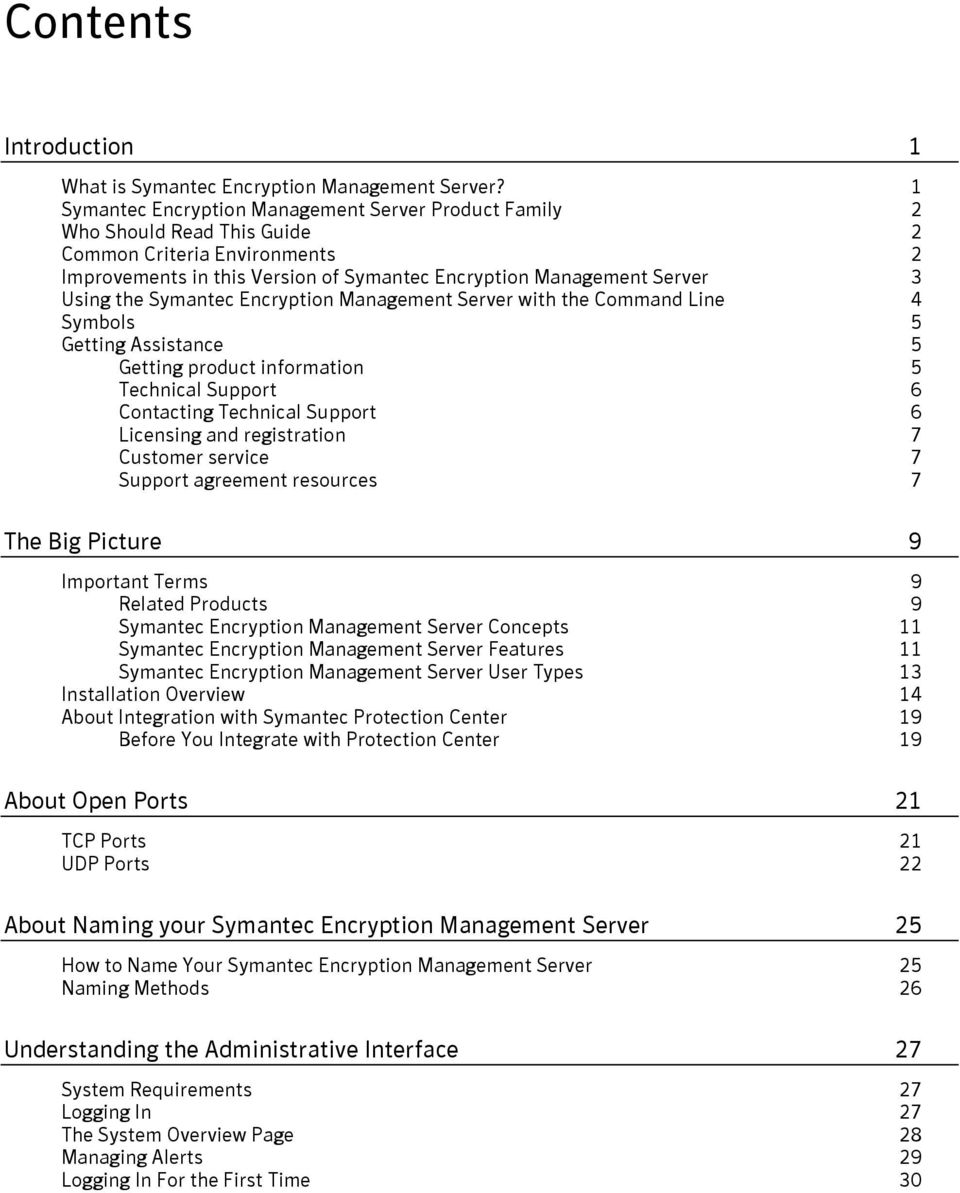
5 Contents Introduction What is Symantec Encryption Management Server? Symantec Encryption Management Server Product Family Who Should Read This Guide Common Criteria Environments Improvements in this Version of Symantec Encryption Management Server Using the Symantec Encryption Management Server with the Command Line Symbols Getting Assistance Getting product information Technical Support Contacting Technical Support Licensing and registration Customer service Support agreement resources The Big Picture Important Terms Related Products Symantec Encryption Management Server Concepts Symantec Encryption Management Server Features Symantec Encryption Management Server User Types Installation Overview About Integration with Symantec Protection Center Before You Integrate with Protection Center About Open Ports TCP Ports UDP Ports About Naming your Symantec Encryption Management Server How to Name Your Symantec Encryption Management Server Naming Methods Understanding the Administrative Interface System Requirements Logging In The System Overview Page Managing Alerts Logging In For the First Time
6 ii Contents Licensing Your Software Overview Licensing a Symantec Encryption Management Server License Authorization Licensing the Mail Proxy Feature Licensing Symantec Encryption Desktop Operating in Learn Mode Purpose of Learn Mode Checking the Logs Managing Learn Mode Managed Domains About Managed Domains Adding Managed Domains Deleting Managed Domains Understanding Keys Choosing a Key Mode For Key Management Changing Key Modes How Symantec Encryption Management Server Uses Certificate Revocation Lists Key Reconstruction Blocks Managed Key Permissions Managing Organization Keys About Organization Keys Organization Key Inspecting the Organization Key Regenerating the Organization Key Importing an Organization Key Organization Certificate Inspecting the Organization Certificate Exporting the Organization Certificate Deleting the Organization Certificate Generating the Organization Certificate Importing the Organization Certificate Renewing the Organization Certificate Additional Decryption Key (ADK) Importing the ADK Inspecting the ADK Deleting the ADK External User Root Key Generating the External User Root Key Importing the External User Root Key Deleting the External User Root Key

7 Contents iii External User Root Certificate Generating the External User Root Certificate Importing the External User Root Certificate Deleting the External User Root Certificate Verified Directory Key Importing the Verified Directory Key Inspecting the Verified Directory Key Deleting the Verified Directory Key Administering Managed Keys Viewing Managed Keys Managed Key Information Addresses Subkeys Certificates Permissions Attributes Symmetric Key Series Symmetric Keys Custom Data Objects Exporting Consumer Keys Exporting the Managed Key of an Internal User Exporting the Managed Key of an External User Exporting Symantec Encryption Verified Directory User Keys Exporting the Managed Key of a Managed Device Deleting Consumer Keys Deleting the Managed Key of an Internal User Deleting the Managed Key of an External User Deleting the Key of a Symantec Encryption Verified Directory User Deleting the Managed Key of a Managed Device Approving Pending Keys Revoking Managed Keys Managing Trusted Keys and Certificates Overview Trusted Keys Trusted Certificates Adding a Trusted Key or Certificate Inspecting and Changing Trusted Key Properties Deleting Trusted Keys and Certificates Searching for Trusted Keys and Certificates Managing Group Keys 77 Overview Establishing Default Group Key Settings Adding a Group Key to an Existing Group Creating a New Group with a Group Key Removing a Group Key from a Group Deleting a Group Key

8 iv Contents Revoking a Group Key Exporting a Group Key Setting Mail Policy Overview How Policy Chains Work Mail Policy and Dictionaries Mail Policy and Key Searches Mail Policy and Cached Keys Understanding the Pre-Installed Policy Chains How Upgrading and Updating Affect Mail Policy Settings Mail Policy Outside the Mailflow Using the Rule Interface The Conditions Card The Actions Card Building Valid Chains and Rules Using Valid Processing Order Creating Valid Groups Creating a Valid Rule Managing Policy Chains Mail Policy Best Practices Restoring Mail Policy to Default Settings Adding Policy Chains Deleting Policy Chains Exporting Policy Chains Printing Policy Chains Managing Rules Adding Rules to Policy Chains Deleting Rules from Policy Chains Enabling and Disabling Rules Changing the Processing Order of the Rules Adding Key Searches Choosing Condition Statements, Conditions, and Actions Condition Statements Conditions Actions Working with Common Access Cards Applying Key Not Found Settings to External Users Overview Bounce the Message Symantec PDF Protection Symantec PDF Protection Secure Reply Working with Passphrases Certified Delivery with Symantec PDF Protection Send Unencrypted Smart Trailer Symantec Encryption Web Protection Changing Policy Settings Changing User Delivery Method Preference

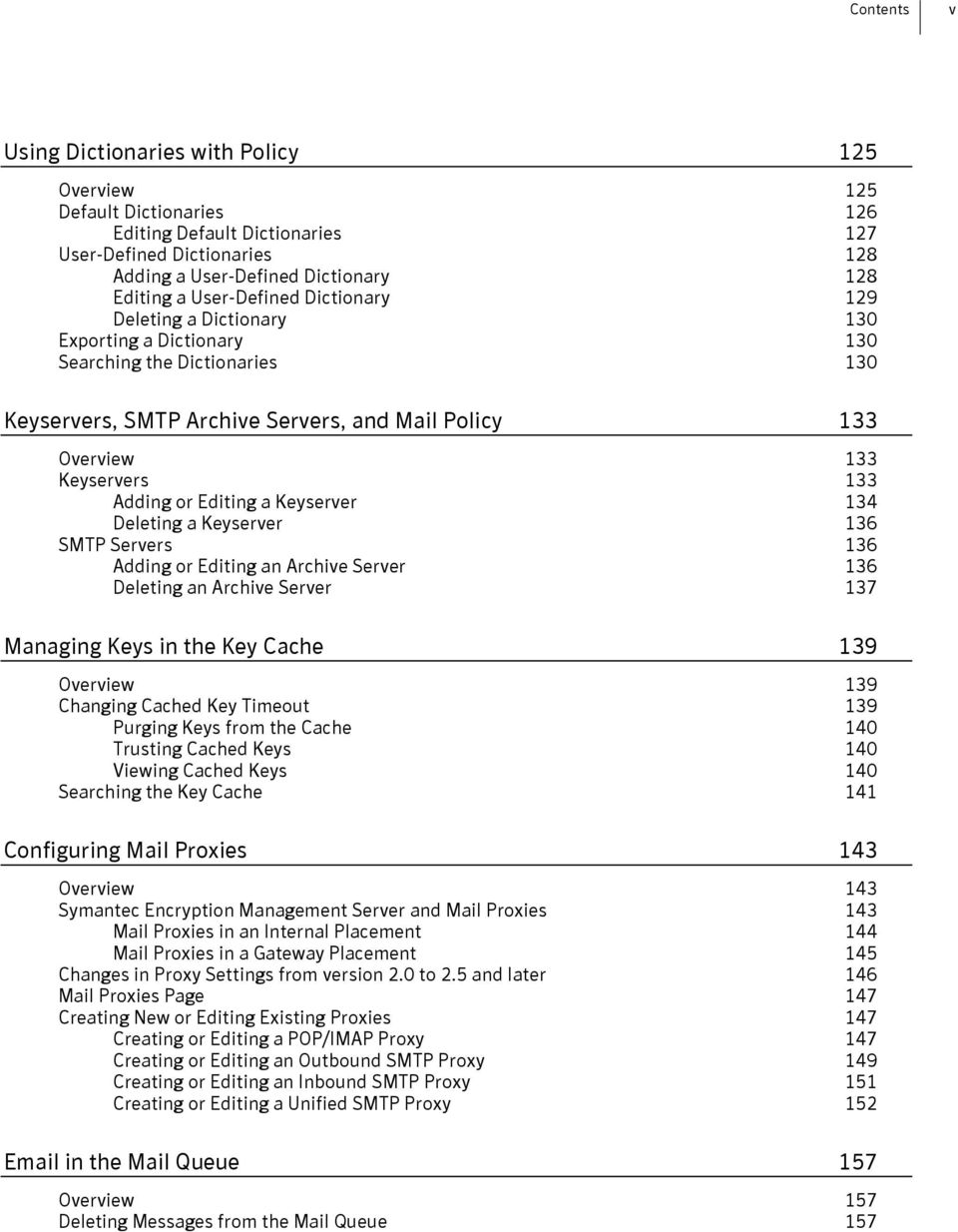
9 Contents v Using Dictionaries with Policy 125 Overview Default Dictionaries Editing Default Dictionaries User-Defined Dictionaries Adding a User-Defined Dictionary Editing a User-Defined Dictionary Deleting a Dictionary Exporting a Dictionary Searching the Dictionaries Keyservers, SMTP Archive Servers, and Mail Policy Overview Keyservers Adding or Editing a Keyserver Deleting a Keyserver SMTP Servers Adding or Editing an Archive Server Deleting an Archive Server Managing Keys in the Key Cache Overview Changing Cached Key Timeout Purging Keys from the Cache Trusting Cached Keys Viewing Cached Keys Searching the Key Cache Configuring Mail Proxies Overview Symantec Encryption Management Server and Mail Proxies Mail Proxies in an Internal Placement Mail Proxies in a Gateway Placement Changes in Proxy Settings from version 2.0 to 2.5 and later Mail Proxies Page Creating New or Editing Existing Proxies Creating or Editing a POP/IMAP Proxy Creating or Editing an Outbound SMTP Proxy Creating or Editing an Inbound SMTP Proxy Creating or Editing a Unified SMTP Proxy in the Mail Queue 157 Overview Deleting Messages from the Mail Queue
10 vi Contents Specifying Mail Routes Overview Managing Mail Routes Adding a Mail Route Editing a Mail Route Deleting a Mail Route Customizing System Message Templates Overview Templates and Message Size Symantec PDF Protection Templates Symantec Encryption Web Protection Templates Editing a Message Template Integrating with Symantec Data Loss Prevention Enabling Integration with DLP Disabling Integration with DLP Changing the DLP Integration Authentication Information Managing Groups Understanding Groups Sorting Consumers into Groups Everyone Group Excluded Group Policy Group Order Migrate Groups from Version 2.12 SP4 Setting Policy Group Order Creating a New Group Deleting a Group Viewing Group Members Manually Adding Group Members Manually Removing Members from a Group Group Permissions Adding Group Permissions Deleting Group Permissions Setting Group Membership Searching Groups Creating Group Client Installations How Group Policy is Assigned to Symantec Encryption Desktop Installers When to Bind a Client Installation Creating Symantec Encryption Desktop Installers Managing Devices Managed Devices Adding and Deleting Managed Devices

11 Contents vii Adding Managed Devices to Groups Managed Device Information Deleting Devices from Symantec Encryption Management Server Deleting Managed Devices from Groups Drive Encryption Devices (Computers and Disks) Drive Encryption Computers Drive Encryption Disks Searching for Devices Administering Consumer Policy 197 Understanding Consumer Policy 197 Managing Consumer Policies 197 Adding a Consumer Policy 197 Editing a Consumer Policy 198 Deleting a Consumer Policy 199 Making Sure Users Create Strong Passphrases 199 Understanding Entropy 200 Enabling or Disabling Encrypted 200 Using the Windows Preinstallation Environment 201 X.509 Certificate Management in Lotus Notes Environments 201 Trusting Certificates Created by Symantec Encryption Management Server 202 Setting the Lotus Notes Key Settings in Symantec Encryption Management Server 204 Technical Deployment Information 204 Offline Policy 205 Using a Policy ADK 206 Out of Mail Stream Support 207 Enrolling Users through Silent Enrollment 208 Silent Enrollment with Windows 209 Silent Enrollment with Mac OS X 209 Symantec Drive Encryption Administration 209 Symantec Drive Encryption on Mac OS X with FileVault 209 How Does Single Sign-On Work? 210 Enabling Single Sign-On 210 Managing Clients Remotely Using a Symantec Drive Encryption Administrator Active Directory Group 212 Managing Clients Locally Using the Symantec Drive Encryption Administrator Key 213 Setting Policy for Clients 215 Client and Symantec Encryption Management Server Version Compatibility 215 Serving PGP Admin 8 Preferences 216 Establishing Symantec Encryption Desktop Settings for Your Symantec Encryption Desktop Clients217 Symantec Encryption Desktop Feature License Settings 218 Enabling Symantec Encryption Desktop Client Features in Consumer Policies 219 Controlling Symantec Encryption Desktop Components 220 PGP Portable 221 Symantec File Share Encryption 221 How the Symantec File Share Encryption Policy Settings Work Together 221 Multi-user environments and managing Symantec File Share Encryption 222 Backing Up Symantec File Share Encryption-Protected Files 223 About Mobile Encryption 223 About Administration of the Symantec Mobile Encryption for ios App 224

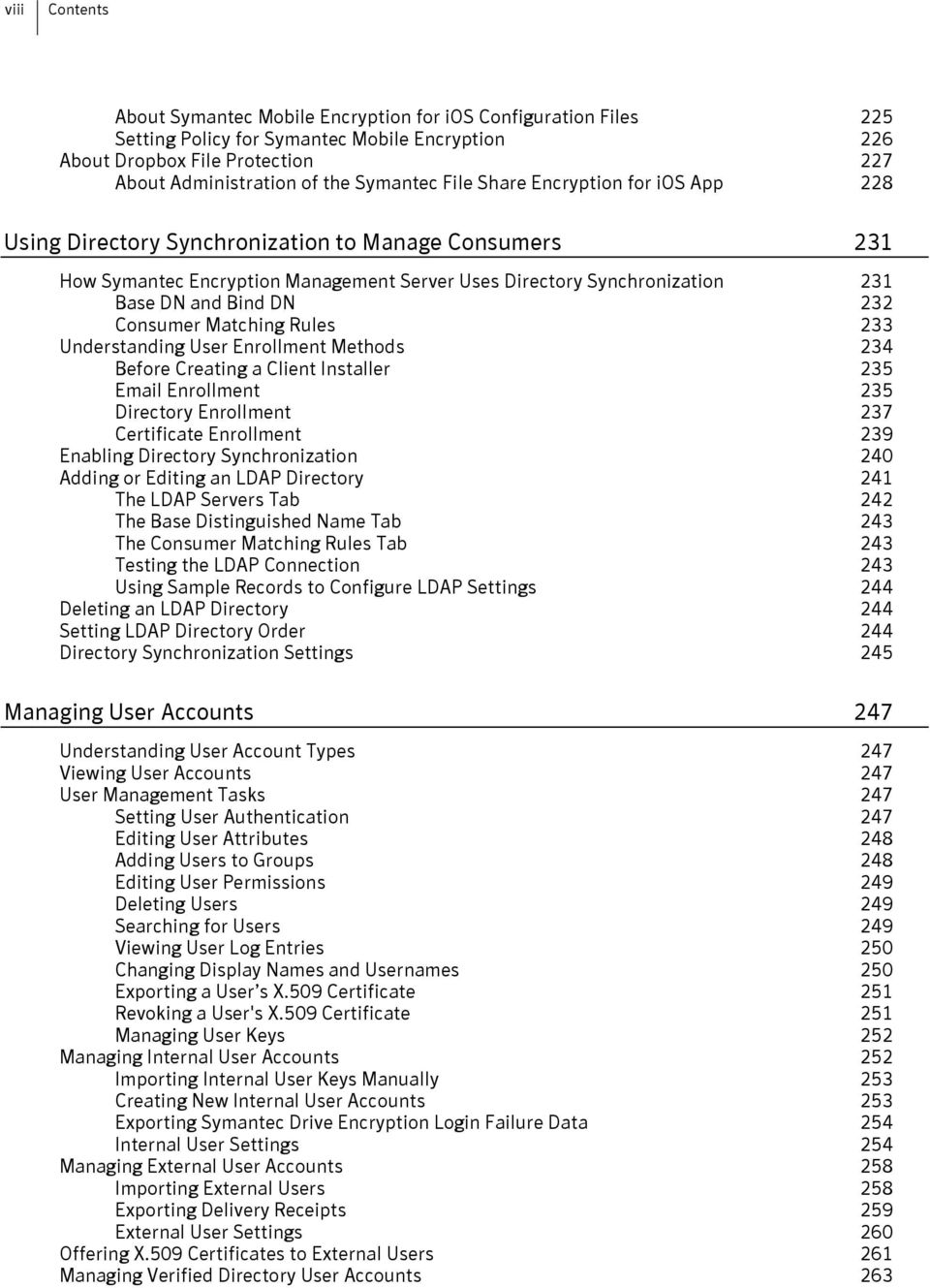
12 viii Contents About Symantec Mobile Encryption for ios Configuration Files Setting Policy for Symantec Mobile Encryption About Dropbox File Protection About Administration of the Symantec File Share Encryption for ios App Using Directory Synchronization to Manage Consumers How Symantec Encryption Management Server Uses Directory Synchronization Base DN and Bind DN Consumer Matching Rules Understanding User Enrollment Methods Before Creating a Client Installer Enrollment Directory Enrollment Certificate Enrollment Enabling Directory Synchronization Adding or Editing an LDAP Directory The LDAP Servers Tab The Base Distinguished Name Tab The Consumer Matching Rules Tab Testing the LDAP Connection Using Sample Records to Configure LDAP Settings Deleting an LDAP Directory Setting LDAP Directory Order Directory Synchronization Settings Managing User Accounts Understanding User Account Types Viewing User Accounts User Management Tasks Setting User Authentication Editing User Attributes Adding Users to Groups Editing User Permissions Deleting Users Searching for Users Viewing User Log Entries Changing Display Names and Usernames Exporting a User s X.509 Certificate Revoking a User's X.509 Certificate Managing User Keys Managing Internal User Accounts Importing Internal User Keys Manually Creating New Internal User Accounts Exporting Symantec Drive Encryption Login Failure Data Internal User Settings Managing External User Accounts Importing External Users Exporting Delivery Receipts External User Settings Offering X.509 Certificates to External Users Managing Verified Directory User Accounts
13 Contents ix Importing Verified Directory Users Symantec Encryption Verified Directory User Settings Recovering Encrypted Data in an Enterprise Environment Using Key Reconstruction Recovering Encryption Key Material without Key Reconstruction Encryption Key Recovery of CKM Keys Encryption Key Recovery of GKM Keys Encryption Key Recovery of SCKM Keys Encryption Key Recovery of SKM Keys Using an Additional Decryption Key for Data Recovery Symantec Encryption Satellite Overview Technical Information Distributing the Symantec Encryption Satellite Software Configuration Key Mode Symantec Encryption Satellite Configurations Switching Key Modes Policy and Key or Certificate Retrieval Retrieving Lost Policies Retrieving Lost Keys or Certificates Symantec Encryption Satellite for Mac OS X Overview System Requirements Obtaining the Installer Installation Updates Files Symantec Encryption Satellite for Windows Overview System Requirements Obtaining the Installer Installation Updates Files MAPI Support External MAPI Configuration Lotus Notes Support External Lotus Notes Configuration Configuring Symantec Encryption Web Protection 287 Overview 287

14 x Contents Symantec Encryption Web Protection and Clustering External Authentication Customizing Symantec Encryption Web Protection Adding a New Template Troubleshooting Customization Changing the Active Template Deleting a Template Editing a Template Downloading Template Files Restoring to Factory Defaults Configuring the Symantec Encryption Web Protection Service Starting and Stopping Symantec Encryption Web Protection Selecting the Symantec Encryption Web Protection Network Interface Setting Up External Authentication Creating Settings for Symantec Encryption Web Protection User Accounts Setting Message Replication in a Cluster Configuring the Integrated Keyserver Overview Starting and Stopping the Keyserver Service Configuring the Keyserver Service Configuring the Symantec Encryption Verified Directory Overview Starting and Stopping the Symantec Encryption Verified Directory Configuring the Symantec Encryption Verified Directory Managing the Certificate Revocation List Service Overview Starting and Stopping the CRL Service Editing CRL Service Settings Configuring Universal Services Protocol Starting and Stopping USP Adding USP Interfaces System Graphs Overview CPU Usage Message Activity Whole Disk Encryption System Logs Overview Filtering the Log View

15 Contents xi Searching the Log Files Exporting a Log File Enabling External Logging Configuring SNMP Monitoring Overview Starting and Stopping SNMP Monitoring Configuring the SNMP Service Downloading the Custom MIB File Viewing Server and License Settings and Shutting Down Services 325 Overview 325 Server Information 325 Setting the Time 326 Licensing a Symantec Encryption Management Server 326 Downloading the Release Notes 327 Shutting Down and Restarting the Symantec Encryption Management Server Software Services327 Shutting Down and Restarting the Symantec Encryption Management Server Hardware 328 Managing Administrator Accounts Overview Administrator Roles Administrator Authentication Creating a New Administrator Importing SSH v2 Keys Deleting Administrators Inspecting and Changing the Settings of an Administrator Configuring RSA SecurID Authentication Resetting SecurID PINs Daily Status Protecting Symantec Encryption Management Server with Ignition Keys Overview Ignition Keys and Clustering Preparing Hardware Tokens to be Ignition Keys Configuring a Hardware Token Ignition Key Configuring a Soft-Ignition Passphrase Ignition Key Deleting Ignition Keys Backing Up and Restoring System and User Data 345 Overview Creating Backups Scheduling Backups Performing On-Demand Backups Configuring the Backup Location Restoring From a Backup

16 xii Contents Restoring On-Demand Restoring Configuration Restoring from a Different Version Updating Symantec Encryption Management Server Software Overview Inspecting Update Packages Setting Network Interfaces Understanding the Network Settings Changing Interface Settings Adding Interface Settings Deleting Interface Settings Editing Global Network Settings Assigning a Certificate Working with Certificates Importing an Existing Certificate Generating a Certificate Signing Request (CSR) Adding a Pending Certificate Inspecting a Certificate Exporting a Certificate Deleting a Certificate Clustering your Symantec Encryption Management Servers Overview Cluster Status Creating a Cluster Deleting Cluster Members Clustering and Symantec Encryption Web Protection Managing Settings for Cluster Members Changing Network Settings in Clusters About Clustering Diagnostics Monitoring Data Replication in a Cluster Index

17 1 Introduction This Administrator s Guide describes both the Symantec Encryption Management Server and Client software. It tells you how to get them up and running on your network, how to configure them, and how to maintain them. This section provides a high-level overview of Symantec Encryption Management Server. What is Symantec Encryption Management Server? Symantec Encryption Management Server is a console that manages the applications that provide , disk, and network file encryption. Symantec Encryption Management Server with Symantec Gateway Encryption provides secure messaging by transparently protecting your enterprise messages with little or no user interaction. The Symantec Encryption Management Server replaces PGP Keyserver with a built-in keyserver, and PGP Admin with Symantec Encryption Desktop configuration and deployment capabilities. Symantec Encryption Management Server also does the following: Automatically creates and maintains a Self-Managing Security Architecture (SMSA) by monitoring authenticated users and their traffic. Allows you to send protected messages to addresses that are not part of the SMSA. Automatically encrypts, decrypts, signs, and verifies messages. Provides strong security through policies you control. Symantec Encryption Satellite, a client-side feature of Symantec Encryption Management Server, does the following: Extends security for messages to the computer of the user. Allows external users to become part of the SMSA. If allowed by an administrator, gives end users the option to create and manage their keys on their computers. Symantec Encryption Desktop, a client product, is created and managed through Symantec Encryption Management Server policy and does the following: Creates PGP keypairs. Manages user keypairs. Stores the public keys of others. Encrypts user and instant messaging (IM). Encrypts entire, or partial, hard drives. Enables secure file sharing with others over a network.

18 2 Introduction Symantec Encryption Management Server Product Family Symantec Encryption Management Server Product Family Symantec Encryption Management Server functions as a management console for a variety of encryption solutions. You can purchase any of the Symantec Encryption Desktop applications or bundles and use Symantec Encryption Management Server to create and manage client installations. You can also purchase a license that enables Symantec Gateway Encryption to encrypt in the mailstream. The Symantec Encryption Management Server can manage any combination of the following Symantec encryption applications: Symantec Gateway Encryption provides automatic encryption in the gateway, based on centralized mail policy. This product requires administration by the Symantec Encryption Management Server. Symantec Desktop provides encryption at the desktop for mail, files, and AOL Instant Messenger traffic. This product can be managed by the Symantec Encryption Management Server. Symantec Drive Encryption provides encryption at the desktop for an entire disk. This product can be managed by the Symantec Encryption Management Server. Symantec File Share Encryption provides transparent file encryption and sharing among desktops. This product can be managed by the Symantec Encryption Management Server. Who Should Read This Guide This Administrator s Guide is for the person or persons who implement and maintain your organization s Symantec Encryption Management Server environment. These are the Symantec Encryption Management Server administrators. This guide is also intended for anyone else who wants to learn about how Symantec Encryption Management Server works. Common Criteria Environments To be Common Criteria compliant, see the best practices in PGP Universal Server 2.9 Common Criteria Supplemental. These best practices supersede recommendations made elsewhere in this and other documentation.

19 Introduction Improvements in this Version of Symantec Encryption Management Server 3 Improvements in this Version of Symantec Encryption Management Server Symantec Encryption Management Server introduces the following new and improved features: Symantec identity branding The PGP product line has been renamed. For a detailed map of old product names to new ones, refer to the Symantec Knowledgebase article TECH ( Integration with Symantec File Share Encryption and Dropbox on Apple ios devices The integration of Symantec File Share Encryption, formerly known as PGP NetShare, with Dropbox brings protection to files copied from a Dropbox Windows client to cloud-based storage. You can then view these encrypted Dropbox files on your ios device. This integration allows protected files to move among Dropbox locations, to be read, edited, and saved by you or a collaborative group. Files and folders are encrypted or decrypted transparently, as needed. Gateway Integration with Symantec Data Loss Prevention Symantec Gateway , previously known as PGP Universal Gateway , has deepened its integration with Symantec Data Loss Prevention and Symantec Messaging Gateway powered by Brightmail. Symantec Messaging Gateway sends outbound to Data Loss Prevention, which scans the , flags the message for security violations or sensitivity. The flagged gets routed to GWE to process corresponding security remediation through mail policy. Symantec Gateway then sends encryption remediation status confirmation back to Data Loss Prevention. Audit information is centrally located in Data Loss Prevention Enforce. This status synchronization leverages Data Loss Prevention s new Incident Remediation API (IRA). This new feature is called Encryption Connect in DLP Enforce. Next generation of mobile management PGP Viewer, which has been renamed to Symantec Mobile Encryption for ios, now expands the ability beyond viewing to securely reply to encrypted messages or initiate new secure messages, with or without attachments. Mobile Encryption for ios integrates with Microsoft Exchange Mobile Address List for access to your contacts. PGP Viewer 1.0 users can automatically update to Mobile Encryption for ios version 2.0. This product requires the mobile management policy provided in Symantec Encryption Management Server 3.3. Expanded Platform Compatibility for Symantec Web Protection sent using the Symantec Web Protection feature, formerly known as PGP Web Messenger, can now be viewed using a browser on most ios and Android mobile devices Expanded Platform Compatibility for Symantec PDF Protection sent using the Symantec PDF Protection feature, formerly PGP PDF Messenger, can now be viewed using a browser on most ios and Android mobile devices. Compatibility with VMware ESXi 5

20 4 Introduction Using the Symantec Encryption Management Server with the Command Line This release provides installation of Symantec Encryption Management Server, formerly known as PGP Universal Server, on VMware ESX virtual machines running ESXi 5. Compatibility with New Linux Packages This release supports installation of Symantec Drive Encryption for Linux, formerly known as PGP Whole Disk Encryption for Linux, on Red Hat Enterprise Linux/CentOS 6.1 and 6.2 (32-bit and 64-bit versions). Compatibility with Apple Mac OS X 10.8 This release supports installation of Symantec Desktop Encryption, formerly known as PGP Desktop, on systems running Mac OS X 10.8 (Mountain Lion). Win PE 64-bit Support Symantec Drive Encryption, formerly known as PGP Whole Disk Encryption, now provides WinPE recovery for both 32-bit and 64-bit Windows 7 environments. Removal of the PGP Remote Disable and Destroy Feature Symantec Corporation has discontinued the PGP Remote Disable and Destroy (RDD) feature, including its policy management and reporting functionalities. However, the feature is retained for customers who have an existing subscription entitlement until their current subscription period expires. For information on how to disable PGP RDD, go to the Symantec Knowledgebase ( and search for article ID HOWTO79556, "HOW TO: Remove PGP Remote Disable and Destroy (PGP RDD)". Using the Symantec Encryption Management Server with the Command Line You can use the Symantec Encryption Management Server command line for read-only access to, for example, view settings, services, logs, processes, disk space, query the database, and so on. Note: If you modify your configuration using the command line, and you do not follow these procedures, your Symantec Support agreement is void. Changes to the Symantec Encryption Management Server using command line must be: Authorized in writing by Symantec Support. Implemented by Symantec's partner, reseller, or internal employee who is certified in Symantec Encryption Management Server Advanced Administration and Deployment Training. Summarized and documented in a text file in /var/lib/ovid/customization on the Symantec Encryption Management Server. Changes made through the command line may not persist through reboots and may become incompatible in a future release. When troubleshooting new issues, Symantec Support can require you to revert custom configurations on the Symantec Encryption Management Server to a default state.

21 Introduction Symbols 5 Symbols Notes, Cautions, and Warnings are used in the following ways. Note: Notes are extra, but important, information. A Note calls your attention to important aspects of the product. You can use the product better if you read the Notes. Caution: Cautions indicate the possibility of loss of data or a minor security breach. A Caution tells you about a situation where problems can occur unless precautions are taken. Pay attention to Cautions. Warning: Warnings indicate the possibility of significant data loss or a major security breach. A Warning means serious problems will occur unless you take the appropriate action. Please take Warnings very seriously. Getting Assistance For additional resources, see these sections. Getting product information The following documents and online help are companions to the Symantec Encryption Management Server Administrator s Guide. This guide occasionally refers to information that can be found in one or more of these sources: Online help is installed and is available in the Symantec Encryption Management Server product. Symantec Encryption Management Server Installation Guide Describes how to install the Symantec Encryption Management Server. Symantec Encryption Management Server Upgrade Guide Describes the process of upgrading your Symantec Encryption Management Server. Symantec Encryption Management Server Mail Policy Diagram Provides a graphical representation of how is processed through mail policy. You can access this document via the Symantec Encryption Management Server online help. You can also access all the documentation by clicking the online help icon in the upper-right corner of the Symantec Encryption Management Server screen. Symantec Encryption Satellite for Windows and Mac OS X includes online help. Symantec Encryption Management Server and Symantec Encryption Satellite release notes are also provided, which may have last-minute information not found in the product documentation.
22 6 Introduction Getting Assistance Technical Support Symantec Technical Support maintains support centers globally. Technical Support s primary role is to respond to specific queries about product features and functionality. The Technical Support group also creates content for our online Knowledge Base. The Technical Support group works collaboratively with the other functional areas within Symantec to answer your questions in a timely fashion. For example, the Technical Support group works with Product Engineering and Symantec Security Response to provide alerting services and virus definition updates. Symantec s support offerings include the following: A range of support options that give you the flexibility to select the right amount of service for any size organization Telephone and/or Web-based support that provides rapid response and up-to-theminute information Upgrade assurance that delivers software upgrades Global support purchased on a regional business hours or 24 hours a day, 7 days a week basis Premium service offerings that include Account Management Services For information about Symantec s support offerings, you can visit our Web site at the following URL: All support services will be delivered in accordance with your support agreement and the then-current enterprise technical support policy. Contacting Technical Support Customers with a current support agreement may access Technical Support information at the following URL: Before contacting Technical Support, make sure you have satisfied the system requirements that are listed in your product documentation. Also, you should be at the computer on which the problem occurred, in case it is necessary to replicate the problem. When you contact Technical Support, please have the following information available: Product release level Hardware information Available memory, disk space, and NIC information Operating system Version and patch level Network topology Router, gateway, and IP address information Problem description:
23 Introduction Getting Assistance 7 Error messages and log files Troubleshooting that was performed before contacting Symantec Recent software configuration changes and network changes Licensing and registration If your Symantec product requires registration or a license key, access our technical support Web page at the following URL: Customer service Customer service information is available at the following URL: Customer Service is available to assist with non-technical questions, such as the following types of issues: Questions regarding product licensing or serialization Product registration updates, such as address or name changes General product information (features, language availability, local dealers) Latest information about product updates and upgrades Information about upgrade assurance and support contracts Information about the Symantec Buying Programs Advice about Symantec's technical support options Nontechnical presales questions Issues that are related to CD-ROMs or manuals Support agreement resources If you want to contact Symantec regarding an existing support agreement, please contact the support agreement administration team for your region as follows: Asia-Pacific and Japan Europe, Middle-East, Africa North America, Latin America [email protected] [email protected] [email protected]
24
25 2 The Big Picture This chapter describes some important terms and concepts and gives you a high-level overview of the things you need to do to set up and maintain your Symantec Encryption Management Server environment. Important Terms The following sections define important terms you will encounter throughout the Symantec Encryption Management Server and this documentation. Related Products Symantec Encryption Management Server: A device you add to your network that provides secure messaging with little or no user interaction. The Symantec Encryption Management Server automatically creates and maintains a security architecture by monitoring authenticated users and their traffic. You can also send protected messages to addresses that are not part of the security architecture. PGP Global Directory: A free, public keyserver hosted by Symantec Corporation. The PGP Global Directory provides quick and easy access to the universe of PGP keys. It uses next-generation keyserver technology that queries the address on a key (to verify that the owner of the address wants their key posted) and lets users manage their own keys. Using the PGP Global Directory significantly enhances your chances of finding a valid public key of someone to whom you want to send secured messages. For external users without encryption keys, Symantec Encryption Management Server offers multiple secure delivery options, leveraging third-party software that is already installed on typical computer systems, such as a web browser or Adobe Acrobat Reader. For recipients who do not have an encryption solution, you can use of of the following secure delivery options from Symantec Encryption Management Server: Symantec Encryption Satellite: The Symantec Encryption Satellite software resides on the computer of the user. It allows to be encrypted end to end, all the way to and from the desktop (for both internal and external users). Using Symantec Encryption Satellite is one of the ways for external users to participate in the SMSA. It also allows users the option of controlling their keys on their local computers (if allowed by the administrator).
26 10 The Big Picture Important Terms Symantec Encryption Web Protection: The Symantec Encryption Web Protection service allows an external user to securely read a message from an internal user before the external user has a relationship with the SMSA. If Symantec Encryption Web Protection is available via mail policy for a user and the recipient s key cannot be found, the message is stored on the Symantec Encryption Management Server and an unprotected message is sent to the recipient. The unprotected message includes a link to the original message, held on the Symantec Encryption Management Server. The recipient must create a passphrase, and then can access his encrypted messages stored on Symantec Encryption Management Server. Symantec PDF Protection: Symantec PDF Protection enables sending encrypted PDF messages to external users who do not have a relationship with the SMSA. In the normal mode, as with Symantec Encryption Web Protection, the user receives a message with a link to the encrypted message location and uses a Symantec Encryption Web Protection passphrase to access the message. Symantec PDF Protection also provides Certified Delivery, which encrypts the message to a one-time passphrase, and creates and logs a delivery receipt when the user retrieves the passphrase. Symantec Encryption Desktop: A client software tool that uses cryptography to protect your data against unauthorized access. Symantec Encryption Desktop is available for Mac OS X and Windows. Symantec Drive Encryption: Drive Encryption is a feature of Symantec Encryption Desktop that encrypts your entire hard drive or partition (on Windows systems), including your boot record, thus protecting all your files when you are not using them. Symantec File Share Encryption: A feature of Symantec Encryption Desktop for Windows with which you can securely and transparently share files and folders among selected individuals. Symantec File Share Encryption users can protect their files and folders simply by placing them within a folder that is designated as protected. PGP Virtual Disk: PGP Virtual Disk volumes are a feature of Symantec Encryption Desktop that let you use part of your hard drive space as an encrypted virtual disk. You can protect a PGP Virtual Disk volume with a key or a passphrase. You can also create additional users for a volume, so that people you authorize can also access the volume. PGP Zip: A feature of Symantec Encryption Desktop that lets you put any combination of files and folders into a single encrypted, compressed package for convenient transport or backup. You can encrypt a PGP Zip archive to a PGP key or to a passphrase. PGP Portable: A separately-licensed feature that enables you to send encrypted files to users who do not have Symantec Encryption Desktop software, and to transport files securely to systems that do not or cannot have PGP software installed.
27 The Big Picture Important Terms 11 Symantec Encryption Management Server Concepts keys.<domain> convention: Symantec Encryption Management Server automatically looks for valid public keys for recipients at a special hostname, if no valid public key is found locally to secure a message. This hostname is keys.<domain> (where <domain> is the domain of the recipient). For example, Example Corporation s externally visible Symantec Encryption Management Server is named keys.example.com. Symantec Corporation strongly recommends you name your externally visible Symantec Encryption Management Server according to this convention because it allows other Symantec Encryption Management Servers to easily find valid public keys for recipients in your domain. For more information, see Naming your Symantec Encryption Management Server (see "About Naming your Symantec Encryption Management Server" on page 25). Security Architecture: Behind the scenes, the Symantec Encryption Management Server creates and manages its own security architecture for the users whose domain it is securing. Because the security architecture is created and managed automatically, we call this a self-managing security architecture (SMSA). Symantec Encryption Management Server Features Administrative Interface: Each Symantec Encryption Management Server is controlled via a Web-based administrative interface. The administrative interface gives you control over Symantec Encryption Management Server. While many settings are initially established using the web-based Setup Assistant, all settings of a Symantec Encryption Management Server can be controlled via the administrative interface. Backup and Restore: Because full backups of the data stored on your Symantec Encryption Management Server are critical in a natural disaster or other unanticipated loss of data or hardware, you can schedule automatic backups of your Symantec Encryption Management Server data or manually perform a backup. You can fully restore a Symantec Encryption Management Server from a backup. In the event of a minor problem, you can restore the Symantec Encryption Management Server to any saved backup. In the event that a Symantec Encryption Management Server is no longer usable, you can restore its data from a backup onto a new Symantec Encryption Management Server during initial setup of the new Symantec Encryption Management Server using the Setup Assistant. All backups are encrypted to the Organization Key and can be stored securely off the Symantec Encryption Management Server. Cluster: When you have two or more Symantec Encryption Management Servers in your network, you configure them to synchronize with each other; this is called a cluster. Dictionary: Dictionaries are lists of terms to be matched. The dictionaries work with mail policy to allow you to define content lists that can trigger rules.
28 12 The Big Picture Important Terms Directory Synchronization: If you have LDAP directories in your organization, your Symantec Encryption Management Server can be synchronized with the directories. The Symantec Encryption Management Server automatically imports user information from the directories when users send and receive ; it also creates internal user accounts for them, including adding and using X.509 certificates if they are contained in the LDAP directories. Ignition Keys: You can protect the contents of a Symantec Encryption Management Server, even if the hardware is stolen, by requiring the use of a hardware token or a software passphrase, or both, on start. Keyserver: Each Symantec Encryption Management Server includes an integrated keyserver populated with the public keys of your internal users. When an external user sends a message to an internal user, the external Symantec Encryption Management Server goes to the keyserver to find the public key of the recipient to use to secure the message. The Symantec Encryption Management Server administrator can enable or disable the service, and control access to it via the administrative interface. Learn Mode: When you finish configuring a Symantec Encryption Management Server using the Setup Assistant, it begins in Learn Mode, where the Symantec Encryption Management Server sends messages through mail policy without taking any action on the messages, and does not encrypt or sign any messages. Learn Mode gives the Symantec Encryption Management Server a chance to build its SMSA (creating keys for authenticated users, for example) so that when when Learn Mode is turned off, the Symantec Encryption Management Server can immediately begin securing messages. It is also an excellent way for administrators to learn about the product. You should check the logs of the Symantec Encryption Management Server while it is in Learn Mode to see what it would be doing to traffic if it were live on your network. You can make changes to the Symantec Encryption Management Server s policies while it is in Learn Mode until things are working as expected. Mail Policy: The Symantec Encryption Management Server processes messages based on the policies you establish. Mail policy applies to inbound and outbound processed by both Symantec Encryption Management Server and client software. Mail policy consists of multiple policy chains, comprised of sequential mail processing rules. Organization Certificate: You must create or obtain an Organization Certificate to enable S/MIME support by Symantec Encryption Management Server. The Organization Certificate signs all X.509 certificates the server creates. Organization Key: The Setup Assistant automatically creates an Organization Key (actually a keypair) when it configures a Symantec Encryption Management Server. The Organization Key is used to sign all PGP keys the Symantec Encryption Management Server creates and to encrypt Symantec Encryption Management Server backups. Caution: It is extremely important to back up your Organization Key: all keys the Symantec Encryption Management Server creates are signed by the Organization Key, and all backups are encrypted to the Organization Key. If you lose your Organization Key and have not backed it up, the signatures on those keys are meaningless and you cannot restore from backups encrypted to the Organization Key.
29 The Big Picture Important Terms 13 Symantec Encryption Verified Directory: The Symantec Encryption Verified Directory supplements the internal keyserver by letting internal and external users manage the publishing of their own public keys. The Symantec Encryption Verified Directory also serves as a replacement for the PGP Keyserver product. The Symantec Encryption Verified Directory uses next-generation keyserver technology to ensure that the keys in the directory can be trusted. Server Placement: A Symantec Encryption Management Server can be placed in one of two locations in your network to process . With an internal placement, the Symantec Encryption Management Server logically sits between your users and your mail server. It encrypts and signs outgoing SMTP and decrypts and verifies incoming mail being picked up by clients using POP or IMAP. stored on your mail server is stored secured (encrypted). With a gateway placement, the Symantec Encryption Management Server logically sits between your mail server and the Internet. It encrypts and signs outgoing SMTP and decrypts and verifies incoming SMTP . stored on your mail server is stored unsecured. For more information, see Configuring Mail Proxies (on page 143) and the Symantec Encryption Management Server Installation Guide. Setup Assistant: When you attempt to log in for the first time to the administrative interface of a Symantec Encryption Management Server, the Setup Assistant takes you through the configuration of that Symantec Encryption Management Server. Group Key: A server-managed keypair shared by a group of users. A Group Key is assigned to a group based on membership in an Active Directory security group. This allows membership in the Active Directory security group to be modified without affecting the metadata associated with the protected data. To create a Group Key, the Directory Synchronization feature must be enabled and synchronized with an Active Directory database. Symantec Encryption Management Server User Types Administrators: Any user who manages the Symantec Encryption Management Server and its security configuration from inside the internal network. Only administrators are allowed to access the administrative interface that controls Symantec Encryption Management Server. A Symantec Encryption Management Server supports multiple administrators, each of which can be assigned a different authority: from read-only access to full control over every feature and function. Consumers: Internal, external, and Verified Directory users, and devices. External Users: External users are users from other domains (domains not being managed by your Symantec Encryption Management Server) who have been added to the SMSA. Internal Users: Internal users are users from the domains being managed by your Symantec Encryption Management Server.
30 14 The Big Picture Installation Overview Symantec Encryption Management Server allows you to manage Symantec Encryption Desktop deployments to your internal users. The administrator can control which Symantec Encryption Desktop features are automatically implemented at install, and establish and update security policy for Symantec Encryption Desktop users that those users cannot override (except on the side of being more secure). Symantec Encryption Verified Directory Users: Internal and external users who have submitted their public keys to the Symantec Encryption Verified Directory, a Web-accessible keyserver. Devices: Managed devices, Drive Encryption Computers, and Drive Encryption Disks. Managed devices are arbitrary objects whose keys are managed by Symantec Encryption Management Server. Drive Encryption Computers, and Drive Encryption Disks are devices that are detected when users enroll. Other Users: Users within your organization can securely send to recipients outside the SMSA. First, the Symantec Encryption Management Server attempts to find a key for the recipient. If that fails, there are four fallback options, all controlled by mail policy: bounce the message back to the sender (so it is not sent unencrypted), send unencrypted, Smart Trailer, and Symantec Encryption Web Protection mail. Smart Trailer sends the message unencrypted and adds text giving the recipient the option of joining the SMSA by installing Symantec Encryption Satellite, using an existing key or certificate, or using Symantec Encryption Web Protection. Symantec Encryption Web Protection lets the recipient securely read the message on a secure website; it also gives the recipient options for handling subsequent messages from the same domain: read the messages on a secure website using a passphrase they establish, install Symantec Encryption Satellite, or add an existing key or certificate to the SMSA. Installation Overview The following steps are a broad overview of what it takes to plan, set up, and maintain your Symantec Encryption Management Server environment. Most of the steps described here are described in detail in later chapters. Steps 1 and 4 are described in the Symantec Encryption Management Server Installation Guide. Note that these steps apply to the installation of a new, stand-alone Symantec Encryption Management Server. If you plan to install a cluster, you must install and configure one Symantec Encryption Management Server following the steps outlined here. Subsequent cluster members will get most of their configuration settings from the initial server by replication. The steps to install and configure a Symantec Encryption Management Server are as follows: 1 Plan where in your network you want to locate your Symantec Encryption Management Server(s). Where you put Symantec Encryption Management Servers in your network, how many Symantec Encryption Management Servers you have in your network, and other factors all have a major impact on how you add them to your existing network.
31 The Big Picture Installation Overview 15 Create a diagram of your network that includes all network components and shows how flows; this diagram details how adding a Symantec Encryption Management Server impacts your network. For more information on planning how to add Symantec Encryption Management Servers to your existing network, see Adding the Symantec Encryption Management Server to Your Network in the Symantec Encryption Management Server Installation Guide. 2 Perform necessary DNS changes. Add IP addresses for your Symantec Encryption Management Servers, an alias to your keyserver, update the MX record if necessary, add keys.<domain>, hostnames of potential joiner servers for a cluster, and so on. Properly configured DNS settings (including root servers and appropriate reverse lookup records) are required to support Symantec Encryption Management Server. Make sure both host and pointer records are correct. IP addresses must be resolvable to hostnames, as well as hostnames resolvable to IP addresses. 3 Prepare a hardware token Ignition Key. If you want to add a hardware token Ignition Key during setup, install the drivers and configure the token before you begin the Symantec Encryption Management Server setup process. See Protecting Symantec Encryption Management Server with Ignition Keys (on page 339) for information on how to prepare a hardware token Ignition Key. Note: In a cluster, the Ignition Key configured on the first Symantec Encryption Management Server in the cluster will also apply to the subsequent members of the cluster. 4 Install and configure this Symantec Encryption Management Server. The Setup Assistant runs automatically when you first access the administrative interface for the Symantec Encryption Management Server. The Setup Assistant is where you can set or confirm a number of basic settings such as your network settings, administrator password, server placement option, mail server address and so on. The details of this process are described in Setting Up the Symantec Encryption Management Server in the Symantec Encryption Management Server Installation Guide. Note: If you plan to configure multiple servers as a cluster, you must configure one server first in the normal manner, then add the additional servers as cluster members. You can do this through the Setup Assistant when you install a server that will join an existing cluster, or you can do this through the Symantec Encryption Management Server administrative interface. For more information see Cluster Member Configuration in the Symantec Encryption Management Server Installation Guide. 5 License your server. You cannot take a Symantec Encryption Management Server out of Learn Mode or install updates until the product is licensed. Once it is licensed, you should check for product updates and install them if found. For more information, see Licensing Your Software (on page 31).
32 16 The Big Picture Installation Overview If you want the Symantec Encryption Management Server to provide mail proxy services, you must have a Symantec Encryption Management Server license with the mailstream feature enabled, and you must check the Enable Mail Proxies check box on the System Settings page in the Symantec Encryption Management Server administrative interface. For more information, see Licensing Your Software (on page 31). 6 If you have a PGP key you want to use as your Organization Key with Symantec Encryption Management Server, import it, then back it up. Your Organization Key does two important things: it is used to sign all user keys the Symantec Encryption Management Server creates and it is used to encrypt Symantec Encryption Management Server backups. This key represents the identity of your organization, and is the root of the Web-of-Trust for your users. If your organization uses Symantec Encryption Desktop and already has an Corporate Key or Organization Key, and you want to use that key with Symantec Encryption Management Server, you should import it as soon as you have configured your server, then create a backup of the key. If your organization does not have an existing key that you want to use as your Organization Key, use the Organization Key the Setup Assistant automatically creates with default values. For more information, see Managing Organization Keys (on page 43). No matter which key you use as your Organization Key, it is very important to make a backup of the key. Since Symantec Encryption Management Server s builtin back-up feature always encrypts backups to this key, you need to provide a copy of your Organization Key to restore your data. For more information, see Organization Certificate (on page 46). 7 If you have a PGP Additional Decryption Key (ADK) that you want to use with Symantec Encryption Management Server, add it. An ADK is a way to recover an message if the recipient is unable or unwilling to do so; every message that is also encrypted to the ADK can be opened by the holder(s) of the ADK. You cannot create an ADK with the Symantec Encryption Management Server, but if you have an existing PGP ADK (generated by Symantec Encryption Desktop, an ideal scenario for a split key; refer to the Symantec Encryption Desktop User s Guide for more information), you can add it to your Symantec Encryption Management Server and use it. For more information, see Additional Decryption Key (ADK) (on page 49). 8 Create a SSL/TLS certificate or obtain a valid SSL/TLS certificate. You can create a self-signed certificate for use with SSL/TLS traffic. Because this certificate is self-signed, however, it might not be trusted by or Web browser clients. Symantec Corporation recommends that you obtain a valid SSL/TLS certificate for each of your Symantec Encryption Management Servers from a reputable Certificate Authority. This is especially important for Symantec Encryption Management Servers that are accessed publicly. Older Web browsers might reject self-signed certificates or not know how to handle them correctly when they encounter them via Symantec Encryption Web Protection or Smart Trailer. For more information, see Working with Certificates (on page 355). 9 Configure the Directory Synchronization feature if you want to synchronize an LDAP directory with your Symantec Encryption Management Server.
33 The Big Picture Installation Overview 17 If you have an existing LDAP server, using the Directory Synchronization feature gives you more control over which users, keys, and certificates are added to the Symantec Encryption Management Server. By default, user enrollment is set to enrollment. If you elect to use certificate enrollment or LDAP directory enrollment, you must have an LDAP directory configured and Directory Synchronization enabled. You can change the client enrollment setting from the Directory Synchronization Settings page in the Symantec Encryption Management Server administrative interface. For more information, see Using Directory Synchronization to Manage Consumers (on page 231). 10 Configure Symantec Encryption Desktop client features. The Symantec Encryption Desktop client basic (default) license is installed along with the Symantec Encryption Management Server, so adding the client license as a separate step is not necessary. However, the optional features (messaging, Symantec Drive Encryption, and Symantec File Share Encryption) are disabled by default. If you have purchased a license for those features, you must edit your client policy settings to enable them. For more information about consumer policy settings, see "Establishing Symantec Encryption Desktop Settings for Your Symantec Encryption Desktop Clients (on page 217)". 11 Add trusted keys, configure consumer policy, and establish mail policy. All these settings are important for secure operation of Symantec Encryption Management Server. For more information on adding trusted keys from outside the SMSA, see Managing Trusted Keys and Certificates (on page 73). For more information about consumer policy settings, see Administering Consumer Policy (on page 197). For information on setting up mail policy, see Setting Mail Policy (on page 81). Note: When setting policy for Consumers, Symantec Encryption Management Server provides an option called Out of Mail Stream (OOMS) support. OOMS specifies how the gets transmitted from the client to the server when Symantec Encryption Desktop cannot find a key for the recipient and therefore cannot encrypt the message. OOMS is disabled by default. With OOMS disabled, sensitive messages that can't be encrypted locally are sent to Symantec Encryption Management Server "in the mail stream" like normal . Importantly, this is sent in the clear (unencrypted). Mail or Network administrators could read these messages by accessing the mail server's storage or monitoring network traffic. However, archiving solutions, outbound anti-virus filters, or other systems which monitor or proxy mail traffic will process these messages normally. You can elect to enable OOMS, which means that sensitive messages that can't be encrypted locally are sent to Symantec Encryption Management Server "out of the mail stream." Symantec Encryption Desktop creates a separate, encrypted network connection to the Symantec Encryption Management Server to transmit the message. However, archiving solutions, outbound anti-virus filters, or other systems which monitor or proxy mail traffic will not see these messages. During your configuration of your Symantec Encryption Management Server you should determine the appropriate settings for your requirements. This option can be set separately for each policy group, and is set through the Consumer Policy settings. For more details on the effects of enabling or disabling OOMS, see Out of Mail Stream Support.
34 18 The Big Picture Installation Overview 12 Install and configure additional cluster server members. You can do this through the Setup Assistant when you install a server that will join an existing cluster, or you can do this through the Symantec Encryption Management Server administrative interface. Remember that you must configure one server in the normal manner before you can add and configure additional servers as cluster members. For more information, see Clustering your Symantec Encryption Management Servers (on page 359). 13 Reconfigure the settings of your clients and servers, if necessary. Depending on how you are adding the Symantec Encryption Management Server to your network, some setting changes might be necessary. For example, if you are using a Symantec Encryption Management Server placed internally, the clients must have SMTP authentication turned on. For Symantec Encryption Management Servers placed externally, you must configure your mail server to relay SMTP traffic to the Symantec Encryption Management Server. 14 Enable SNMP Polling and Traps. You can configure Symantec Encryption Management Server to allow network management applications to monitor system information for the device on which Symantec Encryption Management Server is installed and to send system and application information to an external destination. See Configuring SNMP Monitoring (on page 321) for more information. 15 Distribute Symantec Encryption Satellite and/or Symantec Encryption Desktop to your internal users, if appropriate. If you want to provide seamless, end-to-end PGP message security without the need for any user training, have them use Symantec Encryption Satellite. Exchange/MAPI and Lotus Notes environments also require the use of Symantec Encryption Satellite. Symantec Encryption Desktop provides more features and user control than Symantec Encryption Satellite. For more information, see Symantec Encryption Satellite and Configuring Symantec Encryption Desktop Installations. 16 Analyze the data from Learn Mode. In Learn Mode, your Symantec Encryption Management Server sends messages through mail policy without actually taking action on the messages, decrypts and verifies incoming messages when possible, and dynamically creates a SMSA. You can see what the Symantec Encryption Management Server would have done without Learn Mode by monitoring the system logs. Learn Mode lets you become familiar with how the Symantec Encryption Management Server operates and it lets you see the effects of the policy settings you have established before the Symantec Encryption Management Server actually goes live on your network. Naturally, you can fine tune settings while in Learn Mode, so that the Symantec Encryption Management Server is operating just how you want before you go live. For more information, see Operating in Learn Mode (on page 33). 17 Adjust policies as necessary. It might take a few tries to get everything working just the way you want. For example, you might need to revise your mail policy. 18 Perform backups of all Symantec Encryption Management Servers before you take them out of Learn Mode.
35 The Big Picture About Integration with Symantec Protection Center 19 This gives you a baseline backup in case you need to return to a clean installation. For more information, see Backing Up and Restoring System and User Data (on page 345). 19 Take your Symantec Encryption Management Servers out of Learn Mode. Once this is done, messages are encrypted, signed, and decrypted/verified, according to the relevant policy rules. Make sure you have licensed each of your Symantec Encryption Management Servers; you cannot take a Symantec Encryption Management Server out of Learn Mode until it has been licensed. 20 Monitor the system logs to make sure your Symantec Encryption Management Server environment is operating as expected. About Integration with Symantec Protection Center Protection Center helps strengthen the security of your organization by providing easy access to security metrics and simplified security management. You can log in to Symantec Encryption Management Server and other security products from within Protection Center. This feature allows for a single point of administration. The tasks you perform within each product's separate console can now be performed through Protection Center. Protection Center also aggregates security data from Symantec Encryption Management Server and other Symantec Corporation products and combines that data into cross-product reports, providing you with a more complete, all-in-one view of the security of your enterprise. Symantec Encryption Management Server sends the following data to be included in aggregated reports: Internal users Client computers Client computer status Encryption status per client device Symantec Drive Encryption login failure alerts, which Protection Center calls incident events Protection Center install agents, which in this case refers only to Symantec Encryption Management Server itself Before You Integrate with Protection Center Both Protection Center and Symantec Encryption Management Server must be installed and set up before integration and registration. For detailed information about how to set up your Protection Center and register Symantec Encryption Management Server, see the Protection Center documentation. Complete the following tasks to prepare Symantec Encryption Management Server for registration with and discovery by Protection Center.
36 20 The Big Picture About Integration with Symantec Protection Center To register Symantec Encryption Management Server on Protection Center, you need the Symantec Encryption Management Server's IP address, as well as the username and passphrase of a superuser administrator. All other registration information appears automatically in the Advanced Options section of the registration interface and do not need to be entered manually. Best Practice: Create a superuser account to be used only for registration. This provides stability even when other administrators leave the company. You cannot register with Protection Center using an administrator account that authenticates using SecurID. You must use an account with a passphrase. The account used for registration is not related to which administrators can log in to Protection Center. Any Symantec Encryption Management Server administrator, including SecurID and passphrase administrators, can log in to Protection Center, if you map a new Protection Center user account to that administrator. For more information, see the Protection Center documentation. Make sure that the time settings for Symantec Encryption Management Server and Protection Center match, with less than a minute's difference. The hour and time zone settings do not have to match, but the minute setting must be the same. If the minute settings do not match, registration fails and an error message appears. Register only one Symantec Encryption Management Server in a cluster. Because data is replicated among cluster members, registering more than one cluster member results in duplicate data sent to Protection Center. For example, if you manage 10 encrypted devices, it will appear in Protection Center reports as if there are 20. If you have cluster members located in the DMZ as well as inside your network, register a cluster member within your network, not one in the DMZ, because cluster members in the DMZ do not usually store private keys.
37 3 About Open Ports This chapter provides information on the ports a Symantec Encryption Management Server has open and on which ports it listens. TCP Ports Port Protocol/Service Comment 21 File Transfer Protocol (FTP) Used to transmit encrypted backup archives to other servers. Data is sent via passive FTP, so port 20 (FTP Data) is not used. 22 Open Secure Shell (SSH) Used for remote shell access to the server for low-level system administration. 25 Simple Mail Transfer Protocol (SMTP) 80 HyperText Transfer Protocol (HTTP) Used to send mail. In a gateway placement, the Symantec Encryption Management Server listens on port 25 for incoming and outgoing SMTP traffic. Used to allow user access to the Symantec Encryption Verified Directory. If the Symantec Encryption Verified Directory is disabled, access on this port is automatically redirected to port 443 over HTTPS. Also used for Universal Services Protocol (USP) keyserver connection. 110 Post Office Protocol (POP) Used to retrieve mail by users with POP accounts in an internal placement. Closed to gateway placements. 143 Internet Message Access Protocol (IMAP) 389 Lightweight Directory Access Protocol (LDAP) 443 HyperText Transfer Protocol, Secure (HTTPS) Used to retrieve mail by users with IMAP accounts in an internal placement. Closed to gateway placements. Used to allow remote hosts to look up local users' public keys. Used for Symantec Encryption Desktop and Symantec Encryption Satellite policy distribution and Symantec Encryption Web Protection access. If the Verified Directory is disabled, used for HTTPS access. Also used for Universal Services Protocol (USP) over SSL for keyserver connection.
38 22 About Open Ports UDP Ports Port Protocol/Service Comment 21 File Transfer Protocol (FTP) Used to transmit encrypted backup archives to other servers. Data is sent via passive FTP, so port 20 (FTP Data) is not used. 444 Simple Object Access Protocol, Secure (SOAPS) 465 Simple Mail Transfer Protocol, Secure (SMTPS) Used to cluster replication messages. Used to send mail securely in internal placements. Closed to gateway placements. This is a non-standard port used only by legacy mail servers. We recommend, rather than using this port, you use STARTTLS on port Lightweight Directory Access Protocol, Secure (LDAPS) 993 Internet Message Access Protocol, Secure (IMAPS) Used to securely allow remote hosts to look up public keys of local users. Used to retrieve mail securely by users with IMAP accounts in internal placements. Closed to gateway placements. 995 Post Office Protocol, Secure (POPS) 9000 HyperText Transfer Protocol, Secure (HTTPS) Used to retrieve mail securely by users with POP accounts in internal placements. Closed to gateway placements. Allows access to the Symantec Encryption Management Server administrative interface. UDP Ports Port Protocol/Service Comment 53 Domain Name System (DNS ) Used to look up a Fully Qualified Domain Name (FQDN ) on the DNS server and translate to an IP address. 123 Network Time Protocol (NTP ) Used to synchronize the system s clock with a reference time source on a different server. 161 Simple Network Management Protocol (SNMP) Used by network management applications to query the health and activities of Symantec Encryption Management Server and the computer on which it is installed.
39 About Open Ports 23 UDP Ports
40
41 4 About Naming your Symantec Encryption Management Server This chapter describes how and why to name your Symantec Encryption Management Server using the keys.<domain> convention. How to Name Your Symantec Encryption Management Server Unless a valid public key is found locally, Symantec Encryption Management Servers automatically look for valid public keys for recipients by attempting to contact a keyserver at a special hostname, keys.<domain>, where <domain> is the recipient's domain. For example, an internal user at example.com sends an to [email protected]. If no valid public key for Susan is found on the Example Symantec Encryption Management Server, it automatically looks for a valid public key for Susan at keys.widgetcorp.com, even if there is no domain policy for widgetcorp.com on Example s Symantec Encryption Management Server. Keys are found locally if they are cached, or if Susan was an external user who explicitly supplied her key through Symantec Encryption Web Protection. If the Widgetcorp Symantec Encryption Management Server is named using the keys.<domain> convention, the Example Corp. Symantec Encryption Management Server can find a valid public key for [email protected] at keys.widgetcorp.com. Caution: Symantec Corporation strongly recommends you name your Symantec Encryption Management Server according to this convention, because it allows other Symantec Encryption Management Servers to easily find valid public keys for recipients in your domain. You must also use this convention to name your externally visible Symantec Encryption Management Server. If your organization uses addresses, such as [email protected] and [email protected], your Symantec Encryption Management Server must be reachable at keys.example.com and keys.corp.example.com. If you have multiple Symantec Encryption Management Servers in a cluster that are managing an domain, only one of those Symantec Encryption Management Servers needs to use the keys.<domain> convention. Note: Keys that are found using the keys.<domain> convention are treated as valid and trusted. Keys.<domain> should be the address of a load-balancing device, which distributes connections to your Symantec Encryption Management Server s keyserver service. The ports that need to be load balanced are the ports on which you are running your keyserver service, port 389 for LDAP and 636 for LDAPS. You can also name your Symantec Encryption Management Server according to your company's required naming convention and ensure that the server has a DNS alias of keys.<domain>.com.
42 26 About Naming your Symantec Encryption Management Server Naming Methods If you are administering multiple domains, you should establish the keys.<domain> convention for each domain. If your Symantec Encryption Management Server is behind your corporate firewall, you must ensure that ports 389 (LDAP) and 636 (LDAPS) are open to support the keys.<domain> convention. Naming Methods To support the keys.<domain> convention, you can name your Symantec Encryption Management Server in one of the following ways: In the Setup Assistant, name your Symantec Encryption Management Server with the keys.<domain> convention in the Host Name field on the Network Setup page. On the Network Settings page, change the host name of your Symantec Encryption Management Server to keys.<domain>. Create a DNS alias to your Symantec Encryption Management Server that uses the keys.<domain> convention that is appropriate for your DNS server configuration.
43 5 Understanding the Administrative Interface This section describes the Symantec Encryption Management Server s Web-based administrative interface. System Requirements The Symantec Encryption Management Server administrative interface has been fully tested with the following Web browsers: Windows Internet Explorer 6 and greater Firefox 3.6 and greater Mac OS X Safari 5.0 and greater Firefox 3.6 and greater Although the administrative interface works with other Web browsers, we recommend these browsers for maximum compatibility. Logging In A login name and passphrase for the administrative interface were originally established when you configured the server using the Setup Assistant. In addition, the original administrator may have created additional administrators, and may have configured your Symantec Encryption Management Server to accept RSA SecurID authentication. To log in to your server s administrative interface 1 In a Web browser, type <domain name of server>:9000/ and press Enter. Note: If you see a Security Alert dialog box relating to the security certificate, it means you need to replace the self-signed certificate created automatically with a certificate from a public Certificate Authority. The Login page appears. 2 Type the current login name in the Username field. 3 Type the current passphrase or SecurID passcode in the Passphrase field. (If SecurID authentication is enabled, a message below the Passphrase field will indicate that a SecurID passcode can be entered. A given administrator is configured to use either passphrase or SecurID authentication, not both.) 4 Click the Login button or press Enter. 5 If the login credentials are accepted, the System Overview page appears.
44 28 Understanding the Administrative Interface The System Overview Page 6 If the login credentials do not match, an error is displayed. For passphrase authentication that fails, an "Invalid Login" error appears. For SecurID authentication, different events may occur. See the following procedure for more information. To log in using RSA SecurID authentication 1 Follow steps 1-4 in the procedure above. If your SecurID passcode is accepted, and no PIN reset is required, the System Overview page appears. Note: If Symantec Encryption Management Server fails to connect with any RSA Manager server, you will be presented with the standard "Invalid Login" message. The connection failure will be logged in the Symantec Encryption Management Server Administration log, enabling you to determine whether this was the cause of the login failure. 2 If the RSA server policy determines that a PIN reset is required, upon successful login the PIN Reset dialog appears. Depending on the RSA server policy, you may be able to have the RSA server generate a new PIN for you, or enter a new PIN manually. When this is done, the System Overview page appears. For more details see Resetting SecurID PINs (on page 336). 3 If the RSA server detects a problem with the token code portion of your passcode, you are asked to re-enter your PIN plus the next code shown on your SecurID token. Type your PIN and the next token code that appears, then click Login or press Enter. 4 Based on your RSA server policy, you may be given several chances to authenticate successfully using the next token code. However, eventually continued failures will result in a failed login. Note: Log in events are logged in the Symantec Encryption Management Server Administration log. Successful and failed attempts, and next tokencode requests are logged, as are problems connecting to the RSA Manager servers. The System Overview Page The System Overview page is the first page you see when you log in to Symantec Encryption Management Server. You can also view it from Reporting > Overview. The page provides a general report of system information and statistics. The information displayed includes: System alerts, including licensing issues and Symantec Drive Encryption login failures. System alerts appear at the top of the page. System Graphs for CPU usage, message activity, and Drive Encryption. Click the buttons to switch the graphs. Click the System Graphs heading to go to the Reporting > Graphs page. See System Graphs (on page 315) for more information about system graphs. Services information, including which services are running or stopped. Depending on the service, the entry may also include the number of users or keys handled by the service.
45 Understanding the Administrative Interface Managing Alerts 29 Click the service name link to go to the administrative page for that service. For a running Web Protection service, click the URL to go to the Web Protection interface. For a running Verified Directory service, click the URL to go to the Verified Directory interface to search for a key, upload your own public key, or remove your key from the searchable directory. System Statistics, including software version number, system uptime, total messages processed, and number of PGP Portable Disks created. Click the Statistics link to go to the System > General Settings page. Mail Queue statistics show the number of messages in the queue waiting to be processed, if applicable, and the size of the mail queue. Click the Mail Queue link to go to the Mail > Mail Queue status page for detailed information about the contents of the mail queue. Estimated Policy Group Membership shows the number of members in each consumer policy group. Click a policy group name to go to the page for configuring that policy group. Policy Group Membership shows how many consumers are members of each consumer policy group. Clustering provides status information about the cluster configuration, if this Symantec Encryption Management Server is a member of a cluster. This display shows, for each cluster member, its hostname or IP address, its status, its location (Internal or DMZ) and a login icon (except for the member on which you are currently logged in). Click the Clustering heading to go to the System > Clustering page. This display does not appear if your Symantec Encryption Management Server is not a member of a cluster. Click Refresh (at the top of the System Overview page) to refresh the information shown on this page. The Manage Alerts button takes you to the Alerts page where you can configure how you want to be notified about WDE login failures. For more details, see Managing Alerts (on page 29). The Export Data button lets you export statistics for WDE Activity, WDE Login Failures, PDF Messenger Certified Delivery Receipts, and the Mail Policy Print View (which provides in a printable format all your mail policy chains and rules). Because the report can take a long time to generate, you can begin running the report and have an notification sent to you when the report is ready to be downloaded. Managing Alerts The Symantec Encryption Management Server groups failed login attempts into reported login failures. This feature is intended to make reporting about failed login attempts more useful, because one or several failed login attempts by a Symantec Drive Encryption user does not necessarily mean an attempted break-in. Use the Alerts dialog box to choose how many failed login attempts constitutes a login failure. For example, you can specify that an alert should be triggered after 3 failed login attempts. If 6 failed attempts occur, 2 login failure alerts appear. Alerts about Symantec Drive Encryption login failures appear on the System Overview page and in the Daily Status . Alerts for devices belonging to specific users appear on the user's Internal Users dialog box.
46 30 Understanding the Administrative Interface Logging In For the First Time Alerts are also sent when a user is locked out of a system because he or she exceeded the number of allowable login failures set on the Disk Encryption tab of Consumer Policy. To specify how you want to be notified of Symantec Drive Encryption login failures 1 From the System Overview page, click Manage Alerts. The Alerts dialog box appears. 2 Specify how many consecutive failed login attempts a single device must report before the administrator is notified. 3 Choose how long you want login failure alerts to be displayed on the System Overview page, the Daily Status , and the Internal Users page, in hours or days. 4 Specify how long you want to keep login failure records in the database, in days. Logging In For the First Time The first time you log in to the Symantec Encryption Management Server, a welcome dialog box appears. The welcome dialog box provides access to documentation. You can choose to have the welcome dialog box appear every time you log in. What s New Lists the new features in Symantec Encryption Management Server 3.3. Mail Policy Diagram Provides a graphical representation of how is processed through mail policy. Symantec Encryption Management Server Upgrade Guide Provides instructions on how to migrate PGP Keyserver data, how to upgrade your Symantec Encryption Management Server, and how version settings migrate into the mail policy environment. You can also access all the documentation by clicking the online help icon in the upper right corner of the Symantec Encryption Management Server page.
47 6 Licensing Your Software This section describes how to license your Symantec Encryption Management Server. Overview Your Symantec Encryption Management Server must have a valid license to be taken out of Learn Mode. In other words, without a valid license, your Symantec Encryption Management Server will never encrypt or sign any messages. If you licensed your Symantec Encryption Management Server using the Setup Assistant, you do not have to license it again. If you did not, then you can license it at any time afterwards using the administrative interface. The Symantec Encryption Management Server can provide security for messaging by inserting itself into the flow of traffic in your network, intercepting, or proxying, that traffic, and processing it (encrypt, sign, decrypt, verify) based on the applicable policies. The proxying feature available on the Symantec Encryption Management Server can only be used if you have the Symantec Gateway Encryption license. Licensing a Symantec Encryption Management Server If you did not install your license when you set up your Symantec Encryption Management Server during the Setup Assistant, you can add a license from the System > General Settings page. For instructions, see Licensing a Symantec Encryption Management Server (on page 326). License Authorization When you enter your license information, whether in the Setup Assistant or from the System > General Settings page, the Symantec Encryption Management Server automatically authorizes the license number. You do not need an internet connection.
48 32 Licensing Your Software Licensing the Mail Proxy Feature Licensing the Mail Proxy Feature You must have a Symantec Gateway Encryption license or you cannot use the Mail Proxies feature on the administrative interface. In addition, the Enable Mail Proxies check box on the System Settings page must be checked. If you installed your license during system setup (through the Setup Assistant) and checked the Enable Mail Proxies check box at that time, the check box ont he System Settings page will be checked. You can verify that your license includes the Mail Proxies feature on the System Settings page For information about the Mail Proxies feature, see Configuring Mail Proxies (on page 143).(from the System > General Settings tab). Licensing Symantec Encryption Desktop In version and later, managed Symantec Encryption Desktop client licenses are built in to the server; you no longer need to add the desktop license as a separate step. However, you must still purchase a license to use the Symantec Encryption Desktop features such as Symantec Drive Encryption, messaging, and Symantec File Share Encryption. These separately-licensed features are disabled by default. Based on your license, you must configure each consumer policy to enable the Symantec Encryption Desktop features for which you have a license. For more information, see Establishing Symantec Encryption Desktop Settings for Your Symantec Encryption Desktop Clients (on page 217).
49 7 Operating in Learn Mode When you finish configuring a Symantec Encryption Management Server using the Setup Assistant, it begins running in Learn Mode. In Learn Mode, messages are processed through mail policy, but none of the actions from the policy are performed. Messages are neither encrypted nor signed. This functions as a rehearsal, so that you can learn how policies would affect traffic if implemented. While running in Learn Mode, the Symantec Encryption Management Server also creates keys for authenticated users so that when Learn Mode is turned off, the server can secure messages immediately. After messages go through mail policy, Symantec Encryption Management Server decrypts and verifies incoming messages for which there are local internal or external user keys. Outgoing messages are sent unencrypted. In Learn Mode, non-rfc compliant is sent unprocessed and in the clear. Turn Learn Mode off to process messages through the mail policy exception chain. In Learn Mode, the Symantec Encryption Management Server: Creates user accounts with user keys, in accordance with Consumer Policy. Decrypts messages using internal and external keys stored on the server, but does not search for keys externally. Does not encrypt or sign messages. Will not apply mail policy to messages, and will not take any Key Not Found action on messages. Note: Your Symantec Encryption Management Server must be licensed before you can take it out of Learn Mode. Purpose of Learn Mode Learn Mode allows you to: View (by examining the logs) how policies would affect traffic if implemented. Build the SMSA (creating keys for authenticated users, for example) so that when the server goes live when Learn Mode is turned off the server can secure messages immediately. Identify mailing lists your users send messages to and add their addresses to the dictionaries of Excluded Addresses. Most likely, users won't send encrypted messages to a mailing list. Symantec Encryption Management Server decrypts and verifies incoming while operating in Learn Mode. Symantec Encryption Management Server still automatically detects mailing lists when Learn Mode is off, but unless the addresses were retrieved via the Directory Synchronization feature, they require approval from the Symantec Encryption Management Server administrator to be added to the list of excluded addresses. For more information, see Using Dictionaries with Policy (on page 125).
50 34 Operating in Learn Mode Checking the Logs Mailing lists are identified per RFC 2919, List-Id: A Structured Field and Namespace for the Identification of Mailing Lists, as well as by using default exclusion rules. Checking the Logs The effects of your policies can be checked while Learn Mode is on, even though the server is not actually encrypting or signing messages. To check the server s logs 1 Access the administrative interface for the server. The administrative interface appears. 2 Click Reporting, then Logs. The System Logs page appears. 3 Check the logs to see what effect your policies are having on traffic. Managing Learn Mode The Symantec Encryption Management Server is put into Learn Mode by the Setup Assistant. If your server is in Learn Mode, you see a yellow icon, the Change Mode button, in the upper-right corner of your browser page. To turn off Learn Mode 1 Click the Change Mode button in the upper-right corner of the page. The Mail Processing Settings dialog box appears. 2 Deselect Operate in Learn Mode. 3 Click Save. Learn Mode is turned off. To turn on Learn Mode 1 Click the Change Mode button in the upper-right corner of the page. The Mail Processing Settings dialog box appears. 2 Select Operate in Learn Mode. 3 Click Save. Learn Mode is turned on.
51 8 Managed Domains This section describes how to create and manage the internal domains for which your Symantec Encryption Management Server protects messages. About Managed Domains The Managed Domains page gives you control over the domains for which the Symantec Encryption Management Server is handling . users from domains being managed by your server are called internal users. Conversely, users from domains not being managed by your server but who are part of the SMSA are called external users. For example, if your company is Example Corporation, you can have the domain example.com and your employees would have addresses such as If this were the case, you would want to establish example.com as a domain to be managed by your server. When you install your Symantec Encryption Management Server you have the opportunity to add a managed domain in the Setup Assistant. If you do not set it up at that time, you can use the Managed Domains page to add it. You can also add additional managed domains from the Managed Domains page, if you have users with addresses in multiple domains that you want to be considered internal users. Managed domains automatically include sub-domains, so in the example above, users such as [email protected] would also be considered internal users. Multilevel domain structures as used by some countries are also acceptable: for example, the domain example.co.uk. The Managed Domains page accepts Internet DNS domain names and Domino domains. You must have an Internet DNS domain name, and if you have Notes users, you must also include the Domino domain name. WINS names (for example, \\EXAMPLE) do not belong here. Usually, you specify your Internet domain during installation through the Setup Assistant. If your Symantec Encryption Management Server is also managing a Domino server, you must add your Domino domain name manually through the Managed Domains page. For example, if you have an Internet domain "example.com" and a Domino domain "ExDomino," you would add example.com as the managed domain during setup, for SMTP addressing. You would then add ExDomino as an additional managed domain, for Domino addressing. Mail to and from your managed domains is processed according to your mail policy. You can also create mail policy rules specifically for your managed domains. See the chapter Setting Mail Policy (on page 81) for more information on creating mail policies. Managed domains entered on the Managed Domains page populate the Managed Domains dictionary. The dynamic Managed Domains dictionary automatically includes subdomains. See Using Dictionaries with Policy (on page 125) for more information on dictionaries.
52 36 Managed Domains Adding Managed Domains Adding Managed Domains To add a domain to the list of managed domains 1 Click Add Managed Domain. The Add Managed Domain dialog box appears. 2 Type a domain name in the Domain field. Do not type WINS names (for example, \\EXAMPLE) here. Type only Internet DNS domain names or Domino domain names. 3 Click Save. Deleting Managed Domains If you delete a managed domain, all the user IDs within that domain remain in the system. Users can still encrypt and sign messages with their keys. To remove a domain name already on the list of managed domains 1 Click the icon in the Delete column of the domain you want to remove from the list. A confirmation dialog box appears. 2 Click OK. The confirmation dialog box disappears and the selected domain name is removed from the list of managed domains.
53 9 Understanding Keys This chapter introduces some of the concepts related to how Consumer keys are managed. It introduces the concept of key modes, which are used to control whether internal and external users can manage their own keys or whether keys should be managed by Symantec Encryption Management Server. It also discusses the use of Certificate Revocation Lists and key reconstruction blocks. Choosing a Key Mode For Key Management When you create Symantec Encryption Satellite and Symantec Encryption Desktop installers, you can choose whether you want internal and external users to be able to manage their own keys, or whether keys should be managed by the Symantec Encryption Management Server. End-to-end processing functions refer to encryption, decryption,and signing performed at the client, rather than on the Symantec Encryption Management Server. Symantec Symantec Gateway Keys Managed By File Share Encryption End-to-end Server Encryption Functions Processing Functions Support Encrypt Decrypt Sign Encrypt Decrypt Sign Client Yes No No No Yes Yes Yes No Key Mode (CKM) Guarded Yes No No No Yes Yes Yes Private keys stored Key passphrase-protected Mode (GKM) Server Yes Yes Yes Yes Yes Yes Yes Yes Key Mode (SKM) Server Yes Yes Yes No Yes Yes Yes Public and private Client encryption subkeys Key stored on client and Symantec Encryption Mode Management Server, (SCKM) private signing subkeys stored only on client
54 38 Understanding Keys Choosing a Key Mode For Key Management Server Key Mode (SKM) The Symantec Encryption Management Server generates and manages user keys. Users cannot manage their own keys. Symantec Encryption Management Server administrators have access to private keys. If a user has a client installation, the user s keys are downloaded to the client at each use. SKM can also be used without client installations; if there is no client installation, you must use SKM. The client stores the private key encrypted to a random passphrase, so users can read offline. In Symantec Gateway Encryption environments, existing users with SKM key mode keys who install Symantec Encryption Desktop for the first time will be prompted automatically to re-enroll and create a CKM, GKM, or SCKM key. Client Key Mode (CKM) Users use client software to generate and manage their own keys. Symantec Encryption Management Server administrators do not have access to private keys. CKM user is secure on the mail server. CKM users are responsible for backing up their keys; if they lose their private keys, there is no way to retrieve them. Users who want to be able to read their offline and unconnected to Symantec Encryption Management Server must use CKM. Symantec File Share Encryption supports CKM; it requires that users control their own keys. Symantec Gateway Encryption does not support CKM. Guarded Key Mode (GKM) Users generate and manage their own keys, and store their passphrase-protected private keys on the server. GKM is similar to CKM, except that Symantec Encryption Management Server stores protected copies of private keys. Symantec File Share Encryption supports GKM; it requires that users control their own keys. Symantec Gateway Encryption does not support GKM. Server Client Key Mode (SCKM) Keys are generated on the client. Private encryption subkeys are stored on both the client and Symantec Encryption Management Server, and private signing subkeys are stored only on the client. SCKM allows for separate signing and encryption subkeys, comparable to X.509 signing and encryption keys. The public and private encryption subkey is on the server, but by default encryption is not performed on the server. The public-only signing subkey is on the server. Symantec Encryption Management Server cannot sign for the user.
55 Understanding Keys Choosing a Key Mode For Key Management 39 Mail processing must take place on the client side to use the SCKM signing subkey. If you want to use Symantec Gateway Encryption with SCKM keys, you must be using PGP Universal Server 2.5 or later. Symantec Gateway Encryption allows encryption and decryption with SCKM keys, but will not be signed. SCKM is compatible with smart cards, but encryption keys are not generated on the token. Copy the keys onto the token after generation. If an SCKM user resets their key, the entire SCKM key is revoked, including all subkeys, and remains on the Symantec Encryption Management Server as a non-primary key for the user. This non-primary key can still be used for decryption, and remain on the Symantec Encryption Management Server until manually removed by the administrator. SCKM is not supported by legacy PGP Desktop installations before version 9.0. Symantec File Share Encryption supports SCKM; it requires that users control their own keys. Which key management option you choose depends on what your users need and which client application they use. Server Key Mode is generally appropriate for Symantec Encryption Satellite users. Client Key Mode is more appropriate for Symantec Encryption Desktop users. If your security policy requires that a user s signing key is only in the possession of the user, but the user s encryption key must be archived, SCKM is the correct choice. Changing Key Modes If you allow Symantec Encryption Desktop users to change their options and allow user-initiated key generation, users can switch key modes. If the user s policy has changed to permit user-managed keys, then the user is automatically prompted to create a new key, and no further action is necessary. However, if the user s policy has always permitted user key management, and the user wants to switch key modes, the user should follow this procedure. To change key mode 1 Open Symantec Encryption Desktop and select the PGP Messaging service whose key mode you want to determine. The account properties and security policies for the selected service appear. 2 Click Key Mode. The PGP Universal Key Mode page appears, describing your current key management mode. 3 Click Reset Key. The PGP Key Setup Assistant appears. 4 Read the text, then click Next. The Key Management Selection page appears. 5 Select the desired key mode.
56 40 Understanding Keys How Symantec Encryption Management Server Uses Certificate Revocation Lists Depending on how your Symantec Encryption Management Server administrator configured your copy of Symantec Encryption Desktop, some key modes might not be available. 6 Click Next. The Key Source Selection screen appears. 7 Choose one of the following: New Key. You are prompted to create a new PGP key, which is used to protect your messaging. Symantec Encryption Desktop Key. You are prompted to specify an existing PGP key to use to protect your messaging. Import Key. You are prompted to import a PGP key, which is used to protect your messaging. 8 Make the desired selection, then click Next. 9 If you selected New Key: a b c Type a passphrase for the key, then click Next. When the key is generated, click Next. Click Finish. 10 If you selected Symantec Encryption Desktop Key: a b Select the key from the local keyring that you want to use, then click Next. Click Finish. 11 If you selected Import Key: a b Locate the file that holds the PGP key you want to import (it must contain a private key), then click Next. Click Finish. How Symantec Encryption Management Server Uses Certificate Revocation Lists A certificate revocation list (CRL) is a list of certificates that have been revoked before their scheduled expiration date. The Symantec Encryption Management Server retrieves CRLs for certificates from CRL Distribution Points (DP). The Symantec Encryption Management Server checks the CRL DPs automatically before encrypting a message to a certificate, including certificates for internal and external users, as well as certificates in the cache. The server also checks the CRL DPs before importing any internal or external user certificate. It does not check before importing Trusted Certificates, or before connecting to servers with SSL certificates. The Symantec Encryption Management Server checks the revocation status of just the recipient's certificate. It does not check the revocation status of the other certificates in the signing chain.
57 Understanding Keys Key Reconstruction Blocks 41 Once retrieved, certificate revocation status is stored on the parent certificate, so the Trusted Certificate for each user certificate stores the list of all the associated revoked certificates. Once the CRL is stored on the Trusted Certificate, the Symantec Encryption Management Server runs future CRL checks based on the next update date for that list. Key Reconstruction Blocks Key reconstruction blocks allow users to retrieve their private keys if they forget their passphrases. Key reconstruction blocks contain several user-defined questions and the user's private key, which is encrypted with the answers to those questions. Symantec Encryption Management Server stores these questions and answers so that users can get back their private keys in case they lose their passphrases. For example, if a user writes five questions and answers, they can be asked three (or more) of the questions to reconstruct their private key. If an internal Symantec Encryption Desktop user has uploaded a key reconstruction block to the Symantec Encryption Management Server, you can delete it. You might want to delete a key reconstruction block if you have already deleted or revoked the associated key and you do not want the key to be recoverable. If you delete the key reconstruction block, it is no longer stored on the Symantec Encryption Management Server, although it is possible that the user also has a copy. Note: Keys created on smart cards and tokens are not compatible with Symantec Encryption Desktop's key reconstruction feature. See Recovering Encrypted Data in an Enterprise Environment (on page 265) for information on other methods of data recovery. Managed Key Permissions Key permissions determine what actions consumers (users or managed devices) can perform upon managed keys. Key permissions are set in three ways: At the group level: permissions can be set that determine how group members can interact with managed keys. Permissions set for a group are inherited by all members of the group. At the consumer level: individual consumers may be granted permissions. These permissions will exists in addition to the permissions the consumer inherits from the groups of which it is a member. At the managed key level: a managed key can have permissions that specify what actions consumers or groups can take upon it. These are set individually for a managed key. Permissions are positive (they allow actions) and are additive: the actions enabled for a consumer relative to a managed key are combination of the permissions allowed by the consumer's group membership, plus permissions allowed for the consumer, plus permissions allowed by the key. There are no deny permissions.
58
59 10 Managing Organization Keys This section describes the various keys and certificates you can configure and use with your Symantec Encryption Management Server. About Organization Keys There are multiple keys and certificates you can use with your Symantec Encryption Management Server: Organization Key. Used to sign all user keys the Symantec Encryption Management Server creates and to encrypt server backups. Organization Certificate. Used to generate user S/MIME certificates in an S/MIME environment. External User Root Key. Provides the key material used to generate the External User Root Certificate. External User Root Certificate. Used to generate X. 509 S/MIME certificates for download by external users. Additional Decryption Key (ADK). Used to reconstruct messages if the recipient is unable or unwilling to do so. Every message encrypted to an external recipient by an internal user is also encrypted to the ADK, allowing the Symantec Encryption Management Server administrator to decrypt any message sent by internal users, if required to do so by regulations or security policy. Verified Directory Key. Used to sign keys submitted to the Symantec Encryption Verified Directory by external users. The Organization Keys page provides access to all of these. All of these keys should be created on an internal cluster member only, not on a member located in the DMZ. Organization Key Your Organization Key is used to sign all user keys the Symantec Encryption Management Server creates and to encrypt server backups. The Organization Key is what was referred to as the Corporate Key in the old PGP Keyserver environment. Warning: You must make a backup of your Organization Key, in case of a problem with the server. That way, you can restore your server from a backup using the backup Organization Key. Each Symantec Encryption Management Server is pre-configured with a unique Organization Key generated by the Setup Assistant. If you would like to use different settings for this key, you can regenerate the key with the settings you prefer. This should only be done prior to live deployment of the server or creation of user keys by the server.
60 44 Managing Organization Keys Organization Key The Organization Key automatically renews itself one day before its expiration date. It renews with all the same settings. If you have multiple Symantec Encryption Management Servers in a cluster, the Organization Key is synchronized. An Organization Key s identification is based on the name of the managed domain for which the key was created. Organization Keys by convention have one ID per managed domain so that they can be easily found via a directory lookup. The Organization Key information includes the Public Keyserver URL, as specified on the Services > Keyserver page. Anytime the Public Keyserver URL changes, that information on the Organization Key changes immediately. Inspecting the Organization Key To inspect the properties of an Organization Key 1 Click the name of the Organization Key. The Organization Key Info dialog box appears. 2 Inspect the properties of the Organization Key. 3 To export either just the public key portion of the Organization Key or the entire keypair, click the Export button and save the file to the desired location. Optional: You can protect your Organization Key with a passphrase when you export it. When you export the Organization Key you also get the Organization Certificate. You can use Symantec Encryption Desktop to extract the Organization Certificate from the Organization Key. 4 Click OK. If you are going to regenerate your Organization Key, you should use a fairly high bit size, such as However, if you are going to be using X.509 certificates and S/MIME, be aware that many clients only support up to 1024 bits; thus you may want to use 1024 bits for maximum compatibility with S/MIME. All clients can be expected to support at least 4096 bits. Regenerating the Organization Key Warning: Changing the Organization Key makes all previous backups undecryptable and all validity signatures on the keys of internal users are unverifiable until they are automatically renewed. Only change the Organization Key if you fully understand the consequences of this action. Caution: Changing the Organization Key deletes Ignition Keys. If you have hard or soft token Ignition Keys configured, regenerating the Organization Key deletes them. Without an Ignition Key, Symantec Encryption Web Protection messages are not stored encrypted. Note: The Organization Key signs all Trusted Keys and Certificates. If you regenerate the Organization Key, the signature on the Trusted Keys and Certificates becomes invalid. You must re-import all Trusted Keys and Certificates to have them signed by the new Organization Certificate. For more information, see Managing Trusted Keys and Certificates (on page 73).
61 Managing Organization Keys Organization Key 45 To regenerate an Organization Key 1 Click Regenerate in the Action column of the Organization Key whose properties you want to change. 2 The following warning dialog box appears: Regenerating the Organization Key will cause problems with existing key signatures and backups. Any existing Ignition Keys and Organization Certificate will also be removed. Are you sure you want to proceed? 3 Click OK. The Organization Key Generation dialog box appears. 4 Make the desired changes to the properties of the Organization Key. 5 Click Generate. Importing an Organization Key You also have the option of importing an existing PKCS #12 key and using that as your Organization Key. Caution: Importing an Organization Key deletes Ignition Keys. If you have hard or soft token Ignition Keys configured, importing an Organization Key deletes them. Deleting the Ignition Key stops Symantec Encryption Web Protection from being stored encrypted To import an Organization Key 1 Click the icon in the Import column of the Organization Key row. 2 The following warning dialog box appears: Importing a new Organization Key will cause the current key (and Organization Certificate, if any) to be deleted, and will cause problems with existing key signatures and backups. Any existing Ignition Keys will also be removed. Are you sure you want to proceed? 3 Click OK. The Import Organization Key dialog box appears. 4 Do one of the following: If you want to import a key that has been saved as a file, click Browse to locate the file of the key you want to import. If you want to import a key by cutting and pasting, copy the key you want to be your Organization Key to the Clipboard and paste it into the Key Block box. 5 Type the passphrase for the key, if required. 6 Click Import. The Organization Key you imported appears in the Organization Key row.
62 46 Managing Organization Keys Organization Certificate Organization Certificate An Organization Certificate is required for S/MIME support. You can only have one Organization Certificate attached to your Organization Key. You cannot restore from a backup with more than one Organization Certificate associated with your Organization Key. The Symantec Encryption Management Server will automatically generate certificates as well as keys for new internal consumers created after you import or generate an Organization Certificate. All internal consumers receive a certificate added to their keys within a certain amount of time, between 24 hours to two weeks. However, certificates issued by the old Organization Certificate remains on users keys until the certificate expires. Symantec Encryption Management Server also creates separate signing and encryption certificates for imported SKM and SCKM internal keys, based on the appropriate subkey. Symantec Encryption Management Server creates single signing and encryption certificates for imported CKM and GKM keys, based on the user's topkey. You have several options for dealing with Organization Certificates. You can: Create a self-signed Organization Certificate. Unfortunately, a self-signed Organization Certificate will not be universally recognized, so Symantec Corporation recommends using a certificate from a reputable Certificate Authority (CA). Self-signed X.509 Organization Certificates are version 3. Create a Certificate Signing Request for a certificate authorized by an existing CA. When you receive the certificate back from the CA as a file, you will need to import that file. Import an existing certificate to use as your Organization Certificate. Imported X.509 certificates must be version 3. To enable S/MIME support, the certificate of the issuing Root CA, and all other certificates in the chain between the Root CA and the Organization Certificate, are on the list of trusted keys and certificates on the Trusted Keys and Certificates page. A self-signed Organization Certificate has the same expiration date as the Organization Key, unless the Organization Key is set never to expire. If the Organization Key never expires, the Organization Certificate expires 10 years from the date you generate it. You must regenerate the Organization Certificate before it expires and distribute the new Certificate to anyone who uses your old Organization Certificate as a trusted root CA. This certificate is also required if you want Symantec Encryption Management Server to generate X.509 certificates for external users. External users can download and use X.509 certificates from the Symantec Encryption Web Protection interface to communicate securely with users inside your managed domain. For more information, see Offering X.509 Certificates to External Users (on page 261). Inspecting the Organization Certificate To inspect the settings of an Organization Certificate 1 Click the name of the Organization Certificate. The Organization Certificate Info dialog box appears.
63 Managing Organization Keys Organization Certificate 47 2 Inspect the settings of the Organization Certificate. 3 Click OK. Exporting the Organization Certificate To export an Organization Certificate to a file 1 Click on the Organization Certificate. The Organization Certificate Info dialog box appears. 2 Click Export. The Export Certificate dialog box appears. 3 Do one of the following: To export just the public key portion of the certificate, select Export Public Key. To export the public and private key portions of the certificate, select Export Keypair and type a passphrase to protect the private key once it is exported. The resulting file is in PKCS #12 format. 4 Click Export. 5 At the prompt that appears, click Save. 6 Specify a name and location to save the file, then click Save. The Organization Certificate Info dialog box appears. 7 Click OK. Deleting the Organization Certificate To delete an Organization Certificate 1 Click the Delete icon in the Action column of the Organization Certificate. A confirmation dialog box appears. 2 Click OK. The Organization Certificate is deleted. Generating the Organization Certificate To create a Certificate Signing Request (CSR) 1 Click the icon in the Action column of the Organization Certificate row. The Generate Organization Certificate dialog box appears.
64 48 Managing Organization Keys Organization Certificate 2 Type a name for the certificate in the Common Name field. 3 Type an address in the Contact field. 4 Type your organization s name in the Organization Name field. 5 Type your organization s unit designation in the Organization Unit field. 6 Type a city or locality, as appropriate, in the City/Locality field. 7 Type a state or province, as appropriate, in the Province/State field. 8 Type a country in the Country field. 9 If you want to generate a self-signed certificate, click Generate Self-signed. Symantec Encryption Management Server generates a certificate. To generate a Certificate Signing Request (CSR) instead, proceed to the next step. 10 Click the Generate CSR button. The CSR dialog box appears, showing the certificate signing request (CSR). 11 Copy the entire contents of the CSR dialog box to a file, then click OK. 12 Paste the CSR into the appropriate field on your third-party CA interface. The CA sends the certificate back to you when it has approved it. 13 When you receive the certificate from the CA, use the Import feature to import it as your Organization Certificate. Importing the Organization Certificate To import a certificate to be your Organization Certificate 1 Click the icon in the Import column of the Organization Certificate row. The Import Organization Certificate dialog box appears. 2 Copy the certificate you want to be your Organization Certificate. 3 Paste the text into the Certificate Block box. 4 Click Save. The Organization Certificate you imported appears in the Organization Certificate row. Renewing the Organization Certificate Start the renewal process for an Organization Certificate issued by a certificate authority before it expires by generating a new Certificate Signing Request. This is not necessary for self-signed certificates. To renew an Organization Certificate 1 Click the Add icon in the Action column of the Organization Certificate row. The Generate Organization Certificate dialog box appears. 2 Type a name for the certificate in the Common Name field.
65 Managing Organization Keys Additional Decryption Key (ADK) 49 3 Type an address in the Contact field. 4 Type your organization s name in the Organization Name field. 5 Type your organization s unit designation in the Organization Unit field. 6 Type a city or locality, as appropriate, in the City/Locality field. 7 Type a state or province, as appropriate, in the Province/State field. 8 Type a country in the Country field. 9 Click the Generate CSR button. The CSR dialog box appears, showing the certificate signing request (CSR). 10 Copy the entire contents of the CSR dialog box to a file, then click OK. 11 Paste the CSR into the appropriate field on your third-party CA interface. The CA sends the certificate back to you when it has approved it. 12 When you receive the certificate from the CA, delete the existing Organization Certificate and import the new one. Additional Decryption Key (ADK) An Additional Decryption Key (ADK) is a way to retrieve an message or other encrypted data if the recipient is unable or unwilling to do so and if required by regulation or security policy. Every message sent by an internal user is also encrypted to the ADK. Messages encrypted to the ADK can be opened by the recipient and/or by the holder(s) of the ADK. The ADK is also added to disks encrypted with Symantec Drive Encryption. If you have an Additional Decryption Key uploaded, all outbound is encrypted to it when mail policy is applied. This setting appears in the Send (encrypted/signed) action and the setting cannot be disabled. For more information, see the chapter "Setting Mail Policy." You can create an ADK with Symantec Encryption Desktop, then add it to your Symantec Encryption Management Server and use it. You can also add an ADK to a consumer policy. Clients with a policy with an ADK have all messages and other data encrypted to the policy-specific ADK as well as to the Organization ADK. Note: S/MIME messages are encrypted to the ADK if the ADK has a valid S/MIME encryption certificate. If you use an ADK, Symantec Encryption Management Server adds the ADK to all new keys that it generates and all outbound messages are automatically encrypted to it. If you are going to use an ADK on your Symantec Encryption Management Server, you should import it prior to generating any user keys. You should also try to avoid changing to a different ADK later on, because doing so results in some keys being associated with the old ADK and some with the new ADK. If you add or change an ADK, it is only associated with the keys of new users. Existing users do not get that ADK added to their key.
66 50 Managing Organization Keys Additional Decryption Key (ADK) Only PGP keys can be used as ADKs, and a key with a certificate cannot be used as an ADK. Best Practice: Set your ADKs to never expire, so that data and messages have uninterrupted protection. For information on using an ADK in a split key scenario, see the Symantec Encryption Desktop User s Guide. Importing the ADK To import an ADK to your Symantec Encryption Management Server 1 Copy the key of the ADK you are adding to the Clipboard using Symantec Encryption Desktop. 2 Click the Add icon in the Action column of the Additional Decryption Key row. The Add Additional Decryption Key dialog box appears. 3 Paste the key of the ADK into the Import Key Block box, or browse to find and import a key. 4 Click Import. The ADK you added appears in the Additional Decryption Key row. Inspecting the ADK To inspect the properties of an ADK 1 Click the name of the ADK. The Additional Decryption Key Info dialog box appears. 2 Inspect the properties of the ADK. 3 To export the ADK, click Export and save the file to the desired location. 4 Click OK. Deleting the ADK To delete an ADK Note: All keys generated while the ADK was present continue to reference the ADK even after you delete the ADK. The change applies only to keys that are generated after the ADK is deleted. 1 Click the delete icon in the Action column of the ADK. A confirmation dialog box appears. 2 Click OK.
67 Managing Organization Keys External User Root Key 51 The ADK is deleted. External User Root Key The External User Root Key provides the key material used to generate the External User Root Certificate. The External User Root Key and Certificate allow external users to generate and download X.509 certificates through the Symantec Encryption Web Protection interface to use to securely communicate with users inside your managed domain. For more information, see Offering X.509 Certificates to External Users (on page 261). Create this key on an internal cluster member only, not on a member located in the DMZ. Generating the External User Root Key To generate an External User Root Key 1 Click the Generate icon in the Action column of the External User Root Key. The External User Root Key Generation dialog box appears. 2 Select the size, allowed ciphers, and key expiration period for the key. 3 Click Generate. Importing the External User Root Key To import an External User Root Key 1 Click the icon in the Import column of the External User Root Key row. The Import Organization Key dialog box appears. 2 Do one of the following: If you want to import a key that has been saved as a file, click Browse to locate the file of the key you want to import. If you want to import a key by cutting and pasting, copy the key you want to be your Organization Key to the Clipboard and paste it into the Key Block box. 3 Type the passphrase for the key, if required. 4 Click Import. The External User Root Key you imported appears in the External User Root Key row.
68 52 Managing Organization Keys External User Root Certificate Deleting the External User Root Key If you delete the External User Root Key, external users with X.509 certificates generated by Symantec Encryption Management Server will no longer be able to communicate securely with internal users. To delete an External User Root Key 1 Click the Delete icon in the Action column of the External User Root Key. A confirmation dialog box appears. 2 Click OK. The key is deleted. External User Root Certificate The External User Root Certificate generates and signs external user X.509 certificates. External users can generate and download X.509 certificates through the Symantec Encryption Web Protection interface to use to securely communicate with users inside your managed domain. To deliver X.509 certificates to external users, you must have an Organization Certificate, an External User Root Key, and an External User Root Certificate. The Organization Certificate and the External User Root Certificate must not expire before the external user certificates expire. If either expires before the user certificate does, external users will no longer be able to communicate securely with internal users. The External User Root Certificate inherits trust from the Organization Certificate. This mean most internal users automatically trust external user certificates because they are signed by the External User Root Certificate. Only internal users with standalone policies do not trust external user certificates, because those Symantec Encryption Desktop installations cannot access the External User Root Certificate. For more information on delivering certificates to external users, see Offering X.509 Certificates to External Users (on page 261). Create this certificate on an internal cluster member only, not on a member located in the DMZ. Generating the External User Root Certificate To create a Self-Signed Certificate or a Certificate Signing Request (CSR) 1 Click the icon in the Action column of the External User Root Certificate row. The Generate X509 Certificate dialog box appears. 2 Type a name for the certificate in the Common Name field. 3 Type an address in the Contact field. 4 Type your organization s name in the Organization Name field.
69 Managing Organization Keys External User Root Certificate 53 5 Type your organization s unit designation in the Organization Unit field. 6 Type a city or locality, as appropriate, in the City/Locality field. 7 Type a state or province, as appropriate, in the Province/State field. 8 Type a country in the Country field. 9 If you want to generate a self-signed certificate, click Generate Self-signed. Symantec Encryption Management Server generates a certificate. To generate a Certificate Signing Request (CSR) instead, proceed to the next step. 10 Click the Generate CSR button. The CSR dialog box appears, showing the certificate signing request (CSR). 11 Copy the entire contents of the CSR dialog box to a file, then click OK. 12 Paste the CSR into the appropriate field on your third-party CA interface. The CA sends the certificate back to you when it has approved it. 13 When you receive the certificate from the CA, use the Import feature to import it as your External User Root Certificate. Importing the External User Root Certificate To import a certificate to be your External User Root Certificate 1 Click the icon in the Import column of the External User Root Certificate row. The Add Certificate to Key dialog box appears. 2 Copy the certificate you want to be your External User Root Certificate. 3 Paste the text into the Certificate Block box. 4 Click Save. The External User Root Certificate you imported appears in the External User Root Certificate row. Deleting the External User Root Certificate If you delete the External User Root Certificate, external users with X.509 certificates generated by Symantec Encryption Management Server will no longer be able to communicate securely with internal users. To delete an External User Root Certificate 1 Click the Delete icon in the Action column of the External User Root Certificate. A confirmation dialog box appears. 2 Click OK. The certificate is deleted.
70 54 Managing Organization Keys Verified Directory Key Verified Directory Key The Verified Directory Key is the signing key for Symantec Encryption Verified Directory users outside your managed domain. It must consist of both private and public keys. Once you choose the setting to allow internal and external users to submit their keys through the Symantec Encryption Verified Directory, you must upload a Verified Directory Key. Users cannot submit their keys to Symantec Encryption Verified Directory until you have added the Verified Directory Key. For more information, see Configuring the Symantec Encryption Verified Directory (on page 308). If you have multiple Symantec Encryption Management Servers in a cluster, the Verified Directory Keys are synchronized. Importing the Verified Directory Key To import a Verified Directory Key to your Symantec Encryption Management Server 1 Copy the key of the Verified Directory Key you are adding to the Clipboard using Symantec Encryption Desktop. 2 Click the Add icon in the Action column of the Verified Directory Key row. The Add Verified Directory Key dialog box appears. 3 Paste the key of the Verified Directory Key into the Import Key Block box, or browse to find and import a key. 4 Type the private key Passphrase. 5 Click Import. The Verified Directory Key you added appears in the Verified Directory Key row. Inspecting the Verified Directory Key To inspect the properties of the Verified Directory Key 1 Click the name of the Verified Directory Key. The Verified Directory Key Info dialog box appears. 2 Inspect the properties of the Verified Directory Key. 3 To export the Verified Directory Key, click Export. To export just the public key portion of the Verified Directory Key, select Export Public Key. To export the public and private key portions of the key, select Export Keypair and type a passphrase to protect the private key once it is exported. 4 Click OK.
71 Managing Organization Keys Verified Directory Key 55 Deleting the Verified Directory Key To delete the Verified Directory Key 1 Click the delete icon in the Action column of the Verified Directory Key. A confirmation dialog box appears. 2 Click OK.
72
73 11 Administering Managed Keys PGP Key Management Server (KMS) is new technology that centralizes the management of multiple kinds of encryption keys for your organization onto a single server, thus allowing multiple applications in your enterprise to operate against the same set of keys. To accommodate this new PGP KMS technology, new terms and concepts are being used to describe how PGP applications understand keys, users, and servers, and the relationships between them. With PGP KMS, a Consumer is an identity associated with a person or a device. A consumer can be a User, generally identified with a person. A user has a key, can encrypt things, send and receive , and so on. One person can have more than one user identity (for example, they could be the holder of a corporate ADK as one identity and a Symantec Encryption Desktop user as a second identity, each identity having a different PGP keypair).a consumer can also be a Managed Device, such as a web server that handles credit cards or a bank's automated teller machine. Each consumer has a Managed Key, which is a keypair managed by PGP KMS for the consumer. A Managed Key is a PGP keypair with some additional information. A managed key can be used to encrypt, decrypt, sign, and verify. It is also known as a Managed Asymmetric Key, or MAK, in the USP API and in PGP Command Line. A managed key may or may not have associated symmetric keys, symmetric key series, or custom data objects. Symmetric Keys (also known as Managed Encryption Keys, or MEKs) are always associated with a managed key. A symmetric key can be used to encrypt and decrypt; it cannot sign or verify. Any number of symmetric keys can be associated with a managed key. Symmetric keys can have a Validity Period, allowing them to be valid for a specified period. At the end of the specified period, the symmetric key expires and a new symmetric key can be automatically created. The old symmetric key is retained in an expired state and kept, to decrypt older data if necessary. A Symmetric Key Series (or MEK series) is series of symmetric keys, each one of which is automatically created, is valid for the duration of its Validity Period, and then expires and is replaced by a new symmetric key. Consumers using a symmetric key series can be automatically notified of a new symmetric key so that they can synchronize to the series and thus use the correct symmetric key at the correct time. In other cases, no notification is needed; when you encrypt against the symmetric key series, the active symmetric key is used automatically. Custom Data Objects are encrypted data objects stored on a PGP KMS and associated with a managed key. It is just like a regular encrypted file except it is stored on a PGP KMS. Custom data objects are also known as Managed Secure Data, or MSDs). Symmetric Keys and Custom Data Objects can be created, edited, searched for and deleted by external applications using the USP APIs, or through PGP Command Line commands. They can be viewed through the Symantec Encryption Management Server administrative interface, but cannot be created or modified by a Symantec Encryption Management Server administrator.
74 58 Administering Managed Keys Viewing Managed Keys Viewing Managed Keys Managed keys can be associated with several types of consumers: internal, external, and verified directory users, and managed devices for which keys have been imported. There are a number of paths available to view managed keys. For a User, you can access the Managed Key Information page by clicking the Key ID from the Managed Key section of the user's User Information page. For a Managed Device, you can access the Managed Key Information page by clicking the Key ID from the Managed Key section of the Managed Device Information page. The organization key and Verified Directory signing keys are also managed keys, but are discussed in Managing Organization Keys (on page 43). To view all managed keys 1 Go to the Keys > Managed Keys page. This displays the list of all managed keys in the Symantec Encryption Management Server database. The Managed Keys Display shows the following information about the keys: Key ID: click this to view Managed Key Information for this managed key. Name: the display name and address of the user, or the display name of the managed device. Key Mode: the key mode type (SKM, CKM, GKM, SCKM) Key Size and type: key size in bits and the key type (RSA or DH/DSS) Created: date the key was created. Expires: date the key will expire (or never if it does not expire Status: the status of the key (valid, revoked, expired). Recovery: whether a key reconstruction block has been uploaded Owner: the owner of the key. For Users, the user is the owner of his/her keys. Using the icons under the Actions area you can: Revoke the key Export the key Delete the key. Managed Key Information The Managed Key Information page shows detailed information about a managed key.
75 Administering Managed Keys Managed Key Information 59 To view detailed information about a specific managed key 1 Click the Key ID of the managed key from any of the following pages: From the Managed Keys page From the Managed Key section of a User Information page From the Managed Key section of a Device Information page The Managed Key Information page appears for the key you selected. From this page you can view detailed information about the key. You can also add or change information about the device. To changed the display name of the key 1 Click Edit Names... and type a new display name for the key. 2 Click Save to save the change or Cancel to close the dialog without making the change. To change the owner of the key 1 Click Edit Owner... This takes you to the Edit Owner page where you can change the owner of this managed key. Note: Keys associated with addresses cannot have their owner modified. The Edit Owner... key will be disabled in this case. 2 Click Save to save the change or Cancel to close the dialog without making the change. To revoke the managed key of an SKM key 1 Click Revoke. A confirmation dialog box appears. 2 Click OK. The key is revoked. To Export the managed key 1 Click Export. If only the public key is available, the text of the key downloads to your system. If both the public and the private key are available, the Export Key dialog box appears. 2 Select Export Public Key to export just the public key portion of the keypair. 3 Select Export Keypair to export the entire keypair, the public key and the private key portions.
76 60 Administering Managed Keys Managed Key Information 4 If you want to protect the exported key file with a passphrase, type it in the Passphrase field. If a private key already has an attached passphrase, it is already protected and there is no need to type another passphrase. When you export the keypair, you receive a file containing an unencrypted public key and an encrypted private key. 5 Click Export. The key is exported. To delete the managed key 1 Click Delete. A confirmation dialog box appears. 2 Click OK. The key of is deleted. Note: When you delete an internal user s key, the private key material is deleted, which means messages are no longer decryptable. If you want to retain the private key material, you can revoke the key instead of deleting it. To view Symmetric Key Series and the symmetric keys associated with this managed key Click Symmetric Key Series... to display the Symmetric Key Series associated with this managed key. This button is only enabled for managed keys that have associated Symmetric keys. Symmetric keys, also known as Managed Encryption Keys, or MEKs, can be used to encrypt or decrypt; it cannot sign or verify. These keys can only be created by external applications using the USP API or PGP Command Line. For more information about Symmetric Key Series and Symmetric Keys, see Symmetric Key Series (on page 62). To view Custom Data Objects associated with this managed key Click Custom Data Objects... to display the list of custom data objects associated with this managed key. This button is only enabled for managed keys that have associated data objects. These objects can only be created by external applications using the USP API. For more information about Custom Data Objects, see Custom Data Objects (on page 65). Addresses To view the Addresses associated with this key Expand the Addresses section of the Managed Key Information page. This displays the list of addresses associated with this managed key. If this is the managed key of a managed device, no address will be present.
77 Administering Managed Keys Managed Key Information 61 Subkeys To view the subkeys associated with this managed key Expand the Subkeys section of the Managed Key Information page. This displays any subkeys associated with this managed key. For each subkey, this section shows the Key ID, the usage flags that are set for the key, the key size (in bits) and key type (RSA or DH/DSS), the date the key was create, the date it expires (or Never if it does not expire) and the key status (Valid or Expired). Certificates To view the certificates associated with this managed key Expand the Certificates section of the Managed Key Information page. This displays any certificates that are associated with this managed key. For each certificate, this section shows Common Name to which the certificate was issued, the date the certificate was created (meaning when it was imported into Symantec Encryption Management Server), the date on which it expires,and the usage flags that are set for the certificate. The Actions section at the end of the row provides icons for revoking, exporting, and deleting the certificate. You can revoke a certificate attached to any key type if the certificate was generated by Symantec Encryption Management Server. Revoked certificates are added to the CRL. Permissions Managed Key permissions are similar to the permissions that can be granted to a Consumer or Group, with an important exception: while group and consumer permissions define the actions a consumer or group member can perform, a Managed Key permission defines what actions others (Groups or Consumers) can perform upon the Managed Key. For example, a Consumer may be given a permission such as: Can read public key of Managed Key Joe Smith <[email protected]> while a Managed Key may have a permission such as: Group Marketing can delete meaning that any Consumer that is a member of the group Marketing can delete this key. To view, set, or delete Permissions for this key 1 Expand the Permissions section of the Managed Key Information page.
78 62 Administering Managed Keys Symmetric Key Series If permissions have been added specifically for this device, the permission settings are listed in this area. If a listed permission involves a named consumer or a group, you can click the name to see details about the consumer or group. 2 To add, edit, or delete permissions, click View and Edit Permissions... The Permissions page for this key appears. To remove a permission, click the Delete icon. To remove multiple permissions, check the boxes next to the permissions you want to delete and select Delete Selected from the Options menu. To remove all permissions, select Delete All from the Options menu. 3 To search for a specific permission, type the relevant string into the Search field at the top right of the dialog box, and click the search icon. The permissions list will be filtered to display only permissions that match the search criterion. 4 To add, remove or modify permissions, click Add Permissions... 5 Use the drop-down menus to create a new permission. 6 Click the Add icon to create as many permissions as necessary. Use the Remove icon to remove individual permission. Attributes To view, add, or delete Attributes for this key 1 Expand the Attributes section of the Key Information page. If attributes have been added, the attribute/value pairs are listed in this area. Attributes are arbitrary name/value pairs. Outside applications can make requests related to attributes through the USP API or using PGP Command Line commands. 2 To add, delete, or modify attributes for this device, click Edit Attributes... 3 To add attributes, type the attribute name and its value in the fields provided. To add additional attributes, click the Add icon. 4 To change an attribute name or its value, just retype the information in the field. 5 To remove an attribute, click the Remove icon. Symmetric Key Series A KMS license is required to access Symmetric Key Series and Symmetric Keys. Symmetric keys (also known as Managed Encryption Keys, or MEKs) can be used, through the USP API or the PGP Command Line commands, to encrypt and decrypt data. A symmetric key typically has a limited life span, with a specific validity period that determines how long the key remains valid. At the end of the validity period, the current key expires and is replaced by a new symmetric key.
79 Administering Managed Keys Symmetric Key Series 63 The Symmetric Key Series is the set of the current plus expired keys, maintained by Symantec Encryption Management Server. The currently valid key is used to encrypt content during its validity period, and to decrypt content encrypted during this validity period. The expired keys are maintained in order to decrypt content that was encrypted in the past; Symantec Encryption Management Server determines which key to use for decryption based on the date the content was encrypted. To view the symmetric key series associated with this managed key 1 Go to the Keys > Managed Keys page. This displays the list of all managed keys in the Symantec Encryption Management Server database. 2 Click the Key ID of the managed key. The Managed Key Information page appears for the key you selected. 3 Click the Symmetric Key Series... button to display a list of Symmetric Key Series owned by this managed key. The information shown in this list includes the key series display name, the validity period, the date at which the key will expire (or never); the date when it will next be renewed (or never); and the number of symmetric keys in this series. 4 To delete one or more key series, click the delete icon in the key series row, or check one or more rows and select Delete Selected from the Options menu, or select the Delete All option. 5 To export one or more keys, check one or more rows and select Export Selected from the Options menu, or select the Delete All option. 6 Click the key series name to view the list of symmetric keys that are included in the series. To view an individual symmetric key series 1 From the Managed Key Information page, click the Symmetric Key Series... button to display the list of Symmetric Key Series owned by this managed key. 2 Click a key series name to view the list of symmetric keys that are included in that series. The Symmetric Key Series Information page appears. On this page you can see the same basic information about the key series as was shown in the Symmetric Key Series list. You can also view and set attributes and permissions for the key, and force a rekey of the series. 3 To view or set attributes for this key series, expand the Attributes section of the Symmetric Key Series Information page. This shows any attribute/value pairs defined for this key series. To add an attribute or to modify existing ones, click Edit Attributes... 4 To view the permissions for this key series, expand the Permissions section of the Symmetric Key Series Information page. This shows any permissions allowed for this key. To add or delete permissions, click View and Edit Permissions... The Permissions page for this key appears. You can delete permissions by clicking the delete icon next to a permission.
80 64 Administering Managed Keys Symmetric Keys You can add a new permission by clicking Add Permissions..., which takes you to a page where you can add permissions. 5 To view the individual Symmetric Keys within this series, click Symmetric Keys... For details of the pages that show the Symmetric Keys, see Symmetric Keys (on page 64). To force replacement of the current valid key 1 Click Force Rekey. This lets you replace the current valid symmetric key, regardless of its validity period or when it is due to expire. The current valid symmetric key is marked expired, and a new symmetric key is created as the valid key. Symmetric Keys Individual Symmetric Keys are contained within a Symmetric Key Series, which is itself associated with a specific managed key. To view the set of individual Symmetric Keys, you must navigate through the Symmetric Key Series display. To view the set of Symmetric Keys in a series 1 From the Managed Key Information page, click the Symmetric Key Series... button to display the list of Symmetric Key Series owned by this managed key. 2 Click a key series name to view the list of symmetric keys that are included in that series. The Symmetric Key Series Information page appears. 3 Click the Symmetric Keys... button to display the list of Symmetric Keys in the selected key series. From this list, you can see each Key ID, along with the Validity dates (start and end dates) for each key. The key icon at the left of each Key ID indicates whether the key is expired or valid - normally only the last key in the list will be valid, the others will be expired. 4 To delete an individual Symmetric Key, click the Delete icon. You can also delete multiple keys by clicking check boxes and selecting Delete Selected from the Options menu, or by selecting the Delete All option. 5 To export one or more individual Symmetric Keys, click their check boxes and select Export Selected from the Options menu. You can export all the keys by selecting the Export All option. To view the details of an individual Symmetric Key 1 From the list of symmetric keys, click the individual key ID to display the Symmetric Key Information page. This shows the key UUID, the date it was created, and its validity start and end dates.
81 Administering Managed Keys Custom Data Objects 65 2 To view or set attributes for this key, expand the Attributes section of the Symmetric Key Information page. This shows any attribute/value pairs defined for this key series. Note: Attributes of symmetric keys cannot be added or modified through the Symantec Encryption Management Server administrative interface. They can only be manipulated using PGP Command Line commands or through the USP API. 3 To view the data in this key, click Show Data. This displays the data in a text field. The administrator can copy the contents for use elsewhere. Click Hide Data to hide the data display. Custom Data Objects A KMS license is required to access Custom Data Objects (also known as Managed Secure Data, or MSDs). Custom Data Objects are always associated with (owned by) a Managed Key. They can be used to store arbitrary data objects securely in the Symantec Encryption Management Server database. They are created and manipulated using the USP API or PGP Command Line commands. Custom Data Objects can be viewed through the Symantec Encryption Management Server administrative interface. The administrator can also add and edit attributes and permissions for a Custom Data Object. To view a list of the Custom Data Objects associated with a managed key 1 From the Managed Key Information page, click the Custom Data Objects... button to display the list of Custom Data Objects owned by this managed key. For each object in the list, this page shows its name, its size (in kbytes), and its MIME type. Symantec Encryption Management Server supports the MIME types for image files, plain text, rich text, and PDF. 2 To delete an individual Custom Data Object, click the Delete icon next to the object. You can also delete multiple objects by clicking the appropriate check boxes and selecting Delete Selected from the Options menu, or by selecting the Delete All option. 3 To view an individual Custom Data Object, click the object ID. To view the details of an individual Symmetric Key 1 From the list of symmetric keys, click the individual key ID to display the Symmetric Key Information page. This shows the key UUID, the date it was created, and its validity start and end dates.
82 66 Administering Managed Keys Exporting Consumer Keys 2 To view or set attributes for this Custom Data Object, expand the Attributes section of the Custom Data Object Information page. This shows any attribute/value pairs defined for this key series. To add an attribute or to modify existing ones, click Edit Attributes... For details on adding or editing attributes, see Attributes (Managed Keys) (see "Attributes" on page 62). 3 To view the permissions for this key series, expand the Permissions section of the Custom Data Object Information page. This shows any permissions allowed for this object. To add or delete permissions, click View and Edit Permissions... The Permissions page for this object appears. You can delete permissions by clicking the Delete icon next to a permission. 4 You can add a new permission by clicking Add Permissions..., which takes you to a page where you can add permissions. For details on adding or editing permissions, see Permissions (Managed Keys) (see "Permissions" on page 61). 5 To view the data in this Custom Data Object as plain text, click Show Data. If the MIME type of the object is one that Symantec Encryption Management Server recognizes, it attempts to display the data using the appropriate application in a separate browser window or tab. If it does not recognize the MIME type, it displays the data in a text field. Click Hide Data to hide the data display. Exporting Consumer Keys The following sections describe how to export keys for users and managed devices. Exporting the Managed Key of an Internal User If the user s key data is stored in Server Key Mode, you can export both public and private key information. If the private key is stored protected by the user s passphrase, you cannot export it unencrypted. If the key data is in Client Key Mode, the private key is not stored on the server and cannot be exported. To export the managed key of an internal user 1 From the Consumers > Users page, click the check box for the internal user whose key you want to export. 2 From the Options menu, select Export Keys for Selected. If only the public key is available, the text of the key downloads to your local system. If both the public and the private key are available, the Export Key dialog box appears, allowing you to choose to export only the public key, or both public and private portions of the key. 3 Select Export Public Key to export just the public key portion of the keypair.
83 Administering Managed Keys Exporting Consumer Keys 67 4 Select Export Keypair to export the entire keypair, the public key and the private key portions. 5 If you want to protect the exported key file with a passphrase, type it in the Passphrase field. If a private key already has an attached passphrase, it is already protected and there is no need to type another passphrase at this time. When you export the keypair, you receive a file containing an unencrypted public key and an encrypted private key. 6 Click Export. The key is exported to your local system. Exporting the Managed Key of an External User To export the managed key of an external user 1 From the Consumers > Users page, click the check box for the external user whose key you want to export. 2 From the Options menu, select Export Keys for Selected. If only the public key is available, the text of the key downloads to your system. If both the public and the private key are available, the Export Key dialog box appears. 3 Select Export Public Key to export just the public key portion of the keypair. 4 Select Export Keypair to export the entire keypair, the public key and the private key portions. 5 If you want to protect the exported key file with a passphrase, type it in the Passphrase field. If a private key already has an attached passphrase, it is already protected and there is no need to type another passphrase. When you export the keypair, you receive a file containing an unencrypted public key and an encrypted private key. 6 Click Export. The key is exported. Exporting Symantec Encryption Verified Directory User Keys To export the key of directory users 1 From the Consumers > Users page,select the check box for the users whose key you want to export. 2 From the Options menu, select Export Keys for Selected. The text of the keys downloads to your local system.
84 68 Administering Managed Keys Deleting Consumer Keys Exporting the Managed Key of a Managed Device To export the managed key of an external user 1 From the Consumers > Devices page, select the check box for the managed device whose key you want to export. The Managed Device Information page for the device appears. 2 From the Managed Keys tab, click the Export icon in the Actions column of the managed key you want to delete. If only the public key is available, the text of the key downloads to your system. If both the public and the private key are available, the Export Key dialog box appears. 3 Select Export Public Key to export just the public key portion of the keypair. 4 Select Export Keypair to export the entire keypair, the public key and the private key portions. 5 If you want to protect the exported key file with a passphrase, type it in the Passphrase field. If a private key already has an attached passphrase, it is already protected and there is no need to type another passphrase. When you export the keypair, you receive a file containing an unencrypted public key and an encrypted private key. 6 Click Export. The key is exported. Deleting Consumer Keys The following sections describe how to delete keys for users and managed devices. Deleting the Managed Key of an Internal User If you delete a user s key, the private key material is gone, which means users may not be able to decrypt messages they previously had access to. If you want to retain the private key material, you can revoke the key instead of deleting it. For more information see Revoking Managed Keys (on page 71). To delete the managed key of an internal user 1 Select the user you want from the Internal Users page. The Internal User Information dialog box appears. 2 From the Managed Keys tab, click the Delete icon in the Actions column of the managed key you want to delete. A confirmation dialog box appears.
85 Administering Managed Keys Deleting Consumer Keys 69 3 Click OK. The key of the internal user is deleted. Deleting the Managed Key of an External User To delete the managed key of an external user 1 Select the user you want from the External Users page. The External User Information dialog box appears. 2 From the Managed Keys tab, click the Delete icon for the managed key you want to delete. A confirmation dialog box appears. 3 Click OK. The key of the external user is deleted. Deleting the Key of a Symantec Encryption Verified Directory User To delete the key of a Symantec Encryption Verified Directory user 1 Select the user you want from the Verified Directory Users page. The Directory User Information dialog box appears. 2 From the Managed Keys tab, click the Delete icon for the managed key you want to delete. A confirmation dialog box appears. 3 Click OK. The key of the Symantec Encryption Verified Directory user is deleted. Deleting the Managed Key of a Managed Device To delete the key of a managed device 1 Select the managed device you want from the All Devices or Managed Devices page. The Managed Device Information dialog box appears. 2 From the Managed Keys tab, click the Delete icon for the managed key you want to delete. A confirmation dialog box appears. 3 Click OK. The key of the managed device is deleted.
86 70 Administering Managed Keys Approving Pending Keys Approving Pending Keys Internal Users In addition to automatically creating a key for your users or manually adding internal users, you can allow internal users to submit their own keys through the Symantec Encryption Verified Directory. Allowing user key submission is useful for internal users who already have keys, such as existing Symantec Encryption Desktop users who of course would have their own PGP key. If the user already has a PGP key, and the new key is approved, the new key replaces the old key. Symantec Encryption Desktop users upload their public keys through the Symantec Encryption Verified Directory interface at the interface and port you configure on the Verified Directory page. They can also upload keys through the Symantec Encryption Desktop "Send To" function. On the Verified Directory page, you can specify how you want these user-submitted keys approved. If you have set the Symantec Encryption Verified Directory to require either a confirmation from the user or to require you, the administrator, to manually approve the key, the user s PGP key status is marked pending. See Configuring the Symantec Encryption Verified Directory (on page 308) for information on the Symantec Encryption Verified Directory. To manually approve the key submission 1 From the Internal Users page, click the plus sign icon to approve the key. 2 Click the minus sign icon to deny the submitted key. 3 Click the delete icon to delete the user. Directory users If you have set the Symantec Encryption Verified Directory to require either a confirmation from the user or to require you, the administrator, to manually approve the key, the user s PGP key status are pending. To manually approve the key submission, choose one of the following 1 To approve a single user key, click the plus sign icon in the Options column to approve the key. 2 Click the minus sign icon to deny the submitted key. 3 Click the delete icon to delete the user. Or 1 To approve multiple user keys, click the check box at the far right end of the row of each of the directory user key you want to approve. 2 Select Approve Selected or Approve All from the Options menu.
87 Administering Managed Keys Revoking Managed Keys 71 Revoking Managed Keys Revoking a key removes the Organization Key signature from the key. Only keys for which the Symantec Encryption Management Server has the private key can be revoked; that is, only the keys of SKM users can be revoked. The Revoke button is disabled for all other keys. If you revoke an internal user's managed key, it continues being published via the LDAP server, but appears marked as a revoked key, and it appears on the Certificate Revocation Lists. Once you revoke a key, you cannot un-revoke it. Note: Revoking a key is safer than deleting a user because the private key material is preserved, which means that decryption continues to work. To revoke the managed key of an internal user 1 Select the user you want from the Internal Users page. The Internal User Information dialog box appears. 2 From the Managed Keys tab, click the Revoke icon next to the key you want to Revoke. Note: If the key is not an SKM key, the Revoke icon is disabled. A confirmation dialog box appears. 3 Click OK. The internal user s key is revoked. To revoke the managed key of a managed device 1 Select the managed device you want from the All Devices or Managed Devices page. The Managed Device Information dialog box appears. 2 From the Managed Keys tab, click the Revoke icon next to the key you want to revoke. A confirmation dialog box appears. 3 Click OK. The internal user s key is revoked.
88
89 12 Managing Trusted Keys and Certificates This section describes how trusted keys and certificates are used with your Symantec Encryption Management Server. You can find the list of trusted keys at Organization > Trusted Keys. Overview The Trusted Keys and Certificates page lists keys and certificates that are not part of the SMSA created by Symantec Encryption Management Server but which nevertheless you do trust. Trusted Keys In those cases where your Symantec Encryption Management Server cannot find a public key for a particular user on any of the keyservers you have defined as trusted, it also searches the default directories. If it finds a key in one of the default directories, it trusts (and therefore can use) that key only if it has been signed by one of the keys in the trusted keys list. For example, if your company s law firm uses a PGP Corporate Signing Key (CSK), you can add this key as a trusted key. Then, if someone in your firm wants to send a message to someone at the law firm and the Symantec Encryption Management Server finds that person s key, signed by the law firm s CSK, in a default directory, then that key can be used by the server to securely send the message to the recipient at the law firm. Trusted Certificates Symantec Encryption Management Server can use S/MIME only if it has the root certificates from the CAs available to verify the client certificates. These CAs can be in your company or they can be an outside-managed CA, such as VeriSign. To enable S/MIME support, the certificate of the issuing Root CA, and all other certificates in the chain between the Root CA and the Organization Certificate, are on the list of trusted keys and certificates on the Trusted Keys and Certificates page. Symantec Encryption Management Server comes with information on many public CAs already installed on the Trusted Keys and Certificates page. Only in-house CAs or new public CAs that issue user certificates need to be manually imported. You can inspect, export (save on your computer), or delete the root certificates at any time. Trusted Certificates can be in any of the following formats:.cer,.crt,.pem and.p7b.
90 74 Managing Trusted Keys and Certificates Adding a Trusted Key or Certificate Adding a Trusted Key or Certificate To add a trusted key or certificate 1 On the Trusted Keys and Certificates page, click Add Trusted Key. The Add Trusted Key dialog box appears. 2 Do one of the following: To import a trusted key saved in a file, click Browse and choose the file on your system that contains the trusted key or certificate you want to add. To import a key in key block format, paste the key block of the trusted key or certificate into the Import Key Block box (you need to copy the text of the trusted key or certificate first to paste it). 3 If desired, select any of the following: Trust key for verifying mail encryption keys. Enable this option to trust the key or certificate added to verify signatures on keys from default keyservers. Trust key for verifying SSL/TLS certificates (only valid if importing X.509 certificate). Enable this option to trust the X.509 certificate added to verify SSL/TLS certificates presented from remote SMTP/POP/IMAP mail servers. Trust key for verifying keyserver client certificates (only valid if importing X.509 certificate). Enable this option to trust the X.509 certificate added to verify keyserver client authentication certificates. 4 Click Save. Note: SSL v1.0 certificates are not supported. Inspecting and Changing Trusted Key Properties To inspect or change the properties of a trusted key or certificate 1 Click on the User ID (the name) of the trusted key or certificate whose properties you want to inspect in the list of trusted keys and certificates. The Trusted Key Info dialog box appears. 2 Inspect the properties of the trusted key or certificate you selected. You can click more to see all the certificate data, which appears in a pop-up dialog box. 3 To export the trusted key, click Export and save the file to the desired location. 4 To change the properties of the trusted key or certificate, select any of the following: Trust key for verifying mail encryption keys. Enable this option to trust the key or certificate added to verify signatures on keys from default keyservers.
91 Managing Trusted Keys and Certificates Deleting Trusted Keys and Certificates 75 Trust key for verifying SSL/TLS certificates. Enable this option to trust the X.509 certificate added to verify SSL/TLS certificates presented from remote SMTP/POP/IMAP mail servers. Trust key for verifying keyserver client certificates. Enable this option to trust the X.509 certificate added to verify keyserver client authentication certificates. 5 Click Save. Deleting Trusted Keys and Certificates To delete a trusted key or certificate 1 Click the delete icon in the row of the trusted key or certificate you want to delete. A confirmation dialog box appears. 2 Click OK. The trusted key or certificate you specified is removed from the list. Searching for Trusted Keys and Certificates To find keys and certificates using search, enter the criteria for which you want to search, and click Search. A list of keys and certificates that fit the criteria you specified appears.
92
93 13 Managing Group Keys This section describes how group keys are used with Symantec Encryption Management Server. You can find the list of group keys at Keys > Managed Keys. Group keys have "(Group)" appended to their name. Overview A group key is a Symantec Encryption Management Server-managed keypair shared by a group of users. A group key is assigned to a Symantec Encryption Management Server group. A group key can be assigned to one group only; a group can have only one active group group key assigned to it (a group can have multiple revoked group keys). Note: In version 3.2, group keys can only be used with PGP NetShare. Group keys can be assigned to any Symantec Encryption Management Server group. To use the Generate AD Group Keys wizard to create a group, however, requires the Directory Synchronization feature to be enabled and synchronized with an Active Directory database. Membership in a group can be modified without affecting the metadata associated with the data protected by the group key. For groups that are based on membership in an Active Directory security group, membership in the AD security group can also be modified without affecting the metadata. The users of a group key must be in a Symantec Encryption Management Servermanaged environment; group keys are not supported in standalone environments. Once created, normal key lifecycle events (creating, editing, revoking, deleting, logging, and so on) for group keys are managed by the Symantec Encryption Management Server. Group keys are fully compatible with additional decryption keys (ADKs). Caution: The Distinguished Name (DN) of an Active Directory security group associated with a group key should not be changed after creation. This could lead to loss of access to the private portion of the group key. Additionally, the "memberof" attribute for members of a group with an associated group key should be set to the same value as the Distinguished Name (DN) of the group. Establishing Default Group Key Settings To establish default settings for your group keys 1 Navigate to the Consumers > Groups screen, then click the Group Key Settings button. 2 Select the appropriate Key Generation settings.
94 78 Managing Group Keys Adding a Group Key to an Existing Group 3 Click Save. Note: If you change the default group key settings, the new settings apply only to group keys created after you make the changes; the settings of existing group keys are not affected. Adding a Group Key to an Existing Group To add a group key to an existing group 1 Go to the Consumers > Groups page. The Keys column shows a group key icon for those groups that already have a group key assigned. 2 Click on the name of the group to which you want to add a group key. 3 In the Keys row, click View. 4 Click Add Group Keys to add a group key to this group. 5 Click Generate to create a new group key or Import to import an existing keypair as the group key. When you click Generate, a new group key will be created using the current default settings for a group key. When you click Import, the Import Key page appears. Select a key file or paste a key block, enter the passphrase of the private key, then click Import. 6 Click Save to add the key to the group. Caution: A group can only have one active group key. If you add a group key to a group that already has a group key assigned, the existing group key will be overwritten by the group key you are adding. Creating a New Group with a Group Key To create a new group with a group key 1 On the Groups page, click Add Group. The Groups Settings: Add Group page appears. 2 On the General subtab, type in a Group Name and Description. 3 To apply a consumer policy to members of this group, select Apply Consumer Policy to members of this group, and choose a consumer policy from the dropdown menu. 4 To add a group key to this group, click Generate to create a new group key or Import to import an existing keypair as the group key. When you click Generate, a new group key will be created using the current default settings for a group key.
95 Managing Group Keys Removing a Group Key from a Group 79 When you click Import, the Import Key page appears. Select a key file or paste a key block, enter the passphrase of the private key, then click Import. 5 On the Membership subtab, enable Match Consumers Via Directory Synchronization. 6 For LDAP Directory, select the appropriate LDAP directory from the drop-down menu. 7 Select If all of the following apply, then enter "memberof" without the quotes in the Attribute field. In the Value field, check Regular Expression, then enter the Distinguished Name (DN) of the appropriate Active Directory security group. 8 Click Save to create the group. Note: To quickly create a new group from an Active Directory security group with an automatically generated group key, go to Keys > Managed Keys, click on the Generate AD Group Keys button, and follow the on-screen instructions. Removing a Group Key from a Group To remove a group key from a group 1 Go to the Consumers > Groups page. The Keys column shows a keypair icon for those groups that already have a group key assigned. 2 Click on the name of the group from which you want to delete the group key. 3 In the Keys row, click View. 4 In the Key ID column, click on the key ID of the group key you want to delete. 5 Click Delete. 6 When the confirmation dialog appears, click OK. 7 To confirm that the group key was deleted from the group, go to the Consumers > Groups page. The Keys column will no longer show a keypair icon for the group from which you deleted the group key. Deleting a Group Key To delete a group key 1 Go to Keys > Managed Keys. In the listing of managed keys, group keys have their own icon and their names have "(Group)" without the quotes appended to the end of their name. 2 Click on the key ID of the group key you wish to delete. 3 On the information screen for the group key, click Delete. 4 When the confirmation dialog appears, click OK.
96 80 Managing Group Keys Revoking a Group Key Caution: Do not delete a group key that is currently assigned to a group unless you are adding a new group key to the group. Revoking a Group Key To revoke a group key 1 Go to Keys > Managed Keys. In the listing of managed keys, group keys have their own icon and their names have "(Group)" without the quotes appended to the end of their name. 2 In the Actions column of the group key you wish to revoke, click the Revoke icon. 3 When the confirmation dialog appears, click OK. Caution: Do not revoke a group key that is currently assigned to a group unless you are adding a new group key to the group. Exporting a Group Key To export a group key 1 Go to Keys > Managed Keys. In the listing of managed keys, group keys have their own icon and their names have "(Group)" without the quotes appended to the end of their name. 2 In the Actions column of the group key you wish to export, click the Export icon. 3 On the Export Key dialog, choose to export just the public key or the entire keypair. Enter a passphrase and confirm it if you wish to protect the keypair file. Click Export. 4 Save the file to your local system.
97 14 Setting Mail Policy This section describes mail policy, which determines how a Symantec Encryption Management Server handles messages. Policies are enforced on the Symantec Encryption Management Server with Symantec Gateway Encryption, and at the desktop with Symantec Desktop . Even if your Symantec Encryption Management Server is not proxying and encrypting in the mailstream, it is important to create secure mail policy, because Symantec Desktop receives and enforces policy information from Symantec Encryption Management Server. Symantec Drive Encryption and Symantec File Share Encryption are not affected by mail policy settings. If your Symantec Encryption Management Server is only managing these features, mail policy is not required. Symantec Encryption Web Protection functionality is not available for use with a non-mailstream license. Overview The Symantec Encryption Management Server processes messages based on the policies you establish. Mail policy applies to inbound and outbound for both Symantec Encryption Management Server traffic and processed by client software. Mail policy consists of multiple policy chains, comprised of sequential mail processing rules, which appear on the Mail Policy page. The Mail Policy page lets you change the settings of the default mail policy chains, and add and edit policy chains and rules. It allows you detailed granular control of all aspects of mail processing. If your Symantec Encryption Management Server is in gateway placement and your users do not have client software installed, then mail policy is applied only to messages sent to recipients outside the managed domain. Messages sent from internal users to internal users do not pass through the Symantec Encryption Management Server, so the policy is not applied. If your mail policy requires Smart Trailer and/or Symantec Encryption Web Protection service, you must enable the Symantec Encryption Web Protection service. For more information, see Configuring Symantec Encryption Web Protection (on page 287). For information on how mail policy settings appear to external users, and how external users interact with Smart Trailer and Symantec Encryption Web Protection, see Applying Key Not Found Settings to External Users (on page 117). If you upgrade from version 2.0.x, your policy settings are automatically replicated in the new mail policy. For more information, see Migrating Settings from Version 2.0.x.
98 82 Setting Mail Policy Overview How Policy Chains Work Mail policy refers to the entire set of chains and rules as a whole. Individual policy chains process different kinds of ; for example, inbound or outbound mail. Each rule in a policy chain is one step in processing a message. Policy chains determine how messages are processed. Chains are made up of sequences of rules. A message can pass through more than one policy chain during processing. Rule Applicability specifies where the policy chain's rules are applied to a message. Rules can be evaluated and enforced on the Symantec Encryption Management Server, on the client, or on both client and server. Policy chains can also be created that will run on a PGP Mobile client or standalone on a Symantec Encryption Desktop client, without requiring server interaction. A Policy chain's rule applicability determines what conditions and actions can be used to create the policy rules. Rules consist of sets of conditions and actions. Messages pass through the rules in a chain in order until the message comes to a rule that applies. If the conditions for the rule are met by a message, the rule takes effect. If the conditions of a rule are not met by a message, the message is passed to the next rule in the chain. Conditions are the set of requirements a message must meet to trigger a rule. If a message meets the conditions, the associated actions are performed on the message. For a list of possible conditions, see Conditions (on page 97). Groups are sets of one or more conditions, linked together by statements about the Conditions. For example, a rule can have a group of conditions that are all required to be true for the rule to be triggered. For a list of possible condition statements, see Condition Statements (on page 97). Condition statements link together conditions into groups, and specify how conditions should be matched. For example, if you have more than one condition in a rule, you can specify that the rule is triggered if all conditions are matched, or you can specify that the rule is triggered if only one of the conditions is matched. Actions are performed on messages when rule conditions apply. Actions applied to a message can include encryption or simply passing the message along to another policy chain. For a list of possible actions, see Actions (on page 102). Mail Policy and Dictionaries Dictionaries are lists of terms to be matched. Dictionaries work with mail policy to allow you to define content lists that can trigger rules or fulfill the conditions of a rule to trigger actions. For example, dictionaries can contain addresses you want excluded from processing, key words such as confidential, or user names for internal users whose messages need special handling. A policy rule can have a dictionary associated with it as part of a condition. If a message meets the condition, Symantec Encryption Management Server processes the message according the rule s actions. For example, one of the default Outbound rules is called Excluded Signed. The condition for that rule is If any of the following are true: Recipient address is in dictionary Excluded Addresses: Sign. This means the rule applies to any message in which the recipient address matches a term in the dictionary. If that condition is met, the action for the rule is triggered. The action is to sign and send the message with no further processing.
99 Setting Mail Policy Overview 83 For information on using conditions with dictionaries, see Choosing Condition Statements, Conditions, and Actions (on page 97). Consider whether the use of a dictionary in your rule is appropriate. There are several different ways to create a rule condition that contains terms to be matched. Sometimes you want to add a single term or pattern directly in the condition itself. Sometimes you need to use a dictionary instead. If you want your condition to look for matches to multiple terms, it is more appropriate to create a dictionary. For example, if you want to create a rule that applies only to going to specific recipient domains, you can create a rule that will match to an individual domain: select the condition "Recipient Domain," the modifier "is" and provide the domain as the value to be matched. However, if you want the rule to apply to going to many different recipient domains, use a dictionary. From the Mail > Dictionaries page, create a dictionary listing all domain names as matchable literal terms. When you create the rule on the policy chain, you would select the condition "Recipient Domain," and the modifier "is in dictionary." You can then select that dictionary from a drop-down menu. For instructions on creating dictionaries, see Using Dictionaries with Policy (on page 125). Mail Policy and Key Searches External domains sometimes have publicly accessible keyservers containing users public keys (in a PGP Keyserver or an X.509 directory). Mail policy contains rules that require a message be signed or encrypted to a recipient s key. The Symantec Encryption Management Server always looks in its own databases for keys in the Internal Users, External Users, and Key Cache lists. If the Symantec Encryption Management Server does not have a copy of a particular key, the policy can specify searching external sources for the key. For more information, see Keyservers, SMTP Servers, and Mail Policy (see "Keyservers, SMTP Archive Servers, and Mail Policy" on page 133). For instructions, see Adding Key Searches (on page 96). Mail Policy and Cached Keys Public keys for remote users are automatically cached on the Symantec Encryption Management Server on the Keys > Key Cache page. Whenever the Symantec Encryption Management Server can harvest a key from the mailflow, the key is stored in the key cache. As long as the key is in the key cache, it can be used to encrypt future , without requiring a key search. Whenever processing requires a remote user key, the Symantec Encryption Management Server can automatically search for remote user keys in the cache for any keyserver that you have added to the rule. If you add a keyserver to a rule s Key Search tab, all cached keys from that server are available. If you delete a keyserver from a rule, the rule can no longer use the cached keys from that keyserver to encrypt mail. For more information on cached keys, see Managing Keys in the Key Cache (on page 139). For more information, see Keyservers, SMTP Servers, and Mail Policy (see "Keyservers, SMTP Archive Servers, and Mail Policy" on page 133).
100 84 Setting Mail Policy Understanding the Pre-Installed Policy Chains Understanding the Pre-Installed Policy Chains This section describes the pre-installed policy chains for a new, non-migrated, Symantec Encryption Management Server installation. The pre-installed policy chains provide the Symantec Encryption Management Server and Symantec Encryption Desktop with rules for processing . You can edit any of these policy chains, but you should make sure that you understand each of the processing functions the chains provide before you change them. This section provides an overview of each preinstalled chain, but you should examine the chains as installed on the Symantec Encryption Management Server for more details. Default: This is the starting point for the mail policy. This chain specifies how to evaluate all messages and route them to the next appropriate policy chain for processing. All messages start processing here, and are routed to the Inbound or Outbound chains. Because this is the root policy chain for the entire mail policy, it cannot be deleted. The rules in this chain apply to messages processed by both Symantec Encryption Management Server and Symantec Encryption Desktop. Default: Legacy Client: This policy chain provides mail policy support for 9.0.x legacy client software. This policy chain cannot be deleted. For more information, see the Symantec Encryption Management Server Upgrade Guide. Default: Standalone: This is the default mail policy chain that is downloaded to Symantec Encryption Desktop clients that are members of a policy group with a Mail Policy setting of Standalone or Offline: Standalone. Once downloaded, Standalone mail policy is enforced on the client without reference to Symantec Encryption Management Server. For more information, see Offline Policy (on page 205).This policy chain cannot be deleted. The default behavior is to block messages when a key is not found. Default: Mobile: This is the default mail policy chain for PGP Mobile clients. It is enforced on the PGP Mobile client. This policy chain cannot be deleted. The default behavior is to block messages when a key is not found. Exception: When the Symantec Encryption Management Server receives a badly formed message, mail policy evaluation fails. This chain specifies how to handle messages that cannot be processed. This chain cannot be deleted. Messages reach the exception chain in two ways: An error occurs during message processing, and processing cannot continue. The message is sent to the Exception Chain. The message is so badly malformed that normal message processing cannot begin. Message processing begins on the Exception Chain. If the message cannot be processed normally, the Symantec Encryption Management Server has limited data about the message to use to determine how to handle the message. The only conditions supported on the Exception Chain are: Application, Service type, Connected user has authenticated, IP Address of local connector (server only), Port of local connector (server only). The default condition is to handle the message based on service type. Possible actions are: bounce, pass through without processing, or drop the message. The default is to pass the message through.
101 Setting Mail Policy How Upgrading and Updating Affect Mail Policy Settings 85 Inbound: This policy chain describes how to process inbound messages to users inside the managed domains. It decrypts and delivers messages to the user. This is the final chain in processing inbound . Messages are routed to this chain by the Default chain. The rules in this chain apply to messages processed by the Symantec Encryption Management Server. Clear-text and non-pgp messages only pass through this chain through the POP and SMTP proxies, not through IMAP. The IMAP proxy does process S/MIME messages. Mail policy does not process unprotected messages through the IMAP protocol. On Symantec Encryption Desktop, no messages go through this chain. Outbound: This policy chain contains processing rules for to external users. It expands mailing lists and signs messages. flagged as sensitive or marked with "PDF," or flagged with the encrypt button is passed along to the Outbound: Secure Message chain for further processing. All other messages pass through unencrypted. The rules in this chain apply to messages processed by both Symantec Encryption Management Server and Symantec Encryption Desktop. Outbound: Secure Message: This policy chain contains the processing rules for s that originate from internal users to external users. It delivers messages to external users who choose Symantec Encryption Web Protection and PDF Messenger. s that are not processed according to these rules are passed to the Outbound: Secure With Key Only policy chain. The rules in this chain apply to messages processed by both Symantec Encryption Management Server and Symantec Encryption Desktop. Outbound: Secure With Key Only: This policy chain contains the processing rules for s that originated from internal users and must be secured using only the key. The rules in this chain apply to messages processed by both Symantec Encryption Management Server and Symantec Encryption Desktop. If the key is not found, the message bounces. How Upgrading and Updating Affect Mail Policy Settings When you upgrade to the latest version of Symantec Encryption Management Server, different things happen to mail policy depends on the upgrade method you choose. Update: If you update using a.pup update package, your current mail policy chains do not change. Any new chains or rules are not applied. If you later use the mail policy Restore To Factory Defaults feature, the newer version of the mail policy chains is installed. Fresh Installation: If you upgrade to the latest version by backing up your existing data, doing a fresh installation on a new computer, and then restoring the backed up data to the new installation, the old mail policy overwrites the new version. If you want to use the new mail policy rules, you must recreate them manually. See the Mail Policy Diagram to understand what the default rules are and which conditions and actions to use to recreate them. For more information on upgrading and migration, as well as how to recreate some mail policy rules after restoring data, see the Symantec Encryption Management Server Upgrade Guide.
102 86 Setting Mail Policy Mail Policy Outside the Mailflow Mail Policy Outside the Mailflow If your Symantec Encryption Management Server is outside the mailflow on your network, mail policy cannot be enforced at the network level. However, you can enforce mail policy through client software. Symantec Encryption Desktop installations bound to your Symantec Encryption Management Server receive client policy information from that Symantec Encryption Management Server. Any policy chain marked as applicable to Symantec Encryption Desktop client software is enforced by the installed client application. For more information on creating Symantec Encryption Desktop installations bound to your Symantec Encryption Management Server, see Creating Symantec Encryption Desktop Installers (on page 179). Using the Rule Interface The rule interface has a set of arrows and buttons to help you arrange conditions and actions. When you add a rule, the rule interface displays the Conditions page first. 1 Once you have finished creating conditions, click the Actions arrow button to open the Actions card and add actions to the rule. See The Actions Card (on page 88). 2 Next, click the Key Search arrow button to add searchable keyservers to the rule, if necessary. See Adding Key Searches (on page 96) for more information on key searches. 3 To see a summary of the entire rule, click the Summary arrow button.
103 Setting Mail Policy Using the Rule Interface 87 The Conditions Card This section describes how to use the interface to create, add, or delete rule groups and conditions for your rules. For more information, see Building Valid Chains and Rules (on page 89). Selecting Groups In an unselected group, the rule group box is blue-gray, and the triangle in the upper right corner points away from the condition. You cannot add conditions to a rule group until you select the group. To select the group, click the triangle in the upper right corner. The selected group turns green and the triangle points toward the condition. You can now delete the group or add more conditions or groups. Adding Groups or Conditions To add a condition or rule group to the selected group, click the Add Condition or Add Group button. If you click the Add Group button, another group appears nested inside the group you originally selected. In the example below, for the condition to be matched and the rule triggered, the recipient address must be in the Excluded Addresses: Do Not Sign dictionary, and the Sender Domain must not be company.com. You can nest up to 10 levels of groups or conditions.
104 88 Setting Mail Policy Using the Rule Interface Selecting Conditions To select a condition, click the arrow at the end of the condition. When the condition is selected, the arrow points away from the condition and the condition background is green. You cannot delete a condition until you select it. Deleting Groups or Conditions To delete a group or condition, select that group or condition and click Delete. There must be at least one condition in a rule. If there is only one condition in a rule, you cannot delete it. Reordering Groups or Conditions You can change the order of conditions and groups. To change order, select the condition or group and click the Move Up or Move Down button. The Actions Card This section describes how to use the interface to add, delete, and reorder rule actions. Adding or Deleting Actions To add or delete an action in a rule, click the Add or Delete icons to the right of the action. Reordering Actions The order in which actions appear in the rule is important. Actions that finish processing must come at the end of a list of actions in a rule. For example, in a list of actions, the Send copy to alternate archive server action must come before the Deliver message action in a list. To change the order of actions in a rule, renumber the action you want to move. All actions automatically reorder.
105 Setting Mail Policy Building Valid Chains and Rules 89 Building Valid Chains and Rules Carefully plan and diagram the entire set of chains and rules before you begin creating mail policy on the Symantec Encryption Management Server. Once you have created your mail policy, test it before you implement it in your network. The Symantec Encryption Management Server does not prevent you from creating chains that contradict each other or invalid rules. There are many things to think about when creating policy chains and rules. When you create a policy chain, organize the policy chains and rules in the correct order. Make sure you understand how to use condition settings, conditions, and actions to create valid rules. Ensure every type that needs special processing is covered by a rule that applies; for example, confidential or to specific recipients. For a list of possible rule conditions, see Conditions (on page 97). Do not allow to drop through the end of your policy chains. Make sure that for every message that passes through mail policy, there is a rule with an action that finishes processing by sending, delivering, bouncing, or dropping the . For a list of actions that finish processing, see Actions (on page 102). Using Valid Processing Order Within a chain, some rules process , then pass the along to other actions or rules for further processing; for example, Decrypt Message. Other rules end processing; for example, Deliver Message. When constructing a rule or chain of rules, make sure that actions that finish processing come after the actions that allow continued processing. The sample policy chain below is an example of invalid processing order. The Deliver Message rule is before the Decrypt Message rules, so that the mail is delivered before the message is decrypted. This means that Symantec Encryption Management Server cannot decrypt the messages before delivering them to the recipient.
106 90 Setting Mail Policy Building Valid Chains and Rules Within a rule, processing order is important to actions as well. Make sure that actions that finish processing come after actions that continue processing. In the example below, Deliver message is processed before Decrypt and verify message, so messages would be sent out without being decrypted. Creating Valid Groups It is important to pay attention to how your condition settings work, especially if you have nested groups. In the example below, the first condition setting states everything it applies to must be true. For the condition to be matched and the rule triggered, the first condition statement must be true, and the nested conditional group must also be true. The first condition setting applies to the condition statement about the recipient address, and to the nested group, both of which must be true. The second condition setting applies to the condition statement within the nested group about the sender domain, which must not be true. In other words, for the condition to be matched it must be true that the recipient address is in the Excluded Addresses: Do Not Sign dictionary, and it must be true that the Sender Domain is not company.com.
107 Setting Mail Policy Building Valid Chains and Rules 91 Creating a Valid Rule The following example shows how to create a valid rule. This sample rule applies to any with a Sensitivity header sent to anyone in a specific domain. The condition setting requires that all conditions be true to trigger the action. The first condition that must be true is that the must be from senders in the company.com domain. The second condition that must be true is that the message header called Sensitivity must be the key word Confidential. The rule action first sends a copy of the message to an archive server. The second action delivers the message. Notice that the action that finishes processing is last. If the action Deliver message comes first, the rule Send copy to alternate archive server cannot be performed.
108 92 Setting Mail Policy Managing Policy Chains Managing Policy Chains Use these procedures to add, delete, export, import, and print policy chains. Mail Policy Best Practices Managing mail policy through the web interface is the recommended method. It is possible to export mail policy as an XML file, edit chains and rules directly in XML, then import the edited file back into the Symantec Encryption Management Server. However, there is a higher risk of error using this method. You can edit mail policy directly in XML if you have a large number of changes to make at once, for example if you are migrating PGP Universal Server proxy settings from multiple upgraded clustered Secondaries. Contact Symantec Support for help if you intend to edit mail policy in XML. Restoring Mail Policy to Default Settings You can reset the entire Mail Policy page. This deletes all the changes you have made to the mail policy and restores all the mail policy settings that were originally installed on the server. To reset the mail policy, click Restore the Factory Defaults. Adding Policy Chains To create a new policy chain 1 Do one of the following: Click the Add Policy Chain button. From the Options list, select Import Policy Chains. The Add Policy Chain dialog box appears. 1 To create a new chain, select Create New Policy Chain. 2 Type in the name for the new chain. 3 Choose the application where the rules for the policy chain will apply. This setting specifies where the policy will be enforced, and determines what conditions and actions are available when creating rules for the policy chain. For example, the Standalone setting allows a limited set of conditions to be used in creating rules, as the resulting policy chain must be able to be evaluated on a Symantec Encryption Desktop client that does not have Symantec Encryption Management Server connectivity. The Server and Client setting provides a larger set of conditions. A policy chain can have rules that can be interpreted and enforced on both a Symantec Encryption Desktop client and the Symantec Encryption Management Server.
109 Setting Mail Policy Managing Policy Chains 93 A policy chain can contain only rules that can be interpreted and enforced on the Symantec Encryption Management Server. A policy chain can contain only rules that can be interpreted and enforced on the Symantec Encryption Desktop client. A policy chain with Standalone rule applicability can contain only rules that can be interpreted and enforced on a Symantec Encryption Desktop client independently of the Symantec Encryption Management Server, without Symantec Encryption Management Server connectivity. A policy chain with Mobile rule applicability can contain only rules that can be enforced on a PGP Mobile client. 4 Click Save. You can also import a new policy chain from a file. Import policy chain files in XML format, or in a ZIP file containing multiple XML files. To import a policy chain 1 Click the Add Policy Chain button, or select Import Policy Chains from the Options list. The Add Policy Chain dialog box appears. 2 Select Import Policy Chain File, and click Choose File. 3 Browse to select the file you want to import. 4 Click Import. If the policy you want to import has the same name as a policy already in your chain, the Import Policy Chain Conflict dialog box appears. 5 Choose whether to Ignore or Replace: Choose Ignore to skip importing policies with duplicate names. Choose Replace to overwrite the existing policies with names the same as the chains you are importing. Deleting Policy Chains Caution: The Default, Default: Legacy Clients, Default: Standalone, Default: Mobile, and Exception policy chains cannot be deleted, but you can delete or edit the rules within. The Default chains provide a necessary starting point in the mail policy for all message processing. If you delete or change the rules in the Default chains, it can make your mail policy invalid and prevent your messages from being processed. To delete policy chains Do one of the following: To delete one policy chain: a Click the Delete icon of the policy chain you want to delete. A confirmation dialog box appears.
110 94 Setting Mail Policy Managing Rules b Click OK. The policy chain is removed from the mail policy list. To delete multiple policy chains: a b Click the check box at the far right end of the row of each of the policy chain you want to delete. Select Delete Selected from the Options menu at the bottom right corner, or Delete All to remove all policy chains. A confirmation dialog box appears. c Click OK. The policy chains are removed from the mail policy list. Exporting Policy Chains To export a policy chain 1 Select the check box at the far end of the row for each chain you want to export. 2 From the Options list, select Export Selected. 3 To export all dictionaries associated with the rules in the chain, click the Include all associated dictionaries check box. Click Export. The policy chain you chose is exported to your desktop as an XML file. If you exported more than one policy chain, the XML files are inside a ZIP file. Printing Policy Chains To create a printable version of your policy chain, including all rules 1 Select the check box at the far end of the row for each chain you want to print. 2 From the Options list, select Print View for Selected. To print the entire mail policy, select Print View for All. A printable version of the mail policy appears. 3 Click the Print link at the top of the page. Managing Rules Use these procedures to add, delete, enable, and disable rules within policy chains.
111 Setting Mail Policy Managing Rules 95 Adding Rules to Policy Chains To add a rule 1 Select the Policy Chain to which you want to add a rule. The Policy Chain page appears. 2 Click Add Rule. The Add Rule page appears. 3 Type in a name and description for the rule. The description should provide an explanation for what the rule does. 4 Add conditions, actions, and keyserver locations, as needed. For information on using the rule interface, see Using the Rule Interface (on page 86). For information on designing a valid rule, see How Policy Chains Work (on page 82). Deleting Rules from Policy Chains To delete a rule Do one of the following. To delete a specified rule: a Select the policy chain from which you want to delete a rule. The Policy Chain page appears. b Click the Delete icon of the rule you want to delete. A confirmation dialog box appears. c Click OK. The rule is removed from the policy chain. To delete multiple rules: a Select the check box at the far right end of the row of each of the rule you want to delete. b From the Options list, select Delete Selected, or Delete All to remove all rules. A confirmation dialog box appears. c Click OK. The rules are removed from the policy chain.
112 96 Setting Mail Policy Adding Key Searches Enabling and Disabling Rules An enabled rule is a rule that is turned on and being used to process on the policy chain. A disabled rule is not deleted, but is not currently in use to process through the policy chain. Caution: If you disable a rule in the policy chain, might be processed incorrectly. Depending on how you have designed your policy chain, disabling rules can cause to be sent unintentionally unencrypted, or to fall through the policy chain and not be sent at all. To enable or disable rules 1 Select the check box at the far right end of the row of each of the rule you want to enable or disable. 2 Select Toggle Status for Selected from the Options menu at the bottom right corner, or Toggle Status for All to enable or disable all rules. A confirmation dialog box appears. 3 Click OK. The rules enabled or disabled. Changing the Processing Order of the Rules To change the order in which rules are processed, renumber the rule you want to move. All the rules reorder automatically. Adding Key Searches The Symantec Encryption Management Server always looks in its own databases for keys. If the Symantec Encryption Management Server does not have a copy of a particular key, a rule can require searching external sources for the key. To enable external key searches for a rule 1 Click the Key Search arrow button. 2 Select Search for keys in additional locations. 3 Select a keyserver from the drop-down menu. 4 To add more keyservers to the rule, click the Add icon next to the server name. 5 If you have added more than one specified directory in the policy, you can choose the order in which the added directories are searched for keys. Renumber a directory to give it a higher search priority. You can also add searchable keyservers to the Symantec Encryption Management Server list from this page.
113 Setting Mail Policy Choosing Condition Statements, Conditions, and Actions 97 To add a new searchable keyserver to the rule: 1 Select Add new keyserver... from the drop-down menu. The Add Keyserver dialog box appears. 2 Type the information for the keyserver you want to add. See Adding or Editing a Keyserver (on page 134) for more information on this dialog box. The keyserver information you add also appears on the Keys > Keyservers page. Choosing Condition Statements, Conditions, and Actions Policies are based on condition statements, conditions, and actions. Condition Statements Condition statements link conditions together into groups, and specify how conditions should be matched. For example, if you have more than one condition in a rule, you can specify that the rule is triggered if all the conditions are matched, or you can specify that the rule is triggered if just one of the conditions is matched. Statement If all of the following are true If any of the following are true If none of the following are true The condition is always true Description Every condition and group nested under this statement must be true. Any of the conditions and groups nested under this statement can be true for the statement to be true, but at least one must be true. None of the conditions and groups nested under this statement can be true. Use this statement to exclude certain from being processed by the rule. There are no conditions allowed under this statement. This statement ensures that this rule action is performed on every processed by the rule. Conditions Conditions are the set of requirements a message must meet to trigger a rule. Some conditions require matches to terms found in the headers or body. Terms can be numbers, words, regular expressions, or in dictionaries or user policies. The condition modifier indicates how the term should be matched. Modifier Is Description The term can only match against the exact characters specified in the condition. There is one and only one
114 98 Setting Mail Policy Choosing Condition Statements, Conditions, and Actions Modifier Description possible match. Not case-sensitive. Matches pattern Contains Begins with Ends with Is in dictionary Is a subdomain of Is greater than Is less than Is greater than or equal to Is less than or equal to Fewer than The term in the must match against a regular expression. See the online help for more information on using regular expressions. Not case-sensitive. The term must match against the exact characters specified in the condition, but the characters specified can occur anywhere within the term. Not case-sensitive. The term must match against the exact characters specified in the condition, and the characters specified must occur at the beginning of the term. Not casesensitive. The term must match against the exact characters specified in the condition, and the characters specified must occur at the end of the term. Not case-sensitive. The term must match against the content of a specified dictionary. Not case-sensitive. The domain matches if it is a subdomain of the specified domain. Not case-sensitive. The term matches if it is greater than the value specified. The term matches if it is less than the value specified. The term matches if it is greater than or equal to the value specified. The term matches if it is less than or equal to the value specified. The term matches if it is fewer than the number specified. Greater than The term matches if it is greater than the number specified. Not all conditions are available for all rules. The policy chain's rule applicability setting determines whether a condition can be used in a rule. For example, policy chains whose rule applicability is Standalone or Mobile have restricted choices for rule conditions. In the following table, the column labeled Applicable indicates the rule applicability settings under which a condition can be used. For more information on Rule Applicability see How Policy Chains Work (on page 82) and Adding Policy Chains (on page 92). Condition Applicability Modifiers Matches Details Recipient All is, contains, begins address, partial address with, ends with, address, regular expression, matches pattern, is dictionary name in dictionary Recipient All is, contains, begins domain name, partial domain with, ends with, domain name, regular matches pattern, is expression, dictionary in dictionary, is a name subdomain of
115 Setting Mail Policy Choosing Condition Statements, Conditions, and Actions 99 Condition Applicability Modifiers Matches Details Recipient Client and Server, is user policies, dictionary consumer policy Client Only, Server names Only When you choose to apply this condition to a specific consumer policy, select the policy you want from the drop-down menu. If there is more than one policy with the same name, it only lists the policy name once. For example, you have two Default user policies. You might need to create another condition specifying whether you want to apply the rule to internal or external users. If you have multiple consumer policies with similar names, be sure you are selecting the correct policy. Recipient address is mailing list Recipient key mode Client and Server, Client Only, Server Only Client and Server, Client Only, Server Only user policies Used with the Expand mailing list and restart processing Action (Details on Actions (on page 106)). SKM, CKM, GKM, SCKM External user recipient delivery preference Client and Server, Client Only, Server Only Symantec Encryption Web Protection, Smart Trailer, Symantec Encryption Desktop/Symantec Encryption Satellite, Symantec PDF Protection For external recipients only. Sender address All is, contains, begins with, ends with, matches pattern, is in dictionary Sender domain All is, contains, begins with, ends with, matches pattern, is in dictionary, is a subdomain of exact or partial address, regular expression, dictionary name exact or partial domain, regular expression, dictionary name Message encoding format Server Only is not encoded, is OpenPGP, is S/MIME, is partitioned message encryption format This condition is available only for server-applicable rules.
116 100 Setting Mail Policy Choosing Condition Statements, Conditions, and Actions Condition Applicability Modifiers Matches Details Sender Client and Server, is, is in dictionary user policies, dictionary consumer policy Client Only, Server name Only When you choose to apply this condition to a specific consumer policy, select the policy you want from the drop-down menu. If there is more than one policy with the same name, it only lists the policy name once. For example, you have two Default user policies. You might need to create another condition specifying whether you want to apply the rule to internal or external users. If you have multiple consumer policies with similar names, be sure you are selecting the correct policy. Sender key mode Client and Server, Client Only, Server Only SKM, CKM, GKM, SCKM Message header All is, contains, begins with, ends with, matches pattern message header type (e.g., To, From); exact or partial content of message header, or regular expression Matches on the content of a message header. You can use regular expressions with the matches pattern modifier to express the content of the message header. Message subject All is, contains, begins with, ends with, matches pattern exact or partial content of message subject, or regular expression Matches on the content of the message subject. For example, [Important], [AAA], or [Confidential]. You can use regular expressions with the matches pattern modifier. Message body All is, contains, begins with, ends with, matches pattern exact or partial content of message body, or regular expression Matches on the content of the message body. You can use regular expressions with the matches pattern modifier. Message size All is, is greater than, size in KB is less than Any part of the Server Only to any key, to key ID, to message is ADK, to key in dictionary encrypted This condition is available only for server-applicable rules. The key typed in the condition must match the key or subkey used for message encryption. This is either the encryption key (for v4 keys) or the topkey (for v3 keys). If you type a v4 topkey into the condition, it does not match the encryption subkey found in the message.
117 Setting Mail Policy Choosing Condition Statements, Conditions, and Actions 101 Condition Applicability Modifiers Matches Details All of the Client and Server, to any key, to key ID, to message is Server Only ADK, to key in dictionary encrypted This condition is available for serverapplicable rules. It is also applicable to client-applicable rules for SMTP, POP, and IMAP only. It is not applicable to Lotus Notes and MAPI. The key typed in the condition must match the key or subkey used for message encryption. This is either the encryption key (for v4 keys) or the topkey (for v3 keys). If you type a v4 topkey into the condition, it does not match the encryption subkey found in the message. Any part of the message is signed Server Only This condition is available only for server-applicable rules. Message has an attachment whose name All is, contains, begins with, ends with, matches pattern exact or partial content of message attachment name, or regular expression You can block messages with this condition by matching it with an action to bounce or drop matching messages. Message has an attachment whose type All is, contains, begins with, ends with, matches pattern exact or partial content of message type name, or regular expression You can block messages with this condition by matching it with an action to bounce or drop matching messages. Message is from mailing list Server Only This condition is available only for server-applicable rules. Mailing list user count is Client and Server, Client Only, Server Only fewer than, greater than number of members in list Default value is 30 users. Expand mailing list and restart processing Action (Details on Actions (on page 106)). Application All is internal Symantec Encryption Desktop/Symantec Encryption Satellite, is external Symantec Encryption Desktop/Symantec Encryption Satellite, is Symantec Encryption Management Server Service type All is SMTP Inbound, is SMTP Outbound, is POP, is IMAP, is Microsoft Outlook (MAPI), is Lotus Notes, is Symantec Encryption Web Protection, is RIM Blackberry Matches on where the message is being processed. Mobile and standalone clients match Internal Symantec Encryption Desktop/Symantec Encryption Satellite Client version Client Only, Standalone, Mobile is, is greater than, is less than, is greater than or equal to, is less than or equal to 2.7/9.7
118 102 Setting Mail Policy Choosing Condition Statements, Conditions, and Actions Condition Applicability Modifiers Matches Details Connected user has authenticated Client and Server, Client Only, Server Only If the Symantec Encryption Management Server is in gateway placement, authentication from internal users is not possible because the user is authenticating to the mail server, not directly to the Symantec Encryption Management Server. IP address of local connector Client and Server, Client Only, Server Only is, contains, begins with, ends with, matches pattern, is in dictionary exact or partial IP address, regular expression, dictionary name Port of local connector Client and Server, Client Only, Server Only is, is greater than, is less than port number Actions Actions are performed on messages when rule conditions apply. Some actions process , then pass the along to other actions or rules for further processing; for example, Add log entry. Other actions end processing; for example, Drop message. When constructing a rule or chain of rules, make sure that actions that finish processing come after the actions that allow continued processing. Not all actions are available for all rules. Which actions are available depends on the rule applicability setting of the rule s policy chain. The Rule Applicability column in the table below indicates the types of policy chains where a given action can be used. For more information, see Adding Policy Chains (on page 92). Mail policy does not process unprotected messages through the IMAP protocol. Actions are applied to inbound IMAP messages on Symantec Encryption Management Server but not on Symantec Encryption Desktop. Action Applicability Type Options Result Send (encrypted/ All Finishes See Send (encrypted/signed) Sends the encrypted to signed) processing Action (on page 106) for specified key(s). information on how to configure this action.
119 Setting Mail Policy Choosing Condition Statements, Conditions, and Actions 103 Action Applicability Type Options Result Send via Web Server and Client, Finishes Recipients receive a message Protection Server Only, Client processing (not the original message) Only that directs them to a website where they have options for accessing the original message securely. This option is not available when message processing is on the client unless Out Of Mail Stream support (OOMS) is enabled on the Messaging & Keys tab of Consumer Policy, or unless Symantec Encryption Management Server is in the outbound mail stream. Send clear All Finishes Sends the unencrypted (unencrypted and processing and unsigned. unsigned)
120 104 Setting Mail Policy Choosing Condition Statements, Conditions, and Actions Action Applicability Type Options Result Send via Symantec Server and Client, Finishes Encrypt body text and all Sends the as a secured PDF Protection Server Only, Client processing attachments checkbox. PDF. Only The is sent to the recipient as a PDF file, secured to the recipient's Web Protection passphrase. The body text of the original is used as the body text of the secured PDF file. All attachments to the original are attached to the secured PDF. Require Certified Delivery checkbox. Creates and logs a delivery receipt when the recipient obtains the password to obtain the message. We recommend that you select the Require user authentication for Certified Delivery checkbox in the PDF Messenger Options panel on the General tab before you allow senders to use certified delivery. If you allow certified delivery before you select the checkbox, external recipients will have a passphrase that can be used only for Secure Reply and not for the other PDF Messenger options. Add Secure Reply link checkbox. The message and PDF attachment contain a link the recipient can use to reply to all members of the thread. The reply is delivered through Symantec Encryption Web Protection. Converts the text of the to PDF and secures it using the recipient's Symantec Encryption Web Protection passphrase. Message attachments can also be secured. See Send via Symantec PDF Protection Action (see "Encrypt Body Text and all Attachments" on page 110) for details on how the types of attachments interact with this checkbox. This option is not available when message processing is on the client unless Out Of Mail Stream support (OOMS) is enabled on the Messaging & Keys tab of Consumer Policy, or unless Symantec Encryption Management Server is in the outbound mail stream. Send copy to Server Only Continues Select or add an archive Sends a copy of the alternate archive processing server. Choose to send content (encrypted or server original or mail policy unencrypted) to an archive processed message. Choose whether to encrypt. server for archiving. For more information, see Send copy to alternate archive server Action (on page 113).
121 Setting Mail Policy Choosing Condition Statements, Conditions, and Actions 105 Action Applicability Type Options Result Deliver message Server and Client, Server Only, Client Only Finishes processing Delivers inbound to recipient. Decrypt and verify message Server and Client, Server Only, Client Only Finishes processing See Decrypt and verify message Action (on page 112) for information on how to configure this action. Decrypts and verifies and annotates with information about verification results. Bounce message All Finishes processing Drop message Server Only Finishes processing Returns to the sender. Drops . Inbound POP mail cannot be dropped. Instead, users receive the with the message text replaced by the information in the Blocked Message Content template. For more information, see Customizing System Message Templates (on page 163). Add to dictionary Server Only Continues processing Add sender, recipient, or mailing list address to chosen dictionary. Adds data found in to a selected dictionary. For more information, see Add to dictionary Action (on page 114). Expand mailing list and restart processing Server and Client, Server Only, Client Only Continues processing See Expand mailing list and restart processing Action (on page 112) for information on this action. Add log entry Server and Client, Server Only, Client Only Continues processing Type in the log entry you want to appear. The specified entry appears in the Mail log when this rule is applied to a message. Client rules create log entries on the client, server rules create log entries on the server. Add message header Server and Client, Server Only, Client Only Continues processing Type in a name and a value for your custom message header. Choose if you want your message header to replace existing message headers with the same name. Flags messages for further processing in the mail policy chain or elsewhere in the mail stream. This action applies to server and SMTP client rules. Not supported for MAPI and Lotus Notes clients. Go to chain Server and Client, Server Only, Client Only Continues processing Select a policy chain to which to pass the . Sends message on to any other chain in the mail policy for further processing.
122 106 Setting Mail Policy Choosing Condition Statements, Conditions, and Actions Details on Actions The following sections provide additional detail on selected Actions. Send (encrypted/signed) Action (on page 106) Send via Symantec PDF Protection Action (see "Encrypt Body Text and all Attachments" on page 110) Decrypt and verify message Action (on page 112) Expand mailing list and restart processing Action (on page 112) Send copy to alternate archive server Action (on page 113) Add to dictionary Action (on page 114) Send (encrypted/signed) Action This action attempts to encrypt, sign the message, and send it. You can specify which key(s) to use to encrypt the and what happens if a suitable key is not found. Note: Not all Key Not Found options are possible for all rules. In client-based rules, select the Symantec Encryption Web Protection or Smart Trailer actions in response to a Key Not Found condition only if you enable Out Of Mail Stream (OOMS) support in Consumer Policy, or if Symantec Encryption Management Server is in the outbound mail stream. If you select one of these options, and OOMS support is disabled and Symantec Encryption Management Server is not in the outbound mail stream, is sent in unencrypted and unsigned. If the sender or recipient uses signing and encryption subkeys, the encryption behavior for this action can be affected. If your policy requires messages to be encrypted and signed, the necessary keys must be available. The message is not sent if one of the following occurs: The recipient s encryption subkey is not available. The policy requires that the be encrypted and signed to the sender s key, and the sender s encryption key is unavailable. However, if the policy requires that the be encrypted and signed to the sender s key, but the sender s signing key is unavailable, the message is sent encrypted and unsigned. For more information about how external users receive when no suitable key is found, and how those users interact with Smart Trailer and Symantec Encryption Web Protection, see Applying Key Not Found Settings to External Users (on page 117). To create the Send (encrypted/signed) action 1 In the Action section of a rule, select Send (encrypted/signed) from the dropdown menu. 2 Select the Recipient s Key checkbox to encrypt the to the recipient s key. 3 Determine whether you want to require a verified key. If you select this checkbox, and the root certificate is not in the Trusted Key list, the certificates of external users is not trusted. 4 Choose whether to require an end-to-end key.
123 Setting Mail Policy Choosing Condition Statements, Conditions, and Actions An end-to-end key is owned by the individual recipient. For example, a CKM or GKM key is an end-to-end key, but an SKM key is not. An SCKM key is end-to-end for signing but not for encryption. Select one of the following options when a suitable key or certificate cannot be found: Bounce: The message is returned to the sender if a key for the recipient cannot be found. Send clear (signed): The is sent to the recipient unencrypted but signed if a suitable encryption key cannot be found. Send clear (unsigned): The is sent to the recipient unencrypted and unsigned if a suitable encryption key cannot be found. Symantec PDF Protection: If the original did not have unencrypted PDF attachments, a PDF file is created and secured to the recipient's Web Protection passphrase. The body text of the original is the body text of the secured PDF file, and attachments from the original are attached to the secured PDF and are accessible after the PDF has been successfully opened. The secured PDF is added as the attachment to the template-based Symantec PDF Protection message. If the original contains at least one attached unencrypted PDF file, all unencrypted PDF attachments are encrypted to the recipient's Web Protection passphrase, but the other attachments are sent unencrypted. The original is sent (unencrypted), with the previously unencrypted PDF attachments now encrypted. Existing Symantec Encryption Web Protection users receive the as a Symantec PDF Protection message. New users receive a message (but not the original ) that directs them to a website where they create a passphrase to access their in Symantec PDF Protection format. Symantec PDF Protection Secure Reply: This feature is identical to PDF Messenger, except for the Secure Reply link. This link appears in the encrypted and the PDF attachment, unless the encrypted PDF attachment was created from an unencrypted PDF attachment in the original . Best Practice: If you want to offer Secure Reply, you should also also choose Encrypt All. Symantec PDF Protection Encrypt All: The is sent to the recipient as an encrypted PDF file, secured to the recipient's Web Protection passphrase. The body text of the original is used as the body text of the secured PDF file. All attachments to the original are attached to the secured PDF. The secured PDF is then added as the sole attachment to the Symantec PDF Protection message, which is based on a template. Existing Symantec Encryption Web Protection users receive the as a Symantec PDF Protection message. New users receive a message (but not the original message) that directs them to a website where they create a passphrase to access their message in Symantec PDF Protection format. Symantec PDF Protection Encrypt All, Secure Reply: There is one encrypted PDF attachment in the final . The contents of the encrypted PDF file include all the contents of the original unencrypted . Because this option includes Secure Reply, there are two secure reply links; one in the PDF file as a button, and the other as a link in the received by the external user.
124 108 Setting Mail Policy Choosing Condition Statements, Conditions, and Actions Symantec PDF Protection Certified Delivery: An is sent to the recipient with a Read Me First.html file and a secured PDF file of the message. Users must open the.html file to retrieve the one-time random passphrase to which the PDF file is encrypted. The body text of the original is the body text of the secured PDF file, and attachments from the original are attached to the secured PDF. This secured PDF is the only attachment to the template-based Symantec PDF Protection message. The original is sent (unencrypted), with the previously unencrypted PDF attachments are now encrypted. Existing Symantec Encryption Web Protection users receive the as a Symantec PDF Protection message. If the Require user authentication for Certified Delivery checkbox is selected, new users must create a passphrase to access their message in Symantec PDF Protection format. Note: Whether the user is required to authenticate to access the passcode for the PDF is set in the Web Messenger section of Consumer Policy. Symantec PDF Protection Certified Delivery, Secure Reply: An is sent to the recipient with a Read Me First.html file and a PDF file of the message. Users must open the.html file to retrieve the one-time random passphrase to which the PDF file is encrypted. In your consumer policy, you must select the Require User authentication for Certified Delivery checkbox. If you leave this checkbox deselected, users with a passphrase cannot log in. Certified Delivery messages are always encrypted to a one-time random passphrase, so that you know when recipients read their message. Note: If users do not set up a passphrase, they cannot reply securely. Symantec PDF Protection Certified Delivery, Encrypt All: The is sent to the recipient as a PDF file and is secured to the recipient's Web Protection passphrase. The content of the original is used as the body text of the secured PDF file, and the attachments from the original are attached to the secured PDF. The secured PDF is added as an attachment to the Symantec PDF Protection message, which is based on a template. When mail policy requires that a Symantec PDF Protection message, existing Symantec Encryption Web Protection users receive the as a Symantec PDF Protection message. New users receive a message (not the original message) that directs them to a website where they must create a passphrase to access the message in Symantec PDF Protection format. When the recipient opens the Read Me First.html file to retrieve the passphrase, the Symantec Encryption Management Server creates and logs a delivery receipt. Symantec PDF Protection Certified Delivery, Encrypt All, Secure Reply: Identical to Symantec PDF Protection Certified Delivery, Encrypt All but with a Secure Reply link. Smart Trailer: The is sent to the recipient unencrypted with a trailer that explains how to get mail from the sender in a secure manner. Not available for client policy or non-mailstream installations. Web Protection: The recipient is sent a message (but not the original message) that directs them to a website where they have options for accessing the original message securely. Not available for client policy or non-mailstream installations.
125 Setting Mail Policy Choosing Condition Statements, Conditions, and Actions Select the Sender s Key check box to encrypt the to the sender s key. This can help in retrieving the message. 7 If you have uploaded Additional Decryption Keys (ADKs), all applicable outbound is encrypted to these keys. All outbound mail is encrypted to the Organization ADK, and Consumer Policy ADKs are used to encrypt the outbound mail of a consumer to whom the policy applies. This setting cannot be disabled. 8 Select the Other Keys/Certificates checkbox to encrypt the message to another key or certificate. You can click Add or Delete to add or remove additional keys, but you should add keys and certificates that can be used for encryption. Select Key ID and type in the key ID of the key to which you want to encrypt. Only internal user keys can be found using the key ID. To encrypt to any other key, select Import file and import the key. Select Import file and click the Import button to import a key to which you want to encrypt. 9 Select the Sign check box if you want the to be signed. 10 In the Preferred encoding format menu, select your preferred format for signed messages. The preferred encoding format was called preferred signing format in PGP Universal Server 2.0.x. This format is important when is sent signed but not encrypted. Because the format cannot be set automatically based on the type of key to which the is encrypted, when the recipient s key is not available, it is up to the Symantec Encryption Management Server administrator to decide which format the users at each domain can handle. Select the Preferred encoding format based on the following: Automatic enables Symantec Encryption Management Server to choose the most appropriate encoding format by considering the original format of the message and the preferred-encoding packet of the keys or certificates to which the is being encrypted. PGP Partitioned is a mail encoding format that works with non-mime mail clients, such as Microsoft Outlook. The sender has only a PGP key. Senders must use PGP/MIME as the signing format. If you select S/MIME, the selection reverts to PGP/MIME. Keys generated by Symantec Encryption Management Server have preferred encoding set to PGP/MIME. The sender has only an X.509 certificate. Senders must use S/MIME as the signing format. If you select PGP/MIME, the selection reverts to S/MIME. The sender has a PGP key and an X.509 certificate. In this case, you need to select between PGP/MIME and S/MIME, based on the recipients' ability to decrypt messages. If they can read PGP key signatures, choose PGP/MIME, but if they can read X.509 certificate signatures, choose S/MIME. You might need to make this choice based on your best guess of what type of encryption system used by recipients. Send via Symantec PDF Protection Action When you select to send a message using the Send via Symantec PDF Protection action, select one (or all) of these options:
126 110 Setting Mail Policy Choosing Condition Statements, Conditions, and Actions Encrypt body text and all attachments, which encrypts the body and the attachments as a secure PDF file. For more information, see Encrypt Body Text and all Attachments (on page 110). Require Certified Delivery, which creates a delivery receipt that is logged when the recipient opens the message. Add Secure Reply link, which adds a link to the delivered and PDF attachment and allows the recipient to reply to the using Web Messenger. Symantec PDF Protection is not available when message processing is on the client unless Out Of Mail Stream support (OOMS) is enabled on the Messaging & Keys tab of Consumer Policy, or unless Symantec Encryption Management Server is in the outbound mail stream. Encrypt Body Text and all Attachments Recipients receive PDF Messenger messages delivered to their mail servers. How such messages and their attachments are secured depend on whether the "Encrypt body text and all attachments" check box is selected and whether the original message has any unencrypted PDFs attached to it. The following table describes the effects of the check box depending on the type of attachments included in the message: This table provides detailed information on this option. Attachment Type No attachments Only non-pdf attachments Only unencrypted PDF attachments With Checkbox Selected Converts plain text to PDF and encrypts it to the Symantec Encryption Web Protection passphrase. Attaches the secured PDF to a template-based message which is sent to the intended recipient. Converts plain text to PDF and encrypts it to the Symantec Encryption Web Protection passphrase. Attaches the attachments of the original to the secured PDF. (These attachments are secured and available after the PDF is decrypted.) Attaches the secured PDF to a template-based message which is sent to the intended recipient. Converts plain text to PDF format and encrypts to the Symantec Encryption Web Protection passphrase. Attaches all attachments of the original to the secured PDF. (These attachments are secured and available after the PDF is With Checkbox Deselected Converts plain text to PDF and encrypts it to the Symantec Encryption Web Protection passphrase. Attaches the secured PDF to a template-based message which is sent to the intended recipient. Converts plain text to PDF nd encrypts it to the Symantec Encryption Web Protection passphrase. Attaches non-pdf attachments of the original to the secured PDF. (These can only be read by first opening the new secured PDF.) Attaches the secured PDF to a template-based message which is sent to the intended recipient. Encrypts these PDF attachments to the recipient's Web Protection passphrase and replaces the original attachments with the encrypted versions. Does not convert the message body to a PDF or secure it in any way. Sends the original message with the encrypted versions of the PDF
127 Setting Mail Policy Choosing Condition Statements, Conditions, and Actions 111 Only already encrypted PDF attachments decrypted.) Attaches the secured PDF to a template-based message which is sent to the intended recipient. Converts plain text to PDF format and encrypts to the Symantec Encryption Web Protection passphrase. Attaches all attachments of the original to the secured PDF. (These attachments are secured and available after the PDF is decrypted.) Attaches the secured PDF to a template-based message which is sent to the intended recipient. Some encrypted Converts plain text to PDF attachments, PDF and encrypts it to the some non-encrypted Symantec Encryption Web PDF attachments Protection passphrase. Attaches the attachments of the original to the secured PDF. (These attachments are secured and available after the PDF is decrypted.) Attaches the secured PDF to a template-based message which is sent to the intended recipient. Some unencrypted PDF attachments, some non-pdf attachments Converts plain text to PDF and encrypts it to the Symantec Encryption Web Protection passphrase. Attaches the attachments from the original to the secured PDF. (These attachments are secured and available after the PDF is decrypted.) Attaches the secured PDF to a template-based message which is sent to the intended recipient. attachments to the intended recipient. Converts plain text to PDF format and encrypts to the Symantec Encryption Web Protection passphrase. Attaches the already-encrypted PDF attachments of the original to the new secured PDF. (The attachments can only be read by first opening the new secured PDF.) Attaches the secured PDF to a template-based message which is sent to the intended recipient. Leaves encrypted PDF attachments alone. Encrypts the unencrypted PDF attachments to the recipient's Web Protection passphrase and replaces the original attachments with the encrypted versions. Does not convert the message body to a PDF or secure it in any way. Sends the original message with encrypted versions of all unencrypted PDF attachments to the intended recipient. Symantec Encryption Management Server: Leaves non-pdf attachments alone. Encrypts the unencrypted PDF attachments to the recipient's Web Protection passphrase and replaces the original attachments with the encrypted versions. Does not convert the message body to a PDF or secure it in any way. Sends the original message with encrypted versions of all unencrypted PDF attachments and original versions of the non-pdf attachments to the intended recipient.
128 112 Setting Mail Policy Choosing Condition Statements, Conditions, and Actions Some unencrypted PDF attachments, some encrypted PDF attachments, and some non-pdf attachments Converts plain text to PDF and encrypts it to the Symantec Encryption Web Protection passphrase. Attaches the attachments from the original to the secured PDF. (These attachments are secured and available after the PDF is decrypted.) Attaches the secured PDF to a template-based message, which is sent to the intended recipient. Leaves encrypted PDF attachments alone. Leaves non-pdf attachments alone. Encrypts the unencrypted PDF attachments to the recipient's Web Protection passphrase and replaces the original attachments with the encrypted versions. Does not convert the message body to a PDF or secure it. Sends the original message with encrypted versions of unencrypted PDF attachments, original versions of the non-pdf attachments, and encrypted PDF attachments to the intended recipient. Decrypt and verify message Action This action decrypts and verifies and annotates with information about verification results. To create the Decrypt and verify message action 1 In the Action section of a rule, select Decrypt and verify message from the dropdown menu. 2 From the Annotation Setting drop-down menu, select how you want the to be annotated. Don t annotate: Leaves the as it was sent and does not include information on verification. Annotate failures only: Annotates the only if verification failed. Annotate detailed info: Provides full annotation for all and all attachments. Smart annotation: If everything in a message is signed by the same individual, the message has a single annotation. If the message has multiple signatures, then the receives detailed annotation information. Note: If a message is forced into RTF format by Exchange before it is sent, the receiving Symantec Encryption Management Server cannot add annotation. Expand mailing list and restart processing Action This action takes any Active Directory-based mailing list in the recipient message header and expands it, replacing the mailing list address in the header with all the mailing list member addresses. The action then returns the to the Default policy chain and reruns mail policy on the message, processing it with the expanded addresses. In the factory-set mail policy, the rule containing this action is on the Outbound chain and is called Expand mailing lists.
129 Setting Mail Policy Choosing Condition Statements, Conditions, and Actions 113 This functionality is important if not all members of a mailing list should have processed in the same way. For example, you have an Active Directory mailing list called [email protected]. The mailing list has 3 members, two of whom are executives and one of whom is an administration assistant. Your mail policy specifies that all received by executives must be encrypted, but received by the administration assistant should not be encrypted. If the mailing list is not expanded, the executives receive mailing-list unencrypted. The Expand mailing lists rule means that mail policy is applied to the individual members of a list, not to the list as a whole. The action is triggered by matching the condition Recipient address is mailing list. It is important to limit the size of the mailing list to which you apply the action by also using the condition Mailing list user count is fewer than <n>. The default limit for the condition is 30 users, although you can edit the value. Limiting the rule to smaller lists is important because the more recipients addressed in the , the longer it takes to process and send the message. If it is necessary to encrypt to a very large mailing list, use this procedure: 1 Create a new key and distribute it to all the members of the specific mailing list to which you want to send encrypted . 2 Create a rule on the Outbound policy chain, and place it before the Expand Mailing Lists rule. 3 In the new rule, create the condition If all of the following are true: Recipient address is mailing list so that it is matched by addressed to the mailing list. 4 In the rule, create a Send (encrypted/signed) action. Select Other Keys/Certificates, and import the mailing list key for encryption. Send copy to alternate archive server Action This action sends a copy of the , either encrypted or unencrypted, to an archive server. The message can be archived in its original form (optionally after decryption) or it can be archived after mail policy rules have been applied. However, for Symantec PDF Protection or Symantec Encryption Web Protection messages, only the actual message is archived -- the message invitation is not archived. The message copy can be encrypted to one or more keys or certificates, and also can be signed with the organization key. This action is available only for policy chains with Server Only applicability. To create the Send copy to alternate archive server action 1 In the Action section of a server rule, select Send copy to alternate archive server from the drop-down menu. 2 Select the alternate SMTP archive server from the Archive server drop-down menu. You can configure an archive server (without leaving the Rule configuration process) by selecting Add new archive server... from the drop-down menu. This displays the Add Archive Server dialog. When you have configured the new archive server, you are returned to the Rule Action configuration process, and the new server is available in the drop-down menu.
130 114 Setting Mail Policy Choosing Condition Statements, Conditions, and Actions 3 You have the option of specifying an envelope recipient on the archive server. If you do not specify an envelope recipient, it is the same as the envelope recipient of the original message. 4 Check the Preserve envelope headers option to include all the original SMTP envelope recipients (all addresses specified with "RCPT TO") in an "X-PGP- Envelope-Recipients" header, included with the archived message. 5 For the Send copy of option, specify whether to send the message as it was originally received, or after processing by other policy actions. Further, if the message is encrypted, you can check the Attempt to decrypt before sending check box. The Symantec Encryption Management Server will attempt to decrypt the message using the ADK (if it exists) and internal user keys. If the message cannot be decrypted, the encrypted message is archived, and a warning level log message is placed in the proxy log. This option is only applicable when archiving the original message. 6 Check Encrypt to: to encrypt the message before sending to the archive server. If an ADK is configured, archival messages are encrypted to the ADK (this cannot be disabled). If no ADK is configured, you must specify at least one key or certificate to be used for the encryption. 7 Check Other Keys/Certificates to encrypt the message to any other key or certificate. You can add or remove more keys by clicking the Add or Delete icons. Only add keys and certificates that can be used for encryption. Select Key ID and type in the key ID of the key you want to encrypt to. Only internal user keys can be found through the key ID. To encrypt to any other key, select Import file and import the key. Select Import file and click the Import button to import a key to encrypt to. 8 From the Preferred encoding format menu, choose your preferred format for encrypted messages: Automatic enables Symantec Encryption Management Server to choose the most appropriate encoding format, taking into account the original format of the message, as well as the preferred-encoding packet of the keys or certificates to which the is being encrypted. PGP Partitioned is the standard PGP format. PGP/MIME can be used as a signing format when the sender has only a PGP key. S/MIME can be used as a signing format when the sender has only an X.509 certificate. These options are the same as the equivalent options in the Send (encrypted/signed) action. For additional information see the discussion of that action earlier in this section. 9 Click Sign with Organization Key to sign archival messages with the Organization key. Add to dictionary Action This action adds an address found in the message to one of the dictionaries available for use with mail policy. The address can be the sender address, the recipient address, or the address of a mailing list. You can select the dictionary from the existing set of dictionaries available for use with mail policy (any of the predefined Excluded Addresses dictionaries or user-defined dictionaries).
131 Setting Mail Policy Working with Common Access Cards 115 In order to add multiple addresses to a dictionary, you can use multiple Add to dictionary actions. To create the Add to dictionary action 1 In the Action section of a server rule, select Add to dictionary from the drop-down menu. 2 Select the type of address to add from the drop-down menu. 3 Select the dictionary to which the address is to be added from the drop-down menu of dictionaries. Working with Common Access Cards Common Access Cards (CAC) are a type of smart card used by the Department of Defense and compatible with Symantec Encryption Desktop. CACs contain multiple X.509 certificates; one is used to encrypt messages and another is used for signing. Because Symantec Encryption Management Server normally works with only one primary key per user, you must take extra steps to make it possible for your internal Symantec Encryption Desktop users to use CACs. To ensure that CACs work with the Symantec Encryption Management Server, make sure that the server can access the directory containing the CAC user certificates. You must add the CAC Directory to the Key Search page of every rule in mail policy that specifies a key search. To access the CAC user certificates 1 For every rule in mail policy that requires a key search, click Key Search to add the user certificate directory to the rule. See Adding Key Searches (on page 96) for information on adding a keyserver search to a rule. 2 Since the directory contains X.509 certificates, choose directory type X.509 Directory LDAP or LDAPS. 3 All the certificates on the CACs have been signed by some root Certificate Authority. Add the root signing certificate to the Trusted Keys list. See Managing Trusted Keys and Certificates (on page 73) for more information.
132
133 15 Applying Key Not Found Settings to External Users This section describes your options for dealing with users who are outside of the Self- Managing Security Architecture (SMSA) each Symantec Encryption Management Server creates and maintains. This chapter explains how Key Not Found mail policy settings appear to external users, and how external users interact with Smart Trailer and Symantec Encryption Web Protection. See the chapter "Setting Mail Policy" for more information about working with these settings in mail policy. This feature is an important part of creating mail policy, and is used by server and desktop processes. Overview Your Symantec Encryption Management Server automatically creates and maintains an SMSA by monitoring authenticated users and their traffic. However, there are always users who are outside the SMSA but to whom you still want to send protected for example, the law firm your company uses; to and from the attorneys includes sensitive information and should probably be encrypted. Policy options for users outside the SMSA are established on the Mail Policy page of the administrative interface. These options are controlled through the Key Not Found settings of the Send (encrypted/signed) action. See Details on Actions (on page 106) for more information. You have a number of policy options you can establish for mail sent to recipients currently outside the SMSA (that is, users for whom the Symantec Encryption Management Server cannot find a trusted key). You can: bounce the message back to the sender. send the message unencrypted and signed, or unencrypted and unsigned. send the message through Symantec PDF Protection, with our without Secure Reply. require a delivery receipt when recipients open a Symantec PDF Protection message, through Certified Delivery. add a Smart Trailer. offer Symantec Encryption Web Protection through Smart Trailer text. All options are described in subsequent sections. Bounce the Message The message is returned to the sender, undelivered, because it could not be sent encrypted. This is the high-security approach; it requires encryption to a trusted key or the message is not sent.
134 118 Applying Key Not Found Settings to External Users Overview If there was more than one recipient, and some messages could be sent encrypted but some could not, only the messages that could not be sent encrypted are bounced. The bounced message appear to be from an account called for example). Unless you create it, this account does not actually exist on the mail server. If you think your users might respond to the bounce message (to ask why the message bounced, for example), you can create this account on the mail server. Symantec PDF Protection If a Symantec PDF Protection recipient does not have an existing Symantec Encryption Web Protection account, the recipient receives a message generated by Symantec Encryption Management Server requesting that the recipient create a passphrase. After the recipient creates the passphrase, the Symantec PDF Protection message is delivered. When the recipient opens the Symantec PDF Protection message, a password dialog box appears in Adobe Acrobat. The recipient types his Web Protection passphrase, and the PDF opens. Existing Symantec Encryption Web Protection users who receive a Symantec PDF Protection message for the first time receive a notification requiring confirmation of the passphrase. Symantec Encryption Web Protection user passphrases created before 2.7 are stored hashed, rather than encrypted to the Ignition Key. Confirming the passphrase allows it to be encrypted to the Ignition Key. You can store copies of messages sent through Symantec PDF Protection on the Symantec Encryption Management Server, and allow recipients to access them through Symantec Encryption Web Protection. Messages read through Symantec Encryption Web Protection are displayed in their original format, not converted to secured PDF format. From Consumer Policy, select the policy you want to change, choose Symantec Encryption Web Protection and enable Retain sent Symantec PDF Protection messages on the Symantec Encryption Management Server and make them available to recipients through Web Protection. Encrypted PDF files work best in Adobe Acrobat 7.0 or later. Attachments that do not have an extension on Adobe's list cannot be opened using Adobe Acrobat 8.0. Mac Preview does not support the secured PDF format. This option is not available when message processing is on the client unless Out Of Mail Stream support (OOMS) is enabled on the Messaging & Keys tab of Consumer Policy, or unless Symantec Encryption Management Server is in the outbound mail stream. Symantec PDF Protection Secure Reply Symantec PDF Protection Secure Reply allows your external users to securely receive, reply, and forward encrypted s. To use Symantec PDF Protection Secure Reply, you must select the Add Secure Reply link in the Send via PDF Messenger action. For more information on actions, see Details on Actions (on page 106). On the General tab of the Web Messenger page, if you select Retain sent PDF Messenger messages on the Symantec Encryption Management Server and make them available to recipients through Web Messenger, you can set that the number of days after which the metadata for the Secure Reply link is deleted. The default is 90 days. For more information on additional Web Messenger settings, see Symantec Encryption Web Protection Settings.
135 Applying Key Not Found Settings to External Users Working with Passphrases 119 If the checkbox is selected, the Secure Reply action includes the original text as any other program does when you click Reply. s are forwarded and stored on the recipient s system, and there is no key management or public key infrastructure for external users. If external recipients are offline, they can still access and print the messages. This option is not available when message processing is on the client unless Out Of Mail Stream support (OOMS) is enabled on the Messaging & Keys tab of Consumer Policy, or unless Symantec Encryption Management Server is in the outbound mail stream. If you forward a certified delivery messages, unless you require a login, these messages can be read by new recipients. For more information on certified delivery, see Certified Delivery with Symantec PDF Protection (on page 119). You cannot add attachments with these file extensions: ZIP EXE BAT VBS DLL JS Working with Passphrases External recipients must remember their passphrases to read their encrypted PDF messages. If they change their passphrase, older PDF messages are encrypted to the previous passphrase. Messages received after the passphrase was changed are encrypted to the new passphrase. You can have one passphrase to access encrypted PDF messages and a different passphrase to use the Secure Reply link. Note: If the external recipients forget their passphrase, they cannot open their encrypted PDF messages. You cannot enforce the use of the Secure Reply link by a policy, only by the action of the external recipient. They can do one of the following: Click on the link Click Reply in their client Log in to Web Messenger to compose a new message Certified Delivery with Symantec PDF Protection Symantec PDF Protection with Certified Delivery creates and logs a delivery receipt when the recipient obtains the passphrase, or opens the message initially in Web Protection.
136 120 Applying Key Not Found Settings to External Users Working with Passphrases Certified Delivery messages are converted to secured PDF format, and must be opened with a passphrase. The original message is converted to PDF in the same way as the regular Symantec PDF Protection feature. The recipient contains two attachments: the message PDF and an HTML link called Read Me First.html. The recipient retrieves the Symantec PDF Protection passphrase by clicking the readmefirst.html link. The Symantec Encryption Management Server creates and logs the delivery receipt when the recipient obtains the passphrase (or accesses the message via Web Protection). You can download all delivery receipt logs from the External Users page. To specify how long the Symantec Encryption Management Server stores delivery receipts, see Configuring the Symantec Encryption Web Protection Service (on page 299). There are two ways to generate a passphrase: User authentication not required: When the recipient clicks the readmefirst.html link, a web page appears with a randomly generated single-use passphrase. The user copies and pastes that passphrase into the Symantec PDF Protection passphrase field to open the PDF. Each passphrase is used only once, and all previously used passphrases are stored. This secure method does not require the user to create a login credential. User authentication required: If you require login authentication, the recipient must create a Symantec Encryption Web Protection passphrase and log in using it to obtain the single-use passphrase that opens the Symantec PDF Protection message. When the recipient clicks the readmefirst.html link, a Symantec Encryption Web Protection passphrase creation page appears. When the user creates a passphrase, a web page appears with a randomly generated single-use passphrase. The user copies and pastes that passphrase into the Symantec PDF Protection passphrase field to open the PDF. To require that certain external user groups use login authentication to open a Certified Delivery message, from Consumer Policy, select the policy you want to change, choose Symantec Encryption Web Protection and enable Require user authentication for Certified Delivery. This option is not available when message processing is on the client unless Out Of Mail Stream support (OOMS) is enabled on the Messaging & Keys tab of Consumer Policy, or unless Symantec Encryption Management Server is in the outbound mail stream. Send Unencrypted The message is sent to the recipient unencrypted. This is a low-security option. You can specify that the be unsigned, or signed by the sender s key. Smart Trailer The message is sent unencrypted with a Smart Trailer added. The Smart Trailer is text that explains that the message would be encrypted if the recipient were a member of the SMSA. This option is not available when message processing is on the client unless Out Of Mail Stream support (OOMS) is enabled on the Messaging & Keys tab of Consumer Policy, or unless Symantec Encryption Management Server is in the outbound mail stream.
137 Applying Key Not Found Settings to External Users Working with Passphrases 121 The Smart Trailer also includes a link to a location on the Symantec Encryption Management Server where recipients can set a passphrase and choose how they would like to receive future messages from senders in the same domain. In other words, it gives them ways to become part of the SMSA. When the recipient follows the link, a Security Confirmation page appears. The user then receive another with a new link. When the user follows the link, the Passphrase page appears. The user types a passphrase that allow them to securely retrieve all future messages. Then the user clicks Continue. The Future Message Delivery Options page appears. The options on the Future Message Delivery Options page depend on the applicable mail policy. Possible choices are: Symantec Encryption Web Protection: The recipient gets access to a Web browser-based reader called Symantec Encryption Web Protection mail. This is available only if Symantec Encryption Management Server is in the mailstream. If the recipient chooses this option, they can also choose to have all outgoing messages they compose in Symantec Encryption Web Protection saved to a Sent Mail folder. Symantec Encryption Satellite: The recipient downloads Symantec Encryption Satellite, becoming a part of the SMSA. If the recipient selects this option, they are prompted to download Symantec Encryption Satellite. For more information, see Symantec Encryption Satellite (on page 269). If downloading Symantec Encryption Satellite is prohibited by policy, this option does not appear. Symantec Encryption Desktop or S/MIME: If recipients are already Symantec Encryption Desktop users or have X.509 certificates for S/MIME environments, they can provide their keys or certificates; future messages to them are encrypted with the key or certificate they provide, making them part of the SMSA. If they select this option, they are prompted to provide the public portion of their key or certificate in a file (.asc format for PGP keys,.pem or.crt formats for X.509 certificates, p7b or.p7c formats for PKCS #7, or.p12 or.pfx formats for PKCS #12 certificates) or they can copy and paste their PGP key. Users providing a PKCS#12 certificate that has a passphrase need to type that passphrase in the Passphrase field. Future messages from the same domain are encrypted using their key or certificate. External users who choose this option and provide their key can opt later to switch to receiving mail through Symantec Encryption Web Protection. For more information, see Changing User Delivery Method Preference (on page 123). After providing their Symantec Encryption Desktop public key or S/MIME certificate, a page appears describing additional steps needed to use the Symantec Encryption Desktop key or certificate to decrypt, verify, and encrypt messages: If a Symantec Encryption Desktop public key was provided, then they need to add this Symantec Encryption Management Server as a keyserver in Symantec Encryption Desktop and download and import to their Symantec Encryption Desktop keyring the Organization Key of the domain they are sending messages to and receiving messages from.
138 122 Applying Key Not Found Settings to External Users Working with Passphrases If an S/MIME certificate was provided, then they need to download the Organization Certificate and install it into their client (Outlook or Outlook Express, for example) as a trusted root certificate. Symantec PDF Protection: The recipient can choose to have all future delivered as Symantec PDF Protection messages. Plain text is converted to PDF format and encrypted to the passphrase. The PDF is attached to a message generated by the Symantec Encryption Management Server. If the already has a PDF attachment, the PDF is encrypted to the recipient's passphrase, and the message body is not converted. Recipients can use the Symantec Encryption Web Protection interface to change their passphrase and view archived statements. Regular The recipient can choose to receive all future messages unencrypted from senders in the same domain. If a user selects Regular Mail, it does not necessarily mean that the user receives unencrypted . This option only allows users to express their preference to receive regular mail when possible. Mail policy can override this choice. For example, if the Key Not Found setting for a Send (encrypted/signed) action is Symantec Encryption Web Protection, to a recipient without suitable keys is delivered through Symantec Encryption Web Protection, despite the user s delivery preference. Symantec Encryption Web Protection Symantec Encryption Web Protection mail gives recipients a way to securely read messages sent to them. Note: For Symantec Encryption Web Protection mail to work, the Symantec Encryption Management Server must be accessible from outside the network. One way to do this is to put the server in a DMZ. The Symantec Encryption Web Protection port must be accessible from outside the network for external users to access the Symantec Encryption Web Protection interface and the synchronization port for Symantec Encryption Satellite. Instead of sending the original message to the recipient, Symantec Encryption Web Protection leaves the message on the Symantec Encryption Management Server and sends the recipient a different message. Note: messages sent to Symantec Encryption Web Protection users must be smaller than 50MB. Attachments to replies created in Symantec Encryption Web Protection are limited to approximately 15MB per attachment. Also, users cannot send or receive any message that would put them over their message storage Quota. The Symantec Encryption Management Server stores both mail received and mail sent by Symantec Encryption Web Protection users. The user s Quota is the memory allotted for Symantec Encryption Web Protection mail storage. You can specify how big the Quota is for each external user. For more information, see External User Settings (on page 260). If you customized the Symantec Encryption Web Protection user interface, the images of the interface shown might not match what your users see.
139 Applying Key Not Found Settings to External Users Changing Policy Settings 123 Subsequent messages from the same domain contain a link to that message in Symantec Encryption Web Protection mail. Following the link brings up the message. The Inbox button to the left of the message page provides access to their secure inbox. Buttons to the left of the messages let users access their inbox, compose new messages, and view sent messages (if policy allows sent messages to be saved). Icons across the top of the user interface enable users to access their settings (they can change their delivery options or their passphrase), view help, and log out. The Inbox can be accessed at any time; the Symantec Encryption Web Protection mail user simply points their Web browser to the URL provided in the first Symantec Encryption Web Protection , then types their passphrase when prompted. Symantec Encryption Web Protection allows its users to send reply to any user in your managed domains, as well as to anyone outside the managed domains but originally carbon-copied in the message, but users cannot add new external recipients to the reply. This option is not available when message processing is on the client unless Out Of Mail Stream support (OOMS) is enabled on the Messaging & Keys tab of Consumer Policy, or unless Symantec Encryption Management Server is in the outbound mail stream. Changing Policy Settings Changing your mail policy can change how current Symantec Encryption Web Protection users receive future messages. See the chapter "Setting Mail Policy" for more information. If your mail policy is currently set to allow Symantec Encryption Web Protection accounts, changing that setting affects Symantec Encryption Web Protection users differently depending on how you change the setting. Change your policy to Smart Trailer without Symantec Encryption Web Protection. Current Symantec Encryption Web Protection users can remain so. They can still read all their old messages in Symantec Encryption Web Protection and all their new messages are also presented through Symantec Encryption Web Protection, in spite of the policy change. As long as the user has even one Symantec Encryption Web Protection message, the user still sees the Symantec Encryption Web Protection option the first time they log in, even if they do not log in for the first time until after the policy changes. Users who do not already have any Symantec Encryption Web Protection messages are treated according to policy, and are not be offered Symantec Encryption Web Protection as an option. Change your policy from Symantec Encryption Web Protection to Bounce/Send clear/symantec PDF Protection. Treatment of all new messages follow that policy. Current Symantec Encryption Web Protection users can still view their old messages, but no new ones are added to any user s account. Changing User Delivery Method Preference External Symantec Encryption Desktop users who choose to provide their key can opt later to switch to receiving mail through Symantec Encryption Web Protection.
140 124 Applying Key Not Found Settings to External Users Changing User Delivery Method Preference 1 The user must log in to Symantec Encryption Web Protection using their address and passphrase. 2 On the Secure Messaging Settings page, the user should change how to receive future by selecting Regular Mail. 3 The user should log out. The next time an internal user sends to this external user, the external user receives another Symantec Encryption Web Protection invitation. 4 The user should click the link in the and log in to Symantec Encryption Web Protection using their and passphrase. 5 On the Secure Messaging Settings page, the user should select Symantec Encryption Web Protection. All future from internal users are delivered to this external user through Symantec Encryption Web Protection.
141 16 Using Dictionaries with Policy This section describes dictionaries, which are lists of matchable terms that allow the Symantec Encryption Management Server to process messages according to mail policy rules. The Dictionaries page is under the Mail tab. This feature is available with Symantec Gateway Encryption and Symantec Desktop . Overview Dictionaries are lists of terms to be matched. Dictionaries work with mail policy to allow you to define content lists that can trigger rules or fulfill the conditions of a rule to trigger actions. For example, Dictionaries can contain addresses you want excluded from processing, key words such as confidential, or user names for internal users whose messages need special handling. A policy rule can have a dictionary associated with it as a condition. If a message meets the condition, the Symantec Encryption Management Server processes the message according the rule s action. For example, one of the default Outbound rules is called Excluded Signed. The condition for that rule is If any of the following are true: Recipient address is in dictionary Excluded Addresses: Sign. This means the rule applies to any message in which the recipient address matches a term in the dictionary. If that condition is met, the action for the rule is triggered. The action is to sign and send the message with no further processing. For more information on mail policy conditions and actions, see the chapter "Setting Mail Policy". Dictionaries are also used to match consumers to the correct group. Create a dictionary containing a terms to match; for example, a list of user names, then create a group with a membership made up of consumers with names in that dictionary. For more information, see Sorting Consumers into Groups (on page 169). The Dictionaries page lets you add and edit Dictionaries. There are 4 default dictionaries, and you can also create your own. There are two types of dictionaries: Static dictionaries are editable lists of literal or pattern strings. All except one of the dictionaries are static. Dynamic dictionaries are not editable but are maintained by the Symantec Encryption Management Server. Information in the dictionary comes from data elsewhere on the Symantec Encryption Management Server rather than added directly to the dictionary by hand. There is one dynamic dictionary, the Managed Domains dictionary. There are two types of entries in a dictionary: Literals are dictionary entries that can only match against the exact characters in the entry. There is one and only one possible match. For example, if the dictionary entry is [email protected], then a message matches the entry only if it contains [email protected]. Similar strings, for example, [email protected], do not match.
142 126 Using Dictionaries with Policy Default Dictionaries Patterns are dictionary entries that match against characters in messages that satisfy the pattern. For example, the pattern requires a match for the letter "j", then any number of other characters, then the sequence "@example.com", it matches "[email protected]" and "[email protected]". Use regular expression syntax to create patterns. For more information on using regular expressions in building mail policy, see the Symantec Encryption Management Server online help. Default Dictionaries There are four default dictionaries that exist on the server as installed. You cannot delete these dictionaries. Excluded Addresses: Sign: The addresses in this dictionary do not receive normally encrypted messages; messages to these addresses are signed. These addresses are generally mailing lists. For more information, see Editing Default Dictionaries (on page 127). The list of sign default excluded addresses includes:.*-announce@.*.*-bugs@.*.*-devel@.*.*-digest@.*.*-docs@.*.*-help@.*.*-list@.*.*-news@.*.*-users@.* This dictionary corresponds to the default Outbound rule Excluded Signed in versions before The rule applies to any message in which the recipient address matches a term in this dictionary. If that condition is met, the action for the rule is triggered. The action is send the message signed but not encrypted. In version and newer, this rule is no longer required because the default mail policy behavior is to send non-sensitive messages unencrypted. Excluded Addresses: Do Not Sign: The addresses in this dictionary receive unsigned and unencrypted . These addresses are generally mailing lists. For more information, see Editing Default Dictionaries (on page 127). Symantec Encryption Management Server includes default exclusion rules that handle addresses common to mailing lists. You do not need to add these to the Excluded Addresses list. The list of do not sign default excluded addresses includes:.*-bounces@.*.*-report@.*.*-request@.*.*-subscribe@.*
143 Using Dictionaries with Policy Default Dictionaries This dictionary corresponds to the default Outbound rule Excluded Unsigned in versions before The rule applies to any message in which the recipient address matches a term in this dictionary. If that condition is met, the action for the rule is triggered. The action is to send the message unsigned and not encrypted. In version and newer, this rule is no longer required because the default mail policy behavior is to send non-sensitive messages unencrypted. Excluded Addresses: Pending: If your Symantec Encryption Management Server proxies , possible excluded addresses are detected and added to this dictionary automatically. You can approve addresses on this list to add them to either Excluded Addresses: Sign or Excluded Addresses: Do Not Sign. For more information, see Approving Pending Excluded Addresses (on page 128). While in Learn Mode, the Symantec Encryption Management Server will automatically detect and add to the Excluded Addresses dictionary those mailing lists that use standards-based header identification. When Learn Mode is turned off, the Symantec Encryption Management Server still automatically detects mailing lists, but it adds them to the Excluded Addresses: Pending dictionary. The Symantec Encryption Management Server administrator must approve the mailing lists before messages to it are excluded. The Symantec Encryption Management Server detects mailing lists per RFC 2919, List-Id: A Structured Field and Namespace for the Identification of Mailing Lists, as well as by using default exclusion rules. If you are using the Directory Synchronization feature, mailing lists found in the directory are automatically added without requiring approval when using directories that support proper identification of mailing lists, such as Active Directory with Exchange Server. If a mailing list is not in the Excluded Addresses: Pending dictionary, it possibly was not detected or did not use standards-based header identification. If a mailing list is not automatically detected and added to the Excluded Addresses: Pending dictionary, you can easily add it directly to either of the Excluded Addresses dictionaries manually. For more information, see Editing Default Dictionaries (on page 127). Managed Domains: You cannot edit this dictionary from the Dictionaries page. If you want to add or delete a managed domain, use the Consumers > Managed Domains tab. For more information on adding Managed Domains, see Managed Domains (on page 35). The dynamic managed domains dictionary automatically includes subdomains. To exclude or include specific subdomains in a rule, create a dictionary listing those domains and reference it in the rule s conditions. Editing Default Dictionaries You can edit, but not delete, a default dictionary. Editing Excluded Addresses Dictionaries 1 From the Mail > Dictionaries tab, click Excluded Addresses: Sign or Excluded Addresses: Do Not Sign. The View Dictionary page appears.
144 128 Using Dictionaries with Policy User-Defined Dictionaries 2 To delete terms from the dictionary, click the icon in the Delete column of the term you want to delete, or select check boxes for multiple exclusions, and choose Delete Selected from the Options list. A confirmation dialog box appears. 3 Click OK. 4 To add to the contents of the dictionary, click Add Exclusions. The Edit Dictionary dialog box appears. 5 Select from the menu whether you are adding plain text terms, an XML file, or a ZIP file. 6 Type in or paste a list of terms, each separated on its own line, or choose Import File and select a file to import. 7 Specify whether the terms are Patterns or Literals. 8 Choose whether to append the new terms to the current contents of the dictionary or to replace the existing terms with the new terms. 9 Click Import. Approving Pending Excluded Addresses When you approve a pending excluded address, it moves to the Excluded Addresses: Sign dictionary. 1 From the Mail > Dictionaries tab, click the Excluded Addresses: Pending dictionary. The View Dictionary page appears. 2 To approve excluded addresses, select the check boxes of the addresses you want to approve, and choose Approve Selected from the Options menu. A confirmation dialog box appears. 3 Click OK. User-Defined Dictionaries You can add dictionaries to use with specific policy rules. Adding a User-Defined Dictionary To add a user-defined dictionary 1 At the bottom of the Dictionaries page, click Add Dictionary. The Add Dictionary dialog box appears.
145 Using Dictionaries with Policy User-Defined Dictionaries Select from the list whether you are adding plain text terms, an XML file, or a ZIP file. 3 Add a Dictionary Name and Description. For example, you can add a dictionary named Managers and the description might be Messages from these users must always be encrypted and signed. 4 Type in or paste a list of terms, each separated on its own line, or choose Import Text File and select a file to import. 5 Specify whether the terms are Patterns or Literals. 6 Click Import. Editing a User-Defined Dictionary To edit a user-defined dictionary 1 Click the name of the domain in the Name column. The View Dictionary page appears. 2 To remove terms from the dictionary, click the icon in the Delete column of the term you want to delete. A confirmation dialog box appears. 3 Click OK. 4 Click Add Terms to add to the contents of the dictionary. The Edit Dictionary dialog box appears. 5 Select from the drop-down menu whether you are adding plain text terms, and XML file, or a ZIP file. 6 Type in or paste a list of terms, each separated on its own line, or choose Import Text File and select a file to import. 7 Specify whether the terms are Patterns or Literals. 8 Choose whether to append the new terms to the current contents of the dictionary or to replace the existing terms with the new terms. 9 Click Import. 10 Click the Dictionary Settings button to change the name or description of the dictionary. Caution: If you change the name of a dictionary, any rule that refers to the original dictionary name become invalid. The Dictionary Settings dialog box appears. 11 Choose the appropriate setting, then click Save.
146 130 Using Dictionaries with Policy Exporting a Dictionary Deleting a Dictionary Use this procedure to delete dictionaries. You cannot delete the default dictionaries. Caution: If you do not want a rule to use a particular dictionary, you can simply remove it from that rule s conditions. If you delete a dictionary from the Dictionaries page, it is no longer available for any rule in your mail policy and can make your rules invalid. Any consumer group using the deleted dictionary to match consumers to the group will no longer be able to use the dictionary to determine group membership. To delete a dictionary 1 Click the icon in the Delete column of the dictionary you want to delete. A confirmation dialog box appears. 2 Click OK. The dictionary you specified is deleted. Exporting a Dictionary To export a dictionary 1 Select the check box at the far end of the row for each dictionary you want to export. 2 From the Options menu, select Export Selected. The dictionary you chose is exported to your desktop as an XML file. If you exported more than one dictionary, the XML files are inside a ZIP file called dictionaries.zip. Searching the Dictionaries You can search dictionaries in 2 different ways. Search for exclusion/term allows you to find a term in the dictionary. This substring search returns entries that exactly match the characters you type into the search box. For example, if you have dictionary entries [email protected] (literal) and j.*@example.com (pattern), and you search both entries would be returned.
147 Using Dictionaries with Policy Searching the Dictionaries 131 Evaluate expression allows you to determine whether any term in the dictionary matches a certain string. You can use this as a trial of the dictionary as it would act in a rule condition. Type a test string that you know should match a dictionary entry to see if the string would trigger the action in the rule. The results of the evaluation are the matches for the test string. For example, if you have dictionary entries [email protected] (literal) and j.*@example.com (pattern), and you evaluate the expression jsmith, neither entry is returned. If you evaluate [email protected], both entries are returned. If you evaluate the expression [email protected], only the pattern j.*@example.com is returned. To search dictionaries 1 From the Mail > Dictionaries page, click the name of the dictionary you want to search. 2 Select Search for exclusion/search for term or Evaluate expression from the drop-down menu. 3 Type the term you want to find or evaluate. 4 Click Go. A list of terms that fit the criteria you specified appears. To clear the search, click the cancel button to the right of the search field.
148
149 17 Keyservers, SMTP Archive Servers, and Mail Policy This section describes how to add keyserver and SMTP archive server information to the Symantec Encryption Management Server. Policy rules can then refer to those servers to enforce your mail policy. These features are available with Symantec Gateway Encryption and Symantec Desktop . Overview Symantec Encryption Management Server allows you to add and manage information about servers outside your network. There are two types of external servers you can manage in this way; Keyservers and SMTP servers used for archiving . Policy rules can specify the keyservers listed on this tab for recipient key searches, as required by mail policy. The Archive servers you add are used by policy rules to archive messages, as required by mail policy. Keyservers can be added from the Keys > Keyservers tab. SMTP archive servers can be added from the Mail > Archive Servers tab. Keyservers Mail policy contains rules that require a message be signed or encrypted to a recipient s key. The Symantec Encryption Management Server always looks in its own databases for keys in the Internal Users, External Users, and Key Cache lists. If the Symantec Encryption Management Server does not have a copy of a particular key, the policy can specify searching external sources for the key. The Keyservers page (accessed from the Keys > Keyservers tab) allows you to add and edit information for those external keyservers. For information on using keyservers with policy rules, see the chapter "Setting Mail Policy." The keyservers on the Keyservers page are divided into two groups: All keyservers available to be searched for recipient keys are listed under All Keyservers. You can use the Key Search tab of the Add Rule or Edit Rule page to select which keyservers a mail policy rule searches. Keyservers in the default set are referred to when legacy client software verifies signatures. If Symantec Encryption Desktop or Symantec Encryption Satellite requests a key, the Symantec Encryption Management Server searches the default keyservers for the correct key, based on the key ID in the . Legacy client software includes PGP Desktop 9.0.x and PGP Universal Satellite 2.0.x. You can specify the order in which default keyservers are searched by numbering the keyservers in the order you want them searched.
150 134 Keyservers, SMTP Archive Servers, and Mail Policy Keyservers The Symantec Encryption Management Server has one pre-selected Default Keyserver, the PGP Global Directory at ldap://keyserver.pgp.com:389. The PGP Global Directory is a free, publicly available keyserver hosted by Symantec Corporation that lets PGP users find the public keys of other PGP users with whom they want to exchange secure messages. It provides quick and easy access to the universe of PGP keys. If your policy requires it, you can keep the PGP Global Directory from being searched for keys by removing it from the policy rules Key Lookup lists. For more information on Key Lookup, see the chapter "Setting Mail Policy." The Symantec Encryption Management Server has one other preinstalled keyserver. This keyserver s hostname appears on the Keyservers page as keys.$address_domain. If you add this keyserver to the Key Search tab for a rule, Symantec Encryption Management Server searches for a keyserver at the domain in the recipient s . For example, if the rule states that a message sent to [email protected] must be encrypted, and the recipient s key is not already stored on the Symantec Encryption Management Server, the Symantec Encryption Management Server can search for the key in a keyserver called keys.company.com. Keys found in this type of keyserver are used for encrypting messages. You can add more searchable keyservers to the Keyservers page. Keyservers can be PGP keyservers or X.509 directories. You can also add new locations to search for keys directly from a mail policy rule s Key Search tab. Servers entered this way automatically appear on the Keys > Keyservers page. Note: Symantec Encryption Management Server does not support HTTP keyservers. Key queries to HTTP keyservers are unsuccessful. Adding or Editing a Keyserver If you know of a keyserver or directory outside your own network that can contain keys belonging to people receiving mail from inside your network, you can add that keyserver to the list of searchable keyservers. The Symantec Encryption Management Server searches the specified keyserver for recipient keys or certificates, if mail policy rules containing that keyserver apply to the message being sent. This procedure covers adding and editing keyservers. To add or edit a keyserver 1 Click Add Keyserver on the Keyservers page or click the name of the keyserver you want to edit. The Add (or Edit) Keyserver dialog box appears. 2 If you choose, type a description of the keyserver into the Description field. The description appears in the Key Search area of rules in your mail policy, to help you choose keyservers for each mail policy rule. Note: External applications that call into the Symantec Encryption Management Server use the keyserver description (as defined in the Description field) to identify the keyservers to use for external key searches. As a result, changing the description of an existing keyserver may prevent those applications from finding keys. Applications that call into the Symantec Encryption Management Server may include PGP Command Line and custom applications that use the Symantec Universal Services Protocol API.
151 Keyservers, SMTP Archive Servers, and Mail Policy Keyservers Select the keyserver type and method of access from the Type drop-down menu: PGP Keyserver LDAP: Select this option to connect to a PGP Keyserver via LDAP. The default port is 389. PGP Keyserver LDAPS: Select this option to connect to a PGP Keyserver via LDAPS (LDAP over SSL). The default port is 636. PGP Services Protocol: Select this to connect to a keyserver using the USP protocol. The default port is 80. PGP Services Protocol (SSL): Select this to connect to a keyserver using the USP protocol via SSL. The default port is 443. X.509 Directory LDAP: Select this option to connect to an LDAP directory to search for X.509 certificates. The default port is 389. X.509 Directory LDAPS: Select this option to connect to an LDAPS directory to search for X.509 certificates. The default port is 636. PGP Global Directory LDAP: Select this option to connect to the PGP Global Directory via LDAP. The default port is 389. The host is ldap://keyserver.pgp.com. PGP Global Directory LDAPS: Select this option to connect to the PGP Global Directory via LDAPS. The default port is 636. The host is ldaps://keyserver.pgp.com. 4 Type a hostname or IP address in the Hostname field. 5 If you want to change the default port, type the desired port number in the Port field. 6 Type a base distinguished name (base DN) in the Base DN field, if appropriate. 7 If you selected a keyserver that uses the LDAPS protocol, you can specify a client certificate to be used to authenticate when the Symantec Encryption Management Server queries the directory. Click the Add icon next to Client Certificate to import a certificate or generate a CSR or self-signed certificate using the New Keyserver Client Certificate dialog box. a b To add an existing certificate, click Import, select the certificate file or paste in the certificate block, and type an optional passphrase. To generate a self-signed certificate or CSR, type the appropriate information into the New Keyserver Client Certificate dialog box and click either Generate Self-signed or Generate CSR. 8 Select Trust keys from this keyserver implicitly to automatically trust all keys from this keyserver. 9 Select Include this keyserver in the default set to add the keyserver to the default set for client software signature verification requests. 10 On the Add Keyserver dialog box, click Save. The new keyserver is added to the searchable keyservers list on the Keyservers page.
152 136 Keyservers, SMTP Archive Servers, and Mail Policy SMTP Servers Deleting a Keyserver Caution: If you do not want a rule to search a particular keyserver, you can simply remove it from that rule s Key Lookup. If you delete a keyserver from the Servers page, it is no longer available for any rule in your mail policy and can make your rules invalid. To delete a keyserver 1 Click the Delete icon to the right of the name of the keyserver you want to delete. A confirmation dialog box appears. 2 Click OK. The keyserver you specified is deleted. SMTP Servers Archive Servers are used by policy rules to archive messages, as required by mail policy. When you create a rule with the action Send copy to alternate archive server, the Symantec Encryption Management Server sends a copy of the message to the archive server specified in the rule. See the chapter Setting Mail Policy (on page 81) for more information on how archive servers work with policy rules. Adding or Editing an Archive Server To add or edit an archive server 1 Go the the Mail > Archive Servers tab. 2 Click Add Archive Server... on the Archive Servers page or click the hostname of the archive server you want to edit. The Add Archive Server dialog box appears. 3 Type a hostname or IP address in the Hostname field. 4 If you want to change the default port, type the desired port number in the Port field. 5 Select the security type from the Security menu: STARTTLS Attempt: Allows the security of the connection to be upgraded to TLS via negotiation when communications begin. The SMTP server must support STARTTLS for the upgrade to occur. STARTTLS Disable: STARTTLS is not allowed for this connection. STARTTLS Require: Requires that the connection be secured by TLS. Only select this option if you are confident that the SMTP server supports upgrading the security to STARTTLS. SSL: Uses SSL to protect the connection between the archive server and the Symantec Encryption Management Server.
153 Keyservers, SMTP Archive Servers, and Mail Policy SMTP Servers Type a username into the Username field if you chose a secure SMTP connection. 7 Type a passphrase into the Passphrase field for the secure SMTP connection. 8 On the Add Archive Server dialog box, click Save. The Archive Server page reappears with the new server entry added. Deleting an Archive Server Caution: If you do not want a rule to archive messages to an archive server, you can simply remove the server from the rule. If you delete a server from the Archive Servers page, it is no longer available for any rule in your mail policy and can make your rules invalid. To delete an archive server 1 Click the Delete icon to the right of the name of the archive server you want to delete. A confirmation dialog box appears. 2 Click OK. The archive server you specified is deleted.
154
155 18 Managing Keys in the Key Cache This section describes the key cache, which stores public keys on the Symantec Encryption Management Server. This feature is available with Symantec Gateway Encryption and Symantec Desktop . Overview Public keys for remote users are automatically cached on the Symantec Encryption Management Server, and can be viewed on the Keys > Key Cache page. Whenever the Symantec Encryption Management Server can harvest a key from the mailflow or finds a recipient key on an external keyserver, the key is stored in the key cache. As long as the key is in the key cache, it can be used to encrypt future , without requiring a key search. Keys found on external keyservers stay in the cache for a time period you specify. After the specified time period, the keys are purged. Keys found in the mailflow automatically time out after 6 months. If you have clustered Symantec Encryption Management Servers, there are duplicate keys in the cache, because keys cached from the mailflow are replicated across the cluster and the same key might already be cached on more than one cluster member. Symantec Encryption Management Server does not share keys found on external keyservers between cluster members. Bound Symantec Encryption Desktop installations harvest S/MIME certificates from messages and send those certificates, and all certificates in the chain, to the Symantec Encryption Management Server key cache. Changing Cached Key Timeout To change the cache settings 1 On the Keys > Key Cache page, click the Cache Settings button. The Cache Settings dialog box appears. 2 Type the desired number in the Public key cache timeout field, then select Hours or Days, as appropriate. 3 Click Save to save changes to the scheduled cache timeout period. The Key Cache page reappears.
156 140 Managing Keys in the Key Cache Changing Cached Key Timeout Purging Keys from the Cache Purging the cache is useful, for instance, if you are aware that a key has been updated and you want to force the Symantec Encryption Management Server to retrieve the latest copy before the cache expires. To purge keys from the cache 1 Do one of the following: To purge a single key manually, click the purge icon next to the key you want removed. To purge multiple public keys and certificates currently in the cache, select the check box at the far right end of the row of each of the keys you want to purge. 2 Select Purge Selected from the Options menu or select Purge All to purge all the keys in the cache. A confirmation dialog box appears. 3 Click OK. Trusting Cached Keys To mark as trusted the public keys and certificates currently in the cache 1 Select the check box at the far right end of the row of each of the keys you trust. 2 Select Trust Selected from the Options menu. 3 The newly trusted key is added to the list of external users on the Users > External Users page. Viewing Cached Keys To view information about each key in the cache, and either purge the key or mark it trusted 1 From the Keys > Key Cache page, click the ID of the key you want. The Key Information dialog box appears. The dialog box shows the Key ID, the User ID, when the key was created, when the key expires, when the key was cached, where the key was found (on a keyserver or in the mailflow), and when the key will be purged, as well as a list of addresses associated with that key. 2 Click the Trust Key button to trust this key. The key is added to the list of external users. 3 Click the Purge Key Now button to purge this key from the cache. 4 Click OK to save changes and close the dialog box.
157 Managing Keys in the Key Cache Searching the Key Cache 141 Searching the Key Cache To find a cached key using a simple search, enter the criteria for which you want to search, and click the Search button. A list of users that fit the criteria you specified appears. To search using advanced criteria 1 On the Key Cache page, click the Advanced icon. The User Search dialog box appears. 2 Specify your criteria: In the drop-down menu on the left, select search criteria from: Key ID, Primary , Key Cached, or Source. In the middle drop-down menu, select how to limit the search, for example: contains, does not contain, is on, is before. In the text box on the right, enter or select the criteria you want to search for. If you want to use more search criteria, click the plus sign icon and enter the appropriate criteria. Returned results match all the search criteria you enter. 3 Click Search. A list of keys that fit the criteria you specified appears. To clear the search, click the cancel button to the left of the search field.
158
159 19 Configuring Mail Proxies This section describes the mail proxies that a Symantec Encryption Management Server uses to determine how to handle incoming and outgoing mail traffic. This feature is available with Symantec Gateway Encryption. Note: You must be using a Symantec Gateway Encryption license, and the Enable Mail Proxies check box on the System > General Settings page must be checked, or you cannot use the Mail Proxies feature on the administrative interface. If your license has not been typed, server-side mail proxy functionality is disabled. You cannot add or edit proxies. If you upgraded from a previous version and your new license does not include Symantec Gateway Encryption, your mail is no longer being proxied. Overview Mail proxies control how your Symantec Encryption Management Server handles the traffic in your environment: where it comes into the Symantec Encryption Management Server, how the server knows where the traffic came from, and where it is going, so that it can be processed correctly. Symantec Encryption Management Server accepts up to 30 proxy connections per second. The Mail Proxies page lets you create new POP, IMAP, and SMTP proxies, and edit existing proxies to match your security requirements. You also have control over Learn Mode. Symantec Encryption Management Server and Mail Proxies A Symantec Encryption Management Server provides security for messaging by inserting itself into the flow of traffic in your network, intercepting, or proxying, that traffic, and processing it (encrypt, sign, decrypt, verify) based on the applicable policies. The chapter "Setting Mail Policy" discussed how is processed and protected by Symantec Encryption Management Server. This chapter focuses on correctly setting up how your Symantec Encryption Management Server proxies traffic in your network. A Symantec Encryption Management Server cannot protect your messages unless proxying is set up correctly. Proxying means to act on behalf of. The Symantec Encryption Management Server intercepts traffic before it gets to the intended destination, accepting the traffic on behalf of the intended destination for a brief period while it processes it (based on applicable mail policy), then forwarding it onto the intended destination when it is done. Connections are proxied in real time, meaning Symantec Encryption Management Server does not typically take possession of messages for any longer than necessary to apply policies.
160 144 Configuring Mail Proxies Symantec Encryption Management Server and Mail Proxies An example of how this works in a real network would be using Symantec Encryption Management Server in an internal placement. The mail server supports the POP protocol, which users use to retrieve their messages from the mail server. Before the Symantec Encryption Management Server was installed in an internal placement, users retrieved their , using POP, by connecting directly from their client to the mail server. Now that there is a Symantec Encryption Management Server in an internal placement, when users want to retrieve their using POP, they should connect from their mail client directly to the Symantec Encryption Management Server. The Symantec Encryption Management Server then creates its own connection directly to the mail server, and proxies the POP request between the two connections. While doing this, the Symantec Encryption Management Server processes the mail according to policy. At Symantec Encryption Management Server installation, the Setup Assistant requires you to specify whether you want an internal placement or a gateway placement. The Setup Assistant combines this information with the information you provide about your network and your mail server, and the Setup Assistant configures your mail proxies for you. Mail Proxies in an Internal Placement For an internal placement, the Setup Assistant creates three mail proxies: one POP and one IMAP (the protocols used to retrieve messages from a mail server) and one SMTP (a protocol for sending mail messages). Because the POP and IMAP proxies are both used for retrieving mail, they are referred to together as POP/IMAP throughout the documentation. For example, a simplified look at the configuration: 1 users 2 Symantec Encryption Management Server 3 Mail server The POP/IMAP proxy listens for incoming mail traffic on ports 110 and 143, respectively, on a virtual interface configured on the Symantec Encryption Management Server; this interface/port combination is called the local connector. The connection between the user trying to retrieve their and the local connector can optionally be secured and/or restricted by the connecting IP address, if desired. At least one local connector is required for a mail proxy; however, you can have as many as you want, as long as they use different interface/port combinations. The POP/IMAP proxy also has a proxy peer the device to which the Symantec Encryption Management Server sends the traffic after it has processed it. The proxy peer for the POP/IMAP proxy is the mail server from which the users are retrieving their messages. The initial SMTP proxy created by the Setup Assistant is an Outbound type (SMTP proxies can be Outbound only, Inbound only, or Unified, which combines the settings for Inbound and Outbound into a single proxy); Outbound means the traffic originates from the local network (and often heads out to the Internet).
161 Configuring Mail Proxies Symantec Encryption Management Server and Mail Proxies 145 The Outbound SMTP proxy also has one or more local connectors, the interface/port combination on which the Symantec Encryption Management Server listens for and accepts traffic. As with the POP/IMAP proxy, the local connectors can optionally use secured connections and/or restrict access by IP address. The Outbound SMTP proxy also has a proxy peer, the device to which outbound traffic is sent after processing by the Symantec Encryption Management Server. By default, this is the mail server that outgoing mail messages would have been sent to if the Symantec Encryption Management Server had not been inserted into the flow of traffic; it is called the recipient mail server. To summarize, when you use the Setup Assistant to configure a Symantec Encryption Management Server in an internal placement (between your users and their local mail server), the Setup Assistant configures the Symantec Encryption Management Server with a POP proxy and an IMAP proxy to process messages the local users are retrieving and an Outbound SMTP proxy for messages the local users are sending. Mail Proxies in a Gateway Placement When you use the Setup Assistant to configure a Symantec Encryption Management Server in a gateway placement (the Symantec Encryption Management Server is between your network s outward-facing mail server and the Internet), the Setup Assistant creates the proxies differently. In a gateway placement, the Setup Assistant creates a single, Unified SMTP proxy. For example, a simplified look at the configuration: 1 users 2 Mail server 3 Symantec Encryption Management Server The default local connector, the interface/port combination on which Symantec Encryption Management Server listens for traffic, is interface 1 and port 25. To enhance security, add a second local connector that uses port 465 (SMTPS) with SSL security, for example. And you can also restrict access by IP address, as is possible for any local connector. Whichever combinations of local connectors you use, these local connectors are where traffic is coming in, whether inbound from the Internet or outbound from your network s outward-facing mail server. Because this is the Unified SMTP proxy, and thus handles both incoming mail traffic from the Internet and outgoing mail traffic from your network s outward-facing mail server, the Unified SMTP proxy has two proxy peers, two destinations to which traffic is sent. Which one is used depends on where each connection is coming from. To deal with two destinations, the proxy peer for the Unified SMTP proxy has two sections: Outbound Mail and Inbound Mail. The Outbound Mail section handles mail traffic coming from your outward-facing mail server on its way to the Internet then to its destination. The Inbound Mail section handles mail traffic coming in from the Internet on its way to your outward-facing mail server.
162 146 Configuring Mail Proxies Changes in Proxy Settings from version 2.0 to 2.5 and later The Outbound Mail section lists Designated Source IPs. If the Symantec Encryption Management Server receives a connection from an IP address on this Designated Source IPs list, it knows that the traffic is from your outward-facing mail server(s) on its way to the Internet and processes it accordingly. The Outbound Mail section of the Unified SMTP proxy also lets you choose between sending outgoing traffic that has been processed by the Symantec Encryption Management Server directly to the recipient mail server (the default) or to a different device (a SMTP relay) that you specify by hostname and port. You can also specify security settings for the connection to this device. The Inbound Mail section of the Unified SMTP proxy handles traffic coming in from the Internet. Because it is listening on the same local connector as the Outbound Mail section, how does the Inbound Mail section know what is inbound mail traffic and what is not? The opposite way the Outbound section does: any connection from an IP address that does not appear in the Designated Source IPs list is considered Inbound mail from the Internet and is processed accordingly. The Inbound Mail section of the Unified SMTP proxy includes one mailserver field; this is where you specify the connection details for your outward-facing mail server. The Symantec Encryption Management Server then sends inbound mail traffic there as it proxies it. You specify the host, port, and type of security for the connection. Warning: In almost all cases, one of the IP addresses in the Designated Source IPs listed in the Outbound Mail section should be the IP address of the mailserver host configured in the Inbound Mail section. In both cases, this is your network s outward-facing mail server. Typical organizations that have only one mail server only have one entry on the Designated Source IPs list, and this entry is also the same mail server the Inbound mail traffic is going to. This is how the Setup Assistant initially configures the Unified SMTP proxy (note these both refer to the same mail server; one referenced by IP address, the other by hostname). To summarize, when you use the Setup Assistant to configure a Symantec Encryption Management Server in gateway placement (between the outward-facing mail server and the Internet), the Setup Assistant creates and configures one Unified SMTP proxy that proxies both inbound and outbound mail traffic between your mail server and the Internet. Changes in Proxy Settings from version 2.0 to 2.5 and later Some of the settings that in previous versions were controlled through the Mail Proxies page are now managed on the Mail Policy page. You can now manage the following settings through mail policy rules: Decrypt Upon Receipt Apply Mail Policy for Authenticated Connections Always Encrypt Internal Mail When you migrate from version 2.0 to version 2.5 and later, your previous settings are also automatically migrated. Policy rules reflect your previous choices. However, if you had multiple SMTP proxies, or if you have clustered Symantec Encryption Management Servers, you need to recreate some of your settings manually.
163 Configuring Mail Proxies Mail Proxies Page 147 To learn more about how your previous settings are now reflected in mail policy, or to learn how to recreate your settings if necessary, see the Symantec Encryption Management Server Upgrade Guide. For more information, see the chapter "Setting Mail Policy." Mail Proxies Page The Mail Proxies page: Displays the proxies that are configured on this Symantec Encryption Management Server, lets you manage existing proxies, and lets you create new ones. Lets you control the mail processing settings. The Mail Proxies page lists the proxies currently configured on a Symantec Encryption Management Server. It shows the protocol of the proxy, the assigned interface, the local port, and the remote host and port; it also lets you delete proxies. Depending on your environment, the proxies created for a Symantec Encryption Management Server using the Setup Assistant might be adequate. On the other hand, you might need to add or edit a proxy on the Mail Proxies page. Creating New or Editing Existing Proxies You can add or edit three types of proxies: POP. The POP protocol is available only for internal placements. The POP protocol is used by clients to retrieve messages from a mail server. IMAP. The IMAP protocol is also available only for internal placements. The IMAP protocol is also used by clients to retrieve messages from a mail server. SMTP. The SMTP protocol is available for internal or gateway placements. With an internal placement, you can only create or edit an Outbound SMTP proxy. With an gateway placement, you can create or edit an Outbound, Inbound, or Unified SMTP Proxy. Creating or Editing a POP/IMAP Proxy The POP and IMAP proxies support traffic where your internal users are retrieving their messages from their local mail server. Because the Symantec Encryption Management Server is sitting between the users and their mail servers, a POP and/or IMAP proxy must exist to proxy that traffic. Note: POP and IMAP proxies are only needed if your Symantec Encryption Management Server is placed internally, between your users and their local mail server. They are not needed if your Symantec Encryption Management Server is in a gateway placement. This procedure applies to both POP and IMAP proxies. Differences are noted in the text.
164 148 Configuring Mail Proxies Creating New or Editing Existing Proxies To create or edit a POP/IMAP proxy 1 If you are editing an existing POP or IMAP proxy, click on the name of the proxy you want to edit in the Proxy column on the Mail Proxies page. The Edit Mail Proxy page appears. 2 Or, if you are creating a new POP or IMAP proxy, click Add Proxy on the Mail Proxies page and select POP or IMAP, as appropriate, from the Protocol menu. The Add Mail Proxy: POP or IMAP page appears. 3 In the Connector 1 field, in the Local Connector section, select the interface for the local connector for this proxy from the drop-down menu. The interfaces available are those configured on the Network Settings page (System > Network). If you want more interfaces to be available for your proxies, you need to configure them on the Network Settings page. See Setting Network Interfaces (on page 353) for more information. 4 In the Port field, select the appropriate port. The default for POP is 110; the default for IMAP is 143. The default for POPS (secure POP) is 995; the default for IMAPS (secure IMAP) is 993. The port number automatically changes based on your selection from the Security menu. 5 In the Security menu, select from: STARTTLS Allow. Allows the security of the connection to be upgraded to TLS via negotiation when communications begin. The client must support STARTTLS for the upgrade to occur. STARTTLS Disable. STARTTLS is not allowed for this connection. STARTTLS Require. Requires that the connection is secured by TLS. Only select this option if you are confident that all clients connecting to this local connector support upgrading the security to STARTTLS. SSL. Uses SSL to protect the connection between the client and the Symantec Encryption Management Server. 6 Click the Restrict Access button to enhance the security of this local connector by restricting access by IP address. 7 On the Access Control for Connector dialog box, put a check in the Enable Access Control for Connector check box. 8 Select Hostname/IP or IP Range. In the Hostname/IP field, type a hostname or IP address, then click Add. What you type here appears in the Block or Allow field below. If you type a hostname such as example.com, the name resolves to an IP address. In the IP Range fields, type starting and ending IP addresses for an IP address range, then click Add. What you type here appears in the Block or Allow field below. In the Block or Allow field, select Block these addresses or Allow only these addresses, as appropriate, for the IP addresses or ranges in the box below. To remove an IP address or range from the box, select it then click Remove. Click Save when you have configured the appropriate access control restrictions.
165 Configuring Mail Proxies Creating New or Editing Existing Proxies 149 The Access Control for Connector dialog box disappears. 9 In the Mailserver field, in the Proxy Peer section, type the mail server from which the clients are attempting to retrieve their messages. This is the mail server from which the clients would be retrieving their messages directly if the Symantec Encryption Management Server were not between them in the flow of traffic. 10 In the Port field, select the appropriate port. The default for POP is 110; the default for IMAP is 143. The default for POPS (secure POP) is 995; the default for IMAPS (secure IMAP) is 993. The port number automatically changes based on your selection from the Security menu. 11 In the Security menu, select between: STARTTLS Attempt. Allows the security of the connection to be upgraded to TLS via negotiation when communications begin. The mail server must support STARTTLS for the upgrade to occur. STARTTLS Disable. STARTTLS is not allowed for this connection. STARTTLS Require. Requires that the connection be secured by TLS. Only select this option if you are confident that the mail server connecting to this local connector supports upgrading the security to STARTTLS. SSL. Uses SSL to protect the connection between the Symantec Encryption Management Server and the mail server. 12 Click Save. Creating or Editing an Outbound SMTP Proxy An Outbound SMTP proxy can be configured for either an internal placement of your Symantec Encryption Management Server or a gateway placement. In an internal placement, the Outbound SMTP proxy proxies messages being sent by your internal users to the local mail server for delivery to the intended recipient. In an gateway placement, the Outbound SMTP proxy proxies messages being sent by your outward-facing mail server to the Internet on the way to the intended recipient. To create or edit an Outbound SMTP proxy 1 If you are editing an existing Outbound SMTP proxy, click on the name of the proxy you want to edit in the Proxy column on the Mail Proxies page. The Edit Mail Proxy page appears. 2 If you are creating a new Outbound SMTP proxy, click Add Proxy on the Mail Proxies page, select SMTP from the Protocol menu, then select Outbound from the SMTP Proxy Type in the Proxy Peer section. The Add Mail Proxy: SMTP page appears. 3 In the Connector 1 field, in the Local Connector section, select the interface for the local connector for this proxy from the drop-down menu.
166 150 Configuring Mail Proxies Creating New or Editing Existing Proxies The interfaces available are those configured on the Network Settings page (System > Network). If you want more interfaces to be available for your proxies, you need to configure them on the Network Settings page. 4 In the Port field, select the appropriate port. The default port for SMTP is 25. The default for SMTPS (secure SMTP) is 465. The port number automatically changes based on your selection from the Security menu. 5 In the Security menu, select between: SSL. Uses SSL to protect the connection between the client and the Symantec Encryption Management Server. STARTTLS Allow. Allows the security of the connection to be upgraded to TLS via negotiation when communications begin. The client must support STARTTLS for the upgrade to occur. STARTTLS Disable. STARTTLS is not allowed for this connection. STARTTLS Require. Requires that the connection be secured by TLS. Only select this option if you are confident that all clients connecting to this local connector support upgrading the security to STARTTLS. 6 Click the Restrict Access button to enhance the security of this local connector by restricting access by IP address. 7 On the Access Control for Connector dialog box, put a check in the Enable Access Control for Connector check box. 8 Select Hostname/IP or IP Range. In the Hostname/IP field, type a hostname or IP address, then click Add. What you type here appears in the Block or Allow field below. If you type a hostname such as example.com, the name resolves to an IP address. In the IP Range fields, type starting and ending IP addresses for an IP address range, then click Add. What you type here appears in the Block or Allow field below. In the Block or Allow field, select Block these addresses or Allow only these addresses, as appropriate, for the IP addresses or ranges in the box below. To remove an IP address or range from the box, select it then click Remove. Click Save when you have configured the appropriate access control restrictions. The Access Control for Connector dialog box disappears. 9 In the Proxy Peer section, choose between: Send mail directly to recipient mailserver. When selected, the outgoing messages coming from your internal users are sent to the recipient mail server after processing by the Symantec Encryption Management Server per the appropriate policies. Proxy mail to SMTP server. When selected, the outgoing messages from your internal users are sent to the device you specify after processing by the Symantec Encryption Management Server per the appropriate policies. 10 If you selected Proxy mail to SMTP server, in the Hostname field, type the hostname or IP address of the device you want outgoing messages to be sent to after processing by the Symantec Encryption Management Server.
167 Configuring Mail Proxies Creating New or Editing Existing Proxies 151 In the Port field, select the appropriate port. The default port for SMTP is 25. The default for SMTPS (secure SMTP) is 465. The port number automatically changes based on your selection from the Security menu. In the Security menu, select between SSL, STARTTLS Attempt, STARTTLS Disable, and STARTTLS Require. These are the same options available for the Security menu in the Local Connector section. 11 Click Save. Creating or Editing an Inbound SMTP Proxy The Inbound SMTP proxy processes mail traffic coming into your network from the Internet. An Inbound SMTP proxy can be configured only for a Symantec Encryption Management Server in a gateway placement. To create or edit an Inbound SMTP proxy 1 If you are editing an existing Inbound SMTP proxy, click on the name of the proxy you want to edit in the Proxy column on the Mail Proxies page. The Edit Mail Proxy page appears. 2 If you are creating a new Inbound SMTP proxy, click Add Proxy on the Mail Proxies page, select SMTP from the Protocol menu, then select Inbound from the SMTP Proxy Type in the Proxy Peer section. The Add Mail Proxy: SMTP page appears. 3 In the Connector 1 field, in the Local Connector section, select the interface for the local connector for this proxy from the drop-down menu. The interfaces available are those configured on the Network Settings page (System > Network). If you want more interfaces to be available for your proxies, you need to configure them on the Network Settings page. 4 In the Port field, select the appropriate port. The default port for SMTP is 25; the default for SMTPS (secure SMTP) is 465. The port number automatically changes based on your selection from the Security menu. 5 In the Security menu, select between: STARTTLS Allow. Allows the security of the connection to be upgraded to TLS via negotiation when communications begin. The external MTA must support STARTTLS for the upgrade to occur. STARTTLS Disable. STARTTLS is not allowed for this connection. STARTTLS Require. Requires that the connection be secured by TLS. Only select this option if you are confident that all the devices connecting to this local connector support upgrading the security to STARTTLS. SSL. Uses SSL to protect the connection between the external MTA sending and the Symantec Encryption Management Server. 6 Click the Restrict Access button to enhance the security of this local connector by restricting access by IP address.
168 152 Configuring Mail Proxies Creating New or Editing Existing Proxies 7 On the Access Control for Connector dialog box, put a check in the Enable Access Control for Connector check box. 8 Select Hostname/IP or IP Range. In the Hostname/IP field, type a hostname or IP address, then click Add. What you type here appears in the Block or Allow field below. If you type a hostname such as example.com, the name resolves to an IP address. In the IP Range fields, type starting and ending IP addresses for an IP address range, then click Add. What you type here appears in the Block or Allow field below. In the Block or Allow field, select Block these addresses or Allow only these addresses, as appropriate, for the IP addresses or ranges in the box below. To remove an IP address or range from the box, select it then click Remove. Click Save when you have configured the appropriate access control restrictions. The Access Control for Connector dialog box disappears. 9 In the Mailserver field, in the Proxy Peer section, in the Hostname field, type the hostname or IP address of the device you want incoming messages to be sent to after processing by the Symantec Encryption Management Server. Under most circumstances, this should be your outward-facing mail server. In the Port field, select the appropriate port. The default port for SMTP is 25; the default for SMTPS (secure SMTP) is 465. The port number automatically changes based on your selection from the Security menu. In the Security menu, select between SSL, STARTTLS Attempt, STARTTLS Disable, and STARTTLS Require. These are the same options available for the Security menu in the Local Connector section. 10 Click Save. Creating or Editing a Unified SMTP Proxy The Unified SMTP proxy is a single proxy that includes the properties of both the Inbound SMTP proxy and the Outbound SMTP proxy. In fact, you can individually configure one Inbound and one Outbound SMTP proxy and achieve the same result as with the Unified SMTP proxy. The Unified SMTP proxy can only be configured for a Symantec Encryption Management Server in gateway placement. With the Unified SMTP proxy, all mail traffic arrives on the same local connectors. This means that you do not need a second IP address for your Symantec Encryption Management Server, which you would need if you created separate Inbound and Outbound SMTP proxies. It also means you need to configure the Unified SMTP proxy so that it can distinguish between inbound and outbound mail traffic, because all mail traffic is arriving on the same local connectors. You do this by creating a Designated Source IPs list, a list of IP addresses which by definition are sending outbound mail traffic to the Symantec Encryption Management Server. Traffic from all other IP addresses are, by definition, inbound from the Internet.
169 Configuring Mail Proxies Creating New or Editing Existing Proxies 153 Put a different way, on the Unified SMTP proxy you put the IP addresses of your trusted internal mail servers on the Designated Source IPs list, because these are the only devices that should be sending outbound traffic to the Symantec Encryption Management Server in gateway placement. The Symantec Encryption Management Server checks the source IP addresses of all incoming mail traffic on its local connectors and decides the traffic fits one of these two categories: The mail traffic is coming from an IP address on the Designated Source IPs list. This traffic is thus outbound traffic coming from an internal mail server, and is processed as such. Messages are encrypted and/or signed, per the applicable policy, but not decrypted or verified. The mail traffic is coming from an IP address not on the Designated Source IPs list. This traffic is thus inbound traffic coming from the Internet, and is processed as such. Messages are decrypted and verified, but not encrypted or signed. To create or edit a Unified SMTP proxy 1 If you are editing an existing Unified SMTP proxy, click on the name of the proxy you want to edit in the Proxy column on the Mail Proxies page. The Edit Mail Proxy page appears. 2 If you are creating a new Unified SMTP proxy, click Add Proxy on the Mail Proxies page, select SMTP from the Protocol menu, then select Unified from the SMTP Proxy Type in the Proxy Peer section. The Add Mail Proxy: SMTP page appears. 3 In the Connector 1 field, in the Local Connector section, select the interface for the local connector for this proxy from the drop-down menu. The interfaces available are those configured on the Network Settings page (System > Network). If you want more interfaces to be available for your proxies, you need to configure them on the Network Settings page. 4 In the Port field, select the appropriate port. The default port for SMTP is 25; the default for SMTPS (secure SMTP) is 465. The port number automatically changes based on your selection from the Security menu. 5 In the Security menu, select between: STARTTLS Allow. Allows the security of the connection to be upgraded to TLS via negotiation when communications begin. The external MTA must support STARTTLS for the upgrade to occur. The default port is 25. STARTTLS Disable. STARTTLS is not allowed for this connection. The default port is 25. STARTTLS Require. Requires that the connection be secured by TLS. Only select this option if you are confident that all devices connecting to this local connector support upgrading the security to STARTTLS. The default port is 25. SSL. Uses SSL to protect the connection between the external MTA and the Symantec Encryption Management Server. The default port is Click the Restrict Access button to enhance the security of this local connector by restricting access by IP address.
170 154 Configuring Mail Proxies Creating New or Editing Existing Proxies 7 On the Access Control for Connector dialog box, put a check in the Enable Access Control for Connector check box. 8 Select Hostname/IP or IP Range. In the Hostname/IP field, type a hostname or IP address, then click Add. What you type here appears in the Block or Allow field below. If you type a hostname such as example.com, the name will be resolved to an IP address. In the IP Range fields, type starting and ending IP addresses for an IP address range, then click Add. What you type appears in the Block or Allow field below. In the Block or Allow field, select Block these addresses or Allow only these addresses, as appropriate, for the IP addresses or ranges in the box below. To remove an IP address or range from the box, select it then click Remove. Click Save when you have configured the appropriate access control restrictions. The Access Control for Connector dialog box disappears. 9 In the Designated Source IPs list, add the internal mail server(s) that sends mail traffic to the Symantec Encryption Management Server that is outbound for the Internet. To add the IP address of a mail server, click the plus sign icon, type the IP address, then click Save. The Unified SMTP proxy considers all mail traffic coming from IP addresses on this list to be outbound for the Internet, and processes it accordingly. 10 Choose between: Send mail directly to recipient mailserver. When selected, the outgoing messages coming from your internal users will be sent to the recipient mail server after processing by the Symantec Encryption Management Server per the appropriate policies. Send all outbound mail to relay. When selected, the outgoing messages from your internal users will be sent to the device you specify after processing by the Symantec Encryption Management Server per the appropriate policies. 11 If you selected Send all outbound mail to relay, in the Hostname field, type the hostname or IP address of the device you want outgoing messages to be sent to after processing by the Symantec Encryption Management Server. In the Port field, select the appropriate port. The default port for SMTP is 25. The default for secure SMTP is 465. The port number automatically changes based on your selection from the Security menu. In the Security menu, select between SSL, STARTTLS Attempt, STARTTLS Disable, and STARTTLS Require. These are the same options available for the Security menu in the Local Connector section. 12 In the Mailserver field, for Hostname, type the hostname or IP address of the device you want incoming messages to be sent to after processing by the Symantec Encryption Management Server. Under most circumstances, this should be your outward-facing mail server. In the Port field, select the appropriate port. The default port for SMTP is 25; the default for SMTPS (secure SMTP) is 465. The port number automatically changes based on your selection from the Security menu.
171 Configuring Mail Proxies Creating New or Editing Existing Proxies 155 In the Security menu, select between SSL, STARTTLS Attempt, STARTTLS Disable, and STARTTLS Require. These are the same options available for the Security menu in the Local Connector section. 13 Click Save.
172
173 20 in the Mail Queue This section describes the Mail Queue feature. You can configure Mail Queues from the Mail > Mail Queue page. This feature is available with Symantec Gateway Encryption. Overview The Mail Queue page lists messages that are waiting to be sent by the Symantec Encryption Management Server. The list is often empty, even on medium-load servers. When there are messages in the list, the following information is shown about each queued message: the address of the sender, the address of the recipient, the reason the message is in the queue, when the server received the message, and its size. If the reason is too long to display in full, it is truncated. Click on or roll your cursor over the shortened reason to see the complete text. There are several reasons why an message would appear on the list: While looking for a key for the recipient of a message, a keyserver did not respond. Only keyserver failures for $ADDRESS_DOMAIN keyservers do not cause a message to be queued. A problem with the network or the recipient mail server is preventing the Symantec Encryption Management Server from sending messages (a network outage might be the issue). While the Symantec Encryption Management Server waits for the mail server to respond, it queues up outgoing messages. The message recipient s address does not exist. If the message is not immediately deliverable, the Symantec Encryption Management Server places it in the Mail Queue and continues trying to send it. The message times out and disappears from the queue after 4 days (96 hours). You can wait for the messages to be sent or you can delete them from the queue. Note: If a message is addressed to multiple recipients, and the keys for some of the recipients cannot be found immediately, Symantec Encryption Management Server breaks the message into multiple messages and only queues the messages for those recipients whose key(s) were not found. Deleting Messages from the Mail Queue When there are messages in the list, the Mail Queue page lists each one on its own row. You can delete one, some, or all messages from the list: To delete individual messages from the queue, click on the icon in the Delete column of the message you want to delete. The message is deleted.
174 158 in the Mail Queue Deleting Messages from the Mail Queue To delete some of the messages from the queue, click the check boxes for the messages you want to delete, then select Delete Selected from the Options menu. To delete all messages in the queue at one time, select Delete All from the Options menu. The messages are deleted. Note: Symantec Encryption Management Server does not notify the sender of a deleted message of the deletion. For information about what messages have been handled by the Symantec Encryption Management Server, see System Logs (on page 317).
175 21 Specifying Mail Routes This section describes how to use mail routes with your Symantec Encryption Management Server. Mail routes apply to all processed by Symantec Gateway Encryption. For Symantec Desktop , mail routes apply only to messages generated by Symantec Encryption Management Server and sent to internal users. Warning: Creating static Mail Routes is an advanced feature that should only be used if you have a specific reason to override the default mail routing behavior of a Symantec Encryption Management Server. Incorrect configuration can cause mail loops or other delivery problems. Overview Mail routing is used to establish static mail routes that override the DNS MX-record lookup normally used when determining where to route mail. In certain instances, this can provide a more efficient route, bypassing the loop through DMZ and the firewall. For example, if you set static routes, for internal users can be forwarded from the Symantec Encryption Management Server directly to the internal mail server. Mail traffic for certain destinations can also be routed over leased lines instead of the Internet. Typically, Symantec Encryption Management Server proxies SMTP connections to specific hosts defined by the administrator. These proxied connections do not involve mail routing, and thus are not affected by any configured static mail routes. However, in certain instances, Symantec Encryption Management Server transmits messages directly in these instances, any configured static mail routes applies. Examples of such instances are: When messages are being retransmitted from the mail queue. For Symantec Encryption Management Server generated messages: Daily Status , Symantec Encryption Web Protection notifications, bounce notifications, and so on. When the outbound SMTP proxy is configured to Send mail directly to recipient mailserver. When no static mail routes are configured, the Mail Routes page displays the text Your mail is being routed normally. The Symantec Encryption Management Server can automatically create or adjust static mail routes when you add or remove managed domains or when you change the server s placement within your network. For example, if the Symantec Encryption Management Server is externally placed, the Setup Assistant automatically adds a mail route based on the managed domain and mail server information you enter. You should make sure that the mail route is correct, because it is not always possible for the Symantec Encryption Management Server to determine the correct rules for your network.
176 160 Specifying Mail Routes Managing Mail Routes Use a wildcard static mail route when using Symantec Encryption Web Protection and an external relay. Your network firewall can block outgoing Symantec Encryption Web Protection messages when the messages are sent directly to the recipient domain. The wildcard forces all outbound to be routed to the next hop or specified MTA, which has permission from the firewall to send through. To create a wildcard mail route, use the character * instead of specifying a route with a domain and hostname/ip. Managing Mail Routes You can add a new mail route, change route priority, edit an existing mail route, or delete a mail route. You can only create one mail route per domain. Adding a Mail Route To add a static mail route 1 Click Add Mail Route. The Add New Mail Route dialog box appears. 2 In the Domain Name field, type the domain name of the that is to be statically routed. For example, if you want all bound for example.com to be routed to a device other than the MX-listed mailservers for example.com, you would type "example.com." You can also use the wildcard character "*". 3 In the Hostname/IP field, type the hostname or IP address of the device to which mail should be routed. For example, "mail.example.com" or " " There is no requirement that the device you specify in the Hostname/IP field be a device in the domain you specified in the Domain Name field. 4 Click Save. The new static mail route is added. Editing a Mail Route To edit a static mail route 1 Click on the static route you want to edit. The Edit Mail Route dialog box appears. 2 Type the desired changes for the domain name and the IP address of the host. 3 Click OK. The information about the host is changed.
177 Specifying Mail Routes Managing Mail Routes 161 Deleting a Mail Route To delete a static mail route 1 Click the icon in the Delete column of the static route you want to delete. A confirmation dialog box appears. 2 Click OK. The static route you specified is removed from the list.
178
179 22 Customizing System Message Templates This section describes message templates, which allow you to modify the content of predefined messages sent out by your Symantec Encryption Management Server in various circumstances. For example, you can edit the content of messages sent out when bounces, or when notifying Symantec Encryption Web Protection users of new . These messages are available for Symantec Gateway Encryption and Symantec Desktop . Overview Message templates let you modify the contents of the predefined messages sent out by the Symantec Encryption Management Server in various circumstances; for example, you can edit the wording of the Smart Trailer. You can customize each message template to add any content that is important for your specific situation. Most message templates include one or more template variables. These variables always begin with a $, such as $URL. These variables convert directly into RFC 822 headers with appropriate text when the message is sent. Some variables are optional, others are required. Be very careful when editing templates; the Symantec Encryption Management Server does not send messages based on a template with incorrect or 822 unsupported variables. Changing the format of the template can also cause it to fail. If you change or remove the blank line between the headers and the message body, a template is no longer considered by the system to be well-formed, and the template fails. The list of permitted variables for each template along with a description of each is provided on the dialog box itself. You can also restore a message to the factory default setting, if necessary. You should always test template changes to confirm that the template is still correctly formatted. You should make sure, for example, that the mail built from the template was successfully received by the proper recipients and that it contained the proper information and/or links. Test the template by forcing the circumstance that causes the edited template to be used. The test message should be sent to an external account that you can access immediately so you can quickly validate the results. The Message Templates page shows the list of message templates, and which Symantec Encryption Management Server function each template supports. Caution: The messages template character set is UTF-8. Do not change the character set, or messages based on the templates are unreadable.
180 164 Customizing System Message Templates Overview Templates and Message Size There are two ways senders are notified if they send messages too large to be received by Symantec Encryption Web Protection users. If the is smaller than the recipient s quota but would exceed the quota when added to the rest of the stored for that user, the sender receives a message based on the template Quota Exceeded for Web Messenger Recipient (Delivered to Sender). The original is not delivered to the Symantec Encryption Web Protection user. If the is larger than the recipient s quota, or if the message is larger than 50MB total, the sender receives a message based on the template Message Bounced - Message Too Large. The original is not delivered to the Symantec Encryption Web Protection user. Symantec PDF Protection Templates New Symantec PDF Protection recipients can receive one of several message notifications, depending on the type of user they are. For more information, see PDF Messenger (see "Symantec PDF Protection" on page 118). New Symantec PDF Protection Message Notification. Messages based on this template are sent to recipients who are Symantec Encryption Web Protection users with passphrases. This is the standard message recipients see when the entire original message is converted to a secure PDF message. Establish Symantec PDF Protection Passphrase. Messages based on this template are sent to recipients who are existing Symantec Encryption Web Protection users but do not have an un-hashed passphrase on record. This could be because they only received statements with Symantec PDF Protection Certified Delivery and were never previously asked to create a passphrase. New User - Establish Symantec PDF Protection Passphrase. Messages based on this template are sent to new recipients who have never received a Symantec PDF Protection statement and have never established a Symantec Encryption Web Protection account. New Symantec PDF Protection Message Notification + Secure Reply. A message based on this template is sent to existing Symantec Encryption Web Protection users with instructions on how to open the . They must click the Secure Reply link to send a secure reply. In addition to opening and replying to s, users can also change their passphrase or delivery options. New Certified Delivery Message Notification + Secure Reply. A message based on this template is sent to the recipient instructing them to read the attached Read Me First.html file. They can then open the using a PDF reader, send a secure reply with or without acknowledging receipt of the message, or access their Symantec Encryption Web Protection Inbox. New Certified Delivery Message Notification. A message based on this template is sent to the recipient instructing them to read the attached Read Me First.html file. They can then open the using a PDF reader. Secure Reply Trailer. A message based on this template is sent to the recipient instructing them to click the Secure Reply link to reply to the . Recipients can also change their Symantec Encryption Web Protection passphrase or delivery options.
181 Customizing System Message Templates Editing a Message Template 165 Symantec Encryption Web Protection Templates New and existing Symantec Encryption Web Protection recipients receive one of several message notifications, depending on what type of user they are. New Message Notification. Messages based on this template notify recipients that they have received a new Symantec Encryption Web Protection message. New User - Establish Passphrase. This template creates a message used when sending a Symantec Encryption Web Protection invitation to an external user imported into the External Users page on the Symantec Encryption Management Server. Recipients must create a passphrase to retrieve future Symantec Encryption Web Protection messages. New User - Out-of-band Passphrase. A message based on this template states that the recipient has a waiting Symantec Encryption Management Server Secured Message. The recipient must contact the sender for the passphrase used to log in to Symantec Encryption Web Protection. The sender is prompted to create a passphrase by a message based on the Out-of-band Passphrase (Delivered to sender) template. Expiration Warning Message. This template creates a message that is sent by the Symantec Encryption Management Server server to external users as a reminder that their Symantec Encryption Web Protection accounts are about to expire. The expiration message is sent is seven days before the account expires, and the maximum number of reminders that can be sent out each day is 10,000. Only one account expiration reminder is sent for each user per expiration. When users receive the expiration messages, users must click on the link in the message to log in to their Symantec Encryption Web Protection accounts. The following daily events are logged: The number of expiration reminders to be processed. The number of successful or failed expiration reminders. Editing a Message Template To edit a message template 1 Click on the description of the template you want to edit. The appropriate Edit Message Template dialog box appears. 2 Make the desired changes to the template. Caution: The messages template character set is UTF-8. Do not change the character set, or messages based on the templates are unreadable. 3 To revert to the default content (both text and variables) of a message template, click Revert to Default Message.
182 166 Customizing System Message Templates Editing a Message Template 4 Click Save.
183 23 Integrating with Symantec Data Loss Prevention Symantec Encryption Management Server now integrates with Symantec Data Loss Prevention and Symantec Messaging Gateway powered by Brightmail. Symantec Encryption Management Server secures sensitive and reports back to Data Loss Prevention with confirmation that messaging security is followed. Messaging Gateway sends outbound to Data Loss Prevention. Data Loss Prevention scans the , flags it for security violations or sensitivity, and then sends it back to Messaging Gateway. Messaging Gateway sends flagged on to Symantec Encryption Management Server. Symantec Encryption Management Server processes the through mail policy. Symantec Encryption Management Server then sends status confirmation back to Data Loss Prevention that the message was encrypted and sent out in compliance with security requirements. For more information, see the Symantec Gateway Encryption and Symantec Data Loss Prevention Integration Guide. Enabling Integration with DLP To enable and configure integration with Symantec Data Loss Prevention 1 On the Mail > DLP Integration page, click the Enable Integration checkbox. 2 Type the hostname or IP address for the DLP server with which you want to integrate. 3 Type the user name and password you want to use to authenticate to the DLP server. 4 In the Batch size for status updates field, specify how many status messages you want in each batch update. 5 In the Update interval field, specify how often you want Symantec Encryption Management Server to open a connection with DLP to send status updates. 6 Click Save to start the integration. Mail log shows that DLP integration is enabled or disabled. Disabling Integration with DLP To disable integration with DLP To disable integration after it is enabled, deselect the Enable Integration checkbox.
184 168 Integrating with Symantec Data Loss Prevention Changing the DLP Integration Authentication Information Changing the DLP Integration Authentication Information To change how you authenticate to DLP 1 On the Mail > DLP Integration page, click Change Credentials. The Change Credentials button disappears and the Password field appears. 2 Type the user name and password you want to use to authenticate to the DLP server. 3 Click Save. When the changes are saved, the Change Credentials button reappears and the word Assigned appears in place of the Password field.
185 24 Managing Groups This chapter describes how consumers are sorted into groups. Understanding Groups A group is a set of users and managed devices that match specified criteria. You can sort consumers into groups manually, by user type, or by matching consumer attributes to domains, dictionary entries or through LDAP values. There are two groups installed on the Symantec Encryption Management Server: Everyone and Excluded. You can also create custom groups. Consumer policy and permissions are applied to consumers depending on to which groups they belong. You can assign a consumer policy to a group, but it is not required. Consumers can belong to multiple groups. Because consumers can belong to more than one group, you can set the priority order of the list of groups that reference consumer policy. Consumers receive policy based on the highest ranking group to which the consumer belongs. The Everyone group is always last in priority and the Excluded group is always first. Sorting Consumers into Groups Consumers can be sorted by the following methods: LDAP rules. Specify sets of attributes and values that the consumer must match to be a member of the group. Dictionary matching. You can require that consumers match criteria specified in a dictionary to be a member of the group. For example, you can create a dictionary of usernames or addresses, and any consumer with a matching username or address is a member of the group. For more information on using dictionaries, see Using Dictionaries with Policy (on page 125). Domain matching. You can require that users must have addresses from a specified domain. Consumer type. Specify that members of the group must be internal users, external users, Verified Directory users, and/or managed devices. Assigned manually. You can add users and devices to the group manually. Devices can only be sorted into groups manually, not through matching. You can sort by any or all of these methods. You can specify multiple required matches. For more information on how to sort consumers into groups, see Setting Group Membership (on page 175).
186 170 Managing Groups Policy Group Order Everyone Group The Everyone group is the default group. All non-excluded consumers are members of the Everyone group. If consumers belong to no other group, than the consumer policy assigned to the Everyone group applies. If a consumer belongs to any other group, the other group's consumer policy applies. By default, the Everyone group receives the Default consumer policy, but you can specify a different policy. For more information on consumer policy, see Understanding Consumer Policy (on page 197). You cannot delete this group, but you can change settings at any time. Excluded Group Excluded consumers are consumers you do not want to include as part of any group. They do not have keys managed by the Symantec Encryption Management Server. They do not receive client installations. The Excluded consumer policy applies. For more information on consumer policy, see Understanding Consumer Policy (on page 197). You can edit the settings of the Excluded group, but you cannot delete the group. You can exclude consumers through Directory Synchronization, or through matching to domain, dictionary, or type. You cannot manually add consumers to the Excluded group. If some of your consumers are sorted into the Excluded group using Directory Synchronization, and you later disable Directory Synchronization, those consumers become members of the Everyone group. You can also exclude users by adding their addresses to either of the default exclusions dictionaries. If a user s address appears on the Excluded Addresses: Sign or the Excluded Addresses: Do Not Sign dictionaries, that user is a member of the Excluded group. This is true even if none of the mail policy rules use the default exclusions dictionaries. Excluding users this way does not require Directory Synchronization. For more information, see Using Dictionaries with Policy (on page 125). Excluding Users by Default In previous versions, you could use the Exclude non-matching users by default feature to specify that all users who do not match the criteria for any other policy are treated as excluded users, instead of assigning those users to the default policy. You can replicate this function by opening the Group Settings page for the Everyone group and applying the consumer policy Excluded. Policy Group Order Because consumers can belong to more than one group, you can set the priority order of the list of groups that reference consumer policy. Consumers receive policy based on the highest ranking group to which the consumer belongs. The Everyone group is always last in priority and the Excluded group is always first. Group permissions are also enforced using this setting.
187 Managing Groups Creating a New Group 171 Migrate Groups from Version 2.12 SP4 Caution: After migrating from a previous version, you must ensure that the groups are in the correct priority order. If groups are incorrectly prioritized, users will not receive the correct policy settings. In version 2.12 SP4, if a user can be matched to more than one user policy, the user received the policy with the name that was first in alphabetical order. Administrators could not change this ordering. In Symantec Encryption Management Server 3.3.0, because users can belong to more than one group, you must make sure that the policies are ranked correctly. Setting Policy Group Order Use the numbers in the order drop-down menus to reorder the groups. This function is only available if you have at least one custom group. To set the policy group order 1 Select a number from the drop-down menu for each group. The number indicates the order in which you want group policies applied. Groups reorder based on your number selections. 2 Continue selecting numbers until the groups are in the correct policy priority order. Creating a New Group 1 On the Groups page, click Add Group. The Groups Settings: Add Group page appears. 2 On the General subtab, type in a Group Name and Description. 3 To apply a consumer policy to members of this group, select Apply Consumer Policy to members of this group, and choose a consumer policy from the dropdown menu. 4 On the Membership subtab, specify how you want to sort users into this group and what criteria you want users to match. For more information, see Setting Group Membership (on page 175). 5 Click Save.
188 172 Managing Groups Deleting a Group Deleting a Group You can only delete groups created by an administrator. The Excluded and Everyone groups cannot be deleted. Because consumers receive policy based on the highest ranking group to which the consumer belongs, members of a deleted group receive policy based on the next highest ranking group to which they belong. If they are not members of any other ranked group, they receive policy settings of the Everyone group. To delete a group 1 Click the Delete icon of the group you want to remove. A confirmation dialog box appears. 2 Click OK. The group is deleted. Viewing Group Members You cannot view lists of members for the pre-installed groups Everyone and Excluded, but you can see lists of users for groups you create. To view a list of group members 1 Select the group whose members you want to see. The Group Details page appears. 2 Click View to select which type of group member you want to see. You can choose: Users. Users added to the group by the administrator. Managed Devices. Devices added to the group by the administrator. Matched Consumers. Users and devices added to the group because of matched domain, dictionary, consumer type, or directory criteria. Manually Adding Group Members Consumers are often sorted into groups based on matched criteria, but you can also manually add users or devices to the group. For more information on using matching to sort consumers into groups, see Setting Group Membership (on page 175). To add consumers to a group 1 Select the group to which you want to add members.
189 Managing Groups Manually Removing Members from a Group 173 The Group Details page appears. 2 Click the View button for the Users or Managed Devices member type. The group member page appears. 3 Click Add Users or Add Managed Devices. 4 The Add to Group dialog appears. 5 Type the name of the user or device you want to add. 6 Click Save. 7 The consumer is added to the group. You can also add individual consumers to the group from that consumer's User Information or Managed Device Information page. For more information, see Adding Users to Groups (on page 248) or Adding Managed Devices to Groups (on page 185). Manually Removing Members from a Group You can manually remove members from any custom group, but you cannot remove members from the Excluded or Everyone groups. You also cannot remove group members if they are in the group because they matched a domain, dictionary, or directory. To remove one consumer from a group 1 Select the group from which you want to remove members. The Group Details page appears. 2 Click the View button for the Users or Managed Devices member type. The group member page appears. 3 Click the Remove icon of the consumer you want to remove. A confirmation dialog box appears. 4 Click OK. The consumer is removed from the group. To remove multiple consumers from the group 1 Select the group from which you want to remove members. The Group Details page appears. 2 Click the View button for the Users or Managed Devices member type. 3 The group member page appears. 4 Select the check box at the far right end of the row of each of the consumers you want to remove. 5 Select Remove Selected From Group or Remove All From Group from the Options menu at the bottom right corner. A confirmation dialog box appears.
190 174 Managing Groups Group Permissions 6 Click OK. The consumers are removed from the group. Group Permissions Permissions allow members of a group to perform actions on objects. In other words, you can give all members of a group permission to delete managed keys, or create custom data objects, or many other actions. You can give permission to group members to act on a single object, or every object of a certain type; for example, to create all symmetric key series or one particular symmetric key series. Managed keys, symmetric key series, and custom data objects have owners, and object owners have complete permission to act on what they own. There is one exception: SKM key owners cannot delete or modify their OpenPGP keys, because they do not have access to their private keys. Also, owners cannot move ownership of objects they own to any other consumer. Excluded consumers have read-only permissions for things they own but cannot change anything. They also have any read-only permissions granted to Everyone group members. Read-only permissions include the ability to read a public key, read a key pair, decrypt with a key, and verify with a key. All non-excluded consumers are members of the Everyone group, and can also be members of more than one group. Group members have the permissions of all groups of which they are members. Adding Group Permissions To add group permissions 1 Select the group to which you want to add permissions. The Group Details page appears. 2 Click View for permissions. The group permissions page appears. 3 Click Add Permissions. The Add Permissions dialog appears. 4 Use the drop-down menus to create a new permission. 5 Click the Add icon to create as many permissions as necessary. 6 Click Save. Deleting Group Permissions To delete a single group permission 1 Select the group from which you want to delete permissions.
191 Managing Groups Setting Group Membership 175 The Group Details page appears. 2 Click View for permissions. The Permissions page appears. 3 Click the Delete icon of the permission you want to remove. A confirmation dialog box appears. 4 Click OK. The permission is removed from the group. To delete multiple group permissions 1 Select the group from which you want to delete permissions. The Group Details page appears. 2 Click View for permissions. 3 The Permissions page appears. 4 Select the check box at the far right end of the row of each of the permissions you want to remove. 5 Select Delete Selected or Delete All from the Options menu at the bottom right corner. A confirmation dialog box appears. 6 Click OK. 7 The permissions are removed from the group. Setting Group Membership You can control how users and devices are sorted into groups. You can sort consumers into groups by user type, or by matching consumer attributes to domains, dictionary entries or through LDAP values. Consumers must match your requirements to become members of the group. To set group membership requirements 1 From the Groups page, select the group you want to edit. The Group Details page appears. 2 Click Group Settings. The Group Settings page appears. 3 If necessary, click the Membership subtab. 4 Enable Match Consumers by Domain, Dictionary, or Type to sort consumers into the group by matching the specified criteria. You can use this in conjunction with LDAP directory matching. 5 From the drop-down menu, select the criteria you want to match. Add as many criteria as necessary.
192 176 Managing Groups Searching Groups 6 Enable Match Consumers Via Directory Synchronization to sort consumers into the group by matching LDAP directory values. Directory Synchronization must be enabled. You can use this in conjunction domain, dictionary, and type matching. 7 For All LDAP Directories, use attribute and value pairs that are common to all the LDAP directories to which the Symantec Encryption Management Server refers. Leave this empty if you do not want to use attributes associated with global LDAP directories. Choose whether you want all or any of the attribute and value pairs to be true and apply to the consumer to make the consumer a member of the group. When you set a group to match disabled users in Active Directory and specify matching any of the following, Symantec Encryption Management Server matches all disabled users in the directory and ignores specified LDAP attribute/value pairs for that group. If you want to match disabled users and also attribute/value pairs, specify matching all of the following. 8 For any LDAP Directory, use attribute and value pairs that are specific to the LDAP directory you choose. Add as many directories as needed. Choose whether you want all or any of the attribute and value pairs to be true and apply to the consumer to make the consumer a member of the group. 9 Enable Match disabled Active Directory users to add users disabled in Active Directory to the group. Matching Active Directory-disabled users receive the same policy and permissions as all other group members. You can also add consumers to a group manually. For more information, see Manually Adding Group Members (on page 172). Searching Groups To do a simple search 1 On the Consumers > Groups page, select the group you want to search. The Group Details page appears. 2 Click View to open the list of consumers or permissions you want to search. 3 Type the criteria for which you want to search, and click the Search icon. A list of consumers or permissions that fit the criteria you specified appears. To search using advanced criteria 1 On the Consumers > Groups page, select the group you want to search. The Group Details page appears. 2 Click View to open the list of consumers you want to search. You cannot perform an advanced search for permissions. 3 Click the advanced icon. The Search dialog box appears. 4 Specify your criteria. Available search criteria depends on which users are listed. 5 If you want to use more search criteria, click the plus sign icon and enter the appropriate criteria. Returned results match all the search criteria you enter.
193 Managing Groups Creating Group Client Installations Click Search. A list of consumers that fit the criteria you specified appears. To clear the search, click the cancel button to the left of the search field. Creating Group Client Installations You can create and download a customized client installation for distribution to a group. Consumer policy controls the client software configuration. For more information on setting consumer policy for a group, see Administering Consumer Policy (on page 197). Before you create a client installer, you must understand how consumers enroll. Enrollment is the binding of a computer with client software installed to a Symantec Encryption Management Server. After a client is bound it receives feature policy information from the Symantec Encryption Management Server; for example, encryption keys, policy, Symantec File Share Encryption, or Symantec Drive Encryption administration. For more information on how to plan for consumer enrollment, see Understanding User Enrollment Methods (on page 234). How Group Policy is Assigned to Symantec Encryption Desktop Installers Create Symantec Encryption Desktop deployments from the Consumers > Groups section of the Symantec Encryption Management Server administrative interface. Create Symantec Encryption Desktop installers for consumers with one of three available policy settings: No policy settings. Create a Symantec Encryption Desktop installer with no policy settings, which means that the Symantec Encryption Management Server administrator has no way to control how users use Symantec Encryption Desktop on their systems. Auto-detect Policy Group. Symantec Encryption Desktop coordinates with the Symantec Encryption Management Server to identify the correct policy group for the consumer. Sort consumers into groups by user type, or by matching consumer attributes to domains, dictionary entries or through LDAP values. Based on these attributes, the appropriate policy is applied. If you later create a new group and the user s attributes match that group, the policy for the consumer switches to the policy for that new group. If you have not created any custom groups, the consumer policy for the default Everyone group applies. Preset policy. Select a consumer policy to apply to the installer you are creating. All users who get this installer are bound to the selected policy. If you change the settings of the policy later, those settings that are not implemented at installation (such as creating a PGP Virtual Disk volume) are modified for the Symantec Encryption Desktop users who are bound to this policy. If you have not created any custom consumer policies, the default policy is the only user policy you can apply to the installer. Note: If you are using Directory Sync to apply policy, do not use Preset Group Policy. Directory Sync will always override the Preset Group Policy.
194 178 Managing Groups Creating Group Client Installations Note: You must have a Symantec Encryption Desktop license to create customized Symantec Encryption Desktop installers. You can use the same license for all your policies, but unless you clone your user settings from a policy that already has license information entered, you need to type the license information into each policy individually. Note: Changes you make to download policies automatically update. If you make changes to the Key Setup section of a policy, those changes only affect new users. Existing user keys do not change. Note: Symantec Corporation supports backward compatibility for clients only. For example, you cannot upgrade or install a PGP Desktop 9.9 client bound to PGP Universal Server 2.0.x. You must upgrade your PGP Universal Server to support PGP Desktop 9.9 bound clients. PGP Universal Server 2.5 and later does offer limited support to 9.0.x clients. When to Bind a Client Installation To send and receive protected , Symantec Encryption Desktop must be able to access a mail server to send and receive mail and a Symantec Encryption Management Server to get keys and policies. In many cases, Symantec Encryption Desktop determines how to communicate with the appropriate mail server and Symantec Encryption Management Server automatically. There are two scenarios where it cannot do this automatically, however. In these cases, this information must be provided to it. Note: Do not to bind a mail server to a Symantec Encryption Management Server except for the two cases described below. If you do, the Symantec Encryption Desktop user cannot send or receive . Because the mail server binding setting default is a wildcard *, which binds to any mail server, you might need to remove the default to ensure that there is no bound mail server. The two cases are: Internal MAPI or Lotus Notes client running Symantec Encryption Desktop: In a Microsoft Exchange or Domino Server environment, the Symantec Encryption Management Server is prohibited from being between the internal client and the Exchange or Domino Server in the logical flow of data. In this situation, the Symantec Encryption Desktop can automatically determine its mail server (the Exchange or Domino Server), but it cannot automatically determine its Symantec Encryption Management Server; that information must be provided to it. MAPI and Lotus Notes clients are only supported in the Windows version of Symantec Encryption Desktop. Internal Symantec Encryption Desktop user accessing a Symantec Encryption Management Server externally: Same problem with this configuration. By definition, the Symantec Encryption Management Server is between the mail server and the Internet, thus making it impossible for the Symantec Encryption Desktop to automatically determine its Symantec Encryption Management Server. It must be told which Symantec Encryption Management Server to use.
195 Managing Groups Creating Group Client Installations 179 Caution: If Symantec Encryption Desktop is installed in either of the two cases described above and the mail server is not bound to a Symantec Encryption Management Server, and the end user then sends an message outside of their domain, the Symantec Encryption Management Server creates Server Key Mode keys for that user. The user does not have the option of other key modes (if allowed by policy). The user also cannot retrieve keys or policies until the mail server is bound to a Symantec Encryption Management Server in a Symantec Encryption Desktop policy. There are two ways of binding a mail server and a Symantec Encryption Management Server in a Symantec Encryption Desktop policy: pre-binding and manual binding. Manual binding: Symantec Encryption Desktop is first installed on the system of the end user, then create a policy on the client that includes the appropriate mail server and Symantec Encryption Management Server. Pre-binding: Configure the Symantec Encryption Desktop installer with the information needed to create the binding; the client is already bound to the mail server and Symantec Encryption Management Server when it is installed. To prebind a client, follow the instructions on creating client installers. Creating Symantec Encryption Desktop Installers The procedure for creating Symantec Encryption Desktop installers for your consumers is different depending on how you want group policy applied to client installation. Creating an Installer with No Policy Settings To create a Symantec Encryption Desktop installer with no associated consumer policy 1 On the Groups page, click Download Client. The Download PGP Clients page appears. 2 In the Client field, select Symantec Encryption Desktop. 3 In the Platform field, select Mac OS X, Linux 32-bit or Linux 64-bit (RHEL 6.2, 6.1, 6.0, 5.8, 5.7, 5.6, 5.5, 5.4; Ubuntu 10.04, 8.04), Windows 32-bit, or Windows 64- bit as appropriate. 4 From the Language drop-down menu, select the language you want the client installation to use. 5 Make sure the Customize check box is deselected. 6 Click Download. The Symantec Encryption Desktop installer is created and downloaded to your system. 7 Distribute the Symantec Encryption Desktop installer to your users and have them install it on their systems.
196 180 Managing Groups Creating Group Client Installations Creating an Installer with Auto-Detect Policy Group Before you begin, create the custom consumer policies you want to be linked to your Symantec Encryption Desktop users. If you do not create any custom consumer policies, then your Symantec Encryption Desktop users automatically receive whatever policy is associated with the Everyone group, most likely the Default consumer policy. Configure the settings on the Symantec Encryption Desktop page appropriately for these custom consumer policies. For more information, see Administering Consumer Policy (on page 197). To create a Symantec Encryption Desktop installer with auto-detect policy 1 On the Groups page, click Download Client. The Download PGP Clients page appears. 2 In the Client field, select Symantec Encryption Desktop. 3 In the Platform field, select Mac OS X, Linux 32-bit or Linux 64-bit (RHEL 6.2, 6.1, 6.0, 5.8, 5.7, 5.6, 5.5, 5.4; Ubuntu 10.04, 8.04), Windows 32-bit, or Windows 64- bit as appropriate. 4 From the Language drop-down menu, select the language you want the client installation to use. 5 Make sure the Customize check box is selected. 6 Select Auto-detect Policy. 7 In the Symantec Encryption Management Server field, type the Symantec Encryption Management Server you want the application to interact with. The Symantec Encryption Management Server you are using to create the installer is listed by default. 8 In the Mail Server Binding field, type the name of the mail server you want bound to that Symantec Encryption Management Server. You must type this information unless your users read mail directly from this Symantec Encryption Management Server via POP or IMAP. Customized client installations will not work without mail server binding. The * wildcard character is the default setting; the client will bind automatically to any mail server. Mail policy will be enforced for any mail server to which the client connects. You can also use the wildcard as follows: *, *.example.com, and example.*.com. For more information about what mail configurations require you to change the binding to other than the default settings, see Binding (see "When to Bind a Client Installation" on page 178). If you are creating a binding for an internal MAPI client, you must use the WINS name of the Exchange Server. If you are creating a binding for an internal Lotus Notes client, you must use the fully qualified domain name of the Domino server. 9 Click Download. The Symantec Encryption Desktop installer is created and downloaded to your system. 10 Distribute the Symantec Encryption Desktop installer to your users and have them install it on their systems.
197 Managing Groups Creating Group Client Installations 181 Once installed, Symantec Encryption Desktop coordinates with the Symantec Encryption Management Server and links to the most appropriate user policy. This linkage is based on how closely the settings for the particular user in the LDAP directory match the settings of the available user policies. If an administrator later adds a more appropriate policy, the affected Symantec Encryption Desktop users automatically become linked to the new, more appropriate policy. Creating an Installer with Preset Policy Before you begin, create the custom consumer policies you want to be linked to your Symantec Encryption Desktop users. If you do not create any custom consumer policies, then your Symantec Encryption Desktop users automatically receive whatever policy is associated with the Everyone group, most likely the Default consumer policy. Configure the settings on the Symantec Encryption Desktop page appropriately for these custom consumer policies. For more information, see Administering Consumer Policy (on page 197). To create a Symantec Encryption Desktop installer with preset policy 1 On the Groups page, click Download Client. The Download PGP Clients page appears. 2 In the Client field, select Symantec Encryption Desktop. 3 In the Platform field, select Mac OS X, Linux 32-bit or Linux 64-bit (RHEL 6.2, 6.1, 6.0, 5.8, 5.7, 5.6, 5.5, 5.4; Ubuntu 10.04, 8.04), Windows 32-bit, or Windows 64- bit as appropriate. 4 From the Language drop-down menu, select the language you want the client installation to use. 5 Make sure the Customize check box is selected. 6 Select Preset Policy, then select the policy you want your Symantec Encryption Desktop users to be linked to from the drop-down menu. If you have not created any custom user policies, then the only entry in the dropdown menu is Default. 7 You can also select to embed policy and license information into the installer to force the clients to be disconnected from the Symantec Encryption Management Server. Choose Embed policy and license information to force disconnected clients. In this case, there is no connection between the client and the Symantec Encryption Management Server. The client never receives any updated policy information from the Symantec Encryption Management Server, even if the policy is updated on the server side. Policy information normally downloaded during installation is instead embedded in the installer itself. The Organization Key and ADK are not included in embedded policies. This option is useful for Symantec Drive Encryption-only deployments, which cannot connect again to the Symantec Encryption Management Server. Remember that if a Symantec Drive Encryption deployment never connects to the Symantec Encryption Management Server, you cannot use Whole Disk Recovery Tokens. The option is not recommended for other Symantec Encryption Desktop deployments. Caution: Use this option carefully; most product features do not work in this mode.
198 182 Managing Groups Creating Group Client Installations 8 In the Symantec Encryption Management Server field, type the Symantec Encryption Management Server you want the application to interact with. The Symantec Encryption Management Server you are using to create the installer is listed by default. 9 In the Mail Server Binding field, type the name of the mail server you want bound to that Symantec Encryption Management Server. You must type this information unless your users read mail directly from this Symantec Encryption Management Server via POP or IMAP. Customized client installations do not work without mail server binding. The * wildcard character is the default setting; the client will bind automatically to any mail server. Mail policy is enforced for any mail server to which the client connects. You can also use the wildcard as follows: *, *.example.com, and example.*.com. For more information about what mail configurations require you to change the binding to other than the default settings, see Binding (see "When to Bind a Client Installation" on page 178). If you are creating a binding for an internal MAPI client, you must use the WINS name of the Exchange Server. If you are creating a binding for an internal Lotus Notes client, you must use the fully qualified domain name of the Domino server. 10 Click Download. The Symantec Encryption Desktop installer is created and downloaded to your system. 11 Distribute the Symantec Encryption Desktop installer to your users and have them install it on their systems. Once installed, Symantec Encryption Desktop coordinates with the Symantec Encryption Management Server to retrieve the settings from the linked consumer policy. This link cannot be changed once Symantec Encryption Desktop is installed. If the linked policy is deleted, the link reverts to the Default policy.
199 25 Managing Devices In the Symantec Encryption Management Server, Consumers can include not only Users (the owners of addresses) but also devices such as the computers and disks that are running under Symantec Drive Encryption through the Symantec Encryption Desktop client, if those features have been purchased and licensed for use with Symantec Encryption Management Server. In addition, you can add arbitrary devices as Managed Devices to the Symantec Encryption Management Server database. If you have Symantec Encryption Desktop clients with Symantec Drive Encryption, whenever a user enrolls, Symantec Encryption Management Server also obtains information about the computer and disks associated with the user. As an administrator you can then view information about disk encryption status, login failures, and authorized users. If the device has a key reconstruction block associated with it, you can also view that from the device information display. You can add managed devices manually through the administrative interface, or through the USP API or PGP Command Line commands. Drive Encryption Disks and Drive Encryption Computers cannot be added manually. They are discovered when a user enrolls. For a managed device that you have added manually, you can add an authentication key (public key) or password, assign it to be a member of a group, set arbitrary attributes, and set permissions for the device. External applications can make requests of Symantec Encryption Management Server concerning these managed devices using the USP API or PGP Command Line commands. To view the devices being managed by Symantec Encryption Management Server 1 Go to Consumers > Devices. The All Devices page appears. This shows all the devices (managed devices, Drive Encryption Disks, Drive Encryption Computers) in the Symantec Encryption Management Server database. For each device, the shows the name of the device, its type, whether authentication is configured for the device, and the date and time of the last interaction the Symantec Encryption Management Server had with the device. 2 To view only devices of a specific type, click the appropriate tab (Managed Devices, Drive Encryption Computers, Drive Encryption Disks). The list is filtered to show only devices of the selected type. Depending on the type of device, different information is displayed. 3 To view detailed information about a device, click the device name. This displays the Device Information page for the device.
200 184 Managing Devices Managed Devices Managed Devices Managed Devices are arbitrary "devices" added manually to the Symantec Encryption Management Server database so the the Symantec Encryption Management Server can manage them and their related components, such as keys, attributes, and permissions. A Managed Device can be a device such as a web server that handles credit cards or a bank's automated teller machine. For a managed device, you can add an authentication key (public key) or password, assign the device to be a member of a group, set arbitrary attributes, and set permissions for the device. External applications can make requests of Symantec Encryption Management Server concerning these managed devices using the USP API or PGP Command Line commands. To view the Managed Devices in the Symantec Encryption Management Server database 1 Go to Consumers > Devices. The All Devices page appears. 2 Click the Managed Devices tab. This filters the list so that only Managed Devices (not Drive Encryption Disks or Drive Encryption Computers) are listed. For each managed device, the list shows the name of the device, whether authentication is configured for the device, its effective policy group (Everyone by default), and the date and time of the last interaction the Symantec Encryption Management Server had with the device. Adding and Deleting Managed Devices To manually add a Managed Device to the Symantec Encryption Management Server database: 1 From the Consumers > Devices page, under either the All Devices list or the Managed Devices list, click Add Managed Device... 2 Type a name for the device in the Display Name field. 3 Optionally, type a passphrase in the Passphrase field, and type it again to confirm it in the Confirm field. 4 Click Add to add the device to the database. The Add Managed Device dialog stays open so you can add another managed device. To delete Managed Device 1 From the Consumers > Devices page, find the device on either the All Devices list or the Managed Devices list 2 Click the Delete icon in the row for the device you want to delete. 3 To delete multiple devices, click the check boxes for the rows you want to delete and select Delete Selected from the Options menu. Use the Delete All option from the Options menu to delete all managed devices.
201 Managing Devices Managed Devices 185 Adding Managed Devices to Groups Sorting devices into groups enables you to use policy to manage the certificates on the devices. Managed Devices can be sorted into groups manually or by matching to the consumer type. You cannot use directory, domain, or dictionary matching to sort devices into groups. Note: Only managed devices can be added as members of a group. Drive Encryption Computers and Drive Encryption Disks cannot be members of a group. You can manually assign a managed device to a group in one of two ways: From the Managed Device Information page for a specific device, you can add the device to one or more groups (in addition to the Everyone group). From a group information page, you can add managed devices to the group. Managed Device added manually appear under the Managed Devices section on the group information page. Devices added automatically through matching to a consumer type appear under the Matched Consumers section on the group information page. Note: A managed device can be a member of multiple groups, but an individual managed device can appear only once in a specific group. In other words, if a managed device is added to a group through consumer type matching, you cannot add it manually. If a managed device has been added manually, and you subsequently turn on consumer matching, only managed devices that are not already group members will be added as matched consumers. To manually add a Device to a group from the Managed Device Information page 1 From the Consumers > Devices page, under either the All Devices list or the Managed Devices list, click the name of the Managed Device you want to add to a group. The Managed Device Information page for the device appears. 2 Display the Groups list to see the current group memberships for this device. Managed devices are always members of the Everyone group. 3 To add the device to an individual group, click Add to Group... to display the Add Devices to Group dialog. 4 In the Name field, type the name of the group to which the device should be added, and click Save. The group appears in the Groups list for the device. To manually add a device to a group from the Group Information page: 1 From the Groups page, click the name of the group to which you want to add a device. The group information page for the selected group appears. 2 Click View... under the Managed Devices section to display the managed devices added to the group by an administrator.
202 186 Managing Devices Managed Devices Note: Managed Devices that are added automatically through Consumer Matching appear in the Matched Consumers section, and do not appear in the Managed Devices section. 3 Click Add Managed Devices... to display the Add Devices to Group dialog. 4 In the Name field, type the name of the device you want to add. The device must already exist in the database (and appear in the Managed Devices list under Consumers > Devices). 5 Click Save. The device appears in the Managed Devices list for the group. Adding Managed Devices automatically through Consumer Matching 1 From the Groups page, click the name of the group to which you want to add a device. The group information page for the selected group appears. 2 Click Group Settings... to display the Group Settings page for the group. 3 Go to the Membership tab, and check Match Consumers by Domain, Dictionary, or Type. 4 From the drop-down menu for Consumer is, select Managed Device, then Save. Managed Devices that are already in the Symantec Encryption Management Serverdatabase are added to this group. As new managed devices are added to Symantec Encryption Management Server they are automatically also added to the group. Managed Device Information To view detailed information about a specific managed device 1 From the Consumers > Devices page, under either the All Devices list or the Managed Devices list, click the name of the managed device you want to see. 2 The Managed Device Information page appears for the device you selected. From this page you can view some basic information about the device. You can also add or change information about the device. To view logs for this device Click View Log Entries. This displays the Administration log entries for this device. To changed the device display name 1 Click Edit Names... and type a new display name for the device. 2 Click Save to save the change or Cancel to close the dialog without making the change.
203 Managing Devices Managed Devices 187 Authentication Information To view or add authentication credentials for the device 1 Expand the Authentication section of the Managed Device Information page. If a public key has been imported for the device, the key ID is displayed. To view the public key information, click the key ID link. To delete the key, click the delete icon. If a passphrase has been added, the status Assigned appears. To change the passphrase click Change... To delete the passphrase, click the delete icon. 2 To add a Public Key, click Import... to display the Update Public Key page. Provide the name of a file where the key has been saved, or copy and paste the key block. Click Import to import the key. 3 To add a passphrase: Click Create... and type (and confirm) the passphrase in the fields provided. Attributes To view, add, or delete Attributes 1 Expand the Attributes section of the Managed Device Information page. If attributes have been added, the attribute/value pairs are listed in this area. Attributes are arbitrary name/value pairs. Outside applications can make requests related to attributes through the USP API or through PGP Command Line. 2 To add, delete, or modify attributes for this device, click Edit Attributes... 3 To add attributes, type the attribute name and its value in the fields provided. To add additional attributes, click the Add icon. 4 To change an attribute name or its value, just retype the information in the field. 5 To remove an attribute, click the Remove icon.
204 188 Managing Devices Managed Devices Groups To add or view Group membership for this device 1 Expand the Groups section of the Managed Device Information page. This shows all the groups to which the managed device has been added. The group at the top of the list is the Effective Group -- the group whose policies apply to this managed device. The effective group is always the most recent group to which the device was added Managed Devices are always members of the Everyone group by default. 2 To view a group of which the device is a member, click the group name. 3 To go the the Consumers > Groups page to view all groups, click All Groups... 4 To add the managed device to a group, click Add to Group... The Add Device to Group dialog appears. 5 Type the name of the group to which the device should be added, and click Save. See Adding Managed Devices to Groups (on page 185) for more information. 6 To remove a device from a group, you must go the the Group information page and do it from there. For instructions see Deleting Managed Devices from Groups (on page 190). Permissions To view, set, or delete Permissions for this device 1 Expand the Permissions section of the Managed Device Information page. If permissions have been added specifically for this device, the permission settings are listed in this area. The device also inherits permissions based on its group membership. If a listed permission involves a managed key, you can click the key ID to see details about the managed key. 2 To add, edit, or delete permissions, click View and Edit Permissions... The Permissions page for this device appears. To remove a permission, click the Delete icon. To remove multiple permissions, check the boxes next to the permissions you want to delete and select Delete Selected from the Options menu. To remove all permissions, select Delete All from the Options menu. 3 To search for a specific permission, type the relevant string into the Search field at the top right of the dialog box, and click the search icon. The permissions list will be filtered to display only permissions that match the search criterion. 4 To add, remove or modify permissions, click Add Permissions...
205 Managing Devices Deleting Devices from Symantec Encryption Management Server Use the drop-down menus to create a new permission. 6 Click the Add icon to create as many permissions as necessary. Use the Remove icon to remove individual permission. You can also modify existing permissions. Managed Keys To view the Managed Keys for this device 1 Expand the Managed Keys section of the Managed Device Information page. If there are managed keys for this device, they are listed in this area. Information provided about the keys includes the key mode (SKM, CKM etc.), what key usage flags are set on the key, the key size and encryption type, the date it was created and when it will expire, its status (Valid, Revoked, Expired), and whether key reconstruction is enabled. (If a key reconstruction block has been uploaded, a delete icon is also provided to enable deleting the key reconstruction block to prevent a user from recreating the key.) Subkeys are also displayed. 2 You can revoke, export, or delete the managed key using the icons at the end of the row. 3 To view key details, click the Key ID to display the Managed Key Information page for this key. Deleting Devices from Symantec Encryption Management Server You can delete any of the three types of devices -- managed devices, Drive Encryption Disks and Drive Encryption Computers. Deleting a managed device removes it from any groups to which it has been assigned, as well as deleting it from the Symantec Encryption Management Server database. Any configuration information (authentication, attributes, permissions) is also deleted. To delete a device from a group without removing it from the database, see Deleting Managed Devices from Groups (on page 190). To delete a single device from Symantec Encryption Management Server 1 From the Consumers > Devices page, find the device on either the All Devices list or the list based on the type of device. 2 Click the Delete icon in the row for the device you want to delete.
206 190 Managing Devices Deleting Managed Devices from Groups To delete multiple devices from the Symantec Encryption Management Server 1 From the Consumers > Devices page, display either the All Devices list or the list based on the type of device. 2 Click the check boxes for the rows you want to delete and select Delete Selected from the Options menu. 3 To delete all devices in the list, use the Delete All option from the Options menu to delete all managed devices. Deleting Managed Devices from Groups You can manually remove Managed Devices from any custom group, but you cannot remove them from the Everyone group. You also cannot manually remove Managed Devices if they are in the group due to matching the consumer type. To remove one Managed Device from a group 1 Select the group from which you want to remove the device. The Group Details page appears. 2 Click the View button for the Managed Devices member type. The group member page appears. 3 Click the Remove icon of the device you want to remove. A confirmation dialog box appears. 4 Click OK. The Managed Device is removed from the group. To remove multiple Managed Devices from the group 1 Select the group from which you want to remove managed devices. The Group Details page appears. 2 Click the View button for the Managed Devices member type. 3 The group member page appears. 4 Select the check box at the far right end of the row of each of the managed devices you want to remove. 5 Select Remove Selected From Group or Remove All From Group from the Options menu at the bottom right corner. A confirmation dialog box appears. 6 Click OK. The managed devices are removed from the group. If managed devices were added to a group based on matching the consumer type, you cannot remove them individually. However, if you remove the consumer matching setting in the Group Settings dialog, all matched managed devices are automatically removed from the group.
207 Managing Devices Drive Encryption Devices (Computers and Disks) 191 To remove all Managed Devices from the matched consumers list for a group 1 Select the group from which you want to remove the device. The Group Details page appears. 2 Click Group Settings... to display the Group Settings page for the group. 3 Go to the Membership tab, and under the Match Consumers by Domain, Dictionary, or Type, remove the row that specifies Consumer is Managed Device. 4 Click Save. All managed devices in the Matched Consumers list are removed. Drive Encryption Devices (Computers and Disks) If you have Symantec Encryption Desktop clients with Symantec Drive Encryption, whenever a user enrolls, Symantec Encryption Management Server also obtains information about the computer and disks associated with the user. As an administrator you can then view information about disk encryption status, login failures, and authorized users for these devices. External applications can make requests of Symantec Encryption Management Server concerning these managed devices using the USP API or PGP Command Line. Drive Encryption Computers To view the Drive Encryption Computers in the Symantec Encryption Management Server database 1 Go to Consumers > Devices. The All Devices page appears. 2 Click the Drive Encryption Computers tab. This filters the list so that only Drive Encryption Computers are listed. For each Drive Encryption Computer, the list shows: the name of the device, the number of partitions on its disks, the operating system, the version of the Symantec Encryption Desktop client, the encryption status of the partitions, the number of Login Failures seen, whether the boot drive has a Whole Disk Recovery Token associated with it, the number of authorized users associated with this computer, and the date of the last interaction Symantec Encryption Management Server had with this device. Note: Some information, for example the device name and MAC address, appears only after Symantec Encryption Desktop sends log information to Symantec Encryption Management Server for the first time. Thus, depending on the logging interval, there may be a delay before all the information is available. 3 To view the details for this computer, click the device name. 4 To delete multiple computers, check the boxes for the computers you want to delete and select Delete Selected from the Options menu. To delete all computers, select Delete All from the Options menu.
208 192 Managing Devices Drive Encryption Devices (Computers and Disks) 5 To export Symantec Drive Encryption Login Failure information, either check selected computers and select Export Drive Encryption Login Failures for Selected from the Options menu, or select Export Drive Encryption Login Failures for All. 6 To export all WDE Activity for the listed computers, select Export All Drive Encryption Activity from the Options menu. Drive Encryption Computer Information The Drive Encryption Computer Information page shows details about the selected computer. To view logs for this device Click View Log Entries. This displays the Administration log entries for this device. To view the Whole Disk Recovery Token (WDRT) for this device Click View WDRT... This displays information about the WDRT for this device. For more information about the WDRT, see Using Whole Disk Recovery Tokens (on page 256). This button is not available if the disk is not a boot disk, or if it does not have a WDRT. To view the Disk Encryption status for this device 1 Expand the Disk Encryption section of the Drive Encryption Computer Information page. This shows the disks associated with this device, and their encryption status. 2 To view detailed information about the disk, click the Disk ID. This takes you to the appropriate Drive Encryption Disk Information dialog. To view the Disk Login Failures detected for this device 1 Expand the Disk Login Failures section of the Drive Encryption Computer Information page. This section lists login failures alerts for encrypted devices, and allows you to clear them. Login failure alerts also appear on the System Overview page. You can configure the System Overview failure alerts display using the Managing Alerts (on page 29) dialog box from the System Overview page. 2 To clear the login failures alerts list, click Clear Login Failure Alerts.
209 Managing Devices Drive Encryption Devices (Computers and Disks) 193 To view the Authorized Users associated with this device 1 Expand the Authorized Users section of the Drive Encryption Computer Information page. This section lists the authorized users associated with this computer. 2 To view detailed information about a user, click the user name. This takes you to the appropriate Internal User Information page. Drive Encryption Disks To view the Drive Encryption Disks in the Symantec Encryption Management Server database 1 Go to Consumers > Devices. The All Devices page appears. 2 Click the Drive Encryption Disks tab. This filters the list so that only Drive Encryption Disks are listed. For each Drive Encryption Disk, the list shows: the name of the device, the type of disk, the number of the partition, the operating system, the version of the Symantec Encryption Desktop client, the encryption status of the partition, the number of Login Failures seen, whether the boot drive has a Whole Disk Recovery Token associated with it, the number of authorized users associated with this disk, and the date of the last interaction Symantec Encryption Management Server had with this device. 3 To view the details for this computer, click the device name. 4 To delete a disk from the database, click the Delete icon. 5 To delete multiple disks, check the boxes for the disks you want to delete and select Delete Selected from the Options menu. To delete all disks, select Delete All from the Options menu. 6 To export Symantec Drive Encryption Login Failure information, either check selected disks and select Export Drive Encryption Login Failures for Selected from the Options menu, or select Export Drive Encryption Login Failures for All. 7 To export all WDE Activity for the listed devices, select Export All Drive Encryption Activity from the Options menu. Drive Encryption Disk Information The Drive Encryption Computer Information page shows details about the selected computer. To view logs for this device Click View Log Entries. This displays the Administration log entries for this device.
210 194 Managing Devices Searching for Devices To view the Whole Disk Recovery Token (WDRT) for this device Click View WDRT... This displays information about the WDRT for this device. For more information about the WDRT, see Using Whole Disk Recovery Tokens (on page 256). This button is not available if the disk is not a boot disk, or if it does not have a WDRT. To view the Disk Login Failures detected for this device 1 Expand the Disk Login Failures section of the Drive Encryption Disk Information page. This section lists login failures alerts for encrypted devices, and allows you to clear them. Login failure alerts also appear on the System Overview page. You can configure the System Overview failure alerts display using the Managing Alerts (on page 29) dialog box from the System Overview page. 2 To clear the login failures alerts list, click Clear Login Failure Alerts. To view the Authorized Users associated with this device 1 Expand the Authorized Users section of the Drive Encryption Disk Information page. This section lists the authorized users associated with this disk. 2 To view detailed information about a user, click the user name. This takes you to the appropriate Internal User Information page. Searching for Devices You can search for devices using a plain string match or through an Advanced Search dialog box. To perform a simple string match search 1 In Search computers, type a search string. 2 Click Search. The devices that match your search criteria are displayed. To perform an advanced search 1 Click Advanced search. The relevant search dialog box appears. 2 Select a search type from the drop-down menu and type or select your search criteria. 3 To search using multiple criteria, click + and type the appropriate criteria.
211 Managing Devices Searching for Devices Click Search. The devices that match your search criteria are displayed. The following table lists the search criteria for the device. Note: Not all criteria are available for all types of devices. Search Criteria Name Search Limiters All or part of a device's name. Type Last Seen Symantec Drive Encryption Status Client OS Client Partition ID Recovery The type of device (selected from a drop-down menu): Managed Device, Drive Encryption Disk, Drive Encryption Computer, or Unknown. Date or time of the last device activity. The encryption status of the target disks: Unencrypted, Decryption Paused, Decryption Started, Encryption Completed, Encryption Paused, Encryption Started. The operating system managing the disk. The version and build of the Symantec Encryption Desktop client managing the disk. The ID of the partition. Whether Recovery is enabled (True) or not (False).
212
213 26 Administering Consumer Policy This chapter describes how to create consumer policy, including key generation and management, client updates, and Symantec Encryption Web Protection. The chapter also explains how certain consumer policy settings change the behavior of client installations, and when and how those settings should be used. For information on how to set consumer policy specifically for client software features, see Setting Policy for Clients (on page 215). Understanding Consumer Policy Use consumer policies to create client installations and control how they behave. For more information on specific consumer policy settings, see the online help and Managing Consumer Policies (on page 197). Consumer policy is applied to consumers depending on group membership and policy group order. For more information on groups and consumer policy, see Managing Groups (on page 169). There are two consumer policies installed on the Symantec Encryption Management Server: Default and Excluded. Default policy. All non-excluded consumers are members of the Everyone group. By default, the Everyone group receives the Default policy, but you can assign any other custom consumer policy to the group. You can also assign the Default policy to any custom group. You can edit Default policy settings. Excluded policy. All Excluded consumers receive the Excluded policy, but you can also assign the Excluded policy to any custom group. You cannot edit Excluded policy settings. You can also create custom consumer policies. Managing Consumer Policies You can add, edit or delete consumer policies. Adding a Consumer Policy To create a new consumer policy 1 On the Consumer Policy page, click Add Policy. The Add Consumer Policy dialog box appears. 2 In the Clone From menu, select the existing policy with the settings you would like to use as a starting point for a new policy.
214 198 Administering Consumer Policy Managing Consumer Policies If this is the first new consumer policy to be created, the menu has only one entry, Default, the external users default policy. 3 In the Policy Name field, type a name for the policy you are creating. 4 Click Save. 5 Edit the new policy settings as appropriate. Editing a Consumer Policy You cannot edit the Excluded consumer policy. Note: The settings you establish for Symantec Encryption Desktop can be affected by the licenses used, features you enable or disable, or by changes made to the client installer after it is created. To edit a consumer policy 1 On the Consumer Policy page, select the policy you want to change. The Consumer Policy Options page appears. 2 For each of the following policy sections, make the necessary changes. For details on the feature settings for each section, see the online help. General. Click Edit... to make changes related to client software updates, to configure a proxy server, import an ADK for this policy, or edit XML preferences. Keys. Click Edit... to select key types and sizes, key modes, certificate generation settings, and passphrase specifications. These settings apply to keys and certificates generated for use with any of the Symantec encryption products, including Symantec Encryption Satellite. See Choosing a Key Mode For Key Management (on page 37) for more information on selecting key modes. Symantec Encryption Desktop. The section provides the following configuration settings: Desktop... Configuration settings for Symantec Encryption Desktop as well as Symantec File Share Encryption (including Dropbox integration), PGP Virtual Disk, Symantec Drive Encryption, and other options. Mobile... Configuration options for mobile users. Client Licensing... This shows the information about your client license for both version 9.0 and 9.5+ clients. PGP Desktop client licenses are included by default in PGP Universal Server version 3.1 and later. If you upgraded from a previous release, your existing license is shown; you have the option to use the default license instead. The license information is integrated in the client installers. Note that in a new Symantec Encryption Management Server installation with the default client license, all licensable features are disabled; you must explicitly configure your consumer policy to enable the features for which you have purchased a license.
215 Administering Consumer Policy Making Sure Users Create Strong Passphrases 199 Symantec Encryption Web Protection. Click Edit... to configure options for enabling external users to join the SMSA. Based on consumer policy settings, recipients are offered different ways to join the SMSA; for example, Symantec Encryption Satellite or Symantec Encryption Web Protection. See Applying Key Not Found Settings to External Users (on page 117) for information on how external users interact with Smart Trailer and Symantec Encryption Web Protection. 3 To change the name or description of the policy, click Edit Policy Name... 4 To delete all changes you have made to this policy (in any of the policy sections) and restore it to the default settings, click Restore to Factory Defaults. Deleting a Consumer Policy You cannot delete the Default and Excluded consumer policies. To delete a consumer policy 1 To delete a consumer policy, click the Delete icon for the policy you want to remove. A confirmation dialog box appears. 2 Click OK to continue. Making Sure Users Create Strong Passphrases When you create internal and external user policies, you can make sure users create strong passphrases by setting the Enforce minimum passphrase quality feature. The feature allows you to choose a passphrase quality of 25%, 50%, 65%, 75%, 80%, 85%, 90%, or 100%. When an internal or external user creates a passphrase, the Passphrase Quality bar appears. The length of the bar indicates the strength of the user's passphrase. The passphrase quality percentage you choose determines the minimum length of the user's Passphrase Quality bar. If you choose a 50% passphrase quality, the Passphrase Quality bar must be at least 50% of its full length. The Passphrase Quality bar compares the amount of entropy, or randomness, in the passphrase the user enters against a true 128-bit random string (the same amount of entropy in an AES128 key). This is called 128 bits of entropy. Entropy is a measure of the difficulty in determining a password or key. If the passphrase the user creates fills up approximately half the Passphrase Quality bar, then that passphrase has approximately 64 bits of entropy. If the passphrase fills the Passphrase Quality bar, then that passphrase has approximately 128 bits of entropy. To make sure user passphrases have approximately 64 bits of entropy, select a minimum passphrase quality of 50%, which is half the total length of the Passphrase Quality bar.
216 200 Administering Consumer Policy Enabling or Disabling Encrypted For information on how to set the Enforce minimum passphrase quality feature, see Editing a Consumer Policy (on page 198). Understanding Entropy How strong is 128 bits of entropy? In the late 1990s, specialized "DES cracker" computers were built that could recover a DES key in a few hours by trying all possible key values. If you could build a computer that could recover a DES key in one second (the computer would have to be able to try 255 keys per second), it would take that computer approximately 149 trillion (thousand billion) years to crack one 128-bit AES key. The entropy of a particular character measured by the number of possible choices. The more characters there are to choose from when picking a particular character, the more entropy is assigned to the chosen character. For example, if you must create a numeric PIN, you can only choose from the numbers zero through nine; a total of 10 characters. This is a small pool, so the entropy for a chosen character is low. When an internal or external user chooses a passphrase, there are many more choices. The user has three pools of characters to choose from: uppercase and lowercase letters (52 characters), numbers zero through nine (10 characters), and the punctuation characters on a standard keyboard (32 characters). When the user enters a character, the software determines the entropy value for that character based on the set of characters it comes from, and applies that value to the Passphrase Quality bar. Enabling or Disabling Encrypted On the Options page in your consumer policy, the Allow users to receive encrypted mail checkbox determines whether any PGP messaging software can encrypt to the primary keys that belong to users who follow the consumer policy. If the checkbox is selected, any PGP messaging software can encrypt mail to that user. If it is deselected, and PGP software tries to encrypt mail to the user s key, the key not found (KNF) action in your mail granular policy is triggered, as if the recipient had never had a key. The key can be found and only used for other purposes, for example by Symantec File Share Encryption, but not encryption. Note: When you migrate to Symantec Encryption Management Server 3.3, the default setting is the same as the one for Symantec Desktop Messaging. Users who upgrade to Symantec Encryption Management Server 3.3 need to verify that the setting is appropriate for them. For a new installation of Symantec Encryption Management Server 3.3, you must verify that the Allow users to receive encrypted mail checkbox is selected to reflect the encryption needs of the affected policy group. To enable or disable encrypted s: 1 Select Consumer > Consumer Policy. 2 Click Default. 3 In the Keys panel, click Edit. 4 Click the Options tab.
217 Administering Consumer Policy Using the Windows Preinstallation Environment Do one of the following: To allow encrypted , select the Allow users to receive encrypted mail checkbox. To prevent encrypted , deselect the Allow users to receive encrypted mail checkbox. 6 Click Save. Using the Windows Preinstallation Environment Creating a customized Windows Preinstallation (PE) CD/UFD (USB Flash Drive) provides a bootable recovery tool that can be used for rescue purposes. For example, you can use the DOS commands to copy, edit, backup and delete files. Also use Windows PE to upgrade a Symantec Drive Encryption-encrypted computer to Windows Vista. To obtain the Symantec Drive Encryption drivers and tools, go to the Symantec Knowledgebase ( and search for TECH149060, Windows Preinstallation Environment & BartPE Tools. Also included in this knowledgebase article is a technical note you can download that contains all of the instructions in this section. X.509 Certificate Management in Lotus Notes Environments Note: This section applies only if you have both a Symantec Encryption Management Server enterprise encryption platform managing Symantec Encryption Desktop clients and a Lotus Notes/Domino environment. You can populate your Lotus Notes Domino X.509 certificate store with X.509 certificates created by and managed by your Symantec Encryption Management Server through the Symantec Encryption Management Server Encryption Platform. This includes deploying the private portion of the certificate into the user's Lotus Notes ID file and the public portion into the organization s Domino Directory. This feature is disabled by default. This feature allows you to take advantage of the management capabilities of your Symantec Encryption Management Server and to maintain cryptographic compatibility in places where Symantec Encryption Management Server cannot otherwise play a role. For example: If a user or administrator selects encrypt incoming mail on the user's Domino person document, any mail encrypted by the server can be decrypted by Symantec Encryption Desktop when the user opens the message. All secure-messaging features provided by Symantec Encryption Desktop can be used, including notifications and logging.
218 202 Administering Consumer Policy X.509 Certificate Management in Lotus Notes Environments The Lotus Notes full-text indexer can index PGP-encrypted content; MIMEformatted mail becomes searchable, but Lotus Notes Rich Text mail does not. External or internal users who are not using client software can still find the X.509 certificates deployed by Lotus Notes-based Symantec Encryption Desktop users and send S/MIME-encrypted mail to those users. The Symantec Encryption Management Server-managed X.509 certificates proliferate into the Notes/Domino X.509 certificate stores so that all Notes/Domino services can make native use of them. Note: Further integration with the Lotus Domino X.509 environment, including participation in the Domino Certificate Authority (CA) server process, is not included in this feature. Certificates deployed by Symantec Encryption Desktop are not included in the Domino Issued Certificate List (ICL) or its internal Certificate Revocation List (CRL). Trusting Certificates Created by Symantec Encryption Management Server To populate your Domino Directory with X.509 certificates created by Symantec Encryption Management Server, you must configure the Domino Directory to trust the X.509 certificates, then establish how the X.509 certificates are pushed to the Lotus Notes/Domino environment. Note: By taking the following steps, you are extending explicit trust of X.509 certificates that are created and managed by Symantec Encryption Management Server into your Lotus Notes/Domino environment. To configure the Domino Directory to trust the X.509 certificates Export the root public and passphrase-protected private X.509 Organization Certificate from the Symantec Encryption Management Server to a PKCS12 file. Import the PKCS12 file into the Domino Directory. Configure the Domino Directory to trust the X.509 certificates. Establish how X.509 certificates are pushed to the Lotus Notes/Domino environment. To export the root X.509 Organization Certificate from the Symantec Encryption Management Server to a PKCS12 file 1 On the Symantec Encryption Management Server, from Keys >Organization Keys, open the Organization Certificate. 2 Click Export. 3 From the Export Certificate dialog box, select Export Keypair. 4 Type a passphrase. 5 Click Export to export the root public and passphrase-protected private X.509 certificate from the Symantec Encryption Management Server to a PKCS12 file. To import the PKCS12 file into your Domino Directory: 1 On the Domino Directory Administration Client, select Configuration.
219 Administering Consumer Policy X.509 Certificate Management in Lotus Notes Environments Open the Certificates part of the directory tree. 3 From the Certificates part of the directory tree, select Certificates. 4 From the Action menu, select Import Internet Certificates. The Specify File dialog box appears. 5 Browse to select the PKCS12 certificate, then click Open. 6 Type the certificate passphrase in the Enter Password dialog box. The Import Internet Certificate dialog box appears. 7 Click Accept All. The certificate is imported. To configure the Domino Directory to cross-certify (trust) the X.509 certificates: 1 On the Domino Directory Administration Client, select Configuration. 2 Open the Certificates part of the directory tree. 3 From the Certificates part of the directory tree, select Certificates. 4 From Internet Certificates, find and double-click the imported certificate. The certificate opens. 5 From the Actions menu, select Create Cross Certificate. The Create Cross Certificate dialog box appears. 6 Select the certificate and click OK. 7 From the Issue Cross Certificate dialog box, click Server and select the server where the certificate should be stored, then click OK. 8 Click Certifier, choose the appropriate Notes/Domino certifying ID file (or use the Domino CA Process if it is in use), and click OK. 9 Choose the subject name and expiration date for the certificate. 10 Click Cross Certify. The imported root certificate is cross-certified (trusted). To establish how X.509 certificates should be pushed to the Lotus Notes/Domino environment: 1 On the Symantec Encryption Management Server, from Consumers > Consumer Policy, select the consumer policy you want to modify. 2 Click Desktop... 3 Click Messaging & Keys and choose the correct Lotus Notes settings. For information on how to select the appropriate settings, see Setting the Lotus Notes Key Settings in Symantec Encryption Management Server (on page 204).
220 204 Administering Consumer Policy X.509 Certificate Management in Lotus Notes Environments Setting the Lotus Notes Key Settings in Symantec Encryption Management Server There are two options in Symantec Encryption Management Server that control how Symantec Encryption Management Server X.509 certificates are used in the Lotus Notes/Domino environment. These options are: Use PGP certificates instead of Lotus Notes certificates. This option adds the users PGP X.509 certificate into the Lotus Notes/Domino credential store if and only if the user has an active X.509 certificate not generated by Symantec Encryption Management Server. Lotus Notes users do not receive an X.509 certificate by default; instead, the user or administrator must provide one. Once enabled, the PGP X.509 certificate becomes the users active certificate in Lotus Notes; the Lotus Notes certificate is suppressed. Lotus Notes users without client software can find Symantec Encryption Management Server-generated X.509 certificates in the Domino Directory and use them to encrypt mail. This setting allows the organization to eliminate certificate confusion by making the PGP-generated certificate primary and any other certificates secondary. The setting prevents message verification failure, which occurs when a recipient without Symantec Encryption Desktop client software opens an S/MIME message signed by a sender who does use Symantec Encryption Desktop. The sender s signing certificate is generated by Symantec Encryption Desktop, but the recipient directory lookup in the Domino Directory fails to find a match. Add PGP certificates to Lotus Notes if no certificate exists. If you enable this setting in addition to the Use PGP certificates instead of Lotus Notes certificates setting, this setting inserts the PGP X.509 certificates into the Lotus Notes certificate directory, overlaying and overriding any X.509 certificates already there. Every Lotus Notes-based Symantec Encryption Desktop client automatically inserts its PGP X.509 certificate into the Lotus Notes/Domino environment. Prefer Notes native encoding over PGP encoding - Sign and Encrypt or Encrypt only If the recipient is an internal Notes user, this setting allows Symantec Encryption Desktop to encrypt mail messages using Notes native encryption as the primary encryption method. Regardless of whether keys are found, if the Notes native encryption option is selected, this setting enables Notes native encryption to attempt encrypting messages first. If the recipient is not a Notes user, Symantec Encryption Desktop uses PGP encoding. Prefer Notes native encoding over PGP encoding - Sign Only If the Notes native encryption option is selected, and the PGP result is Sign Only, this setting passes the Signature action to Notes. Notes will attempt to sign the message using Notes native signing. When this option is selected, Symantec Encryption Desktop does not sign the mail message at all. Technical Deployment Information Before you use PGP-generated certificates with your Domino server, you must prepare your environment. To prevent an inconsistent state, there are steps you must take before any change to the Lotus Notes/Domino certificate store is committed. The steps are:
221 Administering Consumer Policy Offline Policy Make sure the user has Author or Editor access to her person document in the Domino Directory on her home server. This enables Symantec Encryption Desktop and certificate settings to be shared. If the Domino directory template has been installed unmodified, give users Author access. If the Domino directory template has been installed with modifications, Author access might not be sufficient. If Author access does not allow Symantec Encryption Desktop and certificates settings to be shared, give users Editor access. 2 If the public certificate to be deployed is not found in the person document, add the certificate and mark it as the default encryption certificate. 3 If the public certificate is not found in the user s Notes ID file (keyring), add the associated private key and the certificate to the ID file, marking it as the default signing certificate for Internet mail. Furthermore, Symantec Encryption Desktop maintains any certificates deployed, updating them when they expire, for instance, and Symantec Encryption Management Server issues replacements. No certificates are ever deleted from the Lotus Notes/Domino certificate store by Symantec Encryption Desktop, as legacy certificates must be preserved to decrypt or verify content previously encrypted to or signed by those certificates. Offline Policy Offline policy allows administrators to control how Symantec Encryption Desktop processes messages when it can access the mail server but not Symantec Encryption Management Server. Each consumer policy can specify different offline policy behavior. Symantec Encryption Desktop uses offline policy instead of local policy to process messages. In Mail Policy (Mail > Mail Policy), the default offline policy messaging rules are laid out in the Default: Standalone policy chain. You can also create customized standalone rule chains. Standalone chains can only contain conditions and actions Symantec Encryption Desktop can perform without Symantec Encryption Management Server. For example, you cannot have dictionary searches in a standalone chain. You can also specify that Symantec Encryption Desktop should always use the standalone mail policy whether Symantec Encryption Management Server is available or not. These settings control offline policy behavior: From Consumer Policy > Policy Options > Symantec Encryption Desktop > Messaging and Keys: Mail Policy. Specifies how Symantec Encryption Desktop processes messages when it can access the mail server but not Symantec Encryption Management Server. Select one of the following options. Standalone: Symantec Encryption Desktop always enforces the selected Standalone mail policy locally, regardless of whether Symantec Encryption Management Server is reachable. The client only contacts Symantec Encryption Management Server for policy updates and to upload logs. If you also disable policy updates and uploading logs, the client will never contact Symantec Encryption Management Server again after enrollment.
222 206 Administering Consumer Policy Using a Policy ADK Offline: Standalone: Symantec Encryption Desktop enforces the selected Standalone mail policy locally whenever Symantec Encryption Management Server is unreachable. Symantec Encryption Desktop follows normal mail policy when it can reach Symantec Encryption Management Server. Offline: Block: If Symantec Encryption Management Server is unreachable, Symantec Encryption Desktop queues or blocks outgoing messages. Symantec Encryption Desktop follows normal mail policy when it can reach Symantec Encryption Management Server. Offline: Send Clear: If Symantec Encryption Management Server is unreachable, Symantec Encryption Desktop sends outgoing messages in the clear, with user confirmation. Symantec Encryption Desktop follows normal mail policy when it can reach Symantec Encryption Management Server. If client fails to download policy for X days/hours/minutes. Specifies how Symantec Encryption Desktop processes messages when it has not been able to download policy for the specified period of time. Block outbound message. Blocks outgoing messages after the specified period of time. Apply last downloaded policy. Symantec Encryption Desktop continues to use the last policy settings downloaded. Choose this option if you turn off the setting Download policy updates from Symantec Encryption Management Server, because otherwise Symantec Encryption Desktop will permanently block all outgoing messages after the specified time period. From Consumer Policy > Policy Options > Symantec Encryption Desktop > General: Send client logs to Symantec Encryption Management Server every X days/hours/minutes. Specifies how often Symantec Encryption Desktop contacts Symantec Encryption Management Server to send client logs. If you turn off this setting, Symantec Encryption Desktop will never upload client logs. Download policy updates from Symantec Encryption Management Server every X days/hours/minutes. Specifies how often Symantec Encryption Desktop should attempt to download policy. If you deselect this, Symantec Encryption Desktop will never contact Symantec Encryption Management Server to get new policy. If you turn off this setting, select Apply last downloaded policy from the setting If client fails to download policy, or Symantec Encryption Desktop will permanently block all outgoing messages after the specified time period. Using a Policy ADK You can import an Additional Decryption Key for a Consumer Policy from the Consumers > Consumer Policy > Consumer Policy Options > General page. The consumer policy ADK is a public key used to encrypt resources owned by any consumer in a group that uses the policy. For more information on ADKs, see Additional Decryption Key (ADK) (on page 49) and Using an Additional Decryption Key for Data Recovery (on page 268).
223 Administering Consumer Policy Out of Mail Stream Support 207 Out of Mail Stream Support Symantec Encryption Desktop encrypts locally when it can find a key for the recipient. If it cannot find a key, it sends the message to the Symantec Encryption Management Server for further processing. Out Of Mail Stream support (OOMS) specifies how the gets transmitted from the client to the server. Out Of Mail Stream support is disabled by default. During installation, you should consider the following information to determine the appropriate setting for your requirements. OOMS Disabled OOMS Enabled With OOMS disabled, sensitive messages that can't be encrypted locally are sent to Symantec Encryption Management Server "in the mail stream." In other words, these messages are sent from the mail client, through the mail server, and then to the Symantec Encryption Management Server just like normal . Importantly, this is sent in the clear (unencrypted). Mail or Network administrators could read these messages by accessing the mail server's storage or monitoring network traffic. These messages in the sender's Sent folder may also remain unencrypted. However, archiving solutions, outbound anti-virus filters, or other systems which monitor or proxy mail traffic will process these messages normally. With OOMS enabled, sensitive messages that can't be encrypted locally are sent to Symantec Encryption Management Server "out of the mail stream." Symantec Encryption Desktop creates a separate, encrypted network connection to the Symantec Encryption Management Server to transmit the message. Technically, this is sent via an SSL connection over port 443 (similar to accessing secure web sites on the Internet). Messages will not be delivered if SSL traffic between the client and the server over port 443 is not available. Because OOMS sends sensitive messages over an encrypted connection, they are protected from interception or monitoring by mail or network administrators. Additionally, outbound messages in the sender's Sent folder will be encrypted to the sender's key. However, archiving solutions, outbound anti-virus filters, or other systems which monitor or proxy mail traffic will not see these messages. For example, archive systems may not capture these messages unless they also archive the contents of senders' Sent folders. Notes/Domino Outlook/Exchange OOMS OOMS OOMS OOMS Enabled Disabled Enabled Disabled
224 208 Administering Consumer Policy Enrolling Users through Silent Enrollment Sensitive External sent via Encrypted in transit from Symantec Encryption Desktop to Symantec Encryption Management Server SSL/port 443 Mail stream SSL/port 443 Mail stream Encrypted Clear Encrypted Clear Sent items folder Encrypted Encrypted Encrypted Clear Archiving system impact Invisible None (archived will be unencrypted ) Invisible None (archived will be unencrypted) To enable or disable OOMS 1 From the Consumers > Consumer Policy page, select the policy you want to modify. 2 Click Edit... in the Symantec Encryption Desktop section. 3 Select the Messaging & Keys tab. 4 Check or uncheck the Enable Out of Mail Stream support (OOMS) option 5 Save the policy. This setting will now take effect for Users who are members of Groups that use this policy. Enrolling Users through Silent Enrollment Symantec Encryption Desktop silent enrollment reduces the number of screens your users must navigate during enrollment. Only essential Setup Assistant screens appear during enrollment. Silent enrollment suppresses non-essential screens and uses default settings. Enrollment with SKM is completely silent. Using smart cards means that enrollment is not completely silent. Users are prompted to enter their smart card PINs during enrollment. Set silent enrollment for a Symantec Encryption Desktop installer by selecting the Enable Silent Enrollment option on the General subtab of the Symantec Encryption Desktop section. Silent enrollment requires the use of the LDAP Directory Synchronization feature. For information on configuring silent enrollment, go to the Symantec Knowledgebase ( and search for: HOWTO59479 "HOW TO: Enable Invisible Silent Enrollment for PGP Desktop Clients".
225 Administering Consumer Policy Symantec Drive Encryption Administration 209 Silent Enrollment with Windows If you choose to prevent Single Sign-On using the Allow/Deny/Require encryption of disks to existing Windows Single Sign-On password option (on the Disk Encryption subtab of the Symantec Encryption Desktop section), silent enrollment is disabled, even if the Enable Silent Enrollment feature is enabled. Silent Enrollment with Mac OS X When you create a Symantec Encryption Desktop installer for Mac OS X with silent enrollment enabled, and you require that the boot disk automatically be encrypted at enrollment, enrollment is no longer completely silent. Users must provide credentials before before disk encryption begins. To require that the boot disk automatically be encrypted at enrollment, set Automatically encrypt boot disk upon installation on the Disk Encryption subtab of the Symantec Encryption Desktop section. Symantec Drive Encryption Administration Symantec Drive Encryption includes the Single Sign-On (SSO) feature. It synchronizes the Symantec Drive Encryption authentication with the one required by Microsoft Windows when a user boots a computer. Once a disk or boot partition is encrypted, the next time the user starts the system, the Symantec Drive Encryption BootGuard screen appears immediately upon startup. Logging in at this point also logs the user into the Windows session. The users does not have to log in twice. The SSO feature is enabled through the Allow/Force/Deny encryption of disks to existing Windows Single Sign-On password option on the Disk Encryption subtab of the Symantec Encryption Desktop Settings for any consumer policy. If you select Force, users with this policy are forced to choose the SSO feature when they initially protect a boot partition or an entire disk using Symantec Drive Encryption. If you select Allow, users can choose to use the SSO feature. Note: If you choose to prevent Single Sign-On, silent enrollment is disabled, even if the Enable Silent Enrollment feature (on the General tab of the Symantec Encryption Desktop section) is enabled. Symantec Drive Encryption on Mac OS X with FileVault There are no conflicts with FileVault on Mac OS X systems. If a system has only a single user, using FileVault would be redundant by double-encrypting the user's Home folder. However, if a system has multiple users, you can use FileVault also to ensure privacy of data for each user's Home folder from the other users of the system.
226 210 Administering Consumer Policy Symantec Drive Encryption Administration How Does Single Sign-On Work? Microsoft Windows has a few methods available by which other companies can customize the Windows login experience. One method is the Graphical Identification and Authentication (GINA) dynamic-link library (DLL), the pluggable part of WinLogon, which third parties can replace to customize login functionality or the login user interface. GINA can be used to create, for example, biometric login methods, or smart card logins. The Symantec Drive Encryption Single Sign-On (SSO) feature does not use GINA, as there are certain compatibility issues with GINA. For example, it is possible to have multiple, conflicting GINAs on the same system. Instead, SSO uses another method, the Windows Automatic Login feature. Symantec Encryption Desktop uses your configured authentication information to create, dynamically, specific registry entries when you attempt to log in. Your Windows password is never stored in the registry, nor in any form on the disk neither encrypted, nor as cleartext. Implementation details differ between the various versions of Microsoft Windows, but user interaction with the feature is the same, regardless of Windows platform. The SSO feature is not compatible with other GINAs. You might encounter some issues if you attempt to use SSO in conjunction with another GINA. Multiple Users and Single Sign-On You can configure up to 120 multiple users on one system for Single Sign-On. Symantec Corporation, however, recommends limiting the number of Single Sign-On users to the fewest possible persons who must share the system. While technically feasible to do so, a large number of users sharing a single, encrypted computer is not a secure solution, and Symantec Corporation discourages this practice. Note that the Single Sign-On feature is passphrase-only; you cannot utilize Single Sign- On with users keys, nor is the feature compatible with smart cards or tokens. Local Users If a computer is not a part of a domain, Symantec Drive Encryption automatically disables certain User Access features, including Use Welcome Screen and Fast User Switching (which relies on the welcome screen), such that it then makes the CTRL+ALT+DEL available. These features are automatically disabled when computers are part of a domain. Enabling Single Sign-On Your license must include Symantec Drive Encryption. The user must have Symantec Drive Encryption installed. Select Force or Allow for the consumer policy setting Allow/Force/Deny encryption of disks to existing Windows Single Sign-On password.
227 Administering Consumer Policy Symantec Drive Encryption Administration 211 Note: If you change the Single Sign-On setting on a group policy or re-assign a user to a new policy with a different setting, the change is not reflected on the user's end. Users continue to sign in once or more than once, based on the original Single Sign-On setting for their group. To set up the Single Sign-On feature through the user s Symantec Drive Encryption installation 1 Click the PGP Disk control box, then select Encrypt Whole Disk. 2 Select the disk or partition that you would like to encrypt, and choose the Symantec Drive Encryption options that you would like, if any. 3 In the User Access section, select New Passphrase User. 4 Select Use Windows Password, then click Next. 5 Type your Windows login password, then click Finish. Symantec Drive Encryption verifies that your name is correct across the domain, and that the Windows password is correct. Symantec Drive Encryption also checks your password to make sure that it contains only allowable characters. If your password does contain any such characters, you are not allowed to continue. 6 Click Encrypt, then click OK. Changing the User's Passphrase For Symantec Drive Encryption Single Sign-On to work properly, the user must change the password for Single-Sign On using the Change Password feature in the Windows Security dialog box, which you access by pressing CTRL+ALT+DEL. To change the user passphrase 1 Press CTRL+ALT+DEL. 2 Type the old password. 3 Type and confirm the new password. 4 Click OK. Single Sign-On automatically and transparently synchronizes with this new password. The user can use the new password immediately, in the next login attempt. If you change the password in any other manner via Domain Controller, the Windows Control Panel, via the system administrator, or from another system, the next login attempt on the PGP BootGuard screen fails. The user must then supply the old Windows password. Successful login on the PGP BootGuard screen using the old Windows password then brings up the Windows Login username/password screen. The user must then log in successfully using the new Windows password, at which time Symantec Drive Encryption synchronizes with the new password.
228 212 Administering Consumer Policy Symantec Drive Encryption Administration Supported Characters and Keysets Symantec Drive Encryption Single Sign-On supports alphanumeric, punctuation characters, spaces, and standard meta-characters. TABs and control characters are not supported. The following characters are supported: abcdefghijklmnopqrstuvwxyz ABCDEFGHIJKLMNOPQRSTUVWXYZ # $ % ^ & * ( ) _ + = { } : ; [ ] ' " < >,.? / - Managing Clients Remotely Using a Symantec Drive Encryption Administrator Active Directory Group To access users' systems remotely to perform system changes to the Symantec Drive Encryption configuration, create an Active Directory group. Members of this group can access Symantec Drive Encryption installations through the -admin-authorization command line option, using their current remote login capability. Any member of the WDE-ADMIN Active Directory group can remotely access a system to add or remove users from Symantec Drive Encryption, encrypt or decrypt a drive, and so on, using the Symantec Drive Encryption command-line tool. These administrative functions can be performed without having to request the user's passphrase. Using Active Directory, create a new Administrator Group called WDE-ADMIN. Add members to this group who are authorized to remotely access users' systems to perform Symantec Drive Encryption maintenance tasks. WDE-ADMIN is a security group, not a distribution group. The encrypted drive and Active Directory must both be running for you to use this function. Creating an Active Directory group for WDE-ADMIN allows you to: Log in remotely to perform Symantec Drive Encryption maintenance tasks (using the pgpwde command line). Use SMS or other tools to perform Symantec Drive Encryption maintenance. Use pgpwde to perform Active Directory authentication to ensure only authorized administrators can access users' systems. (Note that the system must be connected to the network and Active Directory must be running.) For more information on using a WDE-ADMIN administrator group, see the Symantec Drive Encryption Command Line for Windows User's Guide.
229 Administering Consumer Policy Symantec Drive Encryption Administration 213 Managing Clients Locally Using the Symantec Drive Encryption Administrator Key If you need to perform maintenance or other tasks on a user's system, use the Symantec Drive Encryption administrator key without having to request the user's passphrase. Use the Symantec Drive Encryption administrator key to log in to a user's system at the Symantec Drive Encryption BootGuard screen using two-factor authentication (with a smart card or token). Once you have logged in at the Bootguard, you can then log in to the user's system using your domain administrator user name and password. The benefits of using two-factor authentication to access a user's system are: Each administrator has a unique token that allows access to systems encrypted with Symantec Drive Encryption. Because both the smart card or token and a PIN are required to access the system, security is maintained if the smart card or token is lost or stolen. If an administrator leaves the company, the Symantec Encryption Management Server administrator can change the key in Symantec Encryption Management Server for that group, and all clients are updated automatically. Clients are updated at Symantec Encryption Desktop tray startup and every 24 hours. Note: If you have systems that have been encrypted with Symantec Drive Encryption, you do not need to re-encrypt those disks to add the Symantec Drive Encryption administrator key. The key is pushed down to the clients during the next policy update. Supported Smart Cards and Tokens The following smart cards and tokens can be used for the Symantec Drive Encryption administrator key: Aladdin etoken 64K, 2048 bit RSA-capable Aladdin etoken PRO USB Key 32K, 2048 bit RSA capable Aladdin etoken PRO without 2048 bit capability (older smart cards) Athena ASEKey Crypto USB Token Athena ASECard Crypto Smart Card No other tokens are supported. To create a Symantec Drive Encryption administrator Key 1 Create a key (for example, AdminSales) using Symantec Encryption Desktop. For more information on creating a key, see Symantec Encryption Desktop User's Guide. Do not specify a preferred keyserver for this key. If you do specify a keyserver on the key, you need to upload and publish the key to the specified keyserver. 2 Configure the key in a Symantec Encryption Management Server internal user group policy, if necessary, so that only systems in that group can be accessed using the Symantec Drive Encryption administrator key. If you want all Symantec Drive Encryption installations to be accessible through the same key, upload the same key to all internal user groups. For information on adding the key to an consumer policy, see the online help for the Disk Encryption subtab of the Symantec Encryption Desktop section of consumer policy. 3 Copy the key to a smart card or token using Symantec Encryption Desktop.
230 214 Administering Consumer Policy Symantec Drive Encryption Administration The same key can be copied to multiple tokens. Each token should have its own unique PIN. To use a Symantec Drive Encryption administrator Key 1 Insert the smart card into one of the USB ports. 2 Start the system to be accessed. 3 At the PGP BootGuard screen, type the PIN, and then press CTRL + ENTER. 4 At the Windows login dialog box, after the system has booted, type your administrator user name and password to access the system. 5 Perform the tasks needed on the system, and shut down the system.
231 27 Setting Policy for Clients This chapter describes how to use policy settings to build client installations for consumers. Client installations are applications such as Symantec File Share Encryption, PGP Portable, mobile, and Symantec Encryption Desktop. For more general information on setting consumer policy, see Administering Consumer Policy (on page 197). Client and Symantec Encryption Management Server Version Compatibility Symantec Corporation supports backward compatibility for clients only. Symantec Encryption Management Server supports managing policy of these versions and subsequent maintenance releases for each of the following: PGP Desktop Symantec Encryption Desktop
232 216 Setting Policy for Clients Client and Symantec Encryption Management Server Version Compatibility Note: Limited backward compatibility support means that legacy features, such as enrollment, policy download, logging and reporting are supported, but legacy clients cannot access the latest client features in Consumer Policy. We recommend that you upgrade your Symantec Encryption Management Server and your clients, so that they are eventually on the same release. For the most current information on which client versions are supported, see the Knowledge Base. Symantec Encryption Management Server supports managing policy of these versions and subsequent maintenance releases for each of the following: PGP Universal Satellite Symantec Encryption Satellite Note: Policy options for features that do not exist in supported legacy versions are ignored by those installations. Symantec Encryption Management Server provides limited management support (without policy) back to PGP Desktop version 9.0 and PGP Universal Satellite version 2.0. Serving PGP Admin 8 Preferences You can import and store Administrative Preferences from PGP Admin 8.x clients in an LDAP directory associated with your new Symantec Encryption Management Server. This allows you to retain preferences for PGP Desktop 8.x users, and still replace the old PGP Universal Server. PGP Admin preferences do not affect PGP Desktop 9.x clients. The preferences are only stored for the benefit of users running previous versions of PGP Desktop. You can use LDAP or LDAPS. If you choose LDAPS, make sure you have enabled LDAPS keyserver service on the new Symantec Encryption Management Server. Read-only and Service Control Only Symantec Encryption Management Server administrators do not have write access to the LDAP servers, so they cannot import PGP Admin preferences.
233 Setting Policy for Clients Establishing Symantec Encryption Desktop Settings for Your Symantec Encryption Desktop Clients Install and set up your new Symantec Encryption Management Server. 2 Open PGP Admin on your PGP administrative computer. 3 From Administrative Options > Updates, change the previous LDAP Server URL (for example, ldap://<oldkeyservername>) to the LDAP server URL you are using with your Symantec Encryption Management Server. The LDAP server URL format must be ldap://<newservername>/o=prefs or ldaps://<newservername>/o=prefs. The bind DN must be cn=<username>,o=prefs. The username is the username of the Symantec Encryption Management Server administrator, and the passphrase is that user s Symantec Encryption Management Server passphrase. An example of the new LDAP server URL format would be ldap://keys.example.com,o=prefs, which replaces ldap://oldkeyserver.example.com. 4 Click OK. The PGP Admin screen appears. 5 Click Update Server Configuration. The login screen for your new LDAP server appears. Log in with the username and passphrase specified in step 3. The current PGP Admin settings file is uploaded to the new LDAP server. PGP Desktop 8 clients download the preferences from the old server at ldap://<oldkeyserver>. Those preferences contain the new LDAP URL. When your PGP Desktop 8 clients next poll for preference updates, they download them from the new LDAP URL at ldap://<newservername>/o=prefs. Once your users have all started receiving preferences from the new Symantec Encryption Management Server, you can remove your old PGP Keyserver from service. Establishing Symantec Encryption Desktop Settings for Your Symantec Encryption Desktop Clients There are multiple ways for you to control what your users can do with Symantec Encryption Desktop when it is installed on their systems: License settings: The traditional method of controlling what your users can do with Symantec Encryption Desktop is for your organization to purchase licenses that support the features you want. So if you want your users to whole disk encrypt their drives, you purchase licenses that include support for Symantec Drive Encryption. You must then enable the Symantec Drive Encryption feature within your consumer policies. For more information about feature licenses, see Symantec Encryption Desktop Feature License Settings (on page 218).
234 218 Setting Policy for Clients Establishing Symantec Encryption Desktop Settings for Your Symantec Encryption Desktop Clients Feature settings: Once your organization purchases the appropriate licenses, establish settings for each feature that support your organization s security policies. The default license is installed by default along with the Symantec Encryption Management Server. If you have purchased a license that includes Symantec Drive Encryption, for example, you must enable the Symantec Drive Encryption feature. When Drive Encryption is enabled within a consumer policy, you can control other aspects of the feature, such as whether or not removable USB disks inserted on your users systems must be encrypted. For more information, see Enabling Symantec Encryption Desktop Client Features in Consumer Policies (on page 219). Feature control: Another way to control what your users can do with Symantec Encryption Desktop is by controlling not just the settings for a feature but the feature itself. So if your organization has licenses for all employees that support PGP Shredder, for example, but you have a subset of employees that do not need this feature, you can create a client installer just for this subset of users that does not contain the PGP Shredder feature. Feature control is available for all major features of Symantec Encryption Desktop. Features that are disabled do not appear in the Symantec Encryption Desktop user interface. For more information, see Editing a Consumer Policy (on page 198). Component control: You can also control what your users can do with Symantec Encryption Desktop by editing the MSI client installer file to disable Symantec Encryption Desktop components. If your organization does not use Lotus Notes or Groupwise for messaging, for example, disable these components to limit any potential compatibility issues. This is accomplished by using Microsoft s msiexec application to disable components after the client installer file is created. To enable a component that has been disabled requires a reinstallation of Symantec Encryption Desktop with the component enabled. Components that are disabled do not appear in the Symantec Encryption Desktop user interface. For more information, see Controlling Symantec Encryption Desktop Components (on page 220). Symantec Encryption Desktop Feature License Settings The following features are available depending on what Symantec Encryption Desktop license you purchased: The column headings indicate the name of the Symantec Encryption Desktop products you can purchase. The row labels indicate the product features that are licensed for each product. Symantec Desktop Symantec Drive Encryption Symantec Symantec Symantec Symantec Symantec Symantec Desktop Drive File Share Encryption Encryption Encryption Encryption Encryption Desktop Desktop Desktop Professional Storage Corporate Yes No No Yes No Yes No Yes No Yes Yes Yes Symantec File Share Encryption No No Yes No Yes Yes
235 Setting Policy for Clients Establishing Symantec Encryption Desktop Settings for Your Symantec Encryption Desktop Clients 219 Symantec Symantec Symantec Symantec Symantec Symantec Desktop Drive File Share Encryption Encryption Encryption Encryption Encryption Desktop Desktop Desktop Professional Storage Corporate PGP Virtual Disk Yes Yes Yes Yes Yes Yes PGP Keys Yes Yes Yes Yes Yes Yes PGP Shredder Yes Yes Yes Yes Yes Yes PGP Zip Yes Yes Yes Yes Yes Yes PGP Portable is licensed through Symantec Encryption Management Server, not Symantec Encryption Desktop. PGP Mobile clients are licensed separately. Enabling Symantec Encryption Desktop Client Features in Consumer Policies The basic license for Symantec Encryption Desktop is installed along with the Symantec Encryption Management Server, but the optional features ( messaging, Symantec Drive Encryption, Symantec File Share Encryption) are disabled. If you have purchased a license for one or more of these features, you must enable those features in your consumer policies. To enable Symantec Encryption Desktop client features in a consumer policy 1 On the Consumer Policy page, select the policy you want to change. Note: If you plan to use multiple consumer policies, but want to enable the same Symantec Encryption Desktop features for all of them, edit the policy you will use as the basis for cloning the additional policies. The Consumer Policy Options page appears. 2 Click Desktop... in the Symantec Encryption Desktop area. 3 Select and enable options based on the features in the Symantec Encryption Desktop license you have purchased: If your license includes Messaging, select the Messaging & Keys tab, and check the Messaging check box. You can then set specific policy settings for how clients handle . If your license includes Symantec Drive Encryption, select the Disk Encryption tab, and check the Symantec Drive Encryption check box. Once selected, the default settings are enabled. You can then select and modify the relevant settings. If your license includes Symantec File Share Encryption, select the Netshare tab, and check the Symantec File Share Encryption for Windows check box. Once selected, the default settings are enabled. You can then select and modify the relevant settings. For details of the features included with the various client licenses, refer to the table in Symantec Encryption Desktop Feature License Settings (on page 218). 4 Save these policy changes to enable the selected features.
236 220 Setting Policy for Clients Establishing Symantec Encryption Desktop Settings for Your Symantec Encryption Desktop Clients Controlling Symantec Encryption Desktop Components One of the ways you can control what your users can do with Symantec Encryption Desktop is by disabling specific Symantec Encryption Desktop components. This is accomplished by using software to distribute your client installers that has the ability to specify switches to the msiexec.exe command line utility. Disabling a Symantec Encryption Desktop component means it does not appear in the Symantec Encryption Desktop user interface, and it ensures that there are no compatibility issues with the operating system or third-party products. Upgrades, including automatic upgrades, honor the disabling of Symantec Encryption Desktop components and do not reenable disabled components unless the MSI file has been specifically edited to reenable the disabled component. The following Symantec Encryption Desktop components can be disabled: MAPI: Means MAPI messaging is disabled. Notes: Means Notes messaging is disabled. LSP: Means the IM encryption feature and POP, SMTP, and IMAP messaging is disabled. SSO: Means the Symantec Drive Encryption Single Sign-On feature is disabled. WDE: Means the Symantec Drive Encryption feature is disabled. NetShare: Means the Symantec File Share Encryption feature is disabled. Groupwise: Means Groupwise messaging is disabled. Memory lock: Means the memory locking feature (which keeps sensitive data from leaving volatile memory) is disabled. Disabling the memory lock means you can disable all kernel-level items, if desired. It should generally not be disabled unless you have a specific reason to do so. Virtual Disk: Means the PGP Virtual Disk feature is disabled. The syntax to disable Symantec Encryption Desktop components is: > msiexec /I pgpdesktop.msi PGP_INSTALL_[component]=0 Where [component] is the Symantec Encryption Desktop component you want to disable: MAPI NOTES LSP SSO WDE NETSHARE GROUPWISE MEMLCK VDISK You can disable multiple Symantec Encryption Desktop components using a single command. For example:
237 Setting Policy for Clients PGP Portable 221 > msiexec /I pgpdesktop.msi PGP_INSTALL_MAPI=0 PGP_INSTALL_NOTES=0 PGP_INSTALL_LSP=0 To reenable a Symantec Encryption Desktop component that was disabled requires a reinstallation with the disabled component specifically reenabled. For example: > msiexec /I pgpdesktop.msi PGP_INSTALL_MAPI=1 Note: If you disable the MAPI, Notes, and LSP components, clients cannot enroll through . enrollment does not work with the proxies disabled. PGP Portable Symantec Encryption Desktop users use PGP Portable to distribute encrypted files to users who do not have Symantec Encryption Desktop software, and to transport files securely to other systems that do not or cannot have Symantec Encryption Desktop installed, for example through a USB device. A device containing PGP Portableencrypted files also provides encryption and decryption functionality, and does not require any other encryption software. PGP Portable provides: Portability of secured documents Ease of distribution of secured documents PGP Portable is licensed through the Symantec Encryption Management Server. PGP Portable is available to Symantec Encryption Desktop users if your Symantec Encryption Management Server license includes PGP Portable. You can see how many PGP Portable disks have been created on the System Settings, Reporting Overview, Consumer Policy Options, and Daily Status For information on enabling or disabling PGP Portable through the Symantec Encryption Desktop settings, see Editing a Consumer Policy (on page 198) or the online help. For information on how to create and use PGP Portable disks, see PGP Portable Quick Start Guide. Symantec File Share Encryption Symantec File Share Encryption provides transparent file encryption and sharing among desktops. How the Symantec File Share Encryption Policy Settings Work Together To understand Symantec File Share Encryption policy settings, this example demonstrates how these settings work together. Assuming that: The folder whitelist contains %USERHOME%\Audit.
238 222 Setting Policy for Clients Symantec File Share Encryption The application-based encryption list contains excel.exe. The decryption bypass list contains FTP. The network share (H:\Finance_Q4 folder) is encrypted to UserA, UserB, and UserC. Then, when UserA: Saves a standalone Excel file, the file is encrypted to UserA only. Saves an Excel file to the Audit folder, the file is encrypted to UserA only. Saves an Excel file to the H:\Finance_Q4 network share, the file is encrypted to UserA, UserB, and UserC. Transfers the standalone file (from the first bullet) via FTP to the a corporate server, the file retains the encryption to UserA only. s the file from within Excel, the file is not encrypted as a result of any Symantec File Share Encryption policy settings. The file is encrypted to according to mail policy settings. Multi-user environments and managing Symantec File Share Encryption Symantec File Share Encryption, and management of it, is now supported in multi-user environments. These environments were not supported in past releases because they only isolate sessions at the user level, resulting in undesired behavior when taking some typical actions. For example, disabling Symantec File Share Encryption affected all users, and more importantly, decrypted data would be available to all users. Now, user sessions are isolated at the driver-level on the client systems, ensuring the desired behavior of all Symantec File Share Encryption functionality. Multi-user environment requirements Not all multi-user environments are supported. Symantec File Share Encryption support is limited to several environments and server operating systems. Supported multi-user environments: Microsoft Terminal Services Fast User Switching (this is a subset of Terminal Services) Citrix Presentation Server 4.x Server operating systems supported for multi-user environments: Windows Server 2003, all editions Windows Server 2003 R2, all editions Windows Server 2008, all editions Note: Both 32-bit and 64-bit versions of platforms are supported.
239 Setting Policy for Clients About Mobile Encryption 223 Backing Up Symantec File Share Encryption-Protected Files You can back up files and folders that have been protected by Symantec File Share Encryption. Whether you are using Symantec File Share Encryption in a Symantec Encryption Management Server managed environment or not determines how the files are handled during the backup process. Backing up files with an unmanaged client When an unmanaged (standalone) client backs up protected files and folders, the protected files are decrypted transparently during backup and are stored in the clear on the backup media. Restoring them to their original encryption will encrypt them again transparently. Backing up files with a Symantec Encryption Management Server-managed client When a managed client is used to back up of protected files and folders, how the encryption is handled depends on if the backup application is set as an application bypass by the Symantec Encryption Management Server administrator. If the backup application is part of the decryption bypass list, the protected files stay encrypted on the backup media after backup. Restoring them to their original location keeps them encrypted. If the backup application is not part of the decryption bypass list, then it is similar to backing up files with an unmanaged client. In this case, the protected files are decrypted transparently during backup and are stored in the clear on the backup media. Restoring them to their original encryption will encrypt them again transparently. Note: Symantec Corporation recommends that you do not mix the different scenarios between backing up data and restoring data. For example, if you are using an unmanaged client to back up the files, an unmanaged client should restore the files. About Mobile Encryption Mobile encryption policy enables enterprises to extend market-leading Symantec encryption security solutions for laptops and desktops to mobile devices. You can use Symantec Encryption Management Server to manage consumer policy for mobile devices. Requirements Allowing users to encrypt and decrypt messages on ios devices requires that: LDAP directory synchronization is enabled on Symantec Encryption Management Server, and users must have LDAP credentials. Symantec Mobile Encryption for ios users authenticate to Symantec Encryption Management Server using their LDAP credentials. The Symantec Mobile Encryption for ios application is installed on ios devices. The app is available from the Apple App Store.
240 224 Setting Policy for Clients About Mobile Encryption Consumer policy settings are correctly configured in mobile policy (Consumers > Consumer Policy > Consumer Policy Options > Mobile). Existing users must have SKM, CKM, or GKM keys. SCKM keys are not supported. About Administration of the Symantec Mobile Encryption for ios App Symantec Mobile Encryption for ios app encrypts, decrypts, signs, verifies, and displays PGP-encrypted messages and attachments on devices running Apple ios software. For more information on mobile encryption, see thesymantec Mobile Encryption for ios User's Guide. About Policies During enrollment, policies are automatically downloaded to a user s ios device. Changes to the policy for Symantec Mobile Encryption for ios are updated as scheduled. Users can also manually trigger policy updates. Users must be connected to the corporate network to receive policy updates. About User Enrollment Symantec Mobile Encryption for ios app requires that users be in a Symantec Encryption Management Server-managed environment where the LDAP Directory Synchronization feature is enabled and each user has an existing account with authentication credentials on the LDAP directory. During configuration, your users will be required to enroll with a specific Symantec Encryption Management Server. The user must connect to Symantec Encryption Management Server over the corporate network. Enrollment information can be provided automatically using a configuration file you supply or by manually entering the information. Symantec Mobile Encryption for ios app users enroll with their Symantec Encryption Management Server using their LDAP credentials, whether they are automatically or manually providing enrollment information. This requires that the Symantec Encryption Management Server managing your Symantec Mobile Encryption for ios app users has the LDAP Directory Synchronization feature enabled and that each user has an existing account with authentication credentials on the LDAP directory. For more information on creating a configuration file, see About Symantec Mobile Encryption for ios Configuration Files (on page 225). During enrollment, Symantec Encryption Management Server downloads policy to the ios device. If the user is not already a managed user, the enrollment process creates an account for the user on Symantec Encryption Management Server. Users created this way receive SKM keys. Assisting the Users Best practices to help support Symantec Mobile Encryption for ios users: Make sure users get a copy of the Symantec Mobile Encryption for ios User's Guide. Strongly encourage them to read the guide before they install Symantec Mobile Encryption for ios on their ios devices.
241 Setting Policy for Clients About Mobile Encryption 225 Tell them about the other resources that are available to them, including the ondevice help and any assistance your organization provides. Give them a phone number to call or an address to write to if they experience problems. Set up a system so that each user can report a successful installation. About Symantec Mobile Encryption for ios Configuration Files Creating and providing a configuration file to your Symantec Mobile Encryption for ios app users helps those users to configure Symantec Mobile Encryption for ios app. They may not have to enter any information during the configuration process except their LDAP account and proxy server passwords. GKM users will have to enter their key passphrase, depending on configuration. Existing users with GKM keys must provide their key passphrases because the app changes the preferred encoding on their keys and then uploads the modified keys to Symantec Encryption Management Server. SKM users, depending on configuration, may be required to create and enter passphrases for their keys. The configuration file must be able to be opened by Symantec Mobile Encryption for ios app, so it should be named as a file name similar to enroll.pgp. (The important thing is it must be with a file extension.pgp) The fields in the Symantec Mobile Encryption for ios app configuration file are: pgpstamp: The fully qualified domain name or IP address of your organization's Symantec Encryption Management Server. LDAPUserName: The user name of the Symantec Mobile Encryption for ios app user on your organization's LDAP server. useproxyserver: This value is true if your Symantec Mobile Encryption for ios app users connect to your organization's Symantec Encryption Management Server via a proxy server; False if they do not. proxyserverhostname: The fully qualified domain name or IP address of the proxy server. This value is required when your Symantec Mobile Encryption for ios app users connect to your organization's Symantec Encryption Management Server using a proxy server. proxyserverport: The port number to use on the proxy server. This value is required when your Symantec Mobile Encryption for ios app users connect to your organization's Symantec Encryption Management Server using a proxy server. proxyserverusername: The user name of the Symantec Mobile Encryption for ios App user on the proxy server. This value is required when your Symantec Mobile Encryption for ios app users connect to your organization's Symantec Encryption Management Server using an authenticating proxy server. Note: Neither the LDAP account password nor the proxy server password are stored in the configuration file. Following is a sample configuration file: <?xml version="1.0" encoding="utf-8"?> <!DOCTYPE plist PUBLIC "-//PGP Corporation//DTD PLIST 1.0//EN" " <plist version="1.0">
242 226 Setting Policy for Clients About Mobile Encryption <dict> <key>pgpstamp</key> <string> </string> <key>ldapusername</key> <string>wjb</string> <key>useproxyserver</key> <true></true> <key>proxyserverhostname</key> <string> </string> <key>proxyserverport</key> <integer>3128</integer> <key>proxyserverusername</key> <string>wjb</string> </dict> </plist> Setting Policy for Symantec Mobile Encryption Symantec Mobile Encryption for ios is the app that allows users to send encrypted on ios mobile devices. The app is available from the Apple App Store. To set policy for Symantec Mobile Encryption for ios 1 On the Consumer Policy page, select the policy you want to change. The Consumer Policy Options page appears. 2 Click Mobile to select mobile policy settings, and choose the Messaging & Keys subtab. 3 Click Enable Mobile Protection to enable mobile encryption. 4 From the Default Encoding Format drop-down menu, select the default encoding format for encrypted mobile messages. This setting changes the preferred key encoding for SKM and GKM keys. PGP-EML. This is the default encoding format. It is a newer, standards-based encoding format, and provides the best experience for mobile users. PGP/MIME. This is also a newer, standards-based encoding format. PGP Partitioned. PGP Partitioned is an older format for PGP-encrypted messages that comes in two formats: text/plain and text/html. No Change. For existing users, the app using their current encoding format. For new users, the encoding format defaults to PGP/MIME. 5 From the If Key cannot be found drop-down menu, select what to do with the message if the recipient's key cannot be found Block Message for all Recipients. This is the default setting. Select this option if you do not want the message to be sent unless a key can be found for everyone. Send Clear for all Recipients. Select this option if you want the message to be sent in the clear to all recipients, even if just one key cannot be found. 6 Select Enable Web Protection delivery to external recipients to enable Web Protection when is sent from a mobile device to an external recipient and a key cannot be found for that recipient. 7 Click Save.
243 Setting Policy for Clients About Dropbox File Protection 227 About Dropbox File Protection You can protect files that are shared using Dropbox, the file-hosting service operated by Dropbox, Inc.. Dropbox file protection enables users to protect files copied from a Dropbox Windows client to cloud-based storage. Files are encrypted before they enter the cloud, providing end-to-end protection. This allows protected files to move among Dropbox locations, to be read, edited, and saved by a user or a collaborative group. Files and folders are automatically encrypted or decrypted, as needed. Users can also view these encrypted Dropbox files from Symantec Encryption Management Server-managed Apple ios devices using the Symantec File Share Encryption for ios application. Dropbox folder files are encrypted automatically whenever users create, copy, move, and/or save them to the Dropbox folder. Dropbox files that existed before Dropbox protection began are not encrypted until they are edited and saved. You specify the encryption credentials in the Dropbox consumer policy. Encryption credentials for Dropbox can include local user keys, one or more group keys, or other keys, such as an Additional Decryption Key (ADK). Best practice: Enable encryption to user keys. If you encrypt only to group keys, ios users must be able to access Symantec Encryption Management Server through VPN every time they want to view a file. However, using a group key prevents ios users from having to store their private keys on their ios devices. A group key is also required for multiple users to access files from a shared folder. Requirements Using Dropbox file protection on Windows clients requires that: LDAP directory synchronization is enabled. Dropbox is installed on the Windows desktop. Dropbox settings are enabled in consumer policy (Consumers > Consumer Policy > Consumer Policy Options > Desktop > File Share). Allowing users to also view protected Dropbox files on ios devices requires that: The Symantec File Share Encryption for ios application is installed on ios devices. The app is available from the Apple App Store. Users must have SKM, SCKM, or GKM keys. Users cannot use CKM keys to view encrypted content on ios devices. Dropbox settings are enabled in mobile policy (Consumers > Consumer Policy > Consumer Policy Options > Mobile > ios File Share). For more information on Dropbox file protection, see thesymantec Encryption Desktop For Windows User's Guide and the Symantec File Share Encryption for ios User's Guide. Note: The Symantec File Share Encryption blacklist does not apply to Dropbox files. Dropbox folders remain encrypted no matter where they are located on a client system. If a user moves a Dropbox folder into a blacklisted folder, the files inside the Dropbox folder remain protected and encrypted.
244 228 Setting Policy for Clients About Dropbox File Protection About Administration of the Symantec File Share Encryption for ios App Symantec File Share Encryption for ios decrypts and displays encrypted Dropbox files on devices running Apple ios software. Users can decrypt and view files using the Symantec File Share Encryption for ios application, but cannot encrypt them. For more information on mobile Dropbox file protection, see thesymantec File Share Encryption for ios User's Guide. About User Enrollment After installation, when a user launches the Symantec File Share Encryption for ios application for the first time, they enroll with a specific Symantec Encryption Management Server, providing the Symantec Encryption Management Server address and their LDAP credentials. The user must connect to Symantec Encryption Management Server over the corporate network. During enrollment, Symantec Encryption Management Server downloads policy and keys to the ios device, where they are saved. About Policies During enrollment, policies are automatically downloaded to a user s ios device. Changes to the policy for Symantec File Share Encryption for ios are updated when the user launches the app, based on the schedule for policy updates. Users can also force policy updates. Users must be connected to the corporate network to receive policy updates. Assisting the Users Best practices to help support Symantec File Share Encryption for ios users: Make sure users get a copy of the Symantec File Share Encryption for ios User's Guide. Strongly encourage them to read the guide before they install Symantec File Share Encryption for ios on their ios devices. Tell them about the other resources that are available to them, including the ondevice help and any assistance your organization provides. Give them a phone number to call or an address to write to if they experience problems. Set up a system so that each user can report a successful installation. Enabling Dropbox File Protection for Windows Clients To enable protection of Dropbox files created and modified on Windows Desktop clients 1 On the File Share page, select Enable Support for Dropbox to enable Dropbox file protection, the file-hosting service operated by Dropbox, Inc..
245 Setting Policy for Clients About Dropbox File Protection Select at least one of the following options: Encrypt to user's local key. This is the default setting, to use the local Windows user s PGP key to encrypt files and folders stored in the Dropbox folder. Encrypt to additional keys. Select to encrypt Dropbox files to group keys as well as other managed keys, such as an ADK. Best practice: Enable encryption to user keys. If you encrypt only to group keys, ios users must be able to access Symantec Encryption Management Server through VPN every time they want to view a file. However, using a group key prevents ios users from having to store their private keys on their ios devices. A group key is also required for multiple users to access files from a shared folder. 3 To add keys, click Add Keys. The Search Keys dialog box appears. 4 Search for and add group keys or other managed keys to use to encrypt Dropbox files. If you add other keys, the keys you choose appear in the Key Id / Name box. You can delete any added key. 5 Click Save. Setting Policy for Dropbox Protection for ios Devices Symantec File Share Encryption for ios is the app that allows users to view encrypted Dropbox files on ios mobile devices. The app is available from the Apple App Store. To set policy for Symantec File Share Encryption for ios 1 On the Mobile policy page, click ios File Share. 2 Select how you want users to authenticate to the app from the Prompt for passcode options: Never. Symantec File Share Encryption for ios does not prompt for authentication. The user is authenticated only when the user logs in to the device. Each time ios File Share launches or returns to the foreground. After [x] minutes of inactivity reached. If the application is inactive for a given period of time, the user is prompted to authenticate. 3 For Passcode length, select the number of digits the ios File Share passcode should have: 4, 6, or 8. Alphanumeric passcodes are not supported. 4 For Erase Application Data, select the number of failed authentication attempts Symantec File Share Encryption for ios allows, from 5 to 10, before deactivating the user account. No user data is lost, but deactivation requires that the user access Symantec Encryption Management Server to re-enroll. 5 Click Save.
246
247 28 Using Directory Synchronization to Manage Consumers This section describes the Directory Synchronization feature, which lets you synchronize LDAP directories with your Symantec Encryption Management Server. Directory Synchronization allows you use LDAP directories to enroll clients as internal user consumers, and to assign a consumer to a specific consumer group based on the consumer's presence in a specified LDAP directory, or based on matching directory attributes you specify. You can configure Symantec Encryption Management Server to search multiple LDAP directories, specify which directories should be searched based on matching the consumer's address to predefined patterns, and specify how to handle a consumer that cannot be found in a directory. For more information on using LDAP directories to sort consumers into groups, see Managing Groups (on page 169). Symantec Encryption Management Server supports LDAPv2, LDAPv3, and LDAPS. You can use any of a number of directories with Symantec Encryption Management Server, although directories that more closely conform to the OpenLDAP or X.500 standards work best. How Symantec Encryption Management Server Uses Directory Synchronization Enabling Directory Synchronization lets you do multiple things: Use the LDAP directory to help create and enroll internal users. Include only specified consumers from the directories, allowing them to be added to the Symantec Encryption Management Server as internal users or as managed devices, and excluding consumers that do not match the criteria. Prevent specified consumers found in the directories from becoming members of any group except the Excluded group. Match certain consumers, based on their attributes in the specified directories, with a consumer policy group you create. Directory Synchronization occurs when the local user (a user in a managed domain) sends or receives an message. When a local user sends or receives a message, the Symantec Encryption Management Server checks to see if the sender is known to it. If not, it checks one or more LDAP directories (assuming Directory Synchronization is enabled) to see if an entry for the sender is present. Note: Changes made to an LDAP directory can take up to 10 minutes to take effect in Symantec Encryption Management Server.
248 232 Using Directory Synchronization to Manage Consumers How Symantec Encryption Management Server Uses Directory Synchronization If the user is found in an LDAP directory (or the portion of it you specify), the Symantec Encryption Management Server adds that person to a group. You also have options to narrow the scope of the searching to certain parts of the directory (see Adding or Editing an LDAP Directory (on page 241) and The Base Distinguished Name Tab (on page 243)) or to consumers with certain attributes (see Setting Group Membership (on page 175)). When users are added to Symantec Encryption Management Server from a directory via Directory Synchronization, their names, addresses, and existing X.509 certificates (used to secure S/MIME messages) are imported. If certificates are not found, Symantec Encryption Management Server generates PGP keys (and certificates, if configured for certificates) for these users. Note: To import an X.509 certificate (RSA only) found on an LDAP directory, that certificate must have been issued by a trusted certificate. To ensure this happens, be sure the certificate of the issuing Root CA, and all other certificates in the chain between the Root CA and the X.509 certificate, are on the list of trusted keys and certificates on the Trusted Keys and Certificates page (Keys > Trusted Keys) and is trusted for verifying mail encryption keys. If it is not, import the certificate of the issuing Root CA that issued the user certificate to the list as soon as you enable Directory Synchronization. For instructions, see Managing Trusted Keys and Certificates (on page 73). Certificates that include an address that is not in a domain being managed by the Symantec Encryption Management Server are not added to the internal user account created. Expired, revoked, weak certificates (less than 1024-bit encryption), and certificates with greater than 4096-bit encryption are also not imported via Directory Synchronization. When Directory Synchronization is enabled, for a user to be correctly added to Symantec Encryption Management Server, the mail attribute must be present in the directory and they must match the information Symantec Encryption Management Server has about them. The uid attribute must also be present, unless the directory is a Microsoft Active Directory, which requires the samaccountname attribute. For example, if Symantec Encryption Management Server discovers a user with a login name of ming and an address of [email protected], that user must have attributes uid=ming and [email protected] in the directory. If these attributes do not match or are empty, the user is not added correctly. For a list of attributes, see Directory Attributes (on page 238). The X.509 certificates stored in LDAP directories contain only public keys, so these users are imported into Symantec Encryption Management Server as Client Key Mode (CKM) users, which means that the Symantec Encryption Management Server does not have the private key for these users. Base DN and Bind DN The Directory Synchronization feature makes use of two types of Distinguished Names when communicating with an LDAP directory. Bind DN The Bind Distinguished Name (DN) is used to initially bind (or log in) to the directory server.
249 Using Directory Synchronization to Manage Consumers How Symantec Encryption Management Server Uses Directory Synchronization 233 The Bind DN entry, if included, must match a user entry in the directory. This user represents the Symantec Encryption Management Server to the LDAP directory, allowing Symantec Encryption Management Server to log in to the directory and retrieve information. Supply the passphrase for this user, if appropriate. Note: A bind DN is optional. If no Bind DN is provided, anonymous binding will be used, if the directory allows it. Bind DN entries usually look as follows in an Active Directory environment: CN=LDAP user,cn=users,dc=<yourcompany_name>, DC=<yourcompany_domain> (CN=LDAP user,cn=users,dc=acmecorp, DC=net, for example) Following is a sample Directory Synchronization configuration for an Exchange Server for a fictitious company called Acme Corporation: Host: mail.acmecorp.net Bind DN: CN=LDAP Search, CN=Users, DC=acmecorp, DC=net Base DN: Leave blank Here the LDAP Search user is a username created explicitly to allow the Symantec Encryption Management Server access to the directory. Its passphrase would be typed in the next field. Base DN A Base Distinguished Name (DN) specifies the location in the directory tree where directory lookups will start. You can have multiple Base DNs on one server. When you enter a Base DN value, you narrow the search for users and certificates to that specific portion of the directory. Base DN entries usually look as follows in an Active Directory environment: CN=users,DC=<yourcompany_name>,DC=<yourcompany_domain> (CN=users, DC=acmecorp, DC=net, for example) Symantec Encryption Management Server can automatically determine the Base DN to use if your LDAP directory supports the RFC 2252 namingcontexts attribute. If it does not support this attribute, manually type the Base DNs to search. You can also specify the order in which Base DNs are searched. Consumer Matching Rules Consumer matching rules let you specify the set of consumers that are expected to be found in a given LDAP directory. For example, if you have several managed domains, or a managed domain with subdomains that each have their own LDAP directories, you can use the matching rules to specify which LDAP directory to search for a given address. For details about how consumer matching rules are used, see Adding or Editing an LDAP Directory (on page 241), and specifically The Consumer Matching Rules Tab (on page 243).
250 234 Using Directory Synchronization to Manage Consumers Understanding User Enrollment Methods Understanding User Enrollment Methods Enrollment is the binding of a computer with client software installed to a Symantec Encryption Management Server. After a client is bound it receives feature policy information from the Symantec Encryption Management Server; for example, encryption keys, policy, Symantec File Share Encryption, or Symantec Drive Encryption administration. There are two ways to enroll client software: enrollment. This is the default method; if you do not select Enroll clients using directory authentication for Directory Synchronization, users enroll through . This method is available to all client installations, including Symantec Drive Encryption-only installations, as long as there is an account on the installed computer. enrollment is possible even if the Symantec Encryption Management Server does not perform encryption or is out of the mailflow. enrollment only requires that the Symantec Encryption Management Server be able to send an SMTP message to the client s mail server. For more information, see Enrollment (on page 235). LDAP directory enrollment. If you select Enroll clients using directory authentication for Directory Synchronization, you allow clients to enroll with LDAP. LDAP enrollment requires certain attributes in the directory to bind the client to the Symantec Encryption Management Server. For more information on necessary attributes, see Directory Attributes (on page 238). When you allow clients to enroll with LDAP, you can specify whether the users can enroll using a certificate. Use Certificate Enrollment to enroll users who already log on to Windows with existing smart cards/certificates. These users do not know their Windows passwords, so they cannot use LDAP enrollment alone to enroll. If you select this option, enrollment defaults to LDAP enrollment for any user without a certificate or smart card. Certificate enrollment requires that the LDAP server must already be set up to work with Symantec Encryption Management Server. Users are found using the samaccountname attribute. Add the certificate s issuing root CA to the Symantec Encryption Management Server Trusted Key list. If client computers are also encrypted, smart cards must be compatible with Symantec Drive Encryption. You can change the client enrollment setting for Directory Synchronization from the Directory Synchronization Settings page, accessed by clicking the Settings... button at the bottom of the Consumers > Directory Synchronization page. For more details about global Directory Synchronization settings, see Directory Synchronization Settings (on page 245). For more information on enrolling clients using directory synchronization, see Directory Enrollment (on page 237).
251 Using Directory Synchronization to Manage Consumers Understanding User Enrollment Methods 235 Before Creating a Client Installer Perform the following tasks before you create a Symantec Encryption Desktop installer. These tasks apply to both and LDAP enrollment. 1 Make sure that port 443 is open between the client computer and the Symantec Encryption Management Server. Clients use this port to retrieve policy information and encryption keys from the Symantec Encryption Management Server. Enrollment fails if port 443 is unavailable. 2 If the client must connect through a proxy server, from the applicable consumer policy, click General, select Use an HTTPS Proxy Server for client communications, and type in the hostname and port for the HTTPS proxy server. 3 Type a valid Symantec Encryption Desktop license. From Consumers > Consumer Policy, choose the policy for which you want to add a license. For more information on licensing your software, see Administering Consumer Policy (on page 197). 4 Ensure that the domain you use for appears as a managed domain on the Consumers > Managed Domains page. This is necessary even if you are not using Symantec Encryption Management Server or Symantec Desktop to process . If your domain does not appear on the Managed Domains page, add the domain. For more information, see Managed Domains (on page 35). 5 Make sure you have DNS properly configured. Properly configured DNS settings (including root servers and appropriate reverse lookup records) are required to support Symantec Encryption Management Server. Make sure both host and pointer records are correct. IP addresses must be resolvable to hostnames, as well as hostnames resolvable to IP addresses. 6 If you use the Override default keyring locations option, Symantec Encryption Desktop still requires temporary access to the My Documents folder on the user's system. If your IT policy restricts access to users' My Documents folder, please be sure to temporarily enable access when users are installing Symantec Encryption Desktop. 7 If you are reinstalling Symantec Encryption Desktop from a previous failed attempt, delete the folder under C:\Documents and Settings\<username>\Application Data\PGP Corporation. This deletes the preferences file and allows you to start with new settings. Enrollment This method is available to all client installations, including Symantec File Share Encryption-only and Symantec Drive Encryption-only installations, as long as there is an account on the installed computer. enrollment is possible even if the Symantec Encryption Management Server does not perform encryption or is out of the mailflow. enrollment only requires that the Symantec Encryption Management Server be able to send an SMTP message to the mail server. If your protocol cannot be proxied, then you cannot use enrollment, but must choose LDAP enrollment instead. POP, IMAP, Lotus Notes, and MAPI protocols can all be proxied. Novell GroupWise cannot be proxied and does not allow enrollment.
252 236 Using Directory Synchronization to Manage Consumers Understanding User Enrollment Methods If you do not select Enroll clients using directory authentication on the Directory Synchronization Settings dialog box when you enable Directory Synchronization, clients enroll through . There are two parts to client installation and enrollment: On the Symantec Encryption Management Server, you create a client installer. Tasks include: adding mail routes, checking port and SMTP settings, enabling Directory Synchronization, creating consumer groups and policies, and customizing and downloading the client installer. On the client computer, you install the client software. Tasks include: uploading the installer file, installing the client software, and following the enrollment wizard. To create a client installer for enrollment 1 From Mail > Mail Routes on your Symantec Encryption Management Server, create a mail route that sends mail for your domain to the hostname of your mailserver. For more information on adding mail routes, see Specifying Mail Routes (on page 159). 2 Make sure port 25 is open between your Symantec Encryption Management Server and your mail server. 3 Make sure your mail server accepts SMTP. Some mail servers, for example Domino servers, are not set to accept SMTP by default. 4 If you want to use directory synchronization to assign consumers to user policies, enable Directory Synchronization. From Consumers > Directory Synchronization, select Settings. Do not select Enroll clients using directory authentication. For more information, see Enabling Directory Synchronization (on page 240). 5 From Consumers > Consumer Policy, create consumer policies. For more information, see Administering Consumer Policy (on page 197). 6 From Consumers > Groups, create consumer groups and assign consumer policies. For more information, see Managing Groups (on page 169). 7 Create a client installer. From Consumers > Groups, select Download Client. 8 Click Customize, and add the settings you want for the installer. Make sure to add your mail server name to the Mail Server Binding field. You can use wildcards. Mail Server Binding is necessary for enrollment because it tells the client where to send enrollment . This setting is also particularly important when Symantec Encryption Management Server is proxying , because it specifies the mail server for which policies are being locally enforced. When the client computer sends using the specified mail server, policy from the Symantec Encryption Management Server is enforced. For more information on creating a client installer, Creating Group Client Installations (on page 177). 9 Click Download to download the installer. If your Microsoft Internet Explorer security settings do not allow downloads, to override the security setting, click Download while you press and hold the CTRL button on your keyboard.
253 Using Directory Synchronization to Manage Consumers Understanding User Enrollment Methods 237 To install and enroll a client through enrollment 1 Upload the installer file to the client computer. 2 Install Symantec Encryption Desktop by double-clicking the installer file. 3 Follow the on-screen instructions to install. 4 Restart the client computer when instructed. The Symantec Encryption Desktop Setup Assistant appears. Follow the instructions to enroll. 5 Type the user s address. 6 Run the client and check for new . 7 The user should receive an enrollment from the Symantec Encryption Management Server. Open the to use the enrollment cookie embedded in the . Note: If the user does not receive an enrollment , make sure the domain matches a managed domain, and make sure the correct ports are open. 8 From the Enrollment Assistant, continue with enrollment by following the instructions. Directory Enrollment If you select Enroll clients using directory authentication when you enable Directory Synchronization, you allow clients to enroll with LDAP. If you do not select this setting, clients enroll through . To use LDAP enrollment your directory schema must contain certain attributes. For more information, see Directory Attributes (on page 238). There are two parts to client installation and enrollment: On the Symantec Encryption Management Server, you create a client installer. Tasks include: enabling Directory Synchronization, creating user policies, and customizing and downloading the client installer. On the client computer, you install the client software. Tasks include: uploading the installer file, installing the client software, and following the enrollment wizard. To create a client installer for directory enrollment 1 Enable Directory Synchronization on the Symantec Encryption Management Server. From Consumers > Directory Synchronization, click Enable. 2 Add LDAP directories. For more information, see Enabling Directory Synchronization (on page 240). 3 From Consumers > Directory Synchronization, click Settings. Select Enroll clients using directory authentication. 4 Click Save.
254 238 Using Directory Synchronization to Manage Consumers Understanding User Enrollment Methods 5 From Consumers > Consumer Policy, create consumer policies. For more information, see Administering Consumer Policy (on page 197). 6 From Consumers > Groups, create consumer groups and assign consumer policies. For more information, see Managing Groups (on page 169). 7 Create a client installer. From Consumers > Groups, select Download Client. 8 Click Customize, and add the settings you want for the installer. Make sure to add your mail server name to the Mail Server Binding field. You can use wildcards. This setting is particularly important when Symantec Encryption Management Server is proxying , because it specifies the mail server for which policies are being locally enforced. When the client computer sends using the specified mail server, policy from the Symantec Encryption Management Server is enforced. For more information on creating a client installer, see Creating Group Client Installations (on page 177). 9 Click Download to download the installer. If your Microsoft Internet Explorer security settings do not allow downloads, to override the security setting, click Download while you press and hold the CTRL button on your keyboard. To install and enroll a client through directory enrollment 1 Upload the installer file to the client computer. 2 Install Symantec Encryption Desktop by double-clicking the installer file. 3 Follow the on-screen instructions to install. 4 Restart the client computer when instructed. The Symantec Encryption Desktop Setup Assistant appears. Follow the instructions to enroll. 5 Type your network login username and password when prompted. 6 Click Next, and continue with enrollment. Note: If enrollment fails, make sure that the attributes, especially the address, are present in the directory and are populated with data. Directory Attributes Below is a list of required and optional attributes your LDAP directory must have for LDAP enrollment. Because you specify what type of LDAP directory you use, Symantec Encryption Management Server queries user information using only the necessary attributes, providing faster results when querying user information. Note: Microsoft Windows 2000, 2003, 2008 Active Directory with Exchange Server have all required attributes. Other Directory Server and Server combinations might not have the necessary attributes. Required attributes:
255 Using Directory Synchronization to Manage Consumers Understanding User Enrollment Methods 239 uid or samaccountname. These attributes are interchangeable. Microsoft Active Directory uses samaccountname. All other LDAP directories use uid. DN. This attribute exists if the user exists in the directory. mail or proxyaddresses. These attributes are interchangeable. Every user must have an address for the attribute mail. cn. This attribute matches what Symantec Encryption Management Server refers to as Display Name. Each user must have a password defined in the directory. This security feature prevents enrollment unless the user can authenticate with a username and password. Optional attributes: usercertificate. This attribute allows Symantec Encryption Management Server to find user X.509 S/MIME public certificates. Attributes used to assign users to Internal User Policies. Certificate Enrollment If you select Enroll clients using directory authentication, you can also choose whether users can enroll using smart cards or certificates. Use certificate enrollment to enroll users who already log on to Windows with existing smart cards/certificates. For more information on how to use your LDAP server for client enrollment, see Directory Enrollment (on page 237). There are two parts to client installation and enrollment: On the Symantec Encryption Management Server, you create a client installer. Tasks include: enabling Directory Synchronization, specifying whether users enroll using certificates, creating user policies, and customizing and downloading the client installer. On the client computer, you install the client software. Tasks include: uploading the installer file, installing the client software, and following the enrollment wizard. To create a client installer for certificate enrollment 1 Enable Directory Synchronization on the Symantec Encryption Management Server. From Consumers > Directory Synchronization, click Enable. 2 Add LDAP directories. For more information, see Enabling Directory Synchronization (on page 240). 3 From Consumers > Directory Synchronization, click Settings. Select Enroll clients using directory authentication. 4 From the drop-down menu, select Allow, Deny, or Force certificate enrollment. 5 Click Save. 6 From Consumers > Consumer Policy, create consumer policies. For more information, see Administering Consumer Policy (on page 197). 7 From Consumers > Groups, create consumer groups and assign consumer policies. For more information, see Managing Groups (on page 169). 8 Create a client installer. From Consumers > Groups, select Download Client.
256 240 Using Directory Synchronization to Manage Consumers Enabling Directory Synchronization 9 Click Customize, and add the settings you want for the installer. Make sure to add your mail server name to the Mail Server Binding field. You can use wildcards. This setting is particularly important when Symantec Encryption Management Server is proxying , because it specifies the mail server for which policies are being locally enforced. When the client computer sends using the specified mail server, policy from the Symantec Encryption Management Server is enforced. For more information on creating a client installer, see Creating Group Client Installations (on page 177). 10 Click Download to download the installer. If your Microsoft Internet Explorer security settings do not allow downloads, to override the security setting, click Download while you press and hold the CTRL button on your keyboard. To install and enroll a client through certificate enrollment 1 Upload the installer file to the client computer. 2 Install Symantec Encryption Desktop by double-clicking the installer file. 3 Follow the on-screen instructions to install. 4 Restart the client computer when instructed. The Symantec Encryption Desktop Setup Assistant appears. Follow the instructions to enroll. You will not be prompted to enter a username and password, but you may be required to enter information about your certificate or smart card. Note: If enrollment fails, make sure that the attributes, especially the address, are present in the directory and are populated with data. Enabling Directory Synchronization The Directory Synchronization page enables you to add and configure LDAP directories, and to enable and disable the Directory Synchronization function. Enabling Directory Synchronization is necessary to allow Symantec Encryption Desktop LDAP enrollment. Disabling Directory Synchronization deactivates LDAP enrollment. To enable Directory Synchronization 1 Go to Consumers > Directory Synchronization in the administrative interface. The Directory Synchronization page appears. 2 Click Enable. You can enable Directory Synchronization before you add and configure your LDAP directories, or you can leave the feature disabled until you have completed and tested your LDAP directory configurations. Once the Directory Synchronization is enabled, the enable button changes to Disable.
257 Using Directory Synchronization to Manage Consumers Adding or Editing an LDAP Directory 241 The LDAP Directories section If you have added LDAP directories, they appear listed in the LDAP Directories list at the lower part of the page. For each directory, this display shows the directory name, and the number of servers that are part of the directory. Click on a directory name to edit the directory. Adding or Editing an LDAP Directory A single LDAP Directory can have multiple servers associated with it. Symantec Encryption Management Server treats all the associated servers as a single directory. You can specify multiple Base DNs to be used as the basis for directory searches. To Add an LDAP directory 1 Go to Consumers > Directory Synchronization in the administrative interface. 2 Click Add LDAP Directory... The Add LDAP Directory page appears. 3 Type a name for the directory in the Name field. 4 From the Type drop-down menu, select the type of directory: choose Active Directory, OpenLDAP (RFC 1274), Lotus Domino, or SunOne. Active Directory is the default setting. Microsoft Active Directory uses the samaccountname attribute for user information. OpenLDAP-based directories use the attribute uid for user information. Symantec Encryption Management Server queries user information using only the necessary attributes, providing faster results when querying user information. 5 In the Bind DN field, type the Distinguished Name of a valid user that exists in the LDAP directory. Symantec Encryption Management Server will use this as the user name to bind (log in) to the LDAP directory. This DN must match the name of an existing user in the directory. Binding determines the permission granted for the duration of a connection. 6 In the Passphrase field, type the passphrase to use for authentication to the DN. Note: If you want to bind to the LDAP directory anonymously, leave these fields blank. If no DN is provided, Symantec Encryption Management Server will attempt to bind anonymously. 7 Go the the LDAP Servers tab and add at least one LDAP server. See The LDAP Servers Tab (on page 242) for further details. 8 Go to the Base Distinguished Names tab to specify any Base DNs you want to use as the basis for searches within this directory. See The Base Distinguished Name Tab (on page 243) for further details. 9 Go to the Consumer Matching Rules tab if you want to set rules for which addresses should be searched for in this LDAP directory. For further details see The Consumer Matching Rules Tab (on page 243).
258 242 Using Directory Synchronization to Manage Consumers Adding or Editing an LDAP Directory To Edit an LDAP Directory 1 Click the directory name in the LDAP Directories list under Consumers > Directory Synchronization. The Edit LDAP Directory page appears. From this page you can change the directory name, its type, add or remove servers, change the Base DN settings and the consumer matching rules. The LDAP Servers Tab Under the LDAP Servers tab, you can add one or more LDAP servers to be associated with this LDAP directory. 1 Type the fully qualified domain name or IP address of the LDAP directory server in the Hostname field. 2 Type the port number in the Port field. Typically, port 389 is used for LDAP or and 636 for LDAPS. 3 From the Protocol menu, select LDAP or LDAPS. 4 Specify the search priority for each server. If you have more than one LDAP server, assign the priority with which you want the servers searched. More than one server can have the same priority number; Symantec Encryption Management Server load balances between servers with the same priority. You can use the priority setting to make sure Symantec Encryption Management Server always searches the local LDAP server first. There are two ways to assign priority. You can number each server in the order you want them searched, simply using 1,2,3, etc., or you can assign priority as a reflection of the cost of connecting the Symantec Encryption Management Server to the LDAP server. The connection cost can be ping time or any other measure you want, and you can use any number you want to reflect cost. Symantec Encryption Management Server always contacts the LDAP server with the lowest cost first. Note: Priority settings are not replicated across a cluster. However, if you change any setting on this page other than the priority setting, the other cluster members lose their priority settings. You must reset the priority for all LDAP servers on the other cluster members. 5 To test whether Symantec Encryption Management Server can successfully connect to the server using the credentials you have provided (hostname, port, Bind DN and passphrase) click the Test Connection button associated with this server. For additional information, see Testing the LDAP Connection (on page 243). 6 To add another server to this LDAP directory, click the Add icon at the end of the row. The order of servers is not significant. To remove a server, click the associated Remove icon.
259 Using Directory Synchronization to Manage Consumers Adding or Editing an LDAP Directory 243 The Base Distinguished Name Tab Select this tab to specify one or more base DNs to use with searches of this directory. 1 If desired, type a value in the Base DN field; this narrows the search for users and certificates to that portion of the directory. This is an optional field. For more information about the Base DN and Bind DN fields, see Base DN and Bind DN (on page 232). 2 To add another Base DN, click the Add icon at the end of the row. 3 To remove a Base DN, click the Remove icon. 4 The order in which the Base DNs are used for5 lookup is indicated by the number in the drop-down menu at the left of the row. To reorder the Base DNs, select a different number from the drop-down menu. The rules renumber immediately. 5 Click the Browse Base DNs... button to display a list of the DNs configured on this LDAP directory. You can use this list to determine the valid DNs you can use for your searches on this LDAP Directlry. The Consumer Matching Rules Tab Use the Consumer Matching Rules tab to specify patterns to match again the enrollment user name. If an enrollment username matches this pattern, Symantec Encryption Management Server will query this LDAP directory. If the username does not match the pattern, this directory will not be searched. 1 Type the string to be used as a match in the Pattern: field. 2 To add another string, click the Add icon. 3 To remove a string, click the Remove icon. Pattern strings can take the form of a regular expression. For example, you might use.*.example.com to search the LDAP directory only for users in the example.com domain. Testing the LDAP Connection You can test the connection to the LDAP server from the Directory Synchronization page without having to log out of Symantec Encryption Management Server. The Symantec Encryption Management Server validates the information you typed into the fields, then uses that information to connect to the LDAP server. The host, port, Bind DN, and passphrase are required for this test. To test the LDAP server connection 1 Go to Consumers > Directory Synchronization in the administrative interface. 2 Click Add LDAP Directory..., then go to the LDAP Servers tab. 3 Click Test Connection for the server you want to test. A box appears with a pass or failure message.
260 244 Using Directory Synchronization to Manage Consumers Deleting an LDAP Directory Using Sample Records to Configure LDAP Settings Symantec Encryption Management Server provides a way to test your LDAP configuration and lookup settings. The View Sample Records... button attempts to perform a lookup using the credentials and search settings you have provided (Bind DN, configured servers, base DNs and consumer matching rules) and returns the first five results it finds. You can use these to determine if your search will return the results you expect based on your search criteria. For example, the five returned results should all be relative to your specified base DN or set of base DNs, and should be appropriate matches for your consumer matching rules. If no results are returned it may mean you are not searching the correct directory, or that your base DN or matching rules are incorrect. Deleting an LDAP Directory To Delete an LDAP Directory 1 Go to Consumers > Directory Synchronization in the administrative interface. 2 Click the Delete icon next to the directory you want to delete. You can remove a server from the directory without deleting the directory through the Edit LDAP Directory page. Click the directory name to open the Edit LDAP DIrectory page. Setting LDAP Directory Order The order that LDAP directories appear in the directory list determines the order in which they are searched. You can configure Symantec Encryption Management Server to search for users in multiple LDAP directories and specify which directory to search first. If the first directory is unavailable, Symantec Encryption Management Server does not automatically search the next directory in your list. Symantec Encryption Management Server only searches the next LDAP directory if the user was not found in the first LDAP directory. To change the order of LDAP directories 1 In the administrative interface, select Consumers > Directory Synchronization. 2 From the drop-down menu that is next to the directory whose position you want to change, select the number that represents the directory's new position in the list. The directory list is reordered immediately based on your change. Note: You can choose whether you want the directory search order to be replicated across your cluster. For more information, see Directory Synchronization Settings (on page 245).
261 Using Directory Synchronization to Manage Consumers Directory Synchronization Settings 245 Directory Synchronization Settings You can configure several aspects of how Directory Synchronization behaves. These are global settings. To configure Directory Synchronization Settings 1 Go to Consumers > Directory Synchronization in the administrative interface. 2 Select Settings... The Directory Synchronization Settings dialog appears. 3 To change the Mailing List Cache Timeout value, type the number of minutes entries should remain in the cache. The mailing list cache stores information about the users in a mailing list, captured when mail policy expands a mailing list and sends the processed message to the users on the list. The default is 30 minutes. 4 To enable Symantec Encryption Desktop user enrollment authentication through Directory Synchronization instead of through , check the Enroll clients using directory authentication option. This is unchecked by default, so that enrollment is the default behavior. User enrollment through LDAP allows you to deploy standalone Symantec Drive Encryption to users without requiring processing. For more information, see Understanding User Enrollment Methods (on page 234). 5 Check the Enable LDAP Referrals option to allow Symantec Encryption Management Server to query referred LDAP directories when searching for user information. If this option is not selected, users who cannot be found in the named directory will be disabled, even if the LDAP directory has responded with a referral to user information that exists in another directory. Allowing Symantec Encryption Management Server to search referred directories can result in lengthy search times. This is unchecked by default. 6 Select Replicate LDAP Directory search order across all cluster members to have all cluster members search LDAP directories in the same order. This is enabled by default. If you deselect this option, LDAP directories are still replicated across the cluster, but each cluster member can search them in a different order. For example, you can specify that each cluster member first search a local LDAP directory. 7 To change the behavior of Directory Synchronization when a user cannot be matched to a specific LDAP directory based on any consumer matching rules, select an option from the drop-down menu of choices. Your choices are: Look for the consumer in all ordered LDAP Directories: If the consumer cannot be matched to a specific directory, then search all LDAP Directories specified for this Symantec Encryption Management Server, in priority order. (You can define the order that directories are searched on the Directory Synchronization page.)
262 246 Using Directory Synchronization to Manage Consumers Directory Synchronization Settings Only look for the consumer in the first ordered LDAP Directory: If the consumer cannot be matched to a specific directory, then search only the first (highest priority) LDAP Directory specified for this Symantec Encryption Management Server. If not found in the first ordered directory, the consumer is rejected. Reject the consumer: If the consumer cannot be matched to a specific directory based on the consumer matching rules, reject the consumer.
263 29 Managing User Accounts This section describes how to manage the user accounts on your Symantec Encryption Management Server. Understanding User Account Types Three types of users can have accounts on Symantec Encryption Management Server. All users share some common features, and their accounts require some of the same management tasks. Each user type also has unique features and management functions. Internal users. users from managed domains. Internal users are created automatically by your Symantec Encryption Management Server when those internal users interact with the mail server, for example, when Symantec Encryption Desktop users enroll with this Symantec Encryption Management Server. You can also add internal users manually. External users. users outside of managed domains but who are part of the SMSA. External users can run Symantec Encryption Satellite or Symantec Encryption Desktop, or they can interact with the Symantec Encryption Management Server through Symantec Encryption Web Protection. Verified Directory users. Users outside of your domain who submit and manage their keys stored on Symantec Encryption Management Server through the Symantec Encryption Verified Directory. Viewing User Accounts You can look at user accounts on the Consumers > Users page. Buttons at the top of the page allow you to view all users, or only internal, external, or Verified Directory users. User Management Tasks You can manage user accounts from the Consumers > All Users page, or from each individual user information page. All users share some common features, and their accounts require some of the same management tasks. Setting User Authentication You can add additional keys and passphrase information for internal and external users. Authentication for internal users:
264 248 Managing User Accounts User Management Tasks Passphrase: This passphrase functions as an alternate means of authentication for internal users. Symantec Encryption Management Server only stores this passphrase. Symantec Encryption Desktop users cannot use this passphrase to enroll. However, the passphrase can be used with PGP Command Line and through external products that use the Symantec USP API. Public Key: This key functions as an alternate means of authenticate for users. Symantec Encryption Management Server only stores this key; it does not replace the signing and encryption key and is not used for those functions. However, the key can be used as an authentication credential with PGP Command Line and through external products that use the Symantec USP API. Authentication for external users: Passphrase: You can add or edit the Symantec Encryption Web Protection passphrase for external user accounts. This option is not available if the user authenticates to an external authentication server. Public Key: This key functions as an alternate means of authenticate for users. Symantec Encryption Management Server only stores this key; it does not replace the signing and encryption key and is not used for those functions. However, the key can be used as an authentication credential with PGP Command Line and through external products that use the Symantec USP API. This option is not available if the user authenticates to an external authentication server. Editing User Attributes Store important non-key data about users by adding user attributes. Attributes are attribute/value pairs that provide metadata about a user, device, or key. The attribute value can be a text string or numeric. For example, add information about how the user fits into the organization by creating the attribute "department," and then adding a text string value with the name of the user's department. An attribute identifying make and model can be added to a managed device. Adding Users to Groups You can add users to groups from the User Information page. To add a user to a group 1 From Consumers > Users, click the user who you want to manage. The User Information page appears. 2 From the Groups section, click Add to Group. You can also add users to a group from the Consumers > Groups page. For information on users and groups, see Managing Groups (on page 169).
265 Managing User Accounts User Management Tasks 249 Editing User Permissions Permissions are actions that a group or consumer is allowed to perform on keys, consumers, or data objects. These are permissions specific to the user, not permissions inherited from a group. To edit this user's permissions, click View and Edit Permissions. For more information on permissions and how users inherit permissions through group membership, see Group Permissions (on page 174). Deleting Users Caution: Deleting a user is permanent. If you delete a user, all private key material is lost with no way to get it back. Anything encrypted only to those keys is not recoverable. If you store private key material and there is any chance that user s private key might be needed again, revoke the user s key instead of deleting the user. See Revoking PGP Keys (see "Revoking Managed Keys" on page 71). To delete one user 1 Click the Delete icon of the user you want to delete. A confirmation dialog box appears. 2 Click OK. The user is deleted. To delete multiple users 1 Select the check box at the far right end of the row of each of the users you want to delete. 2 Select Delete Selected or Delete All from the Options menu at the bottom right corner. A confirmation dialog box appears. 3 Click OK. The users are deleted. Searching for Users To find an user using a simple search, type the criteria for which you want to search, and click the Search icon. A list of users that fit the criteria you specified appears. You can also search using more specific criteria. To search using advanced criteria 1 On the Consumers > Users page, click the advanced icon. The User Search dialog box appears. 2 Specify your criteria. Available search criteria depends on which users are listed.
266 250 Managing User Accounts User Management Tasks 3 If you want to use more search criteria, click the plus sign icon and enter the appropriate criteria. Returned results match all the search criteria you enter. 4 Click Search. A list of users that fit the criteria you specified appears. Search results only contain users with Published or Pending Delete keys. Searches do not return information for users with keys waiting for confirmation. To clear the search, click the cancel button to the left of the search field. Viewing User Log Entries You can search for system logs for any user directly from that user's User Information page. To view user logs 1 Select the user you want from the All Users, Internal Users, External Users, or Verified Directory Users page. The User Information page appears. 2 Click View Log Entries. The System Logs page appears with search results for the user you chose. Results are from the Mail logs only. For more information, see System Logs (on page 317). Changing Display Names and Usernames You can change or add usernames or display names associated with a user s account. To edit usernames and display names 1 Click on the name of the user whose information you want to edit. The User Information page appears. 2 To change the user name displayed in the Users list, click Edit Names. The Edit Names dialog box appears. 3 Type the display name you want to use. Display names containing the are not valid unless the display name is typed within quotation marks; for example, [email protected] is valid. 4 If this is an internal user, you can also type in one or more usernames. Click the Add icon to add more usernames. Usernames must be unique and not shared with any other user. 5 Click Save.
267 Managing User Accounts User Management Tasks 251 Exporting a User s X.509 Certificate To export the X.509 certificate of a user 1 Select the user you want from the All Users page. The User Information page appears. 2 From the Addresses section, click the Export icon to export the certificate associated with that address. If only the public key is attached to the certificate, the text of the certificate downloads to your system. If both the public and the private key are attached to the certificate, the Export Certificate dialog box appears, allowing you to choose to export only the public key, or both public and private portions of the key. 3 Select Export Public Key to export just the public key portion of the certificate. 4 Select Export Keypair to export the entire certificate. 5 If you want to protect the exported certificate file with a passphrase, type it in the Passphrase field. If the X.509 certificate is already protected by a passphrase, you cannot export the private portion. You export only a PEM file containing the public certificate. 6 Click Export. The X.509 certificate is exported. Revoking a User's X.509 Certificate If you revoke a user's certificate, it is removed from the user's key, and it appears on the Certificate Revocation Lists. The certificate can be used to decrypt messages, but cannot be used to encrypt or sign. Once you revoke a certificate, you cannot un-revoke it. To revoke the certificate of a user 1 Select the user you want from the All Users page. The User Information page appears. 2 From the Addresses section, click the Revoke icon next to the certificate you want to revoke. A confirmation dialog box appears. 3 Click OK. The user s certificate is revoked.
268 252 Managing User Accounts Managing Internal User Accounts Managing User Keys You can manage an individual user's keys directly from the User Information page. The Managed Keys section of the page lists the key ID, what key usage flags are set on the key, key size, creation date, expiration date, reconstruction block status, key status, and actions you can take for PGP keys associated with the selected user. You can delete internal users key reconstruction blocks uploaded to the Symantec Encryption Management Server. For more information, see Deleting a Symantec Encryption Desktop Key Reconstruction Block (on page 255). If the internal user has an associated PGP key, you can export or delete the key. If the user s key is in SKM, you can also revoke it. Pending keys can be exported, but you cannot revoke or delete them. If you delete a user s key, the private key material is gone, which means messages are no longer decryptable. To manage user keys 1 From Consumers > Users, click the user who you want to manage. The User Information page appears. 2 From the Managed Keys section, click the icon for the action you want to take. You can also manage user keys from the Keys > Managed Keys page. For information on managed keys, see Administering Managed Keys (on page 57). Managing Internal User Accounts The list on the Internal Users page (Consumers > All Users > Internal Users) shows all internal users that are part of the SMSA created by the Symantec Encryption Management Server. It lists their Name, Primary Address, the policy group to which the user belongs, how many keys the user has, the last time they sent or received a message, device encryption information, whole disk recovery tokens, and it lets you delete a user. Sometimes a user is listed on the Internal Users page with no address shown. This happens when the user account was created automatically by the Symantec Encryption Management Server when the user accessed over a POP or IMAP connection, but the Symantec Encryption Management Server does not know what address is associated with that user. As soon as that user sends over SMTP, the Symantec Encryption Management Server adds the rest of the user information to the record. You can also manually add the keys of Symantec Encryption Desktop users to the list, search for an internal user, and approve keys submitted by internal users. When user keys are created, they automatically contain information on the preferred keyserver URL, as specified on the Services > Keyserver page. If the Public URL for the preferred keyserver changes, the information updates on the key the next time the Organization Key signature on the user key renews.
269 Managing User Accounts Managing Internal User Accounts 253 Importing Internal User Keys Manually In addition to automatically creating a key for your users, the Symantec Encryption Management Server also lets you manually add internal users. This option is useful for internal users who already have keys, such as existing Symantec Encryption Desktop users who of course would have their own PGP key, or existing S/MIME users from a previous PKI in your organization. The Symantec Encryption Management Server checks the Certificate Revocation List Distribution Points automatically before importing any internal user certificate. See Certificate Revocation Lists (see "How Symantec Encryption Management Server Uses Certificate Revocation Lists" on page 40) for more information. There are some important things to know before you import the key of an internal user: You can only import users with addresses in a domain being managed by the Symantec Encryption Management Server. You can import more than one key at a time (if appropriate, of course). Paste the keys into the Key Block box one after the other or put them together in one file. If users manage their private keys on their own computers, called Client Key Mode (CKM), then paste in only their public keys. To have the Symantec Encryption Management Server manage both the private key and the public key for the user, called Server Key Mode (SKM), paste in a keypair that was created with no passphrase. If the user wants to manage their private key on their own computer, but wants to keep a copy of their private key on the server in encrypted format, called Guarded Key Mode (GKM), paste in a keypair that was created with a passphrase. If the user wants to store their private encryption key on both their own computer and on the Symantec Encryption Management Server, but wants to store their private signing key only on their own computer, called Server Client Key Mode (SCKM), paste in the SCKM keypair. To manually import internal user keys 1 From Consumers > Users > Internal Users, click Add Internal Users. The Import Internal Users dialog box appears. 2 Enter key material. 3 If you importing a private key, type in the passphrase. 4 Click Import. The key data is imported. If you are importing a PGP Keyserver file, all keys belonging to internal users are imported, and all other key information is discarded. Creating New Internal User Accounts You can create internal users without keys.
270 254 Managing User Accounts Managing Internal User Accounts To manually create internal users without keys 1 Click Add Internal Users. The Import Internal Users dialog box appears. 2 Click Manual Creation. The Create Internal Users dialog box appears. 3 Enter user information. 4 Click Add. Exporting Symantec Drive Encryption Login Failure Data You can download just Symantec Drive Encryption login failure data to view offline. The data covers login failures for all internal users. For more information on login failures, see Managing Alerts (on page 29). To export login failure data 1 From the Internal Users page, from the Options menu, select Export Symantec Drive Encryption Login Failures For All. 2 If you want to export the data for only some users, select the users you want and select Export Symantec Drive Encryption Login Failures For Selected. The file WDE_Failures.CSV is exported. 3 To view login failure data for a single user, click the user you want to view. Internal User Settings To inspect the settings of an internal user, click on the name of the user whose information you want to inspect. The Internal User Information page appears. The top section of this dialog box displays the Username, Display Name, when the user account was created, status, last use, Symantec Drive Encryption status, UUID, and what policy group applies for the selected internal user. Status reflects a user s key status. Key status for CKM and SKM users is always Published because those keys are published to your LDAP directory. If a user submits their keys using the Symantec Encryption Verified Directory interface, the key status indicates where the key is in the Symantec Encryption Verified Directory process. For more information, see Configuring the Symantec Encryption Verified Directory (on page 308). The UUID is the unique identifier assigned to this user within the Symantec Encryption Management Server database. The username and all other user information is associated with this UUID. The Attributes section lists the attributes that apply to the user. To add or change attributes, click Edit Attributes. The Groups section lists to which group the user belongs. To add the user to a different group, click Add to Group. To see a list of groups, click All Groups.
271 Managing User Accounts Managing Internal User Accounts 255 The Permissions section lists permissions for this user. To edit this user's permissions, click View and Edit Permissions. The Managed Keys section lists the key ID and mode, what key usage flags are set on the key, key size, creation date, expiration time, status, reconstruction block status, pending keys, and actions you can take for PGP keys associated with the selected internal user. For example, you can delete internal users key reconstruction blocks uploaded to the Symantec Encryption Management Server. For more information, see Deleting a Symantec Encryption Desktop Key Reconstruction Block (on page 255). If the internal user has an associated PGP key, you can export or delete the key. If the user s key is in SKM, you can also revoke it. Pending keys can be exported, but you cannot revoke or delete them. The Addresses section lists the addresses associated with the selected internal user, any certificates attached to their addresses, and anything you can do in regards to their certificates. The tab also shows any included X.509 certificate. For more information, see Exporting a User s X.509 Certificate (on page 251). The Symantec Drive Encryption section lists encrypted device data. Information is grouped by computer, then by disk ID, common device name, then by partition. You can also see any whole disk recovery tokens associated with encrypted devices, their status, and actions you can take. For more information, see Viewing Symantec Drive Encryption Status (on page 257). For more information about whole disk recovery tokens, see Using Whole Disk Recovery Tokens (on page 256). The Symantec Drive Encryption Login Failures section lists login failures alerts for encrypted devices, and allows you to clear them. Specify how long you want login failure alerts to be listed using the Managing Alerts (on page 29) dialog box on the System Overview page. Deleting a Symantec Encryption Desktop Key Reconstruction Block If an internal Symantec Encryption Desktop user has uploaded a key reconstruction block to the Symantec Encryption Management Server, you can delete it. You can delete a key reconstruction block if you have already deleted or revoked the associated key and you do not want the key to be recoverable. If you delete the key reconstruction block, the Symantec Encryption Management Server no longer stores it, although the user may also have a copy. See Key Reconstruction Blocks (on page 41) for more information. To delete a key reconstruction block 1 Select the user you want from the Internal Users page. The Internal User Information page appears. 2 From the Managed Keys tab, click the Delete icon in the Reconstruction column. A confirmation dialog box appears. 3 Click OK. The key reconstruction block is deleted.
272 256 Managing User Accounts Managing Internal User Accounts Using Whole Disk Recovery Tokens Whole disk recovery tokens are associated with encrypted devices, not single computers or single users. A single computer can be associated with multiple encrypted devices. If multiple users have accounts on the same device, they share the same whole disk recovery token. Whatever you do with the token affects all users sharing that device. Each encrypted device has only one whole disk recovery token, which unlocks all the encrypted disks on that device. The WDRT column of the Symantec Drive Encryption section of the Internal User Information dialog box lists any whole disk recovery tokens the internal user has. Whole disk recovery token strings are case-sensitive and contain both letters and numerals. Because it can be difficult to tell the difference between certain letters and numerals, whole disk recovery tokens use letter and numeral equivalencies. You can type either letter or numeral when you use a whole disk recovery token, and the token string are still accepted. The following are interchangeable: Capital letter B and numeral eight (8) Capital letter O and numeral zero (0) Capital letter I and numeral one (1) Capital letter S and numeral five (5) To recover a whole disk 1 Select the user you want from the Internal Users page. The Internal User Information page appears. 2 From the Symantec Drive Encryption tab, click the View icon in the WDRT column. The recovery token string appears. 3 Provide this information to the user, who uses it to recover the disk. Once the token is used, it is presented as a broken or opened token, and a new token is automatically generated by Symantec Encryption Desktop and synchronized with the Symantec Encryption Management Server as soon as the user logs in and the Symantec Encryption Management Server is contacted. The new token then re-appears as unviewed or valid. Deleting Whole Disk Recovery Tokens Caution: You can delete any whole disk recovery token. If you delete a WDRT that has not been used to recover a disk, the Symantec Drive Encryption client is not prompted to create and send another token. The disk cannot be recovered. Search the log files to make sure the token you want to delete has been used. To delete a whole disk recovery token 1 Select the user you want from the Internal Users page. The Internal User Information page appears. 2 From the Whole Disk Encryption tab, click the View icon in the WDRT column.
273 Managing User Accounts Managing Internal User Accounts 257 The recovery token string appears. 3 Click Delete WDRT. A confirmation dialog box appears. 4 Click OK to continue and delete the WDRT. Viewing Symantec Drive Encryption Status The Symantec Drive Encryption section of the Internal User Information page lists encrypted disk data. Information is grouped by computer, then by disk, then by partition. You can also see any whole disk recovery tokens associated with encrypted disk, their status, and actions you can take. For more information, see Using Whole Disk Recovery Tokens (on page 256). The Symantec Drive Encryption tab displays the following information: Computer: The name of the computer associated with the encrypted disk. A single computer can have multiple associated encrypted disk. Disk ID: The ID for the encrypted disk. A single encrypted disk can have multiple encrypted partitions. Common Name: The type of disk encrypted; for example, the brand and model. Partition: The encrypted disk partition. Size: The size of the encrypted disk. Type: Whether the disk is fixed or removable. Last Seen: Date of the most recent event occurring on the disk. Status: Encryption status of the internal user's entire system (not just an encryptable drive on the system), including encrypting and decrypting, as well as login failures. Note: The Symantec Encryption Management Server does not display encrypted disk status on the Internal User Information page for PGP Desktop prior to 9.7, and instead displays the "Unknown" status for all such devices. To see encrypted device status, you must upgrade the client to 9.7 or later. The status can be: No encrypted disks Unencrypted Encrypting Partially encrypted (one drive is encrypted, one or more other drives on the system are not encrypted) Fixed encrypted Encrypted Decrypting Error Client: The version number of the Symantec Drive Encryption client software used to encrypt the all devices associated with a computer.
274 258 Managing User Accounts Managing External User Accounts WDRT: Whole disk recovery tokens. Click the whole disk recovery token icon to see details. 1 For details on all the encrypted devices associated with a computer, click the name of the computer. The Drive Encryption Computer Information dialog box appears. The dialog box shows all encrypted devices, as well as login failures for each encrypted partition. 2 Click OK to close the dialog box. 3 To clear the list of login failures, click Clear Login Failure Alerts. For more information on login failures, see Managing Alerts (on page 29). Managing External User Accounts The External Users page (Consumers > All USers > External Users) shows accounts for users outside your domain. Importing external users allows your internal users to easily send encrypted messages to them, because external users public keys are stored locally. This is similar to adding external domains and directories to the Symantec Encryption Management Server, except that you are adding information about specific individuals rather than domains. Symantec Encryption Management Server stores the key material for external users, rather than having to look for it on an external keyserver directory. The Symantec Encryption Management Server checks the Certificate Revocation List Distribution Points automatically before importing any external user certificate. For more information, see Certificate Revocation Lists (see "How Symantec Encryption Management Server Uses Certificate Revocation Lists" on page 40). The External Users page lists all external users your Symantec Encryption Management Server knows. It lists their Address, Name, User Type, what policy group the user belongs to, number of keys associated with the user, how much of the Web Protection quota is in use, date and time stamp of the last use, and lets you delete the user or export their keys. You can also change the default account settings your server uses when it creates a new external user or search for an external user. If you would prefer your external users to manage their own keys stored on the Symantec Encryption Management Server, rather than you importing and managing their keys yourself, you can allow them to submit keys to the Symantec Encryption Verified Directory. For more information, see Managing Symantec Encryption Verified Directory User Accounts. You can also specify whether Symantec Encryption Web Protection user passwords authenticate locally or to an external authentication server. Importing External Users If Symantec Encryption Web Protection is enabled, you can add external users by sending them invitations to establish a passphrase, and to choose a method to receive secure , including the option to submit their public keys.
275 Managing User Accounts Managing External User Accounts 259 To manually import one or more external users using their addresses 1 On the External Users page, click Add External Users. The Add External Users dialog box appears. 2 In the addresses field, type the addresses of the external users you are adding. Separate addresses with commas, semi-colons, or on new lines. 3 Click Save. The added users then receive an invitation . If you have an external user s public key, you can import it directly into the Symantec Encryption Management Server, so that your internal users can immediately begin sending encrypted to that user. If Symantec Encryption Web Protection is not enabled, you can add external users by manually importing user keys. To manually import one or more external users by importing their keys 1 On the External Users page, click Add External Users. The Add External Users dialog box appears. 2 Click Import keys. On the Import External Users dialog box, import your external users by choosing their key file or pasting their key block. Type a passphrase if necessary. 3 Click Import. The key data is imported. If you are importing a PGP Keyserver file, all keys belonging to external users are imported, and all other key information is discarded. Exporting Delivery Receipts External users can receive messages through Symantec PDF Protection with Certified Delivery. For more information, see Certified Delivery with Symantec PDF Protection (on page 119). The Symantec Encryption Management Server creates and logs the delivery receipt when the recipient obtains the passphrase required to open the PDF. A delivery receipt is also created and logged if the user initially opens a Symantec PDF Protection message through Web Protection (depends on Consumer Policy settings). To specify how long the Symantec Encryption Management Server stores delivery receipts, see Configuring the Symantec Encryption Web Protection Service (on page 299). To download delivery receipts 1 To export receipts for all users, from the Options menu, select Export Delivery Receipts For All. OR 2 Select the check boxes for the users whose delivery receipts you want to export. 3 From the Options menu, select Export Delivery Receipts For Selected. DeliveryReceipts.csv is exported. The delivery receipt file contains the following information: Delivery status of the message
276 260 Managing User Accounts Managing External User Accounts Message subject Sender and recipient Sent and receipt dates External User Settings From the Users > External Users page, click on the name of the user whose information you want to inspect. The External User Information page appears. The top section of this dialog box shows the Display Name, when the user account was created, the policy group the user belongs to, where the user's Web Protection data is stored, last use, user type, Web Protection quota, the user's UUID, and quota usage for the selected external user. The user s Quota is the storage space allotted for Symantec Encryption Web Protection mail storage. All mail messages received, sent, and saved are counted. The Web Protection Server is where the user s Symantec Encryption Web Protection data is stored. In a cluster, Web Protection data can be stored on more than one cluster member. The User Type describes the external user's encryption method, for example, Web Messenger, PDF, or S/MIME. The UUID is the unique identifier assigned to this user within the Symantec Encryption Management Server database. The username and all other user information is associated with this UUID. Usage refers to how much of the user s Quota has already been used. The Authentication section allows you to upload an authentication key and to add or change the user's Symantec Encryption Web Protection passphrase. You can also control whether a Symantec Encryption Web Protection user's password is authenticated to the Symantec Encryption Management Server or to an external directory, if there is an external directory configured. The Attributes section lists the attributes that apply to the user. To add or change attributes, click Edit Attributes. The Groups section lists to which group the user belongs. To add the user to a different group, click Add to Group. To see a list of groups, click All Groups. The Permissions section lists permissions for this user. To edit this user's permissions, click View and Edit Permissions. The Managed Keys section lists the key ID, key usage, key size, creation date, expiration time, status, reconstruction block status, and actions you can take for PGP keys associated with the selected directory user. You can revoke, export or delete the key. The Addresses section lists the address associated with the selected external user.
277 Managing User Accounts Offering X.509 Certificates to External Users 261 Changing the Passphrase of an External User To change the passphrase of an external user 1 On the External User Information page, from the Authentication section, click Change Passphrase. This option is not available if the user authenticates to an external authentication server. The Change Passphrase dialog box appears. 2 In the New Passphrase field, type the new passphrase. The passphrase must be at least 6 characters long. 3 In the Confirm New Passphrase field, type the new passphrase again, exactly as you typed it in the New Passphrase field. 4 Click Save. The passphrase is changed. Unlocking Symantec Encryption Web Protection Accounts After a specified number of failed login attempts to Symantec Encryption Web Protection, the user account locks and the user is shut out of the system. When users are shut out, they receive an message notifying them that they have been locked out. The message provides a URL to allow the user to log back in again. This ensures that only the correct recipient of a message can log back in after multiple failed login attempts. If a user is locked out and fails to respond to the , the administrator can unlock the account manually. For more information on specifying the number of times a user can attempt to log in before the account is locked, see Configuring the Symantec Encryption Web Protection Service (on page 299). To unlock a Symantec Encryption Web Protection account On the External User Information page, click Unlock Account. Offering X.509 Certificates to External Users You can offer X.509 certificates to your external users through the Symantec Encryption Web Protection interface. External users who choose this option download the certificates, add them to their mail clients, and use them to communicate securely with users inside your managed domain. Symantec Encryption Management Server stores the certificates and uses them to encrypt messages from internal to external users. The messages are forwarded to the recipient mail clients; they are not stored in Symantec Encryption Web Protection. External users' mail clients decrypt the messages. External users must choose to encrypt and sign replies to internal users; there is no way to enforce secure replies. Before external users can generate and download X.509 certificates, the following requirements must be met.
278 262 Managing User Accounts Offering X.509 Certificates to External Users Symantec Encryption Management Server must have an Organization Certificate, External User Root Certificate, and External User Root Key. For more information, see Managing Organization Keys (on page 43). External users must have access to internal user X.509 certificates. Without certificate access, external users cannot securely reply to messages from internal users. External users can access certificates via LDAP if their mail clients are LDAP-enabled. Symantec Encryption Management Server can function as a keyserver to provide internal user certificates to external users whose mail clients are not LDAP-enabled. If an external user's mail client cannot connect to an LDAP keyserver, the internal user can send their public key directly to the external user. The Symantec Encryption Management Server license must include gateway . Symantec Encryption Web Protection must be enabled. For more information, see Configuring Symantec Encryption Web Protection (on page 287). You must set up a consumer policy for Symantec Encryption Web Protection that offers certificates to external users. Enable the Generate and download digital ID/ X.509 Certificate for S/MIME option and select certificate generation settings in the Symantec Encryption Web Protection section of consumer policy. For more information on creating consumer policies, see Administering Consumer Policy (on page 197). For information on Symantec Encryption Web Protection policy settings, see the online help. External user certificates are not offered as a Key Not Found option. If Symantec Encryption Web Protection is available as a Key Not Found setting, you can add the option to make certificates available to users as a message delivery choice through Symantec Encryption Web Protection consumer policy. Only the external user can choose to download and use a certificate; you cannot manually assign that delivery type to a user. When a user selects this delivery type, they are prompted to download the certificate, install it on the mail client, send a test message through Symantec Encryption Web Protection, and confirm success. Symantec Encryption Management Server does not verify that the user successfully set up certificate delivery. If any part of the process fails, the external user continues to receive messages through Symantec Encryption Web Protection. Every time the user receives another message, they are prompted to either try again to download the certificate or choose a different delivery type. If the user changes delivery types, the user's certificate remains stored on Symantec Encryption Management Server. However, to renew or re-download the certificate, the user must temporarily switch back to the X.509 download delivery type. If the user uploads a different certificate to Symantec Encryption Management Server, the first certificate is not deleted.
279 Managing User Accounts Managing Verified Directory User Accounts 263 Managing Verified Directory User Accounts Internal and external users can submit their keys to the Symantec Encryption Verified Directory. The Symantec Encryption Verified Directory gives you the option of hosting a Web-accessible keyserver for the public keys of your internal or external users. Storing external user keys through the Symantec Encryption Verified Directory allows directory users to manage their keys themselves through the Symantec Encryption Verified Directory interface, without requiring them to establish Symantec Encryption Web Protection accounts. You must add a Verified Directory Key to the Symantec Encryption Management Server before you import keys or allow users outside your managed domain to submit keys. The Verified Directory Key is the signing key for Symantec Encryption Verified Directory users outside your managed domain. (Internal Symantec Encryption Verified Directory user keys are signed by your Organization Key.) For more information on the Verified Directory Key, see Managing Organization Keys (on page 43). For information on enabling users outside your managed domain to use the Symantec Encryption Verified Directory, see Configuring the Symantec Encryption Verified Directory (on page 307). If you would prefer to manage external user keys, or you would like external users to use Symantec Encryption Web Protection, see Managing External User Accounts (on page 258). You can manage Verified Directory users through Consumers > Users > Verified Directory Users. Importing Verified Directory Users While you can allow directory users to submit their own keys through the Symantec Encryption Verified Directory interface, you can also import their keys manually, and still allow the users to manage their own keys. 1 On the Verified Directory Users page, click Add Verified Directory Users. The Import Verified Directory Users dialog box appears. 2 On the Import Verified Directory Users dialog box, import directory users by choosing their key file or pasting their key block. 3 Choose how the user keys should be verified: Default. Applies the vetting method you selected on the Verified Directory service page. Implicitly. The keys are by default trusted. Via . The directory user receives an message and must respond. Manually. The Symantec Encryption Management Server administrator manually approves or disapproves the directory user keys. 4 Click Import. The key data is imported.
280 264 Managing User Accounts Managing Verified Directory User Accounts Symantec Encryption Verified Directory User Settings From the Consumers > Users > Verified Directory Users page, click on the name of the user whose information you want to inspect. The Verified Directory User Information page appears. The top section of this page shows the Display Name, when the user account was created, last use, the policy group the user belongs to, the user's UUID, and status of the user s key. The key status indicates where the key is in the Symantec Encryption Verified Directory process: Pending Confirmation, Published, or Delete Pending. The UUID is the unique identifier assigned to this user within the Symantec Encryption Management Server database. The username and all other user information is associated with this UUID. The Attributes section lists the attributes that apply to the directory user. To add or change attributes, click Edit Attributes. The Groups section lists to which group the user belongs. To add the user to a different group, click Add to Group. To see a list of groups, click All Groups. The Permissions section lists permissions for this user. To edit this user's permissions, click View and Edit Permissions. The Managed Keys section lists the key ID, key usage, key size, creation date, expiration time, status, reconstruction block status, and actions you can take for PGP keys associated with the selected directory user. You can approve, deny, revoke, export or delete the key. Pending keys can be exported, but you cannot delete them. The Addresses section lists the address associated with the selected directory user.
281 30 Recovering Encrypted Data in an Enterprise Environment Symantec Encryption Desktop together with Symantec Encryption Management Server securely encrypts data and . When enterprise-critical data is encrypted, the ability to recover data is necessary. How can data be recovered if an employee loses an encryption key, or forgets the key passphrase? How can data be recovered if it was encrypted for an employee, and the employee is unable or unwilling to perform the decryption? When the original encryption key is not available, there are four methods to ensure the enterprise can still access protected data: Key reconstruction. Recovery of the encryption key material. Decryption of the encrypted data using an special data recovery key, known as an Additional Decryption Key (ADK). Using administrator keys and groups to recover encrypted data. For more information, see Managing Clients Remotely Using a Symantec Drive Encryption Administrator Active Directory Group (on page 212) and Managing Clients Locally Using the Symantec Drive Encryption Administrator Key (on page 213). Symantec Encryption Desktop, in conjunction with Symantec Encryption Management Server, supports four different key modes. Key modes affect which solutions are available for key reconstruction or recovery. The ADK is suitable for use with all key modes. Choose the most appropriate solution for your enterprise data security needs. Using Key Reconstruction Enabling key reconstruction ensures that users can reconstruct their PGP keys. For more information on enabling key reconstruction, see Configuring Symantec Encryption Desktop Installations. If you enable this option, when the user generates their key, a window appears requiring the user to enter five questions and five corresponding answers. Answers must contain at least six characters, which helps prevent attacks against the key reconstruction material. Key reconstruction is useful if the user loses their key material, or forgets their key passphrase. To use key reconstruction, the user selects Reconstruct Key from the Symantec Encryption Desktop Keys menu. The user is then prompted to answer the key reconstruction questions; if they answer three of the five questions correctly, their key is reconstructed and they can type a new passphrase for the key. Key reconstruction is not suitable for enterprise data recovery, since only the user knows the answers to the reconstruction questions.
282 266 Recovering Encrypted Data in an Enterprise Environment Recovering Encryption Key Material without Key Reconstruction Key reconstruction is only applicable for CKM, GKM, and SCKM keys. For more information on key modes, see Understanding Keys (on page 37). Recovering Encryption Key Material without Key Reconstruction In some circumstances, key material can be recovered from Symantec Encryption Management Server without utilizing key reconstruction. It is sometimes possible to continue to use the key normally, but it may be necessary to generate a new key to be used going forward. Symantec Encryption Desktop, in conjunction with Symantec Encryption Management Server, supports four different key modes. The key mode affects how key recovery is performed. For more information on key modes, see Setting Internal User Policy. Encryption Key Recovery of CKM Keys CKM keys are created and managed by users. CKM keys are fully compatible with key reconstruction, but the encryption key material cannot be recovered in any other way. If reconstruction is not available, and the key material is lost or the passphrase is forgotten, the user needs to generate a new CKM key, and begin using that key. Any data recovery must then be accomplished with a data recovery key. For more information, see Recovering Encryption Key Material without Key Reconstruction (on page 266). Encryption Key Recovery of GKM Keys Because the Symantec Encryption Management Server stores a copy of a GKM key, a user can download a new copy whenever needed. If the user loses their key (due, for example, to a hard disk failure or theft of the computer), they can download the backedup copy of their key from Symantec Encryption Management Server, and continue to use it as before. The GKM key stored by Symantec Encryption Management Server is encrypted using the user's passphrase. If the user has forgotten the passphrase, or is not available to provide the passphrase, it is not possible to recover the encryption key. Any data recovery must be accomplished with a data recovery key. For more information, see Using an Additional Decryption Key for Data Recovery (on page 268). Encryption Key Recovery of SCKM Keys SCKM keys are generated and managed by users. However, the Symantec Encryption Management Server stores a passphraseless, unencrypted copy of the encryption key. If a user has forgotten their passphrase or has lost their SCKM key material, the user needs to generate and use a new SCKM key. Because Symantec Encryption Management Server keeps a copy of the old SCKM encryption key, you can use this key to decrypt data and .
283 Recovering Encrypted Data in an Enterprise Environment Recovering Encryption Key Material without Key Reconstruction 267 User Recovery of the Encryption Key for Decryption When a user attempts to decrypt an message encrypted to an old SCKM key, Symantec Encryption Desktop automatically downloads a copy of this key and stores it locally. This is transparent to the user, but does require that the user have connectivity to Symantec Encryption Management Server; the key is not stored permanently by the client. This method of key recovery is only suitable for decrypting old . Data cannot be decrypted with the key downloaded from Symantec Encryption Management Server. User Recovery of the Encryption Key for Data Decryption If a Symantec Encryption Desktop user needs to recover data encrypted to their old SCKM key, or needs to decrypt while disconnected from the Symantec Encryption Management Server, they must have a local copy of the old SCKM key in their keyring. The encryption key can be recovered by the Symantec Encryption Management Server administrator, by following the following steps: 1 Export the old SCKM key from Symantec Encryption Management Server. Since the user has generated a new SCKM key, the old key should be considered revoked. 2 Import the old key into Symantec Encryption Desktop. 3 Remove the signing subkey. 4 Change the key passphrase, and provide a strong passphrase. 5 Send to the user an message containing the key. 6 Send the passphrase to the user. You can send the passphrase in an message, because the should be encrypted to the user's new SCKM key. 7 The user imports the key into their keyring, and changes the passphrase. At this point the user has a copy of the encryption key locally, and can use it off-line to decrypt both and data. Enterprise Recovery of the Encryption Key for or Data Decryption If an enterprise needs to decrypt or data encrypted for a user, they can recover the encryption key using the User Recovery of the Encryption Key for Data Decryption (on page 267) procedure. However, instead of sending the key to the user, the administrator uses the key with the administrator s own installation of Symantec Encryption Desktop. Encryption Key Recovery of SKM Keys SKM keys are always stored on Symantec Encryption Management Server, and have no passphrase. The Symantec Encryption Management Server administrator can export any user's SKM key and use it to decrypt messages encrypted for that user. SKM users do not need a key recovery process, because their keys are provided automatically by Symantec Encryption Management Server as needed for decrypting .
284 268 Recovering Encrypted Data in an Enterprise Environment Using an Additional Decryption Key for Data Recovery SKM keys cannot be used for data encryption. Encryption key recovery of SKM keys is only required when must be decrypted. Using an Additional Decryption Key for Data Recovery The ADK (Additional Decryption Key) is only available in Symantec Encryption Management Server managed environments. The ADK provides a solution for enterprise data recovery that works with any user key mode. An ADK can be used to decrypt encrypted data and messages if an end user is unable or unwilling to do so. An ADK is a normal PGP key created in Symantec Encryption Desktop and uploaded to the Symantec Encryption Management Server. The ADK can be a split key, which requires multiple administrators to come together to reconstitute the key and use it for decryption. For more information on creating keys, see the Symantec Encryption Desktop User s Guide. When configured for use in a Symantec Encryption Management Server managed environment, all is encrypted to the ADK as well as the recipient s keys. The ADK is added as an authorized recipient when a PGP Zip file is created. When a Symantec File Share Encryption folder is created, the ADK is added as an authorized user key. In this manner, encrypted messages and data encrypted by a user can be decrypted by an administrator in possession of the ADK. The ADK can be used to recover data from encrypted disks, because it is also added to disks encrypted with Symantec Drive Encryption. Because the ADK is created the same way as any other key, the holder of the ADK can use it for and data decryption, using the same method as for any other key in their possession. The holder of the ADK can decrypt any encrypted message, decrypt PGP Zip files, recover data from encrypted disks, and access Symantec File Share Encryption protected files. For more information on adding an ADK to the Symantec Encryption Management Server, see Managing Organization Keys (on page 43). You can also add an ADK to a specific consumer policy; for more information, see Using a Policy ADK (on page 206)
285 31 Symantec Encryption Satellite This section describes Symantec Encryption Satellite. Symantec Encryption Satellite is available for both Windows and Mac OS X systems. This chapter describes those aspects of Symantec Encryption Satellite that are common to both. For information about the Windows version, see Symantec Encryption Satellite for Windows (on page 281). For information specific to the Mac OS X version, see Symantec Encryption Satellite for Mac OS X (on page 277). Overview Symantec Encryption Satellite: Provides security for messages all the way to the computers of external users ( users external to an organization s Symantec Encryption Management Server). Allows external users to become part of the Self-Managing Security Architecture (SMSA) and to use their favorite client for sending and receiving Symantec Encryption Management Server messages. Gives external users the option to create and manage their keys on their own computer, if allowed by the Symantec Encryption Management Server administrator. Caution: Symantec Encryption Satellite cannot be installed on a system with PGP Desktop 9.0 or later. Beginning with PGP Desktop 9.0, Symantec Encryption Satellite functionality is built into Symantec Encryption Desktop. Symantec Encryption Satellite installation requires no input from the person installing it. Once installed, Symantec Encryption Satellite gets its policy settings from a Symantec Encryption Management Server. Symantec Encryption Satellite does not do anything to outbound without a policy from a Symantec Encryption Management Server. Symantec Encryption Satellite proxies SMTP traffic when the user sends messages and POP and IMAP traffic when they retrieve messages from their mail server. Symantec Encryption Satellite also manages all sending and receiving of via the MAPI protocol in an Exchange Server environment and via the Lotus Notes client in a Domino Server environment. Note: Connectivity to the Symantec Encryption Management Server on port 443 (HTTPS) is required.
286 270 Symantec Encryption Satellite Technical Information Technical Information Before the Symantec Encryption Satellite software is installed on the user s computer, their client communicates with its associated mail server using SMTP to send and POP or IMAP to retrieve . When installed, Symantec Encryption Satellite inserts itself into this process. It monitors the traffic of the user and proxies their SMTP and POP or IMAP traffic, adding security (encrypting, decrypting, verifying, and signing) according to the policies it receives from its associated Symantec Encryption Management Server. It also gets policies and exchanges keys with the server over a link secured via SOAP/TLS. Distributing the Symantec Encryption Satellite Software Symantec Encryption Management Server provides an executable for deploying and upgrading Symantec Encryption Satellite to your external users. Configuration Symantec Encryption Satellite is installed on the computer of an external user, someone who is outside of the domain being managed by a Symantec Encryption Management Server. Symantec Encryption Satellite obtains its policies from a Symantec Encryption Management Server in the managed domain. This is the same Symantec Encryption Management Server that sent the Smart Trailer or Symantec Encryption Web Protection message. It does not matter if the Symantec Encryption Management Server in the managed domain is placed internally or externally, as long as it is accessible to the external Symantec Encryption Satellite via HTTPS on port 443. To configure Symantec Encryption Satellite to adds security to traffic, you must decide which key modes the user can choose. Key Mode Symantec Encryption Satellite also works differently depending on the key mode associated with an applicable policy (one installation of Symantec Encryption Satellite can potentially have multiple key modes, one for each policy): In Client Key Mode (CKM), all cryptography is performed by the computer on which Symantec Encryption Satellite is installed. The private key stays on the computer; the computer also handles all private key management.
287 Symantec Encryption Satellite Configuration 271 In Guarded Key Mode (GKM), is the same as CKM, with one difference: an encrypted copy of the private key is stored on the Symantec Encryption Management Server (encrypted to the user s passphrase). The Symantec Encryption Management Server administrator cannot use the stored private key in GKM. GKM is useful if a key is accidentally deleted or if the user needs to access the key and policy from a different computer: the Symantec Encryption Management Server provides the private key when needed. The user must use the same passphrase for the key from any system where this mobile key is used. In Server Key Mode (SKM), all cryptography is performed by the computer on which Symantec Encryption Satellite is installed (with the exception of key generation); the Symantec Encryption Management Server temporarily sends the private key to Symantec Encryption Satellite via SOAP/TLS. The private key is stored only on the Symantec Encryption Management Server, and the Symantec Encryption Management Server handles all private key management. With SKM, the Symantec Encryption Management Server administrator has complete access to the private key material and can thus access all messages encrypted by the Symantec Encryption Satellite user. Caution: If you are in an S/MIME environment and require ADK-like key recovery capabilities, you must operate S/MIME in SKM. In Server Client Key Mode (SCKM), all cryptography is performed by the computer on which Symantec Encryption Satellite is installed. Additionally, an unencrypted copy of the encryption subkey is stored on the Symantec Encryption Management Server, while the signing subkey is held only on the computer on which Symantec Encryption Satellite is installed. All other key management is also handled by the user s computer. This mode ensures compliance with laws and corporate policies that require that signing keys not leave the control of the user while making sure that encryption keys are stored in case of emergency. SCKM requires a key with a separate signing subkey, which can be created for a new key with PGP Desktop or PGP Universal Satellite 9.5 or later or added to an older PGP key using PGP Desktop 9.5 or later. Symantec Encryption Satellite users can select from any allowed mode. Symantec Encryption Satellite Configurations These two concepts together the deployment mode and the key mode gives us three possible configurations for Symantec Encryption Satellite: External user, Server Key Mode (called External SKM) External user, Client Key Mode (called External CKM) External user, Server-Client Key Mode (called External SCKM) For the purposes of understanding Symantec Encryption Satellite configurations, CKM and GKM work the same way. All Symantec Encryption Satellite configurations are described below.
288 272 Symantec Encryption Satellite Configuration External SKM In External SKM, the user joins the SMSA via a Smart Trailer or Symantec Encryption Web Protection message. When they respond to the message, they must establish a passphrase to secure future messages. Next, they choose a method of delivery for future messages from the managed domain: Symantec Encryption Web Protection, Symantec Encryption Satellite, or using an existing Symantec Encryption Desktop key. For an external user: 1 server of external user 2 Symantec Encryption Management Server (public and private keys) 3 Keys and policies 4 Symantec Encryption Satellite 5 client When they select the Symantec Encryption Satellite option, the Symantec Encryption Satellite installer downloads to their computer. After installation, Symantec Encryption Satellite automatically contacts the Symantec Encryption Management Server that sent the Smart Trailer or Symantec Encryption Web Protection message and downloads its policies. The Symantec Encryption Management Server creates and manages the key for this user.
289 Symantec Encryption Satellite Configuration 273 External CKM External CKM users go through the same process as External SKM users except that instead of the Symantec Encryption Management Server automatically creating and managing a key for them, the Symantec Encryption Satellite Key Setup Assistant gives the users options: first to choose an allowed key mode, then to specify the key to use. 1 server of external user 2 Symantec Encryption Management Server (public key) 3 Public key and policies 4 Symantec Encryption Satellite 5 client 6 Private key The private key stays on the user s computer and is not sent to the Symantec Encryption Management Server. A technical exception to this rule is the ability to synchronize the key with the Symantec Encryption Management Server (Guarded Key Mode), which stores an encrypted, passphrase-protected version of the private key on the Symantec Encryption Management Server; the key is sent to the Symantec Encryption Management Server, but it is encrypted and passphrase-protected, so the Symantec Encryption Management Server cannot do anything with it. The advantage to Guarded Key Mode is that the encrypted private key remains available to the user as they move between computers or between home and work, for example. External SCKM External SCKM users also joins the SMSA via a Smart Trailer or Symantec Encryption Web Protection message. Once Symantec Encryption Satellite is installed and the user selects the SCKM option, their encryption subkey is copied to their Symantec Encryption Management Server, allowing encrypted messages to be decrypted if the user is unwilling or unable to decrypt them. SCKM requires a key with a separate signing subkey, which can be created for a new key with PGP Desktop 9.5 or later or added to an older key using version 9.5 or later.
290 274 Symantec Encryption Satellite Policy and Key or Certificate Retrieval Switching Key Modes To switch key modes 1 In Symantec Encryption Satellite, click Clear. The next time Symantec Encryption Satellite needs the key of the user, the Key Setup Assistant appears. 2 The Symantec Encryption Satellite user chooses an allowed key mode, then selects a key source, if applicable. When the Key Setup Assistant is complete, the key mode has been switched. Policy and Key or Certificate Retrieval Symantec Encryption Management Server includes built-in support to help Symantec Encryption Satellite users retrieve lost policies and keys or certificates. A policy might be lost if it is accidentally removed or if the computer hosting the policy stops working. A key or certificate might be lost because it has been cleared from a policy or the computer hosting the key or certificate stops working. A lost policy or key/certificate is one that once existed but that is no longer available. If both a policy and a key/certificate are no longer available (if the computer hosting them stops working, for example), then the policy should be retrieved first, followed by the key/certificate. Retrieving Lost Policies This section explains how to retrieve a lost policy in External Deployment Mode as well as how to retrieve the Symantec Encryption Satellite software and the policy. The Symantec Encryption Satellite software is installed on the computer of an external user, a user who is not in an domain being managed by a Symantec Encryption Management Server. Symantec Encryption Satellite gets its policies from the Symantec Encryption Management Server from which it received the Symantec Encryption Satellite software via a Smart Trailer or Symantec Encryption Web Protection message. Need Policy Only An external Symantec Encryption Satellite user who has lost their policy but still has the Symantec Encryption Satellite software installed needs to retrieve the lost policy from the Symantec Encryption Management Server.
291 Symantec Encryption Satellite Policy and Key or Certificate Retrieval 275 To retrieve a lost policy Log in to the Symantec Encryption Management Server that you originally got Symantec Encryption Satellite from by pointing your Web browser at (where domain.com is the domain you originally got Symantec Encryption Satellite from), type your passphrase, re-select Symantec Encryption Satellite as your delivery option, and click Choose Option. The ActiveX control determines that you already have Symantec Encryption Satellite installed but do not have a policy, so it downloads your policy for you. Access the Symantec Encryption Satellite user interface, create a new external policy (use the URL and address that were part of the lost policy), then click Retrieve Policy. The lost policy is retrieved from the server. Need Symantec Encryption Satellite Software and Policy A, external Symantec Encryption Satellite user who has lost both their Symantec Encryption Satellite software and their policy needs to both reinstall the Symantec Encryption Satellite software and retrieve the lost policy. To reinstall Symantec Encryption Satellite software and retrieve a lost policy without the original Symantec Encryption Satellite installer 1 Open a Web browser and access the Web interface of the Symantec Encryption Management Server from which you received the original Symantec Encryption Satellite installer. Use the URL <domain>. 2 Log in to the Symantec Encryption Management Server using the passphrase that was established when you first downloaded the Symantec Encryption Satellite software. 3 Re-select Symantec Encryption Satellite as your delivery option and click Choose Option. The ActiveX control determines that you do not have Symantec Encryption Satellite installed nor do you have a policy, so it downloads and installs both Symantec Encryption Satellite and your policy for you. Retrieving Lost Keys or Certificates The method of retrieving a lost key or certificate depends on the key mode of the user. Note: This section covers only retrieving lost keys/certificates. If you also need to retrieve the Symantec Encryption Satellite software and/or a policy, see Retrieving Lost Policies (on page 274). When the Symantec Encryption Satellite software and policy are in place, return to this section for key/certificate retrieval instructions. SKM In SKM, the private key/certificate is stored only on the server, and the server handles all private key management.
292 276 Symantec Encryption Satellite Policy and Key or Certificate Retrieval If a key/certificate is lost from a policy in SKM, because it resides on the server and not on the computer hosting the Symantec Encryption Satellite software, it is automatically retrieved the next time an message is sent or received. No action is required by the user to retrieve the key/certificate. CKM and GKM In CKM, the private key/certificate stays on the user s computer; it is only transmitted to the Symantec Encryption Management Server if the user chooses to store it there encrypted, which is GKM. If a key or certificate is lost from a policy in CKM, Symantec Encryption Satellite attempts to locate the key/certificate the next time it is needed. If the user synchronizes their key/certificate with the server (GKM), the key/certificate is retrieved. If Symantec Encryption Satellite cannot locate the key/certificate, or if the key/certificate has been manually cleared from the policy, Symantec Encryption Satellite displays the Key Wizard, which gives the user the option of importing the key/certificate from an exported file or reinitializing the account. To import a private key/certificate from an exported file 1 On the Key Source Selection page, select Import Key and click Next. 2 Locate and select the ASC file that includes the appropriate key or certificate, then click Import. The key is retrieved. If a private key/certificate is permanently unretrievable, you should reinitialize the account so that the user does not continue to receive messages they cannot decrypt. Another reason you might want to reinitialize an account is if the private key/certificate has been compromised. To reinitialize an account where the key has been lost 1 On the Key Source Selection page, select Reinitialize Account and click Next. You are prompted for a key or certificate for the new account. 2 Select from create a new key/certificate, create a managed key/certificate (that is, Server Key Mode), or import a different, previously exported key or certificate. Make your selection and click Next. The account is reinitialized. To reinitialize an account where the key has been compromised, have the user click the Clear button. This clears the compromised key from the account. When Symantec Encryption Satellite next needs the key, the Key Setup Assistant appears and asks the Symantec Encryption Satellite user to set up a new key.
293 32 Symantec Encryption Satellite for Mac OS X This section describes those aspects of the Symantec Encryption Satellite software that are specific to the Mac OS X version. For information about Symantec Encryption Satellite, see Symantec Encryption Satellite (on page 269). For information specific to the Windows version, see Symantec Encryption Satellite for Windows (on page 281). Overview Symantec Encryption Satellite for Mac OS X proxies SMTP traffic when the user is sending messages and POP and IMAP traffic when the user is retrieving messages from their mail server. It should work without problems with any Internet-standards-based client that runs on Mac OS X 10.4 or later. For the most current system requirements, see the Symantec Encryption Satellite for Mac OS X Release Notes. Note: Symantec Encryption Satellite requires a Symantec Encryption Management Server; it provides no functionality at all without a policy from an associated Symantec Encryption Management Server. System Requirements Please see the most current Symantec Encryption Satellite for Mac OS X Release Notes for minimum system requirements for Symantec Encryption Satellite for Mac OS X. Obtaining the Installer External users ( users external to an organization s Symantec Encryption Management Server) get access to the Symantec Encryption Satellite installer via a link in an message from an internal user that includes a Smart Trailer or when they retrieve a message sent using Symantec Encryption Web Protection mail. For more information, see Applying Key Not Found Settings to External Users (on page 117). After installation, Symantec Encryption Satellite automatically downloads its policies from the appropriate Symantec Encryption Management Server.
294 278 Symantec Encryption Satellite for Mac OS X Installation Installation Caution: Symantec Encryption Satellite for Mac OS X cannot be installed on a system with Symantec Encryption Desktop. If you currently have Symantec Encryption Desktop on your system, do not install Symantec Encryption Satellite for Mac OS X. If you are using a version prior to 9.0, you should upgrade. If you are using 9.0 or later, you can configure Symantec Encryption Desktop to do everything Symantec Encryption Satellite for Mac OS X does for you. See your administrator for more information. To install Symantec Encryption Satellite for Mac OS X 1 Download the Symantec Encryption Satellite for Mac OS X installation file to the computer. The file that is downloaded is pgpuniversal.tar.gz. Most Mac OS X systems should automatically extract the actual installer, Symantec Encryption Management Server.pkg. If this does not happen automatically, you can extract the installer using Stuffit Expander or with Terminal using the command: tar -xzf pgpuniversal.tar.gz. 2 Quit any open programs. 3 Double-click the installer (Symantec Encryption Management Server.pkg). 4 Follow the on-screen instructions. Updates When the Symantec Encryption Management Server with which Symantec Encryption Satellite communicates receives an updated version of the Symantec Encryption Satellite software, it notifies Symantec Encryption Satellite of this the next time they communicate. The Symantec Encryption Management Server Automatic Update screen displays automatically on the computer on which Symantec Encryption Satellite is installed. Once the installer is downloaded, it can be installed in the same manner as described in Installation (on page 278). Files Symantec Encryption Satellite both installs files onto the user s system and creates files when it is used. The following files are installed onto the user s system during installation:
295 Symantec Encryption Satellite for Mac OS X Files 279 /Library/Application Support/PGP/pgpdivert /Library/Application Support/PGP/pgpipfwtool.pl /Applications/Symantec Encryption Management Server.app The following files are created when the user runs Symantec Encryption Satellite for Mac OS X: ~/Library/Preferences/com.pgp.universal.plist ~/Documents/Symantec Encryption Management Server/PGP Public Keyring.pkr ~/Documents/Symantec Encryption Management Server/PGP Private Keyring.skr ~/Library/Logs/PGP/PGPEngine*.log Note: If your users are managing their own keys, it is recommended that they back up their keyring files (PGP Public Keyring.pkr and PGP Private Keyring.skr).
296
297 33 Symantec Encryption Satellite for Windows This section describes those aspects of the Symantec Encryption Satellite software that are specific to the Windows version. For information about Symantec Encryption Satellite, see Symantec Encryption Satellite (on page 269). For information specific to the Mac OS X version, see Symantec Encryption Satellite for Mac OS X (on page 277). Overview Symantec Encryption Satellite for Windows proxies SMTP traffic when the user is sending messages and POP and IMAP traffic when the user is retrieving messages from their mail server. It also supports MAPI traffic in an Exchange Server environment and Lotus Notes client (versions 5.x and above) traffic in a Domino Server environment. It should work without problems with any Internet-standards-based client that runs on Windows, with clients that support MAPI, and with Lotus Notes clients. Versions of Novell GroupWise earlier than 6.5 might not work properly due to a lack of support for standard mail protocols. For the most current system requirements, see the Symantec Encryption Satellite for Windows Release Notes. Note: Symantec Encryption Satellite requires a Symantec Encryption Management Server; it provides no functionality at all without a policy from an associated Symantec Encryption Management Server. System Requirements Please see the most current Symantec Encryption Satellite for Windows Release Notes for minimum system requirements for Symantec Encryption Satellite for Windows. Obtaining the Installer users who are already part of the Self-Managing Security Architecture (SMSA) should get the Symantec Encryption Satellite installer from their Symantec Encryption Management Server administrator (the Symantec Encryption Satellite installer is included on the Symantec Encryption Management Server CD and can be downloaded from the Symantec Encryption Management Server administrative interface). After installation, Symantec Encryption Satellite communicates with the local Symantec Encryption Management Server to get its policies.
298 282 Symantec Encryption Satellite for Windows Installation users outside the SMSA get access to the Symantec Encryption Satellite installer via a link in an message from an internal user that includes a Smart Trailer or when they retrieve a message sent using Symantec Encryption Web Protection mail. For more information, see Applying Key Not Found Settings to External Users (on page 117). External Symantec Encryption Satellite for Windows users also are sent an ActiveX control that assists them with both installing and updating their Symantec Encryption Satellite software. The ActiveX control is clearly labeled as being from Symantec Corporation. In these cases, Symantec Encryption Satellite downloads its policies from the appropriate Symantec Encryption Management Server. Installation Caution: Symantec Encryption Satellite for Windows cannot be installed on a system with Symantec Encryption Desktop. If you currently have Symantec Encryption Desktop on your system, do not install Symantec Encryption Satellite for Windows. If you are using a version prior to 9.0, you should upgrade. If you are using 9.0 or later, you can configure Symantec Encryption Desktop to do everything Symantec Encryption Satellite for Windows does for you. See your administrator for more information. External users need to download an ActiveX component and approve it to be installed and allowed to run. To install Symantec Encryption Satellite for Windows for external users 1 As part of interacting with a Symantec Encryption Management Server via a Smart Trailer or Symantec Encryption Web Protection message, the Future Message Delivery Options screen appears. 2 Select Symantec Encryption Satellite and click Choose Option. The Symantec Encryption Satellite ActiveX control asks for permission to install and run. 3 Click Yes. 4 Agree to the End User License Agreement. You are prompted for permission to download the installer. 5 Click Yes. Symantec Encryption Satellite begins installing. 6 When the install is complete, click Continue. The system prompts you to restart your computer. 7 Follow the instructions to create your key. Once a key is generated, the policy is downloaded from Symantec Encryption Management Server.
299 Symantec Encryption Satellite for Windows Updates 283 Updates When Symantec Encryption Satellite communicates with a Symantec Encryption Management Server that is running a newer version, Symantec Encryption Satellite can update its software. The Symantec Encryption Management Server Automatic Update screen displays automatically on the computer on which Symantec Encryption Satellite is installed. Click Install to begin the installation. Click Remind Me Later to be reminded in 18 hours. Files The files that are created and/or used by Symantec Encryption Satellite are stored on the user s computer at: C:\Documents and Settings\<username>\Application Data\PGP Corporation\PGP Universal If your users are managing their own keys, it is recommended that they back up their keyring files (secring.skr and pubring.pkr). MAPI Support MAPI (Messaging Application Programming Interface), a messaging architecture and a client interface used in Microsoft Exchange Server environments, is supported in Symantec Encryption Satellite for Windows. MAPI support in Symantec Encryption Satellite for Windows means you get both PGP message security all the way to your users computers and the other features that MAPI makes available. External MAPI Configuration For external users using Symantec Encryption Satellite, MAPI is no different than using POP or IMAP.
300 284 Symantec Encryption Satellite for Windows Lotus Notes Support The external Symantec Encryption Satellite gets its policies from a Symantec Encryption Management Server in the managed domain. This is the same Symantec Encryption Management Server that sent the Smart Trailer or Symantec Encryption Web Protection message. 1 Symantec Encryption Management Server 2 Exchange Server 3 External MAPI user (with Symantec Encryption Satellite) 4 Example Corp. internal network 5 Example Corp. user 6 Example Corp. DMZ It does not matter if the Symantec Encryption Management Server in the managed domain is in Internal or Gateway Mode as long as it is accessible to the external Symantec Encryption Satellite via HTTPS on the well-known port 443. Lotus Notes Support Lotus Notes is a groupware application that supports messaging, calendaring, and scheduling capabilities. The Lotus Notes client is supported in Symantec Encryption Satellite for Windows. (Support for Lotus Notes clients is not included in Symantec Encryption Satellite for Mac OS X.) Support for Lotus Notes clients in Symantec Encryption Satellite for Windows means you get both PGP message security all the way to your users computers and the other features that Lotus Notes makes available. External Lotus Notes Configuration For external users, using a Lotus Notes client is no different than using a POP or IMAP client.
301 Symantec Encryption Satellite for Windows Lotus Notes Support 285 The external Symantec Encryption Satellite gets its policies from a Symantec Encryption Management Server in the managed domain. This is the same Symantec Encryption Management Server that sent the Smart Trailer or Symantec Encryption Web Protection message Symantec Encryption Management Server Domino server External Lotus Notes user (with Symantec Encryption Satellite) Example Corp. internal network Example Corp. user Example Corp. DMZ It does not matter if the Symantec Encryption Management Server in the managed domain is in Internal or Gateway Mode, as long as it is accessible to the external Symantec Encryption Satellite via HTTPS on the well-known port 443.
302
303 34 Configuring Symantec Encryption Web Protection This section describes how to configure the Symantec Encryption Web Protection service. Symantec Encryption Web Protection functionality is available for use with Symantec Gateway Encryption and Symantec Desktop , if Symantec Encryption Management Server is in the mailstream. For information about using Symantec Encryption Web Protection, see Applying Key Not Found Settings to External Users (on page 117). Overview The Web Protection page lets you enable, configure, and customize the Symantec Encryption Web Protection service. The Symantec Encryption Web Protection service allows an external user to securely read a message from an internal user before the external user has a relationship with the SMSA. If Symantec Encryption Web Protection is available via mail policy for a user and the recipient s key cannot be found, the message is stored on the Symantec Encryption Management Server and an unprotected message is sent to the recipient. The unprotected message includes a link that sets up an SSL-protected connection to the original message, waiting on the Symantec Encryption Management Server. When they go to read their messages, recipients are given several options for how future messages from the same Symantec Encryption Management Server are handled: Continue to use Symantec Encryption Web Protection. Receive messages as Symantec PDF Protection messages. Install Symantec Encryption Satellite, if the policy permits. Encrypt messages using an existing Symantec Encryption Desktop key or an S/MIME certificate that the external user provides. If the Symantec Encryption Web Protection service is not enabled, messages bounce when processed by policy rules that use Symantec Encryption Web Protection as the key not found setting. You must also enable the Symantec Encryption Web Protection service if your policy rules use Smart Trailer, even if you are not also using the Symantec Encryption Web Protection service for external users. If users continue to use Symantec Encryption Web Protection to read and send messages, the Symantec Encryption Management Server stores both mail received and, if the user chooses, mail sent by the users. The user s Quota is the disk space allotted for Symantec Encryption Web Protection mail storage. You can set the size of the Quota. There is also a 20MB limit to the total encoded message size of sent to Symantec Encryption Web Protection users, and a limit of approximately 15MB per uploaded attachment (after encoding) in replies created in Symantec Encryption Web Protection. Users cannot send or receive any message that would put them over their message storage Quota or exceed 50MB.
304 288 Configuring Symantec Encryption Web Protection Overview Symantec Encryption Web Protection sessions time out after 15 minutes of user inactivity. After the session times out, the user is required to log in again. If you protect your Symantec Encryption Management Server with an ignition key, Symantec Encryption Web Protection passphrases and messages are stored encrypted. When existing Symantec Encryption Web Protection users log in for the first time after installation of PGP Universal 2.7 or later, they receive a notification requiring confirmation of the passphrase. Symantec Encryption Web Protection user passphrases created before 2.7 are stored hashed, rather than encrypted to the Ignition Key. Confirming the passphrase allows it to be encrypted to the Ignition Key. For more information, see Protecting Symantec Encryption Management Server with Ignition Keys (on page 339). Symantec Encryption Web Protection supports browser languages English, German, Japanese, French, and Spanish. You can use customization to add any other language. Symantec Encryption Web Protection and Clustering If the Symantec Encryption Web Protection service is running on a Symantec Encryption Management Server that is a member of a cluster, you can choose whether Symantec Encryption Web Protection data is replicated to other cluster members that are running the Web Protection service. There are three options for replication of Web Protection data: You can have Web Protection data replicated to all Symantec Encryption Management Servers in the cluster that are running the Web Protection service. You can have Web Protection data replicated to a subset of the eligible servers in a cluster. (Only servers running Web Protection are eligible to host Web Protection data). For example, if you have four servers in a cluster running the Web Protection service, you can elect to have Web Protection data replicated only to two of the four servers, to reduce the amount of resources required for storage of Web Protection data. You can elect not to replicate Web Protection data at all. For more information on clustering, see Clustering your Symantec Encryption Management Servers (on page 359). External Authentication External users can enroll and log in using passwords stored on an existing authentication server, or using passphrases stored on the Symantec Encryption Management Server. External authentication enables compliance for Symantec Encryption Web Protection passwords with corporate password policies. Administrators can specify an external authentication server. Supported standard authorization types: LDAP RADIUS
305 Configuring Symantec Encryption Web Protection Overview 289 If you use RADIUS, the username must be the user's address. If the username is not the user's address, contact Symantec Support. Contact Symantec Support to use anything other than RADIUS or LDAP. Symantec Encryption Management Server stores Symantec Encryption Web Protection passphrases locally and in cleartext. At enrollment, users who authenticate locally create a passphrase, and that passphrase is stored locally. Users who authenticate externally have their passwords authenticated against the externally configured server. At enrollment, external authentication users do not create a passphrase. Users log in using existing passwords, and the external authentication server verifies the passwords. Symantec Encryption Management Server stores the passwords locally and in cleartext. Storing cleartext passwords is necessary because Symantec PDF Protection requires access to cleartext to encrypt messages. Although passwords are stored locally, user passwords continue to authenticate externally. Note: Use an Ignition Key with the Symantec Encryption Management Server to store Symantec Encryption Web Protection passphrases encrypted instead of in cleartext. Users added after you enable external authentication have passwords authenticated externally. Existing users continue to authenticate locally. You can convert all existing users to external authentication. You can also convert an individual existing user to external authentication through the user's External User account. If you convert a user from local to external authentication, the locally stored passphrase is overwritten with the external password on Symantec Encryption Management Server If Symantec Encryption Management Server loses the connection to the authentication server while authenticating a user password, the Symantec Encryption Web Protection user will not be able to log in. If you turn off external authentication, all users are authenticated to the locally stored passwords, even if individual user accounts are set to external authentication. Smart Trailer cannot be used with external authentication enabled. For more information on how to set up external authentication, see Setting Up External Authentication (on page 301). Options for External Authentication for User Accounts Options for which external users authenticate to an external server: New users only. Enable external authentication. All users added after enabling this option authenticate to an external server. All new and existing users. Enable external authentication and select Convert all existing External Users with local authentication to external authentication. All existing users and all users added after enabling this option authenticate to an external server. Most but not all users. Enable external authentication. Select Convert all existing External Users with local authentication to external authentication and then open individual external user accounts and reset them to authenticate locally. Few users. Enable external authentication. Open individual external user accounts and set them to authenticate externally. New users are all set to authenticate externally. You can change this for any individual account.
306 290 Configuring Symantec Encryption Web Protection Customizing Symantec Encryption Web Protection Note: If Symantec Encryption Management Server Web Messenger is selected as the only delivery method, external users can create a passphrase and log into their Web Messenger Inbox without first having to select Web Messenger as the delivery option. Customizing Symantec Encryption Web Protection You can customize the appearance of Symantec Encryption Web Protection to match your corporate style by creating customized templates to control look and feel. Choose from among the templates you create which one you want to be the active template. Some customization options require knowledge of HTML. You can either edit the HTML yourself, or have a designer provide you with what you need. The default template is the standard, and cannot be edited or deleted. There are three levels of customization: Simple Customization: Your company's name and customized introductory text appear on the login page. Change the color theme. Upload and display your company's logo. You do not need to know how to edit HTML to use this option. Advanced Customization: Your company's name and customized introductory text appear on the login page. Change the appearance of the header, footer, and left side of the Symantec Encryption Web Protection interface using HTML and CSS. Upload new images and edit existing ones. You can cut and paste HTML created for you, or modify the HTML directly. Complete Customization: Your company's name and customized introductory text appear on the login page. Download the HTML, CSS, JavaScript, and Image files, edit them offline, then upload them. This option gives you the most control over the appearance of the interface, including adding more supported languages. Complete customization requires expertise in using HTML. Templates are synchronized across the cluster. Note: Make sure you finish customizing Symantec Encryption Web Protection before performing tasks such as updating the system time. Note: If Symantec Encryption Web Protection is selected as the only delivery method, external users can create a passphrase and log into their Symantec Encryption Web Protection Inbox without first having to select Symantec Encryption Web Protection as the delivery option. Adding a New Template 1 Click Add Template. The Web Messenger Customization dialog box appears. 2 Read the Customization Agreement and click I Agree. The Customization Option page appears. 3 Choose one of the three customization options, and click Next.
307 Configuring Symantec Encryption Web Protection Customizing Symantec Encryption Web Protection 291 Using Simple Customization To create a simple template 1 Select Simple Customization from the Customization Option page, and click Next. 2 Type in a name for the template. 3 Type in your company name, if you want it to appear on the Secure Messaging Settings page. 4 Type in a login title. This appears at the top of the login page. 5 Type in a login message, if you have information you want users to read on the login page. 6 Click Next. 7 Select a theme color: blue, green, red, or yellow, for the Symantec Encryption Web Protection display. 8 Click Next. 9 If you want to display a custom logo, for example your company logo, click Choose File and browse to find an image file to use as a logo. You can use a.gif,.jpg., or.png file. If you do not choose a graphic, the default Symantec Encryption Web Protection logo appears. 10 Click Next. 11 Your template is complete. Click Close Window. Note: Make sure you finish customizing Symantec Encryption Web Protection before performing tasks such as updating the system time. Customizing the Logo Customizing the logo is part of the simple customization process. To perform simple customization, such as changing the color theme or adding a custom logo, you do not need to know how to edit the HTM file. To select a custom logo, browse to and select the image file to use as the logo displayed to users on the Symantec Encryption Web Protection pages. You can use a.gif,.jpg, or.png file. If you do not choose a graphic, the most recently uploaded custom logo displays. If no custom logo has been uploaded, the default Web Messenger logo is used. To create a simple template to customize the logo 1 Select Simple Customization from the Customization Option page, and click Next. 2 Type in a name for the template. 3 Type in your company name, if you want it to appear on the Secure Messaging Settings page. 4 Type in a login title. This appears at the top of the login page.
308 292 Configuring Symantec Encryption Web Protection Customizing Symantec Encryption Web Protection 5 Type in a login message, if you have information you want users to read on the login page. 6 Click Next. 7 Select a theme color: blue, green, red, or yellow, for the Symantec Encryption Web Protection display. 8 Click Next. 9 If you want to display a custom logo, for example your company logo, click Choose File and browse to find an image file to use as a logo. You can use a.gif,.jpg., or.png file. If you do not choose a graphic, the default Symantec Encryption Web Protection logo displays. 10 Click Next. 11 Your template is complete. Click Close Window. Using Advanced Customization To create an advanced template 1 Select Advanced Customization from the Customization Option page, and click Next. 2 Download both the default image template files and the image source file. While it is not required that you edit using the.psd file, it is much faster and easier. Default Web Messenger Template Images: Contains the complete set of images used by the Symantec Encryption Web Protection interface. The downloaded file is called WebMessengerImages.zip. Adobe Photoshop/ImageReady Image Source File: Contains Adobe Photoshop-editable versions of all the files in the WebMessengerImages.zip file. The.psd format file allows you to edit the default images, export them to.gif format, then upload them back to the Web Messenger Customization page. The downloaded file is called PGP-Universal-Web-Messenger-Image- Source.zip. Use this file to edit the images, then save your edits as.gif files. a b c d e Download both the Symantec Encryption Web Protection and Adobe Photoshop/ImageReady.zip files. Extract the contents of the.zip files and save them to your desktop. Edit the images in the image source.psd file. If you edit the images through the.psd file, the final graphics quality is better, you can control transparency and anti-aliasing, and the final images are correctly named and sized. For more information, see the Adobe Photoshop/ImageReady documentation. Save each edited image as a.gif file, using "Save as optimized" in Adobe ImageReady. Copy the.gif files into the WebMessengerImages/images directory on your desktop.
309 Configuring Symantec Encryption Web Protection 293 Customizing Symantec Encryption Web Protection f g 3 Click Next. Compress the WebMessengerImagesdirectory into a.zip file. You can rename the.zip file, but the directory structure must not change. When you are finished, upload the.zip file containing the edited images. You can upload new files, but all files from the original.zip must be uploaded, even if you did not edit them. 4 Type in a name for the template. 5 Type in your company name, if you want it to appear on the Secure Messaging Settings page. 6 Type in a login title. This appears at the top of the login page. 7 Type in a login message, if you have information you want users to read on the login page. 8 Click Next. The Custom Content page appears. If you have HTML ready, paste it into the appropriate content box. Otherwise, edit the CSS and HTML for the Header, Left Side, and Footer. Header Left Side Footer CSS Edit the HTML here to change the appearance of the top part of the interface. If you plan to upload new image files to replace the default.gif files, make sure to change the.gif file names to match the new file names. Edit the HTML here to change the appearance of the interface to the left of the page, underneath the Compose, Inbox, and Sent buttons. You can edit this section to display images you upload or reference CSS you add to the CSS file. For example, you can add links to a Privacy Policy or Terms of Service. Edit the HTML here to change the appearance of the bottom part of the interface. For example, you can add text in addition to the copyright information already present. Edit the CSS to change the overall appearance of the interface, including font usage, spacing, error display, and button appearance and behavior. If you plan to upload new image files to replace the default.gif files, make sure to change the.gif file names to match the new file names. 9 Click Next. The Upload New Files page appears. Use this page to upload edited files. a b If you want to edit image files offline, and upload them to this template at a later time, you can upload the default WebMessengerImages.zip file without making any changes, and click Next. The template is saved. After you have edited your image files, re-open the template and upload them. Or, if you are ready to upload edited image files, click Choose File and browse to select the.zip file and click Next. Symantec Encryption Management Server validates the file you uploaded. This can take a few minutes. Uploaded files with the same names as existing image files overwrite the existing files. If you added other new images, files with new names are added. You can only upload a.zip file, and the.zip file must contain all images in the set, not just the images you edited.
310 294 Configuring Symantec Encryption Web Protection Customizing Symantec Encryption Web Protection If the uploaded files contain errors, a File Validation Error page appears. For more information, see Troubleshooting Customization (on page 295). If the uploaded files contain no errors, a page appears notifying you that the customization files have been successfully uploaded and validated. 10 Your template is complete. Click Close Window. Note: Make sure you finish customizing Symantec Encryption Web Protection before performing tasks such as updating the system time. Using Complete Customization To create a complete template 1 Select Complete Customization from the Customization Option screen, and click Next. 2 Download both the image file and the template files for offline editing. You need both files for offline editing of graphics and HTML. All Default Web Messenger Template Files: This is all default Symantec Encryption Web Protection HTML, CSS, JavaScript, localization, and image files. You can edit each individual file that makes up the Symantec Encryption Web Protection interface, then upload them again. Editing these files requires knowledge of HTML. Comments describing the HTML have been added to the files to make editing easier. The downloaded file is called WebMessengerWeb.zip. Adobe Photoshop/ImageReady Image Source File: The.psd format file allows you to edit the default images, export them to.gif format, then upload them back to the Web Messenger Customization screen. You cannot upload the source file itself. The downloaded file is called PGP-Universal-Web- Messenger-Image-Source.zip. For more information on editing the image files, see Using Advanced Customization (on page 292). 3 Click Next. 4 Type in a name for the template. 5 Type in your company name, if you want it to appear on the Secure Messaging Settings screen. 6 Type in a login title to appear at the top of the login screen. 7 Type in a login message, if you have information you want users to read on the login screen. 8 Click Next. 9 The Upload New Files page appears. 10 Use this screen to upload edited files. a If you want to edit image and HTML files offline, and upload them to this template at a later time, you can upload the default.zip file without making any changes, and click Next. The template is saved. After you have edited your files, re-open the template and upload them.
311 Configuring Symantec Encryption Web Protection Customizing Symantec Encryption Web Protection 295 b Or, if you are ready to upload edited files, click Choose File and browse to select the.zip file and click Next. Symantec Encryption Management Server validates the file you uploaded. The Validating Files page appears. Validation can take a few minutes. Uploaded files with the same names as existing files overwrite the existing files. Files with new names are added. You can only upload a.zip file, and the.zip file must contain all files in the set, not just the ones you edited. If the uploaded files contain errors, a File Validation Error screen appears. For more information, see Troubleshooting Customization (on page 295). If the uploaded files contain no errors, a screen appears notifying you that the customization files have been successfully uploaded and validated. 11 Your template is complete. Click Close Window. Note: Make sure you finish customizing Symantec Encryption Web Protection before performing tasks such as updating the system time. Troubleshooting Customization You cannot make active a broken template. Best Practices Before you upload HTML and images for a customized template: Test the appearance of your files: You can test the appearance of your edited files and graphics by opening them within your web browser. You cannot test the functionality of the new template within the Symantec Encryption Management Server. Use the correct version of HTML: Use HTML 4.01 Transitional or earlier. Newer versions of HTML are not compatible. Upgrades and Templates Symantec Encryption Management Server upgrades can cause templates to break. After upgrade, the Overview page that appears at login displays a warning if the active template is broken. The Daily Status also provides a warning if the active template is broken. If the active template is broken, the default template becomes active. The Services > Web Messenger page displays information about all broken templates. Fixing Templates in Error States Templates in error states appear in red on the Web Messenger page. Error states can be caused by malformed or missing files discovered during the upload validation phase, or because an upgrade to Symantec Encryption Management Server caused a template to break. Click to open the broken template. The validation page appears. You can view the validation errors, export the validation error logs, and upload new files from this page.
312 296 Configuring Symantec Encryption Web Protection Customizing Symantec Encryption Web Protection Template Validation Errors Advanced and complete custom templates allow you to edit the images and/or HTML files used by Symantec Encryption Web Protection. After you upload your files, there are two levels of validation: file validation and tag validation. File Validation During advanced customization file upload, the zipped image file is validated to make sure all required files are present. During complete customization, the zipped file is validated to make sure all required image, HTML, and other files are present and located in the correct directory. When you download the default file set, all necessary files are present. The same files must be present, although edited, during upload. You can add more files, but you cannot remove any. File validation runs before tag validation. If the template fails file validation and you make corrections, the template can still fail validation at the tag validation stage. To correct invalid files If validation fails, the File Validation Error page appears. The File Validation Error page shows a list of missing or misplaced files. 1 Click Export Validation Error Log to export and view the error log offline. The error log is exported as a text file. 2 Click Cancel to save the template in the error state. 3 Repair the invalid files on your own computer desktop, using the exported error log as a reference. You can download the default set of files and use them as a reference when replacing and re-organizing missing and incorrectly located customized files. 4 When you are ready to upload the corrected files, click the template. The template opens to the validation page. 5 Click Upload New File to upload the.zip files. The files are validated. Tag Validation During complete customization file upload, the zipped file is validated to make sure all required files are present. A compiler converts the HTML pages to an internal format, then validation makes sure that all required HTML tags and tag attributes are present in the HTML and are correctly positioned in relation to each other. Validation checks that specific code necessary to Symantec Encryption Web Protection functionality has not been modified, moved, or deleted. Tag attributes that mark specific locations on each page, such as ID attributes, are particularly important. If your files failed validation compare the default set of files with your edited versions to find the errors listed in the validation error log. Make sure that you have not deleted any HTML tags, IDs, and other elements that use the "Required" attribute. HTML tags necessary to Symantec Encryption Web Protection functionality are marked with the Required attribute, so if you delete a tag that was marked as Required, validation fails and an error message appears. If the Required attribute is "true," the tag is required. Example:
313 Configuring Symantec Encryption Web Protection Customizing Symantec Encryption Web Protection 297 <h2 id="loginwelcome" required="true"> Look for incorrectly nested HTML tags, attributes, and other elements. Make sure you have not moved or deleted elements containing the "Within" attribute. The content of the attribute is the element in which it should be nested. Example: <tr id="trtemplaterow" required="true" within="tainbox"> <td class="first" width="20"><input id="deletecheck box" required="true" within="trtemplaterow" type="check box" name="deletedmessages" value="runtime_replace" onclick="highlightrow(this);"></td> To correct invalid files If validation fails, the Tag Validation Error page appears. The Tag Validation Error page shows a list of missing or misplaced files. 1 Click Export Validation Error Log to export and view the error log offline. The error log is exported as a text file. 2 Click Cancel to save the template in the error state. 3 Repair the invalid files on your own computer desktop, use the exported error log as a reference. You can download the default set of files and use them as a reference when replacing and re-organizing missing and incorrectly located customized files and repairing the HTML. 4 When you are ready to upload the corrected files, click the template. The template opens to the validation page. 5 Click Upload New File to upload the.zip files. The files are validated. Changing the Active Template To change the active template displayed to users 1 From the Active column, select the template you want to make active. A confirmation dialog box appears. 2 Click OK. Users see the template you choose when they log in to Symantec Encryption Web Protection.
314 298 Configuring Symantec Encryption Web Protection Customizing Symantec Encryption Web Protection Deleting a Template To delete a template 1 Click the delete icon in the Actions column of the template you want to delete. You cannot delete the default template or the active template. Make a different template active before deletion. A confirmation dialog box appears. 2 Click OK. The template you specified is deleted. Editing a Template You can edit the settings for any non-active template, change the HTML, and upload new files. You cannot edit the active template or the default template. For more information on how to change template settings, see Adding a New Template (on page 290). If you want to change the customized image or template files for a template, click the download icon in the Actions column. To edit a template To edit a template, click the name of the template. The Web Messenger Customization dialog box for that template appears. You cannot edit a template while it is active. If you want to edit the current active template, you must first make another template active. Downloading Template Files To download all files To download the files for a specific advanced or complete customized template, click the download icon in the Actions column of the template. You receive all the current files belonging to the template, including any customized files. You can edit the files after download, then upload them for use with the template. To download the default set of files, begin creating a new advanced or complete customized template, download the default files, then click Cancel to stop template creation. Restoring to Factory Defaults Restoring to factory defaults deletes all custom templates and activates the Default template.
315 Configuring Symantec Encryption Web Protection Configuring the Symantec Encryption Web Protection Service 299 To restore factory defaults 1 Click Restore To Factory Defaults. A confirmation dialog box appears. 2 Click OK to continue. Configuring the Symantec Encryption Web Protection Service The following sections provide details on configuring the Symantec Encryption Web Protection service for this Symantec Encryption Management Server. You can enable or disable the service; you can also pause the service temporarily. For details see Starting and Stopping Symantec Encryption Web Protection (on page 299). You can configure the URL used by external users to log into the Symantec Encryption Web Protection service. You can also configure one or more interfaces that Symantec Encryption Management Server will use to listen for Web Protection traffic. Further, you can restrict access to those interfaces, if necessary. For details, see Selecting the Symantec Encryption Web Protection Network Interface (on page 300) You can configure how external users are authenticated for Symantec Encryption Web Protection access: either using a passphrase stored locally (on the Symantec Encryption Management Server or through an external authentication service. See Setting Up External Authentication (on page 301) for details. You can configure options for external users, such as whether messages should be encrypted to the Ignition Key, how much storage is available per user, how long an account can be inactive before it expires, how long messages are retained, and a number of other settings. For details, see Creating Settings for Symantec Encryption Web Protection User Accounts (on page 302). If your Symantec Encryption Management Server is a member of a cluster, you can configure how Web Protection data is replicated. See Setting Message Replication in a Cluster (on page 303) for further details. Note: If Symantec Encryption Web Protection is selected as the only delivery method, external users can create a passphrase and log into their Web Protection Inbox without first having to select Symantec Encryption Web Protection as the delivery option. Starting and Stopping Symantec Encryption Web Protection To enable the Symantec Encryption Web Protection service 1 On the Services > Web Messenger page, click the Enable button to enable the service.
316 300 Configuring Symantec Encryption Web Protection Configuring the Symantec Encryption Web Protection Service 2 To disable the Symantec Encryption Web Protection service, click the Disable button on the Web Messenger page. 3 To suspend the Symantec Encryption Web Protection service, click the Pause button. Users see a message that the service is unavailable. Click Resume to continue the service. Selecting the Symantec Encryption Web Protection Network Interface To select network interfaces 1 On the Services > Web Messenger page, click Edit. The Edit Web Messenger page appears. 2 Select the Interface tab to specify where external users log in to the Symantec Encryption Web Protection service. 3 In the Public URL field, type a Symantec Encryption Web Protection hostname. This is the hostname used in Smart Trailer and Symantec Encryption Web Protection links. If the keyserver is behind a load balancer, this name can be different from the Symantec Encryption Management Server s network name. Once you specify a custom value for the Symantec Encryption Web Protection s hostname here, it remains there permanently even if the actual hostname changes later. 4 In the Interface field, select the network interface on which the Symantec Encryption Management Server should listen for Symantec Encryption Web Protection traffic. Restrict access to all interfaces by following the procedure described in Restricting Access to the Connectors (on page 301). 5 In the Port field, keep the default or type an appropriate port number. If you change the port (from the default 443 to any other value), then be sure to change the public URL to include that port (for example, 6 To remove the requirement that connections to Symantec Encryption Web Protection be over SSL, remove the check in the SSL check box. SSL should be enabled for at least one connector. 7 Click the plus sign icon to add another interface, and select the appropriate interface, port, and SSL information. 8 Click Save. 9 The Symantec Encryption Management Server restarts, which takes a few seconds.
317 Configuring Symantec Encryption Web Protection Configuring the Symantec Encryption Web Protection Service 301 Restricting Access to the Connectors To restrict access to connectors For all interfaces, you have the option of restricting the source of incoming Symantec Encryption Web Protection HTTP or HTTPS requests to one or more specific IP addresses. Access restriction applies to all Symantec Encryption Web Protection connectors. 1 Click Restrict Access to establish access control for the connections on the Access Control for Connector dialog box: 2 Select Enable Access Control for Connector to enable access control. 3 Select Hostname/IP or IP Range from the menu. If you selected Hostname/IP, type a hostname or IP address, then click Add. What you type here appears in the Block or Allow field below. If you type a hostname such as example.com, the name resolves to an IP address. If you selected IP Range, type starting and ending IP addresses for an IP address range, then click Add. What you type here appears in the Block or Allow field below. 4 In the Block or Allow field, select Block these addresses or Allow only these addresses, as appropriate, for the IP addresses or ranges in the box below. To remove an IP address or range from the box, select it, and then click Remove. 5 Click Save to close the Access Control for Connector dialog box. The changes you made apply to all Symantec Encryption Web Protection interfaces. The Symantec Encryption Management Server restarts, which takes a few seconds. Setting Up External Authentication To set up external authentication 1 On the Services > Web Messenger page, click Edit. The Edit Web Messenger page appears. 2 Select the External Authentication tab. 3 Select Enable External Authentication. 4 From the Protocol menu, select LDAP or Radius. 5 Provide the required information to connect to your external authentication server. LDAP. Specify Hostname, Port, SSL, Base DN, Bind DN, Bind DN Passphrase, Username Attribute, and Mail Attribute. RADIUS. Specify Hostname, Account Port, Authentication Port, and Secret.
318 302 Configuring Symantec Encryption Web Protection Configuring the Symantec Encryption Web Protection Service 6 Click Convert all existing External Users with local authentication to external authentication to authenticate all existing users externally. For more information on converting users, see Options for External Authentication for User Accounts (on page 289). Note: If Protector for Mail Encryption Web Messenger is selected as the only delivery method, external users can create a passphrase and log into their Web Messenger Inbox without first having to select Web Messenger as the delivery option. 7 Click Save. The Symantec Encryption Management Server restarts, which takes a few seconds. Testing the External Authentication Configuration To test the external authentication configuration 1 Type in the address and passphrase of a user in the external authentication server. 2 Click Test Connection. Symantec Encryption Management Server attempts to contact and authenticate to the external authentication server using the configuration. A message appears at the top of the page, indicating whether the test succeeded or failed. If the test succeeded, the configuration is valid. If the test failed, there are errors in the configuration. Creating Settings for Symantec Encryption Web Protection User Accounts To set up Symantec Encryption Web Protection user accounts 1 On the Services > Web Messenger page, click the Edit button. The Edit Web Messenger page appears. 2 Select the Options tab to create settings for Symantec Encryption Web Protection external user accounts. 3 Select Encrypt stored messages to Ignition Keys to encrypt all stored Symantec Encryption Web Protection messages to your Ignition Key(s). This option is not available if you have not created any Ignition Keys. See Protecting Symantec Encryption Management Server with Ignition Keys (on page 339) for more information. If this option is currently enabled and you disable it by deselecting the check box, all encrypted stored messages are decrypted. 4 Select Allow users to reset their passphrase by if you want external users to be able to reset their Symantec Encryption Web Protection passphrases by . 5 In the Inactivity Expiration field, specify how long a Symantec Encryption Web Protection account can be inactive before it expires.
319 Configuring Symantec Encryption Web Protection Configuring the Symantec Encryption Web Protection Service 303 Before the account expires, Symantec Encryption Management Server sends a message to the user requesting that the user log in to keep the account active. When the account inactivity time-out is reached, the account is deleted including any keys, , or settings associated with the account. 6 In the Storage Quota field, type the desired per-user storage quota for Symantec Encryption Web Protection user accounts in megabytes (MB) or gigabytes (GB). 7 From the Maximum Login Attempts menu, select how many times the user can attempt to log in before being shut out of the system. The default is to allow unlimited login attempts. When users are shut out, they see an error message in the Symantec Encryption Web Protection interface, then receive an message notifying them that they have been locked out. The message provides a URL to allow the user to log back in again. This ensures that only the correct recipient of a message can log back in after multiple failed login attempts. If a user is locked out and fails to respond to the , the administrator can unlock the account manually from the External User account page. For more information, see Unlocking Symantec Encryption Web Protection Accounts (on page 261). 8 If this Symantec Encryption Management Server is a member of a cluster, the Message Replication settings let you configure whether and how Web Protection data (user account information and message) are replicated to other cluster members. For details on these settings, see Setting Message Replication in a Cluster (on page 303). These settings are not available if this Symantec Encryption Management Server is not a member of a cluster. 9 From the Message Expiration menu, select when you want user messages to expire, from 1 day to 5 years, or never. When a message expires, it is deleted from the user s account. 10 From the Delivery Receipt Expiration menu, select when you want Certified Delivery receipts to expire and be deleted, from 1 day to 5 years, or never. For more information on Certified Delivery, see Certified Delivery with Symantec PDF Protection (on page 119). 11 Click Save. The Symantec Encryption Management Server restarts, which takes a few seconds. Setting Message Replication in a Cluster To configure Web Protection data replication in a cluster 1 On the Services>Web Messenger page, click the Edit button. The Edit Web Messenger page appears. 2 Select the Options tab to configuresymantec Encryption Web Protection data replication for this cluster member. 3 Under the Message Replication section, select the replication option you want for this Symantec Encryption Management Server: Select All to have Web Protection data replicated from this Symantec Encryption Management Server to all eligible cluster members. Cluster members that are not running the Symantec Encryption Web Protection service cannot host Web Protection data.
320 304 Configuring Symantec Encryption Web Protection Configuring the Symantec Encryption Web Protection Service To replicate Web Protection data to a subset of eligible cluster members, select Replicate messages on X servers in the cluster, and select the number of servers from the drop-down menu. This will cause data to be replicated only the the number of servers you indicate. For example, if there are four servers in a cluster that are running the Web Protection service, you could elect to have each Symantec Encryption Management Servers Web Protection data replicated to only two of the other four eligible servers. This can reduce the amount of resources and overhead needed for replicating Web Protection data. If there are only two members in a cluster, then this selection is not available. Select Off to indicate that Web Protection data should not be replicated. If you select this option, you will need to confirm this choice.
321 35 Configuring the Integrated Keyserver This section describes the Keyserver service, which is integrated into every Symantec Encryption Management Server and holds the public keys of internal users. You can configure Keyserver options from the Services > Keyserver page. Overview Every Symantec Encryption Management Server includes an integrated keyserver that is populated with the public keys of your internal users. When an internal user sends a message to another internal user, the Symantec Encryption Management Server goes to the keyserver to find the public key of the recipient to secure the message. Depending on how your network is configured, the Symantec Encryption Management Servers of other organizations can also contact your keyserver to look for public keys. External users Symantec Encryption Desktop applications can do the same. The keyserver is always on if the service is enabled, but Symantec Encryption Management Server administrators can control access to it via the Keyserver page. You can block or allow access to the keyserver by specified IPs and hostnames. If you have the Symantec Encryption Verified Directory activated, the keyserver receives vetted user-submitted keys from the Symantec Encryption Verified Directory. See Configuring the Symantec Encryption Verified Directory (on page 308). Starting and Stopping the Keyserver Service To enable the Keyserver service 1 Go to Services > Keyserver. On the Keyserver page, click Enable to enable the service. 2 To disable the Keyserver service, click Disable on the Keyserver page. Configuring the Keyserver Service You can allow access to the keyserver through non-ssl/tls service, SSL/TLS service, or both. To configure the Keyserver service: 1 From the Services > Keyserver page, click Edit. The Edit Keyserver page appears.
322 306 Configuring the Integrated Keyserver Configuring the Keyserver Service 2 In the Public URL field, type the keyserver s network name. If the keyserver is behind a load balancer, this name can be different from the Symantec Encryption Management Server s network name. Anytime the Public Keyserver URL changes, that information on the Organization Key changes immediately. On user keys, the URL information updates the next time the Organization Key signature is renewed. 3 In the Interface field, select the appropriate interface for the Keyserver from the drop-down menu. 4 In the Port field, type a port number for the Keyserver to listen on or keep the default setting. The default port for the first interface connector is port 389. The SSL default is port Put a check in the SSL check box to require that connections to the Keyserver be over SSL. 6 Put a check in the Require SSL Client Authentication check box to require that client connections be SSL-authenticated. 7 Click the plus sign icon to add another network interface, and select the appropriate interface, port, and SSL information. 8 Click Save to save changes and return to the Keyserver page. 9 For each interface you enabled, you have the option of clicking Restrict Access and establishing access control for the connection on the Access Control for Connector dialog box: 10 Put a checkmark next to Enable Access Control for Connector to enable access control, and select Hostname/IP or IP Range: In the Hostname/IP field, type a hostname or IP address, then click Add. What you type here appears in the Block or Allow field below. If you type a hostname such as example.com, the name resolves to an IP address. In the IP Range fields, type starting and ending IP addresses for an IP address range, then click Add. What you type here appears in the Block or Allow field below. In the Block or Allow field, select Block these addresses or Allow only these addresses, as appropriate, for the IP addresses or ranges in the box below. To remove an IP address or range from the box, select it then click Remove. 11 Click Save to close the Access Control for Connector dialog box.
323 36 Configuring the Symantec Encryption Verified Directory This section describes how to configure the Symantec Encryption Verified Directory feature to enable users to submit their keys. You can configure Symantec Encryption Verified Directory options from the Services > Verified Directory page. Overview The Symantec Encryption Verified Directory gives you the option of hosting a Webaccessible keyserver for the public keys of your internal or external users. This feature is optional; you do not have to enable it. You can choose whether to allow your internal users or external users, or both, to submit their keys. The Symantec Encryption Verified Directory feature allows users running older client software not directly supported by Symantec Encryption Management Server to submit their keys. The Symantec Encryption Verified Directory uses next-generation keyserver technology that lets users manage their own keys, including submitting and removing them. These features are not available on keyservers with older keyserver technology. These advanced features simplify managing user keys and ensure that the keys in the directory can be trusted. Specifically, the Symantec Encryption Verified Directory sends verification messages to the addresses on keys submitted to it. If the key owner responds to the verification message with permission to add the key, then the key is added to the directory. This approach keeps the Symantec Encryption Verified Directory free of useless keys and protects users privacy by foiling the upload of bogus keys that use their addresses. Published user keys are signed by another key. Keys submitted by internal users are signed by the Organization Key attached to the Symantec Encryption Management Server; keys submitted by external users (also called directory users) are signed by the Verified Directory Key. You must add a Verified Directory Key to the Symantec Encryption Management Server before you allow users outside your managed domain to submit keys. See Managing Organization Keys (on page 43) for more information on the Verified Directory Key. The signature on the submitted key expires on a timetable you set. Every time the key signature expires, the key must be renewed based on the selected vetting method. For example, using the vetting method, the user receives an asking them to reconfirm that the and key still belong to them. If the user responds to the verification , the posted key is renewed. If the user does not respond, the key is removed from the Symantec Encryption Verified Directory.
324 308 Configuring the Symantec Encryption Verified Directory Starting and Stopping the Symantec Encryption Verified Directory Additionally, the Symantec Encryption Verified Directory lets the owner of a key remove it from the directory, even if the passphrase has been lost. This prevents the buildup of unusable keys; with older keyserver technology, once a key was posted, it was there forever unless the keyserver administrator manually removed it. However, removing a user s key removes all key-related material for that user. Whole Disk Recovery Tokens and other important user data are lost. Finally, the Symantec Encryption Verified Directory lets users search the directory through a web interface for the public keys of persons to whom they want to send secured messages. Once the Symantec Encryption Verified Directory accepts an uploaded key, the verified key material is shared with the keyserver, to be used in encrypting messages. Starting and Stopping the Symantec Encryption Verified Directory To enable the Symantec Encryption Verified Directory service 1 On the Services > Verified Directory page, click Enable to enable the service. 2 To disable the Symantec Encryption Verified Directory service, click Disable on the Verified Directory page. 3 To suspend the Symantec Encryption Verified Directory service, click Pause. Users see a message that the service is unavailable. Click Resume to continue the service. Configuring the Symantec Encryption Verified Directory To configure the Symantec Encryption Verified Directory service 1 On the Services > Verified Directory page, click the Edit button. The Edit Verified Directory page appears. 2 Click the Interface tab to specify how users access the directory. 3 In the Public URL field, type the Symantec Encryption Verified Directory s network name. Directory users access the Symantec Encryption Verified Directory using this URL. The default URL is the hostname of the server, and the default port is port 80. You can change the URL, depending on your network configuration. By default, SSL is turned off. If the Symantec Encryption Verified Directory runs on an interface with SSL, use HTTPS, and not HTTP, for the public URL. If the port you choose is not the default, add the number to the end of the URL; for example, <publicurl>: In the Interface field, select the appropriate interface for the Symantec Encryption Verified Directory from the drop-down menu. 5 In the Port field, type a port number for the Symantec Encryption Verified Directory to listen on or keep the default setting.
325 Configuring the Symantec Encryption Verified Directory Configuring the Symantec Encryption Verified Directory 309 The above two fields are the interface and port on which the Symantec Encryption Verified Directory is established. 6 Put a check in the SSL check box to require that connections to the Symantec Encryption Verified Directory be over SSL. 7 Click the plus sign icon to the right of the Edit field to add another network interface, and select the appropriate interface, port, and SSL information. 8 Click the Options tab to specify key and user interaction settings. 9 Establish user key submission criteria: Allow Submission. When checked, users can submit their public keys to the Symantec Encryption Verified Directory. When unchecked, they cannot. You can choose whether internal or directory users can submit their keys. Internal users are inside your managed domain; directory users are users outside your managed domain. Vetting Method. Choose a method for determining whether or not the owner of a submitted key agrees to it being posted in the Symantec Encryption Verified Directory. Implicit means anyone who submits a key is by default trusted. Manual means the Symantec Encryption Management Server administrator must manually approve or disapprove all submitted keys (the default). means an message is sent and must be responded to. See Approving Pending Keys (on page 70) in the Internal Users chapter for information about manually approving internal user submitted keys. See Managing Symantec Encryption Verified Directory User Accounts for information on approving submitted external user keys. 10 In the Re- Timeout field, type a timeout value for resending . The default is 24 hours. If for some reason a user s key is submitted multiple times, the timeout value specifies how often the user receives the vetting in response. The default of 24 hours means that users only receive the once every 24 hours. 11 In the Token Timeout field, type the timeout value for the expiration of the token. The default is 336 hours (14 days). 12 In the Signature Expiration field, type the expiration time for the Organization Key s signature. The default is 6 months. When signature expiration time period is reached, the user s key is automatically re-verified using the selected vetting method. 13 In the Max Search Results field, type the maximum number of results users receive for a web-based search. The default number of results returned for webbased searches is In the Customized Sender Address field, type the address you want all Symantec Encryption Verified Directory-generated to appear to be from. Every users receive from the Symantec Encryption Verified Directory has this address in the "From" line. The customized sender address prevents your Symantec Encryption Management Server s hostname from appearing in the "From" line.
326 310 Configuring the Symantec Encryption Verified Directory Configuring the Symantec Encryption Verified Directory Note: You do not need to create an account to correspond to the address you choose, because users should only interact with the Symantec Encryption Verified Directory through the Symantec Encryption Verified Directory interface, or through the information you provide in the Administrator Contact Message. However, if you want users to be able to reply to verification using this address, you can create an account using this address. If you do not create an account, reply sent to the customized sender address bounces. 15 Click Save. The settings you established are saved.
327 37 Managing the Certificate Revocation List Service This section describes the Certificate Revocation List (CRL) service, which automatically generates and publishes a CRL, adds certificates to the CRL when their key is revoked, and lets you download the CRL via HTTP or LDAP. The Symantec Encryption Management Server CRL service is RFC 3280-compliant. Symantec Encryption Management Server also checks the CRLs it gets from other CRL Distribution Points before encrypting a message to a certificate (see Certificate Revocation Lists (see "How Symantec Encryption Management Server Uses Certificate Revocation Lists" on page 40) for more information). You configure the CRL service from the Services > Certificate Revocation page. Overview Symantec Encryption Management Server includes a CRL service that, when enabled (the default setting), monitors the status of keys and their associated certificates. When a key is revoked, the corresponding certificate is automatically added to the CRL. There are two ways for a key to be revoked, causing the certificate to be added to the CRL: The key is manually revoked by a Symantec Encryption Management Server administrator (see Revoking the PGP Key of an Internal User (see "Revoking Managed Keys" on page 71)). If a new key is imported for an existing internal user, the old key is automatically revoked. The only way to revoke a certificate is to revoke the corresponding key. The CRLs created by Symantec Encryption Management Server are valid for a configurable number of days; the default is 7 days. Starting and Stopping the CRL Service To enable or disable the CRL service 1 On the Services > Certificate Revocation page, click Enable to enable the service if it is not running. 2 To disable the CRL service if it is running, click Disable on the Certificate Revocation page.
328 312 Managing the Certificate Revocation List Service Editing CRL Service Settings Editing CRL Service Settings To edit settings for the CRL service 1 On the Services > Certificate Revocation page, click the Edit button. The Edit Certification Revocation page appears. 2 In the URLs field, type the URLs you want to be stamped into the CRL DP when the Symantec Encryption Management Server creates a certificate for a key. Type one URL per line. Note: To use the default CRL DP location, enter only the protocol and hostname of the URL (for example, examplehostname:port) and the rest of the path is stored correctly in generated certificates (for example, crl). To use a custom CRL DP location, you must enter the complete URL. Custom CRL DP locations are not modified in anyway. 3 In the Regeneration field, type the number of days for which a CRL is valid. The default is 7 days. When the threshold is reached, a new CRL is generated. 4 In the Interfaces fields, type an interface and port you want stamped into the CRL DP for accessing the CRL via HTTP. You must configure one interface for each HTTP URL you type in the URLs field. You can create additional interface/port combinations by clicking the plus-sign icon and typing the appropriate information. The interfaces you configure have no effect on accessing the CRL via LDAP. 5 Click Save. The settings you established are saved.
329 38 Configuring Universal Services Protocol The Universal Services Protocol (USP) provides communication between external services and the Symantec Key Management Service (KMS). USP enables key management and policy services to clients and other external services. USP is used for communication between Symantec Encryption Management Server and Symantec Encryption Desktop client and Symantec Encryption Satellite, and for communication with keyservers for key lookup. Starting and Stopping USP The Universal Services Protocol page lets you enable or disable the Universal Services Protocol. This protocol is enabled by default. Warning: Disabling USP could cause Symantec Encryption Desktop communications and key lookups to fail. To disable the Universal Services Protocol 1 Go to System > USP in the administrative interface. The Universal Services Protocol page appears. 2 Click Disable. To enable the Universal Services Protocol 1 Go to System > USP in the administrative interface. The Universal Services Protocol page appears. 2 Click Enable. Adding USP Interfaces USP is initially configured with a single interface, on port 443 using SSL, for communication with Symantec client software. You can add additional interfaces to allow communication over other ports or via HTTP rather than HTTPS (SSL). To add an interface for USP 1 Go to System > USP in the administrative interface. The Universal Services Protocol page appears.
330 314 Configuring Universal Services Protocol Adding USP Interfaces 2 Click Edit... The Edit Universal Services Protocol page appears. 3 Click the Add icon to create a new row. 4 Select an interface from the drop-down menu. 5 Type the port number you want to use. 6 Uncheck the SSL box if you do not want to use SSL. 7 Click Save to save your changes. 8 To remove a row from the table, click the Remove icon. You cannot remove the interface if it is the only one configured.
331 39 System Graphs This section describes system graphs, a feature that graphically displays information about your Symantec Encryption Management Server. Overview Select Reporting > Graphs to view the graph page. There are three system graphs: CPU usage (Last 24 hours) Message activity Symantec Drive Encryption Click Refresh (at the top of the System Graphs page) to refresh the information in the graphs. CPU Usage The CPU Usage graph displays information about the CPU usage of the hardware hosting your Symantec Encryption Management Server in the last 24 hours. The following categories are shown: Nice. Shows CPU usage by processes running at a lower priority than any other processes; it is mostly used for low-importance background tasks and rarely shows much activity on Symantec Encryption Management Servers. Nice processes only run when the CPU is not running any other task. System. Shows CPU usage by the Symantec Encryption Management Server software. User. Shows CPU usage by Symantec Encryption Management Server users. Message Activity The Message Activity graph shows the number of messages the Symantec Encryption Management Server encrypted, decrypted, and processed for the specified time period. Available time periods are the previous 30 days, previous 6 months, and previous year.
332 316 System Graphs Whole Disk Encryption Whole Disk Encryption The Drive Encryption chart shows the number of fixed devices with Symantec Drive Encryption in the following states: Encrypted Decrypted Encrypting Decrypting Encryption Paused Decryption Paused Unknown In error states From this page, you can export a CSV report on all Symantec Drive Encryption activity data for each encrypted device, on the system; a system with multiple drives that can be encrypted will have multiple rows in the report. The fields on the report are: User name Primary address Last access by user MAC address Domain IP address Symantec Encryption Desktop version Device ID and type Partition ID Device status The device status field displays numeric codes for the Symantec Drive Encryption status of the device. These codes include: 0 Unknown status 1 Encrypting 2 Encryption paused 3 Encrypted 4 Decrypting 5 Decryption paused 6 Not encrypted
333 40 System Logs This section tells you about the Symantec Encryption Management Server system logs. Overview The System Logs page lists and time stamps each action a Symantec Encryption Management Server takes. Analysis of the logs can help you determine how your configuration of the server and the policies you have established are affecting your . The list shows the most recent events at the top. The list can be filtered by what actions were logged, date the action occurred, time the action occurred, and type of message (Information, Warnings, Notices, and Errors). You can filter on the following types of actions: Administration logs are audit logs of configuration changes made through the administration console interface. Backup logs provide information about events such as data and configuration restoration, and automatic and manual backups. Client logs display messages about connections made from client software. For example, Symantec Drive Encryption event notices include device detection, disk encryption or decryption, device status changes, errors during events, and WDRT use or creation. Cluster logs include messages about cluster join events and data replication notices. Data Layer logs provide information on the data layer service, which is part of the system that sits between the Symantec Encryption Management Server database and the rest of the code. Groups logs provide information on the group manager service. Ignition Key logs record events such as adding and removing ignition keys and using ignition keys to unlock the server. Mail logs record mail proxy activities such as Symantec Encryption Management Server finding recipient keys, IMAP connections, and the starting and stopping of mail services. Postfix logs display events associated with sending mail messages. Update logs provide information about software-update specific actions. Verified Directory logs include information about events such as user submission of keys and key-verification . Web Protection logs display events such as users logging in and out of the service and messages being sent. You can also search the log and save a copy of the log as a text file at any time.
334 318 System Logs Filtering the Log View Filtering the Log View You can filter the log view based on multiple criteria. To filter the view of the system log 1 Select Reporting > Logs. 2 Click the current Log selection and select the appropriate logged action from the drop-down menu. The list of log entries re-displays, showing only those entries for the appropriate action for the selected date. 3 To change the type of entries shown in the list, select the Display type you want to see. The list immediately re-displays to show entries of the display type you have selected, as well as any entries of greater (more severe) types. You can select from from the following Display types: Information shows informative log entries (events of low importance) as well as error, warning, and notification log entries. Notice shows notification log entries (important events such as starting and stopping processes) as well as warning and error log entries. Warnings shows warning log entries, indicating possible problems, in addition to error log entries. Errors shows error log entries, for example, serious and non-fatal errors. For example, if you select the Warnings display type, the resulting list will also show any error entries that match the current Log selection. It will not show Information or Notice entries. The list of log entries re-displays each time you choose a Log or Display filter. 4 To change the dates and times displayed, select 1 page, 1 hour, 6 hours, and so on, from the menu on the right. You can move between time periods one at a time by clicking the arrows. Searching the Log Files Searches are not case sensitive. Note: To use regular expressions to search for log messages, escape the regular expression meta characters (such as parentheses, periods, square brackets, etc.) with a backslash. For example, to use the regular expression.*pgp.*, type \.\*pgp\.\* into the Search field. To perform a simple search in the list of log entries for a particular word or phrase 1 Type the word or phrase in the Search field.
335 System Logs Exporting a Log File Check Regular expressions, as appropriate. 3 Choose any of the Log and Display types. 4 Click Search. The list of log entries re-displays to show logs containing the word or phrase for which you searched. To perform an advanced search based on days of the week, or dates and times 1 Click advanced. 2 Type a word or phrase in the Search field, if necessary. 3 Check Regular expressions, as appropriate. 4 Choose any of the Log and Display types. 5 Enter the dates and times of the logs you want to view. 6 Click Search. The list of log entries shows those entries time stamped at the times you specified for the selected dates. Exporting a Log File You can save a log file, or a record of log messages, to examine offline. The log file is a text file, so you can open it with any text editor. To export log files Click the Export Log button to save a log file for the log you are currently viewing. You can also download just Symantec Drive Encryption login failure data to view offline. To export login failure data On the Users/Internal tab, from the Options menu, select Export Drive Encryption Login Failures For All. The file Symantec Drive Encryption_Failures.CSV is exported. Enabling External Logging Log Settings lets you enable external system logging, which means you can send all log messages to an existing remote syslog server for central log gathering. Keeping logs for all systems in one location can help with log analysis.
336 320 System Logs Enabling External Logging When external syslog is enabled, the logs for the following Symantec Encryption Management Server services are sent to the syslog server: administration, software updates, clustering, backups, Web Protection, Verified Directory, Postfix, client logs, and mail. The logs of some generic services, such as cron (the system task scheduler), are sent as well. To configure the log settings 1 Click on the Settings button. The Log Settings dialog box appears. 2 Put a checkmark next to Enable External Syslog. 3 Choose the desired Protocol to use to send the logs (UDP or TCP) from the dropdown menu. The default protocol and port values are the most common values; they should be used unless you are certain you must use different values. 4 Specify the Hostname to which to send them. 5 Type the desired Port number or use the default. 6 Click Save.
337 41 Configuring SNMP Monitoring This chapter describes how to configure Symantec Encryption Management Server to allow network management applications to monitor system information for the device on which Symantec Encryption Management Server is installed, and to send system and application information to an external destination. You can configure SNMP options from the Services > SNMP page. Overview SNMP enables a network management application to monitor the health and activity of the Symantec Encryption Management Server software and the computer on which it is installed. The network management application can poll the Symantec Encryption Management Server on a regular basis to extract information. Polling means that the network management application periodically queries the Symantec Encryption Management Server to get the desired status information, and SNMP is the protocol it uses. You can configure all polling settings, including polling cycles, on the network management application. You can poll the following system information, as part of the standard MIB: The number of instances of certain running processes System memory usage Disk usage System load information You can also download custom MIBs that allow you to poll for messaging statistics, including the number of messages: Processed that day Encrypted and/or signed that day Decrypted that day Processed total Encrypted and/or signed total Decrypted total Currently in the mail queue You can also set up the Symantec Encryption Management Server to use SNMP to send out trap information to one or more specified hosts or IP addresses. Traps are triggers set off by certain network events. You can configure the SNMP service to send out an alert every time these events occur: The number of certain processes drops to zero The available swap space drops too low A disk has less than 20% free space
338 322 Configuring SNMP Monitoring Starting and Stopping SNMP Monitoring The 1-minute system load average rises above 4.0 The 5-minute system load average rises above 1.0 The 15-minute system load average rises above 1.0 Starting and Stopping SNMP Monitoring To enable the SNMP service On the Services > SNMP page, click the Enable button to enable the service. To disable the SNMP service, click the Disable button on the SNMP page. Configuring the SNMP Service To configure the SNMP service 1 From the SNMP page, click the Edit button. The Edit SNMP page appears. 2 In the Interface field, select the interface on which you want to allow SNMP polling of the Symantec Encryption Management Server. You cannot specify a port because the standard port for SNMP traffic is always port In the Community field, type the community name, also called the community string. The community name acts as a password, allowing the network management application to poll the Symantec Encryption Management Server. Use the same community name in your SNMP browser. 4 In the SNMP Traps Recipient field, type the IP or hostname you want to receive SNMP trap data. 5 Click the plus sign icon next to the Recipient field to add another recipient. There is no limit to the number of IPs you can add. 6 Click Save to save changes and return to the SNMP page. 7 You have the option of clicking Restrict Access and establishing access control for the connection on the Access Control for Connector dialog box: 8 Put a checkmark next to Enable Access Control for Connector to enable access control and select Hostname/IP or IP Range: In the Hostname/IP field, type a hostname or IP address, then click Add. What you type here appears in the Allow only these addresses field below. If you type a hostname such as example.com, the name resolves to an IP address. In the IP Range fields, type starting and ending IP addresses for an IP address range, then click Add. What you type here appears in the Allow only these addresses field below.
339 Configuring SNMP Monitoring Downloading the Custom MIB File 323 To remove an IP address or range from the box, select it and click Remove. 9 Click Save to close the Access Control for Connector dialog box. Downloading the Custom MIB File Symantec Corporation provides a custom MIB extension to allow you to poll for Symantec Encryption Management Server-specific information. The MIB files are called PGP-UNIVERSAL-MIB.mib and PGP-SMI.mib. The root Object ID (OID) for the Symantec Encryption Management Server custom MIB set is , which is.iso(1).org(3).dod(6).internet(1).private(4).enterprises(1).pgp(17766).products(1).pgpuni versal(1).messaging(1). To download the custom MIB files 1 From the Services > SNMP page, click Download Symantec Encryption Management ServerMIBs. 2 Save the zipped file mibs.zip to your desktop. The MIB files download to your desktop. 3 Unzip mibs.zip, and extract the files PGP-UNIVERSAL-MIB.mib and PGP-SMI.mib. 4 Depending on which SNMP browser you are using, you might need to compile the MIBs before you can add them to the browser. The MIB files are formatted as text and can be converted to a database form before they can be used. Consult the documentation for your SNMP browser. 5 Import the MIBs to your SNMP browser.
340
341 42 Viewing Server and License Settings and Shutting Down Services This section discusses the tasks you can perform on the System General Settings page. Overview From the System Settings page found at System > General Settings, you can: View Server information such as the server host name, currently installed software version, and information about your Symantec Encryption Management Server license Install or update your Symantec Encryption Management Server license Stop and restart system services Reboot the Symantec Encryption Management Server Shut down the Symantec Encryption Management Server Server Information The Server Information section displays the version of the server currently installed and any important information or cautions that apply (a system update ready to be installed, for example). It also includes links to the release notes for the current release, and to the software update page if you have downloaded an update to your Symantec Encryption Management Server but not yet installed it. If you have a valid Symantec Encryption Management Server license installed, this section also shows information about the license: the licensee information, number of licensed users, and the features included with the license, and whether you have mail proxies enabled, if your license includes Symantec Gateway Encryption. If the license includes PGP Portable, it shows the number of PGP Portable disks created. The Enable Mail Proxies check box must be checked in order to configure and use mail proxies. If you installed a Symantec Encryption Management Server license with the Setup Assistant, and it included Symantec Gateway Encryption, this check box should appear already checked. (You can uncheck it to disable the mail proxying feature.) If your license does not include Symantec Gateway Encryption then the check box is disabled. If you install a new license that included Symantec Gateway Encryption you must check this box in order to configure and use mail proxying.
342 326 Viewing Server and License Settings and Shutting Down Services Server Information Setting the Time You need to set the time for your Symantec Encryption Management Server so that it knows what time it is; this is especially important for time-based operations such as scheduled backups. To set the time 1 Click Set Time. The Set System Time dialog box appears. 2 Select the appropriate time zone from the Time Zone menu. 3 Select your preferred time and date formats. 4 Select either Set Time Manually, then set the correct time or Use NTP Server and use the default NTP server or specify a different one. 5 Click Save. Licensing a Symantec Encryption Management Server To enter, change, or view licensing information for this Symantec Encryption Management Server 1 Click License... The Enter License Information dialog box appears. 2 In the Licensee Name field, type the name of the person who owns the license. Note: If you have already used your license number for authorization, you must type your name and organization exactly the way you did the first time. If you are unable to authorize your software successfully and you have ruled out problems with your network connection, please contact Symantec Support ( 3 In the Licensee Organization field, type the name of the organization that owns the license. 4 In the Licensee field, type the address of the person who owns the license. 5 In the License Number field, type the license number for this server. 6 Click Save. If the authorization is successful, the System Settings page appears with the license information filled in. If your license includes Symantec Gateway Encryption, the Enable Mail Proxies check box will be shown and enabled. You must check this box in order to configure mail proxies.
343 Viewing Server and License Settings and Shutting Down Services Shutting Down and Restarting the Symantec Encryption Management Server Software Services 327 If you installed your license with the Setup Assistant, and it includes Symantec Gateway Encryption, the Enable Mail Proxies check box should appear already checked. Downloading the Release Notes To download the Release Notes, click Release Notes in the Server Information section. The Release Notes for your version of the software appears. Shutting Down and Restarting the Symantec Encryption Management Server Software Services Services lets you shut down and restart the software services provided by Symantec Encryption Management Server; the hardware and the administrative interface are not affected. Restarting restarts any stopped services and reloads any running services; the server does not accept connections until the restart is complete. Stopping services shuts down all services until they are restarted; the server does not accept connections during this time. Services include: Symantec Encryption Web Protection Keyserver Symantec Encryption Verified Directory Mail proxies Clustering communication Client software communication To restart services when services are running, click Restart Services. The server software is restarted. An confirmation message appears at the top of the page when the restart is complete. To stop all services, click Stop All Services. All software services are stopped. An confirmation message appears at the top of the page when the services are stopped. To start all services when the services are stopped, click Start All Services. All software services start. A confirmation message appears when the services are started.
344 328 Viewing Server and License Settings and Shutting Down Services Shutting Down and Restarting the Symantec Encryption Management Server Hardware Shutting Down and Restarting the Symantec Encryption Management Server Hardware Server Power lets you restart or shut down the hardware on which your Symantec Encryption Management Server is running. Restarting stops all server functionality until the automatic restart is complete. Shut down stops all server functionality until the server is manually restarted. To restart the Symantec Encryption Management Server, click Restart. The Symantec Encryption Management Server restarts. To shut down the Symantec Encryption Management Server, click Shut Down. The Symantec Encryption Management Server shuts down. You must manually restart the server to restore operation.
345 43 Managing Administrator Accounts This section describes how to create administrators for your Symantec Encryption Management Server. You can configure Administrator options from the System > Administrators page. Overview You can have as many administrators as you want for each Symantec Encryption Management Server, and those administrators can be configured in any of six roles, each role having a fixed set of privileges attached to it. Symantec Encryption Management Server supports two types of authentication for administrators; standard passphrase authentication, or RSA SecurID authentication, verifying administrator credentials against RSA Authentication Manager servers. During the Setup Assistant, one administrator must be created. This administrator is automatically created with the highest privileges, called SuperUser, and uses passphrase authentication. Other administrators, created by the first SuperUser administrator, can also be SuperUser administrators or they can have fewer privileges. If RSA SecurID authentication is enabled, they can be configured to use SecurID Passcode authentication, or standard passphrase authentication. Once administrators are configured, they can log in and have access to only those functions they are entitled to based on their role. Administrators who do not have all privileges can see everything in the administrative interface, but those functions they cannot affect are disabled. Any administrator can receive a daily status sent from the Symantec Encryption Management Server. You can also have the Symantec Encryption Management Server send a status at any time. On the Administrators page, you can create a new administrator, delete one or more administrators, sort the configured administrators listed on the Administrators page, view the settings of configured administrators, change their authentication type (if RSA SecurID authentication is enabled), change their passphrases, and upload or remove the SSH v2 keys of SuperUser administrators. Administrator Roles The following preconfigured administrator roles are in Symantec Encryption Management Server: Role Has Permission To: Read-only Administrator View settings and logs WDRT-only Administrator View settings and logs Access and read Whole Disk Recovery Tokens
346 330 Managing Administrator Accounts Overview Service Control Only Basic Administrator Full Administrator View settings and logs Start and stop software and hardware services but not configure them View settings and logs Control and configure services Access and read Whole Disk Recovery Tokens Configure system settings Install updates Restore backups Manage policies Manage users (excluding adding users) and their public keys Vet users View settings and logs Control and configure services Access and read Whole Disk Recovery Tokens Configure system settings Install updates Restore backups Modify DLP integration settings Manage policies Manage users (including adding/deleting users) and their public keys Vet users Configure clustering Export user private keys Manage organization, trusted, ignition, and Additional Decryption Keys (ADKs) Update consumer policies Manage groups and group permissions
347 Managing Administrator Accounts Overview 331 SuperUser View settings and logs Control and configure services Access and read Whole Disk Recovery Tokens Configure system settings Install updates Restore backups Modify DLP integration settings Manage messaging policies Manage users and their public keys Vet users Configure clustering Export user private keys Manage organization, trusted, ignition, and ADKs Access the Symantec Encryption Management Server via SSH Create and manage other administrators Update consumer policies Manage groups and group permissions Administrator Authentication The Symantec Encryption Management Server supports two types of authentication for administrators: standard passphrase authentication, and RSA SecurID passcode authentication. The SecurID authentication feature allows Symantec Encryption Management Server to be configured to verify authentication credentials against RSA Authentication Manager servers. Once enabled, SuperUser administrators can individually set themselves and other administrators to login to Symantec Encryption Management Server using SecurID Passcode Authentication. The SecurID feature must be configured and enabled before administrators can be configured to use SecurID authentication. A SecurID passcode consists of a PIN (optional) plus Tokencode. The PIN is optional, and is under the control of the RSA Authentication server, based on the policy in force on that server. At least one SuperUser administrator must use standard passphrase authentication, to ensure that the Symantec Encryption Management Server Administration interface will never become inaccessible because the RSA Authentication servers cannot be reached. Administrators can use either passphrase authentication or SecurID authentication, but not both. An administrator's passphrase is immediately deleted from the Symantec Encryption Management Server database when that administrator is set to use SecurID authentication. If an Administrator's login method is changed from SecurID to Passphrase, a new passphrase must be entered, and will be enforced and stored in the database.
348 332 Managing Administrator Accounts Creating a New Administrator Creating a New Administrator To add a new administrator 1 From the System > Administrators page, click Add Administrator. The Administrator Settings dialog box appears. 2 In the Login Name field, type a login name for the new administrator. If you are using SecurID authentication, make sure the login name exactly matches this administrator's username in the RSA server, or this user will not be able to authenticate successfully. 3 If SecurID authentication is enabled, an Authentication field with a drop-down menu is shown. Select Passphrase to use a passphrase for authentication. The fields to enter a passphrase will appear below. Select SecurID to use RSA SecurID authentication. If RSA SecurID authentication is not enabled, the Authentication field does not appear on this page. 4 If you are using Passphrase authentication, fields to enter and confirm the administrator passphrase are shown. These fields are not displayed if this administrator will use SecurID authentication. In the Passphrase field, type a passphrase for this administrator. In the Confirm field, type the same passphrase again. 5 In the field, type the address of the new administrator. 6 Select Daily Status if you want the new administrator to receive a daily status for your system. 7 From the Role list, select the role for the new administrator. 8 The privileges for the selected role appear. 9 Click Save. The new administrator is added. Importing SSH v2 Keys SuperUser administrators have the option of adding their SSH v2 key to the Symantec Encryption Management Server. The SSH v2 key acts as an authentication token and allows SuperUser administrators to access the command line of the Symantec Encryption Management Server by logging in with the username root. Caution: Accessing the Symantec Encryption Management Server command line in this way can void portions of your Symantec Support agreement. Contact Symantec Support for more information.
349 Managing Administrator Accounts Deleting Administrators 333 To import an SSH v2 key 1 Click the plus icon at the end of the SSHv2 Key field on the Administrator Settings dialog box. The Update SSH Public Key dialog box appears. 2 Import the SSH v2 key file either by selecting a key file via the Import Key File field, or by pasting the SSH v2 public key block into the Import Key Block box. 3 Click Import. The SSH key is imported. Deleting Administrators To delete one administrator 1 From the System > Administrators page, click the icon in the Delete column of the administrator you want to delete. Administrators cannot delete themselves. A confirmation dialog box appears. 2 Click OK. The name of the deleted administrator is removed from the list. If SecurID authentication is enabled, you cannot delete the administrator who is the single remaining administrator using standard passphrase authentication. To delete multiple administrators 1 Specify the administrators you want to delete by selecting the appropriate check boxes on the far right side of each administrator s name. 2 Select Delete Selected from the Options menu on the bottom right corner of the Administrators page. 3 To delete all administrators, select Delete All from the Options menu. A confirmation dialog box appears. 4 Click OK. The selected administrators are deleted from the list. If SecurID administration is enabled, Symantec Encryption Management Server will not delete the last remaining administrator who is using standard passphrase authentication.
350 334 Managing Administrator Accounts Inspecting and Changing the Settings of an Administrator Inspecting and Changing the Settings of an Administrator To inspect or change the settings of a configured administrator 1 On the Administrators page, click the name of the administrator whose settings you want to view. The Administrator Settings dialog box appears. 2 You can type a new address, activate the daily status , send an immediate status , add an SSH v2 key if you have SuperUser status, or change the passphrase. You can also change other administrators roles, but you cannot change your own role. If SecurID authentication is enabled, you can change the administrator's authentication type. 3 To change your own passphrase, click Change Passphrase, type the current passphrase, type a new passphrase, confirm the new passphrase, then click Save. The Change Passphrase button does not appear if you are configured to use SecurID authentication. 4 To change another administrator s passphrase, click Reset Passphrase, type and confirm the new passphrase, and click Save. The Reset Passphrase button does not appear if the administrator is configured to use SecurID authentication. 5 To change the authentication type (this requires SecurID to be enabled), select either Passphrase or SecurID from the Authentication drop-down menu. If you change from Passphrase to SecurID, the Passphrase fields disappear. If you change from SecurID to Passphrase, the Passphrase fields appear, and you must enter and confirm a new passphrase. Note: The Authentication menu is not available if this administrator is the only one using passphrase authentication. There must always be at least one administrator who authenticates using a passphrase. 6 Click Save. The Administrator Settings dialog box disappears. If you have change the authentication type to SecurID, an alert pops up stating that SecurID credentials must be used at the next login. Configuring RSA SecurID Authentication To use RSA SecurID authentication, one or more RSA Authentication Manager servers must be configured prior to configuring SecurID on the Symantec Encryption Management Server. The Symantec Encryption Management Server IP address must be added as an agent to each RSA Authentication server. The RSA server configuration file (sdconf.rec) must be exported from the RSA server or cluster, and placed where it can be uploaded to the Symantec Encryption Management Server.
351 Managing Administrator Accounts Configuring RSA SecurID Authentication 335 To enable SecurID Authentication 1 From the Administrators page, click the SecurID Authentication... button to display the SecurID Authentication page. 2 Click Upload... to display the Upload Configuration File dialog, and browse to the location of the sdconf.rec file. 3 Click Upload to upload the file. An alert appears indicating that the server is restarting. 4 When the server has restarted, log in, and return to the Systems > Administrators page. 5 Click SecurID Authentication... again to return to the SecurID Authentication page. The SecurID Authentication Enable button is now available. An icon and the file name are displayed, along with a Delete icon, an Upload... button, and a Test Connection button. 6 To enable SecurID Authentication, click Enable. To verify connectivity with the RSA Authentication server You can test the connection to ensure that the Symantec Encryption Management Server can successfully contact the RSA Authentication Manager servers present in the RSA configuration file. SecurID does not need to be enabled on the Symantec Encryption Management Server, but you must have successfully uploaded the sdconf.rec file and restarted the server. It is recommended that you test the connection before you enable SecurID authentication. 1 From the Administrators page click SecurID Authentication... 2 Click Test Connection. A message appears indicating whether this was successful or it failed. The test will fail only if none of the servers in the configuration file can be reached. NOTE: The Test Connection function tests to ensure that at least one RSA server is reachable. It cannot be used to test an individual user ID. To update the SecurID configuration file You can update the sdconf.rec file at any time without disabling SecurID authentication. 1 From the Administrators page click SecurID Authentication... 2 Click Upload..., browse to the location of the sdconf.rec file, and upload it. The server will restart. SecurID authentication is still enabled. To disable SecurID authentication 1 For any administrator that is using SecurID authentication, go to Administrator Settings and set their Authentication type to Passphrase. You cannot disable SecurID authentication if an administrator is using it as their authentication method.
352 336 Managing Administrator Accounts Resetting SecurID PINs 2 Go to the SecurID Authentication page and click Disable to disable SecurID authentication. 3 To delete the sdconf.rec file, click the Delete icon. Resetting SecurID PINs If PINs are required as part of the SecurID passcode, the RSA server can flag an account as needing a PIN reset. When this occurs, the affected administrator is able to log in to the Symantec Encryption Management Server administrator interface using his current credentials, but is immediately presented with the Reset SecurID PIN dialog. The RSA server administration policy determines whether and when a PIN must be reset, and also determines the method(s) available to reset the PIN. One method is to request that the RSA server generate the PIN. The other method is to allow the Symantec Encryption Management Server administrator to manually enter a new PIN that conforms to the RSA server policy for PINs. 1 Select the method for generating the new PIN. Select Automatically Generate to have the RSA server generate the PIN. The new PIN is displayed in the confirmation box. Select Create Manually and type and confirm the new PIN to generate a PIN Of your choice. A pin can be between 4 and 8 letters and digits. To create a valid PIN, you must know the policy set in the RSA server for choosing a new PIN (e.g. numeric only, alphanumeric, or no PIN). Note: If only one method is allowed by your RSA server policy, then only one choice will appear. 2 Click Continue to generate the PIN. A confirmation dialog is displayed. If you had the PIN generated automatically, it is displayed here. If you entered one manually, it is not shown here. Note: A Symantec Encryption Management Server administrator cannot initiate a PIN reset, or flag an account for reset. The PIN is entirely under the control of the RSA server and its administrators. Daily Status Any administrator can receive a daily or immediate status . To send an administrator the daily status , from the Administrator Settings dialog box select Send Daily Status . To send a status report now, Send Status Now. The status provides information about the following: Software version number. Length of time the Symantec Encryption Management Server has been running. Warnings. For example, that there is a software update available. Data backup failures.
353 Managing Administrator Accounts Daily Status 337 Security. For example, failed administration login attempts and excessive Symantec Encryption Web Protection login failures. Statistics. For example, messages processed, encrypted, decrypted, in queue, and pending address exclusions. License information. Organization Certificate status. Disk and CPU usage. Symantec Drive Encryption login failures.
354
355 44 Protecting Symantec Encryption Management Server with Ignition Keys This section describes the Ignition Key feature, which protects your Symantec Encryption Management Server in the event an unauthorized person gains physical control of the hardware. Overview Ignition Keys protect the data on your Symantec Encryption Management Server (your Organization Key, internal and external user keys in SKM mode, and optionally Symantec Encryption Web Protection messages) in case an unauthorized person gains physical control of your Symantec Encryption Management Server. The Ignition Keys page shows the current status of the Symantec Encryption Management Server at the top of the page: for example, Server is unlocked. It also lists all Ignition Keys currently configured on the Symantec Encryption Management Server. If there are no Ignition Keys configured, There are currently no ignition keys appears. There are two types of Ignition Keys: Hardware Token. When you insert a PKCS#11 token in the Symantec Encryption Management Server, the Symantec Encryption Management Server detects it and allows you to use it as an Ignition Key. The token must contain a single key, which must be protected by a PIN. You can cache the token s PIN so that you do not need to type the PIN at restart, just have the token present. Soft-Ignition Passphrase. A passphrase you specify protects the Symantec Encryption Management Server. If the Symantec Encryption Management Server is protected by an ignition key, the following information is stored encrypted on the server: Symantec Encryption Web Protection passphrases. (If you do not have an Ignition Key, Symantec Encryption Web Protection passphrases are stored in the clear.) Symantec Encryption Web Protection messages, if you choose it. Enable this option on the Services > Web Messenger page. See Configuring Symantec Encryption Web Protection (on page 287) for more information. Internal and external user private (SKM) keys. Whole Disk Recovery Tokens. Organization key, public and private. Cluster shared secrets. Using the Ignition Key feature, you can provide several levels of protection for the hardware hosting your Symantec Encryption Management Server: No ignition key protection. Soft-ignition key with passphrase-only protection (no hardware token). Hardware ignition key with PIN cached.
356 340 Protecting Symantec Encryption Management Server with Ignition Keys Preparing Hardware Tokens to be Ignition Keys Hardware ignition key with PIN uncached. You can create as many Ignition Keys as you like; any combination of hardware token keys and soft-ignition passphrase keys. If you have multiple administrators, for example, you might want to create separate Ignition Keys for each administrator. If you add or remove an Ignition Key, the database begins encrypting or decrypting immediately. Additional Ignition Keys cannot be added or removed while the database is encrypting or decrypting. If you configure one or more Ignition Keys, but they are not available when the Symantec Encryption Management Server is restarted, the Organization Key can be used to unlock the server. During normal operation, the Symantec Encryption Management Server is unlocked; it automatically locks on restart if you have ignition keys enabled. You can manually lock a Symantec Encryption Management Server only by rebooting it; you cannot use the administrative interface to lock it. You can unlock a Symantec Encryption Management Server in any of the following ways: By inserting a hardware token Ignition Key with a cached PIN. In this case, the Symantec Encryption Management Server unlocks automatically. By inserting a hardware token Ignition Key with an uncached PIN, then supplying the PIN. By supplying a configured soft-ignition passphrase. Caution: Changing the Organization Key deletes Ignition Keys. If you have hard or soft token Ignition Keys configured, regenerating the Organization Key deletes them. Ignition Keys and Clustering Ignition Keys are synchronized throughout the cluster; any Ignition Key can be used to unlock any Symantec Encryption Management Server in the cluster. However, each Symantec Encryption Management Server in the cluster must be unlocked independently on startup. The cluster page shows which cluster members are locked. Preparing Hardware Tokens to be Ignition Keys Before you can add a hardware token Ignition Key, you must prepare the token. Currently only the Athena ASEKey USB token (both 1024-bit and 2048-bit versions) can be used as a hardware Ignition Key. To use an Athena token as a hardware Ignition Key token with Symantec Encryption Management Server, the Athena token must have a PGP keypair on it. The only way to get a PGP keypair onto an Athena ASEKey token is using Symantec Encryption Desktop. The token must have one keypair and a PIN to be an Ignition Key. To put a PGP keypair onto an Athena ASEKey token 1 Obtain an Athena ASEKey USB token that has been set up and properly initialized.
357 Protecting Symantec Encryption Management Server with Ignition Keys Preparing Hardware Tokens to be Ignition Keys 341 This is the only token that can be used as an Ignition Key with PGP Universal Server 2.9 or later. Install PGP Desktop 9.9 or later for Windows on a Windows system (if you do not already have a Windows system with PGP Desktop installed). 2 Install the Athena driver software 4.17 on the Windows system. The driver software is available from Athena Smartcard Solutions ( The file name is ASECardCryptoToolkit417.msi (or 64-bit ASECardCryptoToolkit417x64.msi); it includes the ASEKey drivers and the PKCS#11 library. 3 When PGP Desktop for Windows 9.9 or later and the Athena driver software are installed, open PGP Desktop. 4 Insert the Athena ASEKey token in an available USB port on the Windows system. You have two options for getting a PGP keypair onto your Athena ASEKey token: Create a new PGP keypair directly on the token. Use the Send To shortcut menu to copy an existing PGP keypair to the token. 5 To create a new PGP keypair on your Athena ASEKey token, select File > New PGP Key. When the PGP Key Generation Assistant appears, select Generate Key on Token, and then click Next. 6 On the Name and Assignment page, type a name and an address (if you plan on using this PGP keypair only as an Ignition Key for Symantec Encryption Management Server, you can leave the Primary field empty; no address on a keypair means no messages are encrypted to the key nor can it be uploaded to the PGP Global Directory. You are asked if you want to continue without an address; click Yes.). Click Next. 7 On the Passphrase Assignment page, type the PIN of your Athena ASEKey token (which becomes the passphrase for the keypair); the default for Athena tokens is eight 1s ( ). Click Next. 8 Symantec Encryption Desktop generates the key on the token. When complete, click Next. 9 On the PGP Global Directory Assistant page, click Skip so the public key is not sent to the PGP Global Directory. When Symantec Encryption Desktop reappears, click the Smart Card Keys item in the PGP Keys Control box; the PGP keypair you just created should appear on the right. 10 To copy an existing PGP keypair to your Athena ASEKey token, click the All Keys item in the PGP Keys Control box. Right-click the keypair you want to send to the token (it must be a 1024-bit or 2048-bit RSA keypair, not just a public key). Make sure there is only one keypair in the token. 11 In the shortcut menu, select Send To > Smart Card (if Smart Card is grayed out, the selected key does not meet the requirements to be on the token). A warning message explains that the passphrase for the selected keypair is changing to the PIN of the token; click OK. 12 Type the current passphrase for the selected keypair, then click OK. 13 Type the PIN of the Athena ASEKey token, then click OK. The keypair is copied to the token. 14 As the default PIN for Athena tokens is publicly known, you need to change it immediately.
358 342 Protecting Symantec Encryption Management Server with Ignition Keys Configuring a Hardware Token Ignition Key The Athena ASEKey token now has a PGP keypair on it. It can be used as a hardware Ignition Key with a Symantec Encryption Management Server. Configuring a Hardware Token Ignition Key To add a hardware token Ignition Key 1 On the Ignition Keys page, click Add Ignition Key. The Add Ignition Key dialog box box appears. 2 Insert the hardware token you want to use. The system reads the token s manufacturer and serial number. 3 In the Ignition Key Name field, type a name for the Ignition Key you are creating. 4 Select Hardware Token. 5 If you want to store the token s PIN on the Symantec Encryption Management Server so that you do not need to type it on restart, enable Cache PIN and type the PIN for the token you are using. Caching the token s PIN can save time when you are restarting the Symantec Encryption Management Server, but it also lowers security. If you leave the token in the server and cache the PIN, the server unlocks automatically at restart, for example in the event of a power failure. This option is useful if the box is installed in a remote location, because you do not have to go there to type the PIN. However, this option compromises the security of using an Ignition Key. 6 Click Save. The Ignition Keys page appears; the Ignition Key you just created appears on the list. Configuring a Soft-Ignition Passphrase Ignition Key To add a soft-ignition passphrase Ignition Key 1 On the Ignition Keys page, click Add Ignition Key. The Add Ignition Key dialog box appears. 2 In the Ignition Key Name field, type a name for the Ignition Key you are creating. Soft-Ignition Passphrase is already selected. 3 In the Passphrase field, type a passphrase for this Ignition Key. 4 In the Confirm field, type the same passphrase again. 5 Click Save. The Add Ignition Key dialog box disappears; the Ignition Key you just created appears on the list.
359 Protecting Symantec Encryption Management Server with Ignition Keys Deleting Ignition Keys 343 Deleting Ignition Keys If you no longer need a specific Ignition Key, you can delete it. To delete an Ignition Key 1 Click the icon in the Delete column of the Ignition Key you want to delete. A confirmation dialog box appears, asking if you are sure you want to delete this Ignition Key. 2 Click OK. The Ignition Key is deleted. Deleting the Ignition Key means all formerly protected data is no longer protected.
360
361 45 Backing Up and Restoring System and User Data This section describes Symantec Encryption Management Server s backup and restore capabilities. You can configure Backup options from the System > Backups page. Overview Your data is important. To help make sure that it does not get lost, Symantec Encryption Management Server supports backing up your data in two ways: scheduled backups and on-demand backups. Backup files can be stored on the Symantec Encryption Management Server, or they can be automatically sent via FTP or SCP to a location you specify. If your remote host is temporarily unavailable, the backup file is stored on the Symantec Encryption Management Server until the host becomes available. Make sure that you get the backup file from the host in binary format, not ASCII. Backups include all information necessary to restore the Symantec Encryption Management Server to its exact condition when the backup was created, including proxy and policy settings, as well as keys and user information. Symantec Corporation recommends making periodic backups of all Symantec Encryption Management Servers. Each backup is a full backup. The System Backups list shows both pending backups (if scheduled) and existing backups. Symantec Encryption Management Server also supports multiple ways of restoring data from a backup. Caution: It is not possible to upload backups of 2GB or larger through the Symantec Encryption Management Server web interface. Contact Symantec Support for help restoring your data. Caution: You cannot use FTP to back up large amounts of data. The backup will fail. If you have 3 GB or more to back up, do not use FTP. Creating Backups Symantec Encryption Management Server supports two kinds of backups: Scheduled backups. You set up a schedule so that backups of your data are made automatically. On-demand backups. You create a backup immediately. Note: If a backup attempt fails, hover your mouse over the View Details link in the Status column of the Backups page to see the error message for the failure.
362 346 Backing Up and Restoring System and User Data Configuring the Backup Location Scheduling Backups To schedule automatic backups 1 On the System > System Backups page of the administrative interface, click Backup Schedule. The Backup Schedule dialog box appears. 2 Click Enable Scheduled Backups. 3 Select the boxes under the names of the days of the week you want backups performed. 4 Specify a time for the backups to begin in the Start backups at field. 5 Click Save. Performing On-Demand Backups To create a backup right now, on the System > System Backups page of the administrative interface, click Backup Now. A backup of your data is performed immediately. When the backup is complete, it displays in the Backups list. Configuring the Backup Location By default, backups are saved to the local disk on the Symantec Encryption Management Server. You can specify another location to save backup files to instead. Backup files are then automatically sent to that location via FTP or SCP. If you change your backup location, you cannot restore from backups stored on the old location, even though the backup files still appear listed on the System Backups page. Caution: You cannot use FTP to back up large amounts of data. The backup will fail. If you have 3 GB or more to back up, do not use FTP. To configure the backup location 1 On the System > System Backups page of the administrative interface, click Backup Location. The Backup Location dialog box appears. 2 Choose Save backups on this Symantec Encryption Management Server, or to have backups saved to a remote location, select Save backups to a remote location. 3 Select FTP, SCP Password Authentication, or SCP Keypair Authentication. 4 Type the backup location hostname in the Hostname field.
363 Backing Up and Restoring System and User Data Restoring From a Backup Type the port number in the Port field. The default FTP port is 21. The default SCP port is Specify a Directory to which to save the backup. The default backup directory is the FTP or SCP home directory for the username you choose. 7 Type a valid login name for the location you are saving the backup to in the Username field. 8 Type a valid passphrase for the login name you specified in the Passphrase field. 9 If you chose SCP Keypair Authentication, import an SSHv2 Key by clicking the Add icon. The Update SSH Key dialog box appears. a b c If you do not have an SSH keypair, choose Generate and Import New Key. Select the appropriate key size and type. If you already have an SSH keypair, choose Import Key File, import your keypair, and type a passphrase. Click Import. The Update SSH Key dialog box disappears and the keypair appears in the Backup Location dialog box. 10 Type a name for your backup files into the Backup Name field. 11 Specify if you want to Encrypt backups to the Organization Key. Backing up data is much faster if you do not encrypt and compress the backup file, but your backup files will be less secure and require more disk space. 12 Specify if you want to Enable file compression. Backup files are saved in binary format normally, which is compressed, but you can choose this option to compress the file further. 13 Specify how many backups you want to save at a time. Once you have saved that number of backups, the newest backup overwrites the oldest backup file. 14 Click Save. The Backup Location dialog box disappears. You can download your SSH keypair and place the public part of the key onto another server to use to validate logins on that server. Restoring From a Backup Symantec Encryption Management Server supports three ways of restoring data from an existing backup file: On-demand restore, where you restore a server that is up and running to the data saved in an existing backup file. This is useful if data has been lost or corrupted but the Symantec Encryption Management Server is still up and running. Configuration restore, where you use the data in an existing backup file to configure a replacement Symantec Encryption Management Server. This is useful when you need to replace a Symantec Encryption Management Server because it is no longer functional. Specific-version restore, where you have a backup created by a version of the Symantec Encryption Management Server software and you need to restore that backup using a Symantec Encryption Management Server running that same version.
364 348 Backing Up and Restoring System and User Data Restoring From a Backup Caution: You should not attempt to restore a backup taken on one system to a different system (unless that system is intended as a replacement for the original system). The network parameters from the original (backed-up) system will be restored to the target system, which may cause IP address conflicts or other problems. Contact Symantec Support for help if you need to do this. Restoring On-Demand There are two ways to restore server data from a backup. On the System Backups page, click the icon in the Restore column of the backup from which you want to restore. If you have a backup file on your system that is not on the list of backups but from which you would like to restore, click Upload Backup, locate the backup file, and then click Restore. The Symantec Encryption Management Server is restored from the backup file you specified. Caution: It is not possible to upload backups of 2GB or larger through the Symantec Encryption Management Server web interface. Contact Symantec Support for help restoring your data. The Symantec Encryption Management Server is restored to the state when the backup was performed. Restoring Configuration You can do a configuration restore when you are configuring a new Symantec Encryption Management Server or when you are re-installing Symantec Encryption Management Server. Remember that you must have stored the backup in a location other than the Symantec Encryption Management Server itself, if you want to restore the data after upgrading. Begin by connecting to the new Symantec Encryption Management Server for the first time, which brings up the Setup Assistant, as described in Setting Up the Symantec Encryption Management Server Restoring from a backup restores everything configured, including proxy and policy settings, as well as keys and user information. If you want to upgrade from a previous version and restore your configuration, see the Symantec Encryption Management Server Upgrade Guide or the Symantec Encryption Management Server Release Notes for your product version. Note: If the Symantec Encryption Management Server software you are using for your configuration restore is a different version than was used to make the backup file from which you are restoring, you might have problems performing the restore. If this is the case, see Restoring from a Different Version (on page 349). Older versions may not be able to be restored directly on the most recent version of the Symantec Encryption Management Server. To restore backed-up data during the initial configuration of a server 1 Access the Setup Assistant for the new server. 2 On the Welcome page, read the text, then click the Forward button. The End User License Agreement page appears.
365 Backing Up and Restoring System and User Data Restoring From a Backup Read the text, click the I Agree button at the end, then click the Forward button. The Setup Type page appears. 4 Select Restore, then click the Forward button. The Import Organization Key page appears. 5 Copy your Organization Key and paste it into the box or import a file containing the key, then click the Forward button. The Upload Current Backup File page appears. 6 Click Choose File, select the backup file from which you want to restore, then click OK. When installation is complete, the Network Configuration Changed page appears and the server restarts automatically. You are redirected to the Symantec Encryption Management Server administrative interface. The server is configured with the settings from the backup file you selected. Restoring from a Different Version Restoring from a backup might not work if the Symantec Encryption Management Server software you are using to perform the restore is a different version than was used to make the backup file. Note: You can only restore backed-up data from version 2.7 or later. For information on upgrading and restoring data, see the Release Notes for your product version. If a version mismatch is preventing you from restoring directly from a backup, a specific-version restore lets you restore from the backup file. Remember that you must have stored the backup in a location other than the Symantec Encryption Management Server itself, if you want to restore the data after reinstalling the software. To perform a specific-version restore 1 Reinstall the Symantec Encryption Management Server software using the original CD or download file. 2 Use the software update feature to update the Symantec Encryption Management Server software to the same version as was used to create the backup file. For more information, see Updating Symantec Encryption Management Server Software (on page 351). 3 On the System Backups page, click the icon in the Restore column of the backup from which you want to restore. If the backup file from which you want to restore is not on the list of backups, click Upload Backup, locate the backup file, then click Restore. The Symantec Encryption Management Server is restored from the backup file.
366
367 46 Updating Symantec Encryption Management Server Software This section describes how to manage software updates for your Symantec Encryption Management Server. Caution: Test software updates on staging servers before implementing them in large live production environments. This allows you to easily return to a previous version if you run into problems. Overview The Software Updates page lets you control how and when updates to Symantec Encryption Management Servers and Symantec Encryption Satellite are handled. You do not need to backup and restore your data to perform an update. Backing up and restoring your data is only necessary for major software upgrades, which are installed using a DVD instead of the Software Updates page. Symantec Corporation makes updates available periodically to provide support for new security patches or new software releases by other vendors. Updates for Symantec Encryption Satellite are also available this way. (New versions of Symantec Encryption Satellite install over the existing version.) Note: You cannot update the software of a Symantec Encryption Management Server unless it has been licensed. The file format for Symantec Encryption Management Server updates is.pup. The list on the Software Updates page shows all updates available and not yet installed for your Symantec Encryption Management Server. Updates have to be installed in the appropriate order, so only the update that should be installed next has its install icon active (all other updates have their install icon disabled). The list shows the name of the update, the version, the size, the date of the last action for that update, and the Install icon. After the update installs, all users logged in during the update must log back in to the server. All mail connections shut down during the installation, so any mail sent to the Symantec Encryption Management Server during the short update period is rejected, and the mail client or other sender resends the message. Updates to the Symantec Encryption Management Server software are not propagated among cluster members; all Symantec Encryption Management Servers in a cluster must update their own software. Note: All members of a cluster use the same version and build of the Symantec Encryption Management Server software. If you update the software of one member of a cluster, you must update the software of all others as well. If you need to update to a new version from a previous version, see the Symantec Encryption Management Server Upgrade Guide.
368 352 Updating Symantec Encryption Management Server Software Inspecting Update Packages Inspecting Update Packages Click the name of the update you want to inspect. When the Update Information dialog box appears, you can read the information about the update. Click OK to close the dialog box. If an update is available, you can obtain it from the Symantec Corporation web site and save it on your hard drive. The Upload Update Packages link lets you retrieve update packages saved on your hard drive. You can upload the package, then install it as you would any other update package. 1 Click Upload Update Packages to upload an update package from your hard drive. The Upload Update dialog box appears. 2 Browse to find the file you want, then click Upload. The update package appears on the list. The Install icon lets you manually install an update. You must install them in the order in which they were received, if you are installing more than one. 3 Click the icon in the Install column to manually install an update. The text in the Date of Last Action column says Currently Installing while the install is in progress. After the update installs, log back into the server. For more information on how to verify the success of your update, see the Symantec Encryption Management Server Upgrade Guide.
369 47 Setting Network Interfaces This section tells you about network settings and how to modify them. It also describes certificates and tells you how to work with them. Understanding the Network Settings The Network Settings page lets you view and change the settings for the interfaces the Symantec Encryption Management Server is using to connect to your network. You can have more than one network interface. Each interface must have its own IP address. At installation and setup, Symantec Encryption Management Server attempts to fill in as much network information as possible, so values for IP address, MAC ID, MTU, subnet mask, and other settings may already appear when you open this page. By default the link speed is determined by auto-negotiation. The default MTU is Interface number. Numbered sequentially from the highest existing interface number. Physical adapter. The physical network cards on your hardware. MAC ID. Specify the MAC address associated with each network interface. Symantec Encryption Management Server prevents you from setting an invalid or broadcast MAC address. You can use the same MAC address for all virtual interfaces associated with a network adapter. You cannot use the same MAC address for different adapters. Link Speed. Speed and duplex values together make up the link speed. Symantec Encryption Management Server determines which combinations of speed and duplex are appropriate for the hardware, and offers only those as options. You can also choose auto-negotiation, where the network interface determines the appropriate speed and duplex setting, but that does not always result in the best link speed. MTU (Maximum Transmission Unit). Set this value to make the most efficient use of the network. You can specify any valid MTU. Values lower than 500 can cause inefficient network usage. MTU values of 64 or lower make the network adapter unusable. Interfaces belonging to the same physical adapter share the same link speed and MTU value. Changing the IP address, MAC ID, or MTU disconnects current network connections. Changing network interface IP addresses and MAC IDs disconnects all current SSH connections. MAC ID, MTU, and Link Speed are not applicable to Symantec Encryption Management Server hosted on VMWare. The ESX server controls the network settings. You can also use the Network Settings page to manage the certificates your Symantec Encryption Management Server uses.
370 354 Setting Network Interfaces Changing Interface Settings If you want to change the network settings of any cluster member, break up the cluster first, change the settings, and reestablish the cluster. See Clustering and Symantec Encryption Web Protection for information on clusters and network settings. Changing Interface Settings To change the settings of an interface 1 Select the interface whose settings you want to change from the Edit menu. 2 Establish the appropriate settings for the Physical Adapter (the physical network cards on your hardware), MAC ID, Link Speed, MTU, IP Address, and Subnet Mask fields. 3 Click Save. Adding Interface Settings To add an interface 1 Click the Add icon. A new interface number appears in the Edit field; it is numbered sequentially from the highest existing interface number. 2 Establish the appropriate settings for the Physical Adapter, MAC ID, Link Speed, MTU, IP Address, and Subnet Mask fields. 3 Click Save. The new interface is added. Deleting Interface Settings To delete an interface 1 Click the Delete icon to the right of the Edit field. A confirmation dialog box appears. Caution: You might need to reassign services assigned to the interface you are trying to delete before you can delete the interface. A message appears, listing which services need to be reassigned. 2 Click OK.
371 Setting Network Interfaces Editing Global Network Settings 355 Editing Global Network Settings Your Symantec Encryption Management Server needs to have a hostname and needs to know about domain name servers (DNS) it can use. These were configured when you first accessed your server using the Setup Assistant; existing settings can be changed here. To edit the global network settings 1 In the Hostname field, type a fully qualified domain name for the server (keys.example.com, for example). 2 In the DNS Servers box, remove the IP address of an existing DNS server or add the IP address of a new DNS server. 3 In the Gateway box, type the IP for the network gateway. 4 Click Save. Assigning a Certificate When you assign a certificate to an interface, any service bound to that interface automatically uses the certificate for SSL/TLS traffic. To assign a certificate to an interface 1 In the Assigned Certificate section of the Network Settings page, click the dropdown menu. The SSL/TLS certificates that can be assigned to the interface shown at the top of the Network Settings page appear. 2 Select the appropriate certificate, then click Save. The certificate you selected is assigned to the interface. For information about adding certificates to the list, see Working with Certificates (on page 355). Working with Certificates To see the Certificates page, navigate to the Network Settings page (System > Network in the administrative interface) and click the Certificates button in the lower left corner of the page. The Certificates page lets you view existing certificates, import existing certificates, and generate self-signed certificates and new certificate signing requests.
372 356 Setting Network Interfaces Working with Certificates The Setup Assistant automatically creates a self-signed certificate for use with SSL/TLS traffic. Because this certificate is self-signed, it might not be trusted by or Web browser clients. Specific behavior in response to this self-signed certificate depends on the specific or web browser client and its security settings. Note: Symantec Corporation recommends you obtain a valid SSL/TLS certificate for each of your servers from a reputable Certificate Authority. Not doing so causes incompatibilities with some clients and Web browsers. You can also use pre-existing keys and certificates for SSL/TLS traffic (you must import them first so that they appear on the Certificate page, then you can assign them using the Certificate Assignment page). Most commonly, these keys and certificates are used in conjunction with Apache Web servers to provide secure communications between Web browsers and Web servers. Importing an Existing Certificate If you have an existing certificate you would like to assign to an interface, you must import it first. To import a certificate 1 Click Add Certificate on the Certificates page. The New SSL/TLS Certificate dialog box appears. 2 Click Import. The Import SSL/TLS Certificate dialog box appears. 3 Select Import Certificate File and use the Choose File button to locate the file of the PKCS #12 certificate. If you have a native Apache-style SSL/TLS certificate, you can paste both the public and private portions of the certificate into the Import Certificate Block box in any order. 4 If the certificate you are importing has a passphrase, type it in the Passphrase field. 5 Click Import. The Import SSL/TLS Certificate dialog box disappears. The certificate you just added appears on the Certificate page. It can now be assigned to an interface. Generating a Certificate Signing Request (CSR) Services that the Symantec Encryption Management Server runs that use the SSL protocol require a server-side SSL/TLS certificate, which includes the DNS name for the IP address on which the service is running. To issue a certificate, the Certificate Authority needs information found in a certificate signing request (CSR). To generate a certificate signing request (CSR) 1 Click Add Certificate on the Certificates page. The New SSL/TLS Certificate dialog box appears.
373 Setting Network Interfaces Working with Certificates Type the Symantec Encryption Management Server domain name in the Hostname field. 3 In the Key Type field, the only supported option is RSA. 4 In the Key Size field, select 1024, 1536, or 2048 from the drop-down menu. 5 In the Expiration field, select 6 months, 1 year, 2 years, 3 years, or 5 years from the drop-down menu. 6 Type an address in the Contact field. 7 Type your organization s name in the Organization Name field. 8 Type your organization s unit designation in the Organization Unit field. 9 Type a city or locality, as appropriate, in the City/Locality field. 10 Type a state or province, as appropriate, in the Province/State field. Do not abbreviate the state or province name. For example, type California, not CA. 11 Type a country in the Country field. 12 To generate a self-signed certificate that you can use right away, click Generate Self-signed after you have typed all the values; a new, self-signed certificate is created, which you can then assign to an interface. Skip the rest of this procedure because it does not apply. 13 To generate a certificate signing request (CSR), click Generate CSR. If you choose this option, the certificate appears on the Certificate page labeled Pending. When the certificate has been validated and returned by the Certificate Authority (CA), add the certificate. The New SSL/TLS Certificate dialog box disappears. The certificate signing request (CSR) is created with the settings you specified. The CSR dialog box appears, showing the certificate signing request (CSR). 14 Copy the contents of the CSR dialog box to a file, then click OK. 15 Submit this file to your CA. The CA approves and sends the certificate back to you. 16 When the certificate signing request (CSR) has been approved, go to the Certificates page, and add the certificate using the Import icon in the row for the pending certificate (for details, see Adding a Pending Certificate (on page 357)). Then assign the certificate to an interface using the Certificate Assignment page. Adding a Pending Certificate When you send a certificate signing request (CSR), the certificate appears on the Certificate page listed as pending. When the certificate signing request (CSR) is approved, add the pending certificate so that it can be assigned to an interface. To add a pending certificate 1 Click the plus sign icon in the Import column of the pending certificate you are adding. The Add Certificate to Key dialog box appears.
374 358 Setting Network Interfaces Working with Certificates 2 Paste the validated certificate file that was sent to you by the CA into the Certificate Block box. 3 Click Save. The Add Certificate to Key dialog box disappears. The certificate is ready for inspection and can be assigned to an interface. Inspecting a Certificate To inspect the settings of a certificate 1 Click the name of the certificate whose settings you want to inspect. The Certificate Info dialog box appears. 2 Inspect the information about the certificate you selected. You can click more to see all the certificate data, which appears in a pop-up dialog box. 3 Click OK. The Certificate Info dialog box disappears. Exporting a Certificate To export a certificate to a PKCS #12 file 1 Click the name of the certificate you want to export. The Certificate Info dialog box appears. 2 Click Export. The Export Key dialog box appears. 3 To export the certificate with just the public key, select Export. 4 To export the certificate with the private key, select Export Keypair and type a passphrase to protect the exported key file, then click Export. 5 Specify a location you want to save the file to, then click Save. The certificate is saved to a PKCS #12 file. Deleting a Certificate To delete a certificate 1 Click the Delete icon of the certificate you want to delete. A confirmation dialog box appears. 2 Click OK. The confirmation dialog box disappears. The certificate is deleted.
375 48 Clustering your Symantec Encryption Management Servers Clustering allows multiple Symantec Encryption Management Servers in an organization to synchronize with each other. Overview When you have two or more Symantec Encryption Management Servers operating in your organization, you can configure them to synchronize with each other; this arrangement is called a cluster. The benefits of clustering include lower overhead (spreading the system load between the Symantec Encryption Management Servers in the cluster means greater throughput) and the ability for services to continue working even if one of the servers in the cluster goes down. Servers in a cluster can all keep data replicated from the other servers in the cluster: users, keys, managed domains, and policies. For those servers running Symantec Encryption Web Protection they can also replicate Web Protection data. Cluster members interact with each other as peers. Every server in a cluster can serve all types of requests, and any server can initiate persistent changes. For the most part, cluster members all share the same database and configuration information -- changes on one are replicated to all the other cluster members. However, not all configuration settings are global, and it is possible to configure a cluster such that not all servers in the cluster provide all services. The following settings and data are considered global and are replicated to all servers in the cluster: Consumers (internal and external users, devices, and their public keys and properties) Group configurations, the group's public key, and consumer policies Managed domains and mail settings (policies, dictionaries, archive servers, message templates) Directory synchronization settings Organization keys and certificates (created on an internal cluster member only, not on a member located in the DMZ) Ignition keys Trusted keys Configured keyservers Web Protection data, if replication is enabled and if the target server has a valid license Learn Mode Symantec Encryption Verified Directory data (though the service can be enabled or disabled on individual servers). The following settings are not replicated:
376 360 Clustering your Symantec Encryption Management Servers Cluster Status Server TLS/SSL certs Mail routes Mail proxies As the administrator, you have some degree of control over what data is replicated to which cluster members: You can allow or prevent the private keys of internal users and groups from being replicated to individual servers. You can configure the Web Protection service to run only on a subset of cluster members, which limits Web Protection data replication to only those servers running Web Protection. Further, you can configure Web Protection data replication so that it is replicated only to a subset of the eligible cluster members. For example, if you have a cluster of four servers, three of which run Web Protection, you can configure Web Protection replication so that each user's mailbox is replicated to only one or two of the three eligible servers. You can choose to set the order in which each cluster member searches LDAP directories, or specify that all cluster members use the same search order. Cluster members may reside either inside or outside an organization's inner firewall -- members outside the firewall are considered to reside in the DMZ. Cluster members in the DMZ cannot initiate contact with systems on the internal network; therefore, in order to add a cluster member that resides in the DMZ, a server on the internal network must be configured first, and can then initiate a join, acting as the "sponsoring" server for the server in the DMZ. Cluster Status On the System Overview page, you can determine the cluster status of a Symantec Encryption Management Server, and detailed status is available on the Clustering page. For more details on the clustering status available from the System Overview, see The System Overview Page (on page 28). The Clustering page shows a list of the IP addresses or hostnames and properties of all the servers in the cluster, including the server in which you are logged. On the Clustering page, the following status information is available for each cluster member: If the server is not a member of a cluster, no member hostnames or IP addresses appear on the clustering page, and the message This server is not participating in a cluster. appears. Is a member of a cluster, the cluster members are grouped based on their location: Internal members DMZ members Internal members are cluster members that are located in the organization's firewall, and DMZ members are located outside the firewall. Hostname or IP address, the data replication rate, whether it stores private keys, and which services it provides. Logging in to other clusters by clicking Login column for the cluster member into which you want to log in.
377 Clustering your Symantec Encryption Management Servers Creating a Cluster 361 This opens an additional tab (or browser window) for the other member's administrative interface. If you logged in to Symantec Encryption Management Server through Symantec Protection Center, this feature is unavailable. Pending, which appears on the Symantec Encryption Management Server you are trying to add after you issue an Add Cluster Member request for another server. Since your server is the sponsoring Symantec Encryption Management Server, you must click Contact to initiate the join and replication of cluster data. When the contact has been initiated, the status changes to Replicating. When data replication has finished, this status is replaced by the replication rate for that server. Unreachable, which appears in the Replication Rate column, means that the other cluster member could not be reached from this cluster member. Reasons why it could not be reached include a networking issue or that the other server is down temporarily. Creating a Cluster You can create a cluster once you have a Symantec Encryption Management Server installed and running on your network. To create and add members to a cluster, you must: 1 Perform an Add Cluster Member operation from initial Symantec Encryption Management Server (the sponsor) administrative interface. This adds the IP address or hostname of the prospective cluster member to the list of pending cluster members. 2 Complete a Join request on the Symantec Encryption Management Server being added (the joining server), which can be done in one of the following ways: The joining server can be installed as a cluster member through the Setup Assistant and specifying the sponsor server as the cluster it will be joining. If the joining server is already installed, it can send a Join Cluster request from its administrative interface. 3 From the sponsoring server, initiate contact with the joining server to start the configuration and replication process. The first time you do an Add Cluster Member request, a cluster is created that includes both the sponsor and joining servers. Once the cluster exists, with at least two members, any cluster member can act as a sponsor for a new cluster member. To create a new cluster or to sponsor a cluster member 1 On the sponsoring Symantec Encryption Management Server, select System > Clustering. 2 Click Add Cluster Member. 3 Specify the hostname or IP address of the Symantec Encryption Management Server that is to be added (the joining server). 4 If private keys should be replicated to the joining server, leave Host private keys for Internal Users and Groups selected. If your private keys should not be replicated to this server, you can deselect this checkbox after you select This server is located in the DMZ.
378 362 Clustering your Symantec Encryption Management Servers Creating a Cluster If the Host private keys for Internal Users and Groups checkbox is selected, keys are replicated as follows: External user keys (public and private) generated on this node are replicated to your internal and DMZ nodes. Internal user public keys are replicated between internal nodes and between your internal nodes to your DMZ nodes. Internal user private keys are only replicated between your internal nodes. DMZ nodes never host private keys. Internal user keys (public and private) are not replicated from your DMZ nodes to your internal nodes. As a best practice, you should deselect Host private keys for Internal Users and Consumer Groups if the node you are adding is located in the DMZ. 5 If the joining server is located in your corporate DMZ, select This server is located in the DMZ. 6 Click Save. Both your current server (the Symantec Encryption Management Server you are logged in to) and the server you are adding appear on the Clustering page. A Contact button appears in the entry for the joining server, which is designated as Pending. 7 After the joining server initiates its join request (see the next section) and is waiting for contact, click Contact in the row for the joining server. This attempts to contact the joining server and initiate the replication process. The Contact function assumes that the joining server has already requested to join the cluster, specifying the IP address or hostname of the server from which you did the Add Cluster Member request (the sponsoring server). Note: For the sponsoring server to successfully contact the joining server, the hostname and IP address of the joining server must be resolvable via DNS. If not, the sponsoring server will not be able to contact the joiner, and the join will not succeed. If your cluster members do not have DNS resolvable hostnames, contact Symantec Corporation Technical Support for help. To join a stand alone Symantec Encryption Management Server to a cluster If the joining server is already configured as a stand-alone Symantec Encryption Management Server, you can generate the Join Cluster request from it's administrative interface: 1 On the joining Symantec Encryption Management Server, select System > Clustering in the administrative interface. Note: You can log in to the joining server's administrative interface by clicking Login on the Clustering page. 2 Click Join Cluster. After a warning, the joining server is put into a wait state until contact is initiated from the sponsor server. You can cancel the join process by clicking Cancel. 3 When the sponsoring host has initiated contact, a replication status notice appears with a progress bar that shows the progress of the data replication process.
379 Clustering your Symantec Encryption Management Servers Deleting Cluster Members 363 Settings from the sponsoring server are replicated to the joining server. If the joining server was configured differently from the sponsoring server, except for network settings, mail routes and proxies, and the server certificate, the configuration is replaced by the sponsoring server's configuration. Warning: After the join process starts, whether the process fails or succeeds, all data is erased. To join a server that has not yet been installed or configured 1 After installing the software, connect to the administrative interface to initiate the Setup Assistant. 2 For the Setup Type, select Cluster Member. 3 Proceed through the initial Setup Assistant. 4 On the Join Cluster page, type the hostname or IP address of the sponsoring cluster member. This is the Symantec Encryption Management Server from which the Add Member request was performed. After confirmation and a server reboot, the joining server is in a wait state until contact is initiated from the sponsor server. You can cancel the join process by clicking Cancel. Note: You must wait until the Waiting dialog box appears before you initiate contact from the sponsoring server. 5 After the sponsoring host has initiated contact, monitor the progress bar in the a replication status notice. 6 When the replication has completed, log in to the cluster member's administrative interface. 7 Configure the appropriate mail routes and mail proxies: For the mail route, select Mail > Mail Routes and click Add Mail Route. For detailed instructions, see Specifying Mail Routes (on page 159). For the mail proxy, select Mail > Mail Proxies and click Add Proxy. For detailed instructions, see Configuring Mail Proxies (on page 143). Deleting Cluster Members You can remove individual cluster members from a cluster without dismantling the entire cluster (assuming the cluster consists of more than two members). To delete a cluster member 1 Go to System > Clustering in the administrative interface of any of the cluster members. 2 Click the Delete icon next to the cluster member you want to delete. The cluster member is removed from the cluster list, and will operate as a single server.
380 364 Clustering your Symantec Encryption Management Servers Clustering and Symantec Encryption Web Protection If there are only two nodes in a cluster, deleting either node dismantles the cluster. Note: If you delete a node from a cluster while another cluster member is not available, the deletion information is not communicated to the cluster member that was unavailable. When the unavailable member comes back up, it will attempt to communicate to the deleted member. To resolve this, log in to the out-of-sync member, go to its System > Clustering page, and delete the member that is no longer part of the cluster. Clustering and Symantec Encryption Web Protection If you have multiple Symantec Encryption Management Servers configured as a cluster, you can choose how Symantec Encryption Web Protection messages are replicated between cluster members that are running the Web Protection service. There are three options for replication of Web Protection data: You can have Web Protection data replicated to all Symantec Encryption Management Servers that are running the Web Protection service. You can have Web Protection data replicated to a subset of the eligible servers in a cluster. (Only servers running Web Protection are eligible to host Web Protection data). For example, if you have four servers in a cluster running the Web Protection service, you can elect to have Web Protection data replicated only to two of the four servers, to reduce the amount of resources required for storage of Web Protection data. You can elect not to replicate Web Protection data at all. This is also known as "home" server mode. In this mode each Web Protection user can access his messages only from the specific Symantec Encryption Management Server where his account resides. You can configure Web Protection data replication through the Options tab on the Edit Web Messenger page (accessed from Services > Web Messenger > Edit...). The replication settings for Web Protection are global and affect all Symantec Encryption Management Servers in the cluster that run Symantec Encryption Web Protection. Symantec Encryption Web Protection data is not replicated to cluster members that are not running the Web Protection service. For more information on configuring Symantec Encryption Web Protection see Configuring Symantec Encryption Web Protection (on page 287). Managing Settings for Cluster Members Setting up a cluster is intended to spread the system load and provide a certain level of data redundancy. Cluster members interact with each other as peers, and every server in a cluster can serve all types of requests and initiate persistent changes. You configure a cluster so that not all servers in the cluster provide all services. For example, you can configure a cluster so that only selected servers store private keys or store Web Messenger data. Each server in the cluster can independently control selected functions:
381 Clustering your Symantec Encryption Management Servers Changing Network Settings in Clusters 365 Services, including enabling or disabling the following on a cluster member: Symantec Encryption Web Protection keyserver functionality SNMP polling and traps Symantec Encryption Verified Directory If Symantec Encryption Web Protection or the keyserver functions are enabled, these services will participate in the data replication functions of the cluster, as determined by your clustering configuration. Licensing Each server must have a valid license. Network settings Backup and restore Purging the key cache Symantec Encryption Verified Directory User key vetting, which can be enabled or disabled for each cluster member. The directory is shared and replicated. Mail processing Each cluster member must have its mail routes and proxies configured individually. If the Symantec Encryption Management Server has been installed as a cluster member through the Setup Assistant, this configuration must be done after the installation is complete. However, the managed domains are global. Many other functions are affected by the Symantec Encryption Management Server's membership in the cluster. When a Symantec Encryption Management Server joins a cluster, data and configuration settings are replicated to the joining server from the sponsoring server, and the changes through the administrative interface on a cluster member affect all cluster members. Changing Network Settings in Clusters Changing the network settings of a cluster member prevents the servers from communicating with each other. To change network settings: 1 Remove the server from the cluster. 2 Change the network settings. This causes the server to reboot. 3 Re-join the server to the cluster. For more information on network settings, see Setting Network Interfaces (on page 353).
382 366 Clustering your Symantec Encryption Management Servers About Clustering Diagnostics About Clustering Diagnostics Clustering Diagnostics allows you to monitor data replication on the cluster members in your cluster. For more information on clusters, see Clustering your Symantec Encryption Management Servers (on page 359). Regularly monitor the data replication rates in your cluster to ensure that these rates remain in synch between the cluster members. If the difference between the change IDs is minimal, your cluster members are in synch. Symantec recommends that you set a daily schedule to regularly monitor your cluster. Note: To get your servers back in synch, contact Tech Support. Data replication rates comprise the following information: Change IDs Change IDs represent the rate of replication between servers. When cluster members synchronize their database against each other s data, each cluster member assigns a change ID to a group of new data before replicating them to another cluster member. The difference between the change IDs increase or decrease over time, so regular monitoring is important. Large differences in change IDs means your servers are out of synch. Regular monitoring ensures that you can get servers back in synch quickly. Group IDs Group IDs represent different groups of replicated data. Information from the databases is not replicated in one large batch but in chunks. Each type of replicated data is assigned a different group ID. The group IDs are: Keys, which are replicated to all servers. Private keys can only be replicated between internal cluster members. For more information, see step 4 in Creating a Cluster (on page 361). Consumer Data, which are replicated to all servers without restrictions. Web Messenger on <server-name>, which is data that is accessible through a specific Web Messenger server and is replicated in one of the following ways: High availability (HA), where data is replicated to all cluster members. Selected replication, where the server determines to which cluster members data is replicated. Home server, where data is replicated only to the current server. Each cluster member that has Web Messenger enabled appears as a separate row, but Web Messenger may not appear on all cluster members. This is because the server determines on which member Web Messenger is displayed.
383 Clustering your Symantec Encryption Management Servers About Clustering Diagnostics 367 Monitoring Data Replication in a Cluster Before monitoring the replication rates for cluster members you want to compare, you must log into a Universal Servers in a separate Web browser window for each cluster member.. For example, if you have three cluster members, but you want to check the replication rates of two cluster members, you must log into two instances of Universal Server. 1 In each Web browser window, select System > Clustering. 2 On the Clustering page, in the Replication Status column, click the magnifying glass icon for the cluster member from which the data originates. The Clustering Replication Status dialog box appears. The group IDs and change IDs that represent the rate of replication for data to this cluster member are displayed. 3 Repeat step 2 for each of the other browser windows. 4 In the Clustering Replication Status dialog boxes, compare the replication rates from the member where the data originated to each of other the other cluster members. Here is an example that explains how Clustering Diagnostics works: You have the following cluster members in a cluster: Cluster member A Cluster member B Cluster member C You want to compare the replication rate of data from cluster member A to cluster members B and C. To compare replication rates: 1 Open three Web browser windows. 2 Do the following in each browser window: a Log into an instance of Universal Server. b c d Select System > Clustering. In cluster member A, under the Replication Status column, click the magnifying glass icon in member A for member A. Repeat steps b and c for the other two cluster members. The Replication Status dialog box appears in each browser window. e Read the message at the top of the dialog box. In the dialog box for cluster member A, it should read: You are looking at replication data on Cluster member A with data originating from Cluster member A. For cluster member B and cluster member C, the message should read: You are looking at replication data on Cluster member B (or C) with data originating from Cluster member A.
384 368 Clustering your Symantec Encryption Management Servers About Clustering Diagnostics This means that for cluster members B and C, you are looking at the rate that data is being replicated from cluster member A. If the difference between the change IDs for cluster member A and cluster member B is small, it means that the servers are in synch. However, if the differences between the change IDs for cluster member A and cluster member C are large, it means that your servers are not in synch. If the difference between change IDs does not decrease over time, contact Technical Support. Note: Symantec recommends that you set a daily schedule to regularly monitor your cluster members.
385 Index A Additional Decryption Key (ADK) and S/MIME messages 49 defined 49 deleting 50 importing 50 inspecting 50 administrative interface browser requirements 27 defined 11 logging in 27 administrators changing passphrases 334 changing settings 334 creating a new administrator 332 deleting 333 described 329 importing SSH v2 keys 332 inspecting settings 334 and Dropbox 227 Athena ASEKey 340 B backups compressing and encrypting backup files 346 defined 11, 345 FTP 346 location 346 on demand 346 restoring 347 restoring from other software versions 349 restoring on demand 348 scheduling 346 SCP 346 best practices mail policy 92 bouncing messages 117 browser requirements 27 C CAC 115 certificate enrollment 239 certificate request generating a self-signed Organization Cert 47 generating for SSL/TLS 356 generating Organization Certificate 47 regenerating the Organization Key 44 Certificate Revocation Lists 40, 311 certificates adding trusted certificates 74 Additional Decryption Key (ADK) 49 assigning to interfaces for SSL/TLS 355 certificate, revoking internal user 251 changing trusted certificate properties 74 deleting the ADK 50 deleting the Organization Certificate 47 deleting the Verified Directory Key 55 deleting trusted certificates 75 exporting the Organization Certificate 47 exporting the Organization Key 44 External User Root Certificate 52 External User Root Key 51 for external users 51, 52, 261 generating a self-signed Organization Certificate 47 generating Certificate Signing Request 47 importing the ADK 50 importing the Organization Certificate 48 importing the Organization Key 45 importing the Verified Directory Key 54 importing, SSL/TLS 356 inspecting the ADK 50 inspecting the Organization Certificate 46 inspecting the Organization Key 44 inspecting the Verified Directory Key 54 inspecting trusted certificates 74 Organization Certificate 46 Organization Key 43 regenerating the Organization Key 44 renweing the Organization Certificate 48 searching trusted certificates 75 trusted certificates 73 trusted keys 73 X.509, exporting internal users 251 X.509, generating for external users 261 client installations binding to mail server 178 MAPI 178 Client Key Mode (CKM) 37, 270 Clustering diagnostics, overview 366, 367 clusters and Symantec Encryption Web Protection 288 defined 11 Ignition Key 340 key cache 139 network settings 353, 365 Verified Directory Key 54 command line access 4, 332 Common Access Card See CAC D default
386 keyservers 133 dictionaries adding 128 defaults 126 deleting 130 dynamic 125 editing 129 evaluating expressions 130 excluded addresses 126 exporting 130 literal entries 125 mail policy 82, 125 managed domains 35, 126 overview 125 pattern entries 125 pending excluded addresses 126, 128 searching 130 static 125 testing 130 directory synchronization described 11 user group policies 231 disabling services 311, 327 Domino Directory 201 E enrollment 234 enabling services 311, 327 encrypted , enabling or disabling 200 , enabling encrypted 200 enrollment certificate LDAP 234 excluded addresses 126, 128 excluded users default policy 170 dictionaries 175 external users F adding new policies 197 changing passphrases 261 defined 13, 258 deleting 249 deleting keys of 69 editing policies 198 exporting PGP key of 67 importing 258 importing PGP Keyserver data 258 inspecting settings 260 joining SMSA 120, 122 Key Not Found settings 117 mail policy 117 outside SMSA 117 searching for 249 self-managing security architecture (SMSA) 117, 258 submitted keys, understanding 307 Symantec Encryption Verified Directory 263, 307, 308 Symantec PDF Protection Secure Reply 118 viewing log entries 250 X.509 certificate, generating 261 FTP backup location 346 G gateway placement defined 11 mail policy 81 proxies 145 generating certificate signing request for SSL/TLS 356 granular policy. See mail policy 81 group keys, in Symantec File Share Encryption 77 creating a new group 78 managing 79 groups add consumers to groups 172, 185, 248 add group 171 apply consumer policy to group 171 applying policy to groups 170 create group Symantec Encryption Desktop installer 177 Everyone group 170 excluded group 170 group permissions 174 remove consumers from groups 173 searching for consumers 176 set group membership 175 Guarded Key Mode (GKM) 37, 270 I Ignition Keys
387 Clustering your Symantec Encryption Management Servers About Clustering Diagnostics 371 clusters 340 deleting 343 described 339 encrypting stored Symantec Encryption Web Protection messages 299, 339 hardware token, configuring 342 preparing hardware token to be Ignition Key 340 soft-ignition passphrase, configuring 342 inspecting software updates 352 interface settings adding 354 changing 354 deleting 354 internal placement defined 11 proxies 144 internal users adding users 253, 307 creating Symantec Encryption Desktop installers 179 defined 13 deleting 249 deleting key reconstruction block 255 deleting keys 68 enrollment 234 exporting PGP keys 66 exporting X.509 certificate 251 importing PGP Keyserver data 252, 253 inspecting settings 254 keyserver 305 pending 70, 252 revoking keys 71 searching for 249 submitted keys, approving 70 submitted keys, understanding 307 Symantec Encryption Desktop installations 177 Symantec Encryption Verified Directory 70, 307, 308 viewing log entries 250 Whole Disk Recovery Tokens 256 K key cache changing settings 139 cluster 139 mail policy 83 mailflow key harvesting 139 overview 83, 139 purging the cache 140 searching 141 Symantec Encryption Desktop and S/MIME certificates 139 trusting keys 140 viewing keys 140 key mode 270 changing key modes 39, 274 choosing a key mode 37 Client Key Mode (CKM) 37, 270 Guarded Key Mode (GKM) 37, 270 Server Client Key Mode (SCKM) 37, 270 Server Key Mode (SKM) 37, 270 Key Reconstruction Block deleting 255 described 41 smart cards and tokens 41 key recovery 270 keys adding trusted keys 74 changing trusted key properties 74 deleting trusted keys 75 inspecting trusted keys 74 internal users, deleting 68 internal users, exporting 66 key cache 83, 139 preferred keyserver 252, 305 searching trusted keys 75 trusted keys 73 keys.domain convention 11 keyserver 327 access control 305 adding 134 and Symantec Encryption Verified Directory 305, 307 configuring 305 default keyservers 133 deleting 136 disabling service 305 editing 134 enabling service 305, 327 internal user keys 305 mail policy 83, 96, 133 network configuration 305 non-ssl/tls service 305 PGP Global Directory 133 Public URL 305 SSL/TLS service 305 L LDAP connection testing 243 LDAP enrollment 234 Learn Mode checking logs 34 license requirement 31 purpose of 11, 33, 34 turning off 34 turning on 34 licensing
388 authorization 31 described 31 Learn Mode 31 mail proxies 32 Symantec Encryption Management Server 31, 326 logging in 27 Login screen 27 Lotus Notes 178, 201 Lotus Notes client 284 Lotus Notes full-text indexer 201 M mail policy actions 82, 102 actions card 88 adding a keyserver 83, 96 adding chains 92 best practices 92 chains 82 changing keyserver search order 96 changing policy settings 123 condition statements 82 conditions 82, 97 conditions card 87 default policy 84 deleting chains 93 described 81 dictionaries 82, 125 disabling rules 96 enabling rules 96 enforcing client policy 84, 86, 179 exporting chains 94 external users 117 gateway placement 81 groups 82 internal users 81 key cache 83 Key Not Found settings 117 key searches 83, 96 keyservers 133 managed domains 35 managing policy chains 92 migrating clusters 146 outside of mailflow 86 pre-installed policy 84 printing chains 94 reproducing proxy settings 146 restore to default settings 92 rule interface 86 rules 82 rules, valid processing order 89 SMTP servers 136 supporting legacy clients 84 upgrading previous versions recreating mail policy rules 85 valid groups 90 valid rules 91 mail proxy see proxies 143 mail routes adding 160 automatic 159 deleting 161 editing 160 purpose of 159 malicious files, blocking 97 managed domains adding a domain 36 deleting a domain 36 described 35 dictionaries 35, 126 Gateway placement 35 mail policy 35 message templates described 163 editing 165 Symantec Encryption Web Protection message size 164 messages bouncing 117 sending unencrypted 120 MIBs, see SNMP 323 migration mail policy 146 proxy settings 146 mobile encryption 223 N Network Settings adding interface settings 354 changing in clusters 353, 365 changing interface settings 354 deleting interface settings 354 editing global network settings 355 O Organization Certificate defined 46 deleting 47 described 11 expiration 46 exporting 47 generating Certificate Signing Request 47 generating self-signed 47 importing 48 inspecting 46 renewing 48 S/MIME encryption 46 Organization Key
389 Clustering your Symantec Encryption Management Servers About Clustering Diagnostics 373 P clusters 43 defined 43 described 11, 43 exporting 44 importing 45 inspecting 44 Public URL 43, 305 regenerating 44 permissions device permissions 186 group permissions 174 user permissions 249 PGP Admin migrating preferences 216 PGP Global Directory 133 PGP Keyserver migration external user keys 258 internal user keys 252 PGP Admin preferences 216 PGP Portable number of disks created 325 PKCS POP/IMAP proxy internal placement 144 ports 21, 22 proxies configuration 147 gateway placement 145 internal placement 144 overview 143 POP/IMAP, internal placement 144 setting migration 146 SMTP proxy, gateway placement 145 SMTP, internal placement 144 Public URL:adding, for keyserver Public URL:on Organization Key Public URL:on user keys Public URL:on Organization Key Public URL:on user keys R Release Notes 327 reporting described 27 system data 27 restoring configuration during setup 348 from backup 347 from other software versions 349 on demand 348 root access 332 S S/MIME 270 key recovery 270 SCP backup location 346 search dictionaries 130 groups 176 internal users 249 key cache 141 Symantec Encryption Verified Directory users 67 system logs 318 trusted keys and certificates 75 self-managing security architecture (SMSA) defined 11 external users 117, 258 sending messages unencrypted 120 Server Client Key Mode (SCKM) 37, 270 server hardware restarting 328 shutting down 328 Server Key Mode (SKM) 37, 270 server placement 11 Setup Assistant purpose of 11 restoring from a server backup 348 self-signed SSL/TLS certificate 355 Single Sign-On 209 smart card CAC 115 Ignition Key 340 importing X.509 certificates 198 Key Reconstruction Block 41 key storage 198 Athena ASEKey token 340 Smart Trailer configuring 120 defined 13 SMTP proxy gateway placement 145 internal placement 144 SMTP server adding 136 deleting 137 editing 136 SMTP servers mail policy 136 SNMP configuring trap service 322 disabling service 322, 327 downloading custom MIB file 323 enabling polling 322 enabling service 322, 327 pollable data 321 trap events 321 software services restarting 327 shutting down 327 software updates
390 inspecting 352 SSL/TLS certificates assigning to interfaces 355 generating certificate signing request 356 importing 356 Setup Assistant, generating self-signed 355 status daily 336 immediate 336 Symantec Data Loss Prevention integration 167 Symantec Drive Encryption administrator 329 advanced centralized event logging 29, 254, 315 licensed features 31 licensed options 218 Single Sign-On 209 Symantec Encryption Management Server caching S/MIME certificates 139 changes in this release 3 concepts 9 creating Symantec Encryption Desktop installers 179 described 1, 9 downloading Release Notes 327 licensed features 31 licensed options 218 product family 2 supporting legacy clients 84 user group policies 169, 177, 197 Symantec Encryption Satellite 178, 269 configurations 270 described 9, 269 External CKM 273 External SCKM 273 External SKM 272 key mode 270 supporting legacy clients 84 technical information 270 Symantec Encryption Verified Directory and keyserver 305, 307 configuring 308 described 307 disabling service 308, 327 enabling service 308, 327 external user keys 263 external users 263, 307, 308 internal users 308 limiting access 308 Verified Directory Key 54, 263, 307 Symantec Encryption Verified Directory users deleting 249 deleting PGP keys of 69 importing 263 searching for 249 viewing log entries 250 Symantec Encryption Web Protection authenticating passwords to an external server 288 changing mail policy settings 123 configuring 120 configuring the service 299 customizing 290, 299 defined 13 disabling service 299, 327 enabling service 299, 327 encrypting stored messages to Ignition Key 299, 339 external users 287 handling malformed messages 84 locked accounts 261, 299 message replication across a cluster 288 message size limit 164, 287 network configuration 122 SMSA 287 storage quota 164, 287 Symantec PDF Protection 118, 198 using 122 Symantec File Share Encryption group keys, using in 77, 78, 79 licensed features 31 licensed options 218 Symantec Protection Center 19 system data overview 27 system graphs CPU usage 315 described 315 Drive Encryption (system graphs) 316 message activity 315 system logs display types 318 enabling remote syslog 319 events logged 317 exporting log files 319 filtering the log view 318 message types 318 searching 318 System Settings downloading Release Notes 327 Key Cache 139 server power 328 software services 327 Symantec Encryption Management Server information 325 time 326 T TCP ports, open 21 time, setting 326 token Key Reconstruction Block 41 trusted keys and certificates
391 Clustering your Symantec Encryption Management Servers About Clustering Diagnostics 375 U adding 74 deleting 75 inspecting and changing properti 74 inspecting properties 74 searching 75 UDP ports, open 22 updating software see software updates 351 upgrading recreating mail policy rules 85 replicate Excluded user setting 170 user group policies add consumers to groups 171 adding external user policies 197 creating Symantec Encryption Desktop installer 177 directory synchronization 231 editing external user policies 198 V Verified Directory Key clusters 54 deleting 55 importing 54 inspecting 54 W Whole Disk Recovery Tokens administrator 329 using 256 X X.509 certificates 201 importing 231
PGP Universal Server. Administrator's Guide 3.2
 PGP Universal Server Administrator's Guide 3.2 The software described in this book is furnished under a license agreement and may be used only in accordance with the terms of the agreement. Version 3.2.0.
Symantec NetBackup for Microsoft SharePoint Server Administrator s Guide
 Symantec NetBackup for Microsoft SharePoint Server Administrator s Guide for Windows Release 7.5 Symantec NetBackup for Microsoft SharePoint Server Administrator s Guide The software described in this
Symantec Encryption Management Server
 Symantec Encryption Management Server Upgrade Guide 3.3 The software described in this book is furnished under a license agreement and may be used only in accordance with the terms of the agreement. Version
PGP CAPS Activation Package
 PGP CAPS Activation Package Administrator's Guide 9.12/10.0 The software described in this book is furnished under a license agreement and may be used only in accordance with the terms of the agreement.
Symantec NetBackup for Microsoft SharePoint Server Administrator s Guide
 Symantec NetBackup for Microsoft SharePoint Server Administrator s Guide for Windows Release 7.6 Symantec NetBackup for Microsoft SharePoint Server Administrator s Guide The software described in this
Symantec Mobile Management for Configuration Manager
 Symantec Mobile Management for Configuration Manager Replication Services Installation Guide 7.5 Symantec Mobile Management for Configuration Manager: Replication Services Installation Guide The software
Symantec Security Information Manager - Best Practices for Selective Backup and Restore
 Symantec Security Information Manager - Best Practices for Selective Backup and Restore Symantec Security Information Manager - Best practices for selective backup and restore The software described in
Veritas Cluster Server Getting Started Guide
 Veritas Cluster Server Getting Started Guide Windows Server 2003, Windows Server 2008 5.1 Service Pack 2 21101490 Veritas Cluster Server Getting Started Guide The software described in this book is furnished
PGP Desktop Version 10.2 for Mac OS X Maintenance Pack Release Notes
 PGP Desktop Version 10.2 for Mac OS X Maintenance Pack Release Notes Thank you for using this Symantec Corporation product. These Release Notes contain important information regarding this release of PGP
Symantec Enterprise Security Manager Oracle Database Modules Release Notes. Version: 5.4
 Symantec Enterprise Security Manager Oracle Database Modules Release Notes Version: 5.4 Symantec Enterprise Security Manager Oracle Database Modules Release Notes The software described in this book is
Email Encryption. Administrator Guide
 Email Encryption Administrator Guide Email Encryption Administrator Guide Documentation version: 1.0 Legal Notice Copyright 2015 Symantec Corporation. All rights reserved. Symantec, the Symantec Logo,
IBM Lotus Protector for Mail Encryption
 IBM Lotus Protector for Mail Encryption Server Upgrade Guide 2.1.1 Version Information Lotus Protector for Mail Encryption Server Upgrade Guide. Lotus Protector for Mail Encryption Server Version 2.1.1.
Symantec Encryption Desktop Version 10.3 for Windows Maintenance Pack Release Notes
 Symantec Encryption Desktop Version 10.3 for Windows Maintenance Pack Release Notes Thank you for using this Symantec Corporation product. These Release Notes contain important information regarding this
Symantec Encryption Desktop for Mac OS X
 Symantec Encryption Desktop for Mac OS X User's Guide 10.3 The software described in this book is furnished under a license agreement and may be used only in accordance with the terms of the agreement.
Recovering Encrypted Disks Using Windows Preinstallation Environment. Technical Note
 Recovering Encrypted Disks Using Windows Preinstallation Environment Technical Note Preface Documentation version Documentation version: 11.0, Release Date: Legal Notice Copyright Symantec Corporation.
Altiris IT Analytics Solution 7.1 SP1 from Symantec User Guide
 Altiris IT Analytics Solution 7.1 SP1 from Symantec User Guide Altiris IT Analytics Solution 7.1 from Symantec User Guide The software described in this book is furnished under a license agreement and
PGP Desktop Version 10.2 for Windows Maintenance Pack Release Notes
 PGP Desktop Version 10.2 for Windows Maintenance Pack Release Notes Thank you for using this Symantec Corporation product. These Release Notes contain important information regarding this release of PGP
Symantec Mail Security for Microsoft Exchange Management Pack Integration Guide
 Symantec Mail Security for Microsoft Exchange Management Pack Integration Guide Symantec Mail Security for Microsoft Exchange Management Pack Integration Guide The software described in this book is furnished
Symantec Mobile Management 7.2 MR1Quick-start Guide
 Symantec Mobile Management 7.2 MR1Quick-start Guide Symantec Mobile Management 7.2 MR1 Quick-start Guide The software described in this book is furnished under a license agreement and may be used only
Veritas Operations Manager Package Anomaly Add-on User's Guide 4.1
 Veritas Operations Manager Package Anomaly Add-on User's Guide 4.1 November 2011 Veritas Operations Manager Package Anomaly Add-on User's Guide The software described in this book is furnished under a
Veritas Operations Manager LDom Capacity Management Add-on User's Guide 4.1
 Veritas Operations Manager LDom Capacity Management Add-on User's Guide 4.1 November 2011 Veritas Operations Manager LDom Capacity Management Add-on User's Guide The software described in this book is
Symantec NetBackup Backup, Archive, and Restore Getting Started Guide. Release 7.5
 Symantec NetBackup Backup, Archive, and Restore Getting Started Guide Release 7.5 Symantec NetBackup Backup, Archive, and Restore Getting Started Guide The software described in this book is furnished
Backup Exec Cloud Storage for Nirvanix Installation Guide. Release 2.0
 Backup Exec Cloud Storage for Nirvanix Installation Guide Release 2.0 The software described in this book is furnished under a license agreement and may be used only in accordance with the terms of the
Symantec Encryption Desktop for Windows
 Symantec Encryption Desktop for Windows User's Guide 10.3 The software described in this book is furnished under a license agreement and may be used only in accordance with the terms of the agreement.
Symantec Security Information Manager 4.8 Release Notes
 Symantec Security Information Manager 4.8 Release Notes Symantec Security Information Manager 4.8 Release Notes The software described in this book is furnished under a license agreement and may be used
Symantec Enterprise Security Manager Modules for Sybase Adaptive Server Enterprise Release Notes 3.1.0
 Symantec Enterprise Security Manager Modules for Sybase Adaptive Server Enterprise Release Notes 3.1.0 Release 3.1.0 for Symantec ESM 6.5.x and 9.0.1 Symantec Enterprise Security Manager Modules for Sybase
Symantec File Share Encryption Quick Start Guide Version 10.3
 Symantec File Share Encryption Quick Start Guide Version 10.3 What is Symantec File Share Encryption? Symantec File Share Encryption is a software tool that provides multiple ways to protect and share
Symantec NetBackup OpenStorage Solutions Guide for Disk
 Symantec NetBackup OpenStorage Solutions Guide for Disk UNIX, Windows, Linux Release 7.6 Symantec NetBackup OpenStorage Solutions Guide for Disk The software described in this book is furnished under a
Symantec NetBackup Vault Operator's Guide
 Symantec NetBackup Vault Operator's Guide UNIX, Windows, and Linux Release 7.5 Symantec NetBackup Vault Operator's Guide The software described in this book is furnished under a license agreement and may
Symantec ApplicationHA agent for SharePoint Server 2010 Configuration Guide
 Symantec ApplicationHA agent for SharePoint Server 2010 Configuration Guide Windows on Hyper-V 6.1 February 2014 Symantec ApplicationHA agent for SharePoint Server 2010 Configuration Guide The software
Symantec Protection Engine for Cloud Services 7.0 Release Notes
 Symantec Protection Engine for Cloud Services 7.0 Release Notes Symantec Protection Engine for Cloud Services Release Notes The software described in this book is furnished under a license agreement and
Symantec NetBackup for Lotus Notes Administrator's Guide
 Symantec NetBackup for Lotus Notes Administrator's Guide for UNIX, Windows, and Linux Release 7.5 Symantec NetBackup for Lotus Notes Administrator's Guide The software described in this book is furnished
PGP Command Line Version 10.3 Release Notes
 PGP Command Line Version 10.3 Release Notes Page 1 of 6 PGP Command Line Version 10.3 Release Notes Thank you for using this Symantec Corporation product. These Release Notes contain important information
Symantec Data Center Security: Server Advanced v6.0. Agent Guide
 Symantec Data Center Security: Server Advanced v6.0 Agent Guide Symantec Data Center Security: Server Advanced Agent Guide The software described in this book is furnished under a license agreement and
Symantec Endpoint Protection Shared Insight Cache User Guide
 Symantec Endpoint Protection Shared Insight Cache User Guide Symantec Endpoint Protection Shared Insight Cache User Guide The software described in this book is furnished under a license agreement and
Symantec Event Collector 4.3 for Microsoft Windows Quick Reference
 Symantec Event Collector 4.3 for Microsoft Windows Quick Reference Symantec Event Collector for Microsoft Windows Quick Reference The software described in this book is furnished under a license agreement
Symantec Enterprise Vault. Upgrading to Enterprise Vault 11.0.1
 Symantec Enterprise Vault Upgrading to Enterprise Vault 11.0.1 Symantec Enterprise Vault: Upgrading to Enterprise Vault 11.0.1 The software described in this book is furnished under a license agreement
Symantec ApplicationHA Agent for Microsoft Internet Information Services (IIS) Configuration Guide
 Symantec ApplicationHA Agent for Microsoft Internet Information Services (IIS) Configuration Guide Windows Server 2003, Windows Server 2008 and 2008 R2 6.0 September 2011 Symantec ApplicationHA Agent for
Symantec ApplicationHA agent for Microsoft Exchange 2010 Configuration Guide
 Symantec ApplicationHA agent for Microsoft Exchange 2010 Configuration Guide Windows on Hyper-V 6.1 February 2014 Symantec ApplicationHA agent for Microsoft Exchange 2010 Configuration Guide The software
Configuring Symantec AntiVirus for NetApp Storage system
 Configuring Symantec AntiVirus for NetApp Storage system Configuring Symantec AntiVirus for NetApp Storage system The software described in this book is furnished under a license agreement and may be used
Symantec System Recovery 2013 Management Solution Administrator's Guide
 Symantec System Recovery 2013 Management Solution Administrator's Guide Symantec System Recovery 2013 Management Solution Administrator's Guide The software described in this book is furnished under a
Configuring Symantec AntiVirus for Hitachi High-performance NAS Platform, powered by BlueArc
 Configuring Symantec AntiVirus for Hitachi High-performance NAS Platform, powered by BlueArc Configuring Symantec AntiVirus for Hitachi High-performance NAS Platform, powered by BlueArc The software described
Symantec Enterprise Vault
 Symantec Enterprise Vault Reporting 10.0 Symantec Enterprise Vault: Reporting The software described in this book is furnished under a license agreement and may be used only in accordance with the terms
PGP Command Line Version 10.2 Release Notes
 PGP Command Line Version 10.2 Release Notes Thank you for using this Symantec Corporation product. These Release Notes contain important information regarding this release of PGP Command Line. Symantec
Symantec LiveUpdate Administrator. Getting Started Guide
 Symantec LiveUpdate Administrator Getting Started Guide Symantec LiveUpdate Administrator Getting Started Guide The software described in this book is furnished under a license agreement and may be used
Symantec Secure Email Proxy Administration Guide
 Symantec Secure Email Proxy Administration Guide Documentation version: 4.4 (2) Legal Notice Copyright 2014 Symantec Corporation. All rights reserved. Symantec, the Symantec Logo, and the Checkmark Logo
Symantec Enterprise Vault Technical Note
 Symantec Enterprise Vault Technical Note Configuring Internal and External WebApp URLs for OWA 2007 SP4 and later Symantec Enterprise Vault: Configuring Internal and External WebApp URLs for OWA The software
Symantec Database Security and Audit 3100 Series Appliance. Getting Started Guide
 Symantec Database Security and Audit 3100 Series Appliance Getting Started Guide Symantec Database Security and Audit 3100 Series Getting Started Guide The software described in this book is furnished
Altiris Patch Management Solution for Linux 7.1 SP2 from Symantec User Guide
 Altiris Patch Management Solution for Linux 7.1 SP2 from Symantec User Guide Altiris Patch Management Solution for Linux 7.1 SP2 from Symantec User Guide The software described in this book is furnished
Symantec Enterprise Vault
 Symantec Enterprise Vault Setting up SMTP Archiving 10.0 Symantec Enterprise Vault: Setting up SMTP Archiving The software described in this book is furnished under a license agreement and may be used
PGP Desktop Email Quick Start Guide Version 10.2
 PGP Desktop Email Quick Start Guide Version 10.2 What is PGP Desktop Email? PGP Desktop Email is part of the PGP Desktop family of products. Use PGP Desktop Email to: Automatically and transparently encrypt,
Symantec Backup Exec System Recovery Granular Restore Option User's Guide
 Symantec Backup Exec System Recovery Granular Restore Option User's Guide Symantec Backup Exec System Recovery Granular Restore Option User's Guide The software described in this book is furnished under
Symantec ApplicationHA agent for Internet Information Services Configuration Guide
 Symantec ApplicationHA agent for Internet Information Services Configuration Guide Windows on Hyper-V 6.1 February 2014 Symantec ApplicationHA agent for Internet Information Services Configuration Guide
Symantec Protection Center Enterprise 3.0. Release Notes
 Symantec Protection Center Enterprise 3.0 Release Notes Symantec Protection Center Enterprise 3.0 Release Notes The software described in this book is furnished under a license agreement and may be used
Symantec Patch Management Solution for Windows 7.5 SP1 powered by Altiris User Guide
 Symantec Patch Management Solution for Windows 7.5 SP1 powered by Altiris User Guide Altiris Patch Management Solution for Windows 7.5 SP1 from Symantec User Guide The software described in this book is
Symantec Drive Encryption for Windows
 Symantec Drive Encryption for Windows Technical Note 10.3 Released January 2014. Legal Notice Copyright (c) 2014 Symantec Corporation. All rights reserved. Symantec, the Symantec Logo, the Checkmark Logo,
Symantec Enterprise Vault
 Symantec Enterprise Vault Setting up SMTP Archiving 11.0 Symantec Enterprise Vault: Setting up SMTP Archiving The software described in this book is furnished under a license agreement and may be used
Symantec Protection for SharePoint Servers 6.0.4 Implementation Guide
 Symantec Protection for SharePoint Servers 6.0.4 Implementation Guide for Microsoft SharePoint 2003/2007 Symantec Protection for SharePoint Servers Implementation Guide The software described in this book
PGP Portable Quick Start Guide Version 10.2
 PGP Portable Quick Start Guide Version 10.2 Introduction to PGP Portable Use PGP Portable to distribute encrypted files to users who do not have PGP Desktop software. Use PGP Portable to transport files
Symantec Storage Foundation and High Availability Solutions Microsoft Clustering Solutions Guide for Microsoft SQL Server
 Symantec Storage Foundation and High Availability Solutions Microsoft Clustering Solutions Guide for Microsoft SQL Server Windows 6.1 February 2014 Symantec Storage Foundation and High Availability Solutions
Symantec Integrated Enforcer for Microsoft DHCP Servers Getting Started Guide
 Symantec Integrated Enforcer for Microsoft DHCP Servers Getting Started Guide Legal Notice Copyright 2006 Symantec Corporation. All rights reserved. Federal acquisitions: Commercial Software - Government
Symantec Virtual Machine Management 7.1 User Guide
 Symantec Virtual Machine Management 7.1 User Guide Symantec Virtual Machine Management 7.1 User Guide The software described in this book is furnished under a license agreement and may be used only in
Veritas Storage Foundation and High Availability Solutions HA and Disaster Recovery Solutions Guide for Enterprise Vault
 Veritas Storage Foundation and High Availability Solutions HA and Disaster Recovery Solutions Guide for Enterprise Vault Windows Server 2003 Windows Server 2008 5.1 Service Pack 2 Veritas Storage Foundation
Symantec Enterprise Security Manager Modules. Release Notes
 Symantec Enterprise Security Manager Modules for MS SQL Server Databases Release Notes Release 4.1 for Symantec ESM 9.0.x and 10.0 For Windows 2000/2008 and Windows Server 2003 Symantec Enterprise Security
Altiris Patch Management Solution for Windows 7.1 SP2 from Symantec User Guide
 Altiris Patch Management Solution for Windows 7.1 SP2 from Symantec User Guide Altiris Patch Management Solution for Windows 7.1 SP2 from Symantec User Guide The software described in this book is furnished
Symantec Critical System Protection Agent Event Viewer Guide
 Symantec Critical System Protection Agent Event Viewer Guide Symantec Critical System Protection The software described in this book is furnished under a license agreement and may be used only in accordance
Symantec Critical System Protection Configuration Monitoring Edition Release Notes
 Symantec Critical System Protection Configuration Monitoring Edition Release Notes Symantec Critical System Protection Configuration Monitoring Edition Release Notes The software described in this book
Symantec NetBackup Desktop and Laptop Option README. Release 6.1 MP7
 TM Symantec NetBackup Desktop and Laptop Option README Release 6.1 MP7 2 The software described in this document is furnished under a license agreement and may be used only in accordance with the terms
Veritas Operations Manager Release Notes. 3.0 Rolling Patch 1
 Veritas Operations Manager Release Notes 3.0 Rolling Patch 1 Veritas Operations Manager Release Notes The software described in this book is furnished under a license agreement and may be used only in
Symantec Backup Exec System Recovery Exchange Retrieve Option User's Guide
 Symantec Backup Exec System Recovery Exchange Retrieve Option User's Guide Symantec Backup Exec System Recovery Exchange Retrieve Option User's Guide The software described in this book is furnished under
Symantec System Recovery 2011 Management Solution Administrator's Guide
 Symantec System Recovery 2011 Management Solution Administrator's Guide Symantec System Recovery 2011 Management Solution Administrator's Guide The software described in this book is furnished under a
PGP Desktop for Windows
 PGP Desktop for Windows User's Guide 10.2 The software described in this book is furnished under a license agreement and may be used only in accordance with the terms of the agreement. Version 10.2.0.
Symantec NetBackup AdvancedDisk Storage Solutions Guide. Release 7.5
 Symantec NetBackup AdvancedDisk Storage Solutions Guide Release 7.5 21220064 Symantec NetBackup AdvancedDisk Storage Solutions Guide The software described in this book is furnished under a license agreement
Altiris Monitor Solution for Servers 7.1 SP1 and Event Console 7.1 MR1 from Symantec Release Notes
 Altiris Monitor Solution for Servers 7.1 SP1 and Event Console 7.1 MR1 from Symantec Release Notes Altiris Monitor Solution for Servers 7.1 SP1 and Event Console 7.1 MR1 from Symantec Release Notes The
Symantec Endpoint Protection Integration Component 7.5 Release Notes
 Symantec Endpoint Protection Integration Component 7.5 Release Notes Symantec Endpoint Protection Integration Component 7.5 Release Notes Legal Notice Copyright 2013 Symantec Corporation. All rights reserved.
Symantec Client Firewall Policy Migration Guide
 Symantec Client Firewall Policy Migration Guide Symantec Client Firewall Policy Migration Guide The software described in this book is furnished under a license agreement and may be used only in accordance
Symantec NetBackup Clustered Master Server Administrator's Guide
 Symantec NetBackup Clustered Master Server Administrator's Guide for Windows, UNIX, and Linux Release 7.5 Symantec NetBackup Clustered Master Server Administrator's Guide The software described in this
Veritas Storage Foundation and High Availability Solutions Getting Started Guide
 Veritas Storage Foundation and High Availability Solutions Getting Started Guide Linux 5.1 Service Pack 1 Platform Release 2 Veritas Storage Foundation and High Availability Solutions Getting Started Guide
Veritas Operations Manager Advanced 5.0 HSCL Pack 1 Release Notes
 Veritas Operations Manager Advanced 5.0 HSCL Pack 1 Release Notes November 2012 Veritas Operations Manager Advanced Release Notes The software described in this book is furnished under a license agreement
Symantec NetBackup for Microsoft Exchange Server Administrator s Guide
 Symantec NetBackup for Microsoft Exchange Server Administrator s Guide for Windows Release 7.6 Symantec NetBackup for Microsoft Exchange Server Administrator's Guide The software described in this book
Symantec NetBackup PureDisk Deduplication Option Guide
 Symantec NetBackup PureDisk Deduplication Option Guide Windows, Linux, and UNIX Release 6.6.5 Revision 1 The software described in this book is furnished under a license agreement and may be used only
Symantec NetBackup for Enterprise Vault Agent Administrator's Guide
 Symantec NetBackup for Enterprise Vault Agent Administrator's Guide for Windows Release 7.6 The software described in this book is furnished under a license agreement and may be used only in accordance
Symantec Messaging Gateway 10.0 Installation Guide. powered by Brightmail
 Symantec Messaging Gateway 10.0 Installation Guide powered by Brightmail The software described in this book is furnished under a license agreement and may be used only in accordance with the terms of
Altiris Asset Management Suite 7.1 from Symantec User Guide
 Altiris Asset Management Suite 7.1 from Symantec User Guide Altiris Asset Management Suite 7.1 from Symantec User Guide The software described in this book is furnished under a license agreement and may
Symantec NetBackup for Microsoft Exchange Server Administrator s Guide
 Symantec NetBackup for Microsoft Exchange Server Administrator s Guide for Windows Release 7.5 Symantec NetBackup for Microsoft Exchange Server Administrator s Guide The software described in this book
Symantec Event Collector for Kiwi Syslog Daemon version 3.7 Quick Reference
 Symantec Event Collector for Kiwi Syslog Daemon version 3.7 Quick Reference Symantec Event Collector for Kiwi Syslog Daemon Quick Reference The software described in this book is furnished under a license
Altiris Monitor Solution for Servers 7.1 SP1from Symantec User Guide
 Altiris Monitor Solution for Servers 7.1 SP1from Symantec User Guide Altiris Monitor Solution for Servers 7.1 SP1from Symantec User Guide The software described in this book is furnished under a license
Symantec Enterprise Vault
 Symantec Enterprise Vault Setting up Exchange Server Archiving 10.0 Symantec Enterprise Vault: Setting up Exchange Server Archiving The software described in this book is furnished under a license agreement
Symantec Endpoint Encryption Full Disk
 Symantec Endpoint Encryption Full Disk Policy Administrator Guide Version 8.0.1 Copyright 2011 Symantec Corporation. All rights reserved. Symantec and the Symantec Logo are trademarks or registered trademarks
Symantec NetBackup for Microsoft Exchange Server Administrator s Guide
 Symantec NetBackup for Microsoft Exchange Server Administrator s Guide for Windows Release 7.5 Symantec NetBackup for Microsoft Exchange Server Administrator s Guide The software described in this book
Symantec Enterprise Vault
 Symantec Enterprise Vault Setting up IMAP 11.0 Symantec Enterprise Vault: Setting up IMAP The software described in this book is furnished under a license agreement and may be used only in accordance with
Symantec Critical System Protection 5.2.9 Agent Guide
 Symantec Critical System Protection 5.2.9 Agent Guide Symantec Critical System Protection Agent Guide The software described in this book is furnished under a license agreement and may be used only in
Altiris Monitor Solution for Servers 7.5 from Symantec User Guide
 Altiris Monitor Solution for Servers 7.5 from Symantec User Guide Altiris Monitor Solution for Servers 7.5 from Symantec User Guide The software described in this book is furnished under a license agreement
Veritas Cluster Server Database Agent for Microsoft SQL Configuration Guide
 Veritas Cluster Server Database Agent for Microsoft SQL Configuration Guide Windows Server 2003, Windows Server 2008 5.1 Service Pack 1 Veritas Cluster Server Database Agent for Microsoft SQL Configuration
Symantec Management Platform Installation Guide. Version 7.0
 Symantec Management Platform Installation Guide Version 7.0 Symantec Management Platform Installation Guide The software described in this book is furnished under a license agreement and may be used only
Symantec NetBackup Deduplication Guide
 Symantec NetBackup Deduplication Guide UNIX, Windows, Linux Release 7.1 21159706 Symantec NetBackup Deduplication Guide The software described in this book is furnished under a license agreement and may
Policy Based Encryption Essentials. Administrator Guide
 Policy Based Encryption Essentials Administrator Guide Policy Based Encryption Essentials Administrator Guide Documentation version: 1.0 Legal Notice Copyright 2015 Symantec Corporation. All rights reserved.