
A practical introduction to reducing energy bills
|
|
|
- Barnard Powers
- 10 years ago
- Views:
Transcription
1 Focus on Energy A practical introduction to reducing energy bills
2 Tel Introduction

3 Introduction Using Focus on Energy Focus on Energy is published by Action Energy which is a Carbon Trust programme. This second edition of FOCUS has been produced with the assistance of a number of FOCUS users who provided feedback on the original publication and suggestions for its revision. Business & Environment Network Dudley Metropolitan Borough Council East of Scotland Water Ecodyn Environmental Government Office for the West Midlands MG Rover Rover Powertrain Scottish Energy Efficiency Office SEA Ltd South Ayrshire Energy Agency Warwickshire County Council How can Focus on Energy benefit your organisation? It can help you save money through the better use of energy. As well as saving money you will also be helping the environment as the use of fossil fuels is a major source of carbon dioxide a key contributor to climate change. It is a collection of checklists that will enable you to focus on proven opportunities for energy saving. It is divided into a number of sections, for example lighting, electrical equipment and compressed air, each covering an area of energy consumption. (Steam boilers, refrigeration and process plant are not covered, as these require specialist knowledge For further information call the Action Energy Helpline ) It is flexible. You can choose what to do and when to do it. The more you do, the more you save! It is an ideal introduction to energy saving and can be used by any size, or type, of organisation. It is a starting point it is not intended to be a comprehensive guide to energy management. The sooner you start, the sooner you will make savings! It is divided into a number of sectionsto help you tackle energy efficiency for your organisation. You do not have to use each section in order. If you think lighting is what you want to do, then go straight to that section. Action Energy gratefully acknowledges the contribution of these organisations. Direct access to Action Energy can be made by telephone or by website

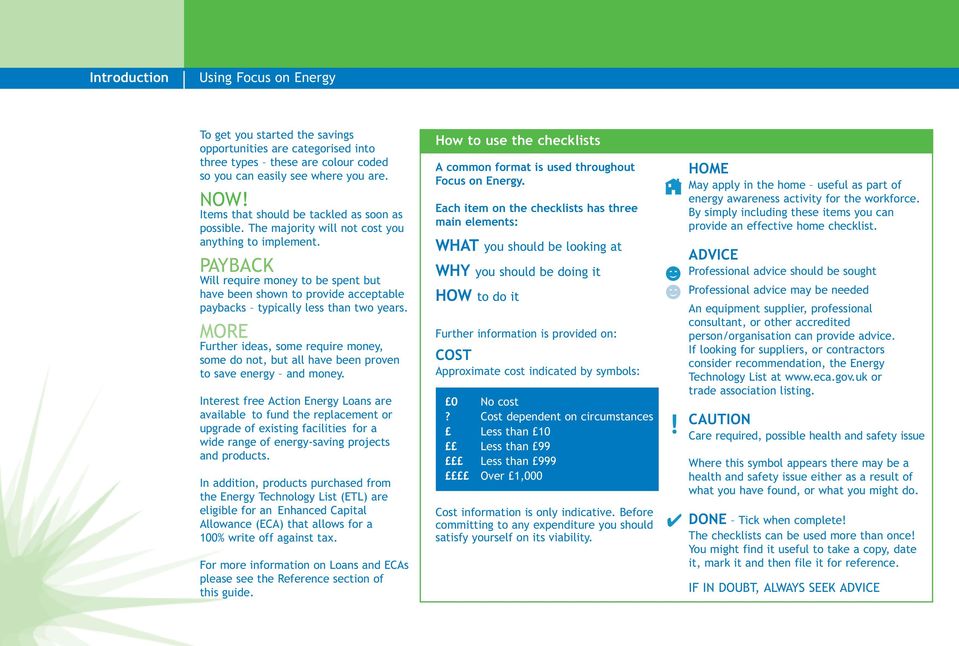
4 Introduction Using Focus on Energy To get you started the savings opportunities are categorised into three types these are colour coded so you can easily see where you are. Items that should be tackled as soon as possible. The majority will not cost you anything to implement. PAYBACK Will require money to be spent but have been shown to provide acceptable paybacks typically less than two years. MORE Further ideas, some require money, some do not, but all have been proven to save energy and money. Interest free Action Energy Loans are available to fund the replacement or upgrade of existing facilities for a wide range of energy-saving projects and products. In addition, products purchased from the Energy Technology List (ETL) are eligible for an Enhanced Capital Allowance (ECA) that allows for a 100% write off against tax. For more information on Loans and ECAs please see the Reference section of this guide. How to use the checklists A common format is used throughout Focus on Energy. Each item on the checklists has three main elements: WHAT you should be looking at WHY you should be doing it HOW to do it Further information is provided on: COST Approximate cost indicated by symbols:? Cost dependent on circumstances Less than 10 Less than 99 Less than 999 Over 1,000 Cost information is only indicative. Before committing to any expenditure you should satisfy yourself on its viability. HOME useful as part of energy awareness activity for the workforce. By simply including these items you can provide an effective home checklist. ADVICE may be needed An equipment supplier, professional consultant, or other accredited person/organisation can provide advice. If looking for suppliers, or contractors consider recommendation, the Energy Technology List at or trade association listing. CAUTION Care required, possible health and safety issue Where this symbol appears there may be a health and safety issue either as a result of what you have found, or what you might do. DONE Tick when complete! The checklists can be used more than once! You might find it useful to take a copy, date it, mark it and then file it for reference. IF IN DOUBT, ALWAYS SEEK ADVICE
5 Contents Management Gaining control and understanding Buying energy and water Utility purchasing Heating, Ventilation and Air Conditioning Heating, ventilation and air conditioning Lighting General internal and external lighting Electrical equipment Small power, office equipment, motors & drives Hot and cold water Hot, cold and cooling water Compressed air Basic compressed air systems Vehicles Commercial vehicles and cars Reference This section contains a listing of key Action Energy publications, as well as further information you may find of use.

6 Tel Management
7 Management The key to energy efficiency is management it doesn t matter how much you spend on technology, if you don t manage your energy resources efficiently, you will waste money. It can be easier to increase the profitability of a company by reducing energy costs than by increasing sales or turnover. For the organisation with fixed revenue, energy efficiency provides a means of maximising resources. Most energy saving activities rely on people make sure that everyone is committed to your programme. It may be worthwhile taking a little time to assess the business impact of energy in this way you can make a better case to support energy efficiency. This section deals with the way energy resources are managed and shows various actions you can take to save money. The savings you make by more efficient management of energy can contribute to the increased performance of your organisation. A key issue is knowing how much energy you use, and what it costs. Remember you can t manage what you don t measure. In nearly all cases, you don t have to make any financial investment to save money. However, all the techniques involve people and, in order to be successful, you will probably have to spend some time gaining support. Don t forget, energy efficiency is also an environmental issue and should be coordinated with your organisation s environmental activity e.g. ISO The actions outlined in this section should form part of a comprehensive programme to help you save energy and money. You can carry out as many or as few of these actions as you choose the more you do, the more you save! Items that should be tackled as soon as possible. The majority will not cost you anything to implement. PAYBACK Will require money to be spent but have been shown to provide acceptable paybacks typically less than two years. MORE Further ideas, some require money, some do not, but all have been proven to save energy and money.
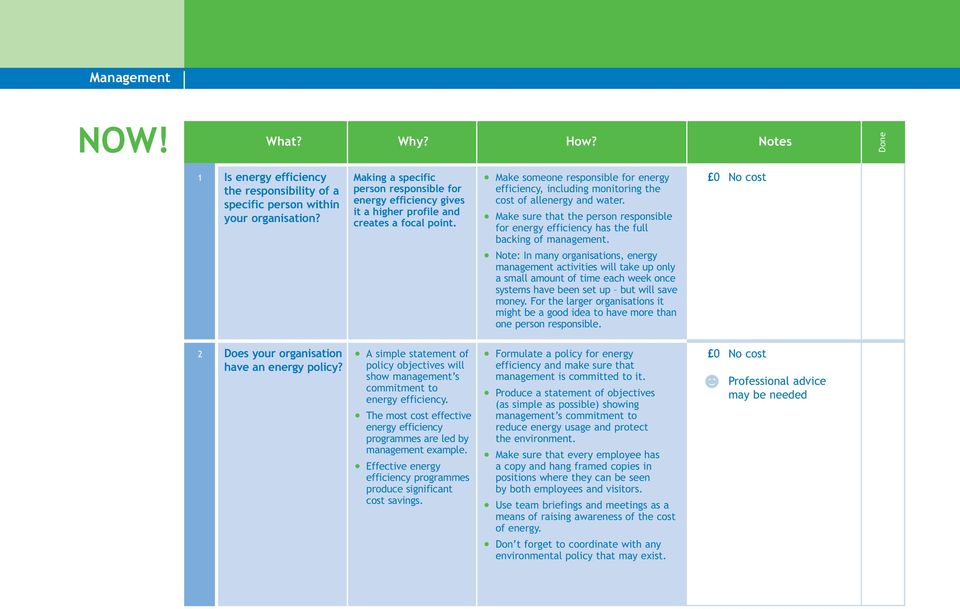
8 Management 1 Is energy efficiency the responsibility of a specific person within your organisation? Making a specific person responsible for energy efficiency gives it a higher profile and creates a focal point. Make someone responsible for energy efficiency, including monitoring the cost of allenergy and water. Make sure that the person responsible for energy efficiency has the full backing of management. Note: In many organisations, energy management activities will take up only a small amount of time each week once systems have been set up but will save money. For the larger organisations it might be a good idea to have more than one person responsible. 0 No cost 2 Does your organisation have an energy policy? A simple statement of policy objectives will show management s commitment to energy efficiency. The most cost effective energy efficiency programmes are led by management example. Effective energy efficiency programmes produce significant cost savings. Formulate a policy for energy efficiency and make sure that management is committed to it. Produce a statement of objectives (as simple as possible) showing management s commitment to reduce energy usage and protect the environment. Make sure that every employee has a copy and hang framed copies in positions where they can be seen by both employees and visitors. Use team briefings and meetings as a means of raising awareness of the cost of energy. Don t forget to coordinate with any environmental policy that may exist. 0 No cost may be needed
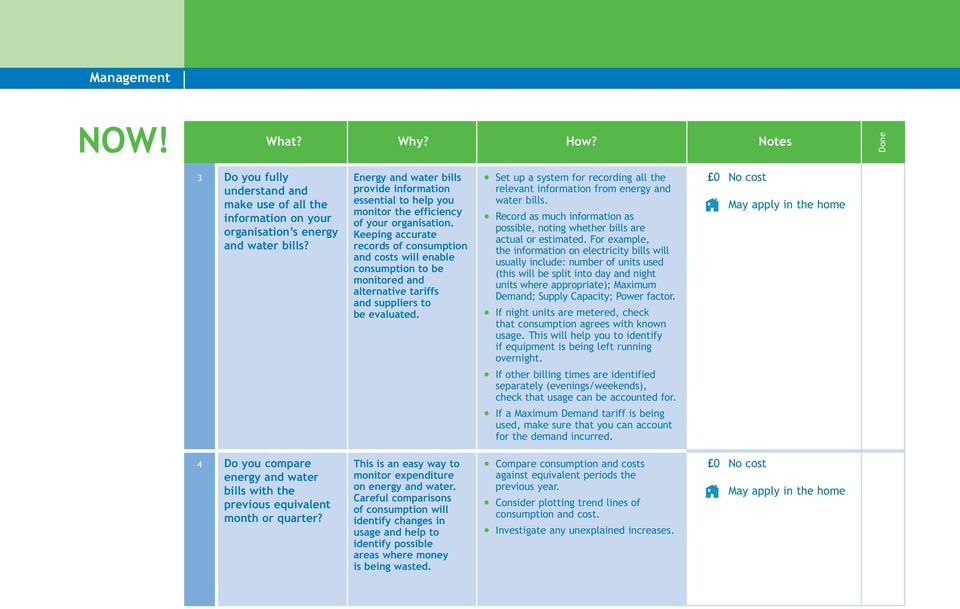
9 Management 3 Do you fully understand and make use of all the information on your organisation s energy and water bills? Energy and water bills provide information essential to help you monitor the efficiency of your organisation. Keeping accurate records of consumption and costs will enable consumption to be monitored and alternative tariffs and suppliers to be evaluated. Set up a system for recording all the relevant information from energy and water bills. Record as much information as possible, noting whether bills are actual or estimated. For example, the information on electricity bills will usually include: number of units used (this will be split into day and night units where appropriate); Maximum Demand; Supply Capacity; Power factor. If night units are metered, check that consumption agrees with known usage. This will help you to identify if equipment is being left running overnight. If other billing times are identified separately (evenings/weekends), check that usage can be accounted for. If a Maximum Demand tariff is being used, make sure that you can account for the demand incurred. 4 Do you compare energy and water bills with the previous equivalent month or quarter? This is an easy way to monitor expenditure on energy and water. Careful comparisons of consumption will identify changes in usage and help to identify possible areas where money is being wasted. Compare consumption and costs against equivalent periods the previous year. Consider plotting trend lines of consumption and cost. Investigate any unexplained increases.
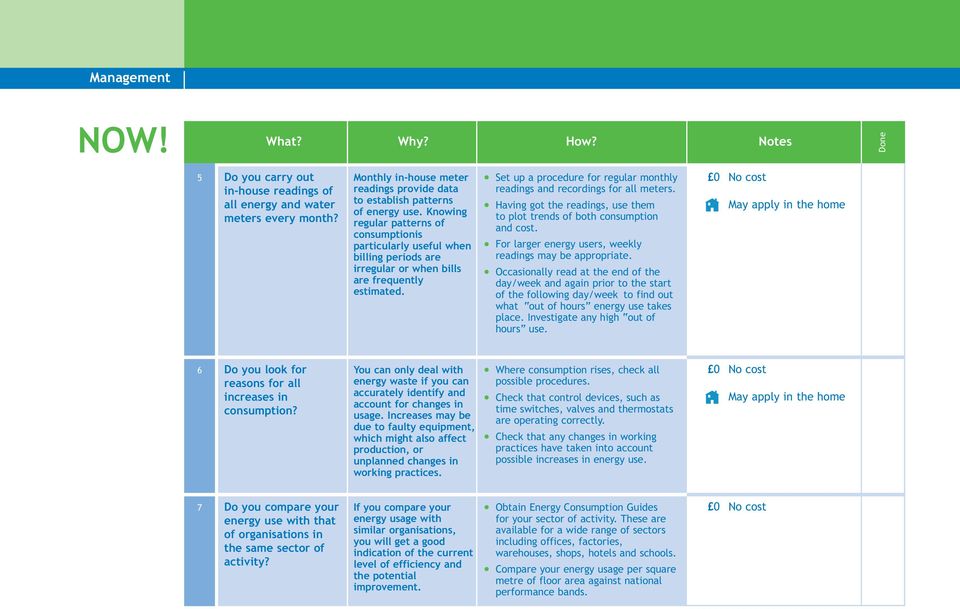
10 Management 5 Do you carry out in-house readings of all energy and water meters every month? Monthly in-house meter readings provide data to establish patterns of energy use. Knowing regular patterns of consumptionis particularly useful when billing periods are irregular or when bills are frequently estimated. Set up a procedure for regular monthly readings and recordings for all meters. Having got the readings, use them to plot trends of both consumption and cost. For larger energy users, weekly readings may be appropriate. Occasionally read at the end of the day/week and again prior to the start of the following day/week to find out what out of hours energy use takes place. Investigate any high out of hours use. 6 Do you look for reasons for all increases in consumption? You can only deal with energy waste if you can accurately identify and account for changes in usage. Increases may be due to faulty equipment, which might also affect production, or unplanned changes in working practices. Where consumption rises, check all possible procedures. Check that control devices, such as time switches, valves and thermostats are operating correctly. Check that any changes in working practices have taken into account possible increases in energy use. 7 Do you compare your energy use with that of organisations in the same sector of activity? If you compare your energy usage with similar organisations, you will get a good indication of the current level of efficiency and the potential improvement. Obtain Energy Consumption Guides for your sector of activity. These are available for a wide range of sectors including offices, factories, warehouses, shops, hotels and schools. Compare your energy usage per square metre of floor area against national performance bands.
11 Management 8 Is heating energy usage related to outside temperatures? Benchmarking against weather data, such as degree days (a measure of heating requirement ) can provide useful information on the efficiency of your heating controls. For guidance see Good Practice Guide 310 Degree days for energy management a practical introduction. Degree day figures are published in the Energy & Environmental Management magazine and on CHECK Chart your monthly fuel consumption against Degree days. If you do not get the required match, check that your heating controls are working properly. may be needed 9 Do you set regular targets for reduction in energy consumption? Setting realistic targets for energy reductions will help to focus attention on inefficient activities and raise the general profile of energy efficiency. Obtain data for comparable activities in your industrial/commercial sector. Identify the best two or three months performance by your organisation. Set regular and achievable targets based onexternal and internal data. 10 Do you check energy usage against production levels? Relating energy usage to production can provide an internal benchmark of energy efficiency. Set up a procedure to calculate energy performance. Dividing energy used each month by production data for the equivalent period will give a performance factor (such as kwh per tonne of product). Monitor trends in the performance factor to identify efficient and inefficient working practices.

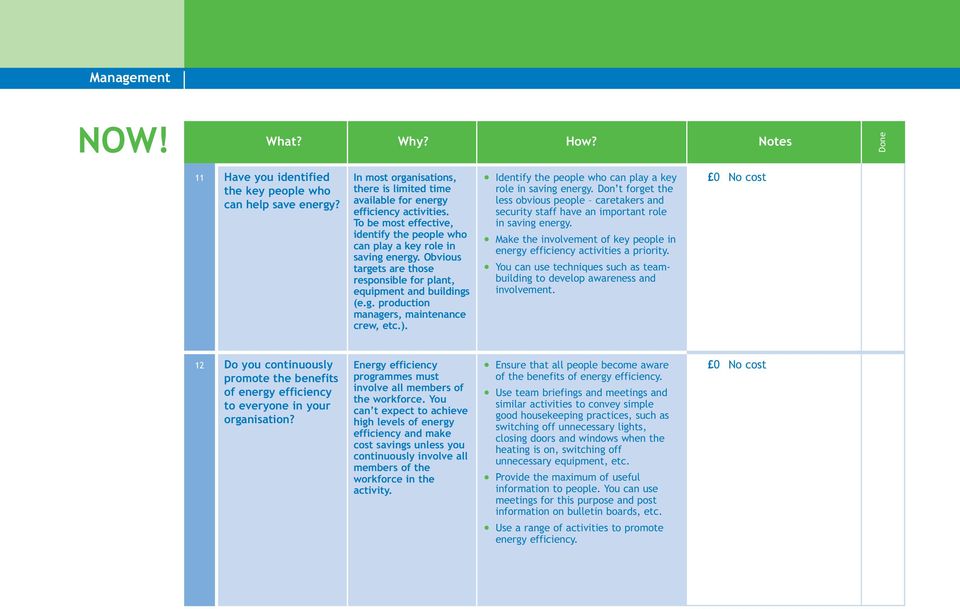
12 Management 11 Have you identified the key people who can help save energy? In most organisations, there is limited time available for energy efficiency activities. To be most effective, identify the people who can play a key role in saving energy. Obvious targets are those responsible for plant, equipment and buildings (e.g. production managers, maintenance crew, etc.). Identify the people who can play a key role in saving energy. Don t forget the less obvious people caretakers and security staff have an important role in saving energy. Make the involvement of key people in energy efficiency activities a priority. You can use techniques such as teambuilding to develop awareness and involvement. 12 Do you continuously promote the benefits of energy efficiency to everyone in your organisation? Energy efficiency programmes must involve all members of the workforce. You can t expect to achieve high levels of energy efficiency and make cost savings unless you continuously involve all members of the workforce in the activity. Ensure that all people become aware of the benefits of energy efficiency. Use team briefings and meetings and similar activities to convey simple good housekeeping practices, such as switching off unnecessary lights, closing doors and windows when the heating is on, switching off unnecessary equipment, etc. Provide the maximum of useful information to people. You can use meetings for this purpose and post information on bulletin boards, etc. Use a range of activities to promote energy efficiency.
13 Management 13 Do you make full use of the energy efficiency literature and videos that are available? There is plenty of educational and promotional material available. Literature available includes Good Practice Case Studies and Guides, Fuel Efficiency Booklets and Consumption Guides. Promotional materials, such as posters and videos, covering both management and technical issues, are also available. Contact Action Energy on or visit the website at 14 Does your organisation include energy efficiency in all specifications for buying new plant and equipment? Cost savings achieved through lower running costs can significantly outweigh higher initial purchase costs. All plant and equipment specifications should include energy efficiency. People responsible for purchasing or hiring new plant and equipment should receive training in energy efficiency awareness. 15 Has your organisation tried running a suggestion scheme for energy saving ideas? Encouraging people to suggest how to reduce energy and water costs can often produce worthwhile ideas. Consider setting up a suggestion scheme for energy cost saving ideas. It is important that all ideas are discussed with the individual putting forward the idea. 16 Are all new employees informed about energy policies and procedures? It is essential that new employees be informed about your organisation s commitment to good energy management. Ensure that energy efficiency practices are included in all induction programmes. Ensure that new employees receive and read a copy of your organisation s policy on energy efficiency.

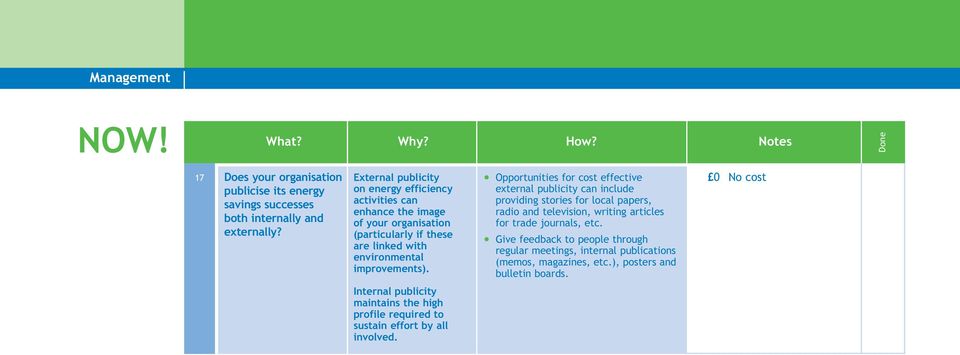
14 Management 17 Does your organisation publicise its energy savings successes both internally and externally? External publicity on energy efficiency activities can enhance the image of your organisation (particularly if these are linked with environmental improvements). Opportunities for cost effective external publicity can include providing stories for local papers, radio and television, writing articles for trade journals, etc. Give feedback to people through regular meetings, internal publications (memos, magazines, etc.), posters and bulletin boards. Internal publicity maintains the high profile required to sustain effort by all involved.
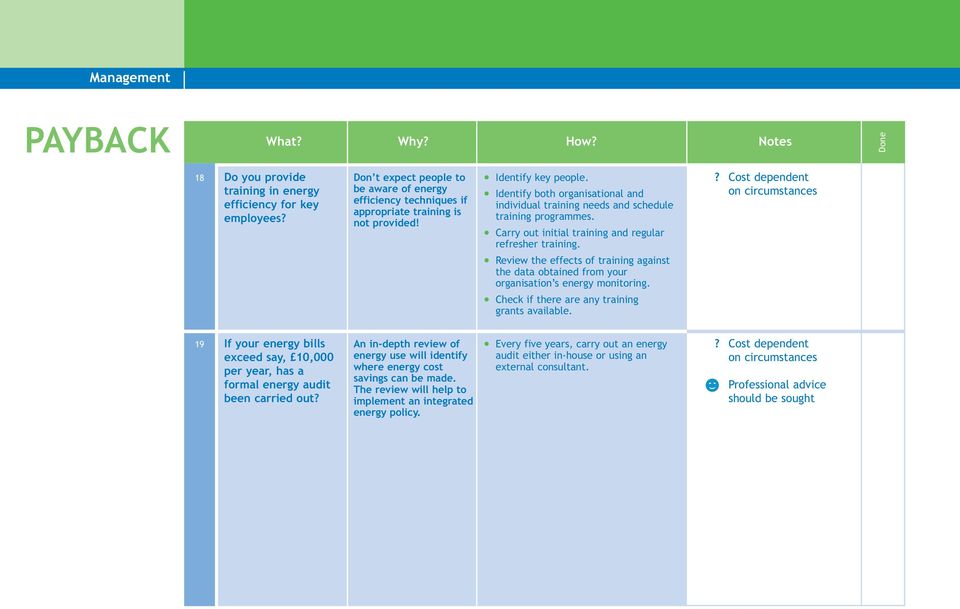
15 Management PAYBACK 18 Do you provide training in energy efficiency for key employees? Don t expect people to be aware of energy efficiency techniques if appropriate training is not provided! Identify key people. Identify both organisational and individual training needs and schedule training programmes. Carry out initial training and regular refresher training. Review the effects of training against the data obtained from your organisation s energy monitoring. Check if there are any training grants available.? Cost dependent on circumstances 19 If your energy bills exceed say, 10,000 per year, has a formal energy audit been carried out? An in-depth review of energy use will identify where energy cost savings can be made. The review will help to implement an integrated energy policy. Every five years, carry out an energy audit either in-house or using an external consultant.? Cost dependent on circumstances
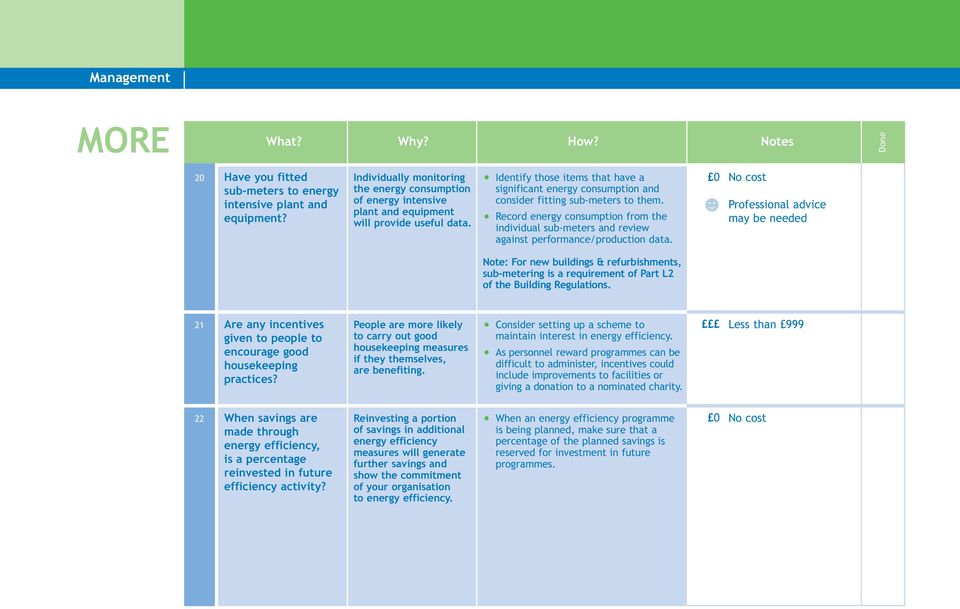
16 Management MORE 20 Have you fitted sub-meters to energy intensive plant and equipment? Individually monitoring the energy consumption of energy intensive plant and equipment will provide useful data. Identify those items that have a significant energy consumption and consider fitting sub-meters to them. Record energy consumption from the individual sub-meters and review against performance/production data. may be needed Note: For new buildings & refurbishments, sub-metering is a requirement of Part L2 of the Building Regulations. 21 Are any incentives given to people to encourage good housekeeping practices? People are more likely to carry out good housekeeping measures if they themselves, are benefiting. Consider setting up a scheme to maintain interest in energy efficiency. As personnel reward programmes can be difficult to administer, incentives could include improvements to facilities or giving a donation to a nominated charity. Less than When savings are made through energy efficiency, is a percentage reinvested in future efficiency activity? Reinvesting a portion of savings in additional energy efficiency measures will generate further savings and show the commitment of your organisation to energy efficiency. When an energy efficiency programme is being planned, make sure that a percentage of the planned savings is reserved for investment in future programmes.
17 Tel Buying energy and water
18 Buying energy and water Using energy efficiently is fundamental in managing and maintaining energy costs but ensuring you are on the right tariff can result in some immediate savings. Money saved through tariff changes can (then) be used for energy saving projects to generate further savings. Check if there are any alternative, lower cost, equivalent quality energy suppliers. A change of supplier is a paper exercise that can be quickly undertaken pipes and cables remain the same. Money can also be saved by reducing water and sewage bills. This section deals with the way you buy energy and water and shows various actions you can take to save money. Don t forget that opportunities for alternative sources of supply of both gas and electricity are increasing. The savings you can make by more effective purchasing of fuels and utilities will contribute to the increased financial performance of your organisation. This section concentrates on techniques rather than technology. In all cases, you don t have to make any financial investment to save money the only thing that might slow you down is finding out the necessary information. The actions outlined in this section should form part of a comprehensive programme to help you save energy and money. You can carry out as many or as few of these actions as you choose the more you do, the more you save! All items in this section should be tackled as soon as possible. They should not cost you anything to implement.

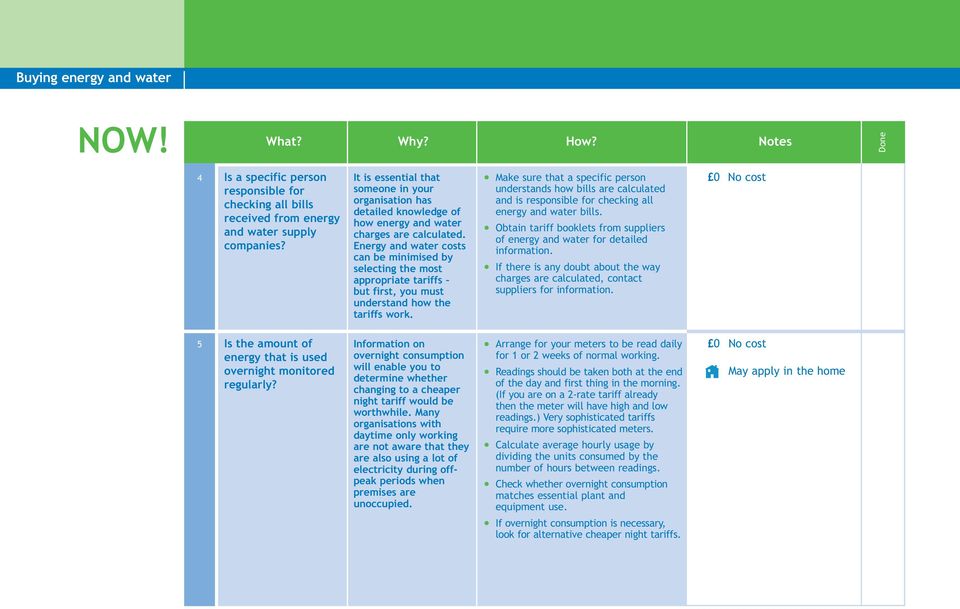
19 Buying energy and water 1 Do you check that all incoming bills are accurate? Even the largest suppliers can make errors on bills. Not checking bills could lead to wasting money. It is important to check that estimated figures are reasonable for the period they represent. Check carefully all incoming invoices against your in-house meter readings. If you don t already take your own meter readings, set up a scheme to do so. 2 Is an annual check carried out to make sure that you are on the correct tariff? The most appropriate tariffs for your organisation may change from year to year. Tariff prices and structures are usually changed on an annual basis. The pattern of consumption in your organisation may have altered due to changed working patterns or practices. Carry out a yearly review of tariffs and use the one that is most appropriate to your needs. Ask your supplier for advice on tariffs. You will only be able to identify the best for your organisation if you can supply accurate data on patterns of demand. You can use the data on consumption patterns from your inhouse readings for this purpose. 3 If your site has more than one gas meter, have they been aggregated into a single account? If your site has more than one meter, aggregating supplies may reduce standing and unit charges. Aggregating minor supplies may enable you to obtain better rates. Check that all metered supplies are aggregated for billing purposes. Note: Aggregating is a paper exercise that does not require any physical alteration to meters.

20 Buying energy and water 4 Is a specific person responsible for checking all bills received from energy and water supply companies? It is essential that someone in your organisation has detailed knowledge of how energy and water charges are calculated. Energy and water costs can be minimised by selecting the most appropriate tariffs but first, you must understand how the tariffs work. Make sure that a specific person understands how bills are calculated and is responsible for checking all energy and water bills. Obtain tariff booklets from suppliers of energy and water for detailed information. If there is any doubt about the way charges are calculated, contact suppliers for information. 5 Is the amount of energy that is used overnight monitored regularly? Information on overnight consumption will enable you to determine whether changing to a cheaper night tariff would be worthwhile. Many organisations with daytime only working are not aware that they are also using a lot of electricity during offpeak periods when premises are unoccupied. Arrange for your meters to be read daily for 1 or 2 weeks of normal working. Readings should be taken both at the end of the day and first thing in the morning. (If you are on a 2-rate tariff already then the meter will have high and low readings.) Very sophisticated tariffs require more sophisticated meters. Calculate average hourly usage by dividing the units consumed by the number of hours between readings. Check whether overnight consumption matches essential plant and equipment use. If overnight consumption is necessary, look for alternative cheaper night tariffs.
21 Buying energy and water 6 Do you make the best use of cheaper rate electricity? If more than 15% of total electricity usage occurs in the off-peak period, it is worth considering switching to a day/night tariff. Carry out a survey of individual plant and equipment usage. Where possible, switch equipment use to take place in the cheap rate period. Possibilities include kilns, drying ovens and water heaters. 7 If your organisation is on a Maximum Demand tariff, have you reviewed your Supply Capacity? The way in which your bills are calculated will depend on the supplier and the tariff. However, you may be paying for capacity you don t need. Check whether your declared Supply Capacity (or Availability) is more than 15% higher than your highest Maximum Demand. If you reduce your Supply Capacity you will most likely be charged for increasing it again at a later date, so be sure before arranging a reduction. Contact your supply company about reducing the Supply Capacity. Care required, possible health and safety issue 8 Have you looked at ways to reduce electrical demand during peak charging periods? Where tariffs include peak unit charges or demand charges, reducing usage during these periods can make significant cost savings. Look for opportunities to re-schedule non-essential loads in order to reduce usage during peak charging periods. 9 If your organisation is on a monthly tariff, have you checked the power factor for your site recently? Some monthly tariffs penalise users for poor power factors. Some suppliers identify the power factors on their bills. Establish your site s power factor. You may find this on your bills, otherwise ask your supplier to help. Most suppliers of power factor correction equipment also offer a free check.if your power factor is below 0.95, you should review the potential benefits of installing power factor correction.
22 Buying energy and water 10 Have you looked for alternative, competitive suppliers of electricity? Any electricity user is able to buy electricity from any authorised supplier. If you are still with your local supplier, you may be able to make savings by shopping around. Seek alternative quotations from a number of suppliers. The regulator OFGEM maintains a list of authorised suppliers Have alternative, competitive suppliers of gas been sought? You can choose to buy gas from any authorised supplier. Seek alternative quotations from a number of suppliers. The regulator OFGEM maintains a list of authorised suppliers If your organisation pays trade effluent charges, are these checked carefully? If your organisation is paying trade effluent charges, a charge is usually made for disposal of a proportion of incoming water as domestic sewage. The remainder is charged as trade effluent. As the charge for domestic sewage is generally higher than the charge for disposing trade effluent, you may be paying more than necessary. Establish how the sewage charge is calculated. Check that the proportion for domestic sewage corresponds to the number of employees. Note: As a general rule, you can estimate a requirement of 13m 3 per employee per year, or 50 litres per person per working day.
23 Buying energy and water 13 If you use heating oil, do you belong to an oil purchasing consortium or group? Buying oil in larger quantities enables better discounts to be negotiated. Use the consortium to negotiate better discounts. You may also get other useful information from the consortium on price trends and other relevant matters. 14 Does your organisation try to avoid small deliveries of oil? Oil companies offer better prices for larger deliveries. Try to avoid small deliveries. Talk to your suppliers and find out what quantity discounts exist and plan purchases around these. It may even be worth reviewing the amount of on-site oil storage. 15 Are you aware of seasonal variations in oil prices? The price of heating oil usually drops during the summer months. If it is possible, make the best use of seasonal prices by filling up oil tanks during the summer months. (This will increase the value of stock held and may not be attractive to your accountant!). 16 Do you have a metered water supply? Low quantity users paying charges based on the rateable value of their property may benefit from switching to a metered supply. Check the charges on water bills. Estimate the cost of your annual water consumption based on a metered supply and compare with present charges (in office environments; on average, one employee requires 13m 3 of water per year). Discuss options with the water supply organisation. Note: Be very careful with your calculations once you opt for metered supply, it is not normally possible to revert to a non-metered supply. Care required, possible health and safety issue
24 Buying energy and water 17 If your organisation has a metered supply, do you know if the water meter is the correct size? Standing charges are calculated according to the size of the meter. If the meter is too large, you may be paying too much. Check the size of your meter. If the meter is 25mm, or less, it is unlikely that a change will be justified. If it is larger than 25mm, compare the meter size with your maximum flow rate requirements. Contact your water supplier for assistance. 18 Are minimum charges on water bills checked carefully? Unnecessary minimum charges may be incurred due to underestimates by the supply organisation. Check that minimum charges on estimated bills are not due to an under-estimation by the supplier. If you think that you have been wrongly charged, take meter readings and inform the supplier. If you are right, you should obtain a refund. 19 Do you claim rebates for any mains water, which is not discharged to the sewer? Charges for the disposal of water are normally calculated according to the incoming metered supply. If more than 10% of water supplied is evaporating or is used in your products, you may be able to claim a rebate on disposal costs. If you can demonstrate losses through leakage, you may also be able to obtain a rebate on disposal costs. Calculate the quantity not returned to the sewer. Check that sewerage charges are not being paid on water that is not returned to the sewer. Seek a rebate from your supplier if you think that this quantity exceeds 10% of you total fresh water supply. may be needed
25 Buying energy and water 20 Do you pay for the disposal of any surface water not flowing into the water company s drainage system? You should not pay disposal charges for surface water not entering the water company s drains. (For example, if drained into a local watercourse or a soakaway system.) Check the method of disposal of your surface water. If some water does not pass into the water company s drains, check that you are not paying the water company for disposal.
26 HVAC HVAC Heating, ventilation and air conditioning are used to provide a comfortable working environment. Heating can account for around 50% of the energy used in offices. Effective insulation can reduce heat losses by up to 90%. Air conditioning uses expensive electricity and can add considerably to running costs. Boilers are not 100% efficient around 20% of heat generated is lost up the chimney. Heat loss can increase to 30% or more if the boiler is poorly maintained or operated. This section deals with the way you provide thermal comfort for your premises and shows various actions you can take to reduce the cost of HVAC. The savings you can make through developing an awareness of efficient HVAC practices will contribute to the increased financial performance of your organisation. You can save money by using simple time and temperature controls and by understanding how your system and building should work. Heating and cooling can account for a significant amount of the money spent by organisations on energy and even small adjustments can make big improvements to the working environment and, at the same time, save money. Don't forget that, to ensure the health of staff, all buildings need adequate ventilation. For safety reasons, boilers must be maintained in the best possible condition. Also remember that for any new buildings or refurbishments the Building Regulations will specify minimum energy efficiency requirements. The actions outlined in this section should form part of a comprehensive programme to help you save energy and money. You can carry out as many or as few of these actions as you choose the more you do, the more you save! Items that should be tackled as soon as possible. The majority will not cost you anything to implement. PAYBACK Will require money to be spent but have been shown to provide acceptable paybacks typically less than two years. MORE Further ideas, some require money, some do not, but all have been proven to save energy and money.
27 HVAC 1 Have you checked whether your buildings are heated above 19 C? Most people don't realisethat the maximum temperature recommended for heating is 19 C. Costs rise by about 8% foreach 1 C. Carry out regular checks on the thermostat settings. Discuss temperatures at team briefings and meetings. Check thermostat settings of heating to ensure that heat is not supplied to raise the temperature above 19 C. The temperature in an area can be above 19 C, but the heating system should not be providing heat when it is over 19 C, equally the cooling should not start to operate as soon as 19 C is exceeded. 2 Have you checked the temperature of air conditioned areas? Unless there is a specified requirement, air conditioned areas need not be cooler than 24 C. Carry out regular checks on the thermostat settings. If, because of heat gain, an area is hotter than 19 C, don't install air conditioning to reduce it unless you have to. For many buildings the temperature can be allowed to rise to 24 C, or more, before there is a need for air conditioning. Discuss cooling levels at team briefings and meetings.
28 HVAC 3 Do people keep windows and doors closed during the time when the heating/air conditioning is operating? Windows are often opened because rooms are too warm. Doors are often wedged open for convenience. Up to one third of heating costs can be saved by reducing the amount of cold air that enters your building. Equally if doors and windows are left open in the summer heat from outside can add to the air conditioning load. Use promotional materials (posters, booklets, etc.) to encourage people not to leave doors and windows open when heating/air conditioning is on. Get them to adjust thermostats instead. Use team briefings and meetings to raise awareness of the cost of heating. 4 Where heating and air conditioning units are installed in the same room, are their settings adjusted to avoid simultaneous operation? Simultaneously heating and cooling wastes a lot of money. Set thermostats at 24 C or more for cooling and 19 C or less for heating. Set units in common areas to the same mode of operation (either heating and cooling) to avoid operational conflicts. 5 Are people encouraged to reduce their heating when they are too hot instead of opening windows or doors? Money is wasted when windows and doors are opened when heating is on. Turning down thermostats can increase comfort and save money. Costs of savings of around 8% can be made for each 1 C reduction in temperature. Use promotional materials, such as posters and stickers. Use team briefings and meetings to raise awareness of energy costs.
29 HVAC 6 Are your HVAC time switches programmed to match occupancy patterns? Money can be saved by adjusting preheat periods to match weather conditions. The heat stored in radiators,and in the building in general, is often sufficient to allow the heating to be switched off before the end of occupancy. Check settings on all time switches regularly to ensure that they are displaying the correct time and date and that the timings correspond to the occupancy pattern. Check that the heating and ventilation does switch off when the building is unoccupied. 7 Have you checked whether there are any sources of uncontrolled/ unwanted heat in air conditioned areas? Heat from uninsulated pipework and similar sources make air conditioning equipment work harder and wastes money. Check for sources of unwanted heat and remove or insulate. Also look for the unauthorised use of electric space heaters these might be used if the space is too cool for the comfort of some occupants. Adjust thermostats instead. 8 Have you checked if your boilers continue to fire when there is no demand for heating in work areas? Boilers can continue tofire even when the room thermostat or heating time switch shuts off the pump. This wastes money during periods when there is no demand for heating. Arrange for the wiring to be altered so that the thermostat and heating time switch shut off both the circulating pump and the boiler(s).? Cost dependent on circumstances
30 HVAC 9 Do you regularly check to see if HVAC plant control valves and dampers are operating correctly? Seized valves and dampers (or those that will not close properly) will waste money and result in discomfort. Check that all radiator valves work. Check that motorised valves and dampers have full travel from open to closed. Make sure that hot water is not passing through closed valves. may be needed 10 Are radiators and other heating surfaces always unobstructed? Radiators are often obstructed with furniture. This will reduce their output and lead to poor performance and extended warm-up times. Check out the layout of your working areas to ensure that all heat surfaces are not obstructed. 11 Is your boiler plant checked weekly? Boiler plant operating inefficiently will waste a significant amount of money. Weekly checks on the boiler plant should quickly detect any problems. Arrange for a weekly check of boiler plant. Check for: any warning lights; signs of leakage from pipework; valves; flanges and boilers; any gas smells; oil leaks; damage and burn marks to boilers and flues; undue noise from pumps and burners; blockage in all air vents. 12 Do you adjust HVAC times for holidays? Heating, or cooling, an unoccupied building to normal occupancy temperatures is wasteful. Ensure that someone is responsible for switching the heating to holiday mode (i.e. frost protection level only). Note: Where a building is partly occupied during holiday periods, it may be more efficient to have local heating only in the occupied areas.
31 HVAC 13 Have you checked to see if air conditioned computer rooms are being maintained at the correct temperature? Many computer rooms are maintained at unnecessarily low temperatures, which wastes money. Stable temperatures are usually more important than high or low temperatures. Check and adjust computer room temperatures to about 25 C. Note: Before making adjustments, check the precise system requirement. 14 Are filters in ventilation systems regularly checked to ensure they are not blocked or creating excessive resistance? Blocked filters lead to reduced airflow and increased operating costs. Have filters regularly checked and replace as required. Consider fitting gauges to indicate when replacement is required. Less than Are the settings of frost thermostats checked regularly? If frost thermostats are set too high, money will be wasted if set too low, the system and building may be at risk of damage from frost. Re-set frost thermostats. Typical settings for thermostats are: Internal 4 C External 0 C 1 C Also check if the frost heating can come on in the summer this is not usually necessary and normally only occurs when the frost thermostat is set too high. Make sure that they are labelled: Frost Thermostat. Ensure that they are tamperproof.
32 HVAC 16 If you have a multiboiler installation, do your controls sequence the boilers according to load? To avoid wasting heat, the minimum number of boilers should be firing at any one time. Check that boilers are not firing up and closing down simultaneously. Set individual boiler thermostats to fire on an increasing range from say, 60 C to 85 C. This will ensure that the minimum number of boilers are firing to meet demand. Consider installing sequencing controls. 17 Do you turn off heating boilers during the summer? Leaving boilers on during the summer is wasteful. Pilot lights on gas boilers can use significant quantities of gas. Arrange for someone to turn off boilers and pilot lights in the summer and to relight them when required. 18 If you have a multiboiler heating and hot installation, do you use only the smallest boiler in the summer? Larger boilers lose more heat then smaller boilers. During summer, use only the smallest available boiler for generating hot water. 19 If you have a multiboiler installation, do you turn off unneeded boilers during milder weather? Multi-boiler installations are designed to cope with the highest level of heat demand (usually during winter). Running the full system during milder weather wastes money. For some installations one boiler can be turned off all year round. Turn off un-needed boilers in mild weather. Close isolating valves to stop water flowing through them. Label boilers and valves to indicate that they are isolated. Don t forget to re-open valves before attempting to re-start boilers. Care required, possible health and safety issue
33 HVAC 20 Is your boilerhouse adequately ventilated with all louvres andvents open and not obstructed? Restricting the supply of air to a boiler can result in a loss of efficiency due to incomplete combustion. Inadequate ventilation can allow the release of potentially dangerous gases; therefore boilerhouse ventilation is also a vital health and safety matter. Conduct regular checks to ensure that ventilation openings are kept free and clear at all times. If you have any doubts, seek advice immediately. Care required, possible health and safety issue 21 Are your temperature controls, e.g. thermostats and thermostatic radiator valves (TRVs) set tothe correct temperature and then left alone? Thermostatic controls are often abused by being used as on/off switches. This can result in discomfort and money being wasted. Set controls and TRVs to give the desired temperature and make them tamperproof by using locking devices or exterior covers. Educate users that they need to set thermostats to their comfort temperature and then only adjust by small amounts. 22 Do you regularly check your heating systems for leaks? Leaking systems require water losses to be made up. Adding water can result in corrosion, scaling and loss of efficiency. Check the feed and expansion tank regularly. If you can hear water filling the tank through the ball valve, it is likely that the system is leaking. If you suspect a leak, call a contractor to investigate.
34 HVAC 23 Do you ensure that all heating surfaces and filters on fan heaters are cleaned regularly? Blocked filters and dirt build-up on fan heaters reduces output and results in excessive preheat periods. This may encourage people to use additional portable electric heaters. Check that all fan heaters are fitted with filters and that they are kept clean. Check that the cleaning of heating surfaces is included in regular cleaning routines. 24 Have you considered reducing the level of heating in some areas? Areas such as store rooms and corridors, or areas where there is a high level of physical activity, require less heat. In warehouses warm clothing can be supplied and the heating lowered to protect the product only. Reduce thermostat settings in areas that do not require full comfort heating. Typical settings should be: Offices 19 C Workshops 16 C Stores, etc 10 C 12 C 25 Have you checked your buildings for draughts from redundant fireplaces, flues, stacks and chimneys? A lot of heated air can escape from buildings through these pathways. Carry out a check to identify redundant fireplaces, etc. Blank off or remove all redundant fireplaces, flues, stacks, exhaust vents and chimneys. Note: For inbuilt brick chimneys fit a vent at the base of the old fireplace to allow some air into the chimney to prevent damp. Care required, possible health and safety issue If you have any doubts, seek advice, from Action Energy on
35 HVAC 26 Are ventilators that are used for summer cooling closed off before the heating season begins? It is wasteful to allow cold air into the building or to extract heated air unnecessarily. Make someone responsible for closing off all ventilators used for summer cooling. Check that ventilators are not needed for essential purposes such as removing fumes, dust or odours. Care required, possible health and safety issue 27 Are all unused doors and windows permanently sealed? Unused doors and windows are a source of draughts that cause discomfort and waste money. Identify and seal doors and windows that are no longer used. Check that apparently unused doors and windows are not required for safety reasons (e.g. fire escapes). Care required, possible health and safety issue 28 Are your boilers properly serviced at least once a year? A build-up of deposits caused by combustion will reduce boiler efficiency. Wear in controls and linkages can result in poor combustion. Poor combustion can also be a health and safety risk. Boilers and burners should be properly cleaned and serviced at least once a year by a qualified contractor. The servicing should include a combustion efficiency check and adjustment of the burner air/fuel ratio for optimum efficiency in accordance with the maker's instructions. Instruct the contractor to maximise the boiler efficiency and provide a boiler test sheet showing the results of the tests, the boiler efficiency and the maker's quoted maximum efficiency. For boilers with gas atmospheric burners, combustion checks can be limited to testing gas pressure. Less than 99
36 HVAC 29 Is all refrigeration plant regularly maintained? It is possible for chillers and other cooling plant to continue operating at significantly reduced levels of efficiency. Ensure plant is regularly maintained. This should include checking for refrigerant charge and refrigerant leakage. Insist on a detailed and understandable report from the contractor.? Cost dependent on circumstances 30 If you have gas or oil fired air heaters, are they serviced at least annually? A build-up of deposits caused by combustion will reduce heater efficiency. Wear on heater controls and linkages will cause poor performance. Poor combustion can also be a health and safety risk. Arrange for a regular heater service and combustion check. Heaters and burners should be properly cleaned and serviced at least once a year by a qualified contractor. The servicing should include a combustion efficiency check and the burner air/fuel ratio should be adjusted for optimum efficiency, according to the maker's instructions. Instruct the contractor to maximise the heater's efficiency and to provide a test sheet showing the results of the tests, the heater efficiency and maker's quoted maximum efficiency.
37 HVAC PAYBACK 31 Are windows, rooflights and doors draught-proofed? Draught-proofing is a low cost and very effective means of reducing heating costs and improving comfort. Carry out a survey of buildings to identify where draught-proofing is needed. Fit draught-proofing to all external doors and all internal doors that separate cold and warm areas. Draught-proof all windows. Ensure the appropriate levels of ventilation of safety and protection of the property exist. Less than 99 Care required, possible health and safety issue Note: Ensure that all combustion appliances are adequately ventilated (including gas-fired catering equipment). 32 Are windows, rooflights and doors draught-proofed? Un-insulated loft spaces can be a major cause of heat loss. Insulation applied to un-insulated areas will reduce heat losses significantly. (For example, between 100mm and 150mm of glass fibre can reduce losses by up to 90%). Identify un-insulated loft areas and apply insulation where appropriate (different insulating materials have different insulating values, but between 100 and 150mm of most materials is recommended). When applying, ensure that there is sufficient ventilation at the eaves. Remember to insulate any water tanks and pipes in the loft space to reduce the risk of freezing. Less than 999
38 HVAC PAYBACK 33 Are your thermostats and temperature sensors located in the right place? Siting a thermostat in a cold or draughty place will result in overheating; conversely, siting a thermostat near a source of heat may lead to underheating. Check thermostat locations and, where appropriate, change to representative locations. Make sure that they are in a free flow of air but away from windows, heat sources and draughts. If your heating controls incorporate an external temperature sensor, make sure it is located on a north-facing wall and out of direct sunlight or any other sources of heat.? Cost dependent on circumstances may be needed Note: The siting of thermostats is very often a compromise in order to achieve reasonable temperature conditions throughout an area or building. 34 Have you installed modern electronic thermostats? Some thermostats can allow temperatures to vary by up to 3 C from the set temperature. Wide variations in room temperature can cause discomfort to occupants. Replace older or inaccurate controls to allow closer control, typically a 0.5 C variation from the set temperature. Less than Are heated areas effectively separated from unheated areas? If heated and unheated areas are effectively separated, draughts will be reduced. This will result in improved comfort and reduced costs. Fit plastic strip curtains, swing doors or other suitable partitions between cold and warm areas. Less than 999
39 HVAC PAYBACK 36 Are extraction fans fitted with selfclosing shutters? Cold air can enter even when the fans are not running, producing heat loss. Install shutters they are available for most makes of extractor fan. Less than Are extraction fans for areas such as toilets and kitchens time controlled? Running extraction fans during periods when rooms are unoccupied is generally not necessary and wastes money. As warm air is extracted from the building, the heating system has to work harder, or cold draughts are felt. Fit a 7 day time switch to all extraction fans that are not needed to run overnight and at weekends. Fit a humidistat to any extractor fan that is used to remove moist air. Connect extraction fans into controlled lighting circuits (e.g. in small toilet areas). Control fans and lighting in toilet areas with occupancy sensors. Less than 99 Care required, possible health and safety issue Note: In some cases Building Regulations may cover the operation of toilet fans. 38 Is your heating distribution pipework appropriately insulated? Heat losses from un-insulated pipework can be reduced by more than 70% by adding insulation. Insulate all heating pipework (except when it gives useful heat). Less than 99
40 HVAC PAYBACK 39 If you have electric heating, does it switch off automatically when not required? Although direct electric heating is cheap and easy to install, it is expensive to run, particularly when not controlled. Electric heating should switch off (or drop to a reduced level) automatically when areas are not occupied. Fit 7 day electronic time switches to all electric heaters. Or, in intermittently occupied areas, install an electronic two-level thermostat with integral run-back timer to switch off electric heaters after a pre-set time. Less than Have you considered fitting Thermostatic Radiator Valves (TRVs) to your radiators? If individual rooms suffer from regular overheating, people will solve the problem by opening windows this wastes money. TRVs can provide more localised control, preventing rooms from overheating. Carry out a survey of rooms that appear to suffer from overheating. Fit TRVs that incorporate a locking mechanism. Ensure they are correctly set and then locked. Less than 99 may be needed 41 Is your heating system flexible enough to cope with occasional out-ofhours working? If heating is required throughout the whole building, fitting extension timers is a more efficient option than constantly reprogramming time switches. If only a part of the building is to be used,it may be more economical to provide local heating. Fit an extension timer where appropriate. Provide supplementary portable heaters where required ensure that use is limited to approved periods only. Less than 99
41 HVAC PAYBACK 42 Do heaters switch off automatically when doors in loading bays, garages and workshops are opened? Large open doors result in substantial heat losses. If heat is cut off when doors are opened, there is an incentive for people to keep doors closed. Interlock the operation of heaters and large opening doors, such as loading bay doors, so that heaters are switched off automatically when doors are opened. Less than Can you accurately programme the time setting on your heating and ventilation systems to allow for weekends, early finishing and late evening work? Some older electromechanical time switches cannot be programmed for different daily schedules (for example, earlier switch-off on Fridays, or part-day switching at weekends). Some electro-mechanical time switches are not precise enough to enable switching to be set to the nearest 10 minutes. Install a 7 day electronic time switch to permit different settings for each day and individual settings of 10 minutes or less. Less than If you have buildings with high bays, have you checked the difference in temperature between floor and ceiling levels? Warm air rises and collects in the roof space where it is not needed. Large temperature differences increase heat losses through the roof. If the temperature difference is excessive (more than 5 C), fitting a high level fan controlled by a thermostat will help to bring the warm air down to working levels. Less than 999
42 HVAC PAYBACK 45 Do you carry out performance testing on your boilers? Combustion deposits cause an increase in flue gas temperatures and result in more heat being lost through the flue. Water-scale buildup can also cause flue gas temperatures to increase. Consider installing a flue gas thermometer. The boiler is ready for cleaning again when the maximum temperature of the flue gases rises by over 4 C since the last service. Less than Are all heat distribution pipes, valves and flanges insulated? Heat losses from pipes can be reduced by over 70% by insulation. Significant heat is lost from valves (typically one valve will lose the same amount of heat as 1m of pipework) and flanges (equivalent to 0.5m of pipework). Check all the pipes, valves and flanges around the boiler area. Insulate all distribution pipework that is not contributing useful heat to work areas. Insulate all valves and flanges (50mm or larger) with quick release valve jackets. Less than Are all of your boilers correctly insulated? Boilers that are not insulated lose heat into surrounding areas. This can be a significant waste of money. Check that boilers are adequately insulated (minimum 50mm thick insulation). If they are not adequately insulated, fit 50mm thick mineral fibre mat with foil laminate to the inside of the boiler casing (many manufacturers can supply purpose made boiler insulating units). Less than 99 Care required, possible health and safety issue Note: Make sure that the insulation does not interfere with the burner or air supply to the boiler.
43 HVAC PAYBACK 48 If there are areas in your buildings that are sometimes unoccupied, does the heating automatically adjust to meet the reduced demand? Reducing the temperature in these areas during unoccupied periods will save money. 2 stage thermostats can provide much more flexible control. Fit a 2 stage electronic thermostat linked to an occupancy sensor. Less than If you have radiant heaters, are they controlled by blackbulb thermostats? Conventional thermostats are inappropriate for radiant heating systems. Black-bulb thermostats give better control and consequent energy savings. For radiant heater systems, replace conventional thermostats with blackbulb thermostats. The radiant heating supplier should be able to provide a suitable thermostat. Less than Are all your external doors fitted with door closers? People often fail to close doors properly, resulting in significant heat losses. Fit spring-loaded door closers. Less than 99
44 HVAC MORE 51 Have you checked that the airflows from your ventilation systems are not excessive? It is very common to find excessive rates of ventilation that waste both heat and electricity. Measure ventilation systems airflows and opportunities for reductions, such as closing dampers, changing fan pulley sizes, changing motors. Also consider the use of variable speed fans. Less than Have you checked whether some parts of your buildings are regularly too hot while other parts are only just warm enough? Overheating can cause a lot of discomfort and wastes money. Check the heat levels in the different parts of your site. Use the information to re-balance your heating system. You may need to fit additional thermostats/sensors to operate local zone valves.? Cost dependent on circumstances 53 Are all roofs properly insulated? Some roofs will have a very high rate of heat loss. These include roofs made of single skin corrugated asbestos or corrugated iron. Losses can be as much as 15 times that of a modern, wellinsulated roof. Look at the possibility of insulating roofs that suffer high heat losses. Suitable methods include lining, overspraying and under-spraying. Over 1, Are cavity walls insulated? Heat loss through cavity walls can be reduced significantly (up to two thirds) by installing cavity wall insulation. Install cavity wall insulation where appropriate. Over 1,000
45 HVAC MORE 55 Have you considered installing suspended ceilings in buildings with high ceilings which are only heated? Suspended ceilings reduce the volume of air to be heated. They provide additional insulation against heat losses. Installing suspended ceilings may also reduce lighting running costs. Look at the possibility of installing suspended ceilings. Seek professional advice. In buildings which need cooling, it may be appropriate to leave the structure exposed to absorb excess heat. Over 1, Have you installed secondary glazing under rooflights? Heat losses will be reduced by up to a half. Comfort will be improved by eliminating down-draughts. Investigate opportunities to install polycarbonate secondary glazing under rooflights. Less than Are all windows fitted with double or secondary glazing? Fitting double or secondary glazing can halve heat losses through windows. The comfort of people working near windows is improved. Noise levels from outside are considerably reduced. Look for opportunities to fit double or secondary glazing. Note: This option should be considered when upgrading a heating system or replacing windows as the extra cost of additional glazing cannot normally be justified by energy savings alone. May also be a Building Regulations requirement. Less than 999
46 HVAC MORE 58 Have you looked at ways of reducing draughts coming from loading areas? Loading bay doors are a source of heat loss. Draughts from large open doors are likely to cause discomfort and can result in the use of additional expensive heaters. There are a number of options which you might consider, including: using partitioning to create a draught lobby with inner and outer doors; fitting rapid action automatically closing doors; fitting plastic strip curtains; installing air curtains; fitting pneumatic seals to wrap around goods vehicles; installing wind breaks if the loading bay faces the prevailing wind. Over 1, Have you considered insulating flat and pitched roofs during re-roofing work? Older types of flat and pitched roofs often have poor standards of insulation. Take the opportunity to install additional insulation to both flat and pitched roofs during re-roofing operations. Over 1, Is your heating system zoned? If you divide your heating system into zones, you can ensure that heat is provided only when and where it is needed and avoid waste. Fit zone valves with time and temperature controls where appropriate (make an allowance for frost override). Over 1, Does your heating system incorporate an optimum start controller? Heating can be turned on later on mild days as shorter warm-up times are required. An optimum start controller adjusts start times automatically and gives typical fuel savings of 10%. Install an optimum start controller. Note: Most optimum start controllers will also provide features such as optimum stop, day economy and automatic frost protection. Less than 999
47 HVAC MORE 62 Do you use weather compensated controls for radiator systems? A weather compensator adjusts the flow temperature in the heating system to match variations in outside temperature. Weather compensators save money by preventing overheating in milder weather conditions. When heating floor areas of over 1,000m 2, fit a weather compensator and motorised valve. For smaller systems, a compensator can sometimes directly control the boiler. This is a much cheaper option and avoids the expense of installing a motorised valve. Compensators can be combined with other energy saving features including optimum start, day economy and frost protection. Less than Have you considered applying solar film to windows in air conditioned areas? Heat is gained through windows not fitted with solar film. The additional heat means that the air conditioning has to work harder and costs more to operate. People can suffer from both glare and heat in rooms that face the sun and are not fitted with solar film. Investigate opportunities to fit solar film to windows receiving direct sunlight in air conditioned areas. Note: Fitting solar film reduces light levels and may result in an increased use of artificial lighting. Less than Have you thought about using localised heaters for areas where/when general space heating is not needed? Spot heating of a localised area is often a much cheaper option than trying to heat a large area. Install localised radiant heaters, controlled with a push-button run-on timer. Less than 999
48 HVAC MORE 65 Is a weather compensated controller fitted to your off-peak electric storage heater system? Off-peak controllers regulate the amount of heat stored by relating the start of the charging period to the outside temperature. This saves money and increases comfort by reducing overheating, particularly in autumn and spring. Install a central weather compensated controller. Less than Have you checked whether extraction fans are taking away heated air from working areas? Extraction fans often take heated air from working areas, which is a waste of money. Where equipment is fitted with extraction fans, try to arrange for the process to be carried out near to an outside wall. This will facilitate the installation of a fresh air inlet near to the extractor. The fresh air inlet will prevent draughts and discomfort in the main area of the room and reduce the loss of heated air. Consider recovering heat from the warm extracted air.? Cost dependent on circumstances 67 Do your ventilation systems incorporate air recirculation? If the system is straight through large quantities of fresh, cold air have to be heated. By limiting the fresh air to the minimum required significant savings can be made. Where possible, modify general ventilation systems to incorporate re-circulation of extracted air.? Cost dependent on circumstances
49 HVAC MORE 68 Are heating and hot water supplied from different boiler plants? Where possible, hot water and heating should be supplied from different boilers. Dividing the system allows the boilers used for heating to be switched off in the summer and saves money. Check your existing installation. Consider the possibility of installing a dedicated hot water boiler or a hot water generator.? Cost dependent on circumstances 69 Have you compared the operating efficiency of your existing boiler with a new boiler? Older systems are usually less efficient than modern systems (10 to 30%). Check your present boiler plant. If it is an older system, consider the benefits of replacing or updating it. Over 1, Is your boiler plant the right size to meet the current needs of your site? You may have moved into premises that already had a boiler. Having a boiler larger than necessary wastes money. Check whether your boiler is the right size to meet your current needs. Consider replacing plant that is too big for your needs. Consider installing a smaller supplementary boiler to meet periods of lower demand. Over 1, Have you considered using a condensing boiler? Condensing boilers are more efficient as they recover as much of the heat as is practically possible from the flue gases. Check whether you have a condensing boiler. Look at the possibility of fitting condensing gas boilers when existing plant is due for replacement. Note: To gain the full benefits of a condensing boiler may require changes to the existing heating system.? Cost dependent on circumstances
50 Tel Lighting
51 Lighting In offices lighting can account for up to 50% of the money spent on electricity. Lights switched on first thing in the morning are often left on all day even if they arenot needed. Turning off lights when they are not needed is an effective way of saving money. This section deals with the way you light your premises and shows various actions you can take to reduce the cost of lighting.the saving you can make by developing an awareness of efficient lighting practices will contribute to the increased financial performance of your organisation. Very few organisations spend much time looking at the way they light their premises. However, even small changes to lighting can make big improvements to the working environment and, at the same time, save money. Remember, the workforce is generally the organisation s most valuable resource, so involve them fully in the plans simply reducing lighting at the expense of work output does not make sense. The actions outlined in this section should form part of a comprehensive programme to help you save energy and money. You can carry out as many or as few of these actions as you choose the more you do, the more you save! Items that should be tackled as soon as possible. The majority will not cost you anything to implement. PAYBACK Will require money to be spent but have been shown to provide acceptable paybacks typically less than two years. MORE Further ideas, some require money, some do not, but all have been proven to save energy and money.
52 Lighting 1 Do you encourage people to turn off lights when they leave an area? It is cheaper to turn off lights than to leave them on. Improving awareness of energy wasted can save up to 15%. Note: Some types of lighting, e.g. High Pressure Sodium, cannot be quickly turned off and back on again. In these cases further investigation may be required to find the best solution. Use promotional materials (posters, booklets, etc.). Use team and staff meetings as a means of raising energy awareness. 2 Have you thought about setting up an awareness campaign to encourage people to make savings by better use of lighting? You can make savings of around 15% just by making people aware of the need for switching off unnecessary lights. Awareness of the need for energy efficiency needs to be continually maintained. Use a personal approach briefing meetings, in-house posters, etc. to demonstrate the importance of good lighting discipline. Use switch off stickers, promotional booklets and posters. Remember appropriate levels of light vary between individuals, so involve your people. 3 Can everyone easily identify which switch controls his or her lights? Very often, individual lights are controlled from banks of switches. When multiple switches are fitted, it is not easy for people to find the right switch. Label light switches. Make sure that everyone knows which switch controls his or her lights.
53 Lighting 4 Are you sure that lights are switched off when the premises are not occupied? A lot of money is wasted when unnecessary lights are left on out of hours. Security lighting can be supplied by a smaller number of appropriate light fittings. Carry out an out-of-hours survey. Talk to cleaning and security staff. Set up an arrangement for switching off lights this may mean making one person responsible for switching off the lights, or having a policy of last one out, switches off! 5 Are you making the best use of the daylight coming through your windows and roof lights? Most people prefer to work in natural light. Interior lighting will be used less when adequate daylight is available, provided people switch off unnecessary lights. Care needs to be taken with Visual Display Units (VDUs) to avoid glare problems. Check how often and how well your windows are cleaned; get the cleaner in more often, if necessary. Make sure that all window blinds are open in daylight hours except when needed to reduce glare, or solar gain (see HVAC section). Move any objects (filing cabinets, plants, etc.) that are obstructing windows. Review location of people. If glare and solar gain can be avoided move people closer to windows. Check that any roof lights are being used effectively.
54 Lighting 6 Have you reviewed the level of lighting in all your work areas? Non-critical areas (e.g. corridors) are frequently over lit. Areas that are usually highly lit (drawing offices, shops, etc.) can have their lighting reduced for out-ofhours activities such as cleaning. The general level of light in highly lit areas can often be reduced to a moderate level of general lighting enhanced by lighting for specific tasks. Look at the lighting levels in all work areas involve people in this activity. Decrease lighting in non-sensitive areas by selectively removing tubes from multi-tube installations or disconnecting surplus lights. Encourage people to turn off unnecessary lights in out-of-hours periods. Use localised lighting for specific jobs. may be needed 7 Are your light fittings cleaned annually? Dirty diffusers or shades greatly reduce light output. This may result in more lights being switched on. Ensure that light fittings are cleaned at least once a year.? Cost dependent on circumstances 8 Do you use slimline fluorescent light tubes? New slimline fluorescent tubes (26mm diameter) use 8% less electricity and cost the same as the older type. When replacing tubes, only buy slimline tubes. Best used with High Frequency Ballasts. Note: Slimline tubes will not operate in a few older fittings. Try buying one new tube to make sure that it works in your fittings.? Cost dependent on circumstances may be needed
55 Lighting PAYBACK 9 Are lights in store cupboards always switched off when not needed? Store cupboards are often fitted with ordinary switches that are left on when cupboards are not in use. Fit automatic, push-button switches in store cupboards. 10 Have you checked whether the diffusers and shades on your lights are discoloured? Discoloured diffusers and shades substantially reduce light output. This may result in more lights being switched on. Discard discoloured items and replace. Less than Have you got enough light switches? To keep installation costs low, a single switch often controls banks of lights this means that working spaces are often lit on an all or nothing basis. Install pull cord switches to enable improved control of individual light fittings or groups of light fittings. Less than Are lights always switched off in plant rooms or other areas that are normally locked when unoccupied? Locked areas are often lit when not in use. Install key/tag-operated switches in place of standard light switches in locked areas. Note: Consider health and safety requirements. Less than 99 Care required, possible health and safety issue 13 Do you use photocells to automatically control interior lights? Photocells can automatically turn off lights when there is adequate natural light. Fit photocells to switch off interior lights when daylight is adequate. Note: This will usually be cost effective if you have areas with banks or rows of lights containing more than 10 tubes. Less than 99
56 Lighting PAYBACK 14 Is your exterior lighting always switched off when it is not needed (including perimeter lighting, car parks, etc.)? Exterior lighting should be limited to hours of darkness. It may not be necessary to have all exterior lighting operating continuously through the night. Look carefully at your exterior lighting needs. Fit photocells to restrict exterior lighting to hours of darkness. If exterior lighting is not required all night, also fit a time switch to allow separate settings. Fit movement detectors to security lighting.? Cost dependent on circumstances 15 Have you replaced tungsten filament lamps with Compact Fluorescent Lamps? Compact Fluorescent Lamps (CFLs) use 75% less electricity, last eight times longer and reduce maintenance costs because of less frequent replacement. Replace conventional tungsten lamps with Compact Fluorescent Lamps (CFLs). If dimming or automatic security switches are used, CFLs may be not be suitable. Less than 10 may be needed 16 Are lights switched off in areas that are not used frequently? Little thought is given to lights in areas which are not used all the time (for example, toilets, corridors, locker rooms, store rooms and canteens) Fit passive, infrared presence detectors to allow automatic control in areas that are not in permanent use (also can be used for controlling facilities such as urinal flushing and extractor fans, making them even more cost effective). Less than 10
57 Lighting MORE 17 If you are installing new lighting, have you considered specifying high frequency fluorescent lighting? 18 If you still have twintube fluorescent fittings, do you use mirror reflectors? Energy costs can be reduced by around 25%. Mains hum and flicker (which may cause headaches and eye strain) can be eliminated. Starting is more reliable and the life of tubes is longer. Where rotating machinery is used, high frequency lighting will also eliminate the strobe effect. Removing 1 tube and fitting a mirror reflector will probably reduce effective light output slightly this may well be acceptable. Reflectors are available as a retrofit for many popular fluorescent light fittings. Use high frequency fluorescent lights for all new applications and when replacing old fittings (don t forget office, workshop, plant and communal areas). It is worth seeking advice. Check whether the existing light levels from fluorescent light fittings are satisfactory. Find out whether mirror reflectors are available for your fittings. Try fitting a mirror reflector in a small area on a trial basis. Check whether new light levels are satisfactory and, if they are, consider a replacement programme for all twintube fluorescent fittings. It should be possible to reduce the number of tubes by up to 40%. Note: This opportunity is only practical where existing lighting levels are satisfactory and is only worth doing if the fittings to be replaced have a life expectancy of more than 5 years. Less than 99 may be needed Less than 99 may be needed
58 Lighting MORE 19 In warehouses, or other (high bay) areas with high (4.5m) ceilings, are you using high pressure discharge lighting? High pressure discharge lighting is more energy efficient than most fluorescent systems. Higher wattage lamps mean fewer fittings and lower installation costs. Use high pressure (SON) or low pressure (SOX) sodium lighting in warehouses or other areas with high ceilings. Use fluorescent lamps for lights that are only occasionally used or need frequent turning on and off. Note: SON/SOX lighting is not suitable for office use. Also, SON/SOX lights take time to warm up to full output and this may limit the use of presence detectors and photocell controls. Colours usually look different in SON/SOX lighting and this may limit their use in some areas of activity (printing, etc.). SOX lights are the most energy efficient but produce very poor colour rendering - you will know them as standard yellow street lights. Less than Have you considered replacing existing high pressure mercury fluorescent systems? High pressure mercury fluorescent lamps are more expensive to run than comparable SON/SOX discharge systems. SON/SOX discharge lighting will give higher light output and lower running costs. Check whether SON or SOX lighting would be suitable for your application. Some systems will require a change of fitting, others only the bulb. Seek advice from a lighting supplier. Note: Difference in appearance of colours between mercury and SON/SOX systems must be taken into account. Less than 999
59 Lighting MORE 21 Have you replaced Tungsten Halogen floodlights with discharge lighting? Tungsten Halogen floodlights are very expensive to run. Replacement with discharge lighting will give lower running costs, particularly in areas where lights are switched on for long periods. Check whether your Tungsten Halogen floodlights are switched on for long periods. Check whether SOX or SON lighting would be suitable for your application. Seek advice from a lighting supplier. Note: Tungsten Halogen floodlights are ideally suited to intermittent use (e.g. security lighting controlled by presence detectors). Less than 999
60 Tel Electrical and office equipment
61 Electrical equipment Electricity is an expensive energy source and needs to be well managed. For a typical factory over 60% of the electricity used is used by motors. Electricity can be easy to control and some simple measures will lead to dramatic savings. This section deals with the many ways you use electricity and shows various actions you can take to reduce waste. The savings you can make by more efficient use of electricity will contribute to the increased financial performance of your organisation. Items that should be tackled as soon as possible. The majority will not cost you anything to implement. PAYBACK Will require money to be spent but have been shown to provide acceptable paybacks typically less than two years. MORE Further ideas, some require money, some do not, but all have been proven to save energy and money. Electricity is both easy to use and easy to waste. However, some quite simple, nocost actions will help you to save money. The actions outlined in this section should form part of a comprehensive programme to help you save energy and money. You can carry out as many or as few of these actions as you choose the more you do, the more you save!
62 Electrical equipment 1 Are people encouraged to turn off electrical equipment when it is idling? Most equipment consumes a significant quantity of energy even when in an idling mode. It is not unusual for an idling plant to use over 30% of the full power loading. Make people aware of the cost of leaving machinery (conveyors, presses, lathes, machine tools, etc.) running when not needed. Set up a procedure to ensure that machinery is switched off during stoppages (lunch, production breaks, etc.). Note: Check that the remote starting or stopping of equipment does not present a hazard. Care required, possible health and safety issue 2 Are all computers, printers and associated equipment switched off when not in use? Leaving computer equipment switched on for long periods when it is not in use wastes money. The heat given out by equipment when switched on may encourage the use of electric fans and add to air conditioning costs. Identify equipment, which can be switched off when not in use. Use green and red labels to indicate which equipment can be switched off and which must be left switched on. Make the appropriate people aware that green-coded equipment should be switched off when not in use. May apply to the home 3 Are photocopiers switched to stand-by mode when not in use for long periods? Many photocopiers have a stand-by mode (sleep mode) that will reduce the power without switching off the machine. Encourage people to switch photocopiers to stand-by mode during long periods when they are not in use. Where possible enable automatic use of stand-by mode.
63 Electrical equipment 4 Are fans, pumps and conveyors switched off when the equipment they serve is not in use? Ancillary equipment can account for a significant proportion of energy costs. Check the ancillary systems are switched off when plant is idle. Items to check include: extraction fans (e.g. in paint spray booths); local dust extraction fans; cooling water pumps; vacuum pumps; wash water pumps; conveyor systems. Fix notices to plant indicating which associated systems should be switched off. Care required, possible health and safety issue 5 Do you always specify Higher Efficiency Motors? Higher Efficiency Motors (HEMs) can cost no more than standard efficiency motors. Motors can consume their purchase price in electricity in just the first month or two of use. For a continuously run motor its initial cost is only 1% of its 10-year life cost. Just small improvements in efficiency can yield large savings. Have a written policy to ensure that your organisation always specifies Higher Efficiency Motors. Between 1.1kW and 90kW and these will typically be Eff Class 1 motors. HEMs may qualify for Enhanced Capital Allowances. Check the Energy Technology List at may be needed
64 Electrical equipment 6 Do you check regularly whether there is any use of unauthorised portable electric heaters? Portable electric heaters are very expensive to run. Generally, they do not have time switches or thermostats and are often left running continuously. Added problems can occur if the area they are in is air conditioned. Check regularly for use of unauthorised portable electric heaters. If people are regularly using portable electric heaters, check the heating arrangements for that area. Note: There may be an issue with Portable Appliance Testing in that unofficial heaters may not have been tested. Care required, possible health and safety issue 7 Is a regular check made on the condition of seals on fridges and freezers? Worn or damaged seals increase refrigeration costs by allowing warm air to enter into refrigerated space and cold air to leak out. Set up a programme for regular inspection of seals. Replace all seals that show any signs of wear or damage. 8 Is welding equipment switched off when not in use? Arc welding transformers continue to use electricity even when welding is not being carried out. Check routines for arc welding operations. Instruct operators to switch off transformer units when welding tasks have been completed.
65 Electrical equipment 9 Are forklift truck batteries charged over night? Charging forklift truck batteries using cheap night tariffs saves money. Check whether off-peak tariffs are available. Set up a system for charging forklift truck batteries during the cheap night period. Identify any other significant battery charging that can use off-peak electricity. Note: It may be worth fitting a time switch to start the charging process at the beginning of the off-peak period (usually around midnight). 10 Have you reviewed the type and grade of lubrication used on machinery? Use of the wrong lubricant can add 5% to energy costs. Some high performance lubricants can reduce energy costs by 5% or more. Identify what your lubrication needs are and discuss with equipment and lubricant suppliers.? Cost dependent on circumstances 11 Have you considered managing your electrical loads to avoid periods of high cost? With more complicated tariffs it can be worth scheduling activity to avoid periods of high charges. To do this you need to have a full understanding of your supply tariff. Identify what your lubrication needs are and discuss with equipment and lubricant suppliers.
66 Electrical equipment PAYBACK 12 Are automatic controls fitted which will turn off idling electrical plant? Automatic controls are more reliable than manual controls. Automatic controls can be set to switch off plant after a predetermined period of idling, therefore saving money in both terms of energy and wear. Check which machines are suitable for automatic switches and fit where appropriate. For example, the current to a power press can be used to detect when it is idling and controls can be installed which will turn off the press after a preset period of idling. Less than 999 Care required, possible health and safety issue To increase starting frequency and reduce starting wear you might want to look at electronic soft starters. 13 Are chiller strips or night blinds fitted to refrigerated display cabinets? Chiller strips and night blinds reduce cold air losses from display cabinets. Install chiller strips or night blinds to refrigerated display cabinets. Less than Have you checked that tea urns are not left boiling continuously? Continuous operation of tea urns is generally unnecessary and wastes money. Check the way that tea urns are used. Install instantaneous water boilers where possible. Less than Have you replaced old metal kettles with modern jug kettles? Older kettles cannot heat a small quantity of water. If you boil twice the amount of water you need, it will cost twice as much. Replace older kettles with new jug types if small quantities of water are being heated. Less than 99 May apply to the home
67 Electrical equipment MORE 16 Have you thought about specifying energy efficient computers and office equipment? The energy efficiency of equipment varies some models use much less energy than others. Some equipment can be switched to stand-by mode when not active. Make sure that energy efficiency is always included in purchasing specifications. 17 Do fans, pumps, conveyors and similar items switch off automatically when the equipment they serve is not in use? Ancillary equipment can often account for a significant proportion of energy costs. Investigate opportunities to install interlocks these will automatically control ancillary equipment. Examples are: Electrical interlocks that only allow conveyor systems to operate when the plant they serve is functioning. Air pressure switch fitted to spray guns to detect when paint booths are not in use. Controls can be linked to operate extraction fans and wash water pumps. Less than 99 may be needed 18 Have you considered fitting Variable Speed Drives (VSDs) to centrifugal fans or pumps? Using dampers and throttling valves to meet variable loads is inefficient. Using a VSD to reduce the speed of a fan or pump by 20% can halve the energy consumption. For centrifugal fans or pumps running double shift or more, and most of this time at 80% or less of rated flow, VSDs can give paybacks in 6-24 months. Carefully analyse operational requirements, to see if the actual air/fluid flow requirement could be suitable for a VSD. Contact a VSD supplier for further advice many offer free software that you can use to quickly estimate the energy savings. Less than 999
68 Tel Hot and cold water
69 Hot and cold water Water could be costing your organisation over 1% of turnover. Do you know that you pay for water twice? When it enters your site and when it leaves as effluent! Also if the water is hot water you also pay for the energy to heat it. Many people think that the cost of water stays the same no matter how much you use. A systematic approach to water reduction can achieve savings in the region of 20 50%. This section deals with the way you use water and shows various actions you can take to cut down on the cost of both water and effluent. The savings you can make by using water more efficiently will contribute to the increased financial performance of your organisation. The actions outlined in this section should form part of a comprehensive programme to help you save energy and money. You can carry out as many or as few of these actions as you choose the more you do, the more you save! Items that should be tackled as soon as possible. The majority will not cost you anything to implement. PAYBACK Will require money to be spent but have been shown to provide acceptable paybacks typically less than two years. MORE Further ideas, some require money, some do not, but all have been proven to save energy and money. Further information on reducing water use is available from Envirowise call or visit
70 Hot and cold water 1 Are people aware of the need to prevent water being wasted? Taps that are not properly turned off waste costly water. Hot water taps left dripping also waste money in heat energy. Initiate a good housekeeping campaign to encourage people to turn off taps completely. Use promotional materials (posters, stickers, booklets, etc.) to raise awareness. Use team briefings and meetings as a way to raise awareness of water saving actions. 2 Are people aware that your water supply is metered? Many people are unaware that commercial/industrial water supplies are usually metered. Raising people awareness of the cost of water will help to promote more efficient use. Use promotional materials (posters, stickers, booklets, etc.) to raise awareness. Use team briefings and meetings as a way to raise awareness of the cost of water. 3 Have you carried out a water use audit? Water costs are an increasing element of utility costs and usage is often taken for granted. In many processes, tracking water use may also track energy use. A water use audit can also form part of an environmental programme. Walk round your site, identifying where and how much water is used in each area. Target areas of high usage as part of reduction programme.? Cost dependent on circumstances
71 Hot and cold water 4 Are all dripping taps repaired immediately? Dripping taps are obviously inefficient and costly. Also, if they are not repaired immediately, the credibility of your savings campaign will be diminished. Hot water taps left dripping also waste money in heat energy. Carry out regular checks on all outlets. Act on all reports of dripping taps immediately you can t expect people to behave responsibly if you don t set an example! Fit new washers to dripping taps immediately washers cost only a few pence. 5 Do you check regularly for leaks in your water systems including sections running underground? Leaks in visible pipes are obvious but underground leaks can go undetected for years. Carry out regular checks on visible water pipes. Read meters, particularly at the beginning and end of unoccupied periods. Encourage people to report any visible leaks immediately. Leaks can also be identified by observing a difference in plant growth - e.g. straight lines of greener grass, or by wet or boggy ground, or in some cases by noticing clear running water in the drainage systems. Consumption during periods of non-use suggests leakage somewhere and should be investigated immediately!
72 Hot and cold water 6 Have you checked the temperature of your hot water? Many companies overheat their hot water every 10 C reduction in hot water temperature saves 15% energy. Reduce immersion thermostat settings to 60 C. IMPORTANT. If you are using a temperature regime to control Legionella you will not be able to effectively reduce the temperature to below 60 C. However, if you are using an approved non-temperature control regime then you may be able to reduce temperatures to around 45 C. Care required, possible health and safety issue 7 Do you always switch off hot water systems during holiday periods? Hot water is always more expensive to produce than cold water. Hot water is sometimes used where cold water would be equally effective (for example, washing floors and rinsing). Check the different ways that hot water is used in your organisation. Always use cold water for cleaning and process duties unless hot water is absolutely necessary. Care required, possible health and safety issue 8 Have you checked whether hot water is used unnecessarily? Hot water is always more expensive to produce than cold water. Hot water is sometimes used where cold water would be equally effective (for example, washing floors and rinsing). Check the different ways that hot water is used in your organisation. Always use cold water for cleaning and process duties unless hot water is absolutely necessary.
73 Hot and cold water 9 Are your hot water controls set correctly? A lot of heat can be lost from boiler and distribution pipes. Running a boiler all day is usually uneconomical. Many electric immersion heaters are set to switch off at the end of daily occupancy. Reset time switches to match hot water demand, switching the heater on to ensure it is up to temperature when it will be first needed and switching off before the end of the day to make use of the water whilst it is still hot. Check you are not overheating the water and that water is supplied at a safe temperature for the application. If you are using a temperature regime to control Legionella, this needs to be taken into account. Care required, possible health and safety issue 10 Do you encourage catering staff to use water economically? Good housekeeping routines in kitchens can significantly reduce water consumption. This can save both water and energy and result in cost savings. Initiate and encourage good housekeeping routines for efficient use of water in kitchens. 11 If you use electric immersion heaters to generate hot water during the summer, have you checked that the circuit from the heating boiler is isolated? Water heated by an immersion heater can pass heat to the boiler and its water, which wastes money. Check the pipework that links the boiler to the hot water cylinder during summer. If the pipes are warm, isolate the primary circuit. (Boiler plant to hot water storage cylinder). Carefully label and record all valves that have been closed. Note: It is possible to fit a non-return valve; however, there will be a cost for this action seek advice. An alternative is to install local water heaters where required.
74 Hot and cold water 12 If you are using several hot water storage cylinders in the same location, have you checked whether their number can be reduced? Storing lots of hot water is generally wasteful. Check how many hot water storage cylinders are necessary. Check that storage is not required to meet peak demands e.g. end of shift showers. If it is possible to reduce the number used, identify, isolate and drain redundant cylinders. may be needed 13 Are cooling water systems run when not required? Running systems when not required can waste money on unnecessary pumping. Check that cooling water pumps are only run when needed. Consider fitting a time clock. may be needed
75 Hot and cold water PAYBACK 14 Are all hot water pipes insulated? Insulating pipes can reduce heat losses by 70%. Insulate all hot water pipes, you may be able to claim an Enhanced Capital Allowance for this. See may be needed 15 If you are on an offpeak electricity tariff, have you considered heating water overnight? Night unit electricity usually costs less than half the daytime price. Off-peak storage is particularly suitable when a large storage cylinder is installed. Investigate the use of off-peak electricity. If appropriate, install an off-peak controller with a daytime top-up facility. Less than 99 may be needed 16 Are all electric immersion heaters fitted with time switches? A time switch can be used to ensure that hot water is generated only when required. Install an immersion heater time switch. If you are using a temperature regime to control Legionella, this needs to be taken into account. Less than 99 Care required, possible health and safety issue 17 Are hot water circulating pumps time controlled? If secondary circulating pumps are run at night, any heat stored in the cylinder is lost. Money is also wasted in running the pump. Check whether secondary pumps need to run at night. If not, fit a time switch to prevent night running. Less than 99 Care required, possible health and safety issue 18 Are flush controllers installed on urinal systems? Uncontrolled urinals normally flush at least once every 20 minutes often wasting money. Controllers can limit flushing to periods when the building is occupied. Install electronic urinal flush controllers incorporating passive infrared (or similar) presence detectors to trigger a flush cycle. Note: Presence detectors can also be linked to lighting and extraction fans. Less than 999
76 Hot and cold water PAYBACK 19 Do all your WC cisterns hold only 7 litres of water? Excessive capacity in WC cisterns wastes water. Fit water dams or volume reducers in WC cisterns to reduce the volume of water to 7 litres. Less than 10 Note: These should not be used where dual flush devices are installed or where there has been persistent drain blockage. 20 Are all washroom taps turned off properly? Taps left dripping will waste costly water. Hot water taps left dripping will also waste heat energy. Consider converting to push-button taps to provide an automatic cut-off. Less than Have you fitted tap restrictors? Many taps give an unnecessarily high rate of flow after only a quarter of a turn. Fit flow restrictors to all taps or to the supply pipes. Less than Are hoses always turned off immediately after use? Hoses left on after use waste a lot of water. Fit spring-loaded pistol grips to hoses to provide automatic cut-off to the flow. Less than Are all your hot water storage cylinders well insulated? Insulating unlagged storage cylinders will reduce heat losses by 75%. Insulate all hot water storage cylinders. Less than 99
77 Hot and cold water MORE 24 Do you heat water at points close to where it is used? Long pipe lengths result in significant heat losses. It is often cheaper to heat water where it is used. To provide small quantities of hot water (for hand wash basins, etc.), use wall mounted, electric water heaters. To provide larger quantities of hot water (for kitchen or process use), use free-standing, gas-fired water heaters. Less than Have you considered replacing your existing hot water storage cylinder with a plate heat exchanger? Plate heat exchangers are very efficient and produce rapid response. They have minimal heat losses, reduce the risk from Legionella and are cheaper to run. Consider installing plate heat exchangers when replacing obsolete or failed storage cylinders, or in new installations. Over 1, If mains water is used for cooling purposes, have you looked at any alternatives? It is very inefficient to use mains water only once for cooling purposes, it also wastes money. Consider installing cooling water systems using recycling through a closed system fitted with an air-blast cooler. Re-use cooling water as feed water in another part of the process or as make-up water. Over 1,000
78 Tel Compressed air
79 Compressed air Most people are unaware of the high cost of compressed air it costs ten times more than electricity! A leak the size of a match head uses 1kW of compressor power. In an Action Energy survey the average leakage rate measured was 39%. For every 100 spent on supplying compressed air 30 could be saved by simple cost effective measures. This section deals with the ways you produce and use compressed air and shows various actions you can take to reduce losses. The savings you can make by more efficient use of compressed air will contribute to the increased financial performance of your organisation. The actions outlined in this section should form part of a comprehensive programme to help you save energy and money. You can carry out as many or as few of these actions as you choose the more you do, the more you save! Items that should be tackled as soon as possible. The majority will not cost you anything to implement. PAYBACK Will require money to be spent but have been shown to provide acceptable paybacks typically less than two years. MORE Further ideas, some require money, some do not, but all have been proven to save energy and money. Simple routines to check and repair leaks will lead to dramatic savings. You should also consider if you really need to use compressed air can the job be done directly with electricity?
80 Compressed air 1 Do people know of the cost of producing compressed air? Producing compressed air is very expensive (typically, around 50p/kWh). It takes more than 10 units of electrical power to provide one unit of compressed air. Use team briefings and meetings as a means of raising awareness of the high cost of compressed air. Use promotional materials (posters, booklets, etc.) to remind people that leaks in compressed air systems waste money. These may be available from the Action Energy helpline. 2 Do you have a regular leak test and repair programme? Leaks are responsible for the largest proportion of waste (typically, about 40% of all losses), but are simple to control. Losses through a 1.6mm diameter hole (a matchhead) require 1kW of power to compress the air lost. The Transportable Gases and Pressure Systems Regulations demand regular inspections. it is easier to check for leaks during periods when the compressor is running but there is no demand for air. During quiet periods, listen for loud and obvious leaks and repair them immediately. Smaller leaks can be detected using a soap/water solution. For the larger system use of an ultrasonic leak detector may be warranted. Mark all leaks and arrange for repairs. Check all joints, plug-in connectors, gauges and other fittings. Inspect all flexible hoses. Check pneumatically operated cylinders for worn seals. Schedule a quarterly leak test/repair programme. 3 Do you have an effective system for reporting leaks? Leaks should be repaired quickly to minimise losses and to demonstrate your commitment to making savings. Set up a system for reporting leaks and make sure staff are aware of it. Make sure that all leaks are repaired immediately.
81 Compressed air 4 Are automatic drain traps checked regularly? Faulty drain traps can waste large quantities of compressed air. Check that drain traps are not continuously passing air. Check that drain traps have not been bypassed. Note: Compressed air condensate is oily water and needs to be disposed of appropriately. Care required, possible health and safety issue 5 Is unused compressed air pipework permanently isolated? Redundant pipework is a potential source of significant leakage. Unless it is correctly isolated, it has to be pressurised at the start of each shift. This wastes money. Identify redundant pipework. Where possible permanently blank off or remove redundant pipework. Isolating valves alone can be unreliable, as they may not give complete shut off. Care required, possible health and safety issue 6 Is compressed air generated at the minimum required pressure? More energy is needed to generate air at high pressure. If you generate compressed air at lower pressures, you save money! Typical generating pressure is 100psi (7 bar); however, if a pressure of 85psi (6 bar) is sufficient, costs can be reduced by about 4% to 7% depending on the exact plant. Check all compressed air applications for minimum pressure needs. Note: The pressure on some compressors can be easily adjusted. If in doubt, seek professional advice from Action Energy on
82 Compressed air 7 Do you avoid the use of blowguns wherever possible? Due to the high cost of generating compressed air and meeting health and safety requirements, the use of blowguns should be avoided. Use alternatives such as industrial vacuum cleaners or even a dustpan and brush. 8 If you must use blowguns, are they operated at the recommended pressure? The Health and Safety Executive recommends that blowguns should not be operated above 30psi (2 bar). Reducing blowgun operating pressure to 30psi from a general system pressure of around 100psi will reduce operating costs by 60%. Check the operating pressure on all blowguns. Adjust pressure regulating valves on blowguns to 30psi (2 bar) maximum. Clearly label blowguns to show the maximum permissible operating pressure. It may be worth considering a separate pressure reduced supply for all blowguns. 9 Are compressors always switched off when there is no demand for air? Running compressors for long periods when there is no demand for air wastes money! Check that compressors are switched off at the earliest opportunity. Check that compressors are switched off during lunch breaks if there is no demand for air. Check that compressors are not switched on earlier than necessary. Regularly check time switch settings. may be needed Note: Ensure that automatic shutting down of compressed air will not adversely affect plant.
83 Compressed air 10 Is the intake air drawn directly from outside? Compressors operate more efficiently using cool air. Operating costs could drop by up to 3% if air is drawn from outside the building. Where practicable, arrange for air to be drawn from outside the building. If using louvres, ensure there is adequate free area for airflow. If using piping to extend the intake filter, ensure the minimum pressure drop or the potential savings will be lost. If using ducting to bring air to the compressor, don t forget to take account of any fan energy required. 11 Are air inlet filters checked and replaced regularly? Dirty filters result in pressure losses and waste money. Set up a system for checking air inlet filters regularly. Clean re-usable filter elements and replace disposable elements. 12 Is the air treatment system inspected and maintained regularly? Lack of regular, correct maintenance of the air treatment plant can increase compressed air costs by as much as 30%. Check that pre-filters and after-filters are cleaned and replaced at regular intervals. Check that condensate traps are operating correctly. Check the efficiency and performance of air dryers and controls. Check that heat exchangers are clean. Less than If you use air-knives, are they operating at the minimum pressure? Air-knives should be run at low pressure; excessive pressure wastes money! Check that air-knives are operated at the minimum pressure required. Consider changing from compressed air to a blower. Blowers can produce the required pressure of air at a much lower cost than a compressor. Less than 99
84 Compressed air PAYBACK 14 Have you replaced manually operated drain valves? Manually operated drain valves are an inefficient way of removing water. They are often opened for excessively long periods, or even left permanently open. Check whether manually operated valves are still being used. Fit and regularly maintain automatically operated drain valves. Less than Do all the areas served by your compressed air system have the same operating hours? Areas that are not in use all the time may be separated from the main system by zoning. Zoning will reduce wastage by leakage and possible misuse. Check whether there are any significant areas that are not in use when the site is working. Where appropriate, install zone valves. These can be either manually operated or automatically controlled by a time switch. Check that automatic operation of valves will not lead to plant damage. Less than 999 Care required, possible health and safety issue 16 Do all the areas served by your compressed air system need the same pressure? The whole system may be operated at a high pressure just to meet the needs of a few appliances. Reducing the pressure in the rest of the system will reduce air consumption and wastage. Consider zoning the system to supply high pressure only where required. Where possible, install pressurereducing valves to supply lower pressure to the rest of the system. Less than Have you looked at alternatives to compressed air driven tools? Electrically powered tools are around 90% cheaper to operate than compressed air tools. If it is safe and convenient to do so, consider replacing compressed air powered tools with equivalent electrically powered tools. Less than 999
85 Compressed air MORE 18 Do you know whether all pipework is the correct size? Undersized pipework results in energy losses due to increased friction. Air has to be generated at a higher pressure to compensate. This wastes money. Seek professional advice on sizing your pipes for efficient operation. No cost 19 Are all your air compressors operated on a demandcontrolled basis? Compressors can use as much as 70% of on-load power when idling. Some compressors can be set to switch off automatically after a set period of idling. You may need to talk to your compressed air distributor, or compressor manufacturer. No cost Care required, possible health and safety issue 20 If you have a multicompressor installation, are the compressors sequenced to meetthe demand? It is more efficient to run the minimum number of compressors at near full load than to run extra compressors on part load. Seek advice on the various options available to run multi-compressor installations. 21 Have you considered installing a localised air compressor for equipment that requires a significantly different pressure or is operating for longer periods than the rest of the system? It may be more economical to install a dedicated compressor to serve appliances that need higher pressures or have longer operating periods than the rest of the system. Carefully monitor the operation of all appliances. Look for opportunities to install dedicated compressors where demand shows significant variations from the rest of the system. Over 1,000 may be needed
86 Compressed air MORE 22 When choosing a new compressor, do you consider the efficiency over its expected operating range? If you have a varying air demand, consider a variable speed compressor. Compressors vary considerably. Selection of the most suitable type will have a significant influence on future operating costs. Make sure that energy efficiency is a key selection criterion. Seek advice on both new and replacement plants. No cost 23 Have you reviewed the size of your air receivers? An undersized air receiver can result in frequent loading and unloading. Seek advice on whether an increase in air receiver capacity is needed.? Cost dependent on circumstances 24 Have you checked the quality of air treatment? Excessive levels of air treatment increase operating costs. There is little point in spending money to treat air to a higher standard that is actually required. Determine the minimum acceptable level of air quality. Consider changing the treatment plant if it is currently over treating the air. No cost 25 Do you vary the level of air treatment according to the application? Not all applications needthe same level of air treatment. Costs can be reduced by providing a higher level of air treatment to specific appliances and providing basic quality air for the general system. Check the air quality requirements for all appliances. If requirements vary, consider providing basic quality air to the general system and installing high quality treatment plant for specific applications. No cost
87 Compressed air MORE 26 Have you considered fitting a heat recovery system to your compressor? Over 90% of the energy used by a compressor is turned into heat this is usually wasted! Look at the possibility of recovering the heat generated by the compressor for space heating or for water heating. Consider ducting warm cooling air from a compressor to a nearby working area to supplement the main heating system during the winter. Consider whether water cooled oil coolers can be fitted to your compressors to generate hot water.? Cost dependent on circumstances 27 If you use air-knives have you installed local blowers to operate them? Blowers are much cheaper to operate than compressors for low-pressure duties such as air-knives. Investigate the possibility of installing air blowers for low-pressure duties. This will involve monitoring present levels of energy use, accurately predicting future use and making a careful analysis of replacement costs. Carefully analyse operational needs.? Cost dependent on circumstances
88 Tel Vehicles
89 Vehicles The cost of vehicle fuel forms a significant percentage of the expenditure of many organisations money can be saved by introducing a few simple measures. Fuel costs will inevitably increase in the future and you should look carefully at your fuel management controls now. This section deals with the way you control transport and makes suggestions both for personal vehicles (company cars, etc.) and for carrying goods. It shows various actions you can take to save money. Don t forget that alternative transport strategies could yield considerable savings, but will probably require some long-term planning. The savings you can make by more efficient use of fuel will contribute to the increased financial performance of your organisation. This section concentrates on techniques rather than technology. In nearly all cases, you don t have to make any capital investment to save money. However, all the techniques involve people and, in order to be successful, you will probably have to spend some time gaining their support. Further information on controlling fuel costs is available from Transport Energy Call or visit The actions outlined in this section should form part of a comprehensive programme to help you save energy and money. You can carry out as many or as few of these actions as you choose the more you do, the more you save! Items that should be tackled as soon as possible. The majority will not cost you anything to implement. PAYBACK Will require money to be spent but have been shown to provide acceptable paybacks typically less than two years. MORE Further ideas, some require money, some do not, but all have been proven to save energy and money.
90 Vehicles 1 Do you carefully monitor the performance of each vehicle? Carefully monitoring the performance of all vehicles helps to identify problems in individual vehicles (these may be due to faults, poor maintenance or poor driving). In larger fleets, you can compare the performance of different types/makes of vehicle. This may help with future purchasing decisions. Set up a monitoring system to record the fuel consumption of each vehicle. Prepare a league table based on miles travelled per litre. Investigate the worst performers first. Consider installing fuel monitoring equipment. 2 Do you monitor the performance of individual drivers? Monitoring the performance of individual drivers will help to identify money wasted through poor driving techniques. Set up a monitoring system to record the fuel consumption achieved by each driver. Prepare a league table based on miles travelled per litre. Investigate the worst performers first. 3 Are tyres regularly checked for signs of wear? Significant tyre wear occurs when steering is misaligned. Misalignment increases fuel consumption. One degree of misalignment increases consumption by 3%. Ensure that tyres are checked for wear weekly. Ensure that non-symmetrical wear isnoted and arrange for steering to be realigned immediately. Note: Misaligned steering is also potentially dangerous. Care required, possible health and safety issue
91 Vehicles 4 Do drivers check tyre pressure regularly? Under-inflated tyres increase fuel consumption and operating costs (for example, a drop of 2psi increases fuel consumption by around 3%). Over-inflated tyres have a shorter life and can be dangerous. Ensure that all drivers check tyre pressure at least weekly. This includes both cars and commercial vehicles. Clearly mark the correct tyre pressures on vehicles. When replacing tyres consider the energy saving tyres offered by some manufacturers. 5 Do drivers remove unnecessary weight from their vehicles wherever possible? As the weight of the vehicle increases, fuel costs rise. Ensure that drivers remove all unnecessary items from their vehicles. 6 Do drivers remove roof racks from vehicles when they are not needed? Roof racks increase air resistance and fuel costs. Encourage drivers to remove roof racks when they are not needed. 7 Do all your vehicles have the most economical engine speed marked on their rev counters? The most economical engine speed varies from vehicle to vehicle. On some vehicles, the economical range is shown in green on the rev counter. Obtain information on vehicle performance characteristics from dealers or suppliers. Ensure that drivers know the performance characteristics of their vehicles. Mark the most economical range on rev counters using green tape.
92 Vehicles 8 Is the best possible use made of your vehicles carrying capacity? Carrying the maximum payload in all possible cases reduces overall costs. Running empty legs increases costs significantly. Make sure that the loading figures for all vehicles are known. Set up a system to ensure that schedules make the maximum use of all available vehicles. Avoid empty leg running wherever possible by rescheduling loads or getting return loads. 9 Does your organisation actively encourage ar sharing? Car sharing schemes have both financial and environmental benefits. Develop and encourage the use of car sharing. Review your green transport options. 10 Does your organisation have a regular vehicle servicing and tuning programme? Regular servicing, including tuning, will save money and reduce exhaust emissions. 90% of inefficient vehicles can be retuned in 15 minutes! Arguably, regular servicing is required for safety and reliability, so any fuel saving is an added benefit. Set up a schedule for servicing all vehicles. Record data from service sheets including service intervals. Data from your service programme can be used to determine the operating efficiency of different makes/types of vehicle. This information can be useful for future purchasing.? Cost dependent on circumstances
93 Vehicles PAYBACK 11 Are all vehicle routes planned? Planning vehicle routes will help to minimise travelling times and reduce costs. Ensure that all routes are planned to minimise costs. Consider using a computer-based journey planner to optimise routing.? Cost dependent on circumstances Fuel costs can double on short journeys. 12 Do you make use of the information provided by tachographs? Tachographs provide useful information to help you save money. Excessive speed, which wastes money, can easily be seen. Set up a system to monitor and analyse tachograph disks regularly. Discuss results with drivers. 13 Are all drivers trained in economical driving techniques? Poor driving techniques can increase fuel costs by 20% or more. Set up a training programme for driver awareness. Drivers should be made aware of techniques to reduce fuel consumption: starting the engine only when ready to commence journeys; releasing the choke as soon as possible; gentle acceleration; gentle braking; knowing the most economical speed for all conditions; turning off the engine when the journey is completed. Less than 999
94 Vehicles MORE 14 Has your organisation looked at ways to avoid people needing to travel to meetings? Information Technology can reduce the need for face-to-face meetings, saving time and money. Some large organisations have made significant savings by using video conferencing. Look at alternatives to travelling. These include telephone, video and internet conferencing. 15 If you provide company cars, do you reimburse drivers for the actual mileage rather than paying fuel bills? Paying mileage rates rather than meeting all fuel costs can encourage economical driving techniques, as long as the right mileage rates are used. Set up a system to reimburse travel costs by paying mileage rates. Information on appropriate mileage rates can be obtained from motoring organisations. Have only one rate paying higher rates for larger cars encourages waste. Consider tax implications for employees and remember you can pay mileage rates for cycling. may be needed 16 If truck drivers sleep in their cabs, have auxiliary overnight cab heaters been fitted? Idling the engine to provide heating is a waste of money and can damage the engine. Fuel savings of over 90% can be achieved by using auxiliary heaters. Fit diesel powered cab heaters where appropriate. Less than 999
95 Vehicles MORE 17 Is fuel economy a major factor when purchasing vehicles? There is a significant difference in the performance of apparently similar types of vehicle (as much as 40%). Vehicle economy depends on a range of factors including payload, type and length of journey, required running speed and aerodynamic characteristics. Clearly establish the vehicle s planned use (including payload, type of route, length of journey, average speed required) and its aerodynamic efficiency. Vehicle economy depends on a range of factors including payload, type and length of journey, required running speed and aerodynamic characteristics. When considering a new vehicle add fuel efficiency to the specification. 18 Have you evaluated the use of aerodynamic aids on commercial vehicles? Improving the aerodynamic profile of commercial vehicles can save fuel and money. Normally, a vehicle needs to travel regularly at speeds in excess of 40mph for an acceptable payback from aerodynamic kit. Seek advice on making aerodynamic improvements using purpose-designed modifications. Less than 999 It is important that the aids considered are specifically designed for the vehicle and have been subject to wind tunnel testing. Most new commercial vehicles have a degree of aerodynamic treatment as part of the basic design.
96 Tel Reference
97 Reference Publications Most of the issues listed in FOCUS are explored in greater detail in one of our range of publications, such as:- Lighting Process Control GPG300 GPG160 The Installers Guide to Lighting Design Electric Lighting Controls A Guide for Designers; Installers and Users GPG215 FL120 Reducing Energy Costs in Industry with Modern Control Technologies Everyones Guide to Saving Energy with Improved Control Heating Transport GPG132 Heating Controls in Small Commercial and Multi-Residential Buildings GD0041 Travel Plan Resource Pack for Employers GPG188 GPG257 Maintaining the Efficient Operation of Heating and Hot Water Systems A Guide for Managers Ventilation Energy Efficient Mechanical Ventilation Systems For a quick and easy guide to energy savings you should look at Better Business - Guide to Energy Saving (GPG367) For information on Action Energy Loans order your copy of A Loan that makes you money. (FLI38) Compressed Air GPG126 Compressing Air Costs Motors GIL056 Energy Saving from Motor Management Policies
98 Reference Publications Action Energy also publishes a series of getting started Factsheets on specific technologies and business sectors: General Issues and Opportunities Business Sector Specific General Buildings FSSB014 Industrial Buildings FSSB017 Building Fabric FSSB010 Lighting FSSB029 Heating FSSB015 Air Conditioning FSSB006 Refrigeration FSSB033 Building Regulations FSSB011 Enhanced Capital Allowances (ECAs) FSSB004 Office Equipment FSSB027 Boilers FSSB022 Compressed Air FSSB023 Ventilation FSSB021 Food and Drink FSSB024 Engineering FSSB016 Offices FSSB003 Care Homes FSSB012 Hospitality FSSB002 Primary Health Care FSSB018 Chemicals FSSB005 Rubber and Plastics FSSB032 Small Leisure Centres FSSB001 Minerals FSSB030 Non-Ferrous Metals FSSB028 Textiles FSSB025 Retail FSSB019 Transport FSSB007 Schools FSSB020 For information or to order any of the above publications please contact the Action Energy Helpline or visit the Action Energy website. Remember, all of these publications are free of charge
99 Reference Climate Change Levy Climate Change Levy (CCL) was introduced in April It is a levy on the supply of electricity, natural gas, LPG and coal. (Fuel oils are exempt). The purpose of CCL is to encourage organisations to reduce their energy consumption and so help the UK meet its targets for reduction in greenhouse gases. CCL is collected by HM Customs & Excise through the energy supplier and applies to the business use of energy. As general guidance if you pay full rate VAT on your energy supply then you will be liable for CCL. At the time of writing the full CCL rates are: Electricity Natural gas LPG Coal 0.43 p/kwh 0.15 p/kwh 0.96 p/kg 1.17 p/kg The levy is designed to be revenue neutral with the levy being recycled by means of a reduction in National Insurance, and funding of the Enhanced Capital Allowances scheme and Action Energy. Energy intensive industries can enter into Negotiated Agreements with 10-year targets in return they benefit from an 80% rebate in CCL. To find out if you could be part of an agreement, talk to you Trade Association or contact the Action Energy Helpline Some processes are exempt from CCL for example some electrolysis processes. Further information on Climate Change Levy can be found on the Customs & Excise website:
100 Reference Enhanced Capital Allowances and Action Energy Loans The Energy Technology List (ETL) has been set up to identify those products qualifying for Enhanced Capital Allowances (ECA) that allow a 100% write off against expenditure in the first year of purchase. Additionally the ETL can help businesses and non tax paying organisations identify energy efficient products and technologies that can save money on long-term operating costs. The benefit to businesses of Enhanced Capital Allowances is a potential cash flow boost resulting from the reduction of the business s tax bill of the year in which the investment is made. In addition, selecting energy products from the ETL opens up potential energy savings year after year. In order to claim an ECA, all a business needs to do is fill in the relevant box on its tax return for the period during which the expenditure is incurred and return it to the Inland Revenue. For a claim to be accepted the item purchased must have been on the approved Energy Technology List at the time of purchase. The list can be accessed on the ECA website: Small to medium sized companies looking to upgrade or replace existing equipment but lacking sufficient funds for energy efficient products, can also apply for an interest-free Action Energy Loan, ranging from 5,000 to 50,000. Action Energy Loans are part of a 10 million government-backed initiative committed to reducing energy use within UK business. You may be eligible for an Action Energy Loan if the savings you will make on your energy bills are estimated to fully cover the cost of the loan within 5 years - which means it will effectively cost you nothing. Any project that is estimated to payback in less than the 48 month repayment schedule, will increase profits from day one. For more information call the Action Energy Helpline on or visit:
101 Reference Action Energy Action Energy provides free, impartial help and advice on implementing energy efficiency measures and on cutting energy costs across the spectrum of UK business and public sector organisations, regardless of function and size of individual organisations. The programme has already helped thousands of organisations from major multinationals to small and medium sized organisations reduce their energy consumption and CO 2 emissions, using a wide range of energy efficiency techniques, many of which involve little or no cost. The expert, tailored services include: A free Helpline on Free onsite energy surveys to identify opportunities for energy savings Online information at Publications on energy saving measures Interest-free Action Energy Loans of between 5,000 and 50,000 for small and medium-sized companies in England, Wales and Northern Ireland investing in energy saving projects
102 Reference Units and factors UNITS The standard unit used for energy is the Joule, this is quite small, so multiples are needed for everyday use. 1,000 Joules = 1 Kilojoule (kj) 1,000 kj = 1 Megajoule (MJ) 1,000 MJ = 1 Gigajoule (GJ) 1,000 GJ = 1 Terajoule (TJ) CONVERSION FACTORS Below are some basic conversion factors to help you. If your gas supplier quotes therms you can use these to convert to kwh. You can also convert from MJ to kwh. If you have old motors rated in horsepower 1 kwh = 3.6 MJ = 3,412 Btu 1 therm = Btu = kwh 1 horse power = Watts = kw The standard unit for power rating is the Watt. 1 Joule/second = 1 Watt As the Watt is also quite small, multiples are required for everyday use. 1,000 W = 1 Kilowatt (kw) 1,000 kw = 1 Megawatt (MW) 1,000 MW = 1 Gigawatt (GW) 1,000 GW = 1 Terawatt (TW) If a load of 1 kw is run for one hour, then the energy used is 1 kwh, 1 kw for 10 hours = 10 kwh as does 5 kw for 2 hours.
103 Reference Useful contacts Direct access to Action Energy can be made by telephone or website Websites ACTION ENERGY ENHANCED CAPITAL ALLOWANCES ENVIROWISE CARBON TRUST DEFRA Department of Environment Food & Rural Affairs OFGEM Office of Gas & Electricity Markets
Energy Saving Fact Sheet Boilers
 Energy Saving Fact Sheet Boilers Turn a burning issue into real energy savings You need a boiler to heat your premises and provide hot water or to generate steam for use in industrial processes. Unfortunately,
Air Conditioning. The opportunity for energy efficiency. Low cost actions to reduce energy usage now
 Fact Sheet #6 Air Conditioning In this fact sheet you will discover: The opportunity for energy efficiency How air conditioning works Low cost actions to reduce energy usage now Investments to reduce costs
Energy Saving Tips. They can have a dramatic impact on your bill. The cheapest energy is the energy you don t use.
 Energy Saving Tips They can have a dramatic impact on your bill. The cheapest energy is the energy you don t use. Drive by your building at night. Driving by your building at night makes it easy to check
GAS HEATING IN COMMERCIAL PREMISES
 ENERGY EFFICIENCY OFFICES GAS HEATING IN COMMERCIAL PREMISES www.energia.ie www.energia.ie Typically, energy reductions of 10% or more can be made easily through maintenance and low cost improvements.
Energy Efficiency HOSPITALITY. www.energia.ie
 Energy Efficiency HOSPITALITY www.energia.ie Your chance to reduce your business energy usage by as much as 20%! 20% is a significant figure and reducing your energy bill by this amount could make a real
Best Practice Guide BPGCS007
 Best Practice Guide BPGCS007 ENERGY MANAGEMENT Introduction: With rising fuel costs, opening of electricity and gas markets to alternate suppliers and climate change, the requirement to monitor and reduce
effective energy management guide
 effective energy management guide going low-carbon is the only option for a profitable, future-proof business Environment Agency published on www.oursouthwest.com the South West in partnership with the
HEATING, VENTILATION & AIR CONDITIONING
 HEATING, VENTILATION & AIR CONDITIONING as part of the Energy Efficiency Information Grants Program Heating and cooling can account for approximately 23 % of energy use in pubs and hotels 1. Reducing heating
Energy Saving Fact Sheet Energy Management
 Energy Saving Fact Sheet Energy Management Energy it s much more manageable than you think Energy is not an unmanageable overhead it is one of the largest controllable costs in most organisations. Cutting
Energy Saving Fact Sheet Air Conditioning
 Energy Saving Fact Sheet Air Conditioning Get your air conditioning into better shape Everyone wants air conditioning. But don t let your existing system, or one that you re considering installing, burn
AIR CONDITIONING EFFICIENCY F8 Energy eco-efficiency opportunities in Queensland Foundries
 AIR CONDITIONING EFFICIENCY F8 Energy eco-efficiency opportunities in Queensland Foundries Hot tips and cool ideas to save energy and money! Air conditioning units or systems are often used by foundries
The Only GUY To Call. Why are my utility bills so high? What can I do to lower my energy expenses?
 The Only GUY To Call May 2014 412.885.2356 Why are my utility bills so high? What can I do to lower my energy expenses? Did you know... that between 2007 and 2012, the average U.S. household spent more
For installation guide see reverse of book
 USERS GUIDE LOGIC Combi 24, 30, 35 For installation guide see reverse of book When replacing any part on this appliance, use only spare parts that you can be assured conform to the safety and performance
MY HOME IN A HOUSING BLOCK A GUIDE FOR RESIDENTS
 MY HOME IN A HOUSING BLOCK A GUIDE FOR RESIDENTS -KESKUSTA One half of Finns live in housing blocks, which is a safe and comfortable way to live. Welcome a board! Buildings and the Finnish climate There
USERS GUIDE. LOGIC Combi 24, 30, 35. For installation guide see reverse of book
 USERS GUIDE LOGIC Combi 24, 30, 35 For installation guide see reverse of book When replacing any part on this appliance, use only spare parts that you can be assured conform to the safety and performance
Vaillant s plain English guide to. simple, concise and precise
 Vaillant s plain English guide to simple, concise and precise Introduction Contents Installing a new boiler 05 Servicing and repairing 13 What s a diverter valve? Why do you need a TRV? And happens when
Heating and cooling. Insulation. Quick facts on insulation:
 Heating and cooling Heating and cooling your home can be one of the biggest users of energy. Efficency in this area can bring great savings. Heating and cooling depend on many contributing factors. The
USERS GUIDE. LOGIC Heat 12, 15, 18, 24, 30. For installation guide see reverse of book
 USERS GUIDE LOGIC Heat 12, 15, 18, 24, 30 For installation guide see reverse of book When replacing any part on this appliance, use only spare parts that you can be assured conform to the safety and performance
How to choose a heat pump and use it wisely
 How to choose a heat pump and use it wisely Contents How does a heat pump work? 2 Insulating your home 3 Heat loss in the home Not all heat pumps are created equal 4 Choosing a heat pump 4 Choosing by
Baxi Combi 80e & 105e
 Baxi Combi 8e & 15e Please keep these instructions safe. Should you move house, please hand them over to the next occupier. Gas Fired Wall Mounted Combination Boiler User s Operating Instructions Natural
Design Guide. Retrofitting Options For HVAC Systems In Live Performance Venues
 Design Guide Retrofitting Options For HVAC Systems In Live Performance Venues Heating, ventilation and air conditioning (HVAC) systems are major energy consumers in live performance venues. For this reason,
Analysis of Energy Consumption. ACME Limited
 Analysis of Energy Consumption at ACME Limited by A.N. Energy Consultancy A report written using the BizEE Benchmark energy auditing software package developed by BizEE Software Ltd www.bizeesoftware.com
Energy Efficiency. Bars & RestauRants. www.energia.ie
 Energy Efficiency Bars & RestauRants www.energia.ie 2 Your chance to reduce your business energy usage by as much as 20%! 20% is a significant figure and reducing your energy bill by this amount could
Tips on Saving Energy in Your Business
 Fact Sheet #3 Tips on Saving Energy in Your Business In this fact sheet you will discover: Quick and easy changes to save energy. Cost effective ways to reduce your heating, cooling, lighting and office
Energy Efficiency, Let s Save Energy!
 , Let s Save Energy! Instructor Guide Subject Area Unit Grade Time Science Earth Science K -1st grade 45 minutes Overview This lesson presents various ways to the student can save energy in their home
The Business Case Annual fuel cost savings of 26% worth more than 28,000 Annual fuel savings of 1.3million kwh Annual CO2 savings of over 245 tonnes
 North Lanarkshire Council The Business Case Annual fuel cost savings of 26% worth more than 28,000 The Sir Matt Busby Sports Complex is an important local facility for the people of Bellshill, North Lanarkshire.
CHAPTER 9: WATER HEATING
 Chapter 9: Water Heating 145 CHAPTER 9: WATER HEATING Energy costs for water heating can be as great as the costs for heating, for an energy efficient house, in a mild climate. Estimating hot water usage
A Cover HVAC ENERGY EFFICIENT
 A Cover HVAC ENERGY EFFICIENT EQUIPMENT toolkit 1 CONTENTS AND PARTNERS 2 Introduction 3 equipment & processes 3 Optimise operating settings 2 upgrade equipment 4 Seal the building 5 Rearrange air conditioning
Mission 7: Saving Energy
 Mission 7: Saving Energy How can we save energy? Converting one type of energy to another often damages the environment. For example, burning coal to make electricity causes air pollution. That s why we
Response: The combi boiler. Response: The fit anywhere combi
 Response: The combi boiler The Ideal Response is a wall mounted, fanned flue combination boiler which serves a home's central heating system and delivers hot water on demand. It has been designed to be
1. What percent of a commercial business s energy usage comes from their HVAC system? A. 13% B. 23% C. 33% D. 43% E. 53%
 1 1. What percent of a commercial business s energy usage comes from their HVAC system? A. 13% B. 23% C. 33% D. 43% E. 53% 2. How much money do commercial facilities spend per square foot on energy costs
User's Instructions. Alpha HE CB25/33 and HE SY25
 User's Instructions Alpha HE CB25/33 and HE SY25 Wall Mounted, Fan Assisted, Room Sealed, Gas Fired, High Efficiency Condensing Boiler Range For Technical help or for Service call... ALPHA HELPLINE Tel:
8 716 473 216-00.3O. Gas boiler. Gaz 6000 W WBN 6000-30-H-E-N/L-S2400. Operating instructions for the end customer. 8 716 473 217 (2014/07) en
 8 716 473 216-00.3O Gas boiler WBN 6000-30-H-E-N/L-S2400 Operating instructions for the end customer en 2 Contents Contents 1 Key to symbols and safety instructions................... 2 1.1 Key to symbols..................................
Connolly Hospital Blanchardstown makes rapid recovery on energy technology investment
 Connolly Hospital Blanchardstown makes rapid recovery on energy technology investment Connolly Hospital, Blanchardstown (CHB) is a major teaching hospital and provides medical, surgical and support services
UNDERSTANDING CENTRAL HEATING SYSTEMS
 UNDERSTANDING CENTRAL HEATING SYSTEMS This advice guide is part of a series of free guides produced by the Association of Plumbing & Heating Contractors Ltd. which provide consumers with essential basic
Energy Efficiency in Industrial HVAC Systems
 Energy Efficiency in Industrial HVAC Systems Heating, ventilation and air conditioning (HVAC) constitutes up to 35 percent of energy used in manufacturing facilities. This fact sheet is geared towards
Small steps towards big savings Your energy saving smart pack. Packed full of energy saving tips
 Small steps towards big savings Your energy saving smart pack Packed full of energy saving tips Getting started To survive and succeed in a competitive market as a small business, you need to ensure your
Baxi Combi Instant 80e & 105e. User s Operating Instructions. Gas Fired Wall Mounted Combination Boiler
 User s Operating Instructions Baxi Combi Instant 8e & 15e Gas Fired Wall Mounted Combination Boiler Please keep these instructions safe. Should you move house, please hand them over to the next occupier.
Bright Ideas. A Smarter Business Guide to Energy Efficiency
 Bright Ideas A Smarter Business Guide to Energy Efficiency Contents 1 Foreword 2 Key steps to energy efficiency Appoint an Energy Champion Understand your ESB bill Monitor Usage Review your operations
Lesson 36 Selection Of Air Conditioning Systems
 Lesson 36 Selection Of Air Conditioning Systems Version 1 ME, IIT Kharagpur 1 The specific objectives of this chapter are to: 1. Introduction to thermal distribution systems and their functions (Section
Operating instructions
 6302 6959 02/2006 GB For the user Operating instructions Logano G215 WS Oil and gas-fired boilers Please read thoroughly before use. Overview Regulations and directives Installation: 90/396/EEC gas appliance
Is an air source heat pump the right choice for my home? Important information and key things to consider before installing an air source heat pump
 Is an air source heat pump the right choice for my home? Important information and key things to consider before installing an air source heat pump The basics... This guide can help you make an informed
GPG367 Good Practice Guide Better Business Guide to Energy Saving
 GPG367 Good Practice Guide Better Business Guide to Energy Saving Contents 1 Introduction 01 6 In the factory/warehouse 10 2 Carrying out an energy walk-round 02 7 Using bills and meter readings to investigate
THREE. Heating and Cooling
 THREE Heating and Cooling 17 Condensation Drain Line The line that drains condensed moisture away from your heating and/or cooling unit needs periodic maintenance. If your unit is located in the attic,
Safe Method: Gas Safety in Catering Establishments
 Safe Method: Gas Safety in Catering Establishments Safety Point Why? What do you do? Gas equipment and services must only be installed, maintained and repaired by a Gas Safe registered installer. Check
heating 3 & cooling heating and cooling 2010 PulteGroup, Inc. All Rights Reserved.
 3 & cooling 17 heating 2010 PulteGroup, Inc. All Rights Reserved. condensation The line that drains condensed moisture away from your heating and/or cooling unit needs periodic maintenance. Air conditioning
Attached is a link to student educational curriculum on plug load that provides additional information and an example of how to estimate plug load:
 Energy Conservation Tip #1 Always turn off all lights when you leave a room or when they are not needed. It is estimated that 26% of a building s electricity is used for lighting. For D-11 this equals
Baxi Platinum Combi HE Range. User s Operating Instructions & Important Warranty Information. Gas Fired Wall Mounted Condensing Combination Boiler
 User s Operating Instructions & Important Warranty Information Baxi Platinum Combi HE Range Gas Fired Wall Mounted Condensing Combination Boiler Please keep these instructions safe. Should you move house,
Glossary of Heating, Ventilation and Air Conditioning Terms
 Glossary of Heating, Ventilation and Air Conditioning Terms Air Change: Unlike re-circulated air, this is the total air required to completely replace the air in a room or building. Air Conditioner: Equipment
ecomax Instructions for use Wall hung room sealed fan assisted condensing boilers For the user
 For the user Instructions for use ecomax Wall hung room sealed fan assisted condensing boilers ecomax 63/ E ecomax 68/ E ecomax 6/ E ecomax 635 E ecomax 84/ E ecomax 88/ E ecomax 835 E GB Table of contents
User Guide and Important Warranty Information. Heatmax Combi HE Range. Condensing Combination Boiler
 You can rely on User Guide and Important Warranty Information Heatmax Combi HE Range Condensing Combination Boiler Please keep these instructions in a safe place. If you move house, please hand them over
Greenhouse Gas Implications of HVAC Upgrades in Multi-Unit Residential Buildings
 Greenhouse Gas Implications of HVAC Upgrades in Multi-Unit Residential Buildings J A NUARY 2015 INTRODUCTION This Research Report explores best practices and approaches for reducing greenhouse gas (GHG)
Protect your pipes. Keep the water cycle running smoothly and be prepared in winter. Heat, insulate and protect your home.
 Protect your pipes Keep the water cycle running smoothly and be prepared in winter. Heat, insulate and protect your home. At Scottish Water, we are always working so the water cycle never stops. We believe
Protect your pipes. Be prepared this winter heat, insulate and protect your home
 Protect your pipes Be prepared this winter heat, insulate and protect your home Looking after you and your home is important to us at Scottish Water. This leaflet gives you helpful advice on how to heat,
Condensing Boiler Efficiency
 Condensing Boiler Efficiency Date: July 17, 2012 PRES E NT ED BY DO N L E O NA RDI LE O N A RD I I NC. HV AC T RAI N I N G & C ON SU LT IN G Concepts 1 The current state of evolution in boiler design 2
Link-Up. Solid Fuel Association Guide to Central Heating. www.solidfuel.co.uk
 Solid Fuel Association Guide to Central Heating Link-Up Combining solid fuel with other central heating technologies using various methods ranging from a simple link-up to a fully integrated thermal store
Protect your pipes. Keep the water cycle running smoothly and be prepared in winter. Heat, insulate and protect your home.
 Protect your pipes Keep the water cycle running smoothly and be prepared in winter. Heat, insulate and protect your home. At Scottish Water, we are always working so the water cycle never stops. We believe
Operating instructions
 Operating instructions Gas condensing boilers MGK-130 MGK-170 MGK-210 MGK-250 MGK-300 Wolf GmbH Postfach 1380 D-84048 Mainburg Tel. +49 8751/74-0 Fax +49 8751/741600 Internet: www.wolf-heiztechnik.de Document
Saving Energy in the Home Top Tips Easy Read
 Saving Energy in the Home Top Tips Easy Read Rory Rory BILLY BILLY Rory Save it! This workbook has been made by people with learning disabilities and/or autism. This workbook will help you to think about
Session 2: Hot Water Supply
 MEBS6000 Utility Services http://www.hku.hk/mech/msc-courses/mebs6000/index.html Session 2: Hot Water Supply Dr. Benjamin P.L. Ho Department of Mechanical Engineering The University of Hong Kong E-mail:
BoilerMate SP. benchmark. user instructions A - C L A S S
 A - C L A S S BoilerMate SP user instructions benchmark TM The code of practice for the installation, commissioning & servicing of central heating systems In the interest of continuously improving the
air conditioners how to choose a cooling system
 air conditioners how to choose a cooling system taking responsibility As an individual, your efficient use of energy brings benefits such as lower bills, improved comfort levels in your home and a reduced
Take out an interest-free loan of 1,000 to 100,000
 Energy Saving Scotland Small Business Loans Helping Scottish businesses reduce their energy costs Save some money Make some energy efficiency changes Who are we? The Energy Saving Scotland small business
Ecodan Air Source Heat Pump and Flow Temperature Controller 2
 HOMEOWNER STANDALONE Homeowner Information SEPTEMBER 2011 Ecodan Air Source Heat Pump and Flow Temperature Controller 2 Ecodan Air Source Heat Pump Model Number PUHZ-W50VHA(2)-BS PUHZ-W85VHA(2)-BS PUHZ-HW140VHA(2)-BS
Heat Pumps for Swimming Pools
 Page 1 of 5 Heat Pumps for Swimming Pools This factsheet provides members with invaluable information about heat pumps and their use for heating swimming pool water. There is a consumer factsheet already
First Time Home Buyers Energy Efficiency Workshop Guide
 First Time Home Buyers Energy Efficiency Workshop Guide Why is efficiency important when buying a home? Affordability: lower utility bills Environmental responsibility: reduces your carbon footprint and
Duo-tec Combi HE A Range. User s Operating Instructions & Important Warranty Information. Gas Fired Wall Mounted Condensing Combination Boiler
 User s Operating Instructions & Important Warranty Information Duo-tec Combi HE A Range Gas Fired Wall Mounted Condensing Combination Boiler Please keep these instructions in a safe place. If you move
A Class Air Source Heat Pump User Guide
 A Class Air Source Heat Pump User Guide IMPORTANT THIS MANUAL MUST BE LEFT WITH THE USER AFTER INSTALLATION 8/60476/0 Issue 1.03 Contents 1: Introduction 1 2: How the Heat Pump Works 1 2.1 Tips and advice
HomeServices Terms and Conditions
 HomeServices Terms and Conditions Contents Definitions 03 The Contract 04 Start date 04 General Exclusions 11 Payment 12 Cancellation 13 Appointments 16 Product Renewal 16 Changes to contract 16 Safety
MAKING YOUR HOME WARMER
 MAKING YOUR HOME WARMER INTRODUCTION This guide has been written to help householders take the first steps to improving the homes they rent or own, making them warmer and cosier to live in, and less expensive
Electric Thermal Storage (ETS) Heating: Affordable, Dependable Home Heating Options for Mainers
 Electric Thermal Storage (ETS) Heating: Affordable, Dependable Home Heating Options for Mainers The Anderson Family Portland, ME The Cote Family Sanford, ME The Cobb Family Cape Elizabeth, ME Supported
SAVE ENERGY AT HOME INSULATE AND AIR SEAL
 SAVE ENERGY AT HOME INSULATE AND AIR SEAL Check the roof insulation level and add insulation to maintain minimum R-38 (6 of blown cellulose or equal). Use R-19 between frame or R-10 rigid insulation for
Energy Efficiency Tips for Businesses
 Energy Efficiency Tips for Businesses Top 10 Tips Lighting Tips Heating and Cooling Temperature Control Office Equipment Laundry Service Refrigeration Equipment Food Service Equipment Employee Involvement
Housing Solutions Limited. Terms and Conditions. Fixmy Boiler Service
 Housing Solutions Limited Terms and Conditions Fixmy Boiler Service Housing Solutions Limited Crown House, Crown Square Waldeck Road Maidenhead SL6 8BY Tel: 0800 876 6060 Web: www.fixmy.org.uk Terms and
Energy'Saving,'Thermal'Comfort'and'Solar'Power'Information'Sheet'
 Energy'Saving,'Thermal'Comfort'and'Solar'Power'Information'Sheet' We ve prepared this information sheet to help you to minimise energy consumption and energy costs while maximising thermal comfort at home.
User Guide and Important Warranty Information. Suprima 30L - 100L. Wall Mounted Fan Assisted Balanced Flue Gas Boiler
 User Guide and Important Warranty Information Suprima 30L - 100L Wall Mounted Fan Assisted Balanced Flue Gas Boiler These instructions are for use with boilers whose serial numbers end C (or higher) only.
PLP - TERMS AND CONDITIONS
 PLP - TERMS AND CONDITIONS 2014-2015 Philadelphia Gas Works Residential Parts & Labor Plan Contract This Residential Parts & Labor Plan Contract (this Plan ) is available to customers of the Philadelphia
Energy saving tips for home
 Energy saving tips for home Contents 1 Heating and cooling 2 Computers, TVs and general appliances 4 Kitchen and cooking 6 Washing and drying 8 Lighting 9 Outdoors 9 We re all looking for ways to cut back
Everyday Energy-Saving Tips. Helping you save ENERGY, MONEY, and the ENVIRONMENT
 Everyday Energy-Saving Tips Helping you save ENERGY, MONEY, and the ENVIRONMENT At Home With Energy Efficiency Whether it s a house, an apartment, a co-op, or a condo, it s where you live, and you want
USER S INFORMATION MANUAL
 CONTENTS HOW YOUR SYSTEM WORKS......... 2 COOLING CYCLE....................... 2 HEATING CYCLE (HEAT PUMPS).......... 2 SYSTEM OPERATION................... 2 SETTING THE THERMOSTATS............ 2 THERMOSTATS.....................
Hot water supply, distribution and use
 Guidance Leaflet Reducing use Hot supply, distribution and use All businesses use hot in some way, whether for domestic use, in the manufacturing process or for ancillary activities. As there are considerable
When considering your heating options, keep in mind that 60% of your energy. costs are attributed to space heating. You
 Heating Options Furnaces & Boilers September 2005 CONSUMERS GUIDE - TO HOME HEATING OPTIONS CONTENTS Heat Distribution Energy Source Boilers Proper Sizing Energy Efficiency - Standards - Rating System
Continuous flow direct water heating for potable hot water
 Continuous flow direct water heating for potable hot water An independently produced White Paper for Rinnai UK 2013 www.rinnaiuk.com In the 35 years since direct hot water systems entered the UK commercial
Boiler and Burner Cleaning and Servicing Specifications
 Boiler and Burner Cleaning and Servicing Specifications The Town of Groton of Public Works Department is requesting bids to provide manufacturers recommended maintenance, repairs and emergency service
Report Date: 04/03/2014. Assessor: John Doyle Address: BLOCK K APT 108 SANDYFORD VIEW DUBLIN 18 BER: 106178106 MPRN: 10301589669
 Report Date: 04/03/2014 Assessor: John Doyle Address: BLOCK K APT 108 SANDYFORD VIEW DUBLIN 18 BER: 106178106 MPRN: 10301589669 About this Advisory Report Energy use in our homes is responsible for almost
This section gives you some helpful information and tips on running your home and the equipment in it.
 67 This section gives you some helpful information and tips on running your home and the equipment in it. Electricity Fuse board (electrical consumer unit) Make sure you know where your fuse board is and
Facts About Home Cooling
 Facts About Home Cooling Energy Savings When keeping cool means air conditioning, keeping comfortable can often be expensive. Especially since air conditioning can add up to over 11% of your bill. But
CHAPTER 8 HVAC (Heating, Ventilation, and Air-Conditioning)
 CHAPTER 8 HVAC (Heating, Ventilation, and Air-Conditioning) Objectives Survey current HVAC system(s), operating procedures, and maintenance schedule. Analyze results of energy audit for HVAC system(s)
OPTIONS. for. Replacing Boiler Plant. Sussex Lodge London W2 & 16 Stanhope Terrace London W2
 OPTIONS for Replacing Boiler Plant Report to Tenants Sussex Lodge London W2 & 16 Stanhope Terrace London W2 BPME Consulting Engineers Tel: 01932 873 653 13 JULY 2003. Replacing Boiler Plant... 1 1. Existing
Guide to Improving Your Home
 Guide to Improving Your Home WELCOME Contents Where to start 03 Improvement ideas 04 Outside 04 Kitchen 05 Living space 05 Bathroom 06 Bedrooms 06 Get more space 07 Add an extension 07 Convert a garage
Resources for School Energy Managers
 Resources for School Energy Managers Cooling can present a substantial energy cost to schools. Temperatures of 24 to 27 C with less than 60% relative humidity give acceptable comfort in summer. Higher
Winter heating This winter heating guide includes ways to reduce heating costs and provides advice on choosing the right heater to suit your needs.
 Winter heating This winter heating guide includes ways to reduce heating costs and provides advice on choosing the right heater to suit your needs. Fuel for thought Choosing the right heating system for
Preventive Maintenance. State Energy Assessment Workshop By: DTE Energy Partnership & Services
 Preventive Maintenance State Energy Assessment Workshop By: DTE Energy Partnership & Services Do you know? World wide research has shown that one of the reasons causing 80% of the accidents is deficient
Small Guide to BIG Savings: Energy Efficiency for your Small Business. Julia Sander Leidos Engineering, LLC
 Small Guide to BIG Savings: Energy Efficiency for your Small Business Julia Sander Leidos Engineering, LLC TWO KEY MESSAGES 1. Every dollar saved is a profit of one dollar to your business» If you save
How To Design A Gas Dryer
 Non Domestic Laundry Gas Appliance Installation Code of Practice Introduction This code of practice has been produced with the assistance of all Companies within the OPL sector of SLEAT because of the