
SCHOOL OF NURSING Graceland University
|
|
|
- Collin Caldwell
- 10 years ago
- Views:
Transcription
1 SCHOOL OF NURSING Graceland University RN-BSN STUDENT HANDBOOK 1401 W. Truman Road Independence, MO

2 Table of Contents Introduction Welcome from the Associate Dean... 2 Accreditations and Approvals... 3 Contact Information... 4 GU Vision, Mission & Values... 5 About Graceland University (GU)... 6 School of Nursing History... 7 School of Nursing Mission, Goals & Standards... 8 School of Nursing Philosophy... 9 School of Nursing Organizing Framework School of Nursing Traditions Nursing Recognition Ceremony RN-BSN Student Awards Student Organizations RN-BSN Academics RN-BSN Curriculum Practicum Information RN-BSN Student Learning Outcomes Summative Assessment Rubric Student Services Online Program Procedures and Support Course Registration Shipment of Study Materials Advisory Services Library Services Basic Technology Skill Competency Technical Support University Policies Technology Ethics and Use Policy GU Code of Conduct Academic Integrity Policy Turnitin Plagiarism Service GU Exception to Academic Policy GU Policy on Non-Discrimination GU Harassment Policy GU Grievance Procedure GU Students with Disabilities... 34

3 School of Nursing Policies Student Educational Responsibilities Safe Practice Policy ANA Code for Nurses Statement of Ethical Practice HIPAA Regulations Policy Academic Appeal Policy and Procedure Academic Progress Grading and Incomplete Grades Assignment Guidelines Late Assignments Definition of Satisfactory Progress Student Initiated Course Withdrawal Administrative Withdrawal Student Concern Form Probationary Policy and Procedure Dismissal from the RN-BSN Program Academic Integrity Academic Misconduct Forms Application for Graduation, BSN Degree Student Petition for Exception to Academic Policy... 56

4 WELCOME TO THE SCHOOL OF NURSING Welcome to the RN-BSN Program! Many new challenges lie ahead as you integrate the knowledge accumulated in your previous education and training with the new content you will be learning in the RN-BSN Program. We hope the time you spend in your professional studies with Graceland will be all that you had hoped for and more. The policies, procedures, and information contained in this handbook are provided to facilitate your progress through our program. Your potential for success will be greatly enhanced by your reading and following these policies. This handbook is updated on a regular basis. So be sure to refer to the online version for the most current information. Students will be notified when major revisions are posted. One of the things that makes Graceland University special is the caring concern faculty members have for students. If we can be of assistance in any way throughout your enrollment, don t hesitate to call. Again, welcome! We re glad you ve chosen to become a Graceland graduate. Welcome to a new chapter in your life, and now let s get on with it! Sharon Little-Stoetzel, RN, PhD Associate Dean, Undergraduate Nursing 2
5 ACCREDITATIONS & APPROVALS The nursing programs are approved by: Iowa Board of Nursing River Point Business Park 400 SW 8 th Street, Suite B Des Moines, IA Missouri State Board of Nursing P. O. Box 656 Jefferson City, MO The nursing degree programs are accredited by: Graceland University is a member of the North Central Association and is accredited by the Higher Learning Commission 30 North LaSalle Street, Suite 2400 Chicago, Illinois Commission on Collegiate Nursing Education (CCNE) One Dupont Circle, NW, Suite 530 Washington D.C (202) AACN Essentials of Baccalaureate Education for Professional Nursing Practice (updated 2008) The Essentials of Baccalaureate Education for Professional Nursing Practice provides an important framework for designing and assessing baccalaureate education programs for professional nursing practice. The AACN Essentials document describes the educational preparation for, and expectations of, initial practice as a baccalaureate-prepared nurse. I. Liberal Education for Baccalaureate Generalist Nursing Practice II. Basic Organizational and Systems Leadership for Quality Care and Patient Safety III. Scholarship for Evidenced Based Practice IV. Information Management and Application of patient Care Technology V. Health Care Policy, Finance, and Regulatory Environments VI. Interprofessional Communication and Collaboration for Improving Patient Health Outcomes VII. Clinical Prevention and Population Health VIII. Professionalism and Professional Values IX. Baccalaureate Generalist Nursing Practice 3
6 IMPORTANT CONTACT INFORMATION Requesting Assistance Contact Graceland whenever you have a question or need assistance. SON Staff Office Hours: 8:00 a.m. 5:00 p.m. CT Monday-Friday SON Faculty Office Hours: See Hours posted in Course syllabi Phone Number: (toll free) Fax Number (816) Mailing Address: Graceland University School of Nursing 1401 West Truman Road Independence, MO For Questions Regarding: Academic advising Dr. Sharon Little-Stoetzel, Ext [email protected] Course delivery issues; technology ecollege Help Desk, Financial Aid Stephanie Hunt, Ext [email protected] Independence Campus Library Lee Williams, Ext [email protected] Online Bookstore Coordinator Nancy White, Ext [email protected] Clinical Practicums & Agency/Preceptor Contracts Registration & Enrollment Course Withdrawals Completion Plans Request for receipts, payment questions account balances. Transcripts Sharon Ward, Ext [email protected] Program consultants Mark Robison ext Jill Whitworth Ext [email protected] Bobby Reum, Student Accounts Ext [email protected] Rhonda Reed, Registrar, Ext [email protected] Petitions, Appeals, Grievances Undergraduate Student Affairs Committee [email protected] 4

7 Graceland University Vision, Mission and Values Vision Statement Graceland University will become a recognized educational leader, inspiring and empowering persons for transformational service and leadership. Mission Statement Graceland creates learning communities where students develop their potential for meaningful and productive lives. Statement of Values Graceland values learning, wholeness, and community. Graceland encourages the adoption of these values for the enrichment of lives and the betterment of the world. Learning We believe in the life long process of the open and free pursuit of truth. Wholeness We believe that the development of the intellectual, physical, social, and spiritual dimensions of all persons is necessary for healthy and fulfilling lives. Community We appreciate and welcome diversity and, as an institution sponsored by the Community of Christ, believe in the inherent worth of all persons expressed through relationships built on the foundation of unconditional love and acceptance. 5
8 A little about your University LAMONI CAMPUS Graceland University is a co-educational liberal arts institution located in Lamoni, Iowa, a rural community of fewer than 1500 people 120 miles north of Independence, MO. The campus covers 182 acres of land with 30 buildings. It is a beautiful pastoral setting and is frequently referred to as our "Hilltop Home." INDEPENDENCE CAMPUS The Independence, Missouri location is home to the prestigious Graceland University School of Nursing. Programs include; a campus BSN-RN program; programs in undergraduate and graduate education, graduate degree programs in religion, and an undergraduate program in business. The faculty and staff for our Global Campus distance education program reside within the Independence campus. Global Campus offers undergraduate and graduate degree programs in a variety of fields. In addition, the campus is the home for the award winning Dr. Charles F. Grabske, Sr. library, one of the best nursing resource libraries in the Midwest. UNIVERSITY HISTORY & CHURCH AFFILIATION Graceland was established as a direct result of legislative action taken by the delegates of the 1890 General Conference of the Reorganized Church of Jesus Christ of Latter Day Saints, now known as The Community of Christ. September 17, 1895, Graceland University (formerly College) admitted its first students in the four-year liberal arts curriculum in Lamoni, Iowa. The first graduating class was a class of one, F. M. Smith, one of the church's prophets. The F.M. Smith Library was named after this graduate. The University was initially accredited by North Central Association in 1920, and accreditation has been continuous since. In 1969 the Division of Nursing became the sixth academic area of the University when the World Church and the University decided to move its educational base for the former diploma nursing program from the Independence Sanitarium and Hospital (Independence Regional Health) into its collegiate setting at Graceland. The Independence Campus (formerly Educational Center) became the home of the upper division BSN program of the nursing major in Margaret McKevit was the first Chairperson of the Division of Nursing, (now School of Nursing) and is credited, along with Professor Emeritus Iola Tordoff, with establishing our tradition of excellence in nursing education. Graceland is grateful to these nurse educators and to many others who have contributed to our rich heritage. 6

9 GU School of Nursing: HISTORY Graceland College admitted its first students to the Lamoni, Iowa campus on September 17, Frederick M. Smith, for whom the college library is named, was the first graduate. On June 1, 2000, Graceland officially became Graceland University. The University, sponsored by the Community of Christ formerly known as the Reorganized Church of Jesus Christ of Latter Day Saints (RLDS), now has graduates all over the world. The university was initially accredited by the North Central Association in 1920 and has enjoyed continuous accreditation since that time. The Division of Nursing became the sixth academic area of the university in 1969 when administrators of the diploma program at the Independence Sanitarium and Hospital in Independence, Missouri, recognized the need for baccalaureate degrees in nursing, and worked collaboratively with Graceland to move its educational base into the four-year collegiate setting. In recognition of the need to support nursing educational experiences in a variety of clinical settings, the university established the Independence, Missouri, campus, located in the Greater Kansas City area, for upper division nursing courses. Since its inception, the Graceland nursing program has provided opportunities for registered nurses to obtain their bachelor's degree. In 1987, the distance learning component was added providing additional flexibility for nurses who preferred to work at their own pace in their home setting. Enthusiastically received by Registered Nurses coast-to-coast, students are now enrolled from all 50 states. In 1995 a Master of Science in Nursing degree program was approved by the North Central Association and became Graceland University s first graduate program. It was patterned after the RN-BSN Distance Learning Program, allowing nurses the opportunity to combine directed independent study at home with on-campus Focus Session courses as a means of earning a graduate degree in advanced practice nursing. Baccalaureate, graduate, and doctorate distance learning programs are in an online delivery format. The interactive online format offers valuable opportunities for interaction among student groups and between students and faculty. In 1997 approval was obtained to change the division name to Division of Health Care Professions. In 2001, the Division was again renamed School of Nursing. 7

10 GU School of Nursing: Mission, Goals, Philosophy and Organizing Framework Mission Goals The mission of the School of Nursing is to create learning communities where professional nursing students develop their potential for meaningful and productive lives as baccalaureate generalist nurses, nurse practitioners, and nurse educators. The School of Nursing strives to: 1. Promote the achievement of the mission of the University and the School of Nursing. 2. Provide curricula that prepare students in professional nursing standards, including The Essentials of Baccalaureate and Master s Nursing Education, and meets the needs of communities of interest. 3. Utilize teaching learning practices implemented by faculty who are academically and experientially qualified and who are effective teachers engaged in scholarship and service. 4. Provide a foundation for advanced study in nursing. 5. Prepare a graduate who has met the expected student outcomes of a program, including licensure/certification. 6. Prepare a graduate who is satisfied with the educational preparation provided within the learning community. 7. Prepare a graduate who elicits satisfaction from communities of interest, including employers of graduates. Professional Standards The School of Nursing adheres to Iowa and Missouri State Board of Nursing regulations regarding programs of professional nursing and other State Board of Nursing regulations as appropriate for our online nursing programs, and the professional standards outlined in the AACN BSN Essentials (1998), AACN MSN Essentials (1996), ANA Scope and Standards of Practice (2004), ANA Code of Ethics for Nurses (2001), Quality and Safety Education for Nurses Competencies (2007), and NONPF Domains and Core Competencies of Nurse Practitioner Practice (2008). 8

11 GU School of Nursing: Philosophy Statement As an integral part of Graceland University, the School of Nursing supports the Christian framework set forth in the Value Statements of the University and further enhances the achievement of University General Education Goals by nursing students. The goal of the School of Nursing is to enable students to become professional nurses who respect and care about the worth of all individuals, who are capable of thinking critically, and who can provide quality nursing care in diverse settings to individuals, families, communities and societies within the global health environment. Consequently, the School of Nursing educates students to become professional nurses who synthesize and apply concepts from the liberal arts, nursing curricula, and nursing practice. As reflective practitioners, professional nurses apply the nursing process in a holistic and caring way to promote the optimal health of individuals, families, and communities. The roles of the professional nurse include Learner, Clinician, and Leader. Development within each role occurs along a novice-to-expert level continuum. Learning is life-long. Learners possess intellectual curiosity fostered by the incorporation of current research findings (evidence) in their nursing practice. Clinicians provide competent, holistic care across the lifespan. Nurse Leaders collaborate with other health disciplines to develop policies and institute changes in healthcare. Professional Nursing Standards, the AACN Essentials for BSN and MSN Education, and the missions, goals, and philosophies of the University and School of Nursing guide curricular development and delineation of expected student learning outcomes. Curricula are developed to instill professional nursing values and a commitment to evidence-based practice. Effective learning is best facilitated by employment of active learning and self-reflective strategies. Central to the mission, goals, and curricular design of Graceland University s School of Nursing programs is the development and achievement of student learning outcomes necessary for practice as baccalaureate generalist nurses, nurse practitioners, and nurse educators. All graduates are expected to achieve student learning outcomes related to higher level thinking, communication, and nursing role performance. Entry into professional nursing begins with education at the baccalaureate level. At all levels the educational process is a shared endeavor between students and faculty. Opportunities for theoretical and experiential learning are provided in an atmosphere that stimulates each learner. The faculty support learning communities for traditional as well as nontraditional students. Each student has the right and responsibility to develop his/her highest personal and professional potential. 9

12 GU School of Nursing: Organizing Framework 10

13 The Nursing Recognition Ceremony & The Significance of the Nursing Cap and Pin It has been a long-standing tradition at Graceland University to celebrate the achievements of each group of graduating nursing students during an annual Nursing Recognition Ceremony. The School of Nursing is located in Independence, Missouri, and the ceremony is usually held in Independence, Missouri on the Friday evening before Sunday morning commencement activities that occur in Lamoni, Iowa. Graduating students from each major nursing discipline are recognized during the ceremony for their achievements and properly Pinned. In past years, the undergraduate students wore traditional white professional nursing uniforms, and the Graceland nursing cap. The design for the cap and pin were chosen by a student committee made up of the first Division of Nursing graduating class in 1971 and Miss Iola Tordoff, advisor. The CAP The PIN The cap the students chose was similar to the one worn by graduates from the Independence Sanitarium and Hospital, whose program was the predecessor to the current School of Nursing at Graceland University. The all-white, stiffly starched cap is simple in design. The graduate band, which is placed length-wise across the folded front of the cap, is composed of a blue and gold velvet ribbon. The pin, unique to Graceland University, was chosen after a great deal of research and deliberation. The final design was created by Professor Iola Tordoff in consultation with the first Chairperson of the Division of Nursing, Miss Margaret McKevit. The Graceland Tower is centered on the pin and has the appearance of reaching upward. This symbolizes the growth experienced by students in the nursing program. Laurel leaves, which form a half-circle beneath the tower, were first used by the ancient Greeks to crown the victor and later came to be associated with academic honor. The colors of the pin are also symbolic. The pin itself is gold which symbolizes worthiness. A band of blue enamel surrounds the tower; the color stands for truth and loyalty and the unbroken circle for constancy. The two colors together complete the University colors of blue and gold. Underneath the blue band is simply inscribed, Graceland University Nursing. 11
14 RN-BSN STUDENT AWARDS - SCHOOL OF NURSING Graduating RN-BSN students will be eligible for the following awards. These are presented annually at the Nursing Recognition Ceremony held in December in Independence, Missouri. Iola Tordoff Award for Excellence Sponsored by: Graceland University. This award is presented in honor of Iola Tordoff, an exceptional nurse leader who in her 35 years of nursing was an educator and leader in nursing organizations. She was instrumental in establishing the Graceland nursing program by helping to develop the initial curriculum and obtaining accreditation. In addition, she designed the Graceland nursing pin and cap. Although she retired in 1982, for several years she continued to contribute to the university by mentoring nursing students. Her legacy at Graceland will live on forever. The recipient of this award must have achieved the highest grade point average in the graduating class and demonstrated initiative, quality care to clients, and leadership ability. The recipient of this award must meet the following criteria: 1. Enrollment in The RN-BSN program at Graceland University 2. Highest cumulative GPA in the graduating class. 3. Have completed 75 graded hours recorded at Graceland University. 4. Demonstrated initiative, quality care to clients, and leadership ability. Evelyn Berryman Barritt Creativity Award Sponsored by: Evelyn Berryman Barritt. The purpose of the award is to recognize nurses for their creative accomplishments in or outside of the nursing profession. The recipient of this award is chosen from among Graceland University Alumni, Students, or Faculty. Examples of creative accomplishments may include but are not limited to the following: 1. Made a meaningful contribution to others/community 2. Revitalized an old theme in a creative manner 3. Achieved in the area of the arts such as literature, visual arts, music, and performing arts. 4. Achieved in creative entrepreneurial endeavors 5. Included an altruistic and/or aesthetic component in accomplishments 12

15 RN-BSN STUDENT ORGANIZATIONS Pi Eta Chapter - Sigma Theta Tau International Honor Society of Nursing The Pi Eta Chapter of STTI was chartered in March, There are a total of 486 chapters in STTI and over 131,980 active, dues-paying members who live in more than 85 different countries. It is a prestigious organization and provides many exciting opportunities for nurses around the world. Students are invited into the honor society based on academic achievement and academic integrity. Explore for more information. 13

16 RN-BSN Academics 14

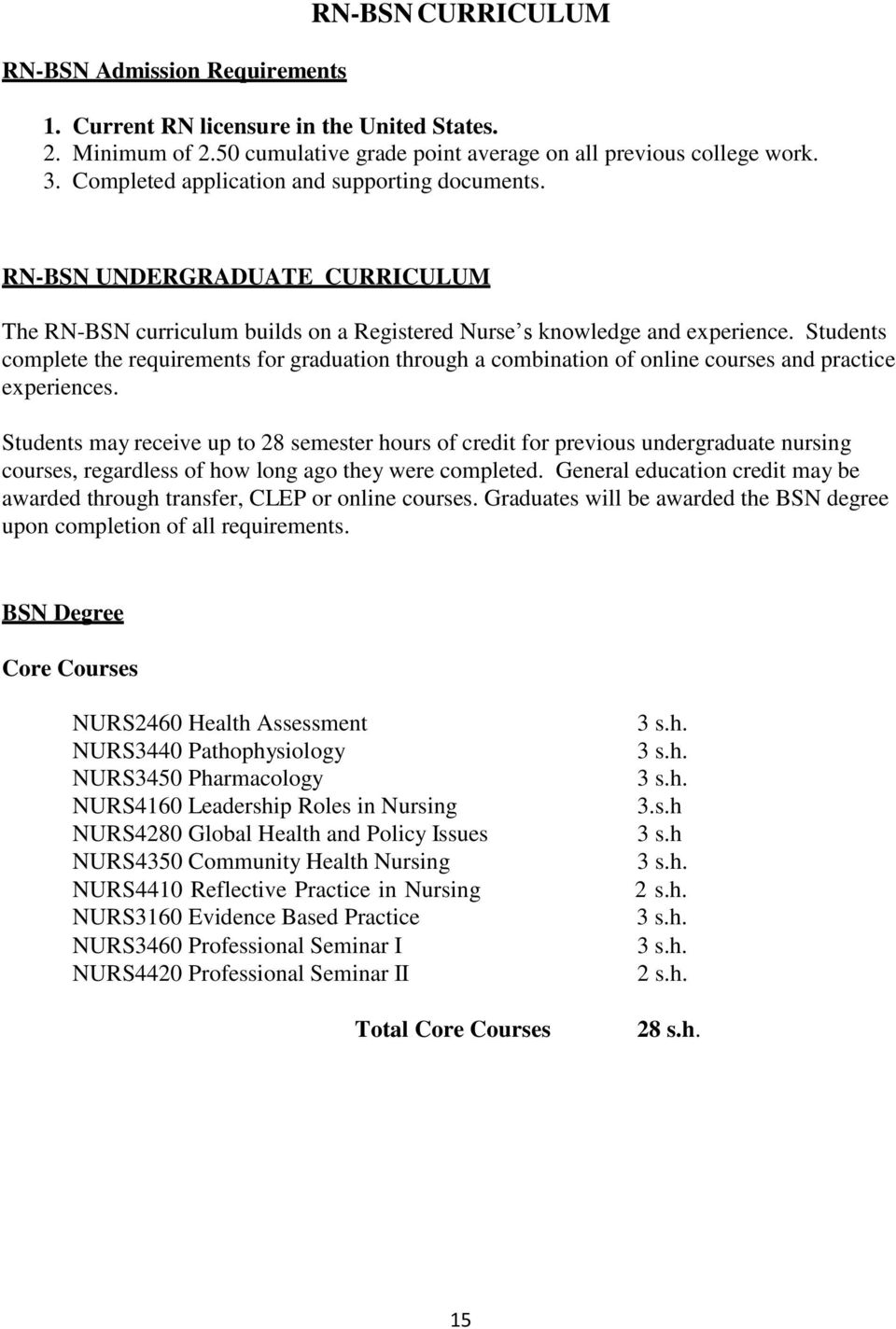
17 RN-BSN Admission Requirements RN-BSN CURRICULUM 1. Current RN licensure in the United States. 2. Minimum of 2.50 cumulative grade point average on all previous college work. 3. Completed application and supporting documents. RN-BSN UNDERGRADUATE CURRICULUM The RN-BSN curriculum builds on a Registered Nurse s knowledge and experience. Students complete the requirements for graduation through a combination of online courses and practice experiences. Students may receive up to 28 semester hours of credit for previous undergraduate nursing courses, regardless of how long ago they were completed. General education credit may be awarded through transfer, CLEP or online courses. Graduates will be awarded the BSN degree upon completion of all requirements. BSN Degree Core Courses NURS2460 Health Assessment NURS3440 Pathophysiology NURS3450 Pharmacology NURS4160 Leadership Roles in Nursing NURS4280 Global Health and Policy Issues NURS4350 Community Health Nursing NURS4410 Reflective Practice in Nursing NURS3160 Evidence Based Practice NURS3460 Professional Seminar I NURS4420 Professional Seminar II Total Core Courses 3 s.h. 3 s.h. 3 s.h. 3.s.h 3 s.h 3 s.h. 2 s.h. 3 s.h. 3 s.h. 2 s.h. 28 s.h. 15
18 Support Courses: BIOL3420 Anatomy BIOL3440 Physiology BIOL2360 Introduction to Microbiology BIOL2560 Nutrition CHEM1330 Introduction to Gen, Organic & BioChem MATH1380 Introduction to Statistics PSYC1300 Introduction to Psychology PSYC2250 Developmental Psychology SOC11300 Introduction to Sociology Total Support Courses 3 s.h. 3 s.h. 4 s.h. 3 s.h. 3 s.h. 3 s.h. 3 s.h. 3 s.h. 3 s.h. 28 s.h. All support and general education courses should be completed prior to enrollment in nursing core courses. General Education requirements may be satisfied by completing an approved combination of courses listed in Graceland s online catalog. Most courses may be satisfied by transfer credit and others may be challenged or completed online. These requirements are waived for students possessing a baccalaureate degree from an accredited college or university. 16

19 Practice Experience Information Practice Experience Locations Some courses will require that students go into a health care or community organization to complete an assignment. These practice experiences are required to fulfill the specific course objectives. All practice experience requirements within the specific courses must be completed in the United States and its territories. Some may be completed at the student s place of employment if that organization will assist the student in meeting the objectives of the course. Students must follow all requirements of the facility regarding completion of paperwork (for example HIPAA) and personal identification. If a Graceland ID is needed, please contact Sharon Ward at [email protected]. 17

20 RN-BSN Program Student Learning Outcomes (SLO s) Higher Level Thinking Level 2 (BSN-RN & RN-BSN) Utilizes higher level thinking skills in the performance of professional nursing activities. Utilizes research (evidence-based practice) findings in the performance of professional nursing activities. Graduate (Exit) Level (BSN-RN & RN-BSN) Utilizes higher level thinking skills and research evidence in the planning and delivery of nursing care. Level 2 (BSN-RN & RN-BSN) Nursing Role Performance Serves as educator of healthcare information to individuals, families, or communities. Collaborates with others to provide quality healthcare to individuals, families, or communities. Intervenes as an advocate in complex health situations for individuals, families and communities. Graduate (Exit) Level (BSN-RN & RN-BSN) Plans, coordinates, and implements holistic plans of care for clients with diverse health care needs that reflect application of the nursing process, promote client adaptation, and advocate for the health needs of individuals, families, and communities. Level 2 (BSN-RN & RN-BSN) Communication Applies principles of scholarly writing, including effective organization of thought, grammar usage, and APA formatting. Graduate (Exit) Level (BSN-RN & RN-BSN) Communicates effectively orally and in writing; collaborates effectively with health care team members; and employs communication skills in the establishment of therapeutic relationships with individuals, families, and groups. 18

21 Graceland University School of Nursing Program Student Learning Outcomes Level 2 Summative Assessment Rubric (RN-BSN/RN-MSN) Nursing Role Performance: [NURS:3460-Professional Seminar I Competency Statements] Utilizes multidimensional roles (e.g. advocate, educator, collaborator, etc.) of nursing in the provision of care to individuals, families, or communities. Collaborates with others to provide quality healthcare to individuals, families, or communities. Intervenes as an advocate in complex health situations for individuals, families, and communities. Exit Outcome: Plans, coordinates, and implements holistic plans of care for clients with diverse health care needs that reflect application of the nursing process, promote client adaptation, and advocate for the health needs of individuals, families, and communities. Higher Level Thinking: [NURS:4160-Leadership Roles in Nursing---Self- Discovery Paper] Utilizes higher level thinking skills in the performance of professional nursing activities. Utilizes research (evidence-based practice) findings in the performance of professional nursing activities. Exit Outcome: Utilizes higher level thinking skills and research evidence in the planning and delivery of nursing care. Communication: : [NURS:4160-Leadership Roles in Nursing---Self-Discovery Paper] Applies principles of scholarly writing, including effective organization of thought, grammar usage, and APA formatting. Exit Outcome: Communicates effectively orally and in writing; collaborates effectively with health care team members; and employs communication skills in the establishment of therapeutic relationships with individuals, families, and groups. Summative Assessment Evaluation: Pass Fail Student E-signature Student Self- Assessment Faculty Assessment Met Unmet Met Un met Date Faculty E signature [Download the Student Learning Outcome Evaluation from Doc Sharing. Complete the Student Self-Assessment portion and electronically sign the form. Submit the completed evaluation to the Student Learning Outcome Dropbox. Course faculty will complete the Faculty Assessment portion and return to you via the Dropbox.] Date 19
22 Student Services 20
23 ONLINE PROGRAM PROCEDURES AND SUPPORT Course Registration Students are responsible for contacting their program consultant each term to register and enroll in courses according to their completion plan. Enrollment deadlines for each term are shown below. Registration Deadlines Spring (Jan Apr) December 1st Summer (May-Aug) April 1st Fall (Sept Dec) August 1st Late enrollment may be permitted on a space available basis only. A late enrollment fee will be assessed. Shipment of Study Materials Students should order books through their program consultant when they register for courses. Students wishing to purchase their books elsewhere should let the Program Consultant know at the time of registration. Course materials will be shipped to all U.S. Zip Codes by FedEx Ground, except for Hawaii and Alaska. All Post Office Boxes will be shipped by Priority Mail. Students residing overseas are reminded that surface mail may take several weeks. If your address does not have a U.S. Zip Code designation, you must order and pay for Air Mail delivery of course materials. Shipper delays, slow shipments from publishers or temporary text shortages may cause a delay in shipment of study materials. Advisory Services Graceland provides multi-layers of advisory services. Students are supported in their program by: Program Consultants guide students through course registration & enrollment, completion schedules, facilitate communications with financial aid and student accounts offices, etc. Academic Advisors guide students through the required curriculum and courses. 21
24 GRACELAND UNIVERSITY LIBRARY SERVICES FOR NURSING STUDENTS INDEPENDENCE CAMPUS Dr. Charles F. Grabske, Sr. Library (816) or 4706 Lee Williams, Associate Librarian: X 4705 Contact for research assistance Document Delivery Specialist: X 4706 Contact for questions about document delivery The Library staff welcomes you to the Library. We look forward to serving you through our Library holdings and services. We offer: An automated online card catalog to help you gain access to the books and journals. Online databases with searching capabilities and full-text articles. LIBRARY HOURS Monday Friday 8:30 am 5:30 pm If the library doesn t own the articles you need, you can order them from us. Please direct all requests to [email protected] for Interlibrary Loan requests for the Independence Campus. If you find articles in PubMed that we don t own, you can use LOANSOME DOC to order them through us. (See attached sheet on setting up a LOANSOME DOC account.) PubMed will send the articles to the Independence Campus and we will send the materials to you. We do our best to get books/articles for you at no charge from other libraries. If we cannot obtain the articles for free, we will notify you of the charges to see if you are still interested. CINAHL with full text The Cochrane Library Health Source (Nursing Academic) Pub Med OVID Total Access Science Direct College Edition Databases: 22
25 How to log on when prompted (at database sites): Username your log-in (the first part of your address) Password the same password as your account If you can t log on: If this is your first attempt to log on: call InfoCentral at or [email protected]. If you have been able to log on before: if the system is down, keep trying it may be a momentary lapse. If you ve tried several times and can t connect, call or InfoCentral. How to find a full-text article: If the direct links don t work, check out A-Z list from the library s homepage by clicking on it and typing in the name of the journal. If it s available online, follow the links provided to get to the full text. How to order articles: We send all articles to students in a PDF format. VERY IMPORTANT: Try to submit article requests to the library 4-5 working days before you need them! Most medical libraries aren t open on the weekends, so articles requested on Friday are usually not received until Mon. or Tues. of the following week. For how-to videos on ordering articles in the various databases, please go to: 23
26 BASIC TECHNOLOGY SKILL COMPETENCY Students enrolled in online courses will quickly recognize the need for basic technology skills. Faculty design assignments with the expectation that students will be able use the basic skills required. Students who cannot perform these functions are advised to enroll in refresher courses at a local community college or seek a tutor. Faculty will not make concessions or provide instruction for students who do not have the skill sets required for online coursework. Please check the basic computer skills listed below and make sure you can perform them. You will be required to utilize these skills throughout the program. 1. Create a new folder on the hard drive/desktop 2. Save a file to the desktop 3. Change a file and folder name 4. Attach a file to an 5. Access your from a web browser such as Internet Explorer or Mozilla Firefox 6. Add a bookmark or a favorite to your Internet browser 7. Use spell check in a word processing document 8. Select a few paragraphs on a website and print them, not the entire page 9. Cut and paste info from the Internet into a word processing document 10. Make a screenshot and paste it into a word processing document 11. Insert a page break into a word processing document 12. Log in and search a library database 13. Find an article in a database and download a.pdf (the entire article) to your hard drive 14. Download program updates from the Internet and install them 15. Create a video for an assignment 24
27 TECHNICAL SUPPORT In the event of an occasional need for technical support, Graceland provides the following assistance 1) Graceland Lamoni InfoCentral a. can assist with computer related issues: , passwords, and my.graceland.edu. Phone or call toll free at or send an to 2) ecollege Help Desk a. can assist with issues inside courses: drop boxes, doc sharing, grade-books, etc. b ) GU Personnel a. Are available upon referral by contacting either InfoCentral or the ecollege help desk. 25
28 University Policies 26
29 SUBJECT: Technology Ethics and Use Policy (Acceptable Use Policy) PURPOSE: To communicate expectations for the appropriate use of Graceland-owned technology. POLICY: Users of Graceland's technological tools will respect the human dignity, privacy, and sensitivity of each other and the general public while using the tools made available by Graceland. Graceland reserves the right to routinely monitor technology resources. While the privilege of privacy of personal files or messages on Graceland-owned computers and voice mail systems will be respected to the extent possible and subject to the right of Graceland to access any files to officially investigate or to accomplish necessary system maintenance, users of Graceland-owned computers have no legal expectations of privacy with respect to personal files or messages stored on the computer hard drive or stored in or transmitted through Graceland s system/servers. Additionally, users of non-graceland-owned computers have no legal expectations of privacy with respect to personal files or messages stored in or transmitted through Graceland s system/servers. All technology provided by Graceland is covered by this policy, including computers, networks, Internet services, telephones, voice mail, fax machines, photocopiers, cable TV and all associated software and data. Such technology is provided to accomplish Graceland's educational mission in accordance with Internal Revenue Code Section 501(c)(3), under which Graceland receives its tax-exempt status. Graceland's network enables access to external facilities, systems, and other networks over which Graceland has no control, including related capabilities which are incidental to providing such access. Certain of these resources may not support Graceland's goals and objectives. Although Graceland does not exercise editorial or censorship control of such external resources, Graceland expects that the technology will not be used for purposes which are illegal, immoral, or inconsistent with Graceland's mission. Academic and professional work pertaining to Graceland's goals and objectives take precedence over the use of resources for entertainment. Graceland may establish additional standards of conduct with designated technology or in specific areas (e.g. Microlabs, classrooms, etc.) Inappropriate uses of technology include, but are not limited to those specifically prohibited by local, state or federal law. 27
30 Without limitation, examples of inappropriate uses of technology include: harassment - sending of harassing, threatening or obscene material to minors and/or nonconsenting adults or any attempts to confuse or frustrate another user in achieving their objectives.; random or unauthorized bulk sending or mailing of messages; inappropriate use of access, any disregard for the security mechanisms that are in place or other attempts to gain unauthorized access to Graceland's technical resources. This includes possession of or attempts to acquire another user's password or allowing others access to technology resources that are not allocated for their use; failure to comply with software license restrictions - All licenses for software that are licensed by Graceland will be filed by ITS. disruption of service - damaging any resource in such a way that it creates a disruption of the normally expected service from that resource, including generating excessive network traffic and/or interfering with the normal functioning of the network ; cheating - use of technology resources to achieve academic credit by dishonest or deceitful means; copyright infringement; forgery; malicious transmission of a computer virus; malicious alteration of system files or configuration; abuse of established storage space limitations; use of any resource to inure benefit for private or political gain in violation of Graceland's tax-exempt status under IRC Section 501(c)(3). Content shared by peer-to-peer (p2p) applications may be violation of the Digital Millennium Copyright Act (DMCA), and violates Graceland University policy by generating excessive network traffic and interfering with the normal functioning of the network. These applications are prohibited on the Graceland University network. This means that: Peer-to-peer file sharing applications including, but not limited to, Napster, Gnutella, Kazaa, AudioGalaxy, imesh, and others, may not be installed or used on computers owned or managed by Graceland University. Peer-to-peer file sharing applications including, but not limited to, Napster, Gnutella, Kazaa, AudioGalaxy, imesh, and others, may not be installed or used on computers attached to the Graceland University network, regardless of their ownership. The Graceland University Information Technology staff may, in order to ensure compliance with Graceland policies and Federal or State Law, inspect and remove any of the prohibited software from any equipment currently or previously attached to the Graceland University network. 28
31 CONSEQUENCES: Graceland reserves the right to take corrective/disciplinary action in the event of inappropriate use of technology, which may include but not be limited to the following: Cases involving suspicion of inappropriate use of technology by students will be investigated by the Information Technology Services Department. If violations are confirmed, a referral for disciplinary action will be made to the Dean of Students. A determination of serious misuse may result in suspension from the university. In cases involving misuse of resources allocated for a particular course, the course instructor may assign a failing grade. Cases involving inappropriate use of technology by employees, including student workers, will be handled in accordance with existing personnel policies. Serious misuse may result in termination of university employment. Cases involving violation of local, state or federal laws will be referred to external authorities as directed by the Vice President of Business Services of Graceland University. Cases involving non-students or non-employees will be referred to the area supervisor who will take action appropriate to the incident. This may include contact with Graceland security and/or referral to other external authorities for action. Serious misuse may result in expulsion from all Graceland facilities for an indefinite period of time. School of Nursing Policy - addendum Students will be at various locations during their program and will have access to many different systems. The following guidelines must be followed: Students are not allowed to change any computer settings, including background or screen savers, at clinical sites. Students may not download or save any materials on a clinical site. Students may not visit social networking sites. Students may not print care plans at clinical site. No patient material may be removed from clinical agency. Any violation in the above guidelines will result in disciplinary action including an issuance of an unsatisfactory clinical day. 29
32 Graceland University - Code of Conduct As a Christian institution, Graceland University seeks to foster relationships that reflect mutual concern, dignity, and individual worth. Consistent with its religious heritage and commitment to a healthful life-style, Graceland values and promotes: An alcohol-free environment. A tobacco-free environment. An environment free of substance abuse. An environment free of harassment and exploitation in sexual relationships. Our social regulations reflect these values. All members of the Graceland community are expected to abide by all federal, state, and local laws. All members of the Graceland community will refrain from: 1. Acts that humiliate, harass, and/or abuse; 2. Theft or damage of property; 3. Disruptive behavior (including but not limited to actions resulting from the influence of alcohol and other drugs); 4. Substance abuse, including illegal manufacture, distribution, possession, or use of a controlled substance; 5. Sexual behavior, which is offensive or fails to respect others' rights. In addition, all members of the Graceland community, while on campus or in attendance at University sponsored activities, will refrain from: 1. Use or possession of firearms, ammunition, fireworks, explosives, incendiary devices, weapons, dangerous substances, drug paraphernalia and/or materials prohibited by law; 2. Possession of or use of alcoholic beverages or their containers; 3. Use, or evidence of use, of tobacco in any form; 4. Illegal gambling; We believe that violation of these regulations impinges directly on the rights of others. Cases are referred to either the Vice President for Student Life or the Associate Dean of Students for appropriate disciplinary action and/or referral to the Residence Life Council or the Council on Student Welfare. Lack of mention of any regulation with regard to objectionable actions does not imply approval, and may result in disciplinary action. Students are expected to comply with the directives of university personnel in performance of their duties. Failure to do so may result in disciplinary sanctions.. 30
33 ACADEMIC INTEGRITY POLICY From your Nursing faculty: The nursing faculty recognizes there are times in college that you may feel pressured to cheat on a test or violate the Academic Integrity policy. It is important for you to recognize the warning signs and resist the temptation to violate your personal and academic integrity. We encourage you to talk with your instructor or your advisor. We are willing to listen and help you through these times of difficulty. Please remember that there are appropriate alternatives to cheating. We are always available to help facilitate your learning and academic success. Academic Integrity Academic integrity is a highly valued principle that undergirds all facets of academic life at Graceland University. Adherence to principles of honesty is a requisite for preparing students as competent responsible persons. Students admitted to the university are expected to uphold standards of academic integrity, i.e. the avoidance of fraud, plagiarism and cheating in any form. 1. FRAUD. Fraud is the act of deceit or misrepresentation. The following list describes ways to avoid the most common forms of fraud. A. Do not alter or falsify or misrepresent an academic document. B. Do not help someone alter or falsify an academic document. C. Do not communicate false information whether oral, written, electronic or nonverbal. D. Do not forge signatures. 2. PLAGIARISM. Plagiarism is representing someone else s work as your own. The following list describes ways to avoid the most common forms of plagiarism. A. Set off all direct quotations within quotation marks or within the text in a block quote form. To fail to indicate direct quotations by one of these two methods is to commit plagiarism even if the failure is accidental and even if you give the source of the quotation. In a speech you must also indicate the beginning, ending and source of all direct quotations to the audience. B. If you derive an idea from another source, cite the source unless the idea is common knowledge, that is, unless people familiar with the subject you are discussing are aware of the idea. C. Cite the source of paraphrased material and avoid excessive paraphrasing. Too much paraphrasing minimizes your contribution. D. Submit papers that consist substantially of your own work. Do not buy, borrow or use complete, or nearly complete, papers from any source, electronic or otherwise. 3. CHEATING. The following list describes ways to avoid the most common forms of cheating. A. Do not give assistance to, or receive assistance from, another person, or use unauthorized notes, books, etc., when an examination or assignment is supposed to be your own work. B. Do not falsify research results or violate codes for the treatment of human or animal subjects. C. Do not violate the policies of proctors, preceptors or supervisors. D. Do not use an electronic copy of another person s work as the starting point of your own work without the instructor s permission. 31
34 E. On collaborative works, include the names of all participants on any copies that are submitted for evaluation. An instructor may assign a grade of "F" for the course in cases of plagiarism and/or cheating. The faculty member will report all cases of plagiarism and cheating to the Dean of the School of Nursing and the respective associate dean (complete policy can be found in the university catalog). **Students in the nursing program may be dismissed for plagiarism and/or cheating. The University official Academic Integrity Policy may be viewed at the following link: Nurses are bound by a code of ethics. Our first tenant is to protect patient safety. Cheating or helping someone else to cheat ultimately puts patients at risk. Students in the nursing program may be dismissed for violating the academic integrity policy. Students in the School of Nursing are required to sign a form containing the Honor Code at the beginning of summer classes and at the beginning of their senior year for BSN-RN students. Turnitin Plagiarism Detection Service - Submission Statement Graceland University s School of Nursing highly values academic integrity and is committed to the fundamental value and obligation of preserving academic honesty among our faculty, students and graduates. Students agree that by taking this course all required papers may be subject to submission, at the discretion of the faculty member, for text comparison by Turnitin, a plagiarism detection service, and other means of detecting plagiarism. All papers submitted to Turnitin will be included as source documents in the Turnitin.com reference database solely for the purpose of detecting plagiarism of future papers. Use of the Turnitin.com service is subject to the Terms and Conditions of Use posted on 32
35 Exception to Academic Policy The School of Nursing follows the University Exceptions to Academic Policy as outlined in University Catalog. Requests for exceptions to undergraduate academic policies regarding major, minor and program requirements are reviewed and acted upon by the School of Nursing. Requests for all other academic policies are reviewed and acted upon by the Curricular Adjustment Committee. Appeals may be made to the appropriate Academic Council. See the following link for the full policy: Graceland University Policy on Non-Discrimination Graceland University does not discriminate against any student or prospective student on the basis of race, color, religion, age, sex, national origin, disability or sexual orientation. We are a caring community dedicated to the physical, intellectual and spiritual well-being of each individual. Gracelanders join together to create an atmosphere of openness, mutual respect and diversity. Any discrimination concerns should be directed to Graceland University s designated Title IX compliance officer and Section 504 coordinator: Executive Director of Human Resources, Graceland University, 1 University Place, Lamoni, IA 50140, Graceland University Harassment Policy Sexual and other harassment of student, faculty, or staff is not tolerated at Graceland University. Sexual and other harassment diminishes the university in achieving its mission through its insidious and detrimental impact on individual students, faculty, staff and the university community as a whole. All harassment stifles the realization of the victim s full potential as a student, faculty or staff member. Harassment is especially serious when it threatens relations between faculty and student or supervisor and subordinate by unfairly exploiting the power differential between the parties in the relationship. Likewise, Graceland University does not tolerate harassment between people of equal university status. Procedures relating to this policy are available upon request from the Dean of Student s office or available on the Graceland University website. The full policy and procedure for reporting any harassment concerns can be reviewed at: 33
36 Graceland University Grievance Procedure The School of Nursing follows the University Grievance Procedure as outlined in University Catalog for resolution of formal student complaints or concerns that are not addressed by another University of School of Nursing Policy/Procedure. The formal grievance procedure outlines an informal and a formal procedure. Students with a complaint or concern can initiate either procedure. Formal complaints must be made in writing to the Dean of Students and include specific information, including nature of complaint and evidence supportive of complaint. An investigation is initiated within 7 days of receipt. See the following link for the full policy: Graceland University Student Disabilities Services Graceland University is committed to full compliance with the Rehabilitation Act (Section 504) and the Americans with Disabilities Act (ADA). As part of the implementation of this law, the university will continue to provide reasonable accommodations for students with disabilities so that they can participate fully in the university s educational programs and activities. Although Graceland is not required by law to change the fundamental nature or essential curricular components of its programs in order to accommodate the needs of disabled students, the university will provide reasonable academic accommodations. Students with physical disabilities are expected to contact their instructor at least 24 hours in advance to request approved accommodation(s). Students may also contact the director of Student Disability Services at (641) The office will work with the course instructor to arrange for reasonable accommodations. Students are required at their own expense to provide documentation verifying disability. The general definition of a student with a disability is any person who has a physical or mental impairment which substantially limits one or more of such person s activities, and any person who has a history of, or is regarded as having, such an impairment. 34
37 School of Nursing Policies 35
38 STUDENTS EDUCATIONAL RESPONSIBILITIES As practicing professionals, students are responsible participants in their educational experience at Graceland University. Students are expected to display professionalism, respect and kindness in all aspects of their work and study. This includes, but is not limited to, conversations, discussion board posts, phone calls and face to face encounters with fellow students, faculty, staff, preceptors, clinical agencies and patients. Incidences of student incivility will be reported to the USAC for appropriate action which may include a written warning, probation or dismissal. Licensure All students must maintain current registered nurse licensure in their state of residence to practice nursing as a registered nurse throughout their educational program at Graceland University. Graceland University s main campus is located in the state of Iowa, therefore, our students and faculty must abide by the regulations of the Iowa State Board of Nursing. 2.5(5) from the Iowa Administrative Code, chapter 2, nursing educational programs: Nursing courses with a clinical component may not be taken by a person: a. who has been denied licensure by the board, b. whose license is currently suspended, surrendered or revoked in any United States jurisdiction, c. whose license/registration is currently suspended, surrendered or revoked in another country due to disciplinary action. Liability Insurance All RN-BSN students enrolled in courses must participate in the Graceland University Nursing Student Liability Insurance Program. Fees related to liability coverage are assessed as part of the enrollment fee. 36
39 TITLE: Safe Practice Policy Approved: SON-FGA 5/16/2011 Effective Date: 6/27/2011 Reviewed: Amended (last five years): 5/12/2011; 2/27/2006, 8/8/2003 I. Purpose: To reasonably assure that no physical or emotional harm is inflicted upon self and others. II. III. Policy and Procedure: a. Safe practice is defined in this policy as behavior that demonstrates the knowledge, skill, judgment and accountability necessary to reasonably insure that no physical or emotional harm is inflicted upon self or others: clients, families, co-workers, peers, and faculty. b. School of Nursing faculty members have the professional obligation to safeguard patient well-being and to protect student rights. Procedure: a. Faculty members are expected to: i. Specify expectations in measurable terms ii. Assess significant behaviors iii. Give frequent, constructive feedback iv. Provide experiences appropriate to students level of experiences v. Document student endeavors vi. Identify all areas in which expectations are not being met b. Unsafe behavior: i. Any behavior that is deemed unsafe by the instructor will be sufficient reason for removal from the clinical setting until measures have been taken to insure safe practice. ii. A student whose behavior indicates a pattern that is unsafe or is deemed likely to become unsafe will receive documentation on a Professional Behavior Concern Form. An improvement plan may be outlined by the instructor which may include laboratory review, clinical practice, and counseling. Students have the right to have input into this plan iii. Copies of the concern form will be given to the Undergraduate Student Affairs Committee (USAC), the Associate Dean of the program and the student s academic advisor. Copies will be made available to the Dean of the School of Nursing if necessary 37
40 iv. Unsafe clinical practices will be reviewed by the USAC. Faculty, staff, and student documentation will be considered in any review. The Committee will make recommendations for further action. v. Unsafe practices may be grounds for terminating at any time during the clinical course. Termination in clinical will result in an F in clinical and in the theory course. c. In order to insure safe practices, students are expected to: i. *Demonstrate self-discipline in meeting commitments and obligations (e.g., keeping appointments, submitting written assignments on time) ii. Prepare in advance for clinical experience iii. *Report unsafe practices iv. Apply safety measures to nursing interventions v. Function within the guidelines and policies of the institution in which they are practicing vi. Maintain personal, physical, and emotional stability vii. Communicate appropriately, adequately, and truthfully, in both written and verbal communication viii. *Recognize own limitations and the need for appropriate supervision ix. *Provide appropriate care for all individuals regardless of age, sex, race or diagnosis x. *Judiciously protect information of a confidential matter * ANA Code of Ethics 38
41 ANA Code for Nurses* The Nonnegotiable Nature of the ANA Code for Nurses with Interpretive Statements. Summary: The American Nurses Association (ANA) Code for Nurses with Interpretive Statements (Code for Nurses) explicates the goals, values and ethical precepts that direct the profession of nursing. The ANA believes the Code for Nurses is nonnegotiable and that each nurse has an obligation to uphold and adhere to the code of ethics. Background: Health care ethics is concerned with the rights, responsibilities, and obligations of health care professionals, institutions of care, and clients. Upon entering the profession of nursing, nurses accept the responsibilities and trust that have accrued to nursing over the years and also the obligation to adhere to the profession s code for ethics. The Code for Nurses, published by the American Nurses Association, is the standard by which ethical conduct is guided and evaluated by the profession. It provides a framework within which nurses can make ethical decisions and discharge their professional responsibilities to the public, to other members of the health team, and to the profession. The Code for Nurses is not open to negotiation in employment settings, nor is it permissible for individuals, groups of nurses, or interested parties to adapt or change the language of this code. The Code for Nurses encompasses all nursing activities and may supersede specific policies of institutions, of employers, or of practices. Therefore, the content of the Code for Nurses with Interpretive Statements is nonnegotiable. 1. The nurse, in all professional relationships, practices with compassion and respect for the inherent dignity, worth and uniqueness of every individual, unrestricted by considerations of social or economic status, personal attributes, or the nature of health problems. 2. The nurse s primary commitment is to the patient, whether an individual, family, group, or community. 3. The nurse promotes, advocates for, and strives to protect the health, safety, and rights of the patient. 4. The nurse is responsible and accountable for individual nursing practice and determines the appropriate delegation of tasks consistent with the nurse s obligation to provide optimum patient care. 5. The nurse owes the same duties to self as to others, including the responsibility to preserve integrity and safety, to maintain competence, and to continue personal and professional growth. 6. The nurse participates in establishing, maintaining, and improving healthcare environments and conditions of employment conducive to the provision of quality health care and consistent with the values of the profession through individuals and collective action. 7. The nurse participates in the advancement of the profession through contributions to practice, education, administration, and knowledge development. 8. The nurse collaborates with other health professionals and the public in promoting community, national and international efforts to meet health needs. 9. The profession of nursing, as represented by associations and their members, is responsible for articulating nursing values, for maintaining the integrity of the profession and its practice, and for shaping social policy. * From American Nurses Association (2001). Code for Nurses. Washington DC, ANA Publishing. (Unchanged 2013) 39
42 Title: Statement of Ethical Practice Approved: SON Faculty 5/23/2007 Effective Date: 5/23/2007 Reviewed: 12/19/2008 Amended: (last five years) 2/27/2006, 5/21/2003 I. Purpose: To delineate ethical beliefs as relative to educational practice. II. Policy: Graceland University and the School of Nursing believe that each student is unique. Each person brings their own beliefs, goals, strengths, potentialities, motivations and life experiences to the university community. We believe that the university and the nursing programs promote the professional and personal actualization of each student toward greater expression of each one's unique creativity. A. The student has the right: 1. and responsibility to develop to the highest potential, physically, emotionally, intellectually, and spiritually. 2. to objective, clear, accurate, up to date information, verbal and written about the university and the nursing major. This includes information about the philosophy, goals, objectives, academic programs, cost, requirements and admission policies to the university and the major. 3. to be notified as soon as possible about acceptance. 4. to information regarding written policies for admission, progression in the major, graduation from the university, or dismissal from the major. 5. to information regarding students own academic standing. 6. to be notified of any changes before the changes occur. 7. to graduate and make application for the nursing licensing/certification examination providing all requirements for the nursing major and graduation have been met. 8. to confidentiality from those who have access to confidential information about the student. B. The School of Nursing is responsible for the standards of admission of students to the major. C. The university and the School of Nursing are open to all individuals regardless of race, color, age, national origin, sexual orientation, religion, or disability. 40
43 Title: HIPAA Regulations Policy Approved by: SON-FGA , 8/18/2008 Effective date: ; 8/18/2008 Reviewed: Amended (last five years): /27/06; 11/24/03 I. Policy: Graceland University School of Nursing faculty and students will comply with the HIPAA Privacy and Security Regulations, the Health Information Technology for Economic and Clinical Health Act (HITECH) and corresponding regulations in clinical, research, and institutional areas by implementing, maintaining and using appropriate administrative, technical and physical safeguards to prevent the improper use or disclosure of all PHI, including Electronic Health Information (EPHI). II. III. Procedure A. Students and instructors will comply with current HIPAA and corresponding HITECH Regulations to ensure the confidentiality of health or health-related information. B. HIPAA and corresponding HITECH regulations will be followed in all areas that involve PHI and EPHI. C. All students will be familiar with HIPAA Privacy Rule and Security Regulations, and HITECH policies and procedures in each of their clinical settings. D. Current guidelines will be available to students and instructors at all times in the School of Nursing. Reporting of Unauthorized Disclosures or Misuse of PHI A. The student is responsible for immediately reporting to his/her preceptor, and instructor any violation of HIPAA and HITECH regulations. B. The instructor shall report to the Facility any use or disclosure of PHI or EPHI other than what is provided for by the facility agreement on the first day or no later than 3 business days. The School of Nursing will document such disclosures and will take prompt action to correct any unauthorized disclosures as required by applicable federal and state laws and regulations. 41
44 Title: Academic Appeal Policy & Procedure Approved by/date: FGA 9/15/08 Effective date: January 1, 2009 Reviewed (last 5 years): Amended (last five years): 5/18/2010 I. Policy Graceland University School of Nursing has two codes of conduct: one for academic conduct and one for student conduct. A student may be disciplined or dismissed from the nursing program for either academic misconduct or student misconduct. The standards of academic conduct address meeting established academic criteria and behavioral integrity in performing the academic work of the School. The standards of student conduct relate to matters outside the context of academic courses. Honesty and integrity are prerequisites to academic life and more specifically, to the practice of nursing. Honesty is defined as being truthful, free of deceit and having integrity (Webster, 1976). Integrity is defined as utter honesty and adherence to a code of values (Webster, 1976). Integrity also encompasses "being truthful, avoiding acts of cheating, fraud or outright lying, and refusing to engage in deception or false representation in practice" (Hoyer, Booth, Spelman & Richardson, 1991, p. 171). Professional integrity in nursing is reflected in the American Nurses Association (ANA) Code for Nurses (2001), National Student Nurses Association (NSNA) Code of Academic and Clinical Conduct (2001), ANA Standards of Professional Nursing Practice and Performance (1991) and the Scope and Standards of Advanced Practice for Registered Nursing (1996). Nursing practice is further guided by institutional standards. Nursing students must adhere to both institutional and professional standards in the classroom, clinical sites, and the community to meet the School s standards of conduct. A. Academic Misconduct Academic misconduct is a breach of honesty or integrity and standards. Examples of academic misconduct include but are not limited to the following: 1. Cheating: giving or receiving unauthorized assistance in any assignment. 2. Plagiarism: the use of ideas, language or work of another without sufficient acknowledgment that the material is not one's own or submission of the work of another, whether altered or unaltered, as one's own. Students are to be guided by the latest edition of the Publication Manual of the American Psychological Association. 3. Manipulation or alteration of another student's or faculty's academic work. 4. Unauthorized use, removal, concealment or defacement of library, skills lab or faculty resources, e.g., books, equipment, files, papers, tests. 5. Submitting the same work or portions of work for more than one class without prior written approval of faculty. 5. Collusion: assisting another student in an act of dishonesty. 7. Lying: conveying any untruth either verbal or written. 8. Disregarding the well-being and needs of patients: acts of commission or omission that could adversely affect the patient, e.g., medication errors, failure to provide safe appropriate care, failure to follow supervisor/faculty instructions for care, breach of client confidentiality. 42
45 Sanctions imposed by faculty for academic misconduct include but are not limited to: 1. Written notification of the student's act of academic misconduct and potential consequences placed in the student's file. 2. Assigning a zero (no points) for a test, assignment or paper. 3. Assigning a failing course grade. 4. Placing the student on probation. 5. Recommending dismissal from the program. B. Guidelines for Students Students often become aware or suspicious of academic misconduct first. In order for the School to maintain an environment that is supportive of academic integrity, students are encouraged to maintain the standards for academic conduct. In situations where students are in doubt as to the integrity of one's own or one's peer's actions, it is advisable to consult one of the following: course faculty, course coordinator, specialty track/program coordinator, or faculty advisor. As noted in a previous section, students must adhere to both institutional and professional standards in the classroom, clinical sites, and the community C. Suspension A student may be suspended from any classroom, lab or clinical session for inappropriate or unsafe behavior or failure to adhere to any GU School of Nursing Academic Policies. Suspension may last from several hours to one calendar year. Students are automatically placed on suspension during the appeal process pursuant to dismissal. 1. Faculty imposed: Faculty are solely responsible for making the immediate decision to suspend a student from classroom, clinical, or lab sessions in progress for inappropriate or unsafe behaviors. At the time of a suspension by the faculty, conditions for reinstatement are explained. Failure to meet the conditions of reinstatement may result in course failure. 2. School imposed: The Associate Dean is solely responsible for imposing suspension for failure to adhere to Graceland University School of Nursing Academic Policy. At the time of a suspension by the Associate Dean, the conditions of reinstatement are explained. Failure to meet the conditions of reinstatement may result in course failure or dismissal from the nursing program. The student may not attend classroom, lab or clinical sessions during the suspension. D. Academic Appeal A student may appeal any of the following: 1. Failing final course grade (C or below for graduate; D or below for undergraduate). 2. Dismissal. Students are responsible for meeting the standards of academic performance established for each course in which they are enrolled. The establishment of the criteria for grades and the evaluation of student academic performance are responsibilities of the course faculty. Grade appeal is available only for the review of allegedly capricious grading and not for review of the faculty s evaluation of the student s academic performance. 43
46 Capricious grading, as the term is used here, consists only of any of the following: 1. The assignment of a grade to a particular student on some basis other than the performance in the course. 2. The assignment of a grade to a particular student by resorting to more exacting or demanding standards than were applied to other students in the course. 3. The assignment of a grade by a substantial departure from the instructor s previously announced standards. II. Procedure A. An appeal is initiated by submitting a typed statement to the Chair of the Undergraduate or Graduate Student Affairs Committee (USAC/GSAC), no later than seven (7) working days after documentation of the failing final course grade or recommendation for dismissal. The typed appeal statement submitted by the student must include the following: 1. A statement of the issue; 2. Specific steps that have already been taken to resolve the issue with the course faculty, course coordinator and/or Specialty Track/Program Coordinator. 3. Evidence supporting why the student believes the decision made was inconsistent with existing GU School of Nursing or course policy, was arbitrary, or lacked sufficient evidence. B. In preparing the appeal, it is the student's responsibility and burden to prove that the action taken by the faculty was inconsistent with existing policy, arbitrary, or lacked sufficient evidence. The student may seek assistance from a GU School of Nursing faculty member as an adviser in preparing the statement for an appeal. The role of the adviser is to assist the student in understanding the policy and procedure. The adviser's role does not include gathering information or presenting evidence. C. The student will submit the letter of appeal with supporting documents to the Chair of the appropriate (undergraduate or graduate) Student Affairs Committee (SAC). D. The Chair will forward appeal documents to faculty involved in the subject matter of the appeal or its resolution. E. Faculty will submit to the Chair of the SAC within ten (10) working days their response to the appeal document including their supporting documentation. F. The Chair of the SAC will forward the faculty's response to the student. G. The Chair of the SAC will appoint the appropriate/additional members to the SAC for the hearing. H. The SAC will meet within ten (10) working days of receiving all the written appeal documents to hear the appeal. The student may request one continuance, not to exceed one week, for good cause. 44
47 I. The student and faculty will be notified 72 hours before the hearing of the time, date and location of the hearing. The initial appeal documents will be reviewed by members of the appropriate SON Student Affairs Committee. The involved student and/or faculty may be asked to participate in the hearing (in person or via teleconference) to answer questions or provide clarification of the written appeal documents. The committee shall be charged to weigh evidence, deliberate, and find for or against the appeal. The meeting is confidential and restricted to those persons listed. If an incident involves more than one student, each student will be heard individually. 1. An SAC member, who has been directly involved in the awarding of a failing course grade or recommending dismissal will be replaced by a faculty member appointed by the Associate Dean. 2. The SAC will make a decision within five (5) working days after the hearing. J. In an appeal of a failing course grade, the SAC can either: 1. uphold the assigned grade, or 2. return the grade to the faculty for reconsideration. K. If the faculty is asked to reconsider a grade by the SAC, the faculty can uphold the assigned grade or change the grade. The faculty member will notify the SAC of his/her decision within 72 hours. The SAC will notify the Associate Dean and the student of the outcome of the appeal. The student may receive and sign for the SAC s written decision in person, receive notification, and/or by certified mail.. L. If the student wishes to appeal the SAC decision, the student must send a typed statement and supporting documentation to the Dean of the School of Nursing, no later than seven (7) working days after notification of the SAC s decision. 1. The Dean will forward appeal documents submitted by the student to faculty involved in the subject matter of the appeal or its resolution. 2. Faculty will submit to the Dean within ten (10) working days their response to the appeal document including their supporting documentation. 3. The Dean will forward the faculty's response to the student. 4. The Student will notify the Dean within seven (7) working days to formally appeal the SAC decision. 5. The Dean will initiate the Graceland University academic appeals procedure at the request of the student. 45
48 Academic Progress 46
49 ACADEMIC PROGRESS Grading Course grades are earned through completion of all course requirements. Extra credit opportunities are not available. Regular courses are graded on a letter grade system with A=4 points; B=3 points; C= 2 points; D=1 point and F=0 points. The academic year is divided into 16 week trimesters Spring, Summer, Fall. The first 8 week term is designated as the A term; the 2 nd 8 week term is designated as the B term. Percentage points required per letter grade are: A = B = C = D = F = 62 0 Incomplete: A grade of I (Incomplete) is assigned at the discretion of course faculty in emergency or extraordinary circumstances such as the following: Medical illness: a medical certificate may be requested by faculty. Compassionate grounds: those situations for which compassionate leave is normally granted in employment. Unexpected misadventure, hardship or trauma: documentation may be requested by faculty Procrastination or poor planning are not valid reasons for requesting an Incomplete. An incomplete grade request must be initiated by the student after discussion with the instructor. The student must complete and submit the Incomplete Contract Form to the instructor for processing. Decision of course faculty is considered final. Assignment Guidelines Due dates and times for graded assignments are clearly posted by faculty on the course website. Course policies regarding late submission of assignments are posted in the course syllabus. Students are responsible for carefully reviewing the course syllabus and schedule. It is expected that students submit all assignments by the posted due date & time. Submission of assignments for faculty to review prior to grading or for re-grading is not permitted unless otherwise specified in the assignment guidelines. 47
50 Late Assignments: 1. Students should submit requests for extensions to faculty in writing at least 24 hours in advance of the specified due date. Extensions are usually only granted for a maximum of one week (see specifics in course syllabi) 2. Extensions are granted at the discretion of course faculty in emergency or extraordinary circumstances such as the following: Medical illness: a medical certificate may be requested by faculty. Compassionate grounds: those situations for which compassionate leave is normally granted in employment. Unexpected misadventure, hardship or trauma: documentation may be requested by faculty 3. Work or other study commitments, computer crashes or printer failures are not valid reasons for late submission. 4. Penalties for late submission of assignments are imposed at the discretion of course faculty. Penalties may be imposed for part or all of an assignment. Faculty decisions regarding penalties for late work are considered final. 5. No penalty will apply if an extension is sought and granted by the responsible person or delegate. If the assignment is handed in after the extension period then established penalties will apply. 6. Students whose circumstances require extensions longer than 1-2 weeks are advised to meet with faculty to discuss available options. Satisfactory Progress Progression occurs when a student successfully passes all courses taken each term. To maintain satisfactory progress a student must earn a grade of C or better in all undergraduate courses. A second D or lower in undergraduate coursework will result in the student s dismissal from the BSN Nursing Program. A student who earns less than a C in a BSN course will be placed on academic probation. A student may enroll in the failed course one additional time. The repeated course must be successfully completed with a grade of C or above on the first attempt. Students may not withdraw from a course that is being repeated due to a failing grade. Student Initiated Course Withdrawal Students must send a written request to withdraw to the appropriate Program Consultant. Students may drop a course through twenty percent (week #2 of an 8 week course) without a W. A grade of W is recorded in any course from which the student withdraws after twenty and through sixty percent (week#5 of an 8 week course) of the session. After sixty percent of the session is complete, the student is not allowed to withdraw from the course and will be awarded the appropriate grade in the course. 48
51 Administrative Withdrawal Students not returning to Graceland for the next semester, term, or session are required to be placed on a stop out. Students not enrolling for the next semester, term or session following a stop out will be withdrawn from Graceland University. Student Concern Form Faculty members submit student concern forms to the Undergraduate Student Affairs Committee to document concerns regarding student academic or professional conduct and track behavior patterns which may require action by the USAC. A Concern form may be submitted by faculty for the following and/or any additional reason(s): (1) Academic Progress: i.e. course grade below a C ; unsatisfactory evaluation in clinical practicum (verbal or written) by preceptor, (2) Unprofessional behavior including, but not limited to: attitude, respect, conduct, language, integrity or dishonesty, responsibility, accountability, confidentiality, (3) any additional reason(s) the faculty deems necessary. The Associate Dean will distribute a copy of the submitted form to the student with instructions and deadline for submitting a response to the documented concern and to the USAC for review and action. Actions by the USAC may include, but are not limited to, the student being placed on probation, recommend failure of a course, request for academic counseling, tutoring, dismissal, and/or required meeting with the USAC via teleconference to discuss plans to correct behavior, or no action. Following review and action by the USAC, a copy of the completed concern form documenting the USAC action will be sent to the student and a copy will be placed in the student s file. Probationary Policy and Procedure Probation may be recommended by the Undergraduate Student Affairs Committee (USAC) in the following circumstances: a. 1 grade of D or below b. Any condition placing the student at risk of dismissal from the program. The student will be notified in writing of the probationary status by the USAC. Detailed terms of the probation will be included in the written comments. Dismissal From RN-BSN Program The Undergraduate Student Affairs Committee on behalf of the nursing faculty reserves the right to request the dismissal of any student whose health, theoretical and/or clinical performance, or conduct demonstrates an inability to continue in the Program. 49
52 Academic Integrity Graceland University School of Nursing has two codes of conduct: one for academic conduct and one for student conduct. A student may be disciplined or dismissed from the nursing program for either academic misconduct or student misconduct. The standards of academic conduct address meeting established academic criteria and behavioral integrity in performing the academic work of the School. The standards of student conduct relate to matters outside the context of academic courses. Honesty and integrity are prerequisites to academic life and more specifically, to the practice of nursing. Honesty is defined as being truthful, free of deceit and having integrity (Webster, 1976). Integrity is defined as utter honesty and adherence to a code of values (Webster, 1976). Integrity also encompasses being truthful, avoiding acts of cheating, fraud or outright lying, and refusing to engage n deception or false representation in practice (Hoyer, Booth, Spelman & Richardson, 1991, p. 171). Professional integrity in nursing is reflected in the American Nurses Association (ANA) Code for Nurses (2001), ANA Standards of Professional Nursing Practice and Performance (1991) and the Scope and Standards of Advanced Practice for Registered Nursing (1996). Nursing practice is further guided by institutional standards. Nursing students must adhere to both institutional and professional standards in the classroom, clinical sites, and the community to meet the School s standards of conduct. Academic Misconduct Academic misconduct is a breach of honesty or integrity and standards. Examples of academic misconduct include but are not limited to the following: 1. Cheating: giving or receiving unauthorized assistance in any assignment. 2. Plagiarism: the use of ideas, language or work of another without sufficient acknowledgment that the material is not one s own or submission of the work of another, whether altered or unaltered, as one s own. Students are to be guided by the latest edition of the Publication Manual of the American Psychological Association. 3. Manipulation or alteration of another student s or faculty s academic work. 4. Unauthorized use, removal, concealment or defacement of library, skills lab or faculty resources, e.g., books, equipment, files, papers, tests. 5. Submitted the same work or portions of work for more than one class without prior written approval of faculty. 6. Collusion: assisting another student in an act of dishonesty. 7. Lying: conveying any untruth either verbal or written. 8. Disregarding the wellbeing and needs of patients: acts or commission or omission that could adversely affect the patient, e.g., medication errors, failure to provide safe appropriate care, failure to follow supervisor/faculty instructions for care, breach of client confidentiality. 50
53 Sanctions imposed by faculty for academic misconduct include but are not limited to: 1. Written notification of the student s act of academic misconduct and potential consequences are placed in the student s file. 2. Assigning a zero (no points) for a test, assignment or paper. 3. Assigning a failing course grade. 4. Placing the student on probation. 5. Recommending dismissal from the program 51
54 Forms 52
55 Graceland University Application for Graduation ID# Campus Box # Today s Date Print your name, as you want it to appear on your diploma: first middle last List your hometown as you want it to appear on the commencement program: Hometown State Country Degree: Nursing (RN-BSN/MSN Program) Year and Month to be conferred: Year er Do you plan to attend Commencement?* * Attendance is required for Lamoni/Independence/Partnership students graduating in May. Diplomas for graduates not attending commencement will be mailed to the graduate s home address. Print clearly the mailing address for your diploma: Street City State ZIP Country (if other than USA) Major(s): Concentration/Emphasis/Option/Track: Teacher Education: -12) -12) -6) Name of Academic Advisor: Teaching Subject Area: 55
56 SCHOOL OF NURSING STUDENT PETITION FOR EXCEPTION TO ACADEMIC POLICY Student Name ID# Program Student Contact Information Phone Faculty Advisor: Student Request: Reason/Rationale: Date Submitted: Comments by Faculty Advisor: Recommendation: Approve Deny GSAC Recommendation: Date of Action Decision communicated to student by: Copy to Faculty Advisor Copy to Registrar/Program Consultant Copy to Student File 62
BAKER COLLEGE SCHOOL OF NURSING
 BAKER COLLEGE SCHOOL OF NURSING Graduate Nursing Handbook OVERVIEW MISSION, PHILOSOPHY AND PROGRAM OUTCOMES School of Nursing Mission The mission of the Baker College School of Nursing is to prepare graduates
DEPARTMENT OF NURSING C.W.POST CAMPUS LONG ISLAND UNIVERSITY UNDERGRADUATE STUDENT HANDBOOK
 DEPARTMENT OF NURSING C.W.POST CAMPUS LONG ISLAND UNIVERSITY UNDERGRADUATE STUDENT HANDBOOK C.W. POST CAMPUS DEPARTMENT OF NURSING UNDERGRADUATE STUDENT HANDBOOK TABLE OF CONTENTS MISSION STATEMENT FOR
GRACELAND UNIVERSITY School of Nursing Graduate Student Handbook. Master of Science in Nursing Doctor of Nursing Practice Postgraduate Certificates
 GRACELAND UNIVERSITY School of Nursing Graduate Student Handbook Master of Science in Nursing Doctor of Nursing Practice Postgraduate Certificates May 2015 Dear Graduate Student: Welcome to the Graduate
RN - BSN Student Handbook
 Department of Nursing RN - BSN Student Handbook August 2015 Dear R.N. Student: Your enrollment in the nursing program at Wheeling Jesuit University Department of Nursing affirms your choice to participate
Program Outcomes At the completion of the baccalaureate program, the graduate will be able to:
 Bachelor of Science in Nursing Improving the nation s health in the twenty-first century requires increasing the variety of care delivery settings available to the general population. Professional nurses
DOCTORAL PROGRAM HANDBOOK DELTA STATE UNIVERSITY CLEVELAND, MISSISSIPPI 38733
 DSU Doctoral Program Handbook 1 DOCTORAL PROGRAM HANDBOOK DELTA STATE UNIVERSITY CLEVELAND, MISSISSIPPI 38733 NONDISCRIMINATION Delta State University is committed to a policy of equal employment and educational
Bachelor of Science Degree In Nursing
 Bachelor of Science Degree In Nursing Option for Registered Nurses 2013/2014 Student Handbook On Blackboard at UT Martin Campus and UT Martin Ripley Center Campus Accredited by the Accreditation Commission
Bradley University Department of Nursing Graduate Student Handbook
 Bradley University Department of Nursing Graduate Student Handbook Welcome Graduate Nursing Students! The Graduate Student Handbook has been developed to provide guidelines to foster your success. Throughout
RN to Bachelor of Science in Nursing DISTANCE LEARNING PROGRAM
 RN to Bachelor of Science in Nursing DISTANCE LEARNING PROGRAM Application Packet Contents Admission Requirements Application Guidelines RN to BSN Curriculum Employment Verification Reference Form FAQs
Policies and Procedures Manual
 Policies and Procedures Manual for Master of Arts in Health Promotion Candidates Office of Graduate Studies 104 Marsh Hall http://www/concord.edu/graduate [email protected] 304-384-6223 TABLE OF CONTENTS
HANDBOOK FOR GRADUATE NURSING STUDENTS Supplement to the Ferris State University Code of Student Community Standards
 FERRIS STATE UNIVERSITY COLLEGE OF HEALTH PROFESSIONS SCHOOL OF NURSING HANDBOOK FOR GRADUATE NURSING STUDENTS Supplement to the Ferris State University Code of Student Community Standards JULY 2015 TABLE
COLLEGE OF BUSINESS GRADUATE PROGRAMS MBA STUDENT HANDBOOK
 COLLEGE OF BUSINESS GRADUATE PROGRAMS MBA STUDENT HANDBOOK Hattiesburg Campus College of Business The University of Southern Mississippi 118 College Drive, # 5021 Hattiesburg, MS 39406 P: 601.266.4659
DEPARTMENT OF NURSING C.W.POST CAMPUS LONG ISLAND UNIVERSITY GRADUATE STUDENT HANDBOOK
 DEPARTMENT OF NURSING C.W.POST CAMPUS LONG ISLAND UNIVERSITY GRADUATE STUDENT HANDBOOK C.W. POST CAMPUS DEPARTMENT OF NURSING GRADUATE STUDENT HANDBOOK TABLE OF CONTENTS PAGE MISSION STATEMENT FOR C.W.
Master of Science in Nursing Degree Program Family Nurse Practitioner (MSN/FNP) Specialty Track Practicum Handbook
 CHAMBERLAIN COLLEGE of NURSING Master of Science in Nursing Degree Program Family Nurse Practitioner (MSN/FNP) Specialty Track Practicum Handbook Welcome to your MSN/FNP practicum experience. In the five
NORTHERN MICHIGAN UNIVERSITY SCHOOL OF NURSING
 NORTHERN MICHIGAN UNIVERSITY SCHOOL OF NURSING Information Packet for the Baccalaureate Nursing Program RN to BSN Track www.nmu.edu/nursing/ Revised may 2014 km/tv University & Nursing Program Information
HANDBOOK FOR GRADUATE NURSING STUDENTS Supplement to the Ferris State University Code of Student Community Standards
 FERRIS STATE UNIVERSITY COLLEGE OF HEALTH PROFESSIONS SCHOOL OF NURSING HANDBOOK FOR GRADUATE NURSING STUDENTS Supplement to the Ferris State University Code of Student Community Standards JULY 2012 TABLE
Chipola College. The RN to BSN Online Nursing Program Handbook 2013-2014. A Higher Degree Of Success
 Chipola College The RN to BSN Online Nursing Program Handbook 2013-2014 A Higher Degree Of Success January, 2014 Welcome The Health Sciences faculty welcomes you to the online Bachelor of Science in Nursing
DSU DOCTORAL PROGRAM HANDBOOK
 DSU DOCTORAL PROGRAM HANDBOOK DELTA STATE UNIVERSITY CLEVELAND, MISSISSIPPI 38733 NONDISCRIMINATION Delta State University is committed to a policy of equal employment and educational opportunity for all
COPPIN STATE COLLEGE REHABILITATION COUNSELING PROGRAM STUDENT HANDBOOK
 COPPIN STATE COLLEGE REHABILITATION COUNSELING PROGRAM STUDENT HANDBOOK Available in Alternative Formats 2500 West North Avenue, Baltimore, Maryland 21216-9978 (410) 951-3510 (Voice/TTY) * (410) 951-3511
UNIVERSITY OF NORTH DAKOTA COLLEGE OF NURSING INFORMATION AND APPLICATION TO THE COLLEGE OF NURSING DISTANCE DELIVERY RN TO BSN PROGRAM
 UNIVERSITY OF NORTH DAKOTA COLLEGE OF NURSING INFORMATION AND APPLICATION TO THE COLLEGE OF NURSING DISTANCE DELIVERY RN TO BSN PROGRAM INTRODUCTION The RN/BSN Option is an upper division completion program
NORTHERN MICHIGAN UNIVERSITY SCHOOL OF NURSING
 NORTHERN MICHIGAN UNIVERSITY SCHOOL OF NURSING Information Packet for the Baccalaureate Nursing Program RN to BSN Track www.nmu.edu/nursing/ Revised may 2015 MC/AS University & Nursing Program Information
Utica College. 2012-2013 RN-BS Nursing Handbook
 Utica College 2012-2013 RN-BS Nursing Handbook For students who began the RN-BS program before Spring 2013 Revised 9.12 TABLE OF CONTENTS PAGE Welcome... 3 Mission Statement... 4 Intellectual Honesty...
GRADUATE PROGRAM HANDBOOK
 GRADUATE PROGRAM HANDBOOK 2015-2016 Academic Year Last Revised: July, 2015 Approved: Associate Dean for Research and Graduate Education Table of Contents I. Introduction... 4 II. College of Nursing Philosophy...
ANGELO STATE UNIVERSITY BACHELOR of SCIENCE in NURSING RN-BSN Program NUR 2324 PATHOPHYSIOLOGY FALL 2014 PAUL OSMANSKI; MSN, RN
 ANGELO STATE UNIVERSITY BACHELOR of SCIENCE in NURSING RN-BSN Program NUR 2324 PATHOPHYSIOLOGY FALL 2014 PAUL OSMANSKI; MSN, RN ANGELO STATE UNIVERSITY Department of Nursing & Rehabilitation Sciences COURSE
SCHOOL OF NURSING GRADUATE PROGRAM STUDENT HANDBOOK 2014-2015
 1 SCHOOL OF NURSING GRADUATE PROGRAM STUDENT HANDBOOK 2014-2015 (Revisions effective January, 12, 2015) 2 The revisions contained in this document are effective January 12, 2015. They supersede existing
Texas A&M University-Commerce Bachelor of Social Work (BSW) Student Handbook
 Texas A&M University-Commerce Bachelor of Social Work (BSW) Student Handbook Department of Social Work P. O. Box 3011 Commerce, TX 75429-3011 (903) 468-8100 www.tamu-commerce.edu/socialwork 1 Texas A&M
RN- BSN Program Admission and Curriculum. Accreditation Statement. Admission Criteria RN- BSN Program
 RN- BSN Program Admission and Curriculum Accreditation Statement The University of Pikeville RN- BSN program is accredited by the Accreditation Commission for Education in Nursing (ACEN), 4 Peachtree Road
PROGRAM SPECIFIC INFORMATION RN to BSN PROGRAM
 PROGRAM SPECIFIC INFORMATION RN to BSN PROGRAM Purposes The faculty believes there are diverse pathways toward the achievement of the BSN degree. The faculty of the RN-BSN program committed to educational
Master of Library and Information Science (MLIS)
 St. Catherine University 1 Master of Library and Information Science (MLIS) Mission The Master of Library and Information Science (MLIS) program at St. Catherine educates students in the principles, practices
Sciences Center New Orleans
 Louisiana State University Health Catalog/Bulletin 2013 2014 Sciences Center New Orleans [ARCHIVED CATALOG] Nursing, MN Delete this section RN to MN and MSN Track 1. Submit a completed application. 2.
KSPE 8410 COACHING PEDAGOGY: EVALUATING RESEARCH SUMMER 2013 3 SEMESTER HOURS * * * * * * * * * * * * * * * * * * ** * * * * *
 KSPE 8410 COACHING PEDAGOGY: EVALUATING RESEARCH SUMMER 2013 3 SEMESTER HOURS * * * * * * * * * * * * * * * * * * ** * * * * * Dewar College of Education Valdosta State University Department of Kinesiology
Office Location: #100 in the Communications Building on the Levelland campus
 1 English 2326: American Literature Fall 2014 Online Course Syllabus Instructor: Assistant Professor Ms. Glenda Bryant General Information: Office Location: #100 in the Communications Building on the Levelland
Master of Arts in Psychology
 Master of Arts in Psychology Introduction This handbook describes the major milestones, program regulations and requirements that students will encounter as they complete the Master s program in Psychology
Interdisciplinary Studies Doctorate. Graduate Student Handbook
 Interdisciplinary Studies Doctorate Graduate Student Handbook Graduate College April 2015 Introduction The Interdisciplinary Studies Doctorate at Western Michigan University is a unique degree that offers
MASTER OF SCIENCE IN NURSING Director: Jennifer Twaddell
 Nursing MASTER OF SCIENCE IN NURSING Director: Jennifer Twaddell Department of Nursing Mission and Purposes The Department of Nursing is dedicated to carrying out the mission of the College of Arts and
Department of Health Sciences Moss School of Nursing. Master of Science Degree in Nursing (MSN)
 Department of Health Sciences Moss School of Nursing Master of Science Degree in Nursing (MSN) MSN Program Information Packet The Master of Science in Nursing degree will provide graduates with a foundation
DNP STUDENT HANDBOOK 2013-2014 Academic Year
 Touro University Nevada DNP Policies DNP STUDENT HANDBOOK 2013-2014 Academic Year INTRODUCTION This handbook is a reference intended to provide accurate information to students and others regarding the
The University of Mississippi School of Education
 The University of Mississippi School of Education Master s Degree in Literacy Education Department of Teacher Education Educators as Reflective Professionals Graduate Handbook Revised Fall 2012 1 Table
Bates Technical College. Information Technology Acceptable Use Policy
 Bates Technical College Information Technology Acceptable Use Policy Consistent with policy adopted by the Board of Trustees, Bates Technical College, hereinafter referred to as the College, has a commitment
Department of Nursing
 Department of Nursing The Department of Nursing offers two undergraduate programs of study leading to the associate degree and the baccalaureate degree. Upon completion of the first two years, the student
MASTER OF SCIENCE IN NURSING Director: Jennifer Twaddell
 Graduate Studies and Research 476 The University of North Carolina at Pembroke 2014-2015 Academic Catalog MASTER OF SCIENCE IN NURSING Director: Jennifer Twaddell Department of Nursing Mission and Purposes
The University of Louisiana at Monroe
 i The University of Louisiana at Monroe Online Doctoral Program in Marriage and Family Therapy: Concentration in Creative Systemic Studies Doctor of Philosophy Degree Program Handbook Policies and Procedures
LICENSED PRACTICAL NURSE TO REGISTERED NURSE PROGRAM APPLICATION PACKET DEADLINE: OCTOBER 15, 2015
 Name: LICENSED PRACTICAL NURSE TO REGISTERED NURSE PROGRAM APPLICATION PACKET DEADLINE: OCTOBER 15, 2015 Date: Thank you for your interest in the Northland Pioneer College, Associate of Applied Science
Ph.D. Counselor Education and Supervision 2014 2015 Program Guidebook
 Ph.D. Counselor Education and Supervision 2014 2015 Program Guidebook NOTE: 1) This guidebook is subject to change. If it does, students will be notified via email and will be provided with the revised
COLLEGE OF NURSING Anita G. Hufft, Ph.D., R.N., Dean Room 224, S. Walter Martin Hall
 COLLEGE OF NURSING Anita G. Hufft, Ph.D., R.N., Dean Room 224, S. Walter Martin Hall The College of Nursing offers a program that leads to a Master of Science in Nursing (M.S.N.) degree. Master s nursing
Franklin Technology Center s Code of Conduct
 Franklin Technology Center s Code of Conduct Franklin Technology Center is comprised of students, faculty, staff and administrators. This community recognizes the need to establish a code of conduct that
University of Pikeville Division of Nursing RN- to- BSN Program. Accreditation Statement. Admission Criteria* RN to BSN Program
 University of Pikeville Division of Nursing RN- to- BSN Program Accreditation Statement The University of Pikeville RN- BSN program is a candidate for accreditation by the National League for Nursing Accrediting
LOUISA MUSCATINE COMMUNITY SCHOOLS POLICY REGARDING APPROPRIATE USE OF COMPUTERS, COMPUTER NETWORK SYSTEMS, AND THE INTERNET
 LOUISA MUSCATINE COMMUNITY SCHOOLS POLICY REGARDING APPROPRIATE USE OF COMPUTERS, COMPUTER NETWORK SYSTEMS, AND THE INTERNET The Board of Directors of the Louisa Muscatine Community School District is
TEXAS A&M UNIVERSITY-TEXARKANA COLLEGE OF HEALTH AND BEHAVIORAL SCIENCES DEPARTMENT OF NURSING
 TEXAS A&M UNIVERSITY-TEXARKANA COLLEGE OF HEALTH AND BEHAVIORAL SCIENCES DEPARTMENT OF NURSING MSN STUDENT HANDBOOK 2014-2015 Note: Updates to the MSN Student Handbook may periodically be made and will
SCHOOL OF NURSING BACCALAUREATE IN NURSING DEGREE (BSN) Nursing. Nursing. Julie Luetschwager, Ph.D., Dean
 105 SCHOOL OF NURSING Julie Luetschwager, Ph.D., Dean Regina Hall, Room 118 (920) 923-8094 Excellence in education is at the forefront of Marian s commitment to students. Graduates of our programs in nursing
Department of Teacher Education
 Department of Teacher Education Graduate Program Handbook This handbook provides information about graduate programs leading to a Masters of Arts in Education, Master of Arts in Special Education, and
National Student Nurses Association, Inc. Code of Ethics: Part II Code of Academic and Clinical Conduct and Interpretive Statements
 National Student Nurses Association, Inc. Code of Ethics: Part II Code of Academic and Clinical Conduct and Interpretive Statements Adopted by the NSNA Board of Directors, October 27, 2009 in Phoenix,
The University of Iowa College of Nursing Undergraduate Student Code of Academic and Professional Behavior
 The University of Iowa College of Nursing Undergraduate Student Code of Academic and Professional Behavior Policy: Effective Fall 2011(Revised Spring 2013) I. Introduction The education of students at
Rio Salado College Dual Enrollment Handbook
 Rio Salado College Dual Enrollment Handbook Welcome to Dual Enrollment at Rio Salado College Through dual enrollment, you can get a head start on college by earning college credits while you re still in
Master of Science in Nursing
 Master of Science in Nursing RN to MSN I N S P I R AT I O N e X P LO R AT I O N c o m passion Discover the lourdes difference L O U R D E S U N I V E R S I T Y G R A D U AT E S C H O O L For more details
Bachelor of Science in Nursing Entry Level COLLEGE OF NURSING
 Bachelor of Science in Nursing Entry Level COLLEGE OF NURSING nova southeastern university 2012 2013 The Largest Health Care Provider As you plan or consider a career as a registered nurse, you should
OVERVIEW PROGRAM ADMISSION OPTIONS
 OVERVIEW The Master of Social Work (MSW) program at Texas A&M Commerce is designed to meet the educational needs of future social workers. The program prepares students for advanced generalist social work
Professor: Monica Hernandez Phone: (956)295-3562 Dept. Secretary Ms. Canales 956-295-3817
 Texas Southmost College PSYC 2301 50A/60A General Psychology Course Syllabus PSYC 2301. 50A/60A General Psychology Professor: Monica Hernandez Phone: (956)295-3562 Dept. Secretary Ms. Canales 956-295-3817
Master s of Arts Degree in Leadership: P-12 Education and Principal Education License
 Master s of Arts Degree in Leadership: P-12 Education and Principal Education License Endorsement Areas: Principal License and Director of Special Education Student Handbook LRF: 11/12/15 TABLE OF CONTENTS
Richard Bland College Honors Program Handbook 2014-2015
 Richard Bland College Honors Program Handbook 2014-2015 Table of Contents Mission 3 Vision 3 Goals and Student Learning Outcomes 3-4 Introduction 5 Honors Scholars FAQ s 5-7 Honors Program Requirements
Graduate Handbook. School of Architecture 2014-2015. [email protected]. [email protected]. [email protected]
 School of Architecture 2014-2015 Graduate Handbook CONTACT: Graduate Program Director Ramesh Krishnamurti [email protected] Graduate Program Coordinator Darlene Covington-Davis [email protected] Graduate
knoxville campus B.S.N DEGREE PROGRAM BACHELOR OF SCIENCE IN NURSING fort sanders nursing department
 knoxville campus B.S.N DEGREE PROGRAM BACHELOR OF SCIENCE IN NURSING fort sanders nursing department from the associate dean of nursing Robert Cornette, DNP, APRN Welcome to Tennessee Wesleyan College
M.A. Counseling Psychology 2015 2016 Program Guidebook
 M.A. Counseling Psychology 2015 2016 Program Guidebook NOTE: 1) This guidebook is subject to change. If it does, students will be notified via email and will be provided with the revised version. 2) Policies
Personal Integrity Policy for Duke University School of Nursing Students
 Personal Integrity Policy for Duke University School of Nursing Students Purpose: The objective of the Personal Integrity Policy is to promote an environment in the Duke University School of Nursing of
SUBJECT: INFORMATION TECHNOLOGY RESOURCES I. PURPOSE
 Page 1 of 8 I. PURPOSE To outline the University's policies for students, faculty, staff and others, concerning the use of the University's computing and communication resources, including those dealing
RN-BSN NURSING PROGRAM NUR 4315. Policy and Ethics in Health Care. Spring 2014. David J Crowther, PhD, RN, CNS, CPHIMS
 RN-BSN NURSING PROGRAM NUR 4315 Policy and Ethics in Health Care Spring 2014 David J Crowther, PhD, RN, CNS, CPHIMS ANGELO STATE UNIVERSITY Department of Nursing & Rehabilitation Science COURSE NUMBERS
Marion County School District Computer Acceptable Use Policy
 Marion County School District Computer Acceptable Use Policy The Marion County School District (MCSD) offers currently enrolled students, faculty and staff access to the school computer network through
COURSE SELECTION PLANNING GUIDE
 COURSE SELECTION PLANNING GUIDE MASTER OF DIVINITY AND MASTER OF ARTS This document is intended to guide in planning a course of study in the Master of Divinity or Master of Arts programs and can be consulted
BSN STUDENT HANDBOOK Revised March 2009
 BSN STUDENT HANDBOOK Revised March 2009 INTRODUCTION The Bachelor of Science in Nursing Program is designed for registered nurses who desire a baccalaureate degree in nursing. It provides career mobility
How To Apply To The Nursing Program At The University Of South Dakota
 RN-BSN IN NURSING APPLICATION PROCEDURE Admission to The University of South Dakota Nursing Program is a two-step process. The following checklist will assist you in this process. All items must be completed
COLLEGE OF NURSING Anita G. Hufft, Ph.D., R.N., Dean Room 224, S. Walter Martin Hall
 COLLEGE OF NURSING Anita G. Hufft, Ph.D., R.N., Dean Room 224, S. Walter Martin Hall The College of Nursing offers a program that leads to a Master of Science in Nursing (M.S.N.) degree. Master s nursing
Ventura Charter School of Arts & Global Education Board Policy for Acceptable Use and Internet Safety
 Ventura Charter School of Arts & Global Education Board Policy for Acceptable Use and Internet Safety Student Policy--SP004 Ventura Charter School of Arts and Global Education ("School") recognizes the
R.N. to B.S.N. R.N. to M.S.N. COLLEGE OF NURSING
 R.N. to B.S.N. R.N. to M.S.N. COLLEGE OF NURSING nova southeastern university 2012 2013 Dean s Message The American Association of Colleges of Nursing (AACN) and other leading nursing organizations recognize
Traditional courses are taught primarily face to face.
 REACH Distance Learning Program Center Handbook Introduction Distance learning is an educational delivery method where students work on their own and communicate with faculty and other students through
University of Massachusetts Amherst School of Nursing Vision
 University of Massachusetts Amherst School of Nursing Vision The School of Nursing is a force for innovation, learning and discovery in preparing culturally proficient nurses for leadership in health for
NURSE PRACTITIONER APPLICATION PACKET
 NURSE PRACTITIONER APPLICATION PACKET ADMISSIONS CONTACTS: MSN Program Director Dr. Vera Dauffenbach 920-433-6624 [email protected] Administrative Assistant Nancy McCulley 920-433-6628
CLINICAL PSYCHOLOGY HANDBOOK
 College of Humanities and Social Sciences Department of Psychology CLINICAL PSYCHOLOGY HANDBOOK 1 Table of Contents Introduction... 3 Training Objectives and Evaluation Tools... 3 General Rules and Guidelines...
Graduate Studies Program. Student Handbook
 Graduate Studies Program Student Handbook Effective January 2016 This publication may not be duplicated in any way without the express written consent of the publisher. The information contained herein
COLLEGE OF LIFELONG LEARNING
 IMMACULATA UNIVERSITY COLLEGE OF LIFELONG LEARNING DIVISION OF NURSING RN-BSN PROGRAM STUDENT MANUAL AUGUST 2014 IMMACULATA UNIVERSITY DIVISION OF NURSING Welcome to Immaculata University and the ACCEL
Washburn University School of Nursing. Preceptor Handbook for Graduate Students
 1 Washburn University School of Nursing Preceptor Handbook for Graduate Students 2 TABLE OF CONTENTS Description of the Program...3 Graduate Program Preceptor Guidelines...4 Code of Professional Conduct...7
Learning Outcomes Data for the Senate Committee on Instructional Program Priorities
 Learning Outcomes Data for the Senate Committee on Instructional Program Priorities Program: Baccalaureate of Science in Nursing Registered Nurse to Baccalaureate of Science in Nursing (RN to BSN) Program
Master of Science in Nursing Program. Nurse Educator PRECEPTOR / FACULTY / STUDENT ORIENTATION HANDBOOK. Angelo State University
 Master of Science in Nursing Program Nurse Educator PRECEPTOR / FACULTY / STUDENT ORIENTATION HANDBOOK Angelo State University Revised Fall 2014 1 TABLE OF CONTENTS Master of Science in Nursing Program
The Lincoln University Department of Health Sciences Nursing Program
 The Lincoln University Department of Health Sciences Nursing Program COURSE TITLE: Transcultural Nursing COURSE NUMBER: NUR456 Perspectives CREDIT HOURS 3 PREREQUISITE (S): Admission to the nursing major
THE SCHOOL OF NURSING
 NURSING BACHELOR OF SCIENCE IN NURSING The RN to BSN Program is a baccalaureate program for Registered Nurses who hold an active, unencumbered license as a Registered Nurse from any state in the United
SCHOOL OF NURSING. Baccalaureate in Nursing Degree (BSN) Nursing. Pat O Connor, Interim Dean Greta Kostac, Ph.D, Interim Dean
 102 SCHOOL OF NURSING Degree programs for Registered Nurses (RNs) Pat O Connor, Interim Dean Greta Kostac, Ph.D, Interim Dean Regina Hall, Room 118 (920) 923-8094 Excellence in education is at the forefront
Table of Contents. School of Nursing... 2 Nursing - MSN... 5 Curriculum in Nursing - Traditional... 7 Index... 10
 Table of Contents School of Nursing... 2 Nursing - MSN... 5 Curriculum in Nursing - Traditional... 7 Index... 10 2 School of Nursing School of Nursing GREGG E. NEWSCHWANDER, Dean JENNIFER SCHUESSLER, Associate
THIS POLICY APPLIES TO THE STUDENTS ENROLLED IN UNDERGRADUATE AND GRADUATE SOCIAL WORK PROGRAMS AT SALISBURY UNIVERSITY
 POLICY AND PROCEDURES CONCERNING TECHNICAL STANDARDS FOR ADMISSION, ACADEMIC MATRICULATION, AND GRADUATION IN THE SALISBURY UNIVERSITY SOCIAL WORK PROGRAM THIS POLICY APPLIES TO THE STUDENTS ENROLLED IN
ADDENDUM 11/30/15 FAMILY NURSE PRACTITIONER PROGRAM POLICIES
 ADDENDUM 11/30/15 FAMILY NURSE PRACTITIONER PROGRAM POLICIES Family Nurse Practitioner students are responsible for review of and compliance with all published policies and procedures, in particular those
EFFECTIVE NEBRASKA HEALTH AND HUMAN SERVICES 172 NAC 97 12/9/06 REGULATION AND LICENSURE
 TITLE 172 CHAPTER 97 PROFESSIONAL AND OCCUPATIONAL LICENSURE APPROVAL OF BASIC NURSING PROGRAMS IN NEBRASKA TABLE OF CONTENTS SUBJECT SECTION PAGE Accreditation of Controlling Institution 004 4 Administration
READING AREA COMMUNITY COLLEGE. CONSTITUTION OF THE Reading Area Community College Psi Beta Chapter. Effective Date: March 27, 2014
 READING AREA COMMUNITY COLLEGE CONSTITUTION OF THE Reading Area Community College Psi Beta Chapter Effective Date: March 27, 2014 Approved by the Student Government Association: March 27, 2014 READING