
European Communication Monitor 2011
|
|
|
- Cornelia Ford
- 10 years ago
- Views:
Transcription
1
2 Content Overview 03 Research design and socio-demographic analysis 09 Credibility of public relations and alternative concepts 20 Decision making, leadership style and role enactment 33 Power of communication departments 47 ROI of communication 68 Strategic issues and trust 76 Development of disciplines and communication channels 84 Social media: Governance, skills and activities 95 Future qualification needs and training 111 Salaries 124 Annex (references, authors and advisory board, imprint) 132 2

3 Overview

4 Key facts European Communication Monitor 2011 Most comprehensive analysis of communication management and public relations worldwide with 2,209 participating professionals from 43 countries Annual research project conducted since 2007 by a group of professors from 11 renowned universities across Europe, led by Prof. Dr. Ansgar Zerfass, University of Leipzig Organised by the European Public Relations Education and Research Association (EUPRERA), European Association of Communication Directors (EACD) and Communication Director Magazine Sponsors: Infopaq and Grayling Research topics in 2011: Decision making, leadership style, role enactment; power of communication departments; ROI of communication; trust; development of disciplines and communication channels; social media governance, skills and activites; qualification needs; salaries; credibility of public relations and alternative concepts for the profession 4

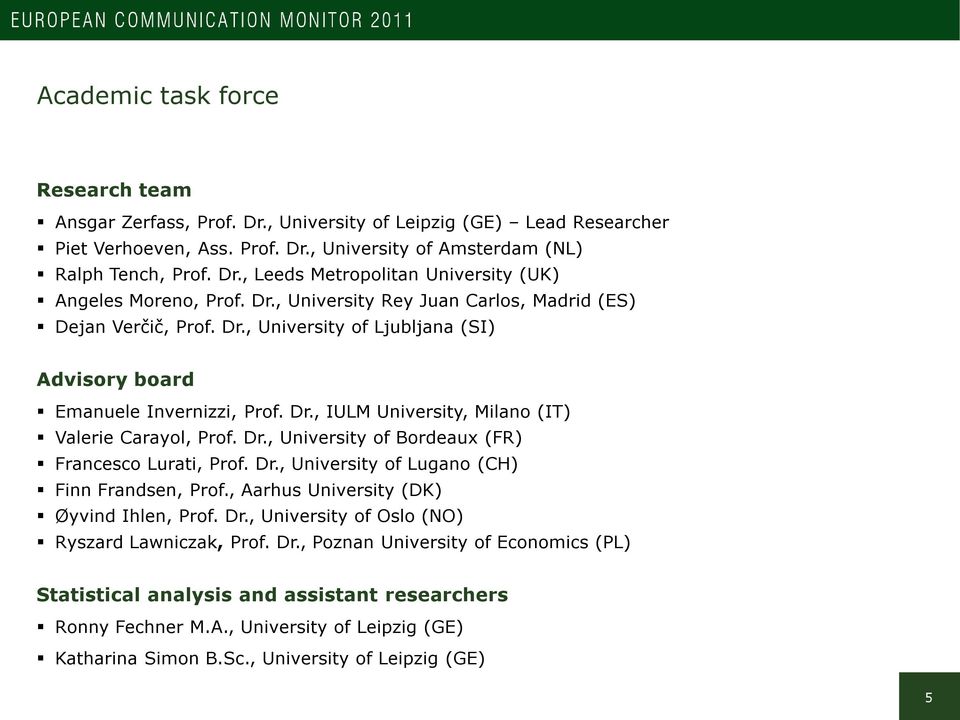
5 Academic task force Research team Ansgar Zerfass, Prof. Dr., University of Leipzig (GE) Lead Researcher Piet Verhoeven, Ass. Prof. Dr., University of Amsterdam (NL) Ralph Tench, Prof. Dr., Leeds Metropolitan University (UK) Angeles Moreno, Prof. Dr., University Rey Juan Carlos, Madrid (ES) Dejan Verčič, Prof. Dr., University of Ljubljana (SI) Advisory board Emanuele Invernizzi, Prof. Dr., IULM University, Milano (IT) Valerie Carayol, Prof. Dr., University of Bordeaux (FR) Francesco Lurati, Prof. Dr., University of Lugano (CH) Finn Frandsen, Prof., Aarhus University (DK) Øyvind Ihlen, Prof. Dr., University of Oslo (NO) Ryszard Lawniczak, Prof. Dr., Poznan University of Economics (PL) Statistical analysis and assistant researchers Ronny Fechner M.A., University of Leipzig (GE) Katharina Simon B.Sc., University of Leipzig (GE) 5
6 Partners European Public Relations Education and Research Association (EUPRERA) The European Public Relations Education and Research Association is an autonomous organisation with members from more than 30 countries that aims at stimulating and promoting the knowledge and practice of communication management in Europe. Academic scholars and experienced practitioners work together to advance fundamental and applied research. European Association of Communication Directors (EACD) The European Association of Communication Directors is the leading network for communication professionals across Europe with more than 1,600 members. The non-partisan association lobbies for the profession, establishes common quality standards and promotes the advancement of professional qualification by organising events and providing services and material. Communication Director Communication Director is a quarterly magazine for Corporate Communications and Public Relations in Europe. It documents opinions on strategic questions in communication, highlights transnational developments and discusses them from a European perspective. The magazine is published by Helios Media, a specialist publishing house based in Berlin and Brussels. 6

7 Sponsors Infopaq Infopaq is a global, European-based company, with expertise in media, publicity and analysis. By providing media monitoring, surveys, tracking, news evaluation, analysis and consulting services, we help our clients improve future communications efforts and thereby attain their business goals. We have approximately clients and more than 500 employees in Denmark, Estonia, Finland, Germany, Norway and Sweden. Grayling Grayling is the world s second largest independent Public Relations, Government Relations, Investor Relations and Events consultancy with specialist services including CSR, environment and sustainability, and digital. The consultancy has 1,000 staff in 70 offices in 40 countries across the US, Western and Eastern Europe and the Asia Pacific region. 7

8 Copyright and reproduction of results Quotation The material presented in this document represents empirical insights and interpretation by the research team. It is intellectual property subject to international copyright. Publication date: July You are welcome to quote from the content of this survey and reproduce any graphics, subject to the condition that the source including the internet address is clearly quoted and depicted on every chart. See the imprint for more information. The full report (text and figures) is available as a book published by Helios Media, 133 pp., ISBN Suggested citation for this document (APA style) Zerfass, A., Verhoeven, P., Tench, R., Moreno, A., & Verčič, D. (2011): European Communication Monitor Empirical Insights into Strategic Communication in Europe. Results of an Empirical Survey in 43 Countries (Chart Version). Brussels: EACD, EUPRERA (available at: Short quotation to be used in legends (charts/graphics) Source: European Communication Monitor

9 Research design and socio-demographic analysis
10 Outline of the survey Aims and focus to monitor trends in communication management to analyse the changing framework for the profession in Europe to evaluate specific topics like decision making, power, trust, social media skills, return on investment for communications, qualification needs, salaries and the image of public relations as well as alternative concepts for the profession. to identify the development of communication management in different types of organisations, countries and regions Target group Communication managers and PR professionals working in organisations and consultancies throughout Europe 10

11 Methodology Survey method and sampling online survey in March 2011 (4 weeks), English language questionnaire with 20 sections, based on hypotheses and instruments derived from previous research and literature pre-test with 31 practitioners in 10 European countries personal invitation to 30,000+ professionals throughout Europe via based on a database provided by EACD; additional invitations to participate via national branch associations and networks (partly self-recruiting); 4,014 respondents and 2,277 fully completed replies evaluation is based on 2,209 fully completed replies by participants clearly identified as part of the population (communication professionals in Europe) Statistical analysis methods of empirical research, descriptive and analytical analysis (using SPSS) results have been statistically agreed by Pearson's chi-square tests (x²) or Spearman's rank correlation tests (rho) and are classified as significant (p 0.05) where appropriate in this report, significant correlations are marked in the footnotes 11

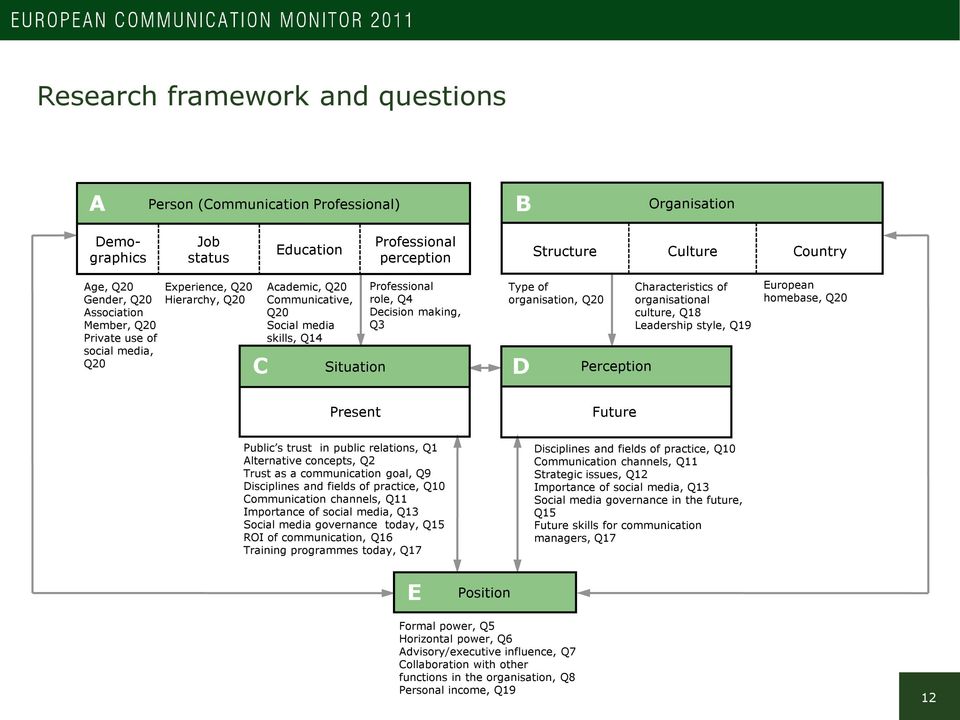
12 Research framework and questions A Person (Communication Professional) B Organisation Demographics Job status Education Professional perception Structure Culture Country Age, Q20 Gender, Q20 Association Member, Q20 Private use of social media, Q20 Experience, Q20 Hierarchy, Q20 C Academic, Q20 Communicative, Q20 Social media skills, Q14 Situation Professional role, Q4 Decision making, Q3 Type of organisation, Q20 D Perception Characteristics of organisational culture, Q18 Leadership style, Q19 European homebase, Q20 Present Future Public s trust in public relations, Q1 Alternative concepts, Q2 Trust as a communication goal, Q9 Disciplines and fields of practice, Q10 Communication channels, Q11 Importance of social media, Q13 Social media governance today, Q15 ROI of communication, Q16 Training programmes today, Q17 Disciplines and fields of practice, Q10 Communication channels, Q11 Strategic issues, Q12 Importance of social media, Q13 Social media governance in the future, Q15 Future skills for communication managers, Q17 E Position Formal power, Q5 Horizontal power, Q6 Advisory/executive influence, Q7 Collaboration with other functions in the organisation, Q8 Personal income, Q19 12
13 Demographic background of participants Position Head of communication, Agency CEO Responsible for single communication discipline, Unit Leader Team member, Consultant Organisation 48.8% Communication department joint stock company 28.0% private company 18.2% 28.8% government-owned, public sector, political organisation 14.1% non-profit organisation, association 10.9% 17.6% Communication consultancy, PR Agency, Freelance consultant 71.2% 28.8% Other 5.7% Job experience Gender / Age Up to 5 years 15.9% Female 55.6% 6 to 10 years 27.4% Male 44.4% More than 10 years 56.7% Age (on average) 41.2 years / Zerfass et al / n = 2,209 PR professionals in 43 European countries; Q

14 Geographical distribution and affiliation Respondents Professionals working in communication management 2,209 Geographical distribution Total number of European states 43 Northern Europe (e.g. Norway, United Kingdom, Latvia) 27.9% Western Europe (e.g. Germany, Netherlands, France) 29.2% Southern Europe (e.g. Italy, Slovenia, Croatia) 32.4% Eastern Europe (e.g. Poland, Czech Republic, Romania) 10.5% Membership in a professional organisation EACD 15.2% Other international communication association 16.7% National PR or communication association 54.4% / Zerfass et al / n = 2,209 PR professionals; Q 20. Regions are classified according to United Nations Standards; see page 18 for a detailed list of countries. 14

15 Personal background of respondents Communication qualifications Academic degree in Communication (Bachelor, Master, Doctorate) 44.5% Professional certificate in Public Relations / Communication Management 25.6% Professional certificate in other communication discipline 16.2% Highest academic educational qualification Doctorate (Ph.D., Dr.) 6.7% Master (M.A., M.Sc., Mag., M.B.A.), Diploma 58.8% Bachelor (B.A., B.Sc.) 27.8% No academic degree 6.6% / Zerfass et al / n = 2,209 PR professionals; Q

16 Female professionals are more likely to hold a Bachelor s or Master s, while more male practitioners have a Doctorate or no degree Academic degree Gender Female Male Total Doctorate (Ph.D., Dr.) 5.0% 9.0% 6.7% Master, Diploma (M.A., M.Sc., Mag., M.B.A.) 61.5% 55.4% 58.8% Bachelor (B.A., B.Sc.) 29.0% 26.4% 27.8% No academic degree 4.6% 9.2% 6.6% / Zerfass et al / n = 2,209 PR professionals; Q 20. Significant differences among female and male practitioners on all qualification levels (chi-square test, p 0.05). 16

17 Organisational cultures: Different types within the sample Joint stock companies Private companies Governmental organisations Non-profit organisations Agencies/ Consultancies Integrated culture (participative proactive) 59.5% 62.2% 52.9% 62.1% 83.0% Interactive culture (participative reactive) 16.7% 15.9% 19.2% 20.0% 8.6% Entrepreneurial culture (non-participative proactive) 5.0% 6.2% 6.1% 3.8% 3.5% Systematised culture (non-participative reactive) 18.8% 15.7% 21.8% 14.2% 4.9% / Zerfass et al / n = 2,209 PR professional in communication departments; Q 18: How would you perceive your organisation regarding the following attributes? participative/non-participative, proactive/reactive. Scale derived from Ernest Significant differences between all groups (chi-square test, p 0.05). 17

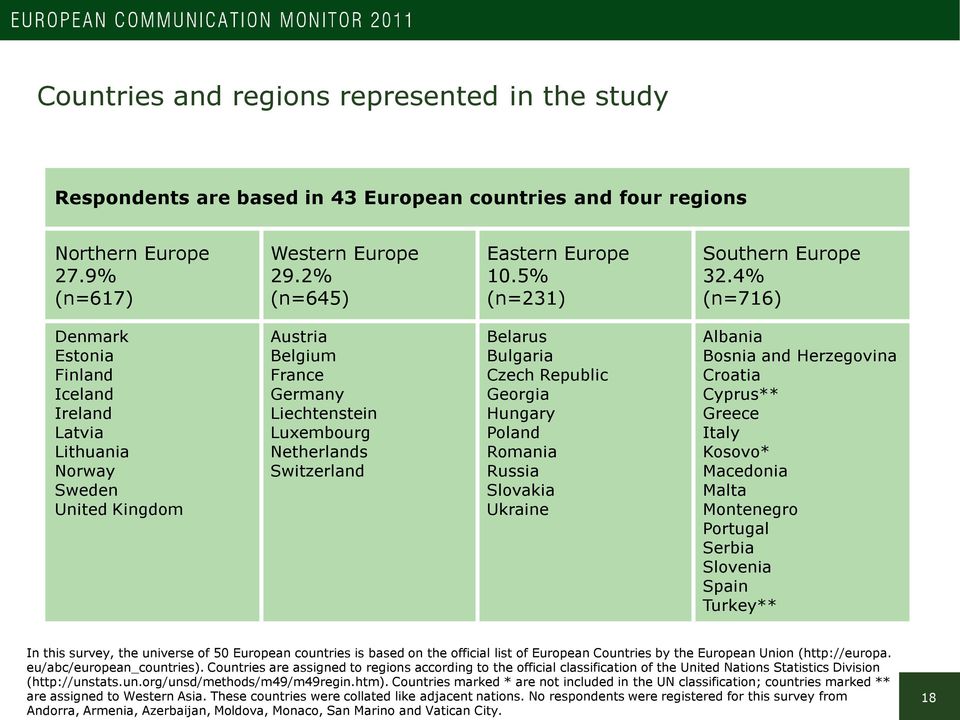
18 Countries and regions represented in the study Respondents are based in 43 European countries and four regions Northern Europe 27.9% (n=617) Western Europe 29.2% (n=645) Eastern Europe 10.5% (n=231) Southern Europe 32.4% (n=716) Denmark Estonia Finland Iceland Ireland Latvia Lithuania Norway Sweden United Kingdom Austria Belgium France Germany Liechtenstein Luxembourg Netherlands Switzerland Belarus Bulgaria Czech Republic Georgia Hungary Poland Romania Russia Slovakia Ukraine Albania Bosnia and Herzegovina Croatia Cyprus** Greece Italy Kosovo* Macedonia Malta Montenegro Portugal Serbia Slovenia Spain Turkey** In this survey, the universe of 50 European countries is based on the official list of European Countries by the European Union ( eu/abc/european_countries). Countries are assigned to regions according to the official classification of the United Nations Statistics Division ( Countries marked * are not included in the UN classification; countries marked ** are assigned to Western Asia. These countries were collated like adjacent nations. No respondents were registered for this survey from Andorra, Armenia, Azerbaijan, Moldova, Monaco, San Marino and Vatican City. 18
19 Interpretation Insights into the structures and evolution of communications in Europe Based on a sample of 2,209 professionals from 43 European countries, this research is the most comprehensive transnational study ever conducted in the field of public relations and communication management. Respondents are characterised by a high level of experience: more than three out of four are head of communications, unit leaders or agency CEOs, 56 per cent have more than ten years of professional experience, the average age is 41 years. The survey lays a solid foundation for identifying basic structures and developments in strategic communication. It is necessary to note that economies, communication landscapes and professions are in rather different stages of development throughout Europe. Moreover, there is no knowledge about the population of communication departments and agencies in Europe. The survey has been conducted in the English language. Consequently, the findings presented here can not claim representativeness. They are especially useful to identify relevant patterns and trends in the field, which may stimulate qualitative discussions. The analysis is based on thorough empirical research and analysis. Replies from participants not currently working in communication management (academics, students) and from non-european countries have been removed. Only fully completed questionnaires have been taken into account. Data have been analysed using the appropriate statistical procedures like chi-square tests and rank correlation tests. 19

20 Credibility of public relations and alternative concepts

21 Professional communication is impaired by negative connotations of public relations in many European countries In my country, PR has negative connotations in the mass media 41.6% Negative connotations of PR in the media damage the reputation of communication professionals 72.8% Negative connotations of PR decrease trust in communication professionals 73.7% The term public relations is discredited 42.2% / Zerfass et al / n = 2,209 PR professionals; Q 1: In many European countries public relations (PR) has negative connotations in the media. PR is often reduced to press relations and publicity. Professionals are sometimes labeled as spin doctors and propagandists. What do you think of these statements? Scale 1-5, considered scale points
22 Perceived negative connotations of PR in the mass media correlate significantly with the disreputability of the concept The term public relations is significantly more likely to be discredited if it has negative connotations in the mass media Pearson correlation The term public relations is discredited In my country, PR has negative connotations in the mass media The term public relations is discredited In my country, PR has negative connotations in the mass media / Zerfass et al / n = 2,209 PR professionals; Q 1: In many European countries public relations (PR) has negative connotations in the media. PR is often reduced to press relations and publicity. Professionals are sometimes labeled as spin doctors and propagandists. What do you think of these statements? Strong linear correlation between the items "The term 'public relations' is discredited" and "In my country, PR has negative connotations in the mass media" (Pearson correlation, 2-tailed, p 0.01). 22
23 Perceived image of PR in the mass media: Predominantly negative in the UK and Poland, less problematic in Belgium, Sweden and Italy Poland (63.6%) Switzerland (36.6%) Germany (45.0%) In my country, PR has negative connotations in the mass media Spain (37.7%) Netherlands (35.0%) Slovenia (48.9%) Belgium (27.9%) 0% Croatia (52.3%) France (32.0%) 20% Serbia (45.5%) 40% United Kingdom (59.1%) Italy (30.4%) Denmark (50.0%) 60% 80% Sweden (28.4%) Norway (52.7%) / Zerfass et al / n = 2,209 PR professionals; Q 1: In many European countries public relations (PR) has negative connotations in the media. PR is often reduced to press relations and publicity. Professionals are sometimes labeled as spin doctors and propagandists. What do you think of these statements? In my country, PR has negative connotations in the mass media. Scale 1-5, considered scale points 4-5 / Q
24 The term public relations is discredited in most countries Poland (51.5%) Switzerland (32.1%) Germany (43.4%) Spain (55.1%) Netherlands (31.7%) Slovenia (53.2%) Belgium (33.3%) The term public relations is discredited Croatia (65.8%) 0% 20% France (40.0%) Serbia (62.6%) Italy (44.4%) Denmark (38.7%) 40% 60% 80% Sweden (30.7%) United Kingdom (37.1%) Norway (45.2%) / Zerfass et al / n = 2,209 PR professionals; Q 1: In many European countries public relations (PR) has negative connotations in the media. PR is often reduced to press relations and publicity. Professionals are sometimes labeled as spin doctors and propagandists. What do you think of these statements? The term public relations is discredited. Scale 1-5, considered scale points 4-5 / Q
25 Consultants are more critical of the term public relations than professionals working in communication departments Communication departments Agencies/ Consultancies In my country, PR has negative connotations in the mass media 37.8% 50.9% Negative connotations of PR in the media damage the reputation of communication professionals 70.9% 77.7% Negative connotations of PR decrease trust in communication professionals 72.5% 76.8% The term public relations is discredited 38.2% 52.3% / Zerfass et al / n = 2,209 PR professionals; Q 1: In many European countries public relations (PR) has negative connotations in the media. PR is often reduced to press relations and publicity. Professionals are sometimes labeled as spin doctors and propagandists. What do you think of these statements? Scale 1-5, considered scale points 4-5 / Q 20. Significant differences between respondents from communication departments and agencies (chi-square test, p 0.05). 25
26 Perceived negative connotations of public relations in different types of organisations (details) Joint stock companies Private companies Governmental organisations Non-profit organisations Agencies/ Consultancies Overall In my country, PR has negative connotations in the mass media 35.6% 33.8% 46.2% 39.6% 50.9% 41.6% Negative connotations of PR in the media damage the reputation of comm. professionals 69.3% 71.8% 70.5% 74.2% 77.7% 72.8% Negative connotations of PR decrease trust in communication professionals 72.3% 71.9% 71.5% 75.0% 76.8% 73.7% The term public relations is discredited 37.2% 39.6% 42.3% 32.9% 52.3% 42.4% / Zerfass et al / n = 2,209 PR professionals; Q 1: In many European countries public relations (PR) has negative connotations in the media. PR is often reduced to press relations and publicity. Professionals are sometimes labeled as spin doctors and propagandists. What do you think of these statements? Scale 1-5, considered scale points 4-5 / Q 20. Significant differences between all types of organisations (chi-square test, p 0.05). 26
27 Public relations is no longer regarded as a suitable label for the profession compared to other concepts Corporate Communications 67.9% Strategic Communication 61.3% Communication Management 55.7% Public Relations 46.7% Integrated Communications 45.9% Business Communication 34.0% Organisational Communication 32.6% Suitability of alternative concepts to describe the various internal and external communication activities by an organisation / Zerfass et al / n = 2,209 PR professionals; Q 2: Researchers are discussing several concepts to describe the various internal and external communication activities by an organisation. How would you value these descriptions/labels? Scale 1-5, considered scale points
28 Companies favour Corporate Communications ; non-profit and governmental organisations prefer Strategic Communication Public Relations Integrated Communications Business Communications Corporate Communications Organisational Communication Communication Management Strategic Communication Not adequate at all Very suitable Joint stock companies Private companies Governmental Organisations Non-profit organisations Consultancies & Agencies / Zerfass et al / n = 2,209 PR professionals; Q 2: Researchers are discussing several concepts to describe the various internal and external communication activities by an organisation. How would you value these descriptions/labels? Scale 1-5 / Q 20. Items 1, 4, 5: significant differences between all types of organisations (chi-square test, p 0.05). 28
29 Concepts and labels for the profession are judged differently in various countries (example: UK versus Germany) Public Relations Integrated Communications Business Communications Corporate Communications Organisational Communication Communication Management Strategic Communication Not adequate at all Very suitable United Kingdom Germany Overall / Zerfass et al / n = 2,209 PR professionals; Q 2: Researchers are discussing several concepts to describe the various internal and external communication activities by an organisation. How would you value these descriptions/labels? Scale 1-5 / Q
30 Practitioners who are sceptical of the term PR dislike Integrated Communications as well Corporate Communications Strategic Communication Communication Management Public Relations Integrated Communications Business Communication Organisational Communication 67.9% 67.7% 61.3% 62.7% 55.7% 59.1% 46.7% 45.2% 45.9% 39.1% 34.0% 34.8% 32.6% 34.4% All professionals Professionals claiming that the term 'public relations' is discredited / Zerfass et al / n = 2,209 PR professionals; Q 2: Researchers are discussing several concepts to describe the various internal and external communication activities by an organisation. How would you value these descriptions/labels? Scale 1-5, considered scale points 4-5. Linear negative correlation between discreditation of PR and suitability of the PR concept (Pearson correlation, 2-tailed, p 0.01). 30
31 How formal qualifications influence the approval of alternative concepts and the reputation of public relations Professional certificate in PR/ Communication Management Professional certificate in other communication discipline Academic degree in communication Public Relations 49.1% 48.2% 47.0% Integrated Communications 50.0% 49.6% 47.9% Business Communication 35.7% 40.3% 33.7% Corporate Communications 68,4% 66,4% 68.9% Organisational Communication 33.4% 35.6% 35.9% Communication Management 58.7% 56.9% 57.9% Strategic Communication 62.5% 64.4% 62.3% The term public relations is discredited 42.6% 37.5% 41.5% / Zerfass et al / n = 566, 357, 982 PR professionals, Q 1 / Q 2 / Q 20. No calculation of significancies because multiple answers were allowed in Q
32 Interpretation Negative reputation of public relations calls for new concepts and labels Across Europe, communication professionals report negative connotations of public relations in the mass media. The image of PR is especially bad in Poland, the United Kingdom, Norway, Croatia, Denmark, Slovenia, Serbia and Germany. Even in the rest of Europe at least three out of ten practitioners report negative perceptions of the term. Negative connotations of PR in the media damage the reputation of communication professionals as well as trust in their activities. Further research, i. e. media content analysis, may prove these perceptions and provide more detailed insights. The survey reveals a significant correlation between the media image and the disreputability of public relations as a term and overall concept. PR is partly discredited in most European countries, especially in Eastern and Southern Europe, but also in Norway and Germany. As a consequence, most communication professionals favour alternative labels for the profession especially corporate communications, strategic communication and communication management. When comparing the acceptance within different types of organisations, corporate communications is leading the field across the respondent groups, while strategic communication is the second most popular label. The terms integrated communication and organisational communication, often used in the academic realm, are less popular for the professional field. The approval of alternative concepts is not significantly influenced by the formal qualifications of communication professionals. 32
33 Decision making, leadership style and role enactment
34 Decision making: Most professionals rely on rational approaches and best practices, only a minority take risks When making a decision, I make a thorough evaluation based on all possible information 84.7% When making decisions, it is useful to rely on best practices used by similiar organisations 67.6% I like the shared responsibility that comes from group decision-making 55.9% Reviewing (scientific) literature and research helps to prepare a decision 53.9% A risk not taken is usually an opportunity lost 45.1% Decision-making is driven by the availability of new communication technologies 38.6% / Zerfass et al / n = 2,209 PR professionals; Q 3: How do you make decisions as a communication professional? Scale 1-5, considered scale points 4-5. Types of decision making partly derived from Werder & Holzhausen
35 European professionals have a different decision-making profile than their counterparts in the United States Rational decision making 84.7% 90.8% Group decision making 55.9% 52.9% Risk-acceptance decision making 45.1% 53.0% European professionals US professionals / Zerfass et al / n = 2,209 PR professionals; Q 3: How do you make decisions as a communication professional? Scale 1-5, considered scale points 4-5; Werder & Holtzhausen 2009, 2011 / n max = 825. Scale 1-7, considered scale point
36 Types of decision making in European regions When making a decision, I make a thorough evaluation based on all possible information I like the shared responsibility that comes from group decision-making A risk not taken is usually an opportunity lost Decision-making is driven by the availability of new communication technologies Reviewing (scientific) literature and research helps to prepare a decision When making decisions, it is useful to rely on best practices used by similiar organisations Strongly disagree Totally agree Western Europe Northern Europe Southern Europe Eastern Europe / Zerfass et al / n = 2,209 PR professionals; Q 3: How do you make decisions as a communication professional? Scale 1-5. / Q 20. Items 2, 3, 4: significant differences between the four regions (chi-square test, p 0.05). 36
37 Styles of decision making in different types of organisations Joint stock companies Private companies Governmental organisations Non-profit organisations Rational decision making When making a decision, I make a thorough evaluation based on all possible information 83.5% 85.1% 82.4% 76.7% Group decision making I like the shared responsibility that comes from group decision-making 55.5% 51.5% 56.7% 60.4% Risk-acceptance decision making A risk not taken is usually an opportunity lost 46.4% 44.0% 38.1% 42.5% Technology-oriented decision making Decision-making is driven by the availability of new communication technologies Research-oriented decision making Reviewing (scientific) literature and research helps to prepare a decision 37.4% 36.3% 41.7% 35.0% 47.9% 51.2% 57.1% 54.6% Best practices-oriented decision making When making decisions, it is useful to rely on best practices used by similiar organisations 68.6% 67.4% 72.8% 66.3% / Zerfass et al / n = 2,209 PR professionals; Q 3: How do you make decisions as a communication professional? Scale 1-5 / Q 20. Research-oriented decision making: Significant differences between organisations (chi-square test, p 0.05). 37
38 Types of decision making in European countries Rational Group Risk Technology Scientific research Best practices Switzerland Germany Netherlands Belgium France United Kingdom Norway Sweden Denmark Italy Serbia Croatia Slovenia Spain Poland / Zerfass et al / n = 2,209 PR professionals; Q 3: How do you make decisions as a communication professional? Scale 1-5; mean values / Q
39 Leadership style: Involving team members is the predominant approach utilised by communication professionals 18.5% Transactional Leadership: drawing on authority, reminding followers of common standards 46.6% Transformational Leadership: defining a vision, appealing to followers' ideals and standards 34.9% Inclusive Leadership: naming challenges, involving followers in shared decision making / Zerfass et al / n = 2,209 PR professionals; Q 19: How would you describe the dominant strategy used by leaders in your communication department (or in your consultancy) to achieve common goals? Leadership styles derived from Werder & Holzhausen
40 Leadership style in different types of organisations Joint stock companies Private companies Governmental organisations Non-profit organisations Agencies/ Consultancies Transactional Leaders draw on their authority and remind followers of common standards 17.2% 17.9% 29.8% 20.8% 13.7% Transformational Leaders define a vision and appeal to followers ideals and values 36.4% 35.8% 32.7% 31.7% 35.2% Inclusive Leaders name challenges and involve followers in shared decision making 46.4% 46.3% 37.5% 47.5% 51.2% / Zerfass et al / n = 2,209 PR professionals; Q 19: How would you describe the dominant strategy used by leaders in your communication department (or in your consultancy) to achieve common goals? / Q 20. Leadership styles derived from Werder & Holzhausen Significant differences between the five types of organisations (chi-square test, p 0.05). 40
41 Organisational culture and leadership style are interdependent Transactional Leadership Transformational Leadership Inclusive Leadership Integrated culture (participative proactive) 11.8% 35.9% 52.4% Interactive culture (participative reactive) 20.9% 33.6% 45.5% Entrepreneurial culture (non-participative proactive) 20.8% 49.1% 30.2% Systematised culture (non-participative reactive) 46.5% 26.9% 26.6% / Zerfass et al / n = 2,209 PR professionals; Q 19: How would you describe the dominant strategy used by leaders in your communication department (or in your consultancy) to achieve common goals? / Q 18: How would you perceive your organisation regarding the following attributes? Significant differences between the three types of culture (chi-square test, p 0.05). 41
42 Strategic contribution: Most communication professionals strive to support overall goals, a rising number also tries to define them 90.8% focus on supporting business goals by planning and executing communication (+5.4% compared to 2010, +6% compared to 2009) 70.8% feel responsible for helping to define business strategies (+8.3% compared to 2010, +10,1% compared to 2009) / Zerfass et al / n = 2,209 PR professionals; Q 4; Zerfass et al / n = 1,955; Q 8; Zerfass et al / n = 1,863; Q 7: In your daily work, how much do you focus on supporting business goals by planning and executing communication? (1 = Not at all; 7 = Very much) / do you feel responsible for helping to define business strategies? (1 = Never; 7 = Always); considered scale points:
43 Professional roles: Most practitioners act as strategic facilitators or operational supporters ALWAYS HELPING TO DEFINE BUSINESS STRATEGIES NOT AT ALL SUPPORTING BUSINESS GOALS BY MANAGING COMMUNICATION Business Advisers 3.2% Scale: 5-7 Scale: 1-4 Scale: 5-7 Isolated Experts 6.0% Scale: 1-4 Strategic Facilitators 67.6% Operational Supporters 23.2% VERY MUCH SUPPORTING BUSINESS GOALS BY MANAGING COMMUNICATION NEVER HELPING TO DEFINE BUSINESS STRATEGIES / Zerfass et al / n = 2,209 PR professionals; Q 4: In your daily work, how much do you focus on supporting business goals by planning and executing communication? (1 = Not at all; 7 = Very much) / do you feel responsible for helping to define business strategies? (1 = Never; 7 = Always). 43
44 All professional roles tend to use rational decision making; operational supporters are risk-averse and copy best practices When making a decision, I make a thorough evaluation based on all possible information I like the shared responsibility that comes from group decision-making A risk not taken is usually an opportunity lost Decision-making is driven by the availability of new communication technologies Reviewing (scientific) literature and research helps to prepare a decision When making decisions, it is useful to rely on best practices used by similiar organisations Strongly disagree Totally agree Isolated Experts Business Advisers Operational Supporters Strategic Faciliators / Zerfass et al / n = 2,209 PR professionals; Q 4, Q 20. Decision-making is driven by the availability of new communication technologies: Significant differences between the four roles (chi-square test, p 0.05). 44
45 Distribution of professional roles in European regions Northern Europe Western Europe Southern Europe Eastern Europe Strategic Facilitators 72.0% 65.3% 66.8% 64.9% Operational Supporters 22.2% 26.2% 20.0% 27.7% Business Advisers 1.8% 3.3% 4.6% 2.2% Isolated Experts 4.1% 5.3% 8.7% 5.2% / Zerfass et al / n = 2,209 PR professionals; Q 4, Q 20. Significant differences between all regions (chi-square test, p 0.05 ). 45
46 Interpretation Inclusive leadership and risk-averse decision making are predominant Patterns of decision making utilised by European communication professionals differ from the behaviour of their counterparts in the United States. Both groups prefer rational decision making based on an evaluation of all information available. Only a minority of practitioners in Europe accept that a risk not taken is an opportunity lost. However, the shared responsibility offered by group-decision making is more popular than in the US. Along this line, almost every second respondent reports a predominance for the inclusive leadership style, which means that leaders involve followers in shared decision making. Practitioners in non-profit organisations use significantly different ways of decision making and leadership. Rational decisions are less common and an inclusive leadership style is prevalent per cent of communication professionals identify themselves with the advanced strategic facilitator role, meaning that they support organisational goals by executing communication on the one hand whilst also helping to define business strategies. This number has risen by 10 per cent within the last two years. When making decisions, strategic facilitators are more rational, research-based and risk-friendly. Operational supporters are the second most important role. Only 6 per cent of the professionals act as isolated experts who do not contribute to strategic goals at all. This role is more common in Southern Europe than in any other region. 46
47 Power of communication departments
48 Formal power of the communication function: In most organisations, communication leaders have a broad level of responsibility The top communication manager within the organisation 41.7% 41.7% 12.1% 4.6% is responsible for all kinds of communication and stakeholders* is responsible for at least three communication fields and stakeholder groups is responsible for press/media relations and internal communication is responsible for press/media relations / Zerfass et al / n = 1,450 PR professionals in communication departments; Q 5: Within your organisation, the top communication manager is responsible for ; * public/media and communities, marketing/consumers, internal/ employees, financial/investors, lobbying/politics 48
49 Reporting lines and hierarchy: The majority of top level communication managers reports directly to the CEO The top communication manager within the organisation sits on the board 17.8% does not report directly to the CEO or anyone who sits on the board 4.6% reports directly to the CEO 59.9% reports to another board member or function 17.7% / Zerfass et al / n = 1,450 PR professionals in communication departments; Q 5: Within your organisation, the top communication manager. 49
50 Reporting lines and responsibilities are correlated with each other The top communication manager... sits on the board 91.9% 8.1% reports directly to the CEO 84.1% 15.9% reports to another board member or function 77.8% 22.2% does not report directly to the CEO or anyone who sits on the board 61.2% 38.8% is responsible for all or at least three communication fields is responsible for media relations or media relations and internal communication / Zerfass et al / n = 1,450 PR professionals in communication departments; Q 5: Within your organisation, the top communication manager. Significant differences between all groups (chi-square test, p 0.05). 50
51 Levels of responsibility differ significantly within European regions 4.6% 3.3% 7.0% 2.2% 12.3% 8.8% 16.4% 9.6% 43.1% 40.0% 43.4% 41.3% The top communication manager... is responsible for press/media relations is responsible for press/media relations and internal communication 40.0% 47.9% 35.3% 44.9% is responsible for at least three communication fields and stakeholder groups Western Europe Northern Europe Southern Europe Eastern Europe is responsible for all kinds of communication and stakeholders / Zerfass et al / n = 1,450 PR professionals in communication departments; Q 5: Within your organisation, the top communication manager. / Q 20. Significant differences between all four regions (chi-square test, p 0.05). 51
52 Top communication managers in Sweden, the Netherlands and the UK tend to have a wider range of responsibilities 100% 90% 80% 70% 60% 50% 40% 30% 20% 10% 0% The top communication manager... is responsible for press/media relations is responsible for press/media relations and internal communication is responsible for at least three communication fields and stakeholder groups is responsible for all kinds of communication and stakeholders / Zerfass et al / n = 1,450 PR professionals in communication departments; Q 5: Within your organisation, the top communication manager / Q
53 In governmental organisations, one out of ten communication managers is merely responsible for media relations 2.9% 4.3% 9.7% 2.8% 7.4% 11.3% 14.4% 14.4% 44.2% 45.7% 39.3% 34.2% The top communication manager... is responsible for press/media relations is responsible for press/media relations and internal communication 40.1% 42.0% 41.6% 45.6% is responsible for at least three communication fields and stakeholder groups Joint stock companies Private companies Governmental organisations Non-profit organisations is responsible for all kinds of communication and stakeholders / Zerfass et al / n = 1,450 PR professionals in communication departments; Q 5: Within your organisation, the top communication manager. / Q 20. Significant differences between the organisations (chi-square test, p 0.05). 53
54 Reporting lines do not differ significantly between various types of organisations 4.7% 3.7% 4.7% 5.6% 17.8% 19.6% 16.8% 15.8% The top communication manager... does not report directly to the CEO or anyone who sits on the board 62.8% 58.9% 55.0% 59.5% reports to another board member or function reports directly to the CEO 14.6% 17.8% 23.5% 19.1% sits on the board Joint stock companies Private companies Governmental organisations Non-profit organisations / Zerfass et al / n = 1,450 PR professionals in communication departments; Q 5: Within your organisation, the top communication manager. / Q 20. No significant differences between the organisations (chi-square test, p 0.05). 54
55 In Northern European countries, a quarter of the top level communicators sit on the board 5.1% 3.3% 5.2% 5.9% 18.2% 20.6% 14.2% 16.9% The top communication manager... does not report directly to the CEO or anyone who sits on the board 65.5% 52.3% 60.7% 64.0% reports to another board member or function reports directly to the CEO 11.2% 23.9% 19.9% 13.2% sits on the board Western Europe Northern Europe Southern Europe Eastern Europe / Zerfass et al / n = 1,450 PR professionals in communication departments; Q 5: Within your organisation, the top communication manager. / Q 20. Significant differences between all four regions (chi-square test, p 0.05). 55
56 Top communication managers in Germany and France are least likely to hold a board position 100% 90% 80% 70% 60% 50% 40% 30% 20% 10% 0% The top communication manager... does not report directly to the CEO or anyone who sits on the board reports to another board member or function reports directly to the CEO sits on the board / Zerfass et al / n = 1,450 PR professionals in communication departments; Q 5: Within your organisation, the top communication manager. / Q
57 Top communication managers tend to apply the inclusive leadership style if they have a broader area of responsibility The top communication manager is responsible for all kinds of communication and stakeholders at least three communication fields and stakeholder groups press/media relations and internal communication press/media relations 46.5% 46.2% 35.9% 36.3% 36.0% 32.0% 41.8% 34.3% 23.9% 17.5% 17.5% Transactional Leadership Transformational Leadership Inclusive Leadership / Zerfass et al / n = 1,450 PR professionals in communication departments; Q 19: How would you describe the dominant strategy used by leaders in your communication department to achieve common goals? / Q 5. Significant differences between the four groups (chi-square test, p 0.05). 57
58 Leaders tend to apply the inclusive leadership style if they sit on the board or report directly to the CEO The top communication manager sits on the board reports directly to the CEO reports to another board member or function does not report directly to the CEO or anyone who sits on the board 48.1% 45.7% 42.0% 47.8% 37.2% 35.6% 33.1% 24.9% 26.9% 25.4% 14.7% 18.7% Transactional Leadership Transformational Leadership Inclusive Leadership / Zerfass et al / n = 1,450 PR professionals in communication departments; Q 19: How would you describe the dominant strategy used by leaders in your communication department to achieve common goals? / Q 5. Significant differences between the four groups (chi-square test, p 0.05). 58
59 Horizontal power of communication departments is rather low; only a minority generate financial and immaterial assets The communication department anticipates situations and conflicting issues 77.9% The communication department plays an important role in the overall performance of the organisation 75.4% The communication department is irreplaceable 69.8% The communication department generates financial and immaterial assets for the organisation 47.9% Other departments' activities depend on the communication department 43.3% / Zerfass et al / n = 1,450 PR professionals in communication departments; Q 6: How would you describe the position of the communication department in your organisation? Scale 1 (= Strongly disagree) 5 (= Totally agree), considered scale points 4-5. Items based on research in strategic contingencies (Hickson et al. 1971, Pfeffer 1992, Salancik & Pfeffer 1974). 59
60 Anticipating situations and conflicting issues strengthens the internal position of communication departments The communication department plays an important role in the overall performance of the organisation The communication department is irreplaceable The communication department anticipates situations and conflicting issues The communication department generates financial and immaterial assets for the organisation / Zerfass et al / n = 1,450 PR professionals in communication departments; Q 6: How would you describe the position of the communication department in your organisation? Scale 1 (= Strongly disagree) 5 (= Totally agree). Significant correlations between all items (Pearson correlation, 2-tailed, p 0.01,). 60
61 The horizontal power of communication departments is stronger if the top communication manager has broader responsibilities The communication department anticipates situations and conflicting issues 64.5% 80.5% The communication department plays an important role in the overall performance of the organisation 59.9% 78.6% The communication department is irreplaceable 55.4% 72.7% The communication department generates financial and immaterial assets for the organisation 33.1% 50.8% Other departments' activities depend on the communication department 26.4% 46.7% The top communication manager is responsible for all or at least three communication fields for media relations or media relations and internal communication / Zerfass et al / n = 1,450 PR professionals in communication departments; Q 6: How would you describe the position of the communication department in your organisation? Scale 1 (= Strongly disagree) 5 (= Totally agree), considered scale points 4-5 / Q 5. 61
62 Influence of communication professionals in Europe: Three out of four are trusted advisers and involved in planning 77.9% are taken seriously by senior management (advisory influence) +2.4% compared to % are likely to be invited to senior-level meetings dealing with organisational strategic planning (executive influence) +4.8% compared to / Zerfass et al / n = 1,449 PR professionals in communication departments; Q 7; Zerfaß et al / n max = 1,511; Q4: In your organisation, how seriously do senior managers take the recommendations of the communication function?; How likely is it, within your organisation, that communication would be invited to senior-level meetings dealing with organisational strategic planning? Scale 1-7; considered scale points: 5-7. Instrument adapted from US GAP VI survey (Swerling 2009). 62
63 Advisory and executive influence have grown during the last years 79% 77% 75% 73% 71% 69% 67% 65% 63% Advisory influence Executive influence / Zerfass et al / n = 1,449 PR professionals in communication departments; Q 7; Zerfass et al / n max = 1,511; Q4 / Zerfass et al. 2009, n max = 1,267; Q 3 / Zerfass et al. 2008, n = 1,027; Q 1 / Advisory influence: consistent wording / Executive influence: wording in the questionnaire has been changed since 2010 in line with the US GAP surveys (Swerling 2009). 63
64 Influence of the communication function is correlated with the formal position and power of the top communication manager The top communication manager 86.4% 89.1% sits on the board 79.8% 79.8% reports directly to the CEO 69.9% 64.8% reports to another board member or function 38.8% 50.7% does not report directly to the CEO or anyone who sits on the board Advisory influence Executive influence / Zerfass et al / n = 1,449 PR professionals in communication departments; Q 7, Q 5. Significant, but weak correlation between the position of the top communication manager and advisory influence of the communication function. Stronger correlation between the position of the top communication manager and executive influence (Spearman s rho, p 0.01). 64
65 Collaboration of communication with other functions in the organisation The communication functions works closely with the CEO 86.6% Other members of the executive board 78.0% Marketing department 77.1% Strategy and organisational development unit 61.7% Human resources department 54.1% Legal department 44.4% Financial department 39.1% Auditing and controlling unit 19.3% / Zerfass et al / n = 1,450 PR professionals in communication departments; Q 8: How closely does the communication function in your organisation work with the Scale 1 (= never) 5 (= always), considered scale points: 4-5. Items partly derived from Lurati et al
66 Collaboration with other functions in different types of organisations Joint stock companies Private companies Governmental organisations Non-profit organisations CEO 87.6% 85.9% 81.2% 92.6% Other members of the executive board 81.2% 77.6% 74.5% 74.4% Human resources department 64.6% 57.7% 40.3% 38.1% Financial department 49.8% 35.0% 26.8% 32.1% Legal department 57.3% 40.5% 33.6% 28.8% Marketing department 78.2% 85.6% 66.1% 76.3% Auditing and controlling unit 20.0% 15.3% 22.1% 19.5% Strategy and organisational development unit 59.6% 62.9% 59.7% 66.8% / Zerfass et al / n = 1,450 PR professionals in communication departments; Q 8: How closely does the communication function in your organisation work with the Scale 1 (= never) 5 (= always), considered scale points: 4-5 / Q 20. Items 3, 4, 5, 6, 7: Significant differences between the four types of organisations (chi-square test, p 0.05). 66
67 Interpretation Communication departments are influential, but lack many aspects of power The communication function has gained more influence in Europe during the last years; in three out of four organisations communication is taken seriously be senior management and communication is likely to be involved in planning organisational strategies Working relationships are especially close with the CEO (reported by 86.6 per cent of the respondents), followed by other members of the executive board and the marketing department (more than 75 per cent). Good links to the strategy people are hindered by rather weak connections to auditing and controlling units per cent of communication professionals are board members. However, this differs widely between various types of organisations, regions and countries in Europe. It is less prevalent in companies and in Western Europe. Six out of ten top communication managers report directly to the CEO, and 83.4 per cent are responsible for all kind of public / media, marketing, internal, financial and lobbying communications or at least three of these fields. When leaders hold more responsibility they prefer an inclusive leadership style. The transactional style is prevalent when practitioners do not report to the board and restrict their functions to media relations. However, these indicators of formal power are not always accompanied by horizontal power. It is clearly possible for the self reporting respondents to have power and no influence and vice versa. For example there are respondents who are responsible for a lot within the organisation but then 24.5 per cent of them don t see the communication department as playing an important role in the overall performance of the company, and possibly more concerning 30.2 per cent think it is replaceable. 67
68 ROI of communication
69 Almost every second professional uses the term return on investment when planning or evaluating communication 5.9% use the term 'return on investment' do not use the term 'return on investment' 47.6% do not know the term 'return on investment' 46.5% Position Usage of the ROI concept Head of communication, Agency CEO 53.7% Unit leader 45.7% Team member, consultant 34.5% / Zerfass et al / n = 2,209 PR professionals; Q 16: Do you regularly use the term ROI or return on investment when planning and evaluating communication activities? (1 = Yes, 2 = No, 3 = I don t know the term), Q 20. Significant differences between all hierarchical positions (chi-square test, p 0.05). 69
70 The term ROI is rather common in Spain, the UK and Sweden; only three out of ten use it in Germany, Norway and Slovenia Switzerland (48.5%) Poland (40.9%) Germany (34.1%) Spain (65.2%) Netherlands (48.3%) Slovenia (34.0%) Belgium (53.2%) 0% Serbia (48.8%) 20% United Kingdom (60.3%) 40% Croatia (41.4%) 60% Norway (30.1%) Italy (53.8%) 80% Denmark (41.9%) Sweden (58.0%) / Zerfass et al / n = 2,209 PR professionals; Q 16: Do you regularly use the term ROI or return on investment when planning and evaluating communication activities?, Q
71 Communication professionals in Southern Europe tend to use ROI, which is best known in Western Europe Northern Europe Western Europe Southern Europe Eastern Europe Use the term Return on Investment 46.5% 45.7% 50.4% 46.8% Do not use the term Return on Investment 46.7% 50.5% 43.2% 45.5% Do not know the term Return on Investment 6.8% 3.7% 6.4% 7.8% / Zerfass et al / n = 2,209 PR professionals; Q 16: Do you regularly use the term ROI or return on investment when planning and evaluating communication activities?, Q 20. Significant differences between all regions for items use the term and do not use the term (chi-square test, p 0.05). 71
72 The term ROI is more common for practitioners working in companies and in agencies Joint stock companies Private companies Governmental organisations Non-profit organisations Agencies/ Consultancies Use the term return on investment 51.1% 47.5% 28.2% 32.5% 59.3% Do not use the term return on investment 46.1% 48.0% 56.4% 56.3% 37.5% Do not know the term return on investment 2.8% 4.5% 15.4% 11.3% 3.1% / Zerfass et al / n = 2,209 PR professionals; Q 16: Do you regularly use the term ROI or return on investment when planning and evaluating communication activities? (1 = Yes, 2 = No, 3 = I don t know the term) / Q 20. Significant differences between all types of organisations for items use the term and do not use the term (chi-square test, p 0.05). 72
73 Most communication professionals have an improper understanding of the ROI concept ROI can be expressed in achievement of communication objectives 83.1% ROI requires financial assessments of the resources used for communication * ROI can demonstrate the non-financial value of communication ROI expresses communication's contribution to the formation of organisational strategy ROI needs a standardised financial valuation of results achieved by communication * ROI is the ratio of financial profit resulting from a communication activity against its actual cost * 72.5% 70.5% 62.8% 58.0% 52.8% ROI has to be defined in monetary terms * 38.3% / Zerfass et al / n = 2,209 PR professionals; Q 16: Would you agree or disagree with the following statements? (1 = Agree, 2 = Disagree, 3 = I don t know). ROI is the ratio of financial profit is the standard economic definition for ROI; only statements marked with * are consistent with the standard definition of ROI. Items partly based on research on ROI concepts in communication. i.e. Gregory & Watson 2008, Likely, Rockland & Weiner
74 More frequent and more accurate use of the term ROI in communication agencies and consultancies Communication departments Agencies/ Consultancies Usage of the term ROI or return on investment 42.8% 59.3% ROI is the ratio of financial profit resulting from a communication activity against its actual cost 51.3% 56.3% / Zerfass et al / n = 2,209 PR professionals; Q 16: Do you regularly use the term ROI or return on investment when planning and evaluating communication activities? (1 = Yes, 2 = No, 3 = I don t know the term) / Q 20. Significant differences between communication departments and agencies regarding the two items displayed (chi-square test, p 0.05). 74
75 Interpretation Misleading use of the ROI concept in planning and evaluating communications Communication professionals are ambiguous about return on investment, a concept propagated by a number of evaluation companies for proving the economic value of communication activities. Almost every second practitioner claims to use the term, which is especially popular among heads of communication and agencies, in consultancies and companies. It is common for six out of ten professionals in Spain, the UK and Sweden. A minority of professionals working in governmental organisations and in countries like Norway, Slovenia and Germany use ROI when planning and evaluating communications. While ROI is clearly defined in economics as the ratio of financial profit resulting from an activity against its actual cost, most communication professionals think it can be expressed in achievement of communication objectives or be used to demonstrate the non-financial value of communication. Only 52.8 per cent agree with the standard definition, and even less know that ROI has to be defined in monetary terms. The research shows that basic knowledge about management theories and accounting is missing in the profession. Using the ROI concept in an improper way is pointless and may even damage the reputation of the profession. 75
76 Strategic issues and trust
77 Strategic issues for communication management until 2014 Dealing with sustainable development and social responsibility 37.2% Dealing with the demand for more transparency and active audiences 35.1% Building and maintaining trust 30.1% Supporting organisational change Advancing public affairs 19.2% and political communication 17.7% Globalisation of communication strategies 17.2% Establishing new methods to evaluate communication 16.3% Advancing issues management and corporate foresight 13.0% Linking business strategy and communication 44.0% Coping with the digital evolution and the social web 54.9% Supporting intercultural integration 5.9% Developing CEO positioning and communication 9.6% / Zerfass et al / n = 2,209 PR professionals; Q 12: Here are some issues that might become relevant for public relations and communication management within the next three years. Please pick those three which are most important from your point of view. 77
78 Most important issues at a glance Most important issues for communication management until Coping with the digital evolution and the social web 54.9% 2 Linking business strategy and communication 44.0% 3 Dealing with sustainable development and social responsibility 37.2% 4 Dealing with the demand of new transparency and active audiences 35.1% 5 Building and maintaining trust 30.1% / Zerfass et al / n = 2,209 PR professionals; Q 12: Here are some issues that might become relevant for public relations and communication management within the next three years. Please pick those three which are most important from your point of view. 78
79 Relevance of strategic issues compared to previous surveys Coping with the digital evolution and the social web 45.0% 54.9% 53.7% Linking business strategy and communication 44.0% 43.6% 47.3% Dealing with sustainable development and social responsibility 37.2% 36.7% 38.0% Dealing with the demand for more transparency and active audiences 35.1% 33.1% 30.5% Building and maintaining trust 30.1% 32.8% 34.6% / Zerfass et al / n = 2,209 PR professionals; Q 12; Zerfass et al / n = 1,955; Q 7; Zerfass et al / n = 1,863; Q 6. 79
80 Trust: Practitioners primarily strive to enhance stakeholders trust in organisations and brands; other objectives are less relevant Goals relevant in the daily work of communication professionals Enhance trust in my organisation and/or its brand 93.2% Enhance trust in leaders of my organisation 79.3% Enhance trust in our markets and business at large 76.8% / Zerfass et al / n = 1,450 PR professionals in communication departments. Q 9: Communication management may strive to gain stakeholders trust in people, organisations, and societal systems as a whole. How relevant are each of the following goals in your daily work? Scale 1 (= not relevant) 5 (= very relevant), considered scale points: 4-5. Items derived from research on trust levels (Luhmann 1979, Giddens 1990, Nielsen 2006, Arthur W. Page Society & Business Roundtable 2009, Harris & Wicks 80
81 Gaining stakeholders trust as a goal of communication management in various types of organisations Joint stock companies Private companies Governmental organisations Non-profit organisations Enhance trust in leaders of my organisation 84.3% 74.2% 75.8% 77.7% Enhance trust in my organisation and/or its brand 94.9% 92.3% 88.9% 95.3% Enhance trust in our markets or business at large 82.0% 78.8% 62.8% 78.1% / Zerfass et al / n = 1,450 PR professionals in communication departments; Q 9: Communication management may strive to gain stakeholders trust in people, organisations, and societal systems as a whole. How relevant are each of the following goals in your daily work? Scale 1 (= not relevant) 5 (= very relevant), considered scale points: 4-5 / Q 20. No significant differences between the different types of organisations (chi-square test, p 0.05). 81
82 Gaining stakeholders trust in different European regions Northern Europe Western Europe Southern Europe Eastern Europe Enhance trust in leaders of my organisation 84.2% 77.4% 74.9% 82.4% Enhance trust in my organisation and/or its brand 97.2% 95.4% 86.3% 92.6% Enhance trust in our markets or business at large 81.0% 77.6% 72.4% 72.8% / Zerfass et al / n = 1,450 PR professionals in communication departments; Q 9: Communication management may strive to gain stakeholders trust in people, organisations, and societal systems as a whole. How relevant are each of the following goals in your daily work? Scale 1 (= not relevant) 5 (= very relevant), considered scale points: 4-5 / Q 20. No significant differences between the four regions (chi-square test, p 0.05). 82
83 Interpretation Digital development and building trust in organisations are key challenges Coping with the digital evolution and the social web continues to be the most important issue for communication management in the next few years per cent of the respondents identified this challenge. The issue is valued more importantly in each annual survey, as is the related demand for more transparency and dealing with active audiences. Other issues are judged in the same way as before such as the second-ranking topic linking business strategy and communication while some have even lost importance, like enhancing trust. Three out of ten professionals state that building and maintaining trust is a major challenge for communication management within the next three years. When striving to gain stakeholders trust, almost every respondent (93.2 per cent) claims he or she wants to enhance trust in the organisation and/or its brands. Alternative objects of trust like leaders of the organisation (people) and markets or businesses at large (societal systems) are less relevant; they are named by less than 80 per cent of the respondents. However, enhancing trust in named people is more relevant in joint stock companies and in Northern Europe. 83
84 Development of disciplines and communication channels
85 Most important disciplines in communication management Today In Corporate Communication (Institutional/organisational) 1 Corporate Communication (Institutional/organisational) 2 Marketing/Brand and Consumer Communication 2 Internal Communication and Change Management 3 Crisis Communication Marketing/Brand and Consumer Communication 4 Internal Communication and Change Management 3 CSR and Sustainability 5 Issues Management 4 Crisis Communication / Zerfass et al / n max = 2,163 PR professionals; Q 10: How important are the following fields of practice in your organisation or consultancy? Will they gain more or less importance within the next three years? (1 = Not important; 5 = Very important; important discipline = scale points 4-5). Arrow symbols indicate changes within the ranking of most important disciplines. 85
86 Corporate communication and internal communication are steadily growing, while marketing has lost ground 100% Importance of fields of practice in communication management 90% 80% 70% 60% 50% 40% 30% 20% 10% 0% (prediction) 2013 (prediction) 2014 (prediction) Corporate Communication (Institutional/organisational) Internal Communication and Change Management Crisis Communication Marketing/Brand and Consumer Communication Corporate Social Responsibility and Sustainability / Zerfass et al / n max = 2,163 PR professionals; Q 10; Zerfass et al / n max = 1,926; Q 5; Zerfass et al / n max = 1,863; Q 4; Zerfass et al / n = 1,524; Q 2; Zerfass et al / n = 1,087; Q 3. 86
87 CSR, internal communication, international communication and personal coaching are expected to gain in importance Important discipline in 2014 today 2014: compared to average increase Corporate Communication -7.6 Marketing/Brand and Consumer Communication -8.3 Crisis Communication -3.2 Internal Communication and Change Management +7.9 Public Affairs, Lobbying -2.0 Issues Management -1.8 Corporate Social Responsibility and Sustainability +9.8 International Communication +5.1 Investor Relations, Financial Communication -7.6 Personal Coaching, Training Communication Skills % 20% 40% 60% 80% 100% / Zerfass et al / n max = 2,163 PR professionals; Q 10 (scale 1-5; important discipline = scale points 4-5). All disciplines are considered more important in Comparison shows difference to the average increase (21.9%). 87
88 Comparison with previous surveys shows that professionals overestimate the growth of disciplines 90% Importance of fields of practice in longitudinal analysis 80% 70% 60% 50% 40% 30% 20% 10% 0% (prediction) 2013 (prediction) 2014 (prediction) Internal Communication and Change Management Corporate Social Responsibility and Sustainability / Zerfass et al / n max = 2,163 PR professionals; Q 10; Zerfass et al / n max = 1,926; Q 5; Zerfass et al / n max = 1,863; Q 4; Zerfass et al / n = 1,524; Q 2; Zerfass et al / n = 1,087; Q 3. 88
89 Channels and instruments: Various types of online communication and face-to-face are expected to lead in three years Today In Press and media relations: Print media 1 Online communication 2 Online communication 2 Press and media relations: Online media 3 Press and media relations: Online media 3 Social media 4 Face-to-face communication 4 Face-to-face communication 5 Press and media relations: TV/radio 5 Press and media relations: Print media / Zerfass et al / n max = 2,146 PR professionals; Q 11: How important are the following methods in addressing stakeholders, gatekeepers and audiences? Will this change within the next three years? (1 = Not important; 5 = Very important; important channel = 4-5). Arrow symbols indicate changes within the ranking of instruments. 89
90 Expected development of communication channels Important instrument in 2014 today 2014: compared to average increase Addressing print media Online communication +9.4 Face-to-face communication +1.9 Addressing online media Addressing TV/radio -9.3 Events -7.8 Corporate publishing/media -4.8 Social media Non-verbal communication +4.5 Paid information -9.7 Sponsoring % 20% 40% 60% 80% 100% / Zerfass et al / n max = 2,146 PR professionals; Q 11: How important are the following methods in addressing stakeholders, gatekeepers and audiences? Will this change within the next three years? (1 = not important; 5 = very important; important instrument = scale points 4-5.) Comparison shows difference to the average increase (11.1%). 90
91 Online channels and instruments are continuously growing, while the importance of print media relations is declining 100% 90% 80% 70% 60% 50% 40% 30% 20% 10% 0% (prediction) 2013 (prediction) 2014 (prediction) Addressing print media Online communication Addressing online media Social media / Zerfass et al / n max = 2,146 PR professionals; Q 11; Zerfass et al / n max = 1,914; Q 6; Zerfass et al / n max = 1,863; Q 5; Zerfass et al / n = 1,524; Q 3; Zerfass et al / n = 1,087; Q 4. 91
92 Longitudinal analysis shows that professionals tend to overestimate the changing relevance of channels Predicted importance Real importance Variation Press and media relations: Print media -7.7% +2.9% +10.6% Online communication +33.6% +16.7% -16.9% Face-to-face communication +18.6% +10.2% -8.4% Social media +42.8% +24.2% -18.6% Press and media relations: Online media +8.0% +14.4% +6.4% Press and media relations: TV/radio +6.8% +6.5% -0.3% Events +15.1% +4.8% -10.3% Corporate publishing/media +43.0% +28.1% -14.9% / Zerfass et al / n max = 2,146 PR professionals; Q 11; Zerfass et al / n = 1,524; Q 3. 92
93 Valuation of communication instruments in different organisations Important instruments today: Joint stock companies Private companies Governmental organisations Non-profit organisations Press and media relations - addressing print media 87.2% 78.0% 88.7% 80.6% - addressing online media 66.1% 65.4% 68.4% 69.5% - addressing TV/radio 60.5% 50.3% 77.7% 62.3% Corporate publishing/media 49.9% 41.3% 46.8% 38.9% Online communication 76.1% 73.4% 77.3% 82.5% Social media 34.7% 34.5% 32.9% 41.1% Events 55.7% 55.5% 48.6% 49.0% Sponsoring 35.3% 27.0% 17.3% 20.7% Face-to-face communication 69.3% 66.3% 56.7% 65.8% Non-verbal communication 35.6% 35.7% 24.6% 25.0% Paid information 31.6% 29.4% 21.5% 18.3% n = / Zerfass et al / n max = 1,146 PR professionals; Q 11. Significant differences between the four types of organisations for all items except addressing print media, addressing online media, online communication (chi-square test, p 0.05). 93
94 Interpretation Internal communication and online channels keep growing In accordance with previous surveys, the respondents predict a changing relevance of the various disciplines within the broad range of strategic communication. Corporate communication (communication focused on the whole institution or organisation) will keep its leading role. Next to this, marketing and consumer communications are thought to be exactly as important as internal and change communication in three years time. Moreover, CSR and sustainability communications will continue their upswing. Two disciplines to watch are international communication and personal coaching. Communication professionals predict a growth in importance above average; a stable trend since the 2009 edition of this survey. Several types of online instruments are expected to lead the media mix utilised by communication management in the near future. Online communication (websites, , intranet) is ranked number one, followed by media relations adressing online journalists and social media channels. Face-to-face communication keeps its position, while press relations targeting print journalists is thought to be less relevant in However, a longitudinal analysis reveals that communication professionals tend to overestimate the growth of disciplines and communication channels. While media relations oriented towards online publications has gained stronger than expected, predictions given in 2008 for the importance of social media and online communications in 2011 (Zerfass et al. 2008) were nearly twice the numbers really identified this year. 94
95 Social media: Governance, skills and activities
96 Governance structures for social media are still missing in most communication departments Social media guidelines for communicating in blogs, twitter etc. 39.6% 30.3% 30.2% Tools for monitoring stakeholder communication on the social web 33.3% 24.7% 42.0% Training programmes for social media 21.3% 27.9% 50.8% Key performance indicators for measuring social web activities 21.1% 30.7% 48.3% 0% 20% 40% 60% 80% 100% Already implemented Planned for 2011 Not currently planned / Zerfass et al / n = 1,572 PR professionals in communication departments; Q 15: Do any of the following measures exist in your organisation? (1 = Already implemented; 2 = Planned for 2011; 3 = Not currently planned). 96
97 Social media guidelines and monitoring tools have evolved more strongly than expected 39.6% Implemented in March 2011 Planned implementation until the end of the year in March 2010 Implemented in March % 33.3% 25.6% 25.9% 25.7% 25.8% 23.9% 21.3% 21.1% 15.2% 15.1% Social media guidelines for communicating in blogs, twitter etc. Tools for monitoring stakeholder communication on the social web Training programmes for social media Key performance indicators for measuring social web activities / Zerfass et al / n = 1,572 PR professionals in communication departments; Q 15: Do any of the following measures exist in your organisation? (Already implemented; Planned for 2011; Not currently planned); Zerfass et al / n = 1,531; Q 14: Has your organisation already implemented one of the following? (Already implemented; Planned for 2010; Not planned yet). 97
98 Sweden and the UK are at the cutting edge when it comes to implementing social media guidelines Poland Switzerland Germany Already implemented: Spain Netherlands Social media guidelines for communicating in blogs, twitter etc. Slovenia Belgium Tools for monitoring stakeholder communication on the social web 0% Training programmes for social media Croatia 20% France Key performance indicators for measuring social web activities Serbia 40% United Kingdom Italy Norway Denmark 60% Sweden / Zerfass et al / n = 1,572 PR professionals in communication departments; Q 15: Do any of the following measures exist in your organisation? (1 = Already implemented; 2 = Planned for 2011; 3 = Not currently planned) / Q
99 Governmental organisations are lagging behind in terms of social media governance Already implemented: Joint stock companies Private companies Governmental organisations Non-profit organisations Social media guidelines for communicating in blogs, twitter etc. 50.5% 36.8% 28.8% 30.0% Tools for monitoring stakeholder communication on the social web 42.7% 30.8% 23.7% 25.8% Training programmes for social media 23.3% 20.9% 18.3% 20.8% Key performance indicators for measuring social web activities 25.1% 20.4% 13.1% 22.1% / Zerfass et al / n = 1,572 PR professionals in communication departments; Q 15: Do any of the following measures exist in your organisation? (1 = Already implemented; 2 = Planned for 2011; 3 = Not currently planned) / Q 20. Items 1-3: Significant differences among the four types of organisations (chi-square test, p 0.05). 99
100 Social media skills and knowledge: Communication managers report rather moderate capabilities Knowing about social media trends 3.54 Delivering messages via the social web 3.27 Initiating web-based dialogues with stakeholders 2.86 Setting up social media platforms 2.95 Knowing the legal framework for social media 2.76 Managing online communities 2.94 Establishing guidelines for social media use 3.11 Developing social media strategies 3.24 Evaluating social media activities 3.01 Very low (1) Moderate (3) Very high (5) / Zerfass et al / n = 2,209 PR professionals; Q 14: How would you rate your capabilities in the following areas? Scale 1 (= Very low) - 5 (= Very high); mean values. 100
101 Private use of social media increases capabilities; but correlations with business-specific skills are weak Private use of social media platforms Delivering messages via the social web Knowing about social media trends Setting up social media platforms Managing online communities Developing social media strategies Initiating web-based dialogues with stakeholders Establishing guidelines for social media use Evaluating social media activities Knowing the legal framework for social media / Zerfass et al / n = 2,209 PR professionals; Q 14: How would you rate your capabilities in the following areas? Scale 1 (= Very low) - 5 (= Very high) / Q 20. Significant correlations between all items (Spearman s rho, 2-tailed, p 0.01). 101
102 Online communication and social media activities: Importance has grown steadily during the last five years Important instruments for addressing stakeholders Online communication (websites, , intranet) 58.6% 58.1% 54.4% 74.8% 67.8% Press and media relations addressing online media 43.8% 44.0% 38.4% 56.8% 68.2% Social media (blogs, podcasts,communities) 26.7% 19.5% 12.4% 11.5% 40.5% / Zerfass et al / n max = 2,146 PR professionals; Q 11; Zerfass et al / n max = 1,914; Q 6; Zerfass et al / n max = 1,863; Q 5; Zerfass et al / n = 1,524; Q 3; Zerfass et al. 2007/n = 1,087; Q 4: How important are the following methods in addressing stakeholders, gatekeepers and audiences? (1 = Not important; 5 = Very important; important = scale points 4-5). 102
103 Social media channels: Online communities are leading the field; podcasts, wikis and weblogs have lost relevance Online Communities (social networks) 44.6% 49.8% Online videos (moving images) 39.5% 38.4% Weblogs 28.3% 30.9% Microblogs (Twitter) Photo sharing 26.3% 27.9% 32.5% Social bookmarks 16.5% Slide sharing 21.5% Wikis Podcasts (audio) Virtual worlds 15.8% 17.2% 14.0% 16.8% 10.0% 9.5% Important tools for communication management / Zerfass et al / n = 2,209 PR professionals; Q 13; Zerfass et al / n = 1,955, Q 13: Can you indicate the level of importance for communication management today and in the next year of the following communication tools? Scale 1 (= Not important) - 5 (= Very important); considered scale points data not available for newly added items. Significant differences between assessments of channels in the 2010 and 2011 survey with the exeception of items Podcasts and Weblogs (T-test, p 0.01). 103
104 Communication professionals expect a strong growth in importance for all kind of social media tools Online Communities (social networks) 49.8% 82.2% Online videos (moving images) 39.5% 76.5% Weblogs Microblogs (Twitter) Photo sharing 28.3% 27.9% 32.5% 47.4% 55.4% 62.0% Social bookmarks Slide sharing Wikis 16.5% 15.8% 21.5% 42.3% 42.8% 44.3% Podcasts (audio) Virtual worlds 14.0% 10.0% 26.6% 35.6% Important tools for communication management / Zerfass et al / n = 2,209 PR professionals; Q 13: Can you indicate the level of importance for communication management today and in the next year of the following communication tools? Scale 1 (= Not important) - 5 (= Very important); considered scale points 4-5. Assessments for 2011 and 2012 correlate strongly (r > 0.600) and significantly (T-test, p 0.01). 104
105 Private use of social media: 18 per cent of communication professionals are not very active 13.6% 4.7% Daily Several times per week Less than once or once a week 25.6% 56.1% Never / Zerfass et al / n = 2,209 PR professionals; Q 20: How often do you use social media platforms (Facebook, Linked-In, Twitter, etc.) for private reasons in your leisure time? 105
106 Private use of social media decreases with the increasing age of practitioners 0.4% 2.9% 4.8% 10.1% 9.5% 4.4% 10.2% 14.2% 15.9% 20.8% 18.9% 22.3% 30.2% 27.2% 37.9% 81.0% 64.5% 49.1% 41.9% 33.7% 29 or younger or older Daily Several times per week Less than once or once a week Never / Zerfass et al / n = 2,209 PR professionals; Q 20: How often do you use social media platforms (Facebook, Linked-In, Twitter, etc.) for private reasons in your leisure time? / How old are you? Significant correlation between the private use of social media platforms and the age of the respondents (Spearman s rho, p 0.01). 106
107 Private use of social media is most common for practitioners working in non-profit organisations 4.5% 3.7% 7.4% 6.3% 15.2% 18.0% 14.7% 12.5% 29.0% 25.9% 24.7% 21.7% 51.3% 52.4% 53.2% 59.6% Joint stock companies Private companies Governmental organisations Non-profit organisations Never Less than once or once a week Several times per week Daily / Zerfass et al / n = 2,209 PR professionals; Q 20: How often do you use social media platforms (Facebook, Linked-In, Twitter, etc.) for private reasons in your leisure time? / Where do you work? Significant differences between all types of organisations (chi-square test, p 0.05). 107
108 Private use of social media differs significantly between European regions Northern Europe Western Europe Southern Europe Eastern Europe Daily 59.1% 49.9% 57.9% 58.8% Several times per week 24.1% 27.6% 25.2% 25.1% Less than once or once a week 13.5% 17.1% 11.2% 12.1% Never 2.8% 5.4% 5.7% 4.8% / Zerfass et al / n = 2,209 PR professionals; Q 20: How often do you use social media platforms (Facebook, Linked-In, Twitter, etc.) for private reasons in your leisure time? / In which European state are you normally based? Significant differences between all groups (chi-square test, p 0.05). 108
109 Social media use for private reasons in European countries Private use of social media Daily Several times per week Less than once/ once a week Serbia (n = 123) 77.2% 15.4% 6.5% Never 0.8% Norway (n = 93) 73.1% 17.2% 9.7% 0.0% Sweden (n = 88) 68.2% 25.0% 6.8% Croatia (n = 111) 61.3% 24.3% 8.1% Poland (n = 66) 60.6% 18.2% 13.6% 0.0% 6.3% 7.6% Netherlands (n = 120) 56.7% 29.2% 11.7% 2.5% United Kingdom (n = 237) 56.1% 23.2% 16.5% 4.2% France (n = 75) 56.0% 24.0% 17.3% 2.7% Italy (n = 171) 53.2% 28.7% 12.3% 5.8% Spain (n = 69) 50.7% 29.0% 14.5% 5.8% Germany (n = 129) 48.1% 27.1% Belgium (n = 111) 47.7% 31.5% 20.2% 15.3% 4.7% 5.4% Switzerland (n = 134) 47.4% 26.1% 18.7% 7.5% Denmark (n = 62) 45.2% 38.7% 14.5% Slovenia (n = 93) 45.2% 28.0% 12.9% 1.6% 14.0% / Zerfass et al / n = 2,209 PR professionals; Q 20: How often do you use social media platforms (Facebook, Linked-In, Twitter, etc.) for private reasons in your leisure time?/ In which European state are you normally based? 109
110 Interpretation Skills and governance structures for social media are lagging behind its importance The survey proves the tremendous growth in perceived importance of online channels in communication management. The number of professionals judging social media as an important instrument for addressing stakeholders has risen from 11.5 per cent in 2007 and 19.5 per cent in 2009 to 40.5 per cent in However, this is still a minority. Six out of ten practitioners in Europe do not believe in social media, whereas controlled online activities (websites, ) and online media relations are relevant for a clear majority. Online communities (social networks) continue to be the most important social media platform. Twitter is still growing. Podcasts, wikis and weblogs have lost relevance during the last twelve months. Four out of ten communication departments report about the existence of social media guidelines. Every third organisation has established tools for monitoring the social web. This is a clear advancement since last year. However, key performance indicators to define and evaluate measures of success and training programmes are less prevalent. Governance structures for social media are still underdeveloped. European communication professionals have only moderate social media skills. One reason to consider is the private use of social media. Almost every fifth practitioner uses participative platforms only once a week or not at all. The survey reveals that a stronger private use leads to an increase of social media capabilities. As correlations are weaker with business-specific skills, specialised training in those areas is indispensable. 110
111 Future qualification needs and training
112 Perceived importance of knowledge areas and skills for communication managers in five years time Effects of traditional and new media Relationship building Communication technologies Public speaking and presentation Coaching skills (enabling others to communicate) Marketing and consumer insight Organisational change and development Ethical issues Message production Societal and political trends Research, evaluation methods and forecasting Initiating and moderating dialogues Persuasion concepts and strategies Global project management Cross-cultural and cross-gender sensitivity Legal requirements and issues Finances, budgeting and accounting Power and coalition building in organisations 83.1% 81.8% 80.3% 78.6% 74.7% 71.7% 70.5% 70.3% 69.7% 68.9% 68.9% 66.7% 65.6% 59.8% 59.6% 55.2% 53.4% 53.3% / Zerfass et al / n = 2,209 PR professionals; Q 17: In your opinion, how important will the following knowledge areas and skills be viewed in five years time? Scale 1 (= Not important) 5 (= Very important), considered scale points
113 Training programmes offered by organisations today Public speaking and presentation Coaching skills (enabling others to communicate) Effects of traditional and new media Communication technologies Finances, budgeting and accounting Global project management Relationship building Ethical issues Legal requirements and issues Marketing and consumer insight Cross-cultural and cross-gender sensitivity Organisational change and development Message production Research, evaluation methods and forecasting Persuasion concepts and strategies Societal and political trends Initiating and moderating dialogues Power and coalition building in organisations 7.9% 21.2% 20.7% 19.2% 18.4% 17.2% 16.9% 16.2% 16.2% 15.8% 14.8% 14.8% 13.6% 13.6% 13.0% 12.7% 37.4% 41.2% / Zerfass et al / n = 2,209 PR professionals; Q 17: Does your organisation already offer training programmes in these fields? 113
114 Large gap between qualification needs and training offered today Effects of traditional and new media Relationship building Communication technologies 21.2% 17.2% 20.7% 83.1% 81.8% 80.3% Public speaking and presentation Coaching skills (enabling others to communicate) 41.2% 37.4% 78.6% 74.7% Marketing and consumer insight Organisational change and development Ethical issues 16.2% 14.8% 16.9% 71.7% 70.5% 70.3% Percentage of respondents thinking that a certain knowledge area will be important in five years time Percentage of respondents whose organisation already offers training in a certain knowledge area / Zerfass et al / n = 2,209 PR professionals; Q 17: In your opinion, how important will the following knowledge areas and skills be viewed in five years time? / Does your organisation already offer training programmes in these fields? Scale 1 (= Not important) 5 (= Very important), considered scale points
115 Qualification needs perceived in different types of organisations (1) Knowledge areas important in five years: Joint stock companies Private companies Governmental organisations Non-profit organisations Societal and political trends 69.2% 60.7% 73.6% 75.2% Legal requirements and issues 62.9% 54.7% 55.5% 46.6% Coaching skills (enabling others to communicate) 78.9% 73.2% 76.0% 70.9% Global project management 64.4% 65.3% 46.8% 56.1% Power and coalition building 56.0% 50.8% 47.5% 60.9% Cross-cultural/cross-gender sensitivity 64.8% 62.4% 55.2% 58.5% Effects of traditional and new media 78.8% 80.4% 84.7% 87.8% Persuasion concepts and strategies 65.9% 64.9% 64.7% 59.2% Relationship building 80.1% 78.1% 79.4% 84.4% n = / Zerfass et al / n = 2,209 PR professionals; Q 17: In your opinion, how important will the following knowledge areas and skills be viewed in five years time? Scale 1 (= Not important) 5 (= Very important), considered scale points 4-5 / Q 20. Significant differences between the types of organisations for items 1, 2, 4, 5 and 6 (chi-square test, p 0.05). 115
116 Qualification needs perceived in different types of organisations (2) Knowledge areas important in five years: Joint stock companies Private companies Governmental organisations Non-profit organisations Ethical issues 75.9% 66.8% 68.8% 68.4% Communication technologies 81.0% 79.6% 82.9% 81.3% Finances, budgeting and accounting 55.9% 55.4% 47.3% 48.2% Marketing and consumer insight 78.0% 78.0% 58.7% 65.8% Initiating and moderating dialogues 70.1% 63.7% 62.4% 62.6% Research, evaluation methods, forecasting 70.2% 66.8% 70.7% 61.8% Organisational change and development 75.7% 69.8% 69.9% 63.3% Message production 74.1% 66.8% 66.3% 70.8% Public speaking and presentation 81.1% 75.6% 80.1% 79.7% n = / Zerfass et al / n = = 2,209 PR professionals; Q 17: In your opinion, how important will the following knowledge areas and skills be viewed in five years time? Scale 1 (= Not important) 5 (= Very important). Considered scale points 4-5 / Q 20. No significant differences between the types of organisations (chi-square test, p 0.05). 116
117 Training programmes offered in different types of organisations (1) Training offered: Joint stock companies Private companies Governmental organisations Non-profit organisations Societal and political trends 10.6% 9.2% 11.0% 8.7% Legal requirements and issues 23.4% 14.3% 17.6% 9.4% Coaching skills (enabling others to communicate) 37.0% 31.8% 36.0% 28.3% Global project management 28.6% 14.2% 15.1% 11.4% Power and coalition building 8.4% 6.3% 6.6% 6.7% Cross-cultural/cross-gender sensitivity 21.5% 13.3% 16.7% 14.7% Effects of traditional and new media 12.2% 12.7% 16.0% 15.4% Persuasion concepts and strategies 13.3% 9.7% 8.8% 7.2% Relationship building 13.7% 16.3% 12.2% 11.2% n = / Zerfass et al / n = 2,209 PR professionals; Q 17: Does your organisation already offer training programmes in these fields? / Q 20. No significant differences between the types of organisations (chi-square test, p 0.05). 117
118 Training programmes offered in different types of organisations (2) Training offered: Joint stock companies Private companies Governmental organisations Non-profit organisations Ethical issues 25.6% 11.3% 14.4% 7.6% Communication technologies 16.2% 17.7% 17.8% 16.5% Finances, budgeting and accounting 28.0% 14.5% 16.7% 13.6% Marketing and consumer insight 20.8% 15.1% 8.7% 8.3% Initiating and moderating dialogues 11.6% 10.7% 9.2% 9.5% Research, evaluation methods, forecasting 13.3% 8.1% 11.3% 7.0% Organisational change and development 18.8% 10.8% 11.7% 7.9% Message production 10.8% 10.2% 7.9% 8.8% Public speaking and presentation 40.3% 33.8% 37.1% 32.4% n = / Zerfass et al / n = 2,209 PR professionals; Q 17: Does your organisation already offer training programmes in these fields? / Q 20. No significant differences between the types of organisations (chi-square test, p 0.05). 118
119 Qualification needs perceived in various European regions (1) Important knowledge fields in five years: Northern Europe Western Europe Southern Europe Eastern Europe Societal and political trends 71.7% 68.4% 69.8% 59.6% Legal requirements and issues 55.5% 53.1% 56.5% 56.7% Coaching skills (enabling others to communicate) 76.0% 74.0% 74.8% 72.9% Global project management 49.1% 65.9% 64.5% 56.8% Power and coalition building 47.7% 55.0% 56.4% 54.1% Cross-cultural/cross-gender sensitivity 59.0% 61.0% 60.4% 54.1% Effects of traditional and new media 84.9% 81.2% 81.8% 68.1% Persuasion concepts and strategies 63.0% 62.6% 71.3% 63.8% Relationship building 84.7% 78.6% 82.7% 80.9% n = / Zerfass et al / n = 2,209 PR professionals; Q 17: Does your organisation already offer training programmes in these fields? / Q 20. Significant differences between the four regions for items 4, 5 and 6 (chi-square test, p 0.05). 119
120 Qualification needs perceived in various European regions (2) Important knowledge fields in five years: Northern Europe Western Europe Southern Europe Eastern Europe Ethical issues 70.4% 63.5% 75.4% 73.5% Communication technologies 79.1% 75.0% 85.6% 82.5% Finances, budgeting and accounting 49.9% 51.3% 58.2% 54.4% Marketing and consumer insight 73.3% 66.9% 73.6% 75.0% Initiating and moderating dialogues 62.8% 68.2% 68.0% 69.6% Research, evaluation methods, forecasting 69.3% 59.6% 75.3% 74.7% Organisational change and development 70.6% 69.3% 72.9% 66.2% Message production 73.7% 65.1% 72.2% 64.4% Public speaking and presentation 79.3% 74.7% 81.8% 78.1% n = / Zerfass et al / n = 2,209 PR professionals; Q 17: Does your organisation already offer training programmes in these fields? / Q 20. No significant differences between the groups (chi-square test, p 0.05). 120
121 Training programmes offered in European regions (1) Training offered: Northern Europe Western Europe Southern Europe Eastern Europe Societal and political trends 13.8% 11.0% 15.2% 9.6% Legal requirements and issues 19.1% 18.1% 12.5% 14.7% Coaching skills (enabling others to communicate) 39.6% 35.5% 38.4% 34.4% Global project management 16.5% 27.8% 14.4% 9.5% Power and coalition building 5.6% 9.1% 9.4% 6.4% Cross-cultural/cross-gender sensitivity 17.5% 19.8% 12.1% 11.0% Effects of traditional and new media 20.3% 19.3% 22.2% 25.6% Persuasion concepts and strategies 13.8% 14.3% 12.9% 13.8% Relationship building 15.8% 15.3% 19.7% 18.6% n = / Zerfass et al / n = 2,209 PR professionals; Q 17: Does your organisation already offer training programmes in these fields? / Q 20. No significant differences between the groups (chi-square test, p 0.05). 121
122 Training programmes offered in European regions (2) Training offered: Northern Europe Western Europe Southern Europe Eastern Europe Ethical issues 16.5% 18.4% 16.9% 14.2% Communication technologies 17.2% 19.6% 24.7% 21.7% Finances, budgeting and accounting 18.7% 22.0% 18.0% 16.6% Marketing and consumer insight 13.2% 14.1% 19.9% 18.5% Initiating and moderating dialogues 10.3% 16.7% 11.9% 10.6% Research, evaluation methods, forecasting 13.3% 13.3% 13.9% 14.7% Organisational change and development 12.5% 18.4% 15.1% 9.6% Message production 15.9% 14.0% 15.0% 13.7% Public speaking and presentation 39.2% 41.2% 43.2% 40.5% n = / Zerfass et al / n = 2,209 PR professionals; Q 17: Does your organisation already offer training programmes in these fields? / Q 20. No significant differences between the groups (chi-square test, p 0.05). 122
123 Interpretation Need for a variety of new qualifications needed and focused training programmes In five years time, the most relevant knowledge areas for communication managers will be the effects of traditional and new media, relationship building and communication technologies, followed by hands-on skills like public speaking/presenting and coaching. More than three out of four respondents value these fields as important or very important. Qualification needs differ significantly between various types of organisations and regions. For example, cross-cultural and gender sensitivity is especially important in joint-stock companies, while global project management is notably relevant in Western and Southern Europe. Quite surprisingly, competencies relevant in organisational settings like power and coalition building, finances, budgeting and accounting as well as legal requirements are only mentioned by every second practitioner. A comparison between the qualification needs identified and the training programmes offered by organisations today reveals large gaps in every field. Approximately 40 per cent of all organisations run public speaking, presentation and coaching programmes, but no other issue is dealt with by more than one out of five organisations. This leaves a broad range of possibilities for improvement. 123
124 Salaries
125 Basic annual salary of communication practitioners in Europe More than 300, , , % 2.8% 150, , , , % 6.2% 100, , % 90, ,000 80,001-90,000 70,001-80,000 60,001-70, % 5.0% 6.9% 7.9% 50,001-60,000 40,001-50,000 30,001-40, % 9.6% 9.0% Up to 30, % / Zerfass et al / n = 1,814 PR professionals; Q 20: In which of the following bands does your basic annual salary fall? 125
126 Development of salaries: More professionals have entered the top ranks, but the low-paid cluster is also growing 32.4% 32.4% 31.6% 29.4% 28.1% 26.2% 17.8% 20.5% 14.3% 13.6% 14.3% 9.2% 6.7% 5.1% 4.2% 3.3% 5.9% 5.0% Up to ,001-60,000 60, , , , , ,000 More than 200,000 / Zerfass et al / n = 1,814 PR professionals; Q 20; Zerfass et al / n = 1,688; Q 19; Zerfass et al / n = 1,768; Q 17: In which of the following bands does your basic annual salary fall? 126
127 Every second EACD member will earn more than 100,000 Euros in % EACD members Other professionals 5.9% 9.9% 10.7% 9.9% 4.9% 4.6% 7.4% 13.3% 13.6% 11.4% 9.6% 8.3% 7.0% 6.5% 6.8% 7.0% 6.8% 5.9% 5.6% 4.6% 5.0% 4.2% 3.4% 1.9% 1.9% / Zerfass et al / n = 1,814 PR professionals; Q 20: In which of the following bands does your basic annual salary fall? / Are you a member of a professional organisation? 127
128 Annual salary of top-level communicators in different regions (Head of Communication, Agency CEO) 40% 30% 20% 10% 0% Western Europe Northern Europe Southern Europe Eastern Europe / Zerfass et al / n = 1,814 PR professionals; Q 20: In which of the following bands does your basic annual salary fall? / What is your position? / In which European state are you normally based? 128
129 Most professionals in Eastern and Southern Europe earn less than 40,000 Euros annually 50% 40% 30% 20% 10% 0% Western Europe Northern Europe Southern Europe Eastern Europe / Zerfass et al / n = 1,814 PR professionals; Q 20: In which of the following bands does your basic annual salary fall? / In which European state are you normally based? 129
130 Annual salaries of female and male practitioners 26.8% female male 13.1% 11.7% 12.7% 10.4% 5.9% 6.1% 8.3% 8.5% 7.3% 7.4% 6.5% 7.1% 7.6% 5.3% 3.3% 10.2% 9.2% 9.0% 6.4% 3.6% 3.6% 4.1% 3.3% 2.1% 0.5% / Zerfass et al / n = 1,814 PR professionals; Q 20: In which of the following bands does your basic annual salary fall? / What is your gender? 130
131 Interpretation The number of high-earning communication managers has grown in Europe The survey shows that the decline in salaries identified in 2010 has been stopped. A quarter of the professionals (25.2 per cent) has entered the top bands of Euros or more basic income per year. Figures are almost the same as before the crisis in While 5.0 per cent of the respondents will earn more than 200,000 Euros in 2011, a rather large group of 20.5 per cent reports a low annual income of up to Euro. The growth of the low-paid cluster may be explained by the fact that the regional background of participants is better balanced than in previous surveys. Compared to the 2010 study, this report is based on a higher number of questionnaires from Southern European countries and a lower number from Western Europe. Statistical analyses show that practitioners in Eastern and Southern Europe tend to earn less. Salaries of communication professionals differ widely throughout Europe. Also, the average salary (median) of women is lower than the income of their male counterparts on every hierarchical level. Members of the EACD (European Association of Communication Directors) are better paid 10.2 per cent earn more than 150,000 Euro annually. 131
132 Annex
133 Authors & Research Team Prof. Dr. Ansgar Zerfass Professor of Communication Management, University of Leipzig, Germany Ass. Prof. Dr. Piet Verhoeven Associate Professor of Communication Science, University of Amsterdam, Netherlands Prof. Dr. Ralph Tench Professor of Communication, Leeds Metropolitan University, United Kingdom Prof. Dr. Angeles Moreno Professor of Public Relations and Communication Management, University Rey Juan Carlos, Madrid, Spain Prof. Dr. Dejan Verčič Professor of Public Relations and Communication Management, University of Ljubljana, Slovenia 133
134 Advisory board Prof. Dr. Emanuele Invernizzi IULM University, Milano, Italy Prof. Dr. Valerie Carayol University of Bordeaux 3, France Prof. Dr. Francesco Lurati University of Lugano, Switzerland Prof. Finn Frandsen, M.A. Aarhus University, Denmark Prof. Dr. Øyvind Ihlen University of Oslo, Norway Prof. Dr. Ryszard Lawniczak Poznan University of Economics, Poland 134
135 References Arthur W. Page Society & Business Roundtable Institute for Corporate Ethics (2009). The Dynamics of Public Trust in Business Emerging Opportunities for Leaders. A Call to Action to Overcome the Present Crisis of Trust in Business (available at images/uploads/public_trust_in_business.pdf). New York, Charlottesville: A. W. Page Society, Business Roundtable. Ernest, R.C. (1985). Corporate cultures and effective planning. Personnel Administrator, Vol. 30 (3), Giddens, A. (1990). The Consequences of Modernity. Stanford (CA): Stanford University Press. Gregory, A., & Watson, T. (2008). Defining the gap between research and practice in public relations programme evaluation towards a new research agenda. Journal of Marketing Communications, 14 (5), Harris, J.D. & Wicks, A.C. (2010). Public Trust and Trust in Particular Firm Stakeholder Interactions. Corporate Reputation Review, Vol. 13, Hickson, D.J.; Hinings, C.R., Lee, C.A., Schneck, R.E., & Pennings, J.M. (1971): A Strategic Contingencies' Theory of Intraorganizational Power. Administrative Science Quarterly, Vol. 16 (2), Likely, F., Rockland, D., & Weiner, M. (2006). Perspectives on ROI of media relations publicity efforts. Gainesville (FL): Institute for Public Relations. Available at Luhmann, N. (1979). Trust and Power, Chichester, New York: John Wiley and Sons. Lurati, F., Aldyukhova, T., Dixius, U., & Reinhold, J. (2010). Swiss Corporate Communications and Public Relations Practice Monitor. Zurich, Lugano: Swiss Corporate Communications and Public Relations Observatory. Nielsen, B. (2006). The Singular Character of Public Relations in a Global Economy. The Institute for Public Relations, International Distinguished Lecture. London: The Reform Club. Giddens, A. (1990). The Consequences of Modernity. Stanford (CA): Stanford University Press. Pfeffer, J. (1992): Understanding Power in Organizations. California Management Review, Vol. 34 (2), Salancik, G.R., & Pfeffer, J. (1974). The Bases and Use of Power in Organizational Decision Making: The Case of a University. Administrative Science Quarterly, Vol. 19 (4), Swerling, J. (2009). Questionnaire for Sixth Annual Public Relations Generally Accepted Practices (G.A.P.) Study, GAP VI. Los Angeles: University of Southern California. Unpublished document. United Nations Statistics Division (2011). Composition of macro geographical (continental) regions, geographical sub regions, and selected economic and other groupings (revised 17 February 2011). New York: United Nations. Available at: m49/m49regin.htm#europe. 135
136 References (continued) Werder, K.P., & Holtzhausen, D. (2009). An Analysis of the Influence of Public Relations Department Leadership Style on Public Relations Strategy Use and Effectiveness. Journal of Public Relations Research, Vol. 21 (4), Werder, K.P., & Holtzhausen, D. (2011): Organizational Structures and Their Relationship with Communication Management Practices: A Public Relations Perspective from the United States. International Journal of Strategic Communication, Vol. 5 (2), Zerfass, A., Moreno, A., Tench, R., Vercic, D., & Verhoeven, P. (2008). European Communication Monitor Trends in Communication Management and Public Relations Results and Implications. Brussels, Leipzig: EUPRERA, University of Leipzig. (available at: Zerfass, A., Moreno, A., Tench, R., Vercic, D., & Verhoeven, P. (2009). European Communication Monitor Trends in Communication Management and Public Relations Results of a Survey in 34 Countries. Brussels: EACD, EUPRERA. (available at: Zerfass, A., Tench, R., Verhoeven, P., Verčič, D., & Moreno, A. (2010): European Communication Monitor Status Quo and Challenges for Public Relations in Europe. Results of an Empirical Survey in 46 Countries. Brussels: EACD, EUPRERA (available at: Zerfass, A., Van Ruler, B., Rogojinaru, A., Vercic, D., & Hamrefors, S. (2007). European Communication Monitor Trends in Communication Management and Public Relations Results and Implications. Leipzig, Brussels: University of Leipzig, EUPRERA. (available at: 136
137 Imprint Publication Zerfass, A., Verhoeven, P., Tench, R., Moreno, A., & Verčič, D. (2011): European Communication Monitor Empirical Insights into Strategic Communication in Europe. Results of an Empirical Survey in 43 Countries (Chart Version). Brussels: EACD, EUPRERA (available at: This set of charts is available as a free PDF document at The full report (text and charts) is available as a book published by Helios Media, ISBN Publisher EUPRERA European Public Relations Education and Research Association, Copyright 2011 by Ansgar Zerfass and the research team for the whole document and all parts, charts and data. The material presented in this document represents empirical insights and interpretation by the research team. It is intellectual property subject to international copyright. Illustration licensed by istockphoto.com. Title graphic provided by Helios Media. Permission is gained to quote from the content of this survey and reproduce any graphics, subject to the condition that the source including the internet address is clearly quoted and depicted on every chart. It is not allowed to use this data to illustrate promotional material for commercial services. Publishing this PDF document on websites run by third parties and storing this document in databases or on platforms which are only open to subscribers/members or charge payments for assessing information is not allowed. Please use a link to the official website instead. Acknowledgements Special thanks to Ronny Fechner M.A. and Katharina Simon B.Sc. (University of Leipzig) for their most valuable statistical and organisational assistance and to Grit Fiedler and Neil Cranswick (EACD, Brussels) for helpful suggestions and administrative support. Contact Please contact any member of the research team or the advisory board in your country/region if you are interested in discussing the insights of this survey or in joint research projects. Questions regarding the overall research, including sponsorship opportunities for future surveys, may be directed to the lead researcher, Prof. Dr. Ansgar Zerfass, [email protected] 137
138
139
EUROPEAN COMMUNICATION MONITOR 2013
 1 EUROPEAN COMMUNICATION MONITOR 2013 A CHANGING LANDSCAPE MANAGING CRISES, DIGITAL COMMUNICATION AND CEO POSITIONING IN EUROPE. RESULTS OF A SURVEY IN 43 COUNTRIES. Ansgar Zerfass, Angeles Moreno, Ralph
DCA QUESTIONNAIRE V0.1-1 INTRODUCTION AND IDENTIFICATION OF THE DATA CENTRE
 DCA QUESTIONNAIRE V0.1-1 INTRODUCTION AND IDENTIFICATION OF THE DATA CENTRE Introduction - The EuroVO-DCA Census questionnaire The Euro-VO Data Centre Alliance (http://www.euro-vo.org/pub/dca/overview.html)
Master's in midwifery: challenging the present, protecting the future? Valerie Fleming R.M., Ph.D.
 Master's in midwifery: challenging the present, protecting the future? Valerie Fleming R.M., Ph.D. Master s graduates Demonstrate knowledge and understanding that is founded upon and extends and/or enhances
Term 1 Assignment AP European History
 Term 1 Assignment AP European History To Incoming Sophomores Enrolled in AP European History for the 2015-2016 Year: This course is probably different than any you have completed thus far in your educational
Energy prices in the EU Household electricity prices in the EU rose by 2.9% in 2014 Gas prices up by 2.0% in the EU
 92/2015-27 May 2015 Energy prices in the EU Household electricity prices in the EU rose by 2.9% in 2014 Gas prices up by 2.0% in the EU In the European Union (EU), household electricity prices 1 rose by
Analysis of statistics 2015
 Analysis of statistics 215 January 216 ECHR Analysis of Statistics 215 Table of Contents Overview of the Court s statistics in 215... 4 A. Number of new applications... 4 B. Applications disposed of judicially
Pan- European region
 Call for photographs in support of UNEP s assessment work in the PanEuropean region Background The United Nations Environment Programme (UNEP) is requesting interested persons to participate in this call
Statistical Data on Women Entrepreneurs in Europe
 Statistical Data on Women Entrepreneurs in Europe September 2014 Enterprise and Industry EUROPEAN COMMISSION Directorate-General for Enterprise and Industry Directorate D SMEs and Entrepreneurship Unit
UNLEASH YOUR CREATIVITY AGAINST POVERTY
 UNLEASH YOUR CREATIVITY AGAINST POVERTY The participation in the competition and the use of the www.wecanendpoverty.eu website constitutes agreement with the following terms and conditions. A CALL FOR
Technical & Trade Schools Europe Report
 Brochure More information from http://www.researchandmarkets.com/reports/3106479/ Technical & Trade Schools Europe Report Description: TECHNICAL & TRADE SCHOOLS EUROPE REPORT The Technical & Trade Schools
Technical & Trade School Lines Europe Report
 Brochure More information from http://www.researchandmarkets.com/reports/3106478/ Technical & Trade School Lines Europe Report Description: TECHNICAL & TRADE SCHOOL LINES EUROPE REPORT The Technical &
European Research Council
 ERC Starting Grant Outcome: Indicative statistics Reproduction is authorised provided the source ERC is acknowledged ERCEA/JH. ERC Starting Grant: call Submitted and selected proposals by domain Submitted
SURVEY ON THE TRAINING OF GENERAL CARE NURSES IN THE EUROPEAN UNION. The current minimum training requirements for general care nurses
 SURVEY ON THE TRAINING OF GENERAL CARE NURSES IN THE EUROPEAN UNION This survey serves as a background document for the discussion of the Commission's legislative proposal to modernize the minimum requirements
Direct Life Insurance Carrier Lines Europe Report
 Brochure More information from http://www.researchandmarkets.com/reports/3106712/ Direct Life Insurance Carrier Lines Europe Report Description: DIRECT LIFE INSURANCE CARRIER LINES EUROPE REPORT The Direct
CCBE LAWYERS STATISTICS 2015 Total n of women lawyer members of the Bar Austria 31/12/2014 5.940 1.210 80
 Austria 31/12/2014 5.940 1.210 80 Belgium (OBFG) 01/12/2014 7.756 Pas de statistiques par sexe Belgium (OVB) 01/12/2014 10.418 (5.907 male s + 24 on B-list; 4.472 s + 15 on B-list). 4.472 s + 15 on B-list
Collaboration Grant. How to APPLY. Contents. Introduction. Eligibility criteria who is eligible and what is eligible? What we don t fund
 Collaboration Grant How to APPLY Contents Introduction 2 Eligibility criteria who is eligible and what is eligible? 3 What we don t fund 6 How we assess the applications 7 Application form 6 INTRODUCTION
Replacement Migration
 Population Division Department of Economic and Social Affairs United Nations Secretariat Replacement Migration United Nations ST/ESA/SER.A/206 Population Division Department of Economic and Social Affairs
INNOBAROMETER 2015 - THE INNOVATION TRENDS AT EU ENTERPRISES
 Eurobarometer INNOBAROMETER 2015 - THE INNOVATION TRENDS AT EU ENTERPRISES REPORT Fieldwork: February 2015 Publication: September 2015 This survey has been requested by the European Commission, Directorate-General
OPEN CALL to participate in ECF s 2014 Idea Camp
 OPEN CALL to participate in ECF s 2014 Idea Camp The European Cultural Foundation (ECF) invites you to submit an innovative, daring idea for cross-sectoral collaboration that engages Europeans in re-defining
Market Performance Report - For Business & Country
 Brochure More information from http://www.researchandmarkets.com/reports/3107242/ Credit Card Issuing Lines Europe Report Description: CREDIT CARD ISSUING LINES EUROPE REPORT The Credit Card Issuing Lines
UEFA Futsal EURO 2013/14 Preliminary & Main Rounds Draw Procedure
 UEFA Futsal EURO 2013/14 Preliminary & Main Rounds Draw Procedure UEFA Futsal EURO 2013/14 Preliminary & Main Round Draw Procedure Date: Tuesday, 4 December 2012 Time: Location: 14.00 hours CET UEFA Headquarters,
Residential Mental, Health & Substance Abuse Facility Lines Europe Report
 Brochure More information from http://www.researchandmarkets.com/reports/3107065/ Residential Mental, Health & Substance Abuse Facility Lines Europe Report Description: RESIDENTIAL MENTAL, HEALTH & SUBSTANCE
2 nd ENAEE Conference, Leuven, 16.-17. September 2013 European Master of Advanced Industrial Management in the EHEA
 Platzhalter für Bild, Bild auf Titelfolie hinter das Logo einsetzen 2 nd ENAEE Conference, Leuven, 16.-17. September 2013 European Master of Advanced Industrial Management in the EHEA Preparing Engineers
Adobe Public Relations (PR) Guidelines
 Adobe Public Relations (PR) Guidelines Adobe Partner Connection Reseller Program and Adobe Partner Connection Distributor Program Thank you for participating in the Adobe Partner Connection Reseller or
INNOVATION IN THE PUBLIC SECTOR: ITS PERCEPTION IN AND IMPACT ON BUSINESS
 Flash Eurobarometer INNOVATION IN THE PUBLIC SECTOR: ITS PERCEPTION IN AND IMPACT ON BUSINESS REPORT Fieldwork: February-March 22 Publication: June 22 This survey has been requested by the European Commission,
European Research Council
 ERC Advanced Grants 2011 Outcome: Indicative Statistics Reproduction is authorised provided that the source ERC is acknowledged NB: In these graphs grantee refers to a candidate selected for ERC funding
About us. As our customer you will be able to take advantage of the following benefits: One Provider. Flexible Billing. Our Portal.
 About us At RoamingExpert we specialise in mobile roaming tariffs which are tailored to the specific needs of the yachting industry. Our unique offering generates significant savings when compared to standard
ANALYSIS OF THE STAKEHOLDER CONSULTATION ON
 ANALYSIS OF THE STAKEHOLDER CONSULTATION ON Science and Technology, the key to Europe s future: guidelines for future European policy to support research COM(353)2004 DG Research, European Commission,
ERASMUS+ MASTER LOANS
 ERASMUS+ MASTER LOANS Erasmus+ Master Loan: opening up access to more affordable lending for cross-border studies The Erasmus+ programme makes it possible for students who want to take a full Masters level
TREATY MAKING - EXPRESSION OF CONSENT BY STATES TO BE BOUND BY A TREATY
 A 355043 COUNCIL OF EUROPE CONSEIL DE L'EUROPE TREATY MAKING - EXPRESSION OF CONSENT BY STATES TO BE BOUND BY A TREATY CONCLUSION DES TRAITÉS - EXPRESSION PAR LES ÉTATS DU CONSENTEMENT À ÊTRE LIÉS PAR
EUROPEAN AREA OF SKILLS AND QUALIFICATIONS
 EUROPEAN AREA OF SKILLS AND QUALIFICATIONS REPORT Fieldwork: April - May 2014 Publication: June 2014 This survey has been requested by the European Commission, Directorate-General for Education and Culture
1.7 A film that has been submitted during a previous edition, won t be accepted.
 1.0 General requirements for entry 1.1 Films are eligible for Go Short competitions if: - The film is not longer than 40 minutes. - The film is produced in (geographical) Europe 1, its director or producer
EUROPEAN CITIZENS DIGITAL HEALTH LITERACY
 Flash Eurobarometer EUROPEAN CITIZENS DIGITAL HEALTH LITERACY REPORT Fieldwork: September 2014 Publication: November 2014 This survey has been requested by the European Commission, Directorate-General
13 th Economic Trends Survey of the Architects Council of Europe
 13 th Economic Trends Survey 13 th Economic Trends Survey of the Architects Council of Europe 13 th Economic Trends Survey Breakdown of responses COUNTRY ANSWERS France 1464 Belgium 399 Spain 365 Italy
Our patent and trade mark attorneys are here to help you protect and profit from your ideas, making sure they re working every bit as hard as you do.
 Our patent and trade mark attorneys are here to help you protect and profit from your ideas, making sure they re working every bit as hard as you do. Our people work with everyone from multi-nationals
ERMInE Database. Presentation by Nils Flatabø SINTEF Energy Research. ERMInE Workshop 2 - Northern Europe Oslo, 1. November 2006
 ERMInE Database Presentation by Nils Flatabø SINTEF Energy Research ERMInE Workshop 2 - Northern Europe Oslo, 1. November 26 Overview Content of the Ermine Database Electronic Questionnaire RTD&D Data
Business Mobile Plans
 PRODUCT SOLUTIONS Business Mobile Plans GUERNSEY Whatever the size of your business, we can provide the ideal mobile solution for you. Our tariffs are flexible to suit all kinds of businesses and are designed
your own success? Locate addresses exactly Visualise your company data Analyse connections Make the right decisions Use your full potential
 PTV MAP&MARKET BASIC How can you map out your own success? Locate addresses exactly Visualise your company data Analyse connections Make the right decisions Use your full potential A unique combination
in Scotland for holidaymakers from overseas
 in Scotland for holidaymakers from overseas In Scotland, most health care is provided by the National Health Service (NHS). If you are coming to Scotland on holiday or to visit friends or relatives, you
Higher education in "Erasmus for all : Hopes and fears. Dr. Siegbert Wuttig, DAAD Brussels, 27 March 2012
 Higher education in "Erasmus for all : Hopes and fears Dr. Siegbert Wuttig, DAAD Brussels, 27 March 2012 What I am going to talk about? 1. Current European policy agendas and EU programmes: main achievements
ERASMUS+ MASTER LOANS
 Ref. Ares(2015)660570-17/02/2015 ERASMUS+ MASTER LOANS Erasmus+ Master Loan: opening up access to more affordable lending for cross-border studies The Erasmus+ programme makes it possible for students
COST Presentation. COST Office Brussels, 2013. ESF provides the COST Office through a European Commission contract
 COST Presentation COST Office Brussels, 2013 COST is supported by the EU Framework Programme ESF provides the COST Office through a European Commission contract What is COST? COST is the oldest and widest
Erasmus+ International Cooperation
 International Cooperation Work together with European higher education institutions ? The EU's programme to support education, training youth & sport Funding for programmes, projects & scholarships Fosters
Pan-European opinion poll on occupational safety and health
 PRESS KIT Pan-European opinion poll on occupational safety and health Results across 36 European countries Press kit Conducted by Ipsos MORI Social Research Institute at the request of the European Agency
GfK PURCHASING POWER INTERNATIONAL
 GfK PURCHASING POWER INTERNATIONAL 1 Agenda 1. Europe 3 2. Americas 45 3. Asia & Near East 54 4. Afrika 66 5. Australia 68 6. Overview of countries and available levels 70 2 2 EUROPE 4 GfK
Labour Force Survey 2014 Almost 10 million part-time workers in the EU would have preferred to work more Two-thirds were women
 75/2015-27 April 2015 Labour Force Survey 2014 Almost 10 million part-time workers in the EU would have preferred to work more Two-thirds were women Among the 44.1 million persons in the European Union
International Call Services
 International Call Services Affordable rates for business calls. Wherever you are in the world. We ve got plenty to say when it comes to staying in touch when you re overseas. We have agreements with 443
Architecture. Young Talent. Award 2016. Rules. January 2016. Organised by:
 Young Talent Architecture Award 2016 Rules. January 2016 Organised by: Founding partner: Sponsored by: Supported by: i Contents YTAA Presentation YTAA - EU Mies Award YTAA Concept What is it about? YTAA
1. Perception of the Bancruptcy System... 2. 2. Perception of In-court Reorganisation... 4
 Bankruptcy Systems and In-court Reorganisation of Firms, 2010 Content: 1. Perception of the Bancruptcy System... 2 2. Perception of In-court Reorganisation... 4 3. Perception of Creditor Committees, Fast
THE ROLE OF PUBLIC SUPPORT IN THE COMMERCIALISATION OF INNOVATIONS
 Flash Eurobarometer THE ROLE OF PUBLIC SUPPORT IN THE COMMERCIALISATION OF INNOVATIONS REPORT Fieldwork: January February 2014 Publication: May 2014 This survey has been requested by the European Commission,
16 th European Senior Chess Championship 4-14 June 2016 Yerevan Armenia
 16 th European Senior Chess Championship 4-14 June 2016 Yerevan Armenia 1. Invitation This is the official invitation to all European Chess Federations affiliated to FIDE and ECU to participate in the
EXECUTIVE SUMMARY. Measuring money laundering at continental level: The first steps towards a European ambition. January 2011 EUROPEAN COMMISSION
 MONEY LAUNDERING IN EUROPE Measuring money laundering at continental level: The first steps towards a European ambition EXECUTIVE SUMMARY January 2011 EUROPEAN COMMISSION DG HOME AFFAIRS FIGHT AGAINST
Automatic Recognition of Full Degrees. Erasmus Student Network AISBL *1. Emanuel Alfranseder #2. February 2014
 Automatic Recognition of Full Degrees *1 Emanuel Alfranseder #2 February 2014 * 1 ESN AISBL, Rue Hydraulique / Waterkrachtstraat, 15B, 1210 Saint-Josse-Ten-Noode / Sint-Jost-ten-Node, Brussels BELGIUM,
EUROPEAN YOUTH: PARTICIPATION IN DEMOCRATIC LIFE
 Flash Eurobarometer EUROPEAN YOUTH: PARTICIPATION IN DEMOCRATIC LIFE REPORT Fieldwork: April 2013 Publication: May 2013 This survey has been requested by the European Commission, Directorate-General for
The investment fund statistics
 The investment fund statistics Narodowy Bank Polski (NBP) publishes data reported by investment funds which have been defined in Art. 3 section 1 of the Act of 27 May 2004 on investment funds (Journal
Funding and network opportunities for cluster internationalization
 BSR Innovation Express: Cluster- to- Cluster Conference Funding and network opportunities for cluster internationalization Jens Peter Vittrup Special Adviser Email: [email protected] Why international R&I cooperation?
Size and Development of the Shadow Economy of 31 European and 5 other OECD Countries from 2003 to 2015: Different Developments
 January 20, 2015 ShadEcEurope31_January2015.doc Size and Development of the Shadow Economy of 31 European and 5 other OECD Countries from 2003 to 2015: Different Developments by Friedrich Schneider *)
Youth football. the average age when mixed football ends. WU13 WU15 WU17 age categories with the most organised youth leagues in Europe
 Women s Football across the national associations 2015-2016 Contents Infographics - Overview 3 - Domestic football 4 - National teams 5 - Coaching and Refereeing 6 - Media, TV and attendances 7 - Finance
No of EU lawyers registered under their home-country professional title (Art. 2 of Directive 98/5/EC) and their origins
 Austria 31/12/2013 5.805 (without EU s that have gained admission to profession of in host Member State under Article 10 of Directive 98/5) 1.143 (without EU s that have gained admission to profession
BEST PRACTICES/ TRENDS/ TO-DOS
 Online Insurance Europe: S/ TRENDS/ TO-DOS New success guidelines WHAT TO DO N D E EW IO IT N Your Benefits EUROPE S S/ TRENDS/ TO-DOS: The new and only study about the best online insurance solutions
INVESTING IN INTANGIBLES: ECONOMIC ASSETS AND INNOVATION DRIVERS FOR GROWTH
 Flash Eurobarometer INVESTING IN INTANGIBLES: ECONOMIC ASSETS AND INNOVATION DRIVERS FOR GROWTH REPORT Fieldwork: January February 213 Publication: May 213 This survey has been requested by the European
AMADEUS: Analyse MAjor Databases from EUropean Sources - A financial database of 4 million European companies, including Eastern Europe MODULE.
 AMADEUS http://amadeus.bvdep.com/ip AMADEUS: Analyse MAjor Databases from EUropean Sources - A financial database of 4 million European companies, including Eastern Europe MODULE. General AMADEUS contains
FAO Regional Office (REU) - Budapest
 Regional Office for Europe and Central Asia (REU) FAO Regional Office (REU) - Budapest Norbert Winkler-Ráthonyi (Forestry Officer) CI - SFM Regional Workshop Zagreb, Croatia, 26-27 March 2013 Regional
HOW COMPANIES INFLUENCE OUR SOCIETY: CITIZENS VIEW
 Flash Eurobarometer HOW COMPANIES INFLUENCE OUR SOCIETY: CITIZENS VIEW REPORT Fieldwork: October-November 2012 Publication: April 2013 This survey has been requested by the European Commission, Directorate-General
ENTERING THE EU BORDERS & VISAS THE SCHENGEN AREA OF FREE MOVEMENT. EU Schengen States. Non-Schengen EU States. Non-EU Schengen States.
 ENTERING THE EU BORDERS & VISAS THE SCHENGEN AREA OF FREE MOVEMENT An area without internal borders where EU citizens and non-eu nationals may move freely EU Schengen States Non-Schengen EU States IS Azores
SESAR. Luftfahrttechnologie - Auftaktveranstaltung zum 7. EU-Forschungsrahmenprogramm Wien, 4 Dezember 2006
 Luftfahrttechnologie - Auftaktveranstaltung zum 7. EU-Forschungsrahmenprogramm Wien, 4 Dezember 2006 SESAR Christian Pusch EUROCONTROL Experimental Centre European page 1Organisation of 22 for the Safety
EUROPE 2020 TARGET: TERTIARY EDUCATION ATTAINMENT
 EUROPE 2020 TARGET: TERTIARY EDUCATION ATTAINMENT Low tertiary or equivalent education attainment levels create skills bottlenecks in knowledgeintensive economic sectors and hamper productivity, innovation
COUNCIL OF EUROPE BRIGHTON CONFERENCE 18-20 APRIL 2012
 COUNCIL OF EUROPE BRIGHTON CONFERENCE 18-20 APRIL 2012 Conference Programme Wednesday 18 April 2012 18:30 20:30 Welcoming Reception Brighton Museum and Art Gallery Thursday 19 April 2012 08:00 09:00 Arrival
The Architectural Profession in Europe
 The Architectural Profession in Europe - A Sector Study Commissioned by the Architects Council of Europe PART ONE F I N A L 18 December 2008 Mirza & Nacey F I N A L The Architectural Profession in Europe
41 T Korea, Rep. 52.3. 42 T Netherlands 51.4. 43 T Japan 51.1. 44 E Bulgaria 51.1. 45 T Argentina 50.8. 46 T Czech Republic 50.4. 47 T Greece 50.
 Overall Results Climate Change Performance Index 2012 Table 1 Rank Country Score** Partial Score Tendency Trend Level Policy 1* Rank Country Score** Partial Score Tendency Trend Level Policy 21 - Egypt***
The Structure of the European Education Systems 2014/15:
 The Structure of the European Education Systems 2014/15: Schematic Diagrams November 2014 Eurydice Facts and Figures Education and Training at is Eurydice The Eurydice Network provides information on and
Camden Asset Recovery Inter-Agency Network (CARIN)
 Camden Asset Recovery Inter-Agency Network (CARIN) The History, Statement of Intent, Membership and Functioning of CARIN MANUAL CARIN MANUAL Secretariat, Camden Asset Recovery Inter-Agency Network (CARIN)
ECCE Standing Committee Education & Training
 ECCE Standing Committee Education & Training Impact of the Bologna Process on Civil engineering education in Europe Prof. Iacint Manoliu 45 th ECCE meeting Bucharest, 11 May 2007 SCD Civil Engineering
INTERCHANGE RATES MASTERCARD AND VISA
 INTERCHANGE RATES MASTERCARD AND VISA UK Domestic UK Domestic Fees Effective: as at 1 December 2014 Commercial Card Interchange Rates Corporate Card Purchasing Card Business Card Commercial Prepaid Prepaid
European judicial training 2014. Justice
 European judicial training 2014 Justice Europe Direct is a service to help you find answers to your questions about the European Union. Freephone number (*): 00 800 6 7 8 9 10 11 (*) Certain mobile telephone
WOMEN IN DECISION-MAKING POSITIONS
 Special Eurobarometer 376 WOMEN IN DECISION-MAKING POSITIONS REPORT Fieldwork: September 2011 Publication: March 2012 This survey has been requested by Directorate-General Justice and co-ordinated by Directorate-
Malta Companies in International Tax Structuring February 2015
 INFORMATION SHEET No. 126 Malta in International Tax Structuring February 2015 Introduction Malta is a reputable EU business and financial centre with an attractive tax regime and sound legislative framework.
The European Entrepreneur Exchange Programme
 The European Entrepreneur Exchange Programme Users Guide 2 Contents 1.0 Introduction... 5 2.0 Objectives... 6 3.0 Structure... 7 3.1 Basic elements... 7 3.2 Four phases... 8 4.0 Implementation... 9 4.1
Alison Fennah, VP Research & Marketing IAB Europe. IAB Hungary Research Day - Budapest 15 th June @IABEurope
 Alison Fennah, VP Research & Marketing IAB IAB Hungary Research Day - Budapest 15 th June @IAB Presentation Agenda 1. Introduction Background Coverage and Methodology 2. Main Findings The Media Evolution
Study on comparison tools and third-party verification schemes
 Justice and Consumers Study on comparison tools and third-party verification schemes ECCG 25/03/2015 Julien Brugerolle JUST E6 Introduction Study objectives Explore consumer behavioural patterns in the
Computing our Future Computer programming and coding in schools in Europe. Anja Balanskat, Senior Manager European Schoolnet
 Computing our Future Computer programming and coding in schools in Europe Anja Balanskat, Senior Manager European Schoolnet ABOUT THE SURVEY What do Ministries currently think about the topic? Curricula
The structure of the European education systems 2012/13: schematic diagrams
 What is Eurydice The Eurydice Network provides information on and analyses of European education systems and policies. It consists of 38 national units based in all 34 countries participating in the EU's
The Community Innovation Survey 2010 (CIS 2010)
 The Community Innovation Survey 2010 (CIS 2010) THE HARMONISED SURVEY QUESTIONNAIRE The Community Innovation Survey 2010 FINAL VERSION July 9, 2010 This survey collects information on your enterprise s
Annual report 2009: the state of the drugs problem in Europe
 Annual report 2009: the state of the drugs problem in Europe International Conference: New trends in drug use: facts and solutions, Parliament of the Republic of Vilnius - 5 November 2009 Dagmar Hedrich
EUROPE 2020 TARGET: EARLY LEAVERS FROM EDUCATION AND TRAINING
 EUROPE 2020 TARGET: EARLY LEAVERS FROM EDUCATION AND TRAINING By 2020, the share of early leavers from education and training (aged 18-24) should be less than 10% Early school leaving 1 is an obstacle
THE EVOLUTION AND THE FUTURE ROLE OF THE BRANCH IN DISTRIBUTION OF THE BANKING PRODUCTS AND SERVICES
 Annals of the University of Petroşani, Economics, 11(3), 2011, 15-22 15 THE EVOLUTION AND THE FUTURE ROLE OF THE BRANCH IN DISTRIBUTION OF THE BANKING PRODUCTS AND SERVICES CĂTĂLIN NICOLAE BULGĂREA * ABSTRACT:
EBA REPORT ON THE BENCHMARKING OF DIVERSITY PRACTICES. EBA-Op-2016-10 08 July 2016
 EBA REPORT ON THE BENCHMARKING OF DIVERSITY PRACTICES EBA-Op-2016-10 08 July 2016 BENCHMARKING OF DIVERSITY PRACTICES AT THE EU LEVEL Benchmarking of diversity practices at the European Union level List
First Certified European Master Program of AIM
 Platzhalter für Bild, Bild auf Titelfolie hinter das Logo einsetzen First Certified European Master Program of AIM Univ.-Prof. Dr.-Ing. Uwe Dombrowski Dipl.-Wirtsch.-Ing. Constantin Malorny Agenda First
Edith Soghomonyan National Erasmus+ Office Armenia. American University of Armenia
 Edith Soghomonyan National Erasmus+ Office Armenia American University of Armenia 1 OUTLINE Erasmus Mundus Joint Master Degrees (EMJMD) General overview How to participate as an Organisation/ Selection