
COMMISSION FOR ELECTRICITY AND GAS REGULATION ANNUAL REPORT 2011
|
|
|
- Dwain Rose
- 10 years ago
- Views:
Transcription
1 COMMISSION FOR ELECTRICITY AND GAS REGULATION ANNUAL REPORT 2011

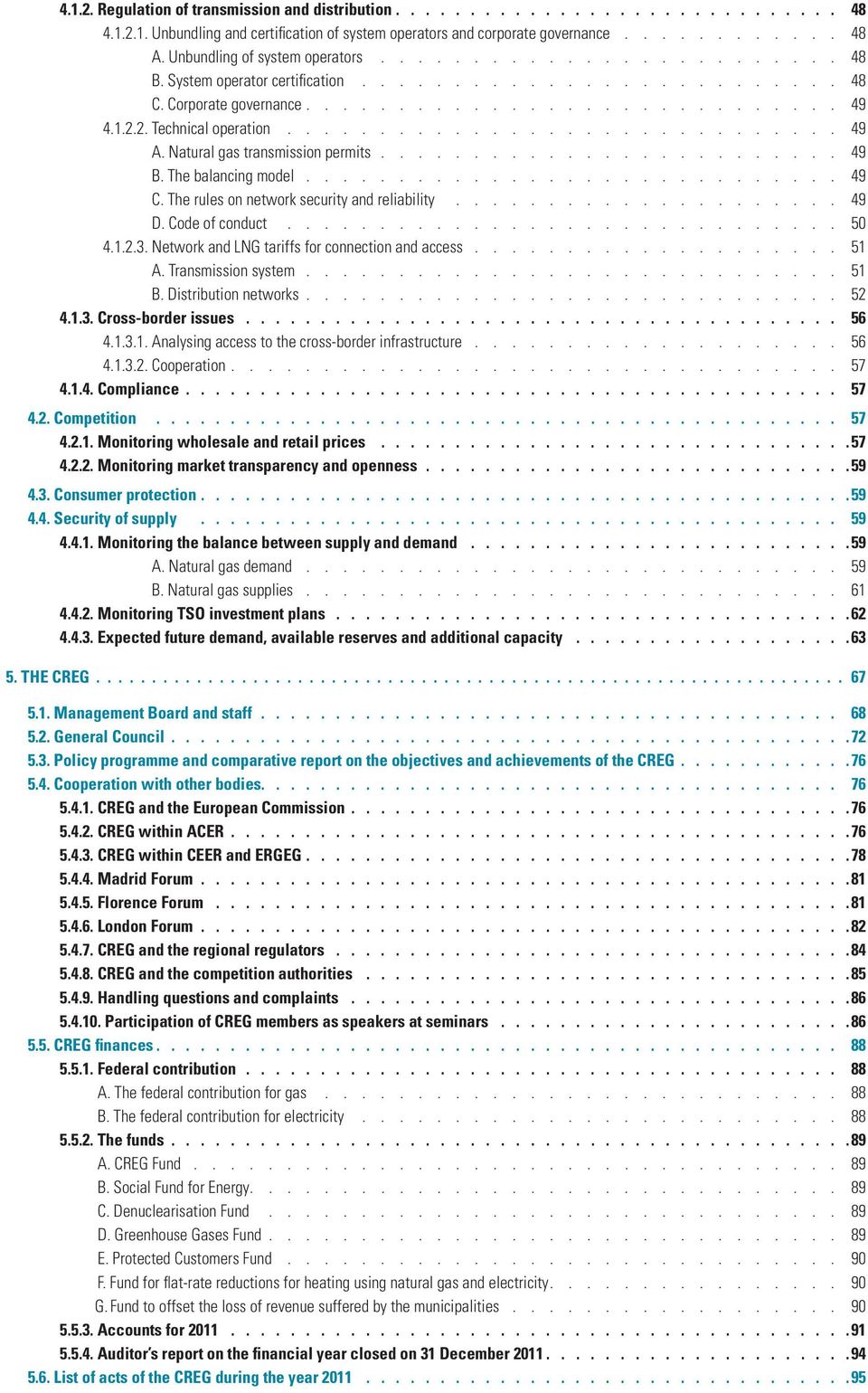
2 TABLE OF CONTENTS 1. FOREWORD THE MAIN LEGISLATIVE DEVELOPMENTS THE ELECTRICITY MARKET Regulation Power generation Permits for new generation facilities Offshore wind power generation A. Domain concessions for offshore wind power B. Green certificates and guarantees of origin C. Support measures in favour of green electricity Electricity supply Customers connected to the federal transmission system Price caps Indexation parameters Regulation of transmission and distribution Unbundling and certification of the TSO and corporate governance A. Unbundling of the TSO B. TSO certification C. Corporate governance Technical operation A. Connection and access B. Balancing and ancillary services C. Rules on grid security and reliability Network tariffs for connection and access A. Transmission system B. Distribution networks Cross-border issues Analysing access to cross-border infrastructure Cooperation (including capacity allocation procedures and congestion management) Compliance Competition Monitoring wholesale and retail prices Monitoring market transparency and openness Electrical power demand Wholesale generation market share Energy exchange REMIT Investigations with a view to promoting effective competition Consumer protection Security of supply Monitoring the balance between supply and demand Monitoring TSO investment plans A. The development plan B. Main future developments of the transmission grid Monitoring investments in generation capacity Operational security of the grid Investments in cross-border interconnection capacity Expected future supply and demand THE NATURAL GAS MARKET Regulation Natural gas supplies Natural gas supply permits Price caps Indexation parameters

3 Regulation of transmission and distribution Unbundling and certification of system operators and corporate governance A. Unbundling of system operators B. System operator certification C. Corporate governance Technical operation A. Natural gas transmission permits B. The balancing model C. The rules on network security and reliability D. Code of conduct Network and LNG tariffs for connection and access A. Transmission system B. Distribution networks Cross-border issues Analysing access to the cross-border infrastructure Cooperation Compliance Competition Monitoring wholesale and retail prices Monitoring market transparency and openness Consumer protection Security of supply Monitoring the balance between supply and demand A. Natural gas demand B. Natural gas supplies Monitoring TSO investment plans Expected future demand, available reserves and additional capacity THE CREG Management Board and staff General Council Policy programme and comparative report on the objectives and achievements of the CREG Cooperation with other bodies CREG and the European Commission CREG within ACER CREG within CEER and ERGEG Madrid Forum Florence Forum London Forum CREG and the regional regulators CREG and the competition authorities Handling questions and complaints Participation of CREG members as speakers at seminars CREG finances Federal contribution A. The federal contribution for gas B. The federal contribution for electricity The funds A. CREG Fund B. Social Fund for Energy C. Denuclearisation Fund D. Greenhouse Gases Fund E. Protected Customers Fund F. Fund for fl at-rate reductions for heating using natural gas and electricity G. Fund to offset the loss of revenue suffered by the municipalities Accounts for Auditor s report on the financial year closed on 31 December List of acts of the CREG during the year
4 LIST OF TABLES 1. Net supplies to customers connected to the federal transmission grid for the years 2008 to (Unweighted) average price of imbalances during the period Trend in the cost of Elia grid tariffs borne by MWh taken up Tariffs for the use of the distribution network for the years 2008 to 2011, excluding VAT Average import and export capacity and average nomination per year Annual revenues from capacities offered for auction Congestion rents on coupled electricity exchanges, per type of player Summary of the benefits granted to households via the free kwh system Wholesale market shares in electricity generation capacity Wholesale market shares in power generated Energy exchanged and average price on the Intraday exchange Breakdown of exchanges on the Day-Ahead hub Breakdown of exchanges on the Intraday hub Power demand and peak capacity demand in Belgium during the period Breakdown of the installed capacity per type of power plant connected to Elia s grid as at 31 December Breakdown of power generated per type of primary energy in Companies operating in the supply of natural gas on the Belgian market in Tariffs for the use of the distribution network for the years 2008 to 2011, excluding VAT Breakdown per sector of the Belgian demand for natural gas between 2001 and Directorates and staff of the CREG as at 31 December Members of the General Council as at 31 December Overview of presentations given by the CREG in Shortfalls recorded in the funds in Receipts and Payments Account as at 31 December Balance sheet as at 31 December LIST OF FIGURES 1. (Unweighted) average price of imbalances and Belpex DAM price during the period Average composition of distribution network cost in Flanders in 2011 for a Dc customer Average composition of distribution network cost in Wallonia in 2011 for a Dc customer Average composition of distribution network cost in Brussels in 2011 for a Dc customer Availability and use of interconnection capacity from 2008 to Trend in electricity prices per region for a Dc customer Trend in household customer indexes Trend in electricity price per region for an lc1 customer Average consumption on a monthly basis in the Elia control area from 2008 to Average prices on the Belpex, APX, EPEX FR and EPEX GE exchanges between 2007 and Average monthly market resilience of Belpex from 2008 to Average composition of the distribution system costs in Flanders in 2011 for a T2 customer Average composition of the distribution system costs in Wallonia in 2011 for a T2 customer Average composition of the distribution system costs in Brussels in 2001 for a T2 customer Trend in natural gas price per region for a T2 customer Trend in natural gas price per region for a T4 customer Development of natural gas consumption per sector during the period (1990 = 100), corrected for climate variations Breakdown per sector of the Belgian demand for H-gas and L-gas in 2010 and Breakdown of supply per entry zone in Composition of the aggregated supply portfolio of suppliers operating in Belgium in Composition of the aggregated supply portfolio for the Belgian market (shares in %) Market share of supply companies on the transmission grid in Forecast demand for natural gas in Belgium until

5 COMMISSION FOR ELECTRICITY AND GAS REGULATION ANNUAL REPORT 2011

6

7 1. Foreword The electricity and natural gas markets underwent a number of significant changes over the course of 2011 at both Belgian and European level. The new European legislation, laid down in the third Energy package, was transposed into Belgian law after a long and complex debate that began in the Federal Government in January and ended in the Parliament at the end of December. As it did in 2010, the CREG aimed to assist the Belgian authorities by offering them its view and putting forward texts that faithfully abide by and apply the provisions of the third package, while at the same time incorporating the comments made by the Council of State. The meticulous transposition of European law into our national legislation is vitally important. In May 2011, the Constitutional Court issued a ruling confirming that the CREG alone has the power to determine the methodology to be used to set the distribution tariffs. This provided confirmation from one of the highest courts in the land of the view upheld by the CREG for almost three years. The draft tariff decrees which should have been adopted as they were proposed by the CREG in 2008 have been amended in spite of European legislation and improperly adopted, incidentally resulting in tariff increases for electricity and gas consumers. This ruling highlights the risks linked to the imperfect transposition of the third package: in addition to the penalty which could again be imposed on Belgium by the European authorities in the event of the incorrect transposition of directives, further insecurity and instability would be created on the Belgian markets. A situation like this would be unfavourable for consumers, but also for electricity and gas companies. Last year was also marked by a major event: the Fukushima nuclear disaster. There is no doubt that the political authorities now view nuclear power differently. In Belgium, whereas in October 2009 some people were considering extending the lifespan of the nuclear power plants, it has been decided, in the agreement reached by the new government, to maintain the law on the withdrawal from the nuclear sector adopted in 2003 and to carry out stress tests that will determine over the next few months whether the nuclear reactors can continue to function and under what conditions. Leaving the nuclear sector raises the question, amongst others, of security of supply and future electricity prices. The CREG undertook a number of major studies on this subject and passed them on to the authorities in order to help them to attain the objectives set for the transition to other forms of energy as efficiently as possible. Fuel prices continued to rise in 2011, prompting an increase in the price of electricity and gas which are indexed on these fuels. The CREG carried out detailed analyses in this field which revealed that the indexation parameters used to set the price of the energy component in the bills sent to most household customers and SMEs are no longer representative and should be adapted by the electricity and gas suppliers, who are responsible for this. The CREG studies on the price components were used to determine the nature and importance of the elements that make up the final bill per category of consumer, per supplier and per distribution zone. Electricity and gas prices in Belgium were also compared with those in neighbouring countries. 3

8 1. Foreword Here again, the contributions made by the CREG helped clarify the situation for the authorities, enabling them to consider adopting measures relating to maximum prices. The CREG also made major contributions to the debate on the nuclear rent. Thanks to its studies, the existence of this rent was not only confirmed, but its amount was determined at a significant level. All this work resulted in the upward revision of the distribution contribution applied to this rent and the agreement of the Government, which is planning to place part of the power generated by depreciated nuclear power plants at the disposal of the electricity market. With its decisions approving the electricity and gas transmission tariffs proposed by Elia and Fluxys respectively for the period from 2012 to 2015, the CREG gives these two companies, the market and consumers visibility and stability with regard to tariffs for the next four years. A number of other studies, opinions and proposals were drawn up by the CREG over the course of It is worth mentioning in particular the publications on the cost of offshore wind power, the functioning of the Belgian wholesale electricity market, the calculation of the access capacity to the gas transmission system and the impact of photovoltaic solar panels on the price of electricity. Finally, the CREG responded in detail to requests for opinions from members of parliament concerning legislative proposals that they had filed with a view to extending the protection provided for domestic consumers and SMEs. Through these practical examples, the CREG demonstrates the crucial role that it plays within the liberalised electricity and gas markets, not only by acting as regulator, but also in the advice it is able to give to the public authorities. The European authorities have understood this and have included in the third package the reinforcement of the independence and the powers of the national regulators, proof of the essential role played by these bodies in improving the functioning of the electricity and gas markets. Readers of this report wishing to find out more about the measures taken and the results obtained by the CREG in 2011 in fulfilling each of its assignments are invited to consult the ad hoc report which is published on its website. In this way, the CREG intends to comply with the new legal provision concerning the publication, in total transparency, of the way in which it attained the objectives set out in its policy programme for the past year. François Possemiers Chairman of the Management Board April
9 2. The main legislative developments 5

10 2. The main legislative developments In terms of legislation, 2011 was the year of the EU s third energy package. The regulations making up this package came into force on 3 March 2011 and the directives 1 were to be transposed in the different member states by the same date. In Belgium, this transposition process fell so far behind schedule that the CREG was in some cases forced to apply the provisions of the directives having a direct effect. This primarily involved establishing the methodology used to set tariffs, which is discussed in detail in paragraph below. In 2010, the CREG carried out a series of studies proposing to modify the gas and electricity acts 2 in accordance with the new European regulations 3. However, the contents of these studies were only reflected to a very slight degree in the draft transposition bill which the government subsequently adopted and submitted to Parliament as a bill on 2 September Backed up by the critical opinion of the Council of State on this draft, the Management Board published an updated version of its previous studies in October Material for these updated studies, a copy of which was sent to the minister in charge and to the Commission on Economy of the Chamber, was supplied by regular exchanges of views with the regulators in other EU member states and the explanations provided by the representatives of the European Commission in various discussion forums. In these studies, proposed texts were put forward amongst other things to: - reinforce the independence and powers of the CREG, amongst other things with regard to the conditions governing connection and access to the networks (in terms of both tariffs and technical aspects); - establish a legal footing for the cooperation with the new European agency ACER 5 ; - continue the separation of activities linked to the production and supply of energy and network activities (unbundling) and work out a procedure for the certification of system operators by the regulator; - make use of the possibility provided for in the directives for member states to plan specific regulations for closed distribution networks in national legislation, in this case in the form of particular regulations for closed industrial networks. Having examined the bill, the Commission on Economy of the Chamber organised a series of hearings to which the CREG was also invited. The CREG took this opportunity to set out its objections to the bill and again draw attention to the risks inherent in transposing European directives incorrectly. In addition to a(nother) conviction by the EU Court of Justice, the Belgian legislator also risks creating an additional source of legal uncertainty and instability on the Belgian markets, whereas in fact its stated aim was precisely to overcome the existing instability. Finally, the bill was approved, without any major amendments, on 15 December 2011 in the Chamber of Representatives and on 22 December 2011 in the Senate, and was not published until The general date of entry into force is set for 21 January It should be pointed out that, generally speaking, the law does not settle the fate of the existing implementing decrees, even when these decrees do not derive a sufficient legal foundation from the amended law. Yet the CREG had underlined the importance of this issue in its studies. The legal basis of the existing implementing decrees can equally be threatened because the provision in question in the Gas Act or the Electricity Act is wrongly not brought into line with the third package (in other words, when a necessary amendment has not been made). This is the case in particular with the technical regulations 7 and the code of conduct 8. 1 Directive 2009/73/EC of the European Parliament and of the Council of 13 July 2009 on joint rules for the natural gas internal market, repealing Directive 2003/55/EC and Directive /EC of the European Parliament and of the Council of 13 July 2009 on joint rules for the electricity internal market, repealing Directive 2003/54/EC. 2 Act of 29 April 1999 on the organisation of the electricity market and the act of 12 April 1965 on the transmission of gaseous and other substances by pipeline Annual Report, paragraph 2.7, p Studies (F) CDC-1111 and (F) FCF Agency for the Cooperation of Energy Regulators 6 Act of 8 January 2012 amending the act of 29 April 1999 on the organisation of the electricity market and the act of 12 April 1965 on the transmission of gaseous and other substances by pipeline (Belgian Official Journal of 11 January 2012). 7 Royal Decree of 19 December 2002 establishing the technical regulations for the management of the electricity transmission system and access to this system. 8 Royal Decree of 23 December 2010 on the code of conduct on access to the natural gas transmission system, the natural gas storage facility and the LNG facility and amending the Royal Decree of 12 June 2001 on the general terms and conditions for the supply of gas and the conditions for granting natural gas supply permits (Belgian Official Journal of 5 January 2011). 6

11 3. The electricity market

12 3. The electricity market 3.1. Regulation Power generation Permits for new generation facilities The regulatory framework The construction of new power generation facilities is subject to the prior granting of an individual permit issued by the Minister for Energy at the proposal of the CREG. The Royal Decree of 11 October 2000 on the granting of individual permits covering the establishment of power generation facilities was amended, following an opinion from the Management Board 9, by the Royal Decree of 5 August in order to transpose Article 33 of Directive 2009/31/EC 11. Applications submitted to the CREG In 2011 the Management Board published four proposals 12 relating to the granting of a generating permit. These involved applications from Greensky for the construction of a wind farm along the E40 near Hannut, Nest-Energie for the construction of two CCGT plants on the Evergem site, Eneco for the construction of two CCGT plants and one peak unit on the Beringen site and Electrabel for the conversion of an existing plant in Amercoeur into a CCGT plant. As at 31 December 2011, one application for an individual generating permit was still being processed by the CREG. In 2011, the Minister granted permits for the extension of a wind farm in Mettet/Fosses-la-Ville by Electricité du Bois du Prince 13 and for the construction of a cogeneration plant in Langerbrugge (Ghent) by Stora Enso Langerbrugge 14, for which the Management Board had issued proposals in , as well as for the projects of Nest-Energie 16, Eneco 17, Greensky 18 and Electrabel 19, bringing the additional authorised generation capacity in 2011 to around 2,350 MW. In addition to the applications for new generating permits, the Management Board received three notifications of a change in control from Zandvliet Power, Dils Energie and T-Power. The Management Board has already sent a proposal 20 concerning the notification from Zandvliet Power to the Ministry for Energy. The notifications from Dils Energie and T-Power were still being processed as at 31 December Offshore wind power generation A. Domain concessions for offshore wind power The regulatory framework The procedure relating to the granting of the domain concession for the most northerly zone, which is situated above the Blighbank zone and which was suspended following a communication published in the Belgian Official Journal of 26 February 2010, was reopened following the publication of the Royal Decree of 3 February modifying the coordinates of the zone intended for the installation of wind turbines in the North Sea 21. Further to the Council of State ruling of 3 February suspending the Ministerial Decree of 24 March 2010 granting the joint venture SEASTAR a domain concession for the construction and operation of a wind farm, the minister withdrew this decree (and therefore the domain concession granted to the joint venture SEASTAR) in a Ministerial Decree of 6 April In the decree announcing the withdrawal, the minister expressly asks the CREG to put forward a new opinion on the applications submitted by the joint venture SEASTAR, the joint venture Electrabel-Jan De Nul, Evelop Belgium and Electrastar, in accordance with Articles 9 and 10 of the Royal Decree of 20 December 2000, as they were in force at the time it was to render its original opinion. 8 9 The Management Board issued a positive opinion on this matter by letter. 10 Royal Decree of 5 August 2011 amending the Royal Decree of 11 October 2000 on the granting of individual permits covering the establishment of electricity generating facilities (Belgian Offi cial Journal of 22 August 2011). 11 Directive 2009/31/EC of the European Parliament and of the Council of 23 April 2009 on the geological storage of carbon dioxide, amending Directive 85/337/EEC of the Council, Directives 2000/60/EC, 2001/80/EC, 2004/35/EC, 2006/12/EC and Regulation (EC) No 1013/2006 of the European Parliament and of the Council. 12 Proposals (E) CDC-1059, (E) CDC-1067, (E) CDC-1068 and (E) CDC Ministerial Decree of 14 February 2011 (Belgian Official Journal of 21 February 2011). 14 Ministerial Decree of 18 February 2011 (Belgian Official Journal of 28 February 2011). 15 Proposals (E) CDC-1023 and (E) CDC Ministerial Decree of 1 August 2011 (Belgian Official Journal of 9 August 2011). 17 Ministerial Decree of 10 August 2011 (Belgian Official Journal of 23 August 2011). 18 Ministerial Decree of 30 August 2011 (Belgian Official Journal of 8 September 2011). 19 Ministerial Decree of 7 September 2011 (Belgian Official Journal of 16 September 2011). 20 Proposal (E) CDC Royal Decree of 3 February 2011 amending the Royal Decree of 20 December 2000 on the conditions and procedure for granting domain concessions for the construction and operation of electricity generation facilities using water, currents or wind, in marine areas over which Belgium can exercise its jurisdiction in accordance with the international law of the sea (Belgian Offi cial Journal of 17 February 2011). 22 Council of State, decree No Ministerial Decree of 6 April 2011 withdrawing the Ministerial Decree of 24 March 2010 granting to the joint venture SEASTAR a domain concession for the construction and operation of electricity generation facilities using wind in marine areas located between the Bank zonder Naam and Blighbank (Belgian Official Journal of 22 April 2011).
13 3. The electricity market Applications submitted to the CREG On 18 October 2011, the CREG received a request from the Energy Authority to express an opinion on the application from Northwind (previously known as Eldepasco) to modify the domain concession granted by Ministerial Decree of 15 May 2006 and amended by Ministerial Decree of 24 March Northwind is planning to correct the longitudinal coordinate of a border point of the concession zone and to move the transformation platform. Having analysed the dossier, the Management Board notes that the correction of the longitudinal coordinate of the border point involves rectifying a material error and that moving the transformation platform constitutes a marginal modification which does not impact on the basic characteristics of the project and which is even beneficial for the quality of the project. Consequently, the Management Board issued a positive opinion 24 on the modifications proposed by Northwind. On 13 July 2011, the CREG received a request for an opinion from the Energy Administration on the applications from Electrastar, the joint venture Mermaid and Nortwester 2 with a view to obtaining a domain concession above the Blighbank. In its opinion 25, the Management Board covered the six criteria for granting concessions and commented on these. With regard to the quality of the projects from a technical point of view, the Management Board wonders whether the project proposed by one of the applicants fulfils this granting criterion in technical terms as the project could use the zone more efficiently. B. Green certificates and guarantees of origin In March 2009, the Management Board approved a proposal for a royal decree aimed at introducing a federal system of guarantees of origin for electricity generated by offshore wind farms 26. In May 2010, the Management Board approved a proposal for a royal decree clarifying the method used to measure and calculate net green electricity generation 27. In 2011, the Minister for Energy asked the CREG to provide another global proposal replacing the two previous proposals. The CREG issued a new proposal 28 on 17 February In addition to introducing a system of guarantees of origin and adapting the method used to calculate green electricity, this proposal also included the abolition of the obligation to purchase green certificates for electricity generated using onshore renewable energy sources and the possibility of reviewing the minimum prices on the basis of the terms and conditions of connection and profitability assessments. Finally, in 2011 the Management Board also took a decision 29 on the application from Belwind to grant green certificates for the offshore wind turbines installed on the Blighbank. This is the final principle decision for the first phase of the Belwind project setting, amongst other things, the date as of which the wind turbine satisfies the conditions for obtaining green certificates. The installed capacity in offshore wind turbines remained unchanged in 2011, amounting to a total of MW or 30.9 MW for the six C-Power wind turbines that had already been constructed in 2009 and 165 MW for the 55 wind turbines constructed by Belwind in Finally, in 2011 the two offshore wind farms together generated a net quantity of 706,466 MWh, for which green certificates worth 75,591,860 were granted between February 2011 and January Finally, in December 2011 the Management Board drafted a proposal 30 on the calculation of the surcharge intended to offset the net real costs borne by the TSO and resulting from the obligation to buy and sell green certificates in On the basis of the limited gross quantity of energy included in the tariffs proposal from the TSO, the Management Board proposed setting the surcharge at 1.080/MWh for This proposed amount was 38 % higher than the amount of the surcharge for The main reason for this increase may be attributed to the gradual rise over the course of 2012 in the installed capacity of the C- Power farm from 30.9 MW to MW. This amount was laid down in the Ministerial Decree of 23 December Opinion (A) CDC Opinion (A) CDC Annual Report, paragraph , p Annual Report., paragraph C, p Proposal (C) CDC Decision (B) CDC Proposal (C) CDC Ministerial Decree of 23 December 2011 setting the surcharge to be applied by the system operator to offset the real net cost resulting from the obligation to buy and sell green certificates in 2012 (Belgian Official Journal of 28 December 2011). 9
14 3. The electricity market C. Support measures in favour of green electricity Study on the cost analysis and the calculation of the nonprofitable portion for offshore wind farms in Belgium In this study 32, which was carried out further to the study 33 of the various support mechanisms for green electricity in Belgium, the Management Board examines the federal minimum price of offshore wind energy. In order to promote the generation of renewable energy at sea, a system of granting green certificates has been set up at federal level. The Royal Decree of 16 July set the following minimum purchase prices for offshore wind energy: 107/MWh for electricity generated by plants covered by a domain concession for generation resulting from the first 216 MW installed; 90/MWh for generation resulting from an installed capacity in excess of the first 216 MW. The average value of green certificates amounts to /MWh for facilities generating 300 MW. The assumptions and calculation method used for the minimum prices given above are as yet unknown to the Management Board. Neither the Minister for Energy nor the operators of offshore facilities can provide an answer to this. That is why the Management Board has attempted to reconstruct this average minimum purchase price. This was done on the basis of international studies and input on the costs and revenues of current Belgian offshore operators. On the basis of these assumptions, the non-profitable portion amounts to /MWh, which represents a return of 12 % on equity. The current offshore facilities are established using project financing. This form of financing entails that the same risks (i.e. cash flow generation) are covered by the banks, the shareholders and the insurers. This type of risk cover, but from three individual angles, gives rise to costs that may compensate the same risk several times. One solution is to opt in favour of a different form of financing (balancesheet financing or the use of a fund fed by the tax on nuclear power) or a reduction in the total investment amount so as to lessen the risk borne by shareholders and banks. This is possible by concentrating the electricity infrastructure (submarine cables and electrical installations) with a single regulated system operator for all offshore facilities. The Management Board also questions the current lifespan of offshore facilities. If the facilities remain operational for over 20 years thanks to regular maintenance, the operator will receive additional revenue leading to a lower minimum price or non-profitable portion. The Royal Decree of 20 December also stipulates a maximum lifespan of 30 years. Finally, the Management Board illustrates the possible impact of a number of scenarios on the non-profitable portion. If the seven concession holders together establish an optimal basic electrical infrastructure (which would be transferred to a regulated market participant after 20 years), the non-profitable portion would be 96.99/MWh. A 5 % fall in the CAPEX and a lower OPEX after 16 years brings the non-profitable portion down to 91.21/MWh. If the dismantling provision is abolished and the concession is extended to 30 years, the non-profitable portion would become 83.68/MWh. Study on the impact of photovoltaic solar panels on the electricity price in Belgium. In the discussion on the cost of subsidising solar panels, the argument that solar panels bring down price peaks on the electricity market is put forward. This study 36 assesses the average fall in the price of the Belpex DAM further to the installation of solar panels. The calculations are carried out with an installed capacity of 800 MW. In addition, the impact for Belgian consumers is estimated. A comparison is then made with the subsidising of another technology, i.e. a combined cycle gas turbine (CCGT). This study shows that % of the cost of subsidising solar panels could be recovered by the consumer by means of a reduction in the electricity price. With a CCGT plant, 609 % of the subsidy costs could be recovered by the consumer, or a recovery rate 25 to 32 times higher than that for solar panels. It should be noted that the value of this study is mainly due to the relative impact of solar panels compared with a CCGT plant, and not so much to the absolute value of the cost recovery level Study (F) CDC Study (F) CDC Royal Decree of 16 July 2002 establishing the mechanisms aimed at promoting electricity generated using renewable energy sources. 35 Royal Decree of 20 December 2000 on the conditions and procedure for granting domain concessions for the construction and operation of electricity generation facilities using water, currents or wind in marine areas over which Belgium has jurisdiction in accordance with the international law of the sea. 36 Study (F) CDC-1062.

15 3. The electricity market Electricity supply Customers connected to the federal transmission system Table 1 shows the market shares of Electrabel and the other suppliers as regards net electricity supplies 37 to major industrial customers connected to the federal transmission system (grids with voltage levels higher than 70 kv). According to an initial estimate, Electrabel s market share amounted to approximately 90.2 % in 2011, up approximately 1.5 % compared with The total volume of energy offtake by end customers from the transmission system fell from 13,741 GWh in 2010 to 12,957.6 GWh in No access points on the transmission grid changed supplier in Over the course of the year 2011, the Minister issued permits to Essent Belgium, Enovos Luxembourg, E.ON Trading, EGL France & Benelux, GDF Suez Trading, Total Gas and Power Limited, Société Européene de Gestion de l Energie, ArcelorMittal Energy and Eneco België 39. As at 31 December 2011, twenty suppliers held a federal permit to supply electricity to customers connected to the transmission system: Anode, ArcelorMittal Energy, Duferco Energia, EGL France & Benelux, Electrabel, Eneco België, Enovos Luxembourg, E.ON Belgium, E.ON Energy Sales, E.ON Energy Trading, Essent Belgium, Essent Energy Trading, GDF Suez Trading, Nuon Belgium, Pfalzwerke, RWE Energy Belgium, RWE Supply & Trading, Société Européenne de Gestion de l Energie, SPE and Total Gas & Power. Table 1: Net supplies to customers connected to the federal transmission grid for the years 2008 to 2011 Suppliers Consumption sites 1 January 2011 Consumption sites 31 December 2011 Power offtake in 2008 (GWh) Power offtake in 2009 (GWh) Power offtake in 2010 (GWh) Power offtake in 2011 (GWh) Electrabel S.A ,470.3 (84.0 %) 2,183.3 (16.0 %) 10,806.5 (87.6 %) 1,526.3 (12.4 %) 12,162.7 (88.7 %) 1,551.2 (11.3 %) 11,693.1 (90.2 %) 1,264.5 (9.8 %) Other suppliers Total 81* 81* 13, , , ,957.6 * Four consumption sites were supplied by two suppliers simultaneously Source : ELIA (provisional data, January 2012) The federal supply permits for electricity are granted by the Minister for Energy at the proposal of the CREG for a five-year period. In 2011, the Management Board received permit applications from EGL France & Benelux, Total Gas and Power Limited (which was rejected), GDF Suez Trading (formerly Gaselys), Total Gas and Power Limited (which was accepted), the Société Européenne de Gestion de l Energie, Eneco België, ArcelorMittal Energy and Energie I&V België. The Management Board therefore issued a total of seven proposals 38 over the course of the year One proposal concerns the application from E.ON Energy Trading, which was submitted at the end of As at 31 December 2011, one application for a federal supply permit was still being examined by the CREG Price caps A system of maximum prices has been implemented in Belgium for two categories of end customers: protected end customers and unprotected end customers whose contract has been terminated by their supplier. The DSOs ensure supplies to unprotected end customers whose supply contract has been terminated by their supplier at the maximum price set as follows: energy price + transmission tariff + distribution tariff + margin 40. The DSO uses the tariff data from those suppliers with a minimum share of 3 % operating in its distribution zone. All calculations include the suppliers who deliver to at least 90 % of household access points. 37 These figures do not take into account the energy supplied directly by local generation or customers located in the Grand Duchy of Luxembourg. 38 Proposals (E) CDC-1038 (E.ON Energy Trading), (E) CDC-1057 (EGL France & Benelux), (E) CDC-1090 (GDF Suez Trading), (E) CDC-1094 (Total Gas and Power Limited), (E) CDC-1095 (Société Européenne de Gestion de l Energie), (E) CDC-1115 (Eneco België) and (E) CDC-1117 (ArcelorMittal Energy). 39 Ministerial Decrees of 1 February 2011 on Essent Belgium (Belgian Official Journal of 11 February 2011), 1 February 2011 on Enovos Luxembourg (Belgian Offi cial Journal of 11 February 2011), 18 March 2011 on E.ON Energy Trading, 8 June 2011 on EGL France & Benelux, 25 August 2011 on GDF Suez Trading, 15 September 2011 on Total Gas and Power Limited (Belgian Offi cial Journal of 23 January 2011), 15 September 2011 on the Société Européenne de Gestion de l Energie, 28 November 2011 on ArcelorMittal Energy (Belgian Offi cial Journal of 23 January 2012) and 1 December 2011 on Eneco België (Belgian Official Journal of 23 January 2012). 40 Ministerial Decrees of 1 June 2004 (electricity) and 15 February 2005 (natural gas). 11

16 3. The electricity market Each DSO with unprotected end customers whose contracts have been terminated sends the CREG the tariffs applicable to these customers for a six-monthly period by the end of June and the end of December at the latest. These tariffs are set using a standardised calculation method established by the CREG in 2010 on the basis of decisions taken by the Management Board 41 in application of the Ministerial Decrees of 1 June 2004 and 15 February This standardisation of the calculation method became necessary due to the huge disparity encountered until 2010 in the benchmark tariffs and calculation methods used by the DSOs. The DSO and/or the supplier are also charged with supplying protected end customers at a maximum price set by the CREG which is valid for a period of six months 42. The supplier is compensated for the obligation to supply at regular tariffs. The DSO s margin is an amount which is added to the sum of the energy, transmission and distribution components, if this sum is lower than the average of the price announced for a category of similar customers of suppliers in the distribution zone of the DSO. In this case, the margin is equal to the difference between this average and the sum of the first three parts of the price capping mechanism. In all other cases the margin is zero. Study on the draft legal text for the safety net against unjustified fluctuations in energy prices In this study 43, conducted in May 2011, the Management Board sets out its comments on the Draft legal text for the safety net against unjustified fluctuations in energy prices sent to it by the minister in a letter dated 8 April On 18 March 2011, the Council of Ministers decided to approve the introduction of the safety net regulation mechanism on the Belgian energy market. This means that in future energy suppliers will have to submit to monitoring by the CREG of adjustments to energy prices and modifications of price formulas for households and SMEs with a view to protecting end customers from unreasonable price rises. The aforementioned announcement by the Council of Ministers clearly refers to the safety net regulation mechanism used in the Netherlands. However, a first reading of the draft text reveals that there are fundamental differences between the Dutch interpretation and the interpretation proposed in the draft Belgian legislation. In the Netherlands, all the new tariffs are grouped together under the same denominator and no distinction is made between indexations and other price rises. Also in the Netherlands, an increase in a tariff is not examined, but each new tariff is dealt with individually as it is highly likely that certain contracts containing old tariffs continue to exist for a certain period of time. Only the national regulator is competent for all regulation of the safety net and an ex ante approach is adopted (rather than an ex post approach, as in the Belgian draft text). Finally, the Energiekamer in the Netherlands not only monitors the proper application of the formulas but also checks that the content and composition of the tariffs proposed are complete. These five points mean that should the draft legal text be approved, it would be very difficult to compare the Belgian mechanism with the Dutch system and reference to the latter would no longer be relevant. In conclusion, the Management Board asserts that the draft text offers suppliers a guarantee that no price rise will be refused, that the draft text pointlessly involves the National Bank of Belgium and the Institute of Registered Auditors in the regulation of the safety net, and that the draft text would do better to apply the ex ante principle and assess the amount of the tariffs rather than the increase in tariffs. Finally, the draft text merely creates the illusion that the CREG monitors tariffs and is more of a safety net for suppliers than for consumers Indexation parameters The Management Board calculates the electricity price indexation parameters (Nc and Ne) with a view to checking and comparing them with the other parameters used by electricity suppliers. It has stopped publishing these parameters since April 2011, as it felt that the elements needed to calculate these parameters no longer adequately reflected the real costs. Further to its study 44 on the quality of the Nc parameter, the Management Board decided to analyse the representative nature of the parameters used by Ebem. This study 45 comprises two parts: the first part describes the parameters used and the tariff formulas proposed by Ebem to its customers. The second part describes the analyses undertaken in order to assess the representative nature of the END parameter and the tariff formulas. These analyses led to the following conclusions. First of all, the analysis of Ebem s current supply portfolio shows that the END parameter applied by the supplier in its tariff formula is representative of the supply: it guarantees both an excellent correlation with the energy cost borne by Ebem and transparency with regard to the contractual terms and conditions of purchase. Moreover, the comparison made Decisions (B) CDC-964 (electricity) and (B) CDC-965 (natural gas). 42 Ministerial Decrees of 30 March Study (F) CDC Study (F) CDC Study (F) CDC-1047.
17 3. The electricity market between the costs (supply costs and general costs) and tariff receipts (determined in accordance with the Ebem tariff formulas based on the END and Ne parameters) made it possible to assess the margin produced and shows that the tariff method currently applied by Ebem does not generate an excessive profit and that the structure of the tariff formula is closely linked to the structure of the costs borne by the supplier Regulation of transmission and distribution Unbundling and certification of the TSO and corporate governance A. Unbundling of the TSO The new rules on the unbundling of TSOs are one of the main pillars of the third European energy package. Given that the rules on unbundling contained in the previous European gas and electricity directives did not give rise to the effective unbundling of TSOs, new, more elaborate rules have been laid down in the third European energy package for the actual separation of grid activities on the one hand and generation and supply activities on the other (unbundling) with a view to preventing the risk of conflicts of interest and discriminatory behaviour in terms of grid operation, promoting the investments made in grid infrastructures in a non-discriminatory manner and ensuring fair access to the grid for newcomers and market transparency. To this end, a number of unbundling models have been provided for in the directives in the third package: firstly, the ownership unbundling model, as a starting point, and, as departures therefrom, the so-called ISO system (Independent System Operator) and the ITO system (Independent Transmission Operator), with the possibility of a specific exemption, the so-called ITO+ system. When transposing the provisions of this directive, the Belgian legislator chose, both for the management of the electricity transmission system and for that of natural gas, to adopt ownership unbundling as the only unbundling model in Belgian legislation. As far as Elia and Fluxys are concerned, there was de facto no other option than the ownership unbundling model at the time the law was transposed. In 2010, the CREG had already made an initial series of proposals for the transposition of the provisions in the directive on unbundling and certification by putting forward draft texts amending the current Electricity Act 46. In 2011, the CREG published an updated version of these studies 47 further, amongst other things, to the opinion from the Council of State on the draft bill. When participating in the hearings in Parliament organised by the Commission on Economy of the Chamber in the autumn of 2011, the CREG also made a series of comments and criticisms concerning the proposed articles of law on the subject of unbundling and the certification of TSOs included in the bill submitted for discussion. See section 2 of this report on this topic. B. TSO certification The new unbundling rules in the third European energy package also include the requirement for TSOs to be certified by the national regulator. These new rules stipulate, amongst other things, that the companies that own a transmission grid must be certified by the national regulatory authority as complying with the unbundling requirements before they can be appointed as TSOs by the member states. This new certification system also involves permanent monitoring by the national regulator to ensure that the unbundling requirements continue to be observed by the TSOs. This is a major new assignment for the CREG in its capacity as national regulatory authority, which is also covered by the aforementioned transposition legislation of 8 January With regard to this new certification system, in September 2011 the European Commission published a working paper containing the practical guidelines on the way in which it is to deal with notifications of draft decisions on certification which are submitted to it for an opinion by the national regulators 48. At European level, the CREG participated actively in various joint CEER-EC working groups in 2011 with a view to discussing questions and problems raised in terms of the interpretation and practical application of the criteria and the certification procedures contained in the articles of the directive. In the autumn of 2011, at the initiative of the CREG, informal discussions had already been started with the current TSO, Elia, in preparation for the formal certification which will have to take place once the Belgian transposition legislation comes into force in Annual Report, paragraph 2.7, p Studies (F) CDC-1111 and (F) CDC Commission staff working paper on certification of Transmission System Operators of networks for electricity and natural gas in the European Union, 21 September
18 3. The electricity market C. Corporate governance The CREG examined and commented on the activities report from the Elia corporate governance committee for 2010 (monitoring the application of Articles 9 and 9ter of the Electricity Act and assessing its effectiveness with regard to the requirements of independence and impartiality of the TSO). In 2011, the Management Board issued binding opinions 49 on the appointment of an independent administrator to Elia and the renewal of the appointments of seven independent administrators within Elia. Moreover, in 2011 it also issued binding opinions 50 on the renewal of the mandate of Elia s two auditors. The report from the Compliance Officer describing the measures taken by Elia in 2010 to ensure that all discriminatory practices are ruled out and to provide an appropriate monitoring of the programme of commitments as laid out by Article 8, 2 of the Electricity Act, was examined by the Management Board, which did not have any observations to make on this matter Technical operation A. Connection and access As regards the Access Responsible Parties contracts and access contracts, the Management Board refused to approve two proposed modifications to the general terms and conditions of these contracts as they concerned questions covered in the tariffs proposal which was still being examined by the Management Board when the decision was taken 51. Announcing a decision on these two proposals to modify the general terms and conditions of Access Responsible Party contracts and access contracts within the deadline set by law would have been to prejudge the assessment authority of the Management Board in the context of this tariffs proposal. Once the tariffs proposal had been approved, Elia again submitted proposals to modify the general terms and conditions of these contracts at the end of December and they were approved by the Management Board in early January so as to enter into force on 1 January B. Balancing and ancillary services Reserve capacity Elia has to assess and determine the primary, secondary and tertiary reserve capacity that contributes towards ensuring the security, reliability and efficiency of the transmission grid in the control area. It has an obligation to submit its assessment method and the results obtained by this method to the CREG for approval. In May 2011, the Management Board approved the proposal put forward by Elia concerning the method used to assess the primary, secondary and tertiary reserve capacity and the result of applying this method for However, the Management Board did add a number of considerations to this decision concerning, amongst other things, the improvement of the new assessment method proposed, the need to gather other information to make better use of this method, the need for Elia to have volumes in line with the decisions taken by the CREG throughout the year, the need for Elia to have data on all intermittent generation in Belgium, including that injected into the networks of the DSOs, the international extension of the activation of certain reserves, the participation of the nuclear plants and industrial customers in the reserves and the need to monitor the quality of the adjustment in the zone further to the implementation of the new method of assessing the volumes needed. Bids and volumes for ancillary services offered by service providers On 19 April 2011, the Management Board received the Elia report on the bids for ancillary services for The ancillary services concerned include the primary, secondary and tertiary adjustment capacity, voltage adjustment (partially) and active losses in Elia s grid with a voltage of less than or equal to 70 kv. The other ancillary services will still be covered by multi-annual contracts in Opinions (A) CDC-1044 and (A) CDC-1080 to Opinions (A) CDC-1065 and (A) CDC Decisions (B)11110-CDC-1125 and (B) CDC Decisions (B) CDC-1135 and (B) CDC Decision (B) CDC-1056.

19 3. The electricity market On the basis of this report, in October 2011 the Management Board expressed an own-initiative opinion 54 and sent it to the Minister for Energy and to Elia. In this opinion, the Management Board points out that the volumes offered for the primary adjustment capacity of the frequency, the adjustment capacity of the balance in the zone and the tertiary reserve are inadequate compared with the volumes approved in the decision referred to above taken in May A development of the method used to value the reservation of primary and secondary reserves is also proposed and applied. The Management Board mentions that it is not possible to state on the basis of the analyses that it conducted for the purpose of the opinion that the prices offered for the primary, secondary and tertiary reserves are blatantly unreasonable. It adds, however, that it will organise annual ex post monitoring in order to check that the new method does not lead to a drift in reservation prices. Moreover, should a move be made, as in 2009, towards a ministerial decree to determine the distribution of volumes and prices, the opinion puts forward a number of guidelines for the distribution of volumes and makes some suggestions on price determination. Finally, the Management Board notes that other developments are needed to promote the emergence in Belgium of a sufficiently liquid reserves market and suggests a number of avenues that could be followed in this area. Balancing The TSO is responsible for monitoring, maintaining and, if need be, re-establishing the balance between supply and demand for electrical power in the control area, amongst other things further to any individual imbalances caused by the various Access Responsible Parties. Elia has to submit a proposal for market operating rules intended to offset any 15-minute imbalances to the CREG for approval. In December 2011, the Management Board approved the proposal from Elia for The proposed mechanism came into force on 1 January Activated volumes and concentration 57 In 2011, activations to offset imbalances in the control area rose by 23.0 % compared with 2010 to reach 1,110 GWh. The share of the secondary reserves in these activations amounted to 67.3 % in 2011, compared with 76.0 % in 2010 and 95.2 % in This fall is due in particular to the fact that most of the increase in activations in 2011 must be attributed to incremental and decremental bids, which increased by 76.3 % compared with In 2011, the activation of reserves located abroad by the TSOs accounted for 2.6 % of Elia s activations to offset imbalances in the control area, compared with 1.6 % in In terms of volume, this represents an increase of 100 % compared with The HHI index relating to secondary and tertiary reserves on generating units amounted to 4,510 in 2011, compared with 3,750 in 2010 and 5,800 in Activations relating to these resources accounted for 97.3 % of the total energy activated in 2011 to offset imbalances in the control area, whereas they accounted for 97.9 % in 2010 and 99.0 % in The increase in the HHI index can be explained by the rise in the relative participation of Electrabel and the relative fall in the participation of other players, despite the entry onto the production reserves market of two new players, RWE and T-Power. Price of energy to offset imbalances The imbalance tariff is based on a two-price system taking into account the direction of the imbalance of the Access Responsible Party and the direction of the imbalance in the control area. The table below provides an overview of the trend in the tariff (unweighted) for positive imbalances (injection > offtake) and the average tariff (unweighted) for negative imbalances (injection < offtake) for the period from 2007 to Opinion (A) CDC Decision (B) CDC Decision (B) CDC Source: Elia data. 15
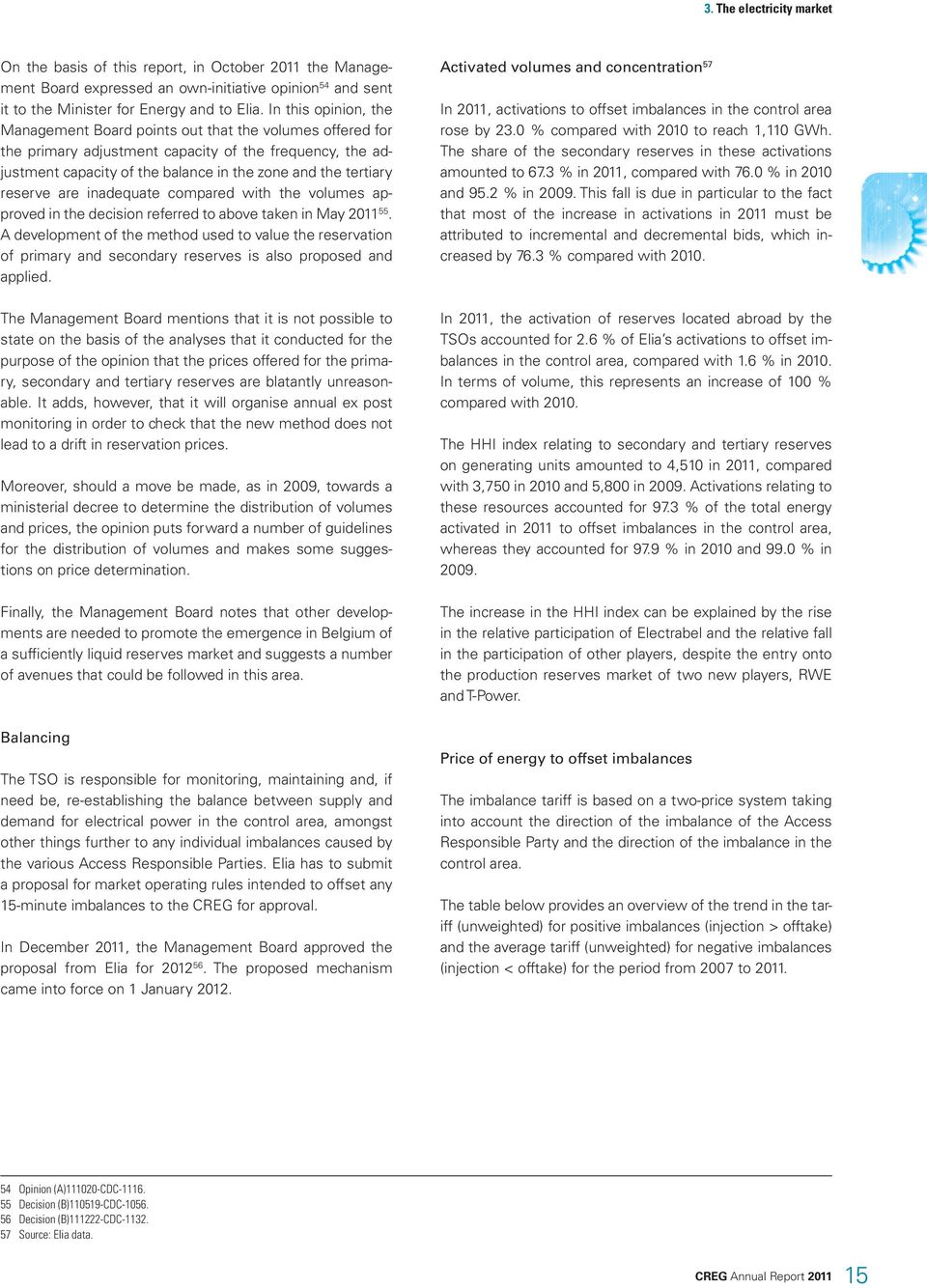
20 3. The electricity market Table 2: (Unweighted) average price of imbalances during the period /MWh Injection > offtake Injection < offtake Source : Elia data Figure 1 : (Unweighted) average price of imbalances and Belpex DAM price during the period (in /MWh) Injection > offtake Injection < offtake Belpex Source : Elia and Belpex data Figure 1 above can be used to compare these average prices with the trend in average prices on the Belpex Day- Ahead market over the same period. It may be observed that in 2011, compared with 2010, the average tariffs for negative imbalances rose more quickly than the average price of the Belpex DAM, unlike the average tariffs for positive imbalances. C. Rules on grid security and reliability Over the course of 2011, the CREG took various initiatives concerning the security and reliability of the grid. Amongst other things, this involved contacts with Elia on power supplies during a black-out of the Tihange nuclear power plant. The CREG also asked Elia and Fluxys to analyse the interdependence risks between the electricity and gas transmission systems. In fact, the planned introduction of electrical compressors on the gas transmission network is likely to create interdependence between the gas and electricity transmission systems. The CREG therefore asked the gas and electricity TSOs to examine and avert this risk in a blackout situation. The CREG asked Elia to draw up a plan for the management of electricity shortages together with the competent authorities. This plan must make it possible to cope with foreseeable disruption of the generation or transmission of electricity. Elia informed the CREG of the progress of its work. Elia sent a new version of the reconstruction plan to the CREG for consultation on 8 December In its opinion 58, the Management Board notes an improvement in the structuring and the form of the documents which is likely to optimise the procedures implemented to deal with a crisis. The Management Board mentions a number of approaches for improving the organisation of the reconstruction plan Opinion (A) CDC1071.
21 3. The electricity market Network tariffs for connection and access A. Transmission system a) Tariff methodology The third European electricity directive clearly allocates competence relating to the transmission tariff methodology and approval to the regulator. In Belgium, the CREG can therefore no longer be required to submit a tariff method to the King for this to be confirmed by a Royal Decree. The provisions on tariffs which were still officially in force until the entry into force of the transposition legislation of 8 January 2012 have therefore become contrary to European law since the expiry of the transposition period on 3 March 2011 and to the extent that they determine the tariff method. On the one hand, the CREG is obliged to take into account in its decisions Belgian legislation existing when the decision is taken, and on the other hand, like any other administrative authority, it is subject to the principle of the primacy of the law of the European Union, which means that it has a duty to set aside the application of national provisions which are contrary to this law. Consequently, a legal vacuum existed from 3 March 2011 until the entry into force of the transposition legislation which, at first glance, prevented the CREG from taking decisions on tariffs. Since the transmission tariffs in force during the regulatory period which expired as of 31 December 2011 resulted from a decision taken by the Management Board on 13 December 2007, these were drawn up on the basis of the multi-annual tariff method. On 30 June 2011, Elia introduced a new tariffs proposal to have new grid tariffs as of 1 January Given the above, the CREG ought to have noted the absence of a legal basis and ought to have rejected Elia s tariffs proposal out of hand. In fact and in legal terms, it goes without saying that a solution like this would have posed a problem. Exceeding this deadline without the CREG having approved new tariffs would have caused significant legal and economic insecurity and would have disrupted the market as a whole. In fact, Elia does not have the authority to apply tariffs that have not been approved beforehand by the CREG. On the one hand, Elia is obliged to continue with the missions of general interest entrusted to it but on the other hand, in its capacity as a commercial company, it is not inclined to offer services for which it is not remunerated. Grid users must, in turn, be able to use the grid in question and will invoke their right of access to this grid at the tariffs approved by the regulator and published before these tariffs are applied. In other words, failure to abide by the provisions on tariffs in national law contrary to the directive would have hampered the continuity of the public service and would therefore have destabilised the entire Belgian electricity system. When dealing with the tariffs dossier, the CREG found fairly convincing means enabling it to respond positively to the question of whether it could apply the directive that had not been transposed directly with regard to an individual (Elia). Prior to the decision on tariffs as such, the CREG was obliged to establish provisional tariff methods as a basis for the adoption of a decision on transmission tariffs applicable as of 1 January The CREG was also encouraged to do this by ruling No 97/2011 from the Constitutional Court and Council of State opinion No /3, both dated 31 May The Court of Appeal in Brussels had already ruled that the CREG needed to be in a position, even in the absence of valid national legislation, to set tariffs as required by European law. The Management Board organised a public consultation on its draft decree on this matter. This consultation began on 22 September 2011 and gave rise to a consultation report on 24 November The Management Board then took a decision on 24 November setting the provisional calculation methods and establishing the tariff conditions for connection and access to the electricity grid with a transmission function (hereinafter referred to as the Provisional Tariff Methods). As well as establishing the tariff structure and the procedures and periods, the Provisional Tariff Methods also lay down, amongst other things, the composition of the total revenue, the ex ante and ex post approval procedures for the total revenue, the general tariff structure, the accounting obligations which the transmission system operator and the proposed grid tariffs have to fulfil and the criteria which the CREG will use when monitoring elements of the total revenue. 59 Both documents are available at 60 Decision (Z) CDC-1109/1. 17
22 3. The electricity market On the basis of these Provisional Tariff Methods, the Management Board took an initial decision 61 on the tariffs proposal submitted by Elia on 30 June 2011 for the regulatory period. In this decision, Elia s tariffs proposal was rejected and the Management Board identified 26 specific points for which Elia had to plan adaptations. On 13 December 2011, Elia submitted an adapted tariffs proposal. Having analysed it carefully, the Management Board noted that Elia had taken into account its comments on all points, with the result that the tariffs proposal was approved on 22 December Thanks to this approval, the total revenue has increased substantially. This increase can be attributed mainly to the sizeable investment budget ( 1,077,000,000 over the period ) and the financing and operating costs, as well as the costs of the related technical studies necessary. Moreover, from now on the tariffs applied for access to the transmission system are no longer borne exclusively by customers, but part of the costs will also be billed directly to producers through the introduction of two new types of grid tariffs. b) Tariff trends Over the course of 2011, grid access tariffs (borne exclusively by customers) remained identical to those of 2008, 2009 and As of 1 January 2012, a series of elements making up the total revenue are no longer borne by customers. Consequently, substantial differences may be seen depending on the group of customers. The extent to which producers will pass on the additional cost of transmission system tariffs to their customers depends on their marketing policy. The CREG cannot make any forecasts on this matter at the moment. The trend in the tariff burden per MWh taken up is shown in Table 3. Table 3. Trend in the cost of Elia grid tariffs borne by MWh taken up (in /MWh) Offtake in the grids 380/220/150 kv Offtake in transformation 70/36/30 kv Offtake in the grids 70/36/30 kv Offtake in transformation to average voltage Utilisation period (h/year) Cost in /MWh % compared with the previous period % compared with the previous period % compared with the previous period 2002 January-September October-December and 2003 January-March % compared with the previous period % % % % 2003 April-December % % % % % % % % % % % % % % % % % % % % Overall fall 2007 compared with 2002 (January-September) % % % % START OF MULTI-ANNUAL TARIFF REGULATORY PERIOD % % % % % % % % % % % % % % % % Overall fall 2011 since period (1) % % % % 2012 (offtake only) % % % % Source : CREG Decision (B) CDC-658E/18.
23 3. The electricity market c) 2010 balances The legal vacuum described in paragraph a) above lies behind the lack of a decision by the Management Board in 2011 concerning the operating balances for the year The procedure to be followed to obtain the Provisional Tariff Methods and the priority granted to the procedure for calculating transmission system tariffs as of 1 January 2012 did not leave room for this ex post procedure to be dealt with. It will be dealt with during the course of d) Jurisprudence On 31 May 2011, at the request of Elia the Brussels Court of Appeal partially annulled the decision 62 taken by the Management Board on the Elia operating balances for the year The Court of Appeal did not accept the rejection by the Management Board of the amount of 1,479,870 deemed to be unreasonable for the partial costs of a contract for the Black Start ancillary service. In the same ruling, the Court confirmed the taxable character for the TSO (and not borne by grid tariffs) of the balance of the so-called manageable costs which fall to the TSO as an incentive. B. Distribution networks a) Tariff methodology In the absence of transposition within the deadlines laid down in the third European electricity directive and for the same reasons as those set out in paragraph A, the Management Board adopted a draft decree setting the calculation methods and establishing the tariff conditions for connection and access to the electricity distribution grids. These methods are intended to give the system operators concerned clear instructions sufficiently in advance of the new regulatory period. In addition, they aim to reestablish the balance between the interests of the network operators and those of consumers, but without entirely setting aside the tariff methodology in the past. The tariff methods provide a clear overview of the planned tariff structure, the procedures to be followed by the system operator when submitting reports to the CREG and the introduction of a new, improved reporting model. Moreover, a cost control assessment model is planned. This assessment model and the related identified efficiency objectives have to ensure that the DSOs receive adequate incentives, in both the short and the long term, to improve their efficiency. A public consultation procedure was held on the methods used to calculate tariffs (published on the website and in the Belgian Official Journal). This consultation process had not yet been completed at the end of Unlike transmission, however, the CREG has not adopted a tariff methodology. The methodology contained in the current legislation has, since 1 January 2009, been based on a guaranteed revenue for the DSO supplemented by incentives to cut costs. This system guarantees the DSO, for a regulatory period of four years, adequate total revenue to carry out its legal duties and receive a fair profit margin to remunerate the capital invested in the network. The cost-plus methodology was applied under the previous tariff system in force until 1 January With this methodology, the costs incurred by the DSO, monitored by the CREG, were increased by a profit margin offering a fair remuneration for the capital invested in the distribution network. These tariffs were approved by the CREG for a period of one year or, if necessary, were imposed per quarter. Under the current legislation, three tariff systems are possible during the four-year regulatory period: approval of the tariffs for the entire regulatory period if the tariffs proposal accompanied by the network operator s budget has been approved before the start of the regulatory period; approval of the tariffs for the remainder of the regulatory period if the aforementioned tariffs proposals has been approved during this period; the imposition of tariffs in all other cases. On 30 September 2008, all the DSOs bar one submitted a tariffs proposals accompanied by a budget for the regulatory period. As none of the proposals submitted met the information requirements stipulated by the Royal Decree of 2 September 2008, the Management Board decided to reject these proposals and impose provisional tariffs. These provisional tariffs are based on the most recent corresponding total revenue elements approved, that is the tariffs for the 2008 operating year. These provisional tariffs remain in force for the entire duration of the regulatory period or until all the legal remedies open to the DSO or the CREG have been exhausted or until an agreement has been reached on the points of contention between the CREG and the DSO. Over the course of 2009, most of the DSOs submitted new tariffs proposals for the regulatory period on the basis of the new reporting model. The mixed DSOs (in which both the public sector and the private sector have capital holdings) whose operation was entrusted to the companies Eandis (Flanders) and Ores (Wallonia) obtained approved tariffs for the regulatory period as of 1 July and 1 October 2009 respectively. The mixed DSO for Brussels, Sibelga, and two pure Walloon DSOs, AIEG and AIESH 62 Decision (B) CDC-658E/16. 19
24 3. The electricity market (whose capital is held exclusively by the public sector) also obtained approved tariffs as of 1 October At the end of 2010, the CREG concluded an agreement with four pure DSOs whose operation has been entrusted to the company Infrax (Infrax West, Iveg, Inter-Energa and PBE) on unresolved points of contention so that their respective tariffs were approved as of 1 January During the 2011 operating year the situation remained unchanged, with the result that only the DSOs Agem, DNB BA, EV/GHA and Wavre do not yet have approved tariffs. Moreover, in February 2011 the CREG approved the guidelines on the auditor s certification of the report from the DSOs on tangible fixed assets taken out of service. When analysing the annual reports from the DSOs for the year 2009, the CREG had in fact noted considerable disparity with regard to the types of reports drawn up on this matter by the DSOs auditors. The reporting in question was imposed by Article 27, 1, 4 of the Royal Decree of 2 September It aims on the one hand to ensure the certification of the methodology adopted for the report on tangible fixed assets taken out of service and on the other to ensure that this methodology is actually adopted. By drawing up guidelines, the CREG endeavoured to achieve a certain standardisation in the certificates issued by company auditors. It was also stipulated that a certificate can be issued by the auditor of the joint entity (operating company). The guidelines were drawn up after consultation with the IRE/I BR, the institute of company auditors. With regard to the CREG guidelines, the IRE/IBR provided some clarification for its members in its circular No 2011/5 on the content of the special report from the auditor to be submitted to the CREG, and on the normative framework to be applied in this case. b) Tariff trends Table 4 provides an overview of tariff trends between 2008 and There are no changes for the DSOs upon whom provisional tariffs have been imposed for the period, since these are an extension of the tariffs applied for the 2008 operating year. The 2010/2011 trend was similar to that of 2009/2010 but considerably flatter than that between 2008 and 2009 and may be attributed mainly to the application of an indexation mechanism to the manageable costs and to a lesser extent to the trend in other elements, such as depreciation and non-manageable costs (public service obligations, for instance). In 2011, imposed tariffs were charged for the pure Flemish DSOs Agem, DNB BA and EV/GHA and the pure Walloon DSO Wavre. These tariffs are based on the most recent corresponding total revenue elements approved, i.e. the tariffs for the 2008 operating year. These provisional tariffs remain in force for the entire duration of the regulatory period or until all the legal remedies open to the DSO or the CREG have been exhausted or until an agreement has been reached on the points of contention between the CREG and the DSO. During the last quarter of 2010, the DSOs of the operating company Infrax (Infrax West, Inter-Energa, Iveg and PBE) submitted new tariffs proposals for the regulatory period. As these new tariffs proposals dealt with all the unresolved contentious issues, the Management Board approved the tariffs for 2011 and Over the course of the 2011 operating year, the DSOs of the operating company Eandis (March 2011) submitted an adapted tariffs proposal. The adaptation of the tariffs proposed resulted entirely from the sharp rise in the costs of the public service obligations (in particular the obligation for the DSOs to purchase green certificates). Iveg and Inter- Energa (April 2011) also submitted a new tariffs proposal for the same reason. All this gave rise to the approval of new tariffs for Eandis as of 1 April 2011 and for Iveg and Inter- Energa as of 1 May 2011 for the remainder of the regulatory period. Moreover, the Management Board approved the increase in the tariffs of RESA (formerly Tecteo) for This increase is intended to enable the DSO to recover its malus from 2008 in 2012 in application of the rulings of the Court of Appeal in Brussels. 20
25 3. The electricity market Significant differences may be observed between the various DSOs. These may be explained on the one hand by topographical and technical factors specific to the areas supplied and on the other hand by the scope of the public service obligations and whether or not the fee for occupation of the public domain is taken into account. Other factors, such as the transfer of balances from the previous years (bonus/ malus) also contribute towards these differences in tariffs. Table 4: Tariffs for the use of the distribution network for the years 2008 to 2011 (in /kwh), excluding VAT /kwh GRD 2008 Δ 2009/2008 Household low voltage 3,500 kwh/year (1,600 normal hours, 1,900 off-peak hours) 2009 Δ 2010/ Δ 2011/2010 AGEM % % % Δ 2011/2011 AIEG % % % AIESH % % % DNB BA not applicable: no residential customers EV/GHA % % % GASELWEST % % % % GASELWEST WA % % % IDEG % % % IEH % % % IMEA % % % % IMEWO % % % % INTER-ENERGA % % % % INTEREST % % % INTERGEM % % % % INTERLUX % % % INTERMOSANE % % % INTERMOSANE VL % % % IVEG % % % % IVEKA % % % % IVERLEK % % % % PBE % % % PBE W % % % SEDILEC % % % SIBELGA % % % SIBELGAS NOORD % % % % SIMOGEL % % % TECTEO % % % WAVRE % % % WVEM % % % Average % % % % Green figures: approved tariffs Red figures: imposed tariffs Tariffs excluding VAT, Elia tax in the Flemish region and excluding the fee for occupation of the public domain. (1) Tecteo tariffs 2010 valid as of 1 October, previously extension of imposed 2008 tariffs (2) Gaselwest Sibelga Noord, Iverlek, Iveka, Imea, Imewo and Intergem tariffs valid as of 1 April. Inter-Energa and Iveg tariffs valid as of 1 May Source : CREG 21
26 3. The electricity market Table 4: Tariffs for the use of the distribution network for the years 2008 to 2011 (in /kwh), excluding VAT (cont.) /kwh GRD 2008 Δ 2009/ Industrial medium voltage 30,000 kwh/year (normal hours) Δ 2010/ Δ 2011/2010 AGEM % % % Δ 2011/2011 AIEG % % % AIESH % % % DNB BA % % % EV/GHA % % % GASELWEST % % % % GASELWEST WA % % % IDEG % % % IEH % % % IMEA % % % % IMEWO % % % % INTER-ENERGA % % % % INTEREST % % % INTERGEM % % % % INTERLUX % % % INTERMOSANE % % % INTERMOSANE VL % % % IVEG % % % % IVEKA % % % % IVERLEK % % % % PBE % % % PBE W % % % SEDILEC % % % SIBELGA % % % SIBELGAS NOORD % % % % SIMOGEL % % % TECTEO % % % WAVRE % % % WVEM % % % Average % % % % Green figures: approved tariffs Red figures: imposed tariffs Tariffs excluding VAT, Elia tax in the Flemish region and excluding the fee for occupation of the public domain. (1) Tecteo tariffs 2010 valid as of 1 October, previously extension of imposed 2008 tariffs (2) Gaselwest Sibelga Noord, Iverlek, Iveka, Imea, Imewo and Intergem tariffs valid as of 1 April. Inter-Energa and Iveg tariffs valid as of 1 May. Source : CREG
27 3. The electricity market Table 4: Tariffs for the use of the distribution network for the years 2008 to 2011 (in /kwh), excluding VAT (cont.) /kwh GRD 2008 Δ 2009/ Industrial medium voltage 1,250,000 kwh/year (normal hours) Δ 2010/ Δ 2011/2010 AGEM % % % Δ 2011/2011 AIEG % % % AIESH % % % DNB BA % % % EV/GHA % % % GASELWEST % % % % GASELWEST WA % % % IDEG % % % IEH % % % IMEA % % % % IMEWO % % % % INTER-ENERGA % % % % INTEREST % % % INTERGEM % % % % INTERLUX % % % INTERMOSANE % % % INTERMOSANE VL % % % IVEG % % % % IVEKA % % % % IVERLEK % % % % PBE % % % PBE W % % % SEDILEC % % % SIBELGA % % % SIBELGAS NOORD % % % % SIMOGEL % % % TECTEO % % % WAVRE % % % WVEM % % % Average % % % % Green figures: approved tariffs Red figures: imposed tariffs Tariffs excluding VAT, Elia tax in the Flemish region and excluding the fee for occupation of the public domain. (1) Tecteo tariffs 2010 valid as of 1 October, previously extension of imposed 2008 tariffs (2) Gaselwest Sibelga Noord, Iverlek, Iveka, Imea, Imewo and Intergem tariffs valid as of 1 April. Inter-Energa and Iveg tariffs valid as of 1 May. Source : CREG
28 3. The electricity market Figures 2, 3 and 4 give the average composition of the distribution network cost in Flanders, Wallonia and Brussels. Figure 2: Average composition of distribution network cost in Flanders in 2011 for a Dc customer 30.34% 2.38% 3.98% 2.50% 0.15% 5.13% 3.80% 0.67% 55.54% Subscribed and additional capacity System management Measuring and metering activity Public service obligations Ancillary services Surcharges Meter hire Source: CREG Figure 3: Average composition of distribution network cost in Wallonia in 2011 for a Dc customer c) 2010 balances In February and March 2011, the CREG received reports from all the DSOs on the application of their tariffs in However, the CREG was unable to take a decision on the balances carried over for the following reasons: on several occasions the tariffs decrees were declared illegal by the Court of Appeal in Brussels; despite the ratification act of 15 December , the CREG remains convinced of the fact that there was no valid legal basis for the processing of the dossiers, which was confirmed by the ruling from the Constitutional Court in the appeal for annulment brought on 22 June 2010 by Electrawinds against the ratification act (see paragraph d) below); the legal uncertainty resulting from the belated transposition into Belgian law of the European legislation. These circumstances made it impossible for the CREG to reach a decision on the dossiers submitted. d) Jurisprudence 12.43% 7.36% 5.78% Subscribed and additional capacity System management Measuring and metering activity Public service obligations Ancillary services Surcharges Meter hire In its ruling of 31 May 2011, the Constitutional Court on the one hand annulled the legal provision ratifying various royal decrees on tariffs and on the other hand confirmed that the CREG alone is authorised to define the tariff methodology making it possible to set the distribution tariffs for electricity and natural gas. 4.32% 65,64% Source: CREG The position upheld by the CREG on this subject for almost three years now, has thus been confirmed by one of the highest courts in the land. Figure 4: Average composition of distribution network cost in Brussels in 2011 for a Dc customer 0.00% 9.48% Subscribed and additional capacity 7.27% System management Measuring and metering activity Public service obligations Ancillary services 18.44% Surcharges Meter hire 56.45% 4.16% Source: CREG 4.19% Furthermore, the CREG itself lodged an appeal for annulment with the Constitutional Court. The disputed standard is a regional decree, 64 the sole object and purpose of which, in the view of the CREG, is to eliminate the consequences of a federal rule. The decree aims to neutralise, in certain cases (i.e. for electricity generated using renewable energy and qualitative cogeneration) the tariffs for injecting electricity into the distribution grids, which are set at federal level. The CREG invokes the infringement of the Belgian rules on the division of powers and of the European rules granting competencies to the regulators. The Court of Cassation also issued a ruling in 2011 rejecting the appeal of the CREG Management Board against the ruling of the Court of Appeal of Brussels annulling the Act of 15 December 2009 ratifying various Royal Decrees taken pursuant to the act of 29 April 1999 on the organisation of the electricity market and the act of 12 April 1965 on the transmission of gaseous and other substances by pipeline. 64 Decree of the Flemish Region of 23 December 2010 amending the decree on electricity of 17 July 2000 and the decree of 8 May 2009 on Energy, with a view to avoiding injection tariffs for electricity generated using renewable energy sources and quality cogeneration (Belgian Official Journal of 20 January 2011).
29 3. The electricity market decision 65 taken by the Management Board to impose an administrative fine on Tecteo for non-respect of the deadline for the submission of its bonus/malus dossier relating to the year The Court of Appeal also annulled the decisions 66 taken by the Management Board relating to the request from Tecteo to approve the tariffs for the 2008 operating year and impose provisional tariffs. The Court of Cassation partially annulled the ruling from the Court of Appeal of Brussels annulling the decision taken by the Management Board to refuse the revaluation of the fixed assets of the Electricity Board of the city of Wavre. The Court of Appeal annulled the decisions 67 taken by the Management Board to impose provisional tariffs on the Electricity Agency of the city of Wavre for the four quarters of The Court also annulled the decision 68 taken by the Management Board on the noting of a bonus or a malus resulting from the tariffs applied by the city of Wavre during the 2008 operating year. The city of Wavre withdrew its appeal against the decision 69 of the Management Board on the noting of a bonus or a malus resulting from the tariffs applied by the city of Wavre during the 2006 operating year. e) Studies carried out by the Management Board in 2011 Study on the charging by the DSOs of costs resulting from social public service obligations on the electricity market In this study 70, the Management Board analysed the costs charged by the DSOs and resulting from the social public service obligations imposed upon them. These can be financed, on the one hand, by including costs in the budgets of the DSOs and on the other hand by means of a contribution. These costs are therefore charged through the tariffs to distribution system users. The study provides an overview of the costs linked to carrying out activities resulting from public service obligations at Eandis, Infrax, Sibelga and Ores. Nevertheless, it is difficult to compare the different DSOs in Flanders, Brussels and Wallonia given the differences between the regions, basically with regard to legislation and the DSO cost distribution mechanism adopted. Although a certain amount of caution is required when comparing data relating to costs between Eandis, Infrax, Sibelga and Ores, a number of broad guidelines do appear clearly in the analyses in this study: in 2009 the DSOs were faced with a growing number of customers whose supply contract had been terminated and consequently an increase in the costs inherent in managing these customers; the costs of managing customers whose supply contract has been terminated as well as the management of budget meters and capacity limiters in 2009 are clearly higher in Wallonia than in Flanders; the steady upward trend in the number of customers whose supply contract has been terminated continued in 2010 for the DSOs, with the exception of Ores and to a lesser extent Infrax, which are confronted with a fall in the number of customers whose supply contract has been terminated Cross-border issues Analysing access to cross-border infrastructure Having imported very little electricity in 2010, Belgian imports rose again in In 2011, net physical imports amounted to around 2.62 TWh, having been just 0.55 TWh in Gross physical imports amounted to 13.3 TWh in 2011, compared with 12.4 TWh in 2010, while gross physical exports amounted to approximately 10.7 TWh, compared with 11.8 TWh in Figure 5 below illustrates the trend in import and export capacity (monthly average) made available on the Day-Ahead market, as well as the total net use of this. It can be seen from this figure that there were no extreme movements in terms of utilisation (nomination) of the interconnection capacity in 2011: the maximum average utilisation per month was always more or less equal to or less than 1,000 MW. This corresponds to the previous year, but is in contrast to the results from 2008, which were characterised by very high imports during the period from February to May. During the period covering the end of 2010 and the start of 2011, the Belgian control area imported relatively high volumes. The average export capacity rose slightly towards the end of The seasonal nature of the import capacity (more capacity in winter and less capacity in summer) was less marked in 2011 than it had been in previous years. 65 Decision (B) CDC-646E/ Decisions (B) CDC-644E/07, (B) CDC-644E/ Decisions (B) CDC-646E/04, (B) CDC-646E/06 and (B) CDC-646E/ Decision (B) CDC-646E/ Decision (B) CDC-646/ Study (F) CDC
30 3. The electricity market Figure 5: Availability and use of interconnection capacity from 2008 to 2011 MW 4,000 3,000 2,000 1, ,000-2,000-3,000-4,000-5,000-6, / / / / / / / / / / / / / / / / / / / / / / / /11 Average export capacity Average import capacity Average nomination Source : CREG The table below shows that the average import and export capacity rose in 2011 in comparison with previous years. Compared with 2010, the average export capacity rose by 9 % in 2011 and the average import capacity by 6 %. The average nomination (utilisation) was negative in 2011 (indicating commercial imports), compared with positive nominations in 2009 and 2010 (indicating commercial exports). In 2011, the Belgian control area was therefore a net importer of energy. Table 5: Average import and export capacity and average nomination per year (MW) Year Average export capacity Average import capacity Average nomination ,243-3,882-1, ,462-3, ,559-4, ,789-4, Average 2,513-4, Source: Elia data, CREG calculations The following table shows the trend in annual revenues from (import and export) capacity purchased by market players in the context of explicit auctions, valid for the following year or the following month. The table shows that in 2011, the market players were able to acquire annual and monthly capacity for less than half of that which they obtained in the past ( 15.3 million). The market players therefore expected far smaller price differences in 2011 compared with previous years, indicating better convergence of the markets in Belgium, the Netherlands and France. Table 6: Annual revenues from capacities offered for auction (in millions of euros) Year Annual auctions Monthly auctions Total Source: Elia data, CREG calculations When market players buy capacity, they estimate in advance what they believe will be the price differences between the Day-Ahead exchanges of the three countries (Belgium, the Netherlands and France). These differences, which are expressed on the short-term Belpex DAM, indicate that the interconnection capacity between two given markets is saturated. In principle, the resulting congestion rent is allocated to the TSOs. However, if a market player buys interconnection capacity at the explicit auction (annual and/or monthly capacity) and fails to use it, this capacity is 26
31 3. The electricity market allocated to the implicit market coupling on the short-term exchanges. The initial owner who has not used this capacity receives the congestion rent if there is a price difference in the direction of his capacity. The trend in congestion rents, per type of player, over the period from 2008 to 2011, as shown in the table below, indicates that market players ( Resale in the table below) received 37 % of the total congestion rent in 2011, i.e. a lower share than in previous years. The total congestion rent also proved to be almost 3,5 million higher in 2011 than in This indicates that the convergence amongst exchange prices was not as good. Over half of this congestion rent was generated between June and August at the Belgo-Dutch border owing to higher prices in the Netherlands (and in Germany). It may be noted that the market was different in 2011: 18 million euro less was paid, compared to 2010, for capacity in explicit auctions. Yet the total congestion rents yielded 3.5 million euro more than in Table 7: Congestion rents on coupled electricity exchanges per type of player (in millions of euros). Year TSOs Resale Total Source: Elia data, CREG calculations As regards the calculation of commercial interconnection capacities, a substantial proportion of the physical capacity is set aside as a security margin for loop flows through Belgium, given their volume and unpredictability. Amongst other things, loop flows explain why the physical capacity cannot be made available entirely as commercial capacity for the market. The CREG carried out a study 71 on the relationship between the physical and commercial interconnection capacity at the Belgian electricity borders. The study notes, amongst other things, that the relationship between the physical use of critical lines on the Elia transmission grid and the commercial use of interconnections with France and the Netherlands is very weak: if commercial use at the two borders goes from low (0-50 %) to high ( %), physical use only rises very slightly. In other words, physical use of critical lines hardly displays any sensitivity to changes in the commercial use of interconnections. In future, the CREG will continue to expand and refine these studies so as to gain a better understanding of these findings. Finally, it should be pointed out that, as it has done every year since 2008, in March 2011 the Management Board conducted a study amongst other things into Belpex, the Belgian short-term market for electricity and the use of capacity on the interconnections with France and the Netherlands for Cooperation (including capacity allocation procedures and congestion management) In 2011, the CREG worked closely on various dossiers with the regulators in other member states and ACER as well as with the TSOs and the electricity exchanges. This was in many cases a matter of continuing the work undertaken in previous years. We also refer to paragraphs and for more detailed information on the cooperation with ACER, CEER and ERGEG. This section provides more details on the regional cooperation within the European electricity market. The growing importance of regional integration, which lies between the national market and the European market, is reflected in the third legislative energy package which recognises the regional level as an essential interim stage towards a single European energy market. Belgium is part of the Central West Europe region (hereinafter: CWE) in the context of the electricity regional initiatives (ERI). At European level, four major topics stand out: the work on the integration of the CWE markets undertaken under the guidance of the CREG mainly concerned the coupling of the Day-Ahead markets, the introduction of an Intraday regional exchange mechanism, the auction rules on cross-border transmission capacity and the calculation of interconnection capacities. For these four topics, the European regulators have set up supra-regional action plans, coordinated by ACER, in which the CREG is taking an active part. Readers are also referred to paragraph of this report on this subject. As regards the CWE, a regional work plan has also been drawn up covering the period until This describes the various steps to be taken to achieve a single European market as well as the way in which this must be done within the CWE region. As regards the four main topics, it is in line with the contents of the supra-regional work plans. For the members of the CWE region, the Day-Ahead market and the Intraday market have moved, in geographic terms, towards the North West Europe level (NWE). For long-term capacity auctions, an extension was undertaken in 2011 towards the Central South Europe region (CSE) and Switzerland. Readers are referred to paragraph of this report. 71 Study (F) CDC Study (F) CDC
32 3. The electricity market One key objective is to create flow-based D-1 market coupling. The current implicit market coupling based on prices in the CWE region is the one that was launched on 9 November The allocation and calculation method is based on the traditional ATC or available transfer capacity method with a coordinated reduction between the system operators if necessary. There were two major events relating to market coupling in On 4 and 5 February 2011, a reduction in commercial interconnection capacity occurred due to a very strong forecast of solar energy in Germany 73. On 28 March 2011, an implicit market coupling did not take place further to a technical problem with the time change (see also paragraph ) 74. The CREG is also taking part in the follow-up of the NWE Day-Ahead market coupling project. The regulators in the CWE region are also aiming to create a regional Intraday mechanism. The CREG and the Dutch regulator NMa followed the development of a temporary bilateral mechanism between Belgium and the Netherlands. This mechanism is based on the Elbas system, which is also in place in the Scandinavian countries. This is a continuous system based on prices. On 3 February 2011, the CREG took a decision on the Intraday allocation of the capacity at the Netherlands-Belgian interconnection 75. The CREG is also taking part in the follow-up of the NWE Intraday project which in an interim phase involves an Intraday market based on a model similar to the Elbas model in 2012 and in a final phase meets the criteria of European regulation and of the Capacity Allocation and Congestion Management Framework Guidelines (CAC MFG) in On 10 November 2011, the CREG Management Board approved the Elia proposal relating to the harmonised auction rules for the CWE and CSE regions as well as Switzerland 76. This is the first harmonisation that processes the firmness of offers in the CWE region in a uniform manner. Thanks to harmonised auction rules, identical rules apply in the CWE region with regard to the allocation of interconnection capacity, irrespective of the interconnection for which the capacity is required. In addition, the market player no longer has to contact different auction offices. All that is needed is to contact a joint auction office, the CASC CWE, in order to acquire annual and monthly interconnection capacity in the CWE and CSE regions or Switzerland. On 10 November 2011, the Management Board also approved the Elia proposal regarding congestion management methods and the methods used to allocate available capacity on the Belgium-France interconnection to the Access Responsible Parties 77. Finally, with regard to calculating capacities based on energy flows, the CREG, working closely with the other regulators in the CWE region, closely followed the reports published by the TSOs concerning flow based market coupling. Several weeks of tests took place in These tests were used as a basis for the analyses of the TSOs. With regard to calculating capacity on an annual or monthly basis, the CREG took a decision in September Elia lodged an appeal against this decision both with the Court of Appeal and with the Council of State Compliance In March 2011, the Management Board decided 79 to impose an administrative fine on Electrabel of 99,157 per calendar day as of 3 January 2011, the total of which may not, however, exceed 3 % of the turnover it recorded in Belgium during the last financial year closed. The CREG considered that Electrabel had not provided the information requested on several occasions with a view to determining the nuclear rent, contrary to Article 26, 1 and 1bis of the act of 29 April 1999 on the organisation of the electricity market. The hearing of Electrabel representatives prior to the decision did not lead to the withdrawal of the criticisms of the CREG regarding Electrabel s attitude. Electrabel lodged an appeal with the Court of Appeal in Brussels. Again with regard to an administrative fine, in its ruling of 7 April 2011, the Council of State annulled the decision taken by the CREG on 6 May 2004 imposing an administrative fine of 1, per calendar day on the city of Wavre 80. On the one hand, the Council of State considered that the participation in the deliberation held on 6 May 2004 of certain members of the Management Board who had not been present at the hearing of 5 April 2004 ignored the elementary rules on the functioning of a jurisdictional or quasi-jurisdictional body which are incumbent upon the CREG when Study (F) CDC Study (F) CDC Decision (B) CDC Decision (B) CDC Decision (B) CDC Decision (B) CDC Decision (B) CDC Council of State ruling No
33 3. The electricity market it imposes an administrative fine. Moreover, the Council of State was of the opinion that Article 31 of the Electricity Act could only be interpreted as permitting the CREG to impose a fine for the number of calendar days between the finding of the infringement and the decision, and that this fine cannot be applied beyond the day of the decision. According to the Council of State, in fact, a penalty can only ever penalize past behaviour, and not future behaviour, which is necessarily uncertain. As regards the officers of the judicial police of the CREG, a Royal Decree was published in March 2011 establishing the specimen legitimation card Competition The CREG monitors the electricity market constantly, in terms of both the operation of the market and prices. In this context, the CREG Management Board carried out several studies in Monitoring wholesale and retail prices Study of the trend in electricity prices on the short-term and long-term wholesale market in 2010 In August 2011, the Management Board carried out a study 82 on the electricity price trend on the short- and long-term wholesale market. The first part of the study describes how the electricity market in Belgium operates. It defines the organisation of the wholesale market and gives more precise details of the exchange sector. is seen to have its own particular features: Germany is influenced by wind energy, France is hypersensitive to demand at low temperatures, and the Netherlands is influenced by gas prices. The Day-Ahead price was also heavily influenced in 2010 by the weather: temperatures were below normal for the season for over half the year. Market coupling also meant that the Day-Ahead price was fairly close in the various member countries concerned, limiting price volatility. The forward Y+1 prices of the countries in the CWE region followed the same trend over the months in The first quarter was characterised by a fall in forward prices due to a widespread drop in commodities: coal, gas and oil. The second quarter witnessed a rise in prices due to the improvement in the economic situation, the increase in the price of gas owing to limited available stocks in Europe and the increase in the price of coal prompted by a supply problem. The third quarter saw forward prices falling, largely because of a downturn in economic activity further to the holiday period. The fourth quarter was characterised by a fall in prices until mid-november, followed by an upturn due to a very cold spell. The last part of the study analyses the fundamentals which impacted on the price of electricity. This analysis indicates that during the first quarter of 2010, fossil fuels fell with the exception of oil. During the second quarter of 2010, fossil fuels recovered in April (+ 19 %), before falling back again in May (-2.5 %) and stabilising in June. During the third quarter of 2010, fossil fuels dropped before recovering somewhat in the fourth quarter. During this last quarter, the rise in the price of gas (+16 %) and coal (+23 %) was partly due to the increase in the price of a barrel of oil (+15 %). The second part of the study is devoted to the study of the trend in electricity prices on the Day-Ahead market and on the forward market during the year 2010, both for Belgium and for the neighbouring countries that make up the Central West Europe region (CWE). The price on the Day-Ahead market is influenced by numerous factors such as the generation facilities, market coupling, the weather conditions, consumption, production and exchanges between countries. Furthermore, each country 81 Royal Decree of 2 March 2011 establishing the specimen legitimation card for inspectors of the Commission for Electricity and Gas Regulation (Belgian Official Journal of 18 March 2011). 82 Study (F) CDC
34 3. The electricity market Study on the energy price setting mechanisms in force in 2010 in the electricity supply contracts of major industrial customers of Electrabel. Over the course of 2011, the Management Board carried out a study 83 into the supply of electricity to consumers with an offtake point in Belgium whose annual consumption is higher than 10 GWh, or who require power in excess of 5 MW. In this study, the Management Board takes stock of the energy price setting mechanisms on the basis of which major industrial customers in Belgium were billed in This inventory is based on an analysis of the different energy price components included in supply contracts in force in The Management Board notes that the vast majority of contracts now use a mechanism of clicks on the Power BE market prices of the APX-ENDEX electricity exchange. This observation also applies to the biggest industrial customers, most of whose historical contracts signed when the market was first liberalised have now expired. Figure 6: Trend in electricity prices per region for a Dc customer (in euros) Study on electricity price components This study 84, carried out by the Management Board in September 2011, analyses the price of electricity billed to customers for the period from January 2007 to July 2011, noting the contributions from the various components towards the price trends Flanders Wallonia Brussels January 2007 delta energy delta RE and CHP delta transport delta distribution delta public levies delta VAT July 2011 and energy contribution Source : CREG In absolute figures, the price billed to the end user rose by an average of per year in Flanders, per year in Wallonia and per year in Brussels for household customers (Dc customers) over the period from January 2007 to July The figure below 85 indicates the cause of the price rise. The main price rise drivers are the distribution system tariff, the supplier s price and VAT. The distribution system tariff rose by an average of 140 per year in Flanders, per year in Wallonia and per year in Brussels. This is due, amongst other things, to the rise in the cost of public service obligations (in particular the high costs linked to the obligation to purchase green certificates in Flanders), the rise in the energy costs intended to offset grid losses and the introduction of the multi-annual tariffs. The supplier s tariff rose by an average of per year in Flanders and per year in Brussels and in Wallonia. Suppliers do not set prices at regional level and the difference between Flanders and Brussels/Wallonia can therefore be explained by the granting of free kwh in Flanders. This increase in the supplier s price is due to the trend followed by indexes and prices on the international energy market. The trend of household customer indexes is illustrated in the figure below Study (F) CDC Study (F) CDC The all-in price of January 2007 is the starting point. The differences for all the components are shown so as to obtain the all-in tariff for July 2011.
35 3. The electricity market Figure 7: Trend in household customer indexes Jan 07 Jul 07 Jan 08 Jul 08 Jan 09 Jul 09 Jan 10 Jul 10 Jan 11 Jul 11 Ne Nc Iem NEQ PIQ Source : CREG Public levies have also developed significantly. The federal contribution has doubled since 2007 and new surcharges such as the green certificate surcharge and the financing of connection to offshore wind farms are also contributing towards the increase. Finally, the contribution for renewable energy and cogeneration has risen sharply owing to the increase in quotas. Figure 8: Trend in electricity price per region for an lc1 customer (in euros) 30,000 24, ,000 22, , The price billed to end users with an average voltage profile has risen by an average of 1, per year in Flanders and 2, per year in Wallonia. In Brussels, the price has fallen by per year. This fall can be attributed to the same causes as those applicable for household customers. However, the supplier s tariff has dropped by an average of 768 per year. This is due to the tariff structure and indexation parameters, which differ considerably compared with low voltage customers. 20,000 15,000 10,000 21, , , , Flanders Wallonia Brussels January 2007 delta energy delta RE and CHP delta transport delta distribution delta public levies delta VAT July 2011 and energy contribution Source: CREG 31
36 3. The electricity market Study on the financing mechanism for free kilowatt hours in Flanders On the basis of the situation prevailing in the area covered by Imewo in 2010, in this study 86 the Management Board analyses the mechanism for the financing of free kilowatt hours in Flanders and the financial flows between the contributors and the beneficiaries. In Flanders, each household is entitled to 100 kwh free of charge, plus 100 kwh for each person in the household. The cost of this measure is borne by all the customers of the distribution system via a public service obligation and the distribution system tariffs. The unit cost obtained on the basis of the budget for public service obligations, transmission and distribution costs and the kwh consumed that are included in the measure, amounted to /kWh for a total cost of 20,245, The distribution of the contributions is calculated on the basis of this unit cost, the composition of the households and their consumption as well as consumption by businesses, including public lighting. The product of the free kwh and their valuation ( eurocents/kwh in 2010) gives the amount repaid to households, i.e. 19,419, The net subsidy received by households in the area covered by Imewo in 2010 was calculated on the basis of the distribution of the size of households. The difference between the contributions and the repayments, i.e. 826,437.91, is included in the budget of the DSO and will be used to finance the free kwh in the following years. Study on the impact of the closure of nuclear power plants in Germany by 2022 on electricity prices applicable in Belgium This study 87, carried out at the request of the Minister for Energy, assesses the impact on the prices applied in Belgium of the decision taken by the German government to shut down seven nuclear reactors with immediate effect and plan for the total withdrawal from the nuclear sector by the year As regards the prices applied at the moment, it has been noted that the closure of the 7+1 nuclear power plants on 15 March 2011, or a capacity of 8,336 MW, have mainly affected the year-ahead prices in Belgium, which have risen by 4.5/MWh on APX-ENDEX. The price of a tonne of CO 2 also rose by around 1.5 further to this announcement. This price rise has not stabilised, however. The various analyses are counting on an increase in the spot price in Germany ranging from 5/MWh to 15/MWh. This increase will also affect prices in Belgium owing to the market coupling. However, in the event of congestion, Belgian prices will not follow German prices exactly. As regards the household market, around 40 % of the total price of the electricity bill for a household customer in Belgium may be considered to depend on wholesale market prices. Consequently, an increase of 5/MWh on the wholesale market in Belgium will result in an increase of 2/MWh in the price of electricity on the total bill for household customers. Table 8: Summary of the benefits granted to households via the free kwh system Breakdown size of households (%) Contribution (%) ( 20,245,787.07) Benefit (%) ( 19,419,349.16) Net subsidy per household (euros) Nonhousehold 1 person 2 persons 3 persons 4 persons 5 persons 6 persons 7 persons 8 persons Source : CREG 86 Study (F) CDC Study (F) CDC
37 3. The electricity market Study on the effect of the NorNed cable on Day-Ahead electricity prices in the Netherlands, Germany and Belgium The Management Board examined the impact on Day- Ahead prices of the commissioning of the NorNed submarine electricity cable linking Norway to the Netherlands 88. The Management Board notes that this interconnection has led to a reduction in the volatility of Day-Ahead prices. However, the impact on Belgium is limited as the import and export volumes with the Netherlands have remained virtually unchanged. Study on the negative electricity price formation mechanism in Germany This study 89, carried out at the initiative of the Management Board, aims to describe the mechanisms that lead to the negative prices seen as of 2008 on the EEX electricity exchange. Electricity prices can become negative when the residual load, i.e. the total charge less the electricity generated using renewable energy (mainly wind) is low. In this case, the possibility of limiting production further is reduced and it sometimes becomes necessary to reduce production at baseload power plants. However, it is expensive to shut down these power plants and start them up again. For this reason, some producers decide to continue to generate electricity at their baseload power plants and to sell it at a loss. Producers who generate electricity using renewable energy do not suffer from these negative prices as they sell their electricity at the purchase tariff Monitoring market transparency and openness Electrical power demand According to the statistics 91 passed on to the CREG, the electrical power demanded by Elia s Belgian grid 92 excluding pumping, in other words net consumption plus grid losses, was estimated at 81,622 GWh in 2011, compared with 84,733 GWh in 2010, which would mean a fall of approximately 3.67 %. Compared with 2009, however, a slight rise of 1.8 % may be observed. The peak capacity demanded is estimated at 13,005 MW 93 for 2011, compared with 13,585 MW in Figure 9 gives an overview of the average offtake on a monthly basis in the Elia control zone for the years 2008 to Having fallen sharply in October 2008 further to the economic crisis, a trend which continued in 2009, electricity offtake recovered at the start of In 2011, it remained below the 2010 level, falling sharply in December Although these figures have not been adjusted for the temperature of the month in question, they nevertheless clearly reflect the trend. These consumption data do not entirely take into account local generation. It is presumed that this local generation is increasing year on year. Synergrid estimates local generation at 7.9 TWh for 2009 and 9.1 TWh for 2010, or over 10 % of total consumption. The CREG does not have any more precise data on these increasing generating means at the moment. Study on the analysis of the concept of spreads This study 90, carried out at the initiative of the Management Board, provides a general overview of spreads. These correspond to the difference between the market price of electricity and the price of fuel and carbon dioxide. They therefore form a rough approximation of power plant profitability. Two fuels are considered: gas (spark spreads) and coal (dark spreads). 88 Study (F) CDC Study (F) CDC Study (F) CDC These statistics come from Elia and do not cover total electrical power demanded in Belgium as they do not take into account small local generating units for which Elia does not take measurements (< 25MW), or generating units that are not connected to the Elia grid. 92 Not including the part located in the Grand Duchy of Luxembourg. 93 Source: Elia, provisional data, January
38 3. The electricity market Figure 9: Average consumption on a monthly basis in the Elia control area from 2008 to 2011 MWh/hour 11,500 11,000 10,500 10,788 10,705 10,000 10,153 9,500 9,359 9,186 9,764 9,729 9,000 9,125 9,114 9,154 8,500 8,523 8,675 8, Source: Elia data, CREG calculations Wholesale generation market share Table 9 provides an overview, in both absolute values (in GW) and in relative shares, of the Belgian total (in %) of market shares in the electricity generation capacity at the end of each year. The table shows that Electrabel still has a substantial market share (70 %) of total generation, although this market share has been declining over the past few years. The second player in order of size is SPE/EDF, which has a market share of 14 % in terms of generation capacity. The third player in terms of size in Belgium is the German company E.ON, which acquired 9 % of the generation capacity via a swap with Electrabel in early November The fourth player is a newcomer: T-Power s CCGT came into service in mid With 422 MW, this player holds 3 % of the Belgian generation market. The HHI, a widely used concentration index, fell in 2011 but remains very high at 5,160. By way of comparison, a market is considered to be highly concentrated if the HHI is equal to or higher than 2,000. Table 9: Wholesale market shares in electricity generation capacity in GW Electrabel % 85% 75% 72% 70% SPE % 10% 11% EDF % 3% 3% 15%* 14%* EON % 0% 9% 9% 9% T-Power % 0% 0% 0% 3% RWE/Essent % 2% 2% 2% 2% Others (<2%) % 0% 1% 2% 2% Total % 100% 100% 100% 100% HHI 7,460 7,350 5,770 5,500 5,160 * The shares of SPE and EDF have been combined from 2010 onwards given the takeover of SPE by EDF. Source : données Elia, calculs CREG 34
39 3. The electricity market The following table gives the same estimate but in terms of the amount of power actually generated. This shows that, in terms of generated power, the Electrabel market share was 2 % higher than its market share in generation capacity in This means that its average utilisation rate of generation facilities is slightly higher than that of other producers. The opposite is true for the second player, SPE/EDF. Market coupling pushed up prices at the same rate in the Netherlands. Wholesale prices on the short-term market followed an upward trend compared with 2009 and The average annual price on the Belpex stood at 49.5/MWh in 2011, compared with 46.3/MWh in 2010 and 39.4/MWh in Table 10: Wholesale market shares in power generated TWh Electrabel % 85% 81% 72% 72% SPE % 7% 10% EdF % 5% 5% 15%* 12%* E.ON % 0% 2% 11% 11% RWE/Essent % 3% 3% 3% 3% Players < 2% % 0% 0% 0% 3% Total % 100% 100% 100% 100% HHI 7,570 7,380 6,680 5,380 5,440 * The shares of SPE and EDF have been combined from 2010 onwards given the takeover of SPE by EDF. Source: Elia data, CREG calculations Although it remains very strong, the dominant position of Electrabel declined slightly in 2011 in terms of generation capacity, but rose slightly in terms of generated power Energy exchange On 9 November 2010, the trilateral short-term market (France, Belgium, the Netherlands) was coupled to the German electricity market. This coupling, known as the CWE coupling, was coupled to the Scandinavian market at the same time using another method. This market coupling may be expected to lead to price convergence. However, the figure below does not show this clearly. What is more, in April and May, and certainly during the summer of 2011, prices in the Netherlands and in Germany were considerably higher than in France and Belgium. This may be perhaps explained by the German decision in March 2011 to close around one third of its nuclear facilities. On 28 March 2011, the short-term markets in the CWE region, and therefore also on the Belpex DAM decoupled. The isolated clearing of the Belpex DAM gave rise to an average price of 206.1/MWh for the supply of the baseload on 28 March 2011, with a peak price of 2,999/MWh for supplies in the 8 th hour (i.e. between 7.00 am and 8.00 am) that day. Consequently, the CREG conducted a study 94 on this price peak and in particular examined the dispatching and offering behaviour of the three largest producers in the Elia control area: Electrabel, E.ON and SPE. The CREG concluded that the capacity proposed on the Day-Ahead market was sufficient to avoid the price peak. Owing to the lack of more developed types of bids, however, the capacity proposed could not be allocated efficiently, and this gave rise to a price peak. A Request for Quotes could also have avoided the price peak. In the meantime, Belpex has already introduced a number of advanced types of bids as well as the possibility of Requests for Quotes during market decoupling. 94 Study (F) CDC
40 3. The electricity market Figure 10: Average prices on the Belpex, APX, EPEX FR and EPEX GE exchanges between 2007 and 2011 (in /MWh) Average Day-Ahead prices in the CWE region ( /MWh) /MWh Belgium Netherlands France Germany Source: CREG, Elia, Belpex, APX, Powernext, EEX The total volume traded on the Belpex DAM stood at 12.3 TWh in 2011, which was slightly up on 2010, when 11.8 TWh was traded. The volume traded on Belpex represents almost 15 % of the total offtake from the Elia grid. At the end of 2011, as in 2010, there were 35 market players on the Belpex DAM. The sensitivity of the electricity price to additional volume (the market depth) is an important factor. A Belpex study of the year 2010 indicates that the price has increased by an average of 2.5 % with demand up 500 MWh, whereas this increase was still 3.6 % in 2010; for additional sales of 500 MW, the price fell by an average of 2.4 %, compared with 3.4 % in Market resilience therefore increased further in 2011 compared with The average monthly market resilience can, however, fluctuate sharply, as can be seen from the figure below. This figure shows the relative market resilience between 2008 and 2011: relative sensitivity can reach levels of 32 % (May 2008). In 2010, on the other hand, sensitivity remained permanently below 6 %. Figure 11: Average monthly market resilience of Belpex from 2008 to % 30% 20% 10% 0% -10% -20% -30% 2008/ / / / / / / / / / / / / / / / / / / / / / / / / / / / / / / / / / / / / / / / / / / / / / / / / / / / / / / / / / / / / / / / / / / / / / / / / / / / / / / / / / / /12 Belgium Netherlands France Germany MW additional purchases 500 MW additional sales Source : Belpex, CREG
41 3. The electricity market Since March 2008, Belpex has also organised an Intraday exchange on which market players can exchange energy on an Intraday basis. The table below shows that the volume traded increased in 2011 compared with previous years. The fact that the Belpex Intraday exchange was implicitly coupled with the Dutch exchange in 2011 may have exerted a positive influence on the volumes traded. The table also shows that the average price in 2011 on the Intraday market rose to 55/MWh. The Intraday prices were again higher than the Day-Ahead prices in 2011, mainly owing to the fact that there are more Intraday transactions during peak hours, when prices are inevitably higher. Table 11: Energy exchanged and average price on the Intraday exchange Intraday Volumes (GWh) Price ( /MWh) Source : Belpex data To assess the market properly, it is interesting to know the physical volumes traded on the exchange between the market players and the volumes traded bilaterally (OTC). For the OTC market, we make a distinction between trade with the historical dominant player (OTC Incumbent) and trade amongst other players (OTC NoIncumbent) 95 We also divide this trade into Intraday and Day-Ahead. Table 12 shows that as regards the Day-Ahead market, the breakdown of exchanges among the three types of relations changed somewhat in 2011 compared with 2010 and 2009 in terms of the exchange: this now accounts for slightly less than one fifth of exchanges 96. Day-Ahead OTC trade with the historical player also lost market share in 2011 and now accounts for 27 % of all exchanges. Trade between market players who are not incumbent increased by over half. The volume of trade occurring outside the exchange increased by three-quarters to 80 % of exchanges. The breakdown of Intraday trade (Table 13) changed significantly in 2011 compared with 2010: the share of OTC trade via the historical player fell sharply to 32 % in favour of trade amongst non-historical players, which rose by 38 %. Despite a higher volume of transactions on the Intraday exchange, the market share fell to 30 % in Table 12: Breakdown of exchanges on the Day-Ahead hub Day Ahead Exchange 26 % 28 % 19 % OTC NoIncumbent 42 % 44 % 54 % OTC Incumbent 32 % 29 % 27 % Total 100 % 100 % 100 % Source : Elia data, CREG calculations Table 13: Breakdown of exchanges on the Intraday hub Intraday Exchange 23 % 35 % 30 % OTC NoIncumbent 7 % 8 % 38 % OTC Incumbent 70 % 57 % 32 % Total 100 % 100 % 100 % Source : Elia data, CREG calculations Finally, the CREG also points out that it has published a monitoring report 97 on This report is far more extensive compared to previous years and, in addition to the short-term market and interconnection utilisation, it also covers the generation market, the long-term market, consumption and balancing REMIT Regulation (EU) No 1227/2011 of the European Parliament and of the Council of 25 October 2011 on wholesale energy market integrity and transparency (REMIT 98 ) came into force on 28 December This regulation aims to enable monitoring of European wholesale energy markets and to detect and ban insider trading and market abuse. ACER serves as coordinator for REMIT and provides information for the parties concerned, amongst other things in a section on its website 99. In application of Article 16.1 of the REMIT regulation, in December 2011 ACER had already published an initial set of non-binding guidelines on the application of the definitions of insider trading and market abuse. 95 In the 2010 Annual Report, other figures were obtained for 2009 and 2010 owing to the calculation method which only classified an exchange as incumbent when the historical player supplied energy. In this report, the exchanges with the historical player where the historical player takes up energy are also classified as incumbent. 96 For trade undertaken via Belpex half the volume is taken since Belpex always acts as an intermediary and otherwise the volume would be counted twice. For exchanges with the incumbent and the no incumbent, each exchange is counted, even if it involves two different companies belonging to the same parent company. 97 Study (F) CDC Regulation on Energy Market Integrity and Transparency
42 3. The electricity market The REMIT regulation came into force on 28 December 2011 but does not yet apply to the registration and declaration obligations for market players engaged in wholesale trading. These specific obligations will only enter into force once the European Commission has taken a series of implementing acts. The other provisions of the regulation do, however, have to be observed, including the obligation for all market operators to publish any privileged information they may have. In addition, professional traders are obliged to inform the national regulator (that is the CREG in Belgium) of any suspicious transactions. Initially, the CREG will follow up any declarations that are received and make checks if necessary. Moreover, the CREG will assist ACER to determine the format in which information from market players should be provided for the national registers. During an interim phase, the period between the entry into force of the REMIT regulation on 28 December 2011 and the actual start-up of monitoring by ACER which is expected to be in late 2013, ACER will provide market players and national regulatory authorities with guidance which will be updated regularly to enable them to fulfil their obligations resulting from the REMIT regulation. By 29 June 2013, each member state will also have to have ensured that the national regulatory authorities have the required investigatory and enforcement powers. This is not yet the case in Belgium Investigations with a view to promoting effective competition Study on the intervention of Electrabel during the hearing of 9 February 2011 before the Commission on Economy concerning the nuclear rent This study 100, carried out in February 2011, analyses the intervention by Electrabel during the hearing of 9 February In its statement, for the first time Electrabel provided an estimate in figures and regarding the methodology of the nuclear rent, despite repeated requests from the Management Committee on this matter which had in the past elicited no response. In other words, Electrabel no longer denies that it makes (substantial) profits from its nuclear activities. However, the result amounting to 652 million ( 750 million for the Belgian nuclear facilities as a whole) taken by Electrabel differs considerably from the margin that the Management Board had calculated in its study 101 on the costs structure of electricity generation by nuclear power plants in Belgium, i.e billion. This difference results from the difference in the evaluation of the three parameters used in the formula, that is the quantity generated (Q), the selling price (P) and the average cost (AC). With regard to the quantity generated (Q), the Management Board and Electrabel take the same value, that is 46 TWh. However, the breakdown amongst the various players is not 40 TWh for Electrabel and 6 TWh for EDF-SPE, but 41 TWh and 5 TWh respectively. The biggest difference concerns the estimated selling price (P). Electrabel values its entire nuclear generation at 44.8/MWh, i.e. the price paid (according to Electrabel) by its (major) industrial customers. The Management Board stresses in this study that this goes against the actual situation and is not consistent with the criticism expressed by Electrabel regarding the aforementioned study 968. The Management Board backed up its position with objective data which, moreover, were provided by Electrabel. Finally, the generation cost (AC) estimated by Electrabel is based on the figure from the Management Board. According to Electrabel, 2.7/MWh should be added for general costs and 5/MWh for the fixed costs of other power plants. The Management Board has not formed an opinion about the 2.7/MWh as more information is required. The Management Board rejects the idea of taking into account the fixed costs of other power plant in order to push up the costs of nuclear power plants. In conclusion, it may be said that the Management Board does not intend to adapt its calculations further to the intervention by Electrabel during the hearing of 9 February The Management Board therefore confirms its results. Study on the economic assessment of nuclear energy and a proposal for the nuclear contribution In this study 102, the Management Board first considered the concept of profit and excess profit. Excess profit or rent occurs when an activity brings in more that is necessary to ensure the continuity of this activity. In a normal economic situation, this excess profit would disappear after a certain period of time due to the appearance of competitors on the market. Applied to the situation regarding nuclear generation in Belgium, the Management Board notes that this excess profit occurs mainly with the historical player. This is due to a number of factors including accelerated depreciation, the switch from a regulated market to a liberalised market and the moratorium on the construction of nuclear power plants in Belgium. This means that the excess profit is structural and the Belgian market does not function as well as it could. In the second part, the Management Board demonstrated that a market approach based on quotations on the electricity exchange is the most appropriate Study (F) CDC Study (F) CDC Study (F) CDC-1072.
43 3. The electricity market means of assessing the selling price of nuclear energy and consequently nuclear (excess) profits. It was shown that electricity producers aim for a linear hedging path to cover their generation portfolio over time. Seen in this light, the most appropriate assessment of the nuclear energy selling price is the average of the quotations over the years Y-1, Y-2, Y-3 on the Endex Power BE segment of the APX- ENDEX electricity exchange for a baseload delivery during year Y. Taking this approach, an average generation cost of 22/MWh and nuclear generation of 45 TWh, this gives a margin of 1.8 billion for 2009 and 1.7 billion for the years 2010 and The third part established that part of this margin (the fair margin ) should go to the nuclear producer and the remainder should be considered excess profit. From an economic point of view, this excess profit can be levied by the public authorities. For the fair margin, the CREG proposed as a guideline 10/MWh or for a total of 45 MWh, 450 million. The Management Board then commented on two methods which could be used to levy this excess profit. The Management Board favours the current system of the contribution levy, but in an adapted form that takes account of the programmed withdrawal of the nuclear option in Belgium. Another approach is to put in place a uranium tax on fissile substances, a system that has also been introduced in Germany. Finally, with this study the CREG confirmed its methodology for the calculation of nuclear profits. It also indicated that the final choice of approach and the level of the nuclear contribution were a political responsibility. For this purpose, it provides the political decision-makers with a number of elements that may prove useful when seeking a solution. Complementary study to study (F) CDC-1072 on the economic assessment of nuclear energy and a proposal for the nuclear contribution In this study 103, the CREG Management Board put forward a response to the questions passed on by the Minister for Energy in a consultation process that took place on 14 June 2011 and which were also subsequently forwarded to the CREG in writing. The text adopts a bottom-up structure. First of all, it deals with questions relating to the nuclear margin and the variability of this margin from one year to another. It specifically considers the generation cost parameter in more detail. On the basis of data supplied by the nuclear operator, it may be concluded that the nuclear generation costs rose sharply over the period However, the Management Board expressly stresses that it only takes note of the figures provided. These figures still have to be submitted to an in-depth (accounting) analysis before they can be validated by the Management Board. This requires the full cooperation of the players concerned. The Management Board then notes that it prefers the contribution levy as a mechanism for reducing the nuclear excess profit. In this context, it confirms its point of view set out in study A commentary is provided on the impact of this measure on competition, investments and the final price. The Management Board also stresses that the abolition of the nuclear excess profit is necessary but is not sufficient to ensure further investment: there are other barriers preventing newcomers from entering the market. The third part looks at the allocation key applied for the nuclear contribution. The linear pro rata mechanism as currently applied following its introduction by the programme law of 22 December 2008 favours the nuclear operator. The Management Board advises adjusting the distribution key for the management costs billed by the nuclear operator to the other companies with a stake in nuclear production. Study on parliamentary bills concerning the nuclear tax This study 104, which was carried out at the request of the Commission on Economy of the Chamber, aims to analyse five bills submitted to the Management Board from both an economic and a legal point of view. These involve bills (and amendments) concerning the corrective measures relating to the nuclear profit introduced by the Ecolo-Groen!, CD&V/cdH, N-VA and sp.a and Lijst Dedecker (LDD) parties. To this end, the parties having put forward the bill were given the opportunity to comment on their bill orally. Ecolo-Groen!, N-VA and LDD took advantage of the opportunity Consumer protection In March 2011, the Management Board issued four opinions at the request of the Commission of the Economy of the Chamber. In its opinion 105 on bill 0692/001 with a view to amend the legislation on the extension of the consumer protection provided for end electricity and gas customers of 25 November 2010 submitted by Mr Renaat Landuyt and Ms Ann Vanheste, the Management Board stated that the introduction of a single indexation formula to apply to all energy suppliers operating on Belgian territory is contrary to the basic principles of a liberalised market and has a negative effect on consumers switching behaviour. In its 103 Study (F) CDC Study (F) CDC Opinion (A) CDC
44 3. The electricity market opinion 106 on bill 1086/001 amending the legislation concerning the powers of the Mediation Service for Energy and the introduction of a standard bill for end electricity and gas customers, submitted by Ms L. Van der Auwera, Ms N. Muylle and Mr J. Van den Bergh, the Management Board states that the imposition by law of a standard bill that applies for all energy suppliers operating on Belgian territory must be undertaken in consultation with the regions. Extending the powers of the Mediation Service for Energy to include a right of injunction combined with a system of reimbursement or compensation is unknown in Belgian law. In its opinion 107 on bill 0266/01 amending the Royal Decree of 3 April on billing electricity and gas of 4 October 2010, submitted by Mr Joseph George, the Management Board states that ratification by law of the Royal Decree of 3 April 2003 is not a wise choice because this royal decree presents a fundamental problem of legality since it does not seem to have a correct legal basis. Finally, in its opinion 108 on the proposed resolution concerning greater consumer protection on the liberalised electricity and gas markets of 1 October 2010, submitted by Ms Karine Lalieux, the Management Board made a series of specific improvements to the resolution submitted Security of supply Monitoring the balance between supply and demand Demand The demand for electrical power, that is net consumption plus pumping power and grid losses, amounted to 90.1 TWh in 2007, 90.2 TWh in 2008, 85,9 TWh in 2009, 90.2 TWh in 2010 and 87.5 TWh in 2011, i.e. a fall of 3.0 % between 2010 and Peak demand fell by 8.5 % between 2010 and The table below provides an overview of the power demanded and the peak capacity demanded on the grids of the TSO and the DSOs during the period Table 14: Power demand and peak capacity demand in Belgium during the period Power demand 109 (GWh) 90,109 90,202 85,946 90,200 87,500 Peak capacity demand (MW) on the grids of the TSO and the DSOs 14,040 13,524 14,139 14,200 13,000 Source: Synergrid Electricity flows in Belgium (2011: provisional data)) 106 Opinion (A) CDC Opinion (A) CDC Opinion (A) CDC Estimated own generation used immediately by loads connected to the Elia grid, pumping and losses included. As estimated own generation, which is used immediately by loads connected to the grids of the DSOs for 2010 and 2011 is not available, the table shows the energy requested for each year, with the exception of this non-injected own generation. 40
45 3. The electricity market Generation Installed capacity and generated power The composition of the Belgian generation facilities connected to Elia s grid underwent a number of changes in 2011: 365 MW of generation capacity was taken out of service and 423 MW of additional generation capacity was brought into service. The T-Power CCGT plant accounted for most of the generation capacity brought into service. Moreover, it is worth mentioning that the Marcinelle CCGT plant (410 MW), which is fully constructed, has not yet been brought into service owing to problems relating to the natural gas connection. Table 15: Breakdown of the installed capacity per type of power plant connected to Elia s grid as at 31 December 2011 Power plant type Installed capacity MW % Nuclear 5, CCGT and gas turbines 4, Conventional power plants including 2, multi-fuel Cogeneration Incinerators Diesel engines Turbojets Hydro excluding pumped storage Pumped storage 1, Onshore wind turbines Offshore wind turbines Biomass Total 15, Source : Elia As regards the volume of electricity generated, net electricity generation amounted to 80,600 GWh in 2011, whereas the figure for 2009 was 84,724 GWh and for 2010 was 85,800 GWh. The breakdown by type of primary energy of electrical power generated from installations connected to the Elia grid (including an estimate of auto-generated power used locally) is given in the table below. Table 16: Breakdown of power generated per type of primary energy in 2011 Primary energy Power generated MWh % Nuclear 2 45,937, Natural gas 2 21,584, Coal 2 3,692, Fuel 2 16, Other auto-generated power 2,398, used locally 3 Hydro and pumps 2 1,389, Other 2 5,581, Total 1 80,600, Source : Synergrid, provisional data 2 Source : Elia, provisional data 3 Source : CREG calculations Investment projects in the central generation park. On 31 December 2011, the following investment projects were scheduled in generating units: planned projects (for which a permit or domain concession application is still being processed): 731 MW, including 710 MW offshore; projects authorised but for which construction has not yet begun: 6,779 MW, of which 1,025 MW in offshore wind farms; projects under construction: 304 MW, including 295 MW in offshore wind farms. The projects for which an individual permit or a domain concession were requested and/or granted in 2011 are also mentioned in paragraph of this report Monitoring TSO investment plans A. The development plan The TSO has to draw up a new plan for the development of the electricity transmission grid in conjunction with the Directorate General for Energy and the Federal Planning Bureau. The draft development plan has to be submitted to the CREG for an opinion. The plan covers a period of at least ten years and has to be updated every four years. It includes a detailed estimate of transmission capacity needs. In addition, the development plan defines the investment programme to be implemented by the TSO and takes into account the need for adequate reserve capacity and projects of common interest defined by the institutions of the European Union with regard to trans- European grids. In this context, the Management Board 41
46 3. The electricity market issued an opinion 110 in October 2010 on Elia s draft development plan. Despite the fact that the third legislative package had not yet been transposed at the time, the Management Board, in the context of Article 37.1 g) of the electricity directive, also assessed the coherence between the development plan and the final version dated 28 June 2010 of the pilot project of the ten-year non-binding grid development plan for the Community drawn up by ENTSO-E. The Management Board noted, in this context, that apart from a few differences that could be attributed to the time discrepancy between the two plans, the development plan corresponded to the ENTSO-E grid development plan. In accordance with the legal procedure, from 16 May to 14 July 2011 Elia organised a public consultation process on the draft text of its federal development plan and the environmental assessment accompanying the plan. Having analysed all the comments, Elia took into account those that were likely to have repercussions on the final version of the plan. The final version of the development plan was handed to the Federal Public Service for the Economy, SMEs, Self-Employed Workers and Energy. The FPS drafted a statement. On the basis of this statement, the Minister for Energy approved the development plan on 14 November The aforementioned statement of the Federal Public Service was published in full in the Belgian Official Journal on 27 January The full final version of the federal development plan, a summary of this plan and the aforementioned statement are available, inter alia, on the Elia website 111. B. Main future developments of the transmission grid Apart from the projects with a cross-border impact which will be looked at in more detail in paragraph , the following projects can be cited: a) The STEVIN project, which consists of extending the 80 kv grid between Zomergem and Zeebrugge. Reinforcing the grid in this way has made it possible to meet three needs: it carries the power generated by the offshore wind farms to the interior of the country; it creates the conditions for a new interconnection of the Belgian grid by a submarine link with the United Kingdom; it improves the security of the electricity supply in western Flanders and enables the continued economic development of the port of Zeebrugge. The timing of this project depends largely on the length of the various permit procedures needed for the construction of the project. These are scheduled to be completed by the end of The actual work could then start in early 2013 to be completed by the end of b) The BRABO project which involves creating a 380 kv loop around the port of Antwerp The main objectives of this grid reinforcement project are: to increase the security of the grid; to manage flows at the northern border; to create new connection possibilities for new generating units. This project is being implemented in three phases. The first phase Zandvliet Lillo is scheduled for The second phase Lillo Linkeroever is scheduled for 2013 and the third phase Kallo Mercator is scheduled for Monitoring investments in generation capacity At the request of the federal and the three regional Ministers for Energy, the Management Board, in consultation with the regional regulators and the Federal Public Service for the Economy, SMEs, Self-Employed Workers and Energy, published a study 112 in October 2011 comprising an inventory of the existing generation capacity in Belgium on the basis of the most recent available data. The inventory provides an overview of installed generation capacity at the end of 2010 (18,284 MW) and in mid-2011 (19,627 MW) Operational security of the grid A substantial proportion of the physical energy flows comes from cross-border transits of electricity crossing the Belgian grid. According to Elia, physical transits amounted to almost 7.6 TWh in 2011, a slight increase of 0.4 TWh compared with The year 2011 was a pivotal year for non-nominated flows. Following the sudden closure of eight nuclear power plants in Germany, Elia noted an upward trend in transit flows from Opinion (A) CDC Study (F) CDC-1113.
47 3. The electricity market south to north in spring and summer. The highest values for these flows in 2011 were 1,738 MW from north to south and 1,731 MW from south to north. In absolute terms, lower peaks were recorded for these flows in 2011 than in However, Elia notes structurally higher flows through the grid. This may be due to the interdependence of the European grids. Following the permanent shutdown of the nuclear power plants in Germany, Elia also notes an impact on the topology of the grid and the resultant distribution of flows through the control areas. This has the following effects, amongst others, on the operation of the grid: increased need for coordination between the TSOs and action taken on phase-shifting transformers at the Franco- Belgian border and topological actions in France; increased regional sensitivity (CWE) for the Belgian phaseshifting transformers; more frequent demand to modify the flows in order to avoid overloads at other points on the grid; application of a procedure for the coordination of phaseshifting transformers from D-2 to real time; more tense situations on the grid, something which was also mentioned in the ENTSO-E winter outlook. To be able to cope with these situations, coordination with the neighbouring TSOs once again appears to be essential. Coresco, the first regional technical coordination centre common to several TSOs, created on 19 December 2008 by the French and Belgian TSOs, RTE and Elia, will probably play a major role here. National Grid (the British TSO) became a member of Coresco in mid-2009 and Terna (Italy) and 50 Hertz (northern and eastern Germany) have been members since late Investments in cross-border interconnection capacity 113 Interconnection between Belgium and the United Kingdom (the NEMO project) On 6 February 2008 Elia and the National Grid announced the signature of an agreement aimed at examining the feasibility of a direct current submarine interconnection between Belgium and the United Kingdom. This connection (known as the Nemo Project ) will represent a capacity of around 1,000 MW. One major regulatory aspect involves defining an adequate compensation mechanism for investors. In mid-2011, the two national regulators (the CREG and OF- GEM) organised a joint consultation process on this subject. The responses to this consultation process have been published on the CREG website. Interconnection between Belgium and Germany (the ALEGRO project) The ALEGRO project involves developing a direct current link between Belgium and Germany, which could be undertaken in This is a modular project and the capacity of the link will initially amount to 700 MW. This new interconnection may be considered a pilot project in the context of the development of a European super-grid. Elia is studying this project with Amprion, the German TSO concerned, and is receiving financial support from the European Union for this. Interconnections at the northern border The substantial development of wind-generated electricity in northern Germany and the German moratorium on nuclear power are indications that electricity flows at the northern border will rise sharply by The constant fluctuations in the volume of electricity generated by wind turbines are expected to be accompanied by modifications in the situation of Germany which will need to import and export by turn. To be able to cope with these flows, Elia is planning the following additional investments by 2020: the creation of a 380 kv unit on the existing Van Eyck site (Kinrooi) combined with the installation of a 380/150 kv transformer connected with the Zutendaal site and the construction of a new 380 kv three-phase circuit between Zutendaal and Van Eyck; the complete reinforcement of the 38 kv Mercator (Kruibeke) / Doel (Beveren) Horta (Zomergem) axis; the installation of an additional phase-shifting transformer at Zandvliet (Antwerp). These investments supplement the implementation of the BRABO project. Interconnections at the southern border The reinforced 220 kv Aubange-Moulaine link on the southern border came into service recently. Elia is carrying out a study in conjunction with the French TSO, RTE, to check 113 Source: Elia federal development plan. 43
48 3. The electricity market what additional reinforcements in the available capacity are possible at this border. Interconnection between Belgium and Luxembourg The grid in the Grand Duchy is operated in two separate parts. An industrial part structured around the steel industry is connected to the Belgian grid via the Aubange high-voltage station. The Twinerg production unit injects power into this part. The public transmission grid (for which the TSO is Creos) is connected to the German TSO Amprion. In this context, having conducted a study in conjunction with the TSOs of neighbouring countries, Creos gives preference to a long-term solution based on a threefold 220 kv interconnection with the Elia grid. The first phase consists of coupling the two parts of the Luxembourg grid by closing the 220 kv coupling in Esch-Sur- Alzette; this solution will need to be validated and can only take place in 2016, probably via the installation of a phaseshifting transformer. The construction of a dual link between the grids via the stations in Aubange (Elia) and Bascharage (Creos) will follow later on Expected future supply and demand In June 2011, the Management Board published a study on its own initiative 114 on the electricity generation capacity needs in Belgium over the period In this study, the Management Board stresses, amongst other things, the ageing of the generation facilities in Belgium and the lack of investment in new generating units. On the basis of the assumptions adopted in the study, simulations indicate that Belgium will experience a lack of generation capacity in the years to come ( ) and consequently it runs an increased risk of being unable to satisfy its own electricity needs. This shortfall will reach a peak in 2015 following the planned closure of the three oldest nuclear power plants. The Management Board notes in its study that the planned power plant construction projects are sufficient, but that in practice it will be impossible to carry them out before 2016 in the absence of the relevant investment decision. The Management Board also makes a series of recommendations in its study, including taking a number of measures, some of which are exceptional and hence temporary, in order to cover the period until the year 2015, which is likely to be a difficult time. 114 Study (F) CDC
49 4. The natural gas market
50 4. The natural gas market 4.1. Regulation Natural gas supplies Natural gas supply permits In 2011, total natural gas consumption 115 amounted to TWh, a fall of 14.8 % compared with consumption in 2010 (215.3 TWh). This fall is the result of a limited increase in consumption by industrial end customers (0.2 %) on the one hand and a considerable drop in consumption by end customers connected to the distribution networks (-18.5 %) and consumption for the generation of electricity (and the production of heat) (-19.6 %) on the other. In 2011, six new companies began to supply the wholesale market for natural gas, i.e. Air Liquide Technische Gassen, Energy Logistics and Services, Gas Natural Fenosa, Total Gas & Power, natgas and Enovos Luxembourg. Electricité de France, Electrabel and RWE Energy Nederland, which were still active in 2010, no longer provided supplies in As a result, a total of seventeen supply companies were operating on the Belgian transmission market. The share held by Distrigas, which remains the main supplier, fell again sharply in 2011 to 45.7 %. This reduction amounts to a drop of %. GDF Suez is consolidating its position as the second largest shipper on the market (+9.1 %) with 27.4 %. SPE, which has changed its name to EDF Luminus, fell back slightly (-0.1 %): the company s market share now stands at 8.6 %. Wingas is the second biggest loser after Distrigas (-1.5 %) and has a market share of 3.5 %. Statoil rose 0.3 % to 2.0 %. Lampiris almost doubled its market share and now has 2.1 %. E.ON Energy Trading, which has been operating since 2010, rose by 2.3 % to 3.0 % and becomes the fifth largest shipper. RWE Supply & Trading saw its market share almost triple to 2.6 %. Amongst the newcomers, Air Liquide Technische Gassen succeeded in obtaining a market share of almost 2 % straight away. Vattenfall Energy Trading Netherlands doubled its market share to 1.5 %. Amongst the other players on the market, only Eneco Energy Trading has a market share of over 0.5 %, while six companies hold a share of less than 0.5 %. The consequences of the merger between GDF and Suez and the resultant reorganisation continued to impact on market ratios amongst the major players in This can be seen mainly in the increase in the share of GDF Suez on the natural gas transmission market, to the detriment of Distrigas. As at 1 January 2012, thirty-five network users held a routing supply permit. Seventeen of them had actually reserved capacity for the delivery of natural gas to Belgian end customers on the transmission network, compared with six at the end of It should be pointed out that the assessment is based on figures linked to shipping activities on the transmission grid as provided by the TSO. 46
51 4. The natural gas market Table 17: Companies operating in the supply of natural gas on the Belgian market in 2011 Company Volume transported in 2011 (TWh) Domestic market Belgium* Elsewhere Total Market share in Belgium** E.ON Ruhrgas A.G. Germany n.d. n.d. 0% Distrigas NV Belgium n.d n.d. n.d. 45.7% GDF Suez France n.d n.d. n.d. 27.4% Total Gas & Power North Europe SA United Kingdom n.d n.d. n.d. 0.4% WINGAS GmbH & Co KG Germany % RWE Supply & Trading GmbH Germany n.d % RWE Supply & Trading Netherlands BV The Netherlands % GDF Suez Trading SAS France % Nuon Belgium NV Belgium % Vattenfall Energy Trading Netherlands SA The Netherlands n.d. n.d. 1.5% Electrabel Customer Solutions SA Belgium % EDF Luminus SA Belgium % Electrabel SA Belgium % European Energy Pooling BVBA Belgium % Enel Trade SpA Italy n.d. 0 n.d. n.d. 0% Essent Belgium SA Belgium % Eni Trading & Shipping SpA Italy n.d. 0 n.d. n.d. 0% Statoil ASA Norway n.d n.d. n.d. 2.0% Eneco België SA The Netherlands n.d n.d. n.d. 0.6% E.ON Belgium SA Belgium % Delta Energy BV The Netherlands n.d. 0 n.d. n.d. 0% Air Liquide Technische Gassen BV The Netherlands n.d. n.d. 2.0% ConocoPhillips Ltd United Kingdom n.d. n.d. 0% Gazprom Marketing &Trading Ltd United Kingdom n.d. n.d. 0% Lampiris SA Belgium % RWE Energy Belgium BVBA Belgium % E.ON Energy Trading SE Germany n.d n.d. n.d. 3.0% Exxon Mobil Gas Marketing Europe Ltd United Kingdom % Energy Logistics and Services GmbH Autriche % Gas Natural Europe SAS France n.d. n.d % natgas AG Germany % VNG AG Germany % SEGE Belgium n.d. 0 n.d. n.d. 0% PROGRESS Belgium % Enovos SA Luxembourg n.d n.d. n.d. 0.1% * These figures only concern the transmission market: supplies to customers connected to the transmission system and to offtake points on the distribution networks. For separate statistics on supplies to the transmission and distribution markets, please consult the joint publication of the four energy regulators on the CREG website ( ** Relates to the respective market shares of the holders of a supply permit for access to the transmission system, on the basis of the figures in the Belgium column. These market shares are average values for 2011 and do not necessarily reflect the situation as at 31 December. Source : CREG 47
52 4. The natural gas market Price caps Readers are referred to paragraph of this report Indexation parameters The CREG continues to publish the TTF gas parameter used for gas price indexation. The CREG also continues to permanently monitor gas supply contracts in order to note which quotations are used. If need be, the CREG will adapt its publication policy subject to the agreement of the companies that provide data. Apart from this, the CREG carried out a study on the parameters which is discussed in paragraph below Regulation of transmission and distribution Unbundling and certification of system operators and corporate governance A. Unbundling of system operators The transposition act of 8 January 2012 provides for an amendment of Articles 8 to 8/6 of the act of 12 April 1965 on the transmission of gaseous and other substances by pipeline. This legislative amendment introduces the ownership unbundling model into the Belgian legal system. It should be pointed out in this respect that the existing text of Article 8 to 8/6 of the act of 12 April 1965, which holds the transposition of the second energy package, is maintained as is, even though Fluxys is no longer a vertically integrated natural gas company. Nevertheless, this was why stringent government rules had been introduced in 2005 for Fluxys and Fluxys LNG. The new terms and conditions on unbundling in the third energy package therefore have to be applied in parallel to the existing legislation, which does not make things any easier in practice. B. System operator certification In the second half of 2011, pending publication of the transposition legislation in the Belgian Official Journal, the first informal talks were held between the CREG and Fluxys on the certification of the latter as TSO. The submission to the CREG of the application for certification by Fluxys will enable the CREG to submit a draft decision to the European Commission for an opinion in the spring of With regard to the storage and LNG activities undertaken by Fluxys and Fluxys LNG respectively, the CREG will not certify these operators. Indeed, this is not an obligation imposed by the third energy package. Over the course of 2011, a number of meetings were held between the CREG, Ofgem, the European Commission and Interconnector UK on the certification of the latter. The company maintains that it does not fall within the scope of application of the third energy package as a TSO and that therefore it does not require certification. After numerous discussions, the European Commission expressly adopted the point of view that Interconnector UK is not an exception and falls entirely within the scope of application of the third energy package. On 11 November 2011, Interconnector UK submitted a certification dossier to Ofgem, based on the United Kingdom Gas Act as recently amended in the light of the third energy package. When transposing the third energy package, the United Kingdom provided an exception in that when the operator has a transmission permit and can prove that its situation is similar to that of an infrastructure that has been exempted pursuant to the second energy package, for the purpose of certification this operator is treated as the operator of an infrastructure that is exempt pursuant to the second energy package. In its certification dossier, Interconnector UK claims that it can invoke this exception because it considers its situation comparable to that of BBL, the interconnection that links the United Kingdom and the Netherlands and which is exempt further to the second energy package. According to the rules of the third energy package, the CREG and Ofgem will have to consult one another to reach a compromise on the subject of the certification of Interconnector UK. The initial discussions on this matter were held over the last few months of The new regulations will apply not only to the transmission activity undertaken by Fluxys, but also to storage and LNG activities in exactly the same way. 48
53 4. The natural gas market C. Corporate governance The CREG examined the activity report of the Fluxys Corporate Governance Committee for the year 2010 (monitoring of the application of Article 8/3 of the Gas Act of 12 April 1965, assessing efficacy with regard to the requirements in terms of the dependence and impartiality of directors). Following its analysis of the composition of the group of independent directors as regards their know-how, the CREG asked Fluxys to take into account when making future modifications to the composition of the Board of Directors of the CREG s finding that the composition of the group of independent directors would be more balanced if it included at least one independent director who is familiar with the technical aspects of the natural gas sector further to an engineering diploma or on the basis of technical experience. In 2011, the CREG issued a binding opinion 116 concerning the appointment of an independent director to the Fluxys Board of Directors Technical operation A. Natural gas transmission permits The CREG has an advisory competence with regard to transmission permits. To build and operate its natural gas facilities, Fluxys submits applications for transmission permits to the Energy Administration at the Federal Public Service of the Economy, SMEs, Self-Employed Workers and Energy. The CREG consults with the regional regulator concerned for application dossiers that impact on the distribution networks. In 2011, nine Fluxys transmission permit applications were submitted to the CREG for an opinion. A favourable opinion was given in each case. 117 B. The balancing model As part of the introduction of a new transmission model (see below, paragraph D), the CREG suggested to Fluxys that is should adapt and correct the existing balancing model taking into account the comments made by the market players during the consultation process. These remarks were included in the consultation report published on the CREG website in January The balancing model used by Fluxys from 2004 to the present, which involves several balancing zones, is no longer in line with the rules and provisions included in the third energy package. In consultation with Fluxys and the market players, the CREG has set out the principles underlying the new balancing model: the number of balancing zones is kept to a strict minimum; the role of Fluxys as TSO is confined to maintaining the integrity of the system; the market participants become responsible for maintaining the balance on the transmission network; at the end of the day, the respective positions of the market participants are reset to zero; the natural gas trading by the TSO which this entails, is billed on the basis of the usual price of natural gas on the market. The CREG is an active member of working groups that are participating at European level in the framework guidelines and the network code concerning the network balance. In this capacity, the CREG can intervene proactively and lay down rules on the balance of the Belgian natural gas network. C. The rules on network security and reliability The Directorate General for Quality and Security of the Federal Public Service for the Economy is competent with regard to the security and reliability of the network. The natural gas TSO has to put in place a follow-up system that it develops together with the operators, the operators of neighbouring networks and the DSOs. This system keeps an eye on the operating quality and reliability of its transmission system and the natural gas transmission services provided. This follow-up system makes it possible, amongst other things, to set quality parameters for the frequency of interruptions and reductions, the recording of their duration, the cause and the remedy, and for the transmission services provided. If need be, the operator defines additional parameters and sets the goals to be attained in this area. The operator reports to the CREG on this matter. The CREG is expecting an initial report from Fluxys in the course of Opinion (A) CDC Opinions (A) CDC-1046, (A) CDC-1058, (A) CDC-1070, (A) CDC-1087, (A) CDC-1089, (A) CDC-1091, (A) CDC-1105, (A) CDC-1108 and (A) CDC
54 4. The natural gas market D. Code of conduct Connection At the request of the CREG, Fluxys adapted the standard connection agreement in order to bring it into line with the contents of the code of conduct 118. The main adaptation concerns the obligation of the natural gas TSO in terms of quality and pressure viz-à-viz the end customer. As regards pressure, minimum and maximum limits have been set, within which the natural gas must be supplied at the connection point. The quality of the natural gas must correspond to the quality specifications for the natural gas transmission system. The natural gas TSO makes available to the end customer, at the connection point, natural gas that complies with the requirements laid down in the connection agreement with regard to pressure and quality, unless it is authorised to interrupt or reduce the natural gas supply. Natural gas transmission At the end of 2010, the CREG started a public consultation process on the basic principles of a new transmission model. The results of this consultation process were published on the CREG website in January 2011 in the form of a study 119. The existing transmission model dates from April 2004 and has a series of inherent restrictions with regard to both the transmission and the trading of natural gas. These restrictions have to be overcome in order to stimulate the pursuit of development on both the transmission services market and the natural gas trading market and to continue to guarantee security of supply. The new regulatory framework resulting from the implementation of European legislation and the code of conduct stipulates that the natural gas TSO devises a transmission model enabling independent entry and offtake capacity reservation, provides a virtual exchange point as a market platform for natural gas trading, imposes market-oriented balancing rules and stimulates the operating of the secondary market. In consultation with Fluxys and the market players, the CREG has drawn up a roadmap that is intended to result in the creation of a new transmission model by the end of Over the course of the first half of 2011, the basic principles of the new transmission model were worked out in concert with the natural gas TSO and their impact on the market was assessed. During the second half of 2011, these basic principles were transposed into operational rules and provisions laid down in the standard natural gas transmission agreement, the natural gas access regulation and the natural gas transmission programme. The initial drafts of the access regulation and the natural gas transmission programme were discussed with the market players and, after deliberation, published in modified form on the Fluxys website for consultation in December In the course of four information afternoons, the market players were informed in detail of the content of the proposed access regulation and natural gas transmission programme. They were invited to put forward any comments by the end of January The CREG will assess the results of this consultation over the course of In March 2012, the natural gas TSO will submit to the CREG for approval the standard natural gas transmission agreement, the access regulation for the transmission of natural gas and the natural gas transmission programme. Storage In October 2011, Fluxys submitted to the CREG an application for approval of a standard storage contract, storage access regulation and the storage programme. In its decision 120, the Management Board rejected the application in full. Given the long preparations that had preceded the submission of the application, to which the CREG had made a major contribution, the CREG regretted having to reject the application. Having analysed the documents submitted to it, however, the CREG reached the conclusion that it could not uphold the way in which Fluxys had implemented in the proposal certain principles which form the foundations of free access to the market. This is why the CREG expressed reservations based on objections that are contractual, operational and commercial. The main obstacles pointed out by the CREG include the provisions on gas quality and trade in services on the secondary market. Despite its rejection, the CREG put forward some suggestions for improvements in order to enable Fluxys to prepare a new proposal quickly and efficiently and submit it for approval, so that Fluxys could offer the market the possibility of subscribing for storage services for the coming storage year in time. In November 2011, Fluxys submitted another application for approval of the standard storage contract, the storage access regulation and the storage programme. Errata were subsequently added to this application. The CREG was able to note that new application largely took account of the comments and recommendations made in its previous decision. From this point of view, the CREG felt that the 118 Decision (B) CDC Study (F) CDC Decision (B) CDC
55 4. The natural gas market model drawn up was sufficient to place natural gas storage services at the disposal of the market in a balanced, transparent manner. The Management Board therefore approved 121 the documents concerned, taking into account the errata published, and requested Fluxys to publish the approved documents as quickly as possible, at least in French and Dutch. comments made by the parties concerned were analysed by Fluxys LNG and the CREG. The documents submitted for consultation will then be amended as far as is possible to take account of the comments made by the parties concerned. The aim is for the terminal operator to submit these documents officially to the CREG for approval over the course of LNG The LNG terminal operator (Fluxys LNG) has to submit the standard contracts, access regulations and services programmes to the CREG for approval. First of all, access regulations have to be drafted by the LNG terminal operator, and then have to be approved by the CREG. Thus there is the LNG access regulation for access to the LNG terminal in Zeebrugge. These access regulations contain a detailed description of the model used, all the operating rules and procedures on access to terminalling services and subscription to these services, the allocation rules, the nomination and renomination procedures, the provisions applicable in the event of reductions and interruptions, the rules on terminal balance, the congestion management procedures, the provisions on maintenance, the rules on pressure quality, and the procedures for measuring gas quantities and properties and all the rules on the functioning of the secondary market. The CREG has to monitor the fulfilment of these obligations together with all the parties concerned. In February 2011, Fluxys LNG launched the binding phase of its market consultation in order to assess the interest in additional capacity at the LNG terminal in Zeebrugge with a view to a second extension of this LNG terminal. In this context, Fluxys LNG drew up a proposal for new regulatory and contractual documents for the LNG terminalling services associated with the capacity extension project: - standard LNG terminalling contract (contractual terms and conditions); - LNG terminalling programme (services available at the LNG terminal in Zeebrugge); - LNG access regulation (access rules and procedures). During the summer of 2011, Fluxys launched an official market consultation process on these new regulatory documents. The market players were invited to send in their comments by 22 September 2011 at the latest. The Network and LNG tariffs for connection and access A. Transmission system a) Tariff methodology As at 3 March 2011, the date on which the transposition period expired, the third European gas directive had still not been transposed at Belgian federal level. The principle that European law takes priority means that the CREG is obliged to interpret national law in accordance with European law and, if this is impossible, to set aside the application of provisions of national law that are contrary to the rules of European law with direct effect. As a result of this principle, as of 3 March 2011 the CREG can no longer apply the fixed tariff method laid down in Article 15/5 septies of the act of 12 April 1965 and the Royal Decree of 8 June This does not, however, prevent the tariffs in force in 2011 from continuing to be applied. In accordance with the Management Board decision of 22 December 2009, the new multi-annual tariffs for the transmission and storage of natural gas came into force on 1 January These tariffs are based on a method that is cost-based and uniform for both natural gas transmission intended for the Belgian market and for transmission from border to border. Comparable principles have been applied for storage tariffs. However, in a ruling of 23 March 2011, the Court of Appeal in Brussels partially annulled this Management Board decision (see paragraph D below). In application of this ruling, in June 2011 the Management Board approved new tariffs which were valid until 31 December This decision was based directly on Article 41(10) of the third European gas directive and was intended to restore the proportionality of tariffs. Later on in the year, the CREG undertook to define its own tariff methodology in order not to leave a legal vacuum (see on this subject the account in paragraph above). To this end, it first published a draft decree on connection and 121 Decision (B) CDC Decision (B) CDC-656G/14. 51
56 4. The natural gas market access to the natural gas transmission network, the natural gas storage facilities and the LNG facilities 123. The CREG was encouraged here by ruling No 97/2011 from the Constitutional Court and by Opinion No /3 from the Council of State, both dating from 31 May Furthermore, the Court of Appeal in Brussels had already expressed the opinion that, even in the absence of valid national legislation, the CREG should be in a position to set its tariffs as required by European legislation. The main aim of the draft decree was to restore the balance between the interests of network operators and network users without departing radically from the existing methodology. At the same time, the CREG aimed to simplify and clarify the reporting model and the procedures and deadlines, particularly with regard to the tariff structure. From 22 September to 21 October 2011, the CREG organised a public consultation process on its draft tariff method. A consultation report containing the reactions received and the responses of the CREG was approved on 24 November 2011 before being published on the CREG website. The same day, the CREG approved its decree establishing the provisional methods 124. b) Tariff trends The transmission and storage tariffs rose between 2010 and 2011, as expected, with the consumer prices index. In addition, further to a ruling from the Court of Appeal, the costs relating to compression were divided amongst the other tariffs, as described below. The tariffs for the use of the natural gas terminal, which are also indexed, remained other than that unchanged. With regard to the next regulatory period, on 24 November 2011 the Management Board adopted a decision to reject the application from Fluxys for approval of the tariffs for connection to the transmission network and use of this network, as well as storage and ancillary services for the financial years The CREG asked Fluxys to submit an adapted application taking into account its specific comments. The adaptation could only concern the points that had been refused. Fluxys then submitted an adapted tariffs proposal which dealt with all the objections put forward by the CREG in its first decision on the tariffs. The CREG was consequently able to approve the tariffs for the regulatory period 126. c) 2010 balances The Management Board has not yet reached a decision on the 2010 balances for Fluxys transmission and storage. For the terminalling activities undertaken by Fluxys LNG, the Management Board has taken a decision 127 about the accumulated balance which entailed the application of LNG terminal tariffs in 2007 (nine months), 2008, 2009 and In this decision, the Management Board asked Fluxys LNG to submit an updated tariffs proposal that takes into account the aforementioned accumulated balance and the other comments made. d) Jurisprudence In a ruling of 23 March 2011, the Court of Appeal in Brussels partly annulled the decision taken by the CREG setting multi-annual tariffs for transmission and storage. However, this annulment only concerns the approval of a capacity tariff and a tariff supplement in the form of a commodity fee that is applied at the entry point with the compressor station to the extent that they exceed the tariffs at the other entry points on the Fluxys network. The Court decided that all network users benefit from compression and consequently the related costs could not be allocated only at certain points. B. Distribution networks a) Tariff methodology In the absence of a timely and accurate transposition of the third European gas directive and for the reasons set out in paragraph A above, the CREG has adopted a draft decree laying down the methods for calculating and establishing the terms and conditions governing the tariffs for connection and access to the gas distribution network. 123 Available on the website Decree (Z) CDC-1110/ Decision (B) CDC-656G/ Decision (B) CDC-656G/ Decision (B) CDC-657G/05. 52
57 4. The natural gas market These methods are intended to give the network operators concerned clear instructions sufficiently in advance of the new regulatory period. They also aim to restore the balance between the interests of the network operators and those of consumers, but without entirely setting aside the tariff methodology in the past. The methods used to calculate rates provide for a clear overview of the planned tariff structure, the procedures to be followed by the network operator when submitting reports to the CREG and the introduction of a new, improved reporting model. They also include a model for the assessment of the cost control measures taken. This assessment model and the related efficiency targets identified have to ensure that the DSOs have adequate incentives in both the short and the long term to improve their efficiency. A public consultation was organised on the tariff methods (published on the website and in the Belgian Official Journal). This public consultation process had not yet been completed at the end of Unlike for transmission, the CREG did not adopt a tariff methodology in The methodology contained in the current legislation has, since 1 January 2009, been based on a guaranteed income for DSOs supplemented by cost-control incentives. This system guarantees the DSO a total income for a four-year regulatory period that is sufficient for it to perform its duties as defined by law and provide a fair profit margin in return for the capital invested in the network. Under the old tariff system, applicable until 1 January 2009, a cost-plus methodology was used. Under this system, the costs of the DSOs were checked by the CREG and increased to include a profit margin that enabled a fair return on capital invested in the distribution network. These tariffs were approved by the CREG for a period of one year or, if necessary, imposed for three months. The current legislation allows for three regimes during the four-year regulatory period: - approval of the tariffs for the entire regulatory period if the tariffs proposal accompanied by the network operator s budget was approved before the start of the regulatory period; - approval of the tariffs for the remainder of the regulatory period if the tariffs proposal mentioned above was approved during this period; - imposed tariffs in all other cases. On 30 September 2008, all the DSOs but one submitted a tariffs proposal with a budget for the regulatory period within the legal deadline. Since none of the proposals submitted fulfilled the information requirements stipulated in the Royal Decree of 2 September 2008, the Management Board decided to reject these proposals and impose provisional tariffs. These provisional tariffs are based on the most recent corresponding total revenue elements approved, that is the tariffs for the 2008 operating year. These provisional tariffs remain in force for the entire regulatory period or until all the legal remedies open to the DSO or the CREG have been exhausted or until an agreement has been reached on the points of contention between the CREG and the DSO. In the course of 2009, most of the DSOs submitted new tariffs proposals for the regulatory period based on the new reporting model. The tariffs of the mixed DSOs (in which both the private and the public sectors have stakes in the capital) operated by the companies Eandis (Flanders) and Ores (Wallonia) obtained approved tariffs for the regulatory period as of 1 July and 1 October 2009 respectively. The mixed DSO in Brussels, Sibelga, and two pure DSOs in Wallonia, AIEG and AIESH (in which only the public sector has a stake in the capital) also obtained approved tariffs as of 1 October At the end of 2010, the CREG concluded an agreement with four pure DSOs operated by the company Infrax (Infrax West, Iveg, Inter-Energa and PBE) on the points of contention still outstanding, such that their respective tariffs were approved as of 1 January During the 2011 operating year, the situation remained unchanged which means that ALG is the only DSO that does not yet have approved tariffs. Moreover, in February 2011 the CREG approved the guidelines 128 on the auditor s certification of the report from the DSOs on tangible fixed assets taken out of service. When analysing the annual reports from the DSOs for the year 2009, the CREG had in fact noted considerable disparity with regard to the types of reports drawn up on this matter by the DSO auditors. The reporting in question was imposed by Article 27, 1, 4 of the Royal Decree of 2 September It aims on the one hand to ensure the certification of the methodology adopted for the report on tangible fixed assets taken out of service and on the other to ensure that this methodology is actually adopted. By drawing up guidelines, the CREG endeavoured to achieve a certain standardisation in the certificates issued by company auditors. It was also stipulated that a certificate can be issued by the auditor of the joint entity (operating company). 128 Guidelines (R) CDC
58 4. The natural gas market The guidelines were drawn up after consultation with the IRE/IBR, the institute of company auditors. With regard to the CREG guidelines, the IRE/IBR provided some clarification for its members in its circular No 2011/5 on the content of the special report from the auditor to be submitted to the CREG, and on the normative framework to be applied in this case. b) Tariffs trend Table 18 below provides an overview of tariff trends from 2008 to The provisional tariffs applied by DSOs have not altered as the provisional tariffs for the period are identical to the tariffs in force for the 2008 operating year. The 2010/2011 trend is similar to the 2009/2010 trend, but considerably flatter than that between 2008 and 2009, which may be attributed mainly to the application of the indexation mechanism to the manageable costs and to a lesser extent to the trend in other elements, such as depreciation and non-manageable costs (public service obligations, for instance). During the last quarter of 2010, the DSOs of the operating company Infrax (Infrax West, Inter-Energa, Iveg and PBE) submitted new tariffs proposals for the regulatory period. As these new tariffs proposals dealt with all the unresolved contentious issues, the Management Board approved the tariffs for 2011 and In 2011, imposed tariffs were billed by the pure Walloon DSO ALG. These tariffs are based on the most recent corresponding total revenue elements approved, that is the tariffs for the 2008 operating year. The CREG approved an increase in the 2012 tariffs of RESA (formerly ALG). This network operator had applied provisional tariffs corresponding to the approved 2008 tariffs since These tariffs were abnormally low as they did not take into account developments of public service obligations, inflation and indexations. They were therefore revised upwards in order to restore the balance with the network operator s costs. Table 18: Tariffs for the use of the distribution network for the years 2008 to 2011, excluding VAT /kwh GRD 2008 Δ 2009/2008 Household customer 23,260 kwh/year Δ 2010/ Δ 2011/2010 ALG % % % GASELWEST % % % IDEG % % % IMEA % % % IGH % % % IMEWO % % % INTERGEM % % % INTERLUX % % % IVEG % % % IVEKA % % % IVERLEK % % % INTER-ENERGA % % % SEDILEC % % % SIBELGA % % % SIBELGAS N % % % SIMOGEL % % % WVEM % % % Average % % % Green figures: approved tariffs Red figures: imposed tariffs (1) Gaselwest Sibelga Noord, Iverlek, Iveka, Imea, Imewo and Intergem tariffs valid as of 1 July 2009 (previously 2008 tariffs) Ideg, Interlux, Sedilec, Sibelga, Simogel tariffs valid as of 1 October 2009 (previously 2008 tariffs) Source: CREG 54
59 4. The natural gas market Table 18: Tariffs for the use of the distribution network in the period 2008 to 2011 inclusive, excluding VAT (cont.) /kwh GRD 2008 Δ 2009/2008 /kwh Business customer 300 MWh/year Δ 2010/ Δ 2011/2010 ALG % % % GASELWEST % % % IDEG % % % IMEA % % % IGH % % % IMEWO % % % INTERGEM % % % INTERLUX % % % IVEG % % % IVEKA % % % IVERLEK % % % INTER-ENERGA % % % SEDILEC % % % SIBELGA % % % SIBELGAS N % % % SIMOGEL % % % WVEM % % % Average % % % /kwh GRD 2008 Δ 2009/2008 /kwh Industrial customer 36,000 MWh/year Δ 2010/ Δ 2011/2010 ALG % % % GASELWEST % % % IDEG % % % IMEA % % % IGH % % % IMEWO % % % INTERGEM % % % INTERLUX % % % IVEG % % % IVEKA % % % IVERLEK % % % INTER-ENERGA % % % SEDILEC % % % SIBELGA % % % SIBELGAS N % % % SIMOGEL % % % WVEM % % % Average % % % Green figures: approved tariffs Red figures: imposed tariffs (1) Gaselwest Sibelga Noord, Iverlek, Iveka, Imea, Imewo and Intergem tariffs valid as of 1 July 2009 (previously 2008 tariffs) Ideg, Interlux, Sedilec, Sibelga, Simogel tariffs valid as of 1 October 2009 (previously 2008 tariffs) Source: CREG 55
60 4. The natural gas market Significant differences may be observed between the various DSOs. These may be explained on the one hand by topographical and technical factors specific to the areas supplied and on the other hand by the scope of the public service obligations and whether or not the fee for occupation of the public domain is taken into account. Other factors, such as the transfer of balances from the previous years (bonus/ malus) also contribute towards these differences in tariffs. Figure 12: Average composition of the distribution system costs in Flanders in 2011 for a T2 customer 4.09 % 2.05 % 6.67 % Network routing Meter hire Public service obligations Levies c) 2010 balances In February and March 2011, the CREG received reports from all the DSOs relating to the application of their tariffs in However, the CREG was unable to take a decision on the balances carried over for the following reasons: the tariffs decrees were repeatedly declared illegal by the Court of Appeal in Brussels; despite the ratification act of 15 December , the CREG remains convinced of the fact that there was no legal basis for the processing of the dossiers, which was confirmed by the ruling from the Constitutional Court in the appeal for annulment brought on 22 June 2010 by Electrawinds against the ratification act (see paragraph d) above); the legal uncertainty resulting from the belated transposition into Belgian law of the European regulations. These circumstances made it impossible for the CREG to reach a decision on the dossiers submitted. 87,20 % Source : CREG d) Jurisprudence Figure 13: Average composition of the distribution system costs in Wallonia in 2011 for a T2 customer 5.11 % % Network routing Meter hire Public service obligations 2.27 % Levies The Court of Appeal has decided that the appeal against the decision 130 taken by the Management Board regarding the reworked tariffs proposal from ALG for the 2008 operating year was no longer relevant Cross-border issues Analysing access to the cross-border infrastructure % Source : CREG Figure 14: Average composition of the distribution system costs in Brussels in 2001 for a T2 customer % Network routing Meter hire Public service obligations 5.88 % Levies 2.34 % In 2011, the Fluxys service range for transmission from border to border comprised mainly firm or conditional entry and exit capacities. The use of these capacities is subject to operating rules. Transmission from border to border does not require any flexibility: the quantities delivered to a border point on the network are made available for offtake at the other border point at the same time. This basic range also includes various services enabling network users to optimise their portfolio, such as interruptible capacity. Border-to-border transmission services are run using an hourly balancing system. This is done on the basis of nominations that follow clearly defined operating rules. The initial nomination is made at 2.00 pm the day before the day in question. This is followed by a nomination at 4.00 pm and % Source : CREG 129 Act of 15 December 2009 ratifying various royal decrees pursuant to the act of 29 April 1999 on the organisation of the electricity market and the act of 12 April 1965 on the transmission of gaseous and other substances by pipeline. 130 Decision (B) CDC-645G/06. 56
61 4. The natural gas market a renomination at 8.00 pm. Renomination during the day is also possible subject to prior notice of two full hours. Each nomination takes the values for each hour of the following day or for each remaining hour of the day in question. Fluxys confirms each of these nominations or renominations, as regards checking the nomination in relation to the capacity reserved by the shipper (capacity check) and in relation to the nomination sent by its counterpart to Fluxys (matching check) Cooperation Readers are referred to paragraph of this report Compliance Readers are referred to paragraph of this report Competition Monitoring wholesale and retail prices Study comparing natural gas prices in Brussels, Paris, Berlin, Amsterdam and London This study 131 analyses the natural gas prices in the various European capitals for an individual heating customer. At the start of 2011, these prices for a Brussels household were average for continental Europe, with a final price of 1,463 including VAT for consumption of 23,260 kwh/year, or around 6.3 cents/kwh. The price of the distribution network in Brussels is, however, the highest of the five capitals. The prices in Great Britain, which is a producer country with low VAT rates on energy, are by far the least expensive. This is followed by France, where the tariffs are regulated by the state. The Belgian, Dutch and German prices are fairly similar. However, the Netherlands, a country that produces and exports natural gas, and Germany levy taxes that are clearly higher than those applied in Belgium. Study on the quality of the natural gas parameters The CREG carried out this study 132 on the quality of the natural gas parameters used for natural gas tariff setting on its own initiative. In particular, this study analyses the indexation formulas and the parameters in the context of high price volatility on the Belgian natural gas market. With regard to the non-commodity parameter (lgd), the study leads to the conclusion that the use of this parameter in indexation formulas is no longer relevant and in addition represents far too high a share of suppliers selling prices compared with their costs. As regards the various commodity parameters, the study denounces the use by the historical suppliers of outdated formulas taken from the captive market, most of which are indexed on the basis of oil prices. It highlights the competitive advantage made possible by using indexation based on the gas spot price. As a result of these findings, the CREG has decided to stop publishing the lgd parameter and the parameters based mainly on oil, and to confine itself to publishing a gas quotation (see paragraph above). Study on the price components of natural gas This study 133 analyses the trend in the price of natural gas applied to customers for the period from January 2007 to July 2011, when the contributions made by the various components to the price trends are noted. In absolute terms, the price billed to the final user has risen by an average of per year in Flanders, by in Wallonia and by per year in Brussels. The following graph 134 shows the origin of the price rise. 131 Study (F) CDC Study (F) CDC Study (F) CDC The all-in price of January 2007 is the starting point. The differences on all the components are given so as to reach the all-in tariff of July
62 4. The natural gas market Figure 15: Trend in natural gas price per region for a T2 customer (in euros) 1800 The end-user price for an SME has risen by an average of 25,776 per year in Flanders, 26,583 per year in Wallonia and 27,314 per year in Brussels (see Figure 16) , , , Figure 16: Trend in natural gas price per region for a T4 customer (in euros) 120, , , , ,000 95,430 96,487 99, , ,000 40,000 69,654 69,904 77, Flanders Wallonia Brussels January 2007 delta energy delta transport delta distribution delta public levies delta VAT and July 2011 energy contribution Source: CREG 20,000 0 These trends are prompted by the supplier s tariff, the distribution network tariff, public levies and the VAT on these tariffs. On average, the price of energy had risen by per year in July 2011 compared with January The trend followed by the indexation parameters lies behind this increase. -20,000 Flanders Wallonia Brussels January 2007 delta energy delta transport delta distribution delta public levies delta VAT and July 2011 energy contribution Source : CREG The distribution network tariff has risen by per year in Flanders, by per year in Wallonia and by per year in Brussels. This trend can be explained by the deficits carried over from previous years, the increase in public service obligations and the introduction of multi-annual tariffs that provide for a higher fair remuneration. Public levies increased by 8.14 per year in Flanders, by per year in Wallonia and by 9.3 per year in Brussels. This increase is due primarily to the rise in the federal contribution and the protected customers surcharge ( per year), as well as a new levy in Wallonia as of 2011 (retribution decree). Study on the relationship between the costs and the prices of natural gas in 2010 This study 135 analyses the prices and costs of importing, reselling and supplying to companies, household customers and power plants. It reveals that the largest proportion of the prices (import, resale and supply) continues to be determined on the basis of oil prices, but that suppliers that sell and buy their gas on the basis of a gas indexation offer considerably lower prices to their household and SME customers than suppliers using an oil indexation. 135 Study (F) CDC
63 4. The natural gas market It also highlights the fact that the sale margins for supplies to household customers are comfortable and more or less identical, both for suppliers who use an oil indexation and for those who apply a natural gas indexation. The average margins and selling prices for industrial customers, on the other hand, are relatively low. The average delivery price to power plants is even lower due in particular to the fact that part of the volume is indexed to coal. Finally, the study also analyses the billing of industrial customers and makes recommendations on ways of addressing the shortcomings noted with certain suppliers Monitoring market transparency and openness The transparency obligations imposed on TSOs were most recently modified by the European Commission decision of 10 November Monitoring of compliance with these new obligations which should in principle be met by 3 March 2011 at the latest, began in In its decision of 8 September , the Management Board was already able to approve the relevant points of the transmission network of Fluxys and Interconnector (UK) to which the transparency obligations apply. The monitoring is continuing in order to check whether the network operators concerned also meet the provisions on transparency as regards content. This inspection is carried out in accordance with that which is done in neighbouring countries, so as to ensure identical regional treatment. The natural gas market players (traders and shippers) stress this point very firmly. With regard to REMIT 138, readers are referred to paragraph of this report Consumer protection Readers are referred to paragraph 3.3. of this report Security of supply Monitoring the balance between supply and demand A. Natural gas demand In 2011, total natural gas consumption amounted to TWh, which is considerably down ( %) on consumption in 2011 (215.3 TWh). This sharp drop is due to a substantial reduction in demand for natural gas both for electricity generation ( %) and on the distribution networks ( %), while industrial demand for natural gas rose very slightly (+ 0.2 %). This fall in natural gas consumption amongst small consumers is due to the mild weather conditions in 2011, contrasting sharply with 2010 and causing estimated individual heating requirements to drop by 29 %. Adjusted for temperature variations, however, the structural growth in the number of natural gas connections to the distribution networks remains clear, with the segment accounting for 45 % of total natural gas consumption. The slight difference between wholesale prices for electricity and natural gas (the clean spark spread) during the past year plays an important role in explaining the sharp drop in natural gas demand for electricity generation. It should be pointed out, moreover, that Belgium recorded a slightly negative balance in 2011 in terms of electricity as well: the country was a net importer of electricity last year. The level of industrial demand for natural gas in 2011 was more or less identical to the level prior to the crisis but is stagnating, which is consistent with the economic situation. Table 19: Breakdown per sector of the Belgian demand for natural gas between 2001 and 2011 (in TWh) Sectors /2010 Distribution % Industry (direct % customers) Electricity generation % (centralised facilities) Total % Source : CREG 136 European Commission decision of 10 November 2010 amending section 3 of Annex 1 of Regulation (EC) 715/2009 of the European Parliament and of the Council on the conditions of access to the natural gas transmission network. 137 Decision (B) CDC Regulation on Energy Market Integrity and Transparency. 59
64 4. The natural gas market Figure 17: Development of natural gas consumption per sector during the period (1990 = 100), corrected for climate variations Household and equivalent Industry Electricity generation Total Source : CREG In 2011, the share of H-gas rose slightly to 74.4 % of the quantity of energy supplied, while the share of L-gas accounted for the remainder (25.6 %). This trend is chiefly linked to the fall in consumption on the distribution networks in 2011 ( %), where the share of L-gas is virtually the same as that of H-gas. Natural gas supplies to industrial customers, where H-gas has a high market share, on the other hand, saw limited growth (+ 0.2 %). Figure 18: Breakdown per sector of the Belgian demand for H-gas and L-gas in 2010 and Offtake (TWh) Total H L Total H L Total H L Electricity generation Industrial customers Distribution networks 2010 TWh 2011 TWh Source : CREG 60
65 4. The natural gas market B. Natural gas supplies Natural gas suppliers can choose from amongst a series of entry points on the natural gas transmission network to supply their Belgian customers with H-gas. In 2011, this high level of interconnection for H-gas was reinforced as the Zelzate entry point at the border with the Netherlands came into operation. Natural gas customers who use L-gas are supplied directly from the Netherlands or indirectly, in backhaul, via the Blaregnies interconnection point with France. LNG supplies, mainly from Qatar via the Zeebrugge terminal, accounted for a share of 7.5 % of Belgian natural gas consumption in 2011, compared with 6.2 % in With a share of 41.2 %, Zeebrugge has once again consolidated its position as the main gateway to the Belgian market. The new Zelzate entry point immediately accounted for 2.6 % of Belgian supplies and the signs are that this share will increase. For the L-gas market, we have observed substantial supplies in backhaul from Blaregnies (6.7 % in 2011 compared with 4.9 % in 2010) on the transit flow initially intended for the French market. This reflects the issue of capacity availability and allocation at the Hilvarenbeek/Poppel interconnection point on both the Dutch and the Belgian side. Figure 19: Breakdown of supply per entry zone in 2011 Overall, the supply portfolios of the individual natural gas suppliers result in a differentiated supply depending on the type of contract (see Figure 20). The share of long-term contracts concluded directly with natural gas producers with a remaining duration in excess of five years has risen slightly from 60.3 % in 2010 to 61.2 % in 2011 and still constitutes the main component. Total supplies made via supply contracts concluded directly with natural gas producers amounted to 73.4 % compared with 66 % in Net supplies on the wholesale market fell sharply in Whereas in 2010, 34.1 % of supplies involved wholesale contracts, these supply contracts concluded directly amongst suppliers fell to 26.6 % in This supply situation may be explained by the combination of the sharp decline in demand for natural gas and a substantial basic series of long-term contracts concluded with natural gas producers in the portfolios of the main suppliers on the Belgian market. Figure 20: Composition of the aggregated supply portfolio of suppliers operating in Belgium in 2011 Other contracts < 1 year 22.3 % Contracts with producers > 5 years 61.2 % North-east ( s Gravenvoeren) 11.5% Blaregnies* West (L-gas) (Eynatten) 6.7% 4.0% Blaregnies* (H-gas) 3.6% East (Zeebrugge) 41.2% Other contracts > 1 year 4.3 % Contracts with producers < 5 years 12.2 % Source : CREG North (L-gas) 20.9% Figure 21 below illustrates the trend in supply per type of contract. North (Zelzate, Zandvliet) 4.6% LNG terminal 7.5% * The Blaregnies entry points are used in backhaul to the actual flows (reverse flow), making use of the predominating transit flows at these points. Source : CREG 61
66 4. The natural gas market Figure 21: Composition of the aggregated supply portfolio for the Belgian market (shares in %) 100% 90% 80% 70% 60% 50% 40% 30% 20% 10% 0% Short-term supply (spot) and contracts of less than one year Contracts concluded with producers that end in five years Contracts of at least one year concluded with other suppliers Contracts concluded with producers that still have over five years to run Source : CREG In 2011, a total of seventeen supply companies were operating on the Belgian market. Their market shares are shown in Figure Distrigas (45 %) and GDF Suez (28 %) together account for 73 % of natural gas supplies to wholesale consumers directly connected to the transmission and distribution networks. The remaining fifteen supply companies each hold a market share of less than 10 %, and seven of these do not even reach 1 %. Although the market remains highly concentrated, pressure is exerted by emerging companies which compete with one another to acquire a share of the Belgian natural gas market. Figure 22: Market share of supply companies on the transmission grid in 2011 WINGAS GmbH & Co KG 3 % Vattenfall Energy Trading Netherlands NV 2 % E.ON Energy Trading SE 3 % Lampiris NV 2 % Statoil AS 3 % EDF Luminus 9 % Air Liquide Technische Gassen BV 3 % Energy Logistics and Services GmbH 1% other* 1 % Distrigas S.A 45 % GDF SUEZ 28 % * Others: supply companies each holding a market share of less than 1 % (RWE Supply & Trading Netherlands NV, Gas Natural Support SAS, Eneco België NV, E.ON Belgium NV, natgas Aktingesellschaft, Total Gas & Power Ltd, Enovos Luxembourg SA). Source : CREG Monitoring TSO investment plans As it does every year, in June 2011 Fluxys drew up a new investment plan for the next ten years until The challenge is to adapt the investment plan to the introduction of an entry/exit system. The introduction of this new transmission model by the network operator, Fluxys, under the supervision of the CREG, is scheduled for the start of According to this model, the relationship between the entry point and the exit point disappears, as does the distinction between domestic transmission and transit from border to border. In addition, spurred on by Europe, increasing attention is being paid to improved harmonisation of the possibilities for physical transmission on both sides of cross-border interconnection points. This requires greater cooperation between neighbouring network operators. Clear developments may be observed amongst network users, too, which are leading to a reorganisation of their transmission contract portfolios. A shift may be seen, for instance, towards an increase in short-term transmission services and the importance of the network balance and the flexibility on the natural gas network is growing. This development is underpinned amongst other things by gas-fired electricity power plants which are activated in the event of reduced generation using renewable energies (see wind energy). Moreover, the regulations on security of supply 140 impose infrastructure standards that impact on the Fluxys investment policy. In addition, resources have to be set aside to 139 These are not figures based on reservations, as in Table 17 on page Regulation (EU) No 994/2010 of the European Parliament and of the Council concerning measures aimed at guaranteeing security of supply for natural gas and repealing Directive 2004/67/EC. 62
67 4. The natural gas market cope with any incidents that may occur. These elements necessitate a reform of the investment model and an adapted investment path. Cooperation has begun between Fluxys and the CREG to adapt the investment model to the changing circumstances. In the meantime, it may be said that the existing infrastructure and planned investments are sufficient to ensure the transmission of natural gas in accordance with the transmission contracts of network users on the basis of the current outlook (see paragraph below). With regard to network operator regulation, it is all a question of transmission capacity: regulated third-party access, non-discriminatory capacity allocation, regulated capacity tariffs, congestion management, effective investment in capacity, etc. In this context, there is too often a tendency to omit that which really determines the capacity of a network and how capacities are calculated. On an interconnected and meshed natural gas network with a wide variety of natural gas consumers, transmission services and network users, capacity calculations are greatly influenced by factors relating to the behaviour of both the network operator and the network users. In a study conducted in March , the Management Board attempted to clarify the concept of transmission capacity with a view to achieving a more accurate calculation of the quantity of available capacity and following up network operation. A scheme is proposed to calculate transmission capacity that aims to fill the gap in the regulation. This contributes towards the implementation of the third energy package. The study first of all examines the guidelines for calculating firm physical capacity at the border interconnection points for access to the natural gas transmission network in Belgium. Finally, the study explains the increasing divergence between contractual and physical use of the network and offers guidance enabling the network operator to intervene appropriately with a view to managing the network efficiently. One of the challenges is to find an efficient blend between investment in infrastructure, controlling demand, the allocation of possibilities for management by network users and a range of services increasingly adapted to the wishes of network users. This integrated approach leads to the efficient creation of capacity for access to the natural gas transmission network Expected future demand, available reserves and additional capacity Demand Figure 23 shows the outlook for total natural gas demand in Belgium according to the CREG reference scenario used to follow up the necessary investments undertaken on the Fluxys network. This total natural gas demand is determined by adding together the expected consumption by the household sector, the tertiary sector, industry and electricity generation. The trend has been normalised to take account of temperature. Figure 23: Forecast demand for natural gas in Belgium until 2020 (GWh, normalised t, H+L) 300, , ,000 GWh 150, ,000 50, H + L H L Source : CREG 141 Study (F) CDC
68 4. The natural gas market According to the reference scenario, demand for natural gas in Belgium will rise to 243,174 GWh. Without any action in terms of the possible conversion of L-gas customers to H- gas, the outlook indicates that demand for H-gas will account for 183,516 GWh (75.5 % of the market) and that for L-gas will account for 59,659 GWh (24.5 % of the market) in Supply The number of H-gas importers for the Belgian market is increasing and currently stands at 17. The rate of diversification is very high for approved importers, both in terms of sources of supply and supply routes. A trend is becoming clear whereby the increase in demand in Belgium is correlated above all to Russian natural gas, even if this is contractual, while the share of Norwegian natural gas is stagnating and that of British natural gas is falling. Importers operating in Belgium such as Wingas and GDF Suez, obtain 50 % and 15 % of their natural gas respectively from Russia. The role played by LNG is difficult to determine as the rise seen amongst various importers is correlated to the additional investments made in the LNG terminals (see, for instance, the LNG terminal planned in Dunkirk and the possible extension of the LNG terminal in Zeebrugge, as well as the role played by the Gate LNG terminal in Rotterdam). In addition, the LNG terminal in Zeebrugge already plays an important role in terms of Belgian supply, especially with regard to additional supplies at peak consumption times. The outlook indicates that supplies brought in via Germany (Eynatten) and the Netherlands (Zelzate and s Gravenvoeren) are increasing without prompting a fall in the use of other supply routes. As regards the H-gas market, the outlook remains positive in terms of the spread of both sources and supply routes. As for L-gas supplies, ten suppliers are at present relying almost exclusively on the Poppel/Hilvarenbeek interconnection point for supplies from the Netherlands. Longer-term trends will depend heavily on the energy policy adopted in Belgium with regard to L/H-gas conversion. Additional capacities planned or under construction Storage capacity extension The provisionally last phase of the extension of the underground storage capacity was completed in The underground storage capacity in Loenhout now amounts to a useful volume of 700 million cubic metres (the total volume stands at 1,400 million cubic metres). In addition, flexibility of use has been improved by increasing the emission capacity from 500,000 to 625,000 cubic metres/h and the injection capacity from 250,000 to 325,000 cubic metres/h. Opening up Loenhout A link is planned in 2013 between the rtr/vtn pipeline in Wilsele and the underground storage facility in Loenhout, which is currently only accessible via the Zomergem-Antwerp-Loenhout pipeline supplying H-gas to the Antwerp region. To establish this new connection, a 71-kilometre pipeline needs to be laid. This connection is essential for the optimal use of the Loenhout storage facility, for increasing H-gas supplies to the Antwerp region, to cope with increasing demand for natural gas from North Limburg and for the possible conversion of L-gas zones to H-gas in the Kempen area. rtr2/vtn2 The new high-pressure pipeline between Opwijk and Eynatten at the German border has been in service since early November This bidirectional connection covering 175 kilometres runs parallel to the existing rtr1/vtn1 pipeline (Zeebrugge-Zelzate/Eynatten) and offers new guarantees for the transmission of natural gas along the important east/ west axis. This capacity extension was necessary to undertake new border-to-border transmission contracts and at the same time improve security of supply on the Belgian market. The increase in transmission capacity from and to the Zeebrugge hub reinforces the position of Zeebrugge as a liquid trading place for natural gas. Extending compression capacity In order to increase the network entry capacity both in the east and in the west and enable a transition towards an entry/exit transmission model, a new compressor station is being built on the rtr/vtn pipeline in Winksele. This new compressor station is scheduled to come into service early in This compression capacity at the heart of the transmission network will make it possible to offer greater transmission capacity for natural gas flows toward France. This means that it will be possible to fulfil the additional transmission contracts resulting from a coordinated open season organised by Fluxys and the French network operator GRTgaz in under the supervision of the CREG and the French regulator CRE. This open season gauged market interests in new border-to-border transmission capacities crossing Belgium towards France. Moreover, additional compression capacity is planned in Berneau at the intersection between the rtr/vtn pipeline and the SEGEO pipeline near the Fouron-le-Comte entry 64
69 4. The natural gas market point. This additional compression capacity makes it possible to cope with more extreme configurations of natural gas flows and hence to extend the firm entry capacity on the SEGEO pipeline. Natural gas quality The old peak storage site in Dudzele has been converted into an installation that can be used to adapt the quality of natural gas by adding nitrogen if necessary. The British network continues to apply more stringent thresholds for the composition of natural gas than continental Europe. Consequently, it is not always possible to provide natural gas flows towards Great Britain transiting via the Belgian network. This new allocation of the existing installations in Dudzele now offers this guarantee. In addition to the adaptations made on the Dudzele site itself, a new 4.5-kilometre pipeline has been laid in the inner harbour in Zeebrugge. Open Season on transmission capacity from France to Belgium Further to the decision of EDF on 27 June 2011 to build an LNG terminal in Dunkirk, the binding phase of the open season on the transmission capacity from France to Belgium was able to start. This consultation will make it possible to establish clearly whether there is sufficient market interest in the joint Fluxys/GRTgaz project involving the construction of a new interconnection in Furnes. Working closely with the CREG and the French regulator CRE, Fluxys and GRTgaz launched a coordinated open season in early December The results of this consultation process were expected by 31 March If this consultation process gives rise to enough transmission contracts, the new interconnection will be constructed and could enter into service as of 1 November 2015, at the same time as the LNG terminal in Dunkirk. This new cross-border interconnection will make it possible to physically carry non-odorised gas from France to Belgium for the first time. It will provide transmission capacity for natural gas from the LNG terminal in Dunkirk and the French market platform PEG Nord intended for Belgium and from Belgium to other markets in the North West Europe region. It could be used to carry a maximum of 8 to 12 billion cubic metres of gas a year in transit to Belgium. LNG terminal The existing LNG terminal in Zeebrugge is to have a second landing stage by the year It will then be possible to moor LNG tankers with a capacity of 217,000 cubic metres of LNG (over 1.5 TWh). In addition, procedures currently underway could lead to an investment decision on the construction of a fifth storage tank and related regasification facilities which could be operational by the end of Prospective study The CREG is no longer responsible for drawing up indicative or prospective studies, but takes an active part, on a voluntary basis, in the working group set up by the Federal Public Service for the Economy, SMEs, Self-Employed Workers and Energy with a view to carrying out the prospective gas study. The numerous support analyses conducted by the Management Board even gave rise to the publication of a CREG study on 13 July This study, which contains all the elements required by law for a prospective study, aimed to speed up the progress of the working group since the initial publication date of 15 March 2008 set for the prospective study had already been significantly exceeded. During the period from 12 January 2011 to 12 March 2011 inclusive, the Federal Public Service for the Economy organised a public consultation on the content of the prospective gas study. On this occasion, the Management Board forwarded its comments in the form of a study. In this consecutive study 143 of March 2011 the Management Board assesses both the process of producing the draft prospective study and the quality of the content. The study concludes that the proposed prospective study does not have the maturity needed to be considered a sound basis for security of supply until The proposal does not meet the requirements in terms of depth and coherence, nor is its value as regards useful topicality or policy adequate to be used as a reference. A statement was published in the Belgian Official Journal of 5 October 2011 indicating that the final version of the prospective natural gas study until the year 2020 was available on the website of the Federal Public Service for the Economy. Comments were included concerning the reactions received by the Federal Public Service for the Economy during the public consultation and the extent to which they had been taken into account in the final version. 142 Study (F) CDC-874 (usually referred to as the BABI study). 143 Study (F) CDC
70
71 5. The CREG
72 5. The CREG 5.1. Management Board and staff The Management Board is responsible for the operational management of the CREG and undertakes everything that is necessary or useful for the fulfilment of the assignments entrusted to it by the Electricity Act and the Gas Act. The chairman and the three directors who make up the Management Board deliberate as a college in accordance with the usual rules of deliberative assemblies. The Management Board is chaired by Mr François POS- SEMIERS, who is also responsible for the management of the CREG. The three directors are Mr Guido CAMPS, who is in charge of price and accounts monitoring, Mr Bernard LACROSSE, who heads the administrative directorate and Mr Dominique WOITRIN, who is in charge of the technical operation of the electricity and natural gas markets. The members of the Management Board were appointed by Royal Decree on 15 January 2007 for a six-year term of office. François Possemiers, Chairman Guido Camps, Director 68 CREG Rapport annuel 2011
73 5. The CREG Bernard Lacrosse, Director Dominique Woitrin, Director 69
74 5. The CREG Directorate for the technical operation of the markets Directorate for price and accounts monitoring Chairmanship of the Management Board 70 Administrative Directorate
75 Table 20: Directorates and staff of the CREG as at 31 December 2011 CHAIRMANSHIP OF THE MANAGEMENT BOARD POSSEMIERS François DEVACHT Christiane FIERS Jan JACQUET Laurent LOCQUET Koen ROMBAUTS Josiane DIRECTORATE FOR THE TECHNICAL OPERATION OF THE MARKETS WOITRIN Dominique GOOVAERTS Wendy VAN KELECOM Inge GHEURY Jacques MARIEN Alain MEES Emmeric VAN ISTERDAEL Ivo WILBERZ Eric CLAUWAERT Geert CUIJPERS Christian DE WAELE Bart FONTAINE Christian PONCELET Yves VAN HAUWERMEIREN Geert FILS Jean-François LUICKX Patrick TIREZ Andreas DIRECTORATE FOR PRICE AND ACCOUNTS MONITORING CAMPS Guido FELIX Kim de RUETTE Patrick LAERMANS Jan ALLONSIUS Johan CORNELIS Natalie DEBRIGODE Patricia DUBOIS Frédéric JOOS Benedikt MAES Tom SOFIAS Anastasio BARZEELE Elke COBUT Christine DE MEYERE Francis HERNOT Kurt LIBERT Brice PHILIPPE Quentin PIECK An WILMART Gilles ADMINISTRATIVE DIRECTORATE LACROSSE Bernard SELLESLAGH Arlette General Council DE LEEUW Han HERREZEEL Marianne General administration DE PEUTER Caroline BAUWENS Evi ESSER Mercédès HAESENDONCK Herman VAN ZANDYCKE Benjamin LOI Sofia CEUPPENS Chris DE DONCKER Nadine VAN MAELE Nele WYNS Evelyne JUNCO Daniel IT department LAGNEAU Vincent GORTS-HORLAY Pierre-Emmanuel Finance SCIMAR Paul LECOCQ Nathalie PINZAN Laurent Studies, documentation and archives BOUCQUEY Pascal CHICHAH Chorok DETAND Maria-Isabella HEREMANS Barbara PARTSCH Gwendoline ROOBROUCK Myriam SMEDTS Hilde STEELANDT Laurence ZEGERS Laetitia GODDERIS Philip HENGESCH Luc 5. The CREG Chairman of the Management Board Management Assistant Secretary of the Management Board Chief advisers Director Management Assistant Multi-purpose secretary Chief advisers Senior advisers Advisers Director Management Assistant Chief advisers Senior advisers Advisers Deputy adviser Director Assistant to the director Advisers Office Manager Translators Coordinator Multi-purpose office staff Logistics staff member IT specialist Assistant IT specialist Head of Finance Accountant Administrative staff member Senior advisers Adviser Documentalist 71
76 5. The CREG 5.2. General Council The General Council believes that the definitions of the elements making up the nuclear margin given in its opinion constitute an accurate basis for its calculation. The General Council is of the opinion that: Marc Leemans, Chairman Isabelle Callens, Vice-Chairman In 2011, the chairmanship of the General Council was assumed by Mr Marc Leemans and the vice-chairmanship by Ms Isabelle Callens. The General Council met nine times in The General Council took note of the CREG draft budget for 2012 at its plenary meeting on 26 October Thanks to the permanent presence of a representative of the Minister for Energy, the work of the General Council was able to focus on the most pressing aspects and periodic updates were provided of the government s concerns regarding gas and electricity. The many current issues broached by members made it possible to keep the Minister for Energy informed of the concerns of the General Council. The General Council was also informed of the positions adopted by the Management Board during hearings in the Chamber of Representatives or at press conferences. In 2011, the General Council put forward four opinions 144. Various studies and opinions from the Management Board as well as questions asked by the Minister for Energy were prepared and discussed in various working groups before being submitted to the General Council. 1. Opinion No 50 on study 968 concerning the cost structure of the generation of electricity by nuclear power plants in Belgium ( price components working group). The General Council thanks the Management Board for estimating the cost structure of the generation of electricity by the nuclear power plants in Belgium. For the first time, an overview is provided of the margin produced by the nuclear generating plants with this form of power generation, using various calculation methods. a) there is a need to update the calculation of the nuclear margin on a regular basis using the diagram and the definitions in its opinion; b) in the event of stranded benefits, governmental/parliamentary action would be required with a view to enabling the consumers concerned to recoup the efforts made in the past on a binding basis. In this respect, it should be noted that the existence of stranded benefits is independent of any extension of the lifespan of the nuclear power plants; c) with regard to windfall profits linked to CO 2 quotas, its opinion No 36 of 2 March 2007 is taken as the reference; d) as regards the margins resulting from a lack of competition on the market, measures must be examined and put in place to improve the functioning of the electricity market; e) financial resources must be returned to consumers by means of clear legal instructions. These resources must be used to bring down the energy bill of the consumers concerned, amongst other things by means of investment in energy efficiency and financing of sources of renewable energy. 2. Opinion No 51 on study 966 concerning the various support mechanisms for green electricity in Belgium ( renewable energies working group). The General Council recalls the principles set out in its opinion No 47 of 14 July 2010 on support measures for offshore wind farm producers in the North Sea. These principles also apply to the production of onshore renewable energy. The General Council stresses that the renewable energy potential in Belgium must be developed as much as possible and on a cost efficient basis with a view to achieving the imposed European target of 13 % of renewable energy in The national action plan for renewable energies in Belgium is based on achieving the European target in Belgium in full. When choosing the optimal mix of renewable energy sources to achieve this objective, according to the General Council it is advisable to take into account all the social costs and benefits in the short and long term (with a view to the switch to a sustainable energy supply). In its opinion, the General Council covers the following elements: competitiveness, security of supply, the environment and social aspects Available at
77 5. The CREG The General Council also stresses that support for renewable energies is necessary to achieve the European objectives but must be limited to the real additional cost in relation to the market value of the generation of renewable energy. The support system must avoid windfall profits, should the need arise. Both the support and the billing of this support need to be transparent, cost efficient, simple and effective, and must be updated regularly. The support and the billing have to be based, amongst other things, on (1) the investment, operating, maintenance and dismantling costs and remuneration of the investment risk; (2) technological modulation; (3) the market value of products and (4) expected production. With regard to future adaptations of the support system, the General Council recalls that which is stated in its opinion No 43 of 6 May 2009, namely that this adaptation cannot enter into force retroactively and must guarantee the security of existing investments in renewable energy. The adapted support mechanism must not jeopardise the security of planned projects in practical terms, for which a permit or impact study has been requested. According to the General Council, an assessment and an adaptation of the support mechanisms for the generation of green electricity is needed. The adaptations need to lead to subsidies that are transparent, adequate, competitive and efficient in the long term and that do not disrupt the functioning of the electricity market. These adaptations have to take into account the following elements: - more research is needed into the best way to apply the support instruments for renewable energy sources (the certificates systems and their terms and procedures need to be carefully assessed and weighed against alternative systems, such as feed-in or bonus systems; any adaptations cannot, however, lead to stop and go situations). - ongoing monitoring and regular assessment of the parameters and criteria of the various support systems used for green electricity, in consultation with the stakeholders. - payment of the support mechanism (continuation of the examination of how the support mechanism costs are billed; fair distribution amongst the various final consumers of the costs of the support mechanism; alternative sources of financing could be sought in order to limit the cost for the final consumer). - the production of renewable energy should be promoted (it is important to ensure a proper investment climate and a stable political framework for the production of renewable energy). 3. Opinion No 52 on the adaptations of the Gas and Electricity Acts with a view to transposing the European directives (ad hoc working groups) In this opinion, the General Council notes the points of attention which all parties consider important and regarding which there is a consensus. a) The General Council calls for the proper transposition of the directive without ambiguity. The transposition must be undertaken as stringently as possible, while making the most of the opportunity to restore order in the law. It also stresses the need for wide-ranging consultation as part of the transposition process which should include the stakeholders, the regions and the regulators. Consultation with the other European countries is also desirable for cross-border matters in a spirit of coherence and harmonisation. The transposition must ensure that the players concerned (both producers/suppliers and consumers) in Belgium benefit from a real level playing field in relation to the legislation in neighbouring countries. b) The General Council wishes to see a strong and independent regulator. Alongside this wish, the Council believes that it is important and necessary to maintain the General Council within the CREG. It also wishes to retain its current composition, which remains the responsibility of the government. With regard to the studies and work of the Management Board of the CREG, the General Council must on the one hand be able to request studies from the Management Board and on the other hand be informed/ consulted upstream of the work of the CREG while leaving the Management Board to assume its responsibilities fully independently. With a view to ensuring democratic governance, the Council believes that it is up to Parliament to exercise a certain form of control over the activities of the CREG. Finally, while stressing the confidential nature of certain data, the Council believes that the acts of the CREG should be transparent and accessible to all. c) The General Council would like the law to specify clearly and unequivocally the role of the various bodies that play a role in federal energy policy. Moreover, cooperation, as well as the various forms of consultation, should be specified. d) The General Council stresses that Belgium must transpose the directives properly and thus have a stable legal framework and long-term visibility regarding tariffs from the point of view of both the regulator and the network operators and users. It believes that the methodologies used to calculate tariffs must therefore be established clearly and transparently ex ante in legal texts if compatible with the directive. Tariffs proposals drawn up by network operators should themselves be approved by the CREG. 73
78 5. The CREG e) With regard to the definition of closed distribution networks, the General Council is calling for strict and proper transposition of the directive in consultation with the Regions. In its opinion, the General Council also covers a number of important points. f) The General Council attaches importance to the fact that the TSOs must be certified. However, it believes that it is essential to avoid any legal vacuum between the implementation of the law once it has been approved and the current situation. The legislator has opted in favour of a full ownership unbundling model (OU) for the TSOs. Once the OU model has been chosen, it is important to abide by the requirements of this model and not to add requirements tied to other models. The General Council is not in favour of cherry picking but wants to see the strict application of the directives. Nevertheless, the regulator must be able to retain a clear view of the implementation of the essential investments both national and international included in investment plans so as not only to guarantee security of supply but also to ensure that the market functions properly. g) The General Council is in favour of formalising consultation between the federal and the regional regulators. 4. Opinion No 53 on the issue of low-calorific gas ( functioning of the natural gas market working group) The General Council of the CREG has taken note of the subsequent steps in the conversion of the Limburg Campine from low-calorific gas to high-calorific gas, and in particular the agreement between Inter-Energa and Fluxys for the conversion of Inter-Energa Leopoldsburg. The General Council stresses the fact that after this pilot project the situation will be assessed to see whether the conversion, the subsequent procedure and the financing mechanism constitute the best approach to the issue of low-calorific gas in Belgium. In this context, it wished to put forward the following recommendations: - With regard to the financing of this conversion, Fluxys has agreed to prefinance the project pending a definitive cooperation agreement between the federal authority and the regions. The General Council stresses the need to take clear decisions quickly on financing this conversion. - The cooperation accord which will be concluded to this end between the federal state and the regions, must provide a response to the following points: precisely which costs will be covered by the network operators? who will pay for this conversion at the end of the day? will the cost be financed by means of a levy in favour of a specific fund or will it be included in the transmission and/or distribution tariffs? what will be the terms and procedures of financing? will the financing mechanism be specific to this project in Limburg Campine or will it be applied to possible further conversions? Furthermore, the General Council raises a series of questions concerning the practical aspects of the conversion and the existing natural gas contracts: - Will it be possible to keep to the schedule? Will the suppliers, households and businesses concerned be informed in time of the procedure and any consequences? - Who will take responsibility for the operation? - Can the safety of local people, facilities and supply be guaranteed? - Will the existing contracts be converted automatically with the networks or will they be terminated and replaced by new (H-gas) contracts? What happens if the supplier concerned cannot carry out this conversion? How will any price differences be resolved? 74
79 5. The CREG Table 21: Members of the General Council as at 31 December Federal government Regional governments Representative employees organisations sitting on the National Labour Council Representative employees organisations sitting on the Council for Consumption Organisations for the promotion and protection of the general interests of small-scale users Representative organisations of industry, and the banking and insurance sector sitting on the Central Economic Council Representative organisations of the crafts, small and medium-sized trading companies and small-scale industry sitting on the Central Economic Council ACTUAL MEMBERS DUJARDIN Davine ANNANE Jihanne CHAHID Ridouane ROOBROUCK Nele DE COSTER Nicolas BIESEMAN Wilfried AUTRIQUE Henri JACQUET Annabelle LEEMANS Marc VERHUE Maureen PANNEELS Anne VERCAMST Jan WILLEMS Tom VAN DAELE Daniel ADRIAENSSENS Claude DOCHY Stéphane CALLENS Isabelle CHAPUT Isabelle VAN der MAREN Olivier ERNOTTE Pascal VANDEN ABEELE Piet DEPUTY MEMBERS DEWISPELAERE Sophie NIKOLIC Diana HOUTMAN Eric BOEYKENS Marc ONCLINX Philippe TANGHE Martine BOHET Maurice DECROP Jehan VAN MOL Christiaan SKA Marie-Hélène DE MOL Philippe BAECKELANDT Filip JONCKHEERE Caroline STORME Sébastien SPIESSENS Eric RENSON Marie-Christine DE BIE Nico VANDERMARLIERE Frank CALOZET Michel AERTS Kristin WERTH Francine VAN GORP Michel Major electricity consumers CLAES Peter EELENS Claire Major natural gas consumers BRAET Luc de MUNCK Laurent Electricity producers who are members of FEBEG (the Belgian federation of electricity and gas companies) HERREMANS Jan MAERTENS Paul DE GROOF Christiaan de VILLENFAGNE Aude Electricity producers renewable energy sources LAUMONT Noémie BODE Bart Electricity producers cogeneration STEVENS Tine MARENNE Yves Industries that generate electricity for their own needs BÉCRET Jean-Pierre ZADORA Peter Distribution network operators - INTERMIXED HUGE Jacques DECLERCQ Christine HUJOEL Luc DEBATISSE Jennifer PEETERS Guy VERSCHELDE Martin - INTER-REGIES DE BLOCK Gert HOUGARDY Carine TSO for electricity FONCK Pascale GERKENS Isabelle TSO for natural gas TUMMERS Paul DESCHUYTENEER Thierry Holders of a supply permit for natural gas who are members GILLIS Michaël VAN GIJSEL Gert of FEBEG VAN NUNEN Carlos DE BUCK Hilde Environmental associations VAN DYCK Sara TURF Jan VANDE PUTTE Jan VANDEBURIE Julien Holders of supply permits for electricity who are members HEYVAERT Griet GODTS Annemie of FEBEG VAN BOXELAER Kathleen WYVERKENS Herman Market operator for the exchange of energy blocks proposed VANDENBORRE Catherine LOOS Rob by BELPEX Chairman of the CREG Management Board POSSEMIERS François Source : CREG 145 The list of members of the General Council was modified once in 2011 by Ministerial Decree of 18 November 2011 (Belgian Official Journal of 28 November 2011). 75
80 5. The CREG 5.3. Policy programme and comparative report on the objectives and achievements of the CREG As stipulated in the Electricity Act, the Management Board prepared the policy programme 146 setting out the objectives which the CREG aims to achieve in This plan accompanies the draft budget of the CREG and was handed to the Minister for Energy on 27 October On 12 December 2011, a copy was handed to his successor, the Secretary of State for Energy. The structure of the policy programme for 2012 sets out 16 CREG objectives to be attained as part of the so-called Business as usual scenario as defined in the Electricity and Gas Acts and prior to the transposition of the third energy package and five objectives pursued further to the new missions entrusted to the national regulator by the third European energy package. With the transposition of the third package into Belgian law and the strengthening of the independence of the national regulatory authorities, it will be required from now on that the CREG hands its policy programme for the coming year to the Chamber of Representatives. The comparative report on the objectives and achievements of the CREG for the year was handed to the Minister for Energy on 29 April In its policy programme for 2010, the CREG had identified 16 general objectives to be achieved. These objectives were divided into 85 actions that corresponded to individual assignments to be accomplished. The CREG noted, however, that during the past year, it had undertaken a total of 101 actions. This increase of almost 19 % in the number of actions is the result either of requests for studies, opinions and proposals put forward by the Minister for Energy during the course of 2010, or of initiatives taken by the CREG to improve the operation of the electricity and gas markets. Of the 101 actions taken by the CREG in 2010, 60 actions were fully implemented, 32 actions were undertaken but could not be finalised owing to elements beyond the control of the CREG, two actions yielded a better result than hoped, two actions were largely completed, three actions were undertaken to a limited extent (mainly due to elements beyond the control of the CREG) and two actions have become moot Cooperation with other bodies CREG and the European Commission As in previous years, in 2011 the CREG again drew up the National Report from Belgium to the European Commission, working closely with the three regional regulators and the Mediation Service for Energy. This report enables the European Commission to draw up its annual report on the progress made with the creation of an internal electricity and natural gas market. However, with regard to the 2010 operating year, the European Commission decided not to produce a benchmark report as it had to concentrate its full attention on the transposition of the third European energy package. The National Report from Belgium to the European Commission provides an overview of the Belgian electricity and natural gas markets during the year 2010 and hence provides an overview of the implementation of European rules which are still part of the second European energy package. Moreover, in its capacity as a member of CEER and ERGEG, the CREG cooperated on numerous other consultation processes and reports for the European Commission (see paragraph below). The CREG also provided fundamental input for the preparation of the definitive structure of the CEER benchmark report for 2012 on the basis of the structure of its own annual report CREG within ACER Regulation (EC) No 713/2009 of the European Parliament and of the Council of 13 July 2009 establishes an Agency for the Cooperation of Energy Regulators, known as ACER. This regulation came into force on 3 September 2009, with the exception of Articles 5 to 11 (Tasks) which came into force on 3 March As soon as the regulation had been published, CEER began preparatory activities in order to ensure that ACER would be fully operational for 3 March 2011 (see paragraph below). ACER s task is to coordinate and supplement the work of the national regulatory authorities at European level, in particular by drafting European network codes, taking individual decisions on the terms and conditions for access to and the operational security of cross-border infrastructure, providing opinions for the European institutions on subjects related to energy, as well as by exercising its monitoring and reporting duties with regard to the European Parliament and Council Plan (Z) CDC Report (Z) CDC-1060.
81 5. The CREG In early 2011, the Director had already taken office, ACER had recruited a limited number of members of staff and the ACER Board of Regulators, together with the Administrative Board, had been constituted and were operational. The Board of Appeal was the last body to be appointed by the Administrative Board on 22 September As of 1 February 2011, ACER moved into its offices in the Slovenian capital Ljubljana and was fully operational as of 3 March 2011, as stipulated in the aforementioned regulation. By becoming fully operational, ACER de facto put an end to ERGEG, although officially this body continued to exist until July 2011 so that it could close the outstanding dossiers. In 2011, the CREG hosted three meetings of the Board of Regulators. Over the course of 2011, the ACER director created a number of working groups along the lines of those of CEER, but only for the ACER areas of competence. By the end of 2011, the following working groups had been formed within ACER: the Agency Gas Working Group, the Agency Electricity Working Group, the Agency Implementation, Benchmark and Monitoring Working Group and the Agency Market Integrity and Transparency Working Group. Each of these working groups comprises or will in the future have to comprise a number of Task Forces or Work Streams. The Director does not wish to set up a Legal Task Force within the ACER structure but wants to be able to call upon the legal opinion of a group of lawyers from different national regulatory authorities depending on the nature of the legal problem. The Regional Initiatives, introduced in 2006 under the auspices of ERGEG, were integrated into the ACER structure but under the chairmanship and coordination of a CEER representative. The regional initiatives are considered to be one of the spearheads to achieve the aim of the European Commission, i.e. the creation of a unified European energy market by To this end, cross-regional roadmaps were drawn up in 2011 by the seven electricity regional initiatives and the three gas regional initiatives, favouring a projectoriented approach and emphasising, more than ever, the participation of stakeholders in order to be able to achieve the objective set. During the past year, an Infrastructure Package Steering Committee was set up, comprising the ACER Director, the chairman of the Board of Regulators and the chairmen of the four ACER working groups. The aim of this working group is to be able to react promptly to the most recent developments in the discussions on the Infrastructure Package published on 19 October For instance, ACER and its Board of Regulators have already sent the European Commission a series of clarifications and comments about the selection procedure in the Infrastructure Package in order to select Projects of Common Interest likely to be eligible for financial support from Europe. Regulation (EU) No 1227/2011 on wholesale energy market integrity and transparency (REMIT regulation) aims to introduce supervision of the European wholesale energy markets and to detect and ban transactions based on inside information and market manipulation. This regulation came into force on 28 December ACER and its Board of Regulators did not wait for this regulation to begin a series of preparatory actions. It was decided, for instance, to set up an ad hoc REMIT Task Force. This Task Force contributed to drawing up the ACER guidance on the implementation of REMIT, which was published on the ACER website. This guidance is in line with the obligation of ACER to provide guidelines on the interpretation and the content of the definitions in Article 2 of the regulation to the national regulatory authorities responsible for carrying out the tasks resulting from the REMIT regulation. The aim here is to enable the national regulatory authorities to carry out the tasks in the regulation on a coordinated and coherent basis. The national regulatory authorities also have to make preparations so that they can carry out the tasks entrusted to them in time. At the end of 2011 the first steps had already been taken in order to be able to exchange data with ACER in an electronically secure environment while fulfilling the confidentiality obligations imposed on both ACER and the national regulatory authorities. On 5 May 2011, ACER approved the favourable opinion of the Board of Regulators of 4 May 2011 comprising the statute, the list of members and the draft rules of procedure of both ENTSO-E and ENTSO-G. On 16 September 2011, ACER approved the favourable opinion of the Board of Regulators of 6 September on the ten-year development plan of ENTSO-G and on 2 December 2011 it approved the favourable opinion of the Board of Regulators of 1 December 2011 containing the 2011 working programme of ENTSO-E. Over the course of 2011, the ACER Electricity and Gas working group carried out a substantial amount of work on drawing up Framework Guidelines 148. The CREG has taken on the task of drafting the Framework Guideline Capacity Allocation and Congestion Management for Electricity. The following framework guidelines have also been drafted: Framework Guideline on Electricity Grid Connections, Framework Guideline on Electricity System Operation, Framework Guideline on Capacity Allocation Mechanisms for the European Gas Transmission Network and Framework Guideline on Gas Balancing in Transmission Systems. These
82 5. The CREG framework guidelines have systematically received favourable opinions from the Board of Regulators, which subsequently passed them on to the Commission. The European Commission then asked ENTSO-E and ENTSO-G to draft Network Codes on the basis of these framework guidelines. As regards the Capacity Allocation Mechanisms for the European Gas Transmission Network, the CREG drafted a dissenting opinion as it was unable to agree with the text submitted for approval. However, the majority decided not to follow the reasoning of the CREG. In 2011, work started on drafting a Framework Guideline Interoperability Gas, a task which has also been taken on by the CREG. However, a favourable opinion is not expected until the spring of Following on from the above, in 2011 the Board of Regulators also approved a paper setting out a procedure for the amendment of the existing network codes. The preparatory work for this paper was done by the CEER Legal Task Force. The Agency s working programme for was favourably received by the Board of Regulators. In 2012 the work of the ACER will again focus on pursuing the unification of the European energy market by To this end, the framework guidelines, network codes, ten-year development plans, cross-border congestion management, regional initiatives and their action plans will once again be further developed. In addition, increased attention will also be paid to the monitoring missions which the Agency has to undertake in fulfilment of the REMIT regulation CREG within CEER and ERGEG The CREG is one of the founding members of CEER 150 and was also a member of ERGEG 151 from the creation of this European Commission advisory body. As a member of the General Assembly (GA), the CREG took an active part in the discussions, deliberations and decisions of this assembly which met ten times over the course of In its capacity as a member of various working groups, the CREG participates actively in the meetings of these groups, such as the Electricity Working Group, the Gas Working Group, the Implementation, Benchmark and Policy Working Group, the Financial Services Working Group, the Retail Market and Customers Working Group and the International Strategy Working Group. There are also Task Forces and Work Streams within the various working groups. The CREG also takes an active part in these meetings. In the Electricity Working Group, the CREG is the Lead Regulator of the Central West Regional Initiatives, whose mission is to work towards the integration of the electricity markets in France, Belgium, the Netherlands, Luxembourg and Germany to form a single, integrated electricity market and on coupling with the markets of neighbouring regional initiatives. The CREG co-chairs the Electricity Network and Market Task Force as well as the Work Stream Harmonisation Transport Tariffs within the Gas Working Group. The aim is not to provide an exhaustive list of the activities and fields in which CEER was active during the past year (for that, please refer to the CEER 2011 working programme 152 ), but a series of subjects will be specifically mentioned below given the interest they present. Apart from a number of more specific elements, the activities of the CEER GA and its working groups cover the following main subjects: the transposition of the directives and regulations of the third European energy package, the creation and implementation of ACER (see paragraph above) and the European Commission s Infrastructure Package. As part of the implementation and transposition of the third energy package, a fourth internal workshop was organised in 2011 by the CEER Implementation, Benchmark and Policy Working Group (IBP WG). This workshop was held only at the end of 2011 because by 3 March 2011 none of the member states had yet transposed the directives of the third energy package. The main subject of this workshop was the certification task of the national regulators with regard to the unbundling requirements set out in the third energy package and which they have to exercise with regard to TSOs operating in their member state. This specific mission of the national regulators has to be undertaken by 3 March This was one of the reasons why the Commission had stressed the need for the regulators to start preparatory work right away, even if the third energy package had not yet been transposed into national legislation. Moreover, presentations were also given on the additional powers attributed to the national regulators by the third energy package. The IBP WG also undertook periodic follow-up of the progress made with the transposition of the third package into the national legislation of the member states. To this end, a concise questionnaire was used which provided a status review. Provided that a sufficient Council of European Energy Regulators, created by the Memorandum of Understanding signed by the founding members on 7 March CEER has 29 members, i.e. the national regulators of the 27 EU member states plus Norway and Iceland. Founding members: the national regulators of Belgium, Finland, Ireland, Italy, the Netherlands, Norway (observer), Portugal, Spain, Sweden and the United Kingdom. 151 ERGEG (European Regulators Group for Electricity and Gas) was the official advisory body of the European Commission instituted by a decision of the European Commission (2003/796/EC) of 11 November
83 5. The CREG number of member states have completed the transposition, additional workshops will be organised to tackle practical questions and interpretations in the presence of the Commission. The Legal Task Force has mainly taken on the procedural aspects of the newly created ACER. Draft rules of procedure were drawn up and these were subsequently finalised and approved by ACER and papers were drafted on the network codes amendment procedure and the binding nature of such codes. ACER became fully operational for the first time in As ACER did not yet have staff to fulfil all its functions in the initial phase, CEER working groups carried out a great deal of preparatory work. Thus, rules of procedure were drawn up and cooperation took place on the procedure for appointing the members of the Board of Appeal and the Administrative Board. Cooperation also took place on the implementation of the structure of the ACER working groups for which a parallel working group was systematically retained within CEER which will continue to tackle subjects that do not fall within the scope of competence of ACER. CEER members were also requested to second ten members of staff to ACER. In an initial phase, preparatory work was also done within the electricity and gas working groups on the creation of framework guidelines which are to form the basis for the network codes to be drawn up by ENTSO. At the request of the European Commission, it was also decided to maintain the regional initiatives in order to continue the regional integration of wholesale markets through this existing structure so as to be able to evolve in a subsequent stage towards a fully integrated European energy market (objective 2014). Since 2011, ACER has also been represented in these groups, which are made up of representatives of the national regulators, member states and TSOs. The CREG continued to play a leading role in the Central West Europe Electricity Region (CWE). Within the CWE, CWE-EMCC 153 price coupling, which was introduced on 9 November 2010, continued to be followed up, as these activities were placed under the direction of the CREG. The regional initiatives were entrusted to ACER during the course of the year, but the coordination of the activities remained in the hands of a CEER representative. In 2011, urged on by the European Commission, Cross Regional Roadmaps were created for the first time, constituting another step towards a unified European energy market by The CREG and the British regulator Ofgem represent CEER within the working groups set up as part of the North Seas Countries Offshore Grid Initiative for which a Memorandum of Understanding was signed on 3 December 2010 by the representatives of the ten member states concerned 154. Together with Ofgem, the CREG began a joint consultation process aimed at gathering opinions on the principles and the design of a new cap & floor regime for the regulation of new interconnection investments for which the NEMO project, a planned continuous current interconnection between Great Britain and Belgium, was to serve as pilot project. Preparatory work took place first of all within the CEER gas working group, and within the electricity working group until ACER is fully operational. Within the gas working group and its Task Forces, the following elements were covered, amongst others: preparation of the Target Model, Guidelines of Good Practice Capacity Allocation and Congestion Management as regards storage and tariff benchmarking in this area, anti hoarding and transparency with regard to the LNG market, and the follow-up of the implementation of the regulation on Security of Supply applicable since 3 March Once again in 2011, CEER paid particular attention to smart metering and smart grids in various working groups. For instance, in 2011 the Retail Market and Customer Working Group prepared the Final Guidelines for Good Practices on Regulatory Aspects of Smart Metering Focusing on Customer Services and the Advice on the Take-off of a Demand Response Scheme in the Electricity Market with a view to the London Forum (see paragraph below), as well as the Status Review on Regulatory Approaches to Smart Grids prepared by the electricity working group and presented at the Florence Forum on 5 and 6 December In 2011, the Financial Services Working Group concentrated most of its attention on the emerging REMIT regulation. Maximum input was given to ACER, which will fulfil an essential role in this context, and to the European Commission defending the points of view of the national regulators. Moreover, the development of Commission activities with regards to the amendment of the Market Abuse Directive and the Markets in Financial Instruments Directive was also followed up in The proposed amendment of the Market 153 EMCC: European Market Coupling Company Germany and Scandinavia
84 5. The CREG Abuse Directive 156 is intended to adapt EU regulations to the new market reality, namely by extending the sphere of operations to include financial instruments that are traded solely on new platforms and away from the exchange (over the counter, OTC), for which there is not yet any EU legislation, and by adapting the regulations to new technologies. With the review of the MiFID Directive 157 a new type of trading platform will be introduced in the context of the regulations: the organised trading facility (OTF). These are organised platforms which are not currently regulated but which are playing a steadily increasing role. For instance, standardised derivative contracts are increasingly traded on these platforms. In addition, contributions were made to the consultation process organised by the European Commission with regard to the fight against VAT fraud and an opinion was put forward on the advisability of introducing an Energy Wholesale Trading Passport in the EU. Moreover, the Financial Services Working Group (FIS) also contributed towards the European Commission consultation process on the Europe 2020 Project Bond Initiative where alternative financing terms and procedures were examined for projects that meet the 2020 objectives and the Infrastructure Package. All these documents can be consulted on the CEER website 158. The last major topic that determined the activities of CEER in 2011 was the European Commission s Infrastructure Package 159 and the proposed regulation published on 19 October 2011 in line with the European Commission Communication Energy infrastructure priorities for 2020 and beyond A blueprint for an integrated European energy network 160. Two ad hoc Task Forces were set up to coordinate the work of CEER, the Cost Allocation Task Force which focuses on the way in which the investment costs could be allocated in application of the Infrastructure Package and the Task Force Financial Mechanisms whose mission was to examine whether adequate financial resources can be provided so that the investments resulting from the Infrastructure Package can actually be made. In this context, a CEER position paper on cost allocation was drafted. CEER also participated actively in the working groups organised by the Commission on 18 February, 15 and 29 March 2011 relating respectively to the investment gap, cost allocation and financing mechanisms, as well as making regular contributions to the European Commission on specific issues. Another event which impacted on the work of CEER was the nuclear accident in Fukushima on 11 March One of the consequences of this was the decision taken by Germany to withdraw from the nuclear sector by closing eight nuclear power plants as of July This decision and the doubt cast on the generation of electricity using nuclear power plants prompted the European Commission to launch a High-Level Electricity Coordination Group that is to consider the issue of security of electricity supply in the EU. This high-level group met for the first time on 2 December 2011 and is made up of representatives of the member states and the national regulators. A high-level expert meeting was held on 20 July at the initiative of the European Commission to look at this concern. The CREG took part in both these meetings and gave a presentation on 20 July. Shortly after the events in Fukushima and the announcement by the German authorities of the (initially) temporary closure of its nuclear power plants, not only the Commission, but also CEER took action and created an ad hoc Task Force of which the CREG was a member and to which it made an active contribution by preparing an inventory of current generation capacity, market reaction and the shortand medium-term consequences of the decision taken by the German authorities. The Madrid, Florence and London Forums (see paragraphs to below) ensure every year that the work done by CEER and ACER can be presented to the market players and the European Commission and that CEER and ACER are systematically requested to undertake certain missions or examinations and to draw up documents for the next meeting. In this context, readers are referred to the contributions in this annual report which cover these forums and the conclusions they reached 161. In addition, an active contribution was made towards drafting and answering the questionnaires sent out by CEER, either on its own initiative or, mostly, at the request of the Commission. This interaction too always aims at the further harmonisation and integration of a European electricity and gas market. Consequently, over the course of 2011, questionnaires were drawn up and filled in on matters such as licensing powers of NRAs, billing and switching, continuity of supply in electricity, NRA customer powers, effective integration of electric vehicles, Third Package transposition (quarterly), training needs, etc. These questionnaires resulted in a status review, position paper or another summarising document drafted by CEER, giving details not only of the differences and similarities between the various member states but also of the extent to which the European energy legislation has been implemented by the member states. The European Commission in turn takes these documents as a basis for drawing up legislative initiatives ainsi que portal/page/portal/eer_home/eer_workshop/stakeholder%20fora.
85 5. The CREG Finally, CEER was active at international level through the Florence School of Regulation, the IERN (International Energy Regulation Network), and the ICER (International Confederation of Energy Regulators) which strive for harmonisation and shared knowledge and experiences with energy regulation organisations beyond the borders of the EU. Given the interest regarding gas supplies, regular contacts with the Federal Tariff Service in Russia and the CEER s participation in the EU-Russia dialogue are also worth mentioning Madrid Forum The European Gas Regulatory Forum, also known as the Madrid Forum, serves as a platform for consultation on the development of the internal natural gas market. Its participants include the European Commission, the member states and the European regulators. The 19th and 20 th meetings of the Forum were held on 21 and 22 March and 26 and 27 September These were the first meetings of the Forum since the creation of ACER (see paragraph above), which joined the stakeholders as a fully fledged partner. Even though structural reforms are being undertaken on the European natural gas market and even though the date of 3 March 2011 put forward for the implementation of the third European energy package in national law has passed, the objectives of the Forum remain as necessary as ever, so that the full process of liberalising the natural gas market can be successfully completed. The central topics of the Forum in 2011 remained drawing up framework guidelines, to be established by ACER, and network codes, to be established by ENTSO gas. ACER took over the preparatory work of 2010 carried out by ERGEG (see paragraph above) with regard to capacity allocation and natural gas balancing. This work resulted in final framework guidelines which were adopted on 3 August 2011 for capacity allocation and on 18 October 2011 for natural gas balancing. Further to this, ENTSO gas explained to the Forum its plans for drawing up network codes in these areas. A final result is expected in Following on from this work, ACER began to draw up new framework guidelines on the harmonisation of transmission tariffs and rules on interoperability. In the hope that two framework guidelines can be drawn up every year, the Forum decided to choose two new areas in which these guidelines are to be prepared in These will be disclosed in In addition to this, the other European developments were systematically submitted to the Forum by the European Commission. The topics covered included the measures aimed at guaranteeing European natural gas supplies in the future 163. The new congestion management principles were then presented 164. These principles will be made binding in 2012 via a comitology process. Finally, particular attention was also paid to the issue of investment. In this context, the European Commission even published a new Energy Infrastructure Package in order to better identify and support projects of European interest Florence Forum The European Electricity Regulatory Forum, also known as the Florence Forum, is a platform for consultation on the development of the internal electricity market whose participants include the European Commission, the member states and the European regulators. The 20 th and 21 st meetings of the Forum were held on 23 and 24 May and on 5 and 6 December The following items were discussed at both meetings: the internal electricity market, and specifically the work concerning the framework guidelines and network codes included in the third European energy package, market integrity and transparency, the development of transmission infrastructures and the regional initiatives. At its final meeting the Forum gave a favourable response to the finalisation by ACER of the framework guidelines on connection to the network, those on capacity allocation and congestion management and those on network operation. The Forum also welcomed the progress made in drawing up the framework guidelines on the imbalance settlement mechanism and network codes on connection to the network, capacity allocation and congestion management. ACER and ENTSO-E drew attention to the substantial workload involved in drawing up these framework guidelines and network codes. 162 The conclusions reached by the Forum and all the related documents are available on the European Commission website: In application of Regulation (EU) No 994/2010 of the European Parliament and of the Council of 20 October 2010 concerning measures aimed at guaranteeing security of supply in natural gas repealing Directive 2004/67/EC of the Council. 164 In application of Regulation (EU) No 715/2009 of the European Parliament and of the Council concerning the conditions of access to the natural gas transmission network and repealing Regulation (EC) No 1775/ The conclusions reached by the Forum and all the related documents are available on the European Commission website: florence_en.htm. 81
86 5. The CREG In this area, it is worth highlighting the work carried out by the CREG with regard to the framework guidelines on congestion management and capacity allocation and in particular the presentation given at the Forum s 20 th meeting as co-chair of one of the ACER working groups. Professor Goran Strbac of Imperial College London summarised the conclusions of his study conducted for the European Commission on the rights relating to long-term transmission capacity, pointing out that these rights are necessary, preferably in the form of financial rights, that they have to correspond to obligations, that their duration must be in line with the duration of energy contracts and that their volume must be defined on the basis of allocation based on flows independent of market conditions. As regards market integrity and transparency, the Forum welcomed the adoption of the REMIT regulation and supported the work of the Commission on the preparation of framework guidelines for the transparency of basic data on electricity. The Forum also supported the work of ACER on the application of the REMIT regulation and called on all parties to cooperate on implementing this regulation. The Forum also supported measures to be used to detect and prevent VAT fraud on the electricity markets. As regards the regional initiatives, the Forum adopted the implementation and follow-up of the roadmaps presented with regard to long-term allocations, market coupling on D-1, infra-day capacity allocation and capacity calculation. As regards putting in place market coupling on D-1 for the entire North West Europe region (which includes Germany, the Benelux, Denmark, Finland, France, Great Britain, Norway and Sweden), the Forum regrets that less progress has been made than expected and asks that everything possible be done to unblock the situation. At the same time, it welcomed the progress made regarding the trans-regional mechanism for the Intraday market. As regards the development of transmission infrastructures the Forum welcomed the proposal put forward by the European Commission for a regulation concerning framework guidelines for trans-european energy infrastructures. In particular, the Forum recognised the need for preparatory work on the corresponding cost/benefit analyses London Forum The fourth Citizens Energy Forum took place in London on 26 and 27 October Like the Madrid Forum (gas) and the Florence Forum (electricity), this forum is organised by the European Commission together with CEER and Ofgem, which takes care of the practical aspects. For its part, CEER drew up the programme together with the European Commission and over the course of the year prepared the contributions regarding the content in the form of status reviews, reports and papers. These contributions regarding content largely comprise the annual working programme of the CEER Retail Market and Customer Working Group and are determined by the conclusions reached by the Forum the previous year (in this case that held on 21 and 22 October 2010). The presentations given by CEER during the Forum are therefore the result of the preparation work done by the Retail Market and Customer Working Group in 2011, in which various national regulatory authorities, including the CREG, took an active part. As usual, the Forum was chaired by the Commission through DG Ener and DG Sanco, unlike the Madrid and Florence Forums which are chaired by DG Ener alone. The 2011 Forum was also the first Forum at which ACER was officially represented (see paragraph above), given that the Agency was only really operational as of 1 March In their introductory message, DG Ener and DG Sanco highlighted the central role of the consumer in the energy policy, stressing energy as a factor that aims to meet the vital needs of the consumer. The emphasis was also placed on the important role to be played by the consumer in attaining emission reduction targets and promoting energy efficiency and energy savings. As at previous meetings, CEER occupied a prominent position in the London Forum. The CEER President confirmed in his speech that the consumer must be placed at the centre of European energy policy and stressed that consumers organisations need to be more closely and better involved in the work of the Commission and the national regulatory authorities. He also undertook, as CEER president, to involve consumer organisations earlier on and more closely in the activities relating to content and other initiatives of CEER and in particular the Retail Market and Customer Working Group (more active consultation at an earlier stage, involvement in workshops and colloquia). It was proposed, for instance, that consumers organisations should also be involved in the Florence and Madrid Forums and that the conclusions of the London Forum should be passed on to these two Forums so that they can be taken into account. The main topics of the 2011 London Forum were as follows: complaint handling, competitive retail markets than can benefit consumers, smart meters and demand response
87 5. The CREG schemes. For each of these topics, the CEER delegation provided presentations that can be consulted on the CEER website 166. The conclusions 167 include a number of tasks for CEER and the national regulatory authorities that are members of this body. The main undertakings made are listed below: - CEER was asked to report, at the next meeting, on the consultation and the Guidelines of Good Practice which it is to draw up on Price Comparison Tools on the basis of recommendations which it has already set out in its draft opinion. - the national regulatory authorities are encouraged to use their powers to provide more and better consumer protection. - CEER and its members will take part in the working group to be set up by the Commission (DG Sanco) to consider the criteria likely to contribute towards increasing transparency regarding prices and price formulas. - CEER was asked to draw up Guidelines of Good Practice for retail market design by the next Forum. - both consumer organisations and CEER were asked to make an effort to ensure that consumers are more and better involved in CEER consumer protection initiatives. - CEER was asked to assess the implementation of smart metering. However, this report is not expected until the 2013 meeting. - CEER was asked to provide an overview of the progress with regard to demand response schemes in the member states so as to be able to establish a benchmark on the basis of this overview. The conclusions, and in particular the provisions relating to CEER, have a decisive impact on the working programme and the working documents of the Retail Market and Customer Working Group for The presentations from other participants can be consulted on the European Commission website 168. During the 2011 London Forum, NEON (National Energy Mediation Network), the network of independent and autonomous mediators) was present. Steps were taken at the 2010 Forum aimed at ensuring that the independent and autonomous mediators become organised with their colleagues from other member states at European level. The Belgian mediator played a key role here and, as NEON representative, gave a presentation on the powers it holds and its organisational method. During the Forum, DG Sanco presented the Alternative Dispute Resolutions (ADR) report from the working group that it has set up 169, drawing up a comparison of existing ADR systems and establishing best practices. This working group was set up at the end of 2010 in application of the conclusions of the previous Citizens Forum. The Forum welcomed the fact that DG Sanco would shortly be taking an initiative on ADR and Online Dispute Resolution (ODR). This resulted in the publication on 29 November of the proposed directive on ADRs and the proposed regulation on ODR. DG Sanco also drew attention to its sixth consumer market scoreboard which was published on 21 October 171 and which shows that the situation of the consumer in the energy sector has in fact weakened. Finally, it is worth mentioning that at the Forum, DG Ener announced that a retail market unit for consumers has been set up within the Directorate-General, demonstrating straight away the increased attention being paid to the interests of consumers in the energy sector CREG and the regional regulators The consultation between the national regulator (CREG) and three regional regulators (BRUGEL, CWaPE, VREG) or Forbeg continued in Six plenary meetings were held. The VREG took the chair in the first half of 2011 and BRUGEL during the second half of the year. Over time, various working groups have been set up within the Forbeg consultation structure. The CREG again chaired the working groups on gas and the exchange of information. The gas working group met ten times in 2011 and tackled the following subjects, amongst others: the technical notes from Synergrid, the modification of the reference temperature for gas measurements, the development of a new storage and routing model for transmission, the conversion of L-gas zones, studies on investments in the natural gas transmission system, new developments linked to natural gas applications, the issue of injecting biogas into the natural gas network, the European framework guidelines and the draft network codes based on these with regard to capacity 167 Also available for consultation on the CEER website _forum_presentations
88 5. The CREG allocation and network balancing and the transposition of the third gas directive. The exchange of information working group met twice in As it does every year, this working group took care of the joint publication by the four regulators on the development of the electricity and natural gas markets 172. This joint publication notes, amongst other things, that as regards the development of the Belgian energy market, 2010 was marked by the deepening and consolidation of the restructuring measures resulting from past takeovers and mergers. In addition, the CREG brought the structure of its annual report into line with that of the benchmark report drawn up annually by CEER. On the basis of its internal work, the CREG made a major contribution to drawing up the final structure of the CEER benchmark report for The meetings of the complaints handling working group were held with the Federal Mediation Service for Energy, since it serves as complaints handler and has become fully operational in 2011 (see also paragraph below). In 2011, the following topics were amongst those dealt with by Forbeg: the transposition of the third European legislative package on energy, the availability of data on the generation of electricity, the development of smart networks, the introduction of smart meters, green reporting, closed networks, the issue of moving house, the costs linked to public service obligations and MIG (cf. rules and procedures with a view to efficient data transfer between various players on the gas and electricity markets). The CREG systematically undertook detailed debriefings within Forbeg with regard to the work done at European level, both for dossiers dealt with within the CEER structure and for the topics discussed within the ACER structure. Consequently, the CREG undertook a detailed debriefing of the London Forum that took place on 26 and 27 October 2011 (see paragraph above). The CREG presented the framework guidelines on Grid Connection and System Operation during the Forbeg plenary meetings. The debriefing on the gas framework guidelines took place within the Forbeg gas working group chaired by the CREG. During the Forbeg plenary meeting, the interest of the framework guidelines and network codes was examined in greater detail. The dissenting opinion from the CREG on the Capacity Allocation framework guideline was discussed in greater depth. Detailed explanations were also given about the Infrastructure Package published on 19 October 2011 and the role that the CREG will have to take on as national regulatory authority when selecting Projects of Common Interest. The additional tasks resulting from the REMIT regulation (see paragraph above) in terms of following up the wholesale market and fighting insider trading were also commented on. The draft directive on energy efficiency, in which CONCERE (State-regions consultation group) is expected to invite Forbeg to take part in consultation at Belgian level, also received particular attention CREG and the competition authorities Over the course of 2011, the CREG intervened in various competition matters relating to the electricity and gas markets, both at Belgian level and with the European Commission. In 2011, the CREG also worked with the Belgian competition authorities, making available a number of members of staff acting as experts in various dossiers being dealt with by the competition authorities. In addition, informal contacts took place with the Belgian competition authorities with a view, amongst other things, to formalising cooperation between the CREG on the one hand and the Auditor s Office and the Directorate-General for Competition on the other. 1. GDF Suez/International Power concentration On 26 January 2011, the European Commission approved the takeover by GDF Suez of its fellow industry member International Power 173. This approval was, however, subject to two conditions concerning the Belgian electricity generation market and the electricity wholesale market: International Power has to transfer its stake in T-Power, the owner of a Belgian electricity power plant that became operational in 2011, and the operating and maintenance contract of the T-Power plant must be transferred to third parties. The European Commission made approval of this takeover subject to these conditions so as to offer a solution to the competition objections raised during the examination (namely, amongst other things, that this takeover could have enabled GDF Suez to restrict competition and increase prices on the Belgian wholesale electricity market) Case COMP/M.5978 GDF Suez/International Power. 84
89 5. The CREG In response to an official request for information from the European Commission in this case, the CREG submitted its comments on the takeover referred to here in January The Belgian competition authorities had asked the European Commission, in this case, to refer the examination of the transaction in question to Belgium, but then cancelled this request for referral in the light of the undertakings entered into by the parties. A trustee was appointed by the European Commission to supervise the implementation of the associated conditions. As at 31 December 2011, this implementation had not yet been finalised. On 13 January 2012, the European Commission authorised the acquisition by the Japanese group ITOCHU of a joint controlling interest in T-Power: this transaction makes it possible to fulfil the undertaking made by GDF Suez to transfer its stake in T-Power (as a result of which T-Power will be jointly owned by ITOCHU, Tessenderlo Chemie and Siemens Project Ventures). 2. EC antitrust proceedings relating to long-term contracts of Electrabel On 28 January 2011, the European Commission decided, on the basis of an official examination, to close the antitrust proceedings that it had launched on 18 July 2007 against the GDF Suez subsidiary Electrabel. The European Commission had in fact started two official antitrust proceedings, one against Electrabel and the other against the electricity supplier EDF established in France, for possible infringements of the provision of the EU treaty concerning the abuse of a dominant position, since they were said to have included exclusive long-term purchasing undertakings in their supply contracts with industrial consumers. As part of this examination, in June 2010 the CREG passed on to the European Commission a series of pieces of information and forwarded studies further to an official request for information. 3. Follow-up of undertakings in the GDF/Suez merger case annulment of undertaking No 84 on the installation of a deodorisation unit. On 28 October 2011, the European Commission decided to annul undertaking No 84 included in its previous decision of 14 November 2006, further to which the merger between Gaz de France and Suez had been approved subject to certain conditions 174. Undertaking No 84 concerned bringing in to service a deodorisation unit in France at the Taisnières exit point as of January 2010, undertaken by GDF Suez as part of the merger in question. The aim of this measure was to enable flows of natural gas to transit from France to Belgium. In October 2011, the CREG forwarded to the European Commission its concerns about the planned unconditional abolition of this undertaking. Further to the abolition of this undertaking, physical imports of natural gas are not always possible from France at the Franco-Belgian interconnection point at Taisnières-Blaregnies owing to the widespread odorisation of natural gas in France. 4. CREG study on price peaks on the Belpex DAM on 28 March 2011 Having noted a very serious price peak of 2.999/ MWh on the Belpex Day-Ahead Market on 28 March 2011, the CREG analysed the behaviour of the three main electricity producers and published its observations on this subject in its study 175. On 20 September 2011, the CREG sent a copy of this study to the Director-General of the Directorate-General for Competition. 5. CREG vs ECS Electrabel On 14 October 2011, the Auditor s Office of the Competition Council took a series of decisions 176 on seven complaints lodged by the CREG with the Council on 19 July These complaints concerned the implementation of Council decisions taken in 2003 in the following concentration cases: ECS SA / Interest, ECS SA / IEH, ECS SA / IVEKA, ECS SA / IMEWO, ECS SA / INTERGEM, ECS SA / IVERLEK and ECS SA / GASELWEST. The CREG lodged these complaints for failure by Electrabel to abide by Council decisions. This concerned in particular one of the conditions of approval obliging Electrabel to place 1200 MW at the disposal of its competitors by auctioning virtual generation capacity. In this context, Electrabel had in fact, according to the CREG, infringed the definition of the concept of reserved price as used in the Council decisions. In its complaints, the CREG asked the Council to define this concept along the lines proposed by the CREG and consequently to impose certain obligations on Electrabel. 174 Case COMP/M GDF/Suez. 175 Study (F) CDC See also paragraph Decisions No 2011-P/K-33-AUD of 14 October Case CONC-P/K-05/0050 CREG v/ecs SA and Electrabel SA No 2011-P/K-34-AUD of 14 October Case CONC-P/K-05/0051 CREG v/ecs SA and Electrabel SA No 2011-P/K-35-AUD of 14 October 2011 Case CONC-P/K CREG v/ecs SA and Electrabel SA No 2011-P/K-36-AUD of 14 October 2011 case CONC-P/K CREG v/ecs SA and Electrabel S No 2011-P/K-37-AUD of 14 October 2011 Case CONC-P/K-05/0054 CREG v/ecs SA and Electrabel SA No 2011-P/K-38-AUD of 14 October 2011 Case CONC- P/K-05/0055 CREG v/ecs SA and Electrabel No 2011-P/K-39-AUD of 14 October 2011 Case CONC-P/K-05/056 CREG v/ecs SA and Electrabel SA. 85
90 5. The CREG In its decisions of 14 October 2011 on this series of complaints, the Auditor s Office notes that the five-year prescription period has expired, given that the last taking of evidence dated from 3 February On the basis of this period of prescription, the Auditor s Office decided to classify these complaints lodged by the CREG without further action Handling questions and complaints Although not obliged to do so by any legal provision, in 2011 the CREG continued to deal on a voluntary basis with questions and complaints which fall within its area of competence received from consumers, businesses in the sector, lawyers, consultants, researchers, students, administrations or national and international bodies. In 2011, the CREG also participated in nine meetings organised by the Federal Mediation Service for Energy. The main aim of the first meetings was to finalise the chapter on Interaction between the mediation service and the federal and regional services and regulators competent for energy in the rules of procedure of the Mediation Service. Under this agreement, the services concerned (at federal level: Mediation Service for Energy, Federal Public Service for the Economy, the CREG; at regional level: BRUGEL, CWaPE and VREG) established the procedure for handling questions and complaints which do not fall within the area of competence of the service that receives them. In the context of this cooperation, the CREG analysed several complaints from electricity and natural gas consumers received by the Mediation Service. During the second part of the year, the discussions focused mainly on the transposition into Belgian law of the consumer protection provisions contained in the third European energy package. Several information sessions were also organised in the premises of the Mediation Service at which the regulators and services concerned explained the complaints handling procedures that they apply internally as well as the amendments made in 2011 to the decrees and orders on consumer protection Participation of CREG members as speakers at seminars In addition to the presentations given as part of its legal missions, members of the CREG attended a number of seminars as speakers in In its capacity as a member of the CERRE (Centre on Regulation in Europe), the CREG also took part in certain activities run and organised by this body. 86
91 5. The CREG Table 22: Overview of presentations given by the CREG in 2011 Organising authority Title of seminar Title of presentation Date FEBELIEC Gedragscode II 13/01/2011 FEBEG Consultation Transportation Model Natural Gas 21/01/2011 FEBELIEC Consultation Transportation Model Natural Gas 17/02/2011 British Gas Consultation Transportation Model Natural Gas 3/03/2011 Business Continuity Institute Electricity Continuity of Supply Looking at the future with concrete learning from the past 14/03/2011 De Warande-Vlaanderens venster in Brussel Energiebeleid in België Actuele vraagstukken over elektriciteitsbeleid 18/03/2011 Forum des acheteurs et vendeurs d Energie European Gas Regulatory Forum SRBE FEBELIEC Comment négocier aux meilleures conditions? 19 th meeting of the European Gas Regulatory Forum Intégration de nombreuses et importantes fermes éoliennes dans le système électrique européen : Vers un supergrid maillé au départ de la Mer du Nord? Integratie van talrijke grote windmolenparken in het Europees elektrisch systeem: naar een vermaasd net in de Noordzee? Infosessie Febeliec : Derde Energiepakket & Gesloten distributiesystemen The impact of cross-border interconnection capacity on day-ahead electricity prices - a Belgian perspective 18/03/2011 Transit contracts 21-22/03/2011 Financement d investissements transfrontaliers audelà des tarifs strictement nationaux Derde Energiepakket, meer keuze, meer investeringen en meer veiligheid voor de Europese energiemarkt 30/03/2011 5/04/2011 APX-ENDEX Energy Market Summit Capacity calculation and coordinated reduction 20/04/2011 Lithuanian regulator Consultation Transportation Model Natural Gas 27/04/2011 IFE Transposition du 3 ème paquet énergie européen en droit belge Les marchés de l électricité et du gaz au niveau fédéral : évolutions et impact du 3ème paquet législatif européen 03/05/2011 en 29/11/2011 FEBEG Storage Model 11/05/2011 Fractie Kamer Van Volksvertegenwoordigers Electromobility Possible impact of electric cars on electricity spot 16/05/2011 prices SRBE SRBE University of Zagreb, International Conference on the European Energy Market 2011 Intégration des Marchés européens d Electricité? Integratie van de Europese elektriciteitsmarkten? Intégration des Marchés européens d Electricité? International Conference on the European Energy Market 2011 Electricity Regional Initiatives - Central West European region Framework Guidelines on Capacity Allocation and Congestion Management Impact of Wind Power on Commercial and Physical Flows within the CWE Region Pro Flandria Elektriciteit in Vlaanderen-Het Vlaams elektriciteitslandschap 17/05/ /05/ /05/ /06/2011 Kiwanis Nucleaire rente - Analyse rapport Nationale Bank 21/06/2011 Eurogas Congestion Management: Belgian Framework Guidelines 30/06/2011 FEBELIEC Assemblée Générale La CREG, Pourquoi, Comment? 06/09/2011 International Club Château Sainte Anne L Avenir de l Energie en Belgique : les réponses de la CREG FPS Foreign Affairs, Foreign Trade and Development Cooperation & the Egmont Institute Roularta Seminars and VIB CMS De Backer ADIC/CRIC Débat public Avelin-Gavrelle - nouvelle ligne 380 kv RTE Short circuit in Belgium? Towards stable and affordable electricity for all consumers Aankopen van Energie - Visie op een onzekere toekomst Derde Energiepakket & Gesloten distributiesystemen La CREG, Pourquoi, Comment? 27/09/2011 Electricity Generation Capacity in Belgium over the period /09/2011 Visie van de CREG op de Belgische energiemarkt 11/10/2011 Derde Energiepakket, meer keuze, meer investeringen en meer veiligheid voor de Europese energiemarkt 19/10/2011 Après Fukushima, quelles énergies La CREG, Pourquoi, Comment? 20/10/2011 pour la Belgique? Réunion thématique Energie Rôle de la CREG 3/11/2011 IFIEC Long term transmission rights 7/11/2011 ElCom Forum 2011 Annual ElCom Forum Current status of cross-border management in the 18/11/2011 CWE region AFG L accès des tiers au stockage Le cas de la Belgique 24/11/2011 NautaDutilh De rol van de energieregulator meer bepaald inzake tarifaire bevoegheden-het spanningsveld tussen de regulator, de politiek en de rechter De rol van de energieregulator meer bepaald inzake tarifaire bevoegheden - het spanningsveld tussen de regulator, de politiek en de rechter SERR-RESOC Antwerpen Infoavond groene energie Biedt de regelgeving voldoende kansen aan de nieuwe energie? 12/12/ /12/2011 Source : CREG 87
92 5. The CREG 5.5. CREG finances Federal contribution The federal contribution is a surcharge levied on the quantity of gas and electricity consumed in Belgium. This contribution is used to feed the various funds run by the CREG, which are discussed in paragraph below. The recovery of the growth observed in 2010 of the quantity of electricity taken up on the transmission grid was not confirmed in On the contrary, the quantity taken up fell sharply again owing, for industrial customers, to the economic situation and the significant increase in own consumption. As regards the quantity of natural gas used in 2011, this also fell sharply after having exceeded the level recorded before the crisis in A. Federal contribution for gas Every quarter the CREG bills the holders of a natural gas supply permit operating on the Fluxys transmission grid (of whom there were 17 as at 31 December 2011) for one fourth of the annual requirements of the gas funds. These suppliers feed the CREG fund (and its reserve), the social energy fund, the protected customers fund and the heating grant fund directly. Consequently the income booked by the CREG for each of these funds exactly match the expected amounts. As at 31 December 2011, however, the suppliers still owed a total of 2,307,773. Annual adjustment Every year, a comparison between the amount claimed by the CREG and the amount that suppliers were actually able to bill to their customers during the previous year (2010) gives rise to adjustments. In 2011, the adjustments recorded in favour of the funds amounted respectively to 1,877,936, 2,833,851, 5,075,231 and 418,492 for the CREG, social energy, protected customers and heating grant funds. These significant adjustments are due to the difference (12.7 %) between the quantity of energy actually used in 2010, to which the federal contribution is applied, and that of 2008 taken into account when calculating the 2010 unit federal contribution. B. Federal contribution for electricity Every quarter the TSO, Elia, pays into the CREG single federal contribution fund the contribution it has billed to its customers in the previous quarter. The amount collected is then divided amongst the CREG, social energy, denuclearisation, greenhouse gas, protected customers and heating grant funds. As at 31 December 2011, the total amount in the federal contribution fund stood at 6,068,371. The federal contribution and the degressivity certified in the last quarter by the TSO and the electricity companies (with regard to the federal contribution relating to deliveries prior to 1 July 2009) amounted to 6,528,999 overall. This amount cannot be divided amongst the six funds for the 2011 financial year until the degressivity supplement has been received from the Federal Public Service for Finance (see below). Supplying the funds As in previous years, the expected amounts of the federal contribution for the year 2011 consisted of the basic amount of each fund for the current year and where appropriate a supplement to offset the shortfall from previous years. Taken as a whole, the revenue recorded from the federal contribution for electricity was 7 % lower than the amounts expected in The shortfall in income from electricity for the various funds compared with the amounts expected, including the aforementioned supplement, is therefore as follows: Table 23: Shortfalls recorded in the funds in 2011 ( ) CREG Social energy Denuclearisation Greenhouse gases Protected customers Heating grant Exemption and degressivity Source: CREG With the cascade levy system 177, the electricity companies have in principle been billed upstream of the cascade for the entire federal contribution, whereas they are only able to recover the total amount from their end customers subject to the deduction, where appropriate, of the exemption and degressivity measures. Provision is therefore made for these companies to claim the refund of these two measures from the CREG every quarter. In 2011, the CREG thus booked the sums of 48,012,024 and 89,296,284, corresponding respectively to the exemptions from greenhouse gases and denuclearisation contributions granted by these companies to their end customers. Refunds to electricity companies are made directly using the resources available in these two funds Annual Report, paragraph 6.1.2, p. 66.
93 5. The CREG During the same period, the Federal Public Service for Finance provided the sum of 54,715,579 for the CREG to enable it to cover the degressivity refunded to suppliers. As the degressivity certified for 2011 as a whole amounts to 55,181,325, the sum of 465,746 will have to be refunded to the Federal Public Service for Finance in Amounts irrecoverable Unpaid electricity bills impact on the federal contribution fund managed by the CREG. Specifically, every year the CREG settles with the electricity companies the flat-rate amounts (0.7 %) corresponding to the increase in the federal contribution which they have applied to offset the federal contribution billed which was not paid to them by the end customer. Compared with the high level of irrecoverable amounts noted in 2010 (1.3 %), the average rate this year (0.72 %) gives rise to a deficit of just 30,870, which was cleared by means of an uptake from the various funds financed by the federal contribution Funds A. CREG Fund The partial cover of the total operating costs of the CREG was set by Royal Decree 178 at 15,779,353 for the year The CREG accounts for 2011 are set out in detail in paragraph B. Social Fund for Energy For 2011, a total of 50,929,581 was provided to help the Public Centres for Social Well-being with their task of providing guidance and financial social support in the field of energy. This sum was made up of 29,319,222 from the electricity sector and 21,319,359 from the natural gas sector. However, these amounts were supplemented by 6,307,601 and 53,855 respectively to offset the shortfalls of the past and repay the European institutions. The total income eventually booked for electricity in 2011 was 33,317,649. The planned amount for the gas fund was achieved. In addition to the balance payable to the Public Centres for Social Well-being for 2010 ( 16,417,875), the cash assets only made it possible to redistribute the sum of 37,767,161 required by the Federal Public Planning Service for Social Integration in As at 31 December 2011, the overall amount available in the fund stood at 15,263,976, including interest and amounts still to be distributed from the federal contribution fund. C. Denuclearisation Fund This fund, which is supplied exclusively by the federal contribution charged by the electricity sector, should have stood at 55,000,000 for 2011, plus 13,420,721 to offset shortfalls from the past and repay the European institutions. Income of 143,300,325 was recorded in the fund, from which 89,296,284 should be deducted as exemptions refunded to the electricity companies. Apart from the payment of the balance from 2010 ( 37,250,000), the CREG was therefore only able to pay to ONDRAF/NIRAS the sum of 13,750,000 out of the sum of 41,250,000 which it should have received in 2011 to fulfil its denuclearisation task. The payment arrears to ONDRAF/NIRAS are still increasing, since the operating funds needed to reimburse the exemption within the deadlines set by law had to be increased to almost 24,200,000. As at 31 December 2011, the total amount in the fund stood at 29,011,883, including the amounts still to be distributed from the federal contribution fund. D. Greenhouse Gases Fund This fund, which is supplied exclusively by the federal contribution charged by the electricity sector, should have stood at 29,504,945 for the year 2011, plus 8,575,731 to offset the shortfalls from the past and repay the European institutions. Income of 77,742,570 was booked in the fund, from which the sum of 48,012,024 has to be deducted as exemptions refunded to electricity companies. Unlike the denuclearisation fund, which is used in full as soon as it is supplied, there are sums which are not used immediately and which enable the reimbursement to suppliers of the exemption from the greenhouse gases contribution while awaiting receipt of the federal contribution paid by the TSO. The annual flat-rate amount paid into the organic budget fund of the Federal Public Service for the Environment, intended for the financing of the federal policy on the reduction of greenhouse gas emissions, has risen from 2,300,000 to 3,600, A one-off additional transfer of 700,000 was also made to cover the work relating to the Belgian presidency of the European Union. In 2011, the CREG therefore paid the sum of 3,300,000 to the Federal Public Service for the Environment for the financial years 2010 and Royal Decree of 13 August 2011 setting the amounts intended to finance the operating costs of the Commission for Electricity and Gas Regulations for the year 2011 (Belgian Offi cial Journal of 30 August 2011). 179 Royal Decree of 12 May 2011 amending the Royal Decree of 24 March 2003 establishing the terms and procedures of the federal contribution intended to fi nance certain public service obligations and costs related to the regulation and monitoring of the electricity market (Belgian Official Journal of 26 May 2011). See also 2010 Annual Report, paragraph , p
94 5. The CREG Every year the greenhouse gases fund also prefinances the sum of 11,550,000 corresponding to the VAT due on the annual amount to be paid to ONDRAF/NIRAS. The VAT authorities refunded to the CREG the quarterly sums thus paid. As at 31 December 2011, the overall amount in the fund stood at 60,214,980, including interest and the amounts still to be distributed from the federal contribution fund. An additional amount 180 of 10,000,000 was transferred from the greenhouse gas fund to the Kyoto Joint Implementation/Clean Development Mechanism fund (Kyoto JI/CDM) in This transfer supplements the existing resources which are intended specifically to fund projects to reduce emissions of greenhouse gases abroad, enabling Belgium to acquire emission quotas with a view to attaining its targets in the context of the Kyoto protocol. In 2011, the sum of 35,327,650 was drawn on the Kyoto JI/CDM fund for the purchase of CO2 emission credits and related costs. As at 31 December 2011, the total amount in the Kyoto JI/ CDM fund stood at 72,269,881, including interest. E. Protected Customers Fund For the year 2011, the needs of this fund, defined by the Royal Decree 181, stood at a total of 64,200,000 for electricity and 67,700,000 for natural gas, to which was to be added 202,362 and 88,250 respectively to repay the European institutions. Ultimately, only 60,340,191 was booked in the electricity fund in As regards the natural gas fund, however, the planned sum was in fact recorded. Repayments to companies in the sector that supplied protected household customers at maximum social rates in 2011 amounted to 100,962,347 for electricity suppliers and 101,559,822 for natural gas suppliers. The closure of numerous dossiers which were hitherto incomplete enabled the reimbursement in 2011 of considerably higher amounts than in As at 31 December 2011, the total amounts of the two funds for electricity and gas stood at 92,300,695 and 64,524,721 respectively, including interest and sums still to be distributed from the federal contribution fund. F. Fund for flat-rate reductions for heating using natural gas and electricity For the year 2011, a total sum of 10,274,463 was provided. This amount consists of 7,089,380 from the electricity sector and 3,185,083 from the natural gas sector. These amounts are, however, supplemented respectively by 2,880,430 and 2,704 to offset the shortfalls of the past and repay the European institutions. Total income of 8,974,516 was eventually booked in 2010 for electricity. The amount planned for gas was actually recorded. In the absence of any legal basis, no payment to the organic budget fund managed by the Directorate-General for Energy was made in The balance as at 31 December 2011, amounting to 19,736,730, corresponds to the amounts recorded as at that date for the electricity TSO and the natural gas companies and that had not been paid into the organic budget fund. A legal allocation of these funds will need to be found once the annual adjustments with the natural gas suppliers have been made in G. Fund to offset the loss of revenue suffered by the municipalities As at 31 December 2011, the sum of 578,272 corresponding to the interest collected since 2005 remained in the accounts of the CREG 182. As long as no legal allocation of these residual resources is available, they cannot be divided amongst the beneficiary communes. 180 Royal Decree of 3 February 2011 amending the Royal Decree of 28 October 2004 setting the terms and procedures for the management of the fund for the fi nancing of the federal policy on reducing greenhouse gas emissions (Belgian Official Journal of 18 February 2011). 181 Royal Decree of 7 July 2011 setting the amounts for 2011 of the funds intended to fi nance the real cost resulting from the application of maximum prices for the supply of electricity and natural gas to protected household customers (Belgian Official Journal of 11 August 2011) Annual Report, paragraph , p
95 5. The CREG Accounts for 2011 The CREG takes note of the prolonged effects of the economic crisis and own consumption on its income from the electricity sector. Total income from the electricity sector consequently amounted to 92 % of the expected amounts. The total charges of the CREG for the 2011 financial year amounted to just 13,763,723, which corresponds to 92 % of the total budget initially planned ( 14,952,254, without bringing the reserve up to the required level). Both staff costs and other operating expenses remained within the limits set by the budget. It should be noted that legal expenses relating to the appeals lodged against CREG decisions ( 403,212) are clearly down on last year. The income and expenditure of the CREG are broken down between the two energy sectors. For the 2011 financial year, the surplus income collected by the CREG compared with its actual charges amounted to 3,144,353, divided between surpluses of 850,499 in favour of the electricity sector and 2,293,854 in favour of the natural gas sector. Over 80 % of this last amount comes from the annual adjustment (see paragraph A above). Most of the surplus booked in 2011 for the electricity sector ( 797,067) will be used for the complete re-establishment of the sector reserve. The balance will be transferred to the federal contribution fund. The full amount of surplus booked in 2011 for the natural gas sector will have to be repaid to the gas companies in 2012 by means of an adjustment. This surplus includes the excess surcharges actually recovered in 2010 by the natural gas suppliers from their customers ( 1,877,936) which were adjusted in However, the amount of revenue earned by the natural gas suppliers in 2011 was not yet known as at 31 December Finally, the adjustment of the surplus collected by the CREG relating to the natural gas sector, which was noted in the CREG accounts 183 in 2010 was effected in favour of the natural gas sector Annual Report, paragraph , p
96 5. The CREG Table 24: Receipts and Payments Account as at 31 December 2011 ( ) Personnel costs 10,447,640 10,459,025 Salaries and charges 9,863,111 9,937,241 Variation provisions for indemnities for outgoing members of the Management Board 68,016 71,266 Variation provisions for holiday bonuses 61, Temporary staff 13,992 20,714 Recruitment costs 23,315 9,500 Training, seminars 92, ,882 Leasing, company cars 257, ,612 Value added tax 68,199 59,740 Bodies 78,402 74,927 Indemnities, General Council (attendance fees and various expenses) 78,402 74,927 Personnel costs sub-total 10,526,042 10,533,952 External experts 1,077,898 1,029,523 External studies 501, ,793 Communication service 24,311 49,535 Translators, Auditor, Social Secretariat 148, ,243 Legal fees relating to lawsuits 403, ,952 Operating costs 2,058,621 1,914,169 Rental and charges - premises 934, ,042 Parking facility rental 66,924 65,885 Building maintenance and security 110, ,785 Equipment maintenance and servicing 89,608 47,198 Documentation 135, ,660 Telephone, post, Internet 42,352 43,987 Office supplies 41,928 58,706 Costs of meetings and expenses 98,634 98,564 Travel expenses (including abroad) 54,451 57,244 Membership of associations 63,662 61,207 Insurance, taxes and sundry costs 200, ,234 Value added tax 220, ,657 Depreciation costs 94, ,119 Depreciation on tangible fixed assets 87,095 98,831 Depreciation on leasing 6,987 10,288 Financial costs 7,080 8,951 Financial charges on leasing and loans 1,981 2,773 Other 5,099 6,178 Other operating costs sub-total 3,237,681 3,061,762 TOTAL CHARGES 13,763,723 13,595,714 Income (surcharges and fees) 13,675,886 12,830,023 Operating cost surcharges 14,932,683 13,707,590 Gas suppliers adjustment, year n-1 1,877, ,024 CREG adjustment electricity, year n 850, ,742 CREG adjustment gas, year n 2,293, ,166 Other fees 9,620 17,317 Financial income 24,361 6,599 Income from current assets 24,355 6,542 Other financial income 6 57 Extraordinary income 63, ,092 Other extraordinary income 63, ,092 TOTAL INCOME 13,763,723 13,595,714 RESULT FOR FINANCIAL YEAR 0 0 Source: CREG 92
97 5. The CREG Table 25: Balance sheet as at 31 December 2011 ( ) ASSETS FIXED ASSETS Intangible and tangible fixed assets 165, ,575 IT and telephone equipment 36,206 57,635 Security equipment, video surveillance 3,508 7,016 Office furniture and decoration 36,347 24,601 Building refurbishment 89, ,323 Leasing 13,975 20,962 Leased equipment 13,975 20,962 Financial fixed assets Various guarantees CURRENT ASSETS Amounts receivable within one year 2,463, ,202 Amounts receivable within one year 139,241 39,473 Other amounts receivable 2,323, ,729 Cash at bank and in hand 359,255, ,815,247 Federal contribution fund 6,068,371 61,768,390 CREG fund 7,797,877 3,219,311 Social Fund for Energy 13,981,640 5,051,910 Greenhouse Gases Fund 58,803,426 31,290,683 Denuclearisation Fund 26,478,492 1,389,895 Kyoto Fund JI/CDM 72,266,754 97,005,861 Protected Customers Fund - Electricity 90,942, ,942,061 Protected Customers Fund - Gas 62,874,939 92,217,966 Municipalities Fund 578, ,125 Heating Grant Fund 19,449,180 5,353,666 Cash 13,529 1,377 Deferrals and accruals 971,520 1,147,040 TOTAL ASSETS 362,869, ,778,634 LIABILITIES CAPITAL AND RESERVES Profit brought forward 1,314,222 1,314,222 CREG sector reserve 2,242,838 1,441,323 Electricity 1,547, ,304 Gas 695, ,019 Provisions Employment agreements: Management Board members 358, ,314 Other provisions 7,530 0 AMOUNTS PAYABLE Amounts payable at more than one year 10,496 17,799 Leasing obligations 10,496 17,799 Amounts payable within one year 5,464,921 3,342,391 Current portion of amounts payable at more than one year 7,304 6,641 Trade debts 3,223,283 1,808,100 Taxes, salaries and social charges payable 2,234,334 1,527,650 Various debts 353,461, ,366,683 Social Energy Fund 15,263,978 11,913,364 Greenhouse Gases Fund 60,214,980 41,265,845 Denuclearisation Fund 29,011,883 25,734,402 Kyoto Fund JI/CDM 72,269,881 97,013,391 Protected Customers Fund - Electricity 92,300, ,108,438 Protected Customers Fund - Gas 64,524,721 92,639,735 Municipalities Fund 578, ,280 Heating Grant Fund 19,736,730 7,071,524 Federal contribution and degressivity 439,660 5,045,704 Accruals and deferrals 9,925 5,902 TOTAL LIABILITIES 362,869, ,778,634 Source: CREG 93
98 5. The CREG Auditor s report on the financial year closed on 31 December 2011 In accordance with the assignment entrusted to us by the Management Board pursuant to Article 9, 1 of the Royal Decree of 10 October 2001 (on approval of the internal rules), we have the honour of reporting to you on the accounts for the past financial year. This report contains our opinion on the accounts as well as the required additional statements and information. Unqualified audit opinion on the accounts NWe have audited the accounts of the Commission for the financial year ended 31 December 2011, prepared in accordance with the valuation rules adopted by the Management Board. These accounts are summarised in a balance sheet, the total of which amounts to 362,869,742 EUR and an income statement, the balance of which stands at 0 EUR, in accordance with the Royal Decrees of 24 March 2003 on the financing of the Commission, with the total income and charges standing at 13,763,723 EUR. The Management Board is responsible for the preparation of the accounts. This responsibility includes: designing, implementing and maintaining internal control relevant to the preparation of the accounts that are free from material misstatement, whether due to fraud or error; selecting and applying appropriate valuation rules; and making accounting estimates that are reasonable in the circumstances. Our responsibility is to express an opinion on these accounts based on our audit. We conducted our audit in accordance with the auditing standards applicable in Belgium, as issued by the Institute of Registered Auditors (Institut des Reviseurs d Entreprises / Instituut der Bedrijfsrevisoren). Those standards require that we plan and perform the audit to obtain reasonable assurance whether the accounts are free from material misstatement, whether due to fraud or error. In accordance with the above-mentioned auditing standards, we considered the Commission s accounting system as well as its internal control procedures. We have obtained from the Management Board and the Commission s officials, the explanations and information necessary for executing our audit procedures. We have examined, on a test basis, the evidence supporting the amounts included in the accounts. We have assessed the appropriateness of valuation rules and the reasonableness of the significant accounting estimates made by the Commission. We believe that these procedures provide a reasonable basis for our opinion. In our opinion, the balance sheet for the year ended 31 December 2011 and the income statement for the 2011 financial year give a true and fair view of the assets, the financial position and the results of the Commission in accordance with the valuation rules adopted by the Management Board. Additional statements and information We would like to supplement our report with the following additional statements and information, which do not modify our audit opinion on the accounts: Without prejudice to formal aspects of minor importance, the accounting records were maintained in accordance with the general rules of the Act of 17 July 1975 on corporate accounting. As specificied in the annual report drawn up by the Management Board, the amount of the adjustment for the 2011 financial year between the gas suppliers and the Commission, calculated in accordance with Article 5, 2 of the Royal Decree of 24 March 2003 on the financing of the Commission by the gas market, was unknown on the date on which the accounts of the Commission as per 31 December 2011 were established and could therefore not be taken into account. The adjustment relating to the previous financial year was duly booked however. We have not established any infringements of the Electricity and Gas Acts or their implementing decrees as regards transactions referred to in the accounts of the Commission. Brussels, 27 January 2012 André KILESSE Auditor 94
99 5. The CREG 5.6. List of acts of the CREG during the year 2011 Tariff decisions (B)627E/ (B)628E/23 à (B)628E/ (B)628G/ (B)629E/10 à (B)629E/ (B)631E/22 à (B)631E/ (B)631G/ (B)632E/ (B)633E/ (B)633G/ (B)634E/ (B)636E/ (B)637E/ (B)638E/ (B)639E/ (B)640E/ (B)641E/ (B)644E/ (B)645G/ (B)646E/ (B)647E/13 à (B)647E/ (B)647G/13 à (B)647G/ (B)648E/13 à (B)648E/ (B)649G/13 à (B)649G/ (B)650E/13 à (B)650E/ (B)651E/13 à (B)651E/ (B)651G/13 à (B)651G/ (B)652E/13 à (B)652E/ (B)653E/13 à (B)653E/ (B)653G/13 à (B)653G/ (B)654E/13 à (B)654E/ (B)654G/13 à (B)654G/ Gemeentelijk Havenbedrijf Antwerpen (elektriciteit) : beslissing over de initiële waarde van het gereguleerd actief van de Dienst Elektriciteitsvoorziening INTER-ENERGA (elektriciteit) : beslissingen over de vaststelling van een bonus of malus resulterend uit de tarieven toegepast tijdens het exploitatiejaar 2008 en over de vraag tot wijziging van de tarieven voor het resterend gedeelte van de regulatoire periode INTER-ENERGA (aardgas) : beslissing over de vraag tot goedkeuring van het tariefvoorstel met budget van de opdrachthoudende vereniging InterEnerga voor het exploitatiejaar 2008 INTER-ENERGA (elektriciteit) : beslissingen over de saldi betreffende de exploitatiejaren 2008 en 2009 zoals gerapporteerd voor de elektriciteitsnetten met een transmissiefunctie IVEG (elektriciteit) : beslissingen over de vaststelling van een bonus of malus resulterend uit de tarieven toegepast tijdens het exploitatiejaar 2008 en over de vraag tot wijziging van de tarieven voor het resterend gedeelte van de regulatoire periode IVEG (aardgas) : beslissing over de vraag tot goedkeuring van het tariefvoorstel met budget voor het exploitatiejaar 2008 PBE (elektriciteit) : beslissing over de vaststelling van een bonus of malus resulterend uit de tarieven toegepast tijdens het exploitatiejaar 2008 WVEM (elektriciteit) : beslissing over de vaststelling van een bonus of malus resulterend uit de tarieven toegepast tijdens het exploitatiejaar 2008 WVEM (aardgas) : beslissing over de vraag tot goedkeuring van het tariefvoorstel met budget voor het exploitatiejaar 2008 GASELWEST (elektriciteit) : beslissing over de vraag tot wijziging van de tarieven voor het resterend gedeelte van de regulatoire periode IMEA (elektriciteit) : beslissing over de vraag tot wijziging van de tarieven voor het resterend gedeelte van de regulatoire periode IMEWO (elektriciteit) : beslissing over de vraag tot wijziging van de tarieven voor het resterend gedeelte van de regulatoire periode INTERGEM (elektriciteit) : beslissing over de vraag tot wijziging van de tarieven voor het resterend gedeelte van de regulatoire periode IVEKA (elektriciteit) : beslissing over de vraag tot wijziging van de tarieven voor het resterend gedeelte van de regulatoire periode IVERLEK (elektriciteit) : beslissing over de vraag tot wijziging van de tarieven voor het resterend gedeelte van de regulatoire periode SIBELGAS (elektriciteit) : beslissing over de vraag tot wijziging van de tarieven voor het resterend gedeelte van de regulatoire periode TECTEO (électricité) : décision relative à la demande de modification des tarifs d utilisation du réseau de distribution d électricité pour l année 2012 TECTEO (gaz naturel) : décision relative à la demande de modification des tarifs d utilisation du réseau de distribution de gaz pour l année 2012 VILLE DE WAVRE (électricité) : décision de ne pas infliger d amende administrative IDEG (électricité) : décisions relatives aux soldes rapportés concernant l exercice d exploitation 2009 IDEG (gaz naturel) : décisions relatives aux soldes rapportés concernant l exercice d exploitation 2009 IEH (électricité): décisions relatives aux soldes rapportés concernant l exercice d exploitation 2009 IGH (gaz naturel) : décisions relatives aux soldes rapportés concernant l exercice d exploitation 2009 INTEREST (électricité) : décisions relatives aux soldes rapportés concernant l exercice d exploitation 2009 INTERLUX (électricité) : décisions relatives aux soldes rapportés concernant l exercice d exploitation 2009 INTERLUX (gaz naturel) : décisions relatives aux soldes rapportés concernant l exercice d exploitation 2009 INTERMOSANE (électricité) : décisions relatives aux soldes rapportés concernant l exercice d exploitation 2009 SEDILEC (électricité) : décisions relatives aux soldes rapportés concernant l exercice d exploitation 2009 SEDILEC (gaz naturel) : décisions relatives aux soldes rapportés concernant l exercice d exploitation 2009 SIMOGEL (électricité) : décisions relatives aux soldes rapportés concernant l exercice d exploitation 2009 SIMOGEL (gaz naturel) : décisions relatives aux soldes rapportés concernant l exercice d exploitation 2009 Confidential Published on 95
100 5. The CREG (B)655E/ (B)655G/ (B)656G/ (B)656G/15 à (B)656G/ (B)657G/ (B)658E/18 à 658E/ Other acts (F) CDC (B) CDC (B) CDC (F) CDC (F) CDC (F) CDC (E) CDC (A) CDC (R) CDC (R) CDC (C) CDC (F) CDC (A) CDC (F) CDC (A) CDC (F) CDC SIBELGA (électricité) : décision relative aux soldes rapportés concernant l exercice d exploitation 2009 SIBELGA (gaz naturel) : décision relative aux soldes rapportés concernant l exercice d exploitation 2009 FLUXYS : décision relative à la proposition d amendement à la proposition tarifaire du 18 décembre 2009 FLUXYS : décisions relatives à la demande d approbation et la demande d approbation remaniée relatives aux tarifs de raccordement et d utilisation du réseau de transport ainsi que des services de stockage et des services auxiliaires pour les années FLUXYS : beslissingen betreffende het verzoek en het aangepast verzoek tot goedkeuring van de tarieven voor de aansluiting op en het gebruik van het vervoersnet, alsook van de opslagdiensten en de ondersteunende diensten voor de jaren FLUXYS LNG : décision relative au contrôle des tarifs appliqués par la SA FLUXYS LNG sur la période ELIA SYSTEM OPERATOR : décisions relatives à la demande d approbation de la proposition tarifaire et de la proposition tarifaire adaptée pour la période régulatoire ELIA SYSTEM OPERATOR : beslissingen betreffende de vraag tot goedkeuring van het tariefvoorstel en van het aangepaste tariefvoorstel voor de regulatoire periode Etude sur l impact du câble NorNed sur les prix Day Ahead d électricité aux Pays-Bas, en Allemagne et en Belgique Studie over het effect van de NorNed kabel op de Day Ahead elektriciteitsprijzen in Nederland, Duitsland en België Beslissing over de aanvraag van Belwind voor toekenning van groenestroomcertificaten voor de elektriciteit opgewekt door de windturbines C08 en D08 op de Blighbank Décision relative à la demande d approbation de la proposition de la S.A. Elia System Operator relative à l allocation infra-journalière de la capacité sur l interconnexion Pays-Bas-Belgique Beslissing over de aanvraag tot goedkeuring van het voorstel van de N.V. Elia System Operator betreffende de intra-day toewijzing van capaciteit op de koppelverbinding Nederland-België Etude relative au développement d un nouveau modèle de transport de gaz naturel Studie over de ontwikkeling van een nieuw vervoersmodel voor transmissie van aardgas Etude relative à l analyse du concept des spreads Studie betreffende de analyse van het concept van de spreads Etude relative à la comparaison des prix du gaz naturel pour un ménage consommant kwh de gaz naturel à Bruxelles, Paris, Berlin, Amsterdam et Londres Studie over de vergelijking van de aardgasprijzen voor een gezin met een verbruik van kwh aardgas in Brussel, Parijs, Berlijn, Amsterdam en Londen Proposition relative à l octroi d une autorisation de fourniture d électricité à E.ON Energy Trading SE Avis relatif à l octroi d une autorisation individuelle de fourniture de gaz naturel à ENEL Trade SpA Lignes directrices relatives à l attestation expresse du rapport relatif à la méthode suivie et au respect effectif de celui-ci en matière de mises hors service (électricité) Richtlijnen met betrekking tot de uitdrukkelijke attestering van de rapportering met betrekking tot de gebruikte methodiek en daadwerkelijke naleving ervan inzake buitendienstgestelde materiële vaste activa (elektriciteit) Lignes directrices relatives à l attestation expresse du rapport relatif à la méthode suivie et au respect effectif de celui-ci en matière de mises hors service (gaz naturel) Richtlijnen met betrekking tot de uitdrukkelijke attestering van de rapportering met betrekking tot de gebruikte methodiek en daadwerkelijke naleving ervan inzake buitendienstgestelde materiële vaste activa (aardgas) Proposition relative à l arrêté royal modifiant l arrêté royal du 16 juillet 2002 relatif à l établissement de mécanismes visant la promotion de l électricité produite à partir des sources d énergie renouvelables Voorstel van koninklijk besluit tot wijziging van het koninklijk besluit van 16 juli 2002 betreffende de instelling van mechanismen voor de bevordering van elektriciteit opgewekt uit hernieuwbare energiebronnen Etude relative à l intervention d Electrabel durant l audition du 9 février 2011 devant la Commission de l Économie portant sur la rente nucléaire Studie betreffende de tussenkomst van Electrabel tijdens de hoorzitting van 9 februari 2011 in de Commissie voor het Bedrijfsleven inzake de nucleaire rente Advies over de onafhankelijkheid van een onafhankelijk bestuurder in de raad van bestuur van de beheerder van het nationaal transmissienet voor elektriciteit Etude relative à l importante réduction de la capacité d interconnexion les 4 et 5 février 2011 Studie over de sterke reductie van interconnectiecapaciteit op 4 en 5 februari 2011 Avis relatif à la demande de la S.A. FLUXYS pour l octroi d un avenant à l autorisation de transport A (demande enregistrée : A ), pour le remplacement de la station de détente existante à Marche-En Famenne (Aye) Etude relative à la représentativité du paramètre END et de la formule tarifaire employés par Ebem pour la tarification de la fourniture d électricité Studie over de representativiteit van de parameter END en van de tariefformules die Ebem gebruikt voor de tarifering van de levering van elektriciteit Confidential Published on 96
101 5. The CREG (F) CREG (A) CDC (F) CDC (B) CDC (A) CDC (A) CDC (A) CDC (F) CDC (B) CDC (E) CDC (A) CDC (E) CDC (Z) CDC (F) CDC (F) CDC (F) CDC erratum (F) CDC (A) CDC (A) CDC (E) CDC (E) CDC (A) CDC (A) CDC Etude relative au projet d étude prospective sur la sécurité d approvisionnement en gaz naturel à l horizon 2020 Studie betreffende het ontwerp van prospectieve studie over de zekerheid van aardgasbevoorrading tot 2020 Avis relatif à la proposition de loi 0692/001 modifiant la législation en vue d étendre la protection des clients finals de gaz et d électricité du 25 novembre 2010 déposée par M. Renaat Landuyt et Mme Ann Vanheste Advies over het wetsvoorstel 0692/001 tot wijziging van de wetgeving over de uitbreiding van de bescherming van de eindafnemers van elektriciteit en gas van 25 november 2010 ingediend door de heer Renaat Landuyt en mevrouw Ann Vanheste Etude relative au fonctionnement du marché de gros belge pour l électricité rapport de suivi 2010 Studie over de werking van de Belgische groothandelsmarkt voor elektriciteit monitoringrapport 2010 Décision d infliger à la S.A. Electrabel une amende administrative Avis sur la proposition de loi 1086/001 modifiant la législation en ce qui concerne les compétences du Service de médiation pour l énergie et l instauration d un modèle de facture pour la fourniture d électricité et de gaz aux utilisateurs finals, déposée par Mmes L. Van der Auwera et N. Muylle et M. J. Van den Bergh Advies over het wetsvoorstel 1086/001 tot wijziging van de wetgeving wat de bevoegdheden van de Ombudsdienst voor Energie en het invoeren van een standaardfactuur voor de levering van elektriciteit en gas aan eindafnemers betreft, ingediend door de dames L. Van der Auwera, N. Muylle en de heer J. Van den Bergh Avis sur la proposition de loi 0266/001 modifiant l arrêté royal du 3 avril 2003 relatif aux factures de fourniture d électricité et de gaz du 4 octobre 2010, introduite par monsieur Joseph George Advies over het wetsvoorstel 0266/01 tot wijziging van het koninklijk besluit van 3 april 2003 houdende de facturatie van elektriciteit en gas van 4 oktober 2010, ingediend door de heer Joseph George Avis sur la proposition de résolution visant à renforcer la protection des consommateurs dans le marché libéralisé de l électricité et du gaz du 1er octobre 2010 déposée par Mme Karine Lalieux Advies over voorstel van resolutie over een betere consumentenbescherming op de geliberaliseerde elektriciteits- en gasmarkt van 1 oktober 2010, ingediend door mevrouw Karine Lalieux Etude sur le calcul de la capacité d accès au réseau de transport de gaz naturel Studie over de berekening van capaciteit voor toegang tot het aardgasvervoersnet Décision sur la demande d approbation de la méthode d évaluation et de la détermination de la puissance de réserve primaire, secondaire et tertiaire pour 2012 Beslissing over de vraag tot goedkeuring van de evaluatiemethode voor en de bepaling van het primair, secundair en tertiair reservevermogen voor 2012 Proposition relative à l octroi d une autorisation de fourniture d électricité à EGL France & Benelux S.A. Avis relatif à la demande de la S.A. FLUXYS pour l octroi d un avenant à l autorisation de transport A pour le détournement d une partie de la canalisation DN200 HP Jemeppe-sur-Sambre (Froidmont-Solvay) Voorstel betreffende de toekenning van een individuele vergunning voor de bouw van een windturbinepark door de C.V.B.A. GREENSKY langs de E40 ter hoogte van Hannut Rapport comparatif des objectifs formulés dans la note de politique générale de la CREG et des réalisations de l année 2010 Vergelijkend verslag van de doelstellingen geformuleerd in het beleidsplan van de CREG en van de verwezenlijkingen van het jaar 2010 Etude relative à l analyse des coûts et le calcul de la partie non rentable pour l éolien offshore en Belgique Studie over de analyse van de kosten en onrendabele topberekening voor offshore wind in België Etude relative à l impact des panneaux solaires photovoltaïques sur le prix de l électricité en Belgique Studie over de impact van fotovoltaïsche zonnepanelen op de Belgische elektriciteitsprijs Etude relative à la qualité des paramètres dans la tarification du gaz naturel Studie over de kwaliteit van de parameters in de tarifering van aardgas Etude relative au projet de texte de loi pour le Filet de sécurité contre les fluctuations non justifiées des prix de l énergie Studie over het ontwerp van wettekst voor het Vangnet tegen niet verantwoorde schommelingen van de energieprijzen Advies over de hernieuwing van een mandaat van bedrijfsrevisor bij de beheerder van het nationaal transmissienet voor elektriciteit Avis relatif au renouvellement d un mandat de réviseur d entreprises auprès du gestionnaire du réseau national de transport d électricité Voorstel betreffende de toekenning van individuele vergunningen voor de bouw van twee installaties voor de productie van elektriciteit op de site van Evergem door NEST-ENERGIE NV Voorstel betreffende de toekenning van individuele vergunningen voor de bouw van drie installaties voor de productie van elektriciteit op de site van Beringen door Eneco BV Avis relatif à l octroi d une autorisation individuelle de fourniture de gaz naturel à Eni Trading & Shipping SpA Avis relatif à la demande de la S.A. FLUXYS pour l octroi d un avenant à l autorisation de transport A pour la modification de tracé de la canalisation HP DN300 Liège (Monsin) Angleur (Rivage en Pot) ainsi que la pose d une nouvelle canalisation HP DN300 Liège (Angleur Kinkempois rue des Aguesses) Confidential Published on 97
102 5. The CREG (A) CDC (A) CDC (F) CDC (A) CDC (F) CDC (E) CDC (F) CDC (F) CDC erratum (F) CDC (A)1080 à (A) CDC (A) CDC (A) CDC (E) CDC (A) CDC (F) CDC (F) CDC (E) CDC (E) CDC (F) CDC (B) CDC (F) CDC (F) CDC (F) CDC Avis relatif à la mise à jour du code de reconstitution établi par la S.A. ELIA SYSTEM OPERATOR Advies over de revisie van de heropbouwcode opgesteld door de NV ELIA SYSTEM OPERATOR Avis relatif à l octroi d une autorisation individuelle de fourniture de gaz naturel à VNG Verbundnetz Gas Aktiengesellshaft Etude relative à l évaluation économique de l énergie nucléaire et une proposition pour la contribution nucléaire Studie betreffende de economische waardering van nucleaire energie en een voorstel voor de nucleaire bijdrage Avis relatif à l indépendance d un administrateur indépendant au sein du conseil d administration de FLUXYS S.A. Etude relative aux besoins en capacité de production d électricité en Belgique pendant la période Studie over de nood aan productiecapaciteit van elektriciteit in België over de periode Proposition relative à l octroi d une autorisation individuelle couvrant la modification de l unité 2 de la centrale d Amercoeur Etude sur le mécanisme de financement des kilowattheures gratuits en Flandre Studie over het financieringsmechanisme van de gratis kilowatturen in Vlaanderen Etude complémentaire à l étude (F) CDC-1072 concernant l évaluation économique de l énergie nucléaire et une proposition pour la contribution nucléaire Studie aanvullend bij de studie (F) CDC-1072 betreffende de economische waardering van nucleaire energie en een voorstel voor de nucleaire bijdrage Etude concernant les propositions de loi concernant la taxe nucléaire Studie over de wetsvoorstellen betreffende de nucleaire heffing Avis relatifs à l indépendance d administrateurs indépendants au sein du conseil d administration du gestionnaire du réseau national de transport d électricité Adviezen over de onafhankelijkheid van onafhankelijke bestuurders in de raad van bestuur van de beheerder van het nationaal transmissienet voor elektriciteit Advies over de aanvraag van de N.V. Fluxys voor de toekenning van een bijvoegsel bij de vervoersvergunning voor de vervoersinstallatie Brugge (Zeebrugge) Station LIN Ballasting plant Advies over de toekenning van een individuele leveringsvergunning voor aardgas aan RWE Supply & Trading GmbH Advies over de aanvraag van de N.V. Fluxys voor de toekenning van een bijvoegsel bij de vervoersvergunning voor de vervoersinstallatie DN900 HD s Gravenvoeren - Warnant-Dreye Voeren ( s Gravenvoeren Telling) Station Proposition relative à l octroi d une autorisation de fourniture d électricité à GDF Suez Trading SAS (ex-gaselys) Avis relatif à la demande de la S.A. FLUXYS pour l octroi d un avenant à l autorisation de transport A pour le remplacement de quinze tronçons DN300 par du DN500 entre la chaussée de Dinant à Huy (station existante de Ben-Ahin) et la Route de Transinne à Libramont-Chevigny ainsi que pour une nouvelle station de raclage dans la station existante de Bras Etude relative à l évolution des prix sur le marché de gros de l électricité de court terme et de long terme pour l année 2010 Studie over de evolutie van de elektriciteitsprijzen op de korte- en langetermijn-groothandelsmarkt voor het jaar 2010 Etude relative aux mécanismes de fixation des prix de l énergie en vigueur en 2010 au sein des contrats de fourniture d électricité des grands clients industriels de Electrabel S.A. Proposition relative à l octroi d une autorisation de fourniture d électricité à Total Gas and Power Limited Proposition relative à l octroi d une autorisation de fourniture d électricité à Société Européenne de Gestion de l Energie S.A. Studie over de componenten van de elektriciteits- en aardgasprijzen Etude relative aux composantes des prix de l électricité et du gaz naturel Décision relative à la demande d approbation de la proposition de la SA Elia System Operator relative au modèle général de calcul de la capacité de transfert pour l année et le mois et de la marge de fiabilité du transport et aux méthodes de gestion de la congestion pour les échanges d énergie avec les réseaux français et néerlandais, telles qu établies dans le cadre de la région Europe centre-ouest Beslissing over de aanvraag tot goedkeuring van het voorstel van de NV Elia System Operator betreffende het algemeen model voor de berekening van de overdrachtcapaciteit voor jaar en maand en de transportbetrouwbaarheidsmarge en betreffende de methodes voor congestiebeheer voor energieuitwisselingen met het Franse en het Nederlandse net, zoals vastgelegd in het kader van de marktkoppeling van de Centraal West-Europese regio Etude relative au mécanisme de formation des prix négatifs de l électricité en Allemagne Studie over het vormingsmechanisme van de negatieve elektriciteitsprijzen in Duitsland Etude sur le pic de prix sur le Belpex DAM du 28 mars 2011 Studie over de prijspiek op de Belpex DAM op 28 maart 2011 Etude relative à l impact de la fermeture des centrales nucléaires en Allemagne à l horizon 2022 sur les prix de l électricité pratiqués en Belgique Studie over de impact van de sluiting van de kerncentrales in Duitsland tegen 2022 op de elektriciteitsprijzen die in België worden toegepast Confidential Published on 98
103 5. The CREG (A) CDC (E) CDC (B) CDC (A) CDC (A) CDC (A) CDC (Z) CDC (Z) CDC-1109/ (Z) CDC-1110/ (Z) CDC-1110/ (F) CDC (F) CDC (F) CDC (A) CDC (E) CDC (A) CDC (E) CDC (Z) CDC Avis relatif à l octroi d une autorisation individuelle de fourniture de gaz naturel à la société Société Européenne de Gestion de l Energie S.A. Voorstel betreffende het ontwerp inzake controlewijziging van de N.V. ZANDVLIET POWER, als gevolg van de overname van een gedeelte van haar aandelen door de N.V. BASF Antwerpen Décision relative à l approbation des points pertinents du réseau de transport de la SA Fluxys et de l Interconnector (UK) Limited selont le Règlement (CE) n 715/2009 Beslissing tot goedkeuring van de relevante punten van het transmissiesysteem van de NV Fluxys en van de Interconnector (UK) Limited volgens Verordening (EG) nr. 715/2009 Advies over de toekenning van een individuele leveringsvergunning voor aardgas aan European Energy Pooling BVBA Advies over de aanvraag van de N.V. Fluxys LNG voor de toekenning van een vervoersvergunning voor de bouw van een tweede aanlegsteiger en bijhorigheden op de Zeebrugge LNG-terminal Advies over de aanvraag van de N.V. Fluxys voor de toekenning van een vervoersvergunning voor de vervoersinstallatie DN150 HD Balen (Olmen) Leopoldsburg (Immertstraat) Rapport de consultation à propos du projet d arrêté fixant les méthodes provisoires de calcul et établissant les conditions tarifaires de raccordement et d accès au réseau d électricité ayant une fonction de transport Consultatieverslag over het ontwerp van besluit tot vaststelling van voorlopige methoden voor het berekenen en vastleggen van de tarifaire voorwaarden inzake de aansluiting op en toegang tot het elektriciteitsnetwerk met een transmissiefunctie Arrêté fixant les méthodes provisoires de calcul et établissant les conditions tarifaires de raccordement et d accès aux réseaux d électricité ayant une fonction de transport Besluit tot vaststelling van voorlopige methoden voor het berekenen en vastleggen van de tarifaire voorwaarden inzake de aansluiting op en toegang tot het elektriciteitsnetwerk met een transmissiefunctie Rapport de consultation sur le projet d arrêté fixant les méthodes de calcul et établissant les conditions tarifaires de raccordement et d accès aux réseaux de transport de gaz naturel, installations de stockage du gaz naturel et installations de GNL Verslag van de raadpleging over het ontwerp van besluit tot vaststelling van methoden voor het berekenen en vastleggen van de tarifaire voorwaarden voor de aansluiting op en toegang tot het aardgasvervoersnet, de opslaginstallaties en de LNG installaties Arrêté fixant les méthodes provisoires de calcul et établissant les conditions tarifaires de raccordement et d accès au réseau de transport de gaz naturel, installations de stockage du gaz naturel et installations de GNL Besluit tot vaststelling van voorlopige methoden voor het berekenen en vastleggen van de tarifaire voorwaarden inzake de aansluiting op en toegang tot het aardgasvervoersnet, de opslaginstallatie en de LNG installatie Etude relative à l actualisation de l étude (F) CDC-986 relative aux modifications à apporter à la loi du 29 avril 1999 relative à l organisation du marché de l électricité en vue d améliorer le fonctionnement et le suivi du marché de l électricité et conformément à la directive 2009/72/CE du Parlement européen et du Conseil du 13 juillet 2009 concernant des règles communes pour le marché intérieur de l électricité et abrogeant la directive 2003/54/CE Studie over de actualisering van studie (F) CDC-986 betreffende de wijzigingen aan te brengen aan de wet van 29 april 1999 betreffende de organisatie van de elektriciteitsmarkt voor het verbeteren van de werking en de opvolging van de elektriciteitsmarkt en in overeenstemming met Richtlijn 2009/72/EG van het Europees Parlement en de Raad van 13 juli 2009 betreffende gemeenschappelijke regels voor de interne markt voor elektriciteit en tot intrekking van richtlijn 2003/54/EG Etude relative à l actualisation de l étude (F) CDC-984 relative aux modifications à apporter à la loi du 12 avril 1965 relative au transport de produits gazeux et autres par canalisations en vue d améliorer le fonctionnement et le suivi du marché du gaz naturel et conformément à la directive 2009/73/CE du Parlement européen et du Conseil du 13 juillet 2009 concernant des règles communes pour le marché intérieur du gaz naturel et abrogeant la directive 2003/55/CE Studie over de actualisering van de studie (F) CDC-984 betreffende wijzigingen aan te brengen aan de wet van 12 april 1965 betreffende het vervoer van gasachtige producten en andere door middel van leidingen voor het verbeteren van de werking en de opvolging van de aardgasmarkt en in overeenstemming met de Richtlijn 2009/73/EG van het Europees parlement en de Raad van 13 juli 2009 betreffende gemeenschappelijke regels voor de interne markt voor aardgas en tot intrekking van Richtlijn 2003/55/EG Etude relative à la capacité de production d électricité installée en Belgique en 2010 et son évolution Studie over de geïnstalleerde capaciteit voor de productie van elektriciteit in België in 2010 en de evolutie ervan Avis relatif à la demande de la S.A. FLUXYS pour l octroi d un avenant à l autorisation de transport A pour le déplacement de la canalisation d alimentation en gaz naturel de la S.A. Carmeuse à Fosses-la-Ville Voorstel betreffende de toekenning van een vergunning voor de levering van elektriciteit aan ENECO België B.V. Avis relatif à l impossibilité pour Elia System Operator NV de veiller à la disponibilité et, le cas échéant, de mettre en place un ou plusieurs des services auxiliaires à un prix raisonnable pour l année 2012 Proposition relative à l octroi d une autorisation de fourniture à ARCELORMITTAL ENERGY S.C.A. Note de politique générale pour l année 2012 Beleidsplan voor het jaar 2012 Confidential Published on 99
104 5. The CREG (A) CDC (B) CDC (B) CDC (B) CDC (B) CDC (B) CDC (B) CDC (B) CDC (A) CDC (F) CDC (C) CDC (F) CDC (B) CDC Advies over de aanvraag tot wijziging van de domein concessie voor de bouw en de exploitatie van installaties voor de productie van elektriciteit uit wind in de zeegebieden die aan de N.V. NORTHWIND (voorheen N.V. ELDEPASCO) bij ministerieel besluit van 15 mei 2006 werd toegekend en werd gewijzigd bij ministerieel besluit van 24 maart 2010 Décision sur la demande d approbation du contrat standard de stockage, du règlement d accès pour le stockage et du programme de stockage de la S.A. Fluxys Beslissing over de aanvraag tot goedkeuring van het Standaard Opslagcontract, het Toegangsreglement voor Opslag en het Opslagprogramma van de N.V. Fluxys Décision relative aux modifications du contrat standard pour l accès du client final au réseau de transport de gaz naturel (appelé contrat standard de raccordement ) proposées par la S.A FLUXYS Beslissing over de door FLUXYS N.V. voorgestelde wijzigingen van het standaardcontract voor de toegang van de eindafnemer tot het aardgasvervoersnet (het zgn. standaard aansluitingscontract ) Décision relative à la demande d approbation de la proposition de la S.A. Elia System Operator relative aux méthodes de gestion de la congestion et aux méthodes pour l allocation aux responsables d accès de la capacité disponible sur l interconnexion Belgique France Beslissing over de aanvraag tot goedkeuring van het voorstel van de N.V. Elia System Operator betreffende de methoden voor congestiebeheer en de methoden voor de toekenning van de beschikbare capaciteit op de koppelverbinding België - Frankrijk aan de toegangsverantwoordelijken Décision relative à la demande d approbation de la proposition de la S.A. Elia System Operator de modification des méthodes d allocation aux responsables d accès de la capacité annuelle et mensuelle disponible pour les échanges d énergie avec le réseau français et avec le réseau néerlandais, telles qu établies dans le cadre des initiatives régionales CWE et CSE ainsi qu avec la Suisse Beslissing over de aanvraag tot goedkeuring van het voorstel van de NV Elia System Operator tot wijziging van de methodes voor toekenning aan de toegangsverantwoordelijken van de jaarlijkse en maandelijkse capaciteit die beschikbaar is voor energie-uitwisselingen met het Franse en het Nederlandse net, zoals vastgelegd in het kader van de regionale initiatieven CWE en CSE, evenals met Zwitserland Décision relative à la modification des conditions générales des contrats de responsable d accès proposés par le gestionnaire du réseau aux utilisateurs du réseau Beslissing over de wijziging van de algemene voorwaarden van de contracten van toegangsverantwoordelijke, voorgesteld door de netbeheerder aan de netgebruikers Décision relative à la modification des conditions générales des contrats d accès proposés par le gestionnaire du réseau aux utilisateurs du réseau Beslissing over de wijziging van de algemene voorwaarden van de toegangscontracten, voorgesteld door de netbeheerder aan de netgebruikers Décision sur la demande d approbation du contrat standard de stockage, du règlement d accès pour le stockage et du programme de stockage de la S.A. Fluxys Beslissing over de aanvraag tot goedkeuring van het Standaard Opslagcontract, het Toegangsreglement voor Opslag en het Opslagprogramma van de N.V. Fluxys Advies betreffende de respectieve aanvragen vanwege de naamloze vennootschap ELECTRASTAR, de tijdelijke handelsvennootschap MERMAID en de naamloze vennootschap NORTHWESTER 2 tot het bekomen van een domeinconcessie met betrekking tot een offshore windenergiepark boven de Blighbank Etude relative à la relation entre la capacité d interconnexion physique et commerciale aux frontières électriques belges Studie over de relatie tussen de fysische en commerciële interconnectiecapaciteit op de Belgische elektriciteitsgrenzen Proposition sur le calcul de la surcharge destinée à compenser le coût réel net supporté par le gestionnaire du réseau résultant de l obligation d achat et de vente des certificats verts en 2012 Etude relative à l imputation par les gestionnaires de réseau de distribution des frais résultant des obligations de service public sociales dans le marché de l électricité Studie betreffende het aanrekenen van kosten door de distributienetbeheerders als gevolg van de sociale openbaredienstverplichtingen op de elektriciteitsmarkt Décision sur la proposition de la S.A. ELIA SYSTEM OPERATOR concernant les règles de fonctionnement du marché relatif à la compensation des déséquilibres quart-horaires pour l année 2012 Beslissing over het voorstel van de NV ELIA SYSTEM OPERATOR betreffende de werkingsregels van de markt voor de compensatie van de kwartieronevenwichten voor 2012 Confidential Published on 100
105 Responsible Editor Bernard LACROSSE Rue de l Industrie Brussels Design and production Photos Hans Roels Cover : fotolia.com
106 Rue de l Industrie, Brussels Tel. +32 (0) Fax +32 (0) [email protected]
COMMISSION FOR ELECTRICITY AND GAS REGULATION
 COMMISSION FOR ELECTRICITY AND GAS REGULATION ANNUAL REPORT 2010 TABLE OF CONTENTS 1. Foreword................................................................... 3 2. Main developments on the electricity
Germany. Key issues. 1. General overview
 Germany Key issues High volumes of renewables have changed the way the electricity market in Germany operates. In 2012 direct marketing increased, in particular in onshore wind, due to a change of the
E n e r g y, N a t u r a l R e s o u r c e s & E n v i r o n m e n t - J u n e 2 0 1 3
 Rokas E n e r g y N e w s f l a s h 1 sst t IISSUE International Law Firm E L E C T R I C I T Y Restructuring and privatization of PPC Proposals for reducing industrial energy costs Ownership Unbundling
Poland must fully transpose the Third Energy Package Directives without further delay to liberalise the electricity and gas markets.
 Poland Key Issues + With regard to electricity, coal is still the main source of fuel for power generation. Poland's generating capacity is ageing, and the country needs better incentives for investment
REPORT On the work of the Croatian Energy Regulatory Agency For the year 2005
 Republic of Croatia Croatian Energy Regulatory Agency REPORT On the work of the Croatian Energy Regulatory Agency For the year 2005 Zagreb, July 2006 Croatian Energy Regulatory Agency CONTENT A. REPORT
International comparison of electricity and gas prices for commerce and industry
 International comparison of electricity and gas prices for commerce and industry FINAL REPORT ON A STUDY PREPARED FOR CREG October 2011 Frontier Economics Ltd, London. October 2011 Frontier Economics
In electronic form on the EUR-Lex website under document number 32011M6389
 EN Case No COMP/M.6389 - ENI / NUON BELGIUM / NUON WIND BELGIUM / NUON POWER GENERATION Only the English text is available and authentic. REGULATION (EC) No 139/2004 MERGER PROCEDURE Article 6(1)(b) NON-OPPOSITION
ACER scoping document for Rules for Trading
 ENTSOG response to ACER questionnaire on scoping for Rules for 12 May 2014 Final ACER scoping document for Rules for ENTSOG response to the ACER questionnaire Since some of the questions are addressed
The Electricity Supply Bill 1
 Bill no. 234 Folketinget (Danish Parliament) 1998-99 Unauthorised translation 30 June 1999 Submitted on 29 April 1999 by the Minister for Environment and Energy (Svend Auken) Adopted by Folketinget on
A new electricity market for Northern Ireland and Ireland from 2016 - Integrated Single Electricity Market (I-SEM)
 A new electricity market for Northern Ireland and Ireland from 2016 - Integrated Single Electricity Market (I-SEM) Non-technical summary High level design Draft Decision Paper SEM -14-047 June 2014 1 INTRODUCTION
Your Power. Traction energy
 Your Power Traction energy Table of content 1. What is traction energy? 3 1.1 From producer to train 1.2 Advantages 1.3 Energy, voltage or current 1.4 Transport and distribution 1.5 Supply of traction
FRANCE: UPDATE ON THE SUPPORT MECHANISM FOR RENEWABLE ENERGY PROJECTS
 BRIEFING FRANCE: UPDATE ON THE SUPPORT MECHANISM FOR RENEWABLE ENERGY PROJECTS SEPTEMBER 2015 ENERGY TRANSITION ACT ADOPTED ON 22 JULY 2015 NEW SUPPORT MECHANISM THE CONTRACT FOR DIFFERENCE CALCULATION
Operational Security Network Code
 Amstelveenseweg 998 1081 JS Amsterdam Phone: + 31 20 520 7970 Fax: + 31 346 283 258 Email: [email protected] Website: www.efet.org Operational Security Network Code Public consultation 3 November 2012
ANNUAL REPORT 2014 EUROPEAN COMMISSION
 Commission for Electricity and Gas Regulation Rue de l Industrie 26-38 1040 Brussels Tel.: 02/289.76.11 Fax: 02/289.76.09 COMMISSION FOR ELECTRICITY AND GAS REGULATION ANNUAL REPORT 2014 TO THE EUROPEAN
Network Code on Harmonised Transmission Tariff Structures for Gas
 Network Code on Harmonised Transmission Tariff Structures for Gas ENTSOG s Network Code for Re-Submission to ACER ENTSOG AISBL; Av. de Cortenbergh 100, 1000-Brussels; Tel: +32 2 894 5100; Fax: +32 2 894
COMPETITIVE ELECTRIC ENERGY MARKET IN GREECE
 NATIONAL TECHNICAL UNIVERSITY OF ATHENS (NTUA) GREECE COMPETITIVE ELECTRIC ENERGY MARKET IN GREECE EVANGELOS DIALYNAS Professor NTUA Director of Electric Power Division 1 Competitive Electric European
EURELECTRIC presentation. EURELECTRIC contribution to a reference model for European capacity markets. DG COMP workshop 30 June 2015
 EURELECTRIC presentation EURELECTRIC contribution to a reference model for European capacity markets DG COMP workshop 30 June 2015 EURELECTRIC believes that energy, flexibility and capacity are all needed
Japan. Nagahide Sato and Sadayuki Matsudaira Nishimura & Asahi
 Nagahide Sato and Sadayuki Matsudaira Nishimura & Asahi 1 Policy and law What is the government policy and legislative framework for the electricity sector? The electricity sector in is governed by the
REPORT (Z)140327-CDC-1318
 Commission for Regulation of Electricity and Gas (CREG) Rue de l Industrie 26-38 1040 Brussels Tel.: 02/289.76.11 Fax: 02/289.76.09 COMMISSION FOR REGULATION OF ELECTRICITY AND GAS REPORT (Z)140327-CDC-1318
National Report. The President. of the Energy Regulatory Office. of Poland. July 2014
 National Report The President of the Energy Regulatory Office of Poland 2014 July 2014 1 2 Table of contents: Acronyms and Abbreviations... 4 1. Foreword... 5 2. Main developments in the electricity and
National Report 2015 to the Agency for the Cooperation of Energy Regulators and to the European Commission
 Ref: 1842/601/2015 10.7.2015 National Report 2015 to the Agency for the Cooperation of Energy Regulators and to the European Commission Finland National Report 2015 - Energy Authority, Finland 1 CONTENT
Gas transport tariffs calculation
 Ad Hoc Expert Facility under the INOGATE project Support to Energy Market Integration and Sustainable Energy in the NIS (SEMISE) Gas transport tariffs calculation 1 TABLE OF CONTENTS 1. INTRODUCTION...
EUROPEAN COMMISSION. State aid No SA.36204 2013/N Denmark Aid to photovoltaic installations and other renewable energy installations
 EUROPEAN COMMISSION Bruxelles, 24.10.2014 C(2014) 8004 corr. PUBLIC VERSION This document is made available for information purposes only. Subject: State aid No SA.36204 2013/N Denmark Aid to photovoltaic
Investing in the Infrastructure for Energy Markets
 Investing in the Infrastructure for Energy Markets Executive Summary: The European Commission, energy ministers and energy regulatory authorities have recognised that, if the European electricity and gas
ELECTRICITY MARKET ACT
 1 NB: Unofficial translation Ministry of Trade and Industry, Finland ELECTRICITY MARKET ACT (386/1995; amendments up to 1172/2004 included) In accordance with a decision by Parliament, the following is
Harmonisation of electricity generation transmission tariffs. A EURELECTRIC contribution to ACER s scoping exercise
 Harmonisation of electricity generation transmission tariffs A EURELECTRIC contribution to ACER s scoping exercise December 2015 EURELECTRIC is the voice of the electricity industry in Europe. We speak
National Report 2014 to the Agency for the Cooperation of Energy Regulators and to the European Commission
 Ref: 1602/601/2014 10.7.2014 National Report 2014 to the Agency for the Cooperation of Energy Regulators and to the European Commission Finland National Report 2014 - Energy Authority, Finland 1 CONTENT
Competition in EU Electricity Markets The Role of Antitrust Policy
 Presentation at SNF-SESSA Conference, Bergen, March 4th, 2005. Competition in EU Electricity Markets The Role of Antitrust Policy Miguel de la Mano Member of the Chief Economist Team, DG Competition (*)
ENTSO-E Network Code on Emergency and Restoration
 ENTSO-E Network Code on Emergency and Restoration Notice 25 March 2015 This Network Code represents ENTSO-E s final proposals in line with the ACER Framework Guidelines on Electricity System Operation
Directive 2009/72/EC of 13 July 2009 concerning common rules for the internal market in electricity and repealing Directive 2003/54/EC
 Directive 2009/72/EC of 13 July 2009 concerning common rules for the internal market in electricity and repealing Directive 2003/54/EC Incorporated and adapted by Ministerial Council Decision 2011/02/MC-EnC
Main variations of business models for Flexible Industrial Demand combined with Variable Renewable Energy
 Innovative Business Models for Market Uptake of Renewable Electricity unlocking the potential for flexibility in the Industrial Electricity Use Main variations of business models for Flexible Industrial
European Distribution System Operators for Smart Grids. Flexibility: The role of DSOs in tomorrow s electricity market
 European Distribution System Operators for Smart Grids Flexibility: The role of DSOs in tomorrow s electricity market 1 Executive summary A core element of the transformation of energy systems around Europe
Vision Paper LT UIOLI
 Vision Paper LT UIOLI 1 / 10 1 Introduction The CMP Guidelines 1 introduced new and more detailed obligations on transmission system operators (TSOs) and National Regulatory Authorities (NRAs) regarding
Slovakia. Key issues. 1. General overview
 Slovakia Key issues Slovakia should enhance the independence of national regulatory authority and ensure its accountability. Slovakia should promote a regulatory framework conducive to investment in and
BULGARIA COUNTRY PROFILE 19
 BULGARIA COUNTRY PROFILE 19 Overview Bulgaria has a population of approximately 7.64 million with a GDP of USD 49,900 million. i The total primary energy supply in 2007 was 20.23 Mtoe (million tons of
(Translation) hereinafter referred to individually as the 'Authority' and collectively as the 'Authorities',
 (Translation) General Memorandum of Understanding for collaboration between the National Bank of Belgium and the Financial Services and Markets Authority to ensure the coordination of the supervision of
European best practice regarding to the licensing in the energy sector
 99333 EU- INOGATE programme, project Support to Energy Market Integration and Sustainable Energy in the NIS (SEMISE) European best practice regarding to the licensing in the energy sector The content of
Second Political Declaration of the Pentalateral Energy Forum of 8 June 2015
 PENTALATERAL ENERGY FORUM Second Political Declaration of the Pentalateral Energy Forum of 8 June 2015 The Ministers of the Pentalateral Energy Forum, consisting of Austria, Belgium, France, Germany, Luxembourg,
EUROPEAN UNION ACCOUNTING RULE 17 REVENUE FROM NON-EXCHANGE TRANSACTIONS (TAXES AND TRANSFERS)
 EUROPEAN UNION ACCOUNTING RULE 17 REVENUE FROM NON-EXCHANGE TRANSACTIONS (TAXES AND TRANSFERS) Page 2 of 26 I N D E X 1. Introduction... 3 2. Objective... 3 3. Scope... 3 4. Definitions... 4 5. Non-exchange
Report on regulation and the electricity market. Iceland
 Report on regulation and the electricity market 2010 Iceland The National Energy Authority in Iceland (NEA) 1/21 Table of contents 1. Foreword 3 2. Main developments in the gas and electricity markets
DELHI ELECTRICITY REGULATORY COMMISSION
 DELHI ELECTRICITY REGULATORY COMMISSION DELHI ELECTRICITY REGULATORY COMMISSION (RENEWABLE PURCHASE OBLIGATION AND RENEWABLE ENERGY CERTIFICATE FRAMEWORK IMPLEMENTATION) REGULATIONS, 2011 No. Dated:. NOTIFICATION
ENTSO-E Working Draft Network Code on Emergency and Restoration
 ENTSO-E Working Draft Network Code on Emergency and Restoration DRAFT FOR THE FOURTH PUBLIC WORKSHOP Notice 22 January 2015 This document reflects the status of the work of Transmission System Operator
1. EXECUTIVE SUMMARY AND KEY RECOMMENDATIONS
 1. EXECUTIVE SUMMARY AND KEY RECOMMENDATIONS EXECUTIVE SUMMARY Energy policy in Greece has the potential to make a significant contribution to the country s economic recovery. Increasing competition and
SPANISH ENERGY REGULATOR S NATIONAL REPORT TO THE EUROPEAN COMMISSION 2013
 SPANISH ENERGY REGULATOR S NATIONAL REPORT TO THE EUROPEAN COMMISSION 2013 18 July 2013 Table of contents 1 Foreword 3 2 Main developments in the electricity and gas markets 5 2.1 Main developments in
Standard conditions of the Electricity Distribution Licence
 Gas and Electricity Markets Authority ELECTRICITY ACT 1989 Standard conditions of the Electricity Distribution Licence Standard conditions of the Electricity Distribution Licence 30 October 2015 SECTION
EMERGENCY PLAN FOR SECURITY OF SUPPLY OF NATURAL GAS THE NETHERLANDS
 EMERGENCY PLAN FOR SECURITY OF SUPPLY OF NATURAL GAS THE NETHERLANDS Based on Regulation (EU) No 994/2010 of the European Parliament and of the Council of 20 October 2010 concerning measures to safeguard
Energy Act 2011 CHAPTER 1 CONTENTS PART 1 ENERGY EFFICIENCY GREEN DEAL
 Energy Act 2011 CHAPTER 16 CONTENTS PART 1 ENERGY EFFICIENCY CHAPTER 1 GREEN DEAL Introductory 1 Green deal plans 2 Green deal plans: supplementary 3 Framework regulations Green deal plan 4 Assessment
Most household services provide you with a fixed monthly bill: Broadband Internet service
 Predict-a-Bill Natural Gas Most household services provide you with a fixed monthly bill: Cell phone service Broadband Internet service And now... your natural gas supply! Predict-a-Bill advantage: Developed
European Distribution System Operators for Smart Grids
 European Distribution System Operators for Smart Grids Integrating electricity storage in distribution grids May 2016 Introduction Since the start of mass-electrification, the electricity industry has
Results and Challenges 2012
 Results and Challenges 2012 Contents Profile 3 Preface 4 Summary 7 Energy prices 8 The Danish Energy Regulatory Authority is developing new electricity price statistics 20 The electricity bill incomprehensible
How To Create A Power Market In European Power Markets
 THEMA Report 2011-15 ISBN no. 978-82-93150-07-7 Market design and the use of FTRs and CfDs A report prepared for Energy Norway September 2011 CONTENT 1 SUMMARY AND CONCLUSIONS...3 2 INTRODUCTION...4 3
European Distribution System Operators for Smart Grids
 European Distribution System Operators for Smart Grids Response to the European Commission s public consultation on a new energy market design October 2015 Executive summary The European Distribution System
Security of electricity supply
 Security of electricity supply Definitions, roles & responsibilities and experiences within the EU Thomas Barth Chairman of Energy Policy & Generation Committee EURELECTRIC Outline Security of Supply a
The pivotal role of TSOs in European energy market integration
 The pivotal role of TSOs in European energy market integration To meet the needs of modern society, the energy market is having to change. Concerns about environmental sustainability and dwindling supplies
How To Understand The Energy Market In The Britain
 The United Kingdom Key issues Further investment in the UK electricity network infrastructure and generation is needed for delivery of 2020 targets. In particular, greater interconnection is needed. Successive
Pilot Framework Guidelines on Electricity Grid Connection Ref: E10-ENM-18-04 7 December 2010
 Pilot Framework Guidelines on Electricity Grid Connection Ref: E10-ENM-18-04 7 December 2010 European Regulators Group for Electricity and Gas Contact: Council of European Energy Regulators ASBL 28 rue
The inevitable downfall of the Belgian electrical power industry? Prof. Damien Ernst University of Liège March 2015
 The inevitable downfall of the Belgian electrical power industry? Prof. Damien Ernst University of Liège March 2015 1 The EU electricity market Electricity is a commodity which is traded at the European
Netherlands National Energy Outlook 2014
 Netherlands National Energy Outlook 2014 Summary Michiel Hekkenberg (ECN) Martijn Verdonk (PBL) (project coordinators) February 2015 ECN-E --15-005 Netherlands National Energy Outlook 2014 Summary 2 The
COMMISSION OF THE EUROPEAN COMMUNITIES COMMUNICATION FROM THE COMMISSION. Towards a European Charter on the Rights of Energy Consumers
 COMMISSION OF THE EUROPEAN COMMUNITIES Brussels, 5.7.2007 COM(2007)386 final COMMUNICATION FROM THE COMMISSION Towards a European Charter on the Rights of Energy Consumers EN EN 1. INTRODUCTION In the
European Distribution System Operators for Smart Grids
 European Distribution System Operators for Smart Grids Data Management: The role of Distribution System Operators in managing data June 2014 1 Executive Summary The European Union (EU) has set ambitious
Reliability and security of electricity supply: the Italian blackout
 Reliability and security of electricity supply: the Italian blackout Alessandro Ortis President AEEG The Regulatory Authority for Electricity and Gas of Italy 5th NARUC/CEER Energy Regulators Roundtable
THE CROATIAN PARLIAMENT DECISION PROMULGATING THE ACT ON INVESTMENT FUNDS WITH A PUBLIC OFFERING
 THE CROATIAN PARLIAMENT Pursuant to Article 89 of the Constitution of the Republic of Croatia, I hereby pass the DECISION PROMULGATING THE ACT ON INVESTMENT FUNDS WITH A PUBLIC OFFERING I hereby promulgate
COMMISSION OPINION. of 28.2.2012
 EUROPEAN COMMISSION Brussels, 28.2.2012 C(2012) 1236 final COMMISSION OPINION of 28.2.2012 relating to the draft permit for the permanent storage of carbon dioxide in block section P18-4 of block section
COMMISSION STAFF WORKING PAPER EXECUTIVE SUMMARY OF THE IMPACT ASSESSMENT. Accompanying the document
 EUROPEAN COMMISSION Brussels, 22.6.2011 SEC(2011) 780 final COMMISSION STAFF WORKING PAPER EXECUTIVE SUMMARY OF THE IMPACT ASSESSMENT Accompanying the document DIRECTIVE OF THE EUROPEAN PARLIAMENT AND
Energy Act 2013 CHAPTER 32. Explanatory Notes have been produced to assist in the understanding of this Act and are available separately
 Energy Act 2013 CHAPTER 32 Explanatory Notes have been produced to assist in the understanding of this Act and are available separately Energy Act 2013 CHAPTER 32 CONTENTS PART 1 DECARBONISATION 1 Decarbonisation
COMMISSION REGULATION (EU) No /.. of XXX
 EUROPEAN COMMISSION Brussels, XXX D... [ ](2012) XXX draft COMMISSION REGULATION (EU) No /.. of XXX establishing a Union Registry pursuant to Directive 2003/87/EC of the European Parliament and of the
Perspectives for ESS in Germany and Europe legal situation and applications StoREgio energy storage system association
 Perspectives for ESS in Germany and Europe legal situation and applications StoREgio energy storage system association Dr. Peter Eckerle Managing Director [email protected] Topics Who is StoREgio?
The Legal Helpdesk. Rules on grid access and priority dispatch for renewable energy in Europe
 The Legal Helpdesk Rules on grid access and priority dispatch for renewable energy in Europe Dr. Dörte Fouquet, Rechtsanwältin, Partner, BBH Jana Viktoria Nysten, LL.M., Advocaat, Attorney at law, BBH
A sustainable energy and climate policy for the environment, competitiveness and long-term stability
 2009-02-05 A sustainable energy and climate policy for the environment, competitiveness and long-term stability The party leaders of Alliance for Sweden entered into an agreement today on a long-term,
The current electricity costs of energy-intensive industries in Germany
 Memo From: Dr. Felix Christian Matthes Energy & Climate Division [email protected] Berlin, 23 June 2013 The current electricity costs of energy-intensive industries in Germany Background The electricity
Industry Example: The European Market for Electricity
 Industry Example: The European Market for Electricity Professur für BWL, insb. Internationale Wirtschaft Folie 1 Agenda 1. Some theory 2. The National Markets for Electricity 3. EU Liberalization Policy
Macroeconomic. impact of the Wind Energy Sector in Belgium
 Macroeconomic impact of the Wind Energy Sector in Belgium Report December 2012 For further information please visit www.deloitte.es Deloitte provides audit, tax and legal advisory, consulting and corporate
NEW NUCLEAR POWER PLANT UNIT IN FINLAND ACCEPTED BY THE FINNISH PARLIAMENT
 International Conference Nuclear Energy for New Europe 2002 Kranjska Gora, Slovenia, September 9-12, 2002 www.drustvo-js.si/gora2002 NEW NUCLEAR POWER PLANT UNIT IN FINLAND ACCEPTED BY THE FINNISH PARLIAMENT
THE GREEN ELECTRCITY MARKET IN DENMARK: QUOTAS, CERTIFICATES AND INTERNATIONAL TRADE. Ole Odgaard Denmark
 Workshop on Best Practices in Policies and Measures, 11 13 April 2000, Copenhagen THE GREEN ELECTRCITY MARKET IN DENMARK: QUOTAS, CERTIFICATES AND INTERNATIONAL TRADE Ole Odgaard Denmark Abstract: The
Meşrutiyet Cad. No. 98 D. 10 Beyoğlu, Istanbul / Turkey Tel: +90 212 251 15 00 Fax: +90 212 251 15 01 A REGULATORY UPDATE. New Electricity Market Law
 Meşrutiyet Cad. No. 98 D. 10 Beyoğlu, Istanbul / Turkey Tel: +90 212 251 15 00 Fax: +90 212 251 15 01 http://boden-law.com A REGULATORY UPDATE New Electricity Market Law ELECTRICITY MARKET LAW PASSED BY
Green Power Accounting Workshop: Concept Note For discussion during Green Power Accounting Workshop in Mexico City, May 13th 2011
 Introduction As more companies and government organizations prepare greenhouse gas (GHG) inventories that reflect the emissions directly and indirectly associated with their operations, they increasingly
The Electricity and Gas (Internal Markets) Regulations 2011
 STATUTORY INSTRUMENTS 2011 No. 2704 ELECTRICITY GAS The Electricity and Gas (Internal Markets) Regulations 2011 Made - - - - 9th November 2011 Coming into force in accordance with regulation 1(1) 26.75
16TH FEBRUARY 1994, LAW GOVERNING ORGANISED TRAVEL CONTRACTS AND TRAVEL AGENCY CONTRACTS
 16TH FEBRUARY 1994, LAW GOVERNING ORGANISED TRAVEL CONTRACTS AND TRAVEL AGENCY CONTRACTS CHAPTER 1 - DEFINITIONS AND AREA OF APPLICATION Article 1 - For the purpose of application of this law, the following
CAPACITY MECHANISMS IN EU POWER MARKETS
 CAPACITY MECHANISMS IN EU POWER MARKETS Can we progress to bilateral energy options? Simon Bradbury Ultimately, European renewable targets mean that prices and dispatch patterns will be dictated by wind
Guidelines for Monthly Statistics Data Collection
 Guidelines for Monthly Statistics Data Collection Final version Data Expert Group 31 May 2015 1. Table of contents 1. Table of contents... 2 2. Remarks... 3 3. Introduction... 3 4. Geographical perimeter
Renewable Electricity and Liberalised Markets REALM. JOULE-III Project JOR3-CT98-0290 GREECE ACTION PLAN. By ICCS / NTUA K. Delkis
 Renewable Electricity and Liberalised Markets REALM JOULE-III Project JOR3-CT98-0290 GREECE ACTION PLAN By ICCS / NTUA K. Delkis October 1999 INTRODUCTION AND BACKGROUND Background to Renewable Energy
Specific amendments to the Capacity Allocation and Congestion Management Network Code
 Annex: Specific amendments to the Capacity Allocation and Congestion Management Network Code I. Amendments with respect to entry into force and application The Network Code defines deadlines for several
Council of the European Union Brussels, 28 July 2015 (OR. en)
 Conseil UE Council of the European Union Brussels, 28 July 2015 (OR. en) PUBLIC 11243/15 LIMITE DRS 50 CODEC 1084 NOTE From: To: Subject: General Secretariat of the Council Delegations Proposal for a DIRECTIVE
Developing Estonian energy policy hand in hand with EU energy packages
 Developing Estonian energy policy hand in hand with EU energy packages Einari Kisel Secretary General of Energy of the Estonian Ministry of Economic Affairs and Communications 2008 will go down in history