
INTERACTIVE BROKERS LLC PRODUCT DISCLOSURE STATEMENT. FUTURES and FUTURES OPTIONS
|
|
|
- Elijah Cobb
- 10 years ago
- Views:
Transcription
1 INTERACTIVE BROKERS LLC PRODUCT DISCLOSURE STATEMENT FUTURES and FUTURES OPTIONS This PDS is dated 30 August 2010 and is issued by Interactive Brokers LLC (ARBN ; AFSL ) At 6:00PM EDT Table of Contents 1. Introduction...3 a) Important Information b) Terms and Conditions c) Purpose of this PDS d) Changes to this PSD e) Issuer Details 2. Summary Key Features of Futures...10 a) What are Futures? b) Types of Futures c) Futures are an International Product d) Duration of Futures e) Futures are Standardised f) The Role of the Clearing House g) Closing Out h) Settlement i) What is an Option? j) European and American Style Options k) Call Options and Put Options l) Exercising Call Options and Put Options m) More Information 4. Margin IB Margin Information Significant Benefits Explained Significant Risks Explained

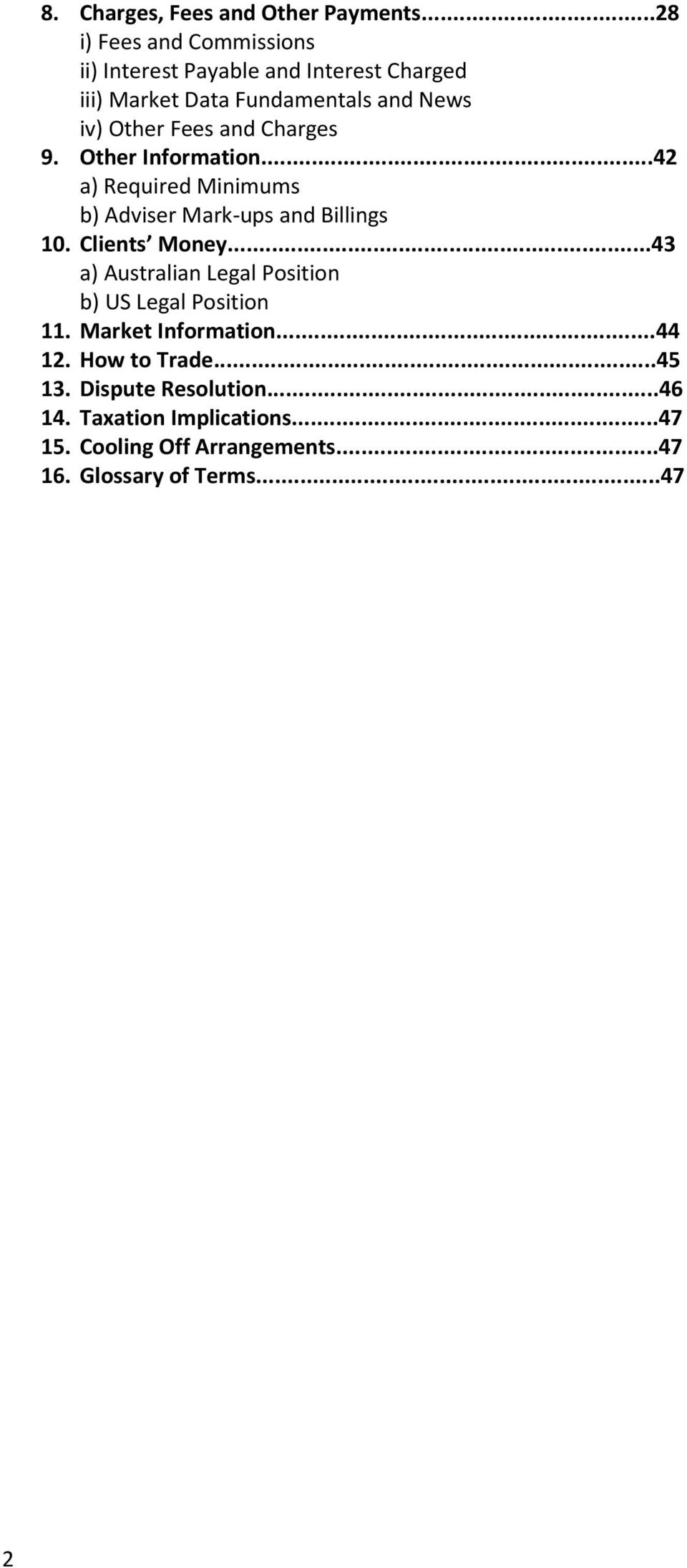
2 2 8. Charges, Fees and Other Payments...28 i) Fees and Commissions ii) Interest Payable and Interest Charged iii) Market Data Fundamentals and News iv) Other Fees and Charges 9. Other Information...42 a) Required Minimums b) Adviser Mark-ups and Billings 10. Clients Money...43 a) Australian Legal Position b) US Legal Position 11. Market Information How to Trade Dispute Resolution Taxation Implications Cooling Off Arrangements Glossary of Terms...47
3 1.INTRODUCTION a) Important Information Interactive Brokers LLC ( IB, we, our, us ) holds an Australian Financial Services ( AFS ) Licence issued by the Australian Securities and Investments Commission ( ASIC ) (AF S Licence Number AFSL Under the Australian Corporations Act 2001 (Cth) ( Corporations Act ), IB is regarded as the issuer of these derivatives and this PDS has been prepared by IB as the issuer of the Futures and Futures Options Under the Corporations Act, a retail client must receive a Product Disclosure Statement (PDS) from a financial services licensee at or before the time the personal advice recommendation to acquire the financial product is made. Where no personal advice is given, the PDS should be given to the retail client before the offer to acquire the product is made. The PDS sets out the significant features of a financial product, including its risks, benefits and cost. This Document is the PDS for exchange traded derivatives known as Futures, a type of financial product. Futures traded on a derivatives market are more commonly known as: Futures contracts (both deliverable and cash-settled); Futures options (which are options over a Futures contract); and Options over the underlying (which are options over commodities or cash adjustments based on stock indices). These products are known as derivatives under the Corporations Act, however for the purpose of this PDS, these products are collectively referred to as Futures. They are defined further in Section 3. This PDS does not cover exchange traded Contracts for Difference ( CFD ) or Over the Counter Traded ( OTC ) Derivatives. Before you trade Futures you should, in conjunction with your adviser, give consideration to your objectives, financial situation and needs. You should also be aware of the risks involved and be satisfied that trading in Futures is suitable for you in view of your financial circumstances. The information in this PDS is general information only and does not take into account your personal objectives, financial situation and needs. IB does not give personal financial product advice This PDS does not constitute a recommendation or opinion that the financial products referred to are 3

4 appropriate for you. To assist with your review of our PDS we have provided a Glossary of terms at the end of this PDS (please refer to section 16 of this PDS). In this PDS there are references to websites where more information can be located. If you are unable to access these websites, please contact us and we will endeavour to make the relevant information available to you through other means. b) Terms and Conditions This PDS is subject to the detailed provisions of the Client Agreement and the Financial Services Guide ( FSG ). Before making a decision to acquire the financial products described in this PDS you should read this PDS, the FSG and Client Agreement and be satisfied that any trading you undertake in relation to Futures and/or Futures Options is appropriate in view of your objectives, financial situation and needs. We recommend you read this PDS carefully and obtain independent financial, legal, taxation and other professional advice concerning this PDS, the Client Agreement and the FSG before you apply to open an Account with us. You should keep this PDS, the Client Agreement, and the FSG and any supplementary and replacement documents and updated information that is provided to you by IB including via s for future reference. c) Purpose of this PDS This PDS sets out the significant features of a financial product, including its risks, benefits, costs and fees and other related information. The purpose of this PDS is to provide you with sufficient information to make an informed decision whether you will acquire the financial products covered by the PDS. You may also use this PDS to compare the financial products described with similar financial products offered by other issuers. This PDS seeks to explain the products to you in a clear concise and effective way. The information in this PDS is general information only and does not take into account your individual investment objectives, financial situation or needs. We recommend you read this PDS 4

5 carefully and obtain independent financial, legal, taxation and other professional advice concerning this PDS (including the client Agreement) and the FSG before you apply to open an Account with us. Under the Australian Corporations Act, a retail client must receive a PDS from an AFS Licensee before acquiring a financial product. The distribution of this PDS may be restricted in certain jurisdictions outside Australia. Persons into whose possession this PDS comes are required to inform themselves of, and to observe, such restrictions. This PDS does not constitute an offer to anyone in any jurisdiction in which such offer is not authorised or to any person to whom it is unlawful to make such offer. d). Changes to this PDS Information contained in this PDS is subject to change from time to time and may be updated by IB. Any updated information which is not materially adverse to investors will be available from A paper copy of the updated information will be available without charge by contacting IB. Where updated information is materially adverse to investors, IB will issue a supplementary or replacement PDS.Our contact details are set out in section 1 (e) of this PDS. e). Issuer Details i) About IB Interactive Brokers Group, Inc. was founded by its Chairman and CEO Thomas Peterffy. Over the last 33 years, it has grown internally to become one of the premier securities firms with over $4.9 billion (USD) in equity capital. Interactive Brokers conducts its broker/dealer and proprietary trading businesses on over 80 market destinations worldwide. In its broker dealer agency business, IB provides electronic access ("on line") trade execution and clearing services to institutional and professional traders for a wide variety of electronically traded products including stocks, options, futures, forex, bonds and funds worldwide. Interactive Brokers Group and its affiliates execute approximately 1,000,000 trades per day. Interactive Brokers' headquarters are in Greenwich Connecticut, and it has about 800 employees in its offices in the USA, Switzerland, Canada, Hong Kong, UK, Australia, Hungary, Russia, India, China and Estonia. IB is regulated by the SEC, CFTC, FINRA, NYSE, NFA, SFA, ASIC and other regulatory agencies around the world. ii) IB s contact details Interactive Brokers LLC One Pickwick Plaza Greenwich, CT

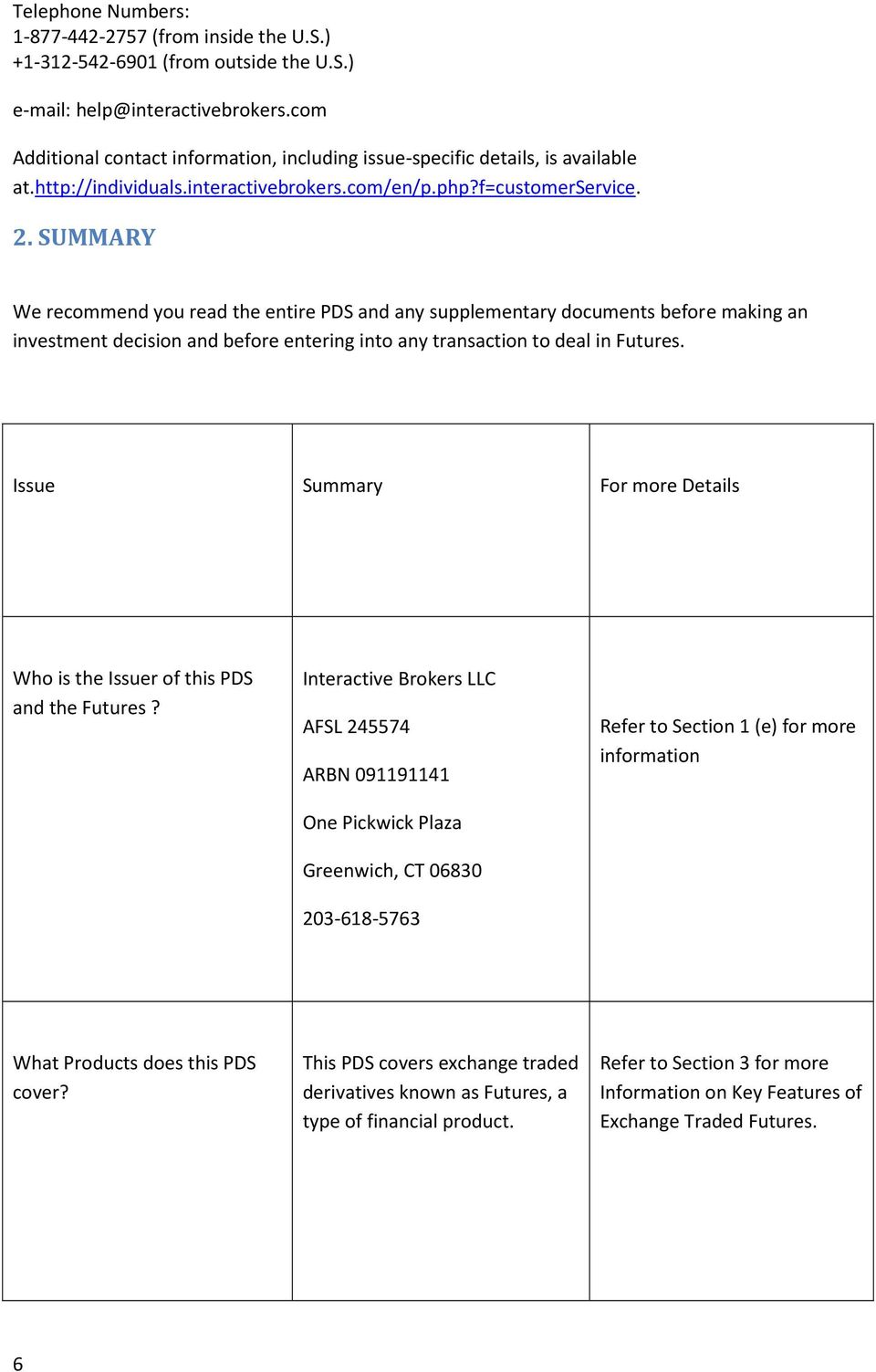
6 Telephone Numbers: (from inside the U.S.) (from outside the U.S.) Additional contact information, including issue-specific details, is available at. 2. SUMMARY We recommend you read the entire PDS and any supplementary documents before making an investment decision and before entering into any transaction to deal in Futures. Issue Summary For more Details Who is the Issuer of this PDS and the Futures? Interactive Brokers LLC AFSL ARBN One Pickwick Plaza Greenwich, CT Refer to Section 1 (e) for more information What Products does this PDS cover? This PDS covers exchange traded derivatives known as Futures, a type of financial product. Refer to Section 3 for more Information on Key Features of Exchange Traded Futures. 6
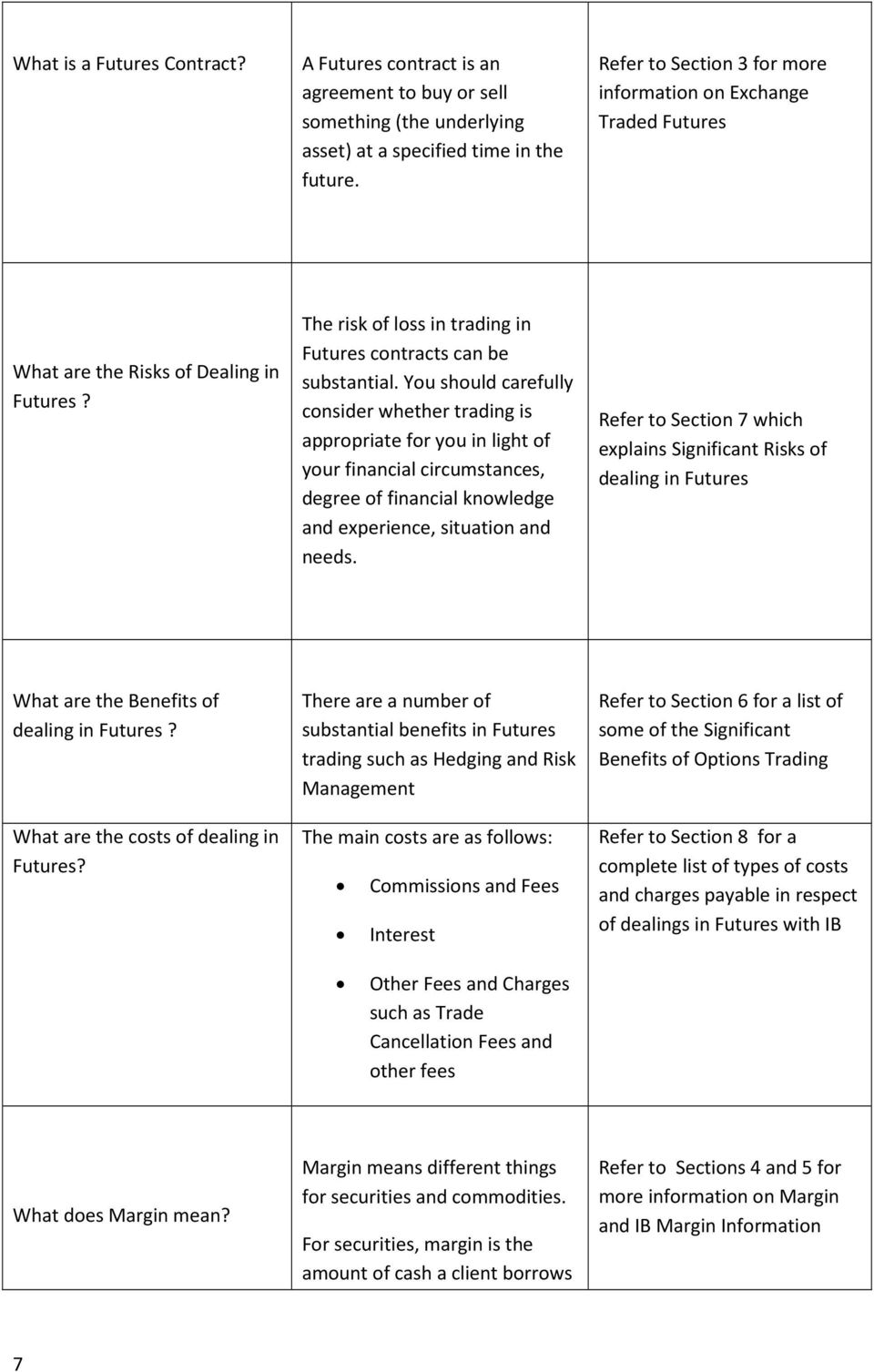
7 What is a Futures Contract? A Futures contract is an agreement to buy or sell something (the underlying asset) at a specified time in the future. Refer to Section 3 for more information on Exchange Traded Futures What are the Risks of Dealing in Futures? The risk of loss in trading in Futures contracts can be substantial. You should carefully consider whether trading is appropriate for you in light of your financial circumstances, degree of financial knowledge and experience, situation and needs. Refer to Section 7 which explains Significant Risks of dealing in Futures What are the Benefits of dealing in Futures? What are the costs of dealing in Futures? There are a number of substantial benefits in Futures trading such as Hedging and Risk Management The main costs are as follows: Commissions and Fees Interest Refer to Section 6 for a list of some of the Significant Benefits of Options Trading Refer to Section 8 for a complete list of types of costs and charges payable in respect of dealings in Futures with IB Other Fees and Charges such as Trade Cancellation Fees and other fees What does Margin mean? Margin means different things for securities and commodities. For securities, margin is the amount of cash a client borrows Refer to Sections 4 and 5 for more information on Margin and IB Margin Information 7
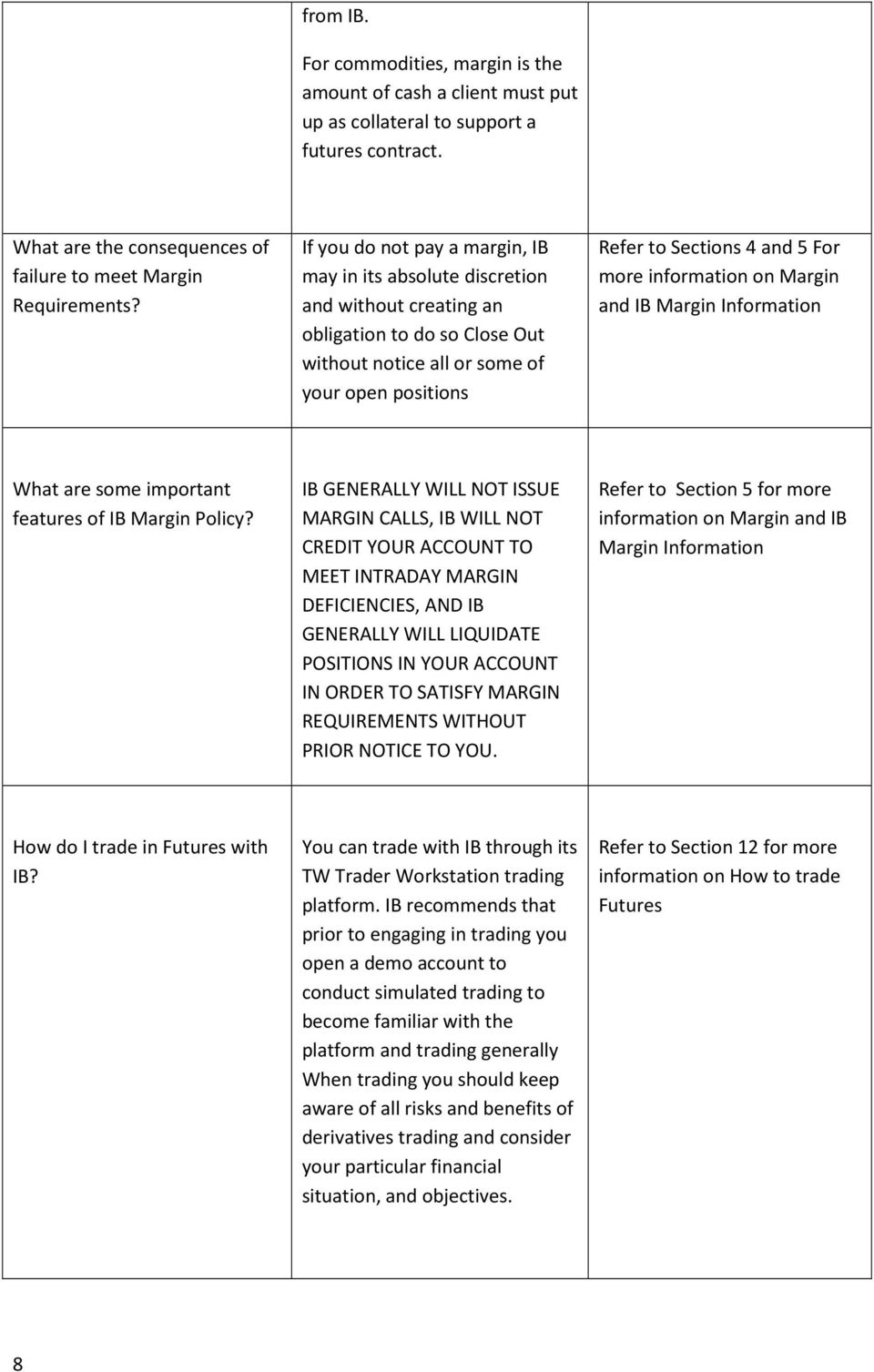
8 from IB. For commodities, margin is the amount of cash a client must put up as collateral to support a futures contract. What are the consequences of failure to meet Margin Requirements? If you do not pay a margin, IB may in its absolute discretion and without creating an obligation to do so Close Out without notice all or some of your open positions Refer to Sections 4 and 5 For more information on Margin and IB Margin Information What are some important features of IB Margin Policy? IB GENERALLY WILL NOT ISSUE MARGIN CALLS, IB WILL NOT CREDIT YOUR ACCOUNT TO MEET INTRADAY MARGIN DEFICIENCIES, AND IB GENERALLY WILL LIQUIDATE POSITIONS IN YOUR ACCOUNT IN ORDER TO SATISFY MARGIN REQUIREMENTS WITHOUT PRIOR NOTICE TO YOU. Refer to Section 5 for more information on Margin and IB Margin Information How do I trade in Futures with IB? You can trade with IB through its TW Trader Workstation trading platform. IB recommends that prior to engaging in trading you open a demo account to conduct simulated trading to become familiar with the platform and trading generally When trading you should keep aware of all risks and benefits of derivatives trading and consider your particular financial situation, and objectives. Refer to Section 12 for more information on How to trade Futures 8
9 How does IB deal with my money? Funds deposited with a Participant on a licensed market for Futures trading are deposited into that Participant s clients segregated account in accordance with the requirements of the Corporations Act. Refer to Section 10 for more information on client monies. Do I pay interest on moneys owed to IB or receive interest on moneys held by IB? IB does not pay interest unless you have more than $10,000 (USD) in your account. Refer to Section 8(ii) for more information on interest payable Do I have a cooling off period? No - there is no cooling off period Refer to Section 15 for more information What procedures are in place to deal with client complaints? IB has internal and external dispute resolution procedures in place to deal with client complaints Refer to Section 13 for more details of IB s dispute resolution procedures. What are the tax implications of dealing in Futures? What if I need further information? The taxation implications of dealing in futures and futures options may be complex and depend on your own particular circumstances. You should be aware of a number of matters such as tax rulings and consult your professional adviser for detailed tax advices. You can refer to the IB website or contact IB.We recommend that in addition you consult your professional adviser for detailed financial, investment,tax, legal and other professional advices Refer to Section 14 for more information on taxation implications of dealing in Futures. Refer Section 1(e) for more Information on how to contact IB 9

10 3. KEY FEATURES OF FUTURES [RG ] This section provides an overview of the key features of exchange traded Futures. a) What are Futures? A Futures contract is an agreement to buy or sell something (the underlying asset) at a specified time in the future. The underlying asset may be, for example: a specified amount of a security, such as shares in a company or government bond, a financial instrument, such as a bank bill, a stock index, such as the SFE SPI 200, or a commodity of a given grade or quality, such as greasy wool. The parties to a Futures contract may be required to deliver or take delivery of the underlying asset at the time specified in the contract, where the contract provides for this. Alternatively, the contract may provide for a cash adjustment to be made, based on a change in the price of the underlying asset. b) Types of Futures There are two main types of Futures contracts. Deliverable contracts where the seller agrees to deliver to the buyer, and the buyer agrees to take delivery of, the quantity of the commodity described in the contract. Cash settled contracts where the two parties make cash adjustment between them according to whether the price of a commodity, financial instrument or index has risen or fallen since the time the arrangement was made. IB may not permit its customers to make or take delivery of the commodity underlying the Futures contract, (one exception - we do allow delivery of foreign currency for example in a listed currency futures transaction) therefore it may not be not advisable to enter into deliverable contracts in the last weeks before maturity. 10

11 A Futures contract s terms are generally set out in the Operating Rules of the exchange on which the contract was made, which might be in Australia or overseas. This Document is intended to apply to any Futures contracts traded on a computer-based exchange unless otherwise indicated. There may, however, be differences in procedure and regulation of markets from one country to another and one exchange to another. c) Futures are an International Product As noted above, Futures contracts are traded on a number of overseas exchanges. Your obligations and requirements may differ according to the specific rules of an exchange, and you will need to understand how this affects you. It is therefore important that you contact IB for information if you have any questions about any overseas exchange on which you wish to trade. You can find further information on the website of the relevant overseas exchange. See also Section 11 Market Information, below for more information. d) Duration of Futures Futures contracts may be made for periods of up to several years in the future. Part of the standardisation of Futures contracts is that the contract maturity dates follow a pre-determined cycle (standardisation is discussed in the next section). For example, in the SPI-200 contract traded on the Sydney Futures Exchange (SFE), contracts can be made for settlement only in March, June, September or December, but for up to 18 months from the time of the trade. e) Futures are standardised Futures traded on an exchange are standardised and interchangeable; meaning that futures contracts of a particular class are perfect substitutes for each other.a consequence of contract standardisation is that the price is the only factor that remains to be determined in the marketplace. On the SFE and ASX, Futures are quoted and traded on an electronic trading platform, which provides a system of continuous price discovery. This means that the price at which trades take place may continually change throughout a trading session. Most international Derivatives Exchanges also provide electronic trading platforms for Futures trading. Since all Futures contracts for a given future month in the same market are interchangeable, they can be closed out against an opposite position in the same contract. A trader who has bought a given Futures contract can cancel the position by selling the same contract. The net result is that the trader no longer holds a position. Similarly, a trader who has sold a given Futures contract can cancel the position by buying the same contract. In each case there will be a profit or loss equal to the difference between the buying and selling prices multiplied by the standard contract amount minus any transaction costs. In practice, the vast majority of Futures contracts are offset in this manner ahead of the contract maturity date, the remainder being fulfilled by delivery or cash settlement at maturity. f) The role of the clearing house Derivatives Exchanges will generally have a Clearing House. Clearing Houses clear and settle Futures contracts executed on the exchange. The primary role of the Clearing House is to guarantee the settlement of obligations arising under the Futures contracts registered with it. This means that when your broker buys or sells a Futures contract on your behalf, neither you nor your broker needs to be concerned with the credit worthiness of the broker taking the other side of the contract. See below for further discussion on the novation process that occurs at the Clearing House. The Clearing House will never deal directly with you, rather the Clearing House will only ever deal with clearing participants that is your broker (where your broker is a clearing participant), or where your broker is 11

12 not a clearing broker, your broker s clearing broker. The SFE s Clearing House is SFE Clearing Corporation. The ASX s Clearing House is Australian Clearing House (ACH). When a Futures contract is registered with the Clearing House, it is novated. This means that the contract between the two brokers who made the trade is replaced by one contract between the buying broker (or its Clearing Participant) and the Clearing House as seller; and one contract between the selling broker (or its Clearing Participant) and the Clearing House as buyer. The Clearing House ensures that it is able to meet its obligation to Clearing Participants by calling Initial Margin1 and Variation Margin2 to cover any unrealised losses in the market. See Section 4 for further information on margins. Generally your futures contracts (and those of other clients) will be held separately from futures contracts entered into by your broker on its own account. If your broker were to default on its obligations to the Clearing House in respect of its own futures contracts, your futures contracts will not be used to meet the broker s default. Rather the Clearing House will either close out your contracts or attempt to transfer them to another broker. g) Closing out Because of the system of registration and novation referred to above, closing out can be achieved without going back to the original party with whom the Futures contract was traded. When an existing buyer sells to close out their position, the sale transaction is registered with the Clearing House in the manner described Example First Trade A sells to B at $100 per unit Novation Clearing House is now buyer to A and seller to B Second Trade B sells to C at $120 per unit Novation Clearing House is now buyer to B and Seller to C Resulting Positions A has an open sold position C has an open bought position B no longer has a position and has realised a profit of $20 per unit (ignoring transaction costs) The contracts which B held (one to buy and one to sell) have been settled in cash between B and the Clearing House; B simply receives the net profit. Any profit due to B is paid out by the Clearing House in cash, even though the original seller (A) remains in the market. 12

13 h) Settlement If you have a deliverable Futures Contract open at the close of trading on the last day of trading in respect of that Futures Contract, you will be under an obligation to deliver, or take delivery of and pay the contract price in full for, the Underlying Instrument described in the Futures Contract. It is IB s policy not to permit its clients to make or take delivery under a deliverable Futures Contract. If you wish us to vary our policy, and you specifically wish to make or take delivery you must obtain our prior written consent. It is your responsibility to monitor your open positions as the deliverable Futures Contract approaches Settlement Date and to Close Out any open position at least two weeks prior to the Settlement Date. IB reserves the right, in its absolute discretion, to Close Out any open position you hold in a deliverable Futures Contract if you have not Closed Out that Futures Contract. If you have a cash-settled Futures Contract open at the close of trading on the last day of trading in respect of the relevant Futures Contract, you will be under an obligation to pay or have a right to receive an amount of money depending on the price movement. i) Futures Options & Options over the Underlying-What is an option? Option contracts traded over Futures contracts are commonly known as Futures options. These are the most common type of option traded on a Derivatives Exchange. Options over the underlying are less common with the Cash Settled Intraday Options over the SFE SPI 200 and Eurex DAX options being examples. Following is an explanation of the nature of an option contract and of the obligations assumed by option traders. Several concepts referred to previously are applicable to options (for example, the concept of closing out). These facts will not be repeated, but only the facts particular to Futures options are discussed. The buyer of a Futures option has the right, but not the obligation, to enter into a Futures contract3 at the Exercise Price of the Futures option. For this right, the buyer pays the option seller the Option Premium. The seller of a Futures option assumes the obligation to enter into a Futures contract at the Exercise Price of the Futures option if the option is validly exercised. For taking on this obligation, the seller receives the Option Premium. Like Futures contracts, options are standardised and interchangeable, so that having bought or sold an option it is possible to close it out before its expiry or exercise. You must distinguish between Futures options and options over the underlying. If a Futures option is exercised it results in the establishment of a Futures contract. If an option over the underlying is exercised, it results in the transfer of the actual commodity underlying the option (in the case of deliverable contracts), or a cash adjustment (in the case of cash settled contracts). The following matters can apply both to Futures options and to options over the underlying. However the discussion will centre on Futures options. j) European Options & American Options An option will be expressed to be either a European style option or an American style option. 13

14 European Options can be exercised only on the Expiry Date, not before. American Options can be exercised at any time up to and including the date the option is due to expire. The majority of options traded on the ASX and SFE are American Options. Because American Options can be exercised at any time before the Expiry Date, the seller of an option must be prepared for that option to be exercised at any time. The decision to exercise is in the option buyer s hands. k) Call Options & Put Options A Call Option gives the buyer the right to buy a Futures contract at a designated price at or before the Expiry Date of the option. The seller of a Call Option has the obligation to sell a Futures contract if the Futures option is exercised by the buyer. A Put Option gives the buyer the right to sell a Futures contract at the Exercise Price. The seller of a Put Option has the obligation to purchase the Futures contract if the Put Option is exercised by the buyer. l) Exercising Call Options & Put Options The table below sets out the results from the buyer s and seller s viewpoint when the buyer exercises a Futures Call Option or Put Option: Example BUYER EXERCISES EFFECT ON SELLER Buyer Call Option-> Bought Futures (at the Exercise Price of the option) Sold call option-> Sold Futures at the exercise price of the option Buyer Put Option -> Sold Futures (at the exercise price of the option) Sold Put option-> Bought Futures at the exercise price of the option m) More information Information concerning international Derivative Exchanges and the types of Futures contracts traded on those exchanges can be found by visiting the relevant exchange s website. Please contact us if you require any international Futures information. For further information concerning Futures contracts traded on the SFE you are referred to the ASX website at where brochures regarding the various Futures contracts can be downloaded. If you do not have access to a website to enable this information to be viewed, please contact IB and we will arrange for this material to be provided to you by alternate media. 4.MARGIN Overview The US Federal Reserve Board and self-regulatory organizations (SROs), such as the New York Stock Exchange and FINRA, have clear rules regarding margin trading. In the United States, the Fed's Regulation T allows investors to borrow up to 50 percent of the price of the securities to be purchased on margin. As discussed above, the 14
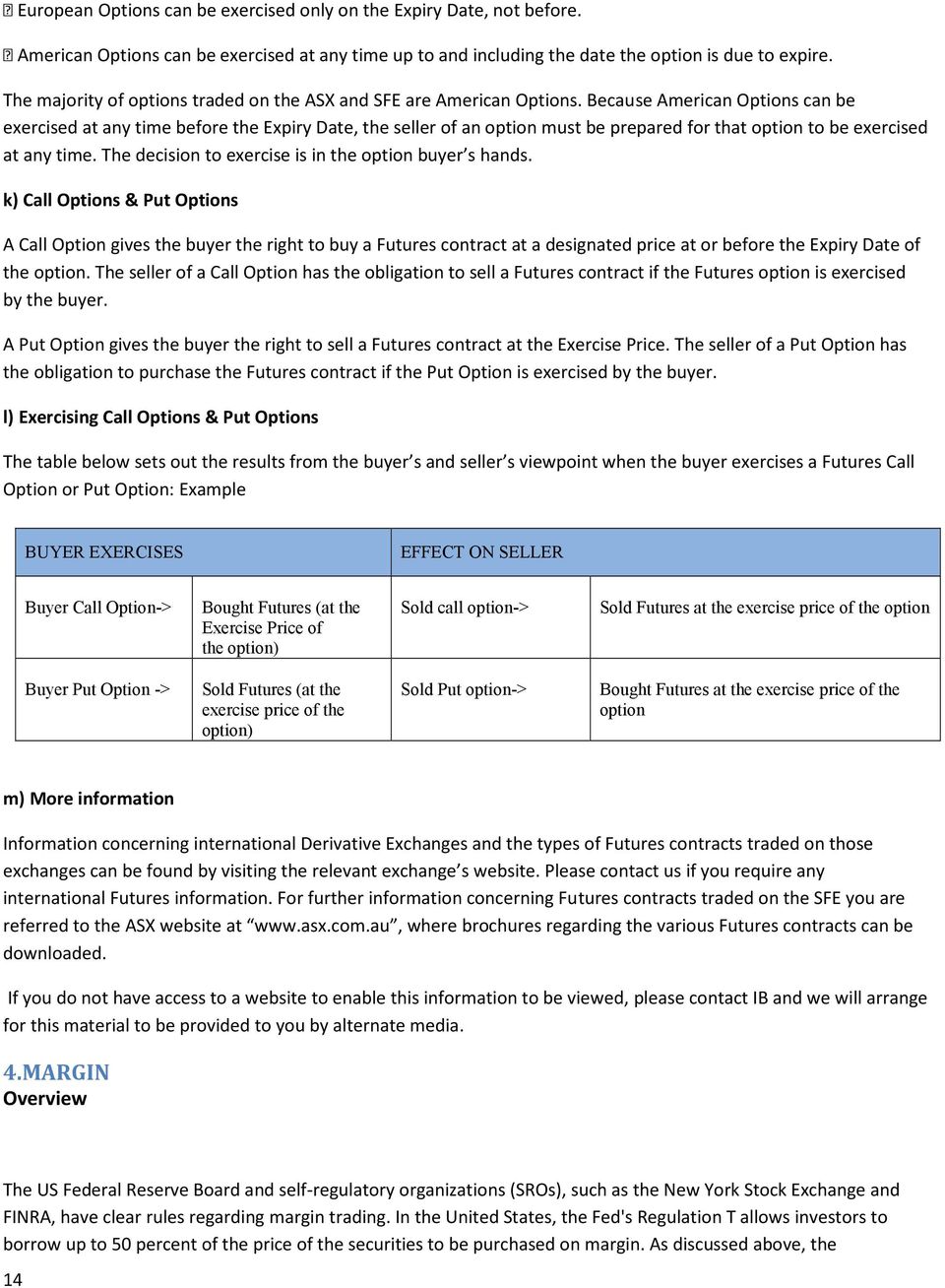
15 percentage of the purchase price of securities that an investor must pay for is called the initial margin and in order, to buy securities on margin, the investor must first deposit enough cash or eligible securities with a broker to meet the initial margin requirement for that purchase. Once an investor has started buying a stock on margin, the NYSE and FINRA require that a minimum amount of equity be maintained in the investor's margin account. These rules require investors to have at least 25 percent of the total market value of the securities they own in their margin account This is called the maintenance margin. IB may set margin requirements that are higher than the regulatory minimum and these house requirements may change from time to time. For market participants identified as pattern day traders, the minimum maintenance margin requirement is $25,000. When the balance in the margin account falls below the maintenance requirement, the broker may issue a margin call requiring the investor to deposit more cash, or the broker can liquidate the position. Example Brokers also set their own minimum margin requirements called "house requirements". Some brokers extend more lenient lending conditions than others and lending terms may also vary from one client to the other but brokers must always operate within the parameters of margin requirements set by regulators. IB Margin Policies are detailed below. Margin requirements on a specific financial product may be determined via creation of a TWS order line for the product in question and subsequent utilization of the TWS "margin check" feature for the given orders. (Please refer to Section 12 for information on How to Trade Futures with IB) b) IB Margin Information IB Real-Time Margining and Real Time Monitoring Interactive Brokers uses real-time margining to allow you to see your trading risk at any moment of the day. Our real-time margin system applies maintenance margin requirements throughout the day to new trades and trades already on the books and enforces initial margin requirements at the end of the day, with real-time liquidation of 15
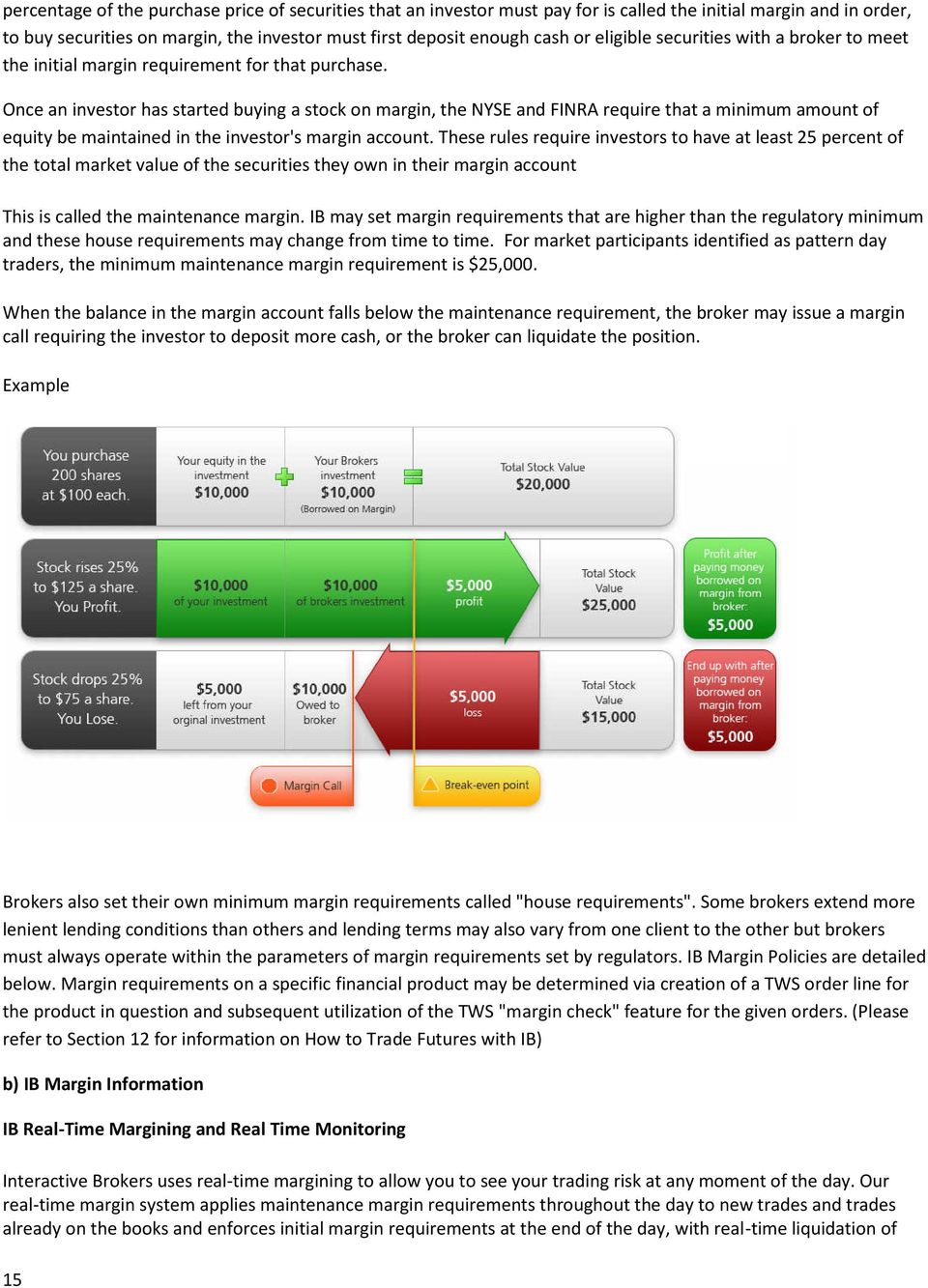
16 positions instead of delayed margin calls. This system allows us to maintain our low commissions because we do not have to spread the cost of credit losses to customers in the form of higher costs. Our real-time margin system allows you to see your trading risk at any moment of the day using the real-time activity monitoring features in Trader Workstation. For more information about real-time margin monitoring, see the Real- Time Monitoring Margin page. You can monitor most of the values used in the calculations described in real time in the Account Window in Trader Workstation. For more information about real-time margin monitoring, click the Real- Time Monitoring link at interactivebrokers.com.au. It is your responsibility to actively monitor and manage your open positions and your obligations including ensuring that you meet your margin obligations.it is further your responsibility to ensure that you are aware of any changes in margin obligations. Margin requirements must be met immediately.this means that sufficient cleared funds must be on deposit in your account to enable you to meet margin requirements immediately Real-time Monitoring -The TWS Account Window The Account window (example below) in Trader Workstation lets you monitor every aspect of your account activity, including the values used in IB s margin calculations. We present key account values as the default when you first open the Account window, and you can expand each section of the Account window to display all values. The Account window displays real-time values 16
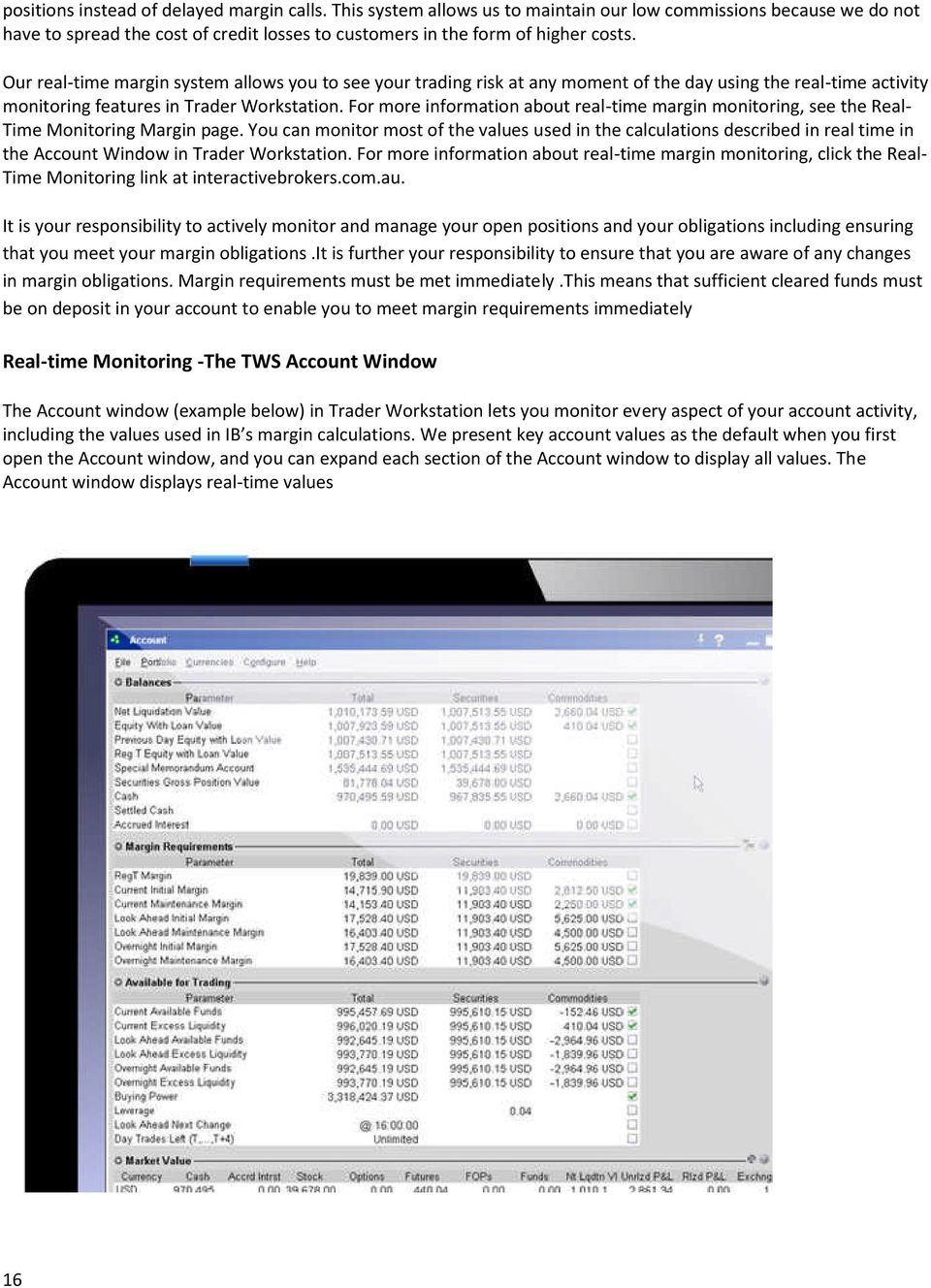
17 The Account window displays real-time values, including those listed below. Balances For more information on any of the real-time monitoring features mentioned here, as well as a table containing definitions of all values, see the TWS Users' Guide. Margin Requirements For more information on any of the real-time monitoring features mentioned here, as well as a table containing definitions of all values, see the TWS Users' Guide. 17
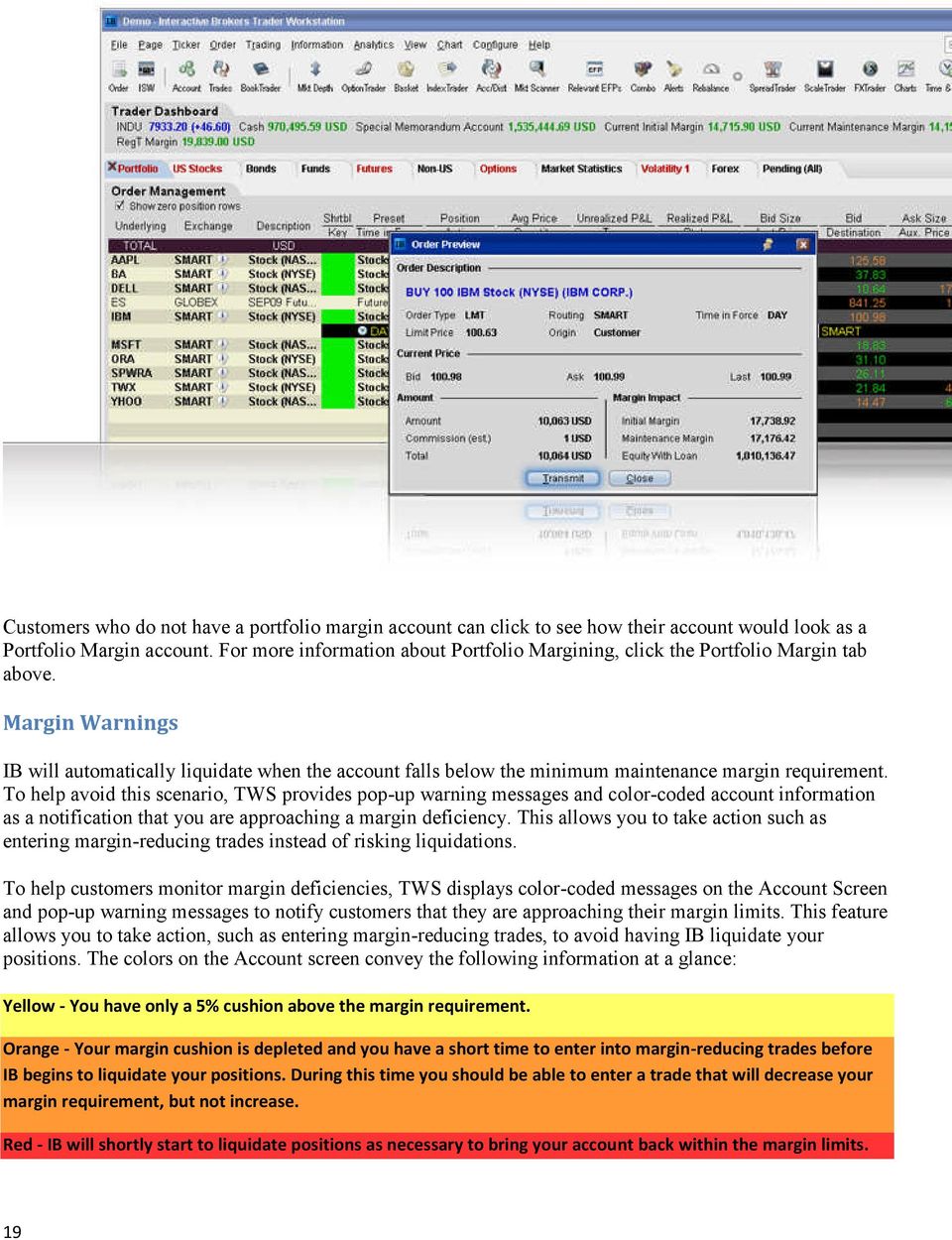
18 Available for Trading For more information on any of the real-time monitoring features mentioned here, as well as a table containing definitions of all values, see the TWS Users' Guide. Margin What-Ifs Margin scenarios provide the margin implications of any transaction before transmitting an order. From the trading window, right click any order row and select Preview Order/Check Margin. Commission for the trade is also displayed. 18

19 Customers who do not have a portfolio margin account can click to see how their account would look as a Portfolio Margin account. For more information about Portfolio Margining, click the Portfolio Margin tab above. Margin Warnings IB will automatically liquidate when the account falls below the minimum maintenance margin requirement. To help avoid this scenario, TWS provides pop-up warning messages and color-coded account information as a notification that you are approaching a margin deficiency. This allows you to take action such as entering margin-reducing trades instead of risking liquidations. To help customers monitor margin deficiencies, TWS displays color-coded messages on the Account Screen and pop-up warning messages to notify customers that they are approaching their margin limits. This feature allows you to take action, such as entering margin-reducing trades, to avoid having IB liquidate your positions. The colors on the Account screen convey the following information at a glance: Yellow - You have only a 5% cushion above the margin requirement. Orange - Your margin cushion is depleted and you have a short time to enter into margin-reducing trades before IB begins to liquidate your positions. During this time you should be able to enter a trade that will decrease your margin requirement, but not increase. Red - IB will shortly start to liquidate positions as necessary to bring your account back within the margin limits. 19
20 Margin Reports Margin reports show margin requirements for single and combination positions, and display both available and excess liquidity. Each day at 16:15 ET we record your margin and equity information across all asset classes and exchanges. You can access your margin reports under the Margin Report menu item (Report Management) within Account Management. Here is an example of a portion of a margin report. Any trading symbols displayed are for illustrative purposes only and are not intended to portray recommendations. For more information regarding any of the real-time monitoring features mentioned here, see the TWS Users' Guide at interactivebrokers.com.au. PLEASE NOTE THAT: IB GENERALLY WILL NOT ISSUE MARGIN CALLS, IB WILL NOT CREDIT YOUR ACCOUNT TO MEET INTRADAY MARGIN DEFICIENCIES, AND IB GENERALLY WILL LIQUIDATE POSITIONS IN YOUR ACCOUNT IN ORDER TO SATISFY MARGIN REQUIREMENTS WITHOUT PRIOR NOTICE TO YOU. 20

21 5.IB MARGIN INFORMATION-General Information We offer our customers two types of margin accounts: Reg T Margin Portfolio Margin. Margin requirements are calculated either on a rules basis and/or a risk basis Account Type Description How we calculate Margin Reg T Margin Borrowing to support equities trading, shorting of equities, options trading, futures/futures options trading, currency conversions and securities/commodities trading in multiple currency denominations available. Purchase and sale proceeds are immediately recognized. Margin requirements are computed in real-time under a rules-based calculation methodology, with immediate position liquidation if the minimum maintenance margin requirement is not met. Rule-Based Margin System: Predefined and static calculations are applied to each position or predefined groups of positions ( strategies ). Portfolio Margin Borrowing to support equities trading, shorting of equities, options trading, futures/futures options trading, currency conversions and securities/commodities trading in multiple currency denominations available. Margin requirements are calculated based on a risk-based calculation methodology. Customers maintain account equity of USD 100,000 in order to use a portfolio margin account. Otherwise account restrictions will apply. Risk-Based Margin System: Exchanges consider the maximum one day risk on all the positions in a complete portfolio, or sub-portfolio together (for example, a future and all the options delivering that future). 21
22 Futures Futures margin requirements are determined by each exchange and can change frequently. All margin requirements are expressed in the currency of the traded product. The SPAN margin algorithm defines a set of standard set of market outcomes scenarios with a one day time horizon. A price scanning range is defined for each product by the respective clearing house. In addition to the exchange mandated margin models IB considers large move scenarios for equity based index products.ib will consider margin on extreme up and down moves in the underlying index products.(in addition to the SPAN range of 16 points IB will consider additional scenarios which incorporate extreme moves in the underlying.) Accordingly IB may require margin over and above the exchange mandated margin on short out-of the-money options in order to account for the risk inherent in an extreme market move. Margin requirements on a specific option may be determined via creation of a TWS order line for the option in question and subsequent utilisation of the TWS margin check feature for the given order. Note that for commodities including futures and futures options margin is the amount of cash a client must put up to support a futures contract. Please see our website at for exchange margin requirements. Please also see our website for further educational information. 22
23 This page intentionally blank 23
24 6. SIGNIFICANT BENEFITS EXPLAINED [Section 1013D (1) (b)] There are a number of benefits in trading Futures, including the following: (a) Standardisation: As discussed in section 3, because Futures contracts are standardised and therefore interchangeable, you may through the Derivatives Exchange open and close positions, depending on the liquidity of the market in the relevant contract. (b) Risk Management: Through the processes of novation and margining, the Clearing House assumes and manages the risk of Futures positions entered into on the Derivatives Exchange. This reduces counterparty risk in a way which is not available in over-the-counter (OTC) derivatives transactions. Your broker has certainty that the other side of the Futures contract will be honoured, and your broker (and therefore you) will not be subject to risk that the counterparty to the original Futures contract may default in their obligations under the Futures contract. (c) Hedging: You can use Futures to hedge exposure in the underlying commodity, instrument or security. (d) Speculation: You can use Futures to speculate on market movements. Futures allow you to gain exposure to a particular underlying commodity, instrument or security without the need to buy or sell the underlying itself. (e) Range of market positions and strategies: You can potentially profit both from rising and from falling markets depending on the strategy you have employed. Through the use of Futures and options, strategies can be tailored to suit almost any market view. (f) Leverage: Futures generally involve a high degree of leverage. Futures contracts enable you to outlay a relatively small amount of money (in the form of Initial Margin) to secure an exposure to the underlying commodity, instrument or security. For example, assume you have a positive view about the prospects of XYZ Ltd. You can either buy 1,000 XYZ Ltd shares at $10.00 and pay your broker $10,000 (plus costs) or you could buy a Futures contract over 1,000 XYZ Ltd shares and pay an Initial Margin at the time the Futures contract is entered (which is likely to be a small percentage of the contract value (plus costs). The same amount of exposure to the underlying shares has been achieved, but for a much smaller outlay. Given a movement in the price of XYZ shares, the percentage returns (positive or negative) from the Futures strategy are likely to be much higher. Assume the Futures contract price is $10.10, and the Initial Margin payable on the above Futures position is 10%. Each contract covers 1000 shares. The following table compares the returns, assuming that the XYZ share price rises to $11.00 by maturity (transaction costs are ignored). 24
25 [Note: the example provided is for illustrative purposes only and does not necessarily reflect the outcome of any actual trading in Futures in similar circumstances.] This leverage can work against you as well as for you. The use of leverage can lead to large losses as well as large gains. See section 6 for further information on risks. Shares Opening Trade Share price $10.00 Buy 1,000 $10.00 = $10,000 Futures Futures price $10.10 Buy 1 Futures $10.10 Pay 10% Initial Margin = $1,010 Maturity Share price $11.00 Sell 1,000 $11.00 = $11,000 Futures price $11.00 Sell 1 Futures $11.00 Profit $1.00 x 1,000 = $1,000 $1.00 x 1,000 = $1,000 Percentage Return 10 % 89% 7. SIGNIFICANT RISKS EXPLAINED [Section 1013D (1) (c)] The risk of loss in trading in Futures contracts can be substantial. You should carefully consider whether trading is appropriate for you in light of your financial circumstances, degree of financial knowledge and experience, situation and needs. You should be aware of the following matters: (a) Loss of Initial Margin: You could sustain a total loss of the Initial Margin that you deposit with your broker to establish or maintain a Futures contract. (b) Payment of maintenance Margin: If the Futures market moves against your position, you may be required, at short notice, to deposit with your broker maintenance Margin in order to maintain your position. Those additional funds may be substantial. If you fail to provide those additional funds within the required time, your position may be liquidated at a loss and you will be liable for any shortfall in your account resulting from that failure. (c) Losses beyond margin lodged: You may sustain a total loss of the funds that you deposit with your broker to establish or maintain a position in the Futures market. You may incur losses beyond the amounts that you lodge with your broker. You should not risk more funds than you can afford to lose. A good general rule is never to speculate with money which, if lost, would alter your standard of living. (d) Leverage: The high degree of leverage that is obtainable in trading Futures contracts can work against you as well as for you. The use of leverage can lead to large losses as well as large gains. Returning to the example of XYZ shares used previously, consider the result if the share price, instead of rising to $11.00, fell to $8.00 at maturity. The following table shows the results (transaction costs are ignored). 25
26 Shares Opening Trade Share price $10.00 Buy 1,000 $10.00 = $10,000 Futures Futures price $10.10 Buy 1 Futures $10.10 Pay 10% Initial Margin = $1,010 Maturity Share price $8.00 Sell 1,000 $8.00 = $8,000 Futures price $8.00 Sell 1 Futures $8.00 Loss $2.00 x 1,000 = $2,000 $2.10 x 1,000 = $2,100 Percentage Return -20% -20% Leverage has served to multiply the loss suffered in percentage terms. (e) Liquidity: Under certain market conditions, it could become difficult or impossible for you to close out a position, and the relationship between the prices of Futures contracts and the underlying market may be distorted or affected. Examples of when this may happen are: (i) If there is a significant change in the price of the underlying commodity, instrument or security over a short period of time; (ii) If there are insufficient willing buyers and sellers in either the Futures market or the underlying market; (iii) If the Futures market is suspended or disrupted for any reason. Similarly, events such as these in relation to the market for the underlying asset may make it difficult for you to hedge or maintain your exposure under a Futures contract. (f) Deliverable contracts and physical delivery: Where you have a position in a deliverable Futures contract and you hold this open position to maturity, you must be prepared to make or take physical delivery of the underlying asset if your position is matched. (g) Placing orders in a moving market: 1) The placing of contingent orders (such as a stop-loss order) may not always limit your losses to the amounts that you may want. Market conditions may make it impossible to execute such orders. For example, if the price of the underlying asset moves suddenly, your order may not be filled, or may be filled at a different price to that specified by you, and you may suffer losses as a result. 2) Slippage and gapping As the markets are constantly moving, it may be good practice to place Contingent Orders on your open positions. By using a Contingent Order, you may be able to limit potential profits and losses on your open positions. Contingent Orders allow you to preset the trigger conditions that automatically generate an order for you when the price for a particular Underlying Reference Instrument reaches these conditions. For example, a Contingent Order can be created to generate a Limit order to buy XXX at $25.00 if/when XXX shares trade at $ Contingent Orders may help to limit losses. However, they should not be considered to guarantee to stop losses on open positions. For 26
27 example, a Contingent Order can be created to generate a sell order in respect of YYY Limited shares at $3.99 if/when YYY Limited shares trade at $4.00. However, if YYY Limited shares were to gap from $4.01 down to $3.98, the Contingent Order would not be executed. Contingent Orders are automatically executed or deleted as soon as the specified price point is reached. If you require the same market conditions to trigger a subsequent order placement, a new Contingent Order must be set. Slippage on all contingent orders is possible during times when the market is closed, around fundamental announcements, and times of extreme market volatility. Slippage occurs when orders are filled at a price that is worse than the contingent price requested by the customer. Contingent orders may also be slipped during fundamental announcements and extreme market volatility. The release of fundamental data and extreme world events many times causes increased volatility in the market. When economic data or world events are announced, the market may gap in a particular direction. This means that there are no tradable prices between the actual price the market was trading prior to fundamental release or world event and the price available after the market has adjusted, following the release or event. Prices may move very quickly and in some cases prices may move far away from the contingent price. (h) Strategies: A spread position (which involves the simultaneous purchase and sale of Futures or Futures options) is not necessarily less risky than a simple Long or Short position. (i) Options risk profile: If you propose to trade in Futures options, the maximum loss in buying an option is the premium paid, but the risks in selling an option are essentially unlimited. (j) System failures: You may experience losses due to exchange or Clearing House system failures which may affect systems used by Participants. Participant systems may also fail which means your trades may not be executed. (k) Foreign exchange movements: If you trade in Futures contracts denominated in currencies other than Australian dollars you may lose money due to exchange rate fluctuations. These losses may be in addition to any losses on the Futures contract itself. (l) Market emergencies: You may incur losses that are caused by matters outside the broker s control. For example, a regulatory authority exercising its powers during a market emergency may result in losses. A regulatory authority can, in extreme situations, suspend trading or alter the price at which a position is settled. This could also result in a loss. (m) Market disruption: A market disruption may mean that you are unable to deal in a Futures contract when desired, and you may suffer a loss as a result. Common examples of disruption include the crash of the exchange electronic trading system, fire or other exchange or Clearing House emergency. (n) Discretionary powers of Exchange and Clearing House: The exchange or Clearing House could exercise discretionary powers under their Operating Rules in relation to the market. They have powers to declare an undesirable situation has developed in a particular Futures contract and suspend trading. (o) Disputes and trade cancellations: When a trade is subject to dispute, the exchange may have powers to request that participants amend or cancel a trade, which will in turn result in the Futures contract with the investor being amended or cancelled. Exchanges may also exercise discretionary powers to cancel transactions under their Operating Rules. These actions can affect your Futures positions. (p) Differing exchange rules: You should be aware that when your broker places an order for you on an overseas exchange, or clears a trade for you at an overseas clearing house, that trade will be subject to that exchange s or clearing house s rules. These rules may differ significantly from the rules of Australian exchanges or clearing houses. 27
28 q) Dealings on foreign Derivatives Exchanges Clients who deal on foreign Derivatives Exchanges should be aware of the following matters: 1) Dealing subject to foreign rules and laws The execution and clearing of trades on foreign Derivatives Exchanges are subject to the rules of that exchange and the laws of the country in which that exchange is domiciled. 2) Australian regulators may not have any jurisdiction Neither ASIC nor Australian exchanges regulate activities of foreign Derivatives Exchanges, nor do they have the power to compel enforcement of the operating rules of a foreign Derivatives Exchange or any applicable foreign laws. Generally, the foreign transaction will be governed by applicable foreign law. This is true even if the Derivatives Exchange is formally linked with an exchange in Australia. 3) Protection of clients funds Clients who trade on foreign Derivatives Exchanges may not have the benefit of protective measures provided by the Corporations Act and the Operating Rules of Australian exchanges. In particular, your funds may not have the same protection as funds deposited in Australia in a Participant s clients segregated account. 4) Settlement If you have a deliverable Futures contract open at the close of trading on the last day of trading you will be under an obligation to deliver, or take delivery of and pay for, the commodities described in the specifications. It is the policy of IB not to permit speculators to make or take delivery under a deliverable Futures contract (except where required by the Clearing House). If you have a cash settled Futures contract open at the close of trading on the last day of trading you will be under an obligation to pay or have a right to receive an amount of money depending on the price movement. The settlement of Futures options is more complex. For example, on the SFE all in-the-money or at-the-money options are automatically exercised by the Clearing House. The resulting position is settled as a Futures position. Not all exchanges automatically exercise at-the-money or in-the-money options at expiry, particularly US exchanges. Check with your broker before the Expiry Date, or the option may lapse with the result it will be worthless. The settlement procedures for options over the underlying are different again. Because these instruments can be traded on Derivatives Exchanges and stock exchanges the procedures can vary widely. 8. FEES AND CHARGES [Section 1013D (1) (d) (I), (ii) and (iii), 1013D (2) and 1013D (1) (e)] 28
29 Pricing-Futures and Futures Options / Overview IB offers two pricing structures for futures and futures options. For US, we offer two cost-plus pricing structures: Flat Rate, which charges a flat IB rate per contract exclusive of exchange and regulatory fees, and Volume Tiered, which uses volume-tiered pricing. For all other (non-us) futures and futures options, we offer the choice between an all-in Bundled structure and the Unbundled structure. The Volume Tiered adds a fixed IB fee (which varies by volume) to the fees charged by the exchanges and regulators. In addition, institutions and members (or participants in a member program) of a US or Canadian Futures exchange may qualify for discounted exchange fees. Click the Exchange Incentive Program tab for more information. For a schedule of pricing structures, see the links along the top of the page under the tabset. Customers select their pricing structure during the registration process, and can switch at any time through Account Management/Account Administration. Changes will take effect as of the next statement date (cutoff is 16:00 ET). Note: Modified orders will be treated as the cancellation and replacement of an existing order with a new order. On certain exchanges, this may result in modified orders being charged commission minimums as if they were new orders. For example, if you submit an order for 200 contracts 100 contracts fill, then you modify an order parameter, resubmit the order and the other 100 contracts fill, a commission minimum could be applied to both 100 contract orders. Commissions and Fees by Product and Region Commissions Futures and Futures Options / US IB Flat Rate per Currency Your total flat rate comprises the IB Flat Rate (which includes IB Execution, Clearing, and Carrying Fees) plus applicable exchange and regulatory fees. US EUR GBP CAD CHF HKD AUD SEK SGD JPY All IB Volume Tiered Fees per Currency Your total Volume Tiered commission will include IB Execution, IB Clearing, IB Carrying, and exchange and regulatory fees. IB Execution fee/contract Volume (per month) (1) : US EUR GBP CAD CHF HKD AUD SEK SGD JPY 29
30 <=1,000 Contracts ,001-10,000 Contracts ,001-20,000 Contracts >20,000 Contracts IB Clearing fee price/contract Volume (per month) (1) : <=1,000 Contracts ,001-10,000 Contracts ,001-20,000 Contracts >20,000 Contracts IB Carrying fee price/contract (2) Exchange and Regulatory Fees Please see website of each relevant exchange for details. Notes: Commissions apply to all order types. All fees are charged in the currency of the traded product. The standard commission will be charged for the exercise or assignment of any Futures or Future Options Contract. Single Stock Futures are not available for Volume Tiered pricing. 1 Volume tiers are applied based on monthly cumulative trade volume summed across all futures and futures options contracts at the time of the trade. Only contracts that are traded while under the Volume Tiered pricing structure will count towards the monthly volume. Contract volumes for advisor, institutions, and broker accounts are summed across all accounts for the purpose of determining volume breaks. These fees are applied on a marginal basis for a given calendar month. If for example, you execute 1,500 US contracts in a month, your IB execution costs would be: 30 1,000 contracts at USD contracts at USD Carrying charges are applied for each net futures contract, net short call futures options, or net short put futures options on a single underlying for each business day the net futures position is held overnight. 3 Non-member exchange and regulatory fees are applied, unless a customer is pre-qualified by IB. Contact your sales person for more information.
31 CommissionsFutures and Futures Options / Bundled Canada and Mexico Tier Commissions per Contract Minimum per Order Example 1 Roundturn = Canada All CAD 2.40 CAD 2.40 CAD 4.80 Mexico Forex Futures (USD) MXN MXN MXN AMXL, CEMEXCPO, FEMSAUBD, MXN MXN MXN GCARSOA1, TELMEXL, Forex Futures (EUR) BONO3, IPC Options MXN MXN MXN IPC, BONO10 MXN MXN MXN Notes: Commissions apply to all order types. All exchange and regulatory fees included. The standard commission will be charged for the exercise or assignment of any Futures or Future Options Contract Commissions Futures and Futures Options / Bundled Europe Belgium France Germany Italy Tier Commissions per Contract Minimum per Order Example 1 Roundturn = All EUR 4.50 EUR 4.50 EUR 9.00 All EUR 2.00 EUR 2.00 EUR 4.00 All EUR 2.00 EUR 2.00 EUR 4.00 SPMIB30 EUR 3.00 EUR 3.00 EUR 6.00 MFIB Mini MFIB30 EUR 2.00 EUR 2.00 EUR 4.00 Netherlands All EUR 3.00 EUR 3.00 EUR 6.00 Spain IBEX35 EUR 3.00 EUR 3.00 EUR 6.00 Mini IBEX35 Futures EUR 1.25 EUR 1.25 EUR 2.50 Mini IBEX35 Options EUR 0.80 EUR 0.80 EUR 1.60 Sweden All SEK SEK SEK Switzerland All CHF 4.00 CHF 4.00 CHF 8.00 United Kingdom All not listed below GBP 1.70 GBP 1.70 GBP
32 Notes: LIFFE Coffee and Sugar USD 3.10 USD 3.10 USD 6.20 Intercontinental Exchange (USD Denominated Contracts) USD 2.40 USD 2.40 USD 4.80 Commissions apply to all order types. All exchange and regulatory fees included. The standard commission will be charged for the exercise or assignment of any Futures or Future Options Contract Commissions Futures and Futures Options / Bundled Asia-Pacific Tier Commissions per Contract Minimum per Order Example 1 Roundturn = Australia All AUD 5.00 AUD 5.00 AUD Hong Kong (includes all exchange fees) HSI HKD HKD HKD MHI HKD HKD HKD HFI.HK, HHI, MCH HKD HKD HKD Single Stock Futures HKD HKD HKD India (1) (plus Securities Transaction Tax, Exchange Charges, and Service Tax) =< 10 Crores (2) 0.035% (4) INR =< 20 Crores (2) 0.025% (4) INR 50 => 20 Crores (2) 0.015% (4) INR contracts x 50 (3) x 3,365 = 84,125,000 x 0.035% = INR 29, contracts x 50 (3) x 3,365 = 151,425,000 x 0.025% = INR 37,856 1,200 contracts x 50 (3) x 3,365 = 201,900,000 x 0.015% = INR 30,285 Japan All products not listed below JPY 500 JPY 500 JPY 1,000 JGB JPY 750 JPY 750 JPY 1,500 N225 Mini, MNTPX JPY 150 JPY 150 JPY
33 Singapore SSG SGD 5.00 SGD 5.00 SGD SEY, SJB, SGXNK, SGXNKM JPY 300 JPY 300 JPY 600 APEX50, N225U, STW, XINA50, NIFTY USD 2.85 USD 2.85 USD 5.70 South Korea Futures 0.004% of Trade Value N/A 2 KRW 200 (500,000 Multiplier) = 200,000,0000 x 0.004% = KRW 8,000 Notes: Commissions apply to all order types. All exchange and regulatory fees included. The standard commission will be charged for the exercise or assignment of any Futures or Future Options Contract. 1 The sliding scale for Indian commissions is incremental per tier per month. 2 1 lac = approx. INR 100, crore = approx. INR 10,000, = NIFTY contract multiplier. 4 IB commissions will be charged only on the opening leg in case of intra-day trades on the NSE (positions opened and closed on the same day). No commissions will be charged on the closing leg, other charges apply on both legs (such as STT, reg fees, exchange fees and etc). Commissions Futures and Futures Options / Unbundled - Canada, Europe, Asia-Pacific Your total unbundled commission will include IB execution and IB clearing fees (which vary by volume), IB carrying fee, and external costs (exchange+ clearing + regulatory fees). IB Execution, IB Clearing, and IB Carrying Fees Product Currency US EUR GBP CAD CHF HKD AUD SEK SGD JPY IB Execution fee/contract Volume (per month) (1) : All except N225M N225M FUT FUT <=1,000 Contracts ,001-10,
34 Contracts 10,001-20,000 Contracts >20,000 Contracts IB Clearing fee price/contract Volume (per month) (1) : <=1,000 Contracts ,001-10,000 Contracts 10,001-20,000 Contracts >20,000 Contracts IB Carrying fee price/contract (2) Exchange and Regulatory Fees Please see website of relevant exchange for details. Notes: Commissions apply to all order types. All fees are charged in the currency of the traded product. The standard commission will be charged for the exercise or assignment of any Futures or Future Options Contract. Single Stock Futures are not available for unbundled pricing. European and Asian Index Options are available for unbundled pricing 1 Volume tiers are applied based on monthly cumulative trade volume summed across all futures and futures options contracts at the time of the trade. Only contracts that are traded while under the unbundled pricing structure will count towards the monthly volume. Contract volumes for advisor, institutions, and broker accounts are summed across all accounts for the purpose of determining volume breaks. These fees are applied on a marginal basis for a given calendar month. If for example, you execute 1,500 EUR contracts in a month, your IB execution costs would be: 1,000 contracts at EUR contracts at EUR Carrying charges are applied for each net futures contract, net short call futures options, or net short put futures options on a single underlying for each business day the net futures position is held overnight. 34
35 3 Non-member regulatory fees are applied, unless a customer is pre-qualified by IB. Contact your sales person for more information. Exchange Incentive Program Members, arcades, and proprietary traders operating under a special exchange program are entitled to special pricing. In order to participate, you must choose IB unbundled futures pricing and complete the required exchange documentation. Please our website for applications and information. All applications may be submitted to: Kevin Keller Attn: Incentive Programs Interactive Brokers LLC 2 Pickwick Plaza Greenwich, CT Please allow two weeks from submission for IB to fully process your application with the applicable exchange. Questions may be directed to [email protected]. Notes: 1 The European Incentive Program was replaced by the International Incentive Program in the beginning of Please see our website for full product list and pricing. ii) Interest Payable and Interest Charged Interest Paid by IB After the deduction of any applicable fees and costs payable, interest will be paid on any remaining credit balance in your IB account only if: The overall credit balance in your account is in excess of your total margin requirements, and such excess amount exceeds US$10,000 or its currency equivalent. Interest is calculated separately on each currency balance in your account. Interest Charged by IB If you have a debit balance on your account after all fees and costs have been deducted (in other words, you owe money to meet the margin requirement and other amounts) you will pay interest on the debit balance (notwithstanding any collateral you may have provided to IB LLC). Interest is calculated daily based on your positions, margin requirement and balances on your daily statement for that date. Interest is usually posted once a month on your account. This generally occurs within five business days following the end of the month. Interactive Brokers uses internationally recognized benchmarks on overnight deposits as a basis for determining 35
36 interest rates to be paid by IB on credit balances in your account or to be paid by you on debit balances in your account. We then apply a spread around the benchmark interest rate ( BM ) in tiers, such that larger cash balances receive increasingly better rates, to determine an effective rate. For current benchmark interest rates and current applicable interest rates please go to We may vary the applicable interest rate at any time in response to changes in official interest rates Calculations In order to assist you in understanding interest payable and charged by IB we recommend you review the following calculations and also the examples on our website at interactivebrokers.com Step 1: At the end of every day, IB looks at the following balances in each currency: Cash balance in commodity sub-account (1) Cash balance in security sub-account (1) Collateral balance for settled short stock positions These balances are reported on the Daily Statement with the heading Ending Settled Cash. The collateral balance per short stock is calculated by multiplying the prior day s closing price by 102%, rounding up to the nearest $1.00. This new price is then multiplied by the number of shares. Collateral Balance = (number of shares stock A) x (stock A prior day closing price x 102%, rounded up) + (number of shares stock B) x (stock B prior day closing price x 102%, rounded up) Step 2: IB collects the overnight reference interest rate that will serve as the benchmark ( BM ) on which subsequent calculations are made. More information about these benchmarks is available at Step 3: IB calculates an Adjusted Cash Balance for the security sub-account by subtracting the short stock collateral value from the security sub-account s Ending Settled Cash. Essentially, this removes the required collateral value derived from sales proceeds on short stock since interest on these funds is calculated using different tiers. AdjustedCash = EndingSettledCash ShortStockCollateralValue Step 4: For each of the 3 adjusted balances (commodity, adjusted security, and short stock), we calculate how much money should be applied to each rate tier (see tier tables). Finally, we calculate the interest using the applicable rates (also from the tier tables): Interest = ( Balance tier1 * Rate tier1 / numberofdaysinyear ) + ( Balance tier2 * Rate tier2 / numberofdaysinyear ) + ( Balance tier3 * Rate tier3 / numberofdaysinyear ) + etc The numberofdaysinyear are based on industry standards for money market activity.: 365: GBP, HKD, KRW 360: USD, CAD, EUR, CHF, JPY, AUD, SEK, NOK Accruals The results of the above calculations are booked each day to a special Accrued Cash sub-account for each currency. Accrued Cash has the following features and functions: FUNDS FOR TRADING: accrued cash is applied to trading balances, both positively and negatively. WITHDRAWALS: accrued cash does not affect Settled Cash balances and therefore cannot be withdrawn. Positive accrued cash balances do not increase the available funds for withdrawal. However, negative accrued cash will reduce the amount of funds available for withdrawal. This avoids the problem of accounts being closed and leaving 36
37 negative balances later on. PATTERN DAY TRADING: accrued cash does not count toward Pattern Day Trading minimum balance requirements. Every day, the new calculations for accrued interest are added to the cumulative accrued cash balances from the previous day. Statements: Whenever the balance of accrued cash exceeds $1 (or USD equivalent), we will show the accrual on the Daily Statement. Accruals smaller than $1, are recorded in IB s systems but are not reported on the statements. iii) Market Data, Fundamentals and News If you require live data then depending on the product you are trading and where that product is based may then you may be required to enter into a subscription agreement with the associated exchange. You are not required to enter into a data subscription to open an account with IB. Customers can subscribe to paid, real-time market data on exchanges around the world through the Account Management feature on their trading platform. In addition, Interactive Brokers provides free delayed data as available, for any product listed on an exchange to which you do not subscribe. Delayed market data is managed in Trader Workstation (TWS), and ticker lines that use delayed data are highlighted in yellow for emphasis. For details on managing delayed market data, see the TWS Users' Guide. We also provide real-time fundamentals and news via subscription-activated Reuters Worldwide Fundamentals and Reuters News Feed, along with various free RSS news feeds, all of which are seamlessly integrated into the TWS trading application. To view, add, or delete Market Data and Reuters Fundamentals and News subscriptions, sign into the Account Management feature on your IB trading platform and go to Trading Access then Market Data Subscriptions. Fees are based on exchange or Reuters assessments and are applied on a per-user basis. Market data subscriptions provide data only; to trade you must receive trading permissions, in order to receive all the proper regulatory disclosures. There is no requirement to subscribe to market data in order to trade and customers are free to receive market data from another IB account or data vendor, or to use only delayed market data. Charges for Market Data Fundamentals and News (other than that provided free by IB as described in this PDS) are subject to change from time to time. For current charges for market data, fundamentals and news please see the IB website at iv) Other Fees and Charges Other Fees that fall outside commissions, interest and market data are listed here.( Includes fees charged for order cancels/modifies, trade busts and adjustments, prime broker take-ups, deposits and withdrawals, exercise and assignments, American Depository Receipts (ADRs) and fees for bounced checks, stop payments etc. ) Current list of other fees and charges are also available on the IB website at 37
38 i) Cancel/Modify Orders Many exchanges charge fees to their members for orders that are cancelled or modified, and IB charges certain related fees to its customers to help cover these exchange fees. Please note however, that the Modify/Cancel fees listed below may not be a direct "pass-through" of exchange fees in all cases as IB has created cancellation policy based on ease of implementation and proper resource allocation. Asset/Order Origin Routing Venue Fee per Order (6) Execution Credit (1) (4) Example US Stock orders API Directed All USD 0.12 USD 0.24 per API Directed execution API Smart None N/A TWS Directed and Smart All None N/A US Options orders (2) Smart (3) As charged by the exchange (5) USD 0.25 per executed contract, capped at USD 3.75 per order (up to 15 contracts per order) If a customer buys 20 contracts, the credit of $0.25 is given only for the first 15 contracts, and is capped at 1/3 of the commissions paid for the first 15 contracts: 20 contracts at $0.25/contract in commissions = a credit of 15*0.25*1/3 = $1.25 AMEX USD 1.25 USD 0.20 per executed contract, capped at USD 1.20 per order (up to 6 contracts per order) If a customer buys 20 contracts, the credit of $0.20 is given only for the first 6 contracts, and is capped at 1/3 of the commissions paid for the first 6 contracts. 6 contracts at 0.70/contract in commissions: cap = min($1.20, $0.70*6*(1/3)) = min($1.20, $1.40) = $ contracts at $0.25/contract in commissions: cap = min($1.20, $0.25*6*(1/3)) = min($1.20, $0.50) = $0.50 BOX USD 0.10 USD 0.05 per executed contract, capped at USD 0.10 per order (up to 2 If a customer buys 20 contracts, the credit of $0.05 is given only for the first 2 contracts 38
39 contracts per order), and is capped at 1/3 of the commissions paid for the first 2 contracts. CBOE USD 2.00 USD 0.33 per executed contract, capped at USD 1.98 per order (up to 6 contracts per order) ISE USD 2.00 USD 0.33 per executed contract, capped at USD 1.98 per order (up to 6 contracts per order) 2 contracts at $0.70/contract in commissions: cap = min($0.10, $0.70*2*1/3) = min ($0.10, $0.47) = $0.10 If a customer buys 20 contracts, the credit of $ 0.33 is given only for the first 6 contracts, and is capped at 1/3 of the commissions paid for the first 6 contracts. 6 contracts at 0.25/contract in commissions: cap = min($1.98, $0.25*6*(1/3)) = min($1.98, $0.50) = $0.50 If a customer buys 20 contracts, the credit of $0.33 is given only for the first 6 contracts, and is capped at 1/3 of the commissions paid for the first 6 contracts. 6 contracts at 0.25/contract in commissions: cap = min($1.98, $0.25*6*(1/3)) = min($1.98, $0.50) = $0.50 PHLX USD 2.10 USD 0.35 per executed contract, capped at USD 2.10 per order (up to 6 contracts per order) If a customer buys 20 contracts, the credit of $0.35 is given only for the first 6 contracts, and is capped at 1/3 of the commissions paid for the first 6 contracts. 6 contracts at 0.70/contract in commissions: cap = min($2.10, $0.70*6*(1/3)) = min($2.10, $1.40) = $1.40 PSE USD 0.10 USD 0.05 per executed contract, capped at USD 0.10 per order (up to 2 contracts per order) If a customer buys 20 contracts, the credit of $0.05 is given only for the first 2 contracts, and is capped at 1/3 of the commissions paid for the first 2 contracts contracts at $0.70/contract in commissions:
40 cap = min($0.10, $0.70*2*1/3) = min ($0.10, $0.47) = $0.10 EUR Options and Futures orders TWS and API All EUR 0.50 EUR 2.50 per Eurex execution in the same product on the same day. Orders with a time in force that specifies an expiration time, such as GTC, will be assessed cancel fees according to the above schedule. Notes: 1 Execution credits are applied against cancel or modify fees for the day. Execution credits cannot be greater than cancel/modify fees. 2 Cancel/modify fees and execution credits are not applied to US Option combo orders 3 Smart-routed Continuous Update Volatility and Pegged-to-Stock orders will only be routed to BOX or PSE and will not incur modify fees. 4 For options, credit is the lesser of (1/3 of commissions paid on those contracts that count towards credit) and (Execution Credit). 5 For example, a smart-routed order routed to PHLX then cancelled would be charged the PHLX cancel fee of USD Unless otherwise specified, the per-order fee applies to both order cancellations and modifications. ii) Trade Bust/Adjustments If an exchange or other market centre charges Interactive Brokers a trade bust, trade cancel fee or trade adjust fee because of an order placed by an IB customer, or because of a customer bust or adjust request, the customer is fully responsible for the fee and the fee will be deducted from the customer s account. In addition to fees charged by exchanges (and in cases where exchanges do not charge a fee), IB will charge the following fees for requests to have trades busted: $50 for the first bust request in a calendar month. $100 per incident for subsequent bust requests in the same calendar month. iii) Corporate Actions Fees IB will not charge for Corporate Actions affecting securities in your portfolio. iv) Prime Broker Take-up Fees 40
41 Stocks (US only) USD 1.00 per line item Options (US only): USD 1.00 per line item + Exchange Clearing Fees + Regulatory Fees (which combined are USD 0.05/contract) Futures (US only) USD 1.00 per line item + Exchange Clearing Fees + Regulatory Fees Futures Options (US only) USD 1.00 per line item + Exchange Clearing Fees + Regulatory Fees Stocks (CAD only) CAD 1.00 per line item v) Withdrawals After the first withdrawal (of any kind) in a month, IB will charge the following withdrawal fees for any subsequent withdrawal: Base Currency Wires Checks ACH/EFT SEPA AUD N/A N/A N/A. vi) Exercise and Assignment Fees Stock Options Free 41
42 US Index Options Non-US Index Options Futures and Futures Options Free Charged the option commission if in-the-money. Out-of-the-money - free. Charged the futures options & futures commission. Charged fees at expiration. Bundled fees are charged even if the customer has elected unbundled schedule vii) ADR (American Depository Receipt) Fees The Depository Trust Company (DTC) collects custody fees on behalf of ADR agents for ADRs which do not pay periodic dividends. The fees are deducted by DTC in monthly billing and will be passed to accounts which held the ADR on the record date. For additional information on the fee IB recommends that you consult the ADR prospectus. vii) Miscellaneous Base Currency Telephone Orders Check Stop Payment Bounced Check Fee Archived Statements (1) Cash Deposits (2) Australian Dollars (AUD) AUD 40.00/order N/A N/A AUD 150/first statement, AUD 50/each additional statement. 1% Notes: Telephone orders are only allowed for closing orders, and the stated fee is in addition to all regular commission fees. Fees will be waived in the case of IB technology problems. 1 Annual statements older than last 3 full calendar years. 2 Please be aware that it is against Interactive Brokers policy to accept physical currency (cash) deposits. Please make all deposits to your IB account by wire transfer, check, direct bank transfer (ACH), or via one of the other methods described in the Funds and Banking page on the IB website at 9. OTHER INFORMATION a) Required Minimums Required balance, activity and commission minimums for retail and Introducing Broker accounts and for customers using a dedicated line FIX connection are as set out on the IB website at Balance 42
43 The following minimums are required to open an account (1): Category Required Deposit All Individuals not listed below, USD 10,000 (or non-usd equivalent) Individuals age 21 or younger Advisor and Broker Clients USD 3,000 (or non-usd equivalen USD 5,000 (or non-usd equivalen a) Adviser Mark Ups and Billings Professional and Friends & Family Advisors may charge their clients for services rendered either through automatic billing, electronic invoice or direct billing. You determine the advisor mark-up at the time of the clients registration, and may modify these mark-ups at any time within Account Management feature on your IB trading platform from the Funds Management/Client Fees section. In the case of fee increases, the client will be required to acknowledge the fee increase with a signature. In addition to the advisor client fees specified, IB will charge its normal commissions to the client. Advisors may charge their clients for services rendered either through automatic billing, electronic invoice or direct billing. The available billing methods including caps and limitations are described at the IB website at CLIENT MONIES a) Australian Legal position Funds deposited with a Participant on a licensed market for Futures trading are deposited into that Participant s clients segregated account in accordance with the requirements of the Corporations Act. Unless otherwise agreed with your broker, you waive the right to any interest on funds deposited with your broker. Money or property deposited with your broker may only be invested according to the Corporations Act, and such investments are at your sole risk. For money deposited in your broker s clients segregated account, you acknowledge that: 43 individual client accounts are not separated from each other all clients funds are deposited into the one clients segregated account; Clients segregated account provisions may not insulate any individual client s funds from a default in the Participant s clients segregated account. Such a default may arise from any client s trading; assets in the clients segregated account belonging to non-defaulting clients are potentially at risk, even though they did not cause the default; the Broker has the right to apply all clients monies held in its clients segregated account to meet the default in that account; and
44 The Clearing House has the right to apply all monies in the Client Clearing Account (or House Clearing Account) to meet any liabilities in the Client Clearing Account. b) US Legal Position IB protects your money by following a variety of regulatory requirements and then taking a number of other steps that are beyond the basic requirements. Here are the basics: First, for cash in your IB account, IB is also subject to strict reserve and segregation requirements imposed by the Securities and Exchange Commission ( SEC ) and the Commodity Futures Trading Commission ( CFTC ), under which cash in IB customer accounts is kept in segregated accounts that are separate from the proprietary assets of IB. IB is required to perform daily (CFTC) and weekly (SEC) calculations to ensure that the proper amount of customer funds is set aside in these separate accounts. Margin funds given to IB by customers to margin futures trades or option trades are deposited by IB in segregated customer-benefit accounts with the relevant clearinghouses (e.g., The Options Clearing Corporation or the CME Clearing House), or, for non-u.s. contracts, with an approved foreign clearinghouse or clearinghouse member. Clearinghouses eliminate direct counterparty risk in futures and options contracts by centralizing clearing and settlement of the contracts so that the clearinghouses (and not the exchange members) guarantee performance on the winning contracts. The clearinghouses are the lynchpin of the options and futures markets and are heavily regulated and well capitalized. The above system of protections and checks and balances is monitored on a daily, weekly and monthly basis by IB systems and senior management. In addition, IB is audited by its own Internal Audit Department, its outside auditors Deloitte and Touche, and at least annually by the Financial Industry Regulatory Authority, Inc. ( FINRA ), the National Futures Association and other self-regulatory organizations. Beyond all of the above, cash and securities held in IB customer securities accounts are protected by SIPC (Securities Investor Protection Corporation) coverage of up to $500,000 ($100,000 for cash) per customer. Funds that customers deposit for futures trading are not covered by SIPC, but IB addresses this by sweeping excess margin funds daily from the customer s futures trading account into the customer s securities account, where the funds are eligible for SIPC coverage In addition to the standard SIPC coverage, IB has purchased excess SIPC coverage from Lloyd s of London insurers. For customers who have received the full SIPC protection, the Lloyd s policy provides up to an additional $29.5 million (including $900,000 for cash), subject to an aggregate limit of $150 million across all customer accounts. 11. MARKET INFORMATION A) EXCHANGES As noted above, IB deals in Exchange-Traded Derivatives which are able to be traded on a number of Exchanges, the main ones of which are listed below and a link to website of each of these exchanges can be found on the IB website: ASE - American Stock Exchange ASX - Australian Securities Exchange CBOE - Chicago Board Options Exchange CBOT - Chicago Board of Trade CME - Chicago Mercantile Exchange Consiglio Di Borsa (Italian Stock Exchange Council) 44
45 DTB - Deutsche Terminborse EUREX - European Derivatives Market HKFE - Hong Kong Exchanges & Clearing Limited JSE - Johannesburg Stock Exchange KBOT - Kansas City Board of Trade KOFEX - Korea Futures Exchange LIFFE - London International Financial Futures Exchange MATIF - French Futures & Options Exchange MEFF - Spanish Financial Futures & Options Exchange MACE - Mid America Commodity Exchange MGEX - Minneapolis Grain Exchange MX - Montreal Exchange NASDAQ NBOT - New York Board of Trade NYMEX - New York Mercantile Exchange OM - Stockholm OME - Osaka Mercantile Exchange OSE - Osaka Securities ex SFE - Sydney Futures Exchange SAFEX - South Africa Futures Exchange SGX - Singapore Exchange TGE - Tokyo Grain Exchange WCE - Winnipeg Commodity Exchange SAFEX - South Africa Futures Exchange SGX - Singapore Exchange You should refer to the website of each relevant exchange for informational material, details of contracts available for trading, contract specifications, operating rules, pricing information and clearing arrangements applicable to that exchange. If you are unable to access these websites, please contact us and we will endeavour to make the relevant information available to you through other means 12. HOW TO TRADE You can trade with IB through its TW Trader Workstation trading platform. IB recommends that prior to engaging in trading you open a demo account to conduct simulated trading to become familiar with the platform and trading generally When trading you should keep aware of all risks and benefits of derivatives trading(refer Sections 6 and 7) IB Customers may route orders to IB through their Trader Workstation ( TWS ), Computer to Computer Interface ( CTCI ) or an Application Programming Interface ( API ), by logging in through a secure username and password. As set forth in the IB Customer Agreement, IB does not know whether an unauthorized person is entering orders with a customer s user name/password. Customers are fully responsible for the confidentiality and use of their user name/password and remain responsible for all transactions entered using their user name/password. Customers may also contact IB Customer Service using the details below should they experience technical difficulties. [email protected] (For urgent matters, please telephone IB customer service) 45
46 13. DISPUTE RESOLUTION [Section 1013D (1) (g)] You may advise of any complaint or dissatisfaction with the services provided to you by IB ( complaint ).The following dispute procedure is in place to ensure that your complaint is handled efficiently We encourage you to send your complaint via Account Management for the most expedient and efficient handling. This can be done by clicking on "Inquiry Ticket." Under "New Ticket" select the following: Category: Other Regulatory Sub-category: Submit a Complaint Alternatively, customers may send their complaints by to [email protected]; by telephone to the customer service telephone numbers listed on the IB website at or by hard copy addressed to: Legal & Compliance Department Interactive Brokers LLC One Pickwick Plaza Greenwich, CT IB will attempt to resolve your complaint and will notify you of any proposed resolution. If your complaint is not resolved to your satisfaction you may complain in writing to The Financial Ombudsman Service (FOS) of which IB is a member The FOS can be contacted as below: Financial Ombudsman Services: GPO Box 3, Melbourne, Victoria 3001 Telephone Facsimile Internet: wwwfos.org.au 46
47 This service is provided to you free of charge. You may also refer the matter to the Australian Securities and Investments Commission ( ASIC ). ASIC may be contacted on their Info line on Alternatively, customers who wish to file a complaint with, or initiate an arbitration or reparations proceeding against, IB, may consult the website of, or contact, a Self-Regulatory Organization ("SRO"), e.g., the Securities and Exchange Commission ( the Financial Industry Regulatory Authority ( the National Futures Association ( the Commodity Futures Trading Commission ( 14. TAXATION IMPLICATIONS [Section 1013D (1) (h)] It is important to note that your tax position when trading Exchange-Traded Derivatives will depend on your individual circumstances and you should consult your own taxation adviser before making any decisions to trade. The taxation consequences of trading in Exchange-Traded Derivatives are complex and will depend on your individual circumstances. It is therefore important that you ascertain whether you are a trader, a speculator or a hedger as the tax treatments for each may differ as discussed below. Given that we do not offer taxation advice, you should discuss any taxation issues with your tax adviser before entering or disposing of an Exchange-Traded Derivatives. This PDS does not cover every aspect of taxation as it relates to Exchange-Traded Derivatives. The information below acts as a summary of significant taxation considerations that should be considered by you before investing in Exchange- Traded Derivatives: ATO rulings need to be considered; Whether you are classified as a trader, speculator or hedger. Different tax treatments may apply to each classification depending on your trading strategy; Whether revenue hedging or capital hedging applies to you; The ATO position in relation to avoidance strategies and the generation of tax losses; There may be issues in relation to opening an option position in one year and closing it in the next year 15. COOLING-OFF ARRANGEMENTS [Section 1013D (1) (i)] There are no cooling-off arrangements for exchange traded Futures contracts. 16. GLOSSARY OF TERMS Below is a list of some words used in this PDS and their meanings. ACH Australian Clearing House Pty Limited. American Option An option which may be exercised at any time up to and including the Expiry Date. ASIC Australian Securities and Investments Commission. 47
48 ASX Australian Securities Exchange Limited. Call Option An option giving the buyer the right to buy the underlying asset at the Exercise Price on or before the Expiry Date. Clearing The process by which Futures contracts executed on a Derivatives Exchange are registered and cleared in the name of a Clearing Participant with the relevant Clearing House. Clearing House The clearing facility authorised by the relevant Derivatives Exchange. In practical terms a clearing house is a body that assumes the obligations or guarantees in respect of all Futures contracts and Futures options that are traded on the relevant Derivatives Exchange and registered with it. The clearing house holds all Initial and Variation margin requirements of the Clearing Participants. The clearing house handles all cash settlement within the exchange market and provides the documentation necessary to record all business on the relevant exchange. The clearing house for the SFE markets is SFE Clearing. The clearing house for the ASX market is Australian Clearing House. Clearing Participant A Participant or member of a Clearing House. Clients Segregated Account The account maintained by the Participant under the Client Money Rules for the holding of client monies. Client Money Rules The provisions in Part 7.8 of the Corporations Act and the Corporations Regulations made under those provisions that specify the manner in which financial services licensees are to deal with client moneys and property. In other jurisdictions, client money rules may be found in the relevant legislation or operating rules of the relevant Derivatives Exchange. Corporations Act The Corporations Act 2001 of the Commonwealth of Australia. Derivatives Exchange SFE, ASX or other applicable derivatives exchange. European Option An option which may only be exercised at expiry. Exercise Price The price at which an option buyer may purchase or sell the underlying Futures contract upon exercise of the Futures option contract. Expiry Date In relation to a Futures option, the date on which the option expires as designated in the contract specifications. Futures Derivatives which are traded on a Derivatives Exchange which are commonly known as futures contracts (both deliverable and cash-settled); options over a futures contract and options over the underlying. Initial Margin The amount that a client is required to pay to establish a position in a Futures contract. Long A bought position in a Futures contract. Margin Call A demand for additional funds to be deposited in an account to meet margin requirements. Market Order An order to buy or sell a Futures contract immediately at the current price. Operating Rules In relation to a Derivatives Exchange or Clearing House, the articles, constitution, rules, by-laws, regulations, customs and practices of that Derivatives Exchange and Clearing House. 48
49 Option Premium The price paid to buy an option. Participant Participant or member of a Derivatives Exchange. Put Option An option giving the buyer the right to sell the underlying asset at the Exercise Price on or before the Expiry Date. SFE Sydney Futures Exchange Limited. SFE Clearing SFE Clearing Corporation Pty Ltd, the Clearing House for the SFE markets. Short A sold position in a Futures contract Strike Price Another term for the Exercise Price. Variation Margin The difference between the value of a Futures contract when it is initially bought or sold and its value marked to market at any given time. 49
FUTURES PRODUCT DISCLOSURE STATEMENT. INTERACTIVE BROKERS LLC ARBN 091 191 141 AFSL Number: 245 574
 FUTURES PRODUCT DISCLOSURE STATEMENT INTERACTIVE BROKERS LLC ARBN 091 191 141 AFSL Number: 245 574 Date of Issue: 5 February 2015 1 INDEX 1. INTRODUCTION...3 1.1 Important information...3 1.2 Purpose of
EXCHANGE TRADED OPTIONS PRODUCT DISCLOSURE STATEMENT INTERACTIVE BROKERS LLC ARBN 091 191 141 AFSL 245 574
 EXCHANGE TRADED OPTIONS PRODUCT DISCLOSURE STATEMENT INTERACTIVE BROKERS LLC ARBN 091 191 141 AFSL 245 574 Date of Issue: 12 February 2014 INDEX 1. GENERAL INTRODUCTION 4 1.1 Important Information 4 1.2
PRODUCT DISCLOSURE STATEMENT FOR THE ISSUE OF ASX CFDs BY MORRISON SECURITIES PTY LIMITED
 PRODUCT DISCLOSURE STATEMENT FOR THE ISSUE OF ASX CFDs BY MORRISON SECURITIES PTY LIMITED PART 1 This document is part of a Product Disclosure Statement and is Part 1. The other document which makes up
FOREIGN EXCHANGE PRODUCT DISCLOSURE STATEMENT INTERACTIVE BROKERS LLC ARBN 091 191 141 AFSL 245 574
 FOREIGN EXCHANGE PRODUCT DISCLOSURE STATEMENT INTERACTIVE BROKERS LLC ARBN 091 191 141 AFSL 245 574 Date of Issue: 19 February 2014 INDEX 1. GENERAL INTRODUCTION 4 1.1 Important Information 4 1.2 Purpose
MARGIN FOREIGN EXCHANGE AND FOREIGN EXCHANGE OPTIONS
 CLIENT SERVICE AGREEMENT Halifax New Zealand Limited Client Service Agreement Product Disclosure Statement for MARGIN FOREIGN EXCHANGE AND FOREIGN EXCHANGE OPTIONS Halifax New Zealand Limited Financial
ebridge Online Trading Facility
 Futures Contracts For Difference Product disclosure Statement ebridge Online Trading Facility Issuer: StoneBridge Securities Limited ABN 92 067 161 755 Australian Financial Services Licence No. 238148
CONTRACTS FOR DIFFERENCE
 CLIENT SERVICE AGREEMENT Halifax New Zealand Limited Client Service Agreement Product Disclosure Statement for CONTRACTS FOR DIFFERENCE Halifax New Zealand Limited Financial Services Provider No. 146605
Margin FX and CFDs Product Disclosure Statement 26 June 2015
 Margin FX and CFDs 26 June 2015 Issuer: Forex Capital Trading Pty Ltd AFSL No. 306400 and ABN 69 119 086 270 1 P a g e 1. Important Information 1.1 About this PDS This PDS is issued by Forex Capital Trading
Futures Supplementary Product Disclosure Statement
 Futures Supplementary Product Disclosure Statement Issued by Macquarie Equities Limited (ABN 41 002 574 923 Australian Financial Services Licence No. 237504) Date of issue 27 June 2014 Macquarie Private
CONTRACTS FOR DIFFERENCE
 PRODUCT DISCLOSURE STATEMENT CONTRACTS FOR DIFFERENCE Halifax Investment Services Limited Australian Financial Services Licence No. 225973 Date 20th October 2014 HALIFAX Product Disclosure Statement 1
ARUDA PTY LTD. PRODUCT DISCLOSURE STATEMENT Over- the- Counter Contracts for Difference. Online Trading Facility. Issue Date: 28 May 2012 V5.
 ARUDA PTY LTD PRODUCT DISCLOSURE STATEMENT Over- the- Counter Contracts for Difference Online Trading Facility Issue Date: 28 May 2012 V5. IMPORTANT INFORMATION Financial Services are provided by Aruda
CMC Markets Stockbroking Limited Exchange Traded Options Product Disclosure Statement (PDS)
 CMC Markets Stockbroking Limited Exchange Traded Options Product Disclosure Statement (PDS) 16 May 2011 AFSL No. 246381 and ABN 69 081 002 851 Table of contents Table of contents Part 1 01 General introduction
Macquarie Shorting. Product Disclosure Statement 15 JUNE 2015
 Macquarie Shorting Product Disclosure Statement 15 JUNE 2015 Macquarie Bank Limited. ABN 46 008 583 542. Australian Financial Services Licence No. 237502. 1 This PDS This product disclosure statement (
Margin FX and CFDs Product Disclosure Statement 26 April 2016
 Margin FX and CFDs 26 April 2016 Issuer: Forex Capital Trading Pty Ltd AFSL No. 306400 and ABN 69 119 086 270 1 P a g e 1. Important Information 1.1 About this PDS This PDS is issued by Forex Capital Trading
Exchange Traded Options Product Disclosure Statement (PDS)
 CMC Markets Stockbroking Limited Exchange Traded Options Product Disclosure Statement (PDS) 28 June 2013 AFSL No. 246381 and ABN 69 081 002 851 Table of Contents Table of contents Part 1 01 General introduction
MARGIN FOREIGN EXCHANGE
 PRODUCT DISCLOSURE STATEMENT MARGIN FOREIGN EXCHANGE Halifax Investment Services Limited Australian Financial Services Licence No. 225973 Date 20th October 2014 HALIFAX Product Disclosure Statement 1 IMPORTANT
PRODUCT DISCLOSURE STATEMENT CONTRACTS FOR DIFFERENCE
 STA Global Investments Pty Ltd (ACN 158 641 064) Trading as Trade.com Level 29, 66 Goulburn Street Sydney NSW 2000 Australia PRODUCT DISCLOSURE STATEMENT CONTRACTS FOR DIFFERENCE AUSTRALIAN FINANCIAL SERVICES
optionsxpress Australia Pty Limited Futures
 Futures Product Disclosure Statement Part 1 Incorporating Part 2 - Schedule of Fees and Costs Issued by: ABN: 11 085 258 822 Australian Financial Services Licence No. 246743 Address: Unit 5, 4 Skyline
PRODUCT DISCLOSURE STATEMENT
 PRODUCT DISCLOSURE STATEMENT Margin FX Contracts and CFDs Issuer: Goldland Capital Group Pty Ltd ABN 76 162 331 311 Australian Financial Services Licence No. 436416 Date: 8 September 2015 Page 1 TABLE
Section 1 Important Information... 2. Section 2 Regulatory Guide 227... 2. Section 3 Features... 3. Section 4 How to Trade... 8
 CONTENTS Section 1 Important Information... 2 Section 2 Regulatory Guide 227... 2 Section 3 Features... 3 Section 4 How to Trade... 8 Section 5 Significant Risks... 32 Section 6 Costs, Fees & Charges...
PRODUCT DISCLOSURE STATEMENT Spot Forex, FX Options and CFDs
 GAIN Capital FOREX.com Australia Pty Ltd ACN 138 414 605 Level 1, 62 Pitt Street, Sydney, NSW 2000 PRODUCT DISCLOSURE STATEMENT Spot Forex, FX Options and CFDs AUSTRALIAN FINANCIAL SERVICES LICENCE NO:
EXCHANGE TRADED OPTIONS
 EXCHANGE TRADED OPTIONS PRODUCT DISCLOSURE STATEMENT (PDS) 11 JULY 2014 CONTENTS Purpose of a PDS 2 About E TRADE 2 Part One: General information 3 1. What products does this PDS cover? 3 2. Overview of
RISK DISCLOSURE STATEMENT PRODUCT INFORMATION
 This statement sets out the risks in trading certain products between Newedge Group ( NEWEDGE ) and the client (the Client ). The Client should note that other risks will apply when trading in emerging
DMM FX CONTRACTS FOR DIFFERENCE PRODUCT DISCLOSURE STATEMENT
 DMM FX CONTRACTS FOR DIFFERENCE PRODUCT DISCLOSURE STATEMENT DMM FX Australia Pty Limited ACN 160 659 290 AFSL 437734 Issue Date: 7 November 2015 Version 2.0 Table of Contents Section 1 Important Information
26 th November, 2014. IC Markets CFDs and FOREX (etoro) PRODUCT DISCLOSURE STATEMENT
 IC Markets CFDs and FOREX (etoro) PRODUCT DISCLOSURE STATEMENT International Capital Markets Pty Limited ABN 12 123 289 109 Australian Financial Services Licence No. 335 692 26 th November, 2014 International
FP MARKETS CONTRACTS FOR DIFFERENCES PRODUCT DISCLOSURE STATEMENT
 FP MARKETS CONTRACTS FOR DIFFERENCES PRODUCT DISCLOSURE STATEMENT Issue Date: 14 January 2013 First Prudential Markets Pty Ltd ABN 16 112 600 281 AFSL 286354 1 FP Markets Contracts For Difference Product
Exchange Traded Options Product Disclosure Statement (PDS)
 Bendigo Invest Direct Exchange Traded Options Product Disclosure Statement (PDS) 1 December 2015 A service provided by CMC Markets Stockbroking Limited AFSL No. 246381 and ABN 69 081 002 851 Table of Contents
Macquarie Contracts for Difference
 Macquarie Contracts for Difference Product Disclosure Statement 15 JUNE 2015 Macquarie Bank Limited. ABN 46 008 583 542. Australian Financial Services Licence No. 237502. 1 This PDS This product disclosure
PRODUCT DISCLOSURE STATEMENT FOR MARGIN FX & CONTRACTS FOR DIFFERENCE
 PRODUCT DISCLOSURE STATEMENT FOR MARGIN FX & CONTRACTS FOR DIFFERENCE This document provides important information about Margined Foreign Exchange and Contracts for Difference contracts to help you decide
Exchange Traded Options Product Disclosure Statement and Application Form
 CommSec Adviser Services Phone 1800 252 351 Fax 1300 668 788 Locked Bag 3005 Australia Square NSW 1215 www.commsecadviserservices.com.au [email protected] Exchange Traded Options Date of Issue:
PRODUCT DISCLOSURE STATEMENT COMMSEC CFDS
 PRODUCT DISCLOSURE STATEMENT COMMSEC CFDS We re here to help To find out more, call us on 1300 307 853, from 8am Monday to 6am Saturday, email us at [email protected] or visit our website at commsec.com.au.
Contact Details Clients who wish to contact or correspond with Superforex Financial may use the following details:
 Combined Financial Services Guide and Product Disclosure Statement Financial Services Guide Issue Date: 10 February 2014 This Financial Services Guide ( FSG ) is designed to provide you with important
RISK DISCLOSURE STATEMENT FOR FOREX TRADING AND IB MULTI- CURRENCY ACCOUNTS
 RISK DISCLOSURE STATEMENT FOR FOREX TRADING AND IB MULTI- CURRENCY ACCOUNTS Rules of the U.S. National Futures Association ("NFA") require Interactive Brokers ("IB") to provide you with the following Risk
optionsxpress Australia Pty Limited Exchange Traded Options
 Part 1 Incorporating Part 2 - Schedule of Fees and Costs Issued by: ABN: 11 085 258 822 Australian Financial Services Licence No. 246743 Address: Unit 5, 4 Skyline Place Frenchs Forest NSW 2086 Phone:
nabtrade Exchange Traded Options Product Disclosure Statement (PDS)
 nabtrade Exchange Traded Options Product Disclosure Statement (PDS) WealthHub Securities Limited ABN 83 089 718 249 AFSL No. 230704 GPO Box 4545 Melbourne VIC 3001 Telephone 13 13 80 nabtrade.com.au Preparation
MARGIN FOREIGN EXCHANGE & CONTRACTS FOR DIFFERENCE PRODUCT DISCLOSURE STATEMENT. AxiCorp Financial Services Pty Ltd ACN 127 606 348 AFSL 318232
 MARGIN FOREIGN EXCHANGE & CONTRACTS FOR DIFFERENCE PRODUCT DISCLOSURE STATEMENT AxiCorp Financial Services Pty Ltd ACN 127 606 348 AFSL 318232 CONTENTS 1. IMPORTANT INFORMATION... 3 2. APPLYING TO TRADE
CFD Disclosure Document Marketmaker TM (DD)
 CMC Markets NZ Limited CFD Disclosure Document Marketmaker TM (DD) 9 March 2013 Company Registration Number 1705324 Table of contents Table of contents 01 Important information 5 1.1 About this DD 1.2
Product Disclosure Statement. Binary Options
 Product Disclosure Statement Binary Options TABLE OF CONTENTS 1. Important Information... 3 NOTES AND DISCLAIMER... 3 HOW TO CONTACT US... 3 ELECTRONIC VERSION OF THE PDS... 3 UPDATED INFORMATION... 3
jbwere exchange traded options
 jbwere exchange traded options Product Disclosure Statement (PDS) Preparation date: 25 February 2014 Issued by: WealthHub Securities Limited This PDS was prepared by: WealthHub Securities Limited, ABN
Important matters for Securities CFD
 Provisional Translation for Reference Purpose Only Risk Disclosure for Securities CFD Transaction (This document is given by Interactive Brokers Securities Japan, Inc. in accordance with the regulation
NAB Foreign Exchange Transactions. Full Participation FX Solutions Products Product Disclosure Statement
 NAB Foreign Exchange Transactions Full Participation FX Solutions Products Product Disclosure Statement Effective date of issue 3 September 2012 Important information Issuer and contact details This Product
PRODUCT DISCLOSURE STATEMENT
 PRODUCT DISCLOSURE STATEMENT EIGHTCAP PTY LTD ABN 73 139 495 944 AFSL 391441 Suite 1913, Level 19, 180 Lonsdale Street, Melbourne, VIC 3000, Australia Phone: 03 8373 4800 Fax: 03 9623 2201 Email: [email protected]
RISK DISCLOSURE STATEMENT FOR SECURITY FUTURES CONTRACTS
 RISK DISCLOSURE STATEMENT FOR SECURITY FUTURES CONTRACTS This disclosure statement discusses the characteristics and risks of standardized security futures contracts traded on regulated U.S. exchanges.
CONTRACTS FOR DIFFERENCE IRESS PRODUCT DISCLOSURE STATEMENT
 CONTRACTS FOR DIFFERENCE IRESS PRODUCT DISCLOSURE STATEMENT Issue Date: 1st May 2015 Contents Section 1: Important Information Page 3 Section 2: Key Information Page 5 Section 3: How to Trade Page 12 Section
Product Disclosure Statement
 Product Disclosure Statement Sumo Forex Limited Level 4, 228 Queen Street, Auckland, 1010, New Zealand Tel: +6498871044 Email: [email protected] 1. Important Information and Disclaimer 1.1 Financial
Client Acknowledgement. Risk Warning Notice for CFDs
 Please read this document fully. IMPORTANT NOTICE Client Acknowledgement Clients (including account applicants) of CMC Markets Singapore Pte. Ltd. ( CMC Markets ) should be aware of the risks involved
COMBINED FINANCIAL SERVICES GUIDE AND PRODUCT DISCLOSURE STATEMENT
 SAXO CAPITAL MARKETS (AUSTRALIA) PTY LTD COMBINED FINANCIAL SERVICES GUIDE AND PRODUCT DISCLOSURE STATEMENT Financial Services Guide PURPOSE AND CONTENT OF THIS FSG This FSG is prepared by Saxo Capital
AAFX CONTRACTS FOR DIFFERENCES PRODUCT DISCLOSURE STATEMENT
 AAFX CONTRACTS FOR DIFFERENCES PRODUCT DISCLOSURE STATEMENT Issue Date: 7 August 2012 AYERS Alliance Securities Pty Limited ABN 81 149 475 105 AFSL 403070 AAFX_27417-10760-CFD PDS 1 Table of Contents Section
Risk Explanation for Exchange-Traded Derivatives
 Risk Explanation for Exchange-Traded Derivatives The below risk explanation is provided pursuant to Hong Kong regulatory requirements relating to trading in exchange-traded derivatives by those of our
Risk Warning Notice. Introduction
 First Equity Limited Salisbury House London Wall London EC2M 5QQ Tel 020 7374 2212 Fax 020 7374 2336 www.firstequity.ltd.uk Risk Warning Notice Introduction You should not invest in any investment product
CONTRACTS FOR DIFFERENCE
 PRODUCT DISCLOSURE STATEMENT CONTRACTS FOR DIFFERENCE Issue Date 7th January 2014 Version Number 1 You should read all sections of this Product Disclosure Statement before making a decision to acquire
POLICY STATEMENT Q-22
 POLICY STATEMENT Q-22 DISCLOSURE DOCUMENT FOR COMMODITY FUTURES CONTRACTS, FOR OPTIONS TRADED ON A RECOGNIZED MARKET AND FOR EXCHANGE-TRADED COMMODITY FUTURES OPTIONS 1. In the case of commodity futures
Product Disclosure Statement
 Product Disclosure Statement AND Issued on 10 November 2011 Issued by AVA CAPITAL MARKETS AUSTRALIA Pty Ltd ABN: 72 143 340 907 AFSL: 406684 www.avafx.com.au Please note: except where specified, this Product
Product Disclosure Statement
 INGOT BROKERS (AUSTRALIA) PTY LTD Product Disclosure Statement Margin FX, CFD s and Futures 18 th October 2015 Ingot Brokers Pty. Ltd. AFSL: 428015 ABN: 87 159 895 431 Level 25, 88 Phillip Street Sydney
General Risk Disclosure
 General Risk Disclosure Colmex Pro Ltd (hereinafter called the Company ) is an Investment Firm regulated by the Cyprus Securities and Exchange Commission (license number 123/10). This notice is provided
Options Product Disclosure Statement (PDS)
 Options Product Disclosure Statement (PDS) ISSUE DATE: JUNE 2015 The provider of the services described in this Client Agreement is the Australian Financial Services Licensee, OpenMarkets Australia Limited
General Forex Glossary
 General Forex Glossary A ADR American Depository Receipt Arbitrage The simultaneous buying and selling of a security at two different prices in two different markets, with the aim of creating profits without
PRODUCT DISCLOSURE STATEMENT. ILQ Australia PTY LTD. Margin FX ACN: 159 166 739 AFSL: 424122
 PRODUCT DISCLOSURE STATEMENT Margin FX ILQ Australia PTY LTD ACN: 159 166 739 AFSL: 424122 Address: Level 36, 1 Macquarie Place, Sydney, New South Wales 2000 AU Telephone#: +61 2 8607 8364 International:
Information Memorandum. Option Enhanced Investment Loan.
 Information Memorandum Option Enhanced Investment Loan. IMPORTANT NOTICES This document is an Information Memorandum (IM) dated 7 March 2011 and relates to the issue of Option Enhanced Investment Loans
1. HOW DOES FOREIGN EXCHANGE TRADING WORK?
 XV. Important additional information on forex transactions / risks associated with foreign exchange transactions (also in the context of forward exchange transactions) The following information is given
Product Disclosure Statement
 Product Disclosure Statement Margin Foreign Exchange AND Contracts For Difference (CFD s) Issued 15 of November 2015 by O.C.M. Online Capital Markets Pty Ltd Trading as XTrade ACN 140 899 476 AFSL 343628
Combined Product Disclosure Statement Financial Services Guide for MahiFX Margin FX Trading
 Combined Product Disclosure Statement Financial Services Guide for MahiFX Margin FX Trading MahiFX Limited ARBN: 152 535 085 AFSL: 414198 Date: 28 August 2013 Version: 3.1 1. About this combined Product
PRODUCT DISCLOSURE STATEMENT FOREIGN EXCHANGE
 STA Global Investments Pty Ltd (ACN 158 641 064) Trading as Markets.com Level 29, 66 Goulburn Street Sydney NSW 2000 Australia PRODUCT DISCLOSURE STATEMENT FOREIGN EXCHANGE AUSTRALIAN FINANCIAL SERVICES
Invast Financial Services
 Invast Financial Services Financial Services Guide (FSG) for Equities, Spot Forex & CFDs Date: AFSL No 438 283 ABN 48 162 400 035 1 Invast Financial Service Guide (FSG) Purpose and content of this FSG:
IntroductIon to commsec cfds
 Introduction to CommSec CFDs Important Information This brochure has been prepared without taking account of the objectives, financial and taxation situation or needs of any particular individual. Because
Vanilla Options. Product Disclosure Statement
 Vanilla Options Product Disclosure Statement VANILLA OPTIONS PRODUCT DISCLOSURE STATEMENT Issue Date: 29 June 2015 TABLE OF CONTENTS 1. PURPOSE 2. IMPORTANT INFORMATION 2.1 COPIES 2.2 UPDATES RELATING
Vanilla Options. Product Disclosure Statement. 21 May 2015
 Vanilla Options Product Disclosure Statement Issued by Western Union Business Solutions (Australia) Pty Limited (NZ Branch) (Company Number 3527631, FSP 168204) 21 May 2015 This document provides important
CMC Markets NZ Limited. Next Generation Platform Risk Warning Notice. 31 May 2015. CMC Markets NZ Limited Risk Warning Notice 1
 CMC Markets NZ Limited Next Generation Platform Risk Warning Notice 31 May 2015 CMC Markets NZ Limited Risk Warning Notice 1 Significant risks of trading CFDs This document sets the major risks that can
RISK DISCLOSURE STATEMENT
 RISK DISCLOSURE STATEMENT You should note that there are significant risks inherent in investing in certain financial instruments and in certain markets. Investment in derivatives, futures, options and
FINANCIAL SERVICES GUIDE
 FINANCIAL SERVICES GUIDE VERSION 3.1 15 th September 2015 1 of 10 Table of Contents 1. Issue Date... 3 2. Purpose and Contents of this FSG... 3 3. Name of Service Provider and Contact Details... 3 4. Australian
Foreign Exchange and Drafts Transactions. Product Disclosure Statement
 Foreign Exchange and Drafts Transactions Product Disclosure Statement FOREIGN EXCHANGE & DRAFT TRANSACTIONS PRODUCT DISCLOSURE STATEMENT Issue Date: 29 June 2015 TABLE OF CONTENTS 1. PURPOSE 2. IMPORTANT
is held and maintained at GAIN Capital who serves as the clearing agent and counterparty to your trades. GAIN Capital is a
 Last updated July 2, 2015 FOREX RISK DISCLOSURE STATEMENT Forex trading involves significant risk of loss and is not suitable for all investors. Increasing leverage increases risk. Before deciding to trade
For Forward Foreign Exchange & Foreign Exchange Option Contracts
 Product Disclosure Statement For Forward Foreign Exchange & Foreign Exchange Option Contracts This document provides important information about Forward Foreign Exchange and Foreign Exchange Option contracts
Product Disclosure Statement ("PDS")
 Product Disclosure Statement ("PDS") LICENCE NO: 246566 ISSUER: EASY FOREX PTY LIMITED ISSUE DATE: 28 March 2012 (Version 2.6) The information and any general advice in this PDS do not take into account
CFD Product Disclosure Statement Next Generation Platform (PDS)
 CMC Markets Asia Pacific Pty Ltd CFD Product Disclosure Statement Next Generation Platform (PDS) 24 January 2015 AFSL No. 238054 and ABN 11 100 058 213 Table of contents Table of contents 1 Important information
Statement. Product Disclosure CONTENTS. OzForex Pty Ltd (ABN: 65 092 375 703) ( OzForex ) Revised as at 1 June 2011
 Product Disclosure Statement CONTENTS 1 PURPOSE 1.1 Information 1.2 No Personal Advice 1.3 No Independent Advice 1.4 Client Agreements 1.5 Further Information 2 PROVIDER DETAILS 2.1 Our Contact Details
OANDA AUSTRALIA PTY LTD PRODUCT DISCLOSURE STATEMENT
 OANDA AUSTRALIA PTY LTD PRODUCT DISCLOSURE STATEMENT Issue Date: 1 August 2014 OANDA Australia Pty Ltd ACN 152 088 349 AFSL 412981 OANDA Australia Pty Ltd ACN 152 088 349 AFSL 412981 1 Table of Contents
PRODUCT DISCLOSURE STATEMENT
 PRODUCT DISCLOSURE STATEMENT 1 JULY 2014 HIGHLOW MARKETS PTY LTD ACN: 143 553 628 +61 (0) 2 9186 9162 Level 14, Macquarie House, 167 Macquarie Street, Sydney, NSW 2000, Australia Copyright. Audax Legal
Futures. Leverage for sophisticated traders
 Futures Leverage for sophisticated traders FSR TERMINOLOGY CHANGES ASX has changed its business framework for trading, clearing and settlement. As a result there have been changes to the terminology used
Introduction to Equity Derivatives on Nasdaq Dubai NOT TO BE DISTRIUTED TO THIRD PARTIES WITHOUT NASDAQ DUBAI S WRITTEN CONSENT
 Introduction to Equity Derivatives on Nasdaq Dubai NOT TO BE DISTRIUTED TO THIRD PARTIES WITHOUT NASDAQ DUBAI S WRITTEN CONSENT CONTENTS An Exchange with Credentials (Page 3) Introduction to Derivatives»
RISK DISCLOSURE NOTICE
 RISK DISCLOSURE NOTICE www.walbrookcapitalmarkets.com Equities Futures Options FX CFDs Fixed Income SECTION 1 / INTRODUCTION This Risk Disclosure Notice has been produced by Walbrook Capital Markets Limited
CAPITAL INDEX PTY LTD Product Disclosure Statement (PDS) 20 th April 2015
 CAPITAL INDEX PTY LTD Product Disclosure Statement (PDS) 20 th April 2015 Issued by Capital Index Pty Limited (ACN 602584887) as an Authorised Representative of Finsa Pty Limited (AFSL no. 422661) Page
Risk Disclosure. Introduction. through Stofs.com falls under the CySEC licence.
 Risk Disclosure Introduction AFX Capital and SuperTradingOnline (STO) are trading names of AFX Capital Markets Ltd. and AFX Markets Ltd. AFX Capital Markets Ltd. is authorised and regulated by the Cyprus
Any symbols displayed within these pages are for illustrative purposes only, and are not intended to portray any recommendation.
 Getting Started: Non-Disclosed Brokers October 2015 2015 Interactive Brokers LLC. All Rights Reserved Any symbols displayed within these pages are for illustrative purposes only, and are not intended to
Introduction to Index Futures and Options
 Introduction to Index Futures and Options Disclaimer of Liability Information provided is for educational purposes and does not constitute financial product advice. You should obtain independent advice
OANDA AUSTRALIA PTY LTD PRODUCT DISCLOSURE STATEMENT
 OANDA AUSTRALIA PTY LTD PRODUCT DISCLOSURE STATEMENT Issue Date: 23 March 2016 OANDA Australia Pty Ltd ACN 152 088 349 AFSL 412981 OANDA Australia Pty Ltd ACN 152 088 349 AFSL 412981 1 Table of Contents
Contents. 2 What are Options? 3 Ways to use Options. 7 Getting started. 8 Frequently asked questions. 13 Contact us. 14 Important Information
 Options For individuals, companies, trusts and SMSFs The Options and Lending Facility Contents 2 What are Options? 3 Ways to use Options 7 Getting started 8 Frequently asked questions 13 Contact us 14
Plus500AU Pty Ltd. Product Disclosure Statement
 Plus500AU Pty Ltd Product Disclosure Statement Product Disclosure Statement Our Contact Details Issuer: PLUS500AU Pty Ltd ACN 153 301 681 Address: Level 19, 1 O Connell Street Sydney NSW 2000 Australia
OANDA AUSTRALIA PTY LTD PRODUCT DISCLOSURE STATEMENT
 OANDA AUSTRALIA PTY LTD PRODUCT DISCLOSURE STATEMENT Issue Date: 5 August 2015 OANDA Australia Pty Ltd ACN 152 088 349 AFSL 412981 OANDA Australia Pty Ltd ACN 152 088 349 AFSL 412981 1 Table of Contents