
Role & Impact of Online Travel Reviews
|
|
|
- Gerard Randall
- 10 years ago
- Views:
Transcription
1 Online Travel Review Study Role & Impact of Online Travel Reviews Project Director: Dr. Ulrike Gretzel Director Research Staff: Kyung Hyan Yoo Melanie Purifoy Supported By: February, 2007
2 Table of Contents LIST OF FIGURES...3 EXECUTIVE SUMMARY INTRODUCTION STUDY GOALS AND OBJECTIVES METHODOLOGY FINDINGS TRIP PLANNING BEHAVIOR USE OF OTHER TRAVELERS ONLINE REVIEWS EVALUATION OF OTHER TRAVELERS ONLINE REVIEWS INFLUENCE OF OTHER TRAVELERS ONLINE REVIEWS MOTIVATIONS TO WRITE/POST REVIEWS SAMPLE CHARACTERISTICS CHARACTERISTICS OF FREQUENT TRAVEL REVIEW READERS Trip Planning Behavior Use of Other Travelers Online Reviews Evaluation of Other Travelers Online Reviews Influence of Other Travelers Online Reviews Motivation to write/post online travel reviews Characteristics CHARACTERISTICS OF TRAVEL REVIEW WRITERS Trip Planning Behavior Use of Other Travelers Online Reviews Evaluation of Other Travelers Online Reviews Influence of Other Travelers Online Reviews Characteristics IMPLICATIONS AND CONCLUSION REFERENCES...69
3 List of Figures Figure 1. Number of Pleasure Trips in the Past 12 Months...12 Figure 2. Time of Advance Trip Planning...12 Figure 3. Information Source for Advance Trip Planning...13 Figure 4. Perception of Trip Planning...13 Figure 5. Involvement in Trip Planning...14 Figure 6. Trip Planning Decision Making Styles...14 Figure 7. Extent of Trip Planning...15 Figure 8. Frequency of Internet Use for Trip Planning...15 Figure 9. Activities During Online Trip Planning I...16 Figure 10. Activities During Online Trip Planning II...16 Figure 11. Have Read Other Travelers Online Reviews...18 Figure 12. Frequency of Reading Travelers Online Reviews...18 Figure 13. Use of Online Reviews in Different Trip Planning Stages...19 Figure 14. Importance of Travel Reviews for Travel-Related Decisions...19 Figure 15. Travel Web Sites Used to Find Other Travelers Online Reviews...20 Figure 16. Importance of Information When Evaluating a Travel Review I...22 Figure 17. Importance of Information When Evaluating a Travel Review II...22 Figure 18. Additional Information Cues for Evaluating a Travel Review...23 Figure 19. Influence of Reviewer Characteristics on Perceived Credibility...23 Figure 20. Usefulness of Review When Posted by Certain Types of Reviewers...24 Figure 21. Other Travelers Reviews Compared to Information from Travel Service Providers...24 Figure 22. Influence of Other Travelers Reviews I...26 Figure 23. Influence of Other Travelers Reviews II...26 Figure 24. Respondents Who Have Posted Online Travel Reviews...28 Figure 25. Barriers to Writing/Posting Online Travel Reviews...29 Figure 26. Motivation to Write Online Reviews I...29 Figure 27. Motivation to Write Online Reviews II...30 Figure 28. Motivation to Write Online Reviews III...30 Figure 29. Gender & Marriage...32 Figure 30. Age...32 Figure 31. Children under 17 Living in Household...33 Figure 32. Highest Level of Education Completed...33 Figure 33. Total Annual Household Income Before Taxes...34 Figure 34. Internet Skills...34 Figure 35. Online Activities in Past 3 Months

4 Executive Summary Ever more consumers read and share travel-related content online which has been created and posted by their peers rather than by travel service providers. Understanding who these consumers are, how they determine whether content is credible, and what motivates them to post reviews is of great interest to providers of review Web sites as well as general marketers. A total of 7,000 TripAdvisor.com users who had previously agreed to participate in a research panel were surveyed in January 2007 to: Examine the role and impact of travel reviews in the pleasure trip planning process. Identify factors which influence review readers' evaluations of a review Investigate the influence of consumer-generated reviews on trip planning Identify motivations and barriers to posting reviews Understanding the differences between frequent online travel review readers and occasional readers as well as between those who post reviews and those who do not. The Web-based survey effort led to 1480 useable responses, which represents a 21.1 percent response rate. The majority of the respondents are female (64%) and mostly between 35 and 64 years old (76.9%) with a large percentage (69.1%) having received a college or post graduate degree. A majority of the respondents (78.5%) has children living in their households. Nearly half of the respondents who reported income information have an annual household income before taxes of $50,000- $109,000 and 36 percent have household incomes of $110,000 or more. The respondents generally see themselves as highly skilled at using the Internet and more than half engage in a variety of online activities such as reading blogs (64.4%), rating products/services (60.9%), rating reviews (57.4%), watching/downloading videos (55.9%), and posting/sharing photographs (55.6%). The results of the study indicate that most of the surveyed Tripadvisor.com users travel frequently for pleasure. They do not like to make spontaneous decisions and plan their trips to a large extent in advance. Accordingly, they mostly start planning pleasure trips four or more months in advance and see trip planning as a critical and enjoyable process in which they become highly involved. Almost all respondents use the Internet as an information source for planning pleasure trips and a majority (82.5%) uses it every time they plan a pleasure trip. Their most frequent travel planning-related online activities are: looking at other consumers' comments/materials (90%), printing out maps/directions (82.7%), reading travel-related blogs (64.2%), requesting printed materials/brochures (59.9%), and printing out coupons (40.7%). 4

5 More than half (57.8%) read other travelers' online reviews every time they plan a pleasure trip while 36.7% read them very often or frequently. A majority uses them to narrow down choices (64.7%) and in the beginning of trip planning to get ideas (63.7%). Respondents most frequently look for other travelers' reviews on virtual community Web sites (92.3%), travel guidebook sites (60.6%), online travel agency/auction sites (58.1%), search engines or portal sites (51.5%) and local destination Web sites (44.6%). More than three quarters (77.9%) of online travel review readers think that other travelers' reviews are extremely or very important for determining where to stay. The importance of reviews for other travel-related decisions is seen as much smaller. Most online travel review readers indicate that detailed descriptions (71%), the type of Web site where the review is posted (64.7%), and the date the review was posted (59.3%) are critical to evaluating a review. A reviewer's credibility is most frequently judged based on the reviewer's travel experience (75.3%), similarity in terms of activities engaged in during a trip (65.9%), trip purpose (60%) and writes in a polite and friendly manner (58.5%). Similarly, a review's usefulness is most frequently judged based on the reviewer's travel experience (78.5%), similarity in terms of activities engaged in during a trip (68.2%), trip purpose (64.4%) and similarity in terms of age, gender or marital status (53.1%). However, the study respondents also provided an extensive list of additional cues used to judge travel reviews. Most online review readers perceive other travelers' reviews as being more likely to provide up-to-date information, enjoyable information, and reliable information compared to content posted by travel service providers. Where travelers' reviews do not seem to provide such clear advantages is in terms of offering detailed and relevant information. Travel review readers perceive that other travelers' online reviews have great impacts on their pleasure trip planning process. Almost all agree that travelers' reviews help them learn about a travel destination, product or service, help them evaluate alternatives, help them avoid places they would not enjoy and also provide them with ideas. Over 80 percent also agree that reading other travelers' online reviews increases confidence in decisions, makes it easier to image what a place would be like, helps reduce risk/uncertainty, makes it easier to reach decisions, and helps with planning pleasure trips more efficiently. A majority (83%) of respondents not only reads but also writes/posts travel reviews. Of those who do not write/post reviews, time constraints is the most frequently mentioned reason. Online travel review writers are mostly motivated by a concern for other consumers, helping a travel service provider and needs for extraversion/positive self-enhancement. Venting negative feelings or receiving rewards for postings are not seen as important motives. Analyses of the differences between occasional and very frequent readers of other travelers' reviews indicate that frequent readers plan pleasure trips even more in 5

6 advance, perceive planning as even more important and enjoyable, and become even more involved in trip planning. Frequent travel review readers are also even less likely to make impulsive decisions and are more likely to seek out other people's advice when planning trips. In addition, frequent review readers use the Internet even more and are even more likely to look at other consumers' materials, read travel-related blogs, watch videos online and use interactive trip planners. They are more likely to use travel reviews throughout all trip planning stages and more likely think that online travel reviews are important for a variety of travel-related decisions. Almost 88 percent think travel reviews are important for deciding where to stay. Frequent travel review readers are more likely to look for travel reviews on virtual community and online travel agency Web sites. They are also more likely to strongly consider various criteria when evaluating reviewer credibility and judging a review's usefulness. Not surprisingly, they clearly see other travelers' reviews as superior to marketer information and more likely to be highly influenced by reviews. Frequent travel review readers are more likely to also post reviews. As far as their demographic characteristics are concerned, frequent travel review readers tend to be younger and have somewhat higher incomes. They are more skilled at using the Internet and are more likely to use and contribute content online. Specifically, 70.6 percent of frequent travel review readers read blogs, 66.2 percent rate products/contents online, 64.9 percent rate reviews, and 59 percent post/share photographs. In contrast to those who do not actively write/post travel reviews, travel review writers are more likely to travel for pleasure and are more involved in trip planning than non-writers. Review writers are also more likely to use the Internet frequently for trip planning and have a greater tendency to look at other consumers' comments and to use live chat. In addition, review writers are more likely to use reviews throughout all trip planning stages. A great difference exists especially for use after the trip with 33.3 percent of writers compared to 11% of non-writers reading reviews in this stage. Travel review writers are more likely to use reviews for deciding where to go and deciding where to stay than non-writers and are also more likely to look for reviews on virtual community sites. Travel review writers find the length of the review, type of Web site on which the review is posted and detailed descriptions included in reviews to be more important. They are also more likely to take a reviewer's similarity in terms of activities, a reviewer's writing style and the reviewer's rating by others into account when judging credibility. Further, writers are more likely to consider whether the reviewer appears to be a nice person, and writes in a polite and friendly manner when evaluating the usefulness of a review. Review writers are also more likely to see other travelers' reviews as superior to travel provider information and are more influenced by reviews. As far as their characteristics are concerned, travel review writers are more likely to be male and young, have higher incomes and have greater Internet skills. They also 6
7 have a greater tendency to read blogs, write blogs, post comments to a blog, use social networking sites, listen to audio podcasts, watch videos online, post/share audio files, post/share videos, post/share photographs, rate products, rate reviews, maintain personal Web sites and contribute to wikis. The results of this study indicate that TripAdvisor users, and in particular those who read other travelers' reviews frequently, represent an especially desirable demographic for travel marketers. Most see reviews as important in deciding where to stay but only a minority of respondents evaluates them as very important for other travel-related decisions. Strategies for expanding consumers' perceptions of travel reviews are needed to create awareness of other uses, thus increasing use as well as impact of reviews. Also, incentives are needed to encourage consumers to use travel reviews in later stages of their travel-decision making process, during the trip, and after returning. The study results clearly indicate that review readers use a variety of cues to judge whether they should take a review into account. The findings suggest that it is very important to provide context information such as information about the reviewer and about the trip. They also suggest that review sites such as TripAdvisor.com have a clear advantage as they provide a great amount of reviews and consumers evaluate reviews in the context of other reviews and other contributions by the same reviewer. The type of Web site where the review is posted also seems to play a role. Company sites appear to have a disadvantage to this respect. It is difficult to motivate consumers to write/post travel reviews as motivations are to a great extent intrinsic. Rewards do not seem to encourage consumers much. It appears that decreasing the barriers to writing is a more effective strategy. Making it easy and efficient for people to contribute, reminding them that others helped them and that they can now help others after returning home seem to be critical in increasing the extent to which consumers contribute. 7
8 1 Introduction The advent of the Internet has brought about a word-of-mouth revolution. Through the Internet, individuals can make their thoughts, opinions easily accessible to the global community of Internet users (Dellarocas, 2003). A total of 44 percent of US Internet users publish their thoughts or otherwise create content online (Pew Internet & American Life Project, 2004) and a majority of consumers report that they trust consumers opinions posted online (Intelliseek, 2004). Recently, increasing numbers of travelers use the Internet for travel planning (Travel Industry Association, 2005); indeed, searching for travel-related information is one of the most popular online activities (Pew Internet & American Life Project, 2006). Forrester (2006a) estimates current online travel spending at $73 billion, which represents 35% of total online spending. More than 80% of web shoppers said they use other consumers reviews (Forrester, 2006b). Similarly, Compete, Inc (2006) found that nearly 50% of travel purchasers visited a message board, forum, or online community for their online travel purchasing and one in three of these buyers said that consumer reviews helped with their purchase decision. Importantly, almost half of those whose purchasing decision was influenced by consumer reviews said that consumers opinions actually caused them to change their mind about what they purchased. Moreover, among those buyers, 25% said they also posted a review on a consumer review site after making their purchase. Clearly, online consumergenerated information is taking on an important role in online travelers decision making. In spite of the increasing importance of online peer-to-peer (P2P) information exchange, many challenges still remain. One issue is establishing trust (Gretzel, 2006). The latest Internet study conducted by the Center for the Digital Future (2006) indicates that information pages posted by individuals have very low credibility, with only 11.5% of users saying that the information on Web sites posted by individuals is reliable and accurate. Also, a number of studies reported that online reviewers are perceived as being lower in credibility and likeability compared to traditional word-of-mouth sources due to the absence of source cues in online environments (Jin et al., 2002; Smith, Menon & Sivakumar, 2005; Dellarocas, 2006). Another challenge is a lack of studies that examine the role of travel reviews in travelers trip planning process. Without a better understanding of its role and use in travel planning, review providers can not improve their services. Further, although studies have been conducted to investigate what motivates consumers to actively contribute to virtual travel communities (Wang & Fesenmaier, 2003) and some research also exists regarding motivations to share opinions online (Hennig-Thurau, Gwinner, Walsh & Gremler, 2004), no specific data is available to shed light on consumers motivations to write travel-related reviews. Consequently, a travel review study was conducted to investigate the role and impact of online travel reviews in the travel planning process, the factors that 8

9 influence the credibility and usefulness of online travel reviews, as well as consumers motivations to write and post online travel reviews. 2 Study Goals and Objectives The following five specific goals were identified for the study: 1. Examining the role and impact of travel reviews in the process of planning pleasure trips. 2. Identifying factors which influence travel review readers evaluations of the review s credibility and usefulness. 3. Investigating the influence of travel reviews on specific aspects of travel planning. 4. Identifying motivations and barriers to posting an online travel review. 5. Understanding frequent online travel review readers and travel review writers in terms of demographic characteristics, travel experience/planning style, and Internet use/online activities. 3 Methodology What? Questions related to general travel experience/planning style, perceptions, use and impact of online travel reviews, motivations and barriers to posting online reviews, and demographic information were included. Questions were asked with respect to pleasure trip planning and were worded to include only those travel reviews posted online by other travelers (as opposed to expert opinions). When? Who? The survey was administered during a 4 week period between January 5 and January 31, The respondents were from a TripAdvisor.com traveler panel. The panel includes TripAdvisor users mostly from the US but also including users from other countries such as Canada, the UK and Australia. To avoid potential bias, consumers who work in or live with someone who works in market research, advertising, marketing, media/news, or public relations are excluded from the panel. Also, the panel includes only consumers who had taken pleasure trips in the previous year and/or anticipated taking pleasure trips the following year when the 9
10 panel was recruited. A total of 7000 panelists received an invitation to complete the survey and 1480 (21.1%) panelists participated in the survey. How? A web-based survey that included 29 questions was administered. Pre-tests were conducted with 15 survey experts to test the survey questionnaire and design. A drawing for one of two $100 Amazon.com gift certificates was used as an incentive to encourage survey participation. 4 Findings 4.1 Trip Planning Behavior Over one third (37.8%) of the respondents reported taking 3-4 pleasure trips in the past twelve months. Over one quarter (26.2%) of the respondents reported taking 1-2 trips in the past 12 months. 20.1% have taken 5-6 trips, 13.1% have taken 7 or more trips and 2.7% have taken no pleasure trips in the past twelve months. Almost 45 percent (44.2%) of the survey respondents begin their trip planning four or more months in advance. Nearly 30 percent (29.5%) plan 2-4 months in advance, 20.3 percent plan 3-8 weeks in advance and 1.3 percent plan 1-6 days in advance. Only 0.4 percent make travel decisions during their trip. A large majority of the respondents (96.4%) use the Internet as a source for trip planning. Travel books were listed as the second most used source for trip planning (68.3%), followed by family/friends (41.6%), magazines (35.6%), brochures/flyers (33.9%), newspapers (27.8%), tourism offices (22.6%), travel agents (22.3%), and AAA (21.4%). Television and radio were reported as the least used. Other sources mentioned include timeshare companies, maps, and travel shows. A large majority of the respondents reported feeling that travel planning is: very important (95.4%), something they like to do (94.0%), enjoyable (93.2%), critical (92.2%), essential (92.0%), and fun (91.5%). Significantly less see it as a chore. Only over half of the respondents reported that travel planning is process they have to go through (69.8%) and must be done (63.6%). Only slightly over thirty percent view trip planning as a necessary chore (31.8%). Most of the respondents stated they typically become very involved in trip planning (96.5%) and devote a lot of effort to trip planning (92.7%). Over two 10

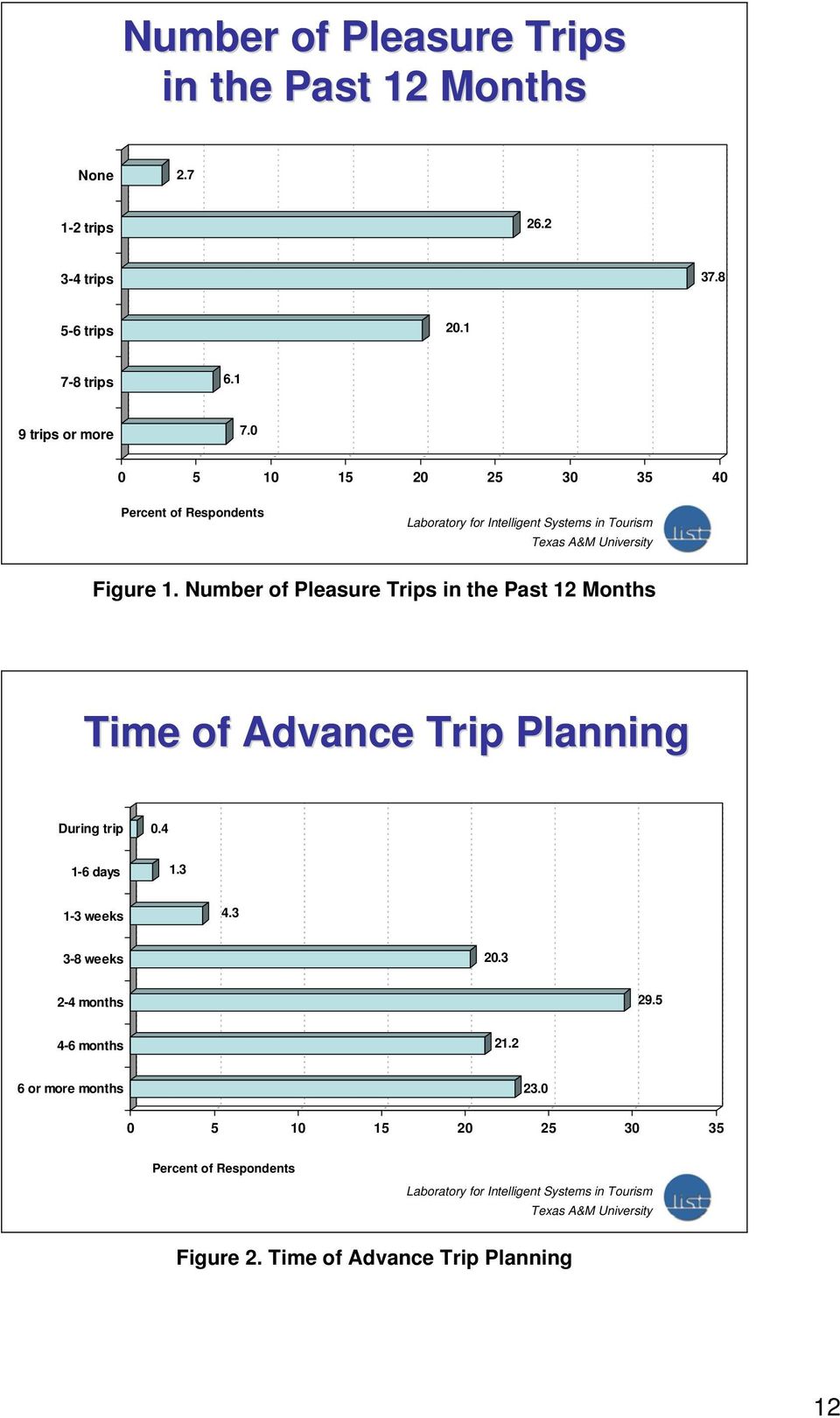
11 thirds of the respondents feel trip planning is a process which takes up much of their time (70.8%). On the other hand, only 20.1 percent of respondents like to leave trip planning to others. The decision making style which the respondents most associate themselves with is intuition: they trust inner feelings and reactions (71.4%), rely upon their instincts (60.7%), and rely on their intuition (58.3%). The second most reported style is relying on others: seek out advice of people (58.3%), make decisions rarely without consulting other people (49.0%), often need assistance of other people (27.4%). Spur of the moment decisions was the least reported decision making style by the respondents: make decisions in the spur of the moment (24.6%), impulse decisions (21.5%), and snap decisions (13.1%). Overall, most respondents plan major aspects of their trip in advance (67.0%). One quarter of respondents like to plan in advance and are only open to minor changes (23.6%) and 2.4 percent plan in great detail and do not enjoy change. Fewer respondents keep advance planning to a minimum (6.4%) or make almost all decisions while on vacation (0.7%). It is clear that a majority of respondents always uses the Internet (82.5%) during their trip planning percent of respondents use the Internet often (13.5%) or sometimes (3.6%) when they make trip plans. On the other hand, only 0.4% use the Internet rarely or not at all during the process. Most of the online activities that respondents take part in during their trip planning are looking at other consumers comments/materials (90.0%), printing out maps or directions (82.7%), read travel-related blogs (64.2%) and request printed materials/brochures (59.9%) percent print out coupons. Approximately one quarter of respondents also watch videos online (27.7%) and use interactive trip planners (26.9%). A smaller percentage of people listen to travel-related audio files/podcasts (6.6%), use live chat to talk with travel experts (4.7%) and send virtual postcards to friends/family (3.7%). Less than one percent (0.7%) report using none of the listed options. 11
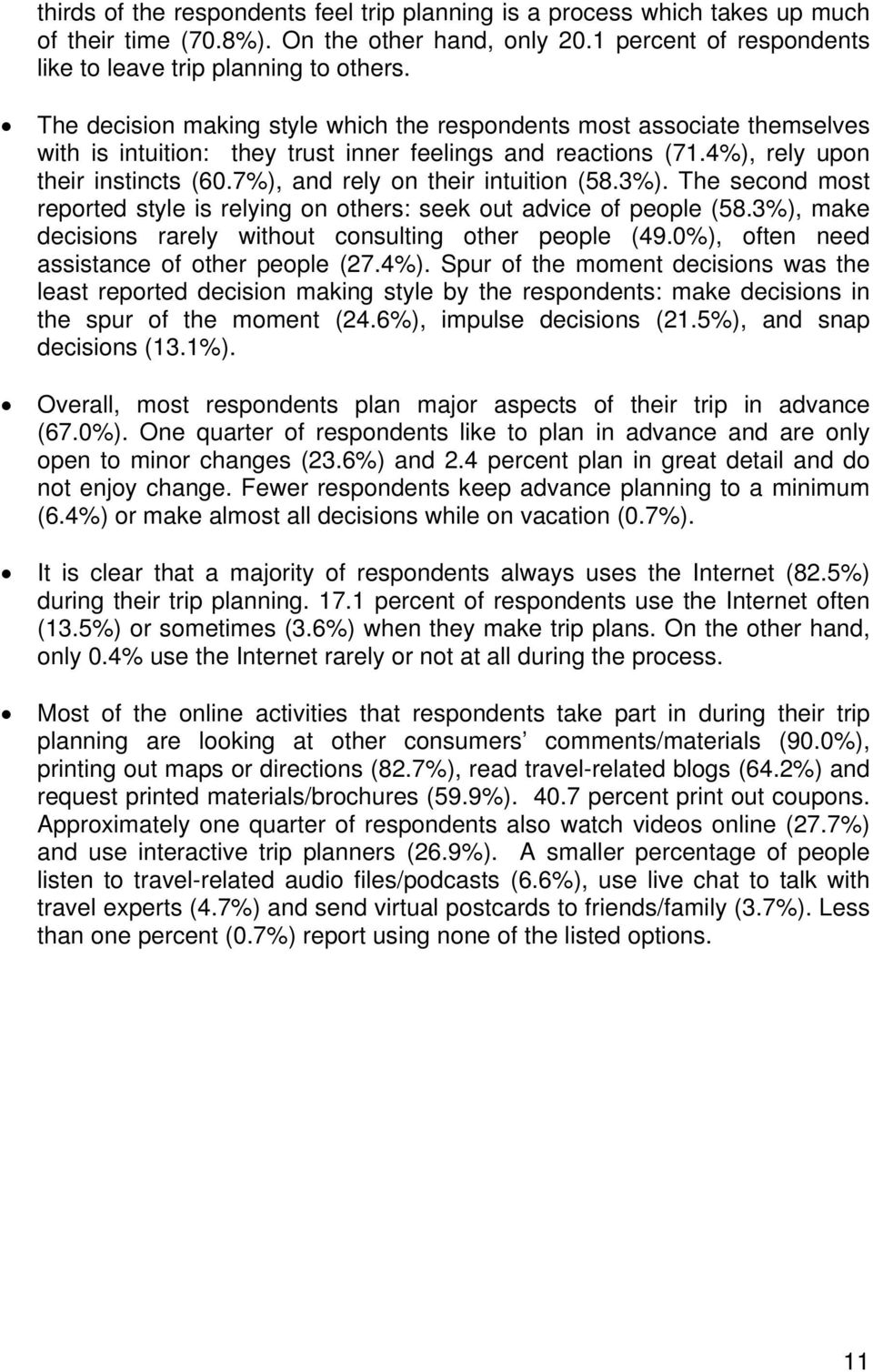
12 Number of Pleasure Trips in the Past 12 Months None trips trips trips trips trips or more Percent of Respondents Figure 1. Number of Pleasure Trips in the Past 12 Months Time of Advance Trip Planning During trip days weeks weeks months months or more months Percent of Respondents Figure 2. Time of Advance Trip Planning 12
13 Information Source for Advance Trip Planning Internet 96.4 Travel Books 68.3 Family/Friends 41.6 Magazines Brochures/Flyers Newspapers 27.8 Tourism Offices Travel Agents AAA Television Radio Other Timeshare Company (6) Own experience (4) Map/Map software (2) Travel exhibition/show (2) Credit card/club card source (2) Hotel employee (1) Library videos & Books (1) alerts (1) Business conference schedule (1) Alumni travel organization (1) Percent of Respondents Figure 3. Information Source for Advance Trip Planning Perception of Trip Planning Very Important Something I like to do Enjoyable Critical Essential Fun Process I have to go through 69.8 Must be done 63.6 A necessary chore Percent of Respondents who somewhat or strongly agree Figure 4. Perception of Trip Planning 13

14 Involvement in Trip Planning I typically become very involved 96.5 I devote a lot of effort 92.7 A process which takes up much of my time 70.8 Something I like to leave to others Percent of Respondents who somewhat or strongly agree Figure 5. Involvement in Trip Planning Trip Planning Decision Making Styles Trust inner feelings and reactions 71.4 Rely upon my instincts Rely on my intuition Seek out advice of other people Rarely without consulting other people 49.0 Need assistance of other people Spur of the moment Impulse decisions Snap decisions Percent of Respondents who somewhat or strongly agree Figure 6. Trip Planning Decision Making Styles 14

15 Extent of Trip Planning Plan in great detail and do not enjoy change 2.4 Plan in advance but open to minor changes 23.6 Plan major aspects of trip 67.0 Keep advance planning to minimum 6.4 Make almost all decisions while on vacation Percent of Respondents Figure 7. Extent of Trip Planning Frequency of Internet Use for Trip Planning Always 82.5 Often 13.5 Sometimes 3.6 Rarely 0.2 Not at all Percent of Respondents Figure 8. Frequency of Internet Use for Trip Planning 15

16 Activities During Online Trip Planning I Look at other consumers' comments/materials 90.0 Print out maps or directions 82.7 Read travel-related blogs 64.2 Request printed materials/brochures 59.9 Print out coupons Percent of Respondents who use the Internet for travel planning Figure 9. Activities During Online Trip Planning I Activities During Online Trip Planning II Watch videos online 27.7 Use interactive trip planners 26.9 Listen to travel-related audio files/podcasts Use live chat to talk with travel experts Send virtual postcards to friends/family None of the above Percent of Respondents who use the Internet for travel planning Figure 10. Activities During Online Trip Planning II 16
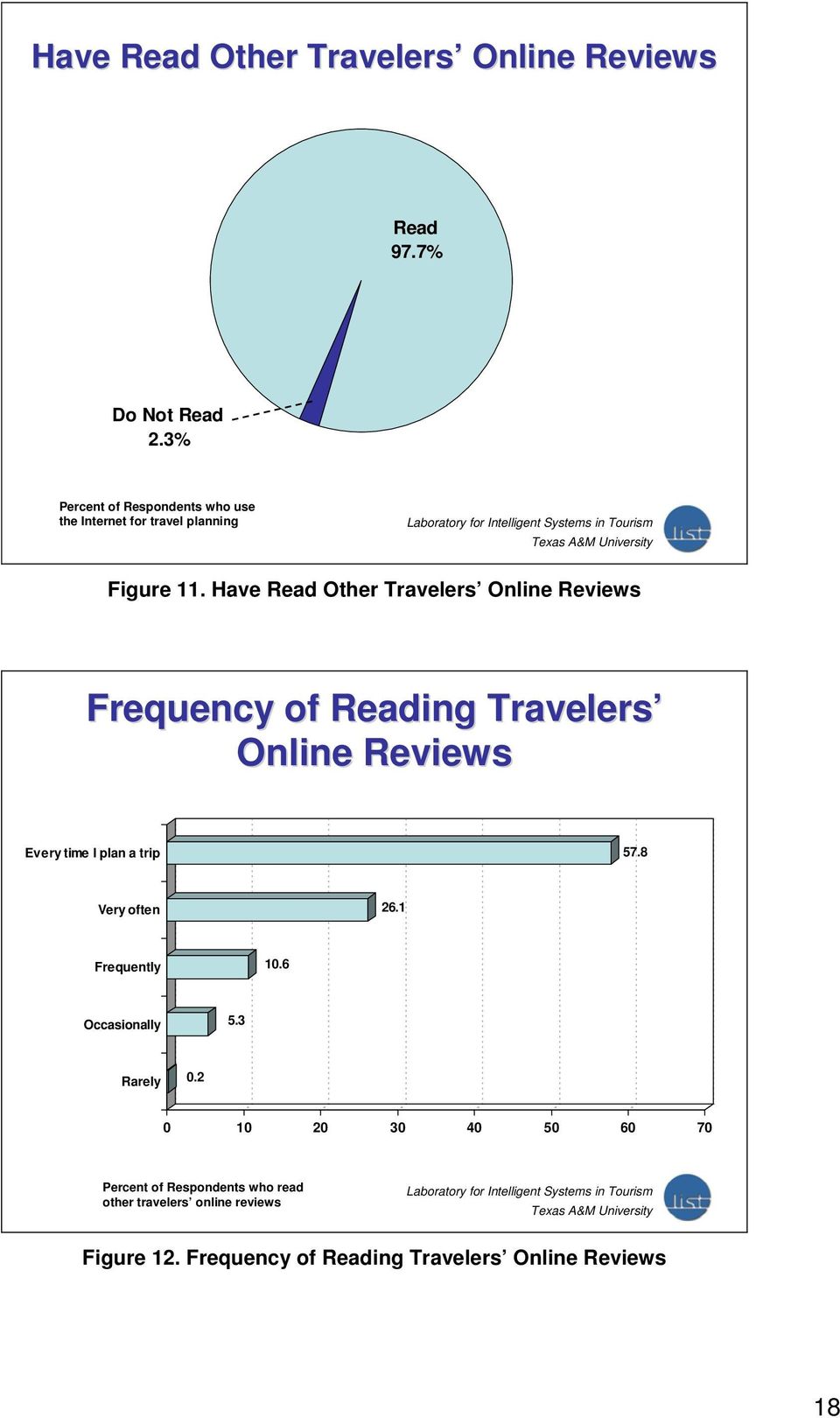
17 4.2 Use of Other Travelers Online Reviews Not surprisingly (given the sample which represents TripAdvisor users), almost all (97.7%) of the respondents read other travelers online reviews. Over half (57.8%) of respondents state they read other travelers' online reviews every time they plan a trip. 36.7% read them very often or frequently while 5.5% read them only occasionally or rarely. Of those who read other travelers' online reviews, a majority reads them in the beginning of the trip planning process to get ideas (63.7%) and in the middle of planning to narrow down choices (64.7%) percent of respondents also use online reviews later in their planning, in order to confirm their decisions. Almost 9 percent use the reviews during the trip (8.7%), and nearly 30 percent use reviews after the trip to compare and share experiences (29.5%). Others have stated reading reviews is an ongoing process and they read them with no specific trip in mind; or they read reviews throughout the planning process, long before a trip, or only for accommodations. With respect to travel related decisions, most respondents think other travelers' online reviews are extremely or very important for deciding where to stay (77.9%). Importance ratings are much lower and somewhat similar for all other travel-related decisions: where to eat (33.6%), what to do (32.5%), where to go (27.0%) and when to go (26.6%). A majority of respondents (92.3%) use virtual communities (TripAdvisor, VirtualTourist, LonelyPlanet, etc.) to find other travelers online reviews. Many also use travel guidebook sites (Frommers, Conde Nast, etc.) (60.6%), online travel agency/auction sites (Expedia, Orbitz, Priceline, etc.) (58.1%), search engines or portals (Google, Yahoo, AOL, etc.) (51.5%), local destination websites (44.6%), state tourism web sites (29.7%), and company sites (27.9%). Meta-travel search engines (Sidestep, Mobissimo, Kayak, etc.) were only reported as used by 13.4% of the respondents. Other web sites respondents listed were specific travel-related review sites (e.g. cruisecritic.com), general review sites (epinions.com), blogs, newspaper/magazine sites, and travel expert sites (e.g. Rick Steves). 17

18 Have Read Other Travelers Online Reviews Read 97.7% Do Not Read 2.3% Percent of Respondents who use the Internet for travel planning Figure 11. Have Read Other Travelers Online Reviews Frequency of Reading Travelers Online Reviews Every time I plan a trip 57.8 Very often 26.1 Frequently 10.6 Occasionally 5.3 Rarely Percent of Respondents who read other travelers online reviews Figure 12. Frequency of Reading Travelers Online Reviews 18
19 Use of Online Reviews in Different Trip Planning Stages Beginning, to get ideas 63.7 Middle, narrow down choices 64.7 Later, to confirm decisions 40.8 During trip, what to do at destination 8.7 After the trip, compare and share experiences Other Ongoing (6) Throughout planning process (4) Long before trip (1) Only for accommodation (1) Percent of Respondents who read other travelers online reviews Figure 13. Use of Online Reviews in Different Trip Planning Stages Importance of Travel Reviews for Travel-Related Decisions Where to stay 77.9 Where to eat 33.6 What to do 32.5 Extremely or Very Important Where to go 27.0 When to go Percent of Respondents who read other travelers online reviews Figure 14. Importance of Travel Reviews for Travel-Related Decisions 19

20 Travel Web Sites Used to Find Other Travelers Online Reviews Virtual communities 92.3 Travel guidebook sites Online travel agency/auction sites Search engines or portals 51.5 Local destination web sites 44.6 State tourism web sites Company sites Meta-travel search engines Other Travel review/message board (16) ex) holidaytruth. Debbie s carribean travels, cruisecritic. Holidaysuncovered - General review sites (7) ex) epinions -Blogs(5) - Newspaper/Magazine sites (3) - Travel expert sites (2) Percent of Respondents who read other travelers online reviews Figure 15. Travel Web Sites Used to Find Other Travelers Online Reviews 20

21 4.3 Evaluation of Other Travelers Online Reviews The majority of respondents rate the following three types of information as being extremely or very important when evaluating a travel review: detailed description (71.0%), type of website on which the review is posted (64.7%), and the date the review was posted (59.3%). Other criteria were only rated as extremely or very important by less than half of the respondents who read other travelers' reviews: travel date (44.3%), photos (43.9%), purpose of trip (35.9%), other travelers ratings of the usefulness of the review (34.4%), reviewers demographic information (33.5%), travel party information (children included, size, etc.) (33.2%), review free of spelling/grammar mistakes (28.9%), length of review (21.8%), where the reviewer lives/resides (18.4%). Additional cues mentioned as important for judging a review were mostly related to tone and clarity of the writing, providing facts, a balance of pros and cons, specific information such as price, location, cleanliness, etc. and consistency with other reviews. Cues related to the reviewer were also frequently mentioned, including objectivity/honesty, attitude/personality, especially pickiness, travel experience, frequency of review posting, sexual orientation, similarity and prior experience/intention to revisit places. Most of the respondents perceive the reviewer s credibility based on the following characteristics: has a lot of travel experience (75.3%), engages in similar activities during the trips (65.9%), travels for a similar trip purpose (60.0%), and writes in a polite and friendly manner (58.5%). Other important characteristics are: similar in terms of age, gender or marital status (48.7%), liking based on writing and/or photos (47.8%), lives at destination (45.3%), has received high ratings from others for his/her review (44.4%), appears to be a nice person (36.2%), and is similar in terms of residence (23.6%). Most of the respondents perceive a review as extremely or very useful based on the following characteristics of the reviewer: has a lot of travel experience (78.5%), engages in similar activities during the trips (68.2%), travels for a similar trip purpose (64.4%) and has similar age, gender or marital status (53.1%). Appears to be a nice person (32.1%) and similar in terms of residence (24.1%) were perceived as least important in determining a review's usefulness. A majority of respondents reported feeling other travelers reviews are more likely to carry the following information in comparison to travel service providers: up-to-date information (65.3%), enjoyable information (61.2%), reliable information (61.1%). Where travelers' reviews seem to not provide clear advantages is detailed and relevant information. Nevertheless, more than half of online travel review readers still say reviews are superior along these two dimensions. 21
22 Importance of Information When Evaluating a Travel Review I Extremely or Very Important Detailed description Percent of Respondents who read other travelers online reviews Type of website where review is posted Date Posted Travel date Photos Purpose of trip Figure 16. Importance of Information When Evaluating a Travel Review I Importance of Information When Evaluating a Travel Review II Extremely or Very Important Others' ratings of Reviewer's Travel party info Free of Length of Review Where the review demographic info Spelling/Grammar mistakes reviewer resides Percent of Respondents who read other travelers online reviews Figure 17. Importance of Information When Evaluating a Travel Review II 22
23 Additional Information Cues for Evaluating a Travel Review Cues Related to Reviewer Attitude Objectivity, Honesty Similarity (Interests, situation) Detail travel party information (Children age, number of people) Pickiness Prior trip experience/frequency Prior experience at hotel/area Independence Sexual orientation Country of origin (Different standard between US vs Europe) Cultural background Intention to revisit the place Frequency of posting reviews Other reviews posted by same reviewer Life style Social Status Cues Related to Review Overall tone Detail, Clarity Accuracy, Realistic Balance of negative & positive views Objectivity Breadth & range of information Consistency with other reviews Relevancy to me Contains budget/cost/price information Practical tips (money saving) Sense of humor Emotional tone, good word image Recency Language of review Grammar/Fluency Opinion or fact, justifications Contains weather information Contains cleanliness, location and rating information Others Take as a whole (Not just one cue) Evaluation based on all reviews Website where the review is posted Figure 18. Additional Information Cues for Evaluating a Travel Review Influence of Reviewer Characteristics on Perceived Credibility Has a lot of travel experience Similar activities during trips Traveled for a similar trip purpose Writes in a polite and friendly manner Similar age, gender or marital status Like based on writing and/or photos Lives at destination Received high ratings Appears to be a nice person Similar in terms of residence Percent of respondents who read other travelers online reviews and who perceive reviewer's credibility as high or very high when reviewer characteristic is present. Figure 19. Influence of Reviewer Characteristics on Perceived Credibility 23
24 Usefulness of Review When Posted by Following Types of Reviewers Has a lot of travel experience 78.5 Similar activities during trips 68.2 Traveled for a similar trip purpose 64.4 Similar age, gender or marital status 53.1 Like based on writing and/or photos 47.4 Lives at destination 47.4 Writes in a polite and friendly manner 46.6 Received high ratings 45.6 Appears to be a nice person 32.1 Similar in terms of residence Percent of respondents who read other travelers online reviews and who rate the review as extremely or very useful when reviewer characteristic is present. Figure 20. Usefulness of Review When Posted by Certain Types of Reviewers Other Travelers Reviews Compared to Information from Travel Service providers Up-to-date information Enjoyable information Reliable information Detailed information Relevant Information More Likely Same Less Likely Percent of Respondents who read other travelers online reviews Figure 21. Other Travelers Reviews Compared to Information from Travel Service Providers 24
25 4.4 Influence of Other Travelers Online Reviews Travel review readers stated that other travelers' online reviews have a variety of impacts on their travel planning. Almost all of the respondents strongly or somewhat agreed that other travelers reviews influenced them in the following ways: learning about a travel destination, product or service (94.6%), evaluating alternatives (91.9%), avoiding places or services they would not enjoy (91.8%), and providing them with ideas. Over 80 percent of respondents who read online travel reviews indicated an influence of other travelers' reviews on the following: Increase confidence in decisions (86.6%), make it easier to imagine what the place will be like (85.3%), help reduce risk/uncertainty (82.4%), make it easier to reach decisions (81.3%), help plan a trip efficiently (80.2%). Over three quarters of online travel review readers said reviews reduce the likelihood of regret (77.6%), make travel planning more enjoyable (77.4%), make them feel more excited about traveling (76.8%) and add fun to the travel planning process (76.5%). Almost 70 percent strongly or somewhat agreed that other travelers' online reviews save time in the travel planning process (68%) and help imagine trips more vividly (67.4%). 25
26 Influence of Other Travelers Reviews I Learn about a destination, product or service Evaluate alternatives Avoid places/services I would not enjoy Provides ideas Increases confidence in decisions Easier to imagine what the place will be like Reduces risk/uncertainty Makes it easier to reach decision Percent of Respondents who read other travelers online reviews and strongly or somewhat agree Figure 22. Influence of Other Travelers Reviews I Influence of Other Travelers Reviews II Helps plan a trip efficiently 80.2 Reduces likelihood of regret Makes travel planning more enjoyable Makes me feel excited about traveling Adds fun to the travel planning process Saves time in travel planning process Helps to imagine trips more vividly Percent of Respondents who read other travelers online reviews and strongly or somewhat agree Figure 23. Influence of Other Travelers Reviews II 26
27 4.5 Motivations to Write/Post Reviews A large majority of the respondents reported having posted online travel reviews (83.0%). Of those who do not write or post online travel reviews, time constraints was the most frequently mentioned reason (45.4%). Other frequently mentioned reasons include: not interested (9.3%), lack of confidence in writing (7.9%), and being lazy (7.0%). Less frequently but also mentioned were: don't know why, haven't thought about posting, don't travel enough, forget, Internet access problems, plan on starting, security/privacy concerns, not knowing how to post, others do it, keep a diary instead, never had bad experience, no incentives, personal reasons, and wanting to keep great places a secret. A majority of respondents somewhat or strongly agreed that concern for other consumers was a large motivation for writing online reviews: help others by sharing my own positive experiences (96.3%), other travel reviews helped me and I want to return the favor (95.0%), save others from negative experiences (83.9%), and warn others of bad services (82.4%) are factors that motivate a majority of online travel review writers. Helping the company was also reported as a large motivation: good travel service providers should be supported (93.9), and help travel service provider to be successful (91.1%). Motivations out of needs for extraversion and positive self-enhancement also rated high: tell others about a great experience (92.8%), express my joy about a good experience (91.1%), share my travel experience with others (87.3%), I enjoy it (79.2%), feels good when I can tell others about my trip successes (75.9%). Extending the experience was also a factor for a majority of online travel review writers: reflect on the trip after returning home (68.1%) and being able to relive my trips (57.2%) motivated more than half. Social benefits: communication among like-minded people is a nice thing (75.3%) and I meet nice people this way (21.8%) were motivating for some. Greater impact was also less of a motivation: more power together with others than writing a single letter of complaint (58.4%), more convenient than writing to or calling the travel service provider (39.4%), and travel service providers are more accommodating when I publicize matters (31.2%) were only mentioned by some online travel review posters as motivations. 27
28 Venting negative feelings was not a very common motivation: if a company harms me, I will harm the company (18.9%), and to take vengeance upon a travel service provider (10.3%) were mentioned by a minority of respondents who post online travel reviews. Similarly, economic incentives were not identified as major motivators: incentives are offered (14.0%) and I receive an award for the writing (7.6%) motivate less than 15 percent of the online travel review writers. Respondents who Have Posted Online Travel Reviews Not Posted 17% Posted 83% Percent of Respondents who read other travelers online reviews Figure 24. Respondents Who Have Posted Online Travel Reviews 28
29 Why Some Do Not Write/Post Online Travel Reviews Time Constraint Not interested Lack of confidence in writing Lazy Don't know why Haven't thought about posting Don't travel enough Forget Internet access/problems Plan on starting Security/Privacy Not sure of where/how to post Others do it Keep a diary instead Never had bad experience No incentives Personal reasons Want to keep great places a secret Percent of respondents who do not write/post online travel reviews Figure 25. Barriers to Writing/Posting Online Travel Reviews Motivation to Write Online Reviews I Strongly or Somewhat Agree Help others by sharing my own positive experiences Other travel reviews helped me and I want to return the favor Good travel service providers should be supported Tell others about a great experience Help travel service provider to be successful Express my joy about a good experience Share my travel experience with others Save others from negative experiences Percent of Respondents who post/write online reviews Figure 26. Motivation to Write Online Reviews I 29
30 Motivation to Write Online Reviews II Warn others of bad services 82.4 I enjoy it 79.2 Feels good when I can tell others about my trip successes Communication among likeminded people is a nice thing Reflect on the trip after returning home 68.1 More power together Relive my trips Strongly or Somewhat Agree Percent of Respondents who post/write online reviews Figure 27. Motivation to Write Online Reviews II Motivation to Write Online Reviews III More convenient than writing to or calling the travel service provider 39.4 Travel service providers are more accommodating when I publicize matters 31.2 I meet nice people this way 21.8 If a company harms me, I will harm the company 18.9 Incentives are offered 14.0 To take vengeance upon a travel service provider I receive an award for the writing Strongly or Somewhat Agree Percent of Respondents who post/write online reviews Figure 28. Motivation to Write Online Reviews III 30
31 4.6 Sample Characteristics There were more female respondents (64%) who completed the survey than there were male respondents. Most respondents reported being married or living with a partner (79%). The largest group of respondents was years of age (42.8%). The age group of years of age included 34.1% of the respondents, and the third largest group was year olds (14.4%). Only 6.5 percent reported being 65 years of age or older and 2.2 percent stated they were between 18 and 25 years old. A majority of respondents reported having children under 17 living in their household (78.5%). A greater part of the respondents are college graduates (38.1%). 31 percent hold a post graduate degree. The third largest group is those with some college experience (18.4%). About About one quarter (25.5%) of the respondents chose not to report incomerelated information percent of respondents earn $49,999 or less. Nearly half of respondents who provided income information reported incomes of $50,000 $109,999 (49.1%). 36 percent of respondent who provided income information reported an income of $110,000 and over. A majority of the respondents strongly or somewhat agreed that they are skilled at using the Internet: I am very skilled at using the Internet (84.1%), I know how to find what I want on the Internet (96.1%), I know more about using the Internet than most people (66.7%). The online activities which respondents most participated in, in the past three months, were: reading blogs (64.4%), rating products and contents (60.9%), rating the usefulness of reviews (57.4%), watching or downloading videos (55.9%), and posting and sharing photographs (55.6%). Over 30 percent (30.9%) listened to or downloaded audio podcasts and 25.9 percent posted comments to a blog. Almost 18 percent (17.7%) used a social networking site and 14.3 percent wrote a blog. About 11 percent (11.2%) subscribed to an RSS feed and (10.9%) maintained a personal web site percent posted/shared audio files and 9.6% posted/shared videos. Only 5 percent reported contributing to a wiki in the past three months. 31
32 Gender & Marriage Not Married Male 21% 34% Married/ Female Living 64% with Partner 79% Percent of Respondents Figure 29. Gender & Marriage Age years years years years years or older Percent of Respondents Figure 30. Age 32
33 Children under 17 living in household Yes 21.5% No 78.5% Percent of Respondents Figure 31. Children under 17 Living in Household Highest Level of Education Completed Some high school 2.3 High school graduate 8.2 Some college 18.4 College graduate 38.1 Post graduate degree 31.0 Other Percent of Respondents Figure 32. Highest Level of Education Completed 33
34 Total Annual Household Income Before Taxes Less than $10, $30,000 to $49, $70,000 to $89, $110,000 to $129, $150,000 and over Percent of respondents who provided income information Figure 33. Total Annual Household Income Before Taxes Internet Skills Stongly/Somewhat Agree Neutral Strongly/Somewhat Disagree I am very skilled at using the Internet I know how to find what I want on the Internet I know more about using the Internet than most people Percent of Respondents Figure 34. Internet Skills 34
35 Online Activities in Past 3 Months Read blogs Rate products/contents Rate the usefulness of reviews Watch or download videos Post/share photographs Listen to or download audio podcasts Post comments to a blog Use a social networking site Write a blog Subscribe to an RSS feed Maintain a personal website Post/share audio files Post/share videos Contribute to a wiki None of the above Percent of Respondents Figure 35. Online Activities in Past 3 Months 35
36 4.7 Characteristics of Frequent Travel Review Readers Crosstabulations and Chi-Square statistics were used to test whether differences exist among online travel review readers in terms of the frequency with which they read other travelers' reviews. Since not many respondents had indicated that they rarely read online travel reviews, this category was collapsed with occasional readers. Only significant differences (p<0.05) are reported Trip Planning Behavior There seems to be a U-shaped relationship between frequency of review reading and frequency of travel. Respondents who read online travel reviews rarely/occasionally are more likely to travel very little or very much. Respondents who read travel reviews every time they plan a trip were most likely to have taken 3-4 trips in the past 12 months. Frequency of Online Travel Review Reading Rarely or Occasionally Frequently Very Often Every time Number of pleasure trips in the past 12 months N=80 N=153 N=376 N=834 None ~2 trips ~4 trips ~6 trips ~8 trips trips or more Time of advance trip planning During the trips days in advance to less than 3 weeks in advance to less than 8 weeks in advance to less than 4 months in advance to less than 6 months in advance or more months in advance Frequent online travel review readers are more likely to plan their pleasure trips earlier. Almost half of those who read other travelers reviews every time they plan a trip start their trip planning at least 4 months in advance. Frequent online travel review readers are more likely to plan major aspects of pleasure trips in advance while those who read reviews rarely are more likely to keep advance trip planning to a minimum. 36
37 Extent pf trip planning Plan in great detail and do not enjoy change Plan in advance but open to minor changes Frequency of Online Travel Review Reading Rarely or Occasionally N=80 Frequently Very Often Every time N=153 N=376 N= Plan major aspects of trip Keep advance planning to minimum Make almost all decisions while on vacation Frequent online travel review readers are more likely to perceive trip planning as an essential, critical and very important process. Frequency of Reading Online Travel Reviews Perception of Trip Planning Essential Rarely or Occasionally N=80 Frequently Very Often Every time N=153 N=376 N=834 Strongly Disagree Somewhat Disagree Neutral Somewhat Agree Strongly Agree Critical Strongly Disagree Somewhat Disagree Neutral Somewhat Agree Strongly Agree Very Important Strongly Disagree Somewhat Disagree Neutral Somewhat Agree Strongly Agree
38 Frequent online travel review readers are also more likely to perceive trip planning as something which has to be done. However, they are less likely to see it as a necessary chore. Perception of Trip Planning Frequency of Reading Online Travel Reviews Rarely or Occasionally N=80 Frequently Very Often Every time N=153 N=376 N=834 The process I have to go through Strongly Disagree Somewhat Disagree Neutral Somewhat Agree Strongly Agree Something which has to be done Strongly Disagree Somewhat Disagree Neutral Somewhat Agree Strongly Agree A necessary chore Strongly Disagree Somewhat Disagree Neutral Somewhat Agree Strongly Agree Importantly, the more frequently respondents read other travelers' online reviews, the more likely they are to perceive trip planning as an enjoyable and fun activity they like to do. 38
39 Perception of Trip Planning Frequency of Reading Online Travel Reviews Rarely or Occasionally N=80 Frequently Very Often Every time N=153 N=376 N=834 Enjoyable Strongly Disagree Somewhat Disagree Neutral Somewhat Agree Strongly Agree Something I like to do Strongly Disagree Somewhat Disagree Neutral Somewhat Agree Strongly Agree Fun Strongly Disagree Somewhat Disagree Neutral Somewhat Agree Strongly Agree Frequent online travel review readers are more likely to be involved in trip planning. More than 90% of respondents who read travel reviews every time they plan a trip agreed that trip planning is an activity in which they typically become very involved. Frequent online travel review readers are also more likely to devote a lot of effort to trip planning and trip planning takes up a lot of their time. Frequent online travel review readers are more likely to disagree with the statement that trip planning is something they like to leave to others. 39
40 Frequency of Reading Online Travel Reviews Rarely or Occasionally Frequently Very Often Every time Involvement in Trip Planning N=80 N=153 N=376 N=834 Something I like to leave to others Strongly Disagree Somewhat Disagree Neutral Somewhat Agree Strongly Agree An activity in which I typically become very involved Strongly Disagree Somewhat Disagree Neutral Somewhat Agree Strongly Agree A process which takes up a lot of my time Strongly Disagree Somewhat Disagree Neutral Somewhat Agree Strongly Agree Something to which I devote a lot of effort Strongly Disagree Somewhat Disagree Neutral Somewhat Agree Strongly Agree As far as travel decision-making styles are concerned, frequent online travel review readers are less likely to make impulsive travel decisions and, not surprisingly, are more likely to seek out the advice of other people. 40
41 Travel Decision-Making Style Frequency of Reading Online Travel Reviews Rarely or Occasionally N=80 Frequently Very Often Every time N=153 N=376 N=834 I often make travel decisions on the spur of the moment Strongly Disagree Somewhat Disagree Neutral Somewhat Agree Strongly Agree I generally make snap decisions in the context of travel Strongly Disagree Somewhat Disagree Neutral Somewhat Agree Strongly Agree I often make impulsive travel-related decisions Strongly Disagree Somewhat Disagree Neutral Somewhat Agree Strongly Agree I seek out the advice of other people in making important travel decisions Strongly Disagree Somewhat Disagree Neutral Somewhat Agree Strongly Agree Frequent online travel review readers clearly use the Internet more for their trip planning than respondents who read reviews rarely or occasionally. 91.8% of respondents who read other travelers reviews every time they plan a trip said they always use the Internet for their trip planning. In contrast, only 55% of respondents who read online reviews rarely/occasionally stated that they always use the Internet when planning pleasure trips. 41
42 Frequency of Online Travel Review Reading Rarely or Occasionally Frequently Very Often Every time Frequency of Internet use for trip planning N=80 N=153 N=376 N=834 Sometimes Often Always In addition, significant differences exist with respect to the activities in which respondents engage online when planning pleasure trips. Frequent review readers are more likely to watch videos online and use interactive trip planners during their trip planning. Also, a majority of frequent review readers said that they read travel-related blogs and look at other travelers comments and materials for their travel planning. Frequency of Online Travel Review Reading Rarely or Occasionally Frequently Very Often Every time Online Activities During Trip Planning N=80 N=153 N=376 N=834 Watch videos online No Yes Read travel-related blogs No Yes Look at comments/materials other consumers have posted No Yes Use interactive trip planners No Yes Use of Other Travelers Online Reviews Frequent online travel review readers are more likely to use online travel reviews throughout all trip planning stages. 42
43 Frequency of Reading Online Travel Reviews Rarely or Occasionally Frequently Very Often Every time Use of Online Reviews in Different Trip Planning Stages N=80 N=153 N=376 N=834 Beginning, to get ideas No Yes Middle, to narrow down possible choices No Yes Later, to confirm my decisions No Yes During the trip, to decide what to do at the destination No Yes After the trip, to compare and share travel experiences No Yes Frequent online travel review readers are more likely to think that online travel reviews are important for all travel-related decisions. 43
44 Importance of Travel Reviews for Travel-related Decisions Frequency of Reading Online Travel Reviews Rarely or Frequently Very Often Every time Occasionally N=80 N=153 N=376 N=834 Deciding where to go Not at all important Not very important Somewhat important Very important Extremely important Deciding where to stay Not at all important Not very important Somewhat important Very important Extremely important Deciding what to do at destination Not at all important Not very important Somewhat important Very important Extremely important Deciding where to eat Not at all important Not very important Somewhat important Very important Extremely important Deciding when to go Not at all important Not very important Somewhat important Very important Extremely important
45 Frequent online travel review readers are more likely to visit virtual community sites and online travel agency/auction sites to find other travelers online reviews. Websites Visited to Find Other Travelers Online Review Frequency of Reading Online Travel Reviews Rarely or Frequently Very Often Every time Occasionally N=80 N=153 N=376 N=834 Online Travel agency or auction sites (Expedia, Orbitz, Priceline etc.) No Yes Virtual communities (TripAdvisor, Virtual Tourist, LonelyPlanet etc.) No Yes Evaluation of Other Travelers Online Reviews Frequent online travel review readers are more likely to consider travel date, type of Web site where review is posted, purpose of trip, detailed descriptions, photos provided along with review, other travelers ratings of its usefulness, and the date the review was posted when evaluating a review. Importance of Information for Travel Review Evaluation Frequency of Reading Online Travel Reviews Rarely or Frequently Very Often Every time Occasionally N=80 N=153 N=376 N=834 Travel date Not at all important Not very important Somewhat important Very important Extremely important Type of Website on which the review is posted Not at all important Not very important Somewhat important Very important Extremely important
46 Importance of Information for Travel Review Evaluation Frequency of Reading Online Travel Reviews Rarely or Frequently Very Often Every time Occasionally N=80 N=153 N=376 N=834 Purpose of trip Not at all important Not very important Somewhat important Very important Extremely important Detailed descriptions Not at all important Not very important Somewhat important Very important Extremely important Photos provided along with review Not at all important Not very important Somewhat important Very important Extremely important Other travelers rating of usefulness of the review Not at all important Not very important Somewhat important Very important Extremely important Date review was posted Not at all important Not very important Somewhat important Very important Extremely important Frequent online travel review readers are more likely to evaluate a reviewer s credibility as high based on similarity in terms of demographics and activities performed during a trip as well as the travel experience of the reviewer. 46
47 Frequency of Reading Online Travel Reviews Rarely or Occasionally Frequently Very Often Every time Reviewer Credibility N=80 N=153 N=376 N=834 Similar in terms of age, gender or marital status Very low Low Good High Very high Lots of travel experience Very low Low Good High Very high Appears to be a nice person Very low Low Good High Very high Writes in a polite and friendly manner Very low Low Good High Very high Similar activities during trips Very low Low Good High Very high
48 Frequent online travel review readers are more likely to evaluate a reviewer s credibility as high based on whether the person writes in a polite and friendly manner and appears to be nice. Also, frequent review readers are more likely to consider whether they like the person based on their writing and/or photos. Frequency of Reading Online Travel Reviews Rarely or Occasionally Frequently Very Often Every time Reviewer Credibility N=80 N=153 N=376 N=834 I like based on writing and/or photos Very low Low Good High Very high Frequent online travel review readers are more likely to evaluate the usefulness of a review higher than occasional review readers when the review is posted by a reviewer who has lots of travel experience, appears to be a nice person, writes in a polite and friendly manner, engages in similar activities during a trip and is someone they like based on his/her writing and/or photos. Usefulness of Review When Posted by Following Types of Reviewer Frequency of Reading Online Travel Reviews Rarely or Frequently Very Often Every time Occasionally N=80 N=153 N=376 N=834 Lots of travel experience Not at all useful Not very useful Somewhat useful Very useful Extremely useful Appears to be a nice person Not at all useful Not very useful Somewhat useful Very useful Extremely useful
49 Usefulness of Review When Posted by Following Types of Reviewer Frequency of Reading Online Travel Reviews Rarely or Frequently Very Often Every time Occasionally N=80 N=153 N=376 N=834 Writes in a polite and friendly manner Not at all useful Not very useful Somewhat useful Very useful Extremely useful I like based on writing and/or photos Not at all useful Not very useful Somewhat useful Very useful Extremely useful Similar activities during trips Not at all useful Not very useful Somewhat useful Very useful Extremely useful Frequent online travel review readers are more likely to evaluate other travelers online reviews as providing up-to-date, detailed, reliable, unbiased, relevant and enjoyable information compared to information offered by travel service providers. Travelers Review Compared to Info. from Travel Service Providers Frequency of Reading Online Travel Reviews Rarely or Frequently Very Often Every time Occasionally N=80 N=153 N=376 N=834 Up-to-date information Less likely Same More likely
50 Travelers Review Compared to Info. from Travel Service Providers Frequency of Reading Online Travel Reviews Rarely or Frequently Very Often Every time Occasionally N=80 N=153 N=376 N=834 Detailed information Less likely Same More likely Reliable information Less likely Same More likely Unbiased information Less likely Same More likely Relevant information Less likely Same More likely Enjoyable information Less likely Same More likely Influence of Other Travelers Online Reviews Frequent online travel review readers are more likely to be highly influenced by other travelers reviews. Frequent online travel review readers more likely indicate that reading online travel reviews is an efficient way of planning a trip. They more likely agree that it helps them save time, increase confidence, reduce risk/uncertainty, evaluate alternatives and provide ideas. In addition, frequent online travel review readers are more likely to view reading online travel reviews as an enjoyable process. They are more likely to agree that it adds fun, makes them excited, and helps them imagine their trip more vividly. 50
51 Influence of Other Travelers Reviews Frequency of Reading Online Travel Reviews Rarely or Frequently Very Often Every time Occasionally N=80 N=153 N=376 N=834 Make it easier to reach decisions Strongly Disagree Somewhat Disagree Neutral Somewhat Agree Strongly Agree Help me save time in the travel planning process Strongly Disagree Somewhat Disagree Neutral Somewhat Agree Strongly Agree Make travel planning more enjoyable Strongly Disagree Somewhat Disagree Neutral Somewhat Agree Strongly Agree Increase my confidence in the decisions I make Strongly Disagree Somewhat Disagree Neutral Somewhat Agree Strongly Agree Help me imagine my trips more vividly Strongly Disagree Somewhat Disagree Neutral Somewhat Agree Strongly Agree
52 Influence of Other Travelers Reviews Frequency of Reading Online Travel Reviews Rarely or Frequently Very Often Every time Occasionally N=80 N=153 N=376 N=834 Reduce the risk/uncertainty involved in making travel decisions Strongly Disagree Somewhat Disagree Neutral Somewhat Agree Strongly Agree Help me plan my trips more efficiently Strongly Disagree Somewhat Disagree Neutral Somewhat Agree Strongly Agree Provide me with ideas Strongly Disagree Somewhat Disagree Neutral Somewhat Agree Strongly Agree Make me feel excited about traveling Strongly Disagree Somewhat Disagree Neutral Somewhat Agree Strongly Agree Help me evaluate alternatives Strongly Disagree Somewhat Disagree Neutral Somewhat Agree Strongly Agree
53 Influence of Other Travelers Reviews Frequency of Reading Online Travel Reviews Rarely or Frequently Very Often Every time Occasionally N=80 N=153 N=376 N=834 Add fun to the travel planning process Strongly Disagree Somewhat Disagree Neutral Somewhat Agree Strongly Agree Reduce the likelihood that I later regret a decision Strongly Disagree Somewhat Disagree Neutral Somewhat Agree Strongly Agree A good way to learn about a travel destination, product or service Strongly Disagree Somewhat Disagree Neutral Somewhat Agree Strongly Agree Make it easier to imagine what a place will be like Strongly Disagree Somewhat Disagree Neutral Somewhat Agree Strongly Agree Help me avoid places/services I would not enjoy Strongly Disagree Somewhat Disagree Neutral Somewhat Agree Strongly Agree
54 4.7.5 Motivation to write/post online travel reviews Frequent readers of other travelers' online travel reviews are more likely to write/post travel reviews. Almost 90 percent of respondents who read travel reviews every time they plan a trip also post online travel reviews. Have previously written/posted a travel review Frequency of Reading Online Travel Reviews Rarely or Occasionally N=80 Frequently Very Often Every time N=153 N=376 N=834 No Yes Characteristics Frequent review readers are more likely to have higher household incomes. Frequency of Online Travel Review Reading Rarely or Occasionally N=80 Frequently Very Often Every time Total annual household income before taxes N=153 N=376 Less than $10, N=834 $10,000-$29, $30,000-$49, $50,000-69, $70,000-$89, $90,000-$109, $110, , $130,000-$149, $150,000 or more Frequent review readers are more likely to be younger than 35 compared to respondents who only rarely/occasionally read reviews. 54
55 Age Frequency of Online Travel Review Reading Rarely or Occasionally N=80 Frequently Very Often Every time N=153 N=376 N=834 Younger than 35 years years years or older Significant differences were also found with respect to Internet use skills. Frequent travel review readers more strongly agree that they have high Internet use and online search skills. I am very skilled at using the Internet Frequency of Online Travel Review Reading Rarely or Occasionally N=80 Frequently Very Often Every time N=153 N=376 N=834 Strongly Disagree Somewhat Disagree Neutral Somewhat Agree Strongly Agree I know more about using the Internet than most people Strongly Disagree Somewhat Disagree Neutral Somewhat Agree Strongly Agree I know how to find what I want on the Internet Strongly Disagree Somewhat Disagree Neutral Somewhat Agree , Strongly Agree
56 Frequent travel review readers engaged more often in general online activities in the 3 months prior to the study. Respondents who read reviews every time or very often for their trip planning are more likely to have read blogs, have written blogs, posted comments to a blog, listened to or downloaded audio podcasts, posted/shared photographs, rated products/contents, and rated the usefulness of reviews. Online activities in past 3 months: Frequency of Online Travel Review Reading Rarely or Occasionally N=80 Frequently Very Often Every time N=153 N=376 N=834 Read blogs No Yes Write a blog No Yes Post comments to a blog No Yes Listen to or download audio podcasts No Yes Post/share photographs No Yes Rate products/contents No Yes Rate the usefulness of reviews No Yes
57 4.8 Characteristics of Travel Review Writers Crosstabulations and Chi-Square statistics were used to test whether differences exist among respondents who actively write/post online travel reviews and those who do not. Only significant differences (p<0.05) are reported Trip Planning Behavior Review writers traveled more frequently for pleasure in the 12 months prior to the study than non-writers. Number of pleasure trips in the past 12 months Review Posting Experience Non-writer N=246 Writer N=1197 None ~2 trips ~4 trips ~6 trips ~8 trips trips or more Review writers are more likely to be involved in trip planning while non-writers are more likely to somewhat or strongly agree that trip planning is a necessary chore. Perception of Trip Planning Review Posting Experience Non-writer N=246 Writer N=1197 A necessary chore Strongly Disagree Somewhat Disagree Neutral Somewhat Agree Strongly Agree
58 Involvement in Trip Planning Review Posting Experience Non-writer N=246 Writer N=1197 Something I like to leave to others Strongly Disagree Somewhat Disagree Neutral Somewhat Agree Strongly Agree An activity in which I typically become very involved Strongly Disagree Somewhat Disagree Neutral Somewhat Agree Strongly Agree Review writers more frequently use the Internet for their pleasure trip planning percent of review writers compared to 73.4 percent of non-writers said they always use the Internet for their trip planning. Review writers more likely use live chat tools to talk with travel experts during their travel planning and more than 90% of review writers reported that they look at other consumers comments/materials during their trip planning. Review Posting Experience Non-writer Writer Frequency to use Internet during trip planning N=246 N=1197 Sometimes Often Always Online activities during trip planning: use live chat to talk with travel experts No Yes Online activities during trip planning : look at comments/materials other consumers have posted No Yes
59 4.8.2 Use of Other Travelers Online Reviews Review writers are more likely to use online travel reviews throughout all trip planning stages; in particular, more than 30% of review writers agreed that they use online travel reviews after the trip to compare and share their travel experience while only 11% of non-writers reported that they use online reviews after their trip. Use of Online Reviews in Different Trip Planning Stages Review Posting Experience Non-writer N=246 Writer N=1197 Middle, to narrow down possible choices No Yes Later, to confirm my decisions No Yes During the trip, to decide what to do at destination No Yes After the trip, to compare and share travel experiences No Yes Review writers are more likely to think that online travel reviews are important for destination and accommodation decisions than non-writers. Importance of Travel Reviews for Travel-related Decisions Review Posting Experience Non-writer N=246 Writer N=1197 Deciding Where to go Not at all important Not very important Somewhat important Very important Extremely important Deciding where to stay Not at all important Not very important Somewhat important Very important Extremely important
60 Review writers are more likely to visit virtual communities to find other travelers online reviews. Websites Visited to Find Other Travelers Online Reviews Review Posting Experience Non-writer N=246 Writer N=1197 Virtual communities (TripAdvisor, Virtual Tourist, LonelyPlanet etc.) No Yes Evaluation of Other Travelers Online Reviews Review writers are more likely to evaluate a review based on its length, whether it includes detailed descriptions, and on the type of Website where the review is posted. Importance of Information for Travel Review Evaluation Review Posting Experience Non-writer N=246 Writer N=1197 Length of review Not at all important Not very important Somewhat important Very important Extremely important Type of Website on which review is posted Not at all important Not very important Somewhat important Very important Extremely important Detailed description included in the review Not at all important Not very important Somewhat important Very important Extremely important Review writers are more likely to judge a reviewer's credibility based on whether the reviewer writes in a polite and friendly manner, whether the reviewer has received high ratings from others, and whether he/she engages in similar activities when traveling. 60
61 Reviewer Credibility Review Posting Experience Non-writer N=246 Writer N=1197 Writes in a polite and friendly manner Very low Low Good High Very high Has received high ratings from others for his/her review Very low Low Good High Very high Engages in similar activities during trips Very low Low Good High Very high Review writers are more likely to judge a review as useful when it was posted by a reviewer who appears to be a nice person and writes in a polite and friendly manner. Usefulness of Review When Posted by Following Types of Reviewers Review Posting Experience Non-writer N=246 Writer N=1197 Appears to be a nice person Not at all useful Not very useful Somewhat useful Very useful Extremely useful Writes in a polite and friendly manner Not at all useful Not very useful Somewhat useful Very useful Extremely useful
62 Review writers have a greater tendency to think that other travelers' reviews are more likely to provide up-to-date, reliable, unbiased, relevant, and enjoyable information than travel service providers. Travelers Review Compared to Information from Travel Service Providers Review Posting Experience Non-writer N=246 Writer N=1197 Up-to-date information Less likely Same More likely Reliable information Less likely Same More likely Unbiased information Less likely Same More likely Relevant information Less likely Same More likely Enjoyable information Less likely Same More likely Influence of Other Travelers Online Reviews Review writers are more likely to indicate that other travelers' reviews make their trip planning more enjoyable and add fun to the trip planning process, increase their confidence in the decisions they make, reduce risk/uncertainty, make them feel excited about traveling, help them evaluate alternatives, reduce the likelihood of regret, are a good way to learn about a place, help them imagine what a place will be like, and help them avoid places they would not enjoy. 62
63 Influence of Other Travelers Reviews Review Posting Experience Non-writer N=246 Writer N=1197 Make travel planning more enjoyable Strongly Disagree Somewhat Disagree Neutral Somewhat Agree Strongly Agree Increase confidence in the decisions Strongly Disagree Somewhat Disagree Neutral Somewhat Agree Strongly Agree Reduce the risk/uncertainty involved in making travel decisions Strongly Disagree Somewhat Disagree Neutral Somewhat Agree Strongly Agree Make me feel excited about traveling Strongly Disagree Somewhat Disagree Neutral Somewhat Agree Strongly Agree Help me evaluate alternatives Strongly Disagree Somewhat Disagree Neutral Somewhat Agree Strongly Agree Add fun to the travel planning process Strongly Disagree Somewhat Disagree Neutral Somewhat Agree Strongly Agree
64 Influence of Other Travelers Reviews Review Posting Experience Non-writer N=246 Writer N=1197 Reduce the likelihood that I later regret a decision Strongly Disagree Somewhat Disagree Neutral Somewhat Agree Strongly Agree A good way to learn about a travel destination, product or service Strongly Disagree Somewhat Disagree Neutral Somewhat Agree Strongly Agree Make it easier to imagine what a place will be like Strongly Disagree Somewhat Disagree Neutral Somewhat Agree Strongly Agree Help me avoid places/services I would not enjoy Strongly Disagree Somewhat Disagree Neutral Somewhat Agree Strongly Agree Characteristics Almost 38 percent of online review writers are male while only 29.3 percent of non-writers are male, suggesting that the tendency to write reviews is greater for males. Review Posting Experience Non-writer Writer Gender N=246 N=1197 Female Male
65 Review writers are more likely to be younger than 35 years and non-writers are more likely to be 65 years or older. Review writers are more likely to have higher household incomes. Review Posting Experience Non-writer Writer Age N=246 N= years years years or older Total annual household income before taxes Less than $10, $10,000-$29, $30,000-$49, $50,000-69, $70,000-$89, $90,000-$109, $110, , $130,000-$149, $150,000 or more Review writers more strongly agree that they are very skilled at using Internet and also know more about using Internet and searching online. Review Posting Experience Non-writer Writer I am very skilled at using the Internet N=246 N=1197 Strongly Disagree Somewhat Disagree Neutral Somewhat Agree Strongly Agree I know how to find what I want on the Internet Strongly Disagree Somewhat Disagree Neutral Somewhat Agree Strongly Agree
66 Review Posting Experience Non-writer Writer I know more about using the Internet than most people N=246 N=1197 Strongly Disagree Somewhat Disagree Neutral Somewhat Agree Strongly Agree In the 3 months prior to the study, review writers more frequently engaged in many online activities compared to non-writers. The results indicate that review writers are more likely to read and write blogs, post comments to a blog, use a social networking site, listen to or download audio podcasts, watch or download videos, post/share audio files, post/share videos, post/share photographs, rate products, rate the usefulness of reviews, maintain a personal Website and contribute to a wiki. Review Posting Experience Non-writer Writer Online activities in past 3 months: N=246 N=1197 Read blogs No Yes Write a blog No Yes Post comments to a blog No Yes Use a social networking site No Yes Listen to or download audio podcasts No Yes Watch or download videos No Yes
67 Review Posting Experience Non-writer Writer Online activities in past 3 months: N=246 N=1197 Post/share audio files No Yes Post/share videos No Yes Post/Share photographs No Yes Rate products/contents No Yes Rate the usefulness of reviews No Yes Maintain a personal Web site No Yes Contribute to a wiki No Yes Implications and Conclusion The results of this study indicate that TripAdvisor users, and in particular those who read other travelers' reviews frequently, represent an especially desirable demographic for travel marketers. They travel frequently for pleasure, like to plan ahead, are highly involved in trip planning, enjoy planning, and, thus, are more likely to be open for travel-related information. They also have high incomes, are welleducated, and use a variety of multimedia contents online. They see clear advantages in consumer-generated content and are highly influenced by other travelers' reviews but at the same time appreciate the detail and relevance of information provided by travel service providers. Most see reviews as important in deciding where to stay but only a minority of respondents evaluates them as very important for other travel-related decisions. Strategies for expanding consumers' perceptions of travel reviews are needed to 67
68 create awareness of other uses, thus increasing use as well as impact of reviews. Also, incentives are needed to encourage consumers to use travel reviews in later stages of their travel-decision making process, during the trip, and after returning. The study results clearly indicate that review readers use a variety of cues to judge whether they should take a review into account. The findings suggest that it is very important to provide context information such as information about the reviewer and about the trip. They also suggest that review sites such as TripAdvisor.com have a clear advantage as they provide a great amount of reviews and consumers evaluate reviews in the context of other reviews and other contributions by the same reviewer. The type of Web site where the review is posted also seems to play a role. Company sites are at a disadvantage to this respect. Objectivity was identified as critical by many respondents and independent sites seem to be more successful in gaining consumers' trust. It is difficult to motivate consumers to write/post travel reviews as motivations are to a great extent intrinsic. Rewards do not seem to encourage consumers much. It appears that decreasing the barriers to writing is a more effective strategy. Making it easy and efficient for people to contribute, reminding them that others helped them and that they can now help others after returning home seem to be critical in increasing the extent to which consumers contribute. Specifically, sending reminder s that directly link to a Web space where the review can be written and posted can greatly increase contribution rates. This approach can be easily executed by travel service providers which collect addresses. Sites like TripAdvisor.com which do not require users to sign in face a greater challenge but can use other appeals (banners, etc.) on their Web site to encourage posting. 68
69 6 References Center for the Digital Future (2006) Digital Future Report. Accessed online (May 19, 2006) at: Compete, Inc. (2006). Embracing Consumer Buzz Creates Measurement Challenges for Marketers. December. Dellarocas, C. (2003). The Digitization of Word-Of-Mouth: Promise and Challenges of Online Feedback Mechanisms. Management Science, 49 (10), Dellarocas, C. (2006). Reputation Mechanisms. In T. Hendershott (ed.), Handbook on Information Systems and Economics, Elsevier Publishing, forthcoming. Forrester Research (2006a). The State Of Retailing Online Forrester Research (2006b). Teleconference: Forty Facts About The US Online Shopper. Available at Hennig-Thurau, T., Gwinner, K. P., Walsh, G. & Gremler, D. D. (2004). Electronic Word-of-Mouth Via Consumer-Opinion Platforms: What Motivates Consumers to Articulate Themselves on the Internet? Journal of Interactive Marketing, 18(1), Intelliseek Research (2004). Consumer-Generated Media (CGM) 101. White Paper. Accessed online (August 1, 2006) at Jin, Y., Bloch, P. & Cameron, G. T. (2002). A Comparative Study: Does the Wordof mouth Communications and Opinion Leadership Model Fit Epinions on the Internet? Proceedings of the Hawaii International Conference on Social Sciences. Gretzel, U. (2006). Consumer Generated Content:Trends and Implications for Branding. e-review of Tourism Research (ertr), 4(3). Pew Internet & American Life Project (2005). Latest Trends. Accessed online December 8, 2005 at Pew Internet & American Life Project (2006). Internet Activities. Accessed online (December 1, 2006) at 69
70 Smith, D., Menon, S., & Sivakumar, K. (2005). Online Peer and Editorial Recommendations, Trust, and Choice in Virtual Markets. Journal of Interactive Marketing, 19(3), Travel Industry Association of America (2005). Traveler s Use of the Internet. Washington, DC: TIA. 70
TripBarometer by TripAdvisor
 TripBarometer by TripAdvisor The World s Largest Accommodation and Traveller Survey Winter 2012 / 2013 1 TABLE OF CONTENTS INTRODUCTION OBJECTIVES EXECUTIVE SUMMARY DETAILED FINDINGS PART ONE: THE TOURIST
ONE-STOP SHOPPING CONSUMER PREFERENCES
 ONE-STOP SHOPPING CONSUMER PREFERENCES TRENDED SURVEY RESEARCH AMONG RECENT AND FUTURE HOME BUYERS October 6, CONTENTS Background & Objectives 3 Methodology...4 Executive Summary.6 Conclusions...12 Detailed
Premium Advertising Sweden UK France Germany
 Premium Advertising Sweden UK France Germany On behalf of Widespace 05.11.2015 Content Study design Management Summary Sample Results Total Sweden UK France Germany Contact 2 Study design Study characteristics
Site Matters: The Value of Local Newspaper Web Sites. Site Matters: The Value of Local Newspaper Web sites
 Site Matters: The Value of Newspaper Web Sites Site Matters: The Value of Newspaper Web sites 1 Site Matters: The Value of Newspaper Web Sites Table of Contents 1. Introduction... 3 2. Methodology & Definitions...4
Military Community and Family Policy Social Media. Guide. Staying Connected
 Military Community and Family Policy Social Media Guide Staying Connected Introduction...3 Table of Contents Social Media Tools and Platforms...3 Social Networks...3 Blogs and Microblogs...7 Podcasts...8
2011 Cell Phone Consumer Attitudes Study
 2011 Cell Phone Consumer Attitudes Study Prepared for: CWTA April 29, 2011 Copyright 2009-2012 Quorus Consulting Group Ltd. Table of Contents Executive Summary 3 Research Objectives and Methodology 9 Detailed
Parenting 2.0 Summary Report: Parents Use of Technology and the Internet
 Parenting 2.0 Summary Report: Parents Use of Technology and the Internet Report prepared by: Jessie Connell, M.A. March 2012 http://www.cehd.umn.edu/fsos/parent20 For questions, please contact: Jodi Dworkin,
White Paper. RSS Crossing into the Mainstream. Joshua Grossnickle. Todd Board Brian Pickens Mike Bellmont. Yahoo! Ipsos Insight
 White Paper RSS Crossing into the Mainstream Joshua Grossnickle Yahoo! Todd Board Brian Pickens Mike Bellmont Ipsos Insight October 2005 Introduction Really Simple Syndication (RSS) lets online users freely
Evaluating the effectiveness of Reconciliation Action Plans Report prepared by Auspoll
 Evaluating the effectiveness of Reconciliation Action Plans Report prepared by Auspoll REPORT PREPARED BY: David Stolper Senior Research Partner [email protected] T/ 02 9258 4462 Nick Wyatt Consultant
A Primer in Internet Audience Measurement
 A Primer in Internet Audience Measurement By Bruce Jeffries-Fox Introduction There is a growing trend toward people using the Internet to get their news and to investigate particular issues and organizations.
Creating Effective Podcasts for Your Business
 Creating Effective Podcasts for Your Business Podcasting is an exciting new way to communicate with people both inside and outside your organization. Effective podcasts build a loyal audience that keeps
1. Link Building 2. Site Content 3. Advertising 4. Email Marketing 5. Viral Marketing 6. Affiliate Marketing 7. Search Engine Optimization 8.
 1. Link Building 2. Site Content 3. Advertising 4. Email Marketing 5. Viral Marketing 6. Affiliate Marketing 7. Search Engine Optimization 8. Landing Page Optimization LINK BUILDING & SITE CONTENT I m
The Kids are Alright* A survey of the privacy habits and preferences of teens and their parents on social networks
 The Kids are Alright* A survey of the privacy habits and preferences of teens and their parents on social networks October 2010 * Improvement Needed Key Findings It s a Family Affair (on Facebook) Facebook
Note: Survey responses are based upon the number of individuals that responded to the specific question. Response Responses Responses
 State: IN Results based on 133 survey(s). Note: Survey responses are based upon the number of individuals that responded to the specific question. What is your current job responsibility? (select one)
Social Journalism Study 2013 United Kingdom. Report by Cision & Canterbury Christ Church University (UK)
 Social Journalism Study 2013 United Kingdom Report by Cision & Canterbury Christ Church University (UK) 1. Executive Summary Social media is now an everyday professional tool with 96% of UK journalists
2.) Where do you primarily work? o School Site o District
 1.) What is your current job responsibility? o Librarian o Librarian Media Specialist o Library Assistant o Media Specialist o Teacher Librarian o Instructional Technology Specialist o Other 2.) Where
Better connections: What makes Australians stay with or switch providers? March 2015
 Better connections: What makes Australians stay with or switch providers? March 2015 Contents p2 Methodology p3 Audience segments p4 Executive summary p6 Which companies do Australians commonly interact
6: Findings, Conclusions and Suggestions
 6: Findings, Conclusions and Suggestions 305 Chapter 6: Findings, Conclusions and Suggestions I. Findings II. Conclusions and Suggestions 306 Chapter 6: Findings, Conclusions and Suggestions I. Findings
Altarum Institute Survey of Consumer Health Care Opinions. Fall 2013. Wendy Lynch, PhD Kristen Perosino, MPH Michael Slover, MS
 Altarum Institute Survey of Consumer Health Care Opinions Fall 2013 Wendy Lynch, PhD Kristen Perosino, MPH Michael Slover, MS Released on January 8, 2014 Table of Contents I. Introduction... 1 II. Topics...
Transforming Health Care: American Attitudes On Shared Stewardship
 Transforming Health Care: American Attitudes On Shared Stewardship An Aspen Institute- Survey Submitted by zogby international may 2008 2008 Report Overview A new Aspen Institute/Zogby interactive survey
Internet Access and Use: Does Cell Phone Interviewing make a difference?
 Internet Access and Use: Does Cell Phone Interviewing make a difference? By Evans Witt, Jonathan Best and Lee Rainie A paper prepared for The 2008 Conference of The American Association for Public Opinion
How To Manage Your Reputation Online
 MANAGING TRIPADVISOR & YOUR ONLINE REPUTATION Version 1.0 17 September 2012 It takes many good deeds to build a good reputation, and only one bad one to lose it ~ Benjamin Franklin, 1706-1790 Introductions
Youth Online Behavior
 Youth Online Behavior Created by: Andrea Pieters, Project Researcher, Youth and Education Christine Krupin, Project Researcher, Youth and Education June 1, 2010 Harris Interactive 6/21/2010 1 Methodology
PERCEPTION OF SENIOR CITIZEN RESPONDENTS AS TO REVERSE MORTGAGE SCHEME
 CHAPTER- V PERCEPTION OF SENIOR CITIZEN RESPONDENTS AS TO REVERSE MORTGAGE SCHEME 5.1 Introduction The present study intended to investigate the senior citizen s retirement planning and their perception
The Impact of Electronic Word of Mouth on Consumers Purchasing Decisions
 The Impact of Electronic Word of Mouth on Consumers Purchasing Decisions Amal M. Almana PhD Student College of Computer and Information Sciences King Saud University, Riyadh, Saudi Arabia Abdulrahman A.
Taking the Pulse. of the High School Student Experience in America. Research Findings Access to Technology Phase 1 of 6.
 Taking the Pulse of the High School Student Experience in America Research Findings Access to Technology Phase 1 of 6 April 29, 2015 FOR FURTHER INFORMATION ON THIS REPORT: (P) 800.862.7759 Joan Perry
CONTENTS. About the report 3. Methodology & survey demographics. Key findings. SECTION 1: Most-used online resources and devices
 Published July 2014 Published July 2014 Contents CONTENTS About the report 3 Methodology & survey demographics 4 Key findings 5 SECTION 1: Most-used online resources and devices Online versus offline resources
What Customers Want from Wi-Fi (Brazil)
 What Customers Want from Wi-Fi (Brazil) Insights from Cisco IBSG Customer Research Cisco Internet Business Solutions Group August 2012 Internet Business Solutions Group 1 Contents Executive Summary Research
Top Line Findings. George Washington University and Cision 2009 Social Media & Online Usage Study
 Top Line Findings George Washington University and Cision 2009 Social Media & Online Usage Study December, 2009 EXECUTIVE SUMMARY Cision and Don Bates of George Washington University conducted an online
Chapter 1: Data and Decisions Quiz A
 Chapter 1: Data and Decisions Quiz A Name 1.1.1 Identify various aspects of studies and experiments and/or classify variables. 1. Viamedia, the cable industry's leading independent cable rep firm and provider
Topic 1 Customer Relations and Rapport. Customer Service Versus Customer Relations
 Topic 1 Customer Relations and Rapport Customer Service Versus Customer Relations Customer Service Versus Customer Relations Customer service and customer relations Customers and clients Business relationships
What is Text Message Marketing?
 What is Text Message Marketing? SMS (Short Message Service) Text Message Marketing is the ability to send permission-based text messages to a group of people who have opted-in to your mobile list. The
Publicity Guide. How to promote your community relations event through the media. How to promote your community relations event through the media.
 Publicity Guide How to promote your community relations event through the media How to promote your community relations event through the media. 1 Contents 1. Introduction... 4 2. Why publicity?... 4 3.
Mobile Marketing Survey Report Q1 2014
 Mobile Marketing Survey Report Q1 2014 About RadiumOne What we do RadiumOne makes the cross-platform advertising connection through proprietary first party data, vast targeting capabilities and crosschannel
ISO Social Media Guidelines
 YES, YOU CAN TALK TOO! ISO Social Media Guidelines ISO 2014, you can use the content under Social media : any form of online participation that involves sharing information and generating content. TWITTER
DEVELOPING A SOCIAL MEDIA STRATEGY
 DEVELOPING A SOCIAL MEDIA STRATEGY Creating a social media strategy for your business 2 April 2012 Version 1.0 Contents Contents 2 Introduction 3 Skill Level 3 Video Tutorials 3 Getting Started with Social
The 2013 Traveler. November 2013. google.com/think
 The 2013 Traveler November 2013 WHAT WE WANTED TO KNOW How have the attitudes and behaviors of leisure and business travelers changed over the past year? 2 WHAT WE FOUND The Traveler s Mindset Travelers
#umea2014 Digital Strategy
 #umea2014 Digital Strategy Digital Personality Tone of Umeå 2014 Personality The communication should feel alive, inspiring, playful and current. Social media is one of the forces helping the culture to
Clarity Middle School Survey
 Clarity Middle School Survey Instructions Take 10 minutes to help your school with technology in the classroom. This is an anonymous survey regarding your technology use. It will take approximately 10
How to Develop a Sporting Habit for Life
 How to Develop a Sporting Habit for Life Final report December 2012 Context Sport England s 2012-17 strategy aims to help people and communities across the country transform our sporting culture, so that
Teens and Cyberbullying
 Teens and Cyberbullying EXECUTIVE SUMMARY OF A REPORT ON RESEARCH Conducted for NATIONAL CRIME PREVENTION COUNCIL (NCPC) Released February 28, 2007 By the National Crime Prevention Council Survey conducted
Americans Current Views on Smoking 2013: An AARP Bulletin Survey
 Americans Current Views on Smoking 2013: An AARP Bulletin Survey November 2013 Americans Current Views on Smoking 2013: An AARP Bulletin Survey Report Prepared by Al Hollenbeck, Ph.D. Copyright 2013 AARP
General. information. about our study
 Our partners: General information about our study GENERAL INFORMATION ABOUT OUR STUDY Objectives of the study? Objective of the study was to provide detailed information about gamers who are Internet users
Trends in HR Marketing: HR Buyers Behavior 2007
 Trends in HR Marketing: HR Buyers Behavior 2007 Abstract This research report, conducted by HRmarketer.com, covers the latest trends and best practices for marketing to human resource (HR) and employee
Does Social Media Affect Consumer Decision- Making?
 Johnson & Wales University ScholarsArchive@JWU MBA Student Scholarship The Alan Shawn Feinstein Graduate School 7-20-2013 Does Social Media Affect Consumer Decision- Making? Patarawadee Sema Johnson &
Betting odds and advertising for betting agencies during sports broadcasts Community research JULY 2013
 Betting odds and advertising for betting agencies during sports broadcasts Community research JULY 2013 Canberra Purple Building Benjamin Offices Chan Street Belconnen ACT PO Box 78 Belconnen ACT 2616
Survey Analysis Guidelines Sample Survey Analysis Plan. Survey Analysis. What will I find in this section of the toolkit?
 What will I find in this section of the toolkit? Toolkit Section Introduction to the Toolkit Assessing Local Employer Needs Market Sizing Survey Development Survey Administration Survey Analysis Conducting
Exploring the Link Between Customer Care and Brand Reputation in the Age of Social Media
 Exploring the Link Between Customer Care and Brand Reputation in the Age of Social Media By Nora Ganim Barnes, Ph.D, Senior Fellow, Society for New Communications Research The following is the executive
AND THE SME MARKET? IMPROVING THE CUSTOMER EXPERIENCE COPYRIGHT 2011 ALCATEL-LUCENT. ALL RIGHTS RESERVED.
 AND THE SME MARKET? IMPROVING THE CUSTOMER EXPERIENCE SHOULD SERVICE PROVIDERS PUT MORE FOCUS ON THE SME MARKET? Service providers are focused on the highly competitive consumer market or very large enterprises.
The Impact of Mobile Apps on Small Business Revenues
 Journal of Business and Economics, ISSN 2155-7950, USA April 2014, Volume 5, No. 4, pp. 437-442 DOI: 10.15341/jbe(2155-7950)/04.05.2014/001 Academic Star Publishing Company, 2014 http://www.academicstar.us
Title of paper: ROLE OF SOCIAL MEDIA MARKETING IN AUTOMOBILE SECTOR
 Title of paper: ROLE OF SOCIAL MEDIA MARKETING IN AUTOMOBILE SECTOR Authors: 1. Prof. Priyanka Shah Asst. Prof. Shri Chimanbhai Patel Institute of Management & Research 2. Prof. Anu Gupta Asst. Prof. Shri
MOBILE APP & DIGITAL WALLET USAGE
 MOBILE APP & DIGITAL WALLET USAGE 2013 Consumer Research by Digital Research, Inc. Excerpt from the Full Report: Triggers, Links & Brand Opportunities in the egifting Marketplace MOBILE APP & DIGITAL WALLET
Teen Online & Wireless Safety Survey
 Teen Online & Wireless Safety Survey Cyberbullying, Sexting, and Parental Controls Research Findings May 2009 Contact: Kim Thomas Cox Communications [email protected] 404-269-8057 Cox Communications
Distribution Channels for Mutual Funds: Understanding Shareholder Choices
 Distribution Channels for Mutual Funds: Understanding Shareholder Choices Research Report/Summer 1994 Distribution Channels for Mutual Funds: Understanding Shareholder Choices Research Report/Summer 1994
Survey of Online Fundraisers, Sponsors, and Donors Summary of Responses
 Survey of Online Fundraisers, Sponsors, and Donors Summary of Responses JustGiving teamed up with researchers at Bristol University (UK), Warwick University (UK), and McMaster University (Canada) to conduct
Bloggers and webcomic artists: Careers in online creativity
 Bloggers and webcomic artists: Careers in online creativity The expansion of the Internet has created many new opportunities for people to share their talents. Many people share just for fun but some do
TEXT100 DIGITAL INDEX: TRAVEL & TOURISM STUDY
 TEXT100 DIGITAL INDEX: TRAVEL & TOURISM STUDY CONTENTS INTRODUCTION About the Study Pg 3 INSIGHTS: TRAVEL & TOURISM TOP 10 OBSERVATIONS Sections: General Travel Patterns Points of Influence for Vacation
How To Understand The Canadian Consumer
 THE 5 KEY CANADIAN CONSUMERS GROUPS YOU NEED TO KNOW 1 1 Canada is home to interesting and diverse markets and boasts one of the most dynamic economies in the world. However, even today, there is an oversimplified
A Guide to Promoting your Project
 Contents 1. Introduction 2. Why Promotion? 3. Channels Traditional Media i. Television ii. Radio iii. Print Digital Media 4. Planning Assigning Roles i. Coordinating ii. Speaking iii. Writing iv. Photographer
Canada s Restaurant Industry Putting jobs and economic growth on the menu
 F A L L 2 0 1 0 Canada s Restaurant Industry Putting jobs and economic growth on the menu OVERVIEW Bringing Canadians to the table On a typical day, Canadians make 17 1 million restaurant visits. They
How has your total amount of time spent online changed over the last two years?
 Online Reader Surveys These online reader surveys were created and conducted by students at the School of Journalism and Mass Communication at the University of North Carolina at Chapel Hill in spring
International Journal of Advance Research in Computer Science and Management Studies
 Volume 2, Issue 8, August 2014 ISSN: 2321 7782 (Online) International Journal of Advance Research in Computer Science and Management Studies Research Article / Survey Paper / Case Study Available online
Online Media Research. Peter Diem/Vienna
 Online Media Research Peter Diem/Vienna Moscow, April 4 th, 2013 Basics of Practical Online Research 1. Online Research about the Internet In this case the aim of online surveys is to clarify facts about
STRATEGIC USE OF SOCIAL NETWORKING FOR THE TOURISM INDUSTRY: A CASE STUDY OF THAILAND
 STRATEGIC USE OF SOCIAL NETWORKING FOR THE TOURISM INDUSTRY: A CASE STUDY OF THAILAND by Benjaporn Damapong and Pannee Suanpang Suan Dusit Rajabhat University Bangkok, Thailand E-mail: [email protected],
How companies are marketing online: A McKinsey Global Survey
 pagina 1 van 8 How companies are marketing online: A McKinsey Global Survey A survey of marketers from around the world shows where online tools are most important, how they re being used, and on which
Clarity High School Student Survey
 Clarity High School Student Survey Instructions Take 10 minutes to help your school with technology in the classroom. This is an anonymous survey regarding your technology use. It will take approximately
Online Reputation in a Connected World
 Online Reputation in a Connected World Abstract This research examines the expanding role of online reputation in both professional and personal lives. It studies how recruiters and HR professionals use
REAL ESTATE TECH TRENDS
 By Properties Online, Inc. 2014 Real Estate Tech Trends Properties Online, Inc. has compiled important statistical information for the real estate community. Statistical sources include the 2013 National
Teen Online Safety & Digital Reputation Survey
 Teen Online Safety & Digital Reputation Survey Cox Communications Teen Online Safety & Digital Reputation Survey in Partnership with the National Center for Missing & Exploited Children (NCMEC) (Fielded
U.S. ATTITUDES TOWARD HEALTH INSURANCE AND HEALTHCARE REFORM. A report by Valence Health August 2015
 U.S. ATTITUDES TOWARD HEALTH INSURANCE AND HEALTHCARE REFORM A report by Valence Health August 2015 U.S. ATTITUDES TOWARD HEALTH INSURANCE AND HEALTHCARE REFORM Executive Summary With the Affordable Care
Concordia University Course Evaluation Survey: Summary Report
 Concordia University Course Evaluation Survey: Summary Report Introduction In fall 2010, the Vice-Provost, Teaching and Learning engaged the Institutional Planning Office to conduct a survey of student
How To Read A Company Annual Report
 July 30, 2008 Submitted to The Securities and Exchange Commission Office of Investor Education and Advocacy 1000 F Street, NE Washington, DC 20549 Submitted by Abt SRBI (GS-23F-8107H) HEADQUARTERS: 275
The Marketing Plan. The business must make decisions on how to apply its resources to the target market(s).
 The Marketing Plan The most important part of a business plan is the Marketing Plan. To keep one s business on course this plan must be geared toward the business s mission its product and service lines,
Introduction Email Marketing: Online Marketing:
 Table of Contents Introduction... 3 Marketing Plan... 4 Advertising... 9 Social Media Marketing... 11 Online Marketing... 14 Coupons and Contests... 19 Email Marketing... 21 Quick Tips... 22 Introduction
The Value of Financial Planning and Awareness of CFP Certification: A Global Financial Planning Survey Singapore Results
 The Value of Financial Planning and Awareness of CFP Certification: A Global Financial Planning Survey Singapore Results 1 Copyright 2015 Financial Planning Standards Board How was the global survey conducted?
5 Social Shopping Trends Shaping the Future of Ecommerce. May 26, 2010
 5 Social Shopping Trends Shaping the Future of Ecommerce May 26, 2010 Lauren Freedman, President, the e-tailing group, Inc. Pehr Luedtke, CEO, PowerReviews, Inc. The Voice of Cross-Channel Merchandising
Twitter for Small Business
 Twitter for Small Business A GUIDE TO GET STARTED business.twitter.com @TwitterSmallBiz CASE STUDY A Twitter success story And it all started with that one little Tweet, said Roberta Dyer, whose independent