
How To Use Speed Dial On A Cell Phone On A Iphone Or Ipad Or Ipod Or Ipo On A Sim Sims Or Ipode On A Pc Or Ipro On A Phone Or Ipor On A Computer Or Iph
|
|
|
- Anna Heath
- 5 years ago
- Views:
Transcription
1 Phone Guide Cisco IP Phone 7970 Series for Cisco CallManager 4.1(3) INCLUDING LICENSE AND WARRANTY Corporate Headquarters Cisco Systems, Inc. 170 West Tasman Drive San Jose, CA USA Tel: NETS (6387) Fax: Text Part Number:

2

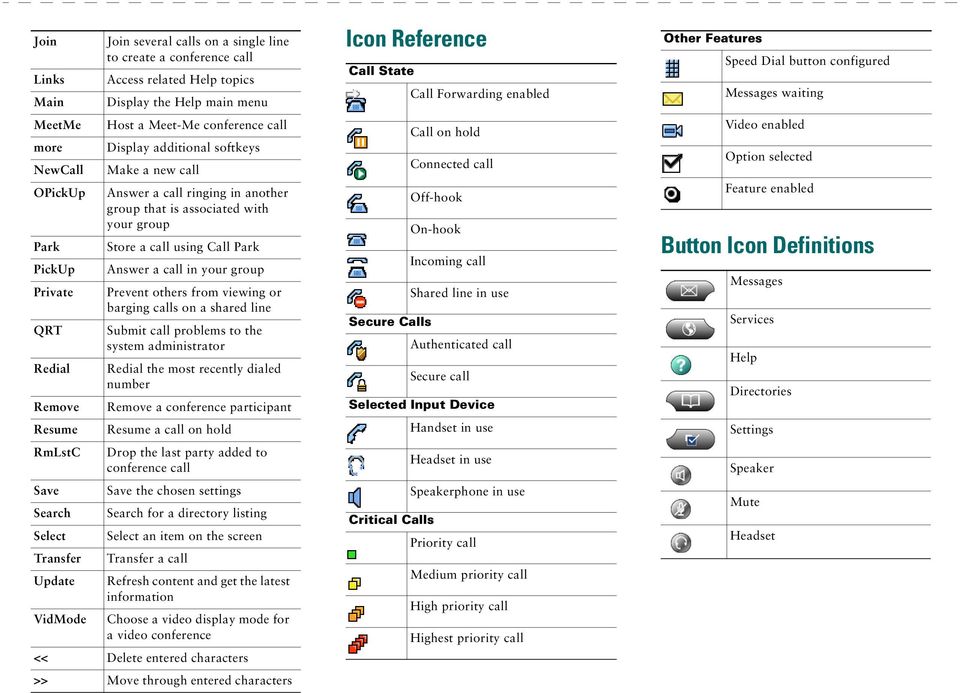
3 Common Phone Tasks Softkey Definitions If you want to... View your call logs Edit a number in a call log Dial from a corporate directory Place or answer a new call with a call active Hold and resume a call Press and choose a call log. To dial, scroll to a listing and go off-hook. Press EditDial. Use << or >> to erase or skip digits. Choose > Corporate Directory. Enter letters and press Search. Go off-hook to dial. Press NewCall or Answer. The first call is placed on hold automatically. Press the Hold or Resume softkey. Quick Reference AbbrDial Answer Back Barge CallBack Cancel cbarge CFwdALL Dial using a speed dial index number Answer a call Return to the previous Help topic Add yourself to a call on a shared line Receive notification when a busy extension becomes available Cancel an action or exit a screen without applying changes Add yourself to a call on a shared line and establish a conference call Setup/cancel call forwarding Transfer a call to a new number Transfer two calls (on the same line) to each other Start a standard conference call Press Transfer, enter the number, then hang up (or press Transfer again if your phone does not support on-hook transfer). Scroll to each call and press Select. Then press more > DirTrfr. Or, to stay on the line with callers, press Join. Press more > Confrn and dial the participant. Then press Confrn again. Cisco IP Phone 7970 Series Softkey Definitions Icon Reference Button Icon Definitions Common Phone Tasks Clear Close ConfList Confrn Delete Dial DirTrfr EditDial EndCall Delete records or settings Close the current window View conference participants Create a conference call Remove characters to the right of the cursor when using EditDial Dial an entered phone number Transfer two calls to each other Edit a number in a call log Disconnect the current call Erase Reset settings to their defaults Exit Return to the previous screen Cisco, Cisco IOS, Cisco Systems, and the Cisco Systems logo are registered trademarks of Cisco Systems, Inc. or its affiliates in the United States and certain other countries. All other brands, names, or trademarks mentioned in this document or Website are the property of their respective owners. The use of the word partner does not imply a partnership relationship between Cisco and any other company. (0501R) 2005 Cisco Systems, Inc. All rights reserved. GPickUp idivert Answer a call ringing in another group Send a call to your voice messaging system

4 Join Links Main MeetMe more NewCall OPickUp Park PickUp Private QRT Redial Remove Resume RmLstC Save Search Select Transfer Update Join several calls on a single line to create a conference call Access related Help topics Display the Help main menu Host a Meet-Me conference call Display additional softkeys Make a new call Answer a call ringing in another group that is associated with your group Store a call using Call Park Answer a call in your group Prevent others from viewing or barging calls on a shared line Submit call problems to the system administrator Redial the most recently dialed number Remove a conference participant Resume a call on hold Drop the last party added to conference call Save the chosen settings Search for a directory listing Select an item on the screen Transfer a call Refresh content and get the latest information VidMode Choose a video display mode for a video conference << Delete entered characters >> Move through entered characters Icon Reference Call State Call Forwarding enabled Call on hold Connected call Off-hook On-hook Incoming call Shared line in use Secure Calls Authenticated call Secure call Selected Input Device Handset in use Headset in use Speakerphone in use Critical Calls Priority call Medium priority call High priority call Highest priority call Other Features Speed Dial button configured Messages waiting Video enabled Option selected Feature enabled Button Icon Definitions Messages Services Help Directories Settings Speaker Mute Headset
5 Contents Getting Started 1 How to Use this Guide 1 Using and Cleaning the Touchscreen Display 2 Where to Find Additional Information 2 More Information about Customizing Your Phone on the Web 3 Safety and Performance Information 3 Connecting Your Phone 6 An Overview of Your Phone 9 Buttons and Hardware 9 Touchscreen Features 12 Call-Handling and Navigation Tips 13 Understanding Lines vs. Calls 13 Understanding Call and Line Icons 13 Going On-Hook and Off-Hook 14 Selecting Calls 14 Viewing and Switching Between Calls 15 Choosing Touchscreen Items 16 Using Feature Menus 16 Entering and Editing Text 17 Getting Help on Your Phone 17 Understanding Feature Functionality and Availability 17 Basic Call Handling 18 Placing a Call 18 Answering a Call 22 Ending a Call 23 Cisco IP Phone 7970 Series iii

6 Using Hold and Resume 23 Using Mute 23 Transferring a Connected Call 24 Forwarding Your Calls to Another Number 25 Making Conference Calls 26 Types of Supported Conference Calls 26 Starting and Joining a Standard Conference 27 Starting or Joining a Meet-Me Conference Call 28 Advanced Call Handling 29 Storing and Retrieving Parked Calls 29 Picking Up a Redirected Call on Your Phone 30 Using a Shared Line 31 Understanding Shared Lines 31 Adding Yourself to a Shared-Line Call 32 Preventing Others from Viewing or Joining a Shared-Line Call 33 Tracing Suspicious Calls 33 Making and Receiving Secure Calls 34 Prioritizing Critical Calls 35 Using a Handset, Headset, and Speakerphone 36 Obtaining a Headset 36 Using AutoAnswer with a Headset or the Speakerphone 37 Customizing Phone Settings 38 Adjusting the Volume 38 Customizing Rings and Message Indicators 39 Customizing the Touchscreen 39 Setting Up Speed Dial Features 40 Using Voice Messaging, Call Logs, and Directories 41 Accessing Voice Messages 41 Using Call Logs and Directories 42 iv

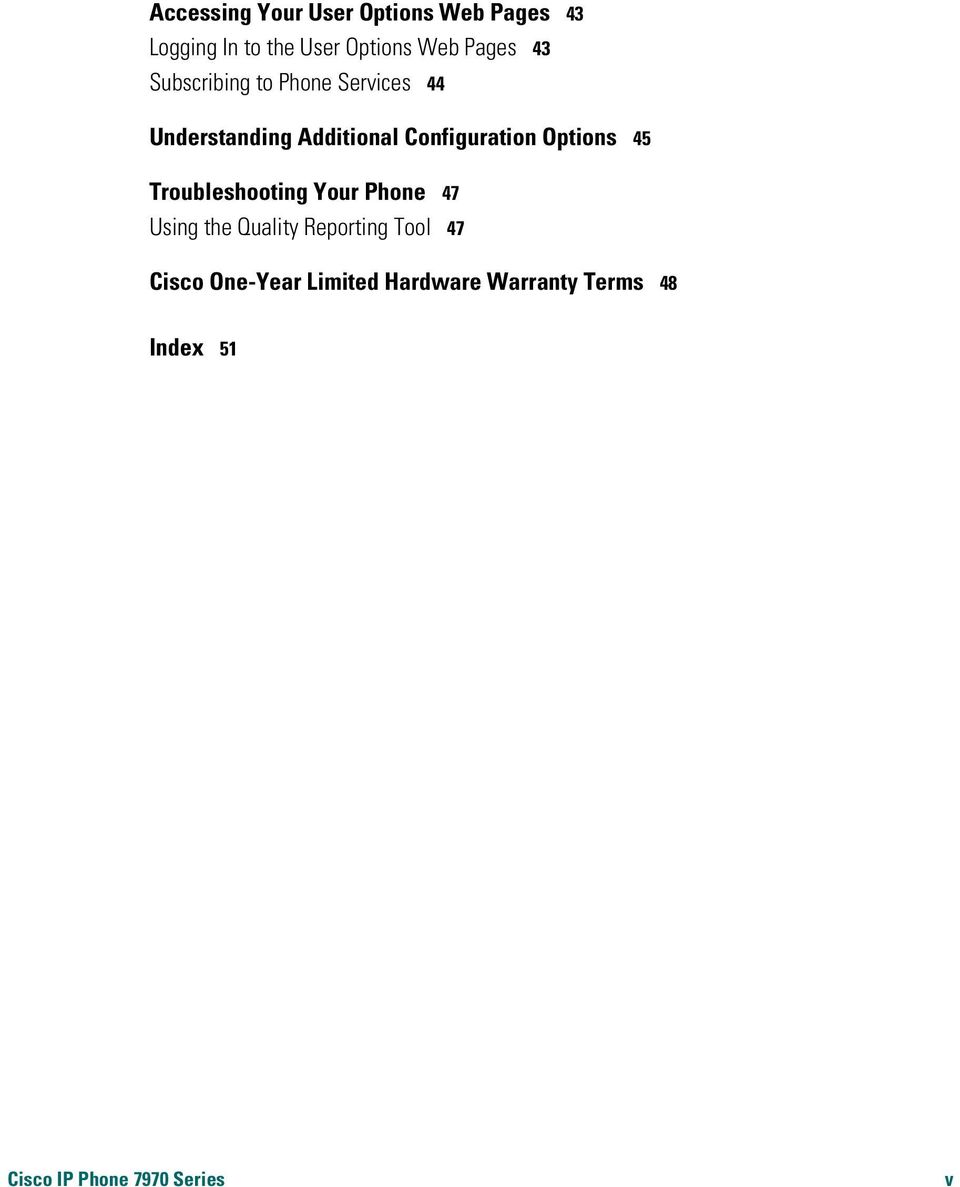
7 Accessing Your User Options Web Pages 43 Logging In to the User Options Web Pages 43 Subscribing to Phone Services 44 Understanding Additional Configuration Options 45 Troubleshooting Your Phone 47 Using the Quality Reporting Tool 47 Cisco One-Year Limited Hardware Warranty Terms 48 Index 51 Cisco IP Phone 7970 Series v
8 vi

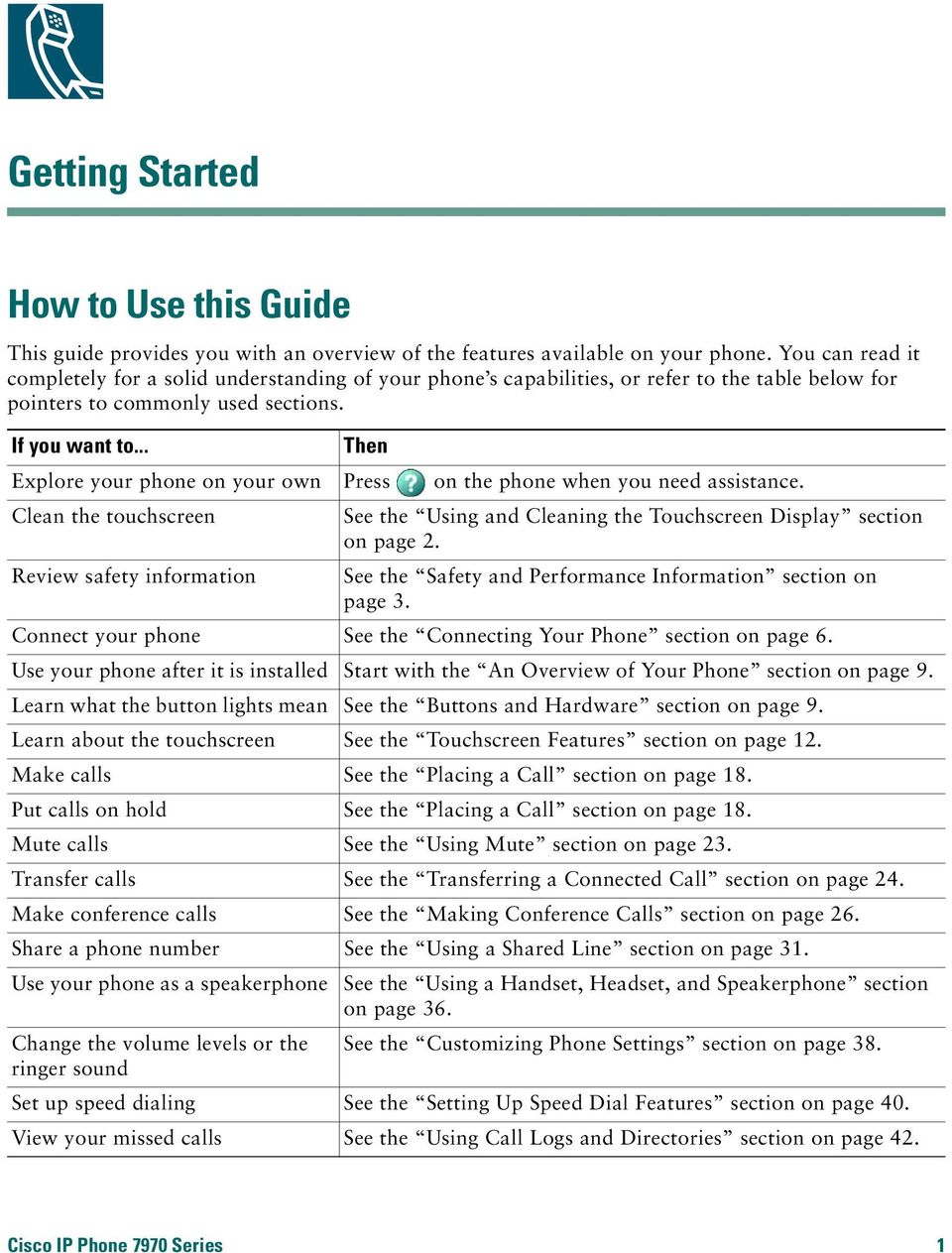
9 Getting Started How to Use this Guide This guide provides you with an overview of the features available on your phone. You can read it completely for a solid understanding of your phone s capabilities, or refer to the table below for pointers to commonly used sections. If you want to... Then Explore your phone on your own Press on the phone when you need assistance. Clean the touchscreen See the Using and Cleaning the Touchscreen Display section on page 2. Review safety information See the Safety and Performance Information section on page 3. Connect your phone See the Connecting Your Phone section on page 6. Use your phone after it is installed Start with the An Overview of Your Phone section on page 9. Learn what the button lights mean See the Buttons and Hardware section on page 9. Learn about the touchscreen See the Touchscreen Features section on page 12. Make calls See the Placing a Call section on page 18. Put calls on hold See the Placing a Call section on page 18. Mute calls See the Using Mute section on page 23. Transfer calls See the Transferring a Connected Call section on page 24. Make conference calls See the Making Conference Calls section on page 26. Share a phone number See the Using a Shared Line section on page 31. Use your phone as a speakerphone See the Using a Handset, Headset, and Speakerphone section on page 36. Change the volume levels or the See the Customizing Phone Settings section on page 38. ringer sound Set up speed dialing See the Setting Up Speed Dial Features section on page 40. View your missed calls See the Using Call Logs and Directories section on page 42. Cisco IP Phone 7970 Series 1
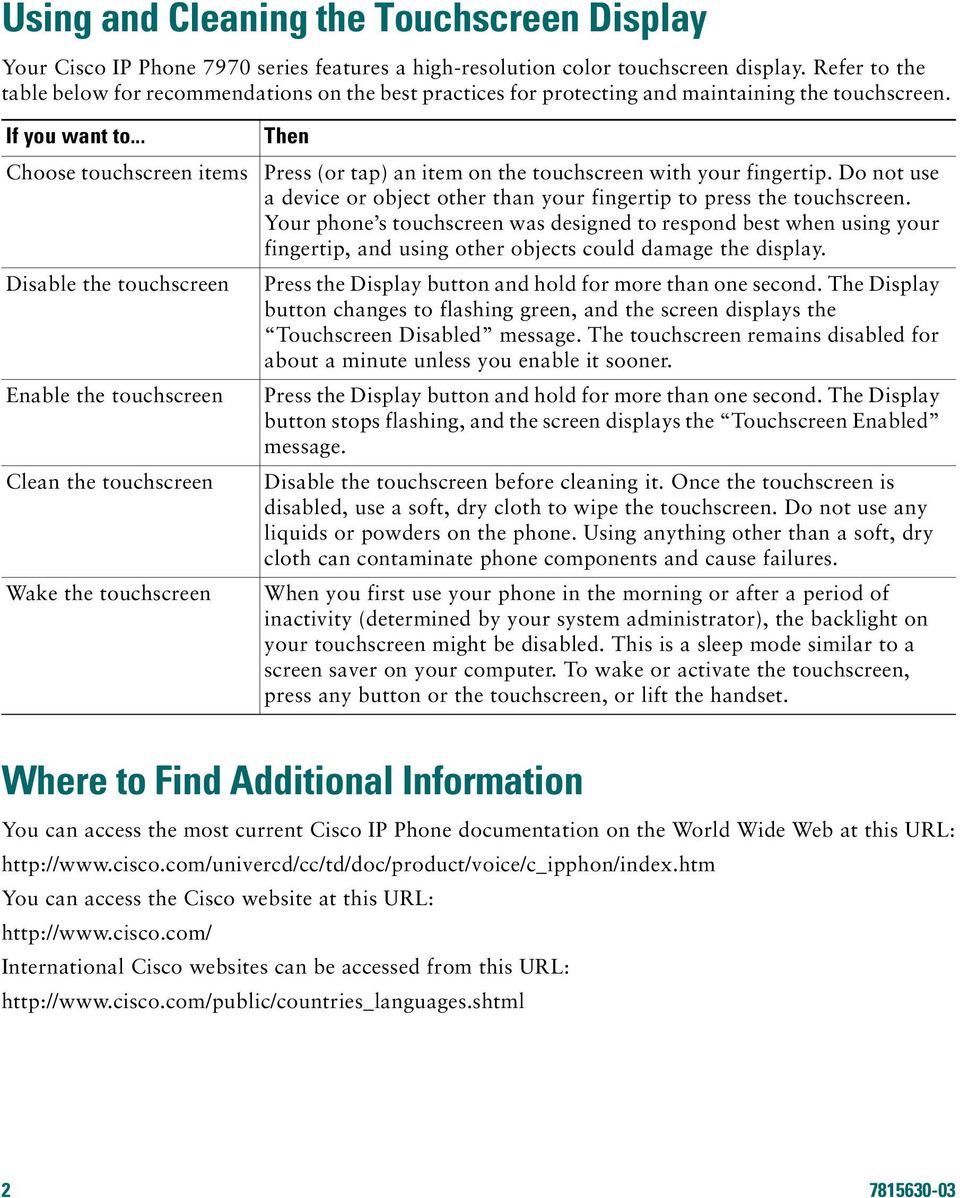
10 Using and Cleaning the Touchscreen Display Your Cisco IP Phone 7970 series features a high-resolution color touchscreen display. Refer to the table below for recommendations on the best practices for protecting and maintaining the touchscreen. If you want to... Choose touchscreen items Disable the touchscreen Enable the touchscreen Clean the touchscreen Wake the touchscreen Then Press (or tap) an item on the touchscreen with your fingertip. Do not use a device or object other than your fingertip to press the touchscreen. Your phone s touchscreen was designed to respond best when using your fingertip, and using other objects could damage the display. Press the Display button and hold for more than one second. The Display button changes to flashing green, and the screen displays the Touchscreen Disabled message. The touchscreen remains disabled for about a minute unless you enable it sooner. Press the Display button and hold for more than one second. The Display button stops flashing, and the screen displays the Touchscreen Enabled message. Disable the touchscreen before cleaning it. Once the touchscreen is disabled, use a soft, dry cloth to wipe the touchscreen. Do not use any liquids or powders on the phone. Using anything other than a soft, dry cloth can contaminate phone components and cause failures. When you first use your phone in the morning or after a period of inactivity (determined by your system administrator), the backlight on your touchscreen might be disabled. This is a sleep mode similar to a screen saver on your computer. To wake or activate the touchscreen, press any button or the touchscreen, or lift the handset. Where to Find Additional Information You can access the most current Cisco IP Phone documentation on the World Wide Web at this URL: You can access the Cisco website at this URL: International Cisco websites can be accessed from this URL:
11 Getting Started More Information about Customizing Your Phone on the Web Your Cisco IP Phone is a network device that can share information with other network devices in your company, including your computer. You can use your Cisco CallManager User Options web pages to establish and customize phone services and to control phone features and settings from your computer. This Guide provides a brief overview of these capabilities. For complete instructions, refer to Customizing Your Cisco IP Phone on the Web at the following URL: Safety and Performance Information Installing and Using Your Phone Read the following safety notices before installing or using your Cisco IP Phone: Warning IMPORTANT SAFETY INSTRUCTIONS This warning symbol means danger. You are in a situation that could cause bodily injury. Before you work on any equipment, be aware of the hazards involved with electrical circuitry and be familiar with standard practices for preventing accidents. SAVE THESE INSTRUCTIONS Warning Read the installation instructions before you connect the system to its power source. Warning Ultimate disposal of this product should be handled according to all national laws and regulations. Warning Do not work on the system or connect or disconnect cables during periods of lightning activity. Warning To avoid electric shock, do not connect safety extra low voltage (SELV) circuits to telephone network voltage (TNV) circuits. LAN ports contain SELV circuits, and WAN ports contain TNV circuits. Some LAN and WAN ports use RJ-45 connectors. Use caution when connecting cables. Cisco IP Phone 7970 Series 3

12 Caution Inline power circuits provide current through the communication cable. Use the Cisco provided cable or a minimum 24 AWG communication cable. Warning The power supply must be placed indoors. Using an External Power Supply The following warnings apply when you use the external power supply with the Cisco IP Phone: Warning This product relies on the building's installation for short-circuit (over current) protection. Ensure that a fuse or circuit breaker no larger than 120 VAC, 15A U.S. (240 VAC, 10A international) is used on the phase conductors (all current-carrying conductors). Warning The device is designed to work with TN power systems. Warning The plug-socket combination must be accessible at all times because it serves as the main disconnecting device. Caution Only use the Cisco specified power supply with this product
13 Getting Started Using External Devices with Your Cisco IP Phone The following information applies when you use external devices with the Cisco IP Phone: Cisco recommends the use of good quality external devices (speakers, microphones, and headsets) that are shielded against unwanted radio frequency (RF) and audio frequency (AF) signals. Depending on the quality of these devices and their proximity to other devices such as mobile phones or two-way radios, some audio noise may still occur. In these cases, Cisco recommends that you take one or more of the following actions: Move the external device away from the source of the RF or AF signals. Route the external device cables away from the source of the RF or AF signals. Use shielded cables for the external device, or use cables with a better shield and connector. Shorten the length of the external device cable. Apply ferrites or other such devices on the cables for the external device. Cisco cannot guarantee the performance of the system because Cisco has no control over the quality of external devices, cables, and connectors. The system will perform adequately when suitable devices are attached using good quality cables and connectors. Caution In European Union countries, use only external speakers, microphones, and headsets that are fully compliant with the EMC Directive [89/336/EC]. Cisco IP Phone 7970 Series 5
14 Connecting Your Phone Your system administrator will likely connect your new Cisco IP Phone to the corporate IP telephony network. If that is not the case, refer to the to the graphic and table below to connect your phone AUX 10/100/1000 SW 10/100/1000 PC DC48V DC Adaptor port (DC48V) 6 Handset port 2 Power supply with DC connector for phone 7 Headset port 3 AC power cable with wall socket plug 8 External speakers port 4 Network port (10/100/ SW) 9 External microphone port 5 Access port (10/100/ PC) 10 Footstand button 1. Not available for all phone models. Contact your system administrator for assistance

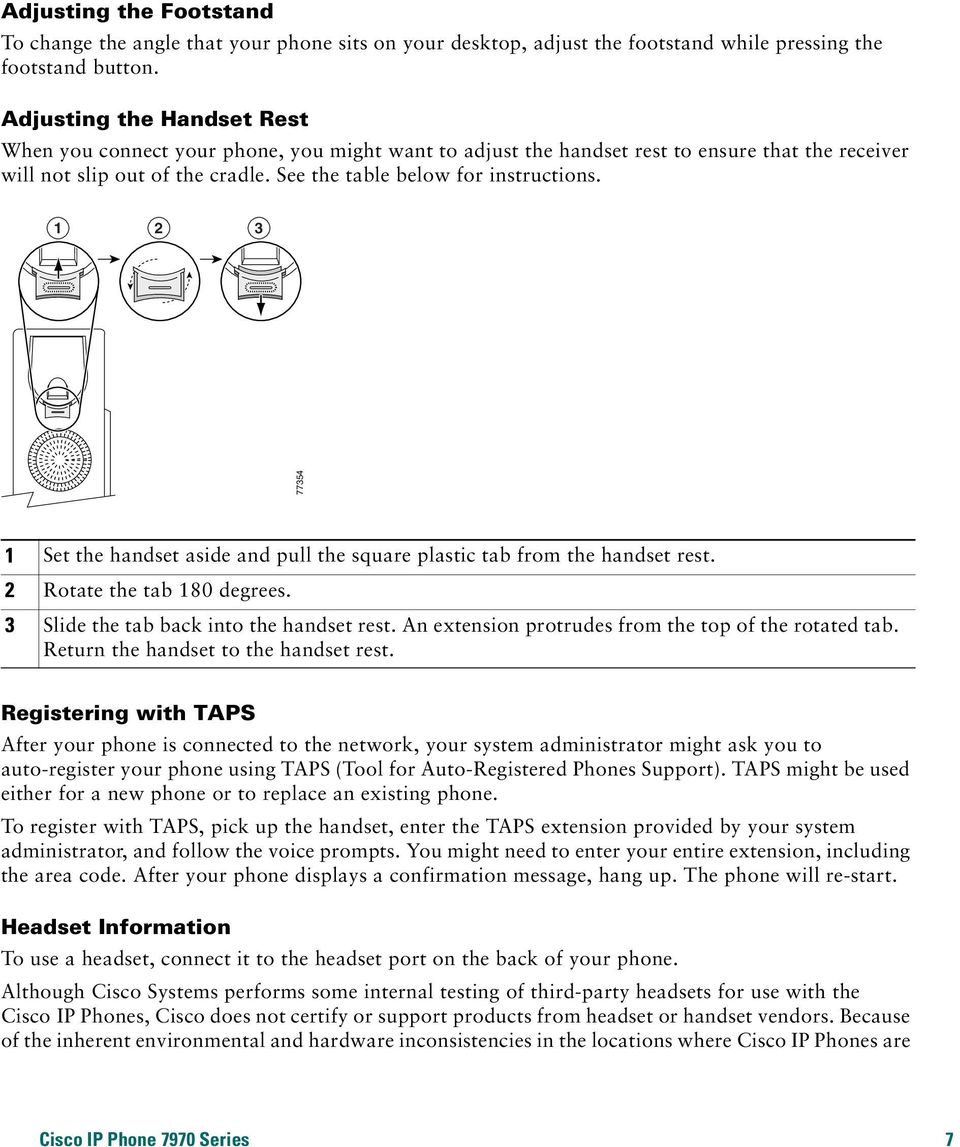
15 Adjusting the Footstand To change the angle that your phone sits on your desktop, adjust the footstand while pressing the footstand button. Adjusting the Handset Rest When you connect your phone, you might want to adjust the handset rest to ensure that the receiver will not slip out of the cradle. See the table below for instructions Set the handset aside and pull the square plastic tab from the handset rest. 2 Rotate the tab 180 degrees. 3 Slide the tab back into the handset rest. An extension protrudes from the top of the rotated tab. Return the handset to the handset rest. Registering with TAPS After your phone is connected to the network, your system administrator might ask you to auto-register your phone using TAPS (Tool for Auto-Registered Phones Support). TAPS might be used either for a new phone or to replace an existing phone. To register with TAPS, pick up the handset, enter the TAPS extension provided by your system administrator, and follow the voice prompts. You might need to enter your entire extension, including the area code. After your phone displays a confirmation message, hang up. The phone will re-start. Headset Information To use a headset, connect it to the headset port on the back of your phone. Although Cisco Systems performs some internal testing of third-party headsets for use with the Cisco IP Phones, Cisco does not certify or support products from headset or handset vendors. Because of the inherent environmental and hardware inconsistencies in the locations where Cisco IP Phones are Cisco IP Phone 7970 Series 7
16 deployed, there is not a single best solution that is optimal for all environments. Cisco recommends that customers test the headsets that work best in their environment before deploying a large number of units in their network. In some instances, the mechanics or electronics of various headsets can cause remote parties to hear an echo of their own voice when they speak to Cisco IP Phone users. Cisco Systems recommends the use of good quality external devices, like headsets that are screened against unwanted radio frequency (RF) and audio frequency (AF) signals. Depending on the quality of these devices and their proximity to other devices such as cell phones and two-way radios, some audio noise may still occur. See the Using External Devices with Your Cisco IP Phone section on page 5 for more information. The primary reason that support of a headset would be inappropriate for the Cisco IP Phone is the potential for an audible hum. This hum can either be heard by the remote party or by both the remote party and you, the Cisco IP Phone user. Some potential humming or buzzing sounds can be caused by a range of outside sources, for example, electric lights, being near electric motors, large PC monitors. In some cases, a hum experienced by a user may be reduced or eliminated by using a local power cube (CP-PWR-CUBE-2). See the Using an External Power Supply section on page 4 for more information. Subjective to the User Beyond the physical, mechanical and technical performance, the audio portion of a headset must sound good to you (the user) and to the party on the far end. Sound is subjective and Cisco cannot guarantee the performance of any headsets or handsets, but some of the headsets and handsets on the sites listed below have been reported to perform well with Cisco IP Phones. Nevertheless, it is ultimately still the customer s responsibility to test this equipment in their own environment to determine suitable performance. For information about headsets, see:

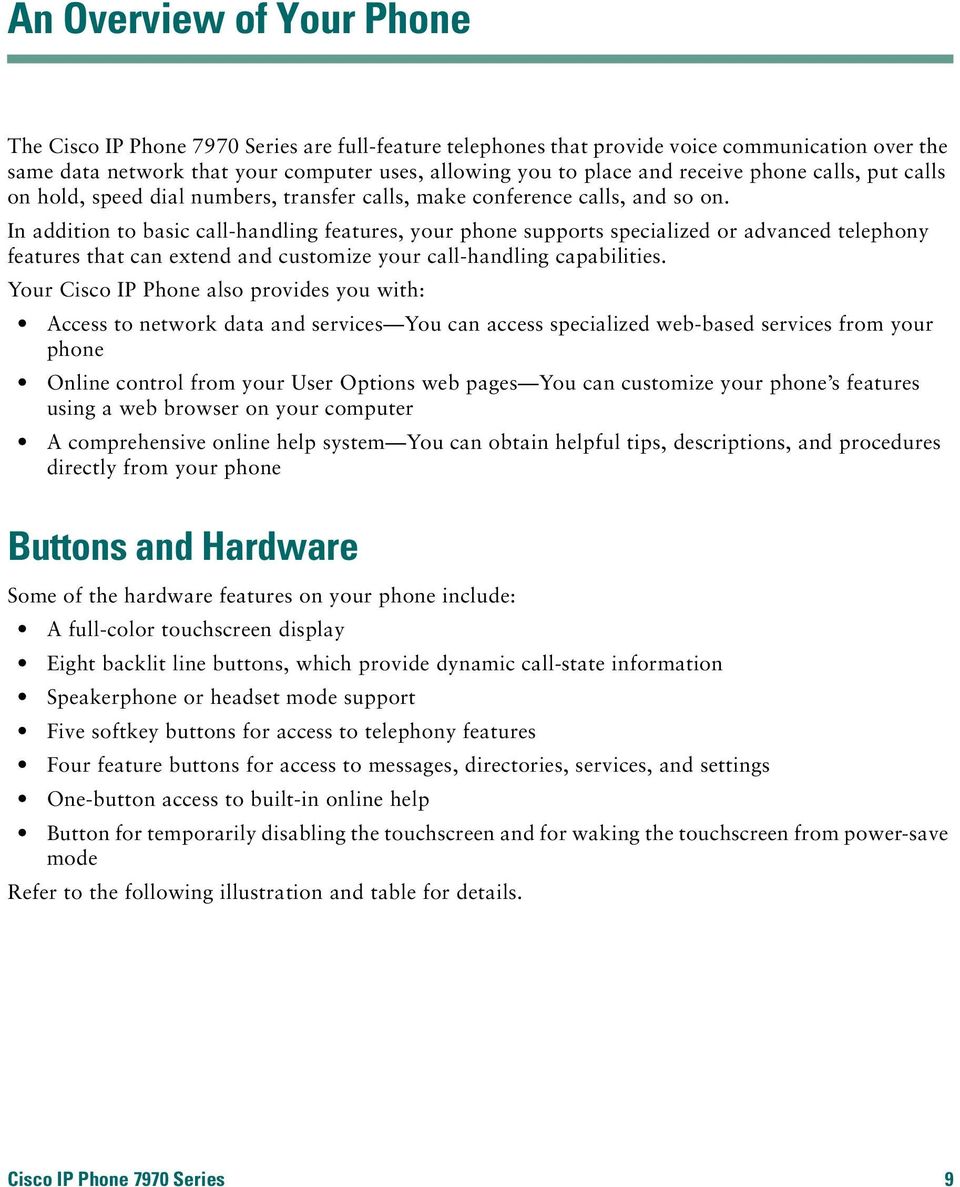
17 An Overview of Your Phone The Cisco IP Phone 7970 Series are full-feature telephones that provide voice communication over the same data network that your computer uses, allowing you to place and receive phone calls, put calls on hold, speed dial numbers, transfer calls, make conference calls, and so on. In addition to basic call-handling features, your phone supports specialized or advanced telephony features that can extend and customize your call-handling capabilities. Your Cisco IP Phone also provides you with: Access to network data and services You can access specialized web-based services from your phone Online control from your User Options web pages You can customize your phone s features using a web browser on your computer A comprehensive online help system You can obtain helpful tips, descriptions, and procedures directly from your phone Buttons and Hardware Some of the hardware features on your phone include: A full-color touchscreen display Eight backlit line buttons, which provide dynamic call-state information Speakerphone or headset mode support Five softkey buttons for access to telephony features Four feature buttons for access to messages, directories, services, and settings One-button access to built-in online help Button for temporarily disabling the touchscreen and for waking the touchscreen from power-save mode Refer to the following illustration and table for details. Cisco IP Phone 7970 Series 9
18 1 Programmable buttons Depending on configuration, programmable buttons provide access to: Phone lines (line buttons) Speed-dial numbers (speed-dial buttons) Web-based services (for example, a Personal Address Book button) Phone features (for example, a Privacy button) The buttons illuminate to indicate status: Green, steady Active call on this line (off hook) Green, blinking Call on hold on this line Amber, steady Privacy feature enabled Amber, blinking Incoming call ringing on this line Red Shared line, currently in use No color No call activity on this line (on hook) 2 Footstand button Allows you to adjust the angle of the phone base
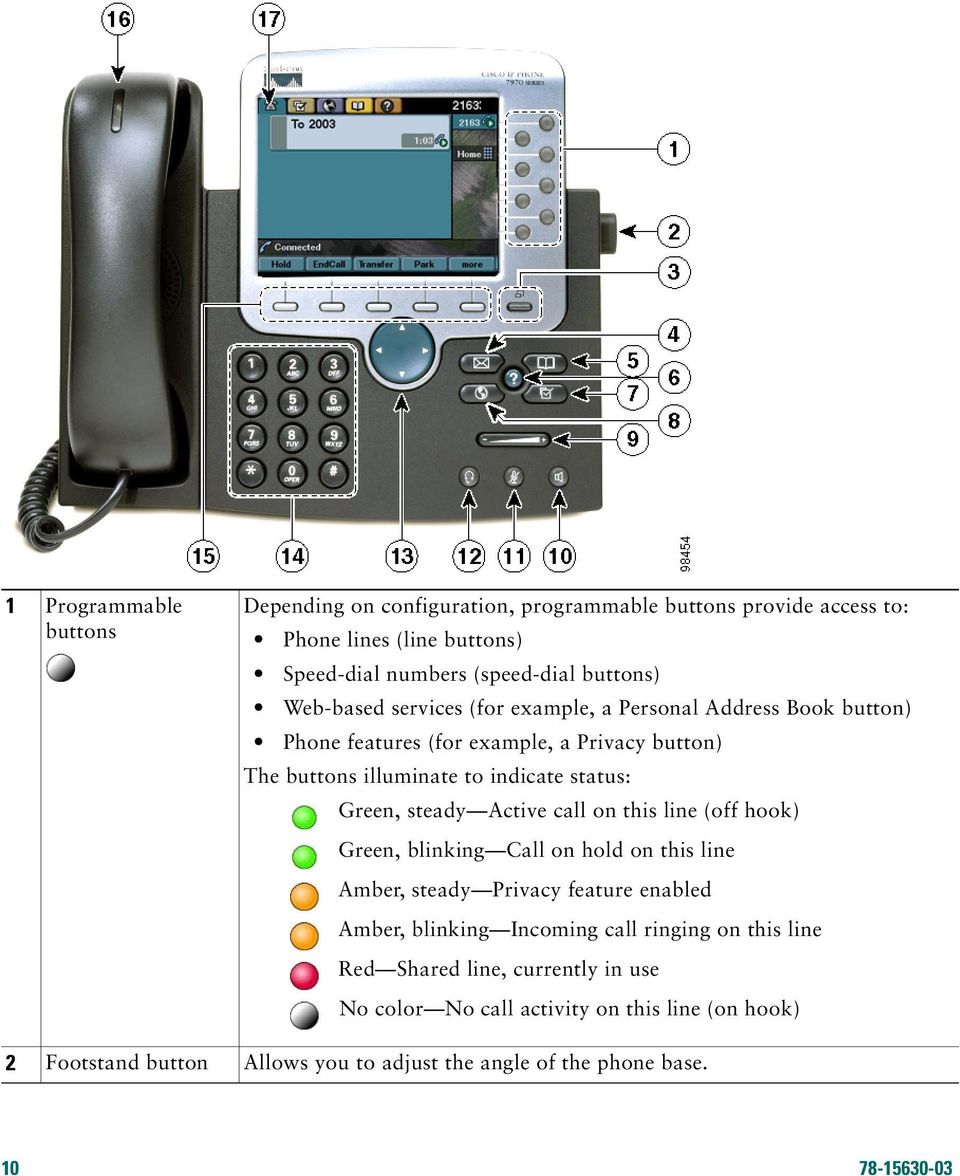
19 3 Display button Awakens the touchscreen from power-save mode or disables it for cleaning. No color Touchscreen available, ready for input Green flashing Touchscreen disabled Green steady Touchscreen and backlight disabled See the Using and Cleaning the Touchscreen Display section on page 2. 4 Messages button Typically auto-dials your voice message service (varies by service). See the Accessing Voice Messages section on page Directories button Opens/closes the Directories menu. Use it to access call logs and corporate directories. See the Using Call Logs and Directories section on page Help button Activates the Help menu. See the Getting Help on Your Phone section on page Settings button Opens/closes the Settings menu. Use it to control touchscreen appearance and ring sounds. See the Customizing Phone Settings section on page Services button Opens/closes the Services menu. See the Accessing Your User Options Web Pages section on page Volume button Controls the volume and other settings. See the Customizing Phone Settings section on page Speaker button Toggles the speakerphone on or off. 11 Mute button Toggles the Mute feature on or off. 12 Headset button Toggles the headset on or off. 13 Navigation button Allows you to scroll through menus and highlight items. Use in conjunction with softkeys to activate highlighted items. Also, while the phone is on-hook, press the Navigation button to access phone numbers from your Placed Calls log. 14 Keypad Allows you to dial phone numbers, enter letters, and choose menu items. 15 Softkey buttons Each activates a softkey option (displayed on your touchscreen). 16 Handset light strip Indicates an incoming call or new voice message. 17 Touchscreen Shows phone features. See the Touchscreen Features section on page 12. Cisco IP Phone 7970 Series 11

20 Touchscreen Features This is what your main touchscreen might look like with active calls and several feature menus open. Press (or tap) with your fingertip to activate touch-sensitive items on your touchscreen. 1 Primary phone line 2 Icons for programmable buttons Displays the phone number (extension number) for your primary phone line. If several tabs are open, the time and date display here also. Icons indicate how programmable buttons are set up on your phone: Phone line icon Corresponds to a phone line and displays the call or line state. Your phone might have multiple phone lines. Speed-dial icon If available, corresponds to a speed-dial button. See the Setting Up Speed Dial Features section on page 40. Phone service icon If available, corresponds to a web-based phone service, such as the Personal Address Book. Feature icon If available, corresponds to a feature, such as Privacy. 3 Softkey labels Each displays a softkey function. To activate a softkey, press the softkey button or the softkey label on the touchscreen. 4 Status line Displays audio mode icons, status information, and prompts. 5 Call activity area Displays current calls per line, including caller ID, call duration, and call state. See the Viewing and Switching Between Calls section on page Phone tab Indicates call activity. Press this tab to return to call activity area if needed. 7 Feature tabs Each indicates an open feature menu. Press a tab to switch between open menus. See the Using Feature Menus section on page

21 Call-Handling and Navigation Tips These guidelines can help you handle calls and navigate menus on your Cisco IP Phone. Understanding Lines vs. Calls It can be easy to confuse lines and calls on your phone. Use these tips to avoid confusion: Lines Phone models in the Cisco IP Phone 7970 Series support up to eight lines. Each line corresponds to a a phone number (or extension) that others can use to call you. The number of lines assigned to your phone depends on how your system administrator configures your phone s programmable buttons. To see how many lines you have, look at the programmable button icons and labels on your touchscreen. You have as many lines as you have phone numbers and phone line icons:. Calls Each line can support multiple calls. Therefore, you might find yourself handling several calls on one phone line. The default configuration is four calls per line, but your system administrator can adjust this number according to your needs. Regardless of the number of lines, your phone supports a maximum of 200 calls at time. Understanding Call and Line Icons Your phone displays icons to help you determine the call and line state (on-hook, on hold, ringing, connected, and so on). Icon Call or line state Description On-hook line No call activity on this line. If you are dialing on-hook (pre-dial), the call is not in-progress until you go off-hook. Off-hook line You are actively dialing a number or an outgoing call is ringing. See the Placing a Call section on page 18 for dialing options. Connected call You are connected to the other party. Ringing call Call on hold Remote-in-use A call is ringing on one of your lines. See the Answering a Call section on page 22 for more information. You have put this call on hold. See the Using Hold and Resume section on page 23 for details. Another phone that shares your line has a connected call. See the Using a Shared Line section on page 31 for details. Cisco IP Phone 7970 Series 13
22 Icon Call or line state Description Authenticated call See the Making and Receiving Secure Calls section on page 34. Encrypted call See the Making and Receiving Secure Calls section on page 34. Going On-Hook and Off-Hook Some phone tasks and instructions differ depending on whether the phone is on-hook or off-hook. On-Hook The phone handset is resting in the cradle, no calls are active, and you do not have an active dial tone. Your phone provides on-hook dialing (pre-dial), which enables you to enter or choose phone numbers before activating the call. When your phone is on-hook, this icon appears next to each phone number: Off-Hook The phone handset is lifted from the cradle, the speakerphone is active, or any of several other methods are used to get a dial tone or to answer an incoming call. When your phone is off-hook, one of these icons appears, depending on the call or line state:,, or. See the Understanding Call and Line Icons section on page 13 for related information. Selecting Calls Many phone features require that you select the calls you want to use with a particular feature. For example, if you have four held calls but only want to join two of them in a conference call, you can select the calls that you want to add to the conference before activating the feature. If you want to... Highlight a call Select a call Verify selected calls Use the Navigation button to scroll through the call list. Highlighted calls appear on a lighter and brighter background. Highlight a connected or held call and press Select. Selected calls are indicated with a next to them. Use the Navigation button to scroll through the list of calls. Selected calls are indicated with a and are grouped together in the call list
23 Viewing and Switching Between Calls These tips can help you switch between calls on one or more lines. If the call that you want to switch to is not automatically highlighted, press the call appearance on your touchscreen or scroll to it. If you want to... Switch between calls on one line Switch from a connected call to answer a ringing call Switch between calls on different lines See all calls on a specific line See an overview of line activity (one call per line) Highlight the call you are switching to and press Resume. The other call is placed on hold automatically. Press Answer or the press a blinking amber button automatically places the first call on hold.. Doing so Press the blinking green button for the line that you are switching to. If there is a single call holding on the line, the call will resume automatically. If there are multiple calls holding on the line, highlight the specific call (if necessary) and press Resume. Press, then immediately press the line button. Doing so shows call details but will not impact the call state; it is therefore useful if you are talking on one line and want to view held calls on another line. Press for the highlighted line. (A line appears highlighted when the calls associated with it are displayed on the phone screen.) Doing so prompts the phone to switch to call overview mode and display one call per line. This call is either the active call or, if all calls are on hold, the held call with the longest duration. To return to the standard view, press, then immediately press the line button. Tips Only one call can be active; other calls will be placed on hold automatically. When you have multiple calls on one line, calls with the highest precedence and longest duration display at the top of the call list. See the Prioritizing Critical Calls section on page 35. Calls of a similar type are grouped together in the call list. For example, calls that you have interacted with are grouped near the top, selected calls are grouped next, and calls that you have not yet answered are grouped last. Cisco IP Phone 7970 Series 15
24 Choosing Touchscreen Items To choose a touchscreen item... By touch By item number By scrolling Do this... Press (or tap) an item on the touchscreen with your fingertip. Note that pressing a phone number on the touchscreen can cause the phone to dial the number. Press the corresponding number on your keypad. For example, press 4 to choose the fourth item in a menu. Press the Navigation button to scroll through a list and to highlight an item. Press a relevant softkey such as Select or Dial to finish the action, or tap the item on the touchscreen with your fingertip. Using Feature Menus If you want to... Open or close a feature menu Scroll through a list or menu Go back one level in a feature menu Switch among open feature menus Press a feature button: Messages Services Help Directories Settings Press the Navigation button. Press Exit. (Note that if you press Exit from the top level of a menu, the menu will close.) Press a feature tab on your touchscreen. (Each feature menu has a corresponding tab. The tab is visible when the feature menu is open.)
25 Entering and Editing Text If you want to... Enter a letter on your touchscreen Delete within an entry or move your cursor Press the appropriate keypad number one or more times to select a letter (with or without capitalization) from the pop-up menu. When you pause, the cursor automatically advances to allow you to enter the next letter. Press << or Delete to remove a letter or digit. Press >> to move the cursor to the right. Getting Help on Your Phone Your Cisco IP Phone provides a comprehensive online help system. Help topics appear on the touchscreen. See the table below for details. If you want to... View the main menu Press on your phone and wait a few seconds for the menu to display. If you are already in Help, press Main. Main menu topics include: About Your Cisco IP Phone Descriptive details about your phone How do I...? Procedures and information about common phone tasks Calling Features Descriptions and procedures for calling features Help Tips on using and accessing Help Learn about a button or Press, then quickly press a button or softkey. softkey Learn about a menu Press, then quickly press the menu item on the touchscreen. item Or, press twice quickly with the menu item highlighted. Get help using Help Press. After a second or two, press again or choose Help from the Main Menu. Understanding Feature Functionality and Availability The operation of your Cisco IP Phone and the features available to you may vary, depending on the call processing agent used by your company and also on how your company s phone support team has configured your phone system. Therefore, some of the features included in this Phone Guide might not be available to you or might work differently on your phone system. Contact your support desk or system administrator if you have questions about feature operation or availability. Cisco IP Phone 7970 Series 17
26 Basic Call Handling This section covers basic call-handling tasks such as placing, answering, transferring, and conferencing calls. The features you use to perform these tasks are standard and available on most phone systems. Placing a Call To place a call, pick up the handset and dial. Or use one of the other options outlined in the table below. If you want to... Pre-dial (dial on-hook, without first getting a dial tone) Dial using the speakerphone Redial the most recently dialed number Do one of the following: Enter a phone number. (The Auto-Dial feature might pop up to suggest matching phone numbers from your Placed Calls log.) Press the Navigation button to display phone numbers from your Placed Calls log. Next, press the phone number appearance on your touchscreen to dial. Or do one of the these actions to go off-hook and dial the highlighted phone number: Lift the handset Press or Press Dial Press (a line button) Press New Call and enter a phone number. Or, you can press before or after dialing, re-dialing or speed dialing a number. Many of the actions that you can take to dial will automatically trigger speakerphone mode, assuming that the handset is in its cradle and is not lit. These actions include pressing Redial, a speed dial button, or a phone number on your touchscreen. Press Redial. By default, Redial uses your primary line. However, you can open a secondary line and then press Redial. To open a line, press
27 If you want to... Speed dial a number Place a call when another call is active (using another line) Place a call when another call is active (using the same line) Do one of the following: Press (a speed-dial button) before or after going off-hook. Enter a speed dial index number (1-99 on the keypad) while on-hook and press AbbrDial. For details, see the Setting Up Speed Dial Features section on page 40. Press for the new line. The call on the first line will be placed on hold automatically. Press Hold, then press New Call. You can now dial, redial, or speed dial a number. Or you can continue talking on the active call while preparing to dial from a call log or directory. (See the next two rows in this table for details.) Dial from a call log Choose > Missed Calls, Received Calls, or Placed Calls. To dial, press the listing or scroll to it and go off-hook. If you want to dial from a call log while on another active call, scroll to a call record and press Dial. Then choose a menu item to handle the original call: Hold Puts the first call on hold and dials the second. Transfer Transfers the first party to the second. (Then press Transfer again to complete the action.) Conference Creates a conference call with all parties. (Then press Confrn to complete the action.) End Call Disconnects the first call and dials the second. Dial from a corporate directory on the phone Choose > Corporate Directory (exact name can vary). Use your keypad to enter letters, then press Search. To dial, press the listing or scroll to it and go off-hook. If you want to dial from a directory while on an active call, scroll to a listing and press Dial. Then choose a menu item to handle the original call: Hold Puts the first call on hold and dials the second. Transfer Transfers the first party to the second. (Then press Transfer again to complete the action.) Conference Creates a conference call with all parties. (Then press Confrn to complete the action.) End Call Disconnects the first call and dials the second. Cisco IP Phone 7970 Series 19
28 If you want to... Dial from a corporate directory web page Dial using a headset Receive notification when a busy or ringing extension becomes available Dial on a secondary line Make a priority (precedence) call Dial from a Personal Address Book (PAB) entry or Fast Dial code Place a call using a billing or tracking code Use the Cisco WebDialer feature. Open a web browser and go to your company directory. Click on a phone number in the directory. Click Dial to place the call. Click Hangup to end the call. See the Customizing Your Cisco IP Phone on the Web guide for more details: Do one of the following: If is unlit, press it before or after dialing, re-dialing, or speed-dialing a number. If is lit, press New Call, Redial, a speed dial button, or (a line button). If necessary, enter a phone number and press Dial. Call the number and press CallBack while listening to the busy tone or ring sound. Hang up. When the extension becomes available, your phone will provide you with an audio and visual alert. (The call back to this number is not automatic; you must place the call.) CallBack is a special feature that your system administrator might configure for your phone. Note that CallBack will fail if the other party has call forwarding enabled. Press for the line that you want to use. Enter the MLPP access number (provided by your system administrator) followed by the phone number. For more details, see the Prioritizing Critical Calls section on page 35. Choose > PAB service or Fast Dial service (exact names might vary). To dial from a listing, press it or scroll to it and go off-hook. For help subscribing to the PAB or Fast Dial service, see the Accessing Your User Options Web Pages section on page 43. Dial a number and enter a client matter code (CMC) or a forced authorization code (FAC) when prompted by a distinctive tone. Your system administrator will tell you if you need to enter CMC or FAC codes and can provide you with detailed instructions
29 If you want to... Place a call using your Cisco Extension Mobility profile Make a video call Make sure that you are logged in to Extension Mobility (EM). Choose > EM Service (exact name might vary), then use your keypad to enter login information. If you are sharing a phone, you might need to log in to EM before you can access certain features or complete a call. EM is a special, non-default feature that your system administrator can assign to phones and phone users. Refer to the Customizing Your Cisco IP Phone on the Web: Check the touchscreen display for this icon: If the icon is present, your phone is video-enabled and can support Cisco VT Advantage. This enables you to make video calls using your Cisco IP Phone, your personal computer, and an external video camera. Contact your system administrator for assistance and refer to the Cisco VT Advantage Quick Start Guide and Cisco VT Advantage User Guide: Tips If you make a mistake while entering a phone number, press << to erase one or more digits. Press Cancel to exit the dialing attempt. If you cannot hear a dial tone or complete a phone call, one or more of the following factors might apply. If necessary, ask your system administration for more information. You need to log into the Extension Mobility service from the button on your phone. You need to enter a client matter code or forced authorization code after dialing a number. Your phone has time-of-day restrictions that prevent you from using some features during certain hours of the day. Cisco IP Phone 7970 Series 21
30 Answering a Call To answer a call, go-off hook by picking up the handset. Or see the table below for more options. If you want to... Answer with a headset Press, if unlit. Or, if is already lit, press Answer or (the flashing line button). Answer with the speakerphone Press, Answer, or. Switch from a connected call to Press Answer or, if the call is ringing on a different line, press the answer a ringing call flashing amber button. Either action answers the new call and automatically places the first call on hold. See the Using Hold and Resume section on page 23 for more information. Answer a call using call waiting Ask your system administrator to setup the Call Waiting feature for your phone. When this feature is enabled, you will hear a call waiting tone and see caller ID information if a new call comes in while you are on another call. To answer the call, press Answer. To return to the original call, you must put this call on hold. See the Using Hold and Resume section on page 23. Automatically connect an incoming call after a ring or two Retrieve a held call on another phone (such as a phone in a conference room) Use your phone to answer a call that is ringing on another phone Answer a priority call Send an incoming call directly to your voice messaging system Ask your system administrator to set up the AutoAnswer feature. For more information, see the Using AutoAnswer with a Headset or the Speakerphone section on page 37. Use Call Park. See the Storing and Retrieving Parked Calls section on page 29. Use Call Pickup. See the Picking Up a Redirected Call on Your Phone section on page 30. Hang up the current call and press Answer. See the Prioritizing Critical Calls section on page 35. Press idivert. The incoming call automatically transfers to your voice message greeting
31 Ending a Call To end a call, hang up. See the table below for details. If you want to... Hang up while using the handset Return the handset to its cradle. Or press EndCall. Hang up while using the headset Press. If you want to keep headset mode activated (keep the button lit after hanging up), press EndCall. Hang up while using the speakerphone Press or EndCall. Hang up one call but preserve another Press EndCall. If necessary, remove the call from hold first. call on the same line Using Hold and Resume Only one call can be active at any given time; all other calls will be placed on hold. If you want to... Put a call on hold Make sure the call you want to put on hold is highlighted and press Hold. Remove a call from Make sure that the appropriate call is highlighted and press Resume. hold on the current line Remove a call from Press (a blinking line button). If there is a single call holding on this hold on a different line line, the call will resume automatically. If there are multiple calls holding, make sure that the appropriate call is highlighted and press Resume. Note that a held call is indicated by the call-on-hold icon: Tips Engaging the Hold feature typically generates music or a beeping tone. For this reason, avoid putting a conference call on hold. Using Mute Mute disables the audio input for your phone. With Mute enabled, you can hear other parties on a call but they cannot hear you. If you want to... Toggle Mute on Press. Toggle Mute off Press. Cisco IP Phone 7970 Series 23
32 Transferring a Connected Call Transfer redirects a connected call. The target is the number to which you want to transfer the call. If you want to... Transfer a call without talking to the transfer recipient Talk to the transfer recipient before transferring a call (consult transfer) Transfer two current calls to each other (direct transfer) Send a call to your voice messaging system Press Transfer and enter the target number. When you hear the call ringing, hang up. If your system administrator did not enable on-hook transfer, you must press Transfer again to complete the transfer. To cancel the transfer, press EndCall. Press Transfer and enter the target number. Wait for the transfer recipient to answer. If the recipient accepts the transferred call, hang up. (If your system administrator did not enable on-hook transfer on your phone, you must press Transfer again to complete the transfer.) To cancel the transfer, press EndCall. Scroll to highlight any call on the line and press Select. Repeat this process for the second call. With one of the selected calls highlighted, press DirTrfr. (You might need to press more to see DirTrfr.) The two calls connect to each other and drop you from the call. If you want to stay on the line with the callers, use Join to create a conference instead. For details, see the Making Conference Calls section on page 26. Press idivert. The call is automatically transferred to your voice message greeting. You can use idivert with a call that is active, ringing, or on hold. Tips When on-hook transfer is enabled, you can either hang up or press Transfer, then hang up. If on-hook transfer is not enabled on your phone, be aware that hanging up instead of pressing Transfer cancels the transfer action and places the party to be transferred on hold. You cannot use Transfer to redirect a call on hold. Press Resume to remove the call from hold before transferring it
33 Forwarding Your Calls to Another Number You can use Call Forward All to redirect your incoming calls from your Cisco IP Phone to another number. Tip Enter the Call Forward All target number exactly as you would dial it from your desk phone. For example, enter an access code or the area code, if necessary. If you want to... Set up call forwarding on your primary line Cancel call forwarding on your primary line Verify that call forwarding is enabled on your primary line Set up or cancel call forwarding for any line Press CFwdALL and enter a target phone number. Press CFwdALL. Look for this icon above the primary phone number:. Also, check that the status text near the bottom of the touchscreen displays the call forwarding target number. Log in to your User Options web pages, choose your device, then choose Forward all calls... from the main menu. You can set up or cancel call forwarding for each line on your phone. See the Logging In to the User Options Web Pages section on page 43 for login instructions. When call forwarding is enabled for any line other than the primary line, your phone does not provide you with any confirmation that calls are being forwarded. Instead, you must confirm your settings in the User Options pages. Tips You can forward your calls to a traditional analog phone or to another IP phone, although your system administrator might restrict the call forwarding feature to numbers within your company. You must configure this feature per line; if a call reaches you on a line where call forwarding is not enabled, the call will ring as usual. Cisco IP Phone 7970 Series 25
34 Making Conference Calls Your Cisco IP Phone allows you to join three or more people into one telephone conversation, creating a conference call. Types of Supported Conference Calls There are two types of conference calls: Standard and Meet-Me. Standard Conference Calls In standard (or ad hoc ) conference calls, the conference organizer must call participants to add them to the conference. Using your Cisco IP Phone, you can create standard conference calls in different ways, depending on your needs and your phone s configuration: Confrn Use this softkey to establish a standard conference by calling each participant. Standard conference calling is a default feature available on most phones. Join Use this softkey to establish a standard conference among several calls already on one line. cbarge Use this softkey to add yourself to an existing call on a shared line and to turn the call into a standard conference call. This is an optional feature available only for shared lines, and your system administrator must configure it for you. See the Using a Shared Line section on page 31for details. See the Starting and Joining a Standard Conference section on page 27 for additional instructions. Meet-Me Conference Calls Meet-Me conferencing allows participants to join a conference by calling the conference number directly, rather than waiting for the conference initiator to call them. To start a Meet-Me conference, press the MeetMe softkey on your phone, then dial the Meet-Me phone number provided by your system administrator. To participate in a Meet-Me conference, dial the Meet-Me phone number at a specified time. Conference participants hear a busy tone if they call into the conference before the conference initiator has dialed in. Once the conference initiator has dialed in, the Meet-Me conference is established and can continue even if the conference initiator disconnects. Meet-Me conferencing is a special feature that your system administrator must configure for you. See the Starting or Joining a Meet-Me Conference Call section on page 28 for additional instructions
35 Starting and Joining a Standard Conference A standard conference allows at least three people to participate in a single call. See the table below for details. If you want to... Start a standard conference call by calling participants Invite current callers to join a standard conference Participate in a standard conference Barge (add yourself to) a call on a shared line and turn the call into a standard conference call View a list of conference participants Get an updated list of conference participants See who started the conference Drop the last party added to the conference During a connected call, press Confrn to add another party to the call. (You may need to press the more softkey to see Confrn.) Enter the conference participant s phone number. After the call connects and you have spoken to the conference participant, press Confrn again to add this party to your call. Repeat to add additional participants. With two or more calls on a single line, scroll to highlight any call on the line and press Select. Repeat this process for each call you want to add to the conference. From one of the selected calls, press Join. (You may need to press the more softkey to see Join.) Note that the active call is selected and added to the conference automatically. Answer the phone when it rings. You do not need to do anything special to participate in a standard conference call. Highlight a remote-in-use call on a shared line and press cbarge. (You may need to press the more softkey to display cbarge.) Other parties on the call will hear a barge tone. See the Using a Shared Line section on page 31 for details. Highlight an active conference, and press ConfList. Participants are listed in the order in which they join the conference with the most recent additions at the top. While viewing the conference list, press Update. While viewing the conference list, locate the person listed at the bottom of the list with an asterisk (*) next to the name. Highlight the participant s name at the top of the conference list and press Remove. (The last participant is always listed at the top of the list.) Or, when not viewing the conference list, press RmLstC. You can remove participants only if you initiated the conference call. Cisco IP Phone 7970 Series 27
36 If you want to... Remove any conference participant End your participation in a standard conference Highlight the participant s name and press Remove. You can remove participants only if you initiated the conference call. Hang up or press EndCall. If you did not initiate the conference call, hanging up will not disrupt the connection for the remaining parties. If you initiated the conference call, hanging up might end the conference (depending on how your system administrator configured your phone). To avoid this, you can transfer the conference to another caller before hanging up. That caller then acts as the virtual controller for the conference. A virtual controller cannot add or remove parties; however, the conference continues with the established participants. Tips Calls must be on the same line before you can add them to a standard conference call. If calls are on different lines, transfer them to a single line before using Confrn or Join. If you get an error stating, No Participant Info when attempting to use Join, be sure that you have selected at least one call in addition to the active call, which is selected automatically. Depending on how your phone is configured, if you leave a conference after creating it, the conference might end. See the last row of the above table for more information. Starting or Joining a Meet-Me Conference Call Meet-Me conferencing allows participants to join a conference by calling the conference number directly, rather than waiting for the conference initiator to call them. See the following table for details. If you want to... Establish a Meet-Me conference Participate in a Meet-Me conference End a Meet-Me conference Press NewCall or lift the receiver to go off-hook. Then press MeetMe and dial the Meet-Me conference number. (See your administrator for a list of valid numbers.) Remember to inform participants about the conference number so that they can dial in. Participants will hear a busy tone if they call the conference number before you have dialed in. Dial the Meet-Me conference number (provided by the conference initiator). You will be connected to the conference only after the conference initiator has dialed in. Hang up or press EndCall
37 Advanced Call Handling Advanced call-handling tasks involve special (non-standard) features that your system administrator might configure for your phone depending on your call-handling needs and work environment. You will not have access to these features unless your system administrator enables them for you. Storing and Retrieving Parked Calls You can park a call when you want to store the call so that you or someone else can retrieve it from another phone in the Cisco CallManager system (for example, a phone at a co-worker s desk or in a conference room). Call Park is a feature that your system administrator must enable for you. If you want to... Store an active call using Call Park Retrieve a parked call During a call, press Park. (You may need to press the more softkey to see Park.) This prompts your phone to store the call. Note the call park number displayed on your phone screen and hang up. Enter the call park number from any Cisco IP Phone in your network to connect to the call. You have a limited amount of time to retrieve the parked call before it reverts to ringing at its original destination. See your system administrator for this time limit. Cisco IP Phone 7970 Series 29
38 Picking Up a Redirected Call on Your Phone Your system administrator might enable Call PickUp for your phone if you share call-handling responsibilities with co-workers. Call PickUp allows you to answer a call that is ringing on a co-worker s phone by redirecting the call to your phone. You can use Call PickUp features to handle calls for co-workers who are in your call pickup group (PickUp), who are in another pickup group (GPickUp), or who are in a group associated with your group (OPickUp). If you want to... Answer a call that is ringing on another extension within your call pickup group Answer a call that is ringing on another extension outside of your group Answer a call that is ringing on another extension in your group or in an associated group Press PickUp to connect to the call. (You might have to go off-hook to press PickUp.) If your system administrator did not enable auto-pickup, the call will ring on your phone when you press PickUp. In this case, press Answer to connect to the call. Press GPickUp. (You might have to go off-hook to press GPickUp.) Enter the group pickup code provided by your system administrator to connect to the call. If your system administrator did not enable auto-pickup, the call will ring on your phone when you press GPickUp and enter the group pickup code. In this case, press Answer to connect to the call. Press OPickUp to connect to the call. (You might have to go off-hook to press OPickUp.) If your system administrator did not enable auto-pickup, the call will ring on your phone when you press OPickUp. In this case, press Answer to connect to the call. Tips When you press PickUp and GPickUp, you connect to the call that has been ringing for the longest time. With OPickUp, your system administrator can associate multiple call pickup groups with your group and assign a priority to the groups. When you press OPickUp, you connect to the ringing call in the pickup group with the highest priority. If you want to pick up the call on an extension other than your primary line, first press an available line button and then press a Call PickUp softkey
39 Using a Shared Line Your system administrator might assign a shared phone line to you. Typically, a shared line has two main uses: One person uses multiple phones For example, your shared line is assigned to both your desk phone and a lab phone. An incoming call to the shared line rings on both phones and you can use either phone to answer the call. Multiple people share a line For example, you are one of many people who can handle incoming calls on the shared line, or you are a manager who shares an extension number with your assistant. Understanding Shared Lines Remote-in-Use If you have a shared line, you might see the remote-in-use icon on your phone screen:. This icon indicates that a co-worker is currently using the shared line. You can place and receive calls as usual on a shared line, even when the remote-in-use icon appears. Sharing Call Information and Barging Unless a co-worker who shares your line has the Privacy feature enabled, you can see information on your phone screen about calls that your co-worker places and receives on the shared line. This information might include caller ID and call duration. Conversely, when you are using a shared line, information about your call is displayed on the co-worker s phone screen. When call information is visible in this way, you and co-workers can add yourselves to calls on the shared line using either the Barge or cbarge feature. Adding yourself to a call on a shared line is called barging. For more information about barging, see the Adding Yourself to a Shared-Line Call section on page 32. Privacy If you do not want co-workers who share your line to see information about your calls, enable the Privacy feature. Doing so also prevents co-workers from barging your calls. See the Preventing Others from Viewing or Joining a Shared-Line Call section on page 33. Maximum Supported Calls on a Shared Line The maximum number of calls that a shared line supports can vary by phone. Thus, at times you might not be able to make a new call on the shared line even if your co-worker can. For example, your phone supports a maximum of four calls on a shared line and your co-worker s phone supports five calls on the same line. If there are four calls on the line, the NewCall softkey is unavailable to you but available to your co-worker. Cisco IP Phone 7970 Series 31
40 Adding Yourself to a Shared-Line Call Depending on how your phone is configured, you can add yourself to an established call on a shared line using Barge or cbarge. Typically, only one of these features will be available to you. If you want to... See if a co-worker has an active call on the shared line View current calls on the shared line Add yourself to a call on a shared line using the Barge softkey Add yourself to a call on a shared line using the cbarge softkey Look at the shared line number. When the line is in use from another phone, the line button displays red and the remote-in-use icon appears:. If your co-worker has Privacy enabled, the Barge and cbarge softkeys are not available and you cannot barge the call. In this case, you cannot view information for the private call on your touchscreen, but you can still use the shared line to place and receive new calls. Press the red line button for the remote-in-use line. All non-private calls appear in the call activity area of the touchscreen. Highlight a remote-in-use call on your phone screen and press Barge. (You may need to press the more softkey to display Barge.) Other parties hear a beep tone announcing your presence. When you hang up, the remaining parties hear a disconnect tone and the original call continues. Highlight a remote-in-use call on your touchscreen and press cbarge. (You may need to press the more softkey to display cbarge.) Other parties hear a tone and brief audio interruption, and call information changes on the phone screen. Note that, unlike Barge, cbarge converts the call into a standard conference call, allowing you to add new conference participants to the call. (To learn more about conference features that you can use with cbarge, see the Making Conference Calls section on page 26.) When you hang up, the call remains a conference call (provided at least three participants remain on the line). Tips Barge and cbarge softkeys are not available for private calls. You cannot barge an encrypted call if the phone you are using is not configured for encryption. When your barge attempt fails for this reason, your phone plays a fast busy tone. See the Making and Receiving Secure Calls section on page 34. You will be disconnected from a call that you have joined using Barge if the call is put on hold, transferred, or turned into a conference call
41 Preventing Others from Viewing or Joining a Shared-Line Call If you share a phone line, you can use the Privacy feature to prevent others who share the line from viewing or barging your calls (adding themselves to calls on the shared lines using the Barge or cbarge feature). If you want to... Prevent others from viewing or barging any calls on a shared line Allow others to view or barge any calls on a shared line Enable Privacy by pressing the button labeled Private. When Privacy is on, this icon appears next to the Privacy button and the button illuminates amber. Disable Privacy by pressing the button labeled Private. When Privacy is off, this icon appears next to the Privacy button and the button appears unlit. Tips If the phone that shares your line has Privacy enabled, you can make and receive calls using the shared line as usual. However, you cannot add yourself to existing calls on the shared line, and the barge softkeys will not be available to you. The Privacy feature applies to all shared lines on your phone. Consequently, if you have multiple shared lines on your phone and Privacy is enabled, coworkers will not be able to view or barge calls on any of your shared lines. Tracing Suspicious Calls If you are receiving suspicious or malicious calls, your system administrator can add the Malicious Call Identification (MCID) feature to your phone. This feature enables you to identify an active call as suspicious, which initiates a series of automated tracking and notification messages. If you want to... Notify your system administrator about a suspicious or harassing call Press MCID. You will hear a special tone and see the message, MCID successful on your phone. The call remains active until you end the call. Cisco IP Phone 7970 Series 33
42 Making and Receiving Secure Calls Depending on how your system administrator has configured your phone system, your phone might support making and receiving secure calls. Your phone is capable of supporting these types of calls: Authenticated call The identities of all phones participating in the call have been verified. Encrypted call The phone is receiving and transmitting encrypted audio (your conversation) within the Cisco IP network. Encrypted calls are also authenticated. Non-secure call At least one of the participating phones or the connection does not support these security features, or the phones cannot be verified. If you want to... Check the security level of a call Determine if secure calls can be made in your company Look for a security icon in the top right corner of the call activity area, next to the call duration timer: Authenticated call Encrypted call Neither security icon appears if the call is non-secure. Contact your system administrator. Note There are interactions, restrictions, and limitations that affect how security features work on your phone. For more information, ask your system administrator
43 Prioritizing Critical Calls In some specialized environments, such as military or government offices, you might need to make and receive urgent or critical calls. If you have the need for this specialized call handling, your system administrator can add Multilevel Precedence and Preemption (MLPP) to your phone. Keep these terms in mind: Precedence indicates the priority associated with a call. Preemption is the process of ending an existing, lower priority call while accepting a higher priority call that is sent to your phone. If you... Want to choose a priority (precedence) level for an outgoing call Want to make a priority (precedence) call Hear a special ring (faster than usual) or special call waiting tone Want to view priority level of a call Contact your system administrator for a list of corresponding precedence numbers for calls. Enter the MLPP access number (provided by your system administrator) followed by the phone number. You are receiving a priority (precedence) call. An MLPP icon on your phone screen indicates the priority level of the call. Look for an MLPP icon on your phone screen: Priority call Medium priority (immediate) call High priority (flash) call Want to accept a higher-priority call Hear a continuous tone interrupting your call Highest priority (flash override) or Executive Override call Higher priority calls are displayed at the top of your call list. If you do not see an MLPP icon, the priority level of the call is normal (routine). Answer the call as usual. If necessary, end an active call first. You or the other party are receiving a call that must preempt the current call. Hang up immediately to allow the higher priority call to ring through. Tips When you make or receive an MLPP-enabled call, you will hear special ring tones and call waiting tones that differ from the standard tones. If you enter an invalid MLPP access number, a verbal announcement will alert you of the error. Cisco IP Phone 7970 Series 35
44 Using a Handset, Headset, and Speakerphone The table below describes how to use these devices. If you want to... Use the handset Lift it to go off-hook; replace it to go on-hook. Use a headset Press to toggle headset mode on and off. (AutoAnswer users should see the Using AutoAnswer with a Headset or the Speakerphone section on page 37 for exceptions.) You can use the headset in conjunction with all of the controls on your phone, including and. See the Obtaining a Headset section on page 36 for headset purchasing information. Use the speakerphone Press to toggle speakerphone mode on or off. Many of the actions you can take to dial a number or answer a call will automatically trigger speakerphone mode, assuming that the handset is in its cradle and is not lit. Switch to the headset or speakerphone (from the handset) during a call Press or, then hang up the handset. Switch to the handset (from the speakerphone or headset) during a call Lift the handset (without pushing any buttons). Tips See the Connecting Your Phone section on page 6 to locate the headset port. See the Basic Call Handling section on page 18 for detailed instructions about how to use the handset, headset, and speakerphone to place, answer, end, and otherwise handle calls. Obtaining a Headset Your phone supports four- or six-wire headset jacks. For information about purchasing headsets, see the Headset Information section on page 7 and go to the following URL:
45 Using AutoAnswer with a Headset or the Speakerphone You might use AutoAnswer if you receive a high volume of incoming calls or handle calls on behalf of others. Your system administrator configures AutoAnswer to work with either your speakerphone or headset. See the table below for details. If you... Use AutoAnswer with a headset Use AutoAnswer with the speakerphone Keep headset mode active (in other words, keep illuminated) even when you are not on a call. To keep headset mode active, press EndCall to hang up (rather than pressing to end the call), then press NewCall or Dial when placing new calls. If your phone is set up to use AutoAnswer in headset mode, calls will be answered automatically only if is lit. Otherwise, calls will ring normally and you will need to manually answer them. Keep the handset in the cradle and headset mode inactive (in other words, keep unlit). If your phone is set up to use AutoAnswer in speakerphone mode, calls will be answered automatically using the speakerphone only if the above criteria are met. Otherwise, calls will ring normally and you will need to manually answer them. Cisco IP Phone 7970 Series 37
46 Customizing Phone Settings You can personalize your Cisco IP Phone by adjusting settings, as described in the tables below. Keep in mind a few tips when reviewing this information: Most settings are accessible on your phone, but a few are accessed online from your User Options web pages. See the Logging In to the User Options Web Pages section on page 43 for more information. If is not responsive, your system administrator might have disabled this button on your phone. Ask your system administrator for more information. Adjusting the Volume The table below describes how to adjust and save volume levels on your phone. If you want to... Adjust the volume level for a call Adjust the volume level for the ringer Press during a call or after invoking a dial tone. You can press Save to save this volume setting for future calls. Note that volume settings for the handset, speakerphone, and headset must be adjusted separately. Press while the handset is in the cradle and the headset and speakerphone buttons are off. The new ringer volume is saved automatically
47 Customizing Rings and Message Indicators You can customize the way your phone indicates an incoming call or a new voice mail message for each of your lines. Customized ring sounds and other indicators can help you quickly differentiate between multiple lines. For example, you can choose a chirping sound to indicate an incoming call on Line 1 and a drumbeat to indicate an incoming call on Line 2. If you want to... Change the ring sound Choose > User Preferences > Rings. Choose a phone line or the default ring setting. Next, choose a ring type to play a sample of it. When you find a ring sound that you want, press Select and Save. Press Cancel to revert to the previously saved setting. Press Default to apply the default ring setting to a selected phone line. Change the ring pattern (flash-only, ring once, beep-only, etc.) Change the way that the voice message light on your handset works Log in to your User Options web pages, select your device, then choose Change the Ring Settings for your phone from the main menu. Note that your system administrator might need to enable this option. Log in to your User Options web pages, select your device, then choose Change the Message Waiting Lamp policy... from the main menu. Typically, the default system policy tells your phone to always light when you receive a new voice message. Customizing the Touchscreen You can adjust the touchscreen to fit your needs. See the table below. If you want to... Change the touchscreen brightness Adjust the touchscreen to accommodate your viewing angle Change the background image Change the language on your touchscreen Choose > User Preferences > Brightness. To make adjustments, press Up, Down or. Then press Save. Press Cancel to revert to the previously saved setting. Choose > User Preferences > Viewing Angle. To make adjustments, press Up, Down or. Then press Save. Press Cancel to revert to the previously saved setting. Choose > User Preferences > Background Images. To view available images, use the touchscreen or Navigation button. Press Select to choose an image. Press Preview if you want to see how the background will look and Exit to return to the selection menu. Press Save to accept the image or press Cancel to revert to the previously saved setting. Log in to your User Options web pages, select your device, then choose Change the Locale... from the main menu. Cisco IP Phone 7970 Series 39
48 Setting Up Speed Dial Features Speed dial features allow you to press a button or enter an index code to place a call. You can set up speed dialing for your phone in two ways: Speed dialing with a button You can assign a speed dial number to any available programmable button on your phone that has not already been configured as a line, feature, or service button. Speed dialing with an index code Using the Abbreviated Dialing feature, you can enter an assigned index number (1 to 99) rather than dialing the entire phone number. Set up both types of speed dial features from your User Options web pages, as described in the table below. (See the Logging In to the User Options Web Pages section on page 43 for more information about your User Options pages.) If you want to... Add speed dial numbers to phone buttons Add speed dial numbers to use with Abbreviated Dialing Remove a speed dial number Log in to your User Options web pages, select your device, then choose Add/Update Speed Dials from the main menu. In the Speed Dial Settings on Phone section, enter a phone number and label for each available speed dial button. Enter the number exactly as you would dial it from your desk phone. For example, enter an access code such as 9 or the area code, if necessary. The label you enter appears next to the speed dial button on your touchscreen. Log in to your User Options web pages, select your device, then choose Add/Update Speed Dials from the main menu. In the Speed Dial Settings not associated with a phone button section, enter a phone number and label for each available speed dial button. Enter the number exactly as you would dial it from your desk phone. For example, enter an access code such as 9 or the area code, if necessary. Delete the phone number and label from either of the speed dial web pages. Tips For details on making calls using either speed dial feature, see the Placing a Call section on page 18. Your system administrator can assign speed dial buttons to your phone and restrict the number of speed dial buttons that you can configure
49 Using Voice Messaging, Call Logs, and Directories This section describes how you can use feature buttons to access voice messages, call logs, and directories. Accessing Voice Messages Your company determines the voice message service that your phone system uses. For the most accurate and detailed information about this service, refer to the documentation that came with it. For a general overview of voice message service features, refer to the table below. If you want to... Set up and personalize your voice message service See if you have a new voice message Listen to your voice messages or access the voice messages menu Send a call to your voice message system Press and follow the voice instructions. If a menu appears on your touchscreen, choose an appropriate menu item. Look at your phone for the following indicators: A steady red light on your handset. (This indicator can vary. See the Customizing Rings and Message Indicators section on page 39.) A flashing envelope icon and text message on your touchscreen. Press. Depending on your voice message service, doing so either auto-dials the message service or provides a menu on your touchscreen. Press idivert. The idivert feature automatically transfers a call (including a ringing or held call) to your voice message system. Callers will hear your voice message greeting and can leave you a message. Cisco IP Phone 7970 Series 41
50 Using Call Logs and Directories Your phone maintains logs of your missed, placed, and received calls. You can use the Directories button to access these records. You can also access a corporate directory (if available). If you want to... View your call logs Choose > Missed Calls, Placed Calls, or Received Calls. Each log can store up to 100 records. Dial from a call log Choose a listing and go off-hook. If you need to edit the number displayed in the record (to add or to remove a prefix, for example), press EditDial followed by << or >> to erase digits or move the cursor. If you want to dial from a call log while on an active call, scroll to a call record and press Dial. Then choose a menu item to handle the original call: Hold Puts the first call on hold and dials the second. Transfer Transfers the first party to the second and drops you from the call. (Press Transfer again after dialing to complete the action.) Conference Creates a conference call with all parties, including you. (Press Confrn after dialing to complete the action.) End Call Disconnects the first call and dials the second. Erase your call logs Press, then press Clear. Doing so erases your Missed, Placed, and Received call logs. Dial from a corporate directory Choose > Corporate Directory (exact name can vary). Search for a listing by entering letters with your keypad. (You can search using a partial name.) To dial from a listing, press it, or scroll to it and go off-hook. If you want to dial from a directory while on an active call, scroll to a listing and press Dial. Then choose a menu item to handle the original call: Hold Puts the first call on hold and dials the second. Transfer Transfers the first party to the second and drops you from the call. (Press Transfer again after dialing to complete the action.) Conference Creates a conference call with all parties, including you. (Press Confrn after dialing to complete the action.) End Call Disconnects the first call and dials the second. Note If the network shuts down or is reset, you might lose information in your call logs
51 Accessing Your User Options Web Pages Because your Cisco IP Phone is a network device, it can share information with other network devices in your company, including your computer and web-based services accessible using a web browser on your computer. You can establish phone services, and control settings and features from your computer using the Cisco CallManager User Options web pages. Once you configure features and services on the web pages, you can access them on your phone. For example, you can set up speed dial buttons from your web pages, then access them on your phone. This section describes how to access your User Options web pages and how to subscribe to phone services. For more details about the features you can configure and the phone services to which you can subscribe, refer to Customizing Your Cisco IP Phone on the Web at the following URL: Logging In to the User Options Web Pages Procedure Step 1 Step 2 Step 3 Obtain a User Options URL, user ID, and default password from your system administrator. Open a web browser on your computer and enter the URL (provided by your system administrator) and log on. From the general menu, select your device type (phone model) in the Select a device drop-down list. After you make your selection, a context-sensitive menu appears with options appropriate for your device type. Tips for Navigating the User Options Pages Select your device from the menu page to see all of your options. Click Update to apply and save your changes. Click Return to the Menu to get back to the context-sensitive menu. Click Log Off to exit the User pages. Cisco IP Phone 7970 Series 43
52 Subscribing to Phone Services Before you can access subscription phone services on your phone, you need to subscribe to them by using your computer to access the User Options web pages. (See the Logging In to the User Options Web Pages section on page 43 for help logging in.) Phone services can include: Web-based information, such as stock quotes, movie listings, and weather reports Network data, such as corporate calendars and searchable directories Phone features, such as My Fast Dials and a Personal Address Book Refer to the following table for more information. If you want to... Subscribe to a service Change or end subscriptions Add a service to a programmable button Access a service on your phone Learn how to use phone services Then do this after you log in and select your device type... From the main menu, choose Configure your Cisco IP Phone Services. Select a service from the Available Services drop-down list and click Continue. Enter more information upon request (such as a zip code or PIN), then click Subscribe. From the main menu, choose Configure your Cisco IP Phone Services. Click a service in the Your Subscribed Services panel. Click Update after making changes, or click Unsubscribe. After subscribing to a service, choose Add/Update your Service URL Buttons from the main menu. For each available button, select a service from the drop-down list and enter a text description. Click Update after making changes. Your system administrator determines how many programmable buttons are available for services and might assign service buttons to your phone. Press on your phone. Or, if you have added a service to a programmable button, press the button. See Customizing Your Cisco IP Phone on the Web:
53 Understanding Additional Configuration Options Your system administrator can configure your phone to use specific button and softkey templates along with special services and features, if appropriate. The table below provides an overview of some configuration options that you might want to discuss with your phone system administrator based on your calling needs or work environment. Note You can locate Phone Guides and other documents listed in this table from the following URL: If you... For more information... Need to handle more calls on your phone line Need more than one phone line Need more speed dial buttons Work with (or work as) an administrative assistant Want to use one extension for several phones Ask your system administrator to configure your line to support more calls. Ask your system administrator to configure one or more additional directory numbers for you. First make sure that you are using all of your currently available speed dial buttons. If you need additional speed dial buttons, try using Abbreviated Dialing or subscribing to the Fast Dial service. Another option is to attach the Cisco IP Phone 7914 Expansion Module to your phone. Consider using: The Cisco IP Manager Assistant service a shared line Request a shared line. This allows you to use one extension for your desk phone and lab phone, for example. Talk to your system administrator or phone support team. Talk to your system administrator or phone support team. See the: Setting Up Speed Dial Features section on page 40 Subscribing to Phone Services section on page 44 Cisco IP Phone 7914 Expansion Module Phone Guide See the: Using a Shared Line section on page 31 Cisco IP Manager Assistant User Guide See the Using a Shared Line section on page 31. Cisco IP Phone 7970 Series 45
54 If you... For more information... Share phones or office space with co-workers Answer calls frequently or handle calls on someone s behalf Need to make video calls Want to temporarily apply your phone number and settings to a shared Cisco IP Phone Consider using: Call Park to store and retrieve calls without using the transfer feature Call Pickup to answer calls ringing on another phone a shared line to view or join co-workers calls Cisco Extension Mobility to apply your phone number and user profile to a shared Cisco IP Phone Ask your system administrator to set up the AutoAnswer feature for your phone. Consider using Cisco VT Advantage, which enables you to make video calls using your Cisco IP Phone, your personal computer, and an external video camera. Ask your system administrator about the Cisco Extension Mobility Service. Ask your system administrator about these features and see the: Advanced Call Handling section on page 29 Using a Shared Line section on page 31 Using the Extension Mobility Service section in the document Customizing Your Cisco IP Phone on the Web See the Using AutoAnswer with a Headset or the Speakerphone section on page 37. Contact your system administrator for additional assistance and see the Cisco VT Advantage Quick Start Guide and User Guide. See the Using the Extension Mobility Service section in the document Customizing Your Cisco IP Phone on the Web
55 Troubleshooting Your Phone This section tells you how to access information about your Cisco IP Phone and phone calls to help your system administrator or technician diagnose problems with your phone. If you are asked to... Access network Choose > Network Configuration and select the network configuration data configuration item that you want to view. Access status data Choose > Status and select the status item that you want to view. Access phone model information Choose > Model Information. Note If is not responsive, your system administrator might have disabled this button on your phone. Ask your system administrator for more information. Using the Quality Reporting Tool Your system administrator may temporarily configure your Cisco IP Phone with the Quality Reporting Tool (QRT) to troubleshoot performance problems. If QRT is enabled for your phone, you can use the QRT softkey to submit information about problem phone calls to your system administrator. (You might need to press the more softkey to display QRT.) Depending on how your system administrator configured the Quality Reporting Tool for your phone, you can use the QRT softkey to: Immediately report an audio problem on a current call Select a general problem from a list of categories and choose reason codes Cisco IP Phone 7970 Series 47
56 Cisco One-Year Limited Hardware Warranty Terms There are special terms applicable to your hardware warranty and various services that you can use during the warranty period. Your formal Warranty Statement, including the warranties and license agreements applicable to Cisco software, is available on Cisco.com. Follow these steps to access and download the Cisco Information Packet and your warranty and license agreements from Cisco.com. 1. Launch your browser, and go to this URL: The Warranties and License Agreements page appears. 2. To read the Cisco Information Packet, follow these steps: a. Click the Information Packet Number field, and make sure that the part number A0 is highlighted. b. Select the language in which you would like to read the document. c. Click Go. d. The Cisco Limited Warranty and Software License page from the Information Packet appears. e. Read the document online, or click the PDF icon to download and print the document in Adobe Portable Document Format (PDF). Note You must have Adobe Acrobat Reader to view and print PDF files. You can download the reader from Adobe s website: 3. To read translated and localized warranty information about your product, follow these steps: a. Enter this part number in the Warranty Document Number field: C0 b. Select the language in which you would like to view the document. c. Click Go. The Cisco warranty page appears. d. Read the document online, or click the PDF icon to download and print the document in Adobe Portable Document Format (PDF). You can also contact the Cisco service and support website for assistance: Duration of Hardware Warranty One (1) Year
57 Replacement, Repair, or Refund Policy for Hardware Cisco or its service center will use commercially reasonable efforts to ship a replacement part within ten (10) working days after receipt of a Return Materials Authorization (RMA) request. Actual delivery times can vary, depending on the customer location. Cisco reserves the right to refund the purchase price as its exclusive warranty remedy. To Receive a Return Materials Authorization (RMA) Number Contact the company from whom you purchased the product. If you purchased the product directly from Cisco, contact your Cisco Sales and Service Representative. Complete the information below, and keep it for reference. Company product purchased from Company telephone number Product model number Product serial number Maintenance contract number Cisco IP Phone 7970 Series 49
58
59 Index A abbreviated dialing 40 answering calls 22 audio problems 47 authenticated calls 34 AutoAnswer 37 AutoDial 18 B barge and privacy 33 and shared lines 31 using 32 buttons, identifying 9 C call activity area, viewing 12 call forwarding 25 call logs dialing from 18 erasing 42 viewing and dialing from 42 call park 29 call pickup 30 call waiting 22 CallBack 20 call-handling, advanced 29 call-handling, basic 18 calls answering 22 compared to lines 13 conference features for 26 ending 23 forwarding 25 handling multiple 15 holding and resuming 23 icons for 13 maximum per line 13, 31 multiple parties on 26 muting 23 parking 29 placing 18 prioritizing 35 redirecting while ringing 22, 30 reporting problems with 47 secure 34 selecting 14 storing and retrieving 29 transferring 24 viewing 12, 15 cbarge, See barge Cisco IP Phone 7970 Series 51
60 Cisco IP Phone adjusting height of 7 connecting 6 description of 9 documentation for 2 feature configuration for 17, 45 illustration of 9 online help for 17 registering 7 securing handset rest 7 web-based services for 43 conference calls Meet-Me 26, 28 standard 26, 27 corporate directory dialing from web page with 20 using on phone 19 D dialing, options for 18 directories button 11 directory dialing from web page with 20 using on phone 19, 42 display button 2, 11 documentation, accessing 2 E encrypted calls 34 ending a call, options for 23 extension numbers, viewing 12 F Fast Dial service dialing with 20 subscribing to 44 feature buttons directories 11 help 11 messages 11 services 11 settings 11 feature menus 16 feature tabs 12 features, availability of 17, 45 footstand adjusting 7 button for 10 forwarding calls, options for 25 G group call pickup 30 H handset light strip 11 securing in cradle 7 using 36 volume 38 hanging up, options for 23 headset answering calls with 22 button for
61 hanging up with 23 mode 36 placing calls with 20 volume 38 headset performance, general 7 help button 11 help, using 17 hold and switching calls 15 and transferring 24 using 23 Meet-Me conferences 26, 28 menus, using 16 messages indicator for 39, 41 listening to 41 messages button 11 missed calls, records of 42 MLPP, using 35 multiple calls, handling 15 mute button 11 mute, using 23 I icons, for call states 13 installing, Cisco IP Phone 6 N navigation button 11 network configuration data, locating 47 K keypad description of 11 entering text with 17 L line buttons 10 lines description of 13 viewing 12 M Malicious Call Identification (MCID), using 33 O off-hook description of 14 dialing 18 on-hook description of 14 dialing 18 online help, using 17 P Personal Address Book (PAB) dialing from 20 subscribing to 44 Cisco IP Phone 7970 Series 53
62 phone lines buttons for 10 description of 13 viewing 12 phone tab 12 placed calls, records of 42 placing calls, options for 18 pre-dial 14, 18 prioritizing calls 35 privacy and shared lines 31 using 33 programmable buttons description of 10 labels for 12 Q QRT, using 47 R received calls, records of 42 redial 18 remote-in-use icon for shared lines 31 resume, using 23 ringer customizing 39 indicator for 11 volume 38 S safety warnings 3 secure calls 34 selecting calls 14 services button 11 services, subscribing to 44 settings button 11 settings, customizing 38 shared lines and remote-in-use icon 31 description of 31 maximum calls on 31 with barge 32 with privacy 33 softkey buttons description of 11 labels for 12 speakerphone answering calls with 22 button for 11 hanging up with 23 mode 36 placing calls with 18 volume 38 speed dial buttons for 10 configuring 40 labels 12 using 19 status data, locating 47 status line, viewing 12 suspicious calls, tracing 33 switching calls
63 T TAPS 7 text, entering on phone 17 Tool for Auto-Registered Phones Support 7 touchscreen adjusting contrast 39 changing language 39 choosing items 2, 16 cleaning 2 disabling/enabling 2 features of 12 waking 2 transferring, options for 24 troubleshooting 47 U User Options web pages accessing 43 and phone services 44 V voice message indicator 41 voice message service 41 volume button 11 volume, adjusting 38 W warnings, safety 3 WebDialer 20 Cisco IP Phone 7970 Series 55
64
65 Cisco IP Phone 7970 Series 57
66
67
68 Corporate Headquarters Cisco Systems, Inc. 170 West Tasman Drive San Jose, CA USA Tel: NETS (6387) Fax: European Headquarters Cisco Systems International BV Haarlerbergpark Haarlerbergweg CH Amsterdam The Netherlands www-europe.cisco.com Tel: Fax: Americas Headquarters Cisco Systems, Inc. 170 West Tasman Drive San Jose, CA USA Tel: Fax: Asia Pacific Headquarters Cisco Systems, Inc. 168 Robinson Road #28-01 Capital Tower Singapore Tel: Fax: Cisco Systems has more than 200 offices in the following countries. Addresses, phone numbers, and fax numbers are listed on the Cisco Website at Argentina Australia Austria Belgium Brazil Bulgaria Canada Chile China PRC Colombia Costa Rica Croatia Cyprus Czech Republic Denmark Dubai, UAE Finland France Germany Greece Hong Kong SAR Hungary India Indonesia Ireland Israel Italy Japan Korea Luxembourg Malaysia Mexico The Netherlands New Zealand Norway Peru Philippines Poland Portugal Puerto Rico Romania Russia Saudi Arabia Scotland Singapore Slovakia Slovenia South Africa Spain Sweden Switzerland Taiwan Thailand Turkey Ukraine United Kingdom United States Venezuela Vietnam Zimbabwe CCSP, CCVP, the Cisco Square Bridge logo, Follow Me Browsing, and StackWise are trademarks of Cisco Systems, Inc.; Changing the Way We Work, Live, Play, and Learn, and iquick Study are service marks of Cisco Systems, Inc.; and Access Registrar, Aironet, ASIST, BPX, Catalyst, CCDA, CCDP, CCIE, CCIP, CCNA, CCNP, Cisco, the Cisco Certified Internetwork Expert logo, Cisco IOS, Cisco Press, Cisco Systems, Cisco Systems Capital, the Cisco Systems logo, Cisco Unity, Empowering the Internet Generation, Enterprise/Solver, EtherChannel, EtherFast, EtherSwitch, Fast Step, FormShare, GigaDrive, GigaStack, HomeLink, Internet Quotient, IOS, IP/TV, iq Expertise, the iq logo, iq Net Readiness Scorecard, LightStream, Linksys, MeetingPlace, MGX, the Networkers logo, Networking Academy, Network Registrar, Packet, PIX, Post-Routing, Pre-Routing, ProConnect, RateMUX, ScriptShare, SlideCast, SMARTnet, StrataView Plus, TeleRouter, The Fastest Way to Increase Your Internet Quotient, and TransPath are registered trademarks of Cisco Systems, Inc. and/or its affiliates in the United States and certain other countries. All other trademarks mentioned in this document or Website are the property of their respective owners. The use of the word partner does not imply a partnership relationship between Cisco and any other company. (0502R) 2005 Cisco Systems, Inc. All rights reserved. The Java logo is a trademark or registered trademark of Sun Microsystems, Inc. in the U.S. or other countries
User Guide for Cisco Unified IP Phones 7961G and 7941G
 User Guide for Cisco Unified IP Phones 7961G and 7941G Common Phone Tasks Softkey Definitions View online help on the phone Press. Place a call Redial a number Switch to the handset during a call Switch
How To Use A Cisco Ip Phone On A Iphone Or Ip Phone With A Conference Call On A Cell Phone On An Iphon Or Ipo On A Pc Or Ipod On A Microsoft Iphones Or Ipro On
 Phone Guide Cisco IP Phone 7960G and 7940G for Cisco CallManager Including License and Warranty Corporate Headquarters Cisco Systems, Inc. 170 West Tasman Drive San Jose, CA 95134-1706 USA http://www.cisco.com
Cisco IP Phone 7970. License and Warranty. Phone Guide
 Phone Guide Cisco IP Phone 7970 License and Warranty Corporate Headquarters Cisco Systems, Inc. 170 West Tasman Drive San Jose, CA 95134-1706 USA http://www.cisco.com Tel: 408 526-4000 800 553-NETS (6387)
Cisco Unified IP Conference Station 7937G Phone Guide for Cisco Unified Communications Manager 6.0
 Cisco Unified IP Conference Station 7937G Phone Guide for Cisco Unified Communications Manager 6.0 INCLUDING LICENSE AND WARRANTY Americas Headquarters Cisco Systems, Inc. 170 West Tasman Drive San Jose,
Cisco Unified IP Phone 7960G and 7940G Phone Guide for Cisco Unified Communications Manager 7.0 (SCCP)
 Cisco Unified IP Phone 7960G and 7940G Phone Guide for Cisco Unified Communications Manager 7.0 (SCCP) Americas Headquarters Cisco Systems, Inc. 170 West Tasman Drive San Jose, CA 95134-1706 USA http://www.cisco.com
How To Use A Cell Phone On A Cellphone On A Sim Sims 2 (For A Sims) On A Iphone Or Ipad (For An Ipad) On An Iphon 2 (Phone) On Sims 3
 Phone Guide Cisco Unified IP Phone 7961G/7961G-GE and 7941G/7941G-GE for Cisco Unified CallManager 5.1 (SCCP and SIP) INCLUDING LICENSE AND WARRANTY Corporate Headquarters Cisco Systems, Inc. 170 West
Cisco IP Phone 7905G and 7912G for Cisco CallManager
 Phone Guide Cisco IP Phone 7905G and 7912G for Cisco CallManager License and Warranty Corporate Headquarters Cisco Systems, Inc. 170 West Tasman Drive San Jose, CA 95134-1706 USA http://www.cisco.com Tel:
Cisco Unified IP Phone 7931G Phone Guide for Cisco Unified Communications Manager 6.1 (SCCP)
 Cisco Unified IP Phone 7931G Phone Guide for Cisco Unified Communications Manager 6.1 (SCCP) Americas Headquarters Cisco Systems, Inc. 170 West Tasman Drive San Jose, CA 95134-1706 USA http://www.cisco.com
Cisco Unified IP Phone 7961G/7961G-GE and 7941G/7941G-GE for Cisco Unified CallManager 5.1 (SCCP and SIP)
 Phone Guide Cisco Unified IP Phone 7961G/7961G-GE and 7941G/7941G-GE for Cisco Unified CallManager 5.1 (SCCP and SIP) INCLUDING LICENSE AND WARRANTY Corporate Headquarters Cisco Systems, Inc. 170 West
Cisco Unified IP Phone 7962G and 7942G for Cisco Unified Communications Manager 6.0 (SCCP and SIP)
 Cisco Unified IP Phone 7962G and 7942G for Cisco Unified Communications Manager 6.0 (SCCP and SIP) INCLUDING LICENSE AND WARRANTY Americas Headquarters Cisco Systems, Inc. 170 West Tasman Drive San Jose,
Cisco Unified IP Phone 7962G and 7942G Phone Guide for Cisco Unified Communications Manager 6.1 (SCCP and SIP)
 Cisco Unified IP Phone 7962G and 7942G Phone Guide for Cisco Unified Communications Manager 6.1 (SCCP and SIP) Americas Headquarters Cisco Systems, Inc. 170 West Tasman Drive San Jose, CA 95134-1706 USA
Cisco Unified IP Video Phone 7985G
 Phone Guide Cisco Unified IP Video Phone 7985G INCLUDING LICENSE AND WARRANTY Corporate Headquarters Cisco Systems, Inc. 170 West Tasman Drive San Jose, CA 95134-1706 USA http://www.cisco.com Tel: 408
Cisco IP Phone 7905G and 7912G for Cisco CallManager
 Phone Guide Cisco IP Phone 7905G and 7912G for Cisco CallManager INCLUDING LICENSE AND WARRANTY Corporate Headquarters Cisco Systems, Inc. 170 West Tasman Drive San Jose, CA 95134-1706 USA http://www.cisco.com
Cisco Unified IP Phone 7965G and 7945G Phone Guide for Cisco Unified Communications Manager 6.1 (SCCP and SIP)
 Cisco Unified IP Phone 7965G and 7945G Phone Guide for Cisco Unified Communications Manager 6.1 (SCCP and SIP) Americas Headquarters Cisco Systems, Inc. 170 West Tasman Drive San Jose, CA 95134-1706 USA
Cisco Unified IP Phone 7962G and 7942G Phone Guide for Cisco Unified Communications Manager 6.1(3) (SCCP and SIP)
 Cisco Unified IP Phone 7962G and 7942G Phone Guide for Cisco Unified Communications Manager 6.1(3) (SCCP and SIP) Americas Headquarters Cisco Systems, Inc. 170 West Tasman Drive San Jose, CA 95134-1706
Napa Valley College Cisco Telephone User Guide
 Napa Valley College Cisco Telephone User Guide Button Legend 1 Programmable buttons Depending on configuration, programmable buttons provide access to: Phone lines (line buttons) Speed-dial numbers (speed-dial
Cisco Unified IP Phone 7906G and 7911G Phone Guide for Cisco Unified Communications Manager 7.1(2) (SCCP and SIP)
 Phone Guide Cisco Unified IP Phone 7906G and 7911G Phone Guide for Cisco Unified Communications Manager 7.1(2) (SCCP and SIP) Americas Headquarters Cisco Systems, Inc. 170 West Tasman Drive San Jose, CA
Cisco Unified IP Phone 7970 Series Phone Guide for Cisco Unified Communications Manager 7.0 (SCCP and SIP)
 Cisco Unified IP Phone 7970 Series Phone Guide for Cisco Unified Communications Manager 7.0 (SCCP and SIP) Americas Headquarters Cisco Systems, Inc. 170 West Tasman Drive San Jose, CA 95134-1706 USA http://www.cisco.com
Cisco Unified IP Phone 7906G and 7911G Phone Guide for Cisco Unified Communications Manager 6.1 (SCCP and SIP)
 Phone Guide Cisco Unified IP Phone 7906G and 7911G Phone Guide for Cisco Unified Communications Manager 6.1 (SCCP and SIP) Americas Headquarters Cisco Systems, Inc. 170 West Tasman Drive San Jose, CA 95134-1706
Cisco Unified IP Phone 7975G Phone Guide for Cisco Unified Communications Manager 6.1(3) (SCCP and SIP)
 Cisco Unified IP Phone 7975G Phone Guide for Cisco Unified Communications Manager 6.1(3) (SCCP and SIP) Americas Headquarters Cisco Systems, Inc. 170 West Tasman Drive San Jose, CA 95134-1706 USA http://www.cisco.com
Cisco Unified IP Phone 7906G and 7911G Phone Guide for Cisco Unified Communications Manager 7.0 (SCCP and SIP)
 Phone Guide Cisco Unified IP Phone 7906G and 7911G Phone Guide for Cisco Unified Communications Manager 7.0 (SCCP and SIP) Americas Headquarters Cisco Systems, Inc. 170 West Tasman Drive San Jose, CA 95134-1706
Cisco Unified IP Phone 7970 Series Phone Guide for Cisco Unified Communications Manager 7.1(2) (SCCP and SIP)
 Cisco Unified IP Phone 7970 Series Phone Guide for Cisco Unified Communications Manager 7.1(2) (SCCP and SIP) Americas Headquarters Cisco Systems, Inc. 170 West Tasman Drive San Jose, CA 95134-1706 USA
Cisco Unified IP Phone 7906G and 7911G Phone Guide for Cisco Unified Communications Manager 6.1(3) (SCCP and SIP)
 Cisco Unified IP Phone 7906G and 7911G Phone Guide for Cisco Unified Communications Manager 6.1(3) (SCCP and SIP) Americas Headquarters Cisco Systems, Inc. 170 West Tasman Drive San Jose, CA 95134-1706
Cisco Unified IP Phone 7931G Phone Guide for Cisco Unified Communications Manager 7.1(2) (SCCP and SIP)
 Cisco Unified IP Phone 7931G Phone Guide for Cisco Unified Communications Manager 7.1(2) (SCCP and SIP) Americas Headquarters Cisco Systems, Inc. 170 West Tasman Drive San Jose, CA 95134-1706 USA http://www.cisco.com
Cisco Unified IP Phone 7970 Series Phone Guide for Cisco Unified Communications Manager 6.1 (SCCP and SIP)
 Cisco Unified IP Phone 7970 Series Phone Guide for Cisco Unified Communications Manager 6.1 (SCCP and SIP) Americas Headquarters Cisco Systems, Inc. 170 West Tasman Drive San Jose, CA 95134-1706 USA http://www.cisco.com
Cisco Unified IP Phone 7962G and 7942G Phone Guide for Cisco Unified Communications Manager 7.0 (SCCP and SIP)
 Cisco Unified IP Phone 7962G and 7942G Phone Guide for Cisco Unified Communications Manager 7.0 (SCCP and SIP) Americas Headquarters Cisco Systems, Inc. 170 West Tasman Drive San Jose, CA 95134-1706 USA
Cisco Unified IP Phone 7931G Phone Guide for Cisco Unified Communications Manager 7.0 (SCCP and SIP)
 Cisco Unified IP Phone 7931G Phone Guide for Cisco Unified Communications Manager 7.0 (SCCP and SIP) Americas Headquarters Cisco Systems, Inc. 170 West Tasman Drive San Jose, CA 95134-1706 USA http://www.cisco.com
Cisco Unified IP Phone 7962G and 7942G Phone Guide for Cisco Unified Communications Manager 7.1(2) (SCCP and SIP)
 Cisco Unified IP Phone 7962G and 7942G Phone Guide for Cisco Unified Communications Manager 7.1(2) (SCCP and SIP) Americas Headquarters Cisco Systems, Inc. 170 West Tasman Drive San Jose, CA 95134-1706
7971 Basic Phone Overview
 7971 Basic Phone Overview 1 Programmable buttons Configurable buttons that provide access to various phone features 2 Footstand button Allows you to adjust the angle of the phone base. Awakens the touchscreen
Cisco Unified IP Phone 7965G and 7945G Phone Guide for Cisco Unified Communications Manager 7.1(2) (SCCP and SIP)
 Cisco Unified IP Phone 7965G and 7945G Phone Guide for Cisco Unified Communications Manager 7.1(2) (SCCP and SIP) Americas Headquarters Cisco Systems, Inc. 170 West Tasman Drive San Jose, CA 95134-1706
Cisco Unified IP Phone 7961G/7961G-GE and 7941G/7941G-GE Phone Guide for Cisco Unified Communications Manager 6.1(3) (SCCP and SIP)
 Cisco Unified IP Phone 7961G/7961G-GE and 7941G/7941G-GE Phone Guide for Cisco Unified Communications Manager 6.1(3) (SCCP and SIP) Americas Headquarters Cisco Systems, Inc. 170 West Tasman Drive San Jose,
Cisco Unified IP Phone 7961G/7961G-GE and 7941G/7941G-GE Phone Guide for Cisco Unified Communications Manager 6.1 (SCCP and SIP)
 Cisco Unified IP Phone 7961G/7961G-GE and 7941G/7941G-GE Phone Guide for Cisco Unified Communications Manager 6.1 (SCCP and SIP) Americas Headquarters Cisco Systems, Inc. 170 West Tasman Drive San Jose,
Cisco Unified IP Phone 7965G and 7945G Phone Guide for Cisco Unified Communications Manager 7.0 (SCCP and SIP)
 Cisco Unified IP Phone 7965G and 7945G Phone Guide for Cisco Unified Communications Manager 7.0 (SCCP and SIP) Americas Headquarters Cisco Systems, Inc. 170 West Tasman Drive San Jose, CA 95134-1706 USA
Cisco Unified IP Phone Guide for Cisco Unified Communications Manager 8.0 (SCCP and SIP)
 Cisco Unified IP Phone Guide for Cisco Unified Communications Manager 8.0 (SCCP and SIP) For Cisco Unified IP Phone 7962G, 7942G, 7961G, 7961G-GE, 7941G, and 7941G-GE Americas Headquarters Cisco Systems,
Cisco Unified IP Phone 7965G and 7945G Phone Guide for Cisco Unified Communications Manager 7.0 (SCCP and SIP)
 Cisco Unified IP Phone 7965G and 7945G Phone Guide for Cisco Unified Communications Manager 7.0 (SCCP and SIP) Americas Headquarters Cisco Systems, Inc. 170 West Tasman Drive San Jose, CA 95134-1706 USA
Cisco Unified IP Phone 7960G and 7940G Phone Guide for Cisco Unified Communications Manager 7.0 (SIP)
 Cisco Unified IP Phone 7960G and 7940G Phone Guide for Cisco Unified Communications Manager 7.0 (SIP) Americas Headquarters Cisco Systems, Inc. 170 West Tasman Drive San Jose, CA 95134-1706 USA http://www.cisco.com
Cisco Unified IP Phone Guide for Cisco Unified Communications Manager 8.0 (SCCP and SIP)
 Cisco Unified IP Phone Guide for Cisco Unified Communications Manager 8.0 (SCCP and SIP) For Cisco Unified IP Phone 7975G, 7971G-GE, 7970G, 7965G, and 7945G Americas Headquarters Cisco Systems, Inc. 170
USER GUIDE Cisco Unified IP Phone Guide 7970G and 7971G for Cisco Unified Communications Manager Express Version 7.1
 USER GUIDE Cisco Unified IP Phone Guide 7970G and 7971G for Cisco Unified Communications Manager Express Version 7.1 1 Overview, page 2 2 Operating Your Phone, page 7 3 Phone Features Index, page 22 1
Cisco Unified IP Phone 7906G and 7911G User Guide for Cisco Unified Communications Manager 8.5(1) (SCCP and SIP)
 Phone Guide Cisco Unified IP Phone 7906G and 7911G User Guide for Cisco Unified Communications Manager 8.5(1) (SCCP and SIP) Americas Headquarters Cisco Systems, Inc. 170 West Tasman Drive San Jose, CA
IP Phone 7941/7961 User Manual
 IP Phone 7941/7961 User Manual IP Phone User Manual IP Phone User Manual...2 IP Phone Introduction...3 Setting Up Your IP Phone...3 Locating Buttons and Hardware...5 Using Help on Your Phone...7 Choosing
Cisco Unified IP Phone User Guide for Cisco Unified Communications Manager 8.5(1) (SCCP and SIP)
 Cisco Unified IP Phone User Guide for Cisco Unified Communications Manager 8.5(1) (SCCP and SIP) For Cisco Unified IP Phone 7962G, 7942G, 7961G, 7961G-GE, 7941G, and 7941G-GE Americas Headquarters Cisco
Place a call using the handset Pick up the handset and enter a number. An Overview of Your Phone, page 8 Place a call using the speakerphone
 Basic Call Handling You can perform basic call-handling tasks using a range of features and services. Feature availability can vary; see your system administrator for more information. Placing a Call Basic
Cisco Unified IP Phone User Guide for Cisco Unified Communications Manager 8.6 (SCCP and SIP)
 Cisco Unified IP Phone User Guide for Cisco Unified Communications Manager 8.6 (SCCP and SIP) For Cisco Unified IP Phone 7975G, 7971G-GE, 7970G, 7965G, and 7945G Americas Headquarters Cisco Systems, Inc.
Cisco Unified IP Phone User Guide for Cisco Unified Communications Manager 8.5(1) (SCCP and SIP)
 Cisco Unified IP Phone User Guide for Cisco Unified Communications Manager 8.5(1) (SCCP and SIP) For Cisco Unified IP Phone 7962G, 7942G, 7961G, 7961G-GE, 7941G, and 7941G-GE Americas Headquarters Cisco
Cisco Unified IP Phone User Guide for Cisco Unified Communications Manager 8.5(1) (SCCP and SIP)
 Cisco Unified IP Phone User Guide for Cisco Unified Communications Manager 8.5(1) (SCCP and SIP) For Cisco Unified IP Phone 7975G, 7971G-GE, 7970G, 7965G, and 7945G Americas Headquarters Cisco Systems,
Cisco Unified IP Phone 7975G Phone Guide for Cisco Unified Communications Manager 6.1 (SCCP and SIP)
 Cisco Unified IP Phone 7975G Phone Guide for Cisco Unified Communications Manager 6.1 (SCCP and SIP) Americas Headquarters Cisco Systems, Inc. 170 West Tasman Drive San Jose, CA 95134-1706 USA http://www.cisco.com
Cisco Unified IP Phone User Guide for Cisco Unified Communications Manager 8.5 (SCCP and SIP)
 Cisco Unified IP Phone User Guide for Cisco Unified Communications Manager 8.5 (SCCP and SIP) For Cisco Unified IP Phone 6921, 6941, 6945, and 6961 Americas Headquarters Cisco Systems, Inc. 170 West Tasman
Cisco Unified IP Phone User Guide for Cisco Unified Communications Manager 8.5 (SCCP and SIP)
 Cisco Unified IP Phone User Guide for Cisco Unified Communications Manager 8.5 (SCCP and SIP) For Cisco Unified IP Phone 6921, 6941, 6945, and 6961 Americas Headquarters Cisco Systems, Inc. 170 West Tasman
Cisco Unified IP Phone 6945 User Guide for Cisco Unified Communications Manager Express Version 8.8 (SCCP)
 Cisco Unified IP Phone 6945 User Guide for Cisco Unified Communications Manager Express Version 8.8 (SCCP) First Published: July 22, 2011 Last Modified: July 22, 2011 Americas Headquarters Cisco Systems,
Introducing Your Cisco IP Phone
 CHAPTER 1 A Cisco IP Phone is a full-feature telephone that provides voice communication over the same data network that your computer uses. This phone functions much like a traditional analog phone, allowing
Cisco IP Phone 7941 and 7961 User Guide
 Cisco IP Phone 7941 and 7961 User Guide Depending on configuration, programmable buttons provide access to: Phone lines (line buttons) Speed-dial numbers (speed-dial buttons) 1 The buttons illuminate to
Cisco Unified IP Phone User Guide for Cisco Unified Communications Manager 8.6 (SCCP and SIP)
 Cisco Unified IP Phone User Guide for Cisco Unified Communications Manager 8.6 (SCCP and SIP) For Cisco Unified IP Phone 6921, 6941, 6945, and 6961 Americas Headquarters Cisco Systems, Inc. 170 West Tasman
Using the Cisco IP Phone System
 Using the Cisco IP Phone System Chapter 0 The Cisco IP Phones 7970 and 7960G are full-feature telephones that provide voice communication over the same data network that your computer uses, allowing you
Cisco IP Communicator User Guide
 Cisco IP Communicator User Guide Version 1.1 Corporate Headquarters Cisco Systems, Inc. 170 West Tasman Drive San Jose, CA 95134-1706 USA http://www.cisco.com Tel: 408 526-4000 800 553-NETS (6387) Fax:
Cisco Unified IP Phone 3905 User Guide for Cisco Unified Communications Manager Express Version 8.8 (SIP)
 Cisco Unified IP Phone 3905 User Guide for Cisco Unified Communications Manager Express Version 8.8 (SIP) First Published: July 22, 2011 Last Modified: July 22, 2011 Americas Headquarters Cisco Systems,
Cisco Unified Communications System End-User Guide
 Cisco Unified Communications System End-User Guide Version 1.0 Revised 11/19/2012 Customized for East Orange School District Note: Information in this document is drawn from Cisco documentation. These
Cisco Unified Communications System End-User Guide
 Cisco Unified Communications System End-User Guide Version 1.0 Revised July 25, 2012 Customized for Neptune School District Note: Information in this document is drawn from Cisco documentation. These guides
Cisco Unified IP Phone User Guide for Cisco Unified Communications Manager 8.5 (SCCP and SIP)
 Cisco Unified IP Phone User Guide for Cisco Unified Communications Manager 8.5 (SCCP and SIP) For Cisco Unified IP Phone 8941 and 8945 Americas Headquarters Cisco Systems, Inc. 170 West Tasman Drive San
Features of Your Cisco Unified IP Phone
 Cisco Unified IP Phone 8961, page 1 Cisco Unified IP Phone 9951, page 9 Cisco Unified IP Phone 9971, page 18 General Phone Information, page 27 Cisco Unified IP Phone 8961 The following sections describe
Cisco IP Phone 7912G. At a Glance
 At a Glance Cisco IP Phone 7912G 1 Overview 2 Connecting Your Phone 3 Introducing Your Cisco IP Phone 7912G 4 Tips for Using Your Phone 5 Using Additional Features 6 Where to Find More Information 7 Safety
1. Primary Phone Line 2. Programmable Button Indicators 3. Soft Key Labels 4. Status Line 5. Call Activity Area 6. Phone Tab 7.
 CISCO IP 7975 Series QUICK REFRENCE 1. Programmable Buttons 2. Foot stand Button 3. Display Button 4. Messages Button 5. Directies Button 6. Help Button 7. Settings Button 8. Services Button 9. Volume
USER GUIDE Cisco Unified IP Phones 7945G and 7965G for Cisco Unified Communications Manager Express Version 7.1
 USER GUIDE Cisco Unified IP Phones 7945G and 7965G for Cisco Unified Communications Manager Express Version 7.1 1 Overview, page 2 2 Operating Your Phone, page 6 3 Phone Features Index, page 20 1 Overview
USER GUIDE Cisco Unified IP Phones 7942G and 7962G for Cisco Unified Communications Manager Express Version 7.1
 USER GUIDE Cisco Unified IP Phones 7942G and 7962G for Cisco Unified Communications Manager Express Version 7.1 1 Overview, page 2 2 Operating Your Phone, page 6 3 Phone Features Index, page 20 1 Overview
USER GUIDE Cisco Unified IP Phones 7942G and 7962G for Cisco Unified Communications Manager Express Version 7.1
 USER GUIDE Cisco Unified IP Phones 7942G and 7962G for Cisco Unified Communications Manager Express Version 7.1 1 Overview, page 2 2 Operating Your Phone, page 6 3 Phone Features Index, page 20 1 Overview
Cisco Unified IP Phone User Guide for Cisco Unified Communications Manager 8.5 (SCCP and SIP)
 Cisco Unified IP Phone User Guide for Cisco Unified Communications Manager 8.5 (SCCP and SIP) For Cisco Unified IP Phone 8941 and 8945 Americas Headquarters Cisco Systems, Inc. 170 West Tasman Drive San
Setting up & using your IP Telephone
 Setting up & using your IP Telephone Version: 1.8 Last Edited: 09/02/15 Welcome to your new IP Telephone! In order to help you get acquainted with your new phone this helpsheet provides a basic description
Cisco Unified IP Phone 8961, 9951, and 9971 User Guide for Cisco Unified Communications Manager 8.0 (SIP)
 Cisco Unified IP Phone 8961, 9951, and 9971 User Guide for Cisco Unified Communications Manager 8.0 (SIP) Americas Headquarters Cisco Systems, Inc. 170 West Tasman Drive San Jose, CA 95134-1706 USA http://www.cisco.com
Cisco Unified IP Phone 8961, 9951, and 9971 User Guide for Cisco Unified Communications Manager 7.1(3) (SIP)
 Cisco Unified IP Phone 8961, 9951, and 9971 User Guide for Cisco Unified Communications Manager 7.1(3) (SIP) Americas Headquarters Cisco Systems, Inc. 170 West Tasman Drive San Jose, CA 95134-1706 USA
Cisco Unified Wireless IP Phone 7921G Guide for Cisco Unified CallManager 4.1, 4.2, 5.0 and Later
 Cisco Unified Wireless IP Phone 7921G Guide for Cisco Unified CallManager 4.1, 4.2, 5.0 and Later INCLUDING LICENSE AND WARRANTY Americas Headquarters Cisco Systems, Inc. 170 West Tasman Drive San Jose,
IP Phone Training. University Information Technology Services. uits.arizona.edu. Revised 05-26-2010
 IP Phone Training Revised 05-26-2010 Know Your IP Phone 1) Line/speed dial buttons 2) Foot stand adjustment 3) Display button 4) Voice Mail button 5) Directories button 6) Help button 7) Settings button
Cisco Unified IP Phone 6921
 Cisco Unified IP Phone 691 The Cisco Unified IP Phone 691 provides these features: Phone connections Buttons and hardware Phone screen Footstand Handset rest Audio and Sound Level Volume Control Phone
2 Session buttons. 1 Phone Screen
 1 Phone Screen 2 Session buttons Shows information about your phone, including directory number (extension), call information (for example caller ID, icons for an active call or call on hold) and available
Training Guide For 7960 & 7940 Series Cisco IP Phones
 Training Guide For 7960 & 7940 Series Cisco IP Phones Prepared by: Corporate Technologies, LLC 2000 44 th Street SW, Suite 100 Fargo, ND 58103 (701) 893-4000 1 Table of Contents: Section I: GETTING STARTED
Cloud Voice Service Cisco Unified IP Phone 6921 User Guide. (Version 1.0)
 Cisco Unified IP Phone 6921 User Guide (Version 1.0) Table of Content 1 Phone Set Features and Functions... 3 1.1 Operation for IP Phone 6921... 3 2 Location of Control... 4 3 Preference Setup... 6 3.1
Cisco IP Phone 7960G and Cisco IP Phone 7940G for Cisco IOS Telephony Services
 CHAPTER 1 Cisco IP Phone 7960G and Cisco IP Phone 7940G for Cisco IOS Telephony Services Button Legend The Cisco IP Phone 7960G and the Cisco IP Phone 7940G differ only in the number of available line
If you are having a problem or technical issue regarding your IP Telephone, please call the UAA IT Call Center at 907.786.4646
 If you are having a problem or technical issue regarding your IP Telephone, please call the UAA IT Call Center at 907.786.4646 1 Physical Layout. 3-4 Connecting Your Phone. 5 Adjusting the Handset Rest
Cisco IP Phone Models 7941 and 7945 Quick Reference Guide December 23, 2011
 Emergency Calls Dial 911 or 3 911 Cisco IP Phone Models 7941 and 7945 Quick Reference Guide December 23, 2011 Place a Call Lift handset (or press the Speaker button, the line button, or New Call soft key)
Cisco Unified IP Phone 8961, 9951, and 9971 User Guide for Cisco Unified Communications Manager 8.6 (SIP)
 Cisco Unified IP Phone 8961, 9951, and 9971 User Guide for Cisco Unified Communications Manager 8.6 (SIP) Americas Headquarters Cisco Systems, Inc. 170 West Tasman Drive San Jose, CA 95134-1706 USA http://www.cisco.com
Quick Start Guide Cisco 7940/7960 IP Telephone
 Quick Start Guide Cisco 7940/7960 IP Telephone Contents: Cisco 7960/7940 IP Phone Feature and Key Overview...2 Basic Features...5 Installing the IP Phone and Connecting to the Network...5 Adjusting the
Cloud Voice Service Cloud Communicator User Guide. (Version 1.0)
 Cloud Voice Service Cloud Communicator User Guide (Version 1.0) Table of Content 1.0 Cloud Communicator Installation Guide... 3 1.1 Install Cisco AnyConnect VPN...3 1.2 Install Cisco IP Communicator...5
* Using the User Options Web Pages. * Connecting Your Phone. * Basic and Advanced Call Handling. VoiceMail. * Troubleshooting your phone
 * Phone Overview * Connecting Your Phone * Basic and Advanced Call Handling * Accessing Voice Messaging * Using the User Options Web Pages VoiceMail * Troubleshooting your phone Phone Models 7975 Color
Quick Start Guide Cisco 7912 IP Telephone
 Quick Start Guide Cisco 7912 IP Telephone Contents: Cisco 7912 IP Phone Feature and Key Overview...3 Basic Features...5 Installing the IP Phone and Connecting to the Network...5 Placing a Call...5 Answering
Cisco IP Phone 7811, 7821, 7841, and 7861 User Guide for Cisco Unified Communications Manager 10.0 (SIP)
 Cisco IP Phone 7811, 7821, 7841, and 7861 User Guide for Cisco Unified Communications Manager 10.0 (SIP) First Published: May 05, 2015 Americas Headquarters Cisco Systems, Inc. 170 West Tasman Drive San
Information Systems Cisco 7940/7942 IP Phone Quick Reference Guide
 Information Systems Cisco 7940/7942 IP Phone Quick Reference Guide Contents Page: Cisco 7940/7942 IP Phone Quick Reference Guide Contents 2 Introduction 3 Phone Overview 3 How Do I: 4 Place a Call? 4 Put
Setting Up the Cisco IP Phone
 CHAPTER 3 This chapter includes this following topics, which help you install the Cisco IP Phone on an IP telephony network: Before You Begin, page 3-1 Installing the Cisco IP Phone, page 3-6 Adjusting
Setting Up the Cisco Unified IP Phone
 CHAPTER 3 This chapter includes the following topics, which help you install the Cisco Unified IP Phone on an IP telephony network: Before You Begin, page 3-1 Understanding the Cisco Unified IP Phone 7962G
Information Systems Cisco 7945 IP Phone Quick Reference Guide
 Information Systems Cisco 7945 IP Phone Quick Reference Guide Contents Cisco 7945 IP Phone Quick Reference Guide Contents Page 2 Introduction 3 Overview of Phone 3 How Do I: 4 Place a Call? 4 Put a Call
CISCO IP 7962 Series QUICK REFRENCE
 CISCO IP 7962 Series QUICK REFRENCE 1. Programmable Buttons 2. Phone Screen 3. Foot stand Button 4. Messages Button 5. Directies Button 6. Help Button 7. Settings Button 8. Services Button 9. Volume Button
Cisco IP Phone 7821, 7841, and 7861 User Guide for Cisco Unified Communications Manager 10.0 (SIP)
 Cisco IP Phone 7821, 7841, and 7861 User Guide for Cisco Unified Communications Manager 10.0 (SIP) First Published: October 25, 2013 Last Modified: September 19, 2014 Americas Headquarters Cisco Systems,
Cisco IP Phone 7821, 7841, and 7861 User Guide for Cisco Unified Communications Manager 10.0 (SIP)
 Cisco IP Phone 7821, 7841, and 7861 User Guide for Cisco Unified Communications Manager 10.0 (SIP) First Published: October 25, 2013 Last Modified: April 16, 2014 Americas Headquarters Cisco Systems, Inc.
Cisco Unified SIP Phone 3911 Phone Guide for Cisco Unified Communications Manager 6.0 and 5.1
 Phone Guide Cisco Unified SIP Phone 3911 Phone Guide for Cisco Unified Communications Manager 6.0 and 5.1 INCLUDING LICENSE AND WARRANTY Americas Headquarters Cisco Systems, Inc. 170 West Tasman Drive
Cisco IP 7961 Telephone & Unity Voicemail User s Guide
 Cisco IP 7961 Telephone & Unity Voicemail User s Guide Office of Information Technology Telecommunications and Network Operations Table of Contents General Information...1 Understanding Lines vs. Calls...2
IP Phone System: Cisco 7960G and 7940G
 IP Phone System: Cisco 7960G and 7940G Table of Contents: IP Phone System 7940G and 7960G CISCO IP PHONE ROAD MAP...1 NAVIGATE THE PHONE SYSTEM AND USE THE LCD SCREEN...2 SOFT KEYS... 2 USE THE NAVIGATION
Quick Start Guide. Cisco 7940/7960. IP Telephone
 Quick Start Guide Cisco 7940/7960 IP Telephone Quick Start Guide Cisco 7940/7960 IP Telephone CONTENTS CISCO 7960/7940 IP PHONE FEATURE AND KEY OVERVIEW... 3 BASIC FEATURES... 5 Installing the IP Phone
Information Systems Cisco 7965 IP Phone Quick Reference Guide
 Information Systems Cisco 7965 IP Phone Quick Reference Guide Contents Cisco 7965 IP Phone Quick Reference Guide Contents Page 2 Introduction 3 Overview of Phone 3 How Do I: 4 Place a Call? 4 Put a Call