
Delivering change, sustaining benefits Portfolio and Programme Management (PPM) Service Catalogue
|
|
|
- Kenneth Lang
- 10 years ago
- Views:
Transcription
1 Delivering change, sustaining benefits Portfolio and Programme Management (PPM) Service Catalogue September 214

2 Introduction has a global team of Portfolio and Programme Management (PPM) professionals who specialise in designing and delivering complex transformation programmes. What is this purpose of this Catalogue: This presents our suite of PPM services, which have been developed to address the most frequent and significant challenges our clients are facing to the successful selection and delivery of their strategic projects, as identified through our client experience, industry studies and specialized professional networks. How you can use this Catalogue: The content is presented so that readers can learn about our suite of PPM offerings through a set of brief service summaries, detailing our high level approach in each area. Contact details for our global network of subject matter experts are included if you require further information or credentials. 2

3 Our passion is helping our clients execute their strategy Choosing the optimal set of projects; effectively executing; and realizing benefits. The strategic imperative for PPM Our clients are dealing with unprecedented change driven by factors including the pace of change, shift in global economic power, generational changes, an ageing population, the digital economy and the emergence of global players disrupting traditional sectors. Results from the 214 Global PPM Survey, demonstrate that some important issues have not changed across the four surveys undertaken by over the past 1 years. With input from a cross section of industries and geographies, the Survey demonstrates many challenges are related to basic project management elements: poor estimates; changes in scope; and poorly defined goals as top reasons why projects overrun. Something needs to be done differently to resolve this trend. More effective execution can be accelerated by embedding professionalism, standardising tools and methods and leveraging the right PPM expertise. The survey reinforces the importance of more mature programme and portfolio management approaches and building capability to gaining competitive advantage. The leading organisations are now focused on PPM capabilities throughout the full capital allocation lifecycle: Invest - Portfolio Management Implementing mature processes and frameworks to select the right projects, that: are fully aligned to the strategy; that optimise the return on investment; and that strike the right balance between running, protecting, and growing the organisation. Execute Programme and Portfolio Delivery Improving the management and delivery of projects, programs and overall portfolios in both traditional and agile ways, as well as the maturity of project risk management including the original parameters of time, cost and quality. Realise Managed Benefits delivering intended outcomes Structuring the identification, quantification, management and ultimately realisation of benefits; and ensuring these form both the foundation of individual business cases and are a key input to the iterative process of selecting the right portfolio of projects. 3

4 PPM in context We are seeing high performing enterprises formalising two key aspects of their business: (1) The relationship between the 'run' and 'change' function and (2) The explicit linking of the business strategy to the transformation portfolio Run the business Change the business Macro Influences Strategy and Corporate Governance Alignment and prioritisation Portfolio Management Measurement and refinement Measurement and rebalancing Measurement and re-balancing Operate and Realise Deployment and acceptance Programme & Project Delivery The model above has been developed based on input from multiple clients, business competencies and sectors as a communication tool for client executives. This model helps position: Changing versus running a business: the differing considerations and approaches necessary when considering Run the Business and Change the Business functions; Macro influences: changing external factors which impact the business (positively or negatively); Embedding strategy: the activities behind successfully embedding strategic imperatives into the business; Measuring performance: the necessary metrics and processes for determining the fitness of current business operations and the effectiveness of delivering change and, Embedding change: the important processes and interactions to be considered when designing, constructing and embedding changes into business as usual. 4

5 Portfolio Aligning strategy to project selection, benefits optimisation and investment. Portfolio Management A function dedicated to supporting delivery of a portfolio's aggregated benefits through insightful reporting, appropriate resource allocation and controls and cyclic re-prioritisation. Programme Implementation of a set of related projects or workstreams to deliver business outcomes and benefits. Programme Management A central function to provide visibility and allow control of all programme or project activity being undertaken to achieve change. Project A short term set of activities to deliver one or more outputs in accordance with a specific business case. A particular project may or may not be part of a programme. Project Project Project 5

6 Contents 6

7 Introduction 2 We help clients develop frameworks to ensure they INVEST in the right projects We help clients to EXECUTE effectively and to mature their delivery capability We help clients to better manage and REALISE the intended benefits of those investments Services 7 Portfolio Management 8 Portfolio Delivery 1 Portfolio Optimization 12 Change Portfolio Operating Model Design 14 Programme and Project Delivery 16 Programme Mobilization 18 Programme Maturity Assessment 2 Technology Enablement 22 Agile Execution 24 Programme Recovery 26 Programme Assurance 28 Operate and Realise 3 Benefits Management 32 Capabilities 34 The 12 Elements of Delivery Excellence 36 Clear Scope 38 Engaged Stakeholders 4 Governance Enabled Decision Making 42 Focused Benefits Management 44 Manage d Risks and Opportunities 46 Smart Financing 48 Delivery Enabling Plans 5 Active Quality Management 52 Agile Change Control 54 Integrated Suppliers 56 High Performing Teams 58 Embed Lifecycle Assurance and Learning 6 Enablers 62 Methodology 64 Tools 65 Networks 66 People 67 Global Leadership 68 Team 69 Credentials 7 7

8 Portfolio Management Implementing mature processes and frameworks to select the right projects that are: fully aligned to the strategy; that optimise the return on investment; and that strike the right balance between running, protecting, and growing the organisation. We work with our clients to develop appropriate frameworks and processes to manage the ongoing selection and refinement of investments to ensure the link between strategic objectives and portfolio selection is maintained and enhanced. Invest The Portfolio Delivery service brings together into a single point information to support balanced and informed risk and reward decision making. 45% of respondents report that portfolio performance is not regularly reviewed by key stakeholders so that it aligns with the organisation s strategy.* The Portfolio Optimization service helps to make sure that the client s portfolio is aligned to the business strategy. The Change Portfolio Operating Model Design service assesses an organisation's ability to deliver change and recommends improvements *Source: 4 th Global Portfolio and Programme Management Survey, 214 8

9 Strategy and Corporate Governance Portfolio Management Operate and Realise Programme and Project Delivery Maximising value Portfolio Delivery Builds a portfolio management framework with its constituent governance, processes, tools and people Portfolio Optimisation Optimizes the selection and prioritization of programs within the portfolio to help the organization efficiently achieve its strategy Change Portfolio Operating Model Design Designs the operating model which enables the organisation to achieve the changes necessary to deliver it s business strategy Managing value *See page 36 for details of the 12 Elements of Delivery Excellence 9

10 Portfolio Delivery Design, build and deliver a portfolio management functional framework with its constituent governance, processes, tools and people Overview This service offering combines the work of assessment (maturity) benchmark, design of optimal framework, and deployment of portfolio management processes. It provides a single point through which the organization can deliver the portfolio by making balanced decisions on risk and reward. Portfolio Delivery engages with senior management at the strategic planning level, the annual budgeting and reporting process cycle, and establishes protocols for critical business decisions and governance structures, focusing on the operational performance and the realization of benefits for Programs across their entire lifecycle. 1 Client issues Ineffective and slow decision making, due to imbalanced governance structures between Run the Business and Change the Business functions Focus on financial prioritisation without assessing non-financial factors (such as risk reduction, staff satisfaction, client satisfaction or environmental impact) Functions are not aligned to the portfolio and business needs, and often have an unclear scope. Change within the organisation, such as a new management structure or IT system, is affecting existing programmes and projects. This requires a review of processes and approach to identify improvement areas Some functions are not integrated across the enterprise, resulting in shortage of available resource and bottle necks that cause schedule delays. Process and approach Step 1 Assess and mobilize Confirm Portfolio Drivers Conduct As Is assessment of existing portfolio activities Select Tool (optional) Hold session(s) to understand portfolio sponsorship, how current framework aligns (or not) with strategic initiatives and how it is governed? Review and assess maturity of the current Target Operating Model for the portfolio, e.g. operating models, spend/resource/ project portfolios and definitions of spend. Compile lessons learned, define strategic opportunities and objectives. Define portfolio drivers and attributes, and ownership models/functions. Re-establish the portfolio management and governance function s role, objectives, priorities and portfolio KPIs. Complete a business case for investment in tools and resources. Appoint key team members (in governance forum/s eg steering group) and secure their availability. Select the most appropriate tools to support the management of the portfolio. (optional) Step 2 Construct Focus on: Governance Financial Management Benefits Management Resource Management Work with relevant stakeholders to adopt and sustain new working practices by: Establishing a consistent process to manage expectations, report on steering decisions, and portfolio data; Develop incentives for senior management and employees to fulfill their new roles and achieve their KPIs; Building consistent processes and approaches for active management of the programs, and projects that support each portfolio; Clearly re-defining the roles and responsibilities of the target operating environment model; Building the detailed capability and capacity plan for the next year; Establish target operating model and run pilot/s of process, tools and governance forums; Perform manual and automated reporting cycle reports for improvement ; and Develop, modifying or configuring the portfolio tool to support the management of the portfolios. Step 3 Operate Monitor, support, and adjust the portfolio Report and Consolidate performance metrics Build further capability and capacity to deliver pipeline Share learning and lessons Execute portfolio reporting from Programs including management of risks, issues, dependencies, changes and benefits; Consolidate and report on performance metrics and review Benefits for realisation; Continuously improve prioritization of portfolios and investments; Hold ongoing portfolio and Program reviews; Provide support where requested or identified; Manage the PPM improvement plan and facilitate learning; an d Re-define portfolio targets and KPIs to reflect internal and external changes and lessons learned.

11 Portfolio Management Benefits of programme mobilisation Develops strong enterprise governance to allow a balance between Run the Business and Change the Business Takes a consultative approach to ensure the right parties are involved up front and ongoing throughout the lifecycle Builds strong collaborative leadership by removing organisational barriers and improving communication Identifies synergies and manages risks, issues and interdependencies Ensures portfolio and PPM tools are fit for purpose. Provides independent advice and data analysis that can be used to track the business case of programmes and projects. Critical factors for service success Senior sponsorship with a willingness to lead collaboration across the enterprise. Understanding of the current portfolio and its delivery challenges. Utilization of standards and tools such as PPM software. Clear and valuable portfolio key performance indicators. Utilization of leading practice where it can add value. Regular reviews of the resource, project, application, infrastructure portfolio and Programs. The team Portfolio Lead An experienced Portfolio Management Lead specialised in optimizing enterprise portfolios and managing senior stakeholder expectations. Strategic Planner A strategic planner with portfolio rationalization planning experience and expertise running portfolio and program optimization metrics. PPM Specialists A team of experienced PPM staff with the following areas of specialism: PPM maturity Portfolio maturity Governance and steering committee reporting practices stakeholder communications and management PPM tools and Portfolio Analytics Portfolio Delivery engages with senior management at the strategic planning level providing a single point through which the organization can deliver balanced decisions on risk and reward across your organizations portfolio. 11

12 Portfolio Optimisation Optimizes the selection and prioritization of programs within the portfolio to help the organization efficiently achieve its strategy Overview The outcome of Portfolio Optimisation is a portfolio that is aligned to the business strategy focusing on: Identifying all programs within the scope of the portfolio; Design of optimal frameworks Evaluating the alignment between business strategy and portfolio prioritization criteria; Assessing the current portfolio against constraints (e.g. resource/budget) and targets (e.g. Target Operating Model); and Effective deployment of portfolio management processes Process and approach Step 1 - Assess portfolio scope and construct Create full program list with core details Assess gaps in evaluation criteria and constraints Step 2 - Design and build optimisation scenarios Run optimization scenarios against defined criteria, and constraints. Conduct Scenario workshops Step 3 - Test and sign off portfolio roadmap Share and sign off optimized scenario Initiate, cancel or continue portfolio Client issues Incomplete understanding of the portfolio picture (all current programs). Imbalance between mandatory, tactical and strategic programs. Lack of insight into business case and benefits baseline versus the benefits to be realized. Lack of alignment and communication between changes to the enterprise strategy and the change portfolio, leading to misdirected investment in the programs. Poor visibility of the portfolio performance against baselines. Sub-optimal governance structure, without sufficient authority and insight to cancel or pause programs. Conduct a workshop to establish the business strategy, breadth of the targeted portfolio, governance roles and responsibilities. Investigate the current scope of the portfolio, translate strategy and Target Operating Model into prioritization criteria and decide upon thresholds. Investigate any delivery constraints, e.g. budgets, resource capabilities and overall manpower. Review currently employed tools and preferred methods establish which additional tools are required. Establish central data repository and filing structure for the portfolio. Run scenario modeling workshops. Determine format for portfolio reporting dashboards and schedule. Define a clear route for decision making outside and inside of the portfolio. Provide agreed number of scenarios and analysis. Test scenarios provided with leadership team. Refine scenarios, constraints and prioritization criteria as necessary. Sign off optimized scenario. Activate initiation processes for new program business cases Cancel and close down misaligned programs. Hand over sustainable portfolio prioritization process to client. 12

13 Portfolio Management Benefits of the Portfolio Optimization Strengthen portfolio boundaries by better understanding all inflight Programs. Maximize value of the portfolio against defined enterprise strategy (including financial and non-financial benefits). This will include a balance of programs that are: - Exploratory Targeted on innovation and scrutinizing new ways of operating the enterprise (R&D); - Strategic Focused on building capability to fulfill strategic objectives in future years. Typically limited financial and nonfinancial payback in the current annual planning cycle ; and - Tactical Deliver operational improvements that directly impact in-year objectives. Maintenance Sustaining systems, processes and resource requirements. Governance Creation of an efficient governance and controls structure which maximizes the value of the portfolio against business strategy. The team Portfolio Lead An experienced Portfolio Management Lead specialised in optimizing enterprise portfolios and managing senior stakeholder expectations. Strategic Planner A strategic planner with portfolio rationalization planning experience and expertise running portfolio and program optimization metrics. PPM Specialists A team of experienced PPM staff with the following areas of specialism: PPM maturity Portfolio maturity Governance and steering committee reporting practices Stakeholder communications and management PPM tools and Portfolio Analytics Critical factors for service success Senior leadership support in the run and change business functions. Clear articulation of strategy, measurable objectives and success criteria. Sufficient delineation between change and run the business functions but with joint governance (embed governance with sufficient authority to make program cancellation decisions). Agreed definition of mandatory change. Skilled resourcing in the Portfolio Management Office to run the Portfolio Management processes. The Portfolio Optimization is a robust method of strengthening the alignment of strategy to business outcomes, and maximising the value from the organisation s total change activity. 13

14 Change Portfolio Operating Model Design Designs the operating model which enables the organisation to achieve the changes necessary to deliver it s business strategy Overview The Change Portfolio Operating Model Design service assesses an organisation's ability to deliver change and recommends improvements by reviewing: Governance of the portfolio; Planning, reporting and managing change, and the supporting systems; Skills and resources available to deliver change; Organisation and management processes needed to support and sustain an effective change delivery function; Methods, tools and knowledge management which support delivery; and The results achieved by the change team and how/why these might vary from the objectives of the business. Client issues Misalignment of the change portfolio with the needs of the business and the corporate strategy Unmanageable volume of change/unacceptable impact on the business Duplication of effort/wrong order of execution/fragmented and contradictory initiatives Skills gaps resulting in no change, poor change, or wrong change Late or expensive change, or change which is not needed by the time it is delivered Difficulty in managing change e.g. due to inconsistent methods, tools, systems and measures Barriers to change such as too much focus on mandatory change, or overburdened SME resources Suspicion that competitors are better at change and the organisation is being left behind the market Process and approach Step 1 - Mobilise Step 2 - Assess Step 3 - Design Engage with sponsors and key stakeholders to rapidly understand the fundamentals of the organisation and the change delivery function Deploy the team quickly to assess key aspects of change delivery capability Work with the sponsor(s) and key stakeholders to: Understand the business strategy, change horizon, and drivers for change in the business and the industry; Understand operating model of the change delivery function(s) e.g. global vs divisional, communities of practice; Understand the delivery model e.g. change origination process, planning, resourcing process, stakeholder engagement model, reporting and change delivery processes; Understand the people strategy e.g. leadership approach, comms process, people proposition, internal/external mix of staff, training and qualifications; Conduct a skills survey to evaluate the as-is capability of the delivery teams e.g. specialists vs generalists, areas and levels of expertise; and Prioritise areas for assessment based on strengths, and the presenting issues and their likely causes Desktop assessment of key data e.g. skills and resources, methods, tools and systems Interviews with key people: change practitioners, their customers, and teams such as strategy, business architecture, operations, and procurement Work with relevant stakeholders to : Complete a review of governance arrangements and how they work in practice; Conduct interviews with change staff and key stakeholders, to evaluate the effectiveness of delivery in practice; provide early feedback on themes e.g. in relation to the operating model, delivery model, people strategy; Analyse the interviews to identify areas for discussion regarding related functions e.g. Finance, Procurement, Operational Risk, Outsourced or offshored teams/functions; Analyse the skills survey and pull out key messages; Complete a desk top review of methods, tools, knowledge management, and training; Complete the assessment phase, and agree on a suitable format for providing the analysis and findings; and Create a strawman change target operating model and consult with key stakeholders Analyse and report on the findings; draw out strengths on to build on Recommend actions to improve performance and value. Focus on improvements which can be made quickly and with most impact Refine the change TOM Work with the sponsor(s) and key stakeholders to identify findings and recommendations which enable realistic and prioritised actions: Governance, planning and management information; Organisation, leadership, comms, and management of people and resources; As-is skills analysis and overview of potential gaps; Performance, and stakeholder feedback/observations; Systems portfolio management, financial tracking and forecasting, resource management, reporting; Knowledge management and training; Industry context and comparators, good practice examples; Summary of themes and priority areas for action; and Articulate the change target operating model and a suggested implementation plan 14

15 Portfolio Management Benefits of the Change Capability Assessment Provides insight into the key strengths of the change delivery team and the priority areas for improvement Offers a point of view based on collaboration, experience and working closely with stakeholders Actionable and prioritised recommendations, based on identifying root causes to real measureable gaps in performance Flexible approach to scope, so that emerging areas of priority can be assessed in more detail where required Findings set in the context of the business strategy and the role of the change delivery function in the organisation Change Target Operating Model articulated and stakeholder acceptance enabled through consultation, collaboration and focus on addressing key themes for improvement Roadmap/plan give clear guidance on how to implement the improved Change Operating Model Critical factors for service success CEO, CIO, COO sponsorship with a willingness to lead collaboration across the enterprise Understanding of the current portfolio and its delivery challenges Access to the business strategy and measures of performance of the change function Realistic and pragmatic approach to providing insight and value, based on experience and appropriate scope Access to neighbouring teams and the customers of the change team in the business The team will provide a successful and experienced team to deliver the Change Portfolio Operating Model Design service. Assessment Lead Will work with senior leadership to facilitate focused collaboration and to agree findings which enable realistic and prioritised action to increase the likelihood of achieving successful change. Design Team Will provide the breadth and depth of change operating model design experience appropriate to the specific needs of the organisation and key sponsors. Networks The Change Portfolio Operating Model Design service can also include assessment of neighbouring teams such as portfolio management. The Change Capability Assessment establishes what the client needs to do to enable delivery of strategic change, by highlighting priorities for developing the change delivery team, its role and focus, and its operating model and supporting infrastructure. 15

16 Programme and Project Delivery We help our clients improve their capability to manage and deliver projects, programmes and portfolios of work. To do this we gain a deep understanding of the types of initiatives they are undertaking and plan to undertake, the environment and constraints under which they operate and their current and desired levels of capability. Execute The Programme Mobilization service provides targeted recommendations on improving portfolio operations. The Programme Maturity Assessment service provides recommendations as to how the organisation can improve its programme management. Agile Transformation enables the flexibility that recognizes the importance of speed and diversity in the way we work. Increasingly, organizations are breaking the mold of applying a single, one size fits all approach to projects. Program Recovery supports alternative project approaches as our organizational realities are frequently complex and may require more drastic actions for success. Project Assurance service helps navigate the risks of transformation programs to enable the execution of their strategies and realization of the intended benefits. 6% of Executives versus only 36% of their staff viewed programmes as successful*. *Source: 4 th Global Portfolio and Programme Management Survey,

17 Strategy and Corporate Governance Portfolio Management Operate and Realise Programme and Project Delivery Maximising value Programme Mobilization Establishes an intelligent PMO with the governance, processes, tools and methods to provide the insight, control and maturity to deliver your programme efficiently Delivery Maturity Assessment Diagnostic tool assessing the maturity of the delivery capability for a portfolio/programme and creates actionable recommendations specific to the business context. Agile Transformation Increasingly, organizations are breaking the mold of applying a single, one size fits all approach to projects. Program Recovery Identifies alternative project approaches and strategies, which can place a project firmly back on track and salvage current and future investment. Programme Assurance Navigating transformation program risk to enable the successful execution of their strategies and realization of the intended benefits. Managing value *See page 36 for details of the 12 Elements of Delivery Excellence 17
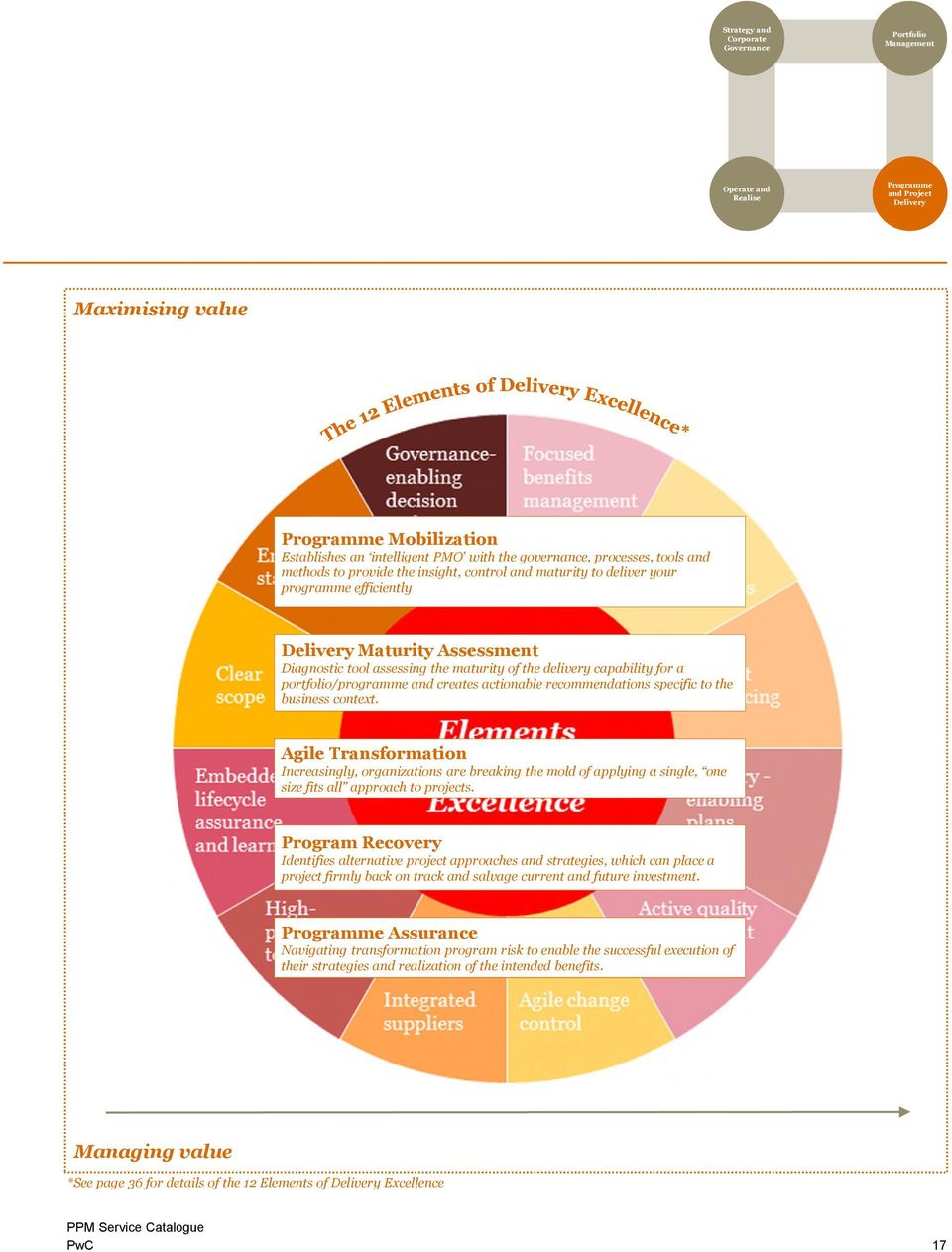
18 Programme Mobilisation Establishes an intelligent PMO with the governance, processes, tools and methods to provide the insight, control and maturity to deliver your programme efficiently Overview Programme Mobilisation is designed to help you set the tone and pace of your programme, and to point the programme in the right direction from the outset. will work with you to develop the maturity of your PMO so that you are able to get to a level of control suitable for the complexity of your programme. will draw on our 12 Elements of Delivery Excellence, and deploy the tools, methods and governance models that will provide assurance that your programme is being delivered in a controlled way. will help develop the maturity of your PMO so you get the insight you need to take decisions and ensure your programme remained focused on your strategic priorities. The service is designed to be rapidly implemented and therefore is especially beneficial when your programme is time-critical or of high value. Process and approach Step 1 Step 2 Set up the Programme Management Office Build programme maturity Rapidly mobilise the programme team Introduce controls to minimise delivery risk Assess current PMO functions and introduce standard project management tools & processes Ensure an initial 3-day plan is in place to keep delivery focused while the PMO is being set up Keep the programme focused on delivering business benefits Establish organisational chart to define as is state and project hierarchy Establish processes to control changes to the scope, cost, quality and benefits of your programme. Review currently employed tools and preferred methods establish which additional tools are required Run workshops to: establish roles & responsibilities scope the programme and delivery outcomes plan activities and agree priorities identity key risks Client issues You re embarking on a complex new programme and want to demonstrate to your stakeholders that you re in control of delivery from the outset. You have a programme underway but you don t feel fully in control due to: lack of visible sponsorship; not getting the information you need to take key decisions about the programme; risks are not properly understood; delivery timescales are unclear; lack of confidence about whether the programme s on track to meet your strategic aim or deliver expected benefits; Provide intelligent reporting to help you make informed decisions Embed the PMO in your organisation Understand interactions and dependencies with your third party suppliers. Define how third-party supplier contracts will be controlled, and manage their deliverables and invoicing processes. Introduce cost reporting as a standard part of regular progress reporting. Populate standard project documents such as risks and issue registers Assess steps required to develop a performance scorecard to enhance potential for successful delivery. Identify key stakeholders & suppliers and understand how they interact with the programme Introduce the concept of quality to individual work-packages. Establish a central repository and filing structure for programme documentation Establish a communication strategy to ensure your stakeholders get the right messages at the right time. Develop delivery-enabled plans. Undertake a technology needs assessment Baseline the Project Initiation Document (PID). Determine the format for programme reporting and agree reporting cycle arrangements Discuss recommendations for embedding the PMO into your organisation. Define the decision-making process Communicate good practice and provide on-the-job coaching to your team to build your future PMO in-house capabilities. Deliver an overarching 3-day plan based on the different priorities from each functional area costs are spiraling; slow to react quickly to new opportunities or challenges; and 18 different messages being received about the status of the programme.

19 Programme and Project Delivery Benefits of programme mobilisation The team Demonstrates effective leadership, focused on programme direction Provides confidence in your programme s progress and ability to deliver Quickly gains control over your programme by deploying a customised set of programme management tools and processes Provides a framework that increases the chances of finding dependencies and common interests across projects Enables you to act on new opportunities and control changes to the programme An experienced PMO Lead specialised in rapid PMO deployment across complex programmes and senior stakeholder engagement. Eliminates multiple versions of the truth by creating a single point of control for project documentation Specialist Planner (optional, depending on complexity) Enables you to make the decisions at the right times by providing intelligent reporting information Critical factors for service success Active engagement from your senior leadership team - being available when necessary, support with stakeholder buy-in and ensuring the right people are in attendance at key workshops Agreement around the vision and objectives of the PMO Access to all appropriate documentation so our team can understand your programme s current set-up We ll provide a successful and experienced team tailored to the needs of your programme: PMO Lead A planner with MS project expertise and further expertise of a project server such as CA Clarity or Primavera. PMO Specialists A team of experienced PPM staff with the following areas of specialism: risk management project planning Support across all business units for using the standard programme management methods and tools put in place by the PMO stakeholder communications and management Commitment from your programme lead to resolving issues rapidly benefits management financial modelling governance and reporting e-tools deployment best practice advice and coaching The PMO sets the foundations for effective delivery however the real benefits are seen when the PMO is mature enough to provide insights into the status of your programme 19

20 Delivery Maturity Assessment Our diagnostic tool assesses the maturity of the delivery capability for a portfolio/programme and creates actionable recommendations, specific to the client business context Overview This service assesses the effectiveness of an organisation s delivery capability from three perspectives: insight, control and efficiency. These can be measured through five levels ranging from: Level : Non-existent No identifiable management in place with no influence on project success; to Level 5: Optimised A leading practice standard with appropriate stakeholder involvement, which plays a critical role in the success of portfolio/programme management. Our assessment specialists will review the Portfolio/Programme Management function against benchmarked standards and known good practice to prioritise areas of focus. Client issues Recent programmes have failed to deliver the expected outcomes and benefits and a review of the delivery capability and maturity is required. Poorly defined portfolio scope and inadequate change control. This results in poor alignment of programmes and projects to the enterprise strategy, which can result in wasted resources. Inconsistency and a lack of standardised approach to the delivery of programmes and projects, and their interdependencies, lead to inconsistent reporting and management information, resulting in in sub-optimal decision-making regarding portfolio/programme performance. Current capability to achieve the strategy is not understood, which can lead to highly ambitious strategies that cannot be delivered, resulting in stakeholder dissatisfaction. Process and approach Step 1 - Mobilisation and definition Agreed review scope and plan Resource plan detailing roles and responsibilities Document request list Interviewees list Step 2 - Review and analysis Stage 3 - Reporting and next-steps Minutes from interviews Final report Log / audit trail of documents received and reviewed Executive summary Initial findings and recommendations for discussion Lessons learned report Executive briefing slides as required Adjusted work plan (if appropriate) Agree scope of review based Review project Develop final report on the 12 Elements documentation against Prepare executive framework best practice to identify summary / briefings as and assess key risks to Agree work plan and roles required the programme / project and responsibilities Perform a lessons learned Interview stakeholders Agree methodology and workshop with the client and project report template team management team Set up Programme members to establish Maturity Assessment ontheir expectations and line tool hear any issues / concerns Gather key project documents (business case, Communicate any plan, risk log, progress serious issues or risks reports etc) immediately to ensure that quick resolution Agree interviewees (key can be sought stakeholders, programme manager, PMO staff, Enter responses to suppliers etc) question set on diagnostic tool and generate automated report to support analysis Limited oversight of interdependencies and synergies across programmes. Lack of centralised control around financials and resources. Document observations and discuss initial findings and recommendations with client team Prepare draft report for client feedback *See page 36 for details of the 12 Elements of Delivery Excellence. 2

21 Programme and Project Delivery Benefits of the Delivery Maturity Assessment The team A client can understand the current maturity and management capability to deliver the portfolio/programme, and use this to inform decisions relating to the risk exposure (e.g. a high complexity/scale delivery with low maturity would be subject to significant risk). will provide a successful and experienced team, fully enabled to perform the Delivery Maturity Assessment. Independent advice and independent data analysis. Engagement/Assessment Lead An organisation can gain insights into its delivery effectiveness either by comparing parts of the organisation with each other or by comparing itself with peer organisations. The engagement lead will work together with senior management to complete the maturity assessment, agree priorities and agree actions to start to improve the maturity score. Clearly articulated opportunities for improvement, prioritised to achieve the required capability to deliver the portfolio/programme successfully. A process improvement plan, presenting a clear way to develop PPM with solutions that can be adopted across the wider organisation. Recommendations that allow good practice to be embedded and taken forward, giving the client the capability to deliver the portfolio/programme. Specialist Maturity Assessors An experienced group of maturity assessors will be deployed who have expertise in the key areas to be assessed, for example: Leadership and governance; Critical factors for service success Prioritisation / delivery planning and execution; Knowledge of what is to be achieved from the maturity assessment. Performance and benefits; Full access to the required organisational and PPM information is critical in order to assess the maturity of the PPM capability in the entire organisation and its overall approach to PPM. Tools and technology; and Clear communication of the benefits of a maturity assessment within the client organisation. Senior level and employee engagement. Focus on impact timescales. Understanding the risk profile of the current portfolio/programme of activity. Portfolio/programme verticals, e.g. Technology, Financials and Operations. Subject Matter Experts Some assessments will require unique insights into areas of the enterprise, such as creativity, human resource design and effectiveness, IT function effectiveness, innovation or product development. These specialists can be drawn from across the firm. The Delivery Maturity Assessment will establish the client s current capability to deliver the portfolio/programme, determine the maturity level and prioritise opportunities to deliver successfully. 21
22 Agile Delivery An iterative, incremental and collaborative process of delivery or managing any work where solutions evolve in dynamic environments. Overview Process and approach 's approach to agile delivery will enable clients to realise value incrementally across projects and programmes, specifically: Putting agile delivery into practice involves establishing the right process and environment to foster and enable a new way of working. Introducing the agile principles into a part of the organisation and enabling it to grow. Tailoring the agile model to align with its culture. Stage 1 - Mobilise and initial analysis Stage 2 - Establishing the right processes and environment Stage 3 - Delivery Review current state delivery methodologies and techniques. Embedding agile delivery, roles and responsibilities. Iterative delivery, value realisation and continuous improvement. Understand the project or programme level vision, objectives and priorities. Agree the organisation and delivery model (appropriate level of rigour). Requirements analysis; produce initial backlog and release plan. Establishing a hub to promote collaboration and shared ownership across functional teams. Focusing on delivery, providing leading indicators and transparency to leadership, empowering team members, and delivering on time and to cost. Improving quality, demonstrating control and early delivery of value. Standardising delivery roles, responsibilities and techniques. Breaking complex problems into manageable components and increasing responsiveness to changing priorities. Client issues Clients are often uncertain of the optimal solution early in the delivery lifecycle. Projects and programmes are typically inflexible and slow to respond to changing requirements, scope and evolving priorities. Cross-functional teams not working in collaboration, causing silos and miscommunication. Business value is not realised until the end of a project or programme. 22 Assess the maturity, culture and daily practices of the team. Assess current processes, techniques and environment. Perform skills analysis and identify any skill gaps. Review / develop case for change. Communicate with stakeholders, set expectations and gain commitment into new ways of working. Roles and responsibilities defined and training needs identified and delivered to core team. Establish a hub (including governance and processes) enabled with an agile operating rhythm. Agree risk and issue management approach. Identify and manage risks and issues. Iteration planning; prioritise requirements using MoSCoW, agree iteration sprint backlog. Daily stand up meetings scrums. Execute the iteration sprint which involves a development cycle with a sub-set of design, build, test and deploy. Conduct quality review and lessons learnt from iteration sprint. Present working deliverables show and tell to product owner and stakeholders. Ongoing review and continuous improvement based on team velocity data. Ongoing business sponsorship, commitment and collaboration Ongoing review, learning and continuous improvement
23 Programme and Project Delivery Benefits of agile The team Early indication of risks High visibility of project progress, obstacles, risks, issues and dependencies. s agile team has the business and technology experience to help clients deliver their business scope and deliver immediate business value using s approach to agile. Greater stakeholder engagement Business stakeholders are engaged throughout the project (not just the beginning), and have the opportunity to provide feedback and shape the product. Strong collaboration and team work Cross-functional high performing, and self-organising teams allows better utilisation of resources, team autonomy and empowerment. Strong client relationships and trust Incrementally designing solutions with the client allows relationship building relationships and the ability to gains trust. Control over timescale and budget Greater control over timescales and budget, with focus on prioritising scope, requirements and to deliver on time. Rapid realisation of value and benefits Products are delivered at the end of each Sprint and early in the process. Greater flexibility Ability to revise and refine scope (outside the current sprint ). Critical factors for execution success Customer satisfaction through early and continuous delivery of valuable products. Effective responsiveness to change for the customer's competitive advantage and evolving requirements. Deliver working products more frequently, with a range of weeks to months, with a preference to the shorter timescale. Business people and developers working together daily throughout the project in a collaborative approach. Build projects around motivated individuals to give them the environment and support they need, and trust them to get the job done. The deployment an efficient and effective method of conveying information to stakeholders and within the project or programme team. Continuous attention to quality and good design enhances agility. At regular intervals, the team reflects on how to become more effective, then tunes and adjusts its behaviour accordingly. Our team of professionals consist of agile project management specialists with strong track records of leading and delivering agile project and programmes. Central to the agile team is the Project Manager. They are usually the most senior full-time member of the implementation team. They will provide alignment between the product owner business stakeholders and the delivery team by overseeing the reporting mechanisms to enhance the development process. The delivery team also incorporates traditional roles such as functional, technical, architecture, quality and infrastructure leads (depending on the size of a project a single team member can take on multiple lead roles), business analysts and developers with the skillsets in agile to collaborate in a high performance agile team environment. All of these individuals comprise the agile team. With their deep agile expertise and industry experience, they will help clients get the most value out of their business goals. s agile service brings flexibility to clients and enables greater collaboration, resulting in the delivery of rapid, incremental business value 23
24 Programme Recovery Our four phase Project Recovery framework identifies alternative project approaches and strategies, which can place a project firmly back on track and salvage the current and future Investment. Overview Process and approach Our senior experts will take immediate actions in order to address very critical issues first, the goal is to buy time to methodically improve the project's longer-term prospects. Step 1 - Stabilize Recognize the issue and engage stakeholders/leadership. The service assess your project s current state to identify problem areas, then perform a root cause analysis to design point solutions for rapid recovery and correction. Identify and secure key resources and assets Access to why it went wrong and where it fit within the strategic focus of the organisation. Our senior experts will identify alternative project approaches and strategies to help salvage your project investments. With their experience and knowledge our senior experts will perform immediate actions in order to stabilize the project and to buy time to methodically improve the project's longer-term prospects. Identify and shore up priority operational processes. Maintain progress on critical tasks and manage the key stakeholders relationships Define/agree short term scope to continue &/or discontinue Buy time to methodically improve the projects longerterm prospects Client issues fixing and sustaining scope clearly defining expectations Lack of coordination with related efforts Projects fail to deliver what was originally promised Deliverables No clear Mission. Goal, Vision, Objective or Direction Little recognition of postimplementation benefits Evaluate actual status Initiate and estimates to complete Create a mitigation plan Review PMO (People Processes and Systems) Identify both root-cause & go forward risk Re-assess / prioritize objectives, business case, benefits, revenues, & costs. Re-assess change & knowledge management & operational processes/ controls Review Lifecycle deliverables Review defects logs Stakeholder and project team engagement, so that there is the will to make it work, and clear way forward. defining tasks Lack of focus Step 2- Analyze Stabilized environment Quick-Wins Regular Executive summary reports and presentations Detailed Assessment Report Mitigation Plan Risk Inventory Interdependency Map *See page 38 for details of the 12 Elements of Delivery Excellence. 24
25 Programme and Project Delivery Process and approach (con t) The team Engagement Lead Step 3 - Reposition Update Business Case & Benefits Planning Revise and re-baseline plan Introduce revised project management processes (including governance and assurance). Replace, Augment and Secure Resources Update requirements tracing to revised benefits/business case Introduce revised technical management Update requirements tracing to revised benefits/business case Introduce revised technical management Step 4 - Action Put in action plans changes developed during repositioning Continued management diligence and assurance to ensure that the causes of the original crisis are not repeated in the repositioned project Collaborating with the senior leadership throughout the whole project secures a fast and successful project recovery. The lead coordinates delivery of the project on a day to day basis, ensuring it remains aligned and fulfills the defined milestones. Senior Experts in Project Recovery An experienced group of project and program management experts having a track record of successful restructuring and delivering mission critical projects and programs. With 1+ years of experience our expert team will identify all the immediate actions needed in order to stabilize the project and to buy time to methodically improve the project's longer-term prospects. Subject Matter Experts Deliverables Revised project plan Mature status reporting Regular assessment reports Regular Executive summary reports and presentations Regular Executive summary reports and presentations Steering Committee Presentations Steering Committee Presentations Some engagements will require unique insights into areas of the enterprise, such as creativity, human resource design and effectiveness, IT function effectiveness, innovation or product development. These specialists can be drawn from across our competencies. Critical Success Factors C-Level sponsorship with a willingness to lead collaboration across the enterprise Strong Top Level Management support Commitment of project team and all stakeholders Prioritization and focus on immediate actions Understanding of the current project and its delivery challenges 25
26 Project Assurance Navigating transformation program risk to enable the successful execution of their strategies and realization of the intended benefits. Overview Project Assurance has a significant role in helping our clients navigate the risks of transformation programs to enable the execution of their strategies successfully and the realization of the intended benefits. We quickly and effectively identify the risks and areas for improvement in projects that are of concern to senior management or are critical to the organisation. Our project assurance approach aims to assist the full range of stakeholders including those who sponsor, govern and manage a project, program, or portfolio to understand the likelihood of success, and give practical and experiential advice and insights. Client Issues Mitigating the common key challenges will provide transparency and confidence to stakeholders, and increase the likelihood of success. Managing project interdependencies across people, process and technology. Project and program level reporting that enables transparency and confidence. Early analysis, identification and treatment of complex risk and issues. Confidence in the schedule and budget estimates and managing project contingency. Preparation and readiness for business change, including the analysis of defects and cumulative impact of workarounds on business operations. Managing key person risk and maintaining required resource levels through the life of the project. *See page 36 for details of the 12 Elements of Delivery Excellence. 26 Process and approach Step 1 Identify project assurance needs Step 2 Agree the timing and scope of review areas The risk based project or program assurance needs are identified up front and a plan developed and agreed. The plan will include periodic health check reviews at critical stages in the lifecycle. In addition, deep-dive reviews should be conducted on those areas deemed highest risk to the success of the project. The assurance plan will be reviewed and adjusted throughout in accordance with the evolving project risk profile. When developing the plan, we consider: Length, structure and nature of the program Areas of high risk Timing of reporting requirements Periods of high delivery pressure In-house capability and skills, including other assurance activity External factors affecting availability of information and staff. Portfolio and organisational dependencies and influences. Indicators of the need for Project Assurance Organizations that have the following indicators can significantly benefit from Project Assurance: Engaged with complex or risky projects. Concerns with project budget, schedule, and status. Significant transactions or organization transformations, or systems initiatives underway. Recently implemented solutions that are not realizing expected benefits. Recent mergers that require process and system consolidation to achieve merger synergies. A portfolio of projects that individually are not risky, but collectively become high risk. Compliance or regulatory-related initiatives that require assessment of whether objectives will be met within acceptable timelines. New, unskilled project team or lack of experience in delivering projects.
27 Programme and Project Delivery The team Process and approach Step 3 Conduct reviews Step 4 Report findings will provide a successful and experienced team to deliver the service. Engagement Lead Reviews come in the form of both deep dives into specific risk areas, and holistic reviews of program controls. Typically they will be via: Desktop document review of key program information. Interviews with key project staff, either individually or in small groups. Liaison with other risk and assurance teams. The reviews will report key findings, priority areas for improvement, good practice recommendations and lessons learned, along with an action plan for implementation which identifies action owners and deadlines for completion. Will work senior leadership to facilitate focused collaboration and to agree findings which enable realistic and prioritised action to increase the likelihood of achieving successful change. Senior Experts in Project Assurance Our team are all fully trained accredited in our global methodologies and also have experience in delivering programs to ensure recommendations are experienced based and pragmatic. Subject Matter Experts The standard global methodologies are the Project Assurance Framework (for deep-dives) and the 12 Elements of Project Management Excellence. Supporting our core project assurance teams are experts in the industry, products or processes at the heart of the projects. Critical success factors Supplementing the core Project Assurance capability should be experts that are familiar with the product or industry processes at the heart of the transformation business case. Processes should be agreed to ensure recommendations are monitored. Review areas must be based on the dynamic and evolving profile of the projects. A degree of independence from the delivery team is mandatory however strong relationships with the team are important to ensure transparency and understanding. Project assurance can assist the full range of stakeholders including those who sponsor, govern and manage a project, program, or portfolio to understand the likelihood of success, and give practical and experiential advice and insights. 27
28 Operateand Realise We help our clients to identify and quantify benefits up front and to ensure that these are realistic and form the foundation of business cases. We also help our clients to track and monitor the realisation of benefits and to embed their ongoing realisation beyond the lifespan of the project. Realise Value Structuring the identification, quantification, management and ultimately realisation of benefits; and ensuring these form both the foundation of individual business cases and are a key input to the iterative process of selecting the right portfolio of projects. 24% of PPM responders say that costs are not clearly defined at the appropriate level within the lifecycle of delivery or scrutinised prior to approvals*. *Source: 4th Global Portfolio and Programme Management Survey, PPM PPMService ServiceCatalogue Catalogue
29 Strategy and Corporate Governance Portfolio Management Operate and Realise Programme and Project Delivery Maximising value Benefits Realisation Structuring the identification, quantification, management and realisation of benefits; and ensuring these form both the foundation of individual business cases and are a key input to the iterative process of selecting the right portfolio of projects. Managing value *See page 36 for details of the 12 Elements of Delivery Excellence 29
30 Benefits Management Delivering value through focused, informed and fact based decision making. Overview The key driver of programs and projects is the desire to deliver value or benefits to an organisation. Benefits Management ensures that an understanding of available benefits forms the basis of all investment decisions and continues to be the focus to maximise realisation of benefits during and post implementation. Effective benefits management ensures that: The benefits of a project or program are understood, articulated and aligned with the organisations strategic objectives; There is clear accountability and transparency for the realisation of benefits, that includes business ownership; Program delivery aspects are arranged to ensure a continued focus on benefits realisation throughout the life of the program as well as beyond; Forecast benefits are achievable & continue to represent value for money; and The focus on, and realisation of benefits is not lost with transition to BaU. Client issues We support our clients in addressing the following challenges; The program is delivered on time and to budget but the benefits are not realised as expected. The program is focused on deliverables rather than delivering benefits. The interdependencies with other programs and how benefits are allocated across projects claiming the same benefits are not clear or understood. Business ownership and accountability for benefit realisation is not clear. The governance, culture and behaviours of the program team do not support effective benefits realisation. Data to support benefits management is not available. Benefits are not clearly measured or reported. Benefits are realised but not sustainable. Process and approach Step 1 Identify Step 2 Plan Identify and agree program or projects benefits Create Benefits Management Plan addressing who, when and how the benefits will be realised along with plans to manage associated risks, assumptions and dependencies Create benefit maps to align benefits to organisation s strategy as well as the initiatives that will create the capabilities to realise them. Create benefits profile to identify preliminary measures, risks, assumptions, ownership etc. for each benefit. Update business case with benefit profiles. Undertake baseline measurement/agree frequency for remeasurement. Create Benefits Register. Establish Benefits Management roles and governance including a Benefits Manager role. 3
31 Operate and Realise Process and approach Step 3 Execute Benefits of our approach Our approach provides our clients with: A clear understanding of the benefits and how these drive strategic achievement; Execute Benefits Management Plan Use lead indicators to drive performance Capture and leverage emergent benefits and mitigate any dis-benefits Take corrective action as appropriate Update Benefits Management Plan, Program Management Plan and Benefits Register A firm understanding of how these benefits will be measured throughout the life of the program and beyond as well as who owns them; Clarity on if benefits are being released and what rate to support senior decision making; An understanding of whether or not programs and projects continue to be viable in the context of the benefits available Ensures that the project is delivered and that the benefits are sustained after implementation. Assess benefits realisation effectiveness Use lag indicators to measure outcomes Compile and document lessons and feedback into investment decision making process Implement corrective actions Report results Our benefits management approach moves benefits realisation from the periphery to the heart of program delivery. 31
32 Capabilities When considering the effectiveness of a programme or portfolio's delivery structure there are three main themes investigates, namely: Insight, Control and Efficiency. These are expanded below: Insight We assess the fitness-for-purpose of programme/portfolio information flows and decision support systems. In practical terms, this involves a detailed assessment of the governance structure (e.g. meeting structure, roles and responsibilities, management cycle), the management reporting (e.g. usage of trended metrics/data, subjectivity, correct mapping of reporting to governance meetings, robustness of underlying MIS) and the communications and stakeholder management processes (e.g. communications strategy, internal/external stakeholder maps, benefits ownership). Control We assess the maturity of core programme management processes, their inputs and outputs. In practical terms, this involves a detailed assessment of what is being delivered (e.g. benefits, requirements, assumptions, scope, quality), when is it being delivered (e.g. critical path, dependencies, milestones), how is it being delivered (e.g. budgets, resources) and what may impact delivery (e.g. risks, issues, opportunities). High performing project organisations deploy approx 2% more key PMO capabilities than comparable lowperforming organisations Efficiency We assess the extent to which the delivery organisation is optimised. In practical terms, this involves analysis of the delivery model (e.g. usage of external suppliers, most appropriate use of resources - and their skills and capabilities, framework for training/up-skilling), supporting systems (e.g. extent of shared supporting system usage [Clearquest, Project Server, Test Director etc], level of automation, single source of truth) and usage of standard approaches (e.g. consistent delivery methodology, common processes, shared templates). *Source: The State of the PMO A Benchmark of Current Business Practices Center for Business Practices (CBP) Report PPM PPMService ServiceCatalogue Catalogue
33 33
34 The 12 Elements of Delivery Excellence All of our work is underpinned by practical experience We know there are many dimensions to the effective delivery of programmes. If undertaken well, the 12 Elements of Delivery Excellence can contribute significantly to overall success. Governanceenabling decision making Focused benefits management Managed risk and opportunities Engaged stakeholders Clear scope Embedded lifecycle assurance and learning The 12 Elements of Delivery Excellence Highperforming teams Smart financing Delivery enabling plans Active quality management Integrated suppliers Agile change control Element Our capability Clear scope The scope of the programme is defined, complete, communicated and agreed and it supports the objectives of the business strategy. Define design principles and gather business and functional requirements. Align scope to business strategy securing commitment from key stakeholders. Articulate constraints and dependencies confirming scope to be included. Engaged stakeholders Identifying and managing stakeholders so that they are committed, appropriately informed and contribute to the success of the programme. Identify and assess the stakeholders who are impacted or will be influencers to the realisation of the programme benefits. Map stakeholders to the programme s outcomes and benefits. Develop and deliver tailored stakeholder change interventions and communications to support the delivery of programme benefits. Track stakeholder alignment with the programme s vision and deliver interventions when necessary to maintain that alignment. Governance-enabling decision making Enabling leaders to govern with confidence, making timely decisions using high quality management information. Understand the organisation s appetite for change and identify who will sponsor and drive the programme. Provide structure, processes, forums and procedures to control programme operations including escalation channels. Define roles and responsibilities to incorporate strong leadership and challenge. Create efficient reporting and identification of issues based on accurate information with the decisions required highlighted and impacts identified. 34
35 Element Our capability Focused benefits management Developing a realistic business case subjected to an appropriate level of challenge with benefits clearly defined, owned and tracked. Identify quantifiable benefits at the outset of the programme and create a framework to review and track achievement. Develop measureable benefits with clear targets, baselines and monitoring mechanisms. Establish ownership of benefits. Achieve agreed outcomes and sustainable change rather than simply delivering milestones and progress. Managed risks and opportunities Understand the organisational approach and appetite to risk management. Implement customised governance. Making certain that there are effective risk identification processes in place and that the Establish formal risk identification, assessment and mitigation processes, reporting key risks to key risks are mitigated and opportunities decision makers and managing impacts. Produce measures and controls to identify and manage risks taken. and opportunities. Understand the financial aspects of risk acceptance versus mitigation. Identify opportunities from risks to improve programme outcomes. Smart financing Establishing the budget and associated policies, processes and reporting standards for effective cost estimation, programme financial management and reporting. Benefit from s experienced Corporate Finance team that has specialist skills in business cases, payback periods, software capitalisation and innovative fund draw-down. Establish programme costs, secure financing and run financial management processes, including cost control and reporting within programmes. Identify innovative funding approaches. Establish programme financial policies and procedures. Provide visibility on financial performance of in-flight programmes. Delivery enabling plans The plans in place must be realistic, achievable, understood and bought into by key stakeholders and suppliers. Develop robust, fully resourced delivery plans which set out an efficient route to delivering an agreed scope and associated outcomes, lay out the key milestones, recognise dependencies and illustrate the critical path. Generate multiple views of plans appropriate for their use and audience. Manage plans to reflect the dynamics of the environment, by acting on risks, issues, changes to budget and scope and the realities of programme delivery in a changing environment. Deliver against a plan by making sure that the appropriate resources, information and direction is provided to the programme team and that reporting and governance allows timely decisions. Active quality management Develop a robust Quality Strategy and a workable Quality Plan, and utilise them. An agreed quality plan has been developed Develop detailed product-level descriptions and acceptance criterion and use them throughout the based on appropriate standards, it is programme. Use Voice of the Customer techniques to articulate customers' needs. communicated and the right behaviours are Establish tailored quality planning methodologies, tools, techniques, document management and in place. configuration control mechanisms. Manage deviations from the required quality standards. Agile change control A formal process is in place for controlling changes to programme scope according to the programme s principles and this has been communicated to the programme stakeholders. Tailor and implement good practice change control to the specific programme needs. Minimise bureaucracy around change control to respond swiftly to dynamic environments. Establish a suitable level of governance to allow efficient and effective decision making. Assess the impact of changes on time, budget, quality and benefits. Control, approve and communicate changes and secure compliance with the process. Integrated suppliers An effective approach has been taken to engage with suppliers, including adequate governance of their activities. Match supplier selection to programme goals as part of an integrated value chain. Develop and deploy a consistent approach and common programme language between suppliers and delivery teams. Implement governance and reporting that provides a genuine view of programme health, as shared by all suppliers across the delivery team. Create an environment that fosters a strong, single team approach across multiple suppliers. High performing teams The programme team is highly motivated, has the right blend of skills and personalities and the organisation supports the team to deliver. Create a programme organisation with a clear definition of roles/responsibilities and escalation paths. Help staff the programme with high quality people, and provide coaching as appropriate. Communicate the programme vision to the programme team and other stakeholders. Determine who is Responsible, Accountable, who needs to be Consulted and who needs to be kept Informed (RACI). Create knowledge and skills to maintain high performance after the change is complete. Embedded lifecycle assurance and Capture lessons learned throughout the programme and create mechanisms to address those which learning continue after programme closure. A clear assurance plan has been defined Identify issues with existing programme structures and create improvements to manage them and which outlines the nature, timing and extent increase the chance of success. of planned assurance, quality reviews and embeds learning. 35
36 Clear scope The scope of the programme is defined, complete, communicated and agreed and it supports the objectives of the business strategy Overview Process and approach Defining and agreeing a clear scope is a key building block for the successful delivery of any programme; clarity and consensus is critical for success. We work with you to customise the process for defining and agreeing scope; this process will depend on the size and complexity of the programme and the its environment. The typical stages are: A clear scope defines the boundaries of a programme s activities and therefore sets the parameters against which to baseline planning, monitoring and tracking of benefits. works in collaboration with our clients so that the scope of a programme is clearly defined, complete, communicated and agreed and it supports the objectives of the programme throughout its lifecycle. Step 1 Step 2 Define high-level scope Develop scope statement We work with clients to: Define design principles and gather business and functional requirements; Articulate constraints and dependencies confirming scope to be included and, Align scope to business strategy securing commitment from key stakeholders. Confirm programme objectives and Document and agree deliverables deliverables and Programme considered in scope. Sponsor. Identify interdependencies within Gather key information to inform the programme and dependencies the scope design, typically from with other programmes or parts of original business case. the organisation. Engage senior stakeholders to understand expectations of the programme and prioritise. Document areas that are considered out of scope, e.g. organisational functions or processes. Document areas that are considered out of scope, e.g. organisational functions or processes. Our approach is differentiated because: We believe gaining clarity and aligning scope with business strategy is at the heart of programme success; We engage with senior stakeholders up front and throughout your programme s lifecycle so that it delivers to their expectations.; We focus your programme on its agreed scope by continual reference back to it throughout the programme s lifecycle and, We facilitate an agile approach to scope recognising that programmes operate in changing environments. 36
37 Step 3 Step 4 Client issues Confirm scope with key stakeholders Manage scope Programme fails to deliver to the client s expectations. Programme planning and delivery have initiated without a clear and agreed scope. Programme stakeholders are not clear on the remit or boundaries of the programme. Confusion within the programme on the scope and when the programme is due to end. Cross-check scope statement Once programme delivery is with programme objectives and underway, refer back to scope business strategy. statement during governance meetings and reporting Share scope statement with mechanisms to make sure scope Programme Sponsor and obtain is managed and avoid scope initial sign off. creep i.e. scope expansion Agree with Sponsor the without formal agreement or appropriate senior stakeholders resource considerations. to consult. For scope revisions, engage with Share scope statement with the change control processes to senior stakeholders to gain efficiently and effectively input and agreement, and manage complete the process of aligning the change. with business strategy. For scope revisions, engage with Gain sponsor sign-off once the change control processes to scope agreed and finalised. efficiently and effectively manage the change. Scope creep where the scope of the programme has expanded without a formal agreement, impacting programme resources, timeline and budget. Benefits Programme direction is defined from the start to optimise focus, resource efforts and achieve on-time delivery. Clarity from the start on the outputs required during and at the end of the programme. Alignment of senior stakeholders on scope and what is expected to be delivered by when. Scope is successfully managed through change control, resulting in an increased probability of on-time and on-budget delivery. 37
38 Engaged stakeholders Identifying and managing stakeholders so that they are committed, appropriately informed and contribute to the success of the programme Overview Process and approach Large scale complex programmes are inherently difficult to deliver. Achieving the programme s objectives and benefits requires stakeholders to be engaged throughout the programme lifecycle; their support is integral to its success. When programmes are vulnerable, decisive stakeholder management is required to mitigate design and implementation risks. Our approach to stakeholder engagement focuses on identifying stakeholders and maintaining their support and alignment to the programme and its intended benefits. The typical stages are: Step 1 - Step 2 - Identify, Assess, Map and Prioritise Stakeholders Develop Stakeholder Engagement Strategy and Plan Understand the historical and cultural context of the programme and establish the organisation s drivers for change. Develop an engagement and communications strategy using the stakeholder analysis completed in Stage 1; this determines the nature of the programme s engagement with these stakeholders. The strategy defines the level on which communication and engagement occurs. Effective engagement is a two-way process, focusing on dialogue, understanding and feedback. We work with clients to: Identify and assess the stakeholders who are impacted or will influence the realisation of the programme benefits; Map stakeholders to the programme s outcomes and benefits; Develop and deliver tailored stakeholder communications to support the delivery of programme benefits and, Track stakeholder expectations and alignment with the programme s vision and deliver course correction activity when necessary to maintain alignment. Gather relevant background on key stakeholders from the programme sponsor, e.g. likely reactions to the programme. Map stakeholders according to their impact on change and their level of interest, support for, and influence over the programme. Define the level of engagement with the programme. Typically there are three levels: Enrol, Engage, Inform. A stakeholder engagement delivery plan is created that is linked to key activities in the programme plan (see Delivery enabling plans). Our approach is differentiated because: We maintain the focus on the people throughout the programme lifecycle from inception to benefits realisation so that they remain continually aligned and supportive of the programme; We proactively plan for and deliver tailored stakeholder communications that help build critical support for change and, We integrate stakeholder management at workstream, project, programme and portfolio levels to make sure that stakeholder engagement remains at the heart of the change initiative. 38
39 Step 3 - Step 4 - Client issues Develop Key Messages and Tailored Information Engage Stakeholders and Measure Success Stakeholders are not bought-in to the programme s vision and there is misunderstanding of the benefits that change will bring. The change programme is operating without involvement from the business and there is a lack of business accountability for the programme s outcomes. Communication messages are developed. Communications are deployed according to the plan. Key messages are aligned to each major stakeholder group. Success of the communication messages is evaluated, including any movement of stakeholders support for the programme. The engagement strategy is updated accordingly. Supporting materials (e.g. FAQs, Sharepoint, websites, posters etc) are prepared. Review time is built the communication plan so into that programme sign-off for each communications message is achieved. Programme sponsorship becomes weaker during the course of a programme and the programme starts to lose momentum. Programme resources do not see the benefit of working on change programmes (sometimes on top of their day job ). The activities that they are involved in are not prioritised and the schedule slips and cost increases as a result. Benefits Stakeholders are more accountable for the programme s success, which drives long-term sustainability of the programme s benefits. Early identification of risks and effective response planning through proactive and transparent communication channels. Greater realisation of programme benefits by making sure the stakeholders remain aligned with the programme s objectives. Enhanced confidence in programmes being able to deliver. 39
40 Governance enabling decision making Enabling leaders to govern with confidence, making timely decisions using high quality management information Overview Effective governance of a programme is fundamental to successfully delivery and alignment with organisational strategy and direction. Defining governance arrangements early and comprehensively creates clear roles and responsibilities at all levels and allows for effective and timely decision making throughout the duration of the programme. We work with clients to: Engage senior management, and identify who will sponsor and drive the programme; Assist the senior management team in the development of a programme vision; Advise senior management teams of the programme decision making approach and rhythm, including programme progress gates and signoff requirements; Establish a change control processes and procedures; Establish the most appropriate composition of key governance forums, such as programme boards, and propose potential programme hierarchies; Develop efficient reporting and high quality management information (MI) for effective monitoring;. Process and approach The process for establishing governance varies depending on the size and complexity of the programme and the degree of associated risk. The typical stages are: Step 1 - Step 2 - Engage with Sponsor, Identify Stakeholders and Build Program Team. Design Governance Structure and Meeting Schedule Develop effective decision making and supporting governance structure. Incorporate existing rhythms into design, as appropriate. Understand how the program aligns to the organisation s strategic objectives Establish a governance structure that enables programme delivery. Engage the senior management team and Programme Sponsor. Design governance review processes and key programme stage/milestone approvals (i.e. tollgates) Identify key stakeholders; customers, suppliers, investors etc. Establish programme team. Define and communicate governance terms of reference (ToR) and the process for escalation. Establish governance meetings, rhythm and reporting requirements. Design reporting templates to support the meeting rhythm. Our approach is differentiated because: We appreciate the difference between running the business and changing the business, and the healthy tensions that exist; We structure programme governance so that decisions are taken rather than postponed; We underpin decision making with high-quality, real-time management information rather than bureaucracy and, We drive your programmes forward through clear vision and strong leadership. 4
41 Step 3 - Step 4 - Client issues Implement governance structure and processes Monitor and manage Lack of clarity around accountabilities and responsibilities leading to inaction and duplication. Ineffective decision making. Absent or insufficient Sponsor resulting in inability to drive program forward plus uncontrollable risks and issues. Achieve sponsor approval of governance framework. Conduct governance reviews periodically or after significant change. Communicate governance structure and processes. Inability to effectively monitor and control the programme, track progress or and identify key risks and issues. Communicate and launch reporting and monitoring processes. Benefits Effective and transparent decision making, at all levels in the programme, underpinned by high quality MI. Defined roles and responsibilities and a clear escalation process. Engaged stakeholders and programme team. 41
42 Focused benefits management Developing a realistic business case subjected to an appropriate level of challenge with benefits clearly defined, owned and tracked Overview Process and approach Benefits management focuses on clear identification, planning, tracking and realisation of programme benefits from the outset and early benefits delivery wherever possible. Our approach to stakeholder engagement focuses on maintaining their support and alignment to the programme and its intended benefits. The typical steps are: Benefits management is not merely a technique for investment justification but should be an integral part of programme delivery so that all aspects of the programme are designed and delivered with benefits realization in mind. We work with a client team to: Identify quantifiable benefits at the outset of the programme and create a framework to review and track achievement; Develop measureable benefits with clear targets, baselines and monitoring mechanisms. Establish ownership of benefits. Achieve agreed outcomes and sustainable change rather than simply delivering milestones and progress. Often benefits are only considered at the start and end of a programme. In order to successfully embed the change in the organisation it is important to plan for and maintain a focus on benefits throughout the programme. Step 1 - Step 2 - Identify Benefits Plan for Benefits Realisation Establish Benefits Framework that details the approach and structure of how benefits will be managed. Complete stakeholder engagement plan to align benefits to stakeholder groups impacted by the program. Identify and confirm the stakeholders who will be impacted by the change and whose involvement and commitment will be required. Update Business Case with Benefits Profiles. Develop a Benefits Realisation Plan. Confirm the organisational strategy and the alignment with the investment objectives of the change program. Identify benefits that will result from achieving objectives through the creation of Benefits Profiles. Develop the Benefits Dependency Maps that links benefits to the expected investment objectives. Complete baseline of benefits. Our approach is differentiated because: We have expertise in benefits realisation in a broad range of sectors and recognise the different application of benefits approaches across sectors; We insist on and drive for our clients the need for business ownership of benefits; We bring portfolio thinking to benefits so that they can inform investment decisions and, We have expertise in embedding benefits capability in our clients so they can lead. 42
43 Step 3 - Step 4 - Client issues Execute Benefits Realisation Plan Handover Benefits Management The programme is delivered on time and to budget but the benefits are not realised as expected. The business case is poorly constructed and it fails to articulate what the real value or benefits are meant to be. Communicate and formalise responsibilities for benefits management Report progress of benefits realisation in programme performance reports to the programme steering committee. Monitor the impact of risks and issues on benefits realisation. Monitor delivery against the benefits realisation milestones in the plan. Monitor the impact of changes arising through change control on benefits realisation. Provide support to the team undertaking stage gate reviews to determine whether the required benefits have been delivered. Manage benefits in design by ensuring capabilities in the design are linked to benefits. Manage benefits in implementation by monitoring and reporting progress against the benefits to be realised. Complete benefit reviews as an integral part of programme management which informs decision-making to ensure that benefits can be delivered. Track benefits realisation and taking corrective action, where required. Providing input to post-implementation programme/project reviews. Identify who will have leadership responsibilities for the on-going oversight and management of benefits realisation; Identify who will have responsibility for tracking, monitoring, measuring and reporting activities; Support the establishment of appropriate governance structures for the benefits managers within the organisation; Brief and train on the tools used to manage benefits, including the handover of tools that will continue to be used after programme closure; and Handover status of benefits, with documented arrangements for actions to be achieved for the organisation to realise the intended benefits. The business case is well-constructed but is not referred to during the remainder of the programme. There is a strong delivery mindset but the outputs are not tested during the programme to ensure they are fit-forpurpose. There is no entity responsible for owning the benefits management process. KPIs are not in place to measure whether the benefits are realised. Benefits A clear understanding of what investment objectives exist for the programme. Clear articulation of what business benefits will result from the achievement of these objectives. Firm understanding of how these benefits will be measured and who owns them. Strong linkage between benefits and what needs to change in the organisation to realise them. Change ownership and measures of the achievement. The programme is delivered and that the benefits are sustained after implementation. Complete post-implementation benefits reviews. 43
44 Managed risks and opportunities Making certain that there are effective risk identification processes in place and that the key risks are mitigated, issues are dealt with and opportunities are taken Overview Process and approach Risk and opportunity management is the identification and management of the downside (risks/issues) as well as the upside (opportunities) of potential future events in a programme environment. Risk and Opportunity Management is an integral part of managing a programme. After developing /implementing risk/issue & opportunity management processes, identification is undertaken throughout the life of the programme. Effective risk and issue management minimises the likelihood of detrimental events occurring, reduces the impact that a detrimental event would have if it occurs and resolves issues that already have occurred. Effective opportunity management will assist with the identification of opportunities beyond the programme and thus will help making choices that enhance the effectiveness of the delivery. We work with clients to: Produce measures and controls to identify and manage risks and opportunities; Establish formal risk identification, assessment and mitigation processes, reporting key risks and issues to decision makers and managing impacts; Understand the financial aspects of risk acceptance versus mitigation and, Identify opportunities from risks to improve programme outcomes. Step 1 Step 2 Governance and Processes Identify and Review Review existing organisational risk/issues and opportunities management arrangements. Establish central control of the risk, opportunity and issue register. Identify owners. Establish a culture for proactive identification and open discussion of risk. Establish tools for measuring, recording and tracking risks and issues. Determine programme risk appetite and levels of risk tolerance, in terms of outcomes, cost, resources and timescales. Define criteria and means for escalating risks/issues Agree risk and issue reporting forums. Review the existing information through desktop studies and team workshops to collate the known risks. Assess the programme delivery plan for hard deadlines, key events and structure of activities to understand dependencies and areas of potential conflict or delivery failure. Establish risk categorisation, probability factors, impact ratings and risk proximity measurement. Consider external factors that could detrimentally impact the programme and how these can be accounted for. Outcome will be identified risks, issues and opportunities framed in the updated governance process 44
45 Step 3 Step 4 Client issues Mitigation Monitor and manage Many programmes do not consider risks from outside the programme; they can be a source of surprises that are detrimental to the programme. Reporting Dashboard <Programme / Project Name> Risk Dashboard as at Number of Open Risks Current Risk Rating Extreme Very High High Moderate Low 15/4/211 11:13 Number of Closed Risks Number of Open Long Number ofopen Number of Open Risks Term Risks Medium Term Risks Number of Risks that became Issues Identified risks are not managed resulting in inadequate mitigation. Cost to deliver increases. Number of Open Immediate Risks D e g re e o f Im p a c t Likelihood of Risks Occurring Rare Unlikely Possible Likely Almost Certain Severe Major Medium Low Insignificant Functional Risk Resource Risk Organisational Risk Technical Risk Executive Risk Number of Issues Open by Category Developing mitigation measures and build these into delivery plans. Programme/Project Management Risk Assisting and encouraging projects/workstreams to identify and regularly review potential new risks; Assessing the impact of mitigation options and Maintaining the Risk and considers alternative actions. Issue Log to act as a central repository for programme Considering contingency risks and issues which should options and identify budget and timescales for these to be incorporate risks to the achievement of benefits; applied. Providing risk and issue Identifying timescale for reports and other statistics mitigation actions so that actions can be prioritised and for inclusion or escalation in executive dashboards effectively planned. /programme performance Identifying mitigation action reports for use by the owners and appropriate programme leadership; engagement. Close risks and release contingency funding when the risk passed or escalate to an issue, if this occurs. Our approach is differentiated because: We drive risk management by ensuring all risks have an active owner and associated action plan; We manage the upside (opportunities) as well as the down side (risks/issues); We identify risks and opportunities beyond the programme to minimise unforeseen impacts; We plan the best risk by risk strategy; reduction, mitigation, acceptance, elimination or transference and. We assess financial risk impact to ensure contingency is appropriate. Risk and issue logs are often complex and not effective for communicating the scale of risks. Financial impact of accepting or mitigating risks is not assessed, resulting in poor decision making. Absence of clarity around who is responsible for risks and opportunities and their management, who needs to be consulted or informed of risks/issues and the planned mitigation activities. Benefits Measures in place to keep the programme on track. Resources are appropriately applied. Consistent approach to identifying and rating risks, which increases the probability of successful delivery. Identified risk budget and time dependent budget decision points for mitigation/contingency actions and budget release. Effective MI and reporting of risks. Identification of opportunities to improve delivery. Effective filtering and escalation of risks provides focus for senior management. Order from chaos' through clear documentation of risks and controls, removing fire fighting of unexpected risks. 45
46 Smart financing Establishing the budget and associated processes/standards for effective cost estimation, financial management and reporting Overview If programme costs become out-ofcontrol or are significantly higher than expected, the programme may no longer be viable or cost effective. As a result sponsors may consider abandoning the effort or significantly changing the Programme Scope. As part of the case for change, costs/benefits of the programme should be identified in the Initial Business Case. The PMO's role includes establishing, managing and reporting on the programme budget, in conjunction with the Programme Accountant where one has been appointed. We work with clients to: Establish programme costs, secure financing and run financial management processes, including cost control and reporting within programmes; Identify alternative and innovative funding approaches to overcome funding constraints; Establish programme financial policies and procedures, working in tandem with the PMO and finance function where necessary. We verify that they are appropriately implemented within programmes; Provide visibility on financial performance of in-flight programmes and the impact of options for halting existing projects or integrating new programmes; Benefit from s experienced Corporate Finance Function that has specialist skills in business cases, payback periods, software capitalisation and innovative fund draw-down and, Implement effective benefits management, Discounted Cash Flow, Earned Value (EV) processes and Monte Carlo type simulations. 46 Process and approach Programme costs and budgets should be managed throughout the programme life cycle to ensure that the expected benefits accrue to the organisation within the specified financial constraints. The typical stages are: Step 1 - Step 2 - Develop Budget Develop Financial Management Develop a budget for the programme including template to cover normally included costs. Set up program accounting arrangements in line with each stage or release. Develop bottom up budget using cost estimation approach to promote accuracy and adequate level of detail. Develop Financial Management Strategy and Plan in line with agreed program scope ensuring to address areas such as policies, systems, roles and responsibilities, Validate against Business Case to base-lined budget and costs, budget optimize against your cost baseline. profile and financial report Establish tailored forecasting structured for the organization and principles to align with and support audiences. organisational needs including any budgeting assumptions in line with your Project Charter. Our approach is differentiated because: We can identify alternative and innovative funding approaches; We bring corporate finance expertise e.g. tax efficiency and software capitalisation; We have a bottom-up cost estimating model and, We understand financial earned-value management.
47 Step 3 - Client issues Implement and Manage Finances Programmes are initiated without adequate financial rigour, requiring unplanned funding downstream. Monitor actual cost against forecasts Conduct analysis of variances and recommend ways to exploit opportunities. Conduct periodic reviews to ensure that the financial information is effective and supports informed decision making and ensure follow up. Generate and submit Financial performance reports to the Sponsor and relevant governance bodies in the approved formats, including agreed KPIs. Identify and manage financial risks within the overall program mix. Inadequate cost control processes and skills leading to inadequate funding and quality and/or delivery problems. Lack of current and forecasted cost information, leading to inability to prioritise or allocate resource effectively for the best return. Inability to foresee financial risks and prepare contingencies which threatens viability of key initiatives. Disconnect between the initial benefits case approved and the benefits realisation process in practice. Cost overruns negate hard-won benefits already achieved. Benefits Financial discipline allows accurate planning and budgeting. Focus on financial benefits allows better prioritisation of effort and allocation of resource for the best returns. Avoid cost overruns, failure to deliver tangible value, losing sight of original aims and budget freezes and cuts. 47
48 Delivery enabling plans Plans must be realistic, achievable and bought into by key stakeholders. They are living documents that guide programmes through change to a successful outcome Overview Process and approach Plans are at the heart of programme delivery; they bring together delivery teams which are often comprised of people and organisations that are not used to working together, and provide the detailed route map from the programme s start to the finish. The process for programme planning can vary depending on the size, complexity and point in the lifecycle of the programme. The typical stages are: Step 1 Develop high-level programme plan and Outputs Programme Plans are living documents which must be constantly updated and referenced during programme delivery. A programme is a means of creating and embedding change within an organisation. The plan needs to cover both the delivery of the desired programme outcomes and how those outcomes translate into organisational change that delivers the planned benefits. We work with clients to: Develop robust, resource-balanced delivery plans which set out an efficient route to delivering agreed scope and associated outcomes, lay out the key milestones, recognise dependencies and illustrate the critical path. We generate multiple views of plans that are appropriate for their use and audience; Once the delivery plan is agreed and accepted, establish the baseline against which the status will be measured and reported; Maintain and manage plans to reflect the dynamics of the environment, by acting on risks, issues, changes to budget and scope and the realities of programme delivery in a changing environment and, Deliver against a plan by making sure that the appropriate resources, information and direction is provided to the programme team, and that reporting and governance allows timely decisions to be made. 48 Organisation s Vision Program me Blueprint Program me Plan Programme Benefits Programme Stakeholders Programme Risks and issues Integrated Suppliers Programme Tracking Program Budget Confirm scope, programme boundaries and desired outcomes of programme. Create a project dossier, providing a description of all the programme s projects. Identify and schedule the high-level phases and activities highlighting the programme s high level dependencies and allowing initial milestone sequencing. Projects Identify and document assumptions that underpin development of any plans. Agree the approach to transition, i.e. how the programme outputs will allow the organisation to embed them into operational outcomes that will deliver the planned benefits. Identify key deliverables required to achieve programme milestones. Identify component projects required to produce deliverables. Agree approach to planning (e.g. agile, rolling wave, gated process or other) before starting. Agree planning tolerances and contingencies. Our approach is differentiated because: We integrate our programme plans into the wider strategy of the business to ensure alignment; We anticipate change and develop a flexible and agile planning approach to maintain plan currency and, We design plans to deliver the programme within agreed time-frames and the delivery of benefits beyond programme completion.
49 Step 2- Step 3 - Client issues Schedule Project Work Manage and Maintain Plans Planning takes place in isolation of the programme and/or key stakeholders, typically resulting in misaligned plans which do not align to the overall programme or shared goal. Plans no longer represent the reality of the programme. Develop and set the baseline for the master schedule, using techniques such as Product Breakdown Structure, Work Breakdown Structure and critical path analysis. Allow for contingency and tolerances within schedule based on the risk profile of the activities. Schedule phases of work and deployment approach as required. Very large programmes may require a rolling-wave approach to progressively establish detailed schedules. Manage delivery against plans at each level via programme, work stream and project reporting and governance structures. Plans are presented in too much or too little detail, inhibiting decision making, leading to paralysis or poorly considered decisions being taken. Manage variations through change control procedures, re-planning as required. Insufficient flexibility built into original plans, so slight changes to delivery result in complicated and time-consuming re-planning exercises. Avoid re-setting baselines unless there are formally agreed changes to scope or costs, or as a result of external dependencies or factors. Plans stop at the delivery of outcomes and do not cover transition of those outcomes into the organisation s operations and benefits. Benefits Confidence that plans are fit-forpurpose as a result of logical, bottomup development leading to clear outcomes, milestones and outputs. A flexible approach to planning which avoids excessively risky planning assumptions, for example zero schedule float. Plans illustrated at various levels of detail to suit the needs of stakeholders and delivery teams. Collaborative approach to planning helps to secure the buy-in of all parties involved. Clear view of the actual status of the projects and overall programme as compared to the baseline. 49
50 Active quality management An agreed quality plan has been developed based on appropriate standards, it is communicated and the right behaviours are in place Overview Process and approach Active Quality Management is a process for providing assurance and validation that a programme s outcomes meet customer expectations. It focuses the effort made in delivering a programme on meeting the expectations and needs of the client, and involves the development and agreement to a quality strategy and plan. Its success requires quality-focused behaviours that support individual outputs or programme activities being performed such that they collectively deliver the expected outcomes or benefits. The quality management approach will need to be tailored to the size, complexity and nature of the programme outcomes. We work with you to customise the process to your needs. The typical steps are: We work with clients to: Develop a robust Quality Strategy and a workable Quality Plan and utilise them; Use Voice of the Customer techniques to clearly articulate customers' needs and perceptions of the end product or service; Develop detailed product-level descriptions and acceptance criterion and use them throughout the programme; Establish tailored quality planning methodologies, tools, techniques, document management and configuration control mechanisms and, Step 1 - Step 2 - Develop the Quality Strategy Develop the Quality Management Plan Conduct a review to determine the client s key expectations for the change initiative. Develop a list of the critical elements of the programme that are subject to regular quality review. Determine the programme principles for managing quality and the associated high-level process. Define the approach, process, timing and responsibilities for reviewing and signing-off programme deliverables or outcomes. Review the organisation s existing quality management processes, roles and responsibilities, systems and behaviours and determine if they are adequate. If required, agree changes. Finalise and agree a Quality Strategy. Define the approach for ensuring integrity of the agreed outcomes. Define the approach for making changes to baselined deliverables. Determine the criteria for successful completion of one phase/stage and commencement of the next. Create a Quality Log which sets out the quality milestones and deliverables. Embed a quality mindset and establish the correct quality focused behaviours. Our approach is differentiated because: We use Voice of the Customer techniques to clearly articulate customers' needs up front. These needs are translated into agreed Quality Criterion that are used to assess the quality of the programme s outputs throughout the programme and, We continuously check that a programme is delivering to these quality criterion and do not hesitate to implement decisive actions where required. 5
51 Step 3 - Step 4 - Implement and Review Quality Process Manage Quality Defects Start Specify the Product Build the Product Rework product / investigate and address cause No Compliant with product description? Yes Client issues Programmes fail to deliver the expected outcomes and benefits or these are not in line with customer expectations. Write product description The link between organisational strategy, customer expectations and the change programme is broken. Accordi ng to product description Baselined Product Quality Control Communicate the Quality Management Strategy and Plan, the associated roles and responsibilities. Roll-out formal and informal training in Quality Management. Assess quality against previously establish standards. Determine degree of impact on programme in terms of time, dependencies and risk. Lack of focus or documentation of the customer s expectations. No definition of how programme outputs are linked to meet the overarching expectations. Huge investments of time and cost on delivering programme outcomes without the appropriate level of authorisations in place or gate/stage reviews. Provide support to the teams in Work to determine appropriate developing plans in line with the Quality remedial action with owner in line with Plan. This may involve the development Change Controls and Governance. of detailed product descriptions. Limited or no programme assurance and/or validation. Schedule regular quality reviews and interventions, including continuous improvement cycles. Benefits Enforce quality management through the programme governance arrangements and displaying the right leadership behaviours. The effort and expenditure in delivering a change initiative meets the expectations and needs of the customer or organisation. Provides a clear baseline for delivering consistent high quality outputs and a mechanism for enforcing these standards. Activities are all conducted in line with expectations such that, when outputs are implemented, they collectively deliver the expected programme outcomes and benefits. Validates that the change initiative is delivering to the agreed quality criterion, before it is too late. 51
52 Agile change control A dynamic process is in place for controlling changes to programme scope and has been embedded with programme stakeholders Overview Process and approach Programmes typically require corrections due to risks, dependencies, new developments and opportunities. Programmes require a controlled change process for defining, authorising, managing and communicating changes to an existing programme. Failure can be the result of uncontrolled changes or too rigid a regime that is resistant to change. Agile change control therefore aims to identify a balanced path between these two extremes and allow an efficient, wellgoverned and responsive process. Change control arrangements are used to manage changes to scope, requirements (business and technical), deliverables and intended benefits that impact the programme/project baseline scope, timing or cost. Step 1 Step 2 Identify approach and process Identify change and raise change request Identifying current approach and adapting change control processes and procedures where necessary. The programme manager or design authority identifies whether the type of change is to quality (outputs), resource or schedule. Agreed tolerances will determine whether a formal change request is required. We work with clients to: Tailor and implement good practice change control to the specific programme needs; Minimise bureaucracy around change control to respond swiftly to dynamic environments; Establish a suitable level of governance to allow efficient and effective decision making; Assess the impact of changes on time, budget, quality and benefits; Control, approve and communicate changes and secure compliance with the process and, Maximise the sponsor s investment from the impact of adverse environmental changes. The re-designed change control process will: ensure appropriate identification, communication and authorisation of changes; Minor variations in scope may be controlled by project enable people to raise a change managers within their individual request; work streams. explain how to assess the The requester or project manager impact of each request; estimates the likely impact to the explain how to assess the priority of each request; ensure that clear lines of accountability and responsibility for approving change are defined; define how quickly and how often changes need to be considered. work stream and across the programme. For a formal change request to be raised, the steps to followed are that the required documentation is created and the submission process is followed. The change request will be documented in a change log. Our approach is differentiated because: We understand change is healthy for a programme; We bring knowledge of agile change control processes from many sectors; We work with you to understand the need for change authorisation and management; We recognise a well governed change process does not need to be bureaucratic and, We use change management and acceptance criteria to suit the needs of the programme. 52
53 Step 3 Step 4 Client issues Impact Assessment Communicate and action changes Programme plans incorporate untested assumptions or fail to identify all critical risks. Work streams course-corrected without adequate communication. Dependents are not aware of changes in other parts of the programme, affecting their ability to deliver their own outcomes. Governance structure is put in place Decisions are communicated and to review the change request. This is the change request is closed. often a design authority, the Documentation is filed and the programme manager, change programme change log is updated. sponsor along with any identified In addition to the systematic SMEs who are impacted. management of change requests, This governance authority the change control arrangements undertakes timely triage of change should be subject to a periodical requests to identify their urgency analysis and should be changed and priority; based upon trends and volumes. Typical areas to be monitored are: The programme impact is assessed, resulting in either approval, rejection, reject and re-submit or escalation. Impact assessments completed must make specific references to impact on benefits and business case; The governance authority ensures that follow-up actions are progressed (e.g., where a steering committee asks for additional information or asks for alternatives to be considered). The degree of control project managers have over their projects; Issues relating to the quality of planning and cost estimating; Lack of clarity regarding the plan and what people are doing. Programmes are unprotected from significant change influences outside of their control (e.g. due to competing business priorities). No understanding or linkage between proposed changes and impact on benefits. Programmes fail to communicate and manage changed expectations with key stakeholders. Benefits Helps programme absorb a high rate of scope change in a controlled fashion. Clarity of roles and responsibilities in relation to change control authorisation and management. Identifies and manages emergent programme risks and opportunities requiring change. Maintains focus and productivity of programme and organisation resources on key priorities. Maintains tight stakeholder management in relation to the status of changes. Supports strong focus on benefits realisation and associated business case. 53
54 Integrated suppliers An effective approach has been taken to engage with suppliers (internal or external) including adequate governance of their activities Overview Organisations operate in environments where one or more core supporting activities, such as IT, are often fulfilled by an external or internal supplier. These suppliers bring technical and/or marketplace expertise in addition to programme resources. Process and approach Integration of suppliers should be an early consideration in initiation of a programme. Typical stages of ensuring supplier integration are: Step 1 - Step 2 - Develop Supplier Management Implement Supplier Management Processes and Procedures Agree a consistent programme management approach for suppliers. Implement and train on supplier management processes. This can be done in parallel with other programme management processes. Having Integrated Suppliers is critical for the delivery team to work in unison and allows the whole programme to deliver efficiently. We work with clients to: Match supplier selection to programme goals as part of an integrated value chain; Develop and deploy a consistent approach and common programme language between suppliers and delivery teams; Design and implement governance and reporting that provides a genuine view of programme health, as shared by all suppliers across the delivery team; Create an environment that fosters a strong, single team approach across multiple suppliers and, Assess cultural fit of potential suppliers and client team. Review supplier management processes including element such as; potential for conflicting relationships, management of intellectual property rights and supplier dependencies. This should be considered as a repeatable process, based on how and when new supplier relationships are established within the progamme. Review contractual approach to suppliers to understand the existing arrangements and make recommendations. Minimise risk of delivery failure during programme delivery and maximise success in operation. Our approach is differentiated because: We foster a collaborative, delivery based approach between client and supplier teams; We aid the client in securing the maximum benefits from their multi-disciplinary suppliers and, We help define the most effective delivery model and contractual arrangements. 54
55 Client issues Critical programme activities and projects fail to be successfully delivered due to ambiguity between suppliers and client organisation. Step 3 Manage Suppliers Manage suppliers including resource identification and selection; contracting and supplier induction. Contract performance management which needs to be right sized to fit the engagement size and needs. Ongoing relationship management to support team integration and delivery effectiveness. Exit procedures to ensure a proper programme close out, knowledge transfer and sharing of lessons learned. A blame culture can easily perpetuate with suppliers blaming delivery failure on each other or on the project management practices of client. Client does not have a true and honest view of programme health, risks and issues. Suppliers do not feel part of an integrated team. Different programme approaches and methodologies employed by suppliers. Unaddressed integration challenges leads to protectionism within individual suppliers. Benefits Client and multiple suppliers working as one delivery team. Programme challenges more likely to be resolved across team rather than suppliers hiding behind a shield of contractual boundaries. Client has clear and true view of progress and issues and can quickly address and respond as a result. Increased confidence in programme delivery. Collaborative approach, securing strong buy-in of all suppliers and fostering best outcome approach to objectives, ensuring client gains maximum knowledge return. 55
56 High performing teams The programme team is highly motivated, has the right blend of skills and experience and the organisation supports the team to deliver Overview Process and approach In a high performing team everyone understands who is doing what, why, how and when. Clear roles and responsibilities and shared understanding and ownership of the programme vision are essential elements of this. Programme roles are staffed with people that possess the authority, responsibility, knowledge and experience to make timely and effective decisions. Integration of suppliers should be an early consideration in initiation of a programme. Typical stages of ensuring supplier integration are: Step 1 - Step 2 Develop Resource Management Plan Develop Programme Organisation Structure We work with clients to: Create a programme organisation with a clear definition of the roles/ responsibilities and the relationships that need to exist between them; Help staff the programme with highly motivated people with the authority, responsibility and knowledge to be effective; Communicate the programme vision to the programme team and educate the rest of the organisation as appropriate; Agree how reporting and escalation paths operate in order to support effective decision making; Develop an understanding of resource requirements throughout the programme life cycle: when they will be needed; whether the role is full time; where the individuals should be based; and the limitations of the programme budget and, Understand the organisation s existing structures, processes and procedures. Build on the preliminary programme organisation structure, use updated information from the programme plan and through Develop a resource management consultation with key individuals at plan that ensures that the each level in the hierarchy to programme will be appropriately discuss and agree the scope of their staffed. The resource management responsibility, suitability (technical process will describe how the and managerial skills and required resources will be experience, etc.) and any additional commissioned, on-boarded and roles needed to support them. effectively managed. Develop a preliminary programme Create a RACI chart to bring clarity to which positions are Responsible, organisation structure, including Accountable, Consulted or preliminary roles and Informed for defined work responsibilities, so that the elements and activities. programme team can be organised effectively. Create knowledge and skills to maintain high performance after the change is complete. Our approach is differentiated because: We run detailed PPM skills assessments and develop bespoke training curricula for client organisations; We design training & knowledge transfer into all of our client engagements; We work with the client to design a balanced delivery model (including offshore, consulting and in-house resources); We leverage repeatable organisational structures, standardised roles and responsibility definitions and, We deploy repeatable tools & processes to optimise resource allocation. 56
57 Step 3 - Step 4 - Client issues Implement Resource Management Plan Manage Resources Throughout the Programme Lifecycle An inappropriate team is put in place, due to a lack of understanding of the skills or knowledge required. Lack of clarity around the roles and responsibilities required to deliver the programme. Conflict over resource availability and accountability. Once the programme resource requirements are clear, implement the resource management plan by: Identifying required resources; Use the appropriate management structures and reporting processes to make sure resources are delivering. Identifying available resources (including those already within the programme team); Conduct entry and exit interviews to ensure shared understanding and capture lessons learned. Matching available resources with the skills needed and identifying any gaps; Update the programme organisation structure, roles and responsibilities during the course of the programme as it evolves. For each skills gap identified, determine the action to be taken; Document proposed resourcing arrangements and outstanding resource needs and, Action the agreed arrangements to staff the project as required. Gaps or lags in this process are carefully monitored as a source of risk for the programme. Boost resource performance through coaching and skills/knowledge transfer. Lack of balance between enabling a programme to take shape through shared vision and expert communication versus letting others shape the programme. Benefits Robust understanding of the skills and expertise required to fulfil different programme roles before commencing recruitment or appointments. Getting the right resources. Confidence that the team have the right skills, knowledge and authority to deliver the benefits of the programme. Maximising the benefit of each resource. Clarity over roles and responsibilities to aid decision making and reduce bureaucracy. Collaborative working, team building, alignment of vision and appropriate resourcing to achieve programme success. 57
58 Embedded lifecycle assurance and learning A clear assurance framework has been defined which outlines the nature, timing and extent of planned quality reviews and embeds learning Overview Process and approach Programme sponsors need to understand the likelihood of programme success, have adequate information to make decisions and be capable of implementing necessary improvements. Embedded Lifecycle Assurance and Learning provides a clear view of the programme s status. The typical steps are: Embedded Lifecycle Assurance and Learning provides clarity on the programme s status, viability and alignment to the business case. It determines the level to which a programme is being managed effectively, is in line with policies and procedures, and whether it is under control and on target to achieve its benefits. Assurance and learning can be both formative ; lessons learnt from assurance during the programme can be used to improve its development and delivery, and summative ; summarising achievements to date, along with the resources associated with their delivery. The key difference between lifecycle assurance and quality management is that the former is concerned with reviewing the programme at a strategic level, whilst the latter deals with the quality of the programme s outputs. Step 1 - Step 2 - Identify Assurance and Learning Needs Plan for Reviews Identify assurance needs and include them in the programme plan e.g. reviews at critical stages in the lifecycle to make sure that the programme does not continue to the next stage unless it meets certain criteria. Identify assurance timing and scope using factors such as number of stages, key events and reporting requirements. Develop assurance plan in collaboration with programme plan development. The assurance plan will be reviewed throughout the programme because the focus and timing of assurance may change as the programme moves through its lifecycle and responds to a changing environment. We work with clients to: Capture lessons learned throughout the programme and create mechanisms to address those which continue after programme closure and, Identify issues with existing programme structures and create improvements to manage them and increase the chance of success. Our approach is differentiated because: We enable management to showcase achievements to date as well as identifying areas for improvement; We integrate all sources of assurance and develop a framework that avoids unnecessary repetition or duplication of work; We enable the programme to quickly identify the issues that matter and do something about them and, We take a constructive, forward looking approach which helps drive delivery 58
59 Step 3 - Step 4 - Client issues Conduct Reviews Report Learnings The delivery of the programme and associated activities are inefficient, costly and time consuming. The PMO and programme controls are ineffective and disproportionate to the size of the programme. The Programme Management Diagnostic is a tool which runs a health-check on the governance and management of any programme. Input data is obtained from programme documents such as progress reports, PID and plans, as well as interviewing key staff and stakeholders. Reviews may include an assessment of: The business case; Current stage work; Supplier selection; Progress made to deliver benefits; Risk management; Progress against the plan, including financials and timelines; Next stage plan and, Strengths, weaknesses and gaps in controls that could be improved. The reviews will report key findings, priority areas for improvement, best practice recommendations and lessons learnt, along with an action plan for implementation which identifies action owners and deadlines. The report and its underlying findings may also be Red/Amber/Green (RAG) rated to reflect the significance of findings and the likely impact on the programme s success of taking or not taking mitigating action. The RAG rating also provides a baseline against which to measure improvement. At the end of a stage, the report will inform the decision of whether to proceed, close, pause or recycle. Mistakes and inefficiencies are not discussed, lessons are not recorded or translated into actions to further enhance the delivery of this programme. Training is ineffective. Benefits Clear line of sight over whether the elements that are fundamental to successful programme delivery are in place and operating effectively. Identification and mitigation of risks to successful delivery are present in a programme s sponsorship, business case and benefits plan, governance and reporting arrangements, contracting and supply chain strategies, commercial and delivery skills, funding and resourcing and overall programme management approach. Capture of learning that could be used in this or other similar programmes in the future. 59
60 Enablers At, we pride ourselves in being able to deliver the benefits attributed to each service on time, to the highest quality and in a cost efficient manner. To do this, we have industry leading tools and a structured methodology, delivered by exceptional people. Methodology When working for you, we leverage or globally consistent Transform Framework,. Transform allows us to offer you proven set of methods and tools born of best in class thinking from across our network of practitioners. Following Transform allows us to deliver you value in the way we order our thinking, so that we thoroughly understand your challenge, design the most effective solution and implement it with efficiency. 55% of PM professionals say that their organisation provide too little time for PPM training and development.* A project staffed with uniformly very low-rated personnel on all capability and experience factors would require 11 times as much effort to complete the project as would a project team with the highest rating in all the above factors.** *Source: 4th Global Portfolio and Programme Management Survey, 214 **Source: Software Engineering Economics, Prentice Hall, Englewood Cliffs, NJ, p431,boehm B (1981) 6 6 Tools We use tools to enhance the control, insight and efficiency of information flow to better inform decisions. We have used our vast experience to develop a range of in-house tools that can be tailored to the clients need and IT maturity. We also have specialists with experience designing, implementing and operating third party PPM tools. Networks and People Our practitioners have industry recognised PPM qualifications. Teams are shaped with a combination of PPM specialists and industry experts to provide the skills appropriate to the engagement. The Global Programme and Project Management Community provides a platform for sharing of ideas, which is critical to the development of our people. PPM PPMService ServiceCatalogue Catalogue
61 61
62 Methodology Transform is our global methodology and framework for delivering all aspects of client programmes from strategy through to implementation Overview Transform is more than just a methodology that defines how we deliver our projects. Transform is also a framework that: Connects our different skills, processes and experiences to capture the most value possible for our clients; Gives us a consistent language and approach through which we can work together to serve global clients seamlessly across borders and, Offers a proven framework for delivering end-to-end results that are sustainable long after implementation programmes are complete. How Transform helps us deliver our services A thorough and detailed methodology. Behind each of the 5 stages that anchor Transform are a number of delivery modules, each of which has clear tasks and steps. Teams are able to use the methodology as a whole, or extract and develop those areas that are appropriate to the engagement. A repository for best practice tools and templates. You can benefit from tried and tested tools shared and available to tailor to specific industry, competency and client operating environments so teams can quickly find the most appropriate examples to your situation. Teams can then use these as a basis to innovate a suite of tools and templates that are targeted to particular client needs. Programme and Benefits Management is a Core Delivery Module meaning that we believe this cross life cycle content is absolutely required and should be embedded into every engagement. The services provided out of the Programme and Benefits Management content is critical to your success. A link to more specialist methodologies. Scope specific modules provide our teams with access to more specific skills and methodologies, beyond the usual remit of PPM, which may be appropriate for the specific engagements type you require to support. 62
63 Tools Our tools are housed within the Transform Framework to improve the speed and quality of our data capture, analysis and reporting Overview It is estimated that nearly 6% of an average Programme Management Office s (PMO s) effort is spent on manual activities that could benefit from partial or full automation. has developed appropriate tools to automate processes at the heart of programme and portfolio delivery. Given the varying nature of individual projects, programmes and portfolios we have developed a range of solutions that focus on pragmatism and functional completeness. Our enabling tools are fully aligned to, and accessible through, the Transform Framework. Our experienced PPM practitioners will make sure these tools can be mobilised quickly and efficiently. Example Tool - Diagnostic Tool Example Tool - Automated Reporting How our tools help us deliver our services and capabilities Service aligned Programme and Portfolio Management Diagnostic Tool An Online diagnostic, used on over 3 complex Client programmes, which assesses and benchmarks Clients PPM capability against the wider dataset. Enterprise Portfolio Management We have a number of Global Partnerships with leading software firms that have experience in large PPM solution deployments e.g. HP PPM, CA Clarity, Oracle Primavera and Microsoft Project Server. Sharepoint (E-Tools) A repository, covering core functional PPM elements (e.g. RAIDs), which supports rapid PMO mobilisation. Portfolio Optimisation tool - This system allows configuration of the strategic drivers (portfolio prioritisation criteria) and constraints to determine a number of optimised scenarios. Capability aligned Transform-aligned Templates and Plans - Transform contains a series of tools that have been developed, tested and refined by PPM specialists. These range from risk and issue logs to standard status reporting templates. Strategic Tools Analysis - The competency also has specialists in wider programme/portfolio management tools, who can support clients in undertaking an assessment of their as is practices/architecture, undertake a gap analysis and recommend a range of to-be solutions. Automated Planning This automated Plan on a Page takes Excel-based milestones and dependencies, as an input, and converts them into a presentation-ready programme/project plan. Scoping Tools We can share scope/requirements management solutions from basic Excel trackers to full tools to track requirements through benefits. Automated Reporting The production of an automated scorecard which supports identification of key delivery risk areas around cost, schedule and RAIDS. 63
64 Networks Uses a collaborative global network to share best practice to drive and support the delivery of quality engagements Overview s global network stretches across 154 countries and is made up of over 161, partners and staff. It is one of the strongest and most complete networks of any professional services firm, and is essential in helping us give clients top quality services, wherever they may be. To continually improve the quality and consistency of our programme management services, PPM has created a global programme management network that is focused on assuring programmes and portfolios are delivered in the most effective manner. The network provides a platform for consultants to use their own experience and specialist expertise when tackling complex challenges faced by our clients, with access to programme management specialists and better practice programme management methodology, tools and techniques. West Cluster 534 Central Cluster 377 East Cluster 412 How our networks help us deliver our services to you Through active engagement and communication across geographies and lines of service, the programme management network supports and strengthens the delivery of our services by: Making sure portfolio and programme management is delivered consistently using best practice tools, techniques and methodologies in line with s globally-consistent framework to approaching and delivering all aspects of transformational change from strategy through to implementation (Transform); Providing access to tools and techniques across our global reach so the latest thinking is used for each client challenge; Creating absolute integration of the teams brought together to deliver work for clients; Broadening and deepening our delivery capability through our ability to provide the required specialist skills combined with project management proficiency ; and Providing training and development opportunities across the network to make sure we can continue to improve the quality of our offerings. PPM continually remains at the lead of programme management best-practice thinking through our global partnerships with industry leaders and relationships with professional organisations such as Programme Management Institute (PMI), Association for Project Management (APM), Major Projects Association (MPA) and academic institutes such as Cranfield Business School. 64
65 People Our people are our most important asset. They help organizations run and deliver change initiatives in the most efficient and effective way Overview Each sub-competency is made up of technical PPM specialists and PPM generalists with specific industry experience. We invest heavily in the development of our people through training, knowledge sharing and providing opportunities for external networking and professional accreditation. Depending on the services being delivered, scale and complexity of the client issue(s), the most appropriate team is mobilised. The competency can draw on nearly 1 years of individual project management experience Over 91% of the team have one or more external PPM qualifications Through our network of PPM practitioners we are able to offer you deep skills and experience from across a variety of Services Lines and geographies How our people help us delivery our services to you Our PPM team collectively possesses a broad spectrum of experience across industry sectors and project-related skills. This matrix of capabilities gives our team the ability to understand more closely the unique PPM challenges within specific industries while also identifying opportunities for cross-industry learning and thought leadership. The foundational aspects of our PPM community, which we believe set us apart from our competitors, are: Training we have a strong focus on training within PPM. Nothing replaces real day-to-day client experience but we feel a strong background on industry practice and certification enhances our delivery capability. This includes external qualification such as: PRINCEII, PMP, MSP, MoR and PgMP; Knowledge - we understand the efficiency that can be gained by reuse and refinement of our good practices. This gives our team a tangible advantage when working with clients as we have developed a reputation for high quality, accelerated deployment. Our Partner and Director team actively drives the global PPM agenda by participating in keynotes, learning seminars and thought leadership (whether for top executives or the wider PPM community); Accreditation - corporate and individual memberships allow our PPM competency to be engaged with, and contribute to, the wider PPM community which benefits our clients as we engage on your behalf. Professional accreditation, such as ISO 91, certification that our quality management system has recently been awarded by BSi, demonstrates a level of PPM expertise recognised externally to ; and Networks - the PPM competency maintains a strong network of working relationships across the wider business and externally. We understand that leveraging our internal or external networks magnifies the value we can deliver to clients and we use those networks actively. 65
66 Global PPM Leadership Team Our partners have vast experience in delivering large-scale, complex change provides PPM Client Teams with a formal decision support network. West Cluster/USA PPM Competency Leader Federal Global PPM Competency Leader (UK) Randy Loyer Sandie Grimshaw Mobile: (24) Direct: (73) [email protected] Mobile: +44 () Direct: +44 () [email protected] West Cluster/USA PPM Competency Leader Products and Industrial Services Stephen Moysey Mobile: (73) Direct: (73) [email protected] West Cluster/USA PPM Competency Leader Health Industries Paul Tenuta Kevin Reilly Mobile: (78) Direct: (312) [email protected] Mobile: +61 (4) Direct: +61 (2) [email protected] West Cluster/USA PPM Competency Leader Financial Services PPM Competency Leader (Netherlands) Paul Frank Anton Koonstra Mobile: (412) Direct: (412) [email protected] Mobile: Direct: +31 () [email protected] PPM Competency Leader (West Cluster, Canada) 66 East Cluster PPM Competency Leader (Australia) PPM Competency Leader (Germany) Carmine Cirella Serkan Katilimis Mobile: Direct: (416) [email protected] Mobile: Direct: [email protected]
67 Team Our global leaders are supported by a network of experienced PPM practitioners who have a wealth experience and specialised knowledge in one or more industry sectors. They would be happy to discuss tailoring the services to suit your needs. Michael Cooch United Kingdom Office: +44 () [email protected] Stephen Cheung - Hong Kong Office: (852) [email protected] Gerben Kraak -Netherlands Office: [email protected] Carlos Lopez Cervantes - Mexico Office: [email protected] Frank Wittman- USA Office: (52) [email protected] Andrew Metcalfe South Africa Office: [email protected] Mark Stämpfli -Switzerland Office: [email protected] Raymond Ready - USA Office: (678) [email protected] Evgeny Otnelchenko - Russia Office: +7 (495) [email protected] Neel Ratan India Office: [email protected] Darren Honan Australia Office: +61 (3) [email protected] Yoann Derriennic France Office: +33 (1) [email protected] Johannes Joergensen Sweden Office: +46 () [email protected] Gene Alfred Morales Philippines Office: +63 (2) [email protected] Santiago Franco Castro Spain Office: [email protected] Riyadh Al - Najjar Middle East Office: [email protected] Vivian Muniz - Brazil Office: [email protected] Satoru Nakamura Japan Office: [email protected] 67
68 Credentials We have experience working across all sectors and these credential summaries include a selection of recent engagements To remain current for our clients and contribute back to the PPM community remains involved with professional networks: Chair & Member PMI Certification Governance Council (23-28) is a PMI Registered Education Provider. The only Big Four firm that is a founding member of the Project Management Institute (PMI) Global Corporate Council Developed and maintains a PPM Global Best Practice database Is an active member of Association of Project Management (APM) and Major Project Association (MPA) ISO91 certified (UK practice) Administration of a Global Investment Bank When the bank filed for administration with on and off balance sheet positions of $1.2 trillion, we established multiple PMOs to co-ordinate the large workstreams. This intervention improved the consistency of all aspects of delivery, including programme management and governance, MI reporting against the objectives of the administration, stakeholder engagement and operational support. National Education Standards Inspectors was engaged to undertake the project management and business process design for the 156m outsourcing of the client s Early Years Inspection Services. was also involved in the project management of the competitive dialogue phase, which included the development of SLAs and price tariffs. European Public Transport Company The client needed to identify opportunities to enhance scalability and procurement. We planned and co-ordinated a qualitative and quantitative data gathering exercise across 1 countries within 5 weeks. This involved detailed project planning, daily progress reporting, proactive risk and issue management and engagement of stakeholders across Europe, speaking multiple languages to deliver. International Pharmaceutical Company The client asked us to programme manage the implementation of a new global shared services operating model. We worked in with them to establish the Programme structure and processes. This involved developing and implementing a governance framework, developing individual work stream plans and an overall integrated programme plan, establishing a PMO structure and developing a PMO toolkit. 68
69 Global Payment Processing Company The client agreed the sale of its card payment processing subsidiary. We rapidly mobilised a PMO and provided programme management expertise as well as specialist support in key areas. We provided visibility and transparency across the programme by organising and structuring a large number of complex work packages with cross organisation dependencies and managing the multiple demands of the client and the buyers. Global Manufacturing Company The client had grown rapidly through a period of acquisitive growth which had left it with a collection of businesses which were not fully integrated. worked collaboratively with the senior leadership team to design a vision and future target operating model. As the design was being developed, a implementation plan was created, for delivery across 9 sites and 32 countries. A tailored PMO was set up with the methods and tools capable of delivering a transformational change programme of this size and complexity. Healthcare Trust The Board recognised the need to become more efficient. We supported the delivery of a cost efficient and quality improvement programme. This involved developing improvement plans and establishing project governance and reporting structures. Administration of a Global Investment Bank When the bank filed for administration with on and off balance sheet positions of $1.2 trillion, we established multiple PMOs to co-ordinate the large workstreams. This intervention improved the consistency of all aspects of delivery, including programme management and governance, MI reporting against the objectives of the administration, stakeholder engagement and operational support. National Government selected and supported ten pilot Public Social Partnerships, each of which consisted of a social enterprise or charity and a public body. The pilots covered themes from recycling to social care, and involving councils, government agencies and a prison. The consulting team provided coaching, programme management and specialist support to help the pilots get established and run for eighteen months. Global Insurance Company To assist the company with meeting regulatory requirements, within a short time frame, s PPM team worked across the programme to understand the existing plans and develop a bottom-up view of what the client was already delivering. At the same time, we worked with client s senior specialists and s insurance and Solvency II SMEs, to create a top-down view of what the client needed to do, in order to comply with the Solvency II Directive. A series of workshops was then held to develop and validate the key milestones and critical path plan. 69
70 This publication has been prepared for general guidance on matters of interest only, and does not constitute professional advice. You should not act upon the information contained in this publication without obtaining specific professional advice. No representation or warranty (express or implied) is given as to the accuracy or completeness of the information contained in this publication, and, to the extent permitted by law, PricewaterhouseCoopers LLP, its members, employees and agents do not accept or assume any liability, responsibility or duty of care for any consequences of you or anyone else acting, or refraining to act, in reliance on the information contained in this publication or for any decision based on it. 213 PricewaterhouseCoopers LLP, an Ontario limited liability partnership. All rights reserved. refers to the Canadian member firm, and may sometimes refer to the network. Each member firm is a separate legal entity. Please see for further details RM-OS
Project, Programme and Portfolio Management Delivery Plan 6
 Report title Agenda item Project, Programme and Portfolio Management Delivery Plan 6 Meeting Performance Management and Community Safety Panel 27 April 2009 Date Report by Document number Head of Strategy
Change Management Office Benefits and Structure
 Change Management Office Benefits and Structure Author Melanie Franklin Director Agile Change Management Limited Contents Introduction 3 The Purpose of a Change Management Office 3 The Authority of a Change
WHY DO I NEED A PROGRAM MANAGEMENT OFFICE (AND HOW DO I GET ONE)?
 WHY DO I NEED A PROGRAM MANAGEMENT OFFICE (AND HOW DO I GET ONE)? Due to the often complex and risky nature of projects, many organizations experience pressure for consistency in strategy, communication,
Network Rail Infrastructure Projects Joint Relationship Management Plan
 Network Rail Infrastructure Projects Joint Relationship Management Plan Project Title Project Number [ ] [ ] Revision: Date: Description: Author [ ] Approved on behalf of Network Rail Approved on behalf
Middlesbrough Manager Competency Framework. Behaviours Business Skills Middlesbrough Manager
 Middlesbrough Manager Competency Framework + = Behaviours Business Skills Middlesbrough Manager Middlesbrough Manager Competency Framework Background Middlesbrough Council is going through significant
Project Services. How do we do it?
 Project Services Many organisations struggle with inconsistent or poor project management performance across their business. Sometimes the failure to deliver on time and on budget (or at all!) is simply
Office of the Auditor General AUDIT OF IT GOVERNANCE. Tabled at Audit Committee March 12, 2015
 Office of the Auditor General AUDIT OF IT GOVERNANCE Tabled at Audit Committee March 12, 2015 This page has intentionally been left blank Table of Contents Executive Summary... 1 Introduction... 1 Background...
PORTFOLIO, PROGRAMME & PROJECT MANAGEMENT MATURITY MODEL (P3M3)
 PORTFOLIO, PROGRAMME & PROJECT MANAGEMENT MATURITY MODEL (P3M3) 1st February 2006 Version 1.0 1 P3M3 Version 1.0 The OGC logo is a Registered Trade Mark of the Office of Government Commerce This is a Value
Project Management Office Best Practices
 Project Management Office Best Practices Agenda Maturity Models (Industry & PMO) PMO Areas of Expertise (Scale & Scope) Project Management Office Process Model Project Management Framework PMO Implementation
OPTIMUS SBR. Optimizing Results with Business Intelligence Governance CHOICE TOOLS. PRECISION AIM. BOLD ATTITUDE.
 OPTIMUS SBR CHOICE TOOLS. PRECISION AIM. BOLD ATTITUDE. Optimizing Results with Business Intelligence Governance This paper investigates the importance of establishing a robust Business Intelligence (BI)
Intelligent Customer Function (ICF)
 CAPABILITY AUDIT FOR HEIs Higher Education Institutions (HEIs) should organically develop their own to successfully manage the process of strategic sourcing. The capability audit provides an assessment
Job description - Business Improvement Manager
 Job description - Business Improvement Manager Main Purpose of job The post has lead responsibility for optimising operational performance within the Operations directorate, and across the Society for
Procurement Programmes & Projects P3M3 v2.1 Self-Assessment Instructions and Questionnaire. P3M3 Project Management Self-Assessment
 Procurement Programmes & Projects P3M3 v2.1 Self-Assessment Instructions and Questionnaire P3M3 Project Management Self-Assessment Contents Introduction 3 User Guidance 4 P3M3 Self-Assessment Questionnaire
Skatteudvalget 2014-15 (2. samling) SAU Alm.del Bilag 48 Offentligt. Programme, Project & Service Management Analysis
 Skatteudvalget 2014-15 (2. samling) SAU Alm.del Bilag 48 Offentligt Programme, Project & Service Management Analysis Table of Content 1 Executive Summary... 3 1.1 Scope of Work... 3 1.2 Methodology for
Cisco Unified Communications and Collaboration technology is changing the way we go about the business of the University.
 Data Sheet Cisco Optimization s Optimize Your Solution using Cisco Expertise and Leading Practices Optimizing Your Business Architecture Today, enabling business innovation and agility is about being able
Fortune 500 Medical Devices Company Addresses Unique Device Identification
 Fortune 500 Medical Devices Company Addresses Unique Device Identification New FDA regulation was driver for new data governance and technology strategies that could be leveraged for enterprise-wide benefit
Confident in our Future, Risk Management Policy Statement and Strategy
 Confident in our Future, Risk Management Policy Statement and Strategy Risk Management Policy Statement Introduction Risk management aims to maximise opportunities and minimise exposure to ensure the residents
04 Executive Summary. 08 What is a BI Strategy. 10 BI Strategy Overview. 24 Getting Started. 28 How SAP Can Help. 33 More Information
 1 BI STRATEGY 3 04 Executive Summary 08 What is a BI Strategy 10 BI Strategy Overview 24 Getting Started 28 How SAP Can Help 33 More Information 5 EXECUTIVE SUMMARY EXECUTIVE SUMMARY TOP 10 BUSINESS PRIORITIES
POSITION DESCRIPTION. Role Purpose. Key Challenges. Key Result Areas
 POSITION DESCRIPTION Position Title Manager, Technical Services Support Position Number Reports to Manager Technology Services Functional Auth HRM Auth Region IT Services Centre Head Office Date Feb 2011
Creating a project management office (PMO)
 Executive summary The project management was initially developed to define and maintain standards for project management in the organisation. In many organisations, the PMO has developed a strategic role
IT Governance. What is it and how to audit it. 21 April 2009
 What is it and how to audit it 21 April 2009 Agenda Can you define What are the key objectives of How should be structured Roles and responsibilities Key challenges and barriers Auditing Scope Test procedures
Analytics Strategy Information Architecture Data Management Analytics Value and Governance Realization
 1/22 As a part of Qlik Consulting, works with Customers to assist in shaping strategic elements related to analytics to ensure adoption and success throughout their analytics journey. Qlik Advisory 2/22
Integrated performance management for sustained growth
 Integrated performance management for sustained growth Introduction This paper provides Deloitte s insights on Integrated Performance Management (IPM). Organisations that are considering improving, planning,
P3M3 Portfolio Management Self-Assessment
 Procurement Programmes & Projects P3M3 v2.1 Self-Assessment Instructions and Questionnaire P3M3 Portfolio Management Self-Assessment P3M3 is a registered trade mark of AXELOS Limited Contents Introduction
Program Management Professional (PgMP) Examination Content Outline
 Program Management Professional (PgMP) Examination Content Outline Project Management Institute Program Management Professional (PgMP ) Examination Content Outline April 2011 Published by: Project Management
Begin Your BI Journey
 Begin Your BI Journey As part of long-term strategy, healthcare entities seek opportunities for continuous improvement in order to meet the changing needs of their patients while also maintaining compliance
Integrated Risk Management:
 Integrated Risk Management: A Framework for Fraser Health For further information contact: Integrated Risk Management Fraser Health Corporate Office 300, 10334 152A Street Surrey, BC V3R 8T4 Phone: (604)
Final. North Carolina Procurement Transformation. Governance Model March 11, 2011
 North Carolina Procurement Transformation Governance Model March 11, 2011 Executive Summary Design Approach Process Governance Model Overview Recommended Governance Structure Recommended Governance Processes
BearingPoint How to take your Performance Management to the next level
 BearingPoint How to take your Performance Management to the next level Geoffrey Bourke 13 th November 2012 Agenda About BearingPoint and our Performance Management expertise BearingPoint Research on Dashboard
Presented By: Leah R. Smith, PMP. Ju ly, 2 011
 Presented By: Leah R. Smith, PMP Ju ly, 2 011 Business Intelligence is commonly defined as "the process of analyzing large amounts of corporate data, usually stored in large scale databases (such as a
UoD IT Job Description
 UoD IT Job Description Role: Projects Portfolio Manager HERA Grade: 8 Responsible to: Director of IT Accountable for: Day to day leadership of team members and assigned workload Key Relationships: Management
S11 - Implementing IT Governance An Introduction Debra Mallette
 S11 - Implementing IT Governance An Introduction Debra Mallette S11 - Introduction to IT Governance Implementation using COBIT and Val IT Speaker: Debra Mallette, CGEIT, CISA, CSSBB Session Objectives
University of Wisconsin Platteville IT Governance Model Final Report Executive Summary
 University of Wisconsin Platteville IT Governance Model Final Report Executive Summary February 2013 Project Objectives & Approach Objectives: Build on the efforts of the Technology Oversight Planning
Qlik UKI Consulting Services Catalogue
 Qlik UKI Consulting Services Catalogue The key to a successful Qlik project lies in the right people, the right skills, and the right activities in the right order www.qlik.co.uk Table of Contents Introduction
White Paper. PPP Governance
 PPP Governance The Governance of Projects, Programs and Portfolios (PPP) (sometimes called project governance for convenience) is the sub-set of corporate and organisational governance 1 focused on assisting
Change Management in an IT Methodology Context
 Change Management in an IT Methodology Context The Experience of TEDO (Technology Enterprise Delivery Office) December 2012 Speakers: Lydia Galanti ([email protected]) Iphigénie Ndiaye ([email protected])
Project Management: Improving performance, reducing risk When will you think differently about project management?
 www.pwc.com/jg Project Management: Improving performance, reducing risk When will you think differently about project management? Who are your presenters? David O Brien Senior Manager Lara Haskins Senior
MANAGING DIGITAL CONTINUITY
 MANAGING DIGITAL CONTINUITY Project Name Digital Continuity Project DRAFT FOR CONSULTATION Date: November 2009 Page 1 of 56 Contents Introduction... 4 What is this Guidance about?... 4 Who is this guidance
Manage projects effectively
 Business white paper Manage projects effectively HP Project and Portfolio Management Center and HP Agile Manager Table of contents 3 Executive summary 3 The HP Solution Invest in what matters most then
3 Keys to Preparing for CRM Success: Avoid the Pitfalls and Follow Best Practices
 CRM Expert Advisor White Paper 3 Keys to Preparing for CRM Success: Avoid the Pitfalls and Follow Best Practices Ten years ago, when CRM was nascent in the market, companies believed the technology alone
1 What does the 'Service V model' represent? a) A strategy for the successful completion of all service management projects
 1 What does the 'Service V model' represent? a) A strategy for the successful completion of all service management projects b) The path to Service Delivery and Service Support for efficient and effective
Enhanced Portfolio Management in uncertain times
 Enhanced Portfolio Management in uncertain times How businesses can generate and protect value through enhanced, risk return techniques improving portfolio and capital allocation decisions Contents Executive
Customer requirements. Asset management planning Inspection and assessment Route asset planning Annual work plans Contracting strategy
 Section 8 Output monitoring Inputs Customer requirements Safety standards Outputs and funding SRA and Government Policy Network stewardship strategy Asset and operational policies Maintenance & renewal
RSA ARCHER OPERATIONAL RISK MANAGEMENT
 RSA ARCHER OPERATIONAL RISK MANAGEMENT 87% of organizations surveyed have seen the volume and complexity of risks increase over the past five years. Another 20% of these organizations have seen the volume
Business Analyst Position Description
 Analyst Position Description September 4, 2015 Analysis Position Description September 4, 2015 Page i Table of Contents General Characteristics... 1 Career Path... 2 Explanation of Proficiency Level Definitions...
PROJECT MANAGEMENT FRAMEWORK
 PROJECT MANAGEMENT FRAMEWORK DOCUMENT INFORMATION DOCUMENT TYPE: DOCUMENT STATUS: POLICY OWNER POSITION: INTERNAL COMMITTEE ENDORSEMENT: APPROVED BY: Strategic document Approved Executive Assistant to
PMO Starter Kit. White Paper
 PMO Starter Kit White Paper January 2011 TABLE OF CONTENTS 1. ABOUT THE PMO STARTER KIT...3 2. INTRODUCTION TO THE PMO STARTER KIT WHITE PAPER...3 3. PMO DEVELOPMENT ROADMAP...4 4. PLAN PHASE...5 4.1 CREATE
The following is intended to outline our general product direction. It is intended for informational purposes only, and may not be incorporated into
 The following is intended to outline our general product direction. It is intended for informational purposes only, and may not be incorporated into any contract. It is not a commitment to deliver any
The South Staffordshire and Shropshire Health Care NHS Foundation Trust Digital Strategy 2014 2019
 The South Staffordshire and Shropshire Health Care NHS Foundation Trust Digital Strategy 2014 2019 Peter Kendal Associate Director for Information Management and Technology Development 01/12/2014 1 Page
NSW Government ICT Benefits Realisation and Project Management Guidance
 NSW Government ICT Benefits Realisation and Project Management Guidance November 2014 CONTENTS 1. Introduction 1 2. Document purpose 1 3. Benefits realisation 1 4. Project management 4 5. Document control
Appendix A: ICT and Information Management Strategy
 Appendix A: ICT and Information Management 2014 2019 Head of Information and Business Change Sarah Caulkin October 2014 1 Version Control: Date Version Author Comments 04/08/14 0.1 Jo Harley First draft
Specialist Cloud Services Lot 4 Cloud Printing and Imaging Consultancy Services
 Specialist Cloud Services Lot 4 Cloud Printing and Imaging Consultancy Services Page 1 1 Contents 1 Contents... 2 2 Transcend360 Introduction... 3 3 Service overview... 4 3.1 Service introduction... 4
The Australian Public Service Big Data Strategy
 The Australian Public Service Big Data Strategy Improved understanding through enhanced data-analytics capability AIIA response March 2014 Contact for this submission: Suzanne Roche 39 Torrens St Braddon
Information Sharing Lessons Learned from Gateway Reviews: Gate 5 Benefits Realisation Review
 Information Sharing Lessons Learned from Gateway Reviews: Gate 5 Benefits Realisation Review October 2013 The purpose of this document is to share lessons learned to support agencies to better identify
Service Integration &
 This is a DRAFT document, being published for review & comment The content is therefore subject to change & revision This document is part of the XGOV Strategic SIAM reference set Service Integration &
How To Change A Business Model
 SOA governance and organizational change strategy White paper November 2007 Enabling SOA through organizational change Sandy Poi, Global SOA Offerings Governance lead, associate partner, Financial Services
Connect Renfrewshire
 How the council will use its information and technology assets to achieve successful change Contents Strategy Context 2 Digital Delivery and Citizen Engagement 4 Operational Excellence and Transformation
Information Governance Workshop. David Zanotta, Ph.D. Vice President, Global Data Management & Governance - PMO
 Information Governance Workshop David Zanotta, Ph.D. Vice President, Global Data Management & Governance - PMO Recognition of Information Governance in Industry Research firms have begun to recognize the
How To Write A Workforce Strategy
 Inspiring leaders to improve children s lives Building and implementing an effective local workforce strategy Module 4: project managing the workforce strategy development process August 2010 Resource
Managing Complex Transformations Achieving excellence
 Managing Complex Transformations Achieving excellence A summary of our transformation management and programme leadership capability in the mining industry February 2009 Contents Introduction 1 Our approach
Information Technology Integration Putting IT to work in driving deal success
 February 2013 A publication from PwC's Deals M&A Integration practice Information Technology Integration Putting IT to work in driving deal success At a glance Research consistently shows that integrating
Hit the Ground Running Modernizing Your Sales New Hire Onboarding. January 28, 2015
 Hit the Ground Running Modernizing Your Sales New Hire Onboarding January 28, 2015 Your Presenter: Brian Lambert, PhD Oxygen Learning Consulting Practice Leader Training outsourcing and services Variety
Business Analysis Capability Assessment
 Overview The Business Analysis Capabilities Assessment is a framework for evaluating the current state of an organization s ability to execute a business automation effort from and end-to-end perspective..
Digital Asset Manager, Digital Curator. Cultural Informatics, Cultural/ Art ICT Manager
 Role title Digital Cultural Asset Manager Also known as Relevant professions Summary statement Mission Digital Asset Manager, Digital Curator Cultural Informatics, Cultural/ Art ICT Manager Deals with
In control: how project portfolio management can improve strategy deployment. Case study
 Case study In control: how project portfolio can improve strategy deployment Launching projects and initiatives to drive revenue and achieve business goals is common practice, but less so is implementing
Project Management for Implementing the Smart Grid By Power System Engineering, Inc. Abstract PM Methodology Using a Repeatable Project Management
 Project Management for Implementing the Smart Grid By Power System Engineering, Inc. Abstract PM Methodology Using a Repeatable Project Management Approach Project management solutions for the Smart Grid
Creating and Embedding a Customer Driven Supply Chain
 To get there. Together. Creating and Embedding a Customer Driven Supply Chain Point of view Contents Creating and Embedding a Customer Driven Supply Chain 3 How to Embed a Customer Driven Supply Chain
The Basics of Scrum An introduction to the framework
 The Basics of Scrum An introduction to the framework Introduction Scrum, the most widely practiced Agile process, has been successfully used in software development for the last 20 years. While Scrum has
Using Organizational Change Management Principles to Create a Scalable OCM Methodology
 Using Organizational Change Management Principles to Create a Scalable OCM Methodology Cynthia Onstott John Spurrell May 16, 2016 2 Today s Learning Objectives How to develop a new Organizational Change
Operational Risk Management - The Next Frontier The Risk Management Association (RMA)
 Operational Risk Management - The Next Frontier The Risk Management Association (RMA) Operational risk is not new. In fact, it is the first risk that banks must manage, even before they make their first
Application Value Assessment
 Value Assessment Journey to Realising the Value of an Organisation s Portfolio Fujitsu UK & Ireland - Business & Services By Chris Waite, Fujitsu Businesses today operate in highly competitive environments
Planning, Budgeting and Forecasting
 MANAGEMENT CONSULTING Planning, Budgeting and Forecasting How is your planning process helping you identify and unlock value? kpmg.co.uk Key considerations How effective and efficient is your organisation
Statistics New Zealand is Agile Continued Implementation of AGILE Process at Statistics NZ
 Distr. GENERAL WP.22 17 May 2011 ENGLISH ONLY UNITED NATIONS ECONOMIC COMMISSION FOR EUROPE (UNECE) CONFERENCE OF EUROPEAN STATISTICIANS EUROPEAN COMMISSION STATISTICAL OFFICE OF THE EUROPEAN UNION (EUROSTAT)
White Paper from Global Process Innovation. Fourteen Metrics for a BPM Program
 White Paper from Global Process Innovation by Jim Boots Fourteen Metrics for a BPM Program This white paper presents 14 metrics which may be useful for monitoring progress on a BPM program or initiative.
Agile Master Data Management A Better Approach than Trial and Error
 Agile Master Data Management A Better Approach than Trial and Error A whitepaper by First San Francisco Partners First San Francisco Partners Whitepaper Executive Summary Market leading corporations are
CREATING A LEAN BUSINESS SYSTEM
 CREATING A LEAN BUSINESS SYSTEM This white paper provides an overview of The Lean Business Model how it was developed and how it can be used by enterprises that have decided to embark on a journey to create
Five best practices for deploying a successful service-oriented architecture
 IBM Global Services April 2008 Five best practices for deploying a successful service-oriented architecture Leveraging lessons learned from the IBM Academy of Technology Executive Summary Today s innovative
Dobre praktyki zarządzania zakupami technologicznymi
 Dobre praktyki zarządzania zakupami technologicznymi Leszek Maśniak Executive Partner, Gartner Poland Ministerstwo Administracji i Cyfryzacji, Warszawa 12-10-2014 Gartner at a Glance 6,100 associates 14,000+
Enterprise IT Portfolio Governance and Management Model
 STATE OF MICHIGAN Department of Information Technology Enterprise IT Portfolio Governance and Management Model NASCIO 2007 RECOGNITION AWARDS CATEGORY: IT PROJECT AND PORTFOLIO MANAGEMENT Enterprise IT
CSR / Sustainability Governance and Management Assessment By Coro Strandberg Principal, Strandberg Consulting www.corostrandberg.
 Introduction CSR / Sustainability Governance and Management Assessment By Coro Strandberg Principal, Strandberg Consulting www.corostrandberg.com June 2015 Companies which adopt CSR or sustainability 1
Mergers and Acquisitions: The Data Dimension
 Global Excellence Mergers and Acquisitions: The Dimension A White Paper by Dr Walid el Abed CEO Trusted Intelligence Contents Preamble...............................................................3 The
Enterprise Data Governance
 DATA GOVERNANCE Enterprise Data Governance Strategies and Approaches for Implementing a Multi-Domain Data Governance Model Mark Allen Sr. Consultant, Enterprise Data Governance WellPoint, Inc. 1 Introduction:
Selecting a project management methodology
 VICTORIAN GOVERNMENT CIO COUNCIL Project Management Selecting a project management methodology Guideline This guideline provides advice for selecting and tailoring a project management methodology. Keywords:
Ensuring Optimal Governance and Relationship Management Between Parties
 Ensuring Optimal Governance and Relationship Management Between Parties 16 th October 2012 Noel Cullen Head of Sourcing, Financial Services Who KPMG Financial Services sourcing are The FS sourcing team
Anatomy of an Enterprise Software Delivery Project
 Chapter 2 Anatomy of an Enterprise Software Delivery Project Chapter Summary I present an example of a typical enterprise software delivery project. I examine its key characteristics and analyze specific
Specialist Cloud Services Lot 4 Cloud EDRM Consultancy Services
 Specialist Cloud Services Lot 4 Cloud EDRM Consultancy Services Page 1 1 Contents 1 Contents... 2 2 Transcend360 Introduction... 3 3 Service overview... 4 3.1 Service introduction... 4 3.2 Service description...
Quick Guide: Meeting ISO 55001 Requirements for Asset Management
 Supplement to the IIMM 2011 Quick Guide: Meeting ISO 55001 Requirements for Asset Management Using the International Infrastructure Management Manual (IIMM) ISO 55001: What is required IIMM: How to get
TEC Capital Asset Management Standard January 2011
 TEC Capital Asset Management Standard January 2011 TEC Capital Asset Management Standard Tertiary Education Commission January 2011 0 Table of contents Introduction 2 Capital Asset Management 3 Defining
Adding up or adding value?
 Get up to speed Building Better Finance Functions Adding up or adding value? Making business partnering work whatwouldyouliketochange.com Contents Adding up or adding value? 3 The strategic value of business
Explore the Possibilities
 Explore the Possibilities 2013 HR Service Delivery Forum Best Practices in Data Management: Creating a Sustainable and Robust Repository for Reporting and Insights 2013 Towers Watson. All rights reserved.
Process Methodology. Wegmans Deli Kiosk. for. Version 1.0. Prepared by DELI-cious Developers. Rochester Institute of Technology
 Process Methodology for Wegmans Deli Kiosk Version 1.0 Prepared by DELI-cious Developers Rochester Institute of Technology September 15, 2013 1 Table of Contents 1. Process... 3 1.1 Choice... 3 1.2 Description...
Data Governance. Unlocking Value and Controlling Risk. Data Governance. www.mindyourprivacy.com
 Data Governance Unlocking Value and Controlling Risk 1 White Paper Data Governance Table of contents Introduction... 3 Data Governance Program Goals in light of Privacy... 4 Data Governance Program Pillars...
SHAREPOINT SERVICE DEFINITION. G-CLOUD Commercial-in-Confidence. civil.lockheedmartin.co.uk
 SHAREPOINT SERVICE DEFINITION G-CLOUD Commercial-in-Confidence civil.lockheedmartin.co.uk SECTION 1 LOCKHEED MARTIN S SHAREPOINT CAPABILITY Lockheed Martin offers a full end to end service, delivering
Overview. Microsoft Office Enterprise Project Management Solution. In this article
 Microsoft Office Enterprise Project Management Solution Overview Applies to: Microsoft Office Project 2007 Project Server 2007 In this article Manage and control all types of work Improve visibility and
EMC PERSPECTIVE. Information Management Shared Services Framework
 EMC PERSPECTIVE Information Management Shared Services Framework Reader ROI Information management shared services can benefit life sciences businesses by improving decision making by increasing organizational
Practical Approaches to Achieving Sustainable IT Governance
 Practical Approaches to Achieving Sustainable IT Governance Beyond Mandates: Getting to Sustainable IT Governance Best Practices Agenda IT Governance Definition IT Governance Principles IT Governance Decisions