
TRANSPARENCY OF SHARE OWNERSHIP, SHAREHOLDER COMMUNICATIONS AND VOTING IN GLOBAL CAPITAL MARKETS
|
|
|
- Sherman Grant
- 10 years ago
- Views:
Transcription
1 TRANSPARENCY OF SHARE OWNERSHIP, SHAREHOLDER COMMUNICATIONS AND VOTING IN GLOBAL CAPITAL MARKETS

2 No part of this document can be reproduced, by any means, without the prior and express written consent of Computershare. March 2015 Version 1.4
3 Contents 1.0 Introduction Market Analysis Asia 2.1 Australia China Hong Kong India Japan...11 Europe & Russia 2.6 France Germany Italy United Kingdom Spain Sweden Russia...25 North America 2.13 United States Canada Glossary Work cited by country Authors and contributors Computershare
4 1.0 Introduction

5 1.0 Introduction This report analyses the respective market structures, regulations and practices across a sample of 14 international markets to assess the comparative effectiveness of countries approaches to transparency of share ownership, shareholder communications and voting. While the processes involved in carrying out these three fundamental requirements are largely mechanistic, they are critical elements in achieving the more challenging objectives of engaging shareholders and facilitating good corporate governance practices. We have considered a selection of markets across geographical regions that adopt varying approaches to transparency, communications and voting; share registration structure and practice; and the relevant regulatory environment. Transparency, shareholder communications and voting have been the subject of market and regulatory review in a number of markets. There have been calls from various stakeholders for reform in markets such as the US, Canada, and Australia, as well as at the regional and member-state levels of the European Union. As a global provider of shareholder, governance and communications services to more than 16,000 clients, the Computershare group has extensive experience working with companies, investors and the broad range of market participants and their agents on these issues. In this current report, Computershare has accumulated a wealth of data with which to further inform market debate on regulatory change. We take a keen interest in such developments and will reappraise the impact for companies, investors, market participants and their agents as the market requirements change. We re delighted to be sharing this information and knowledge at a time when many stakeholders (including regulators, shareholders, market participants, academics, etc.) seem to be clamouring for more information about how transparency of ownership, shareholder communications and voting works across the global capital markets. We are uniquely placed to deliver this insight through our work around the globe. This report is an important first step in sharing the depth and reach of our business activities. Paul Conn, President, Global Capital Markets The key considerations we used to measure the effectiveness within a particular market are outlined below. Transparency how effectively can companies identify their investors? In considering shareholder disclosure provisions, it is relevant to distinguish between disclosures required to be made by investors when they trigger certain ownership levels, specified by legislation, and issuer rights to proactively demand identification of their investors. Our analysis focuses on the second category of identification, measuring the extent to which issuers have a right to actively seek the identity of their investors. Issuer rights to require disclosure of their investors identities supplement the extent to which issuers may already have direct visibility through the prevailing market structure. Most markets provide some mechanism for issuers to seek the identity of their beneficial owners. However significant differences exist in the effectiveness of the process. Shareholder communications how effectively is key corporate information communicated to investors? All markets that we reviewed impose obligations on issuers to make certain communications available to shareholders, in particular materials relating to shareholder meetings. However, the mechanisms vary, including whether the issuer is required (or even able) to communicate directly to their registered and beneficial shareholders, or must communicate indirectly through either the investors intermediaries or general public notices. 1 > Computershare

6 1.0 Introduction The analysis is structured by geographic region and country, covering Asia, Europe & Russia, and North America,. Key definitions are highlighted throughout the text and collated in a glossary. A list of references and details of our authors and contributors to the report are provided. All markets ensure that shareholder communications are made available to at least their registered shareholders. However, in many cases there is no formal requirement for these communications to be passed along to beneficial owners who hold shares through intermediaries (sometimes several times removed from the ownership level to which the company is required to communicate). A range of legislative initiatives have sought to address access to shareholder communications by beneficial owners, both at a global level 1 and regionally 2, but these have not yet had widespread impact. Shareholder voting how effectively do voting processes on corporate matters operate? While registered shareholders can readily exercise voting rights directly with the issuer, investors holding indirectly via intermediaries often face a range of issues in voting effectively. These can include reduced time to consider the issues and communicate their vote through their intermediaries; concerns regarding the mechanisms that ensure voting rights are apportioned to properly entitled investors; and uncertainty whether the vote communicated by an investor is lodged with the issuer s agent and included in the final vote count. This report focuses on the two end users of securities markets the companies that issue securities and the investors that purchase them. Our analysis discusses the role of intermediaries in different markets only so far as this is necessary to consider impact on these functional factors in the relationship between companies and their investors. Intermediaries however, have an important role to play to ensure effective engagement between companies and their investors can be facilitated. 1 UNIDROIT Convention on Substantive Rules for Intermediated Securities For example, the work of the European Commission on the proposed Securities Law legislation, which has faced delays 2 > Computershare

7 2.0 Market Analysis

8 2.1 Australia Transparency Australian listed companies obtain a high level of transparency of their shareholders by international standards. This is attributable to the structure of direct legal title at the CSD, CHESS, as well as the legal rights of listed companies to obtain disclosure of their beneficial owners. Direct voting is a form of voting that allows shareholders to cast their votes on each resolution without attending the meeting or appointing a proxy. Holdings in CHESS obtain direct legal title and are disclosed on the issuer s share register. Under Australian law, a share register is comprised of two subregisters, which provide equal legal status to shareholders. These are the CHESS subregister, operated by a subsidiary of the Australian Securities Exchange; and the Issuer Sponsored subregister, operated by the issuer s share registrar 3. The CHESS subregister is reported to the issuer or their share registrar at the end of every business day, so that the total share register is updated and available for public inspection at the issuer s share registrar. In this way, the Australian structure is similar to the UK. However, holdings in the UK CSD, CREST, are often held in either omnibus or segregated nominee accounts, where the investor is not immediately visible. While nominee holdings are a feature of share registration in Australia, holdings in CHESS may also be held in broker sponsorship, where the share account is registered directly in the investor s name and a broker electronically controls the shareholding. This form of shareholding allows the investor to obtain direct legal title while allowing their broker to administer their account, and provides immediate transparency of ownership. For shares that are held in nominee by an intermediary on behalf of one or more beneficial owners, section 672A of the Corporations Act Corporations Act 2001 entitles listed companies to request the nominee disclose the relevant interest of the underlying investor(s). The issuer can request such a disclosure at any time. A person who contravenes disclosure rules is liable to compensate a person for any loss or damage the person suffers because of the contravention, unless they can prove inadvertence, or mistake or that they were not aware of a relevant fact or occurrence 4. The issuer is required to maintain a register of the resulting disclosed interests, which is open for public inspection 5. While the disclosure right for issuers provides a strong degree of transparency of ownership in the Australian market, the disclosure process is not standardised, and is based on manual forms that are faxed or mailed to the relevant intermediary from whom disclosure is sought. The regulations may prescribe fees to be paid to persons for complying with the disclosure direction, which is currently set at AUD$5. Issuers generally outsource disclosure requests to firms that specialise in shareholder identification. Compliance by domestic intermediaries with disclosure requests is generally high and timely. However problems are experienced with some foreign intermediaries, particularly from countries such as Switzerland and Luxembourg where privacy concerns are cited as a basis for non-compliance. 3 A small number of issuers continue to act as their own share registrar. 4 Corporations Act 2001 s.672f 5 Corporations Act 2001 s.672da 4 > Computershare

9 2.1 Australia Shareholder communications and exercise of voting rights Issuers are required to send shareholder communications, such as proxy materials, to investors whose names appear directly on the register of members, either on the CHESS subregister or the Issuer Sponsored subregister. Shareholders can elect to receive communications electronically, otherwise the issuer is required to send a hard copy by mail. Issuers cannot send shareholder communications directly to beneficial owners. The communication materials are sent to the intermediary, as the registered shareholder, and the beneficial owner is dependent on their intermediary passing down the information. Where there are several layers between the intermediary and beneficial owner, particularly for foreign investors, this creates delays in the communications process. Further, there is no requirement under Australian law for intermediaries to pass on shareholder materials to their clients; the issue is subject to the contractual arrangements in place between investor and intermediary. Similarly, only registered shareholders or their duly appointed attorneys are eligible to attend shareholder meetings and vote on the issues presented at a meeting. The shareholder may attend in person, appoint their attorney to attend on their behalf, submit a proxy vote via mail or internet, or vote directly rather than by appointing a proxy, if offered by the issuer. Beneficial owners do not have a direct right to vote. The contractual arrangements with their intermediary will determine their voting arrangements, and votes would need to be passed through the intermediary to be lodged with the issuer, as shown in the diagram below. SHAREHOLDER VOTING PROCESS AUSTRALIA Mailing proxy documentation and receive votes up to 48 hours before AGM AGM announcement Registered Institutional Shareholders Intermediaries Mailing proxy documentation and submit votes* Vote instructions Beneficial Shareholders Issuer AGM Voting report Registrar Registered Shareholders Mailing proxy documentation and receive votes up to 48 hours before AGM Voting Platform or other Vote instructions *By commercial agreement 5 > Computershare

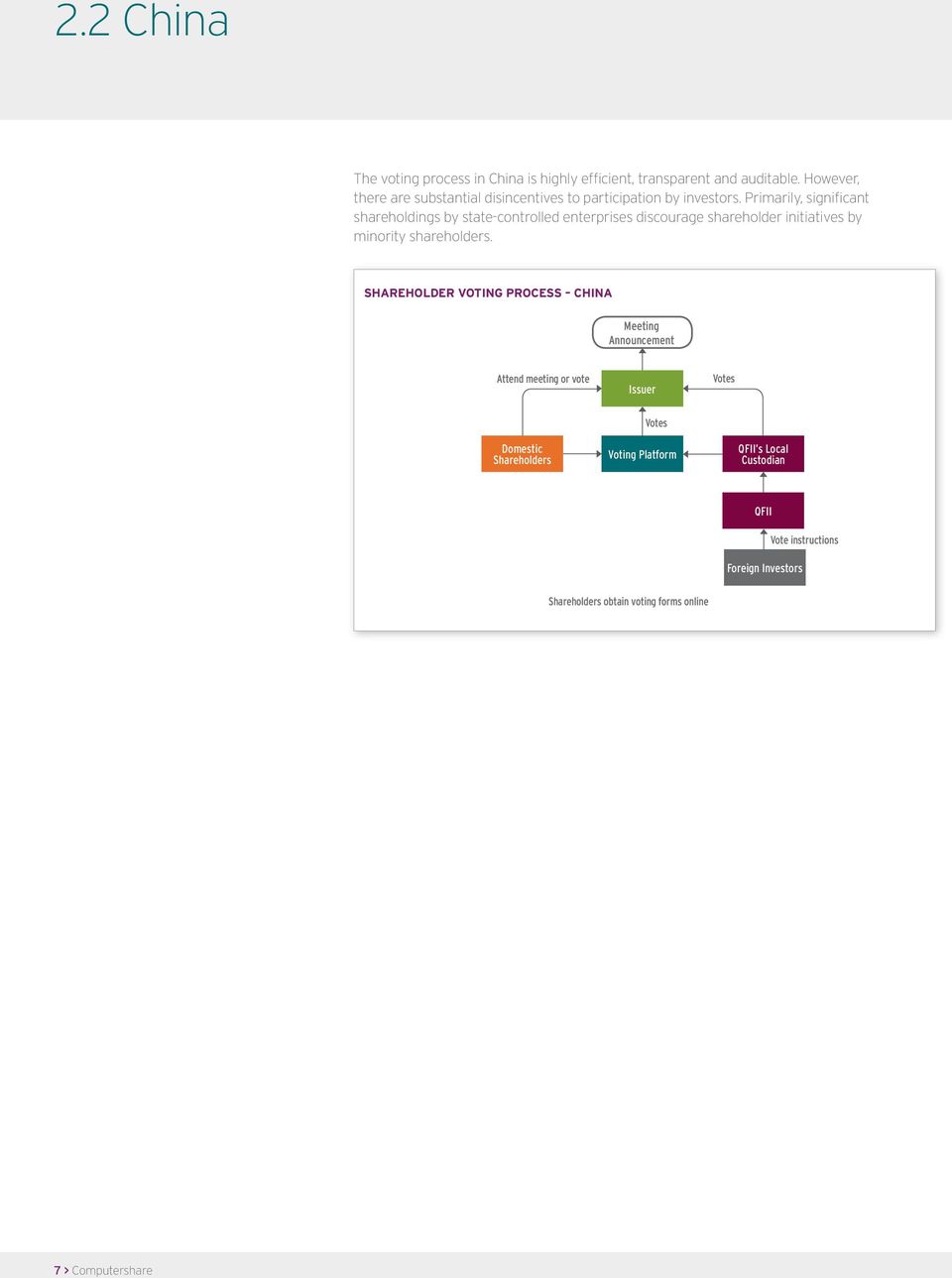
10 2.2 China Transparency By international standards the People s Republic of China is a highly transparent market of share ownership for issuers, as a result of its unique market structure where all domestic investors are directly registered. However, it is primarily a domestic market with government entities holding a controlling interest in many public companies. All shares of public companies are held entirely in the CSD, China Securities Depository & Clearing Co Ltd (SD&C), a state-controlled entity, which acts as central registrar. For domestic investors, accounts at SD&C are held in the name of individual investor and they hold the title to the shares directly, not through nominee arrangements with intermediaries, making the register very transparent. This is a distinct feature of the Chinese market. The issuer receives a shareholder list, including the top holders, from SD&C on a monthly basis, free of charge 6. A full shareholder list is provided at the record date of any corporate action or upon request, with a valid reason. The register is confidential and not open to public review. Qualified Foreign Institutional Investor (QFII) A program offered in countries with strict guidelines on foreign investment. This program requires an investor to obtain approval prior to investing. Both China and India have this program. B shares B shares listed on China s stock exchanges are traded in foreign currencies. In Shanghai, B shares are traded in USD whereas in Shenzhen B shares are traded in HKD. While the domestic investors hold shares directly on the register, foreign investors can only participate in the Chinese market through the Qualified Foreign Institutional Investor (QFII) programme or through trading in B Shares 7. The QFII may be an institutional investor but is often a foreign intermediary, and is the registered owner. The issuer has no mechanism to obtain the beneficial ownership beyond this level. Shareholder communications and exercise of voting rights Chinese issuers do not send communications directly to shareholders. Instead, information is disseminated via public media and newspapers. The shareholder is responsible for monitoring these outlets for information on their investee companies and printing any forms needed for voting. In the cases where a QFII intermediary is the registered holder, there is no obligation to pass any materials down the ownership chain. Shareholders can vote via paper or in person at the meeting for general resolutions. For special resolutions, electronic voting must be made available. The issuer is required to choose one online voting platform, which may be provided by either Shanghai Stock Exchange, Shenzhen Stock Exchange or SD&C. The on-site votes and the online votes will be reconciled by the online voting platform. If the investor voted the same shares both online and in person, the first vote in recorded time sequence counts. Additionally, they can vote directly or via proxy. Only shareholders directly visible on the share register, or their proxies, are able to vote. The voting process is shown in the diagram on the following page. In the case of the QFII, the QFII s local custodian (a domestic bank) will facilitate communication and cast the vote, at the QFII s request. If an investor would like to authorise a representative to take part in the meeting in person, an authenticated instruction must reach the local custodian before the voting deadline. After receiving the instruction, the local custodian will contact the listed company to obtain the detailed documentation requirement and inform clients. After receiving all required documents in time, the local custodian will fax them back to the listed company. The representative should take all the original documents with them when attending the meeting. 6 Issuers can request for a shareholders list from SD&C, being the CSD in China. 7 B shares listed on China s stock exchanges refers to those that are traded in foreign currencies In Shanghai, B shares are traded in USD whereas in Shenzhen B shares are traded in HKD. B shares were limited to foreign investment until 2001 when CSRC began permitting the exchange of B shares via the secondary market to domestic citizens. 6 > Computershare

11 2.2 China The voting process in China is highly efficient, transparent and auditable. However, there are substantial disincentives to participation by investors. Primarily, significant shareholdings by state-controlled enterprises discourage shareholder initiatives by minority shareholders. SHAREHOLDER VOTING PROCESS CHINA Meeting Announcement Attend meeting or vote Issuer Votes Votes Domestic Shareholders Voting Platform QFII s Local Custodian QFII Foreign Investors Vote instructions Shareholders obtain voting forms online 7 > Computershare
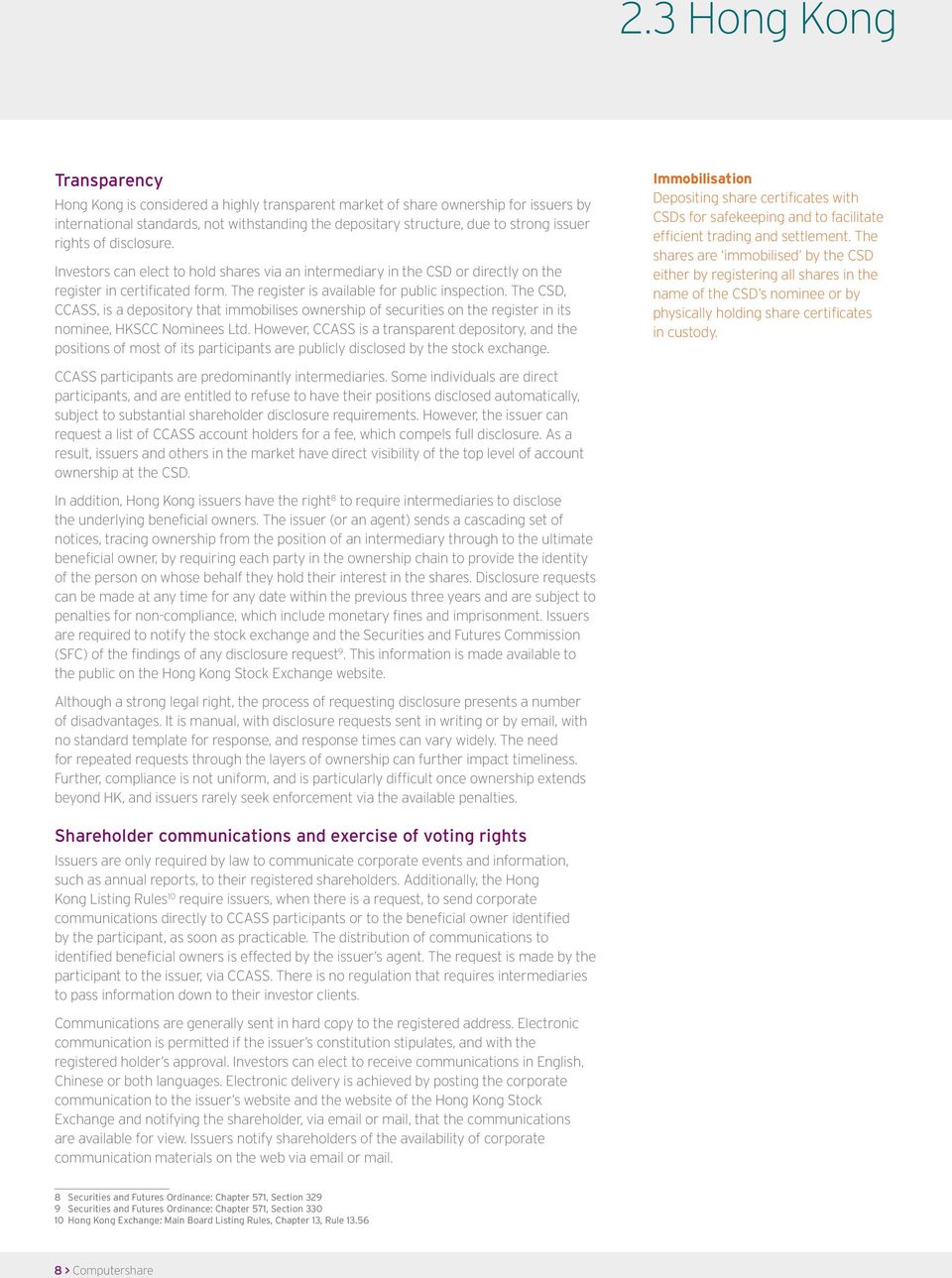
12 2.3 Hong Kong Transparency Hong Kong is considered a highly transparent market of share ownership for issuers by international standards, not withstanding the depositary structure, due to strong issuer rights of disclosure. Investors can elect to hold shares via an intermediary in the CSD or directly on the register in certificated form. The register is available for public inspection. The CSD, CCASS, is a depository that immobilises ownership of securities on the register in its nominee, HKSCC Nominees Ltd. However, CCASS is a transparent depository, and the positions of most of its participants are publicly disclosed by the stock exchange. Immobilisation Depositing share certificates with CSDs for safekeeping and to facilitate efficient trading and settlement. The shares are immobilised by the CSD either by registering all shares in the name of the CSD s nominee or by physically holding share certificates in custody. CCASS participants are predominantly intermediaries. Some individuals are direct participants, and are entitled to refuse to have their positions disclosed automatically, subject to substantial shareholder disclosure requirements. However, the issuer can request a list of CCASS account holders for a fee, which compels full disclosure. As a result, issuers and others in the market have direct visibility of the top level of account ownership at the CSD. In addition, Hong Kong issuers have the right 8 to require intermediaries to disclose the underlying beneficial owners. The issuer (or an agent) sends a cascading set of notices, tracing ownership from the position of an intermediary through to the ultimate beneficial owner, by requiring each party in the ownership chain to provide the identity of the person on whose behalf they hold their interest in the shares. Disclosure requests can be made at any time for any date within the previous three years and are subject to penalties for non-compliance, which include monetary fines and imprisonment. Issuers are required to notify the stock exchange and the Securities and Futures Commission (SFC) of the findings of any disclosure request 9. This information is made available to the public on the Hong Kong Stock Exchange website. Although a strong legal right, the process of requesting disclosure presents a number of disadvantages. It is manual, with disclosure requests sent in writing or by , with no standard template for response, and response times can vary widely. The need for repeated requests through the layers of ownership can further impact timeliness. Further, compliance is not uniform, and is particularly difficult once ownership extends beyond HK, and issuers rarely seek enforcement via the available penalties. Shareholder communications and exercise of voting rights Issuers are only required by law to communicate corporate events and information, such as annual reports, to their registered shareholders. Additionally, the Hong Kong Listing Rules 10 require issuers, when there is a request, to send corporate communications directly to CCASS participants or to the beneficial owner identified by the participant, as soon as practicable. The distribution of communications to identified beneficial owners is effected by the issuer s agent. The request is made by the participant to the issuer, via CCASS. There is no regulation that requires intermediaries to pass information down to their investor clients. Communications are generally sent in hard copy to the registered address. Electronic communication is permitted if the issuer s constitution stipulates, and with the registered holder s approval. Investors can elect to receive communications in English, Chinese or both languages. Electronic delivery is achieved by posting the corporate communication to the issuer s website and the website of the Hong Kong Stock Exchange and notifying the shareholder, via or mail, that the communications are available for view. Issuers notify shareholders of the availability of corporate communication materials on the web via or mail. 8 Securities and Futures Ordinance: Chapter 571, Section Securities and Futures Ordinance: Chapter 571, Section Hong Kong Exchange: Main Board Listing Rules, Chapter 13, Rule > Computershare
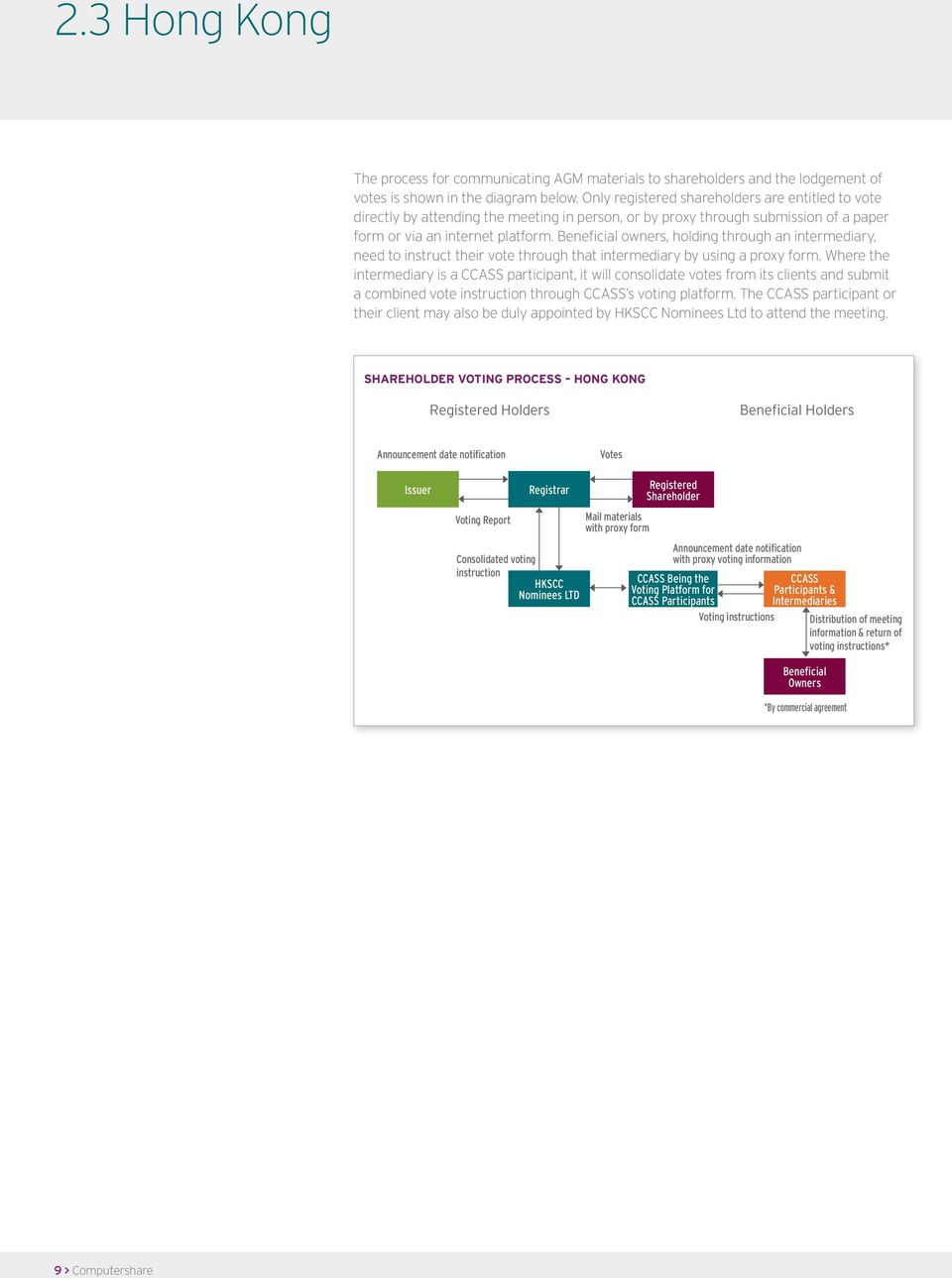
13 2.3 Hong Kong The process for communicating AGM materials to shareholders and the lodgement of votes is shown in the diagram below. Only registered shareholders are entitled to vote directly by attending the meeting in person, or by proxy through submission of a paper form or via an internet platform. Beneficial owners, holding through an intermediary, need to instruct their vote through that intermediary by using a proxy form. Where the intermediary is a CCASS participant, it will consolidate votes from its clients and submit a combined vote instruction through CCASS s voting platform. The CCASS participant or their client may also be duly appointed by HKSCC Nominees Ltd to attend the meeting. SHAREHOLDER VOTING PROCESS HONG KONG Registered Holders Beneficial Holders Announcement date notification Votes Issuer Voting Report Registrar Consolidated voting instruction HKSCC Nominees LTD Mail materials with proxy form Registered Shareholder Announcement date notification with proxy voting information CCASS Being the Voting Platform for CCASS Participants Voting instructions CCASS Participants & Intermediaries Distribution of meeting information & return of voting instructions* Beneficial Owners *By commercial agreement 9 > Computershare
14 2.4 India Transparency By international standards India is a particularly high transparency market of share ownership for issuers, despite the depositary CSD structure, as a result of the legal provisions that facilitate the two CSDs, National Securities Depository Limited (NSDL) and Central Depository Services (India) Limited (CDSL) and the prevalence of domestic investors. Although the CSDs immobilise legal title for the majority of securities, the law creates transparency of the underlying beneficial owners and imbues those investors directly with the legal rights in the shares. This establishes direct visibility and a direct legal relationship between the issuer and their beneficial owners. Depositary Participant Depositary Participants are public financial Institutions, banks including foreign banks, State Financial Corporation, an Institution engaged in providing financial services. Shares may be held directly in registered, certificated form by investors on the share register, or held in dematerialised form in one of the two CSDs. For dematerialised shares, the depository is the registered owner on the books of the issuer, however all rights still lie with the beneficial owner. Investors must open a beneficial ownership account, with a Depositary Participant 11, which interfaces with the depositary, and in turn, the issuer. Issuers obtain details of dematerialised beneficial owners from the depositories on a weekly basis. A complete list of beneficial holders is filed with the Registrar of Companies and stock exchanges after each AGM 12. These are public documents; any person can access the list by giving appropriate notice and a nominal payment. Foreign investment is restricted based on sector and must be executed through the QFII (Qualified Foreign Institutional Investor) program. The QFII accounts are usually managed by a foreign institution and generally provide less visibility of beneficial owners to the issuer. However, India is still predominantly a domestic market and therefore the difficulties experienced with established international markets are not a significant feature. Shareholder communications and exercise of voting rights Shareholder communications and the exercise of voting rights is a maturing aspect of the Indian market. While there are efforts underway to enhance the technological aspects of communication and voting processes to improve shareholder participation and efficiency, these are still at an early stage. The issuer is required to send shareholder communications, including meeting materials, to all registered shareholders (excluding the two CSDs); and to all beneficial owners that hold shares through Depositary Participants, who are disclosed by the CSDs to the issuer s registrar. Shareholder communications are sent in hard copy form to the investor s mailing address unless an address is provided. The current processes for voting require physical attendance, or attendance by proxy at the shareholder meeting. Until October 2012, voting could only take place by a show of hands or ballot, when called for. Certain special resolutions must take place by ballot. Typically, when voting is done by show of hands, each shareholder or their proxy has one vote, regardless of the number of voting shares represented. This method minimised shareholder engagement by retail holders, a staple of the Indian market, and foreign investors, who find it difficult to participate in shareholder meetings. The Chairman or a majority of shareholder(s) present at the meeting may demand a poll before or at the declaration of the results from a show of hands vote at the meeting 13. Certain special resolutions, as decreed by the Central Government, must be conducted via ballot, which may also include electronic voting. 11 Depositary Participants are Public Financial Institution, Banks including Foreign Banks, State Financial Corporation, an Institution engaged in providing financial services promoted by previously mentioned jointly and severally, Custodian of Securities, Clearing Corporation or Clearing House of a Stock Exchange, Stock Broker, Non Banking Financial Company and Registrar & Transfer Agents. (SEBI: Depositories Act, 1996, Chapter I, 2(1)(e)); (SEBI (Depositories & Participants) Regulations, The Companies Bill, The Companies Bill, 2012, Chapter VII Clause > Computershare
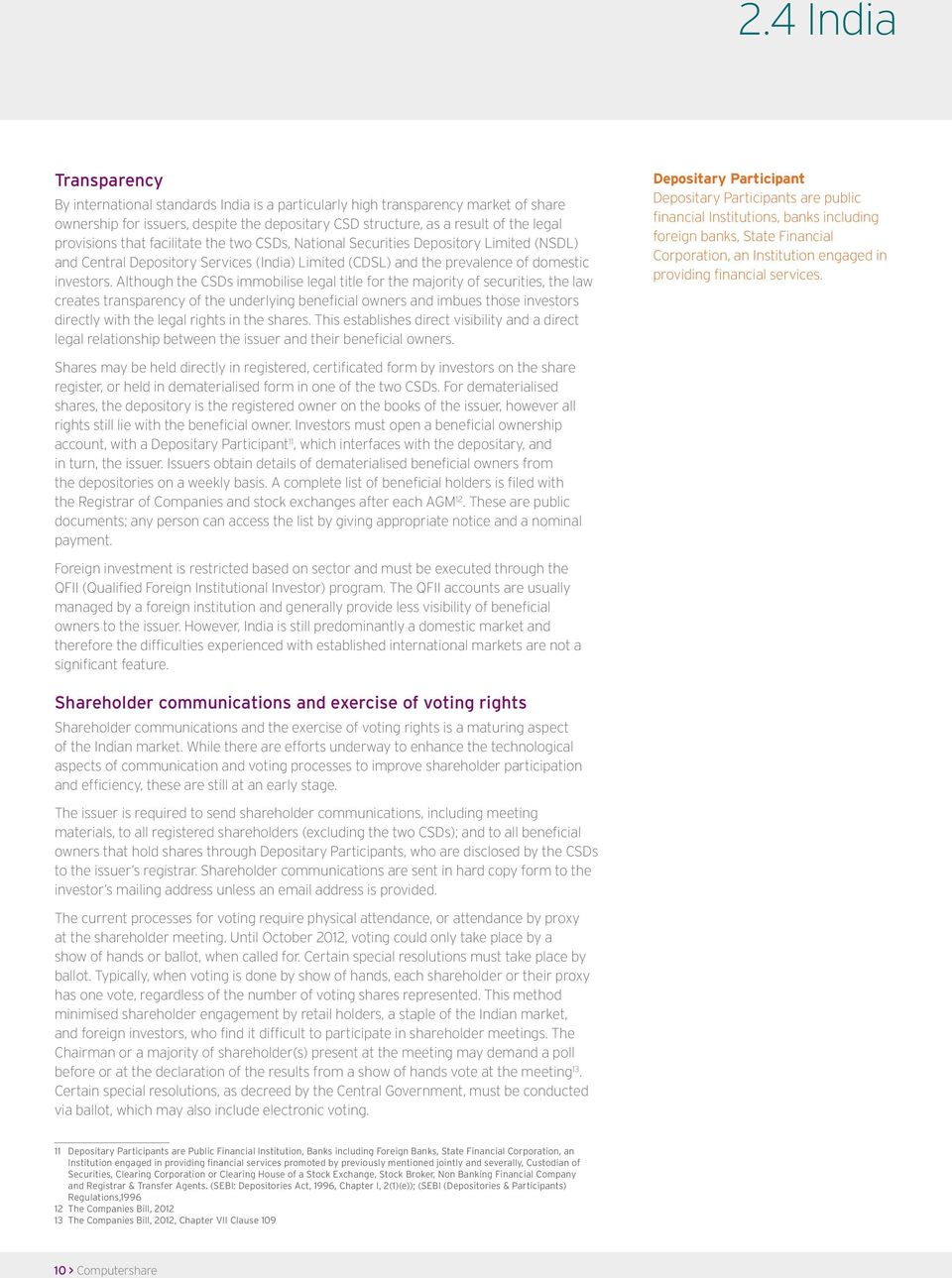
15 2.4 India Beginning with the financial year all listed companies were advised by the Ministry of Corporate Affairs to provide video conferencing to allow all shareholders to participate in the meeting 14. However, the state of technology infrastructure, including inadequate bandwidth, has delayed the use of video conferencing. Additionally, from October 2012, the top 500 listed companies by market cap were instructed to provide electronic voting for the resolutions that require a postal ballot 15. However the provision of electronic voting was not made mandatory, and while many companies are beginning the process of engaging shareholders electronically, this method of shareholder voting is not yet widely used. SHAREHOLDER VOTING PROCESS INDIA Voting report Issuer Depository Participants Beneficial Owners Receive meeting information & vote Tabulator/ Scrutinizer Registered Shareholders Receive meeting information & vote Receive meeting information & vote QFII Foreign Beneficial Owners Vote instruction 14 Ministry of Corporate Affairs: General Circular No. 27/2011, May & General Circular No. 35/2011, June SEBI Circular: CIR/CFD/DIL/6/2012, July > Computershare
16 2.5 Japan Transparency The Japanese market provides moderate to low transparency of share ownership by international standards although holdings are directly registered, due to the use of nominee accounts. However, issuers do not have a legal right to require disclosure of the identity of the underlying beneficial owners. While investors do have the option to directly register on the issuer s share register, which gives them direct legal title, this is relatively uncommon. Instead, most are institutional investors and hold their securities through a custodial account with an intermediary. The intermediaries hold client securities in either omnibus or segregated nominee accounts and these nominee accounts are recorded directly on the issuer s share register as the legal shareholder. The issuer usually only receives updated holding data for all nominee accounts from the CSD, JASDEC 16, twice a year. Issuers may request more frequent reporting from JASDEC through the year, however the fee involved generally deters more regular updating of the register. As a result, the issuer has direct visibility of the upper tier of account holders, being the intermediaries, but not on a timely basis. For segregated nominee accounts, the account details may also reveal the identity of the underlying beneficial owner, providing additional visibility, however this is not consistent. For foreign investors, securities are recorded through a foreign intermediary, who holds the legal title to the shares. A local standing agent is appointed for communications, and the share register discloses the local standing agent and the foreign intermediary. As with domestic nominee accounts, the foreign intermediary may have shares held in either omnibus or segregated accounts, which may indicate the beneficial owner, but not consistently. Due to tax and accounting requirements and other business practices, all Japanese general meetings are held within three months of the end of the issuer s financial year, which for most companies is March 31. Meetings for these companies usually fall within the last two weeks of June. This results in substantial voting difficulty for many institutional investors due to the need to review meeting information and decide voting policy for multiple issuers in a short timeframe. Further, by law, issuers are required to release proxy materials only 14 days prior to the meeting date; however intermediaries require a longer timeframe to allow communication with their client investors. As a result, issuers primarily rely on substantial shareholder notices and public filings of mutual and pension funds to obtain insight into their shareholder base. Where the account details provide an indication of the beneficial owner, issuers are able to use analytical services to provide further intelligence. However, the primary market structure offers little direct visibility of the predominantly institutional shareholder base. Shareholder communications and exercise of voting rights Issuers are required to send official communications to the registered shareholders or, in the case of foreign investors, their local standing agent. As a result, the communications are only directly sent to the top tier of ownership. The vast majority of investors hold through intermediaries, and there is no obligation on either the issuer or the intermediaries to pass communications onto the beneficial owners. However, contractual arrangements between investors and intermediaries often provide for communications to be passed down. Further, electronic communication is standard in Japan and this enables the efficient passage of communications from the issuer to the intermediary and through the intermediary to the investor. Local law only recognises Japanese as a required language for shareholder materials, however many issuers also release versions in English. 16 Japan Securities Depository Center (JASDEC) is not a registered holder. JASDEC began securities depository and bookentry transfer operations in 2002 but only began book-entry transfer for stocks after dematerialisation took effect in (JASDEC, 2013) 12 > Computershare

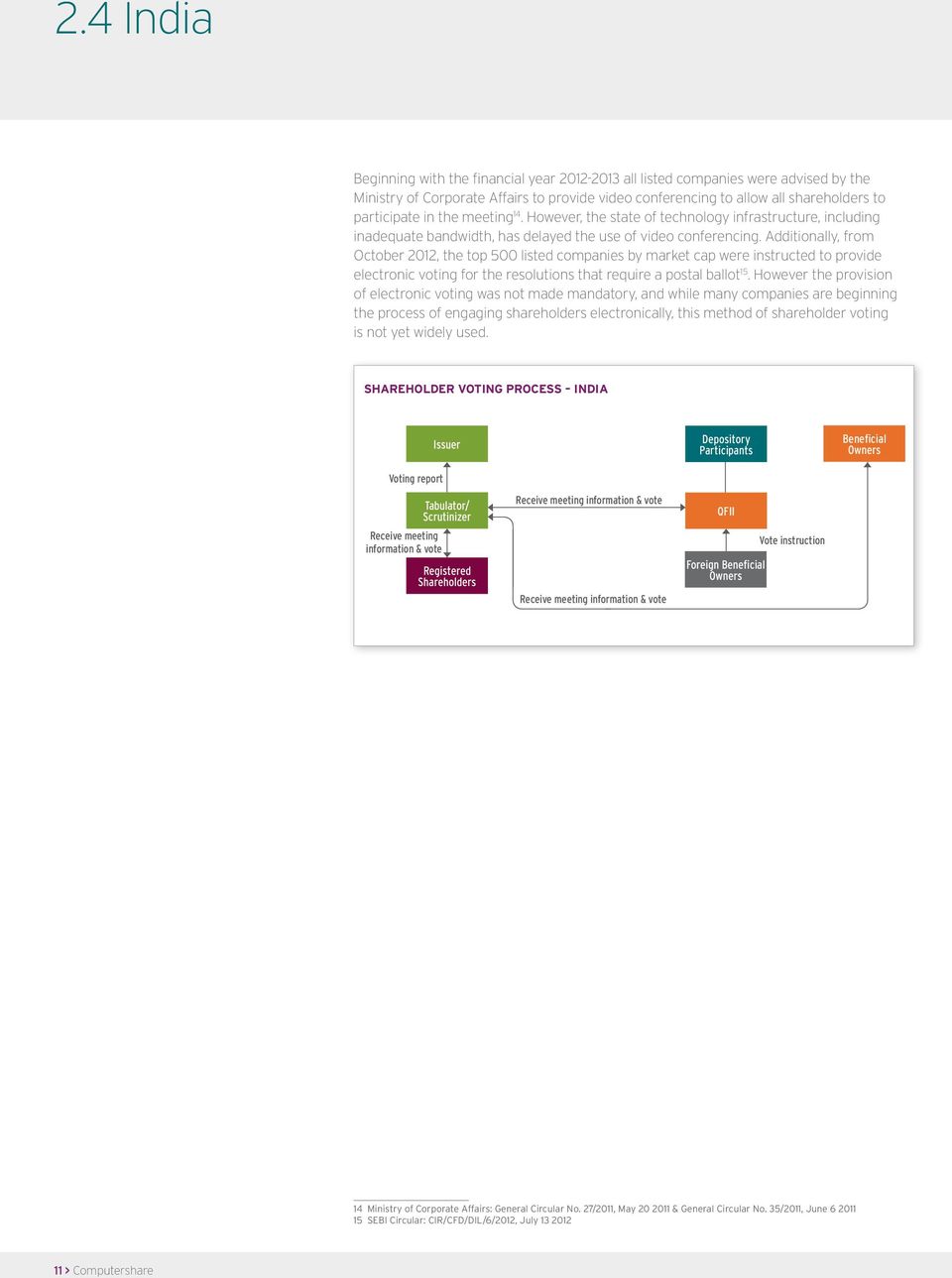
17 2.5 Japan Shareholders may vote in person or by proxy. The registrar receives and tabulates all the votes. The number of voting rights for each registered shareholder is based on the share unit system, which is equal to the minimum trading unit. This system allows a company, as prescribed in the articles of incorporation, to designate a certain number of shares required for one share unit. Typical denominations are 1, 100, 500 and 1,000 shares for each share unit and converging to 100 or 1,000. Voting rights may not be exercised for shares less than one unit share 17. Beneficial owners must vote through their intermediary. The particular structure of the proxy season in Japan, compounded by the substantial number of investors holding through nominees, resulted in substantial inefficiencies in the voting process and reduced participation. Most intermediaries require proxy materials to be returned to them 10 days prior to the meeting, leaving too tight a window for effective participation in voting across all Japanese meetings. Paper ballots were previously the default voting mechanism in Japan, which had to be lodged by the registered shareholder. As a result of the issues described above, there has been a movement over the past few years to an electronic voting platform operated by Investors Communication Japan (ICJ). This is an optional service for issuers, facilitating the communications and voting process between the issuer, intermediaries and institutional investors. By using the platform, investors are able to receive meeting notices on the day of release and send their voting instructions up to the day before the meeting. SHAREHOLDER VOTING PROCESS JAPAN Issuer Meeting information Meeting information Registrar Proxy votes Attend meeting or proxy vote Registered Holders Intermediaries Distribution of meeting information & return of proxy instructions Domestic Beneficial Owners Voting Platform Local Standing Agent Foreign Intermediaries Foreign Investors Distribution of meeting information & return of proxy instructions 17 Transparency of Japanese Law Project, International Corporate Law, > Computershare
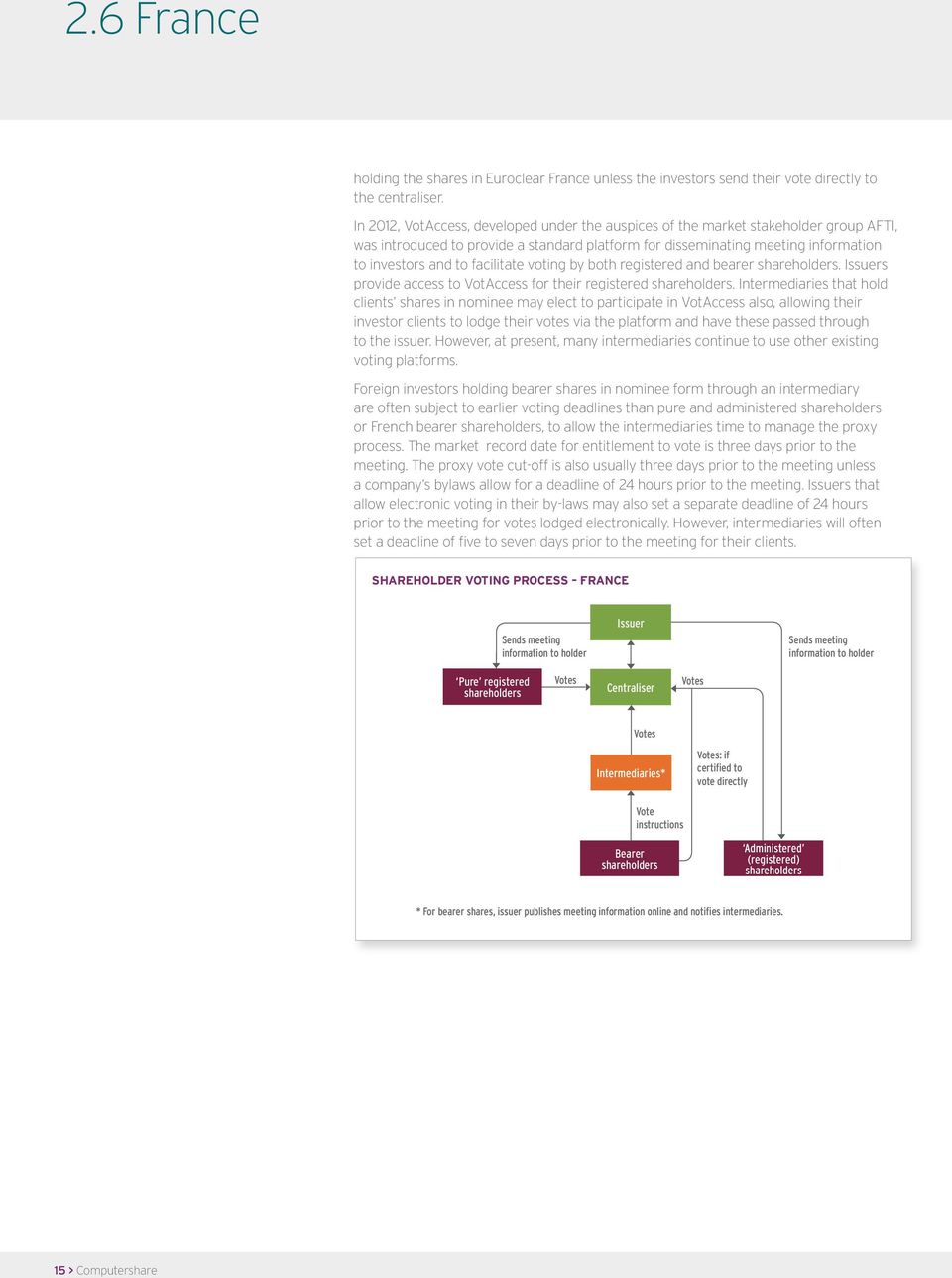
18 2.6 France Transparency By international standards France is a very transparent market in relation to ownership of registered shares, as a result of its directly registered account structure at the CSD (Euroclear France) combined with the issuer s right to visibility. Even for bearer shares, issuers obtain a higher degree of visibility than in other bearer share markets. However some aspects of the disclosure process affect the overall benefit to issuers by reducing the effective level of transparency, notwithstanding the strong legal requirements. In France, registered shares are held in one of two formats: pure registered shares ( nominatif pur ) held in the investor s name directly on the issuer s register and administered registered shares ( nominatif administré ) held in the investor s name at the CSD, administered by their intermediary but visible to the issuer and also appearing on the issuer s registered shares list. Bearer shares are held in Euroclear France in either the beneficial owner s name (for French-resident holders) or under the registered intermediary s name (for foreign investors) and may be reported to the issuer in the Titre au porteur identifiable ( TPI ), a register list produced by Euroclear France by request from the relevant issuer for a fee. Upon receiving the requested TPI list, the issuer may request that the nominees identified on the TPI list who hold the shares on behalf of clients disclose the identity of the beneficial owners 18. No fee is paid to the intermediaries for compliance with the disclosure request. If investors do not comply with disclosure requirements, possible penalties include suspension of voting and dividend rights or a monetary penalty levied by the French securities regulator, although such penalties are rarely utilised. Bearer shares Traditionally, a security where ownership is determined by possession or control of a share certificate rather than by having the shareholder s name entered onto a share register. As markets have moved to immobilisation of bearer shares into CSDs, ownership of bearer shares is now more commonly determined through a relationship with an intermediary. Intermediary A financial institution that trades or holds shares for a beneficial owner. These are typically banks, broker/ dealers and custodians. Centraliser The centraliser functions as the issuer s tabulator and also coordinates the votes within Euroclear France. However, this high degree of visibility is somewhat affected by a number of market concerns. The usefulness of the TPI list can be reduced in terms of direct visibility, as most securities are held in nominee accounts, and the report can be expensive to obtain from Euroclear France. The process of disclosure of beneficial owners is long, costly and complex; and, despite the legal requirement, some intermediaries do not respond to the disclosure request or only disclose their immediate client information, which may not be the beneficial owner. Moreover, the disclosure process is manual and paper-based, with no industry standardisation. Disclosure requests, and subsequent responses, are provided in hard copy which makes the process time consuming. Issuers are under no obligation to make the disclosure information public. Shareholder communications and exercise of voting rights The processes and requirements for communications and voting vary depending on whether the issuer has registered shares or bearer shares. For registered shares, issuers are required to send hard copies of communications directly to all registered shareholders (pure and administered account holders). For bearer shares, the issuer s only obligation is to inform registered intermediaries and to publish the information on their website at least 21 day prior to the meeting. There is no obligation for intermediaries to pass the communication to the beneficial owners or facilitate voting by beneficial owners. Only registered shareholders are eligible to vote directly with the issuer. Registered shareholders can send back their voting form to the centraliser or to the issuer. For bearer shares, investors can either vote through their intermediary, so that votes are lodged by the Euroclear France participant identified on the TPI list; vote directly with the issuer s centraliser if appropriately certified by their intermediary; or attend the meeting if appropriately certified by their intermediary. In the latter two situations, the intermediary provides the investor with a certificate verifying their ownership. For French resident investors, the certificate shows the name of the beneficial owner. For foreign investors, it discloses only the identity of the intermediary 18 Code de Commerce Article L > Computershare

19 2.6 France holding the shares in Euroclear France unless the investors send their vote directly to the centraliser. In 2012, VotAccess, developed under the auspices of the market stakeholder group AFTI, was introduced to provide a standard platform for disseminating meeting information to investors and to facilitate voting by both registered and bearer shareholders. Issuers provide access to VotAccess for their registered shareholders. Intermediaries that hold clients shares in nominee may elect to participate in VotAccess also, allowing their investor clients to lodge their votes via the platform and have these passed through to the issuer. However, at present, many intermediaries continue to use other existing voting platforms. Foreign investors holding bearer shares in nominee form through an intermediary are often subject to earlier voting deadlines than pure and administered shareholders or French bearer shareholders, to allow the intermediaries time to manage the proxy process. The market record date for entitlement to vote is three days prior to the meeting. The proxy vote cut-off is also usually three days prior to the meeting unless a company s bylaws allow for a deadline of 24 hours prior to the meeting. Issuers that allow electronic voting in their by-laws may also set a separate deadline of 24 hours prior to the meeting for votes lodged electronically. However, intermediaries will often set a deadline of five to seven days prior to the meeting for their clients. SHAREHOLDER VOTING PROCESS FRANCE Sends meeting information to holder Issuer Sends meeting information to holder Pure registered shareholders Votes Centraliser Votes Votes Intermediaries* Votes: if certified to vote directly Vote instructions Bearer shareholders Administered (registered) shareholders * For bearer shares, issuer publishes meeting information online and notifies intermediaries. 15 > Computershare
20 2.7 Germany Transparency For registered shares, Germany is, by international standards, highly transparent with regard to share ownership for issuers due to the direct registration of ownership at the CSD, Clearstream Frankfurt. In the Deutscher Aktien IndeX ( DAX ) 30, approximately half of all shares are issued in registered form, however, across the broader market bearer shares are much more prevalent. Issuers of bearer shares have no direct visibility of their investors outside of substantial shareholder disclosure requirements. Therefore, the discussion on transparency in the German market focuses on the arrangements for registered shares. The vast majority of investors are recorded within the Clearstream Frankfurt system that is dedicated to managing registered shares. Clearstream reports these shareholders to the issuer s registrar daily, to be compiled with any shareholders that remain in certificated holdings on the issuer s share register. The investor, in whose name the Clearstream account is registered, holds the legal title and all proprietary rights in the shares. Investors may have their shares registered directly in their own name or may hold through a nominee in either an omnibus or segregated account. Foreign investors typically hold their shares in an omnibus nominee account with a German custodian bank. Omnibus account An account owned by an intermediary that commingles the shares of multiple shareholders. These accounts are also called pooled accounts. Segregated account An account operated by an intermediary which holds only the shares of a single shareholder. These accounts are also called designated accounts. As a result of this structure, German issuers enjoy a relatively high degree of visibility of their share register, particularly in relation to local investors. Previously, issuers had less transparency, with substantial delays in the registration of shareholders after purchasing their securities resulting in large positions being held by intermediaries in unregistered accounts. Changes to German law in 2008 addressed this by requiring registration of investors. While the issuer has full visibility of their share register, the information is not publicly available. Registered shareholders can require disclosure of information in relation to their own shareholding only. However, for both registered and bearer shares, shareholders can require the issuer to provide a list of all shareholders that were entitled to vote at the prior two Annual General Meetings (AGMs). Additionally, issuers have a legal right to require nominee shareholders to disclose the identity of all underlying investors. Disclosure is mandatory and non-compliance is subject to loss of voting rights. While a high degree of compliance is experienced with domestic investors, some difficulties are experienced in obtaining disclosure once the chain of ownership extends beyond Germany. As with many other markets with a similar right, there is no standardised format or process for obtaining such disclosures, which reduces the efficiency of the process for issuers. However, some service providers that undertake the disclosure process for issuers have developed automated products to improve this process 19. Shareholder communications and exercise of voting rights For registered shares, the issuer is required to send shareholder communications to all registered shareholders, but is not required to send any direct communications to beneficial owners. Communications can be either paper-based or electronic if the shareholder elects, or wholly electronic if specified by the issuer s Articles of Incorporation. General meetings must also be announced via the Federal Gazette Bundesanzeiger. Additionally, some issuers continue to disclose via the Wertpapier Mitteilungen, which is media used by banks, however this is no longer mandatory. Through this dissemination, beneficial owners have the opportunity to see the details of the AGM. Intermediaries holding shares in a nominee account on behalf of clients do not have any direct obligation to pass shareholder communications onto the clients. 19 See for example. 16 > Computershare

21 2.7 Germany In general, only the registered shareholder is able to lodge vote instructions with the issuer; beneficial owners must pass their instructions through their intermediary. Votes can be lodged by paper, fax or via the internet, or by attendance at the meeting. However Germany also provides a mechanism for beneficial owners to vote directly with the issuer by obtaining a Briefwahl notice from their intermediary. The issuer is reliant on the notification from the intermediary and cannot independently verify the investor s entitlement to vote. Although the practice of share blocking (i.e. blocking shares from trading for a period prior to the shareholder meeting) was expected to be discontinued in all European Union member states following the Shareholder Rights Directive, a recent development in Germany has resulted in some custodians reverting to share blocking for foreign investors. A 2012 court judgment, the Cologne OLG Court Ruling, on disclosure requirements has been interpreted by some custodians to require that all investors be re-registered out of the omnibus nominee account 20 in order to vote. Due to the time and complexity of the re-registration process, this has also led to investors being blocked from trading in the meantime. This may have contributed to significantly reduced shareholder participation in German AGMs in For bearer shares, communications to investors only flow via the intermediaries. The issuer s agent verifies with each intermediary how many investors they represent. Proxy materials for the relevant number are then provided to the intermediary to disseminate to its clients, in paper or electronic form at the investor s election. As for registered shares, the issuer is required to publish AGM details in the Bundesanzeiger, and may also elect to publish in the Wertpapier Mitteilungen. Holders of bearer shares can vote either by proxy through their intermediary or at the meeting, by having their intermediary identify them to the issuer by no later than 21 days prior to the meeting. The issuer is reliant on the notification from the intermediaries and cannot independently verify the investor s entitlement to vote. SHAREHOLDER VOTING PROCESS GERMANY Meeting information distributed Registered shareholders Attend meeting or vote Communication of meeting information and vote instructions returned Issuer Issuer s agent (Anmeldestelle) Intermediaries ( Depot Banks ) Beneficial Owners: registered shares & bearer shares Communication of meeting information If certified by intermediary to vote directly Beneficial Owners: registered shares & bearer shares 20 Cobley, Mark. Share Dealing Threat to German Voting. Financial News, 20 Feb Web. 03 Dec Proxy Season Reviews Rep. Georgeson Inc, Web 17 > Computershare
22 2.8 Italy Transparency In Italy, issuers obtain full transparency of their investors, however this happens only at the time of any corporate action, such as a dividend payment. In addition, any investor that wants to vote at a shareholder meeting must be disclosed to the issuer. However, issuers are infrequently updated on changes in their shareholders positions between these events. Italy in effect operates a dual registration system for shareholders. The securities of all public issuers are issued into the CSD, Monte Titoli, which maintains records of the securities positions of its participants. All shareholders are recorded through accounts with their intermediaries. Additionally, the issuer is required to create a record of its shareholders (Libro Soci) at the time of any corporate action, based on the disclosures received from each intermediary. Full disclosure is mandatory for all corporate actions. However the Libro Soci is only updated for changes in shareholder positions between corporate actions in limited circumstances. These include the shareholder meeting, where those shareholders that want to vote must first be disclosed to the issuer, or where the shareholder requests that their intermediary arrange with the issuer for the holder to be entered onto the Libro Soci. In practice however, very few shareholders request registration. As a result of this dual structure, the accounts maintained by intermediaries are the current, dynamic record of share ownership; whereas the Libro Soci held by the issuer is updated only periodically based on the timing of corporate events. For dividend-paying issuers, the Libro Soci is therefore updated at least once or even twice per year. Many non-dividend paying issuers will have some other form of corporate action through the year, but if they do not have a corporate action then the Libro Soci (and thus their visibility of shareholders) is only updated at the time of shareholder meetings, and only for those shareholders that elect to vote. Libro Soci The record of shareholders created by an Italian issuer, or their appointed agent, at the time of any corporate action, based on information on the shareholders received from each intermediary. Kedrios Corporate Actions (KCA) An outsourced provider for some major banks. Record date A date, set by issuers, which determines the entitlement of investors to participate in shareholder rights such as voting, receipt of dividends or other corporate events. In most markets, the law mandates how far the record date can be set in advance of the corporate event. Italian law 22 also provides a mechanism for issuers to request intermediaries to disclose their shareholders at any time. To exercise this right, the issuer must have adopted enabling by-laws. Only those shareholders that have not expressly prohibited disclosure by their intermediary are identified to the issuer. Further, very few issuers have adopted the requisite enabling by-laws. The cost of disclosure is borne by the issuer, at a rate agreed between issuers and intermediaries, and is a significant expense particularly for issuers with larger shareholder bases. Therefore, while the legal right exists it provides little practical benefit to issuers at present. The disclosure process, (for corporate actions, voting or at the issuer s request) is standardised through use of platforms, which are managed by either Monte Titoli or KCA. These platforms coordinate the provision of information between issuers and Monte Titoli participants. The disclosure process is subject to the payment of fees to the intermediaries by the issuer. Shareholder communications and exercise of voting rights In Italy, issuers do not send communications directly to any investors, unless an investor requests receipt. Instead, issuers publish all shareholder communications on their website and in newspapers. They also provide the information to Monte Titoli, who disseminates it electronically through their platform to all participants. For shareholder meetings, proxy documentation 23 is published on the issuer s website. As a matter of market practice, rather than regulation, some custodian participants pass these materials onto their institutional investor clients electronically. Retail investors are informed only via the issuer s website and the newspaper > Computershare
23 2.8 Italy Investors that want to vote must be disclosed to the issuer by their intermediary. The intermediary must identify the investor to the issuer via their communications platform (Monte Titoli or KCA) at the record date, seven business days prior to the meeting. The investor can elect to attend the meeting directly or can vote by proxy once the process for disclosure has occurred. International proxy voting by institutional investors is most commonly undertaken by using a proxy holder to represent the shareholders physically at the meeting. No specific formalities are required to provide proxies except the signature of the shareholder or a power of attorney for legal entities. The provision of proxy authority and voting instructions can also be done through an online system, which shareholders can use to lodge their votes electronically so they do not have to attend the meeting, however this is currently not widely used. Foreign investors can communicate their instruction electronically to their global custodian, who via their local custodian, lodges the vote instruction during the meeting through a proxy holder. Moreover, investors can lodge their vote through the appointed representative (Rappresentante Designato), which is an entity appointed by the issuer to collect voting instructions. SHAREHOLDER VOTING PROCESS ITALY Proxy cards Issuer Attend meeting or vote AGM Despatch meeting announcement Monte Titoli Proxy Holder Registration disclosure Communicate intention to participate Monte Titoli Participant/ Intermediary Voting instructions Global Intermediary Voting instructions and proxy Send voting instructions Italian Shareholders Foreign Beneficial Owners 19 > Computershare
24 2.9 United Kingdom Transparency By international standards the United Kingdom (UK) is generally seen as a highly transparent market of share ownership for issuers, due to a combination of the structure of direct legal title and legal obligations related to disclosure of beneficial ownership. In the UK CSD, CREST (operated by Euroclear UK & Ireland), accounts are legally registered holdings and visible directly on the issuer s share register 24. The total share register, comprising both CREST and certificated shareholdings, is available for public inspection 25. Holdings in CREST may be registered in the name of the beneficial owner directly, or in the name of a nominee that holds securities on behalf of one or more clients. Information rights UK law provides a mechanism for intermediaries to instruct the issuer to send communications directly to nominated beneficial owners. However, those beneficial owners are not able to vote directly. Public companies incorporated in the UK have the legal right to request disclosure of the identity of any person with an interest in their shares 26. This right allows the issuer to identify their beneficial owners underlying the nominees registered in CREST. In effect, the issuer (or an agent) sends a cascading set of notices, tracing ownership from the registered position of an intermediary through to the ultimate beneficial owner. Each party in the ownership chain is required to provide the identity of the person on whose behalf they hold their interest in the shares. Disclosure requests can be made at any time, and are subject to penalties for non-compliance ranging from suspension of certain shareholder rights (subject to court order) 27 to fines and imprisonment 28. Responses must be maintained on a Register of Interests that is available for public inspection. The process used to make disclosure requests presents a number of challenges. It is manual, with requests being sent in writing or by , with no standard template for response, and response times can vary widely 29. The need for repeated requests through the layers of ownership can further impact timeliness. Further, it can be difficult to obtain compliance once ownership extends beyond the UK, particularly for markets such as Switzerland and Luxembourg. Issuers rarely seek enforcement via the available penalties 30. In times of heightened scrutiny of ownership by a company, such as during a hostile takeover bid, these factors can mitigate against the benefit issuers derive from this right. Nonetheless, as a legal tool for issuers to identify and engage with their beneficial owners, it is very well-regarded. Shareholder communications and exercise of voting rights Issuers are required by law to communicate corporate events and information to their registered shareholders. In addition, for securities traded on regulated markets, a nominee that is the registered shareholder can require the issuer to send shareholder communications directly to nominated beneficial owners, at their postal or address as specified to the issuer 31. A standard process for nomination of beneficial owners to the issuer exists, called Information Rights, but is not widely used, and at present participation levels are low. These nominated beneficial owners are not eligible to vote directly The UK is predominantly a registered share market, although a very small proportion of shares remain in bearer form. 25 Companies Act 2006, ss Companies Act 2006, s Companies Act 2006, s Companies Act 2006, s The only criteria being such reasonable time as may be specified in the notice - Companies Act 2006, s.793(7) 30 In one case where the right to suspend voting rights was sought be exercised, the High Court ultimately ruled that the issuer had not exercised their power for a proper purpose and lifted the restriction on voting (Eclairs Group Limited and Glengary Overseas Limited v JKX Oil & Gas plc [2013] EWHC 2631 (Ch)) 31 Companies Act 2006, ss There is a provision in the Companies Act that would allow voting by Information Rights holders; however, it requires enabling Articles to be passed by issuers. To our knowledge, no issuer has yet passed the relevant enabling Articles. 20 > Computershare
25 2.9 United Kingdom Communications to registered holders are generally sent in hard copy or, where the investor has opted in, by . However, the issuer has the right 33 to consult its registered shareholders on their preferred communications method and, where no response is received, to deem the holder to consent to accessing communications via a website. In that event, a hard-copy notice identifying the website address where the materials are located must still be sent to the holder s registered address at the same time materials are sent to other shareholders. Participants of CREST that act as nominee for others will receive communications from the issuer as the registered shareholder. The issuer is not obliged to send the materials on to the beneficial owners. Moreover, UK law does not oblige the nominees to pass on these communications to their clients the service and fee arrangements between the intermediaries and their clients determine whether shareholder communication materials are passed on and voting is facilitated. Practices in this area vary. Issuers are not required to send communications directly to beneficial owners other than where the owner has been disclosed through the Information Rights arrangements. The process for communicating AGM materials to shareholders and the lodgement of votes is shown in the diagram below. Only registered shareholders are permitted to vote. Beneficial owners can only attend a shareholder meeting or vote directly with the issuer if appropriately appointed by the nominee that holds securities on their behalf as registered holder. Most beneficial owners that direct the voting of their shares must instruct their vote preferences to their intermediary. As with other markets, there are a variety of mechanisms for beneficial owners to provide their instructions, including proprietary services of the intermediary and voting platform providers that channel instructions for multiple investors, intermediaries and securities. Where multiple layers are involved in the ownership of the securities, this intermediated process can result in a reduced time period for beneficial owners to consider the items to be voted on, and communicate their vote instruction, compared to the time allowed to registered holders. Not all intermediaries support voting by beneficial owners, particularly at the retail investor level. Voting for registered holders typically occurs by paper or electronic submission. Certificated holders will ordinarily vote in paper form or via the issuer (or their agent s) website, and CREST holders will ordinarily use the CREST system where this is enabled (which facilitates instructions from both participants and vote service providers). Telephone voting has rarely been used in the UK. SHAREHOLDER VOTING PROCESS UNITED KINGDOM Mailing proxy documentation and submit votes* CREST Intermediaries Beneficial Shareholders AGM announcement Issuer AGM Voting report Registrar Registered Shareholders Mailing proxy documentation and receive votes up to 48 hours before AGM Voting Platform or other Vote instructions *By commercial agreement 33 Companies Act 2006: Schedule 5, Part 4 \ 21 > Computershare
26 2.10 Spain Transparency Although the Spanish market is largely a bearer share market, by international standards it provides a moderate level of transparency of share ownership for issuers due to the disclosure of Spanish intermediaries client account holdings. Visibility of local shareholders is quite good overall; however particular problems are experienced with identifying foreign investors. Also, while issuers have a legal right to disclosure even for bearer shares, market processes for disclosure of bearer shares tend to reduce the benefit obtained by issuers. In 2014, the Spanish market is implementing new arrangements for the disclosure of bearer share holders through Iberclear. It is not yet clear how many issuers will adopt the new disclosure arrangements, and we will continue to monitor the impact on overall transparency of the market. All shares in public Spanish companies are held in Iberclear 34, the Spanish CSD. Spanish law adopted in 2011 entitles issuers to request disclosure of all their investors 35. Further, all intermediaries representing investors at shareholder meetings must disclose their clients voting instructions, and number of shares voted, to the issuer 36. While only issuers considered strategic companies by regulators (such as airlines, banks and financial institutions) are entitled to issue shares in registered form, these rules apply to issuers of registered and bearer shares alike. Additionally for registered shares, all transactions must be communicated to the issuer 37. Until very recently, the process for obtaining visibility of investors for registered shares was more efficient and timely than for bearer shares. However, since January 2014 the same level of information is available for both registered and bearer shares, at the option of the issuer. Issuers (or their appointed share registrar) receive a daily file from Iberclear showing the details of their shareholders and the relevant market transactions. This file is provided to Iberclear by its participants in automated form and includes the details of all their client account holders in the relevant issuer s securities. For domestic investors, this provides the issuer with a high degree of transparency. By law, the details held by the issuer on their shareholders are available to all shareholders (not publicly), however due to claims of data protection concerns, issuers generally do not facilitate shareholder access. For foreign investors, there is significantly less visibility for the issuer, as the file provided to Iberclear (and the issuer) shows only the account held by an Iberclear participant on behalf of their immediate client. This is generally another intermediary, rather than the beneficial owner. The vast majority of foreign investors hold Spanish securities through an omnibus account operated by a Spanish intermediary. Therefore, the issuer only has visibility of the intermediary, not the underlying beneficial owner. According to Bolsas y Mercado, the Spanish stock exchange, approximately 40% of shares in Spanish-listed companies were held by foreign investors at the end of For bearer shares, the disclosure arrangement stipulated by Iberclear prior to January 2014 only provides shareholder lists to issuers on request and at a fee. The process is automated, with Iberclear requiring all its participants to disclose their underlying account holders and then compiling the shareholder list for the issuer. However, while issuers are entitled to request the file at any time, in practice the high costs of the file results in issuers limiting use to corporate events. Concerns have also been expressed within the market over the quality of the data returned in this file 39. As a result of industry discussions and concerns, Iberclear implemented processes for bearer share issuers to obtain equivalent disclosure as registered share issuers, as discussed above. However, it remains to be seen which issuers will adopt the new disclosure arrangements or continue with the existing arrangements for bearer shares. 34 Some smaller listed companies use a delegated registered system, where a nominated market participant administers the official register for the issuer, rather than Iberclear. 35 Article 497 of the Corporation Act 36 Article 524 of the Corporation Act 37 Article 22 of Royal Decree 116/1992, of 14 of February 38 Bolsas y Mercado Españoles, The quality of registration details is a particular concern as the lack of standardization impacts the ability to identify investors adequately. 22 > Computershare
27 2.10 Spain Shareholder communications and exercise of voting rights The law requires shareholder communications, such as those pertaining to meetings, to be issued in a manner that provides quick and non-discriminatory access to investors. Shareholder meeting announcements are communicated by publishing the relevant information on the issuer s website. Company by-laws also may establish additional mechanisms for communications, including but not limited to publishing the relevant information in the Official Bulletin, and on the website of CNMV, the securities regulator. Issuers do not typically send materials directly to all investors on their shareholder list, although more commonly issuers of registered shares do elect to send materials directly. Investors also have the right to request a hard copy from the issuer. The issuer is also required to communicate information to Iberclear electronically, who in turn pass this on to its participants. There is no formal obligation on intermediaries to pass shareholder information on to their underlying investors; this is left to contractual arrangements and occurs on a best efforts basis. Most intermediaries do pass along the information. Investors disclosed in the shareholder list compiled by Iberclear are considered, under Spanish law, to be the shareholders entitled to vote on a shareholder meeting. These investors are those holding accounts with Iberclear participants, as shown in the diagram below. Shareholders may lodge their vote directly with the issuer or pass their vote instruction via their intermediary. Investors who hold below this level, including foreign investors, can only vote by passing instructions through their intermediary to be lodged by the account holder disclosed on the shareholder list. Voting may occur by return of a postal ballot; through the internet platform provided by the issuer or their agent; or at the meeting by the investor or their proxy. Spanish law also allows for meetings to be broadcast, and with bi-directional communications, allowing for participation without physical attendance or appointing a proxy. While this would facilitate more participation by foreign investors, these arrangements are rarely offered by issuers at present. SHAREHOLDER VOTING PROCESS SPAIN Meeting Announcement Iberclear Attends meeting or vote Issuer Investors Registered share: distributes meeting information Iberclear Participants Sends vote instructions Investor Foreign Intermediaries Sends vote instructions Investor Investor 23 > Computershare
28 2.11 Sweden Transparency Sweden, similar to the other Nordic markets, is by international standards a highly transparent market of share ownership for issuers, particularly in relation to domestic investors. This is largely a result of the direct holding structure of the CSD, Euroclear Sweden, however foreign investors can be less visible. Direct holding account An account which records legal title to securities for the account-holder. All shares in Swedish public companies are held at the CSD. Accounts at the CSD may be recorded directly in the investor s name, giving them direct legal title, or may be held in a nominee account with an intermediary. The CSD also has the right to require all intermediaries holding shares in a nominee to disclose the details of their immediate clients 40. Those clients are either local retail investors or a further layer of sub-custodial ownership; however the disclosure obligation does not extend below this layer of ownership to the beneficial owner (when different from the intermediary s client). The disclosure is performed on a monthly basis but can also be undertaken on demand by the CSD on the request of the issuer. The issuer s share register includes the accounts at Euroclear Sweden, in addition to the disclosed investor accounts underlying the nominees. The inability to compel disclosure below the level of accounts held with participants in Euroclear Sweden limits the full visibility of ownership. However, the requirement to be registered in order to vote can enhance the issuer s level of overall visibility, particularly for foreign investors. Euroclear Sweden provides the issuer with a copy of their register and details of the disclosed investors four working days after the disclosure date. As a result, issuers commonly only see their updated share register on a monthly basis; however they retain the right to request full disclosure, including investors holding through a nominee at any time. Once requested, the share register, including registered and nominee shareholders, is made available to the issuer four working days after the disclosure date. Both the CSD and the issuer must make the share register available to anyone on request 41. The register must not be more than three months old, and must contain all shareholders with more than 500 shares. At the CSD s office, an electronic copy of the share register is not available, but a printed copy is given subject to payment of an administration fee. Shareholder communications and exercise of voting rights Shareholder communications are not sent directly to registered shareholders. Instead the issuer is required to post shareholder notices, including for shareholder meetings, on a specified internet site Post och Inrikes, 42 and also on the issuer s website. Most public companies also include provision in their constitution for the notice of meeting to be posted in a daily newspaper. Stock exchange rules require issuers to issue a press release as soon as the shareholder notices are made available to the newspaper 43. If the notice will not influence the issuer s stock price, then a press release can be made the day before the advert, at the latest. The notice must be published four to six weeks before an Annual General Meeting and three to six weeks prior to an Extraordinary General Meeting 44. Only shareholders recorded on the register five working days (including Saturdays) prior to the meeting are eligible to vote. Beneficial owners cannot vote via their intermediaries. They must be registered directly to be able to vote. Therefore investors seeking to vote are required to undertake a process of re-registration prior to record date. In practice, this has the effect of preventing the investor from trading while re- 40 Swedish Financial Instruments Accounts Act (SFS 1998:1479, 3rd chapter 12) 41 Swedish Financial Instruments Accounts Act (SFS 1998:1479, 3rd chapter 13) 42 Post och Inrikes Tidningar, Nasdaq OMX, Rule Book for Issuers, Chapter 3, Section The Swedish Companies Act (SFS 2005:551, 18-20) 24 > Computershare
29 2.11 Sweden registered via its intermediaries. Therefore share-blocking effectively occurs through administrative procedures, although it cannot legally be required. Even investors holding American Depositary Receipts (ADRs) or Global Depositary Receipts (GDRs) over the Swedish shares must be re-registered as a direct holder to vote. While the issuer has the discretion to implement proxy voting 45, this does not occur in Sweden. Further, voting can only occur through attendance at the meeting. For shareholders unable to physically attend, they can assign a representative at the meeting to enable them to participate. Local banks provide a representation service for foreign institutions. The process is explained in the diagram below. Although the process is relatively difficult, as there is no concept of proxy voting as practiced in other major markets, foreign investors continue to participate in Swedish AGMs. SHAREHOLDER VOTING PROCESS SWEDEN AGM Notification AGM notification through public notices Issuer Euroclear Sweden CSD Participants Intermediaries Beneficial Owners Send share register Send registration instruction Send vote to 3rd party advisor AGM Need to attend in person or via 3rd part representative Pre-register for the meeting AGM Services Provider Registered Holders Send personal attendance card Pre-register for the meeting Send personal attendance card 45 The Swedish Companies Act (SFS 2005:551, 4-4a) 25 > Computershare
30 2.12 Russia Transparency By international standards Russia is a moderately transparent market of share ownership for issuers due to the depositary structure, despite legal rights to disclosure in certain circumstances. It has been undergoing substantial market structure changes in the past couple of years which culminated in the introduction of a CSD, the National Settlement Depository (NSD), in Prior to the introduction of the NSD, the register comprised the accounts of shareholders that were held directly in their own name, and intermediaries holding shares on behalf of others in omnibus accounts. However, Russian law did not recognise the concept of foreign nominees and thus the foreign intermediary was considered the absolute owner of the securities, with beneficial owners only holding a contractual right against their intermediary. The recent revisions to Russian law and market structure supporting the introduction of the NSD, has resulted in the law now recognizing foreign nominee accounts. The Russian market is going through a period of substantial change, with the introduction of a CSD in 2013 and the ongoing implementation of new legislation on registration requirements. Shareholder communications and voting arrangements are also evolving. We will monitor the implementation of these new market processes, as their impact on issuers, investors, and intermediaries becomes more apparent. With the introduction of the NSD, the only nominee account permitted on the register of an issuer that is subject 46 to the new CSD law, is the position of NSD, immobilising the entitlements of all investors that hold shares via intermediaries. Other entities are not permitted to open accounts on registers of these issuers in nominee form. Investors may hold directly on the register or through an account with an NSD participant, where ownership is therefore traced to the NSD nominee account on the register. The transition to this new registration structure in Russia is ongoing. Custody accounts for ADRs or GDRs issued over Russian securities, which were previously registered in nominee directly on the register, were transferred into NSD in November Other nominee positions on the register that were opened prior to the introduction of the CSD, are permitted to remain on the register, however their balances cannot be increased by the transfer of additional securities into such accounts. These legislative changes do not apply to the securities of issuers who are not subject to disclosure rules in accordance with article 30 of the Federal Law On Securities Market. From 1st October , all joint stock companies are required to appoint an independent professional to administer their share register. The issuer can request a copy of the register from the registrar which shows the shareholdings of those investors that hold directly in their own name, the NSD nominee account and, if applicable, other nominee accounts on the register. However, the issuer does not have ongoing day-today visibility of the register; they must request access as at a specific date only and must have a purpose for the request considered valid under Russian law. The register is otherwise confidential. Only shareholders with more than 1% of voting shares can gain any visibility of the share register, but they are limited to obtaining the account holder name and share position only. The issuer can also obtain mandatory disclosure of investor positions held through intermediaries for corporate actions, including shareholder meetings. This disclosure occurs via an automated process between the registrar, NSD and the intermediaries. From November 2013, the requirement of disclosure extended to holders of ADR or GDR issued over Russian securities. Again, this record is confidential and only the issuer and a shareholder with more than 1% of voting rights over the issuer s shares can obtain a list of all shareholders entitled to vote at a shareholder meeting. 46 This includes: (i) issuers that have registered a securities prospectus or must disclose information under other grounds provided by the Federal On Securities Market law; (ii) registers of mutual funds or mortgage participation certificate owners, if the trustee management rules provide on-exchange circulation of the securities. 47 Previously, only those issuers with more than 50 shareholders were subject to this requirement. 26 > Computershare
31 2.12 Russia Full disclosure of underlying investors may not be achieved due to several factors. The intermediary may fail to disclose by the deadline, in which case voting rights for the account are suspended this extends to ADRs and GDRs. Alternatively, if the intermediary is authorised by the investor to receive notifications on the investor s behalf, the name but not the address of the investor must still be disclosed. Further, where a foreign intermediary holds a foreign authorised holder account 48, disclosure is not currently required unless there is a special request by the issuer. Shareholder communications and exercise of voting rights The processes for shareholder communications and voting at shareholder meetings are evolving as the Russian market continues to develop. The issuer is entitled to obtain disclosure of all directly registered shareholders, and all investors that hold shares via an intermediary, at the record date, which can be from 80 to 20 days prior to the meeting date, depending on the meeting agenda. This forms the list of shareholders entitled to vote at the meeting. Again, failure to disclose the investors results in suspension of voting rights for that meeting. Russian issuers send shareholder communications directly to all disclosed shareholders. Notice of a shareholder meeting must be delivered personally - sent by registered mail; or announced on the issuer s website, with or without simultaneous publication with the media, as specified in the issuer s constitution. Website announcements are a new method of communication available from January Paper ballots are sent by registered mail unless otherwise specified in the issuer s constitution. From January 2014 issuers are also obliged to send notifications and statutory materials to shareholders electronically via NSD and, where applicable, other nominees on the register. This communication is in addition to the obligation to notify and send paper ballots directly to all disclosed shareholders, in accordance with the issuer s constitution. Voting can only be recorded by paper ballot 49, either returned to the issuer prior to the meeting date or lodged at the meeting itself. Shareholders can provide a power of attorney to another person to vote on their behalf. Intermediaries can only vote on behalf of their clients and only after they have received the shareholder s power of attorney. There are exceptions to this rule for foreign custodians operating of foreign authorised holder accounts and voting on their own behalf, as well as foreign custodians holding accounts of depositary programs for Russian shares represented by ADRs and GDRs and voting on their own behalf after they have disclosed the ADR and GDR holders. Internet and telephone voting are not currently permitted. SHAREHOLDER VOTING PROCESS RUSSIA Issuer Registered Shareholders Receive meeting information & return of paper ballots Shareholders disclosed via intermediaries OR Power of Attorney Registrar OR Return of paper ballots Intermediaries Receive meeting information & return of paper ballots Custodian for ADRs & GDRs Vote Instructions Disclosed ADR & GDR holders 48 However from 1st November 2014, these investors will also be required to disclose 49 Issuers with less than 100 shareholders entitled to vote can conduct the meeting by oral voting; however, this is rarely used. 27 > Computershare
32 2.13 United States Transparency By international standards, the United States (US) provides comparatively low transparency of share ownership for issuers due to the depositary structure. The US CSD, the Depository Trust Company (DTC), is a depositary that immobilises legal ownership in the name of its nominee, Cede & Co. As a result, a substantial majority of DTC-eligible US securities are registered to Cede & Co, significantly reducing the direct visibility of investors on the register. Issuers may request DTC to provide them, at a fee, with a list of all DTC participant positions in their securities. This provides the potential for visibility at the top tier of account holding, however with intermediaries holding securities in pooled positions it is of relatively little benefit. Investors who hold their securities through the intermediaries that participate in DTC (street name holders) have the right to refuse disclosure of their identity to the issuer. Street name holders can elect to be classified as either non-objecting beneficial owners (NOBOs), or objecting beneficial owners (OBOs). Issuers may require intermediaries 50 to provide a list of the names and holdings of NOBOs at any time. However, this is subject to stock exchange-mandated fees 51 which can be particularly expensive for issuers with a large number of shareholders. Typically, individual investors are more likely to be NOBOs whereas institutional investors are more commonly OBOs, substantially reducing the benefit that issuers may derive from the NOBO report. Therefore, to identify their institutional investors, issuers must rely more on substantial shareholder notices provided by investors. Central Securities Depository (CSD) Key market infrastructure provider that provides services which may include settlement, immobilisation of share certificates, securities processing, safekeeping and book-entry transfer. Non-Objecting Beneficial Owner (NOBO) A beneficial owner, holding through an intermediary, who consents to being identified to the issuer. Objecting Beneficial Owner (OBO) A beneficial owner, holding through an intermediary, who refuses to allow their identity to be disclosed to the issuer. Shareholder communications and exercise of voting rights In the US, issuers are required to send shareholder communications to all investors both registered shareholders and beneficial owners whose shares are held via an intermediary 52. For registered shareholders, the issuer s agent sends communications directly, either by mail or, if the investor has elected, electronic delivery. The issuer cannot directly distribute proxy materials to beneficial owners, however issuers are permitted to communicate directly with NOBOs for corporate purposes only. They cannot send communications of any type directly to OBOs. Instead, intermediaries are required to disseminate proxy materials on behalf of the issuers. Issuers must compensate the intermediaries for sending investor communications either by mail or electronic delivery. Compensation is set at a regulated fee determined by the stock exchange rules 53. In practice, intermediaries appoint a third party to undertake the distribution of shareholder communication materials (which are provided to them by the issuer). A portion of the fee paid by the issuer goes to the third party, with the balance being passed to the intermediary. As a result of the these rules, market structure and the detailed compensation rules specified by the stock exchanges, US-listed issuers often find the shareholder communication process to be expensive, time-consuming and complex. As an alternative to mailing proxy materials, the SEC s Notice and Access rules 54 enable issuers to make proxy materials available on a public website, allowing the issuer to send a Notice of Internet Availability of Proxy Materials in place of the complete proxy package. On receipt of the Notice and Access, the investor can request a hard copy of the proxy materials from the issuer. 50 All intermediaries outsource fulfilment of this requirement to their agent and thus market practice is for the issuer to send requests direct to the agent rather than to each intermediary. However, the list does not identify the intermediary for each NOBO. Therefore, the issuer or their tabulator cannot use the NOBO list to monitor and reconcile NOBO votes against the DTC participant position list. 51 NYSE Rules: Operation of Member Organization - Rule NYSE Rules: Operation of Member Organization Rule NYSE Rules: Operation of Member Organization - Rule United States Securities Exchange Act of 1934, Section 14(a); SEC Rules (2007) File No ; SEC Rules (2010) File No > Computershare
33 2.13 United States Tabulator An agent who receives and tallies votes on behalf of the issuer. In many markets the registrar/transfer agent serves this function. Over-voting Over-voting occurs when more shares are instructed to be voted than the actual number of shares owned by a shareholder. All investors are entitled to vote. However, only those directly visible on the share register can lodge their votes directly with the issuer by mail, internet, telephone or even mobile devices if supported by the issuer or their agent. The DTC nominee, CEDE & Co, is invariably the largest registered shareholder for US issuers. To create the appropriate chain of authority for submission of votes (by beneficial owners whose shares are recorded in DTC) CEDE & Co provides an omnibus proxy to its participants based on their share position in the relevant securities at the record date. Approximately three days after record date, DTC provides the issuer s tabulator with a listing of the intermediaries positions at the proxy record date. Beneficial owners must pass their voting instructions to their intermediary, who is able to vote with the issuer under the authority of that omnibus proxy. The tabulator then reconciles these votes against the holder of record date file from DTC. This process, while costly for issuers and subject to some dispute, generally ensures that communications are received by all investors (or their representatives) that use a US-based intermediary. However, for foreign investors who use a non-us intermediary versus holding shares directly with a US intermediary (including in some instances through their local CSD), the process for communications and return of vote instructions is far less effective. There is no equivalent obligation on the foreign intermediary to pass communications and vote instructions between their client, the investor and the issuer or US intermediary, potentially leading to disenfranchisement of the foreign investor. In practice, the facilitation of vote instructions from beneficial owners, including the tabulating and lodging of votes with the issuer s tabulator, is undertaken by a third party acting for the intermediary (see diagram below). The stock exchange rules prescribe various fees that the issuer must pay to the intermediaries, including postage and fees for distribution and tabulation activities. SHAREHOLDER VOTING PROCESS UNITED STATES Beneficial Holders Record date notice Record date notice Issuer Vote Service Provider Intermediaries Record date notice Final vote report Tabulator Beneficial vote report Beneficial owner records Omnibus proxy DTC Record date participant list Vote intruction forms issued & votes returned Beneficial Owners 29 > Computershare
34 2.13 United States SHAREHOLDER VOTING PROCESS UNITED STATES Registered Holders Issuer Sends notification of record date Tabulates returns and issues a voting date Compiles record date shareholder list and mails materials with a proxy card Transfer Agent Registered Shareholder Votes and returns to transfer agent via: > Proxy card > IVR > Internet The proxy voting system in the US has been the subject of some debate and controversy, resulting in an SEC Concept Release in 2010 which reviewed various aspects of the system 55. The SEC sought input on the integrity of the system, including the reconciliation and validation of vote entitlements and the ability to audit votes. Issuer groups and their agents expressed particular concern that some intermediaries do not fully reconcile investor vote entitlements prior to despatching voting instructions. Instead, these intermediaries only reconcile if they receive a total number of votes from investors that is more than the intermediary holds in DTC ( over-voting ), in which case votes are simply adjusted downwards to reflect the actual number of shares that the intermediary holds. As a result, it is not possible to confirm that votes have been lodged by the appropriately-entitled shareholder. Although the Concept Release was expected at the time to result in some level of reform, the SEC has not progressed with any new rules on proxy. This is widely attributed to the more recent focus on the substantial legislative developments following the financial crisis. In early 2013, the NYSE released proposed amendments to the amount and structure of the prescribed fees for shareholder communications and proxy, which were approved by the SEC in October and will take effect for the 2014 proxy season. The market structure remains unchanged as it relates to transparency of ownership, shareholder communications and voting. We do not expect any significant changes in the short or medium term, and beyond this it is impossible to predict. 55 SEC Concept Releases (2010) Release No > Computershare
35 2.14 Canada Nominee An intermediary that registers shares in its own name, in either omnibus or segregated accounts, instead of in the name of its client. The intermediary holds the shares on behalf of their client. Where multiple chains of intermediation are present, the nominee s client may be another intermediary (e.g. a global custodian) rather than the beneficial owner of the shares. Beneficial owner An investor who owns an interest in a security. The nature of the interest is determined by the applicable laws. A beneficial owner may also hold legal title to the share. Frequently the beneficial owner contracts with an intermediary, in which case the beneficial owner is an indirect holder. Transparency In many respects, the Canadian market is similar to the US and by international standards provides low transparency of share ownership as a result of the depositary structure, however with some beneficial features. The Canadian central securities depository, the Canadian Depository for Securities (CDS), immobilises legal ownership in the name of its nominee, CDS & Co, on the register. The Canadian and US markets are closely connected and a number of Canadian issuers also have securities immobilised in DTC. Approximately 80% of shares in Canadian companies are held in CDS and DTC, resulting in very low transparency of investor ownership directly on the share register. CDS provides a daily report of its participant balances for each issue to the relevant issuer s transfer agent, disclosing the number of shares held in aggregate by each participating intermediary. As a result, issuers have visibility of ownership at the level of the top-tier intermediary in CDS through reporting from their transfer agent. They do not receive equivalent reports in respect of DTC holdings, except on request and for a fee. Additionally, as with the US, street name holders elect to be classified as either NOBOs or OBOs. Issuers can request a list of their Canadian non-objecting beneficial owners (NOBOs), that is, those holding through an intermediary at CDS; and a separate list of their US NOBOs, holding through an intermediary at DTC, if relevant. However, as with the US market, NOBOs are predominantly retail investors, while institutional investors are often objecting beneficial owners (OBOs). As a result, issuers are left to rely on direct relationships with intermediaries and shareholder notices filed with the Canadian Securities Administrators 56 (CSA) to identify and engage with their major investors. Shareholder communications and exercise of voting rights Canadian issuers are required to send proxy-related shareholder communications to both registered 57 and beneficial 58 investors. Beneficial owners can elect to receive communications for all meetings, for special meetings only, or to decline to receive communications for any meetings. Registered holders receive all communications. While issuers have direct access to their registered shareholders data via their share register, the majority of intermediaries have outsourced management of their investor data (beneficial owners) and shareholder communications. However, the Canadian market differs significantly from the US in terms of the legal structure for shareholder communications. In Canada, issuers are allowed, but not required, to communicate directly with their Canadian NOBO investors 59, as well as to their registered shareholders. This allows issuers to choose a service provider to manage the communications. If the issuer does not elect to send materials directly to NOBOs, they are required to provide the shareholder materials and pay the intermediaries agent for delivery to the beneficial owners. 56 The Canadian Securities Administrators (CSA) is an umbrella organization of Canada s provincial and territorial securities regulators whose objective is to improve, coordinate and harmonise regulation of the Canadian capital markets. (CSA Website, 2013) 57 Provincial Business Corporations Acts 58 National Instrument [section 2.7], introduced in National Instrument > Computershare
36 2.14 Canada Communication with OBOs in Canada remains fully intermediated. While Canadian law under National Instrument requires the issuer to send communications to NOBO investors either directly or indirectly, it does not similarly oblige issuers to pay to have communications sent to OBOs. The issuer must provide the intermediaries with the meeting information and proxy materials for each OBO but is not required to pay the costs of the intermediary in sending these to the OBO investors. The intermediaries are obliged to deliver the material to the OBOs, and have the option of covering these costs by charging the OBO client a fee, although in practice many intermediaries do not do so. However, most Canadian issuers do pay for shareholder communications to be sent to OBOs. Notice and Access An option in the US and Canada which enables issuers to make proxy materials available on a public website, and allows the issuer to send a Notice of Internet Availability of Proxy materials rather than sending full hard copy materials to all shareholders. For communication with US investors that hold shares via intermediaries in DTC rather than CDS, the issuers use US market mechanisms; thus all communications to both US NOBOs and OBOs are indirect. In August 2013 the CSA commenced a consultation on aspects of the Canadian proxy system, due to concerns with the processes for proxy voting by beneficial owners. While in Canada intermediaries are expected under market guidelines to reconcile their investor positions prior to the distribution of materials; this is not common market practice and is not a formal regulatory requirement. Stock held in margin accounts and used in security lending, coupled with a lack of reconciliation, can result in both the margin holder and the borrower of the securities being sent voting instruction forms, leading to concerns of over-voting. Pro-rating or dropping votes are used as after the fact mechanisms, on approval by the meeting chair, to reconcile the votes lodged to securities entitlements. Similar to the US, there have been calls for reform of the proxy voting process to address these and related issues to the integrity of the voting process 60. Most foreign investors in Canadian securities hold their securities through their local intermediary, which holds the relevant Canadian securities within CDS or DTC, using the services of a US or Canadian intermediary. The issuer s access to foreign shareholders is very limited. While Canadian and US intermediaries are required to pass on shareholder communications if the issuer pays, this obligation does not extend outside North American markets. A foreign investor s local intermediary has no equivalent obligation to pass on the meeting materials to the beneficial owners, or to pass back any voting instructions. Communications to registered and beneficial owners may be in hard copy or via if consent to e-delivery is received. Where the issuer elects to send materials directly to Canadian NOBO investors they are largely unable to benefit from the investors consent to e-delivery. Consent is provided to the intermediary and the wording of most consent agreements limits applicability to the intermediary or the intermediary s agent for delivery, which does not extend to the issuer s agent. Therefore, the issuer is excluded from the cost savings of for direct communications. In the 2013 proxy season, Canada also introduced Notice and Access, similar to the US arrangement described above, which was used by approximately 10% of issuers. Meetings that use Notice and Access are subject to longer record date and timetables to standard mailings of meeting materials, to allow investors to request hard copy materials if preferred. 32 > Computershare
37 2.14 Canada Registered and beneficial owners that hold a relevant issuer s securities at the record date are eligible to vote. Registered shareholders vote directly by lodging their paper, telephone, internet or mobile device vote with the issuer s tabulator, usually the transfer agent. Beneficial owners have similar voting mechanisms available to them. However, by virtue of their intermediated holding structure, a system of proxy appointment is put in place from CDS & Co or CEDE & Co, the nominees for the two North American CSDs, to the intermediaries, to allow the recording of votes lodged by beneficial owners. Beneficial owners are allowed to vote in person at a meeting if they use the appointment process available on the voting instruction form, appoint themselves to vote in lieu of Management s nominees, and submit the form prior to proxy cut-off. SHAREHOLDER VOTING PROCESS CANADA Beneficial Holders Record date notice Final vote report Issuer Tabulator Record date notice Beneficial vote report Vote Service Providers (inc. if issuer conducts NOBO voting direct) Record date notice Beneficial owner records Intermediaries Omnibus proxies CDS/DTC Record date participant list Vote intruction forms issued & votes returned Beneficial Owners Registered Holders Issuer Sends notification of record date Tabulates returns and issues a voting date Compiles record date shareholder list and mails materials with a proxy card Transfer Agent Registered Shareholder Votes and returns to transfer agent via: > Proxy card > IVR > Internet 33 > Computershare
38 3.0 Glossary
39 3.0 Glossary Term Bearer shares Beneficial owner Central Securities Depository (CSD) Centraliser (France) Direct holding account Direct voting Empty voting Immobilisation Intermediary Libro Soci Nominee Non-Objecting Beneficial Owner (NOBO) Notice and Access Objecting Beneficial Owner (OBO) Omnibus account Over-voting Qualified Foreign Institutional Investor (QFII) Definition Traditionally, a security where ownership is determined by possession or control of a share certificate rather than by having the shareholder s name entered onto a share register. As many markets have moved towards dematerialisation and/or immobilisation of securities, and holding securities in nominee accounts, there is less direct distinction between bearer and registered shares. An investor who owns an interest in a security. A beneficial owner may also hold legal title to the share but more often has contracted with an intermediary, in which case, they are an indirect holder. Depending on local laws and statutory agreements, the beneficial owner may be entitled to not only monetary rights but also voting rights. Key market infrastructure provider that provides services which may include settlement, immobilisation of share certificates, securities processing, safekeeping and book-entry transfer. The centraliser functions as the issuer s tabulator and also coordinates the votes within Euroclear France. Specific term used in France. An account which records legal title to securities for the account-holder. A form of voting that allows shareholders to cast their votes on each resolution without attending the meeting or appointing a proxy. Voting that occurs when the shareholder on record date is no longer the economic owner when the vote closes. This is primarily an issue in markets with long periods between the record date and meeting date. Depositing share certificates with CSDs for safekeeping and to facilitate efficient trading and settlement. The shares are immobilised by the CSD either by registering all shares in the name of the CSD s nominee or by physically holding share certificates in custody. A financial institution that trades or holds shares for a beneficial owner. These are typically banks, broker/dealers and custodians. The record of shareholders created by an Italian issuer, or their appointed agent, at the time of any corporate action, based on information on the shareholders received from each intermediary. An intermediary that registers shares in its own name, in either omnibus or segregated accounts, instead of that of the beneficial owner. A beneficial owner, holding through an intermediary, who consents to being identified to the issuer. An option in the US and Canada which enables issuers to make proxy materials available on a public website, and allows the issuer to send a notice of internet availability of proxy materials rather than sending full hard copy materials to all shareholders. A beneficial owner, holding through an intermediary, who does not want to be disclosed to the issuer. An account owned by an intermediary that commingles the shares of multiple shareholders. These accounts are also called pooled accounts. Over-voting occurs when more shares are instructed to be voted than the actual number of shares owned by a registered shareholder. A program offered in countries with strict guidelines on foreign investment. This program requires an investor to obtain approval prior to investing. Both China and India have this program. 35 > Computershare
40 3.0 Glossary Term Record date Registered shares Registrar Segregated account Tabulator Transparency Vote service provider Definition A date, set by issuers, which determines the entitlement of investors to participate in shareholder rights such as voting, receipt of dividends or other corporate events. Shares where legal title is determined by being recorded on a company s register. A registrar is an official keeper of the share register of a company, recording the entitlements of shareholders. Also referred to as transfer agent. An account operated by an intermediary which holds only the shares of a single shareholder. These accounts are also called designated accounts. An agent who receives and tallies votes on behalf of the issuer. In many markets the registrar/transfer agent serves this function. Visibility of the underlying beneficial owners of shares to an issuer. Vote service providers provide voting infrastructure to streamline the voting process through the intermediary chain, by receiving votes from beneficial owners and lodging votes with the tabulator. List of Central Securities Depositories Short name Country/region Full Name CCASS Hong Kong Central Clearing and Settlement System, operated by Hong Kong Securities Clearing Company Limited (a subsidiary of the Hong Kong Stock Exchange) CDS & Co Canada The Canadian Depository for Securities Limited CHESS Australia Clearing House Electronic Sub register System, operated by ASX Settlement Pty Ltd (a subsidiary of the Australian Securities Exchange) Clearstream Germany Clearstream Banking A.G. CSDL India Central Depository Services (India) Limited DTC United States The Depository Trust Company (a subsidiary of The Depository Trust & Clearing Corporation) Euroclear France France Euroclear France SA, a Euroclear SA/NV company Euroclear Sweden Sweden Euroclear Sweden AB, a Euroclear SA/NV company Euroclear UK & Ireland United Kingdom, Ireland, Jersey, Guernsey and the Isle of Man Euroclear UK & Ireland Limited, a Euroclear SA/NV company Iberclear Spain Sociedad de Gestión de los Sistemas de Registro, Compensación y Liquidación de Valores, S.A. Unipersonal (IBERCLEAR) JASDEC Japan Japan Securities Depository Center, Inc. Monte Titoli Italy Monte Titoli S.p.A. NSD Russia National Settlement Depository NSDL India National Securities Depository Limited (India) SD&C China China Securities Depository and Clearing Co., Ltd. 36 > Computershare
41 4.0 Work cited by country
42 4.0 Work cited by country Australia Corporations Act Australia. < Canada Canada Business Corporations Act (R.S.C., 1985, C. C-44). The Quality of the Shareholder Vote in Canada. Hansell, Carol, Mark Connelly, Michael Disney, Gillian Stacey, Tim Baron, Adam Fanaki, and Richard Fridman. Rep. Davies Ward Phillips & Vineberg LLP, 22 Oct Manitoba Laws. Manitoba Securities Commission. < Regulatory Instruments. Saskatchewan Securities Laws. Financial and Consumer Affairs Authority. < Securities Law & Instruments. Ontario Securities Commission. < Securities Law & Policy. Alberta Securities Commission. < Securities Law & Policy. British Columbia Securities Commission. < China Hess, Patrick. Securities Clearing and Settlement in China. Occasional Paper Series No 116. European Central Bank, July < Securities Law of the People s Republic of China. China Internet Information Center. < France AFTI, L Association Française Des Professionnels Des Titres. AFTI, L Association Française Des Professionnels Des Titres. < AMF : Autorité Des Marchés Financiers. < Code De Commerce. Legifrance. < French Securities Law. Autorit Des Marchés Financiers. < Germany Proxy Season Reviews Rep. Georgeson Inc. 38 > Computershare
43 4.0 Work cited by country Hong Kong Cap 571 Securities and Futures Ordinance. Hong Kong. < 7961DDC96C3B EF001C7C2D?OpenDocument>. Main Board Listing Rules. Hong Kong Exchange. < India The Companies Bill, Ministry of Corporate Affairs. Government of India. < Depositories Act, Securities and Exchange Board of India. < (Depositories and Participants) Regulations, Securities and Exchange Board of India. < Japan Companies Act (Part I, Part II, Part III and Part IV). Ministry of Justice, Japan. < Companies Act (Part V, Part VI, Part VII and Part VIII). Ministry of Justice, Japan. < Osugi, Kenichi. Companies Act - Overview. Transparency of Japanese Law Project. < United Kingdom Companies Act United Kingdom. < Spain Spanish Corporation Act. Agencia Estatal Boletin Oficial Del Estado. < Sweden Issuer Rules. Rulebook. Nasdaq OMX. < The Swedish Companies Act (SFS 2005:551). Swedish Financial Instruments Accounts Act (1998:1479). Swedish Securities Market Act (2007:528). Russia The Federal Law No. 414-FZ of 7 December 2011 (as amended on 29 December 2012) On the Central Securities Depository. < United States New York Stock Exchange. NYSE Rules. Operation of Member Organization. United States. United States Securities and Exchange Act of Securities and Exchange Commission. Regulatory Actions. United States. 39 > Computershare
44 5.0 Authors and contributors
45 5.0 Authors and contributors Contributors Paul Conn President, Global Capital Markets Computershare Michael Sansom Head of Industry Relations Computershare, UK Andy Callow Senior Manager, Regulatory & Market Initiatives Computershare, UK Bill Brolly Senior Manager, Regulatory & Market Initiatives Computershare, Canada Charles Rossi Computershare, USA/Securities Transfer Association Inc. Richard Gottcent Project Manager Georgeson, USA Sam Erna Senior Project Manager Computershare, Australia Phyllis Lee Chief Operating Officer Computershare, Hong Kong Matthieu Simon-Blavier Business Development Manager Georgeson, France Götz Dickert Director Investor Services Registry Computershare, Germany Luca Lombardo CEO - Computershare, Italy [email protected] Enrico Monicelli Client Services Manager Computershare, Italy [email protected] Fabio Bianconi Head of Corporate Governance and ESG Advisory Georgeson, Italy [email protected] Denis Kirichenko General Counsel Computershare, Russia [email protected] Pedro Saa Secretario no Consejero Computershare, Spain [email protected] Tom Jonas Managing Director Computershare, Sweden [email protected] Rachel Lu General Manager Computershare, China [email protected] Paul Phenix Computershare, Global Capital Markets [email protected] Amit Verma Business Head, Registrar & Transfer Agency Karvy Computershare Pvt. Ltd, India Deepshika J Reddy Assistant Manager; Corporate Registry Karvy Computershare Pvt. Ltd, India Yasuhiro Tonegawa General Manager Japan Shareholder Services Ltd, Japan Tatsuya Imade Managing Executive Officer Japan Shareholder Services Ltd, Japan Authors Claire Corney, Senior Manager, Regulatory & Market Initiatives [email protected] Kirsten Van Rooijen, Managing Director Netherlands [email protected] Amanda Kaut, Regulatory Researcher-Analyst [email protected] Executive Sponsor Paul Conn President, Global Capital Markets [email protected] 41 > Computershare
46 About Computershare Limited Computershare (ASX:CPU) is a global market leader in transfer agency and share registration, employee equity plans, proxy solicitation and stakeholder communications. We also specialise in corporate trust, mortgage, bankruptcy, class action, utility and tax voucher administration, and a range of other diversified financial and governance services. Founded in 1978, Computershare is renowned for its expertise in high integrity data management, high volume transaction processing and reconciliations, payments and stakeholder engagement. Many of the world s leading organisations use us to streamline and maximise the value of relationships with their investors, employees, creditors and customers. Computershare is represented in all major financial markets and has over 14,000 employees worldwide. For more information, visit About Georgeson Georgeson is the world s foremost provider of strategic shareholder services to corporations and shareholder groups working to influence corporate strategy. We offer unsurpassed advice and representation for annual meetings, mergers and acquisitions, proxy contests and other extraordinary transactions. Our core proxy expertise is enhanced with and complemented by our strategic consulting services, including solicitation strategy, shareholder identification, corporate governance analysis, vote projections and insight into investor ownership and voting profiles. Our local presence and global footprint allow us to analyse and mitigate operational risk associated with various corporate actions worldwide. For more information, visit Computershare Limited. Computershare and the Computershare logo are registered trademarks of Computershare Limited. All other products and services named are trademarks of their respective owners.
MAIN CHARACTERISTICS OF PILOT PROGRAMME SECURITIES
 PILOT PROGRAMME FOR TRADING US SECURITIES Informational Documentation For Clients of Exchange Participants The material contained herein is for general information and investors should only consider participating
CHAPTER 11 NOMINEE SERVICES
 11/1 CHAPTER 11 NOMINEE SERVICES 1101. Scope and extent of nominee and similar services Subject to the Rules, applicable laws and applicable regulatory approval, in respect of Eligible Securities deposited
Regulations for Shareholders Safekeeping Accounts at Swiss Life
 Regulations for Shareholders Safekeeping Accounts at Swiss Life Regulations for Shareholders Safekeeping Accounts at Swiss Life 3 Contents 1. Entitlement / Assets in safe custody 4 2. Opening a safekeeping
STATUTORY INSTRUMENTS. CENTRAL BANK (SUPERVISION AND ENFORCEMENT) ACT 2013 (SECTION 48(1)) CLIENT ASSET REGULATIONS 2015 FOR INVESTMENT FIRMS
 STATUTORY INSTRUMENTS. S.I. No. )04, of 2015 CENTRAL BANK (SUPERVISION AND ENFORCEMENT) ACT 2013 (SECTION 48(1)) CLIENT ASSET REGULATIONS 2015 FOR INVESTMENT FIRMS S.I. No. (74 of 2015 CENTRAL BANK (SUPERVISION
Client Asset Requirements. Under S.I No.60 of 2007 European Communities (Markets in Financial Instruments) Regulations 2007
 Client Asset Requirements Under S.I No.60 of 2007 European Communities (Markets in Financial Instruments) Regulations 2007 Instructions Paper November 2007 1 Contents 1 Contents 2 Introduction 1 2.1 Scope
(Informal Translation) Chapter One. General Provisions. 1- The deposit of securities with the Company or with any licensed entity;
 CAPITAL MARKET AUTHORITY (Informal Translation) Central Securities Depository and Registry Law No. 93 of 2000 Chapter One General Provisions Article 1 In this Law, the Company means a company licensed
APPENDIX: RISK DISCLOSURES AND OTHER INFORMATION OF SHANGHAI-HONG KONG STOCK CONNECT
 APPENDIX: RISK DISCLOSURES AND OTHER INFORMATION OF SHANGHAI-HONG KONG STOCK CONNECT This Appendix describes some of the key risk factors concerning Stock Connect based on the Company s current understanding
Part 4. Share Capital
 Part 4 Division 1 Section 134 A3599 Part 4 Share Capital Division 1 Nature of Shares 134. Nature and transferability of shares (1) A share or other interest of a member in a company is personal property.
A BILL FOR AN ACT CENTRAL SECURITIES DEPOSITORY BILL ARRANGEMENT OF SECTIONS. 3. Application for licensing of a Central Depository
 A BILL FOR AN ACT CENTRAL SECURITIES DEPOSITORY BILL ARRANGEMENT OF SECTIONS PART 1 Introductory provisions 1. Short title and commencement 2. Interpretation PART 2 Licensing of Central Depository 3. Application
DIRECTIVE OF STRATE PROPRIETARY LIMITED. Strate Special Gazette No: S13-2015 DIRECTIVE SC.5. Proxy Voting Procedure Domestic Companies Equities
 DIRECTIVE OF STRATE PROPRIETARY LIMITED Strate Special Gazette No: S13-2015 DIRECTIVE SC.5 Proxy Voting Procedure Domestic Companies Equities Directive of Strate (Pty) Ltd Registration Number 1998/022242/07
21st Century Stock Ownership: Eliminating Paper Certificates and Expanding Direct Registration
 21st Century Stock Ownership: Eliminating Paper Certificates and Expanding Direct Registration June 2013 WHITE PAPER certainty ingenuity advantage contents Introduction 2 The Problem With Paper Certificates
Important notice of trading via Shanghai-Hong Kong Stock Connect
 Important notice of trading via Shanghai-Hong Kong Stock Connect What is Shanghai-Hong Kong Stock Connect? Shanghai-Hong Kong Stock Connect is a pilot programme developed by Hong Kong Exchanges and Clearing
Chapter 1 GENERAL INTERPRETATION
 Chapter 1 GENERAL CHAPTER 1 INTERPRETATION For the avoidance of doubt, the Rules Governing the Listing of Securities on The Stock Exchange of Hong Kong Limited apply only to matters related to those securities
Guidance Notes to Applicant for Opening Corporate Investor Account in CCASS
 香 港 中 央 結 算 有 限 公 司 ( 香 港 交 易 及 結 算 所 有 限 公 司 全 資 附 屬 公 司 ) Hong Kong Securities Clearing Company Limited (A wholly-owned subsidiary of Hong Kong Exchanges and Clearing Limited) Guidance Notes to Applicant
APPENDIX FOR U.S. SECURITIES TRADING
 APPENDIX FOR U.S. SECURITIES TRADING This Appendix applies in respect of securities trading services in U.S. Securities provided by ICBCIS to the Client. In the event that there is any inconsistency between
The Bermuda Stock Exchange
 The Bermuda Stock Exchange Foreword This Memorandum has been prepared for the assistance of anyone who requires information about the Bermuda Stock Exchange. It deals in broad terms with the Bermuda Stock
Chapter 1 GENERAL INTERPRETATION
 Chapter 1 GENERAL INTERPRETATION 1.01 Throughout this book, the following terms, save where the context otherwise requires, have the following meanings: corporate communication any document issued or to
REGULATIONS ON GENERAL SHAREHOLDERS MEETING Open Joint Stock Company Novolipetsk Steel (new revision)
 APPROVED by the General Shareholders Meeting of Open Joint Stock Company Novolipetsk Steel Minutes of Meeting No. 38 dd. 6 June 2014 REGULATIONS ON GENERAL SHAREHOLDERS MEETING Open Joint Stock Company
September 2014. The CSD Regulation A guide for clients
 September 2014 The CSD Regulation A guide for clients 1 Contents Introduction 3 About this guide 3 Background 3 Provisions for securities settlement (Title II) 4 Provision of banking-type ancillary services
CHAPTER I GENERAL PROVISIONS
 China Securities Depository and Clearing Corporation Ltd. Implementing Rules for Registration, Depository and Clearing Services under the Shanghai-Hong Kong Stock Connect Pilot Program Declaimer: For the
How To Know Your Business
 HSBC Business Account Opening Form Note: Please complete in block letters and tick where applicable Date: For Bank Use Only Customer / Account Number Account Type Current Account Statement Saving Account
LISTINGS, REGISTRATION, DEALINGS AND SETTLEMENT
 LISTINGS The Company currently has a primary listing of Shares on the LSE and a secondary listing of Shares on KASE, both of which it intends to maintain alongside its proposed secondary listing of Shares
The Bermuda Securities Depository (BSD) Participants User Guide WEB VERSION
 The Bermuda Securities Depository (BSD) Participants User Guide WEB VERSION November 2001 Table of Contents INTRODUCTION...1 LEGAL STRUCTURE...5 PARTICIPANTS...7 SYSTEM...10 ACCOUNTS...12 TRADING...17
How To Understand The Cci Process
 CHESS Understanding CHESS Depositary Interests CHESS DEPOSITARY NOMINEES PTY LTD (AFSL 254514) FINANCIAL SERVICES GUIDE The purpose of this financial services guide (FSG) is to assist issuers in deciding
TRANSPORT INTERNATIONAL HOLDINGS LIMITED (the Company ) MEMBERS COMMUNICATION POLICY
 TRANSPORT INTERNATIONAL HOLDINGS LIMITED (the Company ) MEMBERS COMMUNICATION POLICY 1. Purpose 1.1. This Policy aims to set out the provisions with the objective of ensuring that the Company s Members,
AYERS Alliance Business Account Application Form
 AYERS Alliance Business Account Application Form AYERS Alliance Business Account Application and Mandate APPLICANT DETAILS Complete the form using a BLACK PEN and print in clear CAPITAL LETTERS Legal Name
RULES. The Central Securities Depository of Poland (KDPW) CHAPTER I GENERAL PROVISIONS
 rules_ of The Central Securities Depository of Poland (KDPW) Valid as of 3 February, 2014 RULES Of The Central Securities Depository of Poland (KDPW) CHAPTER I GENERAL PROVISIONS 1 1. The Rules of the
Product Booklet for Non-Principal Protected Unlisted Bull Equity Linked Investments Linked to a Single Security (Bull ELIs)
 Product Booklet dated 22 July 2011 C-45 THE HONGKONG AND SHANGHAI BANKING CORPORATION LIMITED (a company incorporated in Hong Kong with limited liability, a licensed bank regulated by the Hong Kong Monetary
FUND MANAGER CODE OF CONDUCT
 FUND MANAGER CODE OF CONDUCT First Edition pursuant to the Securities and Futures Ordinance (Cap. 571) April 2003 Securities and Futures Commission Hong Kong TABLE OF CONTENTS Page INTRODUCTION 1 I. ORGANISATION
Rules of Alternative Trading System organised by the BondSpot S.A.
 Rules of Alternative Trading System organised by the BondSpot S.A. text according to legal condition at 1 January 2013 Only the Polish version of these documents is legally binding. This translation is
FRIEDLAND CAPITAL INC. GUIDE TO AMERICAN DEPOSITARY RECEIPTS
 FRIEDLAND CAPITAL INC. GUIDE TO AMERICAN DEPOSITARY RECEIPTS With global economies increasingly intertwined, it shouldn t come as a surprise that large numbers of non-us corporations have sought access
GUIDELINES ON COMPLIANCE FUNCTION FOR FUND MANAGEMENT COMPANIES
 GUIDELINES ON COMPLIANCE FUNCTION FOR FUND MANAGEMENT COMPANIES Issued: 15 March 2005 Revised: 25 April 2014 1 P a g e List of Revision Revision Effective Date 1 st Revision 23 May 2011 2 nd Revision 16
Central Securities Depository Act, 2007 Act 733
 Central Securities Depository Act, 2007 Act 733 Section ARRANGEMENT OF SECTIONS Establishment and functions of central securities depository 1. Establishment of a central securities depository 2. Application
In accordance with Listing Rule 12.10, Computershare Limited attaches its updated Share Trading Policy.
 MARKET ANNOUNCEMENT Computershare Limited ABN 71 005 485 825 Yarra Falls, 452 Johnston Street Abbotsford Victoria 3067 Australia PO Box 103 Abbotsford Victoria 3067 Australia Telephone 61 3 9415 5000 Facsimile
THE LAW OF THE KYRGYZ REPUBLIC. On securities market
 Bishkek July 21, 1998, # 95 THE LAW OF THE KYRGYZ REPUBLIC On securities market Chapter 1. General Provisions Chapter 2. State Regulation of Securities Market Chapter 3. Professional Securities Market
Mandatory and contract based ownership disclosure
 Unidroit Conference The Law of Securities Trading in Emerging Markets Mandatory and contract based ownership disclosure Prof. Luca Enriques Commissioner, CONSOB Rome, 6 7 September 2010 Disclaimer Opinions
DECISION NO (94/R) OF 2005 CONCERNING THE LISTING OF DEBT SECURITIES
 DECISION NO (94/R) OF 2005 CONCERNING THE LISTING OF DEBT SECURITIES The Chairman of the Board of Directors of the Stocks and Commodities Authority has, After pursuing the provisions of Federal Law No.
DEPOSITARY INTERESTS
 DEPOSITARY INTERESTS CERTAINTY INGENUITY ADVANTAGE The capability to reach new capital, overcome cross border barriers, and reduce unnecessary cost and risk Computershare s Depositary Interest service
Financial Services and Markets - Regulation No 397/2000 on electronic registration of securities in a central securities depository.
 This is an English translation. The original Icelandic text, as published in the Law Gazette (Stjórnartíðindi), is the authoritative text. Should there be discrepancy between this translation and the authoritative
Custody and Administration of Securities Act,No85 of 1992
 Custody and Administration of Securities Act,No85 of 1992 ACT To provide for the registration of a central securities depository for the custody and administration of securities in terms of a predetermined
Chapter 10 EQUITY SECURITIES RESTRICTIONS ON PURCHASE AND SUBSCRIPTION
 Chapter 10 EQUITY SECURITIES RESTRICTIONS ON PURCHASE AND SUBSCRIPTION Restrictions on Preferential Treatment of Purchase and Subscription Applications 10.01 Normally no more than ten per cent. of any
investing in the Company (including, without limitation, investment in securities and other interests in the Company);
 The Trust Deed is a complex document and the following is a summary only. Recipients of this prospectus and all prospective investors should refer to the Trust Deed itself to confirm specific information
US Foreign Account Tax Compliance Act Intergovernmental Agreement. Frequently Asked Questions
 US Foreign Account Tax Compliance Act Intergovernmental Agreement Frequently Asked Questions This document aims to provide background information regarding the intergovernmental agreement ( IGA ) to be
Privacy Policy. 30 January 2015
 Privacy Policy 30 January 2015 Table of Contents 1 Overview 3 Purpose 3 Scope 3 2 Collection 3 What information do we collect? 3 What if you do not give us the information we request? 4 3 Use of information
CLSA ASIA-PACIFIC SECURITIES DEALING SERVICES: AUSTRALIA MARKET ANNEX
 CLSA ASIA-PACIFIC SECURITIES DEALING SERVICES: AUSTRALIA MARKET ANNEX IMPORTANT NOTICE CLSA Singapore Pte Ltd (ARBN 125 288 271, a company incorporated in Singapore) is permitted to provide certain financial
CHAPTER I I. Formation of a limited liability company CHAPTER I. GENERAL PROVISIONS
 Law of the Republic of Kazakhstan dated April 22, 1998 220-I On limited liability companies and additional liability companies (with alterations and amendments as of 29.12.2014) CHAPTER I. General provisions
A GUIDE TO THE OCCUPATIONAL RETIREMENT SCHEMES ORDINANCE
 A GUIDE TO THE OCCUPATIONAL RETIREMENT SCHEMES ORDINANCE Issued by THE REGISTRAR OF OCCUPATIONAL RETIREMENT SCHEMES Level 16, International Commerce Centre, 1 Austin Road West, Kowloon, Hong Kong. ORS/C/5
Chapter 21 INVESTMENT VEHICLES INVESTMENT COMPANIES. General
 Chapter 21 INVESTMENT VEHICLES CHAPTER 21 INVESTMENT COMPANIES General 21.01 The Exchange Listing Rules apply as much to issues of equity securities or debt securities by investment companies as they do
Authorised Persons Regulations
 Authorised Persons Regulations Contents Part 1: General Provisions Article 1: Preliminary... Article 2: Definitions... Article 3: Compliance with the Regulations and Rules... Article 4: Waivers... Part
Zurich Stocks and Shares ISA. Terms and conditions
 Zurich Stocks and Shares ISA Terms and conditions Contents Introduction 3 The Terms and conditions 3 Roles and responsibilities 3 Risks 3 Terms and conditions 4 21) Your contract with us 4 22) Roles and
THE CO-OPERATIVE BANK p.l.c. (the Bank ) NOTICE OF A MEETING. of the holders of those of the
 THIS NOTICE IS IMPORTANT AND REQUIRES THE IMMEDIATE ATTENTION OF HOLDERS. IF HOLDERS ARE IN ANY DOUBT AS TO THE ACTION THEY SHOULD TAKE, THEY SHOULD CONSULT THEIR OWN PROFESSIONAL ADVISERS AUTHORISED UNDER
Considering a London listing?
 Considering a London listing? About us Over the last five years Capita Asset Services has been appointed to more Initial Public Offerings (IPO) than any other registrar. Our experience of flotation projects
Advanced Securities Law
 READING MATERIAL Advanced Securities Law UNIT 2 Public Issues: Initial Public Offering- II ADVANCED SECURITIES LAW 2 In the previous Unit we began our study of initial public offers ( IPOs ). We looked
King & Wood Mallesons /
 KWM Connect QFII and RQFII a practical insight to recent developments by Richard Mazzochi, Minny Siu and Hayden Flinn King & Wood Mallesons / KWM Connect 1 In the opening session of the Asia Financial
Not an Official Translation On Procedure of Coming into Effect of the Law of Ukraine On State Regulation of the Securities Market in Ukraine
 Not an Official Translation Translation by Financial Markets International, Inc., with funding by USAID. Consult the original text before relying on this translation. Translation as of July 1999. RESOLUTION
CHESS. Clearing House Electronic Subregister System
 CHESS Clearing House Electronic Subregister System Exchange Centre, 20 Bridge Street, Sydney NSW 2000 Telephone: 1300 300 279 www.asx.com Information provided is for educational purposes and does not constitute
West China Cement Limited
 West China Cement Limited West China Cement Limited 47 Esplanade St Helier Jersey JE1 0BD Dear Shareholder 31 st March 2010 West China Cement Limited (the Company ) Hong Kong Share Registration Guide and
German Corporate Governance Code
 (as amended on May 26, 2010) Government Commission German Corporate Governance Code 1. Foreword 1 This German Corporate Governance Code (the "Code") presents essential statutory regulations for the management
The Bank of Nova Scotia Shareholder Dividend and Share Purchase Plan
 The Bank of Nova Scotia Shareholder Dividend and Share Purchase Plan Offering Circular Effective November 6, 2013 The description contained in this Offering Circular of the Canadian and U.S. income tax
CORPORATE GOVERNANCE PRINCIPLES ZEAL NETWORK SE. (as adopted by the Supervisory Board and Executive Board on 19 November 2014)
 CORPORATE GOVERNANCE PRINCIPLES OF ZEAL NETWORK SE (as adopted by the Supervisory Board and Executive Board on 19 November 2014) FOREWORD ZEAL Network SE ("Company") transferred its registered office from
London Metal Exchange. Jurisdictions
 London Metal Exchange Jurisdictions United Kingdom The Exchange is a recognised investment exchange under the Financial Services and Markets Act 2000 and permitted to make electronic access to LME Select
Best practice guidelines for depositary banks in relation to the safekeeping of assets from UCITS funds held through the traditional custody network
 Best practice guidelines for depositary banks in relation to the safekeeping of assets from UCITS funds held through the traditional custody network The purpose of the following is to provide general principles
China Connect/Shanghai-Hong Kong Stock Connect Terms and Conditions (these "Terms and Conditions")
 China Connect/Shanghai-Hong Kong Stock Connect Terms and Conditions (these "Terms and Conditions") 1. INTERPRETATION 1.1 Terms and expressions used herein (including the Appendix hereto), unless the context
Managed Fund Service. Terms and Conditions
 Managed Fund Service Terms and Conditions Important Information These are the Terms and Conditions for your Balkerne Asset Management Managed Fund Service. You are advised to read them carefully. The terms
Shanghai-Hong Kong Stock Connect Northbound Trading Risk. Disclosure Letter
 Shanghai-Hong Kong Stock Connect Northbound Trading Risk Disclosure Letter I/We/The Company (hereinafter referred to as "Client") agree(s) to participate Shanghai-Hong Kong Stock Connect ("SHKSC") Northbound
CLSA ASIA-PACIFIC SECURITIES DEALING SERVICES: HONG KONG MARKET ANNEX
 CLSA ASIA-PACIFIC SECURITIES DEALING SERVICES: HONG KONG MARKET ANNEX 1. Definitions and Interpretation 1.1 In this Securities Dealing Services: Hong Kong Market Annex, including the Schedule, capitalised
2013 No. 0000 FINANCIAL SERVICES AND MARKETS. The Alternative Investment Fund Managers Regulations 2013
 Draft Regulations laid before Parliament under paragraphs 2 and 2A(3)(a) of Schedule 2 to the European Communities Act 1972, for approval by resolution of each House of Parliament. DRAFT STATUTORY INSTRUMENTS
PAYMENT SERVICES AND SYSTEMS ACT (ZPlaSS) CHAPTER 1 GENERAL PROVISIONS SUBCHAPTER 1 CONTENT OF THE ACT. Article 1. (scope)
 Legal notice All effort has been made to ensure the accuracy of this translation, which is based on the original Slovenian text. All translations of this kind may, nevertheless, be subject to a certain
THE INVESTMENT FUNDS AND MANAGEMENT COMPANIES ACT - 1. Ljubljana, 2003
 THE INVESTMENT FUNDS AND MANAGEMENT COMPANIES ACT - 1 (published in the Official Gazette of the Republic of Slovenia - no. 110 on December 2002) Ljubljana, 2003 The original text of this act is written
BANK OF MONTREAL SHAREHOLDER DIVIDEND REINVESTMENT AND SHARE PURCHASE PLAN
 BANK OF MONTREAL SHAREHOLDER DIVIDEND REINVESTMENT AND SHARE PURCHASE PLAN This Offering Circular covers common shares of Bank of Montreal (the Bank ) which may be purchased on the open market through
OPEN JOINT STOCK COMPANY AGENCY FOR HOUSING MORTGAGE LENDING. Agency for Housing Mortgage Lending OJSC INFORMATION POLICY GUIDELINES.
 OPEN JOINT STOCK COMPANY AGENCY FOR HOUSING MORTGAGE LENDING APPROVED: by decision of the Supervisory Council (minutes No 09 of 21 December 2007) Agency for Housing Mortgage Lending OJSC INFORMATION POLICY
Update on Company Law. Hong Kong Arts Administrators Association 10 th March 2014 2:00pm 4:00pm
 Update on Company Law Hong Kong Arts Administrators Association 10 th March 2014 2:00pm 4:00pm 1 Introduction Rewrite of the Companies Ordinance was endorsed by the Legislative Council in mid- 2006 The
DECISION PROMULGATING THE PAYMENT SYSTEM ACT
 THE CROATIAN PARLIAMENT 3247 Pursuant to Article 88 of the Constitution of the Republic of Croatia, I hereby issue the DECISION PROMULGATING THE PAYMENT SYSTEM ACT I hereby promulgate the Payment System
NORTHERN BLIZZARD RESOURCES INC. STOCK DIVIDEND PROGRAM
 NORTHERN BLIZZARD RESOURCES INC. STOCK DIVIDEND PROGRAM Introduction This Stock Dividend Program (the "Program") provides eligible holders ("Shareholders") of common shares ("Common Shares") of Northern
Will the Chinese market welcome foreign investors? Reasons for the Focus on Future Reforms
 Mizuho Bank, Ltd., Hong Kong Corporate Banking Division No.1 China ASEAN Research & Advisory Department September 2015 Will the Chinese market welcome foreign investors? Reasons for the Focus on Future
THE TRUST DEED The Trust Deed
 The Trust Deed is a complex document and the following is a summary only. Investors should refer to the Trust Deed itself to confirm specific information or for a detailed understanding of The Link REIT.
Act on Investment Firms 26.7.1996/579
 Please note: This is an unofficial translation. Amendments up to 135/2007 included, May 2007. Act on Investment Firms 26.7.1996/579 CHAPTER 1 General provisions Section 1 Scope of application This Act
Listing and Admission to Trading Rules for. Short Term Paper. Release 2
 Listing and Admission to Trading Rules for Short Term Paper Release 2 14 April 2014 Scope These Listing and Admission to Trading Rules ( Rules ) relate to the Listing and admission to trading on the Main
ASIAN CITRUS HOLDINGS LIMITED (Incorporated and registered in Bermuda, registered number 33747)
 THIS DOCUMENT IS IMPORTANT AND REQUIRES YOUR IMMEDIATE ATTENTION. If you are in any doubt as to the contents of this document or the action you should take, you should immediately seek your own personal
CYPRUS TAX CONSIDERATIONS
 TAXATION The following summary of material Cyprus, US federal income and United Kingdom tax consequences of ownership of the GDRs is based upon laws, regulations, decrees, rulings, income tax conventions
AMENDED AND RESTATED BYLAWS OF WAL-MART STORES, INC. (EFFECTIVE AS OF FEBRUARY 7, 2014)
 AMENDED AND RESTATED BYLAWS OF WAL-MART STORES, INC. (EFFECTIVE AS OF FEBRUARY 7, 2014) ARTICLE I OFFICES Section 1. Registered Office. The registered office of Wal-Mart Stores, Inc. (the Corporation )
ACT on Payment Services 1 ) 2 ) of 19 August 2011. Part 1 General Provisions
 ACT on Payment Services 1 ) 2 ) of 19 August 2011 Part 1 General Provisions Article 1. This Act sets out rules for the provision of payment services, including: 1) the conditions for provision of payment
Guidelines. ADI Authorisation Guidelines. www.apra.gov.au Australian Prudential Regulation Authority. April 2008
 Guidelines ADI Authorisation Guidelines April 2008 www.apra.gov.au Australian Prudential Regulation Authority Disclaimer and copyright These guidelines are not legal advice and users are encouraged to
Foreign collective investment schemes
 REGULATORY GUIDE 178 Foreign collective investment schemes June 2012 About this guide This guide is for operators of foreign collective investment schemes (FCIS) that are authorised in other jurisdictions
The Conditions for Providing Investment Services regulate client relationships of Swedbank in providing investment services and ancillary services.
 CONDITIONS FOR PROVIDING INVESTMENT SERVICES 04.01.2016 The Conditions for Providing Investment Services regulate client relationships of Swedbank in providing investment services and ancillary services.
Momentum Mutual Fund ICC Limited
 Momentum Mutual Fund ICC Limited Application form for an Eligible Counterparty If you are in any doubt about the information contained in this application form, the Prospectus or any relevant Cell s Supplemental
The Trust and Loan Corporations Act, 1997
 1 The Trust and Loan Corporations Act, 1997 being Chapter T-22.2* of the Statutes of Saskatchewan, 1997 (effective September 1, 1999, clause 44(a), and section 57 not yet proclaimed) as amended by the
AMP Limited Trading Policy
 AMP Limited Trading Policy Approved by the AMP Limited Board on 28 March 2012 AMP Limited ABN 49 079 354 519 Contents 1. Trading Policy... 3 1.1 Guiding principles... 3 1.2 General trading restrictions
COMPUTERSHARE LIMITED Dividend Reinvestment Plan Rules
 COMPUTERSHARE LIMITED Dividend Reinvestment Plan Rules Computershare Limited (ABN 71 005 485 825) Computershare Limited Dividend Reinvestment Plan Rules These Dividend Reinvestment Plan Rules were approved
The Tokyo Stock Exchange - IPO Overview
 The Tokyo Stock Exchange - IPO Overview 1 Regulatory Background 1.1 Overview of Regulatory Background There are six exchanges in Japan; Tokyo, Osaka, Nagoya, Sapporo, Fukuoka, and JASDAQ. Among these,
FINAL NOTICE. The Bank of New York Mellon London Branch ( BNYMLB ) The Bank of New York Mellon International Limited ( BNYMIL )
 FINAL NOTICE To: The Bank of New York Mellon London Branch ( BNYMLB ) The Bank of New York Mellon International Limited ( BNYMIL ) Reference Numbers: 122467 183100 Address: 1 Canada Square London E14 5AL
GUIDE TO INVESTMENT FUNDS IN BERMUDA
 GUIDE TO INVESTMENT FUNDS IN BERMUDA CONTENTS PREFACE 1 1. Introduction 2 2. Principal Regulatory Framework 2 3. Investment Fund Structures and Forms 4 4. Segregated Accounts Companies and the Segregation